
Ahafo Complex Ghana Technical Report Summary Report current as at: December 31, 2025 Qualified Person: Mr. Shaun Chanter, RM SME. Ahafo Complex Ghana Technical Report Summary Date: February 2026 Page a NOTE REGARDING FORWARD-LOOKING INFORMATION This Technical Report Summary contains forward-looking statements within the meaning of the U.S. Securities Act of 1933 and the U.S. Securities Exchange Act of 1934 (and the equivalent under Canadian securities laws), that are intended to be covered by the safe harbor created by such sections. Such forward-looking statements include, without limitation, statements regarding Newmont’s expectation for its mines and any related development or expansions, including estimated cash flows, production, revenue, EBITDA, costs, taxes, capital, rates of return, mine plans, material mined and processed, recoveries and grade, future mineralization, future adjustments and sensitivities and other statements that are not historical facts. Forward-looking statements address activities, events, or developments that Newmont expects or anticipates will or may occur in the future and are based on current expectations and assumptions. Although Newmont’s management believes that its expectations are based on reasonable assumptions, it can give no assurance that these expectations will prove correct. Such assumptions, include, but are not limited to: (i) there being no significant change to current geotechnical, metallurgical, hydrological and other physical conditions; (ii) permitting, development, operations and expansion of operations and projects being consistent with current expectations and mine plans, including, without limitation, receipt of export approvals; (iii) political developments in any jurisdiction in which Newmont operates being consistent with its current expectations; (iv) certain exchange rate assumptions being approximately consistent with current levels; (v) certain price assumptions for gold, copper, silver, molybdenum and oil; (vi) prices for key supplies being approximately consistent with current levels; and (vii) other planning assumptions. Important factors that could cause actual results to differ materially from those in the forward- looking statements include, among others, risks that estimates of mineral reserves and mineral resources are uncertain and the volume and grade of ore actually recovered may vary from our estimates, risks relating to fluctuations in metal prices; risks due to the inherently hazardous nature of mining-related activities; risks related to the jurisdictions in which we operate, uncertainties due to health and safety considerations, uncertainties related to environmental considerations, including, without limitation, climate change, uncertainties relating to obtaining approvals and permits, including renewals, from governmental regulatory authorities; and uncertainties related to changes in law; as well as those factors discussed in Newmont’s filings with the U.S. Securities and Exchange Commission, including Newmont’s latest Annual Report on Form 10-K for the period ended December 31, 2025, which is available on newmont.com. Newmont does not undertake any obligation to release publicly revisions to any “forward-looking statement,” including, without limitation, outlook, to reflect events or circumstances after the date of this document, or to reflect the occurrence of unanticipated events, except as may be required under applicable securities laws. Investors should not assume that any lack of update to a previously issued “forward-looking statement” constitutes a reaffirmation of that statement. Continued reliance on “forward-looking statements” is at investors’ own risk. Ahafo Complex Ghana Technical Report Summary Date: February 2026 Page i CONTENTS 1.0 EXECUTIVE SUMMARY ........................................................................................................... 1-1 1.1 Introduction ................................................................................................................................. 1-1 1.2 Terms of Reference ................................................................................................................... 1-1 1.3 Property Setting.......................................................................................................................... 1-1 1.4 Ownership .................................................................................................................................. 1-2 1.5 Mineral Tenure, Surface Rights, Water Rights, Royalties and Agreements .............................. 1-2 1.6 Geology and Mineralization ........................................................................................................ 1-3 1.7 History and Exploration .............................................................................................................. 1-4 1.8 Drilling and Sampling ................................................................................................................. 1-4 1.8.1 Drilling .................................................................................................................................... 1-4 1.8.2 Hydrogeology ......................................................................................................................... 1-5 1.8.3 Geotechnical .......................................................................................................................... 1-5 1.8.4 Sampling and Assay .............................................................................................................. 1-5 1.8.5 Quality Assurance and Quality Control .................................................................................. 1-6 1.9 Data Verification ......................................................................................................................... 1-6 1.10 Metallurgical Testwork ............................................................................................................... 1-7 1.11 Mineral Resource Estimation ..................................................................................................... 1-8 1.11.1 Estimation Methodology ......................................................................................................... 1-8 1.11.2 Mineral Resource Statement .................................................................................................. 1-9 1.11.3 Factors That May Affect the Mineral Resource Estimate .................................................... 1-12 1.12 Mineral Reserve Estimation ..................................................................................................... 1-12 1.12.1 Estimation Methodology ....................................................................................................... 1-12 1.12.1.1 Open Pit ....................................................................................................................... 1-12 1.12.1.2 Underground ................................................................................................................ 1-13 1.12.1.3 Stockpiles ..................................................................................................................... 1-13 1.12.1.4 Commodity Prices ........................................................................................................ 1-13 1.12.2 Mineral Reserve Statement .................................................................................................. 1-13 1.12.3 Factors That May Affect the Mineral Reserve Estimate ...................................................... 1-15 1.13 Mining Methods ........................................................................................................................ 1-15 1.13.1 Open Pit ............................................................................................................................... 1-15 1.13.2 Underground ........................................................................................................................ 1-15 1.14 Recovery Methods ................................................................................................................... 1-16 1.15 Infrastructure ............................................................................................................................ 1-17 1.16 Markets and Contracts ............................................................................................................. 1-17 1.17 Environmental, Permitting and Social Considerations ............................................................. 1-18 1.17.1 Environmental Studies and Monitoring ................................................................................ 1-18 1.17.2 Closure and Reclamation Considerations ............................................................................ 1-18 1.17.3 Permitting ............................................................................................................................. 1-19 1.17.4 Social Considerations, Plans, Negotiations and Agreements .............................................. 1-19 1.18 Capital Cost Estimates ............................................................................................................. 1-19 1.19 Operating Cost Estimates ........................................................................................................ 1-20 1.20 Economic Analysis ................................................................................................................... 1-21 1.20.1 Economic Analysis ............................................................................................................... 1-21 1.20.2 Sensitivity Analysis ............................................................................................................... 1-22 1.21 Risks and Opportunities ........................................................................................................... 1-23 1.21.1 Risks ..................................................................................................................................... 1-23 1.21.2 Opportunities ........................................................................................................................ 1-24 1.22 Conclusions .............................................................................................................................. 1-24 Ahafo Complex Ghana Technical Report Summary Date: February 2026 Page ii 1.23 Recommendations ................................................................................................................... 1-24 2.0 INTRODUCTION ........................................................................................................................ 2-1 2.1 Registrant ................................................................................................................................... 2-1 2.2 Terms of Reference ................................................................................................................... 2-1 2.2.1 Report Purpose ...................................................................................................................... 2-1 2.2.2 Terms of Reference ............................................................................................................... 2-1 2.3 Qualified Persons ....................................................................................................................... 2-4 2.4 Site Visits and Scope of Personal Inspection ............................................................................ 2-4 2.5 Report Date ................................................................................................................................ 2-4 2.6 Information Sources and References ........................................................................................ 2-4 2.7 Previous Technical Report Summaries ...................................................................................... 2-4 3.0 PROPERTY DESCRIPTION ...................................................................................................... 3-1 3.1 Introduction ................................................................................................................................. 3-1 3.2 Property and Title in Ghana ....................................................................................................... 3-1 3.2.1 Mineral Title ............................................................................................................................ 3-1 3.2.2 Surface Rights ........................................................................................................................ 3-2 3.2.3 Royalties ................................................................................................................................. 3-3 3.3 Ownership .................................................................................................................................. 3-3 3.3.1 Ownership History .................................................................................................................. 3-3 3.3.2 Current Ownership ................................................................................................................. 3-4 3.4 Mineral Title ................................................................................................................................ 3-4 3.5 Surface Rights ............................................................................................................................ 3-8 3.6 Water Rights ............................................................................................................................... 3-9 3.7 Forest Reserves ......................................................................................................................... 3-9 3.8 Agreements ................................................................................................................................ 3-9 3.8.1 Investment Agreement ........................................................................................................... 3-9 3.8.2 Government of Ghana Free-Carried Interest ......................................................................... 3-9 3.9 Royalties ................................................................................................................................... 3-10 3.10 Encumbrances ......................................................................................................................... 3-10 3.11 Permitting ................................................................................................................................. 3-10 3.12 Significant Factors and Risks That May Affect Access, Title or Work Programs .................... 3-10 4.0 ACCESSIBILITY, CLIMATE, LOCAL RESOURCES, INFRASTRUCTURE AND PHYSIOGRAPHY ...................................................................................................................................... 4-1 4.1 Physiography .............................................................................................................................. 4-1 4.2 Accessibility ................................................................................................................................ 4-1 4.3 Climate ....................................................................................................................................... 4-2 4.4 Infrastructure .............................................................................................................................. 4-2 5.0 HISTORY ................................................................................................................................... 5-1 6.0 GEOLOGICAL SETTING, MINERALIZATION, AND DEPOSIT ............................................... 6-1 6.1 Deposit Type .............................................................................................................................. 6-1 6.2 Regional Geology ....................................................................................................................... 6-1 6.3 Project Geology .......................................................................................................................... 6-2 6.4 Deposit Descriptions .................................................................................................................. 6-6 6.4.1 Apensu ................................................................................................................................... 6-6 6.4.1.1 Deposit Dimensions ........................................................................................................... 6-6 6.4.1.2 Lithologies .......................................................................................................................... 6-6 6.4.1.3 Structure ............................................................................................................................. 6-8 6.4.1.4 Alteration ............................................................................................................................ 6-8 6.4.1.5 Mineralization ..................................................................................................................... 6-9 6.4.2 Awonsu ................................................................................................................................. 6-10

Ahafo Complex Ghana Technical Report Summary Date: February 2026 Page iii 6.4.2.1 Deposit Dimensions ......................................................................................................... 6-10 6.4.2.2 Lithologies ........................................................................................................................ 6-10 6.4.2.3 Structure ........................................................................................................................... 6-11 6.4.2.4 Alteration .......................................................................................................................... 6-11 6.4.2.5 Mineralization ................................................................................................................... 6-11 6.4.3 Subika .................................................................................................................................. 6-12 6.4.3.1 Deposit Dimensions ......................................................................................................... 6-12 6.4.3.2 Lithologies ........................................................................................................................ 6-13 6.4.3.3 Structure ........................................................................................................................... 6-13 6.4.3.4 Alteration .......................................................................................................................... 6-13 6.4.3.5 Mineralization ................................................................................................................... 6-14 6.4.4 Amoma ................................................................................................................................. 6-14 6.4.4.1 Deposit Dimensions ......................................................................................................... 6-15 6.4.4.2 Lithologies ........................................................................................................................ 6-15 6.4.4.3 Structure ........................................................................................................................... 6-15 6.4.4.4 Alteration .......................................................................................................................... 6-15 6.4.4.5 Mineralization ................................................................................................................... 6-16 6.4.5 Yamfo South ......................................................................................................................... 6-17 6.4.5.1 Deposit Dimensions ......................................................................................................... 6-17 6.4.5.2 Lithologies ........................................................................................................................ 6-17 6.4.5.3 Structure ........................................................................................................................... 6-17 6.4.5.4 Alteration .......................................................................................................................... 6-17 6.4.5.5 Mineralization ................................................................................................................... 6-18 6.4.6 Yamfo Central ...................................................................................................................... 6-19 6.4.6.1 Deposit Dimensions ......................................................................................................... 6-19 6.4.6.2 Lithologies ........................................................................................................................ 6-19 6.4.6.3 Structure ........................................................................................................................... 6-19 6.4.6.4 Alteration .......................................................................................................................... 6-19 6.4.6.5 Mineralization ................................................................................................................... 6-20 6.4.7 Yamfo Northeast .................................................................................................................. 6-21 6.4.7.1 Deposit Dimensions ......................................................................................................... 6-21 6.4.7.2 Lithologies ........................................................................................................................ 6-21 6.4.7.3 Structure ........................................................................................................................... 6-21 6.4.7.4 Alteration .......................................................................................................................... 6-21 6.4.7.5 Mineralization ................................................................................................................... 6-22 6.4.8 Susuan ................................................................................................................................. 6-23 6.4.8.1 Deposit Dimensions ......................................................................................................... 6-23 6.4.8.2 Lithologies ........................................................................................................................ 6-24 6.4.8.3 Structure ........................................................................................................................... 6-24 6.4.8.4 Alteration .......................................................................................................................... 6-24 6.4.8.5 Mineralization ................................................................................................................... 6-24 6.4.9 Subenso South ..................................................................................................................... 6-26 6.4.9.1 Deposit Dimensions ......................................................................................................... 6-26 6.4.9.2 Lithologies ........................................................................................................................ 6-26 6.4.9.3 Structure ........................................................................................................................... 6-26 6.4.9.4 Alteration .......................................................................................................................... 6-27 6.4.9.5 Mineralization ................................................................................................................... 6-27 6.4.10 Subenso North ..................................................................................................................... 6-28 6.4.10.1 Deposit Dimensions ..................................................................................................... 6-28 6.4.10.2 Lithologies .................................................................................................................... 6-29 Ahafo Complex Ghana Technical Report Summary Date: February 2026 Page iv 6.4.10.3 Structure ....................................................................................................................... 6-29 6.4.10.4 Alteration ...................................................................................................................... 6-29 6.4.10.5 Mineralization ............................................................................................................... 6-29 6.4.11 Teekyere West ..................................................................................................................... 6-31 6.4.11.1 Deposit Dimensions ..................................................................................................... 6-31 6.4.11.2 Lithologies .................................................................................................................... 6-31 6.4.11.3 Structure ....................................................................................................................... 6-31 6.4.11.4 Alteration ...................................................................................................................... 6-31 6.4.11.5 Mineralization ............................................................................................................... 6-32 7.0 EXPLORATION ......................................................................................................................... 7-1 7.1 Exploration ................................................................................................................................. 7-1 7.1.1 Grids and Surveys .................................................................................................................. 7-1 7.1.2 Geological Mapping ............................................................................................................... 7-1 7.1.3 Geochemistry ......................................................................................................................... 7-1 7.1.4 Geophysics ............................................................................................................................. 7-5 7.1.4.1 Airborne Geophysics .......................................................................................................... 7-5 7.1.4.2 Ground Geophysics ........................................................................................................... 7-6 7.1.5 Petrology, Mineralogy, and Research Studies ....................................................................... 7-9 7.1.6 Qualified Person’s Interpretation of the Exploration Information ........................................... 7-9 7.1.7 Exploration Potential .............................................................................................................. 7-9 7.2 Drilling ...................................................................................................................................... 7-10 7.2.1 Overview .............................................................................................................................. 7-10 7.2.1.1 Drilling on Property ........................................................................................................... 7-10 7.2.1.2 Drilling Excluded For Estimation Purposes ...................................................................... 7-17 7.2.1.3 Drilling Since Database Close-out Date ........................................................................... 7-17 7.2.2 Drill Methods ........................................................................................................................ 7-20 7.2.3 Logging ................................................................................................................................. 7-20 7.2.4 Recovery .............................................................................................................................. 7-20 7.2.5 Collar Surveys ...................................................................................................................... 7-21 7.2.6 Down Hole Surveys .............................................................................................................. 7-21 7.2.7 Grade Control ....................................................................................................................... 7-21 7.2.8 Comment on Material Results and Interpretation ................................................................ 7-22 7.3 Hydrogeology ........................................................................................................................... 7-22 7.3.1 Sampling Methods and Laboratory Determinations ............................................................. 7-22 7.3.1.1 Ahafo South ...................................................................................................................... 7-22 7.3.1.2 Ahafo North ...................................................................................................................... 7-23 7.3.2 Groundwater Models ............................................................................................................ 7-24 7.3.2.1 Ahafo South ...................................................................................................................... 7-24 7.3.2.2 Ahafo North ...................................................................................................................... 7-24 7.3.3 Water Balance ...................................................................................................................... 7-24 7.3.3.1 Ahafo South ...................................................................................................................... 7-24 7.3.4 Ahafo North .......................................................................................................................... 7-25 7.3.5 Comment on Results ............................................................................................................ 7-25 7.3.5.1 Ahafo South ...................................................................................................................... 7-25 7.3.5.2 Ahafo North ...................................................................................................................... 7-25 7.4 Geotechnical ............................................................................................................................ 7-26 7.4.1 Sampling Methods and Laboratory Determinations ............................................................. 7-26 7.4.1.1 Ahafo South ...................................................................................................................... 7-26 7.4.1.2 Ahafo North ...................................................................................................................... 7-27 7.4.2 Comment on Results ............................................................................................................ 7-28 Ahafo Complex Ghana Technical Report Summary Date: February 2026 Page v 7.4.2.1 Ahafo South ...................................................................................................................... 7-28 7.4.2.2 Ahafo North ...................................................................................................................... 7-28 8.0 SAMPLE PREPARATION, ANALYSES, AND SECURITY ...................................................... 8-1 8.1 Sampling Methods ..................................................................................................................... 8-1 8.2 Sample Security Methods .......................................................................................................... 8-1 8.3 Density Determinations .............................................................................................................. 8-1 8.4 Analytical and Test Laboratories ................................................................................................ 8-2 8.5 Sample Preparation ................................................................................................................... 8-3 8.6 Analysis ...................................................................................................................................... 8-3 8.7 Quality Assurance and Quality Control ...................................................................................... 8-3 8.8 Database .................................................................................................................................... 8-4 8.9 Qualified Person’s Opinion on Sample Preparation, Security, and Analytical Procedures ....... 8-4 9.0 DATA VERIFICATION ............................................................................................................... 9-1 9.1 Internal Data Verification ............................................................................................................ 9-1 9.1.1 Data Validation ....................................................................................................................... 9-1 9.1.2 Reviews and Audits ................................................................................................................ 9-1 9.1.3 Mineral Resource and Mineral Reserve Estimates ................................................................ 9-2 9.1.4 Reconciliation ......................................................................................................................... 9-2 9.1.5 Subject Matter Expert Reviews .............................................................................................. 9-2 9.2 External Data Verification ........................................................................................................... 9-3 9.3 Data Verification by Qualified Person ........................................................................................ 9-3 9.4 Qualified Person’s Opinion on Data Adequacy .......................................................................... 9-3 10.0 MINERAL PROCESSING AND METALLURGICAL TESTING .............................................. 10-1 10.1 Introduction ............................................................................................................................... 10-1 10.1.1 Ahafo South .......................................................................................................................... 10-1 10.1.2 Ahafo North .......................................................................................................................... 10-1 10.2 Metallurgical Testwork ............................................................................................................. 10-1 10.2.1 Ahafo South .......................................................................................................................... 10-1 10.2.2 Ahafo North .......................................................................................................................... 10-2 10.3 Recovery Estimates ................................................................................................................. 10-4 10.3.1 Ahafo South .......................................................................................................................... 10-4 10.3.2 Ahafo North .......................................................................................................................... 10-5 10.4 Metallurgical Variability ............................................................................................................ 10-5 10.5 Deleterious Elements ............................................................................................................... 10-5 10.6 Qualified Person’s Opinion on Data Adequacy ........................................................................ 10-6 11.0 MINERAL RESOURCE ESTIMATES ...................................................................................... 11-1 11.1 Introduction ............................................................................................................................... 11-1 11.2 Exploratory Data Analysis ........................................................................................................ 11-2 11.3 Density Assignment ................................................................................................................. 11-2 11.4 Grade Capping/Outlier Restrictions ......................................................................................... 11-3 11.5 Composites .............................................................................................................................. 11-3 11.6 Variography .............................................................................................................................. 11-3 11.7 Estimation/interpolation Methods ............................................................................................. 11-3 11.8 Validation .................................................................................................................................. 11-4 11.9 Confidence Classification of Mineral Resource Estimate ........................................................ 11-5 11.9.1 Mineral Resource Confidence Classification ....................................................................... 11-5 11.9.2 Uncertainties Considered During Confidence Classification ............................................... 11-5 11.10 Reasonable Prospects of Economic Extraction ....................................................................... 11-6 11.10.1 Input Assumptions ............................................................................................................ 11-6 11.10.2 Commodity Price .............................................................................................................. 11-9 Ahafo Complex Ghana Technical Report Summary Date: February 2026 Page vi 11.10.3 Cut-off ............................................................................................................................... 11-9 11.10.4 QP Statement ................................................................................................................. 11-10 11.11 Mineral Resource Statement .................................................................................................. 11-10 11.12 Uncertainties (Factors) That May Affect the Mineral Resource Estimate .............................. 11-17 12.0 MINERAL RESERVE ESTIMATES ......................................................................................... 12-1 12.1 Introduction ............................................................................................................................... 12-1 12.2 Open Pit Estimates .................................................................................................................. 12-1 12.2.1 Pit Optimization .................................................................................................................... 12-1 12.2.2 Optimization Inputs .............................................................................................................. 12-2 12.2.2.1 Ahafo South .................................................................................................................. 12-2 12.2.2.2 Ahafo North .................................................................................................................. 12-4 12.2.3 Ore Loss and Dilution ........................................................................................................... 12-4 12.3 Underground Estimates ........................................................................................................... 12-6 12.3.1 Mining Zones ........................................................................................................................ 12-6 12.3.2 Stope Designs ...................................................................................................................... 12-6 12.3.3 Ore Loss and Dilution ........................................................................................................... 12-8 12.4 Stockpiles ................................................................................................................................. 12-8 12.5 Commodity Prices .................................................................................................................... 12-8 12.6 Mineral Reserve Statement ...................................................................................................... 12-8 12.7 Uncertainties (Factors) That May Affect the Mineral Reserve Estimate ................................ 12-12 13.0 MINING METHODS ................................................................................................................. 13-1 13.1 Introduction ............................................................................................................................... 13-1 13.2 Ahafo South Open Pits ............................................................................................................. 13-1 13.2.1 Geotechnical Considerations ............................................................................................... 13-1 13.2.2 Hydrogeological Considerations .......................................................................................... 13-2 13.2.3 Operations ............................................................................................................................ 13-2 13.2.4 Grade Control, Blasting and Explosives .............................................................................. 13-2 13.2.5 Equipment ............................................................................................................................ 13-4 13.2.6 Personnel ............................................................................................................................. 13-4 13.3 Ahafo North Open Pits ............................................................................................................. 13-5 13.3.1 Geotechnical Considerations ............................................................................................... 13-5 13.3.2 Hydrogeological Considerations .......................................................................................... 13-6 13.3.3 Operations ............................................................................................................................ 13-7 13.3.4 Blasting and Explosives ..................................................................................................... 13-15 13.3.5 Grade Control ..................................................................................................................... 13-16 13.3.6 Equipment .......................................................................................................................... 13-16 13.3.7 Personnel ........................................................................................................................... 13-16 13.4 Ahafo South Underground ..................................................................................................... 13-17 13.4.1 Geotechnical Considerations ............................................................................................. 13-17 13.4.2 Hydrogeological Considerations ........................................................................................ 13-17 13.4.3 Operations .......................................................................................................................... 13-18 13.4.4 Ventilation ........................................................................................................................... 13-20 13.4.5 Blasting and Explosives ..................................................................................................... 13-21 13.4.6 Ore Control ......................................................................................................................... 13-21 13.4.7 Equipment .......................................................................................................................... 13-22 13.4.8 Personnel ........................................................................................................................... 13-22 13.5 Production Schedule .............................................................................................................. 13-22 14.0 PROCESSING AND RECOVERY METHODS ........................................................................ 14-1 14.1 Process Method Selection ....................................................................................................... 14-1 14.2 Process Plant ........................................................................................................................... 14-1

Ahafo Complex Ghana Technical Report Summary Date: February 2026 Page vii 14.3 Plant Design ............................................................................................................................. 14-4 14.3.1 Ahafo South .......................................................................................................................... 14-4 14.3.2 Ahafo North .......................................................................................................................... 14-5 14.4 Equipment Sizing ..................................................................................................................... 14-6 14.5 Power and Consumables ......................................................................................................... 14-9 14.5.1 Ahafo South .......................................................................................................................... 14-9 14.5.2 Ahafo North .......................................................................................................................... 14-9 14.6 Personnel ................................................................................................................................. 14-9 15.0 INFRASTRUCTURE ................................................................................................................ 15-1 15.1 Introduction ............................................................................................................................... 15-1 15.1.1 Ahafo South .......................................................................................................................... 15-1 15.1.2 Ahafo North .......................................................................................................................... 15-3 15.2 Roads and Logistics ................................................................................................................. 15-5 15.3 Stockpiles ................................................................................................................................. 15-5 15.3.1 Ahafo South .......................................................................................................................... 15-5 15.3.2 Ahafo North .......................................................................................................................... 15-5 15.4 Waste Rock Storage Facilities ................................................................................................. 15-5 15.4.1 Ahafo South .......................................................................................................................... 15-5 15.4.2 Ahafo North .......................................................................................................................... 15-6 15.5 Tailings Storage Facilities ........................................................................................................ 15-7 15.5.1 Ahafo South .......................................................................................................................... 15-7 15.5.2 Ahafo North .......................................................................................................................... 15-7 15.6 Water Management Structures ................................................................................................ 15-8 15.6.1 Ahafo South .......................................................................................................................... 15-8 15.6.2 Ahafo North .......................................................................................................................... 15-8 15.7 Water Supply ............................................................................................................................ 15-8 15.7.1 Ahafo South .......................................................................................................................... 15-8 15.7.2 Ahafo North .......................................................................................................................... 15-8 15.8 Camps and Accommodation .................................................................................................... 15-9 15.9 Power and Electrical ................................................................................................................ 15-9 15.9.1 Ahafo South .......................................................................................................................... 15-9 15.9.2 Ahafo North ........................................................................................................................ 15-10 16.0 MARKET STUDIES AND CONTRACTS ................................................................................. 16-1 16.1 Markets ..................................................................................................................................... 16-1 16.2 Commodity Price Forecasts ..................................................................................................... 16-1 16.3 Contracts .................................................................................................................................. 16-1 17.0 ENVIRONMENTAL STUDIES, PERMITTING, AND PLANS, NEGOTIATIONS, OR AGREEMENTS WITH LOCAL INDIVIDUALS OR GROUPS ................................................................. 17-1 17.1 Introduction ............................................................................................................................... 17-1 17.2 Ahafo South .............................................................................................................................. 17-1 17.2.1 Baseline and Supporting Studies ......................................................................................... 17-1 17.2.2 Environmental Considerations/Monitoring Programs ........................................................... 17-1 17.2.3 Closure and Reclamation Considerations ............................................................................ 17-2 17.2.4 Permitting ............................................................................................................................. 17-2 17.2.5 Social Considerations, Plans, Negotiations and Agreements .............................................. 17-2 17.2.6 Qualified Person’s Opinion on Adequacy of Current Plans to Address Issues.................... 17-3 17.3 Ahafo North .............................................................................................................................. 17-3 17.3.1 Baseline and Supporting Studies ......................................................................................... 17-3 17.3.2 Environmental Considerations/Monitoring Programs ........................................................... 17-3 17.3.3 Closure and Reclamation Considerations ............................................................................ 17-4 Ahafo Complex Ghana Technical Report Summary Date: February 2026 Page viii 17.3.4 Permitting ............................................................................................................................. 17-4 17.3.5 Social Considerations, Plans, Negotiations and Agreements .............................................. 17-5 17.3.6 Qualified Person’s Opinion on Adequacy of Current Plans to Address Issues.................... 17-6 18.0 CAPITAL AND OPERATING COSTS ..................................................................................... 18-1 18.1 Introduction ............................................................................................................................... 18-1 18.2 Capital Cost Estimates ............................................................................................................. 18-1 18.3 Operating Cost Estimates ........................................................................................................ 18-2 19.0 ECONOMIC ANALYSIS .......................................................................................................... 19-1 19.1 Methodology Used ................................................................................................................... 19-1 19.2 Financial Model Parameters .................................................................................................... 19-1 19.3 Sensitivity Analysis ................................................................................................................... 19-9 20.0 ADJACENT PROPERTIES ..................................................................................................... 20-1 21.0 OTHER RELEVANT DATA AND INFORMATION .................................................................. 21-1 22.0 INTERPRETATION AND CONCLUSIONS ............................................................................. 22-1 22.1 Introduction ............................................................................................................................... 22-1 22.2 Property Setting........................................................................................................................ 22-1 22.3 Ownership ................................................................................................................................ 22-1 22.4 Mineral Tenure, Surface Rights, Water Rights, Royalties and Agreements ............................ 22-1 22.5 Geology and Mineralization ...................................................................................................... 22-2 22.6 History ...................................................................................................................................... 22-2 22.7 Exploration, Drilling, and Sampling .......................................................................................... 22-2 22.8 Data Verification ....................................................................................................................... 22-3 22.9 Metallurgical Testwork ............................................................................................................. 22-4 22.10 Mineral Resource Estimates .................................................................................................... 22-4 22.11 Mineral Reserve Estimates ...................................................................................................... 22-5 22.12 Mining Methods ........................................................................................................................ 22-5 22.13 Recovery Methods ................................................................................................................... 22-6 22.14 Infrastructure ............................................................................................................................ 22-6 22.15 Market Studies ......................................................................................................................... 22-7 22.16 Environmental, Permitting and Social Considerations ............................................................. 22-7 22.17 Capital Cost Estimates ............................................................................................................. 22-8 22.18 Operating Cost Estimates ........................................................................................................ 22-9 22.19 Economic Analysis ................................................................................................................... 22-9 22.20 Risks and Opportunities ........................................................................................................... 22-9 22.20.1 Risks ................................................................................................................................. 22-9 22.20.2 Opportunities .................................................................................................................. 22-10 22.21 Conclusions ............................................................................................................................ 22-11 23.0 RECOMMENDATIONS ............................................................................................................ 23-1 24.0 REFERENCES ......................................................................................................................... 24-1 24.1 Bibliography .............................................................................................................................. 24-1 24.2 Abbreviations and Symbols ...................................................................................................... 24-4 24.3 Glossary of Terms .................................................................................................................... 24-6 25.0 RELIANCE ON INFORMATION PROVIDED BY THE REGISTRANT ................................... 25-1 25.1 Introduction ............................................................................................................................... 25-1 25.2 Macroeconomic Trends ............................................................................................................ 25-1 25.3 Markets ..................................................................................................................................... 25-1 25.4 Legal Matters ............................................................................................................................ 25-1 25.5 Environmental Matters ............................................................................................................. 25-2 25.6 Stakeholder Accommodations ................................................................................................. 25-2 25.7 Governmental Factors .............................................................................................................. 25-2 Ahafo Complex Ghana Technical Report Summary Date: February 2026 Page ix TABLES Table 1-1: Measured and Indicated Mineral Resource Statement, Ahafo Complex ......................... 1-10 Table 1-2: Inferred Mineral Resource Statement, Ahafo Complex ................................................... 1-11 Table 1-3: Proven and Probable Mineral Reserve Statement, Ahafo Complex ................................ 1-14 Table 1-4: Commodity Price and Exchange Rate Forecasts ............................................................ 1-18 Table 1-5: Ahafo Complex Capital Cost Estimate ............................................................................. 1-20 Table 1-6: Ahafo Complex Operating Cost Estimate ........................................................................ 1-20 Table 1-7: Ahafo Complex Operating Unit Cost Estimate ................................................................. 1-21 Table 1-8: Cashflow Summary Table, Ahafo Complex ..................................................................... 1-22 Table 3-1: Deposit Centroids ............................................................................................................... 3-1 Table 3-2: Types of Mineral Rights ..................................................................................................... 3-2 Table 3-3: Mineral Tenure Summary Table ......................................................................................... 3-8 Table 5-1: Exploration and Development History Summary Table ..................................................... 5-1 Table 7-1: Geophysical Surveys ......................................................................................................... 7-5 Table 7-2: Project Drill Summary Table ............................................................................................ 7-10 Table 7-3: Drilling Supporting Mineral Resource Estimation, Ahafo South ....................................... 7-11 Table 7-4: Drilling Supporting Mineral Resource Estimation, Ahafo North ....................................... 7-12 Table 8-1: Sample Preparation Procedures ........................................................................................ 8-3 Table 9-1: External Data Verification ................................................................................................... 9-3 Table 10-1: Testwork Results, Ahafo North ........................................................................................ 10-3 Table 10-2: Ahafo South Recovery Estimates .................................................................................... 10-4 Table 10-3: Ahafo North Recovery Estimates ..................................................................................... 10-5 Table 11-1: Modeled Mineralization Envelopes .................................................................................. 11-2 Table 11-2: Input Parameters, Ahafo South Open Pits ....................................................................... 11-6 Table 11-3: Input Parameters, Ahafo North Open Pits ....................................................................... 11-7 Table 11-4: Input Parameters, Underground ....................................................................................... 11-9 Table 11-5: Ahafo South Measured and Indicated Mineral Resource Statement ............................. 11-11 Table 11-6: Ahafo South Inferred Mineral Resource Statement ....................................................... 11-12 Table 11-7: Ahafo North Measured and Indicated Mineral Resource Statement ............................. 11-13 Table 11-8: Ahafo North Inferred Mineral Resource Statement ........................................................ 11-14 Table 11-9: Ahafo Complex Measured and Indicated Mineral Resource Statement ........................ 11-15 Table 11-10: Ahafo Complex Inferred Mineral Resource Statement .............................................. 11-16 Table 12-1: Pit Design Assumptions, Ahafo South ............................................................................. 12-3 Table 12-2: Pit Design Assumptions, Ahafo North .............................................................................. 12-5 Table 12-3: Stope Design Parameters, Subika Underground ............................................................. 12-7 Table 12-4: Input Parameters, Subika Underground .......................................................................... 12-7 Table 12-5: Ahafo South Proven and Probable Mineral Reserve Statement ...................................... 12-9 Table 12-6: Ahafo North Proven and Probable Mineral Reserve Statement .................................... 12-10 Table 12-7: Ahafo Complex Proven and Probable Mineral Reserve Statement ............................... 12-11 Table 13-1: Pit Geotechnical Design Parameters ............................................................................... 13-1 Table 13-2: Equipment List, Ahafo South ............................................................................................ 13-4 Table 13-3: Pit Design Geotechnical Assumptions, Ahafo North ........................................................ 13-5 Table 13-4: Pit Design Parameters, Ahafo North ................................................................................ 13-7 Table 13-5: Pit Phases, Ahafo North ................................................................................................... 13-7 Table 13-6: Equipment List, Ahafo North .......................................................................................... 13-16 Table 13-7: Mining Methods .............................................................................................................. 13-18 Table 13-8: Equipment Requirements, Underground ....................................................................... 13-22 Ahafo Complex Ghana Technical Report Summary Date: February 2026 Page x Table 13-9: Production Schedule, Ahafo South (2026–2034) ........................................................... 13-22 Table 13-10: Production Schedule, Ahafo North (2026–2035) ....................................................... 13-23 Table 13-11: Production Schedule, Ahafo North (2036–2044) ....................................................... 13-23 Table 13-12: Combined Production Schedule, Ahafo Complex (2026–2035) ................................ 13-23 Table 13-13: Combined Production Schedule, Ahafo Complex (2036–2044) ................................ 13-23 Table 14-1: Design Criteria, Ahafo South Process Plant .................................................................... 14-6 Table 14-2: Design Criteria, Ahafo North Process Plant ..................................................................... 14-7 Table 14-3: Ahafo South Plant Equipment .......................................................................................... 14-7 Table 14-4: Ahafo North Plant Equipment ........................................................................................... 14-8 Table 16-1: Commodity Price and Exchange Rate Forecasts ............................................................ 16-1 Table 17-1: Key Permits, Ahafo North ................................................................................................. 17-5 Table 18-1: Capital Cost Estimate ....................................................................................................... 18-1 Table 18-2: Operating Cost Estimate .................................................................................................. 18-2 Table 18-3: Operating Unit Cost Estimate ........................................................................................... 18-2 Table 19-1: Cashflow Summary Table, Ahafo South .......................................................................... 19-2 Table 19-2: Cashflow Summary Table, Ahafo North ........................................................................... 19-2 Table 19-3: Cashflow Summary Table, Ahafo Complex ..................................................................... 19-3 Table 19-4: Annualized Cashflow, Ahafo South (2026–2034) ............................................................ 19-4 Table 19-5: Annualized Cashflow, Ahafo North (2026–2036) ............................................................. 19-5 Table 19-6: Annualized Cashflow, Ahafo North (2037–2046) ............................................................. 19-6 Table 19-7: Annualized Cashflow, Ahafo Complex (2026–2036) ....................................................... 19-7 Table 19-8: Annualized Cashflow, Ahafo Complex (2037–2044) ....................................................... 19-8 FIGURES Figure 1-1: NPV Sensitivity, Ahafo Complex ...................................................................................... 1-23 Figure 2-1: Project Location Plan ......................................................................................................... 2-2 Figure 2-2: Mining Operations Layout Plan .......................................................................................... 2-3 Figure 3-1: Ahafo District Mineral Tenure Map ..................................................................................... 3-5 Figure 3-2: Ahafo South Mineral Licenses Map ................................................................................... 3-6 Figure 3-3: Ahafo North Mineral Licenses Map .................................................................................... 3-7 Figure 6-1: Ahafo Geology Map ........................................................................................................... 6-3 Figure 6-2: Stratigraphic Column Part A ............................................................................................... 6-4 Figure 6-3: Stratigraphic Column Part B ............................................................................................... 6-5 Figure 6-4: Cross-Section Showing Apensu Deeps Zones .................................................................. 6-7 Figure 6-5: Drill Section, Apensu Main and Apensu Deeps ................................................................. 6-9 Figure 6-6: Cross-Section, Awonsu .................................................................................................... 6-12 Figure 6-7: Cross-Section, Subika ...................................................................................................... 6-14 Figure 6-8: Cross-Section, Amoma .................................................................................................... 6-16 Figure 6-9: Cross-Section, Yamfo South ............................................................................................ 6-18 Figure 6-10: Cross-Section Yamfo Central ........................................................................................... 6-20 Figure 6-11: Cross-Section, Yamfo Northeast ...................................................................................... 6-23 Figure 6-12: Cross-Section, Susuan .................................................................................................... 6-25 Figure 6-13: Cross-Section, Subenso South ........................................................................................ 6-28 Figure 6-14: Cross-Section, Subenso North ......................................................................................... 6-30 Figure 6-15: Cross-Section, Teekyere West ........................................................................................ 6-33 Figure 7-1: Stream Sediment Sample Location Map ........................................................................... 7-2 Figure 7-2: Soil Sample Location Map ................................................................................................. 7-3 Figure 7-3: Deep-Sensing Geochemical Sample Location Plan .......................................................... 7-4

Ahafo Complex Ghana Technical Report Summary Date: February 2026 Page xi Figure 7-4: Airborne Geophysical Survey Location Plan ...................................................................... 7-7 Figure 7-5: Ground Geophysical Survey Location Plan ....................................................................... 7-8 Figure 7-6: Ahafo South Drill Collar Location Map (Core, RC, RAB) ................................................. 7-13 Figure 7-7: Ahafo South Drill Collar Location Plan (Aircore) .............................................................. 7-14 Figure 7-8: Ahafo North Drill Collar Location Map (Core, RC, RAB) .................................................. 7-15 Figure 7-9: Ahafo South Drill Collar Location Plan (Aircore) .............................................................. 7-16 Figure 7-10: Ahafo South Drilling Since Database Close-out Date ...................................................... 7-18 Figure 7-11: Ahafo North Drilling Since Database Close-out Date ...................................................... 7-19 Figure 13-1: Final Pit Layout Plan, Ahafo South .................................................................................. 13-3 Figure 13-2: Final Pit Layout, Yamfo South .......................................................................................... 13-8 Figure 13-3: Final Pit Layout, Yamfo Northeast ................................................................................... 13-9 Figure 13-4: Final Pit Layout, Susuan ................................................................................................ 13-10 Figure 13-5: Final Pit Layout, Subenso South .................................................................................... 13-11 Figure 13-6: Final Pit Layout, Subenso North .................................................................................... 13-12 Figure 13-7: Final Pit Layout, Teekyere West .................................................................................... 13-13 Figure 13-8: Ahafo North, Open Pit Mine Schedule ........................................................................... 13-14 Figure 13-9: Ahafo North, Process Schedule ..................................................................................... 13-15 Figure 13-10: Example Level Layout Schematic by Mining Method ................................................ 13-18 Figure 13-11: Final Underground Mine Layout Plan......................................................................... 13-20 Figure 14-1: Process Flowsheet, Ahafo South ..................................................................................... 14-2 Figure 14-2: Process Flowsheet, Ahafo North ...................................................................................... 14-3 Figure 15-1: Infrastructure Layout Plan, Ahafo South .......................................................................... 15-2 Figure 15-2: Infrastructure Layout Plan, Ahafo North ........................................................................... 15-4 Figure 15-3: WRSF Locations, Ahafo North ......................................................................................... 15-6 Figure 19-1: NPV Sensitivity, Ahafo South ........................................................................................... 19-9 Figure 19-2: NPV Sensitivity, Ahafo North ......................................................................................... 19-10 Figure 19-3: NPV Sensitivity, Ahafo Complex .................................................................................... 19-11 Ahafo Complex Ghana Technical Report Summary Date: February 2026 Page 1-1 1.0 EXECUTIVE SUMMARY 1.1 Introduction This technical report summary (the Report) was prepared for Newmont Corporation (Newmont) on the Ahafo Complex (the Project) located in the Republic of Ghana (Ghana). The Ahafo Complex includes the Ahafo South and Ahafo North operations. Newmont has three subsidiaries registered under the laws of Ghana: Newmont Ghana Gold Ltd. (Newmont Ghana), Newmont Golden Ridge Ltd. (Newmont Golden Ridge) and Moydow Limited (Moydow). For the purposes of this Report, the name Newmont is used interchangeably for the subsidiary and parent companies. 1.2 Terms of Reference The Report was prepared to be attached as an exhibit to support mineral property disclosure, including mineral resource and mineral reserve estimates, for the Ahafo Complex in Newmont’s Form 10-K for the year ending December 31, 2025. Mineral resources are reported for Apensu, Awonsu and Subika open pits, and Subika and Apensu underground at Ahafo South, and Yamfo Central, Yamfo Northeast, Yamfo South/Line 10, Subenso South, Subenso North, Susuan, and Teekyere West at Ahafo North. Mineral reserves are reported for Subika and Awonsu open pits and Subika underground at Ahafo South and Yamfo Northeast, Yamfo South/Line 10, Subenso South, Subenso North, Susuan, and Teekyere West at Ahafo North. Mineral reserves are also estimated for material in stockpiles. Unless otherwise indicated, all financial values are reported in United States dollars (US$). “B” is used for billion. Unless otherwise indicated, the metric system is used in this Report. Mineral resources and mineral reserves are reported using the definitions in Regulation S–K 1300 (SK1300), under Item 1300. The Report uses US English. The Report contains forward-looking information; refer to the note regarding forward-looking information at the front of the Report. 1.3 Property Setting The Ahafo Complex is located in western Ghana near the towns of Kenyasi and Ntotroso in the Ahafo Region, about 290 km northwest of Accra. The operations are 107 km northwest of Kumasi, and 40 km south of the regional capital of Sunyani. Road access to the Ahafo South operations is via Route 6, an asphalt-paved road from Accra to the Tepa Junction via Kumasi in the direction of Sunyani, a distance of approximately 300 km. From Tepa Junction, an asphalt-paved road leads west for 39 km through the villages of Tepa and Akyerensua to Hwidiem. The Ahafo North operations are located approximately 20 km east of Sunyani, near the communities of Afrisipakrom and Techire. A paved road then leads northwest for 8 km to the village of Kenyasi. Road access to the Ahafo North area is primarily via the national Route 6. Ahafo Complex Ghana Technical Report Summary Date: February 2026 Page 1-2 Sunyani is a major regional center and is the source of supplies and fuel. Workers live in the surrounding communities. The Project area falls within the wet semi-equatorial climatic zone of Ghana. The Ahafo Complex operations are conducted year-round. The local topography comprises low rounded hills with elevations ranging from 110–540 masl. Two streams, the Subri and the Awonsu, drain from the Project area to the Tano River. The Project shares a boundary with the Bosumkese Forest Reserve, and the Amoma Shelterbelt Forest Reserve bisects the Ahafo mining lease. 1.4 Ownership The Project is held through Newmont Ghana Gold Ltd., an indirectly-wholly owned Newmont subsidiary. 1.5 Mineral Tenure, Surface Rights, Water Rights, Royalties and Agreements The Ahafo mining lease is separated into two areas, where Ahafo South is in Area A, and Ahafo North in Area B. Newmont currently holds four mining licenses, and seven prospecting licenses that in total cover an area of approximately 925 km2: • The mining leases are current until 2031 and can be renewed by negotiation. The total area held under mining licenses is approximately 549 km2; • The prospecting licenses are valid and are in good standing. The total area covered by prospecting licenses is about 376 km2. Under Ghanaian law, only mining leases and prospecting licenses require surveys; reconnaissance license types are delineated by latitude/longitude co-ordinates. All of the Ahafo mining leases were surveyed by Newmont staff. A number of payments are required to keep the licenses/leases in good standing, and include an annual rental that is payable by January of each year, and annual prospecting and mining permit payments, which are payable by January of each year. All required payments have been made as they fall due. Newmont was granted a Plan of Operations (PoO) for the Ahafo Complex, and may use whatever land is necessary for its operations, but must respect the surface rights of other land users in relation to access and loss of crops, timber, or structures. Extensive title searches were conducted over the mining lease areas and no titles exist that would categorically exclude Newmont’s operations on the Project lands. Newmont’s indenture for surface lands will run concurrently with the life of the operations, but will extend for no more than 50 years. Ahafo Complex Ghana Technical Report Summary Date: February 2026 Page 1-3 Newmont holds permits to allow abstraction of groundwater, surface water, and water from the Tano River and discharge of water from its water storage facility. The Government of Ghana has a 10% free-carried, fixed, non-equity, interest in the Ahafo Complex. Newmont pays the Government of Ghana a ninth of the dividend declared to Newmont shareholders. Since December 2015, Newmont has been obligated to pay 0.6% of the operational revenue if the gold price averages US$1,300/oz or higher, as an advance dividend against the one-ninth share. A Revised Investment Agreement (the Agreement) between Newmont and the Government of Ghana defined and fixed, in specific terms, the effective corporate tax and royalty burden the Project would carry during operations. The Agreement established a fixed fiscal and legal regime, including sliding-scale royalty and tax rates for the duration of the Agreement’s stability period. Under the Agreement stability period, which expired at the end of 2025, the tax rate remained at 32.5%. After the cessation of the stability period, the tax rate increased to 35%. During the stability period, Newmont paid gross royalties on gold doré production in accordance with a sliding scale of 3–5%, tied to the gold price. After the Agreement ended, the royalty rate was fixed at 5%. The operations are also subject to a 3% Growth and Sustainability Levy (GSL) based on gross revenue. A net smelter return (NSR) royalty of 2.0% is payable on all ounces produced from the Rank (formerly Ntotroso) concession. The royalty is paid to Franco-Nevada Corporation (Franco- Nevada), which acquired the royalty for US$58 M in November 2009. The majority of the Subika deposit, the northern portion of the Awonsu deposit, and the southern tip of the Amoma deposit fall within the Rank mining lease boundary. Royalties in forest reserves are currently not applicable for the Ahafo Complex. 1.6 Geology and Mineralization The deposits that comprise the Ahafo Complex are considered to be examples of orogenic gold deposits. Mineralization is developed in a Birimian succession that includes the Paleoproterozoic volcano– sedimentary Sefwi Belt, the Sunyani Basin, and the Kumasi Basin. Three granite successions have intruded the Birimian rocks, including Cape Coast granitoids, Dixcove-type granitoids, and post-Tarkwaian granitoids. Dixcove suite or “belt-type” granitoid rocks intrude the contact and are common in the metavolcanic rocks that form more or less elongate bodies parallel to the regional strike. Regional structure is controlled by the Kenyasi Thrust Fault; a northeast- to southwest-trending regional thrust fault that separates the Sefwi Belt from the Sunyani Basin. Mineralization consists of vein- style gold deposits, hosted in shear zones associated with the Kenyasi Thrust Fault. Discrete mineralization styles are recognized within the Ahafo Complex area, which are termed Kenyasi-style (shear-zone hosted), Subika-style (granite hosted), and Subenso-style (associated with fold limb) zones.

Ahafo Complex Ghana Technical Report Summary Date: February 2026 Page 1-4 Gold typically occurs as native gold, associated with pyrite. Alteration associated with the deposits includes silicification, albitization, pyritization, and carbonation. 1.7 History and Exploration Exploration prior to Newmont’s Project interest was conducted by Normandy Mining Ltd. and associated companies. Work completed included geochemical sampling (sediment and soil), geological mapping, prospect evaluation and drilling, and mining studies. Since Project acquisition in early 2002, Newmont has completed exploration drilling, collection of deep-sensing geochemical samples, airborne and ground geophysical surveys, environmental, geotechnical, mining, and metallurgical studies. Open pit mining at Ahafo South commenced in 2006. A permitted underground trial mining program was conducted at Subika from 2012–2013, and commercial production from Subika underground was achieved in November 2018. Ahafo North operations commenced in 2024 and declared commercial production in 2025. The Project area remains prospective both in the immediate mine operating areas, and in the near-mine areas along strike and down-plunge from the deposits. 1.8 Drilling and Sampling 1.8.1 Drilling A total of 20,479 drill holes (approximately 3,211 km) was completed within the Ahafo Operations area to 2025; including 8,748 core holes (approximately 2,339 km) and 6,810 RC holes drill holes (approximately 476 km). Geological logging varies between drill types, but typically includes lithologies, alteration, sulfide content, oxidation states, and presence of water. Core hole logging also records significant contacts, fractures, veins, and faults, core recovery, and rock quality designation (RQD). Except for the first few meters of individual RC holes, where recovery is typically in the 20–40% range, recovery is generally about 95–98%. Core recovery is normally 100% except for very rare times when drilling encounters fault and graphitic shear zones. Drill collar locations have been recorded by surveyors using a number of methods, including optical instruments, or digital global positioning system (GPS) equipment. Downhole survey instrumentation included Welnav cameras, multi-shot Sperry-sun, and Reflex single-shot and multi-shot downhole survey instruments. Depending on the drill type and program date, data were collected at 10–12 m depth, followed by surveys on 30 m intervals. Blasthole spacing at Ahafo South is at approximately 4 x 4.5 m spacing in ore zones and 4.2 x 4.8 m in waste zones. Blast hole spacing at Ahafo North is approximately 3.8 x 3.3 m (spacing and burden) in ore zones and 4 x 3.5 m in waste zones. Ahafo Complex Ghana Technical Report Summary Date: February 2026 Page 1-5 1.8.2 Hydrogeology Water quality monitoring is based on a monitoring plan developed to guide ongoing sampling and analysis of process fluid including groundwater and surface water collected in conjunction with Newmont’s water resources monitoring program to meet operational needs and environmental protection requirements. Sampling conducted under this plan is performed by Newmont personnel and/or contractors under the direction of Newmont staff. Monitoring data are used to quantify water quality such that any mine-related impacts to the environment can be determined and, if necessary, mitigated. To the Report date, the hydrogeological data collection programs have provided data suitable for use in the mining operations, and have supported the assumptions used in the active pits and the Subika underground mine. 1.8.3 Geotechnical The following general information are collected for geotechnical assessment of both open pit and underground excavations: • Rock mass classification and characterization data to estimate the rock quality; • Structural data to determine potential structural-controlled failures; • Damage mapping data to determine stress-related failures. A fall-of-ground register is maintained for all rock events, which provides brief summary of sequence and nature of the rock event. Run-of-mine (ROM) waste rock is used as fill material in the underground excavations. The suitability of the fill material is determined via the mechanical properties of the rock and fragmentation analysis to define material granularity and appropriateness. The geological hard rock setting at the Ahafo Complex is well understood and displays consistency in the various open pits located on site. Additional testing continues to confirm the consistency of material strengths and parameters. 1.8.4 Sampling and Assay RC samples were generally taken on 1 m intervals down hole, split using a Gilson riffle splitter, with quarter samples collected in pre-numbered RC sample bags. Core was cut along marked orientation lines, using a diamond saw. Sample lengths varied from 0.5–1.5 m, with sample intervals selected based on the geological features of the core, including alteration. Density (specific gravity) determinations were typically performed using water displacement methods. Ahafo Complex Ghana Technical Report Summary Date: February 2026 Page 1-6 Umpire laboratories used include ALS Vancouver in Canada, Gencor Laboratories, in Johannesburg, South Africa (Gencor); Inchcape Laboratory in Obuasi, Ghana (Inchcape); Genalysis Laboratories in Perth, Australia (Genalysis); Anglo-American Research Laboratories in Johannesburg (AARL); Omac Laboratories in Ireland (Omac); and Performance Laboratories in Johannesburg (Performance). SGS Tarkwa was the primary laboratory for all drill programs for the period June 2003 to 2010. In addition to SGS Tarkwa, ALS Chemex (ALS) has provided laboratory services to Newmont Ghana from 2010 to the Report date, and has used branch laboratories in various locations, including ALS Kumasi, ALS Vancouver, and ALS Johannesburg. Both the parent SGS and ALS are independent laboratory groups that operate globally, and the SGS/ALS laboratories used for the Project are accredited to ISO/IEC17025 for selected sample preparation and analytical techniques. Currently, ALS Kumasi and SGS Tarkwa are the primary laboratories used for all Ahafo exploration samples. Until April 2023, all Ahafo South grade control and metallurgical samples were analyzed at the on-site mine laboratory, which was managed by SGS. Following the fire incident that destroyed the laboratory, the samples were analyzed at the SGS Akyem mine laboratory. Currently, these samples are being analyzed at SGS Tarkwa, following the divestiture of the Akyem mine in early 2025. Ahafo North grade control samples are currently being analyzed at ALS-Kumasi whilst the analyses of metallurgical samples are being performed at SGS-Tarkwa. Sample preparation procedures varied by sample type. Soil, rock chip, pit, aircore, and RC samples were crushed to either a nominal 90% passing -2 mm size fraction or a nominal 90% passing -3 mm size fraction. All samples were pulverized to a nominal 90% passing -75 µm. Core samples were crushed to a nominal 90% passing -2 mm size fraction, then pulverized to a nominal 95% passing 75 µm. Analytical methods employed included inductively-coupled plasma mass spectrometry (ICP-MS), atomic absorption spectrometry (AAS), and fire assay with an AAS finish. 1.8.5 Quality Assurance and Quality Control Newmont has considerably modified the quality assurance and quality control (QA/QC) program at the Ahafo Complex from that used prior to 2004. Newmont maintains a QA/QC program for the Ahafo Complex. This includes regular submissions of blank, duplicate, and standard reference materials (standards) in samples sent for analysis. Results are regularly monitored. Data for all three duplicate types indicates that the data are acceptably precise at both primary laboratories. 1.9 Data Verification Newmont personnel regularly visit the laboratories that process Newmont samples to inspect sample preparation and analytical procedures. The database that supports mineral resource and mineral reserve estimates is checked using electronic data scripts and triggers. Newmont also conducted a number of internal data verification programs since obtaining its Project interest. Newmont also conducts internal audits, termed Reserve and Resource Review (3R) audits, of all its operations. The most recent Ahafo Ahafo Complex Ghana Technical Report Summary Date: February 2026 Page 1-7 Complex 3R audits were conducted in 2012, 2014, 2016, 2018, 2020 and 2025. Earlier audits, known as Five Star reviews, were undertaken in 2005 and 2006. The 2025 3R audit found that the Ahafo Complex was generally adhering to Newmont’s internal standards and guidelines with respect to the estimation of mineral resources and mineral reserves. Data verification was performed by external consultants in support of mine development and operations. No material issues were identified in the reviews. The QP receives and reviews monthly reconciliation reports from the mine site. These reports include the industry standard reconciliation factors for tonnage, grade, and metal. Through the review of these reconciliation factors the QP is able to ascertain the quality and accuracy of the data and its suitability for use in the assumptions underlying the mineral resource and mineral reserve estimates. 1.10 Metallurgical Testwork Metallurgical testwork for Ahafo South was conducted at the Newmont Metallurgical Services facility in Denver, and Hazen Research in Golden, Colorado, under the direction of Newmont personnel. An earlier phase of testwork in 2000 was completed under the direction of, and interpreted by, Lycopodium Pty Ltd., in Perth, Western Australia. All recent testwork was completed by Newmont Metallurgical Services. Newmont Metallurgical Services is an in-house metallurgical testing and research and development laboratory. Hazen Research and Lycopodium Pty Ltd are independent commercial metallurgical testing facilities. There is no international standard of accreditation provided for metallurgical testing laboratories or metallurgical testing techniques. Each year, samples are selected to represent the next three years of production in mine-to-mill testing, to ensure there sufficient current testwork to support knowledge of the mill feed materials, and support process assumptions. Metallurgical testwork for Ahafo North was initially conducted at Lycopodium in 2003 and later at Newmont Metallurgical Services. All recent testwork was completed by Newmont Metallurgical Services. Samples selected for metallurgical testing during feasibility and development studies were representative of the various styles of mineralization within the different deposits. Samples were selected from a range of locations within the deposit zones. Sufficient samples were taken and tests were performed using sufficient sample mass for the respective tests undertaken. Each year, samples are selected to represent the next three years of production in mine-to-mill testing, to ensure there sufficient current testwork to support knowledge of the mill feed materials, and support process assumptions. Samples are currently selected for every 300,000 t of ore to be processed, using a grade/tonnage table, and used in mine-to-mill testing. Work completed included mineralogy, chemical analysis; comminution testwork (crushing index, unconfined compressive strength, Bond rod and ball mill, abrasion index, JKTech drop weight comminution parameters); grind size assessments; heap leaching; gravity concentration and gravity-recoverable gold tests; flash and conventional flotation tests; variability leach tests, evaluation of leaching retention times; reagent consumption, determination of thickening and slurry pumping characteristics, tailings characterization and geochemistry; and cyanide destruction testwork.
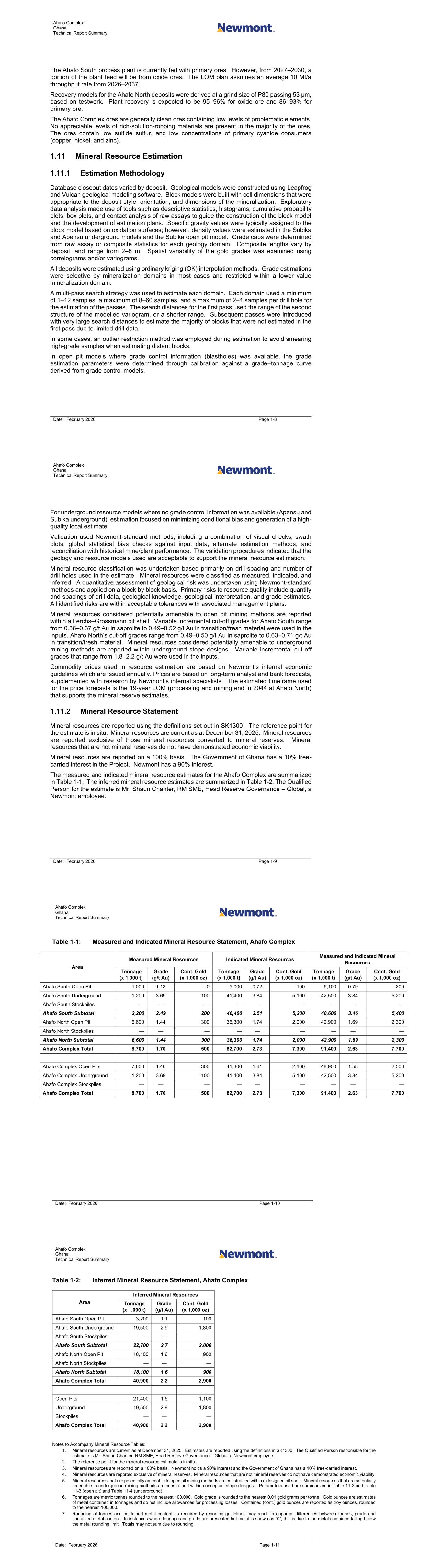
Ahafo Complex Ghana Technical Report Summary Date: February 2026 Page 1-8 The Ahafo South process plant is currently fed with primary ores. However, from 2027–2030, a portion of the plant feed will be from oxide ores. The LOM plan assumes an average 10 Mt/a throughput rate from 2026–2037. Recovery models for the Ahafo North deposits were derived at a grind size of P80 passing 53 µm, based on testwork. Plant recovery is expected to be 95–96% for oxide ore and 86–93% for primary ore. The Ahafo Complex ores are generally clean ores containing low levels of problematic elements. No appreciable levels of rich-solution-robbing materials are present in the majority of the ores. The ores contain low sulfide sulfur, and low concentrations of primary cyanide consumers (copper, nickel, and zinc). 1.11 Mineral Resource Estimation 1.11.1 Estimation Methodology Database closeout dates varied by deposit. Geological models were constructed using Leapfrog and Vulcan geological modeling software. Block models were built with cell dimensions that were appropriate to the deposit style, orientation, and dimensions of the mineralization. Exploratory data analysis made use of tools such as descriptive statistics, histograms, cumulative probability plots, box plots, and contact analysis of raw assays to guide the construction of the block model and the development of estimation plans. Specific gravity values were typically assigned to the block model based on oxidation surfaces; however, density values were estimated in the Subika and Apensu underground models and the Subika open pit model. Grade caps were determined from raw assay or composite statistics for each geology domain. Composite lengths vary by deposit, and range from 2–8 m. Spatial variability of the gold grades was examined using correlograms and/or variograms. All deposits were estimated using ordinary kriging (OK) interpolation methods. Grade estimations were selective by mineralization domains in most cases and restricted within a lower value mineralization domain. A multi-pass search strategy was used to estimate each domain. Each domain used a minimum of 1–12 samples, a maximum of 8–60 samples, and a maximum of 2–4 samples per drill hole for the estimation of the passes. The search distances for the first pass used the range of the second structure of the modelled variogram, or a shorter range. Subsequent passes were introduced with very large search distances to estimate the majority of blocks that were not estimated in the first pass due to limited drill data. In some cases, an outlier restriction method was employed during estimation to avoid smearing high-grade samples when estimating distant blocks. In open pit models where grade control information (blastholes) was available, the grade estimation parameters were determined through calibration against a grade–tonnage curve derived from grade control models. Ahafo Complex Ghana Technical Report Summary Date: February 2026 Page 1-9 For underground resource models where no grade control information was available (Apensu and Subika underground), estimation focused on minimizing conditional bias and generation of a high- quality local estimate. Validation used Newmont-standard methods, including a combination of visual checks, swath plots, global statistical bias checks against input data, alternate estimation methods, and reconciliation with historical mine/plant performance. The validation procedures indicated that the geology and resource models used are acceptable to support the mineral resource estimation. Mineral resource classification was undertaken based primarily on drill spacing and number of drill holes used in the estimate. Mineral resources were classified as measured, indicated, and inferred. A quantitative assessment of geological risk was undertaken using Newmont-standard methods and applied on a block by block basis. Primary risks to resource quality include quantity and spacings of drill data, geological knowledge, geological interpretation, and grade estimates. All identified risks are within acceptable tolerances with associated management plans. Mineral resources considered potentially amenable to open pit mining methods are reported within a Lerchs–Grossmann pit shell. Variable incremental cut-off grades for Ahafo South range from 0.36–0.37 g/t Au in saprolite to 0.49–0.52 g/t Au in transition/fresh material were used in the inputs. Ahafo North’s cut-off grades range from 0.49–0.50 g/t Au in saprolite to 0.63–0.71 g/t Au in transition/fresh material. Mineral resources considered potentially amenable to underground mining methods are reported within underground stope designs. Variable incremental cut-off grades that range from 1.8–2.2 g/t Au were used in the inputs. Commodity prices used in resource estimation are based on Newmont’s internal economic guidelines which are issued annually. Prices are based on long-term analyst and bank forecasts, supplemented with research by Newmont’s internal specialists. The estimated timeframe used for the price forecasts is the 19-year LOM (processing and mining end in 2044 at Ahafo North) that supports the mineral reserve estimates. 1.11.2 Mineral Resource Statement Mineral resources are reported using the definitions set out in SK1300. The reference point for the estimate is in situ. Mineral resources are current as at December 31, 2025. Mineral resources are reported exclusive of those mineral resources converted to mineral reserves. Mineral resources that are not mineral reserves do not have demonstrated economic viability. Mineral resources are reported on a 100% basis. The Government of Ghana has a 10% free- carried interest in the Project. Newmont has a 90% interest. The measured and indicated mineral resource estimates for the Ahafo Complex are summarized in Table 1-1. The inferred mineral resource estimates are summarized in Table 1-2. The Qualified Person for the estimate is Mr. Shaun Chanter, RM SME, Head Reserve Governance – Global, a Newmont employee. Ahafo Complex Ghana Technical Report Summary Date: February 2026 Page 1-10 Table 1-1: Measured and Indicated Mineral Resource Statement, Ahafo Complex Area Measured Mineral Resources Indicated Mineral Resources Measured and Indicated Mineral Resources Tonnage (x 1,000 t) Grade (g/t Au) Cont. Gold (x 1,000 oz) Tonnage (x 1,000 t) Grade (g/t Au) Cont. Gold (x 1,000 oz) Tonnage (x 1,000 t) Grade (g/t Au) Cont. Gold (x 1,000 oz) Ahafo South Open Pit 1,000 1.13 0 5,000 0.72 100 6,100 0.79 200 Ahafo South Underground 1,200 3.69 100 41,400 3.84 5,100 42,500 3.84 5,200 Ahafo South Stockpiles — — — — — — — — — Ahafo South Subtotal 2,200 2.49 200 46,400 3.51 5,200 48,600 3.46 5,400 Ahafo North Open Pit 6,600 1.44 300 36,300 1.74 2,000 42,900 1.69 2,300 Ahafo North Stockpiles — — — — — — — — — Ahafo North Subtotal 6,600 1.44 300 36,300 1.74 2,000 42,900 1.69 2,300 Ahafo Complex Total 8,700 1.70 500 82,700 2.73 7,300 91,400 2.63 7,700 Ahafo Complex Open Pits 7,600 1.40 300 41,300 1.61 2,100 48,900 1.58 2,500 Ahafo Complex Underground 1,200 3.69 100 41,400 3.84 5,100 42,500 3.84 5,200 Ahafo Complex Stockpiles — — — — — — — — — Ahafo Complex Total 8,700 1.70 500 82,700 2.73 7,300 91,400 2.63 7,700 Ahafo Complex Ghana Technical Report Summary Date: February 2026 Page 1-11 Table 1-2: Inferred Mineral Resource Statement, Ahafo Complex Area Inferred Mineral Resources Tonnage (x 1,000 t) Grade (g/t Au) Cont. Gold (x 1,000 oz) Ahafo South Open Pit 3,200 1.1 100 Ahafo South Underground 19,500 2.9 1,800 Ahafo South Stockpiles — — — Ahafo South Subtotal 22,700 2.7 2,000 Ahafo North Open Pit 18,100 1.6 900 Ahafo North Stockpiles — — — Ahafo North Subtotal 18,100 1.6 900 Ahafo Complex Total 40,900 2.2 2,900 Open Pits 21,400 1.5 1,100 Underground 19,500 2.9 1,800 Stockpiles — — — Ahafo Complex Total 40,900 2.2 2,900 Notes to Accompany Mineral Resource Tables: 1. Mineral resources are current as at December 31, 2025. Estimates are reported using the definitions in SK1300. The Qualified Person responsible for the estimate is Mr. Shaun Chanter, RM SME, Head Reserve Governance – Global, a Newmont employee. 2. The reference point for the mineral resource estimate is in situ. 3. Mineral resources are reported on a 100% basis. Newmont holds a 90% interest and the Government of Ghana has a 10% free-carried interest. 4. Mineral resources are reported exclusive of mineral reserves. Mineral resources that are not mineral reserves do not have demonstrated economic viability. 5. Mineral resources that are potentially amenable to open pit mining methods are constrained within a designed pit shell. Mineral resources that are potentially amenable to underground mining methods are constrained within conceptual stope designs. Parameters used are summarized in Table 11-2 and Table 11-3 (open pit) and Table 11-4 (underground). 6. Tonnages are metric tonnes rounded to the nearest 100,000. Gold grade is rounded to the nearest 0.01 gold grams per tonne. Gold ounces are estimates of metal contained in tonnages and do not include allowances for processing losses. Contained (cont.) gold ounces are reported as troy ounces, rounded to the nearest 100,000. 7. Rounding of tonnes and contained metal content as required by reporting guidelines may result in apparent differences between tonnes, grade and contained metal content. In instances where tonnage and grade are presented but metal is shown as “0”, this is due to the metal contained falling below the metal rounding limit. Totals may not sum due to rounding.
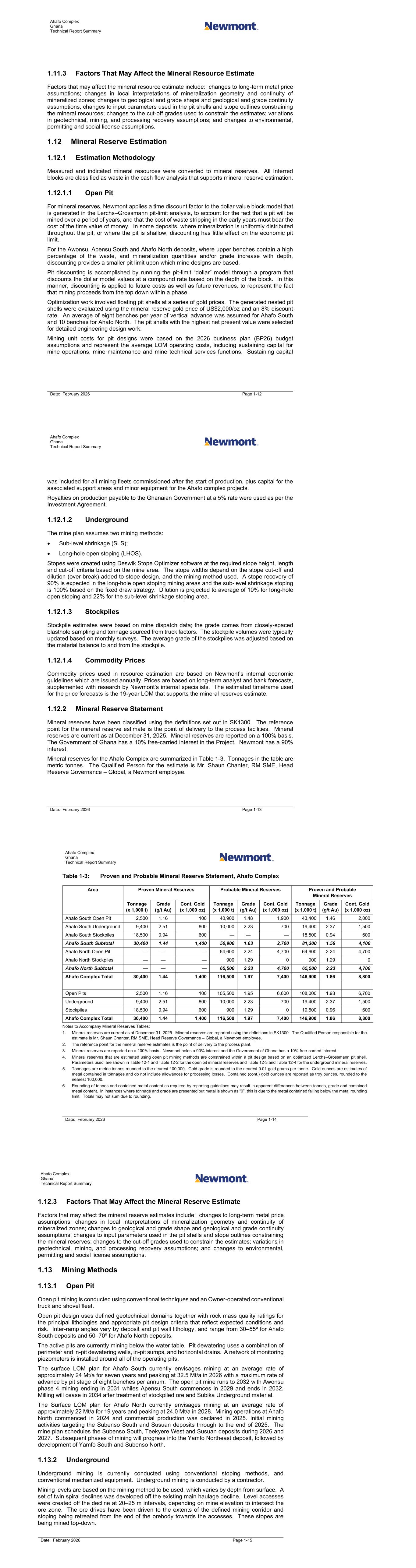
Ahafo Complex Ghana Technical Report Summary Date: February 2026 Page 1-12 1.11.3 Factors That May Affect the Mineral Resource Estimate Factors that may affect the mineral resource estimate include: changes to long-term metal price assumptions; changes in local interpretations of mineralization geometry and continuity of mineralized zones; changes to geological and grade shape and geological and grade continuity assumptions; changes to input parameters used in the pit shells and stope outlines constraining the mineral resources; changes to the cut-off grades used to constrain the estimates; variations in geotechnical, mining, and processing recovery assumptions; and changes to environmental, permitting and social license assumptions. 1.12 Mineral Reserve Estimation 1.12.1 Estimation Methodology Measured and indicated mineral resources were converted to mineral reserves. All Inferred blocks are classified as waste in the cash flow analysis that supports mineral reserve estimation. 1.12.1.1 Open Pit For mineral reserves, Newmont applies a time discount factor to the dollar value block model that is generated in the Lerchs–Grossmann pit-limit analysis, to account for the fact that a pit will be mined over a period of years, and that the cost of waste stripping in the early years must bear the cost of the time value of money. In some deposits, where mineralization is uniformly distributed throughout the pit, or where the pit is shallow, discounting has little effect on the economic pit limit. For the Awonsu, Apensu South and Ahafo North deposits, where upper benches contain a high percentage of the waste, and mineralization quantities and/or grade increase with depth, discounting provides a smaller pit limit upon which mine designs are based. Pit discounting is accomplished by running the pit-limit “dollar” model through a program that discounts the dollar model values at a compound rate based on the depth of the block. In this manner, discounting is applied to future costs as well as future revenues, to represent the fact that mining proceeds from the top down within a phase. Optimization work involved floating pit shells at a series of gold prices. The generated nested pit shells were evaluated using the mineral reserve gold price of US$2,000/oz and an 8% discount rate. An average of eight benches per year of vertical advance was assumed for Ahafo South and 10 benches for Ahafo North. The pit shells with the highest net present value were selected for detailed engineering design work. Mining unit costs for pit designs were based on the 2026 business plan (BP26) budget assumptions and represent the average LOM operating costs, including sustaining capital for mine operations, mine maintenance and mine technical services functions. Sustaining capital Ahafo Complex Ghana Technical Report Summary Date: February 2026 Page 1-13 was included for all mining fleets commissioned after the start of production, plus capital for the associated support areas and minor equipment for the Ahafo complex projects. Royalties on production payable to the Ghanaian Government at a 5% rate were used as per the Investment Agreement. 1.12.1.2 Underground The mine plan assumes two mining methods: • Sub-level shrinkage (SLS); • Long-hole open stoping (LHOS). Stopes were created using Deswik Stope Optimizer software at the required stope height, length and cut-off criteria based on the mine area. The stope widths depend on the stope cut-off and dilution (over-break) added to stope design, and the mining method used. A stope recovery of 90% is expected in the long-hole open stoping mining areas and the sub-level shrinkage stoping is 100% based on the fixed draw strategy. Dilution is projected to average of 10% for long-hole open stoping and 22% for the sub-level shrinkage stoping area. 1.12.1.3 Stockpiles Stockpile estimates were based on mine dispatch data; the grade comes from closely-spaced blasthole sampling and tonnage sourced from truck factors. The stockpile volumes were typically updated based on monthly surveys. The average grade of the stockpiles was adjusted based on the material balance to and from the stockpile. 1.12.1.4 Commodity Prices Commodity prices used in resource estimation are based on Newmont’s internal economic guidelines which are issued annually. Prices are based on long-term analyst and bank forecasts, supplemented with research by Newmont’s internal specialists. The estimated timeframe used for the price forecasts is the 19-year LOM that supports the mineral reserves estimate. 1.12.2 Mineral Reserve Statement Mineral reserves have been classified using the definitions set out in SK1300. The reference point for the mineral reserve estimate is the point of delivery to the process facilities. Mineral reserves are current as at December 31, 2025. Mineral reserves are reported on a 100% basis. The Government of Ghana has a 10% free-carried interest in the Project. Newmont has a 90% interest. Mineral reserves for the Ahafo Complex are summarized in Table 1-3. Tonnages in the table are metric tonnes. The Qualified Person for the estimate is Mr. Shaun Chanter, RM SME, Head Reserve Governance – Global, a Newmont employee. Ahafo Complex Ghana Technical Report Summary Date: February 2026 Page 1-14 Table 1-3: Proven and Probable Mineral Reserve Statement, Ahafo Complex Area Proven Mineral Reserves Probable Mineral Reserves Proven and Probable Mineral Reserves Tonnage (x 1,000 t) Grade (g/t Au) Cont. Gold (x 1,000 oz) Tonnage (x 1,000 t) Grade (g/t Au) Cont. Gold (x 1,000 oz) Tonnage (x 1,000 t) Grade (g/t Au) Cont. Gold (x 1,000 oz) Ahafo South Open Pit 2,500 1.16 100 40,900 1.48 1,900 43,400 1.46 2,000 Ahafo South Underground 9,400 2.51 800 10,000 2.23 700 19,400 2.37 1,500 Ahafo South Stockpiles 18,500 0.94 600 — — — 18,500 0.94 600 Ahafo South Subtotal 30,400 1.44 1,400 50,900 1.63 2,700 81,300 1.56 4,100 Ahafo North Open Pit — — — 64,600 2.24 4,700 64,600 2.24 4,700 Ahafo North Stockpiles — — — 900 1.29 0 900 1.29 0 Ahafo North Subtotal — — — 65,500 2.23 4,700 65,500 2.23 4,700 Ahafo Complex Total 30,400 1.44 1,400 116,500 1.97 7,400 146,900 1.86 8,800 Open Pits 2,500 1.16 100 105,500 1.95 6,600 108,000 1.93 6,700 Underground 9,400 2.51 800 10,000 2.23 700 19,400 2.37 1,500 Stockpiles 18,500 0.94 600 900 1.29 0 19,500 0.96 600 Ahafo Complex Total 30,400 1.44 1,400 116,500 1.97 7,400 146,900 1.86 8,800 Notes to Accompany Mineral Reserves Tables: 1. Mineral reserves are current as at December 31, 2025. Mineral reserves are reported using the definitions in SK1300. The Qualified Person responsible for the estimate is Mr. Shaun Chanter, RM SME, Head Reserve Governance – Global, a Newmont employee. 2. The reference point for the mineral reserve estimates is the point of delivery to the process plant. 3. Mineral reserves are reported on a 100% basis. Newmont holds a 90% interest and the Government of Ghana has a 10% free-carried interest. 4. Mineral reserves that are estimated using open pit mining methods are constrained within a pit design based on an optimized Lerchs–Grossmann pit shell. Parameters used are shown in Table 12-1 and Table 12-2 for the open pit mineral reserves and Table 12-3 and Table 12-4 for the underground mineral reserves. 5. Tonnages are metric tonnes rounded to the nearest 100,000. Gold grade is rounded to the nearest 0.01 gold grams per tonne. Gold ounces are estimates of metal contained in tonnages and do not include allowances for processing losses. Contained (cont.) gold ounces are reported as troy ounces, rounded to the nearest 100,000. 6. Rounding of tonnes and contained metal content as required by reporting guidelines may result in apparent differences between tonnes, grade and contained metal content. In instances where tonnage and grade are presented but metal is shown as “0”, this is due to the metal contained falling below the metal rounding limit. Totals may not sum due to rounding. Ahafo Complex Ghana Technical Report Summary Date: February 2026 Page 1-15 1.12.3 Factors That May Affect the Mineral Reserve Estimate Factors that may affect the mineral reserve estimates include: changes to long-term metal price assumptions; changes in local interpretations of mineralization geometry and continuity of mineralized zones; changes to geological and grade shape and geological and grade continuity assumptions; changes to input parameters used in the pit shells and stope outlines constraining the mineral reserves; changes to the cut-off grades used to constrain the estimates; variations in geotechnical, mining, and processing recovery assumptions; and changes to environmental, permitting and social license assumptions. 1.13 Mining Methods 1.13.1 Open Pit Open pit mining is conducted using conventional techniques and an Owner-operated conventional truck and shovel fleet. Open pit design uses defined geotechnical domains together with rock mass quality ratings for the principal lithologies and appropriate pit design criteria that reflect expected conditions and risk. Inter-ramp angles vary by deposit and pit wall lithology, and range from 30–55º for Ahafo South deposits and 50–70º for Ahafo North deposits. The active pits are currently mining below the water table. Pit dewatering uses a combination of perimeter and in-pit dewatering wells, in-pit sumps, and horizontal drains. A network of monitoring piezometers is installed around all of the operating pits. The surface LOM plan for Ahafo South currently envisages mining at an average rate of approximately 24 Mt/a for seven years and peaking at 32.5 Mt/a in 2026 with a maximum rate of advance by pit stage of eight benches per annum. The open pit mine runs to 2032 with Awonsu phase 4 mining ending in 2031 whiles Apensu South commences in 2029 and ends in 2032. Milling will cease in 2034 after treatment of stockpiled ore and Subika Underground material. The Surface LOM plan for Ahafo North currently envisages mining at an average rate of approximately 22 Mt/a for 19 years and peaking at 24.0 Mt/a in 2028. Mining operations at Ahafo North commenced in 2024 and commercial production was declared in 2025. Initial mining activities targeting the Subenso South and Susuan deposits through to the end of 2025. The mine plan schedules the Subenso South, Teekyere West and Susuan deposits during 2026 and 2027. Subsequent phases of mining will progress into the Yamfo Northeast deposit, followed by development of Yamfo South and Subenso North. 1.13.2 Underground Underground mining is currently conducted using conventional stoping methods, and conventional mechanized equipment. Underground mining is conducted by a contractor. Mining levels are based on the mining method to be used, which varies by depth from surface. A set of twin spiral declines was developed off the existing main haulage decline. Level accesses were created off the decline at 20–25 m intervals, depending on mine elevation to intersect the ore zone. The ore drives have been driven to the extents of the defined mining corridor and stoping being retreated from the end of the orebody towards the accesses. These stopes are being mined top-down.

Ahafo Complex Ghana Technical Report Summary Date: February 2026 Page 1-16 Mining was initially envisaged as long-hole open stoping mining method; however, an improved understanding of the geotechnical setting led to the selection of sub-level shrinkage stoping in preference. A transition zone between mining methods at 450 m below surface was required to migrate the different stoping types. The mine will completely transition to the sub-level shrinkage mining method when the long-hole open stopes are complete, but currently the two mining methods are being used together. Groundwater inflows are estimated at 140 L/s, with an additional 25 L/s required for service-water supply to the underground workings. The ventilation system for Subika includes refrigeration, primary and secondary fans and intake and return ventilation raises. Trucks will be loaded from the level below the mining extraction level via the material placed in the ore pass. When stope mining is completed, the stopes will be backfilled with unconsolidated waste rock. Underground infrastructure includes an electrical ring main, sumps, pumps and pump stations, cooling system, communications, and telemetry system, mine control room, and two vehicle service bays. 1.14 Recovery Methods The process plant designs were based on a combination of metallurgical testwork, previous study designs and industry standard practices for handling combinations of fresh rock and saprolite. The designs are conventional to the gold industry and has no novel parameters. Debottlenecking and optimization activities were also completed once the Ahafo South mill was operational. Commercial production was declared for the Ahafo North mill in October, 2025. The Ahafo South process plant started operations in 2006 and was designed to treat 7.5 Mt/a using a blend of 27:73 oxide to primary ore. The plant was expanded in 2019 to treat an additional 3.0 Mt/a of primary ore. The planned throughput for the remaining LOM is projected to vary from 9.8–10.2 Mt/a (1.200–1,300 t/h), depending on the ore blend from the pits and underground operations. The process consists of: primary crushing, semi-autogenous grind (SAG) milling, carbon-in-leach (CIL), Anglo American Research Laboratory method (AARL) elution circuit to strip gold from loaded carbon, smelting to produce doré, and counter-current decantation to recover cyanide from CIL tailings prior to discharge to the tailings storage facility (TSF). Power is sourced from the local grid. The main water sources for the process plant are from stored water in the mined out Apensu open pit and the TSF. Consumables used include grinding media, reagents, and high- and low-pressure air. The Ahafo North plant capacity is 3.7 Mt/a when treating saprolite and 3.4 Mt/a when treating primary ores. The process consists of: primary crushing, a SAG mill operating in a closed circuit with a pebble crusher and a ball mill operating in closed circuit with hydrocyclones, a CIL circuit, an AARL elution circuit to strip gold from loaded carbon, smelting to produce doré, and counter- current decantation to recover cyanide from CIL tailings prior to discharge to the TSF. Power is sourced from the local grid. The primary source of raw water is pit dewatering, supplemented by runoff from the local catchments. Consumables used include reagents (cyanide, lime, acid, caustic, grinding media, high- and low-pressure air and oxygen). Ahafo Complex Ghana Technical Report Summary Date: February 2026 Page 1-17 1.15 Infrastructure Key infrastructure to support the Ahafo Complex mining activities envisaged in the LOM is in place. The Awonsu Phase 4 pit will be used for tailings deposition post mining in 2031. Personnel commute from surrounding settlements or live in purpose-built accommodations villages. A stockpiling strategy is practiced to defer lower-grade ores to the end of the mine life. All stockpile inventories are calculated and reported monthly. Inventories are based on truck counts of material added to and removed from stockpiles, multiplied by truck tonnage factors. The Ahafo South LOM plan assumes that only two WRSFs, at Apensu South and Awonsu, will be active for the remainder of the Ahafo South mine life. At Ahafo North, WRSFs are constructed at three locations that are in close proximity to the main mining areas. The Ahafo South TSF is operated as a zero-discharge facility; all water is returned to the process facility for reuse. TSF capacities meet the required capacities for the present LOM. A raise to Cell 1 will allow operations to 2031 followed by deposition into the mined Awonsu Phase 4 open pit will support the operations to the end of the LOM. The TSF expansions, Cell 1 that would be expanded to a maximum capacity of 220 Mt and the Awonsu Phase 4 in pit tailing deposition has an additional 89 Mt capacity. The fully lined TSF will be developed in eight phases, with phases 1 and 2 already completed and currently supporting ongoing milling operations. The remaining will be constructed in a phased manner to provide a total capacity of 76.4 Mt, aligned with the mine plan and tailings production schedule. Construction of the remaining phases is planned to commence with phase 3 in 2026 and progress through to phase 8 by 2042. Water management infrastructure for Ahafo Complex mine operations includes pit runoff, surface water, and groundwater management infrastructure. Reverse osmosis water treatment plants are operational. Newmont Africa in Ghana receives power purchased from the Volta River Authority’s grid. Power is delivered to the Ahafo Complex via three 161 kV transmission lines. Newmont has also installed emergency power generating capacity. 1.16 Markets and Contracts Newmont has established contracts and buyers for the doré products from the Ahafo Complex, and has an internal marketing group that monitors markets for its key products. Together with public documents and analyst forecasts, these data support that there is a reasonable basis to assume that for the LOM plan, that the key products will be saleable at the assumed commodity pricing. The doré is not subject to product specification requirements. Newmont uses a combination of historical and current contract pricing, contract negotiations, knowledge of its key markets from a long operations production record, short-term versus long- term price forecasts prepared by the company’s internal marketing group, public documents, and analyst forecasts when considering long-term commodity price forecasts. Higher metal prices are used for the mineral resource estimates to ensure the mineral reserves are a sub-set of, and not constrained by, the mineral resources, in accordance with industry-accepted practice. The forecast prices and exchange rates are shown in Table 1-4 Ahafo Complex Ghana Technical Report Summary Date: February 2026 Page 1-18 Table 1-4: Commodity Price and Exchange Rate Forecasts Commodity Units Mineral Reserves Mineral Resources Gold $US/oz 2,000 2,300 Exchange rate US$:Gh$ 1:12.00 1:12.00 Newmont’s doré is sold on the spot market, by marketing experts retained in-house by Newmont. The terms contained within the sales contracts are typical and consistent with standard industry practice and are similar to contracts for the supply of doré elsewhere in the world. The largest in-place contracts other than for product sales cover items such as bulk commodities, operational and technical services, mining and process equipment, and administrative support services. Contracts are negotiated and renewed as needed. Contract terms are typical of similar contracts in Ghana. 1.17 Environmental, Permitting and Social Considerations 1.17.1 Environmental Studies and Monitoring Baseline and supporting environmental studies were completed to assess both pre-existing and ongoing site environmental conditions, as well as to support decision-making processes during operations start-up. Characterization studies were completed for climate, air quality, hydrology and surface water quality, hydrogeology, flora, fauna, soils, agriculture and land use, and the socioeconomic environment. Plans were developed and implemented to address aspects of operations such as waste and fugitive dust management, air quality, spill prevention and contingency planning, water management, and noise levels. The primary environmental resource monitored at Ahafo is water – both surface water and groundwater. Other resource monitoring being conducted by Newmont includes fugitive dust, point source emission, meteorological parameters, noise and vibration, revegetation progress, surface water run-off quantity, and quality, mine pit conditions, waste rock disposal, TSF decant water quantity and quality, and environmental geochemistry of ore, waste rock, and tailings. 1.17.2 Closure and Reclamation Considerations In 2003, Newmont developed a conceptual closure and reclamation plan for the Ahafo South Mine Project Environmental Impact Statement (EIS) in compliance with requirements of the Environmental Protection Agency (EPA). The EIS was approved by the EPA in April 2005. A Draft Reclamation Plan to begin the process of formalizing the conceptual plan presented in the EIS was undertaken later in 2005. Under EPA requirements, Newmont is required to provide updates to the reclamation plan as mine development proceeds. An updated Closure and Reclamation Plan was developed in 2019 that covers closure of the Subika Underground and ancillary infrastructure as well as the prior existing facilities. A Reclamation Security Agreement (RSA) between the EPA and Newmont was signed in April 2008 to outline the various objectives and targets as guidance for the plan. The EPA requires a Reclamation Bond to be posted as part of any mine permitting process. The bond is required to provide financial surety against non-compliance under the approved Closure and Reclamation Ahafo Complex Ghana Technical Report Summary Date: February 2026 Page 1-19 Plan and is required within six months after the start of operations. As part of the reclamation and security agreement (environmental bond) with the Ghanaian Government, Newmont has provided a cumulative (project to date) cash deposit of US$14 M. The closure cost estimate for Ahafo South is US$0.2 B. A definitive closure and reclamation plan, which will address stockpiling of topsoils and concurrent reclamation, was developed for Ahafo North. The closure cost estimate for Ahafo North is approximately US$0.1B. 1.17.3 Permitting All major permits and approvals are either in place or Newmont expects to obtain them in the normal course of business. Where permits have specific terms, renewal applications are made of the relevant regulatory authority as required, prior to the end of the permit term. 1.17.4 Social Considerations, Plans, Negotiations and Agreements Newmont developed a public consultation and disclosure plan (PCDP) for the Ahafo Complex using guidelines and policies developed by the International Finance Corporation (IFC). The IFC requires public consultation as an on-going process to be conducted during the construction and operational phases of any project. Newmont has well-established relationships, issue management approaches, engagement forums, and a suite of integrated social impact and opportunity-aligned strategic investment partnerships. Newmont understands and accepts the importance of proactive community relations as an overriding principle in its day-to-day operations as well as future development planning. The company therefore structures its community relations activities to consider the concerns of the local people and endeavors to communicate and demonstrate its commitment in terms that can be best appreciated and understood to maintain the social license to operate. 1.18 Capital Cost Estimates Capital cost estimates are at a minimum at a pre-feasibility level of confidence, having an accuracy level of ±25% and a contingency range not exceeding 15%. Capital costs are based on recent prices or operating data. Capital costs include funding for infrastructure, pit dewatering, development drilling, and permitting as well as miscellaneous expenditures required to maintain production. Mobile equipment re-build/replacement schedules and fixed asset replacement and refurbishment schedules are included. Sustaining capital costs reflect current price trends. The overall capital cost estimate for Ahafo South LOM is US$0.7 B and Ahafo North LOM is US$0.9 B as summarized in Table 1-5. The total capital cost for the Ahafo Complex is US$1.6 B.

Ahafo Complex Ghana Technical Report Summary Date: February 2026 Page 1-20 Table 1-5: Ahafo Complex Capital Cost Estimate Area Unit Ahafo South Ahafo North Ahafo Complex Mining, open pit US$ Billion 0.2 0.3 0.5 Mining, underground US$ Billion 0.2 0.3 0.5 Process US$ Billion 0.3 0.3 0.6 Total US$ Billion 0.7 0.9 1.6 Note: numbers have been rounded; totals may not sum due to rounding. 1.19 Operating Cost Estimates Operating cost estimates are at a minimum at a pre-feasibility level of confidence, having an accuracy level of ±25% and a contingency range not exceeding 15%. Operating costs are based on actual costs seen during operations and are projected through the LOM plan. Historical costs are used as the basis for operating cost forecasts for supplies and services unless there are new contract terms for these items. Labor and energy costs are based on budgeted rates applied to headcounts and energy consumption estimates. Operating costs (mining, processing, and general and administrative (G&A) for Ahafo South and Ahafo North LOM are estimated at US$4.0 B and US$3.3 B, respectively, as summarized in Table 1-6. The total operating costs for the Ahafo Complex are estimated at US$7.3 B, as also summarized in Table 1-6. Table 1-6: Ahafo Complex Operating Cost Estimate Cost Element Unit Ahafo South Ahafo North Ahafo Complex Open pit mining costs US$ billion 0.7 1.4 2.1 Underground mining costs US$ billion 1.2 — 1.2 Processing costs US$ billion 1.4 1.2 2.6 G&A costs US$ billion 0.7 0.7 1.4 Total Operating Costs US$ billion 4.0 3.3 7.3 Note: numbers have been rounded; totals may not sum due to rounding. The estimated LOM open pit mining cost is US$4.37/t and the underground mining cost is US$62.32/t for Ahafo South. The estimated LOM open pit mining cost for Ahafo North is US$3.27/t. Base processing costs are estimated at US$16.93/t for Ahafo South and US$18.16/t (Table 1-7). Ahafo Complex Ghana Technical Report Summary Date: February 2026 Page 1-21 Table 1-7: Ahafo Complex Operating Unit Cost Estimate Cost Element Unit Ahafo South Ahafo North Ahafo Complex Open pit mining costs US$/t mined 4.37 3.27 3.59 Underground mining costs US$/t mined 62.32 — 62.32 Processing costs US$/t processed 16.93 18.16 17.48 G&A costs US$/t processed 8.63 11.41 9.87 Note: numbers have been rounded; totals may not sum due to rounding. 1.20 Economic Analysis 1.20.1 Economic Analysis The financial model that supports the mineral reserve declaration is a standalone model that calculates annual cash flows based on scheduled ore production, assumed processing recoveries, metal sale prices and US$/Gh$ exchange rate, projected operating and capital costs and estimated taxes. The financial analysis is based on an after-tax discount rate of 8%. All costs and prices are in unescalated “real” dollars. The currency used to document the cash flow is the US$. All costs are based on the 2026 budget. Revenue is calculated from the recoverable metals and long-term metal price and exchange rate forecasts. Taxes are based on Newmont’s existing agreement with the Government of Ghana. The economic analysis is based on 100% equity financing and is reported on a 100% project ownership basis. The Government of Ghana has a 10% free-carried interest in the Project. Newmont has a 90% interest. The economic analysis assumes constant prices with no inflationary adjustments. The NPV8% for the overall Ahafo Complex is US$1.7 B. As the cash flows are based on existing operations where all costs are considered sunk to January 1, 2026, considerations of payback and internal rate of return are not relevant. Free cash flow for the complex is US$ 2.7 B. A summary of the financial results is provided in Table 1-8. In this table, EBITDA = earnings before interest, taxes, depreciation, and amortization. The active mining operation ceases in 2044; however, closure costs are estimated to 2078. Ahafo Complex Ghana Technical Report Summary Date: February 2026 Page 1-22 Table 1-8: Cashflow Summary Table, Ahafo Complex Item Unit Value Metal prices Gold US$/oz 2,000 Milled ore Tonnage Million tonnes 147 Gold grade g/t 1.86 Gold ounces Million ounces 8.8 Capital costs US$ billion 1.6 Costs applicable to sales US$ billion 8.6 Discount rate % 8 Exchange rate United States dollar:Ghanaian cedi (USD:GHS) 1:12.00 Free cash flow US$ billion 2.7 Net present value US$ billion 1.7 Note: The economic analysis is based on 100% equity financing and is reported on a 100% project ownership basis. The Government of Ghana has a 10% free-carried interest in the Project. Newmont has a 90% interest. The economic analysis assumes constant prices with no inflationary adjustments. Table 1-8 contains “forward-looking statements” within the meaning of Section 27A of the Securities Act of 1933, as amended, and Section 21E of the Securities Exchange Act of 1934, as amended, which are intended to be covered by the safe harbor created by such sections and other applicable laws. Please refer to the note regarding forward-looking information at the front of the Report. The cash flow is only intended to demonstrate the financial viability of the Project. Investors are cautioned that the above is based upon certain assumptions which may differ from Newmont’s long-term outlook or actual financial results, including, but not limited to commodity prices, escalation assumptions, and other technical inputs. For example, Table 1-8 uses the price assumptions stated in the table, including a gold commodity price assumption of US$2,000/oz, which varies significantly from current gold prices and the assumptions that Newmont uses for its long-term guidance. Please be reminded that significant variation of metal prices, costs and other key assumptions may require modifications to mine plans, models, and prospects. Numbers have been rounded; totals may not sum due to rounding. 1.20.2 Sensitivity Analysis The sensitivity of the Project to changes in metal prices, exchange rate, sustaining capital costs and operating cost assumptions was tested using a range of 25% above and below the base case values. Each of Ahafo South, Ahafo North and the overall Ahafo Complex is most sensitive to gold price changes, less sensitive to changes in operating costs, and least sensitive to changes in capital costs. The sensitivity to gold grade mirrors the sensitivity to the gold price. The sensitivity analysis for the Ahafo Complex is shown in Figure 1-1. Ahafo Complex Ghana Technical Report Summary Date: February 2026 Page 1-23 Figure 1-1: NPV Sensitivity, Ahafo Complex Note: Figure prepared by Newmont, 2026. FCF = free cash flow; op cost = operating cost; cap cost = capital cost; NPV = net present value. 1.21 Risks and Opportunities Factors that may affect the mineral resource and mineral reserve estimates are summarized in Chapter 1.11.3 and Chapter 1.12.3. 1.21.1 Risks The risks associated with the Ahafo Complex are generally those expected with open pit and underground mining operations and include the accuracy of the resource model, unexpected geological features that cause geotechnical issues, and/or operational impacts. Other risks noted include: • The mineral reserve estimates are sensitive to metal prices. Lower metal prices than forecast in the LOM plan may require revisions to the mine plan, with impacts to the mineral reserve estimates and the economic analysis that supports the mineral reserve estimates; • Labor cost increases or productivity decreases could also impact the stated mineral reserves and mineral resources; • Geotechnical and hydrological assumptions used in mine planning are based on historical performance, and to date historical performance has been a reasonable predictor of current
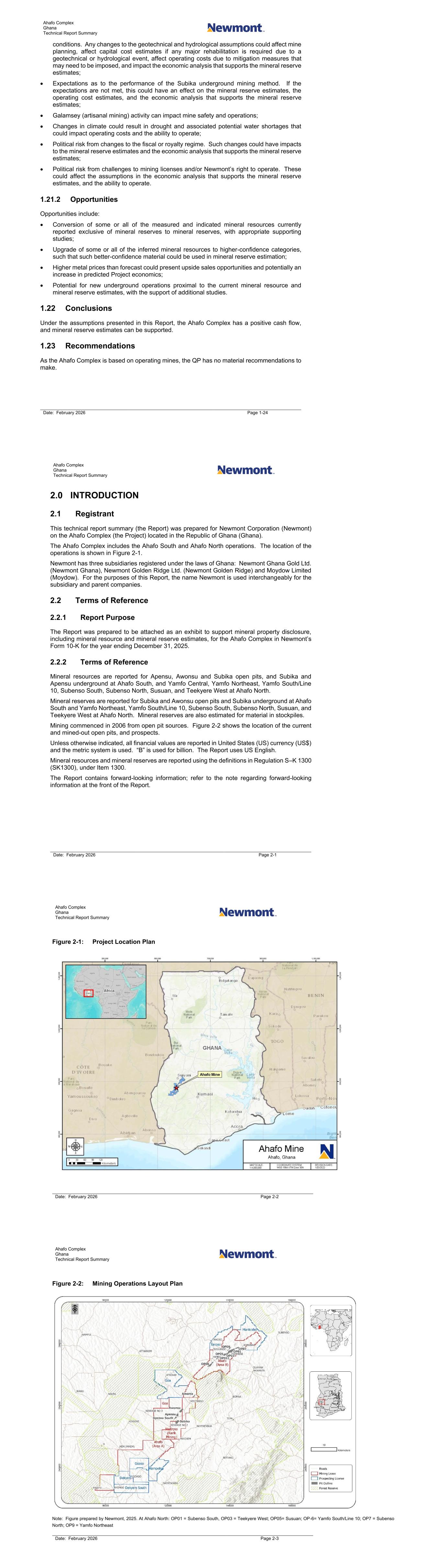
Ahafo Complex Ghana Technical Report Summary Date: February 2026 Page 1-24 conditions. Any changes to the geotechnical and hydrological assumptions could affect mine planning, affect capital cost estimates if any major rehabilitation is required due to a geotechnical or hydrological event, affect operating costs due to mitigation measures that may need to be imposed, and impact the economic analysis that supports the mineral reserve estimates; • Expectations as to the performance of the Subika underground mining method. If the expectations are not met, this could have an effect on the mineral reserve estimates, the operating cost estimates, and the economic analysis that supports the mineral reserve estimates; • Galamsey (artisanal mining) activity can impact mine safety and operations; • Changes in climate could result in drought and associated potential water shortages that could impact operating costs and the ability to operate; • Political risk from changes to the fiscal or royalty regime. Such changes could have impacts to the mineral reserve estimates and the economic analysis that supports the mineral reserve estimates; • Political risk from challenges to mining licenses and/or Newmont’s right to operate. These could affect the assumptions in the economic analysis that supports the mineral reserve estimates, and the ability to operate. 1.21.2 Opportunities Opportunities include: • Conversion of some or all of the measured and indicated mineral resources currently reported exclusive of mineral reserves to mineral reserves, with appropriate supporting studies; • Upgrade of some or all of the inferred mineral resources to higher-confidence categories, such that such better-confidence material could be used in mineral reserve estimation; • Higher metal prices than forecast could present upside sales opportunities and potentially an increase in predicted Project economics; • Potential for new underground operations proximal to the current mineral resource and mineral reserve estimates, with the support of additional studies. 1.22 Conclusions Under the assumptions presented in this Report, the Ahafo Complex has a positive cash flow, and mineral reserve estimates can be supported. 1.23 Recommendations As the Ahafo Complex is based on operating mines, the QP has no material recommendations to make. Ahafo Complex Ghana Technical Report Summary Date: February 2026 Page 2-1 2.0 INTRODUCTION 2.1 Registrant This technical report summary (the Report) was prepared for Newmont Corporation (Newmont) on the Ahafo Complex (the Project) located in the Republic of Ghana (Ghana). The Ahafo Complex includes the Ahafo South and Ahafo North operations. The location of the operations is shown in Figure 2-1. Newmont has three subsidiaries registered under the laws of Ghana: Newmont Ghana Gold Ltd. (Newmont Ghana), Newmont Golden Ridge Ltd. (Newmont Golden Ridge) and Moydow Limited (Moydow). For the purposes of this Report, the name Newmont is used interchangeably for the subsidiary and parent companies. 2.2 Terms of Reference 2.2.1 Report Purpose The Report was prepared to be attached as an exhibit to support mineral property disclosure, including mineral resource and mineral reserve estimates, for the Ahafo Complex in Newmont’s Form 10-K for the year ending December 31, 2025. 2.2.2 Terms of Reference Mineral resources are reported for Apensu, Awonsu and Subika open pits, and Subika and Apensu underground at Ahafo South, and Yamfo Central, Yamfo Northeast, Yamfo South/Line 10, Subenso South, Subenso North, Susuan, and Teekyere West at Ahafo North. Mineral reserves are reported for Subika and Awonsu open pits and Subika underground at Ahafo South and Yamfo Northeast, Yamfo South/Line 10, Subenso South, Subenso North, Susuan, and Teekyere West at Ahafo North. Mineral reserves are also estimated for material in stockpiles. Mining commenced in 2006 from open pit sources. Figure 2-2 shows the location of the current and mined-out open pits, and prospects. Unless otherwise indicated, all financial values are reported in United States (US) currency (US$) and the metric system is used. “B” is used for billion. The Report uses US English. Mineral resources and mineral reserves are reported using the definitions in Regulation S–K 1300 (SK1300), under Item 1300. The Report contains forward-looking information; refer to the note regarding forward-looking information at the front of the Report. Ahafo Complex Ghana Technical Report Summary Date: February 2026 Page 2-2 Figure 2-1: Project Location Plan Ahafo Complex Ghana Technical Report Summary Date: February 2026 Page 2-3 Figure 2-2: Mining Operations Layout Plan Note: Figure prepared by Newmont, 2025. At Ahafo North: OP01 = Subenso South, OP03 = Teekyere West; OP05= Susuan; OP-6= Yamfo South/Line 10; OP7 = Subenso North; OP9 = Yamfo Northeast

Ahafo Complex Ghana Technical Report Summary Date: February 2026 Page 2-4 2.3 Qualified Persons The following Newmont employee serves as the Qualified Person (QP) for the Report: • Mr. Shaun Chanter, RM SME, Head Reserve Governance - Global, Newmont. Mr. Chanter is responsible for all Report Chapters. 2.4 Site Visits and Scope of Personal Inspection Mr. Chanter has visited the Ahafo Complex on several occasions, most recently from July 28 to August 7, 2025. During this site visit, Mr. Chanter inspected the operating open pits, and examined the underground operations. He visited the core shack and inspected drill core. Mr. Chanter also viewed the Ahafo process plants and associated general site infrastructure, including the current tailings storage facility (TSF) operations. While on site, he typically discusses aspects of the operation with site-based staff. These discussions include the overall approach to the mine plan, anticipated mining conditions, selection of the production target and potential options for improvement, as well as reconciliation study results. Other areas of discussion include plant operation and recovery forecasts and plans for the expanded TSF. Mr. Chanter reviews capital and operating forecasts with site staff. Mr. Chanter also reviews Newmont’s processes and internal controls on those processes at the mine site with operational staff on the work flow for determining mineral resource and mineral reserve estimates, mineral process performance, production forecasts, mining costs, and waste management. 2.5 Report Date Information in the Report is current as at December 31, 2025. 2.6 Information Sources and References The reports and documents listed in Chapter 24 and Chapter 25 of this Report were used to support Report preparation. 2.7 Previous Technical Report Summaries Newmont previously filed a technical report summary on the Project: • Doe, D., 2023: Ahafo Operations, Ghana, Technical Report Summary: report prepared for Newmont Corporation, dated December 31, 2023; • Doe, D., 2021: Ahafo Operations, Ghana, Technical Report Summary: report prepared for Newmont Corporation, dated December 31, 2021. Ahafo Complex Ghana Technical Report Summary Date: February 2026 Page 3-1 3.0 PROPERTY DESCRIPTION 3.1 Introduction The Ahafo Complex is located in western Ghana near the towns of Kenyasi and Ntotroso in the Ahafo Region, about 290 km northwest of Accra. The Ahafo South operations are situated 120 km northwest of Kumasi, and 30 km east of the regional capital of Goaso. The Ahafo North operations are located 20 km east of the Bono regional capital of Sunyani. The Ahafo Complex is centered at about 2º18’51” west longitude, and 7º06’01” north latitude, The Ahafo South plant site is located at 2º20’42” longitude and 7º02’13” latitude. The Ahafo North plant site is located at 2º11’30” longitude and 7º15’03” latitude. The centroid locations, in latitude/longitude, of the deposits that have mineral resource estimates are provided in Table 3-1. Table 3-1: Deposit Centroids Deposit Name Latitude (north) Longitude (west) Subika 6°59'51" 2°21'49" Apensu 7°01'17" 2°21'44" Awonsu 7°02'15" 2°20'58" Amoma 7°05'18" 2°18'15" Yamfo South 7˚12'55'' 2˚14'42'' Yamfo Central 7˚13'10'' 2˚13'02'' Yamfo Northeast 7˚15'14'' 2˚10'49'' Susuan 7˚13'54'' 2˚11'53'' Subenso South 7˚14'43'' 2˚10'30'' Subenso North 7˚15'19'' 2˚09'15'' Teekyere West 7˚14'08'' 2˚11'17'' 3.2 Property and Title in Ghana 3.2.1 Mineral Title Mineral exploration and mining are administered in Ghana under the Minerals and Mining Act, 2006 (Act 703) and relevant Regulations that came into force in June 2012. These are Minerals and Mining (General) Regulations, Minerals and Mining (Licensing) Regulations, Minerals and Mining (Support Services) Regulations, Minerals and Mining (Compensation and Resettlement) Regulations, Minerals and Mining (Explosives) Regulations and the Minerals and Mining (Health, Ahafo Complex Ghana Technical Report Summary Date: February 2026 Page 3-2 Safety and Technical) Regulations. The State is the owner of all minerals occurring in their natural state within Ghana's land and territorial sea, including its exclusive economic zone but is vested in the President on behalf of and in trust for the people of Ghana. Three types of mineral rights can be granted after the applicant’s fiscal and technical ability to perform effective exploration or mining is verified: reconnaissance and prospecting licenses, and mining leases (Table 3-2). Table 3-2: Types of Mineral Rights Mineral Right Name Comment Reconnaissance License Granted for a maximum area of 1,050 km2 in aggregate. Allows for non-intrusive reconnaissance exploration such as remote sensing, surface geology, and geochemical sampling (no excavation or drilling) and confers exclusive rights to the holder to undertake reconnaissance for the specific granted mineral(s) for a year. License is renewable for another 12 months provided that notification of the intention to extend the term of the license is provided not later than 90 days before the expiration of the initial term of the license. Renewals must be supported by a professional technical terminal report. Prospecting License Confers exclusive rights to the holder to prospect for granted mineral(s). Licenses may not exceed 157.5 km2 in aggregate. Granted for an initial period not exceeding three years with the ability to renew for an additional period of not more than three years. Notification of intention to renew the term of the license must be received not later than 90 days before the expiration of the initial term of the license. Renewals must be supported by a professional terminal report. License holder is required to relinquish not less than half of the original license area after the expiration of the first three-year term Mining Lease Required to commence mining operations. Requires the applicant to submit a feasibility report in accordance with the Minerals Commission’s guidelines, stating how the planned mining operation is to be carried out. The lease area is limited to a maximum area of 63 km2; however, an enlargement of the lease area may be granted by the Minister responsible for mines if satisfied on reasonable grounds that the additional area is required for the holder’s operations. Granted for a maximum 30-year term, and renewable thereafter upon negotiated terms. 3.2.2 Surface Rights A mineral right holder is required to exercise their rights so that impacts on the interests of any lawful owner or occupier of the land are minimized. The lawful owner or occupier retains the right to graze livestock and cultivate the land in so far as such activities do not interfere with the mineral operations. The owner or occupier may apply to the mineral right holder for compensation for any disturbance of their rights, for damage to buildings, improvements, livestock, crops, or trees. Assessment of compensation eligibility and amount payable, in practice, requires extensive stakeholder engagement including affected landowners, the Land Valuation Division and cooperation of traditional authorities. Lawful owners or occupiers of land must obtain permission from a mining company to erect any building or structure on the land in an area of the lease declared a Mining Area by the mineral right holder. Ahafo Complex Ghana Technical Report Summary Date: February 2026 Page 3-3 Although some parts of the Ghanaian land law are derived from English common law and equity, the fundamental principles of land ownership are distinct from that of the English law of real property. The basis of English law of real property is that the Crown owns all land; however, in Ghana land is owned by various Stools, families, or clans (the owners). The Government of Ghana may only hold land by acquisition from these traditional owners, if necessary, in the interest of defense, public safety, public order, public morality, public health, town and country planning or the development or utilization of property in such a manner as to promote the public benefit and fair and adequate compensation is paid. Traditionally, the owners of non-vested Stool lands enjoy much wider rights than is the case for vested lands, but in practice traditional authorities and privileges are similar to those due to the Crown and generally result in a similar outcome. The ability of the traditional Stool owners to exercise exclusive rights depends on ancestral links and the individuals’ standing within the community. Land-use rights vary between landlords and tenants. Generally, a landlord is a property holder who has exclusive rights to use or to dispose of use rights to land. Land use rights are typically acquired from traditional rulers and family heads or by inheritance and are disposed otherwise by contracts for sharecropping or lease. A given householder may be a landlord of one farm field, a sharecropper on another and a caretaker on a third. Largely, with respect to land within the area affected, the original (traditional) owners retain the surface rights, as in the Asutifi North District where the Ahafo South operations are located, unless their rights are curtailed by Newmont being awarded a mining lease and paying the appropriate compensation. The grant of a mining lease by the Government of Ghana may curtail the interest of traditional owners. Thus, the lease agreement requires the payment of revenue to the affected owner in the form of ground rent which for traditional owners are managed by the Office of the Administrator of Stool Lands for the benefit of the traditional owners and the District within which the mineral rights sits. 3.2.3 Royalties The Government of Ghana levies royalties on mining projects, including the Ahafo Complex. A Tax Stability Agreement with the Government expired on December 31, 2025. Upon expiration, the Mineral Royalty Rate was moved from the sliding scale system to a flat rate of 5%. 3.3 Ownership 3.3.1 Ownership History In 1993, a joint venture (JV) agreement was signed between the French governmental organization Bureau Recherché Geologiques et Minieres (BRGM) and the South African company Gencor Ltd (Gencor) to explore in Ghana and Cote d’Ivoire. In 1994, the JV signed an option agreement with Ghanaian company Minconsult over the Yamfo license and formed the Centenary Gold Mining Company (41% BRGM, 41% Gencor, 8% Minconsult, and 10% Ghanaian Government). In the same year, La Source Compagnie Miniere SAS (La Source) was established with Normandy Mining Limited (Normandy) holding 60%, and BRGM 40%. La Source took over
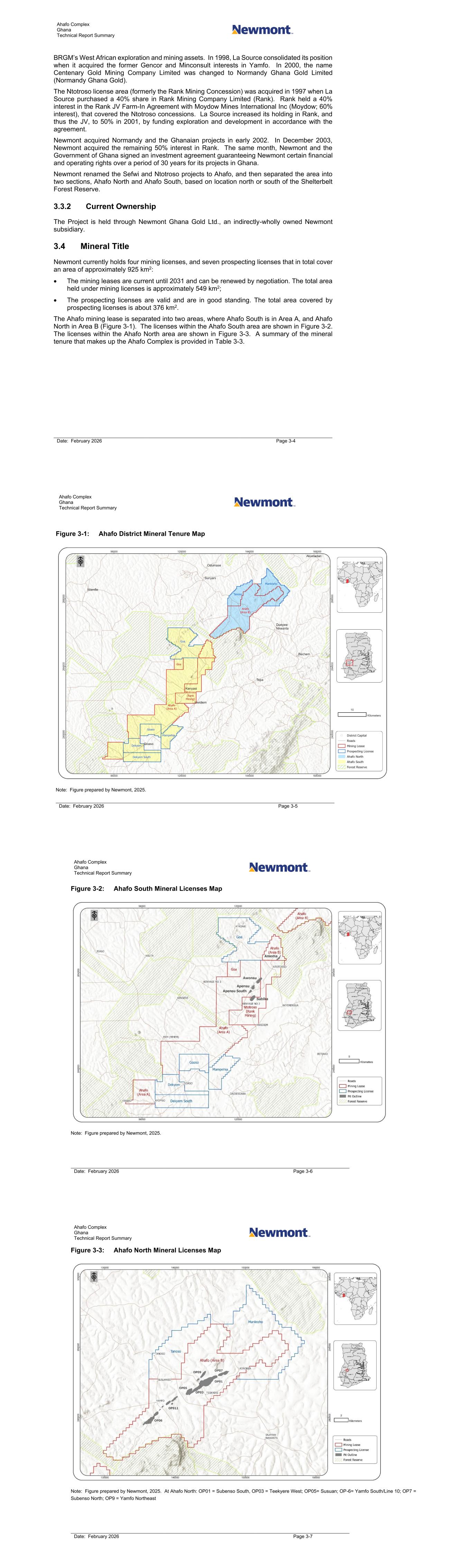
Ahafo Complex Ghana Technical Report Summary Date: February 2026 Page 3-4 BRGM’s West African exploration and mining assets. In 1998, La Source consolidated its position when it acquired the former Gencor and Minconsult interests in Yamfo. In 2000, the name Centenary Gold Mining Company Limited was changed to Normandy Ghana Gold Limited (Normandy Ghana Gold). The Ntotroso license area (formerly the Rank Mining Concession) was acquired in 1997 when La Source purchased a 40% share in Rank Mining Company Limited (Rank). Rank held a 40% interest in the Rank JV Farm-In Agreement with Moydow Mines International Inc (Moydow; 60% interest), that covered the Ntotroso concessions. La Source increased its holding in Rank, and thus the JV, to 50% in 2001, by funding exploration and development in accordance with the agreement. Newmont acquired Normandy and the Ghanaian projects in early 2002. In December 2003, Newmont acquired the remaining 50% interest in Rank. The same month, Newmont and the Government of Ghana signed an investment agreement guaranteeing Newmont certain financial and operating rights over a period of 30 years for its projects in Ghana. Newmont renamed the Sefwi and Ntotroso projects to Ahafo, and then separated the area into two sections, Ahafo North and Ahafo South, based on location north or south of the Shelterbelt Forest Reserve. 3.3.2 Current Ownership The Project is held through Newmont Ghana Gold Ltd., an indirectly-wholly owned Newmont subsidiary. 3.4 Mineral Title Newmont currently holds four mining licenses, and seven prospecting licenses that in total cover an area of approximately 925 km2: • The mining leases are current until 2031 and can be renewed by negotiation. The total area held under mining licenses is approximately 549 km2; • The prospecting licenses are valid and are in good standing. The total area covered by prospecting licenses is about 376 km2. The Ahafo mining lease is separated into two areas, where Ahafo South is in Area A, and Ahafo North in Area B (Figure 3-1). The licenses within the Ahafo South area are shown in Figure 3-2. The licenses within the Ahafo North area are shown in Figure 3-3. A summary of the mineral tenure that makes up the Ahafo Complex is provided in Table 3-3. Ahafo Complex Ghana Technical Report Summary Date: February 2026 Page 3-5 Figure 3-1: Ahafo District Mineral Tenure Map Note: Figure prepared by Newmont, 2025. Ahafo Complex Ghana Technical Report Summary Date: February 2026 Page 3-6 Figure 3-2: Ahafo South Mineral Licenses Map Note: Figure prepared by Newmont, 2025. Ahafo Complex Ghana Technical Report Summary Date: February 2026 Page 3-7 Figure 3-3: Ahafo North Mineral Licenses Map Note: Figure prepared by Newmont, 2025. At Ahafo North: OP01 = Subenso South, OP03 = Teekyere West; OP05= Susuan; OP-6= Yamfo South/Line 10; OP7 = Subenso North; OP9 = Yamfo Northeast

Ahafo Complex Ghana Technical Report Summary Date: February 2026 Page 3-8 Table 3-3: Mineral Tenure Summary Table Concession License Type License Number Size (km2) Grant Date Expiry Date Ahafo (Area A) Mining Lease LVB 7523/2001 272.58 1/22/2001 6/12/2031 Ahafo (Area B) Mining Lease LVB 7523/2001 187.53 1/22/2001 6/12/2031 Ntotroso (Rank Mining) Mining Lease LVB 7524/2001 76.65 6/13/2001 6/12/2031 Goa Mining Lease 1809/2005; LVB13908/05 11.97 10/7/2001 10/06/2031 Dekyem Prospecting PL7/82; LVB 3080/05 36.75 6/17/2019 10/6/2027 Dekyem South Prospecting PL7/122 42.63 6/30/2020 3/9/2027 Goa Prospecting RL 7/36; LVB 3082/05 92.19 6/10/2019 10/6/2027 Goaso Prospecting PL 7/31 29.61 1/23/2019 10/6/2027 Mampehia Prospecting PL (7/85); LVB 5014/2006 36.12 7/18/2019 3/9/2027 Mankraho Prospecting PL 7/87; LVB 10714/03 103.53 6/4/2019 6/12/2031 Tanoso Prospecting PL 7/84 35.07 1/23/2019 10/6/2027 Total 924.63 Note: All dates in month/day/year format. Under Ghanaian law, only mining leases and prospecting licenses require surveys; reconnaissance license types are delineated by latitude/longitude co-ordinates. All of the Ahafo mining leases were surveyed by Newmont staff, using global positioning system (GPS) readings and identifiable benchmarks on topographic maps to locate the boundary pillars on the ground from site plans. A number of payments are required to keep the licenses/leases in good standing, and include: • Annual rental: payable by January of each year; • Annual prospecting and mining permit payments: payable by January of each year. All required payments have been made as they fall due. 3.5 Surface Rights Newmont was granted a Plan of Operations (PoO) for the Ahafo Complex, and may use whatever land is necessary for its operations but must respect the surface rights of other land users in relation to access and loss of crops, timber, or structures. Extensive title searches were conducted over the mining lease areas and no titles exist that would categorically exclude Newmont’s operations on the Project lands. Newmont’s indenture for surface lands will run concurrently with the life of the operations, but will extend for no more than 50 years. The Ahafo Complex covers an area of approximately 55,532 ha for the mining lease concessions, with a current total mining area of approximately 5,543 ha. Of this holding, approximately 4,539 Ahafo Complex Ghana Technical Report Summary Date: February 2026 Page 3-9 ha has been fully compensated, and Newmont is in the process of resettling inhabited households on approximately 409 ha. The remaining 1,004 ha had not been fully compensated for at the Report date. 3.6 Water Rights Newmont holds permits to allow abstraction of groundwater, surface water, and water from the Tano River and discharge of water from the water storage facility (see Chapter 17 for additional details). 3.7 Forest Reserves Areas of productive Forest Reserves were designated in the vicinity of the Ahafo Complex. These areas include the Bosumkese Forest Reserve and the Amoma Shelterbelt Forest Reserve (refer to Figure 3-1). Potential impacts on the Forest Reserves include roads, powerline access, and the general proximity of the mining operations to the Forest Reserve areas. 3.8 Agreements 3.8.1 Investment Agreement The Revised Investment Agreement (the Agreement) between Newmont and the Government of Ghana defined and fixed, in specific terms, the effective corporate tax and royalty burden the Project (including Ahafo South and Ahafo North) would carry during operations. The Agreement established a fixed fiscal and legal regime, including sliding-scale royalty and tax rates for the duration of the Agreement’s stability period. The Agreement was re-negotiated and ratified in December, 2015. Under the Agreement stability period, which expired at the end of 2025, the tax rate was 32.5%. After the cessation of the stability period, the tax rate increased to 35%. During the stability period, Newmont paid gross royalties on gold doré production in accordance with a sliding scale of 3–5%, tied to the gold price. After the Agreement ended, the royalty rate was fixed at 5%. With the expiry of the stability agreement, the operation is also subject to the Growth and Sustainability Levy (GSL) of 3% based on gross revenue. An additional 0.6% may payable as a special fee for gold doré production from designated Forest Reserves (see discussion in Chapter 3.9). 3.8.2 Government of Ghana Free-Carried Interest The Government of Ghana has a 10% free-carried interest in the Ahafo Complex. Newmont pays the Government of Ghana a ninth of the dividend declared to Newmont shareholders. Since December 2015, Newmont has been obligated to pay 0.6% of the operational revenue if the gold price averages US$1,300/oz or higher, as an advance dividend against the one-ninth share. Ahafo Complex Ghana Technical Report Summary Date: February 2026 Page 3-10 3.9 Royalties A net smelter return (NSR) royalty of 2.0% is payable on all ounces produced from the Rank (formerly Ntotroso) concession. The royalty is paid to Franco-Nevada Corporation (Franco- Nevada), which acquired the royalty for US$58 M in November 2009. The majority of the Subika deposit, the northern portion of the Awonsu deposit, and the southern tip of the Amoma deposit fall within the Rank mining lease boundary. Royalties in forest reserves are currently not applicable for the Ahafo Complex. 3.10 Encumbrances There are no known encumbrances. 3.11 Permitting Permitting and permitting conditions are discussed in Chapter 17.9 of this Report. There are no relevant permitting timelines that apply; the operations as envisaged in the LOM plan are either fully permitted, or the processes to obtain permits are well understood and similar permits have been granted to the operations in the past, such as tailings storage facility (TSF) raises. There are no current material violations or fines, as imposed in the mining regulatory context of the Mine Safety and Health Administration (MSHA) in the United States, that apply to the Ahafo Complex. 3.12 Significant Factors and Risks That May Affect Access, Title or Work Programs Newmont’s Ahafo concession started in 2008 at Kenyasi (Ahafo South) and spread to the Ahafo North communities. However, Newmont embarked on a series of facilitated interventions in collaboration with the communities and National Security to drastically discourage illegal mining. Notwithstanding this, the activity intermittently continued until the Government of Ghana implemented an ‘operations-stop-galamsey’ policy which has brought illegal mining to a temporary halt both in the Newmont concessions and elsewhere in Ghana. The surge in galamsey (illegal mining) activities in the last few years within the mining area has been identified as a major risk to Newmont’s short-, medium- and long-term sustainability and has the potential to drive community conflict due to encroachment on farmlands and its attendant social vices. Newmont has seen increases in violent confrontations between illegal galamsey operatives and public/private security and use of illegal explosives within the Mine Take area, invasion of active mining pits and run-of-mine (ROM) pad, among others. Newmont is implementing the Ahafo Dome Project that involves increased aerial surveillance, coupled with a dedicated Mobile Response Unit consisting of several teams within the area that has been designated as having restricted access (mine take area). Measures that include immediate and responsible removal of galamsey operators within the mine take can be conducted per an established protocol with the support of security and the social and environmental departments. Such measures, performed in collaboration with the relevant government, public Ahafo Complex Ghana Technical Report Summary Date: February 2026 Page 3-11 security officials and traditional authorities, has resulted in significant reduction in the numbers in key areas that pose a threat to the mine. Newmont continues to pursue implementation of the livelihood approach under Newmont’s Regional galamsey strategy which complements galamsey operative removals from the mining areas. This involves identification of community workers in the galamsey value chain who are interested in pursuing alternative livelihood opportunities. Despite the above, the threat of illegal mining still exists, except that frequent monitoring as mentioned, currently wards off such incursions. To the extent known to QP, there are no other known significant factors and risks that may affect access, title, or the right or ability to perform work on the properties that comprise the Ahafo Complex that are not discussed in this Report.

Ahafo Complex Ghana Technical Report Summary Date: February 2026 Page 4-1 4.0 ACCESSIBILITY, CLIMATE, LOCAL RESOURCES, INFRASTRUCTURE AND PHYSIOGRAPHY 4.1 Physiography The Ahafo Complex area comprises low rounded hills with elevations ranging from 110 m to 540 masl. The upper part of the Tano River basin is drained by a number of seasonal streams that are tributaries of the Tano River. Two streams, the Subri and the Awonsu, drain from the Project area to the Tano River. The Project shares a boundary with the Bosumkese Forest Reserve, and the Amoma Shelterbelt Forest Reserve bisects the Ahafo mining lease. The Ahafo Complex area consists primarily of subsistence farms with small-scale commercial farming intermingled with areas of forest regrowth and remnants of secondary forest. The major agricultural land uses are cocoa, food crops, and rice farming. South of the Bosumkese Forest Reserve, cocoa farming is the major activity, while to the north, maize farming dominates. 4.2 Accessibility Road access to the Ahafo South area is via national Route 6, an asphalt-paved road from Accra to the Tepa Junction via Kumasi in the direction of Sunyani, a distance of approximately 300 km. From Tepa Junction, an asphalt-paved road leads west for 39 km through the villages of Tepa and Akyerensua to Hwidiem. A paved road then leads northwest for 8 km to the village of Kenyasi. Newmont constructed a bypass north of Kenyasi to facilitate supply deliveries, and route traffic around the town for safety reasons. Road access to the Ahafo North area is primarily via the national Route 6, which runs from Accra through Kumasi toward Sunyani. The Ahafo North mine is located approximately 20 km east of Sunyani, near the communities of Afrisipakrom and Techire. As part of mine development, a segment of the main highway connecting Afrisipakrom and Techire on the Sunyani–Kumasi route was realigned and diverted to accommodate mine infrastructure. The primary access road to the Ahafo North mine was integrated into this diverted highway, providing controlled and safe entry for supply deliveries and operations. Newmont upgraded sections of the surrounding local road network to support efficient logistics while minimizing heavy equipment movement through the surrounding communities and enhancing road safety. Connectivity between Ahafo North and Ahafo South is provided via the N12 highway, with a travel distance of approximately 70 km between the two sites. Ahafo Complex Ghana Technical Report Summary Date: February 2026 Page 4-2 4.3 Climate The Project area falls within the wet semi-equatorial climatic zone of Ghana that is characterized by an annual double maxima rainfall pattern, occurring in the months of May to July and from September to October. Mean annual rainfall for the Project area is between 1,354–1,400 mm. Typically, minimal rainfall is experienced from December to the end of February, with January as the driest month. Mean monthly temperatures within the area range from 23.9–28.4°C. The Ahafo Complex operations are conducted year-round. 4.4 Infrastructure The Project lies within two Administrative Districts, Tano North in the north and Asutifi North in the south. Each district has its own central government-based District Council as well as a number of Traditional Government Paramount Chieftaincies. Sunyani is a major regional center and is the source of supplies and fuel. There are adequate schools, medical services, and businesses to support the work force. A skilled and semi-skilled mining workforce has been established in the region as a result of on-going mining activities. Workers live in the surrounding communities. The Ahafo Complex currently has all infrastructure in place to support mining and processing activities at Ahafo North and Ahafo South (see also discussions in Chapter 13, Chapter 14, and Chapter 15 of this Report). These Report chapters also discuss water sources, electricity, personnel, and supplies. Ahafo Complex Ghana Technical Report Summary Date: February 2026 Page 5-1 5.0 HISTORY The exploration and development history of the Ahafo Complex is summarized in Table 5-1. Table 5-1: Exploration and Development History Summary Table Year Company Note 1989– 1991 Ghanaian–German mineral prospecting project Identified a gold-in-soil anomaly that had a strike-length of 1.2 km situated about 1 km east of Yamfo 1992 Minconsult Soil sampling on 50 m x 400 m grid; confirmed the anomalous gold values identified during 1989–1991 1993– 1995 BRGM and Gencor/Centenary Mining Company Stream sediment sampling, soil sampling, trenching, pitting, rotary air blast (RAB), reverse circulation (RC) and core drilling and an initial mineral resource estimate 1996 BRGM and Gencor/Centenary Mining Company Scoping study evaluated the Teekyere West, Yamfo Central and Line 10 deposits (now within the Ahafo North area) Moydow Mines International Inc. (Moydow) Identified eight major gold-in-soil anomalies in the Ntotroso Prospecting License (Rank Concession) 1997 BRGM and Gencor/Centenary Mining Company Feasibility study based on an updated resource estimate commenced but halted due to falling commodity prices Moydow RC drilling program completed on Areas A (now the Apensu–Awonsu area), C (now Amoma) and E (now Subika). Resource estimates for Areas A and C 1998 Normandy BRGM, La Source and Normandy joint venture dissolved; Normandy takes over operations. Commenced major drill program 1999 Completed pre-feasibility study 2000 Normandy Completed feasibility study Moydow Resource estimate at Subika. Rank Development and Production Agreement signed by La Source and Moydow, to allow for treatment of mineralization from the Rank Concession deposits through a common plant. Feasibility study on the Subika and Area A deposits 2002 Newmont Merges with Normandy, renames area to Ahafo 2003 Feasibility study on Ahafo North and South deposits Purchases Moydow properties, Moydow retains 2% NSR royalty, covering covers 78 km2 of the southeastern end of the Project area 2006 Constructed process plant. Commenced open pit mining at the Apensu deposit Commercial production at Ahafo South Discovered of Susuan deposit at Ahafo North Ahafo Complex Ghana Technical Report Summary Date: February 2026 Page 5-2 Year Company Note 2008 Identified mineralization that could be mined by underground mining methods at Subika 2009 Franco Nevada Franco Nevada purchases Moydow 2% NSR royalty 2012– 2013 Newmont Underground trial mining program at Subika 2014 Identified Apensu Deeps area 2016 Extension of mineralization to the north of Apensu identified. Apensu open pit mined out 2017 Amoma open pit mined out 2018 Commercial production from Subika underground Commenced Subika Growth study to identify mineralization to the north and south of the Subika open pit 2019 Initiated studies to change mining method at Subika underground to sub- level shrinkage stoping 2020– 2021 Change in Subika underground mining method from long-hole open stoping to sub-level shrinkage Funding approval for mining operations at Ahafo North 2022– 2023 Ahafo North mine construction 2024 Commenced open pit mining at Subenso South (Pit 01) and Susuan (Pit 05) 2025 Subika open pit mined out Ahafo North achieved commercial production
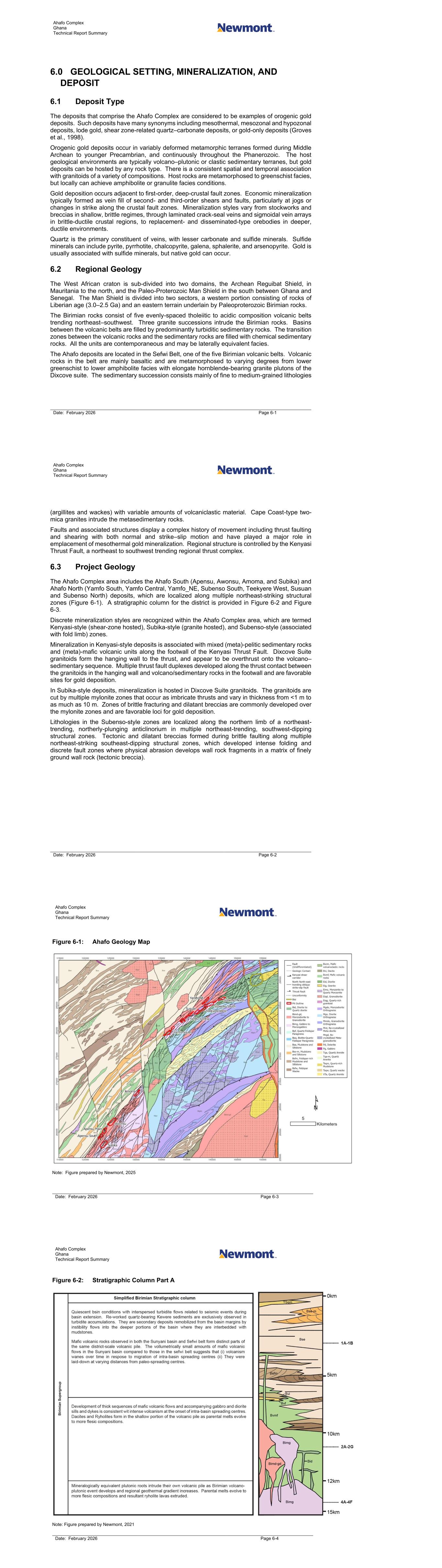
Ahafo Complex Ghana Technical Report Summary Date: February 2026 Page 6-1 6.0 GEOLOGICAL SETTING, MINERALIZATION, AND DEPOSIT 6.1 Deposit Type The deposits that comprise the Ahafo Complex are considered to be examples of orogenic gold deposits. Such deposits have many synonyms including mesothermal, mesozonal and hypozonal deposits, lode gold, shear zone-related quartz–carbonate deposits, or gold-only deposits (Groves et al., 1998). Orogenic gold deposits occur in variably deformed metamorphic terranes formed during Middle Archean to younger Precambrian, and continuously throughout the Phanerozoic. The host geological environments are typically volcano–plutonic or clastic sedimentary terranes, but gold deposits can be hosted by any rock type. There is a consistent spatial and temporal association with granitoids of a variety of compositions. Host rocks are metamorphosed to greenschist facies, but locally can achieve amphibolite or granulite facies conditions. Gold deposition occurs adjacent to first-order, deep-crustal fault zones. Economic mineralization typically formed as vein fill of second- and third-order shears and faults, particularly at jogs or changes in strike along the crustal fault zones. Mineralization styles vary from stockworks and breccias in shallow, brittle regimes, through laminated crack-seal veins and sigmoidal vein arrays in brittle-ductile crustal regions, to replacement- and disseminated-type orebodies in deeper, ductile environments. Quartz is the primary constituent of veins, with lesser carbonate and sulfide minerals. Sulfide minerals can include pyrite, pyrrhotite, chalcopyrite, galena, sphalerite, and arsenopyrite. Gold is usually associated with sulfide minerals, but native gold can occur. 6.2 Regional Geology The West African craton is sub-divided into two domains, the Archean Reguibat Shield, in Mauritania to the north, and the Paleo-Proterozoic Man Shield in the south between Ghana and Senegal. The Man Shield is divided into two sectors, a western portion consisting of rocks of Liberian age (3.0–2.5 Ga) and an eastern terrain underlain by Paleoproterozoic Birimian rocks. The Birimian rocks consist of five evenly-spaced tholeiitic to acidic composition volcanic belts trending northeast–southwest. Three granite successions intrude the Birimian rocks. Basins between the volcanic belts are filled by predominantly turbiditic sedimentary rocks. The transition zones between the volcanic rocks and the sedimentary rocks are filled with chemical sedimentary rocks. All the units are contemporaneous and may be laterally equivalent facies. The Ahafo deposits are located in the Sefwi Belt, one of the five Birimian volcanic belts. Volcanic rocks in the belt are mainly basaltic and are metamorphosed to varying degrees from lower greenschist to lower amphibolite facies with elongate hornblende-bearing granite plutons of the Dixcove suite. The sedimentary succession consists mainly of fine to medium-grained lithologies Ahafo Complex Ghana Technical Report Summary Date: February 2026 Page 6-2 (argillites and wackes) with variable amounts of volcaniclastic material. Cape Coast-type two- mica granites intrude the metasedimentary rocks. Faults and associated structures display a complex history of movement including thrust faulting and shearing with both normal and strike–slip motion and have played a major role in emplacement of mesothermal gold mineralization. Regional structure is controlled by the Kenyasi Thrust Fault, a northeast to southwest trending regional thrust complex. 6.3 Project Geology The Ahafo Complex area includes the Ahafo South (Apensu, Awonsu, Amoma, and Subika) and Ahafo North (Yamfo South, Yamfo Central, Yamfo_NE, Subenso South, Teekyere West, Susuan and Subenso North) deposits, which are localized along multiple northeast-striking structural zones (Figure 6-1). A stratigraphic column for the district is provided in Figure 6-2 and Figure 6-3. Discrete mineralization styles are recognized within the Ahafo Complex area, which are termed Kenyasi-style (shear-zone hosted), Subika-style (granite hosted), and Subenso-style (associated with fold limb) zones. Mineralization in Kenyasi-style deposits is associated with mixed (meta)-pelitic sedimentary rocks and (meta)-mafic volcanic units along the footwall of the Kenyasi Thrust Fault. Dixcove Suite granitoids form the hanging wall to the thrust, and appear to be overthrust onto the volcano– sedimentary sequence. Multiple thrust fault duplexes developed along the thrust contact between the granitoids in the hanging wall and volcano/sedimentary rocks in the footwall and are favorable sites for gold deposition. In Subika-style deposits, mineralization is hosted in Dixcove Suite granitoids. The granitoids are cut by multiple mylonite zones that occur as imbricate thrusts and vary in thickness from <1 m to as much as 10 m. Zones of brittle fracturing and dilatant breccias are commonly developed over the mylonite zones and are favorable loci for gold deposition. Lithologies in the Subenso-style zones are localized along the northern limb of a northeast- trending, northerly-plunging anticlinorium in multiple northeast-trending, southwest-dipping structural zones. Tectonic and dilatant breccias formed during brittle faulting along multiple northeast-striking southeast-dipping structural zones, which developed intense folding and discrete fault zones where physical abrasion develops wall rock fragments in a matrix of finely ground wall rock (tectonic breccia). Ahafo Complex Ghana Technical Report Summary Date: February 2026 Page 6-3 Figure 6-1: Ahafo Geology Map Note: Figure prepared by Newmont, 2025 Ahafo Complex Ghana Technical Report Summary Date: February 2026 Page 6-4 Figure 6-2: Stratigraphic Column Part A Note: Figure prepared by Newmont, 2021
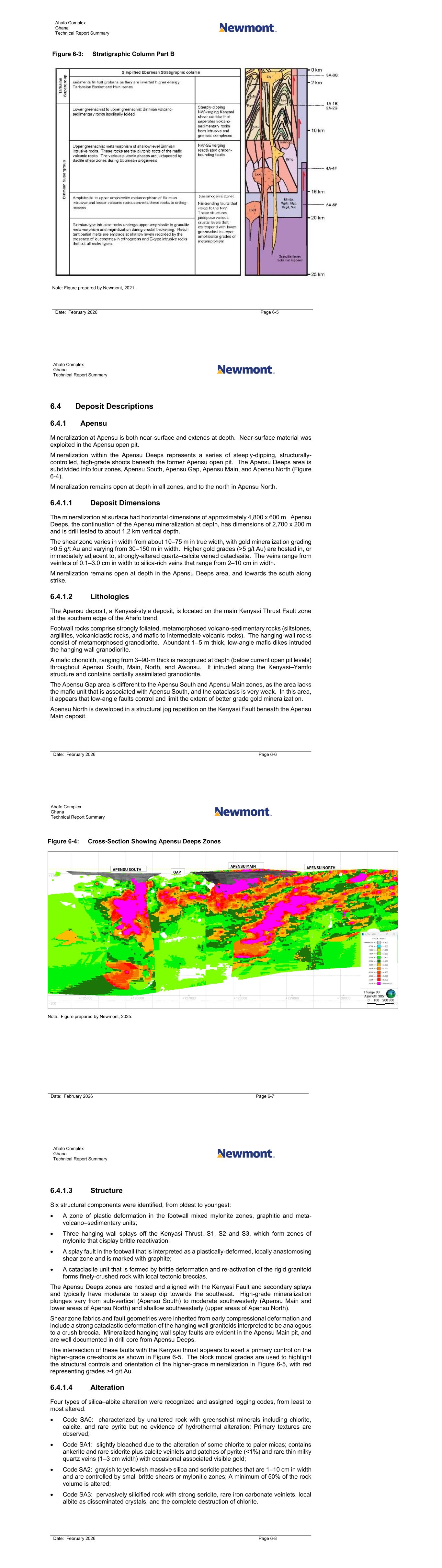
Ahafo Complex Ghana Technical Report Summary Date: February 2026 Page 6-5 Figure 6-3: Stratigraphic Column Part B Note: Figure prepared by Newmont, 2021. Ahafo Complex Ghana Technical Report Summary Date: February 2026 Page 6-6 6.4 Deposit Descriptions 6.4.1 Apensu Mineralization at Apensu is both near-surface and extends at depth. Near-surface material was exploited in the Apensu open pit. Mineralization within the Apensu Deeps represents a series of steeply-dipping, structurally- controlled, high-grade shoots beneath the former Apensu open pit. The Apensu Deeps area is subdivided into four zones, Apensu South, Apensu Gap, Apensu Main, and Apensu North (Figure 6-4). Mineralization remains open at depth in all zones, and to the north in Apensu North. 6.4.1.1 Deposit Dimensions The mineralization at surface had horizontal dimensions of approximately 4,800 x 600 m. Apensu Deeps, the continuation of the Apensu mineralization at depth, has dimensions of 2,700 x 200 m and is drill tested to about 1.2 km vertical depth. The shear zone varies in width from about 10–75 m in true width, with gold mineralization grading >0.5 g/t Au and varying from 30–150 m in width. Higher gold grades (>5 g/t Au) are hosted in, or immediately adjacent to, strongly-altered quartz–calcite veined cataclasite. The veins range from veinlets of 0.1–3.0 cm in width to silica-rich veins that range from 2–10 cm in width. Mineralization remains open at depth in the Apensu Deeps area, and towards the south along strike. 6.4.1.2 Lithologies The Apensu deposit, a Kenyasi-style deposit, is located on the main Kenyasi Thrust Fault zone at the southern edge of the Ahafo trend. Footwall rocks comprise strongly foliated, metamorphosed volcano-sedimentary rocks (siltstones, argillites, volcaniclastic rocks, and mafic to intermediate volcanic rocks). The hanging-wall rocks consist of metamorphosed granodiorite. Abundant 1–5 m thick, low-angle mafic dikes intruded the hanging wall granodiorite. A mafic chonolith, ranging from 3–90-m thick is recognized at depth (below current open pit levels) throughout Apensu South, Main, North, and Awonsu. It intruded along the Kenyasi–Yamfo structure and contains partially assimilated granodiorite. The Apensu Gap area is different to the Apensu South and Apensu Main zones, as the area lacks the mafic unit that is associated with Apensu South, and the cataclasis is very weak. In this area, it appears that low-angle faults control and limit the extent of better grade gold mineralization. Apensu North is developed in a structural jog repetition on the Kenyasi Fault beneath the Apensu Main deposit. Ahafo Complex Ghana Technical Report Summary Date: February 2026 Page 6-7 Figure 6-4: Cross-Section Showing Apensu Deeps Zones Note: Figure prepared by Newmont, 2025. Ahafo Complex Ghana Technical Report Summary Date: February 2026 Page 6-8 6.4.1.3 Structure Six structural components were identified, from oldest to youngest: • A zone of plastic deformation in the footwall mixed mylonite zones, graphitic and meta- volcano–sedimentary units; • Three hanging wall splays off the Kenyasi Thrust, S1, S2 and S3, which form zones of mylonite that display brittle reactivation; • A splay fault in the footwall that is interpreted as a plastically-deformed, locally anastomosing shear zone and is marked with graphite; • A cataclasite unit that is formed by brittle deformation and re-activation of the rigid granitoid forms finely-crushed rock with local tectonic breccias. The Apensu Deeps zones are hosted and aligned with the Kenyasi Fault and secondary splays and typically have moderate to steep dip towards the southeast. High-grade mineralization plunges vary from sub-vertical (Apensu South) to moderate southwesterly (Apensu Main and lower areas of Apensu North) and shallow southwesterly (upper areas of Apensu North). Shear zone fabrics and fault geometries were inherited from early compressional deformation and include a strong cataclastic deformation of the hanging wall granitoids interpreted to be analogous to a crush breccia. Mineralized hanging wall splay faults are evident in the Apensu Main pit, and are well documented in drill core from Apensu Deeps. The intersection of these faults with the Kenyasi thrust appears to exert a primary control on the higher-grade ore-shoots as shown in Figure 6-5. The block model grades are used to highlight the structural controls and orientation of the higher-grade mineralization in Figure 6-5, with red representing grades >4 g/t Au. 6.4.1.4 Alteration Four types of silica–albite alteration were recognized and assigned logging codes, from least to most altered: • Code SA0: characterized by unaltered rock with greenschist minerals including chlorite, calcite, and rare pyrite but no evidence of hydrothermal alteration; Primary textures are observed; • Code SA1: slightly bleached due to the alteration of some chlorite to paler micas; contains ankerite and rare siderite plus calcite veinlets and patches of pyrite (<1%) and rare thin milky quartz veins (1–3 cm width) with occasional associated visible gold; • Code SA2: grayish to yellowish massive silica and sericite patches that are 1–10 cm in width and are controlled by small brittle shears or mylonitic zones; A minimum of 50% of the rock volume is altered; • Code SA3: pervasively silicified rock with strong sericite, rare iron carbonate veinlets, local albite as disseminated crystals, and the complete destruction of chlorite.

Ahafo Complex Ghana Technical Report Summary Date: February 2026 Page 6-9 • Alteration intensity is well correlated with mineralization, with more intensely altered rock being better mineralized. Figure 6-5: Drill Section, Apensu Main and Apensu Deeps Note: Figure prepared by Newmont, 2025. SA2 = alteration code, see Chapter 6.4.1.4. 6.4.1.5 Mineralization Mineralization is characterized by an association of silica–albite–carbonate–white mica–pyrite alteration, quartz veining, and brittle chlorite-filled fractures. Better gold mineralization is developed in quartz–calcite veins associated with pyrite grains that can vary from fine disseminations to 1.5 mm in size. Gold occurs as single grains 1–20 µm in diameter but also commonly occurs in clusters of grains from 5–10 µm. There does not appear to be an association of gold with either arsenopyrite or rutile, and the gold is generally silver-poor, with <5 ppm Ag. Ahafo Complex Ghana Technical Report Summary Date: February 2026 Page 6-10 Visible gold occurs in the veined cataclasite. Locally, 0.2–2.0 cm wide quartz veins can return assays with more than 32 g/t Au from coarse gold. In the oxide zone, gold is associated with coarse goethite pseudomorphs after euhedral pyrite. Gold grains in the oxidized zone range from 5–10 µm. Manganese oxides are also observed in oxide mineralization. The general geology of the Apensu area was shown in Figure 6-1. A cross-section through the Apensu deposit was provided in Figure 6-5. 6.4.2 Awonsu 6.4.2.1 Deposit Dimensions The Awonsu deposit has horizontal dimensions of approximately 4,100 x 150 m, and has been drill tested to 600 m vertical depth. It has been mined by open pit methods. The mineralization remains open at depth and towards the north along strike. 6.4.2.2 Lithologies The Awonsu deposit, a Kenyasi-type deposit, developed on the sheared contact between mafic volcanic rocks, metasedimentary rocks, and Dixcove granites. It is a continuation of the Amoma deposit, with the two mineralized zones separated by a zone of lower-grade, sub-economic mineralization. Footwall to the mineralization is a mixture of mafic volcanic and pelitic to turbiditic sedimentary units. The hanging wall is composed of granodiorite. Mixed mylonitic and cataclasite units and dilatant breccias, developed during plastic and ductile deformation occur in the sheared contact between the footwall and hanging wall. Awonsu mineralization was typically more disseminated than that at Apensu. The shear zone varied in true width from 5–100 m, with gold mineralization >0.5 g/t Au ranging from 5–150 m in width. Higher gold grades (>1.5 g/t Au) were hosted in, or immediately adjacent to, strongly-altered cataclasite, forming zones from 5–60 m in width. Grades >5 g/t Au were rare, but high-grade zones could be as much as 30 m wide. Gold grades of 0.5–1.5 g/t Au were more commonly developed in the fractured, moderately-altered hanging wall granodiorite. Lower-grade material typically formed a halo of 2–50 m in thickness. Locally, particularly on the northern side of the deposit, higher-grade areas within the hanging wall alteration zone occurred in discontinuous mylonite zones, and in fine stringer quartz veins. A narrower low-grade halo, ranging in width from 5–30 m, occurred in the footwall. As with Apensu, higher-grade shoots were associated with a southward plunge. Typically, the shoots averaged about 2–5 g/t Au versus >5 g/t Au in Apensu. Ahafo Complex Ghana Technical Report Summary Date: February 2026 Page 6-11 6.4.2.3 Structure Five structural domains were logged. The oldest is the Kenyasi Thrust Fault. Two hanging wall duplex splays off the thrust, Kenyasi Splay 1 Fault and Kenyasi Splay 2 Fault are characterized by locally anastomosing zones of mylonite in granodiorite. The Kenyasi Footwall Splay Fault is distinguished as a plastically deformed, locally anastomosing shear zone marked by graphite. The youngest structure is the cataclasite unit, which may be a later brittle sinistral re-activation of the Kenyasi Thrust Fault. 6.4.2.4 Alteration Alteration was similar to that described for the Apensu deposit but was typically less intense. Two additional codes were used at Awonsu, alteration codes 4 and 5, which differentiated areas of stockwork veining (Code 4) and milky sheeted veins (Code 5). 6.4.2.5 Mineralization Awonsu is the only deposit within the Ahafo Complex where multiple generations of cross-cutting milky to opaque quartz veinlets with open-space filling of minor pyrite and gold mineralization were observed. Distinct, sheeted, sub-parallel milky quartz veins, 0.1–2 cm in width, with minor pyrite and occasional coarse gold, cross-cut fresh to weakly-altered hanging wall granodiorite. The milky veins generally occurred in sets of 2–10 veinlets that were separated by 10 cm to 1 m. The general geology of the Awonsu area was shown in Figure 6-1. A cross-section through the deposit is provided as Figure 6-6. Ahafo Complex Ghana Technical Report Summary Date: February 2026 Page 6-12 Figure 6-6: Cross-Section, Awonsu Note: Figure prepared by Newmont, 2025. SA2 = alteration code, see Chapter 6.4.1.4. 6.4.3 Subika Mineralization at Subika is both near-surface and extends at depth. Near-surface material was exploited in the Subika open pit. 6.4.3.1 Deposit Dimensions The portion of the Subika deposit that was exploited in the open pit had horizontal dimensions of approximately 2.2 km x 400 m. The portion of the deposit currently being exploited from underground is the continuity of mineralization below the open pit. This portion of the deposit has horizontal dimensions of approximately 3.7 km x 400 m, and is tested to about 1,600 m in vertical depth. Subika mineralization remains open at depth and along strike to the north and south.

Ahafo Complex Ghana Technical Report Summary Date: February 2026 Page 6-13 6.4.3.2 Lithologies The Subika deposit, to date the only example of Subika-style mineralization, developed in the hanging wall of the Kenyasi Thrust Fault but lies on a separate and parallel fault zone to the thrust fault complex that hosts the Kenyasi-style deposits. Four granitoid subset lithologies are recognized: diorite, gabbro, microdiorite, and diorite–gabbro mixed. Aplite and pegmatite dikes cross-cut the granitoid material. 6.4.3.3 Structure Four structural zones are defined: • The Victor Fault, on the southern end of the Subika deposit, is a major shear zone, 2–6 m wide, striking N60ºE, and dipping approximately 20–30º to the southeast. It locally anastomoses into three branches (Victor, Victor A, and Victor Lower Faults). It is cross-cut by dilatant breccias and brittle shears throughout, and displaces the Subika mineralization by as much as 40 m in an apparent left-lateral sense; • The Kaalbas Fault lies just oblique to the overlying Victor fault, with a slightly more easterly trend and shallower dip; • The Hatch Zone appears to be an anastomosing, almost east–west-trending structure, with two to three individual planes, each with 1 m to 3 m thickness developed within an overall 6– 25 m wide structural zone. Mineralization appears to be displaced by about 50 m in the zone; • The Deep One shear is apparently confined to the northern end of the deposit. Better grades of gold mineralization occur in dilatant zones such as the “Magic Fracture Zone” (MFZ), ranging in width from 1–60 m. Hanging wall lower-grade mineralization tends to extend only about 30 m from the dilatant zones. Higher grade shoots within the dilatant zones plunge south at 20º to 70º. The high-grade zones appear to be controlled by dilatant left jogs in the MFZ created by offsets across the mylonite zones. 6.4.3.4 Alteration Alteration associated with the Subika deposit is chemically similar to that in the Kenyasi-style deposits, and is controlled by the 5–40 m wide MFZ, a continuous zone of quartz–albite–sericite– carbonate–pyrite alteration. The silica–albite alteration is classified as: • Distal, code SA1: characterized by chlorite–sericite–pyrite, and gold grades that can range from about 0.1–1 g/t Au; • Intermediate, code SA2: characterized by chlorite–sericite–pyrite–albite–iron carbonate– silica, and gold grades that can range from about 1–3 g/t Au; • Proximal, code SA3: characterized by silica–iron carbonate–albite–pyrite and abundant quartz–carbonate veining, and gold grades that are commonly >3 g/t Au. Ahafo Complex Ghana Technical Report Summary Date: February 2026 Page 6-14 6.4.3.5 Mineralization Mineralization is hosted in the MFZ, which typically contains >2–5 g/t Au over widths of 5–50 m. Quartz and carbonate veinlets are common with thickness between 1–50 mm. They form stockworks in some instances. Most of the veins are impregnated with pyrite, and in some cases display sparse visible gold at the contact with the host rock. The general geology of the Subika area was shown in Figure 6-1. A cross-section through the deposit is provided as Figure 6-7. Figure 6-7: Cross-Section, Subika Note: Figure prepared by Newmont, 2025. Pit outline shown is mined out. SA1 and SA2–3 are alteration codes, see Chapter 6.4.3.4. 6.4.4 Amoma The Amoma deposit is the furthest north of the Ahafo South deposits about 11 km northeast of the Apensu deposit and at the southern end of the Bosumkese Forest Reserve. Ahafo Complex Ghana Technical Report Summary Date: February 2026 Page 6-15 6.4.4.1 Deposit Dimensions The deposit has horizontal dimensions of 1,500 x 170 m, and has been tested to approximately 300 m vertical depth. Mineralization remains open at depth. 6.4.4.2 Lithologies The deposit occurs in a lithostratigraphic setting equivalent to that of Apensu and Awonsu. Footwall successions comprise strongly foliated, metamorphosed volcano-sedimentary rocks, whereas hanging-wall rocks consist of metamorphosed granodiorite. The granitoids have been overthrust onto the volcano-sedimentary units, producing a number of different plastically- deformed and mixed granitoid and volcano-sedimentary units, termed mixed mylonites. A notable difference is that no obvious mafic dikes were mapped either within the Kenyasi-Yamfo shear zone or in hanging-wall granodiorite. Overlying the deposit is a layer of duricrust, which can reach 8 m in thickness, comprising iron pisolites and transported alluvial cobbles. Saprolite is 20–50 m thick. 6.4.4.3 Structure Four structural events were identified. The earliest is the Kenyasi Thrust Fault. The Footwall Fault may be contemporaneous with, or part of, the Kenyasi Thrust Fault. It is a locally anastomosing ductile shear zone marked by graphite in the footwall of the Kenyasi Thrust Fault. Later hanging wall duplex splay faults, Splay 1 and Splay 2 Faults, are sub-parallel to the Kenyasi Thrust Fault. These splays are locally marked by anastomosing zones of mylonite and dilatant breccia. The latest event is the development of a cataclasite unit, which represents later brittle sinistral reactivation of the Kenyasi Thrust Fault. The local strike of the Kenyasi-Yamfo shear zone in the Amoma open pit deviates from its regional orientation (clockwise rotation; right-hand bend). The structure is strikes north at 42º and dips at 65º to the southwest at Amoma, whereas, more typically across the Ahafo region, the structure strikes at 40º, and dips to the southeast at 60º. 6.4.4.4 Alteration Alteration is characterized by silicification, zones of albitization, and as much as 5% fine to medium-grained pyrite. Proximal hydrothermal alteration assemblages are similar to those identified at Subika and Apensu and consist of silica–iron carbonate–pyrite–albite–sericite. Brittle deformation overprints the pervasive alteration and is characterized by cross-cutting chlorite. Ahafo Complex Ghana Technical Report Summary Date: February 2026 Page 6-16 6.4.4.5 Mineralization Gold mineralization at Amoma is hosted by fault breccias (crackle and mosaic breccias) quartz- carbonate stockwork veins and bleached wall rocks, and, to a lesser extent, proto-cataclasite after granodiorite. As an empirical rule, the stronger the brecciation, the higher the grade. The presence of thin 1–5 cm thick quartz–carbonate veins also appears to be a robust visual proxy to higher-grade mineralization. Mineralized zones that host gold grades >0.5 g/t Au range in width from 10–110 m. Higher-grade material (>1.5 g/t Au) is developed in the breccias and cataclasite unit, but lower-grade (0.5– 1.5 g/t Au) mineralization can occur as a 20–50 m wide halo in the hanging wall granitoids. A narrower, lower-grade halo also occurs in the footwall mixed mylonite units, ranging from 0–30 m in width. The general geology of the Amoma area was shown in Figure 6-1. A cross-section through the deposit is provided as Figure 6-8. Figure 6-8: Cross-Section, Amoma Note: Figure prepared by Newmont, 2025. SA2 is an alteration code, see Chapter 6.4.1.4.

Ahafo Complex Ghana Technical Report Summary Date: February 2026 Page 6-17 6.4.5 Yamfo South The Yamfo South deposit is located in Ahafo North, approximately 21 km to the southeast of Sunyani Township. It consists of three discrete sub-parallel zones, Yamfo South, Yamfo Southeast, and Line 10. 6.4.5.1 Deposit Dimensions The deposit extends for roughly 3.0 km along strike and about 700 m across strike. Drilling has confirmed mineralization to depths of approximately 200 m at Yamfo South and Yamfo Southeast, and 150 m at Line 10. Mineralization remains open at depth and along strike, particularly toward the southwest at the Yamfo Southeast zone. 6.4.5.2 Lithologies The Yamfo South deposit is hosted predominantly within a sequence of metavolcanic and metasedimentary rocks, intruded locally by granitoid bodies typical of the Ahafo corridor. The Yamfo South and Line 10 zones are developed within sheared and altered metavolcanic units. The Yamfo Southeast zone lies adjacent to a major sub-parallel shear zone marking the boundary with a large granitoid intrusive domain. The host rocks commonly display intense deformation, sericite alteration, and finely disseminated sulfides. 6.4.5.3 Structure The Yamfo South deposit exhibits characteristics of Kenyasi-style mineralization. The deposit is defined by three sub-parallel mineralized zones separated by cross-cutting faults that have displaced mineralization in a northwest–southeast direction. These cross-faults, together with localized shearing and folding, have played a key role in controlling mineralization continuity and geometry. The main shear zones provided the pathways for hydrothermal fluids responsible for gold deposition. 6.4.5.4 Alteration Alteration within the Yamfo South deposit is dominated by strong silicification and pervasive carbonate alteration, locally accompanied by sericite and minor chlorite development. Silicification is commonly concentrated along shear planes and within the more intensely deformed metavolcanic rocks. Carbonate alteration is widespread and closely associated with gold and pyrite mineralization. In the oxidized profile, pyrite is replaced by goethite, and limonitic zones are common near surface. Notably, quartz veining, typical of many shear zone-hosted gold systems in Ghana, is relatively scarce at Yamfo South, suggesting mineralization is more disseminated and alteration-hosted than vein-controlled. Ahafo Complex Ghana Technical Report Summary Date: February 2026 Page 6-18 6.4.5.5 Mineralization Gold mineralization at Yamfo South is closely associated with fine-grained disseminated pyrite, with oxidation producing secondary goethite. Gold occurs both as fine inclusions within carbonate and pyrite and as free grains or micro-veinlets (1–10 µm) within fractures in pyrite. The strong correlation between gold, carbonate, and pyrite suggests that mineralization is syn- to late-deformation and linked to carbonate-silica hydrothermal alteration events. The deposit style aligns with the broader Ahafo Trend mineralization model—structurally controlled, disseminated, and carbonate-altered systems forming within second-order shear zones adjacent to the main Kenyasi Thrust corridor. The general geology of the Yamfo South area was shown in Figure 6-1. A cross-section through the deposit is provided as Figure 6-9. Figure 6-9: Cross-Section, Yamfo South Note: Figure prepared by Newmont, 2025. Ahafo Complex Ghana Technical Report Summary Date: February 2026 Page 6-19 6.4.6 Yamfo Central The Yamfo Central deposit is located halfway between Yamfo South and Yamfo Northeast, about 3 km southwest of Yamfo Northeast. Yamfo Central represents one of the more laterally extensive mineralized systems within the Ahafo North corridor. 6.4.6.1 Deposit Dimensions The deposit extends along a strike length of approximately 6 km, with mineralized zones ranging from 5–30 m in thickness. Drilling has tested mineralization to vertical depths of about 120 m, and the deposit remains open at depth. 6.4.6.2 Lithologies The Yamfo Central deposit is hosted predominantly within a sequence of sheared mafic volcanic rocks interbedded with metasedimentary units along a corridor characterized by multiple, sub- parallel mineralized zones. These mineralized zones are aligned with the main Yamfo Central shear system and are separated locally by narrow, weakly mineralized or barren horizons. The host sequence forms part of the Kenyasi shear-related stratigraphy and is locally intruded by narrow granitic to granodiorite. The mafic and metasedimentary units display moderate to strong deformation fabrics, pervasive foliation, and localized recrystallization resulting from hydrothermal alteration and successive structural overprinting events. These deformation and alteration features collectively define the structural architecture that controls the distribution of gold mineralization within the parallel lodes at Yamfo Central. 6.4.6.3 Structure Yamfo Central is structurally characterized as a Kenyasi-style deposit, hosted within a major shear zone similar to those controlling mineralization elsewhere along the Ahafo trend. The mineralized zones are aligned parallel to foliation within the shear zone, with the intervening gneissic unit representing a late structural or intrusive feature that disrupted the mineralized continuity. The oblique orientation of this gneiss body suggests post-mineralization deformation. The overall geometry of the deposit and its strong structural control imply that mineralization is syn- to late-deformational, associated with compressional to transpressional shearing along second-order splays off the main Kenyasi Thrust system. 6.4.6.4 Alteration Alteration within the Yamfo Central deposit is dominated by chloritization of the host greywackes, accompanied by well-developed quartz–feldspar–carbonate–pyrite veinlets. These veinlets, typically up to one centimeter wide, occur parallel to foliation and may form irregular patches or more massive, continuous bands within the host rocks. This vein-style or “intrusive-like” alteration contrasts with the more pervasive, diffuse alteration styles observed in other deposits such as Teekyere West. Ahafo Complex Ghana Technical Report Summary Date: February 2026 Page 6-20 Carbonate and chlorite alteration halos are closely associated with gold-bearing zones, reflecting fluid–rock interaction during mineralization. 6.4.6.5 Mineralization Gold mineralization at Yamfo Central is intimately associated with fine, crystalline disseminations of pyrite within altered greywackes and within quartz–carbonate–pyrite veinlets. The spatial relationship between gold, carbonate alteration, and pyrite indicates a strong hydrothermal control. Gold is interpreted to occur both as microscopic inclusions within pyrite and as fine- grained free gold associated with carbonate and quartz vein material. The general geology of the Yamfo Central area was shown in Figure 6-1. A cross-section through the deposit is provided as Figure 6-10. Figure 6-10: Cross-Section Yamfo Central Note: Figure prepared by Newmont, 2025.

Ahafo Complex Ghana Technical Report Summary Date: February 2026 Page 6-21 6.4.7 Yamfo Northeast The Yamfo Northeast deposit is located along the northern extent of the Yamfo mineralized corridor within the Ahafo North district. It is approximately 700 m northwest of the Subenso South deposit. 6.4.7.1 Deposit Dimensions The deposit has an overall strike length of approximately 2.0 km and a variable width from 5– 30 m. Drilling has defined mineralization to vertical depths of about 170 m, with mineralization remaining open both down-dip and along strike. 6.4.7.2 Lithologies The Yamfo Northeast deposit is hosted within a sequence of sheared mafic volcanic and metasedimentary rocks that are also characteristic of the Yamfo South, Line 10, and Yamfo Central stratigraphy. The deposit is spatially associated with a granitoid intrusive domain that becomes increasingly voluminous with depth, likely acting as a structural and thermal focus for hydrothermal fluid flow and subsequent gold mineralization. The mafic and metasedimentary units exhibit strong foliation, pervasive shearing, and well- developed deformation fabrics related to the regional shear system controlling mineralization. Occasional occurrences of granitoid fragments and narrow intrusive dikes interleaved within the mineralized zones suggest late-stage intrusive activity and continued tectono-magmatic interaction during the mineralizing event. Granitoid intrusions become more prominent with depth, and drilling to date indicates that gold grades tend to improve within these deeper zones. 6.4.7.3 Structure The host structure at Yamfo Northeast represents a classic Kenyasi-style mineralization setting, characterized by an east-dipping shear zone that served as a conduit for hydrothermal fluids. The mineralized zones are closely aligned with foliation and are structurally continuous along strike, with minor cross-faulting and shearing controlling local variations in grade and thickness. The 45º eastward dip of the structure and mineralization and the observed increase in granitoid material at depth are consistent with structural thickening and fluid channeling along the lower portions of the shear zone. The geometry and fabric of the deposit suggest syn- to late- deformational gold emplacement during transpressional shearing along the Ahafo trend. 6.4.7.4 Alteration Alteration within the Yamfo Northeast deposit is defined by a chlorite–graphite–quartz assemblage within the main shear zones, overprinted by strong silicification and discrete carbonate–albitization–chlorite alteration halos. Ahafo Complex Ghana Technical Report Summary Date: February 2026 Page 6-22 Quartz, carbonate, and feldspar minerals are commonly intergrown, forming foliation-parallel veinlets as well as irregular replacement zones. Secondary chlorite occurs as fine stringers parallel to foliation, and sericite appears as disseminated flecks throughout the altered host rock. In the oxide zone, the alteration mineralogy is largely obscured: carbonate minerals are leached, feldspar is weathered to kaolin, and pyrite has been replaced by limonite and goethite. The resultant oxide mineral assemblage consists predominantly of quartz, kaolin, and limonite. 6.4.7.5 Mineralization Gold mineralization at Yamfo Northeast is closely associated with disseminated and clustered pyrite within the sheared metasediments. In primary mineralization, gold occurs mainly as fine inclusions (3–20 µm) within or along the margins of pyrite grains, which vary in size from <50 µm to 1 mm and often form grid-like networks or aggregates. Minor marcasite and rare chalcopyrite veinlets occur within or adjacent to pyrite, indicating a reduced, sulfide-dominant hydrothermal system. In oxidized zones, gold occurs primarily with goethite as fine grains (1–15 µm) following the weathering of sulfides. The strong spatial association of gold with pyrite, carbonate, and silica alteration indicates that mineralization is hydrothermal and structurally controlled, consistent with other Kenyasi-style deposits along the Ahafo North mineralized corridor. The general geology of the Yamfo Northeast area was shown in Figure 6-1. A cross-section through the deposit is provided as Figure 6-11. Ahafo Complex Ghana Technical Report Summary Date: February 2026 Page 6-23 Figure 6-11: Cross-Section, Yamfo Northeast Note: Figure prepared by Newmont, 2025. 6.4.8 Susuan The Susuan deposit is situated 12 km east of the township of Sunyani. 6.4.8.1 Deposit Dimensions The Susuan deposit extends approximately 1.2 km along strike and is about 300 m wide. Mineralization has been defined to a vertical depth of around 250 m. Ahafo Complex Ghana Technical Report Summary Date: February 2026 Page 6-24 6.4.8.2 Lithologies It is a typical of a Subenso-style deposit, and has strongly developed tectonic and dilatant breccias. The deposit is situated along a contact between metamorphosed footwall pelitic sedimentary rocks, mafic volcanic rocks and hanging wall granodiorite. The contact has been extensively mylonitized, producing plastically-deformed, mixed granitoid and volcano–sedimentary units. Tectonic and dilatant breccias formed from these pre-existing units during latter brittle faulting along multiple northeast-striking, 60º southeast-dipping structural zones. Dikes, including porphyry dikes, cross-cut lithologies in the barren hanging wall of the deposit. Overlying the deposit is a 0–5 m layer of duricrust. Weathering is intense to a depth of 40 m, and saprolite development can range from 20–50 m in thickness. 6.4.8.3 Structure The structural framework of the deposit is dominated by multiple northeast-trending, southeast- dipping (approximately 60°) fault zones. These structures host mylonitic and brecciated rocks produced through several deformation phases. Three main structural events have been recognized: • Early ductile deformation, generating pervasive foliation in both metavolcanic and metasedimentary units; • Subsequent folding and foliation development, accompanied by mylonitization of granitoid and mixed lithologies, producing phyllonitic and metavolcanic fabrics; • Late brittle deformation, which resulted in tectonic and dilatant breccia zones that acted as primary conduits for mineralizing fluids. 6.4.8.4 Alteration Hydrothermal alteration is closely associated with gold mineralization and varies systematically in intensity. This alteration intensity serves as a reliable indicator of gold grade distribution. Strong alteration is localized within and adjacent to the tectonic breccia zones, typically forming 1–10 m wide zones of intense sericite, silica, and carbonate replacement. Moderate alteration halos, 2–30 m wide, envelop the core zones and consist of pervasive bleaching, chloritization, and carbonate veining. Weak alteration is characterized by diffuse bleaching and minor calcite veining extending further into the host rocks. 6.4.8.5 Mineralization Gold mineralization at Susuan occurs predominantly within tectonic and dilatant breccia zones, similar to that seen at Subenso South and Teekyere West. Mineralized zones range from 1–40 m in width, with narrow, lower-grade halos (0.5–3.5 g/t Au) extending into the hanging wall and footwall granitoids where fracturing permits fluid infiltration. Higher-grade shoots are commonly associated with intersections of breccia zones, jogs, and bends in the fault system.

Ahafo Complex Ghana Technical Report Summary Date: February 2026 Page 6-25 Gold is hosted within pyrite in unoxidized zones and occurs as free gold grains and clusters, typically sub-micrometer to a few micrometers in diameter. Oxide zones contain gold associated with goethite, reflecting secondary alteration. Minor sulfide minerals, including chalcopyrite, sphalerite, pyrrhotite, glaucodot [(Co, Fe)AsS], and ullmannite [SbNiS], occur locally as inclusions within pyrite or ankerite. The dominant gangue mineral assemblage includes plagioclase, quartz, muscovite, and chlorite, with locally present amphibole and elevated titanium values. Silicification and carbonatization are strongly developed, while well-developed quartz vein structures are sparse, indicating a deformation-dominated, ductile-brittle emplacement environment. The general geology of the Susuan area was shown in Figure 6-1. A cross-section through the deposit is provided as Figure 6-12. Figure 6-12: Cross-Section, Susuan Note: Figure prepared by Newmont, 2025. Ahafo Complex Ghana Technical Report Summary Date: February 2026 Page 6-26 6.4.9 Subenso South The Subenso South deposit is about 12 km east–northeast of Sunyani. The main Kumasi– Sunyani Highway traverses the southwestern portion of the deposit area. 6.4.9.1 Deposit Dimensions The Subenso South deposit extends for approximately 3.0 km along strike and 350 m across strike, with drilling defining mineralization to nearly 420 m vertical depth. Mineralization remains open at depth. 6.4.9.2 Lithologies It is classified as a Subenso-style deposit. The deposit is hosted along the contact between moderately to strongly foliated metapelites and metavolcanic rocks of the Birimian succession in the footwall and granodioritic to dioritic rocks of the Dixcove suite in the hanging wall. The granitoid–volcano-sedimentary contact has been extensively mylonitized, generating plastically deformed mixed rock types from both lithologies. Late-stage brittle faulting produced tectonic and dilatant breccias from these pre-existing units. Porphyry dikes cross-cut all lithologies and intrude the breccia zones, representing the youngest lithological phase within the deposit. Near-surface regolith development includes duricrust up to 8 m thick and a saprolite zone ranging from 20–50 m in thickness overlying the primary bedrock. 6.4.9.3 Structure In the southern portion of Subenso South, mineralization occurs within a series of parallel shear zones. In the central portion of Subenso South, mineralization is confined to a hanging wall and a parallel, stronger, footwall zone, both of which are constrained by footwall and hanging wall shears. The dominant footwall zone broadens at depth and thins towards surface where the geochemical expression is generally subdued. The shear zone steepens to the north; this is attributed to over-steepening caused by an inferred parallel thrust fault structure to the west. The structure also broadens at depth at the northern end of the deposit where it comprises the largest mineralized pod in the Subenso Main deposit. Small-scale duplex structures with a sense of vergence that is east over west are observed in drill core. The duplexes may mirror larger duplex structures, which are considered to be the cause of the apparent lenticular shape of the mineralized pods at depth. Ductile tight to isoclinal folding is also present, adjacent to both the footwall and hanging wall shear zones in this area. Ahafo Complex Ghana Technical Report Summary Date: February 2026 Page 6-27 6.4.9.4 Alteration A high-grade core of mineralization is present in Subenso South, constrained to hydrothermally altered rocks showing brittle/ductile deformation with later quartz veining. Strong alteration is focused in, and directly adjacent to, the tectonic breccias in one or more multiple zones from 1 m to 45 m wide. Moderate alteration forms a halo around the strongly altered zone between 2 m and 40 m wide. Weak alteration is formed as a broad halo around the other alteration zones, displaying weak bleaching and minor calcite veining. Alteration intensity can be a reasonable predictor of gold grades, with the more intense alteration associated with elevated grades. 6.4.9.5 Mineralization Gold mineralization is hosted in the breccia units. Elevated gold grades can form zones of one to 40 m width that assay over 5 g/t Au. Lower-grade (0.5 g/t Au to 1.5 g/t Au) halo-type mineralization as wide as 10 m in the hanging wall granitoids is not well developed. Mineralization appears to be controlled by the intersection of the tectonic breccia zones with cross-cutting north– south-trending structures. Other zones are clearly related to sharp changes in dip or strike associated with structures deflecting around granitoid bodies. Still others appear to be controlled by small left jogs in the brittle fault zones or by combinations of all factors. Subenso South has free gold associated with pyrite as single grains and clusters of grains and the gold particles have an average diameter of 2.3 µm. Scanning electron microscopy noted sparse, very fine-grained chalcopyrite occurring as inclusions in pyrite, and identified ullmanite [SbNiS], locked with the pyrite. Other sulfide phases noted from the microscopy as locked either with pyrite or ankerite, were sphalerite, pyrrhotite, and glaucodot [(Co, Fe) AsS]. The general geology of the Subenso South area was shown in Figure 6-1. A cross-section through the deposit is provided as Figure 6-13. Ahafo Complex Ghana Technical Report Summary Date: February 2026 Page 6-28 Figure 6-13: Cross-Section, Subenso South Note: Figure prepared by Newmont, 2025. 6.4.10 Subenso North Subenso North is interpreted as the northern extension of the Subenso South deposit, separated by a zone of lower-grade, sub-economic mineralization. 6.4.10.1 Deposit Dimensions The deposit extends approximately 1.7 km along strike with a width ranging from 3–25 m. Drilling has defined mineralization to vertical depths of about 200 m, and the deposit remains open at depth.

Ahafo Complex Ghana Technical Report Summary Date: February 2026 Page 6-29 6.4.10.2 Lithologies It is classified as a Subenso-style deposit. The deposit has very similar characteristics to Subenso South; however mineralized zones in Subenso North are generally more tightly constrained than in Subenso South, resulting in slightly higher gold grades. Porphyry dikes and sills are present in both Subenso North and Subenso South, where they respectively crosscut and parallel the S2 orientation. An additional intrusive has been intersected immediately adjacent to the footwall shear in the northeast. Limited gold remobilization and enrichment appears to have occurred on the margins of these intrusive rocks, but the contacts are generally sharp with occasional evidence of shear fabric and they are interpreted to be late- stage events and to post-date mineralization. 6.4.10.3 Structure Structural controls to the mineralization at Subenso North are essentially the same as at Subenso South. The footwall and hanging wall shears are, however, better defined, the mineralization more tightly constrained, and the resulting grades slightly higher. This is thought to be in part due to the higher metamorphic grade of the host rocks in the north, which approach amphibolite facies, and in part due to their competency. Aeromagnetic data suggests that, to the north, the shear zone changes strike towards the northeast, and that it is also offset to the east, most likely by transfer faults. The drilling density is, however, low in this area. 6.4.10.4 Alteration Hydrothermal alteration is closely associated with gold mineralization and includes secondary chlorite, graphite, and quartz development near mineralized zones. Strong alteration is concentrated within and immediately adjacent to the breccias and shears, forming 1–40 m wide zones. Moderate halos extend 2–40 m around the strongly altered zones, and weak alteration forms broad halos exhibiting minor bleaching and calcite veining. Alteration intensity is a reliable indicator of gold distribution, with stronger alteration correlating with higher-grade cores. 6.4.10.5 Mineralization A mineralogical examination of metallurgical samples from Subenso North confirmed that about 90% of gold in the primary material is associated with pyrite, generally as inclusions in coarse (>0.5 mm) grains, and ranges in diameter from 2–20 µm. Additional gold is associated with albite or carbonate and ranges in size from 5–15 µm. In oxidized material, gold is associated with goethite and occurs as fine disseminations ranging from 5–15 µm. Pyrite is the dominant sulfide phase with a range of sizes from sub-50 µm disseminations to single cubes as large as 2 mm and occurs as networks intergrown with silicate–carbonate and as minor Ahafo Complex Ghana Technical Report Summary Date: February 2026 Page 6-30 banding. Fractured pyrite is rare. Other sulfide phases present include marcasite, pyrrhotite, and chalcopyrite. Traces of sphalerite, galena, and arsenopyrite also occur. Weathered samples contain ilmenite and associated alteration products including leucoxene and rutile. Goethite and magnetite are common and may display some alteration to hematite. Secondary chlorite, graphite, and quartz are commonly developed in the immediate vicinity of the gold mineralization. The general geology of the Subenso North area was shown in Figure 6-1. A cross-section through the deposit is provided as Figure 6-14. Figure 6-14: Cross-Section, Subenso North Note: Figure prepared by Newmont, 2025. Ahafo Complex Ghana Technical Report Summary Date: February 2026 Page 6-31 6.4.11 Teekyere West The Teekyere West deposit is approximately 26 km to the southeast of Sunyani Township. 6.4.11.1 Deposit Dimensions Mineralization extends along strike for approximately 2.7 km, with drilling confirming continuity to a lateral depth of around 300 m. Mineralized zones vary in width from 1–40 m, with higher-grade intervals averaging roughly 5 m. The deposit remains open both along strike and at depth, although its overall horizontal extent is smaller than that of the larger Kenyasi-style deposits within the Ahafo North district. 6.4.11.2 Lithologies Teekyere West is a relatively narrow, structurally controlled gold deposit that is considered to be a Subenso-style system. It is hosted entirely within strongly sheared and folded sedimentary rocks of the Birimian succession. The rocks are competent and relatively impermeable, favoring ductile deformation over brittle fracturing and limiting the development of open fractures. The deposit displays many characteristics similar to Subenso South. Porphyry dikes and sills intrude the sequence, both cross-cutting and locally paralleling the S2 foliation. An additional intrusive has been intersected immediately adjacent to the footwall shear in the northeast. These intrusions are interpreted as late-stage, post-mineralization events, with generally sharp contacts and only limited evidence of shear fabric or local gold remobilization along their margins. 6.4.11.3 Structure Mineralization occurs within southeast-dipping duplex structures developed along the Teekyere– Subenso Shear. The deposit has a sharp footwall contact and a more diffuse hanging wall contact, with minor mineralization extending into the hanging wall. Higher-grade shoots are structurally localized: the two southern occurrences align with gentle right jogs in the main shear, while the northernmost, largest shoot correlates with a near north–south-striking cross fault, locally referred to as the Revelation fault. Ductile deformation is the most common structural style, with stress accommodated primarily along foliation planes rather than through brittle fracturing. 6.4.11.4 Alteration Hydrothermal alteration is strong and pervasive, often obliterating the primary rock fabric. Silicification and carbonatization are particularly well-developed, while quartz veining is minimal, reflecting the relatively deep emplacement level of mineralization. Alteration intensity is a strong indicator of gold concentration, with the most intensely altered zones coinciding with the tectonic and dilatant breccias that host higher-grade gold values. Ahafo Complex Ghana Technical Report Summary Date: February 2026 Page 6-32 6.4.11.5 Mineralization The Teekyere West mineralized zone is very narrow. Higher grade (>2 g/t Au) gold mineralization is limited to the tectonic breccia and dilatant breccia zones, occurring as zones from 1–40 m wide, averaging 5 m wide. Focused mineralization at Teekyere West is generally higher grade than that observed in the Kenyasi-style systems, averaging >5 g/t Au. Lower grade (0.5 g/t to 2 g/t Au) halos at Teekyere West are limited due the extreme impermeability of the host rock and resistance to fracturing (stress is accommodated by movement on the foliation planes versus brittle fractures). At least three higher-grade (>4 g/t Au) mineralized shoots occur at Teekyere West. The two southern occurrences appear to be gentle right jogs in the Teekyere fault system, whereas the northernmost, largest zone appears to be related to an almost north–south-striking cross fault locally termed the Revelation Fault. Gold is associated with pyrite in unoxidized, primary mineralization, and goethite in the oxide zone. Silicification and carbonatization are strongly developed, and, as with Yamfo South, there is little evidence of well-developed quartz vein structures. The lack of open fracture quartz veining and the dominance of ductile deformation over brittle fracture may indicate that the mineralization is representative of a relatively deep level of emplacement. Typical gangue minerals are plagioclase, quartz, muscovite, and chlorite. Amphibole is present, as are high titanium values. Arsenic values are as high as 347 ppm and As may be present as trace arsenopyrite. The general geology of the Teekyere West area was shown in Figure 6-1. A cross-section through the deposit is provided as Figure 6-15.
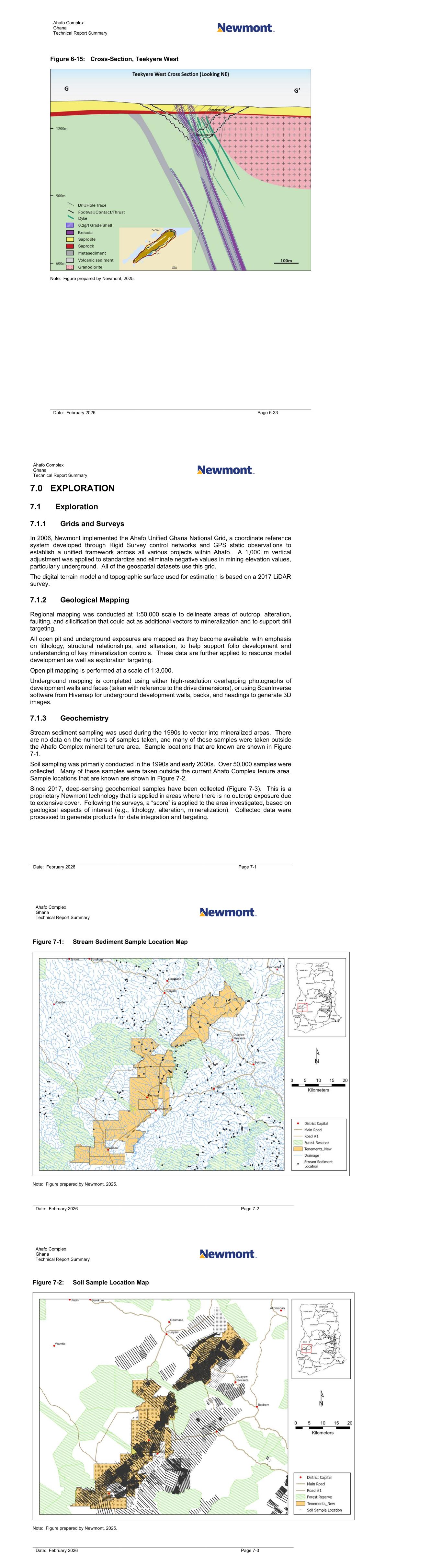
Ahafo Complex Ghana Technical Report Summary Date: February 2026 Page 6-33 Figure 6-15: Cross-Section, Teekyere West Note: Figure prepared by Newmont, 2025. Ahafo Complex Ghana Technical Report Summary Date: February 2026 Page 7-1 7.0 EXPLORATION 7.1 Exploration 7.1.1 Grids and Surveys In 2006, Newmont implemented the Ahafo Unified Ghana National Grid, a coordinate reference system developed through Rigid Survey control networks and GPS static observations to establish a unified framework across all various projects within Ahafo. A 1,000 m vertical adjustment was applied to standardize and eliminate negative values in mining elevation values, particularly underground. All of the geospatial datasets use this grid. The digital terrain model and topographic surface used for estimation is based on a 2017 LiDAR survey. 7.1.2 Geological Mapping Regional mapping was conducted at 1:50,000 scale to delineate areas of outcrop, alteration, faulting, and silicification that could act as additional vectors to mineralization and to support drill targeting. All open pit and underground exposures are mapped as they become available, with emphasis on lithology, structural relationships, and alteration, to help support folio development and understanding of key mineralization controls. These data are further applied to resource model development as well as exploration targeting. Open pit mapping is performed at a scale of 1:3,000. Underground mapping is completed using either high-resolution overlapping photographs of development walls and faces (taken with reference to the drive dimensions), or using ScanInverse software from Hivemap for underground development walls, backs, and headings to generate 3D images. 7.1.3 Geochemistry Stream sediment sampling was used during the 1990s to vector into mineralized areas. There are no data on the numbers of samples taken, and many of these samples were taken outside the Ahafo Complex mineral tenure area. Sample locations that are known are shown in Figure 7-1. Soil sampling was primarily conducted in the 1990s and early 2000s. Over 50,000 samples were collected. Many of these samples were taken outside the current Ahafo Complex tenure area. Sample locations that are known are shown in Figure 7-2. Since 2017, deep-sensing geochemical samples have been collected (Figure 7-3). This is a proprietary Newmont technology that is applied in areas where there is no outcrop exposure due to extensive cover. Following the surveys, a “score” is applied to the area investigated, based on geological aspects of interest (e.g., lithology, alteration, mineralization). Collected data were processed to generate products for data integration and targeting. Ahafo Complex Ghana Technical Report Summary Date: February 2026 Page 7-2 Figure 7-1: Stream Sediment Sample Location Map Note: Figure prepared by Newmont, 2025. Ahafo Complex Ghana Technical Report Summary Date: February 2026 Page 7-3 Figure 7-2: Soil Sample Location Map Note: Figure prepared by Newmont, 2025.
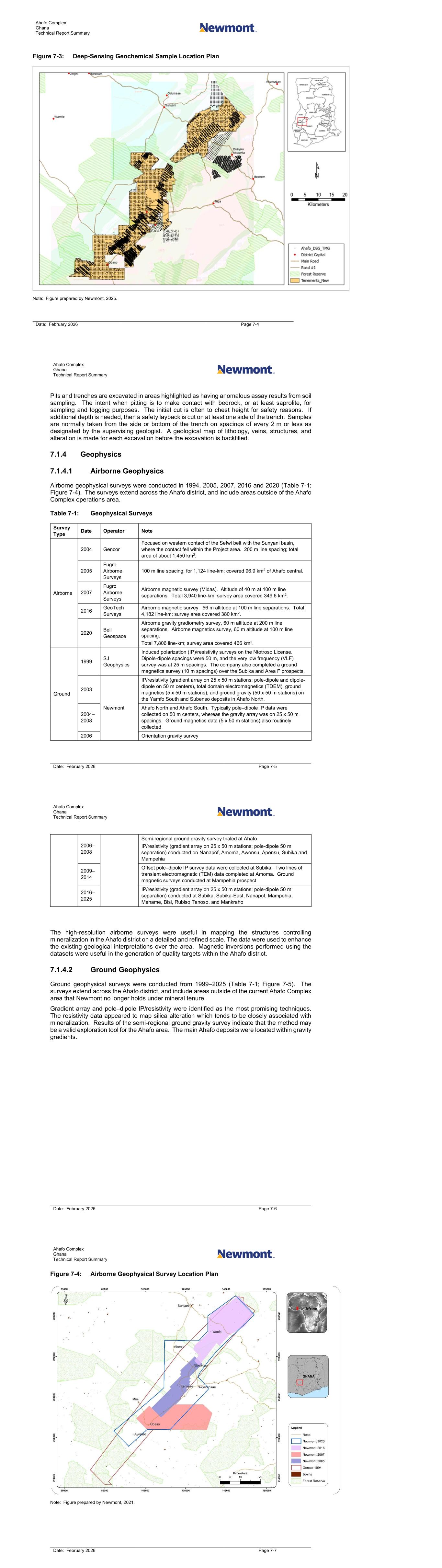
Ahafo Complex Ghana Technical Report Summary Date: February 2026 Page 7-4 Figure 7-3: Deep-Sensing Geochemical Sample Location Plan Note: Figure prepared by Newmont, 2025. Ahafo Complex Ghana Technical Report Summary Date: February 2026 Page 7-5 Pits and trenches are excavated in areas highlighted as having anomalous assay results from soil sampling. The intent when pitting is to make contact with bedrock, or at least saprolite, for sampling and logging purposes. The initial cut is often to chest height for safety reasons. If additional depth is needed, then a safety layback is cut on at least one side of the trench. Samples are normally taken from the side or bottom of the trench on spacings of every 2 m or less as designated by the supervising geologist. A geological map of lithology, veins, structures, and alteration is made for each excavation before the excavation is backfilled. 7.1.4 Geophysics 7.1.4.1 Airborne Geophysics Airborne geophysical surveys were conducted in 1994, 2005, 2007, 2016 and 2020 (Table 7-1; Figure 7-4). The surveys extend across the Ahafo district, and include areas outside of the Ahafo Complex operations area. Table 7-1: Geophysical Surveys Survey Type Date Operator Note Airborne 2004 Gencor Focused on western contact of the Sefwi belt with the Sunyani basin, where the contact fell within the Project area. 200 m line spacing; total area of about 1,450 km2. 2005 Fugro Airborne Surveys 100 m line spacing, for 1,124 line-km; covered 96.9 km2 of Ahafo central. 2007 Fugro Airborne Surveys Airborne magnetic survey (Midas). Altitude of 40 m at 100 m line separations. Total 3,940 line-km; survey area covered 349.6 km2. 2016 GeoTech Surveys Airborne magnetic survey. 56 m altitude at 100 m line separations. Total 4,182 line-km; survey area covered 380 km2. 2020 Bell Geospace Airborne gravity gradiometry survey, 60 m altitude at 200 m line separations. Airborne magnetics survey, 60 m altitude at 100 m line spacing. Total 7,806 line-km; survey area covered 466 km2. Ground 1999 SJ Geophysics Induced polarization (IP)/resistivity surveys on the Ntotroso License. Dipole-dipole spacings were 50 m, and the very low frequency (VLF) survey was at 25 m spacings. The company also completed a ground magnetics survey (10 m spacings) over the Subika and Area F prospects. 2003 Newmont IP/resistivity (gradient array on 25 x 50 m stations; pole-dipole and dipole- dipole on 50 m centers), total domain electromagnetics (TDEM), ground magnetics (5 x 50 m stations), and ground gravity (50 x 50 m stations) on the Yamfo South and Subenso deposits in Ahafo North. 2004– 2008 Ahafo North and Ahafo South. Typically pole–dipole IP data were collected on 50 m centers, whereas the gravity array was on 25 x 50 m spacings. Ground magnetics data (5 x 50 m stations) also routinely collected 2006 Orientation gravity survey Ahafo Complex Ghana Technical Report Summary Date: February 2026 Page 7-6 2006– 2008 Semi-regional ground gravity survey trialed at Ahafo IP/resistivity (gradient array on 25 x 50 m stations; pole-dipole 50 m separation) conducted on Nanapof, Amoma, Awonsu, Apensu, Subika and Mampehia 2009– 2014 Offset pole–dipole IP survey data were collected at Subika. Two lines of transient electromagnetic (TEM) data completed at Amoma. Ground magnetic surveys conducted at Mampehia prospect 2016– 2025 IP/resistivity (gradient array on 25 x 50 m stations; pole-dipole 50 m separation) conducted at Subika, Subika-East, Nanapof, Mampehia, Mehame, Bisi, Rubiso Tanoso, and Mankraho The high-resolution airborne surveys were useful in mapping the structures controlling mineralization in the Ahafo district on a detailed and refined scale. The data were used to enhance the existing geological interpretations over the area. Magnetic inversions performed using the datasets were useful in the generation of quality targets within the Ahafo district. 7.1.4.2 Ground Geophysics Ground geophysical surveys were conducted from 1999–2025 (Table 7-1; Figure 7-5). The surveys extend across the Ahafo district, and include areas outside of the current Ahafo Complex area that Newmont no longer holds under mineral tenure. Gradient array and pole–dipole IP/resistivity were identified as the most promising techniques. The resistivity data appeared to map silica alteration which tends to be closely associated with mineralization. Results of the semi-regional ground gravity survey indicate that the method may be a valid exploration tool for the Ahafo area. The main Ahafo deposits were located within gravity gradients. Ahafo Complex Ghana Technical Report Summary Date: February 2026 Page 7-7 Figure 7-4: Airborne Geophysical Survey Location Plan Note: Figure prepared by Newmont, 2021.
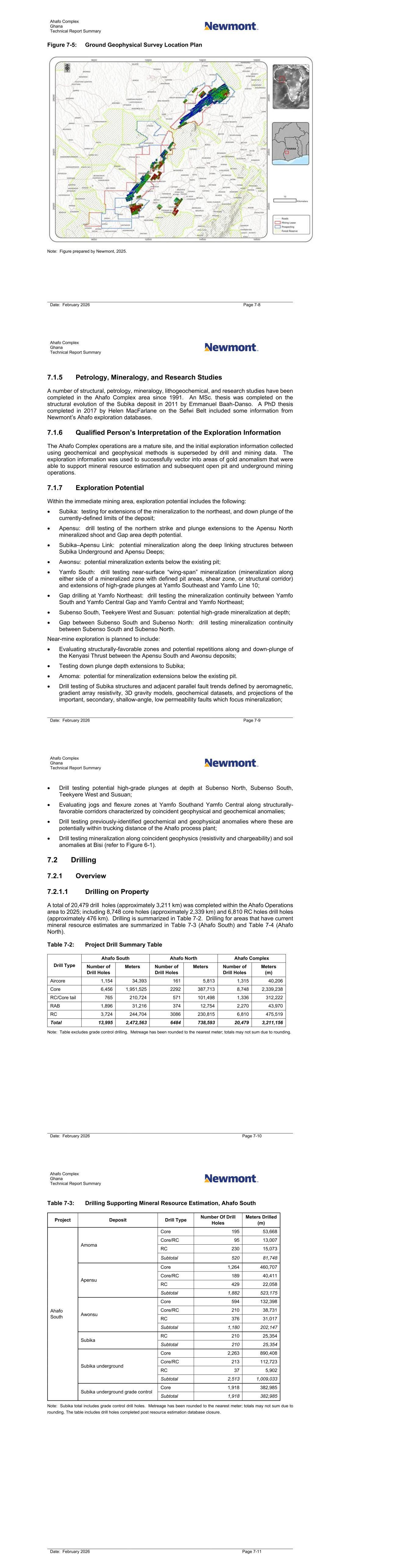
Ahafo Complex Ghana Technical Report Summary Date: February 2026 Page 7-8 Figure 7-5: Ground Geophysical Survey Location Plan Note: Figure prepared by Newmont, 2025. Ahafo Complex Ghana Technical Report Summary Date: February 2026 Page 7-9 7.1.5 Petrology, Mineralogy, and Research Studies A number of structural, petrology, mineralogy, lithogeochemical, and research studies have been completed in the Ahafo Complex area since 1991. An MSc. thesis was completed on the structural evolution of the Subika deposit in 2011 by Emmanuel Baah-Danso. A PhD thesis completed in 2017 by Helen MacFarlane on the Sefwi Belt included some information from Newmont’s Ahafo exploration databases. 7.1.6 Qualified Person’s Interpretation of the Exploration Information The Ahafo Complex operations are a mature site, and the initial exploration information collected using geochemical and geophysical methods is superseded by drill and mining data. The exploration information was used to successfully vector into areas of gold anomalism that were able to support mineral resource estimation and subsequent open pit and underground mining operations. 7.1.7 Exploration Potential Within the immediate mining area, exploration potential includes the following: • Subika: testing for extensions of the mineralization to the northeast, and down plunge of the currently-defined limits of the deposit; • Apensu: drill testing of the northern strike and plunge extensions to the Apensu North mineralized shoot and Gap area depth potential. • Subika–Apensu Link: potential mineralization along the deep linking structures between Subika Underground and Apensu Deeps; • Awonsu: potential mineralization extents below the existing pit; • Yamfo South: drill testing near-surface “wing-span” mineralization (mineralization along either side of a mineralized zone with defined pit areas, shear zone, or structural corridor) and extensions of high-grade plunges at Yamfo Southeast and Yamfo Line 10; • Gap drilling at Yamfo Northeast: drill testing the mineralization continuity between Yamfo South and Yamfo Central Gap and Yamfo Central and Yamfo Northeast; • Subenso South, Teekyere West and Susuan: potential high-grade mineralization at depth; • Gap between Subenso South and Subenso North: drill testing mineralization continuity between Subenso South and Subenso North. Near-mine exploration is planned to include: • Evaluating structurally-favorable zones and potential repetitions along and down-plunge of the Kenyasi Thrust between the Apensu South and Awonsu deposits; • Testing down plunge depth extensions to Subika; • Amoma: potential for mineralization extensions below the existing pit. • Drill testing of Subika structures and adjacent parallel fault trends defined by aeromagnetic, gradient array resistivity, 3D gravity models, geochemical datasets, and projections of the important, secondary, shallow-angle, low permeability faults which focus mineralization; Ahafo Complex Ghana Technical Report Summary Date: February 2026 Page 7-10 • Drill testing potential high-grade plunges at depth at Subenso North, Subenso South, Teekyere West and Susuan; • Evaluating jogs and flexure zones at Yamfo Southand Yamfo Central along structurally- favorable corridors characterized by coincident geophysical and geochemical anomalies; • Drill testing previously-identified geochemical and geophysical anomalies where these are potentially within trucking distance of the Ahafo process plant; • Drill testing mineralization along coincident geophysics (resistivity and chargeability) and soil anomalies at Bisi (refer to Figure 6-1). 7.2 Drilling 7.2.1 Overview 7.2.1.1 Drilling on Property A total of 20,479 drill holes (approximately 3,211 km) was completed within the Ahafo Operations area to 2025; including 8,748 core holes (approximately 2,339 km) and 6,810 RC holes drill holes (approximately 476 km). Drilling is summarized in Table 7-2. Drilling for areas that have current mineral resource estimates are summarized in Table 7-3 (Ahafo South) and Table 7-4 (Ahafo North). Table 7-2: Project Drill Summary Table Drill Type Ahafo South Ahafo North Ahafo Complex Number of Drill Holes Meters Number of Drill Holes Meters Number of Drill Holes Meters (m) Aircore 1,154 34,393 161 5,813 1,315 40,206 Core 6,456 1,951,525 2292 387,713 8,748 2,339,238 RC/Core tail 765 210,724 571 101,498 1,336 312,222 RAB 1,896 31,216 374 12,754 2,270 43,970 RC 3,724 244,704 3086 230,815 6,810 475,519 Total 13,995 2,472,563 6484 738,593 20,479 3,211,156 Note: Table excludes grade control drilling. Metreage has been rounded to the nearest meter; totals may not sum due to rounding. Ahafo Complex Ghana Technical Report Summary Date: February 2026 Page 7-11 Table 7-3: Drilling Supporting Mineral Resource Estimation, Ahafo South Project Deposit Drill Type Number Of Drill Holes Meters Drilled (m) Ahafo South Amoma Core 195 53,668 Core/RC 95 13,007 RC 230 15,073 Subtotal 520 81,748 Apensu Core 1,264 460,707 Core/RC 189 40,411 RC 429 22,058 Subtotal 1,882 523,175 Awonsu Core 594 132,398 Core/RC 210 38,731 RC 376 31,017 Subtotal 1,180 202,147 Subika RC 210 25,354 Subtotal 210 25,354 Subika underground Core 2,263 890,408 Core/RC 213 112,723 RC 37 5,902 Subtotal 2,513 1,009,033 Subika underground grade control Core 1,918 382,985 Subtotal 1,918 382,985 Note: Subika total includes grade control drill holes. Metreage has been rounded to the nearest meter; totals may not sum due to rounding. The table includes drill holes completed post resource estimation database closure.
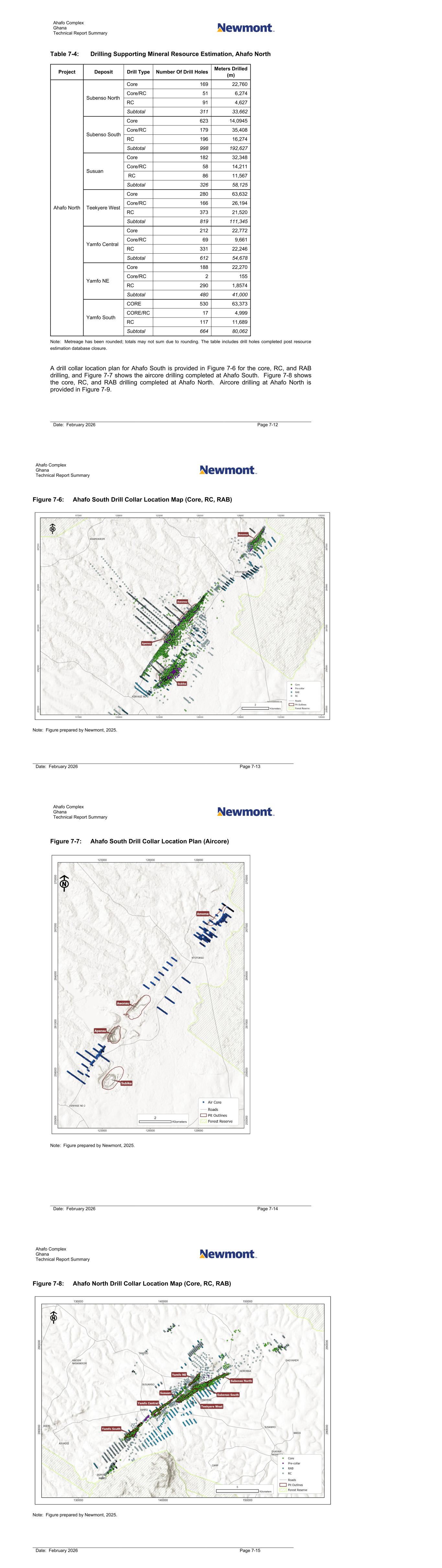
Ahafo Complex Ghana Technical Report Summary Date: February 2026 Page 7-12 Table 7-4: Drilling Supporting Mineral Resource Estimation, Ahafo North Project Deposit Drill Type Number Of Drill Holes Meters Drilled (m) Ahafo North Subenso North Core 169 22,760 Core/RC 51 6,274 RC 91 4,627 Subtotal 311 33,662 Subenso South Core 623 14,0945 Core/RC 179 35,408 RC 196 16,274 Subtotal 998 192,627 Susuan Core 182 32,348 Core/RC 58 14,211 RC 86 11,567 Subtotal 326 58,125 Teekyere West Core 280 63,632 Core/RC 166 26,194 RC 373 21,520 Subtotal 819 111,345 Yamfo Central Core 212 22,772 Core/RC 69 9,661 RC 331 22,246 Subtotal 612 54,678 Yamfo NE Core 188 22,270 Core/RC 2 155 RC 290 1,8574 Subtotal 480 41,000 Yamfo South CORE 530 63,373 CORE/RC 17 4,999 RC 117 11,689 Subtotal 664 80,062 Note: Metreage has been rounded; totals may not sum due to rounding. The table includes drill holes completed post resource estimation database closure. A drill collar location plan for Ahafo South is provided in Figure 7-6 for the core, RC, and RAB drilling, and Figure 7-7 shows the aircore drilling completed at Ahafo South. Figure 7-8 shows the core, RC, and RAB drilling completed at Ahafo North. Aircore drilling at Ahafo North is provided in Figure 7-9. Ahafo Complex Ghana Technical Report Summary Date: February 2026 Page 7-13 Figure 7-6: Ahafo South Drill Collar Location Map (Core, RC, RAB) Note: Figure prepared by Newmont, 2025. Ahafo Complex Ghana Technical Report Summary Date: February 2026 Page 7-14 Figure 7-7: Ahafo South Drill Collar Location Plan (Aircore) Note: Figure prepared by Newmont, 2025. Ahafo Complex Ghana Technical Report Summary Date: February 2026 Page 7-15 Figure 7-8: Ahafo North Drill Collar Location Map (Core, RC, RAB) Note: Figure prepared by Newmont, 2025.
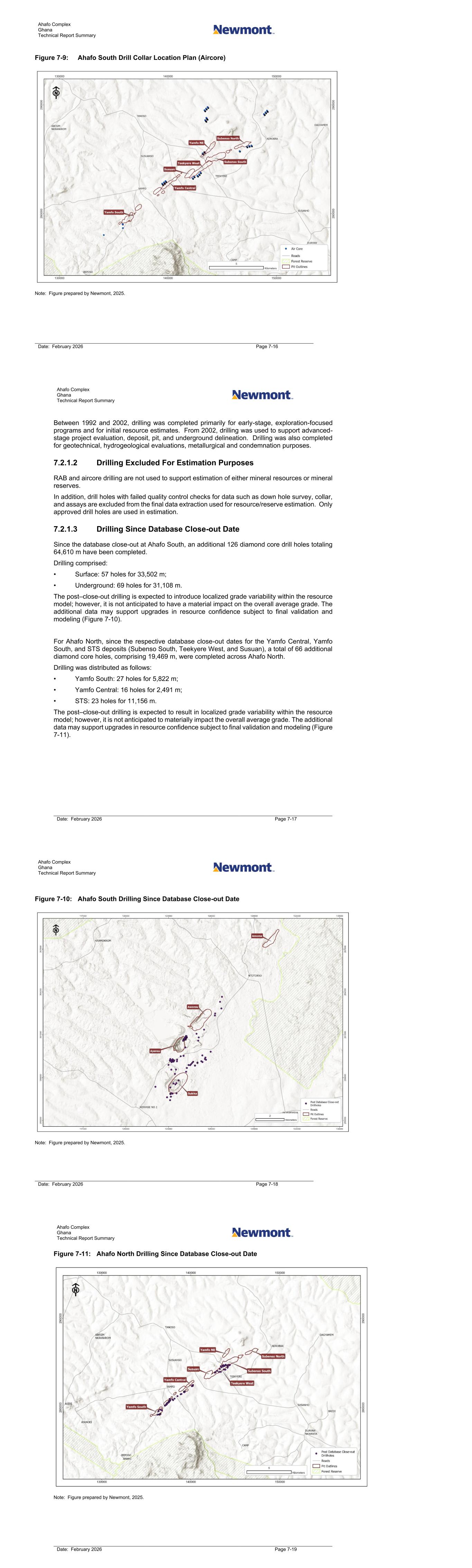
Ahafo Complex Ghana Technical Report Summary Date: February 2026 Page 7-16 Figure 7-9: Ahafo South Drill Collar Location Plan (Aircore) Note: Figure prepared by Newmont, 2025. Ahafo Complex Ghana Technical Report Summary Date: February 2026 Page 7-17 Between 1992 and 2002, drilling was completed primarily for early-stage, exploration-focused programs and for initial resource estimates. From 2002, drilling was used to support advanced- stage project evaluation, deposit, pit, and underground delineation. Drilling was also completed for geotechnical, hydrogeological evaluations, metallurgical and condemnation purposes. 7.2.1.2 Drilling Excluded For Estimation Purposes RAB and aircore drilling are not used to support estimation of either mineral resources or mineral reserves. In addition, drill holes with failed quality control checks for data such as down hole survey, collar, and assays are excluded from the final data extraction used for resource/reserve estimation. Only approved drill holes are used in estimation. 7.2.1.3 Drilling Since Database Close-out Date Since the database close-out at Ahafo South, an additional 126 diamond core drill holes totaling 64,610 m have been completed. Drilling comprised: • Surface: 57 holes for 33,502 m; • Underground: 69 holes for 31,108 m. The post–close-out drilling is expected to introduce localized grade variability within the resource model; however, it is not anticipated to have a material impact on the overall average grade. The additional data may support upgrades in resource confidence subject to final validation and modeling (Figure 7-10). For Ahafo North, since the respective database close-out dates for the Yamfo Central, Yamfo South, and STS deposits (Subenso South, Teekyere West, and Susuan), a total of 66 additional diamond core holes, comprising 19,469 m, were completed across Ahafo North. Drilling was distributed as follows: • Yamfo South: 27 holes for 5,822 m; • Yamfo Central: 16 holes for 2,491 m; • STS: 23 holes for 11,156 m. The post–close-out drilling is expected to result in localized grade variability within the resource model; however, it is not anticipated to materially impact the overall average grade. The additional data may support upgrades in resource confidence subject to final validation and modeling (Figure 7-11). Ahafo Complex Ghana Technical Report Summary Date: February 2026 Page 7-18 Figure 7-10: Ahafo South Drilling Since Database Close-out Date Note: Figure prepared by Newmont, 2025. Ahafo Complex Ghana Technical Report Summary Date: February 2026 Page 7-19 Figure 7-11: Ahafo North Drilling Since Database Close-out Date Note: Figure prepared by Newmont, 2025.

Ahafo Complex Ghana Technical Report Summary Date: February 2026 Page 7-20 7.2.2 Drill Methods Aircore drilling was primarily used as a first-pass evaluation tool of soil sample anomalies to bedrock. Drilling was completed by multiple contractors during Normandy’s tenure, all of which used aircore-only drill rigs. The primary drill contractor for the aircore programs completed by Newmont was African Mining Services (AMS), who used an ED100-type drill rig. RC drilling was used as a resource delineation tool from 1995–2012. Drill contractors included Boart Longyear (BLY), AMS, and Geodrill. The drilling firms used both dedicated RC and multipurpose-type drill rigs, including ED703, ED704, ED045, ED062, KL900, KL200, and LF4252 rig types. Between 2012–2025 BLY, AMS, African Underground Mining Services(AUMS),Underground Mining Alliance (UMA), Westfield Drilling, JODI Drilling and GTS Drilling were used. Underground operations primarily used Atlas Copco Diamec 262,LM90 and LM110 rigs, while surface drilling employed LF160, LF230, LF90, DE740, DE710, DRA800, MP1200, ED2000, DE840, KL1200. Core drilling is used to support resource estimates, and to infill in areas of predominantly RC drilling. Core drilling was completed in phases, from 1995 to the Report date. Drill holes classified as core-drilled include both RC pre-collared holes and those wholly drilled as core holes. 7.2.3 Logging Aircore drill hole logging included lithologies, alteration, oxidation states, and presence of aquifers. Geological logging of RC drill data included lithology, alteration state, oxidation, and presence of water. Logging used pre-set codes. Drill chips were logged at the drill site, and a chip tray record of each 1 m interval retained for reference. Detailed geological logging is carried out on all core holes, and focuses on descriptions and graphical logging of geological relationships, characteristics, and mineralization. Lithology, alteration, veining, sulfide content, oxidation type, and structural information are consistently captured digitally using a tablet personal computer via Visual Logger application and loaded to a global exploration database (GED) for storage. The Visual Logger application contains the standard geologic codes for the logging. The senior project geologist for a particular project performs a minimum of 20% quality checks on all geological logging and documents the findings. Historically, geotechnical logging of core was performed on selected drill holes from infill drilling programs to capture core recovery and rock quality designation (RQD). The selected interval for geotechnical logging was largely dependent on the observed geotechnical features. This practice was replaced by performing the geotechnical logging run by run or block to block for the entire length the hole and for all the drilled holes. Geologists log core recovery, RQD, joint condition rating, fracture frequency, and strength. Information captured using Visual Logger and loaded into the GED. More specialized geotechnical logging is done by geotechnical engineers for the holes drilled specifically for geotechnical purposes. 7.2.4 Recovery Recovery was not usually recorded for the aircore drill programs but is typically very high. Ahafo Complex Ghana Technical Report Summary Date: February 2026 Page 7-21 Except for the first few meters of individual RC holes, where recovery is typically in the 20–40% range, recovery is generally about 95–98%. Core recovery is normally 100%, except for very rare times when faults and/or graphitic shear zones are encountered. The mineralized zone, which is silicified and brecciated, is a solid rock and recovery is almost always 100% in mineralization. 7.2.5 Collar Surveys Aircore drill hole collars were located by the survey department and verified by geology personnel. Collars of drill holes completed prior to 2005 were surveyed by surveyors, using optical instruments and in the local mine grid coordinate system. In September 2006, Newmont transformed all the spatial data at the Ahafo Complex to a common and unified survey grid based on the projection of the Ghana National Grid. A vertical offset was added to elevations referenced to mean sea level to avoid negative values. The unified grid was called the Ahafo Unified Ghanaian National Grid. Collars of drill holes completed afterwards were surveyed by Newmont surveyors, using global positioning system (GPS) equipment and in the Ahafo Unified Ghanaian National Grid coordinate system. Data are electronically sent to the database manager. 7.2.6 Down Hole Surveys Aircore drill holes were not down-hole surveyed. A Welnav downhole survey camera was used for RC drill holes. Core hole downhole surveys were performed with a variety of instruments, including multi-shot Sperry-Sun, Welnav, Reflex EZ-Shot and Reflex Multishot tools. All surveys were performed by the drilling company, then checked and approved by geological staff. Magnetic declinations are adjusted for drift. The declination factor is subtracted from the magnetic reading provided by the drilling services contractor. Quality control is completed for 5% of the holes drilled at the Ahafo Complex. 7.2.7 Grade Control The open pit operations at Ahafo South use five active Drilltech D45 blast hole rigs, which drill 9.2 m vertical blast holes (i.e., 8 m bench plus 1.2 m sub-drill) for grade control sampling in fresh rock. Blasthole spacing is at approximately 4 x 4.5 m spacing in ore zones and 4.2 x 4.8 m in waste zones. The open pit operations at Ahafo North use four CATMD6200 drill rigs for blast holes for 6 m bench-drilling (plus 1.3 m sub-drill), and three Pantera DP1500i drill rigs for presplit drilling. Blast hole spacing is approximately 3.8 x 3.3 m (spacing and burden) in ore zones and 4 x 3.5 m in waste zones. At Subika Underground, two LM90 diamond drill rigs are used for indicated to measured conversion drilling. Drill patterns are based on the mining method, with 12.5 m spacing for long- hole stoping areas and 17 m spacing for sub-level shrinkage zones. All core is fully sampled, and the resulting assay data is used for constructing grade control block models. Ahafo Complex Ghana Technical Report Summary Date: February 2026 Page 7-22 7.2.8 Comment on Material Results and Interpretation Drill holes are oriented with an inclination ranging from -45º to -88º for surface holes and -74º to -32º for underground holes to accommodate the steeply-dipping nature (typically -55º to -75º) of the deposits, resulting in an intersection generally representing 75–85% of true width. Drilling is generally orientated perpendicular (300–330º) to the strike of the orebodies (040º –050º) for surface drill holes. Underground drill holes are typically collared from the footwall into the hanging wall of the orebody, the opposite direction to the surface drill holes. Local variation in drill orientations may be present to accommodate infrastructure constraints. 7.3 Hydrogeology Water quality monitoring is based on a monitoring plan developed to guide ongoing sampling and analysis of process fluid including groundwater and surface water collected in conjunction with Newmont’s water resources monitoring program to meet operational needs and environmental protection requirements. Sampling conducted under this plan is performed by Newmont personnel and/or contractors under the direction of Newmont staff. Monitoring data are used to quantify water quality such that any mine-related impacts to the environment can be determined and, if necessary, mitigated. 7.3.1 Sampling Methods and Laboratory Determinations 7.3.1.1 Ahafo South Surface and ground water monitoring routinely conducted, with sample intervals, depending on what is being monitored, that can be daily, weekly, monthly, quarterly, or annual. Samples of surface water are analyzed in the field using hand-held instruments for the following parameters: pH, specific conductivity, dissolved oxygen, water temperature, and turbidity. The color of the water is also recorded on the field form. Community water supply wells are sampled using existing well pumps. Field parameters including pH, SC, temperature, dissolved oxygen, and turbidity are collected. Standpipes and vibrating wire piezometers (VWPs) are installed in the perimeter of the pits to monitor groundwater levels and pore pressures for the purpose of slope stability. Stream flow at designated stations is measured using a current meter (electromagnetic, and/or equivalent-type). Water sample analyses are conducted by SGS or the mine site laboratory. SGS is an accredited environmental laboratory in Ghana and appropriate certifications for chemical analysis of hydrological samples. The Newmont mine laboratory is used for selected analyses, such as physical parameters, microbiology, and particular nutrients. Full suite parameters, such as nutrients and other chemicals, total and dissolved metals are assayed at one of SGS, ALS, or Intertek in Ghana. These laboratories may be used to analyze split samples as part of the QC process. All laboratories use designated analytical methods or a comparable method, and meet specific QC requirements. The laboratories hold ISO17025 accreditations for selected chemical analytical techniques. Ahafo Complex Ghana Technical Report Summary Date: February 2026 Page 7-23 Laboratory analytical methods used are based on the most recent edition of the American Public Health Association’s (APHA) “Standard Methods for the Examination of Water and Wastewater”, and standards from the International Standards Organization. Quality assurance and quality control (QA/QC) measures can include: • Ensuring sites selected are representative; • Reviewing field forms for adherence to proper calibration and sample collection procedures • Achieving completeness goals of 90%, where completeness is calculated as the number of valid measurements divided by the total number of planned measurements, expressed as a percentage; • Inserting field duplicates, laboratory duplicates, matrix spike duplicates, or laboratory control sample duplicates; • Inserting field blanks, matrix spikes, laboratory control samples, and surrogate spikes • Using USEPA-accepted analytical methods, where available and as appropriate; • Checking the comparability of data collected. 7.3.1.2 Ahafo North Vibrating wire piezometers were installed in six oxide definition drill holes in the northern part of the project area. Three piezometer sensors were installed at each location, with one sensor in the primary rock a second in the saprock and the third in the saprolite. Two monitoring wells were constructed using PVC and screened in saprolite near the planned Line 10 pit at Yamfo South. Deep and shallow conventional PVC monitoring wells were also installed at two locations in the area of the Yamfo S-SE and Yamfo S-SW pits. A conventional monitoring well was installed at a potential plant site location. Groundwater monitoring wells were installed both upstream and downstream of the planned TSF location. These installations are intended as groundwater sampling and water-level monitoring locations; initially to provide pre-mining background data, but thereafter to provide performance data during the operation of the facility. Hydrogeological data indicated that a substantial thickness of saturated oxide sequence would be encountered during open pit mining. Drilling was completed in support of defining the groundwater surface and the oxide–primary boundary in the pit areas. The surface of the top of primary rock was an important pit slope design sector boundary, as it separates lower-strength materials above from higher strength primary rock below. Water quality samples were collected to provide an initial indication of the water quality in the Ahafo North area, and analyzed at ACZ laboratories in Steamboat Springs, Colorado. groundwater quality in the Ahafo North Project Area is generally good. Given the very low acid generating potential of both the saprolite and primary rock, impacts to water quality are only expected to occur where highly mineralized materials are exposed.

Ahafo Complex Ghana Technical Report Summary Date: February 2026 Page 7-24 7.3.2 Groundwater Models 7.3.2.1 Ahafo South A groundwater model was developed in 2016 by Golder Associates for the Ahafo South mines, primarily to support the open pit mines and the planned Subika underground mine. Evaluations of the potential to also underground mine adjacent to the Apensu open pit required updates to the groundwater model. The existing FEFLOW-hosted Ahafo regional groundwater flow model was recalibrated to better represent the inflows and groundwater levels monitored in proximity of the various mines. The 2015–2016 model assumptions resulted in higher predicted groundwater inflows to the underground mine than that recorded over the 2017–2019 period, and consequently the associated drawdown cones predicted were larger than those measured based on available borehole water levels. As a result, the hydraulic conductivities assigned to the saprock, fractured and fresh bedrock zones were reduced. Lower hydraulic conductivity values and lower groundwater ingress rates were modeled to match the data collected, and the cone of depression extent was reduced. 7.3.2.2 Ahafo North The initial version of the regional numerical groundwater flow model, developed in 2007, was based on a network of regional monitoring wells for which historical groundwater levels, geochemistry, and aquifer (slug) testing were available. A hydrogeological characterization study was completed in 2012 for the Susuan, Teekyere West, and Subenso South pits, and for the Yamfo Northeast and Subenso North pits in 2014. These studies involved the installation of test wells and monitoring wells, short-duration pumping tests and borehole slug tests at well locations within each proposed pit area. The conceptual hydrogeological model for Ahafo North includes four hydrogeological units. Groundwater flow in the primary rock and saprock is fracture controlled. Direct infiltration of precipitation is the primary source of groundwater recharge and is estimated to range between 1–15% of annual rainfall. Natural discharge of groundwater primarily occurs as a combination of evapotranspiration in wetlands and riparian zones, coupled with baseflow to the Tano River and its perennial tributaries. The potentiometric surface typically first occurs in the saprolite, except in local areas where saprock or fresh bedrock is exposed at the surface. 7.3.3 Water Balance 7.3.3.1 Ahafo South The Ahafo South site-wide Goldsim model has been in use for over a decade as an operational support and long-term planning tool for mine water management at the operations. Calibration of the model is performed at least once annually through the collation and entry into the model of empirical monitoring/operational reporting data spanning a minimum of 12 months prior to the date of each calibration exercise. Data inputs used in the calibration process included mined tonnages, mill throughput, pit dewatering rates, tailings densities, TSF reclaim rates and other factors that are likely to influence Ahafo Complex Ghana Technical Report Summary Date: February 2026 Page 7-25 the physical water balance. Deterministic model simulations were then performed, with results relating to flows and/or storage inventories compared against measured values at key calibration locations across the model domain. Updates of the Goldsim site-wide water balance model for Ahafo was completed during Q3 of 2020 and included Ahafo’s 2021 mine plan and production schedule. Historical and projected inflows to the Subika Underground as defined by 2020 numerical groundwater modelling were incorporated into the Goldsim model. In parallel with the model update and calibration process completed in Q3 2020, the Goldsim model was used to support investigations performed under the Ahafo Site Water Management Study, primarily on the LOM dewatering strategy around the Apensu pit, and the decision on the need for and timing of additional treatment capacity, and the requirement of an impacted water pond. 7.3.4 Ahafo North Water demand at the mill is met from other facilities at the mine, if available, and from outside fresh water sources if not. Outside river intake is not required at the mill under median conditions, and was only found to be necessary during the spring months of particularly dry years. This assumes that the 10 sediment control structures will be able to supply water for any shortages of dust control needs. After production begins, water collected in the sediment control structures will primarily only be required during the drier spring months of each year, with annual peaks occurring in January. Water from the water storage facility will be needed for process requirements only during the spring months, when less water is available from the TSF. 7.3.5 Comment on Results 7.3.5.1 Ahafo South To the Report date, the hydrogeological data collection programs have provided data suitable for use in the mining operations, and have supported the assumptions used in the active pits and underground operations. 7.3.5.2 Ahafo North Groundwater is encountered in the oxide sequence, and a significant portion of the saprolite is currently saturated. The depth to the groundwater surface varies from just a few meters in lower lying regions of the project area adjacent to the principal surface water drainage features, to between 20–25 m beneath the topographic highs. While artesian conditions have not been encountered at Ahafo North, to a limited extent they could be expected to occur at lower-lying groundwater discharge sites. On a local scale, groundwater flow is typically a subdued reflection of topography; but at a regional scale, groundwater flow is toward the southeast, parallel to the strike of the Kenyasi Fault. The matrix permeability of the saprolite is typically low, although remnant quartz veins can provide discrete structures with higher permeability. The highest permeability unit in the project area is the generally thin (2-10m thick) saprock horizon which identifies the top of the bedrock surface. Ahafo Complex Ghana Technical Report Summary Date: February 2026 Page 7-26 Groundwater flow in the primary rocks is fracture controlled; the permeability of the un-fractured bedrock is very low. Piezometer data indicate that variations exist in the thickness of the saturated saprolite and the oxide sequence overall. On average, the lower 15–25 m of the oxide sequence is likely saturated, with saprolite making up most of that thickness. 7.4 Geotechnical The following general information is collected for geotechnical assessment of both open pit and underground excavations: • Rock mass classification and characterization data to estimate the rock quality; • Structural data to determine potential structural-controlled failures; • Damage mapping data to determine failure mechanisms; • Stress testing to determine the in-situ rock stress environment. 7.4.1 Sampling Methods and Laboratory Determinations 7.4.1.1 Ahafo South Rock mass and hydrogeology data are used for structural characterizations to support pit walls and underground excavations. The strength and elastic properties of the oxide and fresh rocks have been characterized from laboratory testing of samples and cores. Examples of tests done to determine the mechanical properties of fresh rocks are tensile strength, uniaxial compressive strength, Young’s Modulus, Poisson’s Ratio, triaxial compressive tests, and direct shear tests. Core samples are sent to a laboratory for various geotechnical purposes, such as determining the mechanical properties and estimating the in-situ stress field of the rock. Core samples are selected for laboratory purposes, and based on information such as the core integrity, core quality, and geological variability. The samples are carefully selected at different depths, with rock sample lengths and dimensions based on the International Society for Rock Mechanics guidelines for various tests. Current testing facilities include Rocklab in Pretoria, South Africa; E-Precision in Bibra Lake, Western Australia; the West Australian School of Mines in Kalgoorlie, Western Australia; and the University of Mines and Technology laboratories in Ghana, all of which are accredited. The laboratories are independent of Newmont. Geotechnical laboratory test work is conducted according to industry-accepted standards such as the International Society for Rock Mechanics, American Society of Testing and Materials, or international equivalents. For in-situ stress testing, a comprehensive database of stress measurements has been collected at the Ahafo South operations, including the Subika and Apensu orebodies. The dataset consists of 13 West Australian School of Mines acoustic emission tests at Ahafo South conducted in 2011, 2021 and 2024, and six full stress tensor CSIRO hollow-inclusion cell measurements at Subika underground, conducted in 2018 and 2022. For acoustic emission testing, core samples were selected at varying sample depths, and the hollow-inclusion cell tests were conducted at roughly 200, 400, and 600 m below the surface. Ahafo Complex Ghana Technical Report Summary Date: February 2026 Page 7-27 Scanline, window, spot, and digital mapping techniques are used to characterize the various discontinuity sets within the rock mass, which aids in defining potential failure modes likely to occur in the stope and pit walls. Several aspects, such as rock mass condition, stope geometry, structural fabric, stress conditions, and slope performance are considered during stope designs. Good oversight of drillers is maintained during drilling programs to verify that processes are carried out correctly. New geologists are trained by the Senior Geologist/Senior Geotechnical Engineer in data collection programs. The Senior Geologist/Senior Geotechnical Engineer in charge of the drilling program periodically reviews the final log data to ensure all geotechnical features have been included and accurately captured. Run-of-mine (ROM) and development waste rock are used as fill material in the underground excavations. The suitability of the fill material is determined by using the mechanical properties of the rock and fragmentation analysis to define material granularity and appropriateness. The fragmentation analysis is conducted by a qualified backfill engineer. For the open pits, blasts are measured with a geophone system to quantify the effect of vibrations on the rock mass. There are prism arrays on the pit walls to measure slope displacements. Radars are also employed to monitor slope movements in real time. A micro-seismic monitoring system is used for monitoring seismic activities in the rock mass. Extensometers, stressmeters and sloughmeters are used for displacement monitoring of some selected underground excavations. In August 2019, a seismic network was commissioned for underground workings. The initial seismic sensor array underwent improvements in 2021, 2024, and 2025, increasing the number of geophones to 12, 15, and 19, respectively. These upgrades were implemented to enhance the location sensitivity and accuracy of seismic events, using a total of 19 triaxial seismic sensors operating at frequencies of 4.5 Hz and 14 Hz. A register is maintained for all Fall of Ground and seismic trigger events, which provides a summary of the sequence and nature of the event, remediation and lessons learnt. 7.4.1.2 Ahafo North The following general information is collected for geotechnical assessment of open pit excavations: • Rock mass classification and characterization data to estimate the rock quality; • Geological and structural data to determine potential structural-controlled failures; • Hydrogeological data to determine the groundwater pressure and surface water flow. Rock mass and hydrogeology data are used for structural characterizations to support pit walls. The strength and elastic properties of the oxide and fresh rocks have been characterized from laboratory testing samples from test pits and cores. During drilling of the boreholes, standard penetration testing and undisturbed sampling were carried out in laterite and saprolite sections. Examples of tests done to determine the mechanical properties of rocks and soils are tensile strength, uniaxial compressive strength, triaxial compressive tests, direct shear tests, elastic constants, sieve analysis, Atterberg limits, natural moisture, standard Proctor, consolidation, and permeability tests. Core samples are sent to a laboratory for various geotechnical purposes, such as determining the mechanical properties of the rock. Core samples are selected for laboratory purposes based

Ahafo Complex Ghana Technical Report Summary Date: February 2026 Page 7-28 on information such as core integrity, core quality, and geological variability. Selection of samples is done to limit bias as far as practicable. The samples are carefully selected at different depths and orientations, considering different scales of discontinuities, with sample lengths based on the International Society for Rock Mechanics recommendation for various tests. Core samples for laboratory testing are wrapped with clean cloth and placed in either wooden or metal boxes that are lined with visco-elastic foam to minimized disturbances during shipment. Current testing facilities include Rocklab in Pretoria, Civilab in South Africa, University of Mines and Technology and Conterra laboratories in Ghana, all of which are accredited. The laboratories are independent of Newmont. Geotechnical laboratory test work is conducted according to industry acceptable standards such as the International Society for Rock Mechanics, American Society of Testing and Materials, or international equivalents. Good oversight of drillers is maintained during drilling programs to verify that processes are carried out correctly. New geologists are trained by the Senior Geologist/Senior Geotechnical Engineer in data collection programs. The Senior Geologist/Senior Geotechnical Engineer in charge of the drilling program periodically reviews the final log data to ensure all geotechnical features have been included and accurately captured. Pit wall mapping techniques such as scanline, window, spot, and digital mapping are used to characterize the various discontinuity sets within the rock mass, to aid in defining potential failure modes likely to occur in the pit walls as the pits are opened up. Structural data from geotechnical core logging will be inferred from field mapping to deduce their correlation. Prisms are employed to monitor slopes as benches are exposed. Plans are underway to purchase and commission slope monitoring radars. There is continuous collection and interpretation of groundwater monitoring data from monitoring bores and vibrating wire piezometers in the area. 7.4.2 Comment on Results 7.4.2.1 Ahafo South The geological hard rock setting at the Ahafo South is well understood and displays consistency across the various open pits and the underground mine located on site. Additional testing continues to confirm the consistency of material strengths and parameters. As of the Report date, geotechnical data collection programs have generated data that is suitable for mining operations and have validated the assumptions used in the active pits and underground operations. 7.4.2.2 Ahafo North Modelling of lithological and structural units by Exploration Geology is ongoing for some of the deposits. The large-scale faults have not been modeled explicitly, but they can be inferred from the orientations of modeled ore shapes that occur along the faults; and by foliation orientations from oriented core and televiewers data. The geotechnical model is reasonably understood, and has supported the assumptions used in the open pits based on the interpretation of the best currently available data. Additional data need to be collected through pit wall mapping, geotechnical drilling, observations, and slope Ahafo Complex Ghana Technical Report Summary Date: February 2026 Page 7-29 performance as the pits are developed to confirm the consistency of material strengths and parameters. As mining occurs, rock mass properties will likely be modified or refined based on local mining experience, slope performance, and an improved understanding of the conditions. To the Report date, the geotechnical data collection programs have provided suitable data and have supported the assumptions used in the pit designs. Ahafo Complex Ghana Technical Report Summary Date: February 2026 Page 8-1 8.0 SAMPLE PREPARATION, ANALYSES, AND SECURITY 8.1 Sampling Methods BLEG samples were collected from suitable drainages, as 2–5 kg samples, and placed in pre- numbered calico bags. The sample location was recorded, typically on aerial photographs. Soil samples were collected as 2 kg samples from 15–20 cm depths in the soil profile, a description recorded, then samples were placed in a pre-numbered calico bag. Rock chip samples were typically collected as 2–5 kg of grab samples from surface outcrops. Sample locations were recorded, together with a geological description. Trench and pit samples were normally collected from the side or bottom of the trench on about 2 m spacings, or as designated by the supervising geologist. Samples ranged from 2–5 kg, and each sample position was recorded with a geological description. Aircore drill samples were typically taken on 2 m intervals down hole. RC samples were generally taken on 1 m intervals down hole, split using a Gilson riffle splitter, with quarter samples collected in pre-numbered RC sample bags. Core was cut along marked orientation lines, using a diamond saw. Sample lengths varied from 0.5–1.5 m, with sample intervals selected based on the geological features of the core, including alteration. 8.2 Sample Security Methods Sample collection, preparation, and transportation have always been performed by Newmont personnel using Newmont vehicles, or by the relevant commercial laboratory vehicle. Chain-of- custody procedures consist of sample submittal forms sent to the laboratory with sample shipments to make certain that all samples are received by the laboratory. 8.3 Density Determinations Newmont’s protocols for specific gravity determination require that a minimum of 30 samples per material type (domain) are collected at the initiation stage and identification stage of any project. For more advanced projects, specific gravity samples are typically collected at approximately 25 m intervals per lithological and alteration domains. Specific gravity determinations were completed by the Normandy-operated Ahafo Mobile Sample Preparation Unit (MSPU) and the SGS laboratory in Tarkwa (SGS Tarkwa). In all cases, specific gravity values were measured by water displacement methods. Currently, determinations are performed onsite by Newmont geologists and technicians. Specific gravity values range from 1.76 in saprolitic material to 2.79 in fresh rock for Ahafo South, and 1.7 in saprolite to 2.86 in fresh rock for Ahafo North. Ahafo Complex Ghana Technical Report Summary Date: February 2026 Page 8-2 Quality control (QC) measurements are performed on a minimum of 5% of samples by an independent external laboratory. These are currently completed at ALS Kumasi. Prior to April 2023, the determinations were conducted at the SGS Ahafo onsite laboratory. Quality assurance and quality control (QA/QC) measurements are validated by Newmont senior geological staff. 8.4 Analytical and Test Laboratories A number of independent laboratories have been used since 1993. During the Normandy operating period, the primary laboratories were Transworld Laboratories, in Tarkwa, Ghana, and SGS Kumasi and SGS Tarkwa. Newmont used UltraTrace Laboratory Pty Ltd (UltraTrace) for BLEG geochemical sampling. Umpire laboratories used include ALS Vancouver in Canada, Gencor Laboratories, in Johannesburg, South Africa (Gencor); Inchcape Laboratory in Obuasi, Ghana (Inchcape); Genalysis Laboratories in Perth, Australia (Genalysis); Anglo-American Research Laboratories in Johannesburg (AARL); Omac Laboratories in Ireland (Omac); and Performance Laboratories in Johannesburg (Performance). SGS Tarkwa was the primary laboratory for all drill programs for the period June 2003 to 2010. In addition to SGS Tarkwa, ALS Chemex (ALS) has provided laboratory services to Newmont Ghana from 2010 to the Report date, and has used branch laboratories in various locations, including ALS Kumasi, ALS Vancouver, and ALS Johannesburg. Both the parent SGS and ALS are independent laboratory groups that operate globally, and the SGS/ALS laboratories used for the Project are accredited to ISO/IEC17025 for selected sample preparation and analytical techniques. Currently, ALS Kumasi and SGS Tarkwa are the primary laboratories used for all Ahafo exploration samples. Until April 2023, all Ahafo South grade control and metallurgical samples were analyzed at the on-site mine laboratory, which was managed by SGS. Following the fire incident that destroyed the laboratory, the samples were analyzed at the SGS Akyem mine laboratory. Currently, these samples are being analyzed at SGS Tarkwa, following the divestiture of the Akyem mine in early 2025. Ahafo North grade control samples are currently being analyzed at ALS-Kumasi whilst the analyses of metallurgical samples are being performed at SGS-Tarkwa.

Ahafo Complex Ghana Technical Report Summary Date: February 2026 Page 8-3 8.5 Sample Preparation Sample preparation methods for the various major sampling types is summarized in Table 8-1. Table 8-1: Sample Preparation Procedures Laboratory Sample Type Preparation Procedure Newmont, UltraTrace Stream sediment None required ALS Kumasi Soil Dried, crushed to nominal 90% passing -2 mm, pulverized to 90% passing -75 µm SGS Ahafo, ALS Kumasi Rock chip; pit/trench; aircore; RC Dried, crushed to nominal 90% passing −3 mm, pulverized to nominal 90% passing -75 µm SGS Ahafo, SGS Tarkwa, ALS Kumasi Core Dried, crushed to nominal 90% passing -2 mm, pulverized to 90% passing -75 µm 8.6 Analysis The following analytical methods have been used: • Au by fire assay and atomic absorption spectroscopy (AAS); • Multi-element Ag, As, Bi, Ca, Cd, Cu, Fe, Hg, In, Mn, Mo, Ni, Pb, Sb, Te, Tl, U, W, Y, and Zn; aqua regia digest followed by ICP-MS finish; • S and C analysis via LECO. Various lithochemical, trace element and total rock analyses are performed on selected sample pulps returned from the assay laboratories. These are typically analyzed at UltraTrace. 8.7 Quality Assurance and Quality Control Newmont has considerably modified the QA/QC program at Ahafo South and Ahafo North from that used prior to 2004. Newmont maintains a QA/QC program for the Ahafo Complex. This includes regular submissions of blank, duplicate, and standard reference materials (standards) in samples sent for analysis. Blanks were created from previously analyzed sterile quarry material. Standards are commercially prepared, sourced from Geostats Pty Ltd and African Mineral Standards. Duplicates are samples collected, prepared, and assayed in an identical manner as an original sample, and can include field, preparation, and pulp duplicates. Results are regularly monitored. Standard results indicate that assays from each of the laboratories, SGS Tarkwa and ALS Kumasi, are sufficiently accurate to support mineral resource and mineral reserve estimation and mine planning. In early programs, the number of outliers was on the high side; however, after investigation, the majority of the issues were found to be caused Ahafo Complex Ghana Technical Report Summary Date: February 2026 Page 8-4 by mislabeling and sample swapping. Sample labelling and handling procedures were improved during 2012, reducing the number of failed standards in later campaigns. Blank results indicate that contamination is not a significant concern. Data for field, preparation and pulp duplicate types indicates that the data are acceptably precise at the primary laboratories. The number of failures due to mixed and mislabeled samples was a concern in early programs; however, procedures for inserting and tracking duplicate samples were significantly upgraded. Approximately 5% of pulp samples analyzed at the primary laboratory were routinely submitted to an umpire laboratory. Umpire laboratory results typically compare well with the original assay results, with the precision and bias within acceptable quality ranges. There were consistent laboratory audits conducted by various Newmont personnel and laboratories were found to have all required industry standard procedures in place to produce quality results. The main laboratories use essentially the same preparation procedures and analytical methods. 8.8 Database All drilling-related data are stored on a Microsoft SQL server engine which supports multi-user access. Assays, downhole surveys, and collar surveys are stored in the same file as the geologic logging information. In addition, sample preparation and laboratory assay protocols from the laboratories are kept on file. The database is administered by a dedicated database manager. Security and access to the database is achieved through Microsoft Windows server technology authentication and file permissions. These are administered by the onsite Information Technology department. All historic paper records are filed in a manner that allows for quick location and retrieval of any information desired. Digital data are regularly backed up. Copies of the digital database are securely stored offsite. 8.9 Qualified Person’s Opinion on Sample Preparation, Security, and Analytical Procedures The sample preparation, analysis, quality control, and security procedures used by the Ahafo Complex have changed over time to meet evolving industry practices. Practices at the time the information was collected were industry-standard, and frequently were industry-leading practices. The Qualified Person is of the opinion that the sample preparation, analysis, quality control, and security procedures are sufficient to provide reliable data to support estimation of mineral resources and mineral reserves: • Drill collar data are typically verified prior to data entry into the database, by checking the drilled collar position against the planned collar position; Ahafo Complex Ghana Technical Report Summary Date: February 2026 Page 8-5 • The sampling methods are acceptable, meet industry-standard practice, and are adequate for mineral resource and mineral reserves estimation and mine planning purposes; • The density determination procedure is consistent with industry-standard procedures. A check of the density values for lithologies across the different deposits indicates that there are no major variations in the density results; • The quality of the analytical data is reliable, and that sample preparation, analysis, and security are generally performed in accordance with exploration best practices and industry standards; • Newmont has used a QA/QC program comprising blank, standard and duplicate samples. Newmont’s QA/QC submission rate meets industry-accepted standards of insertion rates; • Verification is performed on all digitally-collected data on upload to the main database, and includes checks on surveys, collar co-ordinates, lithology, and assay data. The checks are appropriate, and consistent with industry standards. Ahafo Complex Ghana Technical Report Summary Date: February 2026 Page 9-1 9.0 DATA VERIFICATION 9.1 Internal Data Verification 9.1.1 Data Validation Newmont personnel regularly visit the laboratories that process Newmont samples to inspect sample preparation and analytical procedures. Observations not in conformity with Newmont procedures are recorded in Project files and communicated to the appropriate laboratory for corrective action to be taken. The database is checked using electronic data scripts and triggers (see discussion in Chapter 8.8). Newmont has conducted a number of internal data verification programs since 2002, which included the following reviews: • Logging consistency, down hole survey, collar coordinate, and assay QA/QC data; • Geological procedures, resource models, and drill plans; • Sampling protocols, flow sheets, and data storage; • Check assay program results; • SG data. 9.1.2 Reviews and Audits Newmont conducts internal audits, termed Reserve and Resource Review or 3R audits, of all its operations. These audits focus on: • Reserves processes: geology and data collection; resource modelling; geotechnical; mine engineering (long term) for open pit and underground operations; mineral processing (development); sustainability and external relations; financial model; • Operations process: ore control; geotechnical and hydrogeology (operational); mine engineering (operational) for open pit and underground operations; mineral processing (operational); reconciliation. The reviews assess these areas in terms of risks to the contained metal content of the mineral resource and mineral reserve estimates, or opportunities to add to the estimated contained metal content. Findings are by definition areas of incorrect or inappropriate application of methodology or areas of non-compliance to the relevant internal Newmont standard (e.g., such as documents setting out the standards that are expected for aspects of technical services, environmental, sustainability and governmental relations) or areas which are materially inconsistent with published Newmont guidelines (e.g., such as guidelines setting out the protocols and expectations for mineral resource and mineral reserve estimation and classification, mine engineering, geotechnical, mineral processing, and social and sustainability). The operation under review is expected to address findings based on the level of criticality assigned to each finding. Ahafo Complex 3R audits were conducted in 2012, 2014, 2016, 2018, 2020 and 2025. Earlier audits, known as Five Star reviews, were undertaken in 2005 and 2006.

Ahafo Complex Ghana Technical Report Summary Date: February 2026 Page 9-2 The 2025 3R audit found that the Ahafo Complex was generally adhering to Newmont’s internal standards and guidelines with respect to the estimation of mineral resources and mineral reserves. The review team identified no material issues with the mineral resource and mineral reserve estimation processes. The team made a number of recommendations for site-based improvements; however, none of these recommendations were considered critical to implement. Recommendations included suggestions for improvement in the modelling process, review of site- wide cut-off grade strategies, and review of contact water management. 9.1.3 Mineral Resource and Mineral Reserve Estimates Newmont established a system of “layered responsibility” for documenting the information supporting the mineral resource and mineral reserve estimates, describing the methods used, and ensuring the validity of the estimates. Mineral reserve and mineral resource estimates are prepared and certified by QPs at the mine site level, and are subsequently reviewed by QPs in the Newmont-designated “region”, and finally by corporate QPs based in Newmont’s Denver head office. 9.1.4 Reconciliation Newmont staff perform a number of internal studies and reports in support of mineral resource and mineral reserve estimation for the various Ahafo Complex mines. These include reconciliation studies, mineability and dilution evaluations, investigations of grade discrepancies between model assumptions and probe data, drill hole density evaluations, long-range plan reviews, and mining studies to meet internal financing criteria for project advancement. 9.1.5 Subject Matter Expert Reviews The QP requested that information, conclusions, and recommendations presented in the body of this Report be reviewed by Newmont experts or experts retained by Newmont in each discipline area as a further level of data verification. Peer reviewers were requested to cross-check numerical data, flag any data omissions or errors identified, review the manner in which the data were summarized and reported in the technical report summary, and check the interpretations arising from the data as presented in the Report. Reviewers were also asked to check that the QP’s opinions stated as required in certain Report chapters were supported by the data and by Newmont’s future intentions and Project planning. Feedback from the subject matter experts was incorporated into the Report as required. Ahafo Complex Ghana Technical Report Summary Date: February 2026 Page 9-3 9.2 External Data Verification Data verification by external consultants in support of mine development and operations is summarized in Table 9-1. No material issues were identified in the reviews. Table 9-1: External Data Verification Year Company Note 2003 AMEC Americas Ltd Audited database 2014 Optiro Pty Ltd Review of Subika resource model 2016 AMEC Americas Ltd Review of resource models; geology and data collection; mineral resource estimates; mineral reserve estimates; mine planning; geotechnical data (mining, infrastructure); metallurgy and mineral processing; financial analysis 2025 Mine Technical Services External reviewers participated in the 2025 Reserve and Resource Review. External reviewers examined the Open Pit Mine Engineering, Underground Mine Engineering, and the Underground Geotechnical practices 9.3 Data Verification by Qualified Person The QP performed site visits as discussed in Chapter 2.4. Observations made during the visits, in conjunction with discussions with site-based technical staff also support the geological interpretations, and analytical and database quality. The QP’s personal inspection supports the use of the data in mineral resource and mineral reserve estimation, and in mine planning. The QP participated in the 3R audit in 2025, with responsibilities as the audit team lead. The QP receives and reviews monthly reconciliation reports from the mine site. These reports include the industry standard reconciliation factors for tonnage, grade, and metal; F1 (reserve model compared to ore control model), F2 (mine delivered compared to mill received) and F3 (F1 x F2) along with other measures such as compliance of actual production to mine plan and polygon mining accuracy. The reconciliation factors are recorded monthly and reported in a quarterly control document. Through the review of these reconciliation factors the QP is able to ascertain the quality and accuracy of the data and its suitability for use in the assumptions underlying the mineral resource and mineral reserve estimates. 9.4 Qualified Person’s Opinion on Data Adequacy Data that were verified on upload to the database, checked using the layered responsibility protocols, and reviewed by subject matter experts, are acceptable for use in mineral resource and mineral reserve estimation. Ahafo Complex Ghana Technical Report Summary Date: February 2026 Page 10-1 10.0 MINERAL PROCESSING AND METALLURGICAL TESTING 10.1 Introduction 10.1.1 Ahafo South Metallurgical testwork was conducted at the Newmont Metallurgical Services facility in Denver, and Hazen Research in Golden, Colorado, under the direction of Newmont personnel. An earlier phase of testwork in 2000 was completed under the direction of, and interpreted by, Lycopodium Pty Ltd., in Perth, Western Australia. All recent testwork was completed by Newmont Metallurgical Services. Newmont Metallurgical Services is an in-house metallurgical testing and research and development laboratory. Hazen Research and Lycopodium Pty Ltd are independent commercial metallurgical testing facilities. There is no international standard of accreditation provided for metallurgical testing laboratories or metallurgical testing techniques. Each year, samples are selected to represent the next three years of production in mine-to-mill testing, to ensure there sufficient current testwork to support knowledge of the mill feed materials, and support process assumptions. 10.1.2 Ahafo North Metallurgical testwork was initially conducted at Lycopodium in 2003 and later at Newmont Metallurgical Services. All recent testwork was completed by Newmont Metallurgical Services. 10.2 Metallurgical Testwork 10.2.1 Ahafo South Work completed included mineralogy, chemical analysis; leaching; leach characterization (as well as determination of cyanide and lime consumptions); comminution characterization for various grind sizes; Bond rod and ball mill work indices, abrasion indices and JKTech drop weight comminution parameters; grindability work; heap leach testwork; gravity concentration tests; determination of thickening and slurry pumping characteristics; rheology; tailing characterization and tailings geochemical tests; and oxygen addition. These tests were used to design the plant, which commenced operations in 2006, and support ongoing plant operations. Results from the test work program prior to 2006 were used to develop equations to forecast throughput, recovery, and cost for each ore type. The throughput, recovery and cost models have subsequently been validated and updated using results of mine-to-mill test work conducted after plant startup, and the actual process plant throughput and recovery performance. Ahafo Complex Ghana Technical Report Summary Date: February 2026 Page 10-2 The current mineral reserve and mineral resource metallurgical recovery assumptions have not changed significantly since plant start-up. The Ahafo Mill Expansion (AME; also referred to as Line 2) was commissioned in September 2019. It entailed a separate crushing/grinding circuit, and three additional leach tanks and tailings pumps. Line 2 is adding approximately 50% more capacity to the Ahafo processing plant. The Line 2 design throughput rate is 420t/hr, which was achieved in 2022, and the line is currently operating above the designed rate. Recent testwork was completed on samples from the Apensu underground, Subika underground, and the Subenso and Apensu open pit areas. The work indicated that a new tertiary milling circuit would have recovery benefits and is being assessed as part of the Recovery Enhancement Project (REP). 10.2.2 Ahafo North Metallurgical testwork completed included mineralogy, chemical analysis; comminution testwork (crushing index, unconfined compressive strength, Bond rod and ball mill, abrasion index, JKTech drop weight comminution parameters), optimal grind size tests, gravity recoverable gold tests, flash and conventional flotation tests; variability leach tests, evaluation of leaching retention times; optimizing reagent conditions; oxygen addition; rheology and thickening tests; tailings characterization; cyanide destruction testwork; and settling and drying tests. Testwork results are summarized in Table 10-1.

Ahafo Complex Ghana Technical Report Summary Date: February 2026 Page 10-3 Table 10-1: Testwork Results, Ahafo North Testwork Type Note Chemical analyses and mineralogy Primary ores are not generally preg-robbing; cyanide consuming species are low; Hg and As values are typically low; total S is low. Primary minerals include quartz, plagioclase, ankerite and sericite, with lesser amounts of chlorite, pyrite, rutile, and siderite. A portion of the ore at Yamfo Southeast is refractory. Saprolite ores are not generally preg-robbing; cyanide consuming species are low; Hg and As values are typically low; total S is low. Primary minerals include quartz, plagioclase, kaolinite, goethite, and sericite, with lesser amounts of rutile. Pyrite was absent. Comminution Yamfo South and Yamfo Northeast will most likely be ball mill limiting due to the high BWi; Teekyere West and Subenso North will most likely be semi-autogenous grind (SAG) mill limiting due to the high DWi; although modelling show that Subenso South and Susuan is also SAG mill limiting, the deposits are almost in balance from a SAG mill and Ball mill limiting perspective. As expected, the saprolite is less competent than the primary ore. Flotation Pre-concentration by gravity and flash flotation as well as coarser grind flotation were tested. The improvement in recovery after concentration was generally insufficient to justify the increased process complexity, and financial analysis did not present an attractive economic outcome. Leaching A grind size of P80 -53 µm, leach retention time of 24 hours and the addition of oxygen maximizes gold extraction. Installing a CIL circuit is the best configuration since some of the material from the various Ahafo North deposits could be mildly preg robbing in nature. Rheology Primary ores did not present any mixing or pumping problems in the proposed operating density range. Tailings characterization Tailings samples have significant acid neutralizing capabilities and are non-acid generating. Leach testing of the samples indicate that there is little liberation of metals and other constituents of concern in oxidative conditions and when contacted with rainfall. Waste characterization There is little liberation of metals in oxidative conditions and with rainfall contact. Contact with synthetic rainfall indicates the potential for elevated pH levels. Limits were exceeded for some constituents for example aluminum, chromium, copper, iron, manganese, nickel, zinc, and hardness in acidic conditions. Toxicity leach testing methods indicate that the waste rock samples would not be classified as hazardous waste if disposed of in a US municipal landfill. The mineralization is amenable to treatment through a conventional process plant based on conventional equipment. Ahafo Complex Ghana Technical Report Summary Date: February 2026 Page 10-4 10.3 Recovery Estimates 10.3.1 Ahafo South The process plant is currently fed with primary ores. However, from 2027–2030, a portion of the plant feed will be from oxide ores. The LOM plan assumes an average 10 Mt/a throughput rate from 2026–2034. Recovery models were derived at a grind size of P80 passing 106 µm, based on actual testwork conducted at current plant conditions, for the various deposits. These equations were used to determine the block by block recovery and the individual blocks recoveries were coded into the model for floating pit shells. Stockpiled material is tracked by pit source and is assigned the same metallurgical recovery as the deposit it is sourced from. Underground recoveries are applied during the scheduling process and are derived from the recovery equation specific to each underground deposit, based on the average mined grade per period. Forecast recoveries for the deposits to be treated through the Ahafo South process plant are provided in Table 10-2. Table 10-2: Ahafo South Recovery Estimates Deposit/Zone Metallurgical Recovery (%) Apensu Deeps (underground) 90 Apensu open pit 84 Awonsu open pit 88 Subika Open Pit Stockpiles 93 Subika underground 94 Note: all recoveries presented on an average LOM projected grade basis. Ahafo Complex Ghana Technical Report Summary Date: February 2026 Page 10-5 10.3.2 Ahafo North Recovery models were derived at a grind size of P80 passing 53 µm, based on testwork. Recovery equations were derived for each of the deposits. Forecast recoveries for the deposits to be treated through the Ahafo North process plant are provided in Table 10-3. Table 10-3: Ahafo North Recovery Estimates Deposit/Zone Metallurgical Recovery (%) Yamfo South/Line 10 89 Yamfo Central 95 Yamfo Northeast 93 Susuan 92 Subenso South 89 Subenso North 87 Teekyere West 89 Plant recovery is expected to be 95–96% for oxide ore and 86–93% for primary ore. 10.4 Metallurgical Variability Samples selected for metallurgical testing during feasibility and development studies were representative of the various styles of mineralization within the different deposits. Samples were selected from a range of locations within the deposit zones. Sufficient samples were taken and tests were performed using sufficient sample mass for the respective tests undertaken. Samples for testing through the Ahafo South process plant are currently selected for every 300,000 t of ore to be processed, using a grade/tonnage table, and used in mine-to-mill testing. 10.5 Deleterious Elements The Ahafo South ores are clean ores containing low levels of problematic elements. The ores do not contain significant amounts of arsenic, selenium, and mercury to indicate health or environmental risks. No appreciable levels of rich-solution-robbing materials are present in the ores. The ores contain low sulfide sulfur, and low concentrations of primary cyanide consumers (copper, nickel, and zinc). The Ahafo North ores are also clean ores containing low levels of problematic elements. The ores do not contain significant amounts of arsenic, selenium, and mercury. Metallurgical testing Ahafo Complex Ghana Technical Report Summary Date: February 2026 Page 10-6 indicated that a portion of the material in the southwestern end of the Yamfo Southeast pit may be refractory as gold extraction decreases with increased levels of arsenic concentrations. Some test samples returned had preg-rob numbers >0.15, but <1, indicating that some material might be mildly preg-robbing. The concentrations of primary cyanide consumers (Cu, Ni and Zn) were low and did not raise concerns of potentially high cyanide consumption rates. 10.6 Qualified Person’s Opinion on Data Adequacy The QP notes: • Metallurgical testwork completed on the Project is appropriate to establish optimal processing for the different deposits that comprise the Ahafo Complex; • Testwork was completed on mineralization that is typical of the deposit styles. The testwork indicates that mineralization typically becomes harder with depth, and that in the primary ore gold is associated with fine pyrite mineralization or silicates; • The mill throughput and associated recovery factors are considered appropriate to support mineral resource and mineral reserve estimation, and mine planning.

Ahafo Complex Ghana Technical Report Summary Date: February 2026 Page 11-1 11.0 MINERAL RESOURCE ESTIMATES 11.1 Introduction The close-out date for the databases used in the various mineral resource estimates are as follows: • Ahafo South models: o Subika underground: August 13, 2025; o Awonsu open pit: May 30, 2024; o Apensu South open pit: May 16, 2023; o Apensu underground: September 6, 2024; • Ahafo North models: o Subenso South/ Teekyere West/Susuan: July 5, 2025; o Yamfo South: July 17, 2025; o Yamfo North: July 21, 2023; o Subenso North: August 9, 2024; o Yamfo Central: May 1, 2025. The data used for the resource model work were approved drill holes extracted from the database. The data included approved assay, collar, downhole survey, and geological logging data. These were validated using Vulcan ISIS validation tools and on-screen visualization. • Collars significantly above or below topography; • Assay values repeated downhole; • Null or zero assay values; • Azimuth or inclination deviations greater than 5° between adjacent measurements; • Assays/logged information not extending to total depth; • No downhole survey data. Geological models incorporated various combinations of lithology, structure, alteration, mineralization, and metallurgical characteristics. The geology models were constructed using Leapfrog and Vulcan geological modeling software. At Ahafo South, the high silica or albite alteration intensities 2 and 3 (SA2&3) form the main mineralization hosts. A 0.2 g/t Au grade shell was constructed to form a halo around the main mineralization for those deposits (Table 11-1). Ahafo Complex Ghana Technical Report Summary Date: February 2026 Page 11-2 Table 11-1: Modeled Mineralization Envelopes Deposit Main Mineralization Halo Ahafo South Apensu/Awonsu open pit SA 2&3 0.2 g/t Au grade shell Apensu underground SA 2&3 0.2 g/t Au grade shell Subika underground SA 2&3 SA1 and 0.2 g/t Au grade shell Ahafo North Yamfo South BX or 1.0 g/t grade shell WMY or 0.3 g/t grade shell Yamfo Central 1.0 g/t Au grade shell 0.2 g/t Au grade shell Yamfo North 1.0 g/t Au grade shell 0.2 g/t Au grade shell Subenso North BX 0.2 g/t Au grade shell Subenso South/Teekyere West/Susuan BX 0.2 g/t Au grade shell Mineralization in Ahafo North is primarily hosted in the brecciated (BX) geological units and haloed by low-grade, weakly-altered mylonites (WMY) or falls within the 0.2 g/t Au grade shell (refer to Table 11-1). Yamfo North and Yamfo Central were constrained within a 1.0 g/t Au grade shell to capture the main mineralization zones. Block models were built with cell dimensions that were appropriate to the deposit style, and mineralization orientation and dimensions. Selectivity during mining, mining method, equipment size, and bench height were also taken into account when determining parent cell size. Sub-cells were used to better represent volumes of thin mineralization in some deposits. Open pit models were regularized to the selective mining unit size for mining purposes. 11.2 Exploratory Data Analysis Exploratory data analysis made use of tools such as descriptive statistics, histograms, cumulative probability plots, box plots, and contact analysis of raw assays to guide the construction of the block model and the development of estimation plans. Most boundaries were considered hard for mineral resource estimation purposes, except at Apensu, Awonsu, Subika, Subenso South/Teekyere West/Susuan, and Yamfo South open pits where some domains were combined to produce soft contacts. 11.3 Density Assignment Specific gravity values were assigned to the combined Apensu–Awonsu block model based on oxidation surfaces interpreted by site geologists. The bottom of saprolite and the top of fresh (not oxidized) material were used to assign specific gravity values to oxidized, partially oxidized, and fresh (non-oxidized) material. Density values were estimated in the Subika and Apensu underground models and the Subika open pit model to define local variability. Ahafo Complex Ghana Technical Report Summary Date: February 2026 Page 11-3 Specific gravity values for the Ahafo North models are assigned in the block model, by modeled oxidation, based on the naïve mean of the density data. Only the Subenso South/Teekyere West/Susuan model had the density estimated from actual data. 11.4 Grade Capping/Outlier Restrictions Grade caps were determined from raw assay or composite statistics for each geology domain. In most cases, caps were determined from cumulative probability graphs of raw assays or composite, indicated correlation, and verified independently by the decile or Parrish methods and/or the hi-risk approach which assesses the amounts of metal at risk in each domain. 11.5 Composites Composite lengths vary by deposit, and range from 2–8 m, broken at geological contacts. The composites were coded for lithology, oxidation state, and grade shell using the 50% rule when using MineSight software and the centroid rule when Vulcan was used for grade estimation. 11.6 Variography Variograms were computed by lithological domain in Snowden Supervisor software (correlograms/normal score transform) and were calculated in the rotated plane of the mineralization as determined from variogram contours/maps. Directional increments were used to determine principal directions in each mineralized domain. The nugget effect was determined and modelled from the down the hole variograms. Usually, two spherical or exponential structures were fitted in most cases using geological interpretation. In the case of normal score transform, the final result is then back transformed to original data unit. 11.7 Estimation/interpolation Methods Newmont has a standardized protocol for resource modelling and estimation, which includes the following steps: • A cross-functional model planning meeting is held to define the purpose of the Resource model; • Data quality and suitability are verified during database extraction process; • Appropriate geological frameworks are constructed during the geological modeling phase; • Regular progress meetings and a handover meeting of the geological model to the Resource estimation personnel are convened. A geostatistician is involved in the geological modelling process; • Exploratory data analysis is undertaken as per the relevant internal Newmont guidelines; • The estimation plan is consistent with the data analysis and mineralization style, change of support is investigated and where possible the model calibrated with production data; • Resource is classified in conformance with Newmont’s internal Resource Classification Guideline; Ahafo Complex Ghana Technical Report Summary Date: February 2026 Page 11-4 • Resource risk is assessed in accordance with Newmont’s internal Resource Risk Assessment Guideline; • A face to face or virtual meeting and presentation is held with Mine Engineering for each Resource model released; • Model documentation is completed in conformance with Newmont’s internal Resource Model Documentation Guideline. All deposits were estimated using ordinary kriging (OK) interpolation methods. Grade estimations were selective by mineralization domains in most cases and restricted within a lower value mineralization domain. A multi-pass search strategy was used to estimate each domain. Each domain used a minimum of 1–12 samples, a maximum of 8–60 samples, and a maximum of 2–4 samples per drill hole for the estimation of the passes. The search distances for the first pass used the range of the second structure of the modelled variogram, or a shorter range. Subsequent passes were introduced with very large search distances to estimate the majority of blocks that were not estimated in the first pass due to limited drill data. In some cases, an outlier restriction method was employed during estimation to avoid smearing high-grade samples when estimating distant blocks. In open pit models where grade control information (blastholes) was available, the grade estimation parameters were determined through calibration against a grade–tonnage curve derived from grade control models. For underground resource models where no grade control information was available (Apensu and Subika underground), estimation focused on minimizing conditional bias and generation of a high- quality local estimate. 11.8 Validation Validation used Newmont-standard methods, which included: • An on-screen check of geological domain assignment; • An on-screen check of composite selections; • An on-screen, visual inspection of OK blocks in plan and section and a comparison with the composite input data; • A check on global grade bias by comparing the statistics of OK and nearest neighbor grade estimates, usually by domains; • An on-screen check of model block density assignments and estimates; • Hermitian correction (Herco) to account for change of (composite and block) support; • Swath plots along the major dimensions of the deposits, comparing OK, inverse distance, and nearest neighbor estimates together with tonnage by domains; • Calibration to historical production for deposits with available blasthole data.
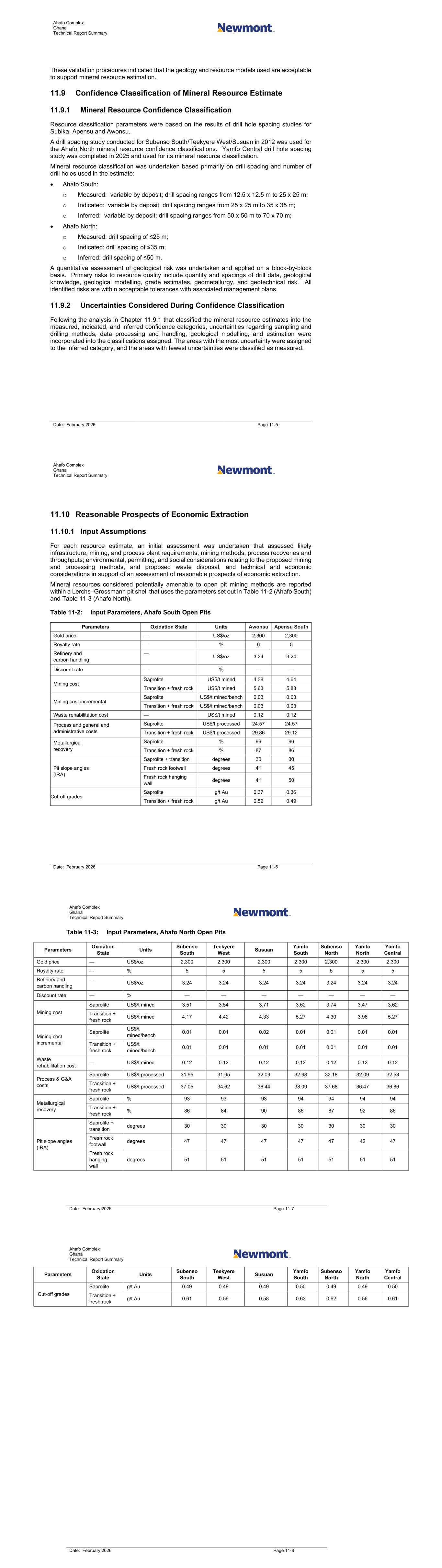
Ahafo Complex Ghana Technical Report Summary Date: February 2026 Page 11-5 These validation procedures indicated that the geology and resource models used are acceptable to support mineral resource estimation. 11.9 Confidence Classification of Mineral Resource Estimate 11.9.1 Mineral Resource Confidence Classification Resource classification parameters were based on the results of drill hole spacing studies for Subika, Apensu and Awonsu. A drill spacing study conducted for Subenso South/Teekyere West/Susuan in 2012 was used for the Ahafo North mineral resource confidence classifications. Yamfo Central drill hole spacing study was completed in 2025 and used for its mineral resource classification. Mineral resource classification was undertaken based primarily on drill spacing and number of drill holes used in the estimate: • Ahafo South: o Measured: variable by deposit; drill spacing ranges from 12.5 x 12.5 m to 25 x 25 m; o Indicated: variable by deposit; drill spacing ranges from 25 x 25 m to 35 x 35 m; o Inferred: variable by deposit; drill spacing ranges from 50 x 50 m to 70 x 70 m; • Ahafo North: o Measured: drill spacing of ≤25 m; o Indicated: drill spacing of ≤35 m; o Inferred: drill spacing of ≤50 m. A quantitative assessment of geological risk was undertaken and applied on a block-by-block basis. Primary risks to resource quality include quantity and spacings of drill data, geological knowledge, geological modelling, grade estimates, geometallurgy, and geotechnical risk. All identified risks are within acceptable tolerances with associated management plans. 11.9.2 Uncertainties Considered During Confidence Classification Following the analysis in Chapter 11.9.1 that classified the mineral resource estimates into the measured, indicated, and inferred confidence categories, uncertainties regarding sampling and drilling methods, data processing and handling, geological modelling, and estimation were incorporated into the classifications assigned. The areas with the most uncertainty were assigned to the inferred category, and the areas with fewest uncertainties were classified as measured. Ahafo Complex Ghana Technical Report Summary Date: February 2026 Page 11-6 11.10 Reasonable Prospects of Economic Extraction 11.10.1 Input Assumptions For each resource estimate, an initial assessment was undertaken that assessed likely infrastructure, mining, and process plant requirements; mining methods; process recoveries and throughputs; environmental, permitting, and social considerations relating to the proposed mining and processing methods, and proposed waste disposal, and technical and economic considerations in support of an assessment of reasonable prospects of economic extraction. Mineral resources considered potentially amenable to open pit mining methods are reported within a Lerchs–Grossmann pit shell that uses the parameters set out in Table 11-2 (Ahafo South) and Table 11-3 (Ahafo North). Table 11-2: Input Parameters, Ahafo South Open Pits Parameters Oxidation State Units Awonsu Apensu South Gold price — US$/oz 2,300 2,300 Royalty rate — % 6 5 Refinery and carbon handling — US$/oz 3.24 3.24 Discount rate — % — — Mining cost Saprolite US$/t mined 4.38 4.64 Transition + fresh rock US$/t mined 5.63 5.88 Mining cost incremental Saprolite US$/t mined/bench 0.03 0.03 Transition + fresh rock US$/t mined/bench 0.03 0.03 Waste rehabilitation cost — US$/t mined 0.12 0.12 Process and general and administrative costs Saprolite US$/t processed 24.57 24.57 Transition + fresh rock US$/t processed 29.86 29.12 Metallurgical recovery Saprolite % 96 96 Transition + fresh rock % 87 86 Pit slope angles (IRA) Saprolite + transition degrees 30 30 Fresh rock footwall degrees 41 45 Fresh rock hanging wall degrees 41 50 Cut-off grades Saprolite g/t Au 0.37 0.36 Transition + fresh rock g/t Au 0.52 0.49 Ahafo Complex Ghana Technical Report Summary Date: February 2026 Page 11-7 Table 11-3: Input Parameters, Ahafo North Open Pits Parameters Oxidation State Units Subenso South Teekyere West Susuan Yamfo South Subenso North Yamfo North Yamfo Central Gold price — US$/oz 2,300 2,300 2,300 2,300 2,300 2,300 2,300 Royalty rate — % 5 5 5 5 5 5 5 Refinery and carbon handling — US$/oz 3.24 3.24 3.24 3.24 3.24 3.24 3.24 Discount rate — % — — — — — — — Mining cost Saprolite US$/t mined 3.51 3.54 3.71 3.62 3.74 3.47 3.62 Transition + fresh rock US$/t mined 4.17 4.42 4.33 5.27 4.30 3.96 5.27 Mining cost incremental Saprolite US$/t mined/bench 0.01 0.01 0.02 0.01 0.01 0.01 0.01 Transition + fresh rock US$/t mined/bench 0.01 0.01 0.01 0.01 0.01 0.01 0.01 Waste rehabilitation cost — US$/t mined 0.12 0.12 0.12 0.12 0.12 0.12 0.12 Process & G&A costs Saprolite US$/t processed 31.95 31.95 32.09 32.98 32.18 32.09 32.53 Transition + fresh rock US$/t processed 37.05 34.62 36.44 38.09 37.68 36.47 36.86 Metallurgical recovery Saprolite % 93 93 93 94 94 94 94 Transition + fresh rock % 86 84 90 86 87 92 86 Pit slope angles (IRA) Saprolite + transition degrees 30 30 30 30 30 30 30 Fresh rock footwall degrees 47 47 47 47 47 42 47 Fresh rock hanging wall degrees 51 51 51 51 51 51 51 Ahafo Complex Ghana Technical Report Summary Date: February 2026 Page 11-8 Parameters Oxidation State Units Subenso South Teekyere West Susuan Yamfo South Subenso North Yamfo North Yamfo Central Cut-off grades Saprolite g/t Au 0.49 0.49 0.49 0.50 0.49 0.49 0.50 Transition + fresh rock g/t Au 0.61 0.59 0.58 0.63 0.62 0.56 0.61
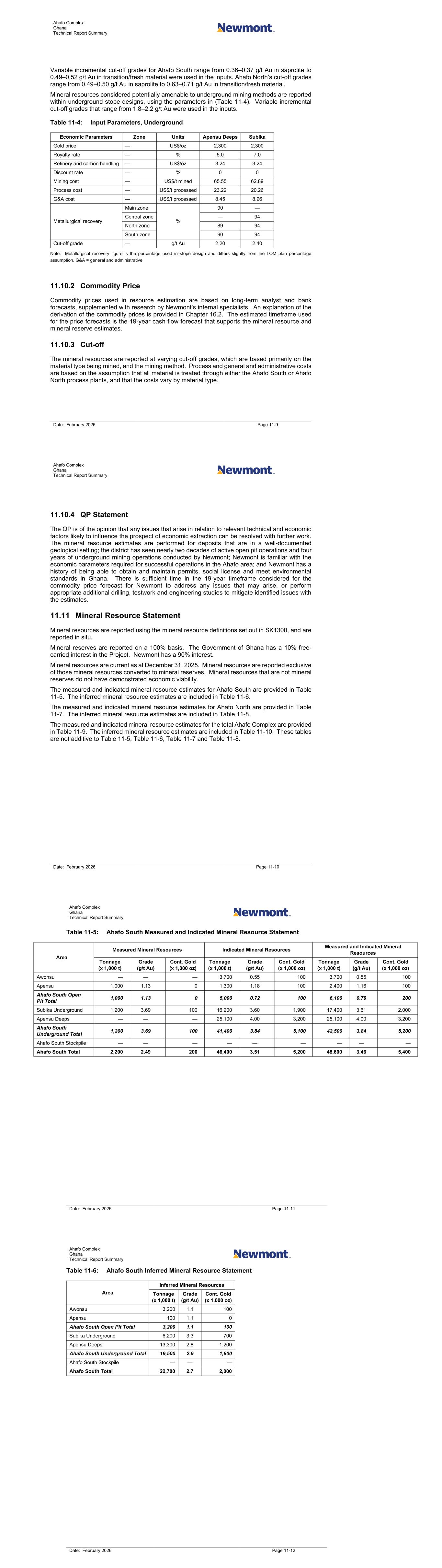
Ahafo Complex Ghana Technical Report Summary Date: February 2026 Page 11-9 Variable incremental cut-off grades for Ahafo South range from 0.36–0.37 g/t Au in saprolite to 0.49–0.52 g/t Au in transition/fresh material were used in the inputs. Ahafo North’s cut-off grades range from 0.49–0.50 g/t Au in saprolite to 0.63–0.71 g/t Au in transition/fresh material. Mineral resources considered potentially amenable to underground mining methods are reported within underground stope designs, using the parameters in (Table 11-4). Variable incremental cut-off grades that range from 1.8–2.2 g/t Au were used in the inputs. Table 11-4: Input Parameters, Underground Economic Parameters Zone Units Apensu Deeps Subika Gold price — US$/oz 2,300 2,300 Royalty rate — % 5.0 7.0 Refinery and carbon handling — US$/oz 3.24 3.24 Discount rate — % 0 0 Mining cost — US$/t mined 65.55 62.89 Process cost — US$/t processed 23.22 20.26 G&A cost — US$/t processed 8.45 8.96 Metallurgical recovery Main zone % 90 — Central zone — 94 North zone 89 94 South zone 90 94 Cut-off grade — g/t Au 2.20 2.40 Note: Metallurgical recovery figure is the percentage used in stope design and differs slightly from the LOM plan percentage assumption. G&A = general and administrative 11.10.2 Commodity Price Commodity prices used in resource estimation are based on long-term analyst and bank forecasts, supplemented with research by Newmont’s internal specialists. An explanation of the derivation of the commodity prices is provided in Chapter 16.2. The estimated timeframe used for the price forecasts is the 19-year cash flow forecast that supports the mineral resource and mineral reserve estimates. 11.10.3 Cut-off The mineral resources are reported at varying cut-off grades, which are based primarily on the material type being mined, and the mining method. Process and general and administrative costs are based on the assumption that all material is treated through either the Ahafo South or Ahafo North process plants, and that the costs vary by material type. Ahafo Complex Ghana Technical Report Summary Date: February 2026 Page 11-10 11.10.4 QP Statement The QP is of the opinion that any issues that arise in relation to relevant technical and economic factors likely to influence the prospect of economic extraction can be resolved with further work. The mineral resource estimates are performed for deposits that are in a well-documented geological setting; the district has seen nearly two decades of active open pit operations and four years of underground mining operations conducted by Newmont; Newmont is familiar with the economic parameters required for successful operations in the Ahafo area; and Newmont has a history of being able to obtain and maintain permits, social license and meet environmental standards in Ghana. There is sufficient time in the 19-year timeframe considered for the commodity price forecast for Newmont to address any issues that may arise, or perform appropriate additional drilling, testwork and engineering studies to mitigate identified issues with the estimates. 11.11 Mineral Resource Statement Mineral resources are reported using the mineral resource definitions set out in SK1300, and are reported in situ. Mineral reserves are reported on a 100% basis. The Government of Ghana has a 10% free- carried interest in the Project. Newmont has a 90% interest. Mineral resources are current as at December 31, 2025. Mineral resources are reported exclusive of those mineral resources converted to mineral reserves. Mineral resources that are not mineral reserves do not have demonstrated economic viability. The measured and indicated mineral resource estimates for Ahafo South are provided in Table 11-5. The inferred mineral resource estimates are included in Table 11-6. The measured and indicated mineral resource estimates for Ahafo North are provided in Table 11-7. The inferred mineral resource estimates are included in Table 11-8. The measured and indicated mineral resource estimates for the total Ahafo Complex are provided in Table 11-9. The inferred mineral resource estimates are included in Table 11-10. These tables are not additive to Table 11-5, Table 11-6, Table 11-7 and Table 11-8. Ahafo Complex Ghana Technical Report Summary Date: February 2026 Page 11-11 Table 11-5: Ahafo South Measured and Indicated Mineral Resource Statement Area Measured Mineral Resources Indicated Mineral Resources Measured and Indicated Mineral Resources Tonnage (x 1,000 t) Grade (g/t Au) Cont. Gold (x 1,000 oz) Tonnage (x 1,000 t) Grade (g/t Au) Cont. Gold (x 1,000 oz) Tonnage (x 1,000 t) Grade (g/t Au) Cont. Gold (x 1,000 oz) Awonsu — — — 3,700 0.55 100 3,700 0.55 100 Apensu 1,000 1.13 0 1,300 1.18 100 2,400 1.16 100 Ahafo South Open Pit Total 1,000 1.13 0 5,000 0.72 100 6,100 0.79 200 Subika Underground 1,200 3.69 100 16,200 3.60 1,900 17,400 3.61 2,000 Apensu Deeps — — — 25,100 4.00 3,200 25,100 4.00 3,200 Ahafo South Underground Total 1,200 3.69 100 41,400 3.84 5,100 42,500 3.84 5,200 Ahafo South Stockpile — — — — — — — — — Ahafo South Total 2,200 2.49 200 46,400 3.51 5,200 48,600 3.46 5,400 Ahafo Complex Ghana Technical Report Summary Date: February 2026 Page 11-12 Table 11-6: Ahafo South Inferred Mineral Resource Statement Area Inferred Mineral Resources Tonnage (x 1,000 t) Grade (g/t Au) Cont. Gold (x 1,000 oz) Awonsu 3,200 1.1 100 Apensu 100 1.1 0 Ahafo South Open Pit Total 3,200 1.1 100 Subika Underground 6,200 3.3 700 Apensu Deeps 13,300 2.8 1,200 Ahafo South Underground Total 19,500 2.9 1,800 Ahafo South Stockpile — — — Ahafo South Total 22,700 2.7 2,000
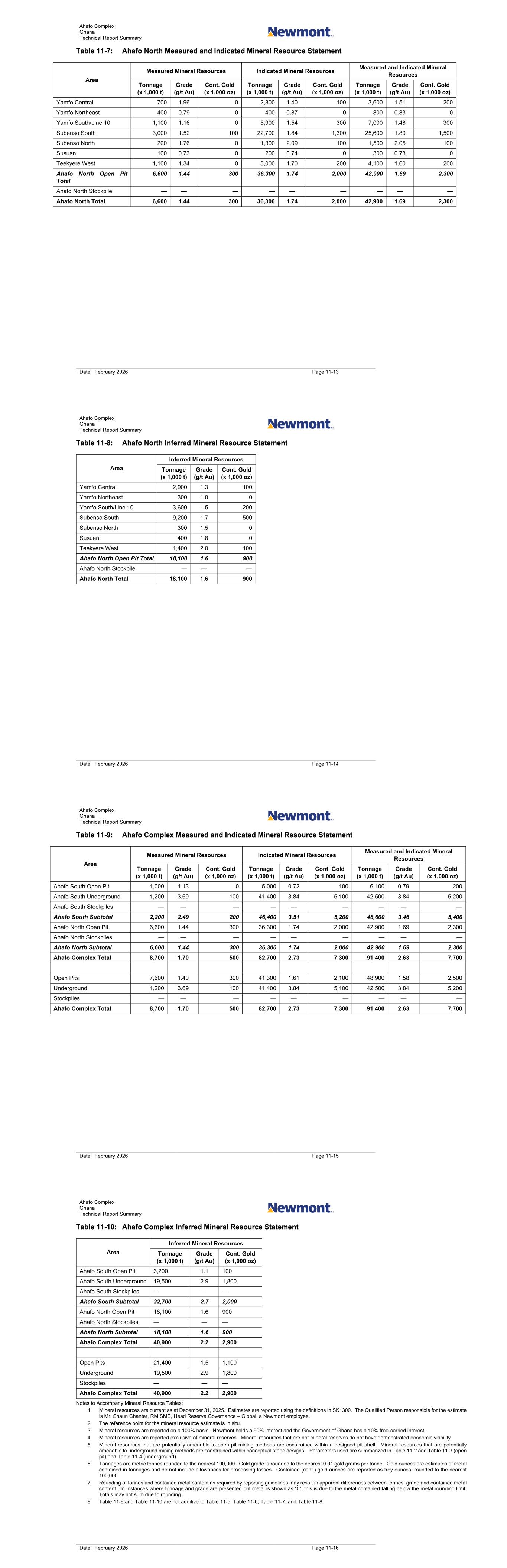
Ahafo Complex Ghana Technical Report Summary Date: February 2026 Page 11-13 Table 11-7: Ahafo North Measured and Indicated Mineral Resource Statement Area Measured Mineral Resources Indicated Mineral Resources Measured and Indicated Mineral Resources Tonnage (x 1,000 t) Grade (g/t Au) Cont. Gold (x 1,000 oz) Tonnage (x 1,000 t) Grade (g/t Au) Cont. Gold (x 1,000 oz) Tonnage (x 1,000 t) Grade (g/t Au) Cont. Gold (x 1,000 oz) Yamfo Central 700 1.96 0 2,800 1.40 100 3,600 1.51 200 Yamfo Northeast 400 0.79 0 400 0.87 0 800 0.83 0 Yamfo South/Line 10 1,100 1.16 0 5,900 1.54 300 7,000 1.48 300 Subenso South 3,000 1.52 100 22,700 1.84 1,300 25,600 1.80 1,500 Subenso North 200 1.76 0 1,300 2.09 100 1,500 2.05 100 Susuan 100 0.73 0 200 0.74 0 300 0.73 0 Teekyere West 1,100 1.34 0 3,000 1.70 200 4,100 1.60 200 Ahafo North Open Pit Total 6,600 1.44 300 36,300 1.74 2,000 42,900 1.69 2,300 Ahafo North Stockpile — — — — — — — — — Ahafo North Total 6,600 1.44 300 36,300 1.74 2,000 42,900 1.69 2,300 Ahafo Complex Ghana Technical Report Summary Date: February 2026 Page 11-14 Table 11-8: Ahafo North Inferred Mineral Resource Statement Area Inferred Mineral Resources Tonnage (x 1,000 t) Grade (g/t Au) Cont. Gold (x 1,000 oz) Yamfo Central 2,900 1.3 100 Yamfo Northeast 300 1.0 0 Yamfo South/Line 10 3,600 1.5 200 Subenso South 9,200 1.7 500 Subenso North 300 1.5 0 Susuan 400 1.8 0 Teekyere West 1,400 2.0 100 Ahafo North Open Pit Total 18,100 1.6 900 Ahafo North Stockpile — — — Ahafo North Total 18,100 1.6 900 Ahafo Complex Ghana Technical Report Summary Date: February 2026 Page 11-15 Table 11-9: Ahafo Complex Measured and Indicated Mineral Resource Statement Area Measured Mineral Resources Indicated Mineral Resources Measured and Indicated Mineral Resources Tonnage (x 1,000 t) Grade (g/t Au) Cont. Gold (x 1,000 oz) Tonnage (x 1,000 t) Grade (g/t Au) Cont. Gold (x 1,000 oz) Tonnage (x 1,000 t) Grade (g/t Au) Cont. Gold (x 1,000 oz) Ahafo South Open Pit 1,000 1.13 0 5,000 0.72 100 6,100 0.79 200 Ahafo South Underground 1,200 3.69 100 41,400 3.84 5,100 42,500 3.84 5,200 Ahafo South Stockpiles — — — — — — — — — Ahafo South Subtotal 2,200 2.49 200 46,400 3.51 5,200 48,600 3.46 5,400 Ahafo North Open Pit 6,600 1.44 300 36,300 1.74 2,000 42,900 1.69 2,300 Ahafo North Stockpiles — — — — — — — — — Ahafo North Subtotal 6,600 1.44 300 36,300 1.74 2,000 42,900 1.69 2,300 Ahafo Complex Total 8,700 1.70 500 82,700 2.73 7,300 91,400 2.63 7,700 Open Pits 7,600 1.40 300 41,300 1.61 2,100 48,900 1.58 2,500 Underground 1,200 3.69 100 41,400 3.84 5,100 42,500 3.84 5,200 Stockpiles — — — — — — — — — Ahafo Complex Total 8,700 1.70 500 82,700 2.73 7,300 91,400 2.63 7,700 Ahafo Complex Ghana Technical Report Summary Date: February 2026 Page 11-16 Table 11-10: Ahafo Complex Inferred Mineral Resource Statement Area Inferred Mineral Resources Tonnage (x 1,000 t) Grade (g/t Au) Cont. Gold (x 1,000 oz) Ahafo South Open Pit 3,200 1.1 100 Ahafo South Underground 19,500 2.9 1,800 Ahafo South Stockpiles — — — Ahafo South Subtotal 22,700 2.7 2,000 Ahafo North Open Pit 18,100 1.6 900 Ahafo North Stockpiles — — — Ahafo North Subtotal 18,100 1.6 900 Ahafo Complex Total 40,900 2.2 2,900 Open Pits 21,400 1.5 1,100 Underground 19,500 2.9 1,800 Stockpiles — — — Ahafo Complex Total 40,900 2.2 2,900 Notes to Accompany Mineral Resource Tables: 1. Mineral resources are current as at December 31, 2025. Estimates are reported using the definitions in SK1300. The Qualified Person responsible for the estimate is Mr. Shaun Chanter, RM SME, Head Reserve Governance – Global, a Newmont employee. 2. The reference point for the mineral resource estimate is in situ. 3. Mineral resources are reported on a 100% basis. Newmont holds a 90% interest and the Government of Ghana has a 10% free-carried interest. 4. Mineral resources are reported exclusive of mineral reserves. Mineral resources that are not mineral reserves do not have demonstrated economic viability. 5. Mineral resources that are potentially amenable to open pit mining methods are constrained within a designed pit shell. Mineral resources that are potentially amenable to underground mining methods are constrained within conceptual stope designs. Parameters used are summarized in Table 11-2 and Table 11-3 (open pit) and Table 11-4 (underground). 6. Tonnages are metric tonnes rounded to the nearest 100,000. Gold grade is rounded to the nearest 0.01 gold grams per tonne. Gold ounces are estimates of metal contained in tonnages and do not include allowances for processing losses. Contained (cont.) gold ounces are reported as troy ounces, rounded to the nearest 100,000. 7. Rounding of tonnes and contained metal content as required by reporting guidelines may result in apparent differences between tonnes, grade and contained metal content. In instances where tonnage and grade are presented but metal is shown as “0”, this is due to the metal contained falling below the metal rounding limit. Totals may not sum due to rounding. 8. Table 11-9 and Table 11-10 are not additive to Table 11-5, Table 11-6, Table 11-7, and Table 11-8.

Ahafo Complex Ghana Technical Report Summary Date: February 2026 Page 11-17 11.12 Uncertainties (Factors) That May Affect the Mineral Resource Estimate Areas of uncertainty that may materially impact all of the mineral resource estimates include: • Changes to long-term metal price and exchange rate assumptions; • Changes in local interpretations of mineralization geometry such as pinch and swell morphology, extent of brecciation, presence of unrecognized mineralization off-shoots; faults, dikes, and other structures; and continuity of mineralized zones; • Changes to geological and grade shape, and geological and grade continuity assumptions; • Changes to unfolding, variographical interpretations and search ellipse ranges that were interpreted based on limited drill data, when closer-spaced drilling becomes available; • Changes to metallurgical recovery assumptions; • Changes to the input assumptions used to derive the potentially-mineable shapes applicable to the assumed underground and open pit mining methods used to constrain the estimates; • Changes to the forecast dilution and mining recovery assumptions; • Changes to the cut-off values applied to the estimates; • Variations in geotechnical (including seismicity), hydrogeological and mining method assumptions; • Changes to environmental, permitting, and social license assumptions. To the extent known to the QP, there are no other known environmental, permitting, legal, title related, taxation, socio-political or marketing issues that could materially affect the mineral resource estimate that are not discussed in this Report. Ahafo Complex Ghana Technical Report Summary Date: February 2026 Page 12-1 12.0 MINERAL RESERVE ESTIMATES 12.1 Introduction Measured and indicated mineral resources were converted to mineral reserves. All Inferred blocks are classified as waste in the cash flow analysis that supports mineral reserve estimation. Mineral reserves in the Ahafo South area are estimated for the Subika, Apensu South and Awonsu deposits. Apensu South and Awonsu deposits assuming open pit mining, and for Subika, assuming underground mining. Stockpiled material is also included in the mineral reserves estimates. The Geovia Whittle pit optimization program (Whittle 2022) was used to perform a Lerchs–Grossmann optimization in support of mineral reserves reporting for mineralization amenable to open pit mining methods. A safety crown pillar of 25 m is left between the base of the Subika Phase 4 pit which is depleted and the top of the Subika underground stopes. This pillar will not be mined and thus makes Phase 4 the final open pit limit for the Subika deposit. Mineral reserves in the Ahafo North area are estimated for the Yamfo South, Yamfo Northeast, Susuan, Subenso South, Subenso North and Teekyere West deposits. The Lerchs–Grossmann algorithm in Whittle was used to determine economic mining limits for the different deposits. MineSight MS3D was used to define ultimate pit designs and pit phases based on the Whittle outcomes. MS3D was also used as a primary tool to define outlines for waste rock facilities, stockpiles, and to produce physical features required for mine planning. 12.2 Open Pit Estimates 12.2.1 Pit Optimization For mineral reserves, Newmont applies a time discount factor to the dollar value block model that is generated in the Lerchs–Grossmann pit-limit analysis, to account for the fact that a pit will be mined over a period of years, and that the cost of waste stripping in the early years must bear the cost of the time value of money. In some deposits, where mineralization is uniformly distributed throughout the pit, or where the pit is shallow, discounting has little effect on the economic pit limit. For the Awonsu, Apensu South and Ahafo North deposits, where upper benches contain a high percentage of the waste, and mineralization quantities and/or grade increase with depth, discounting provides a smaller pit limit upon which mine designs are based. Pit discounting is accomplished by running the pit-limit “dollar” model through a program that discounts the dollar model values at a compound rate based on the depth of the block. In this manner, discounting is applied to future costs as well as future revenues, to represent the fact that mining proceeds from the top down within a phase. Optimization work involved floating pit shells at a series of gold prices. The generated nested pit shells were evaluated using the mineral reserve gold price of US$2,000/oz and an 8% discount Ahafo Complex Ghana Technical Report Summary Date: February 2026 Page 12-2 rate. The pit shells with the highest net present value were selected for detailed engineering design work. A realistic schedule was developed in order to determine the optimal pit shell for each deposit; schedule inputs include the minimum mining width, and vertical rate of advance, mining rate, and mining sequence. Whittle analysis indicated a two-stage pit development was the best option for Awonsu, using a minimum mining width of 50 m, and one-stage pit development was optimal for Apensu South. The Ahafo North Whittle analysis indicates staged pit development was appropriate for the majority of the mineral reserve pits. These are shown on the figures included in Chapter 13.3. 12.2.2 Optimization Inputs 12.2.2.1 Ahafo South Operating costs for mining, processing, site, and Accra administration were developed as part of the 2026 business plan (BP26) process. The costs build-up for the LOM in that plan included assumptions based on a number of projected cost-saving measures and efficiency gains. Costs were un-escalated. Input parameters used in the constraining pit shells are summarized in Table 12-1. Geotechnical assumptions are discussed in Chapter 13.2.1. The costs developed as part of the LOM plan were based on a three-shovel mining fleet through to the end of the mine life. Truck and drill quantities were forecast and budgeted during the business planning process based on detailed studies. MineSight’s MSHaulage software was used to generate haulage distances and travel times based on truck field studies and site-based speed tables. The travel times were input into XERAS software, together with the mining and process schedule, to generate the required truck quantities per period. Drill quantities were forecast based on mining rates, pattern size, and pit specific penetration rates. Process costs were determined for each pit and material type (oxide and primary) using BP26 and results of internal studies. The theoretical process cost per tonne was determined for each material type from both the BP26 costs and the forecast ore feed blend. Reclamation and closure costs were estimated based on site environmental calculations. Mine operating costs are sensitive to the cost of diesel fuel. Mineral reserves assume US$0.93/L diesel for Brent pricing as per Newmont’s internal corporate guidance and account for Ghanaian taxes and local delivery. Mill operating costs are sensitive to the cost of electrical power. The mineral reserves assume a power cost of US$0.125 per kWh based on Newmont’s estimate of long-term power costs. An average profile of 27 Mt/a mined and processing rates of 10 Mt were used for Ahafo South. Ahafo Complex Ghana Technical Report Summary Date: February 2026 Page 12-3 Table 12-1: Pit Design Assumptions, Ahafo South Parameters Oxidation Units Apensu South Awonsu Gold price US$/oz 2,000 2,000 Royalty rate % 5 6 Royalty US$/oz 100 120 Refinery and carbon handling US$/oz 3.24 3.24 Discount rate % 8 8 Mining cost Saprolite US$/t mined 4.64 4.38 Transition + fresh rock US$/t mined 5.88 5.63 Mining cost incremental Saprolite US$/t mined/bench 0.03 0.03 Transition + fresh rock US$/t mined/bench 0.03 0.03 Waste rehabilitation cost US$/t mined 0.12 0.12 Process & G&A cost Saprolite US$/t processed 24.57 24.57 Transition + fresh rock US$/t processed 29.12 29.86 Metallurgical recovery Saprolite % 96 96 Transition + fresh rock % 84 84 Pit slope angles (IRA) Saprolite + transition degrees 28 27 Fresh rock footwall degrees 44 41 Fresh rock hanging wall degrees 36 45 Cut-off grade Saprolite g/t 0.41 0.42 Transition/primary g/t 0.56 0.59 Note: G&A = general and administrative, IRA = inter-ramp angle
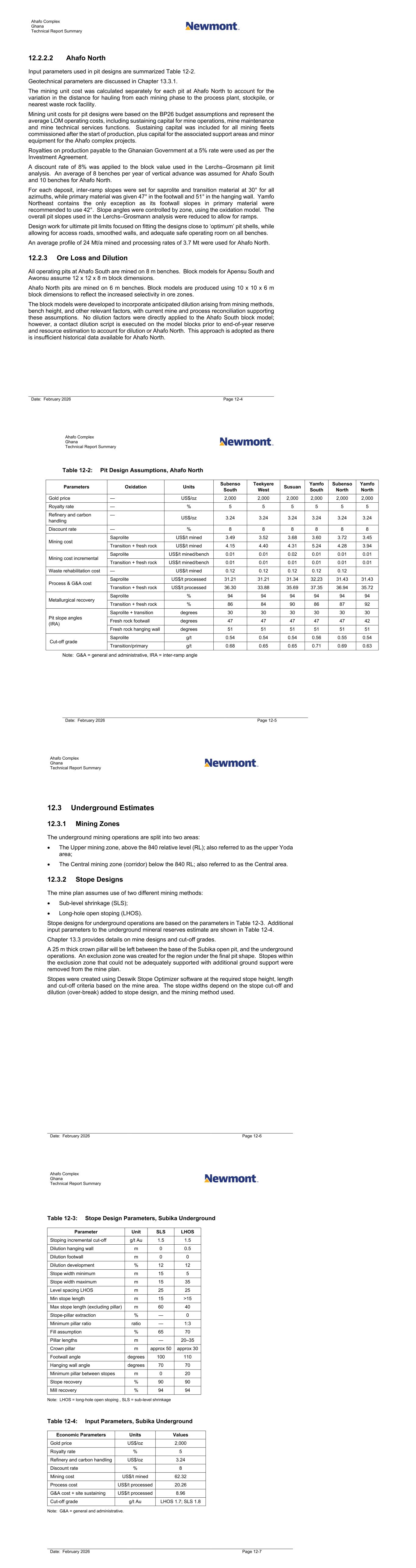
Ahafo Complex Ghana Technical Report Summary Date: February 2026 Page 12-4 12.2.2.2 Ahafo North Input parameters used in pit designs are summarized Table 12-2. Geotechnical parameters are discussed in Chapter 13.3.1. The mining unit cost was calculated separately for each pit at Ahafo North to account for the variation in the distance for hauling from each mining phase to the process plant, stockpile, or nearest waste rock facility. Mining unit costs for pit designs were based on the BP26 budget assumptions and represent the average LOM operating costs, including sustaining capital for mine operations, mine maintenance and mine technical services functions. Sustaining capital was included for all mining fleets commissioned after the start of production, plus capital for the associated support areas and minor equipment for the Ahafo complex projects. Royalties on production payable to the Ghanaian Government at a 5% rate were used as per the Investment Agreement. A discount rate of 8% was applied to the block value used in the Lerchs–Grosmann pit limit analysis. An average of 8 benches per year of vertical advance was assumed for Ahafo South and 10 benches for Ahafo North. For each deposit, inter-ramp slopes were set for saprolite and transition material at 30° for all azimuths, while primary material was given 47° in the footwall and 51° in the hanging wall. Yamfo Northeast contains the only exception as its footwall slopes in primary material were recommended to use 42°. Slope angles were controlled by zone, using the oxidation model. The overall pit slopes used in the Lerchs–Grosmann analysis were reduced to allow for ramps. Design work for ultimate pit limits focused on fitting the designs close to ‘optimum’ pit shells, while allowing for access roads, smoothed walls, and adequate safe operating room on all benches. An average profile of 24 Mt/a mined and processing rates of 3.7 Mt were used for Ahafo North. 12.2.3 Ore Loss and Dilution All operating pits at Ahafo South are mined on 8 m benches. Block models for Apensu South and Awonsu assume 12 x 12 x 8 m block dimensions. Ahafo North pits are mined on 6 m benches. Block models are produced using 10 x 10 x 6 m block dimensions to reflect the increased selectivity in ore zones. The block models were developed to incorporate anticipated dilution arising from mining methods, bench height, and other relevant factors, with current mine and process reconciliation supporting these assumptions. No dilution factors were directly applied to the Ahafo South block model; however, a contact dilution script is executed on the model blocks prior to end-of-year reserve and resource estimation to account for dilution or Ahafo North. This approach is adopted as there is insufficient historical data available for Ahafo North. Ahafo Complex Ghana Technical Report Summary Date: February 2026 Page 12-5 Table 12-2: Pit Design Assumptions, Ahafo North Note: G&A = general and administrative, IRA = inter-ramp angle Parameters Oxidation Units Subenso South Teekyere West Susuan Yamfo South Subenso North Yamfo North Gold price — US$/oz 2,000 2,000 2,000 2,000 2,000 2,000 Royalty rate — % 5 5 5 5 5 5 Refinery and carbon handling — US$/oz 3.24 3.24 3.24 3.24 3.24 3.24 Discount rate — % 8 8 8 8 8 8 Mining cost Saprolite US$/t mined 3.49 3.52 3.68 3.60 3.72 3.45 Transition + fresh rock US$/t mined 4.15 4.40 4.31 5.24 4.28 3.94 Mining cost incremental Saprolite US$/t mined/bench 0.01 0.01 0.02 0.01 0.01 0.01 Transition + fresh rock US$/t mined/bench 0.01 0.01 0.01 0.01 0.01 0.01 Waste rehabilitation cost — US$/t mined 0.12 0.12 0.12 0.12 0.12 Process & G&A cost Saprolite US$/t processed 31.21 31.21 31.34 32.23 31.43 31.43 Transition + fresh rock US$/t processed 36.30 33.88 35.69 37.35 36.94 35.72 Metallurgical recovery Saprolite % 94 94 94 94 94 94 Transition + fresh rock % 86 84 90 86 87 92 Pit slope angles (IRA) Saprolite + transition degrees 30 30 30 30 30 30 Fresh rock footwall degrees 47 47 47 47 47 42 Fresh rock hanging wall degrees 51 51 51 51 51 51 Cut-off grade Saprolite g/t 0.54 0.54 0.54 0.56 0.55 0.54 Transition/primary g/t 0.68 0.65 0.65 0.71 0.69 0.63 Ahafo Complex Ghana Technical Report Summary Date: February 2026 Page 12-6 12.3 Underground Estimates 12.3.1 Mining Zones The underground mining operations are split into two areas: • The Upper mining zone, above the 840 relative level (RL); also referred to as the upper Yoda area; • The Central mining zone (corridor) below the 840 RL; also referred to as the Central area. 12.3.2 Stope Designs The mine plan assumes use of two different mining methods: • Sub-level shrinkage (SLS); • Long-hole open stoping (LHOS). Stope designs for underground operations are based on the parameters in Table 12-3. Additional input parameters to the underground mineral reserves estimate are shown in Table 12-4. Chapter 13.3 provides details on mine designs and cut-off grades. A 25 m thick crown pillar will be left between the base of the Subika open pit, and the underground operations. An exclusion zone was created for the region under the final pit shape. Stopes within the exclusion zone that could not be adequately supported with additional ground support were removed from the mine plan. Stopes were created using Deswik Stope Optimizer software at the required stope height, length and cut-off criteria based on the mine area. The stope widths depend on the stope cut-off and dilution (over-break) added to stope design, and the mining method used. Ahafo Complex Ghana Technical Report Summary Date: February 2026 Page 12-7 Table 12-3: Stope Design Parameters, Subika Underground Parameter Unit SLS LHOS Stoping incremental cut-off g/t Au 1.5 1.5 Dilution hanging wall m 0 0.5 Dilution footwall m 0 0 Dilution development % 12 12 Stope width minimum m 15 5 Stope width maximum m 15 35 Level spacing LHOS m 25 25 Min stope length m 15 >15 Max stope length (excluding pillar) m 60 40 Stope-pillar extraction % — 0 Minimum pillar ratio ratio — 1:3 Fill assumption % 65 70 Pillar lengths m — 20–35 Crown pillar m approx 50 approx 30 Footwall angle degrees 100 110 Hanging wall angle degrees 70 70 Minimum pillar between stopes m 0 20 Stope recovery % 90 90 Mill recovery % 94 94 Note: LHOS = long-hole open stoping , SLS = sub-level shrinkage Table 12-4: Input Parameters, Subika Underground Economic Parameters Units Values Gold price US$/oz 2,000 Royalty rate % 5 Refinery and carbon handling US$/oz 3.24 Discount rate % 8 Mining cost US$/t mined 62.32 Process cost US$/t processed 20.26 G&A cost + site sustaining US$/t processed 8.96 Cut-off grade g/t Au LHOS 1.7; SLS 1.8 Note: G&A = general and administrative.
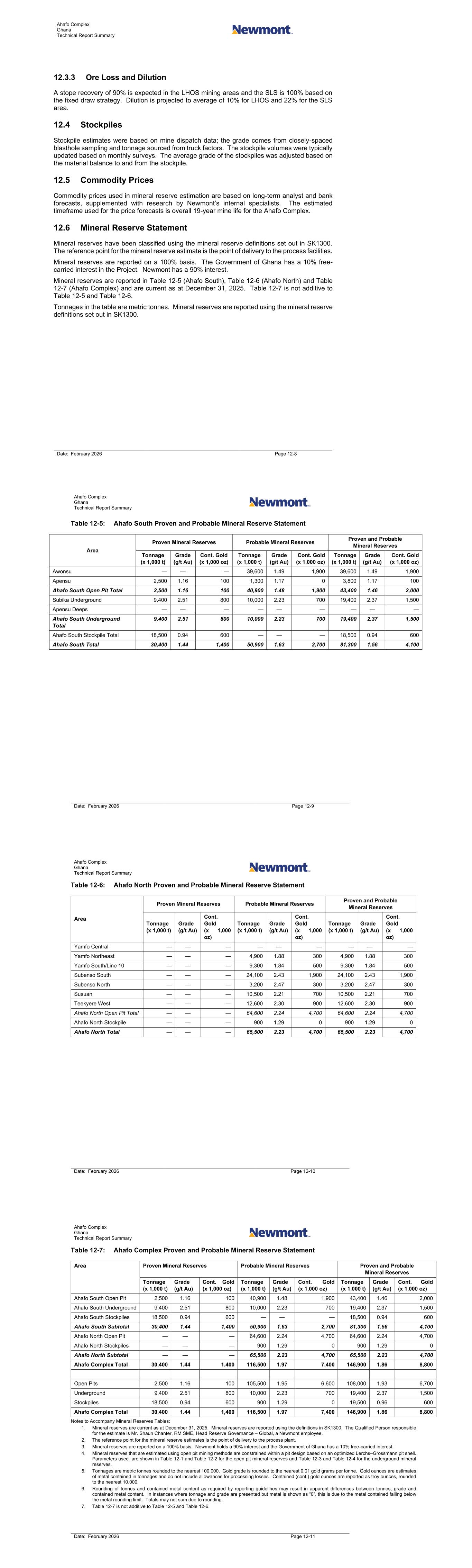
Ahafo Complex Ghana Technical Report Summary Date: February 2026 Page 12-8 12.3.3 Ore Loss and Dilution A stope recovery of 90% is expected in the LHOS mining areas and the SLS is 100% based on the fixed draw strategy. Dilution is projected to average of 10% for LHOS and 22% for the SLS area. 12.4 Stockpiles Stockpile estimates were based on mine dispatch data; the grade comes from closely-spaced blasthole sampling and tonnage sourced from truck factors. The stockpile volumes were typically updated based on monthly surveys. The average grade of the stockpiles was adjusted based on the material balance to and from the stockpile. 12.5 Commodity Prices Commodity prices used in mineral reserve estimation are based on long-term analyst and bank forecasts, supplemented with research by Newmont’s internal specialists. The estimated timeframe used for the price forecasts is overall 19-year mine life for the Ahafo Complex. 12.6 Mineral Reserve Statement Mineral reserves have been classified using the mineral reserve definitions set out in SK1300. The reference point for the mineral reserve estimate is the point of delivery to the process facilities. Mineral reserves are reported on a 100% basis. The Government of Ghana has a 10% free- carried interest in the Project. Newmont has a 90% interest. Mineral reserves are reported in Table 12-5 (Ahafo South), Table 12-6 (Ahafo North) and Table 12-7 (Ahafo Complex) and are current as at December 31, 2025. Table 12-7 is not additive to Table 12-5 and Table 12-6. Tonnages in the table are metric tonnes. Mineral reserves are reported using the mineral reserve definitions set out in SK1300. Ahafo Complex Ghana Technical Report Summary Date: February 2026 Page 12-9 Table 12-5: Ahafo South Proven and Probable Mineral Reserve Statement Area Proven Mineral Reserves Probable Mineral Reserves Proven and Probable Mineral Reserves Tonnage (x 1,000 t) Grade (g/t Au) Cont. Gold (x 1,000 oz) Tonnage (x 1,000 t) Grade (g/t Au) Cont. Gold (x 1,000 oz) Tonnage (x 1,000 t) Grade (g/t Au) Cont. Gold (x 1,000 oz) Awonsu — — — 39,600 1.49 1,900 39,600 1.49 1,900 Apensu 2,500 1.16 100 1,300 1.17 0 3,800 1.17 100 Ahafo South Open Pit Total 2,500 1.16 100 40,900 1.48 1,900 43,400 1.46 2,000 Subika Underground 9,400 2.51 800 10,000 2.23 700 19,400 2.37 1,500 Apensu Deeps — — — — — — — — — Ahafo South Underground Total 9,400 2.51 800 10,000 2.23 700 19,400 2.37 1,500 Ahafo South Stockpile Total 18,500 0.94 600 — — — 18,500 0.94 600 Ahafo South Total 30,400 1.44 1,400 50,900 1.63 2,700 81,300 1.56 4,100 Ahafo Complex Ghana Technical Report Summary Date: February 2026 Page 12-10 Table 12-6: Ahafo North Proven and Probable Mineral Reserve Statement Area Proven Mineral Reserves Probable Mineral Reserves Proven and Probable Mineral Reserves Tonnage (x 1,000 t) Grade (g/t Au) Cont. Gold (x 1,000 oz) Tonnage (x 1,000 t) Grade (g/t Au) Cont. Gold (x 1,000 oz) Tonnage (x 1,000 t) Grade (g/t Au) Cont. Gold (x 1,000 oz) Yamfo Central — — — — — — — — — Yamfo Northeast — — — 4,900 1.88 300 4,900 1.88 300 Yamfo South/Line 10 — — — 9,300 1.84 500 9,300 1.84 500 Subenso South — — — 24,100 2.43 1,900 24,100 2.43 1,900 Subenso North — — — 3,200 2.47 300 3,200 2.47 300 Susuan — — — 10,500 2.21 700 10,500 2.21 700 Teekyere West — — — 12,600 2.30 900 12,600 2.30 900 Ahafo North Open Pit Total — — — 64,600 2.24 4,700 64,600 2.24 4,700 Ahafo North Stockpile — — — 900 1.29 0 900 1.29 0 Ahafo North Total — — — 65,500 2.23 4,700 65,500 2.23 4,700 Ahafo Complex Ghana Technical Report Summary Date: February 2026 Page 12-11 Table 12-7: Ahafo Complex Proven and Probable Mineral Reserve Statement Area Proven Mineral Reserves Probable Mineral Reserves Proven and Probable Mineral Reserves Tonnage (x 1,000 t) Grade (g/t Au) Cont. Gold (x 1,000 oz) Tonnage (x 1,000 t) Grade (g/t Au) Cont. Gold (x 1,000 oz) Tonnage (x 1,000 t) Grade (g/t Au) Cont. Gold (x 1,000 oz) Ahafo South Open Pit 2,500 1.16 100 40,900 1.48 1,900 43,400 1.46 2,000 Ahafo South Underground 9,400 2.51 800 10,000 2.23 700 19,400 2.37 1,500 Ahafo South Stockpiles 18,500 0.94 600 — — — 18,500 0.94 600 Ahafo South Subtotal 30,400 1.44 1,400 50,900 1.63 2,700 81,300 1.56 4,100 Ahafo North Open Pit — — — 64,600 2.24 4,700 64,600 2.24 4,700 Ahafo North Stockpiles — — — 900 1.29 0 900 1.29 0 Ahafo North Subtotal — — — 65,500 2.23 4,700 65,500 2.23 4,700 Ahafo Complex Total 30,400 1.44 1,400 116,500 1.97 7,400 146,900 1.86 8,800 Open Pits 2,500 1.16 100 105,500 1.95 6,600 108,000 1.93 6,700 Underground 9,400 2.51 800 10,000 2.23 700 19,400 2.37 1,500 Stockpiles 18,500 0.94 600 900 1.29 0 19,500 0.96 600 Ahafo Complex Total 30,400 1.44 1,400 116,500 1.97 7,400 146,900 1.86 8,800 Notes to Accompany Mineral Reserves Tables: 1. Mineral reserves are current as at December 31, 2025. Mineral reserves are reported using the definitions in SK1300. The Qualified Person responsible for the estimate is Mr. Shaun Chanter, RM SME, Head Reserve Governance – Global, a Newmont employee. 2. The reference point for the mineral reserve estimates is the point of delivery to the process plant. 3. Mineral reserves are reported on a 100% basis. Newmont holds a 90% interest and the Government of Ghana has a 10% free-carried interest. 4. Mineral reserves that are estimated using open pit mining methods are constrained within a pit design based on an optimized Lerchs–Grossmann pit shell. Parameters used are shown in Table 12-1 and Table 12-2 for the open pit mineral reserves and Table 12-3 and Table 12-4 for the underground mineral reserves. 5. Tonnages are metric tonnes rounded to the nearest 100,000. Gold grade is rounded to the nearest 0.01 gold grams per tonne. Gold ounces are estimates of metal contained in tonnages and do not include allowances for processing losses. Contained (cont.) gold ounces are reported as troy ounces, rounded to the nearest 10,000. 6. Rounding of tonnes and contained metal content as required by reporting guidelines may result in apparent differences between tonnes, grade and contained metal content. In instances where tonnage and grade are presented but metal is shown as “0”, this is due to the metal contained falling below the metal rounding limit. Totals may not sum due to rounding. 7. Table 12-7 is not additive to Table 12-5 and Table 12-6.
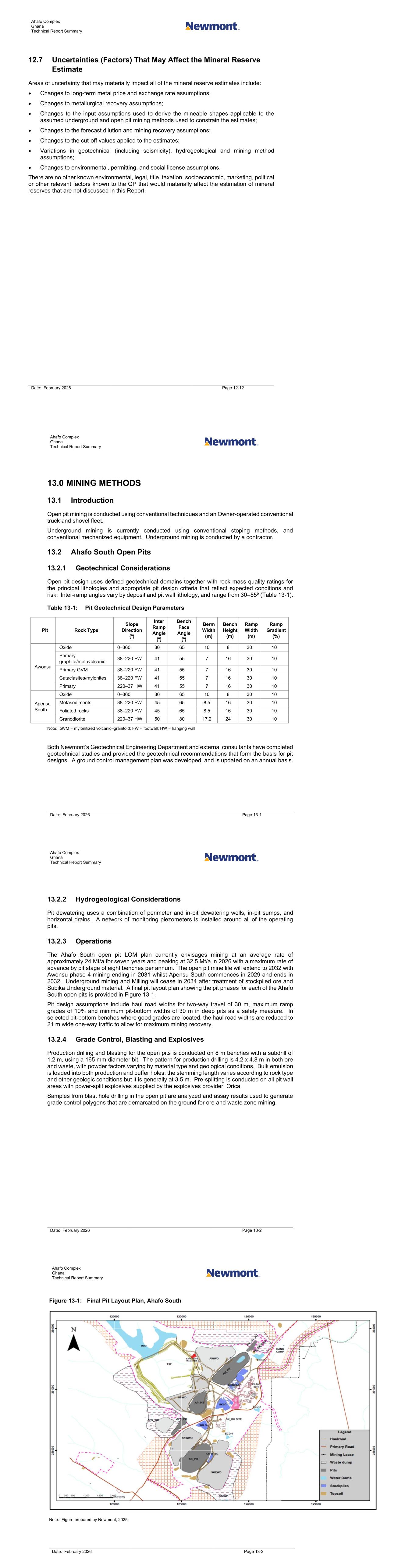
Ahafo Complex Ghana Technical Report Summary Date: February 2026 Page 12-12 12.7 Uncertainties (Factors) That May Affect the Mineral Reserve Estimate Areas of uncertainty that may materially impact all of the mineral reserve estimates include: • Changes to long-term metal price and exchange rate assumptions; • Changes to metallurgical recovery assumptions; • Changes to the input assumptions used to derive the mineable shapes applicable to the assumed underground and open pit mining methods used to constrain the estimates; • Changes to the forecast dilution and mining recovery assumptions; • Changes to the cut-off values applied to the estimates; • Variations in geotechnical (including seismicity), hydrogeological and mining method assumptions; • Changes to environmental, permitting, and social license assumptions. There are no other known environmental, legal, title, taxation, socioeconomic, marketing, political or other relevant factors known to the QP that would materially affect the estimation of mineral reserves that are not discussed in this Report. Ahafo Complex Ghana Technical Report Summary Date: February 2026 Page 13-1 13.0 MINING METHODS 13.1 Introduction Open pit mining is conducted using conventional techniques and an Owner-operated conventional truck and shovel fleet. Underground mining is currently conducted using conventional stoping methods, and conventional mechanized equipment. Underground mining is conducted by a contractor. 13.2 Ahafo South Open Pits 13.2.1 Geotechnical Considerations Open pit design uses defined geotechnical domains together with rock mass quality ratings for the principal lithologies and appropriate pit design criteria that reflect expected conditions and risk. Inter-ramp angles vary by deposit and pit wall lithology, and range from 30–55º (Table 13-1). Table 13-1: Pit Geotechnical Design Parameters Pit Rock Type Slope Direction (º) Inter Ramp Angle (º) Bench Face Angle (º) Berm Width (m) Bench Height (m) Ramp Width (m) Ramp Gradient (%) Awonsu Oxide 0–360 30 65 10 8 30 10 Primary graphite/metavolcanic 38–220 FW 41 55 7 16 30 10 Primary GVM 38–220 FW 41 55 7 16 30 10 Cataclasites/mylonites 38–220 FW 41 55 7 16 30 10 Primary 220–37 HW 41 55 7 16 30 10 Apensu South Oxide 0–360 30 65 10 8 30 10 Metasediments 38–220 FW 45 65 8.5 16 30 10 Foliated rocks 38–220 FW 45 65 8.5 16 30 10 Granodiorite 220–37 HW 50 80 17.2 24 30 10 Note: GVM = mylonitized volcanic–granitoid; FW = footwall; HW = hanging wall Both Newmont’s Geotechnical Engineering Department and external consultants have completed geotechnical studies and provided the geotechnical recommendations that form the basis for pit designs. A ground control management plan was developed, and is updated on an annual basis. Ahafo Complex Ghana Technical Report Summary Date: February 2026 Page 13-2 13.2.2 Hydrogeological Considerations Pit dewatering uses a combination of perimeter and in-pit dewatering wells, in-pit sumps, and horizontal drains. A network of monitoring piezometers is installed around all of the operating pits. 13.2.3 Operations The Ahafo South open pit LOM plan currently envisages mining at an average rate of approximately 24 Mt/a for seven years and peaking at 32.5 Mt/a in 2026 with a maximum rate of advance by pit stage of eight benches per annum. The open pit mine life will extend to 2032 with Awonsu phase 4 mining ending in 2031 whilst Apensu South commences in 2029 and ends in 2032. Underground mining and Milling will cease in 2034 after treatment of stockpiled ore and Subika Underground material. A final pit layout plan showing the pit phases for each of the Ahafo South open pits is provided in Figure 13-1. Pit design assumptions include haul road widths for two-way travel of 30 m, maximum ramp grades of 10% and minimum pit-bottom widths of 30 m in deep pits as a safety measure. In selected pit-bottom benches where good grades are located, the haul road widths are reduced to 21 m wide one-way traffic to allow for maximum mining recovery. 13.2.4 Grade Control, Blasting and Explosives Production drilling and blasting for the open pits is conducted on 8 m benches with a subdrill of 1.2 m, using a 165 mm diameter bit. The pattern for production drilling is 4.2 x 4.8 m in both ore and waste, with powder factors varying by material type and geological conditions. Bulk emulsion is loaded into both production and buffer holes; the stemming length varies according to rock type and other geologic conditions but it is generally at 3.5 m. Pre-splitting is conducted on all pit wall areas with power-split explosives supplied by the explosives provider, Orica. Samples from blast hole drilling in the open pit are analyzed and assay results used to generate grade control polygons that are demarcated on the ground for ore and waste zone mining. Ahafo Complex Ghana Technical Report Summary Date: February 2026 Page 13-3 Figure 13-1: Final Pit Layout Plan, Ahafo South Note: Figure prepared by Newmont, 2025.

Ahafo Complex Ghana Technical Report Summary Date: February 2026 Page 13-4 13.2.5 Equipment All Ahafo South open pit equipment is Owner-operated and owned. An equipment summary is provided in Table 13-2. Table 13-2: Equipment List, Ahafo South Item/Purpose Equipment Type Peak Number Production drills D45KS 7 Presplit drills D560 3 Production shovels Liebr9400 4 Haul trucks CAT 785C 29 Graders CAT16H&M 5 Loaders CAT 992K&G 5 13.2.6 Personnel The life-of-mine (LOM) workforce requirements estimate that approximately 473 personnel will be required to sustain the Ahafo South open pit mining operations. Ahafo Complex Ghana Technical Report Summary Date: February 2026 Page 13-5 13.3 Ahafo North Open Pits 13.3.1 Geotechnical Considerations For each pit, the design sectors consisted of the oxide sequence, primary rock footwall, and primary rock hanging wall and end-walls. Since mineralization occurs in the immediate hanging wall of the large-scale faults, the Ahafo North open pits will have relatively long hanging wall and footwall slopes aligned with the faults; and tight end-walls. The faults and the foliation represent potential structural controls that need to be considered in the pit slope designs, particularly for the primary rocks (note that relict structure can also affect slope performance in the oxide sequence, but this aspect is less of a concern because of flatter inter-ramp angles). Foliation will be in- dipping along the footwall slopes, and presents a potential control of achievable bench configurations. To account for the tendency for bench faces to break back to foliation, design bench face angles for most pits were defined at 65.3° for footwall slopes, and bench widths at 8.5 m (Table 13-3). Table 13-3: Pit Design Geotechnical Assumptions, Ahafo North Pit Rock Type Slope Direction (º) Inter Ramp Angle (º) Bench Face Angle (º) Berm Width (m) Bench Height (m) Ramp Width (m) Ramp Gradient (%) Subenso South Oxide 0–360 30 53.8 6 6 30 10 Primary 65–245 FW 47 65.3 8.5 18 30 10 Primary 65–245 HW 51 70 8 18 30 10 Teekyere West) Oxide 0.–360 30 53.8 6 6 30 10 Primary 55–235 FW 47 65.3 8.5 18 30 10 Primary 55–235 HW 51 70 8 18 30 10 Susuan (SU) Oxide 0–360 30 53.8 6 6 30 10 Primary 45–225 FW 47 65.3 8.5 18 30 10 Primary 45–225 HW 51 70 8 18 30 10 Yamfo South Oxide 0–360 30 53.8 6 6 30 10 Primary 50–235 FW 47 65.3 8.5 18 30 10 Primary 50–235 HW 51 70 8 18 30 10 Subenso North Oxide 0–360 30 53.8 6 6 30 10 Primary 75–245 FW 47 65.3 8.5 18 30 10 Primary 75–245 HW 51 70 8 18 30 10 Yamfo North Oxide 0–360 30 53.8 6 6 30 10 Primary 40–220 FW 42 50 5 18 30 10 Primary 40–220 HW 51 70 8 18 30 10 Ahafo Complex Ghana Technical Report Summary Date: February 2026 Page 13-6 Exceptions were: • Yamfo Northeast: the design bench face angle was defined at 50° to correspond with foliation. With an expected primary rock exposure height of about 40 m, a narrower 5 m catch bench width was used; • Subenso North: the 65° design bench face angle, and 8.5 m catch benches were applied in the footwall design for primary rock. However, this design bench face angle will undercut foliation, and some breakage along foliation will occur. This will reduce bench face angles in the primary rock exposures in the footwall slope where open fractures occur along foliation. However, with limited 30–35 m vertical exposure of primary rock, and some flexibility in the design [e.g., to the catch bench width, the provision of a 10 m step-out at the base of the saprolite, or to the ramp width], a relatively steep bench configuration was considered to be acceptable. In hanging wall and end-wall slopes, 70° bench face angles and 8 m benches were used for primary rock exposures in all pits. These parameters were selected based on a lack of structural control indicated in the oriented core data and a lack of significant structural control in these walls in the existing Ahafo South open pits. 13.3.2 Hydrogeological Considerations All of the proposed pits at Ahafo North are planned to extend below the pre-mining groundwater table; therefore, dewatering will be required during pit development. Given the limited effectiveness expected of dewatering wells, a network of in-pit sumps is the dewatering strategy that that will be employed. Inflows will vary between individual pits, with the mining depth below the original rest water level typically the key driver. In general, groundwater inflow rates per pit are expected to be very low and perhaps even absent at the Yamfo South pits. Inflow rates are generally expected to range from 10–20 L/sec in each of the Ahafo North pits, with the Susuan pit likely to have the highest maximum groundwater inflow rate, at approximately 45 L/sec. The low permeability of the oxide sequence and the primary rock will also affect the ability to depressurize pit slopes. For the oxide sequence, horizontal drains or production wells would be expected to have a limited and only localized depressurization effect, and the most pragmatic approach to managing the effects of pore pressures on oxide slope stability is likely a slow vertical advance rate, while mining through the saturated saprolite. Slower vertical advance will allow for pore pressures to dissipate via seepage faces as the pit slopes advance both laterally and with depth. Natural drain-down will also produce limited depressurization of primary rock masses during mining. In-pit water management will require: • Sump, pumps, and booster pumps; • Pipelines from individual pits; Ahafo Complex Ghana Technical Report Summary Date: February 2026 Page 13-7 • A south-to-north pipeline to convey dewatering flows from southern Ahafo North area pits to the north to a water management pond; • Trunk pipeline to collect dewatering flows from individual northern Ahafo North area pits; • Ancillary fleet and personnel to support water management activities. 13.3.3 Operations Pit design parameters are provided in Table 13-4. Pit phases by deposit are provided in Table 13-5. Final pit designs are illustrated in Figure 13-2 to Figure 13-7. Table 13-4: Pit Design Parameters, Ahafo North Parameter Design Bench height 6 m for a single bench configuration in saprolite, and stacked on a triple bench configuration in primary rock Catch bench width 6 m for a single bench height, and 8 m and 8.5 m respectively for hanging wall and footwall triple bench heights. 20 m catch bench shall be placed (e.g., half way up the primary wall) between intermediate pit phases to prevent potential rock falls into lower active mining areas, when two phases are anticipated to be mined simultaneously. A transition berm of 10m wide will be placed at a bench elevation below the saprolite zone and within the transitional material. Ramps 10% maximum grade Haul roads Two-way in-pit haul roads of 30 m, with a 21.4 m running width to accommodate 91-ton class haul trucks. The running road width, excluding a drainage ditch and safety berm, is approximately 3.5 times the truck width. A 21 m width road (includes berms and ditches) will be considered for designs when a one-way road is required. Five benches is considered the maximum number of benches above the pit bottom that can be designed as a single lane road with minimal impact to productivity. Haul roads were located on the hanging wall side of pits, when possible, to enable facing up the ore zone from the hanging wall side. Table 13-5: Pit Phases, Ahafo North Deposit Pit Phases Yamfo South The Yamfo South pit design includes three separate pits, with a small amount of overlap between the SW and SE pits. Yamfo South represents 14% of the total ore tonnes and 11% of the total material planned to be moved from all pits. Yamfo Northeast Yamfo Northeast has one phase. The final ramp primarily approaches ore from the hanging wall side of the pit. Yamfo Northeast represents 7% of the total ore tonnes and 7% of the total material planned to be moved from all pits. Susuan Two phases. The final ramp is mostly within the hanging wall zone, which allows good access to ore faces. Susuan represents 17% of the total ore tonnes and 20% of the total material planned to be moved from all pits.

Ahafo Complex Ghana Technical Report Summary Date: February 2026 Page 13-8 Deposit Pit Phases Subenso South Four phases. The final ramp starts in the footwall zone but mostly approaches ore from the hanging wall side of the pit. Subenso South represents 37% of the total ore tonnes and 32% of the total material planned to be moved from all pits. Subenso North The Subenso North pit design includes one big pit with the advantage to be mined in two stages/phase. Subenso North represents 5% of the total ore tonnes and 7% of the total material planned to be moved from all pits. Teekyere West Four phases. The final ramp starts in the footwall zone, but much of the access was designed as slot ramps to minimize stripping ratio. Teekyere West represents 19% of the total ore tonnes and 20% of the total material planned to be moved from all pits. Figure 13-2: Final Pit Layout, Yamfo South Note: Figure prepared by Newmont, 2025. Ahafo Complex Ghana Technical Report Summary Date: February 2026 Page 13-9 Figure 13-3: Final Pit Layout, Yamfo Northeast Note: Figure prepared by Newmont, 2025. Ahafo Complex Ghana Technical Report Summary Date: February 2026 Page 13-10 Figure 13-4: Final Pit Layout, Susuan Note: Figure prepared by Newmont, 2025. Ahafo Complex Ghana Technical Report Summary Date: February 2026 Page 13-11 Figure 13-5: Final Pit Layout, Subenso South Note: Figure prepared by Newmont, 2025.

Ahafo Complex Ghana Technical Report Summary Date: February 2026 Page 13-12 Figure 13-6: Final Pit Layout, Subenso North Note: Figure prepared by Newmont, 2025. Ahafo Complex Ghana Technical Report Summary Date: February 2026 Page 13-13 Figure 13-7: Final Pit Layout, Teekyere West Note: Figure prepared by Newmont, 2025. Ahafo Complex Ghana Technical Report Summary Date: February 2026 Page 13-14 Mining operations at Ahafo North commenced in 2024, with initial mining activities targeting the Subenso South and Susuan deposits through to the end of 2025. The mine plan schedules continued extraction from the STS deposits—comprising Subenso South, Teekyere West and Susuan—during 2026 and 2027. Subsequent phases of mining will progress into the Yamfo Northeast deposit, followed by development of Yamfo South and Subenso North. Detailed production forecasts and mill feed profiles are presented in Figure 13-8 and Figure 13-9. Figure 13-8: Ahafo North, Open Pit Mine Schedule Note: Figure prepared by Newmont, 2025. YN = Yamfo North, SN = Subenso North, YS = Yamfo South, Su = Susuan, TW = Teekyere West, SS = Subenso South, 0.0 5.0 10.0 15.0 20.0 25.0 30.0 M ill io ns (M t) Total Mined YN SN YS SU TW SS Ahafo Complex Ghana Technical Report Summary Date: February 2026 Page 13-15 Figure 13-9: Ahafo North, Process Schedule Note: Figure prepared by Newmont, 2025. All saprolite material is planned to be processed at the maximum throughput rate, while the throughput rate for primary material is dependent on the percentage of saprolite included in the blend. The maximum throughput rate is 462.5 t/hr. A stockpiling strategy is used. Sufficient capacity was designated at a location near the crusher to accommodate approximately 4 Mt of saprolites and 2.8 Mt of primary rock. 13.3.4 Blasting and Explosives Production drilling and blasting in the open pits are carried out on 6 m high benches with an additional 1.3 m of subdrill using 1 127 mm diameter drill bits and 110 mm bit size for wall control drilling. Blast holes are laid out in a 3.3 m x 3.8 m pattern and 3.5 m x 4 m pattern for ore and waste material respectively, with powder factors adjusted according to rock type and geological conditions. Bulk emulsion explosives are loaded into both production and buffer holes, and the stemming length—which confines the explosive energy—is typically about 2.8 m, varying with 0 0.5 1 1.5 2 2.5 3 3.5 4 2026 2027 2028 2029 2030 2031 2032 2033 2034 2035 2036 2037 2038 2039 2040 2041 2042 2043 2044 2045 M ill io ns (M t) Total Ore Processed at Mill Mine to Mill Stk to Mill Sap Ore to Mill

Ahafo Complex Ghana Technical Report Summary Date: February 2026 Page 13-16 rock characteristics. Controlled pre-splitting is applied to all pit wall faces using power-split products supplied by Orica. 13.3.5 Grade Control At the Ahafo North open pit, systematic blast hole sampling is used for grade control to define ore and waste boundaries before mining. Geologists collect cuttings from the blastholes and send these samples for assay. Results are used to construct detailed grade control models that guide selective mining. 13.3.6 Equipment The primary loading fleet at Ahafo North consist of three 16.5 m3 hydraulic CAT 6030 loading units (one excavator and two front shovels) used to load ore and waste into 91-ton class haul trucks. The haul trucks are used to transport ore and waste from the mining area. Front end loaders (11.5 m3) are used to provide back-up for the hydraulic excavators, but will primarily be dedicated to loading haul trucks from stockpiles and occasionally to directly feed the crusher. One track dozer per prime hydraulic excavator and two track dozers for dump maintenance are used in the mine plan. A total of two rubber-tired dozers were included for duties such as loading area cleanup and haul road patrol. Ancillary equipment will include trackhoes, low bed, articulated trucks, units required to support mine maintenance, supply pit lighting, and generator sets. An equipment list for the key equipment requirements for the Ahafo North LOM is provided in Table 13-6. Table 13-6: Equipment List, Ahafo North Item/Purpose Equipment Type Peak Number Production drills MD6200 4 Presplit drills DP 1500i 3 Production shovels CAT 6030 BH&FS 3 Haul trucks CAT 777 G 24 Graders CAT 16M & 14M 4 Loaders CAT 966FEL, 930K FEL, 992K, 226B 11 13.3.7 Personnel The workforce for mining operations at Ahafo North totals 317 persons. Ahafo Complex Ghana Technical Report Summary Date: February 2026 Page 13-17 13.4 Ahafo South Underground 13.4.1 Geotechnical Considerations Geotechnical data collection is outlined in Chapter 7.4. The baseline geotechnical dataset initially informed the early underground mine designs when long-hole open stoping was the preferred mining method. As mining advanced and a more detailed understanding of the Subika Underground geotechnical environment was developed including elevated and adverse in-situ stress conditions, spatial variability in rock mass quality, the influence of the major principal stress acting obliquely to the orebody, and observed seismic responses led to a reassessment of the mining method. This improved geotechnical knowledge supported the transition to sublevel shrinkage stoping as the more suitable method over long-hole open stoping. Sub-level shrinkage stoping mitigates the key geotechnical risks associated with the initial long-hole open stoping design. A defined transition zone between mining methods was established at approximately 450 m below surface to effectively manage the operational and geotechnical differences between long-hole open stoping and sub-level shrinkage stoping, ensuring a controlled and safe changeover in extraction methodology. As part of these ground control improvements, the support regime within the slot domain was upgraded from static bolts to dynamic bolts to better manage elevated seismicity and high-stress demand, significantly improving energy absorption capacity and excavation resilience. The Emperor mining domain, using the southern Subika sub-level shrinkage stoping mining method, has experienced progressive overbreak of the sill pillar, which acts as a separator between the upper section of the sub-level shrinkage stoping method and the lower section of the open stoping area. The observed deterioration of the sill pillar is attributed to geological structures that were defined and modelled by both Newmont subject matter experts and third-party consultants, BECKEng. Their findings indicate a necessary modification to the mining strategy, allowing for the transition of the Subika open pit as it approaches completion. Consequently, it is recommended to shift the mining operations within the Emperor block from the sub-level shrinkage stoping method to the sub-level caving method, while the Yoda area continues using the sub-level shrinkage stoping mining technique until further evaluations prompt additional recommendations. 13.4.2 Hydrogeological Considerations Groundwater inflows are estimated at 140 L/s, with an additional 25 L/s required for service-water supply to the underground workings. The current Subika dewatering system at the 945 Level pump station provides a design capacity of approximately 120 L/s. The proposed 80 L/s dewatering system at the new 700 Level pump station will manage a portion of the total dewatering demand, with the remaining load handled by the existing 945 Level station. Ahafo Complex Ghana Technical Report Summary Date: February 2026 Page 13-18 13.4.3 Operations Mining levels are based on the mining method to be used, which varies by depth from surface (Table 13-7; Figure 13-10). Table 13-7: Mining Methods Mining Method Interval Comment Sub level shrinkage stoping (SLS) Below 700 RL 20 and 25 m levels. Mined using a top-down mining method. Long-hole open stoping (LHOS) Above 750 RL 25 m levels. Mined using top-down methods. Figure 13-10: Example Level Layout Schematic by Mining Method Note: Figure prepared by Newmont, 2021. Ahafo Complex Ghana Technical Report Summary Date: February 2026 Page 13-19 Stopes in the central mining zone, 800–700 RL, are being mined using the sub-level open stoping mining method through a set of twin spiral declines that were developed off the existing main haulage decline. Level accesses were created off the decline at 25 m intervals to intersect the ore zone. The ore drives were driven to the extents of the defined mining corridor and stoping is being retreated from the end of the orebody towards the accesses. These stopes are being mined top- down. The stopes were mined in panel with the maximum span up to 100 m vertical distance. Stopes were mined using a combination of longitudinal and transverse retreat methods in 25 m sublevels. A section of the mining area on the 800–750 RL will be mined in 50 m panels to increase productivity. Stopes were mucked using a combination of free and remote bogging. The ore on these levels was loaded directly from the mining extraction level to trucks or/and stockpiles, hauled up through a designated(one-way) main decline to surface, and placed on the run-in-mine (RIM) pad. Surface haulage trucks transported material from the RIM pad to the process plant ROM pad. The open stopes were backfilled with unconsolidated rock once the stope panel was completed. The declines were connected via a link drive that acted as a ventilation, escapeway and haulage connection between the two declines. To increase productivity, there was a one-way traffic in and out of the mine with the aid of the two declines and decline links. Below the 725 RL, the access drive from the decline connected to a footwall drive that was offset from the ore zone by 30 m. Stope access drives were driven off the footwall drives to develop the stopes in the mineralized zone. The footwall drives were used for infrastructure to connect ventilation returns, fresh air, sumps, and other infrastructure to support mining on the levels. The second mining method being used was the sub-level shrinkage method. This started from the 680 RL. The mine will totally transition to the sub-level shrinkage mining method in a few years when the open stopes are complete, but currently, the two mining methods are being used together. A 50 m sill pillar was established from the 750–700 RL to separate the two mining methods. The sill pillar houses infrastructure such as the 15 fill passes for backfilling and the geotechnical instrumentation monitors. The first two levels, 680 RL and 660 RL, have 20 m sublevels and from 635 RL, the sublevels are every 25 m. Apart from the 680 RL that is using the longitudinal mining approach, the rest of the levels are/will be mined using the transverse method. Mining commences from the center of the orebody out towards the draw point extremities, thus splitting the mining fronts into two halves. Production rings are being fired adopting the chevron mining pattern. This will ensure the mine achieves multiple mining fronts to maximize production.

Ahafo Complex Ghana Technical Report Summary Date: February 2026 Page 13-20 A structured draw percentage strategy by level was used for the extraction of the blasted material which started from 45% draw in high-grade rings and 30% draw in low-grade rings on the 680 RL. Current plans are to mine two sublevels concurrently due to geotechnical seismicity guidelines. Unconsolidated backfill material are introduced through the fill passes to ensure wall stability and maintain the integrity of the sill pillar. The backfill material is currently being sourced from the underground waste development headings. A final mine layout plan is provided in Figure 13-11. Figure 13-11: Final Underground Mine Layout Plan Note: Figure prepared by Newmont, 2026. EMP = Emperor mining zone; VR = ventilation raise. Grey blocks are mined out. 13.4.4 Ventilation The ventilation system for Subika includes refrigeration, primary and secondary fans and intake and return ventilation raises. The design of the ventilation and cooling systems is based on the mine design and production schedule. Ventilation and cooling requirements are firstly determined by means of first principal calculations considering climate conditions, mining depth, surrounding rock, virgin rock temperature, diesel, and electrical equipment as per the mine design. Design criteria and production assumptions applied to determine heat loads and ventilation requirements are based on best practice principles that comply with Newmont’s internal standards Ahafo Complex Ghana Technical Report Summary Date: February 2026 Page 13-21 and Ghanaian legislation. The installed maximum ventilation capacity at Subika is 1,200 m³/s from surface and underground fan stations. The current operational cooling system at Subika mine consists of two surface cooling stations with the capacity of 14 megawatt cooling (MWc) and 7.0 MWc respectively. The south cooling station is operating at maximum capacity, and the north cooling station is being upgraded to 14 MWc. Provision was made in the original design to accommodate this upgrade. The Subika mine ventilation system has sufficient capacity to adequately ventilate the production plan over the LOM. 13.4.5 Blasting and Explosives The powder factor for both open stopes and the sub-level stoping ranges from 0.4–0.60 kg/t for the production rings. Slot firing powder factors vary. For optimal drilling efficiency a burden of 2.8 m with ring toe spacing of 3.2 m is used for open stopes. The ring burden is 2.5 m for the sub-level shrinkage stopes. Currently the emulsion density is 1.2 g/cm3 with 403 and 406 gassers for up-holes and down-holes respectively. 13.4.6 Ore Control Underground or control drilling is at 12.5 m and 17 m spacing for long-hole open stoping and sub- level shrinkage mining methods respectively, targeting at least two levels ahead of mining. Full core samples generated from the ore control drilling were logged and assayed, and the resultant data together with mapping data from development headings, were used to the build geologic model, which then feeds into the block model constructed for mine production, delineating ore, and waste zones in the process. Ahafo Complex Ghana Technical Report Summary Date: February 2026 Page 13-22 13.4.7 Equipment Table 13-8 summarizes equipment requirements for the LOM plan. Table 13-8: Equipment Requirements, Underground Item/Purpose Peak Number Production drills 4 Jumbos/bolters 6 IT 6 Spraymec 1 Raise borers (Rhino) 1 Load–haul–dump vehicles 6 Underground trucks 15 Normet Charmec 6 Agitator truck 2 Graders 2 13.4.8 Personnel The Subika underground operation will require an estimated 288 personnel. 13.5 Production Schedule The combined open pit and underground production schedule for Ahafo South is provided in Table 13-9. The open pit schedule for Ahafo North is included as Table 13-10 and Table 13-11. The combined open pit and underground schedule for the Ahafo Complex is presented in Table 13-12 and Table 13-13. Table 13-9: Production Schedule, Ahafo South (2026–2034) Item Unit Total 2026 2027 2028 2029 2030 2031 2032 2033 2034 Material mined M tonnes 208.6 34.8 33.2 30.6 32.6 33.2 19.3 3.2 2.2 1.0 Ore processed M tonnes 81.3 10.1 9.8 9.6 9.8 9.8 9.9 9.8 9.8 2.6 Material mined total includes 18.5Mt of initial stockpiles. Ahafo Complex Ghana Technical Report Summary Date: February 2026 Page 13-23 Table 13-10: Production Schedule, Ahafo North (2026–2035) Item Unit Total 2026 2027 2028 2029 2030 2031 2032 2033 2034 2035 Material mined M tonnes 414.9 23.5 23.4 24.0 24.0 24.0 24.0 24.0 24.0 24.0 24.0 Ore processed M tonnes 65.5 3.6 3.7 3.7 3.7 3.7 3.7 3.7 3.7 3.7 3.7 Material mined total includes 1.0Mt of initial stockpiles. Table 13-11: Production Schedule, Ahafo North (2036–2044) Item Unit 2036 2037 2038 2039 2040 2041 2042 2043 2044 Material mined M tonnes 24.0 24.0 24.0 24.0 22.0 22.0 20.0 13.1 2.1 Ore processed M tonnes 3.7 3.4 3.7 3.7 3.4 3.3 2.5 3.4 1.6 Table 13-12: Combined Production Schedule, Ahafo Complex (2026–2035) Item Unit Total 2026 2027 2028 2029 2030 2031 2032 2033 2034 2035 Material mined M tonnes 623.5 58.3 56.6 54.6 56.6 57.2 43.3 27.2 26.2 25.0 24.0 Ore processed M tonnes 146.9 13.7 13.5 13.3 13.5 13.5 13.6 13.5 13.5 6.3 3.7 Material mined total includes 19.5Mt of initial stockpiles. Table 13-13: Combined Production Schedule, Ahafo Complex (2036–2044) Item Unit 2036 2037 2038 2039 2040 2041 2042 2043 2044 Material mined M tonnes 24.0 24.0 24.0 24.0 22.0 22.0 20.0 13.1 2.1 Ore processed M tonnes 3.7 3.4 3.7 3.7 3.4 3.3 2.5 3.4 1.6
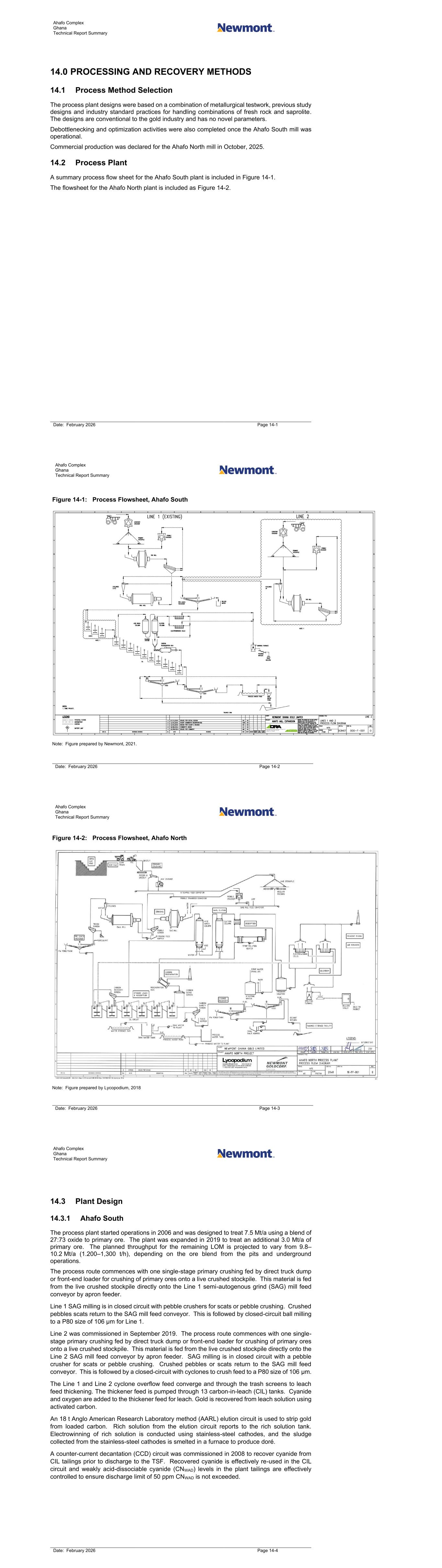
Ahafo Complex Ghana Technical Report Summary Date: February 2026 Page 14-1 14.0 PROCESSING AND RECOVERY METHODS 14.1 Process Method Selection The process plant designs were based on a combination of metallurgical testwork, previous study designs and industry standard practices for handling combinations of fresh rock and saprolite. The designs are conventional to the gold industry and has no novel parameters. Debottlenecking and optimization activities were also completed once the Ahafo South mill was operational. Commercial production was declared for the Ahafo North mill in October, 2025. 14.2 Process Plant A summary process flow sheet for the Ahafo South plant is included in Figure 14-1. The flowsheet for the Ahafo North plant is included as Figure 14-2. Ahafo Complex Ghana Technical Report Summary Date: February 2026 Page 14-2 Figure 14-1: Process Flowsheet, Ahafo South Note: Figure prepared by Newmont, 2021. Ahafo Complex Ghana Technical Report Summary Date: February 2026 Page 14-3 Figure 14-2: Process Flowsheet, Ahafo North Note: Figure prepared by Lycopodium, 2018 Ahafo Complex Ghana Technical Report Summary Date: February 2026 Page 14-4 14.3 Plant Design 14.3.1 Ahafo South The process plant started operations in 2006 and was designed to treat 7.5 Mt/a using a blend of 27:73 oxide to primary ore. The plant was expanded in 2019 to treat an additional 3.0 Mt/a of primary ore. The planned throughput for the remaining LOM is projected to vary from 9.8– 10.2 Mt/a (1.200–1,300 t/h), depending on the ore blend from the pits and underground operations. The process route commences with one single-stage primary crushing fed by direct truck dump or front-end loader for crushing of primary ores onto a live crushed stockpile. This material is fed from the live crushed stockpile directly onto the Line 1 semi-autogenous grind (SAG) mill feed conveyor by apron feeder. Line 1 SAG milling is in closed circuit with pebble crushers for scats or pebble crushing. Crushed pebbles scats return to the SAG mill feed conveyor. This is followed by closed-circuit ball milling to a P80 size of 106 µm for Line 1. Line 2 was commissioned in September 2019. The process route commences with one single- stage primary crushing fed by direct truck dump or front-end loader for crushing of primary ores onto a live crushed stockpile. This material is fed from the live crushed stockpile directly onto the Line 2 SAG mill feed conveyor by apron feeder. SAG milling is in closed circuit with a pebble crusher for scats or pebble crushing. Crushed pebbles or scats return to the SAG mill feed conveyor. This is followed by a closed-circuit with cyclones to crush feed to a P80 size of 106 µm. The Line 1 and Line 2 cyclone overflow feed converge and through the trash screens to leach feed thickening. The thickener feed is pumped through 13 carbon-in-leach (CIL) tanks. Cyanide and oxygen are added to the thickener feed for leach. Gold is recovered from leach solution using activated carbon. An 18 t Anglo American Research Laboratory method (AARL) elution circuit is used to strip gold from loaded carbon. Rich solution from the elution circuit reports to the rich solution tank. Electrowinning of rich solution is conducted using stainless-steel cathodes, and the sludge collected from the stainless-steel cathodes is smelted in a furnace to produce doré. A counter-current decantation (CCD) circuit was commissioned in 2008 to recover cyanide from CIL tailings prior to discharge to the TSF. Recovered cyanide is effectively re-used in the CIL circuit and weakly acid-dissociable cyanide (CNWAD) levels in the plant tailings are effectively controlled to ensure discharge limit of 50 ppm CNWAD is not exceeded.

Ahafo Complex Ghana Technical Report Summary Date: February 2026 Page 14-5 14.3.2 Ahafo North ROM ore is delivered by rear-end dump haul trucks and dumped either on the ROM stockpile or directly into the primary crusher feed hopper/ROM bin. The ROM stockpile pad allows for limited feed blending to optimize plant performance. A grizzly is installed on top of the ROM bin to protect the jaw crusher from oversize material. The jaw crusher handles ROM ore with a maximum lump size of approximately 800 mm. A mobile rock breaker is available to break any oversize material that may be dumped onto the grizzly. ROM ore is drawn from the ROM bin at a controlled rate by a variable speed apron feeder and discharged onto a vibrating grizzly. The grizzly oversize reports to the jaw crusher. The crusher product and grizzly undersize discharges onto a reclaimed stockpile via conveyor belt. Crushed material from the stockpile is transported by conveyor at a controlled feeder speed to the SAG mill The grinding circuit consists of a 8 MW variable speed SAG mill operating in a closed circuit with a pebble crusher and a 13 MW variable speed ball mill operating in closed circuit with hydrocyclones. Crushed ore and recycled pebbles are fed to the SAG mill. The SAG mill discharge pebbles are screened out over the trommel screen. Oversize material from the pebble screen, consisting of pebbles and worn steel grinding media, discharges onto the pebble crusher feed conveyor. Screen oversize can also be diverted to the mill drive in sump, as required. The SAG mill pebble screen undersize gravitates to the mill discharge hopper, where it is combined with the ball mill discharge, diluted with process water, and pumped to the classifying hydrocyclone cluster. Classifying hydrocyclone underflow returns to the ball mill for further grinding. The combined cyclone overflow stream gravitates to a vibrating trash screen for debris and tramp metal removal. Trash screen underflow is thickened in a high-rate thickener to recover process water and increase pulp density in the CIL circuit. The feed slurry is de-aerated in the thickener feed box prior to entry into the thickener. Thickener underflow is pumped to the leach feed distribution box. Thickener underflow is capable of being diluted with process water to a selected density set point. Pre-leach thickener underflow is pumped to the CIL circuit. The circuit consists of six CIL tanks. Each tank is fitted with a dual impeller mechanical agitator, and a mechanically-swept, woven wire, intertank screen to retain the carbon. Fresh/regenerated carbon is advanced counter current to the slurry flow by pumping slurry and carbon using recessed impeller pumps installed in each CIL tank. The pump in CIL Tank 1 is used to transfer slurry to the loaded carbon recovery screen mounted above the acid wash column in the elution circuit. The carbon is washed and dewatered on the recovery screen prior to reporting to the acid wash column. The associated slurry and wash water return to CIL Tank 1. The loaded carbon is eluted using Anglo American Research Laboratories (AARL) process followed by electrowinning and smelting. Eluted carbon is regenerated with a 5 kg/hr horizontal kiln prior to discharge back into CIL tank 6 or tank 5. Ahafo Complex Ghana Technical Report Summary Date: February 2026 Page 14-6 The leached slurry discharges from the last CIL tank 6 over a carbon safety screen to ensure that no carbon and gold is lost to tailings. Recovered carbon is collected in the fine carbon bin for disposal, treatment, or return to the circuit dependent upon circumstances. The underflow from the screen is pumped to the CCD thickener feed de-aeration box for cyanide removal. Two high- rate CCD thickeners are used to recover a portion of the cyanide contained in solution for re-use in the process plant as well as reduce the CNWAD levels to <50 ppm before disposal to the TSF. Tailings are pumped by duty/standby single stage variable speed pumps to the TSF. 14.4 Equipment Sizing Design criteria are summarized in Table 14-1 for Ahafo South. The Ahafo South plant equipment is outlined in Table 14-3. Design criteria are summarized in Table 14-2 for Ahafo North, and the plant equipment for Ahafo North is outlined in Table 14-4. Table 14-1: Design Criteria, Ahafo South Process Plant Item Units Saprolite Primary Plant capacity Mt/a 0.2 9.8 Head grade (design) Au g/t 0.85 1.87 Design gold recovery % 95.9 92 Crushing plant availability % 92 92 Mill/CIL availability % 93 93 Bond abrasion index (Ai) 0.34–0.83 0.34–0.83 Bond ball mill work index (BWi) kWh/t 17.4–19.2 17.4–19.2 Grind size (P80) μm 106 106 Installed mill power (SAG + ball) kW 26,000 26,000 Number of CIL tanks 13 13 Total CIL volume m3 42,250 42,250 Calculated CIL residence time h 20.7 20.7 Cyanide consumption kg/t 0.24 0.25 Quicklime consumption kg/t 3.44 0.9 Elution circuit type AARL AARL Elution circuit size t 18 18.0 Frequency of elution strips/week 7 8 Ahafo Complex Ghana Technical Report Summary Date: February 2026 Page 14-7 Table 14-2: Design Criteria, Ahafo North Process Plant Item Units Saprolite Primary Plant capacity Mt/a 3.7 3.4 Head grade (design) Au g/t 2.1 2.7 Design gold recovery % 95.5 90 Crushing plant availability % 74 74 Mill/CIL availability % 91.3 91.3 Bond abrasion index (Ai) 0.06 0.3–0.47 Bond ball mill work index (BWi) kWh/t 10.23 15.35–20.38 Grind size (P80) μm 53 53 Installed mill power (SAG + ball) kW 20,000 20,000 Number of CIL tanks 6 6 Total CIL volume m3 15,225 15,225 Calculated CIL residence time h 24 27 Cyanide consumption kg/t 0.33 0.46 Quicklime consumption kg/t 3.1 0.9 Elution circuit type AARL AARL Elution circuit size t 10 10 Frequency of elution strips/week 6 6 Table 14-3: Ahafo South Plant Equipment Number/Qty Details of Specification 2 54 x 74 inch gyratory crusher with 500 kW installed motors power 1 MMD 154 series twin-shaft 4-tooth x 9 ring sizer with 2 x 150 kW installed motor power 2 10.36 x 5.0 m EGL SAG mill with 2 x 650 kW installed motor power 2 3.6 x 7.3 m double deck pebble dewatering screen, top deck 33 x 66 mm, bottom deck 10 x 36 mm panels 2 MP 800 pebble crusher, one duty, one standby, each with 600 kW installed motor power for line 1 2 HP 400 pebble crusher, one duty, one standby, each with 315 kW installed motor power for line 2 1 7.31 x 11.90 m EGL ball mill with 2 x 650 kW installed motor power 12 26 inch Krebs cyclones for line 1 12 20 inch Krebs cyclones for line 2 3 3.6 m x 6.1 m cyclone overflow trash screen, two duty, one standby, screen aperture 0.7 x 12 mm, 37 kW 4-pole motor, DF 504S exciters 1 42 m pre-leach thickener Ahafo Complex Ghana Technical Report Summary Date: February 2026 Page 14-8 Number/Qty Details of Specification 13 3,250 m3 leach and adsorption tanks 13 Lightning agitators, 783 gearbox, A310 shaft and impellers 1 1.8 x 4.8 m carbon recovery screen, screen aperture; 1.1 x 12 mm 2 3.6 x 6.1 m carbon safety screen aperture 1.1 x 12 mm, 30 kW 4-pole electric motor, DF 501S exciters 2 42 m CCD thickeners 1 1.2 m x 3.6 m carbon dewatering screen, screen aperture 0.7 x 12 mm 1 18 t acid wash column 1 18 t elution column 2 6,000 amp electrowinning cells 1 TA 300D Barring furnace 1 900 kg/hr diesel-fired carbon regeneration kiln Note: EGL = effective grinding length, CCD = counter-current decant. Table 14-4: Ahafo North Plant Equipment Number/Qty Details of Specification 1 Single toggle jaw crusher, C150, 250 kW motor 1 SAG mill Ø 8.50 x 4.85 m EGL, 60–80% critical speed, 20° heads with 7 MW installed power 1 Ball mill Ø 7.32 x 11.9 m EGL, 65–80% critical speed with 13 MW installed power 1 Pebble crusher short head coarse cone crusher HP3, installed motor power 220 kW 2 Vibrating, linear, flat deck trash screen 18 400CVX-10 cyclones 1 Pre-leach thickener 32 m diameter high rate 6 2,537 m3 leach and adsorption tanks 6 Afrommix agitato, AMX 11000, dual stage, mild steel wetted parts, rubber-lined impellers c/w gearbox drive, setup to sparge oxygen down the shaft 1 Carbon recovery screen 3.783 x 1.489 m, 0.7 mm aperture, 34.9% open area 1 Acid wash column, 10 t 1 Elution column, 10 t 1 Regeneration kiln 500 kg/hr, horizontal, diesel fired 2 4,500 amps electrowinning cell, 22 cathodes 1 Carbon safety screen vibrating, linear, horizontal 1 10 PSA oxygen plant Note: EGL = effective grinding length, CCD = counter-current decant, PSA = pressure swing adsorption

Ahafo Complex Ghana Technical Report Summary Date: February 2026 Page 14-9 14.5 Power and Consumables 14.5.1 Ahafo South Consumables used include reagents (cyanide, lime, acid, caustic), grinding media, and high- and low-pressure air. The main water sources for the process plant are from stored water in the mined- out Apensu open pit and the TSF. Potable water is sourced from boreholes. The Line 1 installations require approximately 26 MW of power to operate at full capacity while Line 2 draws about 13 MW of power. The site has an emergency backup generation plant consisting of seven 3.9 MW high-speed generators that together are capable of producing about 27.3 MW of supplemental power. 14.5.2 Ahafo North Consumables used include reagents (cyanide, lime, acid, caustic, grinding media, high- and low- pressure air and oxygen). The primary source of raw water is pit dewatering that will be pumped into a water storage dam/impacted water pond. This is supplemented by runoff from the local catchments. Duty/standby submersible pumps are used to transfer water from the impacted water pond into a raw water tank that is located in the process plant. The raw water tank has an overflow into the process water pond to maintain a consistent fill. The above-ground process water pond is double- lined with clay and high-density polyethylene (HDPE) to receive pre-leach thickener (partial) and CCD circuit overflow solution, as well as the make-up water from the raw water tank overflow. The process plant will receive its power supply from an 161 kV outdoor switching station to be located at the Ahafo North mining facility, and tapped from the existing 161 kV line between Kenyasi and Sunyani. The plant maximum demand is estimated to be 25 MW at a 0.95 power factor. 14.6 Personnel The Ahafo Complex employs a total of 390 persons, including process control staff. The process personnel required for the LOM plan for the Ahafo South process plant total 255 persons, with 114 required for operations and 141 persons for maintenance. The personnel total for the Ahafo North LOM process plan is 135. The personnel count includes both operations and maintenance staff. Ahafo Complex Ghana Technical Report Summary Date: February 2026 Page 15-1 15.0 INFRASTRUCTURE 15.1 Introduction 15.1.1 Ahafo South Key infrastructure associated with the Ahafo South operations includes: • Completed open pit mines at Subika, Apensu Main and Amoma; the Apensu open pit is being used for water storage; • Open pit mining activities are currently underway at Awonsu, and development of the Apensu South open pit is scheduled to begin in 2029; • Underground mining at Subika is currently underway whiles Apensu Underground project is scheduled to commence in 2030; • There are five waste rock storage facilities (WRSFs) at the site, of which one is currently active and four are inactive; • Five stockpiles; • Process plant; • TSF and the use of Awonsu Phase 4 pit for tailings deposition post mining in 2031; • Water storage facility; • Reverse osmosis water treatment facility; • Sediment control structures; • Residential camp; • Mine accommodations village; • Various support facilities including truck and vehicle shops, warehouse, administration, contractor and temporary offices, fuel storage, core processing facilities at the mine site, clinic and emergency response facilities, gatehouse, mess facilities, change rooms, personnel training facilities, information technology (IT) communications setups and towers, environmental monitoring facilities, water treatment plants, sewage treatment plants, reagents shed, and plant nurseries. During the remainder of the LOM, a new WRSF for storage of waste from the Apensu South pit will be required, as will a second water treatment plant. An infrastructure layout plan showing the surface infrastructure layout is provided in Figure 15-1. Ahafo Complex Ghana Technical Report Summary Date: February 2026 Page 15-2 Figure 15-1: Infrastructure Layout Plan, Ahafo South Note: Figure prepared by Newmont, 2025 Ahafo Complex Ghana Technical Report Summary Date: February 2026 Page 15-3 15.1.2 Ahafo North Key infrastructure to support the operations at Ahafo North includes: • Open pit mines at Yamfo South, Yamfo Northeast, Susuan, Subenso South, Subenso North, and Teekyere West; • Three WRSFs; • Stockpile; • Plant roads and ex-pit mine haul roads; • Process plant, reagent store, and laboratory; • Various support facilities including workshops, offices, change rooms and chop, warehousing, and stores, mine services area (mill maintenance shop, truck shop, truck wash, and tire shop) with fuel and lubricant storage facilities, emergency services building, and services distribution network; • Explosives magazine; • TSF; • 10 sediment control structures; • Water storage facility; • Reverse osmosis water treatment facility; • Two 1.1 MW diesel power stations; • Security gatehouse and perimeter fencing; • Permanent accommodation camp. An infrastructure layout plan showing the surface infrastructure layout is included as Figure 15-2.
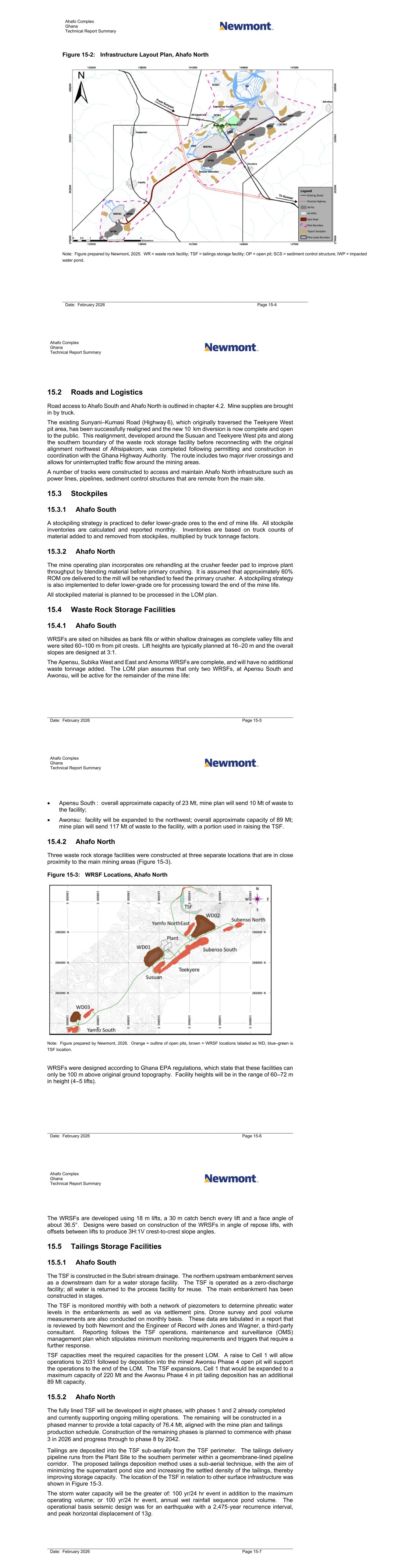
Ahafo Complex Ghana Technical Report Summary Date: February 2026 Page 15-4 Figure 15-2: Infrastructure Layout Plan, Ahafo North Note: Figure prepared by Newmont, 2025. WR = waste rock facility; TSF = tailings storage facility; OP = open pit; SCS = sediment control structure; IWP = impacted water pond. Ahafo Complex Ghana Technical Report Summary Date: February 2026 Page 15-5 15.2 Roads and Logistics Road access to Ahafo South and Ahafo North is outlined in chapter 4.2. Mine supplies are brought in by truck. The existing Sunyani–Kumasi Road (Highway 6), which originally traversed the Teekyere West pit area, has been successfully realigned and the new 10 km diversion is now complete and open to the public. This realignment, developed around the Susuan and Teekyere West pits and along the southern boundary of the waste rock storage facility before reconnecting with the original alignment northwest of Afrisipakrom, was completed following permitting and construction in coordination with the Ghana Highway Authority. The route includes two major river crossings and allows for uninterrupted traffic flow around the mining areas. A number of tracks were constructed to access and maintain Ahafo North infrastructure such as power lines, pipelines, sediment control structures that are remote from the main site. 15.3 Stockpiles 15.3.1 Ahafo South A stockpiling strategy is practiced to defer lower-grade ores to the end of mine life. All stockpile inventories are calculated and reported monthly. Inventories are based on truck counts of material added to and removed from stockpiles, multiplied by truck tonnage factors. 15.3.2 Ahafo North The mine operating plan incorporates ore rehandling at the crusher feeder pad to improve plant throughput by blending material before primary crushing. It is assumed that approximately 60% ROM ore delivered to the mill will be rehandled to feed the primary crusher. A stockpiling strategy is also implemented to defer lower-grade ore for processing toward the end of the mine life. All stockpiled material is planned to be processed in the LOM plan. 15.4 Waste Rock Storage Facilities 15.4.1 Ahafo South WRSFs are sited on hillsides as bank fills or within shallow drainages as complete valley fills and were sited 60–100 m from pit crests. Lift heights are typically planned at 16–20 m and the overall slopes are designed at 3:1. The Apensu, Subika West and East and Amoma WRSFs are complete, and will have no additional waste tonnage added. The LOM plan assumes that only two WRSFs, at Apensu South and Awonsu, will be active for the remainder of the mine life: Ahafo Complex Ghana Technical Report Summary Date: February 2026 Page 15-6 • Apensu South : overall approximate capacity of 23 Mt, mine plan will send 10 Mt of waste to the facility; • Awonsu: facility will be expanded to the northwest; overall approximate capacity of 89 Mt; mine plan will send 117 Mt of waste to the facility, with a portion used in raising the TSF. 15.4.2 Ahafo North Three waste rock storage facilities were constructed at three separate locations that are in close proximity to the main mining areas (Figure 15-3). Figure 15-3: WRSF Locations, Ahafo North Note: Figure prepared by Newmont, 2026. Orange = outline of open pits, brown = WRSF locations labeled as WD, blue–green is TSF location. WRSFs were designed according to Ghana EPA regulations, which state that these facilities can only be 100 m above original ground topography. Facility heights will be in the range of 60–72 m in height (4–5 lifts). Ahafo Complex Ghana Technical Report Summary Date: February 2026 Page 15-7 The WRSFs are developed using 18 m lifts, a 30 m catch bench every lift and a face angle of about 36.5°. Designs were based on construction of the WRSFs in angle of repose lifts, with offsets between lifts to produce 3H:1V crest-to-crest slope angles. 15.5 Tailings Storage Facilities 15.5.1 Ahafo South The TSF is constructed in the Subri stream drainage. The northern upstream embankment serves as a downstream dam for a water storage facility. The TSF is operated as a zero-discharge facility; all water is returned to the process facility for reuse. The main embankment has been constructed in stages. The TSF is monitored monthly with both a network of piezometers to determine phreatic water levels in the embankments as well as via settlement pins. Drone survey and pool volume measurements are also conducted on monthly basis. These data are tabulated in a report that is reviewed by both Newmont and the Engineer of Record with Jones and Wagner, a third-party consultant. Reporting follows the TSF operations, maintenance and surveillance (OMS) management plan which stipulates minimum monitoring requirements and triggers that require a further response. TSF capacities meet the required capacities for the present LOM. A raise to Cell 1 will allow operations to 2031 followed by deposition into the mined Awonsu Phase 4 open pit will support the operations to the end of the LOM. The TSF expansions, Cell 1 that would be expanded to a maximum capacity of 220 Mt and the Awonsu Phase 4 in pit tailing deposition has an additional 89 Mt capacity. 15.5.2 Ahafo North The fully lined TSF will be developed in eight phases, with phases 1 and 2 already completed and currently supporting ongoing milling operations. The remaining will be constructed in a phased manner to provide a total capacity of 76.4 Mt, aligned with the mine plan and tailings production schedule. Construction of the remaining phases is planned to commence with phase 3 in 2026 and progress through to phase 8 by 2042. Tailings are deposited into the TSF sub-aerially from the TSF perimeter. The tailings delivery pipeline runs from the Plant Site to the southern perimeter within a geomembrane-lined pipeline corridor. The proposed tailings deposition method uses a sub-aerial technique, with the aim of minimizing the supernatant pond size and increasing the settled density of the tailings, thereby improving storage capacity. The location of the TSF in relation to other surface infrastructure was shown in Figure 15-3. The storm water capacity will be the greater of: 100 yr/24 hr event in addition to the maximum operating volume; or 100 yr/24 hr event, annual wet rainfall sequence pond volume. The operational basis seismic design was for an earthquake with a 2,475‐year recurrence interval, and peak horizontal displacement of 13g.

Ahafo Complex Ghana Technical Report Summary Date: February 2026 Page 15-8 15.6 Water Management Structures 15.6.1 Ahafo South Water management infrastructure at Ahafo South for mine operations include the following: • Surface water management infrastructure: diversion channels around the pits and collection systems downstream of the WRSFs and stockpiles; • Pit runoff management infrastructure: in-pit and ex-pit sumps with a system centrifugal pumps and high-density polyethylene (HDPE) pipelines dewatering to holding and transfer ponds; • Groundwater management infrastructure: hybrid system of ex-pit dewatering wells and installations of arrays of horizontal drain holes. A reverse osmosis water treatment plant with a 50 L/s (feed) capacity was commissioned in August 2017 and a second reverse osmosis water treatment plant with a 60 L/s (feed) capacity was commissioned in June 2023 to support dewatering of the Apensu pit. 15.6.2 Ahafo North All of the open pits will form hydraulic sinks for contact water (e.g., both groundwater and surface water flow into the pits). Topography in the immediate vicinity of the pits is graded to drain toward the pits. Diversion structures are used to direct non-contact water away from WRSFs, open pits, and stockpiles and route these flows to 10 sediment control structures, which are located downgradient of all major facilities. 15.7 Water Supply 15.7.1 Ahafo South Process water is sourced from a cross-valley embankment dam upstream from the TSF, which impounds water from a 28 km2 area of the Subri stream watershed. Potable water for the mining operations and camps is produced from bore fields. Water supplies are sufficient for current and planned development needs. The Ahafo mine operates with an excess water balance resulting from the accumulation of seasonal rainfall contacting the mining operation. The excess is stored in the mined-out Apensu pit, which has an area of 350,000 m2. 15.7.2 Ahafo North With a crest elevation of 293 m and a maximum water storage elevation of 290 m, the water storage facility is designed to store up to 1.3 Mm3 of water. The water collected in the facility will be pumped back to the plant to supply plant raw water requirements and process make-up water Ahafo Complex Ghana Technical Report Summary Date: February 2026 Page 15-9 requirements. Water will be removed via submersible pumps and delivered to an HDPE lined raw water storage pond at the plant site. A 5,000 m3 capacity above-ground process water pond with double HDPE lining and clay base liner receives pre-leach thickener (partial) and CCD circuit overflow solution and make-up water from the raw water pond overflow. The firewater system draws from the raw water pond. Potable water is supplied to the plant area and other site facilities from the potable water bores. This water is treated in a containerized potable water treatment package at the accommodation camp. 15.8 Camps and Accommodation Two types of accommodation are available at Ahafo South. Camp A, originally the construction camp at the plant site, hosts about 300 people, consisting of site visitors and long-term employees. Newmont constructed the Mensah Kumtah Village, near Kenyasi, for expatriate families and Ghanaian management staff. Workers who do not live in company housing receive housing allowances. At Ahafo North, a permanent accommodation camp is located adjacent to the process plant and includes 40 motel style rooms with en suite bathrooms, kitchen, dining area, wet mess, office, gym, laundry facilities, and a multi-purpose sport court. The remainder of the Ahafo North staff are accommodated in Sunyani and other local villages. 15.9 Power and Electrical 15.9.1 Ahafo South Newmont Africa in Ghana receives power purchased from the Volta River Authority’s (VRA) electricity generation thermal facilities near the Ghanaian coast and at the Akosombo Dam hydroelectric facility. Power is delivered to Ahafo South via the Ghana Grid Company Limited (Gridco) 161 kV transmission line into the Ahafo (Kenyasi) Substation where voltage is dropped from 161 kV down to 11 kV for use at the Ahafo complex. Gridco currently has three 161 kV lines that deliver power to the Kenyasi Substation at Ahafo; two from Kumasi, and one from Kumasi via Techiman/Sunyani. Each transmission line is capable of delivering power sufficient to satisfy Ahafo’s current peak startup power demand of about 35 MW, as the capacity of each of these lines is approximately 120 MW. The two direct lines from Kumasi do not have additional power demand other than Newmont’s load at the Kenyasi substation. The third line (from Kumasi via Sunyani) supplies Techiman, then Sunyani, on its route to service Kenyasi substation. Newmont has also installed emergency power generating capacity, consisting of 27 MW at Ahafo South to meet any power challenges. Ahafo Complex Ghana Technical Report Summary Date: February 2026 Page 15-10 15.9.2 Ahafo North The power supply is from the Ghana national grid via a 161 kV line tied into the Sunyani–Kenyasi 161 kV line originally built for Ahafo South. The 161 kV supply voltage is stepped down to 11 kV at a site substation built by Newmont, but thereafter owned and operated by Gridco. The substation is based around a single 33 MVA step down transformer. Site power distribution is at 11 kV, stepped down to 415 V at point of use. Approximately 2.2 MVA of high speed diesel-generating capacity is installed for emergency use, if required, during periods of grid load shedding or outages. Ahafo Complex Ghana Technical Report Summary Date: February 2026 Page 16-1 16.0 MARKET STUDIES AND CONTRACTS 16.1 Markets Newmont has established contracts and buyers for the doré products from the Ahafo Complex, and has an internal corporate marketing group that monitors markets for its key products. Together with public documents and analyst forecasts, these data support that there is a reasonable basis to assume that for the LOM plan, that the key products will be saleable at the assumed commodity pricing. There are no agency relationships relevant to the marketing strategies used. Product valuation is included in the economic analysis in Chapter 19, and is based on a combination of the metallurgical recovery, commodity pricing, and consideration of processing charges. The doré is not subject to product specification requirements. 16.2 Commodity Price Forecasts Newmont uses a combination of historical and current contract pricing, contract negotiations, knowledge of its key markets from a long operations production record, short-term versus long- term price forecasts prepared by Newmont’s internal corporate marketing group, public documents, and analyst forecasts when considering long-term commodity price forecasts. Higher metal prices are used for the mineral resource estimates to ensure the mineral reserves are a sub-set of, and not constrained by, the mineral resources, in accordance with industry- accepted practice. The long-term commodity price and exchange rate forecasts are provided in Table 16-1. Table 16-1: Commodity Price and Exchange Rate Forecasts Commodity Units Mineral Reserves Mineral Resources Gold $US/oz 2,000 2,300 Exchange rate US$:Gh$ 1:12.00 1:12.00 16.3 Contracts Newmont’s doré is sold on the spot market, by marketing experts retained in-house by Newmont. The terms contained within the sales contracts are typical and consistent with standard industry practice and are consistent with doré sold from other Newmont operations. The largest in-place contracts other than for product sales cover items such as bulk commodities, operational and technical services, mining and process equipment, and administrative support services. Contracts are negotiated and renewed as needed. Contract terms are typical of similar contracts in Ghana.

Ahafo Complex Ghana Technical Report Summary Date: February 2026 Page 17-1 17.0 ENVIRONMENTAL STUDIES, PERMITTING, AND PLANS, NEGOTIATIONS, OR AGREEMENTS WITH LOCAL INDIVIDUALS OR GROUPS 17.1 Introduction Newmont is committed to design, develop, and operate the Ahafo Complex in a manner that will preserve human health, the environment and stakeholder relationships. A variety of environmental management activities were developed and are being implemented during all operational phases. Newmont’s intent is to eliminate, offset, or reduce to acceptable levels any adverse environmental impacts through management programs, resource-specific mitigation measures, monitoring plans, and implementation schedules. 17.2 Ahafo South 17.2.1 Baseline and Supporting Studies Baseline and supporting environmental studies were completed to assess both pre-existing and ongoing site environmental conditions, as well as to support decision-making processes during operations start-up. Characterization studies were completed for climate, air quality, hydrology and surface water quality, hydrogeology, flora, fauna, soils, agriculture and land use, and the socioeconomic environment. Plans were developed and implemented to address aspects of operations such as waste and fugitive dust management, spill prevention and contingency planning, water management, and noise levels. 17.2.2 Environmental Considerations/Monitoring Programs Procedures for operational environmental and social monitoring of the Ahafo Complex area were established to ensure mining activities have minimal or acceptable levels of impact to surrounding areas. The primary environmental resource monitored at Ahafo is water – both surface water and groundwater. Other resource monitoring being conducted by Newmont includes fugitive dust, point source emission, meteorological parameters, noise and vibration, revegetation progress, surface water run-off quantity, and quality, mine pit conditions, waste rock disposal, TSF decant water quantity and quality, and environmental geochemistry of ore, waste rock, and tailings. Data from these monitoring programs are used to evaluate potential impacts of mining operations and to continually update plans for long-term monitoring and reclamation. Ahafo Complex Ghana Technical Report Summary Date: February 2026 Page 17-2 17.2.3 Closure and Reclamation Considerations In 2003, Newmont developed a conceptual closure and reclamation plan for the Ahafo South Mine Project Environmental Impact Statement (EIS) (SGS 2004) in compliance with requirements of the Environmental Protection Agency (EPA). The EIS was approved by the EPA in April 2005. A Draft Reclamation Plan to begin the process of formalizing the conceptual plan presented in the EIS was undertaken later in 2005. The Draft Reclamation Plan, subsequently approved for implementation, included descriptions of mining and ore processing operations, WRSFs, TSF, water-related structures, and the reclamation and monitoring plans for these facilities. Under EPA requirements, Newmont is required to provide updates to the reclamation plan as mine development proceeds. These updates are to include revisions or modifications to the closure and reclamation plan necessary to address actual site conditions. An updated Closure and Reclamation Plan was developed in 2019 that covers closure of the Subika Underground and ancillary infrastructure as well as the prior existing facilities. A Reclamation Security Agreement (RSA) between the EPA and Newmont was signed in April 2008 to outline the various objectives and targets as guidance for the plan. The EPA requires a Reclamation Bond to be posted as part of any mine permitting process. The bond is required to provide financial surety against non-compliance under the approved Closure and Reclamation Plan and is required within six months after the start of operations. As part of the reclamation and security agreement (environmental bond) with the Ghanaian Government, Newmont has provided a cumulative (project to date) cash deposit of US$14 M. The closure cost estimate for Ahafo South used in the economic analysis in Chapter 19 is US$0.2 B. 17.2.4 Permitting All major permits and approvals are in place to support operations. Where permits have specific terms, renewal applications are made of the relevant regulatory authority as required, prior to the end of the permit term. The environmental permitting approach for the operations is based on Ghana’s EPA Environmental Impact Assessment (EIA) process and meets Newmont policy requirements and social and environmental standards. Newmont monitors the regulatory regime in place at each of its operations and ensures that all permits are updated in line with any regulatory changes. 17.2.5 Social Considerations, Plans, Negotiations and Agreements Newmont developed a public consultation and disclosure plan (PCDP) for the Ahafo Complex using guidelines and policies developed by the International Finance Corporation (IFC). The IFC requires public consultation as an on-going process to be conducted during the construction and operational phases of any project. Ahafo Complex Ghana Technical Report Summary Date: February 2026 Page 17-3 Newmont has well-established relationships, issue management approaches, engagement forums, and a suite of integrated social impact and opportunity-aligned strategic investment partnerships. Newmont understands and accepts the importance of proactive community relations as an overriding principle in its day-to-day operations as well as future development planning. The company therefore structures its community relations activities to consider the concerns of the local people and endeavors to communicate and demonstrate its commitment in terms that can be best appreciated and understood to maintain the social license to operate. 17.2.6 Qualified Person’s Opinion on Adequacy of Current Plans to Address Issues Based on the information provided to the QP by Newmont (see Chapter 25), there are no material issues known to the QP. The Ahafo South operations are mature mining operations and Newmont currently has the social license to operate within its local communities. 17.3 Ahafo North 17.3.1 Baseline and Supporting Studies Ahafo North baseline and supporting environmental studies were completed to assess both pre- existing and ongoing site environmental conditions, as well as to support decision-making processes during construction and operations start-up. Characterization studies were completed for climate, air quality, hydrology and surface water quality, ground water quality, hydrogeology, flora, fauna, soils, agriculture and land use, and the socioeconomic environment. Environmental Management Plans were developed and implemented to address aspects of construction and operations such as waste and fugitive dust management, spill prevention and contingency planning, water management, and noise levels. A Social Impact Assessment was reviewed and updated with a field study in order to validate existing data for the Project. The study covered all five communities in the Project Area: Yamfo, Techire, Afrisipa, Adrooba and Susanso. The study also looked at the strategic position of Duayaw Nkwanta and Tanoso in relation to its community and political influence in the Ahafo North project area. The identification of sites of cultural relevance and significance to stakeholders was conducted with the assistance of local experts. 17.3.2 Environmental Considerations/Monitoring Programs Environmental monitoring procedures and monitoring schedule were established to ensure mining activities have minimal or acceptable levels of impact to surrounding areas. The monitoring activities included: Ahafo Complex Ghana Technical Report Summary Date: February 2026 Page 17-4 • Air quality monitoring for total suspended particulates; • Meteorological parameters; • Noise monitoring; • Ground water monitoring; • Revegetation progress ; • Blast air overpressure and ground vibration. Data from these monitoring programs are used to evaluate potential impacts of mining operations and to continually update plans for long-term monitoring and reclamation. 17.3.3 Closure and Reclamation Considerations A definitive closure and reclamation plan, which will address stockpiling of topsoils and concurrent reclamation, was developed for Ahafo North. The closure cost estimate for Ahafo North is approximately US$0.1B 17.3.4 Permitting The permitting process began in June 2017. The Ahafo North project team developed a comprehensive permit schedule for the EIA phase and related activities, such as the relocation of the highway. All major permits and approvals are in place to support construction and operations. Where permits have specific terms, renewal applications are made of the relevant regulatory authority as required, prior to the end of the permit expiry. Newmont monitors the regulatory regime in place at each of its operations and ensures that all permits are updated in line with any regulatory changes. The key permits and their status at the Report date are summarized in Table 17-1.

Ahafo Complex Ghana Technical Report Summary Date: February 2026 Page 17-5 Table 17-1: Key Permits, Ahafo North Permit Note Main EIS Permit Obtained the Main EIS Permit from EPA to construct the Ahafo North project. Mining Area Permit Obtained mine area permit from Minerals Commission. TSF EPA and Minerals commission issued approval for the construction and operations of the TSF. Sediment Control Structure and Impacted Water Pond Permits Obtained sediment control structure and impacted water pond construction and water abstraction permits from the Water Resources Commission. Dam safety permits were also obtained. Permanent Bulk Fuel Storage Permit Obtained from EPA Bulk Fuel Storage Permit. Mine Operating Permit MinCom issued mine operating permit. Authorizations (permits) for archaeological artifact removal and preservation Obtained from the Ghana Museum and Monuments Board. Abstraction of groundwater permits Obtained from the Water Resource Commission permits such as potable water abstraction permit, pit dewatering permit, and production well abstraction permits. Surface water diversion permit Obtained Susuan, Afransu and Aboadwoah diversion permits from Water Resources Commission. Highway diversion Obtained from the Ghana Highway Authority. Notifications Informing local district and regional government about Ahafo North operations and relevant changes. Planning permissions Permits from local district and regional planning authorities for resettlement construction. 17.3.5 Social Considerations, Plans, Negotiations and Agreements Newmont has created a stakeholder engagement plan that describes effective methods for building sustainable stakeholder relationships across the Ahafo North project, and, since 2009, there have been some 500 stakeholder engagements. A major concern of stakeholders is the management of compensation and resettlement as well as employment opportunities for local community members. This has been described as the key socio-economic issue, and being managed through the establishment of the Newmont Ahafo Development Foundation, which is assessing the strategic social investment into communities on a long-term basis. Compensation and resettlement negotiation will be undertaken during the final phase of the Project when permits have been approved for Project execution. Ahafo Complex Ghana Technical Report Summary Date: February 2026 Page 17-6 The Compensation, Resettlement and Relocation of impacted farms and property is a major concern for successful project development. Full compensation and resettlement will require the following to be completed: • Full built asset survey; • Crops survey; • Land ownership survey; • Socio-economic households survey (gathers data at household and individual level); • Data capture (the data from surveys will be captured into the Newmont Ghana Gold Management Information System, which will form the project database. This will enable the company to link all information gathered on both an individual and household level for compensation negotiation); • Negotiation committee (the Land Access team, in collaboration with the Community Relations team, plan to establish a subcommittee under the existing Community Consultative Committee (to handle resettlement negotiations); • Resettlement action plan. A preliminary resettlement action plan will be prepared to outline the framework for execution of the resettlement and a final resettlement action plan will be prepared after negotiations). Newmont also has existing agreements with local communities under the Ahafo Social Responsibility Forum Agreements for the Relationship Agreement, Foundation Agreement and Employment Agreement, which will remain in force for the planned Ahafo North operations. 17.3.6 Qualified Person’s Opinion on Adequacy of Current Plans to Address Issues Based on the information provided to the QP by Newmont (see Chapter 25), there are no material issues known to the QP. Newmont currently has the social license to operate within its local communities. Ahafo Complex Ghana Technical Report Summary Date: February 2026 Page 18-1 18.0 CAPITAL AND OPERATING COSTS 18.1 Introduction Capital and operating cost estimates are at a minimum at a pre-feasibility level of confidence, having an accuracy level of ±25% and a contingency range not exceeding 15%. 18.2 Capital Cost Estimates Capital costs are based on recent prices or operating data. Capital costs include funding for infrastructure, pit dewatering, development drilling, and permitting as well as miscellaneous expenditures required to maintain production. Mobile equipment re-build/replacement schedules and fixed asset replacement and refurbishment schedules are included. Sustaining capital costs reflect current price trends. The overall capital cost estimate for Ahafo South LOM is US$0.7 B and Ahafo North LOM is US$0.9 B, as summarized in Table 18-1. Table 18-1: Capital Cost Estimate Area Unit Ahafo South Ahafo North Ahafo Complex Mining, open pit US$ billion 0.2 0.3 0.5 Mining, underground US$ billion 0.2 0.3 0.5 Process US$ billion 0.3 0.3 0.6 Total US$ billion 0.7 0.9 1.6 Note: numbers have been rounded; totals may not sum due to rounding. Ahafo Complex Ghana Technical Report Summary Date: February 2026 Page 18-2 18.3 Operating Cost Estimates Operating costs are based on actual costs seen during operations and are projected through the LOM plan. Historical costs are used as the basis for operating cost forecasts for supplies and services unless there are new contract terms for these items. Labor and energy costs are based on budgeted rates applied to headcounts and energy consumption estimates. Operating costs for Ahafo South and Ahafo North LOM are estimated at US$4.0 B and US$3.3 B, respectively, as summarized in Table 18-2. Table 18-2: Operating Cost Estimate Cost Element Unit Ahafo South Ahafo North Ahafo Complex Open pit mining costs US$ billion 0.7 1.4 2.1 Underground mining costs US$ billion 1.2 — 1.2 Processing costs US$ billion 1.4 1.2 2.6 G&A costs US$ billion 0.7 0.7 1.4 Total Operating Costs US$ billion 4.0 3.3 7.3 Note: numbers have been rounded; totals may not sum due to rounding. The estimated LOM open pit mining cost is US$4.37/t and the underground mining cost is US$62.32/t for Ahafo South. The estimated LOM open pit mining cost for Ahafo North is US$3.27/t. Base processing costs are estimated at US$16.93 /t for Ahafo South and US$18.16/t for Ahafo North. In addition, total G&A costs are estimated at US$8.63/t for Ahafo South and US$11.41/t for Ahafo North (Table 18-3). Table 18-3: Operating Unit Cost Estimate Cost Element Unit Ahafo South Ahafo North Ahafo Complex Open pit mining costs US$/t mined 4.37 3.27 3.59 Underground mining costs US$/t mined 62.32 — 62.32 Processing costs US$/t processed 16.93 18.16 17.48 G&A costs US$/t processed 8.63 11.41 9.87 Note: numbers have been rounded; totals may not sum due to rounding.
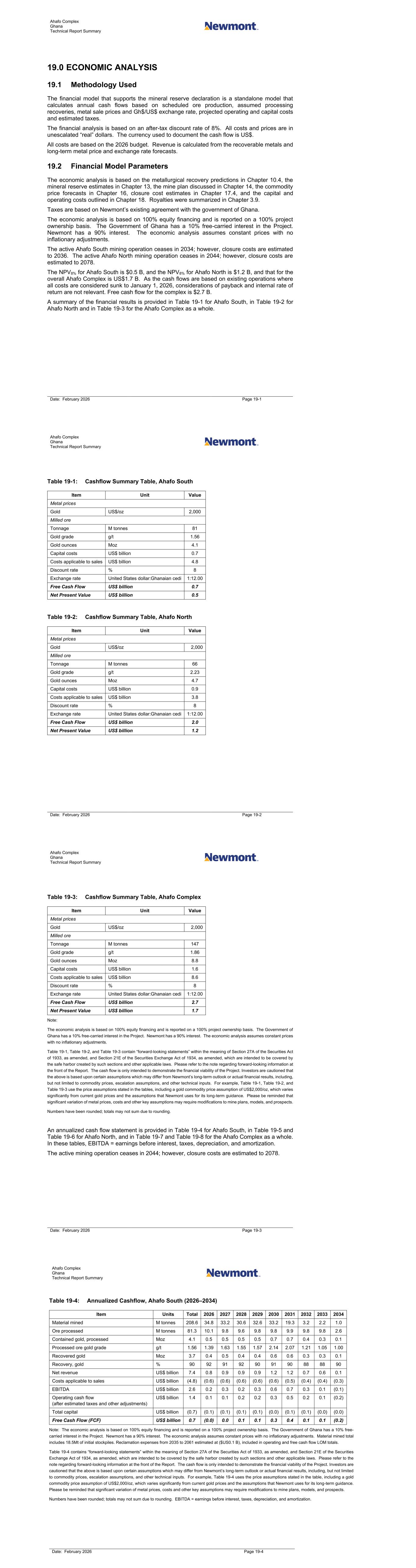
Ahafo Complex Ghana Technical Report Summary Date: February 2026 Page 19-1 19.0 ECONOMIC ANALYSIS 19.1 Methodology Used The financial model that supports the mineral reserve declaration is a standalone model that calculates annual cash flows based on scheduled ore production, assumed processing recoveries, metal sale prices and Gh$/US$ exchange rate, projected operating and capital costs and estimated taxes. The financial analysis is based on an after-tax discount rate of 8%. All costs and prices are in unescalated “real” dollars. The currency used to document the cash flow is US$. All costs are based on the 2026 budget. Revenue is calculated from the recoverable metals and long-term metal price and exchange rate forecasts. 19.2 Financial Model Parameters The economic analysis is based on the metallurgical recovery predictions in Chapter 10.4, the mineral reserve estimates in Chapter 13, the mine plan discussed in Chapter 14, the commodity price forecasts in Chapter 16, closure cost estimates in Chapter 17.4, and the capital and operating costs outlined in Chapter 18. Royalties were summarized in Chapter 3.9. Taxes are based on Newmont’s existing agreement with the government of Ghana. The economic analysis is based on 100% equity financing and is reported on a 100% project ownership basis. The Government of Ghana has a 10% free-carried interest in the Project. Newmont has a 90% interest. The economic analysis assumes constant prices with no inflationary adjustments. The active Ahafo South mining operation ceases in 2034; however, closure costs are estimated to 2036. The active Ahafo North mining operation ceases in 2044; however, closure costs are estimated to 2078. The NPV8% for Ahafo South is $0.5 B, and the NPV8% for Ahafo North is $1.2 B, and that for the overall Ahafo Complex is US$1.7 B. As the cash flows are based on existing operations where all costs are considered sunk to January 1, 2026, considerations of payback and internal rate of return are not relevant. Free cash flow for the complex is $2.7 B. A summary of the financial results is provided in Table 19-1 for Ahafo South, in Table 19-2 for Ahafo North and in Table 19-3 for the Ahafo Complex as a whole. Ahafo Complex Ghana Technical Report Summary Date: February 2026 Page 19-2 Table 19-1: Cashflow Summary Table, Ahafo South Item Unit Value Metal prices Gold US$/oz 2,000 Milled ore Tonnage M tonnes 81 Gold grade g/t 1.56 Gold ounces Moz 4.1 Capital costs US$ billion 0.7 Costs applicable to sales US$ billion 4.8 Discount rate % 8 Exchange rate United States dollar:Ghanaian cedi 1:12.00 Free Cash Flow US$ billion 0.7 Net Present Value US$ billion 0.5 Table 19-2: Cashflow Summary Table, Ahafo North Item Unit Value Metal prices Gold US$/oz 2,000 Milled ore Tonnage M tonnes 66 Gold grade g/t 2.23 Gold ounces Moz 4.7 Capital costs US$ billion 0.9 Costs applicable to sales US$ billion 3.8 Discount rate % 8 Exchange rate United States dollar:Ghanaian cedi 1:12.00 Free Cash Flow US$ billion 2.0 Net Present Value US$ billion 1.2 Ahafo Complex Ghana Technical Report Summary Date: February 2026 Page 19-3 Table 19-3: Cashflow Summary Table, Ahafo Complex Item Unit Value Metal prices Gold US$/oz 2,000 Milled ore Tonnage M tonnes 147 Gold grade g/t 1.86 Gold ounces Moz 8.8 Capital costs US$ billion 1.6 Costs applicable to sales US$ billion 8.6 Discount rate % 8 Exchange rate United States dollar:Ghanaian cedi 1:12.00 Free Cash Flow US$ billion 2.7 Net Present Value US$ billion 1.7 Note: The economic analysis is based on 100% equity financing and is reported on a 100% project ownership basis. The Government of Ghana has a 10% free-carried interest in the Project. Newmont has a 90% interest. The economic analysis assumes constant prices with no inflationary adjustments. Table 19-1, Table 19-2, and Table 19-3 contain “forward-looking statements” within the meaning of Section 27A of the Securities Act of 1933, as amended, and Section 21E of the Securities Exchange Act of 1934, as amended, which are intended to be covered by the safe harbor created by such sections and other applicable laws. Please refer to the note regarding forward-looking information at the front of the Report. The cash flow is only intended to demonstrate the financial viability of the Project. Investors are cautioned that the above is based upon certain assumptions which may differ from Newmont’s long-term outlook or actual financial results, including, but not limited to commodity prices, escalation assumptions, and other technical inputs. For example, Table 19-1, Table 19-2, and Table 19-3 use the price assumptions stated in the tables, including a gold commodity price assumption of US$2,000/oz, which varies significantly from current gold prices and the assumptions that Newmont uses for its long-term guidance. Please be reminded that significant variation of metal prices, costs and other key assumptions may require modifications to mine plans, models, and prospects. Numbers have been rounded; totals may not sum due to rounding. An annualized cash flow statement is provided in Table 19-4 for Ahafo South, in Table 19-5 and Table 19-6 for Ahafo North, and in Table 19-7 and Table 19-8 for the Ahafo Complex as a whole. In these tables, EBITDA = earnings before interest, taxes, depreciation, and amortization. The active mining operation ceases in 2044; however, closure costs are estimated to 2078. Ahafo Complex Ghana Technical Report Summary Date: February 2026 Page 19-4 Table 19-4: Annualized Cashflow, Ahafo South (2026–2034) Item Units Total 2026 2027 2028 2029 2030 2031 2032 2033 2034 Material mined M tonnes 208.6 34.8 33.2 30.6 32.6 33.2 19.3 3.2 2.2 1.0 Ore processed M tonnes 81.3 10.1 9.8 9.6 9.8 9.8 9.9 9.8 9.8 2.6 Contained gold, processed Moz 4.1 0.5 0.5 0.5 0.5 0.7 0.7 0.4 0.3 0.1 Processed ore gold grade g/t 1.56 1.39 1.63 1.55 1.57 2.14 2.07 1.21 1.05 1.00 Recovered gold Moz 3.7 0.4 0.5 0.4 0.4 0.6 0.6 0.3 0.3 0.1 Recovery, gold % 90 92 91 92 90 91 90 88 88 90 Net revenue US$ billion 7.4 0.8 0.9 0.9 0.9 1.2 1.2 0.7 0.6 0.1 Costs applicable to sales US$ billion (4.8) (0.6) (0.6) (0.6) (0.6) (0.6) (0.5) (0.4) (0.4) (0.3) EBITDA US$ billion 2.6 0.2 0.3 0.2 0.3 0.6 0.7 0.3 0.1 (0.1) Operating cash flow (after estimated taxes and other adjustments) US$ billion 1.4 0.1 0.1 0.2 0.2 0.3 0.5 0.2 0.1 (0.2) Total capital US$ billion (0.7) (0.1) (0.1) (0.1) (0.1) (0.0) (0.1) (0.1) (0.0) (0.0) Free Cash Flow (FCF) US$ billion 0.7 (0.0) 0.0 0.1 0.1 0.3 0.4 0.1 0.1 (0.2) Note: The economic analysis is based on 100% equity financing and is reported on a 100% project ownership basis. The Government of Ghana has a 10% free- carried interest in the Project. Newmont has a 90% interest. The economic analysis assumes constant prices with no inflationary adjustments. Material mined total includes 18.5Mt of initial stockpiles. Reclamation expenses from 2035 to 2061 estimated at ($US0.1 B), included in operating and free cash flow LOM totals. Table 19-4 contains “forward-looking statements” within the meaning of Section 27A of the Securities Act of 1933, as amended, and Section 21E of the Securities Exchange Act of 1934, as amended, which are intended to be covered by the safe harbor created by such sections and other applicable laws. Please refer to the note regarding forward-looking information at the front of the Report. The cash flow is only intended to demonstrate the financial viability of the Project. Investors are cautioned that the above is based upon certain assumptions which may differ from Newmont’s long-term outlook or actual financial results, including, but not limited to commodity prices, escalation assumptions, and other technical inputs. For example, Table 19-4 uses the price assumptions stated in the table, including a gold commodity price assumption of US$2,000/oz, which varies significantly from current gold prices and the assumptions that Newmont uses for its long-term guidance. Please be reminded that significant variation of metal prices, costs and other key assumptions may require modifications to mine plans, models, and prospects. Numbers have been rounded; totals may not sum due to rounding. EBITDA = earnings before interest, taxes, depreciation, and amortization.
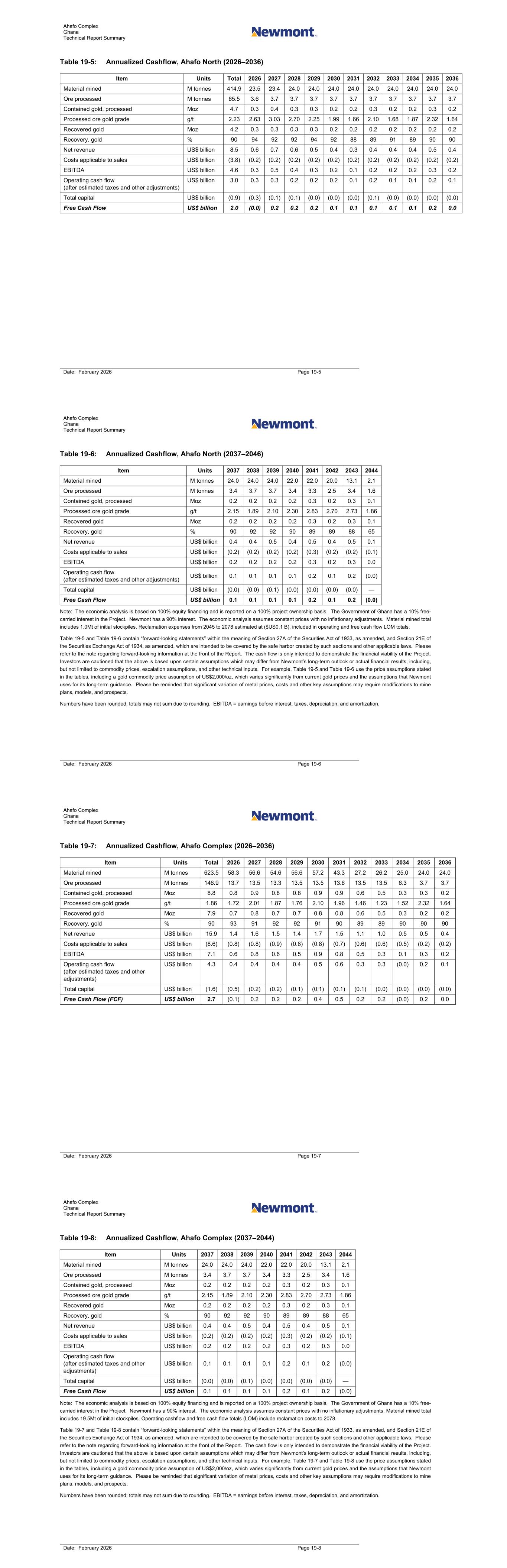
Ahafo Complex Ghana Technical Report Summary Date: February 2026 Page 19-5 Table 19-5: Annualized Cashflow, Ahafo North (2026–2036) Item Units Total 2026 2027 2028 2029 2030 2031 2032 2033 2034 2035 2036 Material mined M tonnes 414.9 23.5 23.4 24.0 24.0 24.0 24.0 24.0 24.0 24.0 24.0 24.0 Ore processed M tonnes 65.5 3.6 3.7 3.7 3.7 3.7 3.7 3.7 3.7 3.7 3.7 3.7 Contained gold, processed Moz 4.7 0.3 0.4 0.3 0.3 0.2 0.2 0.3 0.2 0.2 0.3 0.2 Processed ore gold grade g/t 2.23 2.63 3.03 2.70 2.25 1.99 1.66 2.10 1.68 1.87 2.32 1.64 Recovered gold Moz 4.2 0.3 0.3 0.3 0.3 0.2 0.2 0.2 0.2 0.2 0.2 0.2 Recovery, gold % 90 94 92 92 94 92 88 89 91 89 90 90 Net revenue US$ billion 8.5 0.6 0.7 0.6 0.5 0.4 0.3 0.4 0.4 0.4 0.5 0.4 Costs applicable to sales US$ billion (3.8) (0.2) (0.2) (0.2) (0.2) (0.2) (0.2) (0.2) (0.2) (0.2) (0.2) (0.2) EBITDA US$ billion 4.6 0.3 0.5 0.4 0.3 0.2 0.1 0.2 0.2 0.2 0.3 0.2 Operating cash flow (after estimated taxes and other adjustments) US$ billion 3.0 0.3 0.3 0.2 0.2 0.2 0.1 0.2 0.1 0.1 0.2 0.1 Total capital US$ billion (0.9) (0.3) (0.1) (0.1) (0.0) (0.0) (0.0) (0.1) (0.0) (0.0) (0.0) (0.0) Free Cash Flow US$ billion 2.0 (0.0) 0.2 0.2 0.2 0.1 0.1 0.1 0.1 0.1 0.2 0.0 Ahafo Complex Ghana Technical Report Summary Date: February 2026 Page 19-6 Table 19-6: Annualized Cashflow, Ahafo North (2037–2046) Item Units 2037 2038 2039 2040 2041 2042 2043 2044 Material mined M tonnes 24.0 24.0 24.0 22.0 22.0 20.0 13.1 2.1 Ore processed M tonnes 3.4 3.7 3.7 3.4 3.3 2.5 3.4 1.6 Contained gold, processed Moz 0.2 0.2 0.2 0.2 0.3 0.2 0.3 0.1 Processed ore gold grade g/t 2.15 1.89 2.10 2.30 2.83 2.70 2.73 1.86 Recovered gold Moz 0.2 0.2 0.2 0.2 0.3 0.2 0.3 0.1 Recovery, gold % 90 92 92 90 89 89 88 65 Net revenue US$ billion 0.4 0.4 0.5 0.4 0.5 0.4 0.5 0.1 Costs applicable to sales US$ billion (0.2) (0.2) (0.2) (0.2) (0.3) (0.2) (0.2) (0.1) EBITDA US$ billion 0.2 0.2 0.2 0.2 0.3 0.2 0.3 0.0 Operating cash flow (after estimated taxes and other adjustments) US$ billion 0.1 0.1 0.1 0.1 0.2 0.1 0.2 (0.0) Total capital US$ billion (0.0) (0.0) (0.1) (0.0) (0.0) (0.0) (0.0) — Free Cash Flow US$ billion 0.1 0.1 0.1 0.1 0.2 0.1 0.2 (0.0) Note: The economic analysis is based on 100% equity financing and is reported on a 100% project ownership basis. The Government of Ghana has a 10% free- carried interest in the Project. Newmont has a 90% interest. The economic analysis assumes constant prices with no inflationary adjustments. Material mined total includes 1.0Mt of initial stockpiles. Reclamation expenses from 2045 to 2078 estimated at ($US0.1 B), included in operating and free cash flow LOM totals. Table 19-5 and Table 19-6 contain “forward-looking statements” within the meaning of Section 27A of the Securities Act of 1933, as amended, and Section 21E of the Securities Exchange Act of 1934, as amended, which are intended to be covered by the safe harbor created by such sections and other applicable laws. Please refer to the note regarding forward-looking information at the front of the Report. The cash flow is only intended to demonstrate the financial viability of the Project. Investors are cautioned that the above is based upon certain assumptions which may differ from Newmont’s long-term outlook or actual financial results, including, but not limited to commodity prices, escalation assumptions, and other technical inputs. For example, Table 19-5 and Table 19-6 use the price assumptions stated in the tables, including a gold commodity price assumption of US$2,000/oz, which varies significantly from current gold prices and the assumptions that Newmont uses for its long-term guidance. Please be reminded that significant variation of metal prices, costs and other key assumptions may require modifications to mine plans, models, and prospects. Numbers have been rounded; totals may not sum due to rounding. EBITDA = earnings before interest, taxes, depreciation, and amortization. Ahafo Complex Ghana Technical Report Summary Date: February 2026 Page 19-7 Table 19-7: Annualized Cashflow, Ahafo Complex (2026–2036) Item Units Total 2026 2027 2028 2029 2030 2031 2032 2033 2034 2035 2036 Material mined M tonnes 623.5 58.3 56.6 54.6 56.6 57.2 43.3 27.2 26.2 25.0 24.0 24.0 Ore processed M tonnes 146.9 13.7 13.5 13.3 13.5 13.5 13.6 13.5 13.5 6.3 3.7 3.7 Contained gold, processed Moz 8.8 0.8 0.9 0.8 0.8 0.9 0.9 0.6 0.5 0.3 0.3 0.2 Processed ore gold grade g/t 1.86 1.72 2.01 1.87 1.76 2.10 1.96 1.46 1.23 1.52 2.32 1.64 Recovered gold Moz 7.9 0.7 0.8 0.7 0.7 0.8 0.8 0.6 0.5 0.3 0.2 0.2 Recovery, gold % 90 93 91 92 92 91 90 89 89 90 90 90 Net revenue US$ billion 15.9 1.4 1.6 1.5 1.4 1.7 1.5 1.1 1.0 0.5 0.5 0.4 Costs applicable to sales US$ billion (8.6) (0.8) (0.8) (0.9) (0.8) (0.8) (0.7) (0.6) (0.6) (0.5) (0.2) (0.2) EBITDA US$ billion 7.1 0.6 0.8 0.6 0.5 0.9 0.8 0.5 0.3 0.1 0.3 0.2 Operating cash flow (after estimated taxes and other adjustments) US$ billion 4.3 0.4 0.4 0.4 0.4 0.5 0.6 0.3 0.3 (0.0) 0.2 0.1 Total capital US$ billion (1.6) (0.5) (0.2) (0.2) (0.1) (0.1) (0.1) (0.1) (0.0) (0.0) (0.0) (0.0) Free Cash Flow (FCF) US$ billion 2.7 (0.1) 0.2 0.2 0.2 0.4 0.5 0.2 0.2 (0.0) 0.2 0.0 Ahafo Complex Ghana Technical Report Summary Date: February 2026 Page 19-8 Table 19-8: Annualized Cashflow, Ahafo Complex (2037–2044) Item Units 2037 2038 2039 2040 2041 2042 2043 2044 Material mined M tonnes 24.0 24.0 24.0 22.0 22.0 20.0 13.1 2.1 Ore processed M tonnes 3.4 3.7 3.7 3.4 3.3 2.5 3.4 1.6 Contained gold, processed Moz 0.2 0.2 0.2 0.2 0.3 0.2 0.3 0.1 Processed ore gold grade g/t 2.15 1.89 2.10 2.30 2.83 2.70 2.73 1.86 Recovered gold Moz 0.2 0.2 0.2 0.2 0.3 0.2 0.3 0.1 Recovery, gold % 90 92 92 90 89 89 88 65 Net revenue US$ billion 0.4 0.4 0.5 0.4 0.5 0.4 0.5 0.1 Costs applicable to sales US$ billion (0.2) (0.2) (0.2) (0.2) (0.3) (0.2) (0.2) (0.1) EBITDA US$ billion 0.2 0.2 0.2 0.2 0.3 0.2 0.3 0.0 Operating cash flow (after estimated taxes and other adjustments) US$ billion 0.1 0.1 0.1 0.1 0.2 0.1 0.2 (0.0) Total capital US$ billion (0.0) (0.0) (0.1) (0.0) (0.0) (0.0) (0.0) — Free Cash Flow US$ billion 0.1 0.1 0.1 0.1 0.2 0.1 0.2 (0.0) Note: The economic analysis is based on 100% equity financing and is reported on a 100% project ownership basis. The Government of Ghana has a 10% free- carried interest in the Project. Newmont has a 90% interest. The economic analysis assumes constant prices with no inflationary adjustments. Material mined total includes 19.5Mt of initial stockpiles. Operating cashflow and free cash flow totals (LOM) include reclamation costs to 2078. Table 19-7 and Table 19-8 contain “forward-looking statements” within the meaning of Section 27A of the Securities Act of 1933, as amended, and Section 21E of the Securities Exchange Act of 1934, as amended, which are intended to be covered by the safe harbor created by such sections and other applicable laws. Please refer to the note regarding forward-looking information at the front of the Report. The cash flow is only intended to demonstrate the financial viability of the Project. Investors are cautioned that the above is based upon certain assumptions which may differ from Newmont’s long-term outlook or actual financial results, including, but not limited to commodity prices, escalation assumptions, and other technical inputs. For example, Table 19-7 and Table 19-8 use the price assumptions stated in the tables, including a gold commodity price assumption of US$2,000/oz, which varies significantly from current gold prices and the assumptions that Newmont uses for its long-term guidance. Please be reminded that significant variation of metal prices, costs and other key assumptions may require modifications to mine plans, models, and prospects. Numbers have been rounded; totals may not sum due to rounding. EBITDA = earnings before interest, taxes, depreciation, and amortization.

Ahafo Complex Ghana Technical Report Summary Date: February 2026 Page 19-9 19.3 Sensitivity Analysis The sensitivity of the Project to changes in metal prices, exchange rate, sustaining capital costs and operating cost assumptions was tested using a range of 25% above and below the base case values. Figure 19-1 is a sensitivity graph for Ahafo South, Figure 19-2 shows the sensitivity for Ahafo North and Figure 19-3 shows the sensitivity graph for the Ahafo Complex. Figure 19-1: NPV Sensitivity, Ahafo South Note: Figure prepared by Newmont, 2026. FCF = free cash flow; op cost = operating cost; cap cost = capital cost; NPV = net present value. (1.0) (0.5) - 0.5 1.0 1.5 2.0 25% 25% Ahafo South Cashflow and NPV sensitivity Ahafo Complex Ghana Technical Report Summary Date: February 2026 Page 19-10 Figure 19-2: NPV Sensitivity, Ahafo North Note: Figure prepared by Newmont, 2026. FCF = free cash flow; op cost = operating cost; cap cost = capital cost; NPV = net present value. - 0.5 1.0 1.5 2.0 2.5 3.0 3.5 25% 25% Ahafo North Cashflow and NPV sensitivity Op Cost FCF Cap Cost FCF Price FCF Op Cost NPV Cap Cost NPV Price NPV Ahafo Complex Ghana Technical Report Summary Date: February 2026 Page 19-11 Figure 19-3: NPV Sensitivity, Ahafo Complex Note: Figure prepared by Newmont, 2026. FCF = free cash flow; op cost = operating cost; cap cost = capital cost; NPV = net present value. Each of Ahafo South, Ahafo North and the overall Ahafo Complex is most sensitive to metal price changes, less sensitive to changes in operating costs, and least sensitive to changes in capital costs. The sensitivity to gold grade mirrors the sensitivity to the gold price and is not shown. Ahafo Complex Ghana Technical Report Summary Date: February 2026 Page 20-1 20.0 ADJACENT PROPERTIES This Chapter is not relevant to this Report.

Ahafo Complex Ghana Technical Report Summary Date: February 2026 Page 21-1 21.0 OTHER RELEVANT DATA AND INFORMATION This Chapter is not relevant to this Report. Ahafo Complex Ghana Technical Report Summary Date: February 2026 Page 22-1 22.0 INTERPRETATION AND CONCLUSIONS 22.1 Introduction The QP notes the following interpretations and conclusions, based on the review of data available for this Report. 22.2 Property Setting The Ahafo Complex is located in an area that has more than 19 years of mining activity. As a result, local and regional infrastructure, and the supply of goods available to support mining operations is well-established. Personnel with experience in mining-related activities are available in the district. There are excellent transportation routes that access the Ahafo area. There are no significant topographic or physiographic issues that would affect the Ahafo Complex operations. The Ahafo Complex operations area consists primarily of subsistence farms with small-scale commercial farming intermingled with areas of forest regrowth and remnants of secondary forest. The Project shares a boundary with the Bosumkese Forest Reserve, and the Amoma Shelterbelt Forest Reserve bisects the Ahafo mining lease. Mining operations are conducted year-round. 22.3 Ownership The Project is held through Newmont Ghana Gold Ltd., an indirectly-wholly owned Newmont subsidiary. The Government of Ghana has a 10% free-carried interest in the Ahafo Complex. 22.4 Mineral Tenure, Surface Rights, Water Rights, Royalties and Agreements Newmont currently holds four mining licenses, and seven prospecting licenses that in total cover an area of 924.63 km2. The mining leases are current until 2031 and can be renewed by negotiation. The total area held under mining licenses is approximately 549 km2. The total area covered by prospecting licenses is about 403 km2. Newmont holds sufficient surface rights to execute the LOM plan. Newmont holds permits to allow abstraction of groundwater, surface water, and water from the Tano River. The Government of Ghana has a 10% free-carried, fixed, non-equity, interest in the Ahafo Complex. Newmont pays the Government of Ghana a ninth of the dividend declared to Newmont shareholders. Since December 2015, Newmont has been obligated to pay 0.6% of the operational revenue if the gold price averages US$1,300/oz or higher, as an advance dividend against the one-ninth share. Ahafo Complex Ghana Technical Report Summary Date: February 2026 Page 22-2 A Revised Investment Agreement (the Agreement) between Newmont and the Government of Ghana defined and fixed, in specific terms, the effective corporate tax and royalty burden the Project would carry during operations. The Agreement established a fixed fiscal and legal regime, including sliding-scale royalty and tax rates for the duration of the Agreement’s stability period. Under the Agreement stability period, which expired at the end of 2025, the tax rate remained at 32.5%. After the cessation of the stability period, the tax rate increased to 35%. During the stability period, Newmont paid gross royalties on gold doré production in accordance with a sliding scale of 3–5%, tied to the gold price. After the Agreement ended, the royalty rate was fixed at 5%. With the expiry of the stability agreement, the operation is also subject to the Growth and Sustainability Levy (GSL) of 3% based on gross revenue. A net smelter return (NSR) royalty of 2.0% is payable on all ounces produced from the Rank (formerly Ntotroso) concession. The royalty is paid to Franco-Nevada Corporation (Franco- Nevada), which acquired the royalty for US$58 M in November 2009. The majority of the Subika deposit, the northern portion of the Awonsu deposit, and the southern tip of the Amoma deposit fall within the Rank mining lease boundary. Royalties in forest reserves are currently not applicable for the Ahafo Complex. 22.5 Geology and Mineralization The Ahafo Complex deposits are interpreted to be examples of orogenic gold deposits; The geological understanding of the settings, lithologies, and structural and alteration controls on mineralization in the different zones is sufficient to support estimation of mineral resources and mineral reserves. The geological knowledge of the area is also considered sufficiently acceptable to reliably inform mine planning. The mineralization style and setting are well understood and can support declaration of mineral resources and mineral reserves. Newmont continues to actively explore in the immediate and near-mine areas. 22.6 History The Ahafo Complex has over 19 years of active mining history, and exploration activities date back to 1989 when gold was first discovered. 22.7 Exploration, Drilling, and Sampling The exploration programs completed to date are appropriate for the style of the mineralization within the Ahafo Complex area. Drill holes are oriented with an inclination to accommodate the steeply-dipping nature of the Ahafo deposits, resulting in an intersection generally representing 75–85% of true width. Drilling is orientated generally perpendicular to the strike of the orebodies. Local variations may be present to accommodate infrastructure constraints. Ahafo Complex Ghana Technical Report Summary Date: February 2026 Page 22-3 Sampling methods, sample preparation, analysis, and security conducted prior to Newmont’s interest in the operations were in accordance with exploration practices and industry standards at the time the information was collected. Current Newmont sampling methods are acceptable for mineral resource and mineral reserve estimation. Sample preparation, analysis and security for the Newmont programs are currently performed in accordance with exploration best practices and industry standards. The quantity and quality of the lithological, geotechnical, collar and down-hole survey data collected during the exploration and delineation drilling programs are sufficient to support mineral resource and mineral reserve estimation. The collected sample data adequately reflect deposit dimensions, true widths of mineralization, and the style of the deposits. Sampling is representative of the gold and copper grades in the deposit, reflecting areas of higher and lower grades. Density measurements are considered to provide acceptable density values for use in mineral resource and mineral reserve estimation. The sample preparation, analysis, quality control, and security procedures used by the Ahafo Complex have changed over time to meet evolving industry practices. Practices at the time the information was collected were industry-standard, and frequently were industry-leading practices. The sample preparation, analysis, quality control, and security procedures are sufficient to provide reliable data to support estimation of mineral resources and mineral reserves. The QA/QC programs adequately address issues of precision, accuracy, and contamination. Modern drilling programs typically included blanks, duplicates, and standard samples. QA/QC submission rates meet industry-accepted standards. 22.8 Data Verification Newmont had data collection procedures in place that included several verification steps designed to ensure database integrity. Newmont staff also conducted regular logging, sampling, laboratory, and database reviews. In addition to these internal checks, Newmont contracted independent consultants to perform laboratory, database, and mine study reviews. The process of active database quality control and internal and external audits generally resulted in quality data. The data verification programs concluded that the data collected from the Ahafo Complex area adequately support the geological interpretations and constitute a database of sufficient quality to support the use of the data in mineral resource and mineral reserve estimation. Data that were verified on upload to the database are acceptable for use in mineral resource and mineral reserve estimation. The QP receives and reviews monthly reconciliation reports from the mine site. Through the review of these reconciliation factors the QP is able to ascertain the quality and accuracy of the data and its suitability for use in the assumptions underlying the mineral resource and mineral reserve estimates.

Ahafo Complex Ghana Technical Report Summary Date: February 2026 Page 22-4 22.9 Metallurgical Testwork Industry-standard studies were performed as part of process development and initial mill design. Subsequent production experience and focused investigations guided mill alterations and process changes. Testwork programs, both internal and external, continue to be performed to support current operations and potential improvements. From time to time, this may lead to requirements to adjust cut-off grades, modify the process flowsheet, or change reagent additions and plant parameters to meet concentrate quality, production, and economic targets. Samples selected for testing were representative of the various types and styles of mineralization. Samples were selected from a range of depths within the deposit. Sufficient samples were taken so that tests were performed on sufficient sample mass. Recovery factors estimated are based on appropriate metallurgical testwork, and are appropriate to the mineralization types and the selected process routes. The forecast LOM gold recovery varies by deposit, ranging from 81–96%. These forecasts do not include the application of recovery degradation to long-term stockpiles. The mill throughput and associated recovery factors are considered appropriate to support mineral resource and mineral reserve estimation, and mine planning. The Ahafo Complex produces clean ores generally containing low levels of problematic elements. 22.10 Mineral Resource Estimates Newmont has a set of protocols, internal controls, and guidelines in place to support the mineral resource estimation process, which the estimators must follow. Estimation was performed by Newmont personnel. All mineralogical information, exploration boreholes and background information were provided to the estimators by the geological staff at the mines or by exploration staff. Modelling and resource estimates were performed in Vulcan software. Mineral resources are reported using the mineral resource definitions set out in SK1300, and are reported exclusive of those mineral resources converted to mineral reserves. The reference point for the estimate is in situ. Mineral resources are reported on a 100% basis. The Government of Ghana has a 10% free-carried interest in the Project. Newmont has a 90% interest. Factors that may affect the mineral resource estimate include: changes to long-term metal price assumptions; changes in local interpretations of mineralization geometry and continuity of mineralized zones; changes to geological and grade shape and geological and grade continuity assumptions; changes to input parameters used in the pit shells and stope outlines constraining the mineral resources; changes to the cut-off grades used to constrain the estimates; variations in geotechnical, mining, and processing recovery assumptions; and changes to environmental, permitting and social license assumptions. Ahafo Complex Ghana Technical Report Summary Date: February 2026 Page 22-5 22.11 Mineral Reserve Estimates Mineral reserves were converted from measured and indicated mineral resources. Inferred mineral resources were set to waste. Estimation was performed by Newmont personnel. All current mineral reserves will be exploited using open pit mining methods, underground mining methods, or are in stockpiles. Mineral reserves amenable to open pit mining methods were estimated assuming open pit methods with conventional methods for drilling, blasting, loading with hydraulic shovels and haulage by large trucks. Mineral reserves amenable to underground mining methods were estimated assuming conventional stoping methods. Mineral resources were converted to mineral reserves using a detailed mine plan, an engineering analysis, and consideration of appropriate modifying factors. Modifying factors include the consideration of dilution and ore losses, open pit and underground mining methods, metallurgical recoveries, permitting, and infrastructure requirements. Mineral reserves are reported using the mineral resource definitions set out in SK1300. The reference point for the estimate is the point of delivery to the process facilities. Mineral reserves are reported on a 100% basis. The Government of Ghana has a 10% free-carried interest in the Project. Newmont has a 90% interest. Factors that may affect the mineral reserve estimates include: changes to the gold price assumptions; changes in the metallurgical recovery factors; changes to the operating cut-off assumptions for mill feed or stockpile feed; changes to the input assumptions used to derive the open pit and stope outlines and the mine plan that is based on those open pit and stope designs; changes to operating, and capital assumptions used, including changes to input cost assumptions such as consumables, labor costs, royalty and taxation rates; variations in geotechnical, hydrogeological, dilution and mining assumptions; including changes to pit phase or stope designs as a result of changes to geotechnical, hydrogeological, and engineering data used; changes to the assumed permitting and regulatory environment under which the mine plan was developed; ability to maintain mining permits and/or surface rights; ability to permit the expanded TSF and obtain the operations certificate for current and future underground operations; ability to maintain social and environmental license to operate. 22.12 Mining Methods Mining operations can be conducted year-round. Open pit mining is conducted using conventional techniques and an Owner-operated conventional truck and shovel fleet. The open pit mine plans are appropriately developed to maximize mining efficiencies, based on the current knowledge of geotechnical, hydrological, mining and processing information on the Project. Underground mining is currently conducted using conventional stoping methods, and conventional mechanized equipment. Underground mining is conducted by a contractor. The underground mine plans are based on the current knowledge of geotechnical, hydrological, mining and processing information in the Subika underground area. Ahafo Complex Ghana Technical Report Summary Date: February 2026 Page 22-6 The Surface LOM plan for Ahafo South currently envisages mining at an average rate of approximately 29 Mt/a for nine years and peaking at 32.5 Mt/a in 2026 with a maximum rate of advance by pit stage of eight benches per annum. The open pit mine life will extend to 2032 with Awonsu phase 4 mining ending in 2031 whiles Apensu South commences in 2029 and ends in 2032. Milling will cease in 2034 after treatment of stockpiled ore and Subika underground material. Mining operations at Ahafo North commenced in 2024, with initial mining activities targeting the Subenso South and Susuan deposits through to the end of 2025. The mine plan schedules continued extraction from the Subenso South, Teekyere West and Susuan deposits during 2026 and 2027. Subsequent phases of mining will progress into the Yamfo Northeast deposit, followed by development of Yamfo South and Subenso North. All saprolite material is planned to be processed at the maximum throughput rate, while the throughput rate for primary material is dependent on the percentage of saprolite included in the blend. The maximum throughput rate is 462.5 t/hr. A stockpiling strategy is used. Sufficient capacity was designated at a location near the crusher to accommodate approximately 4 Mt of saprolites and 2.8 Mt of primary rock. As part of day-to-day operations, Newmont will continue to perform reviews of the mine plan and consider alternatives to, and variations within, the plan. Alternative scenarios and reviews may be based on ongoing or future mining considerations, evaluation of different potential input factors and assumptions, and corporate directives. 22.13 Recovery Methods The process plant designs were based on a combination of metallurgical testwork, previous study designs, previous operating experience. The designs are conventional to the gold industry and have no novel parameters. The plants will produce variations in recovery due to the day-to-day changes in ore type or combinations of ore type being processed. These variations are expected to trend to the forecast recovery value for monthly or longer reporting periods. 22.14 Infrastructure The key infrastructure to support the mining activities envisaged in the LOM is in place. A stockpiling strategy is practiced to defer lower-grade ores to the end of mine life. The LOM plan assumes that only two WRSFs, at Subika East and Awonsu, will be active for the remainder of the Ahafo South mine life. Ahafo North has three WRSFs. TSF capacities at Ahafo South meet the required capacities for the present LOM. A raise to Cell 1 will allow operations to 2031 followed by deposition into the mined Awonsu Phase 4 open pit will support the operations to the end of the LOM. The TSF expansions, Cell 1 that would be expanded to a maximum capacity of 220 Mt and the Awonsu Phase 4 pit has an additional 89 Mt capacity. Ahafo Complex Ghana Technical Report Summary Date: February 2026 Page 22-7 The fully lined TSF will be developed in eight phases, with phases 1 and 2 already completed and currently supporting ongoing milling operations. The remaining will be constructed in a phased manner to provide a total capacity of 76.4 Mt, aligned with the mine plan and tailings production schedule. Construction of the remaining phases is planned to commence with phase 3 in 2026 and progress through to phase 8 by 2042.The existing infrastructure, staff availability, existing power, water, and communications facilities, and the methods whereby goods are transported to the mine are all in place and well-established, and can support the estimation of mineral resources and mineral reserves. Personnel commute from surrounding settlements or live in purpose-built accommodation villages. Water management infrastructure for mine operations includes pit runoff, surface water, and groundwater management infrastructure. Reverse osmosis water treatment plants are operational. Power is sourced from the Volta River Authority’s electricity generation thermal facilities. Newmont has installed emergency generating capacity. 22.15 Market Studies Newmont has established contracts and buyers for its doré products, and has an internal marketing group that monitors markets for its key products. Together with public documents and analyst forecasts, there is a reasonable basis to assume that for the LOM plan, the doré will be saleable at the assumed commodity pricing. Newmont’s doré is sold on the spot market, by marketing experts retained in-house by Newmont. The terms contained within the sales contracts are typical and consistent with standard industry practice, and are similar to contracts for the supply of doré elsewhere in the world. Newmont uses a combination of historical and current contract pricing, contract negotiations, knowledge of its key markets from a long operations production record, short-term versus long- term price forecasts prepared by Newmont’s internal marketing group, public documents, and analyst forecasts when considering long-term commodity price forecasts. Higher metal prices are used for the mineral resource estimates to ensure the mineral reserves are a sub-set of, and not constrained by, the mineral resources, in accordance with industry-accepted practice. The largest in-place contracts other than for product sales cover items such as bulk commodities, operational and technical services, mining and process equipment, and administrative support services. Contracts are negotiated and renewed as needed. Contract terms are typical of similar contracts in Ghana. 22.16 Environmental, Permitting and Social Considerations Baseline and supporting environmental studies were completed to assess both pre-existing and ongoing site environmental conditions, as well as to support decision-making processes during operations start-up. Characterization studies were completed for climate, air quality, hydrology

Ahafo Complex Ghana Technical Report Summary Date: February 2026 Page 22-8 and surface water quality, hydrogeology, flora, fauna, soils, agriculture and land use, and the socioeconomic environment. Plans were developed and implemented to address aspects of operations such as waste and fugitive dust management, spill prevention and contingency planning, water management, and noise levels. The key monitoring areas are surface water and ground water. Other resource monitoring being conducted by Newmont includes fugitive dust, point source emission, meteorological parameters, noise and vibration, revegetation progress, surface water run-off quantity, and quality, mine pit conditions, waste rock disposal, TSF decant water quantity and quality, and environmental geochemistry of ore, waste rock, and tailings. As part of the reclamation and security agreement (environmental bond) with the Ghanaian Government for Ahafo South, Newmont has provided a cumulative (project to date) cash deposit of US$14 M. The closure cost estimate for Ahafo South is US$0.2 B. The closure cost estimate for Ahafo North is approximately US$0.1B. All major permits and approvals are either in place or Newmont expects to obtain them in the normal course of business. Where permits have specific terms, renewal applications are made of the relevant regulatory authority as required, prior to the end of the permit term. Newmont has well-established relationships, engagement forums, and a suite of integrated social impact and opportunity-aligned strategic investment partnerships. Newmont understands and accepts the importance of proactive community relations as an overriding principle in its day-to- day operations as well as future development planning. The company therefore structures its community relations activities to consider the concerns of the local people and endeavors to communicate and demonstrate its commitment in terms that can be best appreciated and understood to maintain the social license to operate. 22.17 Capital Cost Estimates Capital costs were based on recent prices or operating data and are at a minimum at a pre- feasibility level of confidence, having an accuracy level of ±25% and a contingency range not exceeding 15%. Capital costs included funding for infrastructure, pit dewatering, development drilling, and permitting as well as miscellaneous expenditures required to maintain production. Mobile equipment re-build/replacement schedules and fixed asset replacement and refurbishment schedules were included. Sustaining capital costs reflected current price trends. The capital cost estimate for Ahafo South LOM is US$0.7 B and Ahafo North LOM is US$0.9 B. The overall capital cost estimate for the Ahafo Complex is US$1.6 B. Ahafo Complex Ghana Technical Report Summary Date: February 2026 Page 22-9 22.18 Operating Cost Estimates Operating costs were based on actual costs seen during operations and are projected through the LOM plan, and are at a minimum at a pre-feasibility level of confidence, having an accuracy level of ±25% and a contingency range not exceeding 15%. Historical costs were used as the basis for operating cost forecasts for supplies and services unless there are new contract terms for these items. Labor and energy costs were based on budgeted rates applied to headcounts and energy consumption estimates. Operating costs for Ahafo South and Ahafo North LOM are estimated at US$4.0 B and US$3.3 B, respectively. The overall Ahafo Complex operating cost is an estimated US$7.3 B. The estimated LOM open pit mining cost is US$4.37/t and the underground mining cost is US$62.32/t for Ahafo South. The estimated LOM open pit mining cost for Ahafo North is US$3.27/t. Base processing costs are estimated at US$16.93 /t for Ahafo South and US$18.16/t for Ahafo North. In addition, total G&A costs are estimated at US$8.63/t for Ahafo South and US$11.41/t for Ahafo North. 22.19 Economic Analysis The economic analysis is based on 100% equity financing and is reported on a 100% project ownership basis. The Government of Ghana has a 10% free-carried interest in the Project. Newmont has a 90% interest. The economic analysis assumes constant prices with no inflationary adjustments. The NPV8% for Ahafo South is $0.5 B, and the NPV8% for Ahafo North is $1.2 B, and that for the overall Ahafo Complex is US$1.7 B. As the cash flows are based on existing operations where all costs are considered sunk to January 1, 2026, considerations of payback and internal rate of return are not relevant. Free cash flow is $2.7 B for the complex. Each of Ahafo South, Ahafo North and the overall Ahafo Complex is most sensitive to metal price changes, less sensitive to changes in operating costs, and least sensitive to changes in capital costs. 22.20 Risks and Opportunities Factors that may affect the mineral resource and mineral reserve estimates were identified in Chapter 11.12 and Chapter 12.7 respectively. 22.20.1 Risks The risks associated with the Ahafo Complex are generally those expected with open pit and underground mining operations and include the accuracy of the resource model, unexpected geological features that cause geotechnical issues, and/or operational impacts. Other risks noted include: Ahafo Complex Ghana Technical Report Summary Date: February 2026 Page 22-10 • The mineral reserve estimates are sensitive to metal prices. Lower metal prices than forecast in the LOM plan may require revisions to the mine plan, with impacts to the mineral reserve estimates and the economic analysis that supports the mineral reserve estimates; • Labor cost increases or productivity decreases could also impact the stated mineral reserves and mineral resources; • Geotechnical and hydrological assumptions used in mine planning are based on historical performance, and to date historical performance has been a reasonable predictor of current conditions. Any changes to the geotechnical and hydrological assumptions could affect mine planning, affect capital cost estimates if any major rehabilitation is required due to a geotechnical or hydrological event, affect operating costs due to mitigation measures that may need to be imposed, and impact the economic analysis that supports the mineral reserve estimates; • Expectations as to the performance of the Subika underground mining method. If the expectations are not met, this could have an effect on the mineral reserve estimates, the operating cost estimates, and the economic analysis that supports the mineral reserve estimates; • Galamsey (artisanal mining) activity can impact mine safety and operations; • Changes in climate could result in drought and associated potential water shortages that could impact operating costs and the ability to operate; • Political risk from changes to the fiscal or royalty regime. Such changes could have impacts to the mineral reserve estimates and the economic analysis that supports the mineral reserve estimates; • Political risk from challenges to mining licenses and/or Newmont’s right to operate. These could affect the assumptions in the economic analysis that supports the mineral reserve estimates, and the ability to operate. 22.20.2 Opportunities Opportunities include: • Conversion of some or all of the measured and indicated mineral resources currently reported exclusive of mineral reserves to mineral reserves, with appropriate supporting studies; • Upgrade of some or all of the inferred mineral resources to higher-confidence categories, such that such better-confidence material could be used in mineral reserve estimation; • Higher metal prices than forecast could present upside sales opportunities and potentially an increase in predicted Project economics; • Potential for new underground operations proximal to the current mineral resource and mineral reserve estimates, with the support of additional studies. Ahafo Complex Ghana Technical Report Summary Date: February 2026 Page 22-11 22.21 Conclusions Under the assumptions presented in this Report, the Ahafo Complex has a positive cash flow, and mineral reserve estimates can be supported.

Ahafo Complex Ghana Technical Report Summary Date: February 2026 Page 23-1 23.0 RECOMMENDATIONS As the Ahafo Complex is in operation, the QP has no material recommendations to make. Ahafo Complex Ghana Technical Report Summary Date: February 2026 Page 24-1 24.0 REFERENCES 24.1 Bibliography Allen, L.E., 2018: Subika OP Resource Model Peer Review: draft internal Newmont memorandum, 30 March, 2018, 2 p. Amec Foster Wheeler, 2016: Ahafo South Operations, Ghana Reserve/Resource Audit Report; 15 September 2016, report prepared by Amec Foster Wheeler for Newmont, Project No. 189766, 252 p. Anderson, T., 2018: Ahafo North Stage 2B Feasibility Report: internal Newmont report, 2 January, 2018, 563 p. Baah-Danso, E., 2011: The Structural Evolution of the Subika Deposit, Ahafo, Sefwi Belt, Ghana: MSc thesis, University of Western Australia. Bawden W.F., 2018: Preliminary Subika Extraction Ratio Guidance: memorandum prepared for Newmont by Bawden Engineering Ltd, 29 October, 2018, 14 p. Bawden W.F., 2018: Subika Underground Project 2018 Geotechnical Review: report prepared for Newmont by Bawden Engineering Ltd, 27 December, 2018, 44 p. Boye, A., Anderson, T., Jessen, M.H., Weedon, P., Nii-Armah, R., and Kappes, R., 2017: Ahafo North Competent Person Report: internal Newmont report, 31 December 2017, 48 p. Canadian Institute of Mining, Metallurgy and Petroleum (CIM), 2019: Estimation of Mineral Resources and Mineral Reserves, Best Practice Guidelines: Canadian Institute of Mining, Metallurgy and Petroleum, November, 2019. Canadian Institute of Mining, Metallurgy and Petroleum (CIM), 2014: CIM Definition Standards for Mineral Resources and Mineral Reserves: Canadian Institute of Mining, Metallurgy and Petroleum, May, 2014. Canadian Securities Administrators (CSA), 2011: National Instrument 43-101, Standards of Disclosure for Mineral Projects, Canadian Securities Administrators. Golder Associates (Accra), 2014a: Newmont Ahafo North Project, Ghana, Open Pit Slope Stage 2a Design – Susuan, Techire, and Subenso South Pits: report prepared by Golder for Newmont, July 2014 (Golder Project # 11613856). Golder Associates (Accra), 2014b. Newmont Ahafo North Project, Ghana, Geotechnical Design of Yamfo NE and Subenso North Pits: report prepared by Golder for Newmont, July 2014 (Golder Project # 13614907). Goldfarb, R.J., Baker, T., Dube, B., Groves, D.I., Hart, C.J R. and Gosselin, P., 2005: Distribution, Characters and Genesis of Gold Deposits in Metamorphic Terranes: Economic Geology 100th Anniversary Volume, Society of Economic Geologists, Littleton, Colorado, USA, pp. 407–450. Groves, D.I., Goldfarb, R.J., Gebre-Mariam, M., Hagemann, S.G., and Robert, F. 1998: Orogenic gold deposits: A Proposed Classification in the Context of their Crustal Distribution and Ahafo Complex Ghana Technical Report Summary Date: February 2026 Page 24-2 Relationship to Other Gold Deposit Types: Ore Geology Review, Special Issue, Vol. 13, pp. 7–27. Groves, D.I., Goldfarb, R.J., Robert, F., and Hart, C.J.R., 2003: Gold Deposits in Metamorphic Belts: Overview of Current Understanding, Outstanding Problems, Future Research, and Exploration Significance: Economic Geology, Vol. 98, pp. 1–29. Inglis, R., 2015: Ahafo North Database Audit 2015: internal Newmont report, 29 May 2015, 41 p. Jewbali, A., 2018: Review of the 2018 Subika UG model (Only Inclusion of SA1 material): internal Newmont memorandum, February 2018, 5 p. Kappes, R., 2018: Ahafo South Recovery Upscale Factor Testwork and Analysis: internal Newmont report, January 2018, 13 p. Kappes, R., 2018: Ahafo South Strategy Finer Grind Processing Options Update: internal Newmont report, January 2018, 37 p. Kintzel, R., 2016: HOV – Cut-off Grade Strategy: internal Newmont report, 6 January 2016, 2 p. Martos, M., 2017: GED Database Audit, Ghana Drillholes Database: internal Newmont report, 23 March, 2017, 59 p. McFarlane, H., 2017: The Geodynamic and Tectonic Evolution of the Palaeoproterozoic Sefwi Greenstone Belt, West African Craton (Ghana): PhD thesis, Monash University, Australia and Université Toulouse 3 Paul Sabatier, France, 326 p. Moritz, R., 2000: What Have We Learnt About Orogenic Lode Gold Deposits Over The Past 20 Years? : article posted to University of Geneva, Switzerland, website, 7 p., http://www.unige.ch/sciences/terre/mineral/publications/onlinepub/moritz_gold_brgm_20 00.doc. Newmont, 2015a. Final Ahafo North Stage 2B Metallurgical Report: internal Newmont report prepared by Metallurgical Services for the Ahafo North Project Team, August 2015. Newmont, 2015b: Ahafo North Mine Engineering Stage 2AB Bridge Report: internal Newmont report, 28 August, 2015. Newmont, 2016: NI 43-101 Technical Report for Ahafo Operations, Ghana: internal Newmont report, 6 July 2017, 197 p. Newmont, 2017: Subika Phase 3 and Phase 4 Pit Wall Optimization Geotechnical Study: internal Newmont report, 2 October, 2017, 27 p. Newmont, 2018a: Competent Person Report, Ahafo (Geology): draft internal Newmont report: 26 October, 2018, 16 p. Newmont, 2018b: Competent Person Report, Ahafo (Metallurgy): draft internal Newmont report: 24 December, 2018, 20 p. Newmont, 2018c: Competent Person Report, Ahafo (Open Pit Mine Engineering) 14 November, 2018, 17 p. Newmont, 2018d: Competent Person Report, Ahafo (Apensu): draft internal Newmont report: 24 October, 2018, 18 p. Ahafo Complex Ghana Technical Report Summary Date: February 2026 Page 24-3 Newmont, 2018e: Competent Person Report, Ahafo (Resource Modelling): draft internal Newmont report: 24 December, 2018, 12 p. Newmont, 2019: Competent Person Report, Ahafo (Underground): draft internal Newmont report, 20 January, 2019, 54 p. NewFields Mining and Energy Services, 2014a: Groundwater Modeling and Dewatering Study, Model Update to Well Installation and Aquifer Testing at Yamfo Northeast and Subenso North Deposits, Ahafo North Project, Ghana, West Africa: report prepared by NewFields for Newmont Ghana Gold, Ltd., April 2014. NewFields Mining and Energy Services, 2014b: Subenso North and Yamfo Northeast Hydrogeologic Characterization and Dewatering Evaluation, Well Installation and Hydraulic Testing Report, Ahafo North Project, Ghana, West Africa: report prepared by NewFields for Newmont Ghana Gold Ltd., January 2014. NewFields Mining and Energy Services, 2015a: Preliminary Water Balance Model Results, Ahafo North: report prepared by NewFields for Newmont Ghana Gold, Ltd., 4 May, 2015 NewFields Mining and Energy Services, 2015b: Tailings Storage Facility and Water Storage Dam Impoundment Engineering Design Report, Ahafo North Gold Project, Stage 2B: report prepared by NewFields for Newmont Ghana Gold, Ltd. NewFields Mining and Energy Services, 2015c: Plant Site Soil and Foundation Recommendations, Ahafo North Gold Project, Stage 2B, Brong Ahafo Region, Ghana: report prepared by NewFields for Newmont Ghana Gold, Ltd. NewFields Mining and Energy Services, 2016a: Surface Water Management Infrastructure Design Report, Ahafo North Project, Stage 2B: report prepared by NewFields for Newmont Ghana Gold, Ltd. NewFields Mining and Energy Services, 2016b: Life-of-Mine Water Management Plan, Ahafo North Project, Brong Ahafo Region, Ghana: report prepared by NewFields for Newmont Ghana Gold, Ltd. Optiro, 2014: Newmont Ghana Gold Limited Subika July 2014 Mineral Resource Independent Audit: report prepared by Optiro Pty Ltd for Newmont, 2 October, 2014, 59 p. Seibel, G., 2016: Mineral Resource/Mineral Reserve Audit Input: report prepared by Amec Foster Wheeler for Newmont, 7 November, 2016, 47 p. Seibel, G., 2015: Resource Model Review, Ahafo North: report prepared by AMEC for Newmont, 27 August, 2015, 321 p. Seibel, G., 2012: Ahafo North Resource Audit Ghana: report prepared by AMEC for Newmont, Project No. 170934, 30 November, 2012, 120 p.

Ahafo Complex Ghana Technical Report Summary Date: February 2026 Page 24-4 24.2 Abbreviations and Symbols Abbreviation/Symbol Term AARL Anglo American Research Laboratory AAS atomic absorption spectrometry Ai abrasion index AMS African Mining Services AUGNG Ahafo Unified Ghanaian National Grid B billion BLY Boart Longyear BRGM Bureau Recherché Geologiques et Minieres Bwi Bond work index CCD counter-current decantation CIL carbon-in-leach CIM Canadian Institute of Mining, Metallurgy and Petroleum CNwad weakly acid-dissociable cyanide DTM digital terrain model EIA Environmental Impact Assessment EIS Environmental Impact Statement EMP Environmental Management Plan EPA Environmental Protection Agency G&A general and administrative GED Global Exploration Database Gencor Gencor Ltd GPS global positioning system Herco Hermitian correction ICP-MS inductively coupled plasma–mass spectrometry IFC International Finance Corporation IP induced polarization IRA inter-ramp angle La Source La Source Compagnie Miniere SAS LHOSR long-hole open stope retreat LOM life-of-mine LOMP life-of-mine plan LVB Land Valuation Board M million MFZ “Magic Fracture Zone” MSPU Mobile Sample Preparation Unit MWc Megawatt cooling NewFields NewFields Consultants Inc. Ahafo Complex Ghana Technical Report Summary Date: February 2026 Page 24-5 Abbreviation/Symbol Term Newmont Newmont Corporation NGGL Newmont Ghana Gold Ltd. NGRL Newmont Golden Ridge Ltd. NN nearest neighbor Normandy Normandy Mining Limited NPV net present value NSR net smelter return OK ordinary kriging PCDP public consultation and disclosure plan PoO Plan of Operations QA/QC Quality assurance and quality control QP Qualified Person RAB rotary air blast Rank Rank Mining Company Limited RAR return air raise RC reverse circulation RL Relative level RQD rock quality description SAG semi-autogenous grind SG Specific gravity SLOS Sublevel open stoping SME Society for Mining, Metallurgy and Exploration TDEM total domain electromagnetics TEM transient electromagnetic TSF tailing storage facility US United States VL Visual Logger VLF very low frequency VRA Volta River Authority Ahafo Complex Ghana Technical Report Summary Date: February 2026 Page 24-6 24.3 Glossary of Terms Term Definition adit A passageway or opening driven horizontally into the side of a hill generally for the purpose of exploring or otherwise opening a mineral deposit. An adit is open to the atmosphere at one end, a tunnel at both ends. amphibolite facies one of the major divisions of the mineral-facies classification of metamorphic rocks, the rocks of which formed under conditions of moderate to high temperatures (500° C, or about 950° F, maximum) and pressures. Amphibole, diopside, epidote, plagioclase, almandine and grossular garnet, and wollastonite are minerals typically found in rocks of the amphibolite facies aquifer A geologic formation capable of transmitting significant quantities of groundwater under normal hydraulic gradients. azimuth The direction of one object from another, usually expressed as an angle in degrees relative to true north. Azimuths are usually measured in the clockwise direction, thus an azimuth of 90 degrees indicates that the second object is due east of the first. ball mill A piece of milling equipment used to grind ore into small particles. It is a cylindrical shaped steel container filled with steel balls into which crushed ore is fed. The ball mill is rotated causing the balls themselves to cascade, which in turn grinds the ore. Bond work index (BWi) A measure of the energy required to break an ore to a nominal product size, determined in laboratory testing, and used to calculate the required power in a grinding circuit design. carbon-in-leach (CIL) A method of recovering gold and silver from fine ground ore by simultaneous dissolution and adsorption of the precious metals onto fine carbon in an agitated tank of ore solids/solution slurry. The carbon flows counter currently to the head of the leaching circuit. comminution/crushing/grinding Crushing and/or grinding of ore by impact and abrasion. Usually, the word "crushing" is used for dry methods and "grinding" for wet methods. Also, "crushing" usually denotes reducing the size of coarse rock while "grinding" usually refers to the reduction of the fine sizes. concentrate The concentrate is the valuable product from mineral processing, as opposed to the tailing, which contains the waste minerals. The concentrate represents a smaller volume than the original ore counter-current decantation (CCD) A process where a slurry is thickened and washed in multiple stages, where clean water is added to the last thickener, and overflows from each thickener are progressively transferred to the previous thickener, countercurrent to the flow of thickened slurry. crosscut A horizontal opening driven across the course of a vein or structure, or in general across the strike of the rock formation; a connection from a shaft to an ore structure. crown pillar An ore pillar at the top of an open stope left for wall support and protection from wall sloughing above cut-off grade A grade level below which the material is not “ore” and considered to be uneconomical to mine and process. The minimum grade of ore used to establish reserves. data verification The process of confirming that data has been generated with proper procedures, has been accurately transcribed from the original source and is suitable to be used for mineral resource and mineral reserve estimation Ahafo Complex Ghana Technical Report Summary Date: February 2026 Page 24-7 Term Definition decline A sloping underground opening for machine access from level to level or from the surface. Also called a ramp. density The mass per unit volume of a substance, commonly expressed in grams/ cubic centimeter. development Often refers to the construction of a new mine or; Is the underground work carried out for the purpose of reaching and opening up a mineral deposit. It includes shaft sinking, cross-cutting, drifting and raising. dilution Waste of low-grade rock which is unavoidably removed along with the ore in the mining process. easement Areas of land owned by the property owner, but in which other parties, such as utility companies, may have limited rights granted for a specific purpose. electrowinning. The removal of precious metals from solution by the passage of current through an electrowinning cell. A direct current supply is connected to the anode and cathode. As current passes through the cell, metal is deposited on the cathode. When sufficient metal has been deposited on the cathode, it is removed from the cell and the sludge rinsed off the plate and dried for further treatment. elution Recovery of the gold from the activated carbon into solution before zinc precipitation or electro-winning. encumbrance An interest or partial right in real property which diminished the value of ownership, but does not prevent the transfer of ownership. Mortgages, taxes, and judgements are encumbrances known as liens. Restrictions, easements, and reservations are also encumbrances, although not liens. feasibility study A feasibility study is a comprehensive technical and economic study of the selected development option for a mineral project, which includes detailed assessments of all applicable modifying factors, as defined by this section, together with any other relevant operational factors, and detailed financial analysis that are necessary to demonstrate, at the time of reporting, that extraction is economically viable. The results of the study may serve as the basis for a final decision by a proponent or financial institution to proceed with, or finance, the development of the project. A feasibility study is more comprehensive, and with a higher degree of accuracy, than a pre-feasibility study. It must contain mining, infrastructure, and process designs completed with sufficient rigor to serve as the basis for an investment decision or to support project financing. flowsheet The sequence of operations, step by step, by which ore is treated in a milling, concentration, or smelting process. footwall The wall or rock on the underside of a vein or ore structure. gravity separation Exploitation of differences in the densities of particles to achieve separation. Machines utilizing gravity separation include jigs and shaking tables. greenschist facies one of the major divisions of the mineral facies classification of metamorphic rocks, the rocks of which formed under the lowest temperature and pressure conditions usually produced by regional metamorphism. Temperatures between 300 and 450 °C (570 and 840 °F) and pressures of 1 to 4 kilobars are typical. The more common minerals found in such rocks include quartz, orthoclase, muscovite, chlorite, serpentine, talc, and epidote hanging wall The wall or rock on the upper or top side of a vein or ore deposit. indicated mineral resource An indicated mineral resource is that part of a mineral resource for which quantity and grade or quality are estimated on the basis of adequate

Ahafo Complex Ghana Technical Report Summary Date: February 2026 Page 24-8 Term Definition geological evidence and sampling. The term adequate geological evidence means evidence that is sufficient to establish geological and grade or quality continuity with reasonable certainty. The level of geological certainty associated with an indicated mineral resource is sufficient to allow a qualified person to apply modifying factors in sufficient detail to support mine planning and evaluation of the economic viability of the deposit. inferred mineral resource An inferred mineral resource is that part of a mineral resource for which quantity and grade or quality are estimated on the basis of limited geological evidence and sampling. The term limited geological evidence means evidence that is only sufficient to establish that geological and grade or quality continuity is more likely than not. The level of geological uncertainty associated with an inferred mineral resource is too high to apply relevant technical and economic factors likely to influence the prospects of economic extraction in a manner useful for evaluation of economic viability. A qualified person must have a reasonable expectation that the majority of inferred mineral resources could be upgraded to indicated or measured mineral resources with continued exploration; and should be able to defend the basis of this expectation before his or her peers. initial assessment An initial assessment is a preliminary technical and economic study of the economic potential of all or parts of mineralization to support the disclosure of mineral resources. The initial assessment must be prepared by a qualified person and must include appropriate assessments of reasonably assumed technical and economic factors, together with any other relevant operational factors, that are necessary to demonstrate at the time of reporting that there are reasonable prospects for economic extraction. An initial assessment is required for disclosure of mineral resources but cannot be used as the basis for disclosure of mineral reserves IP Geophysical method, induced polarization; used to directly detect scattered primary sulfide mineralization. Most metal sulfides produce IP effects, e.g., chalcopyrite, bornite, chalcocite, pyrite, pyrrhotite life of mine (LOM) Number of years that the operation is planning to mine and treat ore, and is taken from the current mine plan based on the current evaluation of ore reserves. lithogeochemistry The chemistry of rocks within the lithosphere, such as rock, lake, stream, and soil sediments measured mineral resource A measured mineral resource is that part of a mineral resource for which quantity and grade or quality are estimated on the basis of conclusive geological evidence and sampling. The term conclusive geological evidence means evidence that is sufficient to test and confirm geological and grade or quality continuity. The level of geological certainty associated with a measured mineral resource is sufficient to allow a qualified person to apply modifying factors, as defined in this section, in sufficient detail to support detailed mine planning and final evaluation of the economic viability of the deposit. mill Includes any ore mill, sampling works, concentration, and any crushing, grinding, or screening plant used at, and in connection with, an excavation or mine. mineral reserve A mineral reserve is an estimate of tonnage and grade or quality of indicated and measured mineral resources that, in the opinion of the qualified person, can be the basis of an economically viable project. More specifically, it is the economically mineable part of a measured or indicated mineral resource, Ahafo Complex Ghana Technical Report Summary Date: February 2026 Page 24-9 Term Definition which includes diluting materials and allowances for losses that may occur when the material is mined or extracted. The determination that part of a measured or indicated mineral resource is economically mineable must be based on a preliminary feasibility (pre- feasibility) or feasibility study, as defined by this section, conducted by a qualified person applying the modifying factors to indicated or measured mineral resources. Such study must demonstrate that, at the time of reporting, extraction of the mineral reserve is economically viable under reasonable investment and market assumptions. The study must establish a life of mine plan that is technically achievable and economically viable, which will be the basis of determining the mineral reserve. The term economically viable means that the qualified person has determined, using a discounted cash flow analysis, or has otherwise analytically determined, that extraction of the mineral reserve is economically viable under reasonable investment and market assumptions. The term investment and market assumptions includes all assumptions made about the prices, exchange rates, interest and discount rates, sales volumes, and costs that are necessary to determine the economic viability of the mineral reserves. The qualified person must use a price for each commodity that provides a reasonable basis for establishing that the project is economically viable. mineral resource A mineral resource is a concentration or occurrence of material of economic interest in or on the Earth’s crust in such form, grade or quality, and quantity that there are reasonable prospects for economic extraction. The term material of economic interest includes mineralization, including dumps and tailings, mineral brines, and other resources extracted on or within the earth’s crust. It does not include oil and gas resources, gases (e.g., helium and carbon dioxide), geothermal fields, and water. When determining the existence of a mineral resource, a qualified person, as defined by this section, must be able to estimate or interpret the location, quantity, grade or quality continuity, and other geological characteristics of the mineral resource from specific geological evidence and knowledge, including sampling; and conclude that there are reasonable prospects for economic extraction of the mineral resource based on an initial assessment, as defined in this section, that he or she conducts by qualitatively applying relevant technical and economic factors likely to influence the prospect of economic extraction. mine take area Area for which land holders have been fully compensated for moving from their land. net present value (NPV) The present value of the difference between the future cash flows associated with a project and the investment required for acquiring the project. Aggregate of future net cash flows discounted back to a common base date, usually the present. NPV is an indicator of how much value an investment or project adds to a company. net smelter return royalty (NSR) A defined percentage of the gross revenue from a resource extraction operation, less a proportionate share of transportation, insurance, and processing costs. open pit A mine that is entirely on the surface. Also referred to as open-cut or open- cast mine. open stope In competent rock, it is possible to remove all of a moderate sized ore body, resulting in an opening of considerable size. Such large, irregularly-shaped openings are called stopes. The mining of large inclined ore bodies often Ahafo Complex Ghana Technical Report Summary Date: February 2026 Page 24-10 Term Definition requires leaving horizontal pillars across the stope at intervals in order to prevent collapse of the walls. ounce (oz) (troy) Used in imperial statistics. A kilogram is equal to 32.1507 ounces. A troy ounce is equal to 31.1035 grams. overburden Material of any nature, consolidated or unconsolidated, that overlies a deposit of ore that is to be mined. plant A group of buildings, and especially to their contained equipment, in which a process or function is carried out; on a mine it will include warehouses, hoisting equipment, compressors, repair shops, offices, mill or concentrator. preliminary feasibility study, pre- feasibility study A preliminary feasibility study (prefeasibility study) is a comprehensive study of a range of options for the technical and economic viability of a mineral project that has advanced to a stage where a qualified person has determined (in the case of underground mining) a preferred mining method, or (in the case of surface mining) a pit configuration, and in all cases has determined an effective method of mineral processing and an effective plan to sell the product. A pre-feasibility study includes a financial analysis based on reasonable assumptions, based on appropriate testing, about the modifying factors and the evaluation of any other relevant factors that are sufficient for a qualified person to determine if all or part of the indicated and measured mineral resources may be converted to mineral reserves at the time of reporting. The financial analysis must have the level of detail necessary to demonstrate, at the time of reporting, that extraction is economically viable probable mineral reserve A probable mineral reserve is the economically mineable part of an indicated and, in some cases, a measured mineral resource. For a probable mineral reserve, the qualified person’s confidence in the results obtained from the application of the modifying factors and in the estimates of tonnage and grade or quality is lower than what is sufficient for a classification as a proven mineral reserve, but is still sufficient to demonstrate that, at the time of reporting, extraction of the mineral reserve is economically viable under reasonable investment and market assumptions. The lower level of confidence is due to higher geologic uncertainty when the qualified person converts an indicated mineral resource to a probable reserve or higher risk in the results of the application of modifying factors at the time when the qualified person converts a measured mineral resource to a probable mineral reserve. A qualified person must classify a measured mineral resource as a probable mineral reserve when his or her confidence in the results obtained from the application of the modifying factors to the measured mineral resource is lower than what is sufficient for a proven mineral reserve. proven mineral reserve A proven mineral reserve is the economically mineable part of a measured mineral resource. For a proven mineral reserve, the qualified person has a high degree of confidence in the results obtained from the application of the modifying factors and in the estimates of tonnage and grade or quality. A proven mineral reserve can only result from conversion of a measured mineral resource. qualified person A qualified person is an individual who is a mineral industry professional with at least five years of relevant experience in the type of mineralization and type of deposit under consideration and in the specific type of activity that person is undertaking on behalf of the registrant; and an eligible member or licensee in good standing of a recognized professional organization at the time the technical report is prepared. For an organization to be a recognized professional organization, it must: Ahafo Complex Ghana Technical Report Summary Date: February 2026 Page 24-11 Term Definition (A) Be either: (1) An organization recognized within the mining industry as a reputable professional association, or (2) A board authorized by U.S. federal, state, or foreign statute to regulate professionals in the mining, geoscience, or related field; (B) Admit eligible members primarily on the basis of their academic qualifications and experience; (C) Establish and require compliance with professional standards of competence and ethics; (D) Require or encourage continuing professional development; (E) Have and apply disciplinary powers, including the power to suspend or expel a member regardless of where the member practices or resides; and; (F) Provide a public list of members in good standing. raise A vertical or inclined underground working that has been excavated from the bottom upward reclamation The restoration of a site after mining or exploration activity is completed. refining A high temperature process in which impure metal is reacted with flux to reduce the impurities. The metal is collected in a molten layer and the impurities in a slag layer. Refining results in the production of a marketable material. resistivity Observation of electric fields caused by current introduced into the ground as a means of studying earth resistivity in geophysical exploration. Resistivity is the property of a material that resists the flow of electrical current rock quality designation (RQD) A measure of the competency of a rock, determined by the number of fractures in a given length of drill core. For example, a friable ore will have many fractures and a low RQD. royalty An amount of money paid at regular intervals by the lessee or operator of an exploration or mining property to the owner of the ground. Generally based on a specific amount per tonne or a percentage of the total production or profits. Also, the fee paid for the right to use a patented process. run-in-mine (RIM) Generally refers to the rehandle of material on surface close to the underground portal, where material is brought to surface and dumped by the underground trucks into stockpiles or into a metal removal plant before being loaded onto surface trucks and hauled for direct feed into the processing plant or hauled to a fun-of-mine stockpile. Run-in-mine refers to this being a mining rehandle before the run-of-mine, and is usually considered specific to one mine. run-of-mine (ROM) Rehandle where the raw mine ore material is fed into the processing plant’s system, usually the crusher. This is where material that is not direct feed from the mine is stockpiled for later feeding. Run-of-mine relates to the rehandle being for any mine material, regardless of source, before entry into the processing plant’s system. semi-autogenous grinding (SAG) A method of grinding rock into fine powder whereby the grinding media consists of larger chunks of rocks and steel balls. shaft A vertical or inclined excavation for the purpose of opening and servicing a mine. It is usually equipped with a hoist at the top, which lowers and raises a conveyance for handling men and material shrinkage stoping In this method, mining is carried out from the bottom of an inclined or vertical ore body upwards, as in open stoping. However, most of the broken ore is
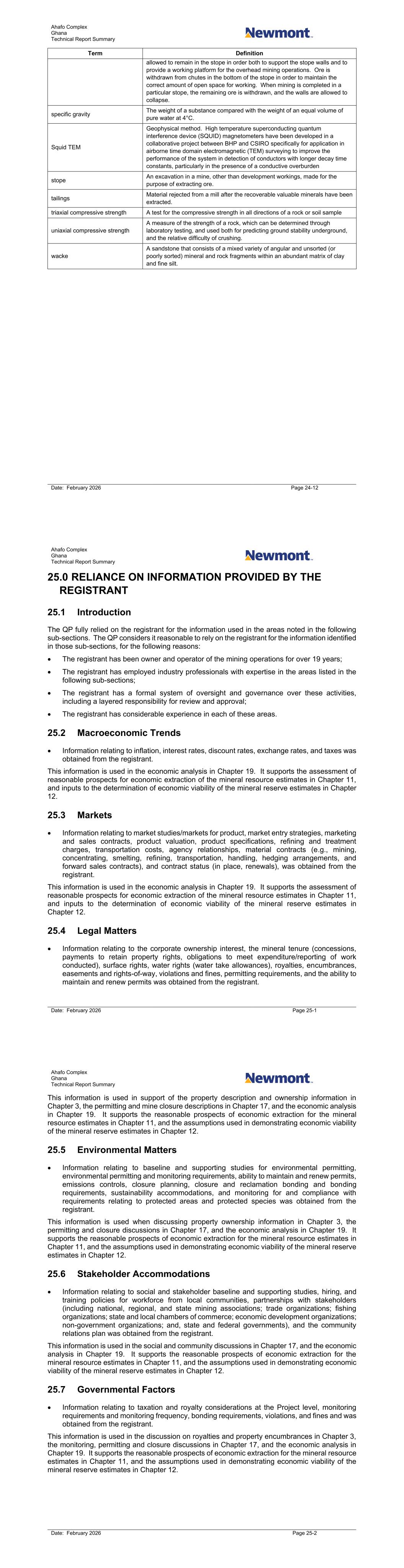
Ahafo Complex Ghana Technical Report Summary Date: February 2026 Page 24-12 Term Definition allowed to remain in the stope in order both to support the stope walls and to provide a working platform for the overhead mining operations. Ore is withdrawn from chutes in the bottom of the stope in order to maintain the correct amount of open space for working. When mining is completed in a particular stope, the remaining ore is withdrawn, and the walls are allowed to collapse. specific gravity The weight of a substance compared with the weight of an equal volume of pure water at 4°C. Squid TEM Geophysical method. High temperature superconducting quantum interference device (SQUID) magnetometers have been developed in a collaborative project between BHP and CSIRO specifically for application in airborne time domain electromagnetic (TEM) surveying to improve the performance of the system in detection of conductors with longer decay time constants, particularly in the presence of a conductive overburden stope An excavation in a mine, other than development workings, made for the purpose of extracting ore. tailings Material rejected from a mill after the recoverable valuable minerals have been extracted. triaxial compressive strength A test for the compressive strength in all directions of a rock or soil sample uniaxial compressive strength A measure of the strength of a rock, which can be determined through laboratory testing, and used both for predicting ground stability underground, and the relative difficulty of crushing. wacke A sandstone that consists of a mixed variety of angular and unsorted (or poorly sorted) mineral and rock fragments within an abundant matrix of clay and fine silt. Ahafo Complex Ghana Technical Report Summary Date: February 2026 Page 25-1 25.0 RELIANCE ON INFORMATION PROVIDED BY THE REGISTRANT 25.1 Introduction The QP fully relied on the registrant for the information used in the areas noted in the following sub-sections. The QP considers it reasonable to rely on the registrant for the information identified in those sub-sections, for the following reasons: • The registrant has been owner and operator of the mining operations for over 19 years; • The registrant has employed industry professionals with expertise in the areas listed in the following sub-sections; • The registrant has a formal system of oversight and governance over these activities, including a layered responsibility for review and approval; • The registrant has considerable experience in each of these areas. 25.2 Macroeconomic Trends • Information relating to inflation, interest rates, discount rates, exchange rates, and taxes was obtained from the registrant. This information is used in the economic analysis in Chapter 19. It supports the assessment of reasonable prospects for economic extraction of the mineral resource estimates in Chapter 11, and inputs to the determination of economic viability of the mineral reserve estimates in Chapter 12. 25.3 Markets • Information relating to market studies/markets for product, market entry strategies, marketing and sales contracts, product valuation, product specifications, refining and treatment charges, transportation costs, agency relationships, material contracts (e.g., mining, concentrating, smelting, refining, transportation, handling, hedging arrangements, and forward sales contracts), and contract status (in place, renewals), was obtained from the registrant. This information is used in the economic analysis in Chapter 19. It supports the assessment of reasonable prospects for economic extraction of the mineral resource estimates in Chapter 11, and inputs to the determination of economic viability of the mineral reserve estimates in Chapter 12. 25.4 Legal Matters • Information relating to the corporate ownership interest, the mineral tenure (concessions, payments to retain property rights, obligations to meet expenditure/reporting of work conducted), surface rights, water rights (water take allowances), royalties, encumbrances, easements and rights-of-way, violations and fines, permitting requirements, and the ability to maintain and renew permits was obtained from the registrant. Ahafo Complex Ghana Technical Report Summary Date: February 2026 Page 25-2 This information is used in support of the property description and ownership information in Chapter 3, the permitting and mine closure descriptions in Chapter 17, and the economic analysis in Chapter 19. It supports the reasonable prospects of economic extraction for the mineral resource estimates in Chapter 11, and the assumptions used in demonstrating economic viability of the mineral reserve estimates in Chapter 12. 25.5 Environmental Matters • Information relating to baseline and supporting studies for environmental permitting, environmental permitting and monitoring requirements, ability to maintain and renew permits, emissions controls, closure planning, closure and reclamation bonding and bonding requirements, sustainability accommodations, and monitoring for and compliance with requirements relating to protected areas and protected species was obtained from the registrant. This information is used when discussing property ownership information in Chapter 3, the permitting and closure discussions in Chapter 17, and the economic analysis in Chapter 19. It supports the reasonable prospects of economic extraction for the mineral resource estimates in Chapter 11, and the assumptions used in demonstrating economic viability of the mineral reserve estimates in Chapter 12. 25.6 Stakeholder Accommodations • Information relating to social and stakeholder baseline and supporting studies, hiring, and training policies for workforce from local communities, partnerships with stakeholders (including national, regional, and state mining associations; trade organizations; fishing organizations; state and local chambers of commerce; economic development organizations; non-government organizations; and, state and federal governments), and the community relations plan was obtained from the registrant. This information is used in the social and community discussions in Chapter 17, and the economic analysis in Chapter 19. It supports the reasonable prospects of economic extraction for the mineral resource estimates in Chapter 11, and the assumptions used in demonstrating economic viability of the mineral reserve estimates in Chapter 12. 25.7 Governmental Factors • Information relating to taxation and royalty considerations at the Project level, monitoring requirements and monitoring frequency, bonding requirements, violations, and fines and was obtained from the registrant. This information is used in the discussion on royalties and property encumbrances in Chapter 3, the monitoring, permitting and closure discussions in Chapter 17, and the economic analysis in Chapter 19. It supports the reasonable prospects of economic extraction for the mineral resource estimates in Chapter 11, and the assumptions used in demonstrating economic viability of the mineral reserve estimates in Chapter 12.