Please wait
.7
ANNUAL INFORMATION FORM
FOR THE YEAR ENDED DECEMBER 31, 2020
This annual information form ("AIF") is as of March 31,
2021
Item
1. Table of Contents
Page
|
Item 1.
|
Table Of Contents
|
2
|
|
Item 2.
|
Preliminary Notes
|
3
|
|
Item 3.
|
Corporate Structure
|
11
|
|
Item 4.
|
General Development Of The Business
|
11
|
|
Item 5.
|
Description Of Business
|
16
|
|
Item 6.
|
Dividends
|
44
|
|
Item 7.
|
Description Of Capital Structure
|
44
|
|
Item 8.
|
Market For Securities
|
44
|
|
Item 9.
|
Escrowed Securities
|
45
|
|
Item 10
|
Directors And Officers
|
45
|
|
Item 11.
|
Promoters
|
53
|
|
Item 12.
|
Legal Proceedings
|
53
|
|
Item 13.
|
Interest Of Management And Others In Material
Transactions
|
56
|
|
Item 14.
|
Transfer Agent And Registrar
|
56
|
|
Item 15.
|
Material Contracts
|
56
|
|
Item 16.
|
Interests Of Experts
|
56
|
|
Item 17.
|
Additional Information
|
57
|
|
Item 18.
|
Disclosure For Companies Not Sending Information
Circulars
|
57
|
|
Item 19.
|
Audit And Risk Committee, Auditor Fees, Exemptions, Code Of
Ethics
|
57
|
|
Appendix A - Audit And Risk Committee Charter
|
60
|
Item
2.
Preliminary Notes
This
AIF contains "forward-looking information" within the meaning of
applicable Canadian securities legislation. Wherever possible,
words such as "plans", "expects", or "does not expect", "budget",
"scheduled", "estimates", "forecasts", "anticipate" or "does not
anticipate", "believe", "intend" and similar expressions or
statements that
certain actions, events or results "may", "could", "would", "might"
or "will" be taken, occur or be achieved, have been used to
identify forward-looking information.
Forward-looking
information in this AIF include, without limitation, statements
regarding:
● our
expectations regarding the potential for securing the necessary
permits for a mine at the Pebble Project and our ability to
establish that such a permitted mine can be economically
developed;
● the success
of our appeal of the record of decision (“ROD”) of the United States Army
Corps of Engineers (the "USACE") denying the issuance of certain
permits required for the Pebble Project ROD;
● our ability
to successfully apply for and obtain the federal and state permits
required for the Pebble Project under the Clean Water Act
("CWA"), the National
Environmental Policy Act ("NEPA"), and relevant
legislation;
● the outcome
of the US government investigations involving the
Company;
● our ability
to successfully defend against purported class action lawsuits that
have been commenced against us;
● our plan of
operations, including our plans to carry out and finance
exploration and development activities;
● our ability
to raise capital for exploration and development activities and
meet our working capital requirements;
● our
expected financial performance in future periods;
● our
expectations regarding the exploration and development potential of
the Pebble Project;
● the outcome
of the legal proceedings in which we are engaged;
● the
uncertainties with respect to the effects of COVID-19;
and
● factors
relating to our investment decisions.
Forward-looking
information is based on the reasonable assumptions, estimates,
analysis and opinions of management made in light of its experience
and its perception of trends, current conditions and expected
developments, as well as other factors that management believes to
be relevant and reasonable in the circumstances at the date that
such statements are made, but which may prove to be incorrect. We
believe that the assumptions and expectations reflected in such
forward-looking information are reasonable.
Key
assumptions upon which the Company’s forward-looking
information are based include:
● our appeal
of the ROD of the USACE will be successful;
● that we
will ultimately be able to demonstrate that a mine at the Pebble
Project can be economically developed and operated in an
environmentally sound and socially responsible manner, meeting all
relevant federal, state and local regulatory requirements so that
we will be ultimately able to obtain permits authorizing
construction of a mine at the Pebble Project;
● that we
will be able to secure sufficient capital necessary for continued
environmental assessment and permitting activities and engineering
work which must be completed prior to any potential development of
the Pebble Project which would then require engineering and
financing in order to advance to ultimate
construction;
● that the
COVID-19 outbreak will not materially impact or delay our ability
to obtain permitting for a mine at the Pebble Project;
|
2020
Annual Information Form
|
Page | 3
|
● that we
will ultimately be able to demonstrate that a mine at the Pebble
Project will be economically feasible based on a mine plan for
which permitting can be secured;
● that the
market prices of copper, gold, molybdenum, rhenium and silver will
not decline significantly or stay depressed for a lengthy period of
time;
● that key
personnel will continue their employment with us; and
● that we
will continue to be able to secure adequate financing on acceptable
terms.
Readers
are cautioned that the foregoing list is not exhaustive of all
factors and assumptions, which may have been used. Forward looking
statements are also subject to risks and uncertainties facing our
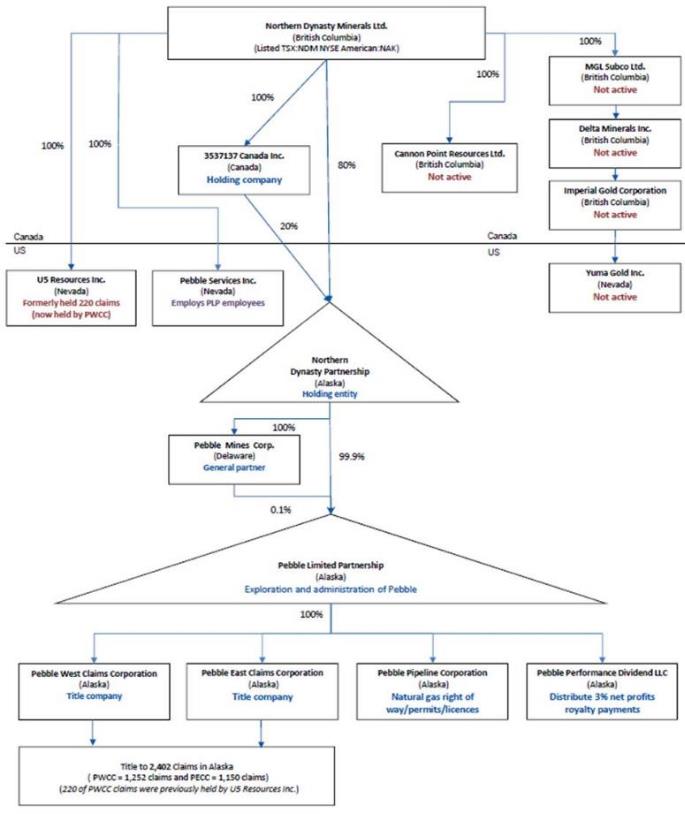
business, any of which could have a material impact on our
outlook.
Some of
the risks and uncertainties that could cause actual results to
differ materially from those expressed in the forward-looking
statements include:
● we may be
unsuccessful in our appeal of the ROD with respect to the decision
to deny the issuance of many of the permits which we require to
operate a mine at the Pebble Project;
● an
inability to ultimately obtain permitting for a mine at the Pebble
Project;
● an
inability to establish that the Pebble Project may be economically
developed and mined or contain commercially viable deposits of ore
based on a mine plan for which government authorities are prepared
to grant permits;
● we may not
be successful in defending shareholder securities litigation claims
that have been filed against us in the US and in
Canada;
● the
uncertainty of the outcome of current or future government
investigations and inquiries, including but not limited to, matters
before the U.S. Department of Justice and the Securities and
Exchange Commission;
● government
efforts to curtail the COVID-19 pandemic may delay the Company in
completion of its work relating to this permitting
process;
● our ability
to obtain funding for working capital and other corporate purposes
associated with advancement of the Pebble Project
● an
inability to continue to fund exploration and development
activities and other operating costs;
● our actual
operating expenses may be higher than projected;
● the highly
cyclical nature of the mineral resource exploration
business;
● the
pre-development stage economic viability and technical
uncertainties of the Pebble Project and the lack of known reserves
on the Pebble Project;
● an
inability to recover even the financial statement carrying values
of the Pebble Project if we cease to continue on a going concern
basis;
● the
potential for loss of the services of key executive
officers;
● a history
of, and expectation of further, financial losses from operations
impacting our ability to continue on a going concern
basis;
● the
volatility of gold, copper, molybdenum, silver and rhenium prices
and the share prices of mining companies;
● the
inherent risk involved in the exploration, development and
production of minerals, and the presence of unknown geological and
other physical and environmental hazards at the Pebble
Project;
|
2020
Annual Information Form
|
Page | 4
|
● the
potential for changes in, or the introduction of new, government
regulations relating to mining, including laws and regulations
relating to the protection of the environment and project legal
titles;
● potential
claims by third parties to titles or rights involving the Pebble
Project;
● the
uncertainty of the outcome of current or future litigation
including but not limited to, the appeal of the ROD denying the
issuance of permits required to operate a mine at the Pebble
Project;
● the
possible inability to insure our operations against all
risks;
● the highly
competitive nature of the mining business;
● the
potential equity dilution to current shareholders due to any future
equity financings or from the exercise of share purchase options
and warrants to purchase the Company’s shares;
● that we
have never paid dividends and will not do so in the foreseeable
future.
This
list is not exhaustive of the factors that may affect any of the
Company’s forward-looking statements or information.
Forward-looking statements or information are statements about the
future and are inherently uncertain, and actual achievements of the
Company or other future events or conditions may differ materially
from those reflected in the forward-looking statements or
information due to a variety of risks, uncertainties and other
factors, including, without limitation, the risks and uncertainties
described above. See "Risk
Factors" on page 35.
Our
forward-looking statements are based on the reasonable beliefs,
expectations and opinions of management on the date of this AIF.
Although we have attempted to identify important factors that could
cause actual results to differ materially from those contained in
forward-looking information, there may be other factors that cause
results not to be as anticipated, estimated or intended. There is
no assurance that such information will prove to be accurate, as
actual results and future events could differ materially from those
anticipated in such information. Accordingly, readers should
appreciate the inherent uncertainty of, and not place undue
reliance on, forward-looking information. We do not undertake to
update any forward-looking information, except as, and to the
extent required by, applicable securities laws.
Incorporation of Continuous Disclosure Documents by
Reference
In this
AIF, the "Company" or "Northern Dynasty" refers to Northern Dynasty
Minerals Ltd. and all its subsidiaries and affiliated partnerships
together unless the context states otherwise.
Currency and Metric Equivalents
All
dollar amounts are expressed in Canadian dollars unless otherwise
indicated. The Company’s accounts are maintained in Canadian
dollars. The daily rate of exchange on December 31, 2020,
as reported by the Bank of Canada for the conversion of one
Canadian dollar into one United States dollar ("U.S. dollar"),
was $1.2732.
On
March 30, 2021,
the rate of exchange of the Canadian Dollar, based on the daily
rate in Canada as published by the Bank of Canada, was US$1.00 =
$1.2631. Exchange
rates published by the Bank of Canada, available on its website
www.bankofcanada.ca,
are nominal quotations - not buying or selling rates - and intended
for statistical or analytical purposes.
|
2020
Annual Information Form
|
Page | 5
|
The
following tables set out the exchange rates, based on the daily
rates in Canada as published by the Bank of Canada for the
conversion of Canadian Dollars into U.S. dollars.
|
|
Year
Ended December 31
(Canadian
Dollars per U.S. Dollar)
|
|
|
2020
|
2019
|
2018
|
2017
|
|
Rate at
end of year
|
$1.2732
|
$1.2988
|
$1.3642
|
$1.2545
|
|
Average
rate for year
|
$1.3415
|
$1.3269
|
$1.2957
|
$1.2986
|
|
High
for year
|
$1.4496
|
$1.3600
|
$1.3642
|
$1.3743
|
|
Low for
year
|
$1.2718
|
$1.2988
|
$1.2288
|
$1.2128
|
|
Monthly
High and Low Daily Exchange Rate (Canadian Dollar per U.S.
Dollar)
|
|
Month or Period
|
High
|
Low
|
|
March
2021 (to March 30, 2021)
|
$1.2668
|
$1.2455
|
|
February
2021
|
$1.2828
|
$1.2530
|
|
January
2021
|
$1.2824
|
$1.2627
|
|
December
2020
|
$1.2952
|
$1.2718
|
|
November
2020
|
$1.3318
|
$1.2965
|
For
ease of reference, the following factors for converting metric
measurements into Imperial equivalents are as follows:
|
Metric Units
|
Multiply by
|
Imperial Units
|
|
hectares
|
2.471
|
=
acres
|
|
metres
|
3.281
|
=
feet
|
|
kilometres
|
0.621
|
= miles
(5,280 feet)
|
|
grams
|
0.032
|
=
ounces (troy)
|
|
tonnes
|
1.102
|
= tons
(short) (2,000 pounds)
|
|
grams/tonne
|
0.029
|
=
ounces (troy)/ton
|
|
2020
Annual Information Form
|
Page | 6
|

Glossary
In this
AIF the following terms have the meanings set forth
herein:
Regulatory Terms:
|
Term
|
Meaning
|
|
CWA
|
United
States Clean Water Act
|
|
CWA 404
Permit Application
|
The
permit application filed by the Pebble Partnership with the USACE
pursuant to Section 404 of the CWA
|
|
EPA
|
United
States Environmental Protection Agency
|
|
LEDPA
|
The
"least environmentally damaging practicable
alternative" under the CWA
|
|
NEPA
|
National
Environmental Policy Act
|
|
Pebble
EIS
|
The
final environmental impact statement for the Pebble Project
published by the USACE on July 24, 2020
|
|
Record
of Decision
|
The
record of decision of the USACE in respect of the Pebble Project
issued by the USACE on November 25, 2020
|
|
USACE
|
United
States Army Corps of Engineers
|
Technical Terms:
|
Term
|
Meaning
|
|
Alkalic
|
Igneous
rock containing a relatively high percentage of sodium and
potassium feldspar; alteration can also introduce alkali
minerals.
|
|
Argillic
|
Hydrothermal
alteration of wall rock that forms clay minerals including
kaolinite, smectite, illite and other species.
|
|
CuEQ
|
Copper
Equivalent
|
|
Comminution
|
Reduction
of solid materials from one average particle size to a smaller
average particle size by crushing, grinding, cutting, vibrating, or
other means.
|
|
Deportment
|
Assessment
of how minerals contribute to grade, as each mineral is likely to
behave differently to comminution, flotation or
leaching.
|
|
Diorite
|
Grey to
dark-grey igneous intrusive rock of intermediate composition,
composed principally of plagioclase feldspar along with biotite,
hornblende and/or pyroxene.
|
|
Element
Abbreviations
|
Au -
Gold; Ag - Silver; Al - Aluminum; Cu - Copper; Fe - Iron; Mo -
Molybdenum; Na - Sodium; O - Oxygen; Pb - Lead; Re - Rhenium; S -
Sulphur; Zn - Zinc.
|
|
Geometallurgy
|
Practice
of combining geology and/or geostatistics with
metallurgy.
|
|
Graben
|
Down-dropped
block of land bordered by faults.
|
|
Granodiorite
|
Medium-
to coarse-grained acid igneous rock with quartz (>20%),
plagioclase and alkali feldspar, commonly with minor hornblende
and/or biotite.
|
|
Hypogene
|
Processes
below the earth's surface which, in mineral deposits, result in
precipitation of primary minerals like sulphides.
|
|
Hydrothermal
mineral deposit
|
Any
concentration of metallic minerals formed by the precipitation of
solids from hot waters (hydrothermal solution). The solutions may
be sourced from a magma or from deeply circulating water heated by
magma.
|
|
Illite
Pyrite
|
Alteration
zone with significant amounts of illite – a clay mineral and
pyrite – an iron sulphide mineral.
|
|
Intrusion
(batholith, dyke, pluton)
|
Medium
to coarse grained igneous bodies that crystallized at depth within
the Earth's crust. Large intrusive bodies are called batholiths;
smaller bodies are plutons and linear bodies are
dykes.
|
|
Leached
Cap
|
Rock
that originally contained mineralization that was subsequently
removed due to weathering processes.
|
|
Locked
Cycle Test
|
A
repetitive batch flotation test used in mineral processing
laboratories while developing a metallurgical
flowsheet.
|
|
Monzonite
|
Igneous
intrusive rock with approximately equal amounts of plagioclase and
alkali feldspar, and less than 5% quartz by volume.
|
|
National
Instrument 43-101 ("NI 43-101")
|
The
Canadian securities instrument which establishes disclosure
standards for mineral projects held by Canadian publicly-traded
resource companies.
|
|
K
Silicate
|
Alteration
zone with significant potassium (K) bearing silicate
minerals.
|
|
Kriging
|
A
method of estimation of a variable value (such as metal grade) at
an unmeasured location from measured values, weighted by distance
and orientation, at nearby locations.
|
|
Porphyry
deposit
|
A type
of mineral deposit genetically related to igneous intrusions in
which ore minerals are widely distributed, generally of low grade
but commonly of large tonnage.
|
|
Potassic
|
Hydrothermal
alteration that results in the production of potassium-bearing
minerals such as biotite, muscovite or sericite, and/or
orthoclase.
|
|
Preliminary
Economic Assessment
|
A study
that includes an economic analysis of the potential viability of
mineral resources but that does not meet the definition of either a
“pre-feasibility study” or a “feasibility
study”, as such terms are defined under Canadian Institute of
Mining and Metallurgy ("CIM") Definitions below. It is a
term defined under NI 43-101.
|
|
Pyrophyllite
|
Aluminosilicate
hydroxide mineral that forms as a result of hydrothermal alteration
or low grade metamorphism.
|
|
QSP
|
Quartz
Sericite Pyrite; an alteration zone.
|
|
Sericite
|
Alteration
zone with significant sericite, a fine-grained version of the mica
mineral muscovite.
|
|
Sodic
Potassic
|
Alteration
zone with significant sodium (Na) and potassium (K) bearing
minerals
|
|
2020
Annual Information Form
|
Page | 7
|
|
Term
|
Meaning
|
|
Sodic
|
In this
report, refers to a type of hydrothermal alteration that contains
sodium-bearing minerals, most commonly albite
feldspar.
|
|
Subduction
|
Process
by which one tectonic plate moves under another tectonic
plate.
|
|
Supergene
|
Refers
to processes that occur relatively near the surface of the earth
which modify or destroy original (hypogene) minerals by oxidation
and chemical weathering.
|
|
Superterrane
|
A group
of physically connected and related geological terranes (group of
related rock units).
|
Canadian Mineral Property Disclosure Standards and Resource
Estimates
The
discussion of mineral deposit classifications in this AIF uses the
certain technical terms presented below as they are defined in
accordance with the CIM Definition Standards on mineral resources
and reserves (the "CIM Definition
Standards") adopted by the Canadian Institute of Mining,
Metallurgy and Petroleum (the "CIM
Council"), as required by NI 43-101. The following
definitions are reproduced from the latest version of the CIM
Standards, which were adopted by the CIM Council on May 10, 2014
(the "CIM Definitions").
Estimated mineral resources fall into two broad categories
dependent on whether the economic viability of them has been
established and these are namely "resources" (potential for
economic viability) and "reserves" (viable economic production is
feasible). Resources are sub-divided into categories depending on
the confidence level of the estimate based on level of detail of
sampling and geological understanding of the deposit. The
categories, from lowest confidence to highest confidence, are
inferred resource, indicated resource and measured resource. The
Company does not claim to have any reserves at this time. The CIM
definitions are as follows:
|
Term
|
Definition
|
|
Mineral
Resource
|
A
concentration or occurrence of solid material of economic interest
in or on the Earth’s crust in such form, grade or quality and
quantity that there are reasonable prospects for eventual economic
extraction. The location, quantity, grade or quality, continuity
and other geological characteristics of a mineral resource are
known, estimated or interpreted from specific geological evidence
and knowledge, including sampling.
|
|
Measured
Mineral Resource
|
That
part of a mineral resource for which quantity, grade or quality,
densities, shape, and physical characteristics are estimated with
confidence sufficient to allow the application of modifying factors
to support detailed mine planning and final evaluation of the
economic viability of the deposit. Geological evidence is derived
from detailed and reliable exploration, sampling and testing and is
sufficient to confirm geological and grade or quality continuity
between points of observation. A measured mineral resource has a
higher level of confidence than that applying to either an
Indicated mineral resource or an inferred mineral resource. It may
be converted to a proven mineral reserve or to a probable mineral
reserve.
|
|
Indicated
Mineral Resource
|
That
part of a mineral resource for which quantity, grade or quality,
densities, shape and physical characteristics are estimated with
sufficient confidence to allow the application of modifying factors
in sufficient detail to support mine planning and evaluation of the
economic viability of the deposit. Geological evidence is derived
from adequately detailed and reliable exploration, sampling and
testing and is sufficient to assume geological and grade or quality
continuity between points of observation. An indicated mineral
resource has a lower level of confidence than that applying to a
measured mineral resource and may only be converted to a probable
mineral reserve.
|
|
2020
Annual Information Form
|
Page | 8
|
|
Term
|
Definition
|
|
Inferred
Mineral Resource
|
That
part of a mineral resource for which quantity and grade or quality
are estimated on the basis of limited geological evidence and
sampling. Geological evidence is sufficient to imply but not verify
geological and grade or quality continuity. An inferred mineral
resource has a lower level of confidence than that applying to an
indicated mineral resource and may not be converted to a mineral
reserve. It is reasonably expected that the majority of inferred
mineral resources could be upgraded to indicated mineral resources
with continued exploration.
|
|
Mineral
Reserve
|
The
economically mineable part of a measured and/or indicated mineral
resource. It includes diluting materials and allowances for losses,
which may occur when the material is mined or extracted and is
defined by studies at pre-feasibility or feasibility level as
appropriate that include application of modifying factors. Such
studies demonstrate that, at the time of reporting, extraction
could reasonably be justified. The reference point at which mineral
reserves are defined, usually the point where the ore is delivered
to the processing plant, must be stated. It is important that, in
all situations where the reference point is different, such as for
a saleable product, a clarifying statement is included to ensure
that the reader is fully informed as to what is being reported. The
public disclosure of a mineral reserve must be demonstrated by a
pre-feasibility study or feasibility study.
|
|
Proven
Mineral Reserve
|
The
economically mineable part of a measured mineral resource. A proven
mineral reserve implies a high degree of confidence in the
modifying factors.
|
|
Probable
Mineral Reserve
|
The
economically mineable part of an indicated, and in some
circumstances, a measured mineral resource. The confidence in the
modifying factors applying to a probable mineral reserve is lower
than that applying to a proven mineral reserve.
|
|
Modifying
Factors
|
Considerations used
to convert mineral resources to mineral reserves. These include,
but are not restricted to, mining, processing, metallurgical,
infrastructure, economic, marketing, legal, environmental, social
and governmental factors.
|
|
Feasibility
Study
|
A
comprehensive technical and economic study of the selected
development option for a mineral project that includes
appropriately detailed assessments of applicable modifying factors
together with any other relevant operational factors and detailed
financial analysis that are necessary to demonstrate, at the time
of reporting, that extraction is reasonably justified (economically
mineable). The results of the study may reasonably serve as the
basis for a final decision by a proponent or financial institution
to proceed with, or finance, the development of the project. The
confidence level of the study will be higher than that of a
pre-feasibility study.
|
|
Pre-feasibility
Study
|
A
comprehensive study of a range of options for the technical and
economic viability of a mineral project that has advanced to a
stage where a preferred mining method, in the case of underground
mining, or the pit configuration, in the case of an open pit, is
established and an effective method of mineral processing is
determined. It includes a financial analysis based on reasonable
assumptions on the modifying factors and the evaluation of any
other relevant factors which are sufficient for a qualified person,
acting reasonably, to determine if all or part of the mineral
resource may be converted to a mineral reserve at the time of
reporting. A pre-feasibility study is at a lower confidence level
than a feasibility study.
|
|
2020
Annual Information Form
|
Page | 9
|
Cautionary Notes to United States Investors Concerning Canadian
Mineral Property Disclosure Standards
As a
Canadian issuer, Northern Dynasty is required to comply with
reporting standards in Canada that require that we make disclosure
regarding our mineral properties, including any estimates of
mineral reserves and resources, in accordance with NI 43-101.
NI 43-101 is a rule developed by the Canadian Securities
Administrators that establishes standards for all public disclosure
an issuer makes of scientific and technical information concerning
mineral projects. In accordance with
NI 43-101, the Company uses the terms mineral reserves and
resources as they are defined in accordance with the CIM Definition
Standards on mineral reserves and resources adopted by the Canadian
Institute of Mining, Metallurgy and Petroleum.
The
United States Securities and Exchange Commission (the "SEC") has adopted amendments to its
disclosure rules to modernize the mineral property disclosure
requirements for issuers whose securities are registered with the
SEC under the US Exchange Act (the "SEC Modernization Rules") with compliance required
for the first fiscal year on or after January 1, 2021. The SEC
Modernization Rules have replaced the historical property
disclosure requirements for mining registrants that were included
in SEC Industry Guide 7 ("Guide 7").
The SEC
Modernization Rules include the adoption of definitions of the
following terms, which are substantially similar to the
corresponding terms under the CIM Definition Standards that are
presented above under "Canadian
Mineral Property Disclosure Standards and Resource
Estimates":
●
mineral resource;
●
indicated mineral resource;
●
inferred mineral resource;
●
mineral reserve;
●
proven mineral reserve;
●
probable mineral reserve;
●
modifying factors;
●
feasibility study; and
●
preliminary feasibility study (or "pre-feasibility study").
As a
result of the adoption of the SEC Modernization Rules, the SEC will
now recognize estimates of "measured mineral resources", "indicated
mineral resources" and "inferred mineral resources". In addition,
the SEC has amended its definitions of "proven mineral reserves"
and "probable mineral reserves" to be substantially similar to the
corresponding CIM Definitions.
Northern
Dynasty is not required to provide disclosure on our mineral
properties, including the Pebble Project, under the SEC
Modernization Rules as we are presently a "foreign issuer" under the US Exchange Act
and entitled to file continuous disclosure reports with the SEC
under the Multi-Jurisdictional Disclosure System ("MJDS") between Canada and the
United States. Accordingly, we anticipate that we will be entitled
to continue to provide disclosure on our mineral properties,
including the Pebble Project, in accordance with NI 43-101
disclosure standards and CIM Definition Standards. However, if we
either cease to be a "foreign issuer" or cease to be entitled to
file reports under the MJDS, then we will be required to provide
disclosure on our mineral properties under the SEC Modernization
Rules. Accordingly, United States investors are cautioned that the
disclosure that we provide on our mineral properties, including the
Pebble Project, in the AIF and under our continuous disclosure
obligations under the US Exchange Act may be different from the
disclosure that we would otherwise be required to provide as a US
domestic issuer or a non-MJDS foreign issuer under the SEC
Modernization Rules.
|
2020
Annual Information Form
|
Page | 10
|
United
States investors are cautioned that while the above terms are
substantially similar to CIM Definitions, there are differences in
the definitions under the SEC Modernization Rules and the CIM
Definition Standards. Accordingly, there is no assurance any
mineral resources that we may report as "measured mineral
resources", "indicated mineral resources" and "inferred mineral
resources" under NI 43-101 would be the same had we prepared
the resource estimates under the standards adopted under the SEC
Modernization Rules.
Investors
are cautioned not to assume that any "measured mineral resources",
"indicated mineral resources", or "inferred mineral resources" that
we report in this AIF are or will be economically or legally
mineable.
Further,
"inferred resources" have a great amount of uncertainty as to
whether they can be mined legally or economically. In accordance
with Canadian securities laws, estimates of "inferred mineral
resources" cannot form the basis of feasibility or other economic
studies, except in limited circumstances where permitted under
NI 43-101.
For the
above reasons, information contained in this AIF and the documents
incorporated by reference herein containing descriptions of our
mineral deposits may not be comparable to similar information made
public by United States companies subject to the reporting and
disclosure requirements under the United States federal securities
laws and the rules and regulations thereunder.
Item
3. Corporate Structure
Northern
Dynasty is a mineral exploration company incorporated on
May 11, 1983 pursuant to the Company Act of the Province
of British Columbia (predecessor statute to the British Columbia
Corporations Act in force since 2004), under the name "Dynasty
Resources Inc." On November 30, 1983, the Company changed its
name to "Northern Dynasty Explorations Ltd." and subsequently, on
October 11, 1997, changed its name to Northern Dynasty Minerals
Ltd. Northern Dynasty became a reporting company in the Province of
British Columbia on April 10, 1984 and was listed on the
Vancouver Stock Exchange (now absorbed by the TSX Venture Exchange
and herein generally "TSX-V") from 1984-1987, listed on the
Toronto Stock Exchange ("TSX") from 1987-1993, and delisted from
trading but continued to comply with its continuous disclosure
obligations from 1993 to 1994, and thereafter listed on TSX-V from
1994 to October 30, 2007, when it again began trading on the TSX.
In November 2004, the common shares of Northern Dynasty were also
listed on the American Stock Exchange ("AMEX"). AMEX was purchased by the New
York Stock Exchange ("NYSE")
and the Company now trades on the NYSE American Exchange
("NYSE
American").
The
head office of Northern Dynasty is located at 1040 West Georgia
Street, 15th floor, Vancouver, British Columbia, Canada
V6E 4H1, telephone (604) 684-6365, facsimile (604) 684-8092.
The Company’s legal registered office is in care of its
Canadian attorneys, McMillan LLP, Barristers & Solicitors, at
Suite 1500, 1055 West Georgia Street, Vancouver, British Columbia,
Canada V6E 4N7, telephone (604) 689-9111, facsimile
(604) 685-7084.
The
Company’s Alaska mineral resource exploration business is
operated through a wholly-owned Alaskan registered limited
partnership, the Pebble Limited Partnership (the "Pebble Partnership" or "PLP"), in which the Company owns a 100%
interest through an Alaskan general partnership, the Northern
Dynasty Partnership, which is a partnership formed by two of its
subsidiaries. An indirectly wholly-owned subsidiary of the Company,
Pebble Mines Corp. is the general partner of the Pebble Partnership
and responsible for its day-to-day operations. The business address
of the Northern Dynasty Partnership is Suite 505, 3201 C Street,
Anchorage, Alaska, USA, 99503.
In this
AIF, a reference to the "Company" or "Northern Dynasty" includes a
reference to PLP and the Company’s wholly-owned subsidiaries
and other consolidated interests and entities, unless the context
clearly indicates otherwise. Certain terms used herein are defined
in the text and others are included in the glossary of this
AIF.
Item
4. General Development of the Business
Company Development
Northern
Dynasty is a mineral exploration company focused on the exploration and advancement
towards feasibility, permitting and ultimately development
of the Pebble Project, a copper-gold-molybdenum-silver-rhenium
mineral project located in southwest Alaska (the "Pebble Project" or the "Project"). The Pebble Project is
comprised of mineral claims that are held by subsidiaries of the
Pebble Partnership, which is a 100% wholly-owned subsidiary of
Northern Dynasty.
|
2020
Annual Information Form
|
Page | 11
|
Northern
Dynasty acquired a 100% interest the Pebble Project from an Alaskan
subsidiary of Teck Resources Limited ("Teck") in a series of transactions from
October 2001 through to June 2006. Teck has retained certain
royalties in the Pebble Project, as described in detail below under
Item 5
– Description
of Business.
The
Pebble Partnership was converted into a limited partnership in July
2007 in connection with a joint venture for the Pebble Project
entered into between the Company and an affiliate of Anglo American
plc ("Anglo American"). From
July 2007 to December 2013, approximately US$573 million was
provided to the Pebble Partnership by the affiliate of Anglo
American, largely spent on exploration programs, resource
estimates, environmental data collection and technical studies,
with a significant portion spent on engineering of various possible
mine development models and related infrastructure, power and
transportation systems. The technical and engineering studies that
were completed relating to mine-site and infrastructure development
are not considered to be current or necessarily representative of
management’s current understanding of the most likely
development scenario for the Project. Accordingly, the Company is
uncertain whether it can realize significant value from this prior
work. Environmental baseline studies and data, as well as
geological information from exploration, remain important
information available to the Company from this period in continuing
its advancement of the Project. Anglo American withdrew from the
Pebble Partnership effective December 10, 2013.
In
December 2017, Northern Dynasty and First Quantum Minerals Ltd.
("First Quantum" or
collectively, the "parties")
entered into a framework agreement, which contemplated that the
parties would execute an option agreement whereby First Quantum
could earn a 50% interest in the Pebble Partnership. First Quantum
also made a non-refundable early option payment of US$37.5 million
to be applied solely for the purpose of progressing permitting of
the Pebble Project. On May 25, 2018, the Company announced that the
parties had been unable to reach agreement on the option and
partnership transaction contemplated in the December 2017 framework
agreement, and it was terminated in accordance with its
terms.
Northern
Dynasty holds a 100% interest in the Pebble Partnership and the
Pebble Project. Northern Dynasty continues its efforts to secure a
partner for the project.
To
December 31, 2020, approximately $979 million (US$883 million) in
expenditures have been incurred on the Pebble Project. In addition,
Northern Dynasty has spent approximately $106 million in
acquisition costs on the Pebble Project.
Northern
Dynasty does not have any operating revenue, although currently and
historically it has had non-material annual interest revenue as a
consequence of investing its surplus funds, and has received
consideration for the sale of a net proceeds interest royalty held
on a non-core property that was carried at nominal
value.
Three Year History
In
February 2014, the US Environmental Protection Agency
("EPA") announced a
pre-emptive regulatory action under Section 404(c) the CWA to
consider restriction or a prohibition of mining activities
associated with the Pebble deposit. From 2014-2017, Northern
Dynasty and the Pebble Partnership focused on a multi-dimensional
strategy, including legal and other initiatives to ward off this
action. These efforts were successful, resulting in the legal
agreement with the EPA announced on May 12, 2017, enabling Pebble
to enter normal course permitting under the NEPA. On December 22, 2017, the
Pebble Partnership filed its 404 wetlands permit application (the
“CWA 404 Permit
Application”) under the CWA with the USACE, which was
“receipted” as complete by USACE on January 5,
2018 and initiated the
federal Environmental Impact Statement ("EIS") permitting process for the Pebble
Project under NEPA. The permit application included a project
description (the "Project
Description") that was based on a smaller mine concept
developed for the Pebble Project in the latter part of 2017 (see
further details in B.
Technical Summary - Introduction). The Project Description in
the permit application envisages the project developed as an open
pit mine and processing facility with supporting
infrastructure.
The
Pebble Project has completed the US NEPA Environmental Impact
Statement ("Pebble EIS")
process with the final Pebble EIS being published by the USACE on
July 24, 2021. The Pebble EIS process required a comprehensive
"alternatives assessment" be undertaken to consider a broad range
of development alternatives, such that the final project design and
operating parameters for the Pebble Project and associated
infrastructure may vary significantly from that being advanced. As
a result, the Company will continue to consider various development
options and no final project design has been selected at this
time.
|
2020
Annual Information Form
|
Page | 12
|
On
March 26, 2020, in accordance with the order of the Governor of
Alaska, the Pebble Partnership, along with all other nonessential
offices in Alaska, closed its offices for the health and safety of
its personnel. Notwithstanding the closure, the Company has
maintained its staff and employees to help ensure that the project
schedule announced by the USACE for the final EIS remained on
track. Technical review meetings were completed before the
implementation of the Governor’s order in response to
COVID-19.
On
April 17, 2020, a US federal district court judge in Alaska ruled
in favour of the EPA by granting a motion to dismiss a case brought
by a collection of litigants opposed to the Pebble Mine that
challenged the EPA’s July 2019 decision to formally withdraw
its prior regulatory action under Section 404(c) of the CWA. The
ruling was based on a determination that the litigants had failed
to state a claim upon which relief can be granted. This dismissal
has been appealed to the Ninth Circuit Court of
Appeals.
On May
22, 2020, the USACE announced a development alternative for the
Pebble Project as the ‘least environmentally damaging
practicable alternative’ or LEDPA for the transportation
corridor for the proposed Pebble mine. The LEDPA transportation
corridor includes an all land-based transportation route to connect
the proposed mine site to a port site on Cook Inlet via an
approximate 85-mile road north of Lake Iliamna, thereby avoiding
the need for ferry transport across the lake. The transportation
corridor, which is referred to as the ‘northern
transportation corridor’ and otherwise known and evaluated in
the Pebble EIS as ‘Alternative 3’, has been extensively
studied by the Pebble Partnership, and the Company believes that
this transportation corridor presents several compelling benefits
over the alternative lake ferry transportation corridor options.
The EPA, in a letter to the USACE dated May 28, 2020, confirmed its
view that the northern corridor transportation route was the least
environmentally damaging practicable alternative under the
EPA’s guidelines.
The
USACE published the final EIS for the Pebble Project on July 24,
2020. Led by the USACE, the Pebble EIS also involved eight federal
cooperating agencies (including the US EPA and US Fish &
Wildlife Service), three state cooperating agencies (including the
Alaska Department of Natural Resources and the Alaska Department of
Environmental Conservation), the Lake & Peninsula Borough and
federally recognized tribes.
The
final Pebble EIS was viewed by the Company as positive in that it
found impacts to fish and wildlife would not be expected to affect
harvest levels, there would be no measurable change to the
commercial fishing industry including prices and there would be a
number of positive socioeconomic impacts on local
communities.
|
2020
Annual Information Form
|
Page | 13
|
The CWA
404 Permit Application was submitted in December 2017, and the
permitting process over the next three years involved the Pebble
Partnership being actively engaged with the USACE on the evaluation
of the Pebble Project. There were numerous meetings between
representatives of the USACE and the Pebble Partnership regarding,
among other things, compensatory mitigation for the Pebble Project.
The Pebble Partnership submitted several draft compensatory
mitigation plans to the USACE, each refined to address comments
from the USACE and that the Pebble Partnership believed were
consistent with mitigation proposed and approved for other major
development projects in Alaska. In late June 2020, USACE verbally
identified the “significant degradation” of certain
aquatic resources, with the requirement of new compensatory
mitigation. The Pebble Partnership understood from these
discussions that the new compensatory mitigation plan for the
Pebble Project would include in-kind, in-watershed mitigation and
continued its work to meet these new USACE
requirements.
The
USACE formally advised the Pebble Partnership by letter dated
August 20, 2020 that it had made preliminary factual determinations
under Section 404(b)(1) of the CWA that the Pebble Project as
proposed would result in significant degradation to aquatic
resources. In connection with this preliminary finding of
significant degradation, the USACE formally informed the Pebble
Partnership that in-kind compensatory mitigation within the Koktuli
River watershed would be required to compensate for all direct and
indirect impacts caused by discharges into aquatic resources at the
mine site. The USACE requested the submission of a new compensatory
mitigation plan to address this finding within 90 days of its
letter.
Based on these requirements, the Pebble Partnership continued with
its efforts to develop the new compensatory mitigation plan
(the "CMP") to align with the requirements outlined by the
USACE as conveyed to the Pebble Partnership. This plan envisioned
creation of an 112,445-acre Koktuli Conservation Area on land
belonging to the State of Alaska in the Koktuli River watershed
downstream of the Project. During the period in which this CMP was
developed, the Pebble Partnership continued to confer with the
USACE regarding its proposed approach to
mitigation.
An initial draft of the CMP was
submitted to the USACE for an interim review by the USACE in
September 2020. The Pebble Partnership then revised the CMP based
on the input from the USACE. The objective of the preservation of
the Koktuli Conservation Area was to allow the long-term protection
of a large and contiguous ecosystem that contains valuable aquatic
and upland habitats. If adopted, the Koktuli Conservation Area
would preserve 31,026 acres of aquatic resources (wetlands) within
the aquatic resource of national importance-designated Koktuli
River watershed. The protected resources were designed to address
the physical, chemical, and biological functions highlighted by the
EPA and US Fish & Wildlife Service. Preservation of the Koktuli
Conservation Area was proposed with the objective of minimizing the
threat to, and preventing the decline of, aquatic resources in the
Koktuli River watershed from potential future actions, and
sustaining the fish and wildlife species that depend on these
aquatic resources, while protecting the subsistence lifestyle of
the residents of Bristol Bay and commercial and recreational sport
fisheries. The revised plan was submitted to the USACE on November
4, 2020.
On
November 25, 2020, the USACE issued the ROD. The ROD rejected the
compensatory mitigation plan as “noncompliant” and
determined the project would cause “significant
degradation” and was contrary to the public interest. Based
on this finding, the USACE rejected Pebble Partnership’s
permit application under the Clean Water Act.
The
Pebble Partnership submitted its request for appeal of the ROD (the
"RFA") to the USACE Pacific
Division on January 19, 2021. The RFA reflects the Pebble
Partnership’s position that the USACE's Record of Decision
and permitting decision – including its “significant
degradation” finding, its ‘public interest review'
findings, and its perfunctory rejection of the Pebble Partnership's
CMP – are contrary to law, unprecedented in Alaska, and
fundamentally unsupported by the administrative record, including
the Pebble EIS. The specific reasons for appeal asserted by the
Pebble Partnership in the RFA include (i) the finding of
“significant degradation” by the USACE is contrary to
law and unsupported by the record, (ii) the USACE’s rejection
of the compensatory mitigation plan is contrary to the USACE
regulations and guidance, including the failure to provide the
Pebble Partnership with an opportunity to correct the alleged
deficiencies, and (iii) the determination by the USACE that the
Pebble Project is not in the public interest is contrary to law and
unsupported by the public record.
In a
letter dated February 24, the USACE confirmed the Pebble
Partnership’s RFA is “complete and meets the criteria
for appeal.” The USACE has appointed a Review Officer to
oversee the administrative appeal process. The appeal process will
now move to consideration by the USACE of the merits of the appeal.
The appeal will be reviewed by the USACE based on the
administrative record and any clarifying information provided, and
the Pebble Partnership will be provided with a written decision on
the merits of the appeal at the conclusion of the process. The
appeal is governed by the policies and procedures of the USACE
administrative appeal regulations. While federal guidelines suggest
the appeal should conclude within 90 days, the USACE has indicated
the complexity of issues and volume of materials associated with
Pebble’s case means the review will likely take additional
time. There is no assurance that the Company’s appeal of the
ROD will be successful or that the required permits for the Pebble
Project will ultimately be issued. The permits are required in
order that the Pebble Project can be developed as proposed by the
Company. If the Pebble Partnership’s administrative appeal of
the ROD is successful, then we anticipate that the permitting
decision would be remanded back to the USACE’s Alaska
District in order that the permitting process would then continue
based on the administrative record and the findings and
determinations made by the USACE Pacific Division in its appeal
decision. There is no assurance that a successful appeal will
ultimately result in the issuance of a positive ROD by the USACE
Alaska District. If the Pebble Partnership’s administrative
appeal is not successful, the Company may seek judicial review of
the ROD in the appropriate US District Court. There is no assurance
that any judicial review would be successful in overturning an
unsuccessful appellate decision.
On
January 22, 2021, the State of Alaska, acting in its role as owner
of the Pebble lands and subsurface mineral estate, announced that
it had also filed a request for appeal. That appeal was rejected on
the basis that the State did not have standing to pursue an
administrative appeal with the USACE.
|
2020
Annual Information Form
|
Page | 14
|
Much of
the work by the Company through the Pebble Partnership in 2020, and
since 2017 has focused on facilitating and providing support to the
federal EIS permitting process. The Company also continued to
actively engage and consult with project stakeholders to share
information and gather feedback on the Pebble Project, its
potential effects and proposed mitigation. In 2018, 2019 and 2020,
right-of-way agreements were secured with Alaska Native village
corporations and other landowners whose lands cover portions of
several proposed transportation and infrastructure routes for the
Pebble Project. Opportunities for additional community benefits
from development of the project have also been explored, including
the Pebble Performance Dividend revenue sharing program for
full-time adult residents of Bristol Bay communities, and a
Memorandum of Understanding with Alaska Peninsula Corporation
announced in July 2020.
Corporate
activities have been directed toward raising capital to support the
EIS process and
discussions directed toward securing a partner with which to
advance the overall development of the project. Northern Dynasty
has completed the following financings and/or raised funds within
the past three years in order to fund its business
operations:
● In December
2017, the Company received a non-refundable early option payment of
US$37.5 million as a result of a framework agreement with First
Quantum, which was terminated in May 2018.
● In December
2018, the Company completed a private placement of 10,150,322
special warrants (the "Special
Warrants") at a price of $0.83 (US$0.62) per Special Warrant
for aggregate gross proceeds of approximately $8.4 million (US$6.3
million). The Special Warrants
converted into common shares on a one-for-one basis without payment
of any additional consideration on February 19,
2019.
● In 2019 and
2020, the Company completed four two-part financings.
● in March
2019, the Company completed:
o a bought deal
offering of 17,968,750 common shares at US$0.64 per common share
for gross proceeds of US$11.5 million ($15.3 million),
which included the exercise of an over-allotment option of
2,343,750 common shares for additional gross proceeds of
US$1.5 million. The offering was completed pursuant to an
underwriting agreement, among the Company and Cantor Fitzgerald
Canada Corporation, as lead underwriter and sole bookrunner, and a
syndicate of underwriters including BMO Nesbitt Burns Inc., H.C.
Wainwright & Co., LLC. and TD Securities Inc. (collectively,
the "Underwriters");
and
o a private
placement of 3,769,476 common shares at $0.86 (US$0.64) per common
share for gross proceeds of approximately $3.2 million
(US$2.4 million).
● in June
2019, the Company completed:
o a bought deal
offering of 12,200,000 common shares at US$0.41 per common share
for gross proceeds of approximately US$5.0 million
($6.6 million). The offering was made through the Underwriters
described above. The Underwriters received 244,000 non-transferable
common share warrants, each warrant exercisable into one common
share of the Company at an exercise price of US$0.41 per common
share until June 24, 2020, which were all exercised;
and
o a private
placement of 3,660,000 common shares of the Company at US$0.41 per
common share for gross proceeds of approximately
US$1.5 million ($2.0 million).
● in August
2019, the Company completed:
o a bought deal
offering of 15,333,334 common shares of the Company at the price of
US$0.75 per Offered Share for aggregate gross proceeds of
approximately US$11.5 million ($15.3 million);
and
o a non-brokered
private placement to investors outside of the United States of
2,866,665 common shares of the Company at the Issue Price for gross
proceeds to the Company of US$2.15 million
($2.8 million).
|
2020
Annual Information Form
|
Page | 15
|
● in December
2019 and January 2020, the Company completed:
o an underwritten
public offering of 41,975,000 common shares at a price of US$0.37
per common share for gross proceeds of approximately US$15.5
million ($20.6 million, completed in December 2019);
and
o a non-brokered
private placement of 13,688,823 common shares of the Company at a
price of US$0.37 per common share for gross proceeds of
approximately US$5.1 million ($6.7 million, completed in
January 2020).
● in May
2020, the Company completed:
o an underwritten
public offering of 14,375,000 common shares at a price of $0.70 per
common share for gross proceeds of approximately
$10.1 million; and
o a non-brokered
private placement of 10,357,143 common shares of the Company at a
price of $0.70 per common share for gross proceeds of approximately
$7.3 million.
● in July and
August 2020, the Company completed:
o an underwritten
public offering of 24,150,000 common shares at a price of US$1.46
per common share for gross proceeds of approximately
US$35.3 million ($47.6 million, completed in August
2020); and
o a non-brokered
private placement of 5,807,534 common shares of the Company at a
price of US$1.46 per common share for gross proceeds of
approximately US$8.6 million ($11.7 million, completed in
two tranches in July and August 2020).
Item 5. Description of
Business
A.
The Pebble Project
The
Company’s business is the exploration and advancement towards
feasibility, permitting and ultimately development of the Pebble
Project.
The Pebble Project Is Subject To State and Federal
Laws
The
Pebble Partnership and its subsidiaries are required to comply with
all Alaska statutes in connection with the Pebble Project. These
statutes govern titles, operations, environmental, development,
operating and generally all aspects of exploration, development and
operation of a mine in Alaska.
Alaska
Statute 38.05.185, among others, establishes the rights to mining
claims and mineral leases on lands owned by the State of Alaska and
open to mineral entry. This group of statutes also cover annual
labor and rental requirements, and royalties.
Operations
on claims or leases on state owned land must be permitted under a
plan of operations as set out in Title 11 of the Alaska
Administrative Code, Chapter 86, Section 800. This
regulation generally provides that the State Division of Mining can
be the lead agency in coordinating the comments of all agencies,
which must consent to the issuance of a plan of operations, and
sets the requirements for the approval of a plan of
operations.
Environmental
conditions are controlled by Alaska Statute 46.08 (which prohibits
release of oil and hazardous substances), Alaska Statute 46.03.060
(which sets water quality standards), and Alaska Statute 46.14
(which sets air quality standards).
Once a
decision is made to enter permitting, the Pebble Project will be
required to satisfy permitting requirements at three levels:
federal, state and local (borough). The process takes approximately
3-4 years to complete and involves 11 regulatory agencies, 60+
categories of permits and significant ongoing opportunities for
public involvement. The Alaska Department of Natural Resources
Large Mine Permitting Team is responsible for coordinating
permitting activities for large mine projects.
|
2020
Annual Information Form
|
Page | 16
|
To
satisfy permitting requirements under NEPA and other regulatory
statutes, a project must provide a comprehensive project design and
operating plan for mine-site and infrastructure facilities;
documentation of development alternatives investigated; mitigation
and compensation strategies, and identification of residual
effects; and environmental monitoring, reclamation and closure
plans. The first step is to provide the required information
(including a Project Description and Environmental Baseline
Document) for an EIS under NEPA, prepared by a third-party
contractor under the direction of a lead federal agency. The EIS
determines whether sufficient evaluation of the project's
environmental effects and development alternatives has been
undertaken. It also provides the basis for federal, state and local
government agencies to make individual permitting
decisions.
Under
the CWA, Section 404(c), the Administrator of the EPA is given the
right to disallow the specification (including the withdrawal of
specification) of any defined area as a disposal site if he or she
determines that the release of material at the disposal site will
have an unacceptable adverse effect on municipal water supplies,
local wildlife, spawning and breeding areas of fisheries, shellfish
beds, and/or recreational areas. Such decisions made by the
Administrator require notice and opportunity for public hearings,
and consultation with the Secretary of the Army. The Administrator
shall set forth in writing and make public his or her findings and
reasons for making any determination under this
subsection.
B.
Technical Summary
The
following disclosure is mainly summarized from the "2021
Technical Report on the Pebble
Project, Southwest Alaska, USA" by J. David Gaunt, P.Geo.,
James Lang, P.Geo., Eric Titley, P.Geo., Hassan Ghaffari, P.Eng.,
and Stephen Hodgson, P.Eng., effective date February 24, 2021
("2021 Technical Report"),
and updated by Company staff. J. David Gaunt, P.Geo., James Lang,
P.Geo., Eric Titley, P.Geo., Hassan Ghaffari, P.Eng., and Stephen
Hodgson, P.Eng., are the qualified persons for the 2018 Technical
Report and have reviewed and approved the content derived from that
report. All qualified persons, other than Hassan Ghaffari, P.Eng.,
are not independent of Northern Dynasty.
The
Pebble deposit was originally discovered in 1989 and was acquired
by Northern Dynasty in 2001. Since that time, Northern Dynasty and
subsequently the Pebble Partnership have conducted significant
mineral exploration, environmental baseline data collection, and
engineering work on the Pebble Project to advance it towards
development.
Since
the acquisition by Northern Dynasty, work at Pebble has led to an
overall expansion of the Pebble deposit, as well as the discovery
of several other mineralized occurrences along an extensive
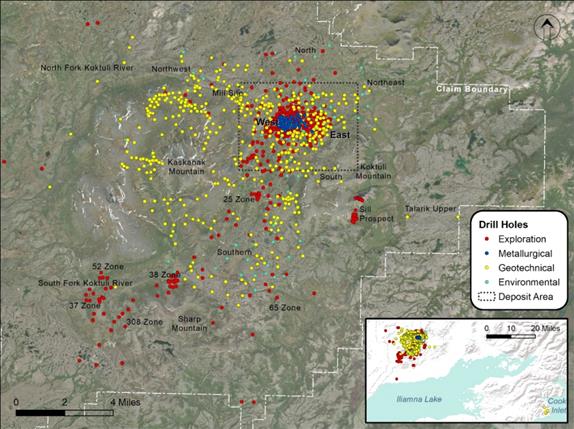
northeast-trending mineralized system underlying the property. Over
1 million feet of drilling has been completed on the property, a
large proportion of which has been focused on the Pebble
deposit.
Comprehensive
deposit delineation, environmental, socioeconomic and engineering
studies of the Pebble deposit began in 2004 and continued through
2013.
Northern
Dynasty completed a Preliminary Assessment (now known as a
Preliminary Economic
Assessment or PEA)
on the Pebble Project in February 2011 (“2011 PEA”). After considering
stakeholder feedback, Northern Dynasty initiated a broad review of
the Pebble Project that took place in 2016 and 2017 to consider ,
among other things, a smaller project footprint and improved
environmental and safety enhancements, and incorporated these and
other improvements into a new proposed development concept for the
Pebble Project.
The
Pebble Partnership submitted an application for a CWA 404 permit in
December 2017 for the Pebble Project on the basis of a
substantially smaller mine facility footprint and with other
material revisions than what was envisaged in the 2011 PEA. As a
result, the economic analysis included in the 2011 PEA is
considered by Northern Dynasty to be out of date such that it can
no longer be relied upon. In light of the foregoing, the Pebble
Project is no longer an advanced property for the purposes of NI
43-101, as the potential economic viability of the Pebble Project
is not currently supported by a preliminary economic assessment,
pre-feasibility study or feasibility study.
|
2020
Annual Information Form
|
Page | 17
|
The
permit application under Section 404 of the CWA and Section 10 of
the Rivers and Harbors Act (RHA) was submitted to the USACE by the
Pebble Partnership on December 22, 2017. On January 8, 2018, USACE
accepted the permitting documentation and confirmed that an EIS
level of analysis was required to comply with its NEPA review of
the Pebble Project. The EIS process progressed through the scoping
phase in 2018. The USACE delivered the draft EIS in the first
quarter of 2019 and completed a public comment period from March to
July 2019. In the latter part of 2019 and early 2020, the USACE and
its consultants advanced toward a final EIS. The preliminary final
EIS was circulated to co-operating agencies for review in February
2020. As part of the EIS preparation process, the USACE and its
consultants had undertaken a comprehensive alternatives assessment
to consider a broad range of development alternatives and announced
the conclusions of the draft LEDPA in May 2020. The USACE published
the final Pebble EIS on July 24, 2020.
The
Pebble Partnership developed the CMP (further described in the
Company’s Three Year History above) to align with the
requirements outlined by the USACE. The CMP was submitted on
November 4, 2021.
On
November 25, 2020, the USACE issued a ROD rejecting the Pebble
Partnership’s permit application. The Pebble Partnership
submitted a RFA of the ROD on January 19, 2021. In a letter dated
February 24, 2021, the USACE confirmed the Pebble
Partnership’s RFA is “complete and meets the criteria
for appeal.”
Several
estimates of the mineral resources in the Pebble Deposit have been
done since Northern Dynasty acquired the project in 2001,
indicating that the deposit contains significant amounts of copper,
gold, molybdenum and silver. In September 2020, Northern Dynasty
published a Technical Report on the Pebble Project documenting
recent studies of the occurrence of rhenium and an estimate of the
rhenium mineral resources in the Pebble deposit. Although previous
work also determined significant amounts of palladium are present,
at least in parts of the deposit, insufficient analyses have
been completed to date to undertake an estimate of the palladium
resource. The report also summarized the proposed plan for the
project as documented in the June 2020 Project Description and
final Pebble EIS.
The
purpose of the 2021 Technical Report that will be filed with this
AIF is to update the current status of the EIS process for the
Pebble Project, given the decisions of the USACE. No changes were
made to the resource estimate from the September 2020 Technical
Report. Information on closure was also added to the Project
Description and Permitting section of the 2021 Technical
Report.
Property Description and Location
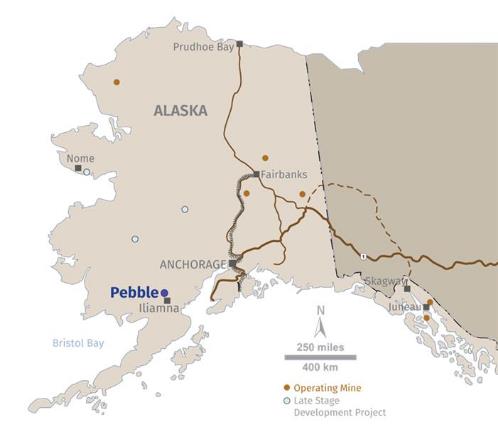
The
Pebble Project is located in southwest Alaska, approximately 200
miles southwest of Anchorage, 17 miles northwest of the village of
Iliamna, and approximately 60 miles west of Cook
Inlet.
|
2020
Annual Information Form
|
Page | 18
|
Figure
1
Property Location – Pebble Project
Source:
2018 Technical Report
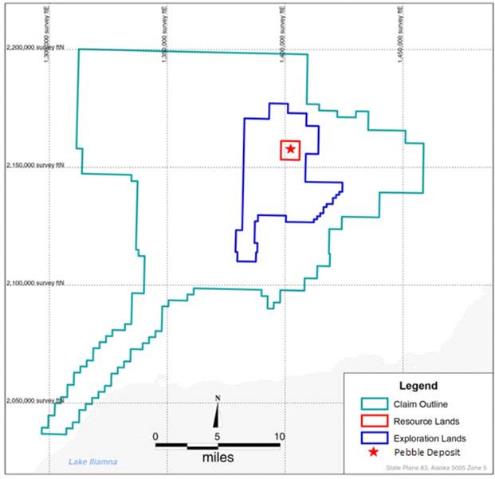
Northern
Dynasty holds, indirectly through wholly-owned subsidiaries of the
wholly-owned Pebble Partnership, Pebble East Claims Corporation and
Pebble West Claims Corporation, a 100% interest in a contiguous
block of 2,402 mineral claims covering approximately 417 square
miles (which includes the Pebble Deposit) (Figure 2).
State
mineral claims in Alaska are kept in good standing by performing
annual assessment work or in lieu of assessment work by paying $100
per year per 40 acre (0.06 square mile) mineral claim, and by
paying annual escalating state
rentals. All of the assessment work payment obligations come due
annually on or before September 1. Credit for excess work can be
banked for a maximum of four years, and can be applied as necessary
to continue to hold the claims in good standing. The Project claims
have a variable amount of work credit available that can be applied
in this way1. State rentals for
2021 are approximately US$1,375,910 and are payable no later than
90 days after the assessment work is due (approximately December
1).
The
Pebble Partnership currently does not own surface rights associated
with the mineral claims that comprise the Pebble property. All
lands are held by the State of Alaska, and surface rights may be
acquired from the state government once areas required for mine
development have been determined and permits awarded. Permits
necessary for exploration drilling and other field programs
associated with pre-development assessment of the Pebble Project
are applied for each year. Environmental liabilities associated
with the Pebble Project include removal of structures, closing
monitoring wells, and removal of piezometers. The State of Alaska
holds a $2 million bond associated with removal and
reclamation of these liabilities.
__________________
1 Annual assessment work obligations for the claims
that are part of the current property of US$667,700 are due in
2021.
|
2020
Annual Information Form
|
Page | 19
|
Figure
2
Mineral Claims – Pebble Project
Source:
2021 Technical Report
Northern
Dynasty acquired the Pebble property by way of a two-part (Resource
Lands and Exploration Lands) purchase option from an Alaskan
subsidiary of Teck Cominco Limited (now Teck), which still retains
a 4% pre-payback advance net profits royalty interest (after debt
service) and 5% after-payback net profits royalty interest in any
mine production from the Exploration Lands portion of the Pebble
property, as shown on the figure above.
In June
2020, the Pebble Partnership established the Pebble Performance
Dividend LLP to distribute a 3% Net Profits Royalty Interest in the
Pebble Project to adult residents of Bristol Bay villages that have
subscribed as participants. The Pebble Performance Dividend will
distribute a guaranteed minimum annual payment of US$3 million each
year the Pebble mine operates beginning at the outset of project
construction.
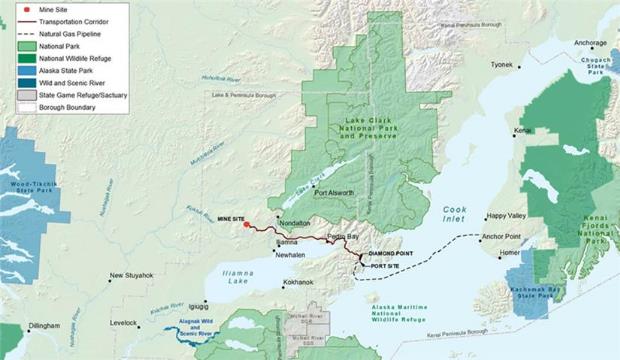
Accessibility, climate, local resources, infrastructure and
physiography
The
Pebble property is located in southwest Alaska. The map shows a
proposed infrastructure corridor for the project, as further
described as the LEDPA in the Final EIS and the 2021 Technical
Report.
|
2020
Annual Information Form
|
Page | 20
|
Source:
2021 Technical Report
Access
to the property is typically via air travel from the city of
Anchorage, which is situated at the northeastern end of Cook Inlet
and is connected to the national road network via Interstate
Highway 1 through Canada to the USA. Anchorage is serviced daily by
several regularly scheduled flights to major airport hubs in the
USA. From Anchorage, there are regular flights to Iliamna through
Iliamna Air Taxi. Charter flights may also be arranged from
Anchorage. From Iliamna, access to the Pebble property is by
helicopter.
There
are paved roads that connect the villages of Iliamna and Newhalen
to the airport and to each other, and a partly paved, partly gravel
road that extends to a proposed Newhalen River crossing near
Nondalton. The property is currently not connected to any of these
local communities by road; a road is planned as part of the project
design.
There
is no access road connecting the communities nearest to the Pebble
Project with the coast on Cook Inlet. From the coast, at
Williamsport on Iniskin Bay, there is an 18.6-mile state-maintained
road that terminates at the east end of Iliamna Lake, where
watercraft and transport barges may be used to access Iliamna. The
route from Williamsport, over land to Pile Bay on Iliamna Lake, is
currently used to transport bulk fuel, equipment and supplies to
communities around the lake during the summer months.
A small
run-of-river hydroelectric installation on the nearby Tazimina
River provides power for the three communities (Iliamna, Newhalen
and Nondalton) in the summer months. Supplemental power generation
using diesel generators is required during winter
months.
Iliamna
and surrounding communities have a combined population of just over
400 people. As such, there is limited local commercial
infrastructure except that which services seasonal sports fishing
and hunting.
The
property is situated at approximately 1,000 ft above mean sea level
in an area described as subarctic tundra. It is characterized by
gently rolling hills and an absence of permafrost. The climate is
sufficiently moderate to allow a well-planned mineral exploration
program to be conducted year-round at Pebble.
|
2020
Annual Information Form
|
Page | 21
|
Geological Setting and Mineralization
Pebble
is a porphyry-style copper-gold-molybdenum-silver-rhenium deposit
that comprises the Pebble East and Pebble West zones of approximate equal size, with
slightly lower-grade mineralization in the center of the deposit
where the two zones merge. The Pebble deposit is located at the
intersection of crustal-scale structures that are oriented both
parallel and obliquely to a magmatic arc which was active in the
mid-Cretaceous and which developed in response to the northward
subduction of the Pacific Plate beneath the Wrangellia
Superterrane.
The
oldest rock within the Pebble district is the Jurassic-Cretaceous
age Kahlitna flysch, composed of turbiditic clastic sedimentary
rocks, interbedded basalt flows and associated gabbro intrusions.
During the mid-Cretaceous (99 to 96 Ma), the Kahlitna assemblage
was intruded first by approximately coeval granodiorite and diorite
sills and slightly later by alkalic monzonite intrusions. At
approximately 90 Ma, hornblende diorite porphyry plutons of the
Kaskanak batholith were emplaced.
Copper-gold-molybdenum-silver-rhenium mineralization is related to
smaller granodiorite plutons and dykes that are similar in
composition to, and emplaced near and above the margins of, the
Kaskanak batholith.
The
Pebble East and Pebble West zones are coeval hydrothermal centers
within a single magmatic-hydrothermal system. The movement of
mineralizing fluids was constrained by a broadly vertical fracture
system acting in conjunction with a hornfels aquitard that induced
extensive lateral fluid migration. The large size of the deposit,
as well as variations in metal grade and ratios, may be the result
of multiple stages of metal introduction and
redistribution.
Mineralization
in the Pebble West zone extends from surface to approximately 3,000
ft depth and is centered on four small granodiorite plutons.
Mineralization is hosted by flysch, diorite and granodiorite sills,
and alkalic intrusions and breccias. The Pebble East zone is of
higher grade and extends to a depth of at least 5,810 ft;
mineralization on the eastern side of the zone was later dropped
1,970 to 2,950 ft by normal faults which bound the
northeast-trending East Graben. East zone mineralization is hosted
by a granodiorite plutons and dykes, and by adjacent granodiorite
sills and flysch. The East and West zone granodiorite plutons merge
with depth
Mineralization
at Pebble is predominantly hypogene, although the Pebble West zone
contains a thin zone of variably developed supergene mineralization
overlain by a thin leached cap. Disseminated and vein-hosted
copper-gold-molybdenum-silver-rhenium mineralization, dominated by
chalcopyrite and locally accompanied by bornite, is associated with
early potassic alteration in the shallow part of the Pebble East
zone and with early sodic-potassic alteration in the Pebble West
zone and deeper portions of the Pebble East zone. Rhenium occurs in
molybdenite and high rhenium concentrations are present in
molybdenite concentrates. Elevated palladium concentrations occur
in many parts of the deposit but are highest in rocks affected by
advanced argillic alteration. High-grade copper-gold mineralization
is associated with younger advanced argillic alteration that
overprinted potassic and sodic-potassic alteration and was
controlled by a syn-hydrothermal, brittle-ductile fault zone
located near the eastern margin of the Pebble East zone. Late
quartz veins introduced additional molybdenum into several parts of
the deposit.
Exploration
Historical
Cominco
Alaska, a division of Cominco Ltd. (now Teck), began reconnaissance
exploration in the Pebble region in the mid-1980s and in 1984
discovered the Sharp Mountain gold prospect near the southern
margin of the current property. Gold was discovered in quartz veins
of probable Tertiary age near the peak of Sharp Mountain. Grab
samples of veins in talus ranged from 0.045 oz/ton Au to
9.32 oz/ton Au and 3.0 oz/ton Ag. In 1987, examination
and sampling of several prominent limonitic and hematitic
alteration zones yielded anomalous gold concentrations from the
Sill prospect and the Pebble discovery outcrop.
Geophysical
surveys were conducted on the property between 1988 and 1997. An
induced polarization ("IP") survey in 1989 at Pebble displayed
response characteristics of a large porphyry-copper system. The
surveys were dipole-dipole IP surveys, which defined a
chargeability anomaly about 31.1 square miles in extent within
Cretaceous age rocks that surround the eastern to southern margins
of the Kaskanak batholith. All known zones of mineralization of
Cretaceous age on the Pebble property occur within the broad IP
anomaly.
|
2020
Annual Information Form
|
Page | 22
|
In
1991, baseline environmental and engineering studies were initiated
and weather stations were established. A preliminary evaluation was
undertaken by Teck in 1991, and updated in 1992. Historical
estimates of the mineral resources for the Pebble deposit were
completed by Teck, most recently in 2000.
Northern Dynasty and Pebble Partnership
Between
2001 and 2006, the entire Pebble property was mapped for rock type,
structure and alteration at a scale of 1:10,000, providing an
important geological framework for interpretation of other
exploration data. A geological map of the Pebble deposit was also
constructed but, due to a paucity of outcrop, was based solely on
drill hole information. The content and interpretation of district
and deposit scale geological maps have not changed materially from
those presented in 2009 and 2010.
A
number of geophysical surveys, including IP, magnetic and other
survey types were completed by Northern Dynasty and the Pebble
Partnership between 2001 and 2010 to test the Pebble deposit and
other occurrences on the Pebble property. Between 2001 and 2003,
Northern Dynasty collected 1,026 soil samples, outlining
high-contrast, coincident anomalies in gold, copper, molybdenum and
other metals in an area that measures at least 5.6 miles
north-south by up to 2.5 miles east-west, with strong but smaller
anomalies in several outlying zones. All soil geochemical anomalies
lie within the 31.1 square mile IP chargeability anomaly. Limited
surficial geochemical surveys were completed in 2010 and
2011.
Drilling
Extensive
drilling totalling 1,048,509.8 ft has been completed in 1,389 holes
on the Pebble Project. These drill programs took place during 21 of
the 31 years from 1988 to 2019. Teck completed several drilling
programs between 1988 and 1997.
Northern
Dynasty with its partners completed drilling for exploration,
deposit delineation, engineering and environmental purposes between
2002 and 2019. Highlights from exploration and deposit delineation
drilling include:
● prior to
2001, Teck completed a total of 164 drill holes, 39 of which were
completed in the Sill Zone and 125 of which were collared within or
near the Pebble deposit;
● in 2002,
drill testing of IP chargeability and multi-element geochemical
anomalies outside of the Pebble deposit but within the larger and
broader IP chargeability anomaly discovered the 38 Zone porphyry
copper-gold-molybdenum deposit, the 52 Zone porphyry copper
occurrence, the 37 Zone gold-copper skarn deposit, the 25 Zone gold
deposit, and several small occurrences in which gold values
exceeded 3.0 g/t;
● in 2003,
drilling took place within and adjacent to the Pebble West zone and
outside the Pebble deposit to test for extensions and new
mineralization at four other zones, including the 38 Zone porphyry
copper-gold-molybdenum deposit and the 37 Zone gold-copper skarn
deposit;
● in 2004,
147 exploration holes were drilled in the Pebble deposit resulting
in the identification of the Pebble East zone and discovery of the
308 Zone porphyry copper-gold-molybdenum deposit;
● in 2005 and
2006, drilling at Pebble East confirms its large size and higher
grades of copper, gold and molybdenum;
● in 2007, 34
holes extend Pebble East to the northeast, northwest, south and
southeast;
● in 2008, 31
delineation and infill holes were drilled at Pebble East. Full
Metal Minerals (USA) Inc. ("FMMUSA") drilled seven exploration holes
on land that is now controlled by the Pebble
Partnership;
● in 2009 and
2010, delineation holes were drilled at the margins of Pebble West
and exploration holes were drilled elsewhere on the
property;
● in 2011 and
2012, holes drilled in the Pebble West zone indicate potential for
resource expansion laterally and to depth, and exploration targets
were tested on the Kaskanak claims to the northwest and south of
Pebble, and on the KAS claims further south;
|
2020
Annual Information Form
|
Page | 23
|
● in 2013 and
2018, geotechnical holes were drilled to test tailings and water
storage facilities in areas remote from the Pebble deposit;
and
● in 2019, a
series of percussion holes were drilled adjacent to the Pebble
deposit to enable hydrological testing.
No
drilling took place in 2014, 2015, 2016 or 2017.
The
spatial distribution and type of holes drilled at Pebble are
illustrated below.
Figure
3
Location of Drill Holes – Pebble Project
Source:
2021 Technical Report
Most of
the footage on the Pebble Project was drilled using diamond core
drills; the Pebble resource estimate was calculated exclusively
from these holes. Many of the cored holes were advanced through
overburden using a tricone bit with no core recovery. These
overburden lengths are included in the core drilling
total.
Since
early 2004, all Pebble drill core has been geotechnically logged.
Nearly 70,000 measurements were made for a variety of geotechnical
parameters on 736,000 ft of core drilling. Recovery is generally
very good and averages 98.6% overall; two-thirds of all measured
intervals have 100% core recovery. Additionally, all Pebble drill
core from the 2002 through 2018 drill programs was photographed in
a digital format.
All
drill hole collars have been surveyed using a differential global
positioning system. A digital terrain model for the site was
generated by photogrammetric methods in 2004. All post-Teck drill
holes have been surveyed downhole, typically using a downhole
survey (single shot magnetic gravimetric) tool. A total of 1,029
holes were drilled vertically (-90°) and 190 were inclined
from -42° to -85° at various azimuths.
A
summary of drilling by various categories (operator, type, year and
area) to the end of the 2019 program are compiled in the table
below. As shown in Figure 3 and Table 1 (East, West, Main), a large
proportion of the drilling has been directed toward the Pebble
deposit.
|
2020
Annual Information Form
|
Page | 24
|
Table
1
Summary of Drill Holes – Pebble Project
|
|
No. of Holes
|
Feet
|
Metres
|
|
By Operator
|
|
Teck
1
|
164
|
75,741.0
|
23,086
|
|
Northern
Dynasty
|
578
|
495,069.5
|
150,897
|
|
Pebble
Partnership 2
|
640
|
472,249.3
|
143,942
|
|
FMMUSA
|
7
|
5,450.0
|
1,661
|
|
Total
|
1,389
|
1,048,509.8
|
319,586
|
|
By Type
|
|
Core
1,5
|
1,160
|
1,027,671.9
|
313,234
|
|
Percussion
6
|
229
|
20,838.0
|
6,351
|
|
Total
|
1,389
|
1,048,509.8
|
319,586
|
|
By Year
|
|
1988
1
|
26
|
7,601.5
|
2,317
|
|
1989
1
|
27
|
7,422.0
|
2,262
|
|
1990
|
25
|
10,021.0
|
3,054
|
|
1991
|
48
|
28,129.0
|
8,574
|
|
1992
|
14
|
6,609.0
|
2,014
|
|
1993
|
4
|
1,263.0
|
385
|
|
1997
|
20
|
14,695.5
|
4,479
|
|
2002
|
68
|
37,236.8
|
11,350
|
|
2003
|
67
|
71,226.6
|
21,710
|
|
2004
|
267
|
165,567.7
|
50,465
|
|
2005
|
114
|
81,978.5
|
24,987
|
|
2006
3
|
48
|
72,826.9
|
22,198
|
|
2007
4
|
92
|
167,666.9
|
51,105
|
|
2008
5
|
241
|
184,726.4
|
56,305
|
|
2009
|
33
|
34,947.5
|
10,652
|
|
2010
|
66
|
57,582.0
|
17,551
|
|
2011
|
85
|
50,767.7
|
15,474
|
|
2012
|
81
|
35,760.2
|
10,900
|
|
2013
|
29
|
6,190.0
|
1,887
|
|
2018
|
28
|
4,374.2
|
1,333
|
|
2019
|
6
|
1,917.4
|
584
|
|
Total
|
1,389
|
1,048,509.8
|
319,586
|
|
By Area
|
|
East
|
149
|
450,047.3
|
137,174
|
|
West
|
447
|
349,128.7
|
106,414
|
|
Main
7
|
83
|
9,629.8
|
2,935
|
|
NW
|
215
|
49,951.1
|
15,225
|
|
North
|
84
|
30,927.0
|
9,427
|
|
NE
|
15
|
1,495.0
|
456
|
|
South
|
117
|
48,387.8
|
14,749
|
|
25
Zone
|
8
|
4,047.0
|
1,234
|
|
37
Zone
|
7
|
4,252.0
|
1,296
|
|
38
Zone
|
20
|
14,221.5
|
4,335
|
|
52
Zone
|
5
|
2,534.0
|
772
|
|
308
Zone
|
1
|
879.0
|
268
|
|
Eastern
|
5
|
621.5
|
189
|
|
Southern
|
147
|
64,374.4
|
19,621
|
|
SW
|
39
|
6,658.8
|
2,030
|
|
Sill
|
39
|
10,445.5
|
3,184
|
|
Cook
Inlet
|
8
|
909.5
|
277
|
|
Total
|
1,389
|
1,048,509.8
|
319,586
|
|
2020
Annual Information Form
|
Page | 25
|
Notes
to table:
1.
Includes holes drilled on the Sill prospect.
2.
Holes started by Northern Dynasty and finished by the Pebble
Partnership are included as the Pebble Partnership.
3.
Drill holes counted in the year in which they were
completed.
4.
Wedged holes are counted as a single hole including full length of
all wedges drilled.
5.
Includes FMMUSA drill holes; data acquired in 2010.
6.
Percussion holes were drilled for engineering and environmental
purposes. Shallow (<15 ft) auger holes not
included.
7.
Comprises holes drilled entirely in Tertiary cover rocks within the
Pebble West and Pebble East areas.
Some
numbers may not sum exactly due to rounding.
Sampling, Analysis and Security of Samples
The
Pebble deposit has been explored by extensive core drilling, with
80,859 samples having been taken from drill core for assay
analysis. Nearly all potentially mineralized Cretaceous core
drilled and recovered has been sampled by halving in 10 ft lengths.
Similarly, all core recovered from the Late Cretaceous to Early
Tertiary cover sequence has also been sampled, typically on 20 ft
sample lengths, with some shorter sample intervals in areas of
geologic interest. Unconsolidated overburden material, where it
exists, is generally not recovered by core drilling and therefore
not usually sampled.
Rock
chips from the 223 rotary percussion holes were generally not
sampled for assay analysis, as the holes were drilled for
monitoring wells and environmental purposes. Only 35 samples were
taken from the drill chips of 26 rotary percussion holes outside
the Pebble deposit area, which were drilled for condemnation
purposes.
Analytical
work in 2002 and from 2004 to 2018 was completed by ALS Minerals
Laboratories of North Vancouver, an ISO/IEC 17025:2005 certified
laboratory. Analytical work for the 2003 drilling program was
completed by SGS Canada Inc. of Toronto, ON, an ISO 9002
registered, ISO 17025 accredited laboratory.
Northern
Dynasty maintained an effective Quality Control/Quality Assurance
("QA/QC") program consistent
with industry best practices, which was continued from 2007 to 2018
under the Pebble Partnership. This program is in addition to the
QA/QC procedures used internally by the analytical laboratories.
The QA/QC program has also been subject to independent review by
Analytical Laboratory Consultants Ltd. and Nicholson Analytical
Consulting through 2012. The analytical consultants provide ongoing
monitoring, including facility inspection and timely reporting of
the performance of standards, blanks and duplicates in the sampling
and analytical program. The results of this program indicate that
analytical results are of a high quality, suitable for use in
detailed modelling and resource evaluation studies. The QA/QC
sample types used in the program are described in the table
below.
|
2020
Annual Information Form
|
Page | 26
|
Table
2
Summary of Quality Control/Quality Assurance Sampling –
Pebble Project
|
QC Code
|
Sample Type
|
Description
|
% of Total
|
|
MS
|
Regular
Mainstream
|
Regular
samples submitted for preparation and analysis at the primary
laboratory.
|
89%
|
|
ST
|
Standard
(Certified Reference Material)
|
Mineralized
material in pulverized form with a known concentration and
distribution of element(s) of interest.
Randomly
inserted using pre-numbered sample tags.
|
4.5%or9
in 200
|
|
DP
|
Duplicate
or Replicate
|
An
additional split taken from the remaining pulp reject, coarse
reject, ¼ core or ½ core remainder.
Random
selection using pre-numbered sample tags.
|
4.5%or9
in 200
|
|
SD
|
Standard
Duplicate
|
Standard
reference sample submitted with duplicates and replicates to the
check laboratory.
|
<1%
|
|
BL
|
Blank
|
Sample
containing negligible or background amounts of elements of
interest, to test for contamination.
|
2%
1 in
50
|
Pebble
core was boxed at the rig and transported daily by helicopter to a
secure logging facility in Iliamna. Half cores remaining after
sampling were replaced in the original core boxes and stored at
Iliamna, AK in a secure compound. Crushed reject samples from the
2006 through 2018 analytical programs are stored in locked
containers at Delta Junction, AK. Drill core assay pulps from the
1989 through 2018 programs are stored at a secure warehouse in
Surrey, BC.
Mineral Resources
The
current resource estimate is based on approximately 59,000 assays
obtained from 699 drill holes. The resource was estimated by
ordinary kriging and is presented in the table below titled
“Table 3 – Mineral Resources – Pebble
Deposit.”
The tabulation is based on copper equivalency that incorporates the
contribution of copper, gold and molybdenum. Although the estimate
includes silver and rhenium, neither were used as part of the
copper equivalency (CuEQ) calculation in order to facilitate
comparison with previous estimates, which did not consider the
economic contribution of either of these metals. The highlighted
0.3% CuEq cut off is considered appropriate for deposits of this
type in the Americas.
|
2020
Annual Information Form
|
Page | 27
|
|
|
Cautionary Note to Investors Concerning Estimates of Measured,
Indicated and Inferred Resources
This section uses the terms "measured resources", "indicated resources" and “inferred
resources”. United States
investors are cautioned that while these terms are
“substantially similar” to CIM Definitions, there are
differences in the definitions under the SEC Modernization Rules
and the CIM Definition Standards. Accordingly, there is no
assurance any mineral resources that we may report as measured
mineral resources, indicated mineral resources and inferred mineral
resources under NI 43-101 would be the same had we prepared
the resource estimates under the standards adopted under the SEC
Modernization Rules. Investors are
cautioned not to assume that all or any part of the mineral
deposits in these categories will ever be converted into
reserves. In addition, "inferred resources" have a great
amount of uncertainty as to their economic and legal feasibility.
Under Canadian rules, estimates of inferred resources may not form
the basis of feasibility or pre-feasibility studies, or economic
studies except for a Preliminary Economic Assessment as defined
under NI 43-101. Investors are cautioned not to assume that all
or any part of an inferred resource is economically or legally
mineable.
|
|
Table
3
Mineral Resources – Pebble Deposit
Measured, Indicated and Inferred Categories
|
Cutoff
CuEq
%
|
CuEq%
|
Metric
Tonnes
|
Cu
(%)
|
Au
(g/t)
|
Mo
(ppm)
|
Ag
(g/t)
|
Re
(ppm)
|
Cu
Blb
|
Au
Moz
|
Mo
Blb
|
Ag
Moz
|
Re
Kkg
|
|
Measured
|
|
0.3
|
0.65
|
527,000,000
|
0.33
|
0.35
|
178
|
1.7
|
0.32
|
3.83
|
5.93
|
0.21
|
28.1
|
167
|
|
0.4
|
0.66
|
508,000,000
|
0.34
|
0.36
|
180
|
1.7
|
0.32
|
3.81
|
5.88
|
0.20
|
27.4
|
163
|
|
0.6
|
0.77
|
279,000,000
|
0.40
|
0.42
|
203
|
1.8
|
0.36
|
2.46
|
3.77
|
0.12
|
16.5
|
100
|
|
1.0
|
1.16
|
28,000,000
|
0.62
|
0.62
|
302
|
2.3
|
0.52
|
0.38
|
0.56
|
0.02
|
2.0
|
14
|
|
Indicated
|
|
0.3
|
0.77
|
5,929,000,000
|
0.41
|
0.34
|
246
|
1.7
|
0.41
|
53.58
|
64.81
|
3.21
|
316.4
|
2,443
|
|
0.4
|
0.82
|
5,185,000,000
|
0.45
|
0.35
|
261
|
1.8
|
0.44
|
51.42
|
58.35
|
2.98
|
291.7
|
2,271
|
|
0.6
|
0.99
|
3,455,000,000
|
0.55
|
0.41
|
299
|
2.0
|
0.51
|
41.88
|
45.54
|
2.27
|
221.1
|
1,748
|
|
1.0
|
1.29
|
1,412,000,000
|
0.77
|
0.51
|
343
|
2.4
|
0.60
|
23.96
|
23.15
|
1.07
|
109.9
|
853
|
|
Measured + Indicated
|
|
0.3
|
0.76
|
6,456,000,000
|
0.40
|
0.34
|
240
|
1.7
|
0.41
|
56.92
|
70.57
|
3.42
|
344.6
|
2,615
|
|
0.4
|
0.81
|
5,693,000,000
|
0.44
|
0.35
|
253
|
1.8
|
0.43
|
55.21
|
64.06
|
3.18
|
320.3
|
2,431
|
|
0.6
|
0.97
|
3,734,000,000
|
0.54
|
0.41
|
291
|
2.0
|
0.50
|
44.44
|
49.22
|
2.40
|
237.7
|
1,848
|
|
1.0
|
1.29
|
1,440,000,000
|
0.76
|
0.51
|
342
|
2.4
|
0.60
|
24.12
|
23.61
|
1.08
|
112.0
|
867
|
|
Inferred
|
|
0.3
|
0.55
|
4,454,000,000
|
0.25
|
0.25
|
226
|
1.2
|
0.36
|
24.54
|
35.80
|
2.22
|
170.4
|
1,603
|
|
0.4
|
0.68
|
2,646,000,000
|
0.33
|
0.30
|
269
|
1.4
|
0.44
|
19.24
|
25.52
|
1.57
|
119.1
|
1,154
|
|
0.6
|
0.89
|
1,314,000,000
|
0.48
|
0.37
|
292
|
1.8
|
0.51
|
13.90
|
15.63
|
0.85
|
75.6
|
673
|
|
1.0
|
1.20
|
361,000,000
|
0.68
|
0.45
|
377
|
2.3
|
0.69
|
5.41
|
5.22
|
0.30
|
26.3
|
251
|
The
tabulated mineral resources are subject to the notes
below:
David
Gaunt, P.Geo., a qualified person who is not independent of
Northern Dynasty is responsible for the estimate. The effective
date of the estimate is August 20, 2020.
Copper
equivalent calculations use metal prices of US$1.85/lb for copper,
US$902/oz for gold and US$12.50/lb for molybdenum, and recoveries
of 85% for copper 69.6% for gold, and 77.8% for molybdenum in the
Pebble West zone and 89.3% for copper, 76.8% for gold, and 83.7%
for molybdenum in the Pebble East zone.
Contained
metal calculations are based on 100% recoveries.
A 0.30%
CuEQ cut-off is considered to be comparable to that used for
porphyry deposit open pit mining operations in the
Americas.
The
mineral resource estimate is constrained by a conceptual pit shell
that was developed using a Lerchs-Grossman algorithm and is based
in the following parameters: 42 degree pit slope; metal prices and
recoveries of US$1,540.00/oz and 61% Au, US$3.63/lb and 91% Cu,
US$20.00/oz and 67% Ag and US$12.36/lb and 81% Mo, respectively; a
mining cost of US$1.01/ton with a US$0.03/ton/bench increment and
other costs (including processing, G&A and transport) of
US$6.74/ton.
All
mineral resource estimates, cut-offs and metallurgical recoveries
are subject to change as a consequence of more detailed analyses
that would be required in pre-feasibility and feasibility
studies.
|
2020
Annual Information Form
|
Page | 28
|
These
mineral resource estimates may ultimately be affected by a broad
range of economic/financial, environmental, permitting, legal,
title, socio-economic, marketing and political factors commensurate
with the specific characteristics of the Pebble deposit (including
its scale, location, orientation and poly-metallic nature) as well
as its setting (from a natural, social, jurisdictional and
political perspective).
The
mineral resource estimates contained herein have not been adjusted
for any risk that the required environmental permits may not be
obtained for the Pebble Project. The risk associated with the
ability of the Pebble Project to obtain required environmental
permits is a risk to the reasonable prospects for eventual economic
extraction of the mineralization and their definition as a mineral
resource.
Mineral Processing and Metallurgical Testing
Metallurgical testwork for the Pebble Project was initiated by
Northern Dynasty in 2003, and continued under the direction of
Northern Dynasty until 2008. From 2008 to 2013, metallurgical
testwork progressed under the direction of the Pebble
Partnership.
Geometallurgical studies were initiated by the Pebble Partnership
in 2008 and continued through 2012. The principal objective of this
work was to quantify significant differences in metal deportment
that may result in variations in metal recoveries during mineral
processing. The results of the geometallurgical studies indicate
that the deposit comprises several geometallurgical (or material
type) domains. These domains are defined by distinct, internally
consistent copper and gold deportment characteristics that
correspond spatially with changes in silicate and sulphide
alteration mineralogy.
Metallurgical testwork and associated analytical procedures were
performed by recognized testing facilities with extensive
experience with this analysis, with this type of deposit, and with
the Pebble Project. The samples selected for the comminution,
copper/gold/molybdenum bulk flotation, and copper molybdenum
separation testing were representative of the various types and
styles of mineralization at the Pebble deposit.
A conventional flotation process is proposed to produce copper
concentrate and molybdenum concentrate. The flotation test results
on variability samples derived from the 103 locked cycle flotation
and the subsequent copper-molybdenum separation flotation tests
indicate that marketable copper and molybdenum concentrates can be
produced. The copper concentrate will also contain gold and silver
contents that meet or exceed payable levels in representative
smelter contracts; the molybdenum concentrate will contain
significant rhenium (Re), with a reported grade range from 791 to
832 g/t Re observed in the locked cycle test (LCT) results of the
copper-molybdenum separation.
A preliminary hydrometallurgical test program was performed on
rougher and cleaner molybdenum concentrates to investigate the
production of the marketable products of molybdenum trioxide
(MoO3)
and ammonium perrhenate (NH4ReO4). The test
program included pressure oxidation leach, a series of metal
extractions/purifications from the pregnant leach solution, and a
calcination process. The tested methods were found technically
feasible. Satisfactory dissolution rates of molybdenum and rhenium
were obtained from the rougher molybdenum concentrate samples,
while additional alkaline leach is required on the pressure
oxidation leach residues for the cleaner molybdenum concentrate
samples.
In this technical report, the metal recovery projections of copper,
gold, silver and molybdenum stay the same as those published in the
2018 and 2020 technical reports. A rhenium recovery estimate at a
high level has been completed and included. Table 4 provides
projected metals recoveries via flotation concentration for metals
and a gravity circuit for gold. The recovery estimate bases are
summarized as follows:
●
The
initial metal recovery projections of copper, gold, silver and
molybdenum were published in 2014 based on a combined flotation and
cyanide leach method. A total of 111 locked cycle tests on the 103
samples representing eight geometallurgical domains across the east
and west of Pebble deposit were reviewed to establish the copper,
gold and molybdenum distributions to the bulk copper-molybdenum
concentrate. Ten of the 111 locked cycle flotation tests with
silver assay results were utilized to estimate the silver recovery
to the bulk flotation concentrate.
|
2020
Annual Information Form
|
Page | 29
|
●
The
2018 metal recoveries were updated to reflect the changes of the
proposed processing methods, including the exclusion of the cyanide
leach process and the implementation of a finer primary grind
particle size. The flotation tests on composite samples indicate a
general increase of metal recoveries with a decreasing primary
grind size.
●
The
2020 metal recovery projections were further updated to include the
rhenium recovery to the molybdenum concentrate. The estimated
rhenium recovery was 70.8%, based on the 10 LCT results of the
rhenium recovery to the bulk concentrate, a one LCT stage recovery
result in the subsequent separation of copper and molybdenum, as
well as a recovery adjustment due to the reduction of primary grind
size.
Table
4 Projected Metallurgical Recoveries
|
|
Flotation Recovery %
|
|
|
Cu Con, 26% Cu
|
Mo Con, 50% Mo
|
|
Domain
|
Cu
|
Au
|
Ag
|
Mo
|
Re
|
|
Supergene:
|
|
|
|
|
|
|
Sodic
Potassic
|
78.7
|
63.6
|
67.5
|
53.9
|
70.8
|
|
Illite
Pyrite
|
72.1
|
46.5
|
67.8
|
66.3
|
70.8
|
|
Hypogene:
|
|
|
|
|
|
|
Illite
Pyrite
|
89.8
|
45.6
|
66.6
|
76.1
|
70.8
|
|
Sodic
Potassic
|
90.1
|
63.2
|
67.0
|
80.1
|
70.8
|
|
Potassic
|
93.7
|
63.6
|
66.5
|
85.4
|
70.8
|
|
Quartz
Pyrophyllite
|
94.7
|
65.2
|
64.4
|
80.4
|
70.8
|
|
Sericite
|
89.6
|
40.6
|
66.5
|
75.9
|
70.8
|
|
Quartz
Sericite Pyrite
|
89.8
|
32.9
|
66.9
|
86.1
|
70.8
|
Rhenium Recovery Estimate
Copper-molybdenum porphyry deposits are the world’s primary
source of rhenium (SME, 2018). The metallurgical test work from
2011 to 2013 on Pebble deposit indicates that significant rhenium
can be recovered to the bulk Cu-Mo flotation concentrate and
further concentrated into the final molybdenum flotation
concentrate. The overall rhenium recovery is determined by the
rhenium recovery to the bulk copper-molybdenum concentrate and the
separation efficiency of the rhenium into the molybdenum
concentrate in the subsequent copper-molybdenum separation
stage. The estimated rhenium recovery is about 70.8% on
average for all the domains based on the following
considerations:
●
The available
rhenium distributions to the bulk copper/molybdenum concentrates
are based on the 10 of the 111 LCT tests on variability samples.
The average recovery was calculated as 73.4% representing five of
the eight geometallurgical domains.
●
The application of
a similar separation efficiency of molybdenum as of 92.7% in the
copper-molybdenum separation to estimate the rhenium stage
recovery, considering the significant linear relationship between
the molybdenum and rhenium bulk and circuit recovery test
data.
●
The adjustment of
the overall rhenium recovery by applying a similar factor for an
average recovery increase of 0.5% per 10 µm reduction of
primary grind size.
Environmental and Socioeconomic
The
Pebble deposit is located on state land specifically designated for
mineral exploration and development. The project area has been the
subject of two comprehensive land-use planning exercises conducted
by the Alaska Department of Natural Resources (the "ADNR"), the first in the 1980s and the
second completed in 2005. The ADNR identified five land parcels
(including Pebble) within the Bristol Bay planning area as having
"significant mineral potential," and where the planning intent is
to accommodate mineral exploration and development. These parcels
total 2.7% of the total planning area (ADNR, 2005).
Environmental
standards and permitting requirements in Alaska are stable,
objective, rigorous and science-driven. These features are an asset
to projects like Pebble that are being designed to meet U.S. and
international best practice standards of design and
performance.
|
2020
Annual Information Form
|
Page | 30
|
Environmental Baseline Studies
Northern
Dynasty and its partners carried out extensive field study programs
from 2004 onward to characterize the existing physical, chemical,
biological, and social environments in the Bristol Bay and Cook
Inlet areas where the Pebble Project might occur. The Pebble
Partnership compiled the data for the 2004-2008 study period into a
multi-volume Environmental Baseline Document ("EBD"). These studies have been designed
to:
● fully
characterize the existing biophysical and socioeconomic
environment;
● support
environmental analyses required for effective input into Project
design;
● provide a
strong foundation for internal environmental and social impact
assessment to support corporate decision-making;
● provide the
information required for stakeholder consultation and mine
permitting in Alaska; and,
● provide a
baseline for long-term monitoring of potential changes associated
with mine development.
The
baseline study program includes:
|
● surface
water
|
● wildlife
|
|
● groundwater
|
● air
quality
|
|
● surface and
groundwater quality
|
● cultural
resources
|
|
● geochemistry
|
● subsistence
|
|
● snow
surveys
|
● land
use
|
|
● fish and aquatic
resources
|
● recreation
|
|
● noise
|
● socioeconomics
|
|
● wetlands
|
● visual
aesthetics
|
|
● trace
elements
|
● climate and
meteorology
|
|
● fish habitat
– stream flow modeling
|
● Iliamna
Lake
|
|
● Cook Inlet marine
studies
|
|
The
final Pebble EIS published by the USACE on July 24, 2020 was the
culmination of a 2 ½-year long, intensive review process under
the NEPA. Further details on the CMP and Record of Decision on the
Pebble EIS, as well as the Pebble Partnership’s appear of the
Record of Decision are provided in the
Introduction.
In
addition to federal permits, the Pebble Partnership would also have
to secure a number of permits issued by the State of Alaska, a
process expected to take 2 – 3 years.
|
2020
Annual Information Form
|
Page | 31
|
Community Consultation and Stakeholder
Relations
Pebble Project technical programs are supported by stakeholder
engagement activities in Alaska. The objective of stakeholder
outreach programs undertaken by the Pebble Partnership are
to:
●
advise residents of nearby communities and other regional interests
about Pebble work programs and other activities being undertaken in
the field;
●
provide information about the proposed development plan for the
Pebble Project, including potential environmental, social and
operational effects, proposed mitigation and environmental
safeguards;
●
allow the Pebble Partnership to better understand and address
stakeholder priorities and concerns with respect to development of
the Pebble Project;
●
encourage stakeholder and public participation in the USACE-led EIS
permitting process for Pebble; and
●
facilitate economic and other opportunities associated with
advancement and development of the Pebble Project for local
residents, communities and companies.
In addition to meeting with stakeholder groups and individuals, and
providing project briefings in communities throughout Bristol Bay
and the State of Alaska, the Pebble Partnership’s outreach
and engagement program includes:
●
workforce and business development initiatives intended to enhance
economic opportunities for regional residents and Alaska Native
corporations;
●
initiatives to develop partnerships with Alaska Native
corporations, commercial fishing interests and other in-region
groups and individuals;
●
outreach to elected officials and political staff at the national,
state and local levels; and
●
outreach to third-party organizations and special interest groups
with an interest in the Pebble Project, including business
organizations, community groups, outdoor recreation interests,
Alaska Native entities, commercial and sport fishery interests, and
conservation organizations, among others.
Through these various stakeholder initiatives, the Company seeks to
advance a science-based project design that is responsive to
stakeholder priorities and concerns, provides meaningful benefits
and opportunities to local residents, businesses and Alaska Native
corporations, and energizes the economy of Southwest
Alaska.
Agreements and Other Initiatives with Alaska Native Village
Corporations
The Pebble Partnership carries out an active program of engagement
and consultation with stakeholders in the area of the Pebble
Project in parallel with its technical work, and includes
discussions to secure stakeholder agreements to support the
project’s development. Right-of-way agreements established to
date are described below. These agreements cover land access routes
for infrastructure alternatives proposed in the EIS
documents.
Right-of-Way Agreements
The Pebble Partnership has finalized Right-of-Way ("ROW") agreements with Alaska Native
village corporations and other landowners with land holdings along
proposed transportation and infrastructure routes for the Pebble
Project. Discussions with other landowners continued in 2020. The
ROW Agreements secure access to portions of several proposed
transportation and infrastructure routes to the Pebble Project site
for construction and operation of the proposed mine, and represent
a significant milestone in the developing relationship between
Pebble and the Alaska Native people of the region. The Pebble
Partnership believes it will secure the right to use defined
portions of each of the Native village corporations’ lands
for the construction and operation of transportation infrastructure
associated with the Pebble Project in future.
|
2020
Annual Information Form
|
Page | 32
|
Agreements include the following provisions:
●
The
Pebble Partnership will make annual toll payments to the Alaska
Native village corporations land upon whose lands Pebble-related
transportation infrastructure is built and operated, and pay other
fees prior to and during project construction and
operation;
●
Village
corporations have been granted ‘Preferred Contractor’
status at Pebble, which provides a preferential opportunity to bid
on Pebble-related contracts located on their lands;
and
●
The
Pebble Partnership has agreed to negotiate a profit sharing
agreement with Alaska Native village corporations that will ensure
the corporations and their shareholders benefit directly from the
profits generated by mining activity in the region.
Additionally, transportation and other infrastructure for a mine at
Pebble is expected to benefit the Alaska Native village
corporations, their shareholders and villages through access to
lower cost power, equipment and supplies, as well as enhanced
economic activity in the region. Spur roads connecting to local
villages will allow local residents to access jobs at the Pebble
mine site, port site and ferry landing sites.
The USACE’s identification of the Northern Transportation
Route as the draft LEDPA for the Pebble Project requires that the
Pebble Partnership secure additional right-of-way agreements with
Alaska Native village corporations and other private landowners
with land holdings along the northern route. The Pebble Partnership
was in the process of securing these additional right-of-way
agreements but suspended those efforts, pending appeal of the
November 25, 2020 ROD.
Bristol Bay Revenue Sharing Program
On June 16, 2020, Northern Dynasty announced that the Pebble
Partnership has established the Pebble Performance Dividend LLP to
provide for a local revenue sharing program with the objective of
ensuring that full-time residents of communities in southwest
Alaska will benefit directly from the future operation of the
proposed Pebble Project. The intention is for the Pebble
Performance Dividend LLP to distribute cash generated from a 3% net
profits royalty interest in the Pebble Project to adult residents
of Bristol Bay villages that have subscribed as participants, with
a guaranteed minimum aggregate annual payment of US$3 million each
year the Pebble mine operates beginning at the outset of project
construction and with future payments following capital payback
expected to increase beyond this initial amount.
Logistics MOU with Alaska Peninsula Corporation
The Company announced on July 6, 2020 that the Pebble Partnership
entered into a memorandum of understanding (the
"MOU")
with APC which envisages that APC will lead the development of a
consortium of Alaska Native village corporations to provide
logistics services to the project. It is contemplated that the
final agreement may include access road maintenance, truck
transport, port operations and other logistical services should the
development of the mine proceed. The MOU is consistent with the
Company’s strategy of ensuring the development of the Pebble
Project will benefit local Alaska communities and people. The MOU
is not a binding final contract which will require further
negotiation of definitive contracts. There is no assurance that
these contracts will be concluded.
Project Description
On
December 22, 2017, the Pebble Partnership submitted its CWA 404
permit application in which it is envisaged that the Pebble
copper-gold-molybdenum-silver-rhenium porphyry deposit would be
developed as an open pit mine, with associated on and off-site
infrastructure. In subsequent years, additional engineering work
was completed to support the environmental assessment process, as
well as recommendations from USACE in the final Pebble EIS, has
resulted in some modifications to the plan and the Project
Description has been updated accordingly.
Proposed project
infrastructure includes:
● a 270
megawatt power plant located at the mine site;
|
2020
Annual Information Form
|
Page | 33
|
● a 164
mile natural gas pipeline connecting existing supply on the Kenai
Peninsula to the power plant at the mine site;
● an
82-mile transportation corridor from the mine site to a port site
located north of Diamond Point in Iliamna Bay on Cook Inlet
consisting of:
o a private
two-lane unpaved road that connects to the existing
Iliamna/Newhalen road system;
o the onland
portion of the natural gas pipeline buried adjacent to the road;
and
o a
concentrate pipeline to transport copper-gold concentrate from the
mine site to the port with a return water pipeline to the mine
site, both buried adjacent to the road; and
● a
port facility incorporating:
o concentrate
dewatering, storage and handling;
o fuel and
supply storage;
o local power
supply; and
o barge docks
for supplies and to facilitate bulk lightering of concentrate
between the Diamond Point Port and an offshore lightering location
in Iniskin Bay for loading onto bulk carriers.
The
Pebble Partnership’s permit application envisages the Pebble
Project being developed as an open pit mine with associated on and
off-site infrastructure described in this section. Construction
will last for approximately four years, followed by a commissioning
period and 20 years of mineral processing.
|
Item
|
Value
|
|
General Operation
Construction
Total
project operations
Daily
schedule
Annual
schedule
|
4
years
20
years
24
hours
365
days
|
|
Mine Operation
Preproduction mined
tonnage
Average
annual mining rate
Operations mined
tonnage
Mine
life strip ratio
Open
pit dimensions
|
33
million tons
70
million tons
1,440
million tons
0.12:1
(waste: mineralized material)
6,800
ft x 5,600 ft, 1,950 ft deep
|
|
Process Operation
Daily
process rate
Annual
process volume
Copper-gold
concentrate
Molybdenum
concentrate
|
180,000
tons
66
million tons
613,000
tons per year (average)
15,000
tons per year (average)
|
|
Pyritic Tailings Storage Facility
Approximate
capacity (tailings)
Approximate
capacity (PAG waste)
South
embankment (height)
North
embankment (height)
East
embankment
|
155
million tons
93
million tons
215
feet
335
feet
225
feet
|
|
Bulk Tailings Storage Facility
Approximate
capacity
Main
embankment (height)
South
embankment (height)
|
1,140
million tons
545
feet
300
feet
|
|
Main Water Management Pond
Approximate
capacity
|
2,450
million cubic feet (56,000 ac-ft)
|
|
Embankment
height
|
190
feet
|
|
Concentrate Pipeline
Diameter
|
6.25
inches
|
|
a Design criteria as presented are approximate and have been
averaged and rounded as appropriate for ease of
reference.
|
|
2020
Annual Information Form
|
Page | 34
|
The
Pebble Mine will be a conventional drill, blast, truck, and shovel
operation with an average mining rate of approximately 70 million
tons per year and an overall stripping ratio of 0.12 ton of waste
per ton of mineralized material.
The
open pit will be developed in stages, with each stage expanding the
area and deepening the previous stage. The final dimensions of the
open pit will be approximately 6,800 feet long and 5,600 feet wide,
with depths to 1,950 feet.
The
development proposed in Pebble’s Project Description is
substantially smaller than previous iterations, and presents
significant new environmental safeguards, including:
● a
development footprint less than half the size previously
envisaged;
● the
consolidation of most major site infrastructure in a single
drainage (the North Fork Koktuli), and the absence of any primary
mine operations in the Upper Talarik drainage;
● a
more conservative Tailings Storage Facility ("TSF") design, including enhanced
buttresses, flatter slope angles and an improved factor of
safety;
●
separation of potentially acid generating ("PAG") tailings from non-PAG bulk
tailings for storage in a fully-lined TSF;
● a
comprehensive tailings and water management plan including a flow
through design for the bulk tailings embankment;
● no
permanent waste rock piles; and
● no
secondary gold recovery plant.
The
project proposed in the Project Description uses a portion of the
currently estimated Pebble mineral resources. This does not
preclude development of additional resources in other phases of the
project in the future, but such development would require
additional evaluation and would be subject to separate permitting
processes.
C.
Plans For 2021
In
2021, the Company plans include: continuing with the appeal of the
ROD by the USACE; undertaking additional engineering,
environmental, permitting and evaluation work on the Pebble Project
as required; maintaining an active corporate presence in Alaska and
Washington DC in order to advance relationships with political and
regulatory offices of government, Alaska Native partners and
broader stakeholder groups;(contingent on the appeal of the ROD and
issuance of a permit from the Alaska District), initiating Alaska state
permitting activities; and, seeking potential
partner(s) with sufficient financial resources to further advance
the Pebble Project. Additional details for the Company’s plan
of operations for 2021 is provided in the Company’s
Management Discussion and Analysis for the year ended December 31,
2020.
|
2020
Annual Information Form
|
Page | 35
|
D.
Organizational Structure
Structure
as at December 31, 2020:
|
2020
Annual Information Form
|
Page | 36
|
E.
Property, Plant and Equipment
The
Company’s principal property is the Pebble Project, as
discussed in A and B, above.
The
Company has approximately $197 in plant and equipment (excluding
right-of-use assets) primarily at the Pebble Project site located
in Iliamna.
The
Company, through the Pebble Partnership, has leased premises in
Anchorage and at the Pebble Project site and as result the Company
has lease commitments which have been disclosed in the accompanying
audited financial statements.
The
securities of Northern Dynasty are highly speculative and subject
to a number of risks. A prospective investor or other person
reviewing Northern Dynasty for a prospective investor should not
consider an investment in Northern Dynasty unless the investor is
capable of sustaining an economic loss of their entire investment.
The risks associated with Northern Dynasty’s business
include:
Northern Dynasty May be Unsuccessful in Appealing the Record of
Decision and may Ultimately not be able to Obtain the Required
Environmental Permits for the Pebble Project.
The
USACE’s ROD issued on November 25, 2020, has denied
Northern
Dynasty’s environmental permit for development of the
Pebble Project under the Clean Water Act. This environmental permit
is required for Northern
Dynasty to proceed with the development of the Pebble
Project. While the Pebble Partnership is appealing this Record of
Decision, there is no assurance that Northern Dynasty’s
appeal of the Record of Decision will be successful. Even if the
appeal is successful, there is no assurance that a positive Record
of Decision will ultimately be obtained by the Pebble Partnership
or that the required environmental permit will be obtained.
Northern
Dynasty’s inability to successfully appeal the Record
of Decision will mean that Northern Dynasty cannot
proceed with development of the Pebble Project as presently
envisioned. There is no assurance that Northern Dynasty will be able
to redesign the Pebble Project in a manner that addresses the
"significant degradation" conclusion reached by the USACE or
ultimately develop any compensatory mitigation plan that the USACE
accepts as appropriately addressing the "significant degradation"
determination or that will change the USACE’s position that
environmental permitting of the Pebble Project under the CWA is
against the public interest. Northern Dynasty’s
inability to address these issues may mean that the Company is
ultimately not able to secure the environmental permits that are
required to develop the Pebble Project. Accordingly, there is no
assurance that investors will be able to recover their investment
in the Company.
Inability to Ultimately Achieve Mine Permitting and Build a Mine at
the Pebble Project
The
Company may ultimately be unable to secure the necessary permits
under United States Federal and Alaskan State laws to build and
operate a mine at the Pebble Project. There is no assurance that
the EPA will not seek to undertake future regulatory action to
impede or restrict the Pebble Project. In addition, there are
prominent and well-organized opponents of the Pebble Project and
the Company may be unable, even if it present solid scientific and
technical evidence of risk mitigation, to overcome such opposition
and convince governmental authorities that a mine should be
permitted at the Pebble Project. The Company faces not only the
permitting and regulatory issues typical of companies seeking to
build a mine, but additional public and regulatory scrutiny due to
its location and potential size. Accordingly, there is no assurance
that the Company will obtain the required permits. Although, the
Company received a denial of its CWA 404 permit application from
the USACE, the Company has submitted an appeal of the ROD, and
should the appeal be successful, the Company will still be required
to secure the full range of permits and authorizations from
multiple federal and state regulatory agencies, which will take
several years. After all permits necessary to begin construction
are in hand, a number of years would be required to finance and
build a mine and commence operations. During these periods, the
Company would likely have no income and so would require additional
financing to continue its operations. Unless and until the Company
builds a mine at the Pebble Project it will be unable to achieve
revenues from operations and may not be able to sell or otherwise
recover its investment in the Pebble Project, which would have a
material adverse effect on the Company and an investment in the
Company’s common shares.
|
2020
Annual Information Form
|
Page | 37
|
If Northern Dynasty is Unable to Defend the "Class Action" Lawsuits
against it, there is No Assurance that Northern Dynasty will not be
Subject to Judgements for Damages against it
Northern
Dynasty is the subject of several "class action" lawsuits against it that
assert liability against Northern Dynasty on behalf of a purported
class of shareholders under securities laws, both in Canada and the
United States. While Northern Dynasty intends to vigorously defend
these claims, there is no assurance that Northern Dynasty will be
successful in defending all claims made against it. Should Northern
Dynasty not be successful in defending these claims, it may be
subject to judgements against it and be required to pay substantial
amounts in damages to the plaintiffs under these judgements. These
damages could result in a material and adverse impairment to
Northern Dynasty’s financial condition and capital resources,
and may further impair its ability to pursue the development of the
Pebble Project.
In
addition, Northern Dynasty is required under the terms of the
indemnification agreements that it has entered into with
underwriters in connection with Northern Dynasty’s public
financings to indemnify the underwriters for any losses that they
incur. As certain of Northern Dynasty’s underwriters have
been named as defendants in certain of these class action lawsuits,
Northern Dynasty may be required to indemnify and pay monies to the
underwriters for any losses that they suffer and expenses that they
incur. In addition, Northern Dynasty may be required to indemnify
certain of its officers and directors for any losses that they
suffer or expenses that they incur.
There
is no assurance that Northern Dynasty’s existing insurance
policies will respond and be sufficient to cover any amounts that
it may be required to pay to the plaintiffs in these class action
lawsuits, or the underwriters under our indemnification
obligations. We may also be required to indemnify certain of our
officers and directors who have been named as party to these
lawsuits. These damages could result in a material and adverse
impairment to our financial condition and capital resources, and
may further impair our ability to raise additional financing and
pursue the development of the Pebble Project.
Grand Jury Investigations and
Related Matters
The Company is cooperating with a grand jury investigation
involving the United States Attorney’s Office for the
District of Alaska, and an SEC inquiry, as described below
under Legal.
The Company is not able to provide investors with guidance as to
the outcome of the grand jury investigation or SEC inquiry, or
whether either of them will result in any charges or other claims
against the Company, the Pebble Partnership or their associated
individuals. The Company does anticipate, however, that it will
incur substantial expenses in connection with cooperating with the
grand jury and SEC matters, including legal fees and expenses
related to the collection, review, and production of documents,
among other things. Any adverse civil or criminal proceedings could
have a material adverse impact on Northern Dynasty’s
prospects and ability to advance development of the Pebble Mine
project.
In
addition, Northern Dynasty and the Pebble Partnership may face
ongoing and further inquiries, demands or allegations concerning
future plans for the Pebble Project from the US Congress’
House Committee on Transportation and Infrastructure. Again, any
adverse civil or criminal proceedings relating to the
Committee’s investigation could have a material adverse
impact on Northern Dynasty’s prospects and ability to advance
development of the Pebble Project. In addition, these inquiries or
any possible resulting civil or criminal proceedings could erode
any existing political support for the Pebble Project which may
reduce the likelihood of the Pebble Project obtaining the required
environmental permitting.
The Record of Decision has had and will continue to have an Ongoing
Adverse Impact on Northern Dynasty’s Ability to Finance the
Pebble Project.
Northern
Dynasty believes that the USACE’s ROD has had a material
adverse impact on its ability to finance its operations and will
continue to adversely impact its financing options for so long as
the ROD remains outstanding. As Northern Dynasty does not have any
revenues, and does not anticipate revenues in the foreseeable
future, Northern Dynasty will require additional financing to
continue its operations. If Northern Dynasty is unsuccessful in its
appeal of the ROD, Northern Dynasty’s financing options may
be substantially limited and it may not be able to generate the
necessary financing to enable continued operations without a
substantial reduction or restructuring of the Pebble
Project.
|
2020
Annual Information Form
|
Page | 38
|
Risk associated with the Novel Coronavirus ("COVID-19”)
The
current outbreak of COVID-19, and any future emergence and spread
of similar pathogens, could have a material adverse effect on
global and local economic and business conditions which may
adversely impact Northern Dynasty’s business and results of
operations and the operations of contractors and service providers.
The extent to which COVID-19 impacts our operations will depend on
future developments, which are highly uncertain and cannot be
predicted with confidence, including the duration of the outbreak,
new information that may emerge concerning its severity and the
actions taken to contain the virus or treat its impact, among
others. The adverse effects on the economy, the stock market and
Northern Dynasty’s share price could adversely impact its
ability to raise capital, with the result that our ability to
pursue development of the Pebble Project could be adversely
impacted, both through delays and through increased costs. Any of
these developments, and others, could have a material adverse
effect on the Company’s business and results of operations
and could delay its plans for development of the Pebble
Project.
Risk of Secure Title or Property Interest
There
can be no certainty that title to any property interest acquired by
the Company or any of its subsidiaries is without defects. Although
the Company has taken reasonable precautions to ensure that legal
title to its properties is properly documented, there can be no
assurance that its property interests may not be challenged or
impugned. Such property interests may be subject to prior
unregistered agreements or transfers or other land claims, and
title may be affected by undetected defects and adverse laws and
regulations.
The
Pebble Partnership’s mineral concessions at Pebble are
located on State of Alaska lands specifically designated for
mineral exploration and development. Alaska is a stable
jurisdiction with a well-developed regulatory and legal framework
for resource development and public lands management, a strong
commitment to the rule of law and lengthy track record for
encouraging investment in the development of its land and natural
resources.
The Pebble Project is Subject to Political and Environmental
Regulatory Opposition
The
Pebble Project faces concerted opposition from certain individuals
and organizations who are motivated to preclude any possible mining
in the Bristol Bay Watershed (the "BBW"). The BBW is an important wildlife
and salmon habitat area. Accordingly, one of the greatest risks to
the Pebble Project is seen to be political/permitting
risk, which may
ultimately preclude construction of a mine at the Pebble Project.
Opposition may include legal challenges to exploration and
development permits, which may delay or halt development. Other
tactics may also be employed by opposition groups to delay or
frustrate development at Pebble, included political and public
advocacy, electoral strategies, media and public outreach campaigns
and protest activity.
The Pebble Partnership’s Mineral Property Interests Do Not
Contain Any Mineral Reserves or Any Known Body of Economic
Mineralization.
Although
there are known bodies of mineralization on the Pebble Project, and
the Pebble Partnership has completed core drilling programs within,
and adjacent to, the known deposits to determine measured and
indicated resources, there are currently no known reserves or body
of commercially viable ore. Accordingly, the Pebble Project must be
considered an exploration prospect only. Extensive additional work
is required before Northern Dynasty or the Pebble Partnership can
ascertain if any mineralization may be economic and hence
constitute "ore".
The
current mine plan that is included in the Project Description for
the development of the Pebble Project is not supported by any
preliminary economic assessment or any preliminary or final
feasibility study. Accordingly, even if permitting is achieved,
there is a substantial risk the Company we will not be able to
proceed with the development of the Pebble Project and shareholders
may not be able to recover their investment in the
Company
|
2020
Annual Information Form
|
Page | 39
|
Mineral Resources Disclosed by Northern Dynasty or the Pebble
Partnership for the Pebble Project are Estimates Only.
Northern
Dynasty has included mineral resource estimates that have been made
in accordance with NI 43-101. These resource estimates are
classified as "measured resources", "indicated resources" and
"inferred resources". Northern Dynasty advises United States
investors that although, with the adoption of the
SEC Modernization Rules, the SEC now recognizes estimates of
"measured mineral resources", "indicated mineral resources" and
"inferred mineral resources", there is no assurance any mineral
resources that Northern Dynasty may report as "measured mineral
resources", "indicated mineral resources" and "inferred mineral
resources" under NI 43-101 would be the same had Northern
Dynasty prepared the resource estimates under the standards adopted
under the SEC Modernization Rules. Further, "inferred resources"
have a great amount of uncertainty as to their economic and legal
feasibility. Under Canadian securities law, estimates of inferred
mineral resources may not form the basis of feasibility or
prefeasibility studies, or any economic study except a Preliminary
Economic Assessment as prescribed under NI 43-101.
All
amounts of mineral resources are estimates only, and Northern
Dynasty cannot be certain that any specified level of recovery of
metals from the mineralized material will in fact be realized or
that the Pebble Project or any other identified mineral deposit
will ever qualify as a commercially mineable (or viable) ore body
that can be economically exploited. Mineralized material which is
not mineral reserves does not have demonstrated economic viability.
In addition, the quantity of mineral reserves and mineral resources
may vary depending on, among other things, metal prices and actual
results of mining. There can be no assurance that any future
economic or technical assessments undertaken by the Company with
respect to the Pebble Project will demonstrate positive economics
or feasibility.
The
mineral resource estimates contained herein have not been adjusted
for any risk that the required environmental permits may not be
obtained for the Pebble Project. The risk associated with the
ability of the Pebble Project to obtain required environmental
permits is a risk to the reasonable prospects for eventual economic
extraction of the mineralization and their definition as a mineral
resource.
There is no assurance that Northern Dynasty will be able to partner
the Pebble Project.
One of
Northern Dynasty’s business objectives is to enter into a
joint venture or other partnership arrangement with a third-party
partner to fund the advancement of the development of the Pebble
Project. There is no assurance that the Company will be able to
enter into an arrangement with a partner for the development of the
Pebble Project. To the extent that the Company does not enter into
any agreement to partner the Pebble Project, it will continue to be
required to fund all exploration and other related expenses for
advancement of the Pebble Project.
Negative Operating Cash Flow
The
Company currently has a negative operating cash flow and
anticipates that it will continue to do so for the foreseeable
future. Accordingly, the Company will require substantial
additional capital in order to fund its future exploration and
development activities. The Company does not have any arrangements
in place for this additional funding and there is no assurance that
such funding will be achieved when required. Any failure to obtain
additional financing or failure to achieve profitability and
positive operating cash flows will have a material adverse effect
on its financial condition and results of operations.
Northern Dynasty Has No History Of Earnings and No Foreseeable
Earnings, and May Never Achieve Profitability or Pay
Dividends.
Northern
Dynasty has only had losses since inception and there can be no
assurance that Northern Dynasty will ever be profitable. Northern
Dynasty has paid no dividends on its shares since incorporation.
Northern Dynasty presently has no ability to generate earnings from
its mineral properties as its mineral properties are in the
pre-development stage.
|
2020
Annual Information Form
|
Page | 40
|
Northern Dynasty’s Consolidated Financial Statements Have
Been Prepared Assuming Northern Dynasty Will Continue on a Going
Concern Basis.
Northern
Dynasty’ has prepared its Financial Statements on the basis
that Northern Dynasty will continue as a going concern. At December
31, 2020, the Company had working capital of approximately
$36.5 million. The Group has
prioritized the allocation of its financial resources to meet key
corporate and Pebble Project expenditure requirements in the near
term, including the funding of the appeal of the ROD and associated
costs of US government investigations and SEC securities
litigation. Additional financing will be required to progress any material expenditures at
the Pebble Project and for working capital. Northern
Dynasty’s continuing operations and the underlying value and
recoverability of the amounts shown for mineral property interest
are entirely dependent upon the existence of economically
recoverable mineral reserves at the Pebble Project, the ability of
the Company to finance its operating costs, the completion of the
exploration and development of the Pebble Project, the Pebble
Partnership obtaining the necessary permits to mine, and on future
profitable production at the Pebble Project. Furthermore, failure
to continue as a going concern would require that Northern
Dynasty's assets and liabilities be restated on a liquidation
basis, which would likely differ significantly from their going
concern assumption carrying values.
As the Pebble Project is Northern Dynasty’s Only Mineral
Property Interest, the Failure to establish that the Pebble Project
Possesses Commercially Viable and Legally Mineable Deposits of Ore
May Cause a Significant Decline in the Trading Price of Northern
Dynasty’s Common Shares and Reduce Its Ability to Obtain New
Financing.
The
Pebble Project, through the Pebble Partnership, is Northern
Dynasty’s only mineral project. Northern Dynasty’s
principal business objective is to carry out further exploration
and related activities to establish whether the Pebble Project
possesses commercially viable deposits of ore. If Northern Dynasty
is not successful in its plan of operations, Northern Dynasty may
have to seek a new mineral property to explore or acquire an
interest in a new mineral property or project. Northern Dynasty
anticipates that such an outcome would adversely impact the price
of Northern Dynasty’s common shares. Furthermore, Northern
Dynasty anticipates that its ability to raise additional financing
to fund exploration of a new property or the acquisition of a new
property or project would be impaired as a result of the failure to
establish commercial viability of the Pebble Project.
If Prices for Copper, Gold, Molybdenum, Silver and Rhenium Decline,
Northern Dynasty May Not Be Able to Raise the Additional Financing
Required to Fund Expenditures for the Pebble Project.
The
ability of Northern Dynasty to raise financing to fund the Pebble
Project, will be significantly affected by changes in the market
price of the metals for which it explores. The prices of copper,
gold, molybdenum, silver and rhenium are volatile, and are affected
by numerous factors beyond Northern Dynasty’s control. The
level of interest rates, the rate of inflation, the world supplies
of and demands for copper, gold, molybdenum, silver and rhenium and
the stability of exchange rates can all cause fluctuations in these
prices. Such external economic factors are influenced by changes in
international investment patterns and monetary systems and
political developments. The prices of copper, gold, molybdenum and
silver have fluctuated in recent years, and future significant
price declines could cause investors to be unprepared to finance
exploration of copper, gold, molybdenum, silver and rhenium, with
the result that Northern Dynasty may not have sufficient financing
with which to fund its activities related to the advancement of the
Pebble Project.
Mining is Inherently Dangerous and subject to Conditions or Events
beyond the Company’s control, which could have a Material
Adverse Effect on the Company’s Business.
Hazards
such as fire, explosion, floods, structural collapses, industrial
accidents, unusual or unexpected geological conditions, ground
control problems, power outages, inclement weather, seismic
activity, cave-ins and mechanical equipment failure are inherent
risks in the Company’s exploration, development and mining
operations. These and other hazards may cause injuries or death to
employees, contractors or other persons at the Company’s
mineral properties, severe damage to and destruction of the
Company’s property, plant and equipment and mineral
properties, and contamination of, or damage to, the environment,
and may result in the suspension of the Company’s exploration
and development activities and any future production activities.
Safety measures implemented by the Company may not be successful in
preventing or mitigating future accidents.
|
2020
Annual Information Form
|
Page | 41
|
Northern Dynasty Competes with Larger, Better Capitalized
Competitors in the Mining Industry.
The
mining industry is competitive in all of its phases, including
financing, technical resources, personnel and property acquisition.
It requires significant capital, technical resources, personnel and
operational experience to effectively compete in the mining
industry. Because of the high costs associated with exploration,
the expertise required to analyze a project’s potential and
the capital required to develop a mine, larger companies with
significant resources may have a competitive advantage over
Northern Dynasty. Northern Dynasty faces strong competition from
other mining companies, some with greater financial resources,
operational experience and technical capabilities than Northern
Dynasty possesses. As a result of this competition, Northern
Dynasty may be unable to maintain or acquire financing, personnel,
technical resources or attractive mining properties on terms
Northern Dynasty considers acceptable or at all.
Compliance with Environmental Requirements will take Considerable
Resources and Changes to these Requirements Could Significantly
Increase the Costs of Developing the Pebble Project and Could Delay
these Activities.
The
Pebble Partnership and Northern Dynasty must comply with stringent
environmental legislation in carrying out work on the Pebble
Project. Environmental legislation is evolving in a manner that
will require stricter standards and enforcement, increased fines
and penalties for non-compliance, more stringent environmental
assessments of proposed projects and a heightened degree of
responsibility for companies and their officers, directors and
employees. Changes in environmental legislation could increase the
cost to the Pebble Partnership of carrying out its exploration and,
if warranted, development of the Pebble Project. Further,
compliance with new or additional environmental legislation may
result in delays to the exploration and, if warranted, development
activities.
Changes in Government Regulations or the Application Thereof and
the Presence of Unknown Environmental Hazards on Northern
Dynasty’s Mineral Properties May Result in Significant
Unanticipated Compliance and Reclamation Costs.
Government
regulations relating to mineral rights tenure, permission to
disturb areas and the right to operate can adversely affect
Northern Dynasty. Northern Dynasty and the Pebble Partnership may
not be able to obtain all necessary licenses and permits that may
be required to carry out exploration at the Pebble Project.
Obtaining the necessary governmental permits is a complex,
time-consuming and costly process. The duration and success of
efforts to obtain permits are contingent upon many variables not
within the Company’s control. Obtaining environmental permits
may increase costs and cause delays depending on the nature of the
activity to be permitted and the interpretation of applicable
requirements implemented by the permitting authority. There can be
no assurance that all necessary approvals and permits will be
obtained and, if obtained, that the costs involved will not exceed
those that the Company previously estimated. It is possible that
the costs and delays associated with the compliance with such
standards and regulations could become such that the Company would
not proceed with the development or operation of a mine at the
Pebble Project.
Litigation
The
Company is, and may in future be subject to legal proceedings,
including with regard to actions in Item 12 Legal
in the pursuit of its Pebble Project. Given the uncertain nature of
these actions, the Company cannot reasonably predict the outcome
thereof. If the Company is unable to resolve these matters
favorably, it
will likely have a material adverse effect on the
Company.
Northern Dynasty is Subject to Many Risks that Are Not Insurable
and, as a Result, Northern Dynasty Will Not Be Able to Recover
Losses Through Insurance Should Certain Events Occur.
Hazards
such as unusual or unexpected geological formations and other
conditions are involved in mineral exploration and development.
Northern Dynasty may become subject to liability for pollution,
cave-ins or hazards against which it cannot insure. The payment of
such liabilities could increase Northern Dynasty’s operating
expenses which could, in turn, have a material adverse effect on
Northern Dynasty’s financial position and its results of
operations. Although Northern Dynasty and the Pebble Partnership
maintain liability insurance in an amount which they consider
adequate, the nature of these risks is such that the liabilities
might exceed policy limits, the liabilities and hazards might not
be insurable against, or Northern Dynasty and the Pebble
Partnership might elect not to insure themselves against such
liabilities due to high premium costs or other reasons, in which
event Northern Dynasty could incur significant liabilities and
costs that could materially increase Northern Dynasty’s
operating expenses.
|
2020
Annual Information Form
|
Page | 42
|
If Northern Dynasty Loses the Services of Key Personnel that It
Engages to Undertake Its Activities, then Northern Dynasty’s
Plan of Operations May Be Delayed or Be More Expensive to Undertake
than Anticipated.
Northern
Dynasty’s success depends to a significant extent on the
performance and continued service of certain contractors, including
Hunter Dickinson Services Inc. ("HDSI"). The Company has access to
the full resources of HDSI, an experienced exploration and
development firm with in-house geologists, engineers and
environmental specialists, to assist in its technical review of the
Pebble Project. There can be no assurance that the services of all
necessary key personnel will be available when required or, if
obtained, that the costs involved will not exceed those previously
estimated. It is possible that the costs and delays associated with
the loss of services of key personnel could become such that the
Company would not proceed with the development or operation of a
mine at the Pebble Project.
The Market Price of Northern Dynasty’s Common Shares is
Subject to High Volatility and Could Cause Investor Loss and Expose
Northern Dynasty to the Risk of Litigation.
The
market price of a publicly traded stock, especially a resource
issuer like Northern Dynasty, is affected by many variables in
addition to those directly related to exploration successes or
failures. Such factors include the general condition of markets for
resource stocks, the strength of the economy generally, the
availability and attractiveness of alternative investments, and the
breadth of the public markets for the stock. The effect of these
and other factors on the market price of the Company’s common
shares suggests Northern Dynasty’s shares will continue to be
volatile. Therefore, investors could suffer significant losses if
Northern Dynasty’s shares are depressed or illiquid when an
investor needs to sell Northern Dynasty shares.
The Volatility of Northern Dynasty’s Common Shares Can Expose
Northern Dynasty to the Risk of Litigation.
Northern
Dynasty’s common shares are listed on the TSX and NYSE
American. Securities of mining companies have experienced
substantial volatility in the past, often based on factors
unrelated to the financial performance or prospects of the
companies involved (see previous risk). These factors include
macroeconomic developments in North America and globally, currency
fluctuations and market perceptions of the attractiveness of
particular industries. The price of Northern Dynasty’s common
shares is also likely to be significantly affected by short-term
changes in copper, gold, molybdenum, silver and rhenium prices or
in Northern Dynasty’s financial condition or results of
operations as reflected in quarterly earnings reports.
As a
result of any of these factors, the market price of Northern
Dynasty’s common shares at any given point in time may not
accurately reflect their long-term value. Securities class action
litigation often has been brought against companies following
periods of volatility in the market price of their securities.
Northern Dynasty is, and may in the future be the target of similar
litigation. Securities litigation could result in substantial costs
and damages and divert management’s attention and
resources.
Northern Dynasty Will Require Additional Funding to Meet the
Development Objectives of the Pebble Project.
Northern
Dynasty will need to raise additional financing (through share
issuances, debt or asset level partnering) to achieve permitting
and development of the Pebble Project. In addition, a positive
production decision at the Pebble Project would require significant
capital for project engineering and construction. Accordingly, the
continuing permitting and development of the Pebble Project will
depend upon Northern Dynasty’s ability to obtain financing
through debt financing, equity financing, the joint venturing of
the project, or other means. There can be no assurance that
Northern Dynasty will be successful in obtaining the required
financing, or that it will be able to raise the funds on terms that
do not result in high levels of dilution to shareholders. If we are
unable to raise the necessary capital resources, we may at some
point have to reduce or curtail our operations, which would have a
material adverse effect on our ability to pursue the permitting and
development of the Pebble Project.
|
2020
Annual Information Form
|
Page | 43
|
Item
6. Dividends
The
Company has not paid any dividends on any of its shares since
incorporation and does not presently have any intention of paying
dividends.
Item
7. Description of Capital Structure
Northern
Dynasty’s share capital consists of no par value common
shares only, with an unlimited number being authorized, of which
509,046.631 common shares were issued and outstanding as fully paid
and non-assessable as of December 31, 2020. The audited
consolidated annual financial statements describe share issuances
effected by Northern Dynasty and the weighted average issue price
for shares since January 1, 2019.
There
have been no changes in the classification of common shares
(reclassifications, consolidations, reverse splits or the like)
within the previous five years. All common shares of Northern
Dynasty rank pari passu (i.e. equally) for voting and the payment
of any dividends and distributions in the event of a
windup.
There
are no constraints imposed on the ownership of securities of
Northern Dynasty.
Northern
Dynasty’s securities have not received any ratings from any
rating organization.
Northern
Dynasty has entered into registration rights agreements with
certain United States shareholders as part of past financing
activities. See the Company’s US public filings at
www.sec.gov.
Item
8. Market for Securities
Trading Markets
Northern
Dynasty's common shares have been listed in Canada on the TSX since
October 2007, under the symbol NDM and have traded in the US on
NYSE American (formerly NYSE MKT), since November 2004,
under the symbol NAK.
The
following tables set forth, for the periods indicated, the share
price history on the TSX and on the NYSE American. Share
trading information is available through free internet search
services (see below).
|
|
TSX Trading under the symbol NDM
|
NYSE American Trading under the symbol NAK
|
|
Fiscal Year Ended December 31,
|
High
($)
|
Low
($)
|
Average
daily
trading
volume
|
High
(US$)
|
Low
(US$)
|
Average
daily
trading
volume
|
|
2020
|
3.28
|
0.39
|
1,455,055
|
2.49
|
0.31
|
10,183,409
|
|
2019
|
1.47
|
0.50
|
290,638
|
1.12
|
0.38
|
1,722,131
|
|
2018
|
2.32
|
0.55
|
309,266
|
1.86
|
0.43
|
1,416,234
|
|
2017
|
4.54
|
1.43
|
1,700,010
|
3.45
|
1.06
|
5,399,128
|
|
2016
|
3.12
|
0.28
|
775,654
|
2.50
|
0.20
|
1,295,079
|
|
2015
|
0.83
|
0.37
|
55,058
|
0.72
|
0.28
|
103,728
|
|
|
TSX Trading under the symbol NDM
|
NYSE American Trading under the symbol NAK
|
|
Fiscal Quarter
|
High
($)
|
Low
($)
|
Average
daily
trading
volume
|
High
(US$)
|
Low
(US$)
|
Average
daily
trading
volume
|
|
Q4
2020
|
1.67
|
0.39
|
1,357,256
|
1.26
|
0.31
|
14,736,695
|
|
Q3
2020
|
3.28
|
0.77
|
2,817,989
|
2.49
|
0.58
|
18,375,268
|
|
Q2
2020
|
2.07
|
0.54
|
1,135,533
|
1.53
|
0.38
|
4,574,946
|
|
Q1
2020
|
0.93
|
0.50
|
509,441
|
0.71
|
0.35
|
2,726,052
|
|
Q4
2019
|
0.86
|
0.50
|
235,984
|
0.66
|
0.38
|
1,552,302
|
|
Q3
2019
|
1.25
|
0.60
|
453,635
|
0.95
|
0.46
|
2,577,083
|
|
Q2
2019
|
0.88
|
0.56
|
173,634
|
0.66
|
0.41
|
1,363,837
|
|
Q1
2019
|
1.47
|
0.79
|
299,438
|
1.12
|
0.57
|
1,373,354
|
|
2020
Annual Information Form
|
Page | 44
|
|
|
TSX Trading under the symbol NDM
|
NYSE American Trading under the symbol NAK
|
|
Last twelve months
|
High
($)
|
Low
($)
|
Average
daily
trading
volume
|
High
(US$)
|
Low
(US$)
|
Average
daily
trading
volume
|
|
February
2021
|
1.45
|
0.75
|
2,911,542
|
1.15
|
0.58
|
75,302,616
|
|
January
2021
|
0.92
|
0.41
|
2,223,762
|
0.73
|
0.32
|
46,093,465
|
|
December
2020
|
0.51
|
0.39
|
1,082,900
|
0.40
|
0.31
|
14,591,291
|
|
November
2020
|
1.26
|
0.43
|
2,193,607
|
0.97
|
0.35
|
22,173,357
|
|
October
2020
|
1.67
|
1.10
|
795,260
|
1.26
|
0.82
|
8,121,498
|
|
September
2020
|
1.59
|
1.19
|
1,571,781
|
1.22
|
0.90
|
12,616,812
|
|
August
2020
|
2.30
|
0.77
|
3,757,958
|
1.76
|
0.58
|
24,750,656
|
|
July
2020
|
3.28
|
1.87
|
3,153,034
|
2.49
|
1.35
|
17,786,373
|
|
June
2020
|
2.07
|
1.49
|
1,401,302
|
1.53
|
1.11
|
4,841,329
|
|
May
2020
|
2.07
|
0.78
|
1,537,762
|
1.50
|
0.56
|
6,241,274
|
|
April
2020
|
0.88
|
0.54
|
474,033
|
0.63
|
0.38
|
2,708,898
|
|
March
2020
|
0.83
|
0.50
|
436,701
|
0.62
|
0.35
|
2,872,717
|
Source
for share price information:
● For TSX,
refer to www.tmxmoney.com,
enter NDM.TO; and.
● For
NYSE American, use either https://www.nyse.com/listings_directory/stock
or https://ca.finance.yahoo.com/
and enter NAK.
Item
9. Escrowed Securities
Following
the Company’s acquisition of Mission Gold Ltd. on December
24, 2015 there are currently 753,728 common shares in the capital
of the Company held in escrow pursuant to TSX-V value escrow
agreements and supplemental escrow agreements dated February 13,
2013 among Delta Gold Corporation, a predecessor company to Mission
Gold Ltd. (the "issuer"), Olympia Trust Company and the holder of
the escrowed shares.
In
addition to the applicable TSX-V time-based release conditions, the
supplemental escrow agreements provide, among other things, that
the escrowed shares shall not be released from escrow until the
issuer has obtained requisite permits authorizing exploration and
development activities at the issuer’s Imperial Project which
would allow the issuer to complete the drilling component of the
Phase 1 recommended work program as set out in the issuer’s
filing statement dated December 28, 2012.
Except
as outlined above, there are no shares of Northern Dynasty held in
escrow.
Item 10. Directors and
Officers
The
names and municipalities of residence of the directors and officers
of the Company, their principal occupations during the past five
years, and the period of time they have served as directors or
officers of Northern Dynasty are presented in the table below.
Except where indicated, each director and senior officer of
Northern Dynasty has held the same or similar principal occupation
with the organization indicated or a predecessor thereof for the
last five years. Where shown, the reference to "CEO" refers to
"Chief Executive Officer" and "CFO" to "Chief Financial
Officer".
|
Name
|
Position
|
Director
or Officer Since
|
|
Desmond
M. Balakrishnan
Vancouver,
BC, Canada
|
Director
|
December
2015
|
|
Steven A. Decker 4
Sherman Oaks, CA, United States
|
Director
|
March
2016
|
|
Robert
A. Dickinson
Lions
Bay, BC, Canada
|
Chairman
of the Board and Director
|
June
1994
|
|
Gordon B. Keep 2, 3
Vancouver, BC, Canada
|
Director
|
October
2015
|
|
2020
Annual Information Form
|
Page | 45
|
|
Name
|
Position
|
Director
or Officer Since
|
|
Wayne
Kirk
Orcas,
WA, United States
|
Director
|
March
2021
|
|
David C. Laing 3, 4, 5
Vancouver, BC, Canada
|
Director
|
May
2016
|
|
Christian Milau 2, 4, 5
Vancouver, BC, Canada
|
Director
|
May
2016
|
|
Kenneth W. Pickering 2, 3, 5
Chemainus, BC, Canada
|
Director
|
August
2013
|
|
Mark
Peters North
Vancouver,
BC, Canada
|
CFO
|
April
2019
|
|
Ronald
W. Thiessen
West
Vancouver, BC, Canada
|
President,
CEO and Director
|
November
1995
|
|
Trevor
Thomas
Vancouver,
BC, Canada
|
Secretary
|
February
2008
|
|
Bruce
Jenkins
Vancouver,
BC, Canada
|
Executive
Vice President, Environment and Sustainability
|
June
2004
|
|
Stephen
Hodgson
Vancouver,
BC, Canada
|
Vice
President Engineering
|
March
2005
|
|
Sean
Magee
North
Vancouver, BC, Canada
|
Vice
President Public Affairs
|
October
2006
|
|
Adam
Chodos
North
Vancouver, BC, Canada
|
Executive
Vice President, Corporate Development
|
August
2020
|
|
Mike
Westerlund
North
Vancouver, BC, Canada
|
Vice
President, Investor Relations
|
September
2020
|
(1) To the best of
the Company's knowledge, none of such persons has any family
relationship with any other and none were elected as a director or
appointed as an officer as a result of an arrangement or
understanding with a major shareholder, customer, supplier, or any
other party.
(2) Member of the
Audit and Risk Committee. Mr. Milau serves as Chair.
(3) Member of the
Compensation Committee. Mr. Pickering serves as Chair.
(4) Member of the
Nominating and Governance Committee. Mr. Laing serves as
Chair.
(5) Member of the
Sustainability Committee. Mr. Pickering serves as
Chair.
As at
March 30, 2021,
the directors and officers of Northern Dynasty, and their
respective affiliates, directly and indirectly, own or control as a
group an aggregate of 11,340,482 common shares (2.2%), or
29,727,459 common shares (5.4%) on a diluted basis.
Biographical information
The
following is the biographical information on each of the persons listed
above:
Desmond M. Balakrishnan BA., LLB. –
Director
Mr.
Balakrishnan is a lawyer practicing in the areas of Corporate
Finance and Securities, Mergers and Acquisitions, Lending, Private
Equity and Gaming and Entertainment for McMillan LLP, where he has
been a partner since 2004. McMillan serves as the
Company’s Canadian attorneys. He has been lead counsel on
over $3 billion in financing transactions and in mergers and
acquisitions aggregating in excess of $6 billion. He also
serves as a director and/or officer of several resource, finance
and gaming firms. He holds CLA and BA from Simon Fraser
University and a Bachelor of Laws (with Distinction) from the
University of Alberta.
|
2020
Annual Information Form
|
Page | 46
|
Mr.
Balakrishnan is, or was within the past five years, an officer
and/or director of the following public companies:
|
Company
|
Name of
Market
|
Positions
Held
|
From
|
To
|
|
Northern
Dynasty Minerals Ltd.
|
TSX,
NYSE American
|
Director
|
December
2015
|
Present
|
|
Aroway
Energy Inc.
|
TSX-V
|
Director
|
July
2010
|
June
2017
|
|
Big Sky
Petroleum Corporation
|
TSX-V
|
Director
|
November
2011
|
November
2020
|
|
Contagious
Gaming Inc.
|
TSX-V
|
Director
|
August
2014
|
Present
|
|
GrowMax
Resources Corp.
|
TSX-V
|
Director
|
May
2020
|
Present
|
|
Isracann
Biosciences Inc.
|
CSE
|
Director
|
July
2019
|
June
2020
|
|
Karam
Minerals Inc.
|
CSE
|
Director
|
November
2018
|
Present
|
|
Ynvisible
Interactive Inc. (formerly Network Exploration Ltd.)
|
TSX-V
|
Secretary
|
May
2008
|
Present
|
|
Liberty
One Lithium Corp. (formerly Petro Basin Energy Corp.)
|
TSX-V
(NEX)
|
Director
|
February
2012
|
May
2017
|
|
Netcoins
Holdings Inc.
|
CSE
|
Director
|
August
2018
|
Present
|
|
Red
Rock Capital Corp.
|
TSX-V
(NEX)
|
Director
|
February
2012
|
July
2017
|
|
Solution
Financial Inc.
|
TSX-V
(NEX)
|
Director
|
December
2010
|
Present
|
|
Strategem
Capital Corp.
|
TSE-V
|
Director
|
October
2020
|
Present
|
Steven A. Decker, CFA – Director
Mr.
Decker is a Chartered Financial Analyst® charter-holder with
more than 20 years of investment experience as an Analyst and
Portfolio Manager. He holds an MBA in Finance from the Marshall
School of Business at the University of Southern California where
he received the Marcia Israel Award for Entrepreneurship and was a
manager of the California Equity Fund.
Mr.
Decker is, or was within the past five years, an officer and/or
director of the following public companies:
|
Company
|
Name of
Market
|
Positions
Held
|
From
|
To
|
|
Northern
Dynasty Minerals Ltd.
|
TSX,
NYSE American
|
Director
|
March
2016
|
Present
|
Robert A. Dickinson, B.Sc., M.Sc. – Chairman
of the Board and Director
Mr.
Dickinson is an economic geologist who has been actively involved
in mineral exploration and mine development for over 45 years. He
was inducted into the Canadian Mining Hall of Fame in 2012. He is
Chairman of HDI and HDSI as well as a director and member of
the management team of a
number of the public companies associated with Hunter Dickinson
Inc. He is also President and Director of United Mineral Services
Ltd., a private resources company. He also serves as a Director of
the Britannia Mine Museum and a Trustee of the BC Mineral Resources
Education Program.
|
2020
Annual Information Form
|
Page | 47
|
Mr.
Dickinson is, or was within the past five years, an officer and/or
director of the following public companies:
|
Company
|
Name of
Market
|
Positions
Held
|
From
|
To
|
|
Northern
Dynasty Minerals Ltd.
|
TSX,
NYSE American
|
Director
|
June
1994
|
Present
|
|
Chairman
|
April
2004
|
Present
|
|
Amarc
Resources Ltd.
|
TSX-V,
OTCBB
|
Director
|
April
1993
|
Present
|
|
Chairman
|
April
2004
|
Present
|
|
Heatherdale
Resources Ltd.
|
TSX-V
|
Director
|
November
2009
|
September
2020
|
|
Northcliff
Resources Ltd.
|
TSX
|
Director
|
June
2011
|
Present
|
|
Quartz
Mountain Resources Ltd.
|
TSX-V
|
Director
|
December
2011
|
February
2019
|
|
Chairman
|
December
2011
|
February
2019
|
|
President
& CEO
|
November
2017
|
February
2019
|
|
Taseko
Mines Limited
|
TSX,
NYSE American
|
Director
|
January
1991
|
Present
|
Gordon B. Keep, B.Sc., MBA, P.Geo. – Director
Mr.
Keep is a Professional Geologist with extensive business experience
in investment banking and creating public natural resource
companies. Mr. Keep is CEO of Fiore Management & Advisory
Corp., a private financial advisory firm. He also serves as an
officer and/or director for several natural resource companies. He
holds a B.Sc. in Geological Science from Queen's University and an
MBA from the University of British Columbia.
Mr.
Keep is, or was within the past five years, an officer and/or
director of the following public companies:
|
Company
|
Name of
Market
|
Positions
Held
|
From
|
To
|
|
Northern
Dynasty Minerals Ltd.
|
TSX,
NYSE American
|
Director
|
October
2015
|
Present
|
|
Tekmodo
Industries Inc. (previously CarbonOne Technologies
Inc.)
|
TSX-V
|
Director
|
July
2015
|
January
2017
|
|
Catalyst
Copper Corp.
|
TSX-V
|
Director
|
April
2008
|
May
2016
|
|
Eastern
Platinum Limited
|
TSX,
JSE
|
Director
|
November
2003
|
July
2016
|
|
Encanto
Potash Corp.
|
TSX-V
|
Director
|
December
2008
|
December
2017
|
|
Chairman
|
October
2009
|
December
2017
|
|
Gold X
Mining Corp. (previously Sandspring Resources Ltd.)
|
TSX-V
|
Director
|
March
2017
|
March
2020
|
|
Klondike
Gold Corp.
|
TSX-V
|
Director
|
December
2013
|
Present
|
|
NG
Energy International Corp. (previously Cruzsur Energy
Ltd.)
|
TSX-V
|
Director
|
July
2017
|
Present
|
|
Oceanic
Iron Ore Corp.
|
TSX-V
|
Director
|
September
2010
|
Present
|
|
Petromanas
Energy Inc.
|
TSX-V
|
Director
|
August
2010
|
May
2016
|
|
Renaissance
Oil Corp.
|
TSX-V
|
Director
|
September
2014
|
Present
|
|
Rusoro
Mining Ltd.
|
TSX-V
|
Director
|
November
2006
|
Present
|
|
Vanadian
Energy Ltd. (previously Uracan Resources Ltd.)
|
TSX-V
|
Director
|
November
2003
|
Present
|
Wayne Kirk, LL.B – Director
Mr.
Kirk has over 35 years of experience as a corporate attorney,
including nine years’ experience as Vice President, General
Counsel and Corporate Secretary of Homestake Mining Company, and
over 16 years of experience as a director of publicly held
companies. Mr. Kirk holds a B.A. in Economics (Distinction) from
the University of California (Berkeley) and an LL.B (magna cum
laude) degree from Harvard University, and has been a member of the
California Bar since 1969. Mr. Kirk was a director of the Company
from July 2004 to February 2016.
Mr.
Kirk is, or was within the past five years, an officer and/or
director of the following public companies:
|
Company
|
Name of
Market
|
Positions
Held
|
From
|
To
|
|
Northern
Dynasty Minerals Ltd.
|
TSX,
NYSE American
|
Director
|
March
2021
|
Present
|
|
Gabriel
Resources Ltd.
|
TSXV
|
Director
|
June
2008
|
September
2020
|
|
Nickel
Creek Platinum Corp.
|
TSX
|
Director
|
March
2016
|
Present
|
|
2020
Annual Information Form
|
Page | 48
|
David Laing, BSc Mining Engineering – Director
Mr.
Laing is a Mining Engineer with 40 years’ experience in
mining operations, projects, engineering studies, mining finance,
investor relations, mergers and acquisitions, corporate
development, and company building. Mr. Laing was Chief Operating
Officer ("COO") of Equinox Gold Corp. Previously he was COO and
director of Trek Mining Inc., Luna Gold Corp. and COO of True Gold
Mining Inc. Prior to joining True Gold Mining Inc., Mr. Laing was
COO and led the origination and execution of stream financing
transactions of Quintana Resources Capital ULC, a base metals
streaming company. He was also one of the original executives of
Endeavour Mining Corporation as the group grew from one mine in
Burkina Faso to a 500,000 ounce gold producer in West Africa. Mr.
Laing was an integral part of the acquisition and integration of
three junior gold producers and led the feasibility of a fourth
project, in Burkina Faso. Prior to these recent roles, Mr. Laing
held senior positions in mining investment banking at Standard Bank
in New York, technical consulting at MRDI in California, the
Refugio project at Bema Gold Corp. and various roles at Billiton
and Royal Dutch Shell's mining business.
Mr.
Laing is, or was within the past five years, an officer and/or
director of the following public companies:
|
Company
|
Name of
Market
|
Positions
Held
|
From
|
To
|
|
Northern
Dynasty Minerals Ltd.
|
TSX,
NYSE American
|
Director
|
May
2016
|
Present
|
|
Amarillo
Gold Corporation
|
TSX-V
|
Director
|
October
2020
|
Present
|
|
Aton
Resources Inc.
|
TSX-V
|
Director
|
May
2016
|
Present
|
|
Blackrock
Gold Corp.
|
TSX-V
|
Director
|
April
2020
|
Present
|
|
Equinox
Gold Corp.2
|
TSX,
NYSE American
|
COO
|
December
2017
|
November
2018
|
|
Fortuna
Silver Mines Inc.
|
TSX,
NYSE
|
Director
|
September
2016
|
Present
|
|
KBL
Mining Limited
|
ASX
|
Director
|
March
2015
|
January
2016
|
|
Luna
Gold Corp.2
|
TSX
|
COO and
Director
|
August
2016
|
March
2017
|
|
Gold X
Mining Corp. (previously Sandspring Resources Ltd.)
|
TSX-V
|
Director
|
August
2015
|
March
2020
|
|
Trek
Mining Inc.2
|
TSX-V
|
COO and
Director
|
March
2017
|
December
2017
|
|
True
Gold Mining Inc. 1
|
TSX-V
|
COO
|
July
2015
|
April
2016
|
Note:
1. The Company was
acquired by Endeavour in April 2016 and its shares were
delisted.
2. Equinox Gold
Corp. is the result of the merger in December 2017 of Trek Mining
Inc., NewCastle Gold Ltd. and Anfield Gold Corp. Trek Mining Inc.
was the result of the merger of Luna Gold Corp. and TSX-V listed
JDL Gold Corp. in March 2017.
Christian Milau, CPA, CA, CPA (Illinois) –
Director
Mr.
Milau is is a Chartered Professional Accountant (Chartered
Accountant). Mr Milau is CEO and Director of Equinox Gold Corp.
Prior to this he was President and CEO of Trek Mining Inc., Luna
Gold Corp. and True Gold Mining Inc. Mr. Milau has finance and
capital markets experience as well as operational, government and
stakeholder relations experience in North and South America and
West Africa. Prior to these recent roles, Mr. Milau was CFO at
Endeavour Mining Corporation and was Treasurer at New Gold
Inc.
Mr.
Milau is, or was within the past five years, an officer and/or
director of the following public companies:
|
Company
|
Name of
Market
|
Positions
Held
|
From
|
To
|
|
Northern
Dynasty Minerals Ltd.
|
TSX,
NYSE American
|
Director
|
May
2016
|
Present
|
|
Equinox
Gold Corp.2
|
TSX,
NYSE American
|
CEO and
Director
|
December
2017
|
Present
|
|
Luna
Gold Corp. 2
|
TSX
|
CEO and
Director
|
August
2016
|
March
2017
|
|
Plateau
Energy Metals Inc.
|
TSX-V
|
Director
|
June
2016
|
Present
|
|
Trek
Mining Inc.2
|
TSX-V
|
CEO and
Director
|
March
2017
|
December
2017
|
|
True
Gold Mining Inc. 1
|
TSX-V
|
President,
CEO and Director
|
March
2015
|
April
2016
|
|
2020
Annual Information Form
|
Page | 49
|
Note:
1. The Company was
acquired by Endeavour in April 2016 and its shares were
delisted.
2. Equinox Gold
Corp. is the result of the merger in December 2017 of Trek Mining
Inc., NewCastle Gold Ltd. and Anfield Gold Corp. Trek Mining Inc.
was the result of the merger of Luna Gold Corp. and TSX-V listed
JDL Gold Corp. in March 2017.
Kenneth W. Pickering., PEng. – Director
Mr.
Pickering is a Professional Engineer and mining executive with 40
years of experience in a variety of capacities in the natural
resources industry. He has led the development, construction and
operation of world-class mining projects in Canada, Chile,
Australia, Peru and the United States, focusing on operations,
executive responsibilities and country
accountabilities.
Mr.
Pickering is, or was within the past five years, an officer and/or
director of the following public companies:
|
Company
|
Name of
Market
|
Positions
Held
|
From
|
To
|
|
Northern
Dynasty Minerals Ltd.
|
TSX,
NYSE American
|
Director
|
August
2013
|
Present
|
|
Enaex
Chile
|
IPSA
|
Director
|
May
2011
|
May
2018
|
|
Endeavour
Silver Corp.
|
TSX,
NYSE
|
Director
|
August
2012
|
Present
|
|
Taseko
Mines Limited
|
TSX,
NYSE American
|
Director
|
July
2018
|
Present
|
|
Teck
Resources
|
TSX,
NYSE
|
Director
|
March
2015
|
Present
|
|
THEMAC
Resources Group Limited
|
TSX-V
|
Director
|
March
2011
|
December
2016
|
Ronald W. Thiessen, FCPA, FCA – Director, President and Chief
Executive Officer
Mr.
Thiessen is a Chartered Professional Accountant (CPA, CA) with
professional experience in finance, taxation, mergers, acquisitions
and re-organizations. Since 1986, Mr. Thiessen has been involved in
the acquisition and financing of mining and mineral exploration
companies. Mr. Thiessen is a director of HDI and HDSI (and HDI), a
company providing management and administrative services to several
publicly-traded companies and focuses on directing corporate
development and financing activities.
Mr.
Thiessen is, or was within the past five years, an officer and/or
director of the following public companies:
|
Company
|
Name of
Market
|
Positions
Held
|
From
|
To
|
|
Northern
Dynasty Minerals Ltd.
|
TSX,
NYSE American
|
Director
|
November
1995
|
Present
|
|
President
and CEO
|
November
2001
|
Present
|
|
Amarc
Resources Ltd.
|
TSX-V,
OTCBB
|
Director
|
September
1995
|
February
2019
|
|
CEO
|
September
2000
|
February
2019
|
|
Quartz
Mountain Resources Ltd.
|
TSX-V
|
President,
CEO and Director
|
December
2011
|
December
2017
|
|
Taseko
Mines Limited
|
TSX,
NYSE American
|
Director
|
October
1993
|
Present
|
|
Chairman
|
May
2006
|
Present
|
Mark Peters, CPA, CA – Chief Financial Officer
Mr.
Peters is a Chartered Professional Accountant (CPA, CA) who has
more than 18 years of experience in the areas of financial
reporting and taxation, working primarily with Canadian and US
public corporations. He is an experienced CFO, having served as CFO
for HDSI since 2016 and for a TSX Venture-listed company from 2012
until 2020. Prior to that, Mr. Peters led the tax department for
the HDI group of companies. Before joining HDI in 2007, Mr. Peters
worked for PricewaterhouseCoopers LLP in the both the audit and tax
groups.
|
2020
Annual Information Form
|
Page | 50
|
Mr.
Peters is, or was within the past five years, an officer and/or
director of the following public companies:
|
Company
|
Name of
Market
|
Positions
Held
|
From
|
To
|
|
Northern
Dynasty Minerals Ltd.
|
TSX,
NYSE American
|
CFO
|
April
2019
|
Present
|
|
Heatherdale
Resources Ltd.
|
TSX-V
|
CFO
|
March
2012
|
August
2020
|
|
Canada
Rare Earth Corp.
|
TSX-V
|
Director
|
March
2017
|
Present
|
Trevor Thomas, LLB – Secretary
Trevor
Thomas has practiced in the areas of corporate commercial,
corporate finance, securities and mining law since 1995, both in
private practice environment as well as in house positions and is
currently general counsel for HDI. Prior to joining HDI, he served
as in-house legal counsel with Placer Dome Inc.
Mr.
Thomas is, or was within the past five years, an officer and/or
director of the following public companies:
|
Company
|
Name of
Market
|
Positions
Held
|
From
|
To
|
|
Northern
Dynasty Minerals Ltd.
|
TSX,
NYSE American
|
Secretary
|
February
2008
|
Present
|
|
Amarc
Resources Ltd.
|
TSX-V,
OTCBB
|
Secretary
|
February
2008
|
Present
|
|
Heatherdale
Resources Ltd.
|
TSX-V
|
Secretary
|
June
2013
|
August
2020
|
|
Mineral
Mountain Resources Ltd.
|
TSX-V
|
Director
|
September
2016
|
Present
|
|
Northcliff
Resources Ltd.
|
TSX
|
Secretary
|
June
2011
|
Present
|
|
Quadro
Resources Ltd.
|
TSX-V
|
Secretary
|
June
2017
|
Present
|
|
Quartz
Mountain Resources Ltd.
|
TSX-V
|
Secretary
|
June
2013
|
Present
|
|
Rathdowney
Resources Ltd.
|
TSX-V
|
Secretary
|
March
2011
|
Present
|
|
RE
Royalties Ltd.
|
TSX-V
|
Secretary
|
November
2018
|
Present
|
|
Taseko
Mines Limited
|
TSX,
NYSE American
|
Secretary
|
July
2008
|
Present
|
Bruce Jenkins – Executive Vice President, Environment and
Sustainability
Mr.
Jenkins is an environmental and government relations executive with
more than 40 years of experience in project and corporate
management. He supports the Pebble Partnership and helps guide
environmental studies, mitigation planning and permitting
activities. Mr. Jenkins is also Executive Vice President of
Environment and Sustainability for HDI.
Stephen Hodgson – Vice President, Engineering
Mr.
Hodgson is a professional engineer with over 40 years of experience
in consulting, project management, feasibility-level design and
implementation, and mine operations at some of the largest mineral
development projects in the world. He brings a unique perspective
to the Pebble team with his experience at northern and Arctic
mines. He has led the Northern Dynasty engineering team since 2005.
He was also Senior Vice
President of Engineering and Project Director, Engineering, for the
Pebble Limited Partnership until February 28,
2021.
Sean Magee – Vice President, Public Affairs
Mr.
Magee is a former journalist, speech writer and public
affairs consultant with more than 30 years of communications
experience. His experience and expertise spans the fields of
government and stakeholder relations, community and First
Nations/Native engagement, media relations, crisis and issues
management. He has played a central role at Pebble for more than a
decade. He has had a working relationship with HDI for more than 25
years and is HDI's Executive Vice President of Strategic
Communications and Public Affairs.
Adam Chodos – Executive Vice President, Corporate
Development
Mr.
Chodos is a senior executive with over 19 years of experience in
Corporate Development and Investment Banking advisory. Mr. Chodos
was most recently a Director of Corporate Development for Teck
Resources and, prior to that, was a Group Executive with
Newmont’s Corporate Development team. Before joining Newmont,
Mr. Chodos spent nine years as an Investment Banker with J.P.
Morgan Securities Inc., in New York, specializing in the Natural
Resources sector. He had a significant role in over US$28 billion
of mergers, acquisitions, divestitures and capital markets
transactions. Mr. Chodos has a Bachelor of Commerce degree from
McGill University. He is also Executive Vice President, Corporate
Development for HDSI.
|
2020
Annual Information Form
|
Page | 51
|
Mike Westerlund – Vice President, Investor
Relations
Mr.
Westerlund is a seasoned investor relations executive with 20
years' experience in the North American metals and mining industry.
Most recently, Mr. Westerlund was Vice President, Investor
Relations with Hecla Mining Company, a US$3 billion NYSE-listed
precious metals company with five operating mines in Canada, the
United States and Mexico, where he directed the investor relations
department for eight years. Previously, Mr. Westerlund worked with
a series of mineral exploration and mining firms with development
stage and operating assets throughout North America.
Committees of the Board of Directors
The
following committees have been established by the members of
Northern Dynasty’s board of directors:
|
Committee
|
Membership
|
|
Audit
and Risk Committee
|
Christian
Milau (Chair)
|
|
Gordon
Keep
|
|
Kenneth
Pickering
|
|
Compensation
Committee
|
Kenneth
Pickering (Chair)
|
|
Gordon
Keep
|
|
David
Laing
|
|
Nominating
and Governance Committee
|
David
Laing (Chair)
|
|
Steven
Decker
|
|
Christian
Milau
|
|
Sustainability
Committee
|
Kenneth
Pickering (Chair)
|
|
David
Laing
|
|
Christian
Milau
|
The
mandate of each of these committees is more particularly described
in Northern Dynasty’s Corporate
Governance Policies and Procedures Manual available on the Company’s website at:
www.northerndynastyminerals.com.
Bankruptcies, Cease Trade Orders, Penalties or
Sanctions
No
director or officer of Northern Dynasty is, as of the date of this
Annual Information Form, or has been within the ten years before
the date of this Annual Information Form, a director or officer of
any company that while that person was acting in that capacity, was
the subject of a bankruptcy, cease trade order, penalties or
sanctions, during the time the individual was a director or within
a one year period thereafter, or was a director or officer of a
company during the time in which an event occurred which led to a
bankruptcy, cease trade order, penalties or sanctions subsequent to
the individual ceasing to act as a director or officer. This
information has been provided by each director or officer, as the
Company is unable to verify these statements
independently.
Exceptions
As
publicly disclosed at www.sedar.com,
Great Basin Gold Ltd. ("GBG"), a company for which Messrs. Kirk
and Thiessen were at one time directors, became bankrupt due to
heavy indebtedness, mine production issues and falling gold prices.
GBG was liquidated, commencing in September 2012. Mr. Kirk resigned
in January 2012 and Mr. Thiessen resigned in June
2013.
On May
21, 2013, the British Columbia Securities Commission ("BCSC") issued a cease trade order
against Rusoro Mining Ltd. ("Rusoro"), a company for which Mr. Keep
serves as a director. The cease order was for the failure by Rusoro
to file its audited financial statements for the year ended
December 31, 2012 and related MD&A ("2012 Year End Disclosure"). On June 5,
2013, and June 7, 2013, respectively, similar cease trade orders
were issued against Rusoro by the Ontario Securities Commission
("OSC") and the
Autorité des Marchés Financiers ("AMF"). On August 19, 2013, Rusoro filed
its 2012 Year End Disclosure. On August 21, 2013, August 28, 2013
and September 4, 2013, BCSC, AMF and OSC respectively, granted full
revocations of their cease trade orders. Rusoro was unable to file
its 2012 Year End Disclosure by the required filing deadline
because it experienced significant delays in preparing them due to
the nationalization by the Venezuelan government of Rusoro’s
gold mining assets in Venezuela.
|
2020
Annual Information Form
|
Page | 52
|
Potential Conflicts of Interest
Other
than Mr. Decker, the directors of Northern Dynasty also serve as
directors of other similar companies involved in natural resource
development. It may occur from time to time that, as a consequence of a particular
director’s activity in the mining and mineral industry and
serving on such other boards, a director may become aware of
potential resource property opportunities which are of interest to
more than one of the companies on whose boards that person serves.
Furthermore, it is possible that the directors Northern Dynasty and
the directors of one or more such other companies (many of which
are described herein) may also agree to allow joint participation
on Northern Dynasty’s properties or the properties of that
other company. Accordingly, situations may arise in the ordinary
course which involve a director in an actual or potential conflict
of interest as well as issues in connection with the general
obligation of a director to make corporate opportunities available
to Northern Dynasty and other companies on whose board the director
serves. In all such events, any director is required to disclose a
financial interest in a contract or transaction by virtue of
office, employment or security holdings or other such interest in
another company or in a property interest under consideration by
the Board, and is obliged to abstain from voting as a director of
Northern Dynasty in respect of any transaction involving that other
company or in respect of any property in which an interest is held
by said director.
The directors will use their best business judgment to help avoid
situations where conflicts or corporate opportunity issues might
arise and they must at all times fulfil their duties to act
honestly and in the best interests of Northern Dynasty as required
by law.
Item
11. Promoters
Not
applicable.
Grand Jury Subpoena
On
September 23, 2020, the Company announced that Tom Collier, the
former Chief Executive Officer of the Pebble Partnership, had
submitted his resignation in light of comments made about elected
and regulatory officials in Alaska and the Pebble Project in
private conversations covertly videotaped by an environmental
activist group. Conversations with Mr. Collier, as well as others
with Ron Thiessen, Northern Dynasty’s President and Chief
Executive Officer, were secretly videotaped or audiotaped by
unknown individuals posing as representatives of a Hong Kong-based
investment firm, which represented that it was linked to a Chinese
State-Owned Enterprise (SOE). The Company understands that a
Washington DC-based environmental group, the Environmental
Investigation Agency, released portions of the recordings online
after obscuring the voices and identities of the individuals posing
as investors. The Company is still considering its remedies, if
any, with respect to the creation of these recordings.
Following
the release of the recordings, the USACE issued a statement that,
following a review of the transcripts of the recordings, they had
“identified inaccuracies and
falsehoods relating to the permit process and the relationship
between our regulatory leadership and the applicant’s
executives”. Further, the Pebble Partnership received
a letter from the Committee on Transportation and Infrastructure of
the United States House of Representatives on November 19, 2020
stating that the comments made by Mr. Collier and Mr. Thiessen
regarding the expansion, capacity, size and duration were believed
to be inconsistent with the testimony of Mr. Collier before the
Committee and demanding production of documents apparently related
to the comments.
On
February 5, 2021, the Company announced that the Pebble Partnership
and Tom Collier, the former Chief Executive Officer of the Pebble
Partnership, had each been served with a subpoena issued by the
United States Attorney’s Office for the District of Alaska to
produce documents in connection with a grand jury investigation.
The Company and the Pebble Partnership are cooperating with the
investigation. The Company is not aware of any civil or criminal
charges having been filed against any entity or individual in this
matter. The Company also self-reported this matter to the US
Securities and Exchange Commission (SEC), and there is a related
informal inquiry being conducted by the enforcement staff of the
San Francisco Regional Office.
|
2020
Annual Information Form
|
Page | 53
|
Class Action Litigation Relating to the USACE’s Record of
Decision
On
December 4 and December 17, 2020, separate putative shareholder
class action lawsuits were filed against the Company and certain of
its current and former officers and directors in the U.S. District
Court for the Eastern District of New York regarding the drop in
the price of the Company’s stock following the ROD by the
USACE regarding the Pebble Project. These cases are captioned
Darish v. Northern Dynasty
Minerals Ltd. et al., Case No. 1:20-cv-05917-ENV-RLM, and
Hymowitz v. Northern Dynasty
Minerals Ltd. et al., Case No. 1:20-cv-06126-PKC-RLM. Each
of the complaints was filed on behalf of a purported class of
investors who purchased shares of the Company’s stock from
December 21, 2017, through November 25, 2020, the date the USACE
announced its decision, and seeks damages allegedly caused by
violations of the federal securities laws. On March 17, 2021,
two cases were consolidated and a lead plaintiff and counsel were
appointed. The Company, which has yet been to be served with
the complaint, intends to defend itself vigorously against these
actions.
On
December 3, 2020, a putative shareholder class action lawsuit was
filed against the Company, certain of its current and former
officers and directors, and one of its underwriters in the Supreme
Court of British Columbia regarding the decrease in the price of
the Company’s stock following the USACE’s November 25,
2020, decision regarding the Pebble Project. The case is captioned
Haddad v. Northern Dynasty
Minerals Ltd. et al., Case No. VLC-S-S-2012849. The claim
was filed on behalf of a purported class of investors, wherever
they may reside, who acquired common shares of the Company’s
stock between December 21, 2017 and November 25, 2020, and seeks
damages for (i) alleged misrepresentations in the Company’s
primary market offering documents and continuous disclosure
documents, and (ii) its allegedly oppressive conduct. The Company
has been served the claim and intends to defend itself vigorously.
The underwriter has asserted contractual rights of indemnification
against the Company for any loss that the underwriter may incur in
connection with the lawsuit.
On
February 17, 2021, a putative shareholder class action lawsuit was
filed against the Company, certain of its current and former
officers and directors, and certain of its underwriters in the
Supreme Court of British Columbia regarding the decrease in the
price of the Company’s stock following (i) the USACE’s
August 24, 2020 announcement that the Pebble Project could not be
permitted as proposed, and (ii) the USACE’s November 25, 2020
decision regarding the Pebble Project. The case is captioned
Woo v. Northern Dynasty Minerals
Ltd. et al., Case No. VLC-S-S-211530. The claim was filed on
behalf of a purported class of investors, wherever they may reside,
who purchased securities of the Company between June 25, 2020 and
November 25, 2020, and seeks damages for (i) alleged
misrepresentations in the Company’s primary market offering
documents and continuous disclosure documents, (ii) allegedly
oppressive conduct, (iii) alleged unjust enrichment, and (iv)
negligence. The Company has been served and intends to defend
itself vigorously. One of the underwriters has asserted contractual
rights of indemnification against the Company for any loss that the
underwriter may incur in connection with the lawsuit.
On
March 5, 2021, a putative shareholder class action lawsuit was
filed against the Company, certain of its current and former
officers and directors, and certain of its underwriters in the
Ontario Superior Court of Justice regarding the decrease in the
price of the Company’s stock following the USACE’s
November 25, 2020 decision regarding the Pebble Project. The case
is captioned Pirzada v. Northern
Dynasty Minerals Ltd. et al., Case No. CV-21-00658284-00CP.
The claim was filed on behalf of a purported class of investors,
wherever they may reside, who acquired securities of the Company
between June 25, 2020 and November 25, 2020, and seeks damages for
(i) alleged misrepresentations in the Company’s primary
market offering documents and continuous disclosure documents, (ii)
allegedly oppressive conduct, and (iii) alleged negligence. The
Company has not been served and intends to defend itself
vigorously.
|
2020
Annual Information Form
|
Page | 54
|
Indemnification Obligations
The
Company is subject to certain indemnification obligations to both
present and former officers and directors, including Mr. Collier,
in respect to the legal proceedings described above. These
indemnification obligations will be subject to limitations
prescribed by law and the articles of the Company, and may also be
subject to contractual limitations.
Class Action Litigation Relating To Short Seller Investment
Report
On
February 14, 2017, short seller investment firm Kerrisdale Capital
Management LLC published a negative piece (the "Kerrisdale Report")
regarding the Pebble Project. Three putative shareholder
class actions were filed against the Company and certain of its
current officers and directors in US federal courts. Two of the
plaintiffs voluntarily dismissed their claims and were brought into
the third action, captioned Victor
Diaz v. Northern Dynasty Minerals Ltd., et al in the Central
District of California, which was later dismissed by the courts.
The time period for the plaintiffs to appeal has expired and there
is no further opportunity for the plaintiffs to appeal the district
court’s dismissal order or the appellate court’s
affirmation of that decision.
Risk Factors
The
outcomes of the legal proceedings described above cannot be
predicted and resolution of these legal proceedings will likely
involve significant expense to the Company. In addition, adverse
outcomes in these legal proceedings may have a material adverse
effect on the Company’s business, future prospects and
financial condition. Investors should refer to the risk factors
identified above under Item 5 – Description of Business – Risk
Factors, starting on page 31, for a
discussion of risks relating to the legal proceedings described
above.
Regulatory Actions
There
have been no:
(a) penalties
or sanctions imposed against the Company by a court relating to
securities legislation or by a securities regulatory authority
during the most recently completed financial year,
or
(b) other
material penalties or sanctions imposed by a court or regulatory
body against the Company, or
(c)
settlement agreements the Company entered into before a court
relating to securities legislation or with a securities regulatory
authority during the most recently completed financial
year.
|
2020
Annual Information Form
|
Page | 55
|
Item
13. Interest of Management and Others in Material
Transactions
None of
the directors or senior officers of the Company, nor any person who
has held such a position since the beginning of the last completed
financial year end of the Company, nor any associate or affiliate
of the foregoing persons, has any substantial or material interest,
direct or indirect, by way of beneficial ownership of securities or
otherwise, in any material transactions of the Company other than
as set out herein.
Certain
directors of a private company, HDSI, a wholly owned subsidiary of
HDI (see Item 10) are also directors of the Company. Pursuant to a
management services agreement with HDSI, HDSI provides geological,
corporate development, administrative and management services to,
and incurs third party costs on behalf of, the Company and its
subsidiaries at annually set rates. During the year ended December
31, 2020, the Company paid HDSI approximately $5.6 million
(2019 – $4.9 million) for services rendered by HDSI and
reimbursed HDSI approximately $0.6 million (2019 –
$0.9 million) for third party costs incurred on the
Company’s behalf. Certain members of the Company’s
senior management including the Company’s CFO are employed by
HDSI rather than by Northern Dynasty directly.
Item
14. Transfer Agent and Registrar
The
Company's registrar and transfer agent is Computershare Trust
Company of Canada, located in Vancouver, BC.
Item
15. Material Contracts
Northern
Dynasty's only material contract as of March 30, 2021
is:
● Corporate
Services Agreement between Northern Dynasty and Hunter Dickinson
Services Inc. dated July 2, 2010.
Other
agreements are in the normal course of business.
Item
16. Interests of Experts
David
Gaunt, P.Geo., Eric Titley, P.Geo., and Stephen Hodgson,
P.Eng2., of Hunter Dickinson
Services Inc. ("HDSI"), and
James Lang, P.Geo., and Ting Lu, P.Eng., consultants, are
persons:
● who are
named as in a report described in a filing, or referred to in a
filing, made under National Instrument 51-102 by the Company
during, or relating to, the Company’s most recently completed
financial year; and
● whose
profession or business gives authority to the report made by each
of them.
Messrs.
Gaunt, Titley and
Hodgson, employees of HDSI, and Mr. Lang, a former employee and
consultant to HDSI hold interests in the common shares of the
Company, directly or indirectly, or through share purchase options,
each representing less than 1% of the Company's outstanding share
capital. Ms. Lu, a former employee of Tetra Tech Canada Inc., holds
no interest in the Company.
Deloitte
LLP, Independent Registered Public Accounting Firm, is the auditor
of Northern Dynasty and is independent of Northern Dynasty within
the meaning of the Rules of Professional Conduct of the Chartered
Professional Accountants of British Columbia and within the meaning
of U.S. Securities Exchange Act of 1933, as amended, and the
applicable rules and regulations thereunder adopted by the SEC and
the Public Company Accounting Oversight Board (United
States).
2 An employee of Hunter Dickinson US Servicepay Inc. until
February 28, 2021
|
2020
Annual Information Form
|
Page | 56
|
Item
17. Additional Information
Additional
information, including directors' and officers' remuneration,
indebtedness of officers, executive stock options and interests of
management and others in material transactions, where applicable,
is contained in annual financial statements, management’s
discussion and analysis, proxy circulars and interim financial
statements of the Company, available under the Company’s
profile on SEDAR at www.sedar.com
and from the SEC’s Electronic Document Gathering and
Retrieval System ("EDGAR") at www.sec.gov.
The
following documents can be obtained upon request from Northern
Dynasty’s Shareholder Communication Department by calling
(604) 684-6365:
● this AIF,
together with any document incorporated herein by
reference;
● interim
consolidated financial statements filed with Securities Commissions
subsequent to the audited consolidated financial statements for the
Company's most recently completed financial year; and
● the Proxy
Circular for the annual general meeting of the Company when
available.
The
Company may require the payment of a reasonable charge from
persons, other than security holders of the Company, requesting
copies of these documents.
Item
18. Disclosure for Companies not Sending
Information Circulars
Not
applicable.
Item
19. Audit and Risk Committee, Auditor Fees,
Exemptions, Code of Ethics
Audit and Risk Committee (the "Audit
Committee")
Audit Committee Charter
The
Audit Committee has adopted a charter that sets out its mandate and
responsibilities, and is attached to this AIF as Appendix
A.
Composition of the Audit Committee
The
Audit Committee currently consists of Christian Milau (Chair), Ken
Pickering and Gordon Keep. The Audit Committee reviews all
financial statements of the Company prior to their publication,
reviews audits performed, considers the adequacy of audit
procedures, recommends the appointment of independent auditors,
reviews and approves the professional services to be rendered by
them and reviews fees for audit services. The Audit Committee
Charter has set criteria for membership which all committee members
are required to meet, consistent with National
Instrument 52-110, Audit
Committees ("NI 51-110"), and other applicable
regulatory requirements. The Audit Committee, as needed, meets
separately (without management present) with the Company’s
auditors to discuss the various aspects of the Company’s
financial statements and the independent audit.
Each
Audit Committee member is an independent director and is
financially literate. Mr. Keep has extensive business knowledge and
is a director of a number of companies. Mr. Pickering has been a
member on other audit committees of publicly listed companies. Mr.
Milau, the Audit and Risk Committee Chairman is a Chartered
Professional Accountant and is a financial expert.
|
2020
Annual Information Form
|
Page | 57
|
Relevant Education and Experience
As a
result of their education and experience, each member of the Audit
Committee has familiarity with, an understanding of, or experience
in:
● the
accounting principles used by the Company to prepare its financial
statements, and the ability to assess the general application of
those principles in connection with estimates, accruals and
reserves;
● reviewing
or evaluating financial statements that present a breadth and level
of complexity of accounting issues that are generally comparable to
the breadth and complexity of issues that can reasonably be
expected to be raised by the Company's financial statements,
and
● an
understanding of internal controls and procedures for financial
reporting.
See
disclosure regarding biographical information in Item
10.
Reliance on Certain Exemptions Available in
NI 52-110
The
Company’s auditor, Deloitte LLP, has not provided any
non-audit services during the most recently completed fiscal
year.
Pre-Approval Policies and Procedures
The
Company has procedures for the review and pre-approval of any
services performed by its auditor. The procedures require that all
proposed engagements of its auditor for audit and non-audit
services be submitted to the Audit Committee for approval prior to
the beginning of any such services. The Audit Committee considers
such requests and, if acceptable to a majority of the Audit
Committee members, pre-approves such audit and non-audit services
by a resolution authorizing management to engage the
Company’s auditor for such audit and non-audit services, with
set maximum dollar amounts for each itemized service. During such
deliberations, the Audit Committee assesses, among other factors,
whether the services requested would be considered "prohibited
services" as contemplated by the regulations of the SEC, and
whether the services requested and the fees related to such
services could impair the independence of the
auditors.
Principal Accountant Fees and Services
The
Audit Committee has reviewed the nature and amount of the audit and
non-audit services provided by Deloitte LLP to the Company to
ensure auditor independence. Fees incurred with Deloitte LLP for
audit and non-audit services in the last two fiscal years are
outlined in the following table:
|
Nature
of Services
|
|
Year
ended
December
31
2020
|
Year
ended
December
31
2019
|
|
Audit
Fees
|
the
aggregate fees billed by our independent auditor for the audit of
our annual consolidated financial statements, reviews of interim
consolidated financial statements and attestation services that are
provided in connection with statutory and regulatory filings or
engagements.
|
$
182,000
|
$
145,000
|
|
Audit-Related
Fees1
|
include
services that are traditionally performed by the auditor. These
audit-related services include employee benefit audits, due
diligence assistance, accounting consultations on proposed
transactions, internal control reviews and audit or attest services
not required by legislation or regulation.
|
74,000
|
158,000
|
|
Tax
Fees
|
include
fees for all tax services other than those included in “Audit
Fees” and “Audit-Related Fees”. This category
includes fees for tax compliance, tax planning and tax advice. Tax
planning and tax advice includes assistance with tax audits and
appeals, tax advice related to mergers and acquisitions, and
requests for rulings or technical advice from tax
authorities.
|
–
|
–
|
|
All
Other Fees
|
include
all other non-audit services.
|
–
|
–
|
|
Total
|
|
$
256,000
|
$
303,000
|
Note
1
Audit
related fees relate to assistance with the Company's prospectus
supplements filed in December/January 2019/2020 and April/May 2020,
the short form base shelf prospectus filed in June 2020 and the
prospectus supplement filed in July
2020.
|
2020
Annual Information Form
|
Page | 58
|
From
time to time, management of the Company recommends to and requests
approval from the Audit Committee for audit and non-audit services
to be provided by the Company's auditors. The Audit Committee
routinely considers such requests at committee meetings, and if
acceptable to a majority of the Audit Committee members,
pre-approves such audit and non-audit services by a resolution
authorizing management to engage the Company's auditors for such
non-audit services, with set maximum dollar amounts for each
itemized service. During such deliberations, the Audit Committee
assesses, among other factors, whether the non-audit services
requested would be considered "prohibited services" as contemplated
by the SEC, and whether the non-audit services requested and the
fees related to such services could impair the independence of the
auditors.
Code of Ethics
The
Company has adopted a code of ethics that applies to all directors,
officers and employees of the Company. A copy of the Code of
Ethics, which is included as part of the Company’s Governance
Policies and Procedures Manual is available for download from the
Company’s website at www.northerndynastyminerals.com
and under the Company’s profile on SEDAR at www.sedar.com.
|
2020
Annual Information Form
|
Page | 59
|
Appendix A - Audit and Risk Committee Charter
1.
Purpose: Responsibilities and Authority
The
Audit and Risk Committee (the “Audit Committee” or
“Committee”) shall carry out its responsibilities under
applicable laws, regulations and stock exchange requirements with
respect to the employment, compensation and oversight of the
Company’s independent auditor, and other matters under the
authority of the Committee. The Committee also shall assist the
Board of Directors in carrying out its oversight responsibilities
relating to the Company’s financial, accounting and reporting
processes, the Company’s system of internal accounting and
financial controls, the Company’s compliance with related
legal and regulatory requirements, and the fairness of transactions
between the Company and related parties. In furtherance of this
purpose, the Committee shall have the following responsibilities
and authority:
(a) Relationship
with Independent Auditor.
(i) Subject to the
law of British Columbia as to the role of the Shareholders in the
appointment of independent auditors, the Committee shall have the
sole authority to appoint or replace the independent
auditor.
(ii) The Committee
shall be directly responsible for the compensation and oversight of
the work of the independent auditor (including resolution of
disagreements between management and the independent auditor
regarding financial reporting) for the purpose of preparing or
issuing an audit report or related work.
(iii) The
independent auditor shall report directly to the
Committee.
(iv) The Committee
shall approve in advance all audit and permitted non-audit services
with the independent auditor, including the terms of the
engagements and the fees payable; provided that the Committee Chair
may approve services to be performed by the independent auditors
and the fee therefor between Committee meetings if the amount of
the fee does not exceed $50,000, provided that any such approval
shall be reported to the Committee at the next meeting thereof. The
Committee may delegate to a subcommittee the authority to grant
pre-approvals of audit and permitted non-audit services, provided
that the decision of any such subcommittee shall be presented to
the full Committee at its next scheduled meeting.
(v) At least
annually, the Committee shall review and evaluate the experience
and qualifications of the lead partner and senior members of the
independent auditor team.
(vi) At least
annually, the Committee shall obtain and review a report from the
independent auditor regarding:
(A) the independent
auditor’s internal quality-control procedures;
(B) any material
issues raised by the most recent internal quality-control review,
or peer review, of the auditor, or by any inquiry or investigation
by governmental or professional authorities within the preceding
five years respecting one or more independent audits carried out by
the firm;
(C) any steps taken to
deal with any such issues; and
(D) all relationships
between the independent auditor and the Company.
|
2020
Annual Information Form
|
Page | 60
|
(vii) At least
annually, the Committee shall evaluate the qualifications,
performance and independence of the independent auditor, including
considering whether the auditor’s quality controls are
adequate and the provision of permitted non-audit services is
compatible with maintaining the auditor’s
independence.
(viii) The
Committee shall ensure the rotation of the lead (or coordinating)
audit partner having primary responsibility for the audit, the
concurring partner responsible for reviewing the audit, and other
audit partners as required by law.
(ix) The Committee
shall consider whether, in order to assure continuing auditor
independence, it is appropriate to adopt a policy of rotating the
independent auditing firm on a regular basis.
(x) The Committee
shall recommend to the Board policies for the Company’s
hiring of employees or former employees of the independent auditor
who were engaged on the Company’s account or participated in
any capacity in the audit of the Company.
(xi) The Committee
shall oversee the implementation by management of appropriate
information technology systems for the Company, including as
required for proper financial reporting and
compliance.
(b) Financial
Statement and Disclosure Review.
(i) The Committee
shall review and discuss with management and the independent
auditor the annual audited financial statements, including
disclosures made in management’s discussion and analysis, and
recommend to the Board whether the audited financial statements
should be filed with applicable securities regulatory authorities
and included in the Company’s annual reports.
(ii) The Committee
shall review and discuss with management (and, to the extent the
Committee deems it necessary or appropriate, the independent
auditor) the Company’s quarterly financial statements,
including disclosures made in management’s discussion and
analysis, and recommend to the Board whether such financial
statements should be filed with applicable securities regulatory
authorities.
(iii) The Committee
shall review and discuss with management and the independent
auditor significant financial reporting issues and judgments made
in connection with the preparation of the Company’s financial
statements, including the independent auditor’s assessment of
the quality of the Company’s accounting principles, any
significant changes in the Company’s selection or application
of accounting principles, any major issues as to the adequacy of
the Company’s internal controls over financial reporting, and
any special steps adopted in light of material control
deficiencies.
(iv) At least
annually and prior to the publication of annual audited financial
statements, the Committee shall review and discuss with management
and the independent auditor a report from the independent auditor
on:
(A)
all critical
accounting policies and practices used by the Company;
(B) all alternative
accounting treatments of financial information that have been
discussed with management since the prior report, ramifications of
the use of such alternative disclosures and treatments, the
treatment preferred by the independent auditor, and an explanation
of why the independent auditor’s preferred method was not
adopted; and.
|
2020
Annual Information Form
|
Page | 61
|
(C) other material
written communications between the independent auditor and
management since the prior report, such as any management letter or
schedule of unadjusted differences, the development, selection and
disclosure of critical accounting estimates, and analyses of the
effect of alternative assumptions, estimates or GAAP methods on the
Company’s financial statements.
(v) Prior to their
filing or issuance, the Committee shall review the Company’s
Annual Information Form/Annual Report to the SEC, quarterly and
annual earnings press releases, and other financial press releases,
including the use of “pro forma” or
“adjusted” non-GAAP information.
(vi) The Committee
shall review and discuss with management the financial information
and earnings guidance provided to analysts and rating agencies.
Such discussion may be specific or it may be in general regarding
the types of information to be disclosed and the types of
presentations to be made.
(c) Conduct of the Annual
Audit.
The
Committee shall oversee the annual audit, and in the course of such
oversight the Committee shall have the following responsibilities
and authority:
(i) The Committee
shall meet with the independent auditor prior to the audit to
discuss the planning and conduct of the annual audit, and shall
meet with the independent auditor as may be necessary or
appropriate in connection with the audit.
(ii) The Committee
shall ascertain that the independent auditor is registered and in
good standing with the Canadian Public Accountability Board and the
Public Company Accounting Oversight Board (“PCAOB”) and
that the independent auditor satisfies all applicable Canadian
independence standards (Canadian Auditing Standard 200), PCAOB Rule
3526 and SEC Regulation S-X, Section 2-01. The Committee shall
obtain from the auditor a written description of all relationships
between the auditor and the Company and persons in a financial
reporting oversight role at the Company as per PCAOB Rule 3526 that
may reasonably be thought to bear on independence.
(iii) The Committee
shall discuss with the independent auditor the matters required to
be discussed by PCAOB Auditing Standard No. 16 and Canadian
Auditing Standard 260 relating to the conduct of the
audit.
(iv) The Committee
shall obtain from the independent auditor assurance that the audit
was conducted in a manner consistent with Section 10A of the
Securities Exchange Act of 1934 and that, in the course of
conducting the audit, the independent auditor has not become aware
of information indicating that an illegal act has or may have
occurred or, if such an act may have occurred, that the independent
auditor has taken all action required by Section 10A(b) of the
Securities Exchange Act of 1934.
(v) The Committee
shall make such inquiries to the management and the independent
auditor as the Committee members deem necessary or appropriate to
satisfy themselves regarding the efficacy of the Company’s
financial and internal controls and procedures and the auditing
process.
(d) Compliance and
Oversight.
(i) The Committee
shall meet periodically with management and the independent auditor
in separate executive sessions. The Committee may also, to the
extent it deems necessary or appropriate, meet with the
Company’s investment bankers and financial analysts who
follow the Company.
|
2020
Annual Information Form
|
Page | 62
|
(ii) The Committee
shall discuss with management and the independent auditor the
effect of regulatory and accounting initiatives as well as
off-balance sheet structures on the Company’s financial
statements.
(iii) The Committee
shall discuss with management the Company’s major financial
risk exposures and the steps management has taken to monitor and
control such exposures, including the Company’s risk
assessment and risk management policies, and regularly review the
top risks identified by management and the policies and practices
adopted by the Company to mitigate those risks.
(iv) At least
annually and prior to the filing of the AIF/Annual Report to the
SEC, the Committee shall review with management and the independent
auditor the disclosure controls and procedures and confirm that the
Company (with CEO and CFO participation) has evaluated the
effectiveness of the design and operation of the controls within 90
days prior to the date of filing of the AIF/Annual Report to the
SEC. The Committee also shall review with management and the
independent auditor any deficiencies in the design and operation of
internal controls and significant deficiencies or material
weaknesses therein and any fraud involving management or other
employees who have a significant role in the Company’s
internal controls. As a part of that review, the Committee shall
review the process followed in preparing and verifying the accuracy
of the required CEO and CFO annual certifications.
(v) At least
annually and prior to the filing of the AIF/Annual Report to the
SEC, the Committee shall review with management and the independent
auditor management’s internal control report and assessment
of the internal controls and procedures, and the independent
auditor’s report on and assessment of the internal controls
and procedures. In connection with its review of interim and annual
financial statements and related management’s discussion and
analysis, the Committee shall confirm with management that the
Company (with CEO and CFO participation) has taken all actions
required in connection with the certifications required by National
Instrument NI 52-109, Certification of Disclosure in Issuers’
Annual and Interim Filings.
(vi) The Committee
shall establish procedures for the receipt, retention and treatment
of complaints received by the Company regarding accounting,
internal accounting controls or auditing matters, and the
confidential, anonymous submission by employees of concerns
regarding questionable accounting or auditing matters.
(vii) The Committee
shall discuss with management and the independent auditor any
correspondence with regulators or governmental agencies and any
employee complaints or reports which raise material issues
regarding the Company’s financial statements or accounting
policies.
(viii) At least
annually, the Committee shall meet with the Company’s legal
counsel and discuss any legal matters that may have a material
impact on the financial statements or the Company’s
compliance policies.
(ix) The Committee
shall oversee the preparation of reports relating to the Audit
Committee required under applicable laws, regulations and stock
exchange requirements.
(x) The Committee
shall exercise oversight with respect to anti-fraud programs and
controls
|
2020
Annual Information Form
|
Page | 63
|
(e) Related
Party Transactions.
(i) The Committee
shall review for fairness to the Company proposed transactions,
contracts and other arrangements between the Company and its
subsidiaries and any related party or affiliate, and make
recommendations to the Board whether any such transactions,
contracts and other arrangements should be approved or continued.
The foregoing shall not include any compensation payable pursuant
to any plan, program, contract or arrangement subject to the
authority of the Company’s Compensation
Committee.
(ii) As used herein
the term “related party” means any officer or director
of the Company or any subsidiary, or any shareholder holding a
greater than 10% direct or indirect financial or voting interest in
the Company, and the term “affiliate” means any person,
whether acting alone or in concert with others, that controls, is
controlled by or is under common control with another person.
"Related party" includes Hunter Dickinson Services Inc., its
principals, and their affiliates.
(f) Additional duties.
The Committee shall perform the following additional
duties:
(i) The Committee
shall review and recommend dividend policies.
(ii) The Committee
shall oversee the Company’s insurance program..
(iii) The Committee
shall review the appointment of senior financial personnel and make
recommendations to the Board of Directors regarding the appointment
of the Chief Financial Officer.
(iv) The Committee
shall recommend to the Nominating and Governance Committee the
qualifications and criteria for membership on the
Committee.
(v) The Committee
shall review and discuss with management the requirement for annual
public disclosure pursuant to the Extractive Sector Transparency
Measures Act and shall be responsible for approving such
disclosures.
2.
Structure and Membership
(a) Number and
qualification.
The
Committee shall consist of three persons unless the Board should
from time to time otherwise determine. All members of the Committee
shall meet the experience and financial literacy requirements of
National Instrument NI 52-110 and the rules of the Toronto Stock
Exchange and the NYSE American. At least one member of the
Committee shall be a “financial expert” as defined in
Item 407 of SEC Regulation S-K.
(b) Selection and
Removal.
Members
of the Committee shall be appointed by the Board, upon the
recommendation of the Nominating and Governance Committee. The
Board may remove members of the Committee at any time with or
without cause.
(c) Independence.
All of
the members of the Committee shall be “independent” as
required for audit committees by National Instrument NI 52-110, the
rules of the Toronto Stock Exchange and the NYSE American, and SEC
Rule 10A-3.
|
2020
Annual Information Form
|
Page | 64
|
(d) Chair.
Unless
the Board elects a Chair of the Committee, the Committee shall
elect a Chair by majority vote.
(e) Compensation.
The
compensation of the Committee shall be as determined by the
Board.
(f) Term.
Members
of the Committee shall be appointed for one-year terms. Each member
shall serve until his or her replacement is appointed, or until he
or she resigns or is removed from the Board or the
Committee.
3.
Procedures and Administration
(a) Meetings.
The
Committee shall meet as often as it deems necessary in order to
perform its responsibilities, but not less than quarterly. The
Committee shall keep minutes of its meetings and any other records
as it deems appropriate.
(b) Subcommittees.
The
Committee may form and delegate authority to one or more
subcommittees, consisting of at least one member, as it deems
appropriate from time to time under the circumstances.
(c) Reports to the
Board.
The
Committee shall regularly report to the Board with respect to such
matters as are relevant to the Committee’s discharge of its
responsibilities, and shall report in writing on request of the
Chair of the Board.
(d) Charter.
The
Committee shall, at least annually, review and reassess the
adequacy of this Charter and recommend any proposed changes to the
Board for approval.
(e) Independent
Advisors.
The
Committee shall have the authority to engage such independent legal
and other advisors as it deems necessary or appropriate to carry
out its responsibilities. Such independent advisors may be regular
advisors to the Company. The Committee is empowered, without
further action by the Board, to cause the Company to pay
appropriate compensation to advisors engaged by the
Committee.
(f) Investigations.
The
Committee shall have the authority to conduct or authorize
investigations into any matters within the scope of its
responsibilities as it deems appropriate, including the authority
to request any Officer or other person to meet with the Committee
and to access all Company records.
(g)
Annual
Self-Evaluation.
The
Committee shall evaluate its own performance at least
annually.
|
2020
Annual Information Form
|
Page | 65
|
4.
Additional Powers
The
Committee shall have such other duties as may be delegated from
time to time by the Board of Directors.
5.
Limitation of Committee’s Role
While
the Committee has the responsibilities and powers set forth in this
Charter, it is not the duty of the Committee to plan or conduct
audits or to determine that the Company’s financial
statements and disclosures are complete and accurate and are in
accordance with GAAP and applicable rules and regulations. These
are the responsibilities of management and the independent
auditor.
6.
Committee Member Independence, Financial Literacy and Financial
Expert Requirements
A. Independence
(a) See Appendix 2
of the Company’s Corporate Governance Overview and
Guidelines.
B. Financial
Literacy and Financial Expert Requirements
NI
52-110
Section
3.1(4) states that each audit committee member must be financially
literate.
Section
1.6 defines the meaning of financial literacy as
follows:
“For the
purposes of this Instrument, an individual is financially literate
if he or she has the ability to read and understand a set of
financial statements that present a breadth and level of complexity
of accounting issues that are generally comparable to the breadth
and complexity of the issues that can reasonably be expected to be
raised by the issuer’s financial
statements.”
NYSE
AMERICAN Section 803(B)(2)(a)(iii)
Each
issuer must have an Audit Committee of at least three members, each
of whom:
“is able to
read and understand fundamental financial statements, including a
company’s balance sheet, income statement, and cash flow
statement. Additionally, each issuer must certify that it has, and
will continue to have, at least one member of the audit committee
who is financially sophisticated, in that he or she has past
employment experience in finance or accounting, requisite
professional certification in accounting, or any other comparable
experience or background which results in the individual’s
financial sophistication, including but not limited to being or
having been a chief executive officer, chief financial officer,
other senior officer with financial oversight responsibilities. A
director who qualifies as an audit committee financial expert under
Item 407(d)(5)(ii) of Regulation S-K is presumed to qualify as
financially sophisticated.”
ITEM
407(d)(5)(ii) 0F REGULATION S-K, DEFINITION OF FINANCIAL
EXPERT
For
purposes of this Item, an audit committee financial expert means a
person who has the following attributes:
(A) An
understanding of generally accepted accounting principles and
financial statements;
(B) The
ability to assess the general application of such principles in
connection with the accounting for estimates, accruals and
reserves;
(C)
Experience preparing, auditing, analyzing or evaluating financial
statements that present a breadth and level of complexity of
accounting issues that are generally comparable to the breadth and
complexity of issues that can reasonably be expected to be raised
by the registrant’s financial statements, or experience
actively supervising one or more persons engaged in such
activities;
|
2020
Annual Information Form
|
Page | 66
|
(D) An
understanding of internal control over financial reporting;
and
(E) An
understanding of audit committee functions.
A
person shall have acquired such attributes through:
(A) Education
and experience as a principal financial officer, principal
accounting officer, controller, public accountant or auditor or
experience in one or more positions that involve the performance of
similar functions;
(B)
Experience actively supervising a principal financial officer,
principal accounting officer, controller, public accountant,
auditor or person performing similar functions;
(C)
Experience overseeing or assessing the performance of companies or
public accountants with respect to the preparation, auditing or
evaluation of financial statements; or
|
2020
Annual Information Form
|
Page | 67
|