.2
Investor Presentation Third Quarter 2024 Results Draft v4.5 1/21/24
Forward-Looking Statements and Other Matters This presentation includes forward-looking
statements within the meaning of the “Safe-Harbor” provisions of the Private Securities Litigation Reform Act of 1995. These statements include, but are not limited to, statements related to our expectations regarding the performance of our
business, liquidity and capital ratios and other non-historical statements. Words or phrases such as “believe,” “will,” “should,” “will likely result,” “are expected to,” “will continue,” “is anticipated,” “estimate,” “project,” “plans,”
“strategy,” or similar expressions are intended to identify these forward-looking statements. You are cautioned not to place undue reliance on any forward-looking statements. These statements are necessarily subject to risk and uncertainty
and actual results could differ materially from those anticipated due to various factors, including those set forth from time to time in the documents filed or furnished by Banc of California, Inc. (the “Company”) with the Securities and
Exchange Commission (“SEC”). The Company undertakes no obligation to revise or publicly release any revision or update to these forward-looking statements to reflect events or circumstances that occur after the date on which such statements
were made, except as required by law. Factors that could cause actual results to differ materially from the results anticipated or projected include, but are not limited to: (i) changes in general economic conditions, either nationally or in
our market areas, including the impact of supply chain disruptions, and the risk of recession or an economic downturn; (ii) changes in the interest rate environment, including the recent and potential future changes in the FRB benchmark rate,
which could adversely affect our revenue and expenses, the value of assets and obligations, the realization of deferred tax assets, the availability and cost of capital and liquidity, and the impacts of continuing inflation; (iii) the credit
risks of lending activities, which may be affected by deterioration in real estate markets and the financial condition of borrowers, and the operational risk of lending activities, including the effectiveness of our underwriting practices and
the risk of fraud, any of which may lead to increased loan delinquencies, losses, and non-performing assets, and may result in our allowance for credit losses not being adequate; (iv) fluctuations in the demand for loans, and fluctuations in
commercial and residential real estate values in our market area; (v) the quality and composition of our securities portfolio; (vi) our ability to develop and maintain a strong core deposit base, including among our venture banking clients,
or other low cost funding sources necessary to fund our activities particularly in a rising or high interest rate environment; (vii) the rapid withdrawal of a significant amount of demand deposits over a short period of time; (viii) the costs
and effects of litigation; (ix) risks related to the Company’s acquisitions, including disruption to current plans and operations; difficulties in customer and employee retention; fees, expenses and charges related to these transactions being
significantly higher than anticipated; and our inability to achieve expected revenues, cost savings, synergies, and other benefits; and in the case of our recent merger with PacWest Bancorp (“PacWest”), reputational risk, regulatory risk and
potential adverse reactions of the Company’s or PacWest’s customers, suppliers, vendors, employees or other business partners; (x) results of examinations by regulatory authorities of the Company and the possibility that any such regulatory
authority may, among other things, limit our business activities, restrict our ability to invest in certain assets, refrain from issuing an approval or non-objection to certain capital or other actions, increase our allowance for credit
losses, result in write-downs of asset values, restrict our ability or that of our bank subsidiary to pay dividends, or impose fines, penalties or sanctions; (xi) legislative or regulatory changes that adversely affect our business, including
changes in tax laws and policies, accounting policies and practices, privacy laws, and regulatory capital or other rules; (xii) the risk that our enterprise risk management framework may not be effective in mitigating risk and reducing the
potential for losses; (xiii) errors in estimates of the fair values of certain of our assets and liabilities, which may result in significant changes in valuation; (xiv) failures or security breaches with respect to the network, applications,
vendors and computer systems on which we depend, including due to cybersecurity threats; (xv) our ability to attract and retain key members of our senior management team; (xvi) the effects of climate change, severe weather events, natural
disasters, pandemics, epidemics and other public health crises, acts of war or terrorism, and other external events on our business; (xvii) the impact of bank failures or other adverse developments at other banks on general depositor and
investor sentiment regarding the stability and liquidity of banks; (xviii) the possibility that our recorded goodwill could become impaired, which may have an adverse impact on our earnings and capital; (xix) our existing indebtedness,
together with any future incurrence of additional indebtedness, could adversely affect our ability to raise additional capital and to meet our debt obligations; (xx) the risk that we may incur significant losses on future asset sales; and
(xxi) other economic, competitive, governmental, regulatory, and technological factors affecting our operations, pricing, products and services and the other risks described in our Annual Report on Form 10-K for the fiscal year ended December
31, 2023 and from time to time in other documents that we file with or furnish to the SEC. Included in this presentation are certain non-GAAP financial measures, such as tangible assets, tangible equity to tangible assets, tangible book
value per common share, adjusted net earnings (loss), return on average tangible common equity, adjusted return on average tangible common equity, pre-tax pre-provision income, and adjusted pre-tax pre-provision income, designed to complement
the financial information presented in accordance with U.S. GAAP because management believes such measures are useful to investors. These non-GAAP financial measures should be considered only as supplemental to, and not superior to, financial
measures provided in accordance with GAAP. Please refer to the “Non-GAAP Financial Information” and “Non-GAAP Reconciliation” sections of the appendix of this presentation for additional detail including reconciliations of non-GAAP financial
measures included in this presentation to the most directly comparable financial measures prepared in accordance with GAAP. Third Quarter 2024 Earnings | 2
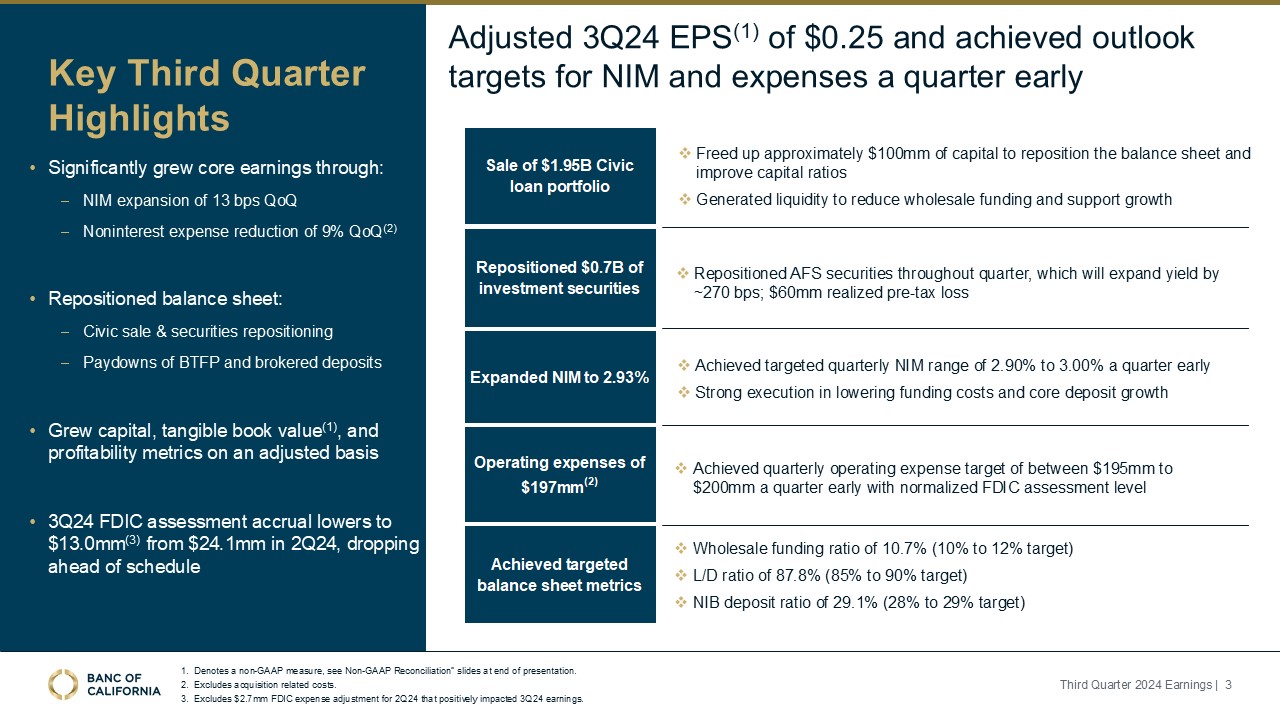
Key Third Quarter Highlights Adjusted 3Q24 EPS(1) of $0.25 and achieved outlook targets
for NIM and expenses a quarter early Significantly grew core earnings through: NIM expansion of 13 bps QoQ Noninterest expense reduction of 9% QoQ(2) Repositioned balance sheet: Civic sale & securities repositioning Paydowns of BTFP
and brokered deposits Grew capital, tangible book value(1), and profitability metrics on an adjusted basis 3Q24 FDIC assessment accrual lowers to $13.0mm(3) from $24.1mm in 2Q24, dropping ahead of schedule Freed up approximately $100mm of
capital to reposition the balance sheet and improve capital ratios Generated liquidity to reduce wholesale funding and support growth Repositioned AFS securities throughout quarter, which will expand yield by ~270 bps; $60mm realized
pre-tax loss Achieved targeted quarterly NIM range of 2.90% to 3.00% a quarter early Strong execution in lowering funding costs and core deposit growth Achieved quarterly operating expense target of between $195mm to $200mm a quarter early
with normalized FDIC assessment level Wholesale funding ratio of 10.7% (10% to 12% target) L/D ratio of 87.8% (85% to 90% target) NIB deposit ratio of 29.1% (28% to 29% target) Third Quarter 2024 Earnings | 3 Denotes a non-GAAP measure,
see Non-GAAP Reconciliation” slides at end of presentation. Excludes acquisition related costs. Excludes $2.7mm FDIC expense adjustment for 2Q24 that positively impacted 3Q24 earnings.
Denotes a non-GAAP financial measure; see “Non-GAAP Reconciliation” slides at end of
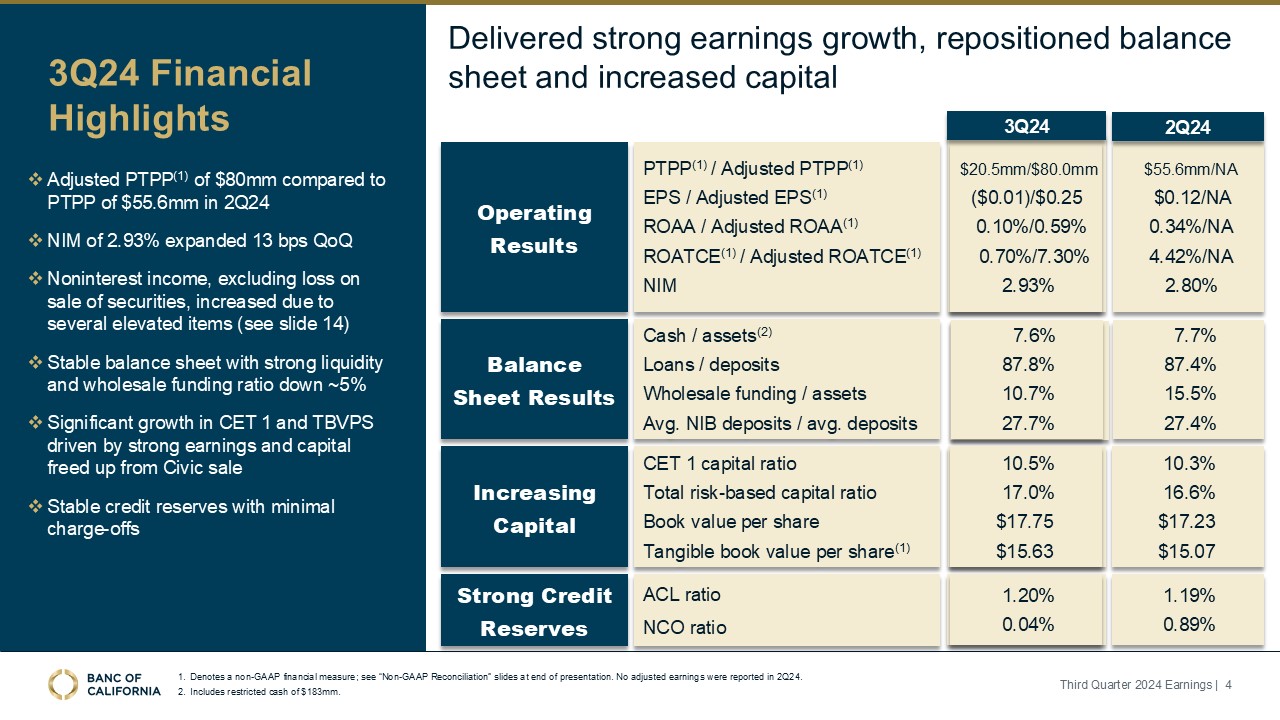
presentation. No adjusted earnings were reported in 2Q24. Includes restricted cash of $183mm. Operating Results PTPP(1) / Adjusted PTPP(1) EPS / Adjusted EPS(1) ROAA / Adjusted ROAA(1) ROATCE(1) / Adjusted ROATCE(1) NIM $55.6mm/NA
$0.12/NA 0.34%/NA 4.42%/NA 2.80% Cash / assets(2) Loans / deposits Wholesale funding / assets Avg. NIB deposits / avg. deposits Balance Sheet Results 7.7% 87.4% 15.5% 27.4% Increasing Capital CET 1 capital ratio Total
risk-based capital ratio Book value per share Tangible book value per share(1) 10.3% 16.6% $17.23 $15.07 Strong Credit Reserves ACL ratio NCO ratio 1.19% 0.89% 3Q24 Financial Highlights Delivered strong earnings growth,
repositioned balance sheet and increased capital Adjusted PTPP(1) of $80mm compared to PTPP of $55.6mm in 2Q24 NIM of 2.93% expanded 13 bps QoQ Noninterest income, excluding loss on sale of securities, increased due to several elevated
items (see slide 14) Stable balance sheet with strong liquidity and wholesale funding ratio down ~5% Significant growth in CET 1 and TBVPS driven by strong earnings and capital freed up from Civic sale Stable credit reserves with minimal
charge-offs $20.5mm/$80.0mm ($0.01)/$0.25 0.10%/0.59% 0.70%/7.30% 2.93% 7.6% 87.8% 10.7% 27.7% 10.5% 17.0% $17.75 $15.63 1.20% 0.04% 3Q24 2Q24 Third Quarter 2024 Earnings | 4
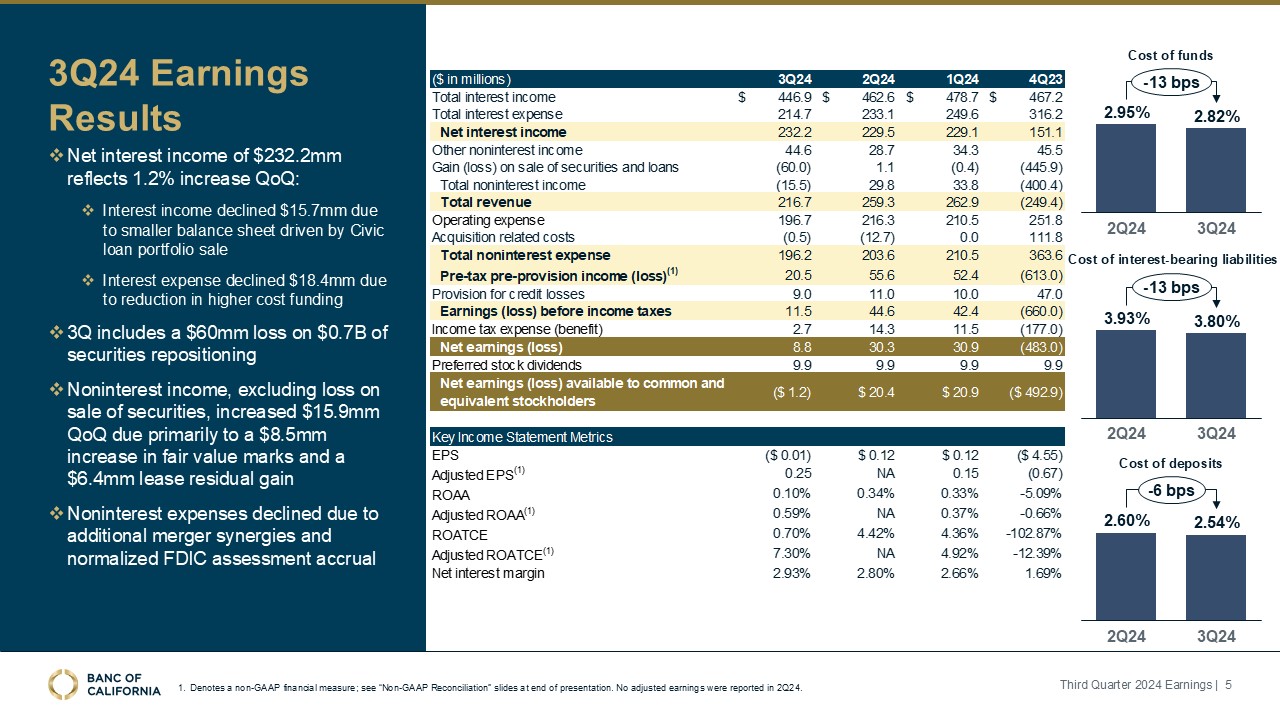
3Q24 Earnings Results 2Q24 3Q24 -6 bps 2Q24 3Q24 -13 bps 2Q24 3Q24 -13
bps Cost of funds Cost of deposits Cost of interest-bearing liabilities Denotes a non-GAAP financial measure; see “Non-GAAP Reconciliation” slides at end of presentation. No adjusted earnings were reported in 2Q24. Net interest income of
$232.2mm reflects 1.2% increase QoQ: Interest income declined $15.7mm due to smaller balance sheet driven by Civic loan portfolio sale Interest expense declined $18.4mm due to reduction in higher cost funding 3Q includes a $60mm loss on
$0.7B of securities repositioning Noninterest income, excluding loss on sale of securities, increased $15.9mm QoQ due primarily to a $8.5mm increase in fair value marks and a $6.4mm lease residual gain Noninterest expenses declined due to
additional merger synergies and normalized FDIC assessment accrual Third Quarter 2024 Earnings | 5
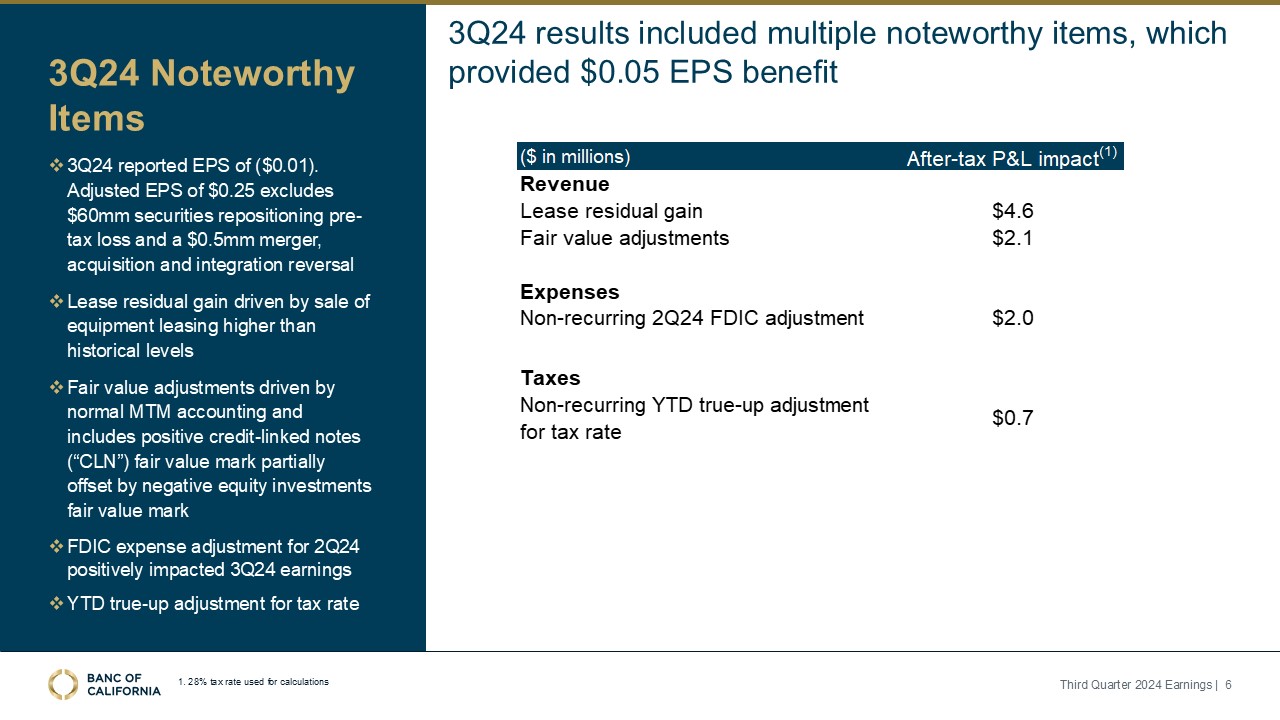
3Q24 Noteworthy Items 3Q24 results included multiple noteworthy items, which provided
$0.05 EPS benefit 3Q24 reported EPS of ($0.01). Adjusted EPS of $0.25 excludes $60mm securities repositioning pre-tax loss and a $0.5mm merger, acquisition and integration reversal Lease residual gain driven by sale of equipment leasing
higher than historical levels Fair value adjustments driven by normal MTM accounting and includes positive credit-linked notes (“CLN”) fair value mark partially offset by negative equity investments fair value mark FDIC expense adjustment
for 2Q24 positively impacted 3Q24 earnings YTD true-up adjustment for tax rate Third Quarter 2024 Earnings | 6 1. 28% tax rate used for calculations
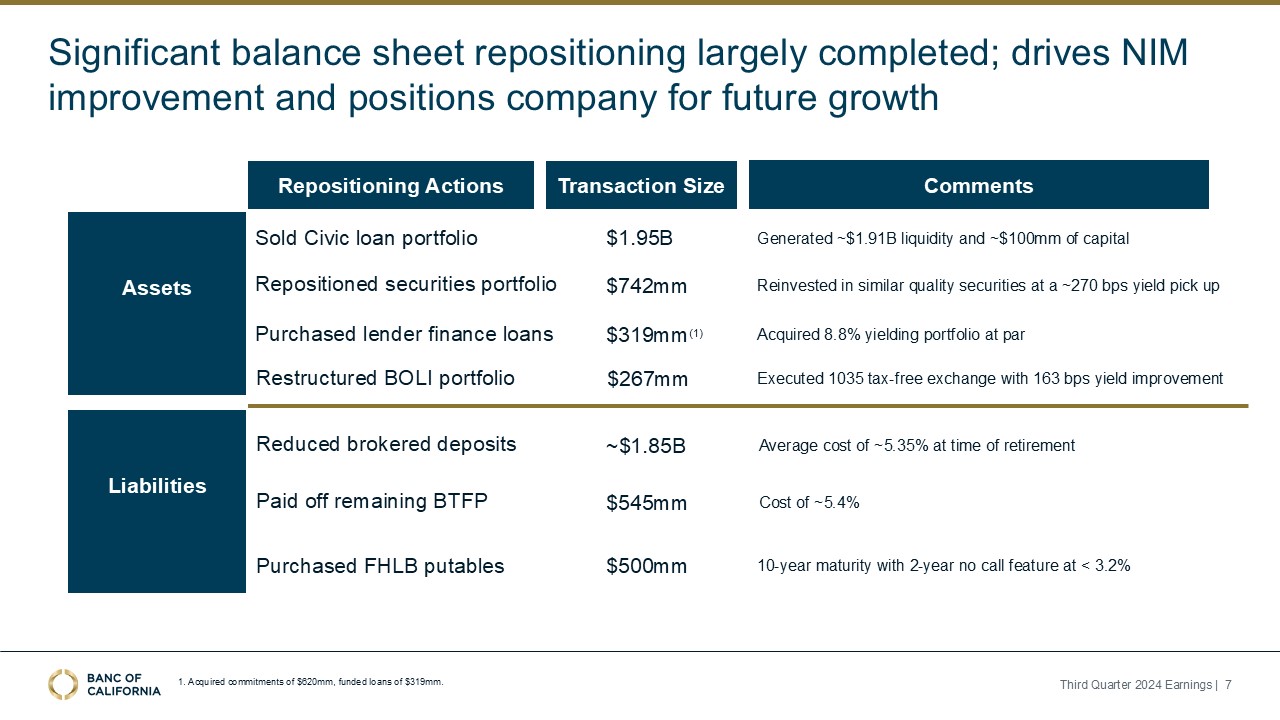
Significant balance sheet repositioning largely completed; drives NIM improvement and
positions company for future growth Sold Civic loan portfolio Third Quarter 2024 Earnings | 7 Assets Liabilities Repositioning Actions Transaction Size $1.95B Repositioned securities portfolio Paid off remaining BTFP Purchased
lender finance loans Reduced brokered deposits Purchased FHLB putables $742mm $319mm(1) $545mm ~$1.85B $500mm Comments Generated ~$1.91B liquidity and ~$100mm of capital Reinvested in similar quality securities at a ~270 bps yield
pick up Acquired 8.8% yielding portfolio at par Cost of ~5.4% Average cost of ~5.35% at time of retirement 10-year maturity with 2-year no call feature at < 3.2% Restructured BOLI portfolio $267mm Executed 1035 tax-free exchange
with 163 bps yield improvement 1. Acquired commitments of $620mm, funded loans of $319mm.
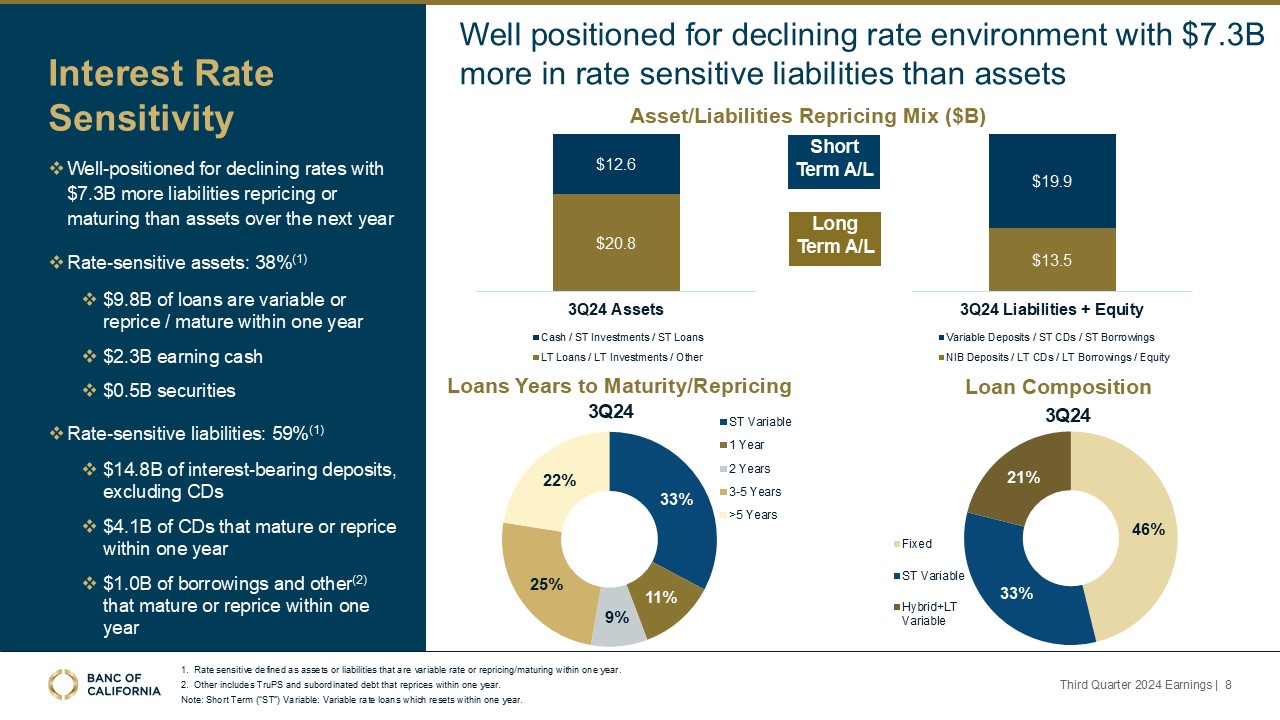
Interest Rate Sensitivity Well-positioned for declining rates with $7.3B more
liabilities repricing or maturing than assets over the next year Rate-sensitive assets: 38%(1) $9.8B of loans are variable or reprice / mature within one year $2.3B earning cash $0.5B securities Rate-sensitive liabilities: 59%(1) $14.8B
of interest-bearing deposits, excluding CDs $4.1B of CDs that mature or reprice within one year $1.0B of borrowings and other(2) that mature or reprice within one year Well positioned for declining rate environment with $7.3B more in rate
sensitive liabilities than assets Loans Years to Maturity/Repricing Loan Composition Asset/Liabilities Repricing Mix ($B) Rate sensitive defined as assets or liabilities that are variable rate or repricing/maturing within one
year. Other includes TruPS and subordinated debt that reprices within one year. Note: Short Term (“ST”) Variable: Variable rate loans which resets within one year. Third Quarter 2024 Earnings | 8 $12.9 $20.6 $19.7 $13.8 Short Term
A/L Long Term A/L
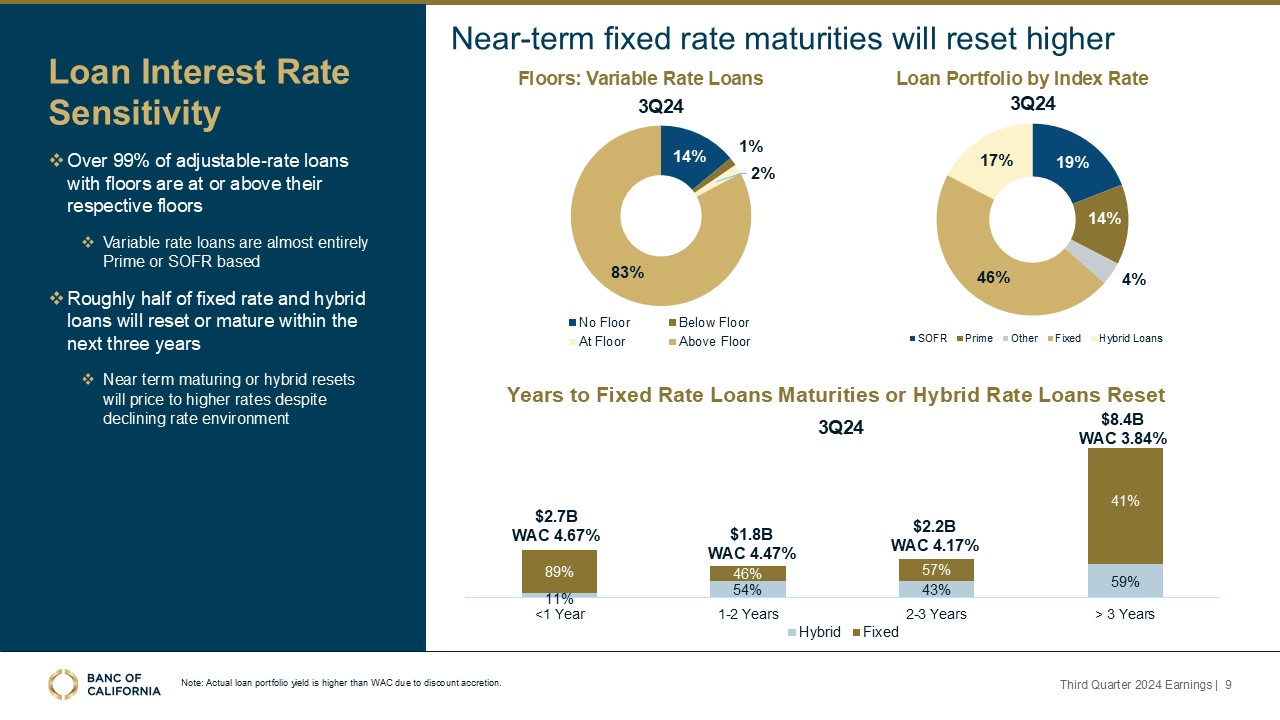
Loan Interest Rate Sensitivity Over 99% of adjustable-rate loans with floors are at or
above their respective floors Variable rate loans are almost entirely Prime or SOFR based Roughly half of fixed rate and hybrid loans will reset or mature within the next three years Near term maturing or hybrid resets will price to higher
rates despite declining rate environment Near-term fixed rate maturities will reset higher Years to Fixed Rate Loans Maturities or Hybrid Rate Loans Reset Floors: Variable Rate Loans Loan Portfolio by Index Rate Third Quarter 2024
Earnings | 9 92% 39% 38% 38% 91% $2.7B WAC 4.67% $1.8B WAC 4.47% $2.2B WAC 4.17% $8.4B WAC 3.84% Note: Actual loan portfolio yield is higher than WAC due to discount accretion.
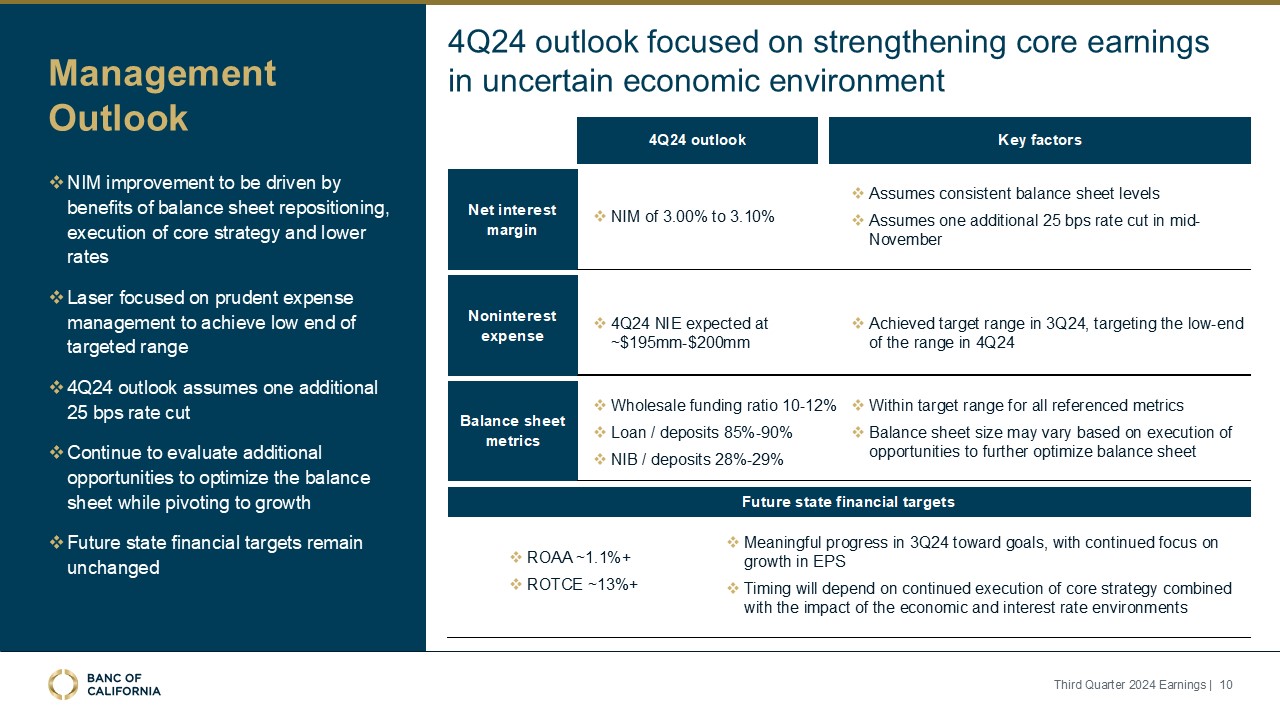
Management Outlook 4Q24 outlook focused on strengthening core earnings in uncertain
economic environment NIM improvement to be driven by benefits of balance sheet repositioning, execution of core strategy and lower rates Laser focused on prudent expense management to achieve low end of targeted range 4Q24 outlook assumes
one additional 25 bps rate cut Continue to evaluate additional opportunities to optimize the balance sheet while pivoting to growth Future state financial targets remain unchanged NIM of 3.00% to 3.10% Assumes consistent balance sheet
levels Assumes one additional 25 bps rate cut in mid-November 4Q24 NIE expected at ~$195mm-$200mm Achieved target range in 3Q24, targeting the low-end of the range in 4Q24 Wholesale funding ratio 10-12% Loan / deposits 85%-90% NIB /
deposits 28%-29% Within target range for all referenced metrics Balance sheet size may vary based on execution of opportunities to further optimize balance sheet Third Quarter 2024 Earnings | 10 ROAA ~1.1%+ ROTCE ~13%+ Meaningful
progress in 3Q24 toward goals, with continued focus on growth in EPS Timing will depend on continued execution of core strategy combined with the impact of the economic and interest rate environments
Denotes a non-GAAP financial measure; see “Non-GAAP Reconciliation” slides at end of
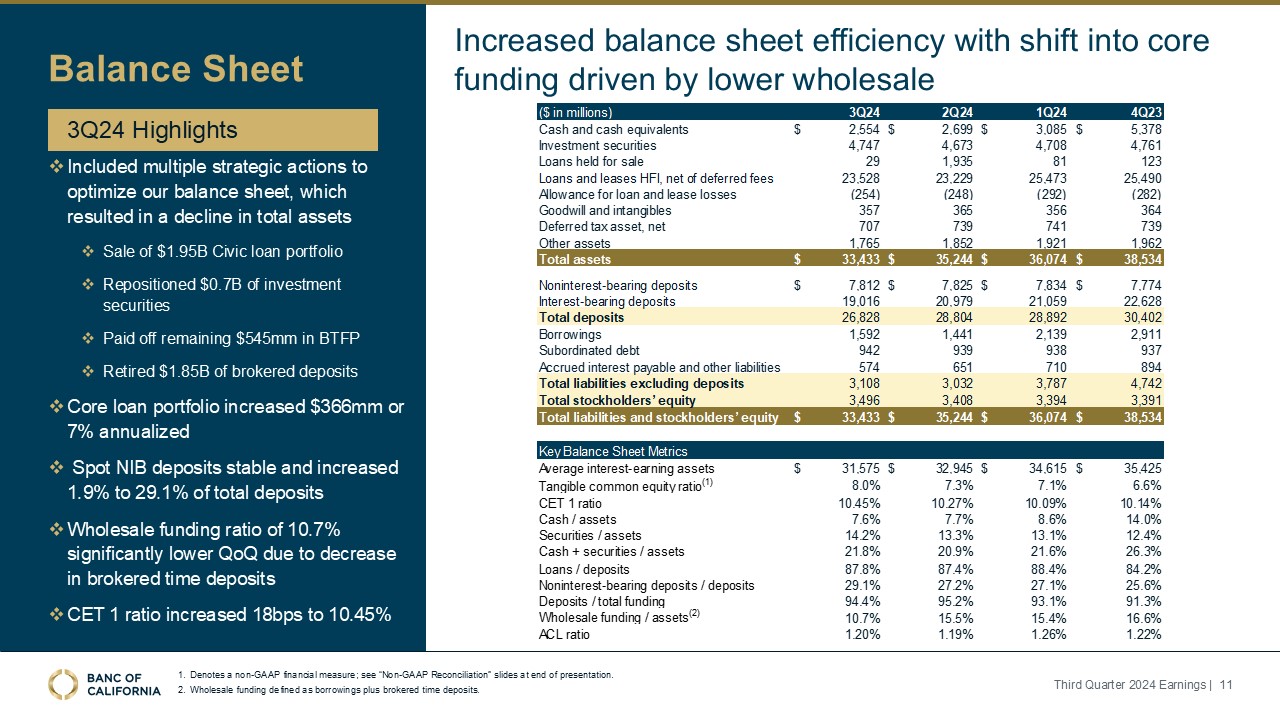
presentation. Wholesale funding defined as borrowings plus brokered time deposits. Balance Sheet Increased balance sheet efficiency with shift into core funding driven by lower wholesale Included multiple strategic actions to optimize our
balance sheet, which resulted in a decline in total assets Sale of $1.95B Civic loan portfolio Repositioned $0.7B of investment securities Paid off remaining $545mm in BTFP Retired $1.85B of brokered deposits Core loan portfolio
increased $366mm or 7% annualized Spot NIB deposits stable and increased 1.9% to 29.1% of total deposits Wholesale funding ratio of 10.7% significantly lower QoQ due to decrease in brokered time deposits CET 1 ratio increased 18bps to
10.45% 3Q24 Highlights Third Quarter 2024 Earnings | 11
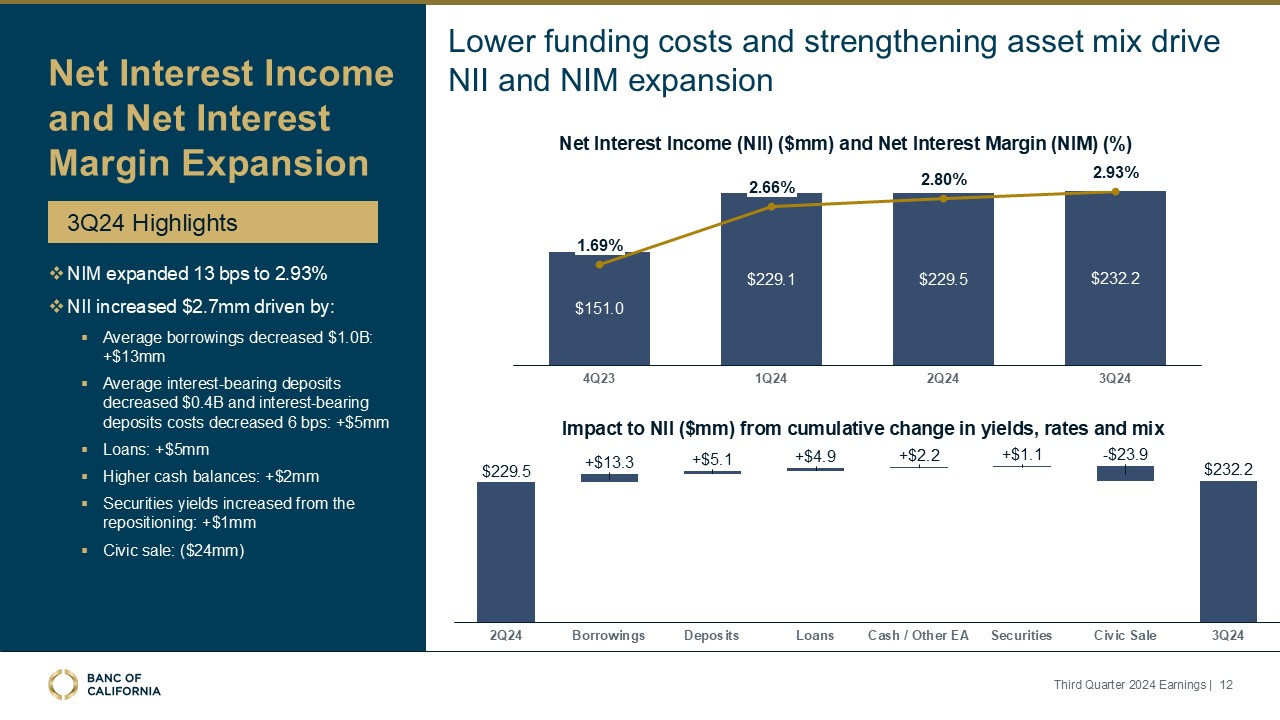
Net Interest Income and Net Interest Margin Expansion NIM expanded 13 bps to 2.93% NII
increased $2.7mm driven by: Average borrowings decreased $1.0B: +$13mm Average interest-bearing deposits decreased $0.4B and interest-bearing deposits costs decreased 6 bps: +$5mm Loans: +$5mm Higher cash balances: +$2mm Securities
yields increased from the repositioning: +$1mm Civic sale: ($24mm) 1.69% $151.0 4Q23 2.66% $229.1 1Q24 2.80% $229.5 2Q24 2.93% $232.2 3Q24 Net Interest Income (NII) ($mm) and Net Interest Margin (NIM) (%) Impact to NII ($mm)
from cumulative change in yields, rates and mix 2Q24 +$13.3 Borrowings +$5.1 Deposits +$4.9 Loans +$2.2 Cash / Other EA +$1.1 Securities -$23.9 Civic Sale 3Q24 $229.5 $232.2 Lower funding costs and strengthening asset mix
drive NII and NIM expansion Third Quarter 2024 Earnings | 12 3Q24 Highlights
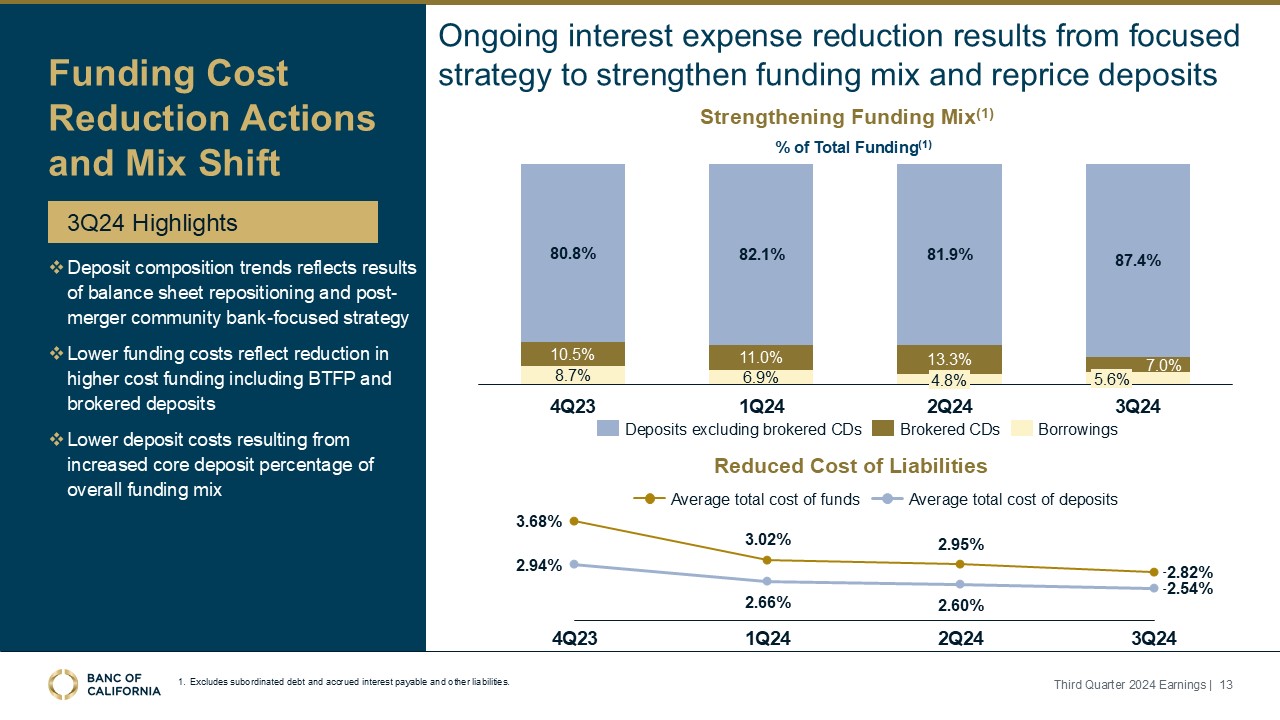
Funding Cost Reduction Actions and Mix Shift Deposit composition trends reflects
results of balance sheet repositioning and post-merger community bank-focused strategy Lower funding costs reflect reduction in higher cost funding including BTFP and brokered deposits Lower deposit costs resulting from increased core
deposit percentage of overall funding mix 3Q24 Highlights Strengthening Funding Mix(1) Ongoing interest expense reduction results from focused strategy to strengthen funding mix and reprice
deposits 4Q23 1Q24 4.8% 2Q24 5.6% 3Q24 Deposits excluding brokered CDs Brokered CDs Borrowings 4Q23 1Q24 2Q24 3Q24 Reduced Cost of Liabilities Excludes subordinated debt and accrued interest payable and other
liabilities. Average total cost of funds Average total cost of deposits % of Total Funding(1) Third Quarter 2024 Earnings | 13
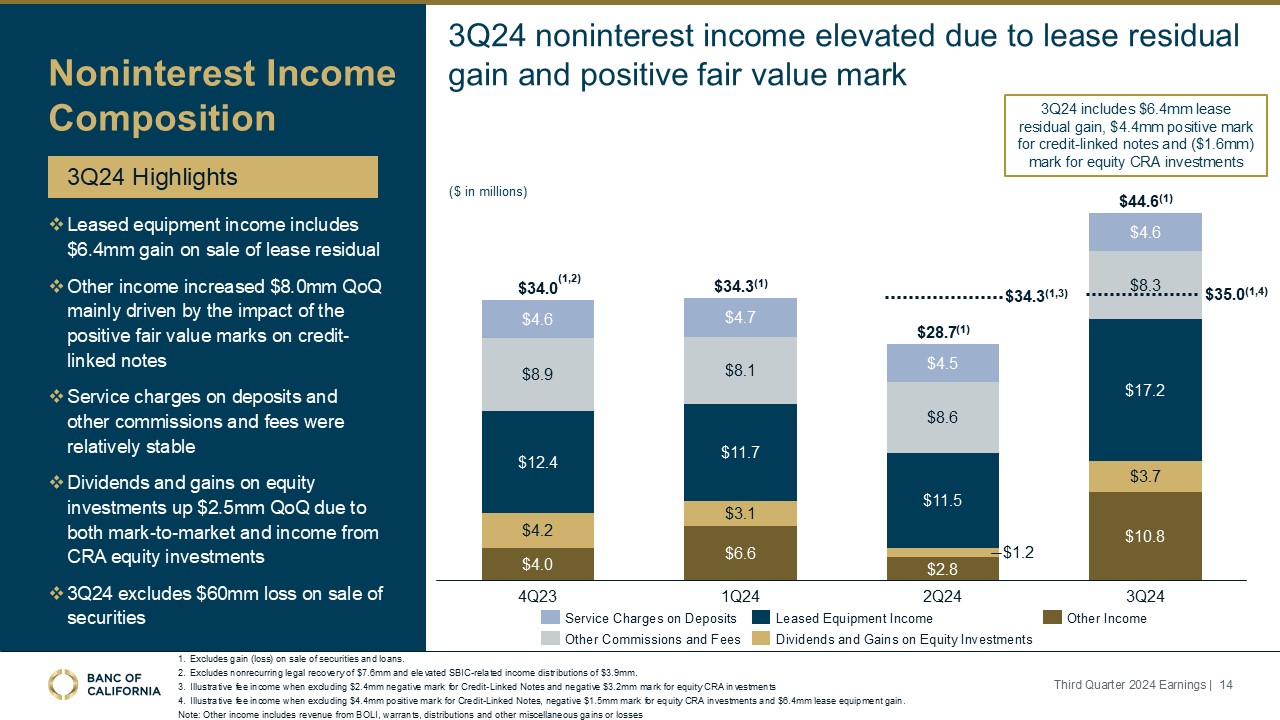
Excludes gain (loss) on sale of securities and loans. Excludes nonrecurring legal
recovery of $7.6mm and elevated SBIC-related income distributions of $3.9mm. Illustrative fee income when excluding $2.4mm negative mark for Credit-Linked Notes and negative $3.2mm mark for equity CRA investments Illustrative fee income
when excluding $4.4mm positive mark for Credit-Linked Notes, negative $1.5mm mark for equity CRA investments and $6.4mm lease equipment gain. Note: Other income includes revenue from BOLI, warrants, distributions and other miscellaneous
gains or losses Noninterest IncomeComposition Leased equipment income includes $6.4mm gain on sale of lease residual Other income increased $8.0mm QoQ mainly driven by the impact of the positive fair value marks on credit-linked notes
Service charges on deposits and other commissions and fees were relatively stable Dividends and gains on equity investments up $2.5mm QoQ due to both mark-to-market and income from CRA equity investments 3Q24 excludes $60mm loss on sale
of securities 3Q24 Highlights 4Q23 1Q24 2Q24 3Q24 $34.0 $34.3(1) $28.7(1) $44.6(1) ($ in millions) (1,2) 3Q24 noninterest income elevated due to lease residual gain and positive fair value mark $34.3(1,3) 3Q24 includes $6.4mm
lease residual gain, $4.4mm positive mark for credit-linked notes and ($1.6mm) mark for equity CRA investments Third Quarter 2024 Earnings | 14 $35.0(1,4) Service Charges on Deposits Other Commissions and Fees Leased Equipment
Income Dividends and Gains on Equity Investments Other Income
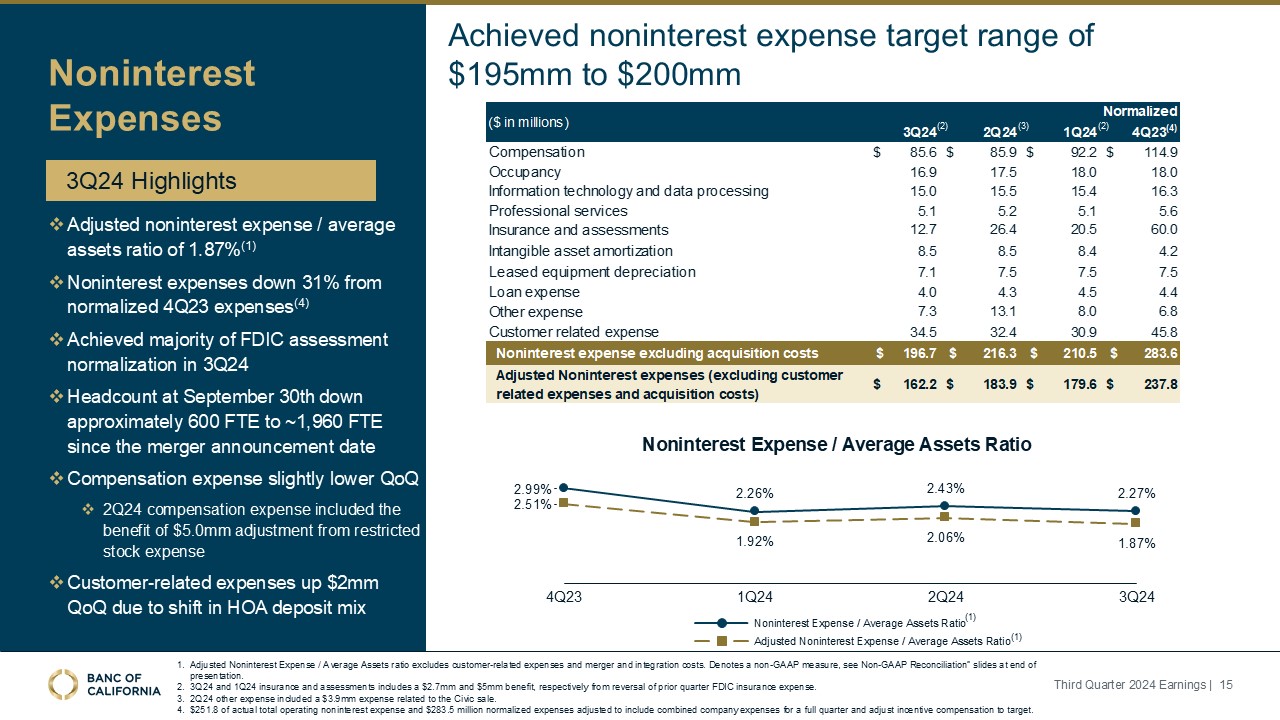
Noninterest Expenses Adjusted noninterest expense / average assets ratio of
1.87%(1) Noninterest expenses down 31% from normalized 4Q23 expenses(4) Achieved majority of FDIC assessment normalization in 3Q24 Headcount at September 30th down approximately 600 FTE to ~1,960 FTE since the merger announcement
date Compensation expense slightly lower QoQ 2Q24 compensation expense included the benefit of $5.0mm adjustment from restricted stock expense Customer-related expenses up $2mm QoQ due to shift in HOA deposit mix 3Q24
Highlights Achieved noninterest expense target range of $195mm to $200mm (1) Adjusted Noninterest Expense / Average Assets ratio excludes customer-related expenses and merger and integration costs. Denotes a non-GAAP measure, see Non-GAAP
Reconciliation” slides at end of presentation. 3Q24 and 1Q24 insurance and assessments includes a $2.7mm and $5mm benefit, respectively from reversal of prior quarter FDIC insurance expense. 2Q24 other expense included a $3.9mm expense
related to the Civic sale. $251.8 of actual total operating noninterest expense and $283.5 million normalized expenses adjusted to include combined company expenses for a full quarter and adjust incentive compensation to
target. 4Q23 1Q24 2Q24 3Q24 Noninterest Expense / Average Assets Ratio Adjusted Noninterest Expense / Average Assets Ratio Noninterest Expense / Average Assets Ratio Third Quarter 2024 Earnings | 15 (2) (3) (2) (1) (1)
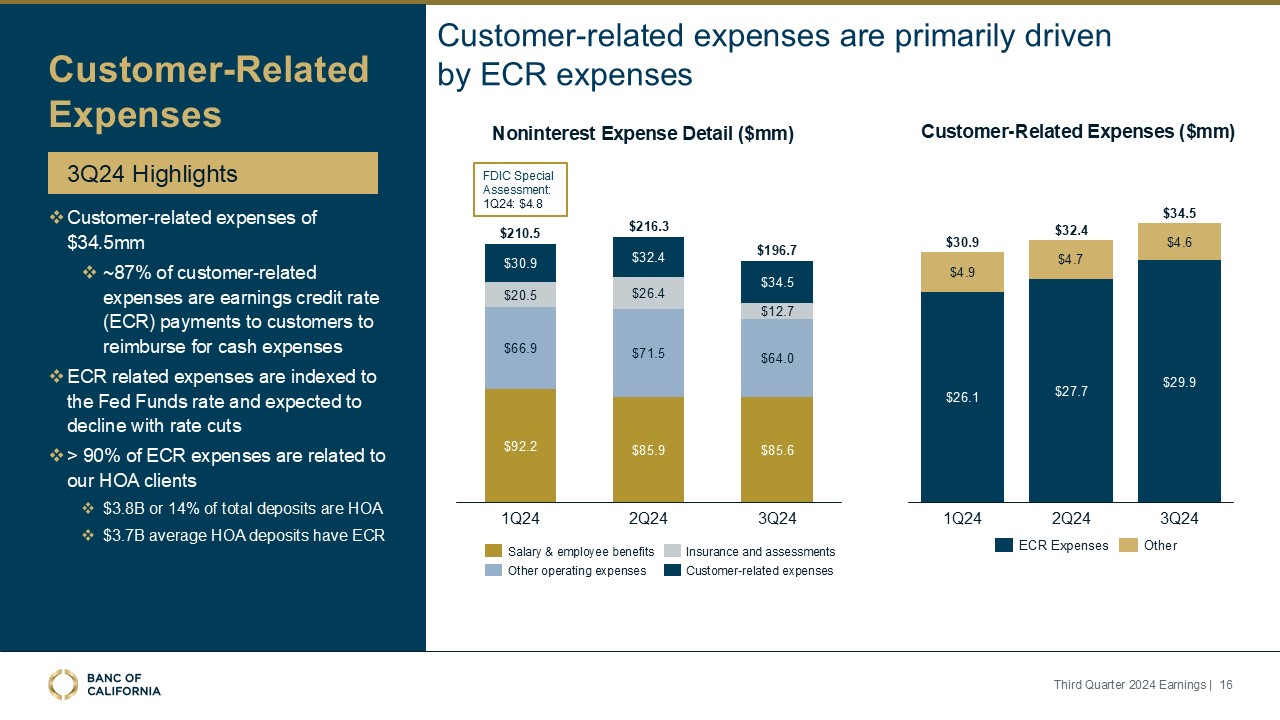
Customer-Related Expenses Customer-related expenses of $34.5mm ~87% of
customer-related expenses are earnings credit rate (ECR) payments to customers to reimburse for cash expenses ECR related expenses are indexed to the Fed Funds rate and expected to decline with rate cuts > 90% of ECR expenses are
related to our HOA clients $3.8B or 14% of total deposits are HOA $3.7B average HOA deposits have ECR 3Q24 Highlights Customer-related expenses are primarily driven by ECR expenses Noninterest Expense Detail
($mm) $30.9 $20.5 $66.9 $92.2 1Q24 $32.4 $26.4 $71.5 $85.9 2Q24 $34.5 $12.7 $64.0 $85.6 3Q24 $210.5 $216.3 $196.7 Salary & employee benefits Other operating expenses Insurance and assessments Customer-related
expenses FDIC Special Assessment: 1Q24: $4.8 Customer-Related Expenses ($mm) $26.1 $4.9 1Q24 $27.7 $4.7 2Q24 $29.9 $4.6 3Q24 $30.9 $32.4 $34.5 Third Quarter 2024 Earnings | 16 ECR Expenses Other
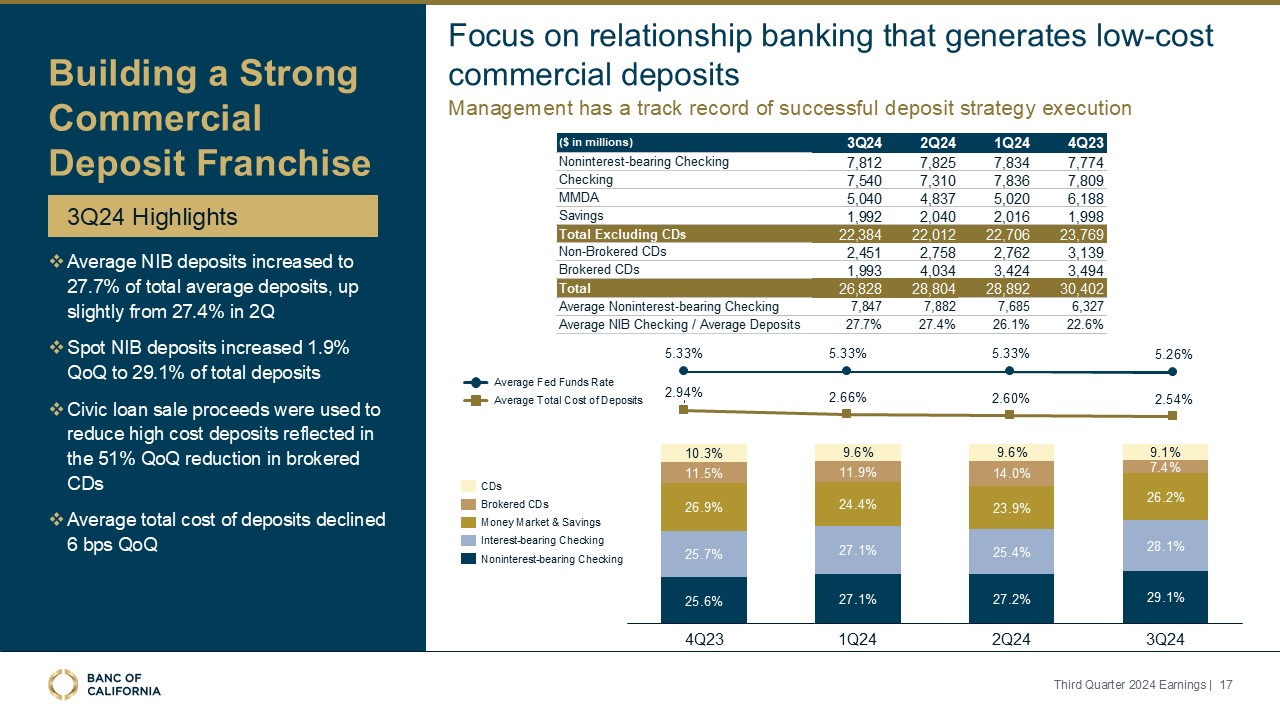
Building a Strong Commercial Deposit Franchise Average NIB deposits increased to 27.7%
of total average deposits, up slightly from 27.4% in 2Q Spot NIB deposits increased 1.9% QoQ to 29.1% of total deposits Civic loan sale proceeds were used to reduce high cost deposits reflected in the 51% QoQ reduction in brokered
CDs Average total cost of deposits declined 6 bps QoQ 3Q24 Highlights Focus on relationship banking that generates low-cost commercial deposits Management has a track record of successful deposit strategy execution Average Fed Funds
Rate Average Total Cost of Deposits 4Q23 1Q24 2Q24 3Q24 CDs Brokered CDs Money Market & Savings Interest-bearing Checking Noninterest-bearing Checking Third Quarter 2024 Earnings | 17
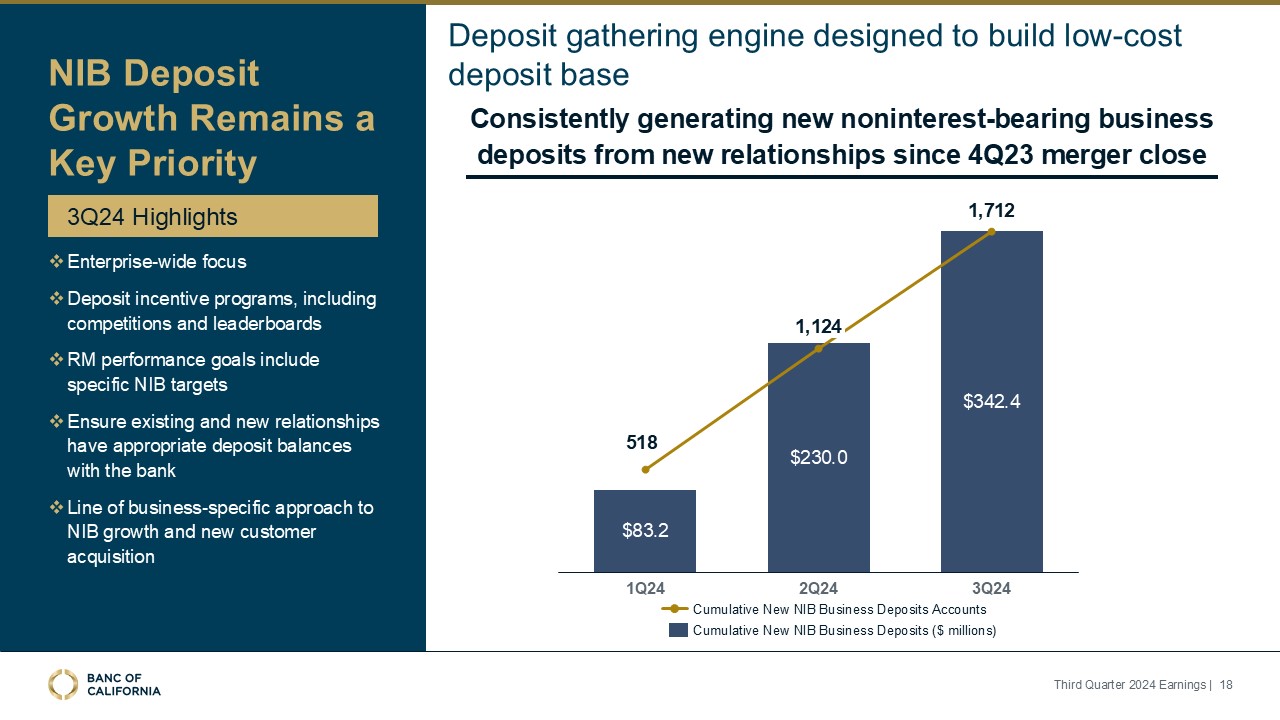
NIB Deposit Growth Remains a Key Priority Enterprise-wide focus Deposit incentive
programs, including competitions and leaderboards RM performance goals include specific NIB targets Ensure existing and new relationships have appropriate deposit balances with the bank Line of business-specific approach to NIB growth and
new customer acquisition 3Q24 Highlights Consistently generating new noninterest-bearing business deposits from new relationships since 4Q23 merger close Deposit gathering engine designed to build low-cost deposit base
$83.2 1Q24 2Q24 3Q24 $230.0 $342.4 1,124 Cumulative New NIB Business Deposits Accounts Cumulative New NIB Business Deposits ($ millions) Third Quarter 2024 Earnings | 18
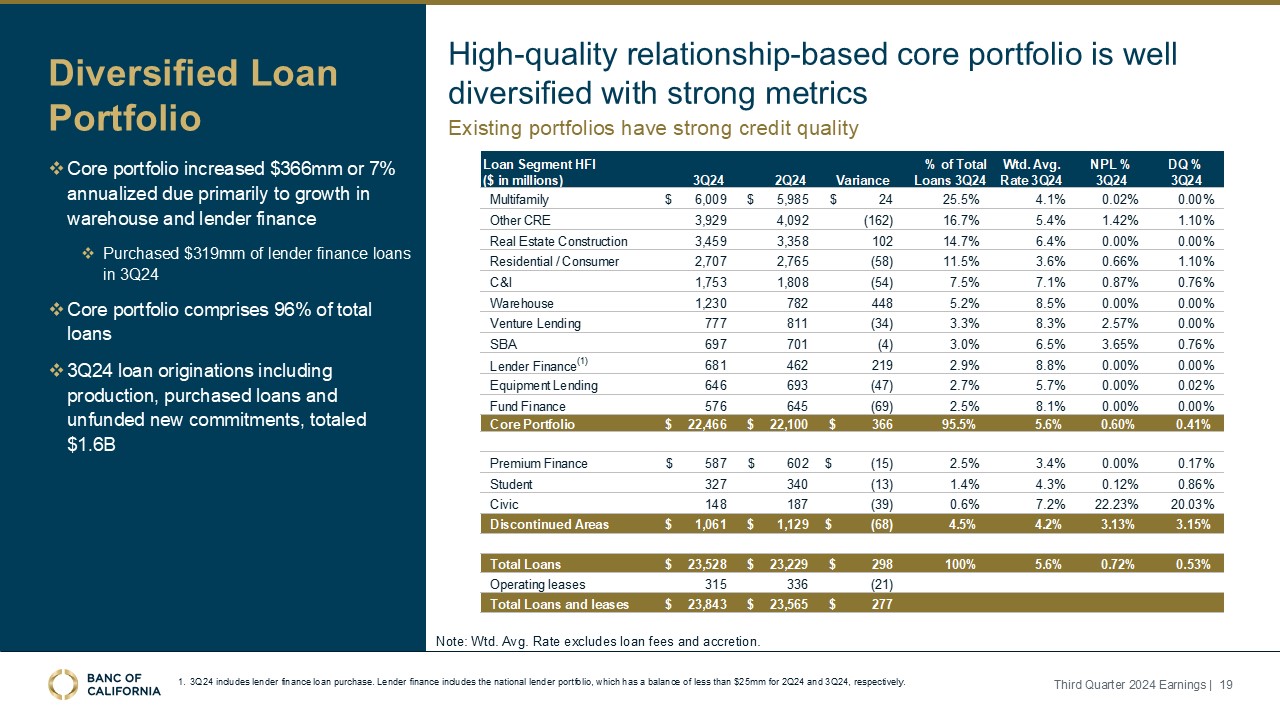
Diversified Loan Portfolio Core portfolio increased $366mm or 7% annualized due
primarily to growth in warehouse and lender finance Purchased $319mm of lender finance loans in 3Q24 Core portfolio comprises 96% of total loans 3Q24 loan originations including production, purchased loans and unfunded new commitments,
totaled $1.6B High-quality relationship-based core portfolio is well diversified with strong metrics Existing portfolios have strong credit quality Note: Wtd. Avg. Rate excludes loan fees and accretion. 3Q24 includes lender finance loan
purchase. Lender finance includes the national lender portfolio, which has a balance of less than $25mm for 2Q24 and 3Q24, respectively. Third Quarter 2024 Earnings | 19
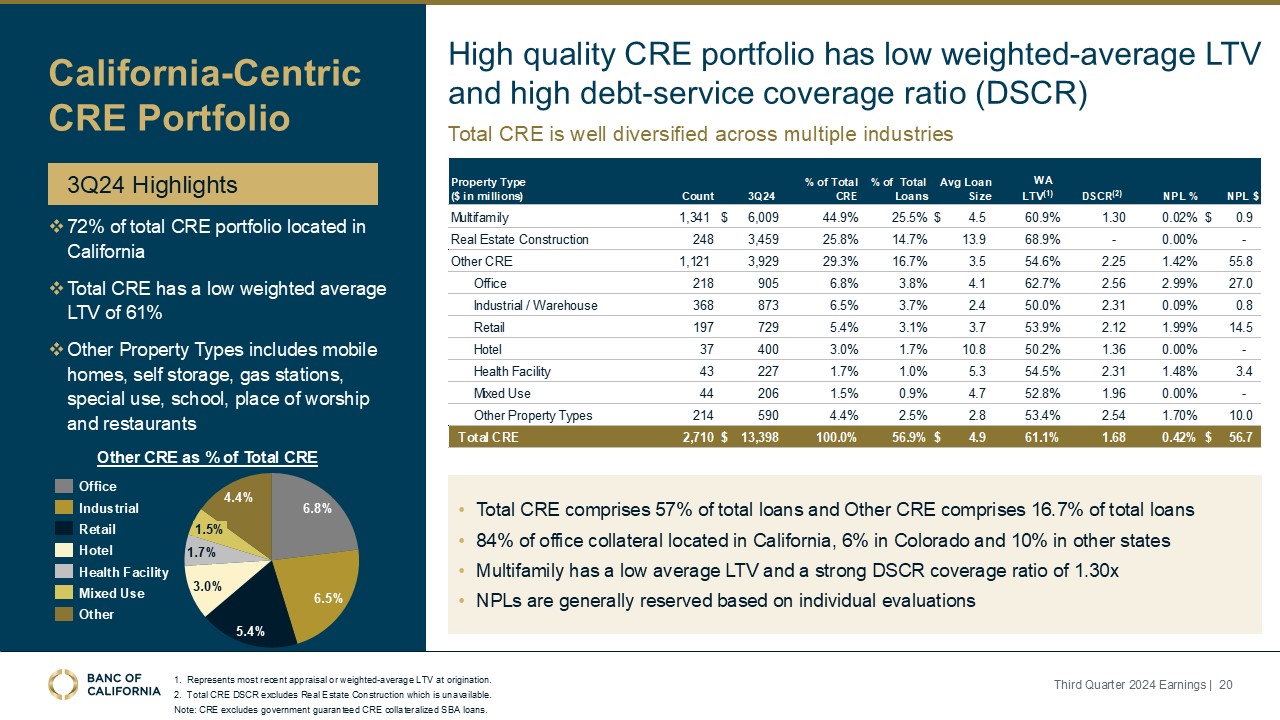
California-Centric CRE Portfolio 72% of total CRE portfolio located in
California Total CRE has a low weighted average LTV of 61% Other Property Types includes mobile homes, self storage, gas stations, special use, school, place of worship and restaurants 3Q24 Highlights High quality CRE portfolio has low
weighted-average LTV and high debt-service coverage ratio (DSCR) Total CRE is well diversified across multiple industries 1.5% Office Industrial Retail Hotel Health Facility Mixed Use Other Represents most recent appraisal or
weighted-average LTV at origination. Total CRE DSCR excludes Real Estate Construction which is unavailable. Note: CRE excludes government guaranteed CRE collateralized SBA loans. Total CRE comprises 57% of total loans and Other CRE
comprises 16.7% of total loans 84% of office collateral located in California, 6% in Colorado and 10% in other states Multifamily has a low average LTV and a strong DSCR coverage ratio of 1.30x NPLs are generally reserved based on
individual evaluations Other CRE as % of Total CRE Third Quarter 2024 Earnings | 20
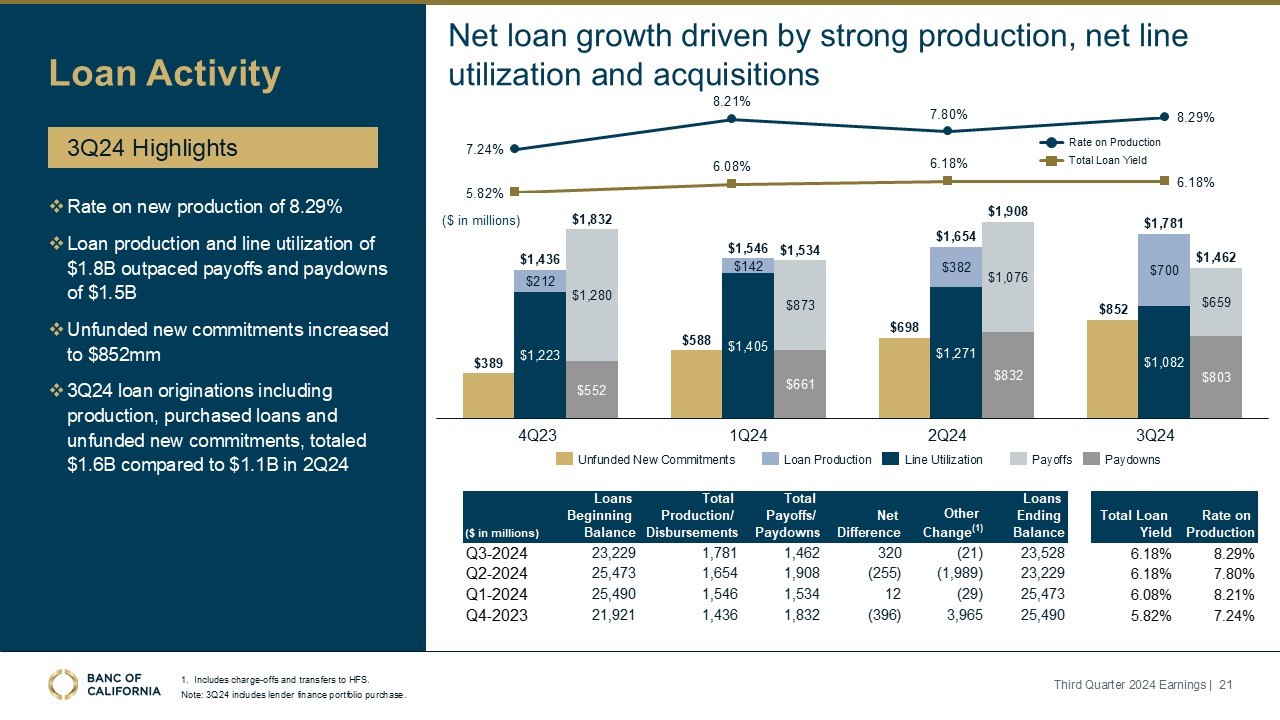
$1,280 $552 $873 $661 $1,076 $832 $659 $803 $1,832 $1,534 $1,908 $1,462 $389 $588 $698 $852 Loan
Activity Rate on new production of 8.29% Loan production and line utilization of $1.8B outpaced payoffs and paydowns of $1.5B Unfunded new commitments increased to $852mm 3Q24 loan originations including production, purchased loans and
unfunded new commitments, totaled $1.6B compared to $1.1B in 2Q24 3Q24 Highlights Net loan growth driven by strong production, net line utilization and acquisitions Third Quarter 2024 Earnings |
21 $212 $1,223 $142 $1,405 $382 $1,271 $700 $1,082 $1,436 $1,546 $1,654 $1,781 Loan Production Line Utilization Payoffs Paydowns 4Q23 1Q24 2Q24 Rate on Production Total Loan Yield 3Q24 Includes charge-offs and transfers
to HFS. Note: 3Q24 includes lender finance portfolio purchase. ($ in millions) Unfunded New Commitments
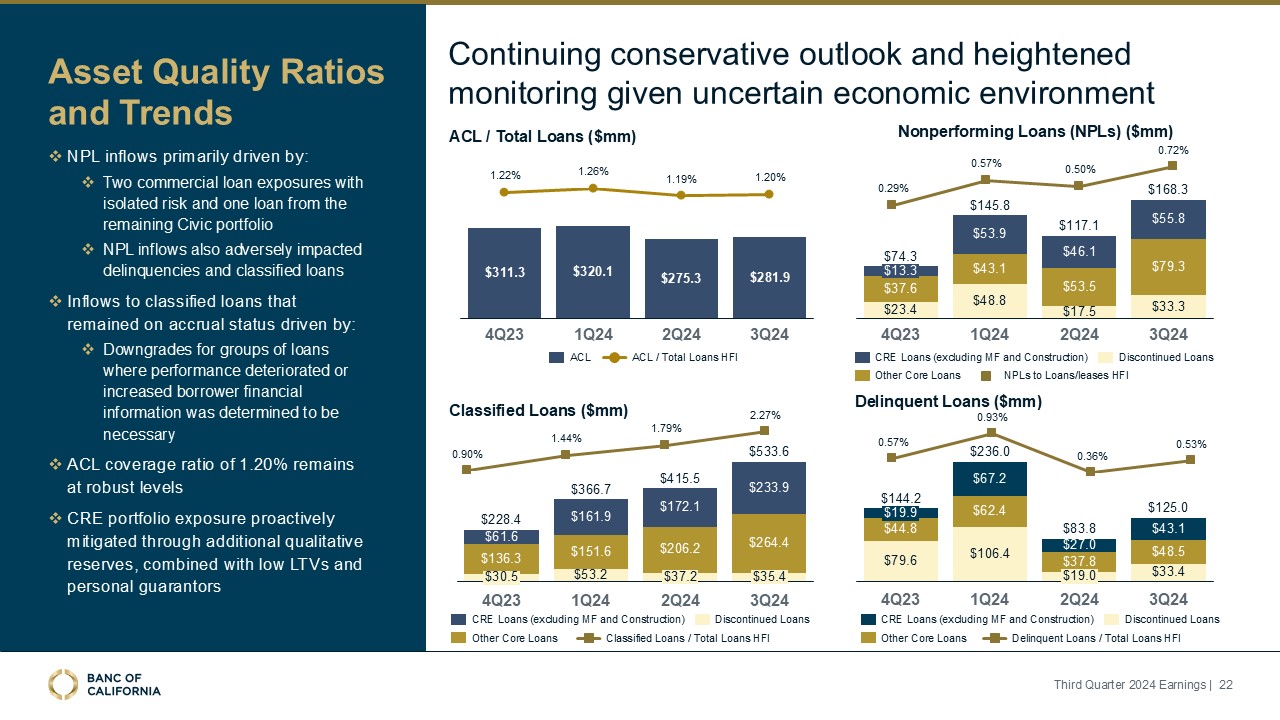
Asset Quality Ratios and Trends NPL inflows primarily driven by: Two commercial loan
exposures with isolated risk and one loan from the remaining Civic portfolio NPL inflows also adversely impacted delinquencies and classified loans Inflows to classified loans that remained on accrual status driven by: Downgrades for
groups of loans where performance deteriorated or increased borrower financial information was determined to be necessary ACL coverage ratio of 1.20% remains at robust levels CRE portfolio exposure proactively mitigated through additional
qualitative reserves, combined with low LTVs and personal guarantors Continuing conservative outlook and heightened monitoring given uncertain economic environment Third Quarter 2024 Earnings |
22 $13.3 $37.6 $23.4 4Q23 $53.9 $43.1 $48.8 1Q24 $46.1 $53.5 $17.5 2Q24 $55.8 $79.3 $33.3 3Q24 $74.3 $145.8 $117.1 $168.3 CRE Loans (excluding MF and Construction) Other Core Loans Discontinued Loans Nonperforming
Loans (NPLs) ($mm) NPLs to Loans/leases HFI Delinquent Loans ($mm) Classified Loans
($mm) $61.6 $136.3 $30.5 4Q23 $161.9 $151.6 $53.2 1Q24 $172.1 $206.2 $37.2 2Q24 $233.9 $264.4 $35.4 3Q24 $228.4 $366.7 $415.5 $533.6 Classified Loans / Total Loans HFI CRE Loans (excluding MF and Construction) Other
Core Loans Discontinued Loans $19.9 $44.8 $79.6 4Q23 $67.2 $62.4 $106.4 1Q24 $27.0 $37.8 $19.0 2Q24 $43.1 $48.5 $33.4 3Q24 $144.2 $236.0 $83.8 $125.0 CRE Loans (excluding MF and Construction) Other Core
Loans Discontinued Loans Delinquent Loans / Total Loans HFI ACL / Total Loans ($mm) $311.3 1.22% 4Q23 $320.1 1.26% 1Q24 $275.3 1.19% 2Q24 $281.9 1.20% 3Q24 ACL ACL / Total Loans HFI
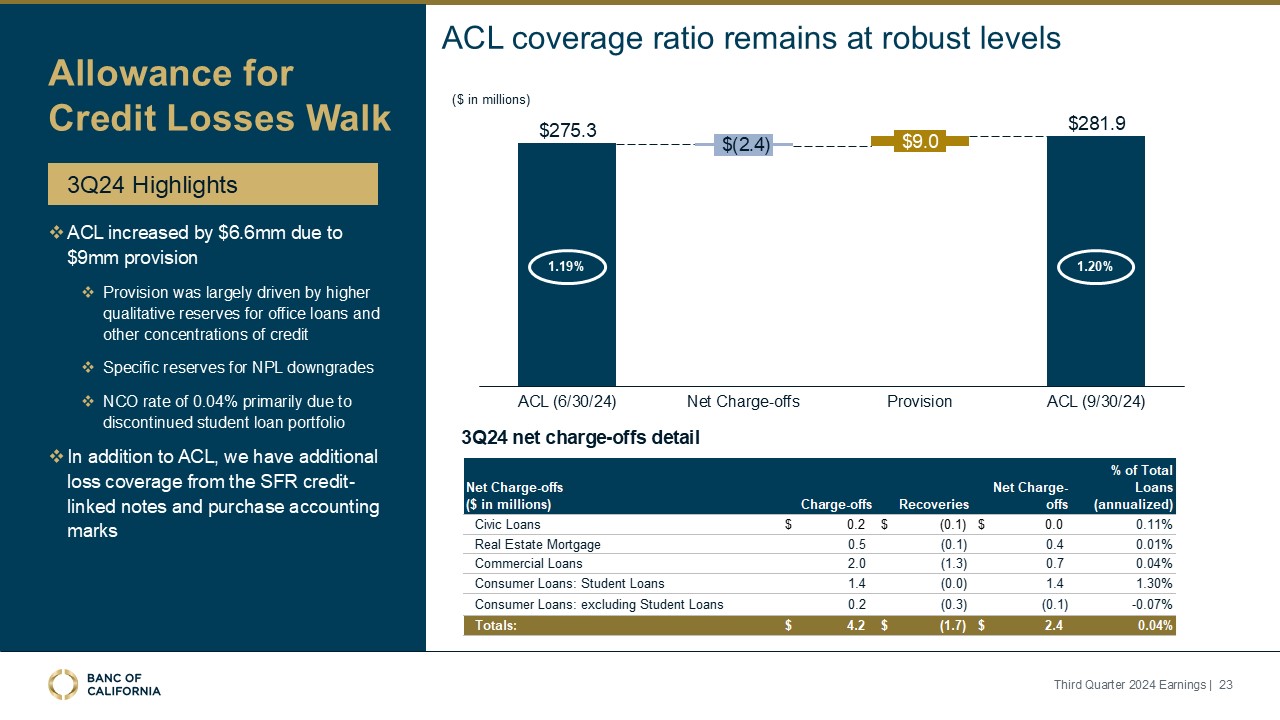
ACL coverage ratio remains at robust levels Allowance for Credit Losses Walk ACL
increased by $6.6mm due to $9mm provision Provision was largely driven by higher qualitative reserves for office loans and other concentrations of credit Specific reserves for NPL downgrades NCO rate of 0.04% primarily due to discontinued
student loan portfolio In addition to ACL, we have additional loss coverage from the SFR credit-linked notes and purchase accounting marks 1.19% 1.20% ($ in millions) 3Q24 net charge-offs detail Third Quarter 2024 Earnings |
23 3Q24 Highlights ACL (6/30/24) $(2.4) Net Charge-offs $9.0 Provision ACL (9/30/24) 1.19% 1.20%
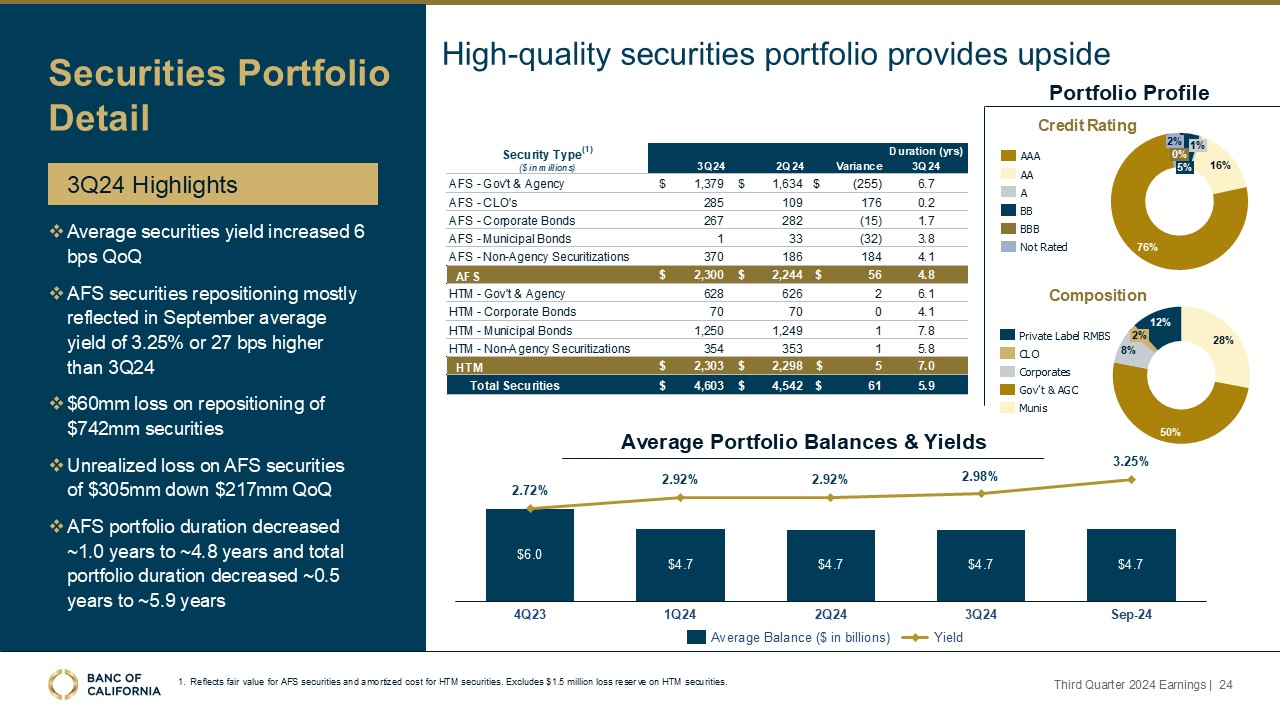
High-quality securities portfolio provides upside Securities Portfolio Detail Average
securities yield increased 6 bps QoQ AFS securities repositioning mostly reflected in September average yield of 3.25% or 27 bps higher than 3Q24 $60mm loss on repositioning of $742mm securities Unrealized loss on AFS securities of $305mm
down $217mm QoQ AFS portfolio duration decreased ~1.0 years to ~4.8 years and total portfolio duration decreased ~0.5 years to ~5.9 years Portfolio Profile Composition Credit Rating Average Portfolio Balances &
Yields 2% 0% 5% 1% AAA AA A BB BBB Not Rated $6.0 2.72% 4Q23 $4.7 2.92% 1Q24 $4.7 2.92% 2Q24 $4.7 2.98% 3Q24 $4.7 3.25% Sep-24 Average Balance ($ in billions) Yield 3Q24 Highlights Reflects fair value for AFS
securities and amortized cost for HTM securities. Excludes $1.5 million loss reserve on HTM securities. Third Quarter 2024 Earnings | 24 2% Private Label RMBS CLO Corporates Gov’t & AGC Munis
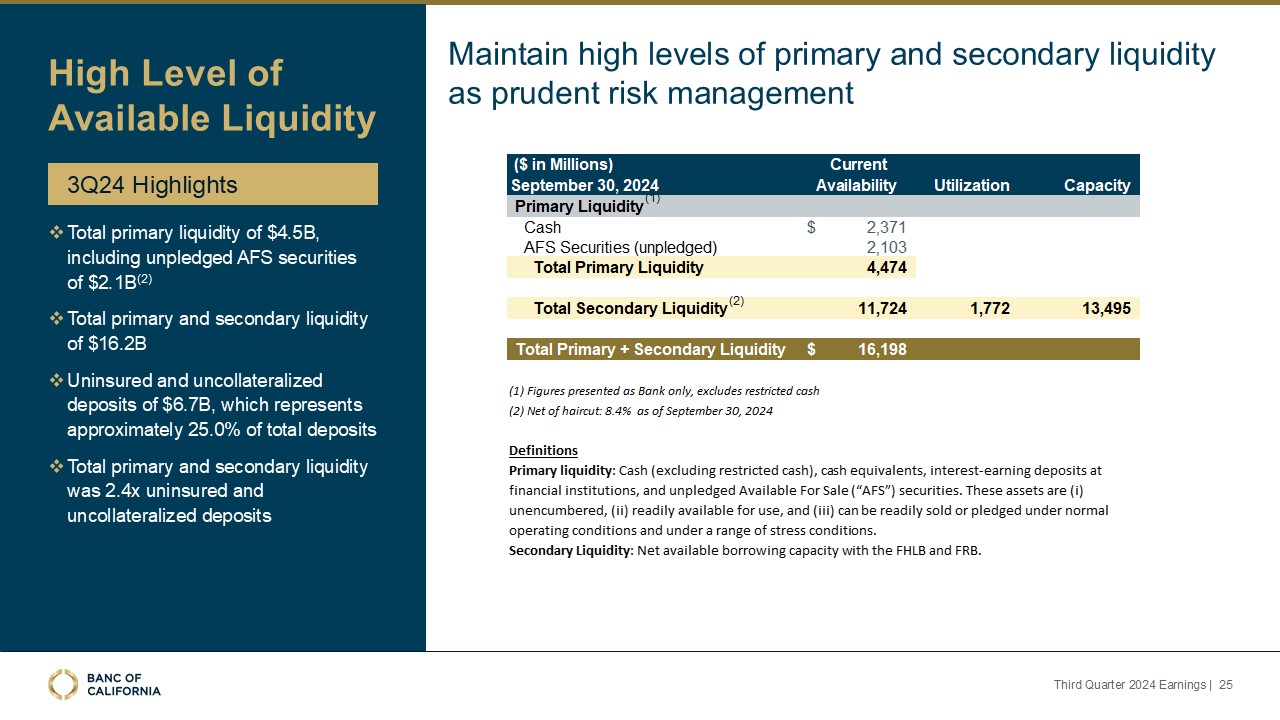
High Level of Available Liquidity Total primary liquidity of $4.5B, including unpledged
AFS securities of $2.1B(2) Total primary and secondary liquidity of $16.2B Uninsured and uncollateralized deposits of $6.7B, which represents approximately 25.0% of total deposits Total primary and secondary liquidity was 2.4x uninsured
and uncollateralized deposits 3Q24 Highlights Maintain high levels of primary and secondary liquidity as prudent risk management (2) Third Quarter 2024 Earnings | 25 (1)
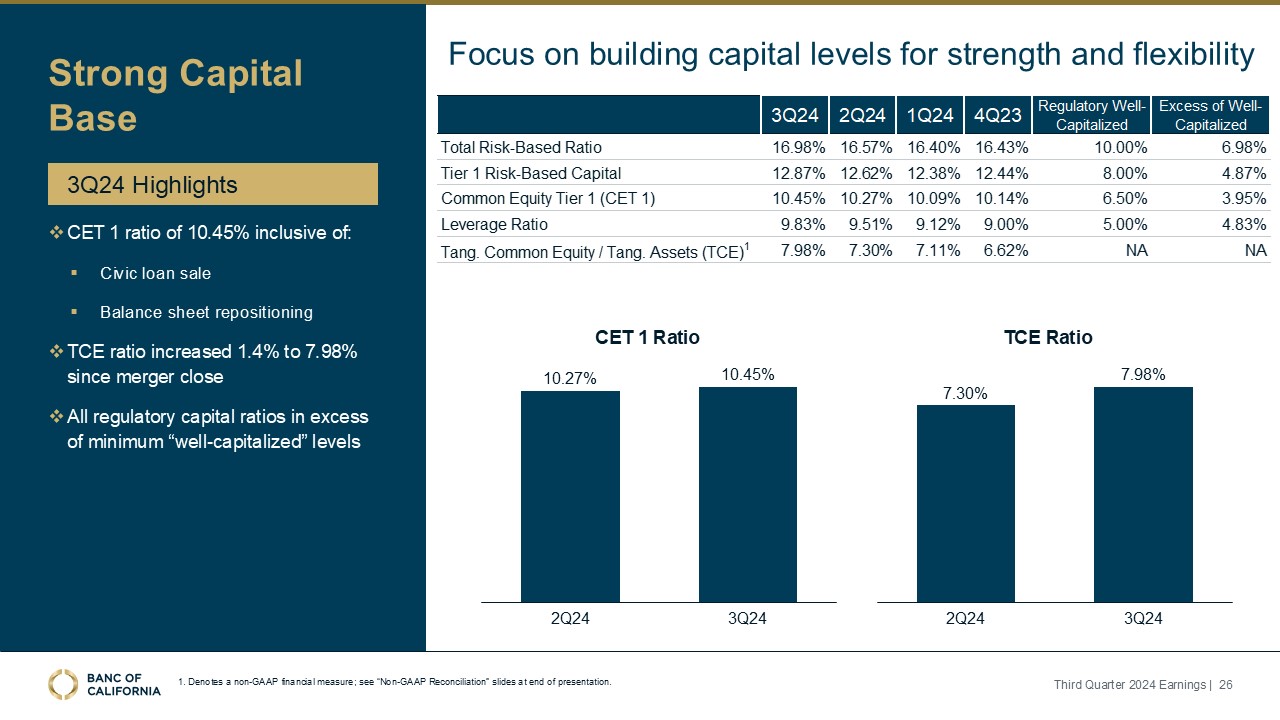
Strong Capital Base CET 1 ratio of 10.45% inclusive of: Civic loan sale Balance sheet
repositioning TCE ratio increased 1.4% to 7.98% since merger close All regulatory capital ratios in excess of minimum “well-capitalized” levels Focus on building capital levels for strength and flexibility 2Q24 3Q24 2Q24 3Q24 3Q24
Highlights 1. Denotes a non-GAAP financial measure; see “Non-GAAP Reconciliation” slides at end of presentation. Third Quarter 2024 Earnings | 26 CET 1 Ratio TCE Ratio

Appendix
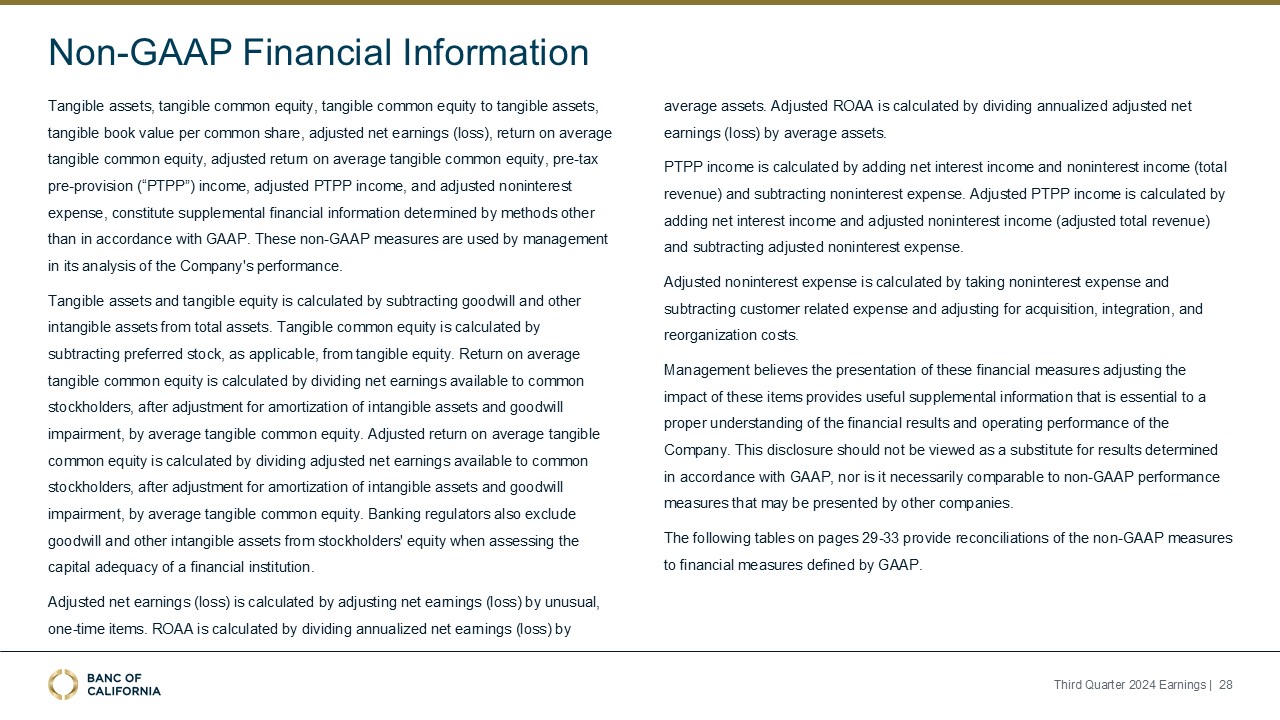
Non-GAAP Financial Information Tangible assets, tangible common equity, tangible common
equity to tangible assets, tangible book value per common share, adjusted net earnings (loss), return on average tangible common equity, adjusted return on average tangible common equity, pre-tax pre-provision (“PTPP”) income, adjusted PTPP
income, and adjusted noninterest expense, constitute supplemental financial information determined by methods other than in accordance with GAAP. These non-GAAP measures are used by management in its analysis of the Company’s performance.
Tangible assets and tangible equity is calculated by subtracting goodwill and other intangible assets from total assets. Tangible common equity is calculated by subtracting preferred stock, as applicable, from tangible equity. Return on
average tangible common equity is calculated by dividing net earnings available to common stockholders, after adjustment for amortization of intangible assets and goodwill impairment, by average tangible common equity. Adjusted return on
average tangible common equity is calculated by dividing adjusted net earnings available to common stockholders, after adjustment for amortization of intangible assets and goodwill impairment, by average tangible common equity. Banking
regulators also exclude goodwill and other intangible assets from stockholders’ equity when assessing the capital adequacy of a financial institution. Adjusted net earnings (loss) is calculated by adjusting net earnings (loss) by unusual,
one-time items. ROAA is calculated by dividing annualized net earnings (loss) by average assets. Adjusted ROAA is calculated by dividing annualized adjusted net earnings (loss) by average assets. PTPP income is calculated by adding net
interest income and noninterest income (total revenue) and subtracting noninterest expense. Adjusted PTPP income is calculated by adding net interest income and adjusted noninterest income (adjusted total revenue) and subtracting adjusted
noninterest expense. Adjusted noninterest expense is calculated by taking noninterest expense and subtracting customer related expense and adjusting for acquisition, integration, and reorganization costs. Management believes the
presentation of these financial measures adjusting the impact of these items provides useful supplemental information that is essential to a proper understanding of the financial results and operating performance of the Company. This
disclosure should not be viewed as a substitute for results determined in accordance with GAAP, nor is it necessarily comparable to non-GAAP performance measures that may be presented by other companies. The following tables on pages 29-33
provide reconciliations of the non-GAAP measures to financial measures defined by GAAP. Third Quarter 2024 Earnings | 28
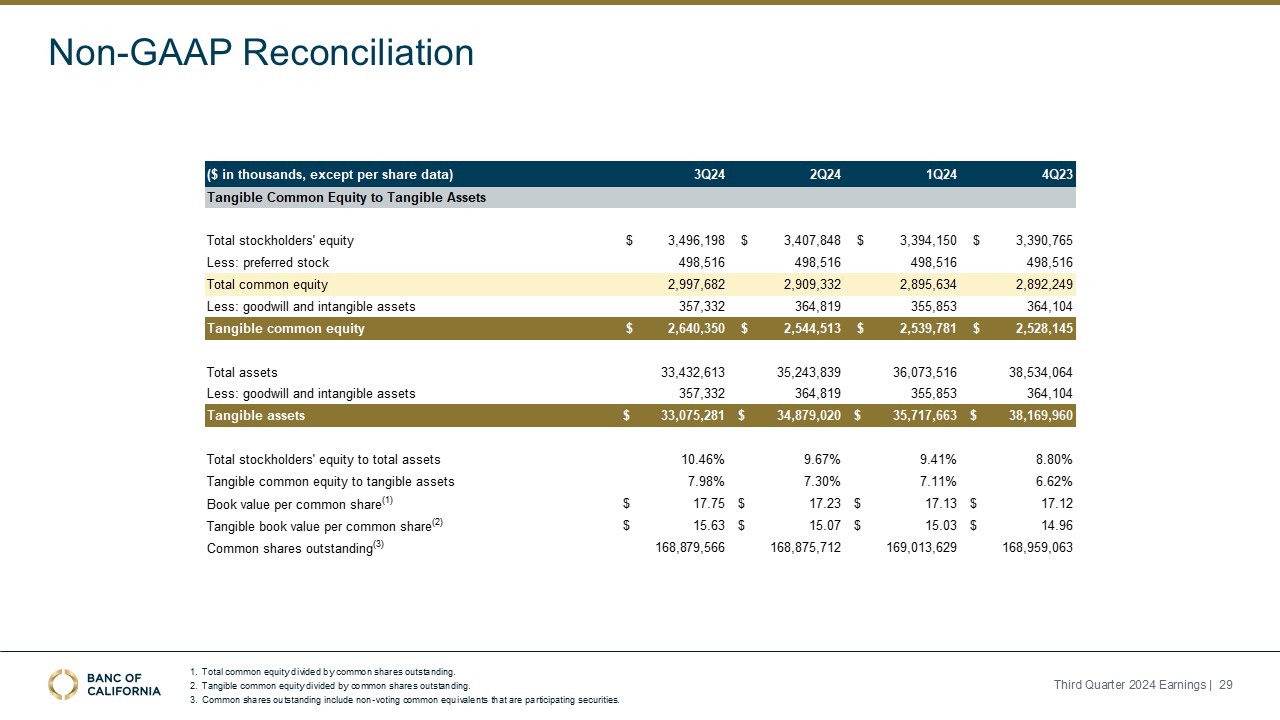
Non-GAAP Reconciliation Total common equity divided by common shares
outstanding. Tangible common equity divided by common shares outstanding. Common shares outstanding include non-voting common equivalents that are participating securities. Third Quarter 2024 Earnings | 29
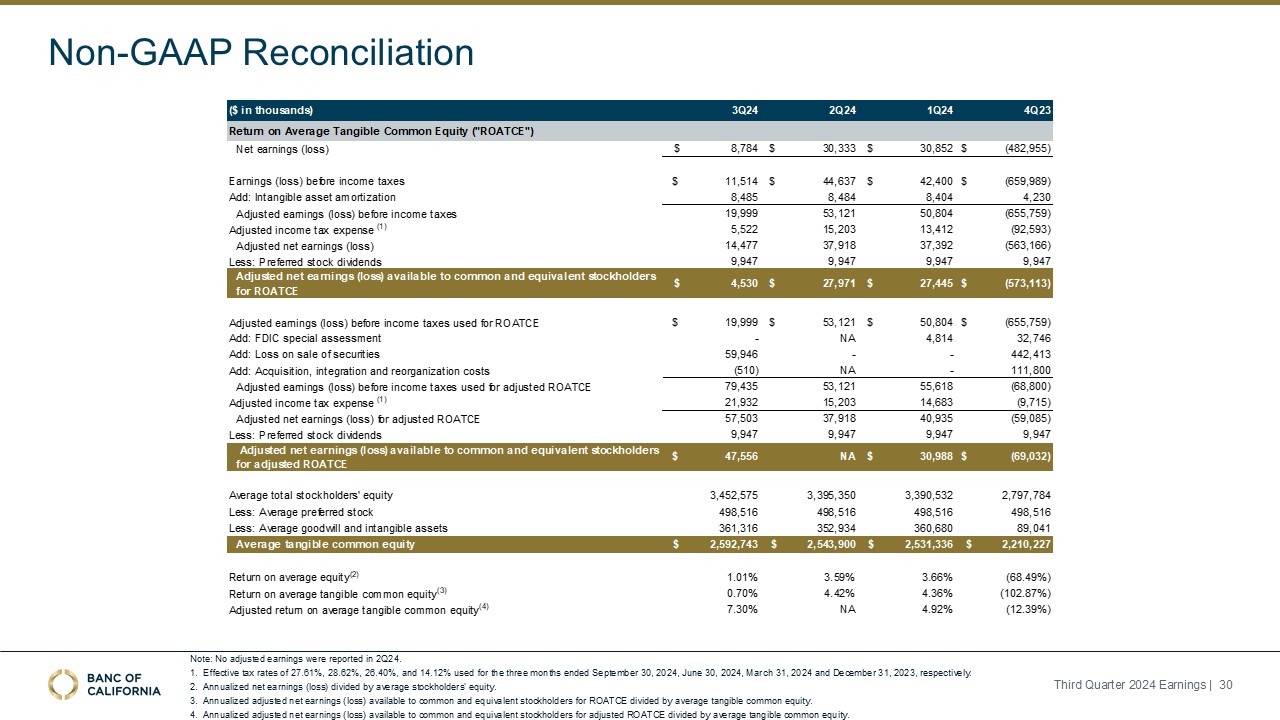
Non-GAAP Reconciliation Note: No adjusted earnings were reported in 2Q24. Effective
tax rates of 27.61%, 28.62%, 26.40%, and 14.12% used for the three months ended September 30, 2024, June 30, 2024, March 31, 2024 and December 31, 2023, respectively. Annualized net earnings (loss) divided by average stockholders’
equity. Annualized adjusted net earnings (loss) available to common and equivalent stockholders for ROATCE divided by average tangible common equity. Annualized adjusted net earnings (loss) available to common and equivalent stockholders
for adjusted ROATCE divided by average tangible common equity. Third Quarter 2024 Earnings | 30
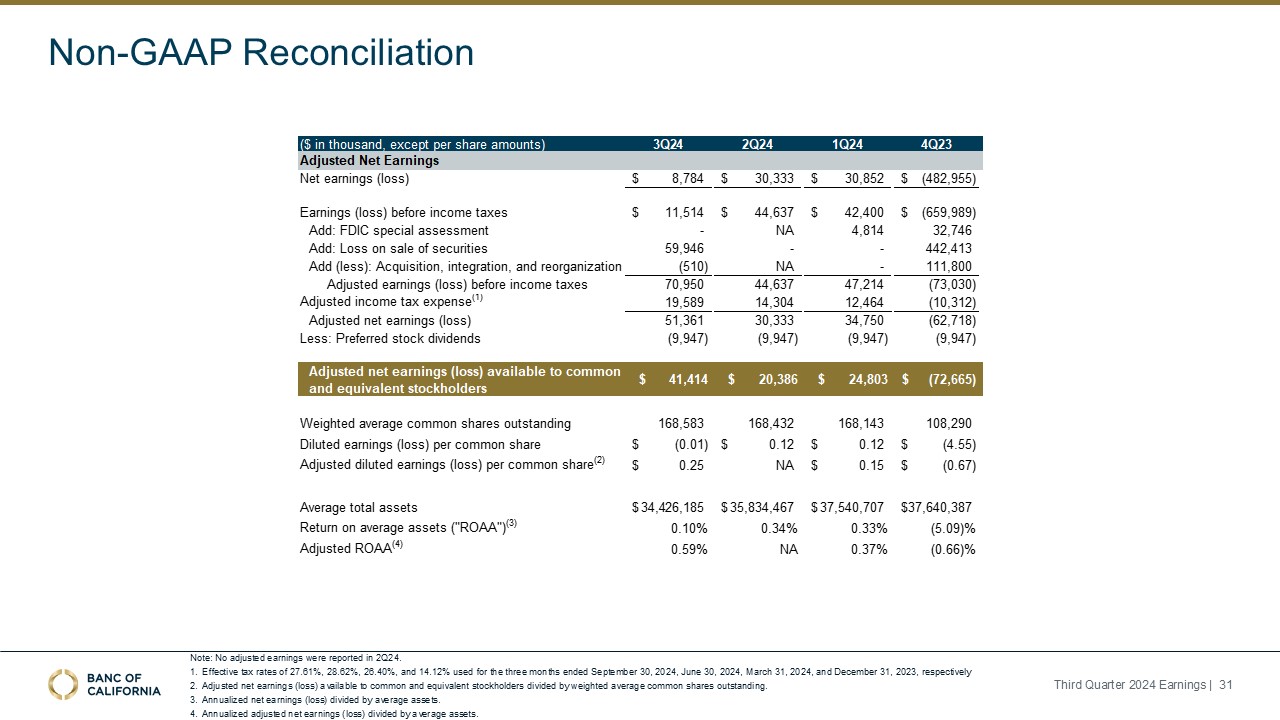
Non-GAAP Reconciliation Third Quarter 2024 Earnings | 31 Note: No adjusted earnings
were reported in 2Q24. Effective tax rates of 27.61%, 28.62%, 26.40%, and 14.12% used for the three months ended September 30, 2024, June 30, 2024, March 31, 2024, and December 31, 2023, respectively Adjusted net earnings (loss) available
to common and equivalent stockholders divided by weighted average common shares outstanding. Annualized net earnings (loss) divided by average assets. Annualized adjusted net earnings (loss) divided by average assets.
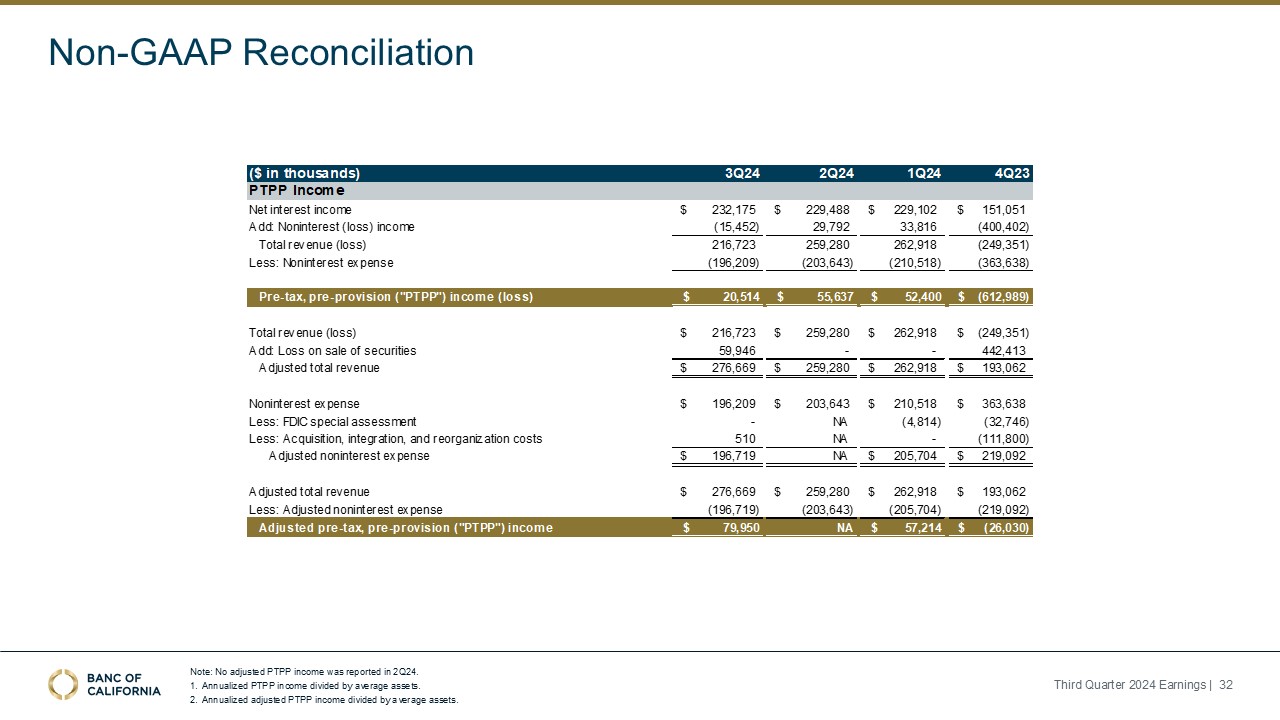
Non-GAAP Reconciliation Third Quarter 2024 Earnings | 32 Note: No adjusted PTPP
income was reported in 2Q24. Annualized PTPP income divided by average assets. Annualized adjusted PTPP income divided by average assets.
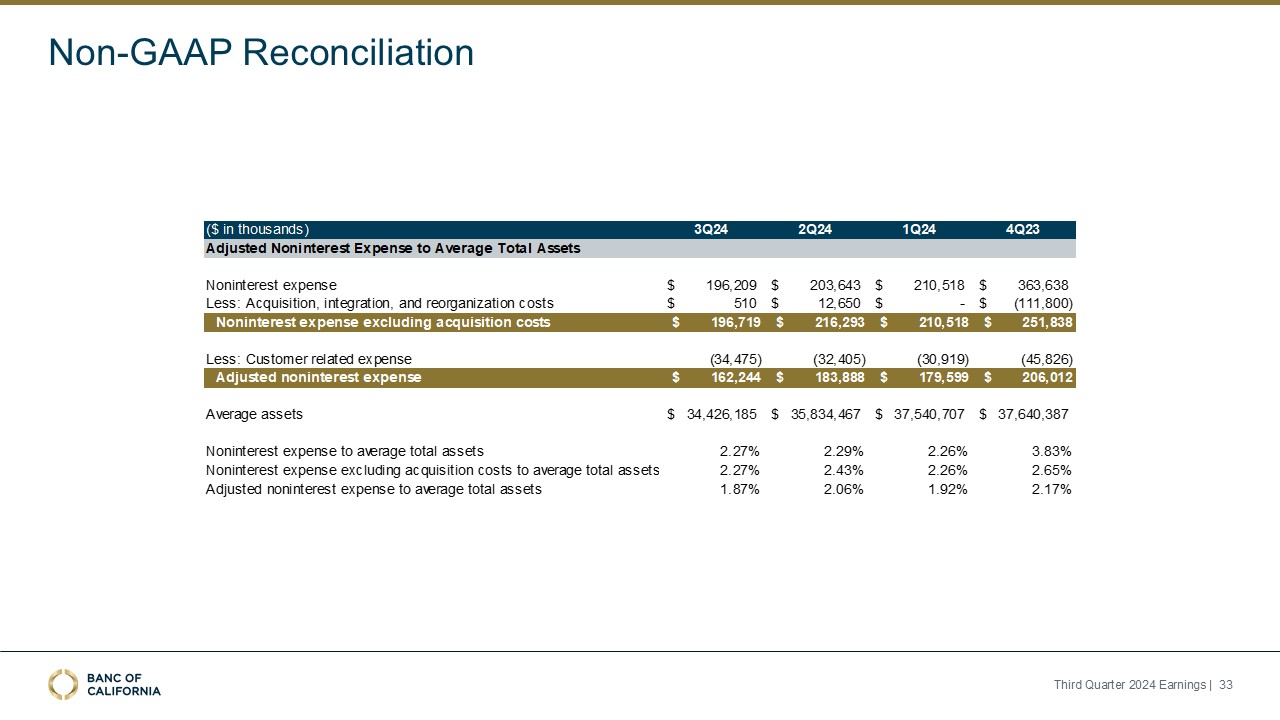
Non-GAAP Reconciliation Third Quarter 2024 Earnings | 33
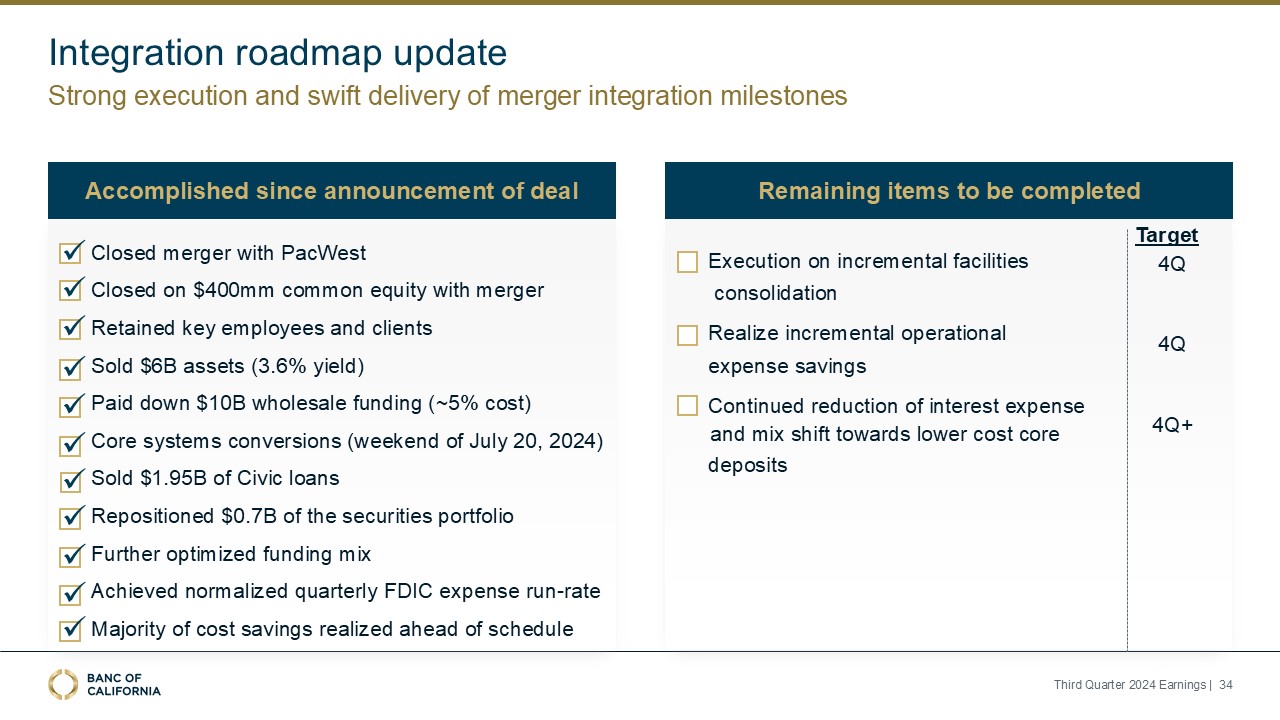
Execution on incremental facilities consolidation Realize incremental operational
expense savings Continued reduction of interest expense and mix shift towards lower cost core deposits Integration roadmap update Remaining items to be completed Closed merger with PacWest Closed on $400mm common equity with
merger Retained key employees and clients Sold $6B assets (3.6% yield) Paid down $10B wholesale funding (~5% cost) Core systems conversions (weekend of July 20, 2024) Sold $1.95B of Civic loans Repositioned $0.7B of the securities
portfolio Further optimized funding mix Achieved normalized quarterly FDIC expense run-rate Majority of cost savings realized ahead of schedule 4Q 4Q 4Q+ Target Strong execution and swift delivery of merger
integration milestones Accomplished since announcement of deal Third Quarter 2024 Earnings | 34
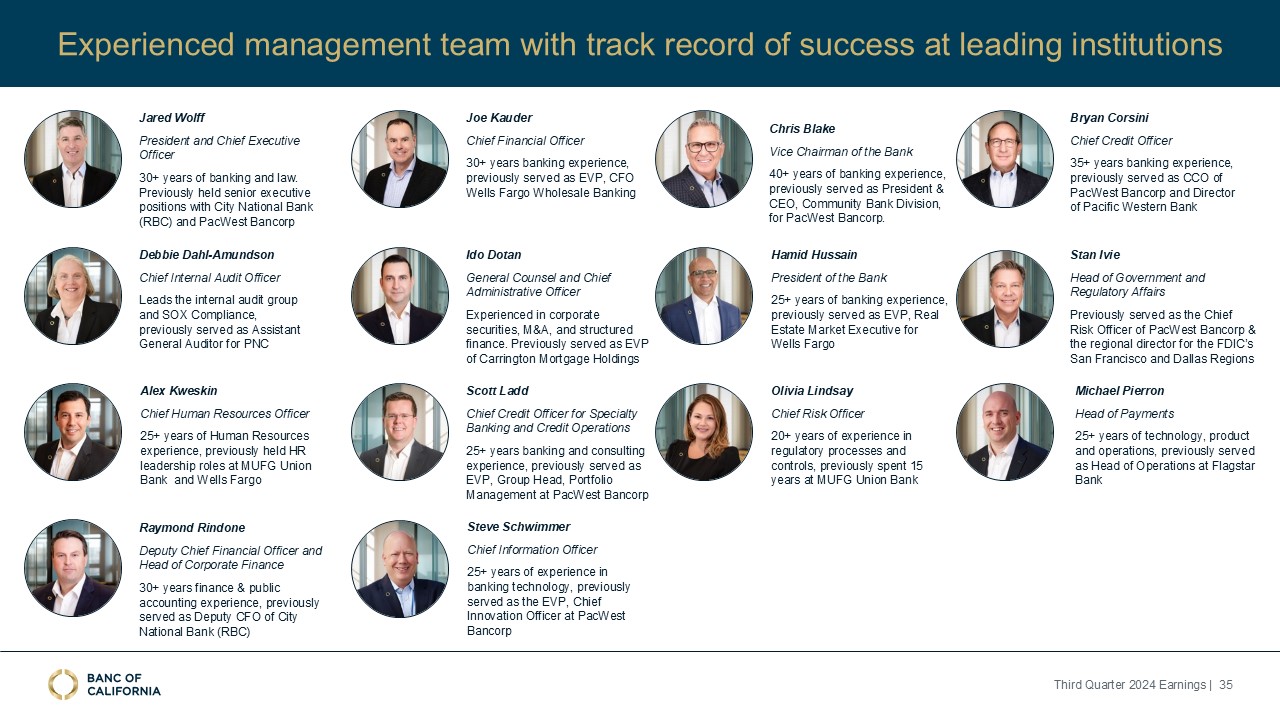
Jared Wolff President and Chief Executive Officer 30+ years of banking and law.
Previously held senior executive positions with City National Bank (RBC) and PacWest Bancorp Third Quarter 2024 Earnings | 35 Joe Kauder Chief Financial Officer 30+ years banking experience, previously served as EVP, CFO Wells Fargo
Wholesale Banking Experienced management team with track record of success at leading institutions Alex Kweskin Chief Human Resources Officer 25+ years of Human Resources experience, previously held HR leadership roles at MUFG Union Bank
and Wells Fargo Chris Blake Vice Chairman of the Bank 40+ years of banking experience, previously served as President & CEO, Community Bank Division, for PacWest Bancorp. Scott Ladd Chief Credit Officer for Specialty Banking and
Credit Operations 25+ years banking and consulting experience, previously served as EVP, Group Head, Portfolio Management at PacWest Bancorp Hamid Hussain President of the Bank 25+ years of banking experience, previously served as EVP,
Real Estate Market Executive for Wells Fargo Bryan Corsini Chief Credit Officer 35+ years banking experience, previously served as CCO of PacWest Bancorp and Director of Pacific Western Bank Debbie Dahl-Amundson Chief Internal Audit
Officer Leads the internal audit group and SOX Compliance, previously served as Assistant General Auditor for PNC Ido Dotan General Counsel and Chief Administrative Officer Experienced in corporate securities, M&A, and structured
finance. Previously served as EVP of Carrington Mortgage Holdings Olivia Lindsay Chief Risk Officer 20+ years of experience in regulatory processes and controls, previously spent 15 years at MUFG Union Bank Raymond Rindone Deputy Chief
Financial Officer and Head of Corporate Finance 30+ years finance & public accounting experience, previously served as Deputy CFO of City National Bank (RBC) Steve Schwimmer Chief Information Officer 25+ years of experience in banking
technology, previously served as the EVP, Chief Innovation Officer at PacWest Bancorp Stan Ivie Head of Government and Regulatory Affairs Previously served as the Chief Risk Officer of PacWest Bancorp & the regional director for the
FDIC’s San Francisco and Dallas Regions Michael Pierron Head of Payments 25+ years of technology, product and operations, previously served as Head of Operations at Flagstar Bank