This technical report summary is prepared for Gold Fields Limited (Gold Fields or the Company or the Registrant), a production stage issuer. It highlights significant information focusing on property ownership, exploration strategy, mineral resources and mineral reserves, and key economic metrics. The report complies with the Securities and Exchange Commission (SEC) disclosure requirements under Subpart 229.1300 of Regulation S-K - Disclosure by Registrants Engaged in Mining Operations.
The effective date of this TRS is 27 March 2025. The effective date of the mineral resource and mineral reserve is 31 December 2024. Unless otherwise specified, all currency is in United States dollars ($), and measurements are metric, except for troy ounces (oz).
Salares Norte Gold Mine (Salares Norte or the Property) is a production stage property in Chile.
1.1Property description and ownership
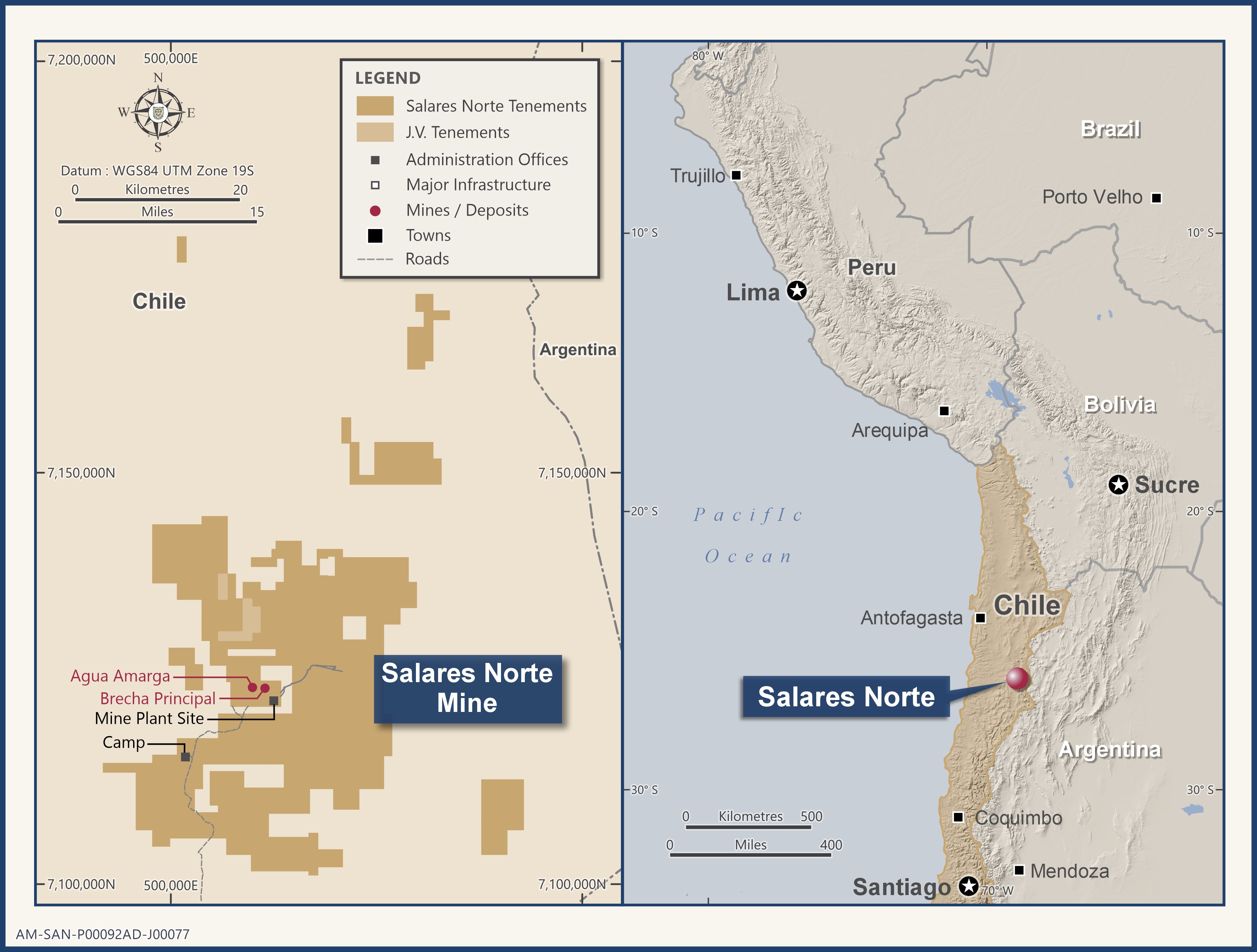
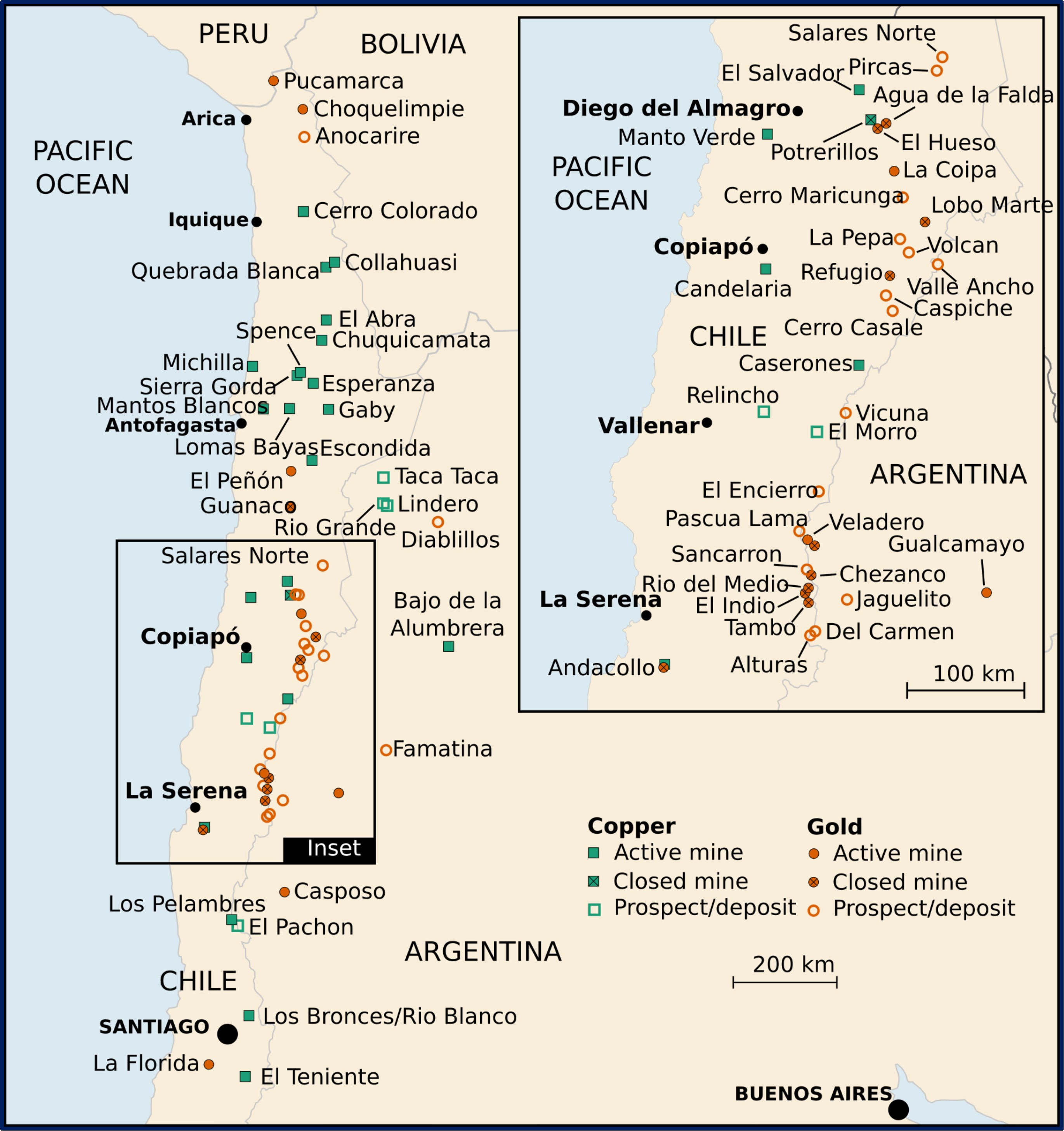
Salares Norte is in the Atacama Region of northern Chile, 266 km northeast of the regional city Copiapó, 75 km northeast of the El Salvador porphyry copper mine and 45 km west of the international border with Argentina (Figure 1.1.1). Elevations in the Property range from 4,200 m to 4,900 m above sea level.
Salares Norte is operated by Minera Gold Fields Salares Norte SpA (MGFSN), a wholly owned subsidiary if Gold Fields, and holds 22,800 hectares of exploitation concessions (mining rights) with definitive title granted including 1,800 hectares covering the property area. MGFSN holds 69,100 hectares of additional exploration concessions and an option agreement with Pan Pacific Copper Exploration Chile Ltda. covering 2,200 hectares (comprised of 300 hectares of mining concessions and 1,900 hectares of exploration concessions) to the northwest of Salares Norte.
As at 31 December 2024, Gold Fields controlled, or has applied for, 94,100 ha of mineral rights concessions within the Salares Norte district.
Figure 1.1.1: Location of Salares Norte
Source: Salares Norte CPR, 2024
1.2Geology and mineralisation
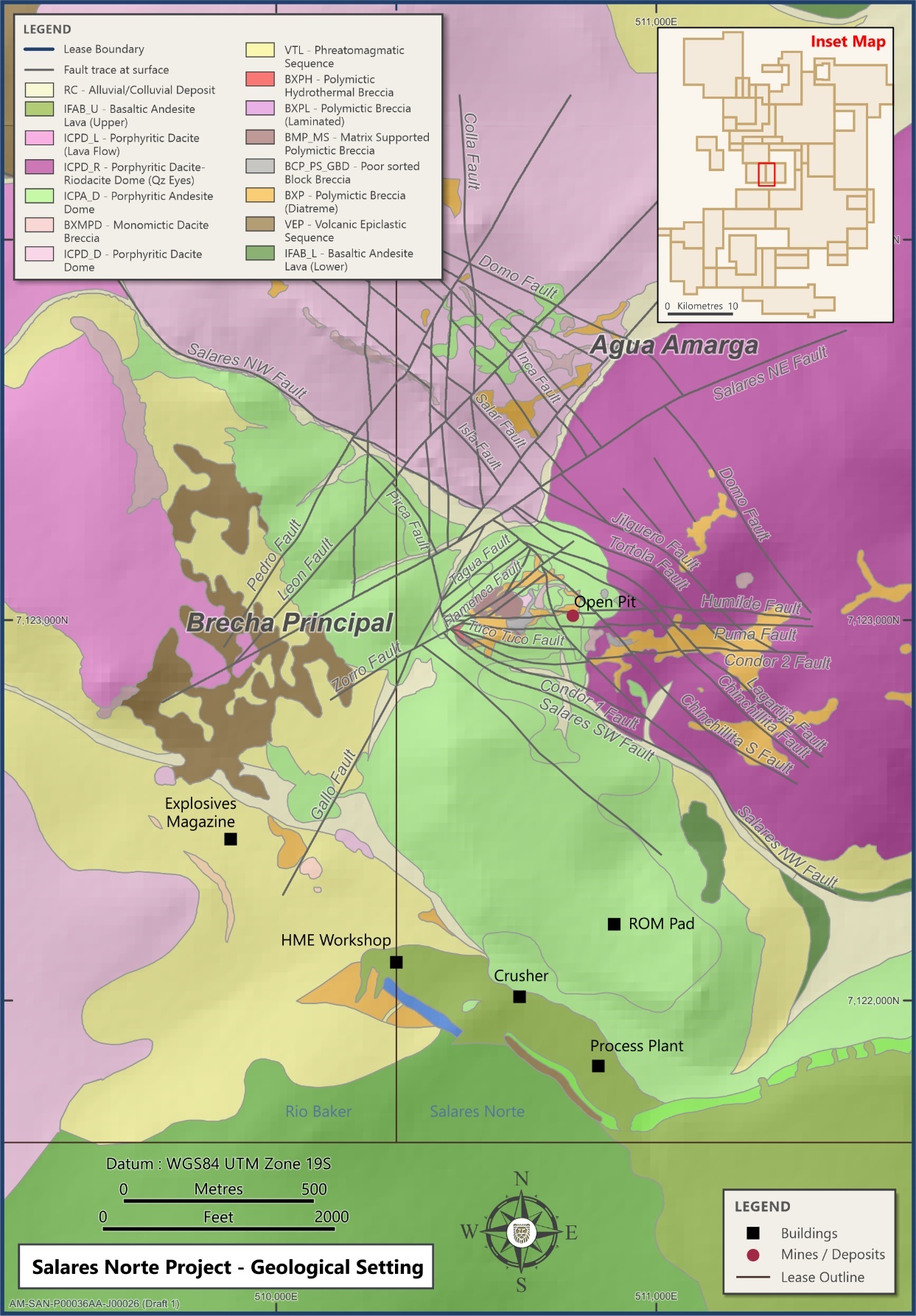
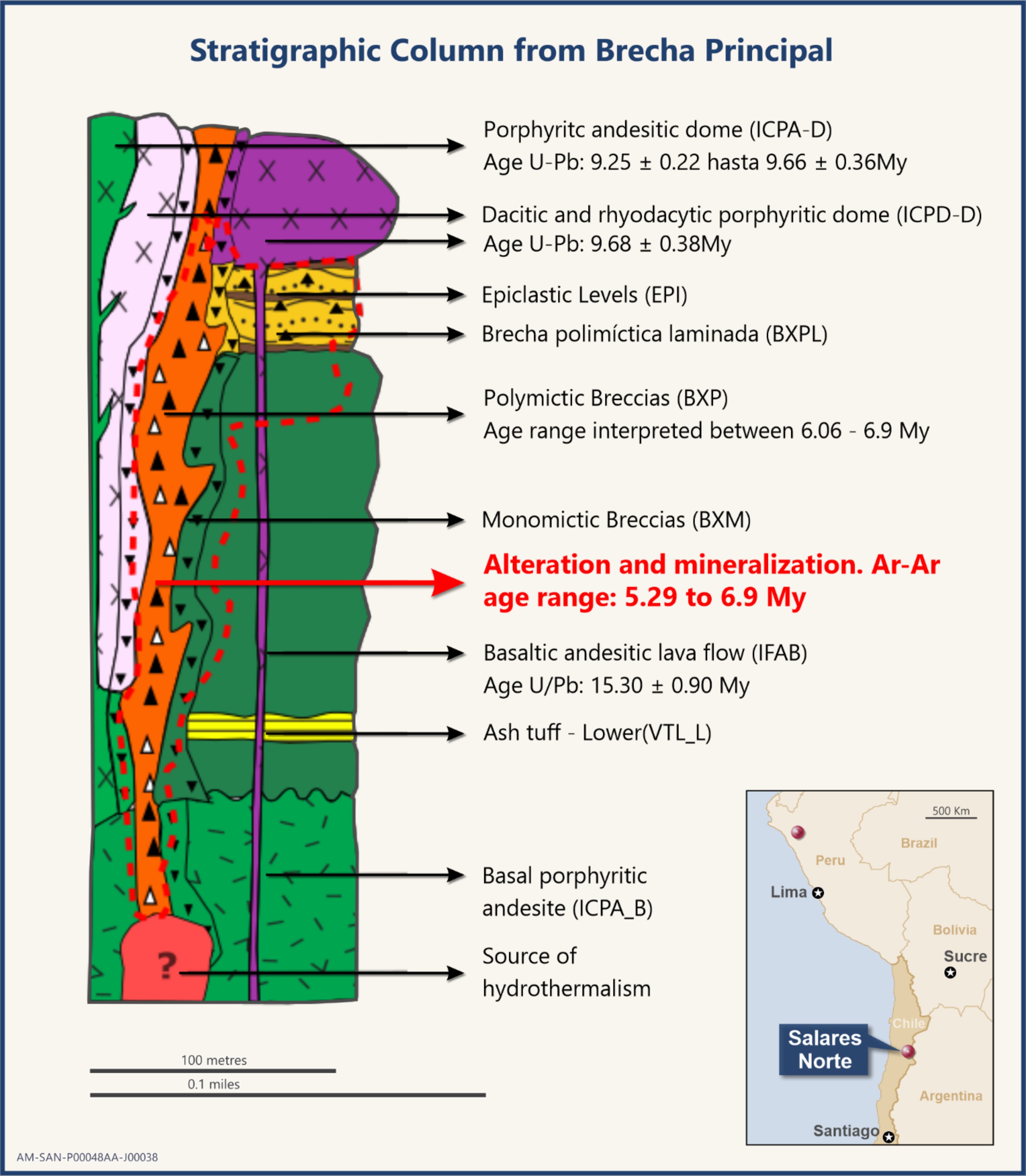
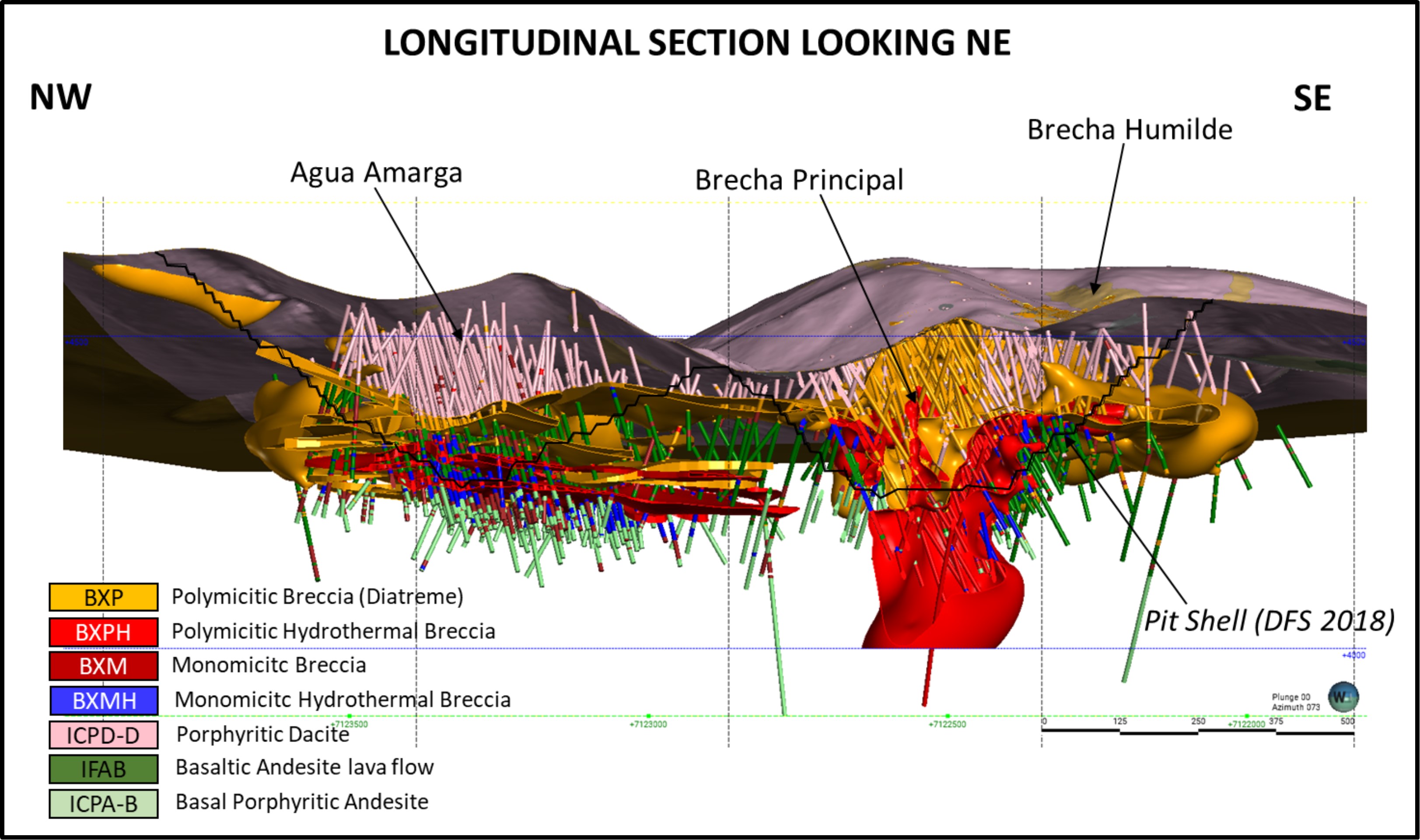
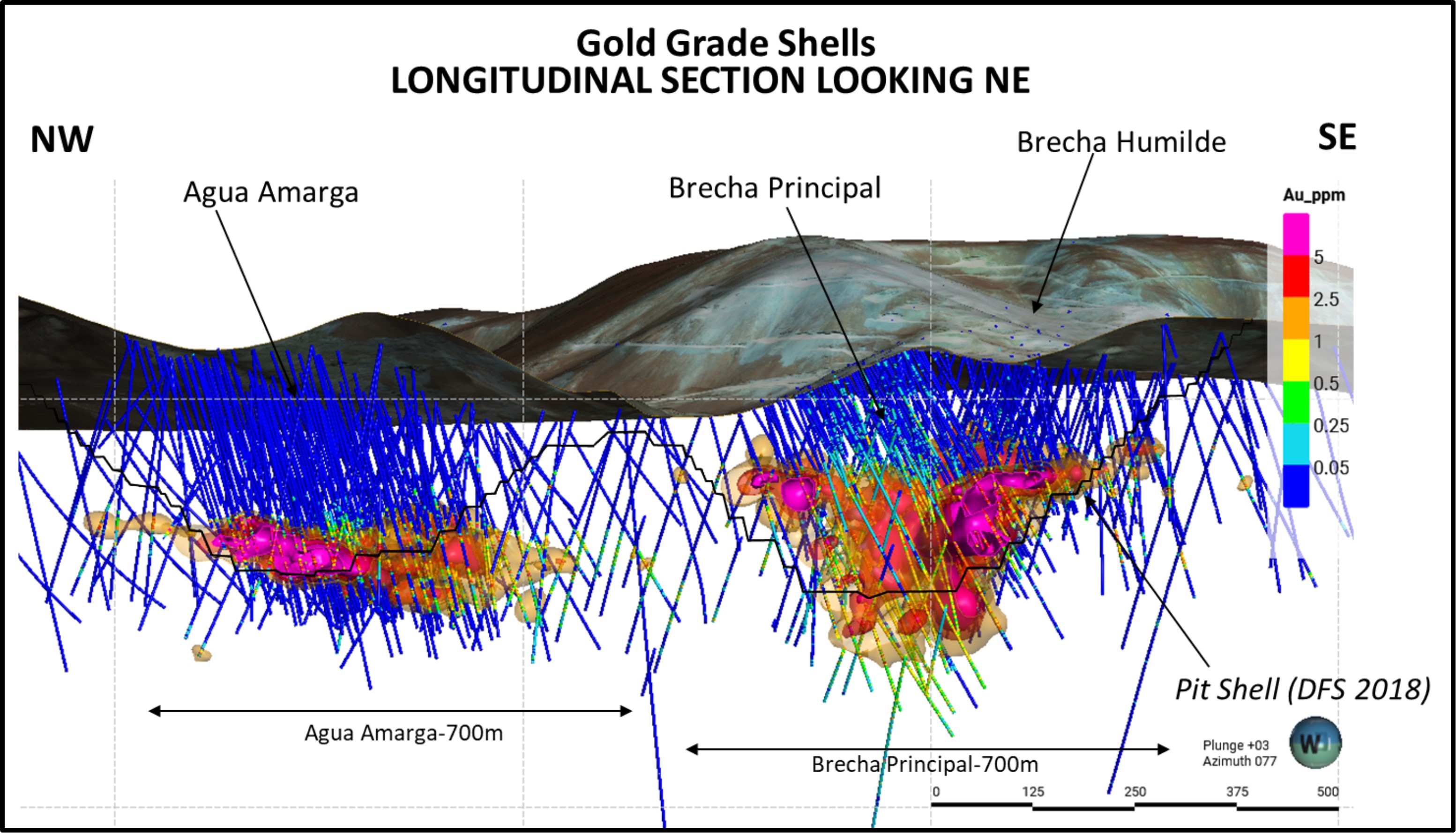
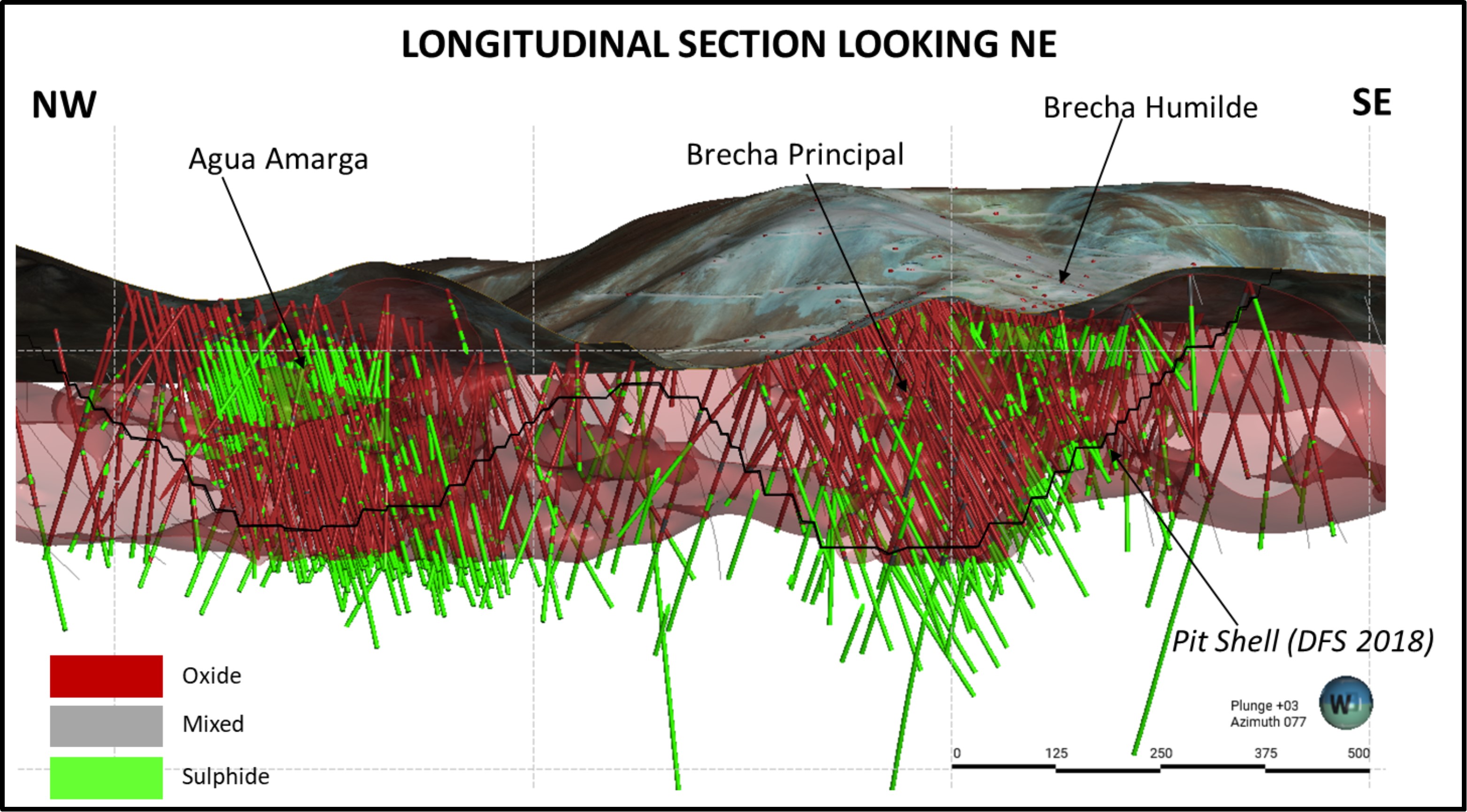
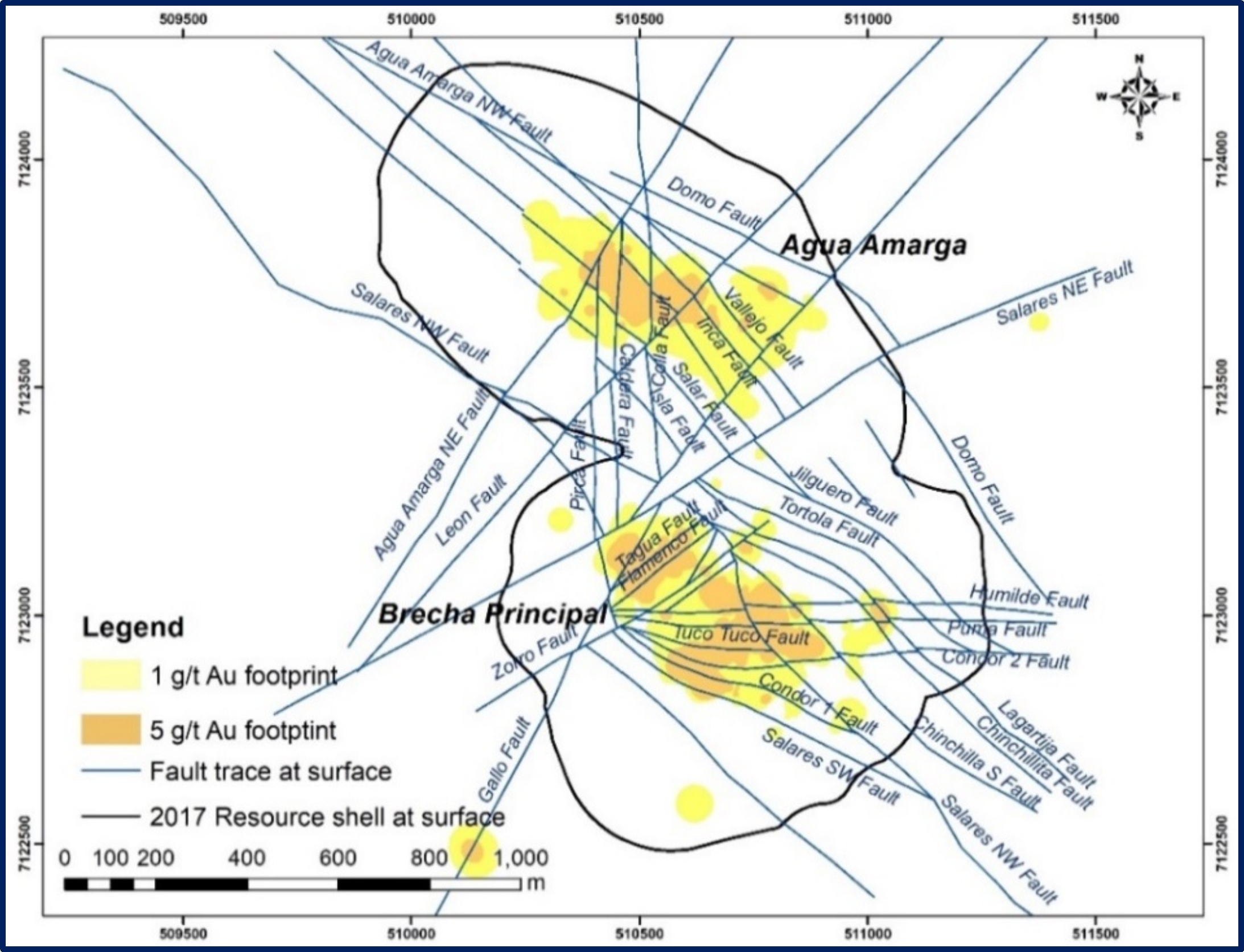
The Brecha Principal (BP) and Agua Amarga (AA) deposits at Salares Norte are epithermal, high-sulphidation, gold-silver mineralised systems at the southern end of South America’s Central Volcanic Zone and near the northern end of the metal-rich Maricunga belt.
The immediate area surrounding Salares Norte is dominated by volcanic and pyroclastic rocks ranging in age from Late Oligocene–Early Miocene to Quaternary. Most of the gold-silver mineralisation is hosted by intensely silicified and alunite-quartz altered rocks, predominantly in polymictic breccia interpreted to have formed by phreatomagmatic volcanic explosions, where both magmatic gases and steam from groundwater are expelled, with an overprinting of phreatic/hydrothermal breccia. Gold is the most economically important metal with silver having secondary importance but is still significant. No other metals are present in potential economic concentrations.
1.3Exploration, development and future operations
Gold Fields discovered the Salares Norte deposits in 2011. Since that time Gold Fields has completed resource definition drilling to define an open pit mineral resource and reserve for the BP and AA deposits. Various mining studies have culminated in a study with pre-feasibility levels of accuracy. This study is the basis for the permitting and investment decision.
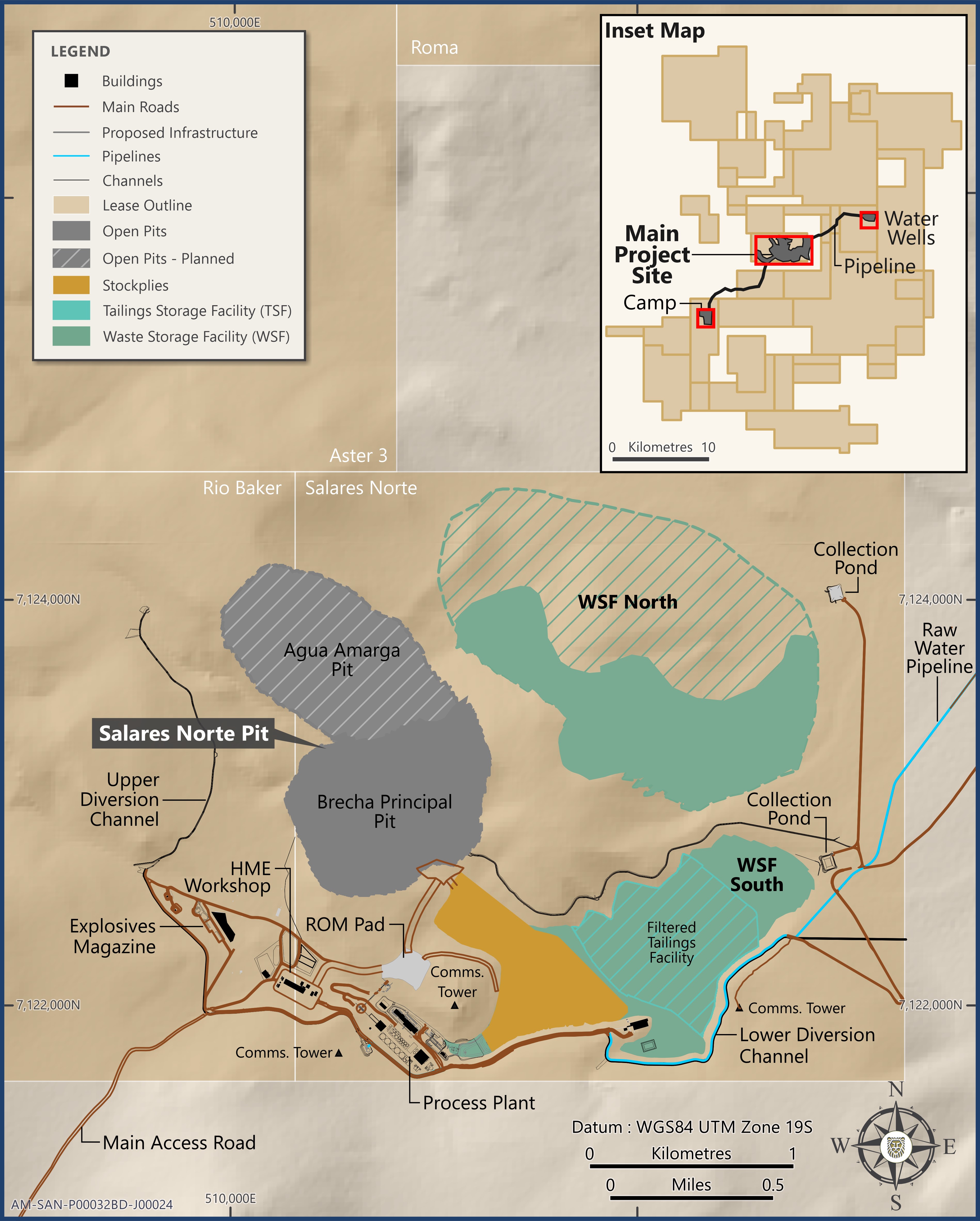
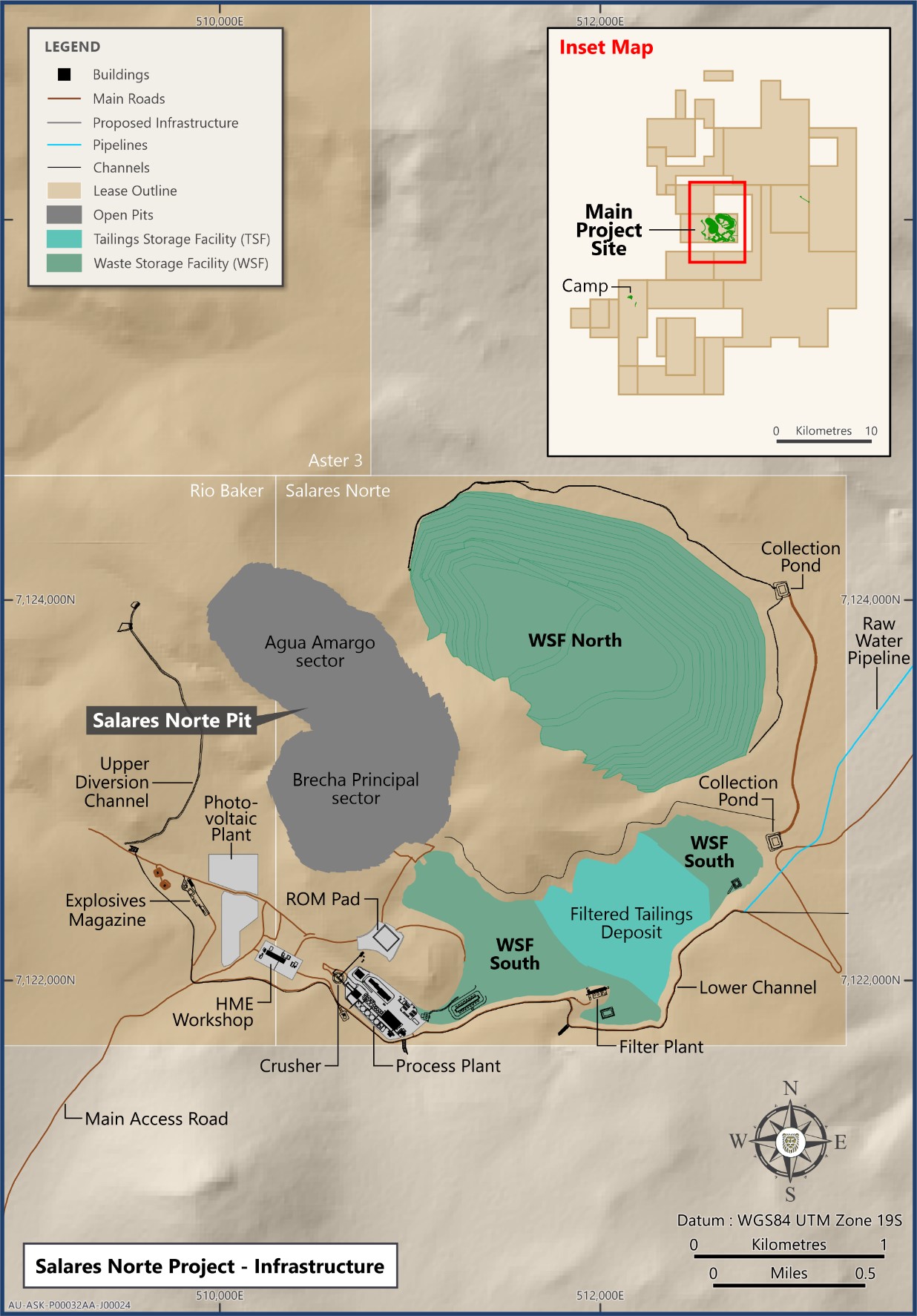
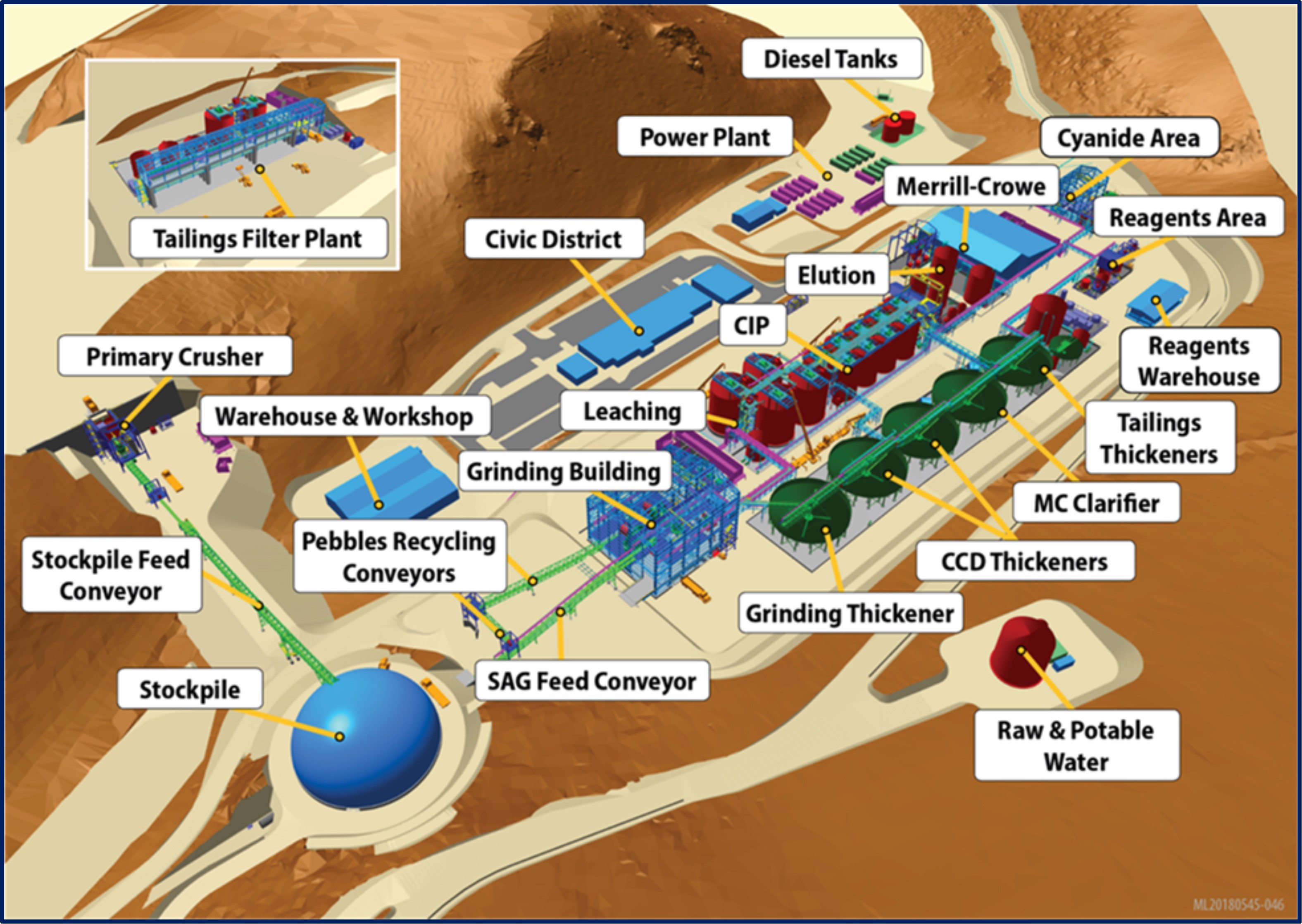
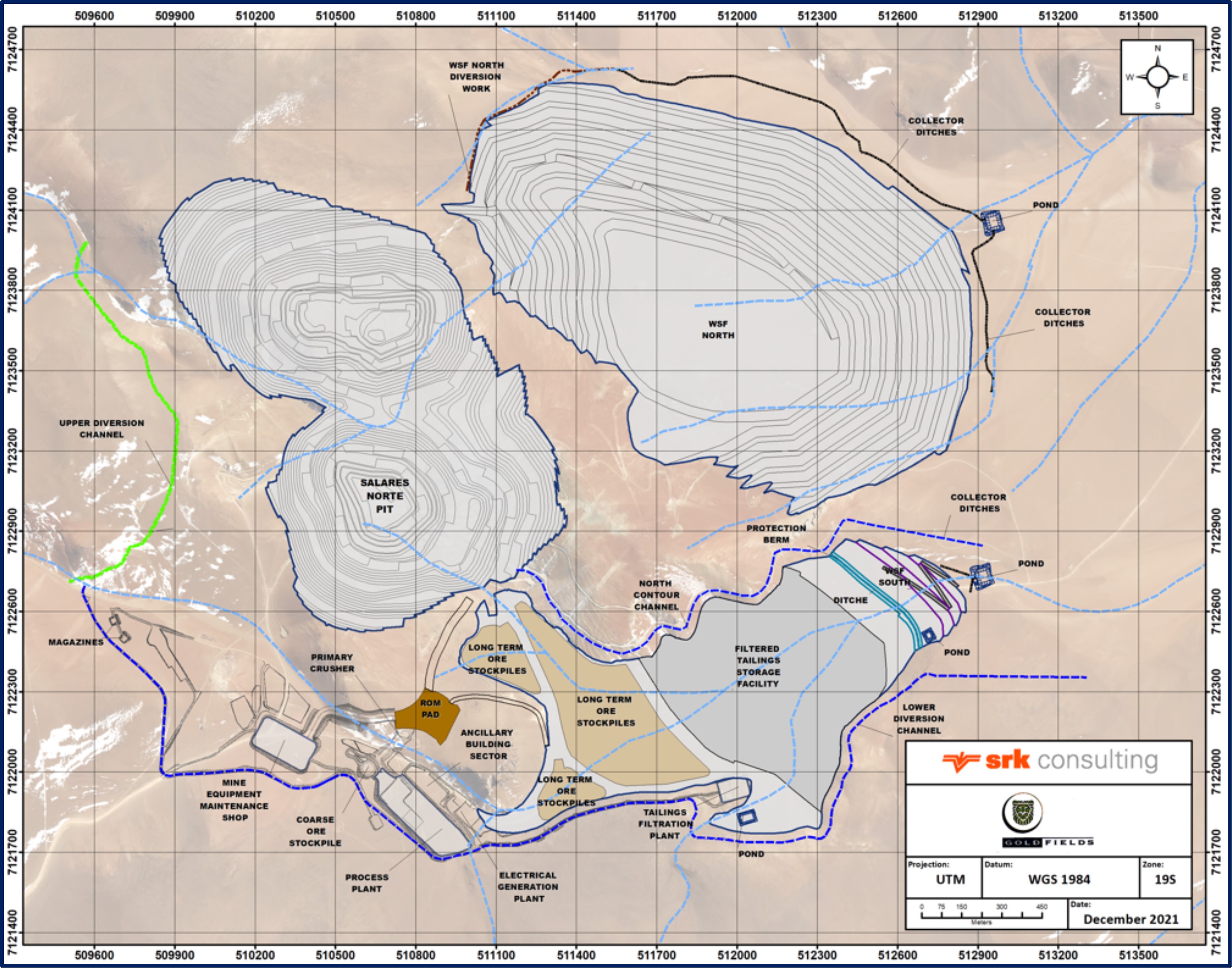
The BP deposit is being mined by a contractor using conventional open pit mining methods. Mining occurs in six phases over nine years, including two years of pre-stripping starting in BP and finishing in AA. Waste is placed in either the south or north waste storage facility (WSF). All ore is hauled to either the run-of-mine (ROM) pad or one of the graded stockpiles south of the pits.
Gold Fields commissioned the Salares Norte processing plant in 2024 and it is currently in a ramp-up stage with some important installations (e.g., winterization) still in construction or commissioning phase.
District exploration, within 20 km of the Salares Norte processing plant, has continued since 2011. The aim of this drilling is to identify deposits that could supplement or extend the life of the Salares Norte processing plant. In 2024, these exploration efforts were re-evaluated with a programme of district-scale data collection (geophysics and drilling). In 2024 drilling commenced on the Low Baker, BP Sulphide and AA Northwest prospects close to the existing operation.
1.4Mineral resource estimates
The mineral resources exclusive of mineral reserves are summarised in Table 1.4.1. The mineral resources are 100 % attributable to Gold Fields. The point of reference is in situ.
Table 1.4.1: Salares Norte – summary of gold and silver mineral resources at the end of the fiscal year ended 31 December 2024 based on $1,720/oz gold and $20/oz silver.
Resources (exclusive of Mineral reserves)
NSR cut-off ($/t)
Metallurgical recovery (%)
Amount (kt)
Grade (g/t)
Amount (koz)
Grade (g/t)
Amount (koz)
Au
Ag
Au
Ag
Open Pit Mineral resources
OP measured Mineral resources
OP indicated Mineral resources
2,892
2.3
216
30.5
2,832
55.98 – 56.82
91.0 – 92.5
40.3 – 66.7
OP measured + indicated Mineral resources
2,892
2.3
216
30.5
2,832
55.98 – 56.82
91.0 – 92.5
40.3 – 66.7
OP inferred Mineral resources
210
1.5
10
8.3
56
53.61 – 55.59
91.0 – 92.0
8.5 – 61.3
Source: Salares Norte CPR, 2024
1.5Mineral reserve estimates
The mineral reserves are summarised in Table 1.5.1. The mineral reserves are 100 % attributable to Gold Fields.
Table 1.5.1: Salares Norte – summary of gold and silver mineral reserves at the end of the fiscal year ended 31 December 2024 based on a $1,500/oz gold and $17.50/oz silver
Amount (kt)
Grade (g/t)
Amount (koz)
Grade (g/t)
Amount (koz)
Cut-off grades ($/t NSR)
Metallurgical recovery (%)
Au
Ag
Au
Ag
Open Pit Mineral reserves
OP proven Mineral reserves
OP probable Mineral reserves
15,173
5.4
2,622
67.14
32,752
73.49 – 77.97
91.0 – 93.4
58.5 – 70.1
OP total Mineral reserves
15,173
5.4
2,622
67.14
32,752
73.49 – 77.97
91.0 – 93.4
58.5 – 70.1
Stockpile Mineral reserves
SP proven Mineral reserves
SP probable Mineral reserves
4,647
5.3
793
88.75
13,261
84.83
93.6
72.4
SP total Mineral reserves
4,647
5.3
793
88.75
13,261
84.83
93.6
72.4
Total Mineral reserves
Total proven Mineral reserves
Total probable Mineral reserves
19,821
5.4
3,415
72.21
46,013
73.49 – 84.83
91.0 – 93.6
58.5 – 72.4
Total Salares Norte Mineral reserves
19,821
5.4
3,415
72.21
46,013
73.49 – 84.83
91.0 – 93.6
58.5 – 72.4
Source: Salares Norte CPR, 2024
1.6Capital and operating cost estimates
Major budgeted capital cost items for the mineral reserve Life of Mine (LOM) plan include initial capital for pre-stripping of the mine, construction of the process plant, associated infrastructure and facilities, and sustaining capital for the life of the operation. The forecast capital costs are summarised in Table 1.6.1.
Table 1.6.1: Capital costs ($ million)
2025
2026
2027
2028
2029
2030
2031
2032
2033
2034
2035
Capital expenditure
$ million
121
59
155
175
169
68
47
4
4
0
0
Source: Salares Norte CPR, 2024
Budgeted operating costs for the mineral reserve LOM plan are summarised in Table 1.6.2.
Table 1.6.2: Operating costs ($ million)
2025
2026
2027
2028
2029
2030
2031
2032
2033
2034
2035
Operating cost
$ million
261
368
215
208
201
292
175
154
139
137
32
a)Third party royalties are not included in operating cost
Source: Salares Norte CPR, 2024
The mine closure cost for Salares Norte is estimated at $96 million. This includes a provision for physical remediation activities of the mine, storage facilities and infrastructure. It also includes a provision for personnel demobilization and severance costs at the time of closure and for post-closure monitoring and maintenance.
1.7Permitting
Salares Norte, operated by MGFSN, holds exploitation concessions with secured land access through government-granted easements and water rights approved by Chilean authorities under RCA 153/19. The Environmental Impact
Assessment (EIA), approved in December 2019, outlines environmental and social impacts across project phases, detailing mitigation and compensation measures. All major permits have been obtained.
A critically endangered species, the short-tailed chinchilla, inhabits the area, and habitat impacts necessitated a conservation plan, including a designated conservation area, no-go zones, and a capture and relocation program.
At the end of 2020, the relocation programme was suspended by the authorities and a sanctioning process was subsequently initiated in 2021, following the death of two chinchillas relocated under the programme. In response, MGFSN submitted a compliance programme, which was approved in 2023 and MGFSN resumed relocation activities in the first quarter of 2024. In May 2024, the SMA temporarily suspended the capture and relocation programme, which recommenced in October 2024. One chinchilla was successfully relocated, and in January 2025, Rockery No 3 was successfully removed in accordance with the compliance programme. Gold Fields has now executed multiple capture and relocation campaigns, with three chinchillas successfully relocated and released to date.
Whilst initial plant feed schedules or LOM are not impacted by the chinchilla capture and relocation program, Agua Amarga open pit development cannot commence until its completion.
1.8Conclusions and recommendations
The Salares Norte mineral reserves are estimated at 3.4 Moz gold and 46 Moz silver and currently support an 11 year LOM plan to 2035 with an NPV at a 8.7% discount rate of $1,470 million at the reserve gold price of $1,500/oz and silver price of $17.50/oz.
Mining performance during 2024 was consistent with plan with 26 Mt mined from BP during the year. First gold was obtained later than planned in Q1 of 2024, but production was suspended in April 2024 following an early severe winter event, which caused material to freeze in the process plant. Processing operations were restarted in October 2024, and the production ramp-up is projected to continue until September 2025.
Gold Fields’ commitment to materiality, transparency and competency in its mineral resources and mineral reserves disclosure to regulators and in the public domain is of paramount importance to the Qualified Person and the Registrants Executive Committee and Board of Directors continue to endorse the company’s internal and external review and audit assurance protocols. This technical report summary should be read in totality to gain a full understanding of Salares Norte’s mineral resource and mineral reserve estimation and reporting process, including data integrity, estimation methodologies, modifying factors, mining and processing capacity and capability, confidence in the estimates, economic analysis, risk and uncertainty and overall projected property value.
However, to ensure consolidated coverage of the company’s primary internal controls in generating the estimates and the LOM plan a key point summary is provided in Section 21 for reference.
2Introduction
2.1Registrant for whom the technical report summary was prepared
This technical report summary is prepared for Gold Fields Limited (the Registrant), a publicly traded company listed on the New York Stock Exchange (NYSE).
2.2Terms of reference and purpose of the technical report summary
The purpose of this technical report summary is to provide a summary of the mineral resources and mineral reserves for the Property. This report has been compiled in compliance with SEC regulations, particularly Subpart 229.1300 of Regulation S-K. It includes all material information and scientific analysis to support the disclosure requirements of the Registrant.
2.3Sources of information
This technical report summary incorporates data from exploration campaigns, geological studies, and technical assessments conducted by the Registrant, its Qualified Persons, subject matter experts, and third-party specialists engaged by the Company as cited throughout this Report and listed in Section 24. This technical summary report is principally based on information disclosed in a Competent Persons' Report for the Property (see Section 24).
Reliance was also placed on certain economic, marketing and legal information beyond the expertise of the Qualified Persons used in the determination of modifying factors. This information provided by the Company is cited in this technical report summary and is listed in Section 25.
2.4Qualified Persons and details of inspection
The Qualified Persons responsible for the preparation of this technical report summary are listed in Table 2.4.1. All the Qualified Persons are eligible members in good standing of SAMREC recognised professional organisations (RPO) within the mining industry and have at least five years of relevant experience in the type of mineralisation and type of deposit under consideration and in the specific type of activity that the Qualified Person is undertaking on behalf of the Company at the time this technical report summary was prepared.
The recognised professional organisation affiliation in good standing has been reviewed by Gold Fields. The Qualified Persons have been appointed by Gold Fields.
The Qualified Persons responsible for this TRS may include individuals newly appointed to their respective roles who have not conducted site inspections to date. However, they have performed comprehensive reviews of the underlying data, prior site inspections, and relevant technical information to ensure all material matters are addressed accurately in this report. Gold Fields has established a practice of conducting annual inspections of material properties by its Group Qualified Persons for Mineral Resources and Mineral Reserves to maintain a high standard of oversight. When such visits are not feasible, the continuity of technical oversight is supported by overlapping contributions from other Qualified Persons, including site-based professionals. This collaborative approach ensures that all aspects of the property are adequately evaluated in compliance with SEC standards.
Table 2.4.1: List of Qualified Persons
Incumbent
Employer
Position
Affiliation in good standing
Relevant experience (years)
Details of inspection
Responsibility for which chapters
Alex Michael Trueman
Gold Fields
VP: Geology, Group Qualified Person for Mineral resources
MAusIMM (CP Geo)
110730
P.Geo. EGBC 149753
32
Last attended the property from 26 to 28 April 2024 and inspected open pit mining and grade control drilling, stockpiles, plant, and district exploration projects.
Alex Trueman has been supervising the preparation of this technical report summary. This Technical Report Summary has been reviewed by Alex Trueman.
Sections 1-26
Jason Sander
Gold Fields
VP: Long Term Planning, Group Qualified Person for Mineral reserves
FAusIMM 111818
29
Has attended site from 27 to 28 August.
Long Term Planning - Mineral reserves.
Sections 1-5, 10 & 12-26
Daniel Hillier
Gold Fields
VP: Metallurgy & Processing
FAusIMM CP - 227106
34
Has attended site on 19 February to 1 March 2024 and 7 December to 17 December 2024.
Metallurgy & Processing
Sections 1-4, 10, 14 & 18-26
Incumbent
Employer
Position
Affiliation in good standing
Relevant experience (years)
Details of inspection
Responsibility for which chapters
Johan Boshoff
Gold Fields
VP: Tailings, Hydrology, & Closure
FAusIMM - 1007564
29
Has attended site during October 2024 to do an inspection of TSF commissioning.
Has attended site on 26th of April 2024. Inspected open pit mining and grade control drilling, stockpiles, plant, and district exploration projects.
Geotechnical & Backfill.
Sections 1-4, 7.3, 7.4, 13, 15.2, 17.3.2 & 21-26
2.5Report version update
The maiden technical report summary for the Salares Norte property in Chile was filed by Gold Fields in 2021. This 31 December 2024 version is the first update of the 2021 maiden report.
3Property description
3.1Property location
Salares Norte is in the Atacama Region (Region III) of Chile at UTM coordinate system (datum WGS 1984 zone 19S) 510,481 mE and 7,123,125 mN (Figure 1.1.1). The Property is 266 km from the regional city Copiapó, 75 km northeast of the El Salvador porphyry copper mine, and 45 km west of the international border with Argentina.
3.2Ownership
MGFSN, in which Gold Fields indirectly holds a 100 % interest, owns the Salares Norte mining concessions (900 ha) and the adjacent Rio Baker mining concessions (900 ha).
Gold Fields acquired 100 % ownership of the Salares Norte mining concessions from SBX, a private Chilean company, in 2012 and 100 % ownership of the adjacent Rio Baker mining concessions from Sociedad Legal Minera Rio Baker (SLM Rio Baker) in 2016. MGFSN has security of tenure for all current exploration and mining tenements that contribute to Salares Norte’s mineral resources and mineral reserves.
3.3Property area
MGFSN holds 22,800 ha of exploitation concessions (mining rights), with definitive title granted, including 1,800 ha covering the property area. MGFSN also holds 69,100 ha of additional exploration concessions and an option agreement with Pan Pacific Copper Exploration Chile Ltda. covering 2,200 hectares (300 ha of mining concessions and 1,900 ha of exploration concessions) to the northwest of Salares Norte.
As at 31 December 2024, Gold Fields controlled, or has applied for, 94,100 ha of mineral rights concessions within the Salares Norte district.
3.4Property mineral titles, claims, mineral rights, leases and options
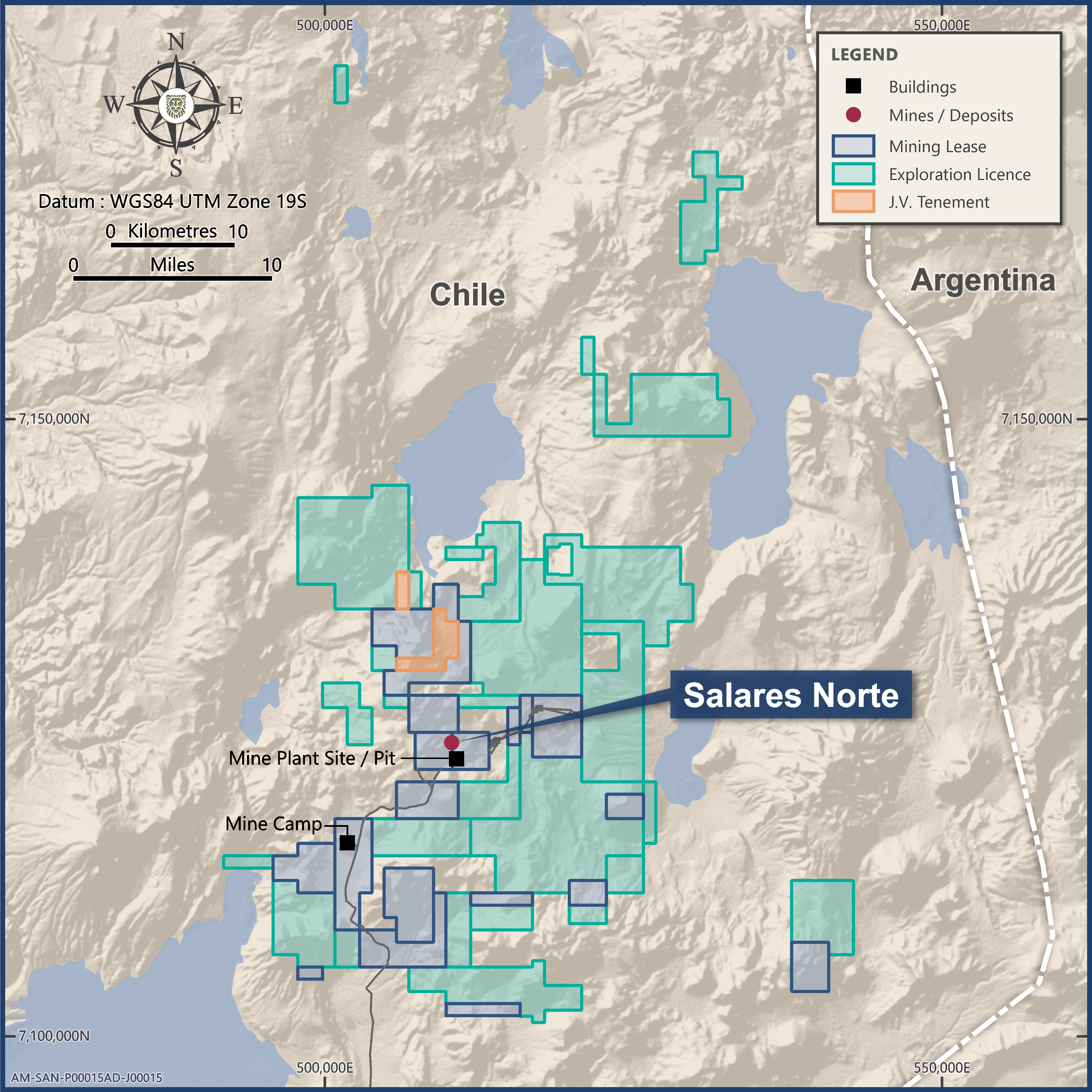
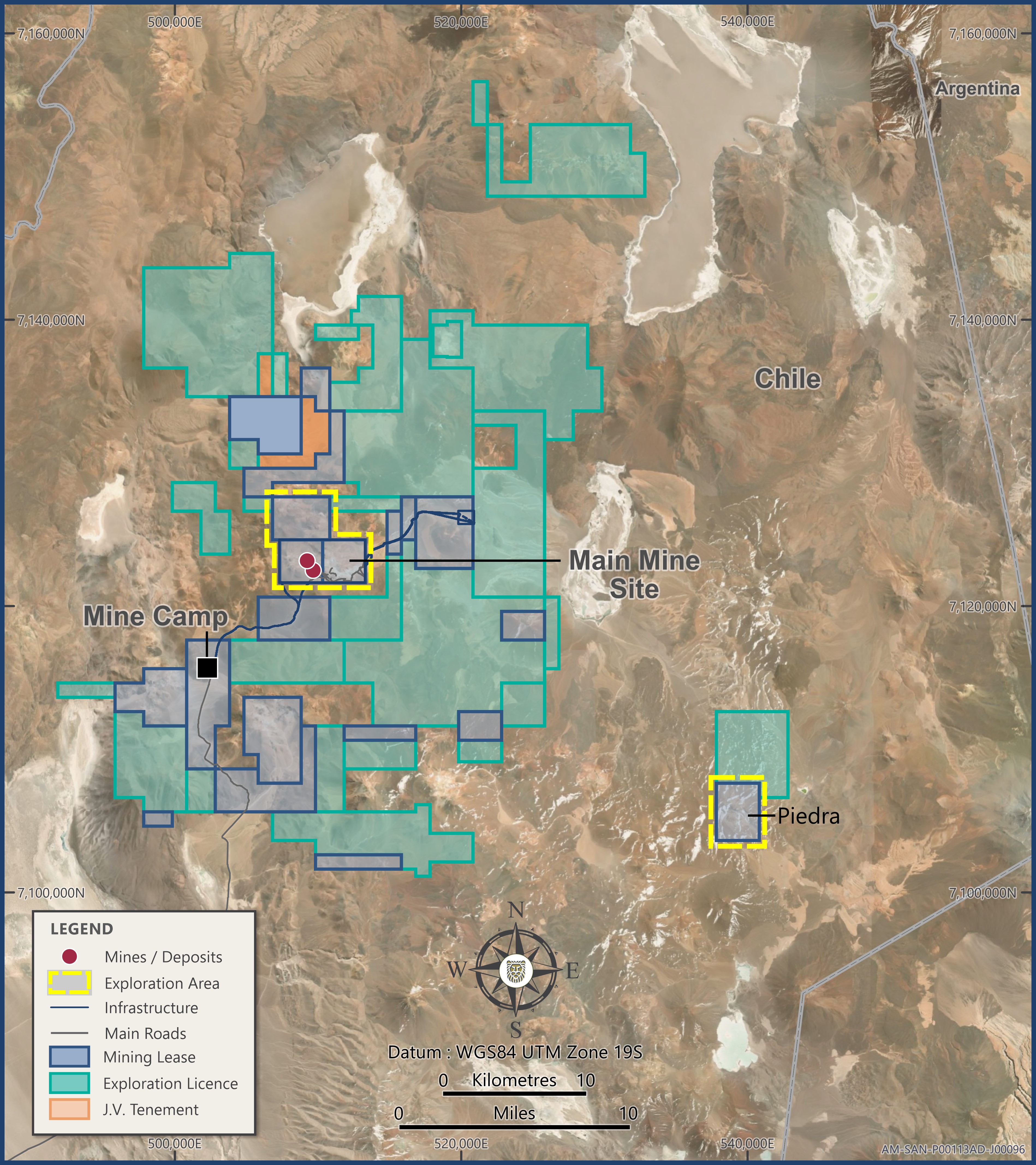
Salares Norte comprises a block of mining and exploration concessions, exploration licenses and mining lease, within an area of interest within about 20 km from Salares Norte. The district Salares Norte concessions are shown in Figure 3.4.1 and are listed in Table 3.4.1. The mineral titles cover all of the declared mineral reserves and MGFSN has legal entitlement to the minerals being reported upon with no known impediments.
The Qualified Person's opinion is that licenses and tenements are in good standing to enable execution of the life-of-mine plan and can be renewed or extended as required.
Figure 3.4.1: Salares Norte Tenement Map
Source: Salares Norte CPR, 2024
Table 3.4.1: Salares Norte mineral titles
Group
Name of concession
Number
Concession type
Status
Grant date
Expiry date
Area (ha)
Owner
Comments
Salares Norte Mine
SALARES NORTE 25 1 AL 30
03102-4256-K
Mining Concession
Constituted
Oct-13
N/A
300
MGFSN
2 % NSR royalty
SALARES NORTE 27 1 AL 30
03102-4068-0
Mining Concession
Constituted
Jan-13
N/A
300
MGFSN
SALARES NORTE 28 1 AL 30
03102-4257-8
Mining Concession
Constituted
Oct-13
N/A
300
MGFSN
RIO BAKER 1 1 AL 30
03102-4371-K
Mining Concession
Constituted
Jun-13
N/A
300
MGFSN
RIO BAKER 2 1 AL 30
03102-4372-8
Mining Concession
Constituted
Jun-13
N/A
300
MGFSN
RIO BAKER 3 1 AL 30
03102-4373-6
Mining Concession
Constituted
Jun-13
N/A
300
MGFSN
Group
Name of concession
Number
Concession type
Status
Grant date
Expiry date
Area (ha)
Owner
Comments
Horizonte Project
HELADA 1, 1 AL 30
03102-3753-1
Mining Concession
Constituted
Apr-12
N/A
300
MGFSN
2.5 % NSR royalty
HELADA 2, 1 AL 30
03102-3754-K
Mining Concession
Constituted
Apr-12
N/A
300
MGFSN
PIRCAS 1 1 AL 30
03102-3856-2
Mining Concession
Constituted
May-12
N/A
300
MGFSN
PIRCAS 5 1 AL 30
03102-3857-0
Mining Concession
Constituted
Nov-12
N/A
300
MGFSN
PIRCAS 6 1 AL 30
03102-3858-9
Mining Concession
Constituted
Nov-12
N/A
300
MGFSN
PIRCAS 7 1 AL 30
03102-3859-7
Mining Concession
Constituted
May-12
N/A
300
MGFSN
HELADA 1, 1 AL 30
03102-3854-6
Mining Concession
Constituted
May-12
N/A
300
MGFSN
HELADA 2, 1 AL 10
03102-3855-4
Mining Concession
Constituted
May-12
N/A
100
MGFSN
Anaranjada
ANARANJADA 1 1 AL 60
03102-6030-4
Mining Concession
Constituted
Jan-19
N/A
300
MGFSN
100 % GF
ANARANJADA 2 1 AL 60
03102-6031-2
Mining Concession
Constituted
Nov-18
N/A
300
MGFSN
ANARANJADA 3 1 AL 60
03102-6032-0
Mining Concession
Constituted
Nov-18
N/A
300
MGFSN
ANARANJADA 4 1 AL 60
03102-6033-9
Mining Concession
Constituted
Nov-18
N/A
300
MGFSN
ANARANJADA 5 1 AL 60
03102-6034-7
Mining Concession
Constituted
Jan-19
N/A
300
MGFSN
ANARANJADA 6 1 AL 60
03102-6035-5
Mining Concession
Constituted
Jan-19
N/A
300
MGFSN
ANARANJADA 7 1 AL 60
03102-6036-3
Mining Concession
Constituted
Jan-19
N/A
300
MGFSN
Chinchilla A
CHINCHILLA 28A 1 AL 40
03102-5997-7
Mining Concession
Constituted
May-18
N/A
200
MGFSN
100 % GF
CHINCHILLA 29A 1 AL 60
03102-5998-5
Mining Concession
Constituted
May-18
N/A
300
MGFSN
CHINCHILLA 40A 1 AL 60
03102-5999-3
Mining Concession
Constituted
Jul-18
N/A
300
MGFSN
CHINCHILLA 46A 1 AL 40
03102-6000-2
Mining Concession
Constituted
May-18
N/A
200
MGFSN
CHINCHILLA 47A 1 AL 40
03102-6001-0
Mining Concession
Constituted
May-18
N/A
200
MGFSN
CHINCHILLA 48A 1 AL 20
03102-6002-9
Mining Concession
Constituted
Jul-18
N/A
100
MGFSN
CHINCHILLA 49A 1 AL 20
03102-6003-7
Mining Concession
Constituted
Jul-18
N/A
100
MGFSN
CHINCHILLA 50A 1 AL 20
03102-6004-5
Mining Concession
Constituted
Jul-18
N/A
100
MGFSN
CHINCHILLA 51A 1 AL 40
03102-6005-3
Mining Concession
Constituted
May-18
N/A
200
MGFSN
CHINCHILLA 52A 1 AL 40
03102-6006-1
Mining Concession
Constituted
May-18
N/A
200
MGFSN
CHINCHILLA 112A 1 AL 60
03102-6007-K
Mining Concession
Constituted
May-18
N/A
300
MGFSN
CHINCHILLA 113A 1 AL 40
03102-6008-8
Mining Concession
Constituted
May-18
N/A
200
MGFSN
Piedra
PIEDRA 1 1 AL 30
03102-3860-0
Mining Concession
Constituted
May-12
N/A
300
MGFSN
2 % NSR royalty
PIEDRA 2 1 AL 30
03102-3861-9
Mining Concession
Constituted
May-12
N/A
300
MGFSN
PIEDRA 3 1 AL 30
03102-3862-7
Mining Concession
Constituted
May-12
N/A
300
MGFSN
PIEDRA 4 1 AL 30
03102-3863-5
Mining Concession
Constituted
May-12
N/A
300
MGFSN
Chinchilla
CHINCHILLA 81 1 AL 40
03102-5431-2
Mining Concession
Constituted
May-16
N/A
200
MGFSN
100 % GF
CHINCHILLA 82 1 AL 40
031025432-0
Mining Concession
Constituted
Jan-16
N/A
200
MGFSN
CHINCHILLA 83 1 AL 40
03102-5433-9
Mining Concession
Constituted
Jan-16
N/A
200
MGFSN
CHINCHILLA 106 1 AL 20
03102-5436-3
Mining Concession
Constituted
May-16
N/A
100
MGFSN
CHINCHILLA 107 1 AL 20
03102-5437-1
Mining Concession
Constituted
May-16
N/A
100
MGFSN
CHINCHILLA 108 1 AL 20
03102-5438-K
Mining Concession
Constituted
May-16
N/A
100
MGFSN
CHINCHILLA 114 1 AL 20
03102-5440-1
Mining Concession
Constituted
Nov-16
N/A
100
MGFSN
CHINCHILLA 115 1 AL 40
03102-5441-K
Mining Concession
Constituted
Jul-16
N/A
200
MGFSN
Paciencia
PACIENCIA 1 1 AL 60
03102-4648-4
Mining Concession
Constituted
Mar-14
N/A
300
MGFSN
100 % GF
PACIENCIA 2 1 AL 60
03102-4659-K
Mining Concession
Constituted
Mar-14
N/A
300
MGFSN
PACIENCIA 3 1 AL 60
03102-4660-3
Mining Concession
Constituted
Mar-14
N/A
300
MGFSN
PACIENCIA 12 1 AL 60
03102-4661-1
Mining Concession
Constituted
Mar-14
N/A
300
MGFSN
PACIENCIA 13 1 AL 60
03102-4649-2
Mining Concession
Constituted
Mar-14
N/A
300
MGFSN
PACIENCIA 14 1 AL 60
03102-4670-0
Mining Concession
Constituted
Mar-14
N/A
300
MGFSN
PACIENCIA 23 1 AL 60
03102-4671-9
Mining Concession
Constituted
Mar-14
N/A
300
MGFSN
PACIENCIA 24 1 AL 60
03102-4650-6
Mining Concession
Constituted
Mar-14
N/A
300
MGFSN
PACIENCIA 31 1 AL 60
03102-4678-6
Mining Concession
Constituted
Jul-14
N/A
300
MGFSN
PACIENCIA 36 1 AL 60
03102-4683-2
Mining Concession
Constituted
Mar-14
N/A
300
MGFSN
PACIENCIA 37 1 AL 60
03102-4684-0
Mining Concession
Constituted
Mar-14
N/A
300
MGFSN
PACIENCIA 38 1 AL 60
03102-4685-9
Mining Concession
Constituted
Mar-14
N/A
300
MGFSN
PACIENCIA 39 1 AL 40
03102-4686-7
Mining Concession
Constituted
Mar-14
N/A
200
MGFSN
PACIENCIA 40 1 AL 40
03102-4687-5
Mining Concession
Constituted
Mar-14
N/A
200
MGFSN
PACIENCIA 41 1 AL 40
03102-4688-3
Mining Concession
Constituted
Mar-14
N/A
200
MGFSN
PACIENCIA 42 1 AL 60
03102-4689-1
Mining Concession
Constituted
Mar-14
N/A
300
MGFSN
Aster 2
ASTER 2 A 1 AL 30
03102-3741-8
Mining Concession
Constituted
Dec-12
N/A
300
MGFSN
2 % NSR royalty
ASTER 2 B 1 AL 30
03102-3742-6
Mining Concession
Constituted
Dec-12
N/A
300
MGFSN
ASTER 2 C 1 AL 30
03102-3743-4
Mining Concession
Constituted
Dec-12
N/A
300
MGFSN
ASTER 2 D 1 AL 30
03102-3744-2
Mining Concession
Constituted
Dec-12
N/A
300
MGFSN
ASTER 2 E 1 AL 30
03102-3745-0
Mining Concession
Constituted
Dec-12
N/A
300
MGFSN
ASTER 2 F 1 AL 30
03102-3746-9
Mining Concession
Constituted
Dec-12
N/A
300
MGFSN
Aster 3
ASTER 3 A 1 AL 30
03102-3747-7
Mining Concession
Constituted
Dec-12
N/A
300
MGFSN
2 % NSR royalty
ASTER 3 B 1 AL 30
03102-3748-5
Mining Concession
Constituted
Dec-12
N/A
300
MGFSN
ASTER 3 C 1 AL 30
03102-3749-3
Mining Concession
Constituted
Dec-12
N/A
300
MGFSN
ASTER 3 D 1 AL 30
03102-3750-7
Mining Concession
Constituted
Dec-12
N/A
300
MGFSN
Group
Name of concession
Number
Concession type
Status
Grant date
Expiry date
Area (ha)
Owner
Comments
Helada
HELADA I 1 AL 30
03102-4281-0
Mining Concession
Constituted
Apr-13
N/A
300
MGFSN
2 % NSR royalty
HELADA II 1 AL 30
03102-4282-9
Mining Concession
Constituted
Apr-13
N/A
300
MGFSN
HELADA III 1 AL 30
03102-4283-7
Mining Concession
Constituted
Apr-13
N/A
300
MGFSN
HELADA IV 1 AL 30
03102-4284-5
Mining Concession
Constituted
Apr-13
N/A
300
MGFSN
HELADA V 1 AL 30
03102-4285-3
Mining Concession
Constituted
Apr-13
N/A
300
MGFSN
HELADA VI 1 AL 30
03102-4286-1
Mining Concession
Constituted
Apr-13
N/A
300
MGFSN
HELADA VII 1 AL 20
03102-4287-K
Mining Concession
Constituted
Oct-14
N/A
200
MGFSN
Pedernales
PEDERNALES D 1 AL 30
03102-4326-4
Mining Concession
Constituted
Jul-13
N/A
300
MGFSN
2 % NSR royalty
PEDERNALES E 1 AL 30
03102-4327-2
Mining Concession
Constituted
Jul-13
N/A
300
MGFSN
PEDERNALES I 1 AL 40
03102-3430-3
Mining Concession
Constituted
Nov-12
N/A
400
MGFSN
TERRIER VI 1 AL 30
03102-1434-5
Mining Concession
Constituted
Aug-88
N/A
300
MGFSN
TERRIER VII 1 AL 30
03102-1435-3
Mining Concession
Constituted
Aug-88
N/A
300
MGFSN
Saturno
SATURNO 13, 1 AL 40
03102-6336-2
Mining Concession
Constituted
Feb-22
N/A
200
MGFSN
100 % GF
Urano
URANO 25, 1 AL 60
03102-6335-4
Mining Concession
Constituted
Feb-22
N/A
300
MGFSN
100 % GF
URANO 26, 1 AL 60
03102-6337-0
Mining Concession
Constituted
Feb-22
N/A
300
MGFSN
Antares
ANTARES 10A
03102-S417-2
Exploration Concession
Constituted
Jan-23
4 years
300
MGFSN
100 % GF
ANTARES 11A
03102-S416-4
Exploration Concession
Constituted
Jan-23
4 years
300
MGFSN
ANTARES 12A
03102-S415-6
Exploration Concession
Constituted
Jan-23
4 years
300
MGFSN
ANTARES 13A
03102-S414-8
Exploration Concession
Constituted
Jan-23
4 years
300
MGFSN
ANTARES 14A
03102-S413-K
Exploration Concession
Constituted
Jan-23
4 years
300
MGFSN
ANTARES 15A
03102-S412-1
Exploration Concession
Constituted
Jan-23
4 years
200
MGFSN
ANTARES 16A
03102-S411-3
Exploration Concession
Constituted
Jan-23
4 years
300
MGFSN
ANTARES 17A
03102-S410-5
Exploration Concession
Constituted
Jan-23
4 years
300
MGFSN
ANTARES 1A
03102-S425-3
Exploration Concession
Constituted
Jan-23
4 years
300
MGFSN
ANTARES 2A
03102-S424-5
Exploration Concession
Constituted
Jan-23
4 years
100
MGFSN
ANTARES 3B
03102-T463-1
Exploration Concession
Constituted
Nov-23
2 years
300
MGFSN
ANTARES 4A
03102-S423-7
Exploration Concession
Constituted
Jan-23
4 years
300
MGFSN
ANTARES 5A
03102-S422-9
Exploration Concession
Constituted
Jan-23
4 years
300
MGFSN
ANTARES 6A
03102-S421-0
Exploration Concession
Constituted
Jan-23
4 years
300
MGFSN
ANTARES 7A
03102-S420-2
Exploration Concession
Constituted
Jan-23
4 years
300
MGFSN
ANTARES 8A
03102-S419-9
Exploration Concession
Constituted
Jan-23
4 years
300
MGFSN
ANTARES 9A
03102-S418-0
Exploration Concession
Constituted
Jan-23
4 years
300
MGFSN
Ceniza
CENIZA 1
03102-S409-1
Exploration Concession
Constituted
Jan-23
4 years
300
MGFSN
100 % GF
CENIZA 10
03102-S400-8
Exploration Concession
Constituted
Jan-23
4 years
200
MGFSN
CENIZA 11
03102-S399-0
Exploration Concession
Constituted
Jan-23
4 years
200
MGFSN
CENIZA 12
03102-S398-2
Exploration Concession
Constituted
Jan-23
4 years
200
MGFSN
CENIZA 2
03102-S408-3
Exploration Concession
Constituted
Jan-23
4 years
300
MGFSN
CENIZA 3
03102-S407-5
Exploration Concession
Constituted
Jan-23
4 years
300
MGFSN
CENIZA 4
03102-S406-7
Exploration Concession
Constituted
Jan-23
4 years
100
MGFSN
CENIZA 5
03102-S405-9
Exploration Concession
Constituted
Jan-23
4 years
300
MGFSN
CENIZA 6
03102-S404-0
Exploration Concession
Constituted
Jan-23
4 years
300
MGFSN
CENIZA 7
03102-S403-2
Exploration Concession
Constituted
Jan-23
4 years
300
MGFSN
CENIZA 8
03102-S402-4
Exploration Concession
Constituted
Jan-23
4 years
200
MGFSN
CENIZA 9
03102-S401-6
Exploration Concession
Constituted
Jan-23
4 years
200
MGFSN
Colorado
COLORADO 1
03102-S397-4
Exploration Concession
Constituted
Jan-23
4 years
300
MGFSN
100 % GF
COLORADO 10
03102-S388-5
Exploration Concession
Constituted
Jan-23
4 years
200
MGFSN
COLORADO 11
03102-S387-7
Exploration Concession
Constituted
Jan-23
4 years
200
MGFSN
COLORADO 2
03102-S396-6
Exploration Concession
Constituted
Jan-23
4 years
300
MGFSN
COLORADO 3
03102-S395-8
Exploration Concession
Constituted
Jan-23
4 years
300
MGFSN
COLORADO 4
03102-S394-K
Exploration Concession
Constituted
Jan-23
4 years
300
MGFSN
COLORADO 5
03102-S393-1
Exploration Concession
Constituted
Jan-23
4 years
300
MGFSN
COLORADO 6
03102-S392-3
Exploration Concession
Constituted
Jan-23
4 years
200
MGFSN
COLORADO 7
03102-S391-5
Exploration Concession
Constituted
Jan-23
4 years
200
MGFSN
COLORADO 8
03102-S390-7
Exploration Concession
Constituted
Jan-23
4 years
200
MGFSN
COLORADO 9
03102-S389-3
Exploration Concession
Constituted
Jan-23
4 years
200
MGFSN
Group
Name of concession
Number
Concession type
Status
Grant date
Expiry date
Area (ha)
Owner
Comments
Jupiter
JÚPITER 10A
03102-S376-1
Exploration Concession
Constituted
Jan-23
4 years
300
MGFSN
100 % GF
JÚPITER 11A
03102-S375-3
Exploration Concession
Constituted
Jan-23
4 years
300
MGFSN
JÚPITER 12A
03102-S374-5
Exploration Concession
Constituted
Jan-23
4 years
300
MGFSN
JÚPITER 13A
03102-S373-7
Exploration Concession
Constituted
Jan-23
4 years
300
MGFSN
JÚPITER 14A
03102-S372-9
Exploration Concession
Constituted
Jan-23
4 years
300
MGFSN
JÚPITER 15A
03102-S371-0
Exploration Concession
Constituted
Jan-23
4 years
300
MGFSN
JÚPITER 16A
03102-S370-2
Exploration Concession
Constituted
Jan-23
4 years
300
MGFSN
JÚPITER 17A
03102-S369-9
Exploration Concession
Constituted
Jan-23
4 years
300
MGFSN
JÚPITER 18A
03102-S368-0
Exploration Concession
Constituted
Jan-23
4 years
300
MGFSN
JÚPITER 19A
03102-S367-2
Exploration Concession
Constituted
Jan-23
4 years
300
MGFSN
JÚPITER 1A
03102-S385-0
Exploration Concession
Constituted
Jan-23
4 years
300
MGFSN
JÚPITER 20A
03102-S366-4
Exploration Concession
Constituted
Jan-23
4 years
300
MGFSN
JÚPITER 21A
03102-S365-6
Exploration Concession
Constituted
Jan-23
4 years
300
MGFSN
JÚPITER 22A
03102-S364-8
Exploration Concession
Constituted
Jan-23
4 years
200
MGFSN
JÚPITER 23A
03102-S363-K
Exploration Concession
Constituted
Jan-23
4 years
200
MGFSN
JÚPITER 2A
03102-S384-2
Exploration Concession
Constituted
Jan-23
4 years
300
MGFSN
JÚPITER 3A
03102-S383-4
Exploration Concession
Constituted
Jan-23
4 years
100
MGFSN
JÚPITER 4A
03102-S382-6
Exploration Concession
Constituted
Jan-23
4 years
300
MGFSN
JÚPITER 5A
03102-S381-8
Exploration Concession
Constituted
Jan-23
4 years
300
MGFSN
JÚPITER 6A
03102-S380-K
Exploration Concession
Constituted
Jan-23
4 years
300
MGFSN
JÚPITER 7A
03102-S379-6
Exploration Concession
Constituted
Jan-23
4 years
300
MGFSN
JÚPITER 8A
03102-S378-8
Exploration Concession
Constituted
Jan-23
4 years
300
MGFSN
JÚPITER 9A
03102-S377-K
Exploration Concession
Constituted
Jan-23
4 years
300
MGFSN
Marte
MARTE 10A
03102-S501-2
Exploration Concession
Constituted
Jan-23
4 years
300
MGFSN
100 % GF
MARTE 11A
03102-S500-4
Exploration Concession
Constituted
Jan-23
4 years
300
MGFSN
MARTE 12A
03102-S499-7
Exploration Concession
Constituted
Jan-23
4 years
300
MGFSN
MARTE 13A
03102-S498-9
Exploration Concession
Constituted
Jan-23
4 years
300
MGFSN
MARTE 14A
03102-S497-0
Exploration Concession
Constituted
Jan-23
4 years
300
MGFSN
MARTE 15A
03102-S496-2
Exploration Concession
Constituted
Jan-23
4 years
300
MGFSN
MARTE 16A
03102-S495-4
Exploration Concession
Constituted
Jan-23
4 years
300
MGFSN
MARTE 17A
03102-S494-6
Exploration Concession
Constituted
Jan-23
4 years
300
MGFSN
MARTE 18A
03102-S493-8
Exploration Concession
Constituted
Jan-23
4 years
300
MGFSN
MARTE 19A
03102-S492-K
Exploration Concession
Constituted
Jan-23
4 years
300
MGFSN
MARTE 1A
03102-S510-1
Exploration Concession
Constituted
Jan-23
4 years
300
MGFSN
MARTE 20A
03102-S491-1
Exploration Concession
Constituted
Jan-23
4 years
300
MGFSN
MARTE 21A
03102-S490-3
Exploration Concession
Constituted
Jan-23
4 years
300
MGFSN
MARTE 22A
03102-S489-K
Exploration Concession
Constituted
Jan-23
4 years
300
MGFSN
MARTE 23A
03102-S488-1
Exploration Concession
Constituted
Jan-23
4 years
300
MGFSN
MARTE 24A
03102-S487-3
Exploration Concession
Constituted
Jan-23
4 years
300
MGFSN
MARTE 25A
03102-S486-5
Exploration Concession
Constituted
Jan-23
4 years
300
MGFSN
MARTE 2A
03102-S509-8
Exploration Concession
Constituted
Jan-23
4 years
300
MGFSN
MARTE 3A
03102-S508-K
Exploration Concession
Constituted
Jan-23
4 years
300
MGFSN
MARTE 4A
03102-S507-1
Exploration Concession
Constituted
Jan-23
4 years
300
MGFSN
MARTE 5A
03102-S506-3
Exploration Concession
Constituted
Jan-23
4 years
300
MGFSN
MARTE 6A
03102-S505-5
Exploration Concession
Constituted
Jan-23
4 years
300
MGFSN
MARTE 7A
03102-S504-7
Exploration Concession
Constituted
Jan-23
4 years
300
MGFSN
MARTE 8A
03102-S503-9
Exploration Concession
Constituted
Jan-23
4 years
300
MGFSN
MARTE 9A
03102-S502-0
Exploration Concession
Constituted
Jan-23
4 years
300
MGFSN
Milan
MILAN 1A
03102-S485-7
Exploration Concession
Constituted
Jan-23
4 years
300
MGFSN
100 % GF
MILAN 2A
03102-S484-9
Exploration Concession
Constituted
Jan-23
4 years
300
MGFSN
Roma
ROMA 11A
03102-S479-2
Exploration Concession
Constituted
Jan-23
4 years
300
MGFSN
100 % GF
ROMA 12A
03102-S478-4
Exploration Concession
Constituted
Jan-23
4 years
300
MGFSN
ROMA 13A
03102-S477-6
Exploration Concession
Constituted
Jan-23
4 years
300
MGFSN
ROMA 14A
03102-S476-8
Exploration Concession
Constituted
Jan-23
4 years
300
MGFSN
ROMA 15A
03102-S475-K
Exploration Concession
Constituted
Jan-23
4 years
300
MGFSN
ROMA 1A
03102-S483-0
Exploration Concession
Constituted
Jan-23
4 years
200
MGFSN
ROMA 2A
03102-S482-2
Exploration Concession
Constituted
Jan-23
4 years
200
MGFSN
ROMA 3A
03102-S481-4
Exploration Concession
Constituted
Jan-23
4 years
300
MGFSN
ROMA 5A
03102-S480-6
Exploration Concession
Constituted
Jan-23
4 years
300
MGFSN
Group
Name of concession
Number
Concession type
Status
Grant date
Expiry date
Area (ha)
Owner
Comments
Rosario
ROSARIO 10A
03102-S117-3
Exploration Concession
Constituted
Sep-22
4 years
300
MGFSN
100 % GF
ROSARIO 11A
03102-S139-4
Exploration Concession
Constituted
Sep-22
4 years
300
MGFSN
ROSARIO 12A
03102-S115-7
Exploration Concession
Constituted
Sep-22
4 years
300
MGFSN
ROSARIO 13A
03102-S116-5
Exploration Concession
Constituted
Sep-22
4 years
300
MGFSN
ROSARIO 14A
03102-S114-9
Exploration Concession
Constituted
Sep-22
4 years
300
MGFSN
ROSARIO 15A
03102-S138-6
Exploration Concession
Constituted
Sep-22
4 years
300
MGFSN
ROSARIO 16A
03102-S137-8
Exploration Concession
Constituted
Sep-22
4 years
300
MGFSN
ROSARIO 17A
03102-S136-K
Exploration Concession
Constituted
Sep-22
4 years
300
MGFSN
ROSARIO 18A
03102-S135-1
Exploration Concession
Constituted
Sep-22
4 years
200
MGFSN
ROSARIO 19A
03102-S134-3
Exploration Concession
Constituted
Sep-22
4 years
300
MGFSN
ROSARIO 1A
03102-S126-2
Exploration Concession
Constituted
Sep-22
4 years
300
MGFSN
ROSARIO 20A
03102-S133-5
Exploration Concession
Constituted
Sep-22
4 years
300
MGFSN
ROSARIO 21A
03102-S132-7
Exploration Concession
Constituted
Sep-22
4 years
300
MGFSN
ROSARIO 22A
03102-S131-9
Exploration Concession
Constituted
Sep-22
4 years
200
MGFSN
ROSARIO 23A
03102-S130-0
Exploration Concession
Constituted
Sep-22
4 years
200
MGFSN
ROSARIO 24A
03102-S129-7
Exploration Concession
Constituted
Sep-22
4 years
200
MGFSN
ROSARIO 25A
03102-S128-9
Exploration Concession
Constituted
Sep-22
4 years
200
MGFSN
ROSARIO 26A
03102-S127-0
Exploration Concession
Constituted
Sep-22
4 years
200
MGFSN
ROSARIO 2A
03102-S125-4
Exploration Concession
Constituted
Sep-22
4 years
300
MGFSN
ROSARIO 3A
03102-S124-6
Exploration Concession
Constituted
Sep-22
4 years
300
MGFSN
ROSARIO 4A
03102-S123-8
Exploration Concession
Constituted
Sep-22
4 years
300
MGFSN
ROSARIO 5A
03102-S122-K
Exploration Concession
Constituted
Sep-22
4 years
300
MGFSN
ROSARIO 6A
03102-S121-1
Exploration Concession
Constituted
Sep-22
4 years
300
MGFSN
ROSARIO 7A
03102-S120-3
Exploration Concession
Constituted
Sep-22
4 years
300
MGFSN
ROSARIO 8A
03102-S119-K
Exploration Concession
Constituted
Sep-22
4 years
300
MGFSN
ROSARIO 9A
03102-S118-1
Exploration Concession
Constituted
Sep-22
4 years
300
MGFSN
Saturno
SATURNO 10A
03102-S664-7
Exploration Concession
Constituted
Jan-23
4 years
300
MGFSN
100 % GF
SATURNO 11A
03102-S665-5
Exploration Concession
Constituted
Jan-23
4 years
300
MGFSN
SATURNO 12A
03102-S666-3
Exploration Concession
Constituted
Jan-23
4 years
300
MGFSN
SATURNO 14A
03102-S667-1
Exploration Concession
Constituted
Jan-23
4 years
200
MGFSN
SATURNO 15A
03102-S668-K
Exploration Concession
Constituted
Feb-23
4 years
200
MGFSN
SATURNO 16A
03102-S669-8
Exploration Concession
Constituted
Feb-23
4 years
200
MGFSN
SATURNO 17A
03102-S670-1
Exploration Concession
Constituted
Feb-23
4 years
300
MGFSN
SATURNO 18A
03102-S671-K
Exploration Concession
Constituted
Feb-23
4 years
300
MGFSN
SATURNO 1A
03102-S655-8
Exploration Concession
Constituted
Jan-23
4 years
300
MGFSN
SATURNO 2A
03102-S656-6
Exploration Concession
Constituted
Feb-23
4 years
100
MGFSN
SATURNO 3A
03102-S657-4
Exploration Concession
Constituted
Jan-23
4 years
300
MGFSN
SATURNO 4A
03102-S658-2
Exploration Concession
Constituted
Jan-23
4 years
300
MGFSN
SATURNO 5A
03102-S659-0
Exploration Concession
Constituted
Jan-23
4 years
300
MGFSN
SATURNO 6A
03102-S660-4
Exploration Concession
Constituted
Jan-23
4 years
300
MGFSN
SATURNO 7A
03102-S661-2
Exploration Concession
Constituted
Jan-23
4 years
300
MGFSN
SATURNO 8A
03102-S663-9
Exploration Concession
Constituted
Jan-23
4 years
300
MGFSN
SATURNO 9A
03102-S662-0
Exploration Concession
Constituted
Jan-23
4 years
300
MGFSN
Turin
TURÍN 10A
03102-S650-7
Exploration Concession
Constituted
Feb-23
4 years
300
MGFSN
100 % GF
TURÍN 11A
03102-S651-5
Exploration Concession
Constituted
Feb-23
4 years
300
MGFSN
TURÍN 12A
03102-S652-3
Exploration Concession
Constituted
Feb-23
4 years
300
MGFSN
TURÍN 13A
03102-S653-1
Exploration Concession
Constituted
Jan-23
4 years
300
MGFSN
TURÍN 14A
03102-S654-K
Exploration Concession
Constituted
Jan-23
4 years
300
MGFSN
TURÍN 1A
03102-S641-8
Exploration Concession
Constituted
Jan-23
4 years
300
MGFSN
TURÍN 2A
03102-S642-6
Exploration Concession
Constituted
Feb-23
4 years
300
MGFSN
TURÍN 3A
03102-S643-4
Exploration Concession
Constituted
Feb-23
4 years
300
MGFSN
TURÍN 4A
03102-S644-2
Exploration Concession
Constituted
Feb-23
4 years
300
MGFSN
TURÍN 5A
03102-S645-0
Exploration Concession
Constituted
Feb-23
4 years
300
MGFSN
TURÍN 6A
03102-S646-9
Exploration Concession
Constituted
Feb-23
4 years
300
MGFSN
TURÍN 7A
03102-S647-7
Exploration Concession
Constituted
Feb-23
4 years
300
MGFSN
TURÍN 8A
03102-S648-5
Exploration Concession
Constituted
Feb-23
4 years
300
MGFSN
TURÍN 9A
03102-S649-3
Exploration Concession
Constituted
Feb-23
4 years
300
MGFSN
Group
Name of concession
Number
Concession type
Status
Grant date
Expiry date
Area (ha)
Owner
Comments
Urano
URANO 10A
03102-S623-K
Exploration Concession
Constituted
Feb-23
4 years
200
MGFSN
100 % GF
URANO 11A
03102-S624-8
Exploration Concession
Constituted
Feb-23
4 years
200
MGFSN
URANO 12A
03102-S625-6
Exploration Concession
Constituted
Feb-23
4 years
200
MGFSN
URANO 13A
03102-S626-4
Exploration Concession
Constituted
Feb-23
4 years
200
MGFSN
URANO 14A
03102-S627-2
Exploration Concession
Constituted
Feb-23
4 years
300
MGFSN
URANO 15A
03102-S628-0
Exploration Concession
Constituted
Feb-23
4 years
300
MGFSN
URANO 16A
03102-S629-9
Exploration Concession
Constituted
Feb-23
4 years
300
MGFSN
URANO 17A
03102-S630-2
Exploration Concession
Constituted
Feb-23
4 years
300
MGFSN
URANO 18A
03102-S631-0
Exploration Concession
Constituted
Feb-23
4 years
300
MGFSN
URANO 19A
03102-S632-9
Exploration Concession
Constituted
Feb-23
4 years
300
MGFSN
URANO 1A
03102-S614-0
Exploration Concession
Constituted
Feb-23
4 years
200
MGFSN
URANO 20A
03102-S633-7
Exploration Concession
Constituted
Feb-23
4 years
300
MGFSN
URANO 21A
03102-S634-5
Exploration Concession
Constituted
Feb-23
4 years
300
MGFSN
URANO 22A
03102-S635-3
Exploration Concession
Constituted
Feb-23
4 years
300
MGFSN
URANO 23A
03102-S636-1
Exploration Concession
Constituted
Feb-23
4 years
300
MGFSN
URANO 24A
03102-S637-K
Exploration Concession
Constituted
Feb-23
4 years
300
MGFSN
URANO 27A
03102-S638-8
Exploration Concession
Constituted
Feb-23
4 years
100
MGFSN
URANO 28A
03102-S639-6
Exploration Concession
Constituted
Feb-23
4 years
200
MGFSN
URANO 29A
03102-S640-K
Exploration Concession
Constituted
Feb-23
4 years
300
MGFSN
URANO 2A
03102-S615-9
Exploration Concession
Constituted
Feb-23
4 years
300
MGFSN
URANO 3A
03102-S616-7
Exploration Concession
Constituted
Feb-23
4 years
300
MGFSN
URANO 4A
03102-S617-5
Exploration Concession
Constituted
Feb-23
4 years
300
MGFSN
URANO 5A
03102-S618-3
Exploration Concession
Constituted
Feb-23
4 years
300
MGFSN
URANO 6A
03102-S619-1
Exploration Concession
Constituted
Feb-23
4 years
200
MGFSN
URANO 7A
03102-S620-5
Exploration Concession
Constituted
Feb-23
4 years
200
MGFSN
URANO 8A
03102-S621-3
Exploration Concession
Constituted
Feb-23
4 years
200
MGFSN
URANO 9A
03102-S622-1
Exploration Concession
Constituted
Feb-23
4 years
200
MGFSN
Venus
VENUS 10A
03102-S681-7
Exploration Concession
Constituted
Feb-23
4 years
300
MGFSN
100 % GF
VENUS 11A
03102-S682-5
Exploration Concession
Constituted
Feb-23
4 years
300
MGFSN
VENUS 12A
03102-S683-3
Exploration Concession
Constituted
Feb-23
4 years
300
MGFSN
VENUS 13A
03102-S684-1
Exploration Concession
Constituted
Feb-23
4 years
300
MGFSN
VENUS 14A
03102-S685-K
Exploration Concession
Constituted
Feb-23
4 years
300
MGFSN
VENUS 15A
03102-S686-8
Exploration Concession
Constituted
Feb-23
4 years
300
MGFSN
VENUS 16A
03102-S687-6
Exploration Concession
Constituted
Feb-23
4 years
300
MGFSN
VENUS 17A
03102-S688-4
Exploration Concession
Constituted
Feb-23
4 years
300
MGFSN
VENUS 18A
03102-S689-2
Exploration Concession
Constituted
Feb-23
4 years
300
MGFSN
VENUS 19A
03102-S690-6
Exploration Concession
Constituted
Feb-23
4 years
300
MGFSN
VENUS 1A
03102-S672-8
Exploration Concession
Constituted
Feb-23
4 years
300
MGFSN
VENUS 20A
03102-S691-4
Exploration Concession
Constituted
Feb-23
4 years
200
MGFSN
VENUS 2A
03102-S673-6
Exploration Concession
Constituted
Feb-23
4 years
300
MGFSN
VENUS 3A
03102-S674-4
Exploration Concession
Constituted
Feb-23
4 years
300
MGFSN
VENUS 4A
03102-S675-2
Exploration Concession
Constituted
Feb-23
4 years
200
MGFSN
VENUS 5A
03102-S676-0
Exploration Concession
Constituted
Feb-23
4 years
200
MGFSN
VENUS 6A
03102-S677-9
Exploration Concession
Constituted
Feb-23
4 years
200
MGFSN
VENUS 7A
03102-S678-7
Exploration Concession
Constituted
Feb-23
4 years
300
MGFSN
VENUS 8A
03102-S679-5
Exploration Concession
Constituted
Feb-23
4 years
300
MGFSN
VENUS 9A
03102-S680-9
Exploration Concession
Constituted
Feb-23
4 years
300
MGFSN
Group
Name of concession
Number
Concession type
Status
Grant date
Expiry date
Area (ha)
Owner
Comments
Neptuno
NEPTUNO 10A
03102-S456-3
Exploration Concession
Constituted
Jan-23
4 years
300
MGFSN
100 % GF
NEPTUNO 11A
03102-S455-5
Exploration Concession
Constituted
Jan-23
4 years
300
MGFSN
NEPTUNO 12A
03102-S454-7
Exploration Concession
Constituted
Jan-23
4 years
300
MGFSN
NEPTUNO 13A
03102-S453-9
Exploration Concession
Constituted
Jan-23
4 years
300
MGFSN
NEPTUNO 14A
03102-S452-0
Exploration Concession
Constituted
Jan-23
4 years
300
MGFSN
NEPTUNO 15A
03102-S451-2
Exploration Concession
Constituted
Jan-23
4 years
300
MGFSN
NEPTUNO 16A
03102-S450-4
Exploration Concession
Constituted
Jan-23
4 years
300
MGFSN
NEPTUNO 17A
03102-S449-0
Exploration Concession
Constituted
Jan-23
4 years
300
MGFSN
NEPTUNO 18A
03102-S448-2
Exploration Concession
Constituted
Jan-23
4 years
300
MGFSN
NEPTUNO 19A
03102-S447-4
Exploration Concession
Constituted
Jan-23
4 years
300
MGFSN
NEPTUNO 1A
03102-S465-2
Exploration Concession
Constituted
Jan-23
4 years
200
MGFSN
NEPTUNO 20A
03102-S446-6
Exploration Concession
Constituted
Jan-23
4 years
300
MGFSN
NEPTUNO 21A
03102-S445-8
Exploration Concession
Constituted
Jan-23
4 years
300
MGFSN
NEPTUNO 22A
03102-S444-K
Exploration Concession
Constituted
Jan-23
4 years
300
MGFSN
NEPTUNO 23A
03102-S443-1
Exploration Concession
Constituted
Jan-23
4 years
300
MGFSN
NEPTUNO 24A
03102-S442-3
Exploration Concession
Constituted
Jan-23
4 years
300
MGFSN
NEPTUNO 25A
03102-S441-5
Exploration Concession
Constituted
Jan-23
4 years
300
MGFSN
NEPTUNO 26A
03102-S440-7
Exploration Concession
Constituted
Jan-23
4 years
300
MGFSN
NEPTUNO 27A
03102-S439-3
Exploration Concession
Constituted
Jan-23
4 years
300
MGFSN
NEPTUNO 28A
03102-S438-5
Exploration Concession
Constituted
Jan-23
4 years
300
MGFSN
NEPTUNO 29A
03102-S437-7
Exploration Concession
Constituted
Jan-23
4 years
300
MGFSN
NEPTUNO 2A
03102-S464-4
Exploration Concession
Constituted
Jan-23
4 years
100
MGFSN
NEPTUNO 30A
03102-S436-9
Exploration Concession
Constituted
Jan-23
4 years
300
MGFSN
NEPTUNO 31A
03102-S435-0
Exploration Concession
Constituted
Jan-23
4 years
300
MGFSN
NEPTUNO 32A
03102-S434-2
Exploration Concession
Constituted
Jan-23
4 years
300
MGFSN
NEPTUNO 33A
03102-S433-4
Exploration Concession
Constituted
Jan-23
4 years
300
MGFSN
NEPTUNO 34A
03102-S432-6
Exploration Concession
Constituted
Jan-23
4 years
300
MGFSN
NEPTUNO 35A
03102-S431-8
Exploration Concession
Constituted
Jan-23
4 years
300
MGFSN
NEPTUNO 36A
03102-S430-K
Exploration Concession
Constituted
Jan-23
4 years
300
MGFSN
NEPTUNO 37A
03102-S429-6
Exploration Concession
Constituted
Jan-23
4 years
300
MGFSN
NEPTUNO 38A
03102-S428-8
Exploration Concession
Constituted
Jan-23
4 years
200
MGFSN
NEPTUNO 39A
03102-S427-K
Exploration Concession
Constituted
Jan-23
4 years
200
MGFSN
NEPTUNO 3A
03102-S463-6
Exploration Concession
Constituted
Jan-23
4 years
100
MGFSN
NEPTUNO 40A
03102-S426-1
Exploration Concession
Constituted
Jan-23
4 years
200
MGFSN
NEPTUNO 4A
03102-S462-8
Exploration Concession
Constituted
Jan-23
4 years
200
MGFSN
NEPTUNO 5A
03102-S461-K
Exploration Concession
Constituted
Jan-23
4 years
200
MGFSN
NEPTUNO 6A
03102-S460-1
Exploration Concession
Constituted
Jan-23
4 years
200
MGFSN
NEPTUNO 7A
03102-S459-8
Exploration Concession
Constituted
Jan-23
4 years
200
MGFSN
NEPTUNO 8A
03102-S458-K
Exploration Concession
Constituted
Jan-23
4 years
200
MGFSN
NEPTUNO 9A
03102-S457-1
Exploration Concession
Constituted
Jan-23
4 years
200
MGFSN
Epsilon
ÉPSILON 1
03102-S474-1
Exploration Concession
Constituted
Jan-23
4 years
300
MGFSN
100 % GF
ÉPSILON 10
03102-S466-0
Exploration Concession
Constituted
Jan-23
4 years
200
MGFSN
ÉPSILON 2
03102-S473-3
Exploration Concession
Constituted
Jan-23
4 years
200
MGFSN
ÉPSILON 3
03102-S472-5
Exploration Concession
Constituted
Jan-23
4 years
200
MGFSN
ÉPSILON 4
03102-S471-7
Exploration Concession
Constituted
Jan-23
4 years
300
MGFSN
ÉPSILON 5
03102-S470-9
Exploration Concession
Constituted
Jan-23
4 years
100
MGFSN
ÉPSILON 6A
03102-T464-K
Exploration Concession
Constituted
Nov-23
2 years
300
MGFSN
ÉPSILON 7
03102-S469-5
Exploration Concession
Constituted
Jan-23
4 years
300
MGFSN
ÉPSILON 8
03102-S468-7
Exploration Concession
Constituted
Jan-23
4 years
300
MGFSN
ÉPSILON 9
03102-S467-9
Exploration Concession
Constituted
Jan-23
4 years
300
MGFSN
Fernando Sur
FERNANDO SUR 1, 1/60
031025353-7
Mining Concession
Constituted
Jan-15
Not expires
300
JX Nippon MME
Option Agreement since 2019 for 5 years
FERNANDO 1-E
03102-S322-2
Exploration Concession
Constituted
Dec-22
4 years
300
JX Nippon MME
FERNANDO 2-E
03102-S321-4
Exploration Concession
Constituted
Dec-22
4 years
200
JX Nippon MME
FERNANDO 3-E
03102-S320-6
Exploration Concession
Constituted
Dec-22
4 years
200
JX Nippon MME
FERNANDO 4-E
03102-S319-2
Exploration Concession
Constituted
Dec-22
4 years
300
JX Nippon MME
FERNANDO 5-E
03102-S318-4
Exploration Concession
Constituted
Dec-22
4 years
300
JX Nippon MME
FERNANDO 6-E
03102-S317-6
Exploration Concession
Constituted
Dec-22
4 years
300
JX Nippon MME
FERNANDO SUR 2-E
03102-S316-8
Exploration Concession
Constituted
Dec-22
4 years
300
JX Nippon MME
Total area (ha)
94,100
Source: Salares Norte CPR, 2024
MGFSN’s ownership of the Salares Norte 25, 27 and 28 mining concessions are subject to a 2 % net smelter return (NSR) royalty payable to a subsidiary of Franco-Nevada. MGFSN retains the right to purchase one half of the NSR royalty for $6 million within two years following commencement of commercial production. MGFSN also has a right of first refusal for the purchase of the balance of the royalty.
MGFSN’s ownership of the Rio Baker 1, 2 and 3 mining concessions are subject to a 2 % NSR royalty payable also to Franco - Nevada. MGFSN retains the right to purchase one quarter of the NSR royalty for $4 million and also has a first right of refusal on the purchase of the balance of the royalty.
There are no other mineral resources or mineral reserves at Salares Norte affected by royalty clauses in the respective Option Agreements signed since 2012.
3.5Mineral rights description
National regulations establish that the State retains absolute, exclusive, inalienable, and imprescriptible ownership of all mineral resources. This includes natural guano deposits, metal-bearing sands, salt deposits, coal, hydrocarbon deposits, and other fossil substances, except for surface clays, regardless of the property rights of individuals or entities over the land in which these resources are located.
However, individuals are permitted to dig test pits, remove samples, and apply for concessions to explore or mine substances eligible for concessions under organic constitutional laws. Exploration concessions are judicially processed and valid for four years, while exploitation concessions do not expire, exploitation and exploitation concessions are protected through the payment of an annual patent.
Ownership of surface rights does not confer preference or rights over the minerals or mining concessions beneath the land. This principle of separation ensures that landowners cannot prevent the granting of a mining concession on their property. Mining concessions are treated as property and can be transferred, mortgaged, or subjected to legal contracts in accordance with the Chilean Civil Code.
Holders of mining concessions have the right to impose easements on landowners unwilling to grant access voluntarily. Easements are established through a summary procedure in civil court, even when the Government owns the land. These easements are typically granted after determining just compensation.
For the Salares Norte project, the Government of Chile owns the surface rights. In 2017, Gold Fields secured a definitive easement covering 1,879.04 hectares, sufficient for the mine's footprint, process plant area, an alternative tailings storage facility (TSF) or photovoltaic (PV) site, water wells, pipeline routes, camp, and main access roads. This easement is valid for 30 years (until February 24, 2047) or for the duration of the mine’s startup, operation, and closure.
An additional easement for 308.91 hectares was requested in 2017 and granted in August 2018. This covers auxiliary mine tracking, the camp access gate, groundwater monitoring wells, and an extension to the mine area. It is also valid for 30 years or the mine’s lifespan. Furthermore, two provisional easements covering 570.5 hectares were granted for additional requirements.
Government records indicate that there are no land ownership claims or applications over the Salares Norte property. The Indigenous Populations Affairs Agency (Corporación Nacional de Desarrollo Indígena, or CONADI) has confirmed that no indigenous claims exist for ownership of ancestral lands in this area. CONADI also affirmed that no indigenous groups have aspirations for surface rights based on ancestral claims.
3.6Encumbrances
Furthermore, Article 120 of the Mining Code establishes at the time the pertinent concession is established and in order to contribute to a convenient and unrestricted exploration and operation, surface properties is subject to the following taxes:
•To the occupation, where appropriate, of mineral piles, slags, tailings and slags, mineral separation and processing facilities, communication systems, conduits, channels, dams and ponds, pipelines, homes, buildings and other auxiliary facilities and auxiliaries.
•To those encumbrances that are created in favour of the concessionaires of the electric power public services, in accordance with the corresponding laws, and
•To the right of way and occupation by roads, railways, aerodromes, oil pipelines, tunnels, inclined planes, cable cars, conveyor belts and any other system used to connect the concession to public roads, processing facilities, railway stations, aerodromes and settlements populated.
The foregoing implies that a third party could eventually constitute a mining easement on MGFSN’s concessions provided that its objective is to contribute to a convenient exploration and operation, so MGFSN’s task is to establish a security area that allows the protection of Salares Norte.
There are no other encumbrances or regulatory requirements that affect access, title, or the right or ability to perform work on the Property.
Section 17 discloses the remediation and reclamation guarantees that are pertinent to Salares Norte.
3.7Other significant factors and risks
The environmental impact assessment was approved by Chilean authorities in 2019. The EIA details potential environmental and social impacts of construction, operation and closure of the mine, together with the corresponding mitigation actions and voluntary commitments to address them.
The EIA highlighted the alteration and loss of habitat of the short-tailed chinchilla, which is a critically endangered species in Chile. To mitigate such impact, a plan was developed and approved by the environmental authorities. The plan involves establishing a compensation and conservation area outside the mining area, declaring no-go zones and relocating a small fraction of the chinchilla population that lives in future mining zones to a new location.
The development of the Agua Amarga deposit as an open pit depends on the successful relocation of chinchillas from the designated areas identified in the EIA. The mineral resources and reserves declared in this technical report summary are based on the assumption that the relocation is successful and that Agua Amarga proceeds as planned.
Inclement weather events have affected the processing plant and metal production. The precautions taken may not mitigate the effects of future events. See Gold Fields 20-F and section 22 for identified risks.
No other significant factors or risks have been identified that would impact access, title, or the ability to perform work on the property. The Qualified Person is also not aware of any current or pending legal matters that could affect the rights to explore or mine at Salares Norte.
3.8Royalties or similar interest
There are no royalties or similar interests held by Gold Fields at Salares Norte.
4Accessibility, climate, local resources, infrastructure and physiography
4.1Topography, elevation, and vegetation
The Salares Norte project is located on the Altiplano (Andean Plateau) in the Atacama region of northern Chile within the Salar Grande basin, which is an internally drained area. Elevations across the property range between 4,200 m and 4,900 m above sea level, while the mine camp is situated approximately 13 km southwest of the mine site at a lower elevation of 3,920 m.
This region is classified as arid and experiences extreme environmental conditions, leading to sparse vegetation. Vegetation is primarily limited to specific micro environments, such as ravine bottoms or sheltered areas that are protected from wind and snow accumulation.
4.2Access
The Salares Norte area can be reached from the south via Copiapó by following Route 31-CH to the junction with Route C-17, which leads to Diego de Almagro. After this intersection, Route C-13 provides direct access to the site.
From the north, access is via Route 5 to the intersection with Route C-13, continuing to Route C-237 and then Route C-141-C17, which reconnects with Route C-13.
Copiapó, the provincial and regional capital, is a key support center for mining and has an airport with regular non-stop flights to Santiago. The closest inhabited towns are El Salvador, located 136 km southwest of the camp, and Diego de Almagro, 183 km southwest by road. Diego de Almagro, with a population of 13,900 (2017 Census), is the larger of the two towns. Both were originally established to support mining activities in the region.
4.3Climate
The Salares Norte area is located in the Atacama Desert on the western slope of the Andes, within a well-developed rain shadow. Most precipitation occurs as winter snowfall between April and September, although episodic summer rainfall may occur from November to May due to the ‘Invierno Altiplánico’ convective weather phenomenon.
The climate is classified as tundra at high elevation, characterized by low temperatures that fluctuate above and below 0 °C year-round. During summer (December to February), temperatures rarely exceed 10 °C, with daily temperature ranges often exceeding 15 °C.
Winds are predominantly westerly in summer and shift to the northwest for the rest of the year, with speeds generally ranging between 2 m/s and 7 m/s.
The operating season is all year; however, severe winter weather may interrupt operations.
4.4Infrastructure
The Salares Norte site infrastructure includes an administration office complex at the plant area, camp facilities, and a microwave and satellite communication system. Ongoing construction projects cover a heavy mining equipment workshop, warehouse, plant maintenance workshop, power station, tailings filtration plant, potable water plant, fresh water pumping and storage system, water treatment plant, fuel station, and an LTE communication system. Figure 4.4.1 shows the current and under construction infrastructure.
Figure 4.4.1:Infrastructure current and under construction
Source: Salares Norte CPR, 2024
Figure 4.4.2 shows the fully constructed infrastructure as expected post execution of the life-of-mine reserve plan.
Figure 4.4.2: Infrastructure at the end of life-of-mine Reserve
Source: Salares Norte CPR, 2024
Cargo transportation to the site is significant. Seaborne cargo is routed through the Angamos (Mejillones) port (708 km from site) or the Las Losas port (527 km from site). International air freight and travel rely on Santiago International Airport, while national air freight uses Atacama Airport (Caldera) and Antofagasta Airport (Cerro Moreno). The roads connecting the ports to the site are in good condition and can accommodate all required equipment transport.
Logistics during construction is managed by DHL, leveraging Chile’s well-developed infrastructure to handle high cargo volumes. All major equipment, including mine haul trucks, hydraulic excavators, SAG and ball mill components, and tailings filters, has already been delivered. For operations, 28-tonne capacity trucks transport consumables to the site, with no foreseeable constraints.
Chile is an established mining jurisdiction with a skilled workforce, primarily focused on copper but with experience in gold mining. All critical management roles have been filled, and mining operations are carried out by the contractor ICV. Hiring prioritises candidates from nearby communities such as Diego de Almagro and Inca de Oro, extending to the Atacama region and broader areas if local qualifications are unavailable.
Personnel at the site typically work an 8 days on / 6 days off rotation, with two 12-hour shifts per day. Staff based in Santiago, Diego de Almagro, and Copiapó follow a 5 days on / 2 days off schedule. These rosters are standard for remote mining operations in Chile.
4.5Book Value
The economic analysis presented in Section 19 pertains solely to attributable mineral reserves and excludes mineral resources and lower-grade material. The assumptions, parameters, and cash flows used are intended to support the mineral reserve disclosure for the Property.
It is important to note that certain assumptions, including commodity prices, may differ significantly from the long-term outlook or actual results. As a result, changes in these assumptions could lead to substantial revisions in mine plans, models, and the Net Present Value (NPV) of the operation. Consequently, the disclosed mineral reserves may not fully represent the total future economic benefit that could be derived from Salares Norte.
The Net Book Value (NBV) of property, plant, and equipment at Salares Norte is $1,760 million in 2024. This valuation primarily includes:
•land holdings
•mine infrastructure and equipment
•mine development
•mineral and surface rights
•processing plant assets
The Qualified Person considers that this book value represents a fair and reasonable valuation of the property based on the prevailing information and the current outlook.
5History
5.1Property history
Gold Fields discovered the Salares Norte deposit in 2011 during a systematic greenfields exploration program targeting the northern end of the Maricunga metallogenic belt, an area characterized by Miocene precious metal deposits (figure 5.1.1). The exploration strategy employed conceptual geological models, metallogenic criteria, and advanced exploration techniques, including spectral and geophysical surveys to identify favorable targets as achieved through a combination of:
•Geological Mapping and Geochemical Sampling: Early-stage investigations identified surface anomalies indicative of hydrothermal alteration.
•Drilling Campaigns: Initial scout reverse circulation (RC) drilling intersected promising gold and silver mineralisation. Subsequent diamond core (DD) drilling confirmed the presence of a robust mineralised system .
Figure 5.1.1: Major gold and copper deposits of northern Chile and Argentina
Source: Salares Norte CPR, 2024
Initial exploration programs targeted hydrothermal alteration zones identified through satellite imagery. Gold Fields signed an option agreement for ten properties in the Maricunga belt, with four, including Salares Norte, selected for detailed follow-up exploration.
•2011: The first RC drilling resulted in the discovery of gold and silver mineralisation, with intersected zones showing quartz-alunite alteration, silicification, and local vuggy silica.
•2012: Follow-up DD drilling confirmed mineralisation over a 500 m by 250 m area, establishing the potential for a large, high-grade epithermal deposit.
•2013 to 2014: Intensive drilling programs expanded zones, culminating in the maiden mineral resource estimate for Salares Norte. The resource model informed an initial scoping study.
•2015 to 2018: Updated resource estimates were integrated into scoping and feasibility studies, further defining the deposit’s potential.
•2019 to 2024: Exploration focused on district targets to add future reserves.
6Geological setting, mineralisation, and deposit
6.1Regional Geology
Salares Norte is located within the Central Volcanic Zone of the Andes in northern Chile, a region well-known for its mineral endowment. It forms part of the Maricunga metallogenic belt, a Late Oligocene to Miocene volcanic arc associated with epithermal gold-silver and porphyry copper-gold deposits. The tectonic setting is driven by the eastward subduction of the Nazca Plate beneath the South American Plate, creating a dynamic environment conducive to hydrothermal fluid flow and mineral deposition. The mineralised systems in the Maricunga belt are spatially associated with volcanic complexes and caldera structures
6.2Local and property geology
The Salares Norte property is underlain by a sequence of volcanic and volcaniclastic rocks from the Miocene epoch (Figure 6.2.1). Key lithological units include:
•Porphyritic Andesite and Dacite: These volcanic units serve as the primary host rocks for mineralization, displaying pervasive silicification and advanced argillic alteration.
•Hydrothermal and Phreatomagmatic Breccias: These are critical to the mineralisation process, acting as both pathways and traps for mineralising fluids due to their high permeability.
The stratigraphy (Figure 6.2.2) is characterized by intercalated dacitic and andesitic flows, overlain by younger volcanic tuffs and breccias. Structural deformation has introduced a network of faults and fractures, with the northwest-trending faults being the most significant controls on hydrothermal fluid flow and mineral emplacement
6.2.1Significant mineralised zones
The Salares Norte deposit comprises two key high-sulphidation epithermal mineralised zones:
1.Brecha Principal: This is the main mineralised zone, characterized by high-grade gold and silver associated with advanced argillic alteration and pervasive silicification. Brecha Principal is hosted in hydrothermal breccias and is structurally controlled by intersecting faults.
2.Agua Amarga: A secondary mineralised zone with broader, lower-grade mineralisation that enhances the deposit’s overall resource potential. It is dominantly hosted in silicified volcanic rocks.
The mineralisation occurs as disseminations, veins, and breccia-hosted deposits, with a strong spatial association to silicified and argillically altered volcanic rocks. These zones exhibit excellent lateral and vertical continuity:
•Length: Mineralised zones extend over 1,000 m laterally.
•Width: Typically 300–600 m wide.
•Depth: Mineralisation persists to depths exceeding 300 m.
Figure 6.2.1: Salares Norte local geology
Source: Salares Norte CPR, 2024
Figure 6.2.2: Salares Norte stratigraphic column
Source: Salares Norte CPR, 2024
6.2.2Type, character, and distribution of mineralisation
Mineralisation at Salares Norte is characteristic of high-sulphidation epithermal systems:
•Type: Gold occurs as fine-grained free gold and electrum, often associated with sulphide minerals, including pyrite, enargite, and covellite. Silver is present as electrum and argentite.
•Character: Mineralisation is closely linked to advanced argillic alteration assemblages, including alunite, kaolinite, and pyrophyllite, alongside pervasive silicification.
•Distribution: Gold and silver mineralisation is spatially concentrated within breccia bodies (Figure 6.2.3) and disseminated throughout silicified volcanic units. High-grade zones correspond to areas of intense structural disruption and fluid flow (Figure 6.2.4).
Figure 6.2.3: Longitudinal section looking northeast illustrating the 3D geometry of the Salares Norte breccia complex
Figure 6.2.5: Longitudinal section looking northeast illustrating the 3D geometry of the modelled oxide and sulphide zones
(drillhole traces are shown)
Source: Salares Norte CPR, 2024
6.2.3Geological controls
The deposition of gold and silver mineralisation at Salares Norte is primarily controlled by:
•Structural Framework (Figure 6.2.6): Northwest-oriented faults and intersecting secondary structures provide key conduits for hydrothermal fluids.
•Host Rock Lithology: The porous and reactive nature of breccias and dacitic volcanic rocks promotes fluid-rock interaction, enhancing mineral precipitation.
•Alteration Assemblages: High-grade zones correlate with advanced argillic alteration and silicification, indicative of hydrothermal fluid flow and gold-silver deposition.
Figure 6.2.6: Salares Norte – plan of major structures for mineralising fluid flow
Source: Salares Norte CPR, 2024
7Exploration
7.1 Exploration
Gold Fields defined a near-mine exploration district with a 20 km radius centered on the Salares Norte property. Since 2008, exploration activities have included geological mapping, spectral alteration mapping, aeromagnetic and radiometric surveys, and stream sediment geochemical sampling.
Exploration programmes are ongoing, supported by a budget approved by MGFSN for systematic follow-up work on existing and newly identified targets. While initial drill results suggest potential for follow-up, the Qualified Person considers these targets immaterial.
The exploration programmes have confirmed the continuity of geology and controls on gold mineralisation in key areas. No material variations were encountered during the 2024 exploration activities, and the 2025 exploration budget of $15 million has been approved.
Figure 7.1.1: Salares Norte – exploration activity showing mining and exploration leases
•
•Source: Salares Norte CPR, 2024
7.2 Drilling
7.2.1 Type and extent
Historical drilling has been focused on the definition of the resource of the Salares Norte deposits BP and AA, and is mostly diamond core with some RC drilling. The diamond core is typically HQ-size (63.5 mm diameter). Additional holes are drilled for sterilization, geotechnical, metallurgical, and water monitoring. Drillhole orientations were selected to test structural controls on mineralisation, and the average drillhole depth was about 325 m. There are no material sample recovery issues associated with diamond and RC drilling.
7.2.2 Procedures
Geological logging and structural measurements are performed on all drillholes to capture lithology, alteration, mineralisation, and geotechnical attributes. Spectral analysis using TerraSpec® and core orientation tools like True Core enhance data accuracy. Downhole surveys are conducted using gyro or gamma tools to ensure spatial accuracy of drillholes.
Drillhole collars are surveyed using differential GPS (DGPS) tied to the Chilean national grid for precision. Data management employs DataShed® software, integrating checks for overlapping intervals, missing survey data, and inconsistencies. Validation protocols reject erroneous entries, ensuring data integrity. Geotechnical data is incorporated into stability models to inform mine design and operational planning.
Exploration drilling in 2024 was limited but focused on near-mine targets such as AA Northwest and Low Baker. Table 7.2.1 summarises the number of holes drilled and samples collected by area. Results from these activities were not deemed material to the Salares Norte resource.
7.3 Hydrogeology
Salares Norte lies within the Salar Grande hydrogeological basin, characterised by low permeability and minimal upward flows. Investigations since 2012 have included groundwater monitoring, hydraulic tests, and geophysical surveys. Results indicate that groundwater flow is predominantly eastward, with localised variations influenced by geological structures. Hydraulic conductivity values range between 7 x 10⁻⁴ m/d and 7 x 10⁻³ m/d, except for isolated higher values.
Table 7.3.2: Hydraulic conductivity in the mine and process plant area
Well
Geological unit
Transmissivity (m²/d)
Estimated saturated thickness (m)
Hydraulic conductivity (m/d)
WEDR006
IFAB (Basaltic andesite)
6
48
0.1
WEDR007
IFAB/IFAB (andesite)
0.1
51
0.002
WEDR008
IFAN (andesite)
0.54
76
0.007
WERC-8
IFAB (Basaltic andesite)
0.05
10
0.005
WERC-10
IFAB (Basaltic andesite)
0.04
32
0.001
WERC-11B
IFAB (Basaltic andesite)
0.05
22
0.002
WEDR002
IFAB (Basaltic andesite)
0.25
93
0.003
Source: Salares Norte CPR, 2024
The Qualified persons opinion of the hydrology is:
a)Salares Norte has reliance on appropriate hydrological studies conducted at all relevant locations.
b)Hydrology is not viewed as presenting a material risk to Salares Norte Mineral resource and Mineral reserve estimates.
7.4 Geotechnical
Geotechnical assessments relied on data from 304 drillholes (81,260 meters) and laboratory testing of 865 samples. Testing included uniaxial and triaxial compression, elastic modulus, and direct shear measurements. The data supports geotechnical classification systems and was used for mine stability analysis.
Regional seismicity was also evaluated as part of the geotechnical studies. Salares Norte lies within the Copiapó seismic-tectonic segment, a region influenced by the subduction of the Nazca Plate beneath the South American Plate. Earthquakes in this area are typically offshore and exhibit low-angle thrust mechanisms, with occasional onshore seismic events. Potential impacts on the property, such as landslides or rockfalls, are limited to areas with
steep topographic gradients. Seismic risk assessments confirm that the existing mine design and stability plans account for regional seismic conditions and their associated risks.
The geotechnical parameters and models have been validated and are adequate for the feasibility study and mine stability analysis. Data supports geotechnical classification systems, including Bieniawski RMR, Laubscher RMR, Q System, and GSI.
The Qualified person’s opinion of the geotechnical work is:
a)Salares Norte has completed all appropriate testing for the current life-of-mine reserve and continues to test all new significant areas
b)The quality of the sample preparation and test validation is adequate to provide robust data for modelling
c)Geotechnical structural domains and lithologies are based on core logging and modelling following industry leading procedures and methodologies
d)The quality of the geotechnical studies, modelling and design outcomes is adequate to support the Mineral resource and Mineral reserve estimates.
7.5 Density
Gold Fields routinely measures dry bulk density (density) on diamond half-core using the water immersion method with wax coating at the Salares Norte core processing facilities. Density measurement downhole intervals are at 10 m in non-mineralised material and 5 m in mineralised zones. Standard procedure for density determination is:
1.Weigh the dry sample in air and record the mass (W1).
2.Coat the sample in wax.
3.Weigh the wax-coated sample in air and record the mass (W2).
4.Measure and record the apparent weight in water (W3) using a suspended balance setup.
The density of the sample is determined from the recorded weights and the known density of the wax coating and the water.
The results of the bulk density measurement by lithology are summarised in Table 7.5.1.
The Qualified Person has reviewed all exploration, drilling, hydrogeology, geotechnical, and density-related activities. The programmes were conducted with appropriate methodologies and supervision, ensuring data integrity and reliability. The exploration activities confirmed the geological continuity and mineralisation controls, and no material issues were identified that could impact the mineral resource and reserve estimates. All data have been validated and incorporated appropriately into resource modelling, supporting the accuracy of mineral resource estimates.
8Sample preparation, analyses, and security
8.1 Sample collection
For diamond drill (DD) core samples, intervals are marked at lengths ranging from 0.5 to 2.0 meters, depending on the style of mineralisation and lithological contacts. Once logged and photographed, the core is split using an automated core saw along the orientation line. One half of the core is sent for analysis, while the other half is stored in UV-resistant trays under cover in designated sheds. Each sample is bagged with a unique sample ticket and dispatched to ALS Chemex laboratories for preparation and assaying. Sample details, including interval, length, lithology, and dispatch date, are recorded and integrated into the master database. Core trays are stacked for space efficiency, and provisions are made for additional storage capacity as required.
Reverse circulation (RC) chip samples are collected at 1-meter intervals using a cyclone and reduced to a manageable 5-8 kg sample via a riffle splitter. Wet samples are excluded from analysis, and RC drilling is replaced with diamond drilling where necessary. After splitting, samples are securely bagged with corresponding tickets and returned to the core yard for dispatch. Sample rejects and pulps are stored in secure containers on-site, protected by weatherproofing measures. Samples are transported under escort in locked cages, with detailed dispatch sheets accompanying each shipment to document the number of samples and analysis requirements.
8.2 Sample preparation
At the core yard, samples are labelled with unique identifiers and securely bagged before being transported. The chain of custody procedure ensures that each sample is accompanied by a responsible party at each stage. Upon arrival at ALS Chemex laboratories in Chile and Peru, accredited to ISO/IEC 17025 standards, the samples are logged into a laboratory information management system (LIMS) to ensure traceability.
Samples are dried at 60°C in forced-air ovens before being rolled into the preparation line. They are crushed to 70% passing 2 mm using jaw crushers, then split to a 1 kg subsample and pulverized to 85% passing 75 µm. The remaining pulp and coarse rejects are returned to Gold Fields for archival and quality control purposes. Sample preparation follows strict protocols to maintain consistency and accuracy.
All analytical laboratories are private and not associated with Gold Fields. They have suitable ISO accreditation (Table 8.2.1).
Table 8.2.1: Analytical laboratory accreditation
Laboratory
Certificate number Accreditation number
Independent testing inspection
ALS Global
ISO/IEC 17025:2017
Standards Council of Canada
Laboratory 2 Bureau Veritas
ISO 9001, NCh-ISO17020, NCh-ISO17025, NCh-ISO17065, ISO14001, OHSAS18001. Accreditation certificates and certificate number have not been obtained until the closing date of this report.
Have not been obtained until the closing date of this report
Laboratory SGS Chemex
ISO 9001, ISO 45001, ISO 14001, ISO 27001, ISO 22301, ISO 37001. Accreditation certificates and certificate number have not been obtained until the closing date of this report. ISO/IEC 17025:2017
Have not been obtained until the closing date of this report
Analysis for gold, silver and other elements is carried out at ALS Minerals in La Serena and Santiago (Chile), Lima (Peru) and Vancouver (Canada). Two secondary laboratories were previously used for the umpire check analysis: Bureau Veritas (Ex-ACME) Laboratories in Santiago and Vancouver. More recently, SGS Chemex in Lima was the umpire laboratory. Approximately 5 % of the samples are sent for umpire analysis.
All analytical laboratories are private and not associated with Gold Fields. They have suitable ISO accreditation (Table 8.2.1). Collectively these laboratories analyze all mineral resource and umpire samples.
Gold Fields has given ALS Minerals protocols for determining assay methods for gold and silver grades. For gold these are:
•Samples are assayed by 50 g fire assay with an atomic absorption spectroscopy (AAS) finish (method Au-AA24).
•For grades >5 g/t Au the assay is replicated with a gravimetric finish.
•For grades >10 g/t Au the assay is replicated with a screen fire assay (SFA) method.
For silver and other elements:
•Samples are analyzed using a four-acid digestion and an inductively coupled plasma mass spectrometry (ICP-MS) finish (method ME-MS61).
•For grades >100 g/t Ag the four-acid digestion method is replaced with ore grade Ag by four-acid digestion and inductively coupled plasma atomic emission spectroscopy (ICP-AES) finish.
•Eight samples with greater than 10,000 g/t Ag were reanalyzed at ALS in Vancouver using a special method for analysis of precious metals in concentrates (method Ag-CON01).
ALS Minerals also analyses total sulfur using the LECO analysis (method S-IR08) and mercury (method ME-MS61 m).
Gold Fields has conducted studies comparing the standard fire assay approach with SFA and comparing AAS with the gravimetric finish. These studies indicate an appropriate grade threshold for switching from AAS to a gravimetric finish is around 5 g/t Au. Switching to an SFA approach is done for all samples >10 g/t Au.
8.4Quality control and quality assurance (QA/QC)
Gold Fields has implemented comprehensive QA/QC protocols to monitor and control the quality of sample and analytical data. Field duplicates, blanks, and certified reference materials (CRMs) are routinely inserted into sample batches. Drill sample batches typically consist of 75 samples, including 68 original samples, three standards covering low, medium, and high grades, two blanks, and two field duplicates. Laboratory preparation is further monitored by including coarse crush and pulp duplicates.
Approximately 5% of all samples are sent to independent laboratories for umpire checks. Historical biases in early density data were identified and corrected using regression equations, ensuring accuracy across the database. External audits conducted in 2018 and 2020 confirmed the integrity and reliability of the data.
8.5Qualified Person's opinion
The Qualified Person has reviewed the sample collection, preparation, analysis, and security procedures. These processes have been found to comply with industry standards, ensuring the integrity and reliability of the data. No material biases or security issues were identified that could affect the validity of the results.
9Data verification
9.1 Procedures
Gold Fields applies industry-standard practices, emphasising compliance through established protocols, audits, and verification procedures. Key components include measures to verify data validity, accuracy, completeness, timing, and segregation of duties.
Geological data from field activities and laboratories are verified using specialised data entry and database management systems. These systems facilitate daily validation, with dedicated personnel correcting errors and approving data entries. These protocols aim to minimise material errors and align with industry standards.
Drillhole data is electronically stored using secure database software with validation tools that detect overlapping intervals, excessive deviations, and depth inconsistencies. Non-compliant data is excluded from estimates. Comparisons between drilling techniques assess potential biases, and historical data without QA/QC is evaluated against recent data to determine suitability.
Sampling processes use structured data management tools to capture and monitor information. Laboratory dispatches link data via electronic files containing assay and quality control details. QA/QC measures include blank sample checks, duplicate validations, and analytical method comparisons. External audits periodically confirm data integrity.
Survey data undergoes manual checks, including re-surveying drillhole collars using differential GPS systems and verification with licensed surveyors. Additional validation methods, such as gyroscopic surveys, may be applied to improve confidence.
Data with unresolved errors or verification concerns is excluded from evaluations.
9.2 Limitations or failure to conduct verifications
The data verification process adheres to industry practices, and no failures to conduct verifications have been identified. Verification steps were consistently applied, including data screening, validation, and quality assurance measures.
Historical data without QA/QC protocols was assessed through statistical comparisons with recent data to identify trends, inconsistencies, or biases. Discrepancies were either addressed through additional verification steps or excluded from use. Some uncertainties remain, such as the fact that older data cannot be fully validated.
Survey methods generally produce reliable results, with alternative techniques employed where necessary to improve confidence.
9.3 Property-specific verification details
Each property may have unique verification procedures, limitations, or actions that are material to data accuracy and reliability evaluation. For this property:
•No material deviations from standard verification procedures were identified.
•All data validation steps followed established protocols and adhered to industry standards.
9.4 Qualified Person's opinion
The Qualified Person reviewed the verification protocols and considers them adequate to ensure data accuracy, reliability, compliance with industry standards, and minimisation of material errors.
10Mineral processing and metallurgical testing
10.1Testing and procedures
10.1.1Background
Gold mineral particle size is relatively fine, with very little coarse gold identified in the geological and mineralogical samples analysed.
For metallurgical domaining purposes, the main ore types are:
•Oxide – argillic alteration
•Oxide – silicification alteration
•Mixed – containing part oxide/sulphide material
•Sulphides – mixed alteration
Due to the variability in metallurgical response, and of gold and silver grades, sample selection for informing plant design and performance is based on selecting and testing many variability samples, being (mostly) individual DD core or coarse reject composites of single continuous mineralisation intercepts representing individual geological domains, by pit, lithology, and alteration.
For the oxidised ore samples, it was not possible to identify any specific geological or geochemical characteristics that could be used to estimate gold or silver recoveries other than contained gold or silver head grades of the samples. Metallurgical recoveries by conventional laboratory carbon-in-leach (CIL) testing methodology were variable, but generally high for gold and medium for silver.
Within the sulphide domain, metallurgical recoveries of the samples by conventional CIL were consistently low for both gold and silver, indicating the refractory nature of the contained precious metals in this domain.
With respect to ore hardness and mill throughput, variability testwork was undertaken, and results show an increasing hardness with silica content (silicification alteration), and lower hardness with more alunite (argillic alteration).
Metallurgical parameters used in the FS and the LOM 2024 mineral reserve were estimated based on the results from the testwork campaigns, as described in the following sections.
10.1.2McClelland 2013
In 2013, McClelland Laboratories Inc (McClelland) in Nevada, USA conducted testwork on 55 composite samples collected from nine BP DD holes. The McClelland Laboratory is operated by a company independent of Gold Fields and is accredited (TL-466-Certificate).
The samples represented oxide (44 samples), mixed (four) and sulphide (seven) material types. Testwork included:
•Detailed head sample characterisation, including multi-element analyses and cyanide shake tests.
•Mineralogical examination by SGS Mineral Services on selected samples.
•Diagnostic leach tests on selected samples.
•Bottle roll kinetic cyanidation leach tests.
•Residence times including 24, 48 and 72 hours.
•Agitation leach CIL tests on selected samples.
•Grind variation tests at P80 150, 74 and 37 µm.
•Cyanide variation tests at concentrations of 0.05, 0.1 and 0.2 % NaCN.
•Coarse bottle roll tests at 12.5 mm size for heap leach amenability.
•Bond ball mill work index (BWI) on selected samples.
•Caro’s acid cyanide destruction testing on leach tailings from six composites.
•Slurry rheology, viscosity, thickening, and filtration determinations on six composites.
10.1.3Plenge 2015 – Agua Amarga
In 2015, C.H. Plenge & Cia S.A. (Plenge) in Lima, Peru conducted testwork on 12 coarse reject composites from AA. One sample was sulphide and the remainder were oxide samples. The Plenge metallurgical testing laboratory is independent of Gold Fields.
Testwork included:
•Head assay suite.
•XRD bulk mineralogy.
•Bottle roll kinetic CIL tests at P80 74 µm, pH 10.5, 40 % solids, 30 g/L carbon and cyanide concentrations of 0.05 % and 0.1 % NaCN at 24 and 48 hour residence times.
10.1.4Plenge 2015 – Brecha Principal
Plenge conducted a second testwork campaign in 2015 on 30 BP samples. Two were sulphide and the remaining samples were oxide samples. The program included:
•Head assay suite.
•XRD bulk mineralogy.
•BWI.
•Bottle roll kinetic CIL tests at P80 74 µm, pH 11, 4 % solids, 30 g/L carbon and cyanide concentrations of 0.05 % and 0.1 % NaCN at 24 and 48 hour residence times.
•Kinetic cyanidation tests on selected samples.
•Diagnostic leach tests.
10.1.5ALS 2016
In 2016, ALS Metallurgy in Santiago, Chile conducted testwork on 20 BP variability samples and one AA sample for the preliminary feasibility study (PFS). Twenty samples were subjected to comminution testing. The samples included one sulphide, one mixed and 18 oxide types. ALS Metallurgy, Chile is independent of Gold Fields.
Testwork included:
•Head assay suite.
•Comminution parameters.
•Bottle roll leach kinetics.
•CIL, leach-CIP defined time leach tests.
•Grind series.
•Residence time series.
•Optimisation tests on composites:
ogrind series leach kinetic tests at P80 75, 106 and 150 µm sizes
ocyanide concentration CIL tests at 0.025, 0.05 and 0.1 % NaCN
odissolved oxygen series
oagitation leach CIL series for pulp solids at 40, 45 and 50 %
oGRG gravity testing
osite water tests
ocyanide detox tests.
•Composite sample preparation for slurry rheology, viscosity, thickening, and filtration determinations.
The grinding circuit design by Orway Mineral Consultants as part of the PFS was carried over to the FS as was the rheology, thickening, and filtration testing by FLSmidth.
10.1.6McClelland 2017–18
In 2017–2018, McClelland conducted testwork on 60 variability samples (17 BP from the ALS comminution testing and 43 AA from the 2016 drilling program), six high-grade silver samples from BP and 13 lithology-alteration composites. The testwork program included:
•Head assays and sample characterisations including carbon and sulphur speciation, 4 acid ICP, XRD, specific gravity, BWI and XRF.
•Bottle roll leach kinetics and leach-CIP testing of 10 lithology-alteration composites (four environmental composites and six metallurgical composites compiled from the 43 AA variability samples and 17 BP samples) with variation of the cyanide concentration profile.
•Agitation leach and leach-CIP testing of the six metallurgical composites with variation of the slurry density.
•Slurry viscosity and oxygen uptake tests on the ten lithology-alteration composites.
•Process simulation testing on the 13 lithology-alteration composites including leaching, decantation after leaching, zinc precipitation, CIP, and cyanide detox of CIP tailings with selective use of site water.
•Detailed study of zinc precipitation.
•Detailed study of cyanide detoxification using SO2 and air.
•Diagnostic leach testing on selected samples.
•Mercury mitigation and arsenic precipitation testing on the tailings from the six metallurgical composite samples.
•Final tails viscosity testing.
Additional pilot carbon elution testing was carried out by the CSIRO in Australia.
Carbon adsorption testing and modelling of CIP and CIL was conducted at SGS Lakefield, Canada using two low-grade composite samples prepared specifically to generate representative CIP feed after cyanide leaching. Additional modelling of CIP and CIL was undertaken by Curtin University in Australia. Thickening and filtration testing was conducted on composite samples ground to the correct size and slurried to design pH.
Complementary mineral and element deportment studies for gold, silver, mercury, and arsenic were carried out by AMTEL Ltd, Canada. Additional testing to confirm comminution design and costs was carried out in 2017 by ASMIN Santiago, Chile.
10.2Relevant results
10.2.1Sample head assays
As a component of the testwork programs, samples submitted for recovery and hardness analyses were subjected to detailed head analyses. For reporting purposes, the individual results were averaged within the defined metallurgical domains and shown in the following summary tables.
The following observations are made from Table 10.2.1 concerning the averages of the metallurgical domain sample results:
•All domains show significant enrichment of sulphate sulphur.
•All domains show depletion of carbon species (carbonate and organic carbon).
•Oxide domain contains remnant sulphide sulphur at relatively lower concentrations.
•Mixed and sulphide domains are significantly elevated in sulphide sulphur concentrations.
Table 10.2.1: Salares Norte deposit samples analyses by domain – sulphur and carbon speciation
Species
UOM
Agua Amarga
Brecha Principal
Oxide
Oxide
Sulphides
Argillic Alteration
Silicified Alteration
Argillic Alteration
Silicified Alteration
Mixed Alteration
Sulphur Speciation
S_Elemental
%
0.01
0.05
0.03
0.50
S_Sulphate
%
2.53
0.67
3.69
2.30
4.47
S_Sulphide
%
0.39
0.19
1.30
0.56
5.37
S_Total
%
2.76
0.86
4.54
2.32
9.36
Carbon Speciation
C_Total
%
0.05
0.05
0.04
0.05
0.03
C_Organic
%
0.03
0.04
0.03
0.03
0.03
Source: Salares Norte CPR, 2024
Potentially relevant from a cyanidation perspective, the following observations are made from Table 10.2.2:
•Overall, the metallurgical samples contain elevated concentrations of silver (Ag), arsenic (As), antimony (Sb), tellurium (Te) and mercury (Hg).
•The sulphide samples contain comparatively elevated concentrations of the base metals, copper (Cu), nickel (Ni) and zinc (Zn).
Table 10.2.2: Salares Norte deposit samples analyses by domain
Species
UOM
Agua Amarga
Brecha Principal
Oxide
Oxide
Sulphides
Argillic Alteration
Silicified Alteration
Argillic Alteration
Silicified Alteration
Mixed Alteration
Al
%
3.13
0.71
4.67
2.30
6.88
Ca
%
0.06
0.05
0.11
0.10
0.12
Fe
%
1.79
1.17
2.80
2.24
3.83
K
%
1.25
0.34
1.60
1.04
2.11
Mg
%
0.01
0.01
0.01
0.01
0.06
Na
%
0.24
0.07
0.35
0.19
0.34
Si
%
31.50
40.80
24.23
Ti
%
0.48
0.44
0.29
0.36
0.32
Au
ppm
3.21
6.98
4.38
23.55
1.73
Ag
ppm
25
59
66
126
37
Cl
ppm
2198
3623
286
F
ppm
1720
213
571
Ag
ppm
27
56
71
137
42
As
ppm
1186
931
943
541
797
Ba
ppm
516
1373
475
678
118
Be
ppm
0.13
0.05
0.34
0.20
0.45
Bi
ppm
31
46
80
122
19
Cd
ppm
0.06
0.04
0.36
0.27
4.48
Ce
ppm
24
6
38
22
32
Co
ppm
2.04
1.77
1.12
1.11
35
Cr
ppm
129
183
36
63
44
Cs
ppm
0.77
0.58
0.90
1.07
1.42
Cu
ppm
10
19
19
16
457
Ga
ppm
20
7
35
19
46
Ge
ppm
0.07
0.05
0.11
0.07
0.10
Hf
ppm
3.34
3.73
0.95
0.94
0.48
Hg
ppm
8.72
17.63
4.55
11.91
4.46
La
ppm
12.74
3.53
17.67
10.53
15.75
Li
ppm
2.80
3.20
7.87
5.77
6.46
Mn
ppm
22
29
21
47
53
Mo
ppm
5.79
8.25
3.72
5.68
6.35
Nd
ppm
7.72
9.57
7.74
Ni
ppm
4.96
7.28
1.76
2.49
38.60
P
ppm
553
168
681
394
447
Pb
ppm
754
385
1405
759
981
Rb
ppm
4.56
2.39
7.61
5.25
17.67
Re
ppm
0.001
0.001
0.003
0.002
0.029
Sb
ppm
216
235
236
317
56
Sc
ppm
4.39
2.95
4.47
2.85
7.28
Se
ppm
3.19
4.00
4.61
2.16
2.60
Sn
ppm
3.78
4.66
4.83
6.04
6.95
Sr
ppm
554
228
520
274
342
Ta
ppm
0.65
0.40
0.55
0.45
0.58
Te
ppm
6.50
4.55
8.99
5.52
3.30
Th
ppm
5.40
1.96
6.40
5.44
5.93
Tl
ppm
0.92
0.36
2.12
1.99
12.97
U
ppm
1.94
1.65
1.51
1.44
1.51
V
ppm
45
17
66
44
90
W
ppm
7
6
12
10
12
Y
ppm
4.19
4.13
1.84
1.26
2.51
Zn
ppm
5
4
34
22
452
Zr
ppm
123
134
20
22
16
Source: Salares Norte CPR, 2024
10.2.2Mineralogy
Four metallurgical samples were submitted to AMTEL Laboratories, London, Canada for gold, silver, arsenic, and mercury deportments, with the samples defined as follows:
•ALS Comp C18+C19 – Agua Amarga (AA) pit, oxide, silicification alteration.
A summary of the gold, silver, mercury, and sulphide minerals identified by the AMTEL testwork is shown in Table 10.2.3. The variability in form of gold minerals is relatively low; however, there are many different silver and mercury minerals occurring, particularly with the relative contribution of the different silver minerals varying with sample also. Pyrite is the dominant sulphide mineral, with high concentration in sample C15 (BP, sulphide).
Table 10.2.3: Salares Norte deposit samples Au, Ag and Hg mineralogy analyses results
Sample ID
C7
C10
C15
C18+C19
Pit / Deposit
BP
BP
BP
AA
Sample Type
Oxide
Oxide
Sulphide
Oxide
Sample Alteration
Silicified Alteration
Argillic Alteration
Silicified Alteration
Silicified Alteration
Gold grade (ppm)
6.28
2.06
1.84
9.46
Silver grade (ppm)
825
23
196
23.6
Mercury grade (ppm)
55.4
2.9
1.9
11
Minerals
Chemical Formula
No. of Mineral grains identified & counted
Gold Minerals
Native Au
[Au >80, Ag <20]
290
734
373
909
Silver Minerals
Acanthite
Ag2S
5
230
434
Imiterite + capgarronite
Ag2HgS2 + AgHgClS
109
7
4
180
Ag sulfosalts
Agx (Sb,Bi,Pb)y Sz
6
39
22
Ag halides
Ag (Cl>Br>>I)
2663
242
1
44
Native silver
Ag
5
Mercury Minerals
Cinnabar
HgS
3
1
138
Imiterite
Ag2HgS2
2
1
112
Capgarronite
AgHgClS
187
5
100
Corderoite
Hg3Cl2S2
28
Weight %
Sulphide Minerals
Pyrite
FeS2
0.03 %
0.99 %
12 %
0.09 %
Covellite
CuS
0.01 %
Enargite
Cu3AsS4
0.13 %
Galena
PbS
<0.01 %
Source: Salares Norte CPR, 2024
A summary of the gold deportment (from a cyanide leaching perspective) is shown in Table 10.2.4. There are relatively low contents of enclosed or sub-microscopic gold (i.e., difficult to leach) in the three oxide samples; however, significant contribution of sub-microscopic gold occurs in the C15 (sulphide) sample. Most free gold minerals are very fine, being less than 7 µm.
Table 10.2.4: Salares Norte deposit samples gold deportment (from a leach perspective) results
Sample ID
C7
C10
C15
C18+C19
Pit / Deposit
BP
BP
BP
AA
Sample Type
Oxide
Oxide
Sulphide
Oxide
Sample Alteration
Silicified Alteration
Argillic Alteration
Silicified Alteration
Silicified Alteration
Gold Deportment Form
Gold Weight %
Free Gold Grains
>7µm
1 %
18 %
2 %
5 %
<7µm
80 %
56 %
11 %
45 %
Exposed Gold Mineral Grains:
on free oxides/sulphides
1 %
2 %
11 %
16 %
on composites & high SG rock
4 %
6 %
5 %
13 %
on rock
12 %
9 %
2 %
12 %
Enclosed Gold Mineral Grains:
in free oxides/sulphides
<1 %
<1 %
4 %
<1 %
in composites
<1 %
1 %
3 %
2 %
in rock
<1 %
5 %
3 %
Submicroscopic Au:
with free sulphides/oxides
1 %
1 %
40 %
<1 %
associated sulphides/oxides
1 %
2 %
22 %
2 %
Source: Salares Norte CPR, 2024
10.2.3Metallurgical recoveries
Due to the variability in both gold and silver leach recoveries, process recoveries were developed based on the results from all variability metallurgical testwork campaigns. Head-grade dependent gold and silver recovery estimation models were generated from the testwork data, with additional allowances made for anticipated plant losses in commercial operation, via losses in the form of tailings gold in solution, and fine circuit carbon.
The leach tests used for the development of the recovery estimation models were all carried out as CIL, with a grind size of P80 of 75 µm, 1,000 ppm NaCN concentration and with 48 hours leach residence time; conditions that are reasonably consistent with the selected plant flowsheet (leach, CCD, Merrill-Crowe, CIP) and design criteria. No gravity recovery step was included in the laboratory testwork since the plant design does not include a gravity recovery circuit.
Table 10.2.5 shows a summary of the samples used for the development of the gold and silver recovery estimation models as developed by Brittan Process Consulting in October 2018.
Table 10.2.5: Salares Norte deposit variability samples recovery summary for gold and silver
Domain
No. of samples
Average Calculated Head Grade
Average Final Tails Grade
Overall Recovery
Gold Leach Test Results
Au (g/t)
Au (g/t)
%Au
Brecha Principal - Oxide
95
9.03
0.47
94.8
Agua Amarga - Oxide
58
4.33
0.36
91.7
BP & AA - Sulphides
11
1.89
1.16
38.5
Silver Leach Test Results
Ag (g/t)
Ag (g/t)
%Ag
Brecha Principal - Oxide
106
205.80
105.74
48.6
Agua Amarga - Oxide
54
33.33
14.46
56.6
BP & AA - Sulphides
12
26.42
21.08
20.2
Source: Salares Norte CPR, 2024
Table 10.2.6 shows the gold and silver recovery estimation models developed from the testwork results. Mixed ore is considered a blend of oxide and sulphide for recovery purposes. The variability in gold oxide ore recoveries showed a tendency to consistently have about 85 % of the samples cluster around mid-90 % recovery, and the balance of 15 % of the samples cluster around 85 % recovery, depending on sample grade. The recovery models account for this variability. Residual gold locked in remnant sulphides is likely responsible for at least some of this variability.
Table 10.2.6: Salares Norte recovery estimation models for gold and silver by deposit and ore type
Deposit
Metal
Ore Type
Head grade range
Recovery estimation formulae (%Au, %Ag)
BP
Gold
Oxide
Au ≤ 35 g/t
97.2 – 10.4 * Ln(Au+1) / Au
Au > 35 g/t
96.1
AA
Gold
Oxide
All
91.0
BP & AA
Gold
Sulphide
Au ≤ 10 g/t
70.7 – 58.6 * Ln(Au+1) / Au
Au > 10 g/t
56.6
BP
Silver
Oxide
Ag ≤ 650 g/t
74.7 – 45.5 * Ln(Ag+1) / Ag
650 < Ag ≤ 10,600 g/t
98.9 – 1.98 * (Ag+1)^1.39 / Ag
Ag > 10,600 g/t
25.3
AA
Silver
Oxide
Ag ≤ 180 g/t
67.6 – 98.9 * Ln(Ag+1) / Ag
180 < Ag ≤ 1,500 g/t
64.7
1,500 < Ag ≤ 10,600 g/t
98.9 – 1.98 * (Ag+1)^1.39 / Ag
Ag > 10,600 g/t
25.3
BP & AA
Silver
Sulphide
All
16.9
Note:
a)Au=gold head grade, Ag=silver head grade.
Source: Salares Norte CPR, 2024
10.2.4Ore hardness
The sizing of the SAG and ball mills in the grinding circuit was based upon the metallurgical sample hardness test data set shown in Table 10.2.7. The overall circuit configuration was designed and/or reviewed independently by Fluor, Orway Mineral Consultants and DMCC Pty Ltd, and reviewed and checked internally by Gold Fields.
A summary of the hardness test data and Gold Fields estimated circuit capacity is included in Table 10.2.7, which indicates the following based upon the sample tested:
•The second hardest and largest material source is the silicified oxide ore from the Brecha Principle (BP) pit, with capacity estimated at 256 t/hr or 2.0 Mt per annum.
•The single hardest, but relatively limited material source is the silicified oxide ore from the Agua Amarga (AA) pit samples, with estimated capacity of 216 t/hr or 1.7 Mt per annum on average.
Table 10.2.7: Salares Norte sample hardness data and mill throughput estimates, by deposit and ore type
Sample ID
Pit (AA/BP)
Bore Hole (BH) Number
BD depth
Ore type
Alteration type
Rock SG (t/m³)
SAG Work Index, Mia (kWhr/t)
Ball Work Index, Mib (kWhr/t)
Circuit capacity (tpoh)
Annual rate (Mtpa)
From (m)
To (m)
C18
AA
SNMET005
223.0
235.0
Oxide
Silicified
2.38
19.1
33.2
179
1.4
C19
AA
SNMET005
235.0
245.0
Oxide
Silicified
2.33
20.0
27.6
210
1.7
C20
AA
SNMET005
245.0
263.6
Oxide
Silicified
2.34
18.2
21.1
261
2.1
Average
AA
Oxide
Silicified
2.35
19.1
27.3
216
1.7
C1
BP
SNMET001
103.1
111.5
Oxide
Argillic
2.20
10.6
15.7
313
2.5
C3
BP
SNMET001
144.3
153.0
Oxide
Argillic
2.56
17.1
20.4
274
2.2
C4
BP
SNMET001
158.1
172.1
Oxide
Argillic
2.40
15.7
24.6
232
1.9
C5
BP
SNMET001
174.7
189.9
Oxide
Argillic
2.41
14.3
22.9
246
2.0
C8
BP
SNMET002
197.9
217.5
Oxide
Argillic
2.43
11.9
17.5
312
2.5
C9
BP
SNMET002
229.9
250.0
Oxide
Argillic
2.47
10.7
17.0
313
2.5
C10
BP
SNMET003
182.4
200.3
Oxide
Argillic
2.18
10.1
22.0
260
2.1
C14
BP
SNMET004
266.3
290.8
Oxide
Argillic
2.39
14.5
16.2
313
2.5
C16
BP
SNMET005
198.8
207.3
Oxide
Argillic
2.45
12.3
16.5
313
2.5
C17
BP
SNMET005
207.3
215.3
Oxide
Argillic
2.44
13.1
17.9
304
2.4
Average
BP
Oxide
Argillic
2.39
13.0
19.1
288
2.3
C2
BP
SNMET001
128.8
136.8
Oxide
Silicified
2.51
15.8
23.7
240
1.9
C7
BP
SNMET002
169.4
177.4
Oxide
Silicified
2.20
14.8
28.4
203
1.6
C11
BP
SNMET004
227.6
242.3
Oxide
Silicified
2.59
18.4
20.1
280
2.2
C12
BP
SNMET004
253.4
260.7
Oxide
Silicified
2.61
15.3
20.3
276
2.2
C13
BP
SNMET004
260.7
266.3
Oxide
Silicified
2.52
20.8
20.2
281
2.2
Average
BP
Oxide
Silicified
2.49
17.0
22.5
256
2.0
C6
BP
SNMET001
189.9
204.8
Sulphide
Argillic
2.49
10.1
12.5
313
2.5
C15
BP
SNMET004
328.9
351.0
Sulphide
Silicified
2.71
22.7
23.6
256
2.1
Average
BP
Sulphide
Mixed
2.56
16.6
19.6
275
2.2
Note:
a)Value estimated by Gold Fields using constrained/modified Morrell Total Power Method targeting a final grind size of P80 75 µm.
b)Assuming a mill runtime of 91.3 % (8,000 hr/annum).
Source: Salares Norte CPR, 2024
Some key considerations concerning the circuit design include:
•A relatively low mill runtime of 91.3 % (8,000 hr/annum) is assumed, due to the relatively difficult local operating conditions (e.g., weather and altitude) and the absence of an emergency crushed ore stockpile, due to plant footprint space limitations and topography challenges.
•The SAG and ball mills are equipped with the same sized (4,000 kW) motors to allow a common spare to be purchased and held on-site.
•Due to the relatively fine grind target size (P80 of 75 µm) and the relatively high BWI of the samples tested means that the circuit capacity is predicted to be largely constrained by the available ball mill power
•The selected 4,000 kW motor was based on the minimum size estimated as being required for the ball mill duty, and the 4,000 kW motor for the SAG mill is potentially oversized.
•Higher mill throughputs (than those estimated and indicated in Table 10.2.7) may be possible by optimising power duties between the mills (reducing the size distribution of the SAG mill discharge stream transferring to the ball mill), and/or blending the softer argillic altered ores with the harder silicified ores.
•The grinding circuit is equipped with SAG discharge pebble recycle conveying, but no pebble crusher.
10.2.5Deleterious elements
The Salares Norte deposit is relatively complex and there are several species that can impact plant performance and design.
Silver
The grade of silver at Salares Norte is relatively high compared to other typical gold deposits, and occurs at about 10 times higher concentrations than gold. The high silver grade has significantly impacted the plant design and is expected to play an important role for operations of the plant.
Within the plant, silver typically follows gold by leaching with cyanide, precipitating with zinc powder within the Merrill-Crowe circuit, adsorbing onto carbon in the CIP circuit, and then into the gold room (i.e., retorts, fluxing and smelting). The high silver grade increases the volume of zinc precipitates, carbon treatment rates for stripping and regeneration, and increases the volume of doré bars produced comprise mostly silver.
The plant design has allowed for management of up to ~100 g/t Ag by the metal recovery circuits. Blending of crusher/mill feed to manage to this silver grade limit on a relatively short-term basis will ultimately be required and is assumed.
Silver can be difficult to elute from activated carbon recovered from the CIP circuit. The design of the elution circuit has allowed for three elution cycles within the modified Split-Anglo American Research Laboratories (Triple AARL) carbon stripping sequence, to improve confidence in achieving efficient silver removal from the carbon.
A geological model of the silver concentrations and distributions within the deposits is available for use in forecasting and to inform mill feed blending strategy.
Mercury
The grade of mercury at Salares Norte is relatively high compared to other typical gold deposits, and occurs at approximately the same concentration as gold does. Some of the contained mercury is cyanide-soluble, so therefore the high mercury grade has impacted the plant design and is expected to have an on-going impact for operations once the plant is commissioned. The inclusions in the plant design with the aim to safely manage and recover the leachable mercury includes:
•Selection of the Merrill-Crowe circuit – which precipitates (with zinc powder) most of the cyanide-leached mercury ahead of recovering the mercury from the precipitate in dedicated mercury retorts.
•Mercury retorts – which allows for safe removal and recovery of the mercury from the zinc precipitate.
•Carbon regeneration kiln design and off-gas scrubbing – some of the mercury leached by cyanide will load onto activated carbon in the CIP circuit following the CCDs and Merrill-Crowe circuit. The carbon regeneration kiln is designed to minimum volume and leakage of kiln off-gas, with removal by capture of mercury from the off-gas using sulphur impregnated carbon (SIC) prior to exhausting to atmosphere.
•Mercury waste storage building – a dedicated mercury waste storage building is included in the plant design to allow the safe short-term storage of mercury prior to shipment off-site for permanent retirement.
A geological model of the mercury concentrations and distributions within the deposits is available for use; however, mercury is notable for its volatility and therefore difficulty in consistently achieving accurate laboratory concentration analysis.
Sulphide Sulphur
The Salares Norte deposits contain low concentrations of remnant sulphide sulphur in the oxide ores, and very high concentrations in the sulphide ores.
Refractory gold associated with remnant sulphide in the oxide ores is relatively minor at approximately 1 % to 2 % (see Table 10.2.4); however, significant refractory gold content occurs within sulphides in the sulphide ore. It is important for the operation to minimise mining of ores associated with the sulphide ore type. Geological information concerning the oxide and sulphide ore boundary is available.
10.2.6Metallurgical risks
In the opinion of the Qualified Person, the completion of feasibility level metallurgical testwork programs assessing core samples selected from future Salares Norte mineralisation areas provides a reasonable platform for estimating the associated metallurgical and processing modifying factors underpinning the Mineral reserves. However, uncertainties remain and some key potential areas of risk and uncertainty are discussed in the following sections.
Sample representativity
Metallurgical sample selection is an important aspect of the process of developing Mineral resources into Mineral reserves. The results of the testwork undertaken on those samples are often used directly as input into plant performance estimates that are then used for the LOM and Mineral reserve financial evaluations. It is important that the metallurgical samples are representatively selected to cover a suitable range of gold head grades, to consider the different geological lithologies and domains expected to be encountered, and to appropriately incorporate internal and external material dilution expected during the mining process. Individually testing different head grades ranges and geological domains improves the ability to see the metallurgical response variability of the orebody, which improves the ability to make better judgements and estimates about how the material could perform in the processing plant.
Whilst effort and care are taken with the sample selection process, there are practical constraints to samples numbers due to core availability and testwork cost, and therefore it is not possible for the Qualified Person to guarantee that the proposed reserves have been fully representatively sampled for the full life of the asset, and therefore some inherent uncertainty will remain. The uncertainty may be considered mitigated to some extent since no factors other than sample grades emerged as statistically significant in determining metallurgical recoveries, based upon analysis of the available results data sets. The sample grade ranges were well covered in sample selection and no statistically significant effect of alteration or domain was observed.
Should the oxide ore as mined differ in respect of the distribution of gold locked in remnant sulphides from that experienced in the testwork variability samples, then the recoveries could be higher or lower than the model forecasts.
Laboratory test methods and scale-up
The laboratory test results require scale-up to estimate performance through the industrial processing facility. The metallurgical testing regime adopted has been specifically tailored to provide results that aim to represent the as-designed processing facility reasonably and practically.
Cyanide leach (CIL) recoveries achieved in the laboratory are assumed to be achievable within the proposed plant. Overall laboratory recovery results are model fitted to bounded sample head grade relationships with allowances for tailings solution and fine carbon losses incorporated. The resulting models are assumed to be reasonably achievable at plant scale.
Hardness properties are applied to the Morrell Total Power method by Gold Fields to check the capacity of the designed grinding circuit, that has been designed and/or reviewed by independent specialists Orway Mineral Consultants, Fluor and DMCC Pty Ltd. However, there remains potential risk associated with the delivery of these metallurgical testing results associated with the differences between laboratory methods and full-scale processes, and miscellaneous and unidentified errors associated with undertaking the testing.
The selected laboratories (McClelland, Plenge, SGS, ALS Metallurgy) that have undertaken the metallurgical testwork are well-regarded within the gold mining industry and have an established history of performing well with Gold Fields. No pilot-plant testing of the full recovery circuit (leach, CCD, zinc precipitation, CIP) has been carried
out and the metallurgical properties are based on bench scale test results concerning the individual unit processes only. The sample requirements (only available as drill core) and cost for pilot testing are considered as being prohibitive.
However, given that both Merrill-Crowe and leach/CIP processes have long histories of industrial application, it is the opinion of the Qualified Person that pilot-plant testing is not required for the estimation of plant modifying factors for the Mineral reserves. However, the potential effects of the build-up of soluble components in the process water circuits due to the recycle of water from the proposed thickeners and tailings filters is difficult to predict without substantial pilot plant testing of the full flowsheet, and therefore this recycle may introduce some unknown operational performance risks. Such related issues would need to be resolved as, and if, they develop and occur in practice.
Despite reasonable efforts and care in the application of scale-up factors and modeling methods, there remains some inherent uncertainty in actual performance of the industrial facility predicted from a small-scale laboratory test.
10.3QP opinion
The Qualified Person is of the opinion that the data, sampling, and analytical procedures used are conventional industry practice and that analysis is expected to be adequate for recovery estimation.
11Mineral resource estimates
11.1Mineral resource estimation criteria
The Salares Norte mineral resource estimate integrates geological modeling, grade estimation, and confidence classification based on established standards. The process incorporates geological interpretations, block modeling, and statistical methods to ensure accuracy and reliability.
The mineral resource estimates for Salares Norte are disclosed at the point of in-situ material within an optimised pit shell and exclusive of mineral reserve. This reference point was selected by the Qualified Person to align with the parameters of economic extraction, accounting for mining and processing considerations.
Metal Prices: Metal prices were determined based on market analyses, long-term forecasts, and industry consensus to ensure they represent reasonable estimates under current economic conditions. Full details of metal prices used in the mineral resource estimation are provided in Section 16.
The pit shell optimisation uses metal prices along with applicable modifying factors, including process recoveries and operating costs:
•Process Recoveries: Gold recovery ranges from 89.43% to 91.4%, while silver recovery ranges from 58.5% to 72.4%.
•Operational Costs: Includes mining, processing, administrative, and sustaining capital costs. Processing costs account for variations in material type (oxide or sulfide).
•Refining cost: gold $2.76/oz, silver $0.62/oz.
•Incremental mining, & stockpile and tailings handling: $4.69/t treated.
•Processing costs: $75.91/t treated.
•Sustaining capital costs: $1.98/t treated.
•Administrative costs allocated to processing: $30.68/t treated.
•Total administrative costs: $79.07 million/annum
•Mining costs: $3.13/t mined, including administration allocated to mining ($0.44/t mined).
11.1.1Geological model and interpretation
The geological model is derived from Gold Fields' interpretation of the Salares Norte deposits. It integrates various geological characteristics to create 3D models of lithology, alteration, weathering, structure, and mineralisation for gold and silver. These models build geological data from drill holes, surface mapping, and assays.
Key elements include:
•Lithology Models: Volcanic and volcaniclastic rocks intruded by dacitic and andesitic domes, crosscut by breccias.
•Alteration Models: Advanced argillic assemblages dominate mineralisation zones, with quartz, alunite, jarosite, and silicification as key indicators.
•Weathering Zones: Differentiated into oxide and sulphide zones, reflecting permeability and paleowater surface influences.
•Mineralisation Domains: Spatially continuous zones based on gold and silver grades, constrained by lithological and structural controls.
•Estimation Domains (Figure 11.1.1 and Table 11.1.1): Using grade thresholds to ensure representative domains for estimating grades and density. Geological and grade controls are applied to align these domains with lithological and mineralised zones.
Figure 11.1.1: Salares Norte - projection of mineralised domain models
Source: Salares Norte CPR, 2024
Table 11.1.1: Final domain coding for estimation
Domain Code
Description
1100
BP oxide breccia
1110
BP HG gold
1120
BP HG silver
1130
BP HG gold and silver
1200
BP sulphide breccia
2100
AA oxide breccia
2110
AA HG gold
2120
AA HG silver
2130
AA HG gold and silver
2200
AA sulphide breccia
3011—3042
Minor domains
4021—4061
Minor domains
Source: Salares Norte CPR, 2024
11.1.2Block modelling
A block model prototype (Table 11.1.2) was created with selective mining unit (SMU) dimensions of 10 m by 10 m by 5 m to accommodate pit shapes. Wireframes for lithology, alteration, and grade domains were used to populate the block model. High-resolution models for gold and silver domains were regularized to SMU size for estimation.
Table 11.1.2: Block model prototype
Model prototype
Units
Easting
Northing
Elevation
Corner origin
m
509,700
7,122,200
4,005
Centroid origin
m
509,705
7,122,205
4,007.5
Range
m
1,800
2,180
690
Parent block size
m
10
10
5
Number of blocks
No.
180
218
138
Source: Salares Norte CPR, 2024
11.1.3Grade estimation and validation
Grades for gold and silver were estimated using panel kriging to obtain reliable estimates of gold and silver grades. This approach ensures a robust foundation for resource estimation by reducing spatial uncertainty at a broader scale. Uniform conditioning (UC) was applied for recoverable resource estimation to align with operational parameters. Localized Uniform Conditioning (LUC) localized the grades to selective mining units (SMUs), ensuring high-resolution modelling suitable for practical mining applications. These methodologies provide a hierarchical framework for addressing large-scale and fine-scale resource estimation needs.
Key methodologies include:
•Sample Compositing: Data was composited to 2-meter intervals to standardize sample lengths and minimize bias. This interval length was chosen to optimize the balance between resolution and data reliability, ensuring adequate representation of geological and grade variability.
•Top Cutting (Table 11.1.3): Extreme grades were top cut to reduce the overestimation of metal using thresholds derived from statistical analysis. The selection of top cut values involved examining declustered grade distributions and determining thresholds that preserved domain integrity while mitigating the influence of outliers.
•Variography (table 11.1.4): Normal-score transformed data was used to model spatial continuity. Final models were back-transformed for estimation. Directional variograms guided search parameters for kriging.
Table 11.1.3: Top cutting declustered statistics for gold composites
Domain
n
n′
p′ (%)
Top cut (g/t Au)
x̄ (g/t Au)
x̄′ (g/t Au)
CV
CV′
1100
4284
11
0.26
30
1.29
1.28
1.74
1.63
1110
2005
2
0.10
250
9.68
9.52
2.19
1.92
1120
860
5
0.58
30
2.32
2.24
1.78
1.49
1130
883
4
0.45
300
18.67
17.06
3.45
2.16
1200
2413
4
0.17
30
0.98
0.90
3.56
2.04
2100
2898
10
0.35
10
1.25
1.23
1.14
0.99
2110
1435
16
1.11
40
7.22
7.04
1.11
0.93
2120
563
4
0.71
10
1.59
1.55
1.15
0.89
2130
753
16
2.12
40
8.41
7.95
1.32
0.98
2200
580
0
0
NA
1.03
1.03
0.90
0.90
Note:
a)n: count of samples, n′: count and percentage of samples affected, x̄: mean, x̄′: top cut mean, CV: coefficient of variation, CV′: top cut coefficient of variation. All statistics for declustered 2 m composites using hard and soft domain boundaries.
Source: Salares Norte CPR, 2024
Table 11.1.4: Main gold domain back-transformed gold variogram model parameters
Structure
Item
1100
1110
1120
1130
1200
2100
2110
2120
2130
2200
0
Nugget
0.32
0.42
0.22
0.50
0.23
0.20
0.30
0.22
0.34
0.21
All
Angle 1
13.80
43.70
36.70
7.60
14.80
40.70
37.90
3.10
3.30
11.00
All
Angle 2
-54.70
-24.00
-27.10
41.50
-23.50
60.80
-59.00
-1.30
-0.30
-41.80
All
Angle 3
22.30
-28.40
88.20
58.90
-8.70
11.20
-25.20
7.50
-8.20
3.30
1
Sill
0.27
0.27
0.16
0.18
0.25
0.55
0.10
0.21
0.11
0.50
1
Range 1
8.00
3.00
250.00
30.60
11.60
5.60
17.40
10.20
7.50
9.70
1
Range 2
9.10
10.20
119.60
64.20
40.20
8.60
6.10
6.30
4.30
15.50
1
Range 3
9.00
14.00
44.40
32.00
2.80
7.80
3.00
7.80
10.70
8.40
2
Sill
0.18
0.25
0.42
0.01
0.18
0.12
0.42
0.45
0.37
0.06
2
Range 1
114.50
3.80
6.70
2.00
116.40
90.50
5.70
15.80
7.90
80.00
2
Range 2
73.60
5.20
6.00
2.00
77.10
100.00
6.40
8.90
10.90
31.60
2
Range 3
98.10
7.70
4.70
2.00
185.50
75.10
7.20
23.80
5.80
80.00
3
Sill
0.24
0.07
0.19
0.31
0.34
0.13
0.18
0.12
0.18
0.23
3
Range 1
4.50
62.30
2.00
7.10
2.40
100.00
5.30
79.00
6.70
27.60
3
Range 2
18.70
39.90
2.00
6.00
5.30
4.30
5.80
103.40
4.20
33.80
3
Range 3
12.30
250.00
2.00
3.70
10.60
4.70
6.60
84.30
3.70
19.60
Note:
a)Rotation is in degrees using the GSLIB rotation convention. Rotation applies to all structures. All structures, except the nugget, are spherical.
Source: Salares Norte CPR, 2024
Density Estimation: Density was estimated using ordinary kriging at panel scale where sufficient data were available. For areas with sparse data, lithology-based averages were applied.
Geometallurgical Variables: Aluminum, sulfur and other variables were estimated via panel-scale kriging to support metallurgical planning.
Validation involved:
•Comparing composite means with block model grades to check for bias.
•Visualizing grade distributions in sections and swath plots for alignment with geological trends.
•Analyzing grade-tonnage curves to confirm cut-off consistency.
The 2024 model incorporates 12,186 meters of grade control (GC) drilling, refining high-resolution Brecha Principal (BP) areas. Co-kriging techniques were implemented to reconcile discrepancies observed in earlier GC campaigns, specifically addressing tonnage and grade variances. This integration of GC data enhances model confidence, particularly in upper portions of BP, and supports more accurate planning and extraction strategies.
11.1.4Cut-off grades
Cut-off grades were determined using a net smelter return (NSR) approach based on metal grades, recovery rates, smelter/refining charges, and costs. This approach ensures only economically viable material is included in the resource estimates. The NSR calculation incorporates key factors, including:
•Metal price.
•Process recoveries.
•Operational costs, including mining, processing, administrative, and sustaining capital.
11.1.5Reasonable prospects of economic extraction
Reasonable Prospects of Economic Extraction: Mineral resources are constrained to optimized pit shells generated using the Lerchs-Grossman algorithm. These pit shells incorporate:
•Metal prices and recovery rates consistent with the cut-off grade methodology.
•Geotechnical and mining parameters such as pit wall slopes.
•Mining costs.
•Processing costs.
•Administrative and sustaining capital costs.
•Refining costs.
These modifying factors ensure that only material with reasonable prospects for economic extraction is included in the resource estimate. Annual reviews adjust these factors to reflect changes in metal prices, recovery rates, or costs.
11.1.6Classification criteria
Mineral resources are classified into Indicated and Inferred categories per Subpart 229.1300 of Regulation S-K. Classifications reflect confidence in geological and grade continuity, informed by data density, estimation quality, mining scale (2 Mtpa open-pit operation), and selectivity:
•Measured: Not included.
•Indicated: Drill spacing <30 m at BP and <25 m at AA. Mining scale and selectivity, represented by SMU sizes, are considered to ensure resource confidence aligns with operational feasibility.
•Inferred: Drill spacing <50 m. These areas reflect lower confidence but remain suitable for further exploration and potential resource upgrades.
A conditional simulation study was conducted to calibrate drill spacing, ensuring classification boundaries align with expected confidence levels for resource tonnage and grade. This calibration process validated that the chosen spacing supports the reliable classification of Indicated and Inferred resources.
The Qualified Person evaluated the following sources of uncertainty:
•Sampling and Drilling: QA/QC measures mitigated representativeness and recovery bias risks.
•Grade Control Data: The incorporation of 2024 GC drilling reduced uncertainties in key areas.
Indicated resources show the least uncertainty, followed by Inferred. These classifications reflect the spatial data density, mining considerations, and confidence in continuity.
Table 11.1.5: Drillhole spacing and simulation grade error statistics for mineral resource classification
Measure
Deposit
Confidence Classification
Mean
Drillhole spacing (m)
AA
Indicated
20.4
Inferred
32.6
BP
Indicated
21.9
Inferred
44.6
All
Indicated
21.4
Inferred
38.9
Grade error (%)
AA
Indicated
9.14
Inferred
16.2
BP
Indicated
16.6
Inferred
25.2
All
Indicated
14.0
Inferred
20.9
Source: Salares Norte CPR, 2024
11.2Mineral resources as of 31 December 2024
The mineral resources exclusive of mineral reserves are summarised in Table 11.2.1. The mineral resources are 100 % attributable to Gold Fields. The point reference is in situ.
Table 11.2.1: Salares Norte - summary of gold and silver mineral resources at the end of the fiscal year ended 31 December 2024 based on $1,725/oz gold and $20/oz silver
Resources (exclusive of Mineral reserves)
NSR cut-off ($/t NSR)
Metallurgical recovery (%)
Amount (kt)
Grade (g/t)
Amount (koz)
Grade (g/t)
Amount (koz)
Au
Ag
Au
Ag
Open Pit Mineral resources
OP measured Mineral resources
OP indicated Mineral resources
2,892
2.3
216
30.5
2,832
55.98 – 56.82
91.0 – 92.5
40.3 – 66.7
OP measured + indicated Mineral resources
2,892
2.3
216
30.5
2,832
55.98 – 56.82
91.0 – 92.5
40.3 – 66.7
OP inferred Mineral resources
210
1.5
10
8.3
56
53.61 – 55.59
91.0 – 92.0
8.5 – 61.3
Source: Salares Norte CPR, 2024
11.3Audits and reviews
Gold Fields conducts regular internal and external audits and reviews of mineral resources. Reviews include data collection, geological, density, and grade modeling, confidence classification, and compliance with regulatory standards. No material flaws were identified during these audits and reviews.
The mineral resource estimates are underpinned by appropriate mineral resource management processes and protocols to ensure requisite corporate governance in respect of the intent of the Sarbanes-Oxley Act of 2002 (SOX). Technical and operating procedures developed for Salares Norte are designed to be compliant with the SOX framework as adopted by Gold Fields’ mineral resource Management for Resource and Reserve estimation, reporting and auditing.
External audits related to this disclosure of mineral resources and mineral reserves include:
•Geoscientific data collection, data storage, QA/QC, and verification of database assay records against laboratory certificates (GeoSpark Consulting Inc, 2018).
•Field geology practices, logging, sectional interpretation, and geological modelling including site visits (Gigola, 2016 and 2017).
•Mineral resource estimation, reporting and confidence classification (Optiro, 2019). This audit was supported by an earlier site visit (Optiro, 2017).
•Mineral reserve estimation including the FS and processes for estimation of modifying factors, metallurgical recoveries and geotechnical parameters (Optiro, 2019).
•Salares Norte mineral resource and mineral reserve Audit 2022 (Snowden-Optiro, 2023).
Gold Fields Group Technical (GT) provides ongoing internal peer review of the geoscientific data collection, geology interpretation and modelling, resource modelling and mining and metallurgical studies. This includes the mineral resource 2024 estimate.
Gold Fields uses K2Fly RCubed® propriety software in combination with SharePoint to ensure accuracy, governance and auditability in the reporting of mineral resources and mineral reserves.
11.4Comparison with 31 December 2023 to 31 December 2024 Mineral resource
The year-over-year changes in mineral resources reflect ongoing mining activities, price and cost changes, and refinements to the geological understanding (Table 11.4.1 and 11.4.2).
Table 11.4.1: Net difference in Gold mineral resource exclusives of reserves between 31 December 2023 and 31 December 2024
Measured and Indicated Mineral Resources
Inferred Mineral Resources
Unit
% Change
Gold
% Change
Gold
As at 31 December 2023
koz
170
10
Production depletion 2024
koz
-2
-3
Stockpile
koz
Gold price
koz
13
22
31
3
Operating cost
koz
-10
-18
-24
-2
Discovery
koz
Resource model update
koz
26
45
-5
0
Inclusion / exclusion
koz
Indesign material
koz
Acquisitions
koz
Disposals
koz
As at 31 December 2024
koz
216
10
Source: Salares Norte CPR, 2024
Table 11.4.2: Net difference in Silver mineral resource exclusives of reserves between 31 December 2023 and 31 December 2024
Measured and Indicated Mineral Resources
Inferred Mineral Resources
Unit
% Change
Silver
% Change
Silver
As at 31 December 2023
koz
2168
86
Production depletion 2024
koz
0
-11
Stockpile
koz
Gold price
koz
12
268
27
24
Operating cost
koz
-9
-198
-20
-17
Discovery
koz
Resource model update
koz
28
605
-43
-37
Inclusion / exclusion
koz
Indesign material
koz
Acquisitions
koz
Disposals
koz
As at 31 December 2024
koz
2832
56
Source: Salares Norte CPR, 2024
11.5Qualified Person's opinion
The Qualified Person has reviewed the estimation processes, classification criteria, and uncertainty considerations. The methodologies are deemed compliant with industry standards and sufficient to ensure reliable mineral resource estimates. Reasonable prospects for economic extraction have been demonstrated, and no material issues were identified. The Qualified Person's opinion is that the year-on-year changes are not material.
12Mineral reserve estimates
12.1Level of assessment
Salares Norte’s mineral reserves are that portion of the mineral resources which, as technical and economic studies have demonstrated, can justify extraction at 31 December 2024.
The technical information and modifying factors used in the mineral reserve estimates are at Prefeasibility study level supported by operational knowledge in the mine area, stockpiling and actual construction experience.
Mine planning for the LOM was based on open pit mining of the BP and AA deposits, a constant process plant throughout rate of 2 Mt per annum and a peak total material movement of 44 Mt per annum which is consistent with the current mining operations and recent construction. During the remaining LOM, 220 Mt is mined, consisting of 15.1 Mt of material to the process plant and 204.6 Mt of waste, resulting in an overall strip ratio of 13.5.
To improve the economics, the mine plan is based on an accelerated mining strategy with all ore stockpiled and re-handled to feed the crusher. This strategy provides flexibility to manage gold and silver grades for improved recoveries, especially during the first years of operation. As a result, the mine and process plant are decoupled with the remaining mine life at nine years and a plant operating life of 11 years.
The Qualified Person’s opinion of the mineral reserve estimate is:
a)The modifying factors are based on reasonable and appropriate assumptions and models to estimate the mineral reserves from the mineral resources and minimise any estimation errors. The modifying factors are aligned with standard industry technical practice.
b)Infrastructure, environmental, permitting, closure and utilities are aligned to support the disclosed mineral reserves.
c)The indicated and measured mineral resource is sufficient in geoscientific confidence to be used in final life-of-mine designs and scheduling.
d)The disclosed mineral reserve life-of-mine plan as at 31 December 2024. The mineral is supported by a technically valid and economically viable open pit mine plan and schedule. The techno-economic work does not exceed the estimated accuracy of ± 25 % and or require more than 15 % contingency for both operating and capital costs.
e)Environmental compliance and permitting requirements have been assessed in detail and relevant internal impact assessed. Detailed tailings disposal, waste disposal, reclamation, and mine closure plans are incorporated into the life-of-mine plan.
f)The life-of-mine plan, is to a minimum pre feasibility level of study.
12.2Mineral reserve estimation criteria
Reporting of the Salares Norte mineral reserve from the mineral resource model involved the following steps:
•Pit shell optimisation to confirm the validity of the LOM pit design.
•Updating part of the modifying factors from the LOM based on current knowledge, including construction and pre-strip status.
•Mine and mill production scheduling based on the application of modifying factors and confidence classification.
12.2.1Key assumptions and parameters
The recent performance of Salares Norte is summarised in Table 12.2.1.
Table 12.2.1: Salares Norte – recent operating statistics
Units
2024
2023
2022
2021
Open pit mining
Total mined
kt
27,470
32,928
34,705
22,885
– Waste mined
kt
25,060
31,011
34,405
22,885
– Ore tonnes mined
kt
2,410
1,917
300
-
Strip ratio (waste: ore tonnes)
ratio
10
16
115
-
Gold mined grade
g/t
4.46
6.77
7.19
-
Silver mined grade
g/t
130.62
44.79
4.73
-
Processing
Tonnes milled
kt
155.5
12
-
-
Gold head grade
g/t
15.88
9.80
-
-
Silver head grade
g/t
87.9
80.80
-
-
Produced
Gold produced
koz
44
-
-
Silver produced
koz
145
-
-
Plant recovery (Au)
%
84
-
-
Plant recovery (Ag)
%
73
-
-
Financials
Average Au price received
$/oz
2,625
-
-
Average Ag price received
$/oz
30
-
-
Net operating cost??
$ m
-18
-45
Capital expenditure
$ m
388.65
398.1
292
374.9
All-in Cost (AIC)
$/oz
12452
-
-
Note:
a)The operating statistics are based on fiscal year measurements.
Source: Salares Norte CPR, 2024
Table 12.2.2 summarises the base case input parameters used for the Whittle analyses to select a shell for the confirmation of the validity of the LOM ultimate pit design. The LOM Whittle shell generation and selection methodologies were used for the confirmation shell. Both the LOM and confirmation shell were driven based on the high-value cut-off grade material, since the costs associated with the low-value material cannot be supported for an extended period. Other than metal price, these same parameters were used to generate the shell used to constrain the mineral resource estimate. Shell generation in both cases was based on the diluted block model grades but the mineral resource estimate was disclosed based on the in-situ block model grades.
Table 12.2.2: Pit optimisation – base case parameters
Parameter
Units
Value
Process plant
Mt/a
2
Au price
$/oz
1,500
Ag price
$/oz
17.50
Discount rate – annual
%
9.2
Mine economic parameters
Pit exit elevation
masl
4,435
Whittle reference mining cost
$/t mined
3.131
Mining cost by depth (up)
$/tkm
0.607
Mining cost by depth (down)
$/tkm
0.287
Average total unit cost
$/t mined
3.035
LOM sustaining capital cost
$ million
5.85
Mine sustaining capital cost
$/t mined
0.018
G&A allocated to mining
%
22.4
G&A allocated to mining
$ million/annum
17.71
G&A allocated to mining
$/t mined
0.44
Whittle process cost & recoveries
Oxide base unit cost
$/t treated
75.91
Additional mixed, sulphide costs
$/t treated
4.13
Feed grade-dependent costs
$/t treated
Grind power cost – Al-dependent
$/t treated
Grade control
$/t treated
0.97
Stockpile re-handle quantity
%
100
Stockpile re-handle cost
$/t treated
0.78
G&A allocated to processing
%
77.6
G&A allocated to processing
$ million/annum
61.36
G&A allocated to processing
$/t treated
30.68
TSF re-handle cost
$/t treated
2.95
Total fixed processing cost – oxide
$/t treated
73.92
Total fixed processing cost – sulphide
$/t treated
78.06
LOM sustaining capital cost
$ million
3.97
Plant/facilities sustaining capital cost
$/t treated
1.98
Whittle fixed processing – oxide
$/t treated
75.91
Whittle fixed processing – sulphide
$/t treated
80.04
Au recovery - variable head grade
%
Refer Section 10.2
Ag recovery - variable head grade
%
Refer Section 10.2
Whittle selling costs
Au pay for
%
99.87
Total Au treatment-refining
$/oz
2.47
Au royalty
%
1
Au royalty
$/oz
14.97
Non-discretionary Sustaining Capital
$/oz
10.09
Total Au selling cost
$/oz
27.54
Ag pay for
%
99.5
Total Ag treatment-refining
$/oz
0.61
Ag royalty
%
1
Ag royalty
$/oz
0.17
Total Ag selling cost
$/oz
0.78
Pit slope angles
Slope angles
°
See Section 7.4
Source: Salares Norte CPR, 2024
Nested pit shells were generated for a range of revenue factors (RF) using the diluted indicated model grades for oxide and sulphide mineralisation, high-value cut-off grades, and the pit optimisation base case parameters (Table 12.2.2). Inferred material was considered as waste for the shell generation.
Table 12.2.3 summarises the results of the high-value base case optimisation run to confirm the design pit is contained within the RF1 pit shell.
Table 12.2.3: Pit optimisation results
Pit shell
RF
Gold
($/oz)
Total Mined (kt)
Strip ratio
Ore
(kt)
Feed
Recovered
Recovered
Au
(g/t)
Ag
(g/t)
Au (%)
Ag (%)
Au (koz)
Ag (koz)
1
0.20
300
16,005
2.86
4,145
9.15
116.47
95%
71%
1,153
11,001
5
0.28
420
20,205
3.29
4,710
9.06
109.34
94%
71%
1,295
11,742
10
0.38
570
23,485
3.58
5,123
8.78
107.63
94%
71%
1,365
12,591
15
0.48
720
28,526
4.19
5,498
8.57
104.77
94%
71%
1,426
13,104
20
0.58
870
30,770
4.26
5,855
8.23
105.61
94%
71%
1,458
14,098
25
0.68
1020
35,941
4.65
6,362
7.84
104.79
94%
71%
1,506
15,208
30
0.78
1170
41,378
5.02
6,869
7.46
107.14
94%
71%
1,545
16,802
35
0.88
1320
221,131
19.92
10,568
7.10
84.34
93%
69%
2,241
19,891
40
0.98
1470
233,323
20.03
11,097
6.94
82.24
93%
69%
2,299
20,332
41
1.00
1500
239,270
20.19
11,294
6.89
81.71
93%
69%
2,322
20,549
42
1.02
1530
239,314
20.15
11,314
6.88
81.62
93%
69%
2,323
20,561
45
1.08
1620
251,222
20.49
11,692
6.78
81.62
93%
69%
2,363
21,232
50
1.18
1770
258,098
20.49
12,008
6.69
80.66
93%
69%
2,391
21,506
Note:
a)RF $1,500/oz
Source: Salares Norte CPR, 2024
The key modifying factors used to estimate the mineral reserves are provided in Table 12.2.4. These are based on a combination of the FS and the LOM 2024 mineral reserve, detailed engineering, and vendor contracts. Mining costs are based on contractor mining and include operating and sustaining capital costs. Non-mining costs include operating costs for processing, tailings disposal, administration, stockpile re-handle, and grade control. Sustaining capital for the process and tailings facilities are also included in the non-mining costs.
Table 12.2.4: Salares Norte – summary of material modifying factors
Factor
Units
Value
Gold price
$/oz
1,500
Silver price
$/oz
17.50
Strip ratio
waste:ore
13.4
MCF
%
100
Mining recovery factor
%
100
Mining cost
$/t mined
3.13
NSR cut-off
$/t treated
78.28
Plant recovery - gold
%
92.8
Mill recovery - silver
%
69.4
Plant throughput
Mt/a
2
Note:
a)Mining costs are excluding grade control costs since these are included in the NSR cut-off grade.
b)Strip ratio is Waste : (Ore HV + Ore LV)
Source: Salares Norte CPR, 2024
Gold Fields conducts an annual review of metal prices for mineral resource and mineral reserve reporting to monitor any significant changes that would warrant re-calibrating the price deck for strategic and business planning purposes. This review considers prevailing economic, commodity price and exchange rate trends, together with market consensus forecasts and Gold Fields’ strategy and expectations for the mine operations. For Salares Norte, the reserve metal prices are gold at $1,500/oz and silver at $17.50/oz.
12.2.2Cut-off grades
As with the mineral resource cut-off, the mineral reserve cut-off is determined on a NSR basis. The cut-off value is influenced by the operating strategy, design and scheduling, and are therefore calculated annually.
The average revenue cut-off grade is $78.28 \/t processed based on 1 % royalty, average process recoveries of 92.8 % for gold and 69.4 % for silver, refining costs of $2.76/oz for gold and $0.62/oz for silver and average oxides process costs of $75.91 /t treated, $0.97/t treated for grade control, tailings re-handle $2.95/t treated , and G&A allocated to processing $28.92/t treated or $57.8 million per annum. Average mining costs $3.49/t mined. There are slight differences in these, relative to the mineral resource, due to the impact of the variation in the material composition, in terms of weathering and grades for gold, silver and aluminium, which impacts process recovery and operating costs. Differences in metal prices contribute to the differences in selling and revenue.
The average NSR cut-off value used for the open pit mineral reserve estimate is $78.28/t processed.
12.2.3Mine design
Selective mining unit
As part of the FS, NCL Ingeniería y Construcción SpA (NCL) conducted a SMU analysis to determine the block size for resource modelling and the bench height for mining. Height is critical because a high vertical development rate is required for the upper waste portion of the deposit and the ore zone requires a selective mining process to minimise dilution of ore feed to the plant.
Detailed analyses were conducted on six different block height models generated (5, 6, 7, 12, 14, and 15 m). Bench heights above 15 m were not evaluated in detail because they require a step change in equipment. These blocks were then combined as required to evaluate three different mining scenarios:
•Scenario 1: 15 m benches in waste and three x 5 m flitches in ore
•Scenario 2: 14 m benches in waste and two x 7 m flitches in ore
•Scenario 3: 12 m benches in waste and two x 6 m flitches in ore
Preliminary mine plans and cashflow models were developed for the three scenarios. The plans used the same sequencing strategy, based on a maximum of nine benches per year, increasing the total movement rate in the pre-production stage and prioritising the advancement of BP Phase 3 where the higher grades are located. As a result of this analysis, the decision was made to mine waste on 15 m benches and mine ore on three flitches at 5 m within each bench.
With 15 m benches, the required development rate is achieved by mining nine benches per year with less risk. Mining the 15 m benches in 5 m flitches in the ore zone allows production to be maintained while minimising dilution and loss. The SMU for the model was set at 10 mX x 10 mY x 5 mZ to accommodate both bench heights. This configuration supports medium-sized diesel equipment which is in line with employing a contract miner.
Dilution and mining losses
In-situ and diluted grades are included in the block model. The in-situ grades reflect the actual estimated grades for the portion of the block which falls within the estimation domain. A proportion field was also included in the model to account for the percentage of the block within an estimation domain. Diluted grades were calculated based on weight averaging the in-situ grade and the remaining portion of the block at a zero grade. For mine planning and mineral reserve estimation, the diluted gold and silver grades were used. No additional dilution and ore loss was applied.
Pit design parameters
Key parameters used in the open pit design are shown in Table 12.2.5 and Table 12.2.6. These parameters are based on mining on 15 m benches with waste mined in a single pass and ore benches split into three 5 m flitches.
a)SB - single bench, DB - double bench, SH - steam heated
Source: Salares Norte CPR, 2024
The haul road width of 32 m accommodates the selected 180 tonne trucks for dual lane traffic. A maximum road gradient of 10 % was incorporated into the designs. In the lower portion of the pit, the haul roads were changed to single lane and the width reduced to 20 m, where there were fewer than 12 trucks per hour based on the traffic analysis and for a maximum of four benches.
When the maximum allowable height of a geotechnical zone is reached, a 30 m wide safety berm is included in the design, as per the geotechnical recommendations.
Material characteristics
The material characteristics used for equipment productivity calculations are summarised in Table 12.2.7. Density values are based on the average block model values for the various materials within the mine production schedule.
A material moisture content of 3 % and a swell factor of 30 % was deemed appropriate based on NCL’s experience in the region.
Table 12.2.7: Material characteristics
Parameter
Units
Ore
Other waste
Other waste
Dry bank density
t/m³
2.32
1.91
2.23
Material handling swell
%
30
30
30
Moisture content
%
3
3
3
Dry loose density
t/m³
1.78
1.47
1.72
Wet loose density
t/m³
1.84
1.51
1.77
Source: Salares Norte CPR, 2024
Mine configuration
Adjustments to the pit design were made based on the initial geotechnical recommendations and final stability analysis. Steam heated material is exposed in the east wall of BP, so the inter-ramp slope height was limited and additional safety berms were included. The pit is approximately 1,750 m long and 1,000 m wide and covers
approximately 123 ha. There are two pit bottoms at 4,195 m above sea level in BP and at 4,210 m above sea level in AA. The north side of the AA portion has the highest wall at approximately 470 m.
Two WSFs are located at the south and north ends of the pit. WSF South is built during pre-stripping of waste and during operation, ore stockpiles and the TSF has been constructed on it. WSF North is developed throughout the mine life.
Two pit exits provide access to the south to the RoM pad, stockpile area and primary crusher and to the north to WSF North, which is the primary waste disposal site starting in Year 1.
All ore is re-handled from the RoM pad or stockpiles to the crusher with a front-end loader. A 100,000 tonne capacity RoM pad area at 4,520 m above sea level will receive the highest grade ore coming from the mine. There are five ore stockpiles on WSF South with the following grade ranges.
•High Gold Stockpile (HG): Au 5.5 g/t; Ag 0 g/t
•Intermediate Gold – High Silver (IGHS): 3.0 g/t Au < 5.5 g/t; Ag 100 g/t
•Intermediate Gold – Low Silver (IGLS): 3.0 g/t Au < 5.5 g/t; Ag <100 g/t
•Low Gold – High Silver (LGHS): Au <3.0 g/t; Ag 100 g/t
•Low Gold – Low Silver (LGLS): Au <3.0 g/t; Ag <100 g/t
The HME workshop is located to the west of the process plant in an area that does not interfere with the Rio Baker exploration target. Explosives are stored at the powder magazine located to avoid interference with the HME access road and Rio Baker exploration target. Sizing and layout of the magazine considers the production schedule and Chilean regulatory requirements.
The final mine site layout as expected on completion of the LOM plan is shown in Figure 4.4.2.1.
Mine phase design
Six mining phases were developed based on a sequence analysis, which mines BP initially by progressing through four consecutive operational phases from northwest to southeast. Mining then moves to AA, which is mined in two phases advancing from northwest to southeast. Phase 6 is the final expansion of AA which results in the merging of the AA and BP pits.
Ore stockpiling strategy
All mined ore will be hauled to either the ROM pad or the fingers . Ore will be re-handled, with a front-end-loader and 40 tonne trucks as required to feed the primary crusher. The plant feed strategy is based on the highest-grade material available from the mine or stockpiles sent to the primary crusher, but with a limit on the silver head grade of 100 g/t .
A ROM stockpile close to the crusher is used for the high-grade ore coming from the mine and blending purposes. It has a capacity of 100,000 tonne, corresponding to approximately 2.4 weeks of plant feed. The criteria adopted for the high-grade ore coming from mine is that half of it will go to the ROM pad area and the other half will go to the appropriate grade stockpiles on WSF South.
Stockpile capacity is based on including inferred material as ore and having space available for future resource additions. The stockpiles reach maximum capacity of 9.6 Mt.
Drill and blast
According to the recommended drill patterns, blasting powder factors for ore. Drilling requirements were estimated using a drill fleet consisting of production and auxiliary diesel equipment. Production rigs are capable of drilling up to 271 mm diameter holes and auxiliary (pre-splitting) holes up to 165 mm.
Blasting is done by a separate contractor who is responsible for the supply, storage, management of facilities, equipment, loading and the blasting services. Contractor quotations were used to develop the consumable and cost estimates.
12.2.4Mining and processing schedule
Plant feed requirements are based on taking 12 months to ramp-up to full production of 2 Mt per annum. During 2024, the plant feed requirement is 0.2 Mt as the production ramp up is forecasted to commence during Q4.
Table 12.2.8 summarises the mine production schedule. Year 01 represents the first year of production (forecasted), i.e. 2024.
Table 12.2.8: Mine production schedule
Period
Ore (kt)
Ore (Au g/t)
Ore (Ag g/t)
Other (kt)
Waste total (kt)
Total (kt)
Y-1
2.389
5.30
88.75
23,309
25,698
Y01
2,312
7.95
129.24
22,780
25,092
Y02
4,363
4.98
59.49
15,702
20,065
Y03
2,734
5.24
108.69
39,265
42,000
Y04
0
0.00
0.00
42,000
42,000
Y05
0
0.00
0.00
35,380
35,380
Y06
2,048
5.14
22.80
36,282
38,330
Y07
2,073
4.21
27.05
12,576
14,650
Y08
1,629
4.79
36.58
635
2,265
Total
15,162
5.38
67.14
227,929
245,480
Source: Salares Norte CPR, 2024
The mine production schedule was based on a maximum mining rate of 42 Mt per annum without exceeding a vertical development rate of nine benches (135 m) per phase per year. These limits in combination with the orebody geometry result in the mine production exceeding the required plant feed rate allowing the operation to use a stockpile strategy which brings high-grade ore forward.
Waste from the BP prestrip is hauled to WSF South to construct the platforms for the TSF, RoM pad and stockpiles. Waste is hauled to WSF North starting in Year 01.
Process plant scheduling takes into consideration the ramp-up period, and the stockpiling strategy of the highest-grade ore available from the mine or in the stockpiles sent to the primary crusher, provided it meets the maximum silver grade constraints of 100 g/t.
Table 12.2.9 summarises the mill feed and metal production schedule.
Table 12.2.9: Processing schedule
Period
Tonnage (kt)
Grade
Recovered
Produced
Au (g/t)
Ag (g/t)
Au (%)
Ag (%)
Au (koz)
Ag (koz)
Y-1
188
10.05
19.18
73.8%
47.0%
43
49
Y01
1430
7.88
98.88
94.46%
72.70%
342
39
Y02
1916
8.72
99.92
94.68%
71.43%
508
51
Y03
2000
8.97
99.65
94.79%
71.61%
546
54
Y04
2000
8.00
100.00
94.59%
71.54%
487
54
Y05
2000
4.10
100.00
93.44%
71.99%
246
54
Y06
2000
4.08
88.76
91.43%
71.62%
240
48
Y07
2000
4.98
64.08
91.03%
67.81%
292
33
Y08
2000
5.44
41.91
91.00%
61.09%
319
19
Y09
2000
1.39
19.41
90.82%
63.81%
81
9
Y10
2000
1.43
22.16
83.00%
52.93%
76
9
Y11
464
3.04
55.38
46.48%
16.90%
21
0
Total
19,810
5.36
72.21
92.54%
69.01%
3159
369
Source: Salares Norte CPR, 2024
12.2.5Mining and processing costs
Mining costs are based on accelerated mining with all mineralised material stockpiled on the ROM pad by grade ranges. This approach was selected because of the pre-stripping requirement and to maximise the early supply of high-grade ore to the process plant.
Sustaining capital and operating costs for the mine are based on the LOM results and pricing in the contractor mining contract. Operating cost inputs are the same for BP and AA since the same mining method and type of equipment are used and the pit exit elevation is the same. Mining costs were based on the current contract rates. Equipment capital costs are included in the contractor cost resulting in a low sustaining capital cost. The average mine operating cost is $3.03/t mined excluding grade control costs. When mine sustaining capital cost and administrative costs allocated to mining are included, the cost increases to $3.13/t mined.
Processing costs are determined in part by the weathering profile whereby oxide ore consume less reagents than mixed or sulphide ore. Operating costs are also related to the ore grade due to their influence on the amount of zinc and other reagents required in the Merrill-Crowe plant, the quantity of carbon to be processed, the ounces of doré to be smelted and other grade-dependent costs. Ore hardness also dictates the process operating costs through its effect on grinding energy consumption. Costs reflecting site utilities, water supply, RoM pad re-handling, tails disposal and sustaining capital were accounted for separately and are not included in the process operating costs in Table 12.2.10.
Table 12.2.10: Processing operating costs
Process cost parameter
Value
Fixed unit costs at 2 Mt/a ($/t treated)
75.91
Grade dependent cost function
(0.277×(Au+Ag)^0.589 )
Ore hardness dependent cost function
6.087/(1+0.0938×Al)
Additional cost for sulphide & mixed material ($/t treated)
4.13
Note:
a)Au and Ag are gold and silver grades in g/t; Al is aluminium grade in %.
Source: Salares Norte CPR, 2024
12.2.6Classification criteria
Salares Norte’s mineral reserves are classified as either proven or probable in accordance with the definitions in Subpart 229.1300 of Regulation S-K.
Criteria for the disclosure of the mineral reserve include:
•Confidence classification assumes annual production-scale estimation and open pit mining.
•The mine and mill production schedules were used as the basis of the mineral reserve estimate.
•Mineral reserves are classified as probable and are based on indicated mineral resource. Measured mineral resources have not been defined so proven mineral reserves are not included in the estimate.
•Mineral reserves are disclosed using ROM grades and tonnage as delivered to the process facilities and are therefore fully diluted.
•A NSR cut-off of $78.28/t treated.
12.2.7Economic assessment
The basis for establishing economic viability is discussed in Section 19.
12.3Mineral reserves as at 31 December 2024
The Salares Norte mineral reserves as at 31 December 2024 are summarised in Table 12.3.1. The mineral reserves are 100 % attributable to Gold Fields. The point of reference for the mineral reserves is ore delivered to the processing facility on the ROM.
Table 12.3.1: Salares Norte - summary of gold and silver mineral reserves at the end of the fiscal year ended 31 December 2024 based on $1,500/oz gold and $17.50/oz silver
Amount (kt)
Grade (g/t)
Amount (koz)
Grade (g/t)
Amount (koz)
Cut-off grades ($/t NSR)
Metallurgical recovery (%)
Au
Ag
Au
Ag
Open Pit Mineral reserves
OP proven Mineral reserves
OP probable Mineral reserves
15,173
5.4
2,622
67.14
32,752
73.49 – 77.97
91.0 – 93.4
58.5 – 70.1
OP total Mineral reserves
15,173
5.4
2,622
67.14
32,752
73.49 – 77.97
91.0 – 93.4
58.5 – 70.1
Stockpile Mineral reserves
SP proven Mineral reserves
SP probable Mineral reserves
4,647
5.3
793
88.75
13,261
84.83
93.6
72.4
SP total Mineral reserves
4,647
5.3
793
88.75
13,261
84.83
93.6
72.4
Total Mineral reserves
Total proven Mineral reserves
Total probable Mineral reserves
19,821
5.4
3,415
72.21
46,013
73.49 – 84.83
91.0 – 93.6
58.5 – 72.4
Total Salares Norte Mineral reserves
19,821
5.4
3,415
72.21
46,013
73.49 – 84.83
91.0 – 93.6
58.5 – 72.4
Source: Salares Norte CPR, 2024
The EIA for the mine development was approved in December 2019 and Salares Norte was formally approved for construction by the Gold Fields Board in April 2020. All permits for construction, processing, and mining have been secured.
Extensive sensitivity analyses have been conducted on the impact to tonnes and contained and recovered metal from changes in price, costs, and grade. These analyses have shown that metal price has the greatest impact, mainly from the conversion of low-grade material between ore and waste. In the Qualified person opinion a changes in modifying factors may result in a material change to the Mineral Reserve.
The development of AA as an open pit is dependent on the successful relocation of the chinchillas in this area. If the relocation cannot be executed AA will not contribute to the mineral reserve as disclosed. AA constitutes 866 koz (25 %) of the gold mineral reserves and 5,190 koz (12%) of the silver mineral reserves. Production until year 6 is not subject to any changes in Agua Amarga.
12.4Audits and reviews
In addition to Gold Fields’ routine internal peer review and auditing of processes relating to the estimation of mineral resources and mineral reserves as disclosed in Section 11.3, the 31 December 2022 mineral reserve estimate, including the FS and LOM 2024 mineral reserve processes for estimation of modifying factors, metallurgical recoveries and geotechnical parameters, were externally (independently) audited by Optiro in 2022. These estimates have been updated for the LOM 2024 mineral reserve estimate.
Issues identified during audits have been or are being addressed in ongoing updates. No critical or ‘fatal flaw’ type issues were identified.
12.5Comparison with 31 December 2023 to 31 December 2024 mineral reserve
The net difference in mineral reserves between 31 December 2023 and 31 December 2024 is gold -1 koz or -0.4 % Table 12.5.1 and silver 4,07 koz or +10 % Table 12.5.2.
Table 12.5.1: Net difference in gold mineral reserves between 31 December 2023 and 31 December 2024
Proven and Probable Mineral Reserves
Unit
% Change
Gold
As at 31 December 2023
koz
3,416
Mine depletion 2024
koz
-8
-279
Stockpile
koz
7
236
Gold price
koz
1
23
Operating cost
koz
0
-4
Discovery
koz
Resource Modelling
koz
1
24
Inclusion / exclusion
koz
Acquisitions
koz
Delta Stockpile
koz
As at 31 December 2024
koz
3,415
Source: Salares Norte CPR, 2024
Table 12.5.2: Net difference in silver mineral reserves between 31 December 2023 and 31 December 2024
Proven and Probable Mineral Reserves
Unit
% Change
Silver
As at 31 December 2023
koz
41,941
Mine depletion 2024
koz
-14
-5,871
Stockpile
koz
19
7,933
Gold price
koz
1
278
Operating cost
koz
0
-36
Discovery
koz
Resource Modelling
koz
4
1,768
Inclusion / exclusion
koz
Acquisitions
koz
Delta Stockpile
koz
As at 31 December 2024
koz
46,013
Source: Salares Norte CPR, 2024
Changes in the mineral reserve estimate since 2023 are due to economics, a $50/oz increase in gold price from $1,450/oz to $1,500/oz and increases in mining, administration, and processing costs based on detailed engineering, vendor contractors, and increased costs of NSR $78.28/t processed.
12.6QP Opinion
The qualified person is of the opinion that a 85 year reserve has inherent risk in the estimate and the modifying factors. The Qualified person is of the opinion that the mineral reserve is PFS level of study and estimation is within 25% on cost and is not expected to exceed more than 15% contingency.
13Mining methods
The mining process and methods are reliant on the geotechnical and hydrogeological models as key technical inputs and these models are addressed first.
13.1Geotechnical models
SRK Consulting developed the geotechnical design based on geotechnical information obtained from investigations presented in Section 7.4, who also performed detailed stability analysis on the preliminary design and updated the geotechnical sectors and slope recommendations for the final pit design as shown in Figure 13.1.1.
a) αb - bench angle, hb - bench height, b - berm width, αIR - inter-ramp angle (toe to toe).
Source: Salares Norte CPR, 2024
The implementation of the design requires controlled blasting and pre-splitting techniques. Additionally, the maximum inter-ramp height shall not exceed 150 m in the double bench zones, 120 m in oxide and sulphide zones, and 45 m in the steam-heated zones (alteration zones preserved in the highest level of the deposit). Practical experience indicated that it is not advisable to use higher inter-ramp heights, mainly because it makes slope management and slope control difficult and worsens any eventual stability problem that could affect the inter-ramp slope.
13.2Hydrogeological models
Groundwater within the mine-process plant area moves from west to east following the general topography, mainly through a low permeability fractured rock media composed mostly from basaltic andesites (K ~ 10-4 m/d to 10-2 m/d), with some areas in which flow occurs through more permeable ignimbrites (K ~ 1 m/d to 10 m/d). Advanced argillic alteration is identified around the AA and BP deposits, which coincides with a hydrothermal breccia unit, conceptualised as a very low permeability zone (K ~ 10-5 m/d to 10-4 m/d). Sub-vertical geological structures cut across the hydrothermal breccia in the northwest-southeast, east-west, north-south and southwest-northeast directions, adding an important amount of transmissivity in the northwest-southeast and east-west directions.
The total recharge in the study sub-basin is estimated to be 20 L/s (SRK Consulting, 2019), with an average recharge rate of 4.9x10⁻⁵ m/d (18 mm/a) and an average infiltration coefficient of 0.13. The relatively low recharge explains the existence of a rather deep groundwater system (70 m to 146 m below ground level). The natural recharge discharges entirely to the west into the Salar Grande plain as groundwater flow through andesites and ignimbrites. Groundwater divides are assumed to exist to the north, west and south of the study area in accordance with the catchment limits. The piezometric data shows relatively stable groundwater levels, indicating that the current groundwater system is in equilibrium. No anthropogenic influence exists around the study area to the date of this study.
The hydrogeological units were defined according to the identified lithological units, after analysing the influence of the alteration and mineralisation processes on the hydraulic parameters. In that sense, the hydrogeological units correspond to groups of lithological units as indicated in Table 13.2.1, which also shows the associated hydraulic conductivity ranges and storage estimated values. The hydraulic conductivity values are mainly based on field estimates derived from hydraulic testing presented in Section 7.3. Given that no long-term transient response has been observed, storage ranges are based on typical values taken from bibliographic sources (Fetter, 2014).
For effects of the numerical model, the hydrogeological units were incorporated using zones associated to the lithological units to address the heterogeneity of the hydraulic properties.
Table 13.2.1: Hydrogeological units and estimated hydraulic parameter ranges
Hydro-geological units
Associated lithological units
Hydraulic conductivity (m/d)
Specific yield (%)
Specific Storage (L/m)
Min
Max
Min
Max
Min
Max
UH-3
Unconsolidated sediments and ignimbrite
1.0E-01
10
1
15
1.00E-05
1.00E-03
UH-4a
Basaltic and porphyritic andesite, and porphyritic dacite
1.0E-04
1.0E-02
0.05
1
1.00E-08
1.00E-06
UH-4b
Hydrothermal breccia
1.0E-05
1.0E-04
0.05
1
1.00E-08
1.00E-06
UH-4c
Basal andesite
< 1.0E-04
0.05
1
1.00E-08
1.00E-06
E-1
NW-SE and W-E faults
1.0E-02
1
0.5
1
1.00E-08
1.00E-06
E-2
SW-NE and N-S faults
< 1.0E-02
0.5
1
1.00E-08
1.00E-06
Source: Salares Norte CPR, 2024
Based on numerical modelling the maximum calculated groundwater inflows of around 2.6 L/s are expected during the excavation period for AA and BP as a whole, with long term values of 1.4 L/s and 0.4 L/s. The inflows into BP are expected to be around four times higher than for AA, given the higher frequency, extension and continuity of transmissive northwest-southeast and east-west geological structures around the BP area and to its slightly higher excavation depth below the pre-mining water table.
Given that a pseudo steady state regime starts developing after the end of the excavation process, the reduction in passing groundwater flow into the Salar Grande plain ends up being roughly equal to the groundwater inflow into the pit lakes (i.e., 1.4 L/s and 0.4 L/s). These reductions are considered neglectable with respect to the Salar Grande total recharge, estimated to be 500 L/s (SRK Consulting, 2017). It is concluded that the excavation process will have a neglectable effect on the hydrogeology of the Salar Grande basin.
In addition, the 2018 hydrogeological study completed by SRK Consulting as part of the Salares Norte FS indicated that the high evaporation rate will be approximately the same as the groundwater inflow rates, resulting in a dry operation. Dewatering measures are not required as part of the design of the operation. However, it will be important to define the potential location of accumulation ponds where groundwater inflows to the pit can be stored and evaporated or used for dust suppression. A local update on the open pit hydrogeology response to the excavation, is currently being assessed. This study will provide a more detailed input data to support the open pit drainage plan being conducted.
The Qualified Person’s opinion is that all appropriate geotechnical and hydrogeological parameters have been suitably considered and risk assessed to support the mining method selection and extraction sequencing at Salares Norte and this information is embedded in the sites ground control management plan which is routinely updated as new empirical information becomes available.
13.3Mining methods
Mining at Salares Norte is carried out using conventional open pit methods. The LOM plan is based on a contractor mining model. Grade control drilling precedes production drilling and blasting.
Waste is mined on 15 m benches in a single pass with ore benches split into three 5 m flitches. With 15 m benches, the required development rate is achieved by mining up to nine benches per annum. Mining the 15 m benches in 5 m flitches in the ore zone also allows production to be maintained while minimising dilution and loss.
Mine equipment and facility requirements are based on working seven days per week, 365 days per year with 15 days lost due to weather conditions. Each day consists of two 12-hour shifts. The Owner´s mining team employs a 7 x 7 roster. The mining contractor uses four mining crews that rotate to cover the operation (two working and two off) on a 10 x 10 roster whilst the blasting contactor work on a 7 x 7 shift basis. Ore and TSF re-handling are performed by the mining contractor while the mine is operating using the mine equipment, with the associated costs assigned to processing. When all the process feed is from stockpiles, the ore and TSF re-handling is done by the plant staff using owner equipment.
The Qualified Person considered the following factors when selecting the open pit mining method:
a)The geotechnical and rock behaviour models.
b)The hydrological surveys and models.
c)The modifying factors including strip ratios and the open pit cut-off grades.
d)The mining fleet configuration and equipment specifications.
e)Practical mining rates, selective mining unit dimensions, mining dilution and mining recovery.
13.4Equipment and labour requirements
Major mine equipment requirements are summarised in Table 13.4.1. Ancillary equipment to support mining activities include an excavator, lube truck, service truck, lowboy truck, tyre handler and a mobile crane. All major mine equipment is diesel.
Drill and blasting is performed by a separate contractor who is responsible for the supply, storage, management of facilities, equipment, loading and blasting services.
Table 13.4.1: Total mining equipment requirements
2025
2026
2027
2028
2029
2030
2031
2032
2033
2034
2035
FEL 994K
2
3
3
3
3
1
1
1
Hydraulic PC5500 backhoe
2
2
2
2
2
1.7
1
1
Haul truck Cat 789D
13
15
18
18
18
10
7
5
Flexi Roc D65 Drill
0.5
3
3
3
3
3
2
1
Pit Viper 271 Drill
2
2
2
2
1
0.25
0.25
FEL 980K
3
3
3
3
3
3
3
3
3
3
2
Haul truck 40 t
3
3
3
3
3
2
4
3
3
3
2
Bulldozer D10T2
3
3
3
3
3
3
3
3
Wheel dozer 834k
2
2
2
2
2
2
2
2
Motor grader 16M3
2
2
2
2
2
2
2
2
Water truck 777GWT
2
2
2
2
2
2
2
2
For 2024 the loading fleet consists of two 28 m³ hydraulic excavators and two 24 m³ front-end loaders (FEL) that are also used for general mine services such as cleaning waste piles, finishing benches and situations where hydraulic shovels are less productive. This fleet was selected based on the productivity required for waste removal to reach the ore in each phase. Approximately 93 % of the total 308 Mt mined is waste, so efficient loading is critical to achieving the forecast production and costs.
Ore and tailings re-handling are performed with a dedicated fleet of 7 m³ FELs. Ore re-handling consists of moving ore from the ROM pad or grade stockpiles to the crusher. Tailings is moved from the filter plant to the TSF.
Loading and re-handle fleet requirements are based on productivity and operating hours calculated using industry standard operational metrics and methodologies. Detailed estimates were developed for each equipment type and period.
Waste and ore are hauled from the pit is by 180 tonne trucks. Re-handling of ore from the stockpiles and tailings from the plant to the TSF by a dedicated fleet of 40 tonne trucks.
For both fleets, production capacities and operating hours were calculated on an annual basis taking into consideration the truck size, haulage profiles, cycle times, availability, utilisation, lost time and other relevant factors. These estimates were developed for each combination of material type and loading unit.
As part of the FS and LOM 2024 mineral reserve, a congestion analysis was conducted using an Arena simulation model. This analysis showed that the production targets are achievable with the planned fleets.
Ancillary equipment supports the major production units to provide a safe and clean working environment. Primary duties assigned to the ancillary equipment include:
•Mine development work including access roads, drop cuts, temporary service ramps and safety berms.
•Waste rock storage area controls, including maintaining access to the dumping areas and the operating surface.
•Ore stockpile area controls, including maintaining access to the stockpile area and operating surfaces.
•Maintenance and clean-up of the mine and waste storage areas.
•Maintenance and clean-up of water diversion channels around the dumps and pit.
Mine personnel include all salaried and hourly employees working in mine supervision, technical services, administration, operations and maintenance split between Gold Fields and the mining contractor.
MGFSN staff are responsible for mine management, including managing the contractor, engineering, geology, administration, regulatory compliance and other technical services. Mine contractor staff are responsible for supervising the mine operation from pioneering through to the end of the plant life. After mining stops, MGFSN will be responsible for ore and tailings re-handle.
Equipment operators comprise most of the hourly employees. Maintenance of the mining equipment is the responsibility of the mining contractor from pre-production through the end of the operation of the process plant.
13.4.1Mining Cost
Mine operating costs are based on a contractor mining strategy using Q4 2018 vendor quotations inclusive of:
•Mining and transport of ore to the ROM pad and stockpile areas.
•Mining and transport of waste to WSF South during the pre-production period and to WSF North after Year-1.
•Maintaining all mine work areas, in-pit haul roads, external haul roads and waste storage areas.
Mine operating costs excluding pre-stripping costs are summarised in Table 13.4.2 on a total and per tonne mined basis.
Table 13.4.2: Mine operating costs summary
Item
$ million
$/t
Loading - RoM
190.5
0.78
Hauling - RoM
194.4
0.79
Drilling
33.3
0.14
Blasting
79.3
0.29
Ancillary
2.6
0.01
Support
0.0
0.00
G&A mining contractor
167.4
0.68
Mine equipment lease
0.0
0.00
Grade control
22.9
0.06
Owner cost
41.1
0.17
Contractor fee
0.0
0.00
Contractor indirect
9.6
0.04
Mine capital items
12.5
0.05
Total
744.7
3.03
Source: Salares Norte CPR, 2024
Ore and tailings re-handle cost estimation was done with the mine operating cost estimate as this is the responsibility of the mining contractor using a smaller dedicated fleet of equipment. The total re-handle cost for ore is $19.1 million ($1.04/t ore) and $49.9 million ($2.71/t ore) for tailings.
13.5Final mine outline
A plan of the final mine outline as anticipated after completion of the LOM plan is provided in Figure 12.2.1.
Figure 13.5.1 shows the Salares Norte life-of-mine mineral reserve outline.
Figure 13.5.1: Salares Norte life-of-mine Mineral reserve outline
Source: Salares Norte CPR, 2024
14Processing and recovery methods
14.1Flowsheet selection and design
The selected process flowsheet incorporates cyanide leaching with Merrill-Crowe recovery from pregnant solution after CCD, followed by a scavenger CIP circuit. With the sulphide mineralisation being refractory, virtually all the material treated in the process plant through most of the mine life will be oxide. The oxide mineralisation is characterised mineralogically by mostly fine and free gold yielding high gold cyanide leach extractions. Most of the silver also leaches readily in cyanide solution.
Heap leaching was discarded as a primary processing option due to the high grades of the mineralisation, water demands and long-term maintenance of heap facilities, which all weigh against a heap leach process in comparison with a conventional milling circuit.
For standard milling practice, the high gold and silver grades along with the high silver-gold ratio (about 10:1) would traditionally indicate the use of Merrill-Crowe zinc precipitation as the process of choice. At the same time, given the high mineralisation grades, which will cause high pregnant solution grades, achieving low tails solution losses of gold and silver will be challenging for a Merrill-Crowe circuit within reasonable capital cost bounds. Tails solution losses are a key financial driver of the process route economics. Use of activated carbon with CIP is the prime way to ensure low tails solution losses. This contributed to selecting a flowsheet option comprising leaching with removal of pregnant solution to Merrill-Crowe zinc precipitation, followed by CIP used as a CCD tails scavenger.
The Salares Norte plant, located south of the main pit at an elevation of around 4,500 m, is designed to process 2 Mt per annum (Table 12.2.10). A schematic flowsheet of the hybrid circuit is shown in Figure 14.1.1.
Figure 14.1.1: Hybrid leach-CIP flowsheet
Source: Salares Norte CPR, 2024
Process unit operations comprise:
•Single-stage primary crusher.
•2,900 tonne live capacity coarse ore stockpile.
•Grinding circuit with SAG mill and ball mill.
•Leaching thickener and four leach tanks.
•Merrill-Crowe feed preparation circuit with two CCD thickeners.
•Merrill-Crowe clarifier, clarifier filters, deaeration column and precipitate filters.
The layout of the plant facilities is shown in Figure 14.1.2.
Figure 14.1.2: Layout of process plant facilities
Source: Salares Norte CPR, 2024
Crusher and stockpile
Primary crushing reduces the ore to an 80 % passing 150 mm product size. The crusher discharge conveyor discharges onto the stockpile feed conveyor to the coarse ore stockpile. The stockpile can maintain feed to the plant for up to 12 hours after any shutdown of the crusher. The stockpile is covered with a dome to avoid wind dispersion of dust from stockpiled ore.
Two reclaim feeders inside a tunnel under the stockpile discharges onto the SAG mill feed conveyor. Dust generation at several points in the system is mitigated by a water “dry fog” dust suppression system. The SAG mill feed conveyor has a belt scale for measuring and recording the SAG mill feed with the regulation of feed flow controlled through the feeder speed.
Grinding circuit
The grinding circuit comprises one SAG mill and one ball mill in SAB configuration (pebble recirculation to SAG without pebble crushing).
The SAG mill product plus the ball mill product combines into the cyclone feed box, where the water content of the slurry is adjusted by addition of mill water. The cyclones produce the required classification of 80 % passing 75 µm, with 35 % solids in the cyclone overflow product. The cyclone underflow with the remaining water is fed to the ball mill, with the product sent to the cyclone feed box to close the classification loop. The nominal circulating load in the ball mill loop is 241 % of fresh feed. The maximum ball charge is 15 % for the SAG mill and 36 % for the ball mill.
Leaching
The grinding product (cyclone overflow) is thickened to 55 % solids in a 30 m diameter, leach-feed high-rate thickener. Thickener overflow is recirculated to the mill water tank in the grinding circuit and the thickener underflow is pumped to the leach circuit. A metallurgical sampler periodically removes a sample to determine the circuit feed grade.
The leaching circuit consists of four reactors in series of 3,539 m³ capacity (effective) each providing a total residence time of 34.7 hours with slurry diluted to 45 % solids. Milk of lime is used to adjust the pH to 10.5. Sodium cyanide (NaCN) is added to the first leach tank and to the following two tanks in the train as required. The leach reaction requires oxygen for which air enriched to 90 % O2 is sparged through the agitator shaft into the leach tank. The enriched air supply is estimated to be 2.7 kg O2 per tonne of ore.
Counter current decantation (CCD) washing circuit
Leached slurry is washed in the CCD circuit for solid-liquid separation in two 30 m diameter, high-rate thickeners arranged in series, each of which produces a thickened slurry underflow at 55 % solids to feed to the next stage. Barren solution from the Merrill-Crowe process is added to the second thickener to act as the wash water. The overflow from the second thickener is used as the wash water for the first thickener.
Pregnant, metal-rich, unclarified solution is recovered from the first CCD overflow and clarified in a conventional 30 m diameter thickener in preparation for the precious metal precipitation with zinc powder in the Merrill-Crowe facility.
CIP and acid wash, elution, regeneration circuit
Approximately 10 % of the dissolved gold and silver not recovered through CCD is scavenged by CIP. The CCD tailings slurry is diluted to 45 % solids and contacted with activated carbon in a series of eight CIP tanks of 1,360 m³ capacity (effective) each. CIP residence time is approximately 27 hours, which allows for some additional leaching of gold and silver. Tailings from the CIP circuit are sent to the cyanide detoxification stage.
The loaded carbon is treated on a semi-batch schedule in an elution facility of 13 t carbon capacity per batch using Triple AARL technology. The pregnant solution obtained from the Triple AARL process is fed to the clarification stage of the Merrill-Crowe circuit.
The stripped carbon from the elution column is sent to a diesel-fired carbon regeneration kiln where the carbon activity is restored in a slightly reducing steam environment at 650 °C. The carbon discharged from the regeneration kiln is quenched with water before being returned to the CIP circuit.
As at end-2024 the CIP and carbon treatment circuit was not yet commissioned.
Merrill-Crowe circuit
The clarified solution from the CCD washing stage, together with the solution from the carbon elution, is processed in the Merrill-Crowe circuit. After removal of suspended solids and deaeration, zinc powder is added for gold and silver cementation. The resulting suspension of precious metal precipitate is pressure filtered using diatomaceous earth as a filtering aid.
The wet precipitate from the pressure filter discharge contains 70 % solids and is transferred to two retort ovens and heated to 650 °C to volatilise mercury. The vaporised mercury is condensed and captured in mercury flasks. The exhaust gases from the retort ovens are passed through an activated sulphide-carbon adsorption column and released
to the atmosphere below the required emission levels. The dried, mercury-free metal precipitate is smelted to produce doré bullion.
Cyanide detoxification circuit
Cyanide detoxification of tails converts cyanide to cyanate for environmentally safe discharge of tails and to provide low-cyanide process water. Tailings from the CIP circuit are detoxified in a single 1,360 m³ agitated tank reactor where milk of lime is used to control the pH, copper sulphate is added as a catalyst and sodium metabisulphite added with enriched air to oxidise weak-acid-dissociable cyanide (WAD CN) to less than 15 ppm.
Tails dewatering
The detoxified tailings are dewatered to maximise water recovery and to prepare the tailings for dry tailings disposal. The first stage of dewatering is by thickening using a 30 m diameter high-rate thickener. Thickener underflow at 55 % solids is filtered using three vertical plate pressure filters, while the thickener overflow is recycled to the process. The moist filter cake is hauled by 40 t trucks for disposal and compaction in the TSF.
The filtrate reports to a tank designed also to eventually receive water recovered from the TSF and WSF.
Reagents, water, air, and oxygen
The main reagents used include lime, sodium cyanide, zinc dust, lead nitrate, hydrochloric acid, sodium hydroxide, sodium metabisulphite, copper sulphate, diatomaceous earth, flocculant, antiscalant and fluxes. The plant has the capacity to store 14 days of consumption for each reagent and process consumable.
Raw water is used for the preparation of some reagents, carbon elution, dust suppression, the water purification plant, fire network, process water replenishment and gas cleaning. Raw water also feeds a potable water plant with capacity to produce 120 m³ per day.
Dry compressed air is provided for general utility use. The compressed air generation facility includes three air compressors, one air dryer and two air receivers, one for plant consumption and the other for plant instrumentation. Generation onsite of highly enriched air (90-93 % O2) is by a vacuum pressure swing adsorption plant. Enriched air is used for leaching, CIP and cyanide detoxification. The vacuum pressure swing adsorption package uses air compressors, air intercoolers, air dryers and two adsorption columns. An enriched air accumulator maintains a constant pressure to the consumption points.
Specifications of the major plant items are summarised in Table 14.2.1.
Table 14.1.1: Specifications of major equipment items
Area
Description
No.
Specification (each unit)
Primary crushing, RoM pad
Jaw crusher
1
1,160 mm × 1,400 mm × 130 mm CSS
Conveying system
System
1
142 m L
Crusher discharge conveyor
1
36 in. W, 31 m L, 386 t/h
Stockpile feed conveyor
1
36 in. W, 31 m L, 386 t/h
Coarse ore stockpile
Stockpile
1
2,900 t live, 10,880 t total
Belt feeders
2
48 in. W, 11.5 m L, 275 t/h
SAG mill feed conveyor
1
36 in. W, 135 m L, 296 t/h
Grinding plant
SAG mill
1
6.7 m × 4.4 m EGL, 4.0 MW
Ball mill
1
5.5 m × 8.5 m EGL, 4.0 MW
Cyclone feed pump
2
1,403 m³/h, 275 kW (1 standby)
Cyclone pack
1
20 in. D, 5 operating, 3 standby
Leaching
Leach tank
4
3,539 m³, 16.0 m D, × 17.6 m H
Leach agitator
4
2 impeller, 5 m D, 13.9 m H
Leaching thickener
1
30 m D, high-rate
Area
Description
No.
Specification (each unit)
Precious metal recovery
Merrill-Crowe CCD thickener
2
30 m D, high-rate
Merrill-Crowe Clarifier
1
30 m D, conventional
Clarifier leaf filter
3
107 m²
Deaeration column
1
3.11 m D, 6.22 m H
Precipitate filter
3
186 m³
Barren solution tank
1
1,455 m³, 11 m D, 15.31 m H
C adsorption, acid wash, elution, C regeneration
CIP tanks
8
1,360 m³, 11.6 m D, 12.8 m H
Acid wash column
1
29 m³
Elution column
1
29 m³, diesel heater, 3 exchangers
Pregnant solution tank
1
450 m³
Diesel C reactivation kiln
1
13 t/day
Refinery
Mercury retort oven
2
10 tray, 2,573 kg, 155 kW
Diesel furnace smelter
2
0.65 m³
Cyanide detox. and tailing dewater
Cyanide destruction tank
1
1,360 m³, 11.6 m D, 12.8 m H
Agitator
1
4.4 m D, 12.5 m H
Detox. solution clarifier
1
14 m D, conventional
Tailing thickener
1
30 m D, high-rate
Filtration tank
2
1,533 m³, 11 m D, 16.3 m H
Filtration tank agitator
2
1 impeller, 3.6 m D, 11 m H
Tailings filter
3
18.25 m³
Reagents
Milk of lime preparation
1
18.5 t/day
NaCN preparation
1
7 t/day
Metabisulphite preparation
1
15 t/day
Flocculant preparation
1
0.53 t/day
Source: Salares Norte CPR, 2024
Engineering design, as well as accounting for plant utilisation and availability, has incorporated design factors to allow for the variability of ore metal content and recovery to accommodate processing in those years when the metal production reaches maximum and minimum values according the LOM processing schedule.
In the opinion of the Qualified Person, the process plant as designed is considered conventional and reasonably robust. Whilst the combination of both Merrill-Crowe and CIP is not commonly practiced, each type of recovery process has a long history of industrial application, and the combination for Salares Norte is aimed to increase metal recovery from leach solutions and improve robustness to deal with the high concentrations and silver, gold, and mercury in the ores.
14.2Process plant requirements
The key process plant requirements of the mineral reserve LOM plan are summarised in Table 14.2.1.
Table 14.2.1: Process plant – key requirements summary
Items
Units
2025
2026
2027
2028
2029
2030
2031
2032
2033
2034
2035
Ore processed
kt
1,430
1,916
2,000
2,000
2,000
2,000
2,000
2,000
2,000
2,000
464
Plant power draw
MWhr
69,880
93,584
97,700
97,700
97,700
97,700
97,700
97,700
97,700
97,700
22,651
Sodium cyanide
t
1,999
2,514
2,603
2,603
2,603
2,603
2,603
2,603
2,603
2,603
975
Grinding media
t
1,405
1,881
1,964
1,964
1,964
1,964
1,964
1,964
1,964
1,964
455
Lime
t
4,316
5,780
6,034
6,034
6,034
6,034
6,034
6,034
6,034
6,034
1,399
Caustic
t
1,190
1,190
1,190
1,190
1,190
1,190
1,190
1,190
1,190
1,190
1,190
Activated carbon
t
80
107
112
112
112
112
112
112
112
112
26
Hydrochloric acid
t
430
430
430
430
430
430
430
430
430
430
430
Sodium
Metabisulphite
CN detox
t
2,908
3,895
4,066
4,066
4,066
4,066
4,066
4,066
4,066
4,066
943
Items
Units
2025
2026
2027
2028
2029
2030
2031
2032
2033
2034
2035
New raw water
kl
251,767
337,172
352,000
352,000
352,000
352,000
352,000
352,000
352,000
352,000
81,608
Plant employees
No.
517
517
517
517
517
517
517
362
253
177
124
Plant contractors
No.
1,190
1,190
1,190
1,190
1,190
1,190
1,190
833
583
408
286
Source: Salares Norte CPR, 2024
14.3Processing risks
14.3.1Major equipment failure
Industrial mineral processing plants consist of a series of dedicated unit processes, e.g., crushing, grinding, leach, CCD, Merrill-Crowe, CIP, and carbon elution. There is inherent risk associated with catastrophic failure of one (or more) of the key equipment items associated with these unit processes, whereby such failure could lead to a significant period of plant downtime until repairs are completed, resulting in the inability of the processing plan to be achieved and/or higher operational costs incurred than anticipated.
Catastrophic failures could be associated with the structural, mechanical, or electrical components of the key processing equipment items. Key equipment items could include the crushers, grinding mills, thickeners, or leach/CIP tanks.
Risk minimisation activities to reduce the likelihood of such occurrences adopted by Salares Norte includes:
•Dedicated on-site maintenance department which undertakes condition monitoring activities, preventative maintenance, and repairs.
•Critical spares (e.g., spare mill motor, bearings, and gearboxes).
•Contingency operational plans (e.g., engage a contract/mobile crushing plant, leach/CIP tank by-passing).
•Fire suppression systems.
•Insurances.
Decisions associated with asset management, critical spares, insurances, etc. are outside the responsibility and accountability of the Qualified Person, and that some inherent risk and uncertainty associated with catastrophic failure of processing equipment remains.
14.3.2Plant operational management
The processing facility is managed and operated by dedicated teams of personnel, who are required to make many operational and maintenance decisions every day. These decisions can directly impact the performance of the plant while processing the future mineral reserves.
For example, a decision to process ores at a higher throughput could result in a coarser grind size from the grinding circuit, resulting in a lowering of the plant recoveries. Similarly, the choice to operate the leaching circuit at lower free cyanide or dissolved oxygen concentrations to reduce consumables usage rates, could result in lower plant recoveries being achieved than anticipated. Conversely, recoveries may potentially be increased by operating at higher than planned leaching reagent concentrations and/or finer grind sizes.
It needs to be recognised that plant management and the associated decisions made by plant operating personnel, are outside the responsibility and accountability of the Qualified Person, and that such decisions and actions taken by plant management can influence the achieved performance of the plant (e.g., throughput, costs, availability, and recoveries).
14.3.3Operating costs, consumables and reagents
The operating cost of the processing plant represents a significant cost element to the overall financial evaluation of the mineral reserves LOM plan. The processing facilities use relatively large quantities of power, reagents, and consumables, including fuels, cyanide, grinding steel media, lime, caustic, etc.
The estimation of future processing costs is required as input into the cut-off-grade calculations and economic assessments of the mineral reserves and resources. Estimates of the processing costs require assumptions to be made concerning consumables consumption rates, unit prices and inflation rates.
Metallurgical testing undertaken on the samples from future reserves together with plant mass balances, provide reasonable guidance of potential reagent consumption rates and mill throughput expectations, and this information is considered and reviewed by the process metallurgists and the Qualified Person.
Consumables, commodity pricing and inflation are subject to external influences that are outside the control or predictive capability of the Qualified Person.
Further to this, operational decisions made by plant management, or unexpected variances in the nature of the ores being processed could unexpectedly impact reagent and consumables usage rates. Such variances are outside the control or predictive expectations of the Qualified Person.
The following is stated in Section 11.3.9 (Accuracy of Estimate) in the March 2019 FS and the LOM 2024 mineral reserve:
Quantities of reagents and consumables were estimated from the mass balance plus consumption indexes. These indexes were derived from models representative of the testwork results and generally satisfying all scenarios of consumption, which provides reasonable coverage for most of cases.
The combined accuracy for the operation cost is estimated in the -+25 % range. The operational cost includes various factors over quantities and/or unit cost to cover a contingency requirement and is estimated at approximately 15 %”.
Processing costs cover the cost of all material, labour, services and activities required for ore processing and metal production. The detoxification and dewatering of tailings and the supply and storage of all process consumables and reagents are also included. The scope of processing costs also includes all auxiliary activities such as plant maintenance, water bore operation, raw water supply, potable water production and supply to all site areas, contacted water management and sewage treatment for all areas excluding the camp.
Table 14.3.1 summarises the breakdown of LOM operating costs for ore processing.
Table 14.3.1: Processing operating costs summary
Item
$/t treated
Services
2.35
Consumables
13.90
Labour
8.03
Energy
12.54
Maintenance
3.77
Total
40.59
Source: Salares Norte CPR, 2024
Consumables costs include crushing and grinding liners, grinding media, reagents for all processes, activated carbon, diesel for process firing and diesel for auxiliary equipment. The labour cost includes expenses for operations and maintenance staff.
The energy cost includes the nominal energy consumption for all operations and auxiliary equipment. The maintenance cost includes estimates for spares purchasing and expenses for repairing services and consumables.
14.3.4Mill throughput
Operating sustainably at 2 Mt per annum as assumed by the LOM plan, has not yet been demonstrated in practice.
Theoretical assessments (industrially benchmarked) using the available measured ore hardness samples test results, internally by Gold Fields and several different reputable practitioners, indicate that such a throughput is possible with the current proposed design.
To sustain the planned throughput may require blending of some harder ores (e.g., AA silicified alteration) with relatively softer ores (e.g., BP argillic alteration).
14.3.5Process water recycle from tailings filters
The process flowsheet incorporates tailings filtration for the purpose of reducing plant net water consumption and to improve the geochemical and geotechnical stability of the final tailings.
Despite incorporating initiatives into the overall plant design to counter the potential of increasing soluble species, all the potential effects of the build-up of soluble components in the process water circuits is difficult to predict without substantial pilot plant testing of the full flowsheet, and therefore some unknown operational performance risks may remain. Such related issues would need to be resolved as, and if, they develop and occur in practice.
The Qualified Person’s opinion is that all appropriate parameters have been suitably considered and risk assessed to support the processing and recovery methods incorporated in the Salares Norte life-of-mine plan. The processing flow sheet, plant design, equipment and specifications are all within acceptable industry standards. Meeting all requirements for energy, water, process materials and staff are viewed as reasonable.
14.3.6Extreme weather impacts
With construction and commissioning activities not fully completed prior to the 2024 winter season commencing, problems with freezing of unprotected or unheated pipework section occurred, which resulted in the plant commissioning process adversely impacted. Reasonable gold production from commissioning activities was only able to be resumed from October 2024 onwards.
The construction of key items related to protection of the plant from prevailing low temperature (below zero) weather conditions (e.g., heat tracing, buildings and insulation, building heating systems, pipework insulation) remains in progress, with the aim to complete ahead of the 2025 winter period.
Risks remain concerning the extent of the installation of these weather protection facilities prior to the 2025 winter season. Progress of this work achieved in 2025 ahead of winter is beyond the control of the Qualified Person.
15Infrastructure
15.1Non-process infrastructure
Details on each major item of non-process infrastructure (NPI) is discussed in this section. The NPI is summarised in Table 15.1.1 and the site infrastructure layout is shown in Figures 4.4.1 and 4.4.2.
1 raw water storage tank 2,500 m³ total (incl. 685 m³ fire water reserve)
Compressed air
3 air compressors (2 operating + 1 standby), 1,128 Nm³/h at 800 kPa, 250 kW
Power generation (Main power station)
21 generators, 1,250 kVA each, derated to 772 kW at 4,500 masl
Fuel system
2 diesel tanks (700 m³ each)
Maintenance workshop
11 maintenance shop and warehouse (32 x 42 m)
Camp
16,000 m² roofed, 1,650 beds
Civic district
4,300 m², 270 people
Item
Description
Main gate
1 main access gate, 56 km of main access road
Onsite roads
6.3 km permanent – construction, 3.1 km construction, 6 m wide
Light vehicles fuel station
1 fuel station near the camp site
1 fuel station near the civic district
Power supply to water wells
2 x 1,250 kVA diesel generators derated to 772 kW (1 operational + 1 standby)
Located 12.2 km east from process plant
1 diesel tank 25 m³
Water wells and pipeline
1 well water pump, 90 m³/h, 75 kW
1 well water pump, 180 m³/h, 150 kW
3 raw water transfer pumps, 60 m³/h, 90 kW each
1 water recovery pond, 500 m³
Main access road
Approximately 56 km up to the camp (non-paved)
6 m wide plus 0.5 m berm each side
Source: Salares Norte CPR, 2024
15.2Tailings storage facility (TSF)
The design of the filtered TSF was performed by SRK Consulting. The filtered TSF was commissioned in June 2024. The TSF is located above WSF South in the Anaranjada gully at an elevation of 4,432 m. The design capacity of the TSF is 24.1 Mt with the upper level at 4,473 m. The design therefore provides sufficient capacity for the 18.3 Mt of tailings associated with the mineral reserves declared in this report. The TSF is to operate over 11 years and accommodate the base case process plant production rate of 2 Mt per annum. This configuration was chosen to reduce the footprint and native soil impact, and the TSF location was selected considering geological, hydrogeological conditions and to provides protection from wind on three sides of the deposit.
The stacking strategy consists of transporting the filtered tailings from the filter plant to the TSF by trucks, depositing, spreading and compaction. This operation is performed by the mining contractor under the supervision of MGFSN. SRK Consulting (SRK) has been appointed as the Engineer of Record (EoR).
The base of the tailings deposit (intermediate platform of WSF South), the slopes of the hills and inclined surfaces of the WSF on which the tailings are supported is covered with a geomembrane. This provides a barrier between the facilities (waste and tailings) and prevent the infiltration of potential seepage from the TSF into the WSF. Placement of the geomembrane is in stages as the tailings deposit grows. The facility is also fitted with and underdrain above the liner draining into a collection pond. It is expected to be dry during the operation.
The final configuration of TSF is shown in Figure 12.2.1.
15.3Waste storage facilities (WSF)
WSF South is designed for 20 m lifts and a 38° angle of repose. A 15 m berm is included between each lift to maintain an overall slope of 1:2 to facilitate reclamation and long-term stability. The design also includes a 10 m ramp at the base of the facility for service access to the toe. WSF North is designed for 30 m lifts and a 38° angle of repose. A 20 m setback between each lift maintains an overall slope at 1:1.95 to facilitate reclamation and long-term stability. The design also considers a 30 m ramp at the base of the facility for service access to the toe.
Wrap-around dumping on existing topographic contours is be used. This approach results in flatter slopes similar to bottom-up dumping, but without the long initial haul cycles. Storage capacity is based on a swell factor of 30 % after natural compaction and assumed densities of 1.47 t/m³ for steam-heated material and 1.72 t/m³ for all other types of waste.
Pre-stripping of BP and AA has generate approximately a total of 50.6 Mt of waste rock over a period of two years. Approximately 48 Mt of this waste is trucked to WSF South to generate two horizontal platforms at elevations of 4,432 m and 4,473 m. Filtered tailings from the process plant are hauled to the lower platform with ore stockpiles
located on the upper platform. The remaining 2 Mt of pre-stripping is hauled to WSF North. After Year-1, all waste is hauled to WSF North.
Waste placement is performed by the mining contractor under the management of MGFSN.
15.4Water supply
Raw water is obtained from two water wells (WEDR001 & WEDR003) located between the mine-process plant area and the Salar Grande, approximately 8 km east of the processing facility and 8 km west of the Salar Grande. The water is transferred into a 280 m³ raw water tank and pumped to the process plant via a 12 km-long pipeline with three centrifugal pumps.
The 2,500 m³ raw water tank next to the process plant includes a dedicated volume for fire water (685 m³). The tank is installed on a platform 26 to 30 m above the plant facilities. From there, raw water is distributed by gravity to all consumption points at the mine. The potable water plant and fire water pumping system are located on the same platform.
Raw water from the wells satisfies the quality requirements for most of the process and the non-process consumers without treatment. Only potable water requires treatment to produce 110 m³ of water per day.
All the water permits are in place and valid for the LOM. The mine continues to explore for water reserves outside the basin where the mine is located.
It is the opinion of the Qualified Person that the current plans meet all legal and other requirement obligations and are adequate to address all water related issues related to the LOM plan.
15.5Surface water management
A surface water management system is designed to prevent flood damage to infrastructures or potential contamination and consists of two subsystems, one for the non-contact water and other for the contact water.
The non-contacted water channels have two components:
•Diversion channels, comprising an upper and lower diversion channel.
•North contour channel.
The diversion and the north contour channels are perimeter channels, which are designed to collect runoff from upstream of the infrastructure. Water is diverted by these channels and return to the natural watercourse downstream of the infrastructure.
The contacted water management system consists of collection ditches and drains at WSF North, WSF South and the TSF. The objective of this system is to capture, manage and store the water contacted with these materials to avoid contaminated water seepage into the basin. Contact water collection ponds are designed to collect storms of 100 years of return period and verified with storms of 150 years of return period.
MGFSN has implement a Water Monitoring Plan to monitor the variables of the hydrogeological models and the hydraulic works operation to ensure there are no effects on the quantity and the quality of the water in the basin beyond what is environmentally assessed and authorised.
15.6Power supply
The definitive power supply consists of a 23 MW hybrid microgrid operated exclusively in island mode. The microgrid comprises 16 MW of diesel-powered generation that was established before commissioning of the processing facility and 7 MWac (approx.) of photovoltaic (PV) power that will be introduced once the process plant reaches steady state operations, forecasted to be towards the end of the first year of operation. The power system installed is owned and operated by a third-party power provider.
Diesel-powered generation is a proven solution for remote mine sites without grid connection and the systems provides sufficient flexibility to be expanded should a shortfall in generating capacity be experienced during operations.
15.7Compressed air
Compressed air is required for instrumentation and plant air for maintenance services and is supplied from three compressors with power of 250 kW each. For the primary crushing plant, it is estimated that a compressor with 55 kW of power is required for dust suppression. The compressed air requirement for tailings filters is sized according to the filter supplier.
15.8Diesel
Diesel is required for the power generation plant, process plant, bore field and camp. All diesel tanks are installed inside a containment area to avoid spillage to the environment. Two temporary diesel fuel stations are in operation at the plant and the camp and will remain in use while the permanent fuel station located to the south of the open pit is constructed.
The fuel bay and fuel farm is located near the stockpile areas, at the southwest end of WSF South. According to the mine production plan, the peak fuel consumption is 8,600 m³ per quarter (including the fuel for ANFO) and the fuel farm storage capacity 1,400 m³.
15.9Camp
The camp facilities are located 12 km from the main Salares Norte site. The camp has been expanded to accommodate 1,441 persons. The camp includes the following areas and services:
•potable and sewage water plants
•kitchen and lunchroom
•polyclinic.
•permanent bedrooms for operations.
•temporary bedrooms for construction workers.
•permanent main access gate.
•permanent administration building.
•permanent recreational rooms.
•permanent kiosk.
•permanent gymnasium.
•permanent multiuse court with synthetic grass, fences, and lighting.
•access control building.
15.10Medical facilities
Salares Norte does have 2 polyclinics facilities that comply with health and safety regulations applicable in Chile for working in elevations of over 3,000 m. The main polyclinic facility and rescue unit is located close to the process plant. The polyclinic provides first aid for minor injuries and/or stabilisation for injured personnel before transportation to medical facilities in the nearest city. A secondary polyclinic at the camp is smaller and focused on providing first aid in case of emergencies.
15.11Heavy mining equipment (HME) workshop
The HME workshop has 5 service bays for maintenance and routine servicing, divided into 2 bays for the front-end loader and auxiliary equipment and 3 bays for haul trucks up to 180 t capacity. The HME platforms also has a washing bay (and water recycling infrastructure), tyre handling and storage area, offices, warehouses and changing room. The facility is located to the west of the plant at an elevation of 4,525 m with a total building area of approximately 2,500 m².
15.12Explosives facilities
The bulk explosives facility and the magazine are located away from the other mining support facilities to the west of the HME workshop. Raw materials, such as ammonium nitrate and primary explosives used in the explosive manufacturing process, is brought to site by road, and stored in silos at an explosives facility site until required.
A detonator magazine made from two maritime containers is surrounded by earthen screening mounds, security fencing and small industrial explosive magazine (similarly built). These are required as separate units situated in close proximity of the main explosives plant, all within a secure area surrounded by fencing and managed accordingly.
Blasting is performed by a specialised contractor and is planned that these facilities are built by the contractor.
The Qualified Person is of the opinion that the infrastructure for the Salares Norte mining operation is fit for the life-of-mine reserve estimation and that the mineral reserve quantities have been tested and satisfied dump and tailings disposal capacities.
16Market studies
16.1Preliminary Market Study
A review of metal prices for planning purposes is undertaken annually to monitor any significant changes in price trends or exchange rates that would warrant re-calibrating the price deck before the Strategic Planning process transitions into the Business Planning cycle.
This review of the metal price deck has taken account of the prevailing economic, commodity price and exchange rate (Fx) trends, together with market consensus forecasts, in addition to consideration of the Gold Fields’ strategy and expectations for the operations.
Our strategy is to (1) mitigate annual volatility by holding planning metal prices as long as warranted to support stability in mine planning, notably regarding open pit shell selections; (2) maintain appropriate margins on spot and long-term price forecasts to support the Group’s Balanced Score Card metrics; (3) protect against accelerating mining sector inflation and, (4) to confirm a separate gold price to be used specifically for the Operational Pan (budget) two-year revenue streams and cashflows in Q3 each year.
The outcome of the pricing analysis was to use a gold price of $1,500/oz and $17.50/oz for mineral reserves and $1,725/oz for gold and $20.00/oz for silver mineral resources for the December 2024 disclosure of estimates.
Table 16.1.1: Metal Price Deck
Metal
Units
December 2024 Metal price Deck
Mineral reserve 31 Dec 2024
Mineral resource 31 Dec 2024
Gold
$/oz
1,500
1,725
Silver
$/oz
17.50
20.00
Source: Salares Norte CPR, 2024
The above price deck comparison to market long-term forecasts assessed at the time of analysis is consistent with the Registrants approach to retaining good discipline in support of the Company strategy; this approach ensures Gold
Fields’ mineral resources and reserves are not too volatile year-on-year and that the company is protected against possible downside scenarios if the gold price falls up to ~25 % in any specific year. Ensuring sufficient flying height to maintain our margins at prices that could be incrementally lower than the spot price ranges seen in 2024 is also important. Equally, with annual mining sector inflation estimated at $30-40/oz with a ~$100/oz increase during the recent mining inflation, we need to ensure we mitigate this escalation risk in the life-of-mine plans and mineral reserve estimates.
Sensitivity analysis on gold price for financial evaluation is done to provide flexibility/range analysis for all regional studies and site growth opportunities and investment purposes.
The mineral resource gold price premium to the mineral reserve price is circa 15 % and the differential is in general alignment to our peer group and industry standard practice. The mineral resource price premium is to provide information on each operation’s potential at higher gold prices and to indicate possible future site infrastructure and mining footprint requirements.
Salares Norte (AGL) and MKS (Switzerland) S.A manage the refinement and sale of gold between the two companies.
Gold Fields’ treasury department in the corporate office in Johannesburg, South Africa sells all the refined gold produced by the operating company. On collection of the unrefined gold from a mine site, the relevant operating company notify Gold Fields’ treasury department of the estimated refined gold content, expressed in troy ounces, available for sale. After such confirmation, the treasury department sells the refined gold to authorised counterparties at a price benchmarked against the London Bullion Market Association PM gold auction price.
Gold Fields may periodically use commodity or derivative instruments to protect against low gold prices with respect to its production. Variations in gold price, currency fluctuations and world economics can potentially impact on the revenue received. No derivative instruments are in place at the date of this report.
Supply of gold consists of new production from mining, the recycling of gold scrap and releases from existing stocks of bullion. Mine production represents the most important source of supply, typically comprising 75 per cent. each year.
The market for gold is relatively liquid compared to other commodity markets, with London being the world’s largest gold trading market. Gold is also actively traded via futures and forward contracts. The price of gold has historically been significantly affected by macroeconomic factors, such as inflation, exchange rates, reserves policy and by global political and economic events, rather than simple supply/demand dynamics. Gold is often purchased as a store of value in periods of price inflation and weakening currency. The price of gold has historically been less volatile than that of most other commodities.
The Qualified Person has relied on information provided by the Company in preparing its findings and conclusions regarding market studies related to gold sales from Salares Norte. Refining services are based on well-established long-term agreements and expediting gold sales over the life of the asset does not represent any significant uncertainty.
16.2Metal Price history
Gold prices London Metals Exchange
•Gold spot 30 December 2024 - $2,609.10/oz
•Gold spot 12-month average - $2,283.01/oz
•Gold spot 24-month average - $2,162.98/oz
•Gold spot 36-month average - $2,042.26/oz
•Gold spot 60-month average - $1,939.13/oz
Silver prices
•Silver spot 31 December 2024 - $28.84/oz
•Silver spot 12-month average - $28.26/oz
•Silver spot 24-month average - $25.84/oz
•Silver spot 36-month average - $24.46/oz
•Silver spot 60-month average - $23.81/oz
16.3Marketing strategy
Once the mine is in production, Gold Fields’ treasury department in Johannesburg, South Africa sell all gold and silver produced by Salares Norte. On collection of the unrefined doré from the mine site, MGFSN notify Gold Fields’ treasury department of the estimated refined gold and silver content, expressed in troy ounces, available for sale.
16.4Supply and market considerations
Global supply of gold consists of new production from mining, the recycling of gold scrap and releases from existing stocks of bullion. Mine production represents the most important source of supply, typically comprising 75 % each year. Annual demand requires more gold than is newly mined and the shortfall is made up from recycling.
Most of the gold produced is used for jewellery and for investment purposes, in the latter case because the market views it as a store of value against inflation. In addition, certain physical properties of gold, including its malleability, ductility, electric conductivity, resistance to corrosion and reflectivity, make it the metal of choice in a number of industrial and electronic applications.
The supply sources for silver are a similar that for gold, with mining production accounting for approximately 80 % of the annual supply and recycling for the balance. Silver is mainly used for used in industrial applications, photography, jewellery and physical investment.
16.5Product specification
The doré bars produced at Salares Norte tend to have a mass between 25 kg and 35 kg and comprise ~12 % gold and ~88 % silver by weight on average.
16.6Distribution, storage and shipping
Doré bars are produced and stored in a secure gold room at site before shipment by road to the regional airport in Copiapó or the international airport in Santiago. From here the doré are shipped by air to an international refinery in North America, India or Europe.
The shipment are performed by a reputable contractor, specialising in the handling and transportation of precious metals produced by mining companies. The security contractor are responsible for insuring the shipment from the time the metal is accepted at the gold room until it is delivered to the refinery.
Smelters may impose a minimum shipment volume, typically in the order of 2,000 kg of doré per shipment. Given the forecast production schedule, it is expected that Salares Norte will dispatch on average two doré shipments per month, each between 2,000 kg and 4,000 kg in mass.
16.7Treatment charges and refining charges, payables and deductions
Treatment charges and refining charges (TCRC) included in the economic analysis are in line with current market conditions. These costs include estimation of smelter treatment and refining charges, transport and insurance costs from Salares Norte to potential refineries.
The following treatment and refining charges have been considered:
•Gold treatment and refining charges: $1.27/oz
•Silver treatment and refining charges: $1.27/oz
In addition, the following metal payable rates for refining are included in the model:
•Gold payable content: 99.87 %
•Silver payable content: 99.50 %
Although the ore contains mercury as a deleterious element, the process flowsheet includes two retorts to recover any mercury from the precipitate prior to smelting. The product is therefore expected to be free from deleterious elements and should not attract any penalty from the refinery.
17Environmental studies, permitting, and plans, negotiations, or agreements with local individuals or groups
Climate change is an integral part of the mineral reserve generation process and incorporating relevant costs associated with climate change, primarily decarbonisation, mitigation and adaptation to the changing climate, is a key theme for the Company. Integration of these key elements into the mineral reserve process is being carried out progressively and simultaneously across all of Gold Fields’ assets.
17.1Permitting
The environmental permits required to commence with mining, construction and operations were approved through the Environmental Impact Study (EIA) and its environmental qualification resolution RCA 153/2019 and associated water access permits.
17.1.1Environmental legal framework
The Chilean Constitution guarantees the right to a pollution-free environment. Law #19,300 (1994) amended by Law #20,417 (2010) provides the basis for the legal environmental system in Chile. The Laws regulate issues of importance for investment projects such as the Environmental Impact Assessment (EIA) system, strategic environmental assessment, liability for environmental damage, air and water quality and emission standards and prevention and decontamination plans, among others.
17.1.2Main regulatory bodies
The main environmental regulatory bodies are:
•The Ministry of the Environment, acting as the adviser to the President in the design and implementation of environmental policies, plans and programs, and the protection and conservation of biological diversity and of renewable natural and water resources.
•The Environmental Assessment Service (SEA - Servicio de Evaluación Ambiental) that manages the Environmental Impact Assessment System (SEIA - Sistema de Evaluación de Impacto Ambiental).
•The Superintendence of Environment (SMA), which oversees and enforces the compliance with environmental laws and regulations and imposes relevant sanctions if applicable.
•The Environmental Court that oversees the solving of environmental disputes.
17.1.3Environmental and social impact assessments process
Under the Chilean environmental permitting framework, certain exploration activities may be exempt from entering the evaluation system SEIA if they remain under the assessment threshold. Otherwise, all relevant environmental and social impacts are verified through an Environmental Impact Declaration (DIA - Declaración de Impacto Ambiental) or an
EIA depending on the circumstances and location. Salares Norte was subject to the EIA process and system from the exploration phase onward. The SEA is expected issue a Resolution of Environmental Qualification (RCA) on approval of the EIA application.
The EIA for Salares Norte was approved on 18 December 2019 through RCA 153/2019.
17.1.4Existing environmental permits
All sectorial permits required to commence pre-stripping and construction have been secured. With these approvals in place, the permitting effort until commencement of operations are mainly focused on obtaining specific construction permits, including sanitary permits, building permits and final reception of the facilities, among others.
The sectorial permits are summarised in Table 17.1.1.
Table 17.1.1: List of Salares Norte sectorial permits
Number
Purpose
Permit
Registered holder
Status
Grant date
Expiry date
Fines
Res. Ex. N° 153
Project
Autorización ambiental Proyecto Salares Norte (RCA)
Gold Fields Salares Norte SPA
Approved
18-Dec-2019
2037
-
Res. Ex. Nº797
Tailings storage facility
Autorización Proyecto De Depositación De Relaves
Gold Fields Salares Norte SPA
Approved
4-Apr-2020
N/A
-
Res. Ex. Nº1293
Waste Storage Facility
Autorización Botadero De Estériles (Norte y Sur)
Gold Fields Salares Norte SPA
Approved
11-Aug-2020
N/A
-
Res. Ex. N°1897
Exploitation Method
Método De Explotación (Incluye acopios de mineral)
Gold Fields Salares Norte SPA
Approved
16-nov-20
N/A
-
Res. Ex. N°1623
Process Plant
Aprobación Proyecto Plantas De Tratamiento De Minerales
Gold Fields Salares Norte SPA
Approved
07-oct-20
N/A
-
Res. Ex. N°1958
Closure Plan
Autorización Plan De Cierre
Gold Fields Salares Norte SPA
Approved
25-nov-20
N/A
-
DGA Resolution Nº 864
Water Diversion Channel
Solicitud De Modificación De Cauces Naturales O Artificiales
Gold Fields Salares Norte SPA
Approved
31-Dec-2019
N/A
-
DGA Resolution Nº 868
Water Diversion Channel
Solicitud De Modificación De Cauces Naturales O Artificiales
Gold Fields Salares Norte SPA
Approved
31-Dec-2019
N/A
-
DGA Resolution Nº 867
Water Diversion Channel
Solicitud De Modificación De Cauces Naturales O Artificiales
Gold Fields Salares Norte SPA
Approved
31-Dec-2019
N/A
-
DGA Resolution Nº 866
Water Diversion Channel
Solicitud De Modificación De Cauces Naturales O Artificiales
Gold Fields Salares Norte SPA
Approved
31-Dec-2019
N/A
-
DGA Resolution Nº 865
Water Diversion Channel
Solicitud De Modificación De Cauces Naturales O Artificiales
Gold Fields Salares Norte SPA
Approved
31-Dec-2019
N/A
-
DGA Resolution N° 761
Water containment
Autorización Para Efectuar Obras De Regularización O Defensa De Cauces Naturales
Gold Fields Salares Norte SPA
Approved
25-nov-20
N/A
-
DGA Resolution N° 806
Water containment
Autorización Para Efectuar Obras De Regularización O Defensa De Cauces Naturales
Gold Fields Salares Norte SPA
Approved
3-Dec-2020
N/A
-
Ordinario 1212/2020
Site SN3
Excavaciones, Traslado De Arqueología, Paleontología O Antropología Y Patrimonio Histórico
Gold Fields Salares Norte SPA
Approved
31-mar-20
N/A
-
Resolución 160, 162, 163, 164, 165, 166, 167/2020
General
Permiso Para La Caza O Captura De Los Ejemplares De Animales De Especies Protegidas
Gold Fields Salares Norte SPA
Approved
3-Apr-2020
N/A
-
Note:
a)The Qualified Person has selected permits to demonstrate permitting verification.
b)The Qualified Person is of the opinion that the licenses and permits are in good standing and that any current or future licensing or permitting are obtained for the mineral reserve or the mineral resource.
c)The Qualified Person is of the opinion that Salares Norte has a good standing with licensing. authorities, community groups and that licensing is not expected to be material to the mineral reserves or mineral resources.
d)Salares Norte will be conducting continuous rehabilitation. and the Qualified Person is of the opinion that the closure estimates, funding provisions and duration are reasonable and practical.
Source: Salares Norte CPR, 2024
17.1.5Water legislation
Water rights in Chile are fully protected as private property and can therefore be bought, sold, mortgaged or transferred like other forms of real property. Chilean law states that water is owned by the State. The holder of water rights has the right to use, enjoy and dispose of this resource.
In general, water rights are granted when an administrative resolution is issued by the General Directorate of Water (DGA - Dirección General de Aguas) and once the rights are registered at the Water Registry of the corresponding Real Estate Registrar.
In March 2017, MGFSN secured water rights over six wells in the Salar Grande basin with a combined flow of 114.27 L/s. Additional rights for a combined flow of 78.4 L/s over two wells were approved in December 2019 and registered in favour of Gold Fields Pircas Ltda.
17.2Environmental studies
The baseline study for Salares Norte commenced in March 2015 and was completed during the first half of 2018. The baseline study covered meteorology, air quality, geology, soil, hydrogeology, water, flora, fauna, archaeological and historical sites, transport, roads, social and communities. The baseline study formed an integral part of the EIA.
The baseline for the key environmental components of the Salares Norte area of influence are summarised in the following sections.
17.2.1Physical environment
Air quality
From the results of the air quality monitoring at the camp station during the period from 1 October 2015 to 30 June 2017, the following observations were made. Between January and December 2016, the average PM10 concentration was 41 μg/m³N, and the Percentile 98 of 24-hour concentrations recorded was 127 μg/m³N, both under the values established in the Suprem Decret N° 59/1998 (S.D. N° 59/1998). Regarding PM2.5, the average concentration for the same period recorded was 5 μg/m³N, and the Percentile 98 of 24 hour concentrations recorded was 13 μg/m³N, lower than the values established in the S.D. N° 12/2011. During the sampling period between October 2015 and June 2017, the daily average concentration of MPS exceeded the value established in the reference standard on five occasions. Carbon monoxide (CO), sulfur dioxide (SO2) and nitrogen dioxide (NO2) indicated that the levels monitored at the camp station are low. The mean CO value was 0.1 mg/m³N and the maximum hourly value was 5.3 mg/m³N, lower than the values established in the S.D. N° 115/2002. SO2 concentrations also registered low values for the period, with an average concentration of the period of 2 μg/m³N, lower than that established in the S.D. N° 113/2002.
Noise and vibrations
The main sources of noise recorded in urban areas corresponded to vehicular traffic on local roads and high-flow routes in the coastal sector, while the main source of noise in rural areas corresponded to the interacting wind with the morphology of the sector. For the vibration measurements, all the measured values were below the perception threshold of 65 VdB.
Natural risks
The risk of mass removal is low and is concentrated in the mine area where there are greater topographic slopes. Regarding seismic activity, there are no traces that indicate any vulnerability of the sector which is considered to have characteristics similar to those in the north of the country. Volcanoes were identified but are inactive in the vicinity of the Property.
Soils
The soils of the area are in the edaphic zone corresponding to the desert zone of Chile and correspond to the Entisols order. The soils are class VIII of Use Capacity (i.e., they do not present value for agricultural, livestock or forestry use).
Hydrogeology
The following hydrogeological units are identified within the Salar Grande basin:
•UH-1: Evaporite deposits that form the Salar.
•UH-2: Quaternary alluvial deposits with powers that do not exceed 30 m.
•UH-3: Sequences of tuffs located in the center of the basin and eastern edge.
•UH-4: Igneous volcanic rocks (andesites and dacites) underlying the UH-3.
The underground flow advances from different sectors towards the Salar, being the main flow the one that advances from the western limit by the UH-3 (permeability of 50 m/d) with east direction towards said Salar. This flow presents variations due to the existence of impermeable domes belonging to the UH-4, which locally modifies the direction of the flow.
The discharge of the underground flow occurs on the edge of the Salar Grande by means of the outcrops of the waters of lower salinity that overlay the brine, which rises when approaching the Salar, originating the formation of said slopes. This operation causes the storage of water in specific areas due to the topography of the land, forming permanent and shallow lagoons detected on the banks of the Salar.
The surface waters of the Salar maintain a sodium chloride composition; however, seasonal variations in salinity are related to evaporation when stored on the surface. The Salar Grande basin was defined as a closed hydrogeological basin of the arreica type, where annual precipitation would reach 136.5 mm.
Water quality
Surface waters sampled from different lagoons in the Salar vary between salty and brine with a sodium chloride composition similar to that of the groundwater.
Samples taken from the western edge (SN3B and SN5B) have lower electrical conductivity, with values less than 100 mS/cm, than the samples taken from the eastern edge (SN1B, SN2B and SN4B), which mostly exceed 100 mS/cm. The variation in salinity is related to the degree of evaporation existing at different times of the year. The surface waters sampled from the Salar Grande lagoons had significant concentrations of arsenic, boron, chloride, lithium and sulfate, which exceed the limit of these compounds for irrigation water in Chilean Standard 1333.
17.2.2Terrestrial ecosystems
Flora and vegetation
For the terrestrial vascular flora, 19 species were identified during the campaigns carried out between 2015 and 2017. No species were identified in the conservation category.
Fauna (wild animals)
18 species of terrestrial fauna were identified in the area of influence. The short-tailed chinchilla, the vicuña and the culpeo fox were the only species identified in the conservation category.
17.2.3Continental aquatic ecosystems
The continental aquatic ecosystems occur exclusively in the Salar Grande in the form of hydric grasslands and bodies of water, which are related through surface and subsurface flows of water that feed them. In general terms, the Salar Grande has a low richness and abundance of organisms, and is an ecosystem that is under strong pressure from physical factors such as the hypersalinity of the water, solar radiation, sediments with active transport (lagoons permanently change shape and bathymetry) and strong winds.
17.2.4Cultural heritage
Eleven archaeological sites were identified in the area of influence. These sites are characterised by the presence of structures of varying complexity. The probability that Salares Norte affects palaeontological heritage in the areas reviewed was determined as zero.
17.2.5Landscape
In the area of influence, five landscape units of low diversity were identified. The main differentiating attributes were the relief and geomorphological structure. For the rest of the evaluated landscapes, most present low visual quality with little visible fauna and the absence of vegetation of scenic interest.
17.2.6Protected areas and priority sites for conservation
Within the area of influence, a Priority Conservation Site is registered in the category of “Wetlands declared priority sites”. A 49.1 km section of the access road to Salares Norte (Access Road - Camp sector) passes through the priority site “Salar de Pedernales and its surroundings”.
The main road and transportation route to Salares Norte corresponds to existing roads prior to the declaration of the Priority Conservation Site. These roads are located on public property and are open for public use. The project's area of influence is located outside any other areas placed under official protection.
17.2.7Natural and cultural attractions
The Salares norte site has less tourism development compared to the rest of the region. Given the geographical characteristics of the area (difficult access), there is no interaction between the attractions, circuits, routes and tourist activities with the works at Salares Norte.
17.2.8Use of the territory
The area of influence does not currently have an instrument in force for the “Plan of Territorial Regulation” nor does it have territories declared “Indigenous Development Areas” that regulate, define and/or manage land uses in the area.
17.2.9Human environment
The urban population is concentrated in the Diego de Almagro commune and in the city of El Salvador, a mining enclave located in the foothills of the Andes.
In the rural sectors of the Diego de Almagro commune, there are 3 indigenous communities of the Colla ethnic group. Colla settlements are located within the territory in a scattered manner and can be permanent or temporary. The former is characterised by the existence of houses built with stones, while the temporary settlements are linked to breeding.
17.3Waste disposal, monitoring and water management
A total of 170 rock samples from exploration DD holes were selected for geochemical characterisation of materials representative of the mine facilities at closure (WSF North and South, open pit and filtered TSF). Of these, 146 samples corresponded to waste material, 16 to ore and the remaining 8 samples for laboratory control.
The samples were tested at AGQ Laboratory in Santiago, accredited under ISO 17025. SRK Consulting oversaw the test results and defined the kinetic tests applied to the rock and tailings samples.
The rock samples selected for these studies were from BP and were determined as representative of the geological formations and waste material present at AA. In addition, MGFSN provided 12 synthetic composite samples representative of the tailings produced by laboratory metallurgical testwork from BP and AA drillhole samples.
The sequential analytical methodology applied to the geochemical characterisation consisted of the following tests:
•Chemical and mineralogical characterisation: Whole rock analysis (by XRF), metal and metalloid multi-element analysis (by ICP-MS), S and C speciation by infrared combustion (LECO) and mineralogical analysis (by XRD).
•Characterisation of the mine water generation potential and metal and metalloid leaching capacity (ABA test, NAG test, paste pH, Shake Flask Leaching Test and SPLP).
•Estimation of reaction and solute release rates by Humidity Cell Kinetic Test (HCT).
By escalating the results and based on the hydrochemical modelling, the evolution of the chemical quality of the contact water from the WSFs (runoff) and the two pit sectors (pit lakes) was estimated. No seepage will be generated by the TSF because it is be lined.
The geochemical characterisation of the materials associated with the facilities upon closure revealed high acidic water generation potential due to the presence of acidic sulfates related to the jarosite and alunite family in the oxide zones and sulfides in the unoxidised zones of the deposit. Therefore, contact water from the facilities (pit lakes and runoff along the slopes of the WSF) will correspond to saline or very saline sulfate, and acidic solutions in the short to long term if proper mitigating actions are not implemented.
17.3.1Tailings storage facilities (TSF)
The natural leachate from the TSF would provide contact water from saline and alkaline leachates rich in Fe and As to low or moderately saline and acidic leachates rich in other metallic species such as Al, Cu, Fe, Zn, Ba, and Mn. Under these conditions, acidic seepage could mobilise (or accelerate the mobilisation of) the trace metals contained in the waste materials deposited in the WSF South in the absence of any mitigating measures. However, under the conditions projected for the facility during the operational as well as closure and post-closure phases, tailings contact water would be saline and basic with high concentrations of SO4, Fe, Na, Ca, and As, among others.
The mitigation steps taken to prevent infiltration from the TSF include the following:
•Filtering of the tailings with vertical plate pressure filters to reduce the moisture content to less than 20% (w/w) before placement on the TSF. The elimination of surface water from the facility retards the transport of reaction products. In addition, seepage gradients are greatly diminished by eliminating surface water. Based on infiltration modelling performed by SRK, a negligible amount of seepage is expected.
•Despite the low seepage and infiltration rates, the TSF is equipped with an underdrainage system and geomembrane over the entire basal area to capture any moisture migrating through the TSF and to limit saturated conditions.
•The first tailings layer shall be at least 1 m thick, with the purpose of avoiding damages to the geomembrane and the instruments located in the TSF base, due to spreading and compaction works.
•The tailings is compacted in 300 mm layers resulting in reduced permeability of the facility, promoting run-off rather than infiltration.
•The process flowsheet includes cyanide detoxification in which the INCO process will reduce WAD CN from around 500 ppm to below 15 ppm. This will reduce the ongoing leaching of metals in the TSF.
17.3.2Waste storage facilities (WSF)
In general, the results indicate that runoff water flowing along the slopes of the WSFs during snowmelt periods, in the absence of any mitigating measures, are acidic (with pH values between 2 and 3) and saline or very saline, with variable contents of metallic species. Hydrochemical typologies were differentiated in both WSFs, because of the type and mass of the exposed material:
•WSF North: saline to very saline, calcium-sodium chloride-sulfate to chloride-sodium, slightly sulfate water with moderate to very high metal contents (Fe, Al, Mn, Cu, and Co, among others).
•WSF South: saline, calcium-sodium sulfate to calcium sulfate, slightly sulfate water with lower concentrations of metallic species than WSF North runoff.
Runoff water from the WSFs is captured using collection trenches, which in turn is discharged into the contact water into an evaporation pond designed for each WSF, and based on modelling by SRK Consulting are not expected to infiltrate into the groundwater system. At closure the evaporation ponds will be decommissioned and mitigation measures will consist of the placement of a cover on the crest and slopes of WSF North and South constructed with non-acid generating granular material existing in the area. Both the operational and closure mitigating measures were designed by SRK Consulting.
17.3.3Pit lake
Modelling indicated that the pit lakes in AA and BP will reach hydrodynamic equilibrium at approximately year 100; however, the content of major ions will not stabilise over the same timeframe. This is typical of pit lakes that behave
as water sumps (i.e., evaporation is the only water outflow) and there are examples across the world showing that hydrochemical stabilisation occurs over a much longer period than hydrodynamic stabilisation. Based on estimations, the pit lake water will be saline to very saline, from calcium-sulphate to sodium-sulphate, and will have high concentrations of metallic species, such as Fe, Al, and Mn, among others.
It was concluded that the pit lakes will behave as water sumps and are not expected to have an impact on the chemical quality of the groundwater in the surrounding area (within the perimeter exceeding transport conditions which would be regulated by solute diffusion). No specific mitigating measure was adopted.
17.3.4Monitoring of the tailings and waste storage facilities
The chemical and physical monitoring systems for the WSFs and TSF were designed by SRK Consulting. The scheme includes the implementation of an online data management system, which allows the management of data and readings in real time using a network platform that integrates the maximum number of instruments placed in situ and where alert levels can also be defined. Water management
The non-contact water management system was designed by SRK Consulting. It consists of three channels (Upper Diversion Channel, Lower Diversion Channel and North Contour Channel) and a diversion work in WSF North. Figure 17.3.1 presents a general plan view of the site, showing the layouts of the diversion channels, the North Contour Channel, and the diversion work for WSF North.
In order to verify the quality of the groundwater in the mine-process plant area, the physio-chemical parameters and piezometric levels are monitored to identify changes in the composition described in the Water Quality baseline. The measurement parameters include temperature, pH, electrical conductivity and the oxide-reduction potential. The quality and composition of the groundwater is verified by sampling and subsequent analysis at an accredited laboratory.
The mine-process plant area includes 7 monitoring points that include wells and piezometers.
The Qualified Person has the opinion that the water balance management and monitoring practices industry leading practice and are adequate for the life-of-mine reserve estimate.
17.3.5Salar Grande
The greatest environmental sensitivity in the general region is the Salar Grande salt flat in the Salar Grande basin. The development of continuous pumping during operations from two water production wells (WEDR001 and WEDR003) located 8 km to the west of the salar will cause variations in the piezometric level in a radius of influence within the Salar Grande basin (Figure 7.3.1).
Hydrogeological modelling was performed by SRK Consulting, who developed a conceptual and numerical model of the Salar Grande basin with the aim of determining the potential impact of groundwater extraction from WEDR001 and WEDR003 on the Salar Grande salt flat. A separate conceptual and numerical model was developed for the mine-process plant area, which is a sub-basin of the Salares Grande basin to determine the potential inflow of groundwater into the pit and to perform pit lake modeling.
Figure 17.3.1: Non-Contact Water Management System
Source: Salares Norte CPR, 2024
Water level measurements were periodically taken from the wells in the Salar Grande basin over several years to define the piezometric surface. Several detections of saturated samples from exploration RC holes were used to build a water occurrence elevation surface, which was analysed against geological, structural and geotechnical data and compared to the piezometric map. Electrical conductivity logging was also carried out.
A total of 83 chemical variables were analysed in the Salar Grande basin groundwater samples from five wells, classified as field parameters, general parameters, anions and cations, organic parameter, inorganic parameters, total metals, and microbiological parameters. Analysis was performed by SGS (Chile) and by Hidrolab. Both laboratories are accredited under NCh-ISO 17025.
Knight Piésold performed conductivity measurements and temperature logging on wells within the basin under MGFSN supervision. A total of 31 water samples were sampled for isotopic analysis, of which 15 comprise groundwater taken from wells, 14 of surface water collected from existing lagoons in the salar and 2 from snow collected within the basin. The sampling was carried out in two campaigns by Knight Piésold and MGFSN and sent to the University of Arizona (USA) for analysis. The results from these tests indicate that groundwater and surface water within the Salar Grande basin have the same origin, associated with rainfall that recharged the aquifer with a difference in its isotopic signal associated with the different degrees of evaporation that these waters could suffer.
The piezometric levels did not indicate seasonal variations, suggesting that the aquifer stores a large volume of water to the point that annual recharge is insignificant compared to the total volume stored. Only daily variations were detected at the edge of the salt flat related to evaporation processes.
The underground water advances from different sectors of the basin towards the salar, which is the lowest point in the basin, with the main flow advancing from the western limit trough the UH-3A (permeability between 1 and 100 m/d) and heading east towards the salar. This flow varies due to the existence of impermeable domes belonging to the UH-4, which locally modifies the direction of flow.
In the sector containing wells WEDR001 and WEDR003, groundwater forms a semi-confined aquifer advancing with a hydraulic gradient of 2.5 % and formed only with fresh water without the presence of brine.
Downstream of the impermeable domes located to the east of the pumping wells, the underground fresh water flow advances with a lower hydraulic gradient (0.5 %) to the salar where a saline wedge and underlying brine has been distinguished.
The discharge of the subterranean flow occurs in the Salar Grande through outcrops of water in the edges that come from groundwater of lower salinity found on the brine, causing the formation of permanent lagoons due to existing topographic variations. A part of the outcropping underground flows evaporate without reaching these lagoons on the western edge of the salar.
The Salar Grande basin was defined as a closed hydrogeological basin of the arreica type, with annual precipitation estimated at 136 mm. Recharge to the underground system is associated with infiltration of water from precipitation, that reaches 510 L/s. Discharge from the underground system corresponds to evapotranspiration from the saline crust, plains and core of the salar, and outcropping flows on its edge. Discharges are estimated at between 312 and 321 L/s for the evapotranspiration of the saline crust, core and vegas, and between 191 and 199 L/s for the outflowing flow. Groundwater storage in the Salar Grande basin varies between 642 and 1,238 Mm³, with the largest volume to the west of the salar.
A numerical model was developed in accordance with the requirements of the SEA modelling guide with an error of 1 %, adequately representing the dynamics of levels observed in the basin area. The transient condition of the model was calibrated using the results of a 72 hour pump test.
The following conclusions were made from the various studies:
•A 50 year simulation scenario was established, which considered 17 years of operation and closure and 33 years post-closure. The simulated post-closure time was carried out to evaluate the situation of the basin after 50 years of the start of development.
•Based on the simulation scenario, the decreases in the salar area due to extraction of flow in the central sector would only affect the western limit of the salar. The maximum decreases for this sector would occur at the beginning of the post-closure period (year 19 of the simulation) and would be less than 8 cm.
•The maximum drops in the wells on the edge of the salar are of similar magnitude to the daily level variations recorded due to evaporation processes identified in the conceptual model.
•The recovery at the end of 50 years from the start of development and of the piezometric levels of the wells on the edge of the Salar implies differences between the model with Salares Norte and without Salares Norte of less than or close to 1 cm, that is, these wells have practically recovered their initial level.
•The total flow pumped during the 17 years of operations and closure reaches a volume of 14.2 Mm³, which corresponds to a maximum of 2.2 % of the total groundwater stored in the Salar Grande basin, which is between 642 Mm³ and 1,238 Mm³.
•The numerical results show that the maximum reduction in the stored volume is reached in year 14, at the end of the operations period. This reduction is 8 Mm³, which corresponds to 1.1 % of the stored volume without considering pumping. At the end of 50 years, this reduction is 0.1 % of the total before pumping began.
Regarding the potential variations in the lagoons due to the influence of pumping, the following was concluded:
•The decrease in the potential lagoon-forming flow due to pumping would reach a maximum value of approximately 4 L/s of the total without extraction, which would imply a reduction of 2 % with respect to the total area of the lagoons.
•At 50 years, the difference in the flow that emerges in the subsystems related to the lagoons is 1.0 % with respect to the same flow before the start of Salares Norte, and is considered to have recovered to its initial rate.
Variations in the depth of the piezometric level and brine is measured at the intervals specified in the EIA.
17.3.6Terrestrial fauna
The environmental relevance of terrestrial fauna is high due to occurrences of species listed in special conservation categories (as per the RCE and Hunting Law) and species which exhibit any kind of singularity according to the SEA “Guide for Descriptions of Soil, Flora and Fauna Components of Terrestrial Ecosystems” as governed by the SEIA system. In addition, the mine site is in an environment for fauna as delimited by chinchilla exclusion areas that is affected by the construction of facilities.
The effects arising from the construction and operations of the mine has led to the loss of environment for fauna. This assumes is that there is an increase in the sound level principally during construction, with consequential effects on special conservation species and regional endemic species in the area.
One significant impact identified as part of the EIA relates to the alteration and loss of habitat of chinchilla, a critically endangered species in the area. To mitigate the impact, a plan was developed in the EIA and approved by the Authorities that involves establishing a compensation and conservation area outside the mining area, declaring no-go zones and relocating chinchillas if their habitat overlaps with future mining areas. The environmental permit for this purpose is “Protected species capture and relocation: Resolutions N°160, 162, 163, 164, 165, 166, 167/2020” approved on 3 April 2020.
Chinchillas from two of nine areas identified for relocation in the EIA were relocated during 2020. Of the four chinchillas relocated from these two areas, two were successfully introduced into their new habitat and the 12-month monitoring period has been completed. However, the other two chinchillas passed away during the initial 30-day adaptation process and the relocation plan was suspended by the Authorities at the end of 2020, followed by the initiation of a sanctioning process against Salares Norte during November 2021. In response, MGFSN submitted a compliance programme, which was approved in 2023 and MGFSN resumed relocation activities in the first quarter of 2024. In May 2024, the SMA temporarily suspended the capture and relocation programme, which recommenced in October 2024. One chinchilla was successfully relocated, and in January 2025, Rockery No 3 was successfully removed in accordance with the compliance programme. Gold Fields has now executed multiple capture and relocation campaigns, with three chinchillas successfully relocated and released to date.
17.4Social and community
Salares Norte is located a significant distance from any major population centers, with the nearest being Diego de Almagro, 180 km away. No Indigenous People inhabit or exist in the area surrounding the mine site (land use and ceremonial areas included). The closest indigenous community is 70 km from the site.
The sites of cultural heritage are near Route C-13, a road used by the vehicles traveling to Salares Norte and RCA-153 (Environmental Permit for Salares Norte) states that these are impacted by Gold Fields works, actions or activities.
Stakeholders in the Atacama region are familiar with mining as it forms the backbone of the regional economy. Several deposits have been discovered and mined in the region. Many people are connected to the mining industry, either through direct employment or through secondary support services.
Because of Salares Norte’s remote location, high geographic elevation, harsh weather conditions, scarcity of drinking water and poor soils, there are no human settlements in the direct area of influence of the mine. There are also no sustained human activities like crop cultivation or livestock herding in the area.
Risks associated with intrinsically difficult issues such as population relocation, livelihood displacement, and disputes over land ownership or water competition/pollution that may threaten the social license to operate are therefore assessed as low to low-moderate.
There are no indigenous peoples’ territorial claims over the area and CONADI has indicated that the area of the Property is not within any of the aspirational territories of indigenous peoples based on ancestral rights. The surface rights in the Property are owned by the Government. The Government has confirmed that there are no claims over the surface area by indigenous or non-indigenous parties.
The nearest four indigenous communities, located some 70 km from the site, are engaged. Only the Colla Comuna Diego de Almagro indigenous community is potentially impacted. The required anthropological baseline, impact assessment and mitigation were reported in the EIA. The community was engaged from as early as 2015 and declined to participate in the indigenous consultation process conducted by the environment authority during the EIA process.
An independent assessment of compliance of the Salares Norte EIA against the IFC Performance Standards and the related Equator Principles was completed. This included a review of the EIA against IFC Guidance Note 7: Indigenous People, ILO Convention 169: Indigenous and Tribal Peoples, Article 6 and relevant Chilean law relating to consultation with Indigenous People. IFC Guidance Note 7 and the ILO Convention are referred to also in the ICMM Position Statement on Mining and Indigenous People. The assessment confirmed that the approach taken in the EIA was consistent with these requirements and no gaps were found.
Artisanal miners have not been seen in the area even though informal mining is common in the region, albeit operating at lower altitudes and in areas with less severe climates and closer to population centers.
In general terms, the most debated topics in the Atacama region are:
•Lack of new investments with high social impact, including mining.
•Closure of mining operations without replacement in sight.
•Water competition and rapid, steady depletion of water resources in the region, due to a long drought registered in the country.
•Need for economic reactivation after the COVID-19 social impact.
MGFSN has a relationship with the local area since 2015, when it commenced early engagement mainly focused on providing support to families and local organisations as consequence of flooding in the Atacama region. The objective of the stakeholder engagement strategy has been and is to ensure support from stakeholders for the continuity of MGFSN’s operations, growth in the country and the region, promoting the image of Gold Fields aligned with its vision, purpose and values.
The following are the main regional stakeholders:
•Host community
oAtacama Region / Chañaral Province/ Diego de Almagro commune
oFunctional and territorial organisations
•Colla Indigenous Communities
oComuna Diego de Almagro
oChiyagua
oRuna Urka
oGeoxcultuxial
•Government
oRegional
oLocal
•Interested groups
oIndustry Associations (regional) / Other companies
oUniversities / Institutes
oNGOs
oMedia
To fulfill the objective and engage with all stakeholders, communication, community, and government action plans are developed every year aligned with Gold Fields values, purpose and vision and focus on communications, community and government relationships
As part of the engagement strategy and action plans, several legal and community commitments have been established by MGFSN with different host community organisations. The legal - community commitments established in its environmental permits consider several voluntary commitments mainly designed to:
•Reduce potential impact of road use: signalling, speed monitoring, identification of Colla significant cultural sites.
•Reduce impact on Colla communities: information and training on Colla cultural heritage, signalling.
•Information: provide regular information on the advance of Salares Norte and significant situations.
•Ensure grievance management.
•Host community employment > 15 %.
•Implementation of Transapell for the transportation of hazardous substances.
Additionally in the case of Colla communities, there are specific agreements signed that include the development of annual social development projects with each of the communities. There is a Long-Term Agreement signed with “Comuna Diego de Almagro” Colla community and Yearly Agreements with the Chiyagua; Geoxcultuxial; Salomón Gerónimo y Familia and; Runa Urka.
Although the socio-territorial risks are controlled, Salares Norte continue to monitor the main stakeholders (indigenous communities and local authorities) in the issues associated with the management of biodiversity (chinchilla) and heritage and indigenous worldview.
17.5Mine closure
The internal closure plan for Salares Norte was developed by SRK Consulting, in accordance with MGFSN guidelines, including the legal commitments assumed by MGFSN in the MCP approved by SERNAGEOMIN (Resolution No. 1958/2020).
The specific closure objectives for the facilities are:
•Clean and demolish the buildings and structures posing a risk for third parties.
•Delimit and signal any hazardous areas to prevent third-party entry to them and block, obstruct, or seal the access routes to such areas.
•Remove hazardous and/or toxic waste, substances and materials remaining on site and manage it in accordance with current regulations.
•If there are contaminated soils due to the spillage of hazardous substances, remove or treat the affected material on site, handling it in accordance with current regulations.
•For remnant facilities, control (if required) any aeolian and water erosion that may generate facility instability, the release to the environment of any toxic substances, or any other undesired consequences.
•For remnant facilities, control the release of any toxic substances due to long-term drainage and/or leaching caused by potential precipitation events.
•Minimise ancillary facilities during post-closure.
•Allow the inspection and maintenance of surface water management works.
•Maximise natural water conservation.
•Ensure the chemical stability of facilities and mine waste materials.
•Ensure the physical stability of remnant mine facilities.
•Ensure stability against erosion due to surface runoff and the effluents generated during closure and post-closure.
The closure works include:
•The redesign of the system channels to be able to convey the Probable Maximum Flood (PMF) in order to protect physical and chemical stability of the waste facilities post closure.
•Closure of the site remnant facility access roads by means of safety berms. Closure of access roads to the WSF North and South, filtered TSF and camp by means of safety berms.
•Closure of the collection ponds associated with the WSFs as well as the collection pond and the storage pond associated with the filtered TSF by means of the following activities: HDPE removal, pond backfilling with material from the area, perimeter fence removal, and scrap transport and disposal (fence).
•Warning signs installed at the pit access points and perimeters, the WSFs, and the filtered TSF, the layout of non-contact water management system channels, and access roads to the site and the fresh water extraction area. This signage has been installed every 400 m.
•Closure or plugging of water abstraction wells by means of the installation of a concrete plug. This plug has been implemented in both wells.
•Closure of the contact water collector channels existing in WSF North and South by means of ditch backfilling with materials from the area.
•A perimeter enclosure around the open pit. The layout of the perimeter enclosure has been estimated considering a 100 m buffer zone, with a projected length of 5.84 km.
•A cover installed on the surface (crest and slopes) of WSF North and South. The objective of this cover is to avoid exposure of materials with an acid generation potential by means of a store-and-release cover in accordance with the recommendations contained in International Network for Acid Prevention “Technical Guidance Document – Global Cover System Design”, disclosed in November 2017.
•A 30 cm thick cover installed on the filtered TSF crest area, considering the use of granular material. The objective of this cover is to control the generation of particulate material from the facility.
•Concrete demolition consisting of the removal of all existing concrete and steel structures and piping from the process plant and support facilities by means of mechanised demolition. This closure measure considers the loading, transport, and final disposal of non-hazardous industrial waste at an authorised site outside the mine.
•As a result of facility demolition and dismantling, hazardous and non-hazardous waste that is generated. In accordance with national legislation, hazardous waste must be disposed of in an authorised safety deposit (Supreme Decree D.S. No. 148). The disposal of hazardous waste considers the loading and transport outside of the mine in trucks authorised for such purposes and final disposal in authorised safety landfills.
•In those areas where facility dismantling is carried out, such as ore stockpile areas, among others, surface contouring continues to be carried out. This contouring is consist of the use of grading equipment on the surface to avoid any sectors where water accumulation could occur.
During the closure phase (i.e., during the period in which the closure measures are implemented, estimated to be two years), the monitoring activities considered as part of the voluntary environmental commitments assumed by MGFSN during the environmental assessment phase is being carried out.
Post-closure measures correspond to monitoring and maintenance activities associated with remnant closure works. During the post-closure period (i.e., after closure measures and activities have been implemented), the monitoring activities considered as part of the voluntary environmental commitments assumed by MGFSN for the closure phase will be maintained. The period over which post-closure monitoring activities will be carried out is 10 years. Although the models indicate that there will be no seepage from the facilities, this monitoring period has been estimated in accordance with MGFSN´s internal policies.
Maintenance of the pit perimeter berm, the installed signage and the non-contact water management system has been considered. Periodical inspections consist of a visual inspection throughout the non-contact water channel length, twice a year, preferentially before and after the snowmelt period (October-February), with the purpose of identifying any potential repairs and/or cleaning work that may be required.
The level of accuracy of the closure estimate is at scoping study level. Based on SERNAGEOMIN´s guidelines, contingency for a scoping study range from 25 % to 30 % (Ref 27). Therefore, 25 % of the sum of direct costs and indirect costs has been adopted for contingencies.
The closure measures proposed for the Salares Norte mine facilities are presented in Table 17.5.1. Additionally, the voluntary environmental commitment consisting of water monitoring during the closure phase has been incorporated as a closure measure.
The Salares Norte LOM is 10 years with gold and silver production commencing in 2024. Therefore, the beginning of the closure phase is considered to start from year 14 and is estimated to last over a 2 year period as shown in Table 17.5.1, starting with remnant facilities, the process plant and ancillary facilities followed by the fresh water abstraction area and finally the camp. However, because ore extraction from the pit ends by year 7, closure of the facilities associated with extraction has been committed from year 8. Closure of extraction facilities considers the open pit and the explosives handling area, which will be implemented during the first semester of operational year 8 as indicated in Table 17.5.1. On the other hand, and according to MGFSN internal definitions, progressive closure of the WSF North and WSF South is considered between years 9 and 13.
The Qualified Person considers that the current policies in place are adequate to address all issues associated with local individuals and groups.
The Qualified Person is of the opinion that the closure estimates and duration are reasonable and practical and appropriate plans, including a commitment to continuous rehabilitation, and funding provisions are in place, as regulated, to support execution of the life-of-mine plan and to meet the closure liabilities.
Table 17.5.1: Salares Norte closure plan and budget
WBS
Facility / Activity
Operation
Closure and post closure
2025
2026
2027
2028
2029
2030
2031
2032
2033
2034
2035
2036
2037
2038
2039
1100
Salares Norte Pit
0,2
0,2
1200
WSF-North
1,9
1,9
1300
WSF-South
0,2
0,2
1400
Filtered Tailings Storage Facility
0,7
1500
Non-contact water management system
1,4
1,4
2100
RoM stockpiles
0,2
0,2
2200
Crushing and coarse ore stockpiling
1,3
0,3
2300
Process plant (wet area)
9,5
1,3
2400
Ancillary facilities
4,4
0,6
2500
Explosives management area
0,1
2600
Fresh water abstraction area
0,1
0,2
2700
Camp
0,1
0,3
3100
General-monitoring during the closure phase
0,01
0,01
4100
Post-closure monitoring
0,1
0,1
4200
Post-closure maintenance
4,1
5000
Indirect costs
0,3
0,3
0,3
0,3
0,3
0,3
0,3
4,4
4,4
4,4
4,4
4,4
9,6
9,1
Subtotal
0,3
0,3
0,3
0,3
0,3
0,3
0,4
4,4
4,4
4,4
4,4
4,4
29,0
16,5
4,1
Closure Engineering, design and implementation plan (5 % (DC+IC))
0,2
0,2
0,2
0,2
0,2
1,5
0,8
0,2
Contingencies (25 % (DC+IC))
0,2
1,2
1,2
1,2
1,2
1,1
7,3
4,1
1,1
Total
0,3
0,3
0,3
0,3
0,3
0,3
0,6
5,8
5,8
5,8
5,8
5,7
37.8
21.4
5,4
18Capital and operating costs
The Salares Norte capital and operating cost estimates are based on the 2024 LOM.
18.1Capital costs
The Salares Norte LOM capital cost estimate is sustaining capital.
Sustaining capital costs are influenced by the strategy of using contractor mining and the adoption of the dry stack tailings methodology. The sustaining cost for the mining fleet is adsorbed into the mining unit cost, and the TSF capital cost only includes expansion of the dry stack liner system without the need for periodic embankment raises throughout the life of the operation. The higher cost of filtered tailings is reflected in the operating cost.
The forecast LOM capital costs are summarised in Table 18.1.1.
Table 18.1.1: Capital costs
Capital cost item
Units
2025
2026
2027
2028
2029
2030
2031
2032
2033
2034
2035
Development
$ million
Capitalized Waste
$ million
71
0
144
165
157
61
37
Sustaining Capital
$ million
51
59
11
10
12
7
10
4
4
0
G&A Capital
$ million
Exploration
$ million
Capital costs
$ million
122
59
155
175
169
68
47
4
4
0
Source: Salares Norte CPR, 2024
18.2Operating costs
Table 18.2.1 summarises the LOM average operating costs for mining and processing. The G&A cost was estimated on an annual basis.
Table 18.2.1: Operating costs
Operating cost item
Units
2025
2026
2027
2028
2029
2030
2031
2032
2033
2034
2035
Mining
$ million
28
128
12
1
2
112
29
10
Processing
$ million
107
116
112
112
112
114
114
114
110
110
26
G&A
$ million
123
119
87
91
83
62
29
28
28
26
6
Other operating costs
$ million
3
4
5
5
4
4
3
2
1
1
0
Operating costs
$ million
261
368
215
208
201
292
175
154
139
137
32
a)Third party royalties are not included in operating cost
Source: Salares Norte CPR, 2024
Table 18.2.2: Post LOM costs
Operating cost item
Units
2036
2037
2038
2039-2046
Post Reserve LOM Closure
$ million
5.7
37.8
21.4
5.4
Source: Salares Norte CPR, 2024
Table 18.2.3: Breakdown of ESG* expenditure included in tables 18-1, 18-2 and 19-2
Sources
Units
2025
2026
2027
2028
2029
2030
2031
2032
2033
2034
2035
Progressive Closure**
$ million
0,3
0,3
0,3
0,3
0,3
0,3
0,6
5,8
5,8
5,8
5,8
Source: Salares Norte CPR, 2024
The Qualified Person’s opinion on capital and operating costs is summarised below:
a)The financial schedule is wired to the life-of-mine plan to ensure the provision of capital is linked to when the major budgeted items require to be funded.
b)The capital and operating cost estimation levels of accuracy are based on the LOM 2025.
c)Gold Fields’ two-year business planning cycle captures operating and capital costs along with key physicals and revenue. The business plans are aligned with the Registrant’s strategic direction and equate to the first two years of the life-of-mine plan.
d)Capital expenditure, once sanctioned, must follow the company’s capital reporting standard. Monthly and quarterly reviews are held to assess capital programs, operating unit costs, mine physicals, plan execution and revenue streams.
e)The capital estimates are based on the execution of the mineral reserve and the capital work expected to support the LOM based on first principles. The Qualified person is of the opinion that the estimation is within 25% on cost and is not expected to exceed more than 15% contingency.
f)The operating cost estimates are based on the execution of the mineral reserve and the operating physicals expected to support the LOM based on first principles. The Qualified person is of the opinion that the estimation is within 25% on cost and is not expected to exceed more than 15% contingency
18.2.1Exclusions
The following items are excluded from the operating costs estimate:
•Any impact of foreign exchange rate fluctuations.
19Economic analysis
19.1Key inputs and assumptions
The economic analysis for Salares Norte is based on the December 2019 FS, with updates where new information is available (mining contract cost, power cost and metal prices). The mineral reserve LoM plan 2025 to 2033 includes the following assumptions:
•All inputs in 31 December 2024 money terms, which is consistent with the valuation date.
•Gold Fields’ Salares Norte operation is considered a separate unit for taxation purposes.
•Discounted cashflow (DCF) applied to post-tax in-country, pre-finance cashflows and reported in financial years ending 31 December 2024.
•Intercompany interest is not applied.
•Capital costs disclosed in Section 18.1.
•Operating costs disclosed in Section 18.2.
Other key input parameters and assumptions for the economic analysis are summarised in Table 19.1.1.
The LOM physical, operating cost and capital cost inputs, including rehabilitation, leasing and closure costs, and revenue assumptions for the economic analysis are summarised in Table 19.1.2.
Table 19.1.1: Input parameters and assumptions for economic analysis
Parameter
Value / Comments
Metal prices
$1,500/oz Au, $17.50/oz Ag
Payable metal content
Au: 99.87 %, Ag: 99.50 %
Treatment charges
Au and Ag: $1.27/oz sold
Exchange rate
CLP:USD 700:1
Third party royalties
1 % NSR, buyback 1 % of the current 2 % vendor royalty in Year-1 for $6 million
Depreciation
Financial: units of production
For special mining tax: normal
For corporate income tax: accelerated
Working capital
Minimum cash level: $10 million
Inventories: 2 months of mining and processing costs
Accounts receivable: 17 % of net revenue for 2 months
Accounts payable: 2 months of mining, processing and G&A costs
Taxes
Aligned to latest Chilean Tax Reform of 2014:
Mining tax: 0 % to 14 % of mining operating margin
Corporate income tax rate: 27 % (8 % withholding tax on dividends paid outside of Chile not included)
Accelerated recovery of VAT, paid during pre-production stages
Loss carry forward
Allowed
Discount rate
8.7 % real
Free cashflows
All yearly free cashflows are assumed to occur in July
Present values
All present values are discounted to 1 July 2024 (mid-year)
Source: Salares Norte CPR, 2024
Table 19.1.2: LOM physical, operating cost and capital cost inputs and revenue assumptions
Sources
Units
2025
2026
2027
2028
2029
2030
Open pit (gold)
LOM processed
koz
362
537
577
515
264
262
Recovery
%
0.94
0.95
0.95
0.95
0.93
0.91
Sold (payable content)
koz
342
508
547
487
246
240
Open pit (silver)
LOM processed
koz
4,548
6,154
6,408
6,430
6,430
5,708
Recovery
%
0.73
0.71
0.72
0.72
0.72
0.72
Sold (payable content)
koz
3,306
4,396
4,589
4,600
4,629
4,088
Costs, revenue and cash flow
Net revenue 1
$ million
570
838
899
809
450
430
Operating costs
$ million
261
368
215
208
201
292
Capital costs
$ million
121
59
155
175
169
68
Other
$ million
78
(5)
25
(10)
7
(13)
Royalties (third party)
$ million
6
8
9
8
4
4
Government levies
$ million
Rehabilitation
$ million
0
0
5
14
14
12
Interest (if applicable)
$ million
Total Costs (Excl Tax)
$ million
466
430
409
396
396
363
Taxes
$ million
0
9
27
16
0
0
Cash flow
$ million
104
399
462
398
54
67
Discounted cash flow (NPV)
$ million
100
352
375
297
37
42
Units
2031
2032
2033
2034
2035
2036
Open pit (gold)
LOM processed
koz
320
350
90
92
47
Recovery
%
0.91
0.91
0.91
0.83
0.08
Sold
koz
292
319
81
77
4
Open pit (Silver)
LOM processed
koz
4,120
2,695
1,248
1,425
847
Recovery
%
0.68
0.61
0.64
0.53
0.03
Sold
koz
2,794
1,647
796
754
24
Costs, revenue and cash flow
Net revenue 1
$ million
485
506
136
128
6
Operating costs
$ million
175
154
139
136
32
Capital costs
$ million
47
4
4
0
0
Other
$ million
10
59
(8)
(23)
(8)
7
Royalties (third party)
$ million
5
5
1
1
0
Government levies
$ million
Rehabilitation
$ million
13
14
14
5
5
Interest (if applicable)
$ million
Total Costs (Excl Tax)
$ million
248
236
150
119
29
7
Taxes
$ million
0
0
0
0
0
0
Cash flow
$ million
237
270
(14)
9
(23)
(7)
Discounted cash flow (NPV)
$ million
138
145
(7)
4
(10)
(3)
1.Revenue factored and considers payable metal content (Table 19.1.1)
19.2Economic analysis
Salares Norte’s NPV at a discount rate of 8.7 % is $1,470 million based on discounting the cashflow in Table 19.1.2 to the date mid-year 2024.
19.3Sensitivity analysis
Sensitivity analyses were performed to ascertain the impact on NPV to changes in gold and silver price gold and silver grade, capital and operating costs as summarised in the following tables.
Table 19.3.1: NPV sensitivity to changes in gold price
Discount Rate
-15 %
-10 %
-5 %
0 %
+5 %
+10 %
+15 %
+33%
Gold Price ($/oz)
1,275
1,350
1,425
1,500
1,575
1,650
1,725
2,000
NPV ($ million)
972
1,138
1,304
1,470
1,610
1,748
1,884
2,366
Source: Salares Norte CPR, 2024
Table 19.3.2: NPV sensitivity to changes in gold grade
Grade
-15 %
-10 %
-5 %
0 %
+5 %
+10 %
+15 %
NPV ($ million)
1,362
1,398
1,434
1,470
1,503
1,533
1,563
Source: Salares Norte CPR, 2024
Table 19.3.3: NPV sensitivity to changes in silver price
Discount Rate
-15 %
-10 %
-5 %
0 %
+5 %
+10 %
+15 %
Silver Price ($/oz)
14.9
15.8
16.6
17.5
18.4
19.3
20.1
NPV ($ million)
1,413
1,432
1,450
1,470
1,488
1,505
1,520
Source: Salares Norte CPR, 2024
Table 19.3.4: NPV sensitivity to changes in operating costs
Grade
-15 %
-10 %
-5 %
0 %
+5 %
+10 %
+15 %
NPV ($ million)
1,721
1,638
1,554
1,470
1,371
1,272
1,173
Source: Salares Norte CPR, 2024
Table 19.3.5: NPV sensitivity to changes in capital costs
Capital costs
-15 %
-10 %
-5 %
0 %
+5 %
+10 %
+15 %
NPV ($ million)
1,562
1,531
1,501
1,470
1,439
1,409
1,378
Source: Salares Norte CPR, 2024
Table 19.3.6: NPV sensitivity to Discount rate
Discount Rate
3%
6%
8.7%
12%
NPV ($ million)
1,761
1,597
1,470
1,336
Source: Salares Norte CPR, 2024
The Qualified Person has the following opinion:
a)The key assumptions, input parameters and methods applied to the economic analysis are realistic, appropriate and suitable for life-of-mine financial modelling.
b)The techno-economic model is correctly based on the mineral reserve LOM plan physicals.
c)The economic analyses for the mineral reserves exclude all inferred mineral resource material.
d)The LOM NPV is more sensitive to changes in gold price, grade and operating cost and less sensitive to changes in capital cost (lower capital cost over the life-of-mine) and discount rate (shorter mine life remaining).
The results of the sensitivity analysis demonstrate that Salares Norte is most sensitive to changes in metal prices followed by operating cost. Salares Norte is not sensitive to changes in development capital as most of the capital has been sunk to date. Salares Norte is robust with a 15 % decrease in gold price to US$1,275/oz still resulting in a positive NPV of $972 million at a discount rate of 8.7 %.
20Adjacent properties
The Qualified Person is not aware of any adjacent properties material to this report.
21Other relevant data and information
The Qualified Person is not aware of any additional information or explanation necessary to provide a balanced presentation of the value of Salares Norte.
Gold Fields’ commitment to materiality, transparency and competency in its mineral resources and mineral reserves disclosure to regulators and in the public domain is of paramount importance to the Qualified Person and the Registrants Executive Committee and Board of Directors continue to endorse the company’s internal and external review and audit assurance protocols. This Technical Report Summary should be read in totality to gain a full understanding of Salares Norte’s mineral resource and mineral reserve estimation and reporting process, including data integrity, estimation methodologies, modifying factors, mining and processing capacity and capability, confidence in the estimates, economic analysis, risk and uncertainty and overall projected property value.
However, to ensure consolidated coverage of the Company’s primary internal controls in generating mineral resource and mineral reserve estimates the following key point summary is provided:
a)A comprehensive quality assurance and quality control (QA/QC) protocol is embedded at Salares Norte and all Gold Fields operations. It draws on industry leading practice for data acquisition and utilises national standards authority accredited laboratories which are regularly reviewed. Analytical QA/QC is maintained and monitored through the submission of sample blanks, certified reference material and duplicates and umpire laboratory checks.
b)Group Technical (GT) is responsible for delivering technical excellence across geology; mining; long-term planning; geotechnical and backfill; metallurgy and processing; tailings, hydrology, and closure; asset management, energy and technology; and capital and projects. GT owns the estimation, governance, and reporting of resources and reserves, ensuring accuracy, transparency, and compliance. Through regular site engagements that combine assurance and active technical support, GT verifies estimates, aligns work with protocols, and addresses technical challenges in collaboration with QPs and SMEs. By integrating advanced technologies and rigorous review processes, GT drives robust, reliable, and value-driven resource and reserve reporting to support sustainable operations and informed decision-making.
c)Independent audit review of fixed infrastructure is conducted annually with the appointed insurance auditor focussed on plant, machinery and mine infrastructure risks. An effective structural and corrosion maintenance programme with benchmark inspections is in place supported by equipment condition monitoring major critical component spares. Focus areas include the primary jaw crusher, ball mill shell or motor failure, structural failure of plant or conveyor, process tank failure and large transformer failure. Critical spares are well resourced and there are no large items not supported by on-site spares holdings.
d)Mobile equipment is largely owned and well maintained by the mining contractor and there is some spare capacity in the fleet or within the contractor’s group, or hire units are readily available in the region.
e)Processing controls include the preparation of quarterly plant metal accounting reconciliation reports by the mine site once in production mode, which are reviewed by the VP Metallurgy in the GT team. Any monthly reconciliation variance outside the limits provided within the Gold Fields Plant Metal Accounting Standard is flagged for follow up assessment and remediation if warranted.
f)Salares Norte has a tailings management plan that promotes risk minimisation to operators and stakeholders over the lifecycle of each tailings storage facility (TSF). Salares Norte’s TSF’s are operated in accordance with the company TSF Management Guidelines which are aligned with the International Council on Metals & Mining’s (ICMM) Position Statement on preventing catastrophic failure of TSFs (December 2016). Active TSFs are subject to an independent, external audit every three years, as well as regular inspections and formal Facility safety reviews by formally appointed Engineers of Record (EoR). Further improvements in tailings management are expected through achievement of compliance with the new independently developed Global Industry Standard for Tailings Management (GISTM) issued in 2020.
g)The integration of Environmental, Social and Governance (ESG) themes into the estimation process continues as an important consideration for modifying factors, reasonable prospects for economic extraction (RPEE) assessments and to underpin the integrity of the mineral resources and mineral reserves. The company’s ESG Charter, issues and priorities are fully considered in the life-of-mine plan with particular emphasis on tailings management, integrated mine closure planning, security of energy and water and the social and regulatory license to operate.
h)Gold Fields also follows an embedded process of third-party reviews to provide expert independent assurance regarding mineral resource and mineral reserve estimates and compliance with relevant reporting rules and codes. In line with Gold Fields policy, every material property is reviewed by an independent third-party on average no less than once every three years, or when triggered by a material year on year change. Certificates of compliance are received from the companies that conduct the external audits which are also configured to drive continuous improvement in the estimation process.
i)Importantly, Gold Fields endorses a well embedded risk and control matrix (RACM) configured to provide an annual assessment of the effectiveness of the registrants’ internal controls concerning the life of mine planning process and mineral resource and mineral reserve estimation and reporting.
j)The internal controls include coverage of the following (inter alia):
iReasonableness of parameters and assumptions used in the mineral resource and mineral reserve estimation process
iiReasonableness of the interpretations applied to the geological model and estimation techniques
iiiIntegrity in the mine design and scheduling, including reasonableness of the mine planning assumptions, modifying factors, cut-off grades, mining and processing methods and supporting key technical inputs such as year on year reconciliation, geotechnical, mining equipment, infrastructure, water, energy and economic analysis
ivProvision of the necessary skills, experience and expertise at the mine sites and the Countries to undertake and complete the work with the required level of technical ability and competency, including professional registration as a Qualified Person
vAlignment with the SK 1300 rule (guidance and instruction) for the reporting of mineral resources and mineral reserves
viReview of the disclosure of the registrants’ mineral resources and mineral reserves process.
k)Because of its inherent limitations, internal controls may not prevent or detect all errors or misstatements. Also, projections of any valuation of effectiveness to future periods are subject to risk that controls may become inadequate because of changes in conditions, or that the degree of compliance with policies and procedures may deteriorate.
RCubed® is a proprietary cloud-based reporting system adopted by Gold Fields in 2021 to enhance the level governance and data security concerning mineral resource and mineral reserve reporting across all company properties. It ensures transparency and auditability for all data verification checks, information stage gating, the approvals process and confirmation of Qualified Person credentials. The RCubed® reporting system is being incorporated into the risk and control matrix RACM matrix to support the December 2024 mineral resource and mineral reserve reporting.
22Interpretation and conclusions
22.1Conclusions
The views expressed in this technical report summary are based on the fundamental assumption that the required management resources and management skills are in place to achieve the mineral reserve LOM plan projections for Salares Norte.
Climate change is an integral part of the mineral reserve generation process and incorporating relevant costs associated with climate change, primarily decarbonisation, mitigation and adaptation to the changing climate, is a key theme for the Company. Integration of these key elements into the mineral reserve process is being carried out progressively and simultaneously across all of Gold Fields’ sites. Salares Norte is constructing a 23 MW diesel-solar microgrid of which 7 MW is solar powered to contribute to decarbonisation.
Mineral reserves currently support an 11 year LOM plan that values the Salares Norte operation at $1,423 million at a discount rate of 9.2% and at the reserve gold price of $1,500/oz and silver price of $17.50/oz.
The Qualified Person considers that, with respect to all material technical-economic matters, it has undertaken all necessary investigations to ensure compliance with Subpart 229.1300 of Regulation S-K, in terms of the level of disclosure. The Qualified Person confirms that the disclosures in this report are appropriate, based on current information available, prevailing legislation and corporate guidance.
The LOM plan for Salares Norte has been reviewed in detail by the Qualified Person for appropriateness, reasonableness and viability. The Qualified Person considers that the TEP and FM are based on sound reasoning, engineering judgement and a technically achievable mine plan, within the context of the risk associated with the gold mining industry.
The mineral reserve estimates contained in this report should not be interpreted as assurances of the economic life or the future profitability of Salares Norte. Mineral reserves are only estimates based on the factors and assumptions described herein, thus future mineral reserve estimates may need to be revised. For example, if production costs increase or product prices decrease, a portion of the current mineral resources, from which the mineral reserves are derived, may become uneconomic and would therefore result in a lower estimate of mineral reserves. The LOM plans include forward-looking technical and economic parameters and involve a number of risks and uncertainties that could cause actual results to differ materially.
A risk associated with the estimation of gold and silver grades and metal are the assumptions regarding the nature of the high-grade domains (size, shape, boundary conditions, and grade continuity). The estimation is sensitive to these assumptions as shown by various sensitivity studies. Much of this uncertainty has been tested through close-spaced drilling of several sections at BP and AA and recent GC drilling at BP. This drilling indicates that the model of the high-grade boundaries is robust and suitable for feasibility studies. Further grade control drilling is required to accurately define ore-waste boundaries during mining.
The business of gold mining by its nature involves significant risks and hazards, including environmental hazards and industrial accidents. General hazards associated with open pit gold mining operations include:
•Flooding of the open pit.
•Collapse of open pit walls.
•Accidents associated with the operation of large open pit mining and rock transportation equipment.
•Accidents associated with the preparation and ignition of large-scale open pit blasting operations.
•Catastrophic failure of a tailings Facility.
•Ground and surface water pollution, including as a result of potential spillage or seepage from TSFs.
•Production disruptions due to weather.
Gold Fields is at risk of experiencing any of these environmental or industrial hazards. The occurrence of any of these hazards could delay or halt production, increase production costs and result in a liability for Gold Fields.
22.2Risks
•The major risks specific to Salares Norte are based on a formal risk review and assessment and are summarised below. Senior management routinely review and update the risk register, which is reported to Group on a quarterly basis.
Salares Norte Key Risks
•Safety consequence events resulting in harm to people and business interruption.
•Delivery on planned ramp up and on steady state performance.
•Compliance with environmental commitments and permitting requirements.
•Winter weather plant resilience.
•Replacement of resources and reserves.
•Skills attraction and retention.
•Security of water supply.
•Gold and Silver theft security
Notes:
•The Qualified Person is of the opinion that the risks identified have reasonable risk mitigations and that action plans current and future will not materially affect the life of mine reserve estimation
See "Risks related to Gold Fields’ operations and industry" section of the current Gold Fields Form 20-F and the current IAR for emerging and perceived risk.
23Recommendations
The Gold Fields Board approved the FS for Salares Norte in February 2020 and provided the FNTP for construction of the mine in April 2020. Construction commenced in the final quarter of 2020 and first gold production occured in 2024.
The main action points for Salares Norte include:
•Continue with mineral reserve mining in Brecha Principal.
•Ensure risk mitigation in accordance with the risk management strategy.
•Continue progressing with the district exploration program (20 km around Salares Norte) and regional (>20 km around Salares Norte), with the aim of increasing geological knowledge and potential to further extend mine life.
•Chinchilla relocation plan and execute. The approval of the Compliance Program (PdC) by the environmental prosecutor (SMA) is mandatory to execute the relocation plan and its successful execution is essential for developing the AA mineral reserve using open pit mining methods. If the relocation plan is not successfully executed, the NPV disclosed in this report may be reduced by approximately 20% - 25%; however, this could potentially be mitigated by using alternative extraction methods. The Qualified Person is of the opinion that the AA mineral reserve may be mined from underground, however, future mineral reserves may be different due to selective mining and the cost differences between the open pit and underground planning.
•Execute the voluntary monitoring program as committed in the EIA
24References
The primary reference documents that have written consent by the appointed Gold Fields Lead Qualified Persons technical report summary are.
Primary reference is the Salares Norte Competent Person Report 31 December 2024 for mineral resources and mineral reserves. The same QPs for this technical report summary have given written consent and accept responsibility for the Competent Person Report 31 December 2024 for mineral resources and mineral reserves as a whole.
The Salares Norte Competent Person Report 31 December 2024 for mineral resources and mineral reserves is referred to in this document as “Salares Norte CPR 2024”.
25Reliance on information provided by the Registrant
The Qualified Person has not identified any information provided by the Registrant for Salares Norte that requires noting under the reliance on information provided.
26Definitions
26.1Adequate geological evidence
When used in the context of Mineral resource determination, means evidence that is sufficient to establish geological and grade or quality continuity with reasonable certainty.
26.2Conclusive geological evidence
When used in the context of Mineral resource determination, means evidence that is sufficient to test and confirm geological and grade or quality continuity.
26.3Cut-off grade
Is the grade (i.e., the concentration of metal or mineral in rock) that determines the destination of the material during mining. For purposes of establishing “prospects of economic extraction,” the cut-off grade is the grade that distinguishes material deemed to have no economic value (it will not be mined in underground mining or if mined in surface mining, its destination will be the waste dump) from material deemed to have economic value (its ultimate destination during mining will be a processing facility). Other terms used in similar fashion as cut-off grade include net smelter return, pay limit, and break-even stripping ratio.
26.4Development stage issuer
Is an issuer that is engaged in the preparation of Mineral reserves for extraction on at least one Material property.
26.5Development stage property
Is a property that has Mineral reserves disclosed, pursuant to this subpart, but no material extraction.
26.6Economically viable
When used in the context of Mineral reserve determination, means that the Qualified Person has determined, using a discounted cash flow analysis, or has otherwise analytically determined, that extraction of the Mineral reserve is economically viable under reasonable Investment and market assumptions.
26.7Exploration results
Are data and information generated by mineral exploration programs (i.e., programs consisting of sampling, drilling, trenching, analytical testing, assaying, and other similar activities undertaken to locate, investigate, define or delineate a mineral prospect or mineral deposit) that are not part of a disclosure of Mineral resources or Mineral reserves. A Registrant must not use exploration results alone to derive estimates of tonnage, grade, and production rates, or in an assessment of economic viability.
26.8Exploration stage issuer
Is an issuer that has no Material property with Mineral reserves disclosed.
26.9Exploration stage property
Is a property that has no Mineral reserves disclosed.
26.10Exploration target
Is a statement or estimate of the exploration potential of a mineral deposit in a defined geological setting where the statement or estimate, quoted as a range of tonnage and a range of grade (or quality), relates to mineralisation for which there has been insufficient exploration to estimate a Mineral resource.
26.11Feasibility study
Is a comprehensive technical and economic study of the selected development option for a mineral project, which includes detailed assessments of all applicable Modifying factors, as defined by this section, together with any other relevant operational factors, and detailed financial analysis that are necessary to demonstrate, at the time of reporting, that extraction is Economically viable. The results of the study may serve as the basis for a final decision by a proponent or financial institution to proceed with, or finance, the development of the project.
1.A feasibility study is more comprehensive, and with a higher degree of accuracy, than a Preliminary feasibility study (or pre-feasibility study). It must contain mining, infrastructure, and process designs completed with sufficient rigor to serve as the basis for an investment decision or to support project financing.
2.The confidence level in the results of a feasibility study is higher than the confidence level in the results of a Preliminary feasibility study (or pre-feasibility study).
26.12Final market study
Is a comprehensive study to determine and support the existence of a readily accessible market for the mineral. It must, at a minimum, include product specifications based on final geologic and metallurgical testing, supply and demand forecasts, historical prices for the preceding five or more years, estimated long term prices, evaluation of competitors (including products and estimates of production volumes, sales, and prices), customer evaluation of product specifications, and market entry strategies or sales contracts. The study must provide justification for all assumptions, which must include assumptions concerning the Material contracts required to develop and sell the Mineral reserves.
26.13Indicated Mineral resource
Is that part of a Mineral resource for which quantity and grade or quality are estimated on the basis of Adequate geological evidence and sampling. The level of geological certainty associated with an indicated Mineral resource is sufficient to allow a Qualified Person to apply Modifying factors in sufficient detail to support mine planning and evaluation of the economic viability of the deposit. Because an indicated Mineral resource has a lower level of confidence than the level of confidence of a Measured Mineral resource, an indicated Mineral resource may only be converted to a Probable Mineral reserve.
26.14Inferred Mineral resource
Is that part of a Mineral resource for which quantity and grade or quality are estimated on the basis of Limited geological evidence and sampling. The level of geological uncertainty associated with an inferred Mineral resource is too high to apply relevant technical and economic factors likely to influence the prospects of economic extraction in a manner useful for evaluation of economic viability. Because an inferred Mineral resource has the lowest level of geological confidence of all Mineral resources, which prevents the application of the Modifying factors in a manner useful for evaluation of economic viability, an inferred Mineral resource may not be considered when assessing the economic viability of a mining project, and may not be converted to a Mineral reserve.
26.15Initial assessment
Is a preliminary technical and economic study of the economic potential of all or parts of mineralisation to support the disclosure of Mineral resources. The initial assessment must be prepared by a Qualified Person and must include appropriate assessments of reasonably assumed technical and economic factors, together with any other relevant operational factors, that are necessary to demonstrate at the time of reporting that there are reasonable prospects for economic extraction. An initial assessment is required for disclosure of Mineral resources but cannot be used as the basis for disclosure of Mineral reserves.
26.16Investment and market assumptions
When used in the context of Mineral reserve determination, includes all assumptions made about the prices, exchange rates, interest and discount rates, sales volumes, and costs that are necessary to determine the economic viability of the Mineral reserves. The Qualified Person must use a price for each commodity that provides a reasonable basis for establishing that the project is Economically viable.
26.17Limited geological evidence
When used in the context of Mineral resource determination, means evidence that is only sufficient to establish that geological and grade or quality continuity are more likely than not.
26.18Material
Has the same meaning as under Part 230.405 or Part 240.12b-2.
The term material, when used to qualify a requirement for the furnishing of information as to any subject, limits the information required to those matters to which there is a substantial likelihood that a reasonable investor would attach importance in determining whether to purchase the security registered.
26.19Material of economic interest
When used in the context of Mineral resource determination, includes mineralisation, including dumps and tailings, mineral brines, and other resources extracted on or within the earth's crust. It does not include oil and gas resources resulting from oil and gas producing activities, as defined in Part 210.4-10(a)(16)(i) of this chapter, gases (e.g., helium and carbon dioxide), geothermal fields, and water.
26.20Measured Mineral resource
Is that part of a Mineral resource for which quantity and grade or quality are estimated on the basis of Conclusive geological evidence and sampling. The level of geological certainty associated with a measured Mineral resource is sufficient to allow a Qualified Person to apply Modifying factors, as defined in this section, in sufficient detail to support detailed mine planning and final evaluation of the economic viability of the deposit. Because a measured Mineral resource has a higher level of confidence than the level of confidence of either an Indicated Mineral resource or an Inferred Mineral resource, a measured Mineral resource may be converted to a Proven Mineral reserve or to a Probable Mineral reserve.
26.21Mineral reserve
Is an estimate of tonnage and grade or quality of Indicated Mineral resources and Measured Mineral resources that, in the opinion of the Qualified Person, can be the basis of an Economically viable project. More specifically, it is the economically mineable part of a measured or Indicated Mineral resource, which includes diluting materials and allowances for losses that may occur when the material is mined or extracted.
26.22Mineral resource
Is a concentration or occurrence of Material of economic interest in or on the Earth's crust in such form, grade or quality, and quantity that there are reasonable prospects for economic extraction. A Mineral resource is a reasonable estimate of mineralisation, taking into account relevant factors such as Cut-off grade, likely mining dimensions, location or continuity, that, with the assumed and justifiable technical and economic conditions, is likely to, in whole or in part, become economically extractable. It is not merely an inventory of all mineralisation drilled or sampled.
26.23Modifying factors
Are the factors that a Qualified Person must apply to Indicated Mineral resources and Measured Mineral resources and then evaluate in order to establish the economic viability of Mineral reserves. A Qualified Person must apply and evaluate modifying factors to convert Measured Mineral resources and Indicated Mineral resources to Proven Mineral reserves and Probable Mineral reserves. These factors include, but are not restricted to: Mining; processing; metallurgical; infrastructure; economic; marketing; legal; environmental compliance; plans, negotiations, or agreements with local individuals or groups; and governmental factors.
26.24Preliminary feasibility study (or pre-feasibility study)
Is a comprehensive study of a range of options for the technical and economic viability of a mineral project that has advanced to a stage where a Qualified Person has determined (in the case of underground mining) a preferred mining method, or (in the case of surface mining) a pit configuration, and in all cases has determined an effective method of mineral processing and an effective plan to sell the product.
1.A pre-feasibility study includes a financial analysis based on reasonable assumptions, based on appropriate testing, about the Modifying factors and the evaluation of any other relevant factors that are sufficient for a Qualified Person to determine if all or part of the Indicated Mineral resources and Measured Mineral resources may be converted to Mineral reserves at the time of reporting. The financial analysis must have the level of detail necessary to demonstrate, at the time of reporting, that extraction is Economically viable.
2.A pre-feasibility study is less comprehensive and results in a lower confidence level than a Feasibility study. A pre-feasibility study is more comprehensive and results in a higher confidence level than an Initial assessment.
26.25Preliminary market study
Is a study that is sufficiently rigorous and comprehensive to determine and support the existence of a readily accessible market for the mineral. It must, at a minimum, include product specifications based on preliminary geologic and metallurgical testing, supply and demand forecasts, historical prices for the preceding five or more
years, estimated long term prices, evaluation of competitors (including products and estimates of production volumes, sales, and prices), customer evaluation of product specifications, and market entry strategies. The study must provide justification for all assumptions. It can, however, be less rigorous and comprehensive than a Final market study, which is required for a full Feasibility study.
26.26Probable Mineral reserve
Is the economically mineable part of an Indicated Mineral resource and, in some cases, a Measured Mineral resource.
26.27Production stage issuer
Is an issuer that is engaged in material extraction of Mineral reserves on at least one Material property.
26.28Production stage property
Is a property with material extraction of Mineral reserves.
26.29Proven Mineral reserve
Is the economically mineable part of a Measured Mineral resource and can only result from conversion of a Measured Mineral resource.
26.30Qualified Person
Is an individual who is:
1.A mineral industry professional with at least five years of Relevant experience in the type of mineralisation and type of deposit under consideration and in the specific type of activity that person is undertaking on behalf of the Registrant; and
2.An eligible member or licensee in good standing of a recognised professional organisation at the time the technical report is prepared. For an organisation to be a recognised professional organisation, it must:
iBe either:
A.An organisation recognised within the mining industry as a reputable professional association; or
B.A board authorised by U.S. federal, state or foreign statute to regulate professionals in the mining, geoscience or related field;
iiAdmit eligible members primarily on the basis of their academic qualifications and experience;
iiiEstablish and require compliance with professional standards of competence and ethics;
ivRequire or encourage continuing professional development;
vHave and apply disciplinary powers, including the power to suspend or expel a member regardless of where the member practices or resides; and
viProvide a public list of members in good standing.
26.31Relevant experience
Means, for purposes of determining whether a party is a Qualified Person, that the party has experience in the specific type of activity that the person is undertaking on behalf of the Registrant. If the Qualified Person is preparing or supervising the preparation of a technical report concerning Exploration results, the relevant experience must be in exploration. If the Qualified Person is estimating, or supervising the estimation of Mineral resources, the relevant experience must be in the estimation, assessment and evaluation of Mineral resources and associated technical and economic factors likely to influence the prospect of economic extraction. If the Qualified Person is estimating, or supervising the estimation of Mineral reserves, the relevant experience must be in engineering and other disciplines required for the estimation, assessment, evaluation and economic extraction of Mineral reserves.
1.Relevant experience also means, for purposes of determining whether a party is a Qualified Person, that the party has experience evaluating the specific type of mineral deposit under consideration (e.g., coal, metal, base metal, industrial mineral, or mineral brine). The type of experience necessary to qualify as relevant is a facts and circumstances determination. For example, experience in a high-nugget, vein-type mineralisation such as tin or tungsten would likely be relevant experience for estimating Mineral resources for vein-gold mineralisation, whereas experience in a low grade disseminated gold deposit likely would not be relevant.
Note 1 to paragraph (1) of the definition of relevant experience: It is not always necessary for a person to have five years' experience in each and every type of deposit in order to be an eligible Qualified Person if that person has relevant experience in similar deposit types. For example, a person with 20 years' experience in estimating Mineral resources for a variety of metalliferous hard-rock deposit types may not require as much as five years of specific experience in porphyry-copper deposits to act as a Qualified Person. Relevant experience in the other deposit types could count towards the experience in relation to porphyry-copper deposits.
2.For a Qualified Person providing a technical report for Exploration results or Mineral resource estimates, relevant experience also requires, in addition to experience in the type of mineralisation, sufficient experience with the sampling and analytical techniques, as well as extraction and processing techniques, relevant to the mineral deposit under consideration. Sufficient experience means that level of experience necessary to be able to identify, with substantial confidence, problems that could affect the reliability of data and issues associated with processing.
3.For a Qualified Person applying the Modifying factors, as defined by this section, to convert Mineral resources to Mineral reserves, relevant experience also requires:
iSufficient knowledge and experience in the application of these factors to the mineral deposit under consideration; and
iiExperience with the geology, geostatistics, mining, extraction and processing that is applicable to the type of mineral and mining under consideration.
 Exhibit 96.4