
TABLE OF CONTENTS
LIST OF CHARTS AND TABLES
EXPLANATORY NOTES:
1. All dollar amounts presented in this Annual Information Form ("AIF") are expressed in US dollars, unless otherwise indicated.
2. Production results are in metric units, unless otherwise indicated.
3. IAMGOLD Corporation carries on business in Canada. The subsidiaries of IAMGOLD Corporation carry on business in Canada and elsewhere. In this AIF, references to "our" and similar terms, as well as the words "Company" and "IAMGOLD" are used interchangeably and in each case refer, as the context may require, to all or any of IAMGOLD Corporation and its subsidiaries.
4. The information in this AIF is complemented by the Company's Audited Consolidated Annual Financial Statements for the year ended December 31, 2025, and the related management's discussion and analysis.
5. The Company's Annual Financial Statements for the year ended December 31, 2025, and the related management's discussion and analysis, are available on the Company's issuer profile on SEDAR+ at www.sedarplus.ca, on EDGAR at www.sec.gov, and on the Company's website at www.iamgold.com. Our website and the information contained on our website are not part of or incorporated by reference into this AIF.
CAUTIONARY NOTE TO US INVESTORS REGARDING DISCLOSURE OF MINERAL RESERVE AND MINERAL RESOURCE ESTIMATES
Disclosure regarding the Company's mineral properties, including with respect to mineral reserve and mineral resource estimates, included in this AIF, was prepared in accordance with the Canadian securities administrators' ("CSA") National Instrument 43-101 - Standards for Disclosure for Mineral Projects ("NI 43-101").
The US Securities and Exchange Commission's ("SEC") disclosure requirements and policies for mining properties were amended in 2019 to more closely align with current industry and global regulatory practices and standards, including NI 43-101. However, foreign private issuers that file their annual report on Form 40-F with the SEC pursuant to the Multijurisdictional Disclosure System ("MJDS"), such as the Company, may use NI 43-101 rather than the SEC's disclosure requirements and are not required to provide disclosure under subpart 1300 of Regulation S-K when filing MJDS registration statements and annual reports. Accordingly, information contained in this AIF may not be comparable to similar information disclosed by US companies. If the Company ceases to be a foreign private issuer or loses its eligibility to file its annual report on Form 40-F pursuant to MJDS, then the Company will be subject to reporting pursuant to subpart 1300 of Regulation S-K, which differ from the requirements of NI 43-101. US investors are urged to consider closely the disclosure on technical terminology under the heading "Technical Information" in the Glossary below.
CAUTION REGARDING FORWARD-LOOKING STATEMENTS
This AIF contains "forward-looking information" within the meaning of applicable securities legislation. Except for statements of historical fact relating to the Company, all information included in this AIF, including, but not limited to, any information as to the Company's strategy, objectives, plans or future financial or operating performance and other statements that express management's expectations or estimates of future performance, constitutes forward-looking information or forward-looking statements within the meaning of applicable securities laws (collectively referred to herein as "forward-looking statements") and such forward-looking statements are based on expectations, estimates and projections as of the date of this AIF. Forward-looking statements are generally identifiable by the use of words such as "may", "will", "should", "would", "could", "continue", "expect", "budget", "aim", "can", "focus", "forecast", "anticipate", "estimate", "maintain" "believe", "intend", "plan", "schedule", "guidance", "outlook", "potential", "seek", "targets", "cover", "strategy", "during", "ongoing", "subject to", "future", "objectives", "opportunities", "committed", "prospective", "likely", "progress", "strive", "sustain", "effort", "extend", "remain", "pursue", "predict" or "project" or the negative of these words or other variations on these words or comparable terminology.
In particular, forward-looking statements in this AIF include, without limitation, statements with respect to: the estimation of mineral reserves and mineral resources and the realization of such estimates; operational and financial performance including the Company's guidance for and actual results of production, environmental, social and governance ("ESG") performance, costs and capital and other expenditures such as exploration and including depreciation expense and effective tax rate; long-term value and capital allocation; the updated life-of-mine plan, ramp-up assumptions and other project metrics including operating costs in respect to the Côté Gold Mine; expected production of the Côté Gold Mine; expected benefits from the operational improvements and de-risking strategies implemented or to be implemented by the Company; mine development activities; the Company's capital allocation and liquidity; the composition of the Company's portfolio of assets including its operating mines, development and exploration projects; the sale of the Malian assets; permitting timelines and the expected receipt of permits; inflation including global inflation and inflationary pressures; global supply chain constraints; environmental verification, biodiversity, including commitments related thereto, and social development projects; plans, targets, proposals and strategies with respect to sustainability, including third party data on which the Company relies, and their implementation; commitments with respect to sustainability and the impact thereof; commitments with respect to greenhouse gas emissions and energy transition initiatives; commitments related to social performance, including commitments in furtherance of Indigenous relations; the ability to secure alternative sources of consumables of comparable quality and on reasonable terms; workforce and contractor availability, labour costs and other labour impacts; the future price of gold and other commodities; equity financings; foreign exchange rates and currency fluctuations; financial instruments; hedging strategies; impairment assessments and assets carrying values estimates; safety and security concerns in the jurisdictions in which the Company operates and the impact thereof on the Company's operational and financial performance and financial condition; and government regulation of mining operations.
The Company cautions the reader that forward-looking statements are necessarily based upon a number of estimates and assumptions that, while considered reasonable by management, are inherently subject to significant business, financial, operational and other risks, uncertainties, contingencies and other factors, including those described below, which could cause actual results, performance or achievements of the Company to be materially different from results, performance or achievements expressed or implied by such forward-looking statements and, as such, undue reliance must not be placed on them.
Forward-looking statements are also based on numerous material factors and assumptions, including as described in this AIF with respect to: the Company's present and future business strategies; operations performance within expected ranges; anticipated future production and cash flows; local and global economic conditions and the environment in which the Company will operate in the future; the price of precious metals, other minerals and key commodities; projected mineral grades; international exchanges rates; anticipated capital and operating costs; the availability and timing of required governmental and other approvals for the construction of the Company's projects.
Risks, uncertainties, contingencies and other factors that could cause actual results, performance or achievements of the Company to be materially different from results, performance or achievements expressed or implied by such forward-looking statements include, without limitation: the Company's business strategies and its ability to execute thereon; the development and execution of implementing strategies to meet the Company's sustainability vision and targets; security risks, including civil unrest, war or terrorism and disruptions to the Company's supply chain and transit routes as a result of such security risks, particularly in Burkina Faso and the Sahel region surrounding the Company's Essakane Mine; the availability of labour and qualified contractors; the availability of key inputs for the Company's operations and disruptions in global supply chains; tariffs and increased costs of supplies and equipment; the volatility of the Company's securities; litigation; contests over title to properties, particularly title to undeveloped properties; mine closure and rehabilitation risks; management of certain of the Company's assets by other companies or joint venture partners; the lack of availability of insurance covering all of the risks associated with a mining company's operations; unexpected geological conditions; competition and consolidation in the mining sector; the profitability of the Company being highly dependent on the condition and results of the mining industry as a whole, and the gold mining industry in particular; changes in the global prices for gold, and commodities used in the operation of the Company's business (including, but not limited to diesel, fuel oil and electricity); legal, litigation, legislative, political or economic risks and new developments in the jurisdictions in which the Company carries on business, including the imposition of tariffs by the United States on Canadian products; changes in taxes, including mining tax regimes; the failure to obtain in a timely manner from authorities key permits, authorizations or approvals necessary for transactions, exploration, development or operation, operating or technical difficulties in connection with mining or development activities, including geotechnical difficulties and major equipment failure; the availability of capital; the level of liquidity and capital resources; access to capital markets and financing; the Company's level of indebtedness; the Company's ability to satisfy covenants under its credit facilities; changes in interest rates; adverse changes in the Company's credit rating; the Company's choices in capital allocation; effectiveness of the Company's ongoing cost containment efforts; the Company's ability to execute on de-risking activities and measures to improve operations; availability of specific assets to meet contractual obligations; risks related to third-party contractors, including reduced control over aspects of the Company's operations and/or the failure and/or the effectiveness of contractors to perform; risks relating to acquisitions and divestures; risks arising from holding derivative instruments; changes in US dollar and other currency exchange rates or gold lease rates; capital and currency controls in foreign jurisdictions; assessment of carrying values for the Company's assets, including the ongoing potential for material impairment and/or write-downs of such assets; the speculative nature of exploration and development, including the risks of diminishing quantities or grades of reserves; the fact that reserves and resources, expected metallurgical recoveries, capital and operating costs are estimates which may require revision; the presence of unfavourable content in ore deposits, including clay and coarse gold; inaccuracies in life of mine plans; failure to meet operational targets; equipment malfunctions; information systems security threats and cybersecurity; laws and regulations governing the protection of the environment (including greenhouse gas emission reduction and other energy transition requirements and the uncertainty surrounding the interpretation of omnibus Bill C-59 and the related amendments to the Competition Act (Canada)); employee relations and labour disputes; the maintenance of tailings storage facilities and the potential for a major spill or failure of the tailings facilities due to uncontrollable events, lack of reliable infrastructure, including access to roads, bridges, power sources and water supplies; physical and regulatory risks related to climate change; unpredictable weather patterns and challenging weather conditions at mine sites; disruptions from weather related events resulting in limited or no productivity such as forest fires, severe storms, flooding, drought, heavy snowfall, poor air quality, and extreme heat or cold; attraction and retention of key employees and other qualified personnel; availability and increasing costs associated with mining inputs and labour, negotiations with respect to new, reasonable collective labour agreements and/or collective bargaining agreements may not be agreed to; the ability of contractors to timely complete projects on acceptable terms; the relationship with the communities surrounding the Company's operations and projects; Indigenous rights or claims; illegal mining; the potential direct or indirect operational impacts resulting from external factors, including infectious diseases, pandemics, or other public health emergencies; and the inherent risks involved in the exploration, development and mining business generally. A copy of this AIF is available on www.sedarplus.ca or www.sec.gov/edgar and includes a comprehensive discussion of the risks faced by the Company and which may cause actual results, performance or achievements of the Company to be materially different from results, performance or achievements expressed or implied by forward-looking statements.
Although the Company has attempted to identify important factors that could cause actual results to differ materially from those contained in forward-looking statements, there may be other factors that cause results not to be as anticipated, estimated or intended. The Company disclaims any intention or obligation to update or revise any forward-looking statements whether as a result of new information, future events or otherwise except as required by applicable law.
GLOSSARY
MINING TERMS AND FREQUENTLY USED ABBREVIATIONS
986813 Ontario means 986813 Ontario Ltd.
AA means atomic absorption.
Accurassay means Accurassay Laboratories.
ActLabs means Activation Laboratories Ltd.
AGAT means AGAT Laboratories.
AIF means this annual information form.
AISC means all-in sustaining cost.
ALS means ALS Minerals.
Base Case means base case mine plan.
Bond Ball Mill Work Index means a measure of the resistance of the material to grinding in a ball mill. It can be used to determine the grinding power required for a given throughput of material under ball mill grinding conditions. It is a locked cycle test conducted in closed circuit with a laboratory screen.
Burkina Faso Mining Law means the 2024 Mining Code No.016-2024/ALT, dated July 18, 2024, of Burkina Faso.
CEAA means the Canadian Environmental Assessment Agency.
CEO means Chief Executive Officer.
CFO means Chief Financial Officer.
Cg means graphitic carbon.
Chevrier Report means the technical report titled "NI 43-101 Technical Evaluation Report of the Chevrier Property" with an effective date of February 4, 2019.
CIC means Chester Intrusion Complex.
CIL means carbon-in-leach process used to recover dissolved gold inside a cyanide leach circuit. Coarse activated carbon particles are introduced in the leaching circuit and are moved counter-current to the slurry, absorbing dissolved gold in solution as they pass through the circuit. Loaded carbon is removed from the slurry by screening. Gold is recovered from the loaded carbon by stripping in a caustic cyanide solution followed by electrolysis. CIL is a process similar to CIP except that the gold leaching and the gold absorption are done simultaneously in the same stage compared with CIP where the gold absorption stage follows the gold leaching stage.
CIM means the Canadian Institute of Mining, Metallurgy and Petroleum.
CIP means carbon-in-pulp process used to recover dissolved gold from a cyanide leach slurry. Coarse activated carbon particles are moved counter-current to the slurry, absorbing gold as they pass through the circuit. Loaded carbon is removed from the slurry by screening. Gold is recovered from the loaded carbon by stripping in a caustic cyanide solution followed by electrolysis.
CLSO means Chief Legal and Strategy Officer.
COO means Chief Operating Officer.
Côté Gold Mine means the Company's Côté Gold Mine, located in Gogama, Ontario.
Côté Gold Report means the technical report on the Côté Gold Mine titled "Technical Report on the Côté Gold Project, Ontario, Canada, Report NI 43-101" dated November 26, 2021, with an effective date of October 18, 2021.
CPO means Chief People Officer, Human Capital and Communications.
cut-off grade means the lowest grade of mineralized material considered economic; used in the estimation of mineral reserves and mineral resources in a given deposit.
CWS means capital waste stripping.
DD means diamond drilling or diamond drill.
DDH means a borehole drilled using a diamond-tipped drill bit to extract cylindrical rock samples called core.
dilution means an estimate of the amount of waste or low-grade mineralized rock which will be mined with the ore as part of normal mining practices in extracting an orebody.
EA means Environmental Assessment.
EER means Environmental Effects Review.
EIA means Environmental Impact Assessment.
EMZ means the Essakane main zone.
ENDM means the Ontario Ministry of Energy, Northern Development and Mines.
EPCM means engineering, procurement and construction management.
ESG means environment, social and governance.
ESIA means Environmental and Social Impact Assessment.
Essakane means the Company's Essakane gold mine, located in Burkina Faso, held through IMG Essakane.
Essakane Report means the technical report titled "Technical Report on the Essakane gold mine, Sahel Region, Burkina Faso" with an effective date as of September 30, 2023.
EW means electrowinning.
FA means fire assay.
FA-gravimetric means fire assay with gravimetric finish.
FS means Feasibility Study.
FWP means freshwater pond.
G&A means general and administrative.
g/t Au means gram of gold per tonne.
Gossey means the Gossey deposit located within the Essakane exploration permits, approximately 12 kilometres northwest of the EMZ deposit.
Gosselin means the Gosselin deposit located in the Swayze greenstone belt in the southwestern extension of the Abitibi greenstone belt of the Superior Province.
GPS means global positioning system.
Grade means the relative quantity or percentage of metal or mineral content.
GRG means gravity recoverable gold.
HPGR means high pressure grinding roll.
HQ means industry standard drilling core size with a diameter of 63.5 millimetres.
IBA means impact benefits agreement.
ICP means inductively coupled plasma.
IMG Essakane means IAMGOLD Essakane S.A., the Company's 85% subsidiary, established under the laws of Burkina Faso.
IT means information technology.
leach / heap leach means a process to dissolve minerals or metals out of ore with chemicals. Heap leaching gold involves the percolation of a cyanide solution through crushed ore heaped on an impervious pad or base.
LOM means life of mine.
MD&A means management's discussion and analysis.
MECP means the Ontario Ministry of the Environment, Conservation and Parks.
MOECC means the Ontario Ministry of Environment and Climate Change (now known as Ministry of the Environment, Conservation and Parks ("MECP")).
Mineral Reserves means Proven Mineral Reserves and Probable Mineral Reserves, which are more particularly defined herein under "Technical Information."
Mineral Resources means Measured Mineral Resources, Indicated Mineral Resources and Inferred Mineral Resources, which are more particularly defined herein under "Technical Information."
MRA means mine rock area.
MRMR means mineral reserves and mineral resources.
MS Access means Microsoft Access.
MW means megawatts.
NCIB means normal course issuer bid.
NGOs means non-governmental organizations.
NQ means industry standard drilling core size with a diameter of 47.6 millimetres.
OT means operations technology.
ounce refers to one troy ounce, which is equal to 31.1035 grams.
PAL means pulverize and leach.
PEA means Preliminary Economic Assessment.
PFS means Pre-Feasibility Study.
Philibert Report means the technical report titled "Independent Technical Report, Mineral Resources Estimation of the Philibert Project, Quebec, Canada" with an effective date of August 22, 2023.
PQ means industry standard drilling core size with a diameter of 85.0 millimetres.
QA/QC means quality-assurance/quality control.
qualified person or QP means an individual who is an engineer or geoscientist with a university degree, or equivalent accreditation, in an area of geosciences, or engineering, relating to mineral exploration or mining; who has at least five years of experience in mineral exploration, mine development or operation, or mineral project assessment, or any combination of these, that is relevant to his or her professional degree or area of practice; who has experience relevant to the subject matter of the mineral project or technical report; and who is in good standing with a professional association, as more fully referenced in NI 43-101.
RAB means rotary air blast.
RC means reverse circulation (drilling).
RDZ means Ridout Deformation Zone.
recovery means the proportion of valuable material obtained during mining or processing. Generally expressed as a percentage of the material recovered compared to the total material present.
restoration or reclamation means an operation consisting of restoring or rehabilitating a mining site to a satisfactory and stable environmental condition following the cessation of mining and processing activities.
SAG means semi-autogenous grinding.
SG means specific gravity.
SGS means SGS Canada Inc.
SLR means SLR Consulting (Canada) Ltd.
SMC means SAG mill comminution.
SMM or Sumitomo means Sumitomo Metal Mining Co., Ltd., the Company's joint venture partner in the Côté Gold Mine.
stripping means the process of removing overburden or waste rock to expose ore.
tailings means the material that remains after metals or minerals considered economic have been removed from ore during milling.
TC means treatment charges.
TMF means tailings management facility, and is used interchangeably with TSF.
tonne means one Metric ton, equivalent to 1,000 kilograms.
Trelawney means Trelawney Mining and Exploration Inc.
TSF means tailings storage facility, and is a containment area used to deposit tailings from milling.
Westwood means the Company's Westwood gold mine located in the Province of Québec.
Westwood Complex means the Doyon-Westwood property which includes the Westwood underground mine (Westwood) and Grand Duc open pit (Grand Duc).
Westwood Report means the technical report titled "Technical Report on the Westwood Complex, Quebec, Canada" dated January 9, 2025, with an effective date as of September 30, 2024.
Wood means Wood Canada Limited, the Company's EPCM contractor at the Côté Gold Mine.
Financial Terms
2028 Senior Notes means the senior notes bearing interest at a rate of 5.750% per annum which mature on October 15, 2028, and which were issued by the Company on September 23, 2020, in an aggregate principal amount of $450 million.
Common Shares means the common shares in the capital of the Company.
Credit Facility means the unsecured revolving credit facility dated December 14, 2017, provided to the Company by a syndicate of financial institutions led by National Bank of Canada and Deutsche Bank, as subsequently amended and restated.
CSA means the Canadian Securities Administrators.
First Preference Shares means the first preference shares in the capital of the Company.
hedge means a risk management technique used to manage commodity price, interest rate, foreign currency exchange or other exposures arising from regular business transactions.
hedging means a transaction that matures in the future, made to protect the price of a commodity as revenue or cost, protect the foreign exchange rate and secure cash flows.
IFRS means International Financial Reporting Standards as issued by the International Accounting Standards Board.
margin means money or securities deposited with a broker as security against possible negative price fluctuations.
MJDS means the US-Canadian Multijurisdictional Disclosure System adopted by the SEC and the CSA.
Moody's means Moody's Investor Service.
NI 43-101 means National Instrument 43-101 -Standards of Disclosure for Mineral Projects, published by the CSA, as amended from time to time.
NI 52-109 means National Instrument 52-109 - Certification of Disclosure in the Company's Annual and Interim Filings, published by the CSA, as amended from time to time.
NYSE means the New York Stock Exchange.
royalty means a cash payment or physical payment (in-kind) generally expressed as a percentage of net smelter returns or mine production.
S&P means Standard and Poor's Rating Service.
SEC means the United States Securities and Exchange Commission.
Second Preference Shares means the second preference shares in the capital of the Company.
SOX means the US Sarbanes-Oxley Act.
Term Loan means the five year second lien secured term loan in a principal amount of $400 million entered into by the Company on May 16, 2023. The Term Loan notes were guaranteed by certain of the Company's subsidiaries, subordinated to the Credit Facility.
TSX means the Toronto Stock Exchange.
Technical Information
Canadian Standards for Mineral Resources and Mineral Reserves
Unless otherwise indicated, in this AIF, the following terms have the meanings set forth below. Reference is made to the "Cautionary Note to US Investors Regarding Disclosure of Mineral Reserve and Mineral Resource Estimates".
Mineral Reserves
Mineral Reserves are sub-divided in order of decreasing geological confidence into Proven Mineral Reserves and Probable Mineral Reserves. A Proven Mineral Reserve has a higher level of confidence than a Probable Mineral Reserve.
A Mineral Reserve is the economically mineable part of a Measured Mineral Resource or Indicated Mineral Resource demonstrated by at least a pre-feasibility study. This study must include adequate information on mining, processing metallurgical, economic and other relevant factors that demonstrate, at the time of reporting, that economic extraction can be justified. A Mineral Reserve includes diluting materials and allowances for losses that may occur when the material is mined.
Proven Mineral Reserve
A Proven Mineral Reserve is the economically mineable part of a Measured Mineral Resource demonstrated by at least a preliminary feasibility study. This study must include adequate information on mining, processing, metallurgical, economic, and other relevant factors that demonstrate, at the time of reporting, that economic extraction is justified.
Probable Mineral Reserve
A Probable Mineral Reserve is the economically mineable part of an Indicated Mineral Resource and, in some circumstances, a Measured Mineral Resource, demonstrated by at least a preliminary feasibility study. This study must include adequate information on mining, processing, metallurgical, economic, and other relevant factors that demonstrate, at the time of reporting, that economic extraction can be justified.
Mineral Resources
Mineral Resources are sub-divided, in order of decreasing geological confidence, into measured, indicated and inferred categories. A Measured Mineral Resource has a higher level of confidence than that applied to an Indicated Mineral Resource. An Indicated Mineral Resource has a higher level of confidence than an Inferred Mineral Resource but has a lower level of confidence than a Measured Mineral Resource.
A Mineral Resource is a concentration or occurrence of natural, solid, inorganic material or natural, solid, fossilized, organic material including base and precious metals, coal and industrial minerals in or on the earth's crust in such form and quantity and of such a grade or quality that it has reasonable prospects for economic extraction. The location, quantity, grade, geological characteristics and continuity of a Mineral Resource are known, estimated or interpreted from specific geological evidence and knowledge.
Measured Mineral Resource
A Measured Mineral Resource is that part of a Mineral Resource for which quantity, grade or quality, densities, shape and physical characteristics are so well established that they can be estimated with confidence sufficient to allow the appropriate application of technical and economic parameters to support production planning and evaluation of the economic viability of the deposit. The estimate is based on detailed and reliable exploration, sampling and testing information gathered through appropriate techniques from locations such as outcrops, trenches, pits, workings and drill holes that are spaced closely enough to confirm both geological and grade continuity.
Indicated Mineral Resource
An Indicated Mineral Resource is that part of a Mineral Resource for which quantity, grade or quality, densities, shape and physical characteristics are estimated with a level of confidence sufficient to allow the appropriate application of technical and economic parameters to support mine planning and evaluation of the economic viability of the deposit. The estimate is based on detailed and reliable exploration and testing information gathered through appropriate techniques from locations such as outcrops, trenches, pits, working and drill holes that are spaced closely enough for geological and grade continuity to be reasonably assumed.
Inferred Mineral Resource
An Inferred Mineral Resource is that part of a Mineral Resource for which quantity and grade or quality can be estimated on the basis of geological evidence and limited sampling and reasonably assumed, but not verified, geological and grade continuity. The estimate is based on limited information and sampling gathered through appropriate techniques from locations such as outcrops, trenches, pits, workings and drill holes.
Metallurgical Recovery, Mining Dilution, Mining Losses and Cut-off Grade
In calculating Mineral Reserves, cut-off grades are established using the Company's long-term metal or mineral prices, foreign exchange assumptions, metallurgical recovery, mining dilution, mining losses and estimated production costs over the life of the related operation. For an underground operation, a cut-off grade is calculated for each mining method, as production costs vary from one method to another. For a surface operation, production costs are determined for each block included in the block model of the relevant operation.
Non-GAAP Financial Measures
Throughout this AIF, the Company uses the terms cash costs, cash cost per ounce sold, AISC, AISC per ounce sold, sustaining capital expenditures and expansion capital expenditures all of which are non-GAAP financial measures with no standard meaning under IFRS. The non-GAAP financial measures disclosures included in the Company's MD&A for the year ended December 31, 2025, are incorporated by reference in this AIF. Further details on these non-GAAP financial measures are included on pages 32 to 48 of the Company's MD&A for the year ended December 31, 2025, filed on SEDAR+ at www.sedarplus.ca and on EDGAR at www.sec.gov.
ITEM I: CORPORATE STRUCTURE
NAME AND INCORPORATION
IAMGOLD Corporation is a corporation organized under the Canada Business Corporations Act. The Company was incorporated under the Canada Business Corporations Act with the name "IAMGOLD International African Mining Gold Corporation" by articles of incorporation effective March 27, 1990. By articles of amendment effective June 23, 1995, the Common Shares were consolidated on a one for 4.45 basis. By articles of amendment effective July 19, 1995, the authorized capital of the Company was increased by the creation of an unlimited number of First Preference Shares, issuable in series, and an unlimited number of Second Preference Shares, issuable in series, and the "private company" restrictions were deleted. By articles of amendment effective June 27, 1997, the name of the Company was changed to "IAMGOLD Corporation". By articles of amalgamation effective April 11, 2000, the Company amalgamated with its then wholly-owned subsidiary, 3740781 Canada Ltd. (formerly 635931 Alberta Ltd.). By articles of amalgamation effective January 1, 2004, the Company amalgamated with its then wholly-owned subsidiary, Repadre Capital Corporation. Effective March 22, 2006, the Company completed a business combination transaction with Gallery Gold Limited and effective November 8, 2006, the Company acquired Cambior Inc. by amalgamating a wholly-owned subsidiary, IAMGOLD-Québec Management Inc., with Cambior Inc. pursuant to the terms of a court-approved plan of arrangement. By articles of amalgamation effective January 1, 2011, the Company amalgamated with its then wholly-owned subsidiary, IAMGOLD Burkina Faso Inc. By articles of amalgamation effective March 1, 2011, the Company amalgamated with its then wholly-owned subsidiary, IAMGOLD-Québec Management Inc. Further to a plan of arrangement, the Company completed the acquisition, through a wholly-owned subsidiary, of Trelawney on June 21, 2012. By articles of amalgamation effective June 1, 2016, the Company amalgamated with its then wholly-owned subsidiaries, 2324010 Ontario Inc., Trelawney and Trelawney Augen Acquisition Corp.
The registered and principal office of the Company is located at 150 King Street West, Suite 2200, Toronto, Ontario, Canada M5H 1J9. The Company's telephone number is (416) 360-4710 and its website address is www.iamgold.com.The information contained on the Company's website (or any other website referred to herein) is not part of this AIF.
INTERCORPORATE RELATIONSHIPS
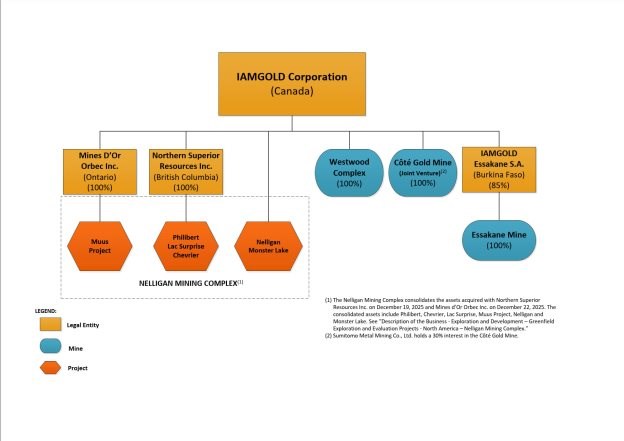
The following chart illustrates certain subsidiaries of IAMGOLD, together with the jurisdiction of incorporation of each such subsidiary and the percentage of voting securities beneficially owned or over which control or direction is exercised by IAMGOLD, and the material mineral projects of IAMGOLD held through such subsidiaries and the percentage of ownership interest that the relevant subsidiary of IAMGOLD has in such material mineral projects.
ITEM II: GENERAL DEVELOPMENT OF THE BUSINESS
OVERVIEW OF THE BUSINESS
IAMGOLD is an intermediate gold producer and developer based in Canada with operating mines in North America and West Africa, including Côté Gold (Canada), Westwood (Canada), and Essakane (Burkina Faso). The Coté Gold Mine ("Côté" or "Côté Gold") is among the largest gold mines in production in Canada, which IAMGOLD operates in a 70|30 partnership with Sumitomo Metal Mining Co. Ltd. ("SMM" or "Sumitomo"). In addition, the Company has an established portfolio of early stage and advanced exploration projects within high potential mining districts, including the large-scale Nelligan Mining Complex located in Québec, Canada.
As at February 13, 2026, IAMGOLD employs approximately 3,700 people and is committed to maintaining its culture of accountable mining through high standards of ESG practices. IAMGOLD is listed on the New York Stock Exchange (NYSE:IAG) and the Toronto Stock Exchange (TSX:IMG).
THREE-YEAR HISTORY
2023
On February 22, 2023, the Company announced the appointment of Christiane Bergevin to the Board as an independent, non-executive director.
On March 6, 2023, the Company announced the appointment of Renaud Adams as President and Chief Executive Officer and as a member of the Board, effective as of April 3, 2023, and that Mr. Theunissen had been appointed Chief Financial Officer. Mr. Theunissen had served as Interim Chief Financial Officer since September 16, 2022.
On April 26, 2023, the Company announced the closing of the sale of its 90% interest in the Boto Gold Project in Senegal and its 100% interest in the early-stage exploration properties of Boto West, Senala West, Daorala and the vested interest in the Senala Option Earn-in joint venture also in Senegal for aggregate gross cash proceeds of approximately $197.6 million (pre-tax). The closing of the sale is part of the previously announced transactions with Managem S.A. The definitive agreement to sell the Diakha-Siribaya Gold Project in Mali to Managem S.A. expired on December 31, 2024, and was not extended. The Company is pursuing alternative options for the sale of this asset.
On May 16, 2023, the Company announced that it had entered into a five-year second lien secured term loan ("Term Loan") in a principal amount of $400 million from three institutional investors. The Term Loan forms part of the Company's ongoing initiatives to proactively increase the strength of its balance sheet during the construction, commissioning and ramp-up of the Côté Gold Mine.
On June 20, 2023, the Company announced the appointment of Ms. Audra Walsh to the Company's board of directors.
On September 13, 2023, the Company announced the sale of its 100% interest in the Pitangui Project and interest in the Acurui Project in exchange for 6,331,713 common shares in the capital of Jaguar Mining Inc. with an aggregate value of $9,000,000 in addition to the granting of a net smelter returns royalty agreement of the Company.
On September 22, 2023, the Company announced the retirement of Ms. Maryse Bélanger as Chair and director of the Company's board of directors. Immediately following Ms. Bélanger's retirement, the board appointed Mr. David S. Smith to serve as Chair of the Board.
On September 27, 2023, the Company announced the appointment of Mr. Bruno Lemelin as the Company's Chief Operating Officer.
On November 9, 2023, the Company announced the retirement of Mr. Ian Ashby who served on the Company's board of directors and the appointment of Ms. Anne Marie Toutant, who previously served on the board of directors from December 2020 to May 2023, as independent director to the board.
On November 14, 2023, the Company announced that it filed, through its wholly-owned subsidiary, IAMGOLD France S.A., a draft buy-out offer with the Autorité des marchés financiers in France to acquire all of the outstanding common shares of EURO Ressources S.A. that IAMGOLD France does not already own for cash consideration of €3.50 per EURO Ressources share to be followed immediately by a squeeze-out under French law. The offer price represented a 6.7% premium based on the closing price of the EURO Ressources shares on the Euronext Paris stock exchange as of November 13, 2023.
On February 27, 2024, the Company, through its wholly-owned subsidiary, IAMGOLD France S.A.S. completed the acquisition of all of the outstanding common shares of EURO Ressources S.A.
On December 18, 2023, the Company announced that it entered into a gold prepay arrangement and a partial amendment to one of its existing gold prepay arrangements. The net result of these arrangements was the effective transition of the cashflow impact of the existing gold prepay delivery obligations from the first quarter of 2024 into the following year increasing cash flow in the first quarter of 2024.
2024
On February 13, 2024, the Company announced the successful completion of the previously announced transaction on December 5, 2023, with Vanstar Mining Resources Inc. ("Vanstar") whereby the Company has acquired all of the issued and outstanding common shares of Vanstar by way of a court-approved plan of arrangement under the Canada Business Corporations Act. Vanstar shareholders received 0.2008 of an IAMGOLD common share for each Vanstar share. As a result, the Company now owns a 100% interest in the Nelligan Gold Project. In addition, the Company acquired a 1% net smelter return royalty on selected claims of Nelligan, as well as other earlier stage exploration properties in Northern Quebec.
On February 15, 2024, the Company announced the appointment of Murray P. Suey as independent director to the Board. Mr. Suey was also appointed as Chair of the Audit and Finance Committee.
On March 31, 2024, the Company announced that it completed its first gold pour at the Côté Gold Mine, located in Ontario, Canada. On August 2, 2024, the Company announced that the Côté Gold Mine had reached commercial production. Commercial production is defined as the achievement of reaching a minimum of 30 consecutive days of operations during which the mill operated at an average of 60% of nameplate throughput of 36,000 tpd.
On April 4, 2024, the Company announced that it entered into a gold prepay arrangement and a partial amendment to one of its existing gold prepay arrangements. The net result of these arrangements was the effective transition of the cash impact of the existing gold prepay arrangement from the second quarter of 2024 into the same period in the following year, increasing cashflow in Q2 2024.
On May 21, 2024, the Company announced that it entered into an agreement with a syndicate of underwriters led by National Bank Financial Markets, BMO Capital Markets and RBC Capital Markets pursuant to which it was agreed to purchase, on a bought deal basis, 72,000,000 common shares of the Company at a price of $4.17 (the "Offering Price") per common share for aggregate gross proceeds to the Company of approximately $300 million (the "Offering"). The underwriters also had the option, exercisable in whole or in part, at any time up to 30 days following the closing of the Offering, to purchase up to an additional 10,800,000 common shares at the Offering Price to cover over-allotments, if any. In the event that the option was exercised in its entirety, the aggregate gross proceeds of the Offering to the Company would have been approximately $345 million. On May 24, 2024, the Company announced the closing of the bought-deal equity financing of 72,000,000 common shares of the Company at the Offering Price for aggregate gross proceeds of $300 million.
On September 30, 2024, the Company announced that it had provided Sumitomo with the required 60 days formal notice of the Company's intention to exercise the right to repurchase the 9.7% interest of the Côté Gold Mine that was transferred to Sumitomo as part of the joint venture funding and amending agreement entered into on December 19, 2022.
On November 7, 2024, the Company filed a new short form base shelf prospectus (the "2024 Base Shelf Prospectus") with the Ontario Securities Commission, relying on the well-known seasoned issuer (WKSI) exemption, and a corresponding shelf registration statement with the SEC on Form F-10 (the "Registration Statement"). The 2024 Base Shelf Prospectus qualifies the issue of up to $500 million (or equivalent in other currencies) of common shares, first preference shares, second preference shares, debt securities, warrants and subscription receipts of the Company in all of the provinces and territories of Canada, and the Registration Statement registers the securities for offers and sales in the United States using MJDS. The 2024 Base Shelf Prospectus is effective for a period of 25 months.
On December 2, 2024, the Company announced the return of its ownership in the Côté Gold Mine to a 70% interest effective November 30, 2024, following the repurchase of the 9.7% interest of the Côté Gold Mine for $377.7 million. The interest was originally transferred to SMM as part of the joint venture funding and amending agreement entered into on December 19, 2022.
On December 23, 2024, the Company announced that it had executed an amendment and extension to its existing secured revolving Credit Facility with its syndicate of lenders. Under the amendment, the term was extended to four years, maturing on December 20, 2028, and the facility size was increased from $425 million to $650 million. The expanded Credit Facility is available for general working capital purposes and provides optionality to the Company to potentially lower the cost of its debt and improve its capital structure in 2025.
On December 23, 2024, the Company announced that it had closed the sale of its 100% interest in the Karita Gold Project and associated exploration assets in Guinea.
2025
On January 10, 2025, the Company filed a technical report for the Westwood Complex, titled "Technical Report on the Westwood Complex, Quebec, Canada" dated September 30, 2024.
On February 20, 2025, the Company announced its updated Mineral Reserves and Mineral Resources ("MRMR") statement as of December 31, 2024, prepared in accordance with NI 43-101. Pursuant to the Company's productive year for exploration and operations drilling teams, the Company was able to increase its global Mineral Measured and Indicated Resources on a 100% basis to a total of 26.7 million ounces.
On April 3, 2025, the Company filed a technical report for the Nelligan Gold Project, titled "NI 43-101 Technical Report on the Nelligan Gold Project, Québec" dated December 31, 2024.
On June 21, 2025, the Côté Gold Mine reached a major milestone as the processing plant operated at the nameplate capacity of 36,000 tpd on average over thirty consecutive days.
On October 20, 2025, the Company announced it had entered into definitive agreements to acquire each of Northern Superior Resources Inc. ("Northern Superior") and Mines d'Or Orbec Inc. ("Orbec"), whereby the Company was to acquire all of the issued and outstanding shares of Northern Superior and Orbec by way of a plan of arrangement. Under the terms of the agreements, each shareholder of Northern Superior received 0.0991 of an IAMGOLD Common Share and C$0.19 in cash for each common share of Northern Superior and each shareholder of Orbec received 0.003466 of an IAMGOLD Common Share and C$0.0625 in cash for each common share of Orbec. The Northern Superior and Orbec transactions closed on December 19, 2025, and December 22, 2025, respectively, and consolidated the Chibougamau region with a dominant land position of approximately 134,000 hectares. The newly combined assets, together, rank as one of the largest pre-production gold camps in Canada. See "Description of the Business - Exploration and Development - Greenfield Exploration and Evaluation Projects - Nelligan Mining Complex" for additional details.
On December 9, 2025, the Company announced that it executed on its debt reduction strategy with the repayment of its Term Loan. The Company initially entered into the $400 million Term Loan on May 16, 2023, which bore interest at a floating interest rate of either one month or three-month SOFR + 8.25% per annum and matured on May 16, 2028. The Term Loan was denominated in US dollars and interest was payable upon each SOFR maturity date. The Company paid a 4% premium as part of the early repayment in line with the agreement. With the repayment completed, the Term Loan has been fully extinguished and is no longer in effect, including all associated covenants and obligations.
On December 9, 2025, the Company announced that the TSX had approved its intention to make a normal course issuer bid ("NCIB"), permitting the repurchase for cancellation or reserve for issuance up to approximately 57 million common shares, representing approximately 10% of the Company's issued and outstanding common shares. Repurchases may be made through the TSX, NYSE and alternative trading systems, and are conducted through National Bank Financial Inc., as broker. The Company also established an automatic share purchase plan to allow repurchases during blackout periods.
OTHER DISCLOSURE RELATING TO ONTARIO SECURITIES COMMISSION REQUIREMENTS FOR COMPANIES OPERATING IN EMERGING MARKETS
Controls Relating to Corporate Structure Risk
IAMGOLD has implemented a system of corporate governance, internal controls over financial reporting, and disclosure controls and procedures that apply at all levels of the Company and its subsidiaries. These systems are overseen by the Board and implemented by senior management. The relevant features of these systems include:
a) IAMGOLD's Control over Subsidiaries. IAMGOLD's corporate structure has been designed to ensure that the Company controls, or has a measure of direct oversight over, the operations of its subsidiaries. A substantial number of IAMGOLD's subsidiaries are either wholly owned or controlled, to a large extent, by the Company. Accordingly, the Company directly controls the appointments of either all of the directors or such number of directors reflecting the Company's proportional ownership interest of its subsidiaries. The directors of IAMGOLD's subsidiaries are ultimately accountable to IAMGOLD as the shareholder appointing them, and IAMGOLD's Board and senior management. In addition, the annual budget, capital investment and exploration program in respect of the Company's mineral properties are established by the Company.
Further, signing officers for subsidiary foreign bank accounts are either employees of IAMGOLD or employees of the subsidiaries. In accordance with the Company's internal policies, all subsidiaries must notify the Company's corporate treasury department of any changes in their local bank accounts including requests for changes to authority over the subsidiaries' foreign bank accounts. Monetary limits are established internally by the Company, as well as with the respective banking institutions. Annually, authorizations over bank accounts are reviewed and revised as necessary. Changes are communicated to the banking institution by the Company and the applicable subsidiary to ensure appropriate individuals are identified as having authority over the bank accounts.
b) Strategic Direction. The Board is responsible for the overall stewardship of the Company and, as such, supervises the management of the business and affairs of the Company. More specifically, the Board is responsible for reviewing the strategic business plans and corporate objectives, and approving acquisitions, dispositions, investments, capital expenditures and other transactions and matters that are material to the Company including those of its material subsidiaries.
c) Internal Control over Financial Reporting. The Company prepares its consolidated financial statements and MD&A on a quarterly and annual basis, and unless otherwise noted, using IFRS as issued by the International Accounting Standards Board ("IASB"), which require financial information and disclosures from its subsidiaries. The Company implements internal controls over the preparation of its financial statements and other financial disclosures to provide reasonable assurance that its financial reporting is reliable and that the quarterly and annual financial statements and MD&A are being prepared in accordance with IFRS as issued by the IASB and relevant securities laws. These internal controls include the following:
(i) The Company has established a quarterly reporting package relating to its subsidiaries that standardizes the information required from the subsidiaries in order to complete the consolidated financial statements and MD&A. Management of the Company has direct access to relevant financial management of its subsidiaries in order to verify and clarify all information required.
(ii) All public documents and statements relating to the Company and its subsidiaries containing material information (including financial information) are reviewed by senior management, particularly, a Disclosure Committee, including the CEO, the CFO and the CLSO, before such material information is disclosed, to make sure that all material information has been considered by management of the Company and properly disclosed.
(iii) As more fully described in paragraph (e) below, the Company's Audit and Finance Committee obtains confirmation from the CEO and CFO as to the matters addressed in the quarterly and annual certifications required under NI 52-109.
(iv) The Company's Audit and Finance Committee reviews and approves the Company's quarterly and annual financial statements and MD&A and recommends to the Board for the Board's approval of the Company's quarterly and annual financial statements and MD&A, and any other financial information requiring Board approval, prior to their publication or release.
(v) The Company's Audit and Finance Committee assesses and evaluates the adequacy of the procedures in place for the review of the Company's public disclosure of financial information extracted or derived from the Company's financial statements by way of reports from management and its internal and external auditor.
(vi) Although not specifically a management control, the Company engages its external auditor to perform reviews of the Company's quarterly financial statements and an audit of the annual consolidated financial statements.
d) Disclosure Controls and Procedures. The responsibilities of the Company's Audit and Finance Committee include oversight of the Company's internal control systems including those systems to identify, monitor and mitigate business risks, as well as compliance with legal, ethical and regulatory requirements.
e) CEO and CFO Certifications. In order for the Company's CEO and CFO to be in a position to attest to the matters addressed in the quarterly and annual certifications required by NI 52-109, the Company has developed internal procedures and responsibilities throughout the organization for its regular periodic and special situation reporting in order to provide assurances that information that may constitute material information will reach the appropriate individuals who review public documents and statements relating to the Company and its subsidiaries containing material information, is prepared with input from the responsible officers and employees, and is available for review by the CEO and CFO in a timely manner.
These systems of corporate governance, internal control over financial reporting and disclosure controls and procedures are designed to ensure that, among other things, the Company has access to all material information about its subsidiaries.
Business and Operating Environment in Emerging Markets
Fund Transfers from the Company's Subsidiaries to IAMGOLD
Funds are transferred by the Company's subsidiaries to the Company by way of wire transfer and/or cheque pursuant to a variety of methods which include the following: collection of monthly management fees; chargeback of costs undertaken on behalf of the subsidiaries via intercompany invoices by the Company; repayment of loans related to project funding; repayment of shareholder accounts, which function as inter company loans; and dividend declaration/payment by the subsidiaries. The method of transfer is dependent on the funding arrangement established between the Company and the subsidiary. In some cases, loan agreements are established with corresponding terms and conditions. In other cases, dividends are declared and paid based on the profitability and available liquidity of the applicable subsidiary. Where regulatory conditions exist in the form of exchange controls, authority to return capital is obtained in advance of the funding of the subsidiary from the appropriate government ministry by the Company and the applicable subsidiary.
Removal of Directors of Subsidiaries
Subject to applicable local corporate laws and the respective constating documents of each of the Company's wholly owned subsidiaries, the Company may remove directors of these subsidiaries from office either by way of a resolution duly passed by the Company at a shareholders' meeting or by way of a written resolution.
Records Management of the Company's Subsidiaries
The original minute books, corporate seal and corporate records of each of the Company's subsidiaries are kept at each subsidiary's respective registered office. The Company maintains at its head office a duplicate set of such corporate records for all of its subsidiaries.
RISK FACTORS
The Company is subject to various risks and uncertainties which may result from factors that are both within and outside of its control, including those which the Company broadly categorizes as (i) organizational and strategic, (ii) legal and compliance, (iii) financial, (iv) operational, and (v) other risks, and which are described in further detail below. The occurrence of any one or more events or circumstances described in the following risk factors, whether alone or simultaneously, could have a material adverse effect on the Company's business, financial condition and results of operation, including to the Company's cash flows, asset valuations and other reputational and compliance aspects of the Company's business. Such occurrences could cause actual results to differ materially from those described in forward-looking statements relating to the Company.
The risks and uncertainties identified by the Company herein should not be considered to be the only risks and uncertainties that the Company faces, and the risks identified herein may not necessarily occur as described or at all. In identifying a risk, the Company is not indicating that any particular risk will occur, only that such risk is possible. Additional risks and uncertainties not presently known to the Company or that the Company currently deems immaterial may also have material adverse effects on the Company's business, financial condition and results of operation.
The Company's business activities are exposed to significant inherent risks related to the nature of mining operations, exploration and development activities. The ability to identify and effectively manage these risks is a key component of the Company's business strategy and is supported by an organizational risk management culture and a global Enterprise Risk Management Program. An important component of the Company's enterprise risk management approach is to ensure key risks that are evolving or emerging are appropriately identified, managed, and incorporated into existing enterprise risk management monitoring and reporting processes.
I. Organizational and Strategic Risks
The Company is subject to legal, regulatory and political risks, as well as security challenges in certain of the Company's foreign operations.
Governments in such jurisdictions may adopt, interpret or apply laws, regulations or policies in a manner that adversely affects the Company's business, operations, financial condition or results of operations, particularly during periods of economic stress, fiscal deficit, political transition or regional instability.
Governments may seek to increase revenues or assert greater control over natural resources through changes to mining, environmental or tax legislation, including by increasing royalties, taxes or other levies; introducing new duties or fiscal charges; restricting exports; imposing capital controls; or requiring greater levels of local participation, ownership or procurement. Mining laws, regulations and fiscal regimes are subject to change, and there can be no assurance that existing laws, contractual arrangements or stabilization provisions will be maintained, renewed, consistently interpreted or enforced.
The Company's operations in Burkina Faso, including the Essakane Mine, are governed by mining permits and mineral agreements that establish the legal and fiscal framework applicable to those operations. While such agreements are intended to provide a degree of certainty, they remain subject to applicable law and regulatory change, and any amendment, reinterpretation or inconsistent application could have a material adverse effect on the Company.
In October 2023, Burkina Faso amended its mining royalty framework, increasing the minimum royalty rate applicable to gold production at higher gold price thresholds. In April 2025, Burkina Faso enacted a further decree increasing the royalty rate applicable to gold prices above $3,000/oz to 8%, with the rate increasing by an additional 1% for each $500/oz increase above that level. In addition, the Burkina Faso government introduced a special contribution levy of 2% on after-tax accounting profits earned by private sector entities, including mining companies, for periods after 2022.
In March 2024, Burkina Faso announced further amendments to the Mining Code, including (i) the enforcement of a preferential dividend in favour of the state, (ii) an increase in the government's free-carried interest in mining companies from 10% to 15%, and (iii) provisions to allow participation by local investors in mining companies' share capital. The revised Mining Code was adopted in July 2024, and the Essakane Mining Convention (as defined herein) was subsequently updated in 2025 to reflect certain changes, including the increase of the government's free-carried interest to 15%; see "Description of the Business - Mining Activities - International - Burkina Faso - Essakane Mine - Mining Legislation and Permits". Although existing mining permits and related conventions are intended to remain governed by the prior legal regime for their remaining terms (not to exceed 5 years), there can be no assurance regarding the interpretation, implementation, future amendment or enforcement of such provisions, including stabilization provisions, and the Company is unable to predict the potential legal, operational, financial, or regulatory impacts that may result from such uncertainties.
The political and security environment in Burkina Faso and the broader Sahel region remains volatile, particularly where the Company's Essakane Mine is located. Mining operations in this region are exposed to various risks associated with political instability and transitions, including military coups (such as those which have recently occurred in Burkina Faso, Mali, Guinea and Niger), civil unrest and armed conflict, as well as terrorist activity, kidnapping and other security incidents, which may disrupt operations, supply chains, transportation, workforce availability, power and fuel supply, or access to sites, and increase operating and security costs. The geopolitical transitions in Burkina Faso did not significantly impact our Essakane operations, however, the security environment in Burkina Faso may deteriorate and adversely affect the Company's operations or profitability. There can be no guarantee that our site in Burkina Faso, may not suffer direct or indirect attacks on people, equipment and infrastructure. See "- Some of the Company's operations are subject to significant safety and security risks."
Additional risks to which the Company may be exposed include expropriation or nationalization; renegotiation, suspension or cancellation of licenses, permits or contracts; restrictions on foreign exchange, dividend payments or repatriation of funds; requirements to retain funds locally; limitations on access to fuel, reagents or other critical consumables; inflationary pressures; labour unrest; public health emergencies; and government policies that favour or mandate the use of local suppliers, contractors or workforce. The Company may also incur increased costs or delays related to enhanced security measures, logistics constraints, personnel rotation or evacuation requirements, or limitations on the availability or affordability of insurance coverage in higher-risk jurisdictions. Any of these events, individually or in combination, could have a material adverse effect on the Company's business, financial condition, cash flows or results of operations.
The Company's strategic plan may be affected by unforeseen events and there is no guarantee that the Company can effectively adapt to changing conditions.
The Company conducts a strategic planning process that is intended to define long-term objectives and execution strategies designed to achieve those objectives. These plans are regularly reviewed and updated as current or prospective external and internal conditions change. The strategic plans are based upon certain assumptions around key variables including market prices of gold, that can directly impact the optimization of decision-making and the achievement of anticipated results.
Unforeseen changes in business, operating, and market conditions can occur at any time, which may cause the assumptions underlying the Company's strategic planning process to become inaccurate, outdated, or obsolete. In such circumstances, the Company may need to revise its strategic plans, and there is no assurance that updated plans will fully address evolving conditions, achieve the desired results, or perform as well as alternative strategies. These limitations could materially adversely affect the Company's business, financial condition, or results of operations, particularly if internal or external constraints hinder the timely or effective execution of revised plans.
The trading price of the Company's common shares may experience significant fluctuations in response to various events and factors.
The Common Shares are listed on the TSX and the NYSE. The price of the Common Shares has been and may continue to be subject to significant fluctuations which may result in losses to investors. The price of the Common Shares is highly affected by changes in the price of gold, global economic conditions generally, the Company's financial condition and results of operations, and by the market's perception of the Company's value, whether or not such perceptions accurately reflect the intrinsic value of the Company or its future prospects. The Company's share price may also be negatively impacted if investors' preferred strategy for the Company does not coincide with the strategy adopted by management. The Company has a concentration of earnings and cash flow generated from a single commodity and the outlook for the gold price is uncertain. This may impair the Company's reputation and ability to raise capital and secure financing. Given the volatility in the gold price and the market's changing perception of the Company's value, the Company cannot predict their impact on its market capitalization. As a result of any of these factors, the market price of the Company's Common Shares at any given point in time may not accurately reflect their long-term value.
Title to the Company's properties may be uncertain and subject to risks.
The Company has investigated its rights to explore and exploit all of its material properties, and to the best of its knowledge, those rights are in good standing. However, no assurance can be given that such rights will not be revoked or significantly altered to the Company's detriment. The validity of exploration, development and mining interests and the underlying mineral claims, mining claims, mining leases, tenements and other forms of land and mineral tenure held by the Company, which fundamentally constitute the Company's property holdings, can be uncertain and may be contested. The Company's properties are also subject to various encumbrances, including royalties. The loss of any such exploration, development, mining or property interests, individually or in the aggregate, could have a material adverse effect on the Company's business, financial condition and results of operations.
The acquisition of an interest in mineral properties is a very detailed and time-consuming process, and the Company's interest in its properties may be affected by prior unregistered encumbrances, agreements, transfers or undetected defects.
There is no guarantee that title to any of the Company's properties will not be challenged or impaired. Third parties may have valid claims on underlying portions of the Company's interests, including prior unregistered liens, agreements, transfers or claims, including land claims by Indigenous communities. A successful challenge to the Company's interests in its properties could result in the Company being unable to operate on its properties as anticipated or being unable to enforce its rights with respect to its properties, which could have a material adverse effect on the Company's business, financial condition and results of operations.
Failure by the Company to meet its payment and other obligations pursuant to laws governing its mineral claims, mining claims, mining leases, tenements and other forms of land and mineral tenure could result in the loss of its material property interests which could have a material adverse effect on the Company's business, financial condition and results of operations, including a significant decline in the Company's share price.
The Company may face unexpected challenges related to temporary or permanent mine closure and land rehabilitation obligations.
The Company may consider putting one or more of its operations on temporary care and maintenance, whereby the Company would cease production but keep the site in a condition to possibly reopen it at a later date. Temporary or permanent mine closure could occur due to, among other things, unfavourable market conditions, declines in revenue, safety or security concerns, pandemics and other public health emergencies or unplanned catastrophic events, such as seismic event, pit slope failures and tailings storage breaches. Ultimately, closure will eventually occur at all mines due to depletion of the resource.
The Company is required to submit, for government approval, a reclamation plan for each of its mining sites that establishes the Company's obligation to reclaim property after minerals have been mined from the site. In some jurisdictions, bonds, letters of credit or other forms of financial assurances are required as security for these reclamation activities. The Company may incur significant costs in connection with these reclamation activities, which may materially exceed the provisions the Company has made for such reclamation activities.
Due to the unknown nature of possible, future additional regulatory requirements, the potential for additional reclamation activities could create further uncertainties related to future reclamation costs, which may have a material adverse effect on the Company's business, financial condition and results of operations. Considering the continuously evolving regulations in this area, as well as changes in mining activities and processes, closure plans and site rehabilitation plans may be incomplete, inaccurately estimated, and/or not fully documented, with potential significant impact on the closure costs.
The Company is subject to risks associated with joint operations and non-controlled assets.
The Company holds, directly and indirectly, a 70% interest in the Côté Gold Mine through a joint venture agreement, with the remaining interest held indirectly by SMM. This joint venture is subject to the risks normally associated with the conduct of partnerships and other joint operations. In addition, as part of its exploration strategy, the Company actively evaluates potential exploration projects and, when appropriate, enters into joint ventures on compelling opportunities. Some of the Company's joint venture partners may have differing business objectives or practices, which could impact business and financial results of the Company's operations conducted through such joint venture arrangements.
Additional risks relating to joint ventures include reduced ability to exert control over strategic, tactical and operational decisions made in respect of such properties; limited ability to sell all or parts of the project; disagreements with partners on when and how to develop mining projects and how to operate mines; inability of partners to meet their obligations to the joint venture or third parties; and litigation between partners regarding joint venture matters. Any failure of such joint venture partners to meet their obligations to the Company or to third parties, or any disputes with respect to the parties' respective rights and obligations, could have a material adverse effect on the joint ventures or their respective properties, which could have a material adverse effect on the Company's business, financial condition and results of operations.
The Company's insurance coverage does not cover all potential losses, liabilities and/or damages related to its business, and certain risks are either uninsured or uninsurable.
The mining industry is subject to significant risks and hazards, including environmental hazards, industrial accidents, catastrophic equipment failures, unusual or unexpected geological conditions, labour force disruptions, civil strife, unavailability of materials and equipment, weather conditions, pit wall failures, tailings dam failures, rock bursts, cave-ins, floods, wildfires, seismic activity and water conditions, most of which are beyond Company's control. The Company is also exposed to theft or loss of gold bullion or gold concentrate. Such risks and hazardous events could result in damage to, or destruction of, mineral properties or producing facilities; personal injury or death; environmental damage; delays in mining; and monetary losses and possible legal liability. Where economically feasible and coverage is available, selected operational, financial and political risks are insured on certain terms and conditions with insurance companies. The availability of such insurance is dependent on the Company's past insurance losses and records, and general market conditions. In addition, changes in the insurance market can lead to having to alter insurance programs and changes in insurance costs and coverage.
In addition, the Company maintains insurance for certain cybersecurity-related risks, however, such coverage may be insufficient, unavailable, or not obtainable on economically reasonable terms. Coverage limits, deductibles or exclusions may increase, and uninsured losses from cyber incidents could have a material adverse impact on our business, financial condition and results of operations.
Moreover, losses arising from events that are not fully insured, such as the validity and ownership of unpatented mining claims and mill sites or other hazards as a result of exploration and production for which insurance are not generally available to the Company or to other companies in the mining industry on acceptable terms, may cause the Company to incur significant costs that could have a material adverse impact on its business, financial condition and results of operations.
The Company faces numerous risks and hazards as well as conditions and events beyond its control.
The Company's business is generally subject to a number of risks and hazards, including, without limitation, pandemics and other public health emergencies, geopolitical instability events (such as military coups, wars, terrorism or civil unrests), adverse environmental conditions and hazards, unavailability of materials and equipment, adverse property ownership claims, unusual or unexpected geological conditions, ground or slope failures, pit wall failures, rock bursts, rock falls, landslides, cave-ins, deterioration of the surrounding ground, dam failures, floods, wild fires, seismic activity, earthquakes, unanticipated site conditions, changes in the regulatory environment, industrial accidents, including those involving personal injuries or fatalities, labour force disruptions or disputes, gold bullion losses due to global climate change related natural disasters or theft and other natural or human-provoked incidents that could affect the mining of ore and the Company's mining operations and development projects, most of which are beyond the Company's control. The Company may also become subject to liability for, among other things, pollution, cave-ins or other hazards against which it cannot insure or against which it elects not to insure, or the Company may become subject to liabilities which exceed policy limits. For additional details to the risk related to global climate change, see "- The Company is subject to a number of physical risks related to climate change".
Seismic activity at the Westwood Mine in October 2020 forced the site to completely suspend the underground mining operations to allow for completion of geotechnical reviews and determinations. For more details, see "- Geotechnical failures may lead to the temporary or permanent closure of all or part of a mining operation". In June 2023, wildfires contributed to poor air quality in the region, impacting the Côté Gold Mine during its construction phase and the Westwood Mine. The adverse conditions led to the temporary suspension of mining activities at the Westwood Mine. The Company has encountered drought, water shortages, sandstorms and increased external security risks at the Essakane Mine in past years. These risks and hazards could result in reduced production plans, damage to, or destruction of, mineral properties or production facilities, personal injury or death, environmental damage to the Company's properties or the properties of others, delays in mining, monetary losses and possible legal liability. As a result, production could fall below estimated levels and the Company may incur significant costs or experience significant delays that could have a material adverse effect on the Company's business, financial condition and results of operations.
The Company is subject to risks related to its capital structure.
The adequacy of the Company's capital structure is vital to its long-term financial health. An inadequate capital structure may result in the Company having to accept external capital at higher costs, which may hinder the Company's ability to raise future funds. As such, the Company assesses its capital structure and capital allocation on an ongoing basis and adjusts it as necessary after taking into consideration the Company's strategic plan, market and forecasted gold prices, trends in the mining industry more generally, general economic conditions, operating and financial performance, the development status of the Company's projects and associated risks. In order to maintain or adjust its capital structure, the Company may adjust its capital spending, issue new Common Shares, purchase Common Shares for cancellation pursuant to normal course issuer bids, issue new debt, repay or refinance existing debt, or amend or renew its Credit Facility. The constating documents of the Company allow it to issue, among other things, an unlimited number of Common Shares for such consideration and on such terms and conditions as may be established by the Board, in many cases, without the approval of shareholders. The Company cannot predict the size of future issues of Common Shares or the issue of securities convertible into Common Shares or the effect, if any, that future issues and sales of the Common Shares will have on the market price of its Common Shares. Any transaction involving the issue of Common Shares or securities convertible into Common Shares would result in dilution, possibly substantial, to present and prospective holders of Common Shares.
Activist stakeholders could advocate for changes to the Company's corporate governance and operational practices, which could adversely affect the Company's reputation, business and future operations.
The Company's relationships with stakeholders are critical to ensure the future success of its existing operations and the construction and development of its projects. In recent years, publicly-traded companies in the mining industry have been increasingly subject to demands from non-governmental organizations ("NGOs") and activist shareholders advocating for changes to corporate governance practices, such as executive compensation practices, social issues, or for certain corporate actions (such as greenhouse gas emissions reduction commitments and adoption of responsible water use and management practices) or reorganizations. There is an increasing level of public concern relating to the perceived effect of mining and processing activities on the environment and on communities impacted by such activities. Activist shareholder activity could cause a disruption to the Company's strategy, operations, and leadership, resulting in a material unfavourable impact on its operational and financial performance and longer-term value creation strategy.
Responding to challenges from activist shareholders, such as proxy contests, media campaigns or other activities, could be costly and time consuming and could have an adverse effect on the Company's reputation and divert the attention and resources of the management and Board. Reputation loss may result in decreased investor confidence, increased challenges in developing and maintaining community relations and impede the Company's overall ability to advance its projects, obtain permits and licenses or continue its operations, which could have a material adverse impact on the Company's business, results of operations and financial condition.
The Company's relationship with the communities in which it operates impacts the future success of its operations.
The Company's relationship with the host communities in which it operates is important to ensure the future success of its operations. While the Company believes the relationships with the host communities in which it operates are strong, there is a general level of public concern relating to the perceived effects of mining activities, including environmental performance, water management, and other long-term impacts. Certain NGOs that oppose resource development are vocal critics of the mining industry and its practices. Adverse publicity generated by such NGOs or other parties generally related to extractive industries or specifically to the Company's operations, could have an adverse effect on the Company's reputation, impact the Company's relationship with the host communities and ultimately have a material adverse effect on the Company's business, and financial condition.
Members of the host communities, as well as NGOs, may organize protests, install road blockades, apply for injunctions for work stoppage, file lawsuits for damages and intervene in lawsuits seeking to cancel the Company's rights, permits and licenses. NGOs may also lobby governments for changes to laws, regulations and policies pertaining to mining and relevant to the Company's business activities, which, if adopted, could have a material adverse effect on the Company's business and financial condition.
The mining industry is highly competitive, and the Company may not successfully compete for new mining properties.
Significant and increasing competition exists for mineral acquisition opportunities throughout the world, particularly for opportunities in jurisdictions considered to be politically and economically stable. This may increase the risk of higher costs when acquiring suitable claims, properties and assets or completing any such acquisitions on terms acceptable to the Company. Accordingly, there can be no assurance that the Company will be able to compete successfully with its competitors in acquiring such properties and assets. The Company's inability to acquire such interests could have an adverse impact on its future cash flows, earnings, results of operations and financial condition. In addition, even if the Company does acquire such interests, the resulting business arrangements may not ultimately prove beneficial to its business.
The Company's business, financial position and results of operation may be adversely affected by global financial conditions and inflation.
Global financial conditions continue to be characterized as volatile. In recent years, global markets have been adversely impacted by, among other things, various credit crises and significant fluctuations in fuel and energy costs and prices of other input costs. Many industries, including the mining industry, have been impacted by these market conditions. Global financial conditions remain subject to sudden and rapid destabilizations in response to future events, as government authorities may have limited resources to respond to future crises. A slowdown in the financial markets or other economic conditions, including but not limited to consumer spending, employment rates, business conditions, inflation, fuel and energy costs, consumer debt levels, lack of available credit, the state of the financial markets, interest rates, tax rates, trade restrictions or tariffs and foreign exchange rates, may adversely affect the Company's growth and profitability. Future crises may be precipitated by any number of causes, including natural disasters, geopolitical instability, changes to energy prices or sovereign defaults. Increased levels of volatility or other factors that could lead to rapid changes to global economic conditions, may result in a material adverse effect on commodity prices, demand for metals, including gold, availability of credit, investor confidence, and general financial market liquidity, all of which may adversely affect the Company's business, financial condition and results of operations, including a negative impact on the market price of the Company's securities.
Acquisitions and divestitures may alter the Company's risk profile and the process of such transactions can distract management and the Board.
The Company may pursue the acquisition or disposition of producing operations, development, early stage or advanced exploration properties and companies possessing exploration permits, mining equipment and mineral property assets. Any acquisition or disposition that the Company may choose to complete may change the scale of the Company's business and operations and may expose the Company or increase its exposure to new or existing geographic, political, operational, financial and geological risks. Dispositions of assets may result in a reduction of the Company's existing consolidated MRMR. The acquisition or divestiture process itself can be arduous and complex and may be a distraction from existing operations for key members of management and the Board, and there is no guarantee that any such process will lead to a successful closing and realizing expected benefits for the Company.
Certain directors and officers may have conflicts of interest.
Certain directors and officers of the Company also serve as directors and/or officers of other companies involved in natural resource exploration and development and, consequently, there exists the possibility for such directors and officers to be in a position of conflict. The Company expects that any decision made by any of such directors and officers involving the Company will be made in accordance with their duties and obligations to deal fairly and in good faith with a view to the best interests of the Company and its shareholders, but there can be no assurance in this regard. In addition, each of the Company's directors is required to declare and refrain from voting on any matter in which such director may have a conflict of interest, actual, potential or could be reasonably perceived as having a conflict of interest, or which are governed by the procedures set forth in the Canada Business Corporations Act and any other applicable law. In the event that the Company's directors and officers are subject to conflicts of interest, there may be a material adverse effect on its business.
II. Legal and Compliance Risks
The Company is subject to the risk of litigation.
The Company is subject to litigation proceedings and regulatory inquiries arising in the normal course of business and may be involved in disputes or matters with other parties, including governments and their agencies, regulators, NGOs and members of the Company's own workforce (current or former), which may result in litigation. The causes of potential litigation cannot be known and may arise from, among other things, business activities; employment and labour matters, including compensation and termination issues, collective labour agreements and negotiations, and labour disputes and disruptions; environmental, health and safety laws and regulations; ESG and modern slavery in supply chain reporting or performance claims; tax matters; volatility in the Company's share price; and compliance with applicable securities laws and regulations.
Regulatory and government agencies may initiate investigations relating to the enforcement of applicable laws or regulations. Such matters may raise difficult and complicated factual and legal issues and may be subject to uncertainties and complexities, such as triggering additional allegations of wrongdoing under related laws or regulations. The timing of final resolutions to any such matters may be uncertain and the Company may incur expenses in defending them and the possible outcomes or resolutions could include adverse judgements, orders or settlements or require the Company to implement corrective measures any of which could require substantial payments and adversely affect its reputation.
In the event of a dispute or matter involving the Company's foreign operations, the Company may be subject to the exclusive jurisdiction of foreign courts or agencies or may not be successful in subjecting foreign persons to the jurisdiction of courts in Canada. The Company's ability to enforce its rights or its potential exposure to the enforcement in Canada or locally of judgments or decisions from foreign courts or agencies could have an adverse effect on its cash flows, earnings, results of operations and financial condition.
Additionally, the courts in certain of the jurisdictions in which the Company operates may offer less certainty as to the judicial outcome or a more protracted judicial process than is the case in more established economies. Businesses can become involved in lengthy court cases over simple issues when rulings are not clearly defined, and the poor drafting of laws and excessive delays in the legal process for resolving issues or disputes compound such problems. Accordingly, the Company could face risks such as: (i) the inability to obtain effective legal redress in the courts of certain of the jurisdictions in which the Company operates, whether in respect of a breach of law or regulation, or in a contract or an ownership dispute, (ii) a higher degree of discretion on the part of governmental authorities and therefore less certainty, (iii) the lack of judicial or administrative guidance on interpreting applicable rules and regulations, (iv) inconsistencies or conflicts between and within various laws, regulations, decrees, orders and resolutions, or (v) relative inexperience of the judiciary and courts in such matters.
The Company is subject to evolving anti-corruption and anti-bribery laws and regulations.
The Company's operations are governed by, and involve interactions with, various levels of governments and agencies in numerous countries. The Company is required to comply with anti-corruption, anti-bribery and sanctions laws, including the Corruption of Foreign Public Officials Act (Canada) and the US Foreign Corrupt Practices Act, as well as similar laws in the countries in which the Company or its contractual counterparties conduct their business.
There has been a general increase in the frequency of enforcement and the severity of penalties under such laws, resulting in greater scrutiny and punishment of companies convicted of violating these laws. Measures that the Company has adopted to mitigate these risks may not be effective in ensuring that the Company, its employees or third-party agents comply strictly with such laws. If the Company is subject to an enforcement action or is found to be in violation of such laws, this may result in significant penalties, fines and/or sanctions imposed on the Company which could have a material adverse effect on the Company's reputation, financial condition and results of operations. If the Company chooses to operate in additional foreign jurisdictions in the future, it may become subject to additional anti-corruption, anti-bribery and sanctions laws in such jurisdictions.
The Company may not be able to comply with Section 404 of the Sarbanes-Oxley Act.
The Company assessed and tested its internal control procedures to comply with the requirements of Section 404 of SOX for its 2025 fiscal year. SOX requires an annual assessment by management of the effectiveness of the Company's internal control over financial reporting and an annual attestation report by the Company's independent auditors addressing the effectiveness of the Company's internal control over financial reporting. The Company's failure to satisfy the requirements of Section 404 of SOX on an ongoing and timely basis could result in the loss of investor confidence in the reliability of its financial statements, which in turn could harm the Company's business and negatively impact the trading price of its Common Shares or market value of its other securities. In addition, any failure to implement required new or improved control(s), or difficulties encountered in their implementation, could harm the Company's operating results or cause it to fail to meet its reporting obligations.
No evaluation can provide complete assurance that the Company's internal control over financial reporting will prevent misstatements due to error or fraud, detect or uncover all failures by individuals within the Company to disclose required material information. The Company cannot be certain that it will be successful in continuing to comply with Section 404 of SOX.
Changes to laws and regulations may have a material adverse impact on the Company's financial condition and results of operation.
The Company's mining, processing, development and mineral exploration activities are subject to various laws regulating prospecting, development, production, labour, health and safety, the environment, land titles and claims of Indigenous people, mining practices, taxation, mining royalties, water use and other matters. Any changes to existing laws and regulations or the manner in which they are enforced could have a material adverse impact on the Company's financial condition and results of operations. The Company participates in a number of industry associations to monitor changing legislation and quantify the impact of the changes in legislation and seeks to maintain a good dialogue with governmental authorities in that respect. However, the Company cannot predict what legislation or revisions may be proposed that might affect its business or when any such proposals, if enacted, might become effective. Such changes, however, could require increased capital and operating expenditures or result in reduced revenues and could prevent, delay or prohibit certain operations of the Company.
Changes to laws regarding mining royalties or taxes, or other elements of a country's fiscal regime, including the introduction of new taxes or mandatory contributions pertaining to water use and local community development, may have a material adverse effect on the Company's business, financial condition and results of operations. For additional details to the risk related to regulatory changes in Burkina Faso, where the Company's Essakane Mine operates, see "- The Company is subject to legal, regulatory and political risks, as well as security challenges in certain of the Company's foreign operations".
The Company's ability to make acquisitions or divestitures could be limited or delayed by changes to local regulatory regimes that may prevent planned or potential acquisitions or divestitures from being completed.
The Company is subject to taxation in multiple jurisdictions and adverse changes to tax laws in those jurisdictions could have a material adverse effect on the Company's performance and profitability.
The Company is subject to various taxes, including value-added tax ("VAT") in several jurisdictions that are recovered in the normal course of business, and adverse changes to the taxation laws of the jurisdictions in which the Company operates could have a material impact on the Company's profitability. Complex local legislation and compliance obligations that vary widely by jurisdiction increase the risk of disagreement with local governments and timely receipt of credits and refunds.
The security situation in Burkina Faso has placed its government under significant financial constraint due to the high cost of funding its initiatives to defend itself against militant attacks. For additional details to the risk related to security environment in the Sahel region of Burkina Faso, where the Company's Essakane Mine is located, see "- The Company is subject to legal, regulatory and political risks, as well as security challenges in certain of the Company's foreign operations". The Burkina Faso government has historically not fully-paid VAT refunds to the Company, and, in prior periods, the Company sold a portion of its VAT receivables to local financial institutions to accelerate the receipt of the funds. Uncertainty remains regarding the timing and completeness of future VAT recoveries. The Company is facing challenges in recovering VAT balances, either through direct refunds from the government or alternative arrangements, and the inability of the Company to recover the VAT balances either through receiving VAT refunds, selling the VAT to third parties or alternative structures could place a significant constraint on the free cash flow produced and could limit the amount of dividends that Essakane can pay. Given Essakane's significant contribution to the financial condition of the Company, any problematic or adverse condition affecting recovery of VAT receivables could have a material adverse effect on the Company's liquidity and capital resources. The Company's operations at Essakane accounted for a significant portion of the Company's positive mine site free cash flow in 2025.
In addition, tax authorities, investors and the public have increased expectations around ESG commitments. In this context, the Company makes significant additional contributions on an after-tax basis to the communities in which it operates, in addition to ensuring compliance with applicable tax laws.
The Company is subject to routine tax audits by tax authorities. Tax audits may result in additional tax, interest and penalties, which could negatively affect the Company's financial condition and operating results. Changes in tax rules and regulations or in the interpretation of tax rules and regulations by the courts or the tax authorities could have a material adverse impact on the Company's business, financial condition, and results of operations.
The Company's interpretations of applicable tax stability agreements and tax laws may not be the same as those of the regulatory authorities in the jurisdictions in which the Company operates. Consequently, challenges to the Company's interpretations of applicable stability agreements and the tax laws by regulatory authorities, in addition to changes to tax laws, could result in significant additional taxes, penalties and interest being owed by the Company, which could have a material adverse impact on the Company's business, financial condition, and results of operations.
The Company's operations may be adversely affected if its licences and permits are challenged, revoked, amended, not issued or not renewed.
The Company's operations, exploration and development projects require licenses and permits from various governmental authorities to exploit and expand its properties, and the process for obtaining and renewing such licenses and permits often takes an extended period of time and is subject to numerous delays, costs and uncertainties. The authorities may also require a more rigorous and time-consuming assessment of a requested permit than anticipated. Any unexpected delays or costs or failure to obtain such licenses or permits associated with the permitting process could delay or prevent exploration activities, the construction of development projects or impede the operation of existing mines, which could have a material adverse effect on the Company's business, financial condition and results of operations.
The licenses and permits described above may change over time, and failure to comply with applicable laws, regulations or commitments may result in injunctions, fines, suspensions or revocation of such permits and licenses, and other penalties. There can be no assurance that the Company has been, or will at all times remain, in compliance with all applicable laws, regulations, commitments, licenses and permits, or that the Company holds all required licenses and permits required for its operations. The Company may be unable, on a timely basis, to obtain, renew or maintain in the future all necessary licenses and permits that may be required to explore and develop its properties, maintain the operation of mining facilities and properties under exploration or development or to maintain continued operations that economically justify the cost.
The Company's ability to obtain and maintain required permits and approvals, and to successfully operate within certain communities, may be affected by actual or perceived negative impacts associated with the Company's activities, or those of other resource companies, on the environment, human health, or community safety. Any delay in obtaining, or failure to obtain, renew or retain, necessary government permits and approvals could have a material adverse impact on the Company's business, results of operations and financial condition, including its ability to explore or develop properties, commence production or continue operations.
Tariffs and the imposition of other restrictions on trade could adversely affect the Company's business.
In 2025, the United States increased global tariffs on imports from several countries, including Canada, which could impact the Company's business. Tariff regimes globally have fluctuated significantly in 2025 with potential for further changes in 2026. The fluid and evolving nature of global trade protectionism has added further complexity to the Company's supply chain planning and procurement activities. In particular, global tariffs imposed by the United States have introduced additional uncertainty regarding future tariff actions and other protectionist or retaliatory measures.
Additionally, there is uncertainty on whether the United States-Mexico-Canada Agreement (USMCA), which governs the majority of goods imported and exported in North America, will be renegotiated in 2026 and the resulting impact of such renegotiation. The Company is assessing its exposure to tariffs and potential shifts in cross-border trade levies, and evaluating alternative sources of supply. The ultimate impact on the Company's supply chain and costs remains uncertain. Other countries may also implement tariffs, trade barriers or other protectionist or retaliatory measures that could limit the Company's ability to procure goods and services. This may result in, among other things, the Company experiencing reduced production levels, higher costs and lower operating margins. Accordingly, such measures could adversely impact the Company's business, financial condition and profitability.
The Company must comply with a number of significant public company obligations.
As a publicly traded company listed on senior stock exchanges in Canada and the United States, the Company is subject to numerous laws, including, without limitation, corporate, securities and environmental laws, compliance with which can be time consuming and costly. The failure to comply with any of these laws, individually or in the aggregate, could have a material adverse effect on the Company's business, financial condition and results of operations, including a negative impact on the market price of the Company's securities. The fact that the Company and its local operations must comply with laws of a number of different jurisdictions on multiple continents increases the risks of non-compliance.
Furthermore, laws applicable to the Company constantly change and the Company's continued compliance with such changing requirements is both time-consuming and costly. Adding to the significant costs of compliance with laws is the Company's desire to meet a high standard of corporate governance. The Company's continued efforts to comply with numerous changing laws and adhere to a high standard of corporate governance have resulted in, and are likely to continue to result in, increased G&A expenses and a diversion of management time and attention from revenue-generating activities to compliance activities. For example, aligning with the recently published IFRS sustainability disclosure standards may have significant cost implications for the Company.
III. Financial Risks
The Company may have difficulty financing its capital requirements for mine operations, expansion, exploration and development.
The Company may need to secure additional capital through additional debt instruments or other forms of capital to fund its operations, future expansion, exploration and development projects and potential operating losses at the mines, fund for the Doyon and Westwood environment closure costs, production delays or stoppages at the Essakane Mine caused by the security situation or other factors, or different optimization projects at the operational sites. The Company may also require funds for exploration and development of the Company's properties, such as Gosselin and the Nelligan Mining Complex.
The Company may experience unexpected cost overruns, problems and delays during construction, development, and operations for reasons outside of the Company's control, which have the potential to materially affect its ability to fully fund required expenditures and/or production, or, alternatively, may require the Company to consider less attractive financing options. The Company may also experience production delays or stoppages, cost overruns or losses at its existing operations that could require the Company to fund these operations. A number of factors could cause such delays or cost overruns, including (among others) permitting delays and costs, inflation, construction pricing escalation, changing engineering and design requirements, the performance of contractors, labour disruptions, supply chain disruptions, adverse weather conditions, etc. Equipment and facilities may not operate as planned due to design or manufacturing flaws, which may not all be covered by warranty. Mechanical breakdown could occur in equipment after the period of warranty has expired, resulting in loss of production as well as the cost of repair or replacement. Any delay, or cost overrun, may adversely impact the Company's ability to fully fund required expenditures with internally generated cashflows and the Company may have to incur additional financing at less favorable terms.
Any failure to generate the cash expected from its operations, any unexpected limitation on the ability to access, or unavailability of, funds currently available under the Company's Credit Facility, any unexpected disruption of cash repatriation initiatives or the ability to transfer cash or other assets between the Company and its subsidiaries and requests by local governments in the jurisdictions of the Company's activities to sell gold to them and not to the Company's usual counterparties in the ordinary course on commercial terms, changes in commodity prices, could restrict the Company's ability to fund its operations effectively, and the Company may be required to use other unanticipated sources of funds, on unattractive terms, if available, for these objectives.
The availability of the capital is subject to general economic conditions and lender and investor interest in the Company and its projects. The availability of new additional capital to the Company and the cost of capital are subject to general economic conditions and lender and investor interest in the Company and its projects based on the level of confidence in the Company to meet its strategic objectives. The Credit Facility has net debt to EBITDA and interest coverage financial ratio covenants that govern the amount that can be drawn under the Credit Facility. EBITDA is impacted by the performance of the Company's operations and market conditions.
The cost of the Company's debt is linked to market interest rates and further increases in interest rates or adverse changes in the expected performance of the Company's operations or market conditions that adversely impacts the generation or amount of cash flow or earnings from its operations could impact the ability of the Company to utilize the Credit Facility due to the impact on the foregoing financial maintenance covenants, which would reduce the available liquidity to the Company and could have materially adverse consequences to the Company. If there were a default or breach under the Credit Facility because of the Company's failure to meet its financial or other covenants, not only could the Credit Facility cease to be available to meet the liquidity needs of the Company, but such default could trigger cross-defaults under the terms of the Company's other sources of debt and such defaults could have materially adverse consequences to the Company. Financing may not be available when needed or, if available, may not be available on terms acceptable to the Company or the Company may be unable to find a partner for financing. Failure to obtain the financing necessary to fund production delays at its existing operations may result in a delay or indefinite postponement of exploration, development or production on any or all of the Company's properties. In addition, there can be no certainty that the Company may be able to renew or replace its current Credit Facility or debt financing on similar or favourable terms to the Company prior to, or upon, its maturity.
The Company may be adversely affected by fluctuations in the price of gold.
The Company's revenues depend on the market price of gold prices and production from the Company's producing properties. Gold prices can fluctuate widely over the course of a year and are affected by numerous factors beyond the Company's control including: central banks lending rates; purchasing by reserve banks, sales and purchases of gold; expectations of inflation; the level of demand for gold as an investment; speculative trading; the relative exchange rate of the US dollar with other major currencies; interest rates and interest rate expectations; global and regional demand; political and economic conditions and uncertainties; industrial and jewelry demand; production costs in major gold producing regions; increased production due to new mine developments and improved mining and production methods; decreased production due to mine closures and worldwide production levels.
Cryptocurrencies and other block-chain-based technologies that perform the function of a "medium of exchange" (collectively "Digital Currencies") are becoming more integrated with the global economy and may increasingly serve as means of storing wealth outside of conventional financial markets. These Digital Currencies may offer a compelling alternative to financial instruments exchangeable for government-issued currencies because they are held and traded on a decentralized network of computers, often beyond the control of individual governments or companies. Since gold serves a substantially similar wealth-storing function, the growing acceptance and popularity of Digital Currencies may have an adverse effect on the market for gold and put significant downward pressure on gold prices.
The aggregate effect of these factors is impossible to predict with accuracy. There can be no assurance that gold prices will remain at current levels or that such prices will improve. Future decline in gold prices may materially and adversely affect the Company's financial performance, its ability to service or repay its debt, or results of operations and may result in adjustments to Mineral Reserve estimates and LOM plans. As a result, the Company may be required to materially write-down certain of its investments in mining properties. Insufficient preparedness for substantial gold price volatility may result in a significant impact on the production profile and adverse financial performance. Any of these factors could result in a material adverse effect on the Company's results of operations, cash flows and financial position. Further, if revenue from gold sales declines, the Company may experience liquidity difficulties. Its cash flow from mining operations may be insufficient to meet its operating needs, and as a result the Company could be forced to discontinue production and could lose its interest in, or be forced to sell, some or all of its properties.
In addition to adversely affecting MRMR estimates and the Company's results of operations, cash flows and financial position, declining gold prices can impact operations by requiring a reassessment of the feasibility of a particular project. Even if a project is ultimately determined to be economically viable, the need to conduct such a reassessment may cause substantial delays and/or may interrupt operations until the reassessment can be completed, which may have a material adverse effect on the Company's results of operations, cash flows and financial position. In addition, lower gold prices may require the Company to reduce funds available for exploration with the result that the depleted reserves may not be replaced.
The Company's indebtedness and restrictive covenants may limit the Company's ability to fund unplanned or increased future working capital needs, capital expenditures, acquisitions or other general corporate requirements.
The level of indebtedness and the covenants under its current Credit Facility and the indenture governing the 2028 Senior Notes will potentially limit the ability of the Company to obtain additional financing to fund unplanned or increased future working capital, capital expenditures, acquisitions, or other general corporate requirements; require the Company to divest assets; require a substantial portion of future cash flows to be dedicated to debt service payments instead of other purposes increasing the vulnerability to general adverse economic and industry conditions; expose the Company to the risk of increased interest rates as borrowings under the Credit Facility are at variable rates of interest; limit the flexibility in planning for and reacting to changes in the industry in which the Company competes; place the Company at a disadvantage compared to other, less leveraged competitors who may be able to take advantage of opportunities that the Company's indebtedness would prevent it from pursuing; and increase the cost of borrowing. Additionally, the indenture governing the 2028 Senior Notes and the Credit Facility agreements include restrictive covenants that limit the Company's ability to engage in activities that may be in its long-term best interest. Additionally, in connection with the operation of the Côté Gold Mine, the Company has entered into equipment lease agreements which contain similar covenants.
The Company's ability to make scheduled payments on the 2028 Senior Notes, its Credit Facility and equipment leases also depends on its financial condition, operating performance at its existing mines, which are subject to prevailing economic and competitive conditions beyond its control, including fluctuations in the gold price. The Company cannot be certain that its future cash flow from operations will be sufficient to allow it to pay the principal and interest on its debt and meet other obligations, including under the 2028 Senior Notes.
A default under the Credit Facility could adversely affect the Company's ability to borrow under its Credit Facility and its compliance with other debt arrangements.
The Credit Facility and subsequent amendments place certain limits on the Company, such as limiting the Company's ability to incur additional indebtedness, enter into derivative transactions, make investments in a business, carry on business unrelated to mining, dispose of the Company's material assets or, in certain circumstances, pay dividends. Further, the Credit Facility requires the Company to maintain specified financial ratios and meet financial condition covenants. Events beyond the Company's control, including changes in general economic, business or political conditions, may affect the Company's ability to satisfy these covenants, which could result in a default under the Credit Facility.
As at December 31, 2025, the Credit Facility was drawn in the amount of $200 million. The Company issued letters of credit under the Credit Facility in the amount of $0.4 million as guarantees for certain environmental indemnities to government agencies, and $3.9 million as a supplier payment guarantee, with $445.7 million remaining available under the Credit Facility.
If an event of default under the Credit Facility occurs, the Company would be unable to draw down further on the Credit Facility and the lenders could elect to declare all principal amounts outstanding thereunder at such time, together with accrued interest, to be immediately due. An event of default under the Credit Facility may also give rise to an event of default under existing and future debt/financing agreements and, in such event, the Company may not have sufficient funds to repay amounts owing under such agreements. Such a default may allow the creditors to accelerate repayment of the related debt/financing and may result in the acceleration of any other debt/financing containing a cross-acceleration or cross-default provision which applies. In addition, an event of default under the Credit Facility would permit the lenders thereunder to terminate all commitments to extend further credit under that facility. In the event the Company's lenders or noteholders accelerate the repayment of the Company's borrowings, the Company may not have sufficient assets to repay that indebtedness. Creditors could enforce or foreclose against the collateral securing their obligations and the Company could be forced into bankruptcy, receivership or liquidation. Additionally, in connection with the operation of the Côté Gold Mine, the Company entered into certain material equipment lease agreements which are expected to contain similar terms and conditions with respect to cross-default and early termination.
As a result of the above-described restrictions on the Company related to its Credit Facility, the Company may be limited in how it conducts its business; unable to raise additional debt or equity financing to operate during general economic or business downturns; or unable to compete effectively or to take advantage of new business opportunities. These restrictions may affect the Company's ability to grow in accordance with its strategy.
Interest rates are subject to fluctuation risk.
The Company's financial results are affected by movements in interest rates. Interest payments under the Credit Facility are subject to fluctuation based on changes to specified interest rates. A copy of the credit agreement in connection with the Credit Facility and the subsequent Amendments are available under the Company's issuer profile on SEDAR+ at www.sedarplus.ca and EDGAR at www.sec.gov.
A downgrade in the Company's credit rating may adversely impact its ability to obtain additional financing.
The Company and the 2028 Senior Notes have non-investment grade ratings, and any rating assigned could be lowered or withdrawn entirely by a rating agency if, in that rating agency's judgment, future circumstances relating to the basis of the rating, such as adverse changes, so warrant. On October 15, 2025, S&P assigned the Company a credit rating of BB-, a rating of BB- with respect to its senior notes with outlook stable. On September 4, 2025, Moody's assigned the Company a credit rating of B2 and a rating of B3 with respect to the Company's senior notes with its outlook updated to positive. On March 21, 2025, Fitch assigned the Company a B+ credit rating as well as a B+ in respect of the Company's senior notes. Fitch maintained outlook at stable. For further information on "Ratings" please see "Item V Ratings".
Any future lowering of the Company's ratings likely would make it more difficult or more expensive for the Company to obtain additional debt financing or could result in increased collateral to be posted on surety bonds issued for reclamation security at the Company's operations.
The Company's cost containment efforts may not achieve their intended objectives.
Costs at any particular mining location are also subject to variation due to a number of operational factors, such as changing ore grade, graphite carbon content, changing metallurgy and revisions to mine plans in response to changes in the estimated physical shape and location of the orebody or due to operational or processing changes. Costs could also be impacted by other factors such as risks and hazards associated with mining; security matters and responses thereto; natural phenomena, such as inclement weather conditions and seismic events; unexpected labour shortages or strikes; the availability of labour and contractors; the failure of contractors to perform on time or as expected; the availability and price of key inputs; inflation and currency and exchange rates. A material increase in costs at any significant location could have a significant effect on the Company's capital expenditures, production schedules, profitability and operating cash flow.
While inflation generally continued to slowdown and decline, inflation in 2025 remained at some of the highest levels in decades in Canada, Europe, and the United States for most of the year. Further, the combined effect of a sustained volatility in the gold price with any failure to contain operating costs such as labour, energy, fuel, other consumables and increasing rock hardness, or any increase in royalties, taxation and tariffs, would negatively impact the Company's earnings and cash flow. For additional details to the risks related to tariffs, please see "- Tariffs and the imposition of other restrictions on trade could adversely affect the Company's business". Additionally, certain cost containment or reduction initiatives may not be sustainable over a longer period of time, and the Company may face the risk of having to pursue other measures to achieve margin protection and efficiency improvements. In an increased gold price environment, it may be advantageous to mine and produce higher cost gold because of the expanded margin potential.
The Company's cost containment efforts may not achieve their intended objectives because of internal or external factors, many of which are outside of the Company's control and which, individually or combined, could cause declining margins. The Company's production and cost estimates depend on many factors, some or all of which are outside the Company's control and may vary from actual production and costs, which could have an adverse impact on the Company's financial results.
Failure to achieve production or cost estimates or the occurrence of material increases in costs could result in a material adverse on the Company's business, financial condition and results of operations.
Fluctuations in the price or availability of infrastructure, energy and other commodities or consumables could affect the Company's profitability and development of projects.
The security situation in Burkina Faso continues to remain distressed and volatility remains elevated, with frequent terrorist related incidents occurring in the country. The Company continues to adjust its operating activities to make investments in security and supply chain infrastructure in the region and at the mine site, with the support of the government. The security situation continues to apply pressures to the in-country supply chain and continued escalation could have a material and negative impact on future operating performance.
The profitability of the Company's business is affected by market prices and availability or shortages of commodities which are consumed or otherwise used in connection with the Company's operations and projects, such as diesel fuel and heavy fuel oil at the Essakane Mine and the Côté Gold Mine; electricity at the Westwood mine and the Côté Gold Mine; and steel, concrete, grinding media, equipment spare parts, explosives and cyanide at all operations. Prices of such commodities also can be subject to volatile price movements, which can be material and can occur over short periods of time and are affected by factors that are beyond the Company's control. Operations consume significant amounts of energy and are dependent on suppliers or governments to meet these energy needs. In some cases, no alternative source of energy is available. An increase in the cost, or decrease in the availability, of construction materials such as equipment, steel and concrete may affect the timing and cost of the Company's projects. If the costs of certain commodities consumed or otherwise used in connection with the Company's operations and projects were to increase significantly, and remain at such levels for a sustained period of time, the Company may determine that it is not economically feasible to continue commercial production at some or all of the Company's operations or the development of some or all of the Company's current projects, which could have a material adverse impact on the Company. Any prolonged disruption to the supply chain could have a material adverse effect on the Company's business, financial condition and results of operations.
The Company's use of derivatives carries inherent risks.
Risks associated with currency and commodity price volatility are regularly managed with the Company's hedging programs. Increases in global fuel prices or the appreciation of the exchange rate for the Canadian dollar or CFA franc (XOF) (which has a fixed exchange rate to the Euro), can materially increase operating costs, increase capital funding requirements, erode operating margins and project investment returns, and potentially reduce viable Mineral Reserves. Conversely, a significant and sustained decline in world oil prices or a depreciation of the exchange rate for the Canadian dollar or CFA franc (XOF) may offset other costs, cash flows and improve returns. While the Company may enter into hedge arrangements to minimize its risk to fluctuating gold prices, fuel prices and changes to the exchange rate for the Canadian dollar or Euro, there are no assurances that such arrangements will be successful, especially in the context of the current market volatility.
The Company executed a gold hedging strategy for a portion of its gold production in the future to protect a portion of its cash flows against decreases in the price of gold and further de-risk the balance sheet.
The use of derivative instruments involves certain inherent risks including: (a) credit risk - the risk of default on amounts owing to the Company by the counterparties with which the Company has entered into such transactions; (b) market liquidity risk - the risk that the Company has entered into a derivative position that cannot be closed out quickly, by either liquidating such derivative instrument or by establishing an offsetting position; and (c) price / valuation risk - the risk that, in respect of certain derivative products, an adverse change in market prices for commodities, currencies, gold or interest rates will result in the Company incurring a realized or unrealized (mark-to-market) loss in respect of such derivative products.
Fluctuations in foreign currency exchange rates may adversely affect the Company's results of operations.
Currency fluctuations may affect the earnings and cash flows from the Company's operations since the revenue is based on the gold market price and is mostly denominated in US dollars, while the costs of the Company are incurred principally in non-US dollars (Canadian dollars, Euros and CFA francs (XOF)). Appreciation of currencies against the US dollar increases the cost of gold production in US dollar terms and reduces profitability. While CFA francs (XOF) currently have a fixed exchange rate to the Euro and the currency is currently convertible into Canadian and US dollars, it may not always have a fixed exchange rate, which may be changed to a floating rate, and the fixed exchange rate may be reset by the governing bodies. While the Company hedges certain of this exposure, there can be no assurance that the Company's hedging strategy will be successful. Furthermore, in the wake of Burkina Faso's withdrawal from the Economic Community of Western African States (ECOWAS), it has been rumored that the country may also withdraw from the Western African Economic and Monetary Union (WAEMU) and adopt its own local currency which would presumably no longer have a fixed exchange rate to the Euro. This scenario could increase risk to the Company in the use of local currency, the ability to readily convert it and the ability to repatriate capital.
The Company may not be able to access cash from its foreign subsidiaries.
The Company conducts several of its operations through foreign subsidiaries. From time to time, the countries in which the Company operates or has interests have adopted measures to restrict the availability of the local currency or the repatriation of capital across borders. These measures are typically imposed by governments or central banks during times of local economic instability to prevent the removal of capital or the sudden devaluation of local currencies or to maintain in-country foreign currency reserves. In addition, some of these countries require supplementary consents or reporting processes before local currency earnings can be converted into US dollars or other currencies and/or such earnings can be repatriated or otherwise transferred outside of the operating jurisdiction. Furthermore, some jurisdictions regulate the amount or proportion of earnings that can be maintained by operating entities in offshore bank accounts or in US dollar or other currency accounts and require additional earnings to be held by banks located in the country of operation and/or in local currency.
Accordingly, any limitation on the transfer of cash or other assets between the parent corporation and its subsidiaries and foreign entities, control over cash repatriation, as well as requirements by local governments to repatriate gold bullion sales, could restrict the Company's ability to fund its operations effectively, and the Company may be required to use other sources of funds for these objectives, which may result in increased financing costs. Any such limitations, or the perception that such limitations may exist now or in the future, could have an adverse impact on the Company's valuation, share price and ability to service or repay its indebtedness.
A change in the underlying economics of the Company's assets may reduce its value and result in an impairment charge which may adversely affect the Company's results of operations.
At the end of each reporting period, the Company reviews the carrying amount of its property, plant and equipment, exploration and evaluation assets and cash generating units to determine whether there is any indication of impairment or reversal of previously recognized impairment. If such an indicator exists, the Company performs an impairment test.
Management's assumptions and estimates of future cash flows are subject to risks and uncertainties, particularly in market conditions where higher volatility exists, and may be partially or totally outside of the Company's control. Therefore, it is reasonably possible that changes could occur with evolving economic and market conditions, which may affect the fair value of the Company's property, plant and equipment and exploration, evaluation assets, resulting in either an impairment charge or reversal of previously recognized impairment. The Company's estimates of future cash flows are based on numerous assumptions, some of which may be subjective, and it is possible that actual future cash flows could be significantly different than those estimated.
If any of its property, plant and equipment, exploration and evaluation assets or cash generating units have experienced a decline in fair value due to market factors or due to the asset not performing in the manner intended or anticipated, an impairment charge may be required to be recorded, causing a reduction in the Company's earnings. Conversely, if there are observable indicators that any of its property, plant and equipment, exploration and evaluation assets have experienced an increase in fair value, a reversal of a previously recognized impairment may be required to be recorded, causing an increase in the Company's earnings.
Management's assumptions and estimates of future cash flows used in the Company's impairment assessments are subject to risk and uncertainties, particularly in market conditions where higher volatility exists, and may be partially or totally outside of the Company's control. As such, fair values may change.
IV. Operational Risks
There are risks involved in exploration and development activities.
While the discovery of a mineral deposit and delineation of a Mineral Resource may result in substantial rewards, few properties that are explored are ultimately developed into producing mines. Substantial expenses may be incurred on exploration projects that are subsequently abandoned due to poor exploration results, permitting or social issues or the inability to define Mineral Reserves that can be mined economically. The Company cannot ensure that its current exploration and development programs will result in future profitable commercial mining operations or replacement of current production at existing mining operations with new Mineral Reserves.
The Company internally or along with third-party specialists may conduct PEAs on mineral discoveries on greenfield and brownfield projects to evaluate the potential economic viability of the project and to identify any additional work necessary to complete more advanced mining and technical studies. For the advanced project development studies, PFSs and FSs are conducted to advance and demonstrate the economic viability of a project and to further refine the engineering designs, mine plans, orebody models, infrastructure and environmental requirements, capital and operating costs and financial models. The analyses in these studies are based on many factors, including among other things, government regulations, taxes and royalty rates, the accuracy of Mineral Resources and Mineral Reserve estimates included in the mine plan, characteristics of ore treated in the process plant and anticipated metallurgical recoveries, support from the projected infrastructure requirements, gold price assumptions, permitting, social and environmental regime considerations, capital and operating cost estimates and availability of adequate financing.
The results of these PEAs, PFSs and FSs studies represent forward-looking information and are subject to a number of known and unknown risks, uncertainties and other factors that may cause actual results to differ materially from those anticipated in such information. Such information is presented as of the date of the study completion and is based on a number of assumptions, which are believed to be valid and reasonable as of that date, but which may prove to be incorrect in the future. The PEA is exploratory in nature and may include Inferred Mineral Resources that are considered part of Mineral Resources and have a great amount of uncertainty as to their existence and whether they can be mined economically and consequently are of a lower level of estimate confidence to have the economic considerations applied to them that would enable them to be categorized as Mineral Reserves. See "Description of the Business - Mineral Reserves and Mineral Resources". A PEA may show a positive financial return and can be used to support a decision to proceed to more advanced mining studies; however, there is no certainty that the results of the PEA may be realized. Each of a PFS and FS is generally a more advanced study, but such study nonetheless contains certain assumptions and limitations. There can be no assurances that the results of these studies will be realized due to a variety of factors.
It is not unusual for a development project to experience unexpected construction delays or problems during the start-up phase and to require more capital and time than anticipated. The actual operating performance results of a development project as it transitions to an operation may differ materially from those anticipated in the studies, and uncertainties related to operations are even greater in the case of development projects.
Non-Achievement of Operational Plans and Cost Management
The Company's ability to meet its operational and financial results is contingent upon the successful execution of its mine plans, which are developed based on a range of technical and operational assumptions including ore grades, metallurgical recoveries, equipment availability, workforce and contractors' productivity, and supply chain stability. A number of internal and external factors may prevent the Company from achieving these plans such as the negative variance between estimated and actual grades of ore mined and processed, pit wall failures or seismic events, adverse weather conditions, disruptions in the supply chain due to regional security threats (particularly impacting the Company's Essakane mine), labour unrest or shortages, equipment malfunctions or availability. Failure to achieve operational plans and results could result in a negative impact on the Company's operating results, including lower-than-planned gold production, increased costs, and reduced cash flow generation.
Inflation and supply chain disruptions caused by the security situation in Burkina Faso continue to adversely impact costs and availability of the Company's production inputs. Any inability to contain or control operating costs such as labour, energy, fuel, consumables such as cyanide, lime and grinding media, or the increase in royalties due to higher gold prices, increased royalty rate and foreign exchange fluctuations, can materially negatively impact the Company's earnings and cash flow and may have a material adverse effect on the Company's business, operations, liquidity and capital resources. Failure to achieve production or cost estimates or the unexpected occurrence of material increases in costs could result in material adverse consequences for the Company.
Mineral Reserve and Mineral Resource estimates are only estimates and may not accurately reflect future mineral recovery.
The Company's MRMR are based on estimates of mineral content and quantity derived from limited information acquired through drilling and other sampling methods, and require judgmental interpretations of geology, structure, grade distributions and trends, and other factors that may be beyond the Company's control. No assurance can be given that the estimates are accurate or that the indicated level of metal will be produced. Actual mineralization or formations may be different from those predicted. Furthermore, it may take many years from the initial phase of drilling before production is possible, and during that time the economic feasibility of exploiting a discovery may change. Mineral Resources that are not Mineral Reserves do not demonstrate economic viability. Estimates are inherently based on assumptions, including certain operational modifications such as the implementation of different mining methods and extraction processes and assurances cannot be provided that such estimates will not be revised in light of additional challenges encountered as such modifications are made or the decision not to proceed with such modifications. It cannot be assumed that all or any part of the Company's Mineral Resources will be converted into Mineral Reserves. Disclosure regarding the Company's mineral properties, including with respect to Mineral Reserve and Mineral Resource estimates included in this AIF, was prepared in accordance with NI 43-101, which differs significantly from the disclosure requirements of the SEC, generally applicable to US companies. Accordingly, information contained in this AIF is not comparable to similar information made public by US companies reporting pursuant to SEC disclosure requirements. See "Cautionary Note to US Investors Regarding Disclosure of Mineral Reserve and Mineral Resource Estimates."
Fluctuations in the market price of gold, as well as increased production and capital and operating costs, reduced recovery rate, changes in the mine plan or pit design, or other technical, economic, and regulatory factors may render the Company's Proven and Probable Mineral Reserves unprofitable to develop or continue to exploit at a particular site or sites for periods of time or may render Mineral Reserves containing relatively lower grade mineralization uneconomic.
The Company's ability to recover estimated MRMR can also be affected by such factors as environmental permitting regulations and requirements, weather, environmental or social factors, unforeseen technical difficulties, unusual or unexpected geological complexity and work interruptions. Successful extraction requires safe and efficient mining and processing. Estimated Mineral Reserves may have to be recalculated based on actual production experience. Any of these factors may require the Company to reduce its MRMR, which could have a negative impact on the Company's financial results. There is also no assurance that the Company will achieve indicated levels of gold recovery or obtain the prices for gold production assumed in determining the amount of such Mineral Reserves. Anticipated levels of production may be impacted by numerous factors, including, but not limited to, mining conditions, labour availability and relations, contractors' performance of obligations, weather, seismic events, civil disturbances, supply shortages and global supply chain disruption events.
Any material reductions in estimates of Mineral Reserves or Mineral Resources, or the Company's ability to extract those Mineral Resources, could have a material adverse effect on the business, financial condition and results of operations. A reduction in the Company's estimated Mineral Reserves could require material write-downs in the carrying value of the affected mining property and increased amortization, reclamation and closure charges.
Geotechnical failures may lead to the temporary or permanent closure of all or part of a mining operation.
Mining, by its nature, involves the excavation of soils and rocks. The stability of the ground during and after excavation involves a complicated interaction of static and dynamic stresses (including induced stresses such as blasting), gravity, rock strength, rock structures (such as faults, joints, and bedding), high geomechanical stress areas or seismic activity, groundwater pressures and other geomechanical factors. Underground workings, pit slopes, and other excavations may be subject to local or widespread geotechnical failure should the forces acting on the rock mass exceed the strength of that rock mass.
Additionally, excavated ore and waste may be deposited in dumps or stockpiles, or used in the construction of tailings dams and roads or other civil structures, which may be very large. These dumps, stockpiles and dams may also be subject to geotechnical failure due to over-steepening, seismically induced destabilization, water saturation, material degradation, settling, overtopping, foundation failure or other factors. The occurrence of one or more of these events could adversely affect the Company's financial performance and results of operations.
Due to unforeseen situations and to the complexity of these rock masses and large rock and soil civil structures, geotechnical failures may still occur which could result in the temporary or permanent closure of all or part of a mining operation, injuries to mine personnel or others, and/or damage to mine infrastructure, equipment or facilities, which materially impacts mineral production and/or results in additional costs to recover from such geotechnical failures and the resulting damage.
The Westwood mine in Québec experienced large seismic events, which resulted in the temporary suspension of activities in some or all underground areas. From October 2020 to June 2021, the underground operations were suspended pending further technical evaluations of underground conditions. Following such assessment, and the implementation of mitigative measures, underground operations resumed in the East Zone in June 2021 and in the Central and West Zones in June 2022. The Company continuously assess ground support conditions and rehabilitation options for a safe way to operate the underground mine. As the Company mines deeper, the risks of more frequent and larger seismic events increase. The occurrence of more frequent and/or larger seismic events could result in a loss of Mineral Reserves.
The factors and assumptions underlying the Company's life of mine plans may prove to be incorrect.
The LOM estimates for each of the material properties of the Company are based on a number of factors and assumptions and may prove to be incorrect. In addition, LOM plans, by design, may have declining grade profiles and increasing rock hardness over time and mine life could be shortened if the Company increases production, experiences increased production costs or if the price of gold declines significantly. Mineral Reserves at operating sites can be replaced by upgrading existing resources to Mineral Reserves generally by the completion of additional drilling and/or development to improve the estimate confidence and by demonstrating their economic viability, by expanding known deposits, by locating new deposits, or by making acquisitions. Substantial expenditures are required to delineate resources and ultimately establish Proven Mineral Reserves and Probable Mineral Reserves and to construct mining and processing facilities.
There is a risk that depletion of Mineral Reserves will not be offset by resource conversions, expansions, discoveries, or acquisitions. The deferral of some of the drilling activities due to the security situation in the region where the Essakane Mine operates has impacted the drilling campaigns and potentially the accuracy of the results incorporated in the resource and reserve estimates in the block models. As the operating mines are aging and getting close to the end of life, unplanned variances in the grades mined and recoveries may be experienced in the future, with impact on the total ounces produced.
The Westwood mine, in particular, has a relatively low quantity of Proven Mineral Reserves and Probable Mineral Reserves compared to a relatively large quantity of Inferred Mineral Resources. After the seismic event on October 30, 2020, the site has reviewed its operational and LOM plan and recommended underground operations resumed in the East Zone in June 2021 and in the Central and West Zones in June 2022. Due to the nature and depth of the deposit, it could take significant time to effectively access various sections of the orebody in order to carry out sufficient drilling to convert Inferred Mineral Resources to Indicated Mineral Resources and Measured Mineral Resources and, after economic assessment, into Proven Mineral Reserves and Probable Mineral Reserves. For reasons outlined above, there is a risk that some or all of the Inferred Mineral Resources at the Westwood mine may not be upgraded to higher confidence Measured and Indicated Mineral Resources and converted to Proven Mineral Reserves or Probable Mineral Reserves to be mined and processed.
The Company is dependent upon its mining operations at Essakane and Côté Gold and any adverse condition affecting its operations may have a material adverse effect on the Company.
The Company's operations at Côté Gold and Essakane accounted for the majority of the Company's positive mine sites free cash flow in 2025. Any adverse condition affecting mining and processing conditions, labour relations, security and in-country supply chain conditions, expansion plans or ongoing permitting at the Côté Gold and Essakane Mines could have a material adverse effect on the Company's financial performance and results of operations.
The Company is subject to numerous risks related to the development of its projects.
The ability of the Company to sustain or increase its present levels of gold production is dependent in part on the success of its operational and growth projects.
Significant operational projects contemplated for the next years include pit and underground developments and continuing implementation of ground control measures at Westwood to safely access mining areas affected by the seismic activity, and other multi-site infrastructure investments, mill and plant upgrades, fleet and utilization improvements, tailings and surface water management optimization and additional pit developments at Côté Gold and Essakane. These projects are expected to reduce or control the Company's cost structure and improve efficiencies. However, even with successful execution, there are uncertainties as to whether they will achieve the targeted improvements.
The success of construction projects and the start-up of new mines by the Company is subject to a number of factors including the availability and performance of engineering and construction contractors, mining contractors, suppliers and consultants, the receipt of required governmental approvals and permits in connection with the construction of mining facilities and the conduct of mining operations (including environmental permits). Any delay in the performance of any one or more of the contractors, suppliers, consultants or other persons on which the Company is dependent in connection with its construction activities, a delay in or failure to receive the required governmental approvals and permits in a timely manner or on reasonable terms, or a delay in or failure in connection with the completion and successful operation of the operational elements in connection with new mines could delay or prevent the construction and start-up of new mines as planned.
Beyond the Côté Gold Mine, which construction was completed during 2024, there is a risk that the Company may not proceed with some or all of the remaining projects in the development portfolio or that other projects may arise. Also, the Company may choose to prioritize certain projects contrary to market expectations.
The Company's capital, financial and staffing capacity may restrict the ability to concurrently execute multiple projects and adversely affect the potential timing of when those projects can be put into production. The inability to execute adequate governance over developmental projects can also have a major negative impact on project development activities.
The Company relies on third-party contractors and if such contractors fail to perform work properly or in a timely manner, this could have a material adverse effect on the Company's business.
It is common industry practice for certain aspects of mining operations including, but not limited to, drilling, blasting and construction, to be conducted by one or more external contractors. Deficient or negligent work, or work not completed in a timely manner, could have a material adverse effect on the Company. The Company is subject to a number of risks associated with the use of such contractors, including the following: the Company having reduced control over the aspects of the operations that are the responsibility of a contractor; failure of the contractor to perform work properly or at a satisfactory level of quality and safety, including Company health and safety standards; failure of a contractor to perform under its agreement(s), including but not limited to inability to meet the contractual timelines and inability to deliver in accordance with the terms of the contract; failure of a contractor to follow and meet Company policies; inability to replace the contractor if either the Company or the contractor terminates the contractual relationship; interruption of operations in the event the contractor ceases operations as a result of a contractual dispute with the Company or as a result of insolvency or other unforeseen events (including events of force majeure); failure of the contractor to comply with applicable legal and regulatory requirements; failure of the contractor to properly manage its workforce resulting in labour unrest, strikes or other employment issues, any of which may have a material adverse effect on the Company's business, financial condition and results of operations; inadequate contractor cybersecurity program or customer data management and privacy, exposing the Company to external attacks.
Equipment malfunctions may have an adverse effect on the Company's business.
The Company's mines use expensive, large mining and processing equipment that requires a long time to procure, transport, build and install. The Company's reliance on its IT and OT systems is increasing as the Company continues to incorporate more advanced technology into its mine operations, including 5G communication systems and autonomous mobile mine equipment at the Côté Gold Mine. The Company's various operations may encounter delays in or losses of production due to the delay in the delivery of equipment, key equipment or component malfunctions or breakdowns, cyber security attacks, damage to equipment through accident or misuse, including potential complete write-off, shortages or unavailability of spare parts, or lack of qualified personnel in the regions where operations are located, which may impede maintenance activities and reduce overall equipment availability. Delays in the delivery of equipment or spare parts, or the unavailability of spare parts, may further increase downtime and reduce production reliability.
Equipment may also be subject to aging if not replaced, or may become obsolete through inappropriate use, misuse, or improper storage conditions. In some cases, equipment may become damaged beyond repair, resulting in complete write-offs and requiring lengthy procurement and installation of replacement units. In light of global supply chain disruption, inflation, cyber security threats and the aging or obsolescence of equipment, any one of these factors or other factors could adversely impact the Company's operations, profitability and financial results.
Some of the Company's operations are subject to significant safety and security risks.
The Company is exposed to security risks such as civil unrest, war and terrorism. The Company may be exposed to situations or persons that are posing security threats to personnel and facilities. Loss of life, intellectual property, physical assets and reputation could occur having a devastating impact on the business and the workforce.
Surrounding communities may affect or threaten the security of the mining operations through the restriction of access of supplies and the workforce to the mine site or the conduct of artisanal mining at or near the mine sites. Certain of the material properties of the Company may be subject to the rights or asserted rights of various community stakeholders, including Indigenous peoples, through legal challenges relating to ownership rights or rights to artisanal mining.
Terrorist incidents and activities around the world, including in the Sahel area in West Africa in which the Company's Essakane Mine is located, continue to be actively monitored, particularly as security risks in the Sahel region more broadly, and on travel routes to the Essakane site in particular. Terrorist activities in Burkina Faso present a serious security risk to the Company's operations, supply chains and its personnel in these countries. Inadequate transportation infrastructure, lengthy transportation routes and volatility in the region are key factors contributing to the security risks. Essakane is potentially a valuable target to terrorist organizations due to the presence of a high number of employees. An actual, potential or threatened terrorist attack on the Essakane Mine and/or personnel and/or supplies on travel routes could have a material adverse effect on the Company's business, operations, and financial condition. The safety and security of the Company's personnel is of paramount concern. These security risks are resulting in increased costs for securing the Essakane Mine and protecting its workers, convoys and facilities.
The Company is subject to information systems security threats and must comply with increasingly complex and onerous data privacy laws and regulations.
The Company relies on IT and OT systems to support critical aspects of its business including planning and control of mining operations, communications, financial reporting, and other back-office functions. Additionally, autonomous mobile mining equipment at the Côté Gold Mine is dependent on secure and uninterrupted digital infrastructure.
Securing against cyber security incidents is crucial for the Company's operations. Key IT or OT system failure related to availability, access, or security could disrupt production and personnel, negatively impacting the Company's reputation, operations, and financial performance.
The Company's IT or OT systems can be compromised by unauthorized parties attempting to extract business sensitive, confidential or personal information, denial of access extortion, corrupting information or disrupting business processes or by inadvertent or intentional actions by the Company's employees or vendors. A cyber security incident resulting in a security breach or a failure to identify a security threat could disrupt business and could result in the loss of business sensitive, confidential or personal information or other assets, as well as litigation, regulatory enforcement, violation of privacy or securities laws and regulations, and remediation costs, which could materially impact the Company's business or reputation.
Despite continuous improvements to the overall cyber security posture, the Company's risk and exposure to these matters cannot be fully mitigated because of, among other things, the evolving nature of these threats. As cyber threats continue to evolve, the Company may be required to expend additional resources to continue to modify or enhance protective measures or to investigate and remediate any security threats and vulnerabilities.
As the regulatory environment related to information security, data collection and use, and privacy becomes increasingly rigorous, with new and constantly changing requirements applicable to the business, compliance with these requirements could also result in additional costs. The Company could incur substantial costs in complying with various regulations because of having to make changes to prior business practices in a manner adverse to the business. Such developments may also require the Company to make system changes and develop new processes, further affecting its compliance costs. In addition, violations of privacy related regulations can result in significant penalties and reputational harm, which in turn could adversely impact the Company's business and results of operations.
The Company is subject to environmental and health and safety regulations that may increase its costs and restrict its operations.
The Company's mining and processing operations, including development and production of mineral deposits, disposal of tailings and hazardous materials, as well as exploration activities, generally involve a high degree of risk and are subject to extensive laws and regulations, including, but not limited to, those governing the protection and rehabilitation or remediation of the environment, land use, air and greenhouse gas emissions, air and water quality, exploration, mine development, production, rehabilitation and reclamation, exports, taxes, labour standards, human rights, occupational health, waste disposal, toxic substances, mine and worker safety, relations with host communities, protection of endangered and other special status species and other matters. The possibility of more stringent laws or more rigorous enforcement of existing laws exists in each of these areas, each of which could have a material adverse effect on the Company's business, financial condition and results of operations.
With membership in mining associations such as the World Gold Council and the Mining Association of Canada, the Company is voluntarily implementing various practices and standards with respect to its mining operations. The implementation and observance of such standards requires additional funds and resources, and could also impact the expectations that communities, governments, NGOs and the market have of the Company with regards to the successful adherence to and oversight of these standards.
All phases of the Company's operations are also subject to environmental and safety regulations in the jurisdictions in which it operates. These regulations mandate, among other things, water and air quality standards, noise, surface disturbance, the impact on flora and fauna and land reclamation, and regulate the generation, transportation, storage and disposal of hazardous waste. Environmental legislation is evolving in a manner that will require stricter standards and enforcement, increased fines and penalties for non-compliance, more stringent environmental assessments of proposed projects and a heightened degree of responsibility for companies and their officers, directors and employees. There is no assurance that the Company has been or will at all times be in full compliance with all environmental laws and regulations or hold, and be in full compliance with, all required environmental, health and safety permits. In addition, no assurances can be given that new rules and regulations will not be enacted or that existing rules and regulations will not be applied in a manner which could have an adverse effect on the Company's financial position and operations. The potential costs and delays associated with compliance with such laws, regulations and permits could prevent the Company from proceeding with the development of a project or the operation or further development of a project, and any non-compliance therewith may adversely affect the Company's business, financial condition and results of operations. Environmental hazards may also exist on the properties on which the Company holds interests that are unknown to the Company at present and that have been caused by previous or existing owners or operators of the properties.
Failure to comply with environmental, health or safety legislation may result in the imposition of significant fines and penalties, the temporary or permanent suspension of operations, lead to a loss of licences, affect the reputation of the Company and its ability to obtain further licences, damage community relations or other regulatory sanctions including clean-up costs arising out of contaminated properties, damages or civil suits or criminal charges and could also have adverse impacts on the Company's share price and its ability to raise funds in the capital markets. Exposure to these liabilities arises not only from the Company's existing operations, but also from operations that have been closed or sold to third parties. There can be no assurance that the Company will at all times be in compliance with all environmental, health and safety regulations or that steps to achieve compliance would not materially adversely affect its business.
The Company's ESG practices and reporting may be subject to increased scrutiny and failure to meet evolving standards may adversely impact the Company's reputation and ability to access capital.
There are many analysts, reviewing agencies and consultants (“ESG Reviewers”) that evaluate the Company’s performance on specific ESG matters and issue reports and ratings relating to the Company. There is a wide variety of ESG reporting frameworks and limited standardization on reporting metrics within the global ESG reporting space. There is also a wide variety of methodologies employed by ESG Reviewers, most of which are not transparent about the metrics they rely on or the weightings they give to them in generating a particular report or ranking. The Company has systems in place to manage ESG factors in relation to the Company’s operations which are designed to ensure proper and complete reporting thereof. However, given the wide variety in ESG reporting frameworks and ESG Reviewer methodologies, there are no assurances that the Company’s efforts will be successful or meet the standards set by any given ESG Reviewer. ESG reporting frameworks and ESG factors, including climate change, are a relevant metric for institutional investors to review and assess the performance of the Company and a significant factor in their investment decisions. There is no assurance that the Company’s systems will be able to reliably report ESG factors and data for reporting purposes.
If ESG reporting is determined to be misleading, inaccurate, insufficiently substantiated or allegations of "greenwashing" are made, the Company may be exposed to regulatory scrutiny, enforcement actions, litigation risk, reputational harm, investor claims, or reduced access to capital. In addition, negative perceptions regarding the Company's environmental practices or disclosures may adversely affect relationships with investors, host communities, governments and other stakeholders, and could impact the Company's ability to advance projects, obtain permits, or maintain social license to operate.
The Company may also be associated with negative impacts on biodiversity, an increasingly important topic in the ESG investment space, which can lead to adverse publicity generated by different organizations, communities or ESG Reviewers related to perceived and existing negative impact on biodiversity generated by the mining industry in general, or the Company’s operations specifically. A decrease in biodiversity is believed to affect the overall health of the environment, and a diverse ecosystem is better able to respond to environmental or climate change events such as floods, droughts, forest fires, pests and disease.
Any of the foregoing risks could have a material adverse effect on the Company’s business, financial condition, results of operations, reputation, or future prospects.
The Company is exposed to risks relating to water management, dam safety, tailings and tailings storage facilities which may adversely affect the business and its reputation.
The water collection, treatment and disposal operations at the Company's mines are subject to substantial regulation and involve significant environmental risks. The extraction process for gold and metals produces tailings, which are stored in engineered facilities designed, constructed, operated and closed in conformance with local requirements and best practices.
Although the Company conducts extensive maintenance and monitoring, and incurs significant costs to maintain the Company's operations, equipment and infrastructure, including tailings management facilities, unanticipated failures may occur that could cause injuries, production loss or environmental pollution resulting in significant monetary losses and/or legal liability.
A major spill or failure of the tailings facilities (including as a result of circumstances beyond the Company's control such as extreme weather, seismic event, or other incidents) may cause damage to the environment and the surrounding communities. Poor water management and discharge control may not only result in contaminants exceeding permitted limits, but also the suspension of the operations at the Company's mine sites. Poor design or poor maintenance of the tailings dam structures or improper management of site water may contribute to dam failure or tailings release and could also result in damage or injury. Failure to comply with existing or new environmental, health and safety laws and regulations may result in injunctions, fines, suspension or revocation of permits and other penalties. The costs and delays associated with compliance with these laws, regulations and permits could prevent the Company from proceeding with the development of a project or the operation or further development of a mine or increase the costs of development or production and may materially adversely affect the Company's business, results of operations, or financial condition. The Company may also be held responsible for the costs of investigating and addressing contamination (including claims for natural resource damages) or for fines or penalties from governmental authorities relating to contamination issues at current or former sites, either owned directly or by third parties. The Company could also be held liable for claims relating to exposure to hazardous and toxic substances and major spills or failure of the tailing facilities, which could include a breach of a tailings dam. The costs associated with such responsibilities and liabilities may be significant, be higher than estimated and involve a lengthy clean-up. Moreover, in the event that the Company is deemed liable for any damage caused by overflow, the Company's losses or consequences of regulatory action might not be covered by insurance policies. Should the Company be unable to fully fund the cost of remedying such environmental concerns, the Company may be required to suspend operations temporarily or permanently. Such incidents may have a material adverse effect on the Company's business, financial condition and results of operations, and could also have a negative impact on the reputation and image of the Company.
A failure of the hydrostatic plug at the Westwood mine may have a material adverse effect on the Company's business, financial condition and results of operation.
With the closure of the Doyon mine, a hydrostatic plug was built and installed to separate the underground workings of the Doyon and Westwood mines permanently and completely and allow disposal of the Westwood mine tailings in the Doyon pit. It is possible that, over time, and in the light of the seismic nature of the Westwood mine, the plug might deteriorate or there might be some fracture of the rock mass, which may damage the hydrostatic plug and cause it to fail resulting in flooding of the mine and unwanted discharge and contamination. If such an event were to occur, it may have a material adverse effect on the Company's business, financial condition and results of operations.
The Company's use of cyanide involves risk and its hazardous materials management may be unsuccessful.
The Company uses sodium cyanide and various chemicals, including certain chemicals that are designated as hazardous substances in the gold production. Contamination from hazardous substances, either at the Company's own properties or during transportation for which it may be responsible, may subject the Company to liability for the investigation or remediation of the contamination, as well as for claims seeking to recover costs for related property damage, personal injury or damage to natural resources. The measures taken to prevent and mitigate the potential environmental harm caused by the Company's use of cyanide and other hazardous materials, including corrective action taken to address the detection of cyanide and other metals in the groundwater near the mine, and any additional measures required to address effluent compliance, fines and costs and/or the effluent quality at any location, may have a negative impact on the Company's financial condition and results of operations.
The Company is exposed to claims alleging injury or illness from exposure to hazardous materials present, used at or released into the environment from its sites, and the Company's reputation and image could be negatively impacted should an incident occur. There is no guarantee that the health and safety measures implemented at the sites will eliminate the occurrence of accidents or other incidents, which may result in personal injuries or damage to property, and in certain instances such occurrences could give rise to regulatory fines and/or civil liability. In addition, a number of countries have started introducing regulations restricting or prohibiting the use of cyanide and other hazardous substances in mineral processing activities.
In addition, the use of open pit mining techniques has come under scrutiny in certain mining jurisdictions, and some governments are reviewing the use of such methods. If legislation restricting or prohibiting the use of cyanide or open pit mining techniques were to be adopted in a region in which the Company operates, there would be a significant adverse impact on its results of operations and financial position.
The Company is subject to certain transportation and logistics risks.
The Company is subject to certain transportation and logistics risks that could have a negative impact on the Company’s ability to operate. Certain of the Company’s properties are located in remote or developing jurisdictions where transportation infrastructure may be limited, unreliable, subject to disruption or difficult to reach in the event of an incident. These risks include, but are not limited to, depending on the jurisdiction, roadblocks, terrorism, interruption by domesticated and non-domesticated herding animals, theft, weather conditions, inability to transport in oversized loads and accidents which may result in personal injury, loss of life and environmental liabilities in the event of a spill.
The Company also heavily relies on mass transportation vehicles and aircrafts for the movement of employees and contractors to and from some of its operations. Such mass transportation vehicles and aircrafts may be subject to mechanical or system failures, labour disputes or strikes, regulatory or governmental restrictions, security incidents, human error or other events beyond the Company’s control, which can lead to personal injury and loss of life which could result in workforce shortages and reduced operational continuity.
As a result of these transportation and logistics risks, the Company may not be able to transport ore, employees, contractors or may be unable to obtain key supplies of consumables and capital items required to operate efficiently. In the event the Company experiences prolonged disruption to transportation, logistics or sustains a mass transportation vehicles or aircrafts accident, there can be no assurance that these transportation risks will not have an adverse effect on the Company’s operations and therefore on the Company’s profitability.
Lack of access to infrastructure and water may adversely affect the Company's business, financial condition and results of operation.
Certain operations of the Company are carried out in geographical areas, both inside and outside Canada, which lack adequate infrastructure and are subject to various other risk factors, including the availability of sufficient water supplies, for both the operations and the surrounding communities.
Mining, processing, development and exploration activities depend, to one degree or another, on adequate infrastructure. Reliable roads, bridges, power sources, and water supply are important determinants, which affect capital and operating costs. Lack of such infrastructure or unusual or infrequent weather or environmental phenomena, sabotage, terrorism, community constraints, government intervention or other interference in the maintenance or provision of such infrastructure could have a material adverse effect the Company's business, financial condition and results of operations.
Any failure by the Company to obtain needed water permits, the loss of some or all of the Company's water rights for any of its mines or shortages of water due to drought or loss of water permits could require the Company to improve the efficiency of its water usage, increase water recycling and, if and when needed, curtail or close mining production and could prevent the Company from pursuing expansion opportunities.
In addition, inadequate water data analysis and reporting tools could impact the appropriateness of the water quality model, a basis for the site tailings management program, closure plans and on-going operations risk management and external reporting obligations. The mismanagement of the operational deviations in water quality could also have environmental and regulatory consequences, in case of non-compliance with the required discharge water quality parameters.
Regulations related to climate change and greenhouse gas emissions may increase the Company's compliance costs.
Mining is an energy-intensive business, resulting in a significant carbon footprint and the Company acknowledges climate change as an area of risk requiring specific focus. Global climate change continues to attract considerable public, scientific and regulatory attention. A number of governments and/or governmental bodies have introduced or are contemplating regulatory changes in response to the potential impacts of climate change. The increased regulation, such as those limiting the greenhouse gas emissions or the use of energy, or introducing new carbon or water taxes, may adversely affect the Company's operations, and related legislation is becoming more stringent, with an impact on the Company's compliance costs. In addition, global efforts to transition to a lower-carbon economy may entail extensive policy, legal, technology, and market changes to address mitigation and adaptation requirements related to climate change. Depending on the nature, speed, focus and jurisdiction of these changes, transition risks may pose varying levels of financial and reputational risk to the business. Canada's federal and provincial legislation impose mandatory greenhouse gas emissions reporting requirements.
In addition, as climate change is increasingly perceived as both an international and community concern, stakeholders may increase demands for emissions reductions and call-upon mining companies to better manage their consumption of climate-relevant resources and more stringent external reporting. While the Company has taken measures to manage the use of energy, such regulatory requirements may have an adverse impact on the Company.
The Company is subject to various physical risks related to climate change.
The physical risks of climate change may have an adverse effect on the Company's business, financial condition and results of operations. Global climate change could exacerbate certain of the threats facing the Company's business, including the frequency and severity of weather-related events, resource shortages, changes in rainfall, storms and forest fire patterns and intensities, restricted water availability and changing temperatures, which can (i) disrupt the Company's operations by impacting the availability and cost of materials needed for mining operations or increasing insurance and other operating costs, (ii) damage the Company's infrastructure or properties or impact infrastructure that the Company relies on in its operations, and (iii) create financial and potential compliance risk to the Company or otherwise have a material adverse effect on its business, financial condition and results of operations. Climate change events or conditions could have adverse effects on the workforce and on the local communities surrounding the areas where the Company operates, such as an increased risk of food insecurity, water scarcity, adverse air quality, civil unrest and the prevalence of disease.
In case any of these risks materialize, there is no assurance that the emergency response plans developed for addressing extreme climate change events will be effective or that the physical risks of climate change will not have an adverse effect on the Company's business, financial condition and results of operations. These climate change related events may result in substantial costs to manage the event, to recover from the event and possibly to modify existing or future infrastructure requirements to prevent recurrence.
The Company is reliant on its employees and contractors and a widespread disease outbreak or other health crisis may have a material adverse effect on its business, financial condition and results of operations.
The Company is committed to maintaining its culture of accountable mining through high standards of ESG practices. Due to the areas where the Company operates, the workforce is exposed to serious adverse health threats, including diseases such as malaria, Dengue, Chikungunya, Zika, Ebola, and other highly communicable flu-like and respiratory viruses (such as avian, swine, COVID). Such diseases represent a serious threat to maintaining a skilled workforce in the mining industry and are a major health-care challenge for the Company. Any widespread occurrence or outbreak of such diseases or other health challenges among the Company's personnel or the population at large could result in a material adverse effect on the Company's business, financial condition and results of operations. Impact on potential shop floor workforce disruption can also impact line management, control and rules enforcement.
There can be no assurance that the Company's personnel will not be impacted by these diseases and may ultimately see its workforce productivity reduced or incur increased medical costs and insurance premiums as a result of these health risks.
In addition, inherent unsafe work conditions, including ground instability and ground support deterioration, rock bursts, cave-ins, floods, falls of ground, tailings dam failures, chemical hazards, mineral dust and gases, use of explosives, noise, electricity, faulty equipment, moving equipment (especially heavy equipment), defective electrical wires or the short circuit of equipment, slips and falls, transportation of personnel or insufficient worker training, may expose personnel to potentially serious occupational and workplace accidents and could cause injuries and/or potential fatalities while working at or travelling to or from an operating mine. The Company's employees are also exposed to noise, vibration, thermal environment (extreme high or low temperatures), chemical, biological and physical agents that may result in occupational illnesses, including, but not limited to, Raynaud's disease, exposure to arsenic or respiratory ailments, cancers and hearing loss. The Company strives to manage all such risks in compliance with local and international standards and implements various health and safety measures designed to mitigate such risks. Such precautions, however, may not be sufficient to eliminate health and safety risks and employees, contractors and others may not adhere to the occupational health and safety programs that are in place. Any such occupational health and personal safety issues may adversely affect the business or reputation of the Company and its future operations.
The presence of coarse gold may affect the Company's Mineral Reserve and Mineral Resource calculations.
MRMR calculations for the gold operations may be over or underestimated as a result of the presence of coarse gold. Some of the ore bodies at the Company's gold mines contain coarse gold with particles up to five millimetres in diameter.
There is no assurance that the samples used to determine MRMR are representative of the larger orebody and that the grade estimation methods are able to reduce and/or limit the impact of localized high-grade assays in the estimation of MRMR. The actual grade of the deposits could be lower or higher than predicted by the grade models developed.
The Company's efforts to ensure responsible sourcing may be challenged.
There is a growing stakeholder expectation that mining companies implement adequate measures for an effective management of the value chain process in a proactive and transparent manner. There is an increasing level of public scrutiny relating to the Company's local business development and procurement strategies for responsible sourcing of raw materials, finished products, and services globally. In addition, the Company is required to comply with the forced and child labour risks law (Canada's Fighting Against Forced Labour and Child Labour in Supply Chains Act) by virtue of the Company's incorporation and shares listed on a stock exchange in Canada, its resource extractive activities and operating in jurisdictions that may be vulnerable to forced or child labour.
While there is no assurance that the Company's suppliers will follow the Company's policies in support of human rights (including forced labour and child labour), health and safety, environmental protection and business ethics, suppliers provide written self-certification that they have read and will comply with the Company's policies. Even though the Company is proactively working on identifying high-risk procurement categories, suppliers, and/or locations that could have an ethical impact or compliance obligations on its supply chain, the ability to mitigate these risks associated with raw materials and third-party services sourcing will continue to be a challenge despite ongoing due diligence efforts.
The Company's success depends on its ability to recruit and retain key employees.
The Company's ability to effectively manage its corporate and operations teams depends in large part on its ability to attract, develop and retain the best talent in key roles and as senior leaders within the organization. This may be challenging to sustain and align with its strategic planning objectives for current mines and growth, especially emergencies, considering the shrinking skilled labour pool, record levels of job variances, increased talent competition, and remote locations of the operations. However, efforts are in place to mitigate such risks. The Sahel region of Burkina Faso, where the Company's Essakane Mine operates, also experiences political unrest and increasing levels of security threat and terrorism. The success of the Company also depends on the technical expertise of its professional employees. The Company faces increased competition for qualified management, professionals, executives and skilled employees from other companies and continues with its workforce and succession planning initiatives to ensure the capacity and capabilities at all levels within the organization. Notwithstanding mitigation strategies, and best efforts to do so, there is never complete assurance that the Company will continue to be able to compete successfully with its peers in attracting and retaining senior leaders, qualified management and technical talent with the necessary skills and experience to manage its current extensive growth plans. The length of time required to recruit key roles and fill a position may be longer than anticipated.
The increased difficulties to attract, develop and retain capable leaders and key management and technical professionals, as well as qualified talent to manage the existing operations and projects effectively, could have a material adverse effect on the Company's business, financial condition and results of operation.
The Company is dependent on a relatively conservative number of key management staff. Accordingly, the loss of one or more management staff could have an adverse effect on the Company.
Labour disruptions at any of the Company's material properties could have a material adverse impact on its business, results of operations and financial condition.
The Company is dependent on its workforce to extract and process minerals. Relations between the Company and its employees may be impacted by changes in labour relations, which may be introduced by, among other things, employee groups, unions and the relevant governmental authorities in whose jurisdictions the Company carries on business. A number of the Company's employees are represented by labour unions under various collective labour agreements. The Company may also face labour disruptions during the bargaining and negotiation process related to a collective agreement. Labour disruptions at any of the Company's material properties could have a material adverse impact on its business, results of operations and financial condition.
Existing or new labour agreements may not prevent a strike or work stoppage at the Company's facilities in the future, and any such strike or work stoppage, including ones that result from unsuccessful negotiations with respect to new labour agreements, could have a material adverse effect on the Company's business, financial condition and results of operations.
An inability to maintain positive relationships with host communities could have a material adverse effect on the Company's business, financial condition and results of operations.
Positive and constructive relationships with surrounding communities are critical to ensuring that the Company maintains its social license to operate, protecting the future success of the Company's existing operations, and supporting conditions for the construction and development of future projects. There is a general level of public concern relating to the perceived and real impacts of mining activities on the environment and on communities, which if not managed adequately could generate public unrest and anti-mining sentiment among the inhabitants in areas of mineral development. These concerns may relate to the use of cyanide and other hazardous substances in processing activities, dust or noise generated from activities, and the stewardship and management of water and other natural resources.
In addition, there are increased expectations of communities and local authorities related to sharing mining revenues for the development of their local economies through promotion of local purchasing and capacity building through employment, education, as well as support for agriculture, animal husbandry and irrigation.
Should the Company be unable to maintain positive relationships with host communities, this could result in access blockages, equipment or property damage, permitting delays, increased legal challenges or other disruptive operational issues at any of the operating mines as a result of community actions, or actions by artisanal miners. Such occurrences would have a negative impact on the Company's reputation and could result in a material adverse effect on the Company's business, financial condition and results of operations.
Any adverse publicity generated by host communities, Indigenous communities, NGOs or other stakeholders related to the Company's activities, regular operations and explorations or general practices could have an adverse effect on the Company's reputation or financial condition and may impact its ability to maintain its "social license" to operate. While the Company is committed to operating in a socially responsible manner and actively manages social risks, there is no guarantee that the Company's efforts in this respect will mitigate this risk.
The Company's properties and operations may be subject to Indigenous groups' rights or claims and the assertion of such rights or claims may affect the Company's ability to develop or operate those properties.
Within Canada, the Company currently operates in areas currently and/or traditionally inhabited or used by Indigenous peoples and is subject to Indigenous rights, including treaty rights, and in the future may operate in or explore within additional such areas. Operating in areas subject to Indigenous rights or claims triggers various international and national laws, codes, resolutions, conventions, guidelines, and impose obligations on both governments and the Company with respect to the rights of Indigenous people.
Pursuant to section 35 of The Constitution Act, 1982, the Federal and Provincial Crowns have a duty to consult Aboriginal peoples and, in some circumstances, a duty to accommodate if the Crown's decision could adversely affect potential or established Aboriginal rights or treaty rights. The Crown cannot delegate their duty to consult; however, they can delegate the procedural aspects of consultation to proponents as part of the process to acquire mining rights, permits, approvals or other authorizations. The importance of meaningful engagement with Indigenous communities in Canada has gained prominence in the wake of various court decisions across the country that have resulted in expectations related to Indigenous rights and consultation requirements within the context of resource development. These decisions have highlighted the risks for mining companies in Canada who do not have robust and principled Indigenous engagement approaches. Many Indigenous communities have increased their advocacy with respect to claimed entitlements regarding resource development projects within their traditional territories.
Impacts on established rights may require companies to provide accommodations which could include provisions regarding environmental management, employment and training, royalty payments, procurement opportunities, other financial payments and other matters. The Company is continuing its engagement activity with the Indigenous communities in the vicinity of the Côté Gold Mine in Ontario and the Westwood Mine in Québec; with signed Impact Benefit Agreements in place with Mattagami First Nation and Flying Post First Nation (signed April 30, 2019) and the Métis Nation of Ontario, Region 3 (signed May 31, 2021). Negotiations are ongoing with the Abitibiwinni First Nation community of Pikogan in relation to the Westwood Mine.
In Canada, the nature and extent of Aboriginal rights and title remains the subject of active debate, claims and litigation. In many cases, such claims take a long time to settle, with the potential for extensive delays or other negative impacts on operations and projects, or limited access to certain cultural or historical areas until rights to such properties are clarified. There is no assurance that there will be no such claims on the areas where the Company operates in the future. Also, the impact of any such claim on the Company's ownership interest cannot be predicted with any degree of certainty and no assurance can be given that a broad recognition of Aboriginal rights in the area in which the Company's projects are located, by way of a negotiated settlement or judicial pronouncement, would not have a material adverse effect on the Company's business, financial condition and results of operations.
In addition, there is a general level of concern relating to the perceived effects of mining activities on Indigenous communities both inside and outside of those communities. The evolving expectations related to human rights, Indigenous rights and environmental protection may result in opposition to the Company's current or future activities. Such opposition may be directed through legal or administrative proceedings against the government or the Company, or expressed in manifestations such as protests, delayed or protracted consultations, blockades or other forms of public expression against the Company's activities or against the government's position. There can be no assurance that these relationships can be successfully managed. Intervention by the aforementioned groups may have a material adverse effect on the Company's business, financial condition and results of operations.
V. Other Risks
The Company's reputation may be impacted by negative coverage in social media.
The Company's reputation may be affected by actions taken by third parties on social media and other web-based applications. The Company's reputation can be impacted by the actual or perceived occurrence of any number of events, including allegations of fraud or improper conduct, environmental non-compliance or damage, the failure to meet the Company's objectives or guidance, court cases and regulatory action against the Company. Although the Company seeks to mitigate this risk through a number of measures, there can be no assurance that the Company's reputation will not be harmed. Any of these events could result in negative publicity to the Company, including on social media and web-based media organizations, regardless of whether the underlying event is true or not.
The Company does not have control over how its actions and image are perceived by others. Reputational loss may lead to increased challenges in developing and maintaining government and community relations, decreased investor confidence and act as an impediment to the Company's overall ability to advance its projects, or to access equity or debt financing. Such occurrences could have a material adverse effect on the Company's business, financial condition and results of operations.
The Company may not be able to keep pace with innovations affecting the mining industry.
With volatility in the price of gold and the Company's focus on cost reductions and higher efficiencies, the Company has limited funds available for investment in innovation and new technology that could mitigate some of the environmental and health and safety risks and enhance the ability of the operations and the surrounding communities to be resilient to the effect of climate change.
While progress has been made in leveraging technology such as the use of solar panels for energy production at the Essakane Mine, and the use of autonomous mobile mine equipment for mining activities at the Côté Gold Mine, the Company may not be able to keep pace with innovations affecting the mining industry and leverage technology that may further drive investment and growth.
The Company may not be able to identify and assess all of the potential human rights impacts of its operations.
The Company may not be able to identify and assess all of the potential human rights impacts it may have. The UN Guiding Principles on Business and Human Rights were endorsed by the UN in 2011 and constitute the global standard of expected business conduct with regards to human rights. They establish that all companies have a responsibility to respect human rights.
The Company's commitment to respect human rights is codified in the Company's Code of Business Conduct and Ethics, and in its Supplier Code of Business Conduct and Ethics, informed by the expectations of the UN Guiding Principles on Business and Human Rights, and the Voluntary Principles on Security and Human Rights (VPSHR). However, the Company may not be able to identify and assess all potential human rights impacts. Any potential human right abuses either internally or externally, through third party business relationships, such as corruption, unequal treatment of ethnic minorities, gender discrimination, any form of modern slavery including the use of forced labour and child labour, land use rights and supply chain sourcing could have a material impact on the Company's reputation, as well as present legal and financial risks arising from failing to respect and/or reinforce human rights.
In 2024, the Company submitted its first annual report required under Canada's Fighting Against Forced Labour and Child Labour in Supply Chains Act.
The Company may not be able to effectively implement and use artificial intelligence systems.
The Company increasingly relies on advanced technologies, including artificial intelligence ("AI"). While AI may provide benefits, inadequate governance, poor-quality data, or insufficient human oversight could result in inaccurate or biased outputs, operational inefficiencies, cyber security vulnerabilities, data breaches, regulatory scrutiny or reputational harm.
The regulatory framework applicable to AI is rapidly evolving in Canada and internationally. Proposed Canadian legislation, such as the Artificial Intelligence and Data Act, and guidance from the Canadian Securities Administrators emphasize transparency and responsible AI use. Failure to comply with new AI regulations or to appropriately disclose AI-related risks could result in enforcement actions, litigation, or reputational harm. There can be no assurance that the Company will fully realize the expected benefits of AI or mitigate all associated risks.
ITEM III: DESCRIPTION OF THE BUSINESS
1. MINING ACTIVITIES - CANADA
In Canada, the Company owns the Côté Gold Mine in Ontario and the Westwood Complex in Québec.
1.1 CÔTÉ GOLD MINE
Unless stated otherwise (indicated by date), the information in this summary is based upon the technical report (the "Côté Gold Report") entitled "Technical Report on the Côté Gold Project, Ontario, Canada, Report for NI 43-101", prepared by SLR Consulting (Canada) Ltd. ("SLR") and authored by current or former employees of SLR (being Jason J. Cox, Tudorel Ciuculescu and Stephen Theben), by Wood Canada Limited ("Wood") and authored by current or former employees of Wood (being Bijal Shah, Paul O'Hara, Raymond J. Turenne, Deena Nada, Mickey M. Davachi and Sheila E. Daniel), and Marie-France Bugnon and Alan R. Smith of IAMGOLD, with an effective date of June 30, 2022. Portions of the following information are based on assumptions, qualifications and procedures, which are not fully described herein. Reference should be made to the full text of the Côté Gold Report, which is available for review on the Company's issuer profile on SEDAR+ at www.sedarplus.ca and EDGAR at www.sec.gov.
Tudorel Ciuculescu, SLR Consulting (Canada) Ltd.'s former employee, reviewed and approved scientific and technical information in the Côté Gold Report. The scientific and technical information previously reviewed and approved by Tudorel Ciuculescu, to the extent included or incorporated in this AIF, has been reviewed and approved by Jason J. Cox, who is a "qualified person" as defined in NI 43-101.
References to MRMR are based on the 2025 end of year ("EOY") updates, as provided in Section 4 of this AIF.
i. Property Description, Location and Access
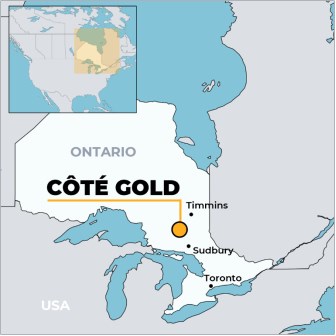 |
The Côté Gold Mine is located in the Porcupine Mining Division, 20 kilometres southwest of Gogama, Ontario. The Côté UJV property extends approximately 73 kilometres from Esther Township in the west to Garibaldi Township in the east and comprises a group of properties assembled through staking and option agreements covering a total area of about 596 square kilometres. The Côté Gold Mine's mining leases area forms a portion of the overall claim area. The Côté Gold Property is bisected by Highway 144 and is about 175 kilometres by road north of Sudbury via Highway 144 and 125 kilometres southwest of Timmins via Highways 101 and 144. The original Chester exploration property is located in the central portion of the mining leases area, which hosts the Côté and Gosselin deposits, as well as the Chester 1 zone and several other gold occurrences. IAMGOLD holds a significant land package which adequately covers the Côté Gold Mine and area outside the Côté Gold Mine mining leases. Overall, the Côté Gold Mine's property package consists of 2,976 tenures covering a surface area of approximately 59,591 ha (or 595.91 square kilometres). |
On April 27, 2012, IAMGOLD announced that it had entered into a definitive agreement with Trelawney to acquire, through a wholly owned subsidiary, all the issued and outstanding common shares of Trelawney through a plan of arrangement (the "Trelawney Transaction"). On June 21, 2012, IAMGOLD announced the acquisition of all issued and outstanding common shares of Trelawney, which were subsequently delisted. Trelawney Augen Acquisition Corporation, a subsidiary of Trelawney at the time of the Trelawney Transaction, became an indirectly wholly owned IAMGOLD subsidiary.
Following an amalgamation on June 1, 2017, all of IAMGOLD's interests in the groups of properties comprising the Côté Gold Mine are now owned by and registered in the name of IAMGOLD, with the exception of the 2294167 Ontario property, which property was previously held by 986813 Ontario Limited. Assets in 986813 Ontario Limited were assigned to 2294167 Ontario Inc. in October 2023 prior to its dissolution on December 14, 2023. 2294167 Ontario Inc. is an IAMGOLD subsidiary.
On June 20, 2017, IAMGOLD completed a transaction with SMM wherein SMM agreed to acquire a 30% undivided participating joint venture interest in the IAMGOLD's interest in the Côté Gold Mine property package. SMM's interest in the Côté Gold Mine is held by the SMM subsidiary SMM Gold Côté Inc. On December 19, 2022, (subsequent to the Côté Gold Report) IAMGOLD reached an agreement with SMM to amend the terms of the Côté Gold joint venture agreement with SMM and its subsidiary SMM Gold Côté Inc. Under the terms of the agreement, commencing in January 2023, SMM agreed to contribute $250 million, IAMGOLD's funding obligations to the Côté Gold Mine. As a result of SMM funding such amounts, IAMGOLD transferred a 9.7% interest in the Côté Gold Mine to SMM. Pursuant to the terms of the agreement, IAMGOLD has a right to repurchase such transferred 9.7% interest for an amount equal to the initial $250 million funding, plus a 9.7% of all capital and operating expenditures funded by SMM due to its increased ownership up to the achievement of commercial production and less the market value of 9.7% of the gold production up to achievement of commercial production. On December 2, 2024, the Company announced the return of its ownership in Côté to a 70% interest effective November 30, 2024, following the repurchase of the 9.7% interest of the Côté Gold Mine for $377.7 million.
The properties acquired through the Trelawney Transaction were the result of a number of agreements with third parties. These third parties may retain an interest in some of the properties within the Côté Gold Mine's property package either by way of an actual property interest or through royalty interests.
During the second quarter of 2025, Franco-Nevada Corporation ("Franco-Nevada") announced the acquisition of the pre-existing 7.5% gross margin royalty ("Gross Margin Royalty") on the Côté Gold Mine from a private third party for the total cash consideration of $1.05 billion. The payment calculation methodology of the Gross Margin Royalty remains economically unchanged from the prior agreement in place with the third party. Franco-Nevada granted an option to IAMGOLD and SMM to buy up to 50% of the Gross Margin Royalty at Franco-Nevada's attributable costs in two equal tranches of 25% over two and three years, respectively, in exchange for support in Franco-Nevada's detailed due diligence efforts.
IAMGOLD has regularly completed assessment work to maintain the claims in good standing.
Please see Section 4 of the Côté Gold Report for a detailed description of the terms of any royalties and other agreements to which the Côté Gold Mine is subject, as well as the tenure and expiration dates of the claims, licenses and other property tenure rights.
IAMGOLD is not aware of any environmental liabilities associated with or attributable to any of the subject property groups in the Côté Gold Mine area, other than those that would normally be expected as a result of historical mining activities and associated mine workings.
Legacy diamond drill ("DD") site remediation took place from 2013 to 2018 with 186 legacy drill sites remediated. This work comprised removal of historic debris, capping of drill casings, and attaching a marker flag to the casing.
A program of drill collar decommissioning took place between 2019 and 2020 in areas of planned Côté Gold Mine infrastructure. These drill holes were grouted to prevent ground water flow and the casings were removed.
IAMGOLD is not aware of any other risks that could affect access, title or its ownership interests in, or the right or ability to perform work on the Côté Gold Mine.
ii. History
Prospecting and exploration activity in the Côté Gold Mine area began circa 1900 and has continued sporadically to the present, spurred on periodically from exploration in the Porcupine and Elk Lake- Gowganda-Shiningtree camps. The first discovery of note was the Lawrence copper prospect on the east shore of Mesomikenda Lake in 1910. Further interest in the area was sparked in 1930 when Alfred Gosselin found outcropping gold mineralization on the east shore of Three Duck Lakes.
Historical work on the Côté Gold Mine's property package has been conducted in multiple stages:
• In the early 1940s extensive prospecting and trenching was conducted, in addition to the sinking of several shallow shafts and some minor production.
• Through to the late 1960s little or no work was performed.
• From the early 1970s to approximately 1990, extensive surface work was performed, in addition to some limited underground investigations.
• From 1990 to 2009, fragmented property ownership precluded any major programs.
• In 2009, a group of properties that became the Chester property was consolidated by Trelawney.
A significant number of gold showings have been discovered on the Côté Gold Mine's property package. Please refer to Section 6 of the Côté Gold Report for a detailed description of the history of the exploration and development at the Côté Gold Mine.
iii. Geological Setting, Mineralization and Deposit Types
The Côté and Gosselin deposits are located in the Swayze greenstone belt in the southwestern extension of the Abitibi greenstone belt of the Superior Province. The Abitibi Subprovince comprises Late Archean metavolcanic rocks, related synvolcanic intrusions, and clastic metasedimentary rocks, intruded by Archean alkaline intrusions and Paleoproterozoic diabase dykes. The traditional Abitibi greenstone belt stratigraphic model envisages lithostratigraphic units deposited in autochthonous successions, with their current complex map pattern distribution developed through the interplay of multiphase folding and faulting.
The Swayze greenstone belt, like the rest of the Abitibi greenstone belt, contains extrusive and intrusive rock types ranging from ultramafic through felsic in composition, as well as both chemical and clastic sedimentary rocks. All of the rock types within the Swayze belt are older than 2,680 Ma, with the oldest dating 2,748.2 Ma. Igneous lithologies predominate and include both volcanic and plutonic rocks. The latter are observed both internally in the supracrustal belts and externally, in large granitoid complexes. Sedimentary rocks occur predominantly near the top of the succession.
The Swayze greenstone belt underwent a complex and protracted structural history of polyphase folding, development of multiple foliations, ductile high strain zones, and late brittle faulting. The map pattern preserved within the Swayze greenstone belt is dominated by regional F2 folding, and anticlines and synclines with an associated S2 axial-planar foliation interpreted to have formed during orogen-wide shortening across the entire Superior Province. An important structural element is the RDZ, a major east- west high strain zone that is interpreted to be the western extension of the Larder Lake-Cadillac deformation zone of the Abitibi greenstone belt. The F2 Ridout Synform coincides with the RDZ wherein intense deformation is characterized by intense flattening, tight to isoclinal folding, transposition, and locally a component of dextral simple shear in east-southeast-striking zones. Metamorphic grade within the southern Abitibi greenstone belt ranges from sub-greenschist to greenschist.
The Côté and Gosselin deposits are situated within the Chester Township area, which overlies a narrow greenstone belt assemblage that extends easterly from the southeast corner of the Swayze greenstone belt to the Shining Tree area, approximately 60 kilometres to the east. The greenstone (supracrustal) assemblage is part of the well-defined Ridout syncline that separates the Kenogamissi granitoid complex to the north from the Ramsey-Algoma granitoid complex to the south. The Kenogamissi complex, yielding ages of 2,747 Ma, consists of sheet-like dioritic and tonalitic intrusions, which are interpreted locally to be synvolcanic. The CIC, which hosts the Côté and Gosselin deposits, is also synvolcanic and was emplaced along what is now the southern margin of the Ridout syncline. The CIC is a crudely stratified tonalite-diorite- quartz diorite laccolith containing numerous screens and inclusions of mafic volcanic rocks.
The Côté and Gosselin deposits are located with 1.5 kilometres of each other and are both hosted by the CIC. The deposits are similar in geological composition with a few key differences in terms of breccia rocks and alteration. Both deposits are centred on magmatic and hydrothermal breccia bodies that intrude tonalitic and dioritic rocks. The CIC intruded into the mafic volcanic rocks of the Arbutus Formation, which forms the basal formation in the Chester Group. The formation consists of low potassium tholeiitic pillow basalts, mafic flows, and sills. The intrusive host rocks formed from a number of pulses of several distinct and evolving dioritic and tonalitic magmas that display complex crosscutting relationships.
The Côté and Gosselin deposit type gold mineralization consists of low to moderate grade gold (±copper) mineralization associated with brecciated and altered tonalite and diorite rocks.
Several styles of gold mineralization are recognized within the deposit, and include disseminated, breccia hosted and vein type, all of which are co-spatial with biotite (± chlorite), sericite and for the Côté deposit silica-sodic alteration.
Disseminated mineralization in the hydrothermal matrix of the breccia is the most important style of gold (±copper) mineralization. This style consists of disseminated pyrite, chalcopyrite, pyrrhotite, magnetite, gold (often in native form), and molybdenite in the matrix of the breccia and is associated with primary hydrothermal biotite and chlorite after biotite.
Other mineralization styles that have been identified within the Côté Gold Mine area include orogenic or structurally-hosted vein occurrences, and syenite intrusion-related gold zones. The syenite intrusion-related gold zones are considered attractive exploration targets.
The Côté Gold Mine deposit is a new Archean low grade, high tonnage gold (± copper) discovery. It is described as a synvolcanic intrusion related and stockwork disseminated gold deposit. Deposits of this type are commonly spatially associated with and/or hosted in intrusive rocks. They include porphyry copper-gold, syenite associated disseminated gold and reduced gold-bismuth- tellurium-tungsten intrusion related deposits, as well as stockwork disseminated gold.
Certain features of the Côté deposit resemble those characteristics of gold rich porphyry deposits. These include:
• Emplacement at shallow (one to two kilometres) crustal levels, frequently associated with coeval volcanic rocks.
• Localized by major fault zones, although many deposits show only relatively minor structures in their immediate vicinities.
• Hydrothermal breccias are commonly associated with the deposits and consist of early orthomagmatic as well as later phreatic and phreatomagmatic breccias.
• Gold is fine grained, commonly <20 micrometres, generally <100 micrometres, and is closely associated with iron and copper-iron sulphides (pyrite, bornite, chalcopyrite).
The Gosselin deposit, similar to the Côté deposit, is also hosted in the synvolcanic CIC and most of its mineralization lies within hydrothermal breccia, diorite breccia, and tonalite units. Both the Gosselin deposit and the Côté deposit are classified as intrusion related disseminated gold deposits. Preliminary investigations completed on host breccias of the Côté deposit and the Gosselin deposit reveal that the Gosselin breccias resulted from fracturing and infiltration of fluids via fractures and veins. It is postulated that the combination of fracturing and fluid infiltration resulted in intense alteration through extensive fluid wall rock interaction, resulting in the formation of the breccia type appearance. Observations from the Gosselin deposit drill core reveal a spatial distribution of gold grades with increasing sericite alteration and associated with narrow quartz- carbonate-biotite-chlorite-pyrrhotite ± pyrite±chalcopyrite veins. Further work is planned to assess the detailed mineralogy and petrogenesis of the Gosselin deposit.
iv. Exploration
The Côté Gold Mine area is divided into three sectors for exploration purposes: (i) South Swayze West (western area), (ii) Chester (central area), and (iii) South Swayze East (eastern area).
Exploration programs to date have identified the Côté and the Gosselin deposits and have evaluated several nearby gold showings for their potential to be bulk-mineable gold deposits. Gold zones situated near the Côté and Gosselin deposits remain prospective for additional bulk-tonnage gold mineralization, and active exploration programs will continue to evaluate these targets.
Exploration programs to date have been sufficient to screen many areas for the presence of a Côté- style deposit, with grid line spacing and general traverse spacing of <200 metres (some areas <100 metres spacing for traverse/grid line density). Litho-sampling and geological mapping is representative over much of the land holdings within the Côté Gold Mine, with some exceptions where glacial till and lacustrine deposits form thick mantles on the bedrock. In areas of thick overburden, IP geophysical surveys and diamond drilling has helped screen these areas.
General results and conclusions from ongoing exploration work are summarized below by target area:
• South Swayze West: Côté-style tonalite and diorite hosted breccia zones have not been discovered to date. Exploration for syenite intrusion or shear zone hosted gold zones continues. The presence of Timiskaming-style basin sediments cut by porphyry intrusions and broad structural deformation zones provide a good environment for gold bearing vein networks.
• Chester Area: Southwest of the Côté deposit, gold mineralization was discovered in the Clam Lake area within similar host rocks and alteration styles to the Côté deposit. Sheeted sulphide veins have been mapped along the shoreline of Clam Lake and more recent regional exploration drilling intersected these same vein-types hosted within strongly altered tonalite. The area is considered to be highly prospective for gold mineralization. Northeast of the Gosselin deposit, gold mineralization occurs in narrow shear zones hosted in diorite and tonalite in the Jack Rabbit area, which also remains prospective for economic gold accumulations.
• South Swayze East: Gold mineralization discovered and investigated to date reveals only narrow and discontinuous shear zone hosted veins. The lack of Côté-style mineralization makes this area less favorable for the discovery of a bulk-tonnage gold zone.
v. Drilling
Côté
Core drilling activities at the Côté deposit began in 2009 and have comprised multiple phases, including exploration, infill, metallurgical, and condemnation drilling. A total of 808 drill holes totaling 327,433 metres have been completed within the Côté Gold Mine deposit area. In 2024, six new drill holes (three around the fault zone and three at greater depths below the pit) were added at the bottom of the Côté Pit, totaling 6,458 metres. Additionally, in 2025, 39 drill holes for a cumulative length of 20,624 metres were completed in the saddle area between the Côté Pit and Gosselin.
Core sizes have included the following: HQ (63.5-millimetre core diameter), NQ (47.6 millimetres), BQ (36.4 millimetres), and BQTW (36 millimetres). For holes drilled on land, the casing was left in place and capped. Holes drilled on lakes were cemented and the casing pulled.
Geologists checked all core boxes upon arrival at the core shack and ensured that no core was missing and any reported drill hole orientation information was provided from the drilling contractor. Technicians made meterage marks and logged rock quality designation (RQD). All core was photographed.
Geologists completed the core log, recording details of lithology, alteration, mineralization, and structure. The Côté database has core recovery measurements for 179 Trelawney drill holes and 423 IAMGOLD drill holes. Overall, the core recovery from the 2009 to 2025 programs was approximately 99%.
For oriented core, technicians drew the bottom of hole line on the core. A full line was drawn when orientation marks were perfectly aligned. Alpha and beta angles were measured for all veins and contacts when the bottom of the hole line was defined.
The collar azimuths for pre-2017 holes were established using front and back site markers located in the field with compass or GPS instruments. The collars are subsequently re-surveyed post- drilling. L. Labelle Surveys based in Timmins, Ontario has been responsible for collecting the survey measurements for Côté since 2009.
A FlexIT SmartTool instrument was used to collect down hole survey measurements for key index holes drilled between 2009 and 2013. A Reflex EZ-TRAC tool was used to collect down hole survey measurements for holes drilled between 2014 and 2019. Since 2024, Reflex has been used for deviation and TN14 for collar azimuth and dip.
DDH Drilling at Côté is typically oriented perpendicular to the strike of the mineralization. Depending on the dip of the drill hole and the dip of the mineralization, drill intercept widths are typically greater than true widths.
RC drilling began at Côté Gold in 2022 to enhance grade control and resource predictability. All RC holes follow the same QA/QC protocols as DDH and are valid for Resource updates. As of November 30, 2025, 4,434 holes totaling 225,370 meters have been added to Phases 0 and 1 of Côté pit development.
Gosselin
Exploratory DD at Gosselin was initiated in 2016 and following completion of five drill holes (2016 to 2017) resulted in a significant new discovery. Following the initial drilling period, successive drilling campaigns from 2018 to 2024 have been completed to delineate the Gosselin Mineral Resource and to complete the required in-fill drilling to support an initial Mineral Resource estimate.
Since completion of the initial Gosselin Mineral Resource estimate (effective October 4, 2021), IAMGOLD has been conducting drilling programs focused on evaluating the saddle area between the Côté and Gosselin resource pit shells and testing for extensions of mineralization along strike and at depth below the current Gosselin resource pit shell. A total of 18,809 metres (37 holes) have been completed between July 29, 2021, and November 13, 2022, and results reported. To further test the expansion opportunity of the Gosselin Resource, an additional twenty-one (21) DD holes totaling 16,554 metres were completed between January 20, 2023 and August 24, 2023. The results were incorporated into the Gosselin deposit model and used in a Mineral Resource estimation update with the effective date of February 15, 2024.
In January 2024, a 35,000 metre DD program was carried out, and achieved thirty-four (34) DD holes totaling 31,861 metres between August 19, 2023, and September 3, 2024. A total of 221 drill holes (91,046.97 metres) have been completed within the Gosselin deposit area up to September 3, 2024. From September 2024 through the end of 2025, an additional 65,569 metres of drilling were completed across 107 drill holes within the Gosselin deposit area focussing primarily on infill drilling of the resource.
Land and ice-based drill holes were NQ core size (47.6-millimetre core diameter), whereas barge-based drill holes were BTW core size (42-millimetre core diameter). Drill rigs employed wireline systems and generally oriented-core drilling techniques. For holes drilled on land, the casing was left in place and capped. Holes drilled on lakes were cemented and the casing pulled. Hole locations were provided to the Côté construction team who were responsible for decommissioning any collars within the mine infrastructure footprint. Decommissioning consisted of grouting of the collars with cement followed by removal of the casing and monuments.
Geologists checked all core boxes upon arrival at the core shack and ensured that no core was missing, and any reported drill hole orientation information was provided from the drilling contractor. Technicians made meterage marks and logged RQD. All core was photographed.
Geologists completed the core log, recording details of lithology, alteration, mineralization, and structure. For oriented core, technicians drew the bottom of hole line on the core. A full line was drawn when orientation marks were perfectly aligned. Alpha and beta angles were measured for all veins and contacts when the bottom of hole line was defined.
The Gosselin database has core recovery measurements for all 259 IAMGOLD drill holes. Core recovery is generally excellent with average recovery of 99.5%.
Both land and ice-based drill hole collars were initially positioned using a handheld Garmin 64s GPS with ± three metre accuracy. Prior to drilling on ice and barge-based platforms, Tulloch Geomatics was contracted to further correct the final collar locations using a Trimble R10 GPS receiver in Real Time Kinematic mode (vertical and horizontal accuracy of ± 0.03 metres). Land-based drill hole collars were surveyed by Tulloch Geomatics once drilling was completed.
On land and ice-based drill platforms, the collar azimuths were initially established by IAMGOLD geologists using front and back sight markers with a compass, then further refined with a Reflex North Finder APS (Azimuth Pointing System) tool. The Reflex APS is a GPS based tool that is not affected by local magnetic interference. On barge-based platforms, Tulloch Geomatics was contracted to mark the initial collar locations by placing marker buoys positioned with a Trimble R10 GPS receiver in Real Time Kinematic mode. Reflex APS was used to align the collar azimuths.
A Reflex EZ-TRAC tool was used to collect down hole survey measurements for holes drilled between 2018 and 2022.
The Gosselin deposit mineralization orientation varies in strike and dip locally. Actual core widths are estimated at approximately 60% to 95% of the core interval.
Regional Exploration Drilling
Outside the Côté Gold Mine deposit area and the Gosselin deposit area, regional DD in the period 2009-2024 comprised a total of 591drill holes for about 175,069 metres. DD methods employed during regional exploration drilling programs were very similar to methods used during Côté and Gosselin drilling. Programs generally employed the following methods:
• Drill core diameters were NQ (core diameter 47 millimetres) and BQTW (core diameter 42 millimetres).
• Drills employed wireline set-ups and stabilization equipment such as hexagonal core barrels and long remaining shells.
• Alignment of drill rigs was completed by compass sighting, Azimuth Pointing Equipment, and gyro-compass.
• For those programs that utilized drill core orientation methodology, the Reflex ACT III System was used.
• Drill collars were generally left in place following drilling and marked with casing caps and flags.
• Any drill collars in proximity to planned infrastructure were marked with wooden monuments, for easy identification should grouting be required.
• All drill holes completed on ice or water bodies by barge were cemented and the casings pulled.
vi. Sampling, Analysis and Data Verification
Sampling and Analysis
The Côté and Gosselin sampling intervals were established by reviewing the minimum and maximum sampling lengths based on geological and/or structural criteria. The minimum sampling length was 50 centimetres, while the maximum was 1.5 metres. The typical sample length in most of the mineralized zones is one metre.
From 2009 to 2012, density measurements for the Côté deposit were obtained using the immersion method. For 2014 and 2015, density was measured on pulps at Actlabs using a pycnometer. In 2018, additional measurements by water immersion and a comparison between the historical pycnometer and water immersion methods was completed to validate the optimum method. Lacquer sealed and uncoated water immersion pair measurements were also completed in 2018.
The primary laboratories used were:
• Côté Deposit - DDH
Accurassay (2011 to 2015), Timmins, Thunder Bay, (Ontario), accredited to ISO 17025 by the Standards Council of Canada, Scope of Accreditation 434.
ActLabs (2015 to 2018), Ancaster, Dryden, Timmins, Thunder Bay (Ontario), accredited to ISO 17025 by the Standards Council of Canada, Scope of Accreditation 266
MSALabs (2024 & 2025) Timmins (Ontario), accredited ISO/IEC 17025 & ISO 9001
• Côté Deposit - RC
SGS (2022 to 2024), Barnaby & Cochrane, Ontario, accredited ISO/IEC 17025:2017 by the Standards Council of Canada
• SGS (2024 & 2025) Côté Gold Site Laboratory. Currently under certification process.
• Gosselin Deposit
AGAT (2017 to 2018), Mississauga, Ontario, accredited to ISO 17025 by the Standards Council of Canada, Scope of Accreditation 665.
ActLabs (2016 to 2025), Ancaster, Timmins, (Ontario), accredited to ISO 17025 by the Standards Council of Canada, Scope of Accreditation 266.
All of the above laboratories are independent of IAMGOLD.
The umpire laboratories included:
• Côté Deposit - DDH
ActLabs (2012 to 2014): accredited to ISO 17025 by the Standards Council of Canada, Scope of Accreditation 266.
ALS, Val d'Or, Québec (2015): accredited to ISO 17025 by the Standards Council of Canada, Scope of Accreditation 689.
AGAT (2017 to 2018), Mississauga, Ontario, accredited to ISO 17025 by the Standards Council of Canada, Scope of Accreditation 665.
SGS (2024 & 2025) Côté Gold Site Laboratory. Currently under certification process
• Côté Deposit - RC
ActLabs (2022 to 2024): accredited to ISO 17025 by the Standards Council of Canada, Scope of Accreditation 266MSALabs (2024 & 2025) Timmins (Ontario), accredited ISO/IEC 17025 & ISO 9001
• Gosselin Deposit
These laboratories are all independent of IAMGOLD.
Côté Gold Mine
Sample preparation and analysis at Accurassay comprised the following procedures:
• Samples were crushed to -8 mesh after which a 1,000-gram subset of each sample was pulverized to 90% passing -150 mesh.
• Assays were completed using a standard FA with a 30-gram aliquot and an AA finish.
• For samples that returned values of 2 g/t Au to 5 g/t Au, another pulp was taken, and FA- gravimetric finish.
• Samples returning values >5 g/t Au were reanalyzed by pulp metallic analysis.
• All samples were subject to a 33 element inductively coupled plasma (ICP) scan, using Accurassay procedure ICP 580.
Sample preparation and analysis at ActLabs until 2017 comprised the following procedures:
• Samples were crushed to 10 mesh after which a 1,000-gram subset of each sample was pulverized to 85% passing 200 mesh.
• Assays were completed using a standard FA with a 30-gram aliquot and an AA finish.
• For samples that return values between 2 g/t Au to 5 g/t Au, another pulp was taken and assayed using the FA-gravimetric method.
• Samples returning values >5 g/t Au were reanalyzed by pulp screen metallic analysis.
In 2017, the ActLabs procedure changed and included:
• Sample preparation consisted of coarse crushing to 95% passing 2.8-millimetre screen (7 mesh screen), and then a 750 gram to 850-gram split was pulverized to 95% passing 100 mesh (150 micrometres). The entire sample had to be crushed.
• Samples were analyzed using a standard 50 grams FA (50-gram aliquot) with an AA finish.
• For samples that returned assay values >2.0 g/t Au, another cut was taken from the original pulp and subjected to FA-gravimetric analysis.
• For samples displaying VG or samples which returned values >20.0 g/t Au, a reanalysis using pulp metallic methods was undertaken. A second pulp (900 grams to 1,000 grams) was created from the reject. However, flagged VG samples still underwent the entire assay process.
Since 2024, DDH assayed at MSALabs
• Sample preparation consisted of coarse crushing to 80% passing 2.8-millimetre screen (7 mesh screen), and then a 450-gram split is produced. The entire sample had to be crushed.
• Samples were analyzed using a non-destructive Photon Assay method.
Umpire analysis at ALS, AGAT and ActLabs consisted of:
• Initial analysis using the FA-AA method.
• Overlimit assays using the FA-gravimetric method.
Umpire at SGS consisted of:
• Initial analysis using PAL method
• PAL Rejects were assayed with FAA
QA/QC insertion included SRMs, blanks and pulp duplicates as a standard procedure. IAMGOLD inserted control samples after every 12th sample interval. Over the Côté Gold Mine life, about 23 different SRMs and two types of blanks have been used. The IAMGOLD QA/QC protocol includes the use of blanks inserted in the sample stream at a frequency of approximately one in 24 samples.
Gosselin Deposit
Sample preparation and analysis at ActLabs consisted of:
• Samples were coarse crushed to 80% passing 2.0-millimetre screen (10 mesh screen), riffle split (250 grams) and (mild steel) to 95% passing 105 micrometres.
• Assays were completed using a standard FA with a 30-gram aliquot and AA finish.
• For samples that returned assay values over 3.0 g/t Au, another cut was taken from the original pulp and FA-gravimetric finish.
• For samples displaying VG or samples that returned values greater than 5.0 g/t Au, these were re- analyzed by pulp metallic analysis.
• IAMGOLD inserts blanks and certified reference standards in the sample sequence for QC.
The QC protocol used during the Gosselin drilling program includes the insertion of SRMs and blanks at a rate of 1 in 12 samples each. In addition, the remaining half of the cut core of every 20th sample was collected as a core duplicate starting at drill hole GOS19-30.
For the blank material, less than one percent of the submissions assayed above 0.05 g/t gold. The blank materials were considered acceptable. There was no evidence of systematic gold contamination.
Ten reference materials, obtained from OREAS, were analysed 3,716 times in regular sequence with the samples submitted to ActLabs. Reference materials were only analysed for gold with AAS finish. The Percent of Expected values for gold in all ten reference materials was between 99% and 100%. The reference material results for gold were considered acceptable. Based on the ± three standard deviation limits from the OREAS certificates, 220 failures were identified. This represents a 6% failure rate. After the analysis of repeat assays, the failure rate was reduced to 2%.
Approximately 5,300 core duplicates were collected and submitted for analysis. Forty percent of the duplicate pairs, above ten times the detection limit, report within ±25%. The results were typical of low-grade nuggetty gold deposits. There are large population of core duplicates for the Gosselin Deposit.
Beginning in 2024, IAMGOLD began selecting samples to be duplicated after the samples are crushed, for a total of 1,765 coarse duplicates, in addition to 542 coarse duplicates from the internal quality control by the laboratory, for a total of 2,307. 64% of the pairs, above ten times the detection limit, were within ±25% of each other. The coarse duplicates have the expected reproducibility for the type of deposit.
A total of 9,406 pulp duplicates were analyzed for gold by fire assay with AAS finish. Approximately 3,000 from the pulp reassay program, 4,100 from the internal quality control of the laboratory, and 2,202 selected by IAMGOLD. 75% of the pairs, above ten times the detection limit, were within ±25% of each other. The pulp duplicates have expected reproducibility for the type of deposit.
A total of 5,194 pulps from 2021 to 2025were submitted to AGAT for check assaying. The check assays agree well with 49% of the results assaying higher at ActLabs then AGAT. 60% of the pairs, above ten times the detection limit, were within ±25% of each other. This is similar to the pulp duplicate results.
Based on the provided quality control results, it can be determined that the Gosselin Deposit gold results are precise and accurate, there was no indication of systematic contamination or sampling issues. The results are acceptable to be used in resource estimation.
Sampling Storage and Security
For Côté, pre-2017 drill hole data previously stored in a GEMS database was moved to acQuire. All new drill hole collars were provided by surveyors and imported into GEMS and subsequently transferred to acQuire. All new logging was recorded directly into a GEMS database and subsequently transferred to acQuire. All new assay results were imported directly into acQuire and subsequently transferred to the GEMS database. For Gosselin, MS Access was used with custom forms and queries for data input and management.
Analytical samples are transported by IAMGOLD or laboratory personnel using corporately owned vehicles. Core boxes and samples are stored in safe, controlled areas. Chain of custody procedures are followed whenever samples are moved between locations, to and from the laboratory, by filling out sample submittal forms.
Drill core is stored on the Côté Gold Mine property in wooden core boxes under open sided roofed structures, arranged by year. Core boxes are labelled with the hole number, box sequence number, and the interval in metres. Almost all boxes are labelled with an aluminum tag. All rejects and pulps from the laboratory are also stored on site. Pulps are categorized by batch number and are stored inside sea containers. Rejects are stored inside plastic crates under temporary shelter.
QA/QC program results did not indicate any significant issues with the sampling and analytical programs. The QP was of the opinion that the quality of the analytical data was sufficiently reliable to support Mineral Resource estimation without limitations on Mineral Resource confidence categories.
Data Verification
Côté Gold Mine
The 2019 Côté drill hole database consisted of the 2018 Mineral Resource estimate data updated by SLR with files provided by IAMGOLD for the drilling performed since the 2018 Mineral Resource estimate. The drill hole information added to the database since the 2018 Mineral Resource estimate consisted of 4,882 samples from 38 drill holes, totalling 4,854.8 metres of core.
The 2018 Côté drill hole database had previously been validated internally by IAMGOLD and by Wood for the 2018 Mineral Resource estimate. In 2017, SLR, formerly Roscoe Postle Associates Inc., validated the Côté database during the preparation of a Mineral Resource update.
IAMGOLD's internal validation for the 2019 Côté drill hole database included checks on collar position, down hole deviation survey, drill logging information, sampling procedures, and assay data.
SLR compared the 2019 drill hole database against static versions of the previously validated 2017 and 2018 versions. Assay certificates for the samples collected since the 2018 Mineral Resource estimate were compiled and compared to the 2019 data. SLR noted that no issues were identified.
As part of standard procedures, SLR verified the 2019 database using the validation tools available in Seequent's Leapfrog and Geovia Gems. Checks on minimum and maximum values for various data fields, the presence of negative or zero values, and checks for the presence of unusual symbols were performed. Visual inspection of borehole traces and comparison of collars and topographic surfaces were performed, as well as checks for gaps in the logging and interval overlaps.
SLR carried out a site visit to the Côté deposit on October 7 to 8, 2019, and carried out outcrop observations, collar position check with a hand-held GPS, and a review of core handling, logging, and sampling procedures. Core from several drill holes was reviewed, covering the main lithologies and mineralization styles. Drill logs and assay results from the selected drill holes were compared against the core.
In 2023, Côté Gold geologists conducted a comprehensive internal audit of the database, comparing its contents with original logs and assay certificates.
Gosselin Deposit
The Gosselin deposit has been drilled by IAMGOLD since 2016. As the footprint of the mineralized zone increased, drilling proximal to Gosselin and adjacent deposits was used to complement the information collected during the Gosselin drilling campaigns. Historical drilling of the Gosselin deposit or nearby dates since 1987, with the bulk of the information collected after 2010. The Gosselin Mineral Resource estimation drill hole database has been maintained and updated by IAMGOLD personnel.
SLR carried out a site visit to the Gosselin deposit on July 19 to 21, 2021, to review the work performed at Gosselin. The review included stops at various outcrops and at working drill rigs on land and lake. Collar positions were measured with a hand-held GPS. Core handling, logging, sampling, assay methodology, and QA/QC protocols were reviewed. Relevant intervals of core from various holes were examined, comparing the logged information to the core. The assay results were reviewed along with the core for the mineralized intercepts.
The Gosselin drill hole database is maintained by IAMGOLD's exploration team in MS Access. Drill hole logs, assay certificates, deviation survey measurements, and density data are collected in data sheets, subjected to validation protocols, and then imported into the master MS Access database.
SLR verified the supplied drill hole data prior to commencing Mineral Resource estimation. The validation steps included checks of:
• Sample length.
• Maximum and minimum values.
• Negative values.
• Detection limit/zero values/unusual symbols.
• Borehole deviations.
• Interval gaps.
• Interval overlaps.
• Drill hole collar versus topography.
• Comparison of assay certificate versus database values.
IAMGOLD provided assay certificates for database validation. Values from 202 assay certificates were compared to the Gosselin database assay table. A total of 37,797 samples were matched, representing approximately 80% of the samples in the Gosselin database. SLR noted that no issues were identified. SLR recommended that the unified Gosselin resource database, in addition to the currently available details, be updated with information identifying the assay laboratory file source of the final gold value. This would enhance the auditability of the database content and facilitate tracking of the relevant certificate in the case of re-assayed sample batches.
Full access to all of the data required to conduct data verification work was available and there were no limitations on this work.
It was determined that the Gosselin drill hole database complies with industry standards and is adequate for the purposes of Mineral Resource estimation. Since 2024, QUALITAS has been mandated to audit the database to ensure accurate results were captured in the resource database. QUALITAS was also used to validate the transfer of Gosselin's data into the Côté Gold database to close the audit.
vii. Mineral Processing and Metallurgical Testing
Metallurgical laboratories involved with the test work programs included, SGS facilities in Lakefield, Ontario, COREM (a consortium composed of several mining companies and the Government of Québec), in Québec City, Québec, and the University of British Columbia.
Metallurgical test work completed since 2009 included, comminution (Bond low-impact (crusher), RWi and BWi, Ai, SMC, HPGR, piston press, and Atwal) tests, GRG tests, cyanide leaching (effect of head grade, effect of grind size, reagent usage, CIP modelling, cyanide destruction, solid-liquid separation and barren solution analysis) test work, development of recovery projections; and review of the potential for deleterious elements.
The comminution test work indicated that the material tested was very competent, and that the mineralization was well-suited to an HPGR circuit.
The mineralization is free-milling (non-refractory). A portion of the gold liberates during grinding and is amenable to gravity concentration and the response to gravity and leaching is relatively consistent across head grades. Therefore, the lower grade gold material is expected to exhibit the same level of metal extraction. Individual lithologies follow the general trends for grind size sensitivity and cyanide consumption, however, there is evidence of differences in free gold content. Silver content is consistently reported below 2 g/t Ag and the test work does not report on silver recovery.
Overall gold recovery is estimated at 91.8% for the processing at an initial rate of 35,500 tpd using the proposed flowsheet, with a later expansion to 37,200 tpd. Cyanide and lime consumption are quite low in comparison to what is typically observed in industry; however, this reflects the lack of cyanicides and other cyanide consuming elements. Lime consumption is also positively impacted by the basic nature of the ore.
Metal dissolution during cyanide leaching was found to be low, and there were no obvious concerns with deleterious elements.
Overall, metallurgical test results indicate that all the variability samples were readily amenable to gravity concentration and cyanide leach. Samples selected for metallurgical testing were representative of the various types and styles of mineralization within the different zones. Samples were selected from a range of locations within the deposit zones. Sufficient samples were taken so that tests were performed using adequate sample weights.
For the Gosselin deposit a preliminary test work program was complete in the summer of 2020. The comminution parameters and gold recovery were similar to those of the Côté ore. Cyanide and lime consumption were slightly higher for Gosselin material, due to the higher copper and sulphur content.
viii. Mineral Reserves and Mineral Resource Estimates
The MRMR estimates for the Côté Gold Mine can be located in the "Mineral Reserves and Mineral Resources of Gold Operations as of December 31, 2025" table in Section 4 of Item III below.
ix. Mining Operations
The Côté Gold Mine plan is designed as a truck-shovel operation assuming 212 tonne autonomous trucks and 34 cubic metre shovels. The pit design includes four phases to balance stripping requirements while satisfying concentrator requirements.
The design parameters include a ramp width of 36 metres, maximum road grades of 10%, bench height of 12 metres, berm height interval of 24 metres, geotechnical catch bench of 20 metres if height is greater than 150 metres, a minimum mining width of 40 metres, and variable slope angles and berm widths by sector.
The mine rock area (MRA), overburden stockpile, and ore stockpiles have been designed to ensure physical and chemical stability during and after mining activities. To achieve this, the storage facilities were designed to account for benching, drainage, geotechnical stability, and concurrent reclamation.
The Côté deposit is being mined in four phases included within the ultimate pit limit. The scheduling constraints establish a required ramp up of mining capacity to 57 Mtpa and the maximum number of benches mined per year at seven per phase.
The mine operates 24 hours per day, seven days per week (24/7 schedule), using four rotating crews working 12-hours shifts.
Mining operations use an autonomous truck and drill fleet, supported by a conventional operated loading fleet and a fleet of operated support equipment. The truck fleet is diesel-powered with the capacity to move approximately 60.0 Mtpa operating on 12 metre benches. The loading fleet includes two electric-powered hydraulic shovels, supported by four large diesel-powered front-end loaders (FELs). Primary mobile equipment will consist of:
• Loading - CAT 6060 electric/hydraulic (6060E) shovel and CAT 994K high lift FELs.
• Hauling - CAT 793F mechanical drive truck operated in autonomous mode.
Multiple contractors support the mine. A maintenance and repair contract (MARC) was put in place in 2023 for pre-production and the first three years of operation. Blasting is carried out by a contract down hole service during the LOM. A tire maintenance agreement was put in place in Q3 2022 to repair and change tires at the mine site.
Mining Summary
The Company's production at Côté Gold in 2026 is expected to be in the range of 390,000 to 440,000 ounces on a 100% basis (270,000 to 300,000 ounces on an attributable basis).
The following table indicates operating information for the Côté Gold Mine for 2024 and 2025:
Table 1: Operating Information for the Côté Gold Mine
| CÔTÉ GOLD MINE | 2025 | 2024 |
| Gold production (ounces)(1) | 399,800 | 199,000 |
| Ore milled (tonnes) | 10,889,000 | 4,948,000 |
| Grade milled (g/t Au) | 1.22 | 1.37 |
| Recovery (%) | 93 | 92 |
(1) The production attributable to the Company in 2025 was 279,900 ounces and in 2024 was 124,000 ounces.
x. Processing and Recovery Operations
The process circuits include primary crushing, secondary crushing, HPGR, ball milling, vertical milling, gravity concentration and cyanide leaching, followed by gold recovery by CIP, stripping and EW. Tailings handling incorporates cyanide destruction and tailings thickening. Plant throughput is 36,000 tpd at 92.6% utilization and was achieved in 2025. Preliminary test work has indicated that the Gosselin deposit is similar to the Côté deposit, however, additional test work is required to validate and confirm this.
The process plant design is conventional and uses conventional equipment. The process plant consists of:
• Primary (gyratory) crushing.
• Secondary cone crushing and coarse ore screening.
• A coarse ore stockpile.
• Tertiary HPGR crushing.
• Fine ore screening and storage.
• Two milling stages (ball mill followed by vertical stirred mills).
• Gravity concentration and intensive leaching.
• Pre-leach thickening.
• Whole ore cyanide leaching.
• CIP recovery of precious metals from solution.
• Cyanide destruction.
• Tailings thickening.
• Elution of precious metals from carbon.
• Recovery of precious metals by EW.
• Smelting to doré.
In December 2025, installation and start-up of a second cone crusher was completed for improved crushing stability and throughput.
The processing plant has facilities for carbon regeneration, tailings thickening, and cyanide destruction.
Water from the mine water pond is the primary source of mill water, providing the majority of the processing plant requirements, whereas the plant site pond and other collection areas are used as secondary sources of process water. Fresh water required for reagent mixing at the processing plant is pumped from Mesomikenda Lake.
The primary reagents include flocculant, sodium hydroxide, cyanide, copper sulphate, liquid sulphur dioxide, anti-scalant, lime, hydrochloric acid, and oxygen.
The mill requires approximately 54 MW of power to operate at full capacity.
xi. Infrastructure, Permitting and Compliance Activities
Infrastructure
Côté Gold infrastructure includes:
• Open pit.
• MRA and stockpile facilities.
• TMF.
• Permanent camp.
• Emulsion plant.
• Process facilities.
• Workshop, offices, facilities, and other services.
• Watercourse realignment dams and channels.
• Oshki Lake created to compensate for the loss of Côté Lake habitat.
• Storm/mine water, polishing, and tailings reclaim ponds.
• Collection, surplus water discharge, and dispersion systems.
• Two-lane gravel access road.
• Transmission line from Timmins to Shining Tree Junction and a 44 kilometre long 115 kV electrical power transmission line from Shining Tree Junction to the Côté Gold Mine site.
• Electrical distribution network.
Access to the Côté Gold Mine is via the existing Chester Logging Road which has already been upgraded from the Sultan Industrial Road, 4.62 kilometres, at the intersection with an existing road to the open pit area. The upgraded road is nine metres wide and serves as the main access to the mine site. From the upgraded road to approximately the southeast corner of the TMF, Chester Logging Road was upgraded to a 10-metre design width. At the corner of the planned TMF site, the existing road continues into the footprint of the TMF, and a new road of 4.28 kilometres was constructed to extend the access to the permanent camp entrance.
Mining activities are carried out via three major haul roads, consisting of access to the MRA, the TMF, and the topsoil/overburden stockpile. The site layout includes three major watercourse crossings. Roads are designed with a crossfall from side to side (as opposed to a central crown), such that the runoff from the entire road surface is discharged to another developed drainage area on one side of the road, such as the processing plant site, the reclaim water pond basin, the TMF, MRA, Polishing Pond, or the open pit itself.
The Côté Gold Mine is supplied with 115 kV power via a new 44 km overhead line from Hydro One's Shining Tree Junction. Upstream, a refurbished and restrung 118 km, 115 kV line delivers power from the Timmins Transformer Station (TS). The mine's electrical load is as follows:
• 65 MW available capacity.
• 43.5 MW average baseline usage.
• 47 MW highest peak hour to date.
• 98% lagging (inductive) power factor.
This load includes two electric shovels, mine dewatering and all ancillary loads. Hydro One has allocated a total of 72 MW of capacity to the Côté Gold Mine. Emergency backup power is available from four diesel standby generators, sized to provide essential power to the process and ancillary electrical equipment. The four 1 MW prime gensets, located in the main substation area, are 600 V rated and are stepped up to 13.8 kV to be distributed around the site.
Environmental Considerations
An EA was completed for the Côté Gold Mine under the Canadian Environmental Assessment Act, 2012. An EA Decision Statement was issued by the Federal Minister of Environment and Climate Change Canada on April 13, 2016, and a Notice of Approval was issued by the MOECC on December 22, 2016. Following project modifications and a review of environmental effects, a revised decision statement was issued in 2018.
Over the 15-year mine life, tailings production is approximately 14.5 Mtpa, except in the next 4 years which should average 13.3 Mtpa. The TMF will store 203 Mt of tailings over the LOM. There is a potential for additional tailings storage in the current TMF layout. The tailings perimeter dams could be raised by approximately seven metres which would increase the capacity of the current TMF capacity to approximately 233 Mt. Engineering and detailed design will need to be conducted to achieve the additional storage capacity.
Tailings are thickened to between 60% to 62% solids concentration in slurry and discharged from the TMF perimeter dams, forming an overall beach slope of approximately 0.5% (Year 1) to 1% (Year 2 to 16). Tailings solids settle in the TMF with pore water retained in the voids and supernatant water forming a pond. Perimeter embankment dams, raised in stages, will be used for tailings management throughout the LOM.
TMF water is pumped from the tailings pond and East Seepage Collection Pond directly to the mill for reuse, operating in a closed circuit. Collection ditches and ponds are located at topographical low points around the TMF perimeter to collect runoff and seepage. Collected runoff and seepage is returned to the TMF for reuse.
Water quality is monitored prior to discharge to the TMF. Water quality is also monitored in the TMF reclaim pond and at various points in the seepage collection system. Groundwater quality is monitored at wells surrounding the TMF, downgradient of the seepage collection system.
A watercourse realignment system was designed to redirect water around the mine facilities to enable excavation and dewatering of the open pit. Three pit protection dams were constructed within Clam Lake on the west side of the open pit. These dams will prevent water from entering the pit. Two realignment channels were constructed to reroute the Mollie River which originally flowed through the footprint of the open pit.
The Polishing Pond East Dam is constructed in the Three Duck Lakes (Upper) area to separate the lake from the Polishing Pond area. The Côté Lake dam facilitates dewatering of Côté Lake and separates the Three Duck Lakes system from Côté Lake. A mine water pond near the processing plant receives pumped inflows from the pit and runoff from a portion of the process plant site and a portion of the ore stockpiles. Runoff from a portion of the ore stockpiles and MRA reports to the Polishing Pond via perimeter ditches and pumping systems.
Closure of the Côté Gold Mine is governed by the Mining Act (Ontario) and its associated regulations. The mine production closure plan was originally filed in 2018. Since that date, several amendments have been filed by the Ministry of Energy and Mines to reflect site changes and requirements for the construction of offline dams.
Conventional methods of closure are expected to be employed at the Côté Gold Mine site. The closure measures for the TMF will be designed to physically stabilize the tailings surface to prevent erosion and dust generation. The pit will be allowed to flood through active and passive measures, and the natural flow of the realigned water bodies will be re-established to the extent practicable. Revegetation trials will be carried out using non-invasive native plant species. Monitoring at appropriate sampling locations, including those established during baseline studies and operations, will continue after closure until stabilized and to confirm conformance prior to release.
The Ministry of Energy and Mines requires financial assurance for implementation of the closure plan. A closure cost estimate is included in the operating cost estimate of the Côté Gold Mine closure plan and is reviewed and updated as required.
Permitting Activities
Most mining projects in Canada are reviewed under one or more EA processes whereby design choices, environmental impacts, and proposed mitigation measures are compared and reviewed to determine how best to proceed through the environmental approvals and permitting stages. Entities involved in the review process normally include government agencies, municipalities, Indigenous groups, the general public, and other interested parties.
Following completion of the provincial and federal Environmental Assessments, a number of provincial and federal environmental approvals processes were commenced in 2018 as required to construct and operate the Côté Gold Mine. From 2018 to 2022, the Company received key environmental approvals required for the construction and operations phases of the Côté Gold Mine which included, but not limited to, the mine closure plan, Fisheries Act Authorization, and environmental compliance approvals. Additional permits/authorizations and any required amendments to existing approvals continue to be received to support ongoing site development and changes. Required permits and authorizations are not expected to pose a material challenge to the Côté Gold Mine.
Social Considerations
IAMGOLD actively engaged Indigenous, local and regional communities, as well as other stakeholders, to gain better understanding of their issues and interests, identify potential partnerships, and build social acceptance for the Côté Gold Mine. Stakeholders involved in Côté Gold Mine consultations included those with a direct interest in the Côté Gold Mine, as well as local and regional communities identified through the baseline studies.
Engagement with rightsholders and stakeholders will continue throughout the various Côté Gold Mine stages. The range of stakeholders is expected to evolve over time, to reflect varying levels of interest and issues.
As part of the Provincial conditions of EA approval, IAMGOLD developed and submitted a Community Communication Plan to the responsible Provincial ministry, outlining its plan to communicate with stakeholders through all phases of the Côté Gold Mine.
IAMGOLD worked collaboratively with the community of Gogama on the development of a socio-economic management and monitoring plan to manage potential socio-economic effects of the Côté Gold Mine (both adverse and positive). The plan was developed in 2020, and implementation began in 2021 and has continued through construction and early operations.
An understanding of the Indigenous communities potentially interested in the Côté Gold Mine was first developed through advice from the Province of Ontario to the previous property owner Trelawney in a letter dated August 19, 2011, and through advice from the CEAA (now the Impact Assessment Agency) based on information provided by Aboriginal Affairs and Northern Development Canada (now Crown-Indigenous Relations and Northern Affairs Canada). IAMGOLD sought further direction from both Provincial and Federal Crown agencies on the potentially affected communities.
Based on Federal and Provincial advice and information gathered through engagement activities, IAMGOLD engaged a range of Indigenous groups during the preparation of the EA. IAMGOLD has continued to engage the identified communities through information sharing (e.g., newsletters, notices, invitations to open houses, various permit applications), and focuses on actively engaging affected communities identified in the Federal Decision Statement and Provincial Conditions of Approval. Côté Gold is located on Treaty 9 Territory, on the traditional lands of Mattagami First Nation and Flying Post First Nation, and within the traditional harvesting area of the Métis Nation of Ontario, Region 3. IAMGOLD signed IBAs with the Mattagami First Nation and Flying Post First Nation in April 2019 and with the Métis Nation of Ontario (Region 3) in May 2021.
As part of the Provincial and Federal conditions of EA approval, IAMGOLD developed and submitted an Indigenous Consultation Plan to the responsible government departments, outlining the Côté Gold Mine's plan to consult with identified Indigenous groups throughout all phases. IAMGOLD consulted all identified Indigenous groups as part of the development of the Indigenous Consultation Plan, as required.
IAMGOLD committed to work with the communities of Mattagami First Nation and Flying Post First Nation to collaboratively develop a socio-economic management and monitoring plan to manage potential socio-economic effects of the project (both adverse and positive). This plan was developed collaboratively with the communities and implementation began in 2021. The monitoring committee, comprised of members of each community and IAMGOLD, meets quarterly.
xii. Capital and Operating Costs
Capital Costs
For 2025, on a 100% incurred basis, capital expenditures totaled $186.1 million. Sustaining capital expenditures totaled $148.0 million, including $46.0 million of capital projects related to operational improvements and ramp-up, $37.4 million of tailings expansion and related earthworks, $36.9 million of mobile equipment and critical spares, $21.1 million of capitalized stripping, and $6.6 million of other capital projects. Expansion capital of $33.6 million was primarily associated with the installation and commissioning of the additional secondary cone crusher during the fourth quarter of this year.
A technical report outlining the expansion plans for Côté is expected to be announced in the fourth quarter 2026.
Operating Costs
Operating costs are based on the Côté Gold Report. Total operating costs over the LOM are estimated to be $4.073 million. Mining (excluding CWS) and processing costs represent 35% and 46% of this total, respectively. Average operating costs are estimated at $17.48/t of processed ore. A technical report outlining the expansion plans for Côté is expected to be announced in the fourth quarter 2026.
Table 2: Côté Gold Mine: Total Operating Costs Over the LOM
| Cost Area | Total (millions) | Percent of Total |
| Mining Operating (excl CWS) | 1,445 | 35 |
| Processing | 1,856 | 46 |
| G&A | 772 | 19 |
| Total | 4,073 | 100 |
Table 3: Côté Gold Mine: Average Unit Operating Costs
| Cost Area | $/t of processed ore |
| Mining (excl CWS) | 6.20 (8.49 if CWS included) |
| Processing | 7.97 |
| G&A | 3.31 |
| Total | 17.48 |
Mining quantities were derived from first principles and mine phased planning to achieve the planned production rates. Mining excavation estimates were based on geological studies, mine models, drawings, and sketches. Mine costs generally increase with time as the pit increases in depth and the MRA increase in height.
Process operating costs estimates were developed from first principles, metallurgical test work, IAMGOLD's salary/benefit guidelines, and vendor quotations, and benchmarked against historical data for similar processing plants. The process operating costs include reagents, consumables, personnel, electrical power, and laboratory testing. The consumables accounted for in the operating costs include spare parts, grinding media, and liner and screen components. Process operating costs over the LOM are estimated to average $7.97/t of processed ore. G&A costs averaging $3.31/t of processed ore over the LOM were developed from first principles and benchmarked against similar projects.
Royalties, that varies depending on gold price, the amount of expenditure that can be deducted and the source of the ore within the pit, and management fees and allowances to meet commitments to stakeholders, total $483 million over the LOM or average $2.07/t processed. The amount of royalties paid are dependent on the gold price assumptions and the ability of the Company to deduct certain expenditures when calculating the royalties. Reclamation and closure costs are estimated to total $83 million, distributed annually from early in the mine life until post-closure. This is based on a detailed closure cost estimate prepared as part of the 2018 Feasibility Study, adjusted to include an allowance for security bond fees and a credit at the end of mine life to account for the estimated salvage value of equipment and materials. This was also adjusted for inflation to bring the estimate to 2022 dollars.
1.2 WESTWOOD COMPLEX
Unless stated otherwise, the information in this section is based upon the technical report (the "Westwood Report") titled "Technical Report on the Westwood Complex, Quebec, Canada" with an effective date as of September 30, 2024, prepared by Bernard Haley, Abderrazak Ladidi, Martin Perron, Louis Nkoy Manda Mbomba, Ali Jalbout and Steve Pelletier, dated January 9, 2025.
Portions of the following information are based on assumptions, qualifications and procedures, which are not fully described herein. Reference should be made to the full text of the Westwood Report, which is available for review on the Company's issuer profile on SEDAR+ at www.sedarplus.ca and EDGAR on www.sec.gov.
i. Property Description, Location and Access
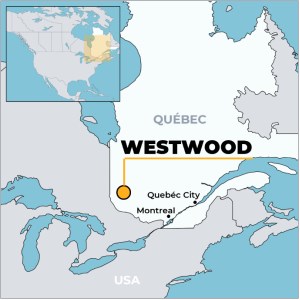 |
IAMGOLD holds a 100% interest in the project, which consists of two property areas, Doyon-Westwood and Fayolle (the "Westwood Project"). The Westwood Project is located in the province of Québec, Canada at a latitude of 48°15′ N and a longitude of 78°30′ W. The Doyon-Westwood property includes the Westwood underground mine (Westwood) and Grand Duc open pit (Grand Duc), (collectively, the "Westwood Complex"). The Westwood and Grand Duc deposits are located in the municipality of Preissac, Bousquet Township, approximately 40 kilometres east of the town of Rouyn-Noranda and 80 kilometres west of the town of Val d'Or. The Westwood shaft is located at 48°15'20.6"N 78°30'07.9"W and the Grand Duc pit is located at 8°15'30.8"N 78°32'27.6"W. There are previously operating mines in the Westwood Project area, the most significant of which are Doyon and Mouska situated 1.7 kilometres and 4.8 kilometres west of the Westwood mine respectively. The Westwood Complex is wholly-owned by IAMGOLD. The Westwood Complex extends over about 8 kilometres east-west by approximately 5 kilometres north-south, and comprises 80 mineral titles, covering an area of 3,294.57 ha, of which five are mining leases (bail minier or BM), and 75 are map-designated cells (cellule désignée sur carte or CDC). |
The mineral tenure held is valid and is sufficient to support MRMR estimation. Surface and water rights are granted, and sufficient to support mining operations. The Westwood Complex is not subject to any royalties or any other encumbrances. IAMGOLD is in discussions relating to potential royalty payments to First Nations. To the extent known by the authors of the Westwood Report, there are no other significant factors or risks that may affect access, title, or the right or ability to perform work on the property.
The Westwood Complex consists of, among others, one mining lease for the Westwood mine and a granted mining lease located west of the past producing Doyon mine (B.M. 1046), also called Grand Duc and registered in 2017; one mining lease for the past producing Doyon mine (B.M. 695); two mining leases for the past producing Mouska mine (B.M. 800 and 843); and 75 claims. Three tailing surface leases (P.R. 999780, P.R. 999794 and P.R. 999803) are superimposed over parts of the Westwood Complex. The Company is the titleholder's name of all the claims and leases at 100% and all Westwood Complex property claims and leases are located in Bousquet Township.
The Westwood Complex is located on Arthur Doyon Road, 4 kilometres east of the intersection of the Saint-Norbert-de-Mont-Brun Road and Arthur Doyon Road. The Grand Duc open pit is accessed by the original Arthur Doyon access road on site which connects the Saint-Norbert-de-Mont-Brun road, to the Doyon office buildings. The Westwood shaft is accessed by a service/haulage road that was built between the headframe and Doyon office building.
There are no major access restrictions for exploration purposes. Typically, access is possible across all of the Westwood Project area using pick-up trucks or off-road four-wheel drive vehicles.
In 2020, IAMGOLD acquired the Fayolle property from Monarch Gold Corp. The Fayolle property is located in Aiguebelle and Cléricy townships, approximately 35 kilometres northeast of Rouyn-Noranda, Québec, and approximately 40 kilometres northwest of the Westwood mine. The approximate centre of the Fayolle property area is at a latitude of 48°26′ N and a longitude of 78°48′ W (NAD 83, Zone 17). The Fayolle property is less than 1 kilometre from the provincial "Parc national d'Aiguebelle" (Aiguebelle National Park). The Fayolle property area is accessible via Chemin de la Montagne from Saint-Norbert-de-Mont-Brun.
The Fayolle property consists of 42 mineral titles covering an area of 1,382.62 ha in Aiguebelle and Cléricy townships, of which one is a mining lease and the remaining 41 titles are map-designated cells.
Globex Mining Enterprises Inc. holds a 2% net smelter return royalty on the mineral claims within the Fayolle property.
ii. History
Prior to IAMGOLD having an interest in the Westwood Project, numerous companies had conducted exploration in the Westwood Complex property area in the period between 1910-2006, and in the Fayolle property area from 1946-2019. Work completed included prospecting, geological mapping, geochemical sampling, geophysical surveys, metallurgical testwork, surface and underground core drilling, MRMR estimates, engineering studies, and mining operations.
IAMGOLD obtained its interest in the Westwood Complex property in 2006 and in the Fayolle property in 2020. Work completed by IAMGOLD included metallurgical testwork, surface and underground core drilling, MRMR estimate, engineering studies, and mining operations. The Westwood mine has been in operation since 2014, when commercial production was declared, and Grand Duc since 2019. Operations at Fayolle ran from early 2023 to mid-2024.
iii. Geological Setting, Mineralization and Deposit Types
The deposits in the Westwood Project area are examples of greenstone-hosted orogenic gold deposits. The Westwood and Grand Duc deposits also include characteristics of gold-rich volcanic massive sulphide (VMS) deposits.
The Westwood Project is situated within the Southern Volcanic Zone of the Abitibi sub-province, part of the Archean Superior Province. The Abitibi Subprovince is divided into the Southern and Northern Volcanic Zones, which are separated by the Porcupine-Destor-Manneville Fault Zone. A second major fault system, the Cadillac-Larder Lake Fault Zone, separates the Southern Volcanic Zone from the sedimentary rocks of the Pontiac Terrane accretionary prism to the south.
Gold mineralization in the Southern Volcanic Zone forms major mineralized deposit clusters within mining districts. Such mining districts include the Doyon-Bousquet-LaRonde mining camp that hosts the Westwood and Grand Duc deposits.
The Southern Volcanic Zone consists of an Archean volcano-sedimentary assemblage divided into three volcanic groups and two sedimentary groups. Rocks have typically been metamorphosed to greenschist to sub-greenschist facies, with amphibolite facies in the vicinity of the intrusive plutons.
The Westwood deposit is approximately 1.9 kilometres long by 500 metres wide, generally trending east-west and dipping steeply south. Mineralization has an average thickness of 1.7 metres. The deposit has been drill tested to an approximate 2.5 kilometres depth. It remains open at depth and to the west. Mineralization in the Westwood area forms three easterly-trending, strongly deformed (D2 flattening and stretching), steeply south-dipping corridors that are stacked from north to south: the Zone 2 Extension, North, and Westwood Corridors. Mineralization styles include gold-bearing VMS-type lenses, quartz veins, and disseminated sulphide zones.
The Grand Duc deposit is about 620 metres long in the east-west direction, by 300 metres wide. Mineralization has an average thickness of 30 metres. The deposit has been drill tested to 250 metres depth. It remains open to the west and east. Mineralization at Grand Duc is associated with a miarolitic facies within trondhjemite. Gold mineralization occurs in veins, fracture fills, as disseminations, and in foliation-parallel pyrite bands.
The Northern Volcanic Zone consists of basaltic to andesitic and dacitic volcanic rocks, co-magmatic sills, mafic-anorthositic plutonic intrusive rocks, and felsic pyroclastic rocks co-magmatic with tonalitic intrusive plutons. The Southern Volcanic Zone is interpreted to have formed in a series of rift basins that dissected the Northern Volcanic Zone. The Southern Volcanic Zone includes komatiitic to tholeiitic volcanic rocks and large, bimodal, mafic-felsic volcanic centres that have been intruded by granitoid bodies and layered complexes.
The Abitibi sub-province has a prominent east-west structural trend due to regional easterly-trending folds with an axial-planar schistosity. The schistosity displays local variations in strike and dip, which are attributed to either oblique faults cross-cutting the regional trend, or deformation aureoles around resistant plutonic suites. Gold mineralization forms major mineralized deposit clusters within mining districts. Such mining districts include the Doyon-Bousquet-LaRonde mining camp that hosts the Westwood and Grand Duc deposits.
Mineralization styles within the mining districts have been sub-divided into six types:
• Type 1: quartz + carbonate veins found in deformation zones with strong iron carbonate, sericite, and pyrite alteration, characteristic of orogenic deposits.
• Type 2: disseminated sulphides associated with a porphyritic intrusion (subtype 2a = calcalkaline intrusion; subtype 2b = alkaline intrusion).
• Type 3: epithermal veins with open-space crystallization textures and anomalous concentrations of Zn, Pb and Hg typical of neutral epithermal mineralization.
• Type 4: argentiferous quartz-filled extension veins rich in Cu, Sb, Zn and Hg, analogous to Ag- Pb-Zn veins enclosed in clastic metasedimentary rocks.
• Type 5: disseminated sulphides associated with leaching represented by a massive quartz + pyrite (5-10%) residue reminiscent of acidic epithermal deposits; Type 6: volcanogenic massive sulphide (VMS) showings associated with quartz + pyrite + chalcopyrite replacement in basaltic flow breccia.
iv. Drilling
As at December 31, 2025, the total combined surface and underground core drilling in the Doyon, Grand Duc, Mouska, Westwood and Fayolle mining areas and surrounding tenures totalled 29,665 drill holes for 3,993,121 metres of drilling from surface and underground.
All drilling within the Fayolle property was completed prior to the Company's property interest. The Company completed no drilling on the property other than geotechnical support holes.
Drill holes were completed for exploration, infill, MRMR estimation, geotechnical, hydrological, condemnation and metallurgical purposes.
The close-out date of the Westwood database is December 31, 2025. The Mineral Resource estimate is based on 6,671 core drill holes (1,390,506 metres) drilled from surface and underground between 1938- 2025.
The close-out date of the Grand Duc database is November 15, 2023. Mineral Resource estimation is based on 650 core holes (104,799 metres drilled). There has been no additional drilling since the database close-out date.
v. Sampling, Analysis and Data Verification
Westwood Complex
Core samples are collected at drilling sites and are stored in closed wooden core boxes. They are delivered to the core shack facility by the drill contractor or by the mine personnel. The core boxes are received by mine geology technicians. The core shack facilities is located at the surface, in the vicinity of the technical services offices.
All core logging and sampling takes place in the core shack. Prior to logging, drill core measurements (wooden blocks) are verified. If major offsets are observed, they are corrected with the representative of the drilling company. Then after core measurement, marks are drawn onto the core.
During logging, the geologist selects and indicates sample intervals by marking the beginning and end of each sample interval on the core. The geologist places two tags for the same sample ID at the end of each sample interval for assaying and inputs the analyses required for that sample into the database. A third sample tag remains in the booklet for reference.
Core is typically whole-core sampled; however, at the geologist's discretion, the core can be marked up for half-core sampling. Core is photographed prior to sampling. Splitting and sampling is completed by experienced technicians. A table-feed circular core saw is used to cut the core in two equal parts when requested. One half remains in the core box with its sample tag. The second half is put in a plastic bag with its related tag. Otherwise, the whole core is taken as the sample and is placed in a plastic bag with its tag.
All plastic bags are identified with the sample number manually written on the bag as the sample tag. The sample bag is put in a box, listed in the database, and then delivered to the laboratory along with a submittal sheet that indicates the type of analysis to be performed on each sample.
Exploration drill holes were sampled as follows:
• Samples within the upper tuffaceous mafic/intermediate volcanic rocks hosting Zone 2 were halved, with one half sent to the laboratory and the second half retained as a reference sample.
• Samples within the Hebecourt Formation, in tholeiitic quartz (feldspar) phyric felsic rocks and the lower part of the tuffaceous mafic/intermediate volcanic rocks hosting Zone 2 consisted of wholecore.
In mineralized zones, the initial definition drill holes were sampled depending on the requirements at the time:
• Core halved, with one half of the core sent to the Doyon plant for acid generation and flotation tests, and the second half sent for laboratory analysis.
• Core halved, with one half sent to the laboratory and the second half retained as a reference sample.
• 100% core sent for analysis.
Samples varied in length but were typically 1 metre long in mineralization and 1 to 1.5 metres long outside known mineralized zones. Currently, the core sample lengths vary, depending on sample location. The general intent is to sample either side of a mineralized zone to obtain a grade over an actual thickness of at least 3 metres encompassing the vein.
The same sampling methods are used for Grand Duc core samples.
The mine site is monitored by closed-circuit video cameras and has a security crew always posted at the entrance. The core shack is in an area restricted to the geology department personnel and entry is controlled via a digital key.
Typically, only selected portions of core holes are retained. These samples are stored on site at the Doyon mine, in a secured area.
Drill core rejects and pulps from significantly mineralized zones are retained on a monthly basis and can be used in re-assay and check assay programs.
Since January 1, 2017, assaying of Westwood core samples are performed by external laboratories, principally, ALS Chemex, located in Val-d'Or, Québec. The laboratory is independent of the Company. ALS Chemex has ISO 9001:2008 certification and ISO/IEC 17025:2005 accreditation for selected analytical techniques.
From time to time, samples are sent to Laboratoire Expert Inc., a laboratory located in Rouyn-Noranda, Québec. Laboratoire Expert is independent of the Company and is not accredited. All production samples were prepared at Actlabs in Val d'Or and sent to Laboratoire Expert for analysis. This Actlabs facility is independent of the Company and is not accredited.
From May 2022 onward, MSALABS in Val d'Or, Québec was used for analysis of production samples. MSALABS is independent of the Company and was not accredited during the initial use period. MSALABS obtained ISO/IEC 17025 accreditations for selected analytical techniques in August, 2023.
Actlabs in Sainte-Germaine-Boulé, Quebec was used as the check laboratory from 2020-2024. This Actlabs facility is accredited to ISO/IEC 17025:2017 and is independent of the Company.
Selected production samples could be prepared at the Actlabs Val d'Or facility and analyzed at the Sainte-Germaine-Boulé facility.
In IAMGOLD's opinion, the sample preparation, analysis, quality control, and security procedures used at the Westwood and Grand Duc operations are sufficient to provide reliable data to support estimation of Mineral Resources and Mineral Reserves and can be used in mine planning.
RC grade control drill holes at Grand Duc are typically sampled as four 2.5 metre sample intervals, with the samples taken from cuttings collected in sample pans. Selective production sample drilling is done at 2.5 metre intervals. Blast hole sampling is conducted at 5 metre intervals.
Underground drilling results are validated during the ore development at Westwood by face chip and muck samples. The samples are taken in every one to two faces with a sample interval from 1 to 1.5 metres wide.
Internal data verification includes the use of software tools that employ a set of scripts that identify and display any inconsistent data related to Westwood Project logging rules. Picklists, look-ups, and formulae within the logging capture template help prevent missing or overlapping interval entries and entry of bad codes. Validation query sets, within the database, evaluate the completeness/integrity of the data set for any given drill hole within and between data tables, looking for issues such as overlapping and missing intervals, duplicate sample IDs, and distance-length validations based on the drill hole total length. Database administrators validate every import to verify that all data has been correctly imported and that no data is missing. Additional verification by site personnel includes comparing original source data against the data in the database. Where errors or omissions were noted, these were corrected as required.
Previous to the latest Technical Report filed in 2025, technical reports were filed on the Westwood Project in 2009, 2012, 2016, and 2020. As part of the compilation of those documents, the QPs at the time reviewed the available QA/QC and supporting data. No material data issues were noted as a result of these reviews.
In 2022, SLR was retained to perform a review of the Mineral Resource estimates. No material issues were identified. Recommendations from the review were incorporated into resource updates as relevant. As the 2022 estimate was the first estimate reported where a portion of the zones were estimated using multiple-indicator kriging (MIK), an additional review was completed by Red Dot, a third-party consultant. No material issues were identified. Recommendations from the review were incorporated into resource updates as relevant.
vi. Mineral Processing and Metallurgical Testing
The Doyon, Mouska and Fayolle deposits are mined out, and the metallurgical testwork completed over these deposits is no longer relevant to the Westwood Project.
The process plant has been treating ore since the 1980s and specifically treating ore from Westwood since 2013. As such, the metallurgy is well understood.
Metallurgical testwork has been conducted by a number of independent laboratories and third-party consultants over the life of the Westwood Project. These include the laboratories SGS-Lakefield in Ontario, Laboratoire du CEGEP de l'Abitibi-Témiscamingue, COREM and the Unité de recherche et de service en technologie minérale in Quebec, and the Doyon mine laboratory and process plant. There is no international standard of accreditation provided for metallurgical testing laboratories or metallurgical testing techniques.
Work completed included chemical analysis (inductively-coupled plasma (ICP) optical emission spectroscopy, ICP mass spectrometry, whole rock analysis), mineralogy (QEMSCAN), comminution (Bond ball mill work index (BWi), Bond abrasion index (BAi), Miller number abrasivity tests), gravity recoverable gold tests, cyanide index tests, carbon-in-leach (CIL) tests, bulk sample testwork, cyanide destruction testwork, and acid base accounting (ABA) and net acid generation (NAG) testing.
The results of the metallurgical test programs indicate that the ore types tested from Westwood and Grand Duc are amenable to CIL methods. The process plant has consistently achieved gold recoveries of more than 92%. In 2021, when lower head-grade material was treated, the recovery averaged 91.5%. The current LOM plan assumes an average gold recovery of 94% for Westwood and 91% for Grand Duc.
Deleterious Elements
There are no known deleterious elements in the LOM plan that would be expected to affect metallurgical recoverability or product saleability.
vii. Mineral Reserves and Mineral Resources
The MRMR estimates for the Westwood Complex can be located in the "Mineral Reserves and Mineral Resources of Gold Operations as of December 31, 2025" table in Section 4 of Item III below.
viii. Mining Operations
The mining operations at Westwood are carried out using conventional underground methods and owner-operated equipment.
Grand Duc uses conventional open pit methods and third-party contractor-operated equipment.
The Westwood Complex currently supports mining operations and a processing facility which operates 24 hours per day, seven days per week.
Westwood
The mine plan assumes long-hole open stoping methods and conventional underground equipment.
Seismicity, as well as more variability in the rock mass and less continuity in strike of ore lenses than predicted, have all resulted in changes to the mining plan over the duration of operations. An extensive seismic risk analysis was performed in 2021 following significant seismic events in October 2020.
In-depth geotechnical analyses were performed by mine staff and external consultants to identify risks associated with mining sequence, infrastructure location, and support requirements. These included evaluations of stress state and rock mass classifications as well as a review of the seismic history.
Significant anisotropy also complicates the mine design, as certain rock type may be stable when perpendicular to the regional schistosity and unstable or prone to convergence when parallel to the schistosity. Even in the same rock type, different support patterns may be required.
These factors significantly increase the complexity of mine design, require additional resources, and increase risk. Following the application of the different mitigation plans, the mine experienced a significant drop in seismic events.
The general ground control approach is based on an array of mitigating measures that address a range of topics. Individual control measures all have uncertainty and limitations, and it is therefore preferable to meld numerous procedures together to build a robust management of risk, such that the approach is multi-faceted and does not rely on a single method or tool. Importantly, this multi-pronged approach is also a dynamic process: the inputs can evolve (by adding, eliminating, and/or combining criteria), the criteria and weighting associated with each can be adjusted as more data are collected and back-analyses are completed.
Stope dimensions are limited by expected dilution while development configurations are limited by the induced stress state and other components of seismic hazard. Mining methods will continue to be refined as mining experience is obtained. Ground support patterns as well as dilution and recovery rates are included in the mining plan according to current and expected performance, and will be updated as required.
Geotechnical considerations will continue to have a significant impact on the production plan of the Westwood mine. The identified geotechnical risks at the Westwood mine are as follows:
• Large seismic events causing rock ejection, and ground falls associated with seismic vibrations.
• Small seismic strain bursts, causing rock ejections.
The above risks could result in injuries, loss of infrastructure, equipment damage, or complete closure of mining openings if the seismic algorithm is not applied properly.
Water ingress is managed using a combination of sumps, pumps and drain holes to drain water to the main pumping system, which then pumps the water to the surface for water treatment.
The majority of the stopes will be mined in a bottom-up pillarless manner for better stress management. In in areas already developed or above Level 1040, the mining method will remain a bottom-up pillarless or primary-secondary long-hole open stoping mining method. The transition from the primary-secondary method to a pillarless method is the result of a geotechnical study conducted after the major seismic event on October 30, 2020, which recommended using a pillarless approach with a sequence designed, generally, to move stresses away from the mining front unidirectionally. The mining strategy is to mine the East, Central and Western sections of the mine simultaneously with as many as six mining areas mined concurrently to minimize production risk should one section be impacted by seismicity for a prolonged period of time. Consideration has been applied in the LOM to mitigate colliding mining fronts, as they create diminishing pillars that are detrimental to mine stability.
The mine is accessed via the Westwood shaft or the Warrenmac ramp. Main levels (shaft access) are spaced approximately 240 metres apart. The majority of underground infrastructure, including maintenance facilities, warehouses and stockrooms, and electrical stations, are located on these levels. Sub-levels used for mining are spaced at about 25-30 metres. A series of ore and waste passes are placed throughout the mine. The material handling plan varies by corridor. All underground material mined (ore + waste) must be hoisted to the surface, and the overall hoisting capacity depends on the loading pockets used. The LOM plan assumes a hoisting rate of 3,000 t/d. Once on surface, the ore is transported 2.5 kilometres with 30-t haul trucks to the Doyon process plant.
Ventilation is a push-pull system. The permanent ventilation system provides fresh air via the production shaft and an intake raise connected to the surface. Exhaust air exits through a raise network leading to the surface and the main ramp portal.
A backfill plant is located next to the Westwood Shaft. Two backfill lines are connected to the underground backfill network. The primary backfill material is cemented backfill, generated from a mixture of tailings slurries and cement. Uncemented rockfill is occasionally used for filling the last stopes in a mining sequence.
The mine life based on Mineral Reserves for the Westwood Complex is forecast from 2025-2032.
The LOM plan provides for an overall production from Westwood, Grand Duc, and stockpiles of 4.0 Mt grading 7.51 g/t Au for 0.98 Moz Au.
Grand Duc
Mining is carried out using a conventional drill, blast, load, and haul surface mining method with a contractor-operated fleet. Equipment is conventional for open pit operations.
Pit slope parameters were designed by IAMGOLD staff and a third-party contractor, Entech Pty Ltd. A variety of monitoring techniques are implemented to monitor and manage slope stability and monitor the performance of the design.
The open pit is designed to reach a total depth of 110 metres, and will be about 309 metres long. Benches are designed on 10 metre heights in overburden and 20 metre heights in fresh rock. Berm widths are 20 metre in overburden and 10 metre in fresh rock. Ramps and roadways are typically 20 metre wide, reducing to single lane, 12 metre, widths at the base of the pit.
Overburden material is disposed near the Grand Duc open pit. Waste is disposed in the Doyon North waste rock storage facility ("WRSF").
The Grand Duc operations share a portion of the infrastructure required for the mining operations with Westwood, including the Doyon process plant, WRSF, and tailings storage.
The remaining mine life is to 2025, with processing continuing into 2027.
Mining Summary
The Company's production outlook for 2026 for the Westwood Complex (including open pits and underground operations) is expected to range between 110,000 and 130,000 ounces of gold.
The following table indicates operating information for the Westwood Complex (including the Grand Duc open pit and Westwood underground operations) for the last two years:
Table 4: Operating Information for Westwood (Underground and Grand Duc Operations)
| WESTWOOD COMPLEX | 2025 | 2024 |
| Gold production (ounces) | 113,900 | 134,000 |
| Ore milled (tonnes) | 1,154,000 | 1,107,000 |
| Grade milled (g/t Au) | 3.32 | 4.04 |
| Recovery (%) | 92 | 93 |
As of December 31, 2025, the Westwood mine employed 550 employees and 273 contractors.
The collective agreement originally negotiated for employees at the Doyon mine now covers employees at the Westwood mine. In December 2025, a new collective agreement was agreed upon with the workforce and will be in effect for five years until November 2030.
ix. Processing and Recovery Operations
The metallurgical testing completed supports the process design criteria and the Doyon mill flowsheet.
The process plant was originally constructed in the 1970s and last refurbished in 2013 to increase throughput to 1.0 Mt/a. Upgrades were made to the grinding, cyanidation, strip, and tailings cyanide destruction circuits. A new paste backfill plant was also built to meet the Westwood Complex operational needs.
The plant has been operated both continuously, and in batch mode, since 2013, depending on ore availability. Currently, operations are 24 hours a day, seven days a week, 52 weeks a year. However, there will be portions of the current mine plan which will see reduced ore availability, and the plan is to have the plant operate in batch mode. Depending on the period, this may result in selected weeks in a month operations, or 3-4 days in a week operation.
There have also been instances over the plant history where the process plant toll-treated custom material from other mining operations. This remains an option since the process flowsheet is flexible and can accommodate third-party custom materials outside the LOM plan.
The Doyon plant treats ore via a conventional cyanidation process. Run-of-mine (ROM) ore is processed using a conventional single stage primary crusher followed by a two-stage semi-autogenous grinding (SAG) mill and ball mill grinding circuit, gravity circuit, pre-leach, carbon in leach (CIL) and carbon in pulp (CIP) circuits, in addition to associated gold recovery and carbon handling circuits to produce gold/silver doré.
The process flow sheet consists of the following:
• Crushing.
• Grinding.
• Gravity concentration
• Cyanide leaching of gravity tailings.
• CIL, CIP.
• Cyanide destruction.
• Tailings disposal.
• Elution.
• Electrowinning and gold room.
• Carbon regeneration.
• Reagents make-up and distribution.
• Air services and plant water services.
Process consumables consist of reagents and grinding media.
Power is provided through the electrical network on site and supplied by Hydro-Québec. Annual power consumption for the process plant averages about 35-36 kWh/t (including operation of the paste backfill plant).
The plant requires about 1.1 Mm3 of process water annually. While process water can be drawn from the Bousquet River when necessary, most water is reclaimed from the TSF and/or the Doyon reclamation water management system so as to minimize water pumping from the river.
The process plant has consistently achieved gold recoveries of more than 92%. In 2021, when lower head-grade material was treated, the recovery averaged 91.5%. The current LOM plan assumes an average gold recovery of 94% for Westwood, and 91% for Grand Duc.
x. Infrastructure, Permitting and Compliance Activities
Infrastructure required to support operations is in place. The main onsite infrastructure at Westwood and Grand Duc includes:
• Westwood underground mine: production shaft, Warrenmac ramp portal, hoist room, headframe; compressors water management systems.
• Grand Duc open pit mine.
• Doyon process plant.
• Mine services building: includes provision for general management, health, and safety, mine rescue, human resources, training, IT, technical services, environmental, mine operations personnel, dry facilities.
• Ventilation shaft and primary fans.
• Backfill plant.
• Waste stockpiles.
• Doyon in-pit tailings storage.
• Fuel bays and fuel storage.
• Main access road.
• Power supply (120 kV power line from Hydro-Québec).
• Natural gas line with gas supply by Énergir.
• Water systems (potable and domestic water supply, fire protection system, sewage disposal system).
• Tailings ponds.
• Effluent water treatment system.
The mine sites are drive-in, drive-out, with employees living in surrounding communities.
Electricity is supplied to the Westwood and Grand Duc mines via a 120 kV power line (Hydro-Québec) and is stepped down to 25 kV by two transformers. Each transformer has a nominal capacity of 20 MVA. The power supply is sufficient for LOM operations.
Environmental Considerations
The Westwood environmental management systems are integrated with the Doyon site infrastructure. A number of ongoing monitoring programs and previous environmental studies have identified environmental impacts and have allowed IAMGOLD to determine the most effective mitigation and restoration strategies for Westwood on completion of mining activities.
The water management plan includes pit dewatering, waste rock runoff capture, diversion systems, and storage ponds. Wastewater is collected at the Westwood mine water pond. Wells have been installed around the mine water pond to monitor the groundwater quality. Process water for the Westwood Complex and the Doyon process plant is supplied by reclaimed water and water from the Bousquet River. All water collected is pumped to the water management system for treatment, as required, treated via a high-density sludge plant, and then discharged to the Bousquet River.
Permitting Considerations
Prior to the start of operations at the Westwood Complex, the Doyon operations held all of the environmental permits required to operate the Doyon underground mine, Doyon open pit, process plant, water treatment plant and tailings/waste rock pile. The closure plan was approved by the Ministry of Natural Resources. Mining leases were granted. Explosives permits were received from the Sûreté du Québec.
Permit applications and renewals are undertaken as required. As at September 30, 2025, all material permits were in compliance or were in the analysis or renewal process.
A review indicated that some permits were missing from the Doyon closure process. IAMGOLD is undertaking new requests or plans to lodge modification of existing permits requests to address this issue.
In 2019, IAMGOLD initiated the permitting process for the progressive reclamation of the old Doyon tailing storage facility #1 and obtained the permits in mid-2022. In 2023, IAMGOLD initiated the reclamation work and the ongoing reclamation work is expected to be completed after 2028.
Social Considerations
The Westwood Complex is in the territory identified in the agreement on consultation and accommodation between the government and the Council of the Abitibiwinni First Nation. IAMGOLD initiated discussions with the First Nations and is at the stage of negotiating an agreement in principle with one First Nations community. The discussions remain ongoing until the signing of the final agreement.
No significant social challenges or opposition is expected as the majority of the infrastructure is located on or near the Doyon Mining Lease, which has been the subject of operations since 1980. As such, community and social impacts are regarded to be positive or unchanged. No new surface rights acquisitions were required during the development of the Westwood and Grand Duc mines as the location of the surface infrastructures was already held by IAMGOLD. IAMGOLD conducts annual site visits and meetings with its local stakeholders. This outreach allows stakeholders to raise concerns about the impact of the current mining plan.
xi. Capital and Operating Costs
Capital and operating costs are based on the NI 43-101 technical report dated January 9, 2025.
The LOM plan assumes owner-operated mining for the underground operations at Westwood, and is forecasted from 2025-2032, to be aligned with the Company's budgetary exercises. The LOM plan uses the same Mineral Reserve forecast for the last six months of 2024. The Grand Duc open pit operations are conducted by contractors, with mining planned to end in 2025.
As Westwood and Grand Duc are currently operating, the costs are primarily based on actual operating and capital costs.
Table 5: Summary of Capital Expenditures, Westwood ($ millions)
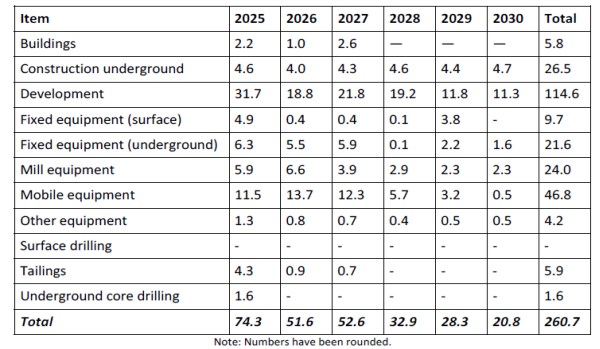
Table 6: Westwood Complex - Mine Plan Summary
| Units | LOM Total or Average |
2025 | 2026 | 2027 | 2028 | 2029 | 2030 | 2031 | 2032 | |
| Unit Costs | ||||||||||
| Mining cost, underground | $/t mined | 252.78 | 272.95 | 245.70 | 249.48 | 249.48 | 249.48 | 251.41 | 251.41 | 251.41 |
| Mining cost, open pit | $/t mined | 6.55 | 6.55 | - | - | - | - | - | - | - |
| Mining cost | $/t processed | 160.00 | 102.49 | 79.07 | 206.01 | 249.48 | 249.48 | 251.41 | 251.41 | 251.41 |
| Process (incl. environmental) cost | $/t processed | 38.37 | 26.09 | 26.68 | 48.56 | 53.12 | 53.12 | 53.53 | 53.53 | 53.53 |
| General and administrative cost | $/t processed | 41.54 | 19.10 | 19.03 | 46.85 | 56.40 | 56.18 | 58.97 | 76.91 | 445.54 |
| Note: numbers have been rounded. | ||||||||||
xii. Exploration and Development
Exploration potential remains around the former Doyon mine. The Company plans to drill test along the western deposit extension from the near surface and at depth and is planning a review of the exploration data available for the eastern deposit area.
Exploration campaigns to date have focused on estimating Mineral Resources to a depth of 2,400 metres, the maximum depth that can be mined with the infrastructure currently planned. In recent years, most of the drilling has targeted resources above 1,800 metres in depth. Future exploration will be focused on DD intended to support potential upgrade of Inferred Mineral Resources to higher confidence categories and test several prospects. The LOM plan contains allocations of $2.1 million for valuation, and $9.4 million for definition drilling.
The Westwood deposit remains open at depth, westward and locally to the east along the untested mineralized Westwood, North and Zone-2 corridors.
The Grand Duc deposit remains open westward and locally to the east.
2. MINING ACTIVITIES - INTERNATIONAL
2.1 BURKINA FASO - ESSAKANE MINE
Unless stated otherwise, the information in the sections below (other than the information under the headings "Essakane Mining Convention" and "Mining Legislation and Permits") are based upon the technical report (the "Essakane Report") titled "Technical Report on the Essakane gold mine, Sahel Region, Burkina Faso" with an effective date as of September 30, 2023 prepared by Francois J. Sawadogo, MAIG, Mr. Haithem Chattaoui, P.Eng., Mr. Rémi Lapointe, ing, Mr. Michel Dromacque, C.Eng., Mr. Denis Doucet, ing, and Mr. Franck Napon, ing. Reference should be made to the full text of the Essakane Report, which is available for review on the Company's issuer profile on SEDAR+ at www.sedarplus.ca and on EDGAR at www.sec.gov.
Mr. Rémi Lapointe, ing. former employee of IAMGOLD, reviewed and approved scientific and technical information in the Essakane Report. The scientific and technical information previously reviewed and approved by Mr. Lapointe, to the extent included or incorporated in this AIF, has been reviewed and approved by Ms. Anna Malevich, P.Eng. who is a “qualified person” as defined in NI 43-101.
i. Mining Legislation and Permits
The mining and exploration permits comprising Essakane are subject to the Burkina Faso Mining Law. The Essakane Mining Permit (defined in Section 2.1 iii below) are all subject to Burkina Faso Mining Law. The Burkina Faso Mining Law gives the exploration permit holder the exclusive right to explore for the minerals requested on the surface and in the subsurface within the boundaries of the exploration permit.
The exploration permit also gives the holder the exclusive right, at any time, to convert the exploration permit into a mining exploitation permit. Exploration permits are valid for a period of three years from the date of issue and may be renewed for two more consecutive terms of three years each for a total of nine years; however, on the second renewal, at least 25% of the original area must be relinquished. The Essakane Mining Permit is valid for an initial period of twenty years and is renewable for five-year periods on an exclusive basis until the mining Mineral Reserves have been depleted.
IMG Essakane's mining exploitation permit in Burkina Faso is subject to a 15% free-carried interest to the benefit of the State of Burkina Faso. Pursuant to the new Mining Code adopted in 2024, the State's free carried interest for new exploitation permits and for the renewal of existing permits is increased to 15%, and the State can further elect to reopen existing mining conventions. In addition, the government receives a royalty on the revenues from mineral production based on a sliding-scale gold price.
The royalty rates are set by governmental decree. Until 2025, the rates varied between 3% and 7% depending on the gold price at the London Metal Exchange. A new decree signed in March 2025 introduced changes such that the rate is set at 7% if the price is between $2,000/oz and $3,000/oz. Starting from $3,000/oz, an additional 1% is applied to every $500/oz. According to the Mining Law of Burkina Faso, a mining convention must be negotiated between the mining permit owner and the government before operations can begin. The mining convention outlines the governmental commitments, operational tax regime, and obligations of the mining permit owner to the government of Burkina Faso. Once executed, the mining convention cannot be changed without the mutual agreement of both parties. If tax law changes are promulgated (excluding mining taxes), the mining permit owner may choose to continue with the current terms of the mining convention or adopt the new terms if such terms are deemed more favourable. The Essakane Mining Convention (as defined below) between IMG Essakane and the government is dated July 14, 2008, and was amended on June 27, 2025, in order to reflect the government of Burkina Faso's 15% free-carried interest.
The current Burkina Faso Mining Code was adopted on July 18, 2024. Due to the fiscal stability clause in the mining convention, the new tax and customs provisions covered by the stability do not apply to the Essakane Mining Permit.
IMG Essakane is a Burkinabè company created for the purpose of developing and operating the Essakane gold mine. IAMGOLD currently owns a 85% interest in IMG Essakane, while the government has a 15% free-carried interest.
ii. Property Description, Location
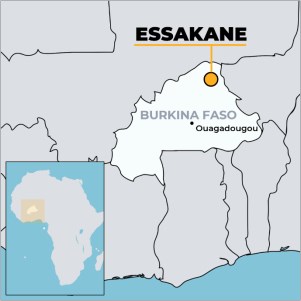 |
Essakane is located in Burkina Faso at the boundary of the Oudalan and Seno provinces in the Sahel region and is approximately 330 kilometres northeast of the capital, Ouagadougou. It is situated approximately 63 kilometres northwest of the nearest large town, Dori, and near the village of Falagountou to the east. In April 2008, following the filing by Orezone Resources Inc. ("Orezone Resources") of the 2007 Essakane Definitive Feasibility Study, completion of ESIA and grant of the Essakane Environmental Permit (defined in Section 2.1 iiii below), the government awarded IMG Essakane the Essakane Mining Permit (defined in Section 2.1 iii below). The mining permit has an area of 100.2 km2, is valid for a period of 20 years, and is renewable every five years until the Mineral Reserves have been depleted. |
iii. Type of Mineral Tenure
The project consists of one mining permit (the "Essakane Mining Permit"), which contains the Essakane Main Zone (EMZ), including the Gourouol and Lao sub-areas, and the mined-out Falagountou and Wafaka deposits. The mining permit is surrounded by three exploration permits (Koritigui, Lao Gountouré 2, and Alkoma 2) held in the name of Essakane Exploration SARL. The satellite Gossey deposit is located approximately 12 kilometres northwest of the EMZ, inside the Koritigui and the Lao Gountouré 2 permits within the Essakane Exploration SARL tenures.
The mining permit was granted in April 2008, has an area of 100.2 km2 and is valid for an initial period of 20 years. The exploitation permit is in good standing.
The Koritigui permit was granted on April 23, 2020, and renewed on June 6, 2023, for an additional three-year term.
The Lao Gountouré 2 and Alkoma 2 permits reached the end of the last period of renewability in November 2018. Following an exception request, the permits were then granted for a special period of three years. IAMGOLD applied for these same tenure areas under a new permit on November 26, 2021.The grant process is delayed, but the application is still under consideration by the authorities. As the prior permit holder, IAMGOLD believes there is a reasonable basis for the tenure applications to be granted.
Surface rights in the mining permit area belong to the State of Burkina Faso. Use of the surface rights is granted by the mining permit under the condition that the current users are properly compensated and that statutory payments are made to the government. At the Essakane Report effective date, all payments were current, and the mining permit was in good standing.
IAMGOLD acquired Orezone Resources in 2009, and Essakane was transferred to IMG Essakane. A title opinion prepared by a lawyer in Burkina Faso, dated February 23, 2009, confirmed that six exploration permits for the property comprising Essakane, as well as an industrial large gold mine exploitation permit, were granted by the Minister under the mining laws of Burkina Faso to, among other subsidiaries of IAMGOLD. The entity's name was changed to "IAMGOLD Essakane S.A." on July 5, 2012.
iv. Essakane Mining Convention
The mining convention for Essakane (the "Essakane Mining Convention") was initially signed by the government of Burkina Faso and IMG Essakane in July 2008, but was re-executed in September 2008 due to a condition contained in a bridge loan facility agreement initially entered into by Orezone Essakane Limited. The Essakane Mining Convention acts as a stability agreement in respect of mining operations by, among other things, transferring the state-owned mineral rights to a mining company. The Essakane Mining Convention clarifies the application of the provisions of the Burkina Faso Mining Law with respect to IMG Essakane by describing the government of Burkina Faso's commitments and operational tax regime and the obligations of IMG Essakane to the government of Burkina Faso. The Essakane Mining Convention cannot be changed without the mutual agreement of both parties. Pursuant to the Essakane Mining Convention, IMG Essakane is to carry out its operations in furtherance of, and in accordance with, the 2007 Essakane FS and the EA. The Essakane Mining Convention is valid from the date of its signature by both parties for a period of 20 years and is renewable for the full life of the Essakane Mining Permit. Thereafter, and in accordance with the Burkina Faso Mining Code, the Essakane Mining Convention is renewable at the request of either of IMG Essakane or the government of Burkina Faso for one or more periods of 5 years each, subject to the provisions of the Burkina Faso Mining Law.
The Essakane Mining Convention stabilizes and governs specific details relating to fiscal policy, taxation, employment, land and mining guarantees, customs and currency exchange regulations and environmental protection in accordance with the Burkina Faso Mining Law.
In 2025 the Essakane Mining Convention was amended to reflect the increase of the government's free-carried interest from 10% to 15%, in line with amendments made to the Burkina Faso Mining Code in July 2024.
In accordance with Burkina Faso's statutory requirements and international best practices, the ESIA had been submitted to the Burkina Faso Minister of the Environment on August 8, 2007. After review and public consultations, the environmental permit (the "Essakane Environmental Permit") for Essakane was issued by the Minister of the Environment on November 30, 2007.
No study has been completed as to the potential environmental and social impacts of a mining operation at the Gossey deposit.
v. Accessibility, Climate, Local Resources, Infrastructure and Physiography
Access from the capital city of Ouagadougou is via a 263 kilometre paved road to the town of Dori, followed by approximately 63 kilometres via a laterite road to Essakane. Access via the town of Gorom-Gorom, located 42 kilometres to the west, is also possible. Within the exploration permits, access is via local tracks and paths. There is no operating railroad. An airstrip has been built on packed laterite within the fenced perimeter of the mine site area and daily flights are made between Essakane and Ouagadougou using an aircraft owned and operated by IMG Essakane, as well as chartered flights. Vegetation consists mostly of light scrub and seasonal grasses. Deforestation has been significant, particularly in the area surrounding the original village of Essakane.
There are no major commercial activities in the area surrounding Essakane and economic activity is confined to subsistence farming and artisanal mining. The mine is located in the northeast of Burkina Faso and the climate is typically Sahelian, (i.e., hot, sunny, dry, and somewhat windy all year round). Temperatures range from 10-50°C, with annual pan evaporation rates of 3,000 mm/a. The mean annual rainfall is 397.5 millimetres with an estimated 100 year maximum of 171 millimetres in a 24-hour period. A wet season occurs between late May and September, and the mean annual runoff in the Gourouol River is conservatively estimated to be 91 Mm3/a. Rainfall is sporadic or absent throughout the rest of the year.
Electricity is supplied by on-site diesel generators; satellite and internet communication is also available at Essakane. Water is pumped from wells (boreholes) in sufficient quantities for exploration drilling and the mining camp. A 26 MW power plant, fueled with heavy fuel oil, was built for the production phase. Another 31 MW of capacity was added in 2013 to power the expanded milling circuit. In 2018, a photovoltaic solar farm was commissioned. This power plant provides 15 MW to Essakane without any carbon-emission and helps reduce the mine's reliance on fossil fuels. The main sources of water are the Gorouol River during the rainy season and well fields around the Essakane pit and near the Gorouol River.
IMG Essakane initiated local training programs for artisans and unskilled labour was sourced locally with skilled labour drawn from Burkina Faso at large. Approximately 90 to 150 expatriates from North America and Europe were required in the initial years of production, however, that number decreased as local Burkinabé workers acquired the expertise and experience to replace the expatriate employees.
There is sufficient surface area within the project boundaries for the open pits, waste rock storage facilities, plant, tailings storage facility, associated infrastructure, and other operational requirements for the life-of-mine plan discussed in the Essakane Report.
vi. History
Prior to the Company's interest, companies that had conducted exploration in the project area included Bureau des Mines et de la Géologie du Burkina, Compagnie d'Exploitation des Mines d'Or du Burkina, BHP Minerals International Exploration Inc., Coronation International Mining Corporation, Ranger Minerals, Orezone Resources, Gold Fields Orogen Holding Ltd, Gold Fields Essakane Limited, Essakane Limited, and Essakane SA. Work conducted included geological and structural mapping, geochemical sampling, trenching, rotary air blast ("RAB"), reverse circulation ("RC") and core drilling, metallurgical test work, resource estimation, feasibility studies, mining, and heap leaching.
The Company obtained its project interest in 2009, and has completed geological mapping, geophysical surveys, aircore ("AC"), RAB, RC and core drilling, mining studies, MRMR estimates, and open pit mining.
vii. Geological Setting, Mineralization and Deposit Types
Boundaries of the exploration permits and the EMZ deposit area (highlighted in red) in the context of a simplified presentation of the geology are shown below in Figure 1.The sedimentary rocks have been subdivided on the basis of lithology into deep water turbidites (the Birimian) and coarse clastic basin margin sequences (the Tarkwaian). The Birimian rocks consist of wackes, arenites and mudrocks (argillites), pebbly arenites, and minor tuffs, which have been metamorphosed to lower greenschist facies. Arenite is the dominant lithology. Intermediate intrusive rocks occurring as sills are common and appear to pre-date all gold mineralization in the district. Occasionally, the contact between the intermediate intrusive sills and the sedimentary rocks is slightly mineralized. The sill itself is typically not mineralized.
The region preserves evidence for at least two regional deformational events. D1 structural elements such as the Essakane host anticline are refolded by a series of north-northeast-trending F2 folds. Later localized deformation occurs near the margin of a calc-alkaline batholith in the south of Essakane. The Markoye fault trends north-northeast through the western portion of Essakane and separates the Paleoproterozoic rocks from an older granite-gneiss terrane to the west.
The deposits are characterized by multiple quartz and quartz-carbonate vein sets and stringers. Vein arrays occur in the east limb, fold hinge (or fold axis), and west limb lithostructural domains. Arsenopyrite and pyrite tend to be late, and are concentrated near the margins of the veins or in cross-cutting stringers. Faults reactivated during the D1 and D2 regional deformation events provide the structural control on the mineralization. Gold mineralization is associated with thrust faults or shear zones with brecciated, banded, sheared quartz veins and boudins within highly silicified zones. Mineralized bodies form as subvertical, or slightly inclined to the east, and consist of lenses, quartz stockwork and/or quartz-carbonate veins. The preferred emplacement is on the fold hinge or the limbs (EMZ, Tassiri, Gourara) or along shear corridors (Gossey, Korizena, Sokadie).
The EMZ deposit is about 3,000 metres long. Mineralization has an average thickness of approximately 200 metres. Mineralization has been intercepted at 600 metres vertically below surface; however, the deposit remains open at depth and along strike. The EMZ deposit is a quartz-carbonate stockwork vein deposit hosted by a folded turbidite succession of arenite and argillite.
The Essakane Nord and Gourouol deposits are situated immediately north of the EMZ deposits. The Essakane Nord deposit is mined out. The mineralized zone was approximately 400 metres in length, averaged about 40 metres in thickness, and was intercepted to 200 metres depths below surface. The Gourouol deposit is being infill drilled. It is approximately 300 metres in length, averages about 30 metres in thickness, and has been intercepted to 125 metres depths below surface.
The Lao deposit is about 900 metres long. Mineralization has an average thickness of 60 metres. The deposit has been drill tested to 300 metres. It remains open at depth and along strike. The Lao deposit is the southern extension of the EMZ mineralized zone. The geological setting of this deposit is similar to EMZ, consisting of alternating sequence of argillite and arenite intercalated by intermediate to mafic sills and intruded by late dolerites dykes. Gold mineralization is associated with zones of complex networks of fracture systems filled by quartz and quartz-carbonate. Pyrite and arsenopyrite observed are associated with gold.
The Gossey deposit is located about 15 kilometres northwest of the Essakane Mine. The deposit is about 2,700 metres long. Mineralization has an average thickness of 40 metres, and has been drill tested to about 150 metres depth. The deposit remains open at depth and along strike. The deposit consists of mineralized lenses of quartz vein stockworks and quartz-carbonates associated with pyrite, arsenopyrite, and more rarely, pyrrhotite. The mineralization is primarily hosted in sandstone to conglomeratic sedimentary formations along contacts with basic to intermediate intrusive dykes and is rarely developed within these intrusive units. Gold mineralization is associated with brecciated, banded, sheared quartz veins and boudins within highly-silicified zones. Mineralized bodies occur as subvertical, or slightly inclined to the east, lenses of quartz vein stockworks, and quartz-carbonates associated with pyrite, arsenopyrite, and more rarely, pyrrhotite. The mineralized structures are typically oriented at N10° with a subordinate direction of N35°.
Orogenic gold deposits occur in variably deformed metamorphic terranes formed during Middle Archean to younger Precambrian, and continuously throughout the Phanerozoic. The host geological environments are typically volcano-plutonic or clastic sedimentary terranes, but gold deposits can be hosted by any rock type. There is a consistent spatial and temporal association with granitoids of a variety of compositions. Host rocks are metamorphosed to greenschist facies, but locally can achieve amphibolite or granulite facies conditions. Gold deposition occurs adjacent to first-order, deep-crustal fault zones. Economic mineralization typically formed as vein fill of second- and third-order shears and faults, particularly at jogs or changes in strike along the crustal fault zones. Mineralization styles vary from stockworks and breccias in shallow, brittle regimes, through laminated crack-seal veins and sigmoidal vein arrays in brittle-ductile crustal regions, to replacement- and disseminated-type orebodies in deeper, ductile environments. Quartz is the primary constituent of veins, with lesser carbonate and sulfide minerals. Sulfide minerals can include pyrite, pyrrhotite, chalcopyrite, galena, sphalerite, and arsenopyrite. Gold is usually associated with sulfide minerals, but native gold can occur.
Figure 1: Boundaries of the Updated Exploration Permits and Local Geology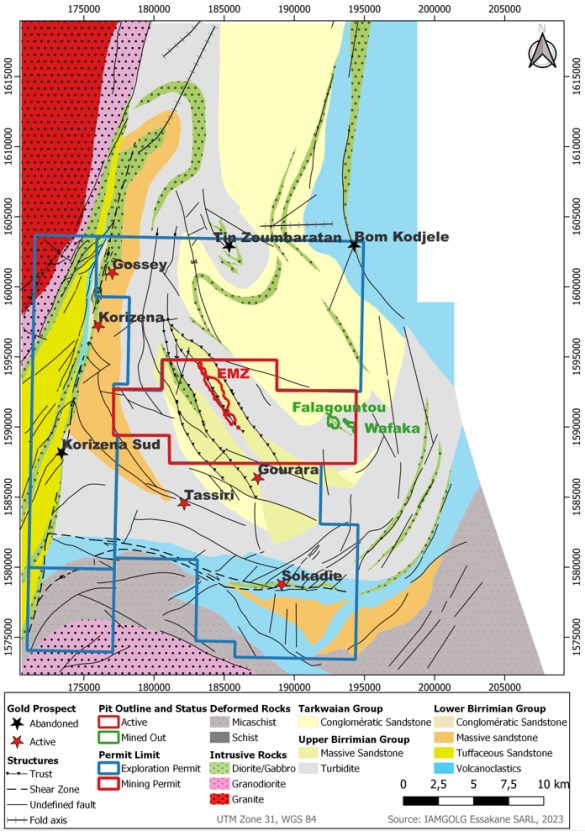 .
.
viii. Exploration
Since 2009, IAMGOLD has completed geological mapping and trenching, geophysical surveys, and various AC, RAB, RC and core drilling programs.
Trenching
A total of 13 trenches (1,888.5 metres) were completed by the Essakane Exploration SARL team over the Gourara prospect in 2015-2016. An additional eight trenches (982 metres) were completed at the Tassiri prospect. A total of 3,624 samples were collected from the Gourara prospect and 1,836 samples were collected from the Tassiri prospects. Samples were 1 metre long channel samples from the trench walls and floors.
Geophysics
The first airborne geophysical survey reported in the area was an aeromagnetic/radiometric survey commentated by BHP over both Essakane Exploration Permits and Essakane Mining Permit areas in 1995.
Between November 26, 2009 and February 10, 2010, a high resolution magnetic/radiometric survey totalling of 30,407 line-kilometres was flown over the Project area by Xcalibur Airborne Geophysics. Total and vertical gradient magnetics along with uranium/potassium/thorium (U/K/Th) radiometric data were recorded. This survey was used to delineate major lithological units, lithological contacts, and major faults.
Two induced polarization (IP) areas were surveyed by Sagax Geophysics in 2010: one immediately north of the EMZ deposit and the other immediately south. Interpretation of the results suggests that the host structure to mineralization may continue both north and south of the known mineralized area.
During April 2017, two areas were covered by a helicopter borne geophysical survey using versatile full waveform time-domain electromagnetic (VTEM Plus) instrumentation, completed by GEOTECH Airborne Geophysical surveys.
The two survey areas, Tin-Taradat-Gossey-Korizéna block and Gourara block, are located approximately four kilometres south and seven kilometres west of the Essakane Mine, respectively.
A total of 2,674 line-kilometre covering 238 kilometres and 341 line-kilometre covering 30 kilometres was surveyed over the Tin-Taradat-Gossey-Korizéna block and the Gourara block, respectively. The survey areas were flown in an east-west (N100°E azimuth) direction for the Tin-Taradat-Gossey-Korizéna block and east-west (N90°E azimuth) direction for the Gourara block with traverse line spacing of 100 metres. Tie lines were flown perpendicular to the traverse lines at a spacing of 1,000 metres. Interpretation of the survey results indicates the presence of conductive zones that may be the result of fault zones associated with strong hydrothermal alteration, and accompanying sulphide enrichment or graphitic zones.
Geochemical Sampling and Regolith Mapping
Geochemical sampling, which involved assaying for gold and arsenic, conducted in the area successfully located targets for follow up pitting and drilling.
A regolith map was completed during the soil sampling process. Outcrop is limited and there is an extensive cover sequence of residual soils and transported material. The southern permits are characterized by a higher proportion of outcrop.
From 2001 to 2004, Orezone Resources collected pisolith samples over the major prospects of the Essakane area. A follow up of the anomalies using AC drilling was completed in 2007.
Since 2010, Essakane Exploration SARL has conducted several campaigns of regional shallow and deep follow-up AC drilling over a large portion of the exploration permits with the aim of finding gold mineralization masked by transported material and were, therefore, not able to be located by conventional geochemical sampling.
From 2020 to 2021, the Essakane resource development team completed 4,317 metres of AC infill drilling over three Mine Lease targets (ML1, ML2, and ML3). This drilling program was designed based on lineament and structural interpretation, geophysics, and regional gold-in-soil geochemistry compilation. Most of the AC drill holes were inclined and the maximum hole length was 20 metres.
From 2020 to 2021, the Essakane resource development team completed 4,317 metres of AC infill drilling over three Mine Lease targets (ML1, ML2, and ML3). This drilling program was designed based on lineament and structural interpretation, geophysics, and regional gold-in-soil geochemistry compilation. The program identified a northwest-southeast to north-northwest-south-southeast-trending 400 metres long gold-in-soil anomaly on the western side of the ML1 target. A shallow RC program testing this anomaly did not return any significant gold values. Most of the AC drill holes were inclined and the maximum hole length was 20 metres. No additional AC drilling has been conducted since 2021.
No additional AC drilling has been conducted since 2021.
Satellite Imagery Interpretation
An interpretation of structural geology derived from Aster image and aeromagnetic data was carried out by Orezone Resources in 2002-2003. A number of fold axial traces observed have a spatial relationship with the main gold mineralization. These observations suggest that a significant proportion of the gold occurrences on the permits are associated with this folding event.
ix. Drilling
EMZ Deposit
Since 2010, RC drilling has been carried out using 140 millimetre (5½ in.) diameter holes with 5 metre sample intervals to a depth of 150 metres or until the water table is intersected.
Core holes were drilled at Essakane using PQ (85 millimetre core diameter) HQ (63.5 millimetre) and NQ (47.6 millimetre) sizes. The majority of the drilling was completed using HQ core. A portion of the core drilling includes the top of the drill hole completed using RC methods prior to switching to core for the remainder of the drill hole. HQ core is drilled 10 metres past the saprolite horizon and then reduced to NQ. The geologist may request that the hole be drilled HQ over a longer distance if hole deviation is an issue. In the broken areas of the EMZ pit, the first 6-12 metres of the drill holes are drilled at PQ, then reduced to HQ size. Hexagonal core barrels and extended shells are often used to further reduce deviation. Core orientation is carried out using a downhole spear with wireline attachment. Efforts to properly core drill from surface through the upper saprolite often failed over the EMZ deposit due to loss of drilling fluid, caving of holes, or the washout of saprolite by entrained quartz fragments plugging the bit. All drill holes on the EMZ deposit are cased with either hard polyvinyl chloride (PVC) plastic or steel tubing which have to be pulled after downhole tests have been taken.
Drilling completed at EMZ and Lao on June 30, 2023, after the March 1, 2023, database close-out date, which included 43 core holes and seven advanced grade control RC holes for a total of 5,520 metres. Although the newer drill holes may change the grades locally, the new drilling should have no material effect on the overall tonnages and average grade of the current Mineral Resource estimate. The new drilling will have no material impact on the Measured or Indicated Mineral Resources estimated in the area of new drilling. The Essakane drill holes targeted both outside and within the current area where Inferred Mineral Resources were estimated. The new drilling in the Essakane area has the potential to support estimation of additional Inferred Mineral Resources as well as to potentially support upgrade of a portion of the current Inferred Mineral Resource estimate to higher-confidence categories.
Gossey Deposit
IAMGOLD's RC holes at Gossey were completed using a 140 millimetres (5½ in.) drill bit. Core drilling consisted of HQ and NQ. The reduction from HQ to NQ size was typically undertaken after the drill had passed through the saprolite horizon and the broken area.
x. Sampling Method & Quality Control
Sampling Methods
No information is available to IAMGOLD on the sampling procedures for the early geochemical, trenching, AC and RAB programs. RC samples were taken at 1 metre intervals. BHP, Ranger and Orezone reduced the large 20-40 kilogram RC rig sample down to 3-5 kilogram with an 8:1 riffle splitter. Gold Fields used a single 1:1 stainless steel riffle splitter, unless the split was >15 kilogram. Core sampling was typically on 1 metre intervals.
IAMGOLD's geochemical samples commonly consisted of 2-3 kilograms of sieved rejects collected over an approximate 5 metre radius. Samples consisted of pisolites in erosional environments. Trenches were sampled along the walls and the floor. Samples were generally 1 metre long, and the resulting sample about 1 kilogram in weight. AC samples are collected at 1 metre intervals and reduced to a 5-7 kilogram sample using a 50:50 riffle splitter. A coarse reject sample is preserved for reference. RC samples are collected over 1 metre intervals, and are typically about 7 kilograms in mass. The RC sampling at Gossey was undertaken at 0.5 metre intervals, collecting 10-20 kilogram of samples. The 0.5 metre samples were then composited to make a 1 metre interval. This was subsequently reduced in size through a 1-tier, 50:50 riffle splitter to produce a final split for the laboratory weighing approximately 5 kilograms, with a coarse reject preserved for reference. A reference chip tray was retained of the intervals. Core sample lengths vary, from 1 metre in HQ and PQ core, to 1.5 metres in NQ core. Core is halved, and one half is sent for assaying when the drill hole is either outside the resource pit shell or selected by the geologist. Otherwise, the entire core sample is assayed.
IAMGOLD's sample preparation includes: (i) RC: dried and pulverized to 95% passing (P95) 500 µm in Keegor or LM-5 mills. Occasionally, when the sample is comprised of coarse particles, crushing is performed through a Terminator or Boyd Crusher prior to the pulverization stage. The sample is split in a rotary divider until two sub-samples weighing 1 kilogram each are obtained. One of the 1 kilogram sub-samples is pulverized to P95 500 µm; and (ii) Core: crushed to P95 2 millimetres in a Terminator or Boyd crusher. Samples are then split in 12 parts in a rotary splitter and a 1.2 kilogram sub-sample is pulverized to P95 105 µm using LM-5 mills. IAMGOLD currently performs all sample preparation and analysis at the mine. The mine laboratory is not independent and is not accredited.
RC samples are assayed by LeachWell rapid cyanide leach. Approximately 25% of the solid residues are re-assayed using fire assay whenever the LeachWell result is >0.3 g/t Au. All samples are assayed for graphitic carbon (Cg), sulphur, and arsenic by inductively coupled plasma-mass spectrometry (ICP-MS) and ELTRA elemental analysers. Core samples of 1 kilogram mass are assayed by LeachWell rapid cyanide leach, followed by fire assay of the tails when the grade is >5 g/t Au. A 1-kilogram sub-sample is assayed by LeachWell rapid cyanide leach over 12 hours with an AAS finish. Initially, 10% of assays that returned >0.3 g/t Au had their solid residues re-assayed using fire assay. This percentage was raised to 25% in 2016. In addition, 5% of assays <0.3 g/t Au had their solid residues re-assayed using fire assay. All samples are assayed for graphitic carbon, sulphur, and arsenic by ICP-MS and ELTRA elemental analysers.
IAMGOLD has implemented an industry standard QA/QC program including the submission of standards, blanks, and duplicates and to the laboratory, and the results are reviewed regularly to ensure that appropriate and timely action is taken in the event of a QA/QC failure.
IAMGOLD has written procedures and protocols in place that include sampling from the drill rig to the laboratory, sample preparation at the Project site, laboratory sample preparation and analytical protocols, and interpretation of the resulting sampling and analytical data.
Standards were sourced from Rocklabs, and selected on the basis of a range of gold grades and oxide or sulphide oxidation type. The insertion rate is approximately 1:20. Results for every batch of standards, reported by the assay laboratory, are assessed by IAMGOLD's database manager prior to the upload of any assay data into the SQL database. The average of the standard results for each batch is reported to the laboratory manager in a qualitative way by e-mail (trends showing over or underestimation; evidence for poor instrumental drift corrections; differences occurring at operator shift changes, etc.). Records of these assessments are stored in the Essakane database. When a standard fails (result is greater than three standard deviations of the certified value), the 10 samples before and after the failed sample (21 inches total including the failed sample) are reanalyzed. Reviews of the standard performances show that the failure rate was within accepted industry norms. The standard results indicate acceptable laboratory accuracy for gold analyses and no significant bias.
Blanks used at Essakane consist of coarse granite sourced from the west of Burkina Faso. Blanks used for the Gossey program were of coarse sand. Blanks are inserted at an approximate rate of 1:20, and are primarily inserted within the expected mineralized interval. At Gossey, additional blanks were inserted before and after visibly-mineralised zones. Blanks are considered to have failed when the assay grade is >10 times the detection limit (D.L = 0.001 g/t Au). Reviews of the blank performances show that the failure rate was within accepted industry norms. No significant contamination has been observed.
The field duplicates insertion rate is about 1:20. Duplicate results were assessed using a combination of field and pulp duplicate versus original scatter plots, log-log duplicate plots, and half absolute relative difference (HARD) plots. These reviews indicate acceptable precision of the gold analytical results at Essakane. As the Gossey deposit is characterized by high-nugget gold, field duplicate results are reflective of the higher gold variability between samples, and show less precision between analyses of the same sample.
All crushing and pulverizing rejects from the IAMGOLD programs are returned to and stored at the Resource Development facility, where 20% of the reject samples are later selected for check assaying at SGS in Ouagadougou using the same analytical protocol.
Data entered directly into a laptop using either an Excel spreadsheet (Gossey), Maxwell GeoServices Pty Ltd.'s (Maxwell GeoServices) or LogChief software (Essakane) are then transferred into the central database.
Data validation is carried out by the project or database geologist after all data entry for the drill hole has been completed. Another set of data validation (such as invalid from and to, out of range, or invalid type values) is run on the data once it has been imported into DataShed. A separate set of validation steps is followed for the assay data after it is imported into DataShed. All paper copies of logs and assay certificates in PDF and Excel format are archived for future reference.
The drill hole log is transferred into the Geovia GEMS, Hexagon MinePlan, and Seequent Leapfrog Edge modelling database after it has been duly validated in DataShed, and all the assays have been received and checked.
Essakane Deposit
Density data are collected at 25 metre intervals, using the water displacement method, on 10-15 centimetres lengths of HQ core or 15-20 centimetres lengths of NQ core. All measurements were performed by the Essakane Mine laboratory.
Following the IAMGOLD acquisition of Orezone Resources and Essakane in 2009, all drill samples were collected under direct supervision of the mine staff from the drill rig and remained within the custody of the staff up to the moment the samples were delivered to the on-site Essakane laboratory. Samples, including duplicates, were delivered from the drill rig to a secure storage area within the fenced Essakane core facility. Blanks and standards were inserted in the sample stream at the core facility. Chain of custody procedures consisted of filling out sample submittal forms that are sent to the laboratory with sample shipments to make certain that all samples were received by the laboratory. Sample security has relied upon the fact that the samples are always attended or locked in appropriate sample storage areas prior to dispatch to the sample preparation facility.
Gossey Deposit
Density data was collected using the water displacement method. Where material is classified as saprock or saprolite, the core interval measured is typically 15-20 centimetres in length. If the material is fresh, the sample interval may be 1 metre for HQ size core and 1.5 metres for NQ size core. RC chip density determinations were made on 1 kilogram of material after the sample had been split. All measurements were performed by the Essakane Mine laboratory. The database includes specific gravity measurement from 13,318 samples, of which 69% are derived from core, with the remaining 31% derived from RC drilling.
Samples were transported periodically from the drilling site to the Essakane Mine site, located 12 kilometres to the south-east of the Gossey deposit under the supervision of IAMGOLD geologists and field technicians. The samples were stored in the laydown of the exploration department, where sample preparation and splitting occur.
xi. Data Verification
Internal Verification
Internal data verification by IAMGOLD staff on data uploaded to the database typically includes checks on the following data tables. Information from the most recent verification completed in 2023 is summarized for each of the tables reviewed:
• Collar surveys: during 2023, a total of 2,867 drill holes supporting Mineral Resource estimation had collar data verified with no material errors noted.
• Downhole surveys: a total of 38,229 entries verified, with no material deviations noted. Each drill hole had at least one downhole survey record.
• Lithologies: lithology records totaling 34,827 entries from 2,587 drill holes were reviewed. A small number of errors, typically overlapping intervals, missing data, and duplicate entries were noted, and flagged for correction.
• Lithotype: lithotype records (lithology groupings used in resource modelling) totalling 27,804 entries from 2,819 drill holes were reviewed. A small number of errors, primarily missing data, and use of lithology rather than lithotype codes were noted, and flagged for correction.
• Density: density records totaling 25,363 entries from 1,256 drill holes were reviewed. Errors noted included omission of the oxidation/weathering intensity/type or use of rock codes for density samples that were not in the library of codes to be used. Such errors were flagged for correction.
• Analyses: analytical records totaling 427,586 entries from 2,867 drill holes were reviewed.
The 2023 review provided a list of suggested steps to resolve future inconsistencies, key amongst which were simplifying and restricting the number of lithology and lithotype codes, and standardizing and reducing the number of codes used for oxidation when collecting density data.
External Verification
G-Mining Services Inc. (GMS) completed a review of selected data in 2018 and again in May 2022. Work completed included:
• Site visit in March 2018:
Drill core from the EMZ deposit was inspected, and IAMGOLD geologists presented all logging and sampling protocols. A tour of the open pit was undertaken to review mineralization and waste rock in the pit walls.
GMS personnel reviewed the artisanal workings at the Gossey deposit and the ongoing drilling to validate mineralization was present. Cross-checks were made to compare the collar coordinates in the provided database against field observations by handheld GPS, and no major discrepancies were found.
• Visiting the Mine laboratory in March 2018 to oversee the sample preparation and assaying techniques. GMS concluded that the laboratory had acceptable practices and that the analytical data from the laboratory were acceptable to support Mineral Resource estimates.
• Checking 17% of the assays in the Essakane certificates (1,469 out of a total of 8,322) against the provided database, covering the period of September 2021 to April 2022. In addition, GMS selected 10% of the drill holes that intersect the remaining mineral resource (from drillholes completed before 2021) and checked the assay certificates against the gold values in the database. No material issues were identified as a result of these checks.
• Review of QA/QC data. GMS concluded that the QA/QC review supported the use of the analytical data in Mineral Resource estimation.
• Validation of drill and analytical data from the Gossey deposit, including: (i) validation of total hole lengths and final sample depth data; (ii) verification for overlapping and missing intervals; (iii) check drill hole survey data for out of range or suspect downhole deviations; (iv) visual check of spatial distribution of drill holes; (v) validation of lithology codes; and (vi) comparison of 49 analysis certificates with the drill database to ensure that assay data were appropriately imported into the database.
xii. Mineral Processing and Metallurgical Testing
Metallurgical Testing
Metallurgical testwork on the Essakane deposit has been conducted by a number of independent laboratories and third-party consultants over the Project life. These include the laboratories SGS Johannesburg, Kappes Cassidy Associates, McClelland Laboratories, SGS Johannesburg, Philips, SGS Lakefield Research Ltd, Auralia Metallurgy Pty Ltd., ALS Metallurgy, Orway Mineral Consultants (Orway), and third-party consultants GRD Minproc (Pty) Ltd., GMS, Crowe Metallurgical Consulting Inc., Enhance Mining Inc., and Soutex Inc. There is no international standard of accreditation provided for metallurgical testing laboratories or metallurgical testing techniques.
Work completed included mineralogy, comminution, leaching (carbon-in-leach (CIL), whole ore, intensive, diagnostic), preg-robbing, gravity concentration, static settling, and rheology testing, as well as examinations of the effects of grind size and the effects of surfactants on preg-robbing. This testwork showed that a conventional crushing, milling, gravity concentration, and CIL gold plant was suitable for the mineralization at Essakane.
No metallurgical testwork has been undertaken on the Gossey deposit.
Metallurgical Testwork (between 2016 and Essakane Report Effective Date)
ALS Metallurgy completed a set of tests in 2021 to determine if MACH reactor technology using pre-oxidation could improve direct leach and CIL performance. Testwork on what was referred to as the "Roche" composite included: head assays; gold-robbing index tests; MACH high shear reactor tests; and direct leach and CIL of the resulting MACH product.
The Roche bulk composite ore sample contained ~50% gravity-recoverable gold. The gravity tailings were strongly gold-robbing. The addition of activated carbon (CIL) overcame the gold-robbing nature of the ore and resulted in a major improvement in the overall gold recovery. MACH pre-treatment via high shear pre-oxidation in conjunction with CIL resulted in a reduction in residue grade of up to 0.07 g/t Au together with an improvement in ultimate CIL gold extraction.
In 2021, Soutex Inc. was retained to estimate whether marginal mineralized material (low-grade mineralization estimated to be under the plant cut-off grade) could be economically processed at the existing CIL plant.
Two series of laboratory tests were run on grab samples collected from the marginal mineralization stockpiles at the Essakane metallurgical laboratory from December 2021 to February 2022. The graphitic carbon concentration was also considered in sample selection to cover a range of carbon concentrations as this was known to have a significant impact on the gold recovery.
Gravity-recoverable gold tests showed that two of the stockpiles had gravity recoverable gold recoveries similar to that of the run-of-mine ore (73.6% and 72%, respectively versus 61.9-84.2%), whereas a third stockpile had a lower gravity recoverable gold recovery of 55%.When incorporating the plant's gravity circuit average efficiency, the expected gold recovery for the gravity circuit was estimated to be 39.1% for the marginal material. This value is lower than the gravity recovery observed when processing conventional ore; this is mainly due to the lower average gravity recoverable gold recoveries measured on the marginal samples.
Bottle roll tests were run on the same samples. The tests delivered results valid for the lower grades of the marginal mineralization stockpiles. Tests indicated 85% recovery (including gravity recovery) for a 0.35 g/t Au plant feed grade. The graphitic carbon concentration appeared to have a lesser influence on the solid losses for very low gold feed grades than it has for conventional ores, which was considered to be an upside for the Essakane CIL process.
A second laboratory test program was run from March 2022 to April 2022 to evaluate various scenarios that could impact production. Two scenarios were developed from the tests results to illustrate the impact of the changes in three key variables: throughput, feed size, and residence time in the CIL.
The overall recovery during the test was 87.8%, which was in line with the expectations considering the graphitic carbon (0.15%) and sulfur (0.25%) concentrations observed during the test.
The testwork demonstrated that marginal mineralization appeared amenable for treatment in the existing plant. The gravity recovery circuit was expected to be less effective, but the overall recoveries were expected to be good, ranging from 80-90% depending on the gold and graphitic carbon concentration.
The metallurgy department at the mine completed at gold deportment in tails study in early 2022 as part of an on-going effort of monitoring gold losses and improving performance within the Essakane leach plant. Techniques used included assaying; qualitative X-ray diffraction to identify and characterize gold minerals by grain size and association; scanning electron microscopy/dispersive X-ray spectroscopy to determine gold grain compositions; and secondary ion mass spectrometry (SIMS and TOF-RIMS) to quantify the sub-microscopic gold and measure the concentration of gold sorbed onto carbon matter.
Enhance Mining Inc. completed a set of laboratory cyanidation tests to provide data for a cyanidation-adsorption model for the Essakane plant. The model as constructed could be used to account for the amount of preg-robbing occurring, gold losses in the circuit and gold losses in a particular reactor.
In early 2022, aeration and leaching kinetic testwork was completed by Auralia Metallurgy. Composites were ground to 80% passing 125 μm and then run through a Knelson gravity separator to recover a gravity concentrate and to produce gravity tailing for leach testwork. Work completed included: (i) three CIL bottle roll cyanidation leach tests and (ii) Hyperjet cyanidation leach tests.
Tests using a Hyperjet, from Hyperox Technologies, were completed to replicate the bottle roll tests with initial aeration through the Hyperjet and with NaCN added. One composite showed an increase in overall gold recovery with the Hyperjet. However, the tests did not show the addition of oxygen would improve overall gold recovery. The cyanide consumption increased significantly with oxygen addition to leach. Cyanide speciation could be used to help identify if the oxygen formed other cyanide complexes with increased oxidation.
Geometallurgy Program
To reduce the impacts associated with the ore variability, a geometallurgical project was launched in 2016 to enhance ore management through a better understanding of the geology.
The geometallurgy program is constantly evolving and two new graphitic carbon and sulphur analyzers were purchased and installed in the assay laboratory in 2020, and are used to analyze mill tails samples. Onsite testing of plant and grade control samples for graphitic carbon and sulphur analysis are now carried out on a regular basis in the assay laboratory. Good correlations are observed between graphitic content and plant residues hence allowing for better operation reaction and better control within the plant.
Since 2020, results received on 376 samples from this current phase are summarized as follows: Gold grade measured by fire assay provides, on average, higher concentration than LeachWell analysis, which is an upside for Essakane considering all resource models are based on LeachWell analysis; a trend of increasing graphitic carbon concentration with gold grade is observed; a trend of increasing sulfur content with gold grade is observed.
Deleterious Elements
The major deleterious element is preg-robbing graphitic ore. To manage the preg-robbing effects, mill feed is blended to reduce the carbon grade. In areas of very high gold and graphite grades, plant reagents are adjusted for short batch campaigns. Other steps taken to mitigate the preg-robbing effects include installation of a Hyperjet in the process flow, to improve aeration, and the use of fresh water, rather than cyanide, in the gravity circuit. IAMGOLD continues to examine options in relation to reducing the preg-robbing effects in the gravity circuit in particular.
xiii. Mining Operations
Mining is carried out using a conventional drill, blast, load, and haul surface mining method with an owner fleet. Equipment is conventional for open pit operations.
Geotechnical design parameters are based on information obtained from: geotechnical drilling campaigns; mapping; laboratory testing; and modeling. These studies are continuously updated by confirming initial models, updating structural models with as-built data, continuous pit mapping, and additional geotechnical drilling as necessary. Geotechnical controls include an annual internal geotechnical audit and continuous geotechnical support provided by third-party consultants SRK, who also provide the design hydro-geotechnical recommendations. Industry-standard instrumentation for wall stability monitoring is in place. These include a Reutech movement and surveying radar ("MSR") and Leica robotic total station instruments.
Ground water management in the pits uses sump and pump methods to dewater benches immediately below mining activities. During the rainy seasons, stormwater runoff outside of the EMZ pit is diverted via diversion ditches to collection basins and depleted mining areas.
Pit haul roads are designed to industry standards and are 30 metres wide to permit safe operation of two-way traffic haulage. For phase bottom benches where the grades are high and the mining duration is short, haul road widths can be reduced to 25 metres for one-way traffic. The pit haul road design grade is typically 10%. Waste rock facility and stockpile roads are maintained to have widths of 30 metres and grades of 6%.
The mine life is forecast from 2025 to 2029, averaging 400,200 oz Au/year with a total production of 2.1 Moz Au from 2024 to 2029. The LOM plan is based on the completion of five different mining phases:
• EMZ: three phases; Phases 5, 6, 7 represents 87% of the gold to be mined in the LOM plan. Phase 5 is the current north phase of the EMZ pit, and the main source of ore at the Essakane Report effective date. Phase 6 is the final push back for the south part of the EMZ pit. Phase 7 is the final push back for the north part of the EMZ pit and represents an extension of Phase 5 on the eastern wall of the EMZ pit.
• Gourouol: located to the north of the EMZ pit.
• Lao: located to the south of the EMZ pit, and accounts for 12% of the gold to be mined in the LOM plan.
The Essakane processing plant has a process rate limit of 12.29 Mt/a of hard rock equivalent. The 2024 LOM plan assumes a processing throughput capacity of 13.05 Mt/a. This is achieved by ensuring a minimum of 1.1 Mt/a of softer transition and saprolite ore will be fed to the process plant.
Mining production rate starts at a rate of 47 Mt/a in 2024 and decreases every year with the LOMP completed in 2028.
The primary mine production equipment fleet consists of a load, haul, dump fleet including shovels, excavators, loader, trucks, drill rigs, dozers, a grader, a water truck, and a tow haul. Ancillary equipment includes fuel and water trucks, mobile light plants, utility vehicles, and service trucks. Until LOM is extended, there will be some equipment renewals; however, the fleet numbers will be progressively reduced for the remainder of the LOM.
xiv. Production
The 2026 attributable production is estimated to be between 400,000 to 440,000 on a 100% basis (340,000 to 380,000 on an attributable basis) ounces of gold. The following table indicates operating information for Essakane for the last two years:
Table 7: Operating Information for Essakane for the Last Two Years
| ESSAKANE MINE | 2025 | 2024 |
| Gold production (ounces) 100%(1) | 427,200 | 454,000 |
| Ore milled (tonnes) | 12,560,000 | 12,087,000 |
| Grade milled (g/t Au) (2) | 1.18 | 1.33 |
| Recovery (%) (2) | 90 | 88 |
(1) The production attributable to the Company in 2025 was 372,100 ounces and in 2024 was 409,000 ounces.
(2) Grade & Recovery are presented as Total Gold (FA).
xv. Exploration and Development
The Essakane deposit remains open along strike and at depth. Based on a metallogenic study (Gaboury, 2021), there may also be opportunities to intercept high-grade gold mineralization at depth associated with black pelites cut by quartz veins on the western flank of the Essakane fold. The Gossey deposit remains open along strike and at depth.
Regional exploration has identified the areas that retain exploration potential and they are summarized in the Essakane Report. Two of the prospects on figure 1, Tin Zouberatan and Korizena Sud, are no longer considered to be prospective.
xvi. Mineral Reserves and Mineral Resources
The MRMR estimates for the Essakane Mine can be located in the "Mineral Reserves and Mineral Resources of Gold Operations as of December 31, 2025" table in Section 4 of Item III below.
xvii. Processing and Recovery Operations
Ore is currently processed using two stages of crushing, semi-autogenous grinding (SAG), ball mill grinding, pebble crusher grinding (SABC), gravity concentration, and a CIL gold plant.
The 2008 feasibility study proposed a process plant throughput rate of 7.5 Mt/a. During construction, some debottlenecking improvements were made to the design, resulting in a revised nameplate capacity of 9.0 Mt/a based on processing 100% saprolite ore. This first phase is referred to as line A. Due to additional operational improvements, plant throughput has increased beyond the constructed design capacity.
Fresh rock CIL plant feed gradually increased from 2012 onwards. To maintain gold production levels, with increasing proportions of fresh rock in the CIL plant feed, an expansion was completed in 2014, referred to as line B. The objective was to double the fresh rock processing capacity from 5.4 Mt/a on a 100% fresh rock basis to 10.8 Mt/a. The expansion consisted of the addition of a secondary crushing circuit and a second process line (grinding, gravity concentration, and leach-CIL) in the CIL plant. The process plant expansion was commissioned in February 2014, and effectively doubled the fresh rock processing capacity.
In 2019, the targeted plant capacity was revised, based on the total specific energy requirements for 11.7 Mt/a of fresh rock, such that that >11.7 Mt/a total ore can be processed, if the required total specific energy for the ore blend (saprolite, transition, and fresh frock) is less than or equal to the required total specific energy for 11.7 Mt/a of fresh rock. Plant modifications were subsequently implemented to support a capacity increase to 12.29 Mt/a.
The process flow sheet in the Essakane Report consists of the following:
• Crushing.
• Grinding.
• Pre-leach thickening.
• Gravity concentration and intensive cyanidation.
• Leach and CIL.
• Tailings thickening plant.
• Tailings disposal.
• Acid wash and elution.
• Carbon regeneration.
• Fine carbon incineration.
• Electrowinning and refining.
• Reagents make-up and distribution.
• Water storage.
• Air and plant water service.
Process consumables consist of reagents and grinding media. The main water source in the wet season is the Gourouol River. There are three water storage ponds that can provide additional process water; one contains recycled water from the TSF and water from pit dewatering activities, and the remaining two contain fresh water. The ponds fill to capacity in the wet season and are drawn down in the dry season. A water management plan is in place to optimize water use and reduce consumption from the Gourouol River. Power is sourced from a combination of generators and a solar plant. The total average consumption is around 40 MW and the process plant uses about 35 MW.
xviii. Capital and Operating Costs
Operating costs are based on the most recent LOM plan. Capital costs include capitalized waste stripping, equipment overhaul costs, equipment capital spares, resource development, mill equipment, mining equipment refurbishment, and tailings dam capital expenditures.
Capital expenditures are based on detailed estimates including vendor quotes and existing contracts rates for services. The capitalized waste stripping costs are based on LOM plan operating costs.
Planned capital spending expenditures over the LOM from 2025 to 2030 total $410.7 million, or $205.46/oz Au sold, including capitalized waste stripping. Capital expenditures related to 2025 include actual expenditures for year to date to September 30, 2025, with the remaining three months of 2025 as forecast.
The capitalized waste stripping is the largest capital element estimated at $142.9 million, or $71.50/oz Au sold, over the LOM, and represents 35% of the LOM capital. In 2025, the total capital cost, including capitalized waste stripping and cash advances, is $109.9 million, or $263.75/oz Au sold.
Non-sustaining total capital is estimated at $22.3 million over the LOM and is primarily associated with a relocation action plan for the Essakane village and community (the RAP 1 project).
Average gross mine operating costs over the LOM are estimated at $6.52/t mined, or $12.85/t processed, net of capitalized waste stripping and stockpile movement (excluding the capitalized waste stripping with this amount being transferred to sustaining capital). The mining unit costs vary per year based on the mining depth and the impacts of fixed costs on the final year when production is significantly reduced.
Average operating costs over the LOM (2025-2029) are estimated at $40.87/t milled including capitalized waste stripping, or $39.82/t milled net of capitalized waste stripping (excluding capitalized waste stripping and stockpile movements, with capitalized waste stripping being transferred to sustaining capital). The overall LOM production cost forecast is $2,787 million.
xix. Infrastructure
The key infrastructure to support the Essakane Operations as envisaged in the LOM is in place. Infrastructure includes: three open pits (current and mined-out); stockpiles; waste rock storage facilities; process plant; tailings storage facility; water management facilities, including diversion channels, water storage ponds, and potable water treatment; accommodations camp; airport; power generation facilities, including a solar plant; mine office complex (mine and administrative offices, change houses, and canteens); equipment workshops; wash-down bays; warehouse and lay-down yard; blasting and explosives compound; roads; security gatehouse; communications facilities; diesel storage and dispensing facility; core storage facility.
The operations are primarily accessed through the main gatehouse. Materials and supplies such as food for the accommodations camp are brought into the site using national and regional roads. Service roads are used for internal travel within the operations, and for security patrols. Personnel are brought to site by air. Air may be used for emergency supplies. Personnel live in a purpose-built accommodation village when on site. The operations are served by a radiocommunications system. The on-site fuel oil storage at the Essakane Report effective date included six light (LFO) and four heavy (HFO) fuel oil storage tanks. Power is supplied by 11 generators and a photovoltaic solar plant. Supplemental or emergency power is provided by six LFO generator sets. A 5 kilometre long diversion of the Gourouol River was undertaken to protect the EMZ pit from flooding during seasonal rains. The existing infrastructure, staff availability, existing power, water, and communications facilities, and the methods whereby goods are transported to the mine are all in place, well-established, and can support the estimation of Mineral Resources and Mineral Reserves.
There is no current infrastructure at the Gossey deposit. The Mineral Resource estimate assumes that existing Essakane infrastructure would be used to support any future mining operation at Gossey.
xx. Environment
A comprehensive monitoring program is in place at the mine, as well as in the neighbouring villages. This program encompasses water quality monitoring (potable water, groundwater, domestic waste water, surface water, and community well water), air quality (dust and greenhouse gas emission), soil, biodiversity (fauna and flora), noise, vibration, weather, and follow up and assessment of the community investment program (for example, health, education, potable water access, agriculture, and animal husbandry).
A water quality monitoring program for surface water, groundwater, industrial water, potable water, and domestic wastewater is in place. Additionally, the quantity of water resources is monitored, for example, river flow, water table level, and water meters. Water management structures, including the TSF and water retention ponds are regularly inspected.
xxi. Mine Closure Requirements and Costs
A conceptual rehabilitation and closure plan was developed in 2009, updated in 2013, and again in 2018. The approval process is ongoing for the latest plan update and is anticipated to be completed in 2026. Asset retirement costs are updated annually, and the final closure cost is updated whenever the mining development plan is amended. A progressive mining rehabilitation process commenced in 2011, shortly after the start of production.
IMG Essakane opened an account in which funds are deposited in escrow as part of the Mining Environment Preservation and Rehabilitation Fund (Order No. 2007-845/PRES/PM/MCE/MEF of December 26, 2007).
The closure cost estimate used in the economic analysis is $101.3 million, incurred from 2025-2044. About $86 million will be expended after 2028, when most closure activities will occur. As at December 31, 2025, approximately $68.0 million has been placed in an escrow account with respect to funding its closure obligations.
xxii. Permitting
An Environmental and Social Impact Assessment ("ESIA") was conducted by Knight Piésold Consulting and submitted to the government on August 8, 2007. This study included an Environmental and Social Management Plan for the Mine. The ESIA was completed following a public consultation, from October 3, 2007 to November 2, 2007, with key stakeholders, as prescribed under Burkinabé law. Following this process, on November 30, 2007, the Essakane Mine was approved by the Burkina Faso authorities (Order No. 2007-083/MECV/CAB) and the mining permit over a 100.2 kilometres² area (Order No. 2008-203/PRES/PM/MCE/MEF/MECV) was granted to IMG Essakane.
On September 25, 2008, following changes made during construction, an addendum to the ESIA was submitted to the Burkina Faso authorities. This addendum was approved on November 3, 2008. There was no change to the Environmental and Social Management Plan as a result of this addendum.
One of the specific permits that was required before the start of operations is that relating to the use of explosives (Order No. 2009-258/MCE/SG/DGMGC authorizing the operation of a temporary explosives depot at Essakane).
As part of the mine expansion work (from February 2012 to June 2013), a new addendum to the ESIA and the 2008 addendum was prepared in February 2012 (the February 2012 addendum). The February 2012 addendum covered the expansion phase of the EMZ pit and CIL plant infrastructure, a new satellite pit east of the Mine, and the Gourouol River diversion. The ESIA and 2008 addendum already covered an important part of the impacts related to the expansion, including the river diversion.
The February 2012 addendum, which is an appendix to the ESIA approved in 2007, was prepared to analyze the environmental and social impacts of the mine expansion project. It includes, in Chapter 6, an updated Environmental and Social Management Plan incorporating the necessary adjustments to the initial Environmental and Social Management Plan to include the expansion changes and to consolidate, in one document, all of IAMGOLD's social and environmental commitments. An environmental impact assessment was conducted for the river diversion.
These documents were validated on December 5 and 6, 2013 by the Comité Technique d'Evaluation Environnementale (COTEVE- Environmental Assessment Technical Committee), a body created by the government and comprised of experts from various professional communities (non-government organizations, general population, administration, researchers, universities, and institutes). Following the COTEVE meeting, a second public consultation took place from April 17, 2013 to May 5, 2013, in the communes of Gorom-Gorom (Oudalan Province) and Falagountou (Seno Province). The amendment was subsequently approved by Order No. 2014-170/MEDD/CAB.
Communications with local communities were initiated in 2018 during the geological investigation campaign. In light of the growing influx of people who came to settle in the Gossey Project area to benefit from a possible resettlement action plan, the mayor of the commune of Gorom-Gorom issued a decree fixing the deadline for settlement as May 10, 2018. Beyond this date, no new installation would be included in the inventory of affected property and people. The inventory of properties and people began immediately after the announcement of the deadline. The Gossey Project area was surveyed almost entirely, but the inventory was then suspended, and local communities were informed that the Project was postponed.
No study has been completed as at the Essakane Report effective date with respect to the potential environmental and social impacts of a mining operation at Gossey. Current activities are restricted to securing access to allow additional drilling of the deposit.
xxiii. Waste Rock Storage Facilities
Storage areas for waste rock were planned and designed to reduce haulage distances between pit ramp exits and areas. Areas were selected following consultation with neighbouring populations in order to minimize the impact on these populations (proximity to houses, cemeteries, and other archaeological sites, etc.). Finally, the areas were selected with the goal of minimizing the impact on water resources and on the environment.
xxiv. Tailings Storage Facility
The TSF was originally designed by Golder Associates Ltd. (Golder). Inner dams and impervious cells were designed by SNC-Lavalin.
The site footprint is 462 ha, delimited by 30 metre high and 10 metre crest wide perimeter dams, and with internal raise dams and lined cells. The TSF currently has a storage capacity of 203 Mt. A final dam raise will be completed in 2024-2026, which will increase the capacity to 219.3 Mt, sufficient for the remaining LOM needs.
To ensure the infrastructure's stability, daily, monthly, and yearly inspections are carried out. Geochemical studies have shown that tailings are non-potentially acid generating; however, the tailings leach arsenic and contain process water with cyanide. Tailings water confinement is ensured by deposition in lined cells and by a perimeter hydraulic barrier with more than 40 pumping wells.
A program for environmental monitoring (ground water quality, fauna, and dam stability inspection) and progressive rehabilitation of the tailings site is in place, at and around, the tailings site.
A tailings site steering committee meets bi-annually and an Independent Tailings Review Board meets annually. Both review the operational monitoring of the tailings site, the tailings management system and provide guidance to improve environmental performance. A governmental technical committee also review the tailing management facility environmental performance on a regular basis.
xxv. Social and Community Considerations
IMG Essakane implemented two resettlement plans consistent with Burkinabé laws and best practices recommended by international organizations (Performance Standard 5 of the International Finance Corporation). The first plan started in 2008 (13,000 individuals and 2,981 households affected) and the second plan started in 2012 (3,208 individuals and 555 households affected). In both instances, a consultation process was carried out through the implementation of an Advisory Committee that included representatives from the affected villages and hamlets (High Commissioners, mayors and prefects, and technical service representatives) and representatives from three non-governmental organizations (The Organization for Community Capacity Building for Development (ORCADE), Burkinabé Movement on Human and Peoples' Rights (MBDHP), and the League for the Defence of Justice and Liberty (LIDEJEL)).
In both instances, memorandums of understanding were signed, and resettlement follow up committees (CSR) comprising key representatives of affected villages and administrative authorities were created. The CSR committees meet every month to follow up on the progress of the two Resettlement Action Plans.
A Communication Committee of the Essakane gold mine, comprising representatives from the population, the administration, and the mine (over a hundred participants), meet each quarter to review concerns of the communities and the completion status on community investments and engagement.
As part of the community investment plan, socio-educational infrastructures are being built (wells, medical centres, schools, etc.). Programs to fight malaria and HIV/AIDS and increase road safety awareness were developed for the benefit of neighbouring populations.
Rural development activities (agriculture, animal husbandry, etc.) are primarily undertaken as part of the livelihood restoration program. Since 2014, a community investment program has been financing community projects through communal development plans. A program of village forests, tree nurseries, and school tree projects has also been developed to promote environmental protection. A Community Management Program encompasses all engagement actions and community development projects of the community relation development department. Key performance indicators of the Community Management Program are reviewed on a quarterly basis.
xxvi. Security
The political and security environment remains volatile in the Sahel region of Burkina Faso, particularly in the area where Essakane is located. The country experienced military coups in January 2022 and September 2022. Terrorist-related incidents continue unabated in the country, the immediate region of the Essakane Mine and, more broadly, the Sahel region of West Africa.
IAMGOLD continues to take proactive measures to ensure the safety and security of in-country personnel and is constantly adjusting its protocols and the activity levels at the site according to the security environment.
3. EXPLORATION AND DEVELOPMENT
3.1 GENERAL
The Company's exploration efforts are focused in Canada, Burkina Faso and Peru. With a long-term commitment to Mineral Resource replenishment, the Company is advancing a portfolio of near mine, development and early to resource stage exploration projects.
In 2025, IAMGOLD incurred $38.3 million on exploration projects, approximately a 45% increase from $26.4 million in 2024. The 2025 expenditures included:
• Brownfield exploration and resource development expenditures of $12.8 million.
• Greenfield exploration expenditures of $25.5 million.
As part of its brownfield and greenfield exploration programs, the Company completed approximately 194,000 metres of DD drilling.
Table 8: Exploration Expenditures Summarized
| ($ millions) | Capitalized | Expensed | Total |
| 2025 | |||
| Brownfield exploration projects | 10.8 | 2.0 | 12.8 |
| Greenfield exploration projects | 0.2 | 25.3 | 25.5 |
| Feasibility and other studies | |||
| 11.0 | 27.3 | 38.3 | |
| 2024 | |||
| Brownfield exploration projects | 6.5 | 2.4 | 8.9 |
| Greenfield exploration projects | 1.0 | 16.5 | 17.5 |
| Feasibility and other studies | |||
| 7.5 | 18 | 26.4 |
The Company's exploration expenditures were as follows:
Table 9: The Company's Exploration Expenditures
| ($ millions) | 2025 | 2024 | 2023 |
| Capitalized brownfield exploration (1) | |||
| Burkina Faso | 8.6 | 6.5 | 4.4 |
| Suriname | - | - | 0.1 |
| Canada | 2.2 | - | 1.1 |
| Total | 10.8 | 6.5 | 5.6 |
| Capitalized greenfield exploration | |||
| Africa | - | - | |
| South America | - | - | |
| Canada | 0.2 | 1.0 | |
| Total | 0.2 | 1.0 | |
| Total capitalized expenditures - continuing operations | 11.0 | 7.5 | 5.6 |
| Expensed brownfield exploration (1) | |||
| Burkina Faso | 1.2 | 1.5 | 1.5 |
| Suriname | - | - | |
| Canada | 0.8 | 0.9 | 0.4 |
| Total | 2.0 | 2.4 | 1.9 |
| Expensed greenfield exploration | |||
| Africa | 0.9 | 0.1 | - |
| South America | 2.2 | 1.4 | 2.1 |
| Canada | 19.8 | 15.0 | 8.7 |
| Total | 22.9 | - | 10.8 |
| Total expensed expenditures - continuing operations | 24.9 | 18.9 | 12.7 |
| Total continuing operations | 35.1 | 26.4 | 17.3 |
| Total discontinued operations | - | - | 0.1 |
| Total operations | 35.1 | 26.4 | 18.3 |
(1) Exploration projects - brownfield excludes expenditures related to Joint Ventures and includes near mine exploration and resource development.
3.2 NEAR MINE AND BROWNFIELD EXPLORATION AND DEVELOPMENT PROJECTS
IAMGOLD's mine and regional exploration teams continued to conduct near-mine exploration and resource development work during 2025 at the Côté Gold Mine, Westwood Mine and Abitibi areas in Canada and the Essakane Mine in West Africa.
3.2.1 Côté Gold Mine - Gosselin Deposit, Ontario
The Côté Gold Mine is a 70:30 joint venture between the Company, as operator, and SMM. It comprises a group of properties covering a total area of approximately 596 kilometres². The mining leases area forms the central portion of the overall claim area.
In 2024, exploration activities continued to further delineate and expand the Gosselin zone located immediately to the northeast of the Côté deposit with approximately 40,400 metres completed. Selected targets along an interpreted favourable deposit corridor were also tested with approximately 2,200 metres drilled on the Clam Lake target area to the south-west of the Côté zone, and approximately 3,000 metres were drilled on the Jack Rabbit area to the north-east of the Gosselin zone. On October 15, 2024, the Company provided an update on the assay results from its delineation and expansion drilling program at Gosselin with assay highlights including: 368.8 metres grading 0.96 g/t Au in drill hole GOS23-151 from 221.2 m; 235.0 metres grading 2.70 g/t Au in drill hole GOS24-160 from 697.0 m; 357.0 metres grading 1.10 g/t Au in drill hole GOS24-166 from 864.0 metres; and 18.5 metres grading 12.33 g/t Au in drill hole GOS24-177 from 262.5 metres. This DD program successfully outlined extensions of the Gosselin Zone outside of the December 31, 2023, resource pit shell. Key extensions have been intersected south and west of the Gosselin West Breccia, and at depth between the Côté and Gosselin West Breccia. Combined with the adjacent Côté deposit, the gold mineralization now spans approximately 3.2 kilometres in strike length and remains open at depth in all directions.
In 2025, approximately 53,750 metres of additional delineation and infill DD was realized to increase the confidence of the existing resource and convert a large part of the Inferred Resource category to the Indicated category. In addition, approximately 5,550 metres of DD tested the area to the north-east of the Gosselin zone. Drilling will continue at further depth, between the current Gosselin and Côté deposits and in the southern and northeastern extensions.
The Gosselin Mineral Resource estimate (100% basis) has been updated for the end of 2025 to reflect the change of the gold price (increased from $1,700/oz to $2,500/oz) and the increasing mining costs. The updated Mineral Resources for Gosselin contains 6.86 million Indicated gold ounces in 266.7 Mt tonnes at 0.80 g/t Au, and 0.96 million Inferred ounces (37.8 Mt at 0.79 g/t Au). This estimate integrated the 2024 and a portion of the 2025 drilling results into the resource model.
In addition, various technical studies are being advanced, including a metallurgical testing sampling program, a geotechnical program, the establishment of the environmental baseline and mining optimization studies for the inclusion of Gosselin resources into the Côté Gold LOM plans.
3.2.2 Westwood Complex, Québec
Approximately 28,400 metres of underground DD were completed in 2025, including approximately 1,600 metres in geotechnical drilling. Underground infill drilling was focused on supporting the continued ramp-up of underground mining operations.
Mill feed at Westwood was supplemented during the year with Grand Duc surface deposits.
3.2.3 Essakane Mine, Burkina Faso
Approximately 40,300 metres of DD and RC drilling were completed in 2025 as part of a step-out and infill drilling program to extend known mineralization and improve resource confidence within selected areas of the EMZ Main and North deposits and the Lao satellite deposit and its southern extension. The deposits remain open along strike and at depth. Exploration activities on concessions surrounding the mine lease continue to be suspended due to regional security constraints.
3.3 GREENFIELD EXPLORATION AND EVALUATION PROJECTS
In addition to the near-mine, brownfield and development project exploration programs described above, the Company also conducts an active greenfield exploration program mainly focused in Canada and on selected projects in West Africa and South America. A summary of project highlights are provided below. The properties discussed in this section are related to early-stage exploration projects. The Company does not consider these properties material at this time.
3.3.1 North America - Nelligan Mining Complex (Nelligan, Monster Lake and Anik Gold Projects) Québec, Canada
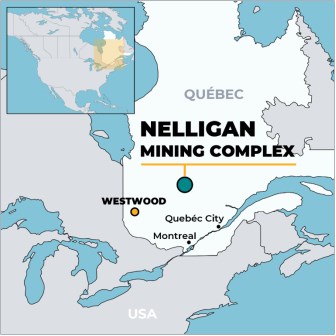 |
The acquisitions of Northern Superior and Orbec, as described under "Item II - General Description of Business - Three Year History" combines assets and consolidates the Chibougamau region with a dominant land position of approximately 134,000 hectares. The Northern Superior acquisition with the Philibert, Chevrier, Lac Surprise and Croteau(1) projects together with the Orbec acquisition with the Muus project are combined with IAMGOLD's Nelligan and Monster Lake Projects (together the "Nelligan Mining Complex"). The Nelligan Mining Complex will rank as one of the largest undeveloped gold camps in Canada with Measured and Indicated Mineral Resources of 4.34 Moz Au and Inferred Mineral Resources of 7.50 Moz Au.(1) The proximity of the primary deposits to each other supports the conceptual vision of a central processing facility being fed from multiple ore sources within a 17-kilometre radius. |
(1) The Company opted to exclude the mineral resources previously associated with the Croteau property in its year end update, resulting in reported totals of 4.34 Moz Au Measured and Indicated Mineral Resources and 7.50 Moz Au Inferred Mineral Resources. At the time of the Northern Superior acquisition, disclosed estimates were 3.75 Moz Au Measured and Indicated Mineral Resources and 8.65 Moz Au Inferred Mineral Resources, which included Croteau.
Nelligan
The Project is located approximately 15 kilometres south of the Monster Lake Project in the Chapais - Chibougamau area in Québec. The Company holds a 100% interest in the Nelligan project after closing a definitive arrangement agreement with Vanstar in February 2024.
On February 20, 2025, the Company announced its updated Mineral Resources for Nelligan of 3.1 million Indicated gold ounces in 102.8 million tonnes at 0.95 g/t Au, and 5.2 million Inferred ounces (166.4 Mt at 0.96 g/t Au). This represents a 56% increase in Indicated ounces, or 1.1 million ounces, with an accompanying 13% increase in grade; as well as a 33% increase in Inferred ounces, or 1.3 million ounces, with a similar 14% increase in grade. In 2025, approximately 16,700 metres of DD were completed to continue to infill and extend mineralized zones of the deposit in the eastern down-plunge of the deposit.
On September 15, 2025, the Company provided an update on the 2025 drilling program with assay results confirming the extension of the mineralized zones of Nelligan deposit. Highlights included: 20.6 metres at 1.93 g/t Au and 13.5 metres at 2.17 g/t Au in hole NE-25-239, and 36.5 metres at 3.03 g/t Au in hole NE-25-265 in Zone 36; 24.5 metres at 3.24 g/t Au in drill hole NE-25-244, and 28.8 metres at 1.00 g/t Au in drill hole NE-25-248 in the Renard Zone; and 21.0 metres at 2.23 g/t Au in drill hole NE-25-244, and 7.5 metres at 7.48 g/t Au and 34.5 metres at 1.22 g/t Au in drill hole NE-25-256A.
The Mineral Resources was updated at the end of the year incorporating additional drilling results and a change in the gold price (increased from $1,800/oz to $2,500/oz) and increased mining costs. The updated Mineral Resources for Nelligan contains 3.7 million Indicated gold ounces in 122.0 million tonnes at 0.95 g/t Au, and 4.6 million Inferred ounces (151.0 Mt at 0.96 g/t Au). This represents an 18% increase in Indicated ounces and a decrease of 10% in the Inferred ounces, for a slight gain of global ounces. Nelligan mineralization remains open along strike and at depth.
Monster Lake
The Company holds a 100% interest in the Monster Lake project, which is located approximately 15 kilometres north of the Nelligan project in the Chapais - Chibougamau area in Québec.
On October 23, 2024, the Company reported an updated Mineral Resource Estimate of 239,000 tonnes of Indicated Mineral Resources averaging 11.0 g/t Au for 84,200 ounces of gold; and 1,053,000 tonnes of Inferred Mineral Resources averaging 14.4 grams g/t Au for 488,500 ounces of gold. This Mineral Resources was updated at the end of the year with a change in the gold price (increased from $1,800/oz to $2,500/oz) and increased mining costs. The updated Mineral Resources for Monster Lake contains 243,000 tonnes of Indicated Mineral Resources averaging 13.0 g/t Au for 102,000 ounces of gold, and 1,045,000 tonnes of Inferred Mineral Resources averaging 14.8 g/t Au for 499,000 ounces of gold. This resulted in a slight gain of global ounces.
During the first three quarters of the year, approximately 17,600 metres of exploration DD were completed to test exploration targets along the main Monster Lake Shear Zone structural corridor and known gold mineralized lateral and depth extensions.On September 15, 2025, the Company provided an update on this 2025 drilling program with assay results indicating the persistence of the high-grade veins in the general down-plunge of the Megane zone. Highlights included: 3.0 metres at 12.66 g/t Au in drill hole ML-25-282, and 9.0 metres at 23.4 g/t Au in drill hole ML-25-292 in the Megane Zone; and 4.9 metres at 127.3 g/t Au in drill hole ML-25-283, and 2.2 metres at 39.4 g/t Au in drill hole ML-25-287 in the Lower Shear Zone.
Anik Gold Project Joint Venture
The Anik Gold project is owned at 75% by IAMGOLD after the Company elected to exercise its first option to acquire an undivided interest of 75% in the project in May 2025 pursuant to an option agreement signed on May 20, 2020, with Auriginal Metals, successor to Kintavar Exploration Inc.). The project is contiguous with the Nelligan Gold project to the north and east. The Company holds an option to earn up to an 80% interest in the project by meeting certain commitments.
The 2025 DD program was initially planned for 1,800 metres and was slightly increased to approximately 2,100 metres, all of which were completed in the first quarter 2025, testing different target areas.
Philibert and Chevrier
The Chevrier and Philibert projects were acquired in December 2025 as part of the acquisition of Northern Superior and are located in Québec, Canada, within the Nelligan-Chibougamau area.
Philibert is a gold exploration and development project comprising an open pit-style deposit and associated mineral claims located in proximity to the Company's Nelligan and Monster Lake projects, while Chevrier is a gold exploration project located within the same regional geological setting and forms part of the broader land package acquired through Northern Superior. The Philibert and Chevrier projects host gold Mineral Resources that have been estimated in accordance with NI 43-101, as disclosed in the Philibert Report and Chevrier Report, each based on historical drilling and technical studies completed prior to the acquisition. The Chevrier and Philibert projects are considered exploration and evaluation assets and are included in the Company's consolidated mineral resource disclosure as at December 31, 2025. See "- Mineral Reserves and Mineral Resources."
3.3.2 Africa - Diakha - Siribaya, Mali
The Diakha-Siribaya project is wholly owned by the Company and consists of eight contiguous exploration permits which cover a total area of approximately 600 square kilometres. It is located in the Kédougou- Kéniéba inlier of the West African Craton region of western Mali along the borders with Senegal and Guinea. The Diakha-Siribaya Mineral Resources is reported using a $1,500 per ounce gold price, unchanged from the prior year, and totals 27.94 million tonnes of Indicated Mineral Resources averaging 1.48 g/t Au for 1.33 million ounces of gold, and 8.47 million tonnes of Inferred Mineral Resources averaging 1.53 g/t Au for 417,000 ounces of gold.
At the end of 2022, the Company announced it had entered into definitive agreements with Managem S.A. to sell its interests in the Diakha-Siribaya project as part of its Bambouk assets. The definitive agreement to sell the Diakha-Siribaya Gold Project in Mali expired on December 31, 2024, and was not extended. The Company is pursuing alternative options for the sale of this asset.
Qualified Person and Technical Information
The technical and scientific information relating to exploration activities disclosed in this section was prepared under the supervision of and verified and reviewed by Marie-France Bugnon, P.Geo., Vice President, Exploration. Ms. Bugnon is a "qualified person" as defined by NI 43-101.
3.4 OUTLOOK
The approved spending for capitalized and expensed exploration and development studies for 2026 is $54.0 million and is summarized as follows:
Table 10: Approved Spending for Capitalized and Expensed Exploration and Development studies for 2026
| ($ millions) | Capitalized | Expensed | Total 2026 |
| Corporate exploration projects-brownfield | 7.0 | 2.0 | 9.0 |
| Corporate exploration projects-greenfield | 11.0 | 34.0 | 45.0 |
| Total | 18.0 | 36.0 | 54.0 |
4. MINERAL RESERVES AND MINERAL RESOURCES
The following tables set out the Company's estimate of its MRMR as of December 31, 2025, with respect to the gold operations specified in the second table below. Christine Beausoleil, P.Geo. (Senior Director, Mining Geology, IAMGOLD Corporation), a "qualified person" for the purposes of NI 43-101, is responsible for the review and approval of all Mineral Resource estimates contained herein, as of December 31, 2025. Adrienne Rispoli, P.Eng. (Senior Director, Mining and Integrated Planning, IAMGOLD Corporation), a "qualified person" for the purposes of NI 43-101, is responsible for the review and approval of all Mineral Reserve estimates contained herein, as of December 31, 2025. The Mineral Resource estimates for the Philibert project were prepared by Mr. Merouane Rachidi, P.Geo. and Mr. Claude Duplessis, P.Eng., each a "qualified person" for the purposes of NI 43-101, as disclosed in the Philibert Report prepared prior to the Company's acquisition of Northern Superior. The Mineral Resource estimates for the Chevrier project were prepared by Ms. Susan Lomas, P.Geo., Mr. André Liboiron, P.Geo. and Mr. Jonathan Lavoie, P.Eng., each a "qualified person" for the purposes of NI 43-101, as disclosed in the Chevrier Report prepared prior to the acquisition. The Company has relied upon such technical reports for purposes of including the Philibert and Chevrier estimates in its consolidated MRMR disclosure as at December 31, 2025. IAMGOLD has not revised or altered the original information provided for these properties.
Mineral Reserves and/or Mineral Resources at the Essakane and Côté Gold Mines, the Westwood Complex and at the Diakha-Siribaya, Gosselin, Gossey, Monster Lake, Nelligan, Philibert and Chevrier Projects have been estimated in accordance with the Canadian Institute of Mining, Metallurgy and Petroleum ("CIM") Definition Standards on MRMR adopted by the CIM Council as required by NI 43-101. Reported Mineral Reserves were estimated using a long-term gold price assumption of $2,000 per ounce in 2025 except for Côté Gold, which used $1,700 per ounce. Mineral Resources were estimated using a long-term gold price assumption of $2,500 per ounce, except for Côté ($2,100/oz), Diakha-Siribaya ($1,500/oz), Philibert ($1,747/oz) and Chevrier ($1,800/oz) projects. The Company is required by NI 43-101 to disclose its MRMR using the subcategories of Proven Mineral Reserves, Probable Mineral Reserves, Measured Mineral Resources, Indicated Mineral Resources and Inferred Mineral Resources. Unlike Proven Mineral Reserves and Probable Mineral Reserves, Mineral Resources (of all categories) do not have a demonstrated economic viability.
Table 11: Consolidated Mineral Reserves and Mineral Resources as of December 31, 2025(1)(2)(3)(4)
| Attributable Ounces of Gold |
|
| (000s) | |
| Total Proven Mineral Reserves and Probable Mineral Reserves | 7,502 |
| Total Measured Mineral Resources and Indicated Mineral Resources (Inclusive of Mineral Reserves) | 24,622 |
| Total Inferred Mineral Resources | 11,273 |
Notes:
(1) Mineral Resources that are not Mineral Reserves do not have demonstrated economic viability. Inferred Mineral Resources are in addition to Measured Mineral Resources and Indicated Mineral Resources. Details of Measured Mineral Resources and Indicated Mineral Resources and other NI 43-101 information can be found in the relevant technical reports, all of which have been prepared by a qualified person as defined in NI 43-101 and filed with the Canadian securities regulators and which are available on the Company's issuer profile on SEDAR+ at www.sedarplus.ca and EDGAR at www.sec.gov. Inferred Mineral Resources have a great amount of uncertainty as to their existence and whether they can be mined legally or economically. It is reasonably expected that the majority of Inferred Mineral Resources could be upgraded to a higher mineral category with continued exploration. Disclosure regarding the Company's mineral properties, including with respect to mineral reserve and Mineral Resource estimates included in this AIF, was prepared in accordance with NI 43-101, which differs significantly from the disclosure requirements of the SEC generally applicable to US companies. Accordingly, information contained in this AIF is not comparable to similar information made public by US companies reporting pursuant to SEC disclosure requirements. See "Cautionary Note to US Investors Regarding Disclosure of Mineral Reserve and Mineral Resource Estimates." Rounding differences may occur.
(2) Measured Mineral Resources and Indicated Mineral Resources are inclusive of Proven Mineral Reserves and Probable Mineral Reserves.
(3) Mineral Resources and Mineral Reserves for each property are reported separately in the table below.
(4) Mineral Resource and Mineral Reserves tonnage, grade and metal have been rounded to reflect the accuracy of the estimate, and numbers may not add due to rounding.
Table 12: Mineral Reserves and Mineral Resources of Gold Operations as of December 31, 2025(1)(2)(3)(4)(5)(6)(7)(8)
Measured Mineral Resources and Indicated Mineral Resources are inclusive of Proven Mineral Reserves and Probable Mineral Reserves.
| Tonnes | Grade | Ounces | Attributable Ounces |
||||||||||
| (000s) | (g/t Au) | (000s) | (000s) | ||||||||||
| Côté Gold, Canada | 70% | ||||||||||||
| Côté | |||||||||||||
| Proven Mineral Reserves | 116,055 | 1.05 | 3,902 | 2,731 | |||||||||
| Probable Mineral Reserves | 101,112 | 0.97 | 3,139 | 2,197 | |||||||||
| Subtotal P&P | 217,167 | 1.01 | 7,041 | 4,929 | |||||||||
| Measured Mineral Resources | 153,873 | 0.93 | 4,598 | 3,219 | |||||||||
| Indicated Mineral Resources | 268,833 | 0.77 | 6,697 | 4,688 | |||||||||
| Subtotal M&I (incl. of Reserves) | 422,707 | 0.83 | 11,295 | 7,907 | |||||||||
| Inferred Mineral Resources | 62,760 | 0.60 | 1,206 | 844 | |||||||||
| Gosselin | |||||||||||||
| Indicated Mineral Resources | 266,741 | 0.80 | 6,861 | 4,803 | |||||||||
| Inferred Mineral Resources | 37,840 | 0.79 | 959 | 671 | |||||||||
| Total M&I | 689,447 | 0.82 | 18,156 | 12,709 | |||||||||
| Total Inferred | 100,600 | 0.67 | 2,165 | 1,515 | |||||||||
| Westwood, Canada | 100% | ||||||||||||
| Proven Mineral Reserves | 1,555 | 6.63 | 331 | 331 | |||||||||
| Probable Mineral Reserves | 3,803 | 6.68 | 817 | 817 | |||||||||
| Subtotal P&P | 5,358 | 6.67 | 1,148 | 1,148 | |||||||||
| Measured Mineral Resources | 1,619 | 7.21 | 375 | 375 | |||||||||
| Indicated Mineral Resources | 10,324 | 6.09 | 2,022 | 2,022 | |||||||||
| Subtotal M&I (incl. of Reserves) | 11,943 | 6.24 | 2,397 | 2,397 | |||||||||
| Inferred Mineral Resources | 4,507 | 10.46 | 1,515 | 1,515 | |||||||||
| Essakane, Burkina Faso | 85% | ||||||||||||
| Proven Mineral Reserves | 22,178 | 0.64 | 457 | 388 | |||||||||
| Probable Mineral Reserves | 34,903 | 1.09 | 1,219 | 1,036 | |||||||||
| Subtotal P&P | 57,081 | 0.91 | 1,676 | 1,425 | |||||||||
| Measured Mineral Resources | 38,312 | 0.52 | 640 | 544 | |||||||||
| Indicated Mineral Resources | 111,683 | 1.05 | 3,772 | 3,207 | |||||||||
| Subtotal M&I (incl. of Reserves) | 149,995 | 0.91 | 4,412 | 3,750 | |||||||||
| Inferred Mineral Resources | 24,195 | 1.10 | 853 | 725 | |||||||||
| Gossey | |||||||||||||
| Indicated Mineral Resources | 14,795 | 0.75 | 355 | 302 | |||||||||
| Inferred Mineral Resources | 2,688 | 0.85 | 74 | 63 | |||||||||
| Total M&I | 164,790 | 0.90 | 4,767 | 4,052 | |||||||||
| Total Inferred | 26,883 | 1.07 | 927 | 788 | |||||||||
| Nelligan Mining Complex8, Canada | 100% | ||||||||||||
| Nelligan | |||||||||||||
| Indicated Mineral Resources | 122,000 | 0.95 | 3,700 | 3,700 | |||||||||
| Inferred Mineral Resources | 151,000 | 0.96 | 4,647 | 4,647 | |||||||||
| Monster Lake | |||||||||||||
| Indicated Mineral Resources | 243 | 13.04 | 102 | 102 | |||||||||
| Inferred Mineral Resources | 1,046 | 14.83 | 499 | 499 | |||||||||
| Philibert7 | (75%7) | ||||||||||||
| Indicated Mineral Resources | 7,884 | 1.10 | 279 | 209 | |||||||||
| Inferred Mineral Resources | 48,465 | 1.10 | 1,709 | 1,282 | |||||||||
| Chevrier7 | |||||||||||||
| Indicated Mineral Resources | 6,400 | 1.26 | 260 | 260 | |||||||||
| Inferred Mineral Resources | 15,660 | 1.30 | 652 | 652 | |||||||||
| Total M&I | 136,527 | 0.99 | 4,341 | 4,271 | |||||||||
| Total Inferred | 216,171 | 1.08 | 7,507 | 7,079 | |||||||||
| Diakha-Siribaya, Mali6 | 90% | ||||||||||||
| Indicated Mineral Resources | 27,937 | 1.48 | 1,325 | 1,193 | |||||||||
| Inferred Mineral Resources | 8,468 | 1.53 | 417 | 376 | |||||||||
| Total Proven & Probable Mineral Reserves | 279,606 | 1.10 | 9,865 | 7,502 | |||||||||
| Total Measured & Indicated Mineral Resources | 1,030,644 | 0.94 | 30,987 | 24,622 | |||||||||
| Total Inferred Mineral Resources | 356,628 | 1.09 | 12,530 | 11,273 | |||||||||
Notes:
(1) Figures may not add due to rounding.
(2) In mining operations, Measured Mineral Resources and Indicated Mineral Resources that are not Mineral Reserves are considered uneconomic at the price used for Mineral Reserves estimations but are deemed to have a reasonable prospect of economic extraction.
(3) See "Cautionary Note to U.S. Investors Regarding Disclosure of Mineral Reserves and Mineral Resources Estimates".
(4) 2025 Mineral Reserves estimated as of December 31, 2025, using a gold price of $2,000 per ounce for Westwood (including Grand Duc) and Essakane; and $1,700 per ounce for Côté Gold.
(5) 2025 Mineral Resources estimated as of December 31, 2025, using a gold price of: $2,500 per ounce for Essakane, Westwood (incl. Grand Duc), Nelligan, Monster Lake and Gossey; and $2,100/oz for Côté.
(6) Diakha-Siribaya Mineral Resources are estimated at a gold price of $1,500 per ounce. The definitive agreement to sell the Diakha-Siribaya Gold Project in Mali to Managem S.A. expired on December 31, 2024, and was not extended. The Company is pursuing alternative options for the sale of this asset.
(7) Philibert (75% with option to acquire 100% from SOQUEM for C$3.5M) and Chevrier were acquired with the closing of the Northern Superior transaction in December 2025. The Mineral Resources estimates for these assets are based on data as reported in the respective NI 43-101 Technical Reports. Chevrier Mineral Resources (including underground inferred resources) have been estimated as of September 23, 2022, using a $1,800/oz gold price and have been estimated in accordance with NI 43-101. Philibert Mineral Resources have been estimated as of September 22, 2023, using a $1,747/oz gold price and have been estimated in accordance with NI 43-101.
(8) At the time of the Northern Superior acquisition, disclosed estimates were 3.75 Moz Au Measured and Indicated Mineral Resources and 8.65 Moz Au Inferred Mineral Resources, which included Croteau. The Company opted to exclude the mineral resources previously associated with the Croteau property in its year-end update, resulting in reported totals of 4.34 Moz Au Measured and Indicated Mineral Resources and 7.50 Moz Au Inferred Mineral Resources.
The Company's Mineral Reserves are comprised of in-place material, i.e. material containing ounces of gold for which an assessment of key modifying factors such as mining, processing, metallurgical recovery, infrastructure, economic, legal, environmental, social and governmental factors are used to determine their economic viability. Mineral Reserves are estimated with a mill feed reference point.
There are numerous parameters inherent in estimating Proven Mineral Reserves and Probable Mineral Reserves including many factors beyond the Company's control. The estimation of Mineral Reserves is a subjective process, and the accuracy of any Mineral Reserve estimate is a function of the quality of available data and of engineering and geological interpretation and judgment. Results from drilling, testing and production, as well as material changes in metal prices subsequent to the date of an estimate, may justify a revision of such estimates.
Estimation Procedures
Technical Information and Qualified Person/Quality Control
The individual responsible for the review and approval of all Mineral Resource estimates for IAMGOLD is Christine Beausoleil, P.Geo., Senior Director, Mining Geology, IAMGOLD Corporation. The individual responsible for the review and approval of all Mineral Reserve estimates for IAMGOLD is Adrienne Rispoli, P.Eng., Senior Director, Mining and Integrated Planning, IAMGOLD Corporation. Ms. Beausoleil and Ms. Rispoli are considered "qualified persons" for the purposes of NI 43-101 with respect to the mineralization being reported on. The technical information in Section 4 of this AIF has been included with the consent and prior review of Ms. Beausoleil and Ms. Rispoli, as applicable. The qualified persons have verified the data disclosed and data underlying the information or opinions contained in this section.
For each of the projects and properties it operates, the Company has established rigorous methods and procedures aimed at assuring reliable estimates of the MRMR. For each mine and project of the Company, the relevant qualified person(s) verified the data disclosed including sampling, analytical and test data underlying the information contained in this section. Quality control falls under the responsibility of Ms. Beausoleil and Ms. Rispoli.
For the recently acquired Philibert and Chevrier properties (acquired on December 19, 2025), the mineral resource estimates provided in this statement are based on data as reported in the respective NI 43-101 Technical Reports. The "qualified persons" responsible for these estimates have consented under NI 43-101 to the incorporation of their data into this AIF. IAMGOLD has not revised or altered the original information provided for these properties. For Philibert, the qualified persons for the Philibert Report are Mr. Merouane Rachidi, P.Geo. and Mr. Claude Duplessis, P.Eng.; for Chevrier, the qualified persons for the Chevrier Report are Ms. Susan Lomas, P.Geo., Mr. André Liboiron, P.Geo. and Mr. Jonathan Lavoie, P.Eng.
In estimating Mineral Reserves, cut-off grades are established using the Company's long-term metal price and foreign exchange assumptions, royalties, the mining dilution & metallurgical recovery factors and estimated production costs over the life of the related operation. As part of the annual Mineral Reserve estimation process, the cost models used for cut-off grade calculations are compared to prior estimates and are updated appropriately based on actual operating performance and price projections for inputs. Cut-off grades are determined by corporate objectives, mining method as well as considering the various mine-mill-tailing capacities specific to each operation.
The nature of mining activities is such that the extraction of ore from a mine reduces Mineral Reserves. In order to renew Mineral Reserves (at least partially) on most of its producing properties, the Company carries out exploration drilling programs at depth and laterally.
5. OTHER ASPECTS OF THE BUSINESS
5.1 MARKETING OF PRODUCTION
All gold produced by IAMGOLD is in the form of doré bars, which is then refined into gold bullion. The production may be sold to various counterparties acting as buyers, including financial institutions, governments, metals trading businesses and refineries. All sales are made at market rates.
Revenues from sales of gold are received in US dollars and Euros. A significant portion of operating and other expenses are incurred in non-US currencies, including Canadian dollars and Euros. The value of the Canadian dollar and other currencies relative to the US dollar has a direct impact on the Company's profit margin.
The following table illustrates fluctuations in the exchange rates for US dollars expressed in Canadian dollars for the last five calendar years and is based on rates as reported on Bloomberg.
Table 13: Fluctuations in the Exchange Rates for US Dollars Expressed in Canadian Dollars for the Year Ended December 31, 2025
| US$/C$ | 2025 | 2024 | 2023 | 2022 | 2021 |
| High (intraday) | 1.4793 | 1.4447 | 1.3875 | 1.3885 | 1.2940 |
| Low (intraday) | 1.3540 | 1.3239 | 1.3110 | 1.2477 | 1.2035 |
| Average | 1.3978 | 1.3700 | 1.3495 | 1.3019 | 1.2537 |
| End of Period | 1.3724 | 1.4384 | 1.3243 | 1.3554 | 1.2637 |
The following table illustrates fluctuations in the exchange rate for euros expressed in US dollars for the last five calendar years and is based on rates as reported on Bloomberg.
Table 14: Fluctuations in the Exchange Rates for Euros Expressed in US Dollars for the Year Ended December 31, 2025
| EUR/US$ | 2025 | 2024 | 2023 | 2022 | 2021 |
| High (intraday) | 1.1919 | 1.1192 | 1.1236 | 1.1455 | 1.2327 |
| Low (intraday) | 1.0178 | 1.0353 | 1.0467 | 0.9594 | 1.1199 |
| Average | 1.1300 | 1.0823 | 1.0816 | 1.0533 | 1.1828 |
| End of Period | 1.1746 | 1.0426 | 1.1039 | 1.0705 | 1.1370 |
5.2 ENVIRONMENT AND PERMITTING
The Company's challenge is to integrate its economic activities with environmental integrity, social concerns and effective governance; the pillars of sustainable mining.
With respect to environmental stewardship, the Company continues to seek a thorough understanding of the potential interactions between mining activities and the environment, and look to protect the environment while maximizing sustainable development opportunities.
With respect to the Company's operating mines, the environmental measures taken by the Company should not impact its competitive position, as the majority of responsible miners are subject to similar environmental standards. The medium and long-term financial impact of these standards is attributable to the costs of minimizing the environmental effects of operations and the implementation of mine closure activities. The Company annually reviews its provision for environmental obligations and no material adverse effect on earnings is expected in the future. The Company believes that its operations are substantially in compliance with all relevant and material laws and regulations, as well as standards and guidelines issued by the relevant regulatory authorities. Several new Company-wide standards were developed and approved between 2022 and 2024, including a mine closure standard, a tailings and waste standard, and a water standard.
In 2024, the Company was externally verified against the Mining Association of Canada's ("MAC") Towards Sustainable Mining Initiative, receiving A, AA and AAA scores on all indicators, across all protocols, at both its Essakane and Westwood Mines (as a new operation, Côté Gold does not yet report). Essakane and Westwood were awarded Bronze Leadership Awards from MAC for their 2024 TSM performance, in recognition of receiving a minimum of A across all indicators.
In 2021, Westwood's environmental team conducted an internal review of site performance to identify any performance below internal standards or regulatory requirements and investigated any potentially non-compliant punctual situations with the assistance of an external firm. The independent technical report, which was submitted to the regulatory authorities, covered the previous five-year period and indicated no observable environmental effects on the receptor into which the effluent was discharged. The provincial regulatory authorities accepted the corrective plan put in place to address all identified situations. Federal regulatory authorities have not responded to this matter as of the date of this AIF; however, management does not believe that the non-compliances will result in a material impact on the site or the Company. External compliance audits were conducted in 2022 and 2023 to validate the site performances, and any identified elements related to regulatory requirements are discussed with the regulatory authorities.
In 2022, permitting efforts, at Côté Gold, continued with several permits received to support ongoing construction of the TMF and MRA. The Company obtained approvals from the Ontario Ministry of Mines for offline dam raises associated with the TMF and MRA. The Ontario Ministry of the Environment, Conservation and Parks and Ministry of Natural Resources (MNR) also granted approvals to support these construction projects (e.g., Permits to Take Water, Permits to Remove Forest Resources etc.). A work permit was issued by MNR to conduct in-water work within the Watercourse Realignment Channel #2. Permitting continued through 2025 in support of ongoing operations.
The estimates for restoration and closure costs are prepared by knowledgeable individuals and are subject to review and approval by government authorities where regulated. Site closure costs are charged against a provision accumulated during the production phase. These obligations are estimated as of December 31, 2025, as follows:
Table 15: Obligations estimated as at December 31, 2025
| Undiscounted Amounts ($ millions) | |
| Doyon Mine(1) | 159.7 |
| Essakane Mine | 107.9 |
| Côté Gold Mine | 57.0 |
| Westwood Complex | 39.5 |
| Other Canadian sites(2) | 8.4 |
| Total | 372.5 |
Notes:
(1) The Doyon mine closed in 2009.
(2) Other Canadian sites include the Mouska mine which closed during 2014, and other properties including Chester, Solbec (closed) and Y. Vezina (closed).
5.3 COMMUNITY RELATIONS
Community support for mining operations is viewed as a key element for a successful mining venture. As part of its strategy, the Company plays an active role in the Indigenous and local communities affected by its operations and has established community relations programs to interact with stakeholders and rightsholders with respect to its activities and their impact on the local communities. In Canada, meaningful consultation with Indigenous Peoples is a critical component of social license and permitting for the Company's operations. At Côté Gold, Indigenous engagement and consultation is ongoing with our Impact Benefit Agreement ("IBA") partners (Mattagami and Flying Post First Nations and the Métis Nation of Ontario, Region 3) and other Indigenous communities per direction from federal and provincial governments (as applicable). IBA implementation activities include regular meetings with our First Nation partners and the Abitibi Inland Historic Métis Community (Métis Nation of Ontario Region 3). At Westwood, the Company is actively engaged with Abitibiwinni First Nation with respect to the Westwood mine and regional development of projects in the surrounding areas.
Monitoring is a key engagement activity and provides opportunity for ongoing dialogue with Indigenous communities and local stakeholders. In 2025, Westwood convened monitoring committees quarterly. Key topics discussed included the progressive rehabilitation initiative, water management, and social risk management. The progressive rehabilitation project includes creation of habitats for birds and snakes found in the area, and the ongoing monitoring of their success, as well as revegetation projects in Mouska park. The monitoring of the success of these projects will continue through 2026.
Côté Gold continued to meet quarterly with the Gogama Socio-economic Management and Monitoring Committee and the Mattagami and Flying Post First Nations Socio-economic Management and Monitoring Committee. First Nation environmental monitors work alongside the Côté environmental team and regular environmental management committee meetings are held between the Company and the First Nation communities to discuss environmental aspects of the project.
Community Investments
In all areas that the Company operates, it works to implement community development programs, which can be sustained beyond the mine life, to assist in improving the quality of life for those residents impacted by the operations and projects.
In Canada, the Company actively works with local and Indigenous communities near Westwood and the Côté Gold to identify opportunities for investment in sustainable community projects related to education, health, culture, and career awareness and economic development.
At Côté Gold, in addition to IBA payments to First Nations partners, the Company contributed to organizations such as Skills Ontario, Northern Ontario School of Medicine (NOSM) University, Cambrian College, and others, while continuing a partnership with Indspire, an Indigenous education charity, which provides bursaries for Indigenous students. Côté Gold also committed a substantial multi-year sponsorship to Dynamic Earth's Expansion, C$300,000 over 3 years (C$100 thousand per year starting in 2025) which will be used to create a new exhibition about open pit mining. The exhibit is expected to launch in early 2027.
Westwood mine contributed to organizations such as Collectif territoire, Centraide, and many others that work to alleviate poverty, improve education, and improve environmental conditions. Notably, the Company partnered with the Rouyn-Noranda Library foundation, contributing C$75,000 in 2025, which is expected to add an estimated 3,000 new books to the library's shelves, and doubled its donation to Ressourcerie Bernard-Hamel food bank from pervious years to C$10,000, helping provide support to the local community.
In 2025, the Company entered a new phase of its long-standing partnership with Laurentian University in Sudbury, investing C$2.5 million into the creation of the IAMGOLD President's Innovation Fund for Strategic Investment. This 5-year, C$2.5 million initiative will support academic and research projects that aid in the implementation of the University's strategic priorities while driving innovation in mineral resources and mining education and research. IAMGOLD has been partnering with Laurentian University on various initiatives since 2012.
In Burkina Faso, at its Essakane operation, the Company is required to contribute 1% of revenues annually towards the Burkina Community Fund known as the Mining Fund for Local Development (FMDL), resulting in over C$20.4 million invested in 2025. Essakane also contributed more than C$3.5 million in voluntary community investments. Voluntary investments support projects in the areas most directly affected by our operations, with a focus on priorities identified through community engagement, primarily education and health. For example, Essakane is partnering with the local hospital through an annual contribution of C$40,000 over three years to improve facilities and expand treatment options. This support helps increase access to local care and reduces the need for medical evacuations to larger urban centres, which has historically been required for many treatments.
The FMDL investments are used for ongoing projects that run over the course of several years. These include the Socio-Economic Empowerment of Vulnerable Populations in the Sahel (EPASEC/ESEPV), which is a multiyear initiative with Global Affairs Canada, the Government of Burkina Faso and Cowater International. The initiative has also received support from One Drop Foundation and the World Gold Council. The project strengthens local governance, improves access to water, hygiene and sanitation services, and supports women's socioeconomic empowerment. IAMGOLD contributes approximately C$3 million. Another joint initiative is the Women and Youth in Action for Sustainable Ecosystems (FAED) project, which is a collaboration with Global Affairs Canada and SOCODEVI aimed at improving climate resilience for women, youth and their communities in the region of Sahel.
5.4 PROJECT DEVELOPMENT AND CONSTRUCTION
The Company has in place a project development department to support new projects and existing operations on specific technical issues, major capital projects and expansions. The goal consists of ensuring the development of site projects with standard project management practices in terms of costs and scheduling and to effectively manage investments in mining assets. Major brownfield and greenfield projects are developed from studies to full construction from this group in partnership with external engineering firms and internally with support of Operations Services expert resources.
5.5 OPERATIONS AND TECHNICAL SERVICES
The objective of the Operations Services division is to provide technical governance of mines operated by the Company on specific operating practices and standards and to support technical studies required for strategic development.
The goal consists in ensuring technical performance of each division's activities with a view to achieving greater effectiveness in terms of costs and asset endowment and to effectively manage investments in mining assets.
5.6 INTELLECTUAL PROPERTY
With the advent of automation and other AI-driven technologies, as they become increasingly integrated in Company's activities, the Company needs to secure the necessary licences to operate such technologies. A number of such licence agreements have been put in place for production activities at the Côté Gold Mine. Moreover, the Company maintains a number of software licences which are necessary to its continued operations and support thereof.
5.7 COMPETITION
The Company is in competition with other mining companies for mineral properties that can be developed and produced economically; technical experts that can find, develop and mine such mineral properties; labour to operate the mineral properties; and capital to finance exploration, development and operations.
In the pursuit of acquisition opportunities for mineral properties and in connection with the recruitment and retention of qualified employees, the Company competes with several Canadian and foreign companies that may have substantially greater financial and other resources. Although the Company has acquired mineral properties in the past, there can be no assurance that its acquisition efforts will succeed in the future. If the Company is unsuccessful in acquiring qualified personnel or additional mineral properties, the Company may not be able to replace Mineral Reserves, maintain production or grow. For additional information with respect to the competition risks faced by the Company. See "Risk Factors - The mining industry is highly competitive and the Company may not successfully compete for new mining properties".
5.8 SALE OF PRODUCTION
The Company's revenues are generated predominately from the sale of attributable gold and silver production. The gold price is subject to fluctuations resulting from factors beyond the Company's control. These factors include general price inflation, changes in Central Bank policies, changes in investment trends, geopolitical events and changes in gold supply, and demand on the public and private markets.
The Company sells its production to various counterparties acting as buyers, including financial institutions, governments, metals trading businesses and refineries. All sales are done at market rates.
5.9 EMPLOYEES
As at December 31, 2025, the Company employed 4,596 individuals including full-time employees, expats, part-time employees, students and contingent workers, approximately 855 of whom were students and contingent workers.
5.10 DIVIDENDS
The Company did not declare a dividend on its Common Shares in 2025.
The Company maintains a dividend policy with the timing, payment and amount of dividends paid by the Company to shareholders to be determined by the Board from time to time based upon, among other things, current and forecasted cash flow, results of operations and the financial condition of the Company, the need for funds to finance ongoing operations and development, exploration and capital projects, and such other business considerations as the directors of the Company may consider relevant.
The Credit Facility and the 2028 Senior Notes both contain covenants that restrict the ability of the Company to declare or pay dividends if a default under the Credit Facility or the 2028 Senior Notes, as applicable, has occurred and is continuing or would result from the declaration or payment of a dividend.
5.11 EXPERIENCE IN FOREIGN JURISDICTIONS
As a result of their extensive operating history, management and the Board have collectively gained considerable experience developing and operating resource projects in each of the jurisdictions the Company operates in, resulting in a sophisticated understanding of the political, cultural, legal and business environments in which the Company operates. Specifically, the Company's directors and executive officers:
i. are familiar with the laws and requirements of Burkina Faso as a result of their experience successfully operating and developing resource projects in this jurisdiction and reliance on experienced local counsel;
ii. are familiar with the role the government of Burkina Faso through their operation and management of longstanding resource projects in Burkina Faso through regular consultation with local senior management, experienced, among other things, in government relations;
iii. are familiar with local business culture and practices by virtue of regular dialogue with a strong local senior management team in the jurisdiction, as well as professional advisors in the local jurisdiction, such as experienced local legal counsel; and
iv. have familiarity with the banking systems and controls between Canada and Burkina Faso through regular reporting on local matters by local, experienced senior management in the jurisdictions.
While not all of the directors of the Company visit the Company's foreign operations with consistent frequency, management of the Company has regular, open and direct lines of communication with local senior management in Burkina Faso that keeps the Board regularly appraised of all significant issues that arise in the course of their activities.
The Company employs experienced local senior management in each jurisdiction of its operations that speak both English and the primary language of the jurisdiction. Local management uses the primary language of the jurisdiction to manage the day-to-day operations in the jurisdiction and regularly reports to the senior executives and directors of the Company in English on matters of importance. All material transactions and agreements are negotiated by senior executives and directors of the Company in English as is customary in the mining space. Material agreements are drafted in English and, following settlement after negotiation, translated into the language of the jurisdiction to which they pertain. The only significant documents translated for review by senior executives and directors of the Company are material mineral tenure in the local jurisdictions, or other agreements with governments for which, as is customary, the local language takes precedence. Translations are performed by professionals fluent in the language being translated and English. Local management, generally fluent in the local language and English, would manage any communications issues, if any, between the Company and its operations. Company-wide communications, policies and procedures are worked on, collaboratively, between head office and the local senior management in the jurisdictions of the Company's operations.
6. LEGAL PROCEEDINGS AND REGULATORY ACTIONS
The Company is from time to time involved in legal proceedings and regulatory inquiries, arising in the ordinary course of business. Typically, the amount of ultimate liability with respect to these actions will not, in the opinion of management, materially affect the Company's financial position, results of operations or cash flows.
ITEM IV: DESCRIPTION OF CAPITAL STRUCTURE
The Company is authorized to issue an unlimited number of First Preference Shares, an unlimited number of Second Preference Shares and an unlimited number of Common Shares, of which 588,765,083 Common Shares and no First Preference Shares or Second Preference Shares were issued and outstanding as of February 13, 2026. The Company does not have any outstanding non-voting shares or securities with unequal voting rights.
Each Common Share entitles the holder thereof to one vote at all meetings of shareholders other than meetings at which only holders of another class or series of shares are entitled to vote. Each Common Share entitles the holder thereof, subject to the prior rights of the holders of the First Preference Shares and the Second Preference Shares, to receive any dividends declared by the directors of the Company and the remaining property of the Company upon dissolution.
The First Preference Shares are issuable in one or more series. Subject to the articles of the Company, the directors of the Company are authorized to fix, before issue, the designation, rights, privileges, restrictions and conditions attaching to the First Preference Shares of each series. The First Preference Shares rank prior to the Second Preference Shares and the Common Shares with respect to the payment of dividends and the return of capital on liquidation, dissolution or winding-up of the Company. Except with respect to matters as to which the holders of First Preference Shares are entitled by law to vote as a class, the holders of First Preference Shares are not entitled to vote at meetings of shareholders of the Company. The holders of First Preference Shares are not entitled to vote separately as a class or series or to dissent with respect to any proposal to amend the articles of the Company to create a new class or series of shares ranking in priority to or on parity with the First Preference Shares or any series thereof, to effect an exchange, reclassification or cancellation of the First Preference Shares or any series thereof or to increase the maximum number of authorized shares of a class or series ranking in priority to or on parity with the First Preference Shares or any series thereof.
The Second Preference Shares are issuable in one or more series. Subject to the articles of the Company, the directors of the Company are authorized to fix, before issue, the designation, rights, privileges, restrictions and conditions attaching to the Second Preference Shares of each series. The Second Preference Shares rank junior to the First Preference Shares and prior to the Common Shares with respect to the payment of dividends and the return of capital on liquidation, dissolution or winding-up of the Company. Except with respect to matters as to which the holders of Second Preference Shares are entitled by law to vote as a class, the holders of Second Preference Shares are not entitled to vote at meetings of shareholders of the Company. The holders of Second Preference Shares are not entitled to vote separately as a class or series or to dissent with respect to any proposal to amend the articles of the Company to create a new class or series of shares ranking in priority to or on parity with the Second Preference Shares or any series thereof, to effect an exchange, reclassification or cancellation of the Second Preference Shares or any series thereof or to increase the maximum number of authorized shares of a class or series ranking in priority to or on parity with the Second Preference Shares or any series thereof.
ITEM V: RATINGS
The following information relating to the Company's credit ratings is provided as it relates to the Company's financing costs and liquidity. Specifically, credit ratings impact both the Company's ability to obtain short-term and long-term financing, and the cost of such financings. A negative change in the Company's ratings outlook or any downgrade in the Company's current credit ratings by its rating agencies could adversely affect its future cost of borrowing and/or access to sources of liquidity and capital. In addition, changes in credit ratings may affect the Company's ability to enter into, or the associated costs of entering into, hedging transactions or other contracts in the ordinary course of business on acceptable terms. The Company believes that its current credit ratings will allow it to continue to have access to the capital markets, as and when needed, at a reasonable cost of funds.
The following table sets out the ratings of IAMGOLD's corporate credit and the 2028 Senior Notes credit by the rating agencies indicated as at February 13, 2026:
Table 16: Ratings of IAMGOLD's corporate credit and the 2028 Senior Notes credit
| Standard & Poor's | Moody's Investors Service | Fitch | |
| Corporate Rating | BB- | B2 | B+ |
| 2028 Senior Notes | BB- | B3 | B+ |
| Trend/Outlook | Stable | Positive | Stable |
S&P's credit ratings are on a long-term rating scale that ranges from AAA to D, which represents the range from highest to lowest quality of such securities rated. The ratings from AAA to CCC may be modified by the addition of a plus (+) or a minus (-) sign to show relative standing within the major categories. In addition, S&P may add a rating outlook of "positive", "negative" or "stable", which assesses the potential direction of a long-term credit rating over the intermediate term (typically six months to two years). As of October 15, 2025, S&P has assigned IAMGOLD a corporate credit rating of BB- and a credit rating of BB- on the LT Foreign Issuer Credit with a Stable outlook. According to S&P, this rating generally means the relevant issuer is less vulnerable in the near-term but faces major ongoing uncertainties to adverse business, financial and economic conditions. The stable outlook reflects S&P Global Ratings' view that IAMGOLD's increased earnings and lower expected debt will lead to sustainably stronger credit measures over the next few years.
Moody's credit ratings are on a rating scale that ranges from Aaa to C, which represents the range from highest to lowest quality. Moody's appends numerical modifiers 1, 2 and 3 to each generic rating classification from Aa through Caa. The modifier 1 indicates that the obligation ranks in the higher end of its generic rating category; the modifier 2 indicates a mid-range ranking; and the modifier 3 indicates a ranking in the lower end of that generic category. As of September 8, 2025, Moody's has assigned IAMGOLD a corporate family credit rating of B2 and a credit rating of B3 on the 2028 Senior Notes with a Positive outlook. According to Moody's, the B2 rating generally means that the obligations are considered speculative and are subject to high credit risk. Moody's indicate that their rating is driven by the Company's benefits of 1) modest financial leverage; 2) increased exposure to Canada with ramp up of production at Côté Gold with a long mine life of over 15 years; and 3) free cash flow generation. However, the Company's rating is constrained by 1) Moderate scale of 3 producing mines; 2) geopolitical risk associated with the Essakane Mine in Burkina Faso; 3) exposure to variable gold prices; and 5) a short mine life at Essakane. Moody's ratings outlook is positive which reflects Moody's expectation that the Company will use its free cash flow to reduce debt. It also incorporates the expectation that IAMGOLD will have a stable production profile of around 800 thousand ounces of gold per year.
Fitch credit ratings are on a rating scale that ranges from AAA to D which represents the range from highest to lowest quality. Between the categories of AA and CCC, Fitch uses modifiers by the addition of a plus (+) or a minus (-) sign to show relative standing within the major categories. The modifier (+) indicates that the obligation ranks in the higher end of its generic rating category; no modifier indicates a mid-range ranking; and the modifier (-) indicates a ranking in the lower end of that generic category. As of June 26, 2025, Fitch has assigned IAMGOLD a Long-Term IDR rating of B+ and a credit rating of B+ on the 2028 Senior Notes with a Stable outlook. According to Fitch, the B+ rating generally means that material default risk is present, but a limited margin of safety remains. According to Fitch, liquidity would be considered "Comfortable" with a clear deleveraging path and limited refinancing risk. Fitch indicates that Company's rating reflects the improved business profile from the completion of the Côté Gold Mine and expectation that EBITDA leverage will be sustained below 3.0x. Key ratings drivers include i) Côté Gold improving the Company's operational profile including overall attributable annual gold production; ii) the Company's cost position improving on average; iii) high cost position mines offset partially by solid mine lives and lower costs at Côté Gold and Westwood Mines; and iv) deleveraging capacity from free cash flow generation in 2025 providing adequate liquidity to opportunistically reduce debt and/or retain cash for repayment of debt on maturity. Credit ratings are not a recommendation to buy, sell or hold securities. Credit ratings may be subject to revision or withdrawal at any time by the credit rating organization.
ITEM VI: MARKET FOR SECURITIES
1. TRADING PRICE AND VOLUME
The Common Shares of the Company are listed on the TSX under the symbol "IMG" and on the NYSE under the symbol "IAG."
The following table sets forth the market price range, in Canadian dollars, and the trading volume of the Common Shares on the TSX for each month during the year ended December 31, 2025.
Table 17: Market Price Range, in Canadian Dollars, and the Trading Volume of the Common Shares on the TSX
| High (C$) | Low (C$) | Close (C$) | Volume | |
| January | 9.27 | 7.49 | 9.04 | 72,605,818 |
| February | 9.68 | 7.61 | 7.97 | 81,082,280 |
| March | 9.39 | 7.27 | 8.98 | 79,226,566 |
| April | 11.63 | 7.63 | 9.77 | 108,900,389 |
| May | 10.19 | 8.46 | 9.42 | 76,823,665 |
| June | 10.78 | 9.57 | 10.03 | 78,883,501 |
| July | 10.27 | 9.26 | 9.36 | 74,443,905 |
| August | 12.83 | 9.35 | 12.79 | 91,554,475 |
| September | 18.27 | 12.63 | 17.98 | 123,953,680 |
| October | 20.63 | 15.30 | 16.24 | 139,880,020 |
| November | 21.94 | 15.33 | 21.92 | 89,752,764 |
| December | 24.64 | 20.51 | 22.65 | 69,819,603 |
The following table sets forth the market price range, in US dollars, and the trading volume of the Common Shares on the NYSE for each month during the year ended December 31, 2025.
Table 18: Market Price Range, in US Dollars, and the Trading Volume of the Common Shares on the NYSE
| High (C$) | Low (C$) | Close (C$) | Volume | |
| January | 6.38 | 5.20 | 6.24 | 240,916,960 |
| February | 6.69 | 5.27 | 5.52 | 232,964,113 |
| March | 6.57 | 5.02 | 6.25 | 245,481,614 |
| April | 8.38 | 5.35 | 7.08 | 363,060,711 |
| May | 7.40 | 6.06 | 6.86 | 319,602,896 |
| June | 7.87 | 7.01 | 7.35 | 371,687,786 |
| July | 7.57 | 6.69 | 6.76 | 280,085,855 |
| August | 9.35 | 6.77 | 9.31 | 255,309,874 |
| September | 13.14 | 9.15 | 12.93 | 338,160,308 |
| October | 14.67 | 10.92 | 11.58 | 319,784,521 |
| November | 15.60 | 10.87 | 15.54 | 188,431,910 |
| December | 17.91 | 14.66 | 16.49 | 145,063,600 |
2. PRIOR SALES
The following table summarizes issuances of securities of the Company during the year ended December 31, 2025.
Table 19: Summary of Issuances of Securities of the Company During the Year Ended December 31, 2025
| Date of Issue/Grant | Price per security (C$) | Number of Securities | Footnote |
| January 22, 2025 | $6.86 | 8,700 | (1) |
| January 23, 2025 | $4.74 | 100,000 | (1) |
| January 31, 2025 | $6.86 | 100,000 | (1) |
| February 11, 2025 | $12.25 | 816,488 | (4) |
| February 25, 2025 | $3.99 | 2,645 | (1) |
| February 26, 2025 | $6.86 | 92,600 | (1) |
| February 28, 2025 | $7.97 | 339,592 | (5) |
| February 28, 2025 | $7.97 | 745,162 | (2) |
| March 3, 2025 | $4.03 | 59,556 | (6) |
| March 3, 2025 | $4.03 | 82,590 | (7) |
| March 3, 2025 | $3.69 | 52,898 | (6) |
| March 3, 2025 | $3.69 | 102,179 | (7) |
| March 3, 2025 | $3.50 | 507,045 | (6) |
| March 3, 2025 | $3.50 | 99,163 | (7) |
| March 12, 2025 | $3.99 | 2,512 | (1) |
| March 12, 2025 | $3.50 | 6,358 | (1) |
| March 17, 2025 | $3.99 | 4,660 | (1) |
| March 17, 2025 | $4.74 | 15,000 | (1) |
| March 17, 2025 | $3.50 | 8,804 | (1) |
| March 18, 2025 | $4.03 | 906,861 | (6) |
| March 18, 2025 | $4.03 | 338,010 | (7) |
| March 18, 2025 | $4.03 | 5,599 | (1) |
| March 18, 2025 | $4.03 | 10,000 | (6) |
| March 20, 2025 | $4.02 | 20,404 | (1) |
| March 20, 2025 | $3.73 | 37,966 | (1) |
| March 20, 2025 | $3.67 | 20,100 | (1) |
| March 21, 2025 | $4.03 | 100 | (1) |
| March 21, 2025 | $3.99 | 23,380 | (1) |
| March 21, 2025 | $4.74 | 18,982 | (1) |
| March 21, 2025 | $3.50 | 20,000 | (1) |
| March 25, 2025 | $3.50 | 4,138 | (1) |
| March 28, 2025 | $4.03 | 62,011 | (1) |
| March 28, 2025 | $3.69 | 45,100 | (1) |
| March 28, 2025 | $3.99 | 22,735 | (1) |
| March 28, 2025 | $4.74 | 19,954 | (1) |
| March 28, 2025 | $3.50 | 45,221 | (1) |
| March 31, 2025 | $8.98 | 31,883 | (3) |
| April 9, 2025 | $4.90 | 28,089 | (6) |
| April 25, 2025 | $3.99 | 4,502 | (1) |
| May 9, 2025 | $9.78 | 2,641 | (3) |
| June 3, 2025 | $3.69 | 16,133 | (1) |
| June 3, 2025 | $4.74 | 15,939 | (1) |
| June 6, 2025 | $3.69 | 6,932 | (1) |
| June 10, 2025 | $4.31 | 2,543 | (6) |
| June 10, 2025 | $3.62 | 16,667 | (6) |
| June 30, 2025 | $10.03 | 30,689 | (3) |
| July 18, 2025 | $3.69 | 1,438 | (1) |
| August 12, 2025 | $11.07 | 4,803 | (2) |
| August 13, 2025 | $4.74 | 5,000 | (1) |
| August 14, 2025 | $6.24 | 5,682 | (1) |
| August 18, 2025 | $6.75 | 1,424 | (6) |
| August 18, 2025 | $4.74 | 25,000 | (1) |
| August 25, 2025 | $7.04 | 13,460 | (6) |
| August 25, 2025 | $4.74 | 10,000 | (1) |
| August 27, 2025 | $4.74 | 5,000 | (1) |
| September 8, 2025 | $4.74 | 85,000 | (1) |
| September 15, 2025 | $4.03 | 4,152 | (1) |
| September 15, 2025 | $3.69 | 4,112 | (1) |
| September 15, 2025 | $3.99 | 4,357 | (1) |
| September 15, 2025 | $4.74 | 5,000 | (1) |
| September 15, 2025 | $3.50 | 5,959 | (1) |
| September 23, 2025 | $4.74 | 5,000 | (1) |
| September 29, 2025 | $4.74 | 5,000 | (1) |
| September 29, 2025 | $3.50 | 5,291 | (1) |
| September 30, 2025 | $17.98 | 18,213 | (3) |
| October 1, 2025 | $4.74 | 2,500 | (1) |
| October 16, 2025 | $4.74 | 10,000 | (1) |
| October 17, 2025 | $4.74 | 2,500 | (1) |
| November 12, 2025 | $4.74 | 18,567 | (1) |
| November 13, 2025 | $7.02 | 2,577 | (6) |
| November 13, 2025 | $4.74 | 85,000 | (1) |
| November 14, 2025 | $4.74 | 9,867 | (1) |
| November 26, 2025 | $7.48 | 1,329 | (6) |
| November 28, 2025 | $3.99 | 11,000 | (1) |
| December 11, 2025 | $7.98 | 1,098 | (6) |
| December 19, 2025 | $4.74 | 30,000 | (1) |
| December 22, 2025 | $4.74 | 5,000 | (1) |
| December 23, 2025 | $4.74 | 5,000 | (1) |
| December 31, 2025 | $3.69 | 16,210 | (1) |
| December 31, 2025 | $3.93 | 50,000 | (1) |
| December 31, 2025 | $22.65 | 13,065 | (3) |
| Options to Purchase Common Shares | |||
| February 28, 2025 | $7.97 | 433,180 | (8) |
Notes:
(1) Common Shares issued upon exercise of previously granted awards of Common Share purchase options (each, an "Option") pursuant to the Company's share incentive plan (the "SIP").
(2) Issuance of restricted share units (each, a "RSU") pursuant to the SIP.
(3) Issuance of deferred share units (each, a "DSU") pursuant to the SIP.
(4) Common Shares issued in relation to the private placement which qualified as flow-through shares.
(5) Issuance of performance share units (each, a "PSU") pursuant to the SIP.
(6) Common Shares issued upon release of previously granted awards of RSUs pursuant to the SIP.
(7) Common Shares issued upon release of previously granted awards of PSUs pursuant to the SIP.
(8) Issuance of Options pursuant to the SIP.
ITEM VII: DIRECTORS AND OFFICERS
1. DIRECTORS
IAMGOLD's Board is comprised of the following individuals, each of whom will, unless he or she resigns or his or her office becomes vacant for any reason, hold office until the close of the next annual meeting of shareholders, or until his or her successor is elected or appointed:
Table 20: IAMGOLD Board of Directors
| Name, Position, Province or State and Country of Residence |
Principal Occupations During the Past 5 Years | Director of the Corporation Since |
| RENAUD ADAMS Director, President and Chief Executive Officer Burlington, Ontario, Canada |
Mr. Adams was appointed as Director, President and Chief Executive Officer of the Corporation on April 1, 2023. Prior to that Mr. Adams was President and Chief Executive Officer of New Gold Inc. from 2018 to 2022. | April 2023 |
| Biography: Renaud Adams has over 30 years of global mining experience in senior executive positions and operations. Mr. Adams was President and Chief Executive Officer of New Gold Inc. from 2018 to 2022, where he led the strategic repositioning of the company. Prior to New Gold, Mr. Adams was President and Chief Executive Officer of Richmont Inc. from 2014 until the company was sold to Alamos Gold in November 2017. From 2011 to 2014, Mr. Adams was Chief Operating Officer at Primero Mining Corporation, and prior to that he was General Manager of IAMGOLD's Rosebel mine in Suriname before being appointed Senior Vice President, Americas Operations. Prior to IAMGOLD, Mr. Adams held various senior operations positions at mining operations located in the Americas. Mr. Adams holds a Bachelor of Engineering degree in Mining and Mineral Processing from Laval University in Quebec, Canada. |
||
| CHRISTIANE BERGEVIN (1)(3) Director Montreal, Quebec, Canada |
Ms. Bergevin was appointed to the Board of Directors of the Corporation on February 22, 2023. Ms. Bergevin is a corporate director, the President of Bergevin Capital since 2016, Senior Advisor to Roland Berger Canada since 2020 and Chief Representative, Canada of Astris Finance LLC. since 2022. | February 2023 |
| Biography: | ||
| Name, Position, Province or State and Country of Residence |
Principal Occupations During the Past 5 Years | Director of the Corporation Since |
| Christiane Bergevin brings over 35 years of experience in finance transaction advisory, strategy and project development across the world. She spent 19 years with the international engineering construction company of SNC-Lavalin (now AtkinsRéalis) including as the President of SNC-Lavalin Capital. From 2009 to 2015, Ms. Bergevin led corporate development for Desjardins Group as Executive Vice President, Strategic Partnership and Business Development and was a member of the global credit committee and served on the executive committee of Desjardins Financial Corporation. She was subsequently a senior consultant with Hydro One's Strategy, Innovation and Corporate Development Group. Since 2020, she has been a Senior Advisor to the strategy consulting firm of Roland Berger. In addition to her credentials in natural resources, capital markets, investments and mergers & acquisitions, Ms Bergevin has extensive public policy and international relations experience and is a Governor of the Canadian Chamber of Commerce after serving as the Chair of the Board in 2017-18. Ms. Bergevin is currently a Director of Azimut Exploration Inc. (TSXV) and a member of the supervisory board of RATP Développement S.A. (RATP Dev). Ms. Bergevin has previously been a Director of Yamana Gold, Talisman Energy, Caisse de dépôt et placement du Québec and the Business Development Bank of Canada. Ms. Bergevin currently serves on McGill's Principal International Advisory Committee and is the Chair of the Board of Tennis-Quebec. Ms. Bergevin holds a Bachelor of Commerce, Finance and Entrepreneurship with Distinction from McGill University, and graduated from the Wharton School of Business (Advanced Management Program). She holds the ICD.D designation from the Institute of Corporate Directors. |
||
| ANN K. MASSE (2)(4) Director Wilmington, Delaware, United States of America |
Dr. Masse was appointed to the Board of Directors of the Corporation on October 1, 2021, and is a corporate director. Dr. Masse held the position of Global Head, Health, Safety & Environment and Security at Rio Tinto from 2019 to 2023. | October 2021 |
| Biography: Dr. Ann K. Masse has over 40 years of experience across the fields of health, safety, environment, security, and product stewardship. She was the Global Head of Health, Safety, Environment, and Security for Rio Tinto. She is a passionate advocate for safety and sustainability in mining. During her tenure, Rio Tinto adopted an industry-leading approach to advancing safety culture and maturity resulting in sustained fatality free performance. Previous roles held by Dr. Masse include Vice President, Safety, Health and Environment with Barrick Gold Corporation and Vice President, Safety and Health with Goldcorp Inc. Dr. Masse spent 23 years at DuPont where she held various leadership positions culminating in Global Safety, Health and Environment Leader-Strategy. DuPont is recognized as a world leader in safety and health practices and performance. Dr. Masse has also served on the boards of Pacific Salmon Foundation and the Partnership for the Delaware Estuary. Dr. Masse holds a Bachelor of Arts degree in Environmental Studies from St. Michael's College (Vermont), a Ph.D. in Physical Oceanography from the University of Delaware and completed her post-doctoral appointment with the Canada Centre for Inland Waters in Burlington, Ontario. |
||
| L. PETER O'HAGAN (1)(2) Director New York City, New York, United States of America |
Mr. O'Hagan was appointed to the Board of Directors of the Corporation on March 11, 2022, and is a corporate director. Mr. O'Hagan held the position of Managing Director at The Carlyle Group from 2016 to 2019. | March 2022 |
| Biography: Peter O'Hagan brings over 35 years of experience in commodities, natural resource investing, capital markets and structured finance. He worked at Goldman Sachs from 1991 to 2013, where he was a partner from 2002 to 2013 and was most recently Co-Head of Global Commodities. From 2016 to 2019, Mr. O'Hagan was a Managing Director at The Carlyle Group, a global investment firm where he focused on industrial and natural resource investments within the $4 billion Equity Opportunity Fund. Immediately prior to joining Carlyle, he was an operating advisor at KKR & Co. in the Energy and Real Assets group. Mr. O'Hagan is currently a director of Triple Flag Precious Metals, where he is chairman of the Compensation Committee. He was a board member of Rigel Resource Acquisition Corporation from 2022 to 2025, where he served as chairman of the Audit Committee and a board member and chair of the Compensation Committee of Stillwater Mining from 2015 to 2017 until its sale to Sibanye Gold. He is a graduate of the University of Toronto, Trinity College (BA) and holds an MA from the Johns Hopkins University School of Advanced International Studies (SAIS). He serves on the advisory board of Johns Hopkins SAIS. |
||
| Name, Position, Province or State and Country of Residence |
Principal Occupations During the Past 5 Years | Director of the Corporation Since |
| KEVIN P. O'KANE (4)(5) Director Winnipeg, Manitoba, Canada |
Mr. O'Kane was appointed to the Board of Directors of the Corporation on September 21, 2021, and is currently the Executive Vice President and Chief Operating Officer of Northisle Cooper and Gold Inc. Mr. O'Kane held the position of Chief Operating Officer of SSR Mining from 2018 to 2020. | September 2021 |
| Biography: Kevin O'Kane has more than 40 years' experience in the global mining industry in senior executive and operations positions. Mr. O'Kane spent over 35 years with BHP in various roles including leading multibillion-dollar projects from conception, through permitting and into execution and operations, President of Pampa Norte copper operations in Chile, in various major project development, technical and operating roles at La Escondida copper mine in Chile, and Vice President Health, Safety, Environment & Community for BHP's copper business. From 2018 to 2020, Mr. O'Kane served as the Executive Vice President and Chief Operating Officer of SSR Mining Inc. In September 2025, Mr. O'Kane was appointed as the Executive Vice President and Chief Operating Officer of Northisle Copper and Gold Inc. Mr. O'Kane also serves on the Boards of Almaden Minerals Ltd., Northisle Copper and Gold Inc. and Autlan (BMV). Mr. O'Kane holds a Bachelor of Applied Science degree in Mining Engineering from Queen's University in Ontario, Canada and is registered as a Professional Engineer in the province of British Columbia. |
||
| DAVID S. SMITH (2) Director and Chair of the Board North Vancouver, British Columbia, Canada |
Mr. Smith was appointed to the Board of Directors of the Corporation on February 13, 2022, and as Chair of the Board on September 21, 2023. Mr. Smith has been a corporate director since 2015. | February 2022 |
| Biography: David Smith is a Corporate Director who has had a career on both the finance and the supply sides of business within the mining sector. Mr. Smith has 40 years of executive and board leadership experience with extensive international exposure. Mr. Smith served as the Chief Financial Officer and Executive Vice President of Finning International Inc., a major equipment supplier to the mining industry with significant operations in Canada and South America, from 2009 to 2014. Prior to joining Finning, Mr. Smith served as Chief Financial Officer and Vice President of Ballard Power Systems, Inc. from 2002 to 2009. Previously, he spent 16 years with Placer Dome Inc. (now Barrick) in various senior positions and 4 years with PriceWaterhouseCoopers. Mr. Smith is currently Chair of the Board of Directors of Hudbay Minerals Inc. Mr. Smith has previously served on other public mining company boards of directors, specifically, Pretium Resources Inc. (acquired by Newcrest Mining), Nevsun Resources Ltd. (acquired by Zijin Mining Group Limited), Dominion Diamonds Corp. (acquired by the Washington Companies), Northwest Copper Corp. and Paramount Gold Nevada. Mr. Smith holds a Bachelor's of Science degree in Business Administration, Accounting from California State University, Sacramento and has completed the Institute of Corporate Directors, Directors Education Program (ICD.D). |
||
| MURRAY P. SUEY (1)(3) Director Calgary, Alberta, Canada |
Mr. Suey was appointed to the Board of Directors of the Corporation on February 15, 2024, and is a corporate director. Mr. Suey held the position of Partner at KPMG LLP from 1996 to 2023. | February 2024 |
| Biography: Murray Suey has over 40 years of experience in financial advisory, operations and auditing with KPMG Canada, a global leading accounting and professional services firm. Mr. Suey most recently served as a Regional Managing Partner in KPMG Canada. Prior to this, he was a Partner-in-Charge of the Calgary audit practice with decades of experience advising global natural resource companies and SEC registrants. Mr. Suey was proudly a founding member of KPMG Canada's Inclusion and Diversity Council which guided KPMG Canada to actively manage diversity and representation of women in senior management positions. Mr. Suey was the Director, Treasurer and Member of the Executive Committee of the Board for Breakthrough T1D, formerly known as the Juvenile Diabetes Research Foundation (JDRF) Canada until April 2025. Mr. Suey is currently a member of the Audit Committee of the Calgary Foundation. Mr. Suey was awarded the Fellow designation of the Institute of Chartered Accountants (FCPA, FCA) in 2019, and holds a Bachelor of Commerce (with Distinction) from the University of Calgary. In 2023, Mr. Suey received the Executive Certificate in Advancing Sustainability from the NYU Stern Center for Sustainable Business and completed the Directors' Consortium from Stanford University Graduate School of Business. |
||
| Name, Position, Province or State and Country of Residence |
Principal Occupations During the Past 5 Years | Director of the Corporation Since |
| ANNE MARIE TOUTANT (4)(5) Director Calgary, Alberta, Canada |
Ms. Toutant was appointed to the Board of Directors of the Corporation on November 9, 2023, and is a corporate director. Ms. Toutant held the position of Vice President at Suncor Energy from 2004 to 2020. | November 2023 |
| Biography: Anne Marie Toutant has over 35 years of experience in the resources industry as an independent director, advisor and, executive with extensive operations and technical expertise. She served on several boards including IAMGOLD, the Suncor Energy Foundation, Canadian Mining Hall of Fame and the Mining Association of Canada. A Fellow of the Canadian Institute of Mining, Metallurgy and Petroleum (CIM), Ms. Toutant served as the Institute's President in 2022/2023. Anne Marie held executive roles at Suncor focused on leading priorities such as: the safe commissioning, world class start-up and initial operations of the $18B Fort Hills project, testing of autonomous trucks in northern Alberta and development of a digital deployment roadmap, and the consolidation of mining activities in the world-scale Millennium mine. Prior to Suncor, Ms. Toutant held operations and engineering roles of increasing responsibility in metallurgical and thermal coal mines in western Canada for Luscar Ltd. and Cardinal River Coals Ltd. becoming one of Canada's early female mine managers in 1998. Ms. Toutant holds a BSc in Mining Engineering from the University of Alberta and is registered as a Professional Engineer in the province of Alberta. |
||
| AUDRA WALSH (3)(5) Director Crystal River, Forida, United States of America |
Ms. Walsh was appointed to the Board of Directors of the Corporation on June 20, 2023, and is a corporate director. Ms. Walsh is currently the Vice President, South America Business Unit at Hudbay Minerals Inc., and held the position of Chief Executive Officer at MATSA Mining from 2016 to 2022. | June 2023 |
| Biography: Audra Walsh is a Professional Engineer with over 30 years of technical, operating, management, executive and board experience in the mining industry. In January 2026, Ms. Walsh was appointed Vice President, South America Business Unit at Hudbay Minerals Inc. She previously served as the CEO of Minas de Aguas Teñidas S.A.U (MATSA), prior to the acquisition by Sandfire Resources in 2022. She formerly held the position of President and CEO of Sierra Metals Inc., Minera S.A. and A2Z Mining Inc. Ms. Walsh has held senior positions with Barrick Gold Corporation and Newmont Mining Corporation. Ms. Walsh currently serves as a director for Hemlo Mining Corp. and Faraday Copper. Ms. Walsh is a graduate with a Bachelor of Science, Mine Engineering from the South Dakota School of Mines and Technology in Rapid City, South Dakota and volunteers for their Mining Industry Advisory board. |
||
Notes:
(1) Audit and Finance Committee
(2) Human Resources and Compensation Committee
(3) Nominating and Corporate Governance Committee
(4) Sustainability Committee
(5) Technical Committee
2. EXECUTIVE OFFICERS
The following table sets forth the names of each of the executive officers of the Company:
Table 21: Executive Officers of the Company
| Name, Position, Province or State and Country of Residence |
Principal Occupations During the Past 5 Years | Appointed Officer Since |
| RENAUD ADAMS President and Chief Executive Officer Burlington, Ontario, Canada |
Mr. Adams was appointed as President and Chief Executive Officer of the Company in April 2023. Prior to that Mr. Adams was President and Chief Executive Officer of New Gold Inc. from 2018 to 2022. | April 2023 |
| BRUNO LEMELIN Chief Operating Officer St-Augustin-de-Desmaures, Québec, Canada |
Mr. Lemelin was appointed as Chief Operating Officer of the Company in September 2023. Prior to that, Mr. Lemelin was the Senior Vice President, Operations and Projects from March 2020 to September 2023 and prior to that Mr. Lemelin held the position of Regional Vice President, Americas from June 2018 to March 2020. | March 2020 |
| MAARTEN THEUNISSEN Chief Financial Officer Toronto, Ontario, Canada |
Mr. Theunissen was appointed as Chief Financial Officer of the Company in March 2023. Prior to that, Mr. Theunissen was the Vice President, Finance from September 2021 to March 2023 and prior to that Mr. Theunissen held the position of Chief Financial Officer of TMAC Resources from 2018 until 2021. | September 2021 |
| ANNIE TORKIA LAGACÉ Chief Legal and Strategy Officer Montreal, Québec, Canada |
Ms. Torkia Lagacé was appointed Chief Legal and Strategy Officer of the Company in February 2025. Prior to that Ms. Torkia Lagacé held the position of Senior Vice President, General Counsel & Corporate Secretary at Bombardier Inc. from December 2020 to May 2023 and prior to that held various vice-president positions at Stornoway Diamond Corp. from November 2014 to July 2020. | February 2025 |
| DORENA QUINN Chief People Officer, Human Capital and Communications Toronto, Ontario, Canada |
Ms. Quinn was appointed as Chief People Officer, Human Capital and Communications, of the Company in February 2025. Prior to that Ms. Quinn held the position of Senior Vice President, People of the Company from June 2022 to February 2025, Vice President, People from March 2020 to June 2022 and Global Head of Talent and Corporate HR from April 2018 to March 2020. | June 2022 |
3. SHAREHOLDINGS OF DIRECTORS AND OFFICERS
As at February 13, 2026, the last trading day prior to the date of this AIF, directors and executive officers of IAMGOLD as a group beneficially own, directly or indirectly, or exercise control or direction over, approximately 872,000 Common Shares or approximately 0.15% of the issued and outstanding Common Shares.
4. CORPORATE CEASE TRADE ORDERS OR BANKRUPTCIES
Orders and Corporate Bankruptcies
To the knowledge of the Company, other than as set forth below, no director or executive officer of the Company is, or has been in the last ten years before the date of this AIF, a director, chief executive officer or chief financial officer of a company (including the Company) that, while such individual was acting in such capacity, (a) was the subject of a cease trade order or similar order or an order that denied the issuer access to any exemptions under securities legislation, for a period of more than 30 consecutive days, or (b) was subject to a cease trade or similar order or an order that denied the issuer access to any exemption under securities legislation, for a period of more than 30 consecutive days, that was issued, after that person ceased to be a director, chief executive officer or chief financial officer, which resulted from an event that occurred while such person was acting in such capacity.
To the knowledge of the Company, no director, executive officer or shareholder holding a sufficient number of securities of the Company to materially affect control of the Company is, or has been in the last ten years before the date of this AIF, a director or executive officer of any company (including the Company) that, while acting in such capacity, or within a year of ceasing to act in such capacity, became bankrupt, made a proposal under any legislation relating to bankruptcy or insolvency, or was subject to or instituted any proceedings, arrangement or compromise with creditors, or had a receiver, receiver manager or trustee appointed to hold its assets.
Mr. Adams was a director of Monarch Mining Corporation ("Monarch") from June 30, 2022, until March 31, 2023. Further to an application filed by one of Monarch's creditors, Investissement Quebec, on November 15, 2023, the Superior Court of Quebec ("Court") issued an order under the Companies' Creditors Arrangement Act ("CCAA") staying any legal proceedings against Monarch and appointing PricewaterhouseCoopers Inc. ("PwC") as monitor of the business and financial affairs of Monarch. Further to its appointment, PwC initiated a sale and investment solicitation process for Monarch. This may have involved one or more restructurings, recapitalizations or other forms of reorganization of the operations and business of Monarch. Such sale and investment solicitation process culminated in potential transactions involving the sales of Monarch's Beaufor, McKenzie Break and Swanson assets. Mr. Adams resigned from the Board on March 31, 2023, almost eight months before the order of the Court placing Monarch under CCAA protection.
Ms. Torkia Lagacé served as an officer of Stornoway Diamond Corporation ("Stornoway") and certain of its subsidiaries from November 2014 until November 2019. Stornoway and its Canadian subsidiaries filed for protection under the CCAA on September 9, 2019. The CCAA process was concluded by order of the Court in November 2019 and Stornoway's operating subsidiary emerged from such process, continuing its operations on a going concern basis after the successful implementation of Stornoway's restructuring transactions. In November 2019, Stornoway and certain of its non-operating subsidiaries made a voluntary assignment into bankruptcy pursuant to the Bankruptcy and Insolvency Act.
Personal Bankruptcies
To the knowledge of the Company, no director or executive officer of the Company, or shareholder holding a sufficient number of securities of the Company to affect materially the control of the Company, has, within the 10 years before the date of this AIF, become bankrupt, made a proposal under any legislation relating to bankruptcy or insolvency, or become subject to or instituted any proceedings, arrangement or compromise with creditors, or had a receiver, receiver manager or trustee appointed to hold his or her assets.
Penalties and Sanctions
To the best of management's knowledge, no penalties or sanctions have been imposed on a director or executive officer of the Company, or shareholder holding a sufficient number of securities of the Company to affect materially the control of the Company, in relation to securities legislation or by a securities regulatory authority or has entered into a settlement agreement with a securities regulatory authority or has had any other penalties or sanctions imposed by a court or regulatory body that would likely be considered important to a reasonable investor in making an investment decision.
Conflicts of Interest
To the best of management's knowledge, there are no existing or potential material conflicts of interest between the Company or any of its subsidiaries and any director or officer of the Company or a subsidiary of the Company.
ITEM VIII: AUDIT AND FINANCE COMMITTEE
1. COMPOSITION AND RELEVANT EDUCATION AND EXPERIENCE OF MEMBERS
The Audit and Finance Committee of the Board consists of Christiane Bergevin, Peter O'Hagan, and Murray Suey (Chair). The directors of the Company have determined that all members of the Audit and Finance Committee are "independent" and "financially literate" for the purposes of applicable laws. The directors of the Company have also determined that at least one member of the Audit and Finance Committee, Mr. Murray P. Suey, is an "Audit Committee Financial Expert" for the purposes of applicable laws. The designation of a member of the Audit and Finance Committee as an "Audit Committee Financial Expert" does not make him or her an "expert" for any purpose, impose any duties, obligations or liability on him or her that are greater than those imposed on members of the board of directors who do not carry this designation or affect the duties, obligations or liability of any other member of the Audit and Finance Committee.
The following is a brief summary of the education and experience of each member of the Audit and Finance Committee that is relevant to the performance of his or her responsibilities as a member of the Audit and Finance Committee.
Table 22: Audit and Finance Committee's Composition
| Name | Relevant Education and Experience |
| Christiane Bergevin | Ms. Bergevin has been a senior managing executive in the engineering and financial services sectors, she brings extensive domestic and worldwide experience in strategy, project and risk structuring, M&A in regulated and commercial environments and project financing of resource, transport and infrastructure projects. She has previously served as Executive Vice President, Desjardins Group, the largest cooperative financial group in Canada, between 2009 and 2015, where she led mergers and acquisitions, strategic partnerships and business development, and was also a member of Desjardins Group's finance and risk management committee. Prior to those roles, Ms. Bergevin was President of SNC-Lavalin Capital Inc., SNC-Lavalin's project finance advisory arm and a senior consultant with Hydro One (Strategy, Innovation and Corporate Development Group). Ms. Bergevin previously served as chair of the audit committee of CareRx Corporation and is currently a member of the audit committee of Azimut Exploration Inc. Ms. Bergevin holds a Bachelor of Commerce (with Distinction) from McGill University and graduated from the Wharton School's Business Advanced Management Program. In 2013, she was awarded the ICD.D designation and has served as a volunteer examiner for the Institute of Corporate Directors. |
| Name | Relevant Education and Experience |
| L. Peter O'Hagan | Mr. O'Hagan brings over 35 years of experience in commodities, natural resource investing, capital markets and structured finance. He worked at Goldman Sachs from 1991 to 2013, where he was a partner from 2002 to 2013 and was most recently Co-Head of Global Commodities. From 2016 to 2019, Mr. O'Hagan was a Managing Director at The Carlyle Group, a global investment firm where he focused on industrial and natural resource investments within the $4 billion Equity Opportunity Fund. Immediately prior to joining Carlyle, he was an operating advisor at KKR & Co. in the Energy and Real Assets group. Mr. O'Hagan is currently a director of Triple Flag Precious Metals, where he is chairman of the Compensation Committee. He was a board member of Rigel Resource Acquisition Corporation from 2022 to 2025, where he served as chairman of the Audit Committee and a board member and Chair of the Compensation Committee of Stillwater Mining from 2015 to 2017 until its sale to Sibanye Gold. He is a graduate of the University of Toronto, Trinity College (BA) and holds an MA from the Johns Hopkins University School of Advanced International Studies (SAIS). He serves on the advisory board of Johns Hopkins SAIS. |
| Murray P. Suey (Chair) | Mr. Suey has over 40 years of experience in financial advisory, operations and auditing with KPMG Canada, a global leading accounting and professional services firm. Mr. Suey most recently served as a Regional Managing Partner in KPMG Canada. Prior to this, he was a Partner-in-Charge of the Calgary audit practice with decades of experience advising global natural resource companies and SEC registrants. Mr. Suey was proudly a founding member of KPMG Canada's Inclusion and Diversity Council which guided KPMG Canada to actively manage diversity and representation of women in senior management positions. Mr. Suey was the Director, Treasurer and Member of the Executive Committee of the Board for Breakthrough T1D, formerly known as the Juvenile Diabetes Research Foundation (JDRF) Canada until April 2025. Mr. Suey is currently a member of the Audit Committee of the Calgary Foundation. Mr. Suey was awarded the Fellow designation of the Institute of Chartered Accountants (FCPA, FCA) in 2019, and holds a Bachelor of Commerce (with Distinction) from the University of Calgary. In 2023, Mr. Suey received the Executive Certificate in Advancing Sustainability from the NYU Stern Center for Sustainable Business and completed the Directors' Consortium from Stanford University Graduate School of Business. |
2. AUDIT AND FINANCE COMMITTEE MANDATE
The Audit and Finance Committee will assist the Board in fulfilling their responsibilities under its mandate and applicable legal and regulatory requirements. To the extent considered appropriate by Audit and Finance Committee or as required by applicable legal or regulatory requirements, the Audit and Finance Committee will review the integrity of the financial reporting process of the Company, the integrity of the Company's financial statements, the system of internal controls and management of the financial risks of the Company, the performance of the Company's internal audit function, the external auditor's qualifications, independence and performance, the financial policies and the nature and structure of major strategic financial commitments. In fulfilling its responsibilities, the Audit and Finance Committee maintains an effective working relationship with the Directors, management, internal audit and the external auditor. The Mandate of the Audit and Finance Committee is attached hereto in Schedule A.
3. PRE-APPROVAL POLICIES AND PROCEDURES
The Audit and Finance Committee shall pre-approve all audit and non-audit services provided by the independent auditors and not engage the independent auditors to perform the specific non-audit services prohibited by law or regulation.
4. EXTERNAL AUDITOR SERVICE FEES
Audit Fees
The aggregate fees incurred for the external audit of the Company in each of the last two financial years for audit services were $2,121,000 in 2025 and $2,074,000 in 2024. The 2025 Audit fees include statutory audits, as well as out of pocket costs such as reimbursement costs, technology and support charges or administrative charges incurred in connection with providing professional services.
Audit-Related Fees
The aggregate fees incurred in each of the last two financial years for assurance and related services by the Company's external auditor that are not included in the above paragraph were $14,000 in 2025 and $189,000 in 2024. The audit-related fees relate to the audit of the Québec pension plan.
Tax Fees
The aggregate fees incurred in each of the last two financial years for professional tax services rendered by the Company's external auditor were $4,000 in 2025 and $3,000 in 2024. The professional tax fees relate to foreign tax compliance services.
All Other Fees
The aggregate fees incurred in each of the last two financial years for other services rendered by the Company's external auditor were $2,000 in 2025 and $0 in 2024. Other fees relate to enterprise risk management benchmarking services.
Chart for the above fee disclosure
The aggregate fees incurred by the external auditor of the Company in each of the last two financial years of the Company are as follows:
Table 23: Aggregate Fees Incurred by the External Auditor of the Company in Each of the Last Two Financial Years of the Company
| 2025 | 2024 | |
| Audit Fees | 2,121,000 | 2,074,000 |
| Audit-related Fees | 14,000 | 189,000 |
| Tax Fees | 4,000 | 3,000 |
| Other | 2,000 | 0 |
| TOTAL | 2,141,000 | 2,266,000 |
ITEM IX: INTEREST OF MANAGEMENT AND OTHERS IN MATERIAL TRANSACTIONS
Within the three most recently completed financial years and during the current 2025 fiscal year to the date hereof, none of the directors or executive officers of the Company, any person or company that beneficially owns, or controls or directs, directly or indirectly, more than 10% of the outstanding voting securities of the Company or associates or affiliates of any such person has, to the best of the Company's knowledge, any material interest, direct or indirect, in any transaction that has materially affected or is reasonably expected to materially affect the Company and its subsidiaries.
ITEM X: TRANSFER AGENT AND REGISTRAR
The Company's transfer agent and registrar is:
Computershare Trust Company of Canada
320 Bay Street, 14th Floor
Toronto, Ontario M5H 4A6
Canada
ITEM XI: MATERIAL CONTRACTS
The summaries of the following material contracts are summaries only and are qualified in their entirety by the material contracts, copies of which can be found on the Company's issuer profile on SEDAR+ at www.sedarplus.ca and EDGAR at www.sec.gov.
Credit Facility
The Company has a $650 million Credit Facility, which was entered into in December 2017 and amended in February 2021, to primarily extend the maturity date from January 31, 2023, to January 31, 2025. On November 9, 2023, the Company entered into a one-year extension of its Credit Facility extending its maturity to January 31, 2026. As part of the extension, the size of the Credit Facility was reduced to $425 million based on the Company's requirements for a senior revolving facility for its overall business.
On December 20, 2024, the Company and its syndicate of lenders executed an amendment to the Credit Facility, which extended the term to December 20, 2028, and increased the size from $425 million to $650 million. The expanded Credit Facility is available to the Company for general working capital purposes.
As at December 31, 2025, the Credit Facility was drawn in the amount of $200 million and the Company issued letters of credit under the Credit Facility in the amount of $0.4 million as guarantees for certain environmental indemnities to government agencies, and $3.9 million as a supplier payment guarantee, with $445.7 million remaining available under the Credit Facility.
Côté Gold Joint Venture Agreement
The Company entered into an amended and restated joint venture agreement with SMM on June 28, 2019, with respect to the Côté Gold Mine. This agreement was entered into following the completion of the transactions contemplated by the parties in a June 5, 2017, investment agreement, pursuant to which SMM acquired a 30% undivided participating interest in the Côté Gold Mine for an aggregate of $105 million. The joint venture agreement sets out the operational and governance framework between the parties with respect to the Côté Gold Mine.
On December 19, 2022, the Company and SMM agreed to amend the joint venture agreement for Côté Gold Mine. In January 2023, SMM funded $250 million of the Company's project expenditures, and the Company transferred a 9.7% interest in the Côté Gold Mine to SMM, subject to the Company's right to repurchase the interest under the agreement.
Effective November 30, 2024, the Company exercised its option to repurchase the transferred 9.7% interest, subject to certain adjustments as set out in the amending agreement relating to the period between initial gold production and commercial production. As of December 1, 2024, the Company restored its 70% interest in the Côté Gold Mine.
2028 Senior Notes and Indenture
On September 23, 2020, the Company completed an offering of $450 million aggregate principal amount of 5.75% Senior Notes due October 15, 2028. The 2028 Senior Notes were issued pursuant to an indenture dated September 23, 2020, among the Company, Computershare Trust Company, N.A. and certain corporate guarantors, which sets out the terms and conditions of the 2028 Senior Notes, including the circumstances under which the Company may redeem the 2028 Senior Notes, in whole or in part prior to the maturity date.
Other than as described above, the Company has not entered into any material contracts outside of the ordinary course of business during the most recently completed financial year or before the most recently completed financial year but are still in effect as of February 13, 2026.
ITEM XII: INTERESTS OF EXPERTS
The following persons and companies have prepared, certified or authored a statement, report or valuation described or included in a filing, or referred to in a filing, made by the Company under National Instrument 51-102 - Continuous Disclosure Obligations of the CSA, as amended from time to time, during or relating to the financial year of the Company ended December 31, 2025: Adrienne Rispoli, Christine Beausoleil, François J. Sawadogo, Marie-France Bugnon, Alan Smith, Wood Canada Limited, Paul O'Hara, Raymond Turenne, SLR Consulting (Canada) Ltd., Tudorel Ciuculescu, Steve Pelletier, Jason J. Cox, Stephan Theben, Bijal Shah, Mickey Davachi, Sheila Daniel, Michel Dromacque, Deena Nada, Haithem Chattaoui, Remi Lapointe, Anna Malevich, Denis Doucet, Franck Napon, Abderrazak Ladidi, Ali Jalbout, Bernard Haley, Martin Perron, Louis Nkoy Manda Mbomba, Merouane Rachidi, Claude Duplessis, Susan Lomas, André Liboiron, and Jonathan Lavoie.
Tudorel Ciuculescu, SLR Consulting (Canada) Ltd.'s former employee, reviewed and approved scientific and technical information in the Côté Gold Report. The scientific and technical information previously reviewed and approved by Tudorel Ciuculescu, to the extent included or incorporated in this AIF, has been reviewed and approved by Jason J. Cox, who is a "qualified person" as defined in NI 43-101.
Mr. Rémi Lapointe, ing. former employee of IAMGOLD, reviewed and approved scientific and technical information in the Essakane Report. The scientific and technical information previously reviewed and approved by Mr. Lapointe, to the extent included or incorporated in this AIF, has been reviewed and approved by Ms. Anna Malevich, P.Eng. who is a “qualified person” as defined in NI 43-101.
To the knowledge of the Company, after reasonable enquiry, each of the foregoing persons and companies beneficially owns, directly, or indirectly, or exercises control or direction over less than 1% of the outstanding Common Shares. Adrienne Rispoli, Christine Beausoleil, François J. Sawadogo, Marie-France Bugnon, Alan Smith, Steve Pelletier, Denis Doucet, Franck Napon, Abderrazak Ladidi, Bernard Haley, Anna Malevich and Louis Nkoy Manda Mbomba who are employees of the Company.
KPMG LLP are the Company's external auditors and have reported to the shareholders on the Company's consolidated financial statements for the year ended December 31, 2025, in their report dated February 17, 2026. In connection with their audit, KPMG LLP has confirmed that they are independent within the meaning of the relevant rules and related interpretations prescribed by the relevant professional bodies of Canada and any applicable legislation and regulations, and that they are independent accountants with respect to the Company under PCAOB Rule 3520 and all other relevant US professional and regulatory standards.
ITEM XIII: ADDITIONAL INFORMATION
Additional information relating to the Company may be found on the Company's issuer profile on SEDAR+ at www.sedarplus.ca, on EDGAR at www.sec.gov and the Company's website at www.iamgold.com. Additional information, including directors' and officers' remuneration and indebtedness, principal holders of the Company's securities and securities authorized for issuance under equity compensation plans will be contained in the Company's Management Information Circular for its most recent annual meeting of security holders that involved the election of directors. Additional information is also provided in the Company's audited consolidated financial statements and management's discussion and analysis for its most recently completed financial year ended December 31, 2025.
SCHEDULE A
AUDIT AND FINANCE COMMITTEE MANDATE IAMGOLD CORPORATION
1. Overall Purpose and Objectives
The Audit and Finance Committee (the "Committee") will assist the Board of Directors (the "Board") of IAMGOLD Corporation (the "Corporation") in fulfilling its responsibilities under this mandate and applicable legal and regulatory requirements. To the extent considered appropriate by the Committee or as required by applicable legal or regulatory requirements, the Committee will review the integrity of the financial reporting process of the Corporation, the integrity of the Corporation's financial statements, the system of internal controls and management of the financial risks of the Corporation, the performance of the Corporation's internal audit function, the external auditor's qualifications, independence and performance, the financial policies and the nature and structure of major strategic financial commitments. In fulfilling its responsibilities, the Committee maintains an effective working relationship with the Directors, management, internal audit and the external auditor.
In addition to the powers and responsibilities expressly delegated by the Board to the Committee in this Mandate, the Committee may exercise any other powers and carry out any other responsibilities delegated to it by the Board from time to time consistent with the Corporation's bylaws. The powers and responsibilities delegated by the Board to the Committee in this Mandate or otherwise shall be exercised and carried out by the Committee as it deems appropriate without requirement of Board approval, and any decision made by the Committee (including any decision to exercise or refrain from exercising any of the powers delegated to the Committee hereunder) shall be at the Committee's sole discretion. While acting within the scope of the powers and responsibilities delegated to it, the Committee shall have and may exercise all the powers and authority of the Board. To the fullest extent permitted by law, the Committee shall have the power to determine which matters are within the scope of the powers and responsibilities delegated to it.
Notwithstanding the foregoing, the Committee's responsibilities are limited to review and oversight. Management of the Corporation is responsible for the preparation, presentation and integrity of the Corporation's financial statements as well as the Corporation's financial reporting process, accounting policies, internal audit function, internal accounting controls and disclosure controls and procedures. The independent auditor is responsible for performing an audit of the Corporation's annual financial statements, expressing an opinion as to the conformity of such annual financial statements with accounting principles generally accepted in Canada ("GAAP"), which is currently International Financial Reporting Standards, and reviewing the Corporation's quarterly financial statements. It is not the responsibility of the Committee to plan or conduct audits or to determine that the Corporation's financial statements and disclosure are complete and accurate and in accordance with GAAP and applicable laws, rules and regulations. Each member of the Committee shall be entitled to rely on the integrity of those persons within the Corporation and of the professionals and experts (including the Corporation's internal auditor (or others responsible for the internal audit function, including contracted non-employee or audit or accounting firms engaged to provide internal audit services) and the Corporation's independent auditor from which the Committee receives information and, absent actual knowledge to the contrary, the accuracy of the financial and other information provided to the Committee by such persons, professionals or experts.
2. Authority
(a) The Committee shall have the authority to:
(i) engage independent counsel and other advisors as the Committee determines necessary to carry out its duties;
(ii) set compensation and authorize payment for any advisors employed by the Committee; and
(iii) communicate directly with the internal and external auditor of the Corporation and require that the external auditor of the Corporation report directly to the Committee.
(b) The Committee shall have unrestricted and unfettered access to all personnel and documents of the Corporation and shall be provided with the resources reasonably necessary to fulfill its responsibilities.
3. Membership and Organization
(a) The Committee will be composed of at least three (3) members of the Board, each of whom shall be "independent" and "financially literate" for the purposes of National Instrument 52-110 - Audit Committees, and at least one of whom shall have accounting or related financial management expertise to qualify as an "audit committee financial expert" for the purposes of rules adopted by the United States Securities and Exchange Commission and the Corporate Governance Rules of the New York Stock Exchange, which are reproduced in Appendix "A" attached hereto. The members of the Committee shall be appointed by the Board to serve a term of one (1) year and shall be permitted to serve up to ten (10) consecutive terms.
(b) No Committee member may simultaneously serve on the audit committee of more than two (2) other public companies unless the Board determines that such simultaneous service would not impair the ability of such member to effectively serve on the Committee.
(c) The chair of the Committee will be appointed by the Board on the recommendation of the Nominating and Corporate Governance Committee and shall serve no longer than ten (10) consecutive terms of one (1) year;
(d) The Committee shall meet at times necessary to perform the duties described above in a timely manner but not less than four (4) times per year. The time and place at which meetings of the Committee are to be held will be determined from time to time by the chair of the Committee. A meeting of the Committee may be called by notice by any member of the Committee, which may be given by telephone, email or other electronic communication at least 48 hours prior to the time of the meeting; however, no notice of a meeting shall be necessary if all of the members are present either in person or by means of telephone, web conference or other communication equipment, if those absent waive notice or otherwise signify their consent to the holding of such meeting or the meeting is an adjourned meeting as contemplated in this mandate.
(e) Members may participate in a meeting of the Committee by means of telephone, web conference or other communication equipment which allows all members to hear each other.
(f) A majority of the members of the Committee shall constitute a quorum. No business may be transacted at a meeting of the Committee without a quorum. If within 15 minutes of the time appointed for a meeting of the Committee, a quorum is not present, the meeting shall stand adjourned to the same hour on the next business day following the date of such meeting at the same place. If at the adjourned meeting a quorum as hereinbefore specified is not present within 15 minutes of the time appointed for such adjourned meeting, such meeting shall stand adjourned to the same hour on the second business day following the date of such meeting at the same place. If at the second adjourned meeting a quorum as hereinbefore specified is not present, the quorum for the adjourned meeting shall consist of the members then present.
(g) The secretary of the Committee will be the Secretary of the Corporation or such other person as is chosen by the Committee who shall keep minutes in respect of the proceedings of all meetings of the Committee.
(h) The Committee may invite such persons to meetings of the Committee as the Committee considers appropriate, including the external auditor of the Corporation, except to the extent exclusion of certain persons is required pursuant to this Mandate or Applicable Laws.
(i) At each meeting, the Committee shall hold an in-camera session consisting of only independent directors, unless such a session is not considered necessary by the members present.
(j) The external auditor of the Corporation may request a meeting of the Committee at any time upon 48 hours prior written notice or otherwise report directly to the Committee on their own initiative.
(k) All decisions of the Committee shall be by simple majority and the chair of the Committee shall not have a deciding or casting vote.
(l) The Committee may transact its business by a resolution in writing signed by all the members of the Committee (including in counterparts by electronic signature) in lieu of a meeting of the Committee.
4. Role and Responsibilities
The Committee's roles and responsibilities shall consist of the following:
(a) Financial Reporting
(i) review the quarterly and annual financial statements of the Corporation, management's discussion and analysis and any annual and interim earnings press releases of the Corporation before the Corporation publicly discloses such information and discuss these documents with the external auditor and with management of the Corporation, as appropriate;
(ii) consider the fairness of the quarterly interim and annual financial statements and financial disclosure of the Corporation and review with management of the Corporation and the external auditor whether:
A. actual financial results for the annual and interim periods varied significantly from budgeted, projected or previous period results;
B. generally accepted accounting principles, currently international financial reporting standards adopted by the Corporation, have been consistently applied;
C. there are any actual or proposed changes in accounting or financial reporting practices of the Corporation; and
D. there are any significant or unusual events or transactions which require disclosure and, if so, consider the adequacy of that disclosure;
(iii) review significant accounting and reporting issues, including recent professional and regulatory pronouncements, and consider their impact on the financial statements of the Corporation;
(iv) review any legal matters which could significantly impact the financial statements of the Corporation as reported on by counsel and meet with counsel to the Corporation whenever deemed appropriate;
(v) review the selection of, and changes in the accounting policies of the Corporation;
(vi) review judgmental areas, for example those involving a valuation of the assets and liabilities and other commitments and contingencies of the Corporation;
(vii) review audit issues related to the material associated and affiliated entities of the Corporation that may have a significant impact on the equity investment therein of the Corporation;
(viii) discuss the Corporation's earnings news releases, as well as financial information and earnings guidance provided to analysts and rating agencies, if applicable;
(ix) meet with management and the external auditor of the Corporation to review the annual financial statements of the Corporation and the results of the audit thereof; and
(x) meet separately and periodically with the management of the Corporation, the external auditor of the Corporation and the internal auditor (or other personnel responsible for the internal audit function of the Corporation) to discuss any matters that the Committee, the external auditor of the Corporation or the internal auditor of the Corporation, respectively, believes should be discussed privately.
(b) Internal Controls of the Corporation:
(i) approve the appointment of the internal auditor and periodically review the performance of the internal auditor;
(ii) review the planning and implementation of work of the internal auditor pursuant to the internal audit mandate, which mandate shall be approved by the Committee from time to time, including, without limitation, the identification and management of risks to the Corporation through the implementation of a system of internal controls appropriate to the Corporation;
(iii) review the areas of greatest financial, and reporting and disclosure risks to the Corporation and assess whether management of the Corporation is managing these risks effectively;
(iv) review and determine if internal control recommendations made by either the internal or external auditor of the Corporation have been implemented by management of the Corporation;
(v) review and be satisfied that adequate procedures are in place for the review of the public disclosure of the Corporation of financial information and periodically assess the adequacy of those procedures; and
(vi) subject to the Whistleblower Policy, which is approved by the Board, establish procedures for:
A. the receipt, retention and treatment of complaints received by the Corporation regarding accounting, internal accounting controls or auditing matters; and
B. the confidential, anonymous submission by employees of the Corporation of concerns regarding questionable accounting or auditing matters relating to the Corporation.
(c) Enterprise Risk Management:
The Committee shall oversee the Corporation's enterprise risk management systems and processes, including the identification, analysis and mitigation of material risks and the internal auditor's validation of the existence and efficiency of risk mitigation and control plans and processes, and risks without limiting the generality of the risks to which the Corporation's enterprise shall pertain, the Committee shall, specifically, oversee the Corporation's financial and information technology (including cybersecurity and artificial intelligence) risk exposures. The Committee shall discuss with management the actions management has undertaken to mitigate, monitor and control such exposures, all of which are management's responsibility.
The Committee, on a quarterly basis, will review risks specific to the execution of the Committee's mandate.
(d) External Auditor of the Corporation:
The Committee shall:
(i) recommend to the Board,
A. the external auditor to be nominated for the purpose of preparing or issuing an auditor's report on the annual financial statements of the Corporation or performing other audit, review or attest services for the Corporation; and
B. the remuneration to be paid to the external auditor of the Corporation;
(ii) review the proposed audit scope and approach of the external auditor of the Corporation and ensure no unjustifiable restriction or limitations have been placed on the scope of the proposed audit;
(iii) review the work of the external auditor engaged for the purpose of preparing or issuing an auditor's report on the annual financial statements of the Corporation or performing other audit, review or attest services for the Corporation, including the resolution of disagreements between management of the Corporation and the external auditor of the Corporation regarding any financial reporting matter and review the performance of the external auditor of the Corporation;
(iv) consider the qualifications and confirm the independence of the external auditor of the Corporation, including reviewing the range of services provided by the external auditor of the Corporation in the context of all consulting services obtained by the Corporation;
(v) pre-approve all non-audit services to be provided to the Corporation or any subsidiary entities thereof by the external auditor of the Corporation and, to the extent considered appropriate: (i) adopt specific policies and procedures in accordance with Applicable Laws for the engagement of such non-audit services; and/or (ii) delegate to one or more independent members of the Committee the authority to pre-approve all non-audit services to be provided to the Corporation or any subsidiary entities thereof by the external auditor of the Corporation provided that the other members of the Committee are informed of each such non-audit service;
(vi) review and approve the hiring policies of the Corporation regarding partners, employees and former partners and employees of the present and former external auditor of the Corporation; and
(vii) review with the external auditor of the Corporation any audit problems or difficulties and management's response to such problems or difficulties.
(e) Financial Matters:
The Committee shall review and, where appropriate, make recommendations to the Board regarding:
(i) policies relating to the Corporation's cash flow, cash management and working capital, shareholder dividends and related policy, and share issuance and repurchases;
(ii) financial plans, including capital market and off-balance sheet transactions, including, without limitation, equity or debt offerings and issuances, and sale-leasebacks that may have a material impact on the Corporation's financial position; and
(iii) other transactions or financial issues that management wishes to be reviewed by the Committee.
(f) Other Matters:
The Committee shall:
(i) review and approve all related party transactions;
(ii) with the advice of management, review the adequacy of insurance coverage;
(iii) with the advice of management, develop applicable financial compensation metrics and make recommendations with respect thereto to the Human Resources and Compensation Committee; and
(iv) periodically review and, where appropriate, make recommendations to the Board regarding human resource and succession planning for accounting, finance and internal audit staff.
5. Communication with the Board
The Committee shall
(a) provide the Board with a summary of all actions taken at each Committee meeting or by written resolution; and
(b) produce and provide the Board with all reports or other information required to be prepared under Applicable Laws.
6. Self‐Assessment and Mandate Review
(a) The Committee and the Board shall annually assess the effectiveness of the Committee with a view to ensuring that the performance of the Committee accords with best practices and applicable law.
(b) The Committee will annually review and assess the adequacy of this mandate and recommend any proposed changes to the Board for consideration.
7. Approval Date
Last updated, reviewed and approved by the Board on November 4, 2025.
APPENDIX A
INDEPENDENCE REQUIREMENT OF MULTILATERAL INSTRUMENT 52-110
A member of the Audit and Finance Committee shall be considered "independent", in accordance with National Instrument 52-110 - Audit Committees ("NI 52-110"), subject to the additional requirements or exceptions provided in NI 52-110, if that member has no direct or indirect "material relationship" with the Corporation - a "material relationship" being one which could, in the view of the Board, be reasonably expected to interfere with the exercise of the member's independent judgment. The following persons are considered to have a material relationship with the Corporation and, as such, cannot be a member of the Audit and Finance Committee:
(a) an individual who is, or has been within the last three years, an employee or executive officer of the Corporation;
(b) an individual whose immediate family member is, or has been within the last three years, an executive officer of the Corporation;
(c) an individual who:
(i) is a partner of a firm that is the Corporation's internal or external auditor;
(ii) is an employee of that firm; or
(iii) was within the last three years a partner or employee of that firm and personally worked on the Corporation's audit within that time;
(d) an individual whose spouse, minor child or stepchild, or child or stepchild who shares a home with the individual:
(i) is a partner of a firm that is the Corporation's internal or external auditor;
(ii) is an employee of that firm and participates in its audit, assurance or tax compliance (but not tax planning) practice, or;
(iii) was within the last three years a partner or employee of that firm and personally worked on the Corporation's audit within that time;
(e) an individual who, or whose immediate family member, is or has been within the last three years, an executive officer of an entity if any of the Corporation's current executive officers serves or served at the same time on the entity's compensation committee; and
(f) an individual who received, or whose immediate family member who is employed as an executive officer of the Corporation received, more than $75,000 in direct compensation from the Corporation during any 12 month period within the last three years, other than as remuneration for acting in his or her capacity as a member of the Board of Directors or any Board committee, or the receipt of fixed amounts of compensation under a retirement plan (including deferred compensation) for prior service for the Corporation if the compensation is not contingent in any way on continued service.
In addition to the independence criteria discussed above, any individual who:
(a) has a relationship with the Corporation pursuant to which the individual may accept, directly or indirectly, any consulting, advisory or other compensatory fee from the Corporation or any subsidiary entity of the Corporation, other than as remuneration for acting in his or her capacity as a member of the board of directors or any board committee; or as a part-time chair or vice-chair of the board or any board or committee, or
(b) is an affiliated entity of the Corporation or any of its subsidiary entities,
is deemed to have a material relationship with the Corporation, and therefore, is deemed not to be independent.
The indirect acceptance by an individual of any consulting, advisory or other fee includes acceptance of a fee by:
(a) an individual's spouse, minor child or stepchild, or a child or stepchild who shares the individual's home; or
(b) an entity in which such individual is a partner, member, an officer such as a managing director occupying a comparable position or executive officer, or occupies a similar position (except limited partners, non-managing members and those occupying similar positions who, in each case, have no active role in providing services to the entity) and which provides accounting, consulting, legal, investment banking or financial advisory services to the Corporation or any subsidiary entity of the Corporation.
Independence Requirement of NYSE Rules
A director shall be considered "independent" in accordance with NYSE Rules if that director has no material relationship with the Corporation that may interfere with the exercise of his/her independence from management and the Corporation.
In addition:
(a) A director who is an employee, or whose immediate family member is an executive officer, of the Corporation is not independent until three years after the end of such employment relationships.
(b) A director who receives, or whose immediate family member receives, more than $120,000 during any twelve-month period in direct compensation from the Corporation, other than director or committee fees and pension or other forms of deferred compensation for prior service (provided such compensation is not contingent in any way on continued service), is not independent until three years after he or she ceases to receive more than $120,000 during any twelve-month period in such compensation.
(c) A director is not independent if: (a) The director is a current partner or employee of a firm that is the Corporation's internal or external auditor; (b) the director has an immediate family member who is a current partner of such a firm; (c) the director has an immediate family member who is a current employee of such a firm and personally works on the Corporation's audit; or (d) the director or an immediate family member was within the last three years a partner or employee of such a firm and personally worked on the Corporation's audit within that time.
(d) A director who is employed, or whose immediate family member is employed, as an executive officer of another Corporation where any of the Corporation's present executives serve on that Corporation's compensation committee is not "independent" until three years after the end of such service or the employment relationship.
(e) A director who is an executive officer or an employee, or whose immediate family member is an executive officer, of a Corporation that makes payments to, or receives payments from, the Corporation for property or services in an amount which, in any single fiscal year, exceeds the greater of $1 million, or 2% of such other Corporation's consolidated gross revenues, is not "independent" until three years after falling below such threshold.
A member of the Audit Committee must also satisfy the independence requirements of Rule 10A-3(b)(1) adopted under the Securities Exchange Act of 1934 as set out below:
In order to be considered to be independent, a member of an audit committee of a listed issuer that is not an investment Corporation may not, other than in his or her capacity as a member of the audit committee, the board of directors, or any other board committee:
(a) Accept directly or indirectly any consulting, advisory, or other compensatory fee from the issuer or any subsidiary thereof, provided that, unless the rules of the national securities exchange or national securities association provide otherwise, compensatory fees do not include the receipt of fixed amounts of compensation under a retirement plan (including deferred compensation) for prior service with the listed issuer (provided that such compensation is not contingent in any way on continued service); or
(b) Be an affiliated person of the issuer or any subsidiary thereof.
An "affiliated person" means a person who directly or indirectly controls IAMGOLD, or a director, executive officer, partner, member, principal or designee of an entity that directly, or indirectly through one or more intermediaries, controls, or is controlled by, or is under common control with, IAMGOLD.
Financial Literacy Under NI 52-110
Being financially literate, in accordance with NI 52-110, means that the director has the ability to read and understand a set of financial statements that present a breadth and level of complexity of accounting issues that are generally comparable to the breadth and complexity of the issues that can reasonably be expected to be raised by the Corporation's financial statements.
Financial Expert Under SEC Rules
An audit committee financial expert is defined as a person who has the following attributes:
(a) an understanding of generally accepted accounting principles and financial statements;
(b) the ability to assess the general application of such principles in connection with the accounting for estimates, accruals and reserves;
(c) experience preparing, auditing, analyzing or evaluating financial statements that present a breadth and level of complexity of accounting issues which are generally comparable to the breadth and complexity of issues that can reasonably be expected to be raised by the registrant's financial statements, or experience actively supervising one or more persons engaged in such activities;
(d) an understanding of internal controls and procedures for financial reporting; and
(e) an understanding of audit committee functions.
An individual will be required to possess all of the attributes listed in the above definition to qualify as an audit committee financial expert and must have acquired such attributes through one or more of the following means:
(a) education and experience as a principal financial officer, principal accounting officer, controller, public accountant or auditor, or experience in one or more positions that involve the performance of similar function;
(b) experience actively supervising a principal financial officer, principal accounting officer, controller, public accountant, auditor or person performing similar functions; or
(c) experience reviewing or assessing the performance of companies or public accountants with respect to the preparation, auditing or evaluation of financial statements.