As filed with the U.S. Securities and Exchange Commission on April 27, 2026
UNITED STATES
SECURITIES AND EXCHANGE COMMISSION
Washington, D.C. 20549
FORM
OR
For the fiscal year ended
OR
OR
Commission file number
(Exact name of Registrant as specified in its charter)
PACASMAYO CEMENT CORPORATION
(Translation of Registrant’s name into English)
Republic of
(Jurisdiction of incorporation or organization)
Surco,
(Address of principal executive offices)
Tel.
(Name, telephone, email and/or facsimile number and address of company contact person)
Securities registered pursuant to Section 12(b) of the Act.
| Title of each class | Trading Symbol(s) | Name of each exchange on which registered | ||
| * |
Securities registered pursuant to Section 12(g) of the Act: None
Securities for which there is a reporting obligation pursuant to Section 15(d) of the Act: None
Indicate the number of outstanding shares of each of the issuer’s classes of capital or common stock as of the close of the period covered by the annual report:
| As of December 31, 2025 | 4,238,397 non-voting investment shares* |
| * | Excluding 36,040,497 non-voting investment shares held in treasury. |
Indicate by check mark if
the Registrant is a well-known seasoned issuer, as defined in Rule 405 of the Securities Act. Yes ☐
If this report is an annual
or transition report, indicate by check mark if the Registrant is not required to file reports pursuant to Section 13 or 15(d) of the
Securities Exchange Act of 1934. Yes ☐
Note - Checking the box above will not relieve any registrant required to file reports pursuant to Section 13 or 15(d) of the Securities Exchange Act of 1934 from their obligations under those Sections.
Indicate by check mark whether
the Registrant (1) has filed all reports required to be filed by Section 13 or 15(d) of the Securities Exchange Act of 1934 during the
preceding 12 months (or for such shorter period that the Registrant was required to file such reports), and (2) has been subject to such
filing requirements for the past 90 days.
Indicate by check mark whether the Registrant has submitted electronically every Interactive Data File required to be submitted and posted pursuant to Rule 405 of Regulation S-T (§ 203.405 of this chapter) during the preceding 12 months (or for such shorter period that the registrant was required to submit such files).
Indicate by check mark whether the Registrant is a large accelerated filer, an accelerated filer, a non-accelerated filer or an emerging growth company. See definition of “large accelerated filer,” “accelerated filer,” and “emerging growth company” in Rule 12b-2 of the Exchange Act. (Check one):
| Large accelerated filer ☐ | Non-accelerated filer ☐ | |
| Emerging growth company |
If an emerging growth company that prepares its financial statements in accordance with U.S. GAAP, indicate by check mark if the registrant has elected not to use the extended transition period for complying with any new or revised financial accounting standards† provided pursuant to Section 13(a) of the Exchange Act. ☐
| † | The term “new or revised financial accounting standard” refers to any update issued by the Financial Accounting Standards Board to its Accounting Standards Codification after April 5, 2012. |
Indicate by check mark whether
the registrant has filed a report on and attestation to its management’s assessment of the effectiveness of its internal control
over financial reporting under Section 404(b) of the Sarbanes-Oxley Act (15 U.S.C. 7262(b)) by the registered public accounting firm that
prepared or issued its audit report.
If securities are registered
pursuant to Section 12(b) of the Act, indicate by check mark whether the financial statements of the Registrant included in the filing
reflect the correction of an error to previously issued financial statements.
Indicate by check mark whether any of those error corrections are restatements that required a recovery analysis of incentive-based compensation received by any of the Registrant’s executive officers during the relevant recovery period pursuant to §240.10D-1(b). ☐
Indicate by check mark which basis of accounting the Registrant has used to prepare the financial statements included in this filing:
| U.S. GAAP ☐ | as issued by the International Accounting Standards Board ☒ | Other ☐ |
If “Other” has been checked in response to the previous question, indicate by check mark which financial statement item the Registrant has elected to follow. Item 17 ☐ Item 18 ☐
If this is an annual report,
indicate by check mark whether the Registrant is a shell company (as defined in Rule 12b-2 of the Exchange Act). Yes ☐
No
TABLE OF CONTENTS
i
ii
PRESENTATION OF FINANCIAL AND OTHER INFORMATION
Certain Definitions
All references to “we,” “us,” “our,” “our company,” “Pacasmayo,” and “Cementos Pacasmayo” in this annual report on Form 20-F are to Cementos Pacasmayo S.A.A., a publicly held corporation (sociedad anónima abierta) organized under the laws of Peru, and, unless the context requires otherwise, its consolidated subsidiaries. References to “our controlling shareholder” are to Inversiones ASPI S.A. The term “U.S. Dollar” or “U.S. Dollars” and the symbol “US$” refer to the legal currency of the United States; and the term “Sol” or “Soles” and the symbol “S/” refer to the legal currency of Peru.
Financial Information
Our consolidated financial statements included in this annual report on Form 20-F have been prepared in Soles and in accordance with International Financial Reporting Standards (“IFRS”) as issued by the International Accounting Standards Board (“IASB”) and audited in accordance with the standards of the Public Company Accounting Oversight Board (United States).
We have translated some of the Soles amounts appearing in this annual report on Form 20-F into U.S. Dollars for convenience purposes only. Unless the context otherwise requires, the rate used to translate Soles amounts to U.S. Dollars was S/3.363 to US$1.00 as of December 31, 2025, which was the average accounting exchange rate (tipo de cambio contable) reported on December 31, 2025, by the Peruvian Superintendence of Banks, Insurance and Private Pension Fund Administrators (Superintendencia de Banca, Seguros y AFPs, or “SBS”). The Federal Reserve Bank of New York does not report a noon buying rate for Soles. The U.S. Dollar equivalent information presented in this annual report on Form 20-F is provided solely for convenience of the reader and should not be construed as implying that the Soles amounts represent, or could have been or could be converted into, U.S. Dollars at such rates or at any other rate.
Certain figures included in this annual report on Form 20-F have been subject to rounding adjustments. Accordingly, figures shown as totals in certain tables may not be arithmetic aggregations of the figures that precede them.
In this annual report on Form 20-F, we present EBITDA, EBITDA margin, Adjusted EBITDA and Adjusted EBITDA margin, which are financial measures that are not recognized under IFRS. We refer to such financial measures as “non-IFRS” financial measures. A non-IFRS financial measure is generally defined as one that purports to measure financial performance, financial position or cash flows of the subject reporting company but excludes or includes amounts that would not be so adjusted in the most comparable IFRS measure. We present EBITDA, EBITDA margin, Adjusted EBITDA and Adjusted EBITDA margin, because we believe they provide the reader with supplemental measures of the financial performance of our core operations that facilitate period-to-period comparisons of EBITDA and adjusted EBITDA on a consistent basis. EBITDA, EBITDA margin, Adjusted EBITDA and Adjusted EBITDA margin, should not be used as an alternative to profit or operating profit, operating margin as an indicator of operating performance, as an alternative to cash flow provided by operating activities or as a measure of liquidity (in each case, as determined in accordance with IFRS). We define EBITDA as net profit minus finance income and plus finance costs, income tax expense, and depreciation and amortization, and plus or minus gain from exchange difference, net. We define adjusted EBITDA as EBITDA minus the impairment of our vertical kilns. EBITDA, EBITDA margin, Adjusted EBITDA and Adjusted EBITDA margin, as calculated by us, may not be comparable to similarly titled measures reported by other companies, including those in the cement industry. For a calculation of EBITDA and Adjusted EBITDA and a reconciliation to the most directly comparable IFRS financial measure, see “Item 4. Information on the Company—B. Business Overview—Overview—Non-IFRS Financial Measures and Reconciliation.”
Market Information
We make estimates in this annual report on Form 20-F regarding our competitive position and market share, as well as the market size and expected growth of the construction sector and cement industry in Peru. We have made these estimates on the basis of our management’s knowledge and statistics and other information available from the following sources:
| ● | the Central Bank of Peru (Banco Central de Reserva del Perú, or the “BCRP”); |
| ● | the National Statistical Institute of Peru (Instituto Nacional de Estadística e Informática, or “INEI”); |
| ● | the Association of Cement Producers of Peru (Asociación de Productores de Cemento, or “ASOCEM”); |
| ● | the Ministry of Housing, Construction and Sanitation (Ministerio de Vivienda, Construcción y Saneamiento); |
| ● | ADUANET, a website administered by the Peruvian Tax Superintendence (Superintendencia Nacional de Administración Tributaria, or “SUNAT”); |
| ● | the Peruvian Chamber of Construction (Cámara Peruana de la Construcción); and |
| ● | the Global Competitiveness Index prepared by the World Economic Forum. |
We believe these estimates to be accurate as of the date of this annual report on Form 20-F.
iii
FORWARD-LOOKING STATEMENTS
This annual report on Form 20-F contains forward-looking statements within the meaning of the U.S. Private Securities Litigation Reform Act of 1995. Forward-looking statements convey our current expectations or forecasts of future events. These statements involve known and unknown risks, uncertainties and other factors, including those listed under “Item 3. Key Information—D. Risk Factors,” which may cause our actual results, performance or achievements to differ materially from the forward-looking statements that we make.
Forward-looking statements typically are identified by words or phrases such as “may,” “will,” “expect,” “anticipate,” “aim,” “estimate,” “intend,” “project,” “plan,” “believe,” “potential,” “continue,” “is/are likely to,” or other similar expressions. Any or all of our forward- looking statements in this annual report on Form 20-F may turn out to be inaccurate. Our actual results could differ materially from those contained in forward-looking statements due to a number of factors, including:
| ● | political, economic and social risk inherent to conducting business in Peru; |
| ● | exchange rates, inflation rates and interest rates; |
| ● | the entry of new competitors into the market we serve; |
| ● | construction activity levels, particularly in the northern region of Peru; |
| ● | private investment and public spending in construction projects; |
| ● | natural disasters, such as floods and earthquakes affecting the northern region of Peru, and global events, such as public health crises and epidemics/pandemics and the worldwide effects thereof and responses thereto; |
| ● | availability and prices of energy, admixtures and raw materials; |
| ● | changes in the regulatory framework, including tax, environmental and other laws; |
| ● | the effects of climate change |
| ● | the successful expansion of our production capacity; |
| ● | our ability to compete with potential substitutes of cement products that may be introduced in the Peruvian construction industry; |
| ● | our ability to maintain and expand our distribution network; |
| ● | international conflicts, such as the current one between Russia and Ukraine, the one in Gaza and in Iran, among others, and the worldwide effects and responses thereto; |
| ● | changes in international trade tariffs, such as those between the United States and China, and the rest of the world, and the worldwide effects and responses thereto; |
| ● | increased cybersecurity threats; |
| ● | our ability to retain and attract skilled employees; and |
| ● | other factors discussed under “Item 3. Key Information—D. Risk Factors.” |
The forward-looking statements in this annual report on Form 20-F represent our expectations and forecasts as of the date of this annual report on Form 20-F. Except as required by law, we undertake no obligation to update or revise publicly any forward-looking statements, whether as a result of new information, future events or otherwise, after the date of this annual report on Form 20-F.
iv
Part I
Item 1. IDENTITY OF DIRECTORS, SENIOR MANAGEMENT AND ADVISERS
| A. | Directors and senior management |
Not applicable.
| B. | Advisers |
Not applicable.
| C. | Auditors |
Not applicable.
Item 2. OFFER STATISTICS AND EXPECTED TIMETABLE
| A. | Offer statistics |
Not applicable.
| B. | Method and expected timetable |
Not applicable.
Item 3. KEY INFORMATION
| A. | [Reserved] |
| B. | Capitalization and Indebtedness |
Not applicable.
| C. | Reasons for the Offer and Use of Proceeds |
Not applicable.
| D. | Risk Factors |
Summary of Risk Factors
An investment in our common shares and ADSs is subject to a number of risks, including risks relating to global macroeconomic conditions, to Peru, to our Business and Industry and risks relating to our common shares and ADSs. The following list summarizes some, but not all, of these risks. Please read the information in the section entitled “Detailed Risk Factors” for a more thorough description of these and other risks.
Risk Relating to Global Macroeconomic Conditions
| ● | Global macroeconomic conditions may have an adverse effect on economic conditions in Peru and, therefore, on our business, financial condition and results of operations. |
| ● | International conflicts, such as the current war between Russia and Ukraine, and the war between Israel and Hamas, or the United States, Israel and Iran, as well as other geopolitical tensions or conflicts have put upward pressure on international prices, increasing inflation, and therefore could adversely affect our business, financial condition, and results of operations. |
| ● | Increases in global freight costs could adversely affect international prices, which, in turn, may increase inflation and therefore adversely affect our business, financial condition and results of operations. |
1
Risks Relating to Peru
| ● | Political, social and economic developments in Peru including political instability, rates of inflation and unemployment could have a material adverse effect on our business, financial condition and results of operations. |
| ● | A depreciation or devaluation of the Sol could have a material adverse effect on our business, financial condition and results of operations. |
| ● | The implementation of restrictive exchange rate policies and other similar laws by the Peruvian government could adversely affect our business, financial condition and results of operations. |
| ● | Increased rates of inflation in Peru could have an adverse effect on the Peruvian long-term credit market, as well as the Peruvian economy generally and, therefore, on our business, financial condition and results of operations. |
Risks Relating to our Business and Industry
| ● | We are subject to the possible entry of domestic or international competitors into our market, which could decrease our market share and profitability. |
| ● | Demand for our cement products is highly related to housing construction in northern Peru, which, in turn, is affected by economic conditions in the region. |
| ● | A reduction in private or public construction projects in the northern region of Peru would have a material adverse effect on our business, financial condition and results of operations. |
| ● | Our business, financial condition and results of operations may be adversely affected by increases in energy prices or shortages in the supply of energy, as well as third-party raw materials. |
| ● | A change of control of our company occurred in March of 2026, which could lead to shifts in our strategy, management, and corporate governance. |
| ● | Regulatory information requests regarding certain transaction-related expenses recorded in 2025 may result in litigation or administrative proceedings. |
Risk Relating to our Common Shares and ADSs
| ● | The market price of ADSs may fluctuate significantly, and you could lose all or part of your investment. |
| ● | Our controlling shareholder has significant influence over us and his interests could conflict with the interests of other shareholders. |
| ● | Holders of ADSs may be unable to exercise voting rights with respect to our common shares underlying the ADSs at our shareholders’ meetings. |
| ● | The ability of holders of ADSs to receive payments of cash dividends may be limited |
2
Detailed Risk Factors
Risk Relating to Global Macroeconomics Conditions
Global macroeconomic conditions may have an adverse effect on economic conditions in Peru and, therefore, on our business, financial condition and results of operations.
Our operations and customers are located in Peru. As a result, our business, financial condition and results of operations, like those of most companies in Peru, may be adversely affected by the level of economic activity in the country. However, the Peruvian economy is significantly influenced by global macroeconomic trends, geopolitical stability, and international financial markets. Although we do not engage in direct export or import activities, we are not insulated from external shocks. For example, the United States, China and Europe are important recipients of Peru’s exports, and therefore a slowdown in one or more of these economies will affect Peru’s economic activity. Global volatility—such as fluctuations in the prices of commodities like copper and gold—directly impacts Peru’s fiscal revenue and trade balance, which can lead to reduced public infrastructure spending and a contraction in private investment. Furthermore, while we utilize domestic energy sources, our cost structure remains sensitive to global energy benchmarks; spikes in international oil or coal prices can drive up domestic logistics and manufacturing costs, such as a result of the ongoing conflicts in Iran. Additionally, restrictive global monetary policies or increased risk aversion in international markets can lead to higher domestic interest rates and currency depreciation of the Sol against the U.S. Dollar. Such conditions could increase our financing costs, limit the availability of credit for construction projects, and reduce the purchasing power of our “self-construction” customers, ultimately resulting in decreased demand for cement and related building materials.
In particular, the cement sector is closely related to the following main macroeconomic variables: (i) the expansion or contraction of the economy as measured by gross domestic product (“GDP”), (ii) domestic demand, (iii) private investment and (iv) public spending. In this regard, prolonged conditions, at the global level, that adversely affect one or more of these variables would negatively affect the cement sector, which may have an adverse effect on our business, financial condition and results of operations.
In 2025, the Peruvian economy demonstrated unexpected resilience despite continued global geopolitical friction, including the conflicts in Ukraine and the Middle East. Peru’s GDP grew by approximately 3.3% in 2025, exceeding initial projections due to record-high terms of trade—driven by historic copper and gold prices—and the commencement of major logistics projects such as the Port of Chancay. These global tailwinds allowed the Central Reserve Bank of Peru (BCRP) to maintain monetary stability, ending the year with inflation at approximately 1.5% and the reference interest rate at 4.25%.
However, the global outlook for 2026 remains clouded by rising trade protectionism and potential tariff escalations among our major trading partners, including the United States and China. Any global slowdown that depresses metal prices would likely result in a reduction in Peru’s tax revenues and a subsequent slowdown in the public works projects that drive our cement demand. Finally, while the acute phase of the COVID-19 pandemic has passed, the occurrence of future regional or global health crises, as well as extreme climate events such as El Niño, remains a latent risk that could cause sudden disruptions to our supply chains, labor availability, and the general pace of construction activity in Northern Peru.
International conflicts, such as the current war between Russia and Ukraine, and the war between Israel and Hamas, or the United States, Israel and Iran, as well as other geopolitical tensions or conflicts have put upward pressure on international prices, increasing inflation, and therefore could adversely affect our business, financial condition, and results of operations.
Military conflict between Russia and Ukraine and the ongoing war between Israel and Hamas or the United States, Israel and Iran, have created sustained economic uncertainty and volatility in global markets since they began in 2022. Throughout 2025 and into early 2026, these conflicts, alongside renewed regional instability in the Middle East involving Iran and the Persian Gulf, have continued to disrupt global supply chains and trade flows. Although the long-term impact of these events remains unpredictable, they have led to (i) credit and capital market disruptions, (ii) lower global growth projections, and (iii) persistent upward pressure on the international prices of energy and commodities.
3
While the dynamics of these conflicts have evolved, they continue to impact our cost structure. Russia remains a significant global producer of energy, and recent instability in Iran and in Iraq— critical contributors to global oil supply—has introduced new volatility into the energy markets. Iraq, one of the world’s largest oil exporters, was forced to declare force majeure on its southern oilfields in March 2026, resulting in a nearly 70% reduction in its national production. These events caused global oil benchmarks to surge to over $115 per barrel. Furthermore, the military conflict between Israel and Iran, including U.S. participation, has further heightened geopolitical tensions globally, and the resulting disruption to the Strait of Hormuz has contributed to significant volatility in global energy markets. Peru is a net importer of oil, and as such it has been affected by increased and volatile prices. Moreover, we use coal in our operations that, although mostly sourced locally, has a price that is correlated to the global price of energy. Under our current electricity contracts, prices for electricity are determined by formulas tied to market variables including the U.S. Producer Price Index (PPI), global oil prices, and the import price of bituminous coal. Consequently, geopolitical tensions that drive global energy prices upward directly increase our operational costs, potentially reducing our margins.
In 2025 and more recently, global economic stability has been threatened by escalating trade tensions, particularly between major economies. The imposition of new tariffs by the United States on countries like Canada, Mexico and China and on Europe and Asia sparked fears of a global trade war, leading to significant market volatility. The application of tariffs on Peruvian exports, such as agricultural products and fishmeal, could adversely affect the demand for these products and hence reduce the disposable income of Peruvian entities and persons engaged in producing these exports. Since our customers, mainly from the self-construction segment, are employed by companies in these sectors, a decrease in their income could adversely affect the demand for our products.
Additionally, energy security has continued to be a pressing issue, with conflicts and geopolitical maneuvers affecting global energy supplies and prices, including instability in international maritime shipping routes which may impact the cost of imported equipment and supplies.
The foregoing conflicts and any other geopolitical tensions may lead, among others, to increased protectionism or barriers to immigration, a general reduction of international trade in goods and services, or a reduction in the integration of financial markets. These tensions have affected both diplomatic and economic ties, and heightened tensions could reduce levels of trade, investments, technological exchanges, and other economic activities among major economies. Additionally, sanctions may create supply constraints and drive inflation. For our company, the inflationary pressures generated by these conflicts and/or protectionism could adversely affect our business, financial condition and results of operations.
Increases in global freight costs could adversely affect international prices, which, in turn, may increase inflation and therefore adversely affect our business, financial condition and results of operations.
Although global freight prices have decreased from the peak levels experienced in 2022, 2025 was marked by renewed volatility and significant spikes in shipping rates. Throughout the year, container and bulk freight costs remained well above pre-pandemic benchmarks, driven by a convergence of geopolitical and climate-related disruptions. Security threats in the Red Sea and Suez Canal continued to force the rerouting of vessels around the Cape of Good Hope, increasing transit times and fuel consumption. Furthermore, escalating tensions in the Middle East involving Iran and the Persian Gulf—specifically threats to the Strait of Hormuz—have led to increased insurance premiums and higher “bunker fuel” surcharges, which are passed on to shippers.
In 2025, freight markets also experienced a “front-loading” phenomenon, as global importers rushed to secure vessel space and equipment ahead of anticipated new tariffs and trade restrictions between major economies. This rush was in anticipation of new tariffs and trade restrictions expected to be implemented between key economies. This surge in demand created localized shortages of shipping capacity, particularly on routes originating from Asia, leading to temporary but sharp increases in freight rates. While we do not export our products, we rely on international markets for capital equipment, specialized spare parts, and certain industrial supplies. Global freight disruptions directly increase the landed cost of these essential inputs.
Additionally, climate-related risks—such as the continued volatility of water levels in the Panama Canal—remain a latent threat to the efficiency of maritime corridors serving the Pacific coast of South America. Any sustained increase in global logistics costs contributes to “imported inflation” in Peru, raising the cost of energy and raw materials domestically. These inflationary pressures can erode the purchasing power of our customers and increase our operational expenses, which may have a material adverse effect on our business, financial condition, and results of operations.
4
Risks Relating to Peru
Political, social and economic developments in Peru including political instability, rates of inflation and unemployment could have a material adverse effect on our business, financial condition and results of operations.
All of our operations and customers and the majority of our suppliers are located in Peru. Accordingly, our business, financial condition and results of operations depend on the level of economic activity in Peru. These could be affected by changes in economic and other policies of the Peruvian government, and by other economic and political developments in Peru, including devaluation or depreciation, currency exchange controls, inflation, economic downturns, political instability, corruption scandals, social disturbances and terrorism.
While historical terrorist activity remains largely confined to the Valle de los Ríos Apurímac, Ene y Mantaro (“VRAEM”) region, Peru has seen a significant and concerning escalation in organized crime and urban insecurity throughout 2025. In Northern Peru—our primary region of operation—there has been a marked increase in extortion and “cobro de cupos” (protection money rackets) specifically targeting the construction sector, including small-scale developers and individual home-builders. This climate of insecurity has, in some instances, led to the temporary suspension of construction projects and increased costs related to private security and insurance. Furthermore, illegal mining continues to expand in the Amazon and Andean regions, fueled by high gold prices. The infiltration of organized crime into these unregulated sectors has exacerbated regional violence and environmental degradation, deterring both domestic and foreign investment and potentially depressing regional economic growth.
Peru has experienced a period of significant political volatility marked by frequent changes in executive leadership and a highly fragmented Congress. Following the impeachment and arrest of former President Pedro Castillo in December 2022 after his failed attempt to dissolve Congress, Dina Boluarte assumed the presidency. While her administration oversaw a period of relative macroeconomic stability in 2025, it faced persistent low approval ratings and ongoing friction with a divided legislature. On October 10, 2025, Peru’s Congress voted to impeach and remove President Dina Boluarte for permanent moral incapacity following months of investigations and political confrontation. Pursuant to the constitutional line of succession, an interim successor, José Jerí, was sworn in pending the definition of an electoral timetable. However, on February 17, 2026, José Jerí was removed from office by Congress following preliminary investigations over allegations of illegal sponsorship of private interests and influence-peddling to the detriment of the state. In response, Congress elected José María Balcázar, as Peru’s new interim president.
As of the date of this annual report on Form 20-F, Peru is entering the 2026 General Election cycle. Historically, election periods in Peru are characterized by heightened uncertainty and a “wait-and-see” approach from private investors. The current political landscape remains highly fragmented, with dozens of registered parties and no clear consensus candidate. There is a risk that the upcoming elections could lead to the rise of a populist administration seeking to implement radical shifts in fiscal policy, increase taxation on the private sector, or attempt to modify the 1993 Constitution to expand the State’s role in the economy. Any such shifts toward less business-friendly policies could lead to capital flight, currency depreciation of the Sol against the U.S. Dollar, and a contraction in the private investment that drives demand for our products.
Despite a recovery in GDP growth to approximately 3.3% in 2025, Peru’s economy remains vulnerable to fluctuations in domestic demand and public spending. Inflation, while successfully anchored by the Central Reserve Bank (BCRP) at 1.5% by the end of 2025, could be pressured by future social unrest or global supply shocks. Because our “self-construction” customer base is highly sensitive to disposable income levels and access to credit, any spike in unemployment or interest rates could lead to a material decrease in cement volumes. We cannot provide assurance that future government policies to preempt or respond to social disturbances or economic downturns will not adversely affect the Peruvian economy and, consequently, our business and financial results.
5
A depreciation or devaluation of the Sol could have a material adverse effect on our business, financial condition and results of operations.
We are subject to foreign exchange risk because of a mismatch between the currency of our revenue and the currency of our costs. While substantially all of our revenues are denominated in Soles, as of December 31, 2025, approximately 18.3% of our costs were denominated in, or indexed to, the U.S. Dollar. This includes critical operational inputs such as imported spare parts, specialized machinery, and energy contracts that are adjusted based on U.S. Dollar-indexed formulas. Consequently, any significant depreciation or devaluation of the Sol against the U.S. Dollar would increase our operating expenses in Sol terms, potentially compressing our profit margins.
Historically, the sol/U.S. Dollar exchange rate has been sensitive to Peruvian political stability and global metal prices. As we enter the 2026 general election cycle, increased political uncertainty has historically led to capital flight and downward pressure on the Sol. If the Sol experiences a sharp devaluation due to electoral outcomes, a downgrade in Peru’s sovereign credit rating, or a shift in the Central Reserve Bank’s (BCRP) intervention policies, our financial condition and results of operations could be materially and adversely affected.
The implementation of restrictive exchange rate policies and other similar laws by the Peruvian government could adversely affect our business, financial condition and results of operations.
Since 1991, the Peruvian economy has operated under a market-oriented regime, with a focus on the dismantling of protectionist and interventionist policies. Currently, foreign exchange rates are determined by market supply and demand, with the Central Reserve Bank of Peru (BCRP) conducting regular open-market operations to mitigate excessive volatility in the Sol’s value against the U.S. Dollar. However, the stability of this framework is subject to political continuity.
As of the date of this annual report on Form 20-F, Peru is approaching General Elections, featuring a highly fragmented field of candidates with widely diverging economic platforms. Certain populist or nationalist factions have historically proposed moving away from the current free-market model toward more interventionist states, which could include the implementation of capital controls or restrictive exchange rate policies. We cannot assure you that the next administration or the Peruvian Congress will not institute such measures in the future.
Any such restrictive policy could have a material adverse effect on our business. While we do not currently have any outstanding indebtedness denominated in U.S. Dollars, we remain exposed to currency risk through our operational cost structure. As of December 31, 2025, approximately 18.3% of our production costs were denominated in, or indexed to, the U.S. Dollar, including some imported raw materials and certain energy-related contracts. Restrictive exchange policies could increase the difficulty of fulfilling these U.S. Dollar-denominated costs and limit our ability to secure essential supplies from international vendors.
Furthermore, such policies could require us to seek government authorization to make payments in U.S. Dollars. This would materially and adversely affect our ability to pay dividends in U.S. Dollars to holders of our American Depositary Shares (“ADSs”). It could also restrict our flexibility to access international capital markets for future financing needs should domestic liquidity be insufficient. A shift toward an interventionist regime could lead to a significant loss of investor confidence and a contraction in private investment, which partially drives the Peruvian construction sector, ultimately impacting our results of operations.
6
Increased rates of inflation in Peru could have an adverse effect on the Peruvian long-term credit market, as well as the Peruvian economy generally and, therefore, on our business, financial condition and results of operations.
In the past, Peru has suffered through periods of high and hyper-inflation, which has materially undermined the Peruvian economy and the government’s ability to create conditions that support economic growth. In response to increased inflation, the BCRP, which sets the Peruvian basic interest rate, may increase or decrease the basic interest rate in an attempt to control inflation or foster economic growth. Increases in the base interest rate could adversely affect our results of operations, increasing the cost of certain funding. Additionally, a return to a high-inflation environment would also undermine Peru’s foreign competitiveness, with negative effects on the level of economic activity and employment, while increasing our operating costs and adversely impacting our operating margins if we are unable to pass the increased costs on to our customers. Although inflation was 1.5% for 2025, below the previous five-year average of 4.3%, inflation rates in Peru may rise in the future as a result of supply shocks, including rises in prices of energy, increased freight costs, and/or an increase in domestic demand. See “—Increases in global freight costs could adversely affect international prices, which, in turn, may increase inflation and therefore adversely affect our business, financial condition and results of operations.”
Changes in tax laws or their interpretation may increase our tax burden and, as a result, negatively affect our business.
The Peruvian Congress and government regularly implement changes to tax laws that may increase our tax burden, or the tax burden of our subsidiaries. These changes may include modifications in our taxable base, tax rates and, on occasion, the enactment of temporary taxes that in some cases have become permanent taxes or changes to VAT (value added tax) exemptions applicable to certain of our operations in the Amazonian region. We are unable to estimate the outcomes that these changes may have on business. In that sense, the Peruvian government recently introduced several changes related to transfer pricing rules and formal obligations in order to comply with BEPS (base erosion and profit shifting) Guidelines on transactions performed between related parties or with the intervention of low or no-tax jurisdictions, such as the obligation to file new local-files, master-files and country-by-country reports with the Peruvian tax authority, and to adjust taxable bases accordingly for income tax purposes. Additionally, the government has implemented changes concerning thin capitalization requirements, which may limit the ability of companies to claim interest deductions for tax purposes where specified debt-to-equity thresholds are exceeded. The government has also adopted a general anti-avoidance rule, or GAAR, which grants the national tax and customs authority the power to recharacterize certain transactions on the basis of their economic substance rather than their legal form.
The effects of any tax reforms that could be proposed in the future and any other changes that result from the enactment of additional reforms have not been, and cannot be, quantified. However, any changes to our tax regime or interpretations thereof (including in connection with the tax rates, tax base (base imponible), deductions rules, payments in advance regime (regimen de pagos a cuenta), time of payment or the establishment of new taxes thereof) may result in increases in our overall costs and/or our overall compliance costs, which could negatively affect our results of operations.
Our operations could be adversely affected by an earthquake, flood or other natural disasters.
Severe weather conditions and other natural disasters in areas in which we operate may materially adversely affect our operations. Peru is affected by El Niño, an oceanic and atmospheric phenomenon that causes a warming of temperatures in the Pacific Ocean, resulting in heavy rains off the coast of Peru and various other effects in other parts of the world. The effects of El Niño, which typically occurs every two to seven years, which affected both 2023 and 2024, include flooding and the destruction of fish populations and agriculture, and, accordingly, have a negative impact on Peru’s economy. For example, in March 2023, Cyclone Yaku generated intense rainfall, which resulted in flooding and landslides, which severely damaged some areas in the north of Peru. Although our facilities were not significantly affected, our ability to ship cement was compromised by the destruction of infrastructure and flooding of roads. According to the April 2026 report from the National Oceanic and Atmospheric Administration (NOAA), there is a 61% probability of an El Niño transition emerging during the May–July 2026 period and persisting through the end of the year. Given the cyclical nature of these phenomena, we anticipate that El Niño and La Niña events will continue to affect the Peruvian climate periodically, and we cannot provide assurance that the potential onset of such conditions—particularly in the vulnerable northern region of Peru—will not have a material adverse effect on our operations, logistical infrastructure, or financial results.
7
Peru also is located in an area that experiences seismic activity and occasionally is affected by earthquakes. For example, in 2007, an earthquake with a magnitude of 7.9 on the Richter scale struck the central coast of Peru, severely damaging the region south of Lima. Although the North is not typically affected by earthquakes, we cannot assure you that such an event will not occur and if it does, it could adversely affect our business and results of operations.
Our operations could be adversely affected by government-mandated plant closures.
Public health crises, such as epidemics or pandemics, as well as other events deemed to be public emergencies, may result in the government requiring us to cease our operations. For example, in March 2020, the Peruvian government ordered a state of emergency due to the COVID-19 outbreak, and required us to close our operations for approximately two months in 2020. This closure had a materially adverse effect on our business, financial condition, and results of operations, in particular during the state of emergency. Although our business recovered well following the required period of closure, we cannot assure you that the government will not take similar measures in the future as a result of public health crises or other public emergencies that may have an impact on the Peruvian economy as a whole, the construction sector, our customers’ ability to purchase cement and cement-based products, and/or our customers’ ability to pay for products we have previously sold to them.
Our operations are subject to physical challenges related to climate change.
Climate change may have an adverse impact on the regions where our operations are located. Some of the risks of climate change include heavy precipitation or extremely high temperatures. Extreme precipitation, leading to flooding, may damage the roads and potentially reduce our productivity and increase our costs. Roads blocked as a consequence of floods could also affect our ability to both ship our finished products and receive raw materials, negatively affecting our business and results of operations.
In addition to these physical risks, the regulatory landscape surrounding climate and environmental, social and governance (“ESG”) matters continues to evolve. In recent years, various guidelines and regulations have been issued recommending or requiring companies to adopt policies and procedures aimed at enhancing the approach to ESG-related matters, including climate-related disclosures. Although certain regulatory initiatives, such as the SEC’s climate disclosure rules proposed in 2024, have not ultimately been adopted, we cannot rule out future attempts to enact rules requiring climate-related disclosures or other ESG-related obligations. The adoption of new guidelines and regulations on ESG matters could limit our business or the businesses of our subsidiaries, restrict our ability or the ability of our subsidiaries to recruit new customers, increase compliance requirements or result in higher operating or funding costs, among other effects that we cannot predict at this time given the still-developing nature of the regulatory environment related to ESG matters.
The Peruvian economy could be adversely affected by economic developments in regional or global markets.
Although economic conditions vary from country to country, investors’ perceptions of the events occurring in one country may adversely affect cash flows and securities from issuers in other countries, including Peru. Peru’s economy is highly susceptible to fluctuations in regional and global markets due to its significant dependence on commodity exports, particularly minerals. A decline in global demand or disruptions in international trade could lead to reduced export revenues and, in turn, government income. Additionally, tighter financial conditions or geopolitical instability can trigger capital outflows, currency depreciation, and inflationary pressures, affecting private and public investment and exacerbating social inequality in the country. Adverse developments in regional or global markets or a perceived increase in risks associated with investing in emerging markets could adversely affect the Peruvian economy and, consequently, our business, financial condition and results of operations.
8
An additional source of risk relates to the economic and trade policies that may be adopted by the current U.S. administration. The implementation of import tariffs or other trade restrictions, retaliatory measures by the Peruvian government, or unsuccessful trade negotiations between the two countries could result in heightened trade barriers, sanctions, and increased costs. While the impact of such measures has been limited to date, we cannot provide assurance that these policies will not adversely affect the Peruvian economy or certain of our customers, which could in turn have a negative impact on our business, financial condition and results of operations.
A decline in the prices of certain commodities in the international markets could have a material adverse effect on our financial condition and results of operations.
In 2025, traditional exports, in particular mineral products, fishing products, agricultural products and petroleum and its derivatives, represented 74.3% of Peru’s total exports, according to the figures published by the BCRP. Changes in commodity prices in the international markets may have an adverse impact on Peruvian government finances, which could affect both investor confidence and the sustainability of government expenditure and social programs. Thus, a decline in commodity prices could, ultimately, affect the political environment in Peru, especially as regional and local governments are particularly reliant on tax revenue from mining operations. Lower commodity prices could also affect the retail sector, leading to, for example, a decline in purchasing power and consumer spending.
Corruption and ongoing high-profile corruption investigations may hinder the growth of the Peruvian economy and have a negative impact on our business and operations.
Starting in 2017, Peru has gone through a series of government institutional crises due to, among other things, several corruption scandals involving prominent political figures, mainly past Presidents, and some large construction companies. Some of these corruption scandals resulted in impeachment or resignations, such as that of former President Pedro Pablo Kuczynski in 2018 and former President Martín Vizcarra in 2020, and more recently former President Pedro Castillo in 2022.
In addition, several corruption scandals regarding authorities at municipal, regional and national government levels are also ongoing, and former and current government officials have been detained. President Boluarte is currently under investigation for alleged illegal campaign contributions in 2021 and for appointing political allies to public positions, including her brother Nicanor who was recently arrested. We cannot predict how these or future corruption scandals or investigations may affect the Peruvian economy, hinder the growth of the Peruvian economy and indirectly have a material adverse effect on our business, financial condition and results of operations.
Although recent history indicates that the macroeconomic stability of the country may remain unaffected by political turmoil, we cannot provide any assurance that political turmoil will not in the future have a material effect on the political or economic stability of the country, and therefore, could have a material adverse effect on our business, financial condition and results of operations.
The surge in extortion-related crime may undermine public security and stability in Peru, posing operational risks and potential disruptions to our business and results of operations.
In 2025, extortion continued to pose a major public security challenge in Peru, with 26,585 reported cases nationwide, up from 22,361 in 2024, according to SIDPOL data published by Peru’s Ministry of Interior. Organized crime groups targeted a wide array of sectors, including transport, retail, and education, often employing violent tactics to enforce their demands. Despite government measures like declaring states of emergency and deploying military forces, the persistence of these crimes underscores the challenges the country faces in restoring public security and trust. Our customers, which are small business owners, are currently suffering from these extortions, therefore affecting their ability to purchase cement, due to decreased disposable income.
9
Risks Relating to our Business and Industry
We are subject to the possible entry of domestic or international competitors into our market, which could decrease our market share and profitability.
The cement market in Peru is competitive and is currently served mainly by three main groups, which together supply most of the cement consumed in the country, although there are smaller producers and some imports. In August 2024, Holcim Ltd, a Swiss-based company, entered the Peruvian construction market with the acquisition of two Peruvian companies (Compañía Minera Agregados Calcareos S.A. (Comacsa), an aggregates and white cement producer, and Mixercon S.A., one of the former cement grinding facilities with concrete located in the Lima area). At the beginning of 2025, it also purchased Compañía Minera Luren, specialized in the marketing of quicklime and silico-lime bricks. Also, on March 30, 2026, as reported to us by our shareholder Inversiones ASPI S.A., Holcim has acquired 99.99% of the shares representing the capital stock of Inversiones ASPI S.A., which in turn is the holder of 50.01% of the capital stock of Cementos Pacasmayo S.A.A. For further information, see “―A change of control of our company occurred in March 2026, which could lead to shifts in our strategy, management, and corporate governance” and “Item 4. Information on the Company—A. History and Development of the Company—Recent Developments.” In the cement industry, the location of a production plant tends to limit the market a plant can serve because transportation costs are high, reducing profit margins. Historically, we have supplied the northern region of Peru while two other groups have supplied the central (which includes the Lima metropolitan area) and southern regions of Peru, driven principally by the location of production facilities and distribution focus. However, competition could intensify if other manufacturers decide to enter our market.
We may face increased competition if the other Peruvian cement manufacturers, despite incremental freight costs, expand their distribution of cement to the northern region of Peru, or if they develop a cement plant in the north, particularly if the cement markets in Lima or other areas of Peru become saturated. For example, Caliza Inca is looking to install a grinding facility in the North of Peru. In the past, some foreign cement manufacturers have announced plans to build cement plants in the central region of the country. If competition intensifies in the central region of Peru as a result of the construction of any such plants or otherwise, it may have price repercussions in our market.
We also face the possibility of competition from the entry into our market of imported clinker for grinding facilities, cement or other materials or products. We could also face competition from foreign manufacturers, which may have significantly greater financial resources than us, particularly as production capacity continues to exceed depressed demand in other parts of the world and transportation costs decrease.
We may not be able to maintain our market share if we cannot match our competitors’ prices or keep pace with the development of new products. If any of these events were to occur, our business, financial condition and results of operations could be adversely affected.
Demand for our cement products is highly related to housing construction in northern Peru, which, in turn, is affected by economic conditions in the region.
Cement consumption is highly related to construction levels. Demand for our cement products depends, in large part, on residential construction in the north of Peru, which consists mostly of low-income families gradually building or improving their own homes without technical assistance, which we refer to as self-construction (auto-construcción). We estimate that in 2025, self-construction (auto-construcción) accounted for approximately 73.9% of our cement sales. Residential construction, in turn, is highly correlated to prevailing economic conditions in Peru. A decline in economic conditions would reduce household disposable income and cause a significant reduction in residential construction, leading to a decrease in demand for cement. As a result, a deterioration of economic conditions in the northern region of Peru would have a material adverse effect on our financial performance and results of operations. We cannot assure you that growth in Peru’s GDP, or the contribution to GDP growth attributable to the northern region of the country, will continue at the recent pace or at all, as the economy continues to be affected by external factors such as inflationary pressure, and political uncertainty continues.
A reduction in private or public construction projects in the northern region of Peru would have a material adverse effect on our business, financial condition and results of operations.
We estimate that in 2025, approximately 14.0% of our cement sales were derived from private construction (other than self-construction (auto-construcción)) and 12.1% from public construction in the north of Peru. Significant interruptions or delays in, or the termination of, private or public construction projects may adversely affect our business, financial condition and results of operations. Private and public construction levels in our market depend on investments in the region which, in turn, are affected by economic conditions.
10
While the “Reconstruction with Changes” (ARCC) program and its associated UK Government-to-Government (G2G) agreement expired in late 2023, the Peruvian government has transitioned these responsibilities to the National Infrastructure Authority (Autoridad Nacional de Infraestructura or “ANIN”). ANIN was created to centralize and expedite major projects, and in early 2026, it unveiled a pipeline of strategic investments in health, education, and water management for the northern region. However, the transition to this new governance structure involves inherent risks of administrative delays and shifting budget priorities.
Public spending in 2026 may be affected by the general election cycle in Peru. Historical trends suggest that infrastructure spending and private investment can fluctuate significantly during election years due to political uncertainty and potential shifts in cabinet-level leadership. A sustained reduction in public or private infrastructure spending in the northern region of Peru would have a material adverse effect on our business, financial condition, and results of operations.
Our business, financial condition and results of operations may be adversely affected by increases in energy prices or shortages in the supply of energy, as well as third-party raw materials.
Electricity and coal account for a significant percentage of our production costs. In 2025, the cost of electricity represented approximately 13.8% of our cement production costs, while coal represented approximately 17.1%. Our cost structure is highly sensitive to geopolitical tensions and international conflicts, which can significantly increase our operational expenses and disrupt our supply chain.
The ongoing war between Russia and Ukraine and the conflict in the Middle East have created sustained volatility in global energy markets. More recently, in early 2026, a major military escalation led to the effective closure of the Strait of Hormuz, triggering a severe global oil supply disruption. Although we source our anthracite coal from domestic suppliers, the price of coal is largely driven by global energy benchmarks and is highly correlated with the price of oil. Consequently, any spike in international oil prices directly increases our coal procurement costs and adversely affects our results of operations. We do not have long-term coal supply agreements, nor do we engage in hedging transactions for coal prices, leaving us fully exposed to these market fluctuations. See “—Increases in global freight costs could adversely affect international prices, which, in turn, may increase inflation and therefore adversely affect our business, financial condition and results of operations” and “—International conflicts, such as the current war between Russia and Ukraine, and the war between Israel and Hamas or the United States, Israel and Iran, as well as other geopolitical tensions or conflicts have put upward pressure on international prices, increasing inflation, and therefore could adversely affect our business, financial condition, and results of operations.”
Furthermore, we are subject to electricity price volatility. We have a long-term electricity supply agreement with Electroperú S.A. to serve our Pacasmayo and Piura facilities through May 2026, after which Orygen Perú S.A.A. will supply electricity to those facilities from June 2026 through May 2031, and an agreement with Electro Oriente S.A. (ELOR) for our Rioja facility through December 2029. Our electricity costs are subject to adjustment formulas that take into consideration market variables such as the U.S. Producer Price Index (PPI) and global energy prices. As approximately 18.3% of our total costs are denominated in or indexed to the U.S. Dollar, the combination of high global energy prices and a potential depreciation of the Sol could result in a “double impact” on our margins.
Our operations also depend on the stability of the Peruvian Electricity Interconnection System (SEIN). Any interruptions or failures in the SEIN, or localized disruptions such as the seven-week outage at our Rioja facility in 2023, can halt production and force us to incur significantly higher logistics costs to supply our customers from alternative plants. We have no back-up power systems at our facilities, and we cannot assure you that we would be able to access alternative energy sources at comparable prices during a shortage or rationing event. If we are unable to pass these increased energy and logistics costs on to our customers through higher cement prices, our business, financial condition, and results of operations will be materially and adversely affected.
Changes in the cost or availability of admixtures and raw materials supplied by third parties may adversely affect our business, financial condition and results of operations.
We use certain admixtures and raw materials in the production of cement, such as gypsum, blast furnace slag and iron that we obtain from third parties. In 2025, our cost of admixtures and raw materials supplied by third parties as a percentage of our cement production costs was approximately 2.7%. Moreover, although we expanded our clinker capacity in 2023, we continue to use a small amount of imported clinker from existing inventories, representing 2.6% of our cement production costs in 2025. We do not have long-term contracts for the supply of admixtures or raw materials that we use and if existing suppliers cease operations or reduce or eliminate production of these products, our costs to procure these materials may increase significantly or we may be obligated to procure alternatives to replace these products.
11
We may undertake future acquisitions that may not achieve expected benefits.
Our strategic initiatives include pursuing acquisitions that tend to diversify our existing portfolio of products and services and expand our geographic footprint. In the future, we may decide to expand by acquiring other companies in Peru or abroad. Any future acquisitions will depend on our ability to identify suitable candidates, negotiate acceptable terms, and obtain financing for the acquisitions. If future acquisitions are significant, they could change the scale of our business and expose us to new geographic, political, operating and financial risks. In addition, each acquisition involves a number of risks, such as the diversion of our management’s attention from our existing business to integrating the operations and personnel of the acquired business, possible adverse effects on our results of operations during the integration process, our inability to achieve the intended objectives of the combination and potential unknown liabilities associated with the acquired assets.
We may not be able to obtain the funding required to implement future strategies.
Our strategies to continue to expand our cement production capacity and distribution network require significant capital expenditures. We cannot assure you that we will generate sufficient cash flow from operations, or that we will have access to external financing sources, to adequately fund such capital expenditures. Our access to external sources of financing will depend on many factors, including factors beyond our control, such as conditions in the global capital markets and investors’ risk perception of investing in Peru and in emerging markets generally. Any equity or debt financing, if available, may not be on terms that are favorable to us. If our access to external financing is limited, we may not be able to execute our strategy, which could adversely affect our business, financial condition and results of operations.
In addition, the “club deal” loan we entered into in 2021, contain covenants that limit our ability and that of our restricted subsidiaries to incur additional indebtedness if we do not meet certain financial ratios. If we are unable to incur additional debt to fund our future strategies, our business could be adversely affected.
We are subject to risks related to litigation and administrative proceedings that could adversely affect our business and financial performance in the event of an unfavorable ruling.
The nature of our business exposes us to litigation relating to product liability claims, labor, health and safety matters, environmental matters, regulatory, tax and administrative proceedings, governmental investigations, tort claims and contract disputes, among other matters. In the past, we have been subject to antitrust and tax proceedings or investigations. While we contest these matters vigorously and make insurance claims when appropriate, litigation is inherently costly and unpredictable, making it difficult to accurately estimate the outcome of actual or potential litigation. Although we establish provisions as we deem necessary, the amounts that we reserve could vary significantly from any amounts we actually pay due to the inherent uncertainties in the estimation process. We cannot assure you that these or other legal proceedings will not materially affect our ability to conduct our business, financial condition and results of operations in the event of an unfavorable ruling.
Our business is subject to a number of operational risks, which may adversely affect our business, financial condition and results of operations.
Our business is subject to several industry-specific operational risks, including accidents, natural disasters, labor disputes and equipment failures. Such occurrences could result in damage to our production facilities and equipment, and/or the injury or death of our employees and others involved in our production process. Moreover, such accidents or failures could lead to environmental damage, loss of resources or intermediate goods, delays or the interruption of production activities and monetary losses, as well as damage to our reputation. Our insurance may not be sufficient to cover losses from these events, which could adversely affect our business, financial condition and results of operations.
12
In addition, key equipment at our facilities, such as our mills and kilns, may deteriorate sooner than we currently estimate. Such deterioration of our assets may result in additional maintenance or capital expenditures and could cause delays or the interruption of our production activities. If these assets do not generate the cash flows we expect, and we are not able to procure replacement assets in an economically feasible manner, our business, financial condition and results of operations may be materially and adversely affected.
Our business depends on the continued operation of our Pacasmayo and Piura facilities.
Our production facilities in Pacasmayo and Piura are essential to our business. In 2025, approximately 88.9% of our total cement and all of our quicklime was produced at our Pacasmayo and Piura facilities. These plants are subject to normal hazards of operating any cement production facility, including accidents, natural disasters and unexpected malfunctioning of the equipment. Any interruption in the operation of our Pacasmayo or Piura facilities or a decrease in the effective capacity of these facilities would adversely affect our results of operations.
The introduction of cement substitutes into the market and the development of new construction techniques could have a material adverse effect on our business, financial condition and results of operations.
Materials such as plastic, aluminum, ceramics, glass, wood and steel can be used in construction as a substitute for cement. In addition, other construction techniques, such as the use of drywall, could decrease the demand for cement and concrete. In Peru, drywall has only been introduced into the housing construction market in recent years and it is not widely used. However, the use of drywall for housing construction could increase significantly in the future as it becomes more popular. In addition, research aimed at developing new construction techniques and modern materials may introduce new products in the future. The use of substitutes for cement could cause a significant reduction in the demand and prices for our cement products.
Our success depends on key members of our management and board of directors
Our success depends largely on the efforts and strategic vision of our executive management team and our board of directors. The loss of the services of some or all of our executive management team or members of our board of directors could have a material adverse effect on our business, financial condition and results of operations.
The execution of our business plan also depends on our ongoing ability to attract and retain additional qualified employees capable of operating our plants. Due to the limited pool of skilled workers in the north of Peru or workers from other regions willing to relocate to the north of Peru, we may not be successful in attracting and retaining the personnel we require. If we are unable to hire, train and retain qualified employees at a reasonable cost, we may be unable to successfully operate our business or reach full planned production levels in a timely manner and, as a result, our business, financial condition and results of operations could be adversely affected.
Our operations and sales are highly concentrated in the northern region of Peru.
All of our operations are located in the northern region of Peru, including our production facilities and the quarries from where we obtain limestone to produce cement. In addition, substantially all our cement products are sold to consumers in this market. As a result, any adverse economic, political, or social conditions affecting the northern region of Peru, as well as natural disasters and weather conditions, such as the El Niño climate pattern, among other factors that may affect this region, could have a material adverse effect on our business, financial condition and results of operations. For example, in March 2023, Cyclone Yaku generated intense rainfall, which resulted in flooding and mudslides, which severely damaged some areas in the north of Peru, particularly the city of Pacasmayo, where we operate. Although there was no severe physical damage to our properties, we were affected by temporary road interruptions, inadequate workforce turnout, temporary disruptions in the supply of products, and delays in the delivery of our products.
We are subject to increasingly stringent environmental, health, and safety regulations and may be exposed to significant liability, compliance costs, and reputational risks.
Our operations are subject to extensive Peruvian environmental, health, and safety (“EHS”) laws and regulations. These govern, among other things, the generation, storage, and handling of hazardous materials; air emissions (including greenhouse gases); wastewater discharges; and the protection of biodiversity and the health of our employees.
13
As a cement producer, our manufacturing process is inherently carbon-intensive. We are subject to regulations regarding maximum permissible limits (LMPs) for air emissions and environmental quality standards (ECAs). In recent years, there has been a global and domestic trend toward stricter regulation of greenhouse gas (“GHG”) emissions to combat climate change. While Peru has not yet implemented a formal carbon tax, any future domestic or international regulations—such as carbon pricing or stricter emission caps—could require us to make significant capital expenditures to upgrade our kilns or transition to alternative fuels. We cannot assure you that our current efforts to reduce our carbon footprint will be sufficient to meet future regulatory requirements, which could lead to substantial fines or the suspension of our operating permits.
Also our facilities in Pacasmayo, Piura, and Rioja rely on consistent access to water. Northern Peru is a region characterized by water scarcity and is highly susceptible to the “El Niño” phenomenon, which can cause both severe droughts and catastrophic flooding. Stricter water-use regulations or increased competition for water resources from the agricultural and mining sectors could limit our production capacity or increase our costs. Furthermore, any accidental discharge of wastewater or hazardous substances into natural water sources could result in severe legal penalties and the loss of our “social license” to operate in these communities.
We are also subject to certain mining closure risks, as our operations include the extraction of raw materials (limestone, clays, etc.), which subjects us to the oversight of the Ministry of Energy and Mines (MINEM). We are required to maintain and periodically update mining closure plans and provide financial guarantees to ensure the remediation of our quarry sites. If the estimated costs of these closure obligations increase due to stricter environmental standards, our financial condition could be adversely affected.
Lastly, pursuant to Peruvian law, we can be held strictly liable for environmental damages caused by our operations, regardless of fault. This includes potential liabilities arising from the actions of our predecessors or at third-party disposal sites. We are also required to maintain a health and safety committee and develop rigorous internal codes to protect our workforce. Any failure to comply with these EHS standards could result in criminal sanctions, substantial civil liability, and significant damage to our reputation, which may deter investment and adversely affect our business, financial condition, and results of operations.
Social disturbances, protests, and conflicts with local communities or criminal organizations may have a material adverse effect on our business and results of operations.
Our business, financial condition and results of operations depend on the level of social stability in Peru. Mining and hydrocarbons remain fundamental pillars of the Peruvian economy, accounting for approximately 11.2% of the country’s GDP in 2025, according to the Central Reserve Bank of Peru (BCRP). However, industrial and extractive operations frequently face opposition from local communities and interest groups who may perceive these activities as harmful to the environment or traditional agricultural livelihoods.
Historically, Peru has experienced prolonged social conflicts that have paralyzed major projects. For example, the Las Bambas copper mine has faced repeated road blockades and operational halts due to community demands, a situation that remained volatile throughout 2025. While we have historically maintained constructive relationships with the communities surrounding our quarries and facilities, we cannot assure you that this stability will continue. As Peru enters the 2026 General Election cycle, we anticipate an increase in social demands and the potential for politically motivated strikes or demonstrations that could disrupt our logistics and distribution channels.
More recently, the nature of social conflict in Peru has evolved to include significant interference from organized crime and illegal mining networks. In 2024 and 2025, Compañía Minera Poderosa, a major gold producer in Northern Peru suffered a series of violent attacks. The prevalence of such criminal activity in Northern Peru, including widespread extortion and “cobro de cupos” in the construction sector, creates an environment of high insecurity. These conflicts can lead to (i) the forced suspension of our quarrying activities, (ii) blockades of the Northern Pan-American Highway and other critical transit routes, (iii) increased expenditures for private security and infrastructure protection, and (iv) a general deterrent to the private construction investment that drives demand for our products. Any escalation of violence or social unrest, particularly if the government is unable to restore order in regional hotspots, could have a material adverse effect on our business, financial condition, and results of operations.
14
Compliance with international climate change agreements and the transition to a low-carbon economy may result in significant capital expenditures and increased operational costs.
We are subject to increasing global and domestic pressure to align our operations with international climate goals. Peru is a signatory to the Paris Agreement and, in November 2025, submitted its Third Nationally Determined Contribution (NDC), which commits the country to achieving carbon neutrality by 2050. These international commitments are increasingly being translated into domestic regulations, including the “National Strategy on Climate Change to 2050” and the expansion of the “Peru Carbon Footprint” platform. The implementation of these agreements may lead to the introduction of mandatory carbon pricing, carbon taxes, or emission cap-and-trade systems in Peru. While such mechanisms are not yet fully operational for our sector, any future requirement to purchase carbon credits or licenses for our atmospheric emissions would directly increase our production costs.
Furthermore, to maintain our “social license” and remain competitive in international financial markets, we may be required to accelerate capital expenditures for “green” technology, such as the transition to alternative fuels (co-processing) or the installation of carbon capture systems. We are also exposed to “transition risks” driven by shifts in investor preferences and potential “Carbon Border Adjustment Mechanisms” (CBAM) in major economies. If Peru’s climate regulations do not keep pace with international standards, our access to global capital markets could be restricted, or our costs of financing could increase. We cannot assure you that our current decarbonization initiatives will be sufficient to comply with future, more stringent international climate protocols. Any failure to adapt to these evolving standards could have a material adverse effect on our business, financial condition, and results of operations.
Changes in regulations or in the interpretation of existing regulations by Peruvian authorities may adversely affect our business, financial condition and results of operations.
Our operations are governed by an extensive and complex regulatory framework in Peru, encompassing tax, environmental, labor, antitrust, antibribery, health and safety, and mining matters. While we believe our facilities and concessions are currently operating in material compliance with all applicable laws, the Peruvian regulatory environment is characterized by frequent changes and, at times, inconsistent interpretations by administrative agencies.
In particular, we are subject to the oversight of various regulatory bodies, including the National Superintendency of Tax Administration (Superintendencia Nacional de Administración Tributaria – SUNAT), the Agency for Environmental Assessment and Enforcement (Organismo de Evaluación y Fiscalización Ambiental – OEFA), and the National Institute for the Defense of Free Competition and the Protection of Intellectual Property (Instituto Nacional de Defensa de la Competencia y de la Protección de la Propiedad Intelectual, – INDECOPI). These authorities have broad discretionary powers to audit our operations and interpret regulations. For example, any shift in SUNAT’s interpretation of tax stability treaties or deductible expenses could result in significant tax contingencies, fines, and interest. Similarly, as the dominant cement producer in Northern Peru, we are subject to close scrutiny by INDECOPI regarding competition laws; any change in the interpretation of “market dominance” or the implementation of stricter anti-monopoly regulations could limit our pricing flexibility or growth strategies.
Furthermore, our mining activities are subject to royalties and specialized canons. As Peru enters the 2026 General Election cycle, there is an increased risk that the Peruvian Congress may introduce populist legislative proposals to increase mining royalties, modify labor benefits (via the National Superintendency of Labor Inspection (Superintendencia Nacional de Fiscalización Laboral) – SUNAFIL), or alter the terms of our existing concessions. We cannot assure you that future regulatory changes, or a more aggressive enforcement stance by the government, will not require us to make unplanned capital expenditures, alter our production processes, or incur significantly higher compliance costs, any of which could have a material adverse effect on our business, financial condition and results of operations.
Any dispute with the labor unions that represent our employees could have an adverse effect on our business, financial condition and results of operations.
As of December 31, 2025, approximately 17.9% of our employees were members of employee unions. Although we consider our relations with our employees are currently positive, we cannot assure you that we will not experience work slowdowns, work stoppages, strikes or other labor disputes in the future, which could adversely affect our business, financial condition and results of operations.
15
New projects may require the prior approval of local indigenous communities.
On September 7, 2011, Peru enacted Law No. 29785, regarding the Prior Consultation Right of Local Indigenous Communities, in accordance with the International Labor Organization (ILO) Convention No. 169. This law establishes a mandatory prior consultation procedure (procedimiento de consulta previa) that the Peruvian government must carry out with local indigenous communities whose collective rights may be directly affected by legislative or administrative measures, including the granting of new mining or industrial concessions. While Law No. 29785 does not grant a formal “veto right” to these communities—leaving the final decision to the discretion of the Peruvian government—recent judicial and regulatory shifts have increased the burden of compliance. In January 2024, a landmark ruling by the Constitutional Bench of the High Court in Lima reinforced that the right to prior consultation applies not only to administrative acts but also to all legislative measures affecting indigenous rights.
Furthermore, in November 2025, the Peruvian government completed the prior consultation stage for the new “National Policy on Indigenous Peoples to 2040” (PNPI 2040), reaching over 120 agreements with national indigenous organizations. Once fully implemented, this policy is expected to introduce stricter oversight mechanisms for monitoring the fulfillment of consultation agreements and expand the technical requirements for promoting entities. Additionally, the 2025 National Census has faced significant protests from indigenous organizations, who allege that the methodology used by the National Institute of Statistics and Informatics (INEI) may lead to an undercounting of indigenous populations. Any such undercounting or exclusion could result in legal challenges to the identification of “affected peoples” in our future project areas.
Furthermore, the expiration of the National Action Plan on Business and Human Rights (2021-2025) in December 2025 has created a period of regulatory uncertainty regarding the future standards for corporate “due diligence” in indigenous territories. To the extent that our new projects or expansions in Northern Peru require legislative or administrative measures that impact local indigenous communities, we may face significant delays or be unable to undertake such projects unless the government first conducts a successful consultation procedure. We cannot assure you that evolving interpretations of this law, or the enactment of the PNPI 2040, will not increase our operational costs or lead to social conflicts that adversely affect our business, financial condition, and results of operations.
The instruments pursuant to which our principal indebtedness was issued contain financial and other covenants, and any default under any of these instruments may have a material adverse effect on our financial condition and cash flows.
In January 2019, we issued an aggregate of S/570 million in debt securities in two issuances under our local bond program: one in the aggregate principal amount of S/260 million bearing interest a rate of 6.68750% with a term of 10 years, and another in the aggregate principal amount of S/310 million bearing interest at a rate of 6.84375% with a term of 15 years. Failure to comply with the covenants under the agreements governing our local bonds could result in an event of default under the indenture. Furthermore, in 2021, we entered into a “club deal” loan in the amount of S/860 million, which contains restrictive covenants, as well as financial covenants requiring us to meet certain financial ratios tests. Failure to meet or satisfy any of these covenants could result in an event of default under our “club deal” loan.
Failures in our information technology systems and information security (cybersecurity) systems can adversely impact our operations and reputation.
Our business is increasingly dependent on sophisticated information technology and automated industrial control systems (Operational Technology or “OT”) to manage our administrative processes, manufacturing plants, supply chain, and commercial operations. The proper functioning of these systems is critical to our ability to produce cement, manage logistics across Northern Peru, and process payments.
As cybersecurity threats have become more frequent and sophisticated, including the rise of AI-driven phishing, ransomware-as-a-service, and advanced persistent threats (APTs)—our vulnerability to system disruptions may have increased. Unlike traditional IT risks, a breach of our OT systems could result in the physical shutdown of our kilns in Pacasmayo, Piura, or Rioja, potentially leading to equipment damage, safety hazards for our personnel, and prolonged production stoppages. In 2025, the global industrial sector saw a marked increase in supply-chain attacks targeting third-party software providers, which could indirectly compromise our internal networks.
16
To address these inherent risks, we have implemented cybersecurity tools, backup solutions, and recovery procedures based on the NIST Cybersecurity Framework 2.0 and ISO/IEC 27001:2022 standards. In addition, we maintain disaster recovery plans and conduct regular vulnerability assessments. However, the rapid evolution of cyber threats means these measures may not be sufficient to prevent all unauthorized access or system failures. Furthermore, any significant theft of personal data—particularly regarding our “self-construction” customers or employees—could violate the Peruvian Personal Data Protection Law (Law No. 29733), leading to severe regulatory fines, legal liabilities, and a loss of trust among our stakeholders. Therefore, we make every effort to continuously enhance the cybersecurity controls that safeguard our information assets.
As of December 31, 2025, we do not maintain specialized insurance coverage for cybersecurity risks, but we do have a dedicated digital forensics and incident response (DFIR Retainer) service. Consequently, any financial losses arising from a cyberattack—including ransom payments, system restoration costs, legal fees, or lost revenue during a shutdown—would be borne entirely by the Company. We cannot assure you that a major cyber incident will not have a material adverse effect on our business, financial condition, and results of operations, but we undertake initiatives to mitigate the risk of such an incident.
We are incorporating artificial intelligence technologies into our processes. These technologies may present business, compliance, and reputational risks.
Recent technological advances in artificial intelligence and machine-learning technology both present opportunities and pose risks to us. If we fail to keep pace with rapidly evolving technological developments in artificial intelligence, our competitive position and business results may suffer. At the same time, the use of artificial intelligence has recently become the source of significant media attention and political debate. The introduction of these technologies, particularly generative AI, into our operations may result in new or expanded risks and liabilities, including due to enhanced governmental or regulatory scrutiny, litigation, compliance issues, ethical concerns, confidentiality or security risks, as well as other factors that could adversely affect our business, reputation, and financial results. In addition, our personnel could, unbeknownst to us, improperly utilize artificial intelligence and machine learning-technology while carrying out their responsibilities. The use of artificial intelligence can lead to unintended consequences, including generating content that appears correct but is factually inaccurate, misleading or otherwise flawed, or that results in unintended biases and discriminatory outcomes, which could harm our reputation and business and expose us to risks related to inaccuracies or errors in the output of such technologies and the risk that using such technologies could result in leakage of our confidential information.
A change of control of our company occurred in March of 2026, which could lead to shifts in our strategy, management, and corporate governance.
On December 15, 2025, the controlling shareholders of Inversiones ASPI S.A. (“ASPI”), entered into a share purchase agreement with Holcim Ltd (“Holcim”), a limited liability company incorporated under the laws of Switzerland, pursuant to which Holcim agreed to acquire 99.99% of the shares of ASPI, which holds a 50.01% majority stake in our company, subject to the completion of certain conditions precedent (the “Transaction”). On March 30, 2026, as reported to us by our shareholder ASPI, the Transaction was consummated. As a result, Holcim has acquired 99.99% of the shares representing the capital stock of ASPI, which in turn is the holder of 50.01% of the capital stock of Pacasmayo. For further information, see “Item 4. Information on the Company—A. History and Development of the Company—Recent Developments.”
This change of control could result in changes to our business, including:
| ● | Strategic Realignment: Holcim may implement its “NextGen Growth 2030” strategy, which could prioritize different capital allocation models, sustainability targets, or operational integration with Holcim’s other Peruvian assets. |
| ● | Mandatory Tender Offer (OPA): Under Peruvian law, the acquisition of a controlling stake requires Holcim to launch a mandatory tender offer for at least 50% of the remaining outstanding shares. The timing, price, and outcome of such an offer could significantly affect the liquidity and trading price of our common shares and American Depositary Shares (ADSs) on the New York Stock Exchange. |
| ● | Alignment and Governance: Following the closing, our interests will be considered alongside Holcim’s. As a majority shareholder, Holcim will have the ability to elect a majority of our directors and influence the outcome of most matters requiring shareholder approval, including dividend policies and significant corporate transactions |
17
| ● | Interest on de-listing: On April 6, 2026, Holcim filed with the United States Securities and Exchange Commission (SEC) the Schedule 13D form. |
Holcim reported therein that, once the Mandatory Tender Offer (OPA) that it is obliged to launch regarding shares of Pacasmayo is completed, Holcim intends to delist the Common Shares (traded in the form of American Depositary Shares) from the New York Stock Exchange and deregister the Common Shares under the Exchange Act.
Please note that this public communication has been made exclusively by Holcim and it constitutes only an intention manifested by such controlling shareholder, without representing a decision adopted by Pacasmayo nor a definitive fact.
Regulatory information requests regarding certain transaction-related expenses recorded in 2025 may result in litigation or administrative proceedings.
Since February 27, 2026, and in connection with certain expenses incurred and recorded as “Expenses associated with the Holcim acquisition” in our audited financial statements for the fiscal year ended December 31, 2025, the Peruvian Securities Commission (Superintendencia del Mercado de Valores, or “SMV”) has delivered to Pacasmayo a series of information requests regarding the nature, adequate disclosure and connection of the company’s activities of these expenses.
While we consider these expenses to be valid and pre-existing obligations of Pacasmayo, associated with Holcim Ltd's acquisition of a controlling interest there is a risk of formal sanctioning proceedings being initiated by the SMV or of shareholder disputes arising. Should the SMV determine that these expenses were not adequately assumed, recorded, or disclosed, an adverse outcome under the relevant sanctioning proceedings could result in administrative sanctions such as corrective measures and/or fines, which could impact our reputation and financial condition.
Risks Relating to our Common Shares and ADSs
The market price of ADSs may fluctuate significantly, and you could lose all or part of your investment.
Volatility in the market price of the ADSs may prevent you from being able to sell your ADSs at or above the price you paid for them. The market price and liquidity of the market for the ADSs may be significantly affected by numerous factors, some of which are beyond our control and may not be directly related to our operating performance. These factors include, among others:
| ● | actual or anticipated changes in our results of operations, or failure to meet expectations of financial market analysts and investors; |
| ● | investor perceptions of our prospects or our industry; |
| ● | operating performance of companies comparable to us and increased competition in our industry; |
| ● | new laws or regulations or new interpretations of laws and regulations applicable to our business; |
18
| ● | general economic trends in Peru; |
| ● | catastrophic events, such as earthquakes and other natural disasters; and |
| ● | developments and perceptions of risks in Peru and in other countries. |
Our controlling shareholder has significant influence over us and his interests could conflict with the interests of other shareholders.
As of March 31, 2026, our controlling shareholder beneficially owned 50.01% of our outstanding common shares. As a result, our controlling shareholder has the ability to determine the outcome of substantially all matters submitted for a vote to our shareholders and thus exercise control over our business policies and affairs, including, among others, the following:
| ● | the composition of our board of directors and, consequently, any determinations of our board with respect to our business direction and policy, including the appointment and removal of our executive officers; |
| ● | determinations with respect to mergers, other business combinations and other transactions, including those that may result in a change of control; |
| ● | whether dividends are paid or other distributions are made and the amount of any such dividends or distributions; |
| ● | whether we offer preemptive and accretion rights to holders of our common shares in the event of a capital increase; |
| ● | sales and dispositions of our assets; and |
| ● | the amount of debt financing we incur. |
Our controlling shareholder may direct us to take actions that could be contrary to the interests of our other shareholders and may be able to prevent other shareholders from blocking these actions or from causing different actions to be taken. Also, our controlling shareholder may prevent change of control transactions that might otherwise provide the shareholders with an opportunity to dispose of or realize a premium on their investment in our common shares and ADSs. We also have a new controlling shareholder as of March 2026, Holcim, which filed a Schedule 13D with the SEC on April 6, 2026 and stated its intention to (i) delist our common shares (traded in the form of American Depositary Shares) from the New York Stock Exchange (NYSE) and (ii) deregister our common shares under the Exchange Act.
We cannot assure you that our controlling shareholder will act in a manner consistent with our other shareholders’ best interests. See “—A change of control of our company occurred in March 2026, which could lead to shifts in our strategy, management, and corporate governance” and “Item 4. Information on the Company—A. History and Development of the Company—Recent Developments.”
Holders of ADSs may be unable to exercise voting rights with respect to our common shares underlying the ADSs at our shareholders’ meetings.
Holders of ADSs may exercise voting rights with respect to the common shares represented by the ADSs only in accordance with the deposit agreement relating to the ADSs. Holders of our common shares will receive notice of shareholders’ meetings through publication of a notice 25 days in advance, pursuant to Peruvian law, in the official gazette in Peru, a Peruvian newspaper of general circulation, the bulletin of the Lima Stock Exchange and the website of the SMV, and will be able to exercise their voting rights by either attending the meeting in person or voting by proxy. ADS holders will not receive notice directly from us. Instead, pursuant to the deposit agreement, we will notify the depositary, which will mail to holders of ADSs the notice of the meeting and a statement as to the manner in which voting instructions may be given. To exercise their voting rights, ADS holders must instruct the depositary how to exercise the voting rights for the common shares which underlie their ADSs. Due to these additional procedural steps involving the depositary, the process for exercising voting rights may take longer for ADS holders than for holders of our common shares.
Holders of ADSs also may not receive voting materials in time to instruct the depositary to vote the common shares underlying their ADSs. In addition, the depositary and its agents are not responsible for failing to carry out voting instructions of the holders of ADS or for the manner of carrying out such instructions, unless such failure can be attributable to gross negligence, bad faith or willful misconduct on the part of the depositary or its agents. Accordingly, holders of ADSs may not be able to exercise voting rights, and they will have little, if any, recourse if the underlying common shares are not voted as requested.
19
The ability of holders of ADSs to receive payments of cash dividends may be limited.
Our shareholders’ ability to receive cash dividends may be limited by the ability of the depositary to convert cash dividends paid in Soles into U.S. Dollars. Under the terms of our deposit agreement with the depositary for the ADSs, the depositary will convert any cash dividend or other cash distribution we pay on the common shares underlying the ADSs into U.S. Dollars, if it can do so on a reasonable basis and can transfer the U.S. Dollars to the United States. If this conversion is not possible or if any government approval is needed and cannot be obtained, the deposit agreement allows the depositary to distribute the foreign currency only to those ADS holders to whom it is possible to do so. If the exchange rate fluctuates significantly during a time when the depositary cannot convert the foreign currency, holders of ADSs may lose some or all of the value of the dividend distribution.
Holders of ADSs may be unable to exercise pre-emptive or accretion rights with respect to the common shares underlying their ADSs.
Under Peruvian corporate law, if we issue new common shares as part of a capital increase, unless otherwise agreed to by holders of 40% of our outstanding common shares, our shareholders will generally have the right to subscribe to a proportional number of common shares of the class held by them to maintain their existing ownership percentage, which is known as preemptive rights. In addition, shareholders are entitled to the right to subscribe for the unsubscribed common shares of either the class held by them or other classes which remain unsubscribed at the end of a preemptive rights offering, on a pro rata basis, which is known as accretion rights. Holders of ADSs may not be able to exercise the preemptive or accretion rights relating to common shares underlying the ADSs unless a registration statement under the U.S. Securities Act of 1933, as amended (the “Securities Act”), is effective with respect to those rights or an exemption from the registration requirements of the Securities Act is available. We are not obligated to file a registration statement with respect to the common shares relating to these preemptive and accretion rights and we cannot assure you that we will file any such registration statement. Unless we file a registration statement or an exemption from registration is available, holders of ADSs may receive only the net proceeds from the sale of their preemptive and accretion rights by the depositary or, if the preemptive and accretion rights cannot be sold, they will be allowed to lapse. As a result, U.S. holders of ADSs may suffer dilution of their interest in our company upon future capital increases.
We are entitled to amend the deposit agreement under which the ADSs were issued, and to change the rights of ADS holders under the terms of such agreement, without the prior consent of the ADS holders.
We are entitled to amend the deposit agreement and to change the rights of the ADS holders under the terms of such agreement, without the prior consent of the ADS holders. Any change related to an increase in deposits or charges for book-entry securities services or any modification that might hinder the rights of the ADS holders will be effective within 30 days after the ADS holders have received notice of such change or modification and such holders will have no right to any compensation whatsoever.
Our status as a foreign private issuer allows us to follow alternate standards to the corporate governance standards of the New York Stock Exchange, which may limit the protections afforded to investors.
We are a “foreign private issuer” within the meaning of the New York Stock Exchange corporate governance standards. Under New York Stock Exchange rules, a foreign private issuer may elect to comply with the practices of its home country and not to comply with certain corporate governance requirements applicable to U.S. companies with securities listed on the exchange. We currently follow certain Peruvian practices concerning corporate governance and intend to continue to do so. Accordingly, holders of ADSs will not have the same protections afforded to shareholders of companies that are subject to all New York Stock Exchange corporate governance requirements.
For example, the New York Stock Exchange listing standards provide that the board of directors of a U.S. listed company must have a majority of independent directors at the time the company ceases to be a “controlled company.” Under Peruvian corporate governance practices, a Peruvian company is not required to have a majority of independent members on its board of directors.
20
The listing standards for the New York Stock Exchange also require that U.S. listed companies; at the time they cease to be “controlled companies,” have a nominating/corporate governance committee and a compensation committee (in addition to an audit committee). Each of these committees must consist solely of independent directors and must have a written charter that addresses certain matters specified in the listing standards. Under Peruvian law, a Peruvian company may, but is not required to, form special governance committees, which may be composed partially or entirely of non-independent directors.
In addition, New York Stock Exchange rules require the independent non-executive directors of U.S. listed companies to meet on a regular basis without management being present. There is no similar requirement under Peruvian law.
The New York Stock Exchange’s listing standards also require U.S. listed companies to adopt and disclose corporate governance guidelines. In November 2013, the Peruvian Securities Commission and a committee of regulatory agencies and associations prepared and published a list of suggested non-mandatory corporate governance guidelines called the “Good Corporate Governance Code for Peruvian Companies.” Although we have implemented a number of these measures, we are not required to comply with the corporate governance guidelines by law or regulation, only to disclose whether or not we are in compliance.
Our exemption as a “foreign private issuer” from certain rules under the U.S. securities laws results in less information about us being available to investors than for U.S. companies.
As a “foreign private issuer” in the United States, we are exempt from certain rules under the Exchange Act, including certain disclosure obligations and procedural requirements for proxy solicitations under Section 14, the “short-swing” profit recovery provisions of Section 16, the requirement to file periodic reports and financial statements as frequently or as promptly as U.S. domestic issuers, and compliance with Regulation FD. In June 2025, the SEC issued a concept release soliciting public comment on potential changes to the definition of “foreign private issuer” under U.S. securities laws. If we were to lose our foreign private issuer status, we would be required to comply with all disclosure and procedural requirements applicable to U.S. domestic issuers, which would significantly increase our legal, accounting, and other expenses.
In addition, the recently enacted “Holding Foreign Insiders Accountable Act” extends Section 16 reporting requirements to directors and officers of foreign private issuers. As a result, our directors and officers are currently subject to such Section 16 reporting requirements. If we or our directors and officers fail to comply with any applicable disclosure requirements, we may be subject to penalties and our reputation may be harmed, which in turn may have a negative impact on our business, reputation, and the market price of our securities.
Minority shareholders in Peru are not afforded equivalent protections as minority shareholders in other jurisdictions and investors may face difficulties in commencing judicial and arbitration proceedings against our company or our controlling shareholder.
Our company is organized and existing under the laws of Peru, and our controlling shareholder is resident in Peru. Accordingly, investors may face difficulties in serving process on our company, our officers and directors or our controlling shareholder in other jurisdictions, and in enforcing decisions granted by courts located in other jurisdictions against our company, our officers and directors or our controlling shareholder that are based on securities laws of jurisdictions other than Peru.
In Peru, there are no proceedings to file class action suits or shareholder derivative actions with respect to issues arising between minority shareholders and an issuer, its controlling shareholders or directors and officers. Furthermore, the procedural requirements to file actions by shareholders differ from those of other jurisdictions, such as in the United States. As a result, it may be more difficult for our minority shareholders to enforce their rights against us, our directors, officers or controlling shareholder as compared to the shareholders of a U.S. company. The deposit agreement provides that the depositary has no obligation to commence or become involved in any judicial proceedings and any other legal actions relating to the ADSs or the deposit agreement, either on behalf of the ADS holders or on behalf of any other person.
The ability of investors to enforce civil liabilities under U.S. securities laws may be limited.
Most of our directors or executive officers are not residents of the United States. All or a substantial portion of our assets and those of our directors and executive officers are located outside of the United States. As a result, it may not be possible for investors in our securities to affect service of process within the United States upon such persons or to enforce in U.S. courts or outside of the United States judgments obtained against such persons outside of the United States.
21
We are a company organized and existing under the laws of Peru, and there is no existing treaty between the United States and Peru for the reciprocal enforcement of foreign judgments. It is not clear whether a Peruvian court would accept jurisdiction and impose civil liability if proceedings were commenced in a foreign jurisdiction predicated solely upon U.S. federal securities laws.
Item 4. INFORMATION ON THE COMPANY
| A. | History and Development of the Company |
Our History
Cementos Pacasmayo S.A.A. was incorporated in Lima, Peru in 1949, by a group of private investors that founded the company to serve the cement market in the northern region of Peru. Cementos Pacasmayo began its operations in 1957 and is a publicly held corporation (sociedad anónima abierta) organized under the laws of Peru. Our executive offices are located at Calle La Colonia 150, Urbanización El Vivero, Surco, Lima, Peru. Our telephone number at this location is + (511) 317-6000. Our website address is www.cementospacasmayo.com.pe. Information on or accessible through our website is not a part of, nor incorporated by reference in, this annual report on Form 20-F.
Cementos Pacasmayo S.A.A. and Hochschild Mining plc together constituted the two businesses of the Hochschild Group, which has operated in Latin America for more than 100 years. Hochschild Mining plc is incorporated in the United Kingdom and its shares have been listed on the London Stock Exchange since 2006. Cementos Pacasmayo has been listed on the Lima Stock Exchange since 1995. As of March 31, 2026, Eduardo Hochschild, directly and indirectly, owned and controlled 38.27% of the shares of Hochschild Mining plc. On March 30, 2026, Holcim Ltd (“Holcim”) completed the acquisition of 99.99% of the capital stock of Inversiones Aspi S.A. (“ASPI”). Prior to this transaction, Eduardo Hochschild, owned this 99.99% of ASPI. As a result of this transaction, through ASPI, Holcim now directly and indirectly, owns and controls 50.01% of Cementos Pacasmayo S.A.A. (the “Company”), resulting in a change of control. The Hochschild Group traces its origins to 1911, when Mauricio Hochschild, a German mining engineer, founded a group of companies in South America that came to be known as the Hochschild Group. Following World War I, the Hochschild Group expanded into Bolivia where it developed significant interests in tin. The Hochschild Group commenced operations in Peru in 1925 and in 1945 Luis Hochschild, the nephew of Mauricio Hochschild (and the father of Eduardo Hochschild), joined the Hochschild Group’s Peruvian operations.
During the first decades of its operations, the Hochschild Group focused on the commercialization of minerals, although it later began operating its own mines and other industrial companies. During World War II, the Hochschild Group was a key supplier of tin and other metals to the allied forces.
The Hochschild Group acquired its initial ownership interest in us in 1956. Set forth below are key developments in our company’s history.
| ● | In 1957, we began our operations with the installation of our first clinker line with an installed production capacity of approximately 110,000 metric tons per year. In 1966 and 1977, we added a second and third clinker line, respectively, increasing our installed clinker production capacity to approximately 830,000 metric tons per year. |
| ● | In November 1984, the South American mining and industrial operations of the Hochschild Group were sold to the Anglo American Corporation of South Africa which, in the same month, sold the Peruvian operations of the Hochschild Group, including its interest in Cementos Pacasmayo and predecessors of Hochschild Mining plc, to a group of companies controlled by Luis Hochschild. |
| ● | In 1995, we launched our distribution network to commercialize and distribute our products throughout the northern region of Peru. In that same year, we also listed our common shares for trading on the Lima Stock Exchange, currently under the ticker symbol “CPACASC1.” |
22
| ● | In 1998, we acquired from the Peruvian government our Rioja facility, located in the northeast of Peru. At the time, the Rioja facility had one clinker line with an installed cement production capacity of approximately 35,000 metric tons per year. |
| ● | In 2010, we reached an aggregate total installed cement production capacity of 3.1 million in our Pacasmayo and Rioja facilities and completed the conversion of our Waelz kiln, retrofitting it to produce quicklime or calcine zinc interchangeably. |
| ● | In March 2012, we completed our initial equity offering of 22,296,800 ADSs in the United States and listed the ADSs on the New York Stock Exchange. |
| ● | In February 2013, we issued US$300 million in our inaugural international bond offering. A portion of the proceeds from this offering were used to prepay amounts outstanding on our secured loan agreement with BBVA Banco Continental, and the remaining proceeds were used to fund a portion of the capital expenditures related to the construction and operation of our new Piura plant and our cement business. |
| ● | In September 2015, we began producing cement at our new plant in Piura, adding 1.6 million metric tons of annual cement production capacity. In January 2016, we began producing clinker at our new plant in Piura, finishing the start-up of the plant, adding one million metric tons of annual clinker production capacity. |
| ● | During 2018, we implemented the ISO 37001 anti-bribery management systems, obtaining certification in January 2019. This certification confirms that our management systems are designed to help prevent, detect and respond to bribery and comply with anti-bribery laws and voluntary commitments applicable to our activities. |
| ● | In November 2018, we launched an offer to purchase for cash a portion of the US$300 million principal amount of our outstanding 4.50% Senior Notes due 2023. The offer expired on December 7, 2018 and we purchased a total of US$168,388,000, or approximately 56.13% of the total outstanding amount of our 4.500% Senior Notes due 2023. |
| ● | On January 8, 2019, the General Shareholders’ Meeting approved the creation of a local bond program in an aggregate principal amount up to S/1,000 million. On January 31, 2019, we issued an aggregate principal amount of S/570 million in debt securities under our local bond program: one in the aggregate principal amount of S/260 million accruing interest at a rate of 6.68750% per annum with term to maturity of 10 years, and the other in the aggregate principal amount of S/310 million accruing interest at a rate of 6.84375% per annum with a term to maturity of 15 years. The proceeds were used to purchase a portion of our 4.50% Senior Notes due 2023. The rates and terms obtained reduce our financial cost structure, with lower cost of capital, an extended maturity and less exposure to exchange rate fluctuations. |
| ● | In 2021, given the exponential growth in the demand for cement, we decided to invest in the capacity optimization of our Pacasmayo plant in order to produce an additional estimated 660,000 metric tons of clinker, and thus reduce the consumption of imported clinker. |
| ● | During 2022, we implemented the ISO 37301 compliance management system, obtaining the certification in January 2023. |
| ● | In 2023, we finished investing approximately US$83.5 million in a more efficient kiln for our Pacasmayo plant. This investment was fully aligned with our medium- and long-term strategy as it demonstrates on the one hand, our firm belief in the future growth of our country and, on the other hand, our commitment to carbon neutrality, as this new kiln lowers our emissions. |
| ● | In 2025, we were included in the annual Dow Jones Sustainability Index (DJSI MILA), for the seventh consecutive year. Additionally, for the sixth consecutive year, at the beginning of 2026 we were included in The Sustainability Yearbook 2026, achieving a top 10%. |
23
| ● | On December 15, 2025, the controlling shareholders of Inversiones ASPI S.A. (“ASPI”), entered into a share purchase agreement with Holcim Ltd (“Holcim”), pursuant to which Holcim agreed to acquire 99.99% of the shares of ASPI, which holds a 50.01% majority stake in our company. |
| ● | In March 2026, Holcim successfully completed the acquisition, as a result, Holcim now exercises effective control over our company. |
Recent Developments
On December 15, 2025, Holcim entered into a Share Purchase Agreement (the “Purchase Agreement”) with (i) the marital community property (sociedad conyugal) formed by Eduardo Hochschild Beeck, a Peruvian citizen and resident, and Mariana Violeta Correa Sabogal de Hochschild, a Peruvian citizen and resident, (ii) Farragut Holdings, Inc., a Cayman limited company ((i) and (ii) collectively, the “Sellers”) and (iii) Eduardo Hochschild Beeck, as representative of the Sellers, pursuant to which Holcim agreed to acquire from the Sellers 99.99% of the issued and outstanding shares of common stock of Inversiones ASPI S.A., a Peruvian sociedad anonima (“ASPI” and the “ASPI Shares”) in exchange for an aggregate cash purchase price of S/1,850,370,000 (the “ASPI Acquisition”). The ASPI Acquisition was consummated on March 30, 2026. The purchase price for the ASPI Acquisition was funded from Holcim’s working capital. ASPI owns 50.01% of the issued and outstanding common shares of Cementos Pacasmayo, which common shares are indirectly owned by Holcim following the ASPI Acquisition.
Under the terms of the Purchase Agreement and based on Peruvian law, Holcim shall launch and complete a public tender offer for at least an additional 24.99% of the common shares of Cementos Pacasmayo within the timeframe permitted under Peruvian law (the “Public Tender Offer”). Within ten (10) Peruvian business days following the closing of the ASPI Acquisition, Holcim must request that the Peruvian Securities Market Superintendency (the “SMV”) appoint a valuation entity to determine the minimum price Holcim may offer for the common shares of Cementos Pacasmayo in the Public Tender Offer. Under Peruvian law, the Public
Tender Offer must be carried out within a period of six (6) months following the closing of the ASPI Acquisition, or within five (5) Peruvian business days following the submission of the valuation report by the valuation firm to the SMV. Holcim intends to conduct the Public Tender Offer in accordance with U.S. and Peruvian law and in accordance with the terms of the Purchase Agreement.
As of the date of this annual report on Form 20-F, Holcim has not launched the Public Tender Offer.
Also, on April 6, 2026, Holcim filed a Schedule 13D with the SEC, in which it stated its intention to, once the Mandatory Tender Offer (OPA) is completed, (i) delist our common shares (traded in the form of American Depositary Shares) from the New York Stock Exchange (NYSE) and (ii) deregister our common shares under the Exchange Act. As of the date of this annual report on Form 20-F, such communication has been made exclusively by Holcim as our new controlling shareholder and constitutes only an intention manifested by said shareholder, without representing a decision adopted by the Company nor a definitive fact.
The foregoing description of the Purchase Agreement does not purport to be complete and is qualified in its entirety by reference to the full text of the Purchase Agreement, a copy of which is filed as Exhibit 99.1 to the Schedule 13D filed by ASPI and Holcim and is incorporated herein by reference. ASPI and Holcim have filed the Purchase Agreement to provide investors and securityholders with information regarding its terms. It is not intended to provide any other factual information about the Company, ASPI or Holcim. The Purchase Agreement contains representations, warranties and covenants that the parties to the Purchase Agreement made to one another as of specific dates. The assertions embodied in those representations, warranties and covenants were made solely for purposes of the Purchase Agreement and the allocation of risk between the parties thereto and may be subject to important qualifications and limitations agreed to by the parties in connection with negotiating their terms, including being qualified by confidential disclosures exchanged between the parties in connection with the execution of the Purchase Agreement. Further, the representations and warranties may be subject to a contractual standard of materiality that may be different from what may be viewed as material to investors or securityholders. Moreover, information concerning the subject matter of the representations and warranties may change after the date of the Purchase Agreement. Accordingly, investors should not necessarily rely on the representations and warranties contained in the Purchase Agreement as representations regarding the current status of the businesses related to the Purchase Agreement.
24
| B. | Business Overview |
Overview
We are a Peruvian cement company, and the only cement manufacturer serving in the northern region of Peru. With almost 70 years of operating history, we produce, distribute and sell cement and cement-related materials, such as precast products and ready-mix concrete. Our products are primarily used in construction, which has been one of the fastest growing segments of the Peruvian economy in recent years. We also produce and sell quicklime for use in mining operations, although it represents a very small percentage of our overall revenues.
In 2025, our cement, concrete and precast shipments were approximately 3.0 million metric tons, representing an estimated 22.4% share of total cement shipments in Peru according to INEI. Our sales volumes in 2025 increased by 7.2% compared to 2024. We believe the construction sector has significant potential to grow with the continued deficit in infrastructure and the persistent housing deficit in the country.
We own three cement production facilities, our flagship Pacasmayo facility located in the northwest region of Peru, our Piura facility located around 300 kilometers north of Pacasmayo, and our smaller Rioja facility located in the northeast. Our facilities have a total installed annual cement production capacity of approximately 4.9 million metric tons. We also have an installed annual production capacity of 240,000 metric tons of quicklime. We own concession rights to several quarries with reserves of limestone and other raw materials located near our facilities.
We provide consumers with high-quality and value-added cement products and, as a result, we believe we have developed strong brand recognition and customer loyalty in our market. We have developed one of the largest independent retail distribution networks for construction materials in Peru. Through our network of 287 independent retailers and 334 hardware stores as of December 31, 2025, we distribute our cement products as well as other construction materials manufactured by third parties, such as steel rebar, cables and pipes, in the northern region of Peru. We also sell our cement products directly to other retailers that are not part of our distribution network and to private construction companies and government entities.
On December 15, 2025, the controlling shareholders of ASPI which holds a 50.01% majority stake in Pacasmayo, entered into a share purchase agreement with Holcim, a limited company incorporated under the laws of Switzerland, pursuant to which Holcim agreed to acquire 99.99% of the shares of ASPI subject to the completion of certain conditions precedent (the “Transaction”). On March 30, 2026, as reported to us by our shareholder ASPI, all the Transaction was consummated. As a result, Holcim has acquired 99.99% of the shares representing the capital stock of ASPI. In connection with the Transaction, Pacasmayo has incurred in certain expenses recorded as “Expenses associated with the Holcim acquisition” in our audited financial statements for the fiscal year ended December 31, 2025. These expenses include a one-time remunerative performance bonus in favor of our CEO, based on the growth of Pacasmayo and its profitability during his tenure and triggered by the Transaction. For further information on the Transaction, see “Item 4. Information on the Company—A. History and Development of the Company—Recent Developments.”
25
The following table sets forth certain macroeconomic data for Peru and operating and financial data for our company for the periods indicated.
| As of and for the year ended December 31, | ||||||||||||
| 2025 | 2024 | 2023 | ||||||||||
| (in percentage, except as otherwise indicated) | ||||||||||||
| Economic data(1): | ||||||||||||
| Change in GDP | 3.3 | % | 3.5 | % | (0.7 | )% | ||||||
| Change in construction sector in Peru | 5.7 | % | 3.6 | % | (8.0 | )% | ||||||
| Operating data: | ||||||||||||
| Capacity (thousands of metric tons per year): | ||||||||||||
| Installed cement capacity | 4,940 | 4,940 | 4,940 | |||||||||
| Installed clinker capacity | 3,035 | 3,035 | 3,035 | |||||||||
| Production (thousands of metric tons): | ||||||||||||
| Cement production | 3,052 | 2,832 | 2,946 | |||||||||
| Clinker production | 2,053 | 2,124 | 2,097 | |||||||||
| Utilization rate at Pacasmayo plant(2): | ||||||||||||
| Cement | 62.9 | % | 57.5 | % | 57.1 | % | ||||||
| Clinker | 67.7 | % | 72.5 | % | 62.5 | % | ||||||
| Utilization rate at Rioja plant(2): | ||||||||||||
| Cement | 77.3 | % | 72.8 | % | 58.8 | % | ||||||
| Clinker | 85.8 | % | 83.7 | % | 69.0 | % | ||||||
| Utilization rate at Piura plant(2): | ||||||||||||
| Cement | 55.4 | % | 52.7 | % | 64.5 | % | ||||||
| Clinker | 62.2 | % | 61.5 | % | 80.7 | % | ||||||
| Gross profit (S/ million) | 806.9 | 728.5 | 689.4 | |||||||||
| Gross profit margin(3) | 38.1 | % | 36.8 | % | 35.4 | % | ||||||
| EBITDA (S/ million) | 506.6 | 549.3 | 481.8 | |||||||||
| EBITDA margin(4) | 23.9 | % | 27.8 | % | 24.7 | % | ||||||
| Adjusted EBITDA(5) (S/ million) | 506.6 | 549.3 | 518.4 | |||||||||
| Adjusted EBITDA margin(6) | 23.9 | % | 27.8 | % | 24.7 | % | ||||||
| Profit (S/ million) | 154.2 | 198.9 | 168.9 | |||||||||
| Profit margin | 7.3 | % | 10.1 | % | 8.7 | % | ||||||
| (1) | Source: BCRP. |
| (2) | We define utilization rate as production for the specified period divided by installed capacity of that period. |
| (3) | We define gross profit margin as gross profit divided by net sales. |
| (4) | We define EBITDA as net profit minus finance income and plus finance costs, income tax expense, and depreciation and amortization, and plus or minus gain from exchange difference, net. We define EBITDA Margin as EBITDA divided by sales of goods. For further information, see “—Non-IFRS Financial Measures and Reconciliation.” |
| (5) | We define Adjusted EBITDA as EBITDA minus the impairment of our vertical kilns. For further information, see “—Non-IFRS Financial Measures and Reconciliation.” |
| (6) | We define Adjusted EBITDA Margin as Adjusted EBITDA divided by sales of goods. For further information, see “—Non-IFRS Financial Measures and Reconciliation.” |
26
Non-IFRS Financial Measures and Reconciliation
We define EBITDA as net profit minus finance income and plus finance costs, income tax expense, and depreciation and amortization, and plus or minus gain from exchange difference, net. We define EBITDA Margin as EBITDA divided by sales of goods. We define Adjusted EBITDA as EBITDA minus the impairment of our vertical kilns. We define Adjusted EBITDA Margin as Adjusted EBITDA divided by sales of goods.
EBITDA and Adjusted EBITDA should not be construed as alternatives to profit or operating profit, as indicators of operating performance, as alternatives to cash flow provided by operating activities or as measures of liquidity (in each case, as determined in accordance with IFRS). EBITDA and Adjusted EBITDA, as calculated by us, may not be comparable to similarly titled measures reported by other companies, including those in the cement industry.
The following table sets forth the reconciliation of our net profit to EBITDA and Adjusted EBITDA and our EBITDA Margin and Adjusted EBITDA Margin:
| For the year ended December 31, | ||||||||||||||||
| 2025 | 2025 | 2024 | 2023 | |||||||||||||
(in millions of US$)(1) | (in millions of S/) | |||||||||||||||
| Net profit | 45.9 | 154.2 | 198.9 | 168.9 | ||||||||||||
| Income tax expense | 33.8 | 113.8 | 97.3 | 76.8 | ||||||||||||
| Finance income | (3.4 | ) | (11.3 | ) | (6.3 | ) | (7.2 | ) | ||||||||
| Finance costs | 27.7 | 93.0 | 100.3 | 104.0 | ||||||||||||
| (Gain) Loss from exchange difference, net | (0.8 | ) | (2.6 | ) | 0.9 | (4.9 | ) | |||||||||
| Depreciation and amortization | 47.4 | 159.5 | 158.2 | 144.2 | ||||||||||||
| EBITDA | 150.6 | 506.6 | 549.3 | 481.8 | ||||||||||||
| Sales of Goods | 629.5 | 2,116.9 | 1,978.1 | 1,950.1 | ||||||||||||
| EBITDA Margin | 23.9 | % | 23.9 | % | 27.8 | % | 24.7 | % | ||||||||
| Impairment of vertical kilns | — | — | — | 36.6 | ||||||||||||
| Adjusted EBITDA | 150.6 | 506.6 | 549.3 | 518.3 | ||||||||||||
| Adjusted EBITDA Margin | 23.9 | % | 23.9 | % | 27.8 | % | 26.6 | % | ||||||||
| (1) | Calculated for convenience only using the average accounting exchange rate of S/3.363 to US$1.00 as of December 31, 2025. |
Peruvian Cement Market
Peru had GDP growth of 3.3% in 2025, mainly due to the recovery of primary sectors, particularly metallic mining, fishing and related manufacturing, as well as an increase in construction supported by higher public investment. Additionally, lower demand for non-traditional exports, mainly due to less demand from the North American market, affected external sector performance. Furthermore, climatic anomalies and supply chain disruptions posed challenges to production in key industries, contributing to volatility in private sector income and business confidence. From 2021 to 2025 GDP grew at a compound annual growth rate (“CAGR”) of 2.4%. Growth during this period was accompanied by low inflation, which averaged 4.3% per year. In addition, as of December 17, 2025, the government’s net international reserves amounted to approximately US$93.5 billion, and, as of December 31, 2025, the sovereign’s long-term debt rating was investment grade from each of the three major international credit rating agencies. This economic growth resulted, among other key trends, in significant poverty reduction, with a decrease in the percentage of the country’s population living below the poverty line from approximately 48.6% in 2004 to approximately 27.6% in 2024.
27
We sell substantially all our cement in the northern region of Peru, which in 2025 accounted for approximately 32.8% of the country’s population and 20.1% of national GDP. Two other groups sold most of the cement consumed in each of the central and southern regions of Peru, with 4.2% of all the cement consumed in the country coming from imports, and approximately 5.8% coming from other producers. From 2021 to 2025, total cement consumption in Peru decreased 1.4% according to the INEI. Peru continues to have a significant housing deficit, estimated by the INEI at 1.7 million homes nationwide. In Peru, cement is mainly sold to a highly fragmented consumer base, consisting primarily of households that buy cement in bags to gradually build or improve their own homes without professional technical assistance, a segment known in our industry as self-construction (auto-construcción). We estimate that in 2025 sales to the self-construction (auto-construcción) segment accounted for approximately 73.9% of our total sales of cement, private construction projects accounted for 14.0%, and public construction projects accounted for the remaining 12.1%. Approximately 81.4% of our total cement sales in 2025 were in the form of bagged cement, substantially all of which was sold through retailers.
Even though our ready-mix sales are still a small proportion of our sales, we expect this trend to change as infrastructure becomes a bigger driver of demand in the upcoming years.
Impairment of Vertical Kilns
At the end of 2023, our board of directors, advised by management, recognized a specific impairment for the net value of the assets of the vertical clinker kilns located at the Pacasmayo cement plant for a net cost of S/36,551,000. This deterioration estimate was carried out as a consequence of replacing the old technology of these kilns due to the entry into operation of a new horizontal kiln in the Pacasmayo plant, which is more efficient and produces fewer emissions. This amount was recorded in the impairment of property, plants and equipment item in the consolidated statement of profit or loss.
Competitive Strengths
Our principal competitive strengths include the following:
Strong corporate governance standards and international recognition
Our common shares are listed on the Lima Stock Exchange and the ADSs are listed on the New York Stock Exchange. We are subject to the disclosure requirements of the U.S. Securities and Exchange Commission (the “SEC”) and the Peruvian Securities Commission and we must comply with and adopt internal compliance standards to increase transparency and improve corporate governance standards including an audit committee and appointment of independent directors. Furthermore, we were included for the sixth consecutive year as part of the 2024 DJSI MILA Pacific Alliance Index. This index is made up of those companies that demonstrate superior performance among their peers under social, environmental and economic criteria. This achievement comes as a result of Pacasmayo’s effort to improve in all of these criteria and to work towards ambitious goals in terms of long-term sustainability. We are committed not only to remain in the Index but to improve our performance, as we are convinced that the focus on sustainability is key to our business and our stakeholders. In February 2026, we were selected to be part of The Sustainability Yearbook 2026, for the sixth consecutive year. In this edition, we obtained, for the first time, a score within the top 10% of S&P Global’s Corporate Sustainability Assessment (CSA) in the building materials industry. To appear in the Yearbook, companies must score at least 30 points, rank within the top 15% of their industry by number, and be within 30% of the industry leader’s CSA score. With around 9,200 companies evaluated around the world, we see an inclusion in the yearbook is a true statement of excellence in corporate sustainability.
Track record of cash flow generation and strong results through multiple business cycles
We have historically generated strong cash flow and high profit margins mainly due to the following key factors:
| ● | our leadership position in the northern region of Peru; and |
| ● | our extensive distribution network, operational flexibility and efficiency, and focus on innovation. |
These factors helped us generate net profit of S/154.2 million and EBITDA of S/506.6 million in 2025. This solid financial position and our ability to consistently generate operating cash flow also allows us to obtain relatively low interest rates.
28
Best-in-class operating efficiencies with vertical integration and strong brand recognition
Our quarries are located in close proximity to our plants, enabling us to minimize transportation costs. We strive to enhance our operational efficiency by focusing on lowering costs and improving profitability. We also benefit from our vertically integrated operations, participating in the entire chain of production from the quarries, which we own directly, to the related products such as quicklime, ready–mix, precast and our large distribution network. We have developed one of the largest independent retail distribution networks for construction materials in Peru, known as “DINO,” consisting of 287 independent retailers and 334 hardware stores as of December 31, 2025, primarily small, local stores in the northern region, through which we distribute our cement products, as well as construction materials manufactured by third parties. We use our distribution network, together with our strategically located commercial offices, to promote our products and stay abreast of market developments. We have developed this network through years of fostering relationships with retailers in the region, which we believe would be difficult for a competitor to replicate. Our distribution network has enabled us to build strong recognition for our Pacasmayo brand among retailers and end-consumers in our market, which we believe is important to our business, particularly because our cement is principally sold in bags to retail consumers.
Disciplined capital expenditure plan with attractive risk / return profile
We seek to minimize risk while securing an adequate return on our development projects. In 2015, we completed construction of our new plant in Piura, the third largest city in northern Peru, which has an annual production capacity of 1.6 million metric tons of cement. The Piura plant improved our competitive position in the northern region of Peru. With production from three plants, we are able to serve our market more efficiently. This state-of-the-art plant is one of the most modern in Latin America. It also reduces transportation costs by enabling the dispatching of cement from plants within close proximity to the point of sale.
In 2021, we decided to invest approximately US$83.5 million to optimize our current capacity at our Pacasmayo plant, in order to produce an additional estimated 660,000 metric tons of clinker per year. This optimization was completed during the second half of 2023, allowing us to minimize the use of imported clinker from existing inventories, and therefore achieving higher margins.
Emphasis on innovation and research and development
We place significant emphasis on research, development and innovation to align our products with customer requirements, improve operational efficiency and support the development of more eco-efficient solutions. These efforts are supported by our R&D Committee, a multidisciplinary team of engineering specialists focused on applied construction solutions. Through this committee, we have advanced the development of new products and maintained an active role in applied research, including securing direct funding for research on new cementitious materials in collaboration with Universidad de Ingeniería y Tecnología (UTEC), as well as obtaining tax benefits under the framework of Peruvian Law No. 30309. Our product portfolio includes specialized solutions such as cement designed for applications in coastal areas, where structures may be more exposed to sulfate-related deterioration and where durability is a key objective. We also continue to promote our High Early-Strength (HE) cement, which complies with the ASTM C1157 standard. This product has an approximately 8% lower clinker content than our traditional Type I cement, which may contribute to a lower carbon footprint. We initially target this product to the artisanal precast segment, while assessing opportunities to expand its use across other business units. We support adoption of our differentiated products through technical outreach and product education efforts directed at retailers and end consumers.
In terms of innovation, we have positioned digital transformation as a core strategic pillar to bridge technological gaps in the construction sector, strengthen competitiveness, and deliver high-impact, customer-centric solutions. Through initiatives such as Mundo Pacasmayo, the company drives the professionalization of construction workers via Construye Experto—an integrated ecosystem that goes beyond training. It combines technical education, practical tools (such as material calculators and product guidance), and data-driven insights to better understand on-site needs and behaviors. With a community of over 48,000 users and more than 100 courses available, Construye Experto not only builds capabilities but also generates actionable information from real construction projects, enabling more relevant solutions, closer relationships with users, and continuous improvement of the value proposition. In the industrial segment, our Pacas Pro platform stands out by offering comprehensive and innovative tech-driven solutions, achieving 84% customer satisfaction in concrete services.
Additionally, we have launched user-focused initiatives such as Metros Habitables and Ayu, aimed at improving the self-construction (auto-construcción) processes and facilitating access to building materials without the incurrence of debt. Internally, Pacasmayo fosters organizational innovation and has strengthened its data and AI strategy, reaching an advanced level of digital maturity. This comprehensive transformation reflects our commitment to building a more efficient, sustainable, and people-centered future in construction.
29
Strong relationship with local communities
Since we began operations almost 70 years ago, we have been committed to improving the quality of life of the communities surrounding our plants, whose members we regularly employ. We have developed close and cooperative relationships with the local communities, which are supported by several social responsibility initiatives we have undertaken. For example, the family of our controlling shareholder founded Asociación Tecsup, a leading non-profit institute in Peru that provides technical education to students as well as UTEC, a leading technical university. We provide scholarships and financial aid to local qualified students interested in studying at Tecsup.
We are committed to building the future by strengthening opportunities in the communities where we operate. In 2024, the Community Relations team established four strategic objectives with short-, medium-, and long-term goals (2024–2030). A key part of this strategy is fostering trust-based relationships, guided by principles such as the Community Engagement and Good Conduct Decalogues. Faced with the regional challenge of transforming vulnerable homes into healthy spaces, we and the Inter-American Cement Federation and Habitat for Humanity signed a collaboration agreement on July 1, 2025, reaffirming the commitment to development in the northern part of the country by integrating the “Sueños en Concreto” (dreams in concrete) program into the Latin American initiative “100,000 Floors to Play On.” This strategic alliance with FICEM and Habitat for Humanity strengthens our goal of replacing dirt floors with concrete. No community conflicts were reported in 2025, which we believe reflects the effectiveness of these measures.
Highly experienced and professional management and board of directors
Our management team, with an average of 13.17 years of experience in the cement industry in Peru, has extensive technical and local market expertise and has led our company through our recent growth. We have developed a strong professional business culture and a team of highly qualified executives. We also have a well-regarded and experienced board of directors that includes business leaders from Peru and abroad.
Our Strategies
Our objective is to maximize shareholder value, while honoring our commitment to the environment and abiding by our social responsibility goals. We aim to be a leading company that provides building solutions anticipating the needs of our clients and that contributes to the continued development of our country. We intend to achieve our objective through the following principal strategies:
Continue to focus on our core business of supplying the demand for cement
We plan to continue to meet the demand for cement in our market, while controlling production costs. We intend to continue to serve the current cement market, as well as increasing cement demand through the production of new cement-based products. Our principal goal is to maintain our market share in the northern region of Peru without reducing the profitability of our business, as to continue developing building solutions to satisfy our clients’ needs.
Deepen our commercial relationship with retailers and end-consumers
We plan to enhance our commercial relationships with retailers and end-consumers in our market, both to maintain brand loyalty and to foster demand for our cement products. We will continue to support retailers in our DINO distribution network by providing product education, training sessions, rewards programs, and assistance in financing purchases of our products. In addition, we continue with our door-to-door commercial strategy for cement sales. We believe that these initiatives have been successful in strengthening our relationship with retailers and end-consumers.
30
Continue to focus on being the preferred provider of building solutions
We strive to be the supplier of choice for cement consumers in the northern region of Peru, whether its individuals building their homes or private construction companies or governmental entities undertaking projects of any size. We continue to focus on providing consumers with efficient and customized building solutions for their construction needs. Over the past several years, we have evolved from being a single type cement manufacturer to offering six different types of cement products, under two brands, and other building solutions, such as assembly gravity walls, sheet piles, precast beams, among others. We focus on innovation and are constantly searching for ways to improve building practices, inspired by our culture based on sustainability. For example, we offer cement that contains special properties that protect against sulfate erosion, as well as other products designed to meet the needs of consumers in the northern region of Peru. For the industrial segment and under our PacasPro brand, we continue with the digitalization of the purchasing process and of the use of our products and services. For our mass channel and self-builders we have Mundo Pacasmayo, an ecosystem that integrates physical and digital solutions, improves the purchasing experience and contributes to the professionalization and formalization of the construction market. Our mission is to provide a comprehensive solution for all project types and thus respond to the unique needs of each client, generating savings and efficiencies in the construction processes. During 2023, the company began the reconstruction of the two runways and the perimeter fence of Piura Airport, not only as a cement and concrete provider, but with direct involvement in the construction, as well as part of a consortium. The modernization of the airport aims to stimulate the tourism industry in the region and exceed the 1.08 million passengers transported during 2025.
Selectively pursue acquisitions
We will continue to evaluate and may selectively pursue strategic acquisitions of cement and complementary businesses that expand our geographic footprint and diversify our portfolio of products. Our management team has significant operating experience and industry knowledge in the production and commercialization of cement and cement-related materials, and we believe this experience will enable us to identify and pursue attractive acquisitions that will maximize shareholder value.
Continue to strengthen our enterprise risk management
We continue to strengthen our enterprise risk management methods and processes that allow us to identify, assess and monitor the legal, commercial, operational, financial and reputational risks, as well as fraud, corruption between private parties, bribery, tax evasion, customs offenses, accounting offenses, collusion, influence peddling, money laundering and financing of terrorism risks, determining the existing controls and establishing a plan along with other areas in order to mitigate existing risks. Along these lines, since 2018, we have implemented the ISO 37001 Anti-bribery management systems obtaining the certification every year since 2019. This certification confirms that our management system is designed to help prevent, detect and respond to bribery and comply with anti-bribery laws and voluntary commitments applicable to its activities. We believe this certification reiterates our commitment to global anti-bribery best practices and high standards of transparency and good corporate governance. Also, to continue to strengthen our management systems, in 2022 we implemented the ISO 37301 compliance management system obtaining the certification every year since 2023.
Maintain high environmental, social and governance standards
We are committed to maintaining high environmental, social and corporate governance standards. We are focused on developing and strengthening a favorable social environment for the continuity and growth of our operations, prioritizing our social investment in innovative education, health and local development programs in coordination with other stakeholders to contribute to sustainable development. Furthermore, we were included for the sixth consecutive year as part of the 2024 DJSI MILA Pacific Alliance Index. This index is made up of those companies that demonstrate superior performance among their peers under social, environmental and economic criteria. This achievement comes as a result of Pacasmayo’s effort to improve in all of these criteria and to work towards ambitious goals in terms of long-term sustainability. We are committed not only to remain in the Index but to improve our performance, as we are convinced that the focus on sustainability is key to our business and our stakeholders.
31
In 2023, we launched the EcoSaco, a cement bag that completely disintegrates within the concrete mix, generating zero waste. For us, this is much more than a cement bag, it’s a solution that has the potential to revolutionize the market, particularly the self-construction (auto-construcción) segment. As with any transformational change, it requires much effort in order to gradually change culturally established paradigms and consumer habits. This is precisely why we are so glad that the EcoSaco won the Semana Economica ESG Sustainability Price, both in the Sustainable Product Innovation Category and the Grand Prize, awarded to the project with the greatest environmental, social and economic impact. The EcoSaco also obtained the “Gran Effie”, as well as a Gold Effie that was awarded in the “Innovation in product marketing” category and a Silver Effie in the “Positive change in the environment” category. The Effie awards are a symbol of outstanding achievement, recognized worldwide, that honor all types of effective marketing.
In February 2026, we were selected to be part of The Sustainability Yearbook 2026, for the sixth consecutive year. In this edition, we obtained, for the first time, a score within the top 10% of S&P Global’s Corporate Sustainability Assessment (CSA) in the building materials industry. To appear in the Yearbook, companies must score at least 30 points, rank within the top 15% of their industry by number, and be within 30% of the industry leader’s CSA score. With around 9,200 companies evaluated around the world, we see an inclusion in the yearbook is a true statement of excellence in corporate sustainability.
Our Products
Our core products are cement and other cement-related materials. We also produce quicklime. In 2025, cement, concrete, mortar, pavement and precast accounted for 97.5% of our net sales and quicklime accounted for 0.4%. We also sell and distribute construction materials, such as steel rebar, cables and pipes, manufactured by large third-party manufacturing companies, and others which in 2025 represented 2.0% of our net sales.
The following table sets forth a breakdown of our shipments by type of product for the periods indicated:
| For the year ended December 31, | ||||||||||||
| 2025 | 2024 | 2023 | ||||||||||
| (in thousands of metric tons) | ||||||||||||
| Cement, concrete, mortar, pavement and precast | 3,049 | 2,846 | 2,953 | |||||||||
| Quicklime | 16 | 18 | 30 | |||||||||
The following table sets forth a breakdown of our total net sales by product for the periods indicated:
| For the year ended December 31, | ||||||||||||
| 2025 | 2024 | 2023 | ||||||||||
| (in millions of S/) | ||||||||||||
| Cement, concrete, mortar, pavement and precast | 2,064.7 | 1,906.8 | 1,850.2 | |||||||||
| Construction Supplies(1) | 41.7 | 56.9 | 74.1 | |||||||||
| Quicklime | 9.5 | 14.2 | 25.7 | |||||||||
| Others | 1.0 | 0.2 | 0.1 | |||||||||
| Total | 2,116.9 | 1,978.1 | 1,950.1 | |||||||||
| (1) | Refers to construction materials manufactured by third parties that we distribute. Construction supplies include the following products: steel rebar, wires, nails, corrugated iron, electric conductors, plastic tubes and accessories, among others. |
Cement
Cement is a powdered mixture of ground minerals that, when mixed with water, adheres to other materials and hardens to form a rock-like substance. Cement is generally mixed with other materials, such as gravel and sand, forming concrete with a high degree of compressive strength that is able to withstand substantial pressure.
32
Cement types are generally classified as either Portland cement or blended hydraulic cement. Portland cement is a hydraulic cement produced by pulverizing clinker, consisting essentially of crystalline hydraulic calcium silicates and calcium sulfate. Blended hydraulic cement consists of a mixture of Portland cement clinker and mineral admixtures, such as blast furnace slag, pozzolanic materials and limestone.
We produce predominantly blended cement, which represented 85.8% of our cement sales in 2025. Cementos Pacasmayo has been promoting the use of blended cement in the Peruvian market for over 25 years. This type of cement requires less clinker and reduces carbon dioxide emissions of our operations and production. Our global clinker/cement ratio is estimated at 71.1%, below the average value for similar producers globally of approximately 75.0%, according to ‘Getting the Numbers Right (GNR)’ by the Global Cement and Concrete Association (the “GCCA”) in 2023.
We produce a range of cement products suitable for various uses, such as residential and commercial construction and civil engineering. We currently offer seven types of cement products, each designed for specific applications and various technical requirements:
| ● | Type ICo. Extraforte Cement: Portland composite cement used in general construction, flooring, and structural applications. Due to its mineral additions, it requires less clinker in its production and is associated with a lower carbon footprint than more clinker-intensive cement types. It is widely used in northern Peru because of its versatility, ease of application and compressive strength development. |
| ● | Type HS. Cement used in concrete that is exposed to severe sulfate action, principally where soil or ground water has high sulfate content. It is recommended for port construction, industrial plants and construction of sewage sites. |
| ● | Type HE. High-early-strength cement, optimized for structural elements like columns and foundations. Ideal for precast elements and quick formwork removal. It is a cement with strengths similar to Type I but has a lower carbon footprint. |
| ● | Type GU. Mochica GU: Cement is a general-purpose hydraulic cement, ideal for non-specialized applications. Ensures good workability and consistent performance in construction projects. |
| ● | Type MS. Mochica MS Cement: Sulfate-resistant cement designed for humid and saline soils. Contains mineral additives that enhance durability and protect structures from moisture and salt damage. |
| ● | Type I. This type of cement is for general purposes and suitable if special properties are not needed. It is generally used for constructing pavements, floors, reinforced concrete buildings, bridges, reservoirs, pipes, masonry units and precast concrete products. Commonly used in general construction, but has a higher carbon footprint compared to blended cements. |
| ● | Type V. Type V cement is used in concrete exposed to severe sulfate action, principally in places where soil or ground water has high sulfate content. It is generally used in hydraulic construction, such as irrigation canals, tunnels, water conduits and drains. While highly durable, it has a higher carbon footprint than blended cements. |
We believe that our Type MS, Type HS and Type V cement products are particularly suitable for construction in the northern coastal region of Peru, where sulfate and chloride concentrations from soil, ground water and sea water affect the durability of construction structures. By educating retailers about the different cement characteristics and conducting marketing campaigns, we believe we have been successful in building demand for our cement products. Our research and development department is also equipped to produce custom-tailored cement products on demand. In addition, through our dedicated research and development team, we have significantly reduced the amount of clinker required for cement production, minimizing capital expenditures and substantially lowering carbon dioxide (CO2) emissions. As a company, our goal is to continue increasing the use of blended cements due to their technical, economic and most importantly, environmental benefits.
33
We market and distribute our cement primarily in 42.5 kilogram bags. Most of our bagged cement is sold to the retail sector consisting primarily of households that buy bags of cement to build or expand their own homes over time with little or no formal technical assistance (commonly referred to as self-construction (auto-construcción)). The bags are made of Kraft paper to preserve the quality of the cement. Our bags include information relating to the composition of our cement, handling instructions, production dates and storage instructions. Our cement bags have different colors to easily identify the different types of cement. Once bagged at our Pacasmayo, Rioja and Piura facilities, our cement is loaded onto trucks operated by third parties. Cement in bulk is sold to large industrial consumers.
In 2023, we initiated the certification of all our products under Peru’s mandatory quality certification framework for cement. We selected the most stringent evaluation pathway—Scheme 5—and underwent the certification process with ICONTEC, an internationally recognized certification body for products, services, and management systems. As a result, we successfully certified our entire cement portfolio, achieving the highest level of compliance established by the Supreme Decree regulating the commercialization of cement in Peru. This milestone reinforces our commitment to quality, transparency, and regulatory excellence across all our operations. The certification is grounded in the requirements of the Cement Technical Regulations, which define the physical, chemical, and performance characteristics that cement must meet at both production and commercialization stages. In accordance with these regulations, all cement producers and importers in Peru must comply with these standards to ensure market access and safeguard product reliability. Our certification process involved a comprehensive and rigorous audit of our quality management system, encompassing raw material sourcing, production processes, final product control, storage, distribution, and commercialization. This evaluation was conducted across our three production plants and extended to our authorized points of sale, ensuring full traceability, consistency, and compliance throughout the entire value chain. Maintaining product certification is a mandatory requirement. Under Scheme 5, ongoing compliance is sought through periodic evaluations conducted by ICONTEC at each plant, including production control, product design verification through random sampling, and the assessment of the quality management system. In 2024 and 2025, we successfully maintained our certification with no non-conformities identified, which we believe reflects the robustness and consistency of our quality processes.
Furthermore, in 2024, we implemented Environmental Product Declarations (EPDs) for our Extraforte, Fortimax, and Type I cements, making us the first cement company in Peru to achieve this milestone. These declarations align with the latest requirements of Peru’s Sustainable Building Code, reinforcing our commitment to environmental responsibility and sustainable construction practices.
Concrete Products
We also produce and sell concrete products principally in the form of ready-mix concrete used in large construction sites, as well as precast, bricks, pavers and other precast materials.
| ● | Ready-mix concrete. Ready-mix is a blend of cement, aggregates (sand and stone), admixtures and water. It is manufactured and delivered to construction sites in a form that is ready to use. This mixture hardens to form a building material, ranging from sidewalks to skyscrapers. We have 23 fixed and mobile ready-mix plants. |
| ● | Precast. We produce and sell concrete precast products, such as paving units, or paver stones for pedestrian walkways, as well as other bricks for partition walls and concrete precast for structural and non-structural uses. Some examples of concrete precast are: |
| ● | New Jersey Walls: safety barriers used to separate traffic flows. |
| ● | Corner block: a product that complements the structures built with our precast, giving better functionality to any corner. |
34
| ● | Beam block: a product that is used to confine the upper part of walls built with our precast. |
| ● | Concrete pipes: precast reinforced concrete pipes that are installed without the need to open pit ditches or dredging of maritime floors. The main use of concrete pipe is to collect seawater (inlet pipe) and to bring brackish water back out to sea (outfall pipe). For example, we have built a 1.5 kilometer long underwater outfall project for the Talara Refinery, where it is necessary to build a water collection system for its fire and cooling system using concrete pipes. |
| ● | Sheet piles presented and assembled: concrete piles that can be pre-stressed or reinforced (they are two different types of manufacturing) that sink one alongside the other, forming a containment structure, used as riparian defenses. We manufacture pre-stressed and reinforced sheet piles that can form a coastal defense for rivers, ensuring the containment of water during rainy events, reducing the vulnerability of cities to floods. |
| ● | New cement-based products. We have developed, and are in the process of developing more cement-based products that are innovative and easy building solutions. Some of these products are: |
| ● | Mortar for brick laying: Pre-dosed and bagged dry masonry mortar for block and brick laying. |
| ● | Mortar for plaster: Pre-dosed mortar to plaster interiors and exteriors, walls and ceilings. Allows smooth finishes and thin applications. |
| ● | Caravista Concrete: Concrete designed to be exposed without any additional coating or paint. |
| ● | Tremie Concrete: Concrete designed to be placed under water at depths greater than 1.5 meters. |
| ● | Mortar for brick laying: Pre-dosed and bagged dry masonry mortar for block and brick laying. |
| ● | Viaforte Type MH: Cement of moderate heat of special hydration for stabilization of soils and road bases. The cement provides greater workability and less risk of cracking on site, also ensuring greater durability to the structure. |
| ● | Bagged Dry Concrete: Pre-dosed mixture of cement, aggregates (Stone and Sand) and additives, that only requires the addition of water indicated on the package and mixing (manual or mechanical) to be used immediately. |
Quicklime
We produce and distribute quicklime, which has several industrial uses. Quicklime serves as a neutralizer, lubricant, drying and absorbing material, disinfectant, and as a raw material. Quicklime has various applications, including in the steel, food, fishing and chemical industries. It is also used in mining operations to treat water and industrial residues, in agriculture as a fertilizer enhancer and, to a lesser extent, in other industries. In Peru, quicklime is mainly used in the mining industry, as an additive to treat water residues. We produce quicklime in finely and coarsely ground varieties and sell it either in bags of one metric ton or in bulk, according to clients’ requirement. Quicklime currently represents a small percentage of our revenues.
35
Production Process
Cement Production Process
The diagram below depicts the standard cement production process, which consists of the following main stages:
| ● | extraction and transportation of limestone or coquina (seashells) from the quarry; |
| ● | grinding and homogenization to make the raw material of consistent quality; |
| ● | clinkerization; |
| ● | cement grinding; |
| ● | storage in silos; and |
| ● | packaging, loading and distribution. |
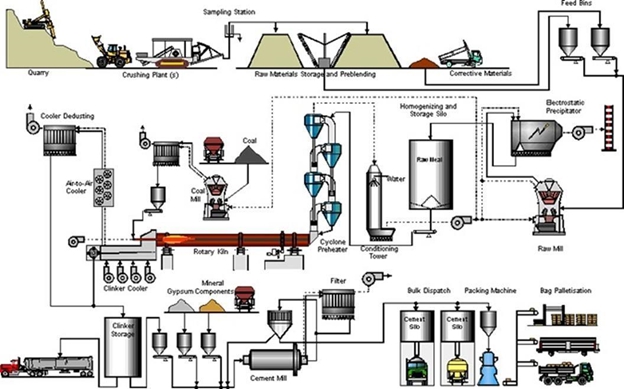
Extraction of raw materials. To produce cement, limestone/coquina are extracted from our quarries. We use explosives to loosen the limestone and deploy bulldozers to remove dirt and the overburden covering the limestone. We crush the limestone in our primary and secondary cone crusher and the resulting limestone is loaded into trucks and hauled to our Pacasmayo facility from the adjacent quarry where it is stored. In the case of Piura, our surface miner drills out our coquina quarry and then it is also loaded into trucks and hauled to the Piura plant.
36
Grinding and homogenization. Limestone/coquina, clay and sand are mixed with iron that is acquired from third parties. The quality of the resulting raw meal is monitored by examining samples of each batch and processing them through our quality control x-ray software that automatically measures the mix of materials to confirm the blend is in compliance with our quality standards. Subsequently, the raw meal is sent to a blending silo and then to a storage silo from where it is fed into the pre-heater.
Clinkerization. The raw meal is heated at a temperature of approximately 1,450 degrees Celsius in our kilns. The intense heat causes the limestone and other materials in the mixture to react inside the kiln, turning the mixture into clinker. Clinker is then cooled to a temperature of approximately 200 degrees Celsius and stored in a silo or in an outdoor yard.
Cement grinding. After being cooled, clinker, together with gypsum and some admixtures, is fed into a ball mill or into a vertical roller mill where it is ground into a fine powder to produce cement. In this form, cement reacts as a binding agent that, when mixed with water, sand, stone and other aggregates, is transformed into concrete or mortar.
Storage in silos. After passing through the ball mills, the cement is transferred on conveyor belts and stored in concrete silos in order to preserve its quality until distribution.
Packaging, loading and transport. Cement is transferred through another conveyor belt from the silo to be packaged in 42.5 kilogram bags and then loaded into trucks operated by third parties to be transported for distribution. Bulk cement may be transported (unpackaged) on especially designed trucks that deliver large amounts of cement directly to the work site.
Quicklime Production Process
Quicklime is produced by crushing limestone with a calcium carbonate content of at least 95% by calcinating it in a rotary kiln. The limestone for quicklime comes from our quarries. The crushing of the limestone is done at the quarry and the calcination process takes place only at our Pacasmayo facility. We produce quicklime in finely and coarsely ground varieties and sell both varieties in big bags as well as in bulk.
Raw Materials and Energy Sources
Limestone and Other Calcareous Resources
We obtain limestone required to produce clinker and quicklime principally from land where we have concession rights. For our Pacasmayo plant, we extract limestone from our Acumulación Tembladera quarry located approximately 60 kilometers from the plant, and for our Rioja plant, we extract limestone from our Calizas Tioyacu quarry which is adjacent to our Rioja plant. For our Piura plant, we extract coquina from Virrilá quarry, located approximately 120 kilometers from the plant.
Acumulación Tembladera. We have a concession with an indefinite term to extract limestone and other minerals from our Acumulación Tembladera quarry, a 3,390 hectares open-pit mine located in the district of Yonan, in the department of Cajamarca. We acquired this concession in November 2002.
Calizas Tioyacu. For our Rioja production, we have a concession with an indefinite term to extract limestone and other minerals from a 400 hectares open-pit mine near our Rioja facility in the district of Elias Soplin Vargas, in the department of San Martín. We acquired this concession in February 1998.
37
Virrilá. For our Piura production, we also have a group of concessions with an indefinite term to extract coquina and other minerals from our Virrilá quarry, a 931 hectares open-pit mine located in the district of Sechura, in the department of Piura. We acquired these concessions between 2000 and 2008.
Bayóvar 4. For our Piura production, we also have rights with an indefinite term related to extract coquina and other minerals from our Bayóvar 4 quarry, a 22,326-hectare open-pit mine located in the district of Sechura, in the department of Piura. We entered into this agreement in October 2007.
In addition to our Acumulación Tembladera, Calizas Tioyacu, Bayovar 4 and Virrilá quarries, we also own concession rights to various other calcareous material quarries consisting, in total, of approximately 40,767 hectares located in the northern region of Peru. None of these quarries are in operation as of the date of this annual report on Form 20-F.
Clay, Sand and Other Raw Materials and Admixtures
The other raw materials that we use to produce clinker are clay, sand and iron, as well as other admixtures.
Clay
For cement production in our Rioja facility, we extract clay from our Pajonal quarry, a 400 hectares open-pit concession located in the district and province of Rioja, department of San Martin. This concession was granted to us by the MEM in 1998. The term of the concession is indefinite, provided we pay an annual concession fee and meet minimum annual production requirements.
We have not calculated our clay reserves, as we believe there is an abundant supply of clay in our concessions and more broadly in the northern region where we operate.
Sand
For cement production in our Pacasmayo facility, we use sand which we buy from third parties. Our Rioja facility does not utilize sand as a raw material given the type of cement it produces.
We have not calculated our sand reserves, as we believe there is an abundant supply of sand in our concessions and more broadly in the northern region where we operate.
Iron
We use small quantities of iron in our cement production, which we purchase from third parties at market prices.
Coal
We purchase mostly anthracite coal from local suppliers and small amounts of semi-bituminous coal from local suppliers, in each case at spot market prices. Anthracite coal tends to be less expensive than bituminous coal. We store coal at our premises and in our warehouse facilities, adjacent to the Salaverry port and in Trujillo, where we currently have sufficient stock of coal to maintain our production levels for the next year.
In December 2009 and February 2010, we entered into option agreements to acquire coal mining concessions as a means to secure a steady and reliable source for our coal requirements and to reduce the volatility in costs related to coal. In 2011, we exercised certain options under these agreements to acquire coal mining concessions for 908.5 hectares near our Pacasmayo facility for a total purchase price of US$4.5 million. In 2013, we exercised our remaining options to purchase an additional coal mining concession for 501.2 hectares for US$1.0 million, thereby completing the acquisition of the related coal mining concessions.
38
Pozzolanic Materials and Other Admixtures
Our cement production also requires small amounts of other admixtures, such as pozzolanic materials, gypsum and blast furnace slag.
For cement production in our Pacasmayo facility, we use pozzolanic materials obtained from our Cunyac quarry, a 200 hectares open-pit concession located in the district of Sexi, province of Santa Cruz, department of Cajamarca. The concession was granted to us by the MEM in 2008. The term of the concession is indefinite, provided we pay an annual concession fee and meet minimum annual production requirements.
We also own several other concessions containing pozzolanic material which have not currently been explored. In addition, our use of pozzolanic materials may be substituted with clinker or other admixtures. Other admixtures, such as gypsum and blast furnace slag, are purchased at market prices from third-party suppliers. If we are unable to acquire raw materials or admixtures from current suppliers, we believe that other sources of raw materials and admixtures would be available without significant interruption to our business.
Energy Sources
Electricity
As of December 31, 2025, all of the electricity requirements for our Pacasmayo and Piura facilities were supplied by Electroperú, and all of the electricity requirements for our Rioja facility were supplied by ELOR.
We have a long-term electricity supply agreement with Electroperú S.A. to serve our Pacasmayo and Piura facilities through May 2026, after which Orygen Perú S.A.A. will supply electricity to those facilities from June 2026 through May 2031 and an agreement with Electro Oriente S.A. (ELOR) for our Rioja facility through December 2029. Our electricity costs are subject to adjustment formulas that take into consideration market variables such as the U.S. Producer Price Index (PPI) and global energy prices. As approximately 18.3% of our total costs are denominated in or indexed to the U.S. Dollar, the combination of high global energy prices and a potential depreciation of the Sol could result in a “double impact” on our margins.
In addition, we have an electricity supply contract with ELOR to supply our Rioja facility through December 2029. ELOR supplies the Rioja facility with 6.7 megawatts of electricity during peak hours and 8.0 megawatts during off-peak hours. Payments for electricity are based on a formula that takes into consideration our energy consumption and certain market variables, such as the U.S. Dollar exchange rate, inflation, the local price of natural gas, the global price of oil and the import price of bituminous coal.
Other Production Materials
We use other materials in the cement production process, including paper bags to package cement, which we purchase principally from local suppliers; plastic bags used to package quicklime, which we purchase from local suppliers; and water to cool the kiln exhaust gases and for our crushing operations at our Acumulación Tembladera quarry, which we obtain principally from a well located at our Pacasmayo facility and from the Jequetepeque river. Water used in our production process is maintained in a closed system at our plants and re-processed for utilization in our production process.
Consumer Base
The retail cement sector in Peru is characterized by households that purchase single bags of cement to gradually build or improve their homes with little or no professional assistance. This sector is known as self-construction (auto-construcción). Families in this sector tend to invest a large portion of their savings in building or improving their own homes. Self-construction (auto-construcción) is often conducted with the help of a foreman (maestro de obra) who generally has experience in construction. Our retail marketing plans typically target the maestro de obra who is usually the decision maker when buying cement and other related construction materials.
We also sell directly to small, medium and large private construction companies working on a variety of construction projects, from housing complexes to commercial developments. In the public sector, we provide cement for national, regional and local governments carrying out construction projects including housing complexes and public construction, ranging from local schools and hospitals to large infrastructure.
39
Sales and Distribution
Distribution
Our market extends from the Ecuadorian border in the north of Peru to the city of Barranca in the south (approximately 180 kilometers north of Lima), to the rainforest in the east and the Pacific Ocean in the west. Our market covers the provinces of Amazonas, Cajamarca, La Libertad, Lambayeque, Piura and Tumbes in the north; and San Martín and Loreto in the northeast.
Our Pacasmayo, Piura and Rioja facilities supply the entire northern region of Peru, interchangeably subject to where it is most efficient to ship from at the moment, depending on the distance and type of cement being produced, among other factors.
In 2025, approximately 81.4% of our total cement shipments were in the form of bagged cement, substantially all of which was sold through retailers both within and outside of our distribution network. The remaining 18.6% of our cement was sold in bulk or in shipments of precast products or ready-mix concrete directly to large construction companies.
We have developed one of the largest independent retail distribution networks for construction materials in Peru, consisting of 334 hardware stores, with which we have a distribution agreement. In addition, we also distribute to other independent retailers located throughout the northern region of Peru with whom we do not have contractual relationships. We have built our distribution network by investing in strengthening our relationship with retailers.
Even though our ready-mix sales are still a small proportion of our sales, we expect this trend to change as infrastructure becomes a bigger driver of demand in the upcoming years. Additionally, we sell and distribute other construction materials manufactured by third parties that are used alongside cement, such as steel rebar, plastic pipes and electrical wires, among others.
Marketing and Brand Awareness
We use our distribution network, together with our strategically located local commercial offices, to promote our products and brands, as well as to keep us informed of market developments. We believe our distribution network has enabled us to build strong recognition for our Pacasmayo brand among maestros de obra, retailers and end consumers which we believe is important to our business, particularly because our cement is principally sold in bags to retail consumers.
Our marketing expenses in 2025 were approximately S/15.6 million, or 0.74% of our sales. Historically, our marketing strategy has been to develop brand loyalty by providing high-quality products, tailored to the needs of our customers, and customer service accompanied by complimentary training for the maestros de obra, who are typically the decision makers in the self-construction (auto-construcción) segment.
We seek to develop strong ties with our distributors by promoting income generating opportunities for them. For instance, we give them priority when hiring transportation to distribute our cement throughout our territory. Also, our large salesforce has the ability to cover most of the construction sites in northern Peru generating business opportunities that are then channeled through our distributors. Finally, our distributors enjoy various commercial and marketing benefits such as rebates, special promotions, special credit conditions, and loyalty programs.
We have been working consistently in recent years to focus time and attention on our client’s needs, in an effort to go beyond just selling cement and its byproducts, to providing solutions and innovating. The self-construction segment has been the primary driver behind the growth in sales volume in the past couple years. We have focused on several fronts to enhance the customer experience and to facilitate access to our solutions. We have developed Mundo Pacasmayo (Pacasmayo World), which is a virtual ecosystem made up of digital solutions that serves to join supply and demand and offers a superior purchasing experience leveraged on intensive use of technology to generate more value for our users. The digital solutions are targeted and customized for the different users, such as foremen, hardware stores, and the self-builder.
Quality Control
In Peru, cement production is subject to standardization (normalización) regulations approved by the National Institute for the Protection of Competition and Intellectual Property (Instituto Nacional de Defensa de la Competencia y de la Protección de la Propiedad Intelectual, or “INDECOPI”). Although the standardization regulations are not mandatory, they are useful in achieving an optimum level of management. As of the date of this annual report on Form 20-F, we comply with all standardization regulations applicable to our products.
40
We have established a quality assurance program in accordance with ISO Standard 9001-2008, certified by SGS del Perú S.A.C., a company that provides inspection, verification, testing and certification services. We monitor quality at every stage of the cement production process. In our facilities, we periodically test the quality of our raw materials. These tests include chemical, physical and x-ray tests. We perform similar examinations of the clinker we produce. Additionally, we also perform regular quality tests on our finished products.
We have a quality control area with computerized systems to access real-time information on the quality of our products. As part of our quality control process, we monitor the performance of our different cement products, monitor the performance of additives in our cement and review monthly statistical analysis on the resistance of cement, among other things.
In 2023, we initiated the certification of all our products under Peru’s mandatory quality certification framework for cement. We selected the most stringent evaluation pathway—Scheme 5—and underwent the certification process with ICONTEC, an internationally recognized certification body for products, services, and management systems. As a result, we successfully certified our entire cement portfolio, achieving the highest level of compliance established by the Supreme Decree regulating the commercialization of cement in Peru. This milestone reinforces our commitment to quality, transparency, and regulatory excellence across all our operations. The certification is grounded in the requirements of the Cement Technical Regulations, which define the physical, chemical, and performance characteristics that cement must meet at both production and commercialization stages. In accordance with these regulations, all cement producers and importers in Peru must comply with these standards to ensure market access and safeguard product reliability. Our certification process involved a comprehensive and rigorous audit of our quality management system, encompassing raw material sourcing, production processes, final product control, storage, distribution, and commercialization. This evaluation was conducted across our three production plants and extended to our authorized points of sale, ensuring full traceability, consistency, and compliance throughout the entire value chain. Maintaining product certification is a mandatory requirement. Under Scheme 5, ongoing compliance is sought through periodic evaluations conducted by ICONTEC at each plant, including production control, product design verification through random sampling, and the assessment of the quality management system. In 2024 and 2025, we successfully maintained our certification with no non-conformities identified, which we believe reflects the robustness and consistency of our quality processes.
Competitive Position
Peru’s cement production is segmented into three main geographic regions: the northern region, the central region, including Lima’s metropolitan area, and the southern region. We are the only cement manufacturer in the northern region of Peru. The central region is principally served by UNACEM (formerly known as Cementos Lima and Cemento Andino), some imports, Caliza Cemento Inca and Holcim. The south is principally served by Cementos Yura. In 2025, our cement shipments were approximately 3.0 million metric tons, representing an estimated 22.4% share of total cement shipments in Peru according to INEI.
Regulatory Matters
Overview
Although our core business is the production of cement, we hold a number of mining concessions granted by the Peruvian government for the supply of limestone and other raw materials required for cement production. As a result, we are subject both to the mining and the general industrial legal framework in Peru. The regulatory framework applicable to our cement production may be divided into rules and regulations relating to: (i) the mining and crushing of limestone and clay; and (ii) the production process.
Mining Regulations
The General Mining Law (Texto Único Ordenado de la Ley General de la Minería) approved by Supreme Decree No. 014-92-EM, published in the Peruvian Official Gazette, El Peruano, on June 3, 1992, is the primary law governing both metallic and non-metallic mining activities in Peru and is supplemented by implementing guidelines and policies regarding mining and the processing of minerals enacted by the MEM. Under the General Mining Law, mining activities (except storage, reconnaissance, prospecting and trade) are carried out exclusively through various forms of concessions. Mining concessions are granted by the Geological, Mining and Metallurgical Institute (Instituto Geológico Minero y Metalúrgico, or “INGEMMET”), and all other concessions, including our mineral processing concessions, are granted by the Directorate General for Mining of the MEM. Any act, transfer, termination or agreement related to these concessions must be registered with the Mining Rights Registry, which is part of the National Public Registry System, to be effective against the Peruvian government and third parties.
41
Holders of concessions or mining claims must comply with several obligations, including the payment of an annual concession fee (derecho de vigencia) of US$3.00 per applicable hectare. The annual concession fee is due and payable on or prior to June 30 of each year. Failure to pay the annual concession fee for two consecutive years will result in the termination of the mining concession.
Mining activities require holders to obtain title to the surface land from individual landowners, peasant communities or the Peruvian government. Mining concessions are granted for an unlimited period, subject to the achievement of minimum annual production levels. Two different regimes apply depending on the date the concession was granted:
Under Legislative Decree No. 1320 and Supreme Decree No. 011-2017-EM, since January 1, 2019, if the annual minimum production or investment has not been met, the annual penalty and the causes to terminate a mining concession will be determined by the General Mining Law for all concessions, as described below.
For concessions granted until 2008, the following rules apply:
| ● | the minimum annual production target is equivalent to one tax unit (approximately S/5,500 or US$1,635.4) per year per hectare, in case of metallic mining concessions, and 10% of one tax unit (approximately US$163.5) per year per hectare, in the case of non-metallic mining concessions; |
| ● | the minimum production level is to be achieved no later than the end of the tenth year from the date of grant; |
| ● | if the minimum production level is not achieved within that period, an annual penalty equivalent to 2% of the minimum annual production level is due until such level is achieved; |
| ● | if the minimum production level is not achieved by the end of the fifteenth year, an annual penalty equivalent to 5% of the minimum annual production level is due until such level is achieved; |
| ● | if the minimum production level is not achieved by the end of the twentieth year, an annual penalty equivalent to 10% of the minimum annual production level is due until such level is achieved; and |
| ● | if the minimum production level is not achieved by the end of the thirtieth year, the mining concession expires. |
Any penalty must be paid prior to June 30 of each year. Failure to pay the penalty for two consecutive years results in the termination of the mining concession.
Since January 1, 2020, these penalties are applied to concessions granted in 2009 and thereafter.
The foregoing penalties and fines are not applicable to mining concessions granted by the government through private investment promotion initiatives, which will be subject to the minimum production and investment levels set forth in such contracts.
42
In addition to the payment of the annual concession fee and the penalty, holders of mining concessions must, pursuant to the Mining Royalty Law, pay a royalty for the exploitation of metallic and non-metallic resources. Prior to the amendment of the Mining Royalty Law described below, the amount of the royalty was determined on a monthly basis. For those minerals with an international market price (gold, silver, copper, zinc, lead and tin), the amounts were computed by applying the rates to the value of the concentrate or its equivalent, according to the applicable international market price. The historic rate scales were established in the Mining Royalty Law’s regulations as shown in the following table:
| Annual sales (in millions of US$) | Rate | |||
| Up to 60 | 1 | % | ||
| Between 60 and up to 120 | 2 | % | ||
| More than 120 | 3 | % | ||
In case of minerals without an international reference market price (minerals other than gold, silver, copper, zinc, lead and tin), the mining royalty amounted to 1% of the value of the final product obtained from the mineral separation process, net of any costs incurred in the mineral separation process (componente minero).
However, the Mining Royalty Law was amended on September 29, 2011 to increase the tax payable on metallic and non-metallic mineral resources. Effective October 1, 2011, the royalty for the exploitation of metallic and non-metallic resources is payable on a quarterly basis in an amount equal to the greater of (i) an amount determined in accordance with the following statutory scale of tax rates based on a company’s operating profit margin and applied to the company’s operating profit, as adjusted by certain non-deductible expenses, and (ii) 1% of a company’s net sales, in each case, during the applicable quarter. The royalty rate applied to the company’s operating profit is based on its operating profit margin according to the following statutory scale of rates:
| Operating Margin | Applicable Rate (%) |
|||
| 0% - 10% | 1.00 | |||
| 10% - 15% | 1.75 | |||
| 15% - 20% | 2.50 | |||
| 20% - 25% | 3.25 | |||
| 25% - 30% | 4.00 | |||
| 30% - 35% | 4.75 | |||
| 35% - 40% | 5.50 | |||
| 40% - 45% | 6.25 | |||
| 45% - 50% | 7.00 | |||
| 50% - 55% | 7.75 | |||
| 55% - 60% | 8.50 | |||
| 60% - 65% | 9.25 | |||
| 65% - 70% | 10.00 | |||
| 70% - 75% | 10.75 | |||
| 75% - 80% | 11.50 | |||
| More than 80% | 12.00 | |||
Mining royalty payments will be deductible for income tax purposes in the fiscal year in which such payments are made.
43
We believed that certain portions of the regulations of the Mining Royalty Law were unconstitutional, because they impose a mining royalty tax on non-mining activities. For instance, for cement companies, the amended Mining Royalty Law and its regulations established that the mining royalty tax was calculated based on the total operating profit or net sales, as opposed to operating profit or net sales attributable exclusively to mining products, such as limestone, used to produce cement. Accordingly, in December 2011, we filed a claim to declare that the mining royalty tax applicable for the exploitation of non-metallic mining resources be calculated based on the value of the final product obtained from the mineral separation process, net of any costs incurred in the mineral separation process (“componente minero”).
In November 2013, the Peruvian Constitutional Court affirmed the constitutional challenge we filed against the new regulation of the Mining Royalty Law, in a final and unappealable ruling, on the grounds that the new regulation violates the constitutional right of property, as well as the principles of legal reserve and proportionality. Therefore, the new regulation is rendered inapplicable to our operation. As a result, we continued to use as a basis for the calculation of the mining royalty the value of the concentrate or mining component, and not the value of the product obtained from the industrial or manufacturing process.
On March 22, 2021, the Company received Tax Court Resolution No. 00905-4-21 that declared the Mining Royalty should be calculated based on the total operating profit or net sales, as opposed to operating profit or net sales attributable exclusively to mining products, such as limestone, used to produce cement, for the years 2008 and 2009. This contradicted what was established by the Constitutional Court mentioned above. Considering this contradiction, the Company initiated two legal proceedings: (i) a constitutional process to denounce the repression of homogeneous harmful acts, filed on March 31, 2021; and, (ii) a contentious-administrative claim filed before the ordinary court, the object of which was the annulment and return of collateral, filed on June 22, 2021.
As of the date of this annual report on Form 20-F, both proceedings were ruled in favor of the Company. As a result, the SUNAT should, either directly or through enforcement, return the amounts paid by the Company in respect of the Tax Court Resolution described above, amounting to S/29,559,000. As of August 20, 2025, SUNAT made a partial refund of S/18,441,000, leaving an outstanding balance of S/11,118,000 to be collected as of December 31, 2025. In the opinion of management and its external legal advisors, there is a very high probability of obtaining this amount in full.
Finally, holders of mining concessions are required at the beginning of their operations to submit a mining closure plan that must contain a description of the steps to restore the areas and facilities of each mining operation area to pre-mining condition. Holders of mining concessions are required to secure completion of the restorative measures by means of the following guarantees: (i) banking guarantee or credit insurance; (ii) cash guarantees; (iii) trusts; or (iv) those indicated in the Peruvian Civil Code.
In August 2021, Law No. 31347, that modifies the Mine Closure Law (Law No. 28090), specifying aspects such as mandatory, administrative and oversight powers, opportunity for presentation and approval, applicable guarantees, periodic reports to be presented to various authorities, among others was approved.
As of December 31, 2025, we primarily owned non-metallic mining concessions and limited metallic mining concessions with respect to iron. Substantially all of our concessions were granted prior to 2008. Our mining rights and concessions are in full force and effect under applicable Peruvian laws. We believe that we were in compliance in all material respects with the terms and requirements applicable to our mining rights and concessions.
Production Process
The cement production process along with other manufacturing activities are governed by General Industry Law (Ley General de Industrias), Law No. 23407, published in El Peruano on May 29, 1982, which establishes basic rules that promote and regulate activities in the manufacturing industry. The Ministry of Production is vested with authority to promote private investments in connection with industrial, processing and manufacturing activities, the surveillance of sustainable exploitation of natural resources (except for those extractive activities involving primary transformation of natural products), the protection of the environment, and the supervision of the quality of manufactured products. All industrial companies are subject to the General Industry Law and its regulations to the extent that the company’s gross income is primarily derived from industrial activities. Pursuant to Supreme Decree No. 009-2011-MINAM, the supervisory and monitoring functions of the Ministry of Production were transferred to the OEFA in 2013.
44
Technical Regulation on Hydraulic Cement
On January 21, 2022, the Government published D.S. 1-2022-PRODUCE, which approves the Technical Regulation on hydraulic cement used in buildings and constructions in general, to clarify minimum cement safety compliance requirements. Such regulation entered into force on July 22, 2023, pursuant to D.S. 10-2022-PRODUCE.
Environmental Regulations
Industrial companies, and in particular those in the cement sector, are required to comply with various environmental regulations, such as the Law on the national environmental impact assessment system approved by Legislative Decree No. 27446 and its regulations approved by Supreme Decree No. 019-2009-MINAM, which establish the environmental impact assessment process. Public and private investment projects that involve activities, constructions or works that may cause negative environmental impacts must comply with this law. Projects are categorized according to environmental risk under this law.
The environmental management regulations for the manufacturing industry and internal trade, approved by Supreme Decree No. 017-2015-PRODUCE, as amended, promote and regulate environmental management, as well as the conservation and sustainable use of natural resources in the development of manufacturing and domestic trade activities. It also regulates the application of management instruments, procedures, environmental protection measures and promotes cleaner production agreements, giving priority to the principle of prevention.
In terms of air emissions, the Ministry of the Environment has adopted legally binding environmental quality standards (maximum permissible limits) for cement industries (approved by Supreme Decree No. 001-2020-MINAM). These standards are legally enforceable and must be met by all operations in the cement industry.
Resolution No. 004-2018-OEFA/CD and 006-2018-OEFA/CD define administrative infractions and establish a scale of penalties related to environmental management instruments and obligations related to monitoring, environmental management, the development of industrial activities and the handling of hazardous materials and inputs. applicable to those administered in the manufacturing industry and domestic trade sector that are under the scope of competence of the Environmental Assessment and Control Agency. Infractions are classified according to their severity as minor, serious and very serious offenses and the monetary penalty imposed will depend on this.
By means of Board of Directors Resolution No. 023-2013-OEFA/CD and No. 0312015-OEFA/CD, of the Environmental Assessment and Control Agency (Organismo de Evaluación y Fiscalización Ambiental – “OEFA”), OEFA is in charge of the monitoring, supervision, control and sanction in environmental matters in the cement and concrete sector of the manufacturing industry, of the industrial subsector of the Ministry of Production - PRODUCE.
The Law on Integrated Solid Waste Management approved by Decree Law No. 1278 and its regulations approved by Supreme Decree No. 014-2017-MINAM and its amendments, seek to ensure the constant maximization of efficiency in the use of materials, and to regulate the management and handling of solid waste, which includes the minimization of the generation of solid waste at the source. the material and energy recovery of solid waste, as well as the proper final disposal of the same.
Law No. 30754, published on April 18, 2018, approved the Framework Law on Climate Change. This law establishes the principles, approaches, and general provisions for coordinating, articulating, designing, executing, informing, monitoring, evaluating, and disseminating public policies for the comprehensive, participatory, and transparent management of climate change adaptation and mitigation. It also established that the Ministry of the Environment shall set guidelines to incorporate climate risk and vulnerability analysis, as well as climate change mitigation and adaptation measures, in the evaluation of investment projects subject to the National Environmental Plan Impact Assessment System.
This law aims to reduce the country’s vulnerability to climate change, take advantage of low-carbon growth opportunities, and comply with the international commitments assumed by the government of Peru before the United Nations Framework Convention on Climate Change, with an intergenerational approach.
45
The Regulations of the Framework Law on Climate Change were approved on December 31, 2019, by Supreme Decree No. 013-2019-MINAM. The objectives set out in these Regulations will be achieved through the implementation of climate change adaptation and mitigation measures, the creation of systems that contribute to the accounting of carbon dioxide emissions, the reduction of carbon dioxide emissions and the promotion of private sector participation in implementation. of sustainable and low-carbon projects. As of the date of this annual report on Form 20-F, however, no concrete measures or targets have been set, nor have any deadlines been set for their implementation.
There is currently no type of emissions trading scheme in Peruvian law.
On January 25, 2022, Supreme Decree No. 003-2022-MINAM was published, declaring a climate emergency of national interest and establishing guidelines and priority actions for climate change mitigation and adaptation.
In September 2023, the International Sustainability Standards Committee issued the first international sustainability and climate standards: IFRS S1 General Requirements for the Information to be Disclosed on Sustainability related to Financial Information and IFRS S2 Weather-related Disclosures. The purpose of these standards is for entities to disclose information about their risks and opportunities related to sustainability and climate that is useful to the primary users of financial information for decision-making. The Company is currently assessing these standards and the methodology for their implementation.
In March 2026, the application of these standards became a legal requirement, formalized by Resolution No. 001-2026-EF/30. Its objective is to establish a common framework that allows companies and institutions to disclose information about their risks and opportunities related to sustainability and climate that is useful to the primary users of financial information for decision-making. This resolution is expected to come into force in January 2029.
Since 2025, Cementos Pacasmayo has been participating in the DivulAcción IFRS S2 program, promoted by LACADI (Latin American Climate Asset Disclosure Initiative) and funded by Germany’s Federal Ministry for Economic Affairs and Climate Action (BMWK) through the International Climate Initiative (IKI). This program aims to accelerate the disclosure of climate-related financial information. It was carried out in five phases: assessment; analysis of physical and transition risks; evaluation of resilience and identification of strategic areas; preparation of the proposed disclosure; and integration of climate change into corporate governance. As a result, a draft IFRS S2 report has been prepared in collaboration with the risk, accounting and finance, climate change, and sustainability teams, and is expected to be published by the end of June 2026.
Prior Consultation with Local Indigenous Communities
On September 7, 2011, Peru enacted Law No. 29785, Prior Consultation Right of Local Indigenous Communities. The law was enacted in order to implement Convention No. 169 of the International Labor Organization on Local Indigenous Communities in Independent Countries, previously ratified by Peru through Legislative Decree No. 26253. This law, which became effective on December 6, 2011, establishes a prior consultation procedure to be undertaken by the Peruvian government in favor of local indigenous communities, whose collective rights may be directly affected by new legislative or administrative measures, including the granting of new mining concessions. Regulation implementing this law was approved on April 3, 2012, by Supreme Decree No. 001-2012-MC, which defines the local indigenous communities that are entitled to the prior consultation rights and establishes the different stages that comprise the prior consultation procedure.
Consultation procedures for mining and processing concessions are carried out by the MEM prior to the granting of a new processing concession.
According to the recent practice of the Geologic Institute of Mining and Metallurgy (Instituto Geológico Minero Metalúrgico), the granting of mining concessions does not qualify as an “administrative measure” that potentially affects the rights of indigenous people because it does not grant per se a right to explore and exploit mineral deposits. Accordingly, the granting of mining concessions has not been included among measures that require consultation procedures with indigenous people. According to Ministerial Resolution No. 003-2013-MEM-DM, the MEM has established that consultation procedures are applicable prior to the commencement of: (i) exploration activities (Autorización de inicio de actividades de exploración); (ii) exploitation activities (Autorización de inicio o reinicio de las actividades de desarrollo, preparación y explotación - incluye plan de minado y botaderos); and (iii) processing concessions (otorgamiento de concesión de beneficio).
46
Local indigenous communities do not have a veto right; upon completion of this prior consultation procedure, the Peruvian government can discretionarily approve or reject the applicable legislative or administrative measure. In addition, any sale, lease or other act of disposal of surface land owned by local indigenous communities is subject to the approval of an assembly composed of the members of such communities according to the following rules:
| ● | for local indigenous communities located on the coast, approval of not less than 50% of members attending the assembly is required; and |
| ● | for local indigenous communities located in the highlands and the Amazon region, approval of at least 2/3 of all members attending the assembly is required. |
Permits and Licenses
Mining Concessions
According to the General Mining Law, a mining concession is required in order to extract mineral resources needed to produce cement. The mining concession grants the right to explore and exploit the mineral resources located in a solid of indefinite depth, limited by the vertical plane corresponding to the sides of square, rectangle or polygon referred to by the Universal Transversal Mercator coordinates. The Geological Mining and Metallurgical Institute (Instituto Geológico Minero y Metalúrgico) is in charge of managing the procedure of granting mining concessions, which includes the receipt of the request, the granting and the termination of mining concessions.
Explosives.
Mining concessionaires are required to obtain the following permits to operate and store explosives:
| ● | Certificate of Mining Operation (Certificado de Operación Minera), granted by the MEM; |
| ● | Semiannual Authorization for Use of Explosives, granted by the General Bureau of Explosives of the Ministry of Interior (Superintendencia Nacional de Control de Servicios de Seguridad, Armas, Municiones y Explosivos de Uso Civil, or “SUCAMEC”); |
| ● | Manipulation of Explosives License for each individual that intends to handle explosives, granted by the SUCAMEC; and |
| ● | Explosive’s Warehouse Operation License, granted by SUCAMEC. |
Water and Wastewaters
To use water resources in cement industry activities, it is necessary to obtain a water right granted by the Water Management Authority (Autoridad Nacional del Agua, or “ANA”) prior to the use of underground or fresh water sources. If the proposed activities will generate domestic or industrial wastewaters, which will be discharged into natural water sources or soil, authorization from ANA is required, with a favorable opinion of the General Bureau of Environmental Health (Dirección General de Salud Ambiental, or “DIGESA”).
Hazardous Waste
Hazardous waste generated as a consequence of cement production activities must be disposed of in specialized landfills. The transportation of solid waste outside the limits of the industrial complex must be conducted exclusively through specialized companies registered with DIGESA and MINAM. Industries are free to contract with an EO-RS (a company that provides solid waste services such as transportation, treatment or disposal) or with an EC-RS (a company that carries out commercialization activities aiming at the reuse of solid waste). Yet in order to limit their liability in case of environmental harm, industries must make sure the EO-RS and EC-RS they retain count with all necessary permits to collect, transport and dispose of hazardous wastes.
47
Chemical Feedstock
The commercialization, transportation and use of controlled chemical feedstock (Insumos Químicos y Productos Fiscalizados, or “IQPF”) is restricted, because of their potential use in the production of illegal drugs or controlled substances. Companies that require an IQPF must obtain an IQPF User Certificate (Certificado de Usuario de IQPF) from the General Bureau of Chemical Feedstock of the Ministry of Interior (Unidad Antidrogas de la Policía Nacional del Perú, or “DIRANDRO”). Companies such as ours are also required to register with the Ministry of Production any IQPF activities they plan to carry out (Registro Único para el Control de IQPF).
Fuel Storage
Any company that purchases fuels for its own activities and has facilities to receive and store fuel with a minimum capacity of one meter cubed (264.170 gallons) is required to (i) receive from the Mining and Energy Investment Supervision Body (Organismo Supervisor de la Inversión en Energía y Minería, or “OSINERGMIN”) prior permission to build and operate said installations, and (ii) be registered with the Registry of Direct Fuel Consumers, in order to obtain the SCOP Code (Código del Sistema de Control de Órdenes de Pedido) necessary to purchase fuel.
Cultural Heritage Protection
If the design and development of cement industry activities involves the removal of topsoil, a Certificate of Non-Existence of Archaeological Ruins (Certificado de Inexistencia de Restos Arqueológicos, or “CIRA”) from the Ministry of Culture (Ministerio de Cultura) with respect to the area under construction must be obtained. The CIRA shall either certify that on the surface of the evaluated area no archaeological sites or features were discovered or shall identify their exact location and extent in order to implement precautionary measures to protect the archaeological artifact. The CIRA is valid for an unlimited period but will become void should any archaeological artifacts be accidentally discovered during the construction works or due to any natural cause. In such an instance, the company must stop the construction work immediately and notify the Ministry of Culture. Failure to stop the construction work may generate civil and criminal liabilities. Under certain exceptional circumstances, Peruvian legislation allows the removal of archeological artifacts when the area is required for development of projects that are of national interest.
Labor Regulations
Peruvian legislation allows hiring employees through: (i) a fixed-term contract, (ii) a contract for an indefinite duration; or (iii) a contract for part-time employment.
Effective January 1, 2025, the minimum monthly wage established in Peru is S/1,130 per month. Peruvian labor legislation establishes a maximum 8-hour work day or 48 hours per week for employees older than 18 years. For overtime, employers must pay at least an additional 25% and an additional 35% over the regular hourly wage for the first two hours and for any additional hours, respectively. Employees are entitled to a minimum rest of 24 consecutive hours per week.
Regardless of the type of employment contract, pursuant to Peruvian law full-time employees are entitled to receive:
(i) an additional 10% of the minimum wage, provided that they are responsible for (a) one or more children under the age of 18 or (b) persons who are up to 24 years of age if they are pursuing higher education,
(ii) two additional months’ salary per year, one in July and one in December (pursuant to Law No. 29351, said payments were not subject to any social contribution, except for income tax; consequently, employers paid directly to their employees as an extraordinary bonus, the amount of the contribution to the Social Health Insurance (ESSALUD) for such payments, equivalent to 9% of the bonus paid),
(iii) thirty calendar days of annual paid vacation per year,
(iv) life insurance, since the first day at work,
48
(v) a compensation for years of service (CTS) equal to 1.16% of a monthly salary and is deposited each year in May and November, provided they work an average of at least four hours per day for the same employer,
(vi) benefits from the Peruvian Social Health Insurance (ESSALUD) to which employers must contribute a rate equivalent to 9% of their employees’ income, and
(vii) a percentage of the company’s annual income net of taxes (10% in the case of income derived from industrial cement operations, and 8% in the case of income derived from our mining or commercial activities), provided the company has twenty or more employees.
On June 25, 2021, Law No. 31246 was published, which modified the current Law on Safety and Health at Work to guarantee the right of workers to safety and health at work in the face of epidemiological and health risk.
Free and Fair Competition Protection
In Peru, businesses are generally not required to receive the prior authorization of the antitrust authority, which in Peru is INDECOPI. However, in order to promote economic efficiency and protect consumers, anti-competitive behavior is subject to sanctions under applicable law. Behavior that is prohibited according to national law includes: (i) the abuse of a dominant market position, (ii) concerted horizontal practices and (iii) concerted vertical practices. Moreover, under the Unfair Competition Law it is illegal to act in a way that may hinder the competitive process. An unfair behavior is one that is objectively contrary to the entrepreneurial good faith, ethical behavior and efficiency in a market economy.
On January 7, 2021, Law No. 31112, Law that establishes the Prior Control of Business Concentration Operations, was published in the Official Gazette “El Peruano”, which entered into force in January 2021, together with its Regulations, approved by Supreme Decree No. 039-2021-PCM. This law establishes a system of prior control of business concentration operations in order to promote effective competition and economic efficiency in the markets for the welfare of consumers.
| C. | Organizational Structure |
On March 30, 2026, Holcim Ltd (“Holcim”) completed the acquisition of 99.99% of the capital stock of Inversiones Aspi S.A. (“ASPI”). Prior to this transaction, Eduardo Hochschild, owned this 99.99% of ASPI. As a result of this transaction, through ASPI, Holcim now directly and indirectly, owns and controls 50.01% of Cementos Pacasmayo S.A.A. (the “Company”), which resulted in a change of control. Pursuant to Peruvian securities regulations, Holcim has announced its intention to conduct a mandatory public tender offer (the “Tender Offer”) to acquire additional outstanding shares. For further information, see “Item 4. Information on the Company—A. History and Development of the Company—Recent Developments.”
All of our operating subsidiaries are incorporated in Peru. The following chart sets forth our simplified corporate structure, operating subsidiaries only, as of the date of this annual report on Form 20-F.
49
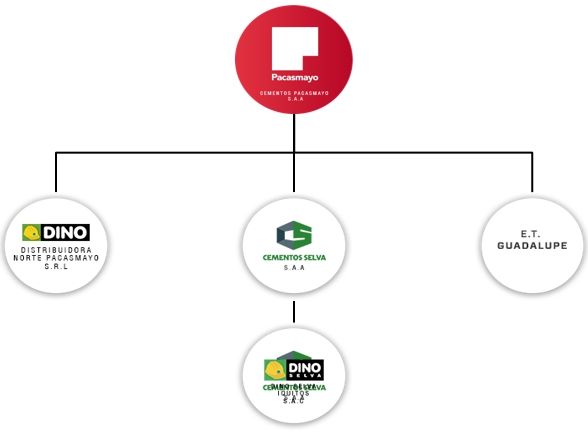
The following is a brief description of the principal activities of our consolidated subsidiaries.
| ● | Cementos Selva S.A.C. is engaged in the production and marketing of cement and other construction materials in the northeast region of Peru. It also owns all of the equity shares of Dinoselva Iquitos S.A.C. (a cement and construction materials distributor in the north of Peru, which also produces and sells precast, cement bricks and ready-mix concrete) and in Acuícola Los Paiches S.A.C. (a fish farm entity). |
| ● | Distribuidora Norte Pacasmayo S.R.L. is mainly engaged in selling cement produced by the Company. Additionally, it produces and sells precast, cement bricks and ready-mix concrete. |
| ● | Empresa de Transmisión Guadalupe S.A.C. is mainly engaged in providing electric energy transmission services to the Company. |
Other immaterial, non-operating subsidiaries
| ● | Salmueras Sudamericanas S.A.C. (“Salmueras”) was engaged in the exploration of a brine project located in the northern region of Peru. In December 2017, the Company decided not to continue with the activities related to this project. |
| ● | Soluciones Takay S.A.C. is a platform that connects families that want to build with certified professionals. |
| ● | 150Krea Inc., a company incorporated in June 2021 in the United States, is engaged in providing leasing services for intangible assets. It is not currently in operation. |
| ● | Corporación Materiales Piura S.A.C. is a non-operating company that owns some mining properties located in Piura. |
50
Other immaterial, operating subsidiaries
| ● | Créalo 150 Solutions: Business and information systems consulting. It should be noted that another of our subsidiaries is 150Krea Inc. which is a company incorporated in June 2021 in the United States, dedicated to providing leasing services of intangible assets. It is not currently in operation. |
Participation in Consortia
| ● | Consorcio Constructor del Norte del Perú began operating during 2023 and is mainly dedicated to the rehabilitation and improvement of the runway, as well as the installation of the perimeter fence at Piura airport. |
| D. | Property, Plants and Equipment |
Properties
We own our headquarters office in Lima, Peru, at Calle La Colonia 150, Urbanización El Vivero, Surco. We also own our plants, warehouses, transportation facilities and the office space at our production facilities, including our workers’ facilities. In addition, we own a warehouse occupying approximately 25,000 square meters at the Salaverry port facility.
Area of Operation
We own and operate three cement production facilities. Our largest facility is located in the city of Pacasmayo, department of La Libertad, approximately 667 kilometers north of Lima. The second facility is located in the city of Piura, department of Piura, approximately 330 kilometers north of Pacasmayo. This facility started cement production in September 2015. We also own and operate a smaller cement facility, located in the city of Rioja, department of San Martín, approximately 468 kilometers east of the Panamericana Norte highway. From our Pacasmayo and Piura facilities we supply cement principally to the coastal and highland regions of northern Peru, including the cities of Piura, Chiclayo, Cajamarca, Trujillo and Chimbote. From our Rioja facility, we supply cement to the northeastern region of Peru, including the cities of Moyobamba, Tarapoto, Loreto, among others.
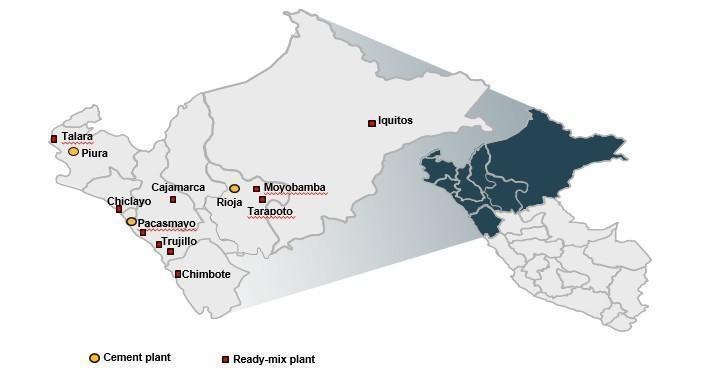
51
Pacasmayo Facility
As of December 31, 2025, our Pacasmayo facility had four horizontal kilns, which produce clinker (one of which also currently produces quicklime), and an additional Waelz rotary kiln that produces quicklime. One of these horizontal kilns with a total installed annual clinker production capacity of 660,000 metric tons was added in 2023. In addition, we formerly had six vertical shaft kilns with a total installed annual clinker production capacity of 465,120 metric tons. We made a provision for the impairment of these vertical shaft kilns at the end of 2023. As a result of these changes, the current clinker capacity at our Pacasmayo plant is 1,755,600 metric tons. Additionally, our facility has a primary and secondary cone crusher located near our Acumulación Tembladera limestone quarry. The main crusher has installed crushing capacity of 800 metric tons per hour and the secondary crusher has installed crushing capacity of 170 metric tons per hour. Our Pacasmayo facility also features three cement finishing mills with installed annual cement production capacity of 2.9 million metric tons. Our Pacasmayo facility is also equipped with silos containing storage capacity for 26,700 metric tons of cement.
As of December 31, 2025, our Pacasmayo facility had installed production capacity of approximately 240,000 metric tons of quicklime per year, including the annual installed capacity of one of our clinker kilns and our Waelz rotary kiln, which are equipped to also produce quicklime.
Piura Facility
Annual installed production capacity of our Piura plant is 1.6 million metric tons of cement and 990,000 metric tons of clinker. Our Piura plant operates with one horizontal kiln with installed clinker production capacity of 990,000 metric tons per year, as well as a cement mill with installed cement production capacity of 1.6 million metric tons per year. Our Piura plant also has three storage silos with storage capacity of 25,300 metric tons of cement.
Rioja Facility
Annual installed production capacity of our Rioja plant is 440,000 metric tons of cement and 289,080 metric tons of clinker.
Our Rioja facility currently operates with a small cone crusher and four vertical shaft kilns with total annual installed clinker production capacity of 289,080 metric tons and three cement finishing mills with total annual installed cement production capacity of 440,000 metric tons. Our Rioja plant is also equipped with silos with a storage capacity of 1,750 metric tons of cement.
Other Facilities
We also currently have 23 fixed and mobile ready-mix concrete and precast facilities located in the northern cities of Chimbote, Trujillo, Chiclayo, Piura, Cajamarca, Pacasmayo, Tarapoto and Tumbes, among others. These facilities allow us to supply ready-mix concrete and precast materials to small, medium and large construction projects throughout the entire northern region of Peru. As of December 31, 2025, our ready-mix operations had 216 mixer trucks, 33 concrete pumps and two pavers available to deliver ready-mix concrete.
Capacity and Volumes
The table below sets forth our clinker, cement and quicklime production capacity and volumes in our Pacasmayo and Rioja facilities for the periods indicated.
| As of and for the year ended December 31, | ||||||||||||||||||||||||||||||||||||
| 2025 | 2024 | 2023 | ||||||||||||||||||||||||||||||||||
| Capacity | Production | Utilization rate(1) | Capacity | Production | Utilization rate(1) | Capacity | Production | Utilization rate(1) | ||||||||||||||||||||||||||||
| Cement: | (in thousands of metric tons, except percentages) | |||||||||||||||||||||||||||||||||||
| Pacasmayo facility | 2,900 | 1,825 | 62.9 | % | 2,900 | 1,668 | 57.5 | % | 2,900 | 1,656 | 57.1 | % | ||||||||||||||||||||||||
| Piura facility | 1,600 | 887 | 55.4 | % | 1,600 | 843 | 52.7 | % | 1,600 | 1,032 | 64.5 | % | ||||||||||||||||||||||||
| Rioja facility | 440 | 340 | 77.3 | % | 440 | 320 | 72.7 | % | 440 | 259 | 58.9 | % | ||||||||||||||||||||||||
| Total | 4,940 | 3,052 | 61.8 | % | 4,940 | 2,831 | 57.3 | % | 4,940 | 2,947 | 59.7 | % | ||||||||||||||||||||||||
| Clinker(2): | ||||||||||||||||||||||||||||||||||||
| Pacasmayo facility | 1,756 | 1,189 | 67.7 | % | 1,756 | 1,273 | 72.5 | % | 1,756 | 1,098 | 62.5 | % | ||||||||||||||||||||||||
| Piura facility | 990 | 616 | 62.2 | % | 990 | 609 | 61.5 | % | 990 | 799 | 80.7 | % | ||||||||||||||||||||||||
| Rioja facility | 289 | 248 | 85.8 | % | 289 | 242 | 83.4 | % | 289 | 200 | 69.2 | % | ||||||||||||||||||||||||
| Total | 3,035 | 2,053 | 67.6 | % | 3,035 | 2,124 | 70.0 | % | 3,035 | 2,097 | 69.1 | % | ||||||||||||||||||||||||
| Quicklime(3): | ||||||||||||||||||||||||||||||||||||
| Pacasmayo facility | 240 | 16 | 6.7 | % | 240 | 18 | 7.5 | % | 240 | 30 | 12.5 | % | ||||||||||||||||||||||||
| (1) | We define utilization rate as production for the specified period divided by installed capacity of that period. |
| (2) | We currently estimate clinker capacity using 330 production days. |
| (3) | Our Rioja facility does not produce quicklime. In addition, one of our clinker kilns and our Waelz rotary kiln are equipped to produce quicklime. |
52
Summary Disclosure (229.1303)
Map of Mining Concessions of Cementos Pacasmayo S.A.A. and subsidiaries.
Figure 1 shows the map of Peru and the location of the Peruvian mining properties of Cementos Pacasmayo and subsidiaries, in the northern part of the country. The mining properties are located in Piura, Lambayeque, Cajamarca, Amazonas, Ica, Cusco, San Martin, La Libertad and Ancash Regions.
Figure 1 General map of the mining properties and industrial facilities of Cementos Pacasmayo S.A.A. and subsidiaries
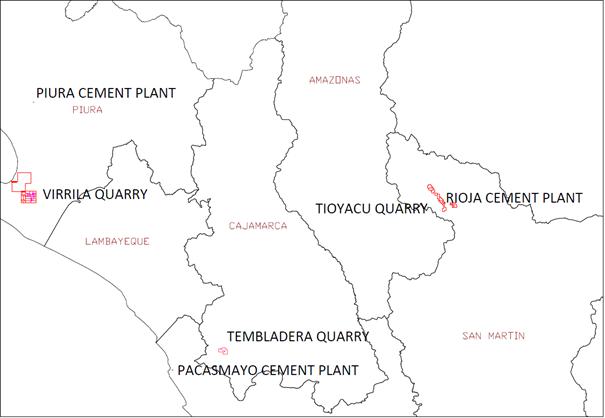
General description of mining properties and operations
Cementos Pacasmayo S.A.A.’s access to its mining properties in Peru are obtained through mining rights granted by the INGEMMET.
Mineral properties in Peru are classified according to the type of material, i.e. metallic and non-metallic.
Cementos Pacasmayo has mining properties in exploration, development and production stages. Cementos Pacasmayo has three material properties (Tembladera, Virrila, and Tioyacu), all of which are in the production stage.
Distribuidora Norte Pacasmayo SRL obtained ownership of new mining properties, which are shown in Annex 1.
53
Table 1 provides an overview of Cementos Pacasmayo’s material properties, including relevant information for each quarry.
Table 1 Main mining properties of Cementos Pacasmayo S.A.A. and subsidiaries
| Mining Property | Mining concessions | Location of the mining concession | Percentage of ownership interests | Operator | Surface area (ha) | Stage
of the mining concession |
Permits | Key condition of permit | Type of mine / material | Beneficiation plant and other installations | Production
2025 (Ton) |
Production
2024 (Ton) |
Production
2023 (Ton) |
|||||||||||||||||||||||||
| Tembladera | Acumulación Tembladera | Cajamarca | 100 | % | San Martin Contratistas Generales SA | 3,391 | Production | Yes | EIA(2) and others | Open Pit / Limestone | Industrial facilities(3) | 1,618,832 | (4) | 1,722,804 | 1,842,375 | |||||||||||||||||||||||
| Virrila | UEA(1) Virrila | Piura | 100 | % | Inversiones y Servicio Felicitas SRL | 38,226 | Production | Yes | EIA(2) and others | Open Pit / Coquina | Industrial facilities(3) | 904,620 | 901,977 | 932,933 | ||||||||||||||||||||||||
| Tioyacu | UEA(1) Rioja | San Martin | 100 | % | Cementos Selva S.A.C | 9,600 | Production | Yes | EIA(2) and others | Open Pit / Limestone | Industrial facilities(3) | 398,766 | (5) | 267,009 | 351,644 | |||||||||||||||||||||||
| (1) | The administrative economic unit (unidad económica administrativa – “UEA”) represents a grouping of two or more mining concessions incorporated to the National Mining Cadastre with definitive character, of the same kind of substance and of the same mining owner. |
| (2) | Environmental Impact Assessment (EIA). |
| (3) | Cement plants are governed by the laws of the industrial sector. |
| (4) | The 2025 production of the Tembladera quarry was lower compared to 2024 due to the corrective maintenance works on the primary crusher between October and December 2025. |
| (5) | The 2025 production of the Tioyacu quarry was higher compared to 2024 due to the limestone requirement of the Rioja plant. |
Summary of Mineral Resources and Mineral Reserves
Tables 2 and 3 summarize the mineral resources and reserves, respectively, of the mining properties of Cementos Pacasmayo and its subsidiaries.
Table 2 Summary of Mineral Resources (exclusive of Reserves) of Cementos Pacasmayo S.A.A. and subsidiaries as of December 31, 2025.
| Measured Mineral | Indicated Mineral | Measured + Indicated | Inferred Mineral | |||||||||||||||||||||||||||||
| Resources | Resources | Mineral Resourc | Resources | |||||||||||||||||||||||||||||
| Amount
(Million Tonnes) | Grades/
Qualities (% CaO) | Amount
(Million Tonnes) | Grades/
Qualities (% CaO) | Amount
(Million Tonnes) | Grades/
Qualities (% CaO) | Amount
(Million Tonnes) | Grades/ Qualities (% CaO) | |||||||||||||||||||||||||
| Limestone: | ||||||||||||||||||||||||||||||||
| Acumulación Tembladera | 135.1 | 49.85 | 39.2 | 50.58 | 174.3 | 50.01 | 41.5 | 50.61 | ||||||||||||||||||||||||
| UEA Rioja | 25.8 | 49.52 | 4.8 | 48.29 | 30.6 | 49.33 | 7.2 | 49.11 | ||||||||||||||||||||||||
| Coquina: | ||||||||||||||||||||||||||||||||
| UEA Virrila | 21.8 | 49.80 | 26.8 | 48.98 | 48.6 | 49.35 | 4.4 | 46.70 | ||||||||||||||||||||||||
Table 2 is based on the following cement prices: Tembladera/Pacasmayo (S/642.9 per ton), Virrila/Piura (S/708.6 per ton) and Tioyacu/Rioja (S/754 per ton). The mineral resource estimates are at the point of delivery to the cement plant (point of reference). Also the assumptions (e.g., prices, costs and other economic assumptions) used to establish economic viability during the mineral reserves estimation can be found in the Cementos Pacasmayo S.A.A. and Cementos Selva S.A.C Technical Report Summaries (TRS) 20-F 229.601 (Item 601) Exhibits 96.1, 96.2 and 96.3 of our annual report on Form 20-F.
54
Table 3 Summary of Mineral Reserves of Cementos Pacasmayo S.A.A. and subsidiaries’ properties as of December 31, 2025.
| Proven
Mineral Reserves | Probable
Mineral Reserves | Total
Mineral Reserves | ||||||||||||||||||||||
| Amount (Million Tonnes) | Grades/ Qualities (%CaO) | Amount (Million Tonnes) | Grades/ Qualities (%CaO) | Amount (Million Tonnes) | Grades/ Qualities (%CaO) | |||||||||||||||||||
| Limestone: | ||||||||||||||||||||||||
| Acumulación Tembladera | 67.8 | 49.83 | 5.1 | 50.56 | 72.9 | 49.88 | ||||||||||||||||||
| UEA Rioja | 10.3 | 51.20 | 1.3 | 49.30 | 11.6 | 51.0 | ||||||||||||||||||
| Coquina: | ||||||||||||||||||||||||
| UEA Virrila | 39.9 | 51.86 | 0.9 | 49.83 | 40.8 | 51.82 | ||||||||||||||||||
Table 3 is based on the following cement prices: Tembladera/Pacasmayo (S/642.9 per ton), Virrila/Piura (S/708.6 per ton) and Tioyacu/Rioja (S/754 per ton). The mineral resource estimates are at the point of delivery to the cement plant (point of reference). Also the assumptions (e.g., prices, costs and other economic assumptions) used to establish economic viability during the mineral reserves estimation can be found in the Cementos Pacasmayo S.A.A. and Cementos Selva S.A.C Technical Report Summaries (TRS) 20-F 229.601 (Item 601) Exhibits 96.1, 96.2 and 96.3 of our annual report on Form 20-F.
Tembladera Quarry and Pacasmayo Cement Plant Individual Disclosure (229.1304)
| Name of mineral concession | Location of the properties | Type
and amount of ownership interests |
Operator | Surface (Has) | Stage of Property | Permits | Type of mine / material | Beneficiation
plant and other installations |
Production of 2025 | Production of 2024 | Production of 2023 | |||||||||||
| Carraspiña | Lambayeque | 100% | NA | 100 | Exploration | No | Non Metallic | No | 0 | 0 | 0 | |||||||||||
| Pacherrez | Lambayeque | 100% | NA | 200 | Exploration | No | Non Metallic | No | 0 | 0 | 0 | |||||||||||
| Reque 1 | Lambayeque | 100% | NA | 1,000 | Exploration | No | Non Metallic | No | 0 | 0 | 0 | |||||||||||
| Reque 2 | Lambayeque | 100% | NA | 1,000 | Exploration | No | Non Metallic | No | 0 | 0 | 0 | |||||||||||
| Reque 7 | Lambayeque | 100% | NA | 1,000 | Exploration | No | Non Metallic | No | 0 | 0 | 0 | |||||||||||
| Reque 8 | Lambayeque | 100% | NA | 1,000 | Exploration | No | Non Metallic | No | 0 | 0 | 0 | |||||||||||
| Reque 9 | Lambayeque | 100% | NA | 1,000 | Exploration | No | Non Metallic | No | 0 | 0 | 0 |
Property description
Location
The Acumulación Tembladera property is located in Yonan district, Contumaza province, Cajamarca region, Peru at longitude -79.123393° and latitude -7.245671°. It is located 60 km from the cement plant.
The area of the mining concession is 3,390.97 hectares. The mining rights are granted by INGEMMET of the Energy and Mines Sector through a Presidential Resolution.
Cementos Pacasmayo S.A.A. owns the mining concession and it is registered with the name Acumulación Tembladera as a non-metallic mining concession.
Pacasmayo cement plant and Acumulación Tembladera mining concession are shown in Figure 2 while the locations of the Acumulación Tembladera and the cement plant are shown separately in Figures 3 and 4, respectively.
Figure 2 Pacasmayo cement plant and Acumulación Tembladera
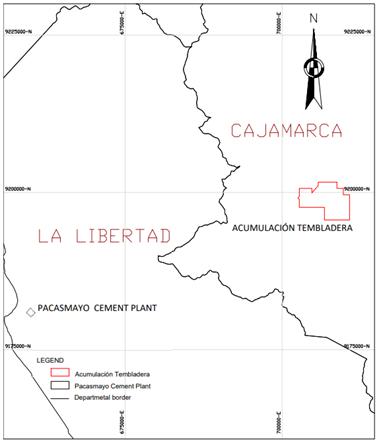
55
Figure 3 Acumulación Tembladera
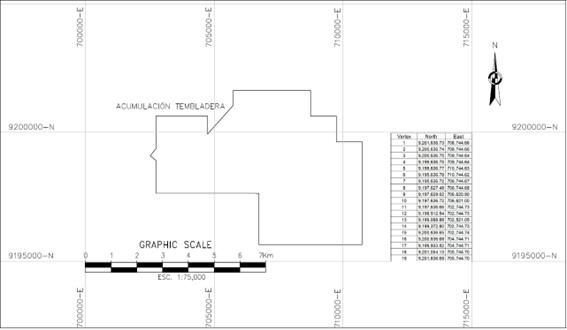
Figure 4 Pacasmayo cement plant
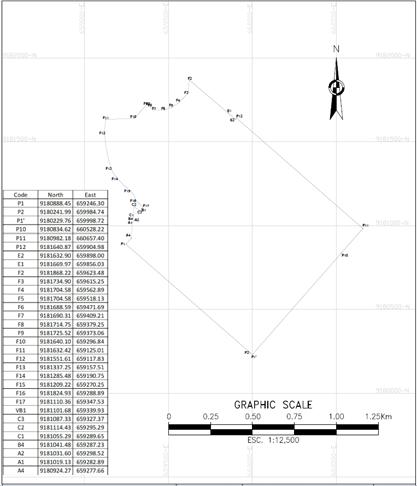
56
Infrastructure
The Tembladera quarry has the necessary infrastructure for normal operations. Facilities for electric power, water supply, fuel, access and roads have been installed.
Energy is supplied by Hidrandina S.A. Company, which obtains energy from the national grid. Energy distribution is overhead and at medium voltage of 2.3 kV. The quarry also has an electrical sub-station. The sub-station area is 1,062 m2.
Water is obtained from the village canal, which flows near the quarry. The water is used for minor activities within the quarry, such as access and road watering, limestone watering in mining areas, post-blasting watering, watering of green areas, and consumption by restrooms.
A contractor manages the fuel system. The fuel storage and dispatch system has the necessary equipment to supply fuel to the mobile and fixed units within the quarry. Trained personnel and safety measures are in place to handle fuel safely.
The Tembladera quarry can be accessed by air from Lima to Trujillo (1 hour) and by land from Trujillo to Tembladera Quarry. The route is from Trujillo to Pacasmayo (112.6 kilometers), from Pacasmayo to Ciudad de Dios (14.3 kilometers) and from Ciudad de Dios to Tembladera (50 kilometers) and Tembladera - Security point (0.8 kilometers), for a total of 747.1 kilometers. The entire route is paved. Alternatively, the quarry can be accessed by air from Lima to Chiclayo, time average 1.15 hours of flight, and from Chiclayo to Ciudad de Dios (86.8 kilometers) and from Ciudad de Dios to Tembladera (50 kilometers) and Tembladera – Security point (0.8 kilometers.). The entire route is paved.
The Tembladera quarry’s personnel come from the town of Tembladera, adjacent to the quarry. Others come from Cajamarca and La Libertad region.
Personnel from the town of Tembladera are transported to the quarry in buses and pickup trucks.
Mining concession ownership and area
The Acumulación Tembladera was granted by Resolution No. 01989-2002-INACC/J of the National Institute of Concessions and Cadastre (Instituto Nacional de Concesiones y Catastro).
The procedure to obtain a mining concession is established in the General Mining Law (DS-014-92-EM) and its Regulation D.L 020-2020-EM.
The mining concession is in the owner’s name of Cementos Pacasmayo S.A.A. and is also registered with the name Acumulación Tembladera as a NON METALLIC quarry.
Cementos Pacasmayo S.A.A has the surface rights to the area of operation in the Tembladera quarry.
Cementos Pacasmayo S.A.A. pays the right of use for the concession Acumulación Tembladera with unique code 010001801L. These payments must be made from the first working day of January to June 30th of each year, providing the financial entities the unique code of its mining right. The Acumulación Tembladera concession payment is equivalent to US$3.00 per hectare.
57
Royalties
Law No. 28258 approved the Peruvian Mining Royalty Law on June 24, 2004, which was amended by Law No. 29788 of September 28, 2011. Cementos Pacasmayo S.A.A. currently pays the Mining Royalty (see note 25 to the consolidated financial statements).
The payment to the Peruvian government is made through SUNAT, which is the entity designated to control this consideration for the use of natural resources. Such payment is made through an application that the tax authority has made available to those required to pay.
If the mining royalty is not declared or paid, penalties for infractions and default interest for non-compliance are incurred. However, failure to pay these fines is not a cause for the loss of the mining concession.
Mining activities on the property and production at the cement plant
Tembladera quarry
The Tembladera quarry, located in the Acumulación Tembladera mining concession, is currently in the production stage. The Tembladera quarry is an open-pit mine that uses explosives to fragment the limestone rock. After crushing, the material is loaded onto trucks to be transported from the quarry to the cement plant located in Pacasmayo.
Figure 5 shows the flowsheet of mining processes at the Tembladera quarry. Further details of the process are provided in Exhibit 96.1 of this annual report on Form 20-F.
Figure 5 Diagram of mining process of the Tembladera quarry
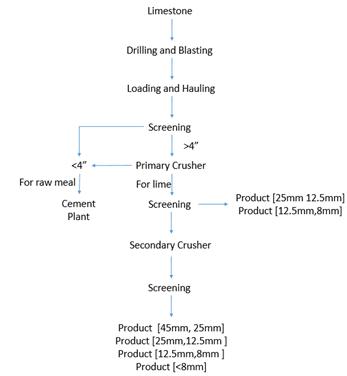
The Tembladera quarry has been operating for 68 years. The amount of limestone to be mined is planned annually through the mining plan.
58
The equipment at the Tembladera quarry is in optimum condition to maintain continuity of operations. Maintenance and optimization of the equipment is carried out periodically and is supervised by the operator of the quarry. The equipment is in good condition and operational. Further details of the equipment are provided in Exhibit 96.1 of this annual report on Form 20-F.
Pacasmayo industrial cement plant
The cement plant is under the laws of the industrial sector, according to current Peruvian regulations.
The Pacasmayo plant is located at Pacasmayo District, Pacasmayo Province, La Libertad Region. This plant is 67.3 km from Tembladera quarry. This facility receives material from the Tembladera quarry. The Pacasmayo plant produces various products for the construction industry, the main product being cement. Different types of cement are produced depending on their applications, using limestone, sand, iron and clays as raw materials. The specific mix of raw materials produces the clinker necessary to produce cement.
The standard cement production process consists of the following main stages:
| ● | Extraction and transportation of limestone; |
| ● | Raw material storage; |
| ● | Grinding and homogenization to make the raw material of consistent quality; |
| ● | Clinkerization; |
| ● | Cement grinding; |
| ● | Storage in silos; and |
| ● | Packaging, loading and distribution. |
Figure 6 shows the flowsheet for raw material processing, clinker and cement production. Further details of the process are provided in Exhibit 96.1 of this annual report on Form 20-F.
Figure 6 Pacasmayo industrial cement plant process block diagram
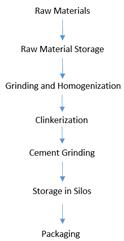
59
The Pacasmayo plant has been in operation for 68 years. The equipment at the Pacasmayo plant is in optimal condition to avoid any interruption in cement production. Maintenance and optimization of the equipment is carried out periodically and is supervised by Cementos Pacasmayo personnel. The Pacasmayo plant is currently being optimized with a modern, state-of-the-art clinker production line in order to increase production. The equipment is in good condition and operational. Further details of the equipment are provided in Exhibit 96.1 of this annual report on Form 20-F.
Facilities
The total cost of the mining concession, mine development costs, land, buildings and other facilities, machinery and equipment, furniture and fixtures, transportation units, computer equipment and tools, quarry rehabilitation costs, capitalized interest and work in progress amounted to S/708,402,047 as of December 31, 2025.
Tembladera quarry
The Tembladera quarry has facilities such as offices, explosives magazine for blasting, electrical substation, maintenance shop, lubricant warehouse, gas station, oil tank, guardhouse, limestone field, dining room, laboratory, truck scale, ore belt, loading tunnel, meteorological station, safety trench and septic tank.
Pacasmayo plant
The Pacasmayo plant has facilities such as maintenance workshops, warehouses, laboratories, administrative offices, and cement production lines that support cement production.
History
By means of Resolution No. 01989-2002-INACC/J dated November 4, 2002, the National Institute of Mining Cadastre and Concessions granted Cementos Pacasmayo S.A.A., the non-metallic concession title called “Acumulación Tembladera” with code No. 01-00018-01-L.
The property dates back to its oldest integral concession: “Norte No. 1” granted by the Regional Mining Office of Cajamarca by ministerial resolution No. 267 of June 30, 1950, for the benefit of Cementos Portland del Norte S.A., starting operations as Cementos Pacasmayo S.A.A., from 1957 until 2013 when Calizas del Norte S.A.C. (CALNOR) was incorporated. CALNOR started activities from January 2014 until May 2016. San Martin Contratistas Generales S.A. started activities in October 2016 and continues in operation.
In December 2022, Cementos Pacasmayo started a diamond drilling campaign of 8 drill holes to confirm mineral resources and reserves. Drilling activities continue in the first month of 2023.
Between October and December 2025, the Tembladera quarry did not dispatch material to the Pacasmayo plant due to corrective maintenance works on internal components of the primary crusher, during that period, limestone was consumed from strategic stocks. However, waste removal activities continued during October and November, and the construction of a safety wall in the pit was completed in December.
60
Property encumbrances
Cementos Pacasmayo S.A.A. does not make any payments with respect to encumbrances for the Acumulación Tembladera property. The Acumulación Tembladera mining concession currently has no outstanding payments with respect to infractions and penalties.
Concessions
The Acumulación Tembladera mining concession is a production stage property with estimated Mineral Reserves.
Geology
The ore deposit contains limestone with a grade suitable for cement production. The limestone is contained within the Cajamarca Formation, belonging to the Upper Cretaceous (Turonian floor, around 90 MA). This Formation overlies the Quilquiñan Group, and intrajacent to the Celendín Formation.
Table 4 shows the stratigraphic column of the area of the Tembladera quarry and briefly describes the Cajamarca Formation and the Upper Cretaceous Celendín Formation that outcrop in the project area. Figure 6 shows the local geology of the quarry.
Table 4 Stratigraphic Column of the Tembladera quarry
| System | Series | Stratigraphic Unit | Intrusive rocks | Lithologic Description | ||
| Quaternary | Recent | Fluvial Deposit | Qr-fl | Fluvial origin | ||
| Alluvial Deposit | Qr-al | Alluvial origin | ||||
| Tertiary | Lower | Andesite | T-an | Intrusion of andesitic dykes longitudinally into the deposit rock mass. | ||
| Cretaceous | Upper | Celendin Formation | Ks-ce | Thin layers of clayey nodular limestone, interbedded with marls and lutites. | ||
| Cajamarca Formation | Ks-c | Limestone of marine origin of whitish to light gray color. | ||||
| Quilquiñan Group | Ks-q | Lutites and marls with some calcareous intercalations. | ||||
Figure 7 Geological section of Tembladera quarry
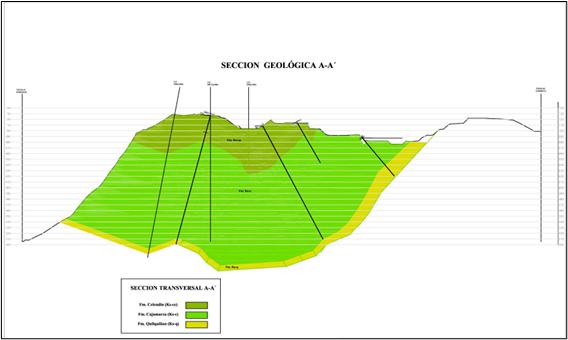
61
Resources and Reserves
Table 5 shows the Mineral Resources at the Tembladera quarry at the end of the 2025 fiscal year.
Table 5 Mineral Resources (exclusive of Reserves) at the end of the 2025 fiscal year based on cement price of S/642.9 per ton. The mineral resource estimates are at the point of delivery to the cement plant (point of reference)
| Amount
(Million Tonnes) |
Grades/
qualities (% CaO) |
Grades/
qualities (% MgO) |
Grades/
qualities (%Al2O3) |
Cut-off
grades (% CaO) |
||||||||||||||||
| Measured resources | 135.1 | 49.85 | 1.79 | 1.63 | 48.5 | |||||||||||||||
| Indicated resources | 39.2 | 50.58 | 1.56 | 1.39 | 48.5 | |||||||||||||||
| Measured + Indicated resources | 174.3 | 50.01 | 1.74 | 1.58 | 48.5 | |||||||||||||||
| Inferred resources | 41.5 | 50.61 | 1.56 | 1.38 | 48.5 | |||||||||||||||
The Mineral Resources estimation considered the expected price of cement, the complete forecast horizon contemplates 30 year projection. Clinker is used for cement production through the addition of other non-metallic minerals.
Table 6 shows the mineral reserves at the Tembladera quarry.
Table 6 Mineral Reserves at the end of the 2025 fiscal year based on cement price of S/642.9 per ton. Mineral reserve estimates are at the point of delivery to the cement plant (point of reference)
| Amount (Million Tonnes) |
Grades/
qualities (% CaO) |
Grades/
qualities (% MgO) |
Grades/
qualities (%Al2O3) |
Cut-off
grades (% CaO) |
||||||||||||||||
| Proven reserves | 67.8 | 49.83 | 1.49 | 1.51 | 48.5 | |||||||||||||||
| Probable reserves | 5.1 | 50.56 | 1.28 | 1.39 | 48.5 | |||||||||||||||
| Total reserves | 72.9 | 49.88 | 1.48 | 1.50 | 48.5 | |||||||||||||||
The mineral reserves estimation considered the expected price of cement. The complete forecast horizon contemplates a total of 30 years. Clinker is used for cement production through the addition of other non-metallic minerals.
62
Reconciliation of Mineral Resources and Reserves at the end of the fiscal year
Table 7 shows the difference between the mineral resource estimates at the end of this fiscal year and the previous fiscal year.
Table 7 Resources for the last two fiscal years expressed in millions of tons.
| Resources
as at Dec. 31, 2025 | Resources
as at Dec. 31, 2024 | Discrepancy | ||||||||
| Measured resources | 135.1 | 131.1 | The difference is due to the annual consumption of limestone used in the cement plant. | |||||||
| Indicated resources | 39.2 | 39.2 | There is no difference in tons. | |||||||
| Measured + Indicated resources | 174.3 | 170.3 | The difference is due to the annual consumption of limestone used in the cement plant. | |||||||
| Inferred resources | 41.5 | 41.3 | The variation is due to an adjustment in the geological model and the topography. | |||||||
| * | The prices assumed for the Mineral Resources estimation in the economic model can be found in the Cementos Pacasmayo S.A.A. Technical Report Summary (TRS) of the Tembladera Quarry and Pacasmayo Cement Plant 20-F 229.601 (Item 601) Exhibit 96.1 filing. All mineral resources are estimated at cement plant. The updated average price is S/642.9 per ton of cement at nominal values, perpetuity is included at the end of the 30-year projection. |
Table 8 shows the difference between the mineral reserve estimates at the end of this fiscal year and the previous fiscal year.
Table 8 Reserves for the last two fiscal years expressed in millions of tons.
| Reserves
as at Dec. 31, 2025 | Reserves
as at Dec. 31, 2024 | Discrepancy | ||||||||
| Proven reserves | 67.8 | 75.3 | The difference is due to the annual consumption of limestone used in the cement plant. | |||||||
| Probable reserves | 5.1 | 4.9 | The variation is due to a readjustment of the mining plan. | |||||||
| * | The prices assumed for the Mineral Reserves estimation in the economic model can be found in the Cementos Pacasmayo S.A.A. Technical Report Summary (TRS) Tembladera Quarry and Pacasmayo plant 20-F 229.601 (Item 601) Exhibit 96.1 filing. All mineral Reserves are estimated at cement plant. The updated average price is S/642.9 per ton of cement, average of the 30-year projection, at nominal values. |
63
Cementos Pacasmayo has previously disclosed mineral resources and reserves at the Tembladera quarry in its 20-F filed on April 29, 2025. Cementos Pacasmayo previously filed a TRS to support its disclosure of mineral resources and reserves at the Tembladera quarry as Exhibit 96.1 of its 20-F filed on April 29, 2025. Cementos Pacasmayo is updating that TRS with the new TRS filed as Exhibit 96.1 of this annual report on Form 20-F to ensure the material assumptions are current. The main reasons for this update are prices, costs, cement demand and other economic assumptions. Further details are provided in Exhibit 96.1 of that annual report on Form 20-F.
Exploration
Cementos Pacasmayo did not conduct any exploration activity at the Tembladera quarry during the 2025 fiscal year.
Virrilá Individual Disclosure (229.1304)
Property description
Location
The Virrila property is located in the Sechura District, Sechura Province, Piura Region, Peru at longitude -80.758952° and latitude -5.933999°. The concessions are registered in INGEMET (Instituto Geológico Minero y Metalúrgico) as Virrila 3, Virrila 4, Virrila 6, Virrila 7, Virrila 8, Virrila 9, Virrila 10, Virrila 11, Virrila 12, Virrila 13, Virrila 14, Virrila 15, Virrila 16, Virrila 17, Virrila 18, Virrila 19, Virrila 20, Virrila 21, Virrila 22, Virrila 23 and Bayovar N° 4 with mining activity.
The area of the mining property is 38,226.00 hectares. The mining rights are granted by INGEMMET of the Energy and Mines Sector through a Presidential Resolution.
Cementos Pacasmayo S.A.A. owns the mining property and it is registered with the name “Unidad Económica Administrativa” (UEA) Virrila as a non-metallic quarry.
Cementos Pacasmayo currently has an agreement with the Fundación Comunal San Martin de Sechura for the use of the surface land associated with the production area of the Virrila quarry.
Piura Cement Plant and UEA Virrila are shown in Figure 8 while the locations of the UEA Virrila property and Piura cement plant are shown in Figures 9 and 10, respectively.
64
Figure 8 Piura cement plant and UEA Virrila
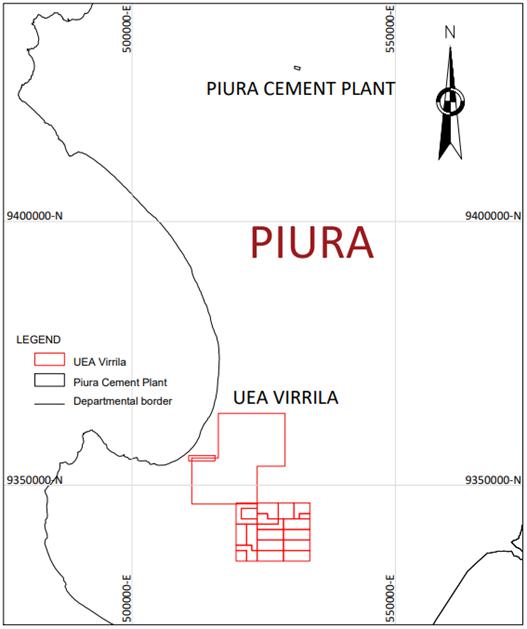
65
Figure 9 UEA Virrila property
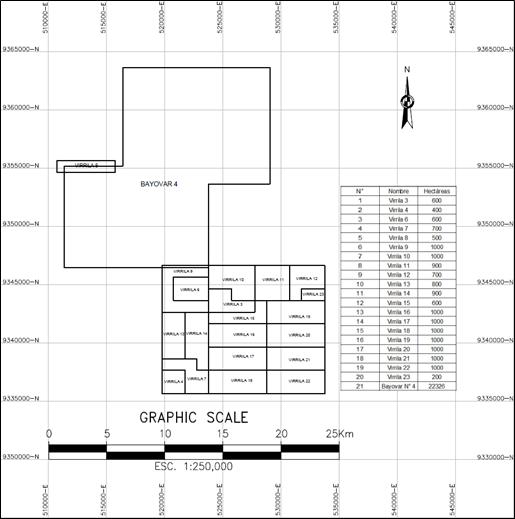
Figure 10 Piura cement plant
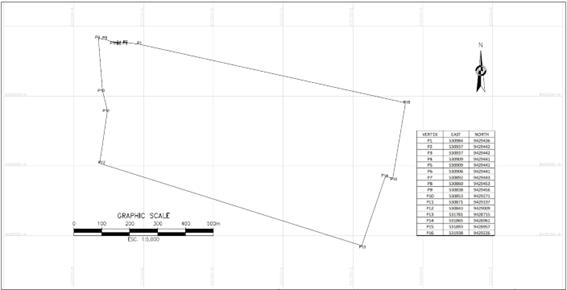
66
Infrastructure
The Virrila quarry has the necessary infrastructure for normal operations. Facilities for electric power, water supply, fuels, accesses and roads have been installed.
Virrila quarry is supplied with fuel by diesel oil tanker trucks. Fuel distribution is the responsibility of an authorized contractor company.
The Virrila quarry is supplied with energy by electric generators.
The Virrila quarry can be accessed by air from Lima to Piura (1.5 hour) and by land from Piura to Virrila quarry, along the north Panamerican highway, to the Bayovar intersection and then to the Virrila quarry. Estimated travel time is 2 hours.
Personnel for the Virrila quarry come from the town of Sechura, near the quarry. Others are from Piura.
Personnel from the Sechura Township are transported to the quarry in buses and pickup trucks. The contractor is responsible for the logistics of personnel operating in the quarry.
Mining concession ownership and area
INGEMMET granted mining rights to Cementos Pacasmayo on March 31, 2016 by Presidential Resolution N° 0147-2016-INGEMMET/PCD/PM including nine (9) non-metallic mining rights in the ¨Unidad Económica Administrativa¨ (UEA) Virrila, with code N° 01-00011-00-U of Cementos Pacasmayo S.A.A.
Presidential Resolution N° 2869-2015-INGEMMET/PCD/PM dated September 30, 2015 added twelve (12) non-metallic mining rights to ¨Unidad Económica Administrativa¨ (UEA) Virrila, with code N° 01-00011-00-U of Cementos Pacasmayo S.A.A. bringing the total to 21 mining rights.
Royalties
Law No. 28258 is the Peruvian Mining Royalty Law, which was approved on June 24, 2004 and amended by Law No. 29788 of September 28, 2011. Cementos Pacasmayo S.A.A. currently pays the Mining Royalty (see note 24 to the consolidated financial statements).
The payment to the Peruvian government is made through SUNAT, which is the entity designated to control this consideration for the use of natural resources. Such payment is made through an application that the tax authority has made available to those required to pay.
In case the mining royalty is not declared or paid, penalties for infractions and default interest for non-compliance are incurred. However, failure to pay these fines is not a cause for the loss of the mining concession.
Mining activities on the property.
The Virrila quarry located in the Virrila EAU is currently in the production stage. This is an open-pit mine where surface miners are used to fragment the coquina, which is loaded onto trucks by front-end loaders and transported to the cement plant located in Piura which is 120 kilometers from UEA Virrila.
67
Figure 11 shows the flowsheet of mining processes at the Virrila quarry. Further details of the process are provided in Exhibit 96.2 of this annual report on Form 20-F.
Figure 11 Diagram of mining process of the Virrila quarry

The Virrila quarry has been operating for 10 years. The amount of coquina to be mined is planned annually through the mining plan.
The equipment in operation at the Virrila quarry is in optimum condition to maintain continuity of operations. Maintenance and optimization of the equipment is carried out periodically and is supervised by the operator of the quarry. The equipment is in good condition and operational. Further details of the equipment are provided in Exhibit 96.2 of this annual report on Form 20-F.
Piura cement plant
The cement plant is under the laws of the industrial sector, according to current Peruvian regulations.
The cement plant is located at Veintiséis de Octubre District, Piura Province and Piura Region. This facility receives material from the Virrila quarry. The cement plant produces various products for the construction industry, the main product being cement. Different types of cement are produced depending on their applications, and using coquina, sand, iron and clays as raw materials. The specific mix of raw materials produces the clinker necessary to produce cement.
The standard cement production process consists of the following main stages:
| ● | Extraction and transportation of coquina; |
| ● | Raw material storage; |
| ● | Grinding and homogenization to make the raw material of consistent quality; |
| ● | Clinkerization; |
| ● | Cement grinding; |
| ● | Storage in silos; and |
| ● | Packaging, loading and distribution. |
68
Figure 12 shows the flowsheet for raw material processing, clinker and cement production. Further details of the process are provided in Exhibit 96.2 of this annual report on Form 20-F.
Figure 12 Piura plant process block diagram
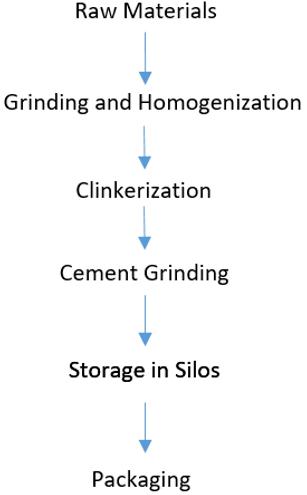
The equipment in operation at the Piura plant is in optimal condition to avoid any interruption in cement production. Maintenance and optimization of the equipment is carried out periodically and is supervised by Cementos Pacasmayo S.A.A. personnel. The equipment is in good condition and operational. Further details of the equipment are provided in Exhibit 96.2 of this annual report on Form 20-F.
Facilities
The total cost of the mining concession, mine development costs, land, buildings and other facilities, machinery and equipment, furniture and fixtures, transportation units, computer equipment and tools, quarry rehabilitation costs, capitalized interest and work in progress amounts to S/803,579,828 as of December 31, 2025.
Virrila quarry
The Virrila quarry has facilities such as offices, dining room, infirmary, vehicle parking lots, lubricant warehouse, chemical baths, maintenance shop, sample preparation laboratory, industrial water tank, truck scale, hopper for weighing, wastewater treatment pond, and satellite and radio antenna.
Piura plant
The Piura plant has facilities such as maintenance workshops, warehouses, laboratories, administrative offices, and cement production lines that support cement production.
History
The quarry is a non-metallic deposit of coquina material, source of different types of cements for construction; Cementos Pacasmayo S.A.A. owns the deposit.
The Virrila quarry started operations in 2015. The mining contractor San Martin Contratistas Generales S.A. was in charge of the production from the beginning of operations until March 14, 2020. The mining contractor Posada Perú S.A.C. started operations at the Virrila quarry on September 14, 2020 until December 30, 2021.
On January 3, 2022, the mining contractor San Martin Contratistas Generales S.A. was hired to transport the coquina from the Virrila quarry to the Piura plant.
From May to June 2023 Cementos Pacasmayo carried out a drilling campaign in order to confirm mineral reserves in Zone 2 and 4 (see Exhibit 96.2 of 20-F filed on April 29, 2024).
From May to September 2023, Virrila quarry stopped operations due to the closure of the road caused by the overflow of the La Niña lagoon provoked by cyclone Yaku. Likewise, the Piura plant stopped its clinker production operations (raw meal milling, coal milling and reception of raw materials) from July to September to avoid exceeding the strategic inventories (clinker). The cement grinding, receiving (cement additions), packaging and dispatching processes remained active to cover the cement demand. Virrila quarry restarted operations in October.
From January to March 2024, Virrila quarry shipped coquina from its stockpiles to the Piura Plant. The company in charge of loading the material was Peruvian Master S.A. From May to October 2024, Sechura Ingenieria y Contrucción E.I.R.L. was in charge of operations of the quarry. After October 2024 the quarry stopped operations according to the 2024 mining plan. Likewise, the Piura plant stopped its clinker production operations (raw meal milling, coal milling and reception of raw materials) from March to May 2024 and from November to December 2024 was to avoid exceeding the strategic inventories (clinker). The cement grinding, receiving (cement additions), packaging and dispatching processes remained active to cover the cement demand.
69
During the month of January, operations remained suspended in accordance with the 2025 Mining Plan. From February to December 2025, the Virrila Quarry dispatched coquina material to the Piura Plant, both from the operational area and from existing stockpiles. The company responsible for the material loading activities was Inversiones y Servicios Felicitas S.R.L. Likewise, the Piura plant stopped its clinker production operations (raw meal milling, coal milling and reception of raw materials) January and September to December to avoid exceeding the strategic inventories (clinker). The cement grinding, receiving (cement additions), packaging and dispatching processes remained active to cover the cement demand.
Property encumbrances
Cementos Pacasmayo S.A.A. does not make any payments with respect to encumbrances for the UEA Virrila concessions. The UEA Virrila concessions currently have no outstanding payments with respect to infractions and penalties.
Concessions
The UEA Virrila is a production stage property with estimated mineral reserves.
Geology
The lithostratigraphy of the area consists of Cenozoic sedimentary units, locally formed by Tertiary units and covered by Quaternary deposits; the Tablazo Lobitos and Quaternary deposits of ancient alluvial, lacustrine and Aeolian origin form these units. Table 9 shows the stratigraphic column of the area of the Virrila quarry while Figure 13 shows a geologic section of the geology of the quarry.
Table 9 Stratigraphic Column of the Virrila quarry
| Era | System | Symbol | Serie | Stratigraphic Unit |
| Cenozoic | Quaternary | Qh-e | Holocene | Eolic deposits |
| Qp-tt | Pleistocene | Tablazo Talara | ||
| Tertiary | Tm-zi | Miocene | Lower Zapallal Formation |
Figure 13 Geological section of the Virrila quarry
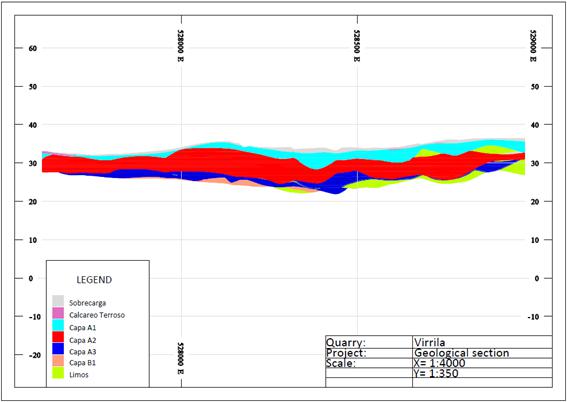
70
Resources and Reserves
Table 10 shows the mineral resources at the Virrila quarry at the end of the 2025 fiscal year.
Table 10 Mineral Resources (exclusive of Reserves) at the end of the 2025 fiscal year based on cement price of S/708.6 per ton. The mineral resource estimates are at the point of delivery to the cement plant (point of reference).
| Amount (Million Tonnes) | Grades/ qualities (% CaO) | Grades/ qualities (% SO3) | Grades/ qualities (% MgO) | Cut-off
grades (% CaO) | ||||||||||||||||
| Measured resources | 21.8 | 49.80 | 0.54 | 0.62 | 48.5 | |||||||||||||||
| Indicated resources | 26.8 | 48.98 | 1.06 | 1.18 | 48.5 | |||||||||||||||
| Measured + indicated resources | 48.6 | 49.35 | 0.83 | 0.93 | 48.5 | |||||||||||||||
| Inferred resources | 4.4 | 46.70 | 2.11 | 1.54 | 48.5 | |||||||||||||||
The mineral resource estimation considered the expected price of cement. The complete forecast horizon contemplates a total of 30 years of projection. Clinker is used for cement production through the addition of other non-metallic minerals.
Table 11 Mineral Reserves at the end of the 2025 fiscal year based on cement price of S/708.6 per ton. Mineral reserve estimates are at the point of delivery to the cement plant (point of reference).
| Amount (Million Tonnes) |
Grades/ qualities (% CaO) |
Grades/ qualities (% SO3) |
Grades/ qualities (% MgO) |
Cut-off grades (% CaO) |
||||||||||||||||
| Proven reserves | 39.9 | 51.86 | 0.36 | 0.71 | 48.5 | |||||||||||||||
| Probable reserves | 0.9 | 49.83 | 0.64 | 0.84 | 48.5 | |||||||||||||||
| Total reserves | 40.8 | 51.82 | 0.36 | 0.71 | 48.5 | |||||||||||||||
The mineral reserves estimation considered the expected price of cement. The complete forecast horizon contemplates a total of 30 years of projection. Clinker is used for cement production through the addition of other non-metallic minerals.
Reconciliation of Resources and Reserves at fiscal year-end
Table 12 shows the difference between the mineral resource estimates at the end of 2025 fiscal year and the 2024 fiscal year.
Table 12 Resources for the last two fiscal years expressed in millions of tons.
| Resources as at Dec. 31, 2025 | Resources as at Dec. 31, 2024 | Discrepancy | ||||||||
| Measured Resources | 21.8 | 20.5 | The difference is due to the annual consumption of coquina used in the cement plant. | |||||||
| Indicated Resources | 26.8 | 30.2 | The difference is due to the annual consumption of coquina used in the cement plant. | |||||||
| Measured + Indicated Resources | 48.6 | 50.7 | The difference is due to the annual consumption of coquina used in the cement plant. | |||||||
| Inferred Resources | 4.4 | 4.4 | There is no difference in tons. | |||||||
| * | The prices assumed for the Mineral Resources estimation in the economic model can be found in the Cementos Pacasmayo S.A.A. Technical Report Summary (TRS) of the Virrila Quarry and Piura plant 20-F 229.601 (Item 601) Exhibit 96.2 filing. All Resources are estimated at cement plant. The updated average price is S/708.6 per ton of cement, average of the 30-year projection, at nominal values. |
71
Table 13 shows the difference between the mineral reserve estimates at the end of the 2025 fiscal year and the 2024 fiscal year.
Table 13 Reserves for the last two fiscal years expressed in millions of tons.
| Reserves
as at Dec. 31, 2025 | Reserves
as at Dec. 31, 2024 | Discrepancy | ||||||||
| Proven Reserves | 39.9 | 38.7 | The difference is due to the annual consumption of coquina used in the cement plant. | |||||||
| Probable Reserves | 0.9 | 0.6 | The difference is due to the annual consumption of coquina used in the cement plant. | |||||||
| * | The prices assumed for the Mineral Reserves estimation in the economic model can be found in the Cementos Pacasmayo S.A.A. Technical Report Summary (TRS) Virrila Quarry and Piura Cement Plant 20-F 229.601 (Item 601) Exhibit 96.2 1 filing. All Reserves are estimated at cement plant. The updated average price is S/708.6 per ton of cement, average of the 30-year projection, at nominal values. |
Cementos Pacasmayo has previously disclosed mineral resources and reserves at the Virrila quarry in its 20-F filed on April 29, 2025. Cementos Pacasmayo previously filed a TRS to support its disclosure of mineral resources and reserves at the Virrila quarry as Exhibit 96.2 of its 20-F filed on April 29, 2025. Cementos Pacasmayo is updating that TRS with the new TRS filed as Exhibit 96.2 of this annual report on Form 20-F to ensure the material assumptions are current. The main reasons for this update are prices, costs and cement demand. Further details are provided in Exhibit 96.2 of that annual report on Form 20-F.
Exploration
Cementos Pacasmayo did not conduct any exploration activity at the Virrila quarry during the 2025 fiscal year.
Tioyacu Individual Disclosure (229.1304)
Property description
Location
The Tioyacu property is located in Elias Soplin Vargas district, Rioja province, San Martin region, Peru at longitude -77.284376° and latitude -5.999057°. It is located 5 km from the cement plant.
The mining rights registered with INGEMMET are as follows Moyobamba 98, Pajonal 2, Rioja 1, Rioja 2, Rioja 3, Rioja 5, Rioja 6, Rioja 7, Rioja 8, Rioja 9, Calizas Tioyacu, Arcillas el Pajonal, Pajonal 3 and Pajonal 4. The area of the mining property is 9,600 hectares.
The mining rights (the mining concession title) are granted by INGEMMET of the Energy and Mines Sector through a Presidential Resolution.
Cementos Selva S.A.C. owns the mining property and it is registered with the name “Unidad Económica Administrativa” (UEA) Rioja as a NON METALLIC mining property.
Rioja cement plant and UEA Rioja are shown in Figure 14 while the locations of the UEA Rioja property and Rioja cement plant are shown in Figures 15 and 16, respectively.
72
Figure 14 Rioja cement plant and UEA Rioja
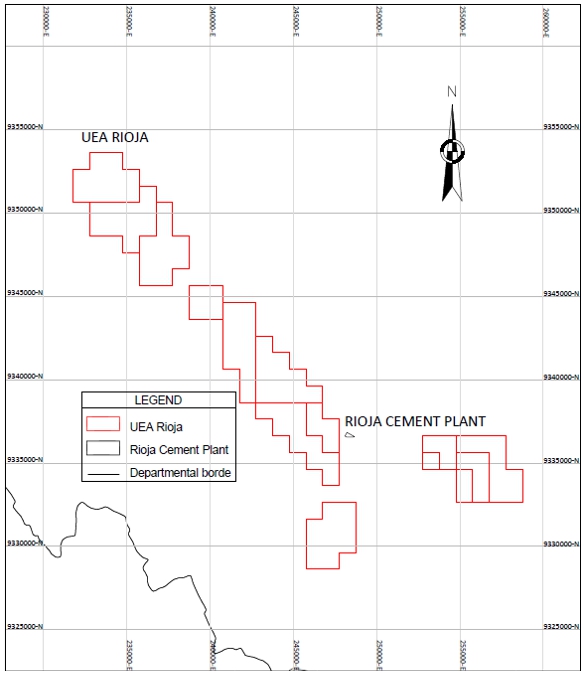
73
Figure 15 UEA Rioja property
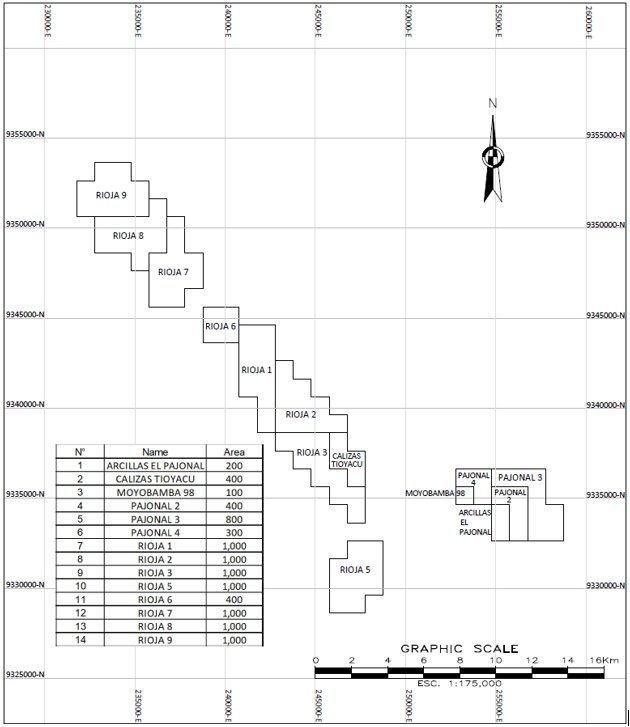
Figure 16 Rioja cement plant
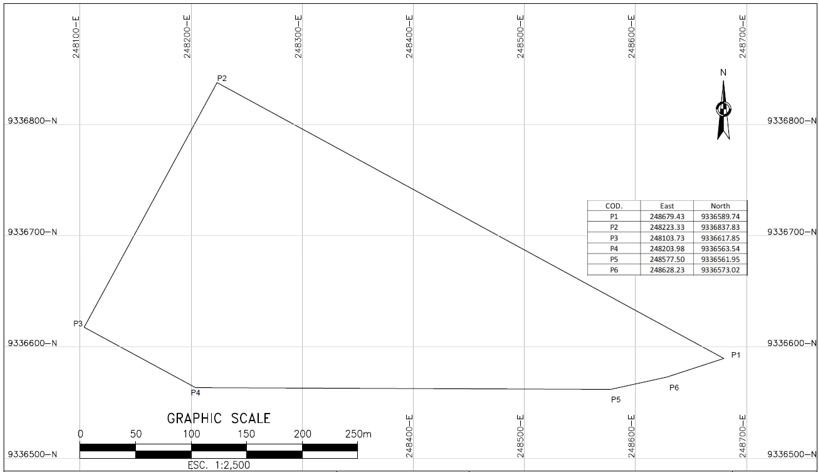
74
Infrastructure
As of December 31, 2025, we understand that the Tioyacu quarry has the necessary infrastructure for normal operations. Facilities for electric power, water supply, fuel, access and roads have been installed.
The Rioja plant owned by Cementos Selva S.A.C., a wholly-owned subsidiary of Cementos Pacasmayo, currently has adequate infrastructure (such as workshops, service stations, restrooms, and others).
The Tioyacu quarry can be accessed from the coast by air from Lima to Tarapoto, time average 1.10 hours of flight, and from Tarapoto to Rioja (139 kilometers) and from Rioja to the Cementos Selva S.A.C. plant (15 kilometers). Alternatively, one can access the site by road from Lima to Rioja, a distance of 1107 kilometers on paved road.
The personnel at Tioyacu quarry come from the Elias Soplin Vargas district. Others are from Rioja and Nueva Cajamarca.
Mining concessions ownership and area
Calizas Tioyacu concession was approved by Resolution 0960-96-RPM granted by the Public Mining Registry.
The procedure to obtain a mining concession is stipulated in the General Mining Law (DS-014-92-EM) and its Regulation D.L 020-2020-EM.
Cementos Selva S.A.C. is the owner of the mining concession and, is registered under the name Calizas Tioyacu as a NON METALLIC quarry.
Tioyacu quarry has a Usufruct and Easement Agreement for the use and easement of the surface where mining activities are carried out. The agreement was signed with Corporación de Desarrollo de San Martin (COREDESAM).
Cementos Selva S.A.C. pays the concession fee for the Calizas Tioyacu concession with unique code 010912495. These payments must be made from the first working day of January to June 30th of each year, providing the Financial Entities the UNIQUE CODE of its mining right. In the case of the Calizas Tioyacu concession, the payment is equivalent to US$3 per hectare.
Royalties
The Peruvian Mining Royalty Law was approved on June 24, 2004 by Law No. 28258, which was amended by Law No. 29788 of September 28, 2011. Cementos Selva S.A.C. currently pays the Mining Royalty (see note 24 to the consolidated financial statements).
The payment to the Peruvian government is made through SUNAT, which is the entity designated to control this consideration for the use of natural resources. Such payment is made through an application that the tax authority has made available to those required to pay.
If the mining royalty is not declared or paid, fines for infractions and late payment interest for non-compliance are incurred. However, failure to pay these fines is not a cause for the loss of the mining concession.
Mining activities on the property
Tioyacu quarry
The Tioyacu quarry located in the Calizas Tioyacu mining concession is currently in the production stage. The Tioyacu quarry is an open-pit mine that uses explosives to fragment the limestone rock, which is then loaded onto trucks by front-end loaders and transported to the Rioja plant.
75
Figure 17 shows a flowsheet of mining processes at the Tioyacu quarry. Further details of the process are provided in Exhibit 96.3 of this annual report on Form 20-F.
Figure 17 Diagram of mining process of the Tioyacu quarry

The Tioyacu quarry has been operating for 25 years for Cementos Selva S.A.C. The material extracted from the quarry is used to supply the Rioja Cement Plant, which has also been in operation for 25 years. The amount of limestone to be mined is planned annually through the mining plan.
The equipment in operation at the Tioyacu quarry is in optimum condition to maintain continuity of operations. Maintenance and optimization of the equipment is carried out periodically and is supervised by the operator of the quarry. The equipment is in good condition and operational. Further details of the equipment are provided in Exhibit 96.3 of this annual report on Form 20-F.
Rioja cement plant
The cement plant is under the laws of the industrial sector, per current Peruvian regulations.
The Rioja cement plant is located in the district of Elías Soplin Vargas, La Rioja province, San Martin region, 5 kilometers from the quarry. This facility receives material from the Tioyacu quarry. The cement plant produces various products for the construction industry, the main product being cement. Different types of cement are produced depending on their applications, using limestone, sand, iron and clays as raw materials. The specific mix of raw materials produces the clinker necessary to produce cement.
The standard cement production process consists of the following main stages:
| ● | Extraction and transportation of limestone; |
| ● | Raw material storage; |
| ● | Crushing and Drying of Raw Materials; |
| ● | Grinding and homogenization to make the raw material of consistent quality; |
| ● | Clinkerization; |
| ● | Cement grinding; |
| ● | Storage in silos; and |
| ● | Packaging, loading and distribution. |
76
Figure 18 shows the flowsheet for raw material processing, as well as clinker and cement production. Further details of the process are provided in Exhibit 96.3 of this annual report on Form 20-F
Figure 18 Rioja plant process block diagram
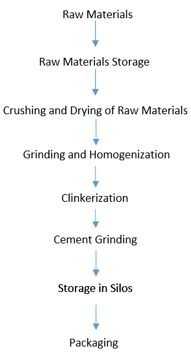
The equipment in operation at the Rioja plant is in optimal condition to avoid any interruption in cement production. Maintenance and optimization of the equipment is carried out periodically and is supervised by Cementos Selva S.A.C personnel. The equipment is in good condition and operational. Further details of the equipment are provided in Exhibit 96.3 of this annual report on Form 20-F.
Facilities
The total cost of the mining concession, mine development costs, land, buildings and other constructions, machinery and equipment, furniture and fixtures, transportation units, computer equipment and tools, quarry rehabilitation costs, capitalized interest and work in progress amounted to S/122,500,031 as of December 31, 2025.
Tioyacu quarry
The Tioyacu quarry does not have maintenance and administrative facilities because the Cementos Selva S.A.C plant is near the quarry and provides the necessary facilities for quarry operations.
Rioja plant
The Rioja plant has facilities such as maintenance workshops, warehouses, laboratories, administrative offices, and cement production lines that support cement production and Tioyacu quarry.
History
The Tioyacu quarry began operations as Cementos Rioja S.A. in 2000. Prior to this, Cementos Rioja S.A. had successfully won the bid for the “Cement Plant with Vertical Kiln of Rioja”, promoted by CEPRI Cemento Rioja at the Public Auction of February 6, 1998. Ownership was then transferred by the Regional Government of San Martin by public deed on March 28, 1988, to Cementos Rioja S.A.
The development of the project, and the non-metallic mining concession – Calizas Tioyacu, among others, were a part of the transfer in favor of Cementos Rioja S.A. by Empresa Minera del Perú, by public deed dated April 8, 1998.
According to the provisions of the General Mining Law (D.S. No. 014-92-EM) in its article 9°, the industrial cement plant is not an integral or accessory part of the mining concession, nor does it carry out mining activities, it is a different property dedicated to the industrial manufacturing of cement.
77
On March 1, 2022, Cementos Selva S.A. changed its corporate name to Cementos Selva S.A.C. (CSSAC). During December 2023, Cementos Selva started a diamond drilling campaign of 6 drill holes to confirm mineral reserves.
On 2024, no blasting activities were carried out from May to September in the Tioyacu quarry due to delays from the authority for permits. During the month of November diamond drilling was carried out at the Tioyacu quarry in order to update the quarry’s resources and mineral reserves.
Property encumbrances
Cementos Selva S.A.C. does not make any payments with respect to encumbrances for the Tioyacu quarry. Tioyacu quarry currently has no outstanding payments with respect to infractions and penalties.
Concessions
The Calizas Tioyacu is a production stage property with estimated mineral reserves.
Geology
The ore deposit contains limestone with a grade suitable for cement production. The limestone is contained within the Condorsinga Formation. This Formation is part of the Pucará Group. Figure 19 shows the stratigraphic column of the area of the Tioyacu quarry while Figure 20 shows the local geology of the quarry.
Figure 19 Rioja plant process block diagram
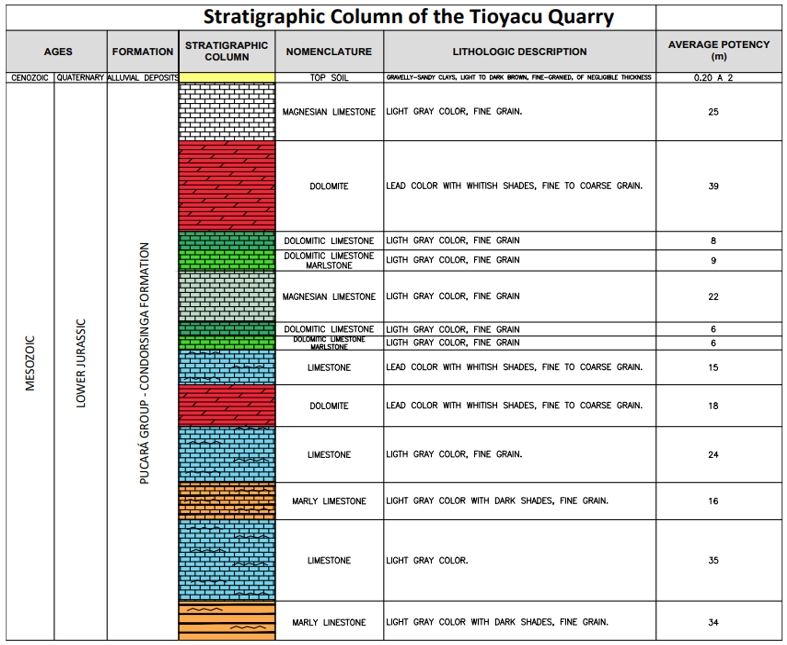
78
Figure 20 Geological section of the Tioyacu quarry
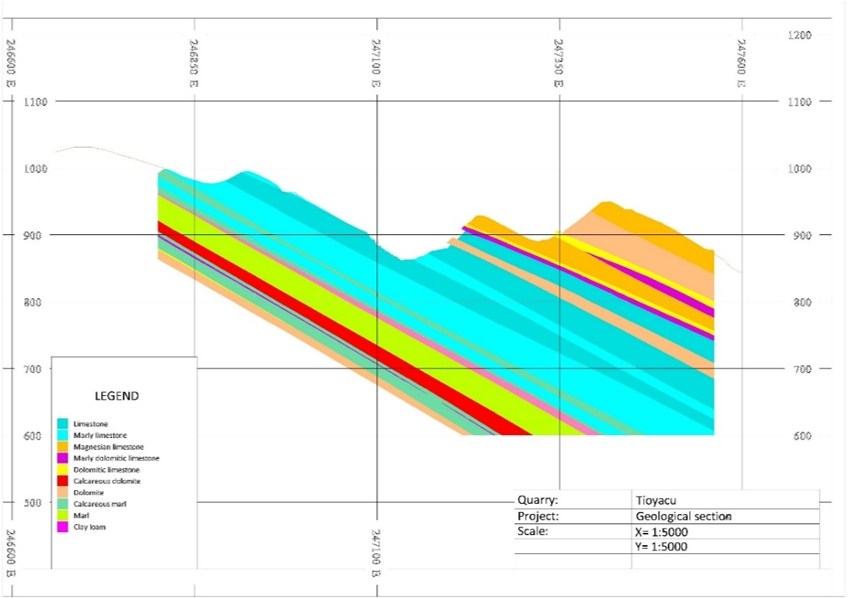
Resources and Reserves
Table 14 shows the mineral resources at the Tioyacu quarry at the end of the 2025 fiscal year.
Table 14 Limestone Resources (exclusive of Reserves) at the end of the 2025 fiscal year based on cement price of S/754 per ton. The mineral resource estimates are at the point of delivery to the cement plant (point of reference).
| Amount
(Million Ton) | Grades/ qualities (% CaO) | Grades/ qualities (% SiO2) | Grades/ qualities (% K2O) | Cut-off
grades (%CaO) | ||||||||||||||||
| Measured resources | 25.8 | 49.52 | 6.88 | 0.25 | 51.00 | (1) | ||||||||||||||
| Indicated resources | 4.8 | 48.29 | 7.92 | 0.26 | 51.00 | (1) | ||||||||||||||
| Measured + Indicated resources | 30.6 | 49.33 | 7.04 | 0.25 | 51.00 | (1) | ||||||||||||||
| Inferred resources | 7.2 | 49.11 | 1.70 | 0.11 | 51.00 | (1) | ||||||||||||||
79
Table 15 Limestone Reserves at the end of the 2025 fiscal year based on cement price of S/754 per ton. The mineral reserve estimates are at the point of delivery to the cement plant (point of reference).
| Amount (Million Ton) |
Grades/ qualities (% CaO) |
Grades/ qualities (% SiO2) |
Grades/ qualities (% K2O) |
Cut-off grades (%CaO) |
||||||||||||||||
| Proven reserves | 10.3 | 51.2 | 3.21 | 0.18 | 51.00 | |||||||||||||||
| Probable reserves | 1.3 | 49.3 | 5.40 | 0.17 | 51.00 | |||||||||||||||
| Total reserves | 11.6 | 51.0 | 3.46 | 0.18 | 51.00 | |||||||||||||||
The estimation of mineral reserves considered the expected price of cement. The complete forecast horizon contemplates a total of 26 years of projection. Clinker is used for cement production through the addition of other non-metallic minerals.
Reconciliation of Resources and Reserves at the end of the fiscal year
Table 16 shows the difference between the mineral resource estimates at the end of the 2025 fiscal year and the 2024 fiscal year.
Table 16 Resources for the two fiscal years expressed in millions of tons.
| Resources as at Dec. 31, 2025 | Resources as at Dec. 31, 2024 | Discrepancy | ||||||||
| Measured resources | 25.8 | 22.5 | Recategorization of inferred resources and restructuring of the model by diamond drilling | |||||||
| Indicated resources | 4.8 | 4.9 | Recategorization of inferred resources and restructuring of the model by diamond drilling | |||||||
| Measured + Indicated resources | 30.6 | 27.4 | Recategorization of inferred resources and restructuring of the model by diamond drilling | |||||||
| Inferred resources | 7.2 | 9.0 | Recategorization of inferred resources and restructuring of the model by diamond drilling | |||||||
| * | The prices assumed for the Mineral Resource estimation in the economic model can be found in the Cementos Selva S.A.C. Technical Report Summary (TRS) of the Tioyacu Quarry and Rioja Cement Plant 20-F 229.601 (Item 601) Exhibit 96.3. All mineral resources are estimated as quantities at cement plant. The updated average price is S/754 per ton of cement, average of the 26-year projection, at nominal values. |
80
Table 17 Reserves for the last two fiscal years expressed in millions of tons.
| Reserves
as at Dec. 31, 2025 | Reserves
as at Dec. 31, 2024 | Discrepancy | ||||||||
| Proven reserves | 10.3 | 6.3 | Recategorization of probable to proven reserves | |||||||
| Probable reserves | 1.3 | 4.9 | Recategorization of probable to proven reserves | |||||||
| * | The prices assumed for the Mineral Reserves estimation in the economic model can be found in the Cementos Selva S.A.C. Technical Report Summary (TRS) of the Tioyacu Quarry and Rioja Cement Plant 20-F 229.601 (Item 601) Exhibit 96.3. All mineral reserves are estimated as quantities at cement plant. The updated average price is S/754 per ton of cement, average of the 26-year projection, at nominal values. |
Cementos Pacasmayo has previously disclosed mineral resources and reserves at the Tioyacu quarry in its 20-F filed on April 29, 2025. Cementos Pacasmayo previously filed a TRS to support its disclosure of mineral resources and reserves at the Tioyacu quarry as Exhibit 96.3 of its 20-F filed on April 29, 2025. Cementos Pacasmayo is updating that TRS with the new TRS filed as Exhibit 96.3 of this annual report on Form 20-F to ensure the material assumptions are current. The main reasons for this update are price, cost and cement demand. Further details are provided in Exhibit 96.3 of that annual report on Form 20-F.
Other Activities
Cementos Selva S.A.C did not conduct any exploration activity at the Tioyacu quarry during the 2025 fiscal year.
Internal Control Disclosure (229.1305)
Internal Controls
Cementos Pacasmayo S.A.A, has implemented the necessary controls and procedures for quality assurance (QA) and quality control (QC) of the company’s production activities and associated information for the estimation of mineral resources and reserves. Cementos Pacasmayo has also implemented quality management systems for its production activities and the quality management system has been ISO 9001 certified since 2015.
The QA and QC measures are applied to exploration, quarry production (mining), and cement plant processing activities. For laboratory analysis of exploration samples used in mineral resource and reserve estimates, Cementos Pacasmayo uses a program of duplicate samples, standards and blanks to evaluate the reliability of the laboratory results that its qualified persons rely on for mineral resource and reserve estimates. Its qualified persons also verify the data prior to using the data in their work.
As part of the quality control activities, Cementos Pacasmayo periodically hires an external laboratory to verify Cementos Pacasmayo´s laboratory results obtained during the exploration activities, which are part of the geological database and subsequently used in the estimation of resources and reserves.
81
In each of its operations, Cementos Pacasmayo, following the Quality Management System, applies the quality control procedures specific to each stage of the process such as exploration activities, limestone/coquina production, reception of raw materials in the cement plant, crushing of raw materials, coal grinding, cement grinding and raw materials or products in the Cement Plants (e.g., clinker, other materials and cement).
Quality control procedures include sample security such as chain of custody for reliable information.
Cementos Pacasmayo has a chemical analysis laboratory at each of its cement plants where procedures based on international standards are used for the chemical and physical analysis of raw materials, clinker, and other materials; mainly used in limestone and cement production. Methodologies including the insertion of blanks, duplicates, and standards are applied as part of the Quality Plan.
Cementos Pacasmayo has a data management department whose goal is to verify the quality of the information and its incorporation into the geological database, so that it can be used in studies and interpretations, geological modeling, and estimation of mineral resources and reserves.
Data verification activities apply to exploration, limestone/coquina production and cement processing data.
At the cement plant, the quality plan uses the PDCA (Plan, Do, Check, Act) cycle, which allows Cementos Pacasmayo to verify the quality of information during cement production activities.
Cementos Pacasmayo has implemented internal controls to ensure its mineral Resource and Reserves estimates are compliant with Regulation S-K 1300 requirements, including ensuring that mineral resource and reserve estimates are prepared by qualified persons who are members of the Peruvian Engineers Association, an organization that regulates the legal professional practice of engineers in Peru.
Mineral resource and reserve estimates at the end of each fiscal year are and will continue to be reviewed by our Mining Operations Department to ensure compliance with S-K 1300. Cementos Pacasmayo engineers and geologists reconcile actual production with estimates of mineral resources and reserves annually to verify accuracy of the estimates. The comprehensive risk inherent in Cementos Pacasmayo’s estimates of mineral resources and reserves are consistent with industry best practices.
Insurance
We maintain a comprehensive insurance program to mitigate property and casualty risks. We maintain a comprehensive insurance program Our plants and equipment are covered against customary industry risks, including machinery breakdown, property damage, earthquakes, tremors, underground fires, storm surge, tidal waves, and tsunamis, among others. Coverage also extends to business interruption affecting our cement manufacturing operations. In addition, we carry commercial insurance for workers’ compensation and general liability exposures. We believe that our coverage, limits and deductibles are appropriate for our operations and consistent with those maintained by comparable manufactures in Peru.
Sustainability Performance
We report our sustainability performance information to the Getting the Numbers Right (“GNR”) database, inspired by the guiding principles of the Cement Sustainability Initiative (the “CSI”), a sector-project of the World Business Council for Sustainable Development (the “WBCSD”) among other cement companies in Latin America through the Inter-American Cement Federation (the “FICEM”).
82
In August 2018, we joined the GCCA and the GCCA announced the formation of a strategic partnership with the WBCSD to facilitate sustainable development of the cement and concrete sectors and their value chains. As part of a new agreement, the work carried out by the CSI and the GNR database was transferred from the WBCSD to the GCCA on January 1, 2019. In 2023, our CEO, Humberto Reynaldo Nadal was elected board member of the GCCA for the 2024-2026 and was re-elected for the 2026-2028 period.
In 2019, we became members of Innovandi Global Cement and Concrete Research Network which is GCCA’s Innovation arm, which runs key programs to develop innovations to help the industry decarbonize and produce carbon neutral concrete by 2050.
In 2020, member companies of the Global Cement and Concrete Association came together as leaders in the sector to commit to producing carbon neutral concrete by 2050, in line with global climate targets – accelerating the CO2 reductions.
Since 2019, we have been included as part of the DJS MILA Pacific Alliance Index. This index is made up of those companies that demonstrate superior performance among their peers under social, environmental and economic criteria. This achievement comes as a result of Pacasmayo’s effort to improve in all of these criteria and to work towards ambitious goals in terms of long-term sustainability. We are committed not only to remain in the Index but to improve our performance, as we are convinced that the focus on sustainability is key to our business and our stakeholders. We participated in the Carbon Disclosure Project (CDP) for the first time, and we are committed to participate every year in this project going forward. CDP is a not-for-profit charity that runs the global disclosure system for investors, companies, cities, states and regions to manage their environmental impacts.
In 2023, we inaugurated a new kiln at our Pacasmayo plant, which, in addition to adding 660,000 metric tons of clinker capacity per year, will help us on our path to carbon neutrality and allow us to achieve energy efficiency.
In February 2026, we were selected to be part of The Sustainability Yearbook for the sixth consecutive year. In this edition, we obtained, for the first time, a score within the top 10% of S&P Global’s Corporate Sustainability Assessment (CSA) in the building materials industry. To appear in the Yearbook, companies must score within the top 15% of their industry globally and have a gap of less than 30% from the leader’s Global ESG score.
Social Performance
We are committed to the development and quality of life of communities that surround the area where we operate. We have developed a good relationship with the local communities surrounding our plant facilities since we started operations in Pacasmayo. We have a number of social responsibility programs aimed at improving health and education in the area. Below is a brief description of a few of our social initiatives.
Tecsup. Tecsup is a leading not-for-profit institute in Peru that provides technical education. It was founded by the family of our controlling shareholder, and we support it by providing financial assistance to promising students living near our plants to study at the Trujillo campus of Tecsup. Through its three campuses in Peru, Tecsup has graduated over 214 students in various technical fields, some of whom currently work for us and our affiliated companies.
83
Center for Technological Training. We have three training centers at our facilities where we teach students and adults business and technical skills. Our centers are staffed with instructors from Tecsup. The goal of the center is to help develop the professional skills of the local population, especially of students and teachers at the educational institutions in the towns of Tembladera, Pacasmayo and Sechura. In 2025, this program benefited over 1,838 stakeholders.
Abilities Strengthening. This program seeks to provide training to local stakeholders such as grassroots organizations, local entrepreneurs. The objective of the program is to strengthen their skills and knowledge by providing courses and seminars especially designed for that purpose. The program is funded by us and in 2025 benefited 212 stakeholders.
Universidad de Ingeniería y Tecnología – UTEC (University of Engineering and Technology) is an educational nonprofit proposal that since 2012 is aimed at the development of people in the engineering field, looking to satisfy the need for these types of professionals in the labor market by implementing a curriculum in line with the trends and demands that globalization poses to modern engineering, with an integrated approach to innovative teaching models. We support it by providing financial aid for its operations. To enhance students’ knowledge, UTEC also has various national and international alliances with top organizations.
Acuícola Los Paiches. Through our social venture, Acuícola Los Paiches S.A.C., we studied the reproductive forms of the “paiche” (arapaima giga), a native fish species that was on the edge of extinction. After years of studies and scientific testing, we have successfully bred this species in captivity, and we have obtained thousands of fingerlings.
Floor Improvement Project. To promote the urban development of our areas of influence, we set out to improve the infrastructure conditions of homes, through the substitution of dirt floors for concrete floors to contribute to the improvement of the quality of life and habitability conditions of the towns surrounding our operations. In 2025, more than 10,000 people joined this initiative and with our support they have managed to build concrete floors in their homes. Likewise, we have contributed 21,250 bags of cement to build a total of 71,000 square meters of concrete floors. This project has motivated the participants to invest financial resources and contribute labor to improve their homes.
Risk Management
Risk Management Description
At Cementos Pacasmayo, we manage risks in a structured manner to address operational, compliance, and information security risks, as well as the traceability of ESG and climate change risks that may influence our long-term objectives. This approach aims to support senior management in decision-making by reducing negative impacts, seizing opportunities, and managing prevention and mitigation plans. In addition, it allows us to promote the continuous improvement of our processes.
84
Risk Management Process
Our methodology is based on the Australian/New Zealand Standard for Risk Management (AS/NZS 4360) and is aligned with the ISO 31000 Risk Management standard.
| 1. | Scope, Context, Criteria: |
| ● | Scope: Collaborators who play an active role in decision-making at Cementos Pacasmayo and its subsidiaries participate in the risk management process, including corporate projects. |
| ● | Context: A comprehensive understanding of the external and internal environments in which the organization operates is established, considering them as key elements in the analysis process. To evaluate the external environment, the PESTEL tool is used, covering political, economic, social, technological, ecological, and legal aspects. Likewise, for internal analysis, a detailed evaluation of each process is conducted by the risk manager responsible. |
| ● | Criteria: Risk Appetite: In situations where the assessment determines that the risk level is classified as “Very Low” or “Low,” the organization will assume the risk without taking additional mitigation measures, as it falls within the acceptable risk limits set by the organization. |
| ● | Risk Tolerance: In situations where the assessment determines that the risk level is classified as “Medium,” the organization considers the risk acceptable but may require control or monitoring measures to maintain or reduce the level. |
| ● | Mandatory Treatment: When the risk level is classified as “High” or “Very High,” the process owner must implement stronger controls to mitigate the risk and establish more rigorous monitoring. The objective of these controls is to reduce the risk to at least a “Medium” level, in line with the limits of the company’s risk tolerance. |
| 2. | Risk Assessment: |
We conduct risk assessments through our management platform, based on the best practices of the ISO 31000:2018 standard. In addition, we use the BowTie Diagram methodology to identify the risk together and its respective causes, consequences, and controls, which facilitates its analysis and subsequent evaluation.
| ● | Identification: The objective of risk identification is to recognize events that may occur within the organization and the consequences that could affect the achievement of corporate objectives. In 2025, we manage more than 160 risks, including operational, compliance, and information security risks, through discussions with risk owners and their teams. This process facilitates the exchange of perspectives on potential threats, enabling the identification of their impacts and the definition of the measures required to prevent or mitigate them. |
Classification according to:
Type: Operational, Compliance, or Information Security
Group: Paralyzing, Emerging, and others
Sustainability: Environmental, Social, and Governance
85
| ● | Analysis: Three key variables are evaluated: impact, probability, and the effectiveness of associated controls. Impact is analyzed from legal, reputational, and economic perspectives, while probability measures the likelihood of a risk occurring and the tendency toward its materialization, both assessed using five levels of evaluation. Control effectiveness is assessed based on their design and implementation. Assigning controls to risks is essential, as it allows the evaluation of the level of reduction in impact and the associated frequency for each risk. We include both qualitative and quantitative analyses to estimate financial impact. |
| ● | Evaluation: The results of the assessment of the three variables associated with each risk allow the determination of the levels of Inherent Risk (IR) and Residual Risk (RR), which are classified into five ranges, from “Very Low” to “Very High.” |
| 3. | Risk Treatment |
For each risk, we define treatment plans based on four strategies: accept, share, reduce, or avoid. Controls and mitigation actions are aligned with the defined risk appetite and aim to prevent negative impacts or reduce their likelihood.
In addition, we are advancing in the final testing phase of our Business Continuity Plan, which forms part of our preparation for crises and disruptive events.
| 4. | Monitoring and Supervision |
The dynamic environment in which Pacasmayo, its subsidiaries, and its projects operate, both nationally and globally, requires periodic review and updating of risks and their components. The overall calibration is carried out once a year, while the 28 strategic risks are assessed quarterly. These reviews are conducted through discussions with the owners of each risk and the management team, where risks are identified, analyzed, and the necessary actions for their treatment are determined.
The 2025 results show that 10 strategic risks are aligned with our risk appetite, 13 fall within tolerance levels, and 5 continue to be managed at a High level.
| 5. | Communication and Consultation |
The Risk Management team is responsible for promoting understanding of the process among the responsible areas through the dissemination of information, clarification of questions, and strengthening of knowledge. To this end, it carries out various activities such as in-person and virtual training sessions, discussion forums, and activations across different sites.
| 6. | Recording and Reporting |
At the end of each year, the Risk team presents a detailed report on the activities carried out in relation to risk management within the organization. This document includes Key Risk Indicators (KRIs), risk matrices, the results of the risk management maturity assessment, and the corresponding action plans.
86
Risk Management Organization
| Manager and team responsible for risk management |
Risks
Management Director and Risk Management Team |
Risks committee | Audit Committee | Internal Audit | ||||
| They are responsible for evaluating and treating risks through preventive and mitigation controls. Risk management coordinates with them to develop and monitor these metrics. | The Risk Management team, led by the Risk Management Director, implements the corporate risk management strategy and assumes responsibility for establishing guidelines for comprehensive risk management by developing policies and procedures and defining the methodology to be followed in accordance with the ISO 31000:2018 guidelines. In addition, it guides risk owners and their teams in managing their risks, promoting an organizational culture focused on prevention. | The Risk Committee, composed of our Chief Executive Officer and the Risk Director, is responsible for overseeing the implementation of our corporate risk management strategy. We meet quarterly to monitor and analyze the 29 strategic risks, classified according to the main management areas: People, Legal, Commercial, Supply Chain, Operations, Construction Solutions, Innovation and Digital Transformation, and Finance, as well as those associated with new products and projects. Through this committee, we submit the risk management plan for review and approval by the Chief Executive Officer, and subsequently present it to the Audit Committee for evaluation. In addition, the committee acts as a coordinating body that ensures the strategic alignment of risk management actions, strengthening the effectiveness of controls and contributing to the achievement of corporate objectives. | The control body, composed of three independent board members, reports directly to the Board. Participants include external and internal auditors, the Compliance Officer, the CFO, and the Risk Manager. This body monitors risk management action plans and improvement initiatives. Additionally, it may suggest actions if it identifies opportunities or threats that could impact the organization. | The Internal Audit area is responsible for overseeing our management processes and, within the framework of Risk Management, conducts annual audits of the process. As part of its responsibilities, it issues a report detailing gaps and opportunities for improvement, validates the effectiveness of existing controls, and monitors the progress of action plans associated with identified risks. |
Climate Related Risks
ESG risk management includes risks related to climate change. Therefore, they are analyzed through the same risk management stages and are part of Pacasmayo’s 2030 Sustainability Plan. This risk assessment includes risks that could occur in the short, medium or long term, and of different types, such as physical risks and transition risks, among others.
We have clear objectives to manage climate risks and opportunities, aiming to reduce our emissions by 20% and achieve more than 20% co-processing by 2030. All of this goes hand in hand with the implementation of operational contingency plans and the conditioning of plant infrastructure to ensure continuity, as well as the testing of emergency and crisis response plans.
For this purpose, we are aligned with the recommendations of the Task Force on Climate-related Financial Disclosures (TCFD) for risks related to climate change. For example, one risk would be that our employees’ health would be affected by heat waves or lack of water, as well as a stop in our operations due to water stress, landslides or forest fires. We are also exposed to the possibility of not being able to dispatch finished products, as well as supplying raw materials to production plants due to disabled access roads.
In 2025, we enhanced our climate risk management by integrating forward-looking climate scenarios and conducting a more detailed and technically robust assessment of physical risks across our operations and value chain. Through our CLIMATRIX initiative, we transitioned from qualitative assessments to data-driven evidence. We use the S&P Global Climanomics platform to quantify these risks using CMIP6 climate models. This methodology allows us to calculate the modeled average annual loss (MAAL), which translates climate hazards into measurable financial impacts by integrating event probability with the specific vulnerability of our assets. The use of specialized analytical tools strengthened the identification and assessment of these risks, supporting more informed decision-making. All identified climate-related risks are regularly reported to executive and management committees to improve the understanding of the exposure and vulnerability of our assets.
We intend to continue integrating transition risks through scenario analyses aligned with market trends and future regulatory developments, ensuring that climate-related risks remain embedded in our governance and strategic processes.
87
Emerging Risks
Emerging risks are those that have an impact in the long-term. The risks considered here include all recently identified risks that could have a long-term impact on the company’s business or industry, although in some cases they may have already begun to impact the company’s business.
| Risk Description | Potential Impact | Mitigation Actions | Evidence of Mitigation Actions | |||
| Economic Risk: Economic impact resulting from the introduction of cement substitute products in the construction industry. | Medium to high: This risk may result in a potential decrease in the demand for traditional cement, affecting revenues and market share. Additionally, it could increase pressure to invest in research and development of competitive alternatives, which would imply higher costs. There is also the possibility of facing stricter regulatory requirements related to sustainability, requiring the adaptation of processes or products to more demanding standards and increasing operational expenses. In a market where sustainability perception is key, the company’s reputation could also be affected if it fails to position itself as an innovative and environmentally responsible player. | Among the controls implemented, we highlight a portfolio of sustainable options, and continuous investment in research through our R&D area. In addition, we carry out constant monitoring of market trends and proactively adapt to environmental regulations. We complement these actions with awareness campaigns and customer education programs to strengthen the preference for cement. At the same time, we optimize costs and design contingency plans that ensure our competitiveness and resilience in response to changes in demand. |
● Continuous investment in research and development (R&D) to generate competitive alternatives.
● Development of a portfolio of sustainable solutions. | |||
| Environmental Risk: Water resource scarcity affecting operational continuity due to climate change and ecosystem degradation. | Medium to high: Climate change, combined with ecosystem degradation, may reduce water availability in the areas where cement plants operate, generating conflicts over access to this resource among the industry, local communities, and other sectors. This may lead to operational disruptions, higher costs due to the need to secure alternative water sources or implement water-saving technologies, and even regulatory sanctions if environmental regulations are not met. In addition, the reputational impact may be significant, as the perception that a company contributes to water stress in a region can affect its relationship with communities and business partners, putting the long-term sustainability of the business at risk. | Pacasmayo continuously collects rainfall data to assess potential reductions in water resources, complemented by water stress studies conducted by specialized consultants. In addition, the Business Continuity Plan includes maintaining stock of raw materials, finished products, and maintenance materials, as well as operating under a multi-plant scheme to ensure operational continuity. It also provides internal and external accommodation for personnel designated by the organization, establishes agreements with clinics, ensures the availability of satellite phones to maintain reliable communication, and includes tools that enable remote work when necessary. | Business Continuity Plan |
88
ITEM 4A. UNRESOLVED STAFF COMMENTS
Not applicable.
Item 5. OPERATING AND FINANCIAL REVIEW AND PROSPECTS
| A. | Operating Results |
Overview
We are a Peruvian cement company, and the only cement manufacturer serving in the northern region of Peru. With almost 70 years of operating history, we produce, distribute and sell cement and cement-related materials, such as precast products and ready-mix concrete. Our products are primarily used in construction. We also produce and sell quicklime for use in mining operations.
In 2025, our cement sales volume was approximately 3.0 million metric tons, representing an estimated 22.4% share of Peru’s total cement sales that year according to INEI. That same year, we also sold approximately 16 thousand metric tons of quicklime.
We own three cement production facilities, our Pacasmayo and Piura facilities located in the northwest region of Peru, and our smaller Rioja facility located in the northeast. Our facilities have a total installed annual cement production capacity of approximately 4.9 million metric tons and 3.1 million metric tons of clinker capacity. We also have installed annual production capacity of 240,000 metric tons of quicklime. We own concession rights to several quarries with reserves of limestone/coquina and other raw materials located near our facilities.
Factors Affecting our Results of Operations
Revenue Drivers
In 2025, approximately 81.4% of our total cement sales were in the form of bagged cement, substantially all of which was sold through retailers both within and outside of our distribution network. The remaining 18.6% of our cement was sold in bulk or in shipments of precast products or ready-mix concrete directly to large construction companies. Our retail sales are directed to both the self-construction (auto-construcción) segment and construction companies that buy cement for a variety of small construction works, including minor residential, commercial and infrastructure projects. Cement destined for large private and public projects, such as housing complexes, highways, irrigation channels, hospitals, schools, mining and industrial facilities, is typically sold in bulk or in shipments of precast products or ready-mix concrete.
We estimate that sales to the self-construction (auto-construcción) segment accounted for approximately 73.9% of our total cement sales in 2025, 75.4% in 2024 and 76.3% in 2023; private construction projects, both large and small, accounted for approximately 14.0% of our total cement sales in 2025, 15.1% in 2024, and 13.9% in 2023; and public construction projects accounted for the remaining 12.1% in of our total cement sales in 2025, 9.5% in 2024, and 9.8% in 2023. The self-construction segment has proven its resilience in times of crisis. As the Peruvian economy becomes less informal, and there is more stability and confidence from the private sector, private construction projects and infrastructure are expected to become increasingly more important to our business.
89
Our cement sales are largely driven by residential construction (both self-construction (auto-construcción) and small and large housing developments undertaken by construction companies), which is generally affected by economic conditions in the northern region of Peru. Self-construction (auto-construcción) is particularly affected by levels of disposable household income, as low-income families tend to invest most of their savings in developing their homes. Larger residential construction is more susceptible to the economic outlook, the availability of financing and prevailing investment levels in the region. GDP in the northern region of Peru is estimated to have increased by 2.0% in 2025, 3.8% in 2024, and 0.9% in 2023. Our cement volumes, which represented most of the cement sales in the northern region of Peru, grew by 6.4% in 2025, by 3.9% in 2024 and contracted by 7.9% in 2023, in terms of metric tons.
Our cement sales are also driven, to a lesser extent, by commercial developments and infrastructure projects. Commercial and other private construction projects are also affected by the level of public and private investment in the region, while public infrastructure projects depend on the priorities and financial resources of the national, regional and local governments. Since 2020, there has been a significant reduction in activity relating to these projects, due initially to the economic impact of the COVID-19 pandemic, as well as subsequent political uncertainty. Although there was some recovery during 2025, there is still a substantial lag in private investment, which decreased by 1.1% in 2025.
Cost Drivers
We obtain limestone and coquina required to produce clinker and quicklime, as well as sand, clay and pozzolanic materials required to produce cement principally from land where we have concession rights. In addition, we purchase from third parties’ admixtures and certain raw materials that we use in our production process, including gypsum, blast furnace slag, iron and other materials. Admixtures and raw materials used in our cement production process do not include construction supplies that we acquire from third parties for resale through our distribution network along with our cement products. Raw materials accounted for an estimated 26.9% of our cost of production in 2025, 27.8% in 2024 and 29.2% in 2023.
Coal is one of the main raw materials used in our production process, in particular in our kilns. We purchase anthracite coal from nearby coal mines. We do not have long-term coal supply agreements, and we do not engage in hedging transactions in connection with the price of coal. Coal accounted for an estimated 17.1% of our costs of production in 2025, 17.8% in 2024 and 22.5% in 2023.
Electricity is used in our facilities mainly to power our cement mills. We power our Pacasmayo and Piura facilities with electricity purchased from Electroperú, with which we have a supply agreement expiring in May 2026. Beginning in June 2026, those facilities will be supplied with electricity by Orygen Perú S.A.A. pursuant to a supply agreement through May 2031. Our Rioja facility is powered primarily with electricity from ELOR, with which we have an agreement expiring in December 2029. Under these agreements, the price of electricity is based on a formula that takes into consideration our consumption of electricity and certain market variables, including the international price of oil. Electricity accounted for approximately 13.8% of our cost of production in 2025, 15.0% in 2024 and 15.3% in 2023. Electricity costs tend to be lower during the rainy season, from January to March of each year, as our region is served primarily by hydro-electric power plants.
The cost of imported clinker as a percentage of our cement production costs was approximately 2.6% in 2025, compared to 5.0% in 2024 and 3.7% in 2023.
Personnel expenses represented 8.6% of our total cost of production in 2025, 6.9% in 2024 and 6.2% in 2023. The increase in 2025 is mainly due to the collective bargaining negotiations with our labor unions, which is negotiated every three years and has a closing bonus during the first year.
90
Third-party Construction Supplies
In addition to selling our own products, we also sell and distribute construction supplies manufactured by third parties, such as steel rebar, wires and pipes that are typically used in construction along with our cement. Our profit margins from the sale of third party construction supplies are significantly lower than the margins on our cement products and they are affected by fluctuations in product prices and the exchange rate between the Sol and the U.S. Dollar between the time we purchase these products and the time we resell them. We sell these products primarily as a service to retailers in our distribution network in an effort to support the sale of our cement products.
Mining Royalty Tax
The mining royalty tax for the exploitation of metallic and non-metallic minerals is payable on a quarterly basis in an amount equal to the greater of (i) an amount determined in accordance with a statutory scale of tax rates based on a company’s operating profit margin that is applied to its operating profit, as adjusted by certain non-deductible expenses and (ii) 1% of a company’s net sales, in each case during the applicable quarter. These amounts are determined based on our unconsolidated financial statements and those of our subsidiaries with operations that are under the scope of the Mining Royalty Law. Mining royalty payments are deductible for income tax purposes in the fiscal year in which such payments are made. For additional information, see note 25 to our consolidated financial statements included in this annual report on Form 20-F.
Operating Segments
We have three operating segments: (i) cement, concrete, mortar, pavement and precast, (ii) quicklime and (iii) sales of construction supplies. For additional information on our operating segments, see note 28 to our consolidated financial statements included in this annual report on Form 20-F.
New Accounting Pronouncements
For a description of new interpretations and improvements to IFRS in effect since 2025, see notes 2.3.17 and 4 to our consolidated financial statements included in this annual report on Form 20-F.
Critical Accounting Policies
The following is a discussion of our application of critical accounting policies that require our management to make certain assumptions about matters that are uncertain at the time the accounting estimate is made, where our management could reasonably use different estimates, or where accounting changes may reasonably occur from period to period, and in each case would have a material effect on our financial statements. For additional information, see note 3 to our annual audited consolidated financial statements included in this annual report on Form 20-F.
91
Determination of Useful Live of Assets for Depreciation and Amortization Purposes
Depreciation of mining concessions and mine development costs are charged to cost of production on a units-of-production basis using proved reserves. Other assets are depreciated on a straight-line-basis over their estimated useful lives, as follows:
Buildings and other construction: | Years | |||
| Minor facilities related to buildings | Between 10 and 35 | |||
| Administrative facilities | Between 20 and 51 | |||
| Main production structures | Between 20 and 56 | |||
| Minor production structures | Between 20 and 35 | |||
| Machinery and equipment: | ||||
| Mills | Between 24 and 45 | |||
| Horizontal and vertical furnaces, crushers and grinders | Between 23 and 36 | |||
| Electricity facilities and other minors | Between 10 and 35 | |||
| Furniture and fixtures | 10 | |||
| Transportation units: | ||||
| Heavy units | Between 5 and 15 | |||
| Light units | Between 5 and 10 | |||
| Computer equipment | Between 3 and 10 | |||
| Tools | Between 5 and 10 | |||
The asset’s residual value, useful lives and methods of depreciation are reviewed at each reporting period and adjusted prospectively if appropriate.
An item of property, plant and equipment and any significant part initially recognized is derecognized upon disposal or when no future economic benefits are expected from its use or disposal. Any gain or loss arising on derecognition of the asset (calculated as the difference between the net disposal proceeds and the carrying amount of the asset) is included in the consolidated statement of profit or loss when the asset is derecognized.
Revenue Recognition
Revenue is measured at the fair value of the consideration received or receivable, considering contractually defined terms of payment and excluding taxes or duties.
The following specific recognition criteria must also be met before revenue is recognized:
Sales of goods
Revenue from sale of goods is recognized at the point in time when control of the asset is transferred to the customer, generally on delivery of the goods.
We consider whether there are other promises in the contract that are separate performance obligations to which a portion of the transaction price needs to be allocated. In determining the transaction price for the sale of goods, we consider the effects of variable consideration, the existence of significant financing components, noncash consideration, and consideration payable to the customer (if any).
92
Rendering of services
In the business segments of cement, concrete, mortar, precast, quicklime and construction supplies, we provide transportation services. These services are sold together with the sale of the goods to the customer.
Transportation services are satisfied when the transport service is concluded, which coincides with the moment of delivery of the goods to the customers.
Paving services
In the paving business, to satisfy performance obligations over time, we recognize revenue by measuring progress as progress is made (transferring control of the services) in accordance with the relevant contract.
To measure the progress of the paving service, we use the resource method, which states that revenue should be recognized on the basis of the efforts or resources incurred to satisfy the performance obligation (for example, resources consumed, labor hours expended, costs incurred, elapsed time or machinery hours used) in relation to the total resources expected to satisfy the performance obligation.
Interest income
For all financial instruments measured at amortized cost and interest-bearing financial assets, interest income is recorded using the effective interest rate (EIR). EIR is the rate that exactly discounts the estimated future cash payments or receipts over the expected life of the financial instrument or a shorter period, where appropriate, to the net carrying amount of the financial asset or liability. Interest income is included in finance income in the consolidated statement of profit or loss.
Impairment of Non-Financial Assets
We assess at each reporting date whether there is an indication that an asset may be impaired. If any indication exists, or when annual impairment testing for an asset is required, (goodwill and intangible assets with indefinite useful lives), we estimate the asset’s recoverable amount. An asset’s recoverable value is the higher of an asset’s or cash-generating unit’s fair value less costs of disposal and its value in use, and is determined for an individual asset, unless the asset does not generate net cash inflows that are largely independent of those from other assets or groups of assets. Where the carrying amount of an asset’s cash-generating unit exceeds its recoverable amount, the asset is considered impaired and is written down to its recoverable amount. In assessing value in use, the estimated future cash flows are discounted to their present value using a pre-tax discount rate that reflects current market assessments of the time value of money and the risks specific to the asset. In determining fair value less costs of disposal, recent market transactions are taken into account. If no such transactions can be identified, an appropriate valuation model is used. These calculations are corroborated by valuation multiples, quoted share prices for publicly traded companies or other available fair value indicators.
As of December 31, 2025, 2024 and 2023, goodwill related to the acquisition of assets made by our subsidiary Distribuidora Norte Pacasmayo S.R.L. amounted to S/4,459,000. We have assessed the recoverable amount of our goodwill and have determined that there are no indicators of an impairment loss of this asset as of December 31, 2025 and 2024. In 2023, management recognized a specific impairment to retirement for the net value of the assets of the vertical clinker kilns located at the Pacasmayo cement plant for a net cost of S/36,551,000. This deterioration estimate was carried out as a consequence of replacing the old technology of these kilns due to the entry into operation of the Clinker Lines Optimization Project – Kiln 4 in the Pacasmayo plant, which is more efficient and produces fewer emissions. This amount was recorded in the impairment of property, plant and equipment item in the consolidated statement of profit or loss. As of December 31, 2025, management had not identified impairment for long-lived assets.
93
We base our impairment calculation on detailed budgets and forecast calculations, which are prepared separately from our cash generation units to which the individual assets are allocated. Impairment losses of continuing operations, including impairment on inventories, are recognized in the consolidated statement of profit or loss in expense categories consistent with the function of the impaired asset.
An assessment is made at each reporting date as to whether there is any indication that previously recognized impairment losses may no longer exist or have decreased. If such indication exists, we estimate the asset’s or cash-generating unit’s recoverable amount. A previously recognized impairment loss is reversed only if there has been a change in the assumptions used to determine the asset’s recoverable amount since the last impairment loss was recognized. The reversal is limited so that the carrying amount of the asset does not exceed its recoverable amount, nor exceed the carrying amount that would have been determined, net of depreciation, had no impairment loss been recognized for the asset in prior years. Such reversal is recognized in the consolidated statement of profit or loss. Exploration and evaluation assets are tested for impairment annually as of December 31, either individually or at the cash-generating unit level, as appropriate and when circumstances indicate that the carrying value may be impaired.
Deferred Tax
Deferred tax is determined on temporary differences between the tax bases of assets and liabilities and their carrying amounts for financial reporting purposes at the reporting date.
Deferred tax liabilities are recognized for all taxable temporary differences, except in respect of taxable temporary differences associated with investments in subsidiaries, associates and interests in joint arrangements, when the timing of the reversal of the temporary differences can be controlled and it is probable that the temporary differences will not reverse in the foreseeable future.
Deferred tax assets are recognized for all deductible temporary differences, and for the future offset of unused tax credits and carryforward tax losses, provided they are considered recoverable.
The carrying amount of deferred tax assets is reviewed at each reporting date and reduced to the extent that it is no longer probable that sufficient taxable profit will be available to allow all or part of the deferred tax asset to be utilized. Unrecognized deferred tax assets are re-assessed at each reporting date and are recognized to the extent that it has become probable that future taxable profits will allow the deferred tax asset to be recovered.
Deferred tax assets and liabilities are measured at the tax rates that are expected to apply in the year when the asset is realized or the liability is settled, based on tax rates (and tax laws) that have been enacted or substantively enacted at the reporting date.
Deferred tax related to items recognized outside profit or loss are recognized outside the consolidated statement of profit or loss. Deferred tax items are recognized in correlation to the underlying transaction either in OCI or directly in equity.
94
Results of Operations
Comparison of Year Ended December 31, 2025 to Year Ended December 31, 2024
| For the year ended December 31, | ||||||||||||
| 2025 | 2024 | Variation | ||||||||||
| (in millions of S/) | (%) | |||||||||||
| Sales of goods | 2,116.9 | 1,978.1 | 7.0 | % | ||||||||
| Cost of sales | (1,310.0 | ) | (1,249.6 | ) | 4.8 | % | ||||||
| Gross profit | 806.9 | 728.5 | 10.8 | % | ||||||||
| Operating income (expenses): | ||||||||||||
| Administrative expenses | (291.5 | ) | (253.4 | ) | 15.0 | % | ||||||
| Selling and distribution expenses | (92.8 | ) | (81.4 | ) | 14.0 | % | ||||||
| Other operating (expense) income, net | (75.5 | ) | (2.7 | ) | n.m. | |||||||
| Total operating expenses, net | (459.8 | ) | (337.5 | ) | 36.2 | % | ||||||
| Operating profit | 347.0 | 391.0 | (11.2 | )% | ||||||||
| Other income (expenses): | ||||||||||||
| Finance income | 11.3 | 6.3 | 79.4 | % | ||||||||
| Finance costs | (93.0 | ) | (100.3 | ) | (7.3 | )% | ||||||
| Loss from exchange difference, net | 2.6 | (0.8 | ) | n.m. | ||||||||
| Total other expenses, net | (79.1 | ) | (94.8 | ) | (16.6 | )% | ||||||
| Profit before income tax | 268.0 | 296.2 | (9.5 | )% | ||||||||
| Income tax expense | (113.8 | ) | (97.3 | ) | 17.0 | % | ||||||
| Profit for the year | 154.2 | 198.9 | (22.5 | )% | ||||||||
n.m. = not meaningful.
Sales of Goods
The following table sets forth a breakdown of our sales of goods by segment for 2025 and 2024:
| For the year ended December 31, | ||||||||||||||||
| 2025 | 2024 | |||||||||||||||
| (in millions of S/) | (in %) | (in millions of S/) | (in %) | |||||||||||||
| Cement, concrete, mortar, pavement and precast | 2,064.7 | 97.5 | 1,906.8 | 96.4 | ||||||||||||
| Construction supplies | 41.7 | 2.0 | 56.9 | 2.9 | ||||||||||||
| Other | 10.5 | 0.5 | 14.4 | 0.7 | ||||||||||||
| Total sales of goods | 2,116.9 | 100.0 | 1,978.1 | 100.0 | ||||||||||||
Our total sales of goods increased by 7.0%, or S/138.8 million, to S/2,116.9 million in 2025 from S/1,978.1 million in 2024. This increase was primarily due to the following factors:
| ● | a 8.3%, or S/157.9 million, increase in sales of cement, concrete, mortar, pavement and precast mainly due to increased sales of bagged cement and for infrastructure projects; |
95
| ● | a 26.7%, or S/15.2 million, decrease in the sale of construction supplies, mainly due to decreased sales of steel rebars; and |
| ● | a 27.1% or S/3.9 million, decrease in the sale of other material. |
The following table sets forth the composition of our sales of cement, concrete, mortar, pavement and precast for 2025 and 2024:
| For the year ended December 31, | ||||||||||||
| 2025 | 2024 | Variation | ||||||||||
| (in millions of S/) | (%) | |||||||||||
| Cement | 1,745.2 | 1,605.5 | 8.7 | |||||||||
| Concrete and mortar | 254.1 | 183.6 | 38.4 | |||||||||
| Pavement | 34.3 | 87.6 | (60.8 | ) | ||||||||
| Precast | 31.1 | 30.1 | 3.3 | |||||||||
| Total | 2,064.7 | 1,906.8 | 8.3 | |||||||||
Our total sales of cement, concrete, mortar, pavement and precast increased by 8.3%, or S/157.9 million, to S/2,064.7 million in 2025 from S/1,906.8 million in 2024. This increase was primarily due to the following factors:
| ● | a 8.7%, or S/139.7 million, increase in cement sales revenues in 2025 mainly due to a 7.7% increase in demand, and a 1.0% increase in average pricing; |
| ● | a 38.4%, or S/70.5 million, increase in concrete and mortar sales revenue, mainly due to a 9.1% increase in sales volume of concrete and mortar, as public and private investment demand increased during 2025, as well as a 29.3% increase in the average prices of concrete; |
| ● | a 60.8%, or S/53.3 million, decrease in pavement sales revenue, mainly due to a high comparative basis, as the Piura airport project experienced peak sales during 2024, and significantly decreased during 2025 as it approached its completion.; and |
| ● | a 3.3%, or S/0.9 million, increase in precast revenue, mainly due to a 6.5% increase in volumes as demand from the public sector for reconstruction-related projects increased, partially offset by a 3.2% decrease in the average price of precast products. |
Cost of Sales
The following table sets forth a breakdown of our cost of sales by segment for 2025 and 2024:
| For the year ended December 31, | ||||||||||||||||
| 2025 | 2024 | |||||||||||||||
| (in millions of S/) | (in %) | (in millions of S/) | (in %) | |||||||||||||
| Cement, concrete, mortar, pavement and precast | (1,247.5 | ) | 95.2 | (1,178.0 | ) | 94.3 | ||||||||||
| Construction supplies | (41.0 | ) | 3.1 | (54.9 | ) | 4.4 | ||||||||||
| Other | (21.5 | ) | 1.7 | (16.7 | ) | 1.3 | ||||||||||
| Total cost of sales | (1,310.0 | ) | 100.0 | (1,249.6 | ) | 100.0 | ||||||||||
Our total cost of sales increased by 4.8%, or S/60.4 million, to S/1,310.0 million in 2025, from S/1,249.6 million in 2024, primarily due to the following factors:
| ● | a 5.9%, or S/69.5 million, increase in the cost of sales of cement, concrete, mortar, pavement and precast, mainly due to the higher sales volumes. |
96
| ● | a 25.3%, or S/13.9 million, decrease in the cost of sales of construction supplies, mainly due to lower sales volumes; and |
| ● | a 28.7%, or S/4.8 million, increase in the cost of sales of other materials. |
The following table sets forth the composition of our cost of sales of cement, concrete, mortar, pavement and precast for 2025 and 2024:
| For the year ended December 31, | ||||||||||||
| 2025 | 2024 | Variation | ||||||||||
| (in millions of S/) | (%) | |||||||||||
| Cement | (921.0 | ) | (878.1 | ) | 4.9 | |||||||
| Concrete and mortar | (227.2 | ) | (169.2 | ) | 34.3 | |||||||
| Pavement | (71.3 | ) | (103.0 | ) | (30.8 | ) | ||||||
| Precast | (28.0 | ) | (27.7 | ) | 1.1 | |||||||
| Total | (1,247.5 | ) | (1,178.0 | ) | 5.9 | |||||||
Our cost of sales represented 61.9% of our sales revenue in 2025, compared to 63.2% in 2024. Our total cost of sales of cement, concrete, mortar, pavement and precast increased by 5.9%, or S/69.4 million, in 2025, primarily due to the following factors:
| ● | a 4.9%, or S/42.9 million, increase in the cost of sales of cement, mainly due to an increase in volume sold (7.7%), offset by a decrease in production costs ((2.9)%) due to cost optimization, as well as lower costs of raw materials; |
| ● | a 34.3%, or S/58 million, increase in the cost of sales of concrete and mortar mainly due to an increase in volume sold (9.1%), and higher production costs (25.2%); |
| ● | a 30.8%, or S/31.7 million, decrease in the cost of sales of pavement, mainly due to the decrease in sales mentioned above, as a result of the Piura airport project reaching completion during 2025.; and |
| ● | a 1.1% or S/0.3 million, increase in the cost of sales of precast, mainly due to increased sales volume (6.5)% partially offset by a decrease in production cost ((5.4)%). |
Gross Profit
The following table sets forth a breakdown of our gross profit and gross profit margin (gross profit as a percentage of net sales) by segment for 2025 and 2024:
| For the year ended December 31, | ||||||||||||||||
| 2025 | 2024 | |||||||||||||||
| Gross profit | Gross profit margin | Gross profit | Gross profit margin | |||||||||||||
| (in millions of S/) | % | (in millions of S/) | % | |||||||||||||
| Cement, concrete, mortar, pavement and precast | 817.2 | 39.6 | 728.8 | 36.8 | ||||||||||||
| Construction supplies | 0.7 | n.m. | 2.0 | 0.1 | ||||||||||||
| Other | (11.0 | ) | (0.5 | ) | (2.3 | ) | (0.1 | ) | ||||||||
| Total gross profit | 806.9 | 38.1 | 728.5 | 36.8 | ||||||||||||
n.m. = not meaningful.
Total gross profit increased by 10.8%, or S/78.4 million, to S/806.9 million in 2025, from S/728.5 million in 2024, mainly due to operational efficiencies and lower cost of raw materials. Our gross profit margin for 2025 was 38.1%, 1.3 percentage points higher than in 2024.
97
The following table sets forth a breakdown of our gross profit and gross profit margin for the cement, concrete, pavement and mortar and precast segment for 2025 and 2024:
| Year ended December 31, | ||||||||||||||||||||
| 2025 | 2024 | |||||||||||||||||||
| Gross | ||||||||||||||||||||
| Gross | Gross | profit | ||||||||||||||||||
| Gross | profit | Gross | profit | margin | ||||||||||||||||
| profit | margin | profit | margin | variation | ||||||||||||||||
| (in millions of S/) | (%) | (in millions of S/) | (%) | (in percentage points) | ||||||||||||||||
| Cement | 824.2 | 39.9 | 727.4 | 38.1. | 1.8 | |||||||||||||||
| Concrete and mortar | 26.9 | 1.3 | 14.4 | 0.8 | 0.5 | |||||||||||||||
| Pavement | (37.0 | ) | (1.8 | ) | (15.4 | ) | (0.8 | ) | (1.0 | ) | ||||||||||
| Precast | 3.1 | 0.2 | 2.4 | 0.1 | 0.1 | |||||||||||||||
| Total gross profit | 817.2 | 39.6 | 728.8 | 38.2 | 1.4 | |||||||||||||||
Gross profit margin for cement, concrete, pavement, mortar, and precast segment increased by 1.4 percentage points in 2025 compared to 2024. This increase was due mainly to an increase in cement margin (1.8 percentage points) mainly due to cost efficiencies because of lower use of imported clinker, lower costs of raw materials, as well as higher average prices. This increase was partially offset by lower margins in concrete and pavement.
Operating Income (Expenses)
Our operating expenses primarily reflect administrative and selling and distribution expenses. In 2025, our operating expenses increased by S/122.3 million to S/459.8 million from S/337.5 million in 2024, mainly due to the collective bargaining negotiations with our labor unions, which is negotiated every three years and has a closing bonus during the first year.
Administrative Expenses
The following table sets forth the composition of our administrative expenses for 2025 and 2024:
| Year ended December 31, | ||||||||
| 2025 | 2024 | |||||||
| (in millions of S/) | ||||||||
| Personnel expenses | 165.0 | 136.8 | ||||||
| Third-party services | 81.8 | 74.1 | ||||||
| Board of directors compensation | 5.4 | 6.0 | ||||||
| Depreciation and amortization | 17.5 | 17.1 | ||||||
| Other | 21.8 | 19.4 | ||||||
| Total | 291.5 | 253.4 | ||||||
Our administrative expenses increased by 15.0%, or S/38.1 million, to S/291.5 million in 2025 from S/253.4 million in 2024. Personnel expenses increased by S/28.2 million because of higher personnel expenses driven by the collective bargaining negotiations with our labor unions, which is negotiated every three years and has a closing bonus during the first year.
Administrative expenses related to the cement, concrete, mortar, pavement and precast segment accounted for approximately 97.9% of total administrative expenses for 2025 remaining in line with 2024. Administrative expenses related to the construction supplies and other segments accounted for approximately 1.1% and 1.0%, respectively, of total administrative expenses for 2025 remaining in line with 2024.
98
Selling and Distribution Expenses
The following table sets forth the components of our selling and distribution expenses for 2025 and 2024:
| Year ended December 31, | ||||||||
| 2025 | 2024 | |||||||
| (in millions of S/) | ||||||||
| Personnel expenses | 49.0 | 43.7 | ||||||
| Advertising and promotion expenses | 15.6 | 9.1 | ||||||
| Third party services | 16.3 | 15.0 | ||||||
| Information technology related services | 2.4 | 4.7 | ||||||
| Depreciation and amortization | 5.7 | 6.0 | ||||||
| Other | 3.8 | 2.9 | ||||||
| Total | 92.8 | 81.4 | ||||||
Our total selling and distribution expenses increased by 14.0%, or S/11.4 million, to S/92.8 million in 2025 from S/81.4 million in 2024, primarily due to increased advertising and promotion expenses during the first nine months of the year, as well as the previously mentioned union bonus.
Selling and distribution expenses related to the cement, concrete, mortar, pavement and precast segment represented approximately 97.9% of total selling and distribution expenses for 2025 remaining in line with 2024. Selling and distribution expenses related to construction supplies and other segments represented approximately 1.1% and 1.0% respectively, of total selling and distribution expenses for 2025 remaining in line with 2024.
Other Operating Expenses
Our other operating expenses increased S/72.8 million, to S/75.5 million in 2025 from S/2.7 million in 2024, mainly due to higher one-off expenses associated with the indirect acquisition of the company by Holcim.
Total Expenses, Net
Our total expenses decreased by S/15.7 million, from S/94.8 million to S/79.1 million, mainly due to decreased financial costs resulting from lower financial obligations, as we amortized the principal of our debt in 2025.
Income Tax Expense
Our income tax expense increased by 17.0%, or S/16.5 million, to S/113.8 million for 2025 from S/97.3 million for 2024, mainly due to an increase in profit before income tax. Our effective tax rate for 2025 was 42.5% and was 33.0% in 2024.
Profit for the Year
As a result of the foregoing, our profit for 2025 decreased by 22.5%, or S/44.7 million, from S/154.2 million for 2025 to S/198.9 million for 2024, mainly due to higher expenses associated with the indirect acquisition of the company by Holcim.
Comparison of Year Ended December 31, 2024 to Year Ended December 31, 2023
For a discussion of our results of operations for the years ended December 31, 2024, and 2023, see “Item 5. Operating and Financial Review and Prospects—A. Operating Results—Results of Operations—Comparison of Year Ended December 31, 2024 to Year Ended December 31, 2023” of our annual report on Form 20-F for the fiscal year ended December 31, 2024, filed with the SEC on April 29, 2025.
99
| B. | Liquidity and Capital Resources |
Capital Expenditures
Our main cash requirements are our operating expenses, capital expenditures relating to the maintenance and expansion of our facilities, the servicing of our debt, the payment of dividends and payment of taxes. Our primary sources of cash have been cash flow from operating activities, and our issuance of debt securities and, to a lesser extent, loans and other financings. We believe that these sources of cash will be sufficient to cover our working capital needs in the ordinary course of our business.
Cash Flows
The table below sets forth certain components of our cash flows for the years ended December 31, 2025, 2024 and 2023.
| Year ended December 31, | ||||||||||||
| 2025 | 2024 | 2023 | ||||||||||
| (in millions of S/) | ||||||||||||
| Net cash flows from operating activities | 360.6 | 321.1 | 412.3 | |||||||||
| Net cash flows used in investing activities | (115.4 | ) | (76.6 | ) | (289.4 | ) | ||||||
| Net cash flows used in financing activities | (264.4 | ) | (261.3 | ) | (115.4 | ) | ||||||
| Increase (decrease) in cash | (19.2 | ) | (16.8 | ) | 7.5 | |||||||
Cash Flows from Operating Activities
Net cash flows from operating activities increased by 12.3% or S/39.5 million, to S/360.6 million in 2025 from S/321.1 million in 2024, mainly due to the decrease in inventories, net of higher payments related to income tax.
Net cash flows from operating activities decreased by 22.1% or S/91.2 million, to S/321.1 million in 2024 from S/412.3 million in 2023, mainly due to less use of stock of inventories during 2024 compared to 2023 and increase of accounts receivable due to consortium in 2024.
Cash Flows used in Investing Activities
Net cash flows used in investing activities were S/115.4 million for 2025, as compared to S/76.6 million for 2024, and were primarily related to the investment activities that were high in fiscal year 2025, due to increased purchases of property, plant, and equipment.
Net cash flows used in investing activities were S/76.6 million for 2024, as compared to S/289.4 million for 2023, and were primarily related to the investment activities that were high in fiscal year 2023, due to the construction of the Clinker Line Optimization Project - Kiln 4 in the city of Pacasmayo.
Cash Flows used in Financing Activities
Net cash flows used in financing activities were S/264.4 million for 2025, as compared to S/261.3 million for 2024 and were primarily due to higher loan payments.
Net cash flows used in financing activities were S/261.3 million for 2024, as compared to S/115.4 million for 2023 and were primarily due to the increase in financing activities, corresponding mainly to higher loan repayments. Net of cash flow from settlement of derivative financial instruments.
Off-balance Sheet Arrangements
As of December 31, 2025, we did not have any off-balance sheet arrangements.
Indebtedness
On February 8, 2023, we repaid in full at scheduled maturity the outstanding US$131,612,000 aggregate principal amount of our 4.50% Senior Notes due 2023 using proceeds from our “club deal” credit line described below, and we also settled the US$132,000,000 in related derivative financial instruments.
100
As of December 31, 2025, the Company’s total outstanding debt, as shown in the financial statements, reached S/1,412.2 million (US$ 419.3 million). This debt is mainly composed of two local bonds issued in January 2019 and the club deal obtained in 2021.
| As of December 31, 2025 | Amount | Interest Rate | Maturity Date | |||
| (in millions of S/) | (in %) | |||||
| Mid-term promissory notes: | ||||||
| Banco GNB Perú | 19.0 | 5.00% | January 8, 2026 | |||
| Interbank | 57.0 | 5.07% | January 8, 2026 | |||
| Interbank | 38.0 | 4.92% | February 15, 2026 | |||
| Scotiabank | 37.2 | 4.70% | March 5, 2026 | |||
| Banco de Crédito del Perú | 36.0 | 4.82% | May 22, 2026 | |||
| Banco de Crédito del Perú | 38.0 | 4.72% | November 12, 2026 | |||
| BBVA Perú | 38.0 | 4.64% | November 24, 2026 | |||
| Banco de Crédito del Perú | 38.0 | 4.58% | November 26, 2026 | |||
| Banco de Crédito del Perú | 76.0 | 4.53% | November 30, 2026 | |||
| Club deal: | ||||||
| Banco de Crédito del Perú | 232.8 | 5.82% | December 1, 2028 | |||
| Scotiabank | 232.8 | 5.82% | December 1, 2028 | |||
| Senior Notes due: | ||||||
| 2029 | 259.8 | 6.69% | February 1, 2029 | |||
| 2034 | 309.6 | 6.84% | February 1, 2034 |
Local Bonds. On January 8, 2019, the General Shareholders’ Meeting approved the issuance of a local bond program for up to S/1,000 million. On January 31, 2019, we issued two series of local bonds in the aggregate principal amount of S/570 million. One in the aggregate principal amount of S/260 million bearing interest at a rate of 6.68750% for a term of 10 years, and the other in the aggregate principal amount of S/310 million bearing interest at a rate of 6.84375% for a term of 15 years. The rates and terms obtained benefit our financial costs structure, with lower cost of capital, an extended maturity and less exposure to currency fluctuations.
The Senior Notes in Soles issued in 2019 are guaranteed by the following Company’s subsidiaries: Cementos Selva S.A.C., Distribuidora Norte Pacasmayo S.R.L., Empresa de Transmisión Guadalupe S.A.C. and Dinoselva Iquitos S.A.C.
Medium-term “Club Deal” Corporate Loan. On August 6, 2021, we entered into a medium-term corporate loan in a “Club Deal” format with Banco de Crédito del Perú S.A. and Scotiabank Perú S.A.A. The loan amounts to S/860,000,000 we used the proceeds for the payment of all of the Company’s financial obligations that the Company maintains with a maturity of February 2023 or earlier. The loan includes a grace / availability period of 18 months from August 6, 2021 and a payment term of seven years from the last disbursement in February 2023. The loan will be paid in 22 equal quarterly installments and has an annual interest of 5.82%.
Under this loan, the Company must comply with the following financial covenants:
| a. | maintain a debt ratio (Financial Debt / EBITDA) <= 3.50; |
| b. | maintain a debt service coverage ratio (FCSD / SD) >=1.15; and |
| c. | maintain a debt service coverage ratio (EBITDA / SD) >= 1.50. |
In addition, the Company is required to comply with certain customary restrictive and affirmative covenants. As of December 31, 2025 and 2024, the Company was in compliance with the ratios and other obligations contained in the Club Deal.
Short-term loans. As of December 31, 2025, we had obtained nine loans, each in the amount of S/377,200,000, four with Banco de Crédito del Perú S.A., two with Interbank, one with Banco GNB Perú, one with Scotiabank and one with BBVA Perú and for working capital. Each of these loans has a medium-term maturity and accrues interest at an effective annual rate of between 4.53 and 5.07 percent.
101
During 2025, the net gain generated by the exchange difference was approximately S/2,619,000 and, during 2024, the net loss from exchange difference amounted to S/836,000. These results are presented in the caption “Gain(loss) from exchange difference, net” of the consolidated statement of profit and loss.
Capital Expenditures
We expect to spend approximately S/100 million per year over the next three years on recurring capital expenditures necessary to operate our plants and equipment. The table below sets forth our total capital expenditures incurred in 2025, 2024 and 2023.
| For the year ended December 31, | ||||||||||||
| 2025 | 2024 | 2023 | ||||||||||
| (in millions of S/) | ||||||||||||
| Pacasmayo plant projects | 45.1 | 30.1 | 251.1 | |||||||||
| Concrete and aggregates equipment | 62.9 | 37.0 | 18.2 | |||||||||
| Rioja plant projects | 4.7 | 6.6 | 9.4 | |||||||||
| Piura plant projects | 29.1 | 15.8 | 17.6 | |||||||||
| Other investing activities | 2.5 | 7.4 | 3.0 | |||||||||
| Total | 144.3 | 96.9 | 299.3 | |||||||||
| C. | Research and Development, Patents and Licenses, Etc. |
Since 2016, Pacasmayo has undertaken a structured innovation and digital transformation process aimed at improving how the Company operates, adapts to uncertainty, and develops new capabilities. Over time, this has enabled the Company to expand innovation initiatives across different areas while progressively decentralizing their execution.
As part of this evolution, Pacasmayo has expanded its focus from cement production to construction solutions, and increasingly toward a broader understanding of the end user: the inhabitant. This shift reflects the need to address not only material performance but also the conditions under which housing is built, improved and used.
In addition to strengthening its product research capabilities, the Company has incorporated a complementary focus on understanding the behaviors and needs of key participants in the construction ecosystem including self-builders, construction workers, transporters and households. This approach supports the identification of new opportunities aligned with how construction takes place in its markets.
In 2024, Pacasmayo opened a research and development laboratory focused on optimizing cement performance across different applications. This facility strengthens the Company’s technical capabilities and reinforces its commitment to quality and continuous improvement.
Also in 2024, the Company consolidated its innovation model by placing the inhabitant at the center of its approach, structuring its efforts around iterative cycles of exploration, testing, execution, and learning. As a result, Pacasmayo defined initial strategic diversification pathways focused on the inhabitant and the broader self-construction ecosystem, including financing solutions, real estate and productive housing, home improvement, and new construction materials. These areas expand the Company’s scope beyond traditional products while addressing key gaps in housing development.
In 2025, Pacasmayo formalized its strategic foresight capabilities, including scenario analysis, executive engagement, and the development of trend-based insights. These capabilities support long-term decision-making and strengthen the Company’s ability to anticipate and shape future opportunities.
Furthermore, the Company continues to attract and develop talent aligned with its innovation efforts. This talent brings complementary capabilities and profiles that differ from traditional roles within the organization, including disciplines such as industrial design, architecture, engineering, business, journalism and anthropology. This multidisciplinary approach enables the Company to understand problems from multiple perspectives and develop solutions that connect user needs, technological possibilities and business logic. The combination of these capabilities with the Company’s existing expertise allows Pacasmayo to expand its innovation capacity and achieve outcomes beyond the sum of both.
102
| D. | Trend Information |
Cement Market
The Peruvian Cement Market
Peru’s cement production is segmented into three principal geographic regions: the northern region, the central region, including Lima’s metropolitan area, and the southern region. The table below sets forth selected data with respect to each region in Peru and the corresponding cement manufacturers. Market share data is based on metric tons of cement delivered during 2025.
Geographic Breakdown
| Northern Region (thousands of metric tons) | ||||||||||||||||||||||||
| Plant | % share | 2025 | 2024 | 2023 | 2022 | 2021 | ||||||||||||||||||
| Pacasmayo Group | 22.4 | 3,049 | 2,835 | 2,951 | 3,437 | 3,626 | ||||||||||||||||||
| Imports | - | - | - | - | 2 | 40 | ||||||||||||||||||
| Total | 22.4 | 3,049 | 2,835 | 2,951 | 3,439 | 3,666 | ||||||||||||||||||
| Central Region (thousands of metric tons) | ||||||||||||||||||||||||
| Plant | % share | 2025 | 2024 | 2023 | 2022 | 2021 | ||||||||||||||||||
| UNACEM | 41.2 | 5,597 | 5,462 | 5,617 | 6,297 | 5,838 | ||||||||||||||||||
| Caliza Inca | 7.0 | 947 | 751 | 585 | 515 | 492 | ||||||||||||||||||
| Imports | 2.6 | 352 | 206 | 145 | 202 | 691 | ||||||||||||||||||
| Total | 50.8 | 6,896 | 6,419 | 6,347 | 7,014 | 7,021 | ||||||||||||||||||
| Southern Region (thousands of metric tons) | ||||||||||||||||||||||||
| Plant | % share | 2025 | 2024 | 2023 | 2022 | 2021 | ||||||||||||||||||
| Grupo Yura | 19.4 | 2,636 | 2,535 | 2,581 | 3,047 | 2,904 | ||||||||||||||||||
| Imports | 1.6 | 223 | 68 | 65 | 67 | 150 | ||||||||||||||||||
| Total | 21.0 | 2,859 | 2,603 | 2,646 | 3,114 | 3,054 | ||||||||||||||||||
| Other | 5.8 | 790 | 562 | 423 | 427 | 877 | ||||||||||||||||||
| Total All Regions | 100.00 | 13,594 | 12,419 | 12,367 | 13,994 | 14,618 | ||||||||||||||||||
Sources: ASOCEM, INEI, ADUANET (SUNAT).
Although a large part of housing construction is mainly concentrated in the Lima metropolitan area, located in the central region of Peru, the housing market in the provinces of Peru, including the northern region, has grown significantly in recent years. Despite this trend, Peru continues to face a significant housing deficit, with 10.1% of households nationwide affected in 2024, according to the INEI. Economic growth, particularly in the mining and agribusiness sectors, rising employment levels and the implementation of real estate projects, resulted in the creation of higher paying jobs, which ultimately resulted in the expansion of the housing market. However, the COVID-19 pandemic took a toll on it and, in 2020, poverty levels increased 9.9 percentage points. According to the latest available data, the poverty rate in 2024 decreased by 1.4 percentage points to 27.6%, compared to 29.0% in 2023.
Peru continues to have a significant deficit in infrastructure. In recent years, significant efforts have been made to channel investments into the infrastructure sector through a series of initiatives that range from the creation of financial instruments (such as the infrastructure investment and trust funds) to regulatory changes, to promotion of more public private partnerships (for example “taxes for infrastructure” which allows private companies to use part of their tax payments to directly finance infrastructure works) to allowing for other executors, such as the government to government agreements that have recently been signed by Peru and other governments to ensure promptly execution without corruption.
103
Distribution and Logistics
The Peruvian cement market is geographically segmented into three distinct regions, defined primarily by the location of established production facilities and the logistical challenges of cement transportation. We are the leading producer in the Northern Region, while UNACEM and Yura dominate the Central and Southern regions, respectively. Due to high transportation costs and the specialized equipment required for cement storage, a plant’s proximity to its distribution network is a critical factor in maintaining operational efficiency and market share.
On March 30, 2026, as reported to us by our shareholder Inversiones ASPI S.A., Holcim has acquired 99.99% of the shares representing the capital stock of Inversiones ASPI S.A., which in turn is the holder of 50.01% of the capital stock of Cementos Pacasmayo S.A.A. For further information, see “Item 3. Key Information―D. Risk Factors―Risks Relating to our Business and Industry―A change of control of our company occurred in the second quarter of 2026, which could lead to significant shifts in our strategy, management, and corporate governance.
Strategic Acquisition by Holcim Ltd and Change of Control
The competitive landscape in Peru has recently undergone a significant transformation driven by the entry and expansion of Holcim Ltd, a global leader in innovative and sustainable building solutions. Holcim’s entry into the Peruvian market began in August 2024 with the acquisitions of Comacsa (an aggregates and white cement producer) and Mixercon S.A. (a concrete and grinding company based in Lima). This expansion continued in March 2025 with the acquisition of Compañía Minera Luren and its subsidiaries.
This consolidation culminated in a fundamental change in our corporate ownership. Following an agreement signed in December 2025, our majority shareholder, Inversiones ASPI S.A., informed us that on March 30, 2026, Holcim acquired 99.99% of the capital stock of Inversiones ASPI S.A. As a result of this transaction, Holcim now indirectly holds 50.01% of the capital stock of Cementos Pacasmayo S.A.A. For further information, see “Item 4. Information on the Company—A. History and Development of the Company—Recent Developments.”
Operations and Logistics
In the Peruvian market, cement is primarily sold in 42.5 kilogram bags (standardized to approximately 94 pounds), catering to the significant “self-construction” segment of the market, though we also provide bulk sales to meet the needs of large-scale infrastructure and industrial projects.
Strategic location remains our primary competitive advantage. Our facilities in northern Peru allow us to minimize the time and resources required to reach our network of independent distributors and third-party merchants. By optimizing our logistics and distribution chain, we believe we maintain high barriers to entry and ensure consistent service levels across our regional footprint.
Cement can be stored in silos for up to 12 months if the silo is completely humidity proof. The typical vehicles used for the transport of cement are adapted to maintain the necessary environment during shipment. The proximity of production plants and storage centers to distribution centers, third-party vendors and retail outlets, creates a more efficient supply chain and minimizes the time and resources required to transport products from the production line to the construction site. The streamlined nature of this process ensures that cement products in the northern region of Peru, for example, reach customers within approximately one week of production. A cement company’s success is inherently linked to the sophistication of its distribution network and its emphasis on quality assurance throughout the supply chain.
Competitive Dynamics
| ● | The Peruvian cement market is primarily split into three geographic regions. This regional segmentation is largely a result of the logistical complexities and high transportation costs associated with cement distribution. Following the change of control of our Company in March 2026, the competitive landscape is now characterized by the following participants: |
| ● | The Holcim Group (Northern and Central Peru): Following its acquisition of a controlling interest in Cementos Pacasmayo in early 2026, Holcim has established its presence in the Northern Region (through Cementos Pacasmayo and Cementos Selva). Holcim also maintains a presence in the Central Region through its other business units: Mixercon (concrete and grinding), Comacsa (white cement and aggregates), and Minera Luren Lacasa (lime and precast products) |
104
| ● | UNACEM, which principally serves the Central Region; |
| ● | Cementos Yura which primarily serve the Southern Region; |
| ● | Caliza Cemento Inca, located in Cajamarquilla, Lima which principally serves the Central Region; and |
| ● | In addition to domestic production, the market faces competition from cement importers that primarily supply the Lima area and, increasingly, coastal provinces. Notably, the start of operations at the Chancay Port has introduced new logistical dynamics, potentially facilitating the entry of cement imports. |
According to recent industry data from ASOCEM, imports grew in early 2026, intensifying competition in coastal markets where transportation costs for domestic players are less of a barrier.
Sector Characteristics
The competitiveness of cement companies in Peru continues to be driven by:
| ● | Cost Structure Optimization: Success is highly dependent on managing the costs of energy, fuel (particularly coal and petcoke), raw materials, and regional logistics. |
| ● | Regional Dominance: Competition remains largely confined to geographic distribution zones due to the “high-volume, low-value” nature of the product. |
| ● | Market Drivers: There remains a high correlation between cement demand and “auto-construcción” (self-construction), which represents a significant portion of the market, as well as public infrastructure and private mining investments. |
| ● | Fragmented Consumer Base: The market is characterized by a vast network of small-scale retail consumers, requiring extensive and efficient distribution through hardware stores (ferreterías) and franchise networks like our DINO network. |
| E. | Critical Accounting Estimates |
Our consolidated financial statements are prepared in conformity with IFRS, as issued by the IASB. For more information on our critical accounting estimates, see note 3 to our consolidated financial statements included in this annual report on Form 20-F.
| Item 6. | DIRECTORS, SENIOR MANAGEMENT AND EMPLOYEES |
| A. | Directors and Senior Management |
General
Our business and affairs are managed by the board of directors in accordance with our by-laws and Peruvian Corporate Law No. 26887 (“Peruvian Corporate Law”). Our by-laws provide for a board of directors of between seven and eleven members. Between three and five alternate directors may be elected by the shareholders to act on behalf of any director who is absent from meetings or who is unable to exercise his or her duties, when and for whatever period fixed by the chairman of the board. Alternate directors have the same responsibilities, duties and powers of directors to the extent they are called to replace them.
Our Board of Directors consists of seven members elected for three-year renewable terms. While the current Board was elected at the Annual Mandatory Shareholders’ Meeting on March 24, 2026, its composition changed shortly thereafter following the completion of the change of control. Specifically, on March 30, 2026, Mr. Eduardo Hochschild and Ms. Ana Sofia Hochschild resigned from their positions and were replaced by Mr. Simon Kronenberg and Mr. Santiago Ojea. Pursuant to our bylaws, the Board must elect a Chairman and Vice Chairman from among its members during the first session held after an election of directors. This session was held on March 30, 2026 and Mr. Humberto Nadal was appointed Chairman and Mr. Raimundo Morales as Vice Chairman. For further information on our change of control, see “Item 4. Information on the Company—A. History and Development of the Company—Recent Developments.”
105
The board of directors typically meets in regularly scheduled quarterly meetings and when called by the chairman of the board or a person representing the chairman. Resolutions must be adopted by a majority of the directors present at the meeting and the chairman is entitled to cast the deciding vote in the event of a tie.
Duties and Liabilities of Directors
Pursuant to Article 177 of Peruvian Corporate Law, directors are jointly and severally liable to a corporation, shareholders and third parties for any damages caused by abuse of power, fraud, willful misconduct or gross negligence. In addition, pursuant to Article 3 of Law No. 29720, as of June 26, 2011, directors of companies listed on the Lima Stock Exchange are also strictly liable for any damages caused as a result of any transactions in which they were involved and which resulted in damages or other losses to the corporation. A director cannot be found liable if the director expressed disagreement at the time the vote was cast or upon learning of such a transaction and if there is a record expressing such opposition.
Our by-laws prohibit a director from voting on matters in which such director has an interest. In addition, Article 180 of the Peruvian Corporate Law requires a director with a conflicting interest on a specific matter to disclose such interest and abstain from the deliberation and decision-making process with respect to such matter. A director who violates this requirement is liable for any damages caused to us and may be removed by a majority of the board of directors upon request of any member of the board or by a majority vote of the shareholders.
Our by-laws stipulate that Directors’ compensation is determined by the Mandatory Annual General Shareholders’ Meeting at the time it reviews our annual audited financial statements. The fixed portion of the Chairman’s compensation shall be twice the amount allocated to any other director. If directors are part of one or more committees, their compensation may include an additional amount for the work performed as members of such committees. The additional compensation of the directors may not exceed the aggregate fixed portion of the compensation that the directors are entitled to receive. Our by-laws do not restrict Directors from voting upon matters relating to their own compensation.
Our by-laws do not prohibit our directors from borrowing from us. However, Article 179 of the Peruvian Corporate Law provides that directors of a company may enter into an agreement with such company only if the related loan agreement relates to operations the company performs in the regular course of business and in an arms’-length transaction. Further, a company may provide a loan to a director or grant securities in such director’s favor only in connection with operations that the company usually performs with third parties. Agreements, credits, loans or guarantees that do not meet the requirements set forth above require prior approval from at least two thirds of the members of the Company’s Board of Directors. Directors are jointly liable to the company and the Company’s creditors for contracts, credit, loans or securities executed or granted without complying with Article 179 of the Peruvian Corporate Law.
Neither our by-laws nor Peruvian Corporate Law contain age limit requirements for the retirement or non-retirement of directors.
Board of Directors
The following sets forth our directors and their respective positions as of December 31, 2025.
| Name | Position | Year of Birth | ||
| Eduardo Hochschild Beeck* | Chairman of the Board | 1963 | ||
| José Raimundo Morales Dasso* | Vice Chairman of the Board | 1946 | ||
| Ana María Botella Serrano | Independent Director | 1953 | ||
| Esteban Chong León | Independent Director | 1958 | ||
| Ana Sofía Hochschild Correa* | Director | 1998 | ||
| Venkat Krishnamurthy | Independent Director | 1971 | ||
| Humberto Reynaldo Nadal Del Carpio* | Director, Chief Executive Officer | 1964 |
| * | Subsequent to December 31, 2025, and effective March 30, 2026, Mr. Eduardo Hochschild Beeck and Ms. Ana Sofia Hochschild Correa resigned as Directors. Effective the same date, Mr. Simon Rolf Kronenberg(Position: Director) and Mr. Santiago Maria Ojea Quintana (Position: Director) were appointed as Directors to replace them. On the same date, Mr. Humberto Reynaldo Nadal del Carpio was appointed Chairman of the Board, and Mr. Jose Raimundo Morales Dasso was appointed Vice Chairman of the Board |
106
The following sets forth selected biographical information for each of the members of our board of directors. The average tenure of board members is 11.71 years. The business address of each of our current directors is Calle La Colonia 150, Urb. El Vivero, Surco, Lima, Peru.
Eduardo Hochschild Beeck. Mr. Hochschild has been a Director since April 1991 and is currently Chairman of the Board of Directors. He is a Mechanical Engineer from Tufts University, Boston, United States. Mr. Hochschild is also Chairman of Hochschild Mining plc, Aclara Resources Inc., Inversiones ASPI and the Board of Directors of UTEC, Asociación Amanatari and TECSUP.
José Raimundo Morales Dasso. Mr. Morales has been a Director since March 2008 and currently serves as Vice Chairman of the Board of Cementos Pacasmayo. He is Vice Chairman of the Board of Directors of Credicorp LTD., Banco de Crédito del Perú S.A. and Pacífico Cía. Seguros y Reaseguros. He is also a member of the Board of Directors of Atlantic Security Holding Corporation, Grupo Crédito S.A., Solución Empresa Administradora Hipotecaria S.A., Fosfatos del Pacífico S.A. and Grupo Romero. He served as General Manager of BCP from 1990 to 2008 and previously held various positions at Bank of America and Wells Fargo Bank between 1970 and 1980. Mr. Morales holds a degree in Economics and Business Administration from Universidad del Pacífico in Lima, Peru, and a Master’s in Business Administration from the Wharton Graduate School of Finance at the University of Pennsylvania, United States.
Ana María Botella Serrano. Mrs. Botella has been a Director since July 9, 2020. Previously, she was Alternate Director from September 1, 2019 to July 9, 2020. She holds a degree in Law from the Complutense University of Madrid and belongs by competitive examination to the Senior Corps of Civil Administrators of the Spanish State. As a civil servant she has worked in the Ministry of the Interior, the Civil Government of La Rioja, the Ministry of Public Works, the Treasury Delegation of Valladolid and the Ministry of Finance. In 2003 she was elected Councilwoman of the Madrid City Council and has been Second Deputy Mayor. In the Madrid City Council she has held the Government Delegation of Employment and Social Services, from where she directed development cooperation projects. Several of these projects were developed in Peru and it is worth mentioning the water purification in the Peruvian Amazon for 300,000 people. She was decorated by the Quito City Council, by the city of Lima, by the Congress of the Republic of Peru and by the Peruvian Diplomatic Service. She also occupied the Delegation of Environment and Mobility. In December 2011 she was sworn in as Mayor of Madrid City Council, a position she held until June 2015. She is currently Executive President of the Integra Foundation and Program Director of the Atlantic Institute of Government.
Esteban Chong León. Mr. Chong has been a Director since March 24, 2023. Mr. Chong holds a Bachelor’s degree in Accounting from Universidad del Pacífico and a Master’s in Business Administration from the University of Pittsburgh (United States). He holds a diploma in International Financial Reporting Standards from The Association of Chartered Certified Accountants (United Kingdom) and in Corporate Governance of Board of Directors from Northwestern University – Kellogg School of Management (United States). He is Head Professor, at the Universidad del Pacífico. He is a retired partner at PricewaterhouseCoopers Peru with more than 36 years of professional experience, 20 of them as a partner. He held various positions at PricewaterhouseCoopers including Territory Senior Partner for Peru and Bolivia, Head of Assurance for Peru, partner in charge of Risk Management, Member of the Regional Executive Committee and Representative to the Regional Board (Theater Oversight Board), where he was Chairman of the Admissions Committee. He is currently a Director of Inmobiliaria Los Alerces, KR Comercial and KR Proyectos and is a member of the Board of Trustees of the International Potato Center (CIP).
Ana Sofia Hochschild Correa. Ms. Hochschild has been a Director since March 24, 2023. She holds a bachelor’s degree in Psychology from IE University in Madrid, with a special focus on organizational psychology and knowledge in digital transformation. She is a graduate of the Master’s Degree in Educational Leadership, Organizations, and Entrepreneurship at Harvard University, and has experience at companies such as Sony, Ernst & Young, and XR Ventures. She currently serves as Director of Voxel School and leads various initiatives focused on the education sector. Ms. Hochschild is Eduardo Hochschild’s daughter.
Venkat Krishnamurthy. Mr. Krishnamurthy has been a Director since July 9, 2020. He holds a Bachelor of Science from the Indian Institute of Technology in Kanpur, where he received the Presidential Gold Medal and a PhD in Computer Science from Stanford University. Mr. Krishnamurthy is a serial entrepreneur, who has created disruptive business and technology breakthroughs in Computer Graphics, Enterprise Software, Social Networks, Internet Marketing, IOT, CAD, Laser Scanning, Manufacturing, Metrology, Orthodontics, EAS/Security and Supply Chain. He is currently co-founder at Alignable, North America’s largest network for small and medium businesses and Gita Krishnamurthy Vidyalaya, a free school for under-privileged children in South India, as well as board member at privately held internet travel business Grand Circle Corporation. He is an Academy Award winner for Technical Achievement (2001) for pioneering inventions in the area of animation-ready higher order (polynomial) surface reconstruction from 3-D scanners. Previously, he co-founded Invisalign, Paraform/Metris, now Nikon Metrology, CTO at OATSystems, now Checkpoint’s RFID/IOT division and Instructor at MIT Professional Education on Radical Innovation. For his achievements, Mr. Krishnamurthy was awarded the Distinguished Alumnus Award from IIT Kanpur in 2024.
107
Humberto Reynaldo Nadal Del Carpio. Mr. Nadal joined the Company as Corporate Development Manager in June 2007, has been a Director since March 2008 and CEO since April 2011. He is currently Vice Chairman of Ferreycorp S.A.A. and Ferreyros S.A. since August 2020, and independent member of the Board of Directors of Ferreycorp S.A.A. and Ferreyros S.A. since March 2017 and a Director of HCIG S.A. since 2024. He is also CEO and Vice Chairman of Inversiones ASPI, the controlling shareholder of Cementos Pacasmayo. In addition, he is CEO and a director of Fosfatos del Pacífico and FOSSAL, a director of the Asociación de Productores de Cemento (ASOCEM), and former chairman and current member of the Board of Trustees of Universidad del Pacífico. He is a director of the GCCA, a global association that brings together most of the world’s cement producing companies. He is director of FICEM, an association of cement producers in Latin America that comprises 80% of the companies in the region. He is a member of the Advisory Board of the Faculty of Humanities, Arts and Social Sciences of the Universidad de Ingeniería y Tecnología (UTEC). Previously, he was Chairman of the Board of Directors of Fondo Mi Vivienda. Member of the G-50 group. He is an economist graduated from Universidad del Pacífico and has an MBA from Georgetown University.
Simon Rolf Kronenberg. Mr. Kronenberg was appointed as Board member effective March 30, 2026. Mr. Kronenberg was born in Switzerland in 1980. He holds a Master’s degree in Business Administration from the University of St. Gallen (HSG) and has completed executive education programs at IMD in Lausanne, INSEAD and HEC Paris. He has served as Region Head of Holcim Group for Latin America since March 2026. Previously, in April 2024, he was appointed Region Head for Central and Eastern Europe. Prior to that, he held the positions of Chief Executive Officer of Holcim Switzerland, Italy, Southern Germany and Upper Rhine, and Commercial Director of Holcim Switzerland, Italy and Spain. Mr. Kronenberg was born in 1980.
Santiago Maria Ojea Quintana. Mr. Ojea serves as Strategy and Mergers and Acquisitions Director for Latin America at Holcim. With more than 20 years of professional experience across various industries, Mr. Ojea joined Holcim Argentina in 2016 as Legal and Compliance Director, and in 2021 he was appointed Regional Legal and Compliance Director for Latin America. During his tenure, he has promoted a culture of integrity and regulatory compliance, while also leading the design and execution of legal strategy in high-profile matters. He has also actively contributed to Holcim’s regional growth strategy, including the company’s expansion in Guatemala and its entry into the Peruvian market. Mr. Ojea holds a Master’s degree in Business Law from the Pontifical Catholic University of Argentina and a Master’s degree in International Law from the SMU Dedman School of Law. He currently serves as Chairman of the Board of Holcim Argentina and as a member of the Board of Directors of Holcim Ecuador. Mr. Ojea was born in 1951.
Executive Officers
Our executive officers oversee our business and are responsible for the execution of the decisions of the board of directors. The following table presents information concerning our executive officers and their respective positions as of December 31, 2025:
| Name | Position | Year of Birth |
Year of Appointment | |||
| Humberto Reynaldo Nadal Del Carpio | Chief Executive Officer | 1964 | 2008 | |||
| Diego Arispe Silva | Director of People and Community Relations | 1981 | 2021 | |||
| Aldo Bertoli Estrella | Commercial Director | 1969 | 2016 | |||
| Ibrahim Chahuan Riveros | Building Solutions Director | 1988 | 2021 | |||
| Ely Adriana Hayashi Hirahoka(1) | Chief Financial Officer | 1982 | 2021 | |||
| Diego Reyes Pazos | Supply Chain and Risks Management Director/Compliance Officer | 1977 | 2013 | |||
| Inés Roggero Cilloniz | Innovation and Digital Transformation Director | 1981 | 2022 | |||
| Julio Oropeza Reyes | Director of Operations | 1978 | 2022 | |||
| Gabriela Dañino Sinclair(2) | Legal Director/General Counsel | 1982 | 2025 |
| (1) | On April 1, 2025, Ms. Hayashi took over as our Chief Financial Officer, following Mr. Manuel Bartolomé Ferreyros Peña decision to retire, effective as of March 31, 2025, as part of an orderly succession plan. |
| (2) | On December 4, 2025, Ms. Dañino took over as our Legal Vice – President/General Counsel, following Mr. Jorge Javier Durand Planas decision to retire, effective as of December 3, 2025, as part of an orderly succession plan. |
108
The following sets forth selected biographical information for each of our executive officers:
Humberto Reynaldo Nadal Del Carpio. See the information set forth under “―Board of Directors
Diego Arispe Silva. Mr. Arispe has been the Director of People and Community Relations since 2025. He previously served as Corporate Social Responsibility Managing Director since June 2019 and as Corporate Social Responsibility Officer since January 2022. He holds a law degree from the Pontificia Universidad Católica del Perú (PUCP) and an MBA from Columbia Business School (United States). He has worked in the company for more than 15 years, having held various positions in the areas of Human Management, Social Responsibility, and Legal, and was part of the team in charge of the implementation of our cement plant in Piura, as Project Controller.
Aldo Bertoli Estrella. Mr. Bertoli has been the Commercial Director since May 2025 and previously served as Commercial Managing Director since 2016. He holds a degree in Business Administration from the Universidad del Pacífico and a master’s degree in Business Administration from the Universidad de Piura. Before joining our company, Mr. Bertoli worked for five years as Peru-Ecuador-Bolivia Sales Manager at Pepsico Inc. Previously, he spent 12 years at Procter & Gamble in various commercial positions, including four years in Bolivia as Country Manager.
Ibrahim Chahuan Riveros. Mr. Chahuan has been Building Solutions Director since 2025 and previously served as Building Solutions Managing Director since 2022. He holds a bachelor’s degree in Business Administration from Universidad del Pacífico and an Executive MBA from Northwestern University - Kellogg School of Management. Mr. Chahuan has 11 years of experience with Cementos Pacasmayo, having held various positions mainly in the marketing, finance and operations area. He participated in key corporate finance projects for the Company’s development, including the issuance of US$300 million in bonds, and for nearly seven years has been responsible for driving and developing the Company’s building solutions.
Ely Adriana Hayashi Hirahoka. Ms. Hayashi was Finance and Cybersecurity Director since 2025 and previously served as Finance Managing Director since 2022. She is currently the Company’s CFO. She is a member of the Board of Directors of Fosfatos del Pacífico S.A. and FOSSAL S.A.A. since April 2025. She holds a Bachelor’s degree in Business Administration from Universidad del Pacífico and a Master’s degree in Business Administration (MBA) from IE Business School in Madrid, Spain. Ms. Hayashi joined Cementos Pacasmayo in 2006 and has held various positions in operational and financial areas throughout her nearly 20 years with the company.
Diego Reyes Pazos. Mr. Reyes serves as Supply Chain and Risk Director and Compliance Officer since 2025. He previously served as Supply Chain Manager since 2013 and, in subsequent years, also assumed responsibility for Administration and Risk Management. He has solid experience in supply chain, project development, system/process design and implementation, and financial analysis. He holds a bachelor’s degree in Business Administration from the Universidad de Lima and a master’s degree in Business Administration from the Universidad de Piura. Before joining Cementos Pacasmayo, Mr. Reyes worked as Operations and Finance Manager at Belcorp, as senior business process expert for Latin America at SAB Miller, Project Manager in the Supply Chain Vice-Presidency at UCP Backus & Johnston, among others.
Inés Roggero Cilloniz. Mrs. Roggero has been the Innovation and Digital Transformation Director since June 2025 and previously served as Innovation and Digital Transformation Managing Director since 2022. In 2023, she was assigned the leadership of the Data and Analytics tribe. Before joining Cementos Pacasmayo, she was the Corporate Innovation Manager at Alicorp, where she was in charge of identifying process improvement initiatives, new analog and digital products. In addition, Mrs. Roggero has more than 17 years of experience in mass marketing in companies such as Johnson & Johnson and Coca-Cola company. During this time, she won more than 10 marketing awards and successfully launched more than 10 new products on the market. She holds a Master’s degree in Design Management from IED Barcelona.
109
Julio Oropeza Reyes. Mr. Oropeza has been Director of Operations since 2025 and previously served as Cement Operations Managing Director since November 2022. He is also in charge of the company’s Climate Change and R&D Committees. He has 24 years of experience in the cement industry, holding different positions and functions in Venezuela, Ecuador, Chile, Argentina and Peru. His areas of expertise include: production, process optimization, quality control, KPI and cost optimization, high performance team building, environmental management, safety, innovation, project development and plant management. He holds a degree in Chemical Engineering from Universidad Nacional Experimental Francisco de Miranda (Venezuela, 2002), certified as Process Engineer (Holcim, 2012) and an MBA in Integrated Management System: Quality, Environment and Safety from Universidad de Viña del Mar (Chile, 2015).
Gabriela Dañino Sinclair. Mrs. Daniño has served as General Counsel since 2025. She holds a law degree from the Pontificia Universidad Católica del Peru and a Master of Laws degree from Harvard Law School in the United States. Throughout her career, she has worked at renowned law firms such as Skadden, Arps, Slate, Meagher & Flom LLP in New York, and built a solid track record as an attorney at Miranda & Amado Abogados. Her expertise focuses on financial, corporate, commercial, and civil law, having advised national and international companies across various industries. At Cementos Pacasmayo, she leads the organization’s legal strategy, fostering a culture committed to ethics, integrity, and sustainability, aligned with the company’s values.
| B. | Compensation |
For the year ended December 31, 2025, the total short-term compensation amounted to S/29,493,000 (compared to S/27,704,000 in 2024 and to S/28,922,000 in 2023) and the total long-term compensations expense amounted to S/4,925,000 (compared to S/7,167,000 in 2024 and to S/7,632,000 in 2023), and there were no post-employment or contract termination benefits or share-based payments.
Likewise, the expenses associated with Holcim’s acquisition presented in note 21 to our Consolidated Financial Statements, included in this annual report on Form 20-F, correspond primarily to bonuses awarded to key management (See ―Components of Executive Compensation).
Since 2011, we have paid each of our board members a yearly compensation of US$200,000 (US$400,000 in the case of our Chairman). In addition, compensation paid to certain of our board members for serving on board committees will be, in aggregate per year, not higher than the total amount paid to our board members for serving on our board. Our 2025 board member compensation was approved at our annual shareholders’ meeting.
Neither we nor any of our subsidiaries have entered into any agreement that provides for any benefit or compensation to any director or executive officer after expiration of his or her term.
Executive Compensation Plan
Our business operates in a competitive environment where highly trained professionals and executives are in demand. Continued expansion of the Peruvian economy over the past several years has created new opportunities resulting in additional competition for local talent. As a result, we have in place compensation plan to retain our key executives and attract new executives with the skills and experience required to achieve our strategic objectives and create long-term value for our shareholders. We believe that executive compensation should reward individual performance and the achievement of our strategic objectives.
Our executive compensation plan has been designed to achieve the following primary objectives:
| ● | recruit, retain and incentivize highly talented and dedicated executives with the skills and experience required to manage and operate our business and create long-term value for our shareholders; |
| ● | provide our executive officers with compensation opportunities that are fair, reasonable and competitive in the market; |
110
| ● | compensate based on our performance and individual performance; |
| ● | promote transparency by using clear and straightforward compensation metrics; and |
| ● | align the interests of our executive officers with the interests of our shareholders, both in the short-term and long-term. |
Our executive compensation plan is in addition to workers’ profit sharing requirements applicable to all of our employees, including our executive officers, under Peruvian labor laws.
Our compensation plan has been designed to compensate our executives through a combination of base salary, a cash bonus incentive and other benefits that we believe are fair and equitable to us and our shareholders and competitive in the market. We believe that the combination of salary, cash bonus incentive and other benefits help distinguish us from other companies in the cement industry in Peru and serve as an important retention tool as we compete for executive talent. We also believe that it will provide an appropriate compensation structure to retain our executives, reward them for individual performance, and induce them to contribute to the creation of long-term value. For more information about our Compensation Plan please see note 19 to our consolidated financial statements included in this annual report on Form 20-F.
Components of Executive Compensation
The key components of our executive compensation plan are:
| ● | base salary; |
| ● | short-term cash bonus incentives; and |
| ● | long-term cash bonus incentives. |
We believe that the use of few and straightforward compensation components promotes the effectiveness and transparency of our executive compensation plan and enables us to be competitive. No formula or specific weightings or relationships are used to allocate the various components in our executive compensation plan. Each component has an important role in implementing our executive compensation philosophy and in meeting the executive compensation objectives described above.
Additionally, during 2025, the Company granted and paid: (i) a one-time remunerative performance bonus to the company’s CEO, and (ii) a one-time incentive bonus to the company’s top management. Such bonuses were non-recurring payments and are not part of our current executive compensation components. See “Item 4. Information of the company—B. Business Overview.”
Base Salary
We compensate our executive officers and other employees with a base salary to compensate them for services rendered on a day-to-day basis during the fiscal year. Base salaries provide stable compensation to executives, allow us to recruit and retain highly talented and dedicated executives and, through periodic merit increases, provide a basis upon which executives may be rewarded for individual performance.
Short-Term Cash Bonus Incentives
As a key component of our compensation plan, we currently provide our executive officers the opportunity to earn annual cash bonuses based on the achievement of our short-term business objectives. As additional cash compensation that is contingent on achieving our business objectives, cash incentives augment the base salary component while being tied directly to corporate and individual performance objectives.
111
Long-Term Cash Bonus Incentives
In addition, as a tool to promote retention of our executive officers, we have implemented a deferred cash incentive program that we believe aligns compensation with corporate performance, allows us to recruit and retain competent executive talent, and rewards for superior performance measured over the long-term. Our plan provides for the payment of bonuses in addition to the annual bonuses that are paid to our executive officers.
Our long-term bonus incentive program features the following key components:
| ● | available to senior executives who have been employed by our company at this level for at least four years; |
| ● | at the end of each year, the cash bonus will be accrued in a “personal virtual account” for the benefit of the relevant executive; |
| ● | at the beginning of the sixth year the relevant executive will receive the amount accrued during the first four years; |
| ● | additional annual bonuses will be accrued for the following four years and a final payout will be made at the end of the eighth year from the creation or beginning of the plan; and |
| ● | if the employee decides to voluntarily leave the company before a scheduled distribution, he will not receive this compensation. |
Our plan provides that the executive must meet the following eligibility criteria:
| ● | must be no older than 58 years at the time his or her participation in the incentive program begins; |
| ● | must have at least four years as senior executives with either our company, or our subsidiaries or affiliates; |
| ● | is a professional who is deemed to have characteristics that are attractive to the market; and |
| ● | the executive’s departure is deemed by the board of directors or a committee thereof to have an adverse effect on our performance. |
| C. | Board Practices |
For information about the date of expiration of the current term of office and the period during which each director has served in such office, see “Item 6. Directors, Senior Management and Employees—A. Directors and Senior Management.”
Benefits upon Termination of Employment
There are no contracts providing for benefits to directors upon termination of employment.
Board Committees
We have four board committees composed by members of our board of directors, which are described below. The members of these committees were elected at the Board meeting held on April 6, 2026, for a three year period.
Executive Committee
Our by-laws permit us to delegate an executive committee composed of three to five members of the board of directors. Mr. Simon Rolf Kronenberg (chairman), Mr. Raimundo Morales Dasso and Mr. Humberto Reynaldo Nadal Del Carpio are currently members of our executive committee. Our executive committee is mainly responsible for (i) supervising and supporting our management in executing the resolutions passed by our board of directors, (ii) executing the strategy approved by our board of directors, (iii) meeting short-term and medium-term goals, as well as designing action plans to meet such goals in accordance with the long-term strategy and goals approved by our board of directors, (iv) approving agreements or transactions involving amounts greater than US$3 million but less than US$20 million, (v) monitoring compliance with the annual budget and approving any significant deviations from approved levels of working capital, (vi) making strategic decisions that do not rise to the level of a full board approval, and (vii) approving and executing new projects in amounts up to US$20 million.
112
Our executive committee also performs the functions of a compensation committee which includes the determination of the compensation, retention and bonification plans for the main executives.
Antitrust Best Practices Committee
The antitrust best practices committee is composed of three members: Mr. Raimundo Morales Dasso, Mr. Humberto Reynaldo Nadal Del Carpio and Mr. Santiago María Ojea Quintana. The antitrust best practices committee is responsible for informing our employees about our competition best practices and for monitoring compliance with such practices, including compliance with antitrust regulations.
Audit Committee
Our audit committee is composed of three directors: Mr. Esteban Chong León, who is the chairman of the audit committee, Mr. Venkat Krishnamurthy and Mrs. Ana María Botella Serrano. All of the members of the audit committee qualify as independent in accordance with the SEC rules applicable to foreign private issuers Mr. Esteban Chong León also qualifies as a financial expert under SEC rules. The audit committee is responsible for (i) reviewing our financial statements; (ii) evaluating our internal controls and procedures, and identifying deficiencies; (iii) the appointment, compensation, retention; and (iv) oversight of our external auditors. Additionally, it is responsible for informing our board of directors regarding any issues that arise with respect to the quality or integrity of our financial statements, our compliance with legal or regulatory requirements, the performance and independence of the external auditors, or the performance of the internal audit function; and overseeing measures adopted as a result of any observations made by our shareholders, directors, executive officers, employees or any third parties with respect to accounting, internal controls and internal and external audit, as well as any complaints regarding management irregularities, including anonymous and confidential methods for addressing concerns raised by employees.
Good Corporate Governance Committee
Our good corporate governance committee is composed of three directors. The current members are Mr. Santiago María Ojea Quintana (chairman), Mr. Raimundo Morales Dasso and Mr. Humberto Reynaldo Nadal Del Carpio. The good corporate governance committee is responsible for overseeing director nomination and committee assignments, and board and CEO successions. Similarly, it is responsible for assisting in the implementation of committee and board self-assessment surveys and the review of governance principles.
Sustainability Committee
Our sustainability committee is composed of three directors. The current members are Mrs. Ana María Botella Serrano (chairman), Mr. Santiago María Ojea Quintana and Mr. Humberto Reynaldo Nadal Del Carpio. The sustainability Committee is responsible for approving our sustainability strategy, overseeing its implementation, and monitoring key ESG indicators.
| D. | Employees |
As of December 31, 2025, we had a total of 1,975 permanent employees. The following table sets forth a breakdown of our employees by category as of the periods indicated.
| As of December 31, | ||||||||||||
| 2025 | 2024 | 2023 | ||||||||||
| Senior Management | 50 | 53 | 50 | |||||||||
| Administrative personnel | 1,106 | 1,086 | 988 | |||||||||
| Plant workers (cement) | 346 | 334 | 331 | |||||||||
| Plant workers (concrete) | 473 | 503 | 403 | |||||||||
| Total(1) | 1,975 | 1,976 | 1,772 | |||||||||
| (1) | Workers from our social venture Acuícola Los Paiches S.A.C. are excluded from these calculations. |
113
As of December 31, 2025, approximately 17.9% of our employees were members of labor unions (Sindicato Único de Trabajadores de Cementos Pacasmayo S.A.A, Sindicato de Trabajadores de Distribuidora Norte Pacamasyo S.R.L., Sindicato Único de Trabajadores de la Empresa Distribuidora Norte Pacasmayo S.R.L.-Dino) that represents its members in collective bargaining negotiations. Our management and administrative personnel are not members of a labor union. Labor relations for unionized and non-unionized employees in our production facilities, including compensation and benefits, are governed by collective bargaining agreements that are renewed every three years. In May 2025, three-year Union Agreements were signed with our largest unions.
Under Peruvian law, it is illegal to lay off employees without cause or without following certain formal procedures. In addition, employees who are laid off are entitled to severance payments upon termination of their employment in an amount equal to one and a half month’s salary for each full year of work performed with a maximum payment equal to 12 monthly salaries provided they are indefinite term employees. In case of fixed term employment relationship the severance payment is equal to 1.5 monthly salaries for each month, until the completion of the contract, with a maximum of 12 monthly salaries.
Our employees are enrolled in either the national public pension fund or a privately managed pension fund. In both cases the applicable payment (approximately 13%) is withheld by the employer from the employees’ monthly salary. As of December 31, 2025, approximately 9.1% of our employees were enrolled with the national public pension fund and 90.1% with a private social pension plan.
We seek to build a company with a high level of engagement with collaborators, with the aim of achieving a sense of belonging for our people and, therefore, their happiness in the organization. Our engagement strategy seeks to measure the following components:
| ● | Engagement - It measures the employee’s strong connection with their work (a psychological state of energy, dedication and total involvement in their work). |
| ● | Leadership - It measures the leadership style adapted to the individual needs of its employees and that focuses on helping them grow and succeed. |
This involvement and identification will allow us to consolidate ourselves as a committed team, that shares the same objectives and values, that co-creates the success of the company and at the same time focuses on growing and improving their personal well-being. The resources we use for our engagement strategy consist of two large measurements that are carried out in July and November, which are complemented with periodic measurements (pulses) to know the feeling and think about a specific dimension and/or situation. Our goal for 2025 was to have an Engagement Index of 87.71%, and thanks to the joint work of leaders, promoters and teams in general, we achieved an index of 88.71%.
We believe we have a good relationship with our employees. In the past, we have not experienced any material strikes, work stoppages or any other significant disruptions.
| E. | Share Ownership |
As of March 31, 2026, people who are currently members of our board of directors and our executive officers (Mr. Humberto Nadal and Mr. Raimundo Morales) held as a group 1,441,485 of our common shares and no non-voting investment shares. This amount represented less than 1% of our outstanding share capital as of March 31, 2026.
| F. | Disclosure of a Registrant’s Action to Recover Erroneously Awarded Compensation |
On November 17, 2023, we adopted an incentive compensation clawback policy providing for the recovery of erroneously awarded incentive-based compensation received by current and former executive officers in connection with a financial restatement, regardless of fault or misconduct. Please see Exhibit No. 97 to our annual report on Form 20-F for the year ended December 31, 2023.
We have not been required to prepare an accounting restatement at any time during or after our last completed fiscal year and no recovery of awarded compensation is required pursuant to our Clawback policy.
114
| Item 7. | MAJOR SHAREHOLDERS AND RELATED PARTY TRANSACTIONS |
| A. | Major Shareholders |
Change in Control of the Company
On March 30, 2026, Holcim Ltd (“Holcim”) completed the acquisition of 99.99% of the capital stock of Inversiones Aspi S.A. (“ASPI”). Prior to this transaction, ASPI was the majority shareholder of Cementos Pacasmayo S.A.A. (the “Company”), holding 50.01% of the Company’s outstanding common shares. As a result of the acquisition of ASPI, Holcim has become the indirect beneficial owner of the 50.01% interest in the Company previously held by ASPI, resulting in a change of control.
Pursuant to Peruvian securities regulations, Holcim has announced its intention to conduct a mandatory public tender offer (the “Tender Offer”) to acquire additional outstanding shares. For further information, see “Item 4. Information on the Company—A. History and Development of the Company—Recent Developments.”
As of March 31, 2026, our issued and outstanding share capital was composed of 423,868,449 common shares. In addition, as of March 31, 2026, we had 40,278,894 non-voting investment shares outstanding, 36,040,497 of which were held in treasury.
The number of common shares and non-voting investment shares beneficially owned by each entity, person, executive officer or director is determined in accordance with the rules of the SEC, and the information is not necessarily indicative of beneficial ownership for any other purpose. Under such rules, beneficial ownership includes any shares over which the individual has sole or shared voting power or investment power as well as any shares that the individual has the right to acquire within 60 days through the exercise of any option, warrant or other right. Except as otherwise indicated, and subject to applicable community property laws, the persons named in the table have sole voting and investment power with respect to all common shares held by that person.
The following table sets forth the beneficial ownership of our common shares and non-voting investment shares as of March 31, 2026. We are not aware of any other shareholder that beneficially owns more than 5% of our common shares or non-voting investment shares.
| As of March 31, 2026 | ||||||||||||||||||||||||
| Common shares | Non-voting Investment shares |
Total | ||||||||||||||||||||||
| Shareholder | Number of shares beneficially owned |
Percentage of shares beneficially owned |
Number of shares beneficially owned |
Percentage of shares beneficially owned |
Number of shares beneficially owned |
Percentage of shares beneficially owned |
||||||||||||||||||
| Inversiones ASPI S.A.(1) | 211,985,547 | 50.0 | % | — | — | 211,985,547 | 45.7 | % | ||||||||||||||||
| Cementos Pacasmayo (treasury shares) | — | — | 36,040,497 | 89.5 | % | 36,040,497 | 7.8 | % | ||||||||||||||||
| Carlos De Ferrari Brignole | 38,324,373 | 9.0 | % | — | — | 38,324,373 | 8.3 | % | ||||||||||||||||
| AFP Habitat | 24,246,791 | 5.7 | % | — | — | 24,246,791 | 5.2 | % | ||||||||||||||||
| AFP Integra | 20,998,479 | 5.0 | % | — | — | 20,998,479 | 4.5 | % | ||||||||||||||||
| AFP Prima | 19,715,228 | 4.7 | % | — | — | 19,715,228 | 4.2 | % | ||||||||||||||||
| Directors and officers as a group(2) | 1,441,485 | 0.3 | % | — | — | 2,170,540 | 0.3 | % | ||||||||||||||||
| American Depositary Share Program | 36,566,921 | 8.6 | % | — | — | 36,566,921 | 7.9 | % | ||||||||||||||||
| Other shareholders | 70,589,625 | 16.7 | % | 4,238,397 | 10.5 | % | 74,098,967 | 16.1 | % | |||||||||||||||
| Total | 423,868,449 | 100.0 | % | 40,278,894 | 100.0 | % | 464,147,343 | 100.0 | % | |||||||||||||||
| (1) | This information is based solely on the Schedule 13D filed with the SEC on April 6, 2026 (“Schedule 13D”) on behalf of (i) Inversiones ASPI S.A., a Peruvian sociedad anonima (“ASPI”), and (ii) Holcim Ltd, a Swiss limited company (“Holcim”) and the ultimate parent entity of the Holcim Group, the principal business of which is the manufacture of construction and building materials, listed on the SIX Swiss Exchange (ticker: HOLN). The Schedule 13D was filed by ASPI and Holcim regarding 211,985,547 common shares held of record by ASPI. Since March 30, 2026, Holcim holds 99.99% of the issued and outstanding shares of common stock of ASPI. For further information, see “Item 4. Information on the Company—A. History and Development of the Company—Recent Developments.” As a result, since March 30, 2026, Holcim may be deemed to have beneficial ownership of the common shares held of record by ASPI. Holcim disclaims ownership of the common shares except to the extent it has a pecuniary interest therein. The principal business and office address of ASPI is Calle La Colonia, No. 150, Urb. El Vivero, Surco, Lima 33, Peru. The principal business and office address of Holcim is Grafenauweg 10, 6300 Zug, Switzerland. |
| (2) | See “Item 6. Directors, Senior Management and Employees—Share Ownership” for information regarding shares of our common stock owned by members of our board of directors and executive officers. The number of common shares held by directors and executive officers excludes any shares that may be deemed to be beneficially owned by Mr. Eduardo Hochschild through ASPI. |
115
Changes in Ownership
The following sets forth the composition of ownership from December 31, 2021 to December 31, 2025, including common share and non-voting investment shares.
| As of December 31, | ||||||||||||||||||||
| Shareholder | 2025 | 2024 | 2023 | 2022 | 2021 | |||||||||||||||
| ASPI | 45.7 | % | 45.7 | % | 45.7 | % | 45.7 | % | 45.7 | % | ||||||||||
| Carlos De Ferrari Brignole | 8.3 | % | 6.5 | % | 2.8 | % | 1.3 | % | 0.8 | % | ||||||||||
| Cementos Pacasmayo (treasury shares) | 7.8 | % | 7.8 | % | 7.8 | % | 7.8 | % | 7.8 | % | ||||||||||
| AFP Habitat | 5.2 | % | 3.1 | % | 3.2 | % | 2.4 | % | 1.3 | % | ||||||||||
| AFP Integra | 4.7 | % | 6.6 | % | 7.0 | % | 8.0 | % | 8.6 | % | ||||||||||
| AFP Prima | 4.3 | % | 6.3 | % | 9.3 | % | 9.6 | % | 9.7 | % | ||||||||||
| Profuturo AFP | 2.4 | % | 5.7 | % | 4.8 | % | 7.3 | % | 9.2 | % | ||||||||||
| American Depositary Receipt Program | 8.3 | % | 7.3 | % | 7.7 | % | 7.3 | % | 7.4 | % | ||||||||||
| Other shareholders | 13.5 | % | 11.0 | % | 11.8 | % | 7.9 | % | 9.7 | % | ||||||||||
| Total | 100.0 | % | 100.0 | % | 100.0 | % | 100.0 | % | 100.0 | % | ||||||||||
Differences in Voting Rights
Our major shareholders do not have different voting rights.
Securities Held in the Host Country
On February 7, 2012, we completed our initial public offering of 20,000,000 ADSs, each representing five common shares, in the United States. On March 2, 2012, we sold an additional 2,296,800 ADSs pursuant to an over-allotment option granted to the underwriters in that offering. The ADSs are listed on the New York Stock Exchange. As of March 31, 2026, we estimate that there were 7,313,384 ADSs outstanding, which represented 8.6% of our common shares outstanding as of such date.
Arrangements for Change in Control
We are not aware of any arrangements that may, when in force, result in a change in control. On March 30, 2026, as reported to us by our shareholder Inversiones ASPI S.A., Holcim has acquired 99.99% of the shares representing the capital stock of Inversiones ASPI S.A., which in turn is the holder of 50.01% of the capital stock of Cementos Pacasmayo S.A.A. For further information, see “Item 3. Key Information―D. Risk Factors―Risks Relating to our Business and Industry―A change of control of our company occurred in March 2026, which could lead to shifts in our strategy, management, and corporate governance.” and “Item 4. Information on the Company—A. History and Development of the Company—Recent Developments.”
116
| B. | Related Party Transactions |
Peruvian Law Concerning Related Party Transactions
Under Peruvian law, board members and executive officers of a publicly held company may not (i) engage in transactions with the company or any related party of the company, except for transactions entered into in the ordinary course of business and on an arm’s length basis, (ii) appropriate for their own benefit a business opportunity that belongs to the company, or (iii) participate in any transaction or decision that presents a conflict of interest with the company.
Peruvian law sets forth certain restrictions and limitations on transactions with certain related parties.
For instance, from a tax standpoint, the value of those transactions must be equal to the fair market value assessed under transfer pricing rules (i.e., the value agreed to by unrelated parties under the same or similar circumstances). Similarly, companies with securities registered in the Peruvian Public Registry of Securities (Registro Público del Mercado de Valores), such as us, are required to comply with the following rules:
| ● | The directors and managers of the company cannot, without the prior authorization of the board of directors, (i) receive in the form of a loan money or assets of the company; or (ii) use, for their own benefit or for the benefit of related parties, assets, services or credits of the company. |
| ● | The execution of agreements that involve at least 5% of the assets of the company with persons or entities related to directors, managers or shareholders that own, directly or indirectly, 10% of the share capital, requires the prior authorization of the board of directors (with no participation of the director involved in the transaction, if any). |
| ● | The execution of agreements with a party controlled by the company’s controlling shareholder requires the prior authorization of the board of directors and an evaluation of the terms of the transaction by an external independent company (audit companies or other to be determined by the Peruvian Securities Commission). |
The external independent company that reviews the transaction should not be related to the parties involved therein, nor to directors, managers or shareholders that own at least 10% of the share capital of the company.
Related Party Transactions
As a general policy, we do not enter into transactions with related parties, including our board members and officers, on terms more favorable than what we would offer third parties. Any related party transaction we have entered into in the past has been in the ordinary course of business and on an arm’s length basis.
As of December 31, 2025, we had no accounts payable balance with ASPI, our controlling shareholder.
The following transactions have been entered into by us with related parties:
| ● | We lease a plot of land adjacent to our headquarters to our affiliate, Compañía Minera Ares S.A.C., a subsidiary of Hochschild Mining plc. We received rental payments of S/1,150,000 in 2023, S/1,224,000 in 2024 and S/1,151,000 in 2025. |
| ● | We provide back office management and administrative services to ASPI, Fossal and Fosfatos del Pacifico, for which we received S/275,000 in 2023, S/276,000 in 2024 and S/509,000 in 2025. |
| ● | We receive a reimbursement of security services from our affiliate Compañía Minera Ares S.A.C., a subsidiary of Hochschild Mining plc. We paid a total of S/1,940,000 in 2023, S/2,570,000 in 2024 and S/3,023,000 in 2025 for these services. |
As of December 31, 2025, ASPI and Hochschild Mining plc were majority-owned and controlled, directly and indirectly, by Mr. Eduardo Hochschild. On March 30, 2026, Holcim Ltd (“Holcim”) completed the acquisition of 99.99% of the capital stock of Inversiones Aspi S.A. (“ASPI”). Prior to this transaction, Eduardo Hochschild, owned this 99.99% of ASPI. As a result of this transaction, through ASPI, Holcim now directly and indirectly, owns and controls 50.01% of Cementos Pacasmayo S.A.A. (the “Company”), which resulted in a change of control. Pursuant to Peruvian securities regulations, Holcim has announced its intention to conduct a mandatory public tender offer (the “Tender Offer”) to acquire additional outstanding shares. For further information, see “Item 4. Information on the Company—A. History and Development of the Company—Recent Developments.”
117
For more information about our related-party transactions please see note 23 to our consolidated financial statements included in this annual report on Form 20-F.
| C. | Interests of Experts and Counsel |
Not applicable.
| Item 8. | FINANCIAL INFORMATION |
| A. | Consolidated Statements and Other Financial Information. |
See “Item 19. Exhibits.”
Legal and Administrative Proceedings
From time to time, we may become subject to various legal and administrative proceedings that are incidental to the ordinary conduct of our business. We are currently not party to any material legal or administrative proceedings. Notwithstanding the above, the SMV has requested information related to certain expenses recorded by the company in its audited financial statements for the 2025 fiscal year, which were incurred associated with the Holcim acquisition. While the company maintains that these costs represent legitimate, pre-existing obligations, the SMV is reviewing the adequacy of their assumption, disclosure and recording, and their direct relevance to corporate activities. This inquiry may lead to the beginning of formal administrative proceedings and shareholder disputes. See “Item 3. Key Information―D. Risk Factors―Risks Relating to our Business and Industry—Regulatory information requests regarding certain transaction-related expenses recorded in 2025 may result in administrative proceedings”.
Dividends and Dividend Policy
Our ability to pay dividends is subject to our results of operations for each year. Holders of our common shares and non-voting investment shares are entitled to receive dividends on a pro rata basis in accordance with their respective number of shares held.
Under our dividend policy, shareholders must take the following factors into consideration prior to declaring dividends: our financial and economic condition, including committed and budgeted expenses and obligations, and previously approved investments. In addition, our dividend policy states that (a) our board of directors may declare advanced dividends based on either the net income resulting from financial statements prepared for such purpose or the cumulative net income corresponding to previous years, provided that shareholders delegated such authority to the board of directors, and (b) holders of common shares representing no less than 20% of our total share capital may request the distribution of dividends up to 50% of the net income corresponding to the previous year, net of any legal reserve requirements. Our board of directors makes a recommendation at the annual shareholders’ meeting with respect to the amount and timing of dividend payments, if any, to be made on our common shares and non-voting investment shares.
Under Peruvian law, companies may distribute up to 100% of their profit (after payment of income tax) subject to a 10% legal reserve until the legal reserve equals 20% of shareholders’ equity. According to Article 40 of the Peruvian Corporate Law, in order to distribute dividends, profits must be determined in accordance with the individual financial statements of the company.
Payment of Dividends
Dividends are paid to holders of our common shares and non-voting investment shares, as of a record date determined by us. In order to allow for the settlement of securities, under the rules of the Peruvian Securities Commission, investors who purchase shares of a publicly held company three business days prior to a dividend payment date do not have the right to receive such dividend payment. Dividends on issued and outstanding common shares and non-voting investment shares are distributed pro rata.
118
Holders of common shares and non-voting investment shares are not entitled to interest on accrued dividends. In addition, under Article 232 of the Peruvian Corporate Law, the right to collect accrued dividends declared by a publicly held company expires 10 years from the original dividend payment date.
Previous Dividend Payments
The following table sets forth the amounts of cash dividends declared and paid from 2012 through the date hereof for our common shares and our non-voting investment shares.
| For the Year ended December 31, | Total Dividends paid |
Dividends paid per share |
||||||
| (in S/) | (in S/) | |||||||
| 2025 | 190,300,411 | 0.41000 | ||||||
| 2024 | 190,300,411 | 0.41000 | ||||||
| 2023 | 190,300,411 | 0.41000 | ||||||
| 2022 | 194,941,884 | 0.42000 | ||||||
| 2021 | 366,676,401 | 0.79000 | ||||||
| 2020 | 106,753,888 | 0.23000 | ||||||
| 2019 | 167,093,043 | 0.36000 | ||||||
| 2018 | 174,983,548 | 0.37700 | ||||||
| 2017 | 162,451,570 | 0.35000 | ||||||
| 2016 | 165,859,911 | 0.28500 | ||||||
At the annual shareholders’ meeting held on March 24, 2026, the shareholders of the Company approved the financial statements for fiscal year 2025 including the net income for such year and delegated to the Board of Directors the authority to decide the distribution of dividends from the retained earnings account and fiscal year 2025 operating results.
| B. | Significant Changes |
We are not aware of any changes bearing upon our financial condition since the date of the financial statements included in this annual report on Form 20-F.
| Item 9. | THE OFFER AND LISTING |
| A. | Offer and Listing Details |
Market Price of Our Common Shares and ADSs
The principal trading market for our Common Shares and Investment Shares is the Lima Stock Exchange (Bolsa de Valores de Lima or “BVL”). Our Common Shares have been listed on the BVL since 1995 under the symbol “CPACASC1,” and our Investment Shares are listed under the symbol “CPACASI1.”
Common Shares vs. Investment Shares
As of December 31, 2025, our capital stock is represented by Common Shares and Investment Shares, which differ primarily in terms of voting rights. Each Common Share entitles the holder to one vote at our shareholders’ meetings. These shares represent the voting equity of the Company. Investment Shares are non-voting securities that were originally created under Peruvian law as “labor shares.” While they do not grant voting rights or the right to participate in shareholders’ meetings (except in very limited circumstances mandated by law), they grant their holders the same rights as common shareholders regarding the distribution of dividends and the distribution of assets upon liquidation, in proportion to their share of the total capital.
119
Market Liquidity and Trading History
Our securities trade on the BVL, which is a regulated, organized secondary market in Peru. There have been no significant trading suspensions of our Common Shares or Investment Shares on the Lima Stock Exchange during the three years ended December 31, 2025, nor through the date of this annual report.
We believe our securities are regularly traded in an organized market. While the trading volume on the BVL is generally lower than that of major U.S. exchanges, our Common Shares and Investment Shares have maintained consistent liquidity levels that allowed for orderly trading. During the last three fiscal years, we have not experienced a significant lack of liquidity that would prevent investors from executing transactions in the ordinary course of business.
On April 6, 2026, Holcim filed a Schedule 13D with the SEC, in which it stated its intention to, once the Mandatory Tender Offer (OPA) is completed, (i) delist our common shares (traded in the form of American Depositary Shares) from the New York Stock Exchange (NYSE) and (ii) deregister our common shares under the Exchange Act. As of the date of this annual report on Form 20-F, such communication has been made exclusively by Holcim as our new controlling shareholder and constitutes only an intention manifested by said shareholder, without representing a decision adopted by the Company nor a definitive fact.
ADSs
On February 7, 2012, we completed our initial public offering of 20,000,000 ADSs, each representing five common shares, in the United States. On March 2, 2012, we sold an additional 2,296,800 ADSs pursuant to an over-allotment option granted to the underwriters in that offering.
The ADSs are listed on the New York Stock Exchange under the symbol “CPAC.”
| B. | Plan of Distribution |
Not applicable.
| C. | Markets |
Trading in the Peruvian Securities Market
The Lima Stock Exchange
As of December 31, 2024, there were 339 companies with securities listed on the Lima Stock Exchange. Established in 1970, the Lima Stock Exchange is Peru’s only securities exchange. On November 19, 2003, the members of the Lima Stock Exchange approved to convert its corporate status to a publicly held corporation effective as of January 1, 2003. As of December 31, 2024, The Lima Stock Exchange had a share capital of S/132,893,960 divided into 182,092,340 shares with a par value S/0.73 each, fully subscribed and paid. As of December 31, 2023, the Lima Stock Exchange had 124 shareholders.
Trading on the Lima Stock Exchange is primarily done on an electronic trading system that became operational in August 1995. From the first Monday of November through the second Sunday of March of each year, trading hours are Monday through Friday (except holidays) as follows: 8:20 a.m.-8:30 a.m. (pre-market ordering); 8:30 a.m.-2:55 p.m. (trading); 2:55 p.m.-3:00 p.m. (after-market sales); and 3:00 p.m.-3:10 p.m. (after-market trading). At all other times, trading hours are from Monday to Friday (except holidays) as follows: 9:00 a.m.-9:30 a.m. (pre-market ordering); 9:30 a.m.-3:55 p.m. (trading); 3:55 p.m.-4:00 p.m. (after-market sales); and 4:00 p.m.-4:10 p.m. (after-market trading).
Transactions during the electronic sessions are executed through brokerage firms and stock brokers on behalf of their clients. Brokers submit orders in the order in which they are received. The orders must specify the type of security as well as the amount and price of the proposed sale or purchase. In order to control price volatility, for Peruvian companies there are volatility auctions for variations of +/- 7% during trading session and +/- 4% during the last half-hour of continuous trading, when a stock reaches the 15% limit there is an auction and a consequent price formation. For non-Peruvian companies there is no limit because it is the price in the foreign market the main reference.
120
Regulation of the Peruvian Securities Market
The Securities Market Law regulates certain securities matters, such as transparency and disclosure, corporate takeovers, capital market instruments and operations, the securities markets and broker-dealers, and credit-rating agencies. In 1996, the Peruvian Securities Commission (Superintendencia del Mercado de Valores, or “SMV”), formerly known as the National Supervisory Commission for Securities and Companies (Comisión Nacional Supervisora de Empresas y Valores, or “CONASEV”), was given additional responsibilities relating to the supervision, regulation and development of the securities market, while the Lima Stock Exchange was granted the status of a self-regulatory organization. Additionally, a unified system of guarantees and capital requirements was established for the Lima Stock Exchange.
Pursuant to Law No. 29782, published in the Peruvian Official Gazette, El Peruano, on July 28, 2011, the Peruvian Securities Commission is a governmental entity reporting to Peru’s Ministry of Economy and Finance with functional, administrative, economic, technical and budgetary autonomy.
The Peruvian Securities Commission is governed by the Superintendent and a five board-members confirmed by the Superintendent (who acts as President of the board) and four members appointed by the Peruvian Executive Power (one suggested by the Ministry of Economy and Finance, one suggested by the BCRP, one suggested by the Peruvian Superintendence of Banking, Insurance and Private Pension Funds and one independent member). The Peruvian Securities Commission has broad regulatory powers, including reviewing, promoting, and making rules regarding the securities market, supervising its participants, and approving the registration of public offerings of securities.
The Peruvian Securities Commission supervises the securities markets and the dissemination of information to investors. It also (i) governs the operations of the Public Registry of Securities, (ii) regulates mutual funds, publicly placed investment funds and their respective management companies and broker-dealers, (iii) monitors compliance with accounting regulations by companies under its supervision as well as the accuracy of financial statements and (iv) registers and supervises auditors who provide accounting services to those companies registered with the Peruvian Securities Commission.
Pursuant to the Securities Market Law, broker-dealers must maintain a guarantee fund. This guarantee fund must be managed by an entity supervised by the Peruvian Securities Commission. Contributions to the guarantee fund must be made by the 25 broker-dealers that are members of the Lima Stock Exchange and are based on the volume traded over the exchange. In addition to the guarantee fund managed, each broker-dealer is required to maintain a guarantee in favor of the Peruvian Securities Commission to guarantee any liability that broker-dealers may have with respect to their clients. Such guarantees are generally established through letters of credit issued by local banks.
Disclosure Obligations
Issuers of securities registered with the Peruvian Securities Commission are required to disclose material information relating to the issuer. Pursuant to the Securities Market Law and relevant regulations enacted thereunder, all material information in connection with the issuer of registered securities (such as our common shares and non-voting investment shares), its activities or securities issued or secured by such issuer which may influence the liquidity or price of such securities must be disclosed. Accordingly, issuers must file with the Peruvian Securities Commission mainly two types of information: (a) financial information, including interim unaudited financial statements on a quarterly basis (which are not required to be subject to limited review), and annual audited consolidated financial statements on an annual basis, and (b) material information relating to the issuer and its activities that may significantly affect the price, offering or negotiation of the issued securities, and in general, all the information that may be relevant for investors to be able to make investment decisions.
In order to comply with the foregoing disclosure obligations, issuers must disclose reaffirmation to the Peruvian Securities Commission and, if the securities are listed, with the Lima Stock Exchange as soon as practicable but not later than one business day after having become aware of such information.
| D. | Selling Shareholders |
Not applicable.
| E. | Dilution |
Not applicable.
121
| F. | Expenses of the Issue |
Not applicable.
| Item 10. | ADDITIONAL INFORMATION |
| A. | Share Capital |
Not applicable.
| B. | Memorandum and Articles of Association |
Set forth below is certain information relating to our share capital, including brief summaries of the material provisions of our by-laws, Peruvian corporate law and certain related laws and regulations of Peru, all as in effect as of the date hereof.
General
We are a publicly held corporation under Peruvian Corporate law registered with the Public Registry of Corporations in Lima. We are currently listed on the Lima Stock Exchange.
The second article of our by-laws provides that our principal corporate purpose is mining and the production and sale of cement, quicklime and other construction materials in Peru and internationally.
We have common shares and non-voting investment shares.
See “Item 6. Directors, Senior Management and Employees—A. Directors and Senior Management” for information regarding our Board of Directors.
Common Shares
Common shares represent 100% of our voting shares. As of March 31, 2026, 423,868,449 of our common shares were outstanding. As of March 31, 2026, there were 34,114 owners of record of our common shares (considering the ADSs listed in the New York Stock Exchange are held by one registered owner). Our common shares have a par value of S/1.00 per share and have been fully subscribed and are fully paid. Our common shares are registered in the Securities Public Registry of the Peruvian Securities Commission and are listed on the Lima Stock Exchange.
Non-voting Investment Shares
As of March 31, 2026, 4,238,397 of our non-voting investment shares were outstanding excluding 36,040,497 non-voting investment shares that were held in treasury. Our investment shares have no voting rights and are not, under Peruvian law and accounting regulations, characterized as share capital. However, non-voting investment shares are still considered part of a company’s equity. As of March 31, 2026, there were 530 owners of record of our non-voting investment shares. Our non-voting investment shares have a par value of S/1.00 per share and have been fully subscribed and are fully paid. Our non-voting investment shares are registered in the Securities Public Registry of the Peruvian Securities Commission and are listed on the Lima Stock Exchange.
Shareholders’ Liability
Under Peruvian Corporate Law, holders of our common shares cannot vote on matters with respect to which they have a conflict of interest.
Under Article 133 of the Peruvian Corporate Law, a shareholder must abstain from voting if such shareholder has a conflict of interest. A resolution approved in disregard of this provision may be challenged under Article 139 of the Peruvian Corporate Law and any shareholder that participated in the determination in breach of this provision, if such shareholder’s vote was key in attaining the required majority, may be held liable individually, or jointly with any other shareholder voting in breach of the provision.
122
Redemption and Rights of Withdrawal
Under Article 200 of the Peruvian Corporate Law, holders of our common shares have redemption rights if: (i) we change our corporate purpose; (ii) a change occurs in the place of organization to a foreign country; or (iii) any transformation, merger or significant spin-off occurs with respect to our company.
Preemptive and Accretion Rights
If we increase our share capital, holders of our common shares and non-voting investment shares have the right to subscribe to new common shares and non-voting investment shares, respectively, on a pro rata basis. Holders of common shares have preemptive rights in order to maintain their share interest in our share capital, unless the capital increase (i) results from a conversion of debt to common shares; (ii) is approved by shareholders representing at least 40% of the subscribed voting shares provided that the capital increase does not favor, directly or indirectly, certain shareholders to the detriment of others; and (iii) results from a corporate reorganization. Holders of non-voting investment shares have preemptive rights to maintain their proportional ownership in our share capital.
Shareholders who are in default of any payments relating to a capital call may not exercise their preemptive rights.
Preemptive rights are exercised in two rounds. During the first round, shareholders may subscribe to the new shares on a pro rata basis. During the second round, shareholders who participated in the first round may subscribe to any remaining shares on a pro rata basis up to the amount of shares such shareholders subscribed for in the first round. The first round must remain open for at least 15 business days. The second round must remain open for at least three business days.
Voting Rights and Dividends
Common Shares
Holders of common shares are entitled to one vote per share, with the exception of the election of the board of directors, where each holder is entitled to one vote per share per nominee. Each holder’s votes may be cast for a single nominee or distributed among the nominees at the holder’s discretion. To that effect, each of our common shares gives the holder the rights to as many votes as there are directors to be elected. Shareholders may pool votes in favor of one person or distribute them among various persons. Those candidates for the board who receive the most votes are elected directors. Holders of common shares may attend and vote at shareholders’ meetings either in person or through a proxy.
Holders of common shares have the right to participate in the distribution of dividends and shareholder equity resulting from liquidation. Our by-laws do not establish a maximum time limit for the payment of the dividends. However, according to Article 232 of the Peruvian Corporate law, the right to collect past-due dividends in the case of companies that are publicly held companies, such as ours, expires 10 years after the date on which the dividend payment was due.
Our share capital may be increased by a decision of holders of common shares at a shareholders’ meeting. Capital reductions may be voluntary or mandatory and must be approved by holders of common shares at a shareholders’ meeting. Capital reductions are mandatory when accumulated losses exceed 50% of the capital and to the extent such accumulated losses are not offset by accumulated earnings and capital increases within the following fiscal year. Capital increases and reductions must be communicated to the Peruvian Securities Commission, the Lima Stock Exchange and the SUNAT. Voluntary capital reductions must also be published in the official gazette El Peruano and in a widely circulated newspaper in the city in which we are located.
123
Non-voting Investment Shares
Under Peruvian Corporate Law, investment shares do not represent share capital. Accordingly, our balance sheet reflects the non-voting investment shares as a separate account from our share capital. Holders of non-voting investment shares are neither entitled neither to vote nor to participate in shareholders’ meetings. However, non-voting investment shares confer upon the holders thereof the right to participate in the dividends distributed according to their par value, in the same manner as common shares. Non-voting investment shares also confer to the holders thereof the preemptive right to (i) maintain the current proportion of the non-voting investment shares in the case of a capital increase through new contributions; (ii) increase the number of non-voting investment shares upon capitalization of retained earnings, revaluation surplus or other reserves that do not represent cash contributions; (iii) participate in the distribution of assets resulting from a liquidation in the same manner as common shares; and, (iv) redeem the non-voting investment shares in case of a merger and/or change of business activity.
Liquidation Rights
If we are liquidated, our shareholders have the right to receive net assets resulting from the liquidation, after we comply with our obligation to pay all our creditors and after discounting any existing dividend liabilities. For this reason, we cannot assure that we will be able to reimburse 100% of the book value of the common shares and non-voting investment shares in case of bankruptcy or liquidation.
Ordinary and Extraordinary Meetings
Pursuant to Peruvian Corporate Law and our by-laws, the annual shareholders’ meeting must be held during the three-month period after the end of each fiscal year. Additional shareholders’ meetings may be held during the year. Because we are a publicly held corporation, we are subject to the special control of the Peruvian Securities Commission, as provided in Article 253 of the Peruvian Corporate Law. If we do not hold the annual shareholders’ meeting during the three-month period after the end of each fiscal year or any other shareholders’ meeting required by our by-laws, a public notary or a competent judge shall call for such a meeting at the request of at least one shareholder of the common shares. Such meeting will take place within a reasonable period of time.
Other shareholders’ meetings are convened by the board of directors when deemed convenient by our company or when it is requested by the holders of at least 20% of our common shares. If, at the request of holders of 20% of the common shares, the shareholders’ meeting is not convened by the board of directors within 15 business days of the receipt of such request, or the board expressly or implicitly refuses to convene the shareholders’ meeting, a public notary or a competent judge will call pursuant to Law No. 29560 for such meeting at the request of holders of at least 20% of our common shares. If a public notary or competent judge calls for a shareholders’ meeting, the place, time and hour of the meeting, the agenda and the person who will preside shall be indicated on the meeting notice. If the meeting called is other than the annual shareholders’ meeting or a shareholders’ meeting required by the Peruvian Corporate Law or the by-laws, the agenda will contain those matters requested by the shareholders who requested the meeting.
Holders of non-voting investment shares have no right to request the board to call a shareholders’ meeting.
Notices of Meetings
Since we are a publicly held corporation, notice of shareholders’ meetings must be given by publication of a notice. The publication shall occur at least 25 days prior to any shareholders’ meeting in the Peruvian Official Gazette, El Peruano, and in a widely circulated newspaper in the city in which we are located. The notice requirement may be waived at the shareholders’ meeting by agreement of the holders of 100% of the outstanding common shares.
Quorum and Voting Requirements
According to Article 25 of our by-laws and Article 257 of the Peruvian Corporate Law, shareholders’ meetings called for the purpose of considering a capital increase or decrease, the issuance of obligations, a change in the by-laws, the sale in a single act of assets with an accounting value that exceeds 50% of our share capital, a merger, division, reorganization, transformation or dissolution, are subject to a first, second and third quorum call, each of the second and third quorum call to occur upon the failure of the preceding one. A quorum for the first call requires the presence of shareholders holding 50% of our total common shares. For the second call, the presence of shareholders holding at least 25% of our total common shares is adequate, while for the third call there is no quorum requirement. These decisions require the approval of the majority of the common shares represented at the shareholders’ meeting. Shareholders’ meetings convened to consider all other matters are subject to a first and second quorum call, the second quorum call to occur upon the failure of the first quorum.
In accordance with Peruvian Corporate Law, only those holders of common shares whose names are registered in our stock ledger not less than 10 days in advance of a meeting will be entitled to attend the shareholders’ meeting and to exercise their rights.
124
Limitations on the Rights of Non-residents or Foreign Shareholders
There are no limitations under our by-laws or Peruvian Corporate Law on the rights of nonresidents or foreign shareholders to own securities or exercise voting rights with respect to our securities.
Disclosure of Shareholdings and Tender Offer Regulations
Disclosure of Shareholdings
There are no provisions in our by-laws governing the ownership threshold above which share ownership must be disclosed.
However, according to SMV Resolution No. 019-1015-SMV-01, as amended, we disclose through the Stock Market Superintendency (Superintendencia del Mercado de Valores - SMV) our holders of common shares owning more than 4% share interest. Also, according to SMV Resolution No. 019-2015-SMV.01, as amended, we must inform the SMV of the members of our economic group and a list of our holders of common shares owning more than a 0.5% share interest, as well as any change to such information.
Tender Offer Regulations
Peruvian security regulations include mandatory takeover rules applicable to the acquisition of control of a listed company.
Subject to certain conditions, such regulations generally establish the obligation to make a tender offer when a person or group of persons acquires a relevant interest in a listed company. According to Peruvian law, a person acquires a relevant interest in a listed company when such person (a) holds or has the power to exercise directly or indirectly 25%, 50% or 60% of the voting rights in a listed company, or (b) has the power to appoint or remove the majority of the board members or to amend its by-laws.
In general, the tender offer must be launched prior to the acquisition of the relevant interest. The tender offer may be launched after the “relevant interest” is acquired if it is acquired (a) by means of an indirect transaction, (b) as a consequence of a public sale offer, or (c) in no more than four transactions within a three-year period.
This mandatory procedure has the effect of alerting other shareholders and the market that an individual or financial group has acquired a significant percentage of a company’s voting shares, and gives other shareholders the opportunity to sell their shares at the price offered by the purchaser. The purchaser is required to launch a tender offer unless: (a) shareholders representing 100% of the voting rights consent in writing, (b) voting shares are acquired by a depositary in order to subsequently issue ADSs, or (c) voting shares are acquired pursuant to the exercise of preemptive rights.
Changes in Capital
Our by-laws do not establish special conditions to increase or reduce our share capital beyond what is required under Peruvian Corporate Law.
Anti-Takeover Provisions
Our by-laws do not contain any provision that would have the effect of delaying, deferring or preventing a change of control. However, acquisitions of shares of our capital stock that involve a change of control may be subject to Peruvian securities and exchange regulations (Ley de Mercado de Valores y Reglamento de Oferta Pública de Adquisición y de Compra de Valores por Exclusión) applicable to tender offers.
125
Form and Transfer
Common shares and non-voting investment shares may be either physical share certificates in registered form or book-entry securities in the CAVALI S.A. ICLV book-entry settlement system, also in registered form.
Furthermore, the Peruvian Corporate Law forbids publicly held corporations, such as us, from including in their by-laws stipulations limiting the transfer of their shares or restraining their trading in other ways. In addition, pursuant to our by-laws, we cannot recognize a shareholders’ agreement that contemplates limitations, restrictions or preferential rights on the transfer of shares, even if such an agreement is recorded in our stock ledger (matrícula de acciones) or in CAVALI S.A. ICLV.
| C. | Material Contracts |
On December 31, 2007, we entered into a contract for the general management and provision of services with ASPI, pursuant to which we provide legal and corporate services to it. See “Item 7. Major Shareholders and Related Party Transactions—A. Related Party Transactions.”
On February 1, 2008, we entered into a surface rights agreement with Compañía Minera Ares S.A.C., pursuant to which we lease a plot of land adjacent to our headquarters to our affiliate, Compañía Minera Ares S.A.C., a subsidiary of Hochschild Mining plc. See “Item 7. Major Shareholders and Related Party Transactions—A. Related Party Transactions.”
On June 30, 2008, we entered into a property lease agreement with ASPI pursuant to which we lease part of our headquarters as office space to ASPI. See “Item 7. Major Shareholders and Related Party Transactions—A. Related Party Transactions.”
On June 3, 2010, we entered into a long-term electricity supply agreement with Electroperú, a government-owned company, which was set to expire in July 2020, to serve the electricity requirements of our Pacasmayo facility. Electroperú has agreed to provide us with sufficient energy to operate our Pacasmayo facility (later expanded to include our Piura facility) at pre-determined maximum amounts during the term of the contract. Payments for electricity are based on a formula that takes into consideration our energy consumption and certain market variables, such as the U.S. purchase price index, the global price of oil, the local price of natural gas and the import price of bituminous coal. We entered into an addendum to this agreement, effective February 1, 2016, which extended the term of the agreement until December 31, 2025, reduced the prices for the 2016-2020 period and established new prices for the 2020-2026 period. We subsequently entered into another addendum to extend this agreement until May 31, 2026. Beginning in June 2026, we have an electricity supply contract with Orygen Perú S.A.A. to supply electricity to our Pacasmayo and Piura facilities through May 2031. See “Item 4. Information on the Company—A. History and Development of the Company—Raw Materials and Energy Sources.”
On January 31, 2019, we issued an aggregate principal amount of S/570,000,000 of debt securities in the local market in two issuances. One in the aggregate principal amount of S/260 million bearing interest at a rate of 6.68750% for a term of 10 years, and the other in the aggregate principal amount of S/310 million bearing interest at a rate of 6.84375% for a term of 15 years. The proceeds were used to purchase a portion of our 4.50% Senior Notes due 2023.
On August 6, 2021, we established the conditions of a medium-term corporate loan in the form of a “Club Deal” with Banco de Crédito del Perú S.A. and Scotiabank Perú S.A.A. The loan amounted to S/860,000,000 that will allow the payment of all the financial obligations that the Company maintains with maturity until February 2023 and will be disbursed based on the maturity of each of them.
| D. | Exchange Controls |
Since August 1990, there have been no exchange controls in Peru and all foreign exchange transactions are based on free market exchange rates. Prior to August 1990, the Peruvian foreign exchange market consisted of several alternative exchange rates. Additionally, during the 1990s, the Peruvian currency experienced a significant number of large devaluations, and Peru has consequently adopted, and operated under, various exchange rate control practices and exchange rate determination policies, ranging from strict control over exchange rates to market determination of rates. Current Peruvian regulations on foreign investment allow the foreign holders of equity shares of Peruvian companies to receive and repatriate 100 percent of the cash dividends distributed by such companies. Such investors are allowed to purchase foreign exchange at free market currency rates through any member of the Peruvian banking system and transfer such foreign currency outside Peru without restriction.
126
| E. | Taxation |
The following summary contains a description of certain Peruvian and United States federal income tax consequences of the acquisition, ownership and disposition of common shares or ADSs, but it does not purport to be a comprehensive description of all the tax considerations that may be relevant to a decision to purchase common shares or ADSs. The summary is based upon the tax laws of Peru and regulations thereunder and on the tax laws of the United States and regulations thereunder as in effect on the date hereof, which are subject to change.
Prospective holders of common shares or ADSs should consult their own tax advisors as to the tax consequences of the acquisition, ownership and disposition of common shares or ADSs in their particular circumstances.
Peruvian Tax Considerations
The following are the principal tax consequences of ownership of common shares or ADSs by non-resident individuals or entities (“Non-Peruvian Holders”) as of the date hereof. Legislative, judicial or administrative changes or interpretations may, however, be forthcoming. Any such changes or interpretations could affect the tax consequences to holders of common shares or ADSs and could alter or modify the conclusions set forth herein. This summary is not intended to be a comprehensive description of all the tax consequences of acquisition, ownership and disposition of common shares or ADSs and does not describe any tax consequences arising under the laws of any taxing jurisdiction other than Peru or applicable to a resident of Peru or to a person with a permanent establishment in Peru.
For purposes of Peruvian taxation:
| ● | individuals are residents of Peru, if they are Peruvian nationals who have established their principal place of residence in Peru or if they are foreign nationals with a permanence in Peru of 183 days in any 12-month period (the condition of Peruvian resident can only be acquired as of the 1st of January of the year following the fulfillment of residence conditions); and |
| ● | legal entities are residents of Peru if they are established or incorporated in Peru. |
Peruvian Income Tax Rate
The Peruvian income tax rate is 29.5%.
Cash Dividends and Other Distributions
Cash dividends paid with respect to common shares and amounts distributed with respect to ADSs are currently subject to a Peruvian withholding tax, at a rate of 5.0% of the dividend paid. As a general rule, the distribution of additional common shares representing profits, distribution of shares which differ from the distribution of earnings or profits, as well as the distribution of preemptive rights with respect to common shares, which are carried out as part of a pro rata distribution to shareholders, will not be subject to Peruvian tax or withholding taxes.
Capital Gains
Pursuant to Article 6 of the Peruvian income tax law, individuals and entities resident in Peru are subject to Peruvian income tax on their worldwide income while Non-Peruvian Holders are subject to Peruvian income tax on Peruvian source income only.
The general rule of the Law of Income Tax in Peru provides that income derived from the disposal of securities issued by Peruvian entities is considered Peruvian source income and is therefore subject to income tax. Peruvian income tax law also provides that capital gains resulting from the disposal of ADSs that represent shares issued by Peruvian entities are considered Peruvian source income and therefore also subject to Peruvian income tax. Peruvian income tax law also provides that taxable income resulting from the disposal of securities is determined by the difference between the sale price of the securities at market value and the tax basis.
127
Notwithstanding the foregoing, capital gains resulting from the disposal of ADSs or beneficial interest in ADSs that represent shares issued by a Peruvian entity are not considered Peruvian source income as long as the ADSs issued by the foreign depositary are held in the name of a nominee and such ADSs are not transferred to a third party as a result of the disposal of the ADSs.
In the event ADSs are exchanged into common shares and such common shares are disposed of, capital gains resulting therefrom will be subject to an income tax rate of either 5% or 30%, depending on where the transaction takes place. If the transaction is consummated in Peru, the income tax rate is 5%; if the transaction is consummated outside of Peru, capital gains are taxed at a rate of 30%. Peruvian income tax law regulations have stated that transactions are deemed to be consummated in Peru if the common shares are transferred through the Lima Stock Exchange. Any gain resulting from the conversion of ADSs into common shares or common shares into ADSs will not be subject to taxation in Peru.
Any Non-Peruvian Holder who acquires common shares will have the following tax basis: (i) for common shares purchased by the transferor, the acquisition price paid for the shares; (ii) for common shares received by the transferor as a result of a share capital increase because of a capitalization of net profits, the face or nominal value of such common shares; (iii) for other common shares received free of any payment, the stock market value of such shares if listed on the Lima Stock Exchange or, if not, the face or nominal value of such common shares and (iv) for common shares of the same type acquired at different opportunities and at different values, the tax basis will be the weighted average cost. In cases where common shares are sold by Non-Peruvian Holders outside the Lima Stock Exchange, the tax basis must be certified by the Peruvian tax administration prior to the time payment is made to the transferor; otherwise it would not be possible to deduct the tax basis and a 30% Peruvian income tax would apply to the total sale price. Under Peruvian income tax law, tax basis certification is granted by the tax authorities within 30 days from the date of the application (which application must contain supporting evidence with respect to the tax basis) is made by the transferor. If the tax authorities do not respond within such a 30 day period, the tax basis presented for approval by the transferor is deemed automatically approved.
On December 31, 2010, Law No. 29645 was enacted and took effect from January 1, 2011. This law states that in transactions relating to Peruvian securities through the Lima Stock Exchange, CAVALI S.A. ICLV (the Peruvian clearing house) will act as withholding agent to the extent that such transactions are settled in cash through CAVALI’s account (liquidación en efectivo). The implementing regulations of Law No. 29645 enacted on July 9, 2011 provide that CAVALI began acting as a withholding agent as from November 1, 2011. As a result, while such regulations do not apply to securities transferred though the Lima Stock Exchange by a Non-Peruvian Holder, such transferor must still self-assess and pay its income tax liability directly to Peruvian tax authorities within the first 12 working days following the month in which Peruvian source income was earned. With respect to transactions of Peruvian securities conducted through the Lima Stock Exchange that are settled directly without CAVALI’s intervention (liquidación directa), Non-Peruvian Holders are required to self-assess and pay income taxes directly to the Peruvian tax authorities within the first 12 working days following the month in which income from a Peruvian source was earned. Finally, if the purchaser is resident in Peru and the sale is not performed through the Lima Stock Exchange, the purchaser will act as withholding agent.
Other Considerations
No Peruvian estate or gift taxes are imposed on the gratuitous transfer of ADSs or common shares. No stamp, transfer or similar tax applies to any transfer of ADSs or common shares, except for commissions payable by seller and buyer to the Lima Stock Exchange (0.15% of value sold), fees payable to the Peruvian Securities Commission (0.05% of value sold), brokers’ fees (about 0.05% to 1% of value sold) and Value Added Tax (at the rate of 18%) on commissions and fees. Any investor who sells its common shares on the Lima Stock Exchange will incur these fees and taxes upon purchase and sale of the common shares.
128
United States Federal Income Tax Considerations
The following are the material United States federal income tax consequences as of the date hereof to a United States Holder (as defined below) of the ownership and disposition of ADSs and our common shares. This summary deals only with ADSs and common shares held as capital assets (generally, property held for investment). As used herein, the term “United States Holder” means a beneficial owner of ADSs or common shares that is for United States federal income tax purposes:
| ● | an individual who is a citizen or resident of the United States; |
| ● | a corporation (or other entity treated as a corporation for United States federal income tax purposes) created or organized in or under the laws of the United States, any state thereof or the District of Columbia; |
| ● | an estate the income of which is subject to United States federal income taxation regardless of its source; or |
| ● | a trust if it (1) is subject to the primary supervision of a court within the United States and one or more United States persons have the authority to control all substantial decisions of the trust, or (2) has a valid election in effect under applicable United States Treasury regulations to be treated as a United States person. |
This summary does not represent a detailed description of the United States federal income tax consequences applicable to you if you are subject to special treatment under the United States federal income tax laws, including if you are:
| ● | a dealer or broker in securities or currencies; |
| ● | a financial institution; |
| ● | a regulated investment company; |
| ● | a real estate investment trust; |
| ● | an insurance company; |
| ● | a tax-exempt organization; |
| ● | a person holding ADSs or our common shares as part of a hedging, integrated or conversion transaction, a constructive sale or a straddle; |
| ● | a trader in securities that has elected the mark-to-market method of accounting for your securities; |
| ● | a person liable for alternative minimum tax; |
| ● | a person who owns or is deemed to own 10% or more of our stock (by vote or value); |
| ● | a partnership or other pass-through entity for United States federal income tax purposes; |
| ● | a person required to accelerate the recognition of any item of gross income with respect to ADSs or our common shares as a result of such income being recognized on an applicable financial statement; or |
| ● | a person whose “functional currency” is not the U.S. Dollar. |
The discussion below is based upon the provisions of the U.S. Internal Revenue Code of 1986, as amended (the “Code”), and regulations, rulings and judicial decisions thereunder as of the date hereof, and such authorities may be replaced, revoked or modified so as to result in United States federal income tax consequences different from those discussed below. There is currently no income tax treaty between the United States and Peru that would provide for United States federal income tax consequences different from those discussed below. In addition, this summary assumes that the deposit agreement, and all other related agreements, will be performed in accordance with their terms.
129
If a partnership (or other entity or arrangement treated as a partnership for United States federal income tax purposes) holds ADSs or our common shares, the tax treatment of a partner in the partnership will generally depend upon the status of the partner and the activities of the partnership. If you are a partnership or a partner of a partnership holding ADSs or our common shares, you should consult your tax advisors.
This summary does not contain a detailed description of all the United States federal income tax consequences to you in light of your particular circumstances and does not address the Medicare tax on net investment income, United States federal estate and gift taxes or the effects of any state, local or non-United States tax laws. If you are considering the acquisition of ADSs or our common shares, you should consult your own tax advisors concerning the United States federal income tax consequences to you in light of your particular situation as well as any consequences arising under other United States federal tax laws and the laws of any other taxing jurisdiction.
ADSs
If you hold ADSs, for United States federal income tax purposes, you generally will be treated as the owner of the underlying common shares that are represented by such ADSs. Accordingly, deposits or withdrawals of common shares for ADSs will not be subject to United States federal income tax.
Taxation of Dividends
The gross amount of distributions on the ADSs or common shares (including amounts withheld to reflect Peruvian withholding taxes) will be taxable as dividends, to the extent paid out of our current or accumulated earnings and profits, as determined under United States federal income tax principles.
To the extent that the amount of any distribution (including amounts withheld to reflect Peruvian withholding taxes) exceeds our current and accumulated earnings and profits for a taxable year, as determined under United States federal income tax principles, the distribution will first be treated as a tax-free return of capital, causing a reduction in the adjusted basis of the ADSs or common shares, and the balance in excess of adjusted basis will be taxed as capital gain recognized on a sale or exchange. However, we do not expect to keep earnings and profits in accordance with United States federal income tax principles. Therefore, you should expect that a distribution will generally be reported as a dividend. Such dividends (including withheld taxes) will be includable in your gross income as ordinary income on the day actually or constructively received by you, in the case of the common shares, or by the depositary, in the case of ADSs. Such dividends will not be eligible for the dividends received deduction generally allowed to corporations under the Code.
Subject to applicable limitations (including a minimum holding period requirement), dividends received by non-corporate United States Holders from a qualified foreign corporation may be treated as “qualified dividend income” that is subject to reduced rates of taxation. A non-United States corporation is generally treated as a qualified foreign corporation with respect to dividends paid by that corporation on common shares (or ADSs backed by such shares) that are readily tradable on an established securities market in the United States. United States Treasury Department guidance indicates that the ADSs, which are listed on the New York Stock Exchange, but not our common shares, are readily tradable on an established securities market in the United States. Thus, we believe that dividends we pay on our common shares that are represented by ADSs, but not our common shares that are not so represented, will be eligible for the reduced tax rates. There can be no assurance, however, that the ADSs will be considered readily tradable on an established securities market in the United States in later years. You should consult your own tax advisors regarding the application of these rules given your circumstances.
The amount of any dividend paid in Soles will equal the U.S. Dollar value of the Soles received, calculated by reference to the exchange rate in effect on the date the dividend is actually or constructively received by you, in the case of the common shares, or by the depositary, in the case of ADSs, regardless of whether the Soles are converted into U.S. Dollars at that time. If the Soles received as a dividend are converted into U.S. Dollars on the date they are received, you generally will not be required to recognize foreign currency gain or loss in respect of the dividend income. If the Soles received as a dividend are not converted into U.S. Dollars on the date of receipt, you will have a tax basis in the Soles equal to their U.S. Dollar value on the date of receipt. Any gain or loss realized on a subsequent conversion or other disposition of the Soles will be treated as United States source ordinary income or loss.
130
Subject to certain conditions and limitations (including a minimum holding period requirement), Peruvian withholding taxes on dividends may be treated as foreign taxes eligible for credit against your United States federal income tax liability. For purposes of calculating the foreign tax credit, dividends paid on the ADSs or common shares will be treated as foreign source income and will generally constitute passive category income. However, Treasury regulations addressing foreign tax credits (the “Foreign Tax Credit Regulations”) impose additional requirements for foreign taxes to be eligible for a foreign tax credit, and there can be no assurance that those requirements will be satisfied. The United States Treasury Department and the Internal Revenue Service (the “IRS”) are considering proposing amendments to the Foreign Tax Credit Regulations. In addition, recent notices from the IRS provide temporary relief by allowing taxpayers that comply with applicable requirements to apply many aspects of the foreign tax credit regulations as they previously existed (before the release of the current Foreign Tax Credit Regulations) for taxable years ending before the date that a notice or other guidance withdrawing or modifying the temporary relief is issued (or any later date specified in such notice or other guidance). Instead of claiming a foreign tax credit, you may be able to deduct Peruvian withholding taxes on dividends in computing your taxable income, subject to generally applicable limitations under United States law (including that a United States Holder is not eligible for a deduction for otherwise creditable foreign income taxes paid or accrued in a taxable year if such United States Holder claims a foreign tax credit for any foreign income taxes paid or accrued in the same taxable year). The rules governing the foreign tax credit and deductions for foreign taxes are complex. You are urged to consult your tax advisors regarding the availability of a foreign tax credit or a deduction under your particular circumstances.
Distributions of ADSs, common shares or rights to subscribe for ADSs or common shares that are received as part of a pro rata distribution to all of our shareholders generally will not be subject to United States federal income tax.
Taxation of Capital Gains
For United States federal income tax purposes, you will recognize taxable gain or loss on any sale, exchange or other taxable disposition of ADSs or common shares in an amount equal to the difference between the amount realized for the ADSs or common shares and your tax basis in the ADSs or common shares, both as determined in U.S. Dollars. Such gain or loss will generally be capital gain or loss. Capital gains of non-corporate United States Holders derived with respect to capital assets held for more than one year are eligible for reduced rates of taxation. The deductibility of capital losses is subject to limitations.
If Peruvian income tax is withheld on the sale, exchange or other taxable disposition of ADSs or our common shares, your amount realized will include the gross amount of the proceeds of that disposition before deduction of the Peruvian income tax. Any gain or loss recognized by you will generally be treated as United States source gain or loss. Consequently, in the case of gain from the disposition of ADSs or common shares that is subject to Peruvian income tax, you may not be able to benefit from a foreign tax credit for that Peruvian income tax (i.e., because the gain from the disposition would be United States source), unless you can apply the credit (subject to applicable limitations) against United States federal income tax payable on other income from foreign sources. However, pursuant to the Foreign Tax Credit Regulations, any such Peruvian income tax would generally not be a foreign income tax eligible for a foreign tax credit (regardless of any other income that you may have that is from foreign sources). In such case, the non-creditable Peruvian income tax may reduce the amount realized on the sale, exchange or other taxable disposition of the ADSs or common shares. As discussed above, however, recent notices from the IRS provide temporary relief by allowing taxpayers that comply with applicable requirements to apply many aspects of the foreign tax credit regulations as they previously existed (before the release of the current Foreign Tax Credit Regulations) for taxable years ending before the date that a notice or other guidance withdrawing or modifying the temporary relief is issued (or any later date specified in such notice or other guidance). If a Peruvian income tax is imposed on the sale, exchange or other taxable disposition of the ADSs or common shares and you apply such temporary relief, such Peruvian income tax may be eligible for a foreign tax credit or deduction, subject to the applicable conditions and limitations. You are urged to consult your tax advisors regarding the tax consequences if Peruvian income tax is imposed on a disposition of ADSs or common shares, including the availability of a foreign tax credit or a deduction under your particular circumstances.
Passive Foreign Investment Company
We do not believe that we are, for United States federal income tax purposes, a passive foreign investment company (“PFIC”), and we expect to operate in such a manner so as not to become a PFIC. If, however, we are or become a PFIC, you could be subject to additional United States federal income taxes on gain recognized with respect to the ADSs or common shares and on certain distributions, plus an interest charge on certain taxes treated as having been deferred under the PFIC rules. Non-corporate United States Holders will not be eligible for reduced rates of taxation on any dividends received from us (as discussed above under “—Taxation of Dividends”) if we are a PFIC in the taxable year in which such dividends are paid or in the preceding taxable year.
131
Information Reporting and Backup Withholding
In general, information reporting will apply to dividends in respect of ADSs or our common shares and the proceeds from the sale, exchange or other taxable disposition of ADSs or our common shares that are paid to you within the United States (and in certain cases, outside the United States), unless you establish that you are an exempt recipient. Backup withholding may apply to such payments if you fail to provide a taxpayer identification number and a certification that you are not subject to backup withholding or if you fail to report in full dividend and interest income.
Backup withholding is not an additional tax. Any amounts withheld under the backup withholding rules will be allowed as a refund or a credit against your United States federal income tax liability provided the required information is furnished to the IRS in a timely manner.
The above description is not intended to constitute a complete analysis of all tax consequences relating to the ownership or disposition of ADSs or our common shares. You should consult your own tax advisors concerning the overall tax consequences to you, including the consequences under laws other than United States federal income tax laws, of an investment in ADSs or our common shares.
| F. | Dividends and Paying Agents |
Not applicable.
| G. | Statement by Experts |
Not applicable.
| H. | Documents on Display |
We make our filings in electronic form under the EDGAR filing system of the SEC. Our filings are available through the EDGAR system at www.sec.gov. In addition, our filings are available to the public over our website www.cementospacasmayo.com.pe. Such filings and other information on our website are not incorporated by reference in this annual report on Form 20-F. You may request a copy of this filing, and any other report, at no cost, by writing to us at the following address or telephoning us:
Investor Relations Department
Calle La Colonia 150,
Urbanización El Vivero, Surco,
Lima, Peru
Tel.: + (511) 317-6000
E-mail: cbustamante@cpsaa.com.pe
| I. | Subsidiary Information |
See note 1 to our consolidated financial statements included in this annual report on Form 20-F for a description of our subsidiaries.
| J. | Annual Report to Security Holders |
If we are required to provide an annual report to security holders in response to the requirements of Form 6-K, we will submit the annual report to security holders in electronic format in accordance with the EDGAR Filer Manual.
132
| Item 11. | QUANTITATIVE AND QUALITATIVE DISCLOSURES ABOUT MARKET RISK |
We are exposed to market risks in the ordinary course of our business, primarily foreign currency risk and, to a lesser extent, interest rate risk. Our foreign currency risk arises mainly from operating activities when income or expenses are denominated in a currency other than our functional currency. As of December 31, 2025, a reasonably possible appreciation of the U.S. dollar of 5% or 10% against the sol would have increased our consolidated profit before income tax by approximately S/812 thousand and S/1,625 thousand, respectively, while a reasonably possible depreciation of the U.S. dollar of 5% or 10% against the sol would have had an equal and opposite effect. As of December 31, 2025, all of our borrowings bore fixed rates of interest and, accordingly, management determined that an interest rate sensitivity analysis was not relevant. For additional information relating to quantitative and qualitative disclosures about these market risks, see note 26 to our consolidated financial statements included in this annual report on Form 20-F.
| Item 12. | DESCRIPTION OF SECURITIES OTHER THAN EQUITY SECURITIES |
| A. | Debt Securities |
Not applicable.
| B. | Warrants and Rights |
Not applicable.
| C. | Other Securities |
Not applicable.
| D. | American Depositary Shares |
Our American Depositary Shares are evidenced by American Depositary Receipts and each American Depositary Share represents five common shares, par value S/1.00 per share (the “ADSs”). On February 7, 2012, we completed our initial public offering of 20,000,000 ADSs in the United States. On March 2, 2012, we sold an additional 2,296,800 ADSs pursuant to an over-allotment option granted to the underwriters in that offering.
The ADSs are listed on the New York Stock Exchange under the symbol “CPAC.” As of March 31, 2026, we estimate that there were 7,313,384 ADSs outstanding, which represented 8.6% of our common shares outstanding as of such date.
JPMorgan Chase Bank, N.A. acts as our depositary (the “Depositary”), pursuant to our Deposit Agreement, dated as of February 7, 2012, and the amendment dated December 4, 2020 (as so amended the “Deposit Agreement”), The address of the Depositary’s principal executive office is 270 Park Avenue, Floor 08, New York, NY 10017.
Fees and expenses
Pursuant to the Deposit Agreement, the Depositary may charge each person to whom ADSs are issued, including, without limitation, issuances against deposits of common shares, issuances in respect of common share distributions, rights and other distributions, issuances pursuant to a stock dividend or stock split declared by us or issuances pursuant to a merger, exchange of securities or any other transaction or event affecting the ADSs or deposited securities, and each person surrendering ADSs for withdrawal of deposited securities or whose ADSs or American Depositary Receipts representing ADSs (“ADRs”) are cancelled or reduced for any other reason, US$5.00 for each 100 ADSs (or any portion thereof) issued, delivered, reduced, cancelled or surrendered, as the case may be. The depositary may sell (by public or private sale) sufficient securities and property received in respect of a common share distribution, rights and/or other distribution prior to such deposit to pay such charge.
The following additional charges shall be incurred by the ADR holders, by any party depositing or withdrawing common shares or by any party surrendering ADSs or to whom ADSs are issued (including, without limitation, issuance pursuant to a stock dividend or stock split declared by us or an exchange of stock regarding the ADRs or the deposited securities or a distribution of ADSs), whichever is applicable:
| ● | a fee of US$1.50 per ADR or ADRs for transfers of certificated or direct registration ADRs; |
| ● | a fee of US$0.05 or less per ADS for any cash distribution made pursuant to the deposit agreement; |
133
| ● | a fee of US$0.05 or less per ADS per calendar year (or portion thereof) for services performed by the depositary in administering the ADRs (which fee may be charged on a periodic basis during each calendar year and shall be assessed against holders of ADRs as of the record date or record dates set by the depositary during each calendar year and shall be payable in the manner described in the next succeeding provision); |
| ● | reimbursement of such fees, charges and expenses as are incurred by the depositary and/or any of the depositary’s agents (including, without limitation, the custodian and expenses incurred on behalf of holders in connection with compliance with foreign exchange control regulations or any law or regulation relating to foreign investment) in connection with the servicing of the common shares or other deposited securities, the delivery of deposited securities or otherwise in connection with the depositary’s or its custodian’s compliance with applicable law, rule or regulation (which charge shall be assessed on a proportionate basis against holders as of the record date or dates set by the depositary and shall be payable at the sole discretion of the depositary by billing such holders or by deducting such charge from one or more cash dividends or other cash distributions); |
| ● | a fee for the distribution of securities (or the sale of securities in connection with a distribution), such fee being in an amount equal to US$0.05 per ADS issuance fee for the execution and delivery of ADSs which would have been charged as a result of the deposit of such securities (treating all such securities as if they were common shares) but which securities or the net cash proceeds from the sale thereof are instead distributed by the depositary to those holders entitled thereto; |
| ● | stock transfer or other taxes and other governmental charges; |
| ● | cable and facsimile transmission and delivery charges incurred at your request in connection with the deposit or delivery of common shares; |
| ● | transfer or registration fees for the registration of transfer of deposited securities on any applicable register in connection with the deposit or withdrawal of deposited securities; and |
| ● | expenses of the depositary in connection with the conversion of foreign currency into U.S. Dollars. |
We will pay all other charges and expenses of the depositary and any agent of the depositary (except the custodian) pursuant to agreements from time to time between us and the depositary. The charges described above may be amended from time to time by agreement between us and the depositary.
Our depositary has agreed to reimburse us for certain expenses we incur that are related to establishment and maintenance of the ADR program, including investor relations expenses and exchange application and listing fees. In 2025, the Depositary made direct payments and reimbursements to us in the gross amount of U.S.$ 67,355.40. The amounts of reimbursements available to us are not based upon the amounts of fees the depositary collects from investors. The depositary collects its fees for issuance and cancellation of ADSs directly from investors depositing common shares or surrendering ADSs for the purpose of withdrawal or from intermediaries acting on their behalf. The depositary collects fees for making distributions to investors by deducting those fees from the amounts distributed or by selling a portion of distributable property to pay the fees. The depositary may collect its annual fee for depositary services by deduction from cash distributions, or by directly billing investors, or by charging the book-entry system accounts of participants acting for them. The depositary will generally set off the amounts owing from distributions made to holders of ADSs. If, however, no distribution exists and payment owing is not timely received by the depositary, the depositary may refuse to provide any further services to holders that have not paid those fees and expenses owing until such fees and expenses have been paid. At the discretion of the depositary, all fees and charges owing under the deposit agreement are due in advance and/or when declared owing by the depositary.
The Deposit Agreement is incorporated by reference as Exhibit 2.2 to this annual report on Form 20-F, and Amendment No. 1 thereto is incorporated by reference in this annual report on Form 20-F as Exhibit 2.2A, and Amendment No. 2 thereto is incorporated by reference in this annual report on Form 20-F as Exhibit 2.2B. We encourage you to review these documents carefully if you are a holder of ADRs.
134
Part II
| Item 13. | DEFAULTS, DIVIDEND ARREARAGES AND DELINQUENCIES |
Not applicable.
| Item 14. | MATERIAL MODIFICATIONS TO THE RIGHTS OF SECURITY HOLDERS AND USE OF PROCEEDS |
Not applicable.
| Item 15. | CONTROLS AND PROCEDURES |
| A. | Disclosure Controls and Procedures |
As of the end of the period covered by this annual report, the Company’s management, with the participation of our Chief Executive Officer and Chief Financial Officer, performed an evaluation of the effectiveness of the design and operation of our disclosure controls and procedures as defined in Rules 13a-15(e) and 15d-15(e) of the U.S. Securities Exchange Act of 1934, as amended (the “Exchange Act”). There are inherent limitations to the effectiveness of any system of disclosure controls and procedures, including the possibility of human error and the circumvention or overriding of the controls and procedures. Accordingly, even effective disclosure controls and procedures can only provide reasonable assurance of achieving their control objectives. Based upon this evaluation, our Chief Executive Officer and Chief Financial Officer concluded that, as of December 31, 2025, the design and operation of our disclosure controls and procedures were effective in providing reasonable assurance that information required to be disclosed in the reports we file or submit under the Exchange Act is recorded, processed, summarized and reported within the time periods specified in the SEC’s rules and forms, and that such information is accumulated and communicated to our management, including the Chief Executive Officer and the Chief Financial Officer, as appropriate to allow timely decisions regarding required disclosures.
| B. | Management’s Annual Report on Internal Control Over Financial Reporting |
Our management is responsible for establishing and maintaining adequate internal control over financial reporting. Our internal control over financial reporting is designed to provide reasonable assurance regarding the reliability of financial reporting and the preparation of the financial statements for external purposes in accordance with generally accepted accounting principles.
Because of its inherent limitations, internal control over financial reporting may not necessarily prevent or detect some misstatements. It can only provide reasonable assurance regarding financial statement preparation and presentation. Also, projections of any evaluation of effectiveness for future periods are subject to the risk that controls may become inadequate because of changes in conditions or because the degree of compliance with the policies or procedures may deteriorate over time.
Management assessed the effectiveness of its internal control over financial reporting for the year ended December 31, 2025. The assessment was based on criteria established in the framework “Internal Controls—Integrated Framework” issued by the Committee of Sponsoring Organizations of the Treadway Commission (2013 Framework) (COSO). Based on this assessment, our management has concluded that as of December 31, 2025, our internal control over financial reporting was effective.
The effectiveness of internal control over financial reporting as of December 31, 2025, has been audited by Tanaka, Valdivia, Arribas & Asociados SCRL, member firm of Ernst & Young Global Limited, an independent registered public accounting firm, as stated in their attestation report, which is included under “Item 15—Controls and Procedures—C. Attestation Report of Independent Registered Public Accounting Firm.”
| C. | Attestation Report of the Independent Registered Public Accounting Firm
Report of Independent Registered Public Accounting Firm |
To the Shareholders and the Board of Directors of Cementos Pacasmayo S.A.A. and subsidiaries
Opinion on Internal Control Over Financial Reporting
We have audited Cementos Pacasmayo S.A.A. and subsidiaries’ internal control over financial reporting as of December 31, 2025, based on criteria established in Internal Control—Integrated Framework issued by the Committee of Sponsoring Organizations of the Treadway Commission (2013 framework) (the COSO criteria). In our opinion, Cementos Pacasmayo S.A.A. and subsidiaries (the “Company”) maintained, in all material respects, effective internal control over financial reporting as of December 31, 2025, based on the COSO criteria.
We also have audited, in accordance with the standards of the Public Company Accounting Oversight Board (United States) (PCAOB), the consolidated statements of financial position of the Company as of December 31, 2025 and 2024, the related consolidated statements of profit or loss, other comprehensive income (loss), changes in equity, and cash flows for each of the three years in the period ended December 31, 2025, and the related notes and our report dated April 27, 2026, expressed an unqualified opinion thereon.
Basis for Opinion
The Company’s management is responsible for maintaining effective internal control over financial reporting and for its assessment of the effectiveness of internal control over financial reporting included in the accompanying Management’s Annual Report on Internal Control Over Financial Reporting. Our responsibility is to express an opinion on the Company’s internal control over financial reporting based on our audit. We are a public accounting firm registered with the PCAOB and are required to be independent with respect to the Company in accordance with the U.S. federal securities laws and the applicable rules and regulations of the Securities and Exchange Commission and the PCAOB.
We conducted our audit in accordance with the standards of the PCAOB. Those standards require that we plan and perform the audit to obtain reasonable assurance about whether effective internal control over financial reporting was maintained in all material respects.
135
Our audit included obtaining an understanding of internal control over financial reporting, assessing the risk that a material weakness exists, testing and evaluating the design and operating effectiveness of internal control based on the assessed risk, and performing such other procedures as we considered necessary in the circumstances. We believe that our audit provides a reasonable basis for our opinion.
Definition and Limitations of Internal Control Over Financial Reporting
A company’s internal control over financial reporting is a process designed to provide reasonable assurance regarding the reliability of financial reporting and the preparation of financial statements for external purposes in accordance with generally accepted accounting principles. A company’s internal control over financial reporting includes those policies and procedures that (1) pertain to the maintenance of records that, in reasonable detail, accurately and fairly reflect the transactions and dispositions of the assets of the company; (2) provide reasonable assurance that transactions are recorded as necessary to permit preparation of financial statements in accordance with generally accepted accounting principles, and that receipts and expenditures of the company are being made only in accordance with authorizations of management and directors of the company; and (3) provide reasonable assurance regarding prevention or timely detection of unauthorized acquisition, use, or disposition of the company’s assets that could have a material effect on the financial statements.
Because of its inherent limitations, internal control over financial reporting may not prevent or detect misstatements. Also, projections of any evaluation of effectiveness to future periods are subject to the risk that controls may become inadequate because of changes in conditions, or that the degree of compliance with the policies or procedures may deteriorate.
/s/ Tanaka, Valdivia, Arribas & Asociados Sociedad Civil de Responsabilidad Limitada
A member of Ernst & Young Global Limited
Lima, Peru
April 27, 2026
| D. | Changes in Internal Control Over Financial Reporting |
There have been no changes in our internal control over financial reporting identified in connection with the evaluation required under Rules 13a-15 or 15d-15 that occurred during the period covered by this annual report on Form 20-F that has materially affected, or is reasonably likely to materially affect, our internal control over financial reporting.
| Item 16. | [RESERVED] |
| Item 16A. | AUDIT COMMITTEE FINANCIAL EXPERT |
Our Board of Directors has determined that Mr. Esteban Chong León, President of the audit committee, is a “financial expert,” as such term is defined in the SEC rules. We have determined that Ms. Ana María Botella Serrano, Mr. Venkat Krishnamurti and Mr. Esteban Chong León are independent under the standards of the New York Stock Exchange listing rules and Rule 10A-3 under the Exchange Act.
| Item 16B. | CODE OF ETHICS |
The Company has adopted a code of ethics for the Pacasmayo Group that applies to our directors, officers and employees. Furthermore, on March 30, 2026, we adopted the code of ethics for the Holcim Group applicable to our directors, officers and employees. Both codes of ethics are available on our website http://www.cementospacasmayo.com.pe. Information on our website is not incorporated by reference in this annual report on Form 20-F.
If we make any substantive amendment to the abovementioned codes of ethics or if we grant any waivers, including any implicit waiver, from a provision of the code of ethics, we will disclose the nature of such amendment or waiver by filing a current report on a Form 6-K or in our subsequent annual report on Form 20-F to be filed with the SEC. During the year ended December 31, 2025, no such amendment was made nor did we grant any waiver to any provision of the relevant code of ethics.
| Item 16C. | PRINCIPAL ACCOUNTANT FEES AND SERVICES |
Audit and Non-Audit Fees
The following table presents the aggregate fees for professional services and other services rendered by our independent auditors, Tanaka, Valdivia, Arribas y Asociados, SCRL, member firm of Ernst & Young Global Limited, responsible for auditing the annual consolidated financial statements included in the annual report on Form 20-F, during the fiscal years ended December 31, 2025, 2024 and 2023.
| Year Ended December 31, | ||||||||||||
| 2025 | 2024 | 2023 | ||||||||||
| (in thousands of S/) | ||||||||||||
| Audit fees | 1,483 | 1,247 | 1,190 | |||||||||
| All other fees | 0 | 8 | 117 | |||||||||
| Tax fees | 391 | 294 | 206 | |||||||||
| Total fees | 1,874 | 1,549 | 1,513 | |||||||||
136
Audit fees in the above table are the aggregate fees billed and billable by our independent auditors in connection with the audit of our annual consolidated financial statements and review of our quarterly financial information.
Tax fees in the above table are fees billed relating to tax compliance services.
All other fees in the above table are fees billed relating to advisory services.
Audit Committee Pre-Approval Policies and Procedures
We have adopted pre-approval policies and procedures under which our audit committee is responsible for the oversight of the independent auditors and has established pre-approval procedures for the engagement of its independent registered public accounting firm for audit and non-audit services. Such services can only be contracted if they are approved by the audit committee, they comply with the restriction provided under applicable rules and they do not jeopardize the independence of our auditors.
| Item 16D. | EXEMPTIONS FROM THE LISTING STANDARDS FOR AUDIT COMMITTEES |
Not applicable.
| Item 16E. | PURCHASES OF EQUITY SECURITIES BY THE ISSUER AND AFFILIATED PURCHASERS |
Neither the Company nor, to our knowledge, any affiliated purchaser has made any purchases of our registered equity securities during the fiscal years ended on December 31, 2025, 2024 and 2023.
| Item 16F. | CHANGE IN REGISTRANT’S CERTIFYING ACCOUNTANT |
| None. |
| Item 16G. | CORPORATE GOVERNANCE |
We are a “foreign private issuer” within the meaning of the New York Stock Exchange corporate governance standards. Under New York Stock Exchange rules, a foreign private issuer may elect to comply with the practices of its home country and not to comply with certain corporate governance requirements applicable to U.S. companies with securities listed on the exchange.
We currently follow certain Peruvian practices concerning corporate governance and intend to continue to do so. There are significant differences in the Peruvian corporate governance practices as compared to those followed by United States domestic companies under the New York Stock Exchange’s listing standards.
The New York Stock Exchange listing standards provide that the board of directors of a U.S. listed company must have a majority of independent directors at the time the company ceases to be a “controlled company.” Under Peruvian corporate governance practices, a Peruvian company is not required to have a majority of independent members on its board of directors.
The listing standards for the New York Stock Exchange also require that U.S. listed companies, at the time they cease to be “controlled companies,” have a nominating/corporate governance committee and a compensation committee (in addition to an audit committee). Each of these committees must consist solely of independent directors and must have a written charter that addresses certain matters specified in the listing standards. Under Peruvian law, a Peruvian company may, but is not required to, form special governance committees, which may be composed partially or entirely of non-independent directors.
In addition, New York Stock Exchange rules require the independent non-executive directors of U.S. listed companies to meet on a regular basis without management being present. There is no similar requirement under Peruvian law.
The New York Stock Exchange’s listing standards also require U.S. listed companies to adopt and disclose corporate governance guidelines. In November 2013, the Peruvian Securities Commission and a committee of regulatory agencies and associations prepared and published a list of suggested non-mandatory corporate governance guidelines called the “Good Corporate Governance Code for Peruvian Companies.” These principles are disclosed on the Peruvian Securities Commission web page at http:// http://www.smv.gob.pe/ and the Lima Stock Exchange web page at http://www.bvl.com.pe. Although we have implemented a number of these measures and are part of the Best Corporate Governance Practices Index of the Lima Stock Exchange, we are not required to comply with the referred corporate governance guidelines by law or regulation, only to disclose whether or not we are in compliance.
| Item 16H. | MINE SAFETY DISCLOSURE |
Not applicable.
137
| Item 16I. | DISCLOSURE REGARDING FOREIGN JURISDICTIONS THAT PREVENT INSPECTIONS |
Not applicable.
| Item 16J. | INSIDER TRADING POLICIES |
Cementos Pacasmayo has
| Item 16K. | CYBERSECURITY |
Risk Management and Strategy
Cementos Pacasmayo considers risk management to be a fundamental pillar of its strategy. The Company therefore evaluates threats and vulnerabilities, identifies its critical assets and quantifies the associated risk at least twice a year or sooner if warranted. Identified risks are confirmed by senior management to determine whether, due to their importance, they should be considered strategic risks, and different restricted maximum likelihood (REML) audit was carried out to evaluate our Information Security Management System (ISMS) based on the guidelines and controls of ISO27001, as well as the respective external audit, which allowed us to obtain the ISO27001:2022 certification for our cement production and distribution process issued by AENOR, being the first cement company in Peru with remediation or mitigation mechanisms relating to such risks evaluated. For example, cybersecurity risks have been evaluated and determined to be strategic risks for the following reasons:
| ● | economic impact due to loss of information and interruption of our operations due to attacks on our information systems and failures of our systems that support business processes and guarantee continuity; and |
| ● | economic and reputational impact due to cyberattacks (phishing, malware, etc.) due to lack of patches or inadequate patch management, lack of secure identification and authentication mechanisms (AD authentication, complex passwords, tokens, captcha, etc.), poor password management and lack of protection against new generation threats. |
Our cybersecurity strategy is based on the NIST 1.1 framework. Specifically, when referring to the identification and management of cybersecurity risks and threats that could compromise the Company, we have developed a methodology for risk management of information security based on ISO/IEC 27005. This systematic method allows our management to make appropriate decisions. Based on this and as part of our focus on the continuous improvement of information security in the company, during 2024 an internal obtain this certification. In 2025, we continued to perform both internal and external audits of our Information Security Management System as part of the maintenance of that certification and our continuous improvement efforts, which support the further development of our information security maturity across the Company.
The Company identifies and
oversees risks internally. The audit committee of the Company has defined what a material cybersecurity risk is, so that the occurrence
of a cybersecurity incident can be reported to the SEC.
Finally, twice a year we run
ethical hacking and pen-testing to evaluate our risks and vulnerabilities, and we have
138
However, despite our efforts to identify and respond to cybersecurity threats, we cannot eliminate all risks from cybersecurity threats, or provide assurances that we have not experienced an undetected cybersecurity incident. For more information about these risks, see “Item 3D. Risk Factors—Risks Relating to Our Business and Industry—Failures in our information technology systems and information security (cybersecurity) systems can adversely impact our operations and reputation.”
Governance
Role of the Board
The Board, in coordination
with
Additionally, the Audit Committee is promptly apprised of any cybersecurity incident that meets established reporting thresholds, and receives ongoing updates regarding any such incident until it has been resolved. We have established a Policy for Response to Cybersecurity Incidents, and a related plan, which includes four playbooks (covering ransomware, phishing, DOS and malware) on how to respond to each type of incident and the specificities to communications matters, to our legal, compliance, risk management and audit committee. This policy and these plans are part of our Disaster Recovery Plan (DRP) which is also part of our Business Continuity Plan (BCP).
Role of Management
In 2024, the Information Security Department was established as an independent Information Technology department, reporting directly to the Chief Financial Officer (CFO), with the goal of providing it with the autonomy and strategic position it deserves.
The Chief Information Security Office (CISO) is primarily responsible for overseeing, maintaining, and improving our cybersecurity strategy. He also leads our two cybersecurity subcommittees (IT and OT) and works closely with the Technology, Human Resources, Legal and Compliance, Operations departments, among others. He also has over eight years of experience managing and leading cybersecurity projects and holds the following certifications:
| ● | Certiprof - Lead Cybersecurity Professional Certificate - January 2023 |
| ● | ESAN Graduate School of Business (Lima, Peru) - International Diploma in Cybersecurity and Privacy Management - July 2020 |
| ● | Ramon Llull University (Barcelona, Spain) - Master in Information Technology Management - August 2015 |
All of Cementos Pacasmayo’s senior executive officers have been trained in cybersecurity matters and are the main promoters of our corporate cybersecurity culture and compliance with the established internal framework, which includes policies, guidelines and cybersecurity standards, among others.
139
Part III
| Item 17. | FINANCIAL STATEMENTS |
We have responded to Item 18 in lieu of this item.
| Item 18. | FINANCIAL STATEMENTS |
See our consolidated financial statements beginning at page F-1 of this annual report on Form 20-F. Our financial statements have been prepared in accordance with IFRS as issued by the IASB.
| Item 19. | EXHIBITS |
The agreements and other documents filed as exhibits to this Annual Report on Form 20-F are not intended to provide factual information or other disclosure other than with respect to the terms of the agreements or other documents themselves, and you should not rely on them for that purpose. In particular, any representations and warranties made by us in these agreements or other documents were made solely within the specific context of the relevant agreement or document and for the benefit of the other parties to the agreements and they may not describe the actual state of affairs as of the date they were made or at any other time.
The following documents are filed as part of this Annual Report on Form 20-F or incorporated by reference herein.
| * | Filed with this Annual Report on Form 20-F. |
| † | This certification will not be deemed “filed” for purposes of Section 18 of the Exchange Act (15 U.S.C. 78r), or otherwise subject to the liability of that section. Such certification will not be deemed to be incorporated by reference into any filing under the Securities Act or the Exchange Act, except to the extent that the Registrant specifically incorporates it by reference. |
140
SIGNATURES
The registrant hereby certifies that it meets all of the requirements for filing on Form 20-F and that it has duly caused and authorized the undersigned to sign this annual report on Form 20-F on its behalf.
| CEMENTOS PACASMAYO S.A.A. | ||
| By: | /s/ Humberto Reynaldo Nadal Del Carpio | |
| Humberto Reynaldo Nadal Del Carpio Chief Executive Officer | ||
| By: | /s/ Ely Adriana Hayashi Hirahoka | |
| Ely Adriana Hayashi Hirahoka Chief Financial Officer | ||
Date: April 27, 2026
141
INDEX TO CONSOLIDATED FINANCIAL STATEMENTS
F-1
Cementos Pacasmayo S.A.A. and Subsidiaries
Consolidated financial statements as of December 31, 2025 and 2024, together with the Report of Independent Registered Accounting Firm
F-2
Cementos Pacasmayo S.A.A. and Subsidiaries
Consolidated financial statements as of December 31, 2025 and 2024, together with the Report of Independent Registered Accounting Firm
Contents
F-3
Report of Independent Registered Public Accounting Firm
To the Board of Directors and Shareholders of Cementos Pacasmayo S.A.A. and Subsidiaries
Opinion on the Financial Statements
We have audited the accompanying consolidated statements of financial position of Cementos Pacasmayo S.A.A. and subsidiaries (the Company) as of December 31, 2025 and 2024, and the related consolidated statements of profit or loss, other comprehensive income (loss), changes in equity and cash flows for each of the three years in the period ended December 31, 2025, and the related notes (collectively referred to as the “consolidated financial statements”). In our opinion, the consolidated financial statements present fairly, in all material respects, the financial position of the Company as of December 31, 2025 and 2024, and the results of its operations and its cash flows for each of the three years in the period ended December 31, 2025, in conformity with IFRS Accounting standards as issued by the International Accounting Standards Board (“IASB”) (“IFRS Accounting Standards”).
We also have audited, in accordance with the standards of the Public Company Accounting Oversight Board (United States) (PCAOB) the Company’s internal control over financial reporting as of December 31, 2025, based on criteria established in Internal Control - Integrated Framework issued by the Committee of Sponsoring Organizations of the Treadway Commission (2013 framework) and our report dated April 27, 2026, expressed an unqualified opinion thereon.
Basis for opinion
These consolidated financial statements are the responsibility of the Company’s management. Our responsibility is to express an opinion on the Company’s consolidated financial statements based on our audits. We are a public accounting firm registered with the PCAOB and are required to be independent with respect to the Company in accordance with the U.S. federal securities laws and the applicable rules and regulations of the Securities and Exchange Commission and the PCAOB.
We conducted our audits in accordance with the standards of the PCAOB. Those standards require that we plan and perform the audit to obtain reasonable assurance about whether the consolidated financial statements are free of material misstatement, whether due to error or fraud. Our audits included performing procedures to assess the risks of material misstatement of the consolidated financial statements, whether due to error or fraud, and performing procedures that respond to those risks. Such procedures included examining, on a test basis, evidence regarding the amounts and disclosures in the consolidated financial statements. Our audits also included evaluating the accounting principles used and significant estimates made by management, as well as evaluating the overall presentation of the consolidated financial statements. We believe that our audits provide a reasonable basis for our opinion.
Critical audit matter
Critical audit matters are those matters that, in our professional judgment, were of most significance in our audit of the consolidated financial statements of the current period. We have determined that there are no critical audit matters to communicate in our report.
/s/
A member of Ernst & Young Global Limited
We have served as the Company’s auditor since 2002.
PCAOB ID No.
April 27, 2026
F-4
Cementos Pacasmayo S.A.A. and Subsidiaries
Consolidated statement of financial position
As of December 31, 2025 and 2024
| Note | 2025 | 2024 | ||||||||||
| S/(000) | S/(000) | |||||||||||
| Assets | ||||||||||||
| Current assets | ||||||||||||
| Cash and cash equivalents | 6 | |||||||||||
| Trade and other receivables, net | 7 | |||||||||||
| Income tax prepayments | ||||||||||||
| Inventories | 8 | |||||||||||
| Prepayments | ||||||||||||
| Total current assets | ||||||||||||
| Non-current assets | ||||||||||||
| Trade and other receivables, net | 7 | |||||||||||
| Financial investments designated at fair value through other comprehensive income | ||||||||||||
| Property, plant and equipment, net | 9 | |||||||||||
| Intangible assets, net | 10 | |||||||||||
| Goodwill | ||||||||||||
| Deferred income tax assets | 14 | |||||||||||
| Right of use assets | ||||||||||||
| Other assets | ||||||||||||
| Total non-current assets | ||||||||||||
| Total assets | ||||||||||||
| Liabilities and equity | ||||||||||||
| Current liabilities | ||||||||||||
| Trade and other payables | 11 | |||||||||||
| Financial obligations | 13 | |||||||||||
| Lease liabilities | ||||||||||||
| Income tax payable | ||||||||||||
| Provisions | 12 | |||||||||||
| Total current liabilities | ||||||||||||
| Non-current liabilities | ||||||||||||
| Financial obligations | 13 | |||||||||||
| Lease liabilities | ||||||||||||
| Provisions | 12 | |||||||||||
| Deferred income tax liabilities | 14 | |||||||||||
| Total non-current liabilities | ||||||||||||
| Total liabilities | ||||||||||||
| Equity | 15 | |||||||||||
| Capital stock | ||||||||||||
| Investment shares | ||||||||||||
| Investment shares held in treasury | ( | ) | ( | ) | ||||||||
| Additional paid-in capital | ||||||||||||
| Legal reserve | ||||||||||||
| Other accumulated comprehensive loss | ( | ) | ( | ) | ||||||||
| Retained earnings | ||||||||||||
| Total equity | ||||||||||||
| Total liabilities and equity | ||||||||||||
The accompanying notes are an integral part of these consolidated financial statements.
F-5
Cementos Pacasmayo S.A.A. and Subsidiaries
Consolidated statement of profit or loss
For the years ended December 31, 2025, 2024 and 2023
| Note | 2025 | 2024 | 2023 | |||||||||||
| S/(000) | S/(000) | S/(000) | ||||||||||||
| Sales of goods | 16 | |||||||||||||
| Cost of sales | 17 | ( | ) | ( | ) | ( | ) | |||||||
| Gross profit | ||||||||||||||
| Operating expenses | ||||||||||||||
| Administrative expenses | 18 | ( | ) | ( | ) | ( | ) | |||||||
| Selling and distribution expenses | 19 | ( | ) | ( | ) | ( | ) | |||||||
| Other operating expenses, net | 21 | ( | ) | ( | ) | ( | ) | |||||||
| Impairment to retirement of property, plant and equipment | 9(g) | ( | ) | |||||||||||
| Total operating expenses, net | ( | ) | ( | ) | ( | ) | ||||||||
| Operating profit | ||||||||||||||
| Other income (expenses) | ||||||||||||||
| Finance income | ||||||||||||||
| Finance costs | 22 | ( | ) | ( | ) | ( | ) | |||||||
| Net gain on derivative financial instruments recognized at fair value through profit or loss | ||||||||||||||
| Gain (loss) from exchange difference, net | 5 | ( | ) | |||||||||||
| Total other expenses, net | ( | ) | ( | ) | ( | ) | ||||||||
| Profit before income tax | ||||||||||||||
| Income tax expense | 14 | ( | ) | ( | ) | ( | ) | |||||||
| Profit for the year | ||||||||||||||
| Earnings per share | ||||||||||||||
| Basic income attributable to holders of common and investment shares of Cementos Pacasmayo S.A.A. (S/per share) | 24 | |||||||||||||
The accompanying notes are an integral part of these consolidated financial statements.
F-6
Cementos Pacasmayo S.A.A. and Subsidiaries
Consolidated statement of other comprehensive income (loss)
For the years ended December 31, 2025, 2024 and 2023
| Note | 2025 | 2024 | 2023 | |||||||||||||
| S/(000) | S/(000) | S/(000) | ||||||||||||||
| Profit for the year | ||||||||||||||||
| Other comprehensive (loss) income | ||||||||||||||||
| Other comprehensive (loss) income that will not be reclassified to profit or loss in subsequent years: | ||||||||||||||||
| Change in fair value of financial instruments designated at fair value through other comprehensive loss | ( | ) | ( | ) | ( | ) | ||||||||||
| Deferred income tax | 14 | |||||||||||||||
| Other comprehensive (loss) income to be reclassified to profit or loss in subsequent years: | ||||||||||||||||
| Net gain on cash flows hedges | ||||||||||||||||
| Deferred income tax | ( | ) | ||||||||||||||
| Other comprehensive (loss) income for the year, net of income tax | ( | ) | ( | ) | ||||||||||||
| Total other comprehensive income for the year, net of income tax | ||||||||||||||||
The accompanying notes are an integral part of these consolidated financial statements.
F-7
Cementos Pacasmayo S.A.A. and Subsidiaries
Consolidated statement of changes in equity
For the years ended December 31, 2025, 2024 and 2023
| Capital stock | Investment shares | Treasury shares | Additional paid-in capital | Legal reserve | Unrealized net loss on financial instruments designated at fair value | Unrealized gain (loss) on cash flow hedge | Retained earnings | Total | ||||||||||||||||||||||||||||
| S/(000) | S/(000) | S/(000) | S/(000) | S/(000) | S/(000) | S/(000) | S/(000) | S/(000) | ||||||||||||||||||||||||||||
| Balance as of January 1, 2023 | ( | ) | ( | ) | ( | ) | ||||||||||||||||||||||||||||||
| Profit for the year | ||||||||||||||||||||||||||||||||||||
| Other comprehensive income | ( | ) | ||||||||||||||||||||||||||||||||||
| Total comprehensive income | ( | ) | ||||||||||||||||||||||||||||||||||
| Dividends, note 15(g) | ( | ) | ( | ) | ||||||||||||||||||||||||||||||||
| Others | ( | ) | ( | ) | ||||||||||||||||||||||||||||||||
| Balance as of December 31, 2023 | ( | ) | ( | ) | ||||||||||||||||||||||||||||||||
| Profit for the year | ||||||||||||||||||||||||||||||||||||
| Other comprehensive income | ( | ) | ( | ) | ||||||||||||||||||||||||||||||||
| Total comprehensive income | ( | ) | ||||||||||||||||||||||||||||||||||
| Dividends, note 15(g) | ( | ) | ( | ) | ||||||||||||||||||||||||||||||||
| Balance as of December 31, 2024 (note 15) | ( | ) | ( | ) | ||||||||||||||||||||||||||||||||
| Profit for the year | ||||||||||||||||||||||||||||||||||||
| Other comprehensive income | ( | ) | ( | ) | ||||||||||||||||||||||||||||||||
| Total comprehensive income | ( | ) | ||||||||||||||||||||||||||||||||||
| Dividends, note 15(g) | ( | ) | ( | ) | ||||||||||||||||||||||||||||||||
| Others | ||||||||||||||||||||||||||||||||||||
| Balance as of December 31, 2025 (note 15) | ( | ) | ( | ) | ||||||||||||||||||||||||||||||||
The accompanying notes are an integral part of these consolidated financial statements.
F-8
Cementos Pacasmayo S.A.A. and Subsidiaries
Consolidated statement of cash flows
For the years ended December 31, 2025, 2024 and 2023
| Note | 2025 | 2024 | 2023 | ||||||||||||
| S/(000) | S/(000) | S/(000) | |||||||||||||
| Operating activities | |||||||||||||||
| Profit before income tax | |||||||||||||||
| Non-cash adjustments to reconcile profit before income tax to net cash flows from operating activities | |||||||||||||||
| Depreciation and amortization | |||||||||||||||
| Finance costs | 22 | ||||||||||||||
| Long-term incentive plan | 12(c) y 20 | ||||||||||||||
| Allowance for expected credit losses | 7(e) | ||||||||||||||
| Provision for inventory obsolescence | 8(b) | ||||||||||||||
| Finance income | ( | ) | ( | ) | ( | ) | |||||||||
| Reversal by arrangement of obsolescence of inventory, net | 8(b) | ( | ) | ( | ) | ( | ) | ||||||||
| Net gain on disposal of property, plant and equipment and intangible assets | ( | ) | ( | ) | ( | ) | |||||||||
| Exchange difference related to monetary transactions | ( | ) | ( | ) | |||||||||||
| Impairment related to retirement of property, plant and equipment | 9(g) | ||||||||||||||
| Net gain on derivative financial instruments recognized at fair value through profit or loss | ( | ) | |||||||||||||
| Other items that do not generate operating flows, net | |||||||||||||||
| Working capital adjustments | |||||||||||||||
| Increase in trade and other receivables | ( | ) | ( | ) | ( | ) | |||||||||
| Decrease in inventories | |||||||||||||||
| (Increase) decrease in prepayments | ( | ) | ( | ) | |||||||||||
| Increase (decrease) in trade and other payables | ( | ) | ( | ) | |||||||||||
| Interest received | |||||||||||||||
| Interest paid | ( | ) | ( | ) | ( | ) | |||||||||
| Income tax paid | ( | ) | ( | ) | ( | ) | |||||||||
| Net cash flows from operating activities | |||||||||||||||
F-9
Consolidated statement of cash flows (continued)
| Note | 2025 | 2024 | 2023 | |||||||||||
| S/(000) | S/(000) | S/(000) | ||||||||||||
| Investing activities | ||||||||||||||
| Purchase of property, plant and equipment | ( | ) | ( | ) | ( | ) | ||||||||
| Purchase of intangible assets | ( | ) | ( | ) | ( | ) | ||||||||
| Purchase of investments available for sale | ( | ) | ( | ) | ||||||||||
| Loans granted | ( | ) | ( | ) | ( | ) | ||||||||
| Cash flow proceeds from sale of property, plant and equipment | ||||||||||||||
| Proceeds from loans | ||||||||||||||
| Opening of term deposits with original maturity greater than 90 days | ( | ) | ( | ) | ||||||||||
| Redemption of term deposits with original maturity greater than 90 days | ||||||||||||||
| Net cash flows used in investing activities | ( | ) | ( | ) | ( | ) | ||||||||
| Financing activities | ||||||||||||||
| Payment of bank loans | 26 | ( | ) | ( | ) | ( | ) | |||||||
| Dividends paid | 26 | ( | ) | ( | ) | ( | ) | |||||||
| Lease payments | ( | ) | ( | ) | ( | ) | ||||||||
| Bank loans received | 26 | |||||||||||||
| Dividends returned | 26 | |||||||||||||
| Payment of bank overdraft | ( | ) | ||||||||||||
| Payment for hedging instrument | ( | ) | ||||||||||||
| Cash flow from settlement of derivative financial instruments | ||||||||||||||
| Proceeds from bank overdraft | ||||||||||||||
| Net cash flows used in financing activities | ( | ) | ( | ) | ( | ) | ||||||||
| Net (decrease) increase in cash and cash equivalents | ( | ) | ( | ) | ||||||||||
| Net foreign exchange difference | ( | ) | ||||||||||||
| Cash and cash equivalents as of January 1 | 6 | |||||||||||||
| Cash and cash equivalents as of December 31 | 6 | |||||||||||||
| Transactions with no effect on cash flows: | ||||||||||||||
| Unrealized exchange difference related to monetary transactions | ( | ) | ( | ) | ||||||||||
| Outstanding accounts payable related to acquisition of property, plant and equipment | 9(e) | ( | ) | ( | ) | ( | ) | |||||||
| Addition of right-of-use assets and lease liabilities | ||||||||||||||
| Additions of quarry rehabilitation costs | ||||||||||||||
The accompanying notes are an integral part of this consolidated statement.
F-10
Cementos Pacasmayo S.A.A. and Subsidiaries
Notes to the consolidated financial statements
As of December 31, 2025, 2024 and 2023
| 1. | Corporate information |
The Company’s registered address is Calle La Colonia No.150, Urbanización El Vivero, Santiago de Surco, Lima, Peru. All the subsidiaries are domiciled and operate in Peru.
The Company and its subsidiaries’ main activity is the production and marketing of cement, concrete, precast and other minors in northern of Peru.
The issuance of the consolidated financial statements of the Company and its subsidiaries (hereinafter “the Group”) for the year ended December 31, 2025 were approved by the Annual General Shareholders’Meeting of Shareholders, on March 24, 2026. The consolidated financial statements as of December 31, 2024 and for the year then ended were approved by the General Shareholders’ Meeting on March 24, 2025.
The Group has prepared the consolidated financial statements on the basis that it will continue to operate as a going concern.
For the years ended December 31, 2025, 2024 and 2023, the
consolidated financial statements comprise the financial statements of the Company and its subsidiaries: Cementos Selva S.A.C. and subsidiaries,
Distribuidora Norte Pacasmayo S.R.L. and subsidiary, Empresa de Transmisión Guadalupe S.A.C., Salmueras Sudamericanas S.A., Soluciones
Crealo 150 S.A.C , Soluciones Takay S.A.C., 150Krea Inc, Vanguardia Constructora del Perú S.A.C. and Corporación Materiales
Piura S.A.C. As of these dates, the Company maintained a
The main activities of the subsidiaries incorporated in the consolidated financial statements are described as follows:
| - | Cementos Selva S.A.C. is engaged in production and marketing of cement and other construction materials in the northeast region of Peru. Also, it holds 100 percent of the shares in Dinoselva Iquitos S.A.C. (a cement and construction materials distributor in the north of Peru, which also produces and sells precast, cement bricks and ready-mix concrete) and in Acuícola Los Paiches S.A.C. (a fish farm entity). |
F-11
Notes to the consolidated financial statements (continued)
| - | Distribuidora Norte Pacasmayo S.R.L. is mainly engaged in selling cement produced by the Company. Additionally, it produces and sells precast, cement bricks and ready-mix concrete. It is the main partner of the Consorcio Constructor Norte del Peru, an entity established for the execution of the work “Mejoramiento del Sistema de Pistas y Cerco Perimétrico del Aeropuerto de Piura”. |
| - | Empresa de Transmisión Guadalupe S.A.C. is mainly engaged in providing electric energy transmission services to the Company. |
| - | Salmueras Sudamericanas S.A.(“Salmueras”) In December 2017, the Company decided not to continue with the activities related to this project of Salmueras. |
| - | Soluciones Takay S.A.C., entity constituted on March 29, 2019 whose corporate purpose is to provide advisory services and information, promotion, acquisition and intermediation services for the management and development of real estate projects by natural and/or legal persons. |
| - | 150Krea Inc., entity constituted on June 3, 2021 whose corporate purpose is the lease of intangible assets. |
| - | Corporación Materiales Piura S.A.C., entity acquired on January 4, 2023 whose corporate purpose is the extraction of stone, sand and clay. |
| - | Soluciones Créalo 150 S.A.C., an entity established on June 21, 2024, under the trade name Makers150, is mainly dedicated to the research and development of digital solutions for companies in the construction sector in Latin America. |
| - | Vanguardia Constructora del Perú S.A.C., an entity established on June 21, 2024, whose corporate purpose is the performance of all construction activities, engineering services and management consulting. |
On December 15, 2025, the majority shareholders of Inversiones
ASPI S.A. and Holcim Ltd entered into a Share Purchase Agreement, subject to certain conditions precedent, for the sale of
The execution and closing of this transaction were subject to obtaining the relevant regulatory approvals, as well as the fulfillment of certain conditions precedent established in the share purchase agreement, among them, prior authorization from the National Institute for the Defense of Competition and Protection of Intellectual Property (INDECOPI), in accordance with the provisions of Law No. 31112 and its regulations. As of December 31, 2025, the transfer of ownership of the shares representing the capital stock of Inversiones ASPI S.A. to the Holcim Group or any of its affiliates had not taken place.
F-12
Notes to the consolidated financial statements (continued)
| 2. | Significant accounting policies |
| 2.1 | Basis of preparation – |
The consolidated financial statements of the Group have been prepared in accordance with International Financial Reporting Standards (IFRS), as issued by the International Accounting Standards Board (IASB).
The consolidated financial statements have been prepared on a historical cost basis, except for financial instruments designated at fair value through other comprehensive income (OCI) that have been measured at fair value. The consolidated financial statements are presented in Soles and all values are rounded to the nearest thousand S/(000), except when otherwise indicated.
The consolidated financial statements provide comparative information in respect of the previous period or periods. There are certain standards and amendments applied for the first time by the Group during 2025, that did not require the restatement of previous financial statements, as explained in note 2.3.17.
The Company classifies costs and expenses by function in the consolidated statement of income, in accordance with industry practices.
The consolidated statement of cash flows is presented using the indirect method.
| 2.2 | Basis of consolidation - |
The consolidated financial statements comprise the financial statements of the Company and its subsidiaries as of December 31, 2025 and 2024 and for the years ended December 31, 2025, 2024 and 2023. Control is achieved when the Group is exposed, or has rights, to variable returns from its involvement with the investee and has the ability to affect those returns through its power over the investee. Specifically, the Group controls an investee if and only if it has: (i) power over the investee (i.e. existing rights that give it the current ability to direct the relevant activities of the investee), (ii) exposure, or rights, to variable returns from its involvement with the investee, and (iii) the ability to use its power over the investee to affect its returns.
Consolidation of a subsidiary begins when the Group obtains control over the subsidiary and ceases when the Group loses control of the subsidiary. Assets, liabilities, income and expenses of a subsidiary acquired or disposed of during the year are included in the consolidated financial statements from the date the Group gains control until the date the Group ceases to control the subsidiary.
The accounting policies are in line with the Group´s accounting policies. All intra-group assets and liabilities, equity, income, expenses and cash flows relating to transactions between members of the Group are eliminated on consolidation.
A change in the ownership interest of a subsidiary, without a loss of control, is accounted for as an equity transaction.
F-13
Notes to the consolidated financial statements (continued)
| 2.3 | Summary of significant accounting policies - |
| 2.3.1 | Cash and cash equivalents - |
Cash and cash equivalents presented in the statement of financial position comprise cash at banks and on hand and short-term deposits with an original maturity of three months or less.
| 2.3.2 | Financial instruments-initial recognition and subsequent measurement – |
A financial instrument is any contract that gives rise to a financial asset of one entity and a financial liability or equity instrument of another entity.
| (i) | Financial assets - |
Initial recognition and measurement -
Financial assets are classified at initial recognition as measured at amortized cost, fair value through OCI or fair value through profit or loss.
The Group’s financial assets include cash and cash equivalents, trade and other receivables and other financial investments at fair value through OCI.
Subsequent measurement -
For purposes of subsequent measurement, financial assets are classified into the following categories:
| - | Financial assets at amortized cost (debt instruments). |
| - | Financial assets at fair value through OCI with recycling of cumulative gains and losses (debt instruments). |
| - | Financial assets designated at fair value through OCI without recycling of cumulative gains and losses upon derecognition (equity instruments). |
The classification depends on the business model of the Group and the contractual terms of the cash flows.
Financial assets at amortized cost (debt instruments) -
The Group measures financial assets at amortized cost if both of the following conditions are met:
| - | The financial asset is held within a business model with the objective to collect contractual cash flows and not sale or trade it, and, |
| - | The contractual terms of the financial asset give rise on specified dates to cash flows that are solely payments of principal and interest on the principal amount outstanding |
Financial assets at amortized cost are subsequently measured using the effective interest (EIR) method and are subject to impairment. Gains and losses are recognized in profit or loss when the asset is derecognized, modified or impaired.
Financial assets are not reclassified after their initial recognition, except if the Group changes its business model for its management.
As of December 31, 2025 and 2024, the Group held trade and other receivables in this category; because they meet the conditions described above.
F-14
Notes to the consolidated financial statements (continued)
Financial assets at fair value through OCI (equity instruments) -
Upon initial recognition, the Group can elect to irrevocably classify its equity investments as equity instruments designated at fair value through OCI when they meet the definition of equity and are not held for trading. The classification is determined on an instrument-by-instrument basis.
Gains and losses on these financial assets are never recycled to profit or loss. Dividends are recognized as other income in the statement of profit or loss when the right of payment has been established, except when the Group benefits from such proceeds as a recovery of part of the cost of the financial asset, in which case, such gains are recorded in OCI. Equity instruments designated at fair value through OCI are not subject to impairment assessment.
As of December 31, 2025 and 2024, the Group elected to classify irrevocably its listed equity investments in Fossal S.A.A. under this category.
| (ii) | Impairment of financial assets - |
The Group recognizes an allowance for expected credit losses (ECLs) for all debt instruments not held at fair value through profit or loss. ECLs are based on the difference between the contractual cash flows due in accordance with the contract and all the cash flows that the Group expects to receive, discounted at an approximation of the original effective interest rate. The expected cash flows will include cash flows from the sale of collateral held or other credit enhancements that are integral to the contractual terms.
ECLs are recognized in two stages. For credit exposures for which there has not been a significant increase in credit risk since initial recognition, ECLs are provided for credit losses that result from default events that are possible within the next 12-months (a 12-month ECL). For those credit exposures for which there has been a significant increase in credit risk since initial recognition, a loss allowance is required for credit losses expected over the remaining life of the exposure, irrespective of the timing of the default (a lifetime ECL).
For trade receivables, the Group applies a simplified approach in calculating ECLs. Therefore, the Group does not track changes in credit risk, but instead recognizes a loss allowance based on lifetime ECLs at each reporting date. The Group has established a provision matrix that is based on its historical credit loss experience, adjusted for forward-looking factors specific to the debtors and the economic environment.
The Group considers a financial asset in default when contractual payments are 360 days past due. However, in certain cases, the Group may also consider a financial asset to be in default when internal or external information indicates that the Group is unlikely to receive the outstanding contractual amounts in full before taking into account any credit enhancements held by the Group. A financial asset is written off when there is no reasonable expectation of recovering the contractual cash flows.
| (iii) | Financial liabilities - |
Initial recognition and measurement -
Financial liabilities are classified at initial recognition as financial liabilities at fair value through profit or loss, loans and borrowings, payables, as appropriate.
All financial liabilities are recognized initially at fair value and, in the case of loans and borrowings and payables, net of directly attributable transaction costs.
The Group’s financial liabilities include trade and other payables, interest-bearing loans and borrowings.
F-15
Notes to the consolidated financial statements (continued)
Subsequent measurement -
The subsequent measurement of financial liabilities depends on their classification, the Group maintains Loans and Borrowings, which accounting treatment is explained below:
After their initial recognition, interest-bearing loans and borrowings are subsequently measured at amortized cost using the EIR method. Gains and losses are recognized in the consolidated statement of profit or loss when the liabilities are derecognized as well as through the EIR amortization process.
Amortized cost is calculated by considering any discount or premium on acquisition and fees or costs that are an integral part of the EIR. The EIR amortization is included as finance costs in the consolidated statement of profit or loss.
As of December 31, 2025 and 2024, the Group included trade and other payables and financial liabilities in this category, for more information refer to notes 11 and 13.
Derecognition -
A financial liability is derecognized when the obligation under the liability is discharged or cancelled or expired. When an existing financial liability is replaced by another from the same lender on substantially different terms, or the terms of an existing liability are substantially modified, such an exchange or modification is treated as a derecognition of the original liability and the recognition of a new liability. The difference in the respective carrying amount is recognized in the consolidated statement of profit or loss.
| (iv) | Fair value measurement - |
The Group measures financial instruments such as equity investments, at fair value at each period end.
Fair value is the price that would be received to sell an asset or paid to transfer a liability in an orderly transaction between market participants at the measurement date. The fair value measurement is based on the presumption that the transaction to sell the asset or transfer the liability takes place either:
| - | In the principal market for the asset or liability, or |
| - | In the absence of a principal market, in the most advantageous market for the asset or liability. |
The principal or the most advantageous market must be accessible by the Group.
The fair value of an asset or a liability is measured using the assumptions that market participants would use when pricing the asset or liability, assuming that market participants act in their economic best interest.
A fair value measurement of a non-financial asset takes into account a market participant’s ability to generate economic benefits by using the asset in its highest and best use or by selling it to another market participant that would use the asset in its highest and best use.
The Group uses valuation techniques that are appropriate in the circumstances and for which sufficient data are available to measure fair value, maximizing the use of relevant observable inputs and minimizing the use of unobservable inputs.
F-16
Notes to the consolidated financial statements (continued)
All assets and liabilities for which fair value is measured or disclosed in the financial statements are categorized within the fair value accounting hierarchy, described as follows, based on the lowest level input that is significant to the fair value measurement as a whole:
| - | Level 1 — Quoted (unadjusted) market prices in active markets for identical assets or liabilities. |
| - | Level 2 — Valuation techniques for which the lowest level input that is significant to the fair value measurement is directly or indirectly observable. |
| - | Level 3 — Valuation techniques for which the lowest level input that is significant to the fair value measurement is unobservable. |
For assets and liabilities that are recognized in the financial statements at fair value on a recurring basis, the Group determines whether transfers have occurred between levels in the hierarchy by re-assessing categorization (based on the lowest level input that is significant to the fair value measurement as a whole) at the end of each reporting period.
The Group’s management determines the policies and procedures for recurring and non-recurring fair value measurements.
At each reporting date, the Financial Management analyzes the changes in the values of the assets and liabilities that must be measured or determined on a recurring and non-recurring basis according to the Group’s accounting policies. For this analysis, Management contrasts the main variables used in the latest assessments made with updated information available from valuations included in contracts and other relevant documents.
Management also compares the changes in the fair value of each asset and liability with the relevant external sources to determine whether the change is reasonable.
For purposes of disclosure of fair value, the Group has determined classes of assets and liabilities based on the inherent nature, characteristics and risks of each asset and liability, and the level of the fair value accounting hierarchy as explained above, see note 27(a).
| 2.3.3 | Foreign currencies - |
The functional and presentation currency for the consolidated financial statements of the Group is soles, which is also the functional currency for its subsidiaries.
Transactions and balances
Transactions in foreign currencies are initially recorded at their respective functional currency spot rates at the date the transaction first qualifies for recognition.
Monetary assets and liabilities denominated in foreign currencies are translated at the functional currency spot rates of exchange at the reporting date. Differences arising on settlement or translation of monetary items are recognized in the consolidated statement of profit or loss.
Non-monetary items that are measured in terms of historical cost in a foreign currency are translated using the exchange rates at the dates of the initial transactions.
F-17
Notes to the consolidated financial statements (continued)
| 2.3.4 | Inventories - |
Inventories are valued at the lower of cost or net realizable value. Costs incurred in bringing each product to its present location and conditions are accounted for as follows:
Raw materials, spare part and supplies
| - | Initially at cost and are recorded at the lower of cost and net realizable value. |
Finished goods and work in progress
| - | Cost of direct materials and supplies, services provided by third parties, direct labor and a proportion of manufacturing overheads is based on normal operating capacity, excluding borrowing costs and exchange currency differences. |
Inventory in transit
| - | Cost. |
Net realizable value is the estimated selling price in the ordinary course of business, less estimated cost of completion and the estimated costs of inventory necessary to make the sale.
| 2.3.5 | Borrowing costs - |
Borrowing costs directly attributable to the acquisition, construction or production of an asset that necessarily takes a substantial period of time to get ready for its intended use or sale are capitalized as part of the cost of the respective asset. All other borrowing costs are recognized in the consolidated statement of profit or loss in the period in which they occur. Borrowing costs consist of interest and other costs that an entity incurs in connection with the borrowing of funds.
When the funds are used to finance a project form part of general borrowings, the amount capitalized is calculated using a weighted average of interest rates applicable to relevant general borrowings of the Group during the period. All other borrowing costs are recognized in the consolidated statement of profit or loss in the period in which they are incurred.
| 2.3.6 | Property, plant and equipment - |
Property, plant and equipment is stated at acquisition cost, net of accumulated depreciation and/or accumulated impairment losses, if any. Such cost includes the cost of replacing component parts of the property, plant and equipment and borrowing costs for long-term construction projects if the recognition criteria are met, see note 2.3.5. The capitalized value of a finance lease is also included within property, plant and equipment. When significant parts of plant and equipment are required to be replaced at intervals, the Group recognizes such parts as individual assets with specific useful lives and depreciates them separately based on their specific useful lives. Likewise, when a major inspection is performed, its cost is recognized in the carrying amount of the plant and equipment as a replacement if the recognition criteria are satisfied. All other repair and maintenance costs are recognized as operation cost or expense in the consolidated statement of profit or loss as incurred.
The present value of the expected cost for the decommissioning of an asset after its use is included in the cost of the respective asset if the recognition criteria for a provision are met. Refer to significant accounting judgments, estimates and assumptions, see note 3, and quarry rehabilitation cost provisions, see note 12.
F-18
Notes to the consolidated financial statements (continued)
Depreciation of assets is determined using the straight-line method over the estimated useful lives of such assets as follows:
| Years | |
| Buildings and other construction: | |
| Minor installations related to buildings | Between |
| Administrative facilities | Between |
| Main production structures | Between |
| Minor production structures | Between |
| Machinery and equipment: | |
| Mills | Between |
| Horizontal and vertical furnaces, crushers and grinders | Between |
| Electricity facilities and other minors | Between |
| Furniture and fixtures | |
| Transportation units: | |
| Heavy units | Between |
| Light units | Between |
| Computer equipment | Between |
| Tools | Between |
The asset’s residual value, useful lives and methods of depreciation are reviewed at each reporting period and adjusted prospectively if appropriate.
An item of property, plant and equipment and any significant part initially recognized is derecognized upon disposal or when no future economic benefits are expected from its use or disposal. Any gain or loss arising on derecognition of the asset (calculated as the difference between the net disposal proceeds and the carrying amount of the asset) is included in the consolidated statement of profit or loss when the asset is derecognized.
| 2.3.7 | Mining concessions - |
Mining concessions correspond to the exploration rights in areas of interest acquired. Mining concessions are stated at cost, net of accumulated amortization and/or accumulated impairment losses, if any, and are presented within the “Property, plant and equipment, net” caption of consolidated statement of financial position. Those mining concessions are amortized following the straight-line method. In the event the Group abandons the concession, the costs associated, see note 9(b), are written-off in the consolidated statement of profit or loss.
For the years ended December 31, 2025 and 2024, mining concessions of the Group correspond to areas that contain raw material necessary for cement production.
F-19
Notes to the consolidated financial statements (continued)
| 2.3.8 | Quarry development costs and stripping costs - |
Quarry development costs -
Quarry development costs incurred are stated at cost and are the next step in development of quarries after the exploration and evaluation stage. Quarry development costs are, upon commencement of the production phase, presented net of accumulated amortization and/or accumulated impairment losses, if any, and are presented within the property, plant and equipment caption. The amortization is calculated using the straight-line method based on the useful life of the quarry to which it relates. Expenditures that significantly increase the economic life of the quarry under exploitation are capitalized.
Stripping costs -
Stripping costs incurred in the development of a mine before production commences are capitalized as part of mine development costs and subsequently amortized over the life of the mine on a units-of-production basis, using the proved reserves.
Stripping costs incurred subsequently during the production phase of its operation are recorded as part of cost of production.
| 2.3.9 | Intangible assets |
Intangible assets acquired separately are measured on initial recognition at cost. Following initial recognition, intangible assets are carried at cost less any accumulated amortization and accumulated impairment losses. Internally generated intangibles, excluding capitalized development costs, are not capitalized and the related expenditure is reflected in profit or loss in the period in which the expenditure is incurred. The useful lives of intangible assets are assessed as either finite or indefinite.
Intangible assets with finite lives are amortized over the economic useful life and assessed for impairment whenever there is an indication that the intangible asset may be impaired. The amortization period and the amortization method for an intangible asset with a finite useful life are reviewed at least at the end of each reporting period. Changes in the expected useful life or the expected pattern of consumption of future economic benefits embodied in the asset are considered to modify the amortization period or method, as appropriate, and are treated as changes in accounting estimates. The amortization expense on intangible assets with finite lives is recognized in the statement of profit or loss in the cost or expense category that is consistent with the function of the intangible assets.
The Group’s intangible assets with finite useful lives are amortized over an average term between three and ten years.
Any gain or loss arising upon derecognition of the asset (calculated as the difference between the net disposal proceeds and the carrying amount of the asset) is included in the consolidated statement of profit or loss.
F-20
Notes to the consolidated financial statements (continued)
Exploration and evaluation assets -
Exploration and evaluation activity involve the search for mineral resources, the determination of technical feasibility and the assessment of commercial viability of an identified resource. Exploration and evaluation activity include:
| - | Researching and analyzing historical exploration data. |
| - | Gathering exploration data through geophysical studies. |
| - | Exploratory drilling and sampling. |
| - | Determining and examining the volume and grade of the resource. |
| - | Surveying transportation and infrastructure requirements. |
| - | Conducting market and finance studies. |
Once the legal right to explore has been acquired, exploration and evaluation costs are charged to the consolidated statement of profit or loss, unless management concludes that a future economic benefit is more likely than not to be realized, in which case such costs are capitalized, see note 10(b).These costs include directly attributable employee remuneration, materials and fuel used, surveying costs, drilling costs and payments made to contractors.
In evaluating if costs meet the criteria to be capitalized, several different sources of information are used, including the nature of the assets, extension of the explored area and results of sampling, among others. The information that is used to determine the probability of future benefits depends on the extent of exploration and evaluation that has been performed.
Exploration and evaluation costs are capitalized when the exploration and evaluation activity is within an area of interest for which it is expected that the costs will be recouped by future exploitation and active and significant operations in relation to the area are continuing or planned for the future.
Exploration costs are amortized based on the estimated useful life of the mining property from the moment the commercial exploitation of the reserves begins. All capitalized exploration and evaluation costs are monitored for indications of impairment. Where a potential impairment indicator is identified, an assessment is performed for each area of interest in conjunction with the group of operating assets (representing a cash generating unit) to which the exploration is attributed.
At each reporting date, the Group assesses at each reporting date whether there is an indication that exploration and evaluation assets may be impaired, see note 10(c).
F-21
Notes to the consolidated financial statements (continued)
| 2.3.10 | Ore reserve and resource estimates - |
Ore reserves are estimates of the amount of ore that can be extracted legally, socially, environmentally and economically from the Group’s mining properties and concessions. The Group estimates its ore reserves and mineral resources, based on information compiled by appropriately qualified persons relating to the geological data on the size, depth and shape of the ore body, and requires complex geological judgments to interpret the data. The estimation of recoverable reserves is based upon factors such as future capital requirements, and production costs along with geological assumptions and judgments made in estimating the size and grade of the ore body. Changes in the reserve or resource estimates may impact upon the carrying value of exploration and evaluation assets, provision for quarry rehabilitation and depreciation and amortization charges.
| 2.3.11 | Provisions - |
General -
Provisions are recognized when the Group has a present obligation (legal or constructive) as a result of a past event, it is probable that an outflow of resources embodying economic benefits will be required to settle the obligation and a reliable estimate can be made of the amount of the obligation. When the Group expects some or all of a provision to be reimbursed, for example under an insurance contract, the reimbursement is recognized as a separate asset but only when the reimbursement is virtually certain. The expense relating to any provision is presented in profit or loss net of any reimbursement. If the effect of the time value of money is material, provisions are discounted using a current pre-tax rate that reflects where appropriate, the risks specific to the liability. When discounting is used, the increase in the provision due to the passage of time is recognized as finance cost in the consolidated statement of profit or loss.
Quarry rehabilitation provision -
The Group records the present value of estimated costs of legal and constructive obligations required to restore operating locations in the period in which the obligation is incurred. Quarry rehabilitation costs are provided at the present value of expected costs to settle the obligation using estimated cash flows and are recognized as part of the cost of that particular asset. The cash flows are discounted at a current risk-free rate. The unwinding of the discount is expensed as incurred and recognized in the consolidated statement of profit or loss as a finance cost. The estimated future costs of quarry rehabilitation are reviewed annually and adjusted as appropriate. Changes in the estimated future costs or in the discount rate applied are added to or deducted from the cost of the asset, see note 12.
Environmental expenditures and liabilities -
Environmental expenditures that relate to current or future revenues are expensed or capitalized as appropriate. Expenditures that relate to an existing condition caused by past operations and do not contribute to current or future earnings are expensed.
Liabilities for environmental costs are recognized when a clean-up is probable, and the associated costs can be reliably estimated. Generally, the timing of recognition of these provisions coincides with the commitment to a formal plan of action or, if earlier, on divestment or on closure of inactive sites.
The amount recognized is the best estimate of the expenditure required. Where the liability will not be settled for a number of years, the amount recognized is the present value of the estimated future expenditure.
F-22
Notes to the consolidated financial statements (continued)
Onerous contracts -
If the Group has an onerous contract, the present obligations arising from it should be recognised and measured as a provision. However, before recognising a provision for an onerous contract, the Group recognises any impairment loss on the assets used to fulfil the obligations arising from that contract.
An onerous contract is one in which the unavoidable costs (i.e. the costs that the Group cannot avoid because it has the contract) of fulfilling the obligations under it exceed the economic benefits expected to be received from it. Unavoidable costs correspond to the lower of the cost of complying with the terms of the contract and the amount of payments or penalties arising from non-compliance. The cost of fulfilling a contract includes costs directly related to the contract (i.e. incremental costs and an allocation of costs that directly relate to contract activities).
| 2.3.12 | Employees benefits - |
The Group has short-term obligations for employee benefits including salaries, severance contributions, legal bonuses, performance bonuses and profit sharing. These obligations are recorded monthly on an accrual basis.
Additionally, the Group has a long-term incentive plan for key management. This benefit is settled in cash, measured on the salary of each officer and upon fulfilling certain conditions such as years of experience within the Group and permanency. The Group recognizes the long-term obligation at its present value at the end of the reporting period using the projected credit unit method. To calculate the present value of these long-term obligations the Group uses a government bond discount rate at the date of the consolidated financial statements. This liability is annually reviewed on the date of the consolidated financial statements, and the accrual updates and the effect of changes in discount rates are recognized in the consolidated statement of profit or loss.
| 2.3.13 | Revenue recognition - |
The Group is dedicated to the production and trading of cement, concrete, precast and other minors, as well as trade of construction supplies. These goods are sold in contracts with customers.
Revenue is measured at the fair value of the consideration received or receivable, considering contractually defined terms of payment and excluding taxes or duties.
The following specific recognition criteria must also be met before revenue is recognized:
Sales of goods -
Revenue from sale of goods is recognized at the point in time when control of the asset is transferred to the customer, generally on delivery of the goods.
The Group considers whether there are other terms in the contract that are separate performance obligations to which a portion of the transaction price needs to be allocated. In determining the transaction price for the sale of goods, the Group considers the effects of variable consideration, the existence of significant financing components, noncash consideration, and consideration payable to the customer (if any).
Rendering of services –
Transport services
In the business segments cement, concrete, precast and construction supplies, the Group provides transportation services. These services are sold together with the sale of the goods to the customer.
Transportation services are satisfied when the transport service is concluded, which coincides with the moment of delivery of the goods to the customers.
Paving services
In the paving business, to satisfy performance obligations over time, the Group shall recognize revenue by measuring progress as progress is made (transferring control of the services) in accordance with the relevant contract.
To measure the progress of the paving service, the Group uses the resource method, which states that revenue should be recognized on the basis of the efforts or resources incurred to satisfy the performance obligation (for example, resources consumed, labour hours expended, costs incurred, elapsed time or machinery hours used) in relation to the total resources expected to satisfy the performance obligation.
The Group shall present the right or obligation it holds for the delivery of the transferred services to a customer as a contract asset or a contract liability in its statement of financial position when that right or obligation is conditioned by something other than the passage of time.
F-23
Notes to the consolidated financial statements (continued)
| 2.3.14 | Taxes - |
Current income tax -
Current income tax assets and liabilities are measured at the amount expected to be recovered from or paid to the tax authorities. The tax rates and tax laws used to compute the amount are those that are enacted or substantively enacted, at the reporting date in Peru, where the Group operates and generates taxable income.
Deferred tax -
Deferred tax is determinated on temporary differences between the tax bases of assets and liabilities and their carrying amounts for financial reporting purposes at the reporting date.
Deferred tax liabilities are recognized for all taxable temporary differences, except in respect of taxable temporary differences associated with investments in subsidiaries, associates and interests in joint arrangements, when the timing of the reversal of the temporary differences can be controlled and it is probable that the temporary differences will not reverse in the foreseeable future.
Deferred tax assets are recognized for all deductible temporary differences, and for the future offset of unused tax credits and carryforward tax losses, provided they are considered recoverable.
The carrying amount of deferred tax assets is reviewed at each reporting date and reduced to the extent that it is no longer probable that sufficient taxable profit will be available to allow all or part of the deferred tax asset to be utilized. Unrecognized deferred tax assets are re-assessed at each reporting date and are recognized to the extent that it has become probable that future taxable profits will allow the deferred tax asset to be recovered.
Deferred tax assets and liabilities are measured at the tax rates that are expected to apply in the year when the asset is realized or the liability is settled, based on tax rates (and tax laws) that have been enacted or substantively enacted at the reporting date.
Deferred tax related to items recognized outside profit or loss are recognized outside the consolidated statement of profit or loss. Deferred tax items are recognized in correlation to the underlying transaction either in OCI or directly in equity.
| 2.3.15 | Treasury shares - |
Own equity instruments which are reacquired (treasury shares) are recognized at cost and deducted from equity. No gain or loss is recognized in the consolidated statement of profit or loss on the purchase, sale, issue or cancellation of the Group’s own equity instruments.
| 2.3.16 | Impairment of non-financial assets - |
The Group assesses, at each reporting date, whether there is an indication that an asset may be impaired. If any indication exists, or when annual impairment testing for an asset is required (goodwill and Intangible assets with indefinite useful lives), the Group estimates the asset’s recoverable amount. An asset’s recoverable amount is the higher of an asset’s or cash-generating unit’s (CGU) fair value less costs of disposal and its value in use and is determined for an individual asset, unless the asset does not generate cash inflows that are largely independent of those from other assets or groups of assets. Where the carrying amount of an asset or CGU exceeds its recoverable amount, the asset is considered impaired and is written down to its recoverable amount.
In assessing value in use, the estimated future cash flows are discounted to their present value using a pre-tax discount rate that reflects current market assessments of the time value of money and the risks specific to the asset. In determining fair value less costs of disposal, recent market transactions are considered. If no such transactions can be identified, an appropriate valuation model is used. These calculations are corroborated by valuation multiples, quoted share prices for publicly traded companies or other available fair value indicators.
The Group supports its impairment calculation by using detailed budgets and forecast calculations, which are prepared separately for each of the Group´s CGUs to which the individual assets are allocated.
Impairment losses related to continuing operations, including impairment on inventories, are recognized in the consolidated statement of profit or loss in expense categories consistent with the function of the impaired asset.
In addition, an assessment is made at each reporting date to determine whether there is any indication that previously recognized impairment losses may no longer exist or have decreased. If such an indication exists, the Group estimates the asset’s or CGU’s recoverable amount. A previously recognized impairment loss is reversed only if there has been a change in the assumptions used to determine the asset’s recoverable amount since the last impairment loss was recognized. The reversal is limited so that the carrying amount of the asset does not exceed its recoverable amount, nor exceed the carrying amount that would have been determined, net of depreciation, had no impairment loss been recognized for the asset in prior years. Such reversal is recognized in the consolidated statement of profit or loss.
Exploration and evaluation assets are tested for impairment annually as of December 31, either individually or at the cash-generating unit level, as appropriate, and when circumstances indicate that the carrying value may be impaired.
As of December 31, 2025 and 2024 there were no indications of impairment for long-lived assets.
| 2.3.17 | New amended standards and interpretations - |
The Group applied for the first-time certain standards and amendments, which are effective for annual periods beginning on or after January 1, 2025. The Group has not early adopted any other standard, interpretation or amendment that has been issued but is not yet effective.
F-24
Notes to the consolidated financial statements (continued)
Lack of exchangeability – Amendments to IAS 21
The amendments to IAS 21 The Effects of Changes in Foreign Exchange Rates specify how an entity should assess whether a currency is exchangeable and how it should determine a spot exchange rate when exchangeability is lacking. The amendments also require disclosure of information that enables users of its financial statements to understand how the currency not being exchangeable into the other currency affects, or is expected to affect, the entity’s financial performance, financial position and cash flows.
The amendments are effective for annual reporting periods beginning on or after 1 January 2025. When applying the amendments, an entity cannot restate comparative information.
The amendments had no impact on the Group’s consolidated financial statements.
| 3. | Significant accounting judgments, estimates and assumptions |
The preparation of the Group’s consolidated financial statements requires management to make judgments, estimates and assumptions that affect the reported amounts of revenues, expenses, assets and liabilities, and the accompanying disclosures. Uncertainty about these assumptions and estimates could result in outcomes that require a material adjustment to the carrying amount of assets or liabilities affected in future periods.
If signs of impairment are identified, the most significant estimate considered by the Company’s Management will correspond to the evaluation of the impairment of long-lived assets. As of December 31, 2025 and 2024, Management has not identified signs of impairment for long-lived assets, which is why it considers that there are no significant estimates for those dates.
| 4. | Standards issued but not yet effective |
The standards and interpretations relevant to the Group, that will have effect at January 1, 2026 are below:
Amendments to the Classification and Measurement of Financial Instruments—Amendments to IFRS 9 and IFRS 7
In May 2024, the IASB issued Amendments to IFRS 9 and IFRS 7, Amendments to the Classification and Measurement of Financial Instruments (the Amendments). The Amendments include:
| - | A clarification that a financial liability is derecognized on the ’settlement date’ and the introduction of an accounting policy choice (if specific conditions are met) to derecognize financial liabilities settled using an electronic payment system before the settlement date. |
| - | Additional guidance on how the contractual cash flows for financial assets with environmental, social and corporate governance (ESG) and similar features should be assessed. |
| - | Clarifications on what constitute ‘non-recourse features’ and what are the characteristics of contractually linked instruments. |
| - | The introduction of disclosures for financial instruments with contingent features and additional disclosure requirements for equity instruments classified at fair value through other comprehensive income (OCI). |
Annual Improvements to IFRS Accounting Standards - Volume 11
In July 2024, the IASB issued nine narrow scope amendments as part of its periodic maintenance of IFRS accounting standards. The amendments include clarifications, simplifications, corrections or changes to improve consistency in IFRS 1 First-time Adoption of International Financial Reporting Standards, IFRS 7 Financial instruments: Disclosure and its accompanying Guidance on implementing IFRS 7, IFRS 9 Financial Instruments, IFRS 10 Consolidated Financial Statements and IAS 7 Statements of Cash Flows.
Contracts Referencing Nature-dependent Electricity – Amendments to IFRS 9 and IFRS 7
In December 2024, the IASB issued Amendments to IFRS 9 and IFRS 7 - Contracts Referencing Nature1dependent Electricity. The amendments apply only to contracts that reference nature-dependent electricity; the amendments:
| - | Clarify the application of the ‘own-use’ requirements for in-scope contracts |
| - | Amend the designation requirements for a hedged item in a cash flow hedging relationship for in-scope contracts |
| - | Add new disclosure requirements to enable investors to understand the effect of these contracts on a company’s financial performance and cash flows. |
F-25
Notes to the consolidated financial statements (continued)
The amendments will take effect for annual reporting periods starting on or after 1 January 2026. Early adoption is allowed, but it must be disclosed. The amendments concerning the own-use exception are to be applied retrospectively, while the hedge accounting amendments should be applied prospectively to new hedging relationships designated from the initial application date. Additionally, the IFRS 7 disclosure amendments must be implemented alongside the IFRS 9 amendments. If an entity does not restate comparative information, it cannot present comparative disclosures.
The adoption of these new regulations is not expected to have a material impact on the Group’s consolidated financial statements.
| 5. | Transactions in foreign currency |
Transactions in foreign currency take place at the open-market
exchange rates published by the Superintendence of Banks, Insurance and Pension Funds Administration. As of December 31, 2025 the exchange
rates for transactions in United States dollars, published by this institution, were S/
As of December 31, 2025 and 2024, the Group had the following assets and liabilities in United States dollars:
| 2025 | 2024 | |||||||
| US$(000) | US$(000) | |||||||
| Assets | ||||||||
| Cash and cash equivalents | ||||||||
| Trade and other receivables, net | ||||||||
| Liabilities | ||||||||
| Trade and other payables | ( | ) | ( | ) | ||||
| ( | ) | ( | ) | |||||
| Net monetary position | ( | ) | ||||||
During 2025, the net gain originated by the exchange difference
was approximately S/
| 6. | Cash and cash equivalents |
| (a) |
| 2025 | 2024 | |||||||
| S/(000) | S/(000) | |||||||
| Cash on hand | ||||||||
| Cash at banks (b) | ||||||||
| Short-term deposits (c) | ||||||||
| (b) |
| (c) |
F-26
Notes to the consolidated financial statements (continued)
| 7. | Trade and other receivables |
| (a) |
| Current | Non-current | |||||||||||||||
| 2025 | 2024 | 2025 | 2024 | |||||||||||||
| S/(000) | S/(000) | S/(000) | S/(000) | |||||||||||||
| Trade receivables (b) | ||||||||||||||||
| Contract asset (c) | ||||||||||||||||
| Other accounts receivable | ||||||||||||||||
| Funds restricted to tax payments | ||||||||||||||||
| Accounts receivable from Parent and affiliates, note 23 | ||||||||||||||||
| Loans granted | ||||||||||||||||
| Loans to employees | ||||||||||||||||
| Interest receivable | ||||||||||||||||
| Other receivables from sale of fixed assets | ||||||||||||||||
| Allowance for expected credit losses (e) and (f) | ( | ) | ( | ) | ||||||||||||
| Financial assets classified as receivables (f) | ||||||||||||||||
| Other accounts receivable | ||||||||||||||||
| Claim to the SUNAT (d) | ||||||||||||||||
| Value-added tax credit | ||||||||||||||||
| Tax refund receivable | ||||||||||||||||
| Allowance for expected credit losses (e) | ( | ) | ( | ) | ||||||||||||
| Non-financial assets classified as receivables | ||||||||||||||||
| (b) |
| (c) |
| (d) | On March 22, 2021, the Company received Tax Court Resolution N° 00905-4-21 that declares the calculation of Mining Royalty should be based on gross sale of the final product (cement) for the years 2008 and 2009. This is an opposite position to what is established by the Constitutional Court in the STC Exp. N° 1043-2013-PA/TC that declares founded the writ of protection presented by the Company recognizing our right to calculate mining royalties exclusively based on the value of the mining component, without considering in any way the value of the final products derived from industrial and manufacturing processes. |
Pursuant to this, the Company initiated two legal proceedings: (i) a constitutional process to denounce the repression of homogeneous harmful acts, filed on March 31, 2021; and, (ii) a contentious-administrative claim filed before the ordinary court, the object of which was the annulment and return of securities, filed on June 22, 2021.
To date, both processes have culminated with resolutions favorable to the Company’s claims. In this regard, the ruling issued by the Constitutional Court in the proceedings for the complaint of repression of homogeneous harmful acts, dated December 16, 2024, declares the constitutional grievance appeal well-founded and consequently the respective RTF void, ordering the Tax Court to comply with the issuance of new resolutions complying with the judgment issued in STC 1043-2013-PA/TC in the sense that the method for calculating mining royalties established therein also applies to the 2008 and 2009 fiscal years and not only from 2011 onwards, as argued by the Tax Court and the National Superintendency of Tax Administration (SUNAT).
As a consequence of said ruling, it is
appropriate for the National Superintendency of Tax Administration (SUNAT), either directly or through enforcement, to proceed with the
return of the amounts paid by the Company amounting to S/
As of August 20, 2025, The National Superintendency
of Tax Administration (SUNAT) made a partial refund of accounts receivable for mining royalties in the amount of S/
| (e) |
| 2025 | 2024 | 2023 | ||||||||||
| S/(000) | S/(000) | S/(000) | ||||||||||
| Opening balance | ||||||||||||
| Additions, note 19 | ||||||||||||
| Recoveries | ( | ) | ( | ) | ( | ) | ||||||
| Ending balance | ||||||||||||
As of December 31, 2025, the additions
include S/
F-27
Notes to the consolidated financial statements (continued)
| (f) |
| Past due but not impaired | ||||||||||||||||||||||||||
| As of December 31, 2025 | Total | Neither past due nor impaired | <30 days | 30-60 days | 61-90 days | 91-120 days | >120 days | |||||||||||||||||||
| S/(000) | S/(000) | S/(000) | S/(000) | S/(000) | S/(000) | S/(000) | ||||||||||||||||||||
| Expected credit loss rate | % | % | % | % | % | % | ||||||||||||||||||||
| Carrying amount 2025 | ||||||||||||||||||||||||||
| Expected credit loss | ||||||||||||||||||||||||||
| Past due but not impaired | ||||||||||||||||||||||||||||
| As of December 31, 2024 | Total | Neither past due nor impaired | <30 days | 30-60 days | 61-90 days | 91-120 days | >120 days | |||||||||||||||||||||
| S/(000) | S/(000) | S/(000) | S/(000) | S/(000) | S/(000) | S/(000) | ||||||||||||||||||||||
| Expected credit loss rate | % | % | % | % | % | % | % | |||||||||||||||||||||
| Carrying amount 2024 | ||||||||||||||||||||||||||||
| Expected credit loss | ||||||||||||||||||||||||||||
| 8. | Inventories |
| 2025 | 2024 | |||||||
| S/(000) | S/(000) | |||||||
| Goods and finished products | ||||||||
| Work in progress | ||||||||
| Raw materials | ||||||||
| Packages and packing | ||||||||
| Fuel | ||||||||
| Spare parts and supplies | ||||||||
| Inventory in transit | ||||||||
| 2025 | 2024 | 2023 | ||||||||||
| S/(000) | S/(000) | S/(000) | ||||||||||
| Opening balance | ||||||||||||
| Additions | ||||||||||||
| Reversal by arrangement | ( | ) | ( | ) | ( | ) | ||||||
| Final balance | ||||||||||||
F-28
Notes to the consolidated financial statements (continued)
| 9. | Property, plant and equipment |
| (a) |
| Mining concessions (b) | Mine development costs | Land | Buildings and other construction | Machinery, equipment and related spare parts | Furniture and accessories | Transportation units | Computer equipment and tools | Quarry rehabilitation costs | Capitalized interest (f) | Work in progress (d) and units in transit | Total | |||||||||||||||||||||||||||||||||||||
| S/(000) | S/(000) | S/(000) | S/(000) | S/(000) | S/(000) | S/(000) | S/(000) | S/(000) | S/(000) | S/(000) | S/(000) | |||||||||||||||||||||||||||||||||||||
| Cost | ||||||||||||||||||||||||||||||||||||||||||||||||
| As of January 1, 2024 | ||||||||||||||||||||||||||||||||||||||||||||||||
| Additions | ||||||||||||||||||||||||||||||||||||||||||||||||
| Sales and/or retirement | ( | ) | ( | ) | ( | ) | ( | ) | ( | ) | ( | ) | ( | ) | ( | ) | ( | ) | ||||||||||||||||||||||||||||||
| Transfers | ( | ) | ( | ) | ( | ) | ( | ) | ||||||||||||||||||||||||||||||||||||||||
| As of December 31, 2024 | ||||||||||||||||||||||||||||||||||||||||||||||||
| Additions | ||||||||||||||||||||||||||||||||||||||||||||||||
| Sales and/or retirement | ( | ) | ( | ) | ( | ) | ( | ) | ( | ) | ( | ) | ( | ) | ( | ) | ( | ) | ( | ) | ||||||||||||||||||||||||||||
| Transfers | ( | ) | ( | ) | ( | ) | ||||||||||||||||||||||||||||||||||||||||||
| As of December 31, 2025 | ||||||||||||||||||||||||||||||||||||||||||||||||
| Accumulated depreciation | ||||||||||||||||||||||||||||||||||||||||||||||||
| As of January 1, 2024 | ||||||||||||||||||||||||||||||||||||||||||||||||
| Additions | ||||||||||||||||||||||||||||||||||||||||||||||||
| Sales and/or retirement | ( | ) | ( | ) | ( | ) | ( | ) | ( | ) | ( | ) | ||||||||||||||||||||||||||||||||||||
| Transfers | ( | ) | ( | ) | ||||||||||||||||||||||||||||||||||||||||||||
| As of December 31, 2024 | ||||||||||||||||||||||||||||||||||||||||||||||||
| Additions | ||||||||||||||||||||||||||||||||||||||||||||||||
| Sales and/or retirement | ( | ) | ( | ) | ( | ) | ( | ) | ( | ) | ( | ) | ( | ) | ||||||||||||||||||||||||||||||||||
| As of December 31, 2025 | ||||||||||||||||||||||||||||||||||||||||||||||||
| Impairment (g) | ||||||||||||||||||||||||||||||||||||||||||||||||
| As of January 1, 2024 | ||||||||||||||||||||||||||||||||||||||||||||||||
| Lows | ( | ) | ( | ) | ||||||||||||||||||||||||||||||||||||||||||||
| As of December 31, 2024 | ||||||||||||||||||||||||||||||||||||||||||||||||
| Lows | ( | ) | ( | ) | ( | ) | ||||||||||||||||||||||||||||||||||||||||||
| As of December 31, 2025 | ||||||||||||||||||||||||||||||||||||||||||||||||
| Net book value | ||||||||||||||||||||||||||||||||||||||||||||||||
| As of December 31, 2024 | ||||||||||||||||||||||||||||||||||||||||||||||||
| As of December 31, 2025 | ||||||||||||||||||||||||||||||||||||||||||||||||
F-29
Notes to the consolidated financial statements (continued)
| (b) |
| (c) | The Group has assessed the recoverable value of its remaining property, plant and equipment and, except as specifically mentioned in (g), has not identified indications of impairment losses for these assets as of December 31, 2025 and 2024. |
| (d) |
| (e) | As of December 31, 2025, the Group maintains accounts payable related to the acquisition of property, plant and equipment for S/ |
| (f) |
| (g) | In previous years management recognized a full impairment related to the total net book value of a closed zinc mining unit which included concession costs, development costs and related facilities and equipment. |
At the end of 2023, Management recognized a specific impairment to retirement for the net value of the assets of the vertical clinker kilns located at the Pacasmayo cement plant. This deterioration estimate was carried out as a consequence of replacing the old technology of these kilns due to the entry into operation of the Clinker Lines Optimization Project – Kiln 4 in said plant, which is more efficient and produces fewer emissions. This amount was recorded in the impairment of property, plant and equipment item in the consolidated statement of profit or loss.
Likewise, in that year, Management recognized an impairment to retirement of the value of the coal concessions (northern zone).
F-30
Notes to the consolidated financial statements (continued)
| 10. | Intangibles assets, net |
| IT applications | Finite life intangible | Indefinite life intangible | Exploration cost and mining evaluation (b) | Total | ||||||||||||||||
| S/(000) | S/(000) | S/(000) | S/(000) | S/(000) | ||||||||||||||||
| Cost | ||||||||||||||||||||
| As of January 1, 2024 | ||||||||||||||||||||
| Additions | ||||||||||||||||||||
| Sales and/or retirement | ( | ) | ( | ) | ( | ) | ||||||||||||||
| Transfers and reclassifications | ( | ) | ||||||||||||||||||
| As of December 31, 2024 | ||||||||||||||||||||
| Additions | ||||||||||||||||||||
| Sales and/or retirement | ( | ) | ( | ) | ( | ) | ||||||||||||||
| Transfers and reclassifications | ||||||||||||||||||||
| As of December 31, 2025 | ||||||||||||||||||||
| Accumulated amortization | ||||||||||||||||||||
| As of January 1, 2024 | ||||||||||||||||||||
| Additions | ||||||||||||||||||||
| Transfers | ( | ) | ( | ) | ||||||||||||||||
| As of December 31, 2024 | ||||||||||||||||||||
| Additions | ||||||||||||||||||||
| Sales and/or retirement | ( | ) | ( | ) | ||||||||||||||||
| As of December 31, 2025 | ||||||||||||||||||||
| Impairment (c) | ||||||||||||||||||||
| As of January 1, 2024 | ||||||||||||||||||||
| As of December 31, 2024 | ||||||||||||||||||||
| As of December 31, 2025 | ||||||||||||||||||||
| Net Carrying Value | ||||||||||||||||||||
| As of December 31, 2024 | ||||||||||||||||||||
| As of December 31, 2025 | ||||||||||||||||||||
| (b) |
| (c) |
F-31
Notes to the consolidated financial statements (continued)
| 11. | Trade and other payables |
| 2025 | 2024 | |||||||
| S/(000) | S/(000) | |||||||
| Trade payables (b) | ||||||||
| Taxes and contributions | ||||||||
| Remuneration payable | ||||||||
| Interest payable (d) | ||||||||
| Accounts payable related to the acquisition of property, plant and equipment, note 9(e) | ||||||||
| Advances from customers | ||||||||
| Dividends payable, note 15(g) | ||||||||
| Board of Directors’ fees | ||||||||
| Guarantee deposits | ||||||||
| Accounts payable to the principal and affiliates, note 23 | ||||||||
| Other accounts payable | ||||||||
| (b) |
| (c) | Other payables are non-interest bearing and have an average term of 3 months. |
| (d) |
F-32
Notes to the consolidated financial statements (continued)
| 12. | Provisions |
| Workers’ profit-sharing (b) | Long-term incentive plan (c) | Quarry Rehabilitation provision (d) | Provision of legal contingencies | Total | ||||||||||||||||
| S/(000) | S/(000) | S/(000) | S/(000) | S/(000) | ||||||||||||||||
| At January 1, 2024 | ||||||||||||||||||||
| Additions (b) and note 20 | ||||||||||||||||||||
| Exchange difference | ||||||||||||||||||||
| Unwinding of discounts, note 22 | ||||||||||||||||||||
| Change in estimate | ||||||||||||||||||||
| Payments and advances | ( | ) | ( | ) | ( | ) | ( | ) | ( | ) | ||||||||||
| At December 31, 2024 | ||||||||||||||||||||
| Current portion | ||||||||||||||||||||
| Non-current portion | ||||||||||||||||||||
| At January 1, 2025 | ||||||||||||||||||||
| Additions (b) and note 20 | ||||||||||||||||||||
| Exchange difference | ( | ) | ( | ) | ||||||||||||||||
| Unwinding of discounts, note 22 | ||||||||||||||||||||
| Change in estimate | ||||||||||||||||||||
| Payments and advances | ( | ) | ( | ) | ( | ) | ( | ) | ||||||||||||
| At December 31, 2025 | ||||||||||||||||||||
| Current portion | ||||||||||||||||||||
| Non-current portion | ||||||||||||||||||||
F-33
Notes to the consolidated financial statements (continued)
| (b) | Workers’ profit sharing - |
In accordance with Peruvian legislation,
the Group is obliged to pay its employees profit sharing of between
The workers’ profit sharing is recognized in the following line items:
| 2025 | 2024 | 2023 | ||||||||||
| S/(000) | S/(000) | S/(000) | ||||||||||
| Cost of sales, note 20 | ||||||||||||
| Administrative expenses, note 20 | ||||||||||||
| Selling and distribution expenses, note 20 | ||||||||||||
| Investment | ||||||||||||
| (c) | Long-term incentive plan - |
In 2011, the Group implemented a compensation plan for its key management. This long-term benefit is payable in cash, based on the salary of each officer and depends on the years of service of each officer in the Group. According to the latest plan update, the executive would receive the equivalent of an annual salary for each year of service beginning to accrue from 2019. This benefit accrues and accumulates for each officer and is payable in two installments: the first payment will be made on the sixth year after the creation of this bonus plan, and the last payment will be made on the ninth year from the creation of the plan. If the executive decides to voluntarily leave the Group before a scheduled distribution, they will not receive this compensation. The Group used the Projected Unit Credit Method to determine the present value of this deferred obligation and the related current deferred cost, considering the expected increases in salary base and the corresponding current government bond discount rate (risk-free rate).
| (d) | Quarry Rehabilitation provision - |
As of December 31, 2025 and 2024, it corresponds to the provision for the future costs of rehabilitating the quarries exploited in Group operations. The provision has been created based on studies made by internal specialists. Management believes that the assumptions used, based on current economic environment, are a reasonable basis upon which to estimate the future liability. These estimates are reviewed regularly to consider any material change to the assumptions. However, actual quarry rehabilitation costs will ultimately depend upon future market prices for the necessary decommissioning works required to reflect future economic conditions.
Future cash flows have been estimated
based on financial budgets approved by Management. The range of the risk-free discount rate in dollars used in the calculation of the
provision as of December 31, 2025 was from
Management expects to incur a significant part of this obligation in the medium and long-term. The Group estimates that this liability is sufficient according to the current environmental protection laws approved by the Ministry of Energy and Mines of Peru.
F-34
Notes to the consolidated financial statements (continued)
| 13. | Financial obligations |
| Currency | Nominal interest rate | Maturity | 2025 | 2024 | ||||||||||||
| S/(000) | S/(000) | |||||||||||||||
| Short -term promissory notes | ||||||||||||||||
| Banco GNB Perú | % | |||||||||||||||
| Interbank | % | |||||||||||||||
| Interbank | % | |||||||||||||||
| Scotiabank | % | |||||||||||||||
| Banco de Crédito del Perú | % | |||||||||||||||
| Banco de Crédito del Perú | % | |||||||||||||||
| BBVA Perú | % | |||||||||||||||
| Banco de Crédito del Perú | % | |||||||||||||||
| Banco de Crédito del Perú | % | |||||||||||||||
| Banco de Crédito del Perú | % | |||||||||||||||
| Banco de Crédito del Perú | % | |||||||||||||||
| Banco de Crédito del Perú | % | |||||||||||||||
| Scotiabank | % | |||||||||||||||
| Banco GNB Perú | % | |||||||||||||||
| Banco de Crédito del Perú | % | |||||||||||||||
| Banco de Crédito del Perú | % | |||||||||||||||
| Senior Notes (b) | ||||||||||||||||
| Principal, net of issuance costs | % | |||||||||||||||
| Principal, net of issuance costs | % | |||||||||||||||
| Short and long-term Corporate Loan under “Club deal” (c) | ||||||||||||||||
| Banco de Crédito del Perú | % | |||||||||||||||
| Scotiabank | % | |||||||||||||||
| Maturity | ||||||||||||||||
| Current | ||||||||||||||||
| Non-current | ||||||||||||||||
F-35
Notes to the consolidated financial statements (continued)
| (b) | Senior Notes- |
| (b.1) | Senior Notes |
On January 31, 2019, senior notes were issued in soles for S/260,000,000 at a rate of 6.688 percent per year and maturity of 10 years and; 15 years bonds for S/310,000,000 at a rate of 6.844 percent per year.
The Senior Notes in soles issued in 2019 are guaranteed by the following Company’s subsidiaries: Cementos Selva S.A.C., Distribuidora Norte Pacasmayo S.R.L., Empresa de Transmisión Guadalupe S.A.C. and Dinoselva Iquitos S.A.C.
| (b.2) | Financial covenants |
The corporate bond contracts have
| - | A fixed charge covenant ratio of at least 2.5 to 1. |
| - | A consolidated debt-to-EBITDA ratio of no greater than 3.5 to 1. |
As of December 31, 2025 and 2024, these covenants have not been activated because no situation has occurred that requires their measurement, as indicated in the previous paragraph.
For the years ended December 31, 2025, 2024 and 2023, senior
notes generated interest that have been recognized in the consolidated statement of profit or loss for S/
| (c) | Medium-term Corporate Loan under “Club Deal” modality: |
As part of the loan conditions, the Company assumed the following obligations:
| I. | Comply with the following financial covenants: |
| a. | Debt Ratio (Financial Debt / EBITDA) <= |
| b. | Debt Service Coverage Ratio (CFDS / DS) >= |
| c. | Debt Service Coverage Ratio (EBITDA / DS) >= |
These financial safeguards are calculated and verified at the end of each calendar quarter, considering the information of the consolidated financial statements of the Company for the last 12 months, prepared in accordance with IFRS.
As of December 31, 2025 and 2024, the Company complies with the ratios contained in the conditions of the Club Deal and corporate bonds and have certain do’s and don’ts obligations that have been complying with to date.
F-36
Notes to the consolidated financial statements (continued)
| 14. | Deferred income tax assets and liabilities |
The following is the composition of the caption according to the items that originated it:
| As of January 1, 2024 | Effect on profit or loss | Effect on OCI | Quarry rehabilitation provision | As of December 31, 2024 | Effect on profit or loss | Effect on OCI | Additions about IFRS 16 | As of December 31, 2025 | ||||||||||||||||||||||||||||
| S/(000) | S/(000) | S/(000) | S/(000) | S/(000) | S/(000) | S/(000) | S/(000) | S/(000) | ||||||||||||||||||||||||||||
| Movement of deferred income tax assets: | ||||||||||||||||||||||||||||||||||||
| Deferred income tax assets | ||||||||||||||||||||||||||||||||||||
| Impairment of investments in subsidiary | ||||||||||||||||||||||||||||||||||||
| Provision of discounts and bonuses to customers | ||||||||||||||||||||||||||||||||||||
| Provision for expected credit losses on trade accounts receivable | ||||||||||||||||||||||||||||||||||||
| Provision for vacations | ||||||||||||||||||||||||||||||||||||
| Effect of differences between book and tax bases of inventories | ||||||||||||||||||||||||||||||||||||
| Lease liability | ( | ) | ( | ) | ||||||||||||||||||||||||||||||||
| Effect of differences between book and tax bases of fixed assets | ( | ) | ||||||||||||||||||||||||||||||||||
| Legal claim contingency | ( | ) | ||||||||||||||||||||||||||||||||||
| Estimate for devaluation of spare parts and supplies | ( | ) | ||||||||||||||||||||||||||||||||||
| Others | ( | ) | ||||||||||||||||||||||||||||||||||
| Deferred income tax liabilities | ||||||||||||||||||||||||||||||||||||
| Right of use assets | ( | ) | ( | ) | ( | ) | ( | ) | ||||||||||||||||||||||||||||
| Others | ||||||||||||||||||||||||||||||||||||
| ( | ) | ( | ) | ( | ) | ( | ) | |||||||||||||||||||||||||||||
| Total deferred income tax liabilities, net | ||||||||||||||||||||||||||||||||||||
F-37
Notes to the consolidated financial statements (continued)
| As of January 1, 2024 | Effect on profit or loss | Effect on OCI | Quarry rehabilitation provision | As of December 31, 2024 | Effect on profit or loss | Effect on OCI | Quarry rehabilitation provision / Additions about IFRS 16 | As of December 31, 2025 | ||||||||||||||||||||||||||||
| S/(000) | S/(000) | S/(000) | S/(000) | S/(000) | S/(000) | S/(000) | S/(000) | S/(000) | ||||||||||||||||||||||||||||
| Movement of deferred income tax liabilities: | ||||||||||||||||||||||||||||||||||||
| Deferred income tax assets | ||||||||||||||||||||||||||||||||||||
| Project deterioration Salmueras | ||||||||||||||||||||||||||||||||||||
| Impairment of fixed assets | ( | ) | ( | ) | ||||||||||||||||||||||||||||||||
| Financial instrument at fair value with changes in other comprehensive income | ||||||||||||||||||||||||||||||||||||
| Estimate for depreciation of spare parts and supplies | ( | ) | ||||||||||||||||||||||||||||||||||
| Estimation for impairment of mining assets | ( | ) | ( | ) | ||||||||||||||||||||||||||||||||
| Provision for quarry closure | ( | ) | ||||||||||||||||||||||||||||||||||
| Provision for vacations | ||||||||||||||||||||||||||||||||||||
| Provision for compensation to officials | ( | ) | ( | ) | ||||||||||||||||||||||||||||||||
| Lease liability | ( | ) | ||||||||||||||||||||||||||||||||||
| Provision for expected credit losses on trade accounts receivable | ( | ) | ( | ) | ||||||||||||||||||||||||||||||||
| Legal claim contingency | ( | ) | ||||||||||||||||||||||||||||||||||
| Others | ( | ) | ||||||||||||||||||||||||||||||||||
| ( | ) | ( | ) | |||||||||||||||||||||||||||||||||
| Deferred income tax liabilities | ||||||||||||||||||||||||||||||||||||
| Effect of the difference between accounting and tax bases of fixed assets and the difference in depreciation rates | ( | ) | ( | ) | ( | ) | ( | ) | ( | ) | ||||||||||||||||||||||||||
| Right of use assets | ( | ) | ( | ) | ( | ) | ( | ) | ( | ) | ||||||||||||||||||||||||||
| Effect of costs incurred from bond issuance | ( | ) | ( | ) | ( | ) | ||||||||||||||||||||||||||||||
| Others | ( | ) | ( | ) | ( | ) | ( | ) | ||||||||||||||||||||||||||||
| ( | ) | ( | ) | ( | ) | ( | ) | ( | ) | |||||||||||||||||||||||||||
| Total deferred income tax liabilities, net | ( | ) | ( | ) | ( | ) | ( | ) | ||||||||||||||||||||||||||||
F-38
Notes to the consolidated financial statements (continued)
The Group offsets tax assets and liabilities if and only if it has a legally enforceable right to set off current tax assets and current tax liabilities, and the tax assets and deferred tax liabilities relate to income taxes levied by the same tax authority. The legal right is defined for each individual determination of the income tax of the Company and its Subsidiaries.
A reconciliation between tax expense and the product of the accounting profit multiplied by Peruvian tax rate for the years ended December 31, 2025, 2024 and 2023 are as follows:
| 2025 | 2024 | 2023 | ||||||||||
| S/(000) | S/(000) | S/(000) | ||||||||||
| Profit before income tax | ||||||||||||
| Income tax expense calculated at the statutory income tax rate of | ( | ) | ( | ) | ( | ) | ||||||
| Permanent differences | ||||||||||||
| Non-deductible expenses, net | ( | ) | ( | ) | ( | ) | ||||||
| Effect of tax-loss carry forward not recognized | ( | ) | ( | ) | ( | ) | ||||||
| Total income tax | ( | ) | ( | ) | ( | ) | ||||||
The components of the deferred income tax related to the items recognized in the consolidated statements of profit or loss during the years ended December 31, 2025, 2024 and 2023, are as follow:
| 2025 | 2024 | 2023 | ||||||||||
| S/(000) | S/(000) | S/(000) | ||||||||||
| Consolidated statement of profit or loss | ||||||||||||
| Current | ( | ) | ( | ) | ( | ) | ||||||
| Deferred | ||||||||||||
| ( | ) | ( | ) | ( | ) | |||||||
As of December 31, 2025, 2024 and 2023, the Group had not recognized a deferred tax liability for taxes that would be payable on the unremitted earnings of the Group’s subsidiaries. The Group has determined that the timing differences will be reversed by means of dividends to be received in the future that, according to the current tax rules in effect in Peru, are not subject to income tax.
As of December 31, 2025, certain subsidiaries of the Group
had tax loss carryforwards of S/
For information purposes, in the year 2025, the temporary
difference associated with investments in subsidiaries, would generate an aggregate deferred tax liability amounting to S/
F-39
Notes to the consolidated financial statements (continued)
| 15. | Equity |
| (a) | Capital stock - |
As of December 31, 2025 and 2024, share
capital was represented by
| (b) | Investment shares - |
Investment shares do not have voting rights or participate in shareholder’s meetings or the appointment of directors. Investment shares confer upon the holders thereof the right to participate in dividends distributed according to their nominal value, in the same manner as common shares. Investment shares also confer the holders thereof the right to:
| (i) | maintain the current proportion of the investment shares in the case of capital increase by new contributions; |
| (ii) | increase the number of investment shares upon capitalization of retained earnings, revaluation surplus or other reserves that do not represent cash contributions; |
| (iii) | participate in the distribution of the assets resulting from liquidation of the Company in the same manner as common shares; and, |
| (iv) | redeem the investment shares in case of a merger and/or change of business activity of the Company. |
As of December 31, 2025 and 2024, the Company had
| (c) | Treasury shares - |
As of December 31, 2025 and 2024, the
Company maintains
| (d) | Additional paid-in capital - |
As of December 31, 2025 and 2024, the
additional capital amounted to S/
| (e) | Legal reserve - |
The General Corporation Law require that
a minimum of
| (f) | Other accumulated comprehensive results - |
This reserve records changes in the fair value of financial instruments at fair value through OCI.
| (g) |
| 2025 | 2024 | 2023 | ||||||||||
| Common stock dividends | ||||||||||||
| Approval date by Board of Directors | ||||||||||||
| Declared dividends per share to be paid in cash S/. | ||||||||||||
| Declared dividends S/(000): | ||||||||||||
As of December 31, 2025 and 2024, dividends
payable amounted to S/
F-40
Notes to the consolidated financial statements (continued)
| 16. | Sales of goods |
| For the year ended of December 31, 2025 | ||||||||||||||||||
| Cement | Concrete, pavement and mortar | Precast | Construction supplies | Other | Total | |||||||||||||
| S/(000) | S/(000) | S/(000) | S/(000) | S/(000) | S/(000) | |||||||||||||
| Segments | ||||||||||||||||||
| Sale of cement, concrete, pavement, mortar and precast | ||||||||||||||||||
| Sale of construction supplies | ||||||||||||||||||
| Sale of other | ||||||||||||||||||
| Timing of revenue recognition | ||||||||||||||||||
| Goods and services transferred at a point in time | ||||||||||||||||||
| Services transferred over time | ||||||||||||||||||
| Total revenues from contracts with customers | ||||||||||||||||||
| For the year ended of December 31, 2024 | ||||||||||||||||||
| Cement | Concrete, pavement and mortar | Precast | Construction supplies | Other | Total | |||||||||||||
| S/(000) | S/(000) | S/(000) | S/(000) | S/(000) | S/(000) | |||||||||||||
| Segments | ||||||||||||||||||
| Sale of cement, concrete, pavement, mortar and precast | ||||||||||||||||||
| Sale of construction supplies | ||||||||||||||||||
| Sale of other | ||||||||||||||||||
| Timing of revenue recognition | ||||||||||||||||||
| Goods and services transferred at a point in time | ||||||||||||||||||
| Services transferred over time | ||||||||||||||||||
| Total revenues from contracts with customers | ||||||||||||||||||
| For the year ended of December 31, 2023 | ||||||||||||||||||
| Cement | Concrete, pavement and mortar | Precast | Construction supplies | Other | Total | |||||||||||||
| S/(000) | S/(000) | S/(000) | S/(000) | S/(000) | S/(000) | |||||||||||||
| Segments | ||||||||||||||||||
| Sale of cement, concrete, pavement, mortar and precast | ||||||||||||||||||
| Sale of construction supplies | ||||||||||||||||||
| Sale of other | ||||||||||||||||||
| Timing of revenue recognition | ||||||||||||||||||
| Goods and services transferred at a point in time | ||||||||||||||||||
| Services transferred over time | ||||||||||||||||||
| Total revenues from contracts with customers | ||||||||||||||||||
For all segments the terms of payment are usually between 30 and 90 days from the date of dispatch.
For all segments, the amounts presented as sales of the different products are already net of discounts and bonuses.
F-41
Notes to the consolidated financial statements (continued)
| 17. | Cost of sales |
| 2025 | 2024 | 2023 | ||||||||||
| S/(000) | S/(000) | S/(000) | ||||||||||
| Beginning balance of goods and finished products | ||||||||||||
| Beginning balance of work in progress | ||||||||||||
| Consumption of miscellaneous supplies | ||||||||||||
| Maintenance and third-party services | ||||||||||||
| Shipping costs | ||||||||||||
| Depreciation and amortization | ||||||||||||
| Personnel expenses, note 20(b) | ||||||||||||
| Costs of packaging | ||||||||||||
| Other manufacturing expenses | ||||||||||||
| Ending balance of goods and finished products | ( | ) | ( | ) | ( | ) | ||||||
| Ending balance of work in progress | ( | ) | ( | ) | ( | ) | ||||||
| 18. | Administrative expenses |
| 2025 | 2024 | 2023 | ||||||||||
| S/(000) | S/(000) | S/(000) | ||||||||||
| Personnel expenses, note 20(b) | ||||||||||||
| Third-party services | ||||||||||||
| Depreciation and amortization | ||||||||||||
| Donations | ||||||||||||
| Board of Directors compensation | ||||||||||||
| Consumption of supplies | ||||||||||||
| Other | ||||||||||||
F-42
Notes to the consolidated financial statements (continued)
| 19. | Selling and distribution expenses |
| 2025 | 2024 | 2023 | ||||||||||
| S/(000) | S/(000) | S/(000) | ||||||||||
| Personnel expenses, note 20(b) | ||||||||||||
| Third-party services | ||||||||||||
| Advertising and promotion | ||||||||||||
| Depreciation | ||||||||||||
| Allowance for expected credit losses, note 7(e) | ||||||||||||
| Other | ||||||||||||
| 20. | Employee benefits expenses | |
| 2025 | 2024 | 2023 | ||||||||||
| S/(000) | S/(000) | S/(000) | ||||||||||
| Wages and salaries | ||||||||||||
| Social contributions | ||||||||||||
| Workers ‘profit sharing, note 12(b) | ||||||||||||
| Legal bonuses | ||||||||||||
| Vacations | ||||||||||||
| Cessation payments | ||||||||||||
| Long-term incentive plan, note 12 | ||||||||||||
| Training | ||||||||||||
| Other | ||||||||||||
| 2025 | 2024 | 2023 | ||||||||||
| S/(000) | S/(000) | S/(000) | ||||||||||
| Cost of sales, note 17 | ||||||||||||
| Administrative expenses, note 18 | ||||||||||||
| Selling and distribution expenses, note 19 | ||||||||||||
| Miscellaneous expenses | ||||||||||||
F-43
Notes to the consolidated financial statements (continued)
| 21. | Other operating expenses, net |
| 2025 | 2024 | 2023 | ||||||||||
| S/(000) | S/(000) | S/(000) | ||||||||||
| Expenses associated with the acquisition of Holcim | ( | ) | ||||||||||
| Impairment to retirement of the value of the coal concessions (northern zone), note 9(g) | ( | ) | ||||||||||
| Others income (loss) | ( | ) | ( | ) | ||||||||
| ( | ) | ( | ) | ( | ) | |||||||
| 22. | Finance costs |
This caption is made up as follows:
| 2025 | 2024 | 2023 | ||||||||||
| S/(000) | S/(000) | S/(000) | ||||||||||
| Interest on Club Deal promissory note and loan, note 13(c) | ||||||||||||
| Interest on senior notes, note 13 (b.2) | ||||||||||||
| Tax interest | ||||||||||||
| Amortization of issuance costs of senior notes | ||||||||||||
| Interest on lease liabilities | ||||||||||||
| Financial cost of cash flow hedging instruments | ||||||||||||
| Counterparty credit risk in cross currency swaps | ||||||||||||
| Interest for bank overdraft | ||||||||||||
| Other | ||||||||||||
| Total interest expense | ||||||||||||
| Unwinding of discount of provisions, note 12 | ||||||||||||
F-44
Notes to the consolidated financial statements (continued)
| 23. | Related parties |
| Transactions with related entities - | |
| 2025 | 2024 | 2023 | ||||||||||
| S/(000) | S/(000) | S/(000) | ||||||||||
| Income | ||||||||||||
| Parent | ||||||||||||
| Inversiones ASPI S.A. (ASPI) | ||||||||||||
| Fees for management and administrative services | ||||||||||||
| Income from office lease | ||||||||||||
| Other related parties | ||||||||||||
| Compañía Minera Ares S.A.C. (Ares) | ||||||||||||
| Income from land lease, note 25 | ||||||||||||
| Income from parking leases | ||||||||||||
| Fosfatos del Pacífico S.A. (Fospac) | ||||||||||||
| Fees for management and administrative services | ||||||||||||
| Income from office lease | ||||||||||||
| Fossal S.A.A.(Fossal) | ||||||||||||
| Fees for management and administrative services | ||||||||||||
| Income from office lease | ||||||||||||
| Asociación Sumac Tarpuy | ||||||||||||
| Income from office lease | ||||||||||||
| Fees for management and administrative services | ||||||||||||
| Inversiones Moray S.A.C | ||||||||||||
| Fees for management and administrative services | ||||||||||||
| Income from office lease | ||||||||||||
| Expense | ||||||||||||
| Other related parties | ||||||||||||
| Security services provided by Compañía Minera Ares S.A.C. | ( | ) | ( | ) | ( | ) | ||||||
F-45
Notes to the consolidated financial statements (continued)
As a result of these transactions, the Group had the following rights and obligations as of December 31, 2025 and 2024:
| 2025 | 2024 | ||||||||||||||
| Accounts receivable | Accounts payable | Accounts receivable | Accounts payable | ||||||||||||
| S/(000) | S/(000) | S/(000) | S/(000) | ||||||||||||
| Parent | |||||||||||||||
| Inversiones ASPI S.A. | |||||||||||||||
| Other related parties | |||||||||||||||
| Fosfatos del Pacífico S.A. | |||||||||||||||
| Compañía Minera Ares S.A.C. | |||||||||||||||
| Fossal S.A.A. | |||||||||||||||
| Other | |||||||||||||||
Terms and conditions of transactions with related parties - Sales and purchases with related parties are made under market conditions equivalent to those applied to transactions between independent parties. Outstanding balances with related parties at the year-end are unsecured and interest free and settlement occurs in cash. For the years ended December 31, 2025, 2024 and 2023, the Group had not recorded an allowance for expected credit losses relating to amounts owed by related parties. This assessment is undertaken each financial year through examining the financial position of the related party and the market in which the related party operates. Lease transactions with related parties are described in note 25.
Compensation of key management
personnel of the Group – The compensation paid to key management personnel of the Group includes expenses for profit-sharing,
compensation and other concepts for members of the Board of Directors and the key management. For the year ended December 31, 2025,
the total short-term compensation amounted to S/
Likewise, the expenses associated with Holcim´s acquisition presented in note 21, correspond primarily to bonuses awarded to key management.
F-46
Notes to the consolidated financial statements (continued)
| 24. | Earnings per share (EPS) |
Basic earnings per share amounts are calculated by dividing the profit for the year by the weighted average number of common shares and investment shares outstanding during the year.
The Group does not have potential common shares with a dilutive effect as of December 31, 2025, 2024 and 2023.
The calculation of basic earnings per share is shown below:
| 2025 | 2024 | 2023 | |||||||
| S/(000) | S/(000) | S/(000) | |||||||
| Numerator | |||||||||
| Net profit attributable to the owners of the Holding Company | |||||||||
| Denominator | |||||||||
| Weighted average number of common and investment shares (thousands) | |||||||||
| Basic profit for common and investment shares |
There have been no other transactions involving common shares or investment shares between the reporting date and the date of the authorization of these consolidated financial statements.
| 25. | Commitments and contingencies |
Operating lease commitments – Group as lessor
As
of December 31, 2025 and 2024, the Group, as lessor, has a land lease with Compañía Minera Ares S.A.C. a related party of
Inversiones ASPI S.A. This lease is renewable annually, and provided an annual rent expense for the years ended December 31, 2025, 2024
and 2023 of S/
Consortium contract –
On December 19, 2022, Distribuidora Norte Pacasmayo S.R.L., subsidiary of the Group, subscribed a collaboration contract, with the purpose to participate in the project “Mejoramiento del Sistema de Pistas y Cerco Perimétrico del Aeropuerto de Piura”. As of December 31, 2025, the project has been completed.
Capital commitments
As of December 31, 2025 and 2024, the Group had no significant capital commitments.
F-47
Notes to the consolidated financial statements (continued)
Usufruct Concessions
In
December 2013, the Company signed an agreement with a third party, related to the use of the Virrilá concession, to carry out other
non-metallic mining activities related to cement production. This agreement has a term of
The
Company signed an agreement with two third parties in October 2007, related to usufruct of the Bayovar 4 concession for an indefinite
period to extract seashells and other minerals.
Mining royalty
Mining
royalty expense paid to the Peruvian Government for 2025, 2024 and 2023 amounted to S/
F-48
Notes to the consolidated financial statements (continued)
Tax situation
The Company and its subsidiaries are
subject to Peruvian tax law. As of December 31, 2025, 2024 and 2023, the income tax rate is
For purposes of determining income tax, transfer pricing for transactions with related companies and companies resident in territories with low or no taxation, must be supported with documentation including information on the valuation methods used and the criteria considered for determination. Based on the operations of the Group, Management and its legal advisors believe that as a result of the application of these standards will not result in significant contingencies for the Group as of December 31, 2025 and 2024.
The tax authority has the power to review and, if applicable, adjust the income tax calculated by each company in the four years subsequent after the year of filing the tax return.
The statements of income tax and value added tax corresponding to the years indicated in the attached table are subject to review by the tax authorities:
| Years open to review by Tax Authority | ||||
| Entity | Income tax | Value-added tax | ||
| Cementos Pacasmayo S.A.A. | ||||
| Cementos Selva S.A.C. | ||||
| Distribuidora Norte Pacasmayo S.R.L. | ||||
| Empresa de Transmisión Guadalupe S.A.C. | ||||
| Salmueras Sudamericanas S.A. | ||||
| Calizas del Norte S.A.C. (liquidated during 2022) | ||||
| Soluciones Takay S.A.C. | ||||
| Corporación Materiales Piura S.A.C. | ||||
| Soluciones Crealo 150 S.A.C. | ||||
| Vanguardia Constructora del Perú S.A.C. | ||||
Due to possible interpretations that the tax authority may give to legislation in effect, it is not possible to determine whether or not any of the tax audits will result in increased liabilities for the Group. For that reason, tax or surcharge that could arise from future tax audits would be applied to the income of the period in which it is determined. However, in management’s opinion and that of its legal advisors, any possible additional payment of taxes would not have a material effect on the consolidated financial statements as of December 31, 2025 and 2024.
F-49
Notes to the consolidated financial statements (continued)
Environmental matters
The Group’s exploration and mining activities are subject to compliance with the environmental obligations defined by the competent authorities and environmental protection regulations.
Environmental remediation -
Law No. 28271 which regulates the environmental liabilities in mining activities, aims to regulate the identification of mining activity’s environmental liabilities and financing the remediation of the affected areas. According to this law, environmental liabilities refer to the impact caused to the environment by abandoned or inactive mining operations.
In compliance with the above-mentioned laws, the Group presented environmental impact studies (EIS), declaration of environmental studies (DES) and Environmental Adaptation and Management Programs (EAMP), as well as the respective closure plans for its operating units.
The Peruvian authorities approved the EAMP and EIS submitted by the Group for its mining units and exploration projects, as presented below:
| Project unit | Resource | Resolution Number | Year of approval | Program approved | Operating year expense | ||||||||||||||||
| 2025 | 2024 | 2023 | |||||||||||||||||||
| S/(000) | S/(000) | S/(000) | |||||||||||||||||||
| Rioja | |||||||||||||||||||||
| Tembladera | |||||||||||||||||||||
As of December 31, 2025 and 2024, the Group had no liabilities related to environmental remediation expenses because all were paid before the end of the year.
Quarry rehabilitation provision -
The Law No. 28090 regulates the obligations
and procedures that must be met by the holders of mining activities for the preparation, filing and implementation of Quarry Closure Plans,
as well as the establishment of the corresponding environmental guarantees to secure fulfillment of the investments that this includes,
subject to the principles of protection, preservation and recovery of the environment. In connection with this obligation, as of December
31, 2025 and 2024, the Group maintained a provision for the closing of the quarries exploited by its operations amounting to S/
F-50
Notes to the consolidated financial statements (continued)
Legal claim contingency
As
of December 31, 2025, the Group had received claims from third parties in relation with its operations which in aggregate represent S/
Management expects that these claims will be resolved within the next five years based on prior experience; however, the Group cannot assure that these claims will be resolved within this period because the authorities do not have a maximum term to resolve cases.
The Group has been advised by its legal counsel that it is only possible, but not probable, that these actions will succeed. Accordingly, no provision for any liability has been made in these consolidated financial statements.
Works for taxes –
As of December 31, 2025 and 2024, the
Company had commitments to execute projects under the works for taxes modality for amounts totaling S/
| 26. | Financial risk management, objectives and policies |
The Group’s main financial liabilities comprise loans and borrowings, trade payables and other payables. The main purpose of these financial liabilities is to finance the Group’s operations. The Group´s main financial assets include cash and short-term deposits and trade and other receivables that derive directly from its operations.
The Group is exposed to market risk, credit risk and liquidity risk. The Group’s senior management oversees the management of these risks. The Group’s senior management is supported by Financial Management that advises on financial risks and the appropriate financial risk governance framework for the Group. The financial management provides assurance to the Group’s senior management that the Group’s financial risk-taking activities are governed by appropriate policies and procedures and that financial risks are identified, measured and managed in accordance with the Group´s policies and risk objectives.
Management reviews and implements policies for managing each of these risks, which are summarized below.
Market risk -
Market risk is the risk that the fair value or future cash flows of a financial instrument will fluctuate because of changes in market prices. Market risk comprise three types of risk: interest rate risk, foreign currency risk and other price risk (such as equity price risk and commodity risk).
The sensitivity analyses shown in the following sections relate to the Group’s consolidated position as of December 31, 2025 and 2024.
F-51
Notes to the consolidated financial statements (continued)
Interest rate risk -
Interest rate risk is the risk that the fair value or future cash flows of a financial instrument will fluctuate because of changes in market interest rates.
As of December 31, 2025 and 2024, all of the Group’s borrowings are at a fixed rate of interest; consequently, the management evaluated that it is not relevant to do an interest rate sensitivity analysis.
Foreign currency risk -
Foreign exchange risk is the risk that the fair value or future cash flows of a financial instrument will fluctuate due to changes in foreign currency exchange rates. The Group’s exposure to foreign exchange risk relates primarily to the Group’s operating activities (when income or expenses are denominated in a currency other than the Group’s functional currency).
Foreign currency sensitivity
The following table demonstrates the sensitivity to a reasonably
possible change in the US dollar exchange rate, with all other variables held constant.
| 2025 | Change in US$ rate | Effect on consolidated profit before tax | |||||||
| U.S. Dollar | % | S/(000) | |||||||
| + | |||||||||
| + | |||||||||
| - | ( | ) | |||||||
| - | ( | ) | |||||||
| 2024 | Change in US$ rate | Effect on consolidated profit before tax | |||||||
| U.S. Dollar | % | S/(000) | |||||||
| + | ( | ) | |||||||
| + | ( | ) | |||||||
| - | |||||||||
| - | |||||||||
Credit risk -
Credit risk is the risk that counterparty will not meet its obligations under a financial instrument or customer contract, leading to a financial loss. The Group is exposed to a credit risk from its operating activities (primarily for trade receivables) and from its financing activities, including deposits with banks and financial institutions, foreign exchange transactions and other financial instruments.
Trade receivables
Customer credit risk is managed by each business unit subject
to the Group’s established policy, procedures and control relating to customer credit risk management. Credit quality of the customer
is assessed, and individual credit limits are defined in accordance with this assessment. Outstanding customer receivables are regularly
monitored and any shipments to major customers are generally covered by letters of credit. As of December 31, 2025 and 2024, the Group
had
The maximum exposure to credit risk at the reporting date is the carrying value of each class of financial assets disclosed in note 7. The Group does not maintain credit insurance for its accounts receivable.
F-52
Notes to the consolidated financial statements (continued)
Cash deposits
Credit risk from balances with banks and financial institutions is managed by the Group’s treasury department in accordance with the Group’s policy. Investments of surplus funds are made only with approved counterparties of first level. The limits are set to minimize the concentration of risks and therefore mitigate financial loss through potential counterparty’s failure to make payments. As of December 31, 2025 and 2024, the Group’s maximum exposure to credit risk for the components of carrying amounts is showed in note 6.
Liquidity risk -
The Group monitors its risk of shortage of funds using a recurring liquidity planning tool.
The Group’s objective is to maintain a balance between continuity of funding and flexibility through the use of bank loans and long term debentures. Access to sources of funding is sufficiently available and debt maturing within 12 months can be rolled over under the same conditions with existing lenders, if is necessary.
The table below summarizes the maturity profile of the Group’s financial liabilities based on contractual undiscounted payments:
| Less than 3 months | 3 to 12 months | 1 to 5 years | More than 5 years | Total | ||||||||||||||||
| S/(000) | S/(000) | S/(000) | S/(000) | S/(000) | ||||||||||||||||
| As of December 31, 2025 | ||||||||||||||||||||
| Financial obligations | ||||||||||||||||||||
| Interest | ||||||||||||||||||||
| Trade and other payables | ||||||||||||||||||||
| Lease liabilities | ||||||||||||||||||||
| As of December 31, 2024 | ||||||||||||||||||||
| Financial obligations | ||||||||||||||||||||
| Interest | ||||||||||||||||||||
| Trade and other payables | ||||||||||||||||||||
| Lease liabilities | ||||||||||||||||||||
The changes in liabilities arising from financing activities are presented below:
| Balance as of January 1, | Distribution of dividends | Cash inflow | Cash outflow | Amortization of costs of issuance of senior notes | Balance as of December 31 | |||||||||||||||||||
| S/(000) | S/(000) | S/(000) | S/(000) | S/(000) | S/(000) | |||||||||||||||||||
| 2025 | ||||||||||||||||||||||||
| Dividends payable | ( | ) | ||||||||||||||||||||||
| Financial obligations | ( | ) | ||||||||||||||||||||||
| 2024 | ||||||||||||||||||||||||
| Dividends payable | ( | ) | ||||||||||||||||||||||
| Financial obligations | ( | ) | ||||||||||||||||||||||
F-53
Notes to the consolidated financial statements (continued)
Capital management -
For the purpose of the Group’s capital management, capital includes capital stock, investment shares, additional paid-in capital and all other equity reserves attributable to the equity holders of the Company. The primary objective of the Group’s capital management is to maximize the shareholders’ value.
In order to achieve this overall objective, the Group’s capital management, among other things, aims to ensure that it meets financial covenants attached to the interest-bearing loans and borrowings that define capital structure requirements. Breaches in meeting the financial covenants would permit the creditors to immediately call the senior notes. There have been no breaches in the financial covenants of Senior Notes in any of the years presented.
The Group manages its capital structure and adjusts it in light of changes in economic conditions and the requirements of the financial covenants. To maintain or adjust the capital structure, the Group may adjust the dividend payment to shareholders, return capital to shareholders or issue new shares.
No changes were made in the objectives, policies or processes for managing capital during the years ended December 31, 2025 and 2024.
| 27. | Fair value of financial assets and liabilities |
Financial assets -
Except for derivative financial instruments and financial instruments designated at fair value through OCI, all financial assets which included trade and other receivables are classified in the category of loans and receivables, which are non-derivative financial assets carried at amortized cost, held to maturity, and generate a fixed or variable interest income for the Group. The carrying value may be affected by changes in the credit risk of the counterparties.
Financial liabilities -
All financial liabilities of the Group including trade and other payables financial obligations are classified as loans and borrowings and are carried at amortized cost.
F-54
Notes to the consolidated financial statements (continued)
| (a) | Fair values and fair value accounting hierarchy - |
Set out below is a comparison of the carrying amounts and fair values of financial instruments of the Group as of December 31, 2025 and 2024, as well as the fair value accounting hierarchy. The dates of valuations at fair value were as of December 31, 2025 and 2024, respectively.
| Carrying amount | Fair value | Fair value hierarchy | |||||||||||||||
| 2025 | 2024 | 2025 | 2024 | 2025/2024 | |||||||||||||
| S/(000) | S/(000) | S/(000) | S/(000) | ||||||||||||||
| Financial assets | |||||||||||||||||
| Cash and cash equivalents | Level 1 | ||||||||||||||||
| Trade and other receivables | Level 2 | ||||||||||||||||
| Financial investments designated at fair value through other comprehensive income | Level 3 | ||||||||||||||||
| Total financial assets | |||||||||||||||||
| Financial liabilities | |||||||||||||||||
| Trade and other payables | Level 2 | ||||||||||||||||
| Senior notes | Level 1 | ||||||||||||||||
| Fixed rate notes and loans | Level 2 | ||||||||||||||||
| Total financial liabilities | |||||||||||||||||
All financial instruments for which fair value is recognized or disclosed are categorized within the fair value hierarchy, based on the lowest level input that is significant to the fair value measurement as a whole. The fair value hierarchies are those described in note 2.3.2 (iv).
For assets and liabilities that are recognized at fair value on a recurring basis, the Group determines whether transfers have occurred between levels in the hierarchy. As of December 31, 2025 and 2024, there were no transfers between the fair value hierarchies.
Management assessed that cash and cash equivalents; trade and other receivables and other current liabilities approximate their carrying amounts largely due to the short-term maturities of these instruments.
The following methods and assumptions were used to estimate the fair values:
| - | The fair value of quoted corporate bonds is based on the current value of the notes in the market as of the reporting date. |
| - | The fair value of the fixed rate promissory note it is calculated using the results of cash flow discounted at the average indebtedness rates effective as of the reporting date. |
| - | The fair value of financial instruments at fair value with changes in OCI has been determined through the percentage of the Company’s shareholding in the equity of Fossal S.A.A. |
F-55
Notes to the consolidated financial statements (continued)
| 28. | Segment information |
For management purposes, the Group is organized into business units based on their products and activities and have two reportable segments as follows:
| - | Production and sales of cement, concrete, pavement, mortar and precast in the northern region of Peru. | |
| - | Sale of construction supplies in the northern region of Peru. |
No other operating segments have been aggregated to form the above reportable operating segments.
Management monitors the profit before income tax of each business units separately for the purpose of making decisions about resource allocation and performance assessment. Segment performance is evaluated based on profit before income tax and is measured consistently with profit before income tax in the consolidated statement of profit and loss.
Transfer prices between operating segments are on an arm’s length basis in a similar manner to transactions with third parties.
| 2025 | 2024 | 2023 | ||||||||||||||||||||||||||||||||||||
| Cement,
concrete, pavement, mortar and precast | Construction
supplies | Others (*) | Total consolidated | Cement, concrete, pavement, mortar and precast | Construction
supplies | Others (*) | Total consolidated | Cement,
concrete, pavement, mortar and precast | Construction
supplies | Others (*) | Total consolidated | |||||||||||||||||||||||||||
| S/(000) | S/(000) | S/(000) | S/(000) | S/(000) | S/(000) | S/(000) | S/(000) | S/(000) | S/(000) | S/(000) | S/(000) | |||||||||||||||||||||||||||
| Revenues from external customers | ||||||||||||||||||||||||||||||||||||||
| Gross profit | ( | ) | ( | ) | ||||||||||||||||||||||||||||||||||
| Administrative expenses | ( | ) | ( | ) | ( | ) | ( | ) | ( | ) | ( | ) | ( | ) | ( | ) | ( | ) | ( | ) | ( | ) | ( | ) | ||||||||||||||
| Selling and distribution expenses | ( | ) | ( | ) | ( | ) | ( | ) | ( | ) | ( | ) | ( | ) | ( | ) | ( | ) | ( | ) | ( | ) | ( | ) | ||||||||||||||
| Other operating (expenses) income, net | ( | ) | ( | ) | ( | ) | ( | ) | ( | ) | ( | ) | ( | ) | ||||||||||||||||||||||||
| Finance income | ||||||||||||||||||||||||||||||||||||||
| Finance cost | ( | ) | ( | ) | ( | ) | ( | ) | ( | ) | ( | ) | ( | ) | ( | ) | ||||||||||||||||||||||
| Net gain on settlement of derivative financial instruments | ||||||||||||||||||||||||||||||||||||||
| Impairment of assets | ( | ) | ( | ) | ||||||||||||||||||||||||||||||||||
| Gain (loss) from exchange difference, net | ( | ) | ( | ) | ( | ) | ( | ) | ( | ) | ( | ) | ( | ) | ||||||||||||||||||||||||
| Profit (loss) before income tax | ( | ) | ( | ) | ( | ) | ( | ) | ( | ) | ( | ) | ||||||||||||||||||||||||||
| Income tax expense | ( | ) | ( | ) | ( | ) | ( | ) | ( | ) | ( | ) | ||||||||||||||||||||||||||
| Profit (loss) for the year | ( | ) | ( | ) | ( | ) | ( | ) | ( | ) | ( | ) | ||||||||||||||||||||||||||
| (*) |
F-56
Notes to the consolidated financial statements (continued)
| 2025 | 2024 | 2023 | ||||||||||||||||||||||||||||||||||
| Cement, concrete, pavement, mortar and precast | Construction supplies | Others (*) | Consolidated | Cement, concrete, pavement, mortar and precast | Construction supplies | Others (*) | Consolidated | Cement, concrete, pavement, mortar and precast | Construction supplies | Others (*) | Consolidated | |||||||||||||||||||||||||
| S/(000) | S/(000) | S/(000) | S/(000) | S/(000) | S/(000) | S/(000) | S/(000) | S/(000) | S/(000) | S/(000) | S/(000) | |||||||||||||||||||||||||
| Segment assets | ||||||||||||||||||||||||||||||||||||
| Other assets (*) | ||||||||||||||||||||||||||||||||||||
| Total assets | ||||||||||||||||||||||||||||||||||||
| Operating liabilities | ||||||||||||||||||||||||||||||||||||
| Capital expenditure (**) | ||||||||||||||||||||||||||||||||||||
| Depreciation and amortization | ( | ) | ( | ) | ( | ) | ( | ) | ( | ) | ( | ) | ( | ) | ( | ) | ( | ) | ( | ) | ( | ) | ( | ) | ||||||||||||
| Provision of inventory net realizable value and obsolescence | ( | ) | ( | ) | ( | ) | ( | ) | ( | ) | ( | ) | ||||||||||||||||||||||||
| (*) | |
| (**) |
Geographic information
As of December 31, 2025 and 2024, all non-current assets are located in Peru and all revenues are from clients located in the north region of the country.
| 29. | Subsequent event |
Since February 27, 2026, in connection with Note 1 and the expenses detailed in Note 21 as ‘Expenses associated with the Holcim acquisition,’ the Peruvian Securities Commission (Superintendencia del Mercado de Valores, or the ’SMV’) has submitted a series of information requests to the Company regarding the nature of such expenses, their appropriate disclosure, and their connection with the Company’s activities. All such requests had been addressed by Company’s management.
Furthermore, management, with the support of external legal counsel, believes that these expenses constitute legitimate and existing liabilities of the Company associated with Holcim Ltd’s acquisition of a controlling interest in the Company. These expenses and their tax impacts were properly recognized, disclosed and reflected in the enclosed financial statements.
On March 30, 2026, Holcim Ltd, a limited
liability company incorporated under Swiss law, acquired
F-57