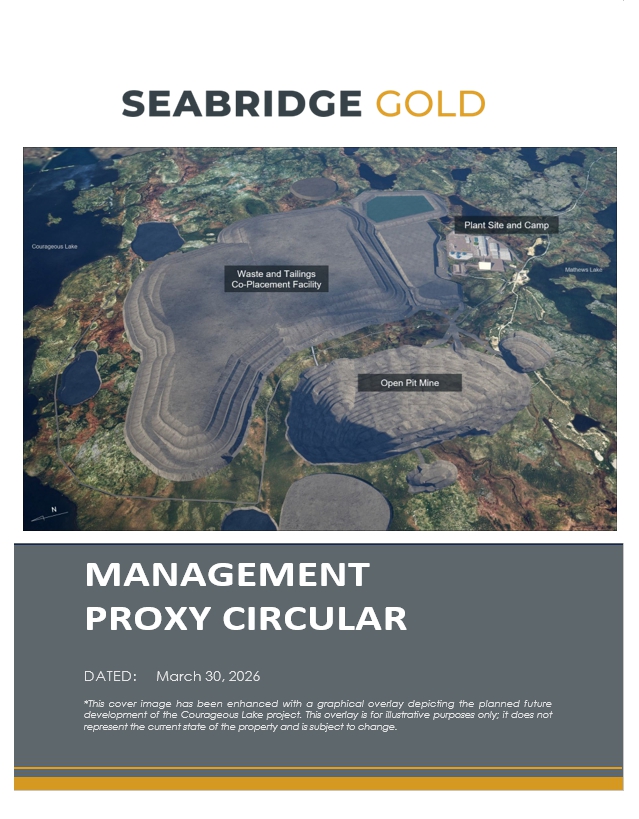
.2

 |
Dear Fellow Shareholders,
We invite you to attend the Special Meeting of shareholders (the “Meeting”) of Seabridge Gold Inc. (“Seabridge” or the “Company”) at Salon 1, 19th Floor, Fairmont Royal York Hotel, 100 Front Street West, Toronto, Ontario, Canada at 10:00 a.m. Eastern Daylight Time on May 22, 2026. The attached Circular provides important information enabling you to make informed decisions in the exercise of your rights as a shareholder.
Seabridge has proposed to reorganize its corporate structure through a plan of arrangement under which the Company’s interest in the Courageous Lake gold project, located in the Northwest Territories, Canada, will be transferred to a newly created company, Valor Gold Corp. (“Valor”). Upon completion of the arrangement, shareholders of Seabridge will receive shares of Valor on a pro-rata basis and Valor will become an independent, publicly traded company focused on advancing the Courageous Lake project.
The proposed spin-out is intended to allow each company to pursue a more focused strategy. Seabridge will continue to concentrate its resources and management efforts on the advancement of the KSM project in British Columbia, while Valor will be dedicated to the exploration, evaluation and development of the Courageous Lake project. The board of directors of Seabridge believes that separating the assets into two specialized companies will provide value accretion, enhance strategic focus, improve access to capital tailored to each project, and provide shareholders with direct exposure to the value and development potential of Courageous Lake.
I hope to see you at the Meeting. If you cannot attend, please return your proxy and let your voice be counted.
On behalf of the Board,
“Rudi P. Fronk”
Rudi P. Fronk Chairman and C.E.O. March 30, 2026 |
| The Seabridge Board UNANIMOUSLY recommends that the shareholders of Seabridge Gold Inc. vote FOR the Arrangement Resolution. |
These materials are important and require your immediate attention. They require shareholders of Seabridge Gold Inc. to make important decisions. If you are in doubt as to how to make such decisions, please contact your financial, legal, tax or other professional advisors. This document does not constitute an offer or a solicitation to any person in any jurisdiction in which such offer or solicitation is unlawful.

NOTICE OF SPECIAL MEETING OF SHAREHOLDERS
| Type: | Special Meeting |
| Date: | May 22, 2026 |
| Time: | 10:00 a.m. Eastern Daylight Time |
| Place: | Salon 1, 19th Floor, Fairmont Royal York Hotel, 100 Front Street West, Toronto, Ontario, Canada |
NOTICE IS HEREBY GIVEN that a Special Meeting (the “Meeting”) of the shareholders of Seabridge Gold Inc. (the “Company” or “Seabridge”) will be held at Salon 1, 19th Floor, Fairmont Royal York Hotel, 100 Front Street West, Toronto, Ontario, Canada, on May 22, 2026, at 10:00 a.m. Eastern Daylight Time.
Matters For Consideration at the Meeting
| 1. | To consider and, if thought fit, to pass a special resolution (the “Arrangement Resolution”) approving an arrangement (the “Arrangement”) under section 192 of the Canada Business Corporations Act (the “Act”) between the Company, its securityholders and Valor Gold Corp. (“Valor”), pursuant to which the Company and the Company’s shareholders will receive shares of Valor. |
| 2. | If the Arrangement Resolution is passed, to consider and, if thought fit, to pass an ordinary resolution approving the proposed restricted share unit and deferred share unit plan of Valor. |
| 3. | To transact such further or other business as may properly come before the Meeting and any adjournment(s) thereof. |
The specific details of the foregoing matters to be put before the Meeting are set forth in the Circular.
This notice is accompanied by the Circular, a form of proxy and a letter of transmittal.
The board of directors of the Company (the “Board”) has by resolution fixed the close of business on March 30, 2026 as the record date, being the date for the determination of the registered holders of common shares of the Company entitled to notice of and to vote at the Meeting and any adjournment(s) thereof.
Shareholders are encouraged to vote on the matters BEFORE the Meeting by proxy to ensure that their votes are properly counted. Those Shareholders who are unable to attend the Meeting are requested to read the notes to the enclosed form of proxy and then to complete, sign and mail the enclosed form of proxy in accordance with the instructions set out in the proxy and in the Circular accompanying this notice.
All shareholders are entitled to attend and vote at the Meeting in person or by proxy. Shareholders who do not wish to attend in person will also be able to listen to the Meeting via Microsoft Teams by visiting www.microsoft.com/microsoft-teams/join-a-meeting and using the Meeting ID and Passcode below, but will not be able to participate or vote their shares unless they attend in person or vote their shares by proxy.
ii

To LISTEN TO the Meeting, please refer to the following Microsoft Teams instructions:
Meeting ID: 254 434 303 795 816
Meeting Passcode: Gs3Yy2Dw
Proxies to be used at the Meeting must be completed, dated, signed and returned to Computershare Investor Services Inc., Proxy Department, at 14th Floor, 320 Bay Street, Toronto, Ontario M5H 4A6 by 10:00 a.m. Eastern Time on May 20, 2026, or if the Meeting is adjourned or postponed, not less than 48 hours (excluding Saturdays, Sundays and holidays) before the date to which the Meeting is adjourned or postponed. Telephone voting can be completed at 1-866-732-8683, and Internet voting can be completed at www.investorvote.com.
Non-Registered Shareholders who receive these materials through their broker or other intermediary are requested to follow the instructions for voting provided by their broker or intermediary, which may include the completion and delivery of a voting instruction form.
AND TAKE NOTICE that dissenting shareholders in respect of the proposed Arrangement are entitled to be paid the payout value of their shares in accordance with section 190 of the CBCA. Pursuant to the Interim Order (as defined in the Circular) of the Supreme Court of British Columbia dated April 10, 2026 and the CBCA, a registered holder of common shares of the Company may until 4:00 p.m. Pacific Time on the day which is two days immediately preceding the date of the Meeting give the Company a notice of dissent in the manner provided for in the Interim Order with respect to the Arrangement Resolution. As a result of giving a notice of dissent, a shareholder may, on receiving a notice of implementation of the Arrangement Resolution, require the Company to purchase all of the common shares held by such shareholder in respect of which the notice of dissent was given. These dissent rights are described in the Circular. As described in the Circular, it is a condition precedent to the completion of the Arrangement that less than 1% of the Seabridge Shareholders shall have validly exercised dissent rights in respect of the Arrangement.
DATED at Toronto, Ontario, this 30th day of March, 2026.
BY ORDER OF THE BOARD
SEABRIDGE GOLD INC.
“Rudi P. Fronk”
Rudi P. Fronk
Chairman and CEO
iii
Table of Contents
| NOTICE OF SPECIAL MEETING OF SHAREHOLDERS | ii |
| GENERAL DISCLOSURE INFORMATION | 4 |
| CAUTIONARY NOTE REGARDING FORWARD-LOOKING INFORMATION | 4 |
| DATE OF INFORMATION | 6 |
| REPORTING CURRENCIES AND ACCOUNTING PRINCIPLES | 6 |
| GLOSSARY | 7 |
| SUMMARY OF CIRCULAR | 15 |
| The Meeting | 15 |
| The Arrangement | 15 |
| Fairness Opinion | 15 |
| Steps in the Arrangement | 16 |
| INFORMATION CIRCULAR | 22 |
| APPOINTMENT OF PROXYHOLDER | 22 |
| VOTING BY PROXY | 23 |
| COMPLETION AND RETURN OF PROXY | 23 |
| REVOCABILITY OF PROXY | 23 |
| NON-REGISTERED HOLDERS | 24 |
| LETTER OF TRANSMITTAL | 25 |
| VOTING SECURITIES AND PRINCIPAL HOLDERS THEREOF | 25 |
| PARTICULARS OF OTHER MATTERS TO BE ACTED UPON | 26 |
| The Arrangement | 26 |
| Background to the Arrangement | 26 |
| Arrangement | 27 |
| Fairness Opinion | 27 |
| Steps in the Arrangement | 28 |
| Recommendation of the Board | 29 |
| Approval of the Arrangement Resolution | 30 |
| The Arrangement Agreement | 31 |
| Completion of the Arrangement | 34 |
| Effect of the Arrangement | 34 |
| Court Approval of the Arrangement | 34 |
| Regulatory Approvals | 36 |
| Canadian Securities Laws and Resale of Securities | 36 |
| U.S. Securities Laws and Resale of Securities | 37 |
| No Collateral Benefit | 39 |
| Significant Positions and Shareholdings | 39 |
| Arrangement Risk Factors | 43 |
| Dissent Rights | 46 |
| Exchange of Securities | 49 |
| Proxy Solicitation Requirements | 50 |
| Valor Incentive Plan Resolution | 50 |
| PRINCIPAL CANADIAN FEDERAL INCOME TAX CONSEQUENCES | 51 |
| Holders Resident in Canada | 52 |
| Holders Not Resident in Canada | 57 |
| MATERIAL UNITED STATES FEDERAL INCOME TAX CONSIDERATIONS | 60 |
| ADDITIONAL INFORMATION | 75 |
| Interest of Informed Persons in Material Transactions | 75 |
| Management Contracts | 75 |
| Response to Shareholders | 75 |
| Information Relating to the Company | 76 |
| APPROVAL | 76 |
| APPENDICES | A-1 |
| Appendix “A” Arrangement Resolution | A-1 |
| Appendix “B” Arrangement Agreement and Plan of Arrangement | B-1 |
| Schedule “1” to Appendix “B” Plan of Arrangement | B-1-1 |
| Schedule “2” to Appendix “B” Arrangement Resolution | B-2-1 |
| Schedule “3” to Appendix “B” Gold Stream Agreement | B-3-1 |
| Appendix “C” Interim Order | C-1 |
| Appendix “D” Notice of Petition and Petition | D-1 |
| Appendix “E” Dissent Provisions of the CBCA | E-1 |
| Appendix “F” Fairness Opinion | F-1 |
| Appendix “G” Information Regarding Valor | G-1 |
| Schedule “1” to Appendix “G” Summary of the Courageous Lake Project | G-1-1 |
| Schedule “2” to Appendix “G” Valor Incentive Plan | G-2-1 |
| Schedule “3” to Appendix “G” Valor Form of Audit Committee Charter | G-3-1 |
| Appendix “H” Carve-Out Financial Statements of Valor for the years ended December 31, 2024 and 2023 | H-1 |
| Appendix “I” Carve-Out MD&A of Valor for the years ended December 31, 2024 and 2023 | I-1 |
| Appendix “J” Condensed Interim Carve-Out Financial Statements of Valor for the three and nine months ended September 30, 2025 | J-1 |
| Appendix “K” Condensed Interim Carve-Out MD&A of Valor for the three and nine months ended September 30, 2025 | K-1 |
3
Capitalized terms hereinafter used are defined in the Glossary of Terms or elsewhere in the Circular.
GENERAL DISCLOSURE INFORMATION
No person has been authorized by the Company to give any information or make any representations in connection with the Arrangement herein described other than those contained in this Circular and, if given or made, any such information or representation must not be relied upon as having been authorized by Seabridge or Valor, as applicable.
References to “management” in this Circular mean the executive officers of Seabridge, as applicable. Any statements in this Circular made by or on behalf of management are made in such persons’ capacities as officers of the Company, as applicable, and not in their personal capacities.
A Shareholder should rely only on the information contained in this Circular and should not rely on certain parts of this Circular to the exclusion of others. The information contained in this Circular is accurate only as of the date of this Circular, regardless of the time of delivery of this Circular.
This Circular does not constitute an offer to sell, or a solicitation of an offer to purchase, any securities, by any person in any jurisdiction in which such an offer or solicitation is not authorized or in which the person making such offer or solicitation is not qualified to do so or to any person to whom it is unlawful to make such an offer or solicitation. Neither delivery of this Circular nor any distribution of the securities referred to in this Circular shall, under any circumstances, create an implication that there has been no change in the information set forth herein since the date of this Circular.
CAUTIONARY NOTE REGARDING FORWARD-LOOKING INFORMATION
This Circular and the documents incorporated into this Circular by reference contain forward-looking statements and forward-looking information (collectively, “forward-looking statements”) within the meaning of applicable Canadian and U.S. securities legislation, including the United States Private Securities Litigation Reform Act of 1995. All statements, other than statements of historical fact, included herein including, without limitation, statements with respect to the Arrangement, the covenants of Seabridge, the timing for the implementation of the Arrangement and the potential benefits of the Arrangement, the likelihood of the Arrangement being completed, principal steps of the Arrangement, the timing of future activities of and developments related to, Seabridge and Valor, Seabridge’s and Valor’s anticipated business plans, Shareholder approval of the Arrangement, regulatory approval of the Arrangement, listing of the Valor Shares on the Toronto Stock Exchange (the “TSX”), listing of the Valor Shares on the OTCQB Venture Market (USA), participation of the Shareholders in the Spin-Out Assets, ability of Valor to develop the Spin-Out Assets, the liquidity of Seabridge Shares and Valor Shares following the Effective Time, costs and timing of exploration and development and capital expenditures related thereto, planned exploration activities, success of exploration activities, estimated exploration budgets, market position, financial and business prospects and financial outlooks of Seabridge and Valor are forward-looking statements.
Any statements that involve discussions with respect to predictions, expectations, beliefs, plans, projections, objectives, assumptions or future events or performance (often but not always using phrases such as “expects”, or “does not expect”, “is expected”, “anticipates” or “does not anticipate”, “plans”, “budget”, “scheduled”, “forecasts”, “estimates”, “believes” or “intends” or variations of such words and phrases or stating that certain actions, events or results “may” or “could”, “would”, “might”, or “will” be taken to occur or be achieved) are not statements of historical fact and may be forward-looking statements and are intended to identify forward-looking statements, which include statements relating to, among other things, the ability of Seabridge or Valor to continue to successfully compete in the market.
4
These forward-looking statements are based on the beliefs of Seabridge’s management, as well as on assumptions, which such management believes to be reasonable based on information currently available at the time such statements were made. However, there can be no assurance that the forward-looking statements will prove to be accurate. Such assumptions and factors include, among other things, the satisfaction of the terms and conditions of the Arrangement including the approval of the Arrangement’s fairness by the Court, and the receipt of the required governmental and regulatory approvals and consents.
By their nature, forward-looking statements are based on assumptions and involve known and unknown risks, uncertainties and other factors which may cause the actual results, performance or achievements of Seabridge or Valor to be materially different from any future results, performance or achievements expressed or implied by the forward-looking statements. Forward-looking statements are subject to a variety of risks, uncertainties and other factors which could cause actual events or results to differ from those expressed or implied by the forward-looking statements, including, without limitation: the Arrangement Agreement may be terminated in certain circumstances, general business, economic, competitive, political, regulatory and social uncertainties, gold price volatility, uncertainty related to mineral exploration properties, risks related to the ability to finance the continued exploration of mineral properties, risks related to Seabridge and Valor not having any proven or provable mineral reserves, history of losses of Seabridge and expectation of future losses for Seabridge and Valor, risks related to factors beyond the control of Seabridge or Valor, limited business history of Valor, risks and uncertainties associated with exploration and mining operations, risks related to the ability to obtain adequate financing for planned development activities, lack of infrastructure at mineral exploration properties, risks and uncertainties relating to the interpretation of drill results and the geology, grade and continuity of mineral deposits, uncertainties related to title to mineral properties and the acquisition of surface rights, risks related to governmental regulations, including environmental laws and regulations and liability and obtaining permits and licences, future changes to environmental laws and regulations, unknown environmental risks for past activities, commodity price fluctuations, risks related to reclamation activities on mineral properties, risks related to political instability and unexpected regulatory change, currency fluctuations and risks associated with a fixed exchange ratio, influence of third party stakeholders, conflicts of interest, risks related to dependence on key individuals, risks related to the involvement of some of the directors and officers of Seabridge and Valor with other natural resource companies, enforceability of claims, the ability to maintain adequate control over financial reporting, risks related to the Seabridge Shares and Valor Shares, including price volatility due to events that may or may not be within such parties’ control, disruptions or changes in the credit or security markets, risks related to joint venture operations, actual results of current exploration activities, reserve and resource estimate risk, actual results of current reclamation activities, conclusions of economic evaluations, changes in project parameters as plans continue to be refined, changes in labour costs or other costs of production, labour disputes and other risks of the mining industry, delays in obtaining governmental approvals or financing or in the completion of development or construction activities, the ability to renew existing licenses or permits or obtain required licenses and permits, mining operational and development risk, litigation risks, speculative nature of gold exploration, risks relating to the possibility that such number of Shareholders may exercise their dissent rights so as to cause the Board to believe that completion of the Arrangement would not be in the best interests of Seabridge, risks related to instability in the global economic climate, and community and non-governmental actions and regulatory risks.
5
This list is not exhaustive of the factors that may affect any of forward-looking statements of Seabridge and Valor. Forward-looking statements are statements about the future and are inherently uncertain. Actual results could differ materially from those projected in the forward-looking statements as a result of the matters set out or incorporated by reference in this Circular generally and certain economic and business factors, some of which may be beyond the control of Seabridge and Valor. Some of the important risks and uncertainties that could affect forward-looking statements are described further below under the heading “Particulars of Other Matters to be Acted Upon – The Arrangement – Arrangement Risk Factors” and in Appendix “G” to this Circular under the heading “Information Regarding Valor – Risk Factors”.
Certain of the forward-looking statements and forward-looking information and other information contained herein concerning the mining industry and Seabridge’s general expectations concerning the mining industry, Seabridge, and Valor, are based on estimates prepared by Seabridge or Valor using data from publicly available industry sources as well as from market research and industry analysis and on assumptions based on data and knowledge of this industry which Seabridge believes to be reasonable. However, although generally indicative of relative market positions, market shares and performance characteristics, these data are inherently imprecise. While Seabridge is not aware of any misstatement regarding any industry data presented herein, the mining industry involves risks and uncertainties that are subject to change based on various factors.
All forward-looking information attributable to Seabridge or Valor, or persons acting on their behalf, is expressly qualified in their entirety by the cautionary statements set forth above. Readers of this Circular are cautioned not to place undue reliance on the forward-looking information contained in this Circular which reflect the analysis of the management of Seabridge and Valor, as applicable, as of the date of this Circular. Neither Seabridge nor Valor undertakes any obligation to update forward-looking information except as required by applicable securities laws.
At the Meeting, you will be asked to consider and, if deemed advisable, approve the Arrangement Resolution, the full text of which is reproduced in Appendix “A” of this Circular in respect of the Arrangement. If the Arrangement Resolution is passed, Seabridge Shareholders will also be asked to consider and, if deemed advisable, approve the Valor Incentive Plan Resolution, the full text of which is set out under the heading “Particulars of Matters to be Acted Upon – Valor Incentive Plan Resolution” on page 50.
DATE OF INFORMATION
Information contained in this Circular is as at March 30, 2026, unless otherwise indicated.
REPORTING CURRENCIES AND ACCOUNTING PRINCIPLES
The historical financial statements of Valor contained in this Circular are reported in Canadian dollars and have been prepared in accordance with IFRS. All references to dollar amounts in this Circular are to Canadian dollars unless stated otherwise or the context otherwise requires.
6
GLOSSARY
For the purposes of this section, the following terms shall have the meanings ascribed thereto:
“ACB” has the meaning ascribed thereto under “Principal Canadian Federal Income Tax Consequences – Holders Resident in Canada – Alterations to Share Structure and the Seabridge Articles and Re-Designation of the Seabridge Shares”;
“allowable capital loss” has the meaning ascribed thereto under “Principal Canadian Federal Income Tax Consequences – Holders Resident in Canada – Taxation of Capital Gains and Capital Losses”;
“Arrangement” means an arrangement under the provisions of Section 192 of the CBCA, on the terms and conditions set forth in the Plan of Arrangement;
“Arrangement Agreement” means the arrangement agreement between Seabridge and Valor dated March 23, 2026, including the Exhibits and the Appendices thereto as the same may be supplemented or amended from time to time;
“Arrangement Provisions” means Part XV, Section 192 of the Act;
“Arrangement Resolution” means the resolution to be approved by the Shareholders, substantially in the form and content set out in Appendix “A” to this Circular;
“Award” has the meaning ascribed thereto under “Appendix ‘G’ – Information Regarding Valor – Valor Incentive Plan”;
“Beneficial Seabridge Shareholder” means a beneficial owner of Seabridge Shares who holds such shares through an Intermediary and whose name does not appear on the share register of Seabridge as the registered holder of such shares;
“Board” means the board of directors of Seabridge;
“Business Day” means a day which is not a Saturday, Sunday or statutory holiday in Toronto, Ontario;
“CBCA” means Canada Business Corporations Act and the regulations promulgated thereunder, as amended from time to time;
“CDS” means the Canadian Depository for Securities; “CEO” means the Chief Executive Officer;
“CFO” means the Chief Financial Officer; “Chairman” means the chairman of the Board;
“Circular” means this management information circular, together with the accompanying Notice of Meeting and form of proxy;
“Code of Conduct and Ethics” means Valor’s code of business conduct and ethics as outlined under the heading “Code of Ethics, Governance Policies and Corporate Policies on page G-27 of Appendix “G”;
“Convention” has the meaning ascribed thereto under “Principal Canadian Federal Income Tax Consequences – Holders Not Resident in Canada - Taxation of Dividends”;
“Courageous Lake Project” or the “Project” means the Courageous Lake project comprising 50,228 hectares of mineral leases and mining claims located 240 km northeast of Yellowknife, NWT, currently held indirectly by Seabridge through SNWT and which will be owned and advanced by Valor indirectly through SNWT after the Arrangement;
7
“Court” means the Supreme Court of British Columbia;
“CRA” means the Canada Revenue Agency;
“Demand for Payment” has the meaning ascribed thereto under “Particulars of Other Matters to be Acted Upon – The Arrangement – Dissent Rights”;
“Depositary” means Computershare Investor Services Inc.;
“Director” means a director of Seabridge;
“Dissent Procedures” means the rules pertaining to the exercise of Dissent Rights as set forth in Section 190 of Part XV of the CBCA and Article 5 of the Plan of Arrangement;
“Dissent Rights” means the rights of dissent granted in favour of registered holders of Seabridge Shares in accordance with Article 5 of the Plan of Arrangement;
“Dissent Share” has the meaning ascribed thereto under “Particulars of Other Matters to be Acted Upon – The Arrangement – Steps in the Arrangement”;
“Dissenting Non-Resident Holder” has the meaning ascribed thereto under “Principal Canadian Federal Income Tax Consequences – Holders Not Resident in Canada – Dissenting Non-Resident Holders”;
“Dissenting Resident Holder” has the meaning ascribed thereto under “Principal Canadian Federal Income Tax Consequences – Holders Resident in Canada – Dissenting Shareholders”;
“Dissenting Shareholder” means a registered holder of Seabridge Shares who dissents in respect of the Arrangement in strict compliance with the Dissent Procedures and who has not withdrawn or been deemed to have withdrawn such exercise of Dissent Rights;
“DRS Advices” means Direct Registration System Advices;
“DSU” means deferred share units granted pursuant to the Valor Incentive Plan;
“Effective Date” means the date upon which the Arrangement becomes effective in accordance with the Plan of Arrangement and the Final Order, as the Board may determine;
“Effective Time” means 12:01 a.m. Pacific Time on the Effective Date or such other time on the Effective Date as agreed to in writing by Seabridge or Valor;
“Electing U.S. Shareholder” has the meaning ascribed thereto under “Material United States Federal Income Tax Considerations – U.S. Federal Income Tax Considerations Applicable to U.S. Holders Regarding the Arrangement – Potential Application of the Passive Foreign Investment Company Rules to the Arrangement”;
“Eligible Director” has the meaning ascribed thereto under “Appendix ‘G’ – Information Regarding Valor – Valor Incentive Plan “;
“ESG” means environmental, social and governance;
“Exchanged Securities” has the meaning ascribed thereto under “Particulars of Other Matters to be Acted Upon – The Arrangement – U.S. Securities Laws and Resale of Securities”;
“Executives” has the meaning ascribed thereto under “Appendix ‘G’ – Information Regarding Valor – Corporate Governance Disclosure – Compensation Committee”;
8
“Extension Period” has the meaning ascribed thereto under “Appendix ‘G’ – Information Regarding Valor – Valor Incentive Plan “;
“Fairness Opinion” means the fairness opinion delivered by RBC to the Board, a full copy of which is attached as Appendix “F”;
“Final Order” means the final order of the Court approving the Arrangement;
“First Tax Return” has the meaning ascribed thereto under “Principal Canadian Federal Income Tax Consequences – Holders Resident in Canada – Eligibility for Investment – New Seabridge Shares and Valor Shares”;
“Foreign Tax Credit Regulations” has the meaning ascribed thereto under “Material United States Federal Income Tax Considerations – Additional Tax Considerations – Foreign Tax Credit”;
“GAAP” means the Generally Accepted Accounting Principles;
“Gold Stream Agreement” means the Gold Purchase Agreement to be entered into between Seabridge and Valor on the Effective Date, in substantially the form attached hereto as Schedule “3” to the Arrangement Agreement, pursuant to which Valor, in consideration for the payment by Seabridge of an upfront deposit of US$3,591,000 (approximately C$4,900,000), shall sell and deliver to Seabridge 10% of the refined gold produced from the Courageous Lake Project at a cash Purchase Price (as defined in the Gold Stream Agreement) of US$4,000 per ounce, in each case when the quarterly average market price of gold equals or exceeds US$4,000 per ounce, provided that Valor shall have no right to convert, buy back, or otherwise reacquire Seabridge’s rights under the agreement;
“Guarantees” means, collectively, (i) the Guarantee Agreement dated July 26, 2002 between Seabridge and Newmont, pursuant to which Seabridge guarantees the secured obligations of SNWT under an Instrument of Delivery dated effective July 26, 2002 between SNWT and Newmont relating to a SNWT Debenture dated July 26, 2002 held by Newmont in the principal amount of US$21,420,000, which was subsequently assigned by Newmont to Franco Nevada, and (ii) the Guarantee Agreement dated July 26, 2002 between Seabridge and Total Resources, pursuant to which Seabridge guarantees the secured obligations of SNWT under an Instrument of Delivery dated effective July 26, 2002 between SNWT and Total Resources relating to a SNWT Debenture dated July 26, 2002 held by Total Resources in the principal amount of US$20,580,000;
“Holder” has the meaning ascribed thereto under “Principal Canadian Federal Income Tax Consequences”;
“ICD” means the Institute of Corporate Directors;
“IFRS” means the International Financial Reporting Standards;
“Intercorporate Debt” has the meaning ascribed thereto under “Particulars of Other Matters to be Acted Upon – The Arrangement – The Arrangement Agreement”;
“Interim Order” means the interim order of the Court approving the Meeting to approve the Arrangement;
“IRS” has the meaning ascribed thereto under “Material United States Federal Income Tax Considerations”;
“Intermediary” has the meaning ascribed thereto under “Non-Registered Holders”;
9
“KSM” means KSM Mining Inc, a company existing under the laws of British Columbia and a wholly owned subsidiary of Seabridge;
“KSM Project” means the Kerr-Sulphurets-Mitchell project comprising mining leases and mineral claims located in British Columbia, Canada, held indirectly by Seabridge through KSM;
“Latest RSU Expiry Date” has the meaning ascribed thereto under “Appendix ‘G’ – Information Regarding Valor – Valor Incentive Plan “;
“LTI” has the meaning ascribed thereto under “Appendix ‘G’ - Information Regarding Valor - Executive Compensation”;
“Management Proxyholders” has the meaning ascribed thereto under “Appointment of Proxyholder”;
“Mark-to-Market Election” has the meaning ascribed thereto under “Material United States Federal Income Tax Considerations – U.S. Federal Income Tax Considerations Applicable to U.S. Holders Regarding the Arrangement – Potential Application of the Passive Foreign Investment Company Rules to the Arrangement”;
“MD&A” means management’s discussion and analysis relating to Valor’s financial statements;
“Meeting” means the special meeting of Shareholders, including any adjournment or postponement thereof, to be held on May 22, 2026 for the purposes of, among other things, obtaining Shareholder approval of the Arrangement;
“MLI” has the meaning ascribed thereto under “Principal Canadian Federal Income Tax Consequences – Holders Not Resident in Canada - Exchange of Old Seabridge Shares for New Seabridge Shares and Valor Shares”;
“Named Executive Officer” or “NEO” has the meaning ascribed thereto under “Executive Compensation “;
“New Seabridge Shares” has the meaning ascribed thereto under “Summary of Circular – Steps in the Arrangement”;
“Newmont” means Newmont Canada Limited;
“Franco Nevada” means Franco Nevada Canada Corporation;
“NI 52-110” means National Instrument 52-110 – Audit Committees;
“Non-Electing Shareholder” has the meaning ascribed thereto under “Material United States Federal Income Tax Considerations – U.S. Federal Income Tax Considerations Applicable to U.S. Holders Regarding the Arrangement – Potential Application of the Passive Foreign Investment Company Rules to the Arrangement”;
“NOBO” has the meaning ascribed thereto under “Non-Registered Holders”;
“Non-Resident Holder” has the meaning ascribed thereto under “Principal Canadian Federal Income Tax Consequences – Holders Not Resident in Canada”;
“Non-Registered Shareholder” means a Seabridge Shareholder who is not a Registered Seabridge Shareholder;
“Notice of Meeting” means the notice of meeting to be sent to Shareholders in connection with the Meeting;
10
“NYSE” means the New York Stock Exchange;
“OBO” has the meaning ascribed thereto under “Non-Registered Holders”;
“Offer to Pay” has the meaning ascribed thereto under “Particulars of Other Matters to be Acted Upon – The Arrangement – Dissent Rights”;
“Old Seabridge Shares” has the meaning ascribed thereto under “Particulars of Other Matters to be Acted Upon – The Arrangement – Steps in the Arrangement”;
“Order” has the meaning ascribed thereto under “Appendix ‘G’ – Information Regarding Valor – Directors and Officers - Corporate Cease Trade Orders, Bankruptcies, Penalties or Sanctions or Individual Bankruptcies”;
“party” means either Seabridge or Valor and “parties” means, collectively, Seabridge and Valor;
“person” means and includes a party, individuals, corporations, bodies corporate, limited or general partnerships, joint stock companies, limited liability corporations, joint ventures, associations, companies, trusts, banks, trust companies, government or any other type of organization, whether or not a legal entity;
“PFIC” has the meaning ascribed thereto under “Material United States Federal Income Tax Considerations – U.S. Federal Income Tax Considerations Applicable to U.S. Holders Regarding the Arrangement – Potential Application of the Passive Foreign Investment Company Rules to the Arrangement”;
“PFIC asset test” has the meaning ascribed thereto under “Material United States Federal Income Tax Considerations – U.S. Federal Income Tax Considerations Applicable to U.S. Holders Regarding the Arrangement – Potential Application of the Passive Foreign Investment Company Rules to the Arrangement”;
“PFIC income test” has the meaning ascribed thereto under “Material United States Federal Income Tax Considerations – U.S. Federal Income Tax Considerations Applicable to U.S. Holders Regarding the Arrangement – Potential Application of the Passive Foreign Investment Company Rules to the Arrangement”;
“Plan of Arrangement” means the plan of arrangement attached as Schedule “1” to the Arrangement Agreement and any amendment or variation thereto made in accordance thereof;
“QEF” has the meaning ascribed thereto under “Material United States Federal Income Tax Considerations – U.S. Federal Income Tax Considerations Applicable to U.S. Holders Regarding the Arrangement – Potential Application of the Passive Foreign Investment Company Rules to the Arrangement”;
“QEF Election” has the meaning ascribed thereto under “Material United States Federal Income Tax Considerations – U.S. Federal Income Tax Considerations Applicable to U.S. Holders Regarding the Arrangement – Potential Application of the Passive Foreign Investment Company Rules to the Arrangement”;
“PUC” has the meaning ascribed thereto under “Principal Canadian Federal Income Tax Consequences – Holders Resident in Canada - Exchange of Old Seabridge Shares for New Seabridge Shares and Valor Shares”;
“RBC” means RBC Dominion Securities Inc.;
11
“RDSP” has the meaning ascribed thereto under “Principal Canadian Federal Income Tax Consequences – Holders Resident in Canada - Eligibility for Investment – New Seabridge Shares and Valor Shares “;
“Record Date” has the meaning ascribed thereto under “Voting Securities and Principal Holders Thereof”;
“Registered Plans” has the meaning ascribed thereto under “Principal Canadian Federal Income Tax Consequences – Holders Resident in Canada - Eligibility for Investment – New Seabridge Shares and Valor Shares “;
“Registered Seabridge Shareholder” means a registered holder of Seabridge Shares;
“Resident Holder” has the meaning ascribed thereto under “Principal Canadian Federal Income Tax Consequences – Holders Resident in Canada”;
“RESP” has the meaning ascribed thereto under “Principal Canadian Federal Income Tax Consequences – Holders Resident in Canada - Eligibility for Investment – New Seabridge Shares and Valor Shares “;
“RRIF” has the meaning ascribed thereto under “Principal Canadian Federal Income Tax Consequences – Holders Resident in Canada - Eligibility for Investment – New Seabridge Shares and Valor Shares “;
“RRSP” has the meaning ascribed thereto under “Principal Canadian Federal Income Tax Consequences – Holders Resident in Canada - Eligibility for Investment – New Seabridge Shares and Valor Shares “;
“RSU” means restricted share units granted pursuant to the Valor Incentive Plan;
“RSU Participant” means a holder of RSUs under the Valor Incentive Plan;
“Seabridge” or “Company” means Seabridge Gold Inc.;
“Seabridge Articles” means the articles of the Company;
“Seabridge Class A Shares” has the meaning ascribed thereto under “Summary of Circular – Steps in the Arrangement”;
“Seabridge Shareholders” or “Shareholders” means the holders of Seabridge Shares;
“Seabridge Shares”, “Seabridge Common Shares” or “Shares” means the common shares of Seabridge;
“Section 3(a)(10) Exemption” means the exemption from the registration requirements of the U.S. Securities Act provided by Section 3(a)(10) of the U.S. Securities Act;
“securities” has the meaning ascribed thereto under “Appendix ‘G’ – Information Regarding Valor – Corporate Governance Disclosure - Code of Ethics, Governance Policies and Corporate Policies “;
“Securities Laws” means all applicable securities laws of Canada and the United States, including the Securities Act, the U.S. Securities Act and the U.S. Exchange Act, together with all other applicable provincial and state securities laws, rules and regulations and published policies thereunder, as now in effect and as they may be promulgated or amended from time to time;
12
“Security Holders” means Seabridge Shareholders; for certain procedural descriptions following the Effective Time, the term may also refer to holders of Valor Shares as the context requires;
“SEDAR+” means the System for Electronic Document Analysis and Retrieval;
“Share Exchange” has the meaning ascribed thereto under “Principal Canadian Federal Income Tax Consequences – Holders Resident in Canada - Exchange of Old Seabridge Shares for New Seabridge Shares and Valor Shares”;
“SNWT” means Seabridge Gold (NWT) Inc., a company existing under the laws of Canada and a wholly owned subsidiary of Seabridge;
“Spin-Out Assets” means the 100% interest of Seabridge in the Courageous Lake Project;
“STI” has the meaning ascribed thereto under “Appendix ‘G’ – Information Regarding Valor – Executive Compensation”;
“Subject Securities” has the meaning ascribed thereto under “Principal Canadian Federal Income Tax Consequences”;
“Subsidiary PFIC” has the meaning ascribed thereto under “Material United States Federal Income Tax Considerations – U.S. Federal Income Tax Considerations Applicable to U.S. Holders Regarding the Ownership and Disposition of New Seabridge Shares and Valor Spin-Out Shares – Potential Application of the Passive Foreign Investment Company Rules to the Arrangement – Passive Foreign Investment Company Rules”;
“Tax Act” means the Income Tax Act (Canada);
“Tax Proposals” has the meaning ascribed thereto under “Principal Canadian Federal Income Tax Consequences”;
“taxable capital gain” has the meaning ascribed thereto under “Principal Canadian Federal Income Tax Consequences – Holders Resident in Canada – Taxation of Capital Gains and Capital Losses”;
“Technical Report” has the meaning ascribed thereto under “Appendix ‘G’ – Information Regarding Valor – Description of the Courageous Lake Project”;
“TFSA” has the meaning ascribed thereto under “Principal Canadian Federal Income Tax Consequences – Holders Resident in Canada - Eligibility for Investment – New Seabridge Shares and Valor Shares “;
“Total Resources” means Total Resources (Canada) Limited;
“Treasury Regulations” has the meaning ascribed thereto under “Material United States Federal Income Tax Considerations”;
“TSX” means the Toronto Stock Exchange;
“U.S. Exchange Act” means the United States Securities Exchange Act of 1934, as amended;
“U.S. Holder” has the meaning ascribed thereto under “Material United States Federal Income Tax Considerations – U.S. Holders”;
“U.S. Securities Act” means the United States Securities Act of 1933, as amended;
13
“U.S. Tax Code” has the meaning ascribed thereto under “Material United States Federal Income Tax Considerations”;
“Valor” means “Valor Gold Corp.”, a company existing under the laws of Canada and a wholly owned subsidiary of Seabridge;
“Valor Board” means the board of directors of Valor;
“Valor Incentive Plan” has the meaning ascribed thereto under “Appendix ‘G’ – Information Regarding Valor – Consolidated Capitalization”;
““Valor Incentive Plan Resolution” means the ordinary resolution of Seabridge Shareholders approving the Valor Incentive Plan, as it may be amended or varied at or at any time prior to the Meeting, to be considered at the Meeting, and the full text of which is set out under “Particulars of Matters to be Acted Upon – Valor Incentive Plan Resolution”;
“Valor Shareholders” means the holders of Valor Shares;
“Valor Shares” means the common shares of Valor; and
“Valor Spin-Out Shares” means the Valor Shares to be issued to Seabridge as consideration for the common shares of Valor, which shares will be subsequently distributed by Seabridge to Seabridge Shareholders in accordance with the Plan of Arrangement.
14
SUMMARY OF CIRCULAR
The following summary is qualified in its entirety by the more detailed information appearing elsewhere in this Circular, including the Appendices which form part of this Circular. Capitalized terms used in this Summary are defined in the Glossary of Terms immediately preceding this summary.
THE MEETING
The Meeting will be held in Salon 1, 19th Floor, Fairmont Royal York Hotel, 100 Front Street West, Toronto, Ontario, Canada on May 22, 2026, at 10:00 a.m. Eastern Daylight Time for the purposes set forth in the Notice of Meeting. At the Meeting, Seabridge Shareholders will consider and vote upon the Arrangement under section 192 of the CBCA involving Seabridge, its securityholders and Valor pursuant to the Arrangement Resolution. See “Particulars of Other Matters to be Acted Upon” on page 26. If the Arrangement Resolution is passed, Seabridge Shareholders will also be asked to consider and, if deemed advisable, approve the Valor Incentive Plan Resolution, the full text of which is set out under the heading “Particulars of Matters to be Acted Upon – Valor Incentive Plan Resolution” on page 50.
THE ARRANGEMENT
The purpose of the Arrangement and the related transactions is to reorganize Seabridge into two separate companies:
| 1. | Seabridge, which will continue to advance the KSM Project and its remaining exploration portfolio; and |
| 2. | Valor, which will focus on the exploration and development of the Courageous Lake Project. |
The Arrangement would result in, among other things, participating Seabridge Shareholders holding, immediately following completion of the Arrangement, the New Seabridge Shares and Valor Shares in proportion to their holdings of Seabridge Shares at the Effective Time.
FAIRNESS OPINION
Based upon and subject to the assumptions, limitations and qualifications set out in the Fairness Opinion, RBC is of the opinion that, as of March 4, 2026, the consideration to be received under the Arrangement is fair, from a financial point of view, to the Seabridge Shareholders.
The full text of the Fairness Opinion, setting out the assumptions made, matters considered and limitations and qualifications on the review undertaken in connection with the Fairness Opinion, is attached as Appendix “F” to this Circular. The summary of the Fairness Opinion in this Circular is qualified in its entirety by reference to the full text of the Fairness Opinion.
15
STEPS IN THE ARRANGEMENT
Under the Plan of Arrangement, commencing at the Effective Time, each of the events set out below shall occur and shall be deemed to occur in the following sequence or as otherwise provided below or herein, without any further act or formality, notwithstanding anything contained in the provisions attaching to any of the securities of Seabridge or Valor, but subject to the provision of Article 5 of the Arrangement Agreement:
| (a) | each Seabridge Common Share in respect of which a Seabridge Shareholder has exercised Dissent Rights and for which the Seabridge Shareholder is ultimately entitled to be paid fair value (each a “Dissent Share”) shall be deemed to have been repurchased by Seabridge for cancellation in consideration for a debt-claim against Seabridge to be paid the fair value of such Dissent Share in accordance with Article 3 of the Plan of Arrangement, net of any applicable withholding tax, and such Dissent Share shall thereupon be cancelled; |
| (b) | the share capital of Seabridge shall be reorganized by: |
| (i) | renaming and redesignating all of the issued and unissued Seabridge Common Shares as “Class A common shares without par value” and amending the rights and restrictions attached to those shares to provide the holders thereof with two (2) votes in respect of each share held, being the “Seabridge Class A Shares”; and |
| (ii) | creating a new class consisting of an unlimited number of “common shares without par value” with terms and rights and restrictions identical to those of the Seabridge Common Shares (except each share will provide the holder with one (1) vote instead of two (2)) immediately prior to the Effective Time, being the “New Seabridge Shares”; |
| (c) | the Seabridge Articles shall be amended to reflect the alterations in Section 2.1(b) of the Plan of Arrangement; |
| (d) | (i) each issued and outstanding Seabridge Class A Share outstanding on the close of business on the Business Day immediately preceding the Effective Date held by a Seabridge Shareholder shall be exchanged, as part of the reorganization of the share capital of Seabridge and in accordance with Section 86 of the Tax Act, for: (A) one New Seabridge Share; and (B) that number or fraction of Valor Shares equal to such Shareholder’s pro rata portion of the 55,000,000 Valor Shares held by Seabridge on the close of business on the Business Day immediately preceding the Effective Date divided by the number of Seabridge Class A Shares held by such Seabridge Shareholder immediately before the exchange described in this paragraph; (ii) the holders of the Seabridge Class A Shares will be removed from the central securities register of Seabridge as the holders of such Seabridge Class A Shares and will be added to the central securities register of Seabridge as the holders of the number of New Seabridge Shares that they have received on the exchange set forth in Section 2.1(d) of the Plan of Arrangement, and (iii) the Valor Shares transferred to the then holders of the Seabridge Class A Shares will be registered in the name of the former holders of the Seabridge Class A Shares and Seabridge will provide Valor and its registrar and transfer agent notice to make the appropriate entries in the central securities register of Valor; |
| (e) | all of the issued Seabridge Class A Shares shall be cancelled with the appropriate entries being made in the central securities register of Seabridge, and the aggregate paid-up capital (as that term is used for purposes of the Tax Act) of the New Seabridge Shares will be equal to that of the Seabridge Common Shares immediately prior to the Effective Time less the fair market value of the Valor Shares distributed pursuant to Section 2.1(d) of the Plan of Arrangement; and |
| (f) | the Seabridge Articles shall be amended to reflect the alteration in Section 2.1(e) of the Plan of Arrangement. |
See “Particulars of Other Matters to be Acted Upon – The Arrangement – Steps in the Arrangement” on page 28.
16
RECOMMENDATION OF THE BOARD
The Board, having reviewed the Plan of Arrangement and related transactions and considered, among other things, the reasons for the Arrangement, has unanimously determined that the Arrangement is in the best interests of Seabridge and the Seabridge Shareholders. The Board recommends that Seabridge Shareholders vote FOR the Arrangement Resolution.
See further details under the section entitled “Particulars of Other Matters to be Acted Upon – The Arrangement – Recommendation of the Board” on page 29.
CONDITIONS TO THE ARRANGEMENT
Completion of the Arrangement is subject to a number of specified mutual conditions being met on or before the Effective Time, including, but not limited to:
| (a) | the Interim Order shall have been granted in form and substance satisfactory to Seabridge; |
| (b) | the Arrangement Resolution, with or without amendment, shall have been approved at the Meeting, in accordance with the Interim Order; |
| (c) | the Court shall have determined that the terms and conditions of the Arrangement are substantively and procedurally fair to the Seabridge Shareholders and the Final Order shall have been granted in form and substance satisfactory to Seabridge, and shall not have been set aside or modified in a manner unacceptable to Seabridge, on appeal or otherwise; |
| (d) | the Issuable Securities (as defined in the Arrangement Agreement) to be issued in the United States pursuant to the Arrangement shall be issued in accordance with and exempt from registration requirements under the U.S. Securities Act provided by Section 3(a)(10) thereunder; |
| (e) | Seabridge shall have made a cash payment to Valor in the amount of C$10,000,000 in consideration for the following: |
| (i) | C$5,100,000 in respect of the issuance of 700,000 common shares of Valor to Seabridge; and |
| (ii) | C$4,900,000 as a deposit paid in consideration for the entering into of the Gold Stream Agreement; |
| (f) | Seabridge and Valor shall have executed and delivered the Gold Stream Agreement; |
| (g) | Seabridge shall have been fully, unconditionally, and irrevocably released and discharged from all of its obligations, liabilities, and duties as guarantor under the Guarantees, effective as of the Effective Time, pursuant to written agreements executed by Franco Nevada and Total Resources, respectively; |
| (h) | Seabridge shall have transferred all of the issued and outstanding common shares of SNWT to Valor in consideration for Valor issuing 54,299,900 common shares to Seabridge; |
17
| (i) | the Intercorporate Debt shall have been discharged, released or otherwise settled by Seabridge; |
| (j) | the TSX and the NYSE shall have conditionally approved the Arrangement, including the listing of the New Seabridge Shares in substitution for the Seabridge Common Shares as of the Effective Date, subject to compliance with the requirements of the TSX and the NYSE; |
| (k) | the TSX shall have conditionally approved the Arrangement, including the listing of the Valor Shares before the end of Valor’s taxation year, as defined in the Tax Act, that includes the exchange referred to in section 2.1(d) of the Plan of Arrangement, subject to the requirements of the TSX; |
| (l) | the number of Seabridge Common Shares held by the Seabridge Shareholders that have validly exercised Dissent Rights (and not withdrawn such exercise) shall not exceed 1% of the Seabridge Common Shares issued and outstanding as of the date hereof; |
| (m) | all governmental, court, regulatory, third party and other approvals, consents, expiry of waiting periods, waivers, permits, exemptions, orders and agreements and all amendments and modifications to, and terminations of, agreements, indentures and arrangements considered by Seabridge to be necessary or desirable for the Arrangement to become effective shall have been obtained or received on terms that are satisfactory to Seabridge; |
| (n) | no action shall have been instituted and be continuing on the Effective Date for an injunction to restrain, a declaratory judgment in respect of, or damages on account of or relating to the Arrangement and there shall not be in force any order or decree restraining or enjoining the consummation of the transactions contemplated by the Arrangement Agreement and no cease trading or similar order with respect to any securities of any of the parties shall have been issued and remain outstanding; |
| (o) | none of the consents, orders, rulings, approvals or assurances required for the implementation of the Arrangement shall contain terms or conditions or require undertakings or security deemed unsatisfactory or unacceptable by Seabridge; |
| (p) | no law, regulation or policy shall have been proposed, enacted, promulgated or applied that interferes or is inconsistent with the completion of the Arrangement and Plan of Arrangement; and |
| (q) | the Arrangement Agreement shall not have been terminated pursuant to Section 6.2 of the Arrangement Agreement. |
See further details under “Particulars of Other Matters to be Acted Upon – The Arrangement – The Arrangement Agreement – Conditions to the Arrangement” on page 31.
COURT APPROVAL
An arrangement under the CBCA requires approval of the Court. Prior to mailing this Circular, Seabridge obtained the Interim Order, which provides for the calling and holding of the Meeting, Dissent Rights and certain other procedural matters. A copy of the Interim Order is attached as Appendix “C”.
18
Subject to the approval of the Arrangement Resolution by Seabridge Shareholders at the Meeting, the hearing for the Final Order is currently scheduled to take place on May 27, 2026 at 9:45 a.m. Pacific Time in Vancouver, British Columbia. At the hearing, any Security Holder who wishes to participate or be represented or present arguments or evidence may do so by serving a response to petition in compliance with the Interim Order.
See further details under “Particulars of Other Matters to be Acted Upon – The Arrangement – The Arrangement Agreement – Court Approval of the Arrangement” on page 34.
REGULATORY APPROVALS
The Seabridge Shares are listed and posted for trading on the TSX. The Arrangement is subject to the acceptance of the TSX and Seabridge will not proceed with the Arrangement if regulatory acceptance or approval is not obtained.
Seabridge intends to apply to the TSX to have the Valor Shares listed and posted for trading on the TSX. Listing is subject to the approval of the TSX. There can be no assurance as to if, or when, the Valor Shares will be listed or traded on the TSX or any other stock exchange. It is a condition of the Arrangement that the TSX shall have conditionally approved the listing of the Valor Shares, however such condition may be mutually waived by Seabridge and Valor at any time.
SEABRIDGE FOLLOWING THE ARRANGEMENT
Following completion of the Arrangement, Seabridge will continue its current business as a mineral acquisition and exploration company. The New Seabridge Shares will trade on the TSX under the symbol “SEA” and on the NYSE under the symbol “SA”.
VALOR FOLLOWING THE ARRANGEMENT
Upon completion of the Arrangement, Valor will own and operate the Spin-Out Assets. For a detailed description of Valor following the completion of the Arrangement, see Appendix “G” – Information Regarding Valor.
CANADIAN SECURITIES LAWS AND RESALE OF SECURITIES
Valor will be a reporting issuer in each of the provinces and territories in which Seabridge is a reporting issuer on completion of the Arrangement, and Valor intends to apply to the TSX to have the Valor Shares listed and posted for trading on the TSX.
The issuance of the Valor Shares to Shareholders pursuant to the Arrangement will constitute a distribution of securities which is exempt from the registration and prospectus requirements of Canadian securities legislation. The Valor Shares received by Shareholders pursuant to the Arrangement may be resold in each of the provinces and territories of Canada provided that (i) the trade is not a “control distribution” as defined in National Instrument 45-102 - Resale of Securities; (ii) no unusual effort is made to prepare the market or create a demand for those securities; (iii) no extraordinary commission or consideration is paid in respect of that sale; and (iv) if the selling securityholder is an insider or officer of Valor, the selling securityholder has no reasonable grounds to believe that Valor is in default of securities legislation.
See further details under “Particulars of Other Matters to be Acted Upon – The Arrangement – Canadian Securities Laws and Resale of Securities” on page 36.
19
U.S. SECURITIES LAWS AND RESALE OF SECURITIES
The Exchanged Securities to be received by Security Holders pursuant to the Arrangement have not been and will not be registered under the U.S. Securities Act or applicable state securities laws, and are being issued in reliance on the exemption from the registration requirements of the U.S. Securities Act set forth in Section 3(a)(10) thereof on the basis of the approval of the Court, and similar exemptions from registration under applicable state securities laws. Section 3(a)(10) of the U.S. Securities Act exempts the issuance of any securities issued in exchange for one or more bona fide outstanding securities from the general requirement of registration under the U.S. Securities Act where the terms and conditions of the issuance and exchange of such securities have been approved by a court of competent jurisdiction that is expressly authorized by law to grant such approval, after a hearing upon the procedural and substantive fairness of the terms and conditions of such issuance and exchange to those to whom the securities will be issued, at which all persons to whom it is proposed to issue the securities have the right to appear and receive timely and adequate notice thereof. The Court is authorized to conduct a hearing at which the procedural and substantive fairness of the terms and conditions of the Arrangement will be considered. The Court issued the Interim Order on April 10, 2026 and, subject to the approval of the Arrangement by the Shareholders, a hearing of the application for the Final Order will be held on or about May 27, 2026 at 9:45 a.m. Pacific Time. All Security Holders are entitled to appear and be heard at this hearing and there will not be any improper impediments to the appearance by those securityholders at the hearing. The Final Order will constitute a basis for the exemption from the registration requirements of the U.S. Securities Act provided by Section 3(a)(10) thereof and comparable state securities laws with respect to the Exchanged Securities. Prior to the hearing on the Final Order, the Court will be informed of this effect of the Final Order. The Final Order approving the Arrangement that is obtained from the Court will state substantially to the effect that the terms and conditions of the Arrangement are approved by the Court as being fair, substantively and procedurally, to the Security Holders entitled to receive Exchanged Securities.
The New Seabridge Shares and the Valor Spin-Out Shares will be freely tradable under U.S. federal Securities Laws, except by persons who are “affiliates” of Seabridge or Valor, as applicable, within 90 days prior to completion of the Arrangement or “affiliates” of Seabridge or Valor, as applicable, following completion of the Arrangement. Persons who may be deemed to be “affiliates” of an issuer include individuals or entities that control, are controlled by, or are under common control with, the issuer, and generally include executive officers and directors of the issuer as well as principal shareholders of the issuer.
See further details under “Particulars of Other Matters to be Acted Upon – The Arrangement – U.S. Securities Laws and Resale of Securities” on page 37.
SIGNIFICANT POSITIONS AND SHAREHOLDINGS
In considering the recommendation of the Board with respect to the Arrangement, Shareholders should be aware that certain members of Seabridge’s senior management and the Board have certain interests in connection with the Arrangement that may present them with actual or potential conflicts of interest in connection with the Arrangement.
See further details under “Particulars of Other Matters to be Acted Upon – The Arrangement – Significant Positions and Shareholdings” on page 39.
RISK FACTORS
Shareholders should be aware that there are various known and unknown risk factors in connection with the Arrangement and the ownership of New Seabridge Shares and Valor Shares following the completion of the Arrangement. Shareholders should carefully consider the risks identified in this Circular under the heading “Particulars of Other Matters to be Acted Upon – The Arrangement – Arrangement Risk Factors” and under Appendix “G” – “Information Regarding Valor – Risk Factors” before deciding whether or not to approve the Arrangement Resolution.
20
DISSENT RIGHTS
Registered Seabridge Shareholders are entitled to exercise Dissent Rights by providing written notice to the Company no later than 4:00 p.m. Pacific Time on May 20, 2026 or two Business Days immediately preceding any date to which the Meeting may be postponed or adjourned in the manner described under the heading “Dissent Rights”. If a Seabridge Shareholder exercises Dissent Rights in strict compliance with the Dissent Procedures (attached as Appendix “E” hereto) and Interim Order and the Arrangement is completed, such Dissenting Shareholder is entitled to be paid the fair value of the Seabridge Shares with respect to which the Dissent Rights were exercised, calculated as of the close of business the day before the approval of the Arrangement Resolution. Seabridge Shareholders should carefully read the section of this Circular entitled “Dissent Rights” and consult with their advisors if they wish to exercise Dissent Rights.
CERTAIN CANADIAN INCOME TAX CONSIDERATIONS
A summary of certain Canadian federal income tax considerations for Seabridge Shareholders who participate in the Arrangement is set out under the heading “Principal Canadian Federal Income Tax Consequences”.
Seabridge Shareholders should carefully review the tax considerations applicable to them under the Arrangement and are urged to consult their own legal, tax and financial advisors in regard to their particular circumstances.
CERTAIN U.S. FEDERAL INCOME TAX CONSIDERATIONS
A summary of certain U.S. federal income tax considerations for Seabridge Shareholders who are U.S. taxpayers and who participate in the Arrangement is set out under the heading “Material U.S. Federal Income Tax Considerations”.
Seabridge Shareholders should carefully review the tax considerations applicable to them under the Arrangement and are urged to consult their own legal, tax and financial advisors in regard to their particular circumstances.
FINANCIAL STATEMENTS OF SEABRIDGE AND VALOR
The financial statements of Seabridge for the year ending December 31, 2025 are available on Seabridge’s SEDAR+ profile at www.sedarplus.ca.
The Carve-Out Financial Statements of Valor for the years ended December 31, 2024 and 2023, and the Condensed Interim Carve-Out Financial Statements of Valor for the three and nine months ended September 30, 2025 are set forth in 1)Appendix “H” and 1)Appendix “J”“, respectively.
21

SEABRIDGE GOLD INC.
106 Front St. East, Suite
400 Toronto, Ontario, M5A 1E1
INFORMATION CIRCULAR
Capitalized terms hereinafter used are defined in the Glossary of Terms or elsewhere in the Circular.
Seabridge Gold Inc. (the “Company”) is providing this Circular (the “Circular”) and a form of proxy in connection with management’s solicitation of proxies for use at the Special Meeting (the “Meeting”) of shareholders of the Company (the “Shareholders”) to be held at Salon 1, 19th Floor, Fairmont Royal York Hotel, 100 Front Street West, Toronto, Ontario, Canada, at 10:00 a.m. Eastern Daylight Time on May 22, 2026 and at any adjournment(s) or postponement(s) thereof. The Company will conduct its solicitation by mail and officers and employees of the Company may, without receiving special compensation, also telephone or make other personal contact. The Company will pay the cost of solicitation.
All dollar amounts referenced herein are expressed in Canadian Dollars unless otherwise stated.
All shareholders are entitled to attend and vote at the Meeting in person or by proxy. Shareholders will also be able to attend and listen to the Meeting via Microsoft Teams by visiting www.microsoft.com/microsoft-teams/join-a-meeting and using the Meeting ID and Passcode below, but will not be able to participate or vote their shares unless they attend in person or vote their shares by proxy.
To LISTEN TO the Meeting, please refer to the following Microsoft Teams instructions:
Meeting ID: 254 434 303 795 816
Meeting Passcode: Gs3Yy2Dw
APPOINTMENT OF PROXYHOLDER
The purpose of a proxy is to designate persons who will vote the proxy on a Shareholder’s behalf in accordance with the instructions given by the Shareholder in the proxy. The persons whose names are printed in the enclosed form of proxy are officers or directors of the Company (the “Management Proxyholders”).
A Shareholder has the right to appoint a person other than a Management Proxyholder to represent the Shareholder at the Meeting by striking out the names of the Management Proxyholders and by inserting the desired person’s name in the blank space provided or by executing a proxy in a form similar to the enclosed form. A proxyholder need not be a Shareholder.
22
VOTING BY PROXY
Only registered Shareholders or duly appointed proxyholders are permitted to vote at the Meeting. Common shares of the Company (“Shares”) represented by a properly executed proxy will be voted for or against or withheld from voting on each matter referred to in the Notice of Meeting in accordance with the instructions of the Shareholder on any ballot that may be called for and if the Shareholder specifies a choice with respect to any matter to be acted upon, the Shares will be voted accordingly.
If a Shareholder does not specify a choice and the Shareholder has appointed one of the Management Proxyholders as proxyholder, the Management Proxyholder will vote in favour of the matters specified in the Notice of Meeting and in favour of all other matters proposed by management at the Meeting.
The enclosed form of proxy also gives discretionary authority to the person named therein as proxyholder with respect to amendments or variations to matters identified in the Notice of the Meeting and with respect to other matters which may properly come before the Meeting. As at the date of this Circular, management of the Company knows of no such amendments, variations or other matters to come before the Meeting.
COMPLETION AND RETURN OF PROXY
A proxy will not be valid unless the completed, dated and signed proxy is received by Computershare Investor Services Inc., Proxy Department, at 14th Floor, 320 Bay Street, Toronto, Ontario M5H 4A6 by 10:00 a.m. Eastern Time on May 20, 2026 or if the Meeting is adjourned or postponed, not less than 48 hours (excluding Saturdays, Sundays and holidays) before the date to which the Meeting is adjourned or postponed. Telephone voting can be completed at 1-866-732-8683, voting by fax can be sent to 1-866-249-7775 or 416-263-9524 and Internet voting can be completed at www.investorvote.com.
Late proxies may be accepted or rejected by the Chairman of the Meeting at their discretion and the Chairman of the Meeting is under no obligation to accept or reject any particular late proxy. The Chairman of the Meeting may waive or extend the proxy cut-off without notice.
REVOCABILITY OF PROXY
A Shareholder who has given a proxy may revoke it by an instrument in writing executed by the Shareholder or by the Shareholder’s attorney authorized in writing or, if the Shareholder is a corporation, by a duly authorized officer or attorney of the corporation, and delivered either to the Company, at 106 Front St. East, Suite 400, Toronto, Ontario M5A 1E1 at any time up to and including the last business day preceding the day of the Meeting or any adjournment of it or to the Chairman of the Meeting on the day of the Meeting or any adjournment of it. A revocation of a proxy does not affect any matter on which a vote has been taken prior to the revocation.
If you are a Non-Registered Shareholder (as defined below), please follow the instructions from your bank, broker or other financial intermediary for instructions on how to revoke your voting instructions.
23
NON-REGISTERED HOLDERS
Only registered Shareholders of the Company or the persons they appoint as their proxies are permitted to vote at the Meeting. Registered shareholders are holders of Shares whose names appear on the share register of the Company and are not held in the name of a brokerage firm, bank or trust company through which they purchased Shares. Whether or not you are able to attend the Meeting, Shareholders are requested to vote their proxy in accordance with the instructions on the proxy. Most Shareholders are “non-registered” Shareholders (“Non-Registered Shareholders”) because the Shares they own are not registered in their names but are instead registered in the name of the brokerage firm, bank or trust company through which they purchased the Shares. The Company’s Shares beneficially owned by a Non-Registered Shareholder are registered either: (i) in the name of an intermediary (an “Intermediary”) that the Non-Registered Shareholder deals with in respect of their Shares of the Company (Intermediaries include, among others, banks, trust companies, securities dealers or brokers and trustees or administrators of self-administered RRSPs, RRIFs, RESPs and similar plans), or (ii) in the name of a clearing agency (such as The Canadian Depository for Securities Limited or The Depository Trust & Clearing Corporation) of which the Intermediary is a participant.
There are two kinds of beneficial owners: those who object to their name being made known to the issuers of securities which they own (called “OBOs” for Objecting Beneficial Owners) and those who do not object (called “NOBOs” for Non-Objecting Beneficial Owners).
Intermediaries are required to forward the Meeting materials to Non-Registered Shareholders unless a Non-Registered Shareholder has waived the right to receive them. Intermediaries often use service companies to forward the Meeting materials to Non-Registered Shareholders. Generally, Non-Registered Shareholders who have not waived the right to receive Meeting materials will either:
| (a) | be given a voting instruction form which is not signed by the Intermediary and which, when properly completed and signed by the Non-Registered Shareholder and returned to the Intermediary or its service company, will constitute voting instructions (often called a “voting instruction form”) which the Intermediary must follow; or |
| (b) | be given a form of proxy which has already been signed by the Intermediary (typically by a facsimile, stamped signature), which is restricted as to the number of Shares beneficially owned by the Non-Registered Shareholder but which is otherwise not completed by the Intermediary. Because the Intermediary has already signed the form of proxy, this form of proxy is not required to be signed by the Non-Registered Shareholder when submitting the proxy. In this case, the Non-Registered Shareholder who wishes to submit a proxy should properly complete the form of proxy and deposit it in accordance with the instructions under “Completion and Return of Proxy” above. |
In either case, the purpose of these procedures is to permit Non-Registered Shareholders to direct the voting of their Shares which they beneficially own. Should a Non-Registered Shareholder who receives one of the above forms wish to vote at the Meeting in person (or have another person attend and vote on behalf of the Non-Registered Shareholder), the Non-Registered Shareholder should strike out the persons named in the form of proxy and insert their own name or such other person’s name in the blank space provided. Non-Registered Shareholders should carefully follow the instructions of their Intermediary, including those regarding when and where the proxy or voting instruction form is to be delivered.
A Non-Registered Shareholder may revoke a voting instruction form or a waiver of the right to receive Meeting materials and to vote which has been given to an Intermediary at any time by written notice to the Intermediary provided that an Intermediary is not required to act on a revocation of a voting instruction form or of a waiver of the right to receive Meeting materials and to vote which is not received by the Intermediary at least seven days prior to the Meeting.
24
In accordance with applicable Securities Laws requirements, the Company has elected to send the Meeting materials to NOBOs. If you are a NOBO, and the Company or its agent has sent these materials to you, your name and address and information about your holdings of securities have been obtained in accordance with applicable securities regulatory requirements from the Intermediary on your behalf. The Company does not intend to pay for Intermediaries to forward the Meeting materials, including proxies or voting information forms, to OBOs and therefore an OBO will not receive the materials with respect to the Meeting unless that OBO’s Intermediary assumes the cost of delivery.
The Company is not sending the Meeting materials to Shareholders using “notice-and-access” as defined under NI 54-101 Communication with Beneficial Owners of Securities of a Reporting Issuer.
LETTER OF TRANSMITTAL
If you are a registered shareholder, you are encouraged to complete and return the enclosed Letter of Transmittal together with the certificate(s) representing your common shares and any other required documents and instruments, to the Depositary, Computershare Investor Services Inc. (at its principal offices in Toronto), in accordance with the instructions set out in the Letter of Transmittal so that if the Arrangement is approved, the consideration for your common shares can be sent to you as soon as possible following the Arrangement becoming effective. The Letter of Transmittal contains other procedural information related to the Arrangement and should be reviewed carefully.
If you hold your common shares through a broker or other person, please contact that broker or other person for instructions and assistance in receiving the new Company shares and Valor shares in exchange for your common shares upon completion of the Arrangement.
This Circular contains a detailed description of the Arrangement and includes certain other information to assist you in considering the matters to be voted upon. You are urged to carefully consider all of the information in the accompanying Circular including the documents incorporated by reference therein. If you require assistance, you should consult your financial, legal, or other professional advisors.
VOTING SECURITIES AND PRINCIPAL HOLDERS THEREOF
The Company is authorized to issue an unlimited number of common shares and an unlimited number of preferred shares, of which 107,373,183 common shares were issued and outstanding as at March 30, 2026 (the “Record Date”). Persons who are registered shareholders at the close of business on the Record Date will be entitled to receive notice of and vote at the Meeting and will be entitled to one vote for each share held. The Company has only one class of shares outstanding, being the common shares of the Company.
Under the Company’s constating documents, the quorum for the transaction of business at the Meeting is three (3) persons who are, or who represent by proxy, shareholders entitled to vote at the meeting who hold, in the aggregate, at least thirty-three and one third percent (33 1/3%) of the votes entitled to be cast at the meeting.
25
To the knowledge of the directors and executive officers of the Company as of the date of this Circular, the only persons who beneficially own, or control or direct, directly or indirectly, voting securities carrying 10% or more of the voting rights attached to any class of voting securities of the Company are as follows.
Pan Atlantic Holdings Ltd. owns 10,673,611 Seabridge Shares representing 9.94% of the outstanding Seabridge Shares, and FCMI Parent Co., which owns all of the shares of Pan Atlantic Holdings Ltd., owns 4,972,625 Seabridge Shares, representing 4.63% of the outstanding Seabridge Shares. In addition, principals of the Friedberg Mercantile Group Ltd. and their foundations own 588,624 Seabridge Shares, representing 0.55% of the Seabridge Shares. Pan Atlantic Holdings Ltd. is ultimately beneficially owned and controlled by Albert D. Friedberg and members of his immediate family. Albert D. Friedberg is the President and a director of Friedberg Mercantile Group Ltd.
PARTICULARS OF OTHER MATTERS TO BE ACTED UPON
THE ARRANGEMENT
At the Meeting, Shareholders will be asked to consider and, if thought advisable, to pass, the Arrangement Resolution to approve the Arrangement under the CBCA. The Arrangement, the Plan of Arrangement and the terms of the Arrangement Agreement are summarized below. This summary does not purport to be complete and is qualified in its entirety by reference to the Arrangement Agreement and the Plan of Arrangement, which are attached to this Circular as Appendix “B”.
In order to implement the Arrangement, the Arrangement Resolution must be approved by at least 662/3% of the votes cast in respect of the Arrangement Resolution by Shareholders present in person or represented by proxy at the Meeting, on the basis of one vote per Seabridge Share. A copy of the Arrangement Resolution is set out in Appendix “A” of this Circular.
Unless otherwise directed, it is management’s intention to vote FOR the Arrangement Resolution. If you do not specify how you want your Seabridge Shares voted, the persons named as proxyholders will cast the votes represented by your proxy at the Meeting FOR the Arrangement Resolution.
If the Arrangement is approved at the Meeting, the Final Order approving the Arrangement is issued by the Court and the applicable conditions to the completion of the Arrangement are satisfied or waived, the Arrangement will take effect at the Effective Time on the Effective Date.
Background to the Arrangement
Management of Seabridge believes that there is potentially greater value that could be recognized in the Spin-Out Assets if those interests were held and operated separately, rather than continuing to be held solely by Seabridge. After careful consideration including a thorough review of the terms of the Arrangement Agreement, and taking into account the best interests of Seabridge and the impact on the Seabridge Shareholders and in consultation with its legal and financial advisors, as announced by news releases dated December 16, 2025, December 18, 2025 and January 26, 2026, the Board has decided to proceed with the Arrangement in order to meet the objectives set out under the heading “Recommendation of the Board” below.
26
Seabridge, following the Arrangement, will continue to be engaged in its business of acquiring, exploring and developing its portfolio of mineral properties other than the Courageous Lake Project.
Following completion of the Arrangement, Seabridge Shareholders will continue to hold Seabridge Shares and will be issued Valor Shares on a pro-rata basis in exchange for the Seabridge Shares they hold.
In connection with the Arrangement, Valor will acquire Seabridge’s 100% interest in the Courageous Lake Project. Valor will be in the business of quality, high-grade gold projects located in Canada, with an objective to create value through mineral exploration. This includes the discovery and advancement of mineral deposits with mine development potential. Valor has planned work programs for the Courageous Lake Project, which will be Valor’s only material mineral property upon completion of the Arrangement.
On March 23, 2026, Seabridge and Valor entered into the Arrangement Agreement. See below under the heading “Particulars of Other Matters to be Acted Upon – The Arrangement - The Arrangement Agreement” on page 31.
Arrangement
At the Meeting, Seabridge Shareholders will be asked to consider and, if thought advisable, to pass, the Arrangement Resolution to approve the Arrangement under the CBCA pursuant to the terms of the Arrangement Agreement and the Plan of Arrangement. The Arrangement, the Plan of Arrangement and the terms of the Arrangement Agreement are summarized below. This summary does not purport to be complete and is qualified in its entirety by reference to the Arrangement Agreement and the Plan of Arrangement, which have been filed by Seabridge under its profile on SEDAR+ at www.sedarplus.ca, and which are attached to this Circular as Appendix “B”.
In order to implement the Arrangement, the Arrangement Resolution must be approved by at least 662/3% of the votes cast by the Seabridge Shareholders present in person or by proxy at the Meeting. A copy of the Arrangement Resolution is set out in Appendix “A” of this Circular.
Unless otherwise directed, it is management’s intention to vote FOR the Arrangement Resolution. If you do not specify how you want your Seabridge Shares voted, the persons named as proxyholders will cast the votes represented by your proxy at the Meeting FOR the Arrangement Resolution.
If the Arrangement is approved at the Meeting and the Final Order approving the Arrangement is issued by the Court and the applicable conditions to the completion of the Arrangement are satisfied or waived, the Arrangement will take effect commencing at the Effective Time (which will be at 12:01 a.m. Pacific Time) on the Effective Date.
Fairness Opinion
RBC was retained by the Board to prepare and deliver to the Board its opinion as to the fairness, from a financial point of view, of the consideration to be received under the Arrangement to the Seabridge Shareholders.
Based upon and subject to the assumptions, limitations and qualifications set out in the Fairness Opinion, RBC is of the opinion that, as of March 4, 2026, the consideration to be received under the Arrangement is fair, from a financial point of view to the Seabridge Shareholders.
27
The full text of the Fairness Opinion, setting out the assumptions made, matters considered and limitations and qualifications on the review undertaken in connection with the Fairness Opinion, is attached as Appendix “F” to this Circular. The summary of the Fairness Opinion in this Circular is qualified in its entirety by reference to the full text of the Fairness Opinion.
Steps in the Arrangement
Under the Plan of Arrangement, commencing at the Effective Time, each of the events set out below shall occur and shall be deemed to occur in the following sequence or as otherwise provided below or herein, without any further act or formality, notwithstanding anything contained in the provisions attaching to any of the securities of Seabridge or Valor, but subject to the provision of Article 5 of the Arrangement Agreement:
| (a) | each Seabridge Common Share in respect of which a Seabridge Shareholder has exercised Dissent Rights and for which the Seabridge Shareholder is ultimately entitled to be paid fair value (each a “Dissent Share”) shall be deemed to have been repurchased by Seabridge for cancellation in consideration for a debt-claim against Seabridge to be paid the fair value of such Dissent Share in accordance with Article 3 of the Plan of Arrangement, net of any applicable withholding tax, and such Dissent Share shall thereupon be cancelled; |
| (b) | the share capital of Seabridge shall be reorganized by: |
| (i) | renaming and redesignating all of the issued and unissued Seabridge Common Shares as “Class A common shares without par value” and amending the rights and restrictions attached to those shares to provide the holders thereof with two (2) votes in respect of each share held, being the “Seabridge Class A Shares”; and |
| (ii) | creating a new class consisting of an unlimited number of “common shares without par value” with terms and rights and restrictions identical to those of the Seabridge Common Shares immediately prior to the Effective Time, being the “New Seabridge Shares”; |
| (c) | the Seabridge Articles shall be amended to reflect the alterations in Section 2.1(b) of the Plan of Arrangement; |
| (d) | (i) each issued and outstanding Seabridge Class A Share outstanding on the close of business on the Business Day immediately preceding the Effective Date held by a Seabridge Shareholder shall be exchanged, as part of the reorganization of the share capital of Seabridge and in accordance with Section 86 of the Tax Act, for: (A) one New Seabridge Share; and (B) that number or fraction of Valor Shares equal to such Shareholder’s pro rata portion of the 55,000,000 Valor Shares held by Seabridge on the close of business on the Business Day immediately preceding the Effective Date divided by the number of Seabridge Class A Shares held by such Seabridge Shareholder immediately before the exchange described in this paragraph; (ii) the holders of the Seabridge Class A Shares will be removed from the central securities register of Seabridge as the holders of such Seabridge Class A Shares and will be added to the central securities register of Seabridge as the holders of the number of New Seabridge Shares that they have received on the exchange set forth in Section 2.1(d) of the Plan of Arrangement, and (iii) the Valor Shares transferred to the then holders of the Seabridge Class A Shares will be registered in the name of the former holders of the Seabridge Class A Shares and Seabridge will provide Valor and its registrar and transfer agent notice to make the appropriate entries in the central securities register of Valor; |
28
| (e) | all of the issued Seabridge Class A Shares shall be cancelled with the appropriate entries being made in the central securities register of Seabridge, and the aggregate paid-up capital (as that term is used for purposes of the Tax Act) of the New Seabridge Shares will be equal to that of the Seabridge Common Shares immediately prior to the Effective Time less the fair market value of the Valor Shares distributed pursuant to Section 2.1(d) of the Plan of Arrangement; and |
| (f) | the Seabridge Articles shall be amended to reflect the alteration in Section 2.1(e) of the Plan of Arrangement. |
Recommendation of the Board
Seabridge has reviewed the terms and conditions of the proposed Arrangement and has concluded that the Arrangement is fair and reasonable to its securityholders and in the best interests of Seabridge.
In arriving at this conclusion, the Board considered, among other matters:
| 1. | Separation of Assets. It is expected the separation of the Spin-Out Assets from Seabridge’s other assets, allowing Valor to hold and advance the Courageous Lake Project, will provide a separate valuation of both the businesses of Seabridge and Valor and will permit management to advance both businesses in a more focused and efficient manner. Following the Arrangement, Seabridge will continue with its remaining business portfolio. | |
| 2. | Fairness Opinion. The Fairness Opinion states that, as of March 4, 2026, subject to the assumptions, limitations and qualifications contained therein, the consideration to be received under the Arrangement is fair, from a financial point of view to the Seabridge Shareholders. | |
| 3. | Continued Participation by Seabridge Shareholders in the Spin-Out Assets Through Valor. Seabridge Shareholders, through their ownership of Valor Shares, will also participate in the Spin-Out Assets. The Seabridge Shareholders and Seabridge will hold all of the issued Valor Shares upon completion of the Arrangement. | |
| 4. | Continued Participation by Seabridge Shareholders in Seabridge and the KSM Project. Seabridge Shareholders, through their ownership of all the issued and outstanding Seabridge Shares, will continue to participate in the value associated with the development, operation, and growth of Seabridge and the KSM Project. | |
| 5. | Continuity of Management. The board of directors and officers of Valor after the Arrangement will include certain officers and employees that currently manage and work for Seabridge, preserving the management know-how and direction of Seabridge in Valor. | |
| 6. | Investment Diversification. The creation of two separate companies dedicated to the pursuit of their respective businesses will provide Seabridge Shareholders with diversification and increased liquidity for their investment portfolios, as they will hold a direct interest in two companies, each of which is focused and valued on different objectives. |
29
| 7. | Approval of Seabridge Shareholders and the Court are required. The following required approvals protect the rights of Seabridge Shareholders: (i) the Arrangement must be approved by at least 662/3% of the votes cast in respect of the Arrangement Resolution by Seabridge Shareholders, present in person or represented by proxy at the Meeting; and (ii) the Arrangement must also be sanctioned by the Court, which will consider the fairness of the Arrangement to Seabridge Shareholders. | |
| 8. | Dissent Rights. Registered Seabridge Shareholders who oppose the Arrangement may, on strict compliance with the Dissent Procedures, exercise their Dissent Rights and receive the fair value of the Dissent Shares. |
The Board also identified disadvantages associated with the Arrangement including the fact that there will be the additional costs associated with running two companies instead of one, that Seabridge will incur significant expenses in connection with the Arrangement, the uncertainty surrounding the funding of Valor and the listing of the Valor Shares on the TSX or other designated stock exchange, and that there is no assurance that the proposed Arrangement will result in positive benefits to Shareholders.
The foregoing summary of the information, factors and risk factors considered by the Board are not intended to be exhaustive. In view of the variety of factors, the amount of information and the appropriate risk factors considered in connection with its evaluation of the Arrangement, the Board did not find it practical to, and did not, quantify or otherwise attempt to assign any relative weight to each specific factor or risk factor considered in reaching its conclusion and recommendation. The Board’s recommendation was made after considering all of the above-noted factors as well as the information and risk factors referred to elsewhere herein and in light of the Board’s knowledge of the business, financial condition and prospects of the Company. In addition, individual members of the Board may have assigned different weights to different factors.
Based on its review of these and other factors, the Board considers the Arrangement to be in the best interests of Seabridge and fair and reasonable to the Seabridge Shareholders, and recommends that the Seabridge Shareholders vote in favour of the Arrangement Resolution.
Unless such authority is withheld, the persons named in the enclosed proxy intend to vote for the approval of the Arrangement Resolution.
The Board recommends that the Shareholders vote in favour of the Arrangement Resolution. Each director of Seabridge who owns Seabridge Shares has indicated their intention to vote their Seabridge Shares, if any, in favour of the Arrangement Resolution.
Approval of the Arrangement Resolution
At the Meeting, Seabridge Shareholders will be asked to approve the Arrangement Resolution, the full text of which is set out in Appendix “A” to this Circular. In order for the Arrangement to become effective, as provided in the Interim Order and by the CBCA, the Arrangement Resolution must be approved by at least 662/3% of the votes cast in respect of the Arrangement Resolution by Seabridge Shareholders present in person or represented by proxy at the Meeting, on the basis of one vote per Seabridge Share. Should Seabridge Shareholders fail to approve the Arrangement Resolution by the requisite majority, the Arrangement will not be completed.
30
The Arrangement Agreement
The description of the Arrangement Agreement, both below and elsewhere in this Circular, is a summary only, is not exhaustive and is qualified in its entirety by reference to the terms of the Arrangement Agreement, which is attached to this Circular as Appendix “B”.
Effective Date and Conditions of the Arrangement
If the Arrangement Resolution is passed, the Final Order approving the Arrangement is obtained, the requirements of the CBCA relating to the Arrangement have been complied with and all other conditions disclosed below under the heading “The Arrangement – The Arrangement Agreement - Conditions to the Arrangement Becoming Effective” are met or waived, the Arrangement will become effective at 12:01 a.m. Pacific Time on the Effective Date.
Representations and Warranties
Given the close relationship between Seabridge and Valor, the Arrangement Agreement contains limited, reciprocal representations and warranties made by each of Seabridge and Valor to one another. Those reciprocal representations and warranties were made solely for purposes of the Arrangement Agreement.
The reciprocal representations and warranties of each of Seabridge and Valor in favour of the other relate to, among other things that: (a) the due incorporation, existence and capacity of each entity; (b) the due execution and delivery of the Arrangement Agreement by each entity;
(c) neither the execution and delivery of the Arrangement Agreement nor the performance of any of Seabridge’s or Valor’s covenants and obligations thereunder will constitute a material default under, or be in any material contravention or breach of any provision of Seabridge’s or Valor’s articles and by-laws, any judgment, decree, order, law, statute, rule or regulation applicable to either entity, or any agreement or instrument to which it is a party or by which either entity is bound; and (d) no dissolution, winding-up, bankruptcy, liquidation or similar proceedings have been commenced or are pending or proposed in respect of either entity.
Pursuant to the Arrangement Agreement Seabridge further represents and warrants that: (a) SNWT has no outstanding indebtedness or liabilities, whether accrued, absolute, contingent or otherwise, and is not party to or bound by any suretyship, guarantee, indemnification or assumption agreement, or endorsement of, or any other similar commitment with respect to the indebtedness or liabilities of any person, except as specifically comprising of the intercorporate debt owing from SNWT to Seabridge as reflected in the most recent financial statements of Seabridge, or incurred in the ordinary course of business since the date of such financial statements (the “Intercorporate Debt”); and (b) third-party accounts payable balances relating to the Courageous Lake Project were as follows: (i) at January 1, 2023, C$37,959; (ii) at December 31, 2023, C$211,126 (iii) at December 31, 2024, C$12,482; and (iv) at December 31, 2025, C$26,799.
Conditions to the Arrangement
Completion of the Arrangement is subject to a number of specified mutual conditions being met on or before the Effective Time, including, but not limited to:
| (a) | the Interim Order shall have been granted in form and substance satisfactory to Seabridge; |
| (b) | the Arrangement Resolution, with or without amendment, shall have been approved at the Meeting, in accordance with the Interim Order; |
31
| (c) | the Court shall have determined that the terms and conditions of the Arrangement are substantively and procedurally fair to the Seabridge Shareholders and the Final Order shall have been granted in form and substance satisfactory to Seabridge, and shall not have been set aside or modified in a manner unacceptable to Seabridge, on appeal or otherwise; |
| (d) | the Issuable Securities (as defined in the Arrangement Agreement) to be issued in the United States pursuant to the Arrangement shall be issued in accordance with and exempt from registration requirements under the U.S. Securities Act provided by Section 3(a)(10) thereunder; |
| (e) | Seabridge shall have made a cash payment to Valor in the amount of C$10,000,000 in consideration for the following: |
| (i) | C$5,100,000 in respect of the issuance of 700,000 common shares of Valor to Seabridge; and |
| (ii) | C$4,900,000 as a deposit paid in consideration for the entering into of the Gold Stream Agreement; |
| (f) | Seabridge and Valor shall have executed and delivered the Gold Stream Agreement; |
| (g) | Seabridge shall have been fully, unconditionally, and irrevocably released and discharged from all of its obligations, liabilities, and duties as guarantor under the Guarantees, effective as of the Effective Time, pursuant to written agreements executed by Franco Nevada and Total Resources, respectively; |
| (h) | Seabridge shall have transferred all of the issued and outstanding common shares of SNWT to Valor in consideration for Valor issuing 54,299,900 common shares to Seabridge; |
| (i) | the Intercorporate Debt shall have been discharged, released or otherwise settled by Seabridge; |
| (j) | the TSX and the NYSE shall have conditionally approved the Arrangement, including the listing of the New Seabridge Shares in substitution for the Seabridge Common Shares as of the Effective Date, subject to compliance with the requirements of the TSX and the NYSE; |
| (k) | the TSX shall have conditionally approved the Arrangement, including the listing of the Valor Shares before the end of Valor’s taxation year, as defined in the Tax Act, that includes the exchange referred to in section 2.1(d) of the Plan of Arrangement, subject to the requirements of the TSX; |
| (l) | the number of Seabridge Common Shares held by the Seabridge Shareholders that have validly exercised Dissent Rights (and not withdrawn such exercise) shall not exceed 1% of the Seabridge Common Shares issued and outstanding as of the date hereof; |
| (m) | all governmental, court, regulatory, third party and other approvals, consents, expiry of waiting periods, waivers, permits, exemptions, orders and agreements and all amendments and modifications to, and terminations of, agreements, indentures and arrangements considered by Seabridge to be necessary or desirable for the Arrangement to become effective shall have been obtained or received on terms that are satisfactory to Seabridge; |
32
| (n) | no action shall have been instituted and be continuing on the Effective Date for an injunction to restrain, a declaratory judgment in respect of, or damages on account of or relating to the Arrangement and there shall not be in force any order or decree restraining or enjoining the consummation of the transactions contemplated by the Arrangement Agreement and no cease trading or similar order with respect to any securities of any of the parties shall have been issued and remain outstanding; |
| (o) | none of the consents, orders, rulings, approvals or assurances required for the implementation of the Arrangement shall contain terms or conditions or require undertakings or security deemed unsatisfactory or unacceptable by Seabridge; |
| (p) | no law, regulation or policy shall have been proposed, enacted, promulgated or applied that interferes or is inconsistent with the completion of the Arrangement and Plan of Arrangement; and |
| (q) | the Arrangement Agreement shall not have been terminated pursuant to Section 6.2 of the Arrangement Agreement. |
The obligation of each of Seabridge and Valor to complete the transactions contemplated by the Arrangement Agreement, including the Arrangement, is further subject to the condition, which may be waived by either of the parties thereto without prejudice to the right of such party thereto to rely on any other condition in favour of such party thereto, that each and every one of the covenants of the other party thereto to be performed on or before the Effective Date pursuant to the terms of the Arrangement Agreement shall have been performed by such party thereto and that, except as affected by the transactions contemplated by the Arrangement Agreement, the representations and warranties of the other party thereto shall be true and correct in all material respects on the Effective Date, with the same effect as if such representations and warranties had been made on the Effective Date.
Covenants of Seabridge and Valor
Each of Seabridge and Valor have agreed that it will: (a) use all commercially reasonable efforts and do all things reasonably required of it to cause the Arrangement to become effective as soon as reasonably practicable or on such date as Seabridge may determine; (b) do and perform all such acts and things, and execute and deliver all such agreements, assurances, notices and other documents and instruments as may reasonably be required to facilitate the carrying out of the intent and purpose of the Arrangement Agreement including, without limitation, complying with the requirements for obtaining an exemption from the registration requirements of the U.S. Securities Act provided by Section 3(a)(10) thereof; (c) cooperate with and assist each other in dealing with transitional matters relating to or arising from the Arrangement or the Arrangement Agreement; and (d) use all reasonable efforts to cause each of the conditions precedent set out in Sections 5.1 and 5.2 of the Arrangement Agreement to be complied with on or before the Effective Date.
33
Amendment and Termination
Subject to any restrictions under the CBCA or in the Final Order, the Arrangement Agreement (including any schedule, appendix or exhibit attached thereto) may, at any time and from time to time before or after the holding of the Meeting, but prior to the Effective Date, be amended by written agreement of the parties to the Arrangement Agreement without, subject to applicable law, further notice to, or authorization on the part of, the Seabridge Shareholders. Without limiting the generality of the foregoing, any such amendment may:
| (a) | change the time for performance of any of the obligations or acts of the parties; |
| (b) | waive any inaccuracies or modify any representation contained in the Arrangement Agreement or in any document to be delivered pursuant thereto; |
| (c) | waive compliance with or modify any of the covenants in the Arrangement Agreement contained or waive or modify performance of any of the obligations of the parties; or |
| (d) | make such alterations in the Arrangement Agreement (including the Plan of Arrangement) as the parties may consider necessary or desirable in connection with the Interim Order or the Final Order; provided, however, that if an amendment to the Plan of Arrangement is made following the Meeting, such amendment must be filed with and approved by the Court and communicated to Seabridge Shareholders in the manner required by the Court (if so required). |
The Arrangement Agreement may, at any time before or after the holding of the Meeting but prior to the Effective Date, be unilaterally terminated by Seabridge without further notice to, or action on the part of, the Seabridge Shareholders and nothing expressed or implied herein or in the Plan of Arrangement shall be construed as fettering the absolute discretion of Seabridge to terminate the Arrangement Agreement and discontinue efforts to effect the Arrangement for whatever reasons it may consider appropriate.
Completion of the Arrangement
If: (1) the Arrangement Resolution is approved by the Seabridge Shareholders; (2) the Final Order obtained approving the Arrangement; (3) TSX approval of the Arrangement is obtained; (4) TSX conditional approval of the listing of Valor Shares is obtained; (5) every requirement of the CBCA relating to the Arrangement has been complied with, and (6) all other conditions disclosed under “The Arrangement Agreement – Conditions to the Arrangement” above are either met or waived, the Arrangement will become effective on the Effective Date.
The full particulars of the Arrangement are contained in the Plan of Arrangement attached as Appendix “B” and incorporated by reference into this Circular.
Notwithstanding receipt of the above approvals, the Board may terminate the Arrangement Agreement and abandon the Arrangement without further approval from the Seabridge Shareholders.
Effect of the Arrangement
Seabridge Shareholders
As a result of the Arrangement, Seabridge Shareholders will continue to hold common shares of Seabridge and will also receive their pro rata portion of the Valor Spin-Out Shares.
Valor is a corporation existing under the laws of Canada. For more information regarding Valor, see Appendix “G” – “Information Regarding Valor”.
Court Approval of the Arrangement
An Arrangement under the CBCA requires approval of the Court.
34
Interim Order
On April 10, 2026, Seabridge obtained the Interim Order providing for the calling and holding of the Meeting, the Dissent Rights and certain other procedural matters. The text of the Interim Order and the Notice of Application for the Final Order are set out in Appendix “C” and Appendix “D”, respectively, to this Circular.
Final Order
Subject to the terms of the Arrangement Agreement, and if the Arrangement Resolution is approved by Shareholders at the Meeting in the manner required by the Interim Order, Seabridge intends to make an application to the Court for the Final Order.
The application for the Final Order approving the Arrangement is currently scheduled for May 27, 2026 at 9:45 a.m. Pacific Time, or as soon thereafter as counsel may be heard, at the Vancouver Courthouse, 800 Smithe Street, Vancouver, British Columbia, or at any other date and time as the Court may direct. Any Shareholder who wishes to appear or be represented and to present evidence or arguments at that hearing must file and serve a response to petition no later than 4:00 p.m. Pacific Time on May 25, 2026 along with any other documents required, and satisfy any other requirements of the Court. Such Persons should consult with their legal advisors as to the necessary requirements. If the hearing is adjourned then, subject to further order of the Court, only those persons having previously filed and served a response to petition will be given notice of the adjournment. Seabridge has been advised by its legal counsel, DWF Group, that the Court has broad discretion under the CBCA when making orders with respect to the Arrangement and that the Court will consider, among other things, the fairness and reasonableness of the Arrangement, both from a substantive and a procedural point of view. The Court may approve the Arrangement, either as proposed or as amended, on the terms presented or substantially on those terms. Depending upon the nature of any required amendments, Seabridge may determine not to proceed with the Arrangement.
The Valor securities to be issued and distributed to Security Holders pursuant to the Arrangement have not been and will not be registered under the U.S. Securities Act or the applicable Securities Laws of any state of the United States and will be issued, distributed and exchanged, as applicable, in reliance upon the Section 3(a)(10) Exemption and exemptions provided under the applicable Securities Laws of each state of the United States in which Security Holders reside. Section 3(a)(10) of the U.S. Securities Act exempts from registration a security that is issued or distributed in exchange for outstanding securities, claims or property interests, where the terms and conditions of such issuance and exchange are approved, after a hearing upon the procedural and substantive fairness of such terms and conditions at which all persons to whom it is proposed to issue securities in such exchange have the right to appear, by a court or by a governmental authority expressly authorized by law to grant such approval and to hold such a hearing. The Court will be advised at the hearing of the application for the Final Order that if the terms and conditions of the Arrangement, and the fairness thereof, are approved by the Court, the Final Order will be relied upon to constitute the basis for the Section 3(a)(10) Exemption with respect to the Seabridge securities to be issued and distributed pursuant to the Arrangement. Accordingly, the Final Order of the Court will, if granted, constitute a basis for the exemption from the registration requirements of the U.S. Securities Act with respect to the issuance of the Seabridge securities in connection with the Arrangement. See “Particulars of Other Matters to be Acted Upon - The Arrangement – U.S. Securities Laws and Resale of Securities” on page 37.
For further information regarding the Court hearing and your rights in connection with the Court hearing, see the form of Notice of Application attached at Appendix “D” to this Circular. The Notice of Application constitutes notice of the Court hearing of the application for the Final Order and is your only notice of the Court hearing.
35
Regulatory Approvals
The Seabridge Shares are listed and posted for trading on the TSX. The Arrangement is subject to the acceptance of the TSX and Seabridge will not proceed with the Arrangement if regulatory acceptance or approval is not obtained.
Seabridge intends to apply to the TSX to have the Valor Shares listed and posted for trading on the TSX. Listing is subject to the approval of the TSX. There can be no assurance as to if, or when, the Valor Shares will be listed or traded on the TSX or any other stock exchange. It is a condition of the Arrangement that the TSX shall have conditionally approved the listing of the Valor Shares, however such condition may be mutually waived by Seabridge and Valor at any time.
Other than the Final Order and the approval of the TSX, Seabridge is not aware of any material approval, consent or other action by any federal, provincial, state or foreign government or any administrative or regulatory agency that would be required to be obtained in order to complete the Arrangement. In the event that any such approvals or consents are determined to be required, such approvals or consents will be sought, although any such additional requirements could delay the Effective Date or prevent the completion of the Arrangement. While there can be no assurance that any regulatory consents or approvals that are determined to be required will be obtained, Seabridge currently anticipates that any such consents and approvals that are determined to be required will have been obtained or otherwise resolved by the Effective Date.
Canadian Securities Laws and Resale of Securities
The following summary is not comprehensive. Each Shareholder is urged to consult such holder’s professional advisers to determine the Canadian conditions and restrictions applicable to trades in the Valor Shares. There may also be restrictions placed on resale of the Valor Shares by the rules and policies of the TSX in the event of any listing of these securities on the TSX. Resale of any securities acquired in connection with the Arrangement may be required to be made through properly registered securities dealers.
Valor will be a reporting issuer in each of the provinces and territories in which Seabridge is a reporting issuer on completion of the Arrangement, and Valor intends to apply to the TSX to have the Valor Shares listed and posted for trading on the TSX.
The issuance of the Valor Shares to Shareholders pursuant to the Arrangement will constitute a distribution of securities which is exempt from the registration and prospectus requirements of Canadian securities legislation. The Valor Shares received by Shareholders pursuant to the Arrangement may be resold in each of the provinces and territories of Canada provided that (i) the trade is not a “control distribution” as defined in National Instrument 45-102 - Resale of Securities; (ii) no unusual effort is made to prepare the market or create a demand for those securities; (iii) no extraordinary commission or consideration is paid in respect of that sale; and
(iv) if the selling securityholder is an insider or officer of Valor, the selling securityholder has no reasonable grounds to believe that Valor is in default of securities legislation.
36
U.S. Securities Laws and Resale of Securities
The New Seabridge Shares and Valor Spin-Out Shares to be received by Security Holders pursuant to the Arrangement (collectively, the “Exchanged Securities”), have not been and will not be registered under the U.S. Securities Act or applicable state Securities Laws, and are being issued in reliance on the exemption from the registration requirements of the U.S. Securities Act set forth in Section 3(a)(10) thereof on the basis of the approval of the Court, and similar exemptions from registration under applicable state Securities Laws. Section 3(a)(10) of the U.S. Securities Act exempts the issuance of any securities issued in exchange for one or more bona fide outstanding securities from the general requirement of registration under the U.S. Securities Act where the terms and conditions of the issuance and exchange of such securities have been approved by a court of competent jurisdiction that is expressly authorized by law to grant such approval, after a hearing upon the procedural and substantive fairness of the terms and conditions of such issuance and exchange to those to whom the securities will be issued, at which all persons to whom it is proposed to issue the securities have the right to appear and receive timely and adequate notice thereof. The Court is authorized to conduct a hearing at which the procedural and substantive fairness of the terms and conditions of the Arrangement will be considered. The Court issued the Interim Order on April 10, 2026 and, subject to the approval of the Arrangement by the Shareholders, a hearing on the Arrangement will be held on May 27, 2026 at 9:45 a.m. Pacific Time. All Security Holders are entitled to appear and be heard at this hearing and there will not be any improper impediments to the appearance by those securityholders at the hearing. The Final Order will constitute a basis for the exemption from the registration requirements of the U.S. Securities Act provided by Section 3(a)(10) thereof and comparable state securities laws with respect to the Exchanged Securities. Prior to the hearing on the Final Order, the Court will be informed of this effect of the Final Order. The Final Order approving the Arrangement that is obtained from the Court will state substantially to the effect that the terms and conditions of the Arrangement are approved by the Court as being fair, substantively and procedurally, to the Security Holders entitled to receive Exchanged Securities.
The solicitation of proxies for the Meeting is not subject to the requirements of Section 14(a) of the U.S. Exchange Act. Accordingly, the solicitations and transactions contemplated in this Circular are made in the United States for securities of a Canadian issuer in accordance with Canadian corporate and securities laws, and this Circular has been prepared solely in accordance with disclosure requirements applicable in Canada. U.S. securityholders should be aware that such requirements are different from those of the United States applicable to registration statements under the U.S. Securities Act and proxy statements under the U.S. Exchange Act. Specifically, information concerning the mining operations of Seabridge and Valor contained herein has been prepared in accordance with Canadian disclosure standards, which are not comparable in all respects to United States disclosure standards. The Valor Shares will not be listed for trading on any United States stock exchange. The unaudited pro forma and audited and unaudited historical financial statements of Seabridge and Valor included, or incorporated by reference, in this Circular have been prepared in accordance with IFRS and are subject to Canadian auditing and auditor independence standards, which differ from United States GAAP and auditing and auditor independence standards in certain material respects, and thus may not be comparable to financial statements of United States companies. In addition, data on mining operations contained or incorporated by reference in this Circular has been prepared in accordance with Canadian disclosure standards, which are not comparable in all respects to United States disclosure standards.
37
The enforcement by investors of civil liabilities under the United States federal securities laws or “blue sky” laws of any state within the United States may be affected adversely by the fact that Seabridge and Valor are organized under the laws of Canada, that their officers and directors are, or will be, primarily residents of countries other than the United States, that the experts named in this Circular are residents of countries other than the United States, and that all or substantial portions of the assets of Seabridge and Valor and such other persons are, or will be, located outside the United States. Security Holders in the United States should not assume that the courts of Canada: (a) would enforce judgments of U.S. courts obtained in actions against such persons predicated upon civil liabilities under the federal securities laws of the United States or “blue sky” laws of any state within the United States; or (b) would enforce, in original actions, liabilities against such persons predicated upon civil liabilities under the federal securities laws of the United States or “blue sky” laws of any state within the United States.
The New Seabridge Shares and the Valor Spin-Out Shares will be freely tradable under U.S. federal Securities Laws, except by persons who are “affiliates” of Seabridge or Valor, as applicable, within 90 days prior to completion of the Arrangement or “affiliates” of Seabridge or Valor, as applicable, following completion of the Arrangement. Persons who may be deemed to be “affiliates” of an issuer include individuals or entities that control, are controlled by, or are under common control with, the issuer, and generally include executive officers and directors of the issuer as well as principal shareholders of the issuer.
Resales by Affiliates Pursuant to Rule 144
In general, pursuant to Rule 144, persons who are “affiliates” of Seabridge or Valor, as applicable, after the completion of the Arrangement, or were “affiliates” of Seabridge or Valor, as applicable, within 90 days prior to the completion of the Arrangement, will be entitled to sell, during any three-month period, those New Seabridge Shares or Valor Spin-Out Shares, as applicable, that they receive pursuant to the Arrangement, provided that the number of such securities sold does not exceed the greater of one percent of the then outstanding securities of such class or, if such securities are listed on a United States securities exchange and/or reported through the automated quotation system of a U.S. registered securities association, the average weekly trading volume of such securities during the four calendar week period preceding the date of sale, subject to specified restrictions on manner of sale requirements, aggregation rules, notice filing requirements and the availability of current public information about the issuer. Persons who are affiliates of Seabridge or Valor after the Plan of Arrangement will continue to be subject to the resale restrictions described in this paragraph for so long as they continue to be affiliates of such issuers.
Resales by Affiliates Pursuant to Regulation S
In general, pursuant to Regulation S, persons who are “affiliates” of Seabridge or Valor, as applicable, after the completion of the Arrangement, or were “affiliates” of Seabridge or Valor, as applicable, within 90 days prior to the completion of the Arrangement, solely by virtue of their status as an officer or director of Seabridge or Valor, as applicable, may sell their New Seabridge Shares or Valor Spin-Out Shares, as applicable, outside the United States in an “offshore transaction” if none of the seller, an affiliate or any Person acting on their behalf engages in “directed selling efforts” in the United States with respect to such securities and provided that no selling concession, fee or other remuneration is paid in connection with such sale other than the usual and customary broker’s commission that would be received by a person executing such transaction as agent. For purposes of Regulation S, “directed selling efforts” means any activity undertaken for the purpose of, or that could reasonably be expected to have the effect of, conditioning the market in the United States for any of the securities being offered. Also, for purposes of Regulation S, an offer or sale of securities is made in an “offshore transaction” if the offer that is not made to a Person in the United States and either (a) at the time the buy order is originated, the buyer is outside the United States, or the seller reasonably believes that the buyer is outside of the United States, or (b) the transaction is executed in, on or through the facilities of a “designated offshore securities market” (which would include a sale through the TSX), and neither the seller nor any Person acting on its behalf knows that the transaction has been pre-arranged with a buyer in the United States. Certain additional restrictions set forth in Rule 903 of Regulation S are applicable to sales outside the United States by a holder of New Seabridge Shares or Valor Spin-Out Shares, as applicable, who is an “affiliate” of Seabridge or Valor, as applicable, after the completion of the Arrangement, or was an “affiliate” of Seabridge or Valor, as applicable, within 90 days prior to the completion of the Arrangement, other than by virtue of his or her status as an officer or director of either Seabridge or Valor, as applicable.
38
The foregoing discussion is only a general overview of certain requirements of United States securities laws applicable to the New Seabridge Shares and Valor Shares to be received by Security Holders under the Arrangement. All holders of such securities are urged to consult with counsel to ensure that the resale of their securities complies with applicable securities legislation.
THE NEW SEABRIDGE SHARES AND VALOR SHARES HAVE NOT BEEN APPROVED OR DISAPPROVED BY THE UNITED STATES SECURITIES AND EXCHANGE COMMISSION OR THE SECURITIES REGULATORY AUTHORITY OF ANY STATE OF THE UNITED STATES, NOR HAS THE UNITED STATES SECURITIES AND EXCHANGE COMMISSION OR ANY SUCH AUTHORITY PASSED ON THE ADEQUACY OR ACCURACY OF THIS CIRCULAR. ANY REPRESENTATION TO THE CONTRARY IS A CRIMINAL OFFENCE.
No Collateral Benefit
No director or officer of Valor or Seabridge is entitled to receive, directly or indirectly, as a consequence of the Arrangement, an increase in salary, a lump sum payment, a payment for surrendering securities, or other enhancement in benefits related to past or future services as an employee, director or consultant. The directors and officers will receive a distribution per security in the Arrangement that is identical in amount and form to the entitlement of the general body of holders of Seabridge Shares.
Significant Positions and Shareholdings
In considering the recommendation of the Board with respect to the Arrangement, Shareholders should be aware that certain members of Seabridge’s senior management and the Board have certain interests in connection with the Arrangement that may present them with actual or potential conflicts of interest in connection with the Arrangement.
The following table discloses the number of shares currently owned, controlled or directed, directly or indirectly, by the directors and senior officers of Seabridge and Valor (of whom are currently known), as well as their positions and shareholdings in Valor upon completion of the Arrangement assuming no changes to the number of Seabridge securities currently held or to the issued and outstanding Seabridge Shares as of the Record Date.
| Name | Seabridge
Relationship, Shares, RSUs and DSUs(1) |
Post-Transaction
Valor Relationship and Shares(2) |
| Rudi P. Fronk | Chairman, CEO and Director of Seabridge
1,277,771 Seabridge Shares (30,000 of which are held by the Fronk Family Foundation)
236,603 Seabridge restricted share units (“RSUs”) |
No anticipated relationship with Valor
654,515 Valor Shares (15,367 of which will be held by the Fronk Family Foundation) |
39
|
Name |
Seabridge
Relationship, Shares, RSUs and DSUs(1) |
Post-Transaction
Valor Relationship and Shares(2) |
| Ryan C. Hoel |
President and Chief Operating Officer of Seabridge
98,973 Seabridge Shares
99,500 Seabridge RSUs |
No anticipated relationship with Valor
50,697 Valor Shares |
| Christopher J. Reynolds(3) |
Former Vice President of Finance and CFO of Seabridge
171,858 Seabridge Shares
50,450 Seabridge RSUs |
No anticipated relationship with Valor
88,031 Valor Shares |
| William E. Threlkeld |
Senior Vice President, Exploration of Seabridge
434,075 Seabridge Shares
55,600 Seabridge RSUs |
No anticipated relationship with Valor
222,347 Valor Shares |
| R. Brent Murphy |
Senior Vice President, Environmental Affairs of Seabridge
88,126 Seabridge Shares (6,316 of which are held by Mary Lou Jayne-Murphy and 494 of which are held by Natalie Murphy)
47,650 Seabridge RSUs |
No anticipated relationship with Valor
45,141 Valor Shares (3,235 of which will be held by Mary Lou Jayne-Murphy and 253 of which will be held by Natalie Murphy) |
| C. Bruce Scott |
Senior Vice President, General Counsel, and Corporate Secretary of Seabridge
125,565 Seabridge Shares (12,900 of which are held by Adrienne Scott and 21,800 of which are held by CBCS Law Corporation)
60,350 Seabridge RSUs |
No anticipated relationship with Valor
64,318 Valor Shares (6,607 of which will be held by Adrienne Scott and 11,167 of which will be held by CBCS Law Corporation) |
| Tracey D. Meintjes |
Senior Vice President, Technical Services of Seabridge
4,223 Seabridge Shares
40,500 Seabridge RSUs |
No anticipated relationship with Valor
2,163 Valor Shares |
40
|
Name |
Seabridge
Relationship, Shares, RSUs and DSUs(1) |
Post-Transaction
Valor Relationship and Shares(2) |
| Melanie R. Miller |
Vice President, Chief Sustainability Officer and Director, Sustainability Committee (Chair), Technical Committee of Seabridge
24,247 Seabridge Shares
29,000 Seabridge RSUs |
No anticipated relationship with Valor
12,420 Valor Shares |
| Elizabeth F. Miller |
Vice President, Environment and Social Responsibility of Seabridge
35,169 Seabridge Shares (2,200 of which are held by Bryce Miller)
29,000 Seabridge RSUs |
Proposed Director of Valor
18,015 Valor Shares (1,127 of which will be held by Bryce Miller) |
| Julie A. Rachynski |
Vice President, Human Resources of Seabridge
11,960 Seabridge Shares
30,900 Seabridge RSUs |
Proposed Director of Valor
6,126 Valor Shares |
| Trace J. Arlaud |
Director, Corporate Governance and Nominating Committee, Technical Committee of Seabridge
13,000 Seabridge Shares
6,000 Seabridge RSUs
9,750 Seabridge deferred share units (“DSUs”) |
No anticipated relationship with Valor
6,659 Valor Shares |
| Matthew Coon Come |
Director, Sustainability Committee, Corporate Governance and Nominating Committee of Seabridge
Nil Seabridge Shares 13,000 Seabridge RSUs
9,750 Seabridge DSUs |
No anticipated relationship with Valor
Nil Valor Shares |
41
|
Name |
Seabridge
Relationship, Shares, RSUs and DSUs(1) |
Post-Transaction Valor Relationship and Shares(2) |
| Colin Joudrie |
Director, Technical Committee, Sustainability Committee of Seabridge
12,500 Seabridge Shares
13,750 Seabridge RSUs |
No anticipated relationship with Valor
6,403 Valor Shares |
| Clement A. Pelletier |
Director, Technical Committee (Chair), Compensation Committee, Sustainability Committee of Seabridge
41,250 Seabridge Shares
6,000 Seabridge RSUs
9,750 Seabridge DSUs |
No anticipated relationship with Valor
21,130 Valor Shares |
| Julie L. Robertson |
Director, Audit Committee (Chair) of Seabridge
Nil Seabridge Shares 13,000 Seabridge RSUs
9,750 Seabridge DSUs |
No anticipated relationship with Valor
Nil Valor Shares |
| John W. Sabine |
Lead Director, Corporate Governance & Nominating Committee, Compensation Committee of Seabridge
57,000 Seabridge Shares (22,600 of which are held directly and 34,400 of which are held indirectly in the name of entities controlled by Mr. Sabine)
6,300 Seabridge RSUs
10,650 Seabridge DSUs |
No anticipated relationship with Valor
29,198 Valor Shares (11,577 of which will be held directly and 17,621 of which will be held indirectly in the name of entities controlled by Mr. Sabine) |
| Gary A. Sugar |
Director, Compensation Committee (Chair), Audit Committee of Seabridge
31,500 Seabridge Shares
6,000 Seabridge RSUs
9,750 Seabridge DSUs |
No anticipated relationship with Valor
16,135 Valor Shares |
42
|
Name |
Seabridge
Relationship, Shares, RSUs and DSUs(1) |
Post-Transaction
Valor Relationship and Shares(2) |
| Carol T. Willson |
Director, Corporate Governance & Nominating Committee (Chair), Audit Committee, Sustainability Committee of Seabridge
8,862 Seabridge Shares
6,000 Seabridge RSUs
9,750 Seabridge DSUs |
No anticipated relationship with Valor
4,540 Valor Shares |
Notes:
| (1) | The information as to principal occupation and number of Seabridge securities beneficially owned or controlled, not being within the knowledge of the Company, has been furnished by the respective individuals themselves. Unless otherwise indicated, such securities are held directly. |
| (2) | The number of post-Arrangement Valor Shares held by each person in the table above have been calculated assuming 107,373,183 Seabridge Shares are issued and outstanding as of the Effective Date. The actual number of post-Arrangement Valor Shares held by such persons will change if the number of issued and outstanding shares of Seabridge changes prior to the Effective Date. |
| (3) | Effective as of March 31, 2026, Christopher Reynolds will retire as Vice President of Finance and CFO of Seabridge, and Gregory Martin will be appointed CFO of Seabridge. Gregory Martin holds 6,000 Seabridge RSUs. Following the Arrangement, Gregory Martin is not anticipated to have a relationship with Valor and will not hold any Valor Shares. |
Arrangement Risk Factors
In evaluating the Arrangement, Shareholders should carefully consider the following risk factors relating to the Arrangement. The following risk factors are not a definitive list of all risk factors associated with the Arrangement. Additional risks and uncertainties, including those currently unknown or considered immaterial by Valor, may also adversely affect the Seabridge Shares, Valor Shares and/or the businesses of Seabridge and Valor following the Arrangement. In addition to the risk factors relating to the Arrangement set out below, Shareholders should also carefully consider the risk factors associated with the businesses of Seabridge and Valor included in this Circular and its Appendices or the documents incorporated by reference. If any of the risk factors materialize, the expectations, and the predictions based on them, may need to be re-evaluated.
The risks associated with the Arrangement include:
The Arrangement Agreement may be terminated at the absolute discretion of the Board.
The Board of Seabridge has a right to terminate the Arrangement and withdraw the Plan of Arrangement at its absolute discretion. Accordingly, there is no certainty, nor can Seabridge provide any assurance, that the Plan of Arrangement will not be terminated by the Board before completion of the Arrangement.
There can be no certainty that all conditions precedent to the Arrangement will be satisfied.
The completion of the Arrangement is subject to a number of conditions precedent, certain of which are outside the control of Seabridge, including receipt of the Final Order. There can be no certainty, nor can Seabridge provide any assurance, that these conditions will be satisfied or, if satisfied, when they will be satisfied. If the Arrangement is not completed, the market price of the Seabridge Shares may decline to the extent that the current market price reflects a market assumption that the Arrangement will be completed.
43
Requisite shareholders’ approvals may not be obtained.
The Arrangement Resolution will require the approval of the Seabridge Shareholders in accordance with applicable laws and the Interim Order, being at least 662/3% of the votes cast on the Arrangement Resolution by the Seabridge Shareholders, voting as a single class, present in person or by proxy at the Meeting. There can be no certainty, nor can Seabridge provide any assurance, that the requisite shareholders’ approvals will be obtained. If such approvals are not obtained and the Arrangement is not completed, the market price of the Seabridge Shares may decline.
Seabridge and Valor will incur costs.
Certain costs related to the Arrangement, such as legal and accounting fees, must be paid by Seabridge and Valor even if the Arrangement is not completed.
The market price for the Seabridge Shares may decline.
If the Arrangement Resolution is not approved, or even if the Arrangement Resolution is approved, the market price of the Seabridge Shares may decline to the extent that the current market price of the Seabridge Shares reflects a market assumption that the Arrangement will be completed, or to the extent that the current market price of the Seabridge Shares reflects the value associated with the Spin-Out Assets, as applicable.
Seabridge and Valor will incur their own expenses going forward.
As a result of the Arrangement, each of Seabridge and Valor will incur their own general and administrative costs to operate the businesses of Seabridge and Valor, respectively. These additional costs may negatively impact the financial performance of each of Seabridge and Valor.
Seabridge must meet TSX listing requirements to maintain its listing.
Seabridge will need to retain sufficient assets to maintain its TSX listing. In order to maintain its listing on the TSX after the Arrangement, Seabridge will need to meet the continued listing requirements of the TSX. While management believes that Seabridge will meet such listing requirements there is no guarantee that Seabridge will maintain a TSX listing.
Once listed, Valor must meet TSX listing requirements to maintain its listing.
Once listed, Valor will need to retain sufficient assets to maintain its TSX listing. In order to maintain its listing on the TSX after the Arrangement, Valor will need to meet the continued listing requirements of the TSX. While management believes that Valor will meet such listing requirements there is no guarantee that Valor will maintain a TSX listing.
44
Seabridge or Valor, as applicable, may be classified as a “passive foreign investment company”, which may have adverse U.S. federal income tax consequences for U.S. Holders.
U.S. Holders should be aware that they may be subject to certain adverse U.S. federal income tax consequences in the event that Seabridge or Valor, as applicable, is classified as a PFIC within the meaning of Section 1297(a) of the U.S. Tax Code for U.S. federal income tax purposes. Seabridge believes that it was classified as a PFIC for its prior tax year and based on current business plans and financial projections, Seabridge expects to be classified as a PFIC for its current tax year and expects to be classified as a PFIC in one or more future tax years. Based on current business plans and financial projections, Seabridge also expects Valor to be classified as a PFIC for its current tax year and expects Valor to be classified as a PFIC in one or more future tax years. If Seabridge or Valor, as applicable, is classified as a PFIC at any time during a U.S. Holder’s holding period for its Seabridge Common Shares, New Seabridge Shares or Valor Spin-Out Shares, as applicable, then such U.S. Holder generally will be required to treat any gain realized upon a disposition of such shares, or any so-called “excess distribution” received on such shares as ordinary income, and to pay an interest charge on a portion of such gain or distribution. In certain circumstances, the sum of the tax and the interest charge may exceed the total amount of proceeds realized on the disposition, or the amount of excess distribution received, by the U.S. Holder. Subject to certain limitations, these tax consequences may be altered if a U.S. Holder makes a timely and effective QEF Election or a Mark-to-Market Election. A U.S. Holder that makes a timely and effective QEF Election generally must report on a current basis its share of the net capital gain and ordinary earnings of Seabridge or Valor, as applicable, for any year in which Seabridge or Valor, as applicable, is classified as a PFIC, whether or not Seabridge or Valor, as applicable, distributes any amounts with respect to Seabridge Common Shares, New Seabridge Shares or Valor Spin-Out Shares, as applicable. For each tax year that Seabridge or Valor, as applicable, is classified as a PFIC as determined by Seabridge or Valor, as applicable, based on its reasonable analysis, upon the written request of a U.S. Holder, Seabridge or Valor, as applicable, will make publicly available a “PFIC Annual Information Statement” for Seabridge or Valor, as applicable, as described in U.S. Treasury Regulations Section 1.1295-1(g) (or any successor Treasury Regulation) and information and documentation that a U.S. Holder is required to obtain for U.S. federal income tax purposes in making a QEF Election with respect to Seabridge or Valor, as applicable. Seabridge or Valor, as applicable, may elect to provide such information on its website. However, U.S. Holders should be aware that Seabridge or Valor, as applicable, can provide no assurances that it will provide any such information relating to any Subsidiary PFIC and as a result, a QEF Election may not be available with respect to any Subsidiary PFIC. This paragraph is qualified in its entirety by the discussion below under the headings “Material United States Income Tax Considerations – U.S. Federal Income Tax Considerations Applicable to U.S. Holders Regarding the Arrangement – Potential Application of the Passive Foreign Investment Company Rules to the Arrangement” and “– U.S. Federal Income Tax Considerations Applicable to U.S. Holders Regarding the Ownership and Disposition of New Seabridge Shares and Valor Spin-Out Shares – Passive Foreign Investment Company Rules”). Each U.S. Holder should consult its own tax advisors regarding the tax consequences of the PFIC rules arising from and relating to the Arrangement and the ownership and disposition of New Seabridge Shares or Valor Spin-Out Shares received pursuant to the Arrangement.
The U.S. federal income tax consequences of the Arrangement may differ from the anticipated treatment for U.S. Holders.
The Arrangement will be effected under applicable provisions of Canadian corporate law, which are technically different from analogous provisions of U.S. corporate law. Accordingly, there can be no assurance that the IRS will agree with the U.S. federal income tax consequences of the Arrangement as set forth in this Circular. Furthermore, there can be no assurance that the IRS will not challenge the U.S. federal income tax treatment of the Arrangement or that, if challenged, a U.S. court would not agree with the IRS. Any such events could adversely affect the Seabridge, Valor or their respective shareholders following completion of the Arrangement.
45
Notwithstanding the foregoing, Seabridge believes that (a) the renaming and redesignation of the Seabridge Common Shares as Seabridge Class A Shares and (b) the exchange by the Seabridge Shareholders of each Seabridge Class A Share for one New Seabridge Share and their respective pro rata portion of the Valor Spin-Out Shares, taken together, (i) should constitute, for U.S. federal income tax purposes, a tax-deferred recapitalization by the Seabridge Shareholders of their Seabridge Common Shares for New Seabridge Shares, under Section 368(a)(1)(E) of the U.S. Tax Code, and (ii) likely constitutes, for U.S. federal income tax purposes, a distribution of the Valor Spin-Out Shares to the Seabridge Shareholders under Section 301 of the U.S. Tax Code (as opposed to a tax-deferred spin-off under Section 355 of the U.S. Tax Code). The Company is currently consulting with its tax advisors to determine whether it may be able to obtain a calculation of its current and accumulated earnings and profits, as computed under applicable U.S. federal income tax principles, through the end of the Company’s tax year which includes the Effective Date. Although the Company intends to use commercially reasonable efforts to obtain such calculation, there can be no assurance that it will be able to do so. If the Company is not able to obtain such calculation, each U.S. Holder will generally be required to assume that the receipt of the fair market value of the Valor Spin-Out Shares constitutes ordinary dividend income in its entirety. This risk factor is qualified in its entirety by the discussion below under the heading “Material United States Income Tax Considerations – U.S. Federal Income Tax Considerations Applicable to U.S. Holders Regarding the Arrangement – U.S. Federal Income Tax Considerations Applicable to the Arrangement”. Each U.S. Holder should consult its own tax advisors regarding the proper treatment of the Arrangement for U.S. federal income tax purposes.
Dissent Rights
The following is a summary of the provisions of the CBCA relating to a Seabridge Shareholder’s dissent and appraisal rights in respect of the Arrangement Resolution (as modified by the Plan of Arrangement and the Interim Order). Such summary is not a comprehensive statement of the procedures to be followed by a Dissenting Shareholder who seeks payment of the fair value of its Seabridge Shares. This summary is qualified in its entirety by reference to the full text of section 190 of the CBCA, which is attached as Appendix “E” to this Circular, as modified by the Plan of Arrangement and the Interim Order (which are attached at Appendix “B” and Appendix “C” to this Circular).
The statutory provisions dealing with the right of dissent (as modified by the Plan of Arrangement and the Interim Order) are technical and complex. Any Seabridge Shareholder seeking to exercise his, her or its Dissent Rights should seek independent legal advice, as failure to comply strictly with the provisions of section 190 of the CBCA, as modified by the Plan of Arrangement, the Interim Order and the Final Order, may result in the loss of all Dissent Rights. Accordingly, each Seabridge Shareholder who wishes to exercise Dissent Rights should carefully consider and comply with the provisions of section 190 of the CBCA (as modified by the Plan of Arrangement and the Interim Order) and consult a legal advisor.
The Interim Order expressly provides Registered Seabridge Shareholders with the right to dissent with respect to the Arrangement Resolution. Each Dissenting Shareholder is entitled to be paid the fair value (which fair value shall be the fair value of the Dissenting Shareholder’s Seabridge Shares as of the close of business on the Business Day before the passing by the Seabridge Shareholders of the Arrangement Resolution) of all, but not less than all, of the holder’s Seabridge Shares, provided that the holder duly dissents from the Arrangement Resolution and the Arrangement becomes effective.
46
A Registered Seabridge Shareholder who intends to exercise the Dissent Rights must deliver a written objection to the Arrangement Resolution (the “Notice of Dissent”) to DWF Group, 2400-200 Granville Street, Vancouver, BC V6C 1S4, Attention: Lauren Gnanasihamany, to be received by no later than 4:00 p.m. Pacific Time on May 20, 2026, or by 4:00 p.m. Pacific Time on the date that is two Business Days before any date to which the Meeting may be adjourned or postponed), and must otherwise strictly comply with the dissent procedures set forth in Section 190 of the CBCA, as modified by the Interim Order, the Final Order and the Plan of Arrangement. A vote in favour of the Arrangement Resolution will deprive the Registered Seabridge Shareholder of any rights under section 190 of the CBCA, as modified by the Interim Order, the Final Order and the Plan of Arrangement. For the avoidance of doubt, a proxy submitted by a Registered Seabridge Shareholder that does not contain voting instructions will, unless revoked, be voted in favour of the Arrangement Resolution.
Section 190 of the CBCA, as modified by the Interim Order, and the Plan of Arrangement, provides that a Seabridge Shareholder may make a claim under that section only with respect to all the shares of a class held by the Seabridge Shareholder or on behalf of any one beneficial owner and registered in the name of the Seabridge Shareholder. Accordingly, a Seabridge Shareholder may only exercise the right to dissent under Section 190 of the CBCA, as modified by the Interim Order, the Final Order and the Plan of Arrangement, in respect of Seabridge Common Shares which are registered in that Seabridge Shareholder’s name. In many cases, Seabridge Shares beneficially owned by a Beneficial Seabridge Shareholder are registered either: (a) in the name of an Intermediary that the Beneficial Seabridge Shareholder deals with in respect of Seabridge Shares (such as banks, trust companies, securities dealers and brokers, trustees or administrators of self-administered RRSPs, RRIFs, RESPs and similar plans, and their nominees); or (b) in the name of a clearing agency (such as CDS) of which the Intermediary is a participant. Accordingly, a Beneficial Seabridge Shareholder will not be entitled to exercise the right to dissent under Section 190 of the CBCA, as modified by the Interim Order, the Final Order and the Plan of Arrangement, directly (unless the shares are re-registered in the Beneficial Seabridge Shareholder’s name). A Beneficial Seabridge Shareholder who wishes to exercise the right to dissent should immediately contact the Intermediary who the Beneficial Seabridge Shareholder deals with in respect of the Seabridge Common Shares and either: (i) instruct the Intermediary to exercise the right to dissent on the Beneficial Seabridge Shareholder’s behalf (which, if the Seabridge Shares are registered in the name of CDS or another clearing agency, would require that the Seabridge Shares first be re-registered in the name of the Intermediary); or (ii) instruct the Intermediary to re-register the Seabridge Shares in the name of the Beneficial Seabridge Shareholder, in which case the Beneficial Seabridge Shareholder would have to exercise the right to dissent directly.
Within 10 days after the adoption of the Arrangement Resolution by the Seabridge Shareholders, the Company is required to notify in writing each Dissenting Shareholder that the Arrangement Resolution has been adopted. A Dissenting Shareholder must, within 20 days after receipt of such notice, or, if the Dissenting Shareholder does not receive such notice, within 20 days after learning of the adoption of the Arrangement Resolution, send to the Company a written notice (the “Demand for Payment”) containing the Dissenting Shareholder’s name and address, the number of Seabridge Shares in respect of which the Dissenting Shareholder dissents, and a demand for payment of the fair value of such shares. Within 30 days after sending the Demand for Payment, the Dissenting Shareholder must send the certificates representing the Seabridge Shares in respect of which the Dissenting Shareholder dissents to the Company or its transfer agent. The Company or the transfer agent will endorse on the share certificates a notice that the holder thereof is a Dissenting Shareholder under Section 190 of the CBCA, as modified by the Interim Order, the Final Order and the Plan of Arrangement, and will forthwith return the share certificates to the Dissenting Shareholder. If a Dissenting Shareholder fails to send such Dissenting Shareholder’s share certificates, he, she or it has no right to make a claim under Section 190 of the CBCA, as modified by the Interim Order, the Final Order and the Plan of Arrangement.
47
Not later than seven days after the later of the Effective Date and the day the Company receives the Demand for Payment, the Company will send, to each Dissenting Shareholder who has sent a Demand for Payment, a written offer to pay for the Seabridge Shares (“Offer to Pay”) of the Dissenting Shareholder in respect of which he, she or it has dissented in an amount considered by the directors of the Company to be the fair value thereof, accompanied by a statement showing how the fair value was determined (provided however that such payment shall not be made and the Seabridge Shareholder shall be so informed if the Company has reasonable grounds for believing it is or would after the payment be unable to pay its liabilities as they become due or the realizable value of its assets would thereby be less than the aggregate of its liabilities).
Every Offer to Pay made to Dissenting Shareholders for shares of the same class shall be on the same terms. The amount specified in an Offer to Pay that has been accepted by a Dissenting Shareholder shall be paid within 10 days of the acceptance, but an Offer to Pay lapses if the Company has not received an acceptance thereof within 30 days after the Offer to Pay has been made.
If an Offer to Pay is not made by the Company or if a Dissenting Shareholder fails to accept an Offer to Pay, the Company may, within 50 days after the Effective Date or within such further period as a court may allow, apply to the court to fix a fair value for the Seabridge Shares of any Dissenting Shareholder. If the Company fails to so apply to the court, a Dissenting Shareholder may apply to a court for the same purpose within a further period of 20 days or within such further period as the court may allow. A Dissenting Shareholder is not required to give security for costs in any application to the court.
On making an application to the court, the Company will give to each Dissenting Shareholder who has sent to the Company a Demand for Payment and who has not accepted an Offer to Pay, notice of the date, place and consequences of the application and of his right to appear and be heard in person or by counsel. All Dissenting Shareholders whose Seabridge Shares have not been purchased by the Company will be joined as parties to any such application to the court to fix a fair value and will be bound by the decision rendered by the court in the proceedings commenced by such application. The court is authorized to determine whether any other person is a Dissenting Shareholder who should be joined as a party to such application.
The court will fix a fair value for the Seabridge Shares of all Dissenting Shareholders and may in its discretion allow a reasonable rate of interest on the amount payable to each Dissenting Shareholder from the Effective Date until the date of payment of the amount ordered by the court. The Final Order of the court in the proceedings commenced by an application by the Company or a Dissenting Shareholder will be rendered against the Company and in favour of each Dissenting Shareholder and for the amount of the shares as fixed by the court.
Address for Notice
Dissenting Shareholders should send any Notice of Dissent with respect to the Arrangement Resolution in accordance with section 190 of the CBCA to:
DWF Group
2400-200 Granville Street
Vancouver, BC V6C 1S4
Attention: Lauren Gnanasihamany
A Notice of Dissent must be received by DWF Group no later than 4:00 p.m. Pacific Time on May 20, 2026.
48
Exchange of Securities
Procedure for Exchange of Shares
The exchange of Old Seabridge Shares for New Seabridge Shares in respect of Non-Registered Shareholders (and Valor Shares in respect of Seabridge Shareholders who are Non-Registered Shareholders) is expected to be made with the Non-Registered Shareholders’ nominee (bank, trust company, securities broker or other nominee) account through the procedures in place for such purposes between CDS and such nominee. Non-Registered Shareholders should contact their nominee if they have any questions regarding this process and to arrange for their nominee to complete the necessary steps to ensure that they receive the New Seabridge Shares and Valor Shares.
Concurrent with the mailing of this Circular, the Depositary will also mail a Letter of Transmittal to Registered Seabridge Shareholders, which will be used by such shareholders to exchange their certificates representing Old Seabridge Shares for DRS Advices representing New Seabridge Shares or a physical certificate for New Seabridge Shares and DRS Advices representing Valor Shares or a physical certificate for Valor Shares, if the Arrangement is completed. Until exchanged, each certificate representing Old Seabridge Shares will, after the Effective Time, represent only the right to receive, upon surrender in accordance with the Letter of Transmittal, New Seabridge Shares and Valor Shares.
Former Registered Seabridge Shareholders must deliver to the Depositary: (a) their certificate(s) representing such Old Seabridge Shares, if any, (b) a duly completed Letter of Transmittal, and (c) such other documents as the Depositary may require, in order to receive the certificates or DRS Advices representing the New Seabridge Shares and Valor Shares to which they are entitled pursuant to the Arrangement.
DRS Advices or a physical certificate, if so requested, for the New Seabridge Shares of a Registered Seabridge Shareholder and Valor Shares who provides the appropriate documentation described above, will be registered in such name or names and will be delivered to such address or addresses as such holder may direct in the Letter of Transmittal as soon as practicable following the Effective Date and after receipt by the Depositary all of the required documents.
Where Old Seabridge Shares are evidenced only by a DRS Advice, there is no requirement to first obtain a share certificate for those Old Seabridge Shares or deposit with the Depositary any Old Seabridge Share certificate evidencing those Old Seabridge Shares. Only a properly completed and duly executed Letter of Transmittal accompanied by the applicable DRS Advice is required to be delivered to the Depositary in order to surrender those Old Seabridge Shares under the Arrangement.
49
Lost or Stolen Certificates
If any certificate, that immediately prior to the Effective Time would have represented one or more outstanding Old Seabridge Shares that are to be exchanged for the New Seabridge Shares and the Valor Shares in accordance with the Plan of Arrangement, is lost, stolen or destroyed, upon the making of an affidavit of that fact by the holder claiming such certificate to be lost, stolen or destroyed, together with any required lost certificate bond or similar security, the Depositary shall deliver in exchange for such lost, stolen or destroyed certificate, the New Seabridge Shares and the Valor Shares that such holder is entitled to receive in accordance with the Plan of Arrangement. When authorizing such delivery of New Seabridge Shares and the Valor Shares that such holder is entitled to receive in exchange for such lost, stolen or destroyed certificate, the holder to whom such New Seabridge Shares and the Valor Shares are to be delivered shall, as a condition precedent to the delivery of such New Seabridge Shares and the Valor Shares, deliver to Seabridge, Valor and the Depositary evidence satisfactory to Seabridge, Valor and the Depositary of the loss, theft or destruction of such certificate and must give a bond satisfactory to Seabridge, Valor and the Depositary in such amount as Seabridge, Valor and the Depositary may direct and indemnify Seabridge, Valor and the Depositary in a manner satisfactory to Seabridge, Valor and the Depositary, against any claim that may be made against Seabridge, Valor or the Depositary with respect to the certificate alleged to have been lost, stolen or destroyed and shall otherwise take such actions as may be required by the Seabridge Articles.
No Fractional Shares to be Issued
No holder of Seabridge Shares shall receive fractional securities of Seabridge and Valor and no cash will be paid in lieu thereof. Any fractions resulting will be rounded to the nearest whole number, with fractions of one-half or greater being rounded to the next higher whole number and fractions of less than one-half being rounded to the next lower whole number.
Proxy Solicitation Requirements
The solicitation of proxies pursuant to this Circular is not subject to the requirements of section 14(a) of the U.S. Exchange Act, accordingly, this Circular has been prepared in accordance with the disclosure requirements of Canadian securities law. Such requirements are different than those of the United States applicable to registration statements under the U.S. Securities Act and proxy statements under the U.S. Exchange Act. The Carve-Out Financial Statements of Valor included herein have been prepared in accordance with IFRS, are subject to Canadian auditing and auditor independence standards, and may not be comparable in all respects to financial statements of United States companies.
VALOR INCENTIVE PLAN RESOLUTION
In connection with the closing of the Arrangement, Valor intends to adopt the Valor Incentive Plan. A summary of the key terms of the Valor Incentive Plan is provided under the heading “Valor Incentive Plan” in Appendix “G” hereto, and a copy of the Valor Incentive Plan is included as Schedule “2” to Appendix “G”.
Recommendation of the Board
At the Meeting, Shareholders will be asked to consider and, if deemed appropriate, approve the Valor Incentive Plan Resolution to authorize, approve and ratify the Valor Incentive Plan. The full text of the Valor Incentive Plan Resolution is as follows:
“BE IT RESOLVED THAT:
| 1. | The restricted share unit and deferred share unit plan of Valor Gold Corp. (“Valor”), in substantially the form attached to the management information circular of Seabridge Gold Inc. (“Seabridge”) dated March 30, 2026 (the “Circular”), is hereby authorized, approved and ratified. |
| 2. | Any one director or officer of Seabridge is hereby authorized and directed, for and on behalf of Seabridge, to execute or cause to be executed, and to deliver or cause to be delivered, all such other documents and instruments and to perform or cause to be performed all such other acts and things as in the opinion of such director or officer may be necessary or desirable to give full effect to the foregoing resolution and the matters authorized thereby, such determination to be conclusively evidenced by the execution and delivery of such document, agreement or instrument or the doing of any such act or thing.” |
50
In order for the Valor Incentive Plan Resolution to be passed, it must be approved by a simple majority of the votes cast by Seabridge Shareholders present in person or represented by proxy at the Meeting. The persons named in the enclosed proxy form, if named as proxyholder, intend to vote FOR the Valor Incentive Plan Resolution.
The Board recommends that Seabridge Shareholders vote FOR the Valor Incentive Plan Resolution.
PRINCIPAL CANADIAN FEDERAL INCOME TAX CONSEQUENCES
In the opinion of Thorsteinssons LLP, Canadian tax counsel to Seabridge, the following summary describes, as of the date of this Circular, the principal Canadian federal income tax considerations generally applicable under the Tax Act to Seabridge Shareholders who exchange their Seabridge Shares pursuant to the Arrangement and who, at all material times, for purposes of the Tax Act: (i) hold their Seabridge Shares, and will hold their Old Seabridge Shares, New Seabridge Shares and Valor Shares (collectively, the “Subject Securities”) as capital property, and (ii) deal at arm’s length, and is not affiliated, with each of Valor and Seabridge (each, a “Holder”). The Subject Securities will generally be considered to be capital property to a Holder provided they are not held in the course of carrying on a business and have not been acquired in a transaction considered to be an adventure or concern in the nature of trade.
This summary does not address the Canadian federal income tax considerations applicable to Seabridge RSU holders, or Seabridge DSU holders or in respect of the Arrangement. Seabridge RSU holders, and Seabridge DSU holders, should consult their own tax advisors regarding the income tax consequences to them in respect of the Arrangement and the matters described in this Circular.
This summary is not applicable to a Holder: (i) that is a “financial institution” (as defined in the Tax Act for purposes of the mark-to-market rules), (ii) that is a “specified financial institution” (as defined in the Tax Act), (iii) an interest in which is a “tax shelter investment” (as defined in the Tax Act), (iv) that makes or has made a functional currency reporting election pursuant to section 261 of the Tax Act, (v) that has entered or will enter into a “derivative forward agreement” or “synthetic equity arrangement” (each as defined in the Tax Act) in respect of any of the Subject Securities, (vi) that is, or beneficially owns their Seabridge Shares through, a partnership, (vii) that is exempt from tax under Part I of the Tax Act, (viii) that would receive dividends on any of the Subject Securities under or as part of a “dividend rental arrangement” as defined in the Tax Act, or (ix) that is a corporation and is, or becomes as part of a transaction or event or series of transactions or events that include the Arrangement, controlled by a non-resident person or a group of non-resident persons not dealing with each other at arm’s length for the purposes of the “foreign affiliate dumping” rules in section 212.3 of the Tax Act. Such Holders should consult their own tax advisors.
This summary is based upon the provisions of the Tax Act in force as at the date hereof, all specific proposals to amend the Tax Act that have been publicly announced by or on behalf of the Minister of Finance (Canada) prior to the date hereof (the “Tax Proposals”), and counsel’s understanding of the current published administrative policies and assessing practices of the Canada Revenue Agency (the “CRA”). This summary assumes the Tax Proposals will be enacted in the form proposed, although there can be no assurance that the Tax Proposals will be enacted in the form proposed or at all. This summary is not exhaustive of all possible Canadian federal income tax considerations and, except for the Tax Proposals, this summary does not otherwise take into account or anticipate any changes in applicable law, whether by legislative, governmental or judicial decision or action, nor does it take into account provincial, territorial or foreign tax laws or considerations, which might differ significantly from those discussed herein. No advance income tax ruling has been sought or obtained from the CRA to confirm the tax consequences of any of the transactions described herein.
51
This summary assumes that Seabridge will not make a joint election with any Seabridge Shareholder under section 85 of the Tax Act in respect of the exchange of Old Seabridge Shares for New Seabridge Shares and Valor Shares pursuant to the Arrangement.
This summary is of a general nature only and is not intended to be, and should not be construed as, legal or tax advice to any particular Holder. This summary is not exhaustive of all possible income tax considerations under the Tax Act that may affect a Holder. The income tax consequences of acquiring and disposing of the Subject Securities will vary depending on a number of factors, including the legal status of the Holder, and the province or territory in which a Holder resides. Accordingly, holders or prospective holders of the Subject Securities should consult their own tax advisors with respect to their particular circumstances and the tax consequences to them of acquiring, holding and disposing of the Subject Securities.
The taxation summary contained in this Circular does not address the Canadian federal income tax considerations applicable to any person who becomes a holder of Seabridge Shares after the Effective Date or any person who receives a Valor Share not pursuant to a Share Exchange (as defined herein) in connection with the Arrangement. Such persons should consult their own tax advisors regarding the income tax consequences to them in respect of the Arrangement and the matters described in this Circular.
Holders Resident in Canada
The following portion of the summary is applicable to a Holder who, for purposes of the Tax Act and any applicable income tax treaty or convention, is, or is deemed to be, resident in Canada at all relevant times (a “Resident Holder”).
Certain Resident Holders whose Subject Securities might not otherwise qualify as capital property may, in certain circumstances, make an irrevocable election under subsection 39(4) of the Tax Act to have the Subject Securities and every “Canadian security” (as defined in the Tax Act) owned by such Resident Holder in the taxation year of the election, and in all subsequent years, deemed to be capital property. Resident Holders should consult their own tax advisors regarding that election.
Amendments to Share Structure and the Seabridge Articles and the Re-Designation of Seabridge Shares
Consistent with the published administrative position of the CRA, the amendments, pursuant to the Arrangement, to the authorized share structure and the Seabridge Articles should not, in and of themselves, result in Resident Holders being deemed to have disposed of their Seabridge Shares or otherwise constitute a taxable event for the purposes of the Tax Act. As such, the “adjusted cost base” (as determined for purposes of the Tax Act) (“ACB”), within the meaning of the Tax Act, to a Resident Holder of their Seabridge Shares immediately prior to such alterations should continue to be the ACB of their Old Seabridge Shares immediately after such alterations.
52
Exchange of Old Seabridge Shares for New Seabridge Shares and Valor Shares
Consistent with the published administrative position of the CRA, an exchange of Old Seabridge Shares for New Seabridge Shares and Valor Shares pursuant to the Arrangement (each, a “Share Exchange”) should be considered to occur “in the course of a reorganization of capital” of Seabridge, within the meaning of section 86 of the Tax Act.
Provided the aggregate fair market value of all of the Valor Shares received by a Resident Holder on a Share Exchange does not exceed the aggregate “paid-up capital” (as determined for purposes of the Tax Act) (“PUC”) of all of the Old Seabridge Shares held by such Resident Holder immediately before the Share Exchange, a receipt of Valor Shares by the Resident Holder on such Share Exchange should not give rise to the deemed receipt of a dividend by the Resident Holder. Management of Seabridge expects that the aggregate fair market value of all of the Valor Shares at the time of the Share Exchanges will be substantially less than the aggregate PUC of all of the issued and outstanding Old Seabridge Shares immediately before the Share Exchanges. If the aggregate fair market value of all of the Valor Shares received by a Resident Holder on a Share Exchange were to exceed the aggregate PUC of all of the Old Seabridge Shares held by such Resident Holder immediately before the Share Exchange, then the excess will generally be deemed to be a dividend received by the Resident Holder from Seabridge.
Assuming that the aggregate fair market value of all of the Valor Shares received by a Resident Holder on a Share Exchange does not exceed the aggregate PUC of all of the Old Seabridge Shares held by such Resident Holder immediately before the Share Exchange, the Resident Holder will be deemed to have disposed of their Old Seabridge Shares for proceeds of disposition equal to the greater of: (i) the ACB to the Resident Holder of their Old Seabridge Shares immediately before the Share Exchange, and (ii) the aggregate fair market value at the time of the Share Exchange of the Valor Shares received by such Resident Holder. Consequently, a Resident Holder who receives Valor Shares on a Share Exchange will only realize a capital gain on such Share Exchange if, and to the extent that, the aggregate fair market value of the Valor Shares received by such Resident Holder on the Share Exchange exceeds the ACB to such Resident Holder of its Old Seabridge Shares immediately before the Share Exchange. See “Principal Canadian Federal Income Tax Consequences - Holders Resident in Canada – Taxation of Capital Gains and Losses” below for a general description of the treatment of capital gains and capital losses under the Tax Act.
The aggregate cost (and ACB) to a Resident Holder of New Seabridge Shares acquired on a Share Exchange will be equal to the amount, if any, by which the Resident Holder’s ACB of its Old Seabridge Shares immediately before the Share Exchange exceeds the aggregate fair market value, at the time of the Share Exchange, of the Valor Shares acquired by such Resident Holder on the Share Exchange. The aggregate cost (and ACB) to a Resident Holder of Valor Shares acquired on a Share Exchange will be equal to the aggregate fair market value, at the time of the Share Exchange, of the Valor Shares acquired by such Resident Holder on the Share Exchange.
Disposition of New Seabridge Shares or Valor Shares after the Arrangement
A Resident Holder that disposes or is deemed to dispose of a New Seabridge Share or Valor Share, as the case may be, after the Arrangement (other than a disposition to the relevant issuer corporation that is not a sale in the open market in the manner in which shares would normally be purchased by any member of the public in the open market) will generally realize a capital gain (or sustain a capital loss) equal to the amount, if any, by which the proceeds of disposition of the New Seabridge Share or Valor Share, as applicable, exceeds (or is less than) the ACB to the Resident Holder of such New Seabridge Share or Valor Share, as applicable, at the time of disposition, less any reasonable costs of disposition. Any such capital gain or capital loss will be subject to the treatment generally described below under “Holders Resident in Canada – Taxation of Capital Gains and Capital Losses”.
53
Taxation of Capital Gains and Capital Losses
Generally, one-half of any capital gain realized by a Resident Holder in a taxation year will be included in computing the Resident Holder’s income for that taxation year as a “taxable capital gain” and, generally, one-half of any capital loss sustained in a taxation year (an “allowable capital loss”) must be deducted from the taxable capital gains realized by the Resident Holder in the same taxation year, in accordance with the rules contained in the Tax Act. Allowable capital losses in excess of taxable capital gains realized by a Resident Holder in a particular taxation year may be carried back and deducted in any of the three preceding taxation years or carried forward and deducted in any subsequent taxation year against net taxable capital gains realized by the Resident Holder in such taxation year, subject to and in accordance with the rules contained in the Tax Act.
The amount of any capital loss sustained by a Resident Holder that is a corporation on the disposition of a New Seabridge Share or Valor Share, as applicable, may be reduced by the amount of any dividends received or deemed to have been received by such Resident Holder on the relevant share (or on a share for which such share was substituted) to the extent and in the circumstances described in the Tax Act. Similar rules may apply where the corporation is a member or beneficiary of a partnership or trust that held the share, or where a partnership or trust of which the corporation is a member or beneficiary is itself a member of a partnership or a beneficiary of a trust that held the share. Resident Holders to whom these rules may apply should consult their own tax advisors in this regard.
A Resident Holder that is, through the relevant taxation year, a “Canadian controlled private corporation” (as defined in the Tax Act) or “substantive CCPC” (as defined in the Notice of Ways and Means Motion to amend the Tax Act released by the Department of Finance Canada on April 7, 2022 in connection with the 2022 Federal Budget) may be liable to pay an additional tax (refundable in certain circumstances) on its “aggregate investment income”, which includes taxable capital gains, for the year. Resident Holders to whom these rules may apply should consult their own tax advisors in this regard.
Taxation of Dividends
A Resident Holder who is an individual (other than certain trusts) will be required to include in income any dividends received or deemed to be received on the New Seabridge Shares or Valor Shares, as applicable, and will be subject to the dividend gross-up and tax credit rules applicable to taxable dividends received from taxable Canadian corporations, including the enhanced dividend gross-up and tax credit that may be applicable if and to the extent that Seabridge or Valor, as the case may be, designates the relevant taxable dividend to be an “eligible dividend” in accordance with the Tax Act. There can be no assurance that any dividend paid by Seabridge or Valor, as applicable, will be designated as an “eligible dividend” and neither Seabridge nor Valor have made any commitments in that regard.
A Resident Holder that is a corporation will be required to include in income any dividends received or deemed to be received on the New Seabridge Shares or Valor Shares, as applicable, and will generally be entitled to deduct an equivalent amount in computing its income, subject to certain limitations set forth in the Tax Act and Tax Proposals. A Resident Holder that is a “private corporation” or a “subject corporation” (each as defined in the Tax Act) may also be liable under Part IV of the Tax Act to pay a special tax (refundable in certain circumstances) on any dividend received or deemed to be received on the New Seabridge Shares or Valor Shares, as applicable, to the extent that the dividend is deductible in computing the corporation’s income for such taxation year.
54
A Resident Holder that is, throughout the year, a “Canadian-controlled private corporation” (as defined in the Tax Act) or “substantive CCPC” (as defined in the Notice of Ways and Means Motion to amend the Tax Act released by the Department of Finance Canada on April 7, 2022 in connection with the 2022 Federal Budget) may be subject to an additional tax (refundable in certain circumstances) on its “aggregate investment income”, which includes dividends that are not deductible in computing taxable income for such taxation year. Subsection 55(2) of the Tax Act provides that, where certain corporate shareholders receive or are deemed to receive a dividend in specified circumstances, all or part of such dividend may be recharacterized as a capital gain from the disposition of capital property and not as a dividend. For a description of the tax treatment of capital gains and capital losses, see “Principal Canadian Federal Income Tax Consequences - Holders Resident in Canada – Taxation of Capital Gains and Capital Losses” above. Resident Holders that are corporations should consult their own tax advisors in respect of any dividends received or deemed to be received on the New Seabridge Shares or Valor Shares, as applicable, having regard to their own circumstances.
Alternative Minimum Tax on Individuals
A Resident Holder who is an individual (including certain trusts) and receives a taxable dividend on, or realizes a capital gain on the disposition of, a share, including an Old Seabridge Share, New Seabridge Share or Valor Share, may be liable for minimum tax to the extent and in the circumstances described in the Tax Act. Resident Holders should consult their own tax advisors with respect to the minimum tax provisions.
Dissenting Shareholders
A Resident Holder who validly exercises Dissent Rights and consequently receives a payment from Seabridge equal to the fair value of such Resident Holder’s Seabridge Shares (each, a “Dissenting Resident Holder”) will be deemed to receive a taxable dividend in the taxation year equal to the amount, if any, by which the amount received by the Dissenting Resident Holder for its Seabridge Shares (excluding interest) exceeds the PUC of such Seabridge Shares determined immediately before the Arrangement. The general tax consequences to a Dissenting Resident Holder that is deemed to receive a dividend are described above under “Holders Resident in Canada – Taxation of Dividends”.
A Dissenting Resident Holder will also be deemed to have received proceeds of disposition for their Seabridge Shares equal to the amount received by the Dissenting Resident Holder for their Seabridge Shares (excluding interest) less the amount of any dividend deemed to be received as described above. Consequently, a Dissenting Resident Holder will realize a capital gain (or sustain a capital loss) to the extent that such proceeds of disposition exceed (or are less than) the ACB to such Dissenting Resident Holder of its Seabridge Shares. The general tax consequences to a Dissenting Resident Holder that realizes a capital gain or sustains a capital loss are described above under “Holders Resident in Canada – Taxation of Capital Gains and Capital Losses”.
Any interest awarded to a Dissenting Resident Holder will be included in such Resident Holder’s income for the purposes of and in accordance with the Tax Act. Additional income tax considerations may be relevant to Resident Holders who fail to perfect or withdraw their claims pursuant to the Dissent Rights. Resident Holders should consult their own tax advisors with respect to the tax consequences to them of exercising Dissent Rights.
55
Eligibility for Investment – New Seabridge Shares and Valor Shares
Subject to the provisions of any particular plan, the New Seabridge Shares will, at the time of their issuance pursuant to the Arrangement, each be a “qualified investment” for a trust governed by a registered retirement savings plan (“RRSP”), a registered retirement income fund (“RRIF”), a “first home savings account” (“FHSA”), a registered education savings plan (“RESP”), a registered disability savings plan (“RDSP”), a tax-free savings account (“TFSA”) (collective referred to as “Registered Plans”) or a deferred profit sharing plan (as those terms are defined in the Tax Act) provided that, at such time, the New Seabridge Shares are listed on a “designated stock exchange” as defined in the Tax Act (which currently includes the TSX), or Seabridge is otherwise a “public corporation” as defined in the Tax Act. Management of Seabridge expects that the New Seabridge Shares will be qualified investments as described above at the time such shares are issued pursuant to the Arrangement.
Subject to the provisions of any particular plan, the Valor Shares will each be a “qualified investment” for a Registered Plan and a deferred profit sharing plan at a particular time provided that, at such time, the Valor Shares are listed on a “designated stock exchange” as defined in the Tax Act (which currently includes the TSX) or Valor is otherwise a “public corporation”, as those terms are defined in the Tax Act. Management of Seabridge and Valor expect that the Valor Shares will be qualified investments as described above at the time such shares are issued pursuant to the Arrangement due to the Valor Shares being listed on the TSX at that time.
Notwithstanding the foregoing, there can be no assurance whether, or when, the Valor Shares will be listed or traded on the TSX (or any other “designated stock exchange”). If the Valor Shares are not listed on a designated stock exchange at the time they are issued pursuant to the Arrangement, but then subsequently become listed on a designated stock exchange on or before the filing due date for Valor’s T2 income tax return for its first taxation year (the “First Tax Return”), Valor may make an election with the First Tax Return under the Tax Act to have such shares retroactively considered to be qualified investments for Registered Plans or a deferred profit sharing plan from their date of issuance. If a Valor Share is acquired by a Registered Plan or a deferred profit sharing plan at a time when the Valor Share is not a (or retroactively deemed to be a) “qualified investment” under the Tax Act, adverse tax consequences may arise for the Registered Plan or deferred profit sharing plan, as the case may be, and/or the annuitant, subscriber or holder in respect of the Registered Plan or deferred profit sharing plan, including that the Registered Plan or deferred profit sharing plan may become subject to a penalty tax, the annuitant or holder of such Registered Plan or deferred profit sharing plan may be deemed to have received income therefrom, and/or such plan may have its tax-exempt status revoked.
In addition to the foregoing, if any of the New Seabridge Shares or Valor Shares, as applicable, is a “prohibited investment” for purposes of the Tax Act for a Registered Plan, the annuitant, subscriber or holder of such Registered Plan may be subject to a penalty tax under the Tax Act. The New Seabridge Shares and Valor Shares will generally not be a “prohibited investment” for a particular trust governed by a Registered Plan if the annuitant, subscriber or holder, as applicable: (i) deals at arm’s length with Seabridge or Valor, as applicable, for purposes of the Tax Act, and (ii) does not have a “significant interest” (within the meaning of the Tax Act) in Seabridge or Valor, as applicable, or any other corporation that is related to Seabridge or Valor, as applicable, for purposes of the Tax Act. In addition, the New Seabridge Shares and Valor Shares will not be a “prohibited investment” if such shares are “excluded property” (as defined in the Tax Act) for such Registered Plan.
56
Holders, subscribers, or annuitants, as the case may be, of Registered Plans which currently hold Seabridge Shares and will acquire New Seabridge Shares and Valor Shares pursuant to the Arrangement are urged to consult their own tax advisors having regard to their own particular circumstances.
Holders Not Resident in Canada
The following portion of the summary is applicable to a Holder who, at all relevant times, for purposes of the Tax Act and any applicable income tax treaty or convention: (i) is neither resident in Canada nor deemed to be resident in Canada, (ii) does not and will not, and is not and will not be deemed to, use or hold the Subject Securities in connection with carrying on a business in Canada, (iii) does not carry on an insurance business in Canada, (iv) is not an “authorized foreign bank” (as defined in the Tax Act), (v) is not a “foreign affiliate” (as defined in the Tax Act) of a person resident in Canada, and (vi) is not, and does not deal at non-arm’s length with, a “specified shareholder” (as defined in the Tax Act) of Seabridge (each, a “Non-Resident Holder”). A “specified shareholder” for these purposes generally includes a person who (either alone or together with persons with whom that person is not dealing at arm’s length for the purposes of the Tax Act) owns or has the right to acquire or control 25% or more of Seabridge’s shares determined on a votes or fair market value basis. Such Holders should consult their own tax advisors with regard to their particular circumstances.
The following portion of this summary, other than the portion under “Holders Not Resident in Canada – Dissenting Non-Resident Shareholders”, applies to Non-Resident Holders that are not Dissenting Shareholders.
Amendments to Share Structure and the Seabridge Articles and the Re-Designation of Seabridge Shares
Consistent with the published administrative position of the CRA, the amendments, pursuant to the Arrangement, to the authorized share structure and the Seabridge Articles should not, in and of itself, result in Non-Resident Holders being deemed to have disposed of their Seabridge Shares or otherwise constitute a taxable event for the purposes of the Tax Act. As such, the ACB, within the meaning of the Tax Act, to a Non-Resident Holder of their Seabridge Shares immediately prior to such amendments should continue to be the ACB of their Old Seabridge Shares immediately after such amendments.
Exchange of Old Seabridge Shares for New Seabridge Shares and Valor Shares
Consistent with the published administrative position of the CRA, an exchange of Old Seabridge Shares for New Seabridge Shares and Valor Shares pursuant to a Share Exchange should be considered to occur “in the course of a reorganization of capital” of Seabridge, within the meaning of section 86 of the Tax Act.
The discussion above under “Holders Resident in Canada – Exchange of Old Seabridge Shares for New Seabridge Shares and Valor Shares” regarding the dividend potentially deemed to be paid by Seabridge to a Resident Holder as a result of the receipt of Valor Shares by such Resident Holder will also generally apply to a Non-Resident Holder. As noted in the above discussion, Management of Seabridge does not expect Seabridge to be deemed to pay a dividend to any Seabridge Shareholder as a result of a Share Exchange.
Assuming that the aggregate fair market value of all of the Valor Shares received by a Non-Resident Holder on a Share Exchange does not exceed the aggregate PUC of all of the Old Seabridge Shares held by such Non-Resident Holder immediately before the Share Exchange, the Non-Resident Holder will be deemed to have disposed of its Old Seabridge Shares for proceeds of disposition equal to the greater of: (i) the ACB to the Non-Resident Holder of its Old Seabridge Shares immediately before the Share Exchange, and (ii) the aggregate fair market value at the time of the Share Exchange of the Valor Shares received by such Non-Resident Holder. Consequently, a Non-Resident Holder that receives Valor Shares on a Share Exchange will only realize a capital gain on the Share Exchange if, and to the extent that, the aggregate fair market value of the Valor Shares received by such Non-Resident Holder on the Share Exchange exceeds the ACB to such Non-Resident Holder of its Old Seabridge Shares immediately before the Share Exchange.
57
A Non-Resident Holder will not be subject to tax under the Tax Act in respect of any capital gain realized by such Non-Resident Holder on a Share Exchange, unless: (a) the Old Seabridge Shares constitute “taxable Canadian property” (as defined in the Tax Act) of the Non-Resident Holder at the time of the Share Exchange, and (b) the Non-Resident Holder is not entitled to relief under an applicable income tax convention.
Provided that the Old Seabridge Shares are listed on a “designated stock exchange” (which currently includes the TSX), the Old Seabridge Shares disposed of by a Non-Resident Holder pursuant to the Arrangement will not constitute “taxable Canadian property” to a Non-Resident Holder at the time of a Share Exchange unless, at any particular time during the 60-month period immediately preceding the Share Exchange, both: (a) the Non-Resident Holder, persons with whom the Non-Resident Holder does not deal at arm’s length (within the meaning of the Tax Act), partnerships in which the Non-Resident Holder or a person with whom the Non-Resident Holder does not deal at arm’s length (within the meaning of the Tax Act) holds a membership interest directly or indirectly through one or more partnerships, or any combination thereof owned 25% or more of the issued Seabridge Shares, and (b) more than 50% of the fair market value of the Seabridge Shares was derived directly or indirectly from one or any combination of: (i) real or immovable property situated in Canada, (ii) “Canadian resource properties” (as defined in the Tax Act), (iii) “timber resource properties” (as defined in the Tax Act) or (iv) an option, an interest or right in such property, whether or not such property exists. The Old Seabridge Shares may also be deemed to be a taxable Canadian property of a Non-Resident Holder in certain circumstances.
Even if the Old Seabridge Shares may constitute “taxable Canadian property” for a Non-Resident Holder, such Non-Resident Holder may be exempt from Canadian tax on any capital gain realized on the disposition of such shares by virtue of an applicable income tax treaty or convention to which Canada is a signatory, as potentially modified by the Multilateral Convention to Implement Tax Treaty Related Measures to Prevent Base Erosion and Profit Shifting (“MLI”), of which Canada is a signatory, which affects many of Canada’s bilateral tax treaties and the ability to claim benefits thereunder. Non-Resident Holders for whom Old Seabridge Shares may constitute “taxable Canadian property” should consult their own tax advisors in that regard.
If the Old Seabridge Shares constitute “taxable Canadian property” of a Non-Resident Holder and such Non-Resident Holder is not eligible for relief pursuant to an applicable income tax treaty or convention, as potentially modified by the MLI, then the disposition of such Non-Resident Holder’s Old Seabridge Shares pursuant to the Arrangement will generally be subject to the same Canadian tax consequences applicable to a Resident Holder with respect to the disposition of Old Seabridge Shares pursuant to the Arrangement, as discussed above under “Holders Resident in Canada – Exchange of Old Seabridge Shares for New Seabridge Shares and Valor Shares” and “Holders Resident in Canada – Taxation of Capital Gains and Capital Losses”.
The aggregate cost (and ACB) to a Non-Resident Holder of New Seabridge Shares and Valor Shares acquired on a Share Exchange will be computed in the same manner as described above with respect to a Resident Holder under “Holders Resident in Canada – Exchange of Old Seabridge Shares for New Seabridge Shares and Valor Shares”.
58
Taxation of Dividends
A Non-Resident Holder who receives, or is deemed to receive, a dividend on the New Seabridge Shares or Valor Shares, as applicable, will be subject to Canadian withholding tax at the rate of 25% of the gross amount of the dividend, unless that rate is reduced pursuant to the terms of an applicable income tax convention, to which the Non-Resident Holder is entitled to the benefits of, between Canada and another country of which the Non-Resident Holder is resident, as potentially modified by the MLI. By way of example, under the Convention Between Canada and The United States of America With Respect to Taxes on Income and on Capital, as amended (the “Convention”), where dividends are paid or credited to, or in certain circumstances derived by, a Non-Resident Holder who is a resident of the United States for the purposes of, and who is fully entitled to the benefits of, the Convention, the applicable rate of Canadian withholding tax is generally reduced to 15%. Seabridge or Valor, as the case may be, will be required to withhold and deduct the required amount of withholding tax from the dividend, and to remit such amount to the CRA for the account of the Non-Resident Holder. Non-Resident Holders who may be eligible for a reduced rate of withholding tax on dividends pursuant to any applicable income tax convention should consult with their own tax advisors in that regard.
Dissenting Non-Resident Holders
A Non-Resident Holder who validly exercises Dissent Rights and consequently receives a payment from Seabridge equal to the fair value of such Non-Resident Holder’s Seabridge Shares (each, a “Dissenting Non-Resident Holder”) will be deemed to receive a taxable dividend in the taxation year equal to the amount, if any, by which the amount received by the Dissenting Non-Resident Holder for its Seabridge Shares (excluding interest) exceeds the PUC of such Seabridge Shares determined immediately before the Arrangement. The general tax consequences to a Dissenting Non-Resident Holder that is deemed to receive a dividend are described above under “Holders Not Resident in Canada – Taxation of Dividends”.
The Dissenting Non-Resident Holder will also be deemed to have received proceeds of disposition for its Seabridge Shares equal to the amount received by the Dissenting Non-Resident Holder for its Seabridge Shares (excluding interest) less the amount of any dividend deemed to be received as described above. Consequently, the Dissenting Non-Resident Holder will recognize a capital gain (or sustain a capital loss) to the extent that such proceeds of disposition exceed (or are less than) the ACB to such Dissenting Non-Resident Holder of its Seabridge Shares.
A Non-Resident Dissenting Holder will not be subject to tax under the Tax Act on any capital gain realized on the disposition of its Seabridge Shares unless: (a) such Seabridge Shares constitute “taxable Canadian property” of the Dissenting Non-Resident Holder, and (b) the Dissenting Non-Resident Holder is not entitled to relief under an applicable income tax treaty or convention, as discussed above under “Holders Not Resident in Canada – Exchange of Old Seabridge Shares for New Seabridge Shares and Valor Shares”.
Any interest awarded to a Dissenting Non-Resident Holder will not be subject to Canadian withholding tax, unless such interest is “participating debt interest” (within the meaning of the Tax Act). Additional income tax considerations may be relevant to Non-Resident Holders who fail to perfect or withdraw their claims pursuant to the Dissent Rights.
Non-Resident Holders should consult their own tax advisors with respect to the tax consequences to them of exercising Dissent Rights.
59
MATERIAL UNITED STATES FEDERAL INCOME TAX CONSIDERATIONS
The following is a general summary of certain material U.S. federal income tax considerations applicable to a U.S. Holder (as defined below) arising from and relating to the Arrangement and the ownership and disposition of New Seabridge Shares and Valor Spin-Out Shares received pursuant to the Arrangement.
This summary is for general information purposes only and does not purport to be a complete analysis or listing of all potential U.S. federal income tax considerations that may apply to a U.S. Holder arising from and relating to the Arrangement or the ownership or disposition of New Seabridge Shares and Valor Spin-Out Shares received pursuant to the Arrangement. In addition, this summary does not take into account the individual facts and circumstances of any particular U.S. Holder that may affect the U.S. federal income tax considerations applicable to such U.S. Holder, including, without limitation, specific tax considerations applicable to a U.S. Holder under an applicable income tax treaty. Accordingly, this summary is not intended to be, and should not be construed as, legal or U.S. federal income tax advice with respect to any particular U.S. Holder. This summary does not address the U.S. federal net investment income tax, U.S. federal alternative minimum tax, U.S. federal estate and gift tax, U.S. state and local tax, or non-U.S. tax considerations applicable to U.S. Holders arising from or relating to the Arrangement or the ownership or disposition of New Seabridge Shares or Valor Spin-Out Shares received pursuant to the Arrangement. In addition, except as specifically set forth below, this summary does not discuss applicable tax reporting requirements. Each U.S. Holder should consult its own tax advisors regarding the U.S. federal, U.S. state and local and non-U.S. tax considerations arising from and relating to the Arrangement and the ownership and disposition of New Seabridge Shares and Valor Spin-Out Shares received pursuant to the Arrangement.
No opinion from U.S. legal counsel or ruling from the Internal Revenue Service (the “IRS”) has been requested, or will be obtained, regarding the U.S. federal income tax considerations applicable to a U.S. Holder arising from and relating to the Arrangement or the ownership or disposition of New Seabridge Shares and Valor Spin-Out Shares received pursuant to the Arrangement. This summary is not binding on the IRS, and the IRS is not precluded from taking a position that is different from, or contrary to, the positions taken in this summary. In addition, because the authorities on which this summary is based are subject to various interpretations, the IRS and the U.S. courts could disagree with one or more of the conclusions described in this summary.
This summary is based on the United States Internal Revenue Code of 1986, as amended (the “U.S. Tax Code”), U.S. Department of the Treasury regulations (whether final, temporary, or proposed) promulgated thereunder (“Treasury Regulations”), published rulings of the IRS, published administrative positions of the IRS, the current provisions of the Convention, and U.S. court decisions that are applicable and, in each case, as in effect and available, as of the date of this Circular. Any of the authorities on which this summary is based could be changed in a material and adverse manner at any time, and any such change could be applied on a retroactive or prospective basis which could affect the U.S. federal income tax considerations described in this summary. This summary does not discuss the potential effects, whether adverse or beneficial, of any proposed legislation that, if enacted, could be applied on a retroactive or prospective basis.
60
U.S. Holders
For purposes of this summary, the term “U.S. Holder” means a beneficial owner of Seabridge Common Shares (or, after the Arrangement, New Seabridge Shares or Valor Spin-Out Shares) that is for U.S. federal income tax purposes:
| ● | an individual who is a citizen or resident of the United States; |
| ● | a corporation organized under the laws of the United States, any state thereof, or the District of Columbia; |
| ● | an estate the income of which is subject to U.S. federal income taxation regardless of its source; or |
| ● | a trust that (1) is subject to the primary supervision of a court within the United States and the control of one or more U.S. persons for all substantial decisions or (2) has a valid election in effect under applicable Treasury Regulations to be treated as a U.S. person. |
U.S. Holders Subject to Special U.S. Federal Income Tax Rules Not Addressed
This summary does not address the U.S. federal income tax considerations applicable to U.S. Holders that are subject to special provisions under the U.S. Tax Code, including, but not limited to, U.S. Holders that: (a) are tax-exempt organizations, qualified retirement plans, individual retirement accounts, or other tax-deferred accounts; (b) are banks, financial institutions, underwriters, insurance companies, real estate investment trusts, or regulated investment companies; (c) are broker-dealers, dealers, or traders in securities or currencies that elect to apply a mark-to-market accounting method; (d) have a “functional currency” other than the U.S. dollar; (e) own Seabridge Common Shares (or, after the Arrangement, New Seabridge Shares or Valor Spin-Out Shares) as part of a straddle, hedging transaction, conversion transaction, constructive sale, or other integrated transaction; (f) acquire Seabridge Common Shares (or, after the Arrangement, New Seabridge Shares or Valor Spin-Out Shares) in connection with the exercise or cancellation of employee stock options or otherwise as compensation for services; (g) hold Seabridge Common Shares (or, after the Arrangement, New Seabridge Shares or Valor Spin-Out Shares) other than as a capital asset within the meaning of Section 1221 of the U.S. Tax Code (generally, property held for investment purposes); (h) are subject to special tax accounting rules; (i) are partnerships or other “pass-through” entities (and investors in such partnerships and entities); (j) are S corporations (and shareholders or investors in such S corporations); (k) own, have owned or will own (directly, indirectly, or by attribution) 5% or more of the total combined voting power or value of the outstanding shares of the Company (or, after the Arrangement, the Company or Valor); (l) are U.S. expatriates or former long-term residents of the United States; or (m) hold the Seabridge Common Shares (or, after the Arrangement, New Seabridge Shares or Valor Spin-Out Shares) in connection with a trade or business, permanent establishment, or fixed base outside the United States. U.S. Holders that are subject to special provisions under the U.S. Tax Code, including, but not limited to, U.S. Holders described immediately above, should consult their own tax advisors regarding the U.S. federal, U.S. state and local, and non-U.S. tax considerations arising from and relating to the Arrangement and the ownership and disposition of New Seabridge Shares and Valor Spin-Out Shares received pursuant to the Arrangement.
If an entity or arrangement that is classified as a partnership (or other pass-through entity) for U.S. federal income tax purposes holds Seabridge Common Shares (or, after the Arrangement, New Seabridge Shares or Valor Spin-Out Shares), the U.S. federal income tax considerations applicable to such entity or arrangement and the partners (or other owners or participants) of such entity or arrangement generally will depend on the activities of the entity or arrangement and the status of such partners (or owners or participants). This summary does not address the tax considerations applicable to any such entity, arrangement or partner (or other owner or participant). Partners (or other owners or participants) of entities or arrangements that are classified as partnerships or as other pass-through entities for U.S. federal income tax purposes should consult their own tax advisors regarding the U.S. federal income tax considerations arising from and relating to Arrangement and the ownership and disposition of New Seabridge Shares and Valor Spin-Out Shares received pursuant to the Arrangement.
61
U.S. Federal Income Tax Considerations Applicable to U.S. Holders Regarding the Arrangement
The following discussion is subject, in its entirety, to the rules described below under the heading “Potential Application of the Passive Foreign Investment Company Rules to the Arrangement”.
U.S. Federal Income Tax Considerations Applicable to the Arrangement
The Arrangement will be effected under applicable provisions of Canadian corporate law, which are technically different from analogous provisions of U.S. corporate law. Accordingly, the U.S. federal income tax considerations applicable to certain aspects of the Arrangement are not free from doubt. Nonetheless, the Company believes that (a) the renaming and redesignation of the Seabridge Common Shares as Seabridge Class A Shares and (b) the exchange by the Seabridge Shareholders of each Seabridge Class A Share for one New Seabridge Share and their respective pro rata portion of the Valor Spin-Out Shares, taken together, (i) should constitute, for U.S. federal income tax purposes, a tax-deferred recapitalization by the Seabridge Shareholders of their Seabridge Common Shares for New Seabridge Shares, under Section 368(a)(l)(E) of the U.S. Tax Code, and (ii) likely constitutes, for U.S. federal income tax purposes, a distribution of the Valor Spin-Out Shares to the Seabridge Shareholders under Section 301 of the U.S. Tax Code (as opposed to a tax-deferred spin-off under Section 355 of the U.S. Tax Code). In addition, except as discussed below, a U.S. Holder should have the same tax basis and holding period in its New Seabridge Shares as such U.S. Holder had in its Seabridge Common Shares immediately prior to such transactions.
There can be no assurance that the IRS will not challenge the U.S. federal income tax treatment of the Arrangement or that, if challenged, a U.S. court would not agree with the IRS. Each U.S. Holder should consult its own tax advisors regarding the proper treatment of the Arrangement for U.S. federal income tax purposes, including without limitation, the treatment of the receipt of the Valor Spin-Out Shares by the Seabridge Shareholders as a distribution under Section 301 of the U.S. Tax Code (as opposed to a tax-deferred spin-off under Section 355 of the U.S. Tax Code). The balance of this summary assumes that the foregoing treatment of the Arrangement is respected.
Dissenting U.S. Holders
A U.S. Holder that exercises Dissent Rights in connection with the Arrangement and receives cash for such U.S. Holder’s Seabridge Common Shares generally will recognize gain or loss in an amount equal to the difference, if any, between (a) the U.S. dollar value of cash received by such U.S. Holder in exchange for the Seabridge Common Shares (other than amounts, if any, that are or are deemed to be interest for U.S. federal income tax purposes, which amounts will be taxed as ordinary income) and (b) the adjusted tax basis of such U.S. Holder in the Seabridge Common Shares surrendered therefor, provided such U.S. Holder does not actually or constructively own any New Seabridge Shares after the Arrangement. Such gain or loss generally will be capital gain or loss, which will be long-term capital gain or loss if the Seabridge Common Shares are held for longer than one year. Preferential tax rates apply to long-term capital gains of a U.S. Holder that is an individual, estate, or trust. There are currently no preferential tax rates for long-term capital gains of a U.S. Holder that is a corporation. Deductions for capital losses are subject to complex limitations under the U.S. Tax Code.
62
If a U.S. Holder that exercises Dissent Rights in connection with the Arrangement and receives cash for such U.S. Holder’s Seabridge Common Shares actually or constructively owns New Seabridge Shares after the Arrangement, all or a portion of the cash received by such U.S. Holder may be taxable as a distribution under the same rules as discussed under “Receipt of Valor Spin-Out Shares Pursuant to the Arrangement” below.
Receipt of Valor Spin-Out Shares Pursuant to the Arrangement
A U.S. Holder that receives Valor Spin-Out Shares pursuant to the Arrangement would be treated as receiving a distribution of property in an amount equal to the fair market value of the Valor Spin-Out Shares received on the distribution date (without reduction for any Canadian income or other tax withheld from such distribution). Such distribution would be taxable to the U.S. Holder as a dividend to the extent of the Company’s current and accumulated “earnings and profits”, as determined in accordance with U.S. federal income tax principles. To the extent the fair market value of the Valor Spin-Out Shares distributed exceeds the Company’s adjusted tax basis in such shares (as calculated for U.S. federal income tax purposes), the Arrangement is expected to generate earnings and profits for the Company in an amount equal to the extent the fair market value of the Valor Spin-Out Shares distributed by the Company exceeds the Company’s adjusted tax basis in those shares as determined for U.S. federal income tax purposes. To the extent that the fair market value of the Valor Spin-Out Shares exceeds the current and accumulated earnings and profits of the Company, the distribution of the Valor Spin-Out Shares pursuant to the Arrangement will be treated first as a non-taxable return of capital to the extent of a U.S. Holder’s adjusted tax basis in the Seabridge Common Shares immediately prior to the Arrangement, with any remaining amount being taxed as a capital gain. The Company is currently consulting with its tax advisors to determine whether it may be able to obtain a calculation of its current and accumulated earnings and profits, as computed under applicable U.S. federal income tax principles, through the end of the Company’s tax year which includes the Effective Date. Although the Company intends to use commercially reasonable efforts to obtain such calculation, there can be no assurance that it will be able to do so. If the Company is not able to obtain such calculation, each U.S. Holder will generally be required to assume that the receipt of the fair market value of the Valor Spin-Out Shares constitutes ordinary dividend income in its entirety. A U.S. Holder that receives Valor Spin-Out Shares pursuant to the Arrangement will generally have a tax basis in such Valor Spin-Out Shares equal to their fair market value on the Effective Date and a holding period in such Valor Spin-Out Shares that begins on the day following the Effective Date. In the case of a U.S. Holder that is a corporation, dividends paid on the Seabridge Common Shares generally will not be eligible for the “dividends received deduction”. Subject to applicable limitations and provided Seabridge is eligible for the benefits of the Convention or the Seabridge Shares are readily tradable on a United States securities market, dividends paid by Seabridge to non-corporate U.S. Holders, including individuals, generally will be eligible for the preferential tax rates applicable to long-term capital gains for dividends, provided certain holding period and other conditions are satisfied, including that Seabridge not be classified as a PFIC in the tax year of distribution or in the preceding tax year. A dividend generally will be taxed to a U.S. Holder at ordinary income tax rates (rather than preferential rates for qualified dividend income to the extent otherwise applicable) if Seabridge is a PFIC for the tax year of such distribution or the preceding tax year. The dividend rules are complex, and each U.S. Holder should consult its own tax advisor regarding the application of such rules.
63
Potential Application of the Passive Foreign Investment Company Rules to the Arrangement
If the Company were to constitute a “passive foreign investment company” within the meaning of Section 1297(a) of the U.S. Tax Code (a “PFIC”) at any time during a U.S. Holder’s holding period of its Seabridge Common Shares, then certain potentially adverse rules may affect the U.S. federal income tax considerations applicable to such U.S. Holder arising from or relating to the Arrangement.
The Company generally will be a PFIC if, for a tax year, (a) 75% or more of the gross income of the Company for such tax year is passive income (the “PFIC income test”) or (b) 50% or more of the value of the assets of the Company either produce passive income or are held for the production of passive income, based on the quarterly average of the fair market value of such assets (the “PFIC asset test”). “Gross income” generally includes all sales revenues less the cost of goods sold, plus income from investments and from incidental or outside operations or sources, and “passive income” generally includes, for example, dividends, interest, certain rents and royalties, certain gains from the sale of stock and securities, and certain gains from commodities transactions. Active business gains arising from the sale of commodities generally are excluded from passive income if substantially all of the non-U.S. corporation’s commodities are stock in trade or other inventory, depreciable property used in its trade or business, or supplies regularly used or consumed in the ordinary course of its trade or business, and certain other requirements are satisfied.
For purposes of the PFIC income test and PFIC asset test described above, if the Company owns, directly or indirectly, 25% or more of the total value of the outstanding shares of another corporation, the Company will be treated as if it (a) held a proportionate share of the assets of such other corporation and (b) received directly a proportionate share of the income of such other corporation. In addition, for purposes of the PFIC income test and PFIC asset test, and assuming certain other requirements are met, “passive income” does not include certain interest, dividends, rents, or royalties that are received or accrued by the Company from certain “related persons” (as defined in Section 954(d)(3) of the U.S. Tax Code), to the extent such items are properly allocable to the income of such related person that is not passive income.
The Company believes that it was classified as a PFIC for its prior tax year and, based on current business plans and financial projections, the Company expects to be classified as a PFIC for its current tax year and expects to be classified as a PFIC in one or more future tax years. No opinion of legal counsel or ruling from the IRS concerning the Company’s PFIC status has been obtained or is currently planned to be requested. PFIC classification is fundamentally factual in nature, generally cannot be determined until the close of the tax year in question and is determined annually. The determination of whether any corporation was, or will be, a PFIC for a tax year depends, in part, on the application of complex U.S. federal income tax rules, which are subject to differing interpretations. In addition, whether any corporation will be a PFIC for any tax year depends on the assets and income of such corporation over the course of each such tax year and, as a result, the Company’s PFIC status for the current year cannot be predicted with certainty as of the date of this document. Accordingly, there can be no assurance that the IRS will not challenge any PFIC determination made by the Company. Each U.S. Holder should consult its own tax advisor regarding the Company’s status as a PFIC.
64
Section 1291(f) of the U.S. Tax Code provides that, to the extent provided in Treasury Regulations, any normally available non-recognition provision will not apply to a U.S. person’s disposition (including, without limitation, any disposition of shares that occurs pursuant to a tax-deferred “reorganization” within the meaning of Section 368(a) of the U.S. Tax Code) of shares of a non-U.S. corporation if the corporation was a PFIC for any taxable year that is included in whole or in part during such U.S. person’s holding period for such shares. The U.S. Department of the Treasury has issued proposed Treasury Regulations (which have not yet been finalized or withdrawn), but neither final nor temporary Treasury Regulations, under Section 1291(f) of the U.S. Tax Code. It is unclear whether, in what form and with what effective date, any final Treasury Regulations might be adopted. Further, there is uncertainty about whether Section 1291(f) of the U.S. Tax Code is self-executing. However, the position of the IRS appears to be that Section 1291(f) of the U.S. Tax Code is self-executing notwithstanding that the proposed Treasury Regulations promulgated thereunder have not yet been finalized or withdrawn. The proposed Treasury Regulations provide that non-recognition treatment is not precluded if a U.S. Holder’s Seabridge Common Shares are redesignated as Seabridge Class A Shares and exchanged for New Seabridge Shares pursuant to a tax-deferred “recapitalization” under Section 368(a)(1)(E) of the U.S. Tax Code. U.S. Holders should consult their own tax advisors regarding Section 1291(f) of the U.S. Tax Code and the potential applicability of the proposed Treasury Regulations issued thereunder. See the more detailed discussion of the proposed Treasury Regulations applicable to PFICs under the section below entitled “Material United States Federal Income Tax Considerations - U.S. Federal Income Tax Considerations Applicable to U.S. Holders Regarding the Ownership and Disposition of New Seabridge Shares and Valor Spin-Out Shares – Passive Foreign Investment Company Rules”.
If the Company were to be treated as a PFIC for any tax year during a U.S. Holder’s holding period for its Seabridge Common Shares, the effect of the PFIC rules on a U.S. Holder receiving Valor Spin-Out Shares pursuant to the Arrangement will depend on whether such U.S. Holder has made and maintained a timely and effective election to treat the Company as a qualified electing fund (a “QEF”) under Section 1295 of the U.S. Tax Code (a “QEF Election”) or has made and maintained a “mark-to-market” election with respect to its Seabridge Common Shares under Section 1296 of the U.S. Tax Code (a “Mark-to-Market Election”), or otherwise makes a purging election and, if the Company is classified as a PFIC for its current tax year, a QEF Election for the tax year which includes the Arrangement. In this summary, a U.S. Holder that has made a timely and effective QEF Election with respect to the Company or Mark-to-Market Election with respect to its Seabridge Common Shares is referred to as an “Electing Shareholder” and a U.S. Holder that has not made a timely QEF Election or a Mark-to-Market Election with respect to its Seabridge Common Shares, or that does not otherwise make a purging election and, if the Company is classified as a PFIC for its current tax year, a QEF Election for the tax year which includes the Arrangement, is referred to as a “Non-Electing Shareholder”. For a description of the QEF Election, Mark-to-Market Election and purging election, U.S. Holders should consult the discussion below under “U.S. Federal Income Tax Considerations Applicable to U.S. Holders Regarding the Ownership and Disposition of New Seabridge Shares and Valor Spin-Out Shares – Passive Foreign Investment Company Rules”.
An Electing Shareholder generally would not be subject to the default rules of Section 1291 of the U.S. Tax Code discussed below upon the receipt of the Valor Spin-Out Shares pursuant to the Arrangement. Instead, the Electing Shareholder generally would be subject to the rules described below under “U.S. Federal Income Tax Considerations Applicable to U.S. Holders Regarding the Ownership and Disposition of New Seabridge Shares and Valor Spin-Out Shares – Passive Foreign Investment Company Rules – QEF Election” or “U.S. Federal Income Tax Considerations Applicable to U.S. Holders Regarding the Ownership and Disposition of New Seabridge Shares and Valor Spin-Out Shares – Passive Foreign Investment Company Rules – Mark-to-Market Election”, as applicable.
65
With respect to a Non-Electing Shareholder, if the Company is a PFIC or was a PFIC at any time during a U.S. Holder’s holding period for its Seabridge Common Shares, the default rules under Section 1291 of the U.S. Tax Code will apply to gain recognized on any disposition of Seabridge Common Shares and to “excess distributions” from the Company (generally, distributions received in the current taxable year that are in excess of 125% of the average distributions received during the three preceding years (or during the U.S. Holder’s holding period for the Seabridge Common Shares, if shorter)). Under Section 1291 of the U.S. Tax Code, any such gain recognized on the sale or other disposition of Seabridge Common Shares and any excess distribution must be ratably allocated to each day in a Non-Electing Shareholder’s holding period for the Seabridge Common Shares. The amount of any such gain or excess distribution allocated to the tax year of disposition or distribution of the excess distribution and to years before the Company became a PFIC, if any, would be taxed as ordinary income. The amounts allocated to any other tax year would be subject to U.S. federal income tax at the highest tax rate applicable to ordinary income in each such prior year without regard to the Non-Electing Shareholder’s U.S. federal income tax net operating losses or other attributes and an interest charge would be imposed on the tax liability for each such year, calculated as if such tax liability had been due in each such prior year. Such Non-Electing Shareholders that are not corporations must treat any such interest paid as “personal interest”, which is not deductible.
If the distribution of the Valor Spin-Out Shares pursuant to the Arrangement constitutes an “excess distribution” or results in the recognition of capital gain as described above under “Receipt of Valor Spin-Out Shares pursuant to the Arrangement” with respect to a Non-Electing Shareholder, such Non-Electing Shareholder will be subject to the default rules of Section 1291 of the U.S. Tax Code discussed above upon the receipt of the Valor Spin-Out Shares. In addition, the distribution of the Valor Spin-Out Shares pursuant to the Arrangement may be treated, under proposed Treasury Regulations, as the “indirect disposition” by a Non-Electing Shareholder of such Non-Electing Shareholder’s indirect interest in Valor, which may be subject to the default rules of Section 1291 of the U.S. Tax Code discussed above.
The PFIC rules are complex, and each U.S. Holder should consult its own tax advisor regarding the PFIC rules and how the PFIC rules may affect the U.S. federal income tax considerations arising from and relating to the Arrangement.
U.S. Federal Income Tax Considerations Applicable to U.S. Holders Regarding the Ownership and Disposition of New Seabridge Shares and Valor Spin-Out Shares
The following discussion is subject, in its entirety, to the rules described below under the heading “Passive Foreign Investment Company Rules”.
Distributions
A U.S. Holder that receives a distribution, including a constructive distribution, with respect to New Seabridge Shares or Valor Spin-Out Shares, as applicable, will be required to include the amount of such distribution in gross income as a dividend (without reduction for any Canadian income tax withheld from such distribution) to the extent of current and accumulated “earnings and profits” of the applicable distributing company, as computed in accordance with U.S. federal income tax principles. To the extent that a distribution exceeds the current and accumulated “earnings and profits” of the distributing company, such distribution will be treated first as a tax-free return of capital to the extent of a U.S. Holder’s adjusted tax basis in its New Seabridge Shares or Valor Spin-Out Shares, as applicable, and thereafter as gain from the sale or exchange of such shares, as applicable (see “Material United states Federal income Tax Considerations - Sale or Other Taxable Disposition of New Seabridge Shares and Valor Spin-Out Shares” below). The Company is currently consulting with its tax advisors to determine whether it may be able to obtain a calculation of its current and accumulated earnings and profits, as computed under applicable U.S. federal income tax principles, through the end of the Company’s tax year which includes the Effective Date. Although the Company intends to use commercially reasonable efforts to obtain such calculation, there can be no assurance that it will be able to do so. Neither the Company nor Valor can provide any assurances that it will maintain calculations of its earnings and profits in accordance with U.S. federal income tax principles in any future tax year, and, accordingly, each U.S. Holder may therefore be required to assume that any distribution with respect to New Seabridge Shares or Valor Spin-Out Shares, as applicable, will constitute ordinary dividend income. Dividends received on New Seabridge Shares or Valor Spin-Out Shares, as applicable, generally will not be eligible for the “dividends received deduction” generally applicable to corporations. Subject to applicable limitations and provided the distributing company is eligible for the benefits of the Convention or the New Seabridge Shares or Valor Spin-Out Shares, as applicable, are readily tradable on a U.S. securities market, dividends paid by the distributing company to non-corporate U.S. Holders, including individuals, generally will be eligible for the preferential tax rates applicable to long-term capital gains for dividends, provided certain holding period and other conditions are satisfied, including that the applicable distributing company not be classified as a PFIC in the tax year of distribution or in the preceding tax year. A dividend generally will be taxed to a U.S. Holder at ordinary income tax rates (rather than preferential rates for qualified dividend income to the extent otherwise applicable) if the distributing company is a PFIC for the tax year of such distribution or the preceding tax year. The dividend rules are complex, and each U.S. Holder should consult its own tax advisor regarding the application of such rules.
66
Sale or Other Taxable Disposition of New Seabridge Shares and Valor Spin-Out Shares
Upon the sale or other taxable disposition of New Seabridge Shares or Valor Spin-Out Shares, a U.S. Holder generally will recognize capital gain or loss in an amount equal to the difference, if any, between (a) the U.S. dollar value of any cash received plus the fair market value of any property received and (b) such U.S. Holder’s adjusted tax basis in such shares sold or otherwise disposed of. Gain or loss recognized on such sale or other taxable disposition generally will be long-term capital gain or loss if, at the time of the sale or other taxable disposition, the New Seabridge Shares or Valor Spin-Out Shares, as applicable, have been held for longer than one year. Preferential tax rates currently apply to long-term capital gain of a U.S. Holder that is an individual, estate or trust. There are currently no preferential tax rates for long-term capital gain of a U.S. Holder that is a corporation. Deductions for capital losses are subject to significant limitations under the U.S. Tax Code.
Passive Foreign Investment Company Rules
If the Company or Valor were to be classified as a PFIC for any tax year during a U.S. Holder’s holding period, then certain potentially adverse rules would affect the U.S. federal income tax considerations applicable to such U.S. Holder arising from and relating to the ownership and disposition of New Seabridge Shares or Valor Spin-Out Shares, as applicable.
As discussed above, the Company believes that it was classified as a PFIC for its prior tax year and based on current business plans and financial projections, the Company expects to be classified as a PFIC for its current tax year and expects to be classified as a PFIC in one or more future tax years. Based on current business plans and financial projections, the Company also expects Valor to be classified as a PFIC for its current tax year and expects Valor to be classified as a PFIC in one or more future tax years. No opinion of legal counsel or ruling from the IRS concerning the status of the Company or Valor as a PFIC has been obtained or is currently planned to be requested. The determination of whether any corporation was, or will be, a PFIC for a tax year depends, in part, on the application of complex U.S. federal income tax rules, which are subject to differing interpretations. In addition, whether any corporation will be a PFIC for any tax year depends on the assets and income of such corporation over the course of each such tax year and, as a result, the PFIC status of the Company and each of its non-U.S. subsidiaries for the current tax year cannot be predicted with certainty as of the date of this Circular. Accordingly, there can be no assurance that the IRS will not challenge whether the Company was a PFIC in a prior year or whether the Company or Valor or either of their respective non-U.S. subsidiaries is or will be a PFIC in the current or future tax years. Each U.S. Holder should consult its own tax advisors regarding the PFIC status of the Company and Valor and each of their respective non-U.S. subsidiaries.
67
In addition, in any year in which the Company or Valor, as applicable, is classified as a PFIC, a U.S. Holder will be required to file an annual report with the IRS containing such information as Treasury Regulations and/or other IRS guidance may require. In addition to penalties, a failure to satisfy such reporting requirements may result in an extension of the time period during which the IRS can assess a tax. U.S. Holders should consult their own tax advisors regarding the requirements of filing such information returns under these rules, including the requirement to file an IRS Form 8621 annually.
Under certain attribution rules, if the Company or Valor, as applicable, is classified as a PFIC, U.S. Holders will generally be deemed to own their proportionate share of its direct or indirect equity interest in any non-U.S. company that is also a PFIC (a “Subsidiary PFIC”), and will generally be subject to U.S. federal income tax under the default rules of Section 1291 of the U.S. Tax Code discussed below on their proportionate share of (i) any “excess distributions,” as described below, on the shares of a Subsidiary PFIC and (ii) a disposition or deemed disposition of the stock of a Subsidiary PFIC by the Company or Valor, as applicable, or another Subsidiary PFIC, in each case as if such U.S. Holders directly held the shares of such Subsidiary PFIC. In addition, U.S. Holders may be subject to U.S. federal income tax on any indirect gain realized on the stock of a Subsidiary PFIC on the sale or disposition of New Seabridge Shares or Valor Spin-Out Shares, as applicable. Accordingly, U.S. Holders should be aware that they could be subject to tax under the PFIC rules even if no distributions are received and no redemptions or other dispositions of New Seabridge Shares or Valor Spin-Out Shares, as applicable, are made.
Default PFIC Rules Under Section 1291 of the U.S. Tax Code
If the Company or Valor, as applicable, is classified as a PFIC for any tax year during which a U.S. Holder owns New Seabridge Shares or Valor Spin-Out Shares, as applicable, the U.S. federal income tax considerations applicable to such U.S. Holder arising from and relating to the ownership and disposition of New Seabridge Shares or Valor Spin-Out Shares will depend on whether and when such U.S. Holder makes elections to treat the Company or Valor, as applicable, and each of their respective Subsidiary PFICs, if any, as a QEF or makes a Mark-to-Market Election with respect to New Seabridge Shares or Valor Spin-Out Shares, as applicable.
A Non-Electing U.S. Holder will be subject to the default rules of Section 1291 of the U.S. Tax Code described below with respect to (a) any gain recognized on the sale or other taxable disposition of its New Seabridge Shares or Valor Spin-Out Shares, as applicable, and (b) any “excess distribution” received on its New Seabridge Shares or Valor Spin-Out Shares, as applicable. A distribution generally will be an “excess distribution” to the extent that such distribution (together with all other distributions with respect to its New Seabridge Shares or Valor Spin-Out Shares received in the current tax year) exceeds 125% of the average annual distributions such U.S. Holder has received from the Company or Valor, as applicable, during the three preceding tax years (or during a U.S. Holder’s holding period for New Seabridge Shares or Valor Spin-Out Shares, if shorter).
68
Under Section 1291 of the U.S. Tax Code, if the Company or Valor was to be classified as a PFIC during a Non-Electing U.S. Holder’s holding period of the New Seabridge Shares or Valor Spin- Out Shares, as applicable, any gain recognized on the sale or other taxable disposition of such shares (including an indirect disposition of the stock of any Subsidiary PFIC), and any “excess distribution” received on such shares (or a distribution by a Subsidiary PFIC to its shareholder that is deemed to be received by a U.S. Holder) must be ratably allocated to each day in the Non-Electing U.S. Holder’s holding period for the respective shares. The amount of any such gain or excess distribution allocated to the tax year of disposition or distribution of the excess distribution and to years before the entity became a PFIC, if any, would be taxed as ordinary income (and not eligible for certain preferential tax rates). The amounts allocated to any other tax year would be subject to U.S. federal income tax at the highest tax rate applicable to ordinary income in each such year, and an interest charge would be imposed on the tax liability for each such year, calculated as if such tax liability had been due in each such year. A Non-Electing U.S. Holder that is not a corporation must treat any such interest paid as “personal interest,” which is not deductible.
If the Company or Valor is classified as a PFIC for any tax year during which a Non-Electing U.S. Holder owns New Seabridge Shares or Valor Spin-Out Shares, as applicable, the applicable company will continue to be treated as a PFIC, regardless of whether such company ceases to be a PFIC in one or more subsequent tax years. A Non-Electing U.S. Holder may terminate ongoing deemed PFIC status with respect to its New Seabridge Shares or Valor Spin-Out Shares, as applicable, by electing to recognize gain (which will be taxed under the default rules of Section 1291 of the U.S. Tax Code as discussed above), but not loss, as if such shares were sold on the last day of the last tax year for which the applicable company was a PFIC.
QEF Election
A U.S. Holder that makes a timely and effective QEF Election with respect to the Company or Valor, as applicable, for the first tax year in which the holding period of New Seabridge Shares or Valor Spin-Out Shares, as applicable, begins generally will not be subject to the default rules of Section 1291 of the U.S. Tax Code discussed above with respect to such shares. A U.S. Holder that makes a timely and effective QEF Election with respect to the Company or Valor, as applicable, will be subject to U.S. federal income tax on such U.S. Holder’s pro rata share of (a) the net capital gain of the Company or Valor, as applicable, which will be taxed as long-term capital gain to such U.S. Holder, and (b) the ordinary earnings of the Company or Valor, as applicable, which will be taxed as ordinary income to such U.S. Holder. Generally, “net capital gain” is the excess of (a) net long-term capital gain over (b) net short-term capital loss, and “ordinary earnings” are the excess of (a) “earnings and profits” over (b) net capital gain. A U.S. Holder that makes a QEF Election with respect to the Company or Valor, as applicable, will be subject to U.S. federal income tax on such amounts for each tax year in which the Company or Valor, as applicable, is a PFIC, regardless of whether such amounts are actually distributed to such U.S. Holder. However, for any tax year in which the Company or Valor, as applicable, is a PFIC and has no net income or gain, U.S. Holders that have made a QEF Election with respect to the applicable company would not have any income inclusions as a result of the QEF Election. If a U.S. Holder that made a QEF Election has an income inclusion, such a U.S. Holder may, subject to certain limitations, elect to defer payment of current U.S. federal income tax on such amounts, subject to an interest charge. If such U.S. Holder is not a corporation, any such interest paid will be treated as “personal interest”, which is not deductible.
69
A U.S. Holder that makes a timely and effective QEF Election with respect to the Company or Valor, as applicable, generally (a) may receive a tax-free distribution from the applicable company to the extent that such distribution represents the “earnings and profits” of the distributing company, as computed under U.S. federal income tax principles, that were previously included in income by the U.S. Holder because of such QEF Election and (b) will adjust such U.S. Holder’s tax basis in the New Seabridge Shares or Valor Spin-Out Shares, as applicable, to reflect the amount included in income or allowed as a tax-free distribution because of such QEF Election. In addition, a U.S. Holder that makes a QEF Election generally will recognize capital gain or loss on the sale or other taxable disposition of New Seabridge Shares or Valor Spin-Out Shares, as applicable.
The procedure for making a QEF Election, and the U.S. federal income tax consequences of making a QEF Election, will depend on whether such QEF Election is timely. A QEF Election will be treated as “timely” for purposes of avoiding the default PFIC rules discussed above if such QEF Election is made for the first year in the U.S. Holder’s holding period for the New Seabridge Shares or Valor Spin-Out Shares, as applicable, in which the Company or Valor, as applicable, was a PFIC. A U.S. Holder may make a timely QEF Election by filing the appropriate QEF Election documents at the time such U.S. Holder files a U.S. federal income tax return for such year. If a U.S. Holder does not make a timely and effective QEF Election with respect to the Company or Valor, as applicable, for the first year in the U.S. Holder’s holding period for the New Seabridge Shares or Valor Spin-Out Shares, as applicable, the U.S. Holder may still be able to make a timely and effective QEF Election in a subsequent year if such U.S. Holder meets certain requirements and makes a “purging” election to recognize gain (which will be taxed under the default rules of Section 1291 of the U.S. Tax Code discussed above) as if such shares were sold for their fair market value on the day the QEF Election is effective. If a U.S. Holder makes a QEF Election but does not make a “purging” election to recognize gain as discussed in the preceding sentence, then such U.S. Holder will be subject to the QEF Election rules and will continue to be subject to tax under the default rules of Section 1291 of the U.S. Tax Code discussed above with respect to its New Seabridge Shares or Valor Spin-Out Shares, as applicable.
A QEF Election will apply to the tax year for which such QEF Election is timely made and to all subsequent tax years, unless such QEF Election is invalidated or terminated or the IRS consents to revocation of such QEF Election. If a U.S. Holder makes a QEF Election and, in a subsequent tax year, the Company or Valor, as applicable, ceases to be a PFIC, the QEF Election will remain in effect (although it will not be applicable) during those tax years in which the Company or Valor, as applicable, is not a PFIC. Accordingly, if the Company or Valor, as applicable, becomes a PFIC again in a later tax year, the QEF Election will still be effective, and the U.S. Holder will be subject to the QEF rules described above during any subsequent tax year in which the Company or Valor, as applicable, qualifies as a PFIC.
If a U.S. Holder owns PFIC stock indirectly through another PFIC, separate QEF Elections must be made for the PFIC in which the U.S. Holder is a direct shareholder and the Subsidiary PFIC for the QEF rules to apply to both PFICs.
For each tax year that the Company or Valor, as applicable, is classified as a PFIC as determined by the Company or Valor, as applicable, based on its reasonable analysis, upon the written request of a U.S. Holder, the Company or Valor, as applicable, will make publicly available a “PFIC Annual Information Statement” for the Company or Valor, as applicable, as described in U.S. Treasury Regulation Section 1.1295-1(g) (or any successor Treasury Regulation) and information and documentation that a U.S. Holder is required to obtain for U.S. federal income tax purposes in making a QEF Election with respect to the Company or Valor, as applicable.
70
The Company or Valor, as applicable, may elect to provide such information on its website. However, U.S. Holders should be aware that the Company or Valor, as applicable, can provide no assurances that it will provide any such information relating to any Subsidiary PFIC and as a result, a QEF Election may not be available with respect to any Subsidiary PFIC. Because the Company or Valor, as applicable, may own shares in one or more Subsidiary PFICs at any time, U.S. Holders will continue to be subject to the rules discussed above with respect to the taxation of gains and excess distributions with respect to any Subsidiary PFIC for which the U.S. Holders do not obtain such required information. Each U.S. Holder should consult its own tax advisors regarding the availability of, and procedure for making, a QEF Election and any Subsidiary PFIC.
A U.S. Holder makes a QEF Election by attaching a completed IRS Form 8621, including a PFIC Annual Information Statement, to a timely filed U.S. federal income tax return. However, if the Company or Valor, as applicable, does not provide the required information with regard to the Company or Valor, as applicable, or any Subsidiary PFICs, if any, U.S. Holders will not be able to make a QEF Election for such entity and will continue to be subject to the default rules of Section 1291 of the U.S. Tax Code discussed above that apply to Non-Electing U.S. Holders with respect to the taxation of gains and excess distributions.
Mark-to-Market Election
A U.S. Holder may make a Mark-to-Market Election with respect to New Seabridge Shares or Valor Spin-Out Shares, as applicable, only if such shares are marketable stock. Such shares generally will be “marketable stock” if they are regularly traded on (a) a national securities exchange that is registered with the SEC, (b) the national market system established pursuant to Section 11A of the U.S. Exchange Act or (c) a non-U.S. securities exchange that is regulated or supervised by a governmental authority of the country in which the market is located, provided that (i) such non-U.S. exchange has trading volume, listing, financial disclosure, and surveillance requirements, and meets other requirements and the laws of the country in which such non-U.S. exchange is located, together with the rules of such non-U.S. exchange, ensure that such requirements are actually enforced and (ii) the rules of such non-U.S. exchange effectively promote active trading of listed stocks. If such stock is traded on such a qualified exchange or other market, such stock generally will be considered “regularly traded” for any calendar year during which such stock is traded, other than in de minimis quantities, on at least 15 days during each calendar quarter. U.S. Holders should consult their own tax advisors regarding the marketable stock rules. There is no assurance that the New Seabridge Shares or Valor Spin-Out Shares will be marketable stock for this purpose.
A U.S. Holder that makes a timely and effective Mark-to-Market Election with respect to New Seabridge Shares or Valor Spin-Out Shares, as applicable, generally will not be subject to the default rules of Section 1291 of the U.S. Tax Code discussed above with respect to such shares. However, if a U.S. Holder does not make a Mark-to-Market Election beginning in the first tax year of such U.S. Holder’s holding period for New Seabridge Shares or Valor Spin-Out Shares, as applicable, for which the Company or Valor, as applicable, is a PFIC and such U.S. Holder has not made a timely QEF Election, the default rules of Section 1291 of the U.S. Tax Code discussed above will apply to certain dispositions of, and distributions on, the New Seabridge Shares or Valor Spin-Out Shares, as applicable.
71
A U.S. Holder that makes a timely and effective Mark-to-Market Election will include in ordinary income, for each tax year in which the Company or Valor, as applicable, is a PFIC, an amount equal to the excess, if any, of (a) the fair market value of New Seabridge Shares or Valor Spin- Out Shares, as applicable, held by such U.S. Holder, as of the close of such tax year over (b) such U.S. Holder’s adjusted tax basis in the New Seabridge Shares or Valor Spin-Out Shares, as applicable. A U.S. Holder that makes a Mark-to-Market Election will be allowed a deduction in an amount equal to the excess, if any, of (i) such U.S. Holder’s adjusted tax basis in the New Seabridge Shares or Valor Spin-Out Shares, as applicable, over (ii) the fair market value of such shares (but only to the extent of the net amount of previously included income as a result of the Mark-to-Market Election for prior tax years).
A U.S. Holder that makes a timely and effective Mark-to-Market Election generally also will adjust such U.S. Holder’s tax basis in the New Seabridge Shares or Valor Spin-Out Shares, as applicable, to reflect the amount included in gross income or allowed as a deduction because of such Mark-to-Market Election. In addition, upon a sale or other taxable disposition of New Seabridge Shares or Valor Spin-Out Shares, as applicable, a U.S. Holder that makes a Mark-to-Market Election will recognize ordinary income or ordinary loss (not to exceed the excess, if any, of (a) the amount included in ordinary income because of such Mark-to-Market Election for prior tax years over (b) the amount allowed as a deduction because of such Mark-to-Market Election for prior tax years). Losses that exceed this limitation are subject to the rules generally applicable to losses provided in the U.S. Tax Code and Treasury Regulations.
A U.S. Holder makes a Mark-to-Market Election by attaching a completed IRS Form 8621 to a timely filed U.S. federal income tax return. A timely Mark-to-Market Election applies to the tax year for which such Mark-to-Market Election is made and to each subsequent tax year, unless the New Seabridge Shares or Valor Spin-Out Shares, as applicable, cease to be “marketable stock” or the IRS consents to the revocation of such election. Each U.S. Holder should consult its own tax advisor regarding the availability of, and procedure for making, a Mark-to-Market Election.
Although a U.S. Holder may be eligible to make a Mark-to-Market Election with respect to the New Seabridge Shares or Valor Spin-Out Shares, as applicable, no such election may be made with respect to the stock of any Subsidiary PFIC that a U.S. Holder is treated as owning if such stock is not itself marketable stock. Hence, the Mark-to-Market Election would not be effective to avoid the application of the default rules of Section 1291 of the U.S. Tax Code described above with respect to deemed dispositions of Subsidiary PFIC stock or distributions from a Subsidiary PFIC to its shareholder.
Other PFIC Rules
Under Section 1291(f) of the U.S. Tax Code, the IRS has issued proposed Treasury Regulations that, subject to certain exceptions, would cause a U.S. Holder that has not made a timely QEF Election to recognize gain (but not loss) upon certain transfers of its New Seabridge Shares or Valor Spin-Out Shares, as applicable, that would otherwise be tax-deferred (e.g., gifts and exchanges pursuant to corporate reorganizations) in the event that the Company or Valor, as applicable, is a PFIC during a U.S. Holder’s holding period for the relevant shares. However, the specific U.S. federal income tax considerations applicable to a U.S. Holder may vary based on the manner in which the New Seabridge Shares or Valor Spin-Out Shares, as applicable, are transferred.
72
If finalized in their current form, the proposed Treasury Regulations applicable to PFICs would be effective for transactions occurring on or after April 1, 1992. Because the proposed Treasury Regulations have not yet been adopted in final form, they are not currently effective, and there is no assurance that they will be adopted in the form and with the effective date proposed. Nevertheless, the IRS has announced that, in the absence of final Treasury Regulations, taxpayers may apply reasonable interpretations of the U.S. Tax Code provisions applicable to PFICs and that it considers the rules set forth in the proposed Treasury Regulations to be reasonable interpretations of those U.S. Tax Code provisions. The PFIC rules are complex, and the implementation of certain aspects of the PFIC rules requires the issuance of Treasury Regulations which in many instances have not been promulgated and which, when promulgated, may have retroactive effect. U.S. Holders should consult their own tax advisors about the potential applicability of the proposed Treasury Regulations.
Certain additional adverse rules may apply with respect to a U.S. Holder if the Company or Valor, as applicable, is a PFIC, regardless of whether such U.S. Holder makes a QEF Election. For example, under Section 1298(b)(6) of the U.S. Tax Code, a U.S. Holder that uses New Seabridge Shares or Valor Spin-Out Shares, as applicable, as security for a loan will, except as may be provided in Treasury Regulations, be treated as having made a taxable disposition of such shares.
In addition, a U.S. Holder who acquires New Seabridge Shares or Valor Spin-Out Shares, as applicable, from a decedent will not receive a “step up” in tax basis of such shares to fair market value unless such decedent had a timely and effective QEF Election in place.
Special rules also apply to the amount of foreign tax credit that a U.S. Holder may claim on a distribution from a PFIC. Subject to such special rules, non-U.S. taxes paid with respect to any distribution in respect of stock in a PFIC are generally eligible for the foreign tax credit. The rules relating to distributions by a PFIC and their eligibility for the foreign tax credit are complicated, and a U.S. Holder should consult with its own tax advisors regarding the availability of the foreign tax credit with respect to distributions by a PFIC.
The PFIC rules are complex, and each U.S. Holder should consult its own tax advisor regarding the PFIC rules (including the availability and advisability of making a QEF Election or Mark-to-Market Election) and how the PFIC rules may affect the U.S. federal income tax considerations arising from and relating to the ownership, and disposition of New Seabridge Shares or Valor Spin-Out Shares.
Additional Tax Considerations
Receipt of Foreign Currency
The amount of any distribution paid to a U.S. Holder in non-U.S. currency, or payment received in non-U.S. currency in connection with the Arrangement or on the sale, exchange or other taxable disposition of New Seabridge Shares or Valor Spin-Out Shares, as applicable, generally will be equal to the U.S. dollar value of such non-U.S. currency based on the exchange rate applicable on the date of receipt or, if applicable, the date of settlement if such shares are traded on an established securities market (regardless of whether such non-U.S. currency is converted into U.S. dollars at that time). If the non-U.S. currency received is not converted into U.S. dollars on the date of receipt, a U.S. Holder will have a tax basis in the non-U.S. currency equal to its U.S. dollar value on the date of receipt. Any U.S. Holder who converts or otherwise disposes of the non-U.S. currency after the date of receipt may have a non-U.S. currency exchange gain or loss that would be treated as ordinary income or loss, and generally will be U.S. source income or loss for non-U.S. tax credit purposes. Different rules apply to U.S. Holders who use the accrual method of tax accounting. Each U.S. Holder should consult its own U.S. tax advisor regarding the U.S. federal income tax considerations arising from or relating to the acquisition, ownership and disposition of non-U.S. currency.
73
Foreign Tax Credit
Dividends paid on the New Seabridge Shares (including, without limitation, the receipt of the Valor Spin-Out Shares pursuant to the Arrangement to the extent characterized as a dividend) or Valor Spin-Out Shares, as applicable, will be treated as non-U.S.-source income, and generally will be treated as “passive category income” or “general category income” for U.S. foreign tax credit purposes. Any gain or loss recognized on a sale or other disposition of New Seabridge Shares or Valor Spin-Out Shares, as applicable, generally will be U.S.-source gain or loss. Certain U.S. Holders that are eligible for the benefits of the Convention may elect to treat such gain or loss as Canadian-source gain or loss for U.S. foreign tax credit purposes. The U.S. Tax Code applies various complex limitations on the amount of non-U.S. taxes that may be claimed as a credit by U.S. taxpayers. In addition, Treasury Regulations that apply to foreign taxes paid or accrued (the “Foreign Tax Credit Regulations”) impose additional requirements for non-U.S. withholding taxes to be eligible for a foreign tax credit, and there can be no assurance that those requirements will be satisfied. The U.S. Department of the Treasury has released guidance temporarily pausing the application of certain of the Foreign Tax Credit Regulations.
Subject to the PFIC rules and the Foreign Tax Credit Regulations, each as discussed above, a U.S. Holder that pays (whether directly or through withholding) Canadian income tax with respect to dividends paid on the New Seabridge Shares or Valor Spin-Out Shares, as applicable, generally will be entitled, at the election of such U.S. Holder, to receive either a deduction or a credit for such Canadian income tax paid. Generally, a credit will reduce a U.S. Holder’s U.S. federal income tax liability on a dollar-for-dollar basis, whereas a deduction will reduce a U.S. Holder’s income that is subject to U.S. federal income tax. This election is made on a year-by-year basis and applies to all non-U.S. taxes paid or accrued (whether directly or through withholding) by a U.S. Holder during a year. The foreign tax credit rules are complex and involve the application of rules that depend on a U.S. Holder’s particular circumstances. Accordingly, each U.S. Holder should consult its own U.S. tax advisor regarding the foreign tax credit rules.
Information Reporting and Backup Withholding
Under U.S. federal income tax laws and Treasury Regulations, certain categories of U.S. Holders must file information returns with respect to their investment in, or involvement in, a non-U.S. corporation. For example, U.S. return disclosure obligations (and related penalties) are imposed on individuals who are U.S. Holders that hold certain specified foreign financial assets in excess of certain threshold amounts. The definition of specified foreign financial assets includes not only financial accounts maintained in foreign financial institutions, but also, unless held in accounts maintained by a financial institution, any stock or security issued by a non-U.S. person, any financial instrument or contract held for investment that has an issuer or counterparty other than a U.S. person and any interest in a non-U.S. entity. U.S. Holders may be subject to these reporting requirements unless their New Seabridge Shares or Valor Spin-Out Shares, as applicable, are held in an account at certain financial institutions. Penalties for failure to file certain of these information returns are substantial. U.S. Holders should consult their own tax advisors regarding the requirements of filing information returns, including the requirement to file an IRS Form 8938.
74
Payments made within the United States, or by a U.S. payor or U.S. middleman, of (a) dividends on, and proceeds arising from the sale or other taxable disposition of, Seabridge Common Shares (including, without limitation, to the extent that the receipt of the Valor Spin-Out Shares pursuant to the Arrangement is characterized as a dividend and/or deemed taxable disposition), New Seabridge Shares or Valor Spin-Out Shares, as applicable, or (b) any other payments received in connection with the Arrangement (including, without limitation, U.S. Holders exercising Dissent Rights), generally may be subject to information reporting and backup withholding, currently at the rate of 24%, if a U.S. Holder (a) fails to furnish such U.S. Holder’s correct U.S. taxpayer identification number (generally on IRS Form W-9), (b) furnishes an incorrect U.S. taxpayer identification number, (c) is notified by the IRS that such U.S. Holder has previously failed to properly report items subject to backup withholding, or (d) fails to certify, under penalty of perjury, that such U.S. Holder has furnished its correct U.S. taxpayer identification number and that the IRS has not notified such U.S. Holder that it is subject to backup withholding. However, certain exempt persons, such as U.S. Holders that are corporations, generally are excluded from these information reporting and backup withholding rules. Backup withholding is not an additional tax. Any amounts withheld under the U.S. backup withholding rules generally will be allowed as a credit against a U.S. Holder’s U.S. federal income tax liability, if any, or will be refunded, if such U.S. Holder furnishes required information to the IRS in a timely manner.
The discussion of reporting requirements set forth above is not intended to constitute a complete description of all reporting requirements that may apply to a U.S. Holder. A failure to satisfy certain reporting requirements may result in an extension of the time period during which the IRS can assess a tax, and under certain circumstances, such an extension may apply to assessments of amounts unrelated to any unsatisfied reporting requirement. Each U.S. Holder should consult its own tax advisor regarding the information reporting and backup withholding rules.
THE ABOVE SUMMARY IS NOT INTENDED TO CONSTITUTE A COMPLETE ANALYSIS OF ALL TAX CONSIDERATIONS APPLICABLE TO U.S. HOLDERS WITH RESPECT TO THE ARRANGEMENT OR THE OWNERSHIP AND DISPOSITION OF NEW SEABRIDGE SHARES OR VALOR SPIN-OUT SHARES RECEIVED PURSUANT TO THE ARRANGEMENT. U.S. HOLDERS SHOULD CONSULT THEIR OWN TAX ADVISORS AS TO THE TAX CONSIDERATIONS APPLICABLE TO THEM IN THEIR OWN PARTICULAR CIRCUMSTANCES.
ADDITIONAL INFORMATION
INTEREST OF INFORMED PERSONS IN MATERIAL TRANSACTIONS
No informed person or proposed director of the Company, and no associate or affiliate of the foregoing persons, has or has had any material interest, direct or indirect, in any transaction since the commencement of the Company’s most recently completed financial year or in any proposed transaction which in either such case has materially affected or would materially affect the Company or any of its subsidiaries.
MANAGEMENT CONTRACTS
No management functions of the Company are performed to any substantial degree by a person other than the directors or executive officers of the Company.
RESPONSE TO SHAREHOLDERS
The Company communicates regularly with its shareholders and maintains a website at https://www.seabridgegold.com. Information concerning the KSM Project is available at www.ksmproject.com. The Company also provides information through its Facebook, LinkedIn and Twitter accounts at:
| Facebook: | https://www.facebook.com/SeabridgeGold |
| LinkedIn: | https://www.linkedin.com/company/seabridge-gold-inc |
| Twitter: | https://twitter.com/SeabridgeInc |
75
Management is available to shareholders to respond to questions and concerns on a prompt basis. The Board believes that management’s communications with shareholders, and the avenues available for shareholders and others interested in the Company to have their inquiries about the Company answered, are responsive and effective.
If you have issues, questions or comments which you would like to have considered by directors at the Meeting please advise us at: The Corporate Secretary, Seabridge Gold Inc., 106 Front Street East, Suite 400, Toronto, Ontario, Canada M5A 1E1, info@seabridgegold.com or by fax at 416-367-2711.
INFORMATION RELATING TO THE COMPANY
Additional information relating to the Company is on SEDAR+ at www.sedarplus.ca. Shareholders may contact the Company at 106 Front Street East, Suite 400, Toronto, Ontario, Canada M5A 1E1 or by phone 416-367-9292 or by fax 416-367-2711 or by e-mail at info@seabridgegold.com to request copies of the Company’s financial statements and MD&A.
Financial information is provided in the Company’s comparative financial statements and MD&A for its most recently completed financial year which are filed on SEDAR+. Information regarding the Audit Committee of the Company required to be disclosed under Canadian securities laws may be found in the Company’s Annual Information Form under Item 9 – Audit Committee Information.
The Company also files with the United States Securities and Exchange Commission and the New York Stock Exchange and its Annual Report on Form 40-F is available at www.sec.gov/edgar.shtml.
APPROVAL
The Board has approved the contents and sending of this Circular.
DATED at Toronto, Ontario as of this 30th day of March, 2026.
SEABRIDGE GOLD INC.
“Rudi P. Fronk”
Rudi P. Fronk
Chairman and CEO
76
APPENDICES
Appendix “A”
Arrangement Resolution
BE IT RESOLVED AS A SPECIAL RESOLUTION OF THE SEABRIDGE SHAREHOLDERS THAT:
| 1. | The arrangement (the “Arrangement”) under Section 192 of the Canada Business Corporations Act (the “CBCA”) involving Seabridge Gold Inc., a corporation existing under the laws of Canada (“Seabridge”), its shareholders and Valor Gold Corp., a corporation existing under the laws of Canada (“Valor”), all as more particularly described and set forth in the management information circular (the “Circular”) of Seabridge dated March 30, 2026 accompanying the notice of meeting (as the Arrangement may be, or may have been, modified or amended in accordance with its terms), is hereby authorized, approved and adopted. |
| 2. | The plan of arrangement (the “Plan of Arrangement”), implementing the Arrangement, the full text of which is appended to the Circular (as the Plan of Arrangement may be, or may have been, modified or amended in accordance with its terms), is hereby authorized, approved and adopted. |
| 3. | The arrangement agreement (the “Arrangement Agreement”) between Seabridge and Valor dated March 23, 2026 and all the transactions contemplated therein, the actions of the directors of Seabridge in approving the Arrangement and the actions of the directors and officers of Seabridge in executing and delivering the Arrangement Agreement and any amendments thereto are hereby ratified and approved. |
| 4. | Notwithstanding that this resolution has been passed (and the Arrangement approved) by the shareholders of Seabridge or that the Arrangement has been approved by the Supreme Court of British Columbia, the directors of Seabridge are hereby authorized and empowered, without further notice to, or approval of, the shareholders of Seabridge: |
| (a) | to amend the Arrangement Agreement or the Plan of Arrangement to the extent permitted by the Arrangement Agreement or the Plan of Arrangement; or |
| (b) | subject to the terms of the Arrangement Agreement, not to proceed with the Arrangement. |
| 5. | Any director or officer of Seabridge is hereby authorized and directed, for and on behalf of Seabridge to execute articles of arrangement of Seabridge in respect of the Arrangement required by the Canada Business Corporations Act (the “CBCA”) to be sent to the director appointed under Section 260 of the CBCA after the final order of the Supreme Court of British Columbia pursuant to Section 192(3) of the CBCA is made, which shall include the Plan of Arrangement and otherwise be in a form and content satisfactory to Seabridge (the “Articles of Arrangement”) to give effect to the Plan of Arrangement and to deliver such other documents as are necessary or desirable under the CBCA in accordance with the Articles of Arrangement. |
A-1
| 6. | Any director or officer of Seabridge is hereby authorized and directed, for and on behalf and in the name of Seabridge, to execute and deliver, whether under the corporate seal of Seabridge or otherwise, all such deeds, instruments, assurances, agreements, forms, waivers, notices, certificates, confirmations and other documents and to do or cause to be done all such other acts and things as in the opinion of such director or officer may be necessary, desirable or useful for the purpose of giving effect to these resolutions, the Arrangement Agreement, the Articles of Arrangement and the completion of the Plan of Arrangement in accordance with the terms of the Arrangement Agreement, including: |
| (a) | all actions required to be taken by or on behalf of Seabridge, and all necessary filings and obtaining the necessary approvals, consents and acceptances of appropriate regulatory authorities; and |
| (b) | the signing of the certificates, consents and other documents or declarations required under the Arrangement Agreement or otherwise to be entered into by Seabridge, |
such determination to be conclusively evidenced by the execution and delivery of such document, agreement or instrument or the doing of any such act or thing.
A-2
Appendix “B”
Arrangement Agreement and Plan of Arrangement
ARRANGEMENT AGREEMENT
THIS ARRANGEMENT AGREEMENT is dated as of the 23rd day of March, 2026.
BETWEEN:
SEABRIDGE GOLD INC., a corporation organized pursuant to the laws of Canada
(“Seabridge”)
- and -
VALOR GOLD CORP., a corporation organized pursuant to the laws of Canada
(“Valor”)
WHEREAS Seabridge is the registered and beneficial owner of all of the issued and outstanding Valor Shares;
AND WHEREAS Seabridge and Valor have agreed to proceed with corporate restructuring by way of a statutory arrangement under the CBCA, pursuant to which Seabridge and Valor will participate in a series of transactions whereby, among other things, Seabridge will distribute Valor Shares to the holders of Seabridge Common Shares such that holders of Seabridge Common Shares (other than Dissenting Shareholders) will also become holders of Valor Shares;
AND WHEREAS as a condition precedent to the distribution, Seabridge has agreed to provide cash capital to Valor in the form of the Gold Stream Agreement deposit and an additional subscription for shares of Valor;
AND WHEREAS Seabridge proposes to have the Seabridge Shareholders consider the Arrangement pursuant to Section 192 of the CBCA, on the terms and conditions set forth in the Plan of Arrangement;
AND WHEREAS each of the parties to this Agreement has agreed to participate in and support the Arrangement;
AND WHEREAS each of the parties to this Agreement intend that the issuance of the securities pursuant to the Plan of Arrangement be exempt from the registration requirements of the U.S. Securities Act pursuant to Section 3(a)(10) thereof.
B-1
NOW THEREFORE THIS AGREEMENT WITNESSES that, in consideration of the premises and the respective covenants and agreements herein contained, and for other good and valuable consideration, the receipt and sufficiency of which are hereby acknowledged by each of the parties hereto, the parties hereto do hereby covenant and agree as follows:
ARTICLE 1
INTERPRETATION
| 1.1 | Definitions |
In this Agreement, including the recitals hereto, unless there is something in the subject matter or context inconsistent therewith, the following capitalized words and terms shall have the following meanings:
“Agreement” means this arrangement agreement, including the schedules, appendices and exhibits attached hereto, as may be supplemented or amended from time to time;
“Arrangement” means the arrangement under Section 192 of the CBCA on the terms and subject to the conditions set out in the Plan of Arrangement, subject to any amendments or variations thereto made in accordance with this Agreement or the Plan of Arrangement or made at the direction of the Court in the Final Order with the consent of Seabridge;
“Arrangement Resolution” means the special resolution of the Seabridge Shareholders in respect of the Arrangement to be considered at the Meeting, the full text of which is attached as Schedule “B” hereto;
“Articles of Arrangement” means the articles of arrangement of Seabridge in respect of the Arrangement required by the CBCA to be sent to the Director after the Final Order is made, which shall include the Plan of Arrangement and otherwise be in a form and content satisfactory to Seabridge;
“Board of Directors” means the duly appointed board of directors of the applicable company;
“Business Day” means a day, other than a Saturday, Sunday or statutory holiday, when banks are generally open in the City of Toronto, Ontario and Vancouver, British Columbia for the transaction of banking business;
“CBCA” means the Canada Business Corporations Act and the regulations made thereunder, as promulgated or amended from time to time;
“Circular” means the management information circular of Seabridge to be prepared and sent to the Seabridge Shareholders in connection with the Meeting, together with any amendments or supplements thereto;
“Courageous Lake Project” means the Courageous Lake project comprising 50,240 hectares of mineral leases and mining claims located 240 km northeast of Yellowknife, NWT;
“Court” means the Supreme Court of British Columbia;
“Director” means the director appointed under Section 260 of the CBCA;
“Dissent Rights” has the meaning set forth in Section 5.1 of the Plan of Arrangement;
“Dissent Shares” means Seabridge Common Shares the holders whereof have duly exercised their Dissent Rights;
“Dissenting Shareholder” means a registered holder of Seabridge Common Shares who has duly and validly exercised the Dissent Rights in respect of the Arrangement, has not withdrawn or been deemed to have withdrawn such exercise of Dissent Rights and is ultimately entitled to be paid for their Seabridge Common Shares;
B-2
“Effective Date” means the date of certification of the Articles of Arrangement by the Director in accordance with Section 192(8) of the CBCA;
“Effective Time” means 12:01 a.m. (Vancouver time) on the Effective Date;
“Final Order” means the final order of the Court pursuant to Section 192(3) of the CBCA, after a hearing upon the substantive and procedural fairness of the terms and conditions of the Arrangement and after being informed of the intention to rely upon the exemption from the registration requirements of the U.S. Securities Act provided by Section 3(a)(10) thereof with respect to the New Seabridge Shares and the Valor Shares to be issued pursuant to the Arrangement, in a form acceptable to Seabridge approving the Arrangement as such order may be amended by the Court at any time prior to the Effective Date or, if appealed, then, unless such appeal is withdrawn or denied, as affirmed or as amended (provided that any such amendment is acceptable to Seabridge) on appeal, and after notice and a hearing at which all Seabridge Shareholders have the right to appear;
“Gold Stream Agreement” means the Gold Purchase Agreement to be entered into between Seabridge and Valor on the Effective Date, in substantially the form attached as Schedule “C” hereto, pursuant to which Valor, in consideration for the payment by Seabridge of an upfront deposit of US$3,591,000 (approximately C$4,900,000), shall sell and deliver to Seabridge 10% of the refined gold produced from the Courageous Lake Project at a cash Purchase Price (as defined in the Gold Stream Agreement) of US$4,000 per ounce, in each case when the quarterly average market price of gold equals or exceeds US$4,000 per ounce, provided that Valor shall have no right to convert, buy back, or otherwise reacquire Seabridge’s rights under the agreement;
“Guarantees” means, collectively, (i) the Guarantee Agreement dated July 26, 2002 between Seabridge and Newmont, pursuant to which Seabridge guarantees the secured obligations of SNWT under an Instrument of Delivery dated effective July 26, 2002 between SNWT and Newmont relating to a SNWT Debenture dated July 26, 2002 held by Newmont in the principal amount of US$21,420,000, and (ii) the Guarantee Agreement dated July 26, 2002 between Seabridge and Total Resources, pursuant to which Seabridge guarantees the secured obligations of SNWT under an Instrument of Delivery dated effective July 26, 2002 between SNWT and Total Resources relating to a SNWT Debenture dated July 26, 2002 held by Total Resources in the principal amount of US$20,580,000;
“Intercorporate Debt” is as described in Section 3.1(e) herein;
“Interim Order” means the interim order of the Court, after the application to the Court as contemplated by Section 2.4 herein and after being informed of the intention to rely upon the exemption from the registration requirements of the U.S. Securities Act provided by Section 3(a)(10) thereof with respect to the New Seabridge Shares and the Valor Shares to be issued pursuant to the Arrangement, in a form acceptable to Seabridge, containing declarations and directions with respect to the Arrangement and the holding of the Meeting, as such order may be affirmed, amended and modified;
“Issuable Securities” is as described in Section 2.4 herein;
B-3
“Meeting” means the special meeting of Seabridge Shareholders to be held on or about May 22, 2026 and any adjournment(s) or postponement(s) thereof, to be called and held in accordance with the Interim Order to consider and to vote on the Arrangement Resolution and any other matters set out in the Notice of Meeting;
“New Seabridge Shares” means a new class of voting common shares without par value which Seabridge will create and issue as described in Section 2.1(b)(ii) of the Plan of Arrangement and for which the Seabridge Class A Shares are, in part, to be exchanged under the Plan of Arrangement and which immediately after completion of the transaction comprising the Plan of Arrangement, will be identical in every relevant respect to the Seabridge Common Shares;
“Newmont” means Newmont Canada Limited;
“Notice of Meeting” means the notice of the Meeting to be sent to the Seabridge Shareholders, which notice will accompany the Circular;
“NYSE” means the New York Stock Exchange;
“party” means either Seabridge or Valor and “parties” means, collectively, Seabridge and Valor;
“Person” or “person” means and includes an individual, sole proprietorship, partnership, unincorporated association, unincorporated syndicate, unincorporated organization, trust, body corporate, trustee, executor, administrator or other legal representative and the Crown or any agency or instrumentality thereof;
“Plan of Arrangement” means the plan of arrangement in substantially the form of the plan of arrangement which is attached as Schedule “A” hereto and any amendments or variations thereto made in accordance with this Agreement, the Plan of Arrangement or upon the direction of the Court in the Final Order with the consent of Seabridge;
“Property Agreements” means the agreements under which Seabridge or Valor acquired the rights and interests in the Courageous Lake Project held by SNWT as of the date of this Agreement and the other agreements, instruments and documents related to the acquisition of such rights and interests;
“Seabridge” means Seabridge Gold Inc., a company organized pursuant to the laws of Canada;
“Seabridge Class A Shares” means the renamed and redesignated Seabridge Common Shares as described in Section 2.1(b)(i) of the Plan of Arrangement;
“Seabridge Common Shares” means the common shares of Seabridge;
“Seabridge Shareholders” means the holders of Seabridge Common Shares;
“SNWT” means Seabridge Gold (NWT) Inc., a wholly-owned subsidiary of Seabridge organized under the laws of the Northwest Territories;
“Tax Act” means the Income Tax Act (Canada) and the regulations made thereunder, as promulgated or amended from time to time;
“Total Resources” means Total Resources (Canada) Limited;
B-4
“TSX” means the Toronto Stock Exchange;
“U.S. Securities Act” means the U.S. Securities Act of 1933, as amended, and the rules and regulations promulgated from time to time thereunder;
“Valor” means Valor Gold Corp., a company organized pursuant to the laws of Canada; and “Valor Shares” means the common shares of Valor.
| 1.2 | Interpretation Not Affected by Headings |
The division of this Agreement into articles, sections, subsections, paragraphs and other portions and the insertion of headings are for convenience of reference only and shall not affect the construction or interpretation of the provisions of this Agreement. The terms “this Agreement”, “hereof”, “herein”, “hereunder” and similar expressions refer to this Agreement (including the schedules, appendices and exhibits hereto) as a whole and not to any particular article, section, paragraph or other portion hereof and include any agreement, document or instrument supplementary or ancillary hereto. Unless something in the subject matter or context is inconsistent therewith, all references herein to articles, sections, subsections, paragraphs and other portions are to articles, sections, paragraphs and other portions of this Agreement.
| 1.3 | Construction |
In this Agreement, unless something in the context is inconsistent therewith:
| (a) | the words “include” or “including” when following any general term or statement are not to be construed as limiting the general term or statement to the specific items or matters set forth or to similar items or matters, but rather as permitting it to refer to all other items or matters that could reasonably fall within its broadest possible scope; |
| (b) | a reference to time or date is to the time or date in Vancouver, British Columbia, unless specifically indicated otherwise; |
| (c) | a word importing the masculine gender includes the feminine gender or neuter and a word importing the singular includes the plural and vice versa; and |
| (d) | a reference to “approval”, “authorization”, “consent”, “designation” or “notice” means written approval, authorization, consent, designation or notice unless specifically indicated otherwise. |
| 1.4 | Date for Any Action |
In the event that any date on which any action is required to be taken hereunder by either of the parties hereto is not a Business Day in the place where the action is required to be taken, such action shall be required to be taken on the next succeeding day which is a Business Day at such place, unless otherwise agreed to by the parties hereto.
| 1.5 | Currency |
All amounts of money which are referred to in this Agreement are expressed in lawful money of Canada unless otherwise specified.
B-5
| 1.6 | Schedules |
The following Schedules are annexed to this Agreement and are incorporated by reference into this Agreement and form a part hereof:
| Schedule “A” | - | Plan of Arrangement | |
| Schedule “B” | - | Arrangement Resolution | |
| Schedule “C” | - | Gold Stream Agreement |
| 1.7 | Entire Agreement |
This Agreement, together with the schedules, appendices, exhibits, agreements and other documents herein or therein referred to, constitute the entire agreement between the parties hereto pertaining to the subject manner hereof and supersedes all prior agreements, understandings, negotiations and discussions, whether oral or written, between the parties hereto with respect to the subject matter hereof.
ARTICLE 2
THE ARRANGEMENT
| 2.1 | Arrangement |
Seabridge and Valor agree to effect the Arrangement pursuant to the provisions of Section 192 of the CBCA on the terms and subject to the conditions contained in this Agreement and on the terms set forth in the Plan of Arrangement.
| 2.2 | Effective Date of Arrangement |
The Arrangement shall become effective on the Effective Date and the steps to be carried out pursuant to the Plan of Arrangement will become effective commencing at the Effective Time immediately after one another in the sequence set out therein or as otherwise specified in the Plan of Arrangement.
| 2.3 | Commitment to Effect Arrangement |
Subject to the satisfaction of the terms and conditions contained in this Agreement, and the rights of termination contained in Article 6 hereof, Seabridge and Valor shall each use all reasonable efforts and do all things reasonably required to cause the Arrangement to become effective as soon as reasonably practicable and to cause the transactions contemplated by the Plan of Arrangement and this Agreement to be completed in accordance with their terms.
B-6
| 2.4 | Interim and Final Order |
Subject to the satisfaction of the terms and conditions contained in this Agreement, and the rights of termination contained in Article 6 hereof, Seabridge covenants and agrees that it will, as soon as reasonably practicable, apply to the Court for the Interim Order, such application providing for, among other things, the calling and holding of the Meeting for the purpose of, among other matters, the Seabridge Shareholders considering and, if deemed advisable, approving the Arrangement Resolution, and that, if the approval by the Seabridge Shareholders of the Arrangement Resolution as set forth in the Interim Order is obtained by Seabridge, as soon as reasonably practicable thereafter Seabridge will take the necessary steps to submit the Arrangement to the Court and apply for the Final Order, requesting an order of the Court approving the transactions contemplated herein and the substantive and procedural fairness of the terms and conditions of the exchange, after notice and a hearing upon the fairness of such terms and conditions at which all Seabridge Shareholders have the right to appear. The parties to this Arrangement shall inform the Court that they intend to rely on the exemption provided by Section 3(a)(10) of the U.S. Securities Act from the registration requirements of the U.S. Securities Act for the issuance of the New Seabridge Shares and the Valor Shares (the “Issuable Securities”) pursuant to the Plan of Arrangement, subject to and conditioned upon the Court’s approval of the Arrangement and determination following a hearing at which each Person entitled to receive Issuable Securities pursuant to the Plan of Arrangement has the right to appear and be heard in accordance with the procedures set out in the Interim Order that the Arrangement is substantively and procedurally fair and reasonable to each such Person.
| 2.5 | Effective Date |
Subject to the rights of termination contained in Article 6 hereof, upon Seabridge obtaining the Final Order and the other conditions contained in Article 5 hereof being complied with or waived, Seabridge shall file the Articles of Arrangement and Seabridge and Valor shall execute and deliver such other documents, if any, to the Director as may be required in order to effect the Arrangement.
| 2.6 | U.S. Securities Law Matters |
The parties agree that the Arrangement will be carried out with the intention that all of the New Seabridge Shares and the Valor Shares issued pursuant to the Plan of Arrangement will be issued in reliance on the exemption from the registration requirements of the U.S. Securities Act provided by Section 3(a)(10) thereof and similar exemptions under applicable state law. In order to ensure the availability of the exemption under Section 3(a)(10) of the U.S. Securities Act, the parties agree that the Arrangement will be carried out on the following basis:
| (a) | the Arrangement will be subject to the approval of the Court, and the Court will be asked to approve the substantive and procedural fairness of the terms and conditions of the Arrangement; |
| (b) | the Court will be advised, prior to the hearing required to approve the Interim Order, as to the intention of the parties to rely on the exemption from the registration requirements of the U.S. Securities Act provided by Section 3(a)(10) thereof for the issuance of all securities based on the Court’s approval of the Arrangement; |
| (c) | the Court will be required to find, before approving the Arrangement, that the terms and conditions of the Arrangement are fair procedurally and substantively to Seabridge Shareholders participating in the Arrangement; |
| (d) | the Court will be required to hold a hearing before approving the fairness of the terms and conditions of the Arrangement, and such hearing must be open to every Seabridge Shareholder to whom securities would be issued in the Arrangement; |
B-7
| (e) | Seabridge will ensure that each Seabridge Shareholder will be given adequate notice advising them of their right to attend the hearing of the Court at which the Court will consider the substantive and procedural fairness of the terms and conditions of the Arrangement and providing them with sufficient information necessary for them to exercise that right; |
| (f) | each Person entitled to receive the New Seabridge Shares and the Valor Shares will be advised that the New Seabridge Shares and the Valor Shares issued pursuant to the Arrangement have not been and will not be registered under the U.S. Securities Act and will be issued in reliance on the exemption from the registration requirements of the U.S. Securities Act provided by Section 3(a)(10) thereof, and that certain restrictions on resale under U.S. Securities Laws may be applicable with respect to such securities; |
| (g) | the Interim Order approving the Meeting will specify that each Seabridge Shareholder will have the right to appear before the Court at the hearing of the Court to give approval of the Arrangement so long as they enter an appearance within a reasonable time and in accordance with the requirements of Section 3(a)(10) under the U.S. Securities Act; |
| (h) | the Final Order approving the terms and conditions of the Arrangement that is obtained from the Court will include a statement substantially to the effect that the Arrangement is approved by the Court as being procedurally and substantively fair to Seabridge Shareholders; |
| (i) | the Court will hold a hearing before approving the substantive and procedural fairness of the terms and conditions of the Arrangement; and |
| (j) | the Final Order shall include a statement to substantially the following effect: “This Order will serve as a basis of a claim to an exemption, pursuant to Section 3(a)(10) of the U.S. Securities Act of 1933, as amended, from the registration requirements otherwise imposed by that act, regarding the distribution of securities of Seabridge and Valor in connection with the Arrangement approved hereby”. |
| 2.7 | U.S. Tax Matters |
The parties intend that the exchange of the Seabridge Class A Shares for New Seabridge Shares be treated as a tax-deferred recapitalization within the meaning of Section 368(a)(1)(E) of the Code (the “Intended Tax Treatment”). The parties intend that this Agreement be, and is hereby adopted as, a “plan of reorganization” under Section 368 of the Code (as defined in the Plan of Arrangement). Each party hereto agrees to not take any position on any tax return or otherwise take any tax reporting position inconsistent with the Intended Tax Treatment as set forth in this Section2.7, unless otherwise required by applicable law. Notwithstanding the foregoing, the parties do not make any representation, warranty or covenant to any other party or to their shareholders or any other securityholders regarding the U.S. tax treatment of the Arrangement, including, without limitation, the exchange of the Seabridge Class A Shares for New Seabridge Shares, or any other transaction contemplated by this Agreement.
ARTICLE 3 REPRESENTATIONS AND WARRANTIES
| 3.1 | Representations and Warranties of Seabridge |
Seabridge hereby represents and warrants to Valor as follows:
| (a) | it is a corporation organized and subsisting under the laws of Canada and has full capacity and authority to enter into this Agreement and, subject to obtaining the requisite approvals and consents contemplated hereby, to perform its obligations hereunder; |
B-8
| (b) | it has taken all corporate action necessary to authorize the execution and delivery, and the performance of the provisions, of this Agreement and this Agreement has been duly executed and delivered by it; |
| (c) | neither the execution and delivery of this Agreement nor the performance of any of its obligations hereunder will constitute a material default under, or be in any material contravention or breach of: (i) any provision of its articles and by-laws; (ii) any judgment, decree, order, law, statute, rule or regulation applicable to it; or (iii) any agreement or instrument to which it is a party or by which it is bound; |
| (d) | no dissolution, winding-up, bankruptcy, liquidation or similar proceedings have been commenced or are pending or proposed in respect of it; and |
| (e) | SNWT has no outstanding indebtedness or liabilities, whether accrued, absolute, contingent or otherwise, and is not party to or bound by any suretyship, guarantee, indemnification or assumption agreement, or endorsement of, or any other similar commitment with respect to the indebtedness or liabilities of any person, except under the Property Agreements and as specifically comprising the intercorporate debt owing from SNWT to Seabridge as reflected in the most recent financial statements of Seabridge, or incurred in the ordinary course of business since the date of such financial statements (the “Intercorporate Debt”); and |
| (f) | third-party accounts payable balances relating to the Courageous Lake Project were as follows: (i) at January 1, 2023, C$37,959; (ii) at December 31, 2023, C$211,126; (iii) at December 31, 2024, C$12,482; and (iv) at December 31, 2025, C$26,799. |
| 3.2 | Representations and Warranties of Valor |
Valor hereby represents and warrants to Seabridge as follows:
| (a) | it is a corporation organized and subsisting under the laws of Canada and has full capacity and authority to enter into this Agreement and, subject to obtaining the requisite approvals and consents contemplated hereby, to perform its obligations hereunder; |
| (b) | it has taken all corporate action necessary to authorize the execution and delivery, and the performance of the provisions, of this Agreement and this Agreement has been duly executed and delivered by it; |
| (c) | neither the execution and delivery of this Agreement nor the performance of any of its obligations hereunder will constitute a material default under, or be in any material contravention or breach of: (i) any provision of its articles and by-laws; (ii) any judgment, decree, order, law, statute, rule or regulation applicable to it; or (iii) any agreement or instrument to which it is a party or by which it is bound; and |
| (d) | no dissolution, winding-up, bankruptcy, liquidation or similar proceedings have been commenced or are pending or proposed in respect of it. |
B-9
ARTICLE 4
COVENANTS
| 4.1 | General Covenants |
Each of Seabridge and Valor will:
| (a) | use all commercially reasonable efforts and do all things reasonably required of it to cause the Arrangement to become effective as soon as reasonably practicable or on such date as Seabridge may determine; |
| (b) | do and perform all such acts and things, and execute and deliver all such agreements, assurances, notices and other documents and instruments as may reasonably be required to facilitate the carrying out of the intent and purpose of this Agreement including, without limitation, complying with the requirements for obtaining an exemption from the registration requirements of the U.S. Securities Act provided by Section 3(a)(10) thereof; |
| (c) | cooperate with and assist each other in dealing with transitional matters relating to or arising from the Arrangement or this Agreement; and |
| (d) | use all reasonable efforts to cause each of the conditions precedent set out in Sections 5.1 and 5.2 hereof to be complied with on or before the Effective Date. |
| 4.2 | Covenants of Seabridge |
Seabridge hereby covenants and agrees with Valor as follows:
| (a) | it shall in a timely and expeditious manner: (i) carry out the terms of the Interim Order; (ii) ensure that the Circular complies in all material respects with National Instrument 51-102 – Continuous Disclosure Obligations and Form 51-102F5 thereunder and Multilateral Instrument 61-101 – Protection of Minority Security Holders in Special Transactions; and provide Seabridge Shareholders with sufficient detail to permit them to form a reasoned judgment concerning the matters to be placed before them at the Meeting; (iii) file the Circular in all jurisdictions where the same is required to be filed and mail the same as ordered by the Interim Order and in accordance with all applicable laws, and conduct a solicitation by mail of proxies to be voted at the Meeting in favour of the Arrangement and related matters; (iv) conduct the Meeting in accordance with the Interim Order and the by-laws of Seabridge, as applicable, and as otherwise required by applicable laws; and (v) use commercially reasonable efforts to obtain such other consents, orders, rulings, approvals and assurances as counsel may advise are necessary or desirable in connection with the completion of the Arrangement and as contemplated by this Agreement; |
| (b) | it shall perform the obligations required to be performed by it, and shall enter into all agreements required to be entered into by it, under this Agreement and the Plan of Arrangement and shall do all such other acts and things as may be necessary or desirable in order to carry out and give effect to the Arrangement and related transactions as described in the Circular; |
| (c) | until the Effective Time it shall, and shall cause SNWT to, conduct its business and activities in respect of the Courageous Lake Project in the ordinary course of business, consistent with past practices; |
B-10
| (d) | until the Effective Time it shall provide Valor with information required regarding Seabridge and the Courageous Lake Project to assist Valor with complying with the requirements of applicable laws and any stock exchange on which the Valor Shares are to be listed; |
| (e) | it shall provide Valor with any information, if any, required regarding Seabridge to ensure that Valor can comply with the exemption from the registration requirement for the New Seabridge Shares and the Valor Shares to be issued under the Arrangement pursuant to the exemption from the registration requirements of the U.S. Securities Act provided by Section 3(a)(10) thereof; and |
| (f) | notwithstanding Section 5.1(i), from and after the Effective Time, Seabridge agrees that, except as otherwise agreed by Seabridge and Valor, it shall indemnify, defend and hold harmless Valor and SNWT from and against, and shall promptly pay and discharge, any and all losses, liabilities, damages, costs or expenses arising from or related to: |
| (i) | any portion of the Intercorporate Debt that has not been discharged, released or otherwise settled by Seabridge; and |
| (ii) | any costs or expenses of any nature whatsoever relating to the Courageous Lake Project or the business and operations of SNWT that were incurred or arose prior to the Effective Time, whether known or unknown, accrued or unaccrued, invoiced or uninvoiced, and whether or not such amounts were included in, or charged to, the Intercorporate Debt. |
| 4.3 | Covenants of Valor |
Valor hereby covenants and agrees with Seabridge as follows:
| (a) | except as otherwise contemplated in this Agreement, until the Effective Date, it shall not merge into or with, or amalgamate or consolidate, or enter into any other corporate reorganization with, any other corporation or Person, perform any act or enter into any transaction or negotiation which reasonably could be expected to, directly or indirectly, interfere or be inconsistent with the completion of the Arrangement or the other transactions contemplated by this Agreement; |
| (b) | it shall perform the obligations required to be performed by it, and shall enter into all agreements required to be entered into by it, under this Agreement and the Plan of Arrangement and shall do all such other acts and things as may be necessary or desirable in order to carry out and give effect to the Arrangement and related transactions as described in the Circular and, without limiting the generality of the foregoing, to the extent requested by Seabridge, it shall seek and cooperate with Seabridge in seeking (i) the Interim Order and the Final Order; and (ii) such other consents, orders, rulings, approvals and assurances as counsel may advise are necessary or desirable in connection with the completion of the Arrangement; |
| (c) | it shall take such actions as are required to ensure that the Valor Shares will be listed for trading on a designated stock exchange, as defined in the Tax Act, in Valor’s taxation year, as defined in the Tax Act, that includes the exchange described in Section 2.1(d) of the Plan of Arrangement; |
B-11
| (d) | it shall take such actions as are reasonably required for Valor to comply with the exemption from the registration requirement for the New Seabridge Shares and the Valor Shares to be issued under the Arrangement pursuant to the exemption from the registration requirements of the U.S. Securities Act provided by Section 3(a)(10) thereof on the Effective Date; |
| (e) | Seabridge shall not be responsible for any environmental or other liabilities existing on the Courageous Lake Project including, without limitation, surface and underground disturbances (including, but not limited to, camps, core storage infrastructure, underground workings, waste dumps, tailings, roads, drill holes, drill pads and airstrips) caused by SNWT or its affiliated companies after the Effective Time; |
| (f) | from and after the Effective Time, Valor agrees that it shall indemnify, defend and hold harmless Seabridge from and against, and shall promptly pay and discharge, any and all losses, liabilities, damages, costs or expenses arising from or related to: |
| (i) | any environmental or other liabilities existing on the Courageous Lake Project including, without limitation, surface and underground disturbances (including, but not limited to, camps, core storage infrastructure, underground workings, waste dumps, tailings, roads, drill holes, drill pads and airstrips) caused by SNWT or Valor or their affiliated companies, contractors or assignees after the Effective Time; and |
| (ii) | any and all claims, demands and liabilities whatsoever of, by or to the vendors or optionors, or their successors or assigns, pursuant to the Property Agreements arising from or in connection with SNWT’s operations or activities on the Courageous Lake Project, which are conducted after the Effective Time, including, without limitation, surface and underground disturbances (including, but not limited to, camps, core storage infrastructure, underground workings, waste dumps, tailings, roads, drill holes, drill pads and airstrips) and reclamation obligations. |
ARTICLE 5
CONDITIONS
| 5.1 | Mutual Conditions Precedent |
The respective obligation of the parties hereto to complete the transactions contemplated by this Agreement, including the Arrangement, the obligation of Seabridge to file the Articles of Arrangement and the obligation of each of Seabridge and Valor to take such other action as is necessary or desirable to give effect to the Arrangement shall be subject to the satisfaction, on or before the Effective Date, of the following conditions:
| (a) | the Interim Order shall have been granted in form and substance satisfactory to Seabridge; |
| (b) | the Arrangement Resolution, with or without amendment, shall have been approved at the Meeting, in accordance with the Interim Order; |
| (c) | the Court shall have determined that the terms and conditions of the Arrangement are substantively and procedurally fair to the Seabridge Shareholders and the Final Order shall have been granted in form and substance satisfactory to Seabridge, and shall not have been set aside or modified in a manner unacceptable to Seabridge, on appeal or otherwise; |
B-12
| (d) | the Issuable Securities to be issued in the United States pursuant to the Arrangement shall be issued in accordance with and exempt from registration requirements under the U.S. Securities Act provided by Section 3(a)(10) thereunder; |
| (e) | Seabridge shall have made a cash payment to Valor in the amount of C$10,000,000 in consideration for the following: |
| (i) | C$5,100,000 in respect of the issuance of 700,000 common shares of Valor to Seabridge; and |
| (ii) | C$4,900,000 as a deposit paid in consideration for the entering into of the Gold Stream Agreement; |
| (f) | Seabridge and Valor shall have executed and delivered the Gold Stream Agreement; |
| (g) | Seabridge shall have been fully, unconditionally, and irrevocably released and discharged from all of its obligations, liabilities, and duties as guarantor under the Guarantees, effective as of the Effective Time, pursuant to written agreements executed by Newmont and Total Resources, respectively; |
| (h) | Seabridge shall have transferred all of the issued and outstanding common shares of SNWT to Valor in consideration for Valor issuing 54,299,900 common shares to Seabridge; |
| (i) | the Intercorporate Debt shall have been discharged, released or otherwise settled by Seabridge; |
| (j) | the TSX and the NYSE shall have conditionally approved the Arrangement, including the listing of the New Seabridge Shares in substitution for the Seabridge Common Shares as of the Effective Date, subject to compliance with the requirements of the TSX and the NYSE; |
| (k) | the TSX shall have conditionally approved the Arrangement, including the listing of the Valor Shares before the end of Valor’s taxation year, as defined in the Tax Act, that includes the exchange referred to in section 2.1(d) of the Plan of Arrangement, subject to the requirements of the TSX; |
| (l) | the number of Seabridge Common Shares held by the Seabridge Shareholders that have validly exercised Dissent Rights (and not withdrawn such exercise) shall not exceed 1% of the Seabridge Common Shares issued and outstanding as of the date hereof; |
| (m) | all other governmental, court, regulatory, third party and other approvals, consents, expiry of waiting periods, waivers, permits, exemptions, orders and agreements and all amendments and modifications to, and terminations of, agreements, indentures and arrangements considered by Seabridge to be necessary or desirable for the Arrangement to become effective shall have been obtained or received on terms that are satisfactory to Seabridge; |
| (n) | no action shall have been instituted and be continuing on the Effective Date for an injunction to restrain, a declaratory judgment in respect of, or damages on account of or relating to the Arrangement and there shall not be in force any order or decree restraining or enjoining the consummation of the transactions contemplated by this Agreement and no cease trading or similar order with respect to any securities of any of the parties shall have been issued and remain outstanding; |
B-13
| (o) | none of the consents, orders, rulings, approvals or assurances required for the implementation of the Arrangement shall contain terms or conditions or require undertakings or security deemed unsatisfactory or unacceptable by Seabridge; |
| (p) | no law, regulation or policy shall have been proposed, enacted, promulgated or applied that interferes or is inconsistent with the completion of the Arrangement and Plan of Arrangement; and |
| (q) | this Agreement shall not have been terminated pursuant to Section 6.2 hereof. |
| 5.2 | Conditions and Obligations of Each Party |
The obligation of each of Seabridge and Valor to complete the transactions contemplated by this Agreement, including the Arrangement, is further subject to the condition, which may be waived by either of the parties hereto without prejudice to the right of such party hereto to rely on any other condition in favour of such party hereto, that each and every one of the covenants of the other party hereto to be performed on or before the Effective Date pursuant to the terms of this Agreement shall have been performed by such party hereto and that, except as affected by the transactions contemplated by this Agreement, the representations and warranties of the other party hereto shall be true and correct in all material respects on the Effective Date, with the same effect as if such representations and warranties had been made on the Effective Date.
ARTICLE 6
AMENDMENT AND TERMINATION
| 6.1 | Amendment |
Subject to any restrictions under the CBCA or in the Final Order, this Agreement (including any schedule, appendix or exhibit attached hereto) may, at any time and from time to time before or after the holding of the Meeting, but prior to the Effective Date, be amended by written agreement of the parties hereto without, subject to applicable law, further notice to, or authorization on the part of, the Seabridge Shareholders. Without limiting the generality of the foregoing, any such amendment may:
| (a) | change the time for performance of any of the obligations or acts of the parties; |
| (b) | waive any inaccuracies or modify any representation contained herein or in any document to be delivered pursuant hereto; |
| (c) | waive compliance with or modify any of the covenants herein contained or waive or modify performance of any of the obligations of the parties; or |
| (d) | make such alterations in this Agreement (including the Plan of Arrangement) as the parties may consider necessary or desirable in connection with the Interim Order or the Final Order; provided, however, that if an amendment to the Plan of Arrangement is made following the Meeting, such amendment must filed with and approved by the Court and communicated to Seabridge Shareholders in the manner required by the Court (if so required). |
| 6.2 | Termination |
This Agreement may, at any time before or after the holding of the Meeting but prior to the Effective Date, be unilaterally terminated by Seabridge without further notice to, or action on the part of, the Seabridge Shareholders and nothing expressed or implied herein or in the Plan of Arrangement shall be construed as fettering the absolute discretion of Seabridge to terminate this Agreement and discontinue efforts to effect the Arrangement for whatever reasons it may consider appropriate.
| 6.3 | Effect of Termination |
Upon the termination of this Agreement pursuant to Section 6.2 hereof, neither party hereto shall have any liability or further obligation to the other party hereto.
ARTICLE 7
MERGER AND SURVIVAL
| 7.1 | Merger of Conditions |
The conditions set out in Sections 5.1 and 5.2 hereof shall be conclusively deemed to have been satisfied, waived or released upon the Effective Date.
| 7.2 | Merger of Covenants |
The provisions of Article 4 hereof shall be conclusively deemed to have been satisfied in all respects upon the Effective Date, except that the covenants of Valor in Section 4.3(e) and 4.3(f) shall survive the Effective Date.
| 7.3 | Merger of Representations, Warranties and Covenants |
The representations and warranties of Seabridge and Valor in Section 3.1 and Section 3.2, respectively, shall be conclusively deemed to be correct as of the Effective Date and shall not survive the completion of the Arrangement and shall expire and be terminated on the earlier of the Effective Time and the date on which this Agreement is terminated in accordance with its terms.
B-14
ARTICLE 8
GENERAL
| 8.1 | Notices |
All notices to either of the parties hereto which may or are required to be given pursuant to any provision of this Agreement shall be given or made in writing and shall be deemed to be validly given if served personally or by email, in each case to the attention of the senior officer at the following address or at such other address as shall be specified by a party hereto by like notice:
if to Seabridge or Valor:
106 Front Street East, Suite 400
Toronto, ON M5A 1E1
Attention: Rudi Fronk, CEO
Email: info@seabridgegold.com
with a copy to (which shall not constitute delivery):
DuMoulin Black LLP
15th Floor, 1111 West Hastings Street
Vancouver, BC V6E 2J3
Attention: Brian Lindsay
Email: blindsay@dumoulinblack.com
Any notice that is delivered to such address shall be deemed to be delivered on the date of delivery if delivered on a Business Day prior to 5:00 p.m. (local time at the place of receipt) or on the next Business Day if delivered after 5:00 p.m. or on a non-Business Day. Any notice delivered by email shall be deemed to be delivered on the date of transmission if delivered on a Business Day prior to 5:00 p.m. (local time at the place of receipt) or on the next Business Day if delivered after 5:00 p.m. or on a non-Business Day.
| 8.2 | Time of the Essence |
Time shall be of the essence of this Agreement.
| 8.3 | Assignment |
Neither of the parties hereto may assign its rights or obligations under this Agreement or the Arrangement without the prior written consent of the other.
| 8.4 | Binding Effect |
This Agreement and the Plan of Arrangement shall be binding upon and shall enure to the benefit of each of the parties hereto and the respective successors and permitted assigns thereof.
| 8.5 | Waiver |
Any waiver or release of any of the provisions of this Agreement, to be effective, must be in writing executed by the party hereto granting such waiver or release.
| 8.6 | Further Assurances |
Each party hereto shall, from time to time, and at all times hereafter, at the request of the other, but without further consideration, do, or cause to be done, all such other acts, and execute and deliver, or cause to be executed and delivered, all such further agreements, transfers, assurances, instruments or documents as may be reasonably required in order to fully perform and carry out the terms and intent hereof including, without limitation, the Arrangement.
B-15
| 8.7 | Governing Law |
This Agreement shall be governed by, and be construed in accordance with, the exclusive laws of the Province of British Columbia and the federal laws of Canada applicable therein but the reference to such laws shall not, by conflict of laws rules or otherwise, require the application of the law of any jurisdiction other than the Province of British Columbia.
| 8.8 | Expenses |
All expenses incurred in connection with this Agreement, the Arrangement and the transactions contemplated hereby and thereby shall be borne by Seabridge.
| 8.9 | Counterparts |
This Agreement may be executed in one or more counterparts, by original, facsimile or pdf signature, each of which shall be deemed an original but all of which together shall constitute one and the same instrument.
[Remainder of page intentionally left blank. Signature page follows.]
B-16
IN WITNESS WHEREOF the parties hereto have executed this Agreement as of the date and year first above written.
SEABRIDGE GOLD INC.
| Per: | “Rudi Fronk” | ||
| Name: | Rudi Fronk | ||
| Title: | Chair and CEO | ||
| VALOR GOLD CORP. | |||
| Per: | “C. Bruce Scott” | ||
| Name: | C. Bruce Scott | ||
| Title: | Director | ||
B-17
Schedule “1” to Appendix “B”
Plan of Arrangement
PLAN OF ARRANGEMENT
UNDER THE PROVISIONS OF SECTION 192
OF THE CANADA BUSINESS CORPORATIONS ACT
ARTICLE 1 INTERPRETATION
| 1.1 | Definitions |
In this Plan of Arrangement, unless there is something in the subject matter or context inconsistent therewith, the following terms shall have the respective meanings set out below and grammatical variations of such terms shall have corresponding meanings:
“Agreement” means the arrangement agreement dated as of March 23, 2026, including the schedules, appendices and exhibits attached hereto, as may be supplemented or amended from time to time;
“Arrangement” means the arrangement under Section 192 of the CBCA on the terms and subject to the conditions set out in this Plan of Arrangement, subject to any amendments or variations thereto made in accordance with the Agreement or this Plan of Arrangement or made at the direction of the Court in the Final Order with the consent of Seabridge;
“Arrangement Resolution” means the special resolution of the Seabridge Shareholders in respect of the Arrangement to be considered at the Meeting, the full text of which is attached as Schedule “B” to the Agreement;
“Articles of Arrangement” means the articles of arrangement of Seabridge in respect of the Arrangement required by the CBCA to be sent to the Director after the Final Order is made, which shall include this Plan of Arrangement and otherwise be in a form and content satisfactory to Seabridge;
“Board of Directors” means the duly appointed board of directors of the applicable company;
“Business Day” means a day, other than a Saturday, Sunday or statutory holiday, when banks are generally open in the City of Toronto, Ontario and Vancouver, British Columbia for the transaction of banking business;
“CBCA” means the Canada Business Corporations Act and the regulations made thereunder, as promulgated or amended from time to time;
“Circular” means the management information circular of Seabridge to be prepared and sent to the Seabridge Shareholders in connection with the Meeting, together with any amendments or supplements thereto;
“Code” means the United States Internal Revenue Code of 1986, as amended;
“Court” means the Supreme Court of British Columbia;
B-1-1
“Depositary” means Computershare Investor Services Inc., or such other depositary as Seabridge may determine;
“Director” means the director appointed under section 260 of the CBCA;
“Dissent Rights” has the meaning set forth in Section 5.1 of this Plan of Arrangement;
“Dissent Shares” means Seabridge Common Shares the holders whereof have duly exercised their Dissent Rights;
“Dissenting Shareholder” means a registered holder of Seabridge Common Shares who has duly and validly exercised the Dissent Rights in respect of the Arrangement, has not withdrawn or been deemed to have withdrawn such exercise of Dissent Rights and is ultimately entitled to be paid for their Seabridge Common Shares;
“Effective Date” means the date of certification of the Articles of Arrangement by the Director in accordance with Section 192(8) of the CBCA;
“Effective Time” means 12:01 a.m. (Vancouver time) on the Effective Date;
“Final Order” means the final order of the Court pursuant to Section 192(3) of the CBCA, after a hearing upon the substantive and procedural fairness of the terms and conditions of the Arrangement and after being informed of the intention to rely upon the exemption from the registration requirement of the U.S. Securities Act provided by Section 3(a)(10) thereof with respect to the New Seabridge Shares and the Valor Shares to be issued pursuant to the Arrangement, in a form acceptable to Seabridge approving the Arrangement as such order may be amended by the Court at any time prior to the Effective Date or, if appealed, then, unless such appeal is withdrawn or denied, as affirmed or as amended (provided that any such amendment is acceptable to Seabridge) on appeal, and after notice and a hearing at which all Seabridge Shareholders have the right to appear;
“Interim Order” means the interim order of the Court, after the application to the Court as contemplated by Section 2.4 of the Agreement and after being informed of the intention to rely upon the exemption from the registration requirements of the U.S. Securities Act provided by Section 3(a)(10) thereof with respect to the New Seabridge Shares and the Valor Shares to be issued pursuant to the Arrangement, in a form acceptable to Seabridge, containing declarations and directions with respect to the Arrangement and the holding of the Meeting, as such order may be affirmed, amended and modified;
“Letter of Transmittal” means the letter of transmittal in respect of the Arrangement to be sent to Seabridge Shareholders together with the Circular;
“Meeting” means the special meeting of Seabridge Shareholders to be held on or about May 22, 2026 and any adjournment(s) or postponement(s) thereof, to be called and held in accordance with the Interim Order to consider and to vote on, among other things, the Arrangement Resolution and any other matters set out in the Notice of Meeting;
“New Seabridge Shares” means a new class of voting common shares without par value which Seabridge will create and issue as described in Section 2.1(b)(ii) of this Plan of Arrangement and for which the Seabridge Class A Shares are, in part, to be exchanged under this Plan of Arrangement and which immediately after completion of the transaction comprising this Plan of Arrangement, will be identical in every relevant respect to the Seabridge Common Shares;
B-1-2
“Notice of Meeting” means the notice of the Meeting to be sent to the Seabridge Shareholders, which notice will accompany the Circular;
“Person” or “person” means and includes an individual, sole proprietorship, partnership, unincorporated association, unincorporated syndicate, unincorporated organization, trust, body corporate, trustee, executor, administrator or other legal representative and the Crown or any agency or instrumentality thereof;
“Plan of Arrangement” means this plan of arrangement and any amendments or variations thereto made in accordance with the Agreement, this Plan of Arrangement or upon the direction of the Court in the Final Order with the consent of Seabridge;
“Seabridge” means Seabridge Gold Inc., a company organized pursuant to the laws of Canada;
“Seabridge Class A Shares” means the renamed and redesignated Seabridge Common Shares as described in Section 2.1(b)(i) of this Plan of Arrangement;
“Seabridge Common Shares” means the common shares of Seabridge;
“Seabridge Shareholders” means the holders of Seabridge Common Shares;
“Share Distribution Record Date” means the close of business on the Business Day immediately preceding the Effective Date for the purpose of determining the Seabridge Shareholders entitled to receive New Seabridge Shares and Valor Shares pursuant to this Plan of Arrangement or such other date as the Board of Directors of Seabridge may select;
“Subsidiary” means, with respect to a specified body corporate, any body corporate of which more than 50% of the outstanding shares ordinarily entitled to elect a majority of the board of directors thereof (whether or not shares of any other class or classes shall or might be entitled to vote upon the happening of any event or contingency) are at the time owned directly or indirectly by such specified body corporate and shall include any body corporate, partnership, joint venture or other entity over which such specified body corporate exercises direction or control or which is in a like relation to a subsidiary;
“Tax Act” means the Income Tax Act (Canada) and the regulations made thereunder, as promulgated or amended from time to time;
“Transfer Agent” means Computershare Investor Services Inc. or such other trust company or transfer agent as may be designated by Seabridge;
“U.S. Securities Act” means the U.S. Securities Act of 1933, as amended, and the rules and regulations promulgated from time to time thereunder;
“Valor” means Valor Gold Corp., a company organized pursuant to the laws of Canada; and
“Valor Shares” means the common shares of Valor.
In addition, words and phrases used herein and defined in the CBCA and not otherwise defined herein or in the Arrangement Agreement shall have the same meaning herein as in the CBCA unless the context otherwise requires.
B-1-3
| 1.2 | Sections and Headings |
The division of this Plan of Arrangement into articles and sections and the insertion of headings are for convenience of reference only and shall not affect the construction or interpretation of this Plan of Arrangement. Unless reference is specifically made to some other document or instrument, all references herein to articles and sections are to articles and sections of this Plan of Arrangement.
| 1.3 | Number, Gender and Persons |
In this Plan of Arrangement, unless otherwise expressly stated or the context otherwise requires, words importing the singular number shall include the plural and vice versa, and words importing gender shall include all genders.
| 1.4 | Statutory References |
Any reference in this Plan of Arrangement to a statute includes all regulations made thereunder, all amendments to such statute or regulation in force from time to time and any statute or regulation that supplements or supersedes such statute or regulation.
| 1.5 | Currency |
Unless otherwise stated all references in this Plan of Arrangement to sums of money are expressed in lawful money of Canada.
| 1.6 | Business Day |
In the event that the date on which any action is required to be taken hereunder by either of the parties is not a Business Day in the place where the action is required to be taken, such action shall be required to be taken on the next succeeding day which is a Business Day in such place.
| 1.7 | Governing Law |
This Plan of Arrangement shall be governed by, and be construed in accordance with, the exclusive laws of the Province of British Columbia and the federal laws of Canada applicable therein but the reference to such laws shall not, by conflict of laws rules or otherwise, require the application of the law of any jurisdiction other than the Province of British Columbia.
| 1.8 | Binding Effect |
This Plan of Arrangement is made pursuant to, forms a part of, and is subject to the provisions of the Arrangement Agreement, except that the sequence of steps comprising the Arrangement shall occur in the order set forth herein unless otherwise indicated. This Plan of Arrangement will, effective at the Effective Time, become effective and be binding on Seabridge, Valor, the Seabridge Shareholders, all Dissenting Shareholders and all securityholders of Valor without any further act or formality required on the part of any person except as expressly provided herein. This Plan of Arrangement may be withdrawn prior to the occurrence of any of the events in Section 2.1 in accordance with the terms of the Arrangement Agreement.
B-1-4
ARTICLE 2
ARRANGEMENT
| 2.1 | Arrangement |
Commencing at the Effective Time, each of the events set out below shall occur and shall be deemed to occur in the following sequence or as otherwise provided below or herein, without any further act or formality, notwithstanding anything contained in the provisions attaching to any of the securities of Seabridge or Valor, but subject to the provision of Article 5:
| (a) | each Seabridge Common Share in respect of which a Seabridge Shareholder has exercised Dissent Rights and for which the Seabridge Shareholder is ultimately entitled to be paid fair value (each a “Dissent Share”) shall be deemed to have been repurchased by Seabridge for cancellation in consideration for a debt-claim against Seabridge to be paid the fair value of such Dissent Share in accordance with Article 5 of this Plan of Arrangement, net of any applicable withholding tax, and such Dissent Share shall thereupon be cancelled; |
| (b) | the share capital of Seabridge shall be reorganized by: |
| (i) | renaming and redesignating all of the issued and unissued Seabridge Common Shares as “Class A common shares without par value” and amending the rights and restrictions attached to those shares to provide the holders thereof with two (2) votes in respect of each share held, being the “Seabridge Class A Shares”; and |
| (ii) | creating a new class consisting of an unlimited number of “common shares without par value” with terms and rights and restrictions identical to those of the Seabridge Common Shares immediately prior to the Effective Time, being the “New Seabridge Shares”; |
| (c) | Seabridge’s Articles shall be amended to reflect the alterations in Section 2.1(b); |
| (d) | (i) each issued and outstanding Seabridge Class A Share outstanding on the Share Distribution Record Date held by a Seabridge Shareholder shall be exchanged, as part of the reorganization of the share capital of Seabridge and in accordance with Section 86 of the Tax Act, for: (A) one New Seabridge Share; and (B) that number or fraction of Valor Shares equal to such Shareholder’s pro rata portion of the 55,000,000 Valor Shares held by Seabridge on the Share Distribution Record Date divided by the number of Seabridge Class A Shares held by such Seabridge Shareholder immediately before the exchange described in this paragraph; (ii) the holders of the Seabridge Class A Shares will be removed from the central securities register of Seabridge as the holders of such Seabridge Class A Shares and will be added to the central securities register of Seabridge as the holders of the number of New Seabridge Shares that they have received on the exchange set forth in this Section 2.1(d), and (iii) the Valor Shares transferred to the then holders of the Seabridge Class A Shares will be registered in the name of the former holders of the Seabridge Class A Shares and Seabridge will provide Valor and its registrar and transfer agent notice to make the appropriate entries in the central securities register of Valor; |
B-1-5
| (e) | all of the issued Seabridge Class A Shares shall be cancelled with the appropriate entries being made in the central securities register of Seabridge (following the cancellation of the Seabridge Class A Shares, there will be no capital remaining in respect of the Seabridge Class A Shares), and the aggregate paid-up capital (as that term is used for purposes of the Tax Act) of the New Seabridge Shares will be equal to that of the Seabridge Common Shares immediately prior to the Effective Time less the fair market value of the Valor Shares distributed pursuant to Section 2.1(d); and |
| (f) | the Articles of Seabridge shall be amended to reflect the alteration in Section 2.1(e). |
| 2.2 | Withholding Rights |
Each of Seabridge, Valor, the Transfer Agent and their respective agents, as applicable, shall be entitled to deduct and withhold, or caused to be deducted and withheld, from any consideration otherwise payable pursuant to this Plan of Arrangement, including, without limitation, any cash payment or any issue, transfer or distribution of the New Seabridge Shares and the Valor Shares made pursuant to this Plan of Arrangement, such amounts as Seabridge, Valor, the Transfer Agent or their respective agents, as applicable, reasonably determines may be required to be deducted and withheld pursuant to the Tax Act, the Code or any other applicable law. To the extent that such amounts are so deducted and withheld, such amounts will be deemed for all purposes of the Arrangement to be paid, issued, transferred or distributed to the person entitled thereto under the Plan of Arrangement. Each of Seabridge, Valor, the Transfer Agent and their respective agents, as applicable, is hereby authorized to sell or otherwise dispose of, on behalf of such person in respect of which a deduction or withholding was made, as applicable, such portion of any New Seabridge Shares or Valor Shares deliverable to such person as is necessary to provide sufficient funds to Seabridge, Valor, the Transfer Agent or their respective agents, as the case may be, to enable it to comply with such deduction or withholding requirement, and Seabridge, Valor, the Transfer Agent or their respective agents, as applicable, shall notify such person and remit the applicable portion of the net proceeds of such sale (after deduction of all fees, commissions or costs in respect of such sale) to the appropriate governmental authority and, if applicable, any portion of such net proceeds that is not required to be so remitted shall be paid to such person. Any such sale will be made at prevailing market prices and none of Seabridge, Valor, the Transfer Agent or their respective agents, as the case may be, shall be under any obligation to obtain a particular price, or indemnify any Seabridge Shareholder in respect of a particular price, for the portion of the New Seabridge Shares or Valor Shares, as applicable, so sold.
| 2.3 | No Fractional Shares |
Notwithstanding any other provision of this Arrangement, while each fractional security of Seabridge held by a Seabridge Shareholder will be combined, no fractional Valor Shares will be distributed to Seabridge Shareholders and, as a result, all fractional amounts arising under this Plan of Arrangement shall be rounded down to the next whole number without any compensation therefor. Any Valor Shares not distributed as a result of such rounding down shall be retained by Seabridge.
| 2.4 | Share Distribution Record Date |
In Section 2.1(d), the reference to a holder of a Seabridge Class A Share shall mean a person who is a Seabridge Shareholder on the Share Distribution Record Date, subject to the provisions of Article 5.
B-1-6
| 2.5 | Deemed Fully Paid and Non-Assessable Shares |
All New Seabridge Shares, Seabridge Class A Shares and Valor Shares issued pursuant hereto shall be deemed to be validly issued and outstanding as fully paid and non-assessable shares for all purposes of the CBCA.
| 2.6 | Supplementary Actions |
Notwithstanding that the transactions and events set out in Section 2.1 shall occur and shall be deemed to occur in the chronological order therein set out without any act or formality, each of Seabridge and Valor shall be required to make, do and execute or cause and procure to be made, done and executed all such further acts, deeds, agreements, transfers, assurances, instruments or documents as may be required to give effect to, or further document or evidence, any of the transactions or events set out in Section 2.1, including, without limitation, any resolutions of directors authorizing the issue, transfer or redemption of shares, any share transfer powers evidencing the transfer of shares and any receipt therefor, any necessary additions to or deletions from share registers.
| 2.7 | No Liens |
Any exchange or transfer of securities pursuant to this Plan of Arrangement shall be free and clear of any liens, restrictions, adverse claims or other claims of third parties of any kind.
| 2.8 | U.S. Securities Law Matters |
The Court is advised that the Arrangement will be carried out with the intention that all securities issued on completion of the Arrangement will be issued in reliance on the exemption from the registration requirements of the U.S. Securities Act provided under Section 3(a)(10).
ARTICLE 3
CERTIFICATES
| 3.1 | Seabridge Class A Shares |
Recognizing that the Seabridge Common Shares shall be renamed and redesignated as Seabridge Class A Shares pursuant to Section 2.1(b)(i) and that the Seabridge Class A Shares shall be exchanged partially for New Seabridge Shares pursuant to Section 2.1(d), Seabridge shall not issue replacement share certificates representing the Seabridge Class A Shares.
| 3.2 | Valor Share Certificates |
As soon as practicable following the Effective Date, Valor shall deliver or cause to be delivered to the Depositary certificates or direct registration system (“DRS”) statements representing the Valor Shares required to be issued to registered holders of Seabridge Common Shares as at immediately prior to the Effective Time in accordance with the provisions of Section 2.1(d) of this Plan of Arrangement, which certificates and/or DRS statements shall be held by the Depositary as agent and nominee for such holders for distribution thereto in accordance with the provisions of Section 6.1 hereof.
B-1-7
| 3.3 | New Seabridge Share Certificates |
As soon as practicable following the Effective Date, Seabridge shall deliver or cause to be delivered to the Depositary certificates or DRS statements representing the New Seabridge Shares required to be issued to registered holders of Seabridge Common Shares as at immediately prior to the Effective Time in accordance with the provisions of Section 2.1(d) of this Plan of Arrangement, which certificates and/or DRS statements shall be held by the Depositary as agent and nominee for such holders for distribution thereto in accordance with the provisions of Section 6.1 hereof.
| 3.4 | Interim Period |
Any Seabridge Common Shares traded after the Share Distribution Record Date will represent New Seabridge Shares as of the Effective Date and shall not carry any rights to receive Valor Shares.
ARTICLE 4
AMENDMENTS
| 4.1 | Right to Amend |
Seabridge reserves the right to amend, modify or supplement (or do all of the foregoing) this Plan of Arrangement from time to time and at any time prior to the Effective Date provided that any such amendment, modification and/or supplement must be contained in a written document that is:
| (a) | if made following the Meeting, filed with and approved by the Court; and |
| (b) | communicated to Seabridge Shareholders in the manner required by the Court (if so required). |
| 4.2 | Amendment Before the Meeting |
Any amendment, modification or supplement to this Plan of Arrangement may be proposed by Seabridge at any time prior to or at the Meeting, with or without any other prior notice or communication, and if so proposed and accepted by the persons voting at the Meeting (other than as may be required under the Interim Order), shall become part of this Plan of Arrangement for all purposes.
| 4.3 | Amendment After the Meeting |
Any amendment, modification or supplement to this Plan of Arrangement which is approved by the Court following the Meeting shall be effective only:
| (a) | if it is consented to by Seabridge; and |
| (b) | if required by the Court or applicable law, it is consented to by the Seabridge Shareholders. |
| 4.4 | Amendment After the Effective Date |
Any amendment, modification or supplement to this Plan of Arrangement may be made following the Effective Date unilaterally by Seabridge, provided that it concerns a matter which, in the reasonable opinion of Seabridge, is of an administrative nature required to better give effect to the implementation of this Plan of Arrangement and is not adverse to the financial or economic interest of any holder of Seabridge Common Shares or Valor Common Shares.
B-1-8
ARTICLE 5
RIGHTS OF DISSENT
| 5.1 | Rights of Dissent |
Pursuant to the Interim Order, registered holders of Seabridge Common Shares may exercise rights of dissent (the “Dissent Rights”) under section 190 of the CBCA, as modified by this Article 5, the Interim Order and the Final Order, with respect to Seabridge Common Shares in connection with the Arrangement, provided that the written notice setting forth the objection of such registered Seabridge Shareholders to the Arrangement and exercise of Dissent Rights must be received by Seabridge not later than 5:00 p.m. (Vancouver time) on the Business Day that is two Business Days before the Meeting or any date to which the Meeting may be postponed or adjourned and provided further that holders who exercise such rights of dissent and who:
| (a) | are ultimately entitled to be paid fair value for their Dissent Shares, which fair value, notwithstanding anything to the contrary contained in the CBCA, shall be determined immediately prior to the approval of the Arrangement Resolution, shall be deemed to have transferred their Dissent Shares to Seabridge as of the Effective Time in consideration for a debt claim against Seabridge to be paid the fair value of such Dissent Shares and will not be entitled to any other payment or consideration, including any payment that would be payable under the Arrangement had such holders not exercised their Dissent Rights; and |
| (b) | are ultimately not entitled, for any reason, to be paid fair value for their Seabridge Common Shares shall be deemed to have participated in the Arrangement, as of the Effective Time, on the same basis as a non-dissenting holder of Seabridge Common Shares. |
| 5.2 | Recognition of Dissenting Shareholders |
In no circumstances shall Seabridge or any other Person be required to recognize a Person exercising Dissent Rights unless such Person is a registered holder of those Seabridge Common Shares in respect of which such rights are sought to be exercised. From and after the Effective Date, neither Seabridge nor any other Person shall be required to recognize a Dissenting Shareholder as a shareholder of Seabridge and the names of the Dissenting Shareholders shall be deleted from the register of holders of Seabridge Common Shares previously maintained or caused to be maintained by Seabridge.
| 5.3 | Reservation of Valor Shares |
If a Seabridge Shareholder exercises Dissent Rights, Seabridge shall, on the Effective Date, set aside and not distribute that portion of the Valor Shares which is attributable to the Seabridge Common Shares for which Dissent Rights have been exercised. If the dissenting Seabridge Shareholder is ultimately not entitled to be paid for their Dissent Shares, Seabridge shall distribute to such Seabridge Shareholder their pro rata portion of the Valor Shares. If a Seabridge Shareholder has duly and validly exercised their Dissent Rights, has not withdrawn or been deemed to have withdrawn such exercise of
Dissent Rights and is ultimately entitled to be paid for their Dissent Shares, then Seabridge shall retain the portion of the Valor Shares attributable to such Seabridge Shareholder and such shares will be dealt with as determined by the Board of Directors of Seabridge in its discretion.
B-1-9
| 5.4 | General Dissent Rights |
For greater certainty, in addition to any other restrictions in the Canada Business Corporations Act, Seabridge Shareholders who vote in favour of the Arrangement Resolution shall not be entitled to exercise Dissent Rights.
ARTICLE 6
DELIVERY OF SHARES
| 6.1 | Delivery of Shares |
| (a) | Upon surrender to the Depositary for cancellation of a certificate or DRS statement that immediately before the Effective Time represented one or more outstanding Seabridge Common Shares, together with a duly completed and executed Letter of Transmittal and such additional documents and instruments as the Depositary may reasonably require, the holder of such surrendered certificate will be entitled to receive in exchange therefor, and the Depositary shall deliver to such holder following the Effective Time, a certificate or DRS statement representing the New Seabridge Shares and a certificate or DRS statement representing the Valor Shares that such holder is entitled to receive in accordance with Section 2.1 hereof. |
| (b) | After the Effective Time and until surrendered for cancellation as contemplated by Section 6.1(a) hereof, each certificate or DRS statement that immediately prior to the Effective time represented one or more Seabridge Common Shares shall be deemed at all times to represent only the right to receive in exchange therefor a certificate or DRS statement representing the New Seabridge Shares and a certificate or DRS statement representing the Valor Shares that such holder is entitled to receive in accordance with Section 2.1 hereof. |
| 6.2 | Lost Certificates |
If any certificate that immediately prior to the Effective Time represented one or more outstanding Seabridge Common Shares that were exchanged for New Seabridge Shares and Valor Shares in accordance with Section 2.1 hereof, shall have been lost, stolen or destroyed, upon the making of an affidavit of that fact by the holder claiming such certificate to be lost, stolen or destroyed, the Depositary shall deliver in exchange for such lost, stolen or destroyed certificate, the New Seabridge Shares and the Valor Shares that such holder is entitled to receive in accordance with Section 2.1 hereof. When authorizing such delivery of New Seabridge Shares and Valor Shares that such holder is entitled to receive in exchange for such lost, stolen or destroyed certificate, the holder to whom such securities are to be delivered shall, as a condition precedent to the delivery of such New Seabridge Shares and Valor Shares, give a bond satisfactory to Seabridge, Valor and the Depositary in such amount as Seabridge, Valor and the Depositary may direct, or otherwise indemnify Seabridge, Valor and the Depositary in a manner satisfactory to Seabridge, Valor and the Depositary, against any claim that may be made against Seabridge, Valor or the Depositary with respect to the certificate alleged to have been lost, stolen or destroyed and shall otherwise take such actions as may be required by the articles of Seabridge.
| 6.3 | Distribution with Respect to Unsurrendered Certificates |
No dividend or other distribution declared or made after the Effective Time with respect to New Seabridge Shares or Valor Shares with a record date after the Effective Time shall be delivered to the holder of any unsurrendered certificate or DRS statement that, immediately prior to the Effective Time, represented outstanding Seabridge Common Shares unless and until the holder of such certificate or DRS statement shall have complied with the provisions of Section 6.1 or Section 6.2 hereof. Subject to applicable law, at the time of such compliance, there shall, in addition to the delivery of the New Seabridge Shares and Valor Shares to which such holder is thereby entitled, be delivered to such holder, without interest, the amount of the dividend or other distribution with a record date after the Effective Time theretofore paid with respect to such New Seabridge Shares and/or Valor Shares, as applicable.
B-1-10
| 6.4 | Limitation and Proscription |
To the extent that a former Seabridge Shareholder shall not have complied with the provisions of Section 6.1 or Section 6.2 hereof, as applicable, on or before the date that is six (6) years after the Effective Date (the “Final Proscription Date”), then the New Seabridge Shares and Valor Shares that such former Seabridge Shareholder was entitled to receive shall be automatically cancelled without any repayment of capital in respect thereof and the New Seabridge Shares and Valor Shares to which such Seabridge Shareholder was entitled, shall be delivered to Valor (in the case of the Valor Shares) or Seabridge (in the case of the New Seabridge Shares) by the Depositary and certificates and DRS statements representing such New Seabridge Shares and Valor Shares shall be cancelled by Seabridge and Valor, as applicable, and the interest of the former Seabridge Shareholder in such New Seabridge Shares and Valor Shares or to which it was entitled shall be terminated as of such Final Proscription Date.
| 6.5 | Paramountcy |
From and after the Effective Time: (i) this Plan of Arrangement shall take precedence and priority over any and all Seabridge Common Shares issued prior to the Effective Time; and (ii) the rights and obligations of the registered holders of Seabridge Common Shares and of Seabridge, Valor, the Depositary and any transfer agent or other depositary therefor, shall be solely as provided for in this Plan of Arrangement.
ARTICLE 7
TERMINATION
| 7.1 | Termination |
Notwithstanding any prior approvals by the Court or by the Seabridge Shareholders, the Board of Directors of Seabridge may decide not to proceed with the Arrangement and to revoke the Arrangement Resolution adopted at the Meeting without further approval of the Court or the Seabridge Shareholders.
ARTICLE 8
U.S. SECURITIES LAW EXEMPTION
| 8.1 | U.S. Securities Law Exemption |
The parties to this Arrangement each agree that this Plan of Arrangement will be carried out with the intention that all the New Seabridge Shares and the Valor Shares issued pursuant to this Plan of Arrangement, whether in the United States, Canada or any other country, be issued or granted, as the case may be, and exchanged, in reliance on the exemption from the registration requirements of the U.S. Securities Act provided by Section 3(a)(10) thereof and applicable state securities laws, and pursuant to the terms, conditions and procedures set forth in the Arrangement Agreement.
B-1-11
Schedule “2” to Appendix “B”
Arrangement Resolution
ARRANGEMENT RESOLUTION
BE IT RESOLVED AS A SPECIAL RESOLUTION OF THE SEABRIDGE SHAREHOLDERS THAT:
| 1. | The arrangement (the “Arrangement”) under Section 192 of the Canada Business Corporations Act (the “CBCA”) involving Seabridge Gold Inc., a corporation existing under the laws of Canada (“Seabridge”), its shareholders and Valor Gold Corp., a corporation existing under the laws of Canada (“Valor”), all as more particularly described and set forth in the management information circular (the “Circular”) of Seabridge dated [●], 2026 accompanying the notice of meeting (as the Arrangement may be, or may have been, modified or amended in accordance with its terms), is hereby authorized, approved and adopted. |
| 2. | The plan of arrangement (the “Plan of Arrangement”), implementing the Arrangement, the full text of which is appended to the Circular (as the Plan of Arrangement may be, or may have been, modified or amended in accordance with its terms), is hereby authorized, approved and adopted. |
| 3. | The arrangement agreement (the “Arrangement Agreement”) between Seabridge and Valor dated March 23, 2026 and all the transactions contemplated therein, the actions of the directors of Seabridge in approving the Arrangement and the actions of the directors and officers of Seabridge in executing and delivering the Arrangement Agreement and any amendments thereto are hereby ratified and approved. |
| 4. | Notwithstanding that this resolution has been passed (and the Arrangement approved) by the shareholders of Seabridge or that the Arrangement has been approved by the Supreme Court of British Columbia, the directors of Seabridge are hereby authorized and empowered, without further notice to, or approval of, the shareholders of Seabridge: |
| (a) | to amend the Arrangement Agreement or the Plan of Arrangement to the extent permitted by the Arrangement Agreement or the Plan of Arrangement; or |
| (b) | subject to the terms of the Arrangement Agreement, not to proceed with the Arrangement. |
| 5. | Any director or officer of Seabridge is hereby authorized and directed, for and on behalf of Seabridge to execute Articles of Arrangement to give effect to the Plan of Arrangement and to deliver such other documents as are necessary or desirable under the CBCA in accordance with the Articles of Arrangement. |
| 6. | Any director or officer of Seabridge is hereby authorized and directed, for and on behalf and in the name of Seabridge, to execute and deliver, whether under the corporate seal of Seabridge or otherwise, all such deeds, instruments, assurances, agreements, forms, waivers, notices, certificates, confirmations and other documents and to do or cause to be done all such other acts and things as in the opinion of such director or officer may be necessary, desirable or useful for the purpose of giving effect to these resolutions, the Arrangement Agreement, the Articles of Arrangement and the completion of the Plan of Arrangement in accordance with the terms of the Arrangement Agreement, including: |
| (a) | all actions required to be taken by or on behalf of Seabridge, and all necessary filings and obtaining the necessary approvals, consents and acceptances of appropriate regulatory authorities; and |
| (b) | the signing of the certificates, consents and other documents or declarations required under the Arrangement Agreement or otherwise to be entered into by Seabridge, |
such determination to be conclusively evidenced by the execution and delivery of such document, agreement or instrument or the doing of any such act or thing.
B-2-1
Schedule “3” to Appendix
“B Gold Stream Agreement
THIS GOLD PURCHASE AGREEMENT dated as of , 2026.
BETWEEN:
SEABRIDGE GOLD INC., a corporation organized pursuant to the laws of Canada, (the “Purchaser”)
AND:
VALOR GOLD CORP., a corporation organized pursuant to the laws of Canada, (the “Seller”)
RECITALS:
| A. | Pursuant to an Arrangement Agreement dated March 23, 2026 between the Purchaser and the Seller (the “Arrangement Agreement”), the Purchaser is required to transfer all of the outstanding common shares of its wholly-owned subsidiary, Seabridge Gold (NWT) Inc. (“SNWT”), to the Seller in consideration for common shares of the Seller (the “Share Exchange Transaction”); |
| B. | Upon completion of the Share Exchange Transaction, SNWT will be a wholly-owned subsidiary of the Seller; |
| C. | SNWT is the holder of the Courageous Lake Project; |
| D. | The Seller has agreed to deliver to the Purchaser, and the Purchaser has agreed to purchase and accept delivery from the Seller of, an amount of Refined Gold from the Courageous Lake Project equal to the Deliverable Gold, subject to and in accordance with the terms and conditions of this Agreement. |
B-3-1
NOW THEREFORE in consideration of the mutual covenants and agreements herein contained and for other good and valuable consideration, the receipt and sufficiency of which are hereby acknowledged by the Parties hereto, the Parties mutually agree as follows:
ARTICLE 1
INTERPRETATION
| 1.1 | Definitions |
For the purposes of this Agreement (including the recitals and schedules hereto), unless the context otherwise requires, the following terms shall have the respective meanings given to them, as set out below, and grammatical variations of such terms shall have corresponding meanings:
“Additional Term” has the meaning set out in Section 3.1.
“Affiliate” means, in relation to any person, any other person which directly or indirectly, through one or more intermediaries, controls, or is controlled by, or is under common control with, such first mentioned person.
“Agreement” means this Gold Purchase Agreement and all attached schedules, in each case as the same may be amended, restated, amended and restated, supplemented, modified or superseded from time to time in accordance with the terms hereof.
“Applicable Laws” means any international, federal, state, provincial, territorial, local or municipal law, regulation, ordinance, code, order or other requirement or rule of law or the rules, policies, orders or regulations of any Governmental Authority or stock exchange, including any judicial or administrative interpretation thereof, applicable to a person or any of its properties, assets, business or operations.
“Arrangement Agreement” has the meaning set out in the recitals of this Agreement.
“Average Gold Market Price” in respect of a given quarter means the Gold Market Price calculated using the simple average of each trading day the LBMA is open for trading during such quarter.
“Business Day” means any day other than a Saturday or Sunday or a day that is a statutory or bank holiday under the laws of the Province of British Columbia.
“Capital Lease Obligation” means, for any person, any payment obligation of such person under an agreement for the lease, license or rental of, or providing such person with the right to use, property that, in accordance with IFRS, is required to be capitalized.
“Change in Law” has the meaning set out in Section 9.4(a).
“Change of Control” means, with respect to any person, the consummation of any transaction, including any consolidation, arrangement, amalgamation or merger or any issue, transfer or acquisition of voting shares, the result of which is that any other person or group of other persons acting jointly or in concert for purposes of such transaction, directly or indirectly (i) becomes the beneficial owner, directly or indirectly, of more than 50% of the voting shares of such person, measured by voting power rather than number of shares; or (ii) acquires control of such person.
B-3-2
“Closing Date” means [● (date)].
“Commercial Production” means the extraction or production of Minerals from the Courageous Lake Project, excluding the pre-production processing of any Minerals extracted during commissioning, start-up, testing or initial tuning of equipment of which pre-production period in no circumstances can exceed 120 days.
“Confidential Information” has the meaning set out in Section 4.3(a).
“control” means, in respect of a person, the right, directly or indirectly, to direct or cause the direction of the management of the business or affairs of a person, whether by ownership of securities, by contract or otherwise; and “controls”, “controlling”, “controlled by” and “under common control with” have corresponding meanings.
“Courageous Lake Project” means the Courageous Lake project comprising 50,240 hectares of mineral leases and mining claims located 240 km northeast of Yellowknife, Northwest Territories, as more particularly described in Schedule “A” hereto.
“Date of Delivery” has the meaning set out in Section 2.2(a). “Debt” means with respect to any person, without duplication:
| (i) | an obligation in respect of borrowed money or for the deferred purchase price of assets, property or services (including an obligation arising from conditional sales or other title retention agreements but excluding trade accounts payable of less than 120 days arising in the ordinary course of business) or an obligation that is evidenced by a note, bond, debenture or any other similar instrument; |
| (ii) | all liabilities upon which interest charges are customarily paid by that person, other than liabilities for Taxes; |
| (iii) | all Capital Lease Obligations, synthetic lease obligations, obligations under Purchase Money Obligations and obligations under any type of sale-lease back arrangement; |
| (iv) | a reimbursement obligation or other obligation (contingent or otherwise) in connection with a bankers’ acceptance or any similar instrument, or letter of credit or letter of guarantee issued by or for the account of such person; |
B-3-3
| (v) | a contingent liability under any guarantee to the extent that the primary obligation so guaranteed would be classified as “Debt” (within the meaning of this definition) of the primary obligor; |
| (vi) | any capital stock of that person, or of any subsidiary of that person, which capital stock, by its terms or by the terms of any security into which it is convertible or for which it is exchangeable at the option of the Purchaser, or upon the happening of any event, matures or is mandatorily redeemable, pursuant to a sinking fund obligation or otherwise, or is redeemable at the option of the Purchaser thereof, in whole or in part; |
| (vii) | accounts payable and accruals that are over 120 days past due (except to the extent being contested in good faith); |
| (viii) | the mark-to-market amount (to the extent “underwater” from the perspective of such person) of any hedging, swap, forward or other derivative transaction; |
| (ix) | contingent liabilities in respect of performance bonds, surety bonds and product warranties, and any other contingent liability, in each case only to the extent that the contingent liability is required by IFRS to be treated as a liability on a balance sheet of the person contingently liable; or |
| (x) | any other indebtedness of such person required by IFRS to be treated as debt in the financial statements of such person. |
“Deliverable Gold” means 10% of the Quarterly Refined Gold.
“Deposit” has the meaning set out in Section 3.1.
“Deposit Period” means the period from the date of this Agreement to the Closing Date and thereafter any period during which the Uncredited Deposit is greater than nil.
“Designated Metal Account” has the meaning set out in Section 2.2(a).
“Disclosing Party” has the meaning set out in Section 4.3(a).
“Dispute” means any and all claims, controversies, or disputes among the Parties arising out of or relating to the validity, construction, interpretation, meaning, performance, effect or breach of this Agreement or the rights and liabilities arising hereunder.
“Encumbrances” means any mortgage, deed of trust, pledge, lien, hypothec, assignment by way of security, charge, collateral right, option, right of first refusal, right of first option, royalty or right pursuant to a royalty, security interest, trust arrangement in the nature of a security interest, conditional sale or other title retention agreement, equipment trust, levy, execution, seizure, attachment, garnishment, preferential right or adverse claim constituting an interest in property, or any other encumbrance of any nature and kind.
B-3-4
“Event of Default” has the meaning set out in Section 7.1.
“Excluded Taxes” means, with respect to any person:
| (i) | Taxes imposed on or measured by the person’s net income or capital and franchise taxes imposed on it (in lieu of or in addition to net income taxes), by any jurisdiction (or any political subdivision thereof): |
| (A) | under the laws of which the person is organized or is resident (as determined by application of the laws of that jurisdiction) otherwise than by reason of entering into, and the transactions contemplated under, this Agreement, |
| (B) | in which its principal office is located, or |
| (C) | with which the person has a connection otherwise than by reason of entering into, and the transactions contemplated under, this Agreement; and |
| (ii) | any branch profits taxes or any similar tax imposed on the person by any jurisdiction in which the person is located, otherwise than by reason of entering into, and the transactions contemplated under, this Agreement. |
“Execution Date” means the date of this Agreement, as first set forth above.
“Existing Royalty Instruments” means, collectively, the Royalty Agreement dated effective July 26, 2002 between Newmont Canada Limited and the Seller, the Royalty Agreement dated effective July 26, 2002 between Total Resources (Canada) Limited and the Seller, and the respective security instruments related thereto.
“Federal Funds Rate” means, for any day, the rate of interest per annum equal to (a) the weighted average (rounded upwards, if necessary, to the next 1/100th of one percent per annum) of the annual rates of interest on overnight Federal funds transactions with members of the Federal Reserve Board arranged by Federal funds brokers on such day, as published on the next succeeding Business Day by the Federal Reserve Bank of New York (or any successor thereto) or, (b) if such day is not a Business Day, such weighted average for the immediately preceding Business Day for which the same is published or, (c) if such rate is not so published for any day that is a Business Day, the average (rounded upwards, if necessary, to the next 1/100th of one percent per annum) of the quotations for such day on such transactions received by the Purchaser from three (3) Federal funds brokers of recognized standing selected by the Purchaser; provided that such rate shall in no case be lower than zero.
B-3-5
“Federal Reserve Board” or “Federal” means the Board of Governors of the Federal Reserve System of the United States of America or any successor thereof.
“Gold Market Price” means, with respect to any day, the afternoon (p.m.) per ounce LBMA Gold Price in U.S. dollars quoted by the LBMA (currently administered by the ICE Benchmark Administration) for Refined Gold on such day; provided that, if for any reason, the LBMA is no longer in operation or the price of gold is not confirmed, acknowledged or quoted by the LBMA (currently administered by the ICE Benchmark Administration), the Gold Market Price shall be determined by reference to the price of Refined Gold in a manner endorsed by the LBMA, and failing that the Gold Market Price shall be determined by reference to the price of gold on another commercial exchange mutually acceptable to the Seller and the Purchaser, acting reasonably (and references to LBMA trading day in this Agreement shall be adjusted accordingly).
“Gold Purchase Price” has the meaning set out in Section 2.4.
“Governmental Authority” means any domestic or foreign federal, provincial, regional, state, municipal or other government, governmental department, agency, authority or body (whether administrative, legislative, executive or otherwise), court, tribunal, commission or commissioner, bureau, minister or ministry, board or agency, or other regulatory authority, including any securities regulatory authorities or stock exchange.
“IFRS” means the International Financial Reporting Standards adopted by the International Accounting Standards Board from time to time.
“including” or “includes” means including without limitation or includes without limitation.
“Initial Term” has the meaning set out in Section 3.1.
“Insolvency Event” means, in relation to any person, any one or more of the following events or circumstances:
| (i) | proceedings are commenced for the winding-up, liquidation or dissolution of it, unless it in good faith actively and diligently contests such proceedings resulting in a dismissal or stay thereof within 90 days of the commencement of such proceedings; |
| (ii) | a decree or order of a court of competent jurisdiction is entered adjudging it to be bankrupt or insolvent (unless vacated), or a petition seeking reorganization, arrangement or adjustment of or in respect of it is approved under Applicable Laws relating to bankruptcy, insolvency or relief of debtors; |
| (iii) | it makes an assignment for the benefit of its creditors, or petitions or applies to any court or tribunal for the appointment of a receiver or trustee for itself or any substantial part of its property, or commences for itself or acquiesces in or approves or has filed or commenced against it any proceeding under any bankruptcy (whether voluntary or involuntary), insolvency, reorganization, arrangement or readjustment of debt law or statute or any proceeding for the appointment of a receiver or trustee for itself or any substantial part of its assets or property, or has a liquidator, administrator, receiver, trustee, conservator or similar person appointed with respect to it or any substantial portion of its property or assets, unless any of the matters referred to in this clause (iii) are dismissed within 90 days of commencement of such proceeding or appointment as applicable; |
B-3-6
| (iv) | a resolution is passed for the receivership, winding-up or liquidation of it; or |
| (v) | anything analogous or having a similar effect to an event listed in paragraphs (i) to (iv) above occurs in respect of that person. |
“LBMA” means the London Bullion Market Association.
“LBMA Good Delivery Rules” means the Good Delivery Rules for Gold and Gold Bars – Specifications for Good Delivery Bars and Application Procedures for Listing of the LBMA, as amended from time to time.
“Losses” means all fines, losses, damages, liabilities, obligations, deficiencies, costs and expenses (including all reasonable legal and other professional fees and disbursements, interest, penalties, judgment and other amounts paid in settlement of any claim, demand, action, suit, proceeding, assessment, judgement, settlement or comprise), including any Taxes payable in respect thereof and, in the case of the Purchaser, loss of profits, loss of revenue or losses attributable to the failure to deliver current or future required or expected deliveries of Refined Gold hereunder over the Term (not taking into account any early termination of this Agreement under Section 7.2(a)(ii)) (including any decline in value of any Gold that is not delivered when due), in connection with or in respect of any breach or default of this Agreement by the Seller, but excluding any other special, indirect or consequential damages (including losses or damages outside of the Purchaser’s business relationship with the Seller).
“Material Adverse Effect” means any event, occurrence, change or effect that, when taken together with all other events, occurrences, changes or effects, does or would reasonably be expected to:
| (i) | materially limit, restrict or impair the ability of the Seller to perform its obligations under this Agreement; or |
B-3-7
| (ii) | materially limit, restrict or impair the ability of the Seller or SNWT to perform its respective obligations under any of the Existing Royalty Instruments, |
provided that (i) changes to commodity prices, and (ii) changes in general political, economic or financial conditions, whether domestic or international, including changes or disruptions in securities or currency markets, shall not be a Material Adverse Effect or taken into account in determining whether there has been or will be a Material Adverse Effect.
“Minerals” means any and all marketable metal bearing material in whatever form or state (including Gold) that is mined, produced, extracted or otherwise recovered from the Courageous Lake Project, including any such material derived from any processing or reprocessing of any tailings, waste rock or other waste products originally derived from the Courageous Lake Project, and including ore and any other products resulting from the further milling, leaching, processing or other beneficiation of Minerals, including concentrates or doré bars.
“notice” has the meaning set out in Section 9.10.
“Offtake Agreement” means any agreement entered into by the Seller or any of its Affiliates with an Offtaker that relates to: (i) the sale of Produced Gold to an Offtaker; (ii) the transfer of the entitlement to, or the benefit of, Produced Gold to an Offtaker; or (iii) the smelting, refining or other beneficiation of Produced Gold by an Offtaker for the benefit of the Seller or any of its Affiliates, as the same may be supplemented, amended, restated or superseded from time to time.
“Offtaker” means (i) any person other than an Affiliate of the Seller that purchases Produced Gold from the Seller or any of its Affiliates; (ii) any person that is the recipient of a transfer of the entitlement to, or benefit of, Produced Gold from the Seller or any of its Affiliates; or (iii) any person that takes delivery of Produced Gold for the purpose of smelting, refining or other beneficiation of such Produced Gold for the benefit of the Seller or any of its Affiliates.
“Offtaker Charges” means any refining charges, treatment charges, penalties, insurance charges, transportation charges, settlement charges, financing charges or price participation charges, or other charges, metals losses, penalties or deductions that may be charged or levied by an Offtaker, regardless of whether such charges, penalties or deductions are expressed as a specific metal deduction, a percentage, a payment or otherwise.
“ounce” means a troy ounce of 31.10 grams, metric, provided that if the measurement is 31.05 grams, metric or higher, then the measurement will be rounded up to the nearest troy ounce, and if the measurement is lower than 31.05 grams, metric, then the measurement will be rounded down to the nearest troy ounce.
B-3-8
“Overdue Gold Ounces” means the balance, from time to time, if any, of the number of ounces of Refined Gold that have not been delivered to the Purchaser when due in accordance with this Agreement.
“Parties” means the Purchaser and the Seller, and “Party” means either of them.
“Permitted Debt” means:
| (i) | all indebtedness, liabilities and other obligations owed to the Purchaser, whether actual or contingent, direct or indirect, matured or not, now existing or hereafter arising; |
| (ii) | all indebtedness, liabilities and other obligations owed under the Existing Royalty Instruments or any instrument issued or entered into in connection therewith, whether actual or contingent, direct or indirect, matured or not, now existing or hereafter arising; |
| (iii) | all indebtedness, liabilities and other obligations under any mining royalty or mining stream financing arrangements, including under this Agreement, and any security agreement or instrument issued or entered into in connection with any of the foregoing, whether actual or contingent, direct or indirect, matured or not, now existing or hereafter arising; |
| (iv) | all indebtedness, liabilities and other obligations incurred in connection with development of the Courageous Lake Project that are permitted or waived pursuant to the Existing Royalty Instruments, including any security agreement or instrument issued or entered into in connection with any of the foregoing, whether actual or contingent, direct or indirect, matured or not, now existing or hereafter arising; |
| (v) | any unsecured Debt created, incurred, assumed or permitted to exist in favour of any third-party lender that is not an Affiliate of the Seller or SNWT; |
| (vi) | deposits received from customers in the ordinary course of business; |
| (vii) | unsecured trade payables incurred in the ordinary course of business; |
| (viii) | Purchase Money Obligations and Capital Lease Obligations; |
| (ix) | any currency hedging, swap, forward or other derivative transaction; |
| (x) | any unsecured Debt created, incurred, issued or permitted to exist by the Seller or SNWT in favour of any Affiliate for which an assignment, subordination and postponement of claims instrument, in form and substance satisfactory to the Purchaser, acting reasonably, has been duly executed by such Affiliate in favour of the Purchaser; and |
| (xi) | any other Debt incurred with the Purchaser’s written consent. |
B-3-9
“person” means and includes a Party, individuals, corporations, bodies corporate, limited or general partnerships, joint stock companies, limited liability corporations, joint ventures, associations, companies, trusts, banks, trust companies, government or any other type of organization, whether or not a legal entity.
“Produced Gold” means any and all Gold in whatever form or state that is mined, produced, extracted or otherwise recovered from the Courageous Lake Project, including any Gold derived from any processing or reprocessing of any tailings, waste rock or other waste products originally derived from the Courageous Lake Project, and including Gold contained in any ore or other products resulting from the further milling, processing or other beneficiation of Minerals, including concentrates and doré bars.
“Purchase Price” means $4,000 per ounce.
“Purchase Money Obligations” means the outstanding balance of the purchase price of real and/or personal property, title to which has been acquired or will be acquired upon payment of such purchase price, or indebtedness to non-vendor third parties incurred to finance the acquisition of such new and not replacement real and/or personal property, or any refinancing of such indebtedness or outstanding balance.
“Quarterly Refined Gold” means any and all Refined Gold that is derived from the Courageous Lake Project during a calendar quarter, including any Gold derived from any processing or reprocessing of any tailings, waste rock or other waste products originally derived from the Courageous Lake Project, and including Gold contained in any ore or other products resulting from the further milling, processing or other beneficiation of Minerals, including concentrates and doré bars.
“Receiving Party” has the meaning set out in Section 4.3(a).
“Refined Gold” means marketable metal bearing material in the form of physical Gold bars or coins refined to standards meeting or exceeding 995 parts per 1,000 fine Gold and that otherwise meets the LBMA Good Delivery Rules.
“SEDAR+” means the System for Electronic Document Analysis and Retrieval of the Canadian Securities Administrators.
“Share Exchange Transaction” has the meaning set out in the recitals of this Agreement.
“SNWT” has the meaning set out in the recitals of this Agreement.
“subsidiary” has the meaning set out in the Business Corporations Act (British Columbia).
B-3-10
“Target Gold Price” means $4,000 per ounce.
“Tax” or “Taxes” means all taxes, assessments and other governmental charge, duties, and impositions, including any interest, penalties, tax instalment payments or other additions that may become payable in respect thereof, imposed by any federal, provincial, state or local government, or any agency or political subdivision of any such government, which taxes shall include all income or profits taxes (including federal, provincial, and state income taxes), resident and non-resident withholding taxes, sales and use taxes, branch profit taxes, ad valorem taxes, excise taxes, franchise taxes, gross receipts taxes, business licence taxes, occupation taxes, real and personal property taxes, stamp taxes, environmental taxes, transfer taxes, net proceeds of mine taxes, land transfer taxes, capital taxes, extraordinary income taxes, surface area taxes, property taxes, asset transfer taxes, and other governmental charges, and other obligations of the same or of a similar nature to any of the foregoing.
“Term” has the meaning set out in Section 3.1.
“Time of Delivery” has the meaning set out in Section 2.2(a).
“Transfer” means to directly or indirectly sell, transfer, assign, convey, dispose or otherwise grant a right, title or interest.
“Uncredited Deposit” means, at any time, the amount of the Deposit that has been advanced by the Purchaser, less the aggregate amount (if any) that has been credited against the Uncredited Deposit in accordance with Section 2.4; provided that in no event will the Uncredited Deposit be less than nil.
| 1.2 | Statutory References |
Any reference in this Agreement to a statute or a regulation or rule promulgated under a statute or to any provision contained therein shall be a reference to the statute, regulation, rule or provision as may be amended, restated, re-enacted or replaced from time to time.
| 1.3 | Interpretation |
| (a) | Headings of Sections are inserted for convenience of reference only and shall not affect the construction or interpretation of this Agreement. |
| (b) | Unless the context otherwise requires, words importing the singular include the plural and vice versa and words importing gender include all genders. |
| (c) | The terms “Agreement”, “this Agreement”, “the Agreement”, “hereto”, “hereof”, “herein”, “hereby”, “hereunder” and similar expressions refer to this Agreement in its entirety and not to any particular provision hereof. |
B-3-11
| (d) | References to an “Article”, “Section” or “Schedule” followed by a number or letter refer to the specified Article or Section of or Schedule to this Agreement. |
| (e) | References to a Party or any other person in this Agreement means the Party and any such other person, or its successors or permitted assigns. |
| (f) | A reference to an agreement includes all schedules, exhibits and other appendices attached thereto and shall include all subsequent amendments and other modifications thereto. |
| 1.4 | Construction |
The Parties hereby agree that any rule of construction to the effect that any ambiguity is to be resolved against the drafting Party shall not be applicable in the interpretation of this Agreement.
| 1.5 | Days |
In this Agreement, a period of days shall be deemed to begin on the first day after the event which began the period and to end at 5:00 p.m. (Vancouver time) on the last day of the period. If, however, the last day of the period does not fall on a Business Day, the period shall terminate at 5:00 p.m. (Vancouver time) on the next Business Day.
| 1.6 | Dollar Amounts |
Unless specified otherwise in this Agreement, all statements or references to dollar amounts in this Agreement are to United States of America dollars.
| 1.7 | Schedules |
The following schedules are attached to and form part of this Agreement:
| Schedule A | – | Courageous Lake Project |
ARTICLE 2
PURCHASE AND SALE OF REFINED GOLD
| 2.1 | Gold Delivery Obligation |
| (a) | Commencing with the first calendar quarter in which Commercial Production is achieved: |
| (i) | within 5 Business Days following the end of each calendar quarter, the Seller shall calculate the Average Gold Market Price for such quarter and notify the Purchaser in writing of (i) whether the Average Gold Market Price during such quarter equals or exceeds the Target Gold Price; and, if equal or exceeded, (ii) the ounces of Deliverable Gold; and |
B-3-12
| (ii) | on the 10th Business Day following the end of each calendar quarter where the Average Gold Market Price equals or exceeds the Target Gold Price during such quarter, the Seller shall deliver Refined Gold to the Purchaser in an amount equal to the Deliverable Gold produced in each calendar quarter and the Purchaser will pay the amount described in section 2.4 of this Agreement. |
| (b) | Deliverable Gold shall not be reduced for, and the Purchaser shall not be responsible for, any Offtaker Charges, all of which shall be for the account of the Seller. |
| 2.2 | General Delivery Terms |
| (a) | The Seller shall deliver to the Purchaser all Refined Gold to be sold and delivered under this Agreement by way of credit (or physical allocation) to a metal account designated by the Purchaser in writing from time to time (the “Designated Metal Account”). The Purchaser may change the location of the Designated Metal Account upon not less than 10 Business Days prior written notice to the Seller. Upon any such designation, such metal account shall constitute the Designated Metal Account. Delivery of Refined Gold to the Purchaser shall be deemed to have been made at the time and on the date Refined Gold is credited to the Designated Metal Account (the “Time of Delivery” on the “Date of Delivery”). Title to, and risk of loss of, Refined Gold shall pass from the Seller to the Purchaser at the Time of Delivery. All costs and expenses pertaining to each delivery of Refined Gold to the Purchaser under this Agreement shall be borne by the Seller. |
| (b) | The Seller represents, warrants and covenants to the Purchaser that, at each Time of Delivery: |
| (i) | it will be the legal and beneficial owner of the Refined Gold delivered to the Purchaser in accordance with this Article 2; |
| (ii) | it will have good, valid and marketable title to such Refined Gold; and |
| (iii) | such Refined Gold shall be free and clear of all Encumbrances. |
| 2.3 | Invoicing |
Two (2) days prior to the Time of Delivery of any Refined Gold delivered pursuant to this Article 2, the Seller shall deliver to the Purchaser a copy of the transfer instruction to the Designated Metal Account and an invoice setting out:
| (a) | the number of ounces of Refined Gold to be credited |
| (b) | the Date of Delivery, and |
| (c) | the Gold Purchase Price for such Refined Gold. |
B-3-13
| 2.4 | Payment |
| (a) | From and after the Execution Date, the Purchaser shall pay to the Seller a purchase price for each ounce of Refined Gold sold and delivered by the Seller to the Purchaser under this Agreement (the “Gold Purchase Price”) equal to: |
| (i) | during the Deposit Period, an amount equal to the Purchase Price payable in cash and the amount, if any, by which the Average Gold Market Price exceeds the Purchase Price being payable by crediting such amount against the Uncredited Deposit in order to reduce the Uncredited Deposit until the Uncredited Deposit has been reduced to nil; and |
| (ii) | after the Deposit Period ends, the Purchase Price, such amount being payable in cash. |
| (b) | Payment by the Purchaser of the Purchase Price for each delivery of Refined Gold to the Purchaser shall be made no later than the 5th Business Day following the Date of Delivery for each delivery of Refined Gold. |
ARTICLE 3
DEPOSIT
| 3.1 | Deposit |
In consideration for the sale and delivery of Refined Gold under and pursuant to the terms of this Agreement, the Purchaser hereby agrees to pay the Seller a deposit in cash against the Gold Purchase Price in the amount of $3,591,000 (the “Deposit”), payable in accordance with Section 3.2.
| 3.2 | Deposit Payment |
On the Closing Date, the Purchaser shall pay to, or as directed by, the Seller, the full amount of the Deposit.
ARTICLE 4
TERM
| 4.1 | Term |
The term of this Agreement shall commence on the Execution Date and, subject to Section 8.2(a)(ii), shall continue until the date that is 40 years from the Execution Date (the “Initial Term”). Following the payment of the Deposit by the Purchaser to the Seller on the Closing Date, the Purchaser may terminate this Agreement at the end of the Initial Term by providing the Seller, prior to the expiry of the Initial Term, with written notice of its intention to terminate. If the Purchaser has not provided such notice prior to the expiry of the Initial Term, then this Agreement shall continue in full force and effect for successive 10 year periods (each, an “Additional Term” and together with the Initial Term, the “Term”) unless and until the Purchaser provides written notice to the Seller terminating this Agreement at the end of the then current Additional Term.
B-3-14
| 4.2 | Uncredited Deposit |
If, by the expiry of the term of this Agreement or upon any early termination of this Agreement, the Seller has not sold and delivered to the Purchaser an amount of Refined Gold sufficient to reduce the Uncredited Deposit to nil in accordance with this Agreement, then the Seller shall pay such Uncredited Deposit to the Purchaser immediately upon demand therefor following the expiry of the term or the termination of this Agreement.
ARTICLE 5
COVENANTS
| 5.1 | Reporting Requirements |
| (a) | Commencing with the first month after Commercial Production, the Seller shall deliver to the Purchaser a monthly production report on or before the twentieth (20th) day after the end of each calendar month. |
| (b) | On or before the 45th day after the end of each of the Seller’s fiscal quarters, the Seller shall provide to the Purchaser a copy of its quarterly unaudited consolidated financial statements for such quarter (provided that the making of documents publicly available on the Seller’s SEDAR+ profile satisfies this requirement). |
| (c) | On or before the 90th day after the end of each of the Seller’s fiscal years, the Seller shall provide to the Purchaser a copy of its audited annual consolidated financial statements for such year (provided that the making of documents publicly available on the Seller’s SEDAR+ profile satisfies this requirement). |
| (d) | During the Term, the Seller shall provide the Purchaser with written notice of each of the following events promptly upon the Seller or SNWT becoming aware of or having knowledge of such event: |
| (i) | the occurrence of an Event of Default, or any event or circumstance which, with notice or lapse of time or both, would become an Event of Default or may result in an Event of Default; |
| (ii) | any event, circumstance or fact that could reasonably be expected to give rise to a default of, or an event of default under, or accelerate payment under any agreement in respect of, Permitted Debt of the Seller or SNWT without giving effect to any amendments or waivers from the creditor party thereunder; and |
B-3-15
| (iii) | any other condition or event which has resulted, or that could reasonably be expected to result, in a Material Adverse Effect; |
in each case, accompanied by a written statement by a senior officer of the Seller setting forth details of the occurrence referred to therein.
| 5.2 | Books and Records |
The Seller shall maintain or cause to be maintained full and complete books and records with respect to all matters relating to the calculation of Deliverable Gold and sale and delivery of Refined Gold to the Purchaser under this Agreement in accordance with generally accepted accounting principles, and otherwise in accordance with good bookkeeping practices. The Seller shall permit the Purchaser and its authorized representatives and agents to perform audits, reviews and other examinations of such books and records from time to time solely for the purpose of confirming compliance with the terms of this Agreement, upon not less than 3 Business Days’ prior written notice from the Purchaser to the Seller, at mutually agreeable times during normal business hours, and in such a manner so as not to unreasonably interfere with the Seller’s day-to-day business activities; provided that the Purchaser and its authorized representatives and agents will not exercise such rights more often than once during any calendar year absent: (a) the existence of an Event of Default; or (b) a material deficiency identified during a previous audit or review, in which case such rights may be exercised at such periods as may be reasonably determined by the Purchaser. In conducting such audits, reviews or other examinations, the Purchaser may, at its expense, obtain or make copies of such books and records. For greater certainty, such books and records and all information derived therefrom shall be subject to Section 5.3.
| 5.3 | Confidentiality |
| (a) | Each Party agrees that it shall maintain as confidential and shall not disclose, and shall cause its Affiliates, employees, officers, directors, advisors, agents and representatives to maintain as confidential and not to disclose, any information (whether written, oral or in electronic or other format) received or reviewed by such Party (a “Receiving Party”) from the other Party, its Affiliates, employees, officers, directors, advisors, agents or representatives (a “Disclosing Party”) as a result of or in connection with this Agreement (“Confidential Information”), except in the following circumstances: |
| (i) | a Receiving Party may disclose Confidential Information to its professional advisors, including its auditors, legal counsel, lenders, brokers, underwriters and investment bankers, and other prospective acquisition, financing or transaction counterparties, provided each person to whom the Confidential Information is disclosed agrees to be bound by these terms of confidentiality (or is bound by professional obligations to maintain confidentiality) and may only use such information for the limited purpose for which it was disclosed; |
B-3-16
| (ii) | subject to Section 5.3(c), a Receiving Party may disclose Confidential Information where that disclosure is necessary to comply with any Applicable Law or court order, its disclosure obligations and requirements under any securities law, rules or regulations or stock exchange listing agreements, policies or requirements provided that the proposed disclosure is limited to factual matters and that the Receiving Party will have availed itself of the full benefits of any laws, rules, regulations or contractual rights as to disclosure on a confidential basis to which it may be entitled, including redacting all proprietary, structural or other confidential information of the Disclosing Party prior to making such disclosure and only following the prior review of the Disclosing Party; |
| (iii) | where disclosure is necessary for the purposes of the preparation and conduct of any expert, arbitration, or court proceeding, under or in connection with this Agreement; |
| (iv) | a Receiving Party may disclose Confidential Information where such information is already public knowledge other than by a breach of the confidentiality terms of this Agreement or obtained independently of this Agreement and the source of such information is not known to the Receiving Party, after reasonable enquiry, to be bound by a confidentiality agreement or otherwise prohibited from transmitting the Confidential Information by a contractual, legal or fiduciary obligation; |
| (v) | with the approval of the Disclosing Party; and |
| (vi) | a Receiving Party may disclose Confidential Information to those of its and its Affiliates’ directors, officers, employees and agents who need to have knowledge of the Confidential Information. |
| (b) | Each Party shall ensure that its and its Affiliates’ employees, directors, officers and agents and those persons listed in Section 5.3(a)(i), where applicable, are made aware of this Section 4.3 and comply with the provisions of this Section 5.3. Each Party shall be liable to the other Party for any improper use or disclosure of such terms or information by such persons. In addition, each Party has the right to pursue causes of action or other claims against such persons. |
| (c) | Neither Party shall file this Agreement on SEDAR+ without reasonable prior consultation with the other Party. The Purchaser and the Seller shall consult with each other with respect to any proposed redactions to this Agreement in compliance with Applicable Laws before it is filed on SEDAR+. |
B-3-17
| 5.4 | Preservation of Corporate Existence |
| (a) | The Seller shall do all things necessary or advisable to maintain its corporate existence and cause SNWT to maintain its corporate existence. |
| (b) | The Seller shall not merge, amalgamate or consolidate with another entity, reincorporate or reconstitute into or as another entity unless at the time of such merger, amalgamation, consolidation, reincorporation or reconstitution, the resulting, surviving or transferee entity assumes in favour of the Purchaser all obligations of the Seller, as applicable, under this Agreement. |
| (c) | The Seller shall not continue to any jurisdiction, or otherwise domicile itself, outside of Canada. |
| 5.5 | Ownership of SNWT |
| (a) | Subject to Sections 6.1(b) and 6.1(c), the Seller shall ensure that SNWT remains a wholly-owned direct subsidiary of the Seller. For the avoidance of doubt, upon a Change of Control of SNWT in accordance with Section 6.1(b), the new Seller hereunder shall ensure that the ownership structure of SNWT in place at the time of completion of such Change of Control does not change, except pursuant to Section 6.1(b). |
| 5.6 | Negative Pledge |
| (a) | The Seller shall not, and shall not permit SNWT to, create, incur, assume, issue or permit to exist any Debt other than Permitted Debt. |
| 5.7 | Offtake Agreements |
| (a) | The Seller shall not sell unprocessed ore mined or produced from the Courageous Lake Project to any person without the prior written consent of the Purchaser, such consent not to be unreasonably withheld. |
| (b) | The Seller shall ensure, and shall cause any of its Affiliates that is a party to an Offtake Agreement to ensure, that all Offtake Agreements are on commercially reasonable terms and conditions consistent with a transaction entered into with a non-arm’s length party. |
| (c) | The Seller shall provide to the Purchase, and shall cause any of its Affiliates that is a party to an Offtake Agreement to provide to the Purchaser, promptly upon its request, copies of all Offtake Agreements and any material amendments thereto. |
B-3-18
| (d) | The Seller shall take commercially reasonable steps to enforce, and shall ensure any of its Affiliates that is a party to an Offtake Agreement will take commercially reasonable steps to enforce, any of their respective rights and remedies under such Offtake Agreement with respect to any breaches of the terms or conditions thereof. Subject to the Seller’s requirements under its existing Offtake Agreements, the Seller shall notify the Purchaser in writing when any such dispute arising out of or in connection with any such Offtake Agreement is commenced and shall provide the Purchaser with timely updates of the status of any such dispute and the final decision and award of the court or arbitrator with respect to such dispute, as the case may be. The Seller shall use all reasonable commercial efforts to obtain any consent or approval that may be required under any existing Offtake Agreement to comply with its obligations specified in the preceding sentence. |
| 5.8 | Restriction on Business |
The Seller shall ensure that SNWT shall not carry on any business other than the exploration, construction, development, operation and expansion of the Project.
| 5.9 | Commingling |
The Seller shall ensure that none of the assets comprising the Courageous Lake Project are used in connection with the mining, processing or transportation of third-party Minerals that displace Courageous Lake Minerals without the written consent of the Purchaser, not to be unreasonably withheld.
ARTICLE 6
TRANSFERS OF INTEREST
| 6.1 | Transfers and Change of Control |
| (a) | Subject to Section (c), the Seller may Transfer all (but not less than all) of its right, title and interest in, and its obligations and liabilities under, this Agreement only if the following conditions are satisfied: |
| (i) | the Seller provides the Purchaser with at least 30 days prior written notice of the intent to Transfer this Agreement; |
| (ii) | the Seller Transfers all (but not less than all) of its right, title and interest in, and its obligations and liabilities under, this Agreement; |
| (iii) | the Seller Transfers all (but not less than all) of its right, title and interest in the Courageous Lake Project; |
| (iv) | any purchaser, merged company, transferee or assignee, as a condition to completion of the Transfers referenced in Section 6.1(a)(ii), agrees in writing in favour of the Purchaser, to be bound by the terms of this Agreement (including without limitation, this Section 6.1), pursuant to an instrument in writing that is satisfactory to the Purchaser, acting reasonably; |
| (v) | any purchaser, merged company, transferee or assignee satisfies the requirements sets forth in Section 6.2 concurrently with the Transfers referenced in Section 6.1(a)(ii) as if such provisions applied to any such purchaser, merged company, transferee or assignee, with appropriate modifications; |
| (vi) | there is no Event of Default (or an event which with notice or lapse of time or both would become an Event of Default) that has occurred and is continuing; and |
| (vii) | the Purchaser does not reasonably expect such Transfer to have a Material Adverse Effect (where, in the definition of “Material Adverse Effect”, references to the “Seller” and “SNWT” shall instead refer to the purchaser, merged company, transferee or assignee to whom the Seller has Transferred this Agreement). |
| (b) | Subject to Section 6.1(c), the Seller may permit a Change of Control of SNWT only if the following conditions are satisfied: |
| (i) | the Seller provides the Purchaser with at least 30 days prior written notice of the proposed Change of Control; |
| (ii) | the Seller Transfers all of its right, title and interest in and to this Agreement to the ultimate parent owner of SNWT and the Courageous Lake Project concurrently with the Change of Control of SNWT, and the ultimate parent owner of SNWT assumes in favour of the Purchaser all of the Seller’s obligations under this Agreement pursuant to an assignment and assumption agreement in form and substance satisfactory to the Purchaser, acting reasonably; |
| (iii) | the ultimate parent owner of SNWT and, if applicable, the new owner of SNWT, satisfy the requirements sets forth in Section 6.2 concurrently with the Change of Control of SNWT and the Transfers referenced in Section 6.1(a)(ii) as if such provisions applied to such persons, with appropriate modifications; |
| (iv) | there is no Event of Default (or an event which with notice or lapse of time or both would become an Event of Default) that has occurred and is continuing; and |
| (v) | the Purchaser does not reasonably expect the Change of Control to have a Material Adverse Effect (where, in the definition of “Material Adverse Effect”, references to the “Seller” shall instead refer to the purchaser, merged company, transferee or assignee to whom the Seller has Transferred this Agreement). |
B-3-19
| (c) | Neither Sections 6.1(a) nor 6.1(b) shall apply to any transaction whereby SNWT merges or amalgamates with the Seller, or all of SNWT’s assets and liabilities are Transferred to the Seller pursuant to a wind-up, merger or amalgamation. |
| 6.2 | Transfers by the Purchaser |
| (a) | The Purchaser may Transfer all or any part of its rights or obligations under this Agreement without the prior written consent of the Seller, including by way of syndication or granting of participation rights. The Purchaser shall give the Seller notice of any such Transfer as soon as reasonably practicable after completion of such Transfer. |
| (b) | For greater certainty, the Purchaser shall be entitled at any time to Transfer its interest in this Agreement as security in favour of its lenders and grant or allow to exist an Encumbrance in respect of this Agreement in favour of its lenders. |
ARTICLE 7
REPRESENTATIONS AND WARRANTIES
| 7.1 | Representations and Warranties of the Seller |
The Seller, acknowledging that the Purchaser is entering into this Agreement in reliance thereon, hereby makes, on and as of the Execution Date, the following representations and warranties to the Purchaser:
| (a) | The Seller is a corporation duly organized and validly existing under federal laws of Canada and is up to date in all material respects with filings required by law. |
| (b) | All requisite corporate acts and proceedings have been done and taken by the Seller, including obtaining all requisite board of directors’ approval, with respect to the Seller entering into this Agreement and performing its obligations hereunder. |
| (c) | The Seller has the requisite corporate power and capacity to enter into this Agreement, and to perform its obligations hereunder. |
| (d) | This Agreement and the exercise of the Seller’s rights and performance of its obligations hereunder do not and will not (a) conflict with any agreement, mortgage, deed of trust, bond or other instrument to which the Seller is a party or which is binding on its assets, (b) conflict with the constating or constitutive documents of the Seller, or (c) in any material respect, conflict with or violate any Applicable Laws. |
B-3-20
| (e) | No consents or approvals from any person are required to be obtained by the Seller in connection with the execution and delivery or the performance by the Seller of this Agreement or the transactions contemplated hereby. |
| (f) | This Agreement has been duly and validly executed and delivered by the Seller and constitutes a legal, valid and binding obligation of it, enforceable against it in accordance with its terms (subject, however, to the effects of bankruptcy, insolvency, reorganization, moratorium and similar laws from time to time in effect relating to the rights and remedies of creditors as well as to general principles of equity whether considered at law or in equity). |
| (g) | The Seller has not suffered an Insolvency Event that is continuing or is aware of any circumstance which, with notice or the passage of time, or both, would give rise to the foregoing. |
| 7.2 | Representations and Warranties of the Purchaser |
The Purchaser, acknowledging that the Seller is entering into this Agreement in reliance thereon, hereby makes, on and as of the Execution Date, the following representations and warranties to the Seller:
| (a) | The Purchaser is a corporation duly organized and validly existing under federal laws of Canada and is up to date in all material respects with filings required by law. |
| (b) | All requisite corporate acts and proceedings have been done and taken by the Purchaser, including, if necessary, obtaining all requisite board of directors’ approval, with respect to the Purchaser entering into this Agreement and performing its obligations hereunder. |
| (c) | The Purchaser has the requisite corporate power and capacity to enter into this Agreement, and to perform its obligations hereunder. |
| (d) | This Agreement and the exercise of the Purchaser’s rights and performance of its obligations hereunder do not and will not (a) conflict with any agreement, mortgage, deed of trust, bond or other instrument to which the Purchaser is a party or which is binding on its assets, (b) conflict with the constating or constitutive documents of the Purchaser, or (c) in any material respect, conflict with or violate any Applicable Laws. |
| (e) | No consents or approvals from any person are required to be obtained by the Purchaser in connection with the execution and delivery or the performance by the Purchaser of this Agreement or the transactions contemplated hereby. |
| (f) | This Agreement has been duly and validly executed and delivered by the Purchaser and constitutes a legal, valid and binding obligation of it, enforceable against it in accordance with its terms (subject, however, to the effects of bankruptcy, insolvency, reorganization, moratorium and similar laws from time to time in effect relating to the rights and remedies of creditors as well as to general principles of equity whether considered at law or in equity). |
B-3-21
| 7.3 | Survival of Representations and Warranties |
The representations and warranties set forth above shall survive the execution and delivery of this Agreement.
ARTICLE 8
DEFAULTS AND DISPUTES
| 8.1 | Events of Default |
Each of the following events or circumstances constitutes an event of default by the Seller (each, an “Event of Default”):
| (a) | the Seller fails to sell and deliver Refined Gold to the Purchaser on the terms and conditions set forth in this Agreement within 10 Business Days of the date upon which sale and delivery is required hereunder; |
| (b) | the Seller is in breach or default of any of its representations, warranties, covenants or obligations set forth in this Agreement in any material respect (other than a breach or default under Sections 8.1(a) and 8.1(d)) and such breach or default is not remedied within 30 days following delivery by the Purchaser to the Seller of written notice, or such longer period of time as the Purchaser may determine in its sole discretion; |
| (c) | SNWT does not observe, perform or comply with any covenant or obligation that the Seller is required to cause SNWT to observe, perform or comply with, or ensure they observe, perform or comply with, under this Agreement in any material respect, and such non-performance or non-compliance is not remedied within a period of 30 days following delivery by the Purchaser to the Seller of written notice of such non-observance, non performance or non-compliance, or such longer period of time as the Seller may determine in its sole discretion; |
| (d) | the Seller is in breach or default of Section 6.1; or |
| (e) | upon the occurrence of an Insolvency Event that is continuing with respect to the Seller or SNWT. |
B-3-22
| 8.2 | Purchaser Remedies |
| (a) | If an Event of Default occurs and is continuing, the Purchaser shall have the right, upon written notice to the Seller, at its option and in addition to and not in substitution for any other remedies available at law or equity, to take any or all of the following actions: |
| (i) | demand delivery by the Seller to the Purchaser of any Refined Gold deliverable but not yet delivered in accordance with this Agreement; and |
| (ii) | terminate this Agreement by written notice to the Seller and, without limiting Section 8.2(a)(i), demand all additional Losses suffered or incurred by the Purchaser as a result of the occurrence of such Event of Default and termination, including following termination, Losses based on the Purchaser’s loss of the benefits from this Agreement. Notwithstanding any other provision of this Article 8, if an Event of Default under Sections 8.1(b) or 8.1(c) has occurred and is continuing, and the occurrence and continuance of any such Event of Default does not have a Material Adverse Effect (or would not, with notice or the passage of time, have a Material Adverse Effect), then the Purchaser shall have no right to terminate this Agreement, but it shall be entitled to all other remedies available to it at law or at equity. |
| (b) | For greater certainty, if the Purchaser does not exercise its right under Section 8, the obligations of the Seller under this Agreement shall continue in full force and effect. |
| (c) | The Seller shall promptly pay the Purchaser all Losses under Section 8.2(a)(ii) upon demand from the Purchaser. |
| 8.3 | Indemnity |
| (a) | Each of the Parties agrees to indemnify and save harmless the other Party and their respective Affiliates and directors, officers and employees from and against any and all Losses suffered or incurred by any of the foregoing persons in connection with: |
| (i) | any inaccuracy in or default or breach of any representation or warranty of such Party contained in this Agreement; |
| (ii) | any breach or non-performance by such Party of any covenant or obligation to be performed by it pursuant to this Agreement; |
| (iii) | in the case of indemnification by the Seller, an Event of Default; and |
| (iv) | pursuing any remedies that a Party is entitled to hereunder. |
B-3-23
| (b) | This Section 8.3: |
| (i) | is a continuing obligation, separate and independent from the Parties’ other obligations and survives the termination of this Agreement; |
| (ii) | is absolute and unconditional and unaffected by anything that might have the effect of prejudicing, releasing, discharging or affecting in any other way the liability of the Party giving the indemnity; |
| (iii) | shall not apply to the extent such Losses have been, or will be recovered under Section 8.2; and |
| (iv) | is in addition the right to pursue all other remedies available to a Party under this Agreement or at law or at equity, including specific performance and damages. |
| (c) | It is not necessary for a Party to incur expense or make payment before enforcing a right of indemnity under this Agreement. |
| (d) | Each of the Parties shall act as the trustee to its related indemnified persons under this 8 to the extent indemnified under this Agreement and accepts this trust and will hold and enforce the covenants herein on behalf of such related indemnified persons. |
| 8.4 | Disputes |
If a Dispute arises between the Parties, the Parties shall promptly and in good faith attempt to resolve such Dispute through negotiations conducted in the following manner:
| (a) | the disputing Party shall give written notice to the other Party, which notice shall include a statement of the disputing Party’s position and a summary of the arguments supporting its position; |
| (b) | within 15 days after receipt of such notice, the receiving Party shall submit a written response to the disputing Party which shall also include a statement of the receiving Party’s position and a summary of the arguments supporting its position; |
| (c) | the Chief Executive Officer, President or equivalent officer of each of the Parties to the Dispute shall meet at a mutually acceptable time and place, but in any event within 15 days after issuance of the disputing Party’s written notice to attempt to resolve the Dispute; and |
| (d) | if the Dispute has not been resolved within five (5) days after such meeting, that Dispute shall be resolved in accordance with Section 10.4. |
B-3-24
ARTICLE 9
ADDITIONAL PAYMENT TERMS
| 9.1 | Payments |
All monetary payments due by one Party to another under this Agreement shall be made in U.S. Dollars and shall be made by wire transfer in immediately available funds to the bank account or accounts designated by the other Party in writing from time to time.
| 9.2 | Taxes |
All deliveries of Refined Gold and all monetary amounts paid hereunder shall be made without any deduction, withholding, charge or levy for or on account of any Taxes (other than Excluded Taxes), all of which shall be for the account of the Party making such delivery or payment. If any such Taxes (other than Excluded Taxes) are so required to be deducted, withheld, charged or levied by the Party making such delivery or payment, then such Party shall make, in addition to such delivery or payment, such additional delivery or payment as is necessary to ensure that the net amount received by the other Party entitled to delivery or payment (free and clear and net of any such Taxes (other than Excluded Taxes), including any Taxes (other than Excluded Taxes) required to be deducted, withheld, charged or levied on any such additional amount) equals the full amount such other Party would have received had no such deduction, withholding, charge or levy been required. To the extent a Party pays to an applicable Governmental Authority any Taxes that gives rise to a gross-up or additional delivery as contemplated by this Section 9.2, that Party shall provide to the other Party reasonable documentation of the payment of such Taxes within 10 days of such payment. Any additional payment or delivery by a party to the Purchaser as contemplated by this Section 9.2 shall not reduce the Uncredited Deposit. The Seller agrees to indemnify and save harmless the Purchaser and its Affiliates and directors, officers and employees from and against any and all Losses suffered or incurred by any of the foregoing persons in connection with the failure of the Seller to pay and remit to any tax authorities any Taxes that may be required to be deducted, withheld, charged or levied on deliveries of Refined Gold or monetary amounts paid hereunder or any other transaction contemplated within this Agreement.
| 9.3 | Refund of Gross-up |
If any Party determines, acting in good faith, that it has received a refund of any Taxes as to which it has been grossed-up or received additional deliveries pursuant to Section 9.2, it shall pay to the other Party an amount equal to such refund (but only to the extent of any gross-up or additional deliveries made under Section 9.2 with respect to the Taxes giving rise to such refund), net of all out-of-pocket expenses (including Taxes) of such Party and without interest (other than any interest paid by the relevant Governmental Authority with respect to such refund). Such other Party, upon the request of such Party, shall repay to such Party the amount paid over pursuant to this Section 9.3 (plus any penalties, interest or other charges imposed by the relevant Governmental Authority) in the event that such Party is required to repay such refund to such Governmental Authority. This Section 9.3 shall not be construed to require any Party to make available its Tax returns (or any other information relating to its Taxes that it deems confidential) to the other Party or any other person.
| 9.4 | Change in Tax Laws |
| (a) | If, as a result of a change in, a revision in, implementation of or amendment to any law or the interpretation of any law by the relevant tax authorities or courts having competent jurisdiction (a “Change in Law”), the Seller is required to deduct, withhold, charge or levy a material amount of Taxes on deliveries of Refined Gold to the Purchaser, which Taxes are materially in excess of the Taxes which would have been deducted, withheld, charged or levied on such deliveries prior to the Change in Law, the Seller and the Purchaser agree that, upon the request of the Seller, they shall negotiate in good faith with each other to amend this Agreement so that the Seller and its Affiliates are no longer adversely affected by any such Change in Law; provided that any such amendment shall not have an adverse impact on the Seller, on the one hand, or the Purchaser on the other hand. |
| (b) | If, as a result of a Change in Law, the Purchaser becomes liable for a material amount of Taxes on payments made under this Agreement to the Seller, which Taxes are materially in excess of the Taxes that the Purchaser would have been liable for on such payments prior to the Change in Law, the Seller and the Purchaser agree, that upon the request of the Purchaser, that they shall negotiate in good faith with each other to amend this Agreement so that the Purchaser and its Affiliates are no longer adversely affected by any such Change in Law; provided that any such amendment shall not have an adverse impact on the Seller, on the one hand, or the Purchaser on the other hand. |
| 9.5 | Interest |
| (a) | The dollar value of any Overdue Gold Ounces from time to time outstanding shall accrue interest at the Federal Funds Rate plus 800 basis points once such deliveries are overdue. Interest shall be calculated, compounded and paid quarterly and shall be calculated on an amount equal to the product of (1) the number of ounces of Refined Gold subject to such overdue delivery, multiplied by (2) the Gold Market Price on the date at which the Seller’s corresponding delivery obligation was originally due. |
| (b) | Without duplicating interest payable in accordance with Section 9.5(a), any dollar amount not paid when due shall accrue interest at the Federal Funds Rate plus 800 basis points once such payments are overdue. Interest shall be calculated, compounded and paid quarterly. |
B-3-25
| 9.6 | Set Off |
Any dollar amount not paid when due by a Party or any Overdue Gold Ounces may be set off against any dollar amount or Refined Gold owed to such Party by the other Party. Any amount of Refined Gold set off and withheld against any non-payment by a Party shall be valued at the Gold Market Price as of the date that such amount of Refined Gold first became due to such Party. Any dollar amount set off and withheld against any Overdue Gold Ounces shall result in a reduction to the Overdue Gold Ounces by that number of ounces equal to the dollar amount set off divided by the Gold Market Price as of the day such dollar amount first became payable. In the event that a sufficient dollar amount is not available for set off by the Seller and the Purchaser is in default of a payment obligation under this Agreement, the Seller may reduce deliveries of Refined Gold by the dollar value of the amount owing by the Purchaser to the Seller which cannot be set off.
ARTICLE 10
GENERAL
| 10.1 | Further Assurances |
Each Party shall execute all such further instruments and documents and do all such further actions as may be necessary to effectuate the documents and transactions contemplated in this Agreement, in each case at the cost and expense of the Party requesting such further instrument, document or action, unless expressly indicated otherwise.
| 10.2 | No Joint Venture |
Nothing herein shall be construed to create, expressly or by implication, a joint venture, mining partnership, commercial partnership, agency relationship, fiduciary relationship, or other partnership relationship between the Purchaser and the Seller.
| 10.3 | Treatment and Characterization |
The Parties acknowledge and agree that this Agreement and the transactions contemplated hereunder are, and are intended to be, transactions for the delivery and purchase and sale of Refined Gold.
| 10.4 | Governing Law |
This Agreement shall be governed by and construed under the laws of the Province of British Columbia and the federal laws of Canada applicable therein (without regard to its laws relating to any conflicts of laws). The courts of the Province of British Columbia shall have non-exclusive jurisdiction to settle any Dispute arising out of or in connection with this Agreement. The United Nations Vienna Convention on Contracts for the International Sale of Goods shall not apply to this Agreement.
B-3-26
| 10.5 | Time |
Time is of the essence in this Agreement.
| 10.6 | Costs and Expenses |
All costs and expenses incurred by a Party shall be for its own account.
| 10.7 | Survival |
Without limiting any other provision of this Agreement, the following provisions shall survive termination of this Agreement: Sections 5.3, 8.2(c), 8.3, 9, 10 and such other provisions of this Agreement as are required to give effect thereto.
| 10.8 | Force Majeure |
Neither Party shall be liable for any failure or delay in performing its obligations under this Agreement (other than an obligation to pay money) to the extent such failure or delay results from any event beyond the reasonable control of the affected Party including: (a) acts of God, including earthquakes, floods, fires, landslides, lightning, storms or other natural disasters; (b) epidemics, pandemics or quarantine restrictions; (c) acts of war (whether declared or undeclared), invasion, armed conflict, acts of terrorism, riot, civil commotion or revolution; (d) strikes, lockouts or other industrial disturbances (other than those involving solely the employees of the affected Party or its contractors); (e) actions, embargoes, sanctions or regulations of any Governmental Authority; or (f) failure or interruption of transportation, power supply or telecommunications, in each case to the extent not caused by the affected Party’s negligence or wilful misconduct; provided that the affected Party: (i) promptly notifies the other Party in writing of the nature and expected duration of the applicable event; (ii) uses commercially reasonable efforts to mitigate the effects of the such event; and (iii) resumes performance as soon as reasonably practicable after the applicable event ceases. If such an event continues for more than 180 consecutive days, either Party may terminate this Agreement upon 30 days’ prior written notice to the other Party, without liability to the other Party (other than for obligations accrued prior to such termination).
| 10.9 | Invalidity |
If any provision of this Agreement is wholly or partially invalid, this Agreement shall be interpreted as if the invalid provision had not been a part hereof so that the invalidity shall not affect the validity of the remainder of the Agreement which shall be construed as if the Agreement had been executed without the invalid portion. It is hereby declared to be the intention of the Parties that this Agreement would have been executed without reference to any portion which may, for any reason, hereafter be declared or held invalid.
B-3-27
| 10.10 | Notices |
Any notice or other communication (in each case, a “notice”) required or permitted to be given hereunder shall be in writing and shall be delivered by hand, by email or by courier addressed to:
| (a) | If to the Purchaser: |
106 Front Street East, Suite 400
Toronto, ON M5A 1E1
| Attention: | Chief Executive Officer | |
| Email: | info@seabridgegold.com |
| (b) | If to the Seller: |
[●]
Any notice given in accordance with this Section shall be deemed to have been received when delivered.
| 10.11 | Amendments |
This Agreement may not be changed, amended or modified in any manner, except pursuant to an instrument in writing signed on behalf of each of the Parties.
| 10.12 | Beneficiaries |
This Agreement is for the sole benefit of the Parties and their successors and permitted assigns and, except as expressly contemplated herein, nothing herein is intended to or shall confer upon any other person any legal or equitable right, benefit or remedy of any nature or kind whatsoever under or by reason of this Agreement.
| 10.13 | Entire Agreement |
This Agreement, together with the Arrangement Agreement, constitutes the entire agreement between the Parties with respect to the subject matter hereof and cancels and supersedes any prior understandings and agreements between the Parties and their Affiliates with respect thereto.
| 10.14 | Waivers |
Any waiver of, or consent to depart from, the requirements of any provision of this Agreement shall be effective only if it is in writing and signed by the Party giving it, and only in the specific instance and for the specific purpose for which it has been given. No failure on the part of any Party to exercise, and no delay in exercising, any right under this Agreement shall operate as a waiver of such right. No single or partial exercise of any such right shall preclude any other or further exercise of such right or the exercise of any other right.
| 10.15 | Counterparts |
This Agreement may be executed in one or more counterparts, and by the Parties in separate counterparts, each of which when executed shall be deemed to be an original, but all of which taken together shall constitute one and the same agreement. Delivery of an executed counterpart of a signature page to this Agreement by electronic email in PDF format shall be effective as delivery of a manually executed counterpart of this Agreement.
[Remainder of Page Intentionally Left Blank]
B-3-28
IN WITNESS WHEREOF the Parties have executed this Gold Purchase Agreement as of the day and year first written above.
SEABRIDGE GOLD INC.
| By: | ||
| Name: | ||
| Title: |
VALOR GOLD CORP.
| By: | ||
| Name: | ||
| Title: |
B-3-29
SCHEDULE A
COURAGEOUS LAKE PROJECT
B-3-30

| 4.3 | Mineral Tenure |
The Courageous Lake Mineral Leases are provided in Table 4-1 with a plan map of the claims in Figure 4-2. The claims boundary with respect to the Courageous Lake and Walsh Lake resource pits is illustrated in Figure 4-3, with the boundary in red and the pit outlines in black.
| Table 4-1: | Courageous Lake Property Mineral Leases |
| Lease # | Owner | NTS 1 | NTS 2 | Anniv | Expiry | Hectares | Annual Rent |
| 3357 | Seabridge Gold (NWT) Inc. | 075M14 | - | 26-Apr-26 | 25-Apr-32 | 764.86 | $3,780.00 |
| 3361 | Seabridge Gold (NWT) Inc. | 075M14 | - | 26-Apr-26 | 25-Apr-32 | 823.13 | $4,068.00 |
| 0010 | Seabridge Gold (NWT) Inc. | 076D06 | - | 18-May-26 | 18-May-43 | 994.52 | $4,915.00 |
| 5578 | Seabridge Gold (NWT) Inc. | 076D03 | - | 19-May-26 | 19-May-40 | 1057.00 | $2,642.50 |
| 5579 | Seabridge Gold (NWT) Inc. | 076D03 | - | 19-May-26 | 19-May-40 | 1043.00 | $2,607.50 |
| 5580 | Seabridge Gold (NWT) Inc. | 076D03 | - | 19-May-26 | 19-May-40 | 1039.00 | $2,597.50 |
| 5581 | Seabridge Gold (NWT) Inc. | 076D03 | - | 19-May-26 | 19-May-40 | 1027.00 | $2,567.50 |
| 5582 | Seabridge Gold (NWT) Inc. | 076D03 | - | 19-May-26 | 19-May-40 | 917.00 | $2,292.50 |
| 5583 | Seabridge Gold (NWT) Inc. | 076D03 | - | 19-May-26 | 19-May-40 | 1036.00 | $2,590.00 |
| 5584 | Seabridge Gold (NWT) Inc. | 076D03 | - | 19-May-26 | 19-May-40 | 1044.00 | $2,610.00 |
| 5585 | Seabridge Gold (NWT) Inc. | 076D03 | - | 19-May-26 | 19-May-40 | 1050.00 | $2,625.00 |
| 5586 | Seabridge Gold (NWT) Inc. | 076D03 | - | 19-May-26 | 19-May-40 | 1033.00 | $2,582.50 |
| 5587 | Seabridge Gold (NWT) Inc. | 076D03 | - | 19-May-26 | 19-May-40 | 1004.00 | $2,510.00 |
| 5588 | Seabridge Gold (NWT) Inc. | 076D03 | 076D06 | 19-May-26 | 19-May-40 | 1058.00 | $1,645.00 |
| 5589 | Seabridge Gold (NWT) Inc. | 076D03 | 076D06 | 19-May-26 | 19-May-40 | 1053.00 | $2,632.50 |
| 5590 | Seabridge Gold (NWT) Inc. | 076D03 | 076D06 | 19-May-26 | 19-May-40 | 1080.00 | $2,700.00 |
| 5591 | Seabridge Gold (NWT) Inc. | 076D03 | 076D06 | 19-May-26 | 19-May-40 | 1035.00 | $2,587.50 |
| 5592 | Seabridge Gold (NWT) Inc. | 076D03 | 076D06 | 19-May-26 | 19-May-40 | 1056.00 | $2,640.00 |
| 5593 | Seabridge Gold (NWT) Inc. | 076D06 | - | 19-May-26 | 19-May-40 | 79.40 | $198.50 |
| 5594 | Seabridge Gold (NWT) Inc. | 076D06 | - | 19-May-26 | 19-May-40 | 174.00 | $435.00 |
| 5227 | Seabridge Gold (NWT) Inc. | 076D03 | - | 24-May-26 | 23-May-32 | 61.51 | $152.00 |
| 5228 | Seabridge Gold (NWT) Inc. | 076D03 | - | 24-May-26 | 23-May-32 | 194.65 | $481.00 |
| 3221 | Seabridge Gold (NWT) Inc. | 075M14 | - | 16-Jun-26 | 15-Jun-28 | 236.34 | $1,168.00 |
| 3223 | Seabridge Gold (NWT) Inc. | 076D03 | - | 23-Jun-26 | 23-Jun-29 | 491.29 | $2,428.00 |
| 3222 | Seabridge Gold (NWT) Inc. | 076D03 | - | 24-Jun-26 | 24-Jun-29 | 367.05 | $1,814.00 |
| 3228 | Seabridge Gold (NWT) Inc. | 075M14 | - | 30-Jun-26 | 30-Jun-29 | 953.85 | $4,714.00 |
| 3229 | Seabridge Gold (NWT) Inc. | 076D03 | - | 30-Jun-26 | 30-Jun-29 | 641.43 | $3,170.00 |
| 3230 | Seabridge Gold (NWT) Inc. | 076D03 | - | 30-Jun-26 | 30-Jun-29 | 209.63 | $1,036.00 |
| 3251 | Seabridge Gold (NWT) Inc. | 076D06 | - | 30-Jun-26 | 30-Jun-29 | 469.03 | $2,318.00 |
| 5218 | Seabridge Gold (NWT) Inc. | 076D03 | - | 4-Jul-26 | 3-Jul-32 | 21.61 | $53.40 |
| Courageous Lake Project | Page 40 |
| Pre-feasibility Study and Preliminary Economic Assessment NI 43-101 Technical Report | January 5, 2024 |
| Lease # | Owner | NTS 1 | NTS 2 | Anniv | Expiry | Hectares | Annual Rent |
| 3219 | Seabridge Gold (NWT) Inc. | 076D03 | - | 9-Jul-26 | 8-Jul-28 | 68.03 | $336.20 |
| 3158 | Seabridge Gold (NWT) Inc. | 076D03 | - | 25-Jul-26 | 24-Jul-26 | 556.85 | $2,752.00 |
| 3159 | Seabridge Gold (NWT) Inc. | 076D03 | - | 25-Jul-26 | 24-Jul-26 | 216.10 | $1,068.00 |
| 3160 | Seabridge Gold (NWT) Inc. | 076D03 | - | 25-Jul-26 | 24-Jul-26 | 760.00 | $3,756.00 |
| 3161 | Seabridge Gold (NWT) Inc. | 076D03 | - | 25-Jul-26 | 24-Jul-26 | 459.32 | $2,270.00 |
| 5710 | Seabridge Gold (NWT) Inc. | 076D03 | - | 25-Jul-26 | 25-Jul-42 | 0.95 | $2.38 |
| 5570 | Seabridge Gold (NWT) Inc. | 076D03 | - | 17-Aug-26 | 16-Aug-40 | 1039.00 | $2,597.50 |
| 5571 | Seabridge Gold (NWT) Inc. | 076D03 | - | 17-Aug-26 | 16-Aug-40 | 1065.00 | $2,662.50 |
| 5572 | Seabridge Gold (NWT) Inc. | 076D03 | - | 17-Aug-26 | 16-Aug-40 | 1059.00 | $2,647.50 |
| 5573 | Seabridge Gold (NWT) Inc. | 076D03 | - | 17-Aug-26 | 16-Aug-40 | 514.00 | $1,285.00 |
| 5574 | Seabridge Gold (NWT) Inc. | 076D03 | - | 17-Aug-26 | 16-Aug-40 | 937.00 | $2,342.50 |
| 5575 | Seabridge Gold (NWT) Inc. | 076D03 | - | 17-Aug-26 | 16-Aug-40 | 472.00 | $1,180.00 |
| 5576 | Seabridge Gold (NWT) Inc. | 076D03 | - | 17-Aug-26 | 16-Aug-40 | 574.00 | $1,435.00 |
| 5577 | Seabridge Gold (NWT) Inc. | 076D03 | - | 17-Aug-26 | 16-Aug-40 | 224.00 | $560.00 |
| 3791 | Seabridge Gold (NWT) Inc. | 075M14 | - | 9-Sep-26 | 8-Sep-40 | 32.46 | $162.00 |
| 3792 | Seabridge Gold (NWT) Inc. | 075M14 | - | 9-Sep-26 | 8-Sep-40 | 23.07 | $115.50 |
| 5059 | Seabridge Gold (NWT) Inc. | 076D03 | - | 14-Sep-26 | 13-Sep-30 | 23.39 | $57.80 |
| 5060 | Seabridge Gold (NWT) Inc. | 076D03 | - | 14-Sep-26 | 13-Sep-30 | 116.95 | $289.00 |
| 5061 | Seabridge Gold (NWT) Inc. | 076D03 | - | 14-Sep-26 | 13-Sep-30 | 774.57 | $1,914.00 |
| 5062 | Seabridge Gold (NWT) Inc. | 076D03 | - | 14-Sep-26 | 13-Sep-30 | 12.26 | $30.30 |
| 5063 | Seabridge Gold (NWT) Inc. | 076D03 | - | 14-Sep-26 | 13-Sep-30 | 925.92 | $2,288.00 |
| 5064 | Seabridge Gold (NWT) Inc. | 076D03 | - | 14-Sep-26 | 13-Sep-30 | 885.46 | $2,188.00 |
| 5065 | Seabridge Gold (NWT) Inc. | 076D03 | - | 14-Sep-26 | 13-Sep-30 | 883.43 | $2,183.00 |
| 5066 | Seabridge Gold (NWT) Inc. | 076D03 | - | 14-Sep-26 | 13-Sep-30 | 597.72 | $1,477.00 |
| 5067 | Seabridge Gold (NWT) Inc. | 075M14 | - | 14-Sep-26 | 13-Sep-30 | 110.48 | $273.00 |
| 5068 | Seabridge Gold (NWT) Inc. | 075M14 | - | 14-Sep-26 | 13-Sep-30 | 241.60 | $597.00 |
| 5069 | Seabridge Gold (NWT) Inc. | 075M14 | - | 14-Sep-26 | 13-Sep-30 | 532.57 | $1,316.00 |
| 5070 | Seabridge Gold (NWT) Inc. | 075M14 | - | 14-Sep-26 | 13-Sep-30 | 219.34 | $542.00 |
| 5071 | Seabridge Gold (NWT) Inc. | 076D06 | - | 14-Sep-26 | 13-Sep-30 | 283.28 | $700.00 |
| 5072 | Seabridge Gold (NWT) Inc. | 076D06 | - | 14-Sep-26 | 13-Sep-30 | 258.19 | $638.00 |
| 5073 | Seabridge Gold (NWT) Inc. | 076D03 | 076D06 | 14-Sep-26 | 13-Sep-30 | 1073.23 | $2,652.00 |
| 5074 | Seabridge Gold (NWT) Inc. | 076D03 | 076D06 | 14-Sep-26 | 13-Sep-30 | 531.35 | $1,313.00 |
| 5075 | Seabridge Gold (NWT) Inc. | 076D06 | - | 14-Sep-26 | 13-Sep-30 | 94.29 | $233.00 |
| 5076 | Seabridge Gold (NWT) Inc. | 076D03 | - | 14-Sep-26 | 13-Sep-30 | 639.81 | $1,581.00 |
| 5077 | Seabridge Gold (NWT) Inc. | 076D03 | - | 14-Sep-26 | 13-Sep-30 | 1065.95 | $2,634.00 |
| 5078 | Seabridge Gold (NWT) Inc. | 076D03 | - | 14-Sep-26 | 13-Sep-30 | 1050.16 | $2,595.00 |
| 5079 | Seabridge Gold (NWT) Inc. | 076D03 | - | 14-Sep-26 | 13-Sep-30 | 1055.42 | $2,608.00 |
| 5080 | Seabridge Gold (NWT) Inc. | 076D03 | - | 14-Sep-26 | 13-Sep-30 | 1034.38 | $2,556.00 |
| Courageous Lake Project | Page 41 |
| Pre-feasibility Study and Preliminary Economic Assessment NI 43-101 Technical Report | January 5, 2024 |
| Lease # | Owner | NTS 1 | NTS 2 | Anniv | Expiry | Hectares | Annual Rent |
| 5081 | Seabridge Gold (NWT) Inc. | 076D03 | - | 14-Sep-26 | 13-Sep-30 | 1039.64 | $2,569.00 |
| 5082 | Seabridge Gold (NWT) Inc. | 076D03 | - | 14-Sep-26 | 13-Sep-30 | 1037.21 | $2,563.00 |
| 5083 | Seabridge Gold (NWT) Inc. | 076D03 | - | 14-Sep-26 | 13-Sep-30 | 713.06 | $1,762.00 |
| 5084 | Seabridge Gold (NWT) Inc. | 076D03 | - | 14-Sep-26 | 13-Sep-30 | 437.87 | $1,082.00 |
| 5085 | Seabridge Gold (NWT) Inc. | 076D03 | - | 14-Sep-26 | 13-Sep-30 | 471.46 | $1,165.00 |
| 5086 | Seabridge Gold (NWT) Inc. | 076D03 | - | 14-Sep-26 | 13-Sep-30 | 1045.31 | $2,583.00 |
| 5087 | Seabridge Gold (NWT) Inc. | 076D03 | - | 14-Sep-26 | 13-Sep-30 | 910.14 | $2,249.00 |
| 5088 | Seabridge Gold (NWT) Inc. | 076D03 | - | 14-Sep-26 | 13-Sep-30 | 135.97 | $336.00 |
| 5089 | Seabridge Gold (NWT) Inc. | 076D03 | - | 14-Sep-26 | 13-Sep-30 | 78.03 | $192.81 |
| 5090 | Seabridge Gold (NWT) Inc. | 076D03 | - | 14-Sep-26 | 13-Sep-30 | 206.39 | $510.00 |
| 5091 | Seabridge Gold (NWT) Inc. | 076D03 | - | 14-Sep-26 | 13-Sep-30 | 19.63 | $48.50 |
| 5092 | Seabridge Gold (NWT) Inc. | 076D03 | - | 14-Sep-26 | 13-Sep-30 | 61.92 | $153.00 |
| 5093 | Seabridge Gold (NWT) Inc. | 076D03 | - | 14-Sep-26 | 13-Sep-30 | 45.32 | $112.00 |
| 5094 | Seabridge Gold (NWT) Inc. | 076D03 | - | 14-Sep-26 | 13-Sep-30 | 24.28 | $60.00 |
| 5095 | Seabridge Gold (NWT) Inc. | 076D03 | - | 14-Sep-26 | 13-Sep-30 | 24.36 | $60.20 |
| 5096 | Seabridge Gold (NWT) Inc. | 076D03 | - | 14-Sep-26 | 13-Sep-30 | 732.89 | $1,811.00 |
| 5097 | Seabridge Gold (NWT) Inc. | 076D03 | - | 14-Sep-26 | 13-Sep-30 | 258.19 | $638.00 |
| 5098 | Seabridge Gold (NWT) Inc. | 076D03 | - | 14-Sep-26 | 13-Sep-30 | 61.92 | $153.00 |
| 5099 | Seabridge Gold (NWT) Inc. | 076D03 | - | 14-Sep-26 | 13-Sep-30 | 110.07 | $272.00 |
| 5100 | Seabridge Gold (NWT) Inc. | 076D03 | - | 14-Sep-26 | 13-Sep-30 | 117.36 | $290.00 |
| 3016 | Seabridge Gold (NWT) Inc. | 076D03 | 075M14 | 23-Oct-26 | 22-Oct-43 | 284.09 | $1,404.00 |
| Courageous Lake Project | Page 42 |
| Pre-feasibility Study and Preliminary Economic Assessment NI 43-101 Technical Report | January 5, 2024 |
| Figure 4-2: | Mineral Tenure Plan |
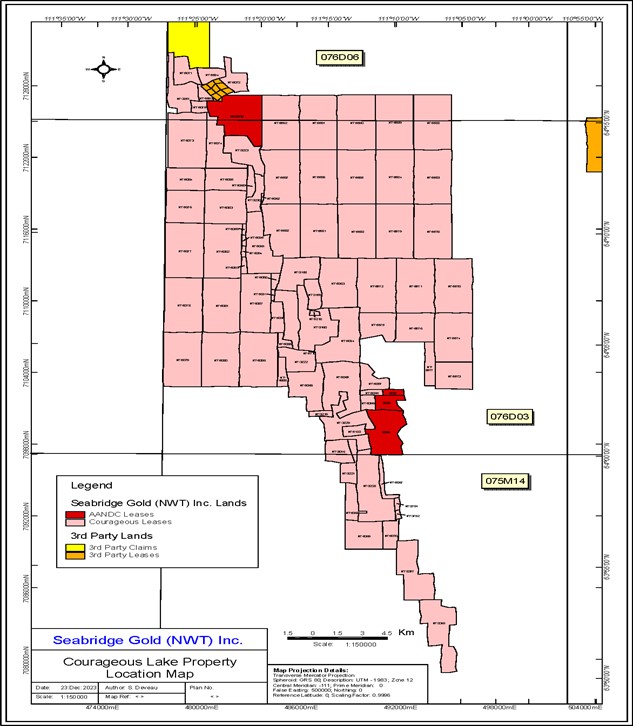
Source: Seabridge Gold, 2022
| Courageous Lake Project | Page 43 |
| Pre-feasibility Study and Preliminary Economic Assessment NI 43-101 Technical Report | January 5, 2024 |
Appendix “C”
Interim Order
(see attached)
C-1
| No. | S262504 | |
| Vancouver Registry |
In the Supreme Court of British Columbia
IN THE MATTER OF SECTION 192 OF THE CANADA BUSINESS
CORPORATIONS ACT, RSC 1985, c C-44, AS AMENDED
AND
IN THE MATTER OF A PROPOSED ARRANGEMENT INVOLVING SEABRIDGE GOLD
INC., ITS SHAREHOLDERS, AND
VALOR GOLD CORP.
SEABRIDGE GOLD INC.
PETITIONER
ORDER MADE AFTER APPLICATION
BEFORE |
) ) ) |
ASSOCIATE JUDGE BILAWICH |
) ) ) |
10/April/2026 |
ON THE APPLICATION of the Petitioner, Seabridge Gold Inc. (“Seabridge”), for an Interim Order under section 192(4) of the Canada Business Corporations Act, RSC 1985, c C-44, as amended (the “CBCA”) in connection with an arrangement involving Seabridge, holders (“Seabridge Shareholders”) of Seabridge common shares (“Seabridge Shares”) and Valor Gold Corp. (“Valor”) under section 192{3)of the CBCA.
| þ | without notice coming on for hearing at 800 Smithe Street, Vancouver, British Columbia on 10/ April/2026 and on hearing Pegah Kenarsari, counsel for the Petitioner and upon reading the Affidavit #1 of Bruce Scott made April 8, 2026 (the “Affidavit”) and filed herein; |
THIS COURT ORDERS that:
| 1. | The Petitioner, Seabridge, be permitted and directed to convene, hold and conduct the special meeting (the “Meeting”) of the Seabridge Shareholders, on May 22, 2026 at 10:00 a.m. (Eastern Time) at Salon 1, 19th Floor, Fairmont Royal York Hotel, 100 Front Street West, Toronto, Ontario: |
| (a) | to consider and, if deemed advisable, pass with or without variation, a special resolution (the “Arrangement Resolution”) authorizing, approving and adopting, with or without amendment, an arrangement (the “Arrangement”) and the plan of arrangement implementing the Arrangement (the “Plan of Arrangement”) substantially in the form included as Appendix “B” to the management information circular of Seabridge (the “Circular”) which is attached as Exhibit “A” to the Affidavit; |
C-2
| (b) | to transact such other business, as may properly be brought before the Meeting, or any adjournment or postponement thereof. |
| 2. | The Meeting shall be called, held and conducted in accordance with the provisions of the CBCA, the notice of meeting of the Seabridge Shareholders (the “Notice”), the articles of Seabridge, the Circular and applicable securities laws, and subject to the terms of this Interim Order and any further Order of this Court, as well as the rulings and directions of the Chair of the Meeting, such rulings and directions not to be inconsistent with this Interim Order, and to the extent of any inconsistency or discrepancy between this Interim Order shall govern, if not specified in the Interim Order, the Circular shall govern. |
AMENDMENTS
| 3. | Prior to the Meeting, the Petitioner is authorized to make, in the manner contemplated by and subject to the arrangement agreement between Seabridge and Valour dated March 23, 2026 (the “Arrangement Agreement”) and Plan of Arrangement, as applicable, such amendments, revisions or supplements to the Arrangement Agreement, Arrangement, Plan of Arrangement, the Notice, or the Circular as it may determine without any additional notice to the Seabridge Shareholders or any further Order of this Court. The Arrangement, the Plan of Arrangement, the Arrangement Agreement, the Notice, the Circular, as so amended or supplemented, shall be the Arrangement, the Plan of Arrangement, the Arrangement Agreement, the Notice, and the Circular to be submitted to the Seabridge Shareholders at the Meeting, as applicable, and subject to the Arrangement Resolution. |
ADJOURNMENTS AND POSTPONEMENTS
| 4. | Notwithstanding the provisions of the CBCA and the articles of Seabridge, and subject to the terms of the Arrangement Agreement, the board of directors of Seabridge (the “Board”) shall be entitled to adjourn or postpone the Meeting on one or more occasions without the necessity of first convening the Meeting or first obtaining any vote of the Seabridge Shareholders regarding such adjournment or postponement and without the need for approval of the Court. Notice of any such adjournment or postponement shall be given by press release, newspaper advertisement, or by notice sent to the Seabridge Shareholders by one of the methods specified in paragraph 8 of this Interim Order, as determined to be the most appropriate method of communication by the by the Board, subject to the terms of the Arrangement Agreement. |
RECORD DATE
| 5. | The record date for determining Seabridge Shareholders entitled to receive the Notice, the Circular (which shall include amongst other things, a copy of the Petition, the Notice of Hearing of the Petition for the Final Order, and the Interim Order granted), the Plan of Arrangement and the form of proxy or voting instructions for use by the Seabridge Shareholders (collectively, the “Meeting Materials”), shall be the close of business on March 30, 2026 (the “Record Date”), as previously approved by the Board and published by Seabridge. |
| 6. | The Record Date shall remain the same despite any adjournments or postponements of the Meeting. |
C-3
NOTICE OF SPECIAL MEETING
| 7. | The Circular is hereby deemed to represent sufficient and adequate disclosure, including for the purposes of section 190-192 of the CBCA, and Seabridge shall not be required to send the Seabridge Shareholders any other or additional statement regarding the Arrangement pursuant to the provisions of the CBCA. |
| 8. | The Meeting Materials, in substantially the same form as the Exhibits to the Affidavit, with such deletions or additional documents as counsel for Seabridge may advise are necessary and desirable, and as are not inconsistent with the terms of this Interim Order, shall be sent: |
| (a) | to registered Seabridge Shareholders as they appear on the securities register(s) of Seabridge or the records of its registrar and transfer agents as at the close of business on the Record Date, such Meeting Materials to be sent at least twenty-one (21) days prior to the date of the Meeting, excluding the day of mailing, delivery or transmittal and the date of the Meeting, bye one or more of the following methods: |
| (i) | by prepaid ordinary or air-mail addressed to the Seabridge Shareholders at his, her, or its address as it appears on the applicable securities registers of Seabridge or its registrar or transfer agent as at the Record Date; |
| {ii) | by delivery in person or by delivery to the addresses specified in paragraph 8{a) above; or |
| (iii) | by email or facsimile transmission to any such Seabridge Shareholder who identifies himself, herself or itself to the satisfaction of Seabridge (acting through its representatives), who request such email or facsimile transmission and pays for the transmission fees in accordance with such request; and |
| (b) | to the non-registered Seabridge Shareholders (those whose names do not appear in the securities register of Seabridge), by sending copies of the Meeting Materials to intermediaries and registered nominees to facilitate the distribution of the Meeting Materials to beneficial owners in accordance with the procedures prescribed by National Instrument 54-101- Communications with Beneficial Owners of Securities of a Reporting Issuer of the Canadian Securities Administrators at least three (3) business days prior to the twenty-first (21st) day prior to the date of the Meeting. |
| 9. | The Meeting Materials shall be sent to the directors and auditors of Seabridge and to the Director under the CBCA by prepaid ordinary mail or by delivery in person or by recognized courier service or by email or facsimile transmission at least twenty-one (21) days prior to the date of the Meeting, excluding the date of mailing, delivery or transmission. |
| 10. | Substantial compliance with the delivery of the Meeting Materials as ordered herein shall constitute good and sufficient notice of the Meeting, and Seabridge shall not be required to send to any Seabridge Shareholder any other additional statement pursuant to the provisions of the CBCA or otherwise. |
C-4
| 11. | The sending of the Meeting Materials, which includes the Petition, Notice of Hearing of the Petition and the Interim Order in accordance with paragraph 8 of this Order shall constitute good and sufficient service of such Petition and Notice of Hearing upon all who may wish to appear in these proceedings, and no other service need be made and no other material need to be served on persons in respect of these proceedings except upon written request to the solicitors for Seabridge at their address for service set out in the Petition. In particular, service of the Petition and any supporting affidavits is dispensed with. |
| 12. | The accidental failure or omission by Seabridge to give notice to any one or more Seabridge Shareholder, or any other person entitled thereto, or the non-receipt of such notice, or any failure or omission to give such notice as a result of events beyond the reasonable control of Seabridge (including, without limitation, any inability to use postal services) shall not constitute a breach of this Interim Order nor a defect in the calling of the Meeting, and shall not invalidate any resolution passed or proceeding taken at the Meeting, but if any such failure or omission is brought to the attention of Seabridge then it shall use reasonable best efforts to rectify it by the method and in the time most reasonably practicable in the circumstances. |
| 13. | Seabridge shall be at liberty to give notice of this application to persons outside the jurisdiction of this Court in the manner specified herein. |
| 14. | In the event of a postal strike, lockout or event that prevents, delays or otherwise interrupts mailing of the Meeting Materials by prepaid ordinary mail (the “Postal Service Disruption”) as provided for in paragraph 8 herein: |
| (a) | Seabridge shall cause an advertisement (the “Advertisement”) to be placed in a major daily newspaper of national circulation, stating: |
| i. | the date, place, and time of the Meeting; |
| ii. | the measures implemented by Seabridge to ensure delivery or transmission of proxies or other Meeting Materials by the Seabridge Shareholders to Seabridge in relation to the Meeting within the required time period and at no cost to the Seabridge Shareholders; and |
| iii. | that the Meeting Materials are available, without charge, for review via the internet at the SEDAR+ website (www.sedarplus.ca) or for delivery to Seabridge Shareholders by electronic mail or by courier upon request made to Seabridge; |
| (b) | the Advertisement shall be made on or before the date upon which notice of the Meeting would otherwise be sent to the Seabridge Shareholders, in the event that a Postal Service Disruption had not occurred; |
| (c) | Seabridge shall, concurrently with the Advertisement, issue a press release containing the information set out in paragraph 15(a) herein and stating that the Advertisement and press release are being made in accordance with this order in lieu of prepaid ordinary mail due to the Postal Service Disruption; and |
| (d) | For proxies, voting instruction forms, and other Meeting Materials that are required to be delivered to Seabridge for the purposes of the Meeting, Seabridge shall implement measures that enable Seabridge Shareholders, during the Postal Service Disruption, to effect delivery or transmission by the Seabridge Shareholders of said proxies, voting instruction forms or other materials within the required period at no cost to Seabridge Shareholders. |
C-5
DEEMED RECEIPT OF NOTICE
| 15. | The Mailed Materials and any amendments, modifications, updates or supplements to the Meeting Materials, and any notice of adjournment or postponement of the Meeting, shall be deemed to have been received, for the purposes of this Interim Order: |
| (a) | in the case of mailing pursuant to paragraph 8(a)(i) above, the day, Saturdays, Sundays and holidays excepted, following the date of mailing; |
| (b) | in the case of delivery in person pursuant to paragraph 8(a)(ii) above, the day following personal delivery or, in the case of delivery by courier, one (1) business day after receipt by the courier; |
| (c) | in the case of transmission by email or facsimile pursuant to paragraph 8(a)(iii) above, upon the transmission thereof; |
| (d) | in the case of Advertisement, at the time of publication of the Advertisement; |
| (e) | in the case of electronic filing on SEDAR+, upon the transmission thereof; and |
| (f) | in the case of beneficial Seabridge Shareholders, three (3) days after delivery thereof to intermediaries and registered nominees. |
UPDATING MEETING MATERIALS
| 16. | Notice of any amendments, modifications, updates or supplements to any of the information provided in the Meeting Materials may be communicated, at any time prior to the Meeting, to the Seabridge Shareholders or any other persons entitled thereto, by Securityholders release, news release, newspaper advertisement or by notice sent to the Seabridge Shareholder by any of the means set forth in paragraphs 8 or 15, as determined to be the most appropriate method of communication by the Board, subject to the terms of the Arrangement Agreement |
PERMITTED ATTENDEES
| 17. | The only persons entitled to attend the Meeting shall be: |
| (a) | the registered Seabridge Shareholders as at 5:00 p.m. (Vancouver time) on the Record Date, or their respective proxyholders; |
| (b) | directors, officers, auditors and advisors of Seabridge; |
| (c) | directors, officers, auditors and advisors of Valor; and |
| (d) | other persons with the prior permission of the Chair of the Meeting, |
and the only persons entitled to be represented and to vote at the Meeting shall be the registered Seabridge Shareholders at the close of business on the Record Date, or their respective proxyholders.
C-6
SOLICITATION OF PROXIES
| 18. | Seabridge is authorized to use the form of proxy and voting information form in connection with the Meeting, in substantially the same form as is attached as Exhibit “B” to the Affidavit, subject to Seabridge’s ability to insert dates and other relevant information in the final form thereof and to make other non-substantive changes and changes legal counsel advise are necessary or appropriate. Seabridge is authorized, at its expense, to solicit proxies directly and through its officers, directors and employees, and through such agents or representatives as it may retain for that purpose and by mail, telephone or such other form of personal or electronic communication as it may determine. |
| 19. | The procedures for the use of proxies at the Meeting and revocation of proxies shall be as set out in the Notice and the Circular. |
| 20. | Subject to the terms of the Arrangement Agreement, Seabridge may, in its discretion generally waive the time limits for the deposit of proxies by Seabridge Shareholders if Seabridge deems it advisable to do so, such waiver to be endorsed on the proxy by the initials of the Chair of the Meeting. |
QUORUM AND VOTING
| 21. | Three persons who are, or who represent by proxy, Seabridge Shareholders entitled to vote at the meeting who hold, in the aggregate, at least 33 ½% of the issued shares entitled to be voted at the Meeting constitute a quorum for the Meeting. |
| 22. | Each Seabridge Shareholder shall be entitled to one vote for each Seabridge Share held by such Seabridge Shareholder. |
| 23. | In order for the Arrangement to become effective, the Arrangement Resolution must be approved by not less than 66½% of the votes cast by Seabridge Shareholders present in person or represented by proxy at the Meeting. |
SCRUTINEER
| 24. | The scrutineer for the Meeting shall be Computershare Investor Services Inc. (acting through its representatives for that purpose). |
DISSENT RIGHTS
| 25. | Each registered Seabridge Shareholder will have the right to dissent in respect of the Arrangement Resolution in accordance with the provisions of Sections 190 of the CBCA, as modified by the Plan of Arrangement, this Interim Order, and the Final Order including that: |
| (a) | A registered Seabridge Shareholder who wishes to Dissent (a “Dissenting Seabridge Shareholder”) must deliver a written objection to the Arrangement Resolution (the “Notice of Dissent”) to DWF Group, 2400-200 Granville Street, Vancouver, BC V6C 1S4, Attention: Lauren Gnanasihamany, to be received by no later than 4:00 p.m. Pacific Time on May 20, 2026, or by 4:00 p.m. Pacific Time on the date that is two Business Days before any date to which the Meeting may be adjourned or postponed, and must otherwise strictly comply with the dissent procedures set forth in Section 190 of the CBCA, as modified by the Interim Order, the Final Order and the Plan of Arrangement. |
C-7
| (b) | a Dissenting Seabridge Shareholder must not have voted his, her or its Seabridge Shares at the Meeting, either by proxy or in person, in favour of the Arrangement Resolution. A vote in favour of the Arrangement Resolution will deprive the Registered Seabridge Shareholder of any rights under section 190 of the CBCA, as modified by the Interim Order, the Final Order and the Plan of Arrangement. For the avoidance of doubt, a proxy submitted by a Registered Seabridge Shareholder that does not contain voting instructions will, unless revoked, be voted in favour of the Arrangement Resolution. |
| {c) | a Dissenting Seabridge Shareholder must dissent with respect to all of the Seabridge Shares held by such person, or on behalf of any one beneficial owner and registered in the name of the Seabridge Shareholder. |
| (d) | A Seabridge Shareholder may only exercise the right to dissent under Section 190 of the CBCA, as modified by the Interim Order, the Final Order and the Plan of Arrangement, in respect of Seabridge Shares which are registered in that Seabridge Shareholder’s name. Accordingly, a Beneficial Seabridge Shareholder will not be entitled to exercise the right to dissent under Section 190 of the CBCA, as modified by the Interim Order, the Final Order and the Plan of Arrangement, directly unless the shares are re-registered in the Beneficial Seabridge Shareholder’s name. |
| (e) | A Beneficial Seabridge Shareholder who wishes to exercise the right to dissent should immediately contact the Intermediary who the Beneficial Seabridge Shareholder deals with in respect of the Seabridge Common Shares and either: |
| (i) | instruct the Intermediary to exercise the right to dissent on the Beneficial Seabridge Shareholder’s behalf (which, if the Seabridge Shares are registered in the name of CDS or another clearing agency, would require that the Seabridge Shares first be re-registered in the name of the Intermediary); or |
| (ii) | instruct the Intermediary to re-register the Seabridge Shares in the name of the Beneficial Seabridge Shareholder, in which case the Beneficial Seabridge Shareholder would have to exercise the right to dissent directly. |
| (f) | Within 10 days after the adoption of the Arrangement Resolution by the Seabridge Shareholders, the Company is required to notify in writing each Dissenting Shareholder that the Arrangement Resolution has been adopted. A Dissenting Shareholder must, within 20 days after receipt of such notice, or, if the Dissenting Shareholder does not receive such notice, within 20 days after learning of the adoption of the Arrangement Resolution, send to the Company a written notice (the “Demand for Payment”) containing the Dissenting Shareholder’s name and address, the number of Seabridge Shares in respect of which the Dissenting Shareholder dissents, and a demand for payment of the fair value of such shares. |
| (g) | Within 30 days after sending the Demand for Payment, the Dissenting Shareholder must send the certificates representing the Seabridge Shares in respect of which the Dissenting Shareholder dissents to the Company or its transfer agent. The Company or the transfer agent will endorse on the share certificates a notice that the holder thereof is a Dissenting Shareholder under Section 190 of the CBCA, as modified by the Interim Order, the Final Order and the Plan of Arrangement, and will forthwith return the share certificates to the Dissenting Shareholder. If a Dissenting Shareholder fails to send such Dissenting Shareholder’s share certificates, he, she or it has no right to make a claim under Section 190 of the CBCA, as modified by the Interim Order, the Final Order and the Plan of Arrangement. |
C-8
| (h) | Not later than seven days after the later of the Effective Date and the day the Company receives the Demand for Payment, the Company will send, to each Dissenting Shareholder who has sent a Demand for Payment, a written offer to pay for the Seabridge Shares (“Offer to Pay”) of the Dissenting Shareholder in respect of which he, she or it has dissented in an amount considered by the directors of the Company to be the fair value thereof, accompanied by a statement showing how the fair value was determined (provided however that such payment shall not be made and the Seabridge Shareholder shall be so informed if the Company has reasonable grounds for believing it is or would after the payment be unable to pay its liabilities as they become due or the realizable value of its assets would thereby be less than the aggregate of its liabilities). |
| (i) | Every Offer to Pay made to Dissenting Shareholders for shares of the same class shall be on the same terms. The amount specified in an Offer to Pay that has been accepted by a Dissenting Shareholder shall be paid within 10 days of the acceptance, but an Offer to Pay lapses if the Company has not received an acceptance thereof within 30 days after the Offer to Pay has been made. |
| (j) | If an Offer to Pay is not made by the Company or if a Dissenting Shareholder fails to accept an Offer to Pay, the Company may, within 50 days after the Effective Date or within such further period as a court may allow, apply to the court to fix a fair value for the Seabridge Shares of any Dissenting Shareholder. If the Company fails to so apply to the court, a Dissenting Shareholder may apply to a court for the same purpose within a further period of 20 days or within such further period as the court may allow. A Dissenting Shareholder is not required to give security for costs in any application to the court. |
| (k) | On making an application to the court, the Company will give to each Dissenting Shareholder who has sent to the Company a Demand for Payment and who has not accepted an Offer to Pay, notice of the date, place and consequences of the application and of his right to appear and be heard in person or by counsel. All Dissenting Shareholders whose Seabridge Shares have not been purchased by the Company will be joined as parties to any such application to the court to fix a fair value and will be bound by the decision rendered by the court in the proceedings commenced by such application. The court is authorized to determine whether any other person is a Dissenting Shareholder who should be joined as a party to such application. |
| (i) | The court will fix a fair value for the Seabridge Shares of all Dissenting Shareholders and may in its discretion allow a reasonable rate of interest on the amount payable to each Dissenting Shareholder from the Effective Date until the date of payment of the amount ordered by the court. The Final Order of the court in the proceedings commenced by an application by the Company or a Dissenting Shareholder will be rendered against the Company and in favour of each Dissenting Shareholder and for the amount of the shares as fixed by the court; and |
C-9
| 26. | Notice to the Seabridge Shareholders of their Dissent Rights with respect to the Arrangement Resolution will be given by including information with respect to the Dissent Rights in the Circular to be sent to the Seabridge Shareholders with respect to the Arrangement. |
| 27. | Subject to further order of this Court, the rights available to the Seabridge Shareholders under the CBCA and the Plan of Arrangement to dissent from the Arrangement will constitute full and sufficient Dissent Rights for the Seabridge Shareholder with respect to the Arrangement. |
APPLICATION FOR THE FINAL ORDER
| 28. | Unless the directors of Seabridge by resolution determine to terminate the Arrangement Agreement in accordance with its terms, upon the approval, with or without variation by the Seabridge Shareholders of the Arrangement Resolution, in the manner set forth in this Interim Order, the Petitioner may apply to this Court (the “Application”) for an Order: |
| (a) | pursuant to section 192 of the CBCA, declaring that the Arrangement, including the terms and conditions thereof and the issuances, exchanges and/or adjustments of securities contemplated therein, is fair and reasonable to the Seabridge Shareholders; |
| (b) | pursuant to section 192 CBCA, approving the Arrangement, including the terms and conditions thereof and the issuances, exchanges and/or adjustments of securities contemplated therein, |
(Collectively, the “Final Order”):
and that the Application for the Final Order be set down for hearing before the presiding Judge in Chambers at the Courthouse at 800 Smithe Street, Vancouver, British Columbia, on May 27, 2026 at 9:45 a.m., or as soon thereafter as the Court may direct or counsel for Seabridge may be heard, and that Seabridge be at liberty to proceed with the Final Application on that date.
| 29. | The form of notice of final hearing attached as Exhibit “C” to the Affidavit is hereby approved as the form of notice for the hearing of the Application of the Final Order. |
| 30. | The Petitioner has advised the court that: |
| (a) | section 3(a)(10) of the United States Securities Act of 1933 (the “1933 Act”), as amended, provides an exemption from registration for the securities issued in exchange for one or more bona fide outstanding securities, claims or property interests pursuant to an arrangement where the terms and conditions of such issuance and exchange are approved by a court of competent jurisdiction (including this Court), after a hearing on the procedural and substantive fairness of such terms and conditions at which all persons to whom it is proposed to issue securities in such exchange have the right to appear and receive timely notice thereof; |
C-10
| (b) | The Petitioner intends to use the Final Order of this Court approving the Arrangement, and declaring the procedural and substantive fairness of the Arrangement, including the terms and conditions hereof and the proposed issuance and exchanges of securities contemplated therein, as a basis for an exemption from registration under the 1933 Act of the issuance of the Seabridge Class A Shares, Valor common shares (the “Valor Shares”), New Seabridge Shares that may be deemed to be received by Seabridge Shareholders, to be issued, distributed, and exchanged under the Arrangement; and |
| (c) | Should the Court make the Final Order approving the Arrangement, the issuance of Seabridge Class A Shares, the Valor Shares and the New Seabridge Shares that may be deemed to be received by Seabridge Shareholders, to be issued, distributed, and exchanged under the Arrangement will be exempt from registration under the 1933 Act. |
| 31. | Any Seabridge Shareholder who wishes to appear or be represented and/or present evidence or arguments at the hearing of the Application for the Final Order must: |
| (a) | file a Response to Petition, in the form prescribed by the Supreme Court Civil Rules, together with any evidence or material which is to be presented to the Court at the hearing of the Final Application; and |
| (b) | deliver the filed Response to Petition together with a copy of any evidence or material which is to be presented to the Court at the hearing of the Final Application, to the Petitioner’s counsel at: |
DWF {trading name for WT BCA LLP)
2400-200 Granville Street
Vancouver BC V6C 1S4
Attention: Lauren Gnanasihamany
by or before 4:00 p.m. {Pacific Time) on May 25, 2026.
| 32. | If the Application for the Final Order is adjourned, only those persons who have filed and delivered a Response to Petition in accordance with this Interim Order need to be served and provided with notice of the adjourned date. |
| 33. | In the event that the hearing of the Application is adjourned, then only those persons who filed and delivered a Response to Petition in accordance with paragraph 32 need be provided with notice of the adjourned hearing date. |
VARIANCE
| 34. | The Petitioner shall be entitled, at any time, to apply to vary this Order. |
| 35. | Rules 8-1 and 16-1(8) - {12) will not apply to any further applications in respect of this proceeding, including the Final Application and any application to vary this Interim Order. |
| 36. | The Petitioner shall, and hereby does, have liberty to apply for such further orders as may be appropriate |
C-11
| 37. | To the extent of any inconsistency or discrepancy between this Interim order and the Circular, the CBCA, applicable Securities Laws, or the articles of Seabridge, this Interim Order will govern. |
THE FOLLOWING PARTIES APPROVE THE FORM OF THIS ORDER AND CONSENT TO EACH OF THE ORDERS, IF ANY, THAT ARE INDICATED ABOVE AS BEING BY CONSENT:
| “Pegah Kenarsari” | |
| Signature of lawyer for the Petitioner, Seabridge Gold Inc. |
|
| Pegah Kenarsari |
| BY THE COURT | |
| “Authorized Party” | |
| Registrar |
C-12
Appendix “D”
Notice of Petition and Petition
(see attached)
D-1
No. S-262504
Vancouver Registry
In the Supreme Court of British Columbia
IN THE MATTER OF SECTION 192 OF THE CANADA BUSINESS
CORPORATIONS ACT, RSC 1985, c C-44, AS AMENDED
AND
IN THE MATTER OF A PROPOSED ARRANGEMENT INVOLVING
SEABRIDGE GOLD INC., ITS SHAREHOLDERS, AND
VALOR GOLD CORP.
SEABRIDGE GOLD INC.
PETITIONER
NOTICE OF HEARING
| TO: | The holders of Seabridge Gold Inc. (“Seabridge”) shares (the “Seabridge Shareholders”) |
NOTICE IS HEREBY GIVEN that a Petition to the Court has been filed by Seabridge in the Supreme Court of British Columbia for approval, pursuant to section 192 of the Canada Business Corporations Act, RSC 1985, c C-44, and amendments thereto (the “CBCA”) of an arrangement contemplated in an Arrangement Agreement dated March 23, 2026, involving Seabridge, the Seabridge Shareholders and Valor Gold Corp. (the “Arrangement”).
NOTICE IS FURTHER GIVEN that by Order of Associate Judge Bilawich, an Associate Judge of the Supreme Court of British Columbia, dated April 10, 2026 (the “Interim Order”), the Court has given directions as to the calling of a meeting (the “Meeting”) of the registered Seabridge Shareholders for the purpose of, among other things, considering and voting upon the special resolution to approve the Arrangement.
NOTICE IS FURTHER GIVEN that if the Arrangement is approved at the Meeting, the Petitioner intends to apply to the Supreme Court of British Columbia for a final order (the “Final Order”) approving the Arrangement, declaring it to be fair and reasonable to the Seabridge Shareholders, which application will be heard at the courthouse at 800 Smithe Street, in the City of Vancouver, in the Province of British Columbia on May 27, 2026 at 9:45 a.m. (Vancouver time) or as soon thereafter as the Court may direct or counsel for Seabridge may be heard.
NOTICE IS FURTHER GIVEN that the Court has been advised that, if granted, the Final Order approving the Arrangement and the declaration that the Arrangement is procedurally and substantively fair to the Seabridge Shareholders will constitute the basis for an exemption from the registration requirements under the United States Securities Act of 1933, pursuant to section 3(a)(10) thereof, upon which the parties will rely for the issuance and exchange of securities in connection with the Arrangement.
D-2
IF YOU WISH TO BE HEARD AT THE HEARING OF THE APPLICATION FOR THE FINAL ORDER OR WISH TO BE NOTIFIED OF ANY FURTHER PROCEEDINGS, YOU MUST GIVE NOTICE OF YOUR INTENTION by filing a form entitled “Response to Petition” together with any evidence or materials which you intend to present to the Court at the Vancouver Registry of the Supreme Court of British Columbia and YOU MUST ALSO DELIVER a copy of the Response to Petition and any other evidence or materials to the Petitioner’s address for delivery, which is set out below, on or before 4:00 p.m. (Pacific time) on May 25, 2026.
YOU OR YOUR SOLICITOR may file the Response to Petition. You may obtain a form of Response to Petition at the Registry. The address of the Registry is 800 Smithe Street, Vancouver, British Columbia, V6Z 2E1.
IF YOU DO NOT FILE A RESPONSE TO PETITION AND ATTEND EITHER IN PERSON OR BY COUNSEL at the time of the hearing of the application for the Final Order, the Court may approve the Arrangement, as presented, or may approve it subject to such terms and conditions as the Court deems fit, all without further notice to you. If the Arrangement is approved, it will affect the rights of the Seabridge Shareholders.
A copy of the Petition to the Court and the other documents that were filed in support of the Interim Order and will be filed in support of the Final Order will be furnished to any the Seabridge Shareholders upon request in writing addressed to the solicitors of the Petitioner at the address for delivery set out below.
The Petitioner’s address for delivery is:
DWF (trading name for WT BCA LLP)
2400-200 Granville Street
Vancouver BC V6C 1S4
Attention: Lauren Gnanasihamany
Pursuant to the Interim Order, the hearing of this Petition is set for May 27, 2026, at 9:45 am before the presiding Judge in Chambers at the Courthouse at 800 Smithe Street, Vancouver British Columbia.
It is anticipated that this Final Hearing will not be contentious and will take 15 minutes.
DATED this 10 day of April 2026.
| “Pegah Kenarsari” | |
| Signature of lawyer for the petitioner | |
| Pegah Kenarsari |
D-3
| No. | S-262504 | |
| Vancouver Registry |
In the Supreme Court of British Columbia
AND
ER OF A PROPOSED ARRANGEMENT INVOLVING
SEABRIDGE GOLD INC., ITS SHAREHOLDERS, AND
VALOR GOLD CORP.
SEABRIDGE GOLD INC.
PETITIONER
PETITION TO THE COURT
ON NOTICE TO:
This Petition is without Notice
The address of the registry is:
800 Smithe Street
Vancouver, BC V6Z 2El
The petitioner estimatess that the hearing of the petition will take 15 minutes.
| 0 | This matter is not an application for judicial review. |
This proceeding is brought for the relief set out in Part 1 below, by
| 0 | Seabridge Gold Inc. {“Seabridge”) |
If you intend to respond to this petition, you or your lawyer must
| (a) | file a response to petition in Form 67 in the above-named registry of this court within the time for response to petition described below, and |
| (b) | serve on the petitioners |
D-4
| (i) | 2 copies of the filed response to petition, and |
| (ii) | 2 copies of each filed affidavit on which you intend to rely at the hearing. |
Orders, including orders granting the relief claimed, may be made against you, without any further notice to you, if you fail to file the response to petition within the time for response.
TIME FOR RESPONSE TO PETITION
A response to petition must be filed and served on the petitioners,
| (a) | if you were served with the petition anywhere in Canada, within 21 days after that service, | |
| (b) | if you were served with the petition anywhere in the United States of America, within 35 days after that service, | |
| (c) | if you were served with the petition anywhere else, within 49 days after that service, or | |
| (d) | if the time for response has been set by order of the court, within that time. |
| 1. |
The ADDRESS FOR SERVICE of the petitioners is:
Fax number for service (if any) of the petitioners
E-mail address for service (if any) of the petitioners: |
DWF (trading name for WT BCA LLP) 2400 - 200 Granville Street Vancouver, BC V6C 1S4
604-682-5217
Patrlck.Sullivan@dwfgroup.com Lauren.Gnanasihamany@dwfgroup.com Pegah.Kenarsari@dwfgroup.com | |
|
2. |
The name and office address of the petitioner’s |
DWF (trading name for WT BCA LLP) | |
| lawyer is: | 2400 - 200 Granville Street | ||
| Vancouver, BC V6C 1S4 |
CLAIM OF THE PETITIONERS
Part 1: ORDERS SOUGHT
The Petitioner, Seabridge, applies pursuant to section 192 of the Canada Business Corporations Act, RSC 1985, c C-44, as amended (the “CBCA”), and·Rules1-2(4),2(1(2)(b), 4-4,4-5, and 16-1 of the Supreme Court Civil Rules for:
| 1. | An ex parte interim order (the “Interim Order”), substantially in the form of the draft order attached as Schedule A to this Petition, in connection with an arrangement (the “Arrangement”) involving Seabridge, the holders (the “Seabridge Shareholders”) of common shares of Seabridge (the “Seabridge Shares”), and Valor Gold Corp. (“Valor’’), proposed by Seabridge in the plan of arrangement (the “Plan of Arrangement”) substantially in the form included as Appendix “B” to the management information circular (the “Circular” of Seabrldge, a draft of which is attached as Exhibit “A” to the affidavit of Bruce Scott, made on April 8, 2026 (“Affidavit #1”) for: |
| (a) | The convening and conduct by the Petitioner, Seabridge, of a special meeting of the Seabridge Shareholders (the “Meeting”), to be held at Salon 1, 19th Floor, Fairmont Royal York Hotel, 100 Front Street West, Toronto, Ontario, Canada, on May 22, 2026, at 10:00 a.m. Eastern Daylight Time, subject to any adjournment or adjournments thereof, to consider, inter a/ia, and if thought advisable, pass with or without amendment, a special resolution (the “Arrangement Resolution”), authorizing and approving the proposed Arrangement under the section 192 of the CBCA, and such other business, including amendments to the foregoing, as may properly come before the meeting; and |
D-5
| (b) | The giving of notice of the Meeting and the provision of materials regarding the Arrangement of the Seabridge Shareholders; |
| 2. | A final Order (the “Final Order”) that: |
| (a) | The Arrangement, including the terms and conditions thereof and the proposed issuance and exchange of securities contemplated therein, be declared procedurally and substantively fair and reasonable; and |
| (b) | The Arrangement be approved, |
Which approval will also form the basis of the Petitioner’s claim for an exemption from the registration requirements of the United States Securities Act of 1933, as amended (the “1933 Act”), pursuant to Section 3(a){10) thereof with respect to the securities to be issued, exchanged, and distributed under the Arrangement; and
| 3. | Such further and other relief as counsel for the Petitioner may advise and the Court may deem just. |
Part 2: FACTUAL BASIS
Seabridge
| 1. | Seabridge was incorporated in British Columbia in 1979 and continued under the CBCA on October 31, 2002. Seabridge has a registered office at 15th Floor, 1111 West Hastings Street, Vancouver, BC, V6E 2J3 and a corporate office located at 400-106 Front Street East, Toronto, ON, MSA 1E1. |
| 2. | Seabridge is a company engaged in acquiring, exploring and advancing mineral properties with an emphasis on gold resources located in Canada and the United States of America. |
| 3. | Seabridge indirectly holds mining leases and mineral claims located in British Columbia (the “KSM Project”) through its wholly owned subsidiary, KSM Mining Inc. (“KSM”). Seabridge also holds a 100% interest in the Courageous Lake project comprising 50,228 hectares of mineral leases and mining claims, including high-grade gold projects, located 240km northeast of Yellowknife, Northwest Territories (“Courageous Lake Project”) through its wholly-owned subsidiary, Seabridge Gold (NWT) lnc. (“SNWT”). |
D-6
| 4. | The Seabridge Shares trade in Canada on the Toronto Stock Exchange (the “TSX”) under the symbol “SEA” and in the United States on the New York Stock Exchange (the “NYSE”) under the symbol IISA.” |
| 5. | Seabridge’s authorized capital consists of an unlimited number of common shares and unlimited number of preferred shares. |
| 6. | Seabridge has no outstanding or issued warrants or options. |
| 7. | As of March 30, 2026, there were: |
| (a) | 107,373,183 Seabridge Shares issued and outstanding. |
| (b) | 848,021 Seabridge restricted share units (“RSUs”) |
| (c) | 60,400 Seabridge deferred share units (“DSUs”). |
Valor
| 8. | Valor was incorporated on January 19, 2026, as a wholly owned subsidiary of Seabridge under the CBCA. |
| 9. | Valor’s head office is 106 Front Street East, Suite 400, Toronto, Ontario, MSA 1E1 and its registered and records office is 15th Floor, 1111 West Hastings Street, Vancouver, BC, V6E 2J3. |
| 10. | The authorized capital of Valor consists of an unlimited number of common shares (the 11Valor Shares”) of which 100 Valor Shares are currently outstanding and held by Seabridge. |
| 11. | Upon completion of the Arrangement, it is anticipated that there will be approximately 55,000,000 Valor Shares outstanding, all of which will be owned by Seabridge Shareholders. |
| 12. | Valor is not currently a reporting issuer, and Valor’s Shares are not listed on any stock exchange. If the Arrangement is completed, Valor will be a reporting issuer in each of the provinces and territories in which Seabridge is a reporting issuer. |
| 13. | Following the completion of the Arrangement, Valor intends to apply to list its shares on the TSX and the QTCQB Venture Market in the United States. |
Overview of the Arrangement
| 14. | The Arrangement which has been proposed among Seabridge, the Seabridge Shareholders and Valor, is substantially in the form of the Plan of Arrangement attached as Appendix “B” to the Notice of Meeting and the Circular attached as Exhibit 11A” to Affidavit #1. All capitalized terms used further below, but not otherwise defined, shall have the meanings ascribed to them in the Circular. |
| 15. | The purpose of the Arrangement and the related transactions is to reorganize the assets of Seabridge into two separate companies: |
| (a) | Seabridge, which will continue to advance the KSM Project and its remaining exploration portfolio; and |
D-7
| (b) | Valor, which will focus on the exploration and development of the Courageous Lake Project. |
| 16. | The Arrangement would result in, among other things, participating Seabridge Shareholders holding, immediately following completion of the Arrangement, the New Seabridge Shares and Valor Shares in proportion to their holdings of Seabridge Shares at the Effective Time. |
| 17. | On or before the Effective Date, Seabridge will: |
| (a) | make a cash payment to Valor in the amount of C$10,000,000 in consideration for the following: |
| (i) | C$5,100,000 in exchange for the issuance of 700,000 Valor Shares to Seabridge; and |
| (ii) | C$4,900,000 as a deposit paid in consideration for the entering into of the Gold Stream Agreement in substantially the form attached to the Arrangement Agreement as Schedule “C”. |
| (b) | Transfer all the issued and outstanding common shares of SNWT to Valor in consideration of Valor issuing 54,299,900 Valor Shares to Seabridge. |
| 18. | Commencing at the Effective Time, each of the events set out below shall occur and shall be deemed to occur in the following sequence or as otherwise provided below or herein, without any further act or formality, notwithstanding anything contained in the provisions attaching to any of the securities of Seabridge or Valor, but subject to the provisions of Article 5 of the Arrangement Agreement: |
| (a) | each Seabridge Common Share in respect of which a Seabridge Shareholder has exercised Dissent Rights and for which the Seabridge Shareholder is ultimately entitled to be paid fair value (each a “Dissent Share”) shall be deemed to have been repurchased by Seabridge for cancellation in consideration for a debt-claim against Seabridge to be paid the fair value of such Dissent Share in accordance with Article 5 of this Plan of Arrangement, net of any applicable withholding tax, and such Dissent Share shall thereupon be cancelled; |
| (b) | The share capital of Seabridge shall be reorganized by: |
| (i) | Renaming and redesignating all of the issued and unissued Seabridge Common Shares as “Class A common shares without par value” and amending the rights and restrictions attached to those shares to provide the holders thereof with two (2) votes in respect of each share held, being the “Seabridge Class A Shares”; |
| (ii) | Creating a new class consisting of an unlimited number of “common shares without par value” with terms and rights and restrictions identical to those of the Seabridge Common Shares immediately prior to the Effective Time, being the “New Seabridge Shares”; |
| (c) | the Seabridge Articles shall be amended to reflect the alterations in Section 2.l(b) of the Plan of Arrangement; |
D-8
| (d) | (i) each issued and outstanding Seabridge Class A Share outstanding on the Share Distribution Record Date held by a Seabridge Shareholder shall be exchanged, as part of the reorganization of the share capital of Seabridge and in accordance with Section 86 of the Tax Act, for: (A) one New Seabridge Share; and (B) that number or fraction of Valor Shares equal to such Shareholder’s pro rata portion of the 55,000,000 Valor Shares held by Seabridge on the Share Distribution Record Date divided by the number of Seabridge Class A Shares held by such Seabridge Shareholder immediately before the exchange described in this paragraph; (ii) the holders of the Seabridge Class A Shares will be removed from the central securities register of Seabridge as the holders of such Seabridge Class A Shares and will be added to the central securities register of Seabridge as the holders of the number of New Seabridge Shares that they have received on the exchange set forth in Section 2.l(d) of the Plan of Arrangement, and (iii) the Valor Shares transferred to the then holders of the Seabridge Class A Shares will be registered in the name of the former holders of the Seabridge Class A Shares and Seabridge will provide Valor and its registrar and transfer agent notice to make the appropriate entries in the central securities register of Valor; |
| (e) | all of the issued Seabridge Class A Shares shall be cancelled with the appropriate entries being made in the central securities register of Seabridge, and the aggregate paid-up capital (as that term is used for purposes of the Tax Act) of the New Seabridge Shares will be equal to that of the Seabridge Common Shares immediately prior to the Effective Time less the fair market value of the Valor Shares distributed pursuant to Section 2.1(d) of the Plan of Arrangement; and |
| (f) | the Seabridge Articles shall be amended to reflect the alteration in Section 2.1(e) of the Plan of Arrangement. |
| 19. | Following completion of the Arrangement, Seabridge Shareholders will continue to hold Seabridge Shares and will hold Valor Shares on a pro-rata basis. |
| 20. | Seabridge, following the Arrangement, will continue to be engaged in its business of acquiring, exploring and developing its portfolio of mineral properties other than the Courageous Lake Project. |
| 21. | Following the Arrangement, Valor’s business will be the exploration and development of the Courageous Lake Project, which will be Valor1s only material mineral property upon completion of the Arrangement. |
Determination by the Board of Directors of Seabridge
| 22. | Seabridge has reviewed the terms and conditions of the proposed Arrangement and has concluded that the Arrangement is procedurally and substantively fair and reasonable to its securityholders and in the best interests of Seabridge. |
| 23. | In arriving at this conclusion, the board of directors of Seabridge (the “Board”) considered among other matters: |
| (a) | Separation of Assets. It is expected the separation of the Courageous Lake Project from Seabridge’s other assets will allow Valor to hold and advance the Courageous Lake Project, and will provide a separate valuation of both the businesses of Seabridge and Valor and will permit management to advance both businesses in a more focused and efficient manner. Following the Arrangement, Seabridge will continue with its remaining business portfolio. |
D-9
| (b) | Fairness Opinion. The Fairness Opinion states that, as of March 4, 2026, subject to the assumptions, limitations and qualifications contained therein, the consideration to be received by Seabridge Shareholders under the Arrangement is fair, from a financial point of view to the Seabridge Shareholders. |
| (c) | Continued Participation by Seabridge Shareholders in the Courageous Lake Project Through Valor. Seabridge Shareholders, through their ownership of Valor Shares, will also participate in the Courageous Lake Project. The Seabridge Shareholders and Seabridge will hold all of the issued Valor Shares upon completion of the Arrangement. |
| (d) | Continued Participation by Seabridge Shareholders in Seabridge and the KSM Project. Seabridge Shareholders, through their ownership of all the issued and outstanding Seabridge Shares, will continue to participate in the value associated with the development, operation, and growth of Seabridge and the KSM Project. |
| (e) | Continuity of Management. The board of directors and officers of Valor after the Arrangement will include certain officers and employees that currently manage and work for Seabridge, preserving the management know-how and direction of Seabridge in Valor. |
| (f) | Investment Diversification. The creation of two separate companies dedicated to the pursuit of their respective businesses will provide Seabridge Shareholders with diversification and increased liquidity for their investment portfolios, as they will hold a direct interest in two companies, each of which is focused and valued on different objectives. |
| (g) | Approval of Seabridge Shareholders and the Court are required. The following required approvals protect the rights of Seabridge Shareholders: (i) the Arrangement must be approved by at least 66½% of the votes cast in respect of the Arrangement Resolution by Seabridge Shareholders, present in person or represented by proxy at the Meeting; and (ii) the Arrangement must also be sanctioned by the Court, which will consider the procedural and substantive fairness of the Arrangement to Seabridge Shareholders. |
| (h) | Dissent Rights. Registered Seabridge Shareholders who oppose the Arrangement may, on strict compliance with the Dissent Procedures, exercise their Dissent Rights and receive the fair value of the Dissent Shares. |
The Meeting and Approvals
| 24. | It is proposed in accordance with the Interim Order that Seabridge convene the Meeting on May 22, 2026, at 10:00 a.m. Eastern Daylight Time to consider, inter alia, and, if thought fit, to pass, subject to such amendments, variations or additions as may be approved at the Meeting, the Arrangement Resolution. |
D-10
| 25. | The Board has resolved that the record date for determining the Seabridge Shareholders entitled to receive notice of, attend and vote at the Meeting be fixed at March 30, 2026. |
| 26. | In connection with the Meeting, Seabridge intends to send to each Seabridge Shareholder a copy of the following materials and documentation substantially in the forms attached as Exhibits “A” to “C” to Affidavit #1: |
| (a) | notice of the Meeting and accompanying Circular (a copy of which is attached as Exhibit “A” to Affidavit #1) that includes, among other things: |
| (i) | an explanation of the effect of the Arrangement; |
| (ii) | the text of the Arrangement Resolution; |
| (iii) | the text of the proposed Plan of Arrangement; |
| (iv) | a copy of the Interim Order; |
| (v) | a copy of the Notice of Hearing of Petition (a draft copy of which is also attached as Exhibit “C” to Affidavit #1); |
| (vi) | a summary of the Arrangement Agreement; |
| (vii) | a copy of the dissent provisions contained in Part 15 of the CBCA appended as Appendix “E” to the Circular (attached as Exhibit “A” to Affidavit #1; and |
| (viii) | the form of proxy of Seabridge (a draft copy of which is attached as Exhibit 11B11to Affidavit #1). |
| 27. | All such documents may contain such amendments thereto as the Petitioner (based on the advice of its solicitors) may determine are necessary or desirable, provided such amendments are not inconsistent with the terms of the Interim Order. |
Quorum and Voting at the Meeting
| 28. | Pursuant to the Articles of Seabridge, the Seabridge Shares entitle the holders thereof to attend and vote at all meetings of the Seabridge Shareholders on the basis of one vote for each Seabridge Share held. |
| 29. | Three (3) persons who are, or who represent by proxy, Seabridge Shareholders entitled to vote at the meeting who hold, in the aggregate, at least 33½% of the issued shares entitled to be voted at the Meeting constitute a quorum for the Meeting. |
| 30. | To be effective, the Arrangement Resolution must be approved by not less than 66½% of the votes cast by Seabridge Shareholders present in person or represented by proxy and voting together in respect of the Arrangement Resolution at the Meeting. |
D-11
Rights of Dissent
| 31. | The registered Seabridge Shareholders shall have rights of dissent in respect of the Arrangement Resolution equivalent to those provided in section 190 of the CBCA (as modified by the Plan of Arrangement and the Interim Order). |
| 32. | In essence, the dissent rights will provide that any registered Seabridge Shareholder who objects to the Arrangement Resolution, and properly exercises the dissent rights by strictly complying with the procedures as set out in section 190 of the CBCA (as modified by the Plan of Arrangement and the Interim Order), has the right to require that the Petitioner purchase such shareholder’s Seabridge Shares, for their fair value. |
United States Securities Laws
| 33. | There are Seabridge Shareholders in the United States. Seabridge hereby advises the Court that, based upon the Final Order, it and Valor intend to rely upon the exemption from the registration requirements of the United States Securities Act of 1933 (the “1933 Act”) pursuant to Section 3(a)(10) thereof and similar exemptions from registration under applicable state securities laws with respect to the issuance and exchange pursuant to the Arrangement of the Seabridge Class A Shares, Valor Shares, and New Seabridge Shares. |
| 34. | Section 3(a)(10) of the 1933 Act provides an exemption from the general registration requirements of the 1933 Act for securities issued in exchange for one or more bona fide outstanding securities where the terms and conditions of the issuance and exchange of such securities have been approved as substantively and procedurally fair by a court of competent jurisdiction that is expressly authorized by law to grant such approval after a hearing upon the substantive and procedural fairness of such terms and conditions of the issuance and exchange at which all persons to whom the securities will be issued in such exchange have the right to appear and have received timely notice thereof. |
| 35. | In order to ensure that the securities issued or made issuable to Seabridge Shareholders pursuant to the Arrangement will, as applicable, be exempt from the registration requirements of the 1933 Act pursuant to Section 3(a)(10) of the 1933 Act, it is necessary that, among other things: |
| (a) | Prior to the hearing required to approve the Arrangement, the court is advised of the intention of the parties to rely on Section 3(a)(10) of the 1933 Act based on the Court’s approval of the Arrangement; |
| (a) | All persons entitled to receive consideration pursuant to the Arrangement are given adequate notice of advising them of their rights to attend the hearing of the Court to approve the Arrangement and are provided with sufficient information necessary for them to exercise that right; there cannot be any improper impediment to the appearance by such persons at the hearing of the Court to approve the Arrangement; |
| (b) | All persons to whom securities will be issued or made issuable under the Arrangement be advised that such securities have not been registered under the 1933 Act and will be issued or distributed by Seabridge in reliance on the exemption under Section 3(a)(10) of the 1933 Act; |
D-12
| (b) | The Interim Order specifies that each person entitled to receive the Seabridge Class A Shares, Valor Shares, and New Seabridge Shares pursuant to the Arrangement will have the right to appear before the Court at the hearing of the Petition to approve the Arrangement so long as they enter an appearance within a reasonable time; and |
| (c) | The Court holds a hearing before approving the procedural and substantive fairness of the terms and conditions of the Arrangement and issuing the Final Order, the Court finds, prior to approving the Final Order, that the terms and conditions of the issuance and exchange of Seabridge Class A Shares, Valor Shares, and New Seabridge Shares pursuant to the Arrangement are procedurally and substantively fair to all persons who are entitled to receive securities in the exchange pursuant to the Agreement, and the Final Order expressly states that the terms and conditions of the issuance and exchange of such securities is procedurally and substantively fair to all persons entitled to receive securities in exchange. |
| 36. | It is impracticable for the Arrangement to be completed using any other provision of the CBCA other than the arrangement provisions of section 192 of the CBCA for the following reasons: |
| (a) | The Arrangement contemplates a number of interrelated steps which must occur at precise times and in a specific sequence. The mechanism of a plan of arrangement is the appropriate one where multiple steps must occur in coordinated manner. |
| (b) | As stated herein, there are Seabrldge Shareholders in the United States. The process of seeking and obtaining registration of securities to be issued or made issuable to Seabridge Shareholders in the United States involves inordinate delay, costs and inconvenience. Seabridge believes such delay, costs, and inconvenience are not in the best interest of the Seabridge Shareholders. In order to avoid such delay, costs, and inconvenience, Seabridge must ensure that the securities issued pursuant to the Arrangement are exempt from registration under s. 3(a)(10) of 1933 Act by satisfying the conditions set out in paragraph 35 of this Petition. These conditions can only practically be satisfied by proceeding with a plan of arrangement under s. 192 of the CBCA. In particular, no other mechanism under the CBCA provides for a hearing upon the substantive and procedural fairness of the terms and conditions of the issuance and exchange of securities. |
| 37. | The Petitioner does not wish to proceed with the transactions contemplated by the Plan of Arrangement, except by way of an arrangement under the CBCA, so that the Petitioner may rely on the exemption contained in Section 3(a)(10) of the 1933 Act. |
Part 3: LEGAL BASIS
| 1. | The Petitioner relies on sections 190-192 of the CBCA and Supreme Court Civil Rules 1-2(4), 2-1(2)(b), 4-4, 4-5, 8-1, and 16-1, and the inherent jurisdiction of this Court. |
| 2. | Section 192 of the CBCA provides that where it is not practicable for a corporation that is not insolvent to effect a fundamental change in the nature of an arrangement under any other provision of this Act, the corporation may apply to a court for an order approving an arrangement proposed by the corporation. |
| 3. | Although there is no explicit requirement for a security holder vote of approval of an Arrangement ins. 192 of the CBCA, section 192 allows an arrangement to be submitted to security holders for approval, and a court under s. 192(4} has the power to make orders regarding notice of the Arrangement to interested persons and orders regarding the holding and conducting of a meeting of securityholders regarding the Arrangement. |
D-13
BCE Inc. v. 1976 Debentureholders, 2008 sec 69 (“BCE”), at para. 127,131
| 4. | In order to ensure that the Arrangement is procedurally and substantively fair to the Seabridge Shareholders, Seabridge is applying for an interim order pursuant to s. 192(4} in order to provide notice of the Meeting to the Seabridge Shareholders and obtain approval of the Arrangement. |
| 5. | In determining whether a plan of arrangement should be approved, the court must focus on the terms and impact of the arrangement itself, rather than on the process by which it was reached. What is required is that the arrangement itself, viewed substantively and objectively, be suitable for approval. |
BCE at para. 136
| 6. | The principles to be applied in considering an application for court approval of a plan of arrangement were set out by the Supreme Court of Canada in BCE: |
| (a) | In seeking approval of an arrangement, the corporation bears the onus of satisfying the court that the statutory procedures have been met, the application has been put forward in good faith, and the arrangement is fair and reasonable: at para. 137. |
| (b) | In order to determine whether a plan of arrangement is fair and reasonable, the court must be satisfied that the plan serves a valid business purpose and that it adequately responds to the objections and conflicts between different affected parties: at paras. 138, 143. |
| (c) | Whether a plan of arrangement is fair and reasonable is determined by taking into account a variety of relevant factors, including the necessity of the arrangement to the corporation’s continued existence, the approval, if any, of a majority of shareholders and other security holders entitled to vote, and the proportionality of the impact on affected groups: at paras. 144-154. |
BCE, at para. 137
| 7. | Under the valid business purpose prong of the fair and reasonable analysis, courts must be satisfied that the burden imposed by the arrangement on security holders is justified by the interests of the corporation. The proposed plan of arrangement must further the interests of the corporation as an ongoing concern. |
BCE, at para. 145
| 8. | The second prong of the fair and reasonable analysis focuses on whether the objections of those whose rights are being arranged are being resolved in a fair and balanced way. The court must be careful not to cater to the special needs of one particular group but must strive to be fair to all involved in the transaction depending on the circumstances that exist. The overall fairness of any arrangement must be considered as well as fairness to various individual stakeholders. |
D-14
BCE, at para at para. 147-148
| 9. | The following list of non-exhaustive factors has been considered by courts in applying the above principles: |
| (a) | The necessity of the arrangement to the continued operations of the corporation. Necessity is driven by the market conditions that a corporation faces. The degree of necessity of the arrangement has a direct impact on the court’s level of scrutiny; |
| (b) | Although not determinative, courts have placed considerable weight on whether a majority of security holders has voted to approve the arrangement. Voting results offer a key indication of whether those affected by the plan consider it to be fair and reasonable; |
| (c) | The proportionality of the compromise between various security holders; |
| (d) | The security holders’ position before and after the arrangement; |
| (e) | The impact on various security holders’ rights; and |
| (f) | The repute of the directors and advisors who endorse the arrangement and the arrangement’s terms. |
BCE, at para. 146, 150, 152
| 10. | The overall determination of whether an arrangement is fair and reasonable is fact-specific and may require the assessment of different factors in different situations. |
BCE, at para. 153
| 11. | There is no such thing as a perfect arrangement. What is required is a reasonable decision in light of the specific circumstances of each case, not a perfect decision. |
BCE, at para. 155
| 12. | The Arrangement in this case is put forward in good faith and is procedurally and substantively fair and reasonable. On that basis, the Petitioner asks that the court grant its application for the Interim Order and the Final Order. |
Part 4: MATERIAL TO BE RELIED ON
| 1. | Affidavit #1 of Bruce Scott, made on April 8, 2026. |
| 2. | The pleadings filed herein. |
| 3. | Such further materials as counsel for Seabridge may adv’ e. |
Dated: 8/April/2026
| “Lauren Gnanasihamany” | |
| Signature of lawyer for the petitioner | |
| Laruen Gnanasihamany |
D-15
| To be completed by the court only: | |||||
| Order made | |||||
| ☐ | in the terms requested in paragraph of Part 1 of this petition | ||||
| ☐ | with the following variations and additional terms: | ||||
| Dated: ___/___/2026 | |||||
| Signature of ☐ Judge ☐ Associate Judge | |||||
D-16
Appendix “E”
Dissent Provisions of the CBCA
Right to dissent 190 (1) Subject to sections 191 and 241, a holder of shares of any class of a corporation may dissent if the corporation is subject to an order under paragraph 192(4)(d) that affects the holder or if the corporation resolves to
| (a) | amend its articles under section 173 or 174 to add, change or remove any provisions restricting or constraining the issue, transfer or ownership of shares of that class; |
| (b) | amend its articles under section 173 to add, change or remove any restriction on the business or businesses that the corporation may carry on; |
| (c) | amalgamate otherwise than under section 184; |
| (d) | be continued under section 188; |
| (e) | sell, lease or exchange all or substantially all its property under subsection 189(3); or |
| (f) | carry out a going-private transaction or a squeeze-out transaction. |
Further right (2) A holder of shares of any class or series of shares entitled to vote under section 176 may dissent if the corporation resolves to amend its articles in a manner described in that section.
If one class of shares (2.1) The right to dissent described in subsection (2) applies even if there is only one class of shares.
Payment for shares (3) In addition to any other right the shareholder may have, but subject to subsection (26), a shareholder who complies with this section is entitled, when the action approved by the resolution from which the shareholder dissents or an order made under subsection 192(4) becomes effective, to be paid by the corporation the fair value of the shares in respect of which the shareholder dissents, determined as of the close of business on the day before the resolution was adopted or the order was made.
No partial dissent (4) A dissenting shareholder may only claim under this section with respect to all the shares of a class held on behalf of any one beneficial owner and registered in the name of the dissenting shareholder.
Objection (5) A dissenting shareholder shall send to the corporation, at or before any meeting of shareholders at which a resolution referred to in subsection (1) or (2) is to be voted on, a written objection to the resolution, unless the corporation did not give notice to the shareholder of the purpose of the meeting and of their right to dissent.
Notice of resolution (6) The corporation shall, within ten days after the shareholders adopt the resolution, send to each shareholder who has filed the objection referred to in subsection (5) notice that the resolution has been adopted, but such notice is not required to be sent to any shareholder who voted for the resolution or who has withdrawn their objection.
Demand for payment (7) A dissenting shareholder shall, within twenty days after receiving a notice under subsection (6) or, if the shareholder does not receive such notice, within twenty days after learning that the resolution has been adopted, send to the corporation a written notice containing
| (a) | the shareholder’s name and address; |
E-1
| (b) | the number and class of shares in respect of which the shareholder dissents; and |
| (c) | a demand for payment of the fair value of such shares. |
Share certificate (8) A dissenting shareholder shall, within thirty days after sending a notice under subsection (7), send the certificates representing the shares in respect of which the shareholder dissents to the corporation or its transfer agent.
Forfeiture (9) A dissenting shareholder who fails to comply with subsection (8) has no right to make a claim under this section.
Endorsing certificate (10) A corporation or its transfer agent shall endorse on any share certificate received under subsection (8) a notice that the holder is a dissenting shareholder under this section and shall forthwith return the share certificates to the dissenting shareholder.
Suspension of rights (11) On sending a notice under subsection (7), a dissenting shareholder ceases to have any rights as a shareholder other than to be paid the fair value of their shares as determined under this section except where
| (a) | the shareholder withdraws that notice before the corporation makes an offer under subsection (12), |
| (b) | the corporation fails to make an offer in accordance with subsection (12) and the shareholder withdraws the notice, or |
| (c) | the directors revoke a resolution to amend the articles under subsection 173(2) or 174(5), terminate an amalgamation agreement under subsection 183(6) or an application for continuance under subsection 188(6), or abandon a sale, lease or exchange under subsection 189(9), |
in which case the shareholder’s rights are reinstated as of the date the notice was sent.
Offer to pay (12) A corporation shall, not later than seven days after the later of the day on which the action approved by the resolution is effective or the day the corporation received the notice referred to in subsection (7), send to each dissenting shareholder who has sent such notice
| (a) | a written offer to pay for their shares in an amount considered by the directors of the corporation to be the fair value, accompanied by a statement showing how the fair value was determined; or |
| (b) | if subsection (26) applies, a notification that it is unable lawfully to pay dissenting shareholders for their shares. |
Same terms (13) Every offer made under subsection (12) for shares of the same class or series shall be on the same terms.
Payment (14) Subject to subsection (26), a corporation shall pay for the shares of a dissenting shareholder within ten days after an offer made under subsection (12) has been accepted, but any such offer lapses if the corporation does not receive an acceptance thereof within thirty days after the offer has been made.

E-2
Corporation may apply to court (15) Where a corporation fails to make an offer under subsection (12), or if a dissenting shareholder fails to accept an offer, the corporation may, within fifty days after the action approved by the resolution is effective or within such further period as a court may allow, apply to a court to fix a fair value for the shares of any dissenting shareholder.
Shareholder application to court (16) If a corporation fails to apply to a court under subsection (15), a dissenting shareholder may apply to a court for the same purpose within a further period of twenty days or within such further period as a court may allow.
Venue (17) An application under subsection (15) or (16) shall be made to a court having jurisdiction in the place where the corporation has its registered office or in the province where the dissenting shareholder resides if the corporation carries on business in that province.
No security for costs (18) A dissenting shareholder is not required to give security for costs in an application made under subsection (15) or (16).
Parties (19) On an application to a court under subsection (15) or (16),
| (a) | all dissenting shareholders whose shares have not been purchased by the corporation shall be joined as parties and are bound by the decision of the court; and |
| (b) | the corporation shall notify each affected dissenting shareholder of the date, place and consequences of the application and of their right to appear and be heard in person or by counsel. |
Powers of court (20) On an application to a court under subsection (15) or (16), the court may determine whether any other person is a dissenting shareholder who should be joined as a party, and the court shall then fix a fair value for the shares of all dissenting shareholders.
Appraisers (21) A court may in its discretion appoint one or more appraisers to assist the court to fix a fair value for the shares of the dissenting shareholders.
Final order (22) The final order of a court shall be rendered against the corporation in favour of each dissenting shareholder and for the amount of the shares as fixed by the court.
Interest (23) A court may in its discretion allow a reasonable rate of interest on the amount payable to each dissenting shareholder from the date the action approved by the resolution is effective until the date of payment.
Notice that subsection (26) applies (24) If subsection (26) applies, the corporation shall, within ten days after the pronouncement of an order under subsection (22), notify each dissenting shareholder that it is unable lawfully to pay dissenting shareholders for their shares.
Effect where subsection (26) applies (25) If subsection (26) applies, a dissenting shareholder, by written notice delivered to the corporation within thirty days after receiving a notice under subsection (24), may
| (a) | withdraw their notice of dissent, in which case the corporation is deemed to consent to the withdrawal and the shareholder is reinstated to their full rights as a shareholder; or |
| (b) | retain a status as a claimant against the corporation, to be paid as soon as the corporation is lawfully able to do so or, in a liquidation, to be ranked subordinate to the rights of creditors of the corporation but in priority to its shareholders. |
E-3
Limitation (26) A corporation shall not make a payment to a dissenting shareholder under this section if there are reasonable grounds for believing that
| (a) | the corporation is or would after the payment be unable to pay its liabilities as they become due; or |
| (b) | the realizable value of the corporation’s assets would thereby be less than the aggregate of its liabilities. |
E-4
Appendix “F”
Fairness Opinion
(see attached)
F-1
 |
RBC Dominion Securities Inc. P.O. Box 50 Royal Bank Plaza Toronto, Ontario M5J 2W7 Telephone: (416) 842-2000 |
March 4, 2026
The Board of Directors
Seabridge Gold Inc.
106 Front Street East, Suite 400
Toronto, Ontario
Canada, M5A 1E1
To the Board of Directors:
RBC Dominion Securities Inc. (“RBC”), a member company of RBC Capital Markets, understands that Seabridge Gold Inc. (the “Company”) intends to effect a reorganization of the Company whereby the Company’s wholly-owned subsidiary, Seabridge Gold (NWT) Inc., which owns the Courageous Lake assets (the “CL Assets”), is to be transferred to a new publicly-traded entity to be named Valor Gold Corp. (“Valor”, and together with the CL Assets, the “Business”) in consideration for Valor issuing 54,299,900 common shares of Valor to the Company, and where 100% of the common shares of Valor (the “Valor Shares”) then held by the Company will be distributed to the holders (the “Shareholders”) of the common shares of the Company (the “ Company Shares”) on a pro-rata basis by way of a plan of arrangement (the “Transaction”) (such Valor Shares distributed and existing Company Shares held collectively referred to as the “Consideration”). The terms of the Transaction will be more fully described in a management information circular (the “Circular”), which will be mailed to Shareholders in connection with the Transaction.
The board of directors (the “Board”) of the Company has retained RBC to provide advice and assistance to the Board in evaluating the Transaction, including the preparation and delivery to the Board of RBC’s opinion (the “Fairness Opinion”) as to the fairness of the Consideration to be received under the Transaction from a financial point of view to the Shareholders. RBC has not prepared a valuation of the Company, the Business, or any of their respective securities or assets and the Fairness Opinion should not be construed as such.
Engagement
The Board initially contacted RBC regarding a potential advisory assignment in regards to the Company’s interest in the CL Assets in April 2024, and RBC was formally engaged by the Board through an agreement between the Company and RBC dated April 30, 2024. The Board subsequently determined to pursue a separation of the Business and engaged RBC under a new agreement, dated February 18, 2026 (the “Engagement Agreement”), which replaced and superseded the April 30, 2024 agreement which was thereby terminated. The terms of the Engagement Agreement provide that RBC is to be paid a fee for its services as financial advisor, including fees that are contingent on the completion of the Transaction. In addition, RBC is to be reimbursed for its reasonable out-of-pocket expenses and to be indemnified by the Company in certain circumstances. RBC consents to the inclusion of the Fairness Opinion in its entirety and a summary thereof in the Circular to be mailed to Shareholders and to the filing thereof, as necessary, by the Company with the securities commissions or similar regulatory authorities in each province of Canada.
F-2
Relationship With Interested Parties
Neither RBC, nor any of its affiliates is an insider, associate or affiliate (as those terms are defined in the Securities Act (Ontario)) of the Company, Valor, or any of their respective associates or affiliates. RBC has not been engaged to provide any financial advisory services nor has it participated in any financing involving the Company, Valor or any of their respective associates or affiliates, within the past two years, other than the services provided under the Engagement Agreement and as described herein. In the past two years RBC acted as (i) co-lead underwriter and joint bookrunner to the Company on an US$80 million bought deal equity offering in February 2025; (ii) agent to the Company on its US$100 million At-the-Market Offering program renewed in January 2025; and (iii) ongoing financial advisor to the Company in connection with a potential joint venture agreement with a third party in respect of the KSM Project. There are no understandings, agreements or commitments between RBC and the Company, Valor, or any of their respective associates or affiliates with respect to any future business dealings. RBC may, in the future, in the ordinary course of its business, perform financial advisory or investment banking services for the Company, Valor, or any of their associates or affiliates.
RBC acts as a trader and dealer, both as principal and agent, in major financial markets and, as such, may have had and may in the future have positions in the securities of the Company, Valor, or any of their respective associates or affiliates and, from time to time, may have executed or may execute transactions on behalf of such companies or clients for which it received or may receive compensation. As an investment dealer, RBC conducts research on securities and may, in the ordinary course of its business, provide research reports and investment advice to its clients on investment matters, including with respect to the Company, Valor, or the Transaction.
Credentials of RBC Capital Markets
RBC is one of Canada’s largest investment banking firms, with operations in all facets of corporate and government finance, corporate banking, mergers and acquisitions, equity and fixed income sales and trading and investment research. RBC Capital Markets also has significant operations in the United States and internationally. The Fairness Opinion expressed herein represents the opinion of RBC and the form and content herein have been approved for release by a committee of its directors, each of whom is experienced in merger, acquisition, divestiture and fairness opinion matters.
Scope of Review
In connection with our Fairness Opinion, we have reviewed and relied upon or carried out, among other things, the following:
| 1. | the press releases of the Company dated December 16, 2025, and January 21, 2026, related to the Transaction; |
| 2. | audited financial statements of the Company for each of the five years ended December 31, 2020 through 2024; |
| 3. | the unaudited interim reports of the Company for the quarters ended March 31, June 30, and September 30, 2025; |
| 4. | annual reports of the Company for each of the two years ended December 31, 2023 and 2024; |
| 5. | the Notice of Annual General Meeting of Shareholders and Management Information Proxies of the Company for each of the two years ended December 31, 2023 and 2024; |
F-3
| 6. | annual information forms of the Company for each of the two years ended December 31, 2023 and 2024; |
| 7. | discussions with senior management of the Company; |
| 8. | discussions with the Company’s legal counsel; |
| 9. | public information with respect to other transactions of a comparable nature considered by us to be relevant; |
| 10. | public information relating to the business, operations, financial performance and stock trading history of the Company and other selected public companies considered by us to be relevant; |
| 11. | public information regarding the gold mining industry; |
| 12. | CL Assets technical report titled “Courageous Lake Pre-feasibility Study and Preliminary Economic Assessment NI 43-101 Technical Report Yellowknife, Northwest Territories, Canada” prepared by Ausenco Engineering Canada ULC dated January 5, 2024; |
| 13. | KSM technical report titled “KSM (Kerr-Sulphurets-Mitchell) Prefeasibility Study and Preliminary Economic Assessment, NI 43-101 Technical Report” prepared by Tetra Tech Inc., Wood Canada Limited, Moose Mountain Technical Services, Klohn Crippen Berger Ltd., WN Brazier Associates Inc., ERM Consultants Canada Ltd., BGC Engineering Inc., WSP Golder Inc. dated August 8, 2022; |
| 14. | discussions with the Company’s tax advisors; |
| 15. | representations contained in a certificate addressed to us, dated as of the date hereof, from senior officers of the Company as to the completeness and accuracy of the information upon which the Fairness Opinion is based; and |
| 16. | such other corporate, industry and financial market information, investigations and analyses as RBC considered necessary or appropriate in the circumstances. |
RBC has not, to the best of its knowledge, been denied access by the Company to any information requested by RBC.
Assumptions and Limitations
With the Board’s approval and as provided for in the Engagement Agreement, RBC has relied upon the completeness, accuracy and fair presentation of all of the financial (including, without limitation, the financial statements of the Company) and other information, data, advice, opinions or representations obtained by it from public sources, senior management of the Company, and their consultants and advisors (collectively, the “Information”). The Fairness Opinion is conditional upon such completeness, accuracy and fair presentation of such Information. Subject to the exercise of professional judgment and except as expressly described herein, we have not attempted to verify independently the completeness, accuracy or fair presentation of any of the Information.
Senior officers of the Company have represented to RBC in a certificate delivered as of the date hereof, among other things, that (i) the Information (as defined above) provided to RBC orally (by, or in the presence of, any officer or employee of the Company or the Business) or in writing by the Company, any of its affiliates or any of their respective agents or advisors, for the purpose of preparing the Fairness Opinion was, at the date provided to RBC, and is at the date hereof complete, true and correct in all material respects, and did not and does not contain any untrue statement of a material fact, and did not and does not omit to state any material fact necessary to make such Information, or any statement contained therein, not misleading in light of the circumstances in which it was provided to RBC; and that (ii) since the dates on which the Information was provided to RBC, except as disclosed in writing to RBC, there has been no material change or change in material facts, financial or otherwise, in or relating to the financial condition, assets, liabilities (contingent or otherwise), business, operations or prospects of the Company and the Business or any of their subsidiaries, and there has been no material change in the Information or other material change or change in material facts, in each case, that might reasonably be considered material to the Fairness Opinion.
F-4
In preparing the Fairness Opinion, RBC has made several assumptions, including that all of the conditions required to implement the Transaction will be met.
The Fairness Opinion is rendered on the basis of securities markets, economic, financial and general business conditions prevailing as at the date hereof and the condition and prospects, financial and otherwise, of the Company, Valor and their respective subsidiaries and affiliates, as they were reflected in the Information and as they have been represented to RBC in discussions with management of the Company. In its analyses and in preparing the Fairness Opinion, RBC made numerous assumptions with respect to industry performance, general business and economic conditions and other matters, many of which are beyond the control of RBC or any party involved in the Transaction.
The Fairness Opinion has been provided for the use of the Board and may not be used by any other person or relied upon by any other person other than the Board without the express prior written consent of RBC. The Fairness Opinion is given as of the date hereof and RBC disclaims any undertaking or obligation to advise any person of any change in any fact or matter affecting the Fairness Opinion which may come or be brought to RBC’s attention after the date hereof. Without limiting the foregoing, in the event that there is any material change in any fact or matter affecting the Fairness Opinion after the date hereof, RBC reserves the right to change, modify or withdraw the Fairness Opinion.
RBC believes that its analyses must be considered as a whole and that selecting portions of the analyses or the factors considered by it, without considering all factors and analyses together, could create a misleading view of the process underlying the Fairness Opinion. The preparation of a fairness opinion is a complex process and is not necessarily susceptible to partial analysis or summary description. Any attempt to do so could lead to undue emphasis on any particular factor or analysis. The Fairness Opinion is not to be construed as a recommendation to any holder of Company Shares as to whether to vote in favour of the Transaction.
Fairness Analysis
Approach to Fairness
In considering the fairness of the Consideration under the Transaction to Shareholders from a financial point of view, RBC primarily considered and relied upon a comparison of the expected trading multiples of the Company’s Shares, after giving effect to the Transaction, to the trading multiples of publicly traded peers.
Fairness Conclusion
Based upon and subject to the foregoing, RBC is of the opinion that, as of the date hereof, the Consideration under the Transaction is fair from a financial point of view to the Shareholders.
Yours very truly,
“RBC Dominion Securities Inc.”
RBC DOMINION SECURITIES INC.
F-5
Appendix “G”
Information Concerning Valor
The following describes the proposed business of Valor following the completion of the Arrangement and should be read together with (i) the Carve-Out Financial Statements of Valor for the years ended December 31, 2024 and 2023, (ii) the Carve-Out MD&A of Valor for the years ended December 31, 2024 and 2023, (iii) the Condensed Interim Carve-Out Financial Statements of Valor for the three and nine months ended September 30, 2025, and (iv) the Condensed Interim Carve-Out MD&A of Valor for the three and nine months ended September 30, 2025, attached as Appendices “H”, “I”, “J”, and “K” to this Circular to which this Appendix is attached, respectively. Except where the context otherwise requires, all of the information contained in this Appendix “G” is made on the basis that the Arrangement has been completed as described in this Circular.
Unless the context otherwise requires, all references in this Appendix to “Valor” means “Valor Gold Corp.” Certain other terms used in this Appendix that are not otherwise defined herein are defined under “Glossary of Terms” in this Circular to which this Appendix is attached.
OVERVIEW
On completion of the Arrangement, Valor will continue to be a company existing under the laws of Canada. Seabridge Shareholders at the Effective Time will be issued Valor Shares on a pro rata basis in respect of the Seabridge Shares they hold. Valor’s principal focus will be the exploration and development of the Courageous Lake Project. The Courageous Lake Project will be Valor’s only material mineral project. The interests in the Spin-out Assets will be held by Valor upon completion of the Arrangement.
CORPORATE STRUCTURE
Valor was incorporated as “Valor Gold Corp.” under the CBCA on January 19, 2026 as a wholly-owned subsidiary of Seabridge. Valor’s head office and principal business and registered address is 106 Front Street East, Suite 400, Toronto, Ontario, M5A 1E1.
Currently, Valor has one subsidiary, “Valor Gold US Corp.”. Following completion of the Arrangement, Valor will no longer be a subsidiary of Seabridge and will own all of the shares of SNWT. The corporate structure of Valor following completion of the Arrangement will be as follows:
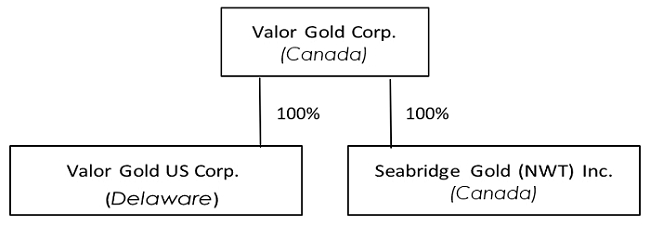
Following completion of the Arrangement, Valor will hold a 100% interest in the Courageous Lake Project indirectly through its ownership of SNWT.
G-1
DESCRIPTION OF THE BUSINESS OF VALOR
General
Following completion of the Arrangement, Valor will focus on advancing the Courageous Lake Project through exploration, engineering and permitting.
Valor is not currently a reporting issuer and the Valor Shares are not listed on any stock exchange. If the Arrangement is completed, Valor will be a reporting issuer in each of the provinces and territories in which Seabridge is a reporting issuer. Following completion of the Arrangement, Valor intends to apply to list its shares on the TSX and the OTCQB Venture Market (USA) and will consider seeking a NYSE listing at a later date. Any listing of the Valor Shares will be subject to meeting TSX initial listing requirements and there is no assurance such a listing will be obtained.
Other than as disclosed herein, Valor is not aware of any trends, uncertainties, demands, commitments or events which are reasonably likely to have a material effect on its business, financial condition, or results of operations as at the date of this Circular.
The mineral property interests and assets to be transferred from Seabridge to Valor pursuant to the Arrangement Agreement consist of the Courageous Lake Project, as described in the Technical Report. See below under “Description of the Courageous Lake Project”.
DESCRIPTION OF THE COURAGEOUS LAKE PROJECT
Upon completion of the Arrangement, the Courageous Lake Project will be Valor’s only material mineral property. The most recent technical report on the Courageous Lake Project is entitled “Courageous Lake Pre-feasibility Study and Preliminary Economic Assessment, NI 43-101 Technical Report, Yellowknife, Northwest Territories, Canada” dated March 23, 2026, with an effective date of January 5, 2024, prepared by Kevin Murray, P. Eng., Jonathan Cooper, P. Eng., Aleksandar Spasojevic, P. Eng. and Allan George Strandberg, P. Eng. of Ausenco Sustainability Canada ULC, Harold Rolf Schmitt, P. Geo. of ERM Consultants Canada Ltd., Sue Bird, P. Eng. and Jesse J. Aarsen, P. Eng. of Moose Mountain Technical Services Ltd., Walter Neil Brazier, P. Eng. of WN Brazier Associates Inc., Hassan Ghaffari, P. Eng. of Tetra Tech Canada Inc., Cameron Clayton, P. Eng., P. Geo. of Tetra Tech Canada Inc., and Sorensen Jensen, P. Eng. of SRK Consulting (Canada) Inc. (the “Technical Report”).
For a summary of the Courageous Lake Project, see Schedule “1” to this Appendix “G”, which should be read in conjunction with the complete Technical Report, which is available for review on the SEDAR+ website at www.sedarplus.ca under Seabridge’s profile.
AVAILABLE FUNDS AND PRINCIPAL PURPOSES
Seabridge plans to spin-out Valor with sufficient funds in its treasury for immediate needs and working capital. Valor may consider completing a financing to raise capital for 2026 and 2027 work programs at a later date.
G-2
Principal Purposes for Available Funds
Valor intends to use its available funds over the next 18 months as follows:
| Use of Proceeds | Available Funds |
| Phase 1 work program at Courageous Lake Project | $5,028,000 |
| Administrative expenses | $4,075,000 |
| Security Bond | $316,000 |
| To unallocated working capital | $581,000 |
| TOTAL | $10,000,000 |
The funds available for ongoing operations will be sufficient to meet Valor’s administration costs for the next 18 months. See “Administration Expenses”, below.
Valor intends to spend the available funds as set out above. There may be circumstances, however, where, for sound business reasons, a reallocation of funds may be necessary.
Administration Expenses
The following table discloses the estimated aggregate monthly and yearly administration costs that will be incurred by Valor:
| Type of Administrative Expense | Monthly Estimated Expenditure |
18-Month Estimated Expenditure |
| Executive Compensation / Salaries or Consulting Fees | $131,000 | $2,362,000 |
| Rent and Office | $17,000 | $311,000 |
| Admin and Accounting | $35,000 | $625,000 |
| Professional Fees(1) | $12,000 | $207,000 |
| Transfer Agent and Filing Fees | $7,000 | $135,000 |
| Investor Relations and Promotion | $24,000 | $435,000 |
| TOTAL | $226,000 | $4,075,000 |
Notes:
| (1) | Legal and tax fees. |
SELECTED CONSOLIDATED FINANCIAL INFORMATION
Financial Statements
Upon completion of the Arrangement, the Spin-out Assets, and in particular the Courageous Lake Project, will form the primary business of Valor. As a result, included as Appendix “H” and Appendix “J” to this Circular are the Carve-Out Financial Statements of Valor for the years ended December 31, 2024 and 2023 and the Condensed Interim Carve-Out Financial Statements of Valor for the three and nine months ended September 30, 2025, comprised of statements of financial position, loss and comprehensive loss, cash flows, changes in equity and notes thereon.
G-3
Selected Financial Statement Information
The following table sets out selected financial information with respect to the Spin-out Assets, as at and for the years ended December 31, 2024 and 2023, all of which is qualified and should be read in conjunction with the more detailed information contained in the Carve-Out Financial Statements of the Spin-Out Assets included as Appendix “H” to this Circular.
|
Nine Month 2025 (Unaudited) |
Year Ended December 31, 2024 C$ |
Year Ended December 31, 2023 C$ | |
| Gain (loss) and comprehensive gain (loss) | $35 | $(321) | $(3,519,884) |
| Current assets | $5,555 | $3,967 | $64,568 |
| Current liabilities | $25,155 | $12,482 | $211,126 |
| Total assets | $1,630,041 | $1,142,777 | $113,568 |
| Total liabilities | $25,155 | $12,482 | $211,126 |
| Total equity | $1,604,886 | $1,130,295 | $(97,558) |
DIVIDENDS AND OTHER DISTRIBUTIONS
Valor has not paid dividends since its incorporation. Valor currently intends to retain all available funds, if any, for use in its business and does not anticipate paying any dividends for the foreseeable future.
DISCLOSURE OF OUTSTANDING SECURITIES
The authorized capital of Valor consists of an unlimited number of common shares, of which 100 Valor Shares are currently outstanding and held by Seabridge.
Upon completion of the Arrangement, it is anticipated that there will be approximately 55,000,000 Valor Shares outstanding, all of which will be owned by Seabridge Shareholders (not including any Valor Shares attributable to Seabridge Shares held by Dissenting Shareholders who are ultimately to be paid fair value for their Dissenting Shares, which shares will be retained by Seabridge and dealt with as determined by the Board in its discretion pursuant to the Plan of Arrangement). No fractional Valor Shares will be distributed to Seabridge Shareholders and, as a result, all fractional amounts arising under the Arrangement shall be rounded down to the next whole number. Any Valor Shares not distributed as a result of such rounding down shall be retained by Seabridge.
G-4
As of the date hereof, Valor has not made a final determination as to the quantum of grants of awards to eligible persons of Valor in connection with the completion of the Arrangement, if any.
DESCRIPTION OF THE SECURITIES
Holders of Valor Shares are entitled to one vote per share at all meetings of Valor Shareholders, to receive dividends as and when declared by the directors and to receive a pro rata share of the assets of Valor available for distribution to shareholders in the event of liquidation, dissolution or winding-up of Valor. All rank pari passu, each with the other, as to all benefits which might accrue to the holders of Valor Shares.
CONSOLIDATED CAPITALIZATION
The following table and the notes thereto set forth the share and loan capital of Valor as at the dates specified therein:
| Designation of Security |
Authorized | Amount Outstanding as of the date hereof |
Amount
outstanding assuming completion of the Arrangement(1) |
| Valor Shares | Unlimited | 100 | 55,000,000 |
| RSUs(2) | “Rolling” 5%(3) | Nil | 120,000 |
| DSUs(2) | Nil | 48,000 |
Notes:
| (1) | Based on 107,373,183 Seabridge Shares issued and outstanding as at the date of this Circular, and assuming that no Seabridge Shares will be issued from treasury prior to the Effective Date. |
| (2) | To be granted pursuant to the proposed combined restricted share unit (“RSU”) and deferred share unit (“DSU”) plan of Valor (the “Valor Incentive Plan”). See “Valor Incentive Plan” below. |
| (3) | Under the Valor Incentive Plan, the maximum number of shares Valor is entitled to issue from treasury under the Valor Incentive Plan in settlement of vested awards of RSUs and DSUs, together with those Valor Shares reserved for issuance under any other established security based compensation arrangement of Valor, at any point in time, shall not exceed 5% of the total issued and outstanding shares of Valor at such point in time. |
The following table states the anticipated fully diluted share capital of Valor upon completion of the Arrangement:
| Description of Security | Number
of Securities(1) |
% of Total |
| Valor Shares issuable upon completion of the Arrangement | 55,000,000 | 99.70% |
G-5
| Description of Security | Number
of Securities(1) |
% of Total |
| Valor Shares reserved for issuance on exercise of RSUs | 120,000 | 0.22% |
| Valor Shares reserved for issuance on exercise of DSUs | 48,000 | 0.08% |
| TOTAL | 55,168,000 | 100% |
Notes:
| (1) | Based on 107,373,183 Seabridge Shares issued and outstanding as at the date of this Circular, and assuming that no Seabridge Shares will be issued from treasury prior to the Effective Date. |
VALOR INCENTIVE PLAN
In connection with the completion of the Arrangement, the board of directors of Valor propose to adopt the Valor Incentive Plan. The terms of the Valor Incentive Plan are substantially similar to those of Seabridge’s RSU and DSU plan, other than that the Valor Incentive Plan reserves a “rolling” 5% of Valor’s issued and outstanding shares from time to time for RSU and DSU grants, rather than a fixed number of shares. A summary of the Valor Incentive Plan is set out below under “Summary of the Valor Incentive Plan”.
Summary of the Valor Incentive Plan
The purpose of the Valor Incentive Plan is to advance Valor’s interests by (a) increasing the equity ownership of eligible participants in Valor; (b) aligning the interests of eligible participants with the interests of the shareholders of Valor, both short-term and long-term; (c) promoting longer term retention of eligible participants with Valor; and (d) providing eligible participants with additional incentive to achieve the goals of Valor.
Valor Incentive Plan
Under the terms of the Valor Incentive Plan, the Valor Board or, if authorized by the Valor Board, the Compensation Committee, may grant RSUs and DSUs (either, an “Award”) to eligible participants. Each RSU and each DSU represents the right to receive one common share for no additional consideration in accordance with the terms of the Valor Incentive Plan. An RSU will vest and convert into a common share based on the achievement of corporate objectives or after specified periods of time have elapsed as determined by the Valor Board at the time of grant. The expiry date of each (unvested) RSU granted under the Valor Incentive Plan will be determined by the Valor Board at its discretion at the time of each grant, but such expiry date shall not be later than:
| (a) | December 15 (or, if it is not a business day, the first business day before it) of the third calendar year following the year in which any services giving rise to the Award were rendered by a participant in respect of RSUs granted to participants that are not Non-Employee Contractors (as defined in the Valor Incentive Plan) of Valor and are not Special RSUs (as defined in the Valor Incentive Plan); or |
| (b) | December 15 (or, if it is not a business day, the first business day before it) of the fifth calendar year following the year in which any services giving rise to the Award were rendered by a participant in respect of RSUs granted to participants that are Non-Employee Contractors of Valor or in respect of Special RSUs, (which date is referred to herein as the “Latest RSU Expiry Date”). A DSU will vest and convert into a common share after a director ceases to be a director of Valor. |
G-6
On each vesting date, the Valor Board may decide, in its sole discretion, whether to make all payments in respect of vested RSUs to the RSU Participant in cash, common shares issued from treasury, or a combination thereof based on the fair market value of the common shares as at such date. For the purposes of the Valor Incentive Plan, the fair market value of a common share is the weighted average trading price of the common shares on the TSX for the 5 trading days immediately preceding the vesting date (and which, for greater certainty, may be less than the closing trading price of the common shares on the TSX on that date). In the absence of an express decision by the Valor Board, payments in respect of an Award of a Restricted Share Unit to a Participant shall be made in common shares issued from treasury. DSUs shall be settled through the issuance of common shares from treasury only.
Participation in the Valor Incentive Plan is voluntary and, if an eligible participant agrees to participate, a grant of RSUs or DSUs will be evidenced by an agreement or other electronic record between Valor and the participant. The interest of any participant in any RSU or DSU may not be transferred or assigned except by testamentary disposition or in accordance with the laws governing the devolution of property upon death.
A director, officer, employee or consultant of Valor who has been designated by Valor for participation in the Valor Incentive Plan and who agrees to participate in the Valor Incentive Plan is an eligible participant to receive RSUs under the Valor Incentive Plan. Under the Valor Incentive Plan, DSUs will only be issued to a person who is a director and who, at the relevant time, is not otherwise an officer or employee of Valor, and such person shall continue to be an eligible director for so long as such person continues to be a member of such boards of directors and is not otherwise an employee of Valor or of a designated affiliate of Valor (an “Eligible Director”). DSUs may be granted (i) at any time on a discretionary basis, or (ii) quarterly in lieu of a portion of the annual compensation payable to Eligible Directors, excluding amounts received as reimbursement for expenses incurred in attending meetings of the Valor Board.
If the vesting conditions are satisfied for an RSU during a blackout period, the vesting date for such RSU shall be deemed to be deferred thereafter for a period (the “Extension Period”) ending on the earlier of (i) one business day after the date the blackout period ends, and (ii) for a participant that is not a Non-Employee Contractor of Valor and only with respect to a RSU that is not a Special RSU, the Latest RSU Expiry Date; provided that if an additional blackout period is subsequently imposed by Seabridge during the Extension Period, then such Extension Period instead shall be deemed to end on the date which is the earlier of (i) one business day after the end of the last imposed blackout period, and (ii) for a participant that is not a Non-Employee Contractor of Valor and only with respect to a RSU that is not a Special RSU, the Latest RSU Expiry Date. If the expiry date of a RSU falls during an Extension Period, the expiry date shall be deemed to be postponed to the last day of the Extension Period. Notwithstanding the foregoing, the Valor Board may, at its sole discretion, elect not to extend the vesting date in respect of a RSU if the RSU will be settled wholly in cash during a blackout period.
If an RSU Participant ceases to be an eligible participant under the Valor Incentive Plan due to termination with cause or voluntary termination by the RSU Participant, all unvested RSUs previously credited to the participant’s account are terminated and forfeited as of the termination date. If an RSU Participant ceases to be an eligible participant under the Valor Incentive Plan due to termination without cause, total or permanent long-term disability or retirement, any unvested RSUs previously credited to the participant’s account will either be terminated and forfeited as of the termination date, continue to vest in accordance with their terms, or fully-vest at the discretion of the Valor Board. If an RSU Participant ceases to be an eligible participant under the Valor Incentive Plan due to death, any unvested RSUs previously credited to the participant’s account will fully-vest.
G-7
The interest of any participant in any RSU or DSU may not be transferred or assigned except by testamentary disposition or in accordance with the laws governing the devolution of property upon death.
In the event Valor pays a dividend on the Valor Shares subsequent to the granting of a RSU award, the number of RSUs relating to such award shall be increased to reflect the amount of the dividend.
Reservation of Shares Under Valor Incentive Plan and Plan Limits
The maximum number of common shares which may be issued under the Valor Incentive Plan together with all of Valor’s other security-based compensation arrangements at any point in time, shall not exceed 5% of the total issued and outstanding shares of Valor at such point in time.
Upon completion of the Arrangement, there will be 120,000 RSUs outstanding representing 0.22% of the outstanding shares of Valor, and 48,000 DSUs outstanding representing 0.08% of the outstanding shares of Valor, in each case calculated on a fully-diluted basis. Therefore, it is anticipated that there will remain an aggregate of 3,682,000 common shares available for issue under new grants of Awards upon completion of the Arrangement.
The Valor Incentive Plan, together with all other previously established or proposed share compensation arrangements of Valor, may not result in:
| (a) | the number of Valor’s shares (i) issued to insiders of Valor, within any one-year period, and (ii) issuable to insiders of Valor, at any time, exceeding 10% of Valor’s outstanding shares; |
| (b) | the issue to any one eligible participant or any associates of an eligible participant of Valor, within a one-year period of more than 5% of Valor’s outstanding shares; and |
| (c) | the value of DSUs granted to each non-executive director, together with the value of all other security-based compensation arrangements of Valor in which a non-executive director may participate, exceeding $150,000 in any one-year period, other than any DSUs or other securities granted to a non-employee director that is granted in lieu of any director cash fee. |
Amendment Provisions of the Valor Incentive Plan
Under the terms of the Valor Incentive Plan, the Valor Board may, from time to time:
| (a) | amend the Valor Incentive Plan or any Award, without obtaining approval of the shareholders of Valor, as the Valor Board in its discretion determines appropriate; or |
G-8
| (b) | suspend, terminate or discontinue the terms and conditions of the Valor Incentive Plan and the Awards granted under the Valor Incentive Plan, provided that: |
| (a) | no such amendment, modification, change, suspension or termination of the Valor Incentive Plan or any Awards granted thereunder may materially impair any rights of a Participant or materially increase any obligations of a Participant under the Plan without the consent of the Participant, unless the Board determines such adjustment is required or desirable in order to comply with any applicable securities laws or the requirements of the Exchange; |
| (b) | any such amendment, as may be applicable to a U.S. Taxpayer shall be subject to compliance with Section 409A of the Internal Revenue Code; and |
| (c) | any amendment shall be subject to the prior consent of any applicable regulatory bodies, including the TSX and the NYSE, as may be required. |
Any amendment to the Valor Incentive Plan described in subparagraphs (a)(ii) or (b) above, shall take effect only with respect to Awards granted after the effective date of such amendment, provided that it may apply to any outstanding Award with the mutual consent of Valor and the participants to whom such awards have been granted.
Any amendment to the Valor Incentive Plan other than as described above shall require the approval of the shareholders of Valor given by the affirmative vote of a majority of the common shares (or, where required, “disinterested” shareholder approval) represented at a meeting of the shareholders of Valor at which a motion to approve the Valor Incentive Plan or an amendment to the Valor Incentive Plan is presented. Specific amendments requiring shareholder approval include:
| (a) | to increase the number of Shares reserved under the Valor Incentive Plan; |
| (b) | to change the definition of eligible participants; |
| (c) | to extend the term of an RSU held by an insider or to amend or remove the limits on the number of Awards which may be granted to insiders under the Valor Incentive Plan; |
| (d) | to permit RSUs to be transferred otherwise than by testamentary disposition or in accordance with the laws governing the devolution of property in the event of death; |
| (e) | to permit awards other than RSUs and DSUs under the Valor Incentive Plan; |
| (f) | in respect of grants of DSUs, to permit the introduction or reintroduction of non-employee Directors on a discretionary basis or increase the non-employee Director participation limits; and |
| (g) | to amend the amendment provisions of the Valor Incentive Plan so as to increase the ability of the Valor Board to amend the Valor Incentive Plan without shareholder approval. |
A copy of the Valor Incentive Plan is attached hereto as Schedule “2” to this Appendix “G”.
G-9
PRIOR SALES
Other than the 100 Valor Shares held by Seabridge, no common shares of Valor were issued or sold in the 12-month period before the date of this Circular. The only securities of Valor which are anticipated to be issued prior to Valor’s listing on the TSX are the Valor Shares issuable under the Arrangement and the RSUs and DSUs issuable to certain directors and officers of Valor. See “Disclosure of Outstanding Securities – Consolidation Capitalization”.
ESCROWED SECURITIES AND SECURITIES SUBJECT TO RESTRICTION ON TRANSFER
An application has been made for the listing of the Valor Shares on the TSX. There can be no guarantee that the Valor Shares will be listed on any stock exchange. To the best knowledge of the directors and officers of the Company and Valor, upon completion of the Arrangement, none of the securities of Valor are expected to be subject to escrow or subject to a contractual restriction on transfer.
There is currently no market through which the Valor Shares may be sold and, unless the Valor Shares are listed on a stock exchange and a sufficient trading market for the Valor Shares develops, shareholders may not be able to resell the Valor Shares. There is no assurance that the Valor Shares will be listed on a stock exchange or that such a trading market will develop.
PRINCIPAL SECURITYHOLDERS
To the knowledge of the directors and senior officers of Valor, no person, upon completion of the Arrangement, will beneficially own, directly or indirectly, or exercise control or direction over, shares carrying more than 10% of voting rights attached to each class of the then outstanding voting securities of Valor except as set out below, which assumes that 55,000,000 Valor Shares will be outstanding upon completion of the Arrangement (see “Consolidated Capitalization” above).
Pan Atlantic Holdings Ltd. owns 10,673,611 Seabridge Shares representing 9.94% of the outstanding Seabridge Shares, and FCMI Parent Co., which owns all of the shares of Pan Atlantic Holdings Ltd., owns 4,972,625 Seabridge Shares, representing 4.63% of the outstanding Seabridge Shares. In addition, principals of the Friedberg Mercantile Group Ltd. and their foundations own 588,624 Seabridge Shares, representing 0.55% of the Seabridge Shares. Pan Atlantic Holdings Ltd. is ultimately beneficially owned and controlled by Albert D. Friedberg and members of his immediate family. Albert D. Friedberg is the President and a director of Friedberg Mercantile Group Ltd. Accordingly, it is anticipated that Pan Atlantic Holdings Ltd., FCMI Parent Co. and principals of the Friedberg Mercantile Group Ltd. will hold the same percentages of Valor Shares upon completion of the Arrangement.
DIRECTORS AND OFFICERS
Upon completion of the Arrangement, the Valor Board will consist of Mark Ashley, Alan Edwards (Chairman), Julie Rachynski, Elizabeth Miller, Robert Gerard Parkinson, and John Seaberg. As of the date of this Circular, no final determination has been made as to the appointment of any additional directors.
G-10
The current known officers of Valor will be Mark J. Ashley (CEO and Director), Steven Cresswell (CFO and Corporate Secretary) and Marcus Adam (Vice-President, Exploration).
The full board of directors and officers of Valor will be appointed prior to listing on the TSX. The directors of Valor are elected at each annual general meeting and hold office until the next annual general meeting or until their successors are appointed.
The names, province or state and country of residence, positions and offices, and principal occupations of each of the currently known directors and executive officers of Valor are as follows:
| Name, Position and Municipality of Residence |
Principal
Occupation for the Past Five Years(1) |
Education | Valor
Shares Owned, or Controlled or Directed, Directly or Indirectly, Upon Completion of the Arrangement(1)(2) |
Percentage
(2)(3) |
|
Mark J. Ashley,
Woodland Hills, |
Independent mining executive | FCMA | Nil | Nil% |
|
Alan Edwards
Tucson, AZ, USA |
President of AE Resources Corp. Chairman and Director of Entrée Resources Ltd. since 2011. Director of Arizona Sonoran Copper Company since May 2021 | MBA |
3,074 Valor Shares |
0.01% |
|
Julie Rachynski,
Kelowna, BC |
Vice President, Human Resources of Seabridge since September 2021 | BBA |
6,126 Valor Shares |
0.01% |
|
Elizabeth Miller,
Smithers, BC |
Vice President, Environment and Social Responsibility of Seabridge since January 2020 | MSc |
18,015 Valor Shares |
0.03% |
G-11
| Name, Position and Municipality of Residence |
Principal
Occupation for the Past Five Years(1) |
Education | Valor
Shares Owned, or Controlled or Directed, Directly or Indirectly, Upon Completion of the Arrangement(1)(2) |
Percentage (2)(3) |
|
Robert Parkinson,
Perth, Australia |
Geologist and business development professional | BSc (Honours) | Nil | Nil% |
|
John Seaberg,
Denver, CO, USA |
CFO of Blossom Gold, Inc. since March 2026. CEO of NV Gold Corp. from February 2022 to December 2023. CFO of Condor Gold PLC from February 2021 to January 2022. Advisor, M&A to Saudi Arabian Mining Company (Ma’aden) from March 2024 to March 2026. SVP and CFO of Calibre Mining Corporation from October 2019 to October 2021. |
MBA | Nil | Nil% |
|
Steven Cresswell,
Pickering, ON |
Vice President, Finance of Battery Mineral Resources Corp. from July 2024 to October 2025 | BAccS | Nil | Nil% |
|
Marcus Adam, Vice President,
Squamish, BC |
Director of Exploration Management of Seabridge since January 2023 | MBA/MSc |
4,475 Valor Shares |
0.01% |
Notes:
| (1) | The information as to principal occupation and number of common shares of Valor anticipated to be beneficially owned or controlled, not being within the knowledge of Valor, has been furnished by the respective nominees themselves. Unless otherwise indicated, such shares are held directly. |
| (2) | Assumes that the shareholding of each individual in Seabridge as at the date of this Circular will not change prior to completion of the Arrangement. |
G-12
| (3) | Calculated on an undiluted basis assuming 55,000,000 Valor Shares will be outstanding upon completion of the Arrangement (see “Consolidated Capitalization” above) and assuming no Seabridge Shares are issued from treasury prior to the Effective Date. |
| (4) | Member of the Audit Committee. |
| (5) | Member of the Compensation Committee. |
Based on the assumptions set out above, it is expected the currently known directors and executive officers as a group, will upon completion of the Arrangement beneficially own, directly or indirectly, or exercise control or direction over an aggregate of approximately 31,690 Valor Shares representing approximately 0.06% of the issued Valor Shares.
Each of the executive officers of Valor expects to work full time for Valor. None of the non-executive directors will work full time for Valor. Alan Edwards (Valor Board Chair), John Seaberg (Audit Committee Chair) and Julie Rachynski (Compensation Committee Chair) each intend to devote approximately 10% of their professional time to the affairs of Valor. Robert Parkinson and Elizabeth Miller each expect to devote approximately 5% of their professional time to the affairs of Valor.
The following is a brief description of the experience of the currently known directors and officers:
Mark J. Ashley, CEO and Director
Mark J. Ashley is a mining executive with over 40 years of international experience in corporate leadership, finance, and strategic development within the natural resources sector. He has served as CEO, CFO, and director of several publicly listed companies, leading corporate turnarounds, capital raises, and more than 20 mergers and acquisitions across global markets. Mr. Ashley previously held senior leadership roles with numerous mining entities including LionOre Mining International, Apex Minerals, Normandy Mining and has advised numerous mining companies on corporate strategy and transactions. He is a Fellow Chartered Management Accountant (FCMA) and brings extensive experience in corporate governance, capital markets, and international mining development.
Alan Edwards, Chairman and Director
Alan Edwards is a highly experienced mining engineer with more than 40 years in the global mining industry, spanning project development, operations, and executive leadership. He has held senior technical and operational roles with major mining companies including Freeport-McMoRan, Phelps Dodge Corporation, Kinross Gold Corporation, and Cyprus Amax Minerals Company, with involvement in world-class operations such as the Grasberg Mine. His experience spans both open pit and underground mining across gold and base metal assets, with a strong track record in advancing projects from feasibility through to construction and production.
Mr. Edwards has also served at the board level, including as Chairman of listed mining companies such as Entrée Resources Ltd., Mason Resources Corp., AQM Copper Inc., and AuRico Gold Corp. providing governance oversight and strategic direction. He is recognized for his practical operating expertise, disciplined approach to risk management, and ability to guide complex mining projects through critical development stages.
G-13
Julie Rachynski, Director and Chair of the Compensation Committee
Julie Rachynski has over 25 years of experience providing corporate governance and strategic advisory support to natural resource companies. She brings deep expertise in human-capital strategy, executive compensation, succession planning, and organizational readiness, with relevance to early-stage and pre-development mining companies. Ms. Rachynski has advised boards and management teams through corporate restructurings, asset transitions, and organizational buildouts at Weyerhaeuser Canada, Domtar, New Gold, and Seabridge. She holds a Bachelor of Business Administration, is a Chartered Professional in Human Resources, and holds the ICD.D designation. Ms. Rachynski is currently Vice President, Human Resources for Seabridge.
Elizabeth Miller, Director
Elizabeth Miller is an environmental and social responsibility executive with more than 25 years of experience in environmental management, permitting, and Indigenous relations for major resource projects in Canada. She is Vice President, Environment and Social Responsibility at Seabridge, where she leads environmental strategy and stakeholder engagement for the KSM, 3 Aces, and Iskut projects. Ms. Miller played a key role in the federal and provincial environmental assessment approvals for the KSM Project and has extensive experience working with Indigenous governments and regulatory authorities. She holds an M.Sc. in Biological Sciences, a B.Sc. in Wildlife Biology, and is a Registered Professional Biologist in British Columbia. Originally from Newfoundland and a member of the Qalipu Mi’kmaq First Nation, she grew up in the Northwest Territories and currently resides in Smithers, British Columbia.
Robert Parkinson, Director
Robert Parkinson is a geologist and business development professional with four decades of experience in the minerals industry. During that time, he held a variety of senior technical and leadership positions with successful mining houses including CRA/Rio Tinto, Newcrest Mining, Gold Fields and Fortescue. He has broad expertise across the commodity spectrum including gold, base metals and various specialty minerals. His experience covers the mining lifecycle from exploration through studies and development, to active mining operations. He has a particular interest in techno-economic evaluations of mineral projects as potential acquisition and development opportunities and has undertaken assessments throughout the Australasian region, North and South America, Europe and Africa. Robert holds a Bachelor of Science (Honours) from the University of Western Australia, a Postgraduate Diploma in Applied Finance and Investment and a Diploma of Management.
John Seaberg, Director and Chair of the Audit Committee
John Seaberg is a mining executive with more than 25 years of experience in finance, corporate development, and executive leadership within the precious metals sector. He currently serves as Chief Financial Officer of Blossom Gold, Inc. Prior to this appointment he was Advisor, M&A to Saudi Arabian Mining Company (Ma’aden), where he provided strategic guidance on global acquisitions, valuation, and due diligence. Mr. Seaberg has previously served as CEO of NV Gold Corporation, CFO of Condor Gold PLC, SVP and CFO of Calibre Mining Corporation, and Executive Chairperson of Paramount Gold Nevada Corporation. Earlier in his career he held senior roles with Newmont Mining Corporation. He holds an MBA from the University of Denver and a BSBA from Colorado State University.
G-14
Steven Cresswell, CFO and Corporate Secretary
Steven Cresswell is a senior finance executive with more than 25 years of experience in financial leadership, corporate governance, and operational management across the mining and natural resources sectors. He currently serves as a financial consultant to Battery Mineral Resources Corp. and previously held the role of Vice President of Finance, where he oversaw financial reporting, corporate modelling, internal controls, and strategic financing initiatives. Mr. Cresswell has also served as CFO or senior finance executive for several mining and resource companies, including First Nickel Inc. and Tiberon Minerals. He holds a Bachelor of Accounting Science from the University of Calgary and is a Chartered Professional Accountant (CPA).
Marcus Adam, Vice-President Exploration
Marcus Adam is an exploration geologist and mining executive with approximately 15 years of experience leading large-scale mineral exploration programs. As Vice President, Exploration of Valor Gold, he will be responsible for the strategic direction, design, and evaluation of Valor’s exploration activities, including resource growth and technical de-risking. Mr. Adam currently serves as Director, Exploration at Seabridge and completed MSc. research on the Courageous Lake deposit. His experience spans early-stage targeting through resource delineation including the discovery of the Deep Kerr and Lower Iron Cap zones at KSM and leading the discovery of Snip North deposit at Iskut. He holds an MBA (Leadership), an MSc., and a BSc., and is a Qualified Person and Professional Geoscientist.
Reporting Issuer Experience
The following table sets out the experience of each proposed director and executive officer of Valor as a director or officer of reporting issuers in the five years preceding the date of this Circular:
| Name of Director or Executive Officer |
Name of Other Reporting Issuer |
Name of Trading Market |
Position |
From |
To |
| Mark J. Ashley, CEO and Director | N/A | N/A | N/A | N/A | N/A |
| Alan Edwards, Chairman and Director | Arizona Sonoran Copper Company Inc. | TSX | Director | May 2021 | Present |
| Entrée Resources Ltd. | TSX | Chairman and Director | March 2011 | Present | |
| Americas Gold and Silver Corporation | TSX, NYSE | Director | December 2014 | December 2024 |
G-15
| Name of Director or Executive Officer |
Name of Other Reporting Issuer |
Name of Trading Market |
Position |
From |
To |
| Elevation Gold Mining Corporation | TSXV | Director | July 2023 | December 2024 | |
| Orvana Minerals Corp. | TSX | Director | May 2016 | February 2023 | |
| Julie Rachynski, Director | Seabridge Gold Inc. | TSX, NYSE | Vice President, Human Resources | September 2021 | Present |
| Elizabeth Miller, Director | Seabridge Gold Inc. | TSX, NYSE | Vice President, Environment and Social Responsibility | January 2020 | Present |
| Robert Parkinson, Director | N/A | N/A | N/A | N/A | N/A |
| John Seaberg, Director | NV Gold Corp. | TSXV | CEO | February 2022 | December 2023 |
| Condor Gold PLC | TSX | CFO | February 2021 | January 2022 | |
| Steven Cresswell, CFO and Corporate Secretary | Battery Mineral Resources Corp. | TSXV | Vice President, Finance | July 2024 | October 2025 |
| Marcus Adam, Vice President, Exploration | N/A | N/A | N/A | N/A | N/A |
Corporate Cease Trade Orders, Bankruptcies, Penalties or Sanctions or Individual Bankruptcies
Except as described below, none of the currently known directors or executive officers of Valor:
| (a) | is, as at the date of this Circular, or has been, within ten years before the date of this Circular, a director, CEO or CFO of any company (including Valor) that: |
| (i) | was the subject, while the director or executive officer was acting in that capacity as a director, CEO or CFO of such company, of a cease trade or similar order or an order that denied the relevant company access to any exemption under securities legislation, that was in effect for a period of more than 30 consecutive days (an “order”); or |
G-16
| (ii) | was subject to an order that was issued after the director or executive officer ceased to be a director, CEO or CFO but which resulted from an event that occurred while the proposed director was acting in the capacity as director, CEO or CFO of such company; or |
| (b) | is, as at the date of this Circular, or has been within 10 years before the date of this Circular, a director or executive officer of any company (including Valor) that, while that person was acting in that capacity, or within a year of that person ceasing to act in that capacity, became bankrupt, made a proposal under any legislation relating to bankruptcy or insolvency or was subject to or instituted any proceedings, arrangement or compromise with creditors or had a receiver, receiver manager or trustee appointed to hold its assets; or |
| (c) | has, within the ten years before the date of this Circular, become bankrupt, made a proposal under any legislation relating to bankruptcy or insolvency, or become subject to or instituted any proceedings, arrangement or compromise with creditors, or had a receiver, receiver manager or trustee appointed to hold the assets of the proposed director; or |
| (d) | has been subject to any penalties or sanctions imposed by a court relating to securities legislation or by a securities regulatory authority or has entered into a settlement agreement with a securities regulatory authority; or |
| (e) | has been subject to any penalties or sanctions imposed by a court or regulatory body that would likely be considered important to a reasonable investor in making an investment decision. |
Alan Edwards, a proposed director of Valor, was Chairman of the Board of Oracle Mining Corp. (“Oracle”) until his resignation effective February 15, 2015. On December 23, 2015, Oracle announced that the Superior Court of Arizona had granted the application of Oracle’s lender to appoint a receiver and manager over the assets, undertaking and property of Oracle Ridge Mining LLC.
Alan Edwards was a director of Elevation Gold Mining Corporation (“Elevation”) until his resignation effective December 31, 2024. On August 1, 2024, Elevation announced the Supreme Court of British Columbia had issued an order granting Elevation protection under the Companies Creditors Arrangement Act (Canada) (the “CCAA Proceeding”) and appointing KSV Restructuring Inc. as monitor. The British Columbia Securities Commission issued a cease trade order against Elevation effective September 5, 2024. On September 16, 2024, the United States Bankruptcy Court for the District of Arizona (the “US Court”) recognized the CCAA Proceeding as a foreign main proceeding under Chapter 15 of Title 11 of the United States Code. On December 2, 2024, Elevation entered into an arm’s length agreement in respect of the purchase and sale of certain of its assets, which transaction was subsequently approved by the Supreme Court of British Columbia, the US Court and the TSX Venture Exchange. Effective December 31, 2024, Elevation ceased to have an operating business of material assets, and all directors and officers resigned from their positions.
G-17
EXECUTIVE COMPENSATION
As of the date of this Circular, Valor has not awarded nor paid, and no Named Executive Officer (“NEO”) of Valor has earned or received, compensation of any kind. Valor’s NEOs have not received any benefits or perquisites. Upon completion of the Arrangement, Valor’s NEOs are anticipated to be: Mark Ashley, CEO and Director; Steven Cresswell, CFO and Corporate Secretary; and Marcus Adam, Vice President, Exploration.
Effective upon completion of the Arrangement, each of the NEOs of Valor will be entitled to receive a base annual salary and a grant of RSUs under the Valor Incentive Plan for their services in their capacity as executive officers of Valor. Each executive officer of Valor will enter into an employment agreement or a consulting agreement, as applicable, with Valor, which will be subject to completion of the Arrangement. See below under the heading “Employment Agreements”.
Upon becoming a reporting issuer, Valor expects to provide a market-based blend of base salaries, bonuses and equity incentive components under the Valor Incentive Plan to further align the interests of management with the interests of Valor’s shareholders. It is expected that Valor executive compensation will be made up of 3 elements: (1) base salary, (2) a short-term incentive (“STI”) bonus in cash; and (3) a long-term incentive (“LTI”) award in RSUs. Payment of STI bonuses in cash is consistent with comparator companies. The payment of LTI compensation in RSUs is to promote executive share ownership and motivate executives to act in ways that build shareholder value. The process is described in greater detail under the heading “Corporate Governance Disclosure – Compensation Committee”.
Valor Incentive Plan
The Valor Board will adopt the Valor Incentive Plan prior to or in connection with the completion of the Arrangement.
Upon completion of the Arrangement, it is anticipated that an aggregate of 2,750,000 Valor Shares will be reserved for issuance under the Valor Incentive Plan. The maximum number of common shares which may be issued under the Valor Incentive Plan together with all of Valor’s other security-based compensation arrangements at any point in time, shall not exceed 5% of the total issued and outstanding shares of Valor at such point in time. It is anticipated that upon completion of the Arrangement, there will be 120,000 RSUs issued and outstanding representing 0.22% of Valor’s issued and outstanding shares and 48,000 DSUs issued and outstanding representing 0.08% of Valor’s issued and outstanding shares.
A summary of the material terms of the Valor Incentive Plan can be found in this Appendix “G” under the main heading “Valor Incentive Plan”, above.
Option-Based Awards Grants
Valor does not currently have a stock option plan, nor any plans to implement such a plan following completion of the Arrangement.
Benefit Plans
Valor currently has no defined benefit or actuarial plans or pension plans or current intentions to adopt such plans. or employment contracts.
G-18
Employment Agreements
Valor does not have any contracts, agreements, plans or arrangements that provide for payments to a NEO following or in connection with any termination (whether voluntary, involuntary or constructive), resignation, retirement, a change of control of Valor or its subsidiaries, or a change in responsibilities of the NEO following a change in control, other than as set out below.
CEO Agreement
Valor has entered into an executive employment agreement, to be effective as of the completion of the Arrangement, with Mark Ashley to provide CEO services to Valor (the “CEO Agreement”). Pursuant to the CEO Agreement, Mr. Ashley will be employed as CEO in consideration for a base salary of US$420,000 and an initial grant of 75,000 RSUs vesting as follows: (i) 1/3rd shall vest upon the later of 6 months from the completion of the Arrangement or when Valor is quoted on the OTCQB; (ii) 1/3rd shall vest upon completion of an initial drill program at Courageous Lake; and (iii) 1/3rd shall vest upon a new NI 43-101 technical report being announced by Valor. The CEO will also be eligible to receive short-term incentive and performance bonuses at the discretion of the board of directors.
The CEO Agreement provides for a severance payment upon termination of the CEO’s employment by Valor without cause or by the CEO with cause equal to 12 months’ salary and the annual target bonus for the CEO. Additionally, if the CEO Agreement is terminated by Valor within 3 months prior to or 12 months after a Change of Control (as defined below), the CEO shall be entitled to a payment equal to 6 months’ salary and 50% of the annual target bonus for the CEO.
“Change of Control” means any of: (1) any merger or amalgamation in which voting securities of Valor possessing more than fifty percent (50%) of the total combined voting power of Valor’s outstanding securities are transferred to a person or persons different from the persons holding those securities immediately prior to such transaction and the composition of the directors following such transaction is such that the directors of Valor prior to the transaction constitute less than fifty percent (50%) of the number of directors comprising the board of directors following the transaction; (2) any acquisition, directly or indirectly, by a person or group of persons of beneficial ownership of voting securities of Valor which, when added to the voting securities of Valor owned by such person or persons before the acquisition, aggregate more than fifty percent (50%) of the total combined voting power of Valor’s outstanding securities; (3) any acquisition, directly or indirectly, by a person or group of persons of the right to appoint a majority of the directors of Valor or otherwise directly or indirectly control the management, affairs and business of Valor; (4) the removal, by extraordinary resolution of the shareholders of Valor, of more than 50% of the then incumbent board of directors, or the election or appointment of a majority of directors to Valor’s board of directors who were not members or nominees of Valor’s incumbent board of directors at the time immediately preceding such election or appointment; (5) a liquidation or dissolution of Valor; or (6) any transaction or series of transaction involving Valor or any of its affiliates that the board of directors in its discretion deems to be a Change of Control; provided however, that a Change of Control shall not be deemed to have occurred if such Change of Control results solely from the issuance, in connection with a bona fide financing or series of financings by Valor, of voting securities of Valor or any rights to acquire voting securities of Valor which are convertible into voting securities.
G-19
CFO Agreement
Valor has entered into an executive employment agreement, to be effective as of the completion of the Arrangement, with Steven Creswell to provide CFO and Corporate Secretary services to Valor (the “CFO Agreement”). Pursuant to the CFO Agreement, Mr. Cresswell will be employed as CFO and Corporate Secretary in consideration for a base salary of $250,000 and an initial grant of 21,000 RSUs vesting as follows: (i) 1/3rd shall vest upon the later of 6 months from the completion of the Arrangement or when Valor is quoted on the OTCQB; (ii) 1/3rd shall vest upon completion of an initial drill program at Courageous Lake; and (iii) 1/3rd shall vest upon a new NI 43-101 technical report being announced by Valor. The CFO will also be eligible to receive short-term incentive and performance bonuses at the discretion of the board of directors.
The CFO Agreement provides for a severance payment upon termination of the CFO’s employment by Valor without cause or by the CFO with cause equal to 12 months’ salary and the annual target bonus for the CFO. Additionally, if the CFO Agreement is terminated by Valor within 3 months prior to or 12 months after a Change of Control, the CFO shall be entitled to a payment equal to 6 months’ salary and 50% of the annual target bonus for the CFO.
Vice President, Exploration Agreement
Valor has entered into an executive employment agreement, to be effective as of the completion of the Arrangement, with Marcus Adam to act as the Vice President, Exploration for Valor (the “VP Agreement”). Pursuant to the VP Agreement, Mr. Adam will be employed as VP Exploration in consideration for a base salary of $270,000 and an initial grant of 24,000 RSUs vesting as follows: (i) 1/3rd shall vest upon the later of 6 months from the completion of the Arrangement or when Valor is quoted on the OTCQB; (ii) 1/3rd shall vest upon completion of an initial drill program at Courageous Lake; and (iii) 1/3rd shall vest upon a new NI 43-101 technical report being announced by Valor. The VP will also be eligible to receive short-term incentive and performance bonuses at the discretion of the board of directors.
The VP Agreement provides for a severance payment upon termination of the VP’s employment by Valor without cause or by the VP with cause equal to 12 months’ salary and the annual target bonus for the VP. Additionally, if the VP Agreement is terminated by Valor within 3 months prior to or 12 months after a Change of Control, the VP shall be entitled to a payment equal to 6 months’ salary and 50% of the annual target bonus for the VP.
Compensation of Directors
Effective upon completion of the Arrangement, each of the directors of Valor will be entitled to receive a base annual salary and a grant of DSUs under the Valor Incentive Plan for their services as directors, including committee participation and involvement in special assignments. Each director of Valor may enter into a consulting agreement or other service agreement, as applicable, with Valor, which will be subject to completion of the Arrangement.
INDEBTEDNESS OF DIRECTORS, EXECUTIVE OFFICERS AND SENIOR OFFICERS
Since its incorporation and as of the date of this Circular, no director, officer or employee, or former director, officer or employee, of Valor, or any associate or affiliate of any such director, officer or employee, has been indebted to Valor, and Valor has not provided any guarantee, support agreement, letter of credit or other similar arrangement or understanding.
G-20
AUDIT COMMITTEE
Upon completion of the Arrangement, the Audit Committee will consist of three independent and financially literate directors. Members will be appointed annually by the Valor Board following Valor’s annual general meeting, or at such other times as the Valor Board may determine, and one member will be designated as the Audit Committee Chair. The Audit Committee will meet at least quarterly and report regularly to the Valor Board on its activities. It has the authority to retain its own advisors.
The Audit Committee is responsible for overseeing Valor’s accounting and financial reporting processes. It has general responsibility for oversight of internal controls, risk management, complaints handling and information systems of Valor. The Audit Committee’s duties and responsibilities include:
| ● | with respect to financial accounting and reporting processes; |
| ○ | to review with independent auditors, prior to making a recommendation to the Valor Board, annual and interim financial statements, including notes thereto, management’s discussion and analysis (“MD&A”) relating to such financial statements, any associated expert report or opinion and all securities offering documents, |
| ○ | to ensure the adequacy of procedures to review Valor’s public disclosure, |
| ○ | to review significant estimates and judgements made by management in the preparation of financial statements and their appropriateness, |
| ○ | to review Valor’s regulatory filings as they relate to financial statements and MD&A, |
| ● | with respect to internal controls, risk management, cybersecurity, complaints handling and information systems; |
| ○ | to satisfy itself that the design, implementation and maintenance of Valor’s internal controls is effective, |
| ○ | to review the appropriateness, effectiveness and compliance of Valor’s policies and business practices which impact on the financial integrity of Valor’s reporting and disclosure, |
| ○ | to receive regular reports from management on the risks faced by Valor and the status of measures to mitigate them, |
| ○ | to review with management, at least annually, privacy and cybersecurity risk exposure and policies, procedures and mitigation plans in place to safeguard Valor’s information systems and data, |
| ○ | to review and ensure Valor has procedures for the receipt, retention, and treatment of complaints regarding accounting, internal controls or auditing matters and for the confidential, anonymous submission of concerns regarding questionable accounting or audit matters, |
G-21
| ● | with respect to the independent auditors; |
| ○ | to evaluate their performance, |
| ○ | to review their terms of engagement and proposed fee, |
| ○ | to review a formal plan for the annual audit with them and management, |
| ○ | to monitor relationships, if any, between them and Valor to assess their independence, |
| ○ | to review and pre-approve all audit and audit-related, and any non-audit, services and fees and other compensation relating to them, and |
| ○ | to implement structures and procedures for regular meetings with them without management. |
Audit Committee Charter
Valor will form an Audit Committee in connection with the closing of the Arrangement. Concurrently with the formation of its Audit Committee, Valor intends to adopt an Audit Committee Charter in the form attached as Schedule “3” to this Appendix “G”.
Composition of the Audit Committee
As of the date of this Circular, Valor’s Audit Committee is anticipated to consist of John Seaberg (Audit Committee Chair), Robert Parkinson and Alan Edwards, each of which is independent and financially literate, as those terms are defined in National Instrument 52-110 Audit Committees (“NI 52-110”).
Relevant Education and Experience
A description of the education and experience of each anticipated Audit Committee member that is relevant to the performance of his or her responsibilities as an Audit Committee member is set out below.
John Seaberg (Chair)
John Seaberg is a mining executive with more than 25 years of experience in finance, corporate development, and executive leadership within the precious metals sector. He currently serves as Chief Financial Officer of Blossom Gold, Inc. Prior to this appointment he was Advisor, M&A to Saudi Arabian Mining Company (Ma’aden), where he provided strategic guidance on global acquisitions, valuation, and due diligence. Mr. Seaberg has previously served as CEO of NV Gold Corporation, CFO of Condor Gold PLC, SVP and CFO of Calibre Mining Corporation, and Executive Chairperson of Paramount Gold Nevada Corporation. Earlier in his career he held senior roles with Newmont Mining Corporation. He holds an MBA from the University of Denver and a BSBA from Colorado State University.
Robert Parkinson
Robert Parkinson is a geologist and business development professional with four decades of experience in the minerals industry. During that time, he held a variety of senior technical and leadership positions with successful mining houses including CRA/Rio Tinto, Newcrest Mining, Gold Fields and Fortescue. He has broad expertise across the commodity spectrum including gold, base metals and various specialty minerals. His experience covers the mining lifecycle from exploration through studies and development, to active mining operations. He has a particular interest in techno-economic evaluations of mineral projects as potential acquisition and development opportunities and has undertaken assessments throughout the Australasian region, North and South America, Europe and Africa. Robert holds a Bachelor of Science (Honours) from the University of Western Australia, a Postgraduate Diploma in Applied Finance and Investment and a Diploma of Management.
G-22
Alan Edwards
Alan Edwards is a highly experienced mining engineer with more than 40 years in the global mining industry. Mr. Edwards has served at the board level, including as Chairman of listed mining companies such as Entrée Resources Ltd., Mason Resources Corp., AQM Copper Inc., and AuRico Gold Corp. providing governance oversight and strategic direction. He is recognized for his practical operating expertise, disciplined approach to risk management, and ability to guide complex mining projects through critical development stages.
External Auditor Services Fees (by Category)
The aggregate fees billed by Valor’s external auditors in the following categories for the 12 months ended December 31, 2024 and 2023 are as follows:
|
Year Ended
C$(1) |
Year Ended
C$(1) | |
| Audit Fees | $Nil | $Nil |
| Audit Related Fees | $Nil | $Nil |
| Tax Fees | $Nil | $Nil |
| All Other Fees | $Nil | $Nil |
| Total | $Nil | $Nil |
Notes:
| (1) | Audit fees for the Carve-Out Financial Statements of Valor for the years ended December 31, 2024 and 2023 were completed in 2026. As of the date of this Circular, Valor has accrued audit fees of $51,360. |
Pre-Approval of Audit and Non-Audit Services Provided by Independent Auditors
Pursuant to its responsibilities under Valor’s Audit Committee Charter, Valor’s Audit Committee has developed a practice under which audit and review services, specified audit-related services, certain permitted non-audit services and tax-related non-audit services are presented to the Audit Committee for pre-approval on an annual basis. Following the annual pre-approval, the CFO of Valor will oversee statutory audits and reviews and additional audit-related services and specified non-audit services, provided that the estimated fees for such services do not exceed specified dollar limits. Additional specified non-audit services that exceed the dollar limits and all additional non-audit services, including tax-related non-audit services, require the pre-approval of the Audit Committee.
G-23
CORPORATE GOVERNANCE DISCLOSURE
The Valor Board is committed to instituting and maintaining robust governance practices, which are essential to the success of Valor and to the continuing support of its stakeholders. Valor is also required by regulators to report annually on specific elements of its corporate governance practices.
Board of Directors
Independence of Members of Board
The Valor Board following completion of the Arrangement is anticipated to consist of six directors, five of whom Valor has determined to be independent. A director who is independent of management is free from any interest or any business or any other relationship which could, or could reasonably be perceived to, materially interfere with the director’s ability to act in the best interest of Valor, other than interests arising from shareholdings.
Mark Ashley is not considered independent due to his role as CEO of Valor.
Meetings of Independent Directors
The Valor Board will follow a practice of holding an in-camera session at the end of every board meeting at which only independent directors are present. This practice will provide an opportunity for open and candid discussion amongst all independent directors and facilitates the exercise of their independent judgment. The Valor Board will have a mandate to meet formally at least once a year without non-independent directors or management to review governance matters for Valor. The Valor Board will endeavour to ensure that independent directors have the information and resources required to meet their responsibilities and to provide a mechanism for informed direction from independent directors and collaborative oversight of management.
Independence of Chair
Valor’s Chair, Alan Edwards, will be independent. Following completion of the Arrangement, Valor Board processes will be managed to ensure that committees are given the resources to arrive at independent conclusions. The Valor Board will also consider the relationship of the independent directors to management and whether or not, in their view: (i) they have provided sufficient direction to management, and (ii) this direction has been followed appropriately. The board’s composition will support the independent work of the Valor Board’s committees by ensuring that committees consist of directors with experience in the disciplines required for the performance of their mandates and such directors have open access to information from management. There will be one key committee in this respect: the Audit Committee, which will oversee Valor’s financial reporting processes and has general responsibility for oversight of Valor’s internal controls, risk management, complaints handling and information systems of Valor.
Other Directorships
Certain directors of Valor are also directors of other public companies as of the date of this Circular. See above under the heading “Directors and Officers – Reporting Issuer Experience”.
G-24
Attendance
Following completion of the Arrangement, Valor will track the attendance record of each director for all board meetings. When appropriate, directors may be excluded from portions of some meetings to facilitate discussions among independent or non-conflicted directors.
Board Mandate
Valor’s formally approved board mandate (the “Board Mandate”) provides that the Valor Board is responsible for the overall stewardship of its business. The Valor board’s fundamental objectives are to enhance and preserve long-term shareholder value, and to ensure Valor meets its obligations on an ongoing basis and operates in a reliable and safe manner. In performing its functions, the Valor Board should also specifically consider the legitimate interests that its other stakeholders may have. The Valor board manages its own affairs, including selecting its Chair, nominating candidates for election to the board and constituting committees to provide it advice and exercise delegated powers, duties and responsibilities. The board’s principal duties and responsibilities include:
| (a) | managing, or supervising management of, the business and affairs of Valor, acting in accordance with its statutory duties, and complying with the laws, regulations, by-laws applicable to Valor; |
| (b) | ensuring that appropriate structures and procedures are in place to permit the Board to function independently of management; |
| (c) | to participate with management in developing corporate objectives, goals and strategic plans with a view to enhancing shareholder value and promoting a responsible presence within the communities Valor serves; |
| (d) | to identify and understand the principal risks of Valor’s business and establish risk monitoring and mitigation that balances risks and returns, with a view to Valor’s long-term viability; |
| (e) | to establish and appoint committees, each with a charter setting forth its responsibilities, structure and functions; |
| (f) | nominate candidates for election as directors, bearing in mind competencies, backgrounds, skills, qualifications and diversity, and provide comprehensive orientation for new directors; |
| (g) | engage in succession planning and oversee executive succession planning, appointing officers and overseeing their integrity, training, development and compensation; |
| (h) | ensuring effective communication with shareholders, other stakeholders and the public, and reporting financial performance and material developments in Valor’s business; and |
| (i) | ensuring the implementation of adequate control and information systems to discharge its responsibilities, and assess itself, its committees’ and the directors’ effectiveness and contribution. |
G-25
Position Descriptions
Valor has developed written position descriptions for the Chair and CEO, and the Chairs of each board committee. In general, it is the responsibility of the Chair of the board, and the Chairs of the committees to ensure that the formally-approved mandates of the board of directors and its committees are fulfilled. The Chair and CEO has the responsibility for:
| (a) | overseeing directors’ meetings and acting as Chair of shareholder meetings; |
| (b) | developing Valor’s business plan, annual objectives and strategy for approval by Valor’s board; |
| (c) | disseminating accurate and complete information in respect of Valor to shareholders, regulatory agencies and the public; |
| (d) | evaluating directors and participating in the evaluation of board composition; |
| (e) | managing the day-to-day business of Valor, including the delegation of responsibilities and duties to other officers and employees; |
| (f) | representing Valor to the public; |
| (g) | presenting the annual budget to the Valor Board, which sets forth expected sources of cash and expenditures for the year; and |
| (h) | communicating the annual business plan to other officers, employees and consultants and assigning their responsibilities in respect of it. |
Orientation and Continuing Education
Director nominees are to be selected for their expert knowledge of various aspects of the mining industry gathered over decades of working in or for the industry. Valor also supports directors in their efforts to continuously update their knowledge of their specific areas of expertise through their involvement in the industry and participation in other educational opportunities. In addition to possessing current knowledge in their own areas of expertise, new directors are expected to understand our corporate philosophy and our operations. New director nominees are afforded access to the Board Mandate and Committee Charters, Valor’s governance policies and minutes of recent meetings. Valor also provides information on investor relations, director liability and insurance, insider trading, and filing obligations.
All directors will be invited each year to attend a lengthy briefing by the entire senior management team on the current operations, challenges and strategy of Valor at each of its projects. A second meeting with management occurs to review, discuss and approve the annual budget and financial plan for Valor’s financial year.
Following completion of the Arrangement, Valor will encourage directors to participate in site visits to the Courageous Lake Project.
G-26
Code of Ethics, Governance Policies and Corporate Policies
Valor has adopted a Code of Business Conduct and Ethics (the “Code of Conduct and Ethics”), certain governance and corporate policies (“Policies”) that set forth Valor’s expectations for the conduct of the people who act on behalf of Valor. The Code of Conduct and Ethics and Policies will be provided to all directors, officers and employees upon starting work for Valor, and are also recirculated annually for review. The Valor Board will be responsible for the content of the Code of Conduct and Ethics and certain of the Policies, and updates them periodically as Valor’s governance and legal requirements evolve.
The Code of Conduct and Ethics includes provisions addressing compliance with laws, including anti-corruption laws, conflicts of interest, corporate opportunities, fiscal integrity, health, safety, employment practices, the environment, respect for human rights, confidentiality of information and appropriate conduct, including in respect of financial reporting, information technology and government dealings. The provisions on conflicts of interest require directors not to engage in acts that conflict with the interests of Valor and to avoid placing themselves in a position where their private or personal interests conflict with the interests of Valor. If a conflict arises, the conflicted director must make immediate and full disclosure of a conflicting interest to the Valor Chair. After disclosure, the Valor Board will take appropriate steps in respect of board approvals of any material contract or transaction in which a director has a conflicting interest, including by having the director recuse himself or herself from discussion and refrain from voting on the matter. These procedures help to ensure that the Valor Board is able to make an informed, independent decision free of influence by the conflicted director.
Valor’s internal control over financial reporting program includes a control relating to monitoring compliance with the Code of Conduct and Ethics. Management reports to the Valor Board under this control and the control is tested by external auditors. Violations of the Code of Conduct and Ethics must be reported in accordance with Valor’s Whistleblower Policy. Valor has a Whistleblower Policy to provide a mechanism that facilitates anonymous reporting of breaches of the Code of Conduct and Ethics, amongst other things.
The Whistleblower Policy also specifies that Valor may not require prior notice of reports made to regulatory authorities, and is disallowed from retaliating against any person who makes a report under the Whistleblower Policy in good faith.
In addition to the Code of Conduct and Ethics, Valor’s Policies are initially anticipated to include the following: (i) Communications and Disclosure Policy, (ii) Diversity Policy, (iii) Environmental Policy, (iv) Sustainability Policy, (v) Health and Safety Policy, (vi) Insider Trading Policy, (vii) Whistleblower Policy, (viii) Workplace Employment Policy, (ix) Respectful Workplace Policy and Program and (x) Shareholder Engagement Policy.
Nomination of Directors
The Valor Board circulates annually, to all directors, a questionnaire to assess the directors’ effectiveness, including the size of the Valor Board and whether it has the expertise required to perform its duties of oversight properly. Following the most recent annual evaluation, the results were summarized and submitted to the Valor Board for discussion and action. Actions taken recently include increasing the attendance of officers at Valor Board meetings and more formal succession planning. As part of the annual performance evaluation of the effectiveness of the directors and the Valor Board, the Valor Board considers the balance of skills, experience, independence and knowledge on the Board and the diversity of the Valor Board in accordance with its Diversity Policy. It is the objective of the Valor Board to select the most qualified and highest functioning directors from diverse backgrounds.
G-27
As part of its annual assessment of Valor Board composition, the Valor Board generates a list of the areas of expertise that are important for effective governance of Valor and produces a matrix of the skills possessed by the current directors. The matrix is useful in identifying the skills needed when recruiting future nominees. While each director is not expected to have skills in every category, there should be sufficient experience and skills collectively to enable the Valor Board to manage Valor and provide strategic guidance and support to management.
When a vacancy opens on the Valor Board, or the Valor Board determines that additional skills are needed on the Valor Board, the Valor Board has responsibility for identifying and recommending new director nominees. The Valor Board generally canvasses the directors’ highly regarded individual contacts in the mining and investment industries, as well as consultants in the executive search business for suggestions for new candidates for Valor Board nomination who have expertise in the area(s) identified through its review of the skills matrix. Once a list of candidates is established, the Valor Board engages in a review of candidates, including interviews. After it completes its review of Valor’s needs and the potential candidates willing to stand for election, the Valor Board then decides on the director nominees to place before the shareholders.
Succession Planning
The Valor Board is engaged in succession planning. The Valor Board considers the risks and strategic priorities facing Valor in the foreseeable future and the implications for leadership. The challenge is identifying the skills, expertise and experience that will be required in that future. The Valor Board’s priority assignment is succession planning for the CEO who is engaged with the Valor Board and, among other things, will be requested annually to provide names of potential successors, both internally and externally, for the CEO position together with an assessment of each candidate’s strengths and those skills or traits needing improvement or development. The Valor Board assesses the strengths of internal talent available for consideration and is also empowered to engage external advisors to assist in the planning process and to provide names and credentials of external candidates for the Valor Board to consider.
Senior management of Valor assess leadership succession matters and report annually on individuals who may warrant advancement within or into the group. They also identify candidates who would benefit from individualized development, such as career coaching, mentorship, support and specialized educational opportunities. The Valor Board will receive an annual report on the progress of the leadership team and the identification of internal candidates for promotion.
Compensation Committee
The Compensation Committee undertakes an annual review of compensation for officers and directors and makes recommendations to the Valor Board.
Valor pays competitive base salaries and establishes a target level of short-term and long-term incentive compensation for the different levels of executives in the form of cash bonuses and RSU awards. The Compensation Committee has the discretion to award incentive compensation in excess of the target up to a pre-determined maximum. Incentive compensation (bonuses and RSU grants) are evaluated based on the achievement of both corporate and individual objectives. Each corporate objective is given a weight for the purposes of incentive compensation and target compensation is reduced by the percentage weight of each objective that is not achieved. The Compensation Committee also conducts compensation and termination payment comparisons against comparator companies.
G-28
Upon completion of the Arrangement, the Compensation Committee is anticipated to consist entirely of independent directors, including Julie (Compensation Committee Chair), John Seaberg and Alan Edwards.
The formally approved mandate of the Compensation Committee is as follows:
| (a) | on an annual basis, review the total compensation of the Valor Chair, CEO, CFO and Vice President (collectively, the “Executives”) against their performance, mandates and objectives and make recommendations on their compensation to the Valor Board; |
| (b) | on an annual basis, review the compensation of the independent directors against corporate performance and make recommendations on their compensation to the Valor Board; |
| (c) | review the performance of the Executives individually, as a team member in their areas of work, and the performance of Valor as a whole against the achievement of corporate objectives, and approve and recommend to the Valor Board for confirmation all grants of equity-based compensation including RSUs to all directors and officers; |
| (d) | ensure the proper administration of Valor’s RSU programs in conformity with the Valor Incentive Plan; |
| (e) | on an annual basis, review Valor’s overall hiring and compensation practices with reference to industry norms and peer companies and recommend to the Valor Board the adoption of any changes in compensation policies, including base salary, long and short-term incentive plans, and any benefit plans; |
| (f) | on an annual basis, review and approve the selection of peer companies for benchmarking compensation; and |
| (g) | on an annual basis, review and approve the disclosure in Valor’s management proxy circular of all compensation and incentive payments recommended, and RSUs granted, in the most recently completed financial year. |
The Compensation Committee has the authority to retain persons with expertise to assist the Compensation Committee with its responsibilities.
Assessments
The Valor Board meets at least annually to assess the effectiveness of the Valor Board. The process for assessing directors is discussed above under “Nomination of Directors”.
Term Limits and Other Mechanisms of Board Renewal
Valor has not adopted term limits for the directors. During the Valor Board’s annual review of its effectiveness, the directors are to consider the adequacy of the composition of the Valor Board, the effectiveness of directors and whether it collectively has the expertise in the various areas it determines are important for Valor’s business at the time. Where changes are considered appropriate, the directors identify new director nominees and recommend that those nominees be elected by shareholders.
G-29
Policies Regarding Diversity in Board Membership and Executive Officers
Diversity Goals
Valor is of the view that Valor Board membership, and the employment of executive officers, should be based on merit and it remains committed to selecting the best qualified persons to the Valor Board and as officers. To be effective, Valor Board members must possess the qualities, skills and experience required for the Valor Board to fulfil its obligations to all stakeholders. The Valor Board has also identified diversity as one of several factors to be considered in nominating or appointing its members and executive officers. For the purposes of Valor Board and executive officer composition, “diversity” includes, but is not limited to, gender, visible minorities, Indigenous peoples, sexual orientation, gender identification, people with disabilities, and age.
The Valor Board recognizes that diversity in experience and perspective can contribute to insights and sensitivities useful to the Valor Board’s deliberations and to the management of Valor’s operations. In addition, an appropriately diverse Valor Board and management will include members who collectively have the broad range of specific skills, industry and professional experience required for the Valor Board and management to meet its varied responsibilities in the overall direction of Valor. Valor Board appointments, and executive officers’ employment and promotion, will be made based on the abilities, skills and experience Valor requires from time to time, while recognizing that more diversity of Valor Board and management composition is intended to create a more effective Valor Board, management and workplace. Valor believes that the promotion of diversity will be furthered by the combination of skills, industry and professional experience, cultural background and other qualities without focusing on a single diversity characteristic, except the percentage of women on the Valor Board and in management and the inclusion of a Canadian Indigenous member of the Valor Board. Upon completion of the Arrangement, Valor will have met its goal of 30% women directors. In addition, although Valor has not adopted a formal written target for the identification and nomination of members of other designated groups, the Valor Board will include a member of a Canadian Indigenous group upon completion of the Arrangement. The focus on nominating women and an Indigenous Canadian as directors but not other designated groups is that they are the groups most relevant to the current business of Valor and its operations.
The Valor Board reviews and assesses board composition and determines nomination or appointment of new directors. The Valor Board also oversees the annual review of its effectiveness. In identifying suitable candidates for appointment to the Valor Board, the Valor Board will consider candidates on merit against objective criteria and with due regard for the benefits of diversity in the Valor Board’s composition and the composition of the communities in which it undertakes activities. It is the objective of the Valor Board to select the most qualified and highest functioning directors from diverse backgrounds. The Valor Board will annually assess diversity of the Valor Board and its committees.
Diversity Implementation
Amongst the directors of Valor, two of the six directors (33%) are women, and one of the six directors (17%) is a member of a Canadian Indigenous group.
G-30
Amongst the executive officers of Valor (including officers that are also directors), none of the three executive officers (nil%) are women and none of the executive officers (nil%) are members of a Canadian Indigenous group.
Valor is also committed to a workplace environment where personnel are treated with dignity, fairness and respect, and have equal employment opportunities, free of discriminatory practices and harassment. Valor’s Workplace Employment Policy, states that “The Corporation is committed to the removal of employment-related barriers which may inhibit the recruitment and retention of women, persons with disabilities, members of visible minorities and Aboriginal persons.”
The Valor Board will review the Diversity Policy at least annually and earlier if it determines it is necessary.
Expectations and Accountability of Management
The directors access information relating to the operations of Valor, through: (a) membership on the Valor Board of one key member of management, (b) as necessary, the attendance at Valor Board meetings by other members of management at the request of the Valor Chair or the Valor Board, and (c) access to corporate records, as requested. This access is a key element to the effective and informed functioning of the Valor Board. Quarterly financial reports are also provided to all directors which reconcile actual to budgeted expenditures. In addition, Valor’s auditors undertake formal reviews of quarterly financial statements. This review includes a meeting between the Valor Board’s Audit Committee and the auditors. The Valor Board believes that a formal review by the auditors is a useful way to assure shareholders of management’s accountability.
The Valor Board is directly involved in setting and approving goals and plans and monitoring performance. This process establishes clear expectations of management and accountability for results. The Valor Board expects Valor’s management to take the initiative in identifying opportunities and risks affecting Valor’s business and finding ways to deal with these opportunities and risks for the benefit of Valor. Valor has been actively developing its risk management system and reports to the Valor Board on the identified risks and proposed measures to eliminate, reduce or otherwise manage these risks. The Valor Board is confident that Valor’s management responds ably to this expectation.
AGENT, SPONSOR OR ADVISOR
No agent, sponsor or advisor has been retained by Valor.
RISK FACTORS
In addition to the other information contained in this Circular, the following factors should be considered carefully when considering risk related to Valor’s proposed business:
Possible Non-Completion of Funding of Valor; Financing Risks
Additional funding will eventually be required to continue conducting the operations of Valor. There is no assurance that any such funds will be available. Failure to obtain additional financing on a timely basis could cause Valor to reduce or terminate its operations.
G-31
Nature of the Securities and No Assurance of any Listing
Valor Shares are not currently listed on any stock exchange and there is no assurance that the shares will be listed. Even if a listing is obtained, the holding of Valor Shares will involve a high degree of risk and should be undertaken only by investors whose financial resources are sufficient to enable them to assume such risks and who have no need for immediate liquidity in their investment. Valor Shares should not be purchased by persons who cannot afford the possibility of the loss of their entire investment. Furthermore, an investment in securities of Valor should not constitute a major portion of an investor’s portfolio.
Possible Non-Completion of Arrangement
There is no assurance that the Arrangement will receive regulatory approval or will complete. If the Arrangement does not complete, Valor will remain a private company and wholly-owned subsidiary of Seabridge. If the Arrangement does complete, Valor Shareholders (which will consist of shareholders of Seabridge who receive Valor Shares) will be subject to the risk factors described below relating to mining.
Limited Operating History
Valor was incorporated on January 19, 2026, and has a limited operating history.
Dependence on Management
Valor is very dependent upon the personal efforts and commitment of its existing directors and officers. If one or more of Valor’s directors or executive officers become unavailable for any reason, a severe disruption to the business and operations of Valor could result, and Valor may not be able to replace them readily, if at all.
Conflicts of Interest
The directors and officers of Valor are, and may continue to be, involved in the mining industry through their direct and indirect participation in corporations, partnerships or joint ventures which are potential competitors of Valor, including Seabridge. Situations may arise in connection with potential acquisitions in investments where the other interests of these directors and officers may conflict with the interests of Valor. Directors and officers of Valor with conflicts of interest will be subject to the procedures set out in applicable corporate and securities legislation, regulation, rules and policies.
No History of Earnings
Valor has no history of earnings or of a return on investment, and there is no assurance that any property or business that Valor may acquire or undertake will generate earnings, operate profitably or provide a return on investment in the future. Valor has no plans to pay dividends. The future dividend policy of Valor will be determined by the Valor Board.
Competition
The mining industry is highly competitive. Valor will compete with other domestic and international mining companies that have greater financial and human resources.
G-32
Government Regulations
The mineral exploration and development activities of Valor will be subject to various laws governing prospecting, development, production, taxes, labour standards and occupational health, mine safety, toxic substances, land use, water use, land claims of local people and other matters in local areas of operation. Although Valor’s exploration and development activities will be carried out in accordance with all applicable rules and regulations, no assurance can be given that new rules and regulations will not be enacted or that existing rules and regulations will not be applied in a manner which could limit or curtail exploration, development or production. Amendments to current laws and regulations governing Valor’s operations, or more stringent implementation thereof, could have an adverse impact on Valor’s business and financial condition.
Valor’s operations may be subject to environmental regulations promulgated by government agencies from time to time. Environmental legislation provides for restrictions and prohibitions on spills, releases or emissions of various substances produced in association with certain mining operations, such as seepage from tailings disposal areas, which would result in environmental pollution. A breach of such legislation may result in the imposition of fines and penalties. In addition, certain types of operations require the submission and approval of environmental impact assessments. Environmental legislation is evolving in a manner that means standards are stricter, and enforcement, fines and penalties for non-compliance are more stringent. Environmental assessments of proposed projects carry a heightened degree of responsibility for companies and their directors, officers and employees. The cost of compliance with changes in governmental regulations has the potential to reduce the profitability of Valor’s future operations.
Failure to comply with applicable laws, regulations and permitting requirements may result in enforcement actions, including orders issued by regulatory or judicial authorities that could cause operations to cease or be curtailed. Other enforcement actions may include corrective measures requiring capital expenditures, the installation of additional equipment or remedial actions. Parties engaged in mining operations may be required to compensate those suffering loss or damage by reason of such mining activities and may have civil or criminal fines or penalties imposed upon them for violations of applicable laws or regulations.
Permitting
The operations of Valor require licenses and permits from various governmental authorities. Valor will use its best efforts to obtain all necessary licenses and permits to carry on the activities which it intends to conduct, and it intends to comply in all material respects with the terms of such licenses and permits. However, there can be no guarantee that Valor will be able to obtain and maintain, at all times, all necessary licenses and permits required to undertake its proposed exploration and development, or to place its properties into commercial production and to operate mining facilities thereon. In the event of commercial production, the cost of compliance with changes in governmental regulations has the potential to reduce the profitability of operations or preclude the economic development of Valor’s properties.
With respect to environmental permitting, the development, construction, exploitation and operation of mines at Valor’s projects may require the granting of environmental licenses and other environmental permits or concessions by the competent environmental authorities. Required environmental permits, licenses or concessions may take time and/or be difficult to obtain and may not be issued on the terms required by Valor. Operating without the required environmental permits may result in the imposition of fines or penalties as well as criminal charges against Valor for violations of applicable laws or regulations.
G-33
Regulatory Risks
Successful execution of Valor’s business is contingent, in part, upon compliance with regulatory requirements enacted by governmental authorities and obtaining all regulatory approvals, where necessary, for the operation of its business.
Valor will incur ongoing costs and obligations related to regulatory compliance. Failure to comply with regulations may result in additional costs for corrective measures, penalties, or in restrictions on Valor’s operations. In addition, changes in regulations, more vigorous enforcement thereof, or other unanticipated events could require extensive changes to Valor’s operations, increased compliance costs, or give rise to material liabilities, which could have a material adverse effect on the business, financial condition, and operating results of Valor.
Dilution
Issuances of additional securities including, but not limited to, issuances of common shares or convertible securities of Valor pursuant to a financing or otherwise or issuance of convertible debentures or similar securities, will result in a substantial dilution of the equity interests of any persons who may become Valor Shareholders as a result of or subsequent to the Arrangement.
PROMOTER
Seabridge took the initiative in Valor’s organization and, accordingly, may be considered to be the promoter of Valor within the meaning of applicable securities legislation. As at the date of this Circular, Seabridge is the sole shareholder of Valor and will transfer its interest in the Spin-out Assets to Valor, as contemplated under the Arrangement.
During the period from incorporation of Valor to and including the closing of the Arrangement, the only material value which Seabridge has or will receive from Valor are: (i) the Valor Shares to be issued to Seabridge in consideration for all of the outstanding common shares of Valor; and (ii) the entering into of the Gold Stream Agreement.
During the ten (10) years prior to the date of this Circular, Seabridge has not been subject to:
| (a) | a cease trade order (including any management cease trade order which applied to directors or executive officers of Seabridge, whether or not the person is named in the order), or |
| (b) | an order similar to a cease trade order, or |
| (c) | an order that denied Seabridge access to any exemption under securities legislation; |
that was in effect for a period of more than 30 consecutive days; nor has Seabridge been subject to:
| (a) | any penalties or sanctions imposed by a court relating to securities legislation or by a securities regulatory authority or has entered into a settlement agreement with a securities regulatory authority; or |
G-34
| (b) | any other penalties or sanctions imposed by a court or regulatory body that would likely be considered important to a reasonable investor in making an investment decision; nor has Seabridge become bankrupt, made a proposal under any legislation relating to bankruptcy or insolvency, or become subject to or instituted any proceedings, arrangement or compromise with creditors, or had a receiver manager or trustee appointed to hold its assets. |
LEGAL PROCEEDINGS
Valor is not a party to any material legal proceedings and Valor is not aware of any such proceedings known to be contemplated.
INTEREST OF MANAGEMENT AND OTHERS IN MATERIAL TRANSACTIONS
Other than Seabridge, no director, executive officer or greater than 10% shareholder of Valor and no associate or affiliate of the foregoing persons has or had any material interest, direct or indirect, in any transaction in the preceding three years or in any proposed transaction which in either such case has materially affected or will materially affect Valor.
Julie Rachynski and Elizabeth Miller also serve as officers of Seabridge, and served in such positions at the time the Arrangement Agreement was entered into. In addition, prior to completion of the Arrangement, Marcus Adam was a full-time employee of Seabridge as Director of Exploration Management.
Each of Alan Edwards, Julie Rachynski, Elizabeth Miller, and Marcus Adam also hold, directly or indirectly, Seabridge Shares, and held Seabridge Shares at the time the Arrangement Agreement was entered into and subsequently since.
INVESTOR RELATIONS ARRANGEMENTS
No written or oral agreement or understanding has been reached between Valor and any person to provide any promotional or investor relations services for Valor.
MATERIAL CONTRACTS
The Arrangement Agreement will be the only material contract of Valor upon completion of the Arrangement.
AUDITORS, TRANSFER AGENT AND REGISTRAR
The auditors of Valor are MNP LLP, at their principal offices at Suite 2400, MNP Tower 609 Granville Street, PO Box 10203 LCD Pacific Centre, Vancouver, BC V7Y 1E7.
The Registrar and Transfer Agent for the Valor Shares is expected to be Computershare Investor Services Inc. at its offices at 320 Bay St., 14th Floor, Toronto, ON M5H 4A6.
G-35
EXPERTS
The following persons or companies whose profession or business gives authority to a statement made by the person or company are named in this Circular as having prepared or certified a part of that document, report, valuation, statement or opinion described herein:
| 1. | MNP LLP, who prepared the auditors’ report for the carve-out financial statements of Valor, which financial statements are attached to this Circular; and |
| 2. | Kevin Murray, P. Eng., Jonathan Cooper, P. Eng., Aleksandar Spasojevic, P. Eng. and Allan George Strandberg, P. Eng. of Ausenco Sustainability Canada ULC, Harold Rolf Schmitt, P. Geo. of ERM Consultants Canada Ltd., Sue Bird, P. Eng. and Jesse J. Aarsen, P. Eng. of Moose Mountain Technical Services Ltd., Walter Neil Brazier, P. Eng. of WN Brazier Associates Inc., Hassan Ghaffari, P. Eng. of Tetra Tech Canada Inc., Cameron Clayton, P. Eng., P. Geo. of Tetra Tech Canada Inc., and Sorensen Jensen, P. Eng. of SRK Consulting (Canada) Inc., Qualified Persons of the Technical Report which is summarized in Schedule “1” to this Appendix “G”. |
Based on information provided by the relevant persons, none of the aforementioned persons nor any directors, officers, employees or partners, as applicable, of each of the aforementioned companies and partnerships, has received or will receive as a result of the Arrangement a direct or indirect interest in a property of Valor or any associate or affiliate of Valor, nor is currently expected to be elected, appointed or employed as a director, officer or employee of Valor or any associate or affiliate of Valor.
MNP LLP has also advised Seabridge that it is independent in accordance with the Chartered Professional Accountants of British Columbia Code of Professional Conduct.
OTHER MATERIAL FACTS
There are no other material facts relating to Valor, on a current or pro-forma basis, and not disclosed elsewhere in this Circular.
EXEMPTIONS
No exemption from a securities regulator or securities regulatory authority has been received by Valor.
G-36
Schedule “1” to Appendix “G”
Summary of the Courageous Lake Project
| 1 | CURRENT TECHNICAL REPORT |
The following details with respect to the Courageous Lake Project are derived from the current technical report, titled “Courageous Lake Pre-feasibility Study and Preliminary Economic Assessment, NI 43-101 Technical Report” with an effective date of January 5, 2024 (the “Courageous Lake Technical Report”). The Courageous Lake Technical Report was published by Ausenco Engineering Canada ULC and its authors are Aleksandar Spasojevic, P. Eng., Harold Rolf Schmitt, P. Geo, Jesse Aarsen, P. Eng, Sue Bird, P. Eng., Neil Brazier, P. Eng. and Cameron Clayton, P. Eng. Any reference to Sections, figures, tables or citations below not otherwise included herein correspond to such items in the Courageous Lake Technical Report.
For readers to fully understand the technical information in the Circular, they should read the Courageous Lake Technical Report (available on SEDAR+ at www.sedarplus.ca under the Company’s profile) in its entirety, including all qualifications, assumptions and exclusions that relate to the technical information set out in the Circular. Such qualifications, assumptions and exclusions are not fully described in the Circular and the following summary does not purport to be a complete summary of the Courageous Lake Technical Report. The Courageous Lake Technical Report is intended to be read as a whole, and sections should not be read or relied upon out of context.
| 2 | PROJECT DESCRIPTION, LOCATION AND ACCESS |
| 2.1 | Project Description and Location |
The Courageous Lake Property is located 240 km northeast of Yellowknife NWT, Canada (Figure 4-1). The center of the deposit is located at NAD83 Universal Transverse Mercator (UTM) coordinates 486,700 East and 7,109,600 North.
The property is a collection of mineral leases that trend north- south along the 54 km length of the Courageous Lake Greenstone Belt in the Slave Structural Province. The property includes the past gold-producing properties of the Salmita mine operated by Giant Yellowknife Mines, and the Tundra mine operated by Royal Oak Mines.
There are no significant risks to the property title, or the ability to do work on the property that the QP is aware of, other than those discussed below.
Upon acquiring the Courageous Lake project, Seabridge assigned its right to its wholly owned subsidiary, Seabridge Gold (NWT) Inc. (formerly, 5073 N.W.T. Ltd.).
| 2.2 | Physiography |
The overall topography of this area is characterized by rolling hills ranging from 418 to 450 m in elevation above sea level. Typically, the maximum change in elevation is only 30 m. Tundra type vegetation and small scrub brush dominate the areas between outcrops, particularly along the ridges in the southern edge of the property. The northern part of the property is dominantly flat with little or no outcrop. Figure 5-1 is an oblique aerial photograph providing an overview of the Courageous Lake deposit area.
| 2.1 | Accessibility |
Year-round access is only possible by air, either by helicopter or fixed-wing aircraft to the airstrip at Salmita (located 6 km to the south), or by fixed-wing aircraft equipped with skis or floats to nearby lakes. Access is also possible in winter, over a 35 km winter road, which branches off the main Tibbitt to Contwoyto winter road or by constructing an ice strip on Matthews Lake which could accommodate larger cargo aircraft. The winter road is normally open from late January/early February until the end of March of each year, however depending on weather conditions it could be open from as early as the beginning of January until mid April.
| 2.1.1 | Courageous Lake Mine Spur Winter Road & Tibbitt to Contwoyto Winter Road |
The project site will be accessible by the Courageous Lake Mine Spur Winter Road (CLWR), connecting to the Tibbitt to Contwoyto Winter Road (TCWR) that is normally open from late January/early February until the end of March of each year. Table 18-1 shows historic TCWR opening and closing dates with open duration and this data is further depicted in Figure 18-2.
Although access to the Courageous Lake Project is based on the operation of the TCWR winter access road, the Government of the Northwest Territories (GNWT) is currently engaged in evaluating and preparing regulatory applications for the first segment of a potential all-season road (Slave Geological Province Corridor Project), from Yellowknife to Lockhart Lake Winter Road Camp, that would replace the winter road. This potential all-season road segment, should it be constructed, would improve access and reduce capital and operating costs for the Courageous Lake Project.
G-1-1
The CLWR is accessed from the TCWR and is estimated to be 26 km in length with 7 km on land (with small lakes interspersed) and 19 km on the larger Mackay Lake. From the CLWR intersection to the TCWR it is 76 km to the Lockhart Lake maintenance camp. The Lockhart Lake maintenance camp is at station 170 km from the TCWR start at Tibbitt Lake.
The logistics plan for the Courageous Lake Project will depend on the maximum gross vehicle weight (GVW) allowed on the TCWR and on the spur road. From past projects on the TCWR a typical maximum GVW of 77 t has been allowed. Loads above the standard ice road allowance in some cases will require that an engineering design be prepared and submitted to the TCWR managers for the safe operation of the load on the TCWR. A 77 t GVW load would typically have a tractor/trailer tare weight of 25 t and a payload of 52 t. When the GVW was more than 60 tonnes typically a tractor/trailer combination of 9 to 10 axles was required.
Using a 77 t GVW on a 9-axle bogie and trailer layout, the required ice thickness is likely to be in the range of 102 to 109 cm. This ice thickness is for a travelling load, not a parked load. This layout will likely require a Special Permit to travel on public roads. The exact required ice thickness can be determined once the footprint details of the tractor/trailer combination are specified.
From TCWR operation reports for the TCWR from 1997/1998 to 2022/2023 (25 most recent winter seasons) there were three winter seasons with difficult construction and load hauling operations. In the 2005/2006 winter season full super B loads (which require 104 cm ice thickness on the TCWR) and other heavy loads could not be transported on the TCWR (1 in 25 occurrence or 4%) due to a warm winter weather with lower freezing degree day (FDD) values with resulting insufficient ice thickness. In the1998/1999 and 2009/2010 winter season warm winter season weather also hampered the operation of the Super B trucks (2 in 25 occurrence or 8%). Total problem-year occurrence over this most recent 25-year period is therefore 3 in 25 or 12 %.
For the TCWR with operation mostly on lake ice the effects of global warming over the planned mine operation period are noted. From the same TCWR operation reports it was noted that with the most recent construction methods that the 104cm thickness for Super B train operation was being achieved at a Yellowknife FDD of 2200 C-days as shown in the Yellowknife FDD Figure 18-4 by the blue graph line.
The Yellowknife FDD has decreased by an average of 5.1 C-days per year from linear regression from the 1985/1986 to 2022/2023 winter season. This decreasing FDD trend is expected to continue into the Courageous Lake Project operation period and as a result the 12% TCWR operation problem- year occurrence will continue as a minimum expectation. Figure 18-5 shows that the TCWR open duration is decreasing by 0.43 day per year by linear regression over the period 2003/2004 to 2020/2021.
| 2.1.1.1.1 | Proposed All-Season Road to the Lockhart Maintenance Camp |
The long-range plan for the Slave Geologic region (north of Great Slave Lake) is in the early stages of planning a two lane all-season road into this region. The following points highlight this plan:
Two-lane gravel infrastructure corridor into the 213,000 km2 Slave Geological Province. 413 km in length.
Current focus: 179 km Lockhart All-Season Road.
The Government of the Northwest Territories (GNWT) priority focus at the moment is to advance regulatory applications for the first segment of the corridor - the Lockhart All-Season Road from Tibbitt Lake to Lockhart Lake.
$40 M has been secured for environmental planning and engineering studies - $30 M is from Transport Canada’s National Trade Corridors Fund and the GNWT will fund the remaining $10 M.
On February 16, 2023 a workshop was held in Yellowknife on development of access to the Slave Geological Province.
Even with the completion of this 179 km all-season road to Lockhart Lake camp there still is a further 76 km to the TCWR and CLWR intersection. This 76 km section is mostly on lake ice on Lockhart Lake and MacKay Lake. Even with the all-season road to Lockhart Lake the truck loads to the Courageous Lake Project will still need to operate following an ice engineering design for safe operation.
G-1-2
| 2.1.2 | Highway 3 |
The maximum winter GVW load is 71.3 t with the required number of axles. The NWT highways permit department likely would allow a 77 t GVW load on public highways with required permit application.
Road access to Yellowknife from Edmonton or Enterprise, the closest rail hub, is Highway 3 which passes over the Deh Cho bridge over the Mackenzie River. Review of a design brief (EA-003 Deh Cho Bridge Corporation) for the bridge indicates a design live load of 750 kN or 76.5 t which is in line with the suggested maximum load of 77 t GVW. In the first week of August, 2023 one of the support cables on the bridge broke. After this cable break a reduced speed limit and vehicle weight allowance was in effect until assessment and repair work was carried out.
| 2.1.3 | Airstrip |
The aerodrome, located southeast of the Project site, is published in the Canada Flight Supplement (CFS) as “Tundra Mine/Salmita Mine Aerodrome CTM7” (Aerodrome). The aerodrome has runway (12T-30T) that is currently listed as 3,244 ft (989 m) in length. A site visit in 2010 however, indicated that the runway has a useable length of approximately 4,396 ft (1,340 m), although the surface condition along the length has not been assessed for the purpose of this Technical Report.
Runway length and width requirements for typical aircraft operating at the aerodrome are provided in Table 18-2.
The distances in Table 18-2 are likely conservative and should be re-evaluated by the air service provider prior to Feasibility Study and final design. The runway will be designed to a length of 1,768 m (5,800 ft). Although the regulation allows a runway width of 30 m for most aircrafts, Tetra Tech recommends a minimum runway width of 45 m for gravel surfaces due to more lateral movement of the aircraft on gravel/compacted snow surfaces and fewer visual cues locating the runway centerline and touchdown zones in snow or compacted snow conditions.
A gravel runway is essentially a flexible pavement, with a surface course of unbound granular material. Performance data based on a hard, smooth, and dry runway is usually not valid when applied to a gravel runway.
The gravel pavement structure was determined based on the Aircraft Load Ratings (ALR) and runway surface performance characteristics normally prescribed by the aircraft manufacturers. Gravel runway strength is graded according to the California Bearing Ratio (CBR). The CBR is expressed in terms of the percentage of the bearing capacity of a standard crushed limestone surface. As an example, a CBR of 15 means that the material in question offers 15% of the resistance to penetration that the standard crushed stone offers. The underlying structure is designed to support the surface material.
Table 18-3 shows the ALR requirements for the design aircraft type, and others for comparison.
The gravel pavement structure thickness is designed to prevent deterioration of the underlying permafrost while providing the required strength for the design aircraft.
The major airstrip design criteria are as follows:
Runway – The design for the gravel surfaced runway provides for a 1,768 m (5,600 ft) long and 45 m (150 ft) wide runway.
Taxiway – This design also includes a 23 m wide gravel surfaced taxiway, complete with 7.5 m wide graded shoulders, connecting to the apron. The taxiway will include edge lighting and guidance signage.
Apron – The gravel surfaced apron dimensions will allow for parking and maneuvering for two design aircrafts. Fuel spills and glycol overspray will be collected in a lined sump off the edge of the apron and disposed of at a suitable location.
General – The aerodrome will provide all-weather service and also includes the Air Terminal Building (ATB), Field Electrical Centre (FEC), and a standby generator. Tetra Tech is proposing quarrying the material from the inferred bedrock at the southeast end of the runway (the suitability of the quarry is yet to be confirmed by a geotechnical investigation).
The site will not be stripped or grubbed to provide the runway extension, taxiway, or apron. The total pavement structure for the extension areas will be a minimum of 2.0 m thick to protect the permafrost (there is already evidence of ice thaw in response to the removal of the overlying material in the borrow areas surrounding the existing aerodrome). The pavement structure will be constructed primarily from quarried rock and gravel mine waste, assuming a suitable quarry is developed.
G-1-3
The runway, taxiway, apron, and ground vehicle parking areas will be top-surfaced with 300 mm of crushed granular base materials. Surface runoff should not be a concern considering the runway is located on an esker (high ground) and is adjacent to Sandy Lake (south) and a low lying area and a lake (north, northeast). Drainage “through” the embankment may be achieved at the runway extensions using a Permeable Embankment (PE) as detailed in the EBA document “Guidelines for Development and Management of Transportation Infrastructure in Permafrost Regions”.
Environmental diligence should be taken during construction considering the proximity to the lake; mitigation assessments will likely be required. Silt fences and/or other erosion deterrents will likely be required to mitigate contamination of site surroundings. Several active animal dens were noted during Tetra Tech’s previous site visit.
It is recommended that a single storey pre-fabricated ATB should be included to provide passenger/cargo shelter. The ATB may have an area for ground vehicle parking associated with it. It has been assumed that potable water/sanitary sewer storage facilities will be included in the cost of the construction of the ATB, and that the supply of water as well as removal of sanitary wastewater will be part of the mine camp operational routine.
Fuel facilities have not been included; however, any fuelling of aircraft should be done in an area where a spill can be contained (the de-icing area). Refueling of aircraft is not expected at the Courageous Lake Aerodrome and will likely occur in Yellowknife given the proximity.
Further investigation is required for electrical power source; however, it is assumed for the PFS that a power generator equipped with battery bank backup power can be provided to supply the power required at the aerodrome site. An FEC will also be included to house electrical infrastructure related to the ATB and airfield lighting. This structure is typically a self-contained “sea-can” that comes with airfield lighting controls, regulators, and switchgear.
The aerodrome lighting system that is recommended to provide visual assistance to pilots operating aircraft to and from the airstrip during periods of darkness and low visibility weather conditions consists of a number of elements. Light Emitting Diodes (LED) lighting for the edge lights, end lights, signage, and floodlights have been included to significantly reduce power consumption and maintenance costs.
There are no navigational aids or Instrument Approach Procedures (IAP) noted in the CFS or Canada Air Pilot (CAP) for the aerodrome at present. The aerodrome will require development of Instrument Flight Procedures (IFP) by an IAP design specialist. New GPS procedures will allow the approach limits (Minimum Descent Altitude or MDA) to be as low as 76.5 m (251 ft) above the airstrip elevation (i.e. the Above Aerodrome Elevation or AAE). These are referred to as non-precision limits. The IAPs must be reviewed and approved by Nav Canada and Transport Canada prior to approval and publication. The procedures require aircraft-based equipment only and do not require ground-based (on-airport) equipment other than the provision of altimeter settings by the Automated Weather Observation Systems (AWOS) or ground personnel. IAPs for the Courageous Lake aerodrome will be designed, approved, flight checked, and published in the future by a third party IAP designer. The process may take as long as one to two years to complete.
The information related to construction operations, routine airstrip operations, airstrip inspection, ground to air communications, aircraft services, airfield surface maintenance, and emergency response services for the Project are detailed in the Tetra Tech report titled, “Courageous Lake Aerodrome PFS Update” dated October 2023 (Tetra Tech, 2023).
| 2.1.4 | Plant Site Roads |
The road connecting the existing airstrip and the project site will be upgraded and on-site service roads will be constructed connecting to the wind power generation towers, ammonium nitrate (AN) prill storage and explosive manufacturing facilities, tailing/residue storage facility, and open pit.
The roads within the process plant area will be integrated with process plant pad earthworks and designed with adequate drainage. The typical method of clearing, topsoil removal, and excavation will be employed, incorporating drains, safety bunds and backfilling with granular material and aggregates for road structure. The entrance to the process and mine site will be via the gatehouse.
| 2.1.5 | Security |
The site will be accessible via the main access winter road from late January/early February until the end of March. Access to the process plant and truck shop area is controlled by a security gatehouse and perimeter fencing.
| 2.1.6 | Shipping Logistics |
Gold-silver doré bars will leave site by air in containers, for distribution to overseas markets.
G-1-4
| 2.2 | Title |
Seabridge retained The Claims Group (TCG), an Ontario-based consultancy that provides various land status services. TCG acts as an agent on behalf of Seabridge and their wholly owned subsidiary, Seabridge Gold (NWT) Inc. The following italicized information was taken from a memorandum prepared for Seabridge by Mr. John L. Brassard, President of TCG:
As of January 2024, the Courageous Lake property is comprised of 85 Northwest Territorial Mining Leases and 4 Federal Mining Leases having a combined area of 50,239.96 hectares.
Seventeen of the Mining Leases were acquired by Seabridge through a Purchase and Sale Agreement with Newmont Canada Limited (51%) and Total Resource Canada Limited (Total) (49%) dated July 16, 2002. These 17 Mining Leases are encumbered by two royalty agreements (G21883 & G21885) and two debentures (G21884 & G21886) registered in favour of Newmont and Total, respectively. Newmont’s interests were subsequently assigned to Franco-Nevada Canada Corp. on January 30, 2008 (G22235 & G22238). The Property is subject to a 2km Area of Interest from and parallel to all exterior boundaries and Mining Leases.
In June 2002, Seabridge purchased the property from the Newmont-Total Tundra Joint Venture, with Newmont retaining a 2% net smelter royalty and the right to receive conditional payments totalling US$3,000,000, which have now been fully paid.
Mining Lease ML5218 (Red 25) was optioned by Seabridge Gold Northwest Territories (Seabridge (NWT)) from Bathurst Inlet Developments (1984) Limited in 2004 through an Option to Purchase Agreement and was assigned to Seabridge (NWT) on November 2, 2018 (G35528).
All of the Mining Leases are currently recorded 100% to Seabridge (NWT). Other than the royalties and the encumbrances relating to them, there are no other liens, charges encumbrances, etc. registered against title to any of the Mining Leases.
The annual mining lease rents for the Courageous Lake Property are current and paid through to the report date of this technical report.
| 2.3 | Mineral Tenure |
The Courageous Lake Mineral Leases are provided in Table 4-1 with a plan map of the claims in Figure 4-2. The claims boundary with respect to the Courageous Lake and Walsh Lake resource pits is illustrated in Figure 4-3, with the boundary in red and the pit outlines in black.
| 3 | HISTORY |
| 3.1 | Early History |
Gold was first discovered in the Courageous Lake area in the early 1940s by Dr. W. Brown, who was working for Territorial Exploration Ltd. The Tundra deposit was discovered in 1944 and the Salmita deposit in 1947. The Geological Society of Canada carried out regional geological mapping in the area from 1944 to 1980. The Tundra Gold Mine went into production in 1964 and operated for about 4 years. During the 1990s, Royal Oak Mines Inc. briefly reopened the Tundra Mine. Total reported production from the Tundra Mine was 122,000 oz of gold. During 1984 to 1989, the nearby Salmita Mine produced 209,000 t averaging 27.2 g/t (183,000 oz). The author has done sufficient work to classify the verify this historical production estimate.
| 3.2 | Noranda Exploration History |
The following section was taken directly from RMI’s December 30, 2004 NI 43-101 report entitled “Technical Review of the Courageous Lake Property, Northwest Territories, Canada” and remains largely unchanged.
Starting in 1976, Noranda Exploration Ltd. began exploration activities in the Courageous Lake Volcanic Belt. Activities included geological reconnaissance, airborne electromagnetic (AEM) and magnetic surveys, ground follow up, and claim staking.
In 1980, Noranda carried out a drilling program to evaluate a frost-heaved felsic volcanic unit that was discovered by prospectors working for Noranda. This activity resulted in the discovery of two new gold deposits: the FAT Zone, and the Carbonate Zone, which together form the Courageous Lake property.
Noranda and Getty Canadian Metals partnered in 1982 (Tundra Joint Venture) to explore and develop the project that lead to completion of a 475 meter exploration shaft. During this time, Nornada acquired Battle Mountain Gold and consolidated presious metal interests in that unit, and Getty was acquired by Total Energold.
G-1-5
Noranda initiated a limited drilling program to evaluate rock units north of Matthews Lake. Detailed geophysics, geological mapping and extensive diamond drilling followed this initial program leading to the discovery of two gold deposits: the Tundra Deposit (Main Zone) or FAT Deposit, and the Carbonate Zone.
From 1982 to 1987, Noranda continued core drilling the property from the surface and also constructed a winter road to the property and began an environmental impact study. In late 1987, Noranda made a decision to sink a vertical shaft to provide access for conducting an underground definition drilling program and to be able to test gold grade continuity and tenor by drifting and raising on mineralized material grade shoots. This also allowed Noranda to extract a bulk sample for metallurgical testing. In conjunction with the development of the shaft, surface core drilling, magnetic, VLF, and horizontal loop electromagnetic (HLEM) surveys were also completed (Levett, 1998).
In 1987, Total Energold Corp. purchased Getty and assumed their 49% interest in the Tundra Joint Venture.
In February and March 1988, Thyssen Mining mobilized equipment and personnel to the site. By July 1988, the surface infrastructure was in place and the exploration shaft was collared. A three-compartment shaft was designed that provided:
two compartments for hoisting (2.02 m x 2.02 m opening), and a ventilation/manway compartment (2.02 m x 1.75 m opening)
The shaft was timbered from top to bottom with horizontal cross sets placed vertically every 2.25 m and stub stations excavated at 45 m intervals to facilitate future development. Geology was mapped at 1:50 scale in the shaft. The shaft sinking program was completed at 472.6 m in April of 1989.
Drifting on the target zone began in May 1989 and was completed in November 1989 with a total development of 1,948.2 m. Both lateral drifts and sub-vertical raises were developed and provided access to bulk sample locations and diamond drilling stations along the strike of the target zone. All drifts and raises were excavated to nominal 3.0 x 3.0 m openings, totaling 64,044 tonnes of material. Development work averaged 9.2 m/d and contained 46,865 tonnes of waste and 17,179 tonnes of gold-bearing target zone ore material. Survey control was provided by a third-party contractor using gyroscopic survey instruments linking the underground development with the surface mine grid. Geologic mapping, face channel sampling and muck sampling were conducted during the development work.
Conners Drilling was contracted for underground diamond core drilling. Vertically fanned NQ drill holes were collared on 50 m centers from underground drill stations that were laid out on 50 m centers. Each underground drill station averaged six holes that were fanned out to provide reasonable data spacing. 200 vertical meters of the mineralized zone were tested by the underground drill holes. The 50 m spaced drill stations tested 750-800 m of strike length. Additional horizontally fanned holes were drilled on 25 m centers to aid in the interpretation of the target zone. Drilling was completed in November 1989 and totaled 27,459.25 m in 125 diamond core holes.
An estimated 17,000 t of material, which was mined underground by Noranda, was hoisted and stockpiled on the surface. The resource model that is the subject of this report has not removed the mined material from the block model. However, the QP notes that the tonnage is very insignificant, and tonnage still exists on the property.
| 3.3 | Placer Dome Exploration Inc. |
In 1997, Placer Dome optioned the property from Battle Mountain Gold with the concept of developing a bulk tonnage open pit deposit. To test that concept, Placer Dome completed 13,345 m of drilling focused on the Courageous Lake Deposit (formerly also referred to as the FAT deposit). In 2001, Battle Mountain Gold merged with Newmont Gold Corp. (Newmont) and ownership of the Tundra Joint Venture was transferred to Newmont.
In 1998, Placer Dome Exploration Inc. (PDX) preformed regional lithogeochemical sampling/prospecting and detailed mapping and channel sampling on the Courageous Lake property. PDX completed a small core drilling/sampling program in order to verify Noranda’s previous work and to provide infill sample data. Detailed mapping and structural analysis programs were run concurrently by PDX to familiarize their geologists with the property geology and to help design a drilling plan. Most of the results of these studies were not available for this report.
Also in 1998, Placer Dome conducted a ground magnetic survey on the property to define the zone of mineralization and to detect other areas of possible mineralization. This geophysical program allowed PDX to help distinguish the various rock types in the area and locate drill targets.
In 2002, Newmont offered the Courageous Lake property for sale. In June 2002, Seabridge purchased the property from the Newmont-Total Tundra Joint Venture. Seabridge completed drilling from 2003-2018 that continued evaluating the Courageous Lake and Walsh Lake deposits as well as other target areas within the Courageous Lake Greenstone Belt (CLGB).
G-1-6
| 4 | GEOLOGICAL SETTING, MINERALIZATION AND DEPOSIT TYPES |
The following section was provided by Mr. James Freeman of Seabridge and is an excerpt from the previous technical report (TetraTech, 2012).
| 4.1 | Geological Setting and Mineralization |
| 4.1.1 | Regional Geology |
The Slave Structural Province covers 310,000 km2 in northeastern Northwest Territories and Nunavut. It is bounded to the north by Coronation Gulf and to the south by Great Slave Lake, and wedged between the Bear Province to the west and the Churchill Province to the east. The predominantly Archean rock types of the Slave Structural Province are granite plutons, broad platforms of sedimentary rock, and narrow volcanic belts. A map of the regional geology is provided in Figure 6-1.
The Archean sedimentary and volcanic supracrustal rocks that crop out in the Province were termed Yellowknife Supergroup by Henderson (1943). Rocks of this terrane are a product of diverse tectonic origin, including rift and shelf assemblages, breakup-type tholeiitic basalt sequences, arc sequences, turbidites, and late-tectonic clastic basins.
| 4.1.2 | Courageous-MacKay Lake Greenstone Belt |
The Courageous-MacKay Lake Greenstone Belt (CLGB) is a steeply east-dipping, north to northwest trending, homoclinal sequence. These sequences of metavolcanic and metasedimentary rocks of the Yellowknife Supergroup form a composite pile 3 to 7 km wide and 70 km long. Regional mapping demonstrates that the sequences are not overturned, and stratigraphic tops are to the east. The CLGB is bounded to the west by a sodic granite pluton referred to as the Courageous Lake Batholith, and to the east by conformably overlying turbidite metasedimentary rocks (Moore, 1956). Dynamo-thermal regional metamorphism within the CLGB has created mineral assemblages indicative of mid-greenschist facies metamorphic grade. Lower-amphibolite facies metamorphic grade have been identified at the north and south limits of the CLGB. Four discrete deformational events are recorded in these rocks.
Based on lithogeochemical analysis and mapping done by Wells (1998) on the CLGB, the depositional environment is envisioned as one or more evolving island arcs. Early widespread tholeiitic volcanism was followed by more restricted calc-alkaline eruptive centers, or islands. Yellowknife Group sedimentary rocks, mainly greywackes and siltstones, are interpreted to represent later stage proximal basin filling.
| 4.1.3 | Mathews Lake Greenstone Belt |
The Mathews Lake Greenstone Belt (MLGB) is a steeply east-dipping, north to northwest trending, homoclinal sequence. These sequences of metavolcanic and metasedimentary rocks of the Yellowknife Supergroup form a composite pile 3 to 7 km wide and 56 km long. Regional mapping demonstrates that the sequences are not overturned, and stratigraphic tops are to the east. The MLGB is bounded to the west by a sodic granite pluton referred to as the Courageous Lake Batholith, and to the east by conformably overlying turbidite metasedimentary rocks (Moore, 1956). Dynamo-thermal regional metamorphism within the MLGB has created mineral assemblages indicative of mid-greenschist facies metamorphic grade. At the north and south limits of the MLGB lower-amphibolite facies, metamorphic grade has been identified. Three discrete deformational events are recorded in these rocks.
The Walsh Lake Trend is a stratigraphic break in the greenstone belt where clastic sedimentary rocks were deposited on mafic volcanic rocks. During deformation of the greenstone belt several shear zones were formed on and near this contact. Gold-bearing fluids moved through these shear zones depositing quartz-arsenopyrite and gold. There are several occurrences of these quartz vein zones along the MLGB, including the Walsh Lake zone.
| 4.1.4 | Stratigraphy – Courageous Lake and Walsh Lake |
The CLGB extends north-south for 70 km; it reaches a maximum thickness near Matthews Lake and narrows to a few tens of meters at both ends. The CLGB has been described as consisting of two mafic to felsic cycles of volcanism. The basal cycle comprises mainly mafic to intermediate flow and pyroclastic rocks, which have been largely assimilated by the Courageous Lake Batholith to the west. The basal cycle of basalt and andesite is capped by a narrow band of rhyolite flow and tuff, which locally reaches a thickness of 60 m. The interpreted lower cycle contains numerous base metal showings, including the DEB deposit (Dillon-Leitch, 1981; Ransom and Robb, 1983).
The second cycle contains mafic to felsic flow and pyroclastic rocks. The felsic rocks are much more extensive in cycle 2, attaining a thickness of 1,800 m near Matthews Lake, and a lateral extent of 25 to 30 km. They are composed of massive to porphyritic flow, tuff and coarse pyroclastic units. Felsic volcanic rocks of cycle 2 are conformably overlain by the Yellowknife Group sedimentary rocks. The upper part of cycle 2 interfingers with the overlying sedimentary rocks and is host to nearly all known gold occurrences in the belt (Ransom and Robb, 1983).
G-1-7
An alternative interpretation of the volcanic stratigraphy is proposed based on work conducted by Seabridge. This interpretation calls for a single evolving volcanic succession rather than two distinct cycles. This modification is based on the observations that the second cycle is preserved only in the central part of the greenstone belt, and is intimately associated with dome-like rhyolite intrusions. On the margins of the CLGB, only a single cycle of mafic to felsic eruptive rocks is present. Seabridge has developed an alternate interpretation in which the original basin was filled with basaltic and andesitic lavas. As the basin evolved, rhyolitic volcanic rocks began to be deposited with the mafic rocks. There are indications of bimodal volcanism throughout the volcanic succession. In the central part of the basin, the volume of rhyolitic volcanic rocks swamp out the contribution of mafic volcanic rocks, leading to a thick sequence of cycle 2 volcanic rocks. Only locally in the central part of the basin are mafic rocks preserved once the rhyolitic volcanism began. As the rhyolitic volcanism waned up-section, sedimentation became more common until it completely overtook volcanism, giving way to the turbidite sequence depicted in Figure 7-2.
| 4.1.5 | Metamorphism |
According to Dillon-Leitch (1981), CLGB supracrustal rocks have undergone three stages of metamorphism analogous to the history of the Yellowknife area reported by Ramsey and Kamineni (1977). These events include:
Early regional greenschist facies metamorphism associated with northwest-southeast compression.
Laterally discontinuous contact thermal metamorphic aureoles of greenschist and amphibolite facies associated with granite intrusions.
Late hydrothermally induced retrograde metamorphism in amphibolite facies rocks.
All metamorphic events took place under moderate confining pressures between 2 Kb and 4 Kb (Dillon-Leitch, 1981). The metasedimentary rocks exhibit the greatest variety and continuity of metamorphic assemblages.
Pro-grade mineral assemblages in and adjacent to the FAT deposit are the product of the early mid-greenschist facies grade metamorphic event. The constituent minerals are chlorite + muscovite + biotite with minor almandine garnet porphyroblasts. The discontinuous and scattered distribution of the garnets indicates compositional control rather than increasing pressure conditions. No mineralogical megascopic indication of a retrograde metamorphic event has been noted in the FAT deposit area. The high-quality of preservation of the original rock textures in the FAT deposit and the lack of a mineralogically distinct post-metamorphic hydrothermal event demonstrates that no regional metamorphic or hydrothermal events have affected these rocks since the initial greenschist facies metamorphism.
| 4.1.6 | Chlorite Alteration |
Chlorite group minerals are common pro-grade mineral assemblages associated with mid-greenschist regional metamorphism in the CLGB. In areas where garnet zone metamorphic grade and higher was achieved, chlorite is rare and retrogressive pseudomorphs after almandine + corderite + biotite. Chlorite alteration is noted in drilling as dark green, scaly masses on fractures and indistinct halos around zones of abundant garnets and biotite. Chlorite is commonly associated with sericite + biotite alteration. Chlorite alteration in the FAT deposit is not associated with gold mineralization and is mentioned here as a probable artifact of the metamorphic events that affected the mineral system.
| 4.1.6.1 | Structure |
Folds and cleavages formed during four deformation phases have been identified during various generations of work in the CLGB. The distinctions between various phases are based on field relationships and oriented thin sections by Dillon-Leitch (1981). As with metamorphic phases, the metasedimentary rocks have more clearly preserved the structural history of the area.
The earliest phase of ductile deformation is manifest as an east facing homocline. The structure is open, has an axial trace that trends north-south, and is flat lying to shallowly south plunging. The interlimb distance of the structure is 2 km. It is postulated by Dillon-Leitch (1981) that the homocline formed in response to diapiric upwelling of sodic granitoids along a preexisting north-south oriented, deep-seated fault on the western margin of the CLGB. Synclines, along the eastern margin of the CLGB, were formed in Yellowknife Group sedimentary rocks. These features formed against a static granite body during the diapiric rise of granite on the west side of the CLGB. Continued tilting of the homocline and east-west compression developed major isoclinal folds in the sedimentary rocks. The axial traces of these folds parallel the trend of the CLGB, except where folds deflect around the static granite plutons. Successive periods of regional, sub-horizontal compression created S1 and S2 foliation fabrics and cleavages. The maximum strain over the belt is believed to coincide with peak metamorphism and thermal doming during granite emplacement (Dillon-Leitch, 1981). Late-stage, brittle faulting in the CLGB is generally restricted to two repeated orientations: north-northwest and east-northeast. In the deposit area north-northwest faults are dextral and have a right-lateral sense of movement. The east-northeast faults exhibit sinistral rotation with left-lateral displacement. Orientations and sense of movement of the faults indicate they are coeval with emplacement of gabbro dikes, and Proterozoic in age (Zhang, 1998).
G-1-8
| 4.1.7 | Petrography and Lithogeochemistry |
Various generations of petrographic and lithogeochemical analyses have been done on the rock units of the FAT deposit and the various igneous lithologies of the CLGB. The objectives of these investigations were:
| ● | characterize the volcanic and intrusive rock lithologies, |
| ● | explain the genesis of source magmas, and |
| ● | determine the controls on gold mineralization. |
Geochemical signatures from sample suites of the CLGB metavolcanic rocks indicate a typical tholeiitic to calc-alkaline, Archean greenstone volcanic succession. Mafic volcanic rocks are metaluminous, sub-alkaline, of tholeiitic affinity and basalt to basaltic-andesite in composition. Felsic volcanic rocks are dacite to rhyolite in composition with chemical affinity to subduction related magmas (Wells, 1998).
All previous work has reiterated the strong associations between alkali depletion, sericite (K-metasomatic replacement of Ca, Na) alteration and silica alteration, with gold concentrations. Strataform quartz introduction and secondary silica alteration are shown to have good correlation with As, Au, Ag and W enrichment. TiO2 vs. Zr scatterplots done by Wells (1998) and Madeisky (1999) on full suites of FAT host lithologies suggest that gold is not concentrated in any unique lithology.
| 4.1.8 | Mineralization |
| 4.1.8.1 | Courageous Lake Deposit Mineralization |
Since its discovery, several common points have been used to describe the FAT deposit, including:
A series of gold zones concentrated in long and narrow bands.
The deposit is hosted by metasedimentary and metavolcanic rocks.
Gold concentrations are associated with the introduction of silica, muscovite, and sulphide minerals.
Several early operators (e.g. Giant Yellowknife Mines and Noranda) in the CLGB utilized gold deposit models based on metamorphogenic lode gold concepts developed in the Superior Province to describe the FAT deposit (Ransom and Robb, 1985; Kemp, 1987). Placer Dome demonstrated that the FAT deposit did not form through metamorphic processes (Lau, 1990; Wells, 1998). Seabridge now favours an epithermal-like genesis for the FAT deposit.
The FAT deposit is located between the north shore of Matthews Lake and the south shore of Courageous Lake. It is made up of at least 13 discrete, steep east-dipping, elongate lenticular zones that vary in thickness from 20 to 125-m-wide. The continuity of these 13 zones has been demonstrated to be at least 1,900 m long (between UTM 7,108,700N and 7,110,600N), 800 m-wide (between UTM 486,000E and 486,800E) and, although open at depth, at least 1200 m deep. The 13 mineral zones are shown in a northwesterly perspective view, in Figure 6-2.
| 4.1.8.2 | Walsh Lake Mineralization |
The Walsh Lake target is 10 km south of the FAT deposit, adjacent and south of the historical Tundra Gold Mine that was abandoned in 1999. The north part of this target area is connected by a road network that links to the FAT deposit. Walsh Lake is interpreted to be a series of structural zones, parts of which are on strike with the deposits exploited in the Tundra Gold Mine.
The Walsh Lake target area stretches one and a half kilometer south from the former mine. This area has undergone several generations of exploration, including some limited past drilling campaigns showing these gold occurrences were located near a regional stratigraphic contact, which could provide significant strike potential. Gold-bearing quartz veins are hosted in sheared rocks near the contact between metamorphosed graywacke and mafic volcanic rocks. The metagraywacke units are fine to coarse sand size material with well preserved, laterally discontinuous, fining upward sequence of graded beds. This turbidite section is distinguished by the absence of volcanic and chemical sedimentary rocks intercalated in the Bouma beds. Metamorphosed mafic volcanic rocks are black to green-black, dense, fine-grained, and typically show fragmental textures. These rocks are principally made up of fine hornblende and plagioclase laths, with localized irregular and fractured dark garnet crystals.
G-1-9
Drilling on the Walsh Lake contact zone consistently encounters silica alteration with gold-bearing intervals up to 20 m above the contact in siltstone and up to 60 m below the contact in mafic volcanic rocks interbedded with siltstone or felsic volcanic rocks. Gold is concentrated in arsenopyrite-bearing silica-altered sheared rocks containing abundant quartz veins, with true widths from one to 12 m. The shearing is almost parallel with bedding. This deformation event is associated with the tilting and regional metamorphism and focused along rheological changes in the stratigraphy.
| 4.1.9 | Lithology – Courageous Lake |
The rocks of the FAT deposit have been metamorphosed, however in the following discussion the prefix “meta” has been omitted from their lithologic description for convenience of the reader.
| 4.1.10 | Volcanic Rocks – Courageous Lake |
The volcanic rocks of the CLGB represent a tholeiitic to calc-alkaline suite of volcanic rocks, common to many Archean greenstone belts of the world. U-Pb and Rb-Sr age determinations of a general suite of CLGB volcanic lithologies give an age of 2.66 Ga (Dillon-Leitch, 1981).
Mafic volcanic rocks are classified as basalt and basaltic-andesite (Moore, 1956). This unit crops out along the western margin of the greenstone belt as low relief ridges. The flows are holocrystalline, massive, fine-grained and medium-to-dark green in color. They are commonly amygdaloidal and pillowed indicating a shallow, subaqueous, depositional environment. No mafic volcanic rocks are known in the FAT deposit.
Felsic volcanic rocks and their intrusive equivalents in the CLGB were derived from peraluminous, sub-alkaline magmas of calc-alkaline affinity (Wells, 1998). The rocks are dacite to rhyolite and range in color from pale grey to light green. Lithic-bearing tuff, ash and agglomerate are the principal rock textures. These felsic volcanic lithologies are the predominant host to the FAT deposit.
The felsic volcanic rocks are the best-described units in the area because of their association in the FAT gold deposit. In general, these rocks are a package of fine-grained pyroclastic units that regionally form a relatively thick but laterally restrictive pile. Compositionally these rocks seem to vary little, but textural variation is diverse. The most common variety of felsic volcanic rock is lapilli-tuff, generally composed of 30% juvenile phyric fragments in a phyric groundmass as shown in Figure 7-4. Note that the scale bar in Figure 7-4 is 7 cm long. This rock shows ubiquitous welding and compaction layering. Lithic-tuff is less common and generally contains 10% cognate lithic clasts of porphyritic rhyolite in a phyric groundmass. Crystal-tuff units are uncommon and seem to be limited in lateral and vertical extent. These rocks are typically very fine-grained with a trace to 20% β-quartz crystal inclusions and rare accidental lithic inclusions. The second most common pyroclastic lithology is ash tuff. This unit is composed of 60-80% very fine phyric fragments with minor amounts of pumice fragments of lapilli size.
| 4.1.11 | Sedimentary Rocks |
Within the felsic volcanic rocks of the FAT deposit are abundant lens-shaped, epiclastic intercalations. Whole-rock analyses by Wells (1998), and others, have shown many of the sedimentary rocks are derived from a tuffaceous source. They are generally light brown to grey-black in color. Flame structures, graded bedding, load casts, and slump features are common in these rock units, which correspond to an inter-volcanic low-energy depositional environment. Metamorphic grade is low and primary sedimentary structures are preserved. The lithologies are tuffaceous greywacke, thinly laminated siltstone and fine-grained arkosic sandstone. The coarser clastic units vary from thickly bedded to massive and generally show graded bedding.
| 4.1.12 | Intrusive Rocks |
Intruding and post-dating all rocks groups are Proterozoic gabbro dikes. Selected dike samples in the province have yielded ages of 2.0 Ga (Dillon-Leitch, 1981). In the FAT deposit vicinity, a prominent east-northeast dike offsets mineral domains of the FAT deposit by 25 m. Narrow gabbro dikes are encountered elsewhere in the FAT resource as north-northwest trending features; most are not exposed at the surface. These intrusive rocks have no economic importance.
| 4.1.13 | Hydrothermal Alteration |
The mineral domains of the FAT deposit are defined by a discrete suite of hydrothermal alteration assemblages. The lateral continuity and stratigraphic thickness of the hydrothermal system indicates that the FAT deposit was robust in volume and duration. Alteration styles are of varying intensity and can exist independently and in combination.
G-1-10
| 4.1.14 | Sericite Alteration |
The predominant hydrothermal alteration minerals in the FAT deposit are illite group sheet silicates, referred to as a single mineral, ‘sericite’. Sericite alteration is identified wherever fine-grained, white-grey, aligned mica (muscovite/paragonite?) is encountered. This alteration style is best developed in the felsic volcanic rock units, due to the original glassy nature of these rocks. It is recognized that original devitrification of the felsic volcanic rock followed by greenschist metamorphism is likely to create a mineral assemblage that mimics sericite alteration associated with hydrothermal fluids. In the absence of a definitive feature to discriminate the source of sericite, Seabridge has followed the convention of previous workers and catalogued all sericite occurrences as alteration.
Intensity of sericite alteration varies widely in the FAT deposit. In most cases, it is associated with other alteration styles but can be found independently. All the recognized sulphide minerals in the FAT deposit can be found in sericite alteration. The presence of sericite alteration is a necessary component of gold occurrences, but the intensity of sericite alteration alone is not diagnostic of gold mineralization. This association of sericite alteration and gold suggests that mineralized material forming fluids in the FAT mineral deposit are in part K-bearing and capable of leaching Ca and Na.
| 4.1.15 | Silicic Alteration |
Silicic alteration of varying intensity is ubiquitous throughout the defined mineralized material domains and much less common between mineralized material domains in felsic volcanic rock of the FAT deposit. It is texturally retentive in volcanic rocks, only rarely overprinting and destroying primary pyroclastic textures. Silica flooding of groundmass material in volcanic rock is microcrystalline, blue-grey in color and closely related to strataform quartz zones. The most intense zones of silicic alteration are not generally indicative of higher gold concentrations. This gold-poor silica alteration may be another expression of the original devitrification of the glassy volcanic pile that hosts the FAT deposit.
Two distinct varieties of quartz have been identified in the FAT deposit mineralized material domains. The predominant variety is blue-grey, cryptocrystalline quartz as thin, sulphide-bearing strataform anastomosing veinlets and strataform lenses. Less common is medium-grain crystalline, white-grey quartz zones, often containing abundant iron carbonate minerals (predominantly ankerite) and calcite at the margins of these quartz zones. The white-grey quartz zones and veins typically crosscut the blue-grey quartz in the mineralized material domains. White-grey, quartz-ankerite-calcite veins up to 0.5 m-wide are common between mineralized material domains. These veins cut perpendicular to the original depositional layering preserved in the volcanic rocks. The two types of quartz alteration are shown in the drill core photograph in Figure 7-6.
Much of the technical literature for the FAT deposit uses “vein” to describe the silica alteration in the mineralized material domains. Textures in these zones of strataform silica alteration are more consistent with pervasive inundation of silica-bearing fluids into the rock, rather than a fracture-filling. The nature of the fluid responsible for the silica alteration is a silica saturated and metal-bearing hydrothermal fluid. Textural evidence indicates the fluid invaded the rock at pressures that for the most part did not exceed the lithostatic lode in the volcanic pile.
| 4.1.16 | Carbonate Alteration |
Carbonate alteration is a ubiquitous constituent affecting the rocks hosting the FAT deposit. Whether the source of abundant carbonate is from seawater or as a product of cation liberation during alkali leaching is unknown. Carbonate as calcite, ankerite, and siderite are common accessory minerals with white, medium crystalline quartz zones and veins. Calcite is common as infill of late-stage fractures and small shear zones and is found in minor amounts in the matrix of most rocks in the FAT deposit. Carbonate alteration is a major and widespread component of the assemblages of the FAT deposit, but is not believed to be an important process in introduction of gold mineralization in the rocks of the FAT deposit.
The most pervasive zones of carbonate alteration are found in the stratigraphically older mineralized material domains of the FAT deposit.
| 4.1.17 | Potassic Alteration |
Potassic alteration is restricted to the external margins of gabbro intrusions within the FAT deposit and is not associated with gold concentrations. This alteration type is manifested in microvein filling and vein salvages or patchy zones as distinctive pink orthoclase, biotite, quartz and pyrrhotite. Potassic alteration is intense and distinct within a few meters of a gabbro intrusion but not recognized elsewhere in the FAT deposit.
G-1-11
| 4.1.18 | Sulphide Minerals |
Sulphide mineralogy in the FAT deposit is relatively simple and consists of pyrite, pyrrhotite, arsenopyrite, sphalerite and chalcopyrite in decreasing order of abundance. All of these minerals can be found in the ore domains but only arsenopyrite has a consistent correlative relationship to gold concentrations.
Pyrite is present throughout the volcanic pile ranging in abundance from a trace to 5%. It is disseminated in the rock or along fractures and microveinlets. The pyrite habit is euhedral to subhedral, ranging in size from 0.5 to 4.0 mm.
Pyrrhotite has a more restrictive distribution but can be very abundant in sedimentary rocks intercalated with the volcanic pile. Concentrations of pyrrhotite range from a trace to 8%. It is found in fractures and microveins in the volcanic rocks and as semi-massive lenses in sedimentary rocks. An anhedral habit or clotty composite crystals are typical in the size range of 0.5 to 3.0 mm.
Arsenopyrite is recognized in three distinct habits and it is the best guide to the occurrence of gold. Concentrations of arsenopyrite can range from a trace to 10% but typically, where present, it is less than 1% of the rock. Arsenopyrite is found as:
acicular crystals disseminated or as partial to full replacement of lapilli fragments, the discrete needle-like crystals are 0.5 to 2.5 mm long;
anhedral disseminated clots of arsenopyrite is in the size range of 0.5 to 2.0 mm; and euhedral arsenopyrite in fractures, from 1.0 to 5.0 mm across.
Both the fine anhedral and acicular arsenopyrite are associated with gold concentrations but the acicular variety seems to have the clearest association in much of the deposit. Coarse arsenopyrite is not common and seems to have little association with gold.
Sphalerite and chalcopyrite are trace components of the mineral system. They are typically euhedral to subhedral discrete minerals ranging in size from 0.3 to 1.5 mm. There most common occurrence is at the margin of and within the chill margin of the younger gabbro intrusions.
| 4.2 | Deposit Types |
| 4.2.1 | Deposit Model |
The Courageous Lake deposit is a stratiform series of near-vertical, elongate lenticular mineralized domains hosted in Archean tuffaceous clastic rocks and ash-flow tuff. Gold mineralization is interpreted to be a product of an episodic, epithermal-like, submarine and subaerial, hydrothermal system. Regional deformation has imparted minor metamorphic mineralogical and geometric modifications to the deposit. The hydrothermal system is interpreted to have formed within an emerging, peraluminous, calc-alkaline rhyolite to rhyodacite volcanic edifice. Although there is no strict lithological control to the gold distribution in the deposits, each of the identified domains has a consistent stratigraphic architecture that distinguishes them. Gold concentrations are associated with:
intense (>20%) alkali depletion of the volcanic rocks;
K-metasomatism manifested as sericitic alteration;
strataform quartz zones accompanied by broad, variably intense silicic alteration; and
concentrations of acicular arsenopyrite crystals.
| 4.2.2 | Walsh Lake Deposit |
The Walsh Lake zone is contained in quartz vein and silicic alteration within and surrounding shears. Mineralized material mineralogy is dominated by arsenopyrite and free gold. This style of orogenic gold deposit is common in Archean greenstone belts.
G-1-12
| 5 | EXPLORATION |
| 5.1.1 | 2003-2004 Seabridge |
During 2003, Seabridge designed and executed a work program on the Courageous Lake property with the goal of evaluating and prioritizing potential gold targets. Four targets were developed, South FAT Extension (currently part of the Courageous Lake Deposit), Olsen Lake Target, Walsh Lake Target and Salmita Mine Target. These targets were selected as the highest probability to develop new resources for the project.
In 2004, drill testing of selected priority targets was undertaken by Seabridge. The program was conceived in 2 stages, initial testing for stratiform gold concentrations similar to the FAT Deposit and sectional drilling of potential resource expiations. The initial program intended to test three target areas, Olsen Lake, Walsh Lake and the South FAT Extension. Ground conditions precluded a test of the Walsh Lake target, but the other targets were tested. Results from the initial stage of the program lead the company to initiate sectional drilling on the South FAT Extension.
The South FAT Extension was a projection of the previous resource model where little work had been completed. Surface and initial drilling results indicated that 300 m of strike could be added to the Courageous Lake Deposit with the completion of sectional drilling. The second stage of the 2004 program completed the sectional drilling on 50 m section lines across these 300 m of strike.
| 5.1.2 | 2005 - Present |
Exploration since 2005 has been exclusively drilling programs by Seabridge, as discussed in the following section.
Valor Gold has not completed any exploration on the Courageous Lake property.
| 6 | DRILLING |
| 6.1 | Courageous Lake Property Drilling |
Table 9-1 summarizes Courageous Lake Property drilling by deposit and company The total drill meterage shown in Table 9-1 includes overlaps associated with wedge holes that were completed by Noranda and Seabridge. Valor Gold has not completed any drilling on the Courageous Lake Property. Not all of the meterage shown In Table 9-1 was assayed for gold. This is particularly true for the Noranda data. 5,000 m of un-assayed Noranda core was assayed by Seabridge.
The table provided at the beginning of Section 13 details the drilling data that was assayed for gold, which are located within the limits of the block model and that were used to estimate mineral resources.
| 6.1.1 | Pre-2010 Drilling Programs – Courageous Lake Property |
The following is an excerpt from TetraTech (2012):
Prior to 1982, Noranda explored the Courageous Lake properties in search of base metal massive sulphide deposits. As a result of that program, a large number of holes were drilled in the area, most of which were unrelated to the Courageous Lake gold system. In 1982, Noranda initiated exploration in the region for gold. Between 1982 and 1985 a large number of targets were tested with small helicopter supported drill rigs. Based on these programs, a total of 11,239 meters of drilling was completed on the Tundra Main Zone, carbonate zone and surrounding area.
In 1986, Noranda contracted 39,030 meters of NQ core drilling on the Tundra and carbonate zones in 76 drill holes. This program was the initial delineation drilling of the targets and led to several internal resource estimations. In total, Noranda completed 317 drill holes for a total of 85,276 meters in both surface and underground drilling campaigns.
Placer Dome Exploration acquired an option to evaluate the Courageous Lake project and conducted drilling operations in the fall of 1997 and summer 1998. Placer used two NQ diamond drill rigs to provide detailed information on the continuity of the Tundra Main Zone and to confirm the carbonate zone. This program concentrated on completing drill hole fences consisting of five holes per fence on strategically selected east-west sections spaced at 25 to 50 meters. The total diamond drilling completed by Placer was 22,684 meters in 96 drill holes.
G-1-13
| 6.2 | Seabridge Drilling Programs – Courageous Lake Property |
In the summer of 2004, Seabridge Gold drilled 23 surface core holes totaling 7,940.7 m. The majority of these holes were drilled near the southern end of the FAT Zone in order to extend the strike length of the deposit.
During the 2005 and 2006 field seasons Seabridge gold drilled 39 diamond core holes totaling 15,428 m. The drilling was completed by Connors Drilling (Prince Rupert, BC) using helicopter supported Boyles 25 S drill rigs. Most of the core that was recovered was NQ2 diameter (50.7 mm) using 3.048 m core barrels. The core collected from these drill holes was systematically logged, sawn, and shipped to ACME Labs in Yellowknife, NWT and Vancouver, BC for sample preparation and fire assay.
Pre-2010 drill hole collars were translated into NAD83 Canada (MSL) by LiDAR Services International Inc. The 2010 through 2012 drill hole collar locations were surveyed using a high-precision Trimble DGPS unit, which converted the collar coordinates to NAD83 (MSL). Prior to 2010, a local mine grid coordinate system was used at Courageous Lake.
In 2010, Seabridge drilled 49 diamond core holes totalling 22,400 m. In 2011, 56 diamond drill holes were drilled for a total of 17,137 m and in 2012 and additional 13 DDHs were drilled for a total of 6,019 m.
Drilling since 2012 at courageous Lake Deposit consisted of 180 holes for a total of 53,873m.
The diamond drilling since 2010 was completed by Hy-Tech Drilling Ltd. (Smithers, BC) using three Tech-5000 Fly Rigs with NQ tools. Drilling conditions were generally excellent and there was no need to reduce the bore hole diameter. A 3-m long core barrel and wireline was used to retrieve the core. An additional 10 shallow geotechnical core holes were also drilling under the direction of Seabridge’s geotechnical contractor, EBA.
The drill holes were surveyed down-the-hole using a Reflex tool. The surveys were collected at 75 m spacings down-the-hole for exploration holes and 50 m for geotechnical holes.
The drill hole samples were logged and sampled on site at Seabridge’s core logging facilities. Golder had geologic representatives on site during the 2010 drilling campaign to conduct detailed geotechnical logging of the drill core.
The core samples were routinely flown from the project site by charted fixed-wing aircraft to Yellowknife, 240 km to the south. The samples were prepared at ACME’s facility in Yellowknife; the pulps were then transported by air to ACME’s assay laboratory in Vancouver, BC.
| 6.3 | Seabridge Drilling Programs - Walsh Lake Deposit |
Drilling at Walsh Lake by Seabridge was all done in 2012 and 2013. A total of 16,643 m of diamond core drilling was completed in 51 drill holes in the Walsh Lake area. Drilling was conducted by Hy-Tech Drilling from Smithers, BC, utilizing a proprietary helicopter-portable drill and NQ2 drill tools. Details of the drilling are the same as those for Courageous Lake, as outlined in Section 9.2.
For a summary of the drill holes used for the Resource Estimate, see Section 13.
| 7 | SAMPLING, ANALYSIS AND DATA VERIFICATION |
| 7.1 | Sample Preparation, Analysis, and Security |
Section 11 contains a comprehensive review of the QA/QC assay data of Courageous Lake and Walsh Lake with respect to Au, focusing on samples from drill holes used for resource modelling.
Sections 11.2 to 11.6 contain selected extracts of previous reports on Courageous Lake as follows:
Technical Review of the Courageous Lake Property, Northwest Territories, Canada RMI December 30, 2004.
Updated Mineral Resource Estimate Courageous Lake Project, Northwest Territories, Canada. RMI February 22, 2007.
2012 NI 43-101-compliant Pre-Feasibility Study by Tetra Tech Wardrop et al. 2012.
Sections 11.2 to 11.6 include sampling, preparation, analysis, QA/QC protocols descriptions for both the Courageous Lake and Walsh Lake projects. Given the similarities and proximity of the two deposits and since Seabridge was the operator for both for the last 20 years, the procedures, assay methods, and QA/QC insertion rates are largely comparable. Seabridge protocols employed at Walsh Lake in 2012-2013 are stated separately.
G-1-14
In Section 11.7, MMTS reviews all available QA/QC data that are relevant to the Courageous Lake Resource Estimate. The tabled counts and rates can vary compared to numbers in extracts from previous reports due to a lack of data availability from Seabridge’s internal assay database but are overall comparable.
In Section 11.12, MMTS reviews all available QA/QC data that are relevant to the Walsh Lake Resource Estimate, as per the sample assay results for all considered drill holes shown in Section 10.
| 7.1.1 | Historical Sampling Courageous Lake |
The following paragraphs were taken from the 2004 technical review of Courageous Lake completed by RMI, with minor textural modifications (RMI, 2004).
| 7.1.1.1 | Noranda 1982-1986 |
Noranda established and documented sampling protocols for both their drill core sampling and underground face sampling programs. During the critical delineation drilling program, Barringer Laboratories set up and operated a sample analysis facility on the Courageous Lake Project site.
Drill core samples were taken at geologic breaks and were designed so that sample lengths did not exceed 1.5 m. Most of their sample lengths were generally 1-m long. The core was delivered to technicians that sawed the core for sampling and cross-validated the intervals with the geologic logs.
When discrepancies between the geologic log intervals and the core splitter intervals were encountered, the sample was discarded, and a quarter split of the core was made to reflect the geologic sample logs. Samples collected by the geologic team on site were delivered daily to the Barringer’s on-site facility, where they were catalogued and compared with Noranda’s transmittal forms.
The 1982-1986 Noranda samples were air-dried and the entire sample was processed through a jaw crusher and cone crusher so that 100% of the material passed through a 10-mesh screen. The sample was then homogenized and split into a 500-gram sub-sample that was then reduced to minus 150-mesh in a ring pulverizer. This pulp was then homogenized and split into several 15-30-g charges. Pulp samples were analyzed by fire assay with an atomic absorption finish. Samples that were identified with abundant arsenopyrite and had an initial fire assay value >6.0 g/mt Au were re-fired with a gravimetric finish.
Noranda’s sampling protocols ask for a duplicate check analysis to be completed for every 10th sample. In addition, a sample standard was inserted as the 20th sample in every sequence of samples. Blind blank samples were provided to the lab facility for every 50th sample. These blind samples were collected from homogenous barren material on site. Duplicate analyses were preformed a Neutron Activation Laboratories on randomly selected samples for every sequence of 50 samples. Excess pulp samples and reject material were stored on site but have since been discarded.
| 7.1.1.2 | Placer Dome 1997-1998 |
The Placer Dome core samples averaged 1.46 m in length and were determined by geological controls. Samples were broken out based on visual clues in the target zone and on two-meter intervals outside the visually identifiable zone. Core was sawed and shipped to Placer Dome’s Project Development Division Research Center for assay. Half of the core was retained in the core box for further reference and was stored on site.
The 1997-1998 sample preparation was completed at the Placer Dome laboratory or at Min-En Labs of Vancouver, BC. The samples of sawed core were dried, and stage crushed to 60% passing 10-mesh. A sub-sample of 250 grams was separated and pulverized in a ring/roll pulverizer to 90% passing 150-mesh.
Gold assays were performed on a 25-g pulp sample by fire assay methods with an atomic absorption finish. The results were reported in grams per tonne. Sample results that exceeded 10.0 g /t Au were re-assayed and completed with a gravimetric finish.
Placer Dome samples were organized in batches of twenty, which included three quality control samples per batch that were placed in a random order by the core logger. Duplicate quality control samples were inserted on site, while a standard and a blank sample were inserted in each batch by the assay lab. The research center also included quality control samples. In every set of 24 samples (one furnace charge), they included an in-house standard, a duplicate sample, and a reagent blank sample. On every fifth furnace charge (120 samples) a certified standard was inserted. Five percent of all samples were sent out for third party checks.
G-1-15
| 7.1.2 | Seabridge Sampling Method |
| 7.1.2.1 | Seabridge 2004-2006 |
A total of 9,729 core samples were assayed by Seabridge for the 2004 drilling program. Their samples averaged 1.35 m in length and were determined by geological controls. Samples were broken on observational characteristics and on 1.5-m intervals through larger continuous intervals.
In addition, Seabridge also collected a series of samples from un-split parts of historical drill holes that were completed by Noranda on the FAT deposit. All samples of whole core were split with a diamond saw and 1/2 of the core was bagged for analysis and the remaining core returned to the box, which is stored on site.
To insure that the 2005 and 2006 Seabridge drill hole assays were suitable for resource estimation several systems were put into place to measure the accuracy and reproducibility of the assays. During 2005 a total of 2,904 samples were taken from 4,409.95 m of core for an average sample length of 1.44 m. During two drilling campaigns in 2006 a total of 7,745 samples were taken from 11,288.76 m drilled, for an average sample length of 1.43 m.
All samples of whole core were sawn in half using a diamond-impregnated saw, with ½ of the core was bagged for shipment to the lab for analysis and the other half was returned to the core box for storage on site. The split core was shipped to ACME Laboratory’s prep facility in Yellowknife where the samples were dried, crushed and pulverized creating a pulp that was shipped to ACME’s assay facility in Vancouver, BC and a coarse reject which is stored at ACME’s facility in Yellowknife until all analyses and checks have been completed. The coarse rejects were then stored at a secure facility in Yellowknife controlled by Matrix Logistics.
| 7.1.2.2 | Seabridge 2010-2012 Courageous Lake |
According to RMI (2012), the 2010-2011 diamond drill core was collected at the drill rigs by Seabridge’s drill contractor (Hy-Tech Drilling Ltd.) and were typically flown by helicopter in wire baskets to the core processing facility that is located on site. Once on the ground near the core shed, the core boxes were inventoried and stacked by hole/box number. The drill core was then moved inside the logging facility and various checks made against information that was supplied by the drilling contractor (e.g. from-to depths, box numbering, implied recovery, and drill hole depths). Discrepancies were immediately presented to the contractors’ representative and resolved before any core was logged.
In the logging facility, core was measured for start and finish depths for each box and then the wooden core box was labelled with aluminum tape (hole ID, box number, and from/to depth). Then various geotechnical measurements were performed under the supervision of Seabridge geologists. Various geologic parameters were then logged by a geologist and entered into a computer spreadsheet. The geologist or a supervised technician then marked out the core for sample breaks and assigned sample numbers for each interval. The core was then photographed and moved to the cutting facility where ½ splits of core were sawn by a labourer. One half-split of the core was placed into pre-numbered plastic sample bags while the other half was returned to the wooden core box, and then placed in core storage racks located on site.
The core room supervisor collected the samples from each of the saws, verified sample sequences, and placed 6-10 samples into numbered one-bushel rice bags labelled for shipment to Yellowknife, NWT. The Seabridge Project Manager was responsible for the security of the bags while awaiting shipment. Prior to shipping the samples to the preparation facility in Yellowknife, an inventory of the samples was checked against the laboratory submittal form and the control sheet from the cutting facility.
Samples were flown by fixed-wing aircraft (or helicopter) to the ACME preparation facility located in Yellowknife, NWT.
The sample pulps were then shipped by ACME personnel from their Yellowknife preparation facility to their assay laboratory in Vancouver, BC in secure containers. The coarse rejects were temporarily stored at the ACME preparation laboratory in Yellowknife until all results had been received and were transferred back to the Courageous Lake Project site afterwards.
Actual sample preparation (crushing and pulverizing) and assaying was always done by contracted laboratory personnel. No Seabridge personnel were involved in any aspect of the sample preparation/assaying operations. The same protocols were used for the 2012 drilling, according to Seabridge personnel.
G-1-16
| 7.1.2.3 | Seabridge 2010 Walsh Lake |
Compared to previous drilling campaigns, several minor changes were instituted in 2010. Sample numbers were no longer written with indelible marker on the inside of the wooden core box but rather the waterproof tyvex sample number tag was stapled to the wooden tray where the sample starts. This change provided an additional check on the location of the samples because core photos were taken after stapling the sample tags to the core box. Most samples collected are 1.5 m-long with a maximum length of 2.0 m and not 1.8 m. The sample number was only written on one side of the plastic bag, not on both sides like the prior campaigns and a waterproof sample tag was inserted into the sample bag.
After photographing, the core boxes were moved to the cutting facility where ½ splits of core were sawn by a labourer. One half-split of the core was placed into pre-numbered plastic sample bags while the other half was returned to the wooden core box, and then placed in core storage racks located on site.
The core room supervisor collected the samples from each of the saws, verified sample sequences, and placed 6-10 samples into numbered one-bushel rice bags labelled for shipment to Yellowknife, NWT. The Seabridge Project Manager was responsible for the security of the bags while awaiting shipment. Prior to shipping the samples to the preparation facility in Yellowknife, an inventory of the samples was checked against the laboratory submittal form and the control sheet from the cutting facility.
In 2012-2013, the diamond drill core was logged and photographed, geologists marked out samples prior to diamond sawing using a unique 7-digit alphanumeric sample tag for each sample. Sample start and stop points were marked onto the core and core box by a geologist. Seabridge determined that a sample length of 1.5 meters was appropriate for the deposit type. Other criteria established by Seabridge required that all sample lengths should be in the range of 0.5 to 1.8 m. Where applicable, samples were broken at obvious lithologic, alteration, and/or mineralized contacts.
Technicians sawed the diamond core longitudinally generating two halves, one of which was sent for assay and the other stored on site in its original core box for a permanent record. Seabridge maintained detailed records that tracked individual samples from the core logging area to the assay lab. The sawn core samples were placed in plastic sample bags with a sample tag. The sample bags were also labeled on one side with a permanent marker. The individual plastic sample bags were secured with plastic ties and placed in rice shipping bags.
| 7.1.3 | Sample Security and Storage |
A drill core sample integrity protocol was established by Seabridge Gold and maintained throughout the different phases of the various programs from 2004-2013. While at the project location, the core was always under the direct supervision of either Seabridge employees or their drill contractors from the drill rig to the core logging facility. Core collected at the respective drill rig was flown to a Seabridge Gold work facility located on the Courageous Lake property. Initially this core was inspected, and box numbers, implied recovery and drill hole depths were checked against the information provided by the drill contractor. Discrepancies were presented to the contractors and resolved before moving the core to the logging facility.
In the logging facility, core boxes were numbered with aluminum tape, the core was cleaned, and geotechnical measurements conducted under the supervision of Seabridge Gold geologists. The Seabridge Gold geologist then described the drill core, entered the descriptions into an AcQuire database and selected and numbered the drill core samples. Drill core was then moved to the cutting facility where 1/2 splits of the core were sawn by a staff member or local laborer. Each sample was provided with a unique bag that was pre-numbered to correspond with the sample interval. The sawing and numbering of sample bags was supervised by a geologic technician and the project manager. Half of the core was retained in the core box for further reference and is stored on site.
After completing 7 to 10 samples, the individual samples were collected into 1 bushel rice bags, labeled, sealed with zip ties, and weighted. These bags were then stored in a secure place until shipment was arranged via air charter to Yellowknife. The project manager was responsible for the security of the bags while awaiting shipment, principally to insure no changes were made to air weights, but this also precluded tampering. Air shipment weights were randomly checked against predicted shipment weights to control costs and confirm no tampering was indicated.
Upon arrival in Yellowknife, Matrix Logistics took charge of the drill core samples and delivered them to ACME Laboratory’s Yellowknife Prep Facility the same day, with confirmation received from the labs that all samples were received in good condition. Actual sample preparation (crushing and pulverizing) and assaying was always done by contracted laboratory personnel. No Seabridge personnel were involved in any aspect of the sample preparation/assaying operations.
The resulting sample pulps were then shipped by ACME personnel from their Yellowknife preparation facility to their assay laboratory in Vancouver, BC, in secure containers. The coarse rejects were temporarily stored at the ACME preparation laboratory in Yellowknife and were eventually transferred back to the Courageous Lake project site for storage.
G-1-17
| 7.1.4 | Analytical and Test Laboratories |
The ACME Laboratories in Vancouver, BC, as well as the preparation facilities in Yellowknife, NWT, have ISO 9001:2008 certification and are independent from Seabridge.
ALS Vancouver was contracted by Seabridge Gold Ltd. to perform check-assay fire assay Au analyses on select pulps after each drilling campaign. ALS was equally ISO 9001:2008 certified at the time and is ISO 9001:2015 certified today. ALS is independent from Seabridge.
SGS Lakefield is a ISO/IEC 17025 accredited laboratory in Ontario, Canada, and was contracted by Seabridge to perform independent check-assay analyses for Au on coarse reject material in 2004.
| 7.1.5 | Sample Preparation and Analysis |
| 7.1.5.1 | Seabridge 2004-2006 Courageous Lake |
Initial sample preparation for 2004 was completed at the Yellowknife prep facility of ACME Laboratory. The samples of sawed core were dried and crushed to 70% passing 10-mesh. A sub-sample of 250 g was separated and shipped to ACME Laboratory Vancouver, BC. The sub-sample was pulverized in a ring/roll pulverizer to 95% passing 150-mesh before analysis.
Results were distributed electronically, and certified copies of the assay sheets were provided to Seabridge Gold’s Toronto Office.
In 2005 and 2006, the drill core samples were also sent to ACME Laboratories Yellowknife facility. After the samples were inventoried, they were dried in commercial ovens. The samples were then weighted and crushed using a conventional jaw crusher to assure that 70% of the entire sample was reduced to -10 mesh.
The crushed samples were then split to produce a 200-g sub-sample with the remainder of the crushed material bagged and temporarily stored at ACME’s facility in Yellowknife as a coarse reject sample.
The 200-g sub-sample was then further reduced in size using a ring and puck pulverizer that produced sample pulps where 96% of the sample was -150 mesh. Pulps were then shipped to ACME’s assay facility in Vancouver, BC and analyzed by conventional 30-g sample fire assay methods that used an ICP-ES finish. Certified assay values were electronically transferred from ACME’s lab to key Seabridge personnel.
Based on sampling protocols that were established by Seabridge, ACME prepared a second “duplicate” pulp every 10 samples.
A total of 223 samples were additionally analyzed by metallic screening G6ME (G602-G612), generally on material exceeding 10 g/t Au as per Seabridge protocols but also on select low-grade or unmineralized samples.
From 2004 onwards, check-assay gold analyses for core samples were produced by ALS in Vancouver, BC, utilizing the Au-AA23, a 30-g fire assay method with an ICP-AES finish. All samples assaying over 10 g/t Au were re-analyzed using Au-GRA21, a 30-g fire assay with a gravimetric finish.
| 7.1.5.2 | Seabridge 2010-2012 Courageous Lake |
Sample preparation of all the samples was completed by ACME. in Yellowknife, NT; final analysis was again conducted by ACME in Vancouver, BC, requesting the previously described 30-g sample, lead-collection fire assay fusion G6 package for Au and the aqua regia 32-element 1D01 package with ICP-ES finish. Au values exceeding 4 g/t were re-analyzed using the G6Gr protocols which mirror the G6 package but with gravimetric finish and a much higher detection limit of 0.9 g/t.
| 7.1.5.3 | Seabridge 2010 Walsh Lake |
Upon arrival at ACME’s assay preparation facility in Yellowknife, the samples were laid out on a large concrete floor and inventoried. The samples were then dried overnight in a drying oven set between 40-60°C. The core was then crushed using jaw crushers to 80% passing 10 mesh. This material was passed through a riffle splitter to generate a nominal 250-g sample that was pulverized to 85% passing 200 mesh and placed in a paper pulp envelope. The pulps were then sent via airfreight to ACME’s assay facility located in Vancouver, BC. The coarse rejects were stored in their original poly bags, which were placed into large wooden shipping crates and stored inside of their fenced facility. These shipping crates were then transferred to the Courageous Lake project site for secure long-term storage.
G-1-18
After the samples were received by ACME Laboratories in Vancouver, BC, they were assayed for gold using ACME’s 3B01 protocol with is a standard 30-g fire assay fusion followed by an ICP-ES finish. 30g of prepared sample is custom-blended with fire assay fluxes, PbO litharge and a silver ingot. Firing the charge at 1050°C liberates Ag and Au that report to the molten Pb-metal phase. After cooling the Pb button is recovered, placed in a cupel and fired at 950°C to render a Ag-Au doré bead. The bead is then either digested with nitric and hydrochloric acids for instrumentation determination or weighed and parted with nitric acid to dissolve Ag leaving gold which is weighed directly.
Seabridge requested that samples more than 4 g/t should be rerun with another charge from the original pulp. Samples returning values exceeding 10 g/t (the upper detection limit of protocol 3B01) were re-assayed using ACME’s metallic screen assay procedure G602. The assay results were distributed electronically to the Seabridge Project Manager and other key personnel with the certified copies of the assay sheets sent to Seabridge office in Toronto.
The ACME assay furnace holds 84 samples per rack. That means that most of the fire assay runs had at least two Seabridge control samples and several in-house (ACME) standards and blanks.
| 7.1.5.4 | Seabridge 2012-2013 Walsh Lake |
Sample preparation of all the samples was completed by ACME. in Yellowknife, NWT; final analysis was again conducted by ACME in Vancouver, BC, requesting the previously described 30g sample, lead-collection fire assay fusion G6 package for Au and the aqua regia 32-element 1D01 package with ICP-ES finish. Au values exceeding 4 g/t were re-analyzed using the G6Gr protocols which mirror the G6 package but with gravimetric finish and a much higher detection limit of 0.9 g/t.
A total of 223 samples were additionally analyzed by metallic screening G6ME (G602-G612), generally on material exceeding 10 g/t Au as per Seabridge protocols but also on select low-grade or unmineralized samples.
Check-assay gold analyses for rock and core samples were initially completed using Au-AA23, a 30-g fire assay method with an ICP-AES finish. All samples assaying over 10 g/t Au were re-analyzed using Au-GRA21, a 30-g fire assay with a gravimetric finish.
In 2013, additional multi-element check-assay analyses were completed using ALS Canada Ltd.’s ME-ICP41, 35 element ICP-AES method, which utilizes an aqua regia digestion.
| 7.1.5.5 | Metallic Screening |
At the end of their 2006 drill campaign, Seabridge started ordering metallic screen fire assay determinations for all samples where the original assay results (one assay tonne fire assay) where in excess of 10 g/t gold. In nearly all cases, the screen fire assays confirmed the original Au results.
For their 2010 drilling campaign (the first one since the 2006 campaign), Seabridge implemented a standard protocol that all gold assays more than 10 g/t should automatically be re-analyzed by metallic screen fire methods at ACME’s laboratory in Vancouver, BC 500g of the sample material is split into two fractions (+150 mesh and -150 mesh, ACME code M150) which are then analyzed by fire assay with gravimetric finish (G0602-G612) with Au grades reported both separately for each size fraction and for the whole sample.
The Courageous Lake/Walsh Lake database currently contains 250 intervals for which the metallic screen fire assay method results represent the Au grade used for resource modelling. The final assay used for estimating resources is based on a prioritized set of rules with metallic screen assays having the highest priority followed by one assay tonne gravimetric finish, and then by one assay tonne with AA finish. Since 2010, Seabridge has requested 439 metallic screens in total for both projects.
| 7.1.6 | Quality Assurance and Quality Control - Courageous Lake |
This section details QA/QC procedures as described in previous reports about Courageous Lake and summarizes all QA/QC insertions by year.
The QP has not been able to review any of the pre-2004 QA/QC. The 2004 RMI Technical Review of The Courageous Lake Property states the following:
In its July 2002 Technical Report, RMI discussed various aspects of Noranda’s and Placer Dome’s QA/QC programs.
There were limited data available for the analysis of standards and blanks from the Placer Dome drilling. The only available check-assay data were 572 duplicate pulp assays that were provided in the electronic drill hole database.
G-1-19
These data were filtered to 272 pairs using a cut-off grade of 0.50 g/t based on the original sample grade and then the relative percent difference (RPD) was calculated for each pair. No definitive bias was detected in the 272 data pairs. Of the 272 pairs, the original value was less than the check-assay value 48% of the time, greater than the check-assay 47% of the time and equal to the check 5% of the time.
The mean grades of the original and duplicate assays were similar for the entire population of 572 samples and the filtered data set containing 272 pairs. In both data sets the duplicate assay was 3.5% higher than the original assay.
The inability to achieve consistent repeatability when assaying duplicate pulps is usually associated with sample preparation and/or the homogenization of the sample media. These steps are often difficult to achieve with coarse gold and/or abundant sulfide minerals that may contain gold because of differential heavy media separation in the pulps.
From 2004 to 2012, Seabridge utilized several blanks, 11 certified reference materials, partially project-specific, also 2 un-certified reference materials in 2004, and a comprehensive number of field duplicates to assess contamination, accuracy, and precision. Lab-internal coarse reject and pulp duplicates were also reported, and subsequently reviewed. Check-assaying was performed on more than 10% of primary drill core samples.
Table 11-1 details the data count available to MMTS at the time of this report.
| 7.1.7 | Seabridge 2004 QA/QC Procedures- Courageous Lake |
Blanks and standards - For 2004, Seabridge inserted blind standards into the sample stream that was sent to ACME’s Yellowknife prep facility to control the lab’s overall performance. No information was provided to the lab about individual samples and the sample numbers did not reveal the source of the sample.
Instead of purchasing suitable certified reference material from a qualified provider, Seabridge produced both the blank and two types of standards by blending coarse reject material from samples collected and analyzed in 2003. MMTS does not have sufficient information about the process and is not convinced that the material was properly homogenized, Round-Robin-analyzed, and certified for Au by a qualified person.
RMI states in the 2004 Technical Review that these blended samples were bagged into individual samples of 3 kg and inserted into the sample series randomly at the rate of 1 standard for every 20 core samples (RMI, 2004).
The available Au data for these samples was a combination of ACME and ALS Chemex results and allowed Seabridge to calculate a mean Au value and a standard deviation for each population of 20 (NC-0.5G and NC-2.0G) and 18 for CL_BLANK, respectively.
Seabridge did not have an adequate supply of home-prepared standard reference material for their full 2004 drilling program and had to prepare a second set of standard reference material to complete the QA/QC program. While the second set of standard reference material was intended to have the same grades as the initial material, the grades turned out to be different and a reliable mean Au grade for the two Standards could not be established.
The second standard reference material batch can be readily identified for batches analyzed by ACME after Lab File number A410123 where the variability in Au assay results is very high and the material therefore unsuitable for accuracy control.
The three types of material created by blending were:
| 1. | Blank Standard using samples that contained gold concentrations between <0.02 g/t and 0.07 g/t Au. This served as BLANK (CL_BLANK). |
| 2. | 0.5 g/t Standard using samples that contained gold concentrations between 0.4 g/t and 0.9 g/t Au. This served as a low-grade Standard (NC-0.5G). |
| 3. | 2.0 g/t Standard using samples that contained gold concentrations between 1.2 g/t and 2.5 g/t Au. This was the high-grade Standard (NC-2G). |
The blind standards and blind blanks were inserted by Seabridge Gold Inc into the sample shipments to ACME Laboratory Yellowknife prep facility. According to RMI (2004), there were 397 blind blanks and standards randomly inserted into the sample flow at the rate of 1 standard for every 20 samples resulting in 4% of the total analyses. From Seabridge’s current database, MMTS was only able to confirm 360 total.
G-1-20
Duplicates - Blind (field) duplicate samples inserted by Seabridge Gold Inc, derived from 1/4 splits of the core, and shipped to ACME Laboratory Yellowknife prep facility. As per RMI (2004), Quarter splits of 201 sample intervals were made during the program, totaling 2% of the sampling program. These intervals for blind duplicates were randomly selected and inserted at the rate of 1 blind duplicate for every 40 samples. MMTS confirmed 184 field duplicates in the Courageous Lake database.
Refires - Random, multiple refire analysis of pulps were conducted by ACME Laboratory Vancouver. A total of 280 samples were randomly re-fired by the lab, 277 of these were analyzed twice, according to RMI (2004). These samples represent 2.8% of assay data for this drilling program. ACME Laboratory organized the samples for each furnace charge to include 23 samples and 1 randomly selected Lab duplicate sample, or about one Lab duplicate in every 25 samples. The original sample number was kept, with a ‘RE’ prefix indicating a pulp rerun/refire while ‘RRE’ indicates a reject rerun. MMTS included these under ‘duplicates’ in Table 11-1.
Checks - Check gold assays conducted at SGS Lakefield Laboratory from sample reject material that was split and prepared for analysis by SGS Lakefield. Total check samples analyzed by SGS Lakefield are 236 or 2.4% of the samples. MMTS was able to review the 2004 SGS Lakefield data and its performance in relation to the original ACME assay results but is not in possession of the original SGS certificates to fully understand size reduction or assay procedures.
| 7.1.8 | Seabridge 2005-2006 QA/QC procedures- Courageous Lake |
For the 2005-2006 campaigns, Seabridge discontinued the use of its home-made blank and standard material from 2004 and instead purchased certified reference material from CDN.
RMI (2007) stated that the standard, duplicate, and other checks include:
Blanks and STDs - Lab inserted, yet blind Certified Gold Standards at the rate of 2 standard samples in each furnace charge (2 in 25, or 8% of the total samples).
sample was a certified blank gold standard renamed as SG-B (BL103)
sample was randomly selected from renamed certified reference materials:
| ○ | 1.0 g/t certified sample, renamed to SG-L (CDN-GS-1A, CDN-GS-1C) |
| ○ | 2.5 g/t certified sample, renamed SG-M (CDN-GS-2A) |
| ○ | 5.0 g/t certified sample, renamed SG-H (CDN-GS-5A, CDN-GS-5B) |
MMTS found the blanks and standards insertion rates for 2005 and 2006 to be 15.5% and 16.4%, respectively, when referenced to total drill core samples taken.
Duplicates - A (field) duplicate sample was collected from a ¼ split of core at the rate of 1 duplicate in every 40 samples, which is 1 sample in every 2 furnace charges. This is a frequency rate of 2.5%.
Refires - ACME was instructed to analyze and report 2 random refires of 1 sample within each furnace charge or a frequency rate of 4% of the total samples.
Checks - Seabridge discontinued the shipment of coarse rejects requested in 2004. Instead, three pulps in each 25 samples, selected at random, were sent to an independent lab (ALS Chemex) for check fire assay or a frequency rate of 12% of the total primary assays.
All samples above a 4.0 g/t cut-off grade were re-assayed from the original pulp using a gravimetric finish and all samples with results above a 10.0 g/t cut-off were reprocessed from the coarse reject material and analyzed using screen fire assay methods.
Seabridge requested that ACME provide them with the results and expected gold values of the ACME-internal standards so that information can be used in the QA/QC program. ACME inserted a lab-internal standard was inserted in each furnace charge (1 in 25 or 4% of samples).
G-1-21
| 7.1.9 | Seabridge 2010-2012 QA/QC Procedures- Courageous Lake |
To ensure 2010-2012 Seabridge drill hole assays were suitable for resource estimation, several systems were put into place to measure the accuracy and reproducibility of the assays. During 2010, a total of 15,000 samples were collected from 22,400 m of core with an average sample length of 1.48 m in 2011. Twelve thousand (12,000) samples were collected from 19,400 m of core with an average sample length of 1.46 m. Most of these samples were collected from holes that were drilled within the FAT resource zone.
Blanks - Seabridge geologists and/or technicians inserted barren “blank” material into the sample stream at an approximate frequency of one blank per 30 regular samples, which resulted in a total of 1,344 blanks controlling 34,039 samples taken or 3.9%. The blank material consisted of decorative marble aggregate that was purchased in Yellowknife.
STDs - Three different certified standards were used throughout the 2010 drill campaign. The standards were randomly inserted into the sample stream at a frequency of one standard per 30 regular samples. The standards were ‘KSM’ at 0.774g/t expected value (EV), ‘CL’ at 2.09g/t EV, and CDN-GS-4B at 3.77g/t EV.
In 2011, the CL Standard was replaced by the similar CL2 towards the end of the campaign, and in 2012, CDN-GS-1P5F and CDN-GS-3K were inserted on occasion. The Standard insertion rate for the 3 years is 3.9%.
Duplicates - Field duplicate samples were collected at a frequency of about one duplicate per 50 regular samples. These duplicates were generated by sawing the initial half-split of core into two equal pieces so that the “original” and the “duplicate” each represented one quarter of the original core.
Checks - After each of the three drill campaigns and once assay results were obtained from ACME, Seabridge geologists selected +10% of the ACME pulps and had them shipped to the ALS Chemex Laboratory in Vancouver, BC, where they were fire assayed for gold. MMTS did not have access to the 2010 check-assay data.
| 7.1.10 | Standards- Courageous Lake |
The QP understands that in 2004, to serve as blind reference material, Seabridge utilized two self-made and not properly certified standards that consisted of previously analyzed and grade-selected, then blended sample material of 2003 (5 samples each, analyzed 4 times). Using the multiple assay results of the samples including some refire data, a mean was calculated, followed by a standard deviation calculation for the very small population of 20 Au data points each.
Figure 11-1 and Figure 11-2 present those results with the Seabridge-internal mean and SD as warning/failure thresholds. These are not to be confused with expected/recommended/certified means and ‘between-lab’ standard deviations as provided in certificates of purchasable reference materials.
The results are poor for both standards, but they do not allow MMTS to draw conclusions about ACME’s accuracy performance.
Starting in 2005, Seabridge started inserting blind, fully Au-certified reference materials that reflect the expected range of Au grades of the mineralized system at Courageous Lake. Table 11-2 details all Standards used for accuracy control from 2005-2012.
For 2005, Seabridge inserted CDN-GS-1A, CDN-GS-2A, and CDN-GS-5A, while for 2006 the selection was expanded to also include CDN-GS-1C and CDN-GS-5B. Figure 11-3 illustrates the results for all 934 insertions in a simple normalized plot, using the ‘between-labs’ standard deviations.
Two tendencies were noted:
| 1. | The 2005 standards performed more accurately than the 2006 standards group overall, rarely exceeding the +/-2SD warning thresholds, while the 2006 data displays significantly more scatter and several exceedances of the +/-3SD failure line, both on the high and the low side. The 9-sample moving average in Figure 11-3 reflects that variability, but also demonstrates proximity of the assay results to the expected value and only a weak high bias. |
| 2. | 2005 data shows a noticeable shift starting at certificate A510039, from moderately biased high before to weakly biased low afterwards, possibly the effect of recalibration procedures at ACME. |
Lab-internal Standard data was not reviewed for this report. MMTS finds the 2005-2006 accuracy control acceptable.
G-1-22
For 2010-2012, the total count of blind certified reference materials inserted into the sample stream exceeds 1,000. The following plots represent the individual performances of standards CL, CL2, CDN-GS-4B, and KSM which were the preferred material to insert at the time.
CDN-GS-1P5F and CDN-GS-3K standards were also inserted in 2012 in very small numbers with acceptable results (not shown in report).
Standard CL represents a Au standard created from 2006 Courageous Lake drill core, certified by B. Smee and Associates in Vancouver, BC. It was inserted a total of 407 times between 2010 and 2011 and the results of its assaying generally are without significant bias or trend until mid-2011 when the grade starts to trend high. CL was not utilized after drill holes CL-178 to the end of the campaign with CL-190.
The mean of the dataset meets the expected value of 2.09 g/t Au. Scatter, however, is quite significant, with more than 20 results exceeding the +/-3SD failure threshold which should have triggered batch re-assaying at the time.
CL2 is equally a standard made from Courageous Lake drill core and started getting utilized towards the end of the 2011 campaign (drill hole CL-162) and into 2012, likely as a replacement of the CL standard discussed above. It was analyzed 125 times in total, though some of that data refers to duplicates and check-assaying (excluded from plotting).
The performance of CL2 with only one failure and one near failure is reasonable and the average grade of this population approaches the expected value of the certificate (2.1 g/t to 2.07 g/t, respectively). The lack of significant trend or bias demonstrates that ACME analyzed this material accurately.
Standard CDN-GS-4B was inserted 300 times between 2010 and 2012 for Courageous Lake drilling, with a total of 14 initial failures which were all on the high side, and several more that exceeded the +/-2SD warning threshold. In response, Seabridge requested 63 refires of said Standards, demonstrating a functioning quality control protocol. The refire data generally improved accuracy and reduced the failure count to five.
The CDN-GS-4B population averages 3.83 g/t Au after the refire procedure which is slightly higher than the expected value of 3.77 g/t. An additional 24 available assays represent duplicate samples and have been excluded from the plot in Figure 11-6. MMTS finds the performance of CDN-GS-4B acceptable.
374 ‘KSM’ standards were inserted over the course of the three drilling campaigns, excluding duplicates, with 20 total failures and two very strong low outliers at 0.527 g/t and 0.278 g/t in 2010 (the latter not captured in plot Figure 11-7).
Several additional results exceed the +/-2SD warning line on either side of the expected value. MMTS is not aware of data from refires Seabridge may have requested in response to the analytical failures at ACME. The 5-sample moving average line visually confirms the overall proximity to the expected value of 0.774 g/t, yet also highlights the variability of Au grades in the dataset.
In summary, the results compare to the other 3 standards in this section of the report and MMTS considers them as acceptable.
| 7.1.10.1 | Duplicates |
A significant amount of duplicate data was reviewed for this report, concentrating on the regularly produced and industry-standardized series of field, coarse reject, and pulp duplicates, the latter two of which representing lab-internal duplicates at regular intervals without client input.
Percentages in Table 11-3 refer to total samples analyzed, excluding QA/QC. 2010 ACME-internal lab QA/QC was not available at time of report.
| 7.1.10.2 | Field Duplicates |
For field duplicates, as per sampling procedures described in previous sections, quarter-core sample pairs were taken from 2004-2006 and 2010-2012 and analyzed for Au to assess reproducibility of results. Field duplicate data contains the potential error related to preparation and size reduction as well as analytical error (see the following rejects and pulp duplicate plots) but its correlation between original and duplicate sample can also be an indicator for local gold distribution and grain size in the mineralized system tested. In addition, sample bias detection can be supported by reviewing variability of reported sample weights.
G-1-23
Figure 11-8 demonstrates good correlation of the field duplicate data to the original data across the sampled range of Au grades which includes the cut-off grade.
Three-hundred and thirty-four (334) pairs were plotted after samples less than detection limit (DL) were removed. In addition, one very strong outlier (drill hole CL-035, samples SG56730 at 21.9 g/t and SG56731 at 0.12 g/t Au) was removed. Moderate scatter in the 0.1-1.0 g/t Au grade range does not indicate significant bias.
MMTS used sample weight data as reported by ACME to calculate a theoretical specific gravity (SG) for each available sample in the Courageous Lake database and found several pairs within the field duplicate sub-data for which the SG was inconsistent, representing almost 15% of the 2004-2006 field duplicate dataset:
| 1. | Fifteen (15) duplicates had no recorded weight, potentially indicating that these are not field duplicates. |
| 2. | For 30 samples (original, duplicate, or both) the reported sample weight was too high relative to the sample interval to be representative of accurately sampled quarter core. This could indicate erroneous sampling, occasional half core duplicate sampling, or even a data shift within Seabridge’s assay database. The inconsistent samples include 2 sample pairs from drill holes CL-060 and CL-061, respectively that are well mineralized, while most are not. In both cases, the actual Au grades between original and duplicate do agree very well. |
All others weight-inconsistent samples are very low-grade or unmineralized samples which do not contribute to the scatter in the log XY plot of Figure 11-8. MMTS is not concerned that these finding would significantly influence the confidence or classification of assay data used in resource estimations.
From 2010-2012, a total of 288 field duplicate pairs have been plotted in Figure 11-9, after removing all data points <0.005 g/t (the detection limit of ACME’s G6 fire assay method) and one high outlier pair (samples 513565 and 513566 of drill hole CL-112).
As was the case for the 2004-2006 field duplicates, the sample weight of at least one partner of several duplicate pairs was inconsistent with quarter core sampling (generally too high, pointing towards either half-core samples or classification errors in the Courageous Lake database) or missing from the records. This affected 10% of duplicate pairs.
Weight reporting from 2010 onwards included two decimals for much better resolution and accuracy, likely an indication of improved automatization at the prep facility in Yellowknife.
The field duplicates demonstrate very good precision despite the occasional sample weight discrepancies. There were fewer than 10 outliers at low grades which are equally distributed and do not indicate sample bias. The linear regression is overall slightly original-positive, influenced by the two highest-grade pairs both being +30% original-positive. The QP finds the results acceptable.
| 7.1.10.3 | ACME Reject Duplicates |
ACME reported a total of 607 lab-internal reject reruns from 2004-2006, 1 for every 30 samples provided by Seabridge. The data correlates very well as shown by the R2 of 0.99, with negligible scatter >0.25 g/t Au, demonstrating very good precision, as illustrated in Figure 11-10.
The plot in Figure 11-11 contains assay data of 221 coarse reject duplicate pairs as produced by ACME’s lab-internal QA/QC protocol of 2011 and 2012 (2010 coarse reject duplicate and pulp duplicate data were not available at the time of report). All data below 0.005 g/t Au was removed.
The correlation is very good, data scatter is low, and a significant trend or bias is not discernible which confirms acceptable size reduction procedures at ACME’s preparation facilities in Yellowknife, NWT.
| 7.1.10.4 | ACME Pulp Duplicates |
As with the lab reject rerun performance, the ACME-internal 2004-2006 pulp rerun data showed near-perfect reproducibility for samples >0.2 g/t Au. All data <0.005 g/t was removed before plotting ACME-internal pulp duplicate assay results as illustrated in Figure 11-12 and Figure 11-13.
Both R2 and slope of the linear trendline are near perfect, demonstrating good analytical precision at ACME Labs in Vancouver, BC.
G-1-24
In summary, MMTS views the multi-stage duplicate data produced by Seabridge and ACME as acceptable in quantity, drill hole and grade distribution, and results.
| 7.1.10.5 | Blanks |
To control potential inter-sample contamination during preparation at ACME, Seabridge utilized two different materials for blanks: in 2004 a blend of project-related very low-grade samples collected in 2003 (CL_BLANK) and in 2005-2006, a certified barren material was purchased from WCM in Burnaby, BC (BL-3/BL103).
The data is presented against a warning threshold of 5*DL and a failure threshold of 10*DL as illustrated in Figure 11-14.
Given the naturally elevated Au background in the sample material used in 2004, the very consistent exceedance of the warning line and frequent exceedance of the failure threshold during the first 30% of the program is not interpreted as a contamination issue at ACME. For the remainder of the 2004 program, a less mineralized but not barren blend was used. Six (6) failures were noted for that period but again, with the apparent heterogeneity of the material and the overall concept of contamination (and accuracy) control at Seabridge at the time in mind, MMTS does not see clear evidence for systematic contamination at ACME.
The 2005-2006 blind blank BL103 appeared suitable to monitor contamination control performance at ACME as illustrated in Figure 11-15. The 10*DL failure line was met once only, which is a very good result considering a total of 902 blanks were inserted during those campaigns.
The warning threshold was exceeded several times, specifically between late March and mid-April 2006, which could indicate that during that time, preparation and cleaning procedures at ACME may not have been followed properly.
MMTS reviewed the Au assay results of the samples preceding the blanks with elevated Au during that time and could not identify a definite connection between higher grade samples and contaminated blanks. Pulverization capacities at ACME in 2006 are not known to MMTS and it could be possible that the sample preceding the blank in the Seabridge sample series is not the same sample preceding the blank in the ACME prep series.
MMTS finds the 2004-2006 data acceptable and is not concerned about a possible weak contamination at very low grades influencing the modelling results.
For the 2010-2012 drilling campaigns, Seabridge inserted 1,344 blind blanks into the sample streams. Starting in 2012, Seabridge adjusted the fire assay method it requested ACME to perform from the previous 30-g fire assay ICP-ES procedure (ACME 3B01) to exclusively 30g fire assay method with AAS finish (ACME G6).
The G6 detection limit is slightly higher at 0.005 g/t compared to 3B (0.002 g/t), resulting in a shift in warning and failure threshold as shown in Figure 11-16.
Fifteen blanks (1.6%) failed by exceeding the 10*DL threshold between 2010 and 2011, with a high of 0.174 g/t Au in a blank in early 2011. The samples preceding this outlier were reviewed but none were sufficiently mineralized to explain the poor result as a potential inter-sample contamination. Similarly, the sample preceding the second highest outlier at 0.087 g/t in 2010 only runs 0.24 g/t Au which seems insufficient to cause meaningful contamination.
Twenty-seven or <3% of blanks exceed the warning line at 0.01 ppm for the 2010-2011 period.
MMTS accepts the results because of the overall very low Au content in blanks, the apparent lack of evidence that preceding high-grade samples systematically caused the elevation of Au grade in blanks, and the rather sporadic and even distribution of failures over time. However, unexplained contamination indicators are a concern, and a batch rerun would have been appropriate. MMTS did not review the ACME-internal blank performance.
| 7.1.10.6 | Check Assaying |
In 2004, Seabridge had check-assaying performed by sending select and frequently mineralized rejects to SGS Lakefield. Of the initial 236 available assay pairs, 4 strong outliers were removed from the scatter plot. These are consecutive samples in drill hole CL-005 (30.99-36.99 m) that are strongly mineralized in the ACME data set (0.5-7.9 g/t Au) yet approach detection limit in the SGS Lakefield data (0.01-0.03 g/t Au), likely indicating a sample mix-up, not actual analytical variability that the plot aims to show. When these outliers are remove the 2004 SGS Lakefield check-assay results demonstrate very good correlation to the original ACME Au data as illustrated in Figure 11-17. The slightly SGS-positive tendency in the data as indicated by y=1.1373x is caused by the high-grade pair at 48.5 g/t (ACME) to 66.6 g/t (SGS), respectively. Removing this sample as well results in a y of 0.983x and an R2 of 0.973.
G-1-25
For 2005 and 2006, Seabridge chose to work with ALS Chemex in Vancouver, BC for check-assay purposes and requested the 30-g fire assay Au-AA23 method with AA finish for a total of 1,382 samples, including the occasional field duplicate pulp. Overall, a much larger number of unmineralized material was selected compared to the 2004 exercise with SGS Lakefield, leading to a drop in mean Au grade to 0.27 g/t, while the 2004 data averaged 2.68 g/t Au.
For the scatter plot in Figure 11-18, all data at or below the detection limit of 0.002 g/t for ACME and all data below the 0.005 g/t ALS detection limit were removed which resulted in a remaining population of 1,313 pairs. The correlation is acceptable despite substantial scatter across the data range since no relevant bias was observed. Removing the highest-grade ALS-positive outlier (7.1 g/t vs. 16.05 g/t) improves the R2 to 0.973 while y stays very close to 1x.
A total of 1,920 check-assays of primary and original sample material from 2011-2012 drilling was made available to MMTS for review. An additional 213 check-assays representing Standards, blanks, or a second analysis of the check-assay pulp were not considered for plotting. For the log scatterplot in Figure 11-19, all assay results below the respective DL have been removed with 918 pairs covering the range from DL to 10g/t remained.
The two data sets correlate well as indicated by a R2 of 0.976. Most of the population plots at or in proximity to the 1-to-1 line and is very slightly ALS-positive despite the overall y of 0.945x. 475 samples returned a higher ALS result, while 405 have a higher ACME result (38 sample pairs have matching Au grade). The noticeable scatter in the plot is caused by 40 samples of reasonably random and unbiased distribution (<5%) predominantly in the 0.05-1 g/t Au grade range.
The results are acceptable and indicate that the ACME data used in resource estimation could be conservative.
| 7.1.11 | Quality Assurance and Quality Control - Walsh Lake |
The review of the Walsh Lake QA/QC confirms in large parts what has been compiled and interpreted for Courageous Lake in previous sections of this report. Pre-2010 drilling was limited, and except for field duplicates and a small number of check-assays from 2006, no QA/QC data was provided to MMTS (Table 11-4). No historic data (pre-Seabridge) was used for the Walsh lake Resource Estimate.
| 7.1.11.1 | 2010 QA/QC Procedures |
To ensure that the 2010 and later Seabridge drill hole assays were suitable for resource estimation, several systems were put into place to measure the accuracy and reproducibility of the assays. Seabridge geologists and/or technicians inserted barren “blank” material and various certified standards into the sample stream at a frequency of one blank per 30 regular samples. The blank material consisted of decorative marble aggregate that was purchased in Yellowknife. Multiple different certified standards were randomly inserted into the sample stream at a frequency target of one standard per 30 regular samples.
Field duplicate samples were collected at a frequency of about one duplicate per 50 regular samples. These duplicates were generated by sawing the initial half-split of core into two equal pieces so that the “original” and the “duplicate” each represented one quarter of the original core.
After assay results were reported by ACME, Seabridge geologists selected 11% of the ACME pulps and had them shipped to the ALS in Vancouver, BC, where they were assayed for gold. This data was not available to MMTS at the time of this report and has therefore not been included in the check-assay discussion below.
| 7.1.11.2 | 2012-2013 Core Sampling and QA/QC Procedures |
To ensure that drill hole assays are suitable for resource estimation, several systems were put into place to the measure the accuracy and reproducibility of the assays. Reject material is stored at the Yellowknife facility until all analyses and checks are completed and then sent to Matrix Logistics’ for holding until they are shipped back to site.
A duplicate sample of a primary was made from ¼ split of a core sample at the rate of 1 duplicate in every 40 samples.
Blank samples were inserted in the sample stream at a rate of 1 in 35 samples or 2.8% of the total.
Standards were inserted in the sample stream at a rate of 1 in 35 samples or 2.8% of the total samples.
ACME completes random re-assays of individual samples on 8% of each batch of samples submitted to the lab as part of their protocols.
G-1-26
ACME also inserts their own certified standards and blanks at the rate of >5% each as part of their internal QA/QC protocols.
All Seabridge samples containing 4.0 g/t Au or greater were requested to be re-fired from the original pulp. MMTS could not confirm this from the data provided.
All Seabridge samples containing 10.0 g/t Au or greater were reprocessed from the coarse reject material and analyzed using screen fire assay methods.
| 7.1.11.3 | Standards |
Sample collection included the insertion of six different standards (see Table 11-5 for details). Four of the six standards are certified and were purchased from CDN Labs of Langley British Columbia, Canada. The remaining two standards were composed of crushed drill core from Seabridge Golds’ KSM property in British Columbia as well as from crushed drill core from previous Courageous Lake drill campaigns. These standards were subject to industry standard round-robin analyses at several assay labs.
Several different blind standards (CRM or certified reference material) were inserted by Seabridge geologists to monitor assay result accuracy (Table 11-5). The standards cover a comparatively high-grade range of 0.77 g/t Au to 3.77 g/t Au and 2 of them were custom-made from selected drill core samples of Courageous Lake adjacent to Walsh Lake.
Figure 11-20 to Figure 11-23 demonstrate the Standards respective performances, using the inter-laboratory two and three standard deviations (SD) of the certification process as generic warning and failure thresholds. CL and CDN-GS-4B are not graphically presented because of their low count but MMTS has reviewed the respective data and attests to acceptable results.
The results of the four standards presented here demonstrate moderate variability centered around the certified Au values (Au EV g/t) and within the +/-2SD window, with a total of three exceedances of the +/-3SD failure threshold and a weak high bias in KSM and GS-1P5F. The three failures should have triggered batch reruns at ACME at the time but are overall not a concern because of their unrelated occurrence and proximity to the failure line. No significant trends across multiple standards were identified. MMTS finds the performance acceptable.
| 7.1.11.4 | Duplicates |
Seabridge defined field duplicate samples (1/4 core samples) at consistent intervals across all drilling campaigns, resulting in a total of 250 pairs to control the Walsh Lake Resource Estimate dataset (equaling 2.2% relative to sampled intervals).
In addition, both reject duplicate and pulp duplicate data as produced by ACME is being presented in this report in the form of simple linear regressions to assess potential reproducibility issues at various stages of sample size reduction. MMTS did not review the lab-internal duplicates data for 2006 and 2010.
Total duplicate data in this report sums to 1,353 analyses, including duplicates of blanks and standards, as shown in Table 11-6. Focusing on Au and actual rock samples alone, the total is 961 as a substantial number of pulp duplicates was not analyzed for Au. Percentages in Table 11-6 refer to total samples analyzed, excluding QA/QC.
Figure 11-24 demonstrates good correlation between the original ¼ core sample and its duplicate partner. Significant scatter as shown is to be expected in a structurally controlled and comparatively high-grade epithermal deposit.
During the review process, MMTS utilized the respective sample weights as reported by ACME and the interval lengths to calculate a simple theoretical specific gravity for each sample, duplicate or not, to highlight areas of poor sampling and potential mislabeling. The data of the field duplicates was found to be overall consistent with unbiased quarter core sampling as the pairs weight data ARD rarely exceeded 15%, though one single duplicate was removed from the plot because of a significant variance in sample weight to the original (likely a sampling error) and another had the duplicate sample weight missing.
MMTS has therefore no indication that poor sampling has contributed significantly to the scatter in Figure 11-24.
As should be expected, lab-internal coarse reject duplicates of Walsh Lake samples taken from drill holes used in resource estimation show very good correlation to the data of the original sample with respect to Au as illustrated in Figure 11-25. One single sample had to be removed as no over-limit data was available for the duplicate.
G-1-27
Noticeably, basically all higher-grade >1 g/t pairs plot very close to the center line while the medium-grade population 0.05-1.0 g/t exhibits substantial scatter, similar to the field duplicate results. This could indicate that Au mineralization at Walsh Lake is relatively fine-grained.
Figure 11-26 characterizes the performance of 333 pulp duplicates selected by ACME, after removing >300 duplicates that were not analyzed for Au from the overall available dataset of 672, and one for which the over-limit Au data was not generated or reported.
Two outliers, both with strong duplicate-positive bias, negatively affect the correlations of the pulp duplicate data, leading to a surprisingly poor R2 of <0.9. Removing the two outliers results in an R2 of 0.98, as shown on the plot.
In summary, the Walsh Lake duplicate data demonstrates acceptable and increasing reproducibility across the various stages of sample reduction.
| 7.1.11.5 | Blanks |
One single blank material was utilized 421 times for contamination control during the three years of drilling at Walsh Lake that is being considered for resource estimation (2010, 2012-2013). The blanks were inserted blind with a mean sample weight of 0.84 kg. Insertion rates varies between 2.6% and 3.1% relative to total samples analyzed for an average of 2.7%. Relative to drill core samples only, the rate is 3.65%.
Figure 11-27 displays its performance across these years, allowing for determination of potential cross-contamination during crushing and pulverizing at ACMEs preparation facilities. 2010 blanks were analyzed by ACMEs 3B fire assay Au method with a detection limit of 2 ppb while for 2012 and 2013 ACMEs G6 fire assay method was requested by Seabridge (detection limit for the method is 0.005 ppm).
Four (4) blanks exceeded the 5*DL warning threshold in 2012 (1 blank) and 2013 (3 blanks), but the results are overall acceptable. Twentynine (29) blanks of 2012-2013 were automatically analyzed twice by ACME, with 13 by FA Au, with similarly acceptable results and a high of 0.02 g/t.
| 7.1.11.6 | Check Assaying |
For the years 2012 and 2013, Seabridge selected >10% of previously prepped and analyzed samples (by ACME) and sent the respective pulps to ALS in Vancouver for check-assay purposes in 2013, requesting both FA Au (Au-AA23, Figure 11-28) and multi-element ICP assays via aqua regia digestion (ME-ICP41).
Figure 11-28 shows a logarithmic scatter plot with simple linear regression between original ACME data and check-assay ALS data, produced from 1,200 rock samples and their pulp materials. The correlation between the datasets is good but does display a surprisingly strong, but largely unbiased, scatter between 0.05 and 1 g/t and a bias towards the original ACME assay results at <0.05 g/t Au.
MMTS considers the ACME -positive bias of unmineralized to weakly mineralized material as inconsequential to the resource estimation results of this report.
For the 2013 sample pulps, Seabridge expanded the check-assay program to include meaningful blank and standard material numbers from the blind insertion program of the original campaign. The Standard data plot for this data is shown in Figure 11-29.
Thirty-eight standards were check-assayed by ALS in 2013, representing all standards as shown in Table 11-5 above for Walsh Lake. The data has been normalized using the certified Au value (expected value or EV) and the intra-lab calculated and certified standard deviation (SD). The data is overall acceptable but does include 4 results which approach or exceed the +/-3SD threshold that would qualify as a failure line in the original ACME dataset and quality control for accuracy and therefore trigger a batch rerun.
In addition, the results are moderately biased high with an increasing trend towards the end of the program. This indicates that Seabridge’s Walsh Lake ACME data used for resource estimation could be considered conservative.
| 7.1.12 | Comment on Sample Preparation, Analyses and Security |
With the exception of the 2004 accuracy control at Courageous Lake, MMTS finds the QA/QC protocols and results at both Courageous Lake and Walsh Lake to be acceptable.
G-1-28
Despite substantial variability, partially caused by a lack of data availability, QA/QC insertion rates are overall in line with industry standards. Secondary lab check-assay efforts from 2005 onwards were commendable.
MMTS recommends a review of the Courageous Lake database with focus on the following:
| 1. | Completeness of the ICP-assay results in the Courageous Lake database as three certificates from 2010 were identified to be missing from recent data exports. |
| 2. | Check-assays data availability of 2005-2006 (ALS) and 2010 (ALS) and possible certificate misalignments (ACME vs. ALS). |
| 3. | Coding and classifications, for example Check-Type L (undefined lab duplicates sample B). |
| 4. | a review of sample weight data for field duplicates, in 2004-2006, to confirm classification and eliminate possible sampling or recording inconsistencies. |
| 5. | SGS Lakefield check-assay data and certificate availability (2004). |
| 6. | Refire data provided in recent exports did not always meet quantity expectations from refire protocols. |
| 7.2 | Data Verification |
The data verification had been done previously by RMI between 2002 and 2013 (Tetra Tech, 2012). This data verification has been reviewed and some additional verification work undertaken. The following section follows the Lechner report with additional verification done by the current QP.
| 7.2.1 | Site Visit |
The QP visited the Courageous Lake and Walsh Lake deposits on June 21, 2023. During the visit the camp was toured, the core storage areas were examined and the core from both deposits was examined. Several drill holes were checked for the collar locations and the overall drilling was determined to match the drill hole database. The geologist provided an overview of the geology, the sample preparation and the core security measures used by Seabridge.
| 7.2.2 | Seabridge Database Certificate Checks |
Since 2002, Seabridge has collected all of the data for this project. RMI had verified the data collected by Seabridge by comparing certified assays against the provided electronic assay database as outlined in reports by RMI in 2002, 2004, 2006 and 2013 (TetraTech, 2012). MMTS has compared the Seabridge certificates to the data provided by Seabridge. 5,500 assays were checked from 59 certificates from Courageous Lake and 7 certificates from Walsh Lake. The assays were selected to contain data within the mineralized zones and to be from all years between 2003 and 2013 of lab data. There were no errors found in the database, indicating that the database has been correctly built from the Seabridge certificate data.
| 7.2.3 | Historic Data |
A significant portion of the data was collected during the 1980s and 1990s by major mining companies (Noranda and Placer Dome). The assay and geologic data that were provided to Seabridge by the previous owners of the property were compared against certified assay laboratory sheets and drill hole logs and found to be accurately entered (Lechner, 2013).
| 7.2.3.1 | Point Validation |
Point validation has been used to compare the historic drill campaign Au assay values to the more recent Seabridge drilling. Point Validation interpolates the assays at the historic locations using all data except the historic data, thus, theoretically, removing any variations in grade due to location alone. Figure 12-1 illustrates a comparison of the Cumulative Probability Plots (CPPs) of the Placer Dome data with that of all other data at the same composited locations. Interpolations used only data within 7.5 m of the historic data locations. Figure 12-2 illustrates the same comparison for the Noranda era drilling. Both plots indicate that there is no significant bias to the historic data, and therefore it has been used for the Resource Estimate.
| 7.2.4 | Geologic Data |
Geologic data used in constraining the estimation of block model gold resources consisted of three-dimensional wire frames that subdivide the deposit into similar alteration, sulfide mineralogy, and gold grade zones. Seabridge determined through its work that gold distribution in the FAT deposit can be described by:
sericite alteration intensity
presence of acicular arsenopyrite
presence of silicic alteration
+/- intensity of foliation
+/- presence of gray-blue quartz veins
G-1-29
These characteristics were prioritized in Seabridge’s drill core logging and summarized, where possible, from drill core that was logged by Placer Dome and Noranda. The parameters listed above were then plotted on cross sections every 50 m along the strike of the FAT deposit. Seabridge was able to define 13 mineralized zones using the aforementioned criteria. The sectional interpretations were intersected to 20 m-spaced level plans and reconciled to minimize projection errors. The 5 m x 5 m x 5 m model blocks were then coded with 13 mineral zone wireframes. The model blocks were thoroughly checked to make sure that the block model codes accurately depicted the mineral zone wire frame outlines. The codes within the block model appear to match the solids adequately.
| 7.2.5 | Density |
Noranda and Placer Dome used specific gravity values of 2.70 and 2.75 g/cm3 for their respective non-NI 43-101 compliant Resource Estimates. According to Seabridge personnel, Placer Dome collected a significant number of density measurements; however, this data is not available. Seabridge geologists have collected 493 density determinations from their own diamond drill core within the FAT zone. Specific gravity analyses were obtained by the water displacement method by weighing the air-dried core in air and then in water using a triple beam balance and fishing line. Determinations were made every 40 or 50 m down-the-hole. The average “wet” density from these measurements taken from 82 drill holes was 2.72 g/cm3. The average bulk density calculated by RMI for overburden (2.00 g/cm3), non-diabase rock (2.72 g/cm3), and diabase (2.85 g/cm3) was checked and has been used for the current Resource Estimate.
| 7.2.6 | Topography |
Topography and drill holes had been previously checked by RMI (TetraTech, 2012), with collars adjusted to topography where necessary. No collars material to the resource had required adjustment. No discrepancies of the topography with the current drill hole collars of the current modelling were found.
| 7.2.7 | Core Recovery |
Core hole recovery data were obtained for most of Placer Dome’s drill holes and for all of Seabridge’s core holes. Because of the competent nature of the rocks within the CLGB package, core recovery was found to be exceptionally high. Core recoveries averaged 99% for the primary mineral zones (i.e. 3, 4, and 5). Furthermore, during the 2023 site visit, the QP compared the core recovery with drill logs and it found to be accurate. Very little broken or low rock quality designation (RQD) rock was observed.
| 8 | MINERAL PROCESSING AND METALLURGICAL TESTING |
A number of metallurgical test programs have been completed on the Courageous Lake Project since 2003 and were designed to quantify metallurgical performance and different processing options. A summary of the test programs is presented in Table 13-1. The programs included the following testwork:
head assays
multi-element analysis
comminution testing
gravity concentration
flotation
bio-oxidation and pressure oxidation
cyanidation.
All the test programs used samples collected from a wide range of geologically identified mineralization zones at the Courageous Lake deposit. The samples were prepared from core samples developed from the various diamond drilling exploration programs. The identified mineralization zones are presented in Figure 7-3.
G-1-30
| 8.1 | Sample Selection |
The ALS 2023 test program samples were selected by Seabridge Gold geologists with input from Ausenco according to the following criteria:
Each sample to be selected from a drill hole that provides a continuous mineralized interval of the same rock type classification.
Samples selected from major zones representing target mining area.
Multiple samples to be selected per zone, at various depths, providing spatial coverage of the pit with at least one sample per zone representing the early years of mining (Years 1&2).
Gold grades to be representative of the pit phase average grades from the resource model at the time of sample selection, including an allowance for mining dilution.
| 8.2 | Head Assays |
| 8.2.1 | SGS-Lakefield Program (2010/2011) |
2010/2011 Lakefield program consisted of seven composite samples generated from diamond drill cores for the various mineralization zones of the Courageous Lake or the FAT deposit. The sample preparation is described as follows:
Zone 4 drill core interval samples were grouped into three composites: Zone 4 Composite, Low Au Composite, and High Au Composite.
Zone 3 drill core interval samples were combined to create Zone 3 Composite.
Zone 5 drill core interval samples were combined to create Zone 5 Composite.
Samples drill core interval from Zones 2, 6, 7, 9, and 14 were combined to create Combined Zone Composite (CZ).
The Master Composite (MC) was created from the zone composite samples from all eight zones (2, 3, 4, 5, 6, 7, 9, and 14).
The head assay results of the composites are provided in Table 13-2.
Gold grades ranged from 1.24 to 4.21 g/t Au with an average grade of 2.52 g/t Au. The arsenic contents ranged from 0.26% to 0.54% with an average of 0.39%. The sulfur grades ranged from 0.38% to 0.80% and the average was 0.54%. Gold grades were similar to those reported in the mine plan, but sulfur and arsenic grades in test work were higher than the grades expected in the mine plan.
| 8.2.2 | ALS Program (2023) |
The most recent test program was completed by ALS Kamloops in 2023 which included eight variability samples representing a range of grade, depth, and zone parameters from eight drill cores of the Courageous Lake deposit. A head assay for each of the eight samples was determined for gold, silver, sulfur, arsenic, carbon, iron, calcium and other major, minor, and trace elements. Variability samples consisted of discrete samples comprised of a continuous drill core interval, yielding sufficient mass for the planned comminution and flotation testwork. The head assay results of the samples are given in Table 13-3.
Gold grades ranged from 0.55 to 5.26 g/t Au with an average grade of 3.09 g/t Au. Silver grades varied from 0.22 to 1.19 g/t Ag with an average grade of 0.58 g/t Ag. The arsenic contents ranged from 0.14% to 0.72% with an average of 0.49%. The sulfur contents ranged from 0.27% to 1.18% and the average was 0.70%. Gold and silver grades were similar to those reported in the mine plan, but sulfur and arsenic grades in test work were higher than the grades expected in the mine plan.
| 8.3 | Mineralogy |
| 8.3.1 | SGS Program (2003/2004) |
SGS-Lakefield carried out a mineralogical analysis on Composite Zone 345-1. The study showed that the dominant sulphides in the sample were arsenopyrite (<5-350 µm), pyrite (5-350 µm), marcasite (20-350 µm), and pyrrhotite (5-350 µm). Total sulfur content averaged at 0.52%. The gold occurred as liberated gold, or gold associated with sulfides and silicate/sulphide binaries. Gold grain sizes ranged from sub-microscopic size to 70 µm and gold grains were liberated, attached to sulphides and locked in sulphide minerals (mainly arsenopyrite), indicating the refractory nature of the deposit. It appeared that the degree of the sulphide oxidation was very low.
G-1-31
| 8.3.2 | G&T Program (2007) |
G&T mineralogical analysis indicated that 1.8% of the minerals in the tested MC occurred as sulfide minerals. The dominant sulfides were arsenopyrite and pyrrhotite, both of which represented 0.7% of the total mineralization weight. Pyrite content was 0.4%. At the grind size of 80% passing 165 µm, 43% to 54% of sulfides were present as liberated grains.
| 8.3.3 | ALS Program (2023) |
Mineral composition analyses were completed on the eight variability samples using QEMSCAN. Composition data and sulfur deportment data are reported in Table 13-4 and Table 13-5, respectively.
Modal mineralogy indicates that the predominant sulfide minerals contained across the samples were arsenopyrite and pyrite. The gangue mineralogy was dominated by quartz, micas, feldspar, and calcium carbonate.
The ALS test results confirmed that the principal sulfide minerals were pyrite, arsenopyrite, and pyrrhotite.
| 8.4 | Comminution Testing |
A series of comminution tests were completed on the Courageous Lake mineral deposit to characterize hardness/grindability of the deposit; results are presented in Table 13-6. The comminution tests were conducted at laboratories of SGS, G&T, ALS. These include crushing and grinding work indices, SMC test parameters A x b, and abrasion indices.
The results indicate that the ore is very competent with respect to breakage in a SAG mill. The Bond ball mill work index results suggest that the material is of moderate hardness with respect to grinding in a ball mill. All BMWi tests were completed at a closing screen size of 106 µm. The ball mill work index (BMWi) results from ALS 2023 test program are summarized in Table 13-7.
| 8.5 | Pre-concentration (Ore Sorting) |
In 2018, Tomra Sorting Mining conducted initial pre-concentration tests on seven drill core samples via XRT technology using a sorting machine with dual XRT sensors and a belt feeding system to examine the possibility of sorting ore-type material (gold bearing) from gangue-type material based on differences in density. The results show that the XRT sorting system is able to detect sulfide material in the provided split drill core samples from the Courageous Lake deposit.
| 8.6 | Gravity Concentration |
Gravity concentration tests were conducted by G&T in 2007 and 2012, and SGS-Lakefield in 2003/2004 and 2011 test programs. The results of these tests indicate that the material did not exhibit a strong response to gold recovery through gravity concentration. The gravity concentration trials involved a combination of centrifugal gravity concentration, followed by either panning or tabling. The G&T experiments revealed that, with panning, the centrifugal concentrate could achieve an upgrade to 102 g/t Au, with a recovery rate of 16%.
| 8.7 | Rougher Flotation |
In Courageous Lake ore refractory gold is believed to be associated with iron sulphides, primarily pyrite and arsenopyrite. The goals of these tests are to determine the floatability of the sulphides, and the recovery of Au and Ag in the sulphide concentrate. The ability to recover Au and Ag in the sulfide concentrate reduces the volume of material to be treated. All the test programs indicated that the mineral samples responded well to bulk sulfide flotation. Historical testwork conducted various flotation optimization programs evaluating primary grind size, reagents addition rate, and pulp pH.
| 8.7.1 | SGS (2011) |
The SGS 2010/2011 test work included variability testing conducted on the samples generated from the various mineralization zones. The range of primary grind sizes tested was P80 of 90 µm to 143 µm. The test work showed improved gold recovery with target primary grind size of 80% passing of nominal 100 µm. Upon completion of the grind sensitivity testwork a primary grind of 100 µm was selected as the optimum. The test program indicated that adjusting the slurry pH with sulphuric acid from a natural pH of 8.0 to pH 7 and 6 did not improve gold recovery. The 2010/2011 test work used 105 g/t PAX plus 20 g/t A208 for the locked cycle tests and showed that gold recovery improved when CuSO4 was added to activate the sulphides. The rougher flotation test results at the target 100 µm grind size are shown in Table 13-8.
G-1-32
The test results indicate that, on average, 92% of the gold and 92% of sulfur reports to the rougher flotation concentrate with an average mass pull of 12%.
| 8.7.2 | ALS (2023) |
The most recent flotation testing was to confirm the ore response using test conditions established from 2011 SGS test work with variability samples representing the target mining area and a range of grade, depth, and zone parameters.
The flotation test conditions were selected based on the SGS 2011 test program and included:
primary grind size of 100 µm; reagents: potassium amyl xanthate (PAX), A208,
copper sulphate (CuSO4);
target pulp pH of 8-9; and
single-stage cleaning of bulk rougher concentrate.
| 8.7.2.1 | Effect of Primary Grind Size |
Rougher kinetic tests were conducted at varying target grind sizes ranging from 97 to 150 µm to evaluate the effect of primary grind size on gold recovery. The test results presented in Figure 13-2 show that gold recovery generally improves with decreased primary grind size. The primary grind size of 80% passing at 100 µm was selected for flowsheet design.
| 8.7.2.2 | Flotation Kinetics |
Kinetics plots for the response of gold recovery over time of flotation for eight variability samples from 2023 ALS test work are shown in Figure 13-3. The results show average laboratory flotation time is around eight minutes for it to complete flotation, attaining 95% recovery for gold.
| 8.7.2.3 | Flotation Recovery |
The flotation results of ALS 2023 variability samples are summarized in Table 13-9. The average of eight variability samples, 95% of the gold and 94% of sulfur reports to the rougher flotation concentrate with an average gold grade of 36 g/t Au and an average mass pull of 8.5%. Tests Var 5 and Var 7 did not meet target grind size of 100 µm.
| 8.8 | Cleaner Flotation |
All test programs conducted single-stage and two-stage cleaner flotation in an effort to improve concentrate grade. The test results indicated that the rougher bulk concentrates can be upgraded by one stage of cleaner flotation with a 3% loss of gold into the cleaner flotation tailing.
| 8.8.1 | SGS (2003) |
The 2003/2004 test program conducted two cleaner flotation tests on the Zone Composite sample to improve the final concentrate grade by using a more selective collector A3894. Results demonstrated single-stage cleaning could upgrade the rougher flotation concentrate from 12 g/t Au to 61 g/t Au and to 93 g/t Au with two stages of cleaning. This upgrade came with a loss in gold reporting to the concentrates decreasing from 92% in the rougher flotation concentrate to 87% in the first cleaner flotation concentrate, and to 80% in the second cleaner flotation concentrate. Sulfur grade in the rougher flotation concentrate was concentrated from 3.6% to 17.4% with one stage of cleaner flotation and to 26% with two-stage cleaning.
| 8.8.2 | SGS (2011) |
The 2010/2011 test program further investigated cleaning of the concentrate with results showing good upgrading efficiencies for rougher flotation concentrates, with gold recovery at the first cleaner flotation stage of averaging at 96%. The test indicated that single-stage cleaning could upgrade the rougher flotation concentrate from an average of 21 g/t Au to an average of 52 g/t Au and from average 5.% to an average 13% sulfur.
G-1-33
| 8.8.3 | ALS (2023) |
The 2023 ALS test program conducted cleaner flotation tests on eight variability samples. The rougher concentrate and cleaner concentrate grades are presented in Table 13-11. The gold concentrate grade improved by an average upgrade ratio of two after a single stage of cleaning. The average rougher concentrate grade of eight variability samples was improved from 41 g/t to 73 g/t Au with single-stage cleaning. The average sulfur grade was upgraded from 8.5% to 16%. The average gold recovery after cleaning the rougher concentrate was 92%.
| 8.9 | Direct Cyanidation |
Direct cyanidation of flotation concentrate testwork is historical, yielding poor results with Au recoveries ranging from 24% to 42% after 48 hours of leaching with results shown in Table 13-11. The 2003/2004 SGS-Lakefield test program indicated 24% of the gold, on average, can be extracted from the concentrates at the grind size of 80% passing 23 µm. A slight improvement in gold extraction was noticed when concentrate was further reground to 80% passing 13 µm as shown from the test work conducted by G&T in 2007. The 2011 SGS-Lakefield direct cyanidation tests achieved 28% gold recovery after 48 hours of leaching. The test results indicate concentrates are refractory to direct cyanidation.
| 8.9.1 | Cyanide Leach of Flotation Tail |
In 2023 ALS test program, flotation tails were directly leached with cyanide for 24 hours. The results are shown in Table 13-13 showing, on average, 45% of gold can be recovered from the tails; however, this option was evaluated as uneconomic for the selected flowsheet.
| 8.10 | Pressure Oxidation |
Several oxidation tests were conducted on Courageous Lake mineralization. In the 2003/2004 test program, Lakefield conducted eight batch POX tests and three semi-continuous POX tests on the flotation concentrate from Zone 345-1 composite. Samples were pressure oxidized at an oxygen partial pressure of 100 psi and a temperature of 225°C. The POX feeds were pre-acidulated with sulfuric acid at pH 3 for one hour to decompose carbonate minerals prior to the pressure oxidation stage, otherwise CO2 emission in the autoclave would lower oxidation efficiency and oxygen utilization. The oxidation retention time varied from 45 to 90 minutes. Gold extraction by cyanidation was 42.6%, 82.5% and 98.5% at sulphide oxidations of 45%, 67% and 98% respectively.
The 2010/2011 SGS-Lakefield test program included POX tests conducted at lower temperatures ranging from 190°C to 220°C, retention time of 120 min, and partial oxygen pressure of 100 psi. The POX feeds were pre-leached with sulfuric acid for one hour to maintain a pH of 1.8. Blend 1 sample consisted of MC cleaner concentrate (37.5%) and cleaner scavenger tails (62.5%). Blend 1 head elemental analysis is summarized in Table 13-14.
The 2010/2011 SGS-Lakefield test program included POX tests conducted at lower temperatures ranging from 190°C to 220°C, retention time of 120 min, and partial oxygen pressure of 100 psi. The POX test conditions are listed in Table 13-15. The results from the 2010/2011 SGS POX test program are summarized in Table 13-16.
The cyanidation tests showed that the samples oxidized at 190°C produced the lowest gold leach recovery (94.5% at 24 h leach retention time), compared to other tests at the higher temperatures.
The operating conditions of Test POX 2 were selected as the basis for the design of the pressure oxidation circuit which include the following:
Operating temperature of 200°C
100 psi oxygen overpressure
120 minutes’ POX residence time.
POX 2 test results indicate that 97% gold extraction can be achieved under these conditions. A few tests achieved over 97% gold extraction, but were disregarded due to the following reasons:
test POX 5 had hot cure which was found uneconomic for the selected flowsheet;
test POX 11 is on the CMZ composite which is a minor mineralized material zone; and
test POX 15 was conducted at a finer grind.
G-1-34
| 8.11 | Cyanide Destruction Testwork |
In the 2010/2011 testwork, Lakefield conducted one batch and one continuous cyanide destruction test on the leach residue using SO2/air method. Air and sulfur dioxide are combined to produce a powerful oxidant, which oxidizes free cyanide from process solution or slurries. Copper sulphate is added as a catalyst to increase the rate of cyanide destruction. The test results are presented in Table 13-17. The test results indicated that the residual weak acid dissociable cyanide (CNwad) in the treated pulp was reduced to 0.5 mg/L in the continuous test after the pulp was treated with 5 g equivalent SO2 and 0.08 g Cu (added as copper sulphate) per gram of CNwad in the feed pulp for 111 minutes at pH 8.5.
| 8.12 | Solid Liquid Separation |
In 2011, Lakefield conducted thickening tests on rougher/scavenger flotation tailing from Test LCT10, rougher/scavenger concentrate, POX discharge from Test POX16, and cyanide destruction residue from Test CND2. The test results, including initial settling rate (ISR), thickener underflow unit area (TUFUA), flocculant dosage, and thickener hydraulic unit area (THUA) are summarized in Table 13-18.
In the 2023 test program, ALS conducted thickening tests on rougher flotation tailing. AN913SH flocculant was selected for dynamic settling tests. These tests were all performed targeting pH of 9-10 and using 15% w/w solids concentration for the feed slurry presented in Table 13-19. The highest underflow density achieved was 64% solids w/w, with a settling rate of 0.5 t/m²/h and lowest turbidity of 231 FAU. For process design, a settling rate of 0.5 t/m²/h and flocculant addition of 30 g/t of feed was nominated to reach an underflow density of 65% solids, w/w.
| 8.13 | Recovery Estimate |
Sulfur and arsenic grades from test work are higher than grades anticipated from the mine plan. Gold vs. sulfur and gold vs. arsenic relationships shown in Figure 13-4 and Figure 13-5 illustrating grade discrepancies. It is assumed the metallurgical trends and characteristic performance from the test work extrapolate to the lower values in the mine plan.
| 8.13.1 | Recovery Modelling |
ALS 2023 and SGS 2011/2012 test results were analyzed at the grind size of 100 μm to provide a recovery model for use with the mine production schedule to provide metals recovery and production data. The tests included open circuit and locked cycle bulk rougher flotation and single-stage cleaner flotation tests of the Courageous Lake master composites and variability samples to project metal recoveries into a flotation concentrate.
Correlations of the data were established resulting in the following regression formulas and relationships:
Gold rougher tails grade:
| ○ | (Au in feed 0.5 - 4.5 g/t and Au/S<6): Au rougher tails grade = 0.053 x (g/t Au in feed) |
| ○ | (Au in feed 4.5 – 5.6 g/t and Au/S≥6): Au rougher tails grade = 0.034 |
Gold cleaner concentrate recovery = -0.45 x ln(Au rougher concentrate grade)+99.3
Silver rougher recovery (Ag in feed = 0.25-1.5 g/t) = 89%
Silver cleaner concentrate recovery:
| ○ | (Ag rougher concentrate grade > 5.5 g/t): recovery = 96% |
| ○ | (Ag rougher concentrate grade < 5.5 g/t): recovery = 2.837 x (Ag rougher concentrate grade) + 80.867 |
Sulfur rougher tails grade = 0.06x(%S in feed)
Sulfur cleaner concentrate recovery:
| ○ | (Au/S > 6): recovery = 1.65 x (%S in feed) + 96.8 |
| ○ | (Au/S < 6): recovery = 1.65 x (%S in feed) + 94.8 |
Arsenic rougher recovery (%As in feed = 0.1-0.8) = 97%
Arsenic cleaner concentrate recovery = 1.2029 x As rougher recovery – 21.721
Iron rougher recovery = -28.3 x ln(% Fe in feed/%S in feed) + 81.155
Iron cleaner concentrate recovery = -7.8376 x (% Fe in feed/%S in feed) + 64.111
G-1-35
Carbon rougher recovery = 0.5705 x (%C in feed) + 0.2159
Carbon cleaner concentrate recovery = 0.5012 x C rougher recovery – 1.7713
Based on the plant feed grades and the metallurgical models the projected life of mine recoveries are 89.3% for gold, 91% for sulfur and 24% for silver.
Cleaner concentrate grades over the life of mine are expected to be in the range shown in Table 13-20.
In addition to the predicted leach extraction of 97%, plant losses were estimated at 0.5%. These recoveries are reflective of the testwork performed to date and were applied to the mine planning and financial modelling. Figure 13-6 shows the predicted and actual test work recovery performance.
| 8.14 | Deleterious Elements |
The deleterious element assay for eight variability samples from ALS 2023 test program indicate all samples contained less than one ppm of mercury, which was the laboratory’s detection point. It does not appear that mercury would become a deleterious element that could have a significant economic effect on potential extraction in the final doré; however, further analysis may be required to confirm the precise mercury concentration at lower detection point.
| 8.15 | Walsh Lake Deposit – SGS 2013 |
The current flowsheet design is based on metallurgical testing completed on Courageous Lake deposit; however, in 2013, SGS Lakefield performed test work on Walsh Lake deposit located near Courageous Lake deposit under the request of Seabridge Gold. The metallurgical performance of the samples from Walsh Lake deposit are not considered for the development of the process flowsheet described in Section 17.
| 8.15.1 | Head Assay – Walsh Lake Deposit |
A head assay for three zone composite samples from Walsh Lake deposit was determined for gold, silver, sulfur, arsenic, carbon, iron, calcium and other major, minor, and trace elements. All the drill cores crushed to 100% passing 10 mesh. The gold head analysis determined by a screened metallic protocol showed 2.80 g/t for Zone 1, 12.2 g/t for Zone 2, and 2.95 g/t for Zone 3 composite. The head assay results of the samples are given in Table 13-21.
| 8.15.2 | Direct Cyanidation – Walsh Lake Deposit |
A series of five bottle roll cyanidation tests were conducted on composite samples from all three zones to evaluate the amenability of the mineralized material to cyanide leaching. The results are presented in Table 13-22. The highest gold extraction is 96.1% for CN 2 (Zone 1). The lowest gold extraction is 92.9% for CN1 (Zone 2), but another test on Zone 2 (CN5) shows a 95% extraction. The cyanidation test results show that samples are amenable to leaching by standard, direct cyanidation procedures. The direct cyanidation results does not show any indication of Walsh Lake material being refractory.
| 8.15.3 | Flotation – Walsh Lake Deposit |
A series of flotation tests were undertaken using all three composites. The 2013 test work employed standard sulfide flotation reagents including 80 g/t of PAX, 10 g/t of A208, 10 g/t of MIBC, and 50 g/t of CuSO4 added to activate the sulfides. The rougher flotation test results are shown in Table 13-23.
Rougher flotation tests show gold recoveries ranging from 87.8% on high grade material to 95.1% on lower grade material. The concentrates mass pulls ranges from 14.5% to 22.9% of the original composite weight.
| 8.16 | General Comments |
The QP has performed various checks to verify that the data that were used to estimate resources that are the subject of this report. Based on these checks, it is the QP’s opinion that the data are suitable to be used to estimate Mineral Resources.
G-1-36
| 9 | MINERAL RESOURCE AND MINERAL RESERVE ESTIMATES |
| 9.1 | Mineral Resource Estimate |
The Mineral Resource for the Courageous Lake Project has been updated with revised estimates by Sue Bird, P. Eng. (APEGBC #25007) of Moose Mountain Technical Services (MMTS) in accordance with the updated Canadian Institute of Mining, Metallurgy and Petroleum (CIM) Definition Standards (CIM 2014) and have been estimated using the 2019 CIM Best Practices Guidelines. The resource modelling now includes both Courageous Lake and Walsh lake within the Project, and includes additional drilling by Seabridge on Courageous Lake in 2018 as well as an updated modelling methodology.
| 9.1.1 | Mineral Resource Estimate |
The Resource Estimate for the Courageous Lake Project deposits is summarized in the following tables.
Table 14-1 summarizes the 2024 Courageous Lake deposit mineral Resource Estimate (MRE) at various cut-offs with the base case cut-off highlighted. The base case cut-off is 0.80 g/t Au and covers the Processing and G&A costs. Table 14-2 summarizes the Walsh Lake total MRE with Table 14-3 summarizing the processing recoveries used for both Courageous and Walsh Lake, based on the Au grade. Mineral resources that are not mineral reserves do not have demonstrated economic viability.
The effective date of the Courageous Lake and Walsh Lake Resource Estimates is January 5, 2024.
| Table 14-1: | 2024 Mineral Resource Estimate for the Courageous Lake Deposit |
| Class | Au Cutoff (g/t) | Tonnage (ktonnes) | Au Grade (g/t) | Au Metal (koz) |
|
Measured |
0.5 | 6,976 | 2.532 | 568 |
| 0.6 | 6,624 | 2.638 | 562 | |
| 0.7 | 6,341 | 2.726 | 556 | |
| 0.8 | 6,007 | 2.836 | 548 | |
| 0.9 | 5,695 | 2.945 | 539 | |
| 1.0 | 5,424 | 3.045 | 531 | |
| 1.5 | 4,147 | 3.601 | 480 | |
| 2.0 | 3,231 | 4.129 | 429 | |
| 3.0 | 1,847 | 5.382 | 320 | |
|
Indicated |
0.5 | 171,442 | 2.017 | 11,120 |
| 0.6 | 160,352 | 2.119 | 10,924 | |
| 0.7 | 149,422 | 2.226 | 10,696 | |
| 0.8 | 139,167 | 2.335 | 10,449 | |
| 0.9 | 129,234 | 2.450 | 10,178 | |
| 1.0 | 120,140 | 2.563 | 9,901 | |
| 1.5 | 84,347 | 3.126 | 8,478 | |
| 2.0 | 58,963 | 3.726 | 7,063 | |
| 3.0 | 29,606 | 5.004 | 4,763 | |
|
Measured + Indicated |
0.5 | 178,418 | 2.038 | 11,688 |
| 0.6 | 166,976 | 2.139 | 11,486 | |
| 0.7 | 155,763 | 2.247 | 11,251 | |
| 0.8 | 145,174 | 2.356 | 10,997 | |
| 0.9 | 134,929 | 2.470 | 10,717 | |
| 1.0 | 125,564 | 2.584 | 10,432 | |
| 1.5 | 88,494 | 3.149 | 8,958 | |
| 2.0 | 62,194 | 3.747 | 7,492 | |
| 3.0 | 31,453 | 5.026 | 5,083 | |
|
Inferred |
0.5 | 52,701 | 2.086 | 3,534 |
| 0.6 | 47,836 | 2.242 | 3,448 | |
| 0.7 | 43,998 | 2.381 | 3,368 | |
| 0.8 | 40,603 | 2.517 | 3,286 | |
| 0.9 | 37,280 | 2.666 | 3,196 | |
| 1.0 | 34,638 | 2.797 | 3,115 | |
| 1.5 | 23,885 | 3.499 | 2,687 | |
| 2.0 | 16,494 | 4.286 | 2,273 | |
| 3.0 | 8,104 | 6.208 | 1,617 |
Notes to the 2024 Courageous Lake Resource Table:
| 1. | The Mineral Resource estimates have been done by Sue Bird, P.Eng., the independent QP and are reported using the 2014 CIM Definition Standards and were estimated using the 2019 CIM Best Practices Guidelines, as required by NI43-101. |
G-1-37
| 2. | The base case Mineral Resource has been confined by “reasonable prospects of eventual economic extraction” shape using the following assumptions: Metal prices is US$1400/oz Gold; Metallurgical recovery variable with Grade as summarized in Table 14-3; Offsite Costs (transport, smelter treatment and refining) are US$ 3.50/oz Au; Processing costs are US$24.21/tonne milled, General and Administrative (“G&A”) costs of US$ 14.08/ tonne milled; Mining cost of US$2.87/ tonne; and 50 degree pit slopes with the 150% price case pit shell used for the confining shape. |
| 3. | The resulting NSR = Au*US$ 44.90/g * Recovery% |
| 4. | The specific gravity is 2.72 except for the diabase dykes which have an sg of 2.85 and the overburden with an sg of 2.0. |
| 5. | Numbers may not add due to rounding. |
| Table 14-2: | 2024 Resource Statement for the Walsh Lake Deposit |
| Classification | Au Cut-off (g/t) | Tonnes (ktonnes) | Au Grade (g/t) | Au Metal (koz) |
| Inferred | 0.5 | 5,081 | 3.514 | 574.1 |
| 0.6 | 4,692 | 3.760 | 567.1 | |
| 0.7 | 4,366 | 3.992 | 560.4 | |
| 0.8 | 4,134 | 4.175 | 554.8 | |
| 0.9 | 3,910 | 4.364 | 548.6 | |
| 1.0 | 3,662 | 4.596 | 541.1 | |
| 1.5 | 2,909 | 5.468 | 511.4 | |
| 2.0 | 2,357 | 6.341 | 480.5 | |
| 3.0 | 1,668 | 7.935 | 425.5 |
Notes to the 2024 Walsh Lake Resource Table:
| 1. | The Mineral Resource estimates have been done by Sue Bird, P.Eng., the independent QP and are reported using the 2014 CIM Definition Standards and were estimated using the 2019 CIM Best Practices Guidelines, as required by NI43-101. |
| 2. | The base case Mineral Resource has been confined by “reasonable prospects of eventual economic extraction” shape using the following assumptions: Metal prices is US$1400/oz Gold; Metallurgical recovery variable with Grade as summarized in Table 14-3; Offsite Costs (transport, smelter treatment and refining) are US$ 3.50/oz Au; Processing costs are US$24.21/tonne milled, General and Administrative (“G&A”) costs of US$ 14.08/ tonne milled; Mining cost of US$2.87/ tonne; and 50 degree pit slopes with the 150% price case pit shell used for the confining shape. |
| 3. | The resulting NSR = Au*US$ 44.90/g * Recovery% |
| 4. | The specific gravity is 2.90 in the metavolcanics and 2.84 in the metasediments. |
| 5. | Numbers may not add due to rounding. |
The QP for the Resource Estimate is not aware of any environmental, permitting, legal, title, taxation, socio-economic, marketing, political, or other relevant factors that could materially affect the mineral Resource Estimate. Factors that may affect the estimates include: metal price assumptions, changes in interpretations of mineralization geometry and continuity of mineralization zones, changes to kriging assumptions, metallurgical recovery assumptions, operating cost assumptions, confidence in the modifying factors, including assumptions that surface rights to allow mining infrastructure to be constructed will be forthcoming, delays or other issues in reaching agreements with local or regulatory authorities and stakeholders, and changes in land tenure requirements or in permitting requirement.
| 9.1.2 | Key Assumptions and Data Used in the Resource Estimate |
| 9.1.2.1 | Database |
A summary of the total number of drill holes used for the Resource Estimates is found in the following tables. Un-assayed values in the courageous lake database have been treated as missing as it is noted that Noranda was drilling for underground targets and did not assay outside of the underground high-grade area. It must be noted that over 97% of the Seabridge drilling within the main mineralized domains (domains 2-6 and 8) has been assayed. Un-assayed intervals are primarily within the remaining, lower grade domains. All zero value assays and missing assays values for Walsh Lake have been treated as zero and are not within mineralized zones.
| Table 14-4: | Summary of Drill holes and Assays used in the Courageous Lake Resource Estimate |
| Company | Number of DHs |
Total Depth (m) |
Length Assayed (m) |
Total % Assayed (m) |
Total length Within Modelled Mineralized Zones (m) |
%
Assayed within Zones |
| Placer Dome | 315 | 83,285.9 | 41,230.4 | 50% | 34,727.8 | 98% |
| Noranda | 96 | 22,684.2 | 22,109.7 | 97% | 16,064.1 | 100% |
| Seabridge | 199 | 69,285.6 | 63,828.5 | 92% | 39,772.7 | 100% |
| Unknown | 6 | 711.3 | ||||
| Total | 616 | 175,967.0 | 127,168.6 | 72% | 90,564.7 | 99% |
Note: values may not sum due to rounding.
G-1-38
| Table 14-5: | Summary of Drill holes and Assays used in the Walsh Lake Resource Estimate |
| Year | Number of Drill holes |
Total Depth (m) |
Length Assayed (m) |
Total % Assayed (m) |
Total length Within Modelled Mineralized Zones (m) |
% Assayed within Zones |
| 1987 | 24 | 3,996.9 | 693.6 | 17% | 0.0 | 100% |
| 1988 | 3 | 1,884.0 | 373.4 | 20% | 0.0 | 100% |
| 1989 | 6 | 2,307.9 | 154.97 | 7% | 0.0 | 100% |
| 2006 | 1 | 284.7 | 275.5 | 97% | 6.0 | 100% |
| 2010 | 1 | 522.0 | 241.5 | 46% | 6.0 | 100% |
| 2011 | 6 | 1,554.0 | 14.1 | 1% | 0.0 | 100% |
| 2012 | 22 | 8,365.0 | 7,877.8 | 94% | 325.0 | 100% |
| 2013 | 29 | 8,278.0 | 7,902.8 | 95% | 294.0 | 100% |
| Total | 92 | 27,192.4 | 17,533.7 | 64% | 631.0 | 100% |
| 9.1.2.2 | Topography and Previous Mining |
Topography has been provided as contour lines and surfaces by Seabridge. There has been no previous mining at either deposit.
| 9.1.3 | Mineralization Models |
Confining shapes for the interpolations have been supplied by Seabridge for Courageous Lake and reviewed by the QP. At Courageous Lake there are thirteen domains modelled, as well as a dyke shape, and overburden. The main mineralized shapes are illustrated in Figure 14-1.
At Walsh Lake there has been mineralized tagging done on the assays, based on preliminary mineralized shapes. The assay tagging and resulting shape created by indicator interpolation of the tags are illustrated in Figure 14-2.
| 9.1.4 | Assay Statistics, and Compositing |
MMTS has examined the sample assays in the veins using boxplots, histograms, and cumulative probability plots (CPPs).
| 9.1.4.1 | Cumulative Probability Plots (CPPs) |
The grade distribution is shown in the following figures as CPPs for Au in each by domain. The grade distributions are mainly lognormal except at very high grades where outliers are evident and therefore outlier restriction of high grades has been done.
The Courageous Lake CPP by domains are illustrated in Figure 14-3 and Figure 14-4. The CPP within the modelled area and within the tagged assays is illustrated in Figure 14-5 for Walsh Lake.
| 9.1.4.2 | Outlier Restrictions |
Table 14-6 summarizes the outlier restrictions applied to the composites during interpolation at Courageous Lake. For composite grades above the outlier value provided, and at distances greater than 5m from the data, the value is essentially capped to the outlier. Table 14-7 summarizes the capping values applied to the assay data at Walsh Lake.
| 9.1.4.3 | Compositing |
Histograms of the assay intervals for the Courageous Lake and Walsh Lake deposits are shown in Figure 14-6 and Figure 14-7.
G-1-39
At Courageous Lake 5-m composites were used, while at Walsh lake 3-m compositing was done. This is longer than virtually all of the assay length and corresponds to the block height used at each deposit. The compositing honored the domain boundaries at Courageous Lake with assay intervals less than half the total length (2.5 m at Courageous Lake and 1.5 m at Walsh Lake) added to the previous composite to limit the number of small assay intervals.
| 9.1.4.4 | Assay and Composite Statistics |
The assay and composite basic statistics within the modelled domains are summarized in the following tables. The capped composite coefficients of variation (CV) is generally less than 3.0, and this is without the outlier restrictions applied, demonstrating that linear interpolations are appropriate.
| Table 14-8: | Assays and Composites Statistics within the Domains, Courageous Lake - Au |
| Source | Parameter | Domain | ||||||||||||
| 1 | 2 | 3 | 4 | 5 | 6 | 7 | 8 | 9 | 10 | 11 | 12 | 14 | ||
| Assays | # Samples | 864 | 4,634 | 19,151 | 34,463 | 12,277 | 4,446 | 1,256 | 1,997 | 2,580 | 277 | 144 | 125 | 1,185 |
| # Missing | 78 | 323 | 899 | 999 | 614 | 184 | 39 | 89 | 86 | 5 | 4 | 0 | 50 | |
| Min (g/t) | 0.001 | 0.001 | 0.001 | 0.001 | 0.001 | 0.001 | 0.001 | 0.001 | 0.001 | 0.001 | 0.001 | 0.001 | 0.001 | |
| Max (g/t) | 16.790 | 31.880 | 313.550 | 516.340 | 101.200 | 20.520 | 19.540 | 111.470 | 19.870 | 105.49 0 | 13.660 | 21.870 | 93.88 0 | |
| Wtd mean (g/t) | 0.232 | 0.310 | 0.832 | 1.291 | 0.668 | 0.149 | 0.200 | 0.937 | 0.161 | 0.850 | 0.240 | 0.363 | 0.173 | |
| Wtd CV | 4.0 | 3.8 | 3.6 | 4.3 | 3.5 | 5.7 | 4.8 | 5.4 | 4.0 | 9.0 | 5.7 | 5.2 | 16.6 | |
| Composite s | # Samples | 239 | 1,238 | 4,504 | 7,476 | 3,063 | 1,247 | 345 | 457 | 734 | 77 | 40 | 31 | 348 |
| # Missing | 213 | 632 | 1,072 | 886 | 1,015 | 304 | 185 | 102 | 220 | 8 | 0 | 0 | 125 | |
| Min (g/t) | 0.001 | 0.001 | 0.001 | 0.001 | 0.001 | 0.001 | 0.001 | 0.001 | 0.001 | 0.001 | 0.0013 | 0.0011 | 0.001 | |
| Max (g/t) | 6.290 | 9.182 | 52.692 | 147.738 | 23.552 | 7.492 | 5.666 | 37.292 | 7.042 | 31.935 | 4.925 | 3.601 | 20.14 4 | |
| Wtd mean (g/t) | 0.232 | 0.310 | 0.832 | 1.291 | 0.668 | 0.149 | 0.200 | 0.937 | 0.161 | 0.850 | 0.240 | 0.363 | 0.173 | |
| Wtd CV | 2.8 | 2.7 | 2.2 | 2.6 | 2.3 | 3.6 | 3.1 | 3.5 | 2.7 | 4.6 | 3.5 | 2.4 | 7.8 | |
| Difference in Wt. Mean (%) |
0% | 0% | 0% | 0% | 0% | 0% | 0% | 0% | 0% | 0% | 0% | 0% | 0% | |
| Table 14-9: | Assays and Composites Statistics within the Mineralized Domain, Walsh Lake – Au |
| Source | |||||||
| Uncapped | Capped | ||||||
| Source | Parameter | Inside
Domain and mineralized zone |
Inside
Domain and mineralized zone | ||||
| Outside Doman |
Inside Domain |
Outside Doman | Inside Domain | ||||
|
Assays |
# Samples | 6,278 | 13,399 | 638 | 6,278 | 13,399 | 638 |
| # Missing | 0 | 0 | 0 | 0 | 0 | 0 | |
| Min (g/t) | 0 | 0 | 0.003 | 0 | 0 | 0.003 | |
| Max (g/t) | 108.500 | 215.010 | 215.010 | 10.000 | 80.000 | 80.000 | |
| Wtd mean (g/t) | 0.117 | 0.251 | 3.868 | 0.096 | 0.234 | 3.590 | |
| Wtd CV | 11.3 | 11.3 | 3.2 | 5.1 | 8.7 | 2.4 | |
|
Composites |
# Samples | 4,303 | 7,472 | 279 | 4,303 | 7,472 | 279 |
| # Missing | 0 | 0 | 0 | 0 | 0 | 0 | |
| Min (g/t) | 0 | 0 | 0.007 | 0 | 0 | 0.007 | |
| Max (g/t) | 24.346 | 93.619 | 93.619 | 7.883 | 35.115 | 35.115 | |
| Wtd mean (g/t) | 0.118 | 0.251 | 3.868 | 0.096 | 0.234 | 3.590 | |
| Wtd CV | 11.3 | 11.3 | 3.2 | 5.1 | 8.7 | 2.4 | |
| Difference in Wt. Mean (%) | 0% | 0% | 0% | 0% | 0% | 0% | |
| 9.1.5 | Variography |
At Courageous Lake variograms have been made by combining domains 3 through 5 and using the indicators. Variography has been used as a guide for the search distances a well as the classification to measured and indicated. Results for the down-dip and horizontal directions of the Au indicator are illustrated in Figure 14-8.
G-1-40
| 9.1.6 | Specific Gravity |
The specific gravity (SG) at Courageous Lake is based on 471 measurements. The SG is 2.72 except for the diabase dykes which have an SG of 2.85 and the overburden with an SG of 2.0.
The specific gravity at Walsh Lake is based on 1,541 measurements within the deposit area and has been assigned based on the lithology. The SG is 2.90 in the metavolcanics and 2.84 in the metasediments.
| 9.1.7 | Block Models |
Block dimensions are 5 m x 5 m x 5 m with the extent of the block models summarized in UTM coordinates, in Table 14-10.
| 9.1.7.1 | Interpolation Parameters - Courageous Lake |
A very similar methodology previously used for Au grade estimation as outlined in TetraTech (2013) has been employed for the current Resource Estimate of Courageous Lake. The following has been taken from this report and is provided here for completeness with minor edits.
| 9.1.7.2 | Domains 2 through 6 and Domain 8 Modelling |
Domains 2 through 6 and 8 contain 99% of the currently defined Courageous Lake mineral resources.
To provide additional constraints in estimating block grades in these domains, and to minimize grade smearing and dilution, two distinct methods were employed:
indicator probability
dynamic anisotropy.
The first method helps to define zones of high probability of mineralization within the more broadly defined zone wireframes. The second method of constraint helped to define the mineralization as lenses and shoots that tend to be sub-parallel to stratigraphic/zone contacts by being more selective as to which drill hole composites were used to estimate block grades.
The mineral zones contain a significant amount of low-grade assays. Gold indicator models were constructed at 0.1, 0.2, and 0.3 g/t cut-off grades by assigning 0’s and 1’s to drill hole composites below and above the indicator cut-off, respectively. A three-pass inverse distance squared estimator was used to interpolate block gold indicator probabilities using these ‘binary’ values. The three indicator probability passes used search ellipses of 20 m, 60 m and 120 m, and required a minimum of three composites, a maximum of 8 composites, with no more than two composites per drill hole. The 0.2 g/t indicator has been selected to determine the presence of mineralization with reasonable continuity within the zone wireframes using a 50% probability threshold. This segregated the blocks inside of mineral zones 2 through 6 and 8 into unmineralized (AUZON = 2) and mineralized populations (AUZON = 1).
The second method for constraining the estimate of block gold grades was centered on selecting eligible composites based on the relative distance between each model block and the mineral zone hanging wall and footwall contacts (for zones 2 through 6 and 8 only). The Cartesian distance between block centroid locations and the zone contacts were calculated and stored in the blocks. The relative distance between the two surfaces for each block was calculated using the following expression:
| 𝑅𝑅𝑅𝑅𝑅𝑅𝑅𝑅𝑅𝑅𝑅𝑅𝑅𝑅𝑅𝑅 𝐷𝐷𝑅𝑅𝐷𝐷𝑅𝑅𝑅𝑅𝐷𝐷𝐷𝐷𝑅𝑅 | = | 𝐷𝐷𝑅𝑅𝐷𝐷𝑅𝑅𝑅𝑅𝐷𝐷𝐷𝐷𝑅𝑅 𝑅𝑅𝑡𝑡 𝐹𝐹𝑡𝑡𝑡𝑡𝑅𝑅𝐹𝐹𝑅𝑅𝑅𝑅𝑅𝑅 | * | 100 | ||
| (𝐷𝐷𝑅𝑅𝐷𝐷𝑅𝑅𝑅𝑅𝐷𝐷𝐷𝐷𝑅𝑅 𝑅𝑅𝑡𝑡 𝐹𝐹𝑡𝑡𝑡𝑡𝑅𝑅𝐹𝐹𝑅𝑅𝑅𝑅𝑅𝑅 + 𝐷𝐷𝑅𝑅𝐷𝐷𝑅𝑅𝑅𝑅𝐷𝐷𝐷𝐷𝑅𝑅 𝑅𝑅𝑡𝑡 𝐻𝐻𝑅𝑅𝐷𝐷𝐻𝐻𝑅𝑅𝐷𝐷𝐻𝐻 𝑊𝑊𝑅𝑅𝑅𝑅𝑅𝑅) |
G-1-41
For example, a relative distance (RELZ) of 100 means that the block is located at the hanging wall contact while a RELZ distance of zero means the block is located near the footwall contact. The 5-m long drill hole composites were backtagged with the block RELZ value. This ensured that the position of both the blocks and the drill holes relative to the zone contacts was established.
Block gold grades for mineral zones 2 through 6 and 8 were then estimated using a three-pass inverse distance cubed estimator. Block/composite ZONE and AUZON matching was used, meaning that a block located in Zone 4 and inside of AUZON 1 could only be estimated by composites from those two populations. The “relative elevation” option was selected in MineSight® for the three inverse distance runs that featured increasing longer search ellipse dimensions. An option was set with a value of 10, which allowed for more samples to be used in the block estimates.
For a block with a RELZ value of 15 (block is located near the footwall contact), eligible composites could have RELZ values ranging between 5 and 25 (i.e. ±10 units). The PAR20 value is like a ‘rheostat’ that lets the user smooth or sharpen the estimate of block grades by allowing fewer or more composites perpendicular to strike to be used. De-cluster weights were assigned to the composites using the cell method (5 m x5 m x 5 m) and multiplied by the length of the composite. The inverse distance calculation was weighted by the combined de-cluster/length weights. This was done primarily to account for the clustered data that stems from the Noranda underground diamond drill hole fans. Table 14-11 summarizes the basic parameters that were used to estimate block gold grades for mineral zones 2 through 6 and 8.
Block gold grades were estimated by a two-pass inverse distance cubed estimation process for the remaining mineral zones (1, 7, 9 to 12, and 14). The dynamic anisotropy search strategy was not used for these zones. Inverse distance cubed estimation parameters for mineral zones 1, 7, 9, 12, 14, and 99 are summarized in Table 14-12.
| 9.1.7.3 | Remaining Domain Modelling |
Block gold grades were estimated by a two-pass inverse distance cubed estimation process for the remaining mineral zones (1, 7, 9 to 12, and 14). The dynamic anisotropy search strategy was not used for these zones. Inverse distance cubed estimation parameters for mineral zones 1, 7, 9, 12, and 14 are summarized in Table 14-12.
Estimation parameters for Domains 10 and 11 are summarized in Table 14-12.
Table 14-5 were only allowed to be used for up to 5 m from the composite. At distances beyond 5 m they are effectively capped at the outlier value.
| 9.1.7.4 | Interpolation Parameters - Walsh Lake |
As at Courageous Lake, the mineral zones contain a significant number of low-grade assays. Gold indicator models were constructed at 0.25, 0.50, 0.75, 1.0 and 2.0 g/t cut-off grades by assigning 0’s and 1’s to drill hole composites below and above the indicator cut-off, respectively. These were used to inform tagging of a mineralized intervals (i.e. item MIN=1). A two-pass inverse distance squared estimator was used to interpolate block gold indicator probabilities using the binary MIN value. The indicator probability passes used search ellipses of 30 m, and 100 m, and required a minimum of three composites, a maximum of 12 composites, with no more than 2 composites per drill hole. A min Indicator value with a 15% probability of mineralization in the block has been used to determine flag the block for interpolation.
Table 14-13 summarizes the basic parameters used to estimate block gold grades for blocks flagged as possibly mineralized.
| 9.1.8 | Classification |
The classification for Courageous Lake is based on the variograms, with the average distance to the closest two drill holes required to be 50 m or less to be considered Indicated, and the average distance to three drill holes to be 15 m or less to be considered measured. This corresponds to the range of the variogram at 80% of the sill and 60% of the sill for indicated and measured respectively. The classification also took into account the location of drilling with un-assayed intervals. If the block is adjacent to un-assayed intervals, then class was downgraded from measured OR indicated to inferred, or from inferred to un-classed. Figure 14-9 illustrates the classification of the blocks with the Courageous Lake resource pit.
All blocks at Walsh Lake are considered to be inferred.
G-1-42
| 9.1.9 | Cut-off Grade and Reasonable Prospects of Eventual Economic Extraction |
Net smelter price (NSP) of Au is based on the metal prices and off-site costs in Table 14-13. The Au base case metal price used in the same as the price used for the mining portion of this report. Prices are below the 3-year trailing average price charts. The net smelter return (NSR) has been calculated per block using the equation:
Courageous Lake and Walsh Lake:
𝑁𝑁𝑁𝑁𝑅𝑅 = 𝐴𝐴𝐴𝐴 * 𝑈𝑈𝑁𝑁$44.90/𝐻𝐻 * 𝑅𝑅𝑅𝑅𝐷𝐷𝑡𝑡𝑅𝑅𝑅𝑅𝑅𝑅𝑅𝑅
The recovery is variable by Au grade, as summarized in Table 14-4. Open pit resources are confined by a “reasonable prospects of eventual economic extraction” shape defined by a Lerchs-Grossman pit using the 120% case of the NSP for each deposit. The mining parameters are summarized in Table 14-14. The base case cut-off grade is 0.80 g/t Au, which is sufficient to cover the processing cost.
The final resource pits with the Au blocks grades above the base case cut-offs are illustrated in Figure 14-10 and Figure 14-11.
| 9.1.10 | Block Model Validation |
The model has been validated by comparison of the global modelled grades with global de-clustered composites, by swath plots and by visual examination of modelled grades with assay/composite values.
| 9.1.10.1 | Metal Content Validations |
The interpolated metal content has been compared to the de-clustered composite data (Nearest Neighbor models) in all domains, and across a range of cut-off values.
Table 14-15 compares the statistics by domain of the global Au grades (at zero cut-off) for Courageous Lake. The weighted mean grade is 5% lower than the de-clustered composites overall and is generally less than the composite data except for within domain 6, which is very low grade.
The modelled metal for both deposits is summarized in Table 14-15 and Table 14-17. The tables show that at all cut-offs the modelled grades are conservative compared to the de-clustered composites and as expected, this conservatism increases with cut-off grade.
| 9.1.10.2 | Swath Plots |
Swath plots of the mean grade across the model in the northing and easting directions have been created to compare the modelled Au grades with the de-clustered composite grades throughout the model extents. Figure 14-12 and Figure 14-13 illustrate this comparison for Courageous Lake and Walsh lake respectively. For both deposits, the modelled grade is below the de-clustered composite grade. Tonnage is also plotted to show where the majority of the mineralization is centered in the model.
| 9.1.11 | Visual Validation |
The modelled Au grades have been compared to the assay/composite grades in section and plan to ensure the model matches the data with no obvious discrepancies. Examples of the sections are given in Figure 14-14 and Figure 14-15 for Au modelled at Courageous Lake, and in Figure 14-16 for Au modelled at Walsh Lake. The composite data is plotted on the section, for better visualization, with drill hole data projected ± 25 m from the section.
| 9.1.12 | Independent Checks |
An independent check on the modelling has been done by George Dermer, P.Eng. of MMTS who checked:
the outlier restrictions and capping for the Au interpolations
the resource shapes
the model coding
the “reasonable prospects of eventual economic extraction” shapes and inputs
the interpolation runs
The nearest neighbour validations.
G-1-43
| 9.1.13 | Risk Assessment |
A description of potential risk factors is given in Table 14-18 along with either the justification for the approach taken or mitigating factors in place to reduce any risk.
| Table 14-18: | Risk Factors and Justification/ Mitigation |
| No. | Description | Justification/Mitigation |
| 1 | Classification Criteria | Based on variography |
| 2 | Geologic Model | Geologic interpretations and orientations are considered when creating new geologic confining shapes for the resource interpolations. |
| 3 | Metal Price Assumptions | Cut-off is based on a gold price well below the current prices and the 3-year trailing average. |
| 4 | High-Grade Outliers | Capping and outlier restriction applied to ensure modelled mean grade matches data. Grade-tonnage curves show modelled metal validates well with de-clustered composite data throughout the grade distribution. |
| 5 | Processing and Mining Costs | Based on studies done for this report. |
| 9.1.14 | Modelling of Acid Rock Drainage (ARD) Elements |
At Courageous Lake, in addition to modelling of Au, elements to aid in Au recovery estimates and potential for ARD and water quality issues have been modelled, including Sulfur (S), Arsenic (As), Calcium (Ca), Iron (Fe) and silver (Ag). Modelling of these elements is preliminary in nature, due to intermittent assaying of these elements causing a paucity of data throughout the modelled area.
| 9.1.14.1 | Correlations with Au |
In order to ‘fill’ the missing grades in the assay database for these elements, correlations with the Au grade are attempted. Average grades by zone have been used if correlations were not possible. Where the assay value was added through the use of correlations or averages a “Factor Flag” was added to the assay data to indicate that there is less confidence in modelled blocks which used these factored assay values.
Table 14-19 summarizes the regressions constants used based on plotting of au vs. each element using a linear best-fit line, where Y=mx+b. Where the slope (“m”) value is zero, there was no correlation and therefore the mean value for the zones has been used.
| 9.1.14.2 | ARD Item Interpolations |
Interpolations followed the same interpolation parameters and break-up of zones as was used for the Au interpolations. Table 14-11 summarizes the basic parameters that were used to estimate block gold grades for mineral zones 2 through 6 and 8. Inverse distance cubed estimation parameters for mineral zones 1, 7, 9, 12, are 14, are summarized in Table 14-12 and for Domains 10 and 11 in Table 14-12.
The initial interpolations have been done using only the actual data (no factored assay/composite values used). Additional passes of the interpolation are then done using both the factored and actual data. Blocks that were still not interpolated then had the mean grade of that zone’s data for each element assigned. A flag is used in the model to denote whether only actual data has been used (FLAG=1), if factored data was also used (FLAG=2) or if mean values were assigned by zone (FLAG=3), thus denoting the relative confidence in the block grade estimation. Table 14-21 summarizes the mean grades used to fill the un-interpolated blocks in each zone. It should be noted that Zones 10 through 12 do not have any assay values for these items. Therefore, the correlation equations and mean values for Zones 1 have been used to model these zones.
There has been no capping or outlier restriction used for these ARD item’s interpolations, thus making these modelled items conservative as high values of sulfur tend to decrease recovery. The models have also not been validated as the lack of data and data filling steps required to alleviate this issue are not amenable to creating validated models for these items. However, with the possible exception of As, the assay values are all quite low and do not vary significantly between the zones (low standard deviations as summarized in the table).
G-1-44
| 9.2 | Mineral Reserve Estimates |
Mineral reserves are based on modifying factors applied to measured and indicated mineral resources within a pre-feasibility mining study (PFS).
| 9.2.1 | Open Pit Reserve Parameters |
The mining modifying factors are described in Section 16 and can be found as follows:
Metal prices, offsite costs, recoveries and exchange rates – Section 16.13.
Loss and dilution factors – Section 16.14.
Economic pit limit analysis – Section 16.16.
Detailed pit designs – Section 16.17.
Mine plan – Section 16.18.
Only Measured and Indicated Resources are considered for conversion to Mineral Reserves. Inferred Resources are considered as waste. Mineral Reserves in this 2024 PFS have been limited to the depth of the expected permafrost (335m below topography).
The cut-off grade used to define ore (inside of the economic pit limit) is NSR >= C$49.66/t milled. The NSR cut-off grade considers an estimated process operating cost of C$31.40/t milled + G&A costs of C$18.26/t milled. The calculation of NSR values used for mine planning is described in Section 16.
| 9.2.2 | Mineral Reserves |
Proven and probable mineral reserves are summarized in Table 15-1 and match the production plan described in Section 16. The qualified person (QP) is not aware of any other risks, other than those identified in this report, that could materially affect the mineral reserve estimates.
Twenty-four percent of the Mineral Resources are converted into Mineral Reserves.
| 9.2.3 | Factors that Could Affect the Mineral Reserve Estimate |
Mineral reserves are based on the engineering and economic analysis described in Sections 16 to 22 of this report. Changes in the following factors and assumptions could affect the mineral reserve estimate:
assumptions on weather and climate effects of climate change, resulting in changes to the depth of permafrost metal prices interpretations of mineralization geometry and continuity of mineralization zones interpolation of grade parameter assumptions geotechnical and hydrogeological assumptions operating cost assumptions and price escalation process plant and mining recoveries ability to meet and maintain permitting and environmental license conditions ability to maintain the social license to operate.
| 9.2.4 | Comments on Section 15 |
The current mineral reserve estimates are based on the most current knowledge, permit status, and engineering constraints. The QP is of the opinion that the mineral reserves have been estimated using industry best practices.
G-1-45
| 10 | MINING OPERATIONS |
Tetra Tech (2023) completed an updated pre-feasibility level pit slope design criteria for the proposed Courageous Lake open pit based on geotechnical, hydrogeological, ground temperature, laboratory strength testing, and water quality studies that have been completed at the project site since 2006. The geotechnical, hydrogeological, and permafrost investigations, and the subsequent rock slope design studies by Tetra Tech have been completed in general accordance with the requirements for a Level 2: Pre-feasibility slope angle study as described in “Guidelines for Open Pit Slope Design” (Read and Stacey 2009). Tetra Tech used established pit slope design methods for bench scale and overall slope design consistent with current industry practice guidelines. A 3D hydrogeological model was developed using the hydrogeological testing data collected and using established groundwater modelling computer software in order to consider the possible impact of elevated groundwater pressures on pit slope stability, as well as to estimate possible water inflow quantities and water quality to the pit.
The geotechnical data collected to support the pit slope design study follows industry standard data collection methods for rock mass characterization and open pit slope design. Field and laboratory sample collection, preparation, and testing was carried out in general accordance with International Society of Rock Mechanics (ISRM) Suggested Methods and/or ASTM Standards for testing of rock core samples and soil samples.
| 10.1 | Geotechnical, Hydrogeological, Ground Temperature, and Laboratory Testing Programs |
The field investigations on which the pre-feasibility level pit slope designs are based are described below.
| 10.1.1 | 2006 Field Program |
EBA completed a geotechnical drilling investigation for pit slope design in 2006 consisting of the following:
Geotechnical logging and sampling of 7 inclined boreholes. Oriented core was not successful for all core intervals.
Point load testing (PLT) on 157 samples at EBA’s rock laboratory in Whitehorse.
Installation of two ground temperature cables (GTCs).
| 10.1.2 | 2010 Geotechnical, Hydrogeological, and Permafrost Field Studies |
Geotechnical, permafrost, ground temperature, and hydrogeological field studies were completed at the site by Golder and EBA including:
Geotechnical logging of specific intervals of 5 non-oriented exploration boreholes drilled using NQ coring;
Geotechnical logging and packer testing in 3 oriented geotechnical boreholes;
Point load strength tests of rock cores every 10 m in accordance with ISRM suggested methods;
Geotechnical mapping of a surface quarry named Peggy’s Pit;
10 soil geotechnical boreholes for surface infrastructure, soil descriptions, installation of two GTCs, and laboratory grain size and index testing of soil samples;
Unconfined compressive strength testing (15 rock core samples);
Direct shear testing of 9 samples (6 foliation and 3 joint surfaces);
8 hydraulic conductivity (packer) testing of the sub-permafrost aquifer in two boreholes;
2 GTCs in two of the geotechnical boreholes;
One vibrating wire piezometer in the sub-permafrost aquifer;
2 electrical conductivity probes for preliminary water quality estimation; and
A site visit by a senior pit slope engineer.
G-1-46
| 10.1.3 | 2011 and 2012 Geotechnical, Hydrogeological, and Permafrost Field Studies |
In 2011 Golder and EBA completed geotechnical, permafrost, and hydrogeological field studies were completed at the site. The field programs included:
Geotechnical core logging of two inclined HQ3 boreholes with core orientation using the Reflex ACTII orientation tool including wet and dry core photography;
Unconfined compressive strength testing (17 rock core samples);
Direct shear strength testing (15 discontinuity surfaces;
Point load testing of core samples every 25 m in accordance with ISRM suggested methods;
9 hydraulic conductivity testing the two geotechnical boreholes;
14 soil geotechnical boreholes for surface infrastructure using chilled brine to collect permafrost soil samples for logging and testing, permafrost and soil logging, moisture content determinations, grain size gradations, and installation of 3 additional GTCs;
Additional data from two GTCs installed by Golder during the 2010 summer geotechnical program and from one GTC installed by EBA during the 2006 summer geotechnical program;
Data from one vibrating wire piezometer installed by Golder during the 2010 summer geotechnical program;
Assistance with installation and development of two Westbay well installations by Schlumberger Canada Ltd (SLB) and Rescan Environmental Services Ltd (Rescan) in 2011 and 2012.
| 10.1.4 | General Geological Setting, Site Geology, and Structure |
The proposed pit is expected to be excavated predominantly in the variably altered felsic volcanic rocks (FEL) of the Courageous-MacKay Lake Greenstone Belt (CLGB) volcanic sequence. The felsic volcanic rocks are composed of massive to porphyritic flows, tuff, and coarse pyroclastic units. The upper volcanic sequences which interfinger with the overlying Yellowknife Group Sedimentary (YGS) rocks are host to nearly all the gold mineralization. Tilting of the stratigraphy has resulted in steeply dipping, elongate lenticular mineralized zones within Archean tuffaceous clastic rocks and ash-flow tuff.
The Tundra Shear Zone is a fault that will intersect the east and west walls of the pit. It is interpreted to be steeply west dipping and striking into the east and west walls at a relatively high angle.
The mineralized domains are contained in the mineral zone within an upper felsic volcanic unit and comprise several discrete, steeply west dipping ore zones that vary in thickness from 20 to 125 m-wide.
| 10.1.5 | Permafrost, Groundwater, and Water Quality |
The Project is located within the zone of continuous permafrost and has been characterized by the installation of shallow and deep GTCs from 134 m to 450 m below ground surface. The deeper permafrost regime below the active layer and within bedrock is estimated to vary in depth from 335 to 422 based on the GTCs, but could be as shallow as 287 m below ground surface in certain areas. For hydrogeological and geotechnical modelling purposes a base case depth is assumed to be 335 m. The permafrost conditions are shown conceptually in Figure 16-2.
A basal cryopeg is interpreted at the transition from the permafrost to the sub-permafrost groundwater flow regime, consisting of a zone of sub-zero ground temperatures (e.g., permafrost) within which liquid groundwater can still be present due to the freezing point depression caused by high groundwater salinity and hydrostatic pressure. Within this zone, groundwater inflows to the pit and high groundwater pressures behind the pit walls and below the pit floor can develop and this was considered in the stability analyses and water quality and quantity predictions.
| 10.2 | Groundwater Pressures, Pit Water Inflows, Water Management, and Slope Depressurization |
The data from 17 hydraulic conductivity tests and one vibrating wire piezometer were used by WSP to build a 3D hydrogeological numerical model to simulate groundwater pressures in the pit walls, water quality (TDS) and quantity, and preliminary dewatering/depressurization plans including the number of pumping wells, well depths, and pumping rates. The water quality was based on water samples collected from two Westbay wells installed to target depths of 625 m bgs. TDS from Intervals 2 and 3 of the Westbay 2 well were in the range of 8215 (Interval 3 at 493 m depth) to 9495 (Interval 2 at 553 m depth) mg/L indicating the sub-permafrost groundwater to be highly saline.
G-1-47
| 10.3 | Open Pit Rock Slope and Overburden Design Recommendations |
| 10.3.1 | Rock Slope Design Basis |
The pit slope design incorporates the following considerations:
The maximum pit depth is 320 m.
The operational benches are 10 m high with final bench heights of 20 m.
High-quality controlled trim blasting methods with a pre-shear row using angled blast holes will be used to shape final bench face geometries accounting for the orientations of controlling rock fabric and structure.
The geology and structure of the pit area is relatively uncomplicated and is inclined at relatively steep angles to the west parallel to a dominant west dipping foliation structure.
The general rock mass quality is ‘Good’ to ‘Very Good’ based on the Rock Mass Rating (CSIR RMR76) system (Bieniawski, 1976) as applied to the collection of geotechnical data from rock cores.
The rock is classified as Strong to Very Strong and, in some cases, Extremely Strong based on the International Society of Rock Mechanics (ISRM) rating system, and the results of laboratory strength testing.
The majority of the pit slopes will be excavated within permafrost, and no major facilities will be located immediately behind the crest.
The depth to the base of permafrost is estimated to be 335 m, but could be as shallow as 287 m.
A transition zone (basal cryopeg) from the permafrost frozen ground to the sub-permafrost groundwater aquifer will be present at an estimated depth of 310 m bgs and thickness of 25 m during mining of the final benches and contribute to elevated pore-pressures at the toe of the slope and in the base of the pit.
Groundwater pressures within the portions of the pit walls excavated in permafrost will be negligible, except within the basal cryopeg.
| 10.3.2 | Geotechnical Domains and Design Sector Definitions |
The main deposit area is currently defined as a single geotechnical (structural) domain characterized by the steeply west dipping foliation, a flat lying joint set, and other moderately to steeply dipping joint sets. The deposit area has been sub-divided into five Design Sectors based on wall orientations.
| 10.3.3 | Bench Design |
Kinematic analyses were completed for each Design Sector and bench designs were formulated to minimize bench-scale instability. The methodology followed standard approaches for bench design, and included the following:
Kinematic assessment
Cumulative frequency analysis
Breakback analysis.
Cumulative frequency analysis and breakback analysis were used to estimate bench width requirements for the 20 m high final double benches. Bench widths range from 10 m to 12 m. Based on the bench design studies, final bench face angles ranging from 64° to 80° are considered achievable provided that high quality controlled pre-shear blasting methods are utilized for shaping final walls.
Where the Tundra Shear Zone is exposed in the lower benches of the pit within the basal cryopeg it may be susceptible to raveling, and thus require single bench heights for final benches to manage instability.
| 10.4 | Inter-ramp and Overall Slope Stability Assessment |
Tetra Tech completed limit equilibrium modelling along 6 cross sections to evaluate the overall slope stability, incorporating pore pressure predictions from a 3D hydrogeological (FEFLOW Version 8.0.2) model developed by WSP using data collected from packer testing and Westbay Well development. The limit equilibrium stability analysis was completed using the modelling program SLIDE (Slide2 Version 9.0.028) by RocScience. No finite element modelling was completed for the pre-feasibility design study but should be considered for future design studies. A Base Case stability model was established, and a series of sensitivity analyses were developed in addition to the Base Case to test the sensitivity of the slope design criteria to uncertainty in the models and input parameters.
G-1-48
| 10.5 | Groundwater Pressures and Slope Depressurization |
The 3D hydrogeological model developed by WSP was used to predict pressure heads within the sub-permafrost aquifer and basal cryopeg for each of the stability analysis cross sections. Two cases were assessed for groundwater pressures, pit inflow quantities, water quality, and pit depressurization requirements:
Base case condition, with the basal cryopeg intersected at a depth of 310 m bgs.
Sensitivity case condition, with the basal cryopeg intersected at 262 m bgs.
| 10.5.1 | Depressurization Requirements and Water Quality Predictions |
The hydrogeological model was used to estimate depressurization requirements, daily predicted inflows to the open pit and to dewatering wells, total predicted daily inflows, and predicted TDS (mg/L). The inflows to the pit are assumed to come from the basal cryopeg and the sub-permafrost aquifer.
The base case depressurization condition considers 14 wells spaced at intervals of 75 to 100 m around the perimeter of the pit and installed at elevations ranging from 125 to 185 masl. The sensitivity case depressurization condition considers 16 wells spaced at intervals of 75 to 100 m around the pit perimeter and installed at elevation 205 masl.
| 10.6 | Results of Limit Equilibrium Slope Stability Analyses |
The results of the stability assessment indicate that, for the base case assumptions, depressurization of the SW, W, and NW stability cross sections is required to achieve the DAC. The sensitivity of the results to assumptions of rock bridging were assessed if the base case without depressurization did not meet the DAC. Sensitivity analyses show that the stability results are highly sensitive to assumptions of rock bridging applied to the main discontinuities and subordinate discontinuities. The base of permafrost, and the of the basal cryopeg, is an undulating surface. A series of sensitivity analyses were also completed to assess the potential impact of shallower-than-expected permafrost, basal cryopeg, and hence groundwater pressures.
| 10.7 | Overburden Slope Design Angles |
The recommended overburden slope design criteria included a review of laboratory testing data and moisture content determinations of samples collected by EBA during overburden drilling investigations in 2010 and 2011, coupled with relevant experience designing overburden slopes with similar conditions at other mine sites in the Canadian sub-arctic. The recommended maximum bench face angle is 30°, maximum unbenched slope height of 5 m, minimum catch bench width of 5 m, and overall slope angle of 22°. Based on the descriptions of the overburden soils from drilling, and the moisture contents, the till is generally ice-rich with ground ice encountered within the active layer. Consequently, a minimum thermal cover thickness of 4 m should be applied to prevent the ice-rich soils around the pit crest from thawing. The minimum toe setback of the overburden slopes from the crest of the rock slope is 10 m.
| 10.8 | Rock Slope Design Angles |
The pit slope design recommendations are predicated on minimizing undercutting of rock fabric and major structures by bench face angles, and assume that high quality controlled blasting methods with pre-shear holes are used to shape final walls. The recommended inter-ramp slope angles range from 42.6° to 54.6° based on wall orientation, overall slope height, pit slope design sector, and depressurization requirements.
The current pit design incorporates a ramp system that intersects the majority of the pit walls. Where high rock slopes are not intersected by a ramp, the incorporation of a geotechnical step-out at 150 m to 200 m intervals is current industry practice and should be incorporated into the next design iteration. Geotechnical step-outs should be a minimum width of 30 m to accommodate drilling equipment for the installation of monitoring systems, radar monitoring systems, in-pit wells, and other infrastructure.
| 10.9 | Open Pit Mining Operations Introduction |
A PFS-level production schedule, based on an annualized average 7,500 t/d mill feed rate, has been developed for the PFS. The resulting mine life is 12.6 years, after pre-production is completed.
In addition to the geological information used for the block model, other data used for mine planning include the base economic parameters (metal prices, off-site costs, consumable costs, labour rates, etc.), mining cost data derived from supplier estimates, recommended pre-feasibility pit slope angles (PSAs), projected metallurgical recoveries, plant costs, and throughput rates.
G-1-49
| 10.10 | Mining Datum |
The 2024 PFS design work is based on NAD83 coordinates. Topography is described in Section 12.7.
| 10.11 | Open Pit Mine Planning 3D Block Model |
The block size is 5 m x 5 m x 5 m with the block heights representing half a suitable bench height for the planned mining excavators, with block dimensions suitably sized for long-range planning.
| 10.12 | Net Smelter Return (NSR) |
NSR per tonne (net of off-site costs and including on-site process recovery) is estimated for each block and is used as a cut-off item for break-even ore/waste selection.
NSR is estimated using net smelter price (NSP) and process recovery as shown in the equation below. The NSP is based on base case gold prices; US dollar exchange rate; and off-site costs. The final terms will be negotiated during the course of the mine development. The off-site costs used to estimate NSP are $3.50 US$/oz. The NSR calculation is shown below:
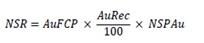
Where:
AuFCP = gold grade (g/t) from the 3DBM item
AuRec = gold recovery (%) from the 3DBM item
NSPAu = net smelter price for gold (C$/g)
The metal prices and resultant NSPs used at this early stage of the study are shown by pit area in Table 16-1. Note that gold NSP values are in C$/g.
Metallurgical recoveries used for the NSR calculations are shown in Table 16-3.
| 10.13 | Mining Loss and Dilution |
Mining benches are 10 m high, while the model is in 5 m high blocks. Ore mining will be on split benches where required; therefore, loss and dilution calculations are based on 5 m block sizes. Each block in the 3DBM is coded with an NSR value. Based on the cut-off grade of NSR >= $49.66/t, which is equal to the processing + G&A cost, each block was identified as economic or uneconomic.
The ‘edge count’ method is used to quantify loss and dilution. This method examines each economic block and analyses the number of edge contacts with uneconomic blocks (between 0 and 4) using the cut-off grade. Economic blocks with 3 or 4 uneconomic block contacts are converted waste since the increased costs to selectively extract them outweighs their economic benefit. These ‘converted’ blocks represent some of the mining losses. All other economic blocks are defined as ore.
The process is repeated for uneconomic blocks, counting the number of economic block contacts (between 0 and 4). ‘High-grade’ uneconomic blocks (NSR >= $30/t), which have 3 or 4 economic block contacts, along with all other uneconomic blocks with 4 economic block contacts, are converted to ore. These ‘converted’ blocks represent dilution. All other uneconomic blocks are defined as waste. An example of these blocks is shown in Figure 16-2.
The process is repeated for uneconomic blocks contacting economic blocks (between 0 and 4). High-grade uneconomic blocks are defined as having an NSR >= $30, which is close to the processing cost.
High-grade uneconomic blocks that are contacting 3 or 4 economic blocks and all other uneconomic blocks that are contacting 4 economic blocks are defined as ore (dilution). All other uneconomic blocks are defined as waste. An example of these blocks is shown in Figure 16-2.
Only measured and indicated material is considered as ore. The overall losses and dilution are shown in Table 16-2.
G-1-50
| 10.14 | Pit Slope Design Angles |
See Section 16.9.
| 10.15 | Economic Pit Limits, Pit Designs |
| 10.15.1 | Pit Optimization Method |
The economic pit limit is selected after evaluating LG pit cases.
The assessment is carried out by generating sets of LG pit shells by varying revenue assumptions to test the deposit’s geometric and pit slope sensitivity.
| 10.15.1.1 | LG Pit Assumptions |
Inputs to the LG pit limit assessment are shown in Table 16-3 are based on the previous PFS studies (including cost escalation) as a starting point for the 2024 design work.
LG pits are generated by varying the NSR value from 30% to 150% of the base NSR.
| 10.15.2 | Permafrost |
Permafrost exists in the area to a depth of 335 m below topography. As the project area is quite flat, the base of the permafrost zone is assumed to occur at 95 m elevation, for the entire project. The bottom section of the permafrost zone is referred to as the basal cryopeg zone. Pockets of unfrozen groundwater will occur within the basal cryopeg zone. This water will need to be stored until mine completion, when it can be returned to the pit. The thickness of the basal cryopeg zone is variable, and for the purpose of this study is assumed to be 50 m.
The LG shells are constrained to stay within the permafrost zone, above 95 m elevation.
| 10.15.3 | LG Economic Pit Limits |
The ultimate pit shell was selected based on incremental economics, between shells. Due to the permafrost constraint, the incremental improvement above the 60% Case provided diminishing increases in ore and value. The sensitivity of the LG economic pit limit to ore tonnes is illustrated in Figure 16-3 where 100% represents the base case NSP parameters above. The figure was created with a $60 NSR cut-off grade, to provide a margin for losses and dilution that were not yet calculated at this stage.
The selected open pit limit is the 60% Case, to achieve target ounces for the project, is well within the economic limits for this study.
A plan view and north-south section views of the LG pits for the open pit mining areas are shown in Figure 16-4 through Figure 16-5.
| 10.16 | Detailed Pit Designs |
PFS-level pit designs demonstrate the viability of accessing and open pit mining the measured and indicated mineral resources at the Courageous Lake site. Pit designs use the selected LG pit limits as guides as well as geotechnical parameters, suitable road widths, and minimum mining widths based on efficient operation for the size of mining equipment chosen for the 2024 PFS.
| 10.16.1 | Haul Road Widths |
Haul road widths are designed to provide safe, efficient haulage and to comply with the NWT Mines Regulations’ minimum width specifications and safe operating practice. Haul road widths include allowance for standard double lane hauling. All roads have a maximum grade of 10% suitable for mines with winter conditions. A sample cross section of a haul road is shown in Figure 16-6.
| 10.16.2 | Design Standards |
Pre-feasibility study level design parameters for the pits are provided by Tetra Tech, respectively, according to their geotechnical testing and evaluations (Sections 16.2 and 18.7.3).
G-1-51
| 10.16.2.1 | Minimum Mining Width |
A minimum mining width between pit phases is prescribed to maintain a suitable platform for efficient mining operations. This is established based on equipment size and operating characteristics. For this study, the minimum mining width generally conforms to 35 m, which provides sufficient room for 1-sided truck loading.
| 10.16.2.2 | Bench Height |
The pit designs are based on the digging reach of the excavators (10 m operating bench) with double benching between high wall berms; therefore, the berms are separated vertically by 20 m. Single bench mining will be employed, split bench mining (5m) will be used, where required, to maximize ore recovery and minimize dilution.
| 10.16.3 | LG Phase Selection |
The LG selected pit cases discussed previously are used to evaluate alternatives for determining the economic pit limit and the optimal pushbacks or phases before commencing detailed design work.
There are smaller pit shells within the economic pit limits that have higher economic margins, due to lower strip ratios or better grades than the full economic pit limit. Mining these pits as phases from higher to lower economic margins helps to increase early revenue and reduce early mining costs.
The Courageous Lake pit has four incremental phases (1-4), and two satellite phases (0 and 99). Phases 0 and 99 are standalone phases and are designed to provide pre-production start-up and construction material, as well as a location for water storage when the Basal Cryopeg is mined, later in the mine life. Phase 1 is the in the center of the ultimate pit, and provides low strip ratio, higher grade feed at the beginning mining. Phase 2 mines the south of the ultimate pit. Phase 3 mines the northeast of the ultimate pit. Phase 4 mines the northwest of the pit, as well as the pit bottom.
A plan view of the Courageous Lake pit phases is shown in Figure 16-7. Table 16-4 shows the ore and waste tonnes, grade, and strip ratio by phase.
| 10.17 | Open Pit Mine Plan |
| 10.17.1 | LOM Open Pit Production Schedule |
The open pit mine production schedule is developed with Hexagon’s MinePlan Strategic Optimizer (MPSO), a comprehensive long-range schedule optimization tool for open pit mines used to produce a LOM schedule that increases the NPV of the PFS.
In the open pit mine schedule, “Time 0” refers to the mill start date; mill feed production starts in Year 1 and full mill feed production is reached in Year 2. The production schedule specifies:
pre-production: Year -1.
first year of production: Year 1.
| 10.17.1.1 | Open Pit Mine Load and Haul Fleet Selection |
The mine load and haul fleet are selected prior to production scheduling. All equipment is diesel powered, as the site does not have a connection to an electrical grid.
12 m3 bucket diesel hydraulic excavator is selected as the primary digging units. Excavators are selected instead of shovels to improve selective mining for ore and wall scaling. The excavators are paired with 90-tonne trucks for efficient loading times.
Productivities of the selected equipment include shovel loading times, truck haul cycle estimates for multiple pit-to-destination combinations, and appropriate spot/ wait/ dump times.
Autonomous trucks are used during regular mining operations. Autonomous equipment has a lower mechanical availability (since more maintenance time is required to maintain the technology on board) but a higher operator efficiency and increased operating hours per day (no breaks or shift-change delays). Standard delays such as blasting, fueling, clean-up, long moves, etc., are still accounted for with autonomous units.
G-1-52
| 10.17.1.2 | Schedule Criteria |
In order to optimize the PFS NPV, NSR grade bins are specified. This allows MPSO to develop a variable a cut-off grade strategy which increases early mill head grades and therefore higher revenues in the early years of production. Phase precedence is specified based on the logical progression of phase geometry (no undermining is allowed).
The primary program objective in each period is to maximize the NPV. The MPSO NPV calculation is guided by estimated operating and capital costs, process recoveries, and metal prices. Key production schedule assumptions are shown in Table 16-5.
| Table 16-5: | Production Schedule Assumptions |
| Assumption | Value |
| Daily Mill Throughput | 7,500 t/d |
| Haul Truck Speed Limit | 50 km/h |
| Haul Truck Operating Efficiency - autonomous | 94.5% |
| Dump/Maneuver/Wait Time | 2.75 min |
| Shovel Loading Time | 2.10 min |
| Shovel Operator Efficiency | 95% |
| 10.17.1.3 | Cut-off Grade Optimization |
The sequencing of the pit phase designs typically goes from higher grades to lower, to increase mill feed grades early in the schedule and thereby increase revenues in the earlier years. This can be further enhanced by stockpiling low- and mid-grade material for processing at the end of the production schedule, or as needed when pit ore delivery is low; stockpiling also results in increased mining costs, due to rehandle costs. The incremental break-even cut-off grade is set to the processing + G&A costs. Ore is binned by cut-off grades to allow higher grade mill feed earlier and store lower grade ore in stockpiles for processing at the end of mine life. This increases early revenues therefore increasing both the NPV and IRR.
| 10.17.2 | Rock Storage |
Rock is stored as close to the mining area as possible, East of the pit. Rock is used to build tailings impoundments, as described below.
| 10.17.2.1 | Co-Placement Storage Facility (CPSF) |
The CPSF is designed to act as the confinement for process tailings. The tailings will be placed in a series of paddock systems, each paddock averaging 0.98 Mm3 of storage volume. An average tailings paddock will store six months of tailings. Further information on the tailings paddock system is described in Section 18.
| 10.17.2.2 | Construction Methods |
The CPSF uses two components which form the tailings paddock system construction, which is created in lifts from the bottom up, that alternate between 10 and 13 m in height. The paddocks are contained within the 13 m lifts, while the 10 m lifts placed between the paddock lifts are completely waste material. Waste not required for construction of tailings paddocks is placed directly by the haul fleet with support from dozers as required. Waste needed to create tailings paddocks is delivered by the haul fleet to the CPSF and then stockpiled for later placement as described in Section 18.7. When waste is used to cover a completed tailings paddock the haul trucks will dump short of the berm and dozers will push the waste material over the tailings contained inside the paddock.
| 10.17.2.3 | Foundation Preparation |
Design work for CPSF foundation preparation will be performed as required. Prior to mine development, soil will be salvaged from the footprint area where soil is suitable for reclamation purposes. Soils salvaged from the CPSF footprints will be stockpiled East of the final footprint of the CPSF.
G-1-53
| 10.17.2.4 | CPSF Access Roads |
Access to the CPSF throughout the life of mine is via a double lane, external waste haul road on the west side of the CPSF nearest to the pit exit ramp(s). This road network also connects the mining areas with the stockpile and plant areas.
| 10.17.2.5 | Final CPSF Configuration |
The final CPSF for the Courageous Lake Project is designed with overall slope angles of 21°, to accommodate the tailings paddock system. The final post-closure configuration is adapted in accordance with the closure plan, which is further described in Section 18.7.9. A cost allowance for closure work is included by keeping the ancillary equipment in use during later years of operation after the waste strip ratio drops to lower levels. This allows for reclamation activities in the latter part of the mining schedule. Future studies will investigate earlier (progressive) reclamation opportunities, as equipment becomes available from the operations. As part of the closure plan, a network of 8% grade, 30 m-wide access ramps are included, which provide unimpeded right-of-way across the CPSF for the indigenous caribou population. The haul road access forms part of this network upon closure. The caribou right-of-ways are constructed at the time of initial mine rock placement in the CPSF to ensure immediate availability at the time of closure.
| 10.17.3 | Ore Stockpile |
Ore is stockpiled during the pre-stripping activity in the pre-production period. The stockpile is fed to the mill starting in Year 1. Ore is added and removed from the stockpile, through the mine life. The residual stockpile inventory is intended for milling in Years 12 and 13 after pit mining is completed.
| 10.17.4 | Open Pit Mine Pre-production Detail |
Development and pre-production activities include the following:
Mining sufficient ore for start-up, and to support the strategy of increased feed grade in early years, smoothing the haul fleet size over time
Establish mining areas that will support the equipment required to achieve ore production and annual mill feed requirements on a sustainable basis.
Provide material required for construction in the mine area
Provide material for tailings paddock requirements in the first year of mill feed.
Sufficient soil stripping for dump and pit mining in Year -1 as well as Year 1 topsoil salvage and foundation preparation:
Construct drainage control and water management structures
Haul road construction
Infrastructure construction.
| 10.18 | Open Pit Production |
| 10.18.1 | Year -1 to 11 – Open Pit Mining |
The following is a summary of mining activity in Years -1:
An ROM ore stockpile is built in the area to north of the Mill and south of the CPSF
All waste material is placed in the CPSF unless required for pre-production construction
Phase 0 is mined completely in Year -1.
Phase 1 starts in Year -1, mining to an elevation of 385 m.
The following is a summary of mining activity in Years 1 to 5:
Mining in Year 1 to 5 focuses on delivering higher grade of ore to help with project payback
All waste material is placed in the CPSF
Ore is hauled directly to the Mill or stockpile
G-1-54
Phase 1 is completed in Year 2
Phase 2 starts in Year 2 and is completed in Year 4
Phase 3 starts in Year 4, mining to an elevation of 385 m
Phase 99 is mined completely in Year 4
Stockpile material is reclaimed to supplement mill feed during periods where mining is limited by periodic large volumes of waste pre-stripping or to increase mill feed grade.
The following is a summary of mining activity in Years 6 to 11:
Phase 3 is completed in Year 7
Phase 4 starts in Year 6 and is completed in Year 11
All waste material is placed in the CPSF.
Stockpile material is reclaimed to supplement mill feed during periods where mining is limited by periodic large volumes of waste pre-stripping or to increase mill feed grade.
| 10.19 | Open Pit Mine Operations |
The mining operations are typical of open pit operations in northern Canada and employ small scale mining equipment in waste and selective mining in the ore zones. There is considerable operating and technical expertise, services, and support in northern Canada, especially in the local area northeast of Yellowknife. Equipment is selected for the major operating functions in the mine (loading and hauling waste) to generate high productivities, which helps reduce unit mining costs.
| 10.19.1 | Organization |
Mine operation is organized into three areas: direct mining, mine maintenance, and general mine expense (GME).
In this study, direct mining and mine maintenance are planned as a leased fleet with the equipment costs and labour being directly under mine operations. The haul truck fleet will be operated as an autonomous fleet. The mine will employ the blasting crew, but supply and on-site manufacturing of blasting materials will be contracted out. All infrastructure required for the blasting supply contractor will be provided by the operating company.
| 10.19.2 | Direct Mining Activities – Open Pit |
The direct mining area accounts for the drilling, blasting, loading, hauling, and pit maintenance activities in the mine.
| 10.19.3 | Drilling |
Blasthole drills will be fitted with GPS navigation and drill control systems to optimize drilling. Production drills will be operated autonomously.
Diesel hydraulic rotary drills (165 mm bit size) will be used for production drilling, both in ore and waste. Diesel hydraulic percussive drills (50 mm bit size) will be used for controlled blasting techniques on high wall rows, pioneering drilling during pre-production, and development of initial upper benches.
There is an ore control drill (144 mm bit size) that will drill 3 benches (30 m) at a time for assays. The ore control drill will be utilized in the known ore zone, as well as the ore/waste transition zone. It is assumed that 100% of ore tonnes and 25% of waste tonnes will be drilled for ore control.
| 10.19.4 | Blasting |
A contract explosives supplier will provide blasting materials and technology. Due to the remote nature of the operation, an explosives manufacturing plant will be built on site when emulsion is required. For this study, the owner provides a serviced site and all facilities to the explosives contractor who manufactures and delivers the prescribed explosives to the blast holes and supplies all blasting accessories.
G-1-55
Blasting will be done with an emulsion ammonium nitrate fuel oil blend referred to as heavy ANFO(HANFO). HANFO will be 70% emulsion 30% ANFO for both wet and dry holes. The optimal HANFO blend and the possibility of higher use of straight ANFO with borehole liners to keep the ANFO dry, can be investigated in future studies to reduce blasting costs.
Blasting accessories will be stored in magazines adjacent to the mining areas suitably located to meet federal and provincial regulations and to avoid potential geohazards.
Loading of the explosives will be done with bulk explosives loading trucks provided by the explosives supplier. The trucks should be equipped with GPS guidance and should be able to receive automatic loading instructions for each hole from the engineering office. The GPS guidance will be a necessity to be compatible with stakeless drilling.
Blast holes will be stemmed to avoid fly-rock and excessive air blasts. Crushed rock will be provided for stemming material and will be dumped adjacent to the blast pattern. A loader with a side dump bucket is included in the mine fleet to tram and dump the crush into the hole.
The blasting crew will comprise mine employees and will be on day shift only. The blasting crew will coordinate drilling and blasting activities to ensure a minimum of two weeks of broken material inventory is maintained for each excavator. Blasters will require hand-held GPS to identify holes for pattern tie-in as blast patterns will not be staked. A detonation system will be used that consists of electric cap initiation, detonating cord, surface delay connectors, non-electric single-delay caps, and boosters.
| 10.19.4.1 | Loading |
Ore and waste will be defined in the blasted muck pile by ore control. A fleet management system will assist in optimizing deployment and utilization of the mine fleet.
Two 12 m3 dipper diesel hydraulic excavator has been selected as the primary digging units. The diesel hydraulic excavators are selected as the mine is not connected to an electrical grid. Excavators are selected instead of shovels to improve selective mining for ore and wall scaling. A 12 m3 wheel loader will be used for stockpile management and secondary loading in the pit as required.
Minimum bench widths of 35 m are designed to ensure sufficient operating room for loading of trucks at the excavators. Benches are designed wider than the minimum wherever possible.
| 10.19.4.2 | Hauling |
Ore and waste will be hauled by autonomous 90-t haul trucks. Autonomous trucks are selected to reduce the camp size requirements and costs. Haul cycle profiles are built from each bench to designated dumping points as the dump progresses. Travel times for each profile are calculated using rimpull and braking curves provided by equipment manufacturers.
Fixed times are calculated based on the number of passes the excavators would need to fill the trucks, as well as reasonable spot, dump, queue and wait times. Fixed times are the same for every benches’ cycle with the same loading and hauling equipment.
Travel times and fixed times are added together to generate unique total haul cycle times for each bench/destination combination.
| 10.19.4.3 | Pit Maintenance |
Pit maintenance services include haul road maintenance, open pit mine dewatering, transporting operating supplies, relocating equipment, and snow removal. Haul road maintenance is paramount to low haulage costs; dozer, and grader hours have been allocated to maintain the haul road network throughout the LOM production schedule. A rock crusher for road grading material is included.
| 10.19.5 | Open Pit General Mine Expense (GME) Area |
The GME area accounts for the supervision, safety, environment, and training for the direct mining activities as well as technical support from mine engineering and geology functions. Open pit mine operation supervision will extend down to the shift supervisor level and trainers. GME costs also include engineering consulting expenses on an ongoing basis for specialty items, such as geotechnical and geo-hydrology expertise, and third-party reviews in the open pit mine area.
G-1-56
| 10.20 | Mine Closure and Reclamation |
Details on mine closure and reclamation are available in Section 20.1.2.
| 10.21 | Open Pit Mine Equipment Parameters |
Mining equipment descriptions in this section provide general specifications so that dimensions and capacities can be determined from vendor specification documents.
| 10.21.1 | Major Equipment |
The production requirements for the major mining equipment over the LOM are summarized in Table 16-6. The current production schedule requires a maximum haulage fleet of 23 trucks over the LOM.
| 10.21.2 | Blasting |
Blasting assumptions are summarized in Table 16-7. These parameters will be re-evaluated in the future with a detailed blasting study, using site-specific rock strength parameters.
| 10.21.3 | Drilling Equipment |
Production drilling assumptions are listed in Table 16-8.
A 50 mm diesel percussive drill is also specified for controlled blasting techniques on high wall rows in all pit phases, pioneering drilling during pre-production, and development of initial upper benches.
| 10.21.3.1 | Open Pit Dewatering Equipment |
The dewatering activities will include vertical dewatering wells, as well as in-pit sumps. Pit water will be collected and stored in either the mined-out Phase 0 or mined-out Phase 99, as available.
| 10.21.4 | Open Pit Support Equipment |
The mine support equipment fleet requirements are summarized in Table 16-9. The fleet size in Year 5 is shown as representative of the LOM requirement.
| 10.21.5 | Open Pit Ancillary Equipment |
The mine ancillary equipment fleet includes such equipment as excavators, mine rescue trucks, picker trucks, cranes, snowcats, forklifts, service trucks, welding trucks, sump pumps and float trucks.
| 10.21.6 | Open Pit Ancillary Facilities |
| 10.21.6.1 | Shops and Offices |
In addition to providing an area for maintenance bays, tire shops, and a wash bay, the maintenance shop will also house:
a welding bay
an electrical shop
an ambulance
a first aid room
a first aid office
a machine shop area
a mine dry
a warehouse
G-1-57
offices for administration, mine supervision, and engineering/geology staff
a lunchroom and supervisor’s office.
The recommended shop sizing for the open pit operations includes service bays, welding bay, and wash bay. This will accommodate the fleet for the LOM PFS production plan. The mine maintenance facility will also include a machine shop area, tool storage area, mine muster area, warehouse, and office complex. A separate tire bay facility will be required to accommodate a truck and a tire manipulator.
| 10.22 | Mine Production Schedule |
The summarized production schedule results are shown in Table 16-10 and Figure 16-15. Pre-stripping will use the owner’s personnel and mining fleet in the pre-production years. After mill start-up, a variable cut-off grade strategy is used to enhance revenues for a minimum capital payback period. The variable cut-off strategy stockpiles lower grade material early in the mine life.
| 11 | PROCESSING AND RECOVERY OPERATIONS |
| 11.1 | Overview |
The process flowsheet for Courageous Lake project was selected based on the preliminary metallurgical testwork results and subsequent economic modelling. The majority of the unit operations selected to build the plant flowsheet are standard technologies widely used in gold processing plants. The pressure oxidation circuit is technologically complex and requires skilled operators.
The selected flowsheet includes a three-stage crushing circuit with crushed product reporting to the crushed material stockpile. Mineralized material is reclaimed to a grinding circuit consisting of a ball mill circuit operating in closed circuit with a cyclone cluster. Ball mill cyclone overflow reports to sequential stages of rougher flotation, where concentrate is separated from the gangue material and fed to cleaner flotation. In the cleaning circuit, the concentrate grades are upgraded prior to further size reduction in a regrind ball mill operating in closed circuit with a cyclone cluster. Cleaner tailings combine with rougher tailings for thickening before being discharged to the co-placement storage facility (CPSF). Overflow from regrind cyclones undergoes acidulation and thickening prior to pressure oxidation which oxidizes the sulphide in the concentrate. The oxidized concentrate is washed in a three-stage CCD to remove acidic solution prior to being leached with cyanide and washed in six-stage CCD circuit to recovery the leached gold and silver in solution. The resulting pregnant solution will be processed using a Merrill-Crowe treatment by adding zinc powder to precipitate gold and silver. The precious metals precipitate will be smelted on site to produce gold-silver doré bars. Leach residue is neutralized with rougher tails and lime addition and detoxed with the SO2/Air processes before pumping to the leach residue tailings facility.
Key considerations for selecting the process flowsheet included the variable mineralogy, feed grades and rock hardness in the deposit. Multiple trade-off studies were conducted in order to select the optimal process flowsheet, including throughput sizing, comminution equipment selection, pressure oxidation method, and flotation circuit assessment. Capital and operating costs were minimized without compromising functionality or robustness in the design.
Design parameters (Table 17-1) were selected based on test data from programs SGS (2003), G&T (2007) and SGS (2011). The ALS (2023) test program was run in parallel with the 2024 PFS, and upon completion the test results were evaluated against the selected design basis. Results from the 2023 testwork confirmed the design parameters were sufficient but also identified opportunities for optimization that have not been realized in this report but are included in Section 25.3.2.3.
The overall process plant layout is depicted in Figure 17-2.
| 11.2 | Process Flow Sheet |
An overall process flow diagram is presented in Figure 17-1.
| 11.3 | Plant Design |
| 11.3.1 | Crushing and Stockpiling |
| 11.3.1.1 | Primary Crushing |
Run-of-mine material is hauled from the mine and stockpiled or directly tipped into the run-of-mine feed hopper. Material from the hopper is discharged by gravity to a vibrating grizzly screen where oversize is discharged into the primary jaw crusher. This oversize material is crushed, a modular rock breaker is included to manage large rocks that may exceed the crusher cavity size. The primary crusher is designed to reduce material size to an 80% passing product size (P80) of 94 mm. A magnet is installed to remove any foreign metallic bodies from the crushed material prior to feeding it to the secondary screen. The primary crushing circuit has 60% operating availability and the design capacity of 481 t/h.
G-1-58
Major equipment in this area includes the following:
ROM hopper
vibrating grizzly feeder
rock breaker
primary jaw crusher (110 kW)
secondary screen feed conveyor.
| 11.3.1.2 | Secondary and Tertiary Crushing |
The primary crusher discharge and vibrating grizzly undersize is transferred to the secondary screen by the crusher discharge conveyor. The conveyor is equipped with a belt magnet as well as a metal detector to remove any remaining metallic foreign bodies from the material. Screen oversize material is gravity fed into the secondary cone crusher. Crusher discharge and secondary screen undersize is conveyed to the tertiary screen.
Both secondary and tertiary crushers are located in the same building for optimal site layout and efficient performance of dust collection system. Tertiary crusher discharge combined with secondary screen undersize material and secondary crusher product is transferred to the tertiary screen by the same conveyor. Oversize from the tertiary screen is conveyed to the tertiary crusher surge bin which ensures the crusher is choke fed. Material that passes through the tertiary screen discharges onto the fine ore transfer conveyor which will deliver material to the stockpile. The material crushed by the tertiary crusher is reduced to an 80% passing product size (P80) of 9 mm at the screen undersize.
Major equipment in this area includes the following:
secondary screen (2 decks)
secondary cone crusher (335 kW)
tertiary screen (2 decks)
tertiary crusher surge bin
tertiary cone crusher (480 kW)
crusher discharge conveyor
fine material transfer conveyor
fine material stockpile (12 hour live capacity).
| 11.3.2 | Primary Grinding and Classification |
Reclaim belt feeder transfers fine material from the stockpile onto the ball mill feed conveyor which feeds the ball mill. The grinding circuit is designed for an annual operating time of 7,884 h or 90% availability and a nominal throughput of 347 t/h. The circuit is sized based on a grinding circuit feed size (F80) of 9 mm and a circuit product size (P80) of 106 µm. Process water is added to the ball mill feed to maintain the mill discharge slurry density at 70% solids.
The ball mill product slurry will discharge onto a rubber-lined trommel screen, and the oversize is screened out and discharged to a scats bin, whereas the trommel undersize flows by gravity into the cyclone feed pumpbox, where the material is pumped to the cyclone cluster. Promoter and copper sulphate are added to the cyclone feed pumpbox to activate gold-bearing sulphides for downstream flotation. Cyclone overflow at a nominal solids content of 35% w/w reports to the flotation circuit.
To feed the ball mill grinding media, FELs feed balls from a storage bunker to charging kibbles. Each kibble opens into feed bins. Mobile feeders receive the grinding media from the openings at the bottom of the ball feed bins and transfer the balls into the ball mill feed box.
G-1-59
Major equipment in this area includes the following:
ball mill feed conveyor
ball mill (6.5 MW)
primary cyclone cluster.
The grinding, flotation, and concentrate pre-acidulation circuits are depicted in Figure 17-3.
| 11.3.3 | Flotation |
| 11.3.3.1 | Rougher Flotation |
The overflow from the primary cyclone reports to the rougher cell feed box. In this circuit, various reagents are employed to enhance the selectivity of the flotation process. Flotation reagents used in the rougher circuit will include potassium amyl xanthate (PAX), copper sulphate (CuSO4), and methyl isobutyl carbinol (MIBC).
Process water is sprayed to launder to maintain a pulp density of 25% w/w and low-pressure air is sparged into each cell to initiate bubble formation required for flotation. The rougher concentrate is collected from each rougher cell and pumped to cleaner flotation, while rougher tailings flow into final tailings pumpbox and combine with cleaner tailings. Combined flotation tailings will be thickened to 65% solids in the high-rate thickener. Portion of the flotation thickener underflow will be used for neutralizing the acidic solution generated from the POX process. The rest of the underflow slurry will combine with POX Solution Neutralization Thickener underflow prior to being discharged to the CPSF.
Major equipment in this area includes the following:
five rougher flotation cells (58 m3 each)
flotation tailings thickener.
| 11.3.3.2 | Cleaner Flotation and Regrind |
The rougher flotation concentrate will be further upgraded in cleaner flotation circuit. The first cell of the circuit is dosed with PAX and MIBC to promote concentrate recovery. The cleaner concentrate at 25% w/w solids gravitates into concentrate pumpbox and is pumped to regrind cyclone cluster. The regrind circuit consists of a cyclone cluster and a regrind ball mill operating in closed circuit. The overflow target product size is 43 µm. The cyclone overflow reports to the pre-acidulation thickener, while the underflow flows back to the regrind mill.
Major equipment in this area includes the following:
four cleaner flotation cells (12 m3 each)
regrind ball mill (100 kW)
regrind cyclone cluster.
| 11.3.4 | Concentrate Acidulation |
Pre-acidulation thickener underflow slurry, at 50% w/w solids, is pumped to two agitated acidulation tanks operating at 50°C. The concentrate will be contacted with a portion of the acidic POX CCD overflow solution and fresh sulfuric acid solution. Sulfuric acid reacts with the carbonates to form gypsum and carbon dioxide which reduces the generation of carbon dioxide in the autoclaves and thereby improves the utilization of oxygen. The acidulated slurry is pumped to pre-oxidation thickener where it is thickened to 50% w/w solids prior to pressure oxidation stage.
Major equipment in this area includes the following:
pre-acidulation thickener
two acidulation tanks
pre-oxidation thickener.
G-1-60
| 11.3.5 | Pressure oxidation (POX) |
The autoclave vessel consists of four compartments and five agitators and is operated at overall pressure of 2,150 kPa and 200°C. Oxygen is supplied via sparging system at partial pressure of 690 kPa. The oxidation of sulphides in the slurry occurs autogenously once started and water is added to autoclave as required to control the reaction temperature. The autoclave vessel is designed to provide residence time of 90 minutes. The oxidized slurry and the vent gases discharge into a flash vessel where water is flashed to steam as the pressure is reduced to atmospheric. The flash vessel is equipped with a gas scrubber to control steam and acidic emissions. The flash vessel slurry is sent to the POX CCD to wash the acid out of the solids.
Major equipment in this area includes the following:
an autoclave feed tank
horizontal autoclave vessel
flash vessel
gas scrubber.
| 11.3.6 | POX Counter Current Decantation (CCD) |
Oxidized slurry passes through a three-stage CCD circuit, where gold containing solids are washed with process water to reduce slurry acidity. The washing ratio of the washing solution to feed solids is 3:1. A portion of the acidic solution from the thickener overflow will be recycled to the pre-acidulation circuit, while the rest of the solution from the POX CCD overflow will be sent to an acidic solution neutralization circuit. Solids are pumped to the POX solids neutralization circuit.
Major equipment in this area includes 3 CCD thickeners.
| 11.3.7 | POX Acidic Solution Neutralization |
Remaining portion of the acidic wash water from POX CCD circuit will be neutralized in 4 neutralization tanks with lime and a fraction of flotation tailings acting as neutralizing agents. The neutralization tanks are sized to provide residence time of 80 minutes. The treated slurry with target pH of 8.5 will be thickened to 35% w/w and pumped to flotation tailings pumpbox for discharge to the leach residue tailings facility (LRTF).
Major equipment in this area includes 4 tanks with agitators and sparging system.
| 11.3.8 | POX Solids Neutralization |
The underflow of the third stage of the CCD circuit will be pumped to an agitated tank where lime will be added to neutralize the slurry and increase the slurry pH to 10.5-11 prior to leaching stage. The neutralization tanks are sized to provide 4 hours of residence time at design flowrate.
Major equipment in this area includes 2 tanks with agitators and air sparging system.
| 11.3.9 | Cyanide Leach |
Neutralized slurry is pumped into the agitated leaching tanks at 40% solids. Oxygen is sparged to each tank to maintain dissolved oxygen levels of 20 ppm. Hydrated lime is added to maintain pH to the desired set point. Cyanide solution is added to the leach tank. The leach circuit consists of three agitated tanks providing total residence time of 12 hours. The leached slurry from the last leaching tank will be washed using a CCD washing system and the pregnant solution will be treated using a Merrill-Crowe process.
Major equipment in this area includes 3 leach tanks with agitators and air sparging system.
| 11.3.10 | Counter Current Decantation (CCD) |
A 6 stage CCD thickener washing circuit will be used to recover soluble precious metals from the leach slurry. The underflow of the last CCD thickener will be pumped to a cyanide destruction circuit prior to disposal. The overflow from the last CCD thickener will flow in a counter current mode to the preceding thickener. The barren solution from the Merrill-Crowe circuit and fresh water will be used as a washing solution. The overflow from the first CCD thickener to a clarifier reduced the total suspended solids prior to collection in the pregnant solution tank. The pregnant solution tank was sized accordingly to store the pregnant solution prior to polish filtration stage. The washing ratio, washing solution tonnage to feed solids tonnage, is 5:1 in order to achieve an overall CCD washing performance efficiency of higher than 99%.
G-1-61
Major equipment in this area includes the following:
six CCD thickeners
clarifier
pregnant solution tank.
| 11.3.11 | Merrill-Crowe Precipitation Circuit |
The pregnant solution from the CCD washing circuit will be treated using the Merrill-Crowe process to recover the contained precious metals by zinc-dust cementation. The barren solution will then be reused in the CCD washing circuit as a washing solution.
The pregnant solution from the first CCD thickener will be discharged to the pregnant solution tank. The pregnant solution will then be pumped to a leaf clarifier filter pre-coated by a diatomaceous earth filter aid to remove suspended solids. The clarified solution will be pumped to the de-aeration tower where the solution will be deoxygenated. The discharge from the de-aeration tower will be mixed with a slurry of zinc dust, lead nitrate, and cyanide in the precipitate mixing tank where the precipitation reactions occur. The slurry with the gold and silver precipitates will be pumped through a pre-coated filter press where the gold and silver precipitates, together with other solids, will be removed. The barren solution will be reused as the washing water for the CCD washing circuit and as makeup water for cyanide leaching circuit and grinding circuit.
The precipitation efficiency is estimated to be higher than 99% for both the metals. A filter aid will be required for both the clarification filter and the precipitate filter press. A small amount of lead nitrate will be also added to improve the precipitation efficiency.
Major equipment in this area includes the following:
2 clarification filters (1 standby)
2 de-aeration towers (1 standby)
zinc mixing and addition system
2 precipitation filters (2 standby).
The Merril-Crowe and refining circuit area is depicted Figure 17-5.
| 11.3.12 | Refining Circuit |
Gold and silver precipitates from the Merrill-Crowe circuit will be further treated by smelting into gold-silver doré bars. The refining process will be performed in a batch mode. The circuit will be in a secure enclosed area with CCTV cameras and restricted access. Gold-silver doré products will be stored in a dedicated safe in the gold room.
Sufficient ventilation and off-gas handling will be provided in the gold room for a healthy work environment. Fume and dust exposure for the melting furnace and material handling will be controlled through a ventilation system installed in the gold room, including hoods, enclosures and wall fans to follow the local regulations/guidelines.
drying oven
induction furnace
flux mixing system
gold-silver doré safe
associated material handling and other systems (molds, dryers, scales, dust collection system).
G-1-62
| 11.3.13 | Cyanide Destruction and Neutralized Tailings Disposal |
Cyanide detoxification will take place using the SO2/air process. In this process sodium metabisulphite will be used as the SO2 source, copper sulphate is used as a catalyst and lime is used to maintain the pH of the reaction. The washed leach residue slurry from the CCD washing circuit will be treated in the cyanide detoxification circuit consisting of two tanks in parallel that were sized for a total residence time of 90 minutes. The cyanide destruction tanks are agitated and sparged with oxygen. This process will reduce the WAD cyanide in the tailings to less than 25 mg/L before being discharged to the Leach Residue Tailings Facility (LRTF).
| 11.4 | Reagent Handling and Storage |
All the reagents that will be transported to the site via the winter road during February and March each year. On-site storage will be provided for 12 months. Annual reagent consumption rates are summarized in the Table 17-2.
| 11.4.1 | Lime |
Quicklime is received on site as a coarse powder in bulk bags. The bags will be dropped into a bin with a bag splitter and metered to a slaking mill as required. The mixed lime is placed in a storage tank with a 24-hour residence time and distributed to the process as required through distribution pumps operating on a ring main.
| 11.4.2 | Activators |
Copper sulphate is received on site as a dry powder in bulk bags. The bags are emptied into a mixing tank and mixed to produce a solution at 15% w/w concentration. The mixed reagent is then transferred to a storage tank providing a residence time of 24 hours. The reagent is then dosed to the grinding and detoxification circuits by dosing pumps.
| 11.4.3 | Collectors |
PAX collector is delivered to site as granulated solids in bulk bags. The bulk bags are lifted using a frame and hoist onto a bag-breaker at the top of an agitated mixing tank. A dust collector removes any fine particulates that become airborne after emptying the bag. After opening the bag, the reagent is mixed with raw water from distribution and transferred to a day-tank with a storage capacity of 24 hours. The mixing tank is ventilated using a fan to remove any carbon disulphide gas. PAX is delivered to the flotation circuit using multiple dosing pumps, one for each stage in the circuit.
| 11.4.4 | Promoter |
Aero 208 is delivered on site as a liquid in 1,000 kg intermediate bulk containers (IBCs). Dosing pumps deliver the reagents without dilution to the required locations within the flotation circuits.
| 11.4.5 | Frother |
MIBC frother is delivered to the site as a liquid in 1000 L totes or intermediate bulk containers (IBCs). It is stored in a tank and used without dilution. Various dosing pumps deliver it to the various flotation areas.
| 11.4.6 | Flocculant |
Flocculant is received on site as a dry powder in bulk bags. The bags are lifted using a frame and hoist to a bag-breaker on top of a flocculant bin. A dust collector removes fine particles and dust from the air from the opening of the bag. A screw feeder moves the flocculant to a heated hopper and a blower moves the material into an agitated mixing tank. Raw water is used to mix with the flocculant to create a slurry. A flocculant transfer pump moves the flocculant mixture into a storage day-tank with a capacity of 24 hours. Various dosing pumps supply each of the thickeners with flocculant mixture. Prior to entering each thickener feed box, process water is used to mix with the slurry inside an inline mixer.
| 11.4.7 | Sodium Cyanide |
Sodium cyanide is delivered to site as powder in bulk bags. A bag splitter fitted with dust extraction will directly connect to the heated sodium cyanide mixing tank. A dust collector removes fine particles and dust released in the area. A transfer pump moves the cyanide solution to a storage day-tank with a capacity of 24 hours. Solution will be pumped to leach tanks. An HCN gas detector and alarm system is included in the sodium cyanide reagent area to alert operators to the presence of toxic hydrogen cyanide gas. The sodium cyanide area is located adjacent or inside the alkaline reagent area for easy access to alkaline pH modifiers.
G-1-63
| 11.4.8 | Sodium Metabisulphite |
Sodium metabisulphite (SMBS) is used in the cyanide detoxification circuit. It is delivered to site as a powder in bulk bags. The bag is lifted into a bag splitter by a frame and a hoist. A dust collector removes fine particles and dust from the air. The SMBS enters an agitated mixing tank with raw water to dissolve the powder and create a solution. The reagent is supplied to the cyanide detoxification circuit by the dosing pump.
| 11.4.9 | Sulfuric Acid |
Sulfuric acid is used in the acidulation circuit. It is delivered to site as liquid in intermediate bulk containers (IBCs). Sulfuric acid solution will be supplied to acidulation tanks by dosing pumps.
| 11.4.10 | Zinc Powder |
Zinc powder acts as a precipitation reagent. It is delivered to site as powder in bulk bags and dosed to Merrill-Crowe circuit.
| 11.4.11 | Lead Nitrate |
Lead Nitrate acts as a co-precipitation agent in Merrill-Crowe circuit. It is received as powder in bulk bags, mixed to 20% strength; transferred to a storage tank and dosed to Merrill-Crowe circuit.
| 11.4.12 | Diatomaceous Earth |
Diatomaceous Earth is a pre-coat agent in the Merrill-Crowe process. It is received as powder in bulk bags and dosed to pre-coat feed tank in the Merrill-Crowe circuit.
| 11.4.13 | Oxygen |
Oxygen required for pressure oxidation in autoclave, leaching and cyanide destruction will be generated on site in a vacuum swing adsorption plant.
| 11.5 | Plant Services |
| 11.5.1 | Process Water |
Process water is recovered from co-placement storage facility into the process water tank with live capacity of one hour. Process water is distributed around the plant from the process water tank. The POX circuit has a dedicated water circuit which is used for POX CCD wash water. Makeup water required for the process water circuits is 207 m3/h. This will be sourced from a combination of tailings return water, water treatment plant product, and raw water.
| 11.5.2 | Raw Water |
Raw water will be pumped from the Courageous Lake into the raw water tank with a live capacity of 12 hours. Raw water is distributed by pumps for various application points, including reagent preparation, gland seal, autoclave cooling and general mill makeup water supply. Plant raw water demand is estimated to be 40 m3/h.
| 11.5.3 | Potable Water |
Potable water is produced by an on-site potable water plant which processes water from the raw water tank and makes it fit for consumption and human use. Potable water is stored in a tank with live capacity of 48 hours and for distribution across the processing plant.
| 11.5.4 | Power |
The total installed power for the process plant and estimated power consumption is given in Table 17-3. Further discussion on the operating costs and power consumption for each area of the process plant is given in Section 18. The total estimated power requirement for the process plant is 96,760 MWh/a.
G-1-64
| 12 | INFRASTRUCTURE, PERMITTING AND COMPLIANCE ACTIVITIES |
| 12.1 | Local Resources and Infrastructure |
There are no significant population centers near the property, outside of Yellowknife. The nearest community of Wekweètì is located 140 km west of the Project and had a population of 129 in 2016.
All access and transportation of supplies need to be brought in either by air year round or by road during the winter months.
Other than the rights described in Sections 4.4 and 4.5, the Courageous Lake property is not subject to any other known surface encumbrances or mineral royalties. The QP is unaware of any issues associated with sufficiency of surface rights for potential mining operations or other infrastructure-related subjects (i.e. availability and sources of power, water, mining personnel, or potential tailing and waste disposal areas).
| 12.1 | Project Infrastructure |
This greenfield project site will include the following facilities:
Mining facilities, including the mine office and dry, truck shop, tire change facility, truck wash, explosives storage and manufacturing facility, diesel fuel storage and distribution, and ore stockpile.
Processing facilities, including the primary, secondary and tertiary crushing, fine ore stockpile and reclaim conveyors, process plant, office and laboratory, plant maintenance building.
Mine waste and water management infrastructure, including waste and tailings storage facility, tailings distribution system, water reclaim system, downstream water management ponds, and overburden stockpiles.
Mine water treatment plant, discharge pipeline and diffuser.
An aerodrome, plant site roads and haul roads.
General facilities, including the camp, gatehouse, emergency response/ambulance bay, car wash, warehouse, reagent cold storage, administration building, communications, emergency power diesel storage, raw, process and potable water storage and distribution, power plant, site sewage system, and solid waste treatment.
The locations of the site facilities were based on the following criteria:
Locate the facilities within the claim boundaries.
Leverage topographic advantages for all facilities to optimize construction costs.
Locate waste rock storage facilities near the mine pits to reduce haul distance.
Locate the process plant, and tailings storage facilities within a single catchment area with the mine to reduce the mine site footprint area.
Locate the process plant to take advantage of natural topography and avoid watercourses.
Locate the primary crushing and ROM pad between the open pit and the process plant to reduce hauling.
The tailings facilities location was selected based on currently available technical and environmental criteria. Early engagement with local communities and Indigenous Rightsholders is ongoing and will continue to inform tailings facility siting assessments.
The overall site layout is shown in Figure 18-1.
| 12.1.1 | Site Preparation |
Scrub brush clearing and topsoil removal are expected to be required to allow construction of the processing plant and other buildings and facilities. Site civil work includes design for the following infrastructure:
light vehicle and heavy equipment roads; access roads;
ore and organic stockpiles;
G-1-65
mine facility platforms and process facility platforms;
water management ponds and ditches and channels; and
waste rock and tailings area.
| 12.1.2 | Site Access |
| 12.1.2.1 | Courageous Lake Mine Spur Winter Road & Tibbitt to Contwoyto Winter Road |
The project site will be accessible by the Courageous Lake Mine Spur Winter Road (CLWR), connecting to the Tibbitt to Contwoyto Winter Road (TCWR) that is normally open from late January/early February until the end of March of each year. Table 18-1 shows historic TCWR opening and closing dates with open duration and this data is further depicted in Figure 18-2.
Although access to the Courageous Lake Project is based on the operation of the TCWR winter access road, the Government of the Northwest Territories (GNWT) is currently engaged in evaluating and preparing regulatory applications for the first segment of a potential all-season road (Slave Geological Province Corridor Project), from Yellowknife to Lockhart Lake Winter Road Camp, that would replace the winter road. This potential all-season road segment, should it be constructed, would improve access and reduce capital and operating costs for the Courageous Lake Project.
The CLWR is accessed from the TCWR and is estimated to be 26 km in length with 7 km on land (with small lakes interspersed) and 19 km on the larger Mackay Lake. From the CLWR intersection to the TCWR it is 76 km to the Lockhart Lake maintenance camp. The Lockhart Lake maintenance camp is at station 170 km from the TCWR start at Tibbitt Lake.
The logistics plan for the Courageous Lake Project will depend on the maximum gross vehicle weight (GVW) allowed on the TCWR and on the spur road. From past projects on the TCWR a typical maximum GVW of 77 t has been allowed. Loads above the standard ice road allowance in some cases will require that an engineering design be prepared and submitted to the TCWR managers for the safe operation of the load on the TCWR. A 77 t GVW load would typically have a tractor/trailer tare weight of 25 t and a payload of 52 t. When the GVW was more than 60 tonnes typically a tractor/trailer combination of 9 to 10 axles was required.
Using a 77 t GVW on a 9-axle bogie and trailer layout, the required ice thickness is likely to be in the range of 102 to 109 cm. This ice thickness is for a travelling load, not a parked load. This layout will likely require a Special Permit to travel on public roads. The exact required ice thickness can be determined once the footprint details of the tractor/trailer combination are specified.
From TCWR operation reports for the TCWR from 1997/1998 to 2022/2023 (25 most recent winter seasons) there were three winter seasons with difficult construction and load hauling operations. In the 2005/2006 winter season full super B loads (which require 104 cm ice thickness on the TCWR) and other heavy loads could not be transported on the TCWR (1 in 25 occurrence or 4%) due to a warm winter weather with lower freezing degree day (FDD) values with resulting insufficient ice thickness. In the1998/1999 and 2009/2010 winter season warm winter season weather also hampered the operation of the Super B trucks (2 in 25 occurrence or 8%). Total problem-year occurrence over this most recent 25-year period is therefore 3 in 25 or 12 %.
For the TCWR with operation mostly on lake ice the effects of global warming over the planned mine operation period are noted. From the same TCWR operation reports it was noted that with the most recent construction methods that the 104cm thickness for Super B train operation was being achieved at a Yellowknife FDD of 2200 C-days as shown in the Yellowknife FDD Figure 18-4 by the blue graph line.
The Yellowknife FDD has decreased by an average of 5.1 C-days per year from linear regression from the 1985/1986 to 2022/2023 winter season. This decreasing FDD trend is expected to continue into the Courageous Lake Project operation period and as a result the 12% TCWR operation problem- year occurrence will continue as a minimum expectation. Figure 18-5 shows that the TCWR open duration is decreasing by 0.43 day per year by linear regression over the period 2003/2004 to 2020/2021.
| 12.1.2.1.1 | Proposed All-Season Road to the Lockhart Maintenance Camp |
The long-range plan for the Slave Geologic region (north of Great Slave Lake) is in the early stages of planning a two lane all-season road into this region. The following points highlight this plan:
Two-lane gravel infrastructure corridor into the 213,000 km2 Slave Geological Province.
G-1-66
413 km in length.
Current focus: 179 km Lockhart All-Season Road.
The Government of the Northwest Territories (GNWT) priority focus at the moment is to advance regulatory applications for the first segment of the corridor - the Lockhart All-Season Road from Tibbitt Lake to Lockhart Lake.
$40 M has been secured for environmental planning and engineering studies - $30 M is from Transport Canada’s National Trade Corridors Fund and the GNWT will fund the remaining $10 M.
On February 16, 2023 a workshop was held in Yellowknife on development of access to the Slave Geological Province.
Even with the completion of this 179 km all-season road to Lockhart Lake camp there still is a further 76 km to the TCWR and CLWR intersection. This 76 km section is mostly on lake ice on Lockhart Lake and MacKay Lake. Even with the all-season road to Lockhart Lake the truck loads to the Courageous Lake Project will still need to operate following an ice engineering design for safe operation.
| 12.1.2.2 | Highway 3 |
The maximum winter GVW load is 71.3 t with the required number of axles. The NWT highways permit department likely would allow a 77 t GVW load on public highways with required permit application.
Road access to Yellowknife from Edmonton or Enterprise, the closest rail hub, is Highway 3 which passes over the Deh Cho bridge over the Mackenzie River. Review of a design brief (EA-003 Deh Cho Bridge Corporation) for the bridge indicates a design live load of 750 kN or 76.5 t which is in line with the suggested maximum load of 77 t GVW. In the first week of August, 2023 one of the support cables on the bridge broke. After this cable break a reduced speed limit and vehicle weight allowance was in effect until assessment and repair work was carried out.
| 12.1.2.3 | Airstrip |
The aerodrome, located southeast of the Project site, is published in the Canada Flight Supplement (CFS) as “Tundra Mine/Salmita Mine Aerodrome CTM7” (Aerodrome). The aerodrome has runway (12T-30T) that is currently listed as 3,244 ft (989 m) in length. A site visit in 2010 however, indicated that the runway has a useable length of approximately 4,396 ft (1,340 m), although the surface condition along the length has not been assessed for the purpose of this Technical Report.
Runway length and width requirements for typical aircraft operating at the aerodrome are provided in Table 18-2.
The distances Table 18-2 are likely conservative and should be re-evaluated by the air service provider prior to Feasibility Study and final design. The runway will be designed to a length of 1,768 m (5,800 ft). Although the regulation allows a runway width of 30 m for most aircrafts, Tetra Tech recommends a minimum runway width of 45 m for gravel surfaces due to more lateral movement of the aircraft on gravel/compacted snow surfaces and fewer visual cues locating the runway centerline and touchdown zones in snow or compacted snow conditions.
A gravel runway is essentially a flexible pavement, with a surface course of unbound granular material. Performance data based on a hard, smooth, and dry runway is usually not valid when applied to a gravel runway.
The gravel pavement structure was determined based on the Aircraft Load Ratings (ALR) and runway surface performance characteristics normally prescribed by the aircraft manufacturers. Gravel runway strength is graded according to the California Bearing Ratio (CBR). The CBR is expressed in terms of the percentage of the bearing capacity of a standard crushed limestone surface. As an example, a CBR of 15 means that the material in question offers 15% of the resistance to penetration that the standard crushed stone offers. The underlying structure is designed to support the surface material.
Table 18-3 shows the ALR requirements for the design aircraft type, and others for comparison.
The gravel pavement structure thickness is designed to prevent deterioration of the underlying permafrost while providing the required strength for the design aircraft.
The major airstrip design criteria are as follows:
Runway – The design for the gravel surfaced runway provides for a 1,768 m (5,600 ft) long and 45 m (150 ft) wide runway.
G-1-67
Taxiway – This design also includes a 23 m wide gravel surfaced taxiway, complete with 7.5 m wide graded shoulders, connecting to the apron. The taxiway will include edge lighting and guidance signage.
Apron – The gravel surfaced apron dimensions will allow for parking and maneuvering for two design aircrafts. Fuel spills and glycol overspray will be collected in a lined sump off the edge of the apron and disposed of at a suitable location.
General – The aerodrome will provide all-weather service and also includes the Air Terminal Building (ATB), Field Electrical Centre (FEC), and a standby generator. Tetra Tech is proposing quarrying the material from the inferred bedrock at the southeast end of the runway (the suitability of the quarry is yet to be confirmed by a geotechnical investigation).
The site will not be stripped or grubbed to provide the runway extension, taxiway, or apron. The total pavement structure for the extension areas will be a minimum of 2.0 m thick to protect the permafrost (there is already evidence of ice thaw in response to the removal of the overlying material in the borrow areas surrounding the existing aerodrome). The pavement structure will be constructed primarily from quarried rock and gravel mine waste, assuming a suitable quarry is developed.
The runway, taxiway, apron, and ground vehicle parking areas will be top-surfaced with 300 mm of crushed granular base materials. Surface runoff should not be a concern considering the runway is located on an esker (high ground) and is adjacent to Sandy Lake (south) and a low lying area and a lake (north, northeast). Drainage “through” the embankment may be achieved at the runway extensions using a Permeable Embankment (PE) as detailed in the EBA document “Guidelines for Development and Management of Transportation Infrastructure in Permafrost Regions”.
Environmental diligence should be taken during construction considering the proximity to the lake; mitigation assessments will likely be required. Silt fences and/or other erosion deterrents will likely be required to mitigate contamination of site surroundings. Several active animal dens were noted during Tetra Tech’s previous site visit.
It is recommended that a single storey pre-fabricated ATB should be included to provide passenger/cargo shelter. The ATB may have an area for ground vehicle parking associated with it. It has been assumed that potable water/sanitary sewer storage facilities will be included in the cost of the construction of the ATB, and that the supply of water as well as removal of sanitary wastewater will be part of the mine camp operational routine.
Fuel facilities have not been included; however, any fuelling of aircraft should be done in an area where a spill can be contained (the de-icing area). Refueling of aircraft is not expected at the Courageous Lake Aerodrome and will likely occur in Yellowknife given the proximity.
Further investigation is required for electrical power source; however, it is assumed for the PFS that a power generator equipped with battery bank backup power can be provided to supply the power required at the aerodrome site. An FEC will also be included to house electrical infrastructure related to the ATB and airfield lighting. This structure is typically a self-contained “sea-can” that comes with airfield lighting controls, regulators, and switchgear.
The aerodrome lighting system that is recommended to provide visual assistance to pilots operating aircraft to and from the airstrip during periods of darkness and low visibility weather conditions consists of a number of elements. Light Emitting Diodes (LED) lighting for the edge lights, end lights, signage, and floodlights have been included to significantly reduce power consumption and maintenance costs.
There are no navigational aids or Instrument Approach Procedures (IAP) noted in the CFS or Canada Air Pilot (CAP) for the aerodrome at present. The aerodrome will require development of Instrument Flight Procedures (IFP) by an IAP design specialist. New GPS procedures will allow the approach limits (Minimum Descent Altitude or MDA) to be as low as 76.5 m (251 ft) above the airstrip elevation (i.e. the Above Aerodrome Elevation or AAE). These are referred to as non-precision limits. The IAPs must be reviewed and approved by Nav Canada and Transport Canada prior to approval and publication. The procedures require aircraft-based equipment only and do not require ground-based (on-airport) equipment other than the provision of altimeter settings by the Automated Weather Observation Systems (AWOS) or ground personnel. IAPs for the Courageous Lake aerodrome will be designed, approved, flight checked, and published in the future by a third party IAP designer. The process may take as long as one to two years to complete.
The information related to construction operations, routine airstrip operations, airstrip inspection, ground to air communications, aircraft services, airfield surface maintenance, and emergency response services for the Project are detailed in the Tetra Tech report titled, “Courageous Lake Aerodrome PFS Update” dated October 2023 (Tetra Tech, 2023).
| 12.1.2.4 | Plant Site Roads |
The road connecting the existing airstrip and the project site will be upgraded and on-site service roads will be constructed connecting to the wind power generation towers, ammonium nitrate (AN) prill storage and explosive manufacturing facilities, tailing/residue storage facility, and open pit.
G-1-68
The roads within the process plant area will be integrated with process plant pad earthworks and designed with adequate drainage. The typical method of clearing, topsoil removal, and excavation will be employed, incorporating drains, safety bunds and backfilling with granular material and aggregates for road structure. The entrance to the process and mine site will be via the gatehouse.
| 12.1.2.5 | Security |
The site will be accessible via the main access winter road from late January/early February until the end of March. Access to the process plant and truck shop area is controlled by a security gatehouse and perimeter fencing.
| 12.1.2.6 | Shipping Logistics |
Gold-silver doré bars will leave site by air in containers, for distribution to overseas markets.
| 12.1.3 | Electrical Power System |
| 12.1.3.1 | Electrical System Demand |
The estimated plant electrical demand as used in the power supply estimates is as shown below, which is in accordance with the electrical load list (Ausenco, 2023) confirming the annual GWh of energy consumption. The diesel powerplant equipment selection and consequent capital costs is for a minimum sized diesel powerplant to supply a load as defined here:
Annual plant energy consumption: 111 GWh. Normal operating load: 13.6 MW.
Power factor: 0.87 lagging.
The diesel powerplant equipment selection and consequent capital costs is for a minimum sized diesel powerplant to supply a load as defined in the foregoing.
| 12.1.3.2 | Facility Power Supply |
The proposed diesel powerplant will consist of seven modular diesel gensets, 1800 rpm, each nominal 3.1 MW continuously rated (ancillary loads allowed for), 3 phase, 60 Hz, 13.8 kV, 0.8 PF leading, with water jacket and exhaust gas heat recovery, with indoor day tanks and local control panels plus networking and PLC automatic master control, with gensets mounted in double wide sound attenuated modules with fire detection, fire suppression and horizontal and vertical (H&V) units for arctic conditions. Note, the 3.1 MW nominal capacity is the genset output after subtracting related ancillary loads such as cooling fans.
The genset continuous ratings will vary somewhat depending on the vendor, as these are standard products. The diesel powerplant is designed with n + 2 engines for redundancy (allowing for one engine to be under overhaul and one down for service). This is the proven criteria for reciprocating prime movers driving generators for a continuous mining operation.
The power plant is designed to accommodate a plant peak load of 16.1 MW, based on five gensets operating at the prime rating (110% of continuous). The layout design allows room for an additional genset if required. Any further increase in the plant load or purchase of smaller gensets will require adding back the eighth genset, which was removed when the load list (Ausenco, 2023) was revised. This will also require an updated layout drawing. Provision will be made for the future installation of additional gensets, if required for any expanded operation.
The latest design considers moving the power plant electrical room further away from the process plant (6m) to mitigate safety concerns with snowfall from the process plant roof.
The modular powerplant will include a double wide switchgear and control module including metal clad switchgear with
13.8 kV generator circuit breakers and circuit breakers to feed the various plant loads. The switchgear will be split into two sections with a tie breaker and redundant station service and grounding transformers such that any single fault will not cause a complete blackout.
Heat exchangers are included for engine exhaust gas and water jacket waste heat, but the external loop circulating pumps, deaerators, and surge tanks are included in the process plant, by others.
G-1-69
The required tank farm, diesel fuel supply pumps, and piping are not part of the powerplant and are by others.
Refer to the below listed reference reports, prepared by WN Brazier Associates Inc., for additional information on the power supply for the Courageous Lake Project:
Seabridge Gold Inc., Courageous Lake Project, Modular Diesel Power Plant, 2024 PFS, Capital Cost Estimate. This report includes:
| ○ | A summary of the plant equipment and installation costs. |
| ○ | A brief description of the diesel powerplant. |
| ○ | A spreadsheet detailed capital cost estimate. |
| ○ | A package of five conceptual powerplant drawings. |
| ○ | Excluded is the capital cost of emergency generators for the camp, mill and other installations. |
| ○ | Excluded are the fuel tank farm and supply piping capital cost. |
Seabridge Gold Inc. Courageous Lake Project, 2024 PFS, Diesel Generation, Power Cost Per Kilowatt Hour. This report provides:
| ○ | The estimated per kilowatt hour cost of electric power and also shows the total fuel consumption, based on the annual GWh of energy in accordance with the Ausenco Load List. |
| ○ | The calculated cost diesel power is C$0.44 per kWh for fuel and O&M, not including amortization of plant capital cost. |
| ○ | The power cost is based on a delivered No. 1 fuel oil (diesel) cost of C$1.54 per liter, as used for power generation. Seabridge Gold Inc., Courageous Lake Project, Report on Fuel Prices, For 2024 PFS. |
| ○ | This report estimates the price of diesel fuel, delivered to site, including all freight and taxes, based on the three year trailing average of No. 1 diesel fuel rack prices in Edmonton. Due to varying tax rates based on end use, several different costs per liter numbers are provided. |
Courageous Lake 2024 PFS, Diesel Power Generation & Distribution System, Design Criteria. This report provides information on:
| ○ | Applicable codes and standards. |
| ○ | Site ambient conditions. |
| ○ | Diesel powerplant design criteria. |
| ○ | Tank farm requirements (conceptual design and estimate by others). |
| ○ | Powerplant switchgear and ancillaries. |
| ○ | Power distribution design criteria, voltages, cable standards, etc. |
| 12.1.3.3 | Site Power Reticulation |
Power will be distributed across the site via 13.8 kV overhead lines originating from the plant’s 13.8 kV switchgear housed within the power plant electrical room.
Overhead distribution lines will be constructed using aluminum conductor steel-reinforced cable (ACSR) and supported by wooden poles. The overhead powerlines will provide power from the 13.8 kV switchgear to the collection pond pumphouse and explosive facilities.
| 12.1.3.4 | Plant Power Distribution |
The largest electrical loads at the process plant are the ball mill and oxygen plant. The drive systems for both includes motors, feeder drives (FDRs), and bypass switchgear to minimize voltage disturbances throughout the power distribution system during start-up. The ball mill and oxygen plant drive systems will be supplied via cable circuits from the plant’s primary 13.8 kV switchgear. All other process and non-process plant loads will be powered via 4160 V and V MCCs housed within electrical rooms strategically located throughout the plant area. Power will be stepped down to 4.16kV, 600 V, and 120/208 V distribution, as required via grounded pad-mounted and pole-mounted transformers.
G-1-70
Power to the electrical rooms will be supplied by resistance-grounded, secondary substation-type, dry-type distribution transformers located adjacent to the respective electrical room. All electrical rooms will be adequately rated for the environment and outfitted with lighting and small power transformers, distribution boards, uninterrupted power supply (UPS) systems, fire alarm and detection, and HVAC systems designed for maintaining a positive pressure with respect to outdoor ambient pressure. To reduce installation time, the electrical rooms will be pre-fabricated modular buildings installed on structural framework above ground level for bottom entry of cables. Additionally, electrical rooms will be located as close as practical to the electrical loads to optimize conductor sizes and minimize cable lengths.
| 12.1.4 | On-Site Infrastructure |
| 12.1.4.1 | Process Infrastructure |
The processing plant will comprise several pre-engineered and stick built buildings in addition to a fabric geodesic dome. Table 18-4 lists the buildings located within the main processing plant.
| 12.1.4.2 | Support Buildings |
The support buildings are listed in Table 18-5.
| 12.1.4.3 | Accommodations |
A 204 bed permanent accommodation camp will be located south of the process plant, connected via an arctic corridor. The camp will be installed at the beginning of construction to house construction personnel and will then be maintained for operating staff.
| 12.1.4.4 | Ore Stockpiles |
The ROM stockpile will serve to stockpile ore generated during pre-stripping from the initial operating years. Stockpiled ore will be reclaimed to supplement open pit production maintaining the feed to the concentrator to full utilization. Any remaining material will be fed through the concentrator at the end of mine life, meaning the operational ore stockpile will be completely removed upon project completion.
The fine ore stockpile will stockpile ore before the grinding phase after going through the three crushing phases.
| 12.1.4.5 | Fuel |
The on-site fuel storage will have an 11-month capacity. The tank farms will be provided for fuel storage with an appropriate fueling station. The fuel storage reservoirs will be contained within a bermed area and designed to meet applicable regulations. The fuel storage facility will have four tanks with a total capacity of 60,000,000 L of diesel and will be located adjacent to the mine maintenance facilities.
There will be a single 100,000 L tank for gasoline storage.
| 12.1.4.6 | Overall On-Site Infrastructure |
The overall on-site infrastructure layout is shown in Figure 18-7.
| 12.1.5 | Mining Infrastructure |
| 12.1.5.1 | Haul Roads |
Haul road widths are designed to provide safe, efficient haulage, and to comply with the NWT Mines Regulations’ minimum width specifications and safe operating practice. See Section 16.17.1 for a sample cross section of a haul road.
G-1-71
| 12.1.5.2 | Explosive Facilities |
The explosives manufacturing facility and magazine storage facility will be supplied by the explosive vendor as part of the supply contract. The manufacturing facility will be located 2 km to the southeast of the process plant and the magazine storage facility will be located 3.5 km south of the process plant. See Section 16.20.4 for more details.
An access road provides access to the explosives manufacturing and storage facilities from the main site access road. Explosives and accessories will be transported to the mine pits as needed.
| 12.1.5.3 | Truck Shop/Truck Wash |
The truck shop buildings will be located just north of the process plant and will be used to maintain haul trucks and for spare parts storage. See Table 18-6 for a breakdown of the truck shop buildings.
The truck wash building at the site will be in close proximity to the truck shop building on the truck pad, used for washing haul trucks, and supported on a reinforced concrete raft foundation.
Figure 18-8 shows the truck shop, wash bay, tire change/storage area, and fuel storage/station.
| 12.1.5.4 | Mine Warehousing, Office, and Workshops |
The truck shop warehouse to store parts and mine maintenance will be located adjacent to the truck shop with a foundation of reinforced concrete slab on grade. The truck shop office with lunchroom and washroom will be located adjacent to the mine dry building supported by a pre-cast concrete block foundation. The tire change building will be used to store, maintain, and replace haul truck tires and supported by a reinforced concrete slab on grade.
| 12.1.6 | Co-placement Storage Facility and Leach Residue Tailings Facility |
| 12.1.6.1 | Overview |
Solids management consists of the containment and long-term management of waste products developed during the life of mine operations that consist of waste rock and tailings. Waste rock will be generated during the mining of economical ore and will be directly hauled to the co-placement storage facility (CPSF) along with flotation tailings storage. It is expected that the dumped, open graded rockfill (shot rock with average size of 24’’, or 600 mm) will have the porosity greater than 40%. Stress levels within the waste rock portion of the CPSF will vary and will affect the effective stress of the rock fill. High stress will reduce the effective stress of the rock fill. Tailings is a waste product of mineral exaction that consists of two tailings streams: flotation tailings and neutralized leach residue tailings from pressure oxidation (POX) circuit. The flotation tailings will be co-placed with waste rock and the neutralized leach tailings will be placed in a separate facility.
Due to the specifics of site location and freezing air temperatures from October to May, the thermal regime is expected to affect the deposition of tailings and decant water. The effects of freezing and thawing of the tailings and water will need to be considered in further stages of the design process. The thermal regime will not affect deposition of waste rock.
During the process of developing the 2024 PFS, a new tailings deposition technology trade-off study was performed. The previous study considered a neutralized leach residue tailings management facility (interior embankment slopes lined with geomembrane) and a flotation tailings management facility (interior fully lined with geomembrane). Based on updated geochemistry, the neutralized tailings facility needs to be fully lined and flotation tailings does not require a liner system. For flotation tailings, Ausenco, in conjunction, with MMTS developed a co-placement storage facility (CPSF) strategy, which uses a paddock system for storing tailings in cells created by waste rock. A leach residue tailings facility (LRTF) will be a fully lined ring dike with downstream raises to contain the tailings. Both facilities are located east of the open pit.
G-1-72
| 12.1.6.2 | Design Criteria |
The key design criteria for the CPSF and LRTF are as follows:
| 12.1.6.2.1 | Production Schedule |
The average flotation tailings produced will be 7,241 t/d for a 12-year life-of-mine (LOM) of 29.7 Mt and the average neutralized leach residue tailings produced will be 265 t/d for a total LOM of 1.1Mt (Refer to Table 18-7).
| 12.1.6.2.2 | National and Local Waste Management Guidelines |
The CPSF and the LRTF will be designed in accordance with Canadian Dam Association (CDA) “Application of Dam Safety Guidelines to Mining Dams” (2019) to provide a safe and environmentally acceptable facilities for tailings and waste rock storage with a combined storage capacity of 298.9 Mt.
Both the CPSF and the LRTF have dam classification of ‘very high’, according to CDA guidelines due to the proximity to the plant and open pit. Therefore, these facilities are designed to withstand the maximum credible earthquake (MCE) and probable maximum flood (PMF).
| 12.1.6.2.3 | Co-placement Management Facility (CPSF) |
The following parameters have been used for the CPSF:
Flotation Tailings:
| ○ | Flotation tailings are non-acid generating (NAG) |
| ○ | Tailings slurry solids content is 60% |
| ○ | SG of the Solids is 2.75 |
| ○ | Particle distribution is 100% passing 300 µm, 50% passing 51 µm, and 25% passing 18 µm |
| ○ | Settled dry density of tailings is 1.45 t/m3 |
| ○ | The nominal increase of storage requirement for solids including entrained water is 5200 m3/d. The nominal daily release of decant water 2600 m3/d |
| ○ | In the period from October to May the site is subject to the mean air temperature of -17.8°C and the volume solid storage requirements will increase at a rate of 7800 m3/day (or 1.9 Mm3 for the period). The mean air temperature during the thawing period from June to September is 9°C. During this period both the tailings and the frozen decant water will thaw and migrate into the interstitial space of the waste rock along with 949,000 m3 of tailings (633,000 m3) and water (316,000 m3). No significant increase of solid storage volume will occur. |
| ○ | Average beach slope 1% |
Waste Rock:
| ○ | Waste Rock is NAG |
| ○ | Open graded shot rock with 24’’ (600 mm) mean diameter |
| ○ | Dry density of rock fill 1.65 t/m3 to 1.70 t/m3 |
| ○ | Direct haul from pit to CPSF |
| ○ | Spread and compact waste rock for paddock cell berms in 2 m lifts |
| ○ | Non-paddock cells waste rock spread and no compaction |
| ○ | Exterior paddock cells slopes 3:1 (H:V) |
| ○ | Interior paddock cells slopes 2:1 (H:V) |
| ○ | Paddock cell berm heights 14 m |
| ○ | Operating water 0.5 m (max.), PMF 1 m, and freeboard 1 m |
| ○ | Paddock cell storage capacity 1.37 Mt (950,000 m3 - this does not include the volume within the pores of the pores of the waste rock). |
G-1-73
| ○ | The volume of the interstitial space within the waste rock will start at 1.8 Mm3 at the end of Year1 and will have the rate of increase of 6.0 Mm3/annum, reaching a maximum of 57 Mm3 by the Year 9. |
| ○ | Underdrain to capture (reclaim) decant water (free water) from tailings. |
| 12.1.6.2.4 | Leach Residue Tailings Facility (LRTF) |
Neutralized Tailings:
The neutralized tailings are potential acid generating (PAG) due to acidic sulphates (e.g. jarosite); short term leaching of sulphate, arsenic, CN-, and CN degradation products; long term leaching of sulphate and arsenic.
Tailings slurry solids content is 30%
SG of the Solids is 2.75
Particle distribution is 80% passing 22 µm, and 5% passing 5 µm
Consolidated dry density of tailings is 1.30 t/m3
The nominal increase of storage requirement for solids including entrained water is 203.8 m3/d. The nominal daily release of decant water 510.9 m3/d
Due to freezing temperatures for 9 months of the year the solid storage requirement increases at the rate of 714.7 m3/d in the period from October to May (195649.1 m3 for the whole period) and 203.8 m3/d in the period from June to September (18596.8 m3 for the whole period). The decant water storage requirement increases from zero for the period from October to May to 186478.5 m3 for the period from June to September.
Average beach slope 1%
LRTF Embankment:
Waste rock shell direct haul spread and compacted in 2 m lifts
Exterior embankment slopes 3:1 (H:V)
Interior embankment slopes 2:1 (H:V)
Crest width 30 m
Interior liner system consists of 1.5 mm SST LLDPE geomembrane, 1 m low permeability soil, 2 m filter zone
Underdrain
Operating water 1 m (max.), PMF 1 m, and freeboard 1 m.
| 12.1.6.3 | Geotechnical Investigation |
In 2010, SECON Private Limited LLC completed a LiDAR survey, together with supporting aerial photography of the site and surrounding areas that confirmed the natural topography of the site is very flat and offers very little in the way of geologic containment and management of large volumes of slurry tailings or water.
Interpretation of the surficial geology of the site was adapted from maps developed by Ward, et al. (1997) and enhanced using detailed aerial photo interpretation and ground truthing. In addition, a geotechnical investigation of the site was undertaken by EBA during September 2010 (EBA, 2010d) and continued during March 2011 with a winter drilling program (EBA, 2011a). A supplemental site investigation was carried out by EBA during March 2012 (EBA, 2012) to facilitate the design of Matthews Creek diversion channel, site infrastructure, and extension of the existing airstrip. A total of six boreholes from the historical geotechnical programs were utilized in the development of the CPSF and LRTF. Additionally, samples were taken as part of these programs, and a laboratory program was performed to determine geotechnical parameters of the overburden (till) and underlying bedrock.
In the CPSF and LRTF area, surficial unconsolidated material interspersed with patches of the exposed bedrock. Till dominates the project area terrain and consists predominantly of unsorted sand and silt with variable proportions of gravel and traces of clay, with cobbles and boulders disseminated throughout. The thickness of the till ranges from less than 1 m (a till veneer) to 6 m (ground moraine). The till is ice-rich, locally with some ground ice bodies up to 1.3 m thick encountered in the upper 3 m.
The glaciofluvial deposits in the project area form well-defined east-west trending esker ridges, mounds, and flanking aprons. The deposits consist of sand and silt, some to trace gravel in planar, cross-stratified, and massive beds, with cobbles and boulders disseminated throughout.
G-1-74
Organic deposits, peat, and muck up to 3. m thick occur as patterned peatlands in depressions and along creek valleys and drainage channel bottoms. They are ice-rich and contain ground ice wedges, lenses, and layers of segregated ice that are manifested in peatland topography as ice-wedge polygons, thermokarst collapse structures, and polygonal peat plateaus.
The underlying bedrock consists of volcanic (felsic ash tuff of high to extremely high strength and excellent quality), meta-sedimentary rock with rock quality ranging from very poor (in the uppermost portion with localized zones of frost-jacked blocks of rock protruding above the exposed bedrock surface) to excellent, with rock strengths varying from medium (in the uppermost portion) to very high, and Precambrian granitic rocks. The granitic rock is found in the western portion of the project area and has not been investigated during the shallow geotechnical drilling program.
Permafrost features include frost-crack polygons, frost-jacked rock blocks and boulders, thermokarst features, non-sorted circles, patterned peatlands, and small frost mounds in peatlands.
| 12.1.6.4 | Co-placement Storage Facility |
The co-placement storage facility (CPSF) will store both flotation tailings and waste rock in an unlined facility located east of the open pit (refer to Figure 18-1) to and ultimate elevation of 500 masl (height of 79m). Based on previous geotechnical investigations, the surficial geology below this facility is underlain by 1 to 6 m of till overlying bedrock. Since the ratio of waste rock to flotation tailings generated during LOM ranges between 8 and 11.5 (by mass) the waste rock will be used to generate paddock cells to store slurry tailings. Prior to process plant operations, it will be necessary to construct a sufficient number of paddock cells to store tailings for the first two years of operations. The paddock cells will be unlined, creating leaky embankments. During the freezing period, from October until May, the tailings and decant water are expected to freeze up and create 1.9 Mm3 of solid volume. During the ‘warm’ season, which lasts from June to September, the solid mass is expected to thaw out and leak into the intertitial space along with additional 632 700 m3 of fresh tailings and 316 300 m3 of decant water.
Seepage from the facility will be captured in a constructed underdrain that conveys seepage to small lined ponds located around the footprint of this facility. Water can be pumped from these ponds or allowed to discharge into the larger collection ponds or the pit and recovered for process operations or treated and discharged to the environment. The starter CPSF is located 60 m to 90 m east of the open pit. The permanent internal perimeter requires the removal of 0.3 m topsoil and 0.5 m overburden in a 150 m wide strip. The topsoil and overburden in the remainder of the footprint will not be removed.
The starter CPSF is located west of a watershed boundary, so any runoff from this initial facility will drain into the open pit for the first two years of operations (Refer to Figure 18-7). Each paddock cell will be designed to contain 1.37 Mt (950,000 m3) of flotation tailings; therefore, the starter facility has been designed with four cells. Initially, an underdrain will be constructed by excavating trenches and perforated pipe wrapped in a geotextile with drainage gravel, then 1 to 2 m of waste rock will be placed over the terrain where the paddocks will be constructed. The underdrain is sized to capture seepage from tailings and precipitation. The paddock cells have an exterior slope of 3:1 (H:V) and interior slopes of 2:1 (H:V). The berms are over 40 m wide at the crest to account for lateral seepage from the cells and ensure seepage from the cell migrates to the underdrain system. Mine operations will deliver the waste rock and dozers and compactors will spread and compact waste rock in the construction of the paddock berms. During operations, tailings will be spigotted into multiple cells to allow seepage to migrate into the waste rock since there is no decant collection system within the cells.
The CPSF will be continuously constructed and reclaimed over the life of the project along with the extension of the underdrain, even during winter months, due to the delivery of waste rock from the open pit. Based on the LOM production schedule there is sufficient waste rock to build paddock cells and stay ahead of flotation tailings disposal. The CPSF will be progressively closure during operations when an external lift is completed. Once a series of paddock cells within a lift are completed, they will be covered with 10 m of waste rock prior to building the next lift of new paddock cells above the closed cells. Again, tailings will be spigotted in multiple cells during operations over the life of the project to ensure free water seeps into the waste rock and capture by the underdrain system. During the winter months it is assumed that 15 to 20% of the free water will be lost due to ice entrainment. The ultimate CPSF occupies and area of 228 ha.
| 12.1.6.5 | Leach Residue Tailings Facility |
Due to the flat terrain, a ring dike impounding structure is required to contain the leach residue tailings. The leach residue tailings facility (LRTF) has been located south of the southeast corner of the CPSF and 300 m east of the process plant and occupies an ultimate footprint of 24.5 ha. Based on previous geotechnical investigations, the surficial geology below this facility is underlain by one to two meters of till overlying bedrock. Prior to process plant operations, it will be necessary to construct a starter embankment (Phase 1 LRTF) to an elevation of 444 masl (8 m high) to provide storage capacity for the first two years of operations. Prior to constructing the facility, 0.3 m of topsoil and 0.5 m of overburden will be removed from the starter footprint. The starter embankment will be constructed with waste rock and a geomembrane liner, 1 m of lower permeability soil, and 2 m filter zone will be installed on the interior slopes of the embankment. The liner system will continue throughout the base of this facility with a prepared subgrade and geomembrane. The construction materials for the starter embankment will be sourced from the pre-mining open pit excavation.
G-1-75
The life of mine leach residue tailing generated is only 1.1 Mt ( m3 for solids storage), which is less than 4% of the total tailing stream from the process plant. During Phase 1, the leach residue will be spigotted along the west and south sides pushing the supernatant pond to the northeast corner where a floating barge will reclaim free water. During above zero temperatures, tailings can be spigotted from multiple points - the fresh decant water will be added to the thawed one. However, during below freezing temperatures only a single point discharge will be performed to ensure the development of a beach and not a buildup of tailings around the spigot due to freezing. Once this beach has reached its design elevation, the spigot points will be moved to other locations to maximize the storage capacity of the facility. During the winter months it is assume that 15 to 20% of the free water will be lost due to ice entrainment – the volume of frozen tailings and decant water will be m3. Phase 1 can accommodate 175,000 t dry weight of leach residue over a two-year period with an average dry density of 1.3 t/m3 after consolidation. For all phases, the facility has been designed for a maximum of 2 m operating pond, containment of the PMF, and 2 m freeboard. The facility has not been designed with a spillway.
Phase 2 will be constructed during the summer in Year 2 of operations and is downstream construction method to a crest elevation of 446 masl. The Phase 2 will provide 201,000 t of additional storage capacity. Phase 3 will raise the crest to an elevation of masl. Phase 3 will provide 300,000 t of additional storage capacity. The ultimate phase will raise the crest to a final elevation of 449 masl (an ultimate height of 13 m), which will give a final storage capacity of 1.1 Mt.
| 12.1.6.6 | CPSF and LRTF Stability Analysis |
Stability analyses were carried out on critical sections of the planned ultimate CPSF and LRTF using both static and pseudo-static analyses. Based on similar projects, for the CPSF and LRTF the estimated maximum credible earthquake for the area is 0.118 g for Type B soil and 0.158 g for Type C soils. The Bray and Travasarou (2007) pseudostatic slope stability was used to verify performance of facilities during a design earthquake input ground motion. The spectral acceleration at a degraded period of the potential sliding mass (Sa (1.5Ts)) was used as the optimal ground motion intensity measure while the system’s seismic resistance was captured by its yield coefficient (ky).
Minimum factor of safety (FoS) loading conditions minimum FoS required end of construction 1.3 Long-Term 1.5 Pseudo-Static 1.0 Post-Earthquake 1.2 (CDA, 2019) Limit equilibrium analysis was conducted using peak effective strength soil parameters taken from the laboratory triaxial tests. The analysis results for the CPSF and LRTF at their ultimate configurations indicate satisfactory FoS under static, pseudo-static, and post-seismic conditions.
| 12.1.6.7 | CPSF and LRTF Water Management |
The CPSF and LRFF water management systems includes structures for surface water and seepage management. The surface water management will include three components:
Contact water from the CPSF and LRTF in open diversion channels that run on the surface along the toe of these facilities
Seepage water in the foundations of both facilities that will be captured using an underdrain system. The underdrain for the CPSF has been designed to capture decant water (free water) from the tailings along with seepage from precipitation.
The diversion channels will collect non-contact surface runoff from the natural areas surrounding the facility and drain to drainage areas outside the CPSF and LRTF footprint. The CPSF and LRTF surface water collection system was designed to collect surface contact runoff and direct the water to the sediment ponds during operation; they will become non-contact water collection ditches after closure. The contact water should only contain sediment from the facility and will be directed to sediment ponds and then pumped back to the process plant or discharged to the environment. Water monitoring samples will be taken on a regular basis to ensure water being discharged meets water quality standards. If the water does not meet standards, the water from the sediment ponds will be pumped to the filter plant, then combined with the filtrate water and pumped to the process plant for water makeup or treated and discharged to the environment. The temporary and permanent channel are designed to convey runoff from the 1-in-100-year and 1- in-200-year storm events, respectively. The non-surface or drainage water management system will consist of HDPE dual wall pipe and drainage gravel wrapped in a non-woven geotextile to capture near-surface groundwater and seepage from the tailings; capturing these water sources will minimize build-up of the phreatic surface in the base of the tailings facility. In addition, the underdrain system will be utilized to drain surface runoff that is blocked by the DSTF from following its original path. A ring-dyke filter system will be placed around the underdrain inlet to prevent solids from entering and potentially plugging the system.
G-1-76
| 12.1.6.8 | CPSF and LRTF Geotechnical Instrumentation |
The stability of the CPSF and LRTF will be monitored by vibrating wire piezometers strategically placed within the base of these facilities. In addition, inclinometers and prisms will be placed on temporary and permanent exterior slopes during operation. Real-time continuous and unattended monitoring will be employed for the geotechnical monitoring. Additionally, water quality monitoring instrumentation will be implemented for monitoring of seepage and contact water from these facilities in the small facility ponds located around these facilities that discharge into the larger collection ponds.
| 12.1.6.9 | Closure and Reclamation |
The CPSF will provide long-term storage of waste rock and flotation tailings and will remain in place beyond mine closure. For reclamation, the CPSF will be progressively closed in stages following the completion of each outer permanent lift to maintain slope stability, minimize dust, minimize water infiltration, and contaminant migration while being visually compatible with the surrounding area. The outer slopes of the waste rock will be graded to flattened to 3:1 (H:V) as part of the operations to facilitate progressive closure. In addition, some flatter sloped caribou access ramps will be constructed at designated locations. Contact water and seepage water from CPSF will be collected in the water collection ponds and be pumped to during operations for process water utilization or treated, if required, and released to the environment and post closure seepage and contact water will be pumped to the mined-out open pit until the water quality meets discharge criteria.
The overall LRTF closure design strategy is to produce a walk-away closure condition with the facility decommissioned and reclaimed.
The primary closure objectives of the LRTF closure are to:
| ● | The LRTF cannot be progressively closed during operations due to the downstream construction; |
| ● | Provide a sound environmental closure design that meets acceptable extractive industries best practice measures and minimizes environmental risks including re-establishment of a functioning ecosystem and protecting air quality; |
| ● | Preserve groundwater and surface water quality downstream of the LRTF; |
| ● | Ensure the long term stability and integrity of the LRTF embankments; and |
| ● | Integrate the LRTF into the surrounding landscape and restore the natural appearance of the site to return the land to the pre-mining use and level of productivity. |
In order to help facilitate these closure objectives, monitoring of geotechnical stability and environmental factors will be conducted until all governing parameters have met acceptable closure criteria.
At the end of the life of mine, reclamation of the LRTF will commence. Any remaining free water will be pumped from the facility to the open pit at closure. The leached residue will be capped with 2m thick layer of waste rock to support a closure cover over the tailings with a 3% grade away from the center of support potential settlement of the cap and provide positive drainage off the top of the facility. A geomembrane with protective layers above and below will be placed over the top to prevent seepage into the lined facility. Then the waste rock shell will be overlaid by a 2 m cap of overburden and 0.3 m cover of topsoil along with a vegetative cover to minimize seepage and ingress of air into the waste rock shell. During post-closure, the contact water from the LRTF will be pumped to the open pit until the quality of the contact water meets discharge criteria.
During operations portions of the leach residue will freeze and create potential ice lens during operations. Post closure, depending on the time of the year the upper portion of the tailings will be frozen or will freeze during post-closure. In the next phase, long term thermal modeling of the tailings will look at the depth of freezing of the tailings.
| 12.1.7 | Groundwater Management |
The site is located within the zone of continuous permafrost. In areas of continuous permafrost there are generally two groundwater flow regimes: a deep groundwater flow regime beneath permafrost and a shallow groundwater flow regime located in the active (seasonally thawed) layer near the ground surface. Groundwater in the active layer flows to local depressions and ponds that drain to larger lakes. The deep groundwater generally flows from higher-elevation lakes to lower-elevation lakes. This can be influenced by the permeability of the rock mass and/or structural features such as the Tundra Shear Zone that may preferentially influence flow direction. Due to the thick, low permeability permafrost, there is generally little to no hydraulic connection between the two flow systems.
G-1-77
In the Canadian Shield, concentrations of total dissolved solids (TDS) in groundwater increase with depth. This is primarily due to upward diffusion of deep-seated brines. Two Westbay wells were installed to sample the sub-permafrost groundwater for water quality assessment. The TDS from two sampling intervals of the Westbay 2 well were in the range of 8215 to 9495 mg/L indicating the sub-permafrost groundwater to be highly saline.
The freezing point of water decreases when pressure and salinity increase, and unfrozen groundwater can be encountered at temperatures less than 0°C. This occurs at the transition from the permafrost to the sub-permafrost groundwater flow regime and is termed the basal cryopeg. Within this zone and within the underlying sub-permafrost groundwater regime, groundwater inflows to the pit and high groundwater pressures behind the pit walls and below the pit floor can develop. The thickness of the basal cryopeg has been estimated in a range of 25 to 50 m. A depth of 310 m bgs has been used as a Base Case assumption for the top of the basal cryopeg as input into the groundwater model for the project. A sensitivity analysis assuming the top of the basal cryopeg to be at 262 m bgs was also considered for estimating potential water quantity and quality inflows to the pit.
The conceptual permafrost conditions for the project area and the PFS pit at the end of mine life is shown in Figure 18-10.
Most of the pit slopes will be excavated within permafrost. The base of permafrost is undulating, with an average depth estimate of 335 m below ground surface. It is assumed that no groundwater pressures will be present within the portions of the pit walls excavated in the perennially frozen permafrost; however, groundwater inflows to the pit may increase as the base of permafrost is approached through the basal cryopeg, beginning in Year 10 or Year 11.
A 3-D groundwater model was developed by WSP in 2011 using FEFLOW and updated in 2023 to FEFLOW Version 8. The model is a simplified representation of groundwater flow system and has been used to predict groundwater inflow quantity to the pit and associated TDS concentrations. Transient model simulations were prepared for the following two cryopeg scenarios:
Base case scenario (top of Cryopeg assumed to be at 310 m bgs) with and without depressurization.
Alternative scenario (top of Cryopeg assumed to be at 262 m bgs) with and without depressurization.
The PFS mine schedule indicates the open pit will be excavated over 11 years, with construction beginning in Year -1. The pit floor will extend below the assumed top of cryopeg for the Base Case beginning in Year 11 and increased groundwater inflows to the pit are expected. For the alternative scenario, the pit floor will extend below the top of cryopeg in Year 10. The predicted groundwater inflows and water quality are presented in Table 18-8.
The predictions of groundwater inflow quantity and quality do not include direct precipitation or runoff.
The preliminary design of a dewatering system for the base case scenario consists of 14 wells around the circumference of the pit installed from an interior bench 50 m above the top of the basal cryopeg. Each pumping well would be 100 m in length, installed to a depth of 50m below the base of the PFS pit, and with a spacing of 75 to 100 m around the circumference of the pit.
The alternative scenario dewatering system has the same general configuration but consists of 16 wells.
Submersible pumps and control systems would be installed for each completed well, and pump houses and controls installed. It is understood that the water extracted by the wells and also occurring as natural drainage to the base of the pit will be collected and pumped through heat-traced and insulated HDPE pipe to surface containment areas (satellite pits) until mining of the pit is complete at which time the water will be returned to the base of the pit.
| 12.1.8 | Site-Wide Water Management |
This section presents an overview of site-wide management, encompassing the design of water management structures, hydrology considerations, and the site-wide water balance. The review and interpretation of existing climate data, encompassing factors such as precipitation, snowfall, and evaporation, are crucial for accurately estimating water balance and designing effective water management structures.
| 12.1.8.1 | Hydrometeorology |
The site’s climate data is based on the Matthews Creek meteorology station. Table 18-9 summarizes the data collected from 2007. The site experiences a wide temperature range, with monthly average from -31.1°C to +18.2 °C, and an average daily mean temperature of -8.5°C. Wind speed is also monitored at this site. The annual average wind speed is recorded at 4.4 m/s, with maximum gusts reaching up to 19.4 m/s. Precipitation at the Courageous Lake Project is relatively low.
G-1-78
Most of the rainfall occurs during the summer months. The total annual precipitation between 2010 and 2011 averaged 199.1 mm with an average monthly precipitation of 16.6 mm.
| 12.1.8.2 | Water Management Structures |
The Co-placement Storage Facility is at a topographic high. For the site-wide water management, the site is divided into four drainage areas: North Catchment, West Catchment, East Catchment and Open Pit. Runoff from each catchment will report to a collection pond via natural topography or excavated collection channels. Runoff from the pit will report to the pit and be pumped to treatment or reused for process purposes. A non-contact diversion channel is proposed along the East Catchment to divert non-contact runoff away from the facilities and to minimize the amount of contact runoff to be collected and managed. The proposed water management structures for the Courageous Lake mine site are summarized below. An overview of the water management strategy is illustrated in Figure 18-12:
Diversion channels: diversion channels are required to divert non-contact runoff away from the facilities and to minimize the amount of contact runoff to be collected and managed. The design criterion for the diversion channels was the conveyance of 1:200-year peak flow without overflow.
Collection channels: collection channels collect contact runoff from the CPSF, Process plant, and Camp area. The design criterion for collection channels was the conveyance of 1:200-year peak flow without overflow.
Collection ponds: collection ponds were proposed to store contact runoff from the collection channels. The collection ponds were sized to store a 1:200-year 24-hr flood with a minimum freeboard of 0.5 m. The stored contact water will be treated or reused for process purposes.
The mine planning strategy is to keep waste rock within a single catchment for as long as possible; however, given the location of infrastructure, the collection ponds would be required early in the construction phase. For this reason, a staged approach to the ponds was not considered at this stage and it is envisioned that each pond would initially be constructed to its full size.
An estimate of excavation volumes was completed using the proposed geometries of the structures and elevation profile along the alignment of channels. As shown in Figure 18-1, the collection system is comprised of three collection channels, with a total length of 4,262 m. One diversion channel, with a length of 2,767 m, was designed to divert the non-contact runoff approaching Courageous Lake project facilities.
To estimate design flows along the water management system, flood from the design event was routed along the alignments using the rational method where the drainage areas were small and had uniform soil and cover characteristics with no significant flood storage. The Rational Method is widely used in determining peak runoff flows for small to medium sized catchments. The hydrologic modelling results were used to size the water management structures of the Courageous Lake mine site preliminarily.
Channels were sized using estimated peak flow rates and flood volumes from the rational method and frequency analysis results. Collection channels and the East diversion channel were designed trapezoidal of 2:1 (H:V) side slopes with a minimum base width of 1 m and a depth ranging from 0.3 to 0.6 m. An additional 0.3 m of freeboard was provided for all channels.
| 12.1.8.3 | Collection Ponds |
The East Pond was designed with a 5 m depth while the North and West ponds were designed with a 3 m depth. All three ponds have a 2:1 (H:V) side slope and freeboard of 0.5 m. To reduce the excavation required to construct the ponds, a berm along the north ends is proposed. At this stage, based on the topography, it is envisioned that that these berms will be 3.3 m in height and 5 m-wide. East pond was sized using the contact water catchment area in addition to the estimated 30% of non-contact water predicted to escape from the diversion channel. The dimensions and capacity of the ponds are outlined in Table 18-10. A dam in the north end of the East Pond is also proposed to mitigate potential flow of contact water further down the topography in that area.
| 12.1.9 | Site-Wide Water Balance |
A water balance model was developed to facilitate the design the water management structures. This model was created using GoldSim Software, with simulations running at daily intervals. The simulations utilize monthly synthetics climate records for all modelled cases. The key facilities in the water balance include the Main Pit, Satellite Pit, North Pond, East Pond, West Pond, and East Diversion. The water balance assessed three different meteorological scenarios: average year, wet year, and dry year. Table 18-11 indicated the annual average precipitation for these different scenarios.
G-1-79
The water balance for three different climate scenarios are shown in Table 18-12 through Table 18-14. As noted in Section 18.10.2, groundwater inflow to the open pit is expected to be negligible for most of the operating life and were not considered in the Site-Wide Water Balance.
| 12.1.10 | Contact Water Quality and Water Treatment |
| 12.1.10.1 | Contact Water Management |
As discussed in 18.9, the Courageous Lake Project is located north of Matthew Lake within subcatchments that drain north towards Courageous Lake as shown in Figure 18-12. Figure 18-13 shows the sub-catchments. Figure 18-14 illustrates the location of major mine components, including:
Co-placement Storage Facility
Leach Residue Tailings facility
open pit
ore stockpile
west satellite pit (available year -1)
south satellite pit (available year 4)
overburden stockpile.
All mine contact water produced within the project area is collected and pumped to the West Satellite Pit for temporary storage or to the water treatment plant (WTP). Contact water is generally not suitable for use in the gold extraction process because of the sensitivity of the process to chloride. Therefore, water for process must be supplied from Courageous Lake and most of the contact water will be treated and discharged. The water treatment processes are described in Section 18.10.4.
The CPSF, for waste rock and flotation tailings paddock storage, would be constructed within three subcatchments that drain north towards Courageous Lake. A fundamental design basis for the mine waste management is to preserve Matthews Creek to the maximum extent possible; the open pit is the only disturbance to Matthews Creek included in the project design. The northern portion of Mathews Creek is fully preserved and the diversion of Mathews Creek is shown in Figure 18-2.
Runoff and seepage from the facility are collected in ponds located northeast, north and northwest of the project area (East Pond, North Pond, and West Pond). Contact water collected in the ponds is pumped to the West Satellite Pit for temporary storage or directly to the WTP. The tailings are placed in the facility in paddocks with an underdrain collection system built into the paddocks. The underdrain system is directed to the contact water ponds.
The LRTF, or POX residue facility, is a lined pond where residuals from the pressure oxidation process are permanently stored. Excess water (supernatant) would be pumped from the facility to the WTP.
Water that collects in the open pit is captured in a sump constructed at the bottom of the pit and pumped from there to the West Satellite Pit for temporary storage or directly to the WTP. Figure 18-12 shows a water conveyance schematic that is the design for the contact water management system.
Runoff and seepage from the ore stockpile and from the mill complex area will be collected in local sumps and pumped or flow by gravity to the West Satellite Pit. The West Satellite Pit will be allowed to fill with water naturally or may be used as reservoir for contingency storage of contact water.
The project includes one clean water diversion channel (east diversion channel) that routes runoff from the eastern catchment north towards Courageous Lake.
The water treatment plant is located within and adjacent to the mill building. Feed water for the plant is either pumped directly from contact water collection areas or from the West Satellite Pit to a feed water equalization tank within the mill building. Treated water is pumped to a diffuser located in Courageous Lake north of the Project area. Figure 18-14 shows a schematic of water conveyance for the Project.
G-1-80
| 12.1.10.2 | Contact Water Balance |
Elements of the water balance (Section 18.9.3) relevant to management of contact water and water treatment are summarized in this section.
Table 18-15 lists the assumed annual average and 1-in-100 wet year precipitation and catchment yield for the project area. The annual volume of contact water collected site-wide was estimated as the sum of annual yield from the contact water catchment (827 ha), losses from the clean water diversion to the contact water catchment (50% loss was conservatively assumed), and groundwater reporting to the open pit.
In Years 1 through 10 of the operations period, groundwater inflow to the open pit is expected to be negligible because mining will be within the confines of the continuous permafrost; however, by Year 11, mining is expected to reach the basal cryopeg, which is the lowest section of permafrost where saline water with a depressed freezing point flows. At that time, saline groundwater water will begin to report to the open pit.
Table 18-16 shows the estimated annual volumes of contact water that would be collected in average and in 1 in 100 wet years. The annual demand for process make up water is 1,330,000 m3/a for each of the 11 years of operation.
| 12.1.11 | Water Quality Assessment |
The assessment of contact water quality was based on the geochemical source terms developed for the project. Geochemical source terms for the LRTF (POX residuals) supernatant, waste rock seepage, ore stockpile seepage, and flotation tailings seepage, and runoff are summarized in Table 18-17.
Waste rock, tailings, and ore stockpile seepage are expected to account for the vast majority of loadings associated with mine contact water. Loadings from pit walls and general developed mine areas such as roads, laydowns, mill and camp area are expected to be small in comparison.
A mass balance approach was used for the water quality assessment. The POX facility, waste rock and tailings area and ore stockpile occupy half the contact water catchment as depicted in Figure 18-13. Accordingly, contact water that flow from those areas is expected to have constituent concentrations comparable to concentrations listed in Table 18-17. Therefore, the concentrations of the combined contact water collected would be a weighted average of source term concentrations and runoff from undeveloped mine areas.
Constituents of potential concern were identified by comparing source term concentrations to water quality guidelines and to concentrations that are typically deemed to be acceptable in water licences in the NWT. The comparison was based on professional judgement rather than specific guideline concentrations or permitted discharge limits. The assimilative capacity of Courageous Lake was considered in the same manner. Effluent from the site was conservatively estimated to account for a maximum of 2.0% of the total flow in Courageous Lake at the proposed discharge location.
Concentrations that are of potential environmental concern are highlighted in Table 18-17. These include arsenic and antimony in waste rock, ore stockpile and tailings contact water and arsenic, cyanide and selenium in POX supernatant. A water treatment process that would remove these parameters from the contact water is proposed prior to discharge of the water to Courageous Lake (see Section 18.10.4). Concentrations of other dissolved metals are generally low.
The project would also require management of nitrogen nutrients (cyanide species, ammonia, nitrate and nitrate). Blasting of rock with ammonium nitrate fuel oil (ANFO) explosives leaves undetonated residues that contain ammonia, nitrate and nitrite, which reports to mine contact water (open pit water, waste rock and tailings seepage and runoff).
A more significant source of nitrogen species is the cyanide used in the POX gold extraction process. Cyanide is used to leach gold released from the pressure oxidized ore. Following gold extraction, the cyanide used in the process eventually reports to the neutralized POX tailings, which pass through a cyanide destruction circuit. Here, cyanide is oxidized to various nitrogen species including nitrate, cyanate and thiocyanate. Combined, the residual nitrogen species that report to waste rock and tailings seepage as well as supernatant from the POX facility is estimated to amount to 350 kg N/d, which corresponds to an annual average nitrogen concentration (all species) in the site contact water of 65 mg/L. Concentrations of such magnitude exceed generally acceptable discharge limit. Therefore, the project requires a water treatment process for removal of nitrogen.
800,000 m3 of saline water with a total dissolved solids content of 7,400 mg/L is expected to begin flowing to the open pit in the last year of mining. Although this water possibly could be collected and discharged to Courageous Lake, the plan for the PFS project is to store the water in the West Satellite Pit until the end of mining at which time the water would be pumped back to the open pit. Because of the elevated salinity (and higher density) the saline water would form a stable layer at the bottom of the pit lake that would endure in the post-closure period. Closure of the open pit is discussed further in Section 20.1.2.1.3.
G-1-81
| 12.1.11.1 | Water Treatment |
As discussed in Section 18.9.3, water treatment for arsenic, antimony and nitrogen species will be required for the Courageous Lake Project. The proposed treatment processes includes:
A ferric co-precipitation process for removal of arsenic and antimony, and
Aerobic and anaerobic moving bed bioreactor (MBBR) processes for removal of nitrogen species.
Ferric co-precipitation is a standard process for removal of oxyanion species. The process works by dosing a ferric reagent (typically ferric sulphate) to the process water. At neutral pH, the ferric adds precipitates as ferric hydroxide (FeOH3), which is a red-brown (rust colored) amorphous solid or sludge. At neutral or slightly acidic pH, oxyanions adsorb to the ferric precipitates. These are then removed as sludge by settling and filtration. The sludge would be collected and disposed of in the POX facility or in a cell within the waste rock area.
Moving bed bioreactors are tanks that are filled with a plastic media with a high surface area. The surface area is covered by a biofilm where various microorganisms live and thrive. In the aerobic MBBR process, the biofilm is populated by nitrifying organisms that derives energy from the conversion of cyanide, cyanate, thiocyanate and ammonia to nitrite and nitrate. In the anaerobic process, denitrifying bacteria convert nitrite and nitrate to nitrogen gas. This process is not energetically favorable so a source of organic carbon such as methanol or glucose must be added to promote the process.
The process works by pumping process water and nutrients into the reactors where it is treated by the moving (mixed) media. The aerobic process typically requires a source of phosphate and potassium, and air is sparged to the bottom of the tank by blowers to supply air to the nitrification process and for mixing of the media. In the anaerobic process, a source of carbon is added, and mixing is facilitated by agitators.
Figure 18-16 shows a process flow diagram for the water treatment process and Figure 18-17 shows equipment dimensions.
The first stage in the process is the addition of ferric co-precipitation for removal of arsenic and antimony. This is done in a ballasted clarifier unit that is constructed with self-contained mixing and flocculation tanks. Sludge removed from the clarifier is pumped to the POX facility for disposal.
After arsenic and antimony removal, the process water is pumped to two aerobic bioreactors where ammonia, cyanide, cyanate and thiocyanate are converted to nitrate. Micronutrients such as phosphate and potassium are added to promote growth of nitrifying bacteria and lime or soda ash is added to stabilize the pH. The process water flows by gravity to the anaerobic bioreactors where nitrate is converted to nitrogen gas. This stage is also expected to remove some selenium. Micronutrients and methanol (or some other carbon source) are added to the reactors.
The final stage in the process is an MBBR aerobic stage where the process water is aerated, and residual organic carbon and other nutrients are removed. From there, the treated water flows by gravity to an effluent pond or tank where the quality of the effluent is monitored before it is discharged through a diffuser in Courageous Lake.
| 12.2 | Environmental, Permitting and Social Considerations |
Courageous Lake Project has been the subject of two decades of environmental baseline studies which prepare the Project well to advance towards a formal Environmental Assessment. Northwest Territories Environmental Assessment processes are well-defined. Integrating environmental considerations with mine plan and mine closure/reclamation design is key to gaining social license support for the project through proactive commitments to consultation with communities, Indigenous communities and governments, NWT and federal regulators and other stakeholders with interests. The Project site environmental concerns for permafrost, Northern Caribou, fish and water quality can be mitigated and in the opinion of the QP there are no material barriers to advancement of the Project through permitting.
| 12.2.1 | Exploration Permits |
Seabridge maintains a Class A land use permit for the Courageous Lake property which authorizes exploration activities, such as drilling, winter road construction/maintenance, fuel storage, and quarrying. Seabridge also maintains two Type B water licenses to use water for drilling, winter road construction, and potable water at the camp. Water licensing is split between territorial and federal jurisdictions in accordance with the location of water usage.
G-1-82
Other incidental permits which Seabridge holds include: Archaeological Permit – issued annually to Seabridge’s archaeological consultant, as required, so that field work such as pre-clearance surveys and site mitigation can be undertaken, and Wildlife Research Permit – issued annually to Seabridge’s wildlife consultant so that field work, such as remote wildlife camera monitoring can be maintained.
Upon completion of the spin-out, Valor Gold will takeover the rights and obligations of the permits.
| 12.2.2 | Environmental Assessment |
Part 5 of the MVRMA, established an environmental assessment process comprised of initial screening, followed by an Environmental Assessment (EA), and-or-an Environmental Impact Review (EIR) depending on the scale of project impacts. The Canadian Impact Assessment Act (1992, c. 37) in the NWT, does not apply to the Courageous Lake Project specifically.
The formal EA of the Project commences with an application to the Mackenzie Valley Land and Water Board (MVLWB) for a water license and a land use permit. After a preliminary screening, the Project will be referred to the MVEIRB, an independent body set up under the MVRMA to conduct environmental assessments of projects in the NWT referred to it by the MVLWB, or any other regulatory agencies involved.
The EA is conducted in a number of phases including:
Scoping
Terms of Reference
Work Plan
Developer’s Assessment Report (DAR)
Conformity Check
Technical Review
Public Hearing(s)
Report of Environmental Assessment by the Review Board
Decision by the federal Minister and responsible ministers.
If deemed necessary, the development proposal may be referred for an EIR comprising similar phases as the EA, but with an additional level of review conducted by a Review Panel in a process that includes public hearings. The EIR is documented in an Environmental Impact Statement (EIS) that is submitted to the Responsible Minister for decision-making.
| 12.2.3 | Permits Required for Project Development |
A license, permit, or other authorization required for carrying out a development such as the Courageous Lake Project, may not be issued under any federal or territorial law unless the environmental assessment requirements of Part 5 of the MVRMA has been complied with in relation to the development. Once a project has received federal ministerial approval under the process managed by MVEIRB, it is referred back to the MVLWB for processing of the original license and/or permit applications that triggered the environmental assessment. Permitting by other agencies may also proceed.
Seabridge routinely meets with representatives of Federal and Territorial government institutions regarding the project and exploration programs on the Project site. Institutions included: the Mackenzie Valley Land and Water Board, Government of the Northwest Territories, Department of Industry, Tourism and Investment, Department of Environment and Climate Change; Crown-Indigenous Relations and Northern Affairs Canada, Fisheries and Oceans Canada, and Prince of Wales Northern Heritage Center. Engagement activities with the Tłı̨chǫ Government are considered in the context of engagement with Indigenous groups.
Upon completion of the spin-out, Valor Gold will continue to uphold and build upon the relations built by Seabridge. Table 20-3 presents a list of licenses and permits that may be required to develop the Courageous Lake Project.
G-1-83
| Table 20-3: | Permits and Licenses that will be Required to Develop the Project |
| Permits and Licenses | Purpose | Enabling Legislation |
| Ministerial Approval – delegated to GNWT Environment and Climate Change |
Environmental Assessment |
MVRMA (1998, c. 25) |
Class A Water License(s) |
Use of water, deposit of wastes |
Waters Act (2014, c.18) and Waters Regulations, and the MVRMA and Mackenzie Valley Federal Areas Waters Regulations (MVFAWR) |
Type A Land Use Permit |
Use of Land |
Mackenzie Valley Resource Management Act and Mackenzie Valley Land Use Regulations |
| Surface Lease(s) | Long term (exclusive) right to Crown land to place improvements | Territorial Lands Act and Northwest Territories Lands Act |
License of Occupation |
Non-exclusive use or establishment of linear features on Crown land such as winter roads, airstrips |
Territorial Lands Act and Northwest Territories Lands Act |
| Mineral Lease | Long term right to defined mineral resource |
Mineral Resources Act (2019) and Regulations* |
| Production License | Authorizes mineral production obligations on Mineral Lease |
Mineral Resources Act (2019) and Regulations |
| Quarry Lease(s) or Permit(s) | Non-exclusive use of surficial sand and gravel resources | Territorial Lands Act |
| Harmful Alteration Disruption or Destruction (HADD) of Fish Habitat | Impacts to fish and fish habitat | Fisheries Act (1996, c. 149) |
| Wildlife Permits and Licenses | To conduct wildlife research, wildlife capture and handling | Wildlife Act, Wildlife License and Permit Regulations |
| Disposal of Effluent from Mining Operations | Deposit of tailings/wastes into water | Metal and Diamond Mining Effluent Regulations |
| Tailings, waste disposal, mine buildings | Construction and use of facilities | Territorial Lands Act and Northwest Territories Lands Act |
| Air permit | Air emissions management | NWT Environmental Protection Act Air Regulations* |
| Explosives Factory License | Manufacture of explosives | Explosives Act (1985, c. E-17) |
| Ammonium Nitrate Storage Facilities | Storage of products used for manufacture of explosives | Canada Transportation Act (1996, c. 10) |
| Radio Licenses | Communications | Radiocommunication Act (1985, C. R - 2) |
| Radioisotope License | Use of nuclear density gauges and X-ray analyzer | Atomic Energy Control Act (1997, c. A-19, s. 1) |
Benefits Agreement(s) with Indigenous Governments and Organizations |
Requirement to ensure accrual of project benefits to Indigenous peoples | Mineral Resources Act (52.1) and Regulations |
*The Mineral Resources Act Regulations and NWT EPA Air Regulations are currently under development.
| 12.2.4 | Social Considerations |
Seabridge and Valor Gold acknowledges that the Courageous Lake Project is located on the traditional lands of Indigenous Peoples and recognizes the importance of engaging with these parties throughout the various phases of project activities.
G-1-84
The Mackenzie Valley Land and Water Board have set out requirements for engagement and consultation related to permit and license applications in Northwest Territories (MVLWB, 2018). For the purposes of this report, engagement is considered outreach activities that are undertaken by Seabridge with Indigenous groups and stakeholders. In addition, the Crown has a duty to consult with Indigenous groups, and where appropriate, accommodate, when it has any knowledge that the decisions it is considering may affect an established or potential Indigenous or treaty right as per the direction provided by the Supreme Court of Canada (Haida Nation v. British Columbia, 2004). In the Northwest Territories, CIRNAC, (on behalf of Federal government) and various GNWT departments undertake consultation with Indigenous groups on behalf of the Crown, and CIRNAC has the ultimate responsibility to assess the adequacy of Crown consultation before a final decision or recommendation is made. The MVLWB and the MVEIRB also have statutory requirements for consultation (such as public hearings) and are required to assess the adequacy of engagement activities by an applicant/proponent as part of the permitting process, who discharges this duty on behalf of the Crown, require project proponents to undertake the necessary engagement with potentially affected Indigenous groups, which record then becomes the basis of Crown consultation.
Upon completion of the plan of arrangement, Valor Gold will assume the obligations of Seabridge with indigenous groups and other stakeholders.
Seabridge has corporate governance policies and systems in place that support their social license activities and track their performance. Specific to Courageous Lake, Seabridge has an Engagement Plan that has been reviewed by Indigenous groups, approved by the MVLWB and updated annually since 2013. The Engagement Plan is designed to support Seabridge in establishing and maintaining constructive relationships with potentially affected parties by ensuring a consistent, comprehensive, coordinated and culturally appropriate approach is used during engagement activities.
Seabridge and Valor Gold will continue to build collaborative and cooperative relationships with relevant Treaty, First Nations, and Métis people (as identified by the Crown), other communities, and interested stakeholders. Seabridge and Valor Gold recognize that its social license to operate is dependent on being a good corporate citizen and neighbour to all groups with interests in the region. Seabridge and Valor Gold further recognize that Aboriginal groups maintain a strong stake in both cultural and economic activity in the NWT and are closely involved in regulatory and permitting activities. Seabridge documents its engagement efforts and activities and is committed to ensure:
communities benefit from employment, training, and contracting opportunities;
potential negative impacts are mitigated;
social concerns are accommodated in project design and managed through best efforts;
commitments are respected; and
Seabridge has not entered into negotiations with any NWT Indigenous Group, including Tłı̨chǫ First Nation, with regard to social or economic benefit agreements for the Courageous Lake Project. Other mining and resource developments projects in the NWT have negotiated agreements with groups in the past, and it is realistic to assume that one or more benefit agreement(s) will be required prior to development of this Project.
| 13 | CAPITAL AND OPERATING COSTS |
| 13.1 | Capital Cost Estimate Summary |
The estimate includes mining, processing, on-site infrastructure, tailings and waste rock facilities, off-site infrastructure, project indirect costs, project delivery, owner’s costs, and contingency. The total capital cost summary is presented in Table 21-1. The total initial capital cost for the Courageous Lake project is US$747M and LOM sustaining costs are US$293M. Closure costs are estimated at US$72M, with salvage credits of US$ 19 M.
| Table 21-1: | Summary of Total Capital Costs |
| WBS Description | Initial
(US$M) |
Sustaining (US$M) |
Total
Cost (US$M) |
| Mining | 89 | 156 | 245 |
| Process Plant | 204 | 48 | 252 |
| Tailings Facility | 35 | 21 | 56 |
| On-Site Infrastructure | 98 | 11 | 109 |
| Off-Site Infrastructure | 45 | 37 | 82 |
| Subtotal Direct Costs | 471 | 273 | 744 |
| Project Indirects | 146 | 7 | 153 |
| Owner’s Costs | 25 | - | 25 |
| Contingency | 105 | 13 | 118 |
| Project Total | 747 | 293 | 1040 |
Note: Values may not sum due to rounding.
G-1-85
| 13.2 | Operating Cost Estimate Summary |
The estimate conforms to Class 4 guidelines for a PFS study level estimate with a -20%/ +25% accuracy according to the Association of the Advancement of Cost Engineering International (AACE International).
Operating costs include the ongoing cost of operations, during mill production years, related to mining, processing, tailings co-disposal, general administration activities and water treatment costs. The estimate provided in Table 21-13 and Table 21-14 is based on a combination of first-principal calculations, experience, vendor quotes, reference projects and factors appropriate for this level of study. Operating Cost Estimate
Operating costs include the ongoing cost of operations related to mining, processing, tailings co-disposal, general administration activities and water treatment costs. The estimates provided in Table 1-9 and Table 1-10 are based on a combination of first-principal calculations, experience, vendor quotes, reference projects and factors appropriate for a PFS level of study.
| Table 21-13: | 2024 PFS Operating Cost Estimate Summary Average (C$) |
| Overall Site OPEX | Annual
OPEX (C$M/a) |
Per
Tonne Milled OPEX (C$/t milled) |
TOTAL
OPEX (C$M) |
| Mining (MMTS) | 92.2 | 34.3 | 1,162 |
| Processing (Ausenco) | 98.1 | 36.3 | 1,231 |
| G&A | 28.3 | 10.6 | 360 |
| Water Treatment (SRK) | 2.8 | 0.8 | 29 |
| Total | 220.9 | 82.5 | 2,810 |
Note: Values may not sum due to rounding.
| Table 21-14: | 2024 PFS Operating Cost Estimate Summary Average (US$) |
| Overall Site OPEX | Annual
OPEX (US$M/a) |
Per
Tonne Milled OPEX (US$/t milled) |
TOTAL
OPEX (US$M) |
| Mining (MMTS) | 68.2 | 25.4 | 860 |
| Processing (Ausenco) | 72.2 | 26.9 | 911 |
| G&A | 20.9 | 7.9 | 267 |
| Water Treatment (SRK) | 2.1 | 0.8 | 21 |
| Total | 163.5 | 61.0 | 2,079 |
Note: Values may not sum due to rounding.
Table 21-15: 2024 PFS Operating Cost Estimate Summary Average (US$)
| Overall Site OPEX | Annual OPEX (US$M/a) | Per Tonne Milled OPEX (US$/t milled) |
| Mining (MMTS) | 68.2 | 25.4 |
| Processing (Ausenco) | 72.2 | 26.9 |
| G&A | 20.9 | 7.9 |
| Water Treatment (SRK) | 2.1 | 0.8 |
| Total | 163.5 | 61.0 |
Note:
| 1. | Values may not sum due to rounding. |
| 2. | Table shown as in the press release. |
| 13.1 | Economic Analysis |
| 13.1.1 | Forward-Looking Information |
The results of the economic analyses discussed in this section represent forward-looking information as defined under Canadian securities law. The results depend on inputs that are subject to known and unknown risks, uncertainties, and other factors that may cause actual results to differ materially from those presented here. Information that is forward-looking includes the following:
| ● | Mineral Resource Estimate | |
| ● | Assumed commodity prices and exchange rates. |
G-1-86
| ● | The proposed mine production plan. | |
| ● | Projected mining and process recovery rates. | |
| ● | Assumptions as to mining dilution and ability to mine in areas previously exploited using mining methods envisioning the timing and amount of estimated future production. | |
| ● | Sustaining costs and proposed operating costs. | |
| ● | Assumptions as to closure costs, closure bonding, and closure requirements. | |
| ● | Assumptions as to environmental, permitting, and social risks. |
Additional risks to the forward-looking information include:
| ● | Change to costs of production from what is assumed. | |
| ● | Unrecognized environmental risks. | |
| ● | Unanticipated reclamation and monitoring expenses. | |
| ● | Unexpected variations in quantity of mineralized material, grade, or recovery rates. | |
| ● | Accidents, labour disputes, and other risks of the mining industry. | |
| ● | Geotechnical or hydrogeological conditions during mining being different from what is assumed. | |
| ● | Failure of mining methods to operate as anticipated. | |
| ● | Failure of plant, equipment, or processes to operate as anticipated. | |
| ● | Changes to assumptions as to the availability of electrical power, and the power rates used in the operating cost estimates and financial analysis. | |
| ● | Ability to maintain the social license to operate. | |
| ● | Changes to interest rates. | |
| ● | Changes to tax rates. |
| 13.1.2 | Methodologies Used |
The Project has been evaluated using a discounted cash flow (DCF) analysis based on a 5% discount rate. Cash inflows consist of annual revenue projections. Cash outflows consist of capital expenditures, including pre-production costs, operating costs, taxes, and royalties. These are subtracted from the inflows to arrive at the annual cash flow projections. Cash flows are taken to occur at the mid-point of each period. A sensitivity analysis assesses the impact of variations in metals price, discount rate, head grade, recovery, total operating cost, and total capital costs.
| 13.1.3 | Financial Model Parameters |
| 13.1.3.1 | Assumptions |
The economic analysis was performed assuming the gold price of US$1,850/oz, the basis of this metal price is presented in Section 19. This forecast is meant to reflect the average metal price expectation over the life of the Project. No price inflation or escalation factors are taken into account. Commodity prices can be volatile and there is the potential for deviation from the forecast.
The economic analysis also used the following assumptions:
| ● | Construction period of two years. | |
| ● | Total mine life of 12.6 years. | |
| ● | Cost estimates in constant Q4 2023 Canadian dollars with no inflation or escalation factors considered. | |
| ● | Results based on 100% ownership with a 2.0% net smelter return (NSR) royalty. | |
| ● | Capital cost funded with 100% equity (no financing cost assumed). | |
| ● | All cash flows discounted to start of construction period using mid-year discounting convention. | |
| ● | All metal products are sold in the same year they are produced. | |
| ● | Project revenue is derived from the sale of gold doré. | |
| ● | No contractual arrangements for refining or transportation currently exist. |
| 13.1.3.2 | Taxes |
The project has been evaluated on a post-tax basis to provide an approximate value of the potential economics. The tax model and calculations are based on the tax regime as of the date of this PFS technical report. At the effective date of this report, the project is assumed to be subject to the Canadian federal corporate income taxes, Northwest Territories territorial corporate income taxes, and Northwest Territories royalty taxes (NWT Royalty). The corporate income taxes payable over the life of the mine are estimated to be US$343.9M and the NWT Royalty payable over the life of the mine is estimated to be US$147.6M. It must be noted that tax calculations involve complex variables that can only be accurately determined during operations and, as such, the actual taxes payable and post-tax economic results may differ from those estimated.
G-1-87
Seabridge engaged PricewaterhouseCoopers LLP (PwC) in Toronto, Ontario to review the tax component of the model. PwC is an Ontario limited liability partnership, which is a member firm of PricewaterhouseCoopers International Limited, each member firm of which is a separate legal entity.
The following general tax regime was recognized as applicable at the time of report writing:
| 13.1.3.2.1 | Canadian Federal and Northwest Territories (NWT) Territorial Income Tax Regime |
The federal and NWT territorial corporate income taxes are calculated using the current enacted rates of 15% and 11.5% respectively. For both federal and territorial income tax purposes, capital expenditures are accumulated in tax pools that can be deducted against mine income at different prescribed rates, depending on the type of capital expenditures.
All pre-production mine development expenses, Canadian resource property acquisition costs and the costs of mine shafts, main haulage ways, and other underground workings are considered Canadian development expense (CDE) and are accumulated in the CDE pool. The Courageous Lake Financial Model treats all such expenses as CDE.
Fixed assets acquired for the mine are accumulated in an undepreciated capital cost pool (Class 41) and are generally amortized at 25% on a declining balance basis.
CDE, except for costs with respect to an acquisition of a Canadian resource property, fixed assets, and Class 14.1 expenditures incurred after November 20, 2018 and before 2028 are eligible for an enhanced first-year allowance under the Accelerated Investment Incentive measure, which is factored into the Courageous Lake Financial Model.
| 13.1.3.2.2 | NWT Mineral Tax Regime |
The NWT Mineral tax regime is a profit-based royalty system. Royalties are calculated on the production value of the minerals mined less extraction costs incurred. Royalty calculations are on a mine-by-mine basis, independent experts are used to value minerals, all royalty returns are subject to audit, and financing costs and transfer pricing are not allowed in the calculation of royalties.
Royalty rates are calculated as the lesser of 13%, or on a tiered scale that varies from 0-14% depending on the value of the output of the mine. No royalties are paid for non-profitable projects.
The costs of building and operating a mine are deducted before calculating the royalties. The following are deductible in computing mine output:
| ● | Depreciation allowance equal to 100% of the cost of depreciable assets of a mine | |
| ● | Development allowance equal to 100% of the exploration and development costs incurred at the mine | |
| ● | Allowance for contributions to a mining reclamation trust | |
| ● | Annual processing allowance equal to the lesser of 8% of the cost of processing assets and 65% of the value of the output of the mine. |
NWT Mineral Tax is deductible for federal and territorial income tax purposes.
| 13.1.4 | Economic Analysis |
The economic analysis was performed assuming a 5% discount rate in line with comparable precious metals projects in similar geography and jurisdiction. On a pre-tax basis, the NPV discounted at 5% is US$843M, the internal rate of return (IRR) is 27.1%, and the payback period is 2.2 years. On a post-tax basis, the NPV discounted at 5% is US$523M, the internal rate of return (IRR) is 20.6%, and the payback period is 2.8 years. A summary of project economics is tabulated in Table 22
1. The analysis was done on an annual cashflow basis, the cashflow results are shown in Table 22 2 and cashflow is represented graphically in Figure 22 1 on a post-tax basis.
| Table 22-1: | Economic Analysis Summary Table |
| Description | Units | LOM Total / Avg. |
| Gold Price | US$/oz | 1,850 |
| FX Rate | C$:US$ | 0.74 |
| Mine Life | Years | 12.6 |
| Total Mill Feed | Mt | 33.9 |
| Total Waste Mined | Mt | 257 |
G-1-88
| Production | Units | LOM Total / Avg. | |
| Mill Feed Grade – Au | g/t | 2.61 | |
| Total Metal Content – Au | koz | 2,847 | |
| Metal Recovery Rate – Au | % | 89.3 | |
| Total Production – Au | koz | 2,541 | |
| Average Annual Production - Au | koz/a | 213 | |
| Total Payable Metal – Au | koz | 2,536 | |
| Average Annual Payable Production - Au | koz/a | 201 | |
| Operating Costs | Units | LOM Total / Avg. | |
| Mining Cost | US$/t mined | 3.2 | |
| Mining Cost | US$/t milled | 25.4 | |
| Processing Cost | US$/t milled | 26.9 | |
| G&A Cost | US$/t milled | 7.9 | |
| Water Treatment Cost | US$/t milled | 0.8 | |
| Total Operating Cost (Excl. Closure Bonding) | US$/t milled | 61 | |
| Closure Bond Premium | US$/t milled | 0.5 | |
| C1 Cash Costs* | US$/oz Au | 863 | |
| C3 Cash Costs (AISC)** | US$/oz Au | 999 | |
| Capital Costs | Units | LOM Total / Avg. | |
| Initial Capital Cost | US$M | 747 | |
| Sustaining Capital | US$M | 293 | |
| Salvage Credit | US$M | 19 | |
| Closure Costs | US$M | 72 | |
| Economic Outcomes | Units | Pre-Tax | Post-Tax |
| NPV (5%) | US$M | 843 | 523 |
| IRR | % | 27.1 | 20.6 |
| Payback | Years | 2.2 | 2.8 |
* Cash Costs consist of mining costs, processing costs, mine-level G&A, closure bond premiums, off-site charges, and royalties.
** All-In Sustaining Costs includes cash costs plus sustaining capital, and closure costs, and less salvage credits.
| Table 22-2: | Cash Flow Forecast on an Annual Basis |
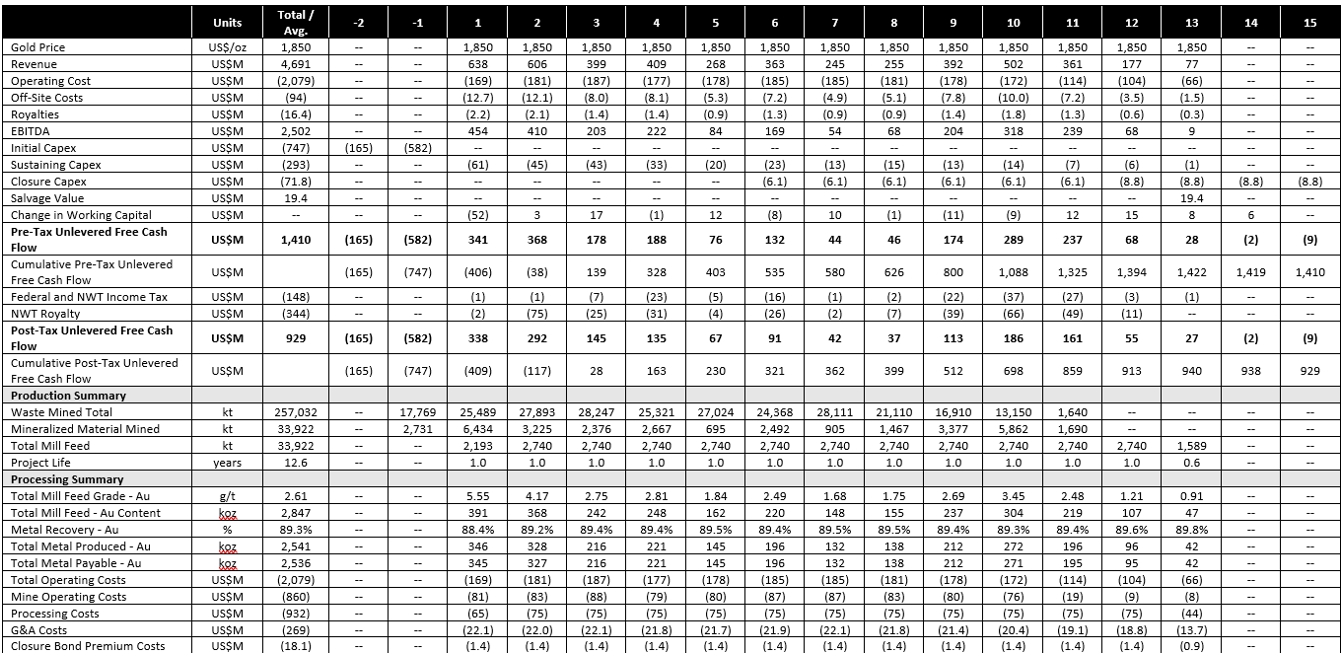
G-1-89
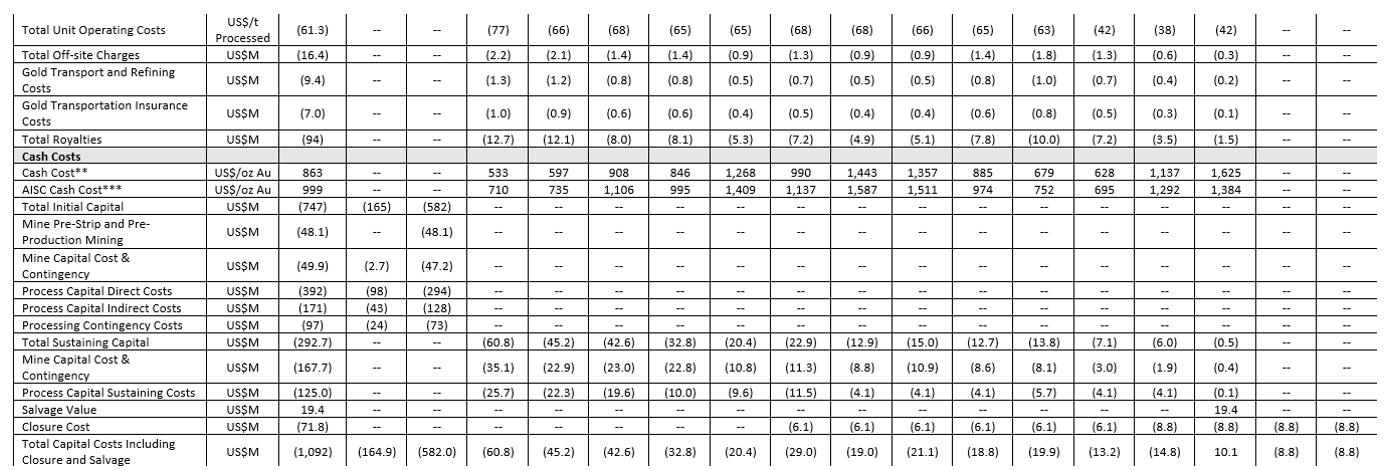
Dollar figures in Real 2024 dollars unless otherwise noted.
* Cash costs consist of mining costs, processing costs, mine-level G&A, closure bond premiums, off-site charges, and royalties.
** AISC includes cash costs plus sustaining capital, and closure costs, and less salvage credits.
| 13.2 | 2024 Preliminary Economic Assessment |
The PEA is a standalone mine plan that has been undertaken to evaluate a conceptual expansion of the open pit below the base of the permafrost after the PFS has been completely mined out. The Mineral Resources used in the 2024 PEA mine plan are exclusive of the pits mined out in the 2024 PFS plan and the associated Mineral Reserves or Mineral Resources inside of the 2024 PFS pits.
The PEA is preliminary in nature and includes Inferred Mineral Resources that are considered too speculative geologically to have the economic considerations applied to them that would enable them to be categorized as Mineral Reserves, and there is no certainty that the results of the PEA will be realized. Mineral Resources in the PEA mine plan are not Mineral Reserves and do not have demonstrated economic viability.
| 13.2.1 | Mining Methods |
The PEA utilizes Measured, Indicated, and Inferred Mineral Resources in mine planning. The PEA open pit mining is a conventional truck-shovel operation which utilizes 227-t class autonomous trucks loaded by 22-m3 diesel hydraulic shovels. Selective mining with smaller loading equipment on 5-m benches is used in the mineralization zones to reduce dilution and increase the head grade to the mill.
| 13.2.2 | Mine Production Plan |
The mill throughput is planned as 7,500 t/d and the total PEA mill feed is 43.5 Mt. Figure 1 4 shows the mill feed tonnes and grades in the PEA mine plan.
| 13.2.3 | Recovery Methods |
Based on the available information, the process flowsheet developed for the Courageous Lake mineralization is considered appropriate for the 2024 PEA.
The metallurgical performance parameters for Courageous Lake deposit are projected based on the metallurgical test results obtained from various test programs that are summarized in the metallurgical test work section.
The plant is designed for a throughput of 7,500 t/d with availability of 90%. The crusher plant circuit design is set at 65% availability and the gold room availability is set at 52 weeks per year.
The proposed plant includes a three-stage crushing circuit followed by a grinding circuit consisting of a ball mill circuit operating in closed circuit with a cyclone cluster. Ball mill cyclone overflow material reports to a flotation circuit consisting of rougher and cleaner flotation circuits. In the cleaning circuit, the concentrate is upgraded prior to further size reduction in a regrind ball mill operating in closed circuit with a cyclone cluster. Cleaner tailings combine with rougher tailings for thickening before being discharged to the co-placement storage facility (CPSF). Overflow from regrind cyclones undergoes acidulation and pre-oxidation stages prior to the pressure oxidation circuit. The oxidized slurry is leached and then washed in six-stages through a CCD circuit. The resulting pregnant solution will be processed using a Merrill-Crowe treatment by adding zinc powder to precipitate gold and silver. The precious metals precipitate will be smelted on site to produce gold-silver doré bars.
G-1-90
| 13.2.4 | 2024 PEA Capital and Operating Costs |
The total initial capital cost for the 2024 PEA is US$529 M and LOM sustaining costs are US$450 M. Closure costs are estimated at US$72 M.
The total operating costs for the 2024 PEA is US$83/t milled.
| 13.2.5 | 2024 PEA Economic Analysis |
Readers are cautioned that the PEA is preliminary in nature. It includes inferred mineral resources that are considered too speculative geologically to have the economic considerations applied to them that would enable them to be categorized as mineral reserves, and there is no certainty that the PEA will be realized.
The economic analysis was performed assuming a 5% discount rate discounted to the start of PFS construction. On a post-tax basis, the NPV discounted to the start of the PFS mine at 5% is US$104M. The total mill feed is 43.5 Mt with a mill feed grade of 2.62 g/t. The total gold recovered is 3,267 koz.
| 14 | EXPLORATION, DEVELOPMENT, AND PRODUCTION |
The Courageous Lake Project demonstrates positive economics, shown by the results presented in this technical report. The recommended work will define, refine and drill further targets along the Tundra-Salmita trend (Figure 26-1), and additional drilling of the Walsh Lake deposit to convert inferred resources into indicated and inclusion in the mineral reserves. Table 26-1 summarizes the proposed budget to complete the recommended work program.
| Table 26-1: | Recommended Work Program |
| Program Component | Summer 2026 (C$) | Winter 2027 (C$) | Total (C$) |
| Camp | 199,000 | 1,260,000 | 1,459,000 |
| Helicopters | 271,000 | 723,000 | 994,000 |
| Geophysics | 150,000 | - | 150,000 |
| Drilling | - | 1,260,000 | 1,260,000 |
| Assays and Analysis | 6,000 | 343,000 | 349,000 |
| Staff | 175,000 | 242,000 | 417,000 |
| IT | 71,000 | 53,000 | 124,000 |
| Travel and Expenses | 74,000 | 59,000 | 133,000 |
| Environment and Permitting | 130,000 | 13,000 | 143,000 |
| Total | 1,076,000 | 3,953,000 | 5,029,000 |
| 14.1 | Interpretation and Conclusions for the 2024 PFS |
| 14.1.1 | Introduction |
The QPs note the following interpretations and conclusions in their respective areas of expertise, based on the review of data available for this Report.
| 14.1.2 | Mineral Tenure, Surface Rights, Water Rights, Royalties and Agreements |
The Courageous Lake property is comprised of 85 Northwest Territorial Mining Leases and four Federal Mining Leases having a combined area of 50,239.96 ha. All of the mining leases are currently recorded 100% to Seabridge Gold (NWT) Inc., a wholly owned subsidiary of Seabridge Gold Inc. Upon completion of the spin-out, Valor Gold will have a 100% interest in Seabridge Gold (NWT) Inc.
G-1-91
| 14.1.3 | Drilling |
Exploration has been primarily through drilling of the deposits. A total of 1,099 drill holes containing 284,086 m of drilling with 176,456 m assayed for at least Au are in the Courageous Lake Project database. The quantity and quality of the lithological, geotechnical, collar, and down-hole survey data collected from the drill programs are sufficient to support Mineral Resource estimation. There are no known sampling or recovery factors that could materially impact the accuracy and reliability of the results.
| 14.1.4 | Analytical Data Collection and QA/QC |
Seabridge era drilling contained sufficient QA/QC procedures with acceptable results to support the Resource Estimate. Historic data from Noranda and Placer dome era drilling is validated through the use of Point Validation, which compares the historic drilling to the recent drilling. Based on this validation work, all drillhole data within the database has been used to inform the Mineral Resource Estimate.
| 14.1.5 | Metallurgical Testwork |
Six metallurgical test programs were conducted on samples from the Courageous Lake deposit between 2003 and 2023. SGS-Lakefield Research Ltd. (Lakefield) conducted the metallurgical testing programs in 2003/2004 and in 2010/2011 which included investigations into comminution, flotation and gravity concentration, flotation concentrate pre-treatments by bio-oxidation (BIOX) and pressure oxidation (POX), cyanide leaching, and POX slurry neutralization.
G&T Metallurgical Services Ltd. (G&T) carried out a test work program in 2007 focused on optimizing flotation performance. Based on the 2007 work program, G&T conducted the 2012 test program to further investigate flotation optimization, and prepared concentrates for POX tests that were carried out in 2012 by Sherritt Technologies, a division of Sherritt International Corp. (Sherritt). Sherritt also conducted cyanide amenability (CNA) tests on the POX residues and cyanide destruction tests on the cyanide leach residues.
The most recent test program was completed by ALS Kamloops in 2023 which included eight variability samples representing a range of grade, depth, and zone parameters from eight drill cores. The test work included ball mill grindability, flotation concentration, and flotation tails leaching.
Modal mineralogy indicates that the predominant sulphide minerals contained across the samples were arsenopyrite, pyrite, and pyrrhotite. The gold occurred as liberated gold, or refractory gold associated with sulphides (primarily arsenopyrite) and silicates. Gold grain sizes ranged from sub-microscopic size to 70 µm. The gangue mineralogy was dominated by quartz, micas, feldspar, and calcium carbonate.
The results of the comminution tests indicate that the material is very competent with respect to breakage in a SAG mill. The Bond ball mill work index results suggest that the material is of moderate hardness with respect to grinding in a ball mill, and a BMWi value of 16.5 kWh/t was used for grinding circuit design.
The test work results indicate that the material does not exhibit a strong response to gold recovery through gravity concentration; however, the mineralization responds well to flotation concentration. Gold recovery by flotation was high, ranging from 85 to 97%. The pressure oxidation and cyanidation tests by Lakefield and Sherritt indicated a significant improvement in gold extraction when the flotation concentrate underwent a high degree of pressure oxidation. The testing programs showed that over 98% of the sulfide sulfur can be oxidized with the standard conditions practiced in the POX industry. The test work indicated that gold extraction improved substantially with increasing sulfur oxidation. The Lakefield and Sherritt test results showed that the gold extractions from the POX residues varied from 94 to 99%.
Robust metallurgical projection models have been derived from open circuit and locked cycle bulk rougher flotation and single-stage cleaner flotation tests of the Courageous Lake master composites and variability samples and are appropriate for this level of study.
The deleterious element assay for eight variability samples from ALS 2023 test program indicate that all samples contained less than one ppm of mercury, which was the laboratory’s detection point. It does not appear that mercury would become a deleterious element in the final doré; however, further analysis may be required to confirm the precise mercury concentration at lower detection point.
In 2013, SGS Lakefield performed test work on Walsh Lake deposit located near Courageous Lake deposit. The results bottle roll cyanidation tests show that Walsh Lake samples are amenable to leaching by standard, direct cyanidation procedures and does not show any indication of material being refractory. The test results indicated flotation to be effective in concentrating the gold and sulfide minerals of Walsh Lake deposit. Rougher flotation tests show gold recoveries ranging from 88% to 95% with mass pulls ranging from 14.5% to 23%.
G-1-92
| 14.1.6 | Mineral Resource Estimate |
The Courageous Lake and Walsh Lake deposit Resource Estimates have a base case cut-off grade of 0.8 g/t. The Courageous Lake deposit contains 11.0 Moz of Au in the Measured and Indicated categories within 145 Mt at a mean Au grade of 2.36 g/t. There is an additional 3.3 Moz of Au in the Inferred category at Courageous Lake.
Walsh Lake contains an additional 552 koz of Au in the Inferred category within 4.1Mt at an average Au grade of 4.2 g/t.
The following factors could affect the Mineral Resources: commodity price and exchange rate assumptions; pit slope angles and other geotechnical factors; assumptions used in generating the LG pit shell, including metal recoveries, and mining and process cost assumptions.
| 14.1.7 | Mining |
The open pit mine plan in the 2024 PFS establishes an economic mine plan that uses Measured and Indicated Resources and stays within the permafrost zone, providing mill feed at a nominal rate of 7,500 t/d. The LOM plan accommodates the local adverse conditions comprising snow, cold, and remoteness. Waste and water management designs are incorporated into the mine plan, as specified in the current site plans. The chosen mine equipment is well known and suitable for the expected operating conditions, and the productivity assumptions are reasonable and achievable. Given the stated design parameters and assumptions, the open pit mine plan is expected to achieve the forecasted production schedule and annual costs within the typical range of accuracy for a PFS-level study.
| 14.1.8 | Recovery Methods |
The process plant flowsheet designs were based on previous studies, testwork results, financial evaluations, and industry standard practices. Most of the unit operations selected to build the plant flowsheet are standard technologies widely used in gold processing plants with no significant elements of technological innovation. The pressure oxidation circuit is technologically complex and requires skilled operators.
The plant is designed for a throughput of 2.74 Mt/a with availability of 90%. The crusher plant circuit design is set at 65% availability and the gold room availability is set at 52 weeks per year. The project has an estimated life of 13 years.
The selected flowsheet includes a three-stage crushing circuit, with crushed product reporting to the crushed ore stockpile. Mineralized material is reclaimed to a grinding circuit consisting of a ball mill circuit operating in closed circuit with a cyclone cluster. Classified material reports to rougher flotation, where concentrate is separated from the gangue material and fed to cleaner flotation. In the cleaning circuit, the concentrate grades are upgraded prior to further size reduction in a regrind ball mill operating in closed circuit with a cyclone cluster. Cleaner tailings combine with rougher tailings for thickening before being discharged to the co-placement storage facility (CPSF). Overflow from regrind cyclones undergoes acidulation and pre-oxidation stages followed by the pressure oxidation circuit which will effectively oxidize the sulphide concentrate. The oxidized concentrate is leached and then washed in six stages through a CCD circuit. The resulting pregnant solution will be processed using a Merrill-Crowe treatment by adding zinc powder to precipitate gold and silver. The precious metals precipitate will be smelted on site to produce gold-silver doré bars.
| 14.1.9 | Project Infrastructure |
| 14.1.9.1 | Site Access |
The Project site will be accessible by the Courageous Lake Mine spur winter road, connecting to the Tibbitt to Contwoyto winter road (TCWR) that is normally open from late January/early February until the end of March of each year.
The Courageous Mine spur winter road accessed from the TCWR and is estimated to be 26 km in length with 7 km on land (with small lakes interspersed) and 19 km on the larger Mackay Lake. From the Courageous Lake Mine spur road intersection to the TCWR it is 76 km to the Lockhart Lake maintenance camp. The Lockhart Lake maintenance camp is at station 170 km from the TCWR start at Tibbitt Lake.
G-1-93
| 14.1.9.2 | Site Infrastructure |
Infrastructure to support the Courageous Lake Project will consist of site civil works, site facilities/buildings, on-site roads, a water management system, and site electrical power. Site facilities will include both mine facilities and process facilities as follows:
| ● | Mining facilities including the mine office and dry, truck shop, tire change facility, truck wash, explosives storage and manufacturing facility, diesel fuel storage and distribution, and ore stockpile. | |
| ● | Processing facilities including the primary, secondary and tertiary crushing, ROM stockpile and reclaim conveyors, fine ore stockpile, process plant, office and laboratory, plant maintenance building. | |
| ● | Mine waste and water management infrastructure including: mine waste and tailings storage facility, tailings distribution system, water reclaim system, downstream water management ponds, and overburden stockpiles. | |
| ● | General facilities including the camp, gatehouse, emergency response/ambulance bay, warehouse, reagent cold storage, administration building, communications, emergency power diesel storage, potable fresh, process and potable water storage and distribution, power plant, site sewage system, and solid waste treatment. | |
| ● | The processing plant will comprise several pre-engineered and stick built buildings in addition to a fabric geodesic dome. | |
| ● | A 204 bed permanent accommodation camp will be located south of the process plant, connected via an arctic corridor. The camp will be installed at the beginning of construction to house construction personnel and will then be maintained for operating staff. |
| 14.1.9.3 | Site Power |
| 14.1.9.3.1 | Electrical Power Supply |
The proposed diesel powerplant will consist of seven (7) modular diesel gensets, 1800 rpm, each nominal 3.1 MW continuously rated (ancillary loads allowed for), 3 phase, 60 Hz, 13.8 kV, 0.8 PF leading, with water jacket and exhaust gas heat recovery, with indoor day tanks and local control panels plus networking and PLC automatic master control, with gensets mounted in double wide sound attenuated modules with fire detection, fire suppression and H&V for arctic conditions.
There is an opportunity to evaluate a nuclear microreactor power plan as an alternative solution to diesel power for the project, at a cost per kWh that is comparable to diesel costs. The microreactor plant will generate enough electricity to power all mine loads, with leftover heat available for supply to the plant heating system.
| 14.1.9.3.2 | Site Power Distribution |
Power will be distributed across the site via 13.8 kV overhead lines originating from the plant’s 13.8 kV switchgear housed within the primary electrical rooms at the outdoor substation.
The ball mill and oxygen plant drive systems will be supplied via cable circuits from the plant’s primary 13.8 kV switchgear. All other process and non-Process Plant loads will be powered via 4160 V and 600 V motor control centers (MCCs) housed within electrical rooms strategically located throughout the plant area. Power will be stepped down to 4.16 kV, 600 V, and 120/208 V distribution, as required via grounded pad-mounted and pole-mounted transformers.
| 14.1.9.4 | Co-placement Storage Facility and Leach Residue Tailings Facility |
Waste management consists of the containment and long-term management of waste products developed during the life of mine operations that consist of waste rock and tailings. Waste rock will be generated during the mining of economical ore. Tailings is a waste product of mineral exaction that consists of two tailings streams: flotation tailings and neutralized leach residue tailings from pressure oxidation (POX) circuit. The flotation tailings will be co-placed with waste rock and the neutralized tailings will be placed in a separate facility.
Both facilities are located east of the open pit. The co-placement storage facility is an unlined facility that will utilize waste rock to construct paddock cells for the storage of flotation slurry tailings. This facility is designed to store 297.8 Mt of flotation tailings and waste rock. The leach residue tailings facility is a lined facility to prevent constituents of concern migrating out of the facility. The facility is designed to contain 1.1 Mt of leach residue tailings. Each facility will be closed with a cap consisting of 2m of overburden and 0.3m of topsoil and vegetative cover. The CPSF will be closed progressively during operations and the LRTF will be closed at the end of the mine life.
G-1-94
These facilities are designed in accordance with local and national standards for tailings and waste rock storage.
| 14.1.9.5 | Water Management |
The objective of surface water management is to protect groundwater and surface water resources. A site-wide management strategy, encompassing the design of water management structures, hydrology considerations, and a site-wide water balance was developed for the site. The review and interpretation of existing climate data, encompassing factors such as precipitation, snowfall, and evaporation, are crucial for accurately estimating water balance and designing effective water management structures. Surface water runoff that comes into contact with disturbed areas will be managed prior to being released to the surrounding environment. Runoff from disturbed areas will be collected in gravity ditches and conveyed to pond or back into the pits. Diversions will capture non-contact water away from facilities and convey it to their natural discharge location.
| 14.1.9.6 | Water Treatment |
Mine contact water from the open pit, waste rock and tailings management area and residual processing water will be collected in the West or South satellite pits and pumped from there to the mine water treatment plant where parameters such as arsenic, nitrate, and ammonia will be removed. Treated effluent will be pumped from the plant to Courageous Lake where it will be discharged through a diffuser. Clean water from an undeveloped catchment to the east of the Project area will be diverted away from the waste rock and tailings management facility and directed towards Courageous Lake. Fresh water for processing of ore will be sourced from Courageous Lake.
| 14.1.10 | Environmental, Permitting and Social Considerations |
Courageous Lake Project has been the subject of two decades of environmental baseline studies which prepare the Project well to advance towards a formal Environmental Assessment. Northwest Territories Environmental Assessment processes are well-defined. Integrating environmental considerations with mine plan and mine closure/reclamation design is key to gaining social license support for the project through proactive commitments to consultation with communities, Indigenous communities and governments, NWT and federal regulators and other stakeholders with interests. The Project site environmental concerns for permafrost, Northern Caribou, fish and water quality can be mitigated and in the opinion of the QP there are no material barriers to advancement of the Project through permitting.
| 14.1.11 | Capital Cost Estimate |
The estimates conform to Class 4 guidelines for a PFS-level estimate with a -20%/ +25% accuracy according to AACE International. This estimated was developed in Q4 2023 C$ based on the proposed design for the Project, with input data from budgetary quotations for equipment, service contracts, and construction contracts; as well as Ausenco’s in-house database of similar projects and studies, which includes experience from similar operations. Pricing has been converted to US$ for the purposes of this report using the C$ to US$ exchange rate of 0.74.
| 14.1.12 | Operating Cost Estimate |
The estimate conforms to Class 4 guidelines for a PFS study level estimate with a -20%/+25% accuracy according to the Association of the Advancement of Cost Engineering International (AACE International).
The operating cost estimate was developed in Q3 2023 and comprises the ongoing cost of operations related to mining, processing, tailings co-disposal, general administration activities, and water treatment costs. The estimate is based on a combination of first-principal calculations, experience, vendor quotes, reference projects and factors appropriate for this level of study. Pricing has been converted to US$ for the purposes of this report using the C$ to US$ exchange rate of 0.74.
| 14.1.13 | Economic Analysis |
Based on the assumptions and parameters in this report, the PFS shows positive economics of US$522.7M post-tax NPV (5%) and 20.6% post-tax IRR.
G-1-95
| 14.2 | Interpretation and Conclusion for the 2024 PEA |
| 14.2.1 | Introduction |
The 2024 PEA is a conceptual mine plan that has been undertaken to evaluate the potential of expansion below the base of the permafrost after the 2024 PFS has been completed. None of the Mineral Resources in the PEA mine plan have been used in the 2024 PFS plan.
The 2024 PEA is preliminary in nature and includes Inferred Mineral Resources that are considered too speculative geologically to have the economic considerations applied to them that would enable them to be categorized as Mineral Reserves, and there is no certainty that the results of the PEA will be realized. Mineral Resources in the PEA mine plan are not Mineral Reserves and do not have demonstrated economic viability.
| 14.2.2 | 2024 PEA Mining Methods |
The open pit mine plan in the 2024 PEA establishes an economic mine plan that uses Measured and Indicated Resources and stays within the permafrost zone, providing mill feed at a nominal rate of 7,500 t/d. The LOM plan accommodates the local adverse conditions comprising snow, cold, and remoteness. Waste and water management designs are incorporated into the mine plan, as specified in the current site plans. The chosen mine equipment is well known and suitable for the expected operating conditions, and the productivity assumptions are reasonable and achievable. Given the stated design parameters and assumptions, the open pit mine plan is expected to achieve the forecasted production schedule and annual costs within the typical range of accuracy for a PEA-level study.
| 14.2.3 | 2024 PEA Recovery Methods |
Based on the available information, including PEA mine plan and results of the metallurgical test work performed on samples providing a reasonable indication of the mineralogical characteristics of the materials, the process flowsheet developed for the Courageous Lake mineralization is considered appropriate for the 2024 PEA.
The metallurgical performance parameters for Courageous Lake deposit are projected based on the metallurgical test results obtained from various test programs that are summarized in the metallurgical test work review section.
The plant is designed for a throughput of 7,500 t/d with availability of 90%. The crusher plant circuit design is set at 65% availability and the gold room availability is set at 52 weeks per year.
The proposed plant includes a three-stage crushing circuit followed by a grinding circuit consisting of a ball mill circuit operating in closed circuit with a cyclone cluster. Classified material reports to a flotation circuit consiting of rougher and cleaner flotation circuits. In the cleaning circuit, the concentrate is upgraded prior to further size reduction in a regrind ball mill operating in closed circuit with a cyclone cluster. Cleaner tailings combine with rougher tailings for thickening before being discharged to the co-placement storage facility (CPSF). Overflow from regrind cyclones undergoes acidulation and pre-oxidation stages prior to the pressure oxidation circuit. The oxidized slurry is leached and then washed in six-stages through a CCD circuit. The resulting pregnant solution will be processed using a Merrill-Crowe treatment by adding zinc powder to precipitate gold and silver. The precious metals precipitate will be smelted on site to produce gold-silver doré bars.
| 14.2.4 | 2024 PEA Project Infrastructure |
| 14.2.4.1 | Facilities and Services |
Existing facilities, buildings and services from the 2024 PFS mine site are used for the purposes of this PEA beginning in PEA Year 1. Additional infrastructure required from 2024 PEA Year 1 includes:
| ● | 3 No. 15,000,000 L diesel storages tanks | |
| ● | accommodation camp for mining operations | |
| ● | water treatment plant for saline groundwater. |
G-1-96
| 14.2.4.2 | 2024 PEA Co-placement Storage Facility and Leach Residue Tailings Facility |
Waste management consists of the containment and long-term management of waste products developed during the life of mine operations that consist of waste rock and tailings. Waste rock will be generated during the mining of economical material. Tailings is a waste product of mineral exaction that consists of two tailings streams: flotation tailings and neutralized leach residue tailings from pressure oxidation (POX) circuit. The flotation tailings will be co-placed with waste rock and the neutralized tailings will be placed in a separate facility.
Both facilities are located east of the open pit. The co-placement storage facility is an unlined facility that will utilize waste rock to construct paddock cells for the storage of flotation slurry tailings. This facility is designed to store 762.1 Mt of flotation tailings and waste rock. The leach residue tailings facility is a lined facility to prevent constituents of concern migrating out of the facility. The facility is designed to contain 1.5 Mt of leach residue tailings. Each facility will be closed with a cap consisting of 2m of overburden and 0.3m of topsoil and vegetative cover. The CPSF will be closed progressively during operations and the LRTF will be closed at the end of the mine life.
These facilities are designed in accordance with local and national standards for tailings and waste rock storage.
| 14.2.5 | 2024 PEA Economic Analysis |
Readers are cautioned that the 2024 PEA is preliminary in nature. It includes inferred mineral resources that are considered too speculative geologically to have the economic considerations applied to them that would enable them to be categorized as mineral reserves, and there is no certainty that the PEA will be realized.
The PEA shows positive economics of US$104.1M post-tax NPV (5%) and 7.8% post-tax IRR.
| 14.3 | 2024 PFS Risks and Opportunities |
| 14.3.1 | Risks |
| 14.3.1.1 | Metallurgical Test Work |
Test work grades for gold and silver were similar to those reported in the mine plan, but sulfur and arsenic grades were higher than the expected LOM grades. It is assumed that the metallurgical trends and characteristic performance from the test work extrapolates to the lower values in the mine plan.
There is an inherent risk that the samples tested do not suitably represent the deposit, however the quantities of samples and spatial coverage suggest that this risk is low. Testing on material representing a larger mining target area, POX and leach testing should be repeated in future project phases.
The completed test programs indicated that all samples contained less than one ppm mercury, which was the laboratory’s detection point. Analyses with lower detection limits should be conducted on feed material to better understand the concentration and potential effect on refined product, and if warranted, determine processing methods to mitigate any negative effects.
| 14.3.1.2 | Mineral Resource Estimate |
The following factors could affect the Mineral Resources: commodity price and exchange rate assumptions; pit slope angles and other geotechnical factors; assumptions used in generating the LG pit shell, including metal recoveries, and mining and process cost assumptions.
| 14.3.1.3 | Mining |
| 14.3.1.3.1 | Mining Methods |
The following are potential major risks to the overall project economics:
| ● | Failure to expose enough ore in the pre-stripping period for targeted mill throughput in Year 1. | |
| ● | Implementing an autonomous haulage in a northern environment, may have ramp up challenges that have not been modelled. |
G-1-97
| 14.3.1.3.2 | Mining Geotechnical |
Tetra Tech (2023b) presents uncertainties, risks, and mitigative strategies based on the current level of geotechnical, hydrogeological, and permafrost investigations and studies completed at the site. The studies completed to date are in general accordance with the requirements for a Level 2: Pre-feasibility slope angle study as described in “Guidelines for Open Pit Slope Design” (Read and Stacey 2009).
| 14.3.1.3.2.1 | Geology, Structure and Alteration Model Updates |
The following summarizes some of the uncertainties and risks presented in Tetra Tech (2023b):
| ● | A robust 3D geological, structural, and alteration model coupled with groundwater and permafrost is not available. | |
| ● | Width, geotechnical, and hydrogeological characteristics of Tundra Shear Zone and other fault features are not well known and could affect bench-scale and multi-bench scale stability. | |
| ● | The persistence/continuity and spacing of systematic rock fabric used for bench design has been estimated from limited mapping data leading to uncertainty of input parameters to bench design. | |
| ● | The spatial distribution of alteration assemblages is not well known geotechnically and this could affect bench-scale and inter-ramp stability. | |
| ● | Unforeseen adversely oriented continuous major structures could affect bench and inter-ramp stability. |
| 14.3.1.3.2.2 | Hydrogeology and Permafrost |
The following summarizes some of the uncertainties and risks presented in Tetra Tech (2023b):
| ● | Higher than expected water pressures and inflows encountered at the toe of the pit walls and beneath the pit floor potentially leading to slope instability. | |
| ● | Groundwater encountered sooner than expected due to expected variability in base of permafrost as well as freezing point depression within the basal cryopeg. | |
| ● | Increased/unforeseen depressurization and water management costs due to ineffectiveness and inefficiency of depressurization system. | |
| ● | Ongoing seepage towards the pit leading to formation of significant ice walls on the upper benches of the East Wall and West Wall, above the ramp. | |
| ● | Ice walls may require specific safe operating procedures. | |
| ● | Development of a through-talik beneath the open pit once flooded at closure, connecting the sub-permafrost flow regime to the surface hydrological system. |
| 14.3.1.3.2.3 | Rock Mass Quality and Material Strength Properties |
The following summarizes some of the uncertainties and risks presented in Tetra Tech (2023b):
| ● | Spatial distribution of rock mass quality and rock mass strength is not well defined. | |
| ● | The amount of laboratory rock strength testing should be increased and should include triaxial and tensile strength testing in addition to compressive strength testing. | |
| ● | The amount of laboratory discontinuity strength testing should be increased to sufficient numbers to statistically represent the various discontinuity strengths. |
G-1-98
| 14.3.1.4 | Recovery Methods |
This study was performed with testwork commensurate with a PFS. As the project advances, further testwork should be completed to support the design. As such, the following risks should be highlighted:
| ● | Grinding equipment was selected based on limited comminution test data and the flowsheet should be further reviewed as additional testing is completed to confirm it is still the most appropriate design for the project. | |
| ● | Process conditions, residence times, and reagent usage may change with further testing. | |
| ● | The cyanide detoxification testing may show that additional retention time or increased reagent additions may be required to achieve the target CNWAD concentration. | |
| ● | The POX circuit is technologically complex and will require a specialist maintenance and operations team | |
| ● | Transport load restrictions on the ice road will necessitate autoclave fabrication in segments with on-site welding which will require specialist design and assembly. |
| 14.3.1.5 | Environmental Studies, Permitting and Social or Community Impact |
An inability to obtain government approval of the Project Environmental Assessment resulting from insufficient mitigation of adverse environmental or social effects, or failure to obtain Indigenous community support is a risk that would require it be revised and re-submitted once issues were resolved. This circumstance would result in material project delay to start of construction.
Matthews Creek diversion is an essential element of the Mine plan, and failure to obtain approval from federal Department of Fisheries and Oceans on a Matthews Creek fish habitat offset plan, with Indigenous support is a risk that could add significant schedule delay risk to the Project.
Approval of a Bathurst Caribou herd management plan is essential to gaining Indigenous community support for the Project in view of the important, traditional cultural value that Indigenous peoples place on Caribou. Demonstration of how the Seabridge caribou research program results have informed Project design mitigations for caribou, and how the mine closure and reclamation plan support caribou as a key end land use goal will be essential.
| 14.3.1.6 | Infrastructure |
| 14.3.1.6.1 | Construction |
Constructability issues can lead to delays and cost overruns. A PFS-level constructability review was conducted to support this study and should be further advanced in the next project phase. Elements to be reviewed in further detail include traffic flow, construction timing and more granular scheduling. Further review of PFS staging and laydown allowances, consideration of a secondary access to the plant site during construction and detailed site surveys to identify optimal crane positions and lifts lengths should also be made.
Winter weather can impact construction progress and maintenance during operation. Therefore, developing winterization plans for equipment, infrastructure and personnel safety is recommended.
| 14.3.1.6.2 | Water Treatment |
| ● | Water Quality Predictions: The quality of the contact water on site may differ from the quality that was predicted based on geochemical test work and analogue data sets. As a result, actual site water could have elevated concentrations of certain parameters that are not targeted by the proposed water treatment processes, which could trigger a need for implementation of additional water treatment. | |
| ● | Licensing Risks: The water treatment processes proposed based on generally accepted best management practices, and the treatment processes were judged to produce treated effluent that would meet presumed future effluent quality limits. However, it is possible that effluent quality limits that generally are deemed to be acceptable and protective of the downstream aquatic environment would not be authorized through the water licensing process and would not be acceptable for discharge to Courageous Lake. |
| 14.3.1.6.3 | Co-placement Storage Facility and Leach Residue Tailings Facility |
| ● | There is a limited historical geotechnical program utilized in the 2024 PEA. Conditions may vary from those assumed in the design of the CPSF and LRTF and require modifications to the initial capital and sustaining capital and operating costs. |
G-1-99
| ● | The geochemical characteristics of the flotation tailings and waste rock are difference than those assumed in the design and may require additional measure to prevent migration of constituents of concern beyond the footprint of the facility. |
| ● | The seepage collection system affects the permafrost in the stability zone of the CPSF, thaws, creating instability in the outer shell of the CPSF requiring excavation down to bedrock that would increase capital and sustaining capital costs. |
| ● | The proximity of the west portion of the CPSF is within 100 m of the open pit and blasting could affect the stability of the slopes near the pit. |
| 14.3.1.6.4 | Plant Site Geotechnical Conditions |
The plant site is located in area that has multiple bedrock outcrops. There is a only 1 historical borehole located north of the plant site. Plant site geotechnical conditions may vary from those assumed in the design of the plant site and require modifications to the capital cost.
| 14.3.2 | Opportunities |
| 14.3.2.1 | Mineral Resource Estimate and Exploration |
| ● | Opportunities to expand and upgrade the mineral resource are significant at both Courageous Lake and Walsh Lake. | |
| ● | Several of the mineralized zones at Courageous Lake are open in the north and south. Mineralization is also open at depth. Upgrading of the Inferred resource to Measured and Indicated with infill drilling represents an opportunity to increase the resource which could be converted to reserves. | |
| ● | Walsh Lake is open at depth as well as to the north and south of the current resource pit. Additional infill drilling at Walsh Lake can convert the Inferred resource to Measured and Indicated categories. | |
| ● | Drilling at both areas is recommended with the drilling budget detailed in the following section. |
| 14.3.2.2 | Mining Methods |
| 14.3.2.2.1 | Mining Methods |
The following potential opportunities could improve the overall project economics:
| ● | Further delineation drilling could upgrade Inferred Resources to Measured or Indicated (allowing them to be included in the PFS) This would result an improvement to the project economics. | |
| ● | The potential silver value has not been included in the study. The byproduct value would marginally improve the economics for the Project. | |
| ● | Mining below the permafrost would result in larger ore body and the opportunity to use larger mining equipment. | |
| ● | Optimizing the ditching assumptions could reduce the haul road width and reduce the strip ratio |
| 14.3.2.2.2 | Mining Geotech |
The Southwest Section indicated a relatively low factor of safety that does not achieve the DAC without depressurization. The overall slope is relatively shallow, being intersected several times by the ramp. Although counter-intuitive, steepening of the overall slope angle could lead to a higher factor of safety by increasing the normal load at the toe of the slope to counteract the vertical uplift forces from water pressure. This could lead to a lower stripping ratio. This opportunity has been investigated by evaluating a steeper overall slope angle of 42.6°, rather than the current design of 33°. Steepening the overall slope angle leads to a higher FS that meets the DAC. This should be investigated in greater detail and for other design sectors during future engineering and design studies, or optimization studies.
G-1-100
The depressurized scenarios assume wells around the entire perimeter of the pit to lower the phreatic surface to 50 m below the pit floor. Based on the high FS for the 50 m depressurized scenario, this level and extent of depressurization may not be required, and the water inflows may be lower than predicted.
At a conceptual level, an opportunity might exist to utilize the underground workings as a drainage gallery beneath the PFS pit to assist with depressurization of the lower pit slopes and pit floor. Conceptually, a series of injection wells or passive drain holes could be drilled from the ramp system and into the workings; the workings would then be pumped from another location, such as through the existing shaft. Evaluating this possibility would require additional detailed characterization of the base of permafrost and the basal cryopeg, as well as mapping of the underground workings using remote geophysical methods, and specific pumping and recovery tests targeted at the workings.
| 14.3.2.3 | Recovery Methods |
Further opportunities exist to further optimize the selected process flowsheet with respect to both capital and operating costs, as well as maximizing gold recovery to doré. The following opportunities have been identified:
| ● | Pre-concentration of crushed material via XRT ore sorting shows that sulphide-bearing specimens can be effectively separated from barren material. This could be investigated further as a means to pre-concentrate the feed and reduce primary grinding energy requirements. | |
| ● | Additional test work to investigate BIOX option as an alternative to POX process. | |
| ● | Investigate potential local limestone source. | |
| ● | Over the course of the PFS the carbonate levels in the autoclave feed measured lower than originally anticipated; therefore, the requirement for pre-acidulation may be mitigated. | |
| ● | Regrind circuit can be removed to reduce capital costs as 2023 test results show concentrate is naturally fine, measuring 30 µm. | |
| ● | ALS 2023 test work showed reduced mass recovery to the flotation concentrate which presents opportunity to reduce the size of the oxidation and leach circuits. | |
| ● | Optimize lime consumption for solution neutralization circuit based on additional testwork. |
| 14.3.2.4 | Infrastructure |
| 14.3.2.4.1 | Power Generation |
It is recommended that there are opportunities for several enhancements to the project power supply option that should be studied going forward, as it is judged that these may have an overall positive economic impact on the project.
| 14.3.2.4.1.1 | Diesel Generation Grid Stabilization |
A major diesel generator manufacturer offers standard scalable battery powered microgrid stabilizers. This equipment is pre-engineered, factory assembled, and tested. Advanced lithium-ion batteries provide energy density, high discharge/recharge efficiency, and long cycle life. Multiple modules may be used in parallel to increase total output up to over 100 MW, many times what would be required at Courageous Lake. Such equipment can be integrated with both diesel and solar power and offers numerous advantages including:
| ● | Transient Assistance and Grid Stabilization |
| ○ | Provides power to decrease transient voltage and frequency dips when large loads are applied. The units act like a “Static Var Compensator,” a standard power system stabilizer. | |
| ○ | Provision of modules equivalent to one genset (3 MW range) would mean that the unexpected trip of a generator would be seamlessly ridden over with no load shedding required and blackouts averted. Power would be provided during the period when a standby genset would be automatically started, synchronized to the system, and take load. |
G-1-101
| ● | Fuel Efficiency Gains |
| ○ | The controls can be adjusted to that as when momentary load peaks occur, the power is supplied by the batteries, thus avoiding generator governor action. This improves fuel efficiency and reduces engine stress. |
| ● | Reduction In Engine Maintenance. |
| ○ | With the battery banks in parallel with the diesel generators, less spinning reserve is required, thus there will be less average engine operating hours accumulated each year, reducing maintenance and extending engine Life. |
| 14.3.2.4.1.2 | Solar Power Supplemental to Diesel Generation |
Solar power, in particular during the summer months, solar operating in a hybrid system with diesel generation has the potential to reduce fuel consumption, reduce greenhouse gas emissions, and enhance the economics of the project. Solar power has the potential to provide at least 25% of the required annual kilowatt hours of required power generation.
| ● | Northern Installations |
| ○ | In the north, the solar output is not only dependent on the latitude but also the local weather conditions and can be easily modeled with considerable accuracy. In the NWT significant solar generation is from March to August. |
| ○ | There are several relatively large solar photovoltaic (PV) projects in the Yukon. |
| ○ | The nearby Diavik Diamon mine (which at 200 km south of the Arctic Circle is a bit further north than Courageous Lake) has announced the installation of an integrated solar system that is slated to produce 4.2 GWh of electricity per annum. |
| ● | Solar Costs |
| ○ | Solar farm capital and operating costs have generally been acknowledged to have fallen below the cost of power generated by shipping and burning diesel at off grid sites. Several large diesel generator vendors are taking advantage of this cost reduction and the associated reduction in greenhouse gas emissions and are offering such hybrid systems. One manufacturer has recently completed a study for such a system for a mine in Northern Canada. |
| ○ | There are potential tax and other incentives for solar installations; however, solar rebates in the NWT are currently only for residential installations. |
| ○ | In general, PV solar panel costs are falling, and efficiency is increasing. In the recommended system the solar panels are in parallel with diesel generation and energy storage is not anticipated, except for the grid stabilizer as discussed for diesel generation. |
| ● | Standard Products |
| ○ | Providing integrated solar systems does not require a great deal of new engineering. |
| ○ | A major diesel generator manufacturer has for some years supplied integrated systems with a PV solar farm operating in conjunction with an off-grid diesel plant to reduce power costs and greenhouse gas emissions. Such combinations are common, with generators backing up solar power, but vendors now offer pre-engineered integrated systems as a standard product. The systems include microgrid controllers capable of managing dispatch of generators, energy storage and solar inverters, including managing microgrid voltage and frequency regulation. Similar systems are now being offered by two other large diesel generator manufacturers. |
| ○ | The permitting of such systems is usually, relatively, straight forward. |
| 14.3.2.4.1.3 | Small Modular Nuclear |
There is an opportunity to evaluate a nuclear microreactor power plant as an alternative solution to diesel power for the project. The project team is collaborating with NuScale Power and has identified multiple possible plant configurations that can provide the same amount of power as provided by the diesel power plant, at a cost per kWh that is comparable to diesel costs based on current market rates.
The nuclear microreactor generates 40 MW of heat, a portion of which is then converted to electricity using a Brayton turbine cycle and/or a traditional steam cycle. The remaining heat from the nuclear reactor is supplied to the heat exchanger for the plant heating system, providing heating capability in addition to electrical power. The provision of power is envisioned to be structured as a power purchase agreement, with a third party owner and operator running the nuclear microreactor power plant.
G-1-102
| 14.3.2.4.2 | Water Treatment |
| ● | Water quality predictions: The quality of the contact water on site may be better than predicted, which could result in lower reagent and power demand and therefore lower treatment costs. |
| ● | Hydrological conditions: The estimated contact water runoff and seepage volumes could be lower than expected, which would reduce water treatment operating costs. |
| 14.3.2.4.3 | Waste Management |
Both the CPSF and LRTF have significant expansion capabilities if additional ore reserves are discovered through future explorations.
| 14.3.2.5 | Environmental and Permitting |
Opportunity to reduce the overall regulatory timeline should be considered by evaluating how EA development and permit application development may be developed concurrently. Achievement of some degree of scheduling overlap, may reduce the overall timeline to start of construction, or create an opportunity for early works construction.
| 14.4 | 2024 PEA Risks and Opportunities |
| 14.4.1 | Risks |
| 14.4.1.1 | Mining Methods |
The following items are potential risks to the overall project economics:
| ● | Inferred resources that are included in the PEA may not get upgraded to Measured or Indicated. |
| ● | Failure to achieve pre-production mining targets, thus delaying mill feed release and delaying revenues. |
| ● | Implementing an autonomous haulage in a northern environment may have ramp up challenges that have not been modelled. |
| ● | The permafrost could be shallower than expected, resulting in more water management than planned in the PEA. |
| 14.4.1.2 | Mining Geotechnical |
There have been no pit slope stability analyses completed for the PEA pit as part of this current study. In general, the uncertainties and risks for the PEA pit will be similar as described in Section 25.3.1.3.2 for the PFS pit study. These are repeated below but include additional specific risks associated with the deeper pit that are described below.
| 14.4.1.2.1 | Geology, Structure and Alteration Model Updates |
| ● | A robust 3D geological, structural, and alteration model coupled with groundwater and permafrost is not available. |
| ● | Width, geotechnical, and hydrogeological characteristics of Tundra Shear Zone and other fault features are not well known and could affect bench-scale and multi-bench scale stability. |
| ● | The persistence/continuity and spacing of systematic rock fabric used for bench design has been estimated from limited mapping data leading to uncertainty of input parameters to bench design. |
| ● | The spatial distribution of alteration assemblages is not well known geotechnically and this could affect bench-scale and inter-ramp stability. |
| ● | Unforeseen adversely oriented continuous major structures could affect bench and inter-ramp stability. |
G-1-103
| 14.4.1.2.2 | Hydrogeology and Permafrost |
| ● | The increased depth of the pit will expose more of the pit slopes to significantly elevated pore pressures that will contribute to slope instability. |
| ● | The increased pit depth with expose more surface area to the subpermafrost groundwater regime resulting in higher water inflows to the PEA pit that will need to be managed. |
| ● | Higher than expected water pressures and inflows encountered at the toe of the pit walls and beneath the pit floor potentially leading to slope instability. |
| ● | Groundwater encountered sooner than expected due to expected variability in base of permafrost as well as freezing point depression within the basal cryopeg. |
| ● | Increased/unforeseen depressurization and water management costs due to ineffectiveness and inefficiency of depressurization system. |
| ● | Ongoing seepage towards the pit leading to formation of significant ice walls on the upper benches of the East Wall and West Wall, above the ramp. |
| ● | Ice walls may require specific safe operating procedures. |
| ● | Development of a through-talik beneath the open pit once flooded at closure, connecting the sub-permafrost flow regime to the surface hydrological system. |
| 14.4.1.2.3 | Rock Mass Quality and Material Strength Properties |
| ● | The increased pit depth will result in very high stress accumulations in the rock mass in the lower pit slope segments, coupled with high groundwater pressures and stress relaxation due to unloading. Additional numerical modelling will be required to assess stability. |
| ● | The pit will intersect the existing underground workings, and the status of the workings is not known. An open pit/underground interaction study will be necessary. |
| ● | The locations and extents of the existing underground workings are not well known, and additional geophysical methods may be required to delineate these. |
| ● | Spatial distribution of rock mass quality and rock mass strength is not well defined. |
| ● | The amount of laboratory rock strength testing should be increased and should include triaxial and tensile strength testing in addition to compressive strength testing. |
| ● | The amount of laboratory discontinuity strength testing should be increased to sufficient numbers to statistically represent the various discontinuity strengths. |
| 14.4.1.3 | Infrastructure |
| 14.4.1.3.1 | Co-placement Storage Facility and Leach Residue Tailings Facility |
| ● | There is a limited historical geotechnical program utilized in the PFS. Conditions may vary from those assumed in the design of the CPSF and LRTF and require modifications to the initial capital and sustaining capital and operating costs. |
| ● | The geochemical characteristics of the flotation tailings and waste rock are different than those assumed in the design and may require additional measure to prevent migration of constituents of concern beyond the footprint of the facility. |
| ● | The seepage collection system affects the permafrost in the stability zone of the CPSF, thaws, creating instability in the outer shell of the CPSF requiring excavation down to bedrock that would increase capital and sustaining capital costs. |
G-1-104
| ● | The proximity of the west portion of the CPSF is within 100 m of the open pit and blasting could affect the stability of the slopes near the pit. |
| 14.4.1.3.2 | Plant Site Geotechnical Conditions |
The plant site is located in area that has multiple bedrock outcrops. There is a only 1 historical borehole located north of the plant site. Plant site geotechnical conditions may vary from those assumed in the design of the plant site and require modifications to the capital cost.
| 14.4.1.4 | Environmental, Permitting and Social |
There is uncertainty in regard to the quantity and quality of groundwater which must be pumped out of the open pit from below the permafrost base and treated on site prior to discharge to the environment, or contained until closure and relocated to the open pit. There is some risk that the regulatory review and permitting process will be more complex than currently envisioned, resulting in potential schedule delay to acquire the necessary permits prior to their need to advance the PEA mine plan.
The PEA mine plan increment to the Courageous Lake mine closure and reclamation plan would require the PFS mine closure and reclamation plan landform designs to be revisited to incorporate design features which are accepted for caribou mitigation. Consideration of whether potential expansion of the PFS waste management facilities could be undertaken and continue to maintain caribou mitigation design features is an important risk-reduction environmental consideration.
Post-closure water treatment duration longer than predicted to achieve receiving environmental discharge standards, would affect the mine closure reclamation security amount.
| 14.4.2 | Opportunities |
| 14.4.2.1 | Mining |
| 14.4.2.1.1 | Mining Methods |
Potential opportunities that could improve the overall project economics include the potential silver value that has not been included in the study. The byproduct value would marginally improve the economics for the Project.
| 14.4.2.1.2 | Mining Geotech |
At a conceptual level, an opportunity might exist to utilize the underground workings as a drainage gallery beneath the PFS pit to assist with depressurization of the lower pit slopes and pit floor. Conceptually, a series of injection wells or passive drain holes could be drilled from the ramp system and into the workings; the workings would then be pumped from another location, such as through the existing shaft. Evaluating this possibility would require additional detailed characterization of the base of permafrost and the basal cryopeg, as well as mapping of the underground workings using remote geophysical methods, and specific pumping and recovery tests targeted at the workings.
| 14.4.2.2 | Infrastructure |
| 14.4.2.2.1 | Co-placement Storage Facility and Leach Residue Tailings Facility |
Both the CPSF and LRTF have significant expansion opportunities if additional resources are discovered in future exploration programs.
| 14.4.2.3 | Environmental, Permitting and Social Opportunities |
The PEA Mine Plan would result in an extended life of mine, and hence a longer period of time for communities to benefit from economic benefits (employment, business support, community programs) established during the mine life.
G-1-105
Schedule “2” to Appendix “G”
Valor Incentive Plan
Restricted Share Unit and Deferred Share Unit Plan
ARTICLE 1
PURPOSE AND DEFINITIONS
| 1.1 | Purpose, Plan Definitions and Interpretation |
| 1.1.1 | The purpose of this Plan is to advance the interests of Valor by: (a) increasing the equity ownership of Participants in Valor; (b) aligning the interests of Participants with the interests of the shareholders of Valor generally; (c) promoting longer term retention of Participants with Valor; and (d) providing Participants with additional incentive to achieve the goals of Valor. |
| 1.1.2 | In this Plan, the following terms have the following meanings: |
| (a) | “Acknowledgement and Election Form” means a document substantially in the form of SCHEDULE “B”; | |
| (b) | “Affiliate” means any corporation that is an affiliate of the Corporation as defined in National Instrument 45-106 – Prospectus Exemptions, as may be amended from time to time; | |
| (c) | “Applicable Law” includes, without limitation, all applicable securities, corporate, tax and other laws, rules, regulations, instruments, notices, blanket orders, decision documents, statements, circulars, procedures and policies including, without limitation, the policies, rules and by-laws of the Exchange; | |
| (d) | “Applicable Withholding Taxes” means any and all taxes and other source deductions or other amounts which Valor is required by Applicable Law to withhold from any amounts paid or credited to a Participant under the Plan; | |
| (e) | “Award” means an award of Restricted Share Units and Deferred Share Units under this Plan, as applicable; | |
| (f) | “Award Agreement” means the agreement in writing between Valor and a Participant, or an electronic record, evidencing the terms and conditions under which an Award has been granted under this Plan; | |
| (g) | “Beneficiary” means, subject to Applicable Law, any person designated by a Participant to receive any amount payable under the Plan in the event of a Participant’s death or, failing designation, the Participant’s estate; | |
| (h) | “Blackout Period” means the period during which the relevant Participant is prohibited from trading in any securities of Valor due to trading restrictions imposed by Valor in accordance with its trading policies; | |
| (i) | “Board” means the board of directors of Valor; | |
| (j) | “Change of Control” means: |
| (i) | any merger or amalgamation in which voting securities of Valor possessing more than fifty percent (50%) of the total combined voting power of Valor’s outstanding securities are transferred to a person or persons different from the persons holding those securities immediately prior to such transaction and the composition of the directors following such transaction is such that the directors of Valor prior to the transaction constitute less than fifty percent (50%) of the number of directors comprising the Board following the transaction; |
G-2-1
| (ii) | any acquisition, directly or indirectly, by a person or group of persons of beneficial ownership of voting securities of Valor which, when added to the voting securities of Valor owned by such person or persons before the acquisition, collective possess more than fifty percent (50%) of the total combined voting power of Valor’s outstanding securities; |
| (iii) | any acquisition, directly or indirectly, by a person or group of persons of the right to appoint a majority of the directors of Valor or otherwise directly or indirectly control the management, affairs and business of Valor; |
| (i) | the removal, by extraordinary resolution of the shareholders of Valor, of more than 50% of the then incumbent Board of Directors of Valor, or the election or appointment of a majority of directors to Valor’s Board who were not members or nominees of Valor’s incumbent Board at the time immediately preceding such election or appointment; |
| (ii) | any sale, transfer or other disposition of all or substantially all of the assets of Valor; |
| (iii) | a liquidation or dissolution of Valor; or |
| (iv) | any transaction or series of transactions involving Valor or any of its affiliates that the Board in its discretion deems to be a Change of Control; |
provided however, that a Change of Control shall not be deemed to have occurred if such Change of Control results solely from the issuance, in connection with a bona fide financing or series of financings by Valor, of voting securities of Valor or any rights to acquire voting securities of Valor which are convertible into voting securities;
| (k) | “Compensation Committee” means the Compensation Committee or similar committee of the Board; |
| (l) | “Consultant” has the meaning ascribed thereto in National Instrument 45-106 or its successor or replacement instrument if those services are provided on an ongoing basis for a period of at least 12 months; |
| (m) | “Date of Grant” of an Award means the date such Award is granted to a Participant under the Plan, as evidenced by an Award Agreement, as applicable between Valor and the Participant; |
| (n) | “Deferred Share Unit” or “DSU” means a unit credited by way of book-keeping entry in the books of the Corporation and administrated pursuant to the Plan, representing the right to receive one Share (subject to adjustments in accordance with 5.1); |
| (o) | “Designated Affiliate” means an Affiliate designated by the Board or the Compensation Committee for purposes of the Plan from time to time; |
| (p) | “Director” means a member of the Board from time to time; |
| (q) | “Director’s Remuneration” means the portion of the annual compensation payable to an Eligible Director by the Corporation in respect of the services provided to the Corporation by the Eligible Director as a member of the Board (and/or the Compensation Committee) or as a member of the board of directors of a Designated Affiliate (and/or a committee thereof) in a year, but, for greater certainty, excluding amounts received by an Eligible Director as a reimbursement for expenses; |
G-2-2
| (r) | “Disability” means where the Participant: |
| (i) | is to a substantial degree unable, due to illness, disease, affliction, mental or physical disability or similar cause, to fulfill his obligations as a director, officer or employee of, or Consultant to, Valor either for any consecutive 12 month period or for any period of 18 months (whether or not consecutive) in any consecutive 24 month period; or |
| (ii) | is declared by a court of competent jurisdiction to be mentally incompetent or incapable of managing the Participant’s affairs; |
| (s) | “DSU Issue Date” means the date of issuance of a Deferred Share Unit as determined by the Board or the Compensation Committee; |
| (t) | “DSU Payment” means the issuance by the Corporation to a Participant of one Share (subject to adjustments in accordance with Section 5.1) for each Deferred Share Unit; |
| (u) | “DSU Settlement Date” has the meaning ascribed thereto in Section 4.4.1; |
| (v) | “Eligible Director” means a person who is a Director and who, at the relevant time, is not otherwise an officer or employee of the Corporation, and such person shall continue to be an Eligible Director for so long as such person continues to be a member of such boards of directors and is not otherwise an employee of the Corporation or of a Designated Affiliate; |
| (w) | “Elective Entitlement” has the meaning ascribed thereto in Section 4.3.2; |
| (x) | “Eligible Person” means: |
| (i) | in respect of the grant of RSUs, a director, officer, employee or Consultant of Valor; and |
| (ii) | in respect of the grant of DSUs, an Eligible Director; and |
| (y) | “Entitlement” has the meaning ascribed thereto in Section 4.3.2; |
| (z) | “Exchange” means the Toronto Stock Exchange or, if the Shares are not then listed and posted for trading on the Toronto Stock Exchange, on such stock exchange in Canada on which such shares are listed and posted for trading as may be selected for such purpose by the Board; |
| (aa) | “Extension Period” has the meaning set forth in Section 3.2.2; | |
| (bb) | “Fair Market Value” means, with respect to a Share on any date, the volume weighted average trading price of the Shares on the Exchange for the five days on which Shares were traded immediately preceding that date (and which, for greater certainty, may be less than the closing trading price of the Shares on the Exchange on that date); provided that if the Shares are not listed for trading on a stock exchange on such date, the Fair Market Value shall be the price per Share as the Board, acting in good faith, may determine; | |
| (cc) | “Insider” means (a) an insider as defined in the Ontario Securities Act, other than a person who falls within that definition solely by virtue of being a director or senior officer of a subsidiary of Valor, and (b) an associate or affiliate of any person who is an insider by virtue of (a); | |
| (dd) | “ITA” means the Income Tax Act (Canada), R.S.C. 1985, c.1 (5th Supp.), including the regulations promulgated thereunder, as amended from time to time; |
G-2-3
| (ee) | “Latest RSU Expiry Date” means, |
| (i) | for a Restricted Share Unit granted to a Non-Employee Contractor of Valor, a date not later than December 15 or, if December 15 is not a business day, then the first business day before December 15, of the fifth calendar year following the end of the year in which the Restricted Share Unit was awarded; |
| (ii) | for a Restricted Share Unit granted to any other Participant, unless otherwise expressly specified by the Board in a particular Award of Restricted Share Units, December 15 or, if December 15 is not a business day, then the first business day before December 15, of the third calendar year following the year in which any services giving rise to the Award were rendered by a Participant, |
provided that if the Board exercises its discretion under Section 1.1.2(ee)(ii) to expressly specify an expiry date for a Restricted Share Unit later than the date otherwise determined by such Section (such a Restricted Share Unit being a “Special RSU”), such expiry date must not to be later than December 15 or, if December 15 is not a business day, then the first business day before December 15, of the fifth calendar year following the end of the year in which the Special RSU was awarded.
| (ff) | “Leave of Absence” means any period during which, pursuant to the prior written approval of Valor or by reason of Disability, the Participant is considered to be on an approved leave of absence or on Disability and does not provide any services to Valor; | |
| (gg) | “Merger and Acquisition Transaction” means: |
| (i) | any merger; |
| (ii) | any acquisition; |
| (iii) | any amalgamation; |
| (iv) | any offer for the Shares which, if successful, would entitle the offeror to acquire all of the voting securities of Valor; or |
| (v) | any arrangement or other scheme of reorganization; that results in a Change of Control; |
| (hh) | “Non-Employee Contractor” in respect of an RSU means any Participant other than a Participant who receives the RSU as, on account or in lieu of, salary or wages of the Participant for employment services rendered to Valor or any of its Affiliates; | |
| (ii) | “Outside Settlement Date” has the meaning ascribed thereto in Section 4.4.1; | |
| (jj) | “Outstanding Issue” is determined on the basis of the number of Shares that are outstanding immediately prior to the Share issuance in question; | |
| (kk) | “Participant” means an Eligible Person who has been designated by Valor for participation in the Plan and who has agreed to participate in the Plan and to whom Restricted Share Units or Deferred Share Units, as applicable, have or will be granted hereunder; | |
| (ll) | “Participant Information” has the meaning set forth in Section 6.6.4; | |
| (mm) | “Participant Termination Date” in respect of a Participant means, where the Participant’s employment with or service to Valor has been terminated, the Participant’s last day of active employment with or service to Valor, regardless of the reason for the termination of employment or termination of services; | |
| (nn) | “Plan” means this Restricted Share Unit and Deferred Share Unit Plan as set forth herein, as the same may be amended and varied from time to time; |
G-2-4
| (oo) | “Quarter” means a fiscal quarter of the Corporation, which, until changed by the Corporation, shall be the three-month periods ending March 31, June 30, September 30 or December 31 in any calendar year; | |
| (pp) | “Redemption Notice” means the redemption notice to be delivered by the Participant to the Corporation to redeem and settle Deferred Share Units on any DSU Settlement Date following the Separation Date, in the form attached to the Plan as “SCHEDULE “C”; | |
| (qq) | “Restricted Share Unit” or “RSU” means a unit designated as a Restricted Share Unit representing the right to receive one Share in accordance with the terms set forth in the Plan; | |
| (rr) | “Restricted Share Unit Account” has the meaning set forth in Section 3.1.3; (ss) “RSU Gross Payment” has the meaning set forth in Section 3.3.2(b)(i); | |
| (tt) | “RSU Vesting Date” means, with respect to a Restricted Share Unit granted to a Participant, the date set by the Board under Section 3.2.1 or, if Section 3.2.2 applies, the date on which vesting is deemed to occur in accordance with Section 3.2.2; | |
| (uu) | “Retirement” means the normal retirement of the Participant from employment with Valor or the early retirement of the Participant pursuant to any applicable retirement plan of Valor, all as determined by the Board, acting reasonably; |
| (vv) | “Valor” or the “Corporation” means Valor Gold Corp. and, where the context requires it, includes its subsidiaries, affiliates, successors and assigns; |
| (ww) | “Separation Date” means the date of a Participant’s retirement as, or otherwise ceasing in office as, a director of the Corporation and each of its Affiliates for any reason whatsoever, including death of the Eligible Director; | |
| (xx) | “Share” means a common share in the capital of Valor; | |
| (yy) | “Special RSU” has the meaning set forth in Section 1.1.2(ee); | |
| (zz) | “United States” means the United States of America, its territories and possessions, any state of the United States and the District of Columbia; |
| (aaa) | “U.S. Participant” means a Participant who is a U.S. Person or who is holding or exercising RSUs in the United States; | |
| (bbb) | “U.S. Person” has the meaning set forth in Rule 902(k) of Regulation S under the U.S. Securities Act and generally includes, but is not limited to, any natural person resident in the United States, any partnership or corporation organized under the laws of the United States and any estate or trust of which any executor, administrator or trustee is a U.S. Person; | |
| (ccc) | “U.S. Securities Act” means the United States Securities Act of 1933, as amended; | |
| (ddd) | “U.S. Taxpayer” means a Participant who is a U.S. citizen, U.S. permanent resident or U.S. tax resident or a Participant for whom a benefit under the Plan would otherwise be subject to U.S. taxation under the U.S. Internal Revenue Code of 1986, as amended, and the rulings and regulations in effect thereunder; and | |
| (eee) | “Vested Restricted Share Units” has the meaning set forth in Section 3.2.3. |
In this Plan, unless the context requires otherwise, words importing the singular number may be construed to extend to and include the plural number, and words importing the plural number may be construed to extend to and include the singular number.
G-2-5
ARTICLE 2
SHARES SUBJECT TO PLAN
| 2.1 | Grant of RSUs and DSUs |
| 2.1.1 | Subject to the terms of the Plan, the Board may make grants of Restricted Share Units and Deferred Share Units to Participants in such number, at such times and on such terms and conditions, as the Board may, in its sole discretion, determine and thereafter Valor shall provide an Award Agreement, as applicable to each Participant; provided that: |
| (a) | the maximum number of Shares Valor is entitled to issue from treasury under the Plan for payments in respect of Awards of Restricted Share Units and Deferred Share Units to Participants, together with those Shares reserved for issuance under any other established security based compensation arrangement of the Corporation, at any point in time, shall not exceed 5% of the total Outstanding Issue at such point in time; and | |
| (b) | under no circumstances shall this Plan, together with all of Valor’s other previously established or proposed stock options, restricted share units, deferred share units, stock option plans, employee stock purchase plans or any other compensation or incentive mechanisms involving the issuance or potential issuance of Shares, result, at any time, in: |
| (i) | the number of Shares (y) issued to Insiders, within any one-year period, and (z) issuable to Insiders, at any time, exceeding 10% of the Outstanding Issue; and | |
| (ii) | the number of Shares issued to any one Insider and such Insider’s associates, within a one-year period, of a number of Shares exceeding 5% of the Outstanding Issue; and |
| (c) | the aggregate number of Deferred Share Units that: (i) may be reserved for Eligible Directors under the Plan, shall not exceed 1% of the issued and outstanding Shares; and (ii) may be reserved for Eligible Directors under the Plan and all other security-based compensation arrangements of the Corporation, shall not exceed an annual value of $150,000 worth of securities per Eligible Director. The calculation of this limitation shall not include: (i) the initial securities granted under security-based compensation arrangements to a person who was not previously an Insider of the Corporation, upon such person becoming or agreeing to become a Director (however, the aggregate number of securities granted under all security-based compensation arrangements of the Corporation in this initial grant to any one non-employee director shall not exceed a value of $150,000 worth of securities); (ii) the securities granted under security-based compensation arrangements of the Corporation to a person who was an officer of the Corporation at the time of grant but who subsequently became a non-employee director; and (iii) any Deferred Share Units or other securities granted to a non-employee director that is granted in lieu of any director cash fee, provided the value of the Deferred Share Units or other securities awarded has the same value as the cash fee given up in exchange for such Deferred Share Units or other securities. |
| 2.1.2 | The Board may at any time appoint the Compensation Committee to, among other things, interpret, administer and implement this Plan on behalf of the Board in accordance with such terms and conditions as the Board may prescribe, consistent with this Plan. The Board will take such steps that in its opinion are required to ensure that the Compensation Committee has the necessary authority to fulfill its functions under this Plan. |
G-2-6
ARTICLE 3
RESTRICTED SHARE UNITS
| 3.1 | Restricted Share Unit Grants and Accounts |
| 3.1.1 | All grants of Restricted Share Units under this Plan will be evidenced by Award Agreements. Any one executive officer of Valor is authorized and empowered to execute and deliver, for and on behalf of Valor, an Award Agreement to each Participant. |
| 3.1.2 | Awards that are Restricted Share Units may only be granted to Participants; provided that the participation in the Plan is voluntary. In determining the Participants to whom Awards may be granted and the number of Restricted Share Units to be awarded pursuant to each Award, the Board may take into account the following factors: |
| (a) | compensation data for comparable benchmark positions among Valor’s competitors; | |
| (b) | the duties and seniority of the Participant; | |
| (c) | the performance of the Participant in the prior year relative to the performance measures of Valor for the relevant performance period; | |
| (d) | individual and/or departmental contributions and potential contributions to the success of Valor; and | |
| (e) | such other factors as the Board shall deem relevant in connection with accomplishing the purposes of the Plan. |
| 3.1.3 | An Account, to be known as a “Restricted Share Unit Account”, shall be maintained by Valor for each Participant that has been granted Restricted Share Units. On each Date of Grant, the Account will be credited with the Restricted Share Units granted to a Participant on that date. |
| 3.1.4 | The establishment of the Plan in respect of Restricted Share Units shall be an unfunded obligation of Valor. Neither the establishment of the Plan in respect of Restricted Share Units nor the grant of any Restricted Share Units or the setting aside of any funds by Valor (if, in its sole discretion, it chooses to do so) shall be deemed to create a trust. Legal and equitable title to any funds set aside for the purposes of the Plan in respect of Restricted Share Units shall remain in Valor and no Participant shall have any security or other interest in such funds. Any funds so set aside shall remain subject to the claims of creditors of Valor present or future. Amounts payable to any Participant under the Plan in respect of Restricted Share Units shall be a general, unsecured obligation of Valor. The right of the Participant or Beneficiary to receive payment pursuant to the Plan in respect of Restricted Share Units shall be no greater than the right of other unsecured creditors of Valor. |
| 3.2 | Vesting |
| 3.2.1 | Subject to Section 3.2.2, a Restricted Share Unit granted under this Plan shall vest based on the achievement of corporate objectives or after specified periods of time have elapsed as determined by the Board at the time of grant of Restricted Share Units. The expiry date of each (unvested) RSU granted under the RSU Plan will be determined by the Board at its discretion at the time of each grant, but in no event shall such expiry date exceed the Latest RSU Expiry Date. In addition, no Restricted Share Units granted hereunder shall vest before the shareholders of Valor and the stock exchanges on which the Shares are listed have approved the Plan or the issuance of the shares thereunder. |
| 3.2.2 | In the event that the vesting conditions are satisfied for a Restricted Share Unit granted under this Plan during a Blackout Period, the RSU Vesting Date for such Restricted Share Unit shall be deemed to be deferred for a period (the “Extension Period”) ending on the earlier of: |
| (a) | one business day after the date the Blackout Period ends; and | |
| (b) | for a Participant that is not a Non-Employee Contractor of Valor and only with respect to a Restricted Share Unit that is not a Special RSU, the Latest RSU Expiry Date; |
G-2-7
provided that if an additional Blackout Period is subsequently imposed by Valor during the Extension Period, then such Extension Period instead shall be deemed to end on the date which is the earlier of:
| (c) | one business day after the end of the last imposed Blackout Period; and | |
| (d) | for a Participant that is not a Non-Employee Contractor of Valor and only with respect to a Restricted Share Unit that is not a Special RSU, the Latest RSU Expiry Date. |
If the expiry date of a Restricted Share Unit falls during an Extension Period, the expiry date shall be deemed to be postponed to the last day of the Extension Period. Notwithstanding anything in this Section 3.2.2 to the contrary, the Board may, at its sole discretion, elect not to extend the RSU Vesting Date in respect of an RSU if the RSU will be settled under Section 3.3 wholly in cash during the Blackout Period.
| 3.2.3 | All Restricted Share Units recorded in a Participant’s Restricted Share Unit Account which have vested in accordance with this Plan and are not forfeited hereunder by the Participant on the Participant Termination Date are referred to herein as “Vested Restricted Share Units”. |
| 3.2.4 | For greater certainty, no Participant nor any Beneficiary or other person claiming through a Participant shall be entitled to any benefit hereunder in respect of any Restricted Share Units that are not Vested Restricted Share Units. |
| 3.2.5 | All Restricted Share Units that have not vested on or before their expiry date shall terminate at the end of their expiry date. |
| 3.2.6 | Notwithstanding anything else herein contained, after shareholder approval of the Plan, Valor may, in its discretion, at any time permit the acceleration of vesting of any or all Restricted Share Units, all in the manner and on the terms as may be authorized by the Board. |
| 3.3 | Payment in Respect of Restricted Share Units |
| 3.3.1 | Payment in respect of an Award of a Restricted Share Unit granted to a Participant shall become payable on each RSU Vesting Date for such Restricted Share Unit in accordance with Section |
| 3.3.2 | and settled as soon as practicable thereafter. Except in respect of RSUs granted to Participants that are Non-Employee Contractors of Valor or Special RSUs, no amounts will be paid in respect of a Restricted Share Unit after December 31 of the year of the Latest RSU Expiry Date. |
| 3.3.2 | On each RSU Vesting Date in respect of an Award of Restricted Share Units granted to a Participant: |
| (a) | Valor may decide, in its sole discretion, to make all payments in respect of an Award of a Restricted Share Unit to a Participant in cash, in Shares issued from treasury, or in a combination of cash and Shares issued from treasury, in the manner described in this Section 3.3.2 and, in the absence of an express decision, payments in respect of an Award of a Restricted Share Unit to a Participant shall be made in Shares issued from treasury; | |
| (b) | where Valor decides to make all payments in respect of an Award of a Restricted Share Unit to a Participant in cash, Valor shall pay to the Participant a cash amount equal to the amount by which: |
| (i) | the product that results by multiplying: (A) the number of Restricted Share Units credited to the Participant’s Restricted Share Unit Account as at the RSU Vesting Date that are Vested Restricted Share Units; by (B) the Fair Market Value of a Share on the RSU Vesting Date (such product referred to as the “RSU Gross Payment”); exceeds | |
| (ii) | all Applicable Withholding Taxes in respect of such payment; |
G-2-8
| (c) | where Valor decides to make all payments in respect of an Award of a Restricted Share Unit to a Participant in Shares issued from treasury, subject to Section 3.3.2(e), Valor shall issue from treasury the number of Shares equal to the number of Restricted Share Units credited to the Participant’s Restricted Share Unit Account as at the RSU Vesting Date that are Vested Restricted Share Units; |
| (d) | where Valor decides to make payments in respect of an Award of a Restricted Share Unit to a Participant in a combination of cash and Shares issued from treasury, Valor shall: |
| (i) | issue from treasury a number of Shares not to exceed the number that would be issued if Section 3.3.2(c) applied; and |
| (ii) | pay to the Participant a cash amount equal to the amount by which the RSU Gross Payment exceeds the Fair Market Value on the date of issuance of the Shares issued from treasury under Section 3.3.2(d)(i), net of any Applicable Withholding Taxes; and |
| (e) | where Valor decides to make any payments in respect of an Award of a Restricted Share Unit to a Participant in Shares issued from treasury, Valor shall have the right to withhold, or to require the Participant to remit to Valor, an amount sufficient to satisfy any Applicable Withholding Taxes. For greater certainty, Valor may decide in its sole discretion to satisfy any Applicable Withholding Taxes by: |
| (i) | arranging for such number of the Shares to be sold, on behalf of the Participant, as Valor deems necessary or advisable to raise an amount at least equal to its determination of the Applicable Withholding Taxes with such amount being withheld by Valor; |
| (ii) | paying a portion of an Award of Restricted Share Units in a combination of Shares issued from Treasury and cash in accordance with Section 3.3.2(d) hereof in order to allow Valor to withhold Applicable Withholding Taxes from the cash component; or |
| (iii) | allowing a Participant to make a cash payment to Valor equal to the Applicable Withholding Taxes. |
| 3.4 | Termination of Employment or Leave of Absence |
| 3.4.1 | Subject to Section 3.2.1 and the provisions of any applicable Award Agreement, upon the Participant ceasing to be an Eligible Person due to involuntary termination with cause or voluntary termination by the Participant, all Restricted Share Units previously credited to such Participant’s Restricted Share Unit Account which did not become Vested Restricted Share Units on or prior to the Participant Termination Date shall be terminated and forfeited as of the Participant Termination Date. |
| 3.4.2 | Upon the Participant ceasing to be an Eligible Person by reason of involuntary termination without cause, total or permanent long-term disability (as reasonably determined by the Board) or Retirement of the Participant, any Restricted Share Units previously credited to such Participant’s Restricted Share Unit Account which did not become Vested Restricted Share Units on or prior to the Participant Termination Date, shall either be terminated and forfeited as of the Participant Termination Date, continue to vest in accordance with their terms and pursuant to Section 3.2.1, or fully-vest at the discretion of the Board/ |
| 3.4.3 | Upon the Participant ceasing to be an Eligible Person by reason of death, any Restricted Share Units previously credited to such Participant’s Restricted Share Unit Account which did not become Vested Restricted Share Units on or prior to the Participant Termination Date, shall fully-vest as at such date. |
G-2-9
| 3.4.4 | Upon a Participant commencing a Leave of Absence, unless otherwise determined by the Board in its sole discretion, any Restricted Share Units previously credited to such Participant’s Restricted Share Unit Account shall continue to vest in accordance with their terms pursuant to Section 3.2.1. |
| 3.4.5 | If the relationship of the Participant with Valor is terminated for any reason prior to the vesting of the Restricted Share Units, whether or not such termination is with or without notice, adequate notice or legal notice or is with or without legal or just cause, the Participant’s rights shall be strictly limited to those provided for in this Section 3.4, or as otherwise provided in the applicable Award Agreement between the Participant and Valor. Unless otherwise specifically provided in writing, the Participant shall have no claim to, or in respect of, any Restricted Share Units which may have or would have vested had due notice of termination of employment been given, nor shall the Participant have any entitlement to damages or other compensation or any claim for wrongful termination or dismissal in respect of any Restricted Share Units or loss of profit or opportunity which may have or would have vested or accrued to the Participant if such wrongful termination or dismissal had not occurred or if due notice of termination had been given. This provision shall be without prejudice to the Participant’s rights to seek compensation for lost employment income or lost employment benefits (other than those accruing under or in respect of the Plan or any Restricted Share Units) in the event of any alleged wrongful termination or dismissal. |
| 3.5 | Forfeited RSUs |
| 3.5.1 | For greater certainty, no Participant shall have any entitlement to receive any payment in respect of any RSUs which have been forfeited under this Plan, by way of damages, payment in lieu or otherwise. |
ARTICLE 4
DEFERRED SHARE UNITS
| 4.1 | Deferred Share Unit Grant Letter |
| 4.1.1 | Each grant of Deferred Share Units under the Plan shall be evidenced by an Award Agreement in physical or electronic format (including by way of an entry in any electronic incentive compensation system maintained by the Corporation or a third-party service provider on its behalf). Such Award Agreements shall be subject to all applicable terms and conditions of the Plan, including SCHEDULE “D” applicable to U.S. Taxpayers, and may be subject to any other terms and conditions which are not inconsistent with the Plan (and SCHEDULE “D”, if applicable) and which the Board and/or Compensation Committee deems appropriate for inclusion in an Award Agreement. The provisions of the various Award Agreements entered into under the Plan need not be identical and may vary from Participant to Participant. To the extent that there is any inconsistency between the Plan and the Award Agreement or any other communications, the Plan shall prevail. |
| 4.2 | Grant of Deferred Share Units |
| 4.2.1 | Discretionary Grant: The Board and/or Compensation Committee may grant any number of Deferred Share Units to any Eligible Director at any time (subject to any applicable blackout period) in its sole and absolute discretion but subject to the limitations set forth herein. |
| 4.2.2 | Quarterly Grant Program in Lieu of Director’s Remuneration: In addition, the Board and/or Compensation Committee may authorize a program to grant and issue to each Eligible Director automatically on each DSU Issue Date, being the last day of each Quarter, Deferred Share Units corresponding to the aggregate of: |
| (a) | the value (such value being the “Mandatory Entitlement”) of the percentage or portion, determined by the Board prior to the commencement of the relevant Quarter, of the Eligible Director’s Remuneration payable to such Eligible Director for the current Quarter; and | |
| (b) | the value (such value being the “Elective Entitlement”) of the percentage or portion, determined by the Eligible Director prior to the commencement of the calendar year that includes the relevant Quarter, of the Eligible Director’s Remuneration for the current Quarter which is not payable to such Eligible Director for the current Quarter pursuant to paragraph (a). |
G-2-10
The aggregate number of Deferred Share Units under (a) and (b) shall be calculated based on the sum of the Eligible Director’s Mandatory Entitlement and Elective Entitlement (collectively, the “Entitlement”) and the number of Deferred Share Units to be granted to an Eligible Director will be determined by dividing the Entitlement by the Market Value on the DSU Issue Date.
If the Board and/or Compensation Committee established a compensation program providing for the issuance of Deferred Share Units to Eligible Directors in lieu of Director’s Remuneration, an Eligible Director shall have the right to irrevocably elect in each calendar year the manner in which the Eligible Director wishes to receive the Director’s Remuneration (i.e. the Elective Entitlement), other than the portion fixed by the Board (the Mandatory Entitlement) in accordance with paragraph (a) (whether in cash, Deferred Share Units or a combination thereof) by completing, signing and delivering to the Corporate Secretary (or such other officer or employee designated by the Board and/or Compensation Committee for such purpose) the Acknowledgement and Election Form in the form attached as SCHEDULE “B” hereto: (i) in the case of a current Eligible Director, by December 31 of such calendar year with such election to irrevocably apply in respect of the following calendar year; or (ii) in the case of a new Eligible Director, within thirty (30) days after the Eligible Director’s first election or appointment to the Board with such election to apply in respect of remuneration earned in each Quarter beginning on or after the date on which such Eligible Director was elected or appointed to the Board. The Board may, from time to time, set such limits on the manner in which Participants may receive their Director’s Remuneration and every election made by a Participant in the Participant’s Acknowledgement and Election Form shall be subject to such limits once they are set. If the Acknowledgment and Election Form is signed and delivered in accordance with this Section, the Corporation shall pay and/or issue the Director’s Remuneration for the calendar year in question, as the case may be, to such Participant in accordance with this Section and such Director’s Acknowledgment and Election Form. If the Acknowledgment and Election Form is not signed and delivered in accordance with this Section, the Corporation shall pay the Director’s Remuneration, which is not payable in accordance with paragraph (a), in cash. If a Participant has signed and delivered an Acknowledgment and Election Form in respect of one calendar year in accordance with this Section, but has not subsequently signed and delivered a new Acknowledgment and Election Form in respect of a subsequent calendar year, the Corporation shall continue to pay and/or issue the Director’s Remuneration for each subsequent calendar year, if any, in accordance with paragraph (a) and the manner specified in the last Acknowledgment and Election Form that was signed and delivered by the Participant in accordance with this Section, until such time as the Participant signs and delivers a new Acknowledgment and Election Form in accordance with this Section, which new Acknowledgment and Election Form will, for greater certainty, only apply in respect of the calendar year following the year in which it is delivered.
| 4.3 | Settlement |
| 4.3.1 | Except as otherwise provided in SCHEDULE “D” applicable to U.S. Taxpayers, provided a Participant does not have undisclosed material information with respect to the Corporation, the Participant shall be entitled to select a date (the “DSU Settlement Date”) to receive settlement for all or a portion of the Participant’s Deferred Share Units on any date following the Separation Date, but no later than December 15 of the calendar year following such Separation Date (the “Outside Settlement Date”). Such settlement election must be made by completing a Redemption Notice and delivering it to the Corporation at least five (5) trading days prior to the proposed DSU Settlement Date. On the DSU Settlement Date, the Corporation shall deliver to the Participant, or the Participant’s legal representative, the DSU Payment in respect of the number of Deferred Share Units to be settled on the DSU Settlement Date in the form of Common Shares. A Participant shall be entitled to elect a maximum of two (2) DSU Settlement Dates. A Participant’s failure to deliver a “Redemption Notice” to the Corporation in respect of any Deferred Share Units will result in the DSU Settlement Date for such Deferred Share Units being December 15 of the calendar year following the Separation Date. |
G-2-11
| 4.3.2 | The Corporation shall have the power, at the Board’s or the Compensation Committee’s sole discretion, to satisfy Deferred Share Units by the issuance of Shares from treasury on the basis of, subject to adjustment in accordance with Section 5.1, one Share for each Deferred Share Unit. |
| 4.4 | Withholding Taxes |
| 4.4.1 | The Corporation or any Designated Affiliate may take such steps as are considered necessary or appropriate for the withholding from any amount payable to a Participant of any taxes or other amounts which the Corporation or any Designated Affiliate is required by any law or regulation of any governmental authority whatsoever to withhold. If the Corporation determines to satisfy Deferred Share Units by the issuance of Shares from treasury, the withholding may be satisfied in such manner as the Corporation determines, including by arranging for such number of the Shares to be sold, on behalf of the Participant, as the Corporation deems necessary or advisable to raise an amount at least equal to its determination of the Applicable Withholding Taxes, with such amount being withheld by the Corporation. |
ARTICLE 5
ADJUSTMENTS AND MERGER AND ACQUISITION TRANSACTIONS
| 5.1 | Adjustments |
| 5.1.1 | Appropriate adjustments to this Plan and to Awards shall be made, and shall be conclusively determined, by the Board to give effect to adjustments in the number of Shares resulting from subdivisions, consolidations, substitutions, reorganizations or reclassifications of the Shares, the payment of dividends by Valor (other than dividends in the ordinary course) or other changes in the capital of Valor or from a Merger and Acquisition Transaction. Any dispute that arises at any time with respect to any such adjustment will be conclusively determined by the Board, and any such determination will be binding on Valor, the Participant and all other affected parties. |
| 5.2 | Merger and Acquisition Transactions |
| 5.2.1 | In the event of a Merger and Acquisition Transaction or proposed Merger and Acquisition Transaction, subject to applicable law and subject to the approval of the Exchange, the Board shall, in an appropriate and equitable manner, make any adjustment to or arrange for any amendment or cancellation and replacement of the Awards then outstanding. Section 5.2.1 may be utilized independently of, successively with, or in combination with Section 5.1.1 and nothing therein contained shall be construed as limiting or affecting the ability of the Board to deal with Awards in any other manner. All determinations by the Board under this ARTICLE 5 will be final, binding and conclusive for all purposes. |
| 5.2.2 | The Board may, in its sole discretion, cancel any or all outstanding Awards and pay to the holders of any such Awards that are otherwise vested, other than a DSU in respect of which a Participant has not undergone a Separation Date, in cash, the value of such Awards based upon the price per share of capital stock received or to be received by other shareholders of the Corporation in such event. |
| 5.2.3 | The grant of any Awards under this Plan will in no way affect Valor’s right to adjust, reclassify, reorganize or otherwise change its capital or business structure, to complete a Merger and Acquisition Transaction or to merge, amalgamate, reorganize, consolidate, dissolve, liquidate or sell or transfer all or any part of its business or assets or engage in any like transaction. |
| 5.2.4 | No adjustment or substitution provided for in this ARTICLE 5 will require Valor to issue a fractional share in respect of any or other Awards and the total substitution or adjustment with respect to each Award will be limited accordingly. |
G-2-12
| 5.3 | Dividends |
| 5.3.1 | Subject to Section 5.3.2, in the event Valor pays a dividend on the Shares subsequent to the granting of an Award (and in the case of DSUs, prior to the Participant’s Separation Date), the number of RSUs or DSUs relating to such Award (the “Original Awards”) shall be increased by an amount equal to: |
| (a) | the product of: (i) the aggregate number of Original Awards held by the Participant on the record date for such dividend; and (ii) the per Share amount of such dividend (or, in the case of any dividend payable in property other than cash, the per Share fair market value of such property as determined by the Board), divided by | |
| (b) | the Fair Market Value of a Share calculated as of the date that is three days prior to the record date for the dividend. |
| 5.3.2 | In the event that Valor pays a dividend on the Shares in additional Shares, the number of Original Awards shall be increased by a number equal to the product of: (a) the aggregate number of Original Awards held by the Participant on the record date of such dividend; and (b) the number of Shares (including any fraction thereof) payable as a dividend on one Share. |
ARTICLE 6
ADMINISTRATION
| 6.1 | Administration |
| 6.1.1 | The Plan shall be administered by Valor in accordance with the provisions hereof. All costs and expenses of administering the Plan will be paid by Valor. Valor may, from time to time, establish administrative rules and regulations and prescribe forms or documents relating to the operation of the Plan as it may deem necessary to implement or further the purpose of the Plan and amend or repeal such rules and regulations or forms or documents. In administering the Plan, the Board or the Compensation Committee may seek recommendations from the Chairman, Chief Executive Officer or Chief Financial Officer of Valor or such other advisors as they deem appropriate. The Board may also delegate to the Compensation Committee or any director, officer or employee of Valor such duties and powers relating to the Plan as it may see fit. Valor may also appoint or engage a trustee, custodian or administrator to administer or implement the Plan. |
| 6.1.2 | Valor shall keep or cause to be kept such records and accounts as may be necessary or appropriate in connection with the administration of the Plan and the discharge of its duties. At such times as Valor shall determine, Valor shall furnish the Participant with a statement setting forth the details of his or her RSUs or DSUs including Date of Grant and the Vested Restricted Share Units held by each Participant. |
| 6.1.3 | (a) | Any notice, statement, certificate or other instrument required or permitted to be given to a Participant or any person claiming or deriving any rights through him or her shall be given by: |
| (ii) | delivering it personally to the Participant or to the person claiming or deriving rights through him or her, as the case may be; | |
| (iii) | other than in the case of a delivery of Shares, sending it to the Participant via facsimile or similar means of electronic transmission to the facsimile or e-mail address which is maintained for the Participant in Valor’s personnel records; or | |
| (iv) | mailing it postage paid (provided that the postal service is then in operation) or delivering it to the address which is maintained for the Participant in Valor’s personnel records. |
| (b) | Any notice, statement, certificate or other instrument required or permitted to be given to Valor shall be given by mailing it postage paid (provided that the postal service is then in operation), delivering it to Valor at its principal address, or (other than in the case of a payment) sending it by means of facsimile or similar means of electronic transmission, to the attention of Valor. |
| (c) | Any notice, statement, certificate or other instrument referred to in Section 6.1.3(a) or 6.1.3(b), if delivered, shall be deemed to have been given or delivered on the date on which it was delivered, if mailed (provided that the postal service is then in operation), shall be deemed to have been given or delivered on the second business day following the date on which it was mailed and if by facsimile or similar means of electronic transmission, on the next business day following transmission. |
G-2-13
| 6.2 | Amendments |
| 6.2.1 | Valor retains the right, without shareholder approval: |
| (a) | to amend the Plan or any Awards from time to time as the Board in its discretion determines appropriate; or | |
| (b) | to suspend, terminate or discontinue the terms and conditions of the Plan and the Awards granted hereunder by resolution of the Board, |
provided that:
| (c) | no such amendment, modification, change, suspension or termination of the Plan or any Awards granted thereunder may materially impair any rights of a Participant or materially increase any obligations of a Participant under the Plan without the consent of the Participant, unless the Board determines such adjustment is required or desirable in order to comply with any applicable securities laws or the requirements of the Exchange; |
| (d) | any such amendment, as may be applicable to a U.S. Taxpayer shall be subject to compliance with Section 409A of the Code (as such terms are defined in Schedule A hereof); and |
| (e) | any amendment shall be subject to the prior consent of any applicable regulatory bodies, including the Exchange, if required. |
| 6.2.2 | Any amendment to the Plan made in accordance with Section 6.2.1(a)(ii) or 6.2.1(b) shall take effect only with respect to Awards granted after the effective date of such amendment, provided that it may apply to any outstanding Award with the mutual consent of Valor and the Participants to whom such Awards have been granted. |
| 6.2.3 | Any amendment to the Plan other than as described in Section 6.2.1 shall require the approval of the shareholders of Valor given by the affirmative vote of a majority of the common shares (or, where required, “disinterested” shareholder approval) represented at a meeting of the shareholders of Valor at which a motion to approve the Plan or an amendment to the Plan is presented. Specific amendments requiring shareholder approval include: |
| (a) | to increase the number of Shares reserved under the Plan; | |
| (b) | to change the definition of Participants; | |
| (c) | to extend the term of an RSU held by an insider or to amend or remove the limits on the number of Awards which may be granted to insiders under the Plan (and for greater certainty, “disinterested” shareholder approval shall be required in such case); | |
| (d) | to permit RSUs to be transferred otherwise than by testamentary disposition or in accordance with the laws governing the devolution of property in the event of death; | |
| (e) | to permit awards other than RSUs and DSUs under the Plan; | |
| (f) | in respect of grants of DSUs, to permit the introduction or reintroduction of non-employee Directors on a discretionary basis or increase the non-employee Director participation limits; and | |
| (g) | to amend this Section 6.2.3 so as to increase the ability of the Board to amend the Plan without shareholder approval. |
G-2-14
| 6.2.4 | Notwithstanding the foregoing, the Plan may not be amended in accordance with the foregoing if such amendment to the Plan shall cause (i) the DSUs to cease to be a plan or arrangement that meets the requirements of paragraph 6801(d) of the regulations to the ITA (or any successor provision thereto); (ii) the RSUs to cease to be a plan or arrangement described in paragraph (k) of the definition of “salary deferral arrangement” in subsection 248(1) of the ITA (or any successor provision thereto); and/or (iii) the Plan ceases to continuously meet the requirements of Section 409A of the Code or any successor provision of either statutory authority thereto. |
| 6.3 | Currency |
| 6.3.1 | All payments and benefits under the Plan shall be determined and paid in the lawful currency of Canada unless the directors determine otherwise in their discretion. |
| 6.4 | Beneficiaries and Claims for Benefits |
| 6.4.1 | Subject to the requirements of Applicable Law, a Participant shall designate in writing a Beneficiary to receive any benefits that are payable under the Plan upon the death of such Participant. The Participant may, subject to Applicable Law, change such designation from time to time. Such designation or change shall be in such form and executed and filed in such manner as the Board may from time to time determine. |
| 6.5 | Representations and Covenants of Participants |
| 6.5.1 | Each Award Agreement will contain representations and covenants of the Participant that: |
| (a) | in respect of a Participant, the Participant is an Eligible Person; | |
| (b) | the Participant has not been induced to enter into such Award Agreement by the expectation of employment or continued employment with Valor; | |
| (c) | the Participant is aware that the grant of the Award is exempt from the obligation under applicable securities laws to file a prospectus or other registration document qualifying the distribution of the Shares to be distributed thereunder under any applicable securities laws and that any Shares issued under the Plan or an Award may contain required restrictive legends; | |
| (d) | upon vesting of an Award which is settled in Shares, the Participant or their legal representative, as the case may be, will prior to and upon any sale or disposition of any Shares received pursuant to an Award, comply with all Applicable Law; and | |
| (e) | the Participant has sought or will seek tax advice in respect of the Awards and assumes all tax liability related to the Awards. |
| 6.6 | General |
| 6.6.1 | The transfer of an employee within Valor shall not be considered a termination of employment for the purposes of the Plan, so long as such Participant continues to be a director or employee of Valor. |
| 6.6.2 | The determination by the Board of any question which may arise as to the interpretation or implementation of the Plan or any of the Awards granted hereunder shall be final and binding on all Participants and other persons claiming or deriving rights through any of them. |
| 6.6.3 | The Plan shall enure to the benefit of and be binding upon Valor and its successors and assigns. The interest of any Participant under the Plan in any Awards shall not be transferable or alienable by the Participant either by pledge, assignment or in any other manner whatever, otherwise than by testamentary disposition or in accordance with the laws governing the devolution of property in the event of death; and after the Participant’s lifetime shall enure to the benefit of and be binding upon the Participant’s Beneficiary. |
| 6.6.4 | Valor’s grant of any Awards hereunder is subject to compliance with Applicable Law. As a condition of participating in the Plan, each Participant agrees to comply with all such Applicable Law and agrees to furnish to Valor all information and undertakings as may be required to permit compliance with such Applicable Law. Each Participant shall provide the Board with all information (including personal information) the Board requires in order to administer the Plan (the “Participant Information”). |
G-2-15
| 6.6.5 | Valor may, without amending the Plan, modify the terms of Awards granted to Participants who provide services to Valor from outside of Canada in order to comply with the Applicable Laws of such foreign jurisdictions. Any such modification to the terms of Awards with respect to a particular Participant shall be reflected in the Award Agreement for such Participant. |
| 6.6.6 | The terms of the Plan and Awards granted hereunder to Participants subject to taxation on employment income under the United States Internal Revenue Code of 1986, as amended, shall be determined by taking into consideration the provisions applicable to such persons as set forth in SCHEDULE “A”. |
| 6.6.7 | The Board may from time to time transfer or provide access to Participant Information to a third party service provider for purposes of the administration of the Plan provided that such service providers will be provided with such information for the sole purpose of providing services to the Board in connection with the operation and administration of the Plan. The Board may also transfer and provide access to Participant Information to Valor for purposes of preparing financial statements or other necessary reports and facilitating payment or reimbursement of Plan expenses. By participating in the Plan, each Participant acknowledges that Participant Information may be so provided and agrees and consents to its provision on the terms set forth herein. Valor shall not disclose Participant Information except (i) as contemplated above in this Section 6.6.7 and in Section 6.6.11, (ii) in response to regulatory filings or other requirements for the information by a governmental authority or regulatory body, or (iii) for the purpose of complying with a subpoena, warrant or other order by a court, person or body having jurisdiction over Valor to compel production of the information. |
| 6.6.8 | Nothing herein or otherwise shall be construed so as to confer on any Participant any rights as a shareholder of Valor with respect to any Shares reserved for the purpose of any Award, including for greater certainty, no Award shall confer any entitlement as to dividends or voting rights on a Participant. |
| 6.6.9 | Neither designation as a Participant nor the grant of any Awards to any Participant entitles any Participant to any additional grant of any Awards under the Plan. Neither the Plan nor any action taken hereunder shall interfere with the right of Valor to terminate a Participant’s employment, if applicable, at any time. Neither any period of notice, if any, nor any payment in lieu thereof, upon termination of employment shall be considered as extending the period of employment for the purposes of the Plan. |
| 6.6.10 | Participation in the Plan shall be entirely voluntary and any decision not to participate shall not affect any person’s relationship with Valor. |
| 6.6.11 | By participating in the Plan, the Participant agrees, acknowledges and consents to: |
| (a) | the disclosure to Valor and applicable directors, officers, employees, Consultants, representatives and agents of Valor, the Exchange and all tax, securities and other regulatory authorities of all Participant Information; | |
| (b) | the collection, use and disclosure of such personal information by the persons described in (a) above of all Participant Information in accordance with their requirements, including the provision to third party service providers, from time to time. |
| 6.6.12 | Nothing contained in this Plan will restrict or limit or be deemed to restrict or limit the right or power of the Board in connection with any allotment and issuance of Shares which are not allotted and issued under this Plan including, without limitation, with respect to other compensation arrangements. |
| 6.6.13 | This Plan is established under the laws of the Province of Ontario and the rights of all parties and the construction of each and every provision of the Plan and any RSUs granted hereunder shall be construed according to the laws of the Province of Ontario. |
G-2-16
ARTICLE 7
United States Securities Laws
(U.S. Participants)
| 7.1.1 | Neither the Awards, which may be granted pursuant to the provisions of the Plan, nor the Shares which may be received pursuant to the settlement of Awards or have been registered under the U.S. Securities Act or under any securities law of any state of the United States of America, unless Valor has made a determination to register such Shares or Awards. Accordingly, any Participant who is or becomes a U.S. Participant, who is granted Awards in the United States, who is a resident of the United States or who is otherwise subject to the U.S. Securities Act or the securities laws of any state of the United States shall by acceptance of the Awards be deemed to represent, warrant, acknowledge and agree that: |
| (a) | the Participant is receiving the Awards and any Shares upon the settlement of such Awards as principal and for the account of the Participant; | |
| (b) | in granting the Awards and issuing the Shares to the Participant upon the settlement of such Awards, Valor is relying on the representations and warranties of the Participant contained in this Plan relating to the Awards to support the conclusion of Valor that the granting of the Awards and the issue of Shares upon the settlement of such Awards do not require registration under the U.S. Securities Act or to be qualified under the securities laws of any state of the United States of America; | |
| (c) | if required by the U.S. Securities Act, each certificate representing shares issued upon the vesting of such Awards to a U.S. Participant shall bear the following legends: |
“THE SECURITIES REPRESENTED HEREBY HAVE NOT BEEN AND WILL NOT BE REGISTERED UNDER THE UNITED STATES SECURITIES ACT OF 1933, AS AMENDED (THE “U.S. SECURITIES ACT”). THESE SECURITIES MAY BE OFFERED, SOLD, PLEDGED OR OTHERWISE TRANSFERRED ONLY (A) TO THE COMPANY, (B) OUTSIDE THE UNITED STATES IN COMPLIANCE WITH RULE 904 OF REGULATION S UNDER THE U.S. SECURITIES ACT, (C) IN COMPLIANCE WITH THE EXEMPTION FROM THE REGISTRATION REQUIREMENTS UNDER THE U.S. SECURITIES ACT PROVIDED BY RULE 144 THEREUNDER, IF AVAILABLE, AND IN ACCORDANCE WITH APPLICABLE STATE SECURITIES LAWS, OR (D) IN A TRANSACTION THAT DOES NOT REQUIRE REGISTRATION UNDER THE U.S. SECURITIES ACT OR ANY APPLICABLE STATE LAWS AND REGULATIONS GOVERNING THE OFFER AND SALE OF SECURITIES, AND THE HOLDER HAS, PRIOR TO SUCH SALE, FURNISHED TO THE COMPANY AN OPINION OF COUNSEL OR OTHER EVIDENCE OF EXEMPTION, IN EITHER CASE REASONABLY SATISFACTORY TO THE COMPANY. DELIVERY OF THIS CERTIFICATE MAY NOT CONSTITUTE “GOOD DELIVERY” IN SETTLEMENT OF TRANSACTIONS ON STOCK EXCHANGES IN CANADA.”
G-2-17
provided that if such Shares are being sold outside the United States of America in compliance with the requirements of Rule 904 of Regulation S under the U.S. Securities Act the foregoing legends may be removed by providing a written declaration by the holder to the registrar and transfer agent for the Shares to the following effect:
“The undersigned (A) acknowledges that the sale of _________________________common shares represented by Certificate Number(s) _________________________, to which this declaration relates, is being made in reliance on Rule 904 of Regulation S (“Regulation S”) under the United States Securities Act of 1933, as amended (the “U.S. Securities Act”), and (B) certifies that (1) the undersigned is not an “affiliate” (as defined in Rule 405 under the U.S. Securities Act) of the Company or a “distributor”, as defined in Regulation S, or an affiliate of a “distributor”; (2) the offer of such securities was not made to a person in the United States and either (a) at the time the buy order was originated, the buyer was outside the United States, or the seller and any person acting on its behalf reasonably believe that the buyer was outside the United States, or (b) the transaction was executed on or through the facilities of a “designated offshore securities market” within the meaning of Rule 902(b) of Regulation S under the U.S. Securities Act, and neither the seller nor any person acting on its behalf knows that the transaction has been prearranged with a buyer in the United States; (3) neither the seller nor any person acting on its behalf engaged in any directed selling efforts in connection with the offer and sale of such securities; (4) the sale is bona fide and not for the purpose of “washing off” the resale restrictions imposed because the securities are “restricted securities” (as such term is defined in Rule 144(a)(3) under the U.S. Securities Act); (5) the seller does not intend to replace the securities sold in reliance on Rule 904 of Regulation S under the U.S. Securities Act with fungible unrestricted securities; and (6) the contemplated sale is not a transaction, or part of a series of transactions which, although in technical compliance with Regulation S, is part of a plan or a scheme to evade the registration provisions of the U.S. Securities Act. Terms used herein have the meanings as used in Regulation S.”;
| (d) | other than as contemplated by subsection (c) of this Section 7.1.1, prior to making any disposition of any Shares acquired pursuant to the settlement of such Awards which might be subject to the requirements of the U.S. Securities Act, the U.S. Participant shall give written notice to Valor describing the manner of the proposed disposition and containing such other information as is necessary to enable counsel for Valor to determine whether registration under the U.S. Securities Act or qualification under any securities laws of any state of the United States of America is required in connection with the proposed disposition and whether the proposed disposition is otherwise in compliance with such legislation and the regulations thereto; | |
| (e) | other than as contemplated by subsection (c) of this Section 7.1.1, the U.S. Participant will not attempt to effect any disposition of the Shares owned by the U.S. Participant and acquired pursuant to the settlement of such Awards or of any interest therein which might be subject to the requirements of the U.S. Securities Act in the absence of an effective registration statement relating thereto under the U.S. Securities Act or an opinion of counsel satisfactory in form and substance to counsel for Valor that such disposition would not constitute a violation of the U.S. Securities Act or any securities laws of any state of the United States and then will only dispose of such Shares in the manner so proposed; | |
| (f) | Valor may place a notation on its records to the effect that none of the Shares received by the U.S. Participant pursuant to the settlement of such Awards shall be transferred unless the provisions of the Plan have been complied with; and | |
| (g) | the effect of these restrictions on the disposition of the Shares received by the U.S. Participant pursuant to the settlement of such Awards is such that the U.S. Participant may not be able to sell or otherwise dispose of such Shares for a considerable length of time in a transaction which is subject to the provisions of the U.S. Securities Act other than as contemplated by subsection (c) of this Section 7.1.1. |
Approved by the Board of Directors effective [●], 2026.
G-2-18
SCHEDULE “A”
Special Provisions Applicable to Participants Subject to Section 409A of the United States Internal Revenue Code
This schedule sets forth special provisions of the Plan that apply to Participants subject to section 409A of the United States Internal Revenue Code of 1986, as amended. Terms defined in the Plan and used herein shall have the meanings set forth in the Plan, as amended from time to time.
| 1.1 | Definitions |
| 1.1.1 | In this Schedule, the following terms have the following meanings: |
| (a) | “Code” means the United States Internal Revenue Code of 1986, as amended, and any applicable United States Treasury Regulations and other binding regulatory guidance thereunder; | |
| (b) | “Section 409A” means section 409A of the Code; | |
| (c) | “Separation From Service” shall mean the separation from service with Valor within the meaning of U.S. Treas. Regs. § 1.409A-1(h). Whether a Separation from Service has occurred is determined based on whether the facts and circumstances indicate that Valor and the Participant reasonably anticipated that no further services would be performed after a certain date or that the level of bona fide services the Participant would perform after such date (whether as an employee or independent contractor) would permanently decrease to no more than twenty percent (20%) of the average level of bona fide services performed (whether as an employee or an independent contractor) over the immediately preceding thirty six (36) month period (or the full period of services to Valor if the Participant has been providing services to Valor less than thirty six (36) months)). Separation from service shall not be deemed to occur while the Participant is on military leave, sick leave or other bona fide leave of absence if the period does not exceed six (6) months or, if longer, so long as the Participant retains a right to reemployment with Valor under an applicable statute or by contract. For this purpose, a leave is bona fide only if, and so long as, there is a reasonable expectation that the Participant will return to perform services for Valor. Notwithstanding the foregoing, a twenty-nine (29) month period of absence will be substituted for such six (6) month period if the leave is due to any medically determinable physical or mental impairment that can be expected to result in death or can be expected to last for a continuous period of no less than six (6) months and that causes the Participant to be unable to perform the duties of his or her position of employment. For this purpose, “Valor” includes all entities would be considered a single employer for purposes of U.S. Treasury Regulations; provided that, in applying those regulations, the language “at least 50 percent” shall be used instead of “at least 80 percent” each place it appears therein. A director may have a Separation from Service upon resignation as a director even if the director then becomes an officer or employee of Valor; | |
| (d) | “Specified Employee” means a US Taxpayer who meets the definition of “specified employee,” as defined in Section 409A(a)(2)(B)(i) of the Code; and | |
| (e) | “US Taxpayer” means a Participant whose compensation from Valor is subject to Section 409A. |
| 2.1 | Compliance with Section 409A |
| 2.1.1 | Notwithstanding any provision of the Plan to the contrary, it is intended that any payments under the Plan either be exempt from or comply with Section 409A, and all provisions of the Plan shall be construed and interpreted in a manner consistent with the requirements for avoiding taxes or penalties under Section 409A. Each payment made in respect of Restricted Share Units shall be deemed to be a separate payment for purposes of Section 409A. Each US Taxpayer is solely responsible and liable for the satisfaction of all taxes and penalties that may be imposed on or for the account of such US Taxpayer in connection with the Plan (including any taxes and penalties under Section 409A), and neither Valor nor any of its subsidiaries shall have any obligation to indemnify or otherwise hold such US Taxpayer (or any beneficiary) harmless from any or all of such taxes or penalties. |
G-2-19
| 2.1.3 | Solely to the extent required by Section 409A, any payment which is subject to Section 409A shall comply with the following: |
| (a) | a payment which becomes payable on account of a Participant Termination Date (for any reason, whether or not such termination is voluntary or involuntary, with or without notice, adequate notice or legal notice or is with or without legal or just cause or on account of Retirement, death or permanent disability) shall be payable by reason of such circumstance only if the circumstance is a Separation from Service; and if such payment has become payable on account of a Separation from Service to any employee who is determined to be a Specified Employee, such payment shall not be paid before the date which is six months after such Specified Employee’s Separation From Service (or, if earlier, the date of death of such Specified Employee). Following any applicable six month delay of payment, all such delayed payments shall be made to the Specified Employee in a lump sum on the first day of the month next following the end of the applicable six month period; | |
| (b) | a payment which becomes payable on account of a Merger and Acquisition Transaction or other Change of Control shall not be payable by reason of such circumstance unless the circumstance is a “change in ownership,” change in effective control,” or “change in ownership of a substantial portion of assets” as defined under Section 409A (hereinafter, a “409A Change of Control”) and such payment shall be made in the Board’s discretion within the ninety (90) day period following such 409A Change of Control; and | |
| (c) | a payment which is scheduled to become payable on account of an RSU Vesting Date or other specified date certain shall not be accelerated on account of accelerated vesting or other intervening payment event unless such event itself qualifies as a Separation from Service, a 409A Change of Control or other payment event expressly permitted under Section 409A. |
| 2.1.4 | A US Taxpayer shall be required to pay to Valor, and Valor shall have the right and is hereby authorized to withhold, from any cash or other compensation payable under the Plan, or from any other compensation or amounts owing to the US Taxpayer, the amount of any required Applicable Withholding Taxes in respect of amounts paid under the Plan and to take such other action as may be necessary in the opinion of Valor to satisfy all obligations for the payment of such withholding and taxes. |
| 2.1.5 | If and to the extent use of the assets contributed to or held by the Trust Fund to pay distributions to a US Taxpayer could result in accelerated or additional tax to the US Taxpayer under Section 409A (including without limitation Section 409A(b)), payment to a US Taxpayer shall only be made with assets that have not been held in the Trust Fund, and the US Taxpayer shall have no right to or any interest in any of the assets of the Trust Fund. |
| 2.1.6 | Any cash payment to a US Taxpayer described in Section 3.3.2(b), 3.3.2(c) or 3.3.2(d)(ii) shall be made not later than the fifteenth day of the third month following the end of the calendar year in which the applicable Vesting Date occurs. Ownership of any shares issued under Section 3.3.2(c) or 3.3.2(d)(i) shall be transferred and recognized by Valor as of the applicable date of issuance. |
| 2.1.7 | For all purposes under the Plan, if the Fair Market Value of a Share is to be determined by the Board, as provided in Section 1.1.2(bb) of the Plan, the Board will make such determination for each US Taxpayer by the reasonable application of a reasonable valuation method in accordance with Treas. Reg. Sec. 1.409A-1(b)(5)(iv)(B)(1). |
| 3.1 | Amendment of Schedule |
| 3.1.1 | Notwithstanding Section 7.1.1 of the Plan, the Board shall retain the power and authority to amend or modify this schedule to the extent the Board in its sole discretion deems necessary or advisable to comply with any guidance issued under Section 409A. Such amendments may be made without the approval of any US Taxpayer. |
G-2-20
SCHEDULE “B”
Valor Gold Corp.
Restricted Share Unit and Deferred Share Unit Plan
THIS ACKNOWLEDGEMENT AND ELECTION FORM MUST BE RETURNED TO VALOR GOLD CORP. (THE “CORPORATION”) (AT THE EMAIL ADDRESS [●]@[●] BY 5:00 P.M. (VANCOUVER TIME)) BEFORE DECEMBER 31, 20[●] [OR FOR NEW DIRECTORS: WITHIN 30 DAYS OF ELIGIBILITY TO PARTICIPATE]
ACKNOWLEDGEMENT AND ELECTION FORM (DSUs)
Part A: General
| Note: | All capitalized terms not otherwise defined herein shall have the meaning ascribed thereto in the Restricted Share Unit and Deferred Share Unit Plan of Valor Gold Corp. |
I,________________________________________, acknowledge that:
| 1. | I have received and reviewed a copy of the Restricted Share Unit and Deferred Share Unit Plan (the “Plan”) of the Corporation and agree to be bound by it. |
| 2. | The value of a Deferred Share Unit is based on the trading price of a Share and is thus not guaranteed. The eventual value of a Deferred Share Unit on the applicable settlement date may be higher or lower than the value of the Deferred Share Unit at the time it was allocated to my account in the Plan. |
| 3. | I will be liable for income tax in respect of the Deferred Share Units. Any cash payments made pursuant to the Plan shall be net of applicable withholding taxes (including, without limitation, applicable source deductions). I understand that the Corporation is making no representation to me regarding taxes applicable to me under the Plan and I will confirm the tax treatment with my own tax advisor. |
| 4. | No funds will be set aside to guarantee the redemption of Deferred Share Units or the payment of any other sums due to me under the Plan. Future payments pursuant to the Plan are an unfunded liability recorded on the books of the Corporation. Any rights under the Plan by virtue of a grant of Deferred Share Units shall have no greater priority than the rights of an unsecured creditor. |
| 5. | I acknowledge and agree (and shall be conclusively deemed to have so acknowledged and agreed by participating in the Plan) that I shall, at all times, act in strict compliance with the Plan and all applicable laws, including, without limitation, those governing “insiders” of “reporting issuers” as those terms are construed for the purposes of applicable securities laws, regulations and rules. |
| 6. | I agree to provide the Corporation with all information and undertakings that the Corporation requires in order to administer the Plan and comply with applicable laws. |
| 7. | I understand that all capitalized terms shall have the meanings attributed to them under the Plan. |
G-2-21
Part B: Director’s Retainer
| 8. | I am an Eligible Director and I hereby elect irrevocably to have my Elective Entitlement for the 20___ calendar year payable as follows: |
| (a) | ____ % in Deferred Share Units; and | |
| (b) | ____ % in cash. |
The total amount of A and B must equal 100% of your Elective Entitlement. You must elect in increments of 10% under A and B. The percentage allocated to Deferred Share Units may be limited by the Board of Directors of the Corporation in its discretion. If the Elective Entitlement is delivered to the Corporation by a new Director for a calendar year which has already commenced, pursuant to the terms of the Plan, the Elective Entitlement shall only commence at the beginning of the next Quarter following the date of delivery.
DATED this _____ day of _________________________, 202___.
| Participant Signature | |
| Participant Name | |
| Date |
G-2-22
SCHEDULE “C”
Valor Gold Corp.
Restricted Share Unit and Deferred Share Unit Plan
REDEMPTION NOTICE (DSUs)
I,______________________________________________________, hereby advise the Corporation that I wish to redeem [INSERT NUMBER OF DEFERRED SHARE UNITS YOU WISH TO REDEEM] Deferred Share Units of the Corporation credited to my account under the Deferred Share Unit Plan on [INSERT REDEMPTION DATE], WHICH MUST BE AFTER THE SEPARATION DATE AND, NO LATER THAN DECEMBER 15 OF THE FIRST CALENDAR YEAR COMMENCING AFTER THE YEAR IN WHICH THE DIRECTOR CEASES TO BE ANY OF A DIRECTOR OF THE CORPORATION.
DATED this _____ day of _________________________, 202___.
| Participant Signature | |
| Participant Name | |
| Date |
G-2-23
SCHEDULE “D”
Valor Gold Corp.
Restricted Share Unit and Deferred Share Unit Plan
PLAN PROVISIONS APPLICABLE TO U.S. TAXPAYERS
The provisions of this SCHEDULE “D” apply to the Deferred Share Units held by a U.S. Taxpayer. The following provisions apply, notwithstanding anything to the contrary in the Plan. All capitalized terms used in this SCHEDULE “D” and not defined herein shall have the meaning attributed to them in the Plan.
| 1. | For purposes of this SCHEDULE “D”, the following definitions will apply notwithstanding anything to the contrary in the Plan: |
| “Code” means the United States Internal Revenue Code of 1986, as amended. |
| “Section 409A” means Section 409A of the Code and the regulations and authority promulgated thereunder. |
| “Separation Date” means the date on which the U.S. Taxpayer experiences a Separation from Service. |
| “Separation from Service” means a separation from service under Section 409A of the Code. |
| “DSU Settlement Date” means the designated Settlement Year as set forth in Section 4.4.1of the Plan (as modified and set forth in Section 3 hereof). |
| “Settlement Year” has the meaning ascribed to in Section 3 hereof. |
| 2. | The last paragraph of Section 4.3.2 of the Plan is replaced in its entirety with the following: |
“If the Board and/or Compensation Committee established a compensation program providing for the issuance of Deferred Share Units to Eligible Directors in lieu of Director’s Remuneration, an Eligible Director shall have the right to elect in each calendar year the manner in which the Eligible Director wishes to receive the Director’s Remuneration (i.e. the Elective Entitlement), other than the portion fixed by the Board (the Mandatory Entitlement) in accordance with paragraph (a) (whether in cash, Deferred Share Units or a combination thereof) by completing, signing and delivering to the Corporate Secretary (or such other officer or employee designated by the Board and/or Compensation Committee for such purpose) an irrevocable Acknowledgement and Election Form (the “Election Form”) in the form attached as SCHEDULE “B” hereto: (i) in the case of a current Eligible Director, by December 31 of the calendar year immediately prior to the calendar year in which the services giving rise to the Director Remuneration are performed; or (ii) in the case of a new Eligible Director, provided that the Eligible Director is not a participant in any other deferred compensation plan that is required to be aggregated with the Plan, within thirty (30) days after the Eligible Director’s first election or appointment to the Board, with such election to apply in respect of the calendar year in which such Eligible Director was elected or appointed to the Board, but only to Director’s Remuneration earned after the date the Corporation receives the Election Form. The Board may, from time to time, set such limits on the manner in which Participants may receive their Director’s Remuneration, and every election made by a Participant in the Participant’s Election Form shall be subject to such limits beginning in the calendar year immediately following the year in which such limits were adopted. For greater certainty, the establishment of limits by the Board on the manner in which a Participant may receive their Director Remuneration will not impact the issuance of Deferred Share Units for the calendar year in which such limits are adopted. If the Election Form is signed and delivered in accordance with this Section, the Corporation shall pay and/or issue the Director’s Remuneration for the calendar year in question, as the case may be, to such Participant in accordance with this Section and such Director’s Election Form. If the Election Form is not signed and delivered in accordance with this Section, the Corporation shall pay the Director’s Remuneration, which is not payable in accordance with paragraph (a), in cash. If a Participant has signed and delivered an Election Form in respect of one calendar year in accordance with this Section, but has not subsequently signed and delivered a new Election Form in respect of a subsequent calendar year, the Corporation shall continue to pay and/or issue the Director’s Remuneration for each subsequent calendar year, if any, in accordance with paragraph (a) and the manner specified in the last Election Form that was signed and delivered by the Participant in accordance with this Section, until such time as the Participant signs and delivers a new Election Form in accordance with this Section.”
G-2-24
| 3. | Section 4.4 of the Plan is replaced in its entirety with the following: |
“Section 4.4 – Settlement: Unless the applicable Award Agreement provides otherwise, a U.S. Taxpayer’s Deferred Share Units shall be settled following the U.S. Taxpayer’s Separation from Service and no later than December 31st of the year in which the Separation from Service occurs (the “Settlement Year”). The Participant’s DSU settlement date (the “DSU Settlement Date” will be the date of the Participant’s Separation from Service within the Settlement Year. On the DSU Settlement Date, the Corporation shall deliver to the Participant, or the Participant’s legal representative, the DSU Payment in respect of the number of Deferred Share Units to be settled on the DSU Settlement Date in the form of Common Shares. Notwithstanding the foregoing, in the unlikely event that the U.S. Taxpayer is a “specified employee” within the meaning of Section 409A of the Code at the time of his or her Separation from Service, then the DSU Settlement Date will be the first day of the seventh month beginning after the date of Separation from Service.”
| 4. | Any adjustment, amendment or termination of the Plan or outstanding Deferred Share Units shall be such that the Plan and outstanding Deferred Share Units continue to meet the requirements of Section 409A of the Code. |
| 5. | Notwithstanding Section 4.4 of the Plan and Paragraph 3 hereof, if a U.S. Taxpayer is also subject to Canadian income tax with respect to his or her Deferred Share Units, and if a payment in settlement of Deferred Share Units of such Participant would be required to be made: |
| A. | to comply with paragraph 6801(d) of the regulations under the Income Tax Act (Canada) but such compliance would result in a violation of Section 409A of the Code, or | |
| B. | to comply with Section 409A of the Code but such compliance would result in a violation of paragraph 6801(d) of the regulations under the Income Tax Act (Canada) |
then the U.S. Taxpayer shall immediately forfeit the Deferred Share Units without compensation therefore prior to attaining any legal binding right to receive any such payment in settlement of such Deferred Share Units, unless the Board determines that it is permissible to make such payment in some other manner or at some other time such that the payment complies with both Section 409A of the Code and paragraph 6801(d) of the regulations under the Income Tax Act (Canada).
| 6. | The Board and/or Compensation Committee intends that the Plan and Deferred Share Units granted to U.S. Taxpayers comply with the requirements of Section 409A of the Code, and intends to interpret and administer the Plan and such Deferred Share Units accordingly. If any one or more provisions of the Plan may be interpreted to comply with, or be exempt from, Section 409A of the Code, then such provision(s) shall be so interpreted. For greater certainty, with respect to all benefits under the Plan that are payable to or with respect to a U.S. Taxpayer, such payments shall be made in compliance with Section 409A of the Code. Although the Board and/or Committee intends that the Deferred Share Units shall comply Section 409A of the Code, neither the Board and/or Committee, the Corporation nor any of its officers, directors or employees makes, or has made, any representation or guaranty as to the United States federal income tax treatment of Deferred Share Units awarded under the Plan, and the Participant shall be solely responsible for all taxes, penalties, interest and other liabilities that may arise as a result of the grant, vesting or settlement of Deferred Share Units. |
| 7. | Notwithstanding anything to the contrary in the Plan, all grants hereunder are subject to applicable securities laws, and no securities may be issued hereunder unless permitted by all applicable securities laws. As a condition to any grant hereunder or the receipt of securities pursuant thereto, a Participant may be required to deliver evidence reasonably requested by the Corporation in order to confirm to the Corporation’s satisfaction that such Participant is eligible to receive securities hereunder. |
G-2-25
Schedule “3” to Appendix “G”
Valor Form of Audit Committee Charter
VALOR GOLD CORP.
AUDIT COMMITTEE CHARTER
The Audit Committee (the “Committee”) is responsible to oversee Valor’s accounting and financial reporting processes on behalf of the Valor board of directors (the “Board”) to assist the directors of Valor in meeting their responsibilities with respect to financial reporting. The Committee has general responsibility for oversight of internal controls, risk management, complaints handling and information systems of Valor. The Committee will also monitor the independence and performance of Valor’s independent auditors.
Composition
The Committee shall comprise a minimum of three directors, each of whom shall be independent and financially literate as determined by the Board in accordance with the requirements of laws governing Valor including National Instrument 58-101- Disclosure of Corporate Governance Practices, as amended from time to time, the rules of the stock exchanges on which the shares of Valor are traded, the Canada Business Corporations Act, and applicable securities regulatory authorities.
The members of the Committee shall be appointed by the Board annually at the meeting following the annual general meeting of shareholders, or such other times as the Board may determine, to serve at the pleasure of the Board. The Board shall designate one member to serve as the chair of the Committee (“Chair”), failing which the members may designate a Chair by majority vote.
Meetings
The Committee shall meet at least quarterly, or more frequently as may be deemed appropriate, in the judgment of the Chair, in person or teleconference or videoconference, at such times and places as determined by the Chair. The Committee shall report regularly to the Board with respect to its activities.
Authority to Retain Advisors
In the course of its duties, the Committee shall have the sole authority, at Valor’s expense, to retain and terminate such advisors as it deems necessary, including the authority to approve the fees and terms of reference thereof.
G-3-1
Responsibilities
The following sets forth the duties and responsibilities of the Committee in carrying out its oversight function and as a guide to the Committee which may be revised by the Committee as appropriate in the circumstances and to the extent permitted by applicable law or stock exchange listing standards:
Financial Accounting and Reporting processes
| a) | to review with the independent auditors and with management, prior to making recommendations to the Board for its approval: |
| i) | interim and annual financial statements, including the notes thereto; |
| ii) | management’s discussion and analysis (“MD&A”) of operations accompanying or contained in the annual or quarterly interim reports and the consistency of the MD&A with the financial statements; |
| iii) | any expert report or opinion obtained by Valor in connection with the financial statements; and |
| iv) | all prospectuses, offering circulars, and similar documents. |
| b) | to review and ensure that management has adequate procedures in place for the review of Valor’s public disclosure of information extracted or derived from Valor’s financial statements, management’s discussion and analysis and annual and interim press releases. |
| c) | to review significant estimates and judgements made by management in the preparation of the financial statements and the view of the independent auditors as to the appropriateness of such estimates and judgements. |
| d) | to review management’s regulatory filings as they relate to Valor’s financial statements. |
Internal controls, risk management, complaints handling and information systems
| e) | to satisfy themselves from discussions with and/or reports from management and the independent auditors that Valor has designed, implemented, and maintains an effective system of internal controls. The responsibility of the Committee includes a review and discussion of the effectiveness of, or any deficiencies in, the design and operation of Valor’s internal controls. |
| f) | to review the appropriateness, effectiveness and compliance of Valor’s policies and business practices which impact on the financial integrity of Valor’s reporting and disclosure, including those relating to insurance, accounting, and financial controls such as financial risk management. |
| g) | to receive regular reports from management on the risks that Valor faces, and the status of action plans implemented by management to mitigate such risks. |
| h) | to review with management Valor’s privacy and cyber security risk exposure and the policies, procedures, and mitigation plans in place to protect the security, privacy and integrity of Valor’s information systems and data at least annually. |
| i) | to review and ensure that Valor has procedures in place for the receipt, retention, and treatment of complaints regarding accounting, internal controls or auditing matters, as well as confidential, anonymous submission by employees of concerns regarding questionable accounting by Valor or audit matters. |
G-3-2
Independent auditors
| j) | to evaluate the performance of the independent auditors and recommend the appointment and termination of the independent auditors. |
| k) | to review the terms of the audit engagement and appropriateness of the proposed fee. |
| l) | to review through discussion of a formal document the plan for the annual audit with the independent auditors and management. |
| m) | to review all relationships between the independent auditors and Valor to assess the independent auditors’ independence. |
| n) | to review and pre-approve all audit and audit-related services and the fees and other compensation related thereto, and any non-audit services provided by Valor’s independent auditors and the fees and other compensation related thereto. |
| o) | to meet with Valor’s independent auditors to review audit, financial reporting, and other pertinent matters and to review their recommendations made to management. |
| p) | to implement structures and procedures to ensure that the Committee meets the independent auditors on a regular basis in the absence of management. |
G-3-3
Appendix “H”
Carve-Out Financial Statements of Valor for the years
ended December 31, 2024 and 2023
Valor Gold Corp.
CARVE-OUT FINANCIAL STATEMENTS
For the years ended December 31, 2024, and 2023
(Expressed in Canadian dollars)
H-1
| Independent Auditor’s Report |  |
To the Shareholders of Seabridge Gold Inc.:
Opinion
We have audited the carve-out financial statements of Valor Gold Corp. (the “Company”) a carve-out of Seabridge Gold Inc., which comprise the carve-out statements of financial position as at December 31, 2024 and December 31, 2023, and the carve-out statements of loss and comprehensive loss, changes in equity and cash flows for the years then ended, and notes to the carve-out financial statements, including material accounting policy information.
In our opinion, the accompanying carve-out financial statements present fairly, in all material respects, the financial position of the Company as at December 31, 2024 and December 31, 2023, and its financial performance and its cash flows for the years then ended in accordance with IFRS® Accounting Standards as issued by the International Accounting Standards Board.
Basis for Opinion
We conducted our audits in accordance with Canadian generally accepted auditing standards. Our responsibilities under those standards are further described in the Auditor’s Responsibilities for the Audit of the Financial Statements section of our report. We are independent of the Company in accordance with the ethical requirements that are relevant to our audits of the carve-out financial statements in Canada, and we have fulfilled our other ethical responsibilities in accordance with these requirements. We believe that the audit evidence we have obtained is sufficient and appropriate to provide a basis for our opinion.
Material Uncertainty Related to Going Concern
We draw attention to Note 1 to the carve-out financial statements, which indicates that the Company incurred operating losses and does not generate cash flows from operations. As stated in Note 1, these events or conditions, along with other matters as set forth in Note 1, indicate that a material uncertainty exists that may cast significant doubt on the Company’s ability to continue as a going concern. Our opinion is not modified in respect of this matter.
Emphasis of Matter - Basis of Presentation
We draw attention to Note 2 to the carve-out financial statements, which describes the basis of presentation. The carve-out financial statements have been prepared on a carve-out basis and reflect the historical results of operations, financial position and cash flows of the Courageous Lake project of Seabridge Gold Inc. As a result, the carve-out financial statements may not be indicative of the financial position, results of operations or cash flows that would have been achieved had the Courtageous Lake project operated as a separate stand-alone entity during the periods presented. Our opinion is not modified in respect of this matter.
Key Audit Matters
Key audit matters are those matters that, in our professional judgment, were of most significance in our audit of the carve-out financial statements of the current period. These matters were addressed in the context of our audit of the carve-out financial statements as a whole, and in forming our opinion thereon, and we do not provide a separate opinion on these matters.
Except for the matter described in the Material Uncertainty Related to Going Concern section, we have determined that there are no other key audit matters to communicate in our report.
| MNP LLP | |
| Suite 2400 - 609 Granville Street, PO Box 10203 LCD Pacific Centre | 1.877.688.8408 T: 604.685.8408 F: 604.685.8594 MNP.ca |
H-2
Other Information
Management is responsible for the other information. The other information comprises Management’s Discussion and Analysis.
Our opinion on the carve-out financial statements does not cover the other information and we do not express any form of assurance conclusion thereon.
In connection with our audits of the carve-out financial statements, our responsibility is to read the other information and, in doing so, consider whether the other information is materially inconsistent with the carve-out financial statements or our knowledge obtained in the audits or otherwise appears to be materially misstated. We obtained Management’s Discussion and Analysis prior to the date of this auditor’s report. If, based on the work we have performed on this other information, we conclude that there is a material misstatement of this other information, we are required to report that fact. We have nothing to report in this regard.
Responsibilities of Management and Those Charged with Governance for the Financial Statements
Management is responsible for the preparation and fair presentation of the carve-out financial statements in accordance with IFRS Accounting Standards as issued by the International Accounting Standards Board, and for such internal control as management determines is necessary to enable the preparation of carve-out financial statements that are free from material misstatement, whether due to fraud or error.
In preparing the carve-out financial statements, management is responsible for assessing the Company’s ability to continue as a going concern, disclosing, as applicable, matters related to going concern and using the going concern basis of accounting unless management either intends to liquidate the Company or to cease operations, or has no realistic alternative but to do so.
Those charged with governance are responsible for overseeing the Company’s financial reporting process.
Auditor’s Responsibilities for the Audit of the Financial Statements
Our objectives are to obtain reasonable assurance about whether the carve-out financial statements as a whole are free from material misstatement, whether due to fraud or error, and to issue an auditor’s report that includes our opinion. Reasonable assurance is a high level of assurance, but is not a guarantee that an audit conducted in accordance with Canadian generally accepted auditing standards will always detect a material misstatement when it exists. Misstatements can arise from fraud or error and are considered material if, individually or in the aggregate, they could reasonably be expected to influence the economic decisions of users taken on the basis of these carve-out financial statements.
As part of an audit in accordance with Canadian generally accepted auditing standards, we exercise professional judgment and maintain professional skepticism throughout the audit. We also:
| ● | Identify and assess the risks of material misstatement of the carve-out financial statements, whether due to fraud or error, design and perform audit procedures responsive to those risks, and obtain audit evidence that is sufficient and appropriate to provide a basis for our opinion. The risk of not detecting a material misstatement resulting from fraud is higher than for one resulting from error, as fraud may involve collusion, forgery, intentional omissions, misrepresentations, or the override of internal control. | |
| ● | Obtain an understanding of internal control relevant to the audit in order to design audit procedures that are appropriate in the circumstances, but not for the purpose of expressing an opinion on the effectiveness of the Company’s internal control. |
| Suite 2400 - 609 Granville Street, PO Box 10203 LCD Pacific Centre |  |
| 1.877.688.8408 T: 604.685.8408 F: 604.685.8594 MNP.ca |
H-3
| ● | Evaluate the appropriateness of accounting policies used and the reasonableness of accounting estimates and related disclosures made by management. | |
| ● | Conclude on the appropriateness of management’s use of the going concern basis of accounting and, based on the audit evidence obtained, whether a material uncertainty exists related to events or conditions that may cast significant doubt on the Company’s ability to continue as a going concern. If we conclude that a material uncertainty exists, we are required to draw attention in our auditor’s report to the related disclosures in the carve-out financial statements or, if such disclosures are inadequate, to modify our opinion. Our conclusions are based on the audit evidence obtained up to the date of our auditor’s report. However, future events or conditions may cause the Company to cease to continue as a going concern. | |
| ● | Evaluate the overall presentation, structure and content of the carve-out financial statements, including the disclosures, and whether the carve-out financial statements represent the underlying transactions and events in a manner that achieves fair presentation. |
We communicate with those charged with governance regarding, among other matters, the planned scope and timing of the audits and significant audit findings, including any significant deficiencies in internal control that we identify during our audits.
We also provide those charged with governance with a statement that we have complied with relevant ethical requirements regarding independence, and to communicate with them all relationships and other matters that may reasonably be thought to bear on our independence, and where applicable, related safeguards.
From the matters communicated with those charged with governance, we determine those matters that were of most significance in the audit of the carve-out financial statements of the current period and are therefore the key audit matters. We describe these matters in our auditor’s report unless law or regulation precludes public disclosure about the matter or when, in extremely rare circumstances, we determine that a matter should not be communicated in our report because the adverse consequences of doing so would reasonably be expected to outweigh the public interest benefits of such communication.
The engagement partner on the audit resulting in this independent auditor’s report is Kate Duholke.
| Vancouver, British Columbia | “MNP LLP” |
| April 16, 2026 | Chartered Professional Accountants |
| Suite 2400 - 609 Granville Street, PO Box 10203 LCD Pacific Centre | |
| 1.877.688.8408 T: 604.685.8408 F: 604.685.8594 MNP.ca |
H-4
VALOR GOLD CORP.
(Expressed in Canadian dollars)
Index
CARVE-OUT FINANCIAL STATEMENTS
| CARVE-OUT STATEMENTS OF FINANCIAL POSITION | 6 |
| CARVE-OUT STATEMENTS OF LOSS AND COMPREHENSIVE LOSS | 7 |
| CARVE-OUT STATEMENTS OF CASH FLOWS | 8 |
| CARVE-OUT STATEMENTS OF CHANGES IN EQUITY | 9 |
| NOTES TO CARVE-OUT FINANCIAL STATEMENTS | 10 |
H-5
VALOR GOLD CORP.
(Expressed in Canadian dollars)
CARVE-OUT STATEMENTS OF FINANCIAL POSITION
| Notes | December 31 2024 | December 31 2023 | |||||
|
Assets Current assets Amounts receivable and prepaid expenses |
$ | 3,967 | $ | 64,568 | |||
| 3,967 | 64,568 | ||||||
| Non-current assets | |||||||
| Mineral interests | 6 | 1,089,810 | - | ||||
| Reclamation deposits | 49,000 | 49,000 | |||||
| 1,138,810 | 49,000 | ||||||
| Total assets | $ | 1,142,777 | $ | 113,568 | |||
|
Liabilities and shareholders’ equity Current liabilities Accounts payable and accrued liabilities |
$ | 12,482 | $ | 211,126 | |||
| Total liabilities | 12,482 | 211,126 | |||||
|
Equity Net parent’s investment |
1,130,295 | (97,558) | |||||
| Total equity | $ | 1,130,295 | $ | (97,558) | |||
| Total liabilities and equity | $ | 1,142,777 | $ | 113,568 | |||
| Approved on Behalf of the Board: | ||
| Rudi Fronk | C. Bruce Scott | |
| Director | Director | |
| April 16, 2026 | April 16, 2026 |
- The accompanying notes are an integral part of these carve-out financial statements -
H-6
VALOR GOLD CORP.
(Expressed in Canadian dollars)
CARVE-OUT STATEMENTS OF LOSS AND COMPREHENSIVE LOSS
Years Ended December 31, | ||||||
| 2024 | 2023 | |||||
Direct project costs |
$ | - |
$ | (355,739) | ||
| Business and property tax | (1,074) | |||||
| Consulting | (2,998,135) | |||||
| Claims and permitting | (164,786) | |||||
| Foreign exchange loss | (321) | (149) | ||||
| Loss and comprehensive loss for the year | $ | (321) | $ | (3,519,884) | ||
- The accompanying notes are an integral part of these carve-out financial statements -
H-7
VALOR GOLD CORP.
(Expressed in Canadian dollars)
CARVE-OUT STATEMENTS OF CASH FLOWS
| Years Ended December 31, | ||||||||
| 2024 | 2023 | |||||||
| Operating Activities | ||||||||
| Loss for the year | $ | (321 | ) | $ | (3,519,884 | ) | ||
| Changes in working capital items: | ||||||||
| Amounts receivable and prepaid expenses | 60,601 | (53,212 | ) | |||||
| Accounts payable and accrued liabilities | (198,644 | ) | 173,167 | |||||
| Net cash used in operating activities | $ | (138,364 | ) | $ | (3,399,929 | ) | ||
| Investing Activities | ||||||||
| Expenditures on mineral interests | (1,077,328 | ) | - | |||||
| Net cash used in investing activities | (1,077,328 | ) | - | |||||
| Financing Activities | ||||||||
| Contributions from parent | 1,215,692 | 3,399,929 | ||||||
| Net cash from financing activities | $ | 1,215,692 | $ | 3,399,929 | ||||
| Net increase (decrease) in cash during the year | - | - | ||||||
| Cash, beginning of the year | - | - | ||||||
| Cash, end of the year | $ | - | $ | - | ||||
- The accompanying notes are an integral part of these carve-out financial statements -
H-8
VALOR GOLD CORP.
(Expressed in Canadian dollars)
CARVE-OUT STATEMENTS OF CHANGES IN EQUITY
| December 31 2024 | December 31 2023 | |||||
Balance at the beginning of the year |
$ |
(97,558) |
$ |
22,397 | ||
| Contributions from parent | 1,228,174 | 3,399,929 | ||||
| Loss for the year | (321) | (3,519,884) | ||||
| Balance at the end of the year | $ | 1,130,295 | $ | (97,558) |
- The accompanying notes are an integral part of these carve-out financial statements -
H-9
VALOR GOLD CORP.
NOTES TO CARVE-OUT FINANCIAL STATEMENTS
December 31, 2024 and 2023
(Expressed in Canadian dollars)
| 1 | Nature of Operation and Going Concern: |
Seabridge Gold Inc. (“Seabridge”) and its subsidiaries are engaged in the acquisition, exploration, and advancement of mineral properties, with a focus on gold resources in Canada and the United States of America. Seabridge was incorporated under the laws of British Columbia, Canada on September 14, 1979, and continued under the laws of Canada on October 31, 2002. Seabridge’s common shares are listed on the Toronto Stock Exchange under the symbol “SEA” and on the New York Stock Exchange under the symbol “SA”. Seabridge is domiciled in Canada, with its registered office at 10th Floor, 595 Howe Street, Vancouver, British Columbia, Canada V6C 2T5, and its corporate office at 106 Front Street East, 4th Floor, Toronto, Ontario, Canada M5A 1E1.
Seabridge intends to reorganize its Courageous Lake assets and operations into a separate listed entity, Valor Gold Corp. (“Valor”), incorporated, as a wholly owned subsidiary of Seabridge, on January 19, 2026. Under the proposed plan of arrangement pursuant to the Canada Business Corporations Act (the “Arrangement”), Valor will acquire from Seabridge 100% ownership of Seabridge Gold (NWT) Inc. (formerly 5073 N.W.T. Ltd) (“Seabridge NWT”) the owner of the Courageous Lake Project.
Consideration under the Arrangement will consist of the issuance of an aggregate of 55 million new Valor shares and the payment of $5.1 million in cash. In addition, as part of the Arrangement, Valor will grant Seabridge a gold stream of 10% of future gold production from the Courageous Lake Project if the quarterly average spot gold price exceeds US$4,000 per ounce. Gold subject to the stream will be sold to Seabridge at a fixed price of US$4,000 per ounce. Seabridge will provide a $4.9 million cash deposit to Valor in respect of the grant of the gold stream.
The aggregate $10 million cash from Seabridge (comprising the $5.1 million cash consideration and the $4.9 million stream deposit) is expected to enable Valor to fund exploration, evaluation, and administrative costs, which management expects will support planned activities for approximately 18 months.
Under the Arrangement, all shares of Valor held by Seabridge will be distributed to Seabridge shareholders, resulting in Seabridge shareholders holding approximately one (1) Valor share for every 1.952 Seabridge shares held on the effective date of the Arrangement. This ratio reflects the number of Seabridge shares outstanding (107,373,183) relative to the 55,000,000 Valor shares to be distributed. Upon completion of the Arrangement, Valor will no longer be a subsidiary of Seabridge.
Concurrent with the Arrangement, Valor is seeking a listing on the Toronto Stock Exchange and, in addition, for its shares to be quoted on the OTCQB (USA). Closing of the Arrangement is subject to customary conditions, including approval by Seabridge shareholders and receipt of court and regulatory approvals.
References to “Valor” in these carve-out financial statements relate to the name under which the Courageous Lake operations will be carried forward following the reorganization.
These carve-out financial statements present the financial position, results of operations, and cash flows attributable to the Courageous Lake project and have been prepared for inclusion in an Information Circular relating to the Arrangement. Valor did not exist during the periods covered; historical amounts relate to the operations and activities of the Courageous Lake project while under Seabridge.
Valor has incurred operating losses to date and does not generate cash flows from operations. Its ability to continue as a going concern is dependent on obtaining sufficient financing through intercompany loans from Seabridge, future profitable production, proceeds from disposal of mineral interests, and/or other sources.
These conditions create a material uncertainty that may cast significant doubt on Valor’s ability to continue as a going concern. These carve-out financial statements do not reflect adjustments to the carrying values and classifications of assets and liabilities that would be necessary should Valor be unable to continue as a going concern. Such adjustments could be material.
H-10
VALOR GOLD CORP.
NOTES TO CARVE-OUT FINANCIAL STATEMENTS
December 31, 2024 and 2023
(Expressed in Canadian dollars)
| 2 | Basis of Presentation: |
Statement of compliance
These financial statements have been prepared on a carve-out basis from the books and records of Seabridge and have been prepared in accordance with IFRS® Accounting Standards as issued by the International Accounting Standards Board (“IASB”) and interpretations of the IFRS Interpretations Committee, effective for the year ended December 31, 2024.
IFRS does not provide guidance for the preparation of carve-out financial statements and accordingly in preparing the carve-out financial statements, certain accounting conventions commonly used for the preparation of historical financial statements have been applied. The carve-out financial statements have been prepared in accordance with the basis or preparation and accounting policies set out below. Since no financial statements of Valor have previously been prepared, the carve-out financial statements do not include any IFRS first time adoption reconciliations
These carve-out financial statements were authorized for issue by the Board of Directors on April 16th, 2026.
Basis of measurement
These carve-out financial statements have been prepared on a historical costs basis and using the accrual basis of accounting.
Carve-out basis of presentation
The carve-out financial statements include the assets, liabilities, revenues and expenses that are directly attributable to the Valor operations. Expenses directly related to Valor have been fully attributed to Valor, and assets and liabilities specifically identifiable with Valor have been included in the carve-out financial statements.
Valor receives certain administrative and support services from Seabridge. The cost of these services has been allocated to Valor based on the proportion of exploration expenditures attributed to Valor compared to Seabridge’s total exploration expenditures. Management believes these allocations are reasonable under the circumstances; however, the expenses reflected in these carve-out financial statements may not be indicative of the costs that would have been incurred had Valor operated as a stand-alone entity.
Net parent’s investment
Seabridge’s investment in the operations of Valor is presented as Net parent’s investment in the carve-out statements of financial position. Net parent’s investment represents the accumulated net funding provided by Seabridge to finance the operations of Valor. Contributions from Seabridge and the settlement of certain expenses on behalf of Valor are reflected as increases to net parent’s investment, while distributions to Seabridge are reflected as reductions. These amounts are presented as contributed capital within financing activities in the carve-out statements of cash flows.
Functional and presentation currency
These carve-out financial statements are presented in Canadian dollars which is the functional currency of Valor.
| 3 | Material Accounting Policies: |
The accounting policies set out below have been applied consistently to all periods presented in these carve-out financial statements. The significant accounting policies adopted by Valor are as follows:
Mineral interests
Mineral interests correspond to acquired interests in mining exploration claim tenures and concessions, which include the right to explore, mine, extract and sell all minerals from such claims.
H-11
VALOR GOLD CORP.
NOTES TO CARVE-OUT FINANCIAL STATEMENTS
December 31, 2024 and 2023
(Expressed in Canadian dollars)
| 3 | Material Accounting Policies (continued): |
Once the legal right to explore has been acquired, exploration expenditures are expensed in respect of each identifiable area of interest. Evaluation expenditures are capitalized as mineral interest assets pursuant to IFRS 6. Mineral interests are carried at historical cost, less any impairment losses recognized. Management considers a NI 43-101 compliant economic study evidencing an after-tax internal rate of return in excess of 15% as the point at which expenditures incurred are evaluation in nature.
When technical feasibility and commercial viability of extracting a mineral resource have been demonstrated and a decision to proceed with development has been made, Valor ceases recognizing exploration and evaluation expenditures for the area of interest. The related mineral interest assets are tested for impairment and any unimpaired amounts are reclassified to mine development assets within property, plant and equipment or intangible development assets, according to the nature of the expenditure.
Impairment
| i) | Financial assets |
Valor recognizes a loss allowance for expected credit losses on financial assets that are measured at amortized cost. At each reporting date, Valor measures the loss allowance for the financial asset at an amount equal to the lifetime expected credit losses if the credit risk on the financial asset has increased significantly since initial recognition. If at the reporting date, the financial asset has not increased significantly since initial recognition, Valor measures the loss allowance for the financial asset at an amount equal to the twelve-month expected credit losses. Valor recognizes in the statements of loss, as an impairment gain or loss for the amount of expected credit losses (or reversal) that is required to adjust the loss allowance at the reporting date to the amount that is required to be recognized.
| ii) | Non-financial assets |
The carrying amounts of mineral interests are assessed for impairment only when indicators of impairment exist, typically when one of the following circumstances applies:
| ● | Exploration rights have / will expire in the near future; | |
| ● | No future substantive exploration expenditures are budgeted; | |
| ● | No commercially viable quantities discovered, and exploration and evaluation activities will be discontinued; or | |
| ● | Mineral interests are unlikely to be fully recovered from successful development or sale. |
If any such indication exists, then the mineral interests’ recoverable amount is estimated.
The recoverable amount of an asset or cash-generating unit is the greater of its value in use and its fair value less costs to sell. In assessing value in use, the estimated future cash flows are discounted to their present value using a pre-tax discount rate that reflects current market assessments of the time value of money and the risks specific to the asset. For the purpose of impairment testing, assets that cannot be tested individually are grouped together into the smallest group of assets that generates cash inflows from continuing use that are largely independent of the cash inflows of other assets or groups of assets (the “cash-generating unit”, or “CGU”). The level identified by the group for the purposes of testing mineral interest assets for impairment corresponds to each mining property.
H-12
VALOR GOLD CORP.
NOTES TO CARVE-OUT FINANCIAL STATEMENTS
December 31, 2024 and 2023
(Expressed in Canadian dollars)
| 3. | Material Accounting Policies (continued): |
An impairment loss is recognized if the carrying amount of an asset or its CGU exceeds its estimated recoverable amount. Impairment losses are recognized in profit or loss. Impairment losses recognized in respect of CGUs are allocated to the assets in the unit (group of units) on a pro rata basis.
Impairment losses recognized in prior years are assessed at each reporting date for any indications that the loss has decreased or no longer exists. An impairment loss is reversed if there has been a change in the estimates used to determine the recoverable amount. An impairment loss is reversed only to the extent that the asset’s carrying amount does not exceed the carrying amount that would have been determined, net of depreciation, if no impairment loss had been recognized.
Income taxes
Income tax expense comprises current and deferred tax. Income tax expense is recognized in the carve-out statements of loss and comprehensive loss except to the extent that it relates to items recognized directly in equity, in which case it is recognized in equity.
Current tax is the expected tax payable on the taxable income for the year, using tax rates enacted or substantively enacted at the reporting date, and any adjustment to tax payable in respect of previous years.
Deferred tax is recognized using the liability method, providing for temporary differences between the carrying amounts of assets and liabilities for financial reporting purposes and the amounts used for taxation purposes. Deferred tax is not recognized on the initial recognition of assets or liabilities in a transaction that is not a business combination. In addition, deferred tax is not recognized for taxable temporary differences arising on the initial recognition of goodwill. Deferred tax is measured at the tax rates that are expected to be applied to temporary differences when they reverse, based on the laws that have been enacted or substantively enacted by the reporting date. Deferred tax assets and liabilities are offset if there is a legally enforceable right to offset, and they relate to income taxes levied by the same tax authority on the same taxable entity, or on different tax entities, but they intend to settle current tax liabilities and assets on a net basis or their tax assets and liabilities will be realized simultaneously.
A deferred tax asset is recognized to the extent that it is probable that future taxable profits will be available against which the temporary difference can be utilized. Deferred tax assets are reviewed at each reporting date and are reduced to the extent that it is no longer probable that the related tax benefit will be realized.
Financial instruments
Financial assets and financial liabilities are recognized in Valor’s carve-out statement of financial position when Valor becomes a party to the contractual provisions of the instrument. On initial recognition, all financial assets and financial liabilities are recorded at fair value, net of attributable transaction costs, except for financial assets and liabilities classified as at fair value through profit or loss (“FVTPL”). The directly attributable transaction costs of financial assets and liabilities classified as at FVTPL are expensed in the period in which they are incurred. Subsequent measurement of financial assets and liabilities depends on the classification of such assets and liabilities.
Classification of financial assets
Financial assets that meet the following conditions are measured subsequently at amortized cost:
| ● | The financial asset is held within a business model whose objective is to hold financial assets in order to collect contractual cashflows, and | |
| ● | The contractual terms of the financial asset give rise on specific dates to cash flows that are solely payments of principal and interest on the principal amount outstanding. |
The amortized cost of a financial asset is the amount at which the financial asset is measured at initial recognition minus the principal repayments, plus the cumulative amortization using effective interest method of any difference between that initial amount and the maturity amount, adjusted for any loss allowance. Interest income is recognized using the effective interest method.
H-13
VALOR GOLD CORP.
NOTES TO CARVE-OUT FINANCIAL STATEMENTS
December 31, 2024 and 2023
(Expressed in Canadian dollars)
| 3. | Material Accounting Policies (continued): |
Financial assets that meet the following conditions are measured at fair value through other comprehensive income (“FVTOCI”):
| ● | The financial asset is held within a business model who objective is achieved by both collection contractual cash flows and selling financial assets, and | |
| ● | The contractual terms of the financial asset give rise on specified dates to cash flows that are solely payments of principal and interest on the principal amount outstanding. |
By default, all other financial assets are measured subsequently at FVTPL.
Valor, at initial recognition, may also irrevocably designate a financial asset as measured at FVTPL if doing so eliminates or significantly reduces a measurement or recognition inconsistency that would otherwise arise from measuring assets or liabilities or recognizing the gains and losses on them on different bases.
Financial assets measured at FVTPL are measured at fair value at the end of each reporting period, with any fair value gains or losses recognized in profit or loss to the extent they are not part of a designated hedging relationship.
An equity instrument is any contract that evidences a residual interest in the assets of Valor after deducting all its liabilities. Equity instruments issued by Valor are recognized at the proceeds received, net of direct issue costs. Repurchase of the Valor’s own equity instruments is recognized and deducted directly in equity. No gain or loss is recognized in profit or loss on the purchase, sale, issue or cancellation of Valor own equity instruments.
Classification of financial liabilities
Financial liabilities that are not contingent consideration of an acquirer in a business combination, held for trading or designated as at FVTPL, are measured at amortized cost using effective interest method.
Debt and equity instruments are classified as either financial liabilities or as equity in accordance with the substance of the contractual arrangements and the definitions of a financial liability and an equity instrument.
Under IFRS 9, Valor classifies its financial instruments as follows:
| Accounts payable and accrued liabilities | Amortized cost |
Current and future accounting standards
The following new standards and interpretations have been adopted since the release of Valor’s carve-out financial statements for the year ended December 31, 2024. These amendments did not have a significant impact on Valor’s carve-out financial statements.
Classification of Liabilities as Current or Non-Current (Amendments to IAS 1)
The IASB has published Classification of Liabilities as Current or Non-Current (Amendments to IAS 1) which clarifies the guidance on whether a liability should be classified as either current or non-current. The amendments:
| ● | clarify that the classification of liabilities as current or non-current should only be based on rights that are in place “at the end of the reporting period” | |
| ● | clarify that classification is unaffected by expectations about whether an entity will exercise its right to defer settlement of a liability | |
| ● | make clear that settlement includes transfers to the counterparty of cash, equity instruments, other assets or services that result in extinguishment of the liability. |
H-14
VALOR GOLD CORP.
NOTES TO CARVE-OUT FINANCIAL STATEMENTS
December 31, 2024 and 2023
(Expressed in Canadian dollars)
| 3 | Material Accounting Policies (continued): |
The following new standards and interpretations have been published that are not mandatory for the current period and have not been early adopted.
Amendments to IAS 21 The Effects of Changes in Foreign Exchange Rates
On August 15, 2023, the IASB issued amendments to IAS 21 The Effects of Changes in Foreign Exchange Rates. The amendments provide guidance to specify when a currency is exchangeable and how to determine the exchange rate when it is not. The amendments are effective for reporting periods beginning on or after January 1, 2025. These amendments are not expected to have a significant impact on Valor’s carve-out financial statements.
IFRS 18 Presentation and Disclosures in Financial Statements
On April 9, 2024, the IASB issued IFRS 18 Presentation and Disclosures in Financial Statements. The objective of the new standard is to set out requirements for the presentation and disclosure of information in general purpose financial statements to help ensure they provide relevant information that faithfully represents an entity’s assets, liabilities, equity, income and expenses. The new standard is effective for reporting periods beginning on or after January 1, 2027. Management is currently assessing the impact of the new standard on Valor’s carve-out interim and annual financial statements.
Amendments to IFRS 9 and IFRS 7
On May 30, 2024, the IASB issued amendments to the classification and measurement of financial instruments to address matters identified during the post-implementation review of the classification and measurement requirements of IFRS 9. The IASB clarified the recognition and derecognition date of certain financial assets and liabilities, and amended the requirements related to settling financial liabilities using an electronic payment system. It also clarified how to assess the contractual cash flow characteristics of financial assets in determining whether they meet the solely payments of principal and interest criterion, including financial assets that have environmental, social and corporate governance-linked features and other similar contingent features. The IASB added disclosure requirements for financial instruments with contingent features that do not relate directly to basic lending risks and costs and amended disclosures relating to equity instruments designated at fair value through other comprehensive income. The amendments are effective for reporting periods beginning on or after January 1, 2026. Management is currently assessing the impact of the new standard on Valor’s carve-out financial statements.
| 4 | Critical accounting estimates and judgements |
The preparation of the carve-out financial statements requires management to make estimates and judgements that affect the reported amounts of assets and liabilities at the date of the carve-out financial statements, and revenues and expenses for the year. By their nature, these estimates and judgements are subject to uncertainty and the effect on the carve-out financial statements of changes in such estimates in future periods could be significant. Actual results may differ from those estimates and judgements.
Areas of critical judgment:
| (i) | Mineral Interest assets |
Exploration expenditures were previously expensed as incurred in accordance with IFRS 6. Management applies judgement in distinguishing exploration expenditures from evaluation expenditures, with the latter being capitalized as mineral interest assets in accordance with IFRS 6. Management considers a NI 43-101 compliant economic study evidencing an after-tax internal rate of return in excess of 15% as the point at which expenditures are considered evaluation in nature.
On January 5, 2024, a 43-101 report was completed highlighting that at an average gold price of US$1,850 per ounce the Courageous Lake project was expected to generate an after-tax internal rate of return in excess of 20%. As a result, management determined that the criteria had been met. Accordingly, effective January 5, 2024, evaluation costs associated with the project were capitalized as mineral interest assets in accordance to IFRS 6.
H-15
VALOR GOLD CORP.
NOTES TO CARVE-OUT FINANCIAL STATEMENTS
December 31, 2024 and 2023
(Expressed in Canadian dollars)
| 4. | Critical accounting estimates and judgements (continued) |
| (ii) | Taxes |
Significant management judgement is required to determine the amount of deferred tax assets that can be recognized, based upon the likely timing and the level of future taxable income realized, including the usage of tax planning strategies.
Sources of estimation uncertainty
| (i) | Impairment of mineral interest assets |
Valor makes estimates and assumptions in assessing the recoverability of the carrying value of its mineral interest assets. When indicators of impairment exist, the recoverable amount is estimated using valuation techniques such as discounted cash flow models. These models require significant judgments regarding future commodity prices, production levels, operating and capital costs, discount rates, and the timing of development. Changes in these assumptions could result in material adjustments to the carrying value of these assets.
| (ii) | Going concern assumption |
In the determination of the Valor’s ability to meet its ongoing obligations and future contractual commitments, management relies on the Valor’s planning, budgeting and forecasting process to help determine the funds required to support Valor’s normal operations on an ongoing basis and its expansionary plans. The key inputs used by the Valor in this process include forecasted capital deployment, results from operations, results from the exploration and development of its properties and general industry conditions.
| 5 | Income Taxes: |
The following table reconciles the expected income tax expense (recovery) at the Canadian statutory income tax rates to the amounts recognized in the carve-out statement of loss and comprehensive loss for the years ended December 31, 2024, and 2023.
| December 31 2024 | December 31 2023 | |||||
Loss before income taxes |
$ |
(321) |
$ |
(3,519,884) | ||
| Canadian stautory income tax rate | 27.0% | 27.0% | ||||
Expected income taxes (recovery) |
(87) |
(950,369) | ||||
| Change in deferred tax asset not recognized | 87 | 950,369 | ||||
| Total income taxes expense (recovery) | $ | - | $ | - |
Deferred taxes reflect the tax effects of temporary differences between the carrying amounts of assets and liabilities for financial reporting purposes and their corresponding values for tax purposes. The unrecognized deductible temporary differences at December 31, 2024, and 2023 are as follows:
The carve-out financial statements include historical mineral interest expenditures incurred by Seabridge and allocated to Valor. For income tax purposes, however, the majority of these expenditures have been retained by Seabridge and are not available to Valor.
H-16
VALOR GOLD CORP.
NOTES TO CARVE-OUT FINANCIAL STATEMENTS
December 31, 2024 and 2023
(Expressed in Canadian dollars)
| 5 | Income Taxes (continued): |
As a result, potential deferred tax assets relate only to $9,272,493 of Canadian development expense (CDE) pools attributable to Valor. The remaining tax attributes associated with historical expenditures will be utilized by Seabridge and are not available to offset future taxable income related to Valor.
| Temporary Differences | December 31 2024 | Expiry Dates | December 31 2023 | Expiry Dates | ||||||||
| Mineral interests | $ | 9,272,493 | No expiry | $ | 9,272,493 | No expiry | ||||||
| 6 | Mineral interests: |
| December 31 2024 | December 31 2023 | |||||||
| Exploration Expenditures | ||||||||
| Balance, beginning | $ | - | $ | - | ||||
| Incurred: | ||||||||
| Direct project costs | 624,189 | - | ||||||
| Business and property tax | 1,111 | - | ||||||
| Consulting | 282,965 | - | ||||||
| Claims and permitting | 181,545 | - | ||||||
| Incurred in year | $ | 1,089,810 | $ | - | ||||
| Balance, ending | $ | 1,089,810 | $ | - | ||||
In 2002, Seabridge Gold (NWT) Inc. acquired a 100% interest in the Courageous Lake gold project from Newmont Canada Limited and Total Resources (Canada) Limited. The acquisition included a 2% net smelter royalty. The project consists of 85 Northwest Territories Mining Leases and 4 Federal Mining Leases, covering a total area of 50,239.96 hectares. The property is located approximately 240 km northeast of Yellowknife, Northwest Territories, Canada
| 7 | Related Party Transactions and Balances: |
Valor considers a person or entity a related party if they are a member of key management personnel, including their close relatives, those having significant influence on Valor, as well as entities that are controlled by related parties. Key management personnel comprise the Valor’s Board of Directors and executive officers. A transaction is considered to be a related party transaction when there is a transfer of resources or obligations between related parties
During the years ended December 31, 2024 and 2023, there were no related party transactions. As at December 31, 2024 and 2023, there were no amounts due to related parties.
| 8 | Financial Instruments and Financial Risk Management: |
Valor’s carve-out financial instruments include accounts receivable, accounts payable and accrued liabilities. The carrying values of these financial instruments approximate their fair values due to their relatively short periods to maturity.
Valor’s risk management policies are established to identify and analyze the risks faced by Valor, to set appropriate risk limits and controls, and to monitor risks and adherence to market conditions and the Valor’s activities. Valor has exposure to liquidity risk and market risk as a result of its use of financial instruments.
This note presents information about the Valor’s exposure to each of the above risks and Valor‘s objectives, policies and processes for measuring and managing these risks. Further quantitative disclosures are included throughout these carve-out financial statements. The Board of Directors has overall responsibility for the establishment and oversight of
H-17
VALOR GOLD CORP.
NOTES TO CARVE-OUT FINANCIAL STATEMENTS
December 31, 2024 and 2023
(Expressed in Canadian dollars)
| 8. | Financial Instruments and Financial Risk Management (continued): |
Valor’s risk management framework. The Board has implemented and monitors compliance with risk management policies.
| (a) | Liquidity risk: |
Liquidity risk is the risk that Valor will incur difficulties meeting its financial obligations as they are due. Valor’s approach to managing liquidity is to ensure, as far as possible, that it will have sufficient liquidity to meet its liabilities when due, under both normal and stressed conditions without incurring unacceptable losses or risking harm to Valor’s reputation.
Valor prepares annual expenditure budgets, which are regularly monitored and updated as considered necessary. To facilitate its expenditure program, Valor plans to raise capital through various financing initiatives, which may include private equity placements or other financing alternatives.
Valor anticipates it will have adequate liquidity to fund its financial liabilities.
As at December 31, 2024 and 2023, Valor’s liabilities were comprised of accounts payable and accrued liabilities, which have a maturity of less than one year.
| (b) | Market risk: |
Market risk consists of commodity price risk. The objective of market risk management is to manage and control market risk exposures within acceptable limits while maximizing returns.
| (c) | Commodity price risk: |
Commodity price risk is the risk that the fair value or future cash flows will fluctuate as a result of changes in commodity prices. Commodity prices for minerals are impacted by world economic events that dictate the levels of supply and demand. Valor is exposed to the price volatilities for precious metals that could significantly impact its future operating cash flow. As part of its routine activities, management is closely monitoring the trend of international metal price.
| (d) | Fair value of financial instruments |
Valor classifies its financial instruments measured at fair value at one of three levels according to the relative reliability of the inputs used to estimate the fair value:
Level 1 – quoted prices (unadjusted) in active markets for identical assets or liabilities;
Level 2 – inputs other than quoted prices included in Level 1 that are observable for the asset or liability, either directly (i.e., as prices) or indirectly (i.e., derived from prices); and
Level 3 – Inputs for the asset or liability that are not based on observable market data (unobservable inputs).
As at December 31, 2024 and 2023, Valor did not have financial instruments measured at fair value. Valor’s carrying values of accounts payable and accrued liabilities approximate their fair value due to their short-term nature.
| 8 | Capital Management: |
Valor’s objectives when managing capital are to safeguard Valor’s ability to continue as a going concern and to maintain a flexible capital structure which will allow it to pursue the development of its mineral properties. Therefore, Valor monitors the level of risk incurred in its mineral property expenditures relative to its capital structure.
Valor’s capital structure includes working capital and equity. Valor monitors its capital structure and makes adjustments
H-18
VALOR GOLD CORP.
NOTES TO CARVE-OUT FINANCIAL STATEMENTS
December 31, 2024 and 2023
(Expressed in Canadian dollars)
| 8. | Capital Management (continued): |
in light of changes in economic conditions and the risk characteristics of the underlying assets. In order to facilitate the management of capital and the development of its mineral properties, Valor prepares annual expenditure budgets, which are regularly monitored and updated as considered necessary. To maintain or adjust the capital structure, Valor may issue new equity if available on favourable terms, option its mineral properties for cash and/or expenditure commitments from optionees enter into joint venture arrangements or dispose of mineral properties.
| 9 | Subsequent Event |
As described in Note 1, after year-end, Seabridge announced its intention to reorganize its Courageous Lake assets and operations into a separate entity, Valor Gold Corp., pursuant to the Arrangement. Upon completion of the transaction, Valor will cease to be a subsidiary of Seabridge and will operate as an independent entity.
H-19
Appendix “I”
Carve-Out MD&A of Valor for the years ended December 31, 2024 and 2023
VALOR GOLD CORP.
CARVE-OUT MANAGEMENT DISCUSSION AND ANALYSIS
FOR THE YEAR ENDED DECEMBER 31, 2024.
(see attached)
I-1
VALOR GOLD CORP.
FOR THE YEAR ENDED DECEMBER 31, 2024, CARVE-OUT
MANAGEMENT DISCUSSION AND ANALYSIS
TABLE OF CONTENTS
| Date | 3 | |
| Description of Business | 4 | |
| Objectives and Strategy | 5 | |
| Overview of Performance - 2024 | 5 | |
| Subsequent events | 6 | |
| Mineral Interests | 6 | |
| Financing Activities | 7 | |
| Liquidity and Capital Resources | 8 | |
| Outlook | 8 | |
| Risks and Uncertainties | 9 | |
| Off Balance Sheet Arrangements | 13 | |
| Transactions With Related Parties | 13 | |
| Additional Information | 15 |
I-2
FOR
THE YEAR ENDED DECEMBER 31, 2024,
CARVE-OUT MANAGEMENT DISCUSSION AND ANALYSIS
Date
This Carve-Out Management Discussion & Analysis (“carve-out MD&A”) of Valor Gold Corp. (referred to as “Valor”) was prepared by management as at April 16th, 2026, and was reviewed and approved by the Board of Directors of Seabridge. The following discussion of performance, financial condition and future prospects should be read in conjunction with the audited carve-out financial statement for the year ended December 31, 2024, and 2023, and notes thereto (the “carve-out Financial Statements”), which have been prepared in accordance with IFRS® Accounting Standards (“IFRS”), as issued by the International Accounting Standards Board (“IASB”). The information provided herein supplements but does not form part of the carve-out Financial Statements.
Valor has prepared this carve-out MD&A following the requirements of National Instrument 51-102 (“NI-51-102”). These statements are filed with the relevant regulatory authorities in Canada. All currency amounts are expressed in Canadian dollars unless otherwise noted.
Unless otherwise indicated, the technical disclosure contained within this carve-out MD&A has been reviewed and approved by Marcus Adam (a qualified person for the purpose of National Instrument 43-101 (“NI 43-101”), Standards of Disclosure for Mineral Projects).
Forward-Looking Information
This carve-out MD&A contains “forward-looking information” within the meaning of Canadian securities legislation and “forward-looking statements” within the meaning of the United States Private Securities Litigation Reform Act of 1995 (collectively, “forward-looking statements”). All statements, other than statements of historical fact, which address activities, events or developments that Valor believes, expects or anticipates will or may occur in the future are forward-looking statements. Forward-looking statements contained in this carve-out MD&A include, but are not limited to, statements with respect to anticipated developments in Valor’s continuing and future operations, the adequacy of Valor’s financial resources and financial projections; statements concerning or the assumptions related to the estimation of mineral resources, methodologies and models used to prepare resource estimates; the conversion of mineral properties to resources; the potential to expand resources; future exploration budgets, plans, targets and work programs; development plans; activities and timetables; grades; metal prices; exchange rates; results of drill programs; environmental risks; political risks and uncertainties; unanticipated reclamation expenses; statements about Valor’s plans for its mineral properties; acquisitions of new properties and the entering into of options or joint ventures; and other events or conditions that may occur in the future.
Forward-looking statements are frequently, but not always, identified by words such as “expects,” “anticipates,” “believes,” “intends,” “estimated,” “potential,” “possible” and similar expressions, or statements that events, conditions or results “will,” “may,” “could” or “should” occur or be achieved. Forward-looking statements are statements concerning Valor’s current beliefs, plans and expectations about the future and are inherently uncertain, and actual achievements of Valor or other future events or conditions may differ materially from those reflected in the forward-looking statements due to a variety of risks, uncertainties and other factors, including, without limitation, the risks that: (i) any of the assumptions in the resource estimates turn out to be incorrect, incomplete, or flawed in any respect; (ii) the methodologies and models used to prepare the resource estimates either underestimate or overestimate the resources due to hidden or unknown conditions, (iii) operations are disrupted or suspended due to acts of god, internal conflicts in the country of Canada, unforeseen government actions or other events; (iv) Valor experiences the loss of key personnel; (v) Valor’s mine operations are adversely affected by other political or military, or terrorist activities; (vi) Valor becomes involved in any material disputes with any of its key business partners, lenders, suppliers or customers; or (vii) Valor is subjected to any hostile takeover or other unsolicited attempts to acquire control of Valor. Other factors that could cause the actual results to differ materially from current expectations include market prices, exploration success, continued availability of capital and financing, inability to obtain required regulatory approvals and general market conditions, as well as those risks described under the heading “RISKS AND UNCERTAINTIES” below. These forward-looking statements are based on a number of assumptions, including assumptions regarding general market conditions, the timing and receipt of regulatory approvals, the ability of Valor and other relevant parties to satisfy regulatory requirements, the availability of financing for proposed transactions and programs on reasonable terms and the ability of third-party service providers to deliver services in a timely manner. Valor’s forward-looking statements are based on the beliefs, expectations and opinions of management on the date the statements are made, and Valor assumes no obligation to update such forward-looking statements in the future, except as required by law. There can be no assurance that such statements will prove to be accurate, as actual results and future events could differ materially from those anticipated in such statements. For the reasons set forth above, investors should not place undue reliance on Valor’s forward-looking statements.
I-3
Description of Business
Seabridge Gold Inc. (“Seabridge”) and its subsidiaries are engaged in the acquisition, exploration, and advancement of mineral properties, with a focus on gold resources in Canada and the United States of America. Seabridge was incorporated under the laws of British Columbia, Canada on September 14, 1979, and continued under the laws of Canada on October 31, 2002. Seabridge’s common shares are listed on the Toronto Stock Exchange under the symbol “SEA” and on the New York Stock Exchange under the symbol “SA”. Seabridge is domiciled in Canada, with its registered office at 10th Floor, 595 Howe Street, Vancouver, British Columbia, Canada V6C 2T5, and its corporate office at 106 Front Street East, 4th Floor, Toronto, Ontario, Canada M5A 1E1.
Seabridge intends to reorganize its Courageous Lake assets and operations into a separate listed entity, Valor Gold Corp. (“Valor”), incorporated, as a wholly owned subsidiary of Seabridge, on January 19, 2026. Under the proposed plan of arrangement pursuant to the Canada Business Corporations Act (the “Arrangement”), Valor will acquire from Seabridge 100% ownership of Seabridge Gold (NWT) Inc. (formerly 5073 N.W.T. Ltd) (“Seabridge NWT”) the owner of the Courageous Lake Project.
Consideration under the Arrangement will consist of the issuance of an aggregate of 55 million new Valor shares and the payment of $5.1 million in cash. In addition, as part of the Arrangement, Valor will grant Seabridge a gold stream of 10% of future gold production from the Courageous Lake Project if the quarterly average spot gold price exceeds US$4,000 per ounce. Gold subject to the stream will be sold to Seabridge at a fixed price of US$4,000 per ounce. Seabridge will provide a $4.9 million cash deposit to Valor in respect of the grant of the gold stream.
The aggregate $10 million cash from Seabridge (comprising the $5.1 million cash consideration and the $4.9 million stream deposit) is expected to enable Valor to fund exploration, evaluation, and administrative costs, which management expects will support planned activities for approximately 18 months.
Under the Arrangement, all shares of Valor held by Seabridge will be distributed to Seabridge shareholders, resulting in Seabridge shareholders holding approximately one (1) Valor share for every 1.952 Seabridge shares held on the effective date of the Arrangement. This ratio reflects the number of Seabridge shares outstanding (107,373,183) relative to the 55,000,000 Valor shares to be distributed. Upon completion of the Arrangement, Valor will no longer be a subsidiary of Seabridge.
Concurrent with the Arrangement, Valor is seeking a listing on the Toronto Stock Exchange and, in addition, for its shares to be quoted on the OTCQB (USA). Closing of the Arrangement is subject to customary conditions, including approval by Seabridge shareholders and receipt of court and regulatory approvals.
References to “Valor” in these carve-out MD&A relate to the name under which the Courageous Lake operations will be carried forward following the reorganization.
I-4
Objectives and Strategy
Valor’s principal focus will be the exploration and development of the Courageous Lake Project, which is expected to be its only material mineral project in the near term. In addition, Valor may pursue selective acquisitions of additional gold projects aligned with its strategy to support long-term growth.
Overview of Performance - 2024
A NI 43-101 compliant technical report for the Courageous Lake Project was completed by Seabridge and released to the market on January 5, 2024 (the “43-101 Report”). The 43-101 Report is principally a Pre-Feasibility Study (“PFS”) evaluating an open-pit mining scenario to an approximate depth of 335 meters below surface, corresponding to the level immediately above the permafrost horizon. In addition, the 43-101 Report incorporates a Preliminary Economic Assessment (“PEA”) evaluating the potential to further deepen the open pit to approximately 565 meters below surface, to be mined subsequent to completion of the PFS-level pit.
The global resource estimate for the Courageous Lake project at a 0.8g/t Au cut-off is summarized in the Table below
Pre-Feasibility Study (PFS)
| ● | Open pit from surface to 355-meters (production years 1 to 12.6) |
| ● | Reserves of 33.9 million tonnes at 2.61g/t Au (2.8 million ounces Au contained) |
| ● | Mining and processing at the rate of 2.7 million tonnes per year for 12.6-years producing a total of 2 .5 million ounces of gold. |
| ● | Strip ratio of 7.6 |
| ● | Pre-production capital cost estimated at US$747 million |
| Lower Case | Base Case | Spot
Case (03 Dec 2023) |
High Case | |
| Gold Price (US$/oz) | $1,750 | $1,850 | $2,130 | $2,500 |
| NPV (5%) US$ millions | $410 | $523 | $836 | $1,134 |
| IRR | 17.5% | 20.6% | 28.5% | 38.2% |
| Payback (years) | 3.2 | 2.8 | 2.0 | 1.6 |
Preliminary Economic Assessment (PEA)
| ● | Continuation of PFS pit from 355-meters to 565-meters (years 13 to 29) |
| ● | Mineable inventory of 43.5 million tonnes at 2.62g/t Au (3.7 million ounces Au contained) |
| ● | Mining and processing at the rate of 2.7 million tonnes per year for an additional 16.1-years producing a total of 3.3 million ounces of gold. |
| ● | Incremental Strip ratio 16.5 |
The 43-101 Report may be viewed on Seabridge’s website under the Projects – Courageous Lake tab.
I-5
Gold Market Overview
During 2024, gold prices were influenced primarily by macroeconomic factors including real interest rates, inflation expectations, U.S. dollar movements, and global geopolitical conditions. Gold continued to attract investor interest as a monetary asset and store of value.
The gold price began 2024 at approximately US$2,063 per ounce and reached a 12-month high of approximately US$2,752 per ounce.
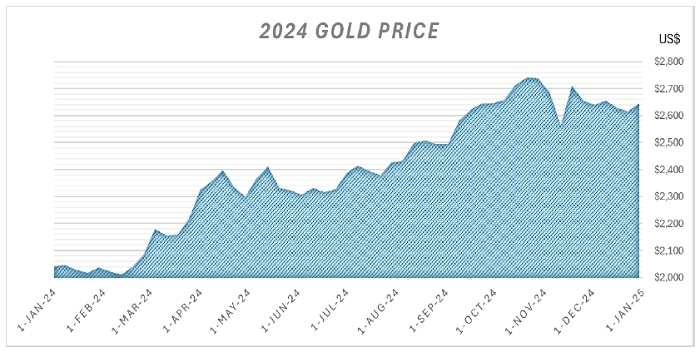
Source: Yahoo Finance, historical gold price (GC=F), retrieved March 2026
At the date of this carve-out MD&A, the gold spot price is approximately US$4,867 per ounce, compared to a 12-month low of approximately US$2,299 per ounce.
As an exploration-stage issuer, Seabridge does not generate operating revenues and is dependent on equity financing to fund its exploration activities. The gold price environment significantly influences investor sentiment toward exploration companies and Seabridge’s ability to access capital on reasonable terms. Sustained strength in gold prices generally supports improved market conditions and financing opportunities, while prolonged weakness in gold prices may adversely affect capital availability and the timing of planned exploration programs.
Management monitors the gold price trends in planning its exploration activities and capital requirements.
Subsequent events
As described in the “Description of Business” section, after year-end, Seabridge announced its intentions to reorganize its Courageous Lake assets and operations into a separate entity, Valor Gold Corp., pursuant to the Arrangement. Upon completion of the transaction, Valor will cease to be a subsidiary of Seabridge and will operate as an independent entity.
Mineral Interests
In 2002, Valor acquired a 100% interest in the Courageous Lake gold project from Newmont Canada Limited and Total Resources (Canada) Limited. The acquisition included a 2% net smelter royalty. The project consists of 85 Northwest Territories Mining Leases and 4 Federal Mining Leases, covering a total area of 50,239.96 hectares. The property is located approximately 240 km northeast of Yellowknife, Northwest Territories, Canada
I-6
As outlined in the Overview of Performance 2024 section, in 2024 Seabridge Gold Inc. filed a National Instrument 43-101 compliant technical report presenting an updated Preliminary Feasibility Study (the “2024 PFS”) for the Courageous Lake Project. The technical report outlines the updated mine plan, project economics and other key assumptions supporting the advancement of the project.
Prior to 2024, Valor expensed all exploration and evaluation expenditures related to the Courageous Lake project as incurred in accordance with IFRS 6 Exploration for and Evaluation of Mineral Resources, whereas Seabridge had historically capitalized such costs. Beginning in 2024, Valor capitalizes project-related costs once they are considered evaluation in nature. Management considers a National Instrument 43-101 compliant economic study evidencing an after-tax internal rate of return exceeding 15% as the primary indicator that this threshold has been met.
The 2024 PFS demonstrated that, at an average gold price of US$1,850 per ounce, the Courageous Lake project is expected to generate an after-tax internal rate of return in excess of 20%. Based on this analysis, management determined that project expenditures from that date are evaluation in nature. Accordingly, effective January 5, 2024, project-related expenditures began to be capitalized. Capitalization is applied prospectively in accordance with IFRS 6 Exploration for and Evaluation of Mineral Resources.
Notwithstanding the commencement of capitalization, such costs continue to be presented within mineral interests assets until the project is reclassified to development assets.
Financing Activities
During the years ended December 31, 2024, and 2023, there were no related party transactions other than the Parent Company contributions. Contributions for 2024: $1,228,174 (2023:
$3,399,929).
Investing Activities
As at December 31, 2024, capitalized mineral property expenditure totaled $1,089,810 (2019 - Nil) as shown in the following table:
| December 31 2024 | December 31 2023 | |||||||
| Exploration Expenditures | ||||||||
| Balance, beginning | $ | - | $ | - | ||||
| Incurred: | ||||||||
| Direct project costs | 624,189 | - | ||||||
| Business and property tax | 1,111 | - | ||||||
| Consulting | 282,965 | - | ||||||
| Claims and permitting | 181,545 | - | ||||||
| Incurred in year | $ | 1,089,810 | $ | - | ||||
| Balance, ending | $ | 1,089,810 | $ | - | ||||
Refer to the discussion on capitalized costs as outlined in Mineral Interests.
Results of Operations
For the year ended December 31, 2024, Valor recorded a net loss of $321 related to foreign exchange losses. Mineral interests expenditures incurred during the year were capitalized to mineral interests (see Mineral Interests section).
For the year ended December 31, 2023, Valor reported a net loss of $3,519,884, consisting of direct project expenses of $342,491, foreign exchange losses of $149, and mineral property investigation costs of $3,177,245.
I-7
Liquidity and Capital Resources
As at December 31, 2024, Valor had a negative working capital of $8,515 (2023 – negative $146,558) and current assets of $3,967 (2023 – $64,568).
Valor has incurred operating losses since inception and does not generate cash flows from operations. As a result, Valor is dependent on external financing to fund its exploration, evaluation, and administrative activities.
Upon completion of the Arrangement, Valor intends to continue advancing the Courageous Lake project using funding provided by Seabridge, as discussed in the Outlook section of this carve-out MD&A. Valor also expects to finance its future activities through equity financings and through option or joint venture arrangements with qualified mineral exploration companies on its mineral properties.
In connection with the Arrangement, Seabridge has agreed to provide up to $10 million of funding to support exploration, evaluation, and administrative expenditures. Management expects this funding will be sufficient to finance planned activities for approximately 18 months following completion of the Arrangement. Valor’s ability to continue advancing its projects thereafter will depend on its ability to successfully complete equity financings, including in connection with becoming a publicly listed company, or to obtain other sources of funding. There can be no assurance that such financing will be available when required or on acceptable terms.
These circumstances indicate the existence of a material uncertainty that may cast significant doubt on Valor’s ability to continue as a going concern. The accompanying carve-out financial statements have been prepared on a going concern basis and do not include adjustments to the carrying amounts or classification of assets and liabilities that may be required if Valor is unable to continue as a going concern.
Outlook
Valor intends to use its available funds over the next 18 months after closing the plan of arrangement to further develop Courageous Lake as follows:
| Use of Proceeds | Available Funds (C$) | |||
| Phase 1 work program at Courageous Lake | $ | 5,028,000 | ||
| Administrative expenses | $ | 4,073,000 | ||
| Security Bond | $ | 316,000 | ||
| To unallocated working capital | $ | 583,000 | ||
| Total | $ | 10,000,000 | ||
Selected Annual Information
The carve-out financial statements have been prepared in accordance with IFRS for fiscal years 2024 and 2023 and are expressed in Canadian dollars.
I-8
| As at | December 31 | December 31 | ||||||
| Total assets | $ | 1,142,777 | $ | 113,568 | ||||
| Total liabilities | 12,482 | 211,126 | ||||||
| Total shareholders’ equity | 1,130,295 | (97,558 | ) | |||||
| Total liabilities and shareholders’ equity | $ | 1,142,777 | $ | 113,568 | ||||
| For the year ended | December
31 | December 2023 | ||||||
| Net Loss | $ | (321 | ) | $ | (3,519,884 | ) | ||
Risks and Uncertainties
Valor is in the business of exploring and evaluating Courageous Lake. It is exposed to several risks and uncertainties that are common to other mineral exploration companies in the same business. The industry is capital-intensive at all stages and is subject to variations in commodity prices, market sentiment, exchange rates for currency, inflation and other risks. Valor currently has no source of revenue. As part of the Arrangement, Seabridge has agreed to provide up to $10 MM in funding to support additional exploration, evaluation and administrative costs, which management expects will be sufficient to fund planned activities for approximately 18 months. Valor plans to raise additional capital through various financing initiatives, which may include equity offerings or other financing alternatives.
The risks and uncertainties described in this section are not inclusive of all the risks and uncertainties to which Valor may be subject.
Early Stage – Need for Additional Funds
Valor has no history of profitable operations, and its present business is at an early stage. As such, Valor is subject to many risks common to other companies in the same business, including under-capitalization, cash shortages, and limitations with respect to personnel, financial and other resources and the lack of revenues. There is no assurance that Valor will be successful in achieving a return on shareholders’ investment.
Valor anticipates future expenditures will require additional infusions of capital; there can be no assurance that such financing will be available or, if available, will be on reasonable terms. If financing is obtained by issuing common shares from treasury, control of the Resulting Issuer may change, and investors may suffer additional dilution. Furthermore, if financing is not available, lease expiry dates, work commitments, rental payments and option payments, if any, may not be satisfied and could result in a loss of the shareholders’ entire investment.
Exploration and Development
Mineral exploration and development is a speculative business characterized by several significant risks including, among other things, unprofitable efforts resulting not only from the failure to discover mineral deposits, but also from identifying mineral deposits that, though present, are not economically viable due to size, grade, capital intensity, operating costs, commodity prices, permitting constraints, or other factors.
The Courageous Lake asset is an advanced-stage gold project and is the subject of a current technical report prepared in accordance with National Instrument 43-101 Standards of Disclosure for Mineral Projects as described previously.
The Courageous Lake asset remains in the development stage and has not yet been placed into commercial production. The economic conclusions contained in the technical report are based on a number of assumptions, including commodity prices, capital and operating cost estimates, metallurgical recoveries, permitting timelines, and financing availability. There is no certainty that the project will be developed as contemplated, that required permits and approvals will be obtained on acceptable terms or within expected timeframes, or that financing will be available when required. Many mineral projects that reach the preliminary feasibility stage are not ultimately constructed or operated as producing mines.
I-9
Estimates of mineral resources may not be realized
The mineral resource estimates contained in the technical report are only estimates and no assurance can be given that an identified resource will ever qualify as a commercially mineable (or viable) deposit, which can be legally and economically exploited. In addition, the grade of mineralization ultimately mined may differ from the one indicated by the drilling results and the difference may be material. Material changes in resources, grades and other factors, may affect the economic viability of projects.
Operating Hazards and Risks
Mining operations involve many risks, which even a combination of experience, knowledge and careful evaluation may not be able to overcome. In the course of exploration, development and production of mineral properties, certain risks, and in particular unexpected or unusual geological operating conditions, including rock bursts, cave-ins, fires, flooding and earthquakes, may occur. Operations in which Valor has a direct or indirect interest will be subject to all the hazards and risks normally incidental to exploration, development and production of mineral deposits, any of which could result in damage to or destruction of mines and other producing facilities, damage to life and property, environmental damage and possible legal liability for any or all damage.
The nature of the foregoing risks is such that liabilities could exceed the limits of any liability insurance held by Valor, in which event Valor could incur significant costs that could have a materially adverse effect upon its financial conditions.
Political Risk
Variations from the current regulatory, economic and political climate could have an adverse effect on the affairs of Valor.
Supplies, Infrastructure, Weather and Inflation
Valor’s property is located in remote, undeveloped areas and the availability of infrastructures such as surfaces access, skilled labour, fuel and power at an economic cost cannot be assured. These are integral requirements for exploration, production and development facilities on mineral properties. Power may need to be generated on site.
Due to the partial remoteness of its exploration projects, Valor is forced to rely on the accessibility of secondary roads resulting in potentially unavoidable delays in planned programs and/or cost overruns.
Metal Prices
The mining industry, in general, is intensely competitive and there is no assurance that a profitable market will exist for the sale of metals produced even if commercial quantities of precious metals are discovered. Factors beyond the control of Valor may affect the marketability of metals discovered, such as international economic and political trends, global or regional consumption and demand patterns, increased production and smelter availability. There is no assurance that the price of metals recovered from any mineral deposit will be such that they can be mined at a profit.
I-10
Title Risks
There is no guarantee that title to Valor’s properties will not be challenged or impugned. Title insurance is not available for mineral properties in Canada and Valor’s ability to ensure that it has obtained a secure claim to its mineral properties may be severely constrained. Valor’s mineral property interest may be subject to prior unregistered agreements, transfers, conflicting claims, or indigenous claims, and title may be affected by other undetected defects. If title is challenged, Valor will have to defend its ownership through the courts. A successful challenge to the precise area and location of these claims could result in Valor being unable to operate on its properties or being unable to enforce its right with respect to its properties.
Environmental Regulations, Permits and Licenses
The Courageous Lake asset, located in the Northwest Territories, is subject to extensive federal and territorial laws and regulations governing environmental protection, land use, water management, mine development and operation, closure and reclamation, occupational health and safety, and related matters. The project requires various permits, licences and approvals, including land use permits and water licences, and is subject to environmental assessment processes and consultation with Indigenous governments and stakeholders. Applicable legislation imposes strict standards relating to, among other things, water quality, tailings and waste management, wildlife protection, and site remediation, and requires the posting of financial security for reclamation obligations. Failure to comply with regulatory requirements or permit conditions may result in fines, penalties, operational suspensions or other enforcement actions. Changes in environmental legislation or permitting requirements, or delays in obtaining or maintaining necessary approvals, could increase costs and adversely affect the development timeline or economic viability of the project.
Valor believes that it is in compliance with all material laws and regulations, which currently apply to its activities. There can be no assurance, however, that all permits which Valor may require for its operations and exploration activities will be obtainable on reasonable terms or on a timely basis or that such laws and regulations would not have an adverse effect on any mining project which Valor might undertake.
Economic Conditions
Unfavorable economic conditions may negatively impact the Valor’s financial viability. Unfavorable economic conditions could also increase Valor’s financing costs, decrease net income or increase net loss, limit access to capital markets and negatively impact the availability of future credit facilities to Valor.
Dependence on Management
Valor is very dependent upon the personal efforts and commitment of its existing management. To the extent that management’s services would be unavailable for any reason, a disruption to the operations of Valor could result, and other persons would be required to manage and operate Valor.
Conflicts of Interest
Valor’s directors and officers may serve as directors or officers, or may be associated with, other reporting companies, or have significant shareholdings in other public companies. To the extent that such other companies may participate in business or asset acquisitions, dispositions, or ventures in which Valor may participate, the directors and officers of Valor may have a conflict of interest in negotiating and concluding terms respecting the transaction. If a conflict of interest arises, Valor will follow the provisions of the Canada Business Corporations Act dealing with conflict of interest. These provisions state that where a director has such a conflict, that director must, at a meeting of Valor’s directors, disclose his or her interest and refrain from voting on the matter unless otherwise permitted by the legislation. In accordance with applicable corporate law, the directors and officers of Valor are required to act honestly, in good faith, and the best interest of Valor.
I-11
Insurance coverage
The mining industry is subject to significant risks that could result in damage to, or destruction of, mineral properties or producing facilities, personal injury or death, environmental damage, delays in mining, monetary losses and possible legal liability.
Valor’s insurance policies may not provide sufficient coverage for losses related to these or other risks. Valor’s insurance does not cover all risks that may result in loss or damage and may not be adequate to reimburse Valor for all losses sustained. In particular, Valor does not have coverage for certain environmental losses or certain types of earthquake damage. The occurrence of losses or damage not covered by insurance could have a material and adverse effect on Valor’s cash flow, results of operation and financial condition.
Uninsurable risks
In the course of exploration, development and production of mineral properties, certain risks and, in particular, unexpected or unusual geological operating conditions including cave-ins, fires, flooding and earthquakes may occur. It is not always possible to fully insure against such risks and Valor may decide not to take out insurance against such risks as a result of high premiums or other reasons. Should such liabilities arise, they could reduce or eliminate any future profitability and result in increasing costs and a decline in the value of the securities of Valor.
Disclosure Controls and Procedures and Internal Control Over Financial Reporting
Valor is subject to National Instrument 52-109 – Certification of Disclosure in Issuers’ Annual and Interim Filings of the Canadian Securities Administrators (the “ICOFR Requirements”) requiring that effective internal controls for financial reporting and disclosure controls and procedures be maintained. Valor is required to furnish a report by management on, among other things, the effectiveness of internal control over financial reporting. This report will include disclosure of any material weaknesses identified by management in Valor’s internal control over financial reporting. A material weakness is a deficiency, or combination of deficiencies, in internal control over financial reporting that results in more than a reasonable possibility that a material misstatement of annual or interim financial statements will not be prevented or detected on a timely basis. Any testing by Valor conducted in connection with the ICOFR Requirements, or any subsequent testing by Valor’s independent registered public accounting firm, may reveal deficiencies in Valor’s internal controls over financial reporting that are deemed to be material weaknesses or that may require prospective or retroactive changes to Valor’s financial statements or identify other areas for further attention or improvement. In addition, undetected material weaknesses in Valor’s internal controls over financial reporting could lead to restatements of Valor’s financial statements and require us to incur the expense of remediation. Failure to remedy any material weakness in Valor’s internal control over financial reporting, or to implement or maintain other effective control systems required of public companies, could also undermine investor confidence in the accuracy and completeness of Valor’s financial reports and adversely impact Valor’s share price and future access to the capital markets.
Financial instruments and financial risk management
Valor’s financial instruments include accounts payable and accrued liabilities. The carrying values of these financial instruments approximate their fair values due to their relatively short periods to maturity.
Valor’s risk management policies are established to identify and analyze the risks faced by Valor, to set appropriate risk limits and controls, and to monitor risks and adherence to market conditions and the Valor’s activities. Valor has exposure to liquidity risk and market risk as a result of its use of financial instruments. This note presents information about the Valor’s exposure to each of the above risks and Valor‘s objectives, policies, and processes for measuring and managing these risks. Further quantitative disclosures are included throughout these carve-out financial statements. The Board of Directors has overall responsibility for the establishment and oversight of Valor’s risk management framework. The Board has implemented and monitors compliance with risk management policies.
I-12
Liquidity risk
Liquidity risk is the risk that Valor will incur difficulties meeting its financial obligations as they are due. Valor’s approach to managing liquidity is to ensure, as far as possible, that it will have sufficient liquidity to meet its liabilities when due, under both normal and stressed conditions without incurring unacceptable losses or risking harm to the Valor’s reputation.
Valor prepares annual expenditure budgets, which are regularly monitored and updated as considered necessary. To facilitate its expenditure program, Valor will raise funds through various financing initiatives, which may include private equity placements or other financing alternatives.
Valor anticipates it will have adequate liquidity to fund its financial liabilities.
As at December 31, 2024, and 2023, Valor’s liabilities were comprised of accounts payable and accrued liabilities, which have a maturity of less than one year.
Market risk:
Market risk consists of commodity price risk. The objective of market risk management is to manage and control market risk exposures within acceptable limits while maximizing returns.
Commodity price risk is the risk that the fair value or future cash flows will fluctuate as a result of changes in commodity prices. Commodity prices for minerals are impacted by world economic events that dictate the levels of supply and demand. Seabridge is exposed to the price volatilities for precious metals that could significantly impact its future operating cash flow. As part of its routine activities, management is closely monitoring the trend of international metal prices.
Fair value of financial instruments
Valor classifies its financial instruments measured at fair value at one of three levels according to the relative reliability of the inputs used to estimate the fair value:
Level 1 – quoted prices (unadjusted) in active markets for identical assets or liabilities;
Level 2 – inputs other than quoted prices included in Level 1 that are observable for the asset or liability, either directly (i.e., as prices) or indirectly (i.e., derived from prices); and
Level 3 – Inputs for the asset or liability that are not based on observable market data (unobservable inputs).
As of December 31, 2024, and 2023, Valor did not have financial instruments measured at fair value. Valor’s carrying values of accounts payable and accrued liabilities approximate their fair value due to their short-term nature.
Off Balance Sheet Arrangements
Valor had no Off-Balance Sheet Arrangements.
Transactions With Related Parties
Valor considers a person or entity a related party if they are a member of key management personnel, including their close relatives, those having significant influence over Valor, as well as entities that are controlled by related parties. Key management personnel comprise the Valor’s Board of Directors and executive officers. A transaction is considered to be a related party transaction when there is a transfer of resources or obligations between related parties.
As at December 31, 2024 and 2023, there were no related party transactions other than the Parent company contributions.
Future Accounting Standards
The following new standards and interpretations have been published that are not mandatory for the current period and have not been early adopted.
I-13
Amendments to IAS 21 The Effects of Changes in Foreign Exchange Rates
On August 15, 2023, the IASB issued amendments to IAS 21 The Effects of Changes in Foreign Exchange Rates. The amendments provide guidance to specify when a currency is exchangeable and how to determine the exchange rate when it is not. The amendments are effective for reporting periods beginning on or after January 1, 2025. These amendments are not expected to have a significant impact on Valor’s carve-out financial statements.
IFRS 18 Presentation and Disclosures in Financial Statements
On April 9, 2024, the IASB issued IFRS 18 Presentation and Disclosures in Financial Statements. The objective of the new standard is to set out requirements for the presentation and disclosure of information in general purpose financial statements to help ensure they provide relevant information that faithfully represents an entity’s assets, liabilities, equity, income and expenses. The new standard is effective for reporting periods beginning on or after January 1, 2027. Management is currently assessing the impact of the new standard on Valor’s carve-out interim and annual financial statements.
Amendments to IFRS 9 and IFRS 7
On May 30, 2024, the IASB issued amendments to the classification and measurement of financial instruments to address matters identified during the post-implementation review of the classification and measurement requirements of IFRS 9. The IASB clarified the recognition and derecognition date of certain financial assets and liabilities, and amended the requirements related to settling financial liabilities using an electronic payment system. It also clarified how to assess the contractual cash flow characteristics of financial assets in determining whether they meet the solely payments of principal and interest criterion, including financial assets that have environmental, social and corporate governance-linked features and other similar contingent features. The IASB added disclosure requirements for financial instruments with contingent features that do not relate directly to basic lending risks and costs and amended disclosures relating to equity instruments designated at fair value through other comprehensive income. The amendments are effective for reporting periods beginning on or after January 1, 2026. Management is currently assessing the impact of the new standard on Valor’s carve-out financial statements.
Other Risks and Uncertainties
Critical Accounting Estimates
Please refer to Note 3 of Valor’s audited carve-out financial statements for the year ended December 31, 2024, for additional information under “Material Accounting Policies”.
The preparation of the carve-out financial statements requires management to make estimates and judgments that affect the reported amounts of assets and liabilities at the date of the carve-out financial statements, and revenues and expenses for the year. By their nature, these estimates and judgments are subject to uncertainty and the effect on the carve-out financial statements of changes in such estimates in future periods could be significant. Actual results may differ from those estimates and judgments.
The key sources of estimation uncertainty that have a significant risk of causing material adjustment to the amounts recognized in the carve-out financial statements are as follows:
Impairment of mineral interests
Valor makes estimates and assumptions in assessing the recoverability of the carrying value of its mineral interests assets. When indicators of impairment exist, the recoverable amount is estimated using valuation techniques such as discounted cash flow models. These models require significant judgments regarding future commodity prices, production levels, operating and capital costs, discount rates, and the timing of development. Changes in these assumptions could result in material adjustments to the carrying value of these assets.
I-14
Taxes
Significant management judgment is required to determine the amount of deferred tax assets that can be recognized, based upon the likely timing and the level of future taxable income realized, including the usage of tax planning strategies.
Going concern assumption
In the determination of Valor’s ability to meet its ongoing obligations and future contractual commitments, management relies on Valor’s planning, budgeting and forecasting process to help determine the funds required to support Valor’s normal operations on an ongoing basis and its expansionary plans. The key inputs used by the Valor in this process include forecasted capital deployment, results from operations, results from the exploration and development of its properties and general industry conditions.
Disclosure Controls and Procedures
Management is responsible for establishing and maintaining disclosure controls and procedures and internal control over financial reporting for Valor. Based on an evaluation of Valor’s disclosure controls and procedures as of the end period covered by this carve-out MD&A, management believes such controls and procedures are effective in providing reasonable assurance that material items requiring disclosure are identified and reported in a timely manner.
Cautionary note regarding preparation of Mineral Reserves and Resources
This carve-out MD&A uses the terms “reserves” and “resources” and derivations thereof. These terms have the meanings set forth in Canadian National Instrument 43-101 - Standards of Disclosure for Mineral Projects (NI 43-101) and the Canadian Institute of Mining, Metallurgy and Petroleum’s Classification System (CIM Standards). NI 43-101 and CIM Standards differ significantly from the requirements of the United States Securities and Exchange Commission (the SEC). Under SEC Industry Guide 7, mineralization may not be classified as a “reserve” unless the determination has been made that is part of a mineral deposit, which could be economically and legally extracted or produced at the time of the reserve determination”. In addition, the term “resource”, which does not equate to the term “reserve”, is not recognized by the SEC and the SEC’s disclosure standards normally do not permit the inclusion of information concerning resources in documents filed with the SEC, unless such information is required to be disclosed by the law of Valor’s jurisdiction of incorporation or of a jurisdiction in which its securities are traded. Accordingly, information concerning descriptions of mineralization and resources contained in this Management’s Discussion and Analysis may not be comparable to information made public by US domestic companies subject to the reporting and disclosure requirements of the SEC.
Approval
This carve-out MD&A has been prepared by management with an effective date of April 16th, 2026. The carve-out MD&A and the carve-out Financial Statements were approved by the Board of Directors of Seabridge on April 16th, 2026.
Additional Information
Additional information relating to Seabridge can be found on Seabridge’s website at www.seabridgegold.com and on SEDAR+ at www.sedarplus.ca
I-15
Appendix “J”
Condensed
Interim Carve-Out Financial Statements of Valor for the
three and nine months ended September 30, 2025
Valor Gold Corp.
CONDENSED INTERIM CARVE-OUT FINANCIAL STATEMENTS
For the three and nine months ended
September
30, 2025
and
September 30, 2024
(Unaudited)
J-1
VALOR GOLD CORP.
(Expressed in Canadian dollars)
(Expressed in Canadian dollars)
Index
CONDENSED INTERIM CARVE-OUT FINANCIAL STATEMENTS
| CONDENSED INTERIM CARVE-OUT STATEMENTS OF FINANCIAL POSITION | 3 | |
| CONDENSED INTERIM CARVE-OUT STATEMENTS OF PROFIT OR LOSS AND COMPREHENSIVE GAIN (LOSS) | 4 | |
| CONDENSED INTERIM CARVE-OUT STATEMENTS OF CASH FLOW | 5 | |
| CONDENSED INTERIM CARVE-OUT STATEMENTS OF CHANGES IN EQUITY | 6 | |
| NOTES TO CONDENSED INTERIM CARVE-OUT FINANCIAL STATEMENTS | 7 |
J-2
VALOR GOLD CORP.
(Expressed in Canadian dollars)
CONDENSED INTERIM CARVE-OUT STATEMENTS OF FINANCIAL POSITION
| Notes | September 30, 2025 | December 31 2024 | ||||||||||
| Assets | ||||||||||||
| Current assets | ||||||||||||
| Amounts receivable and prepaid expenses | $ | 5,555 | $ | 3,967 | ||||||||
| 5,555 | 3,967 | |||||||||||
| Non-current assets | ||||||||||||
| Mineral interests | 3 | 1,575,486 | 1,089,810 | |||||||||
| Reclamation deposits | 49,000 | 49,000 | ||||||||||
| 1,624,486 | 1,138,810 | |||||||||||
| Total assets | $ | 1,630,041 | $ | 1,142,777 | ||||||||
| Liabilities and shareholders’ equity | ||||||||||||
| Current liabilities | ||||||||||||
| Accounts payable and accrued liabilities | $ | 25,155 | $ | 12,482 | ||||||||
| Total liabilities | 25,155 | 12,482 | ||||||||||
| Equity | ||||||||||||
| Net parent's investment | 1,604,886 | 1,130,295 | ||||||||||
| Total equity | $ | 1,604,886 | $ | 1,130,295 | ||||||||
| Total liabilities and equity | $ | 1,630,041 | $ | 1,142,777 | ||||||||
| Approved on Behalf of the Board: | ||
| Rudi Fronk | C. Bruce Scott | |
| Director | Director | |
|
April 16, 2026 |
April 16, 2026 | |
-The accompanying notes are an integral part of these condensed interim carve-out financial statements -
J-3
VALOR GOLD CORP.
(Expressed in Canadian dollars)
CONDENSED
INTERIM CARVE-OUT STATEMENTS OF PROFIT OR LOSS
AND COMPREHENSIVE GAIN (LOSS)
| For the three months ended | For the nine months ended | |||||||||||||||
September 30, 2025 | September 30, 2024 | September 30, 2025 | September 30, 2024 | |||||||||||||
Foreign exchange gain (loss) | $ | 47 | $ | (77 | ) | $ | 35 | $ | (23 | ) | ||||||
| Gain (loss) and comprehensive gain (loss) for the period | $ | 47 | $ | (77 | ) | $ | 35 | $ | (23 | ) | ||||||
-The accompanying notes are an integral part of these condensed interim carve-out financial statements -
J-4
VALOR GOLD CORP.
(Expressed in Canadian dollars)
CONDENSED INTERIM CARVE-OUT STATEMENTS OF CASH FLOW
| For the three months ended | For the nine months ended | |||||||||||||||
September
30, | September
30, | September
30, | September
30, | |||||||||||||
| Operating Activities | ||||||||||||||||
| Gain (Loss) for the period | $ | 47 | $ | (77 | ) | $ | 35 | $ | (23 | ) | ||||||
| Changes
in working capital items: Amounts receivable and prepaid expenses | (3,363 | ) | 6,334 | (1,588 | ) | 64,568 | ||||||||||
| Accounts payable and accrued liabilities | 7,797 | (43,419 | ) | 12,673 | (170,350 | ) | ||||||||||
| Net cash from (used in) operating activities | 4,481 | (37,162 | ) | 11,120 | (105,805 | ) | ||||||||||
Investing Activities | ||||||||||||||||
Expenditures on mineral interests | (166,316 | ) | (205,206 | ) | (460,521 | ) | (739,521 | ) | ||||||||
| Net cash used in investing activities | (166,316 | ) | (205,206 | ) | (460,521 | ) | (739,521 | ) | ||||||||
| Financing Activities | ||||||||||||||||
| Contributions from parent | 161,835 | 242,368 | 449,401 | 845,326 | ||||||||||||
| Net cash from financing activities | 161,835 | 242,368 | 449,401 | 845,326 | ||||||||||||
| Net increase (decrease) in cash and cash equivalents during the period | ||||||||||||||||
| Cash, beginning of the period | - | - | - | - | ||||||||||||
| Cash, end of the period | $ | - | $ | - | $ | - | $ | - | ||||||||
-The accompanying notes are an integral part of these condensed interim carve-out financial statements -
J-5
VALOR GOLD CORP.
(Expressed in Canadian dollars)
CONDENSED INTERIM CARVE-OUT STATEMENTS OF CHANGES IN EQUITY
| For the nine months ended | September 30, 2025 | September 30, 2024 | ||||||
Balance at the beginning of the period | $ | 1,130,295 | $ | (97,558 | ) | |||
| Contributions from parent | 474,556 | 857,808 | ||||||
| Gain (loss) for the period | 35 | (23 | ) | |||||
| Balance at the end of the period | $ | 1,604,886 | $ | 760,227 | ||||
-The accompanying notes are an integral part of these condensed interim carve-out financial statements -
J-6
VALOR GOLD CORP.
NOTES TO CONDENSED INTERIM CARVE-OUT FINANCIAL STATEMENTS
For the three and nine months ended September 30, 2025
| 1 | Nature of Operation and Going Concern: |
Seabridge Gold Inc. (“Seabridge”) and its subsidiaries are engaged in the acquisition, exploration, and advancement of mineral properties, with a focus on gold resources in Canada and the United States of America. Seabridge was incorporated under the laws of British Columbia, Canada on September 14, 1979, and continued under the laws of Canada on October 31, 2002. Seabridge’s common shares are listed on the Toronto Stock Exchange under the symbol “SEA” and on the New York Stock Exchange under the symbol “SA”. Seabridge is domiciled in Canada, with its registered office at 10th Floor, 595 Howe Street, Vancouver, British Columbia, Canada V6C 2T5, and its corporate office at 106 Front Street East, 4th Floor, Toronto, Ontario, Canada M5A 1E1.
Seabridge intends to reorganize its Courageous Lake assets and operations into a separate listed entity, Valor Gold Corp. (“Valor”), incorporated, as a wholly owned subsidiary of Seabridge, on January 19, 2026. Under the proposed plan of arrangement pursuant to the Canada Business Corporations Act (the “Arrangement”), Valor will acquire from Seabridge 100% ownership of Seabridge Gold (NWT) Inc. (formerly 5073 N.W.T. Ltd) (“Seabridge NWT”) the owner of the Courageous Lake Project.
Consideration under the Arrangement will consist of the issuance of an aggregate of 55 million new Valor shares and the payment of $5.1 million in cash. In addition, as part of the Arrangement, Valor will grant Seabridge a gold stream of 10% of future gold production from the Courageous Lake Project if the quarterly average spot gold price exceeds US$4,000 per ounce. Gold subject to the stream will be sold to Seabridge at a fixed price of US$4,000 per ounce. Seabridge will provide a $4.9 million cash deposit to Valor in respect of the grant of the gold stream.
The aggregate $10 million cash from Seabridge (comprising the $5.1 million cash consideration and the $4.9 million stream deposit) is expected to enable Valor to fund exploration, evaluation, and administrative costs, which management expects will support planned activities for approximately 18 months.
Under the Arrangement, all shares of Valor held by Seabridge will be distributed to Seabridge shareholders, resulting in Seabridge shareholders holding approximately one (1) Valor share for every 1.952 Seabridge shares held on the effective date of the Arrangement. This ratio reflects the number of Seabridge shares outstanding (107,373,183) relative to the 55,000,000 Valor shares to be distributed. Upon completion of the Arrangement, Valor will no longer be a subsidiary of Seabridge.
Concurrent with the Arrangement, Valor is seeking a listing on the Toronto Stock Exchange and, in addition, for its shares to be quoted on the OTCQB (USA). Closing of the Arrangement is subject to customary conditions, including approval by Seabridge shareholders and receipt of court and regulatory approvals.
References to “Valor” in these condensed interim carve-out financial statements relate to the name under which the Courageous Lake operations will be carried forward following the reorganization.
These condensed interim carve-out financial statements present the financial position, results of operations, and cash flows attributable to the Courageous Lake project and have been prepared for inclusion in an Information Circular relating to the Arrangement. Valor did not exist during the periods covered; historical amounts relate to the operations and activities of the Courageous Lake project while under Seabridge.
Valor has incurred operating losses to date and does not generate cash flows from operations. Its ability to continue as a going concern is dependent on obtaining sufficient financing through intercompany loans from Seabridge, future profitable production, proceeds from the disposal of mineral interests, and/or other sources.
These conditions create a material uncertainty that may cast significant doubt on Valor’s ability to continue as a going concern. These condensed interim carve-out financial statements do not reflect adjustments to the carrying values and classifications of assets and liabilities that would be necessary should Valor be unable to continue as a going concern. Such adjustments could be material.
J-7
VALOR GOLD CORP.
NOTES TO CONDENSED INTERIM CARVE-OUT FINANCIAL STATEMENTS
For the three and nine months ended September 30, 2025
| 2 | Basis of Presentation: |
Statement of Compliance
These condensed interim carve-out financial statements have been prepared on a carve-out basis from the books and records of Seabridge and have been prepared in accordance with IFRS® Accounting Standards as issued by the International Accounting Standards Board (“IASB”) and interpretations of the IFRS Interpretations Committee, effective for the period ended September 30, 2025.
These condensed interim carve-out financial statements have been prepared in accordance with IAS 34, Interim Financial Reporting (IAS 34).
These condensed interim carve-out financial statements should be read in conjunction with Valor’s most recent annual carve-out financial statements for the year ended December 31, 2024, as some disclosures from the annual carve-out financial statements have been condensed or omitted.
There are no IFRS or International Financial Reporting Interpretations Committee interpretations that are not yet effective that would be expected to have a material impact on Valor’s condensed interim carve-out financial statements.
IFRS does not provide guidance for the preparation of carve-out financial statements and accordingly, in preparing the carve-out financial statements, certain accounting conventions commonly used for the preparation of historical financial statements have been applied. The carve-out financial statements have been prepared in accordance with the basis or preparation and accounting policies set out below. Since no financial statements of Valor have previously been prepared, the carve-out financial statements do not include any IFRS first-time adoption reconciliations
These condensed interim carve-out financial statements were authorized for issue by the Board of Directors on April 16h, 2026.
Basis of Measurement
Carve-out basis of presentation
The condensed interim carve-out financial statements include the assets, liabilities, revenues and expenses that are directly attributable to the Valor operations. Expenses directly related to Valor have been fully attributed to Valor, and assets and liabilities specifically identifiable with Valor have been included in the condensed interim carve-out financial statements.
Valor receives certain administrative and support services from Seabridge. The cost of these services has been allocated to Valor based on the proportion of exploration expenditures attributed to Valor compared to Seabridge’s total exploration expenditures. Management believes these allocations are reasonable under the circumstances; however, the expenses reflected in these carve-out financial statements may not be indicative of the costs that would have been incurred had Valor operated as a stand-alone entity.
Net parent’s investment
Seabridge’s investment in the operations of Valor is presented as Net parent’s investment in the carve-out statements of financial position. Net parent’s investment represents the accumulated net funding provided by Seabridge to finance the operations of Valor. Contributions from Seabridge and the settlement of certain expenses on behalf of Valor are reflected as increases to net parent’s investment, while distributions to Seabridge are reflected as reductions. These amounts are presented as contributed capital within financing activities in the carve-out statements of cash flows.
Functional and presentation currency
These condensed interim carve-out financial statements are presented in Canadian dollars which is the functional currency of Valor.
J-8
VALOR GOLD CORP.
NOTES TO CONDENSED INTERIM CARVE-OUT FINANCIAL STATEMENTS
For the three and nine months ended September 30, 2025
| 2 | Basis of Presentation (continued) |
Summary of accounting policies
The accounting policies, methods of computation, and presentation applied in these condensed interim carve-out financial statements are consistent with those disclosed in Note 2 to the annual carve-out financial statements for the year ended December 31, 2024.
Critical estimates, judgments, and assessments
The preparation of these condensed interim carve-out financial statements in conformity with IFRS Accounting Standards requires management to make estimates, judgments, and assumptions that affect the reported amounts of assets and liabilities at the date of the condensed interim carve-out financial statements and the reported amounts of income and expenses during the period.
Although management uses historical experience and its best knowledge of the amount, events, or actions to form the basis for judgments and estimates, actual results may differ from those estimates. Areas of judgment that have the most significant effect on the amounts recognized in these condensed interim carve-out financial statements are disclosed in Note 4 to Valor’s annual carve-out financial statements for the year ended December 31, 2024.
| 3 | Mineral interests: |
| September 30, 2025 | December 31 2024 | |||||||
| Exploration Expenditures | ||||||||
| Balance, beginning | 1,089,810 | - | ||||||
| Incurred: | ||||||||
| Direct project costs | 246,100 | 624,189 | ||||||
| Business and property tax | - | 1,111 | ||||||
| Consulting | 59,068 | 282,965 | ||||||
| Claims and permitting | 180,508 | 181,545 | ||||||
| Incurred in period | 485,676 | 1,089,810 | ||||||
| Balance, ending | 1,575,486 | 1,089,810 | ||||||
| 4 | Related Party Transactions and Balances: |
Valor considers a person or entity a related party if they are a member of key management personnel, including their close relatives, those having significant influence on Valor, as well as entities that are controlled by related parties. Key management personnel comprise the Valor’s Board of Directors and executive officers. A transaction is considered to be a related party transaction when there is a transfer of resources or obligations between related parties.
During the three and nine months ending September 30, 2025, and 2024, there were no related party transactions. As at September 30, 2025 and December 31, 2024, there were no amounts due to related parties.
| 5 | Financial Instruments and Financial Risk Management: |
There have been no significant changes in Valor’s financial instrument risk exposures or risk management policies from those disclosed in the annual carve-out financial statements for the year ended December 31, 2024.
| 6 | Subsequent Event |
As described in Note 1 section, after year-end, Seabridge announced its intention to reorganize its Courageous Lake assets and operations into a separate entity, Valor Gold Corp., pursuant to the Arrangement. Upon completion of the transaction, Valor will cease to be a subsidiary of Seabridge and will operate as an independent entity.
J-9
Appendix “K”
Condensed Interim Carve-Out MD&A of Valor for the three and nine months ended September 30, 2025
VALOR GOLD CORP.
CARVE-OUT
MANAGEMENT DISCUSSION AND ANALYSIS
FOR THE THREE AND NINE MONTHS ENDED
SEPTEMBER 30, 2025
(see attached)
K-1
VALOR GOLD CORP.
FOR
THE THREE AND NINE MONTHS ENDED
SEPTEMBER 30, 2025,
CARVE-OUT MANAGEMENT DISCUSSION AND ANALYSIS
TABLE OF CONTENTS
| Date | 3 | |
| Description of Business | 4 | |
| Objectives and Strategy | 5 | |
| Overview of Performance – 2025 | 5 | |
| Subsequent events | 6 | |
| Mineral Interests | 6 | |
| Financing Activities | 6 | |
| Liquidity and Capital Resources | 7 | |
| Outlook | 7 | |
| Risks and Uncertainties | 8 | |
| Off Balance Sheet Arrangements | 9 | |
| Transactions With Related Parties | 9 | |
| Additional Information | 10 |
K-2
FOR THE THREE AND NINE MONTHS ENDED SEPTEMBER 30, 2025,
CARVE-OUT MANAGEMENT DISCUSSION AND ANALYSIS
Date
This Carve-Out Management Discussion & Analysis (“carve-out MD&A”) of Valor Gold Corp. (referred to as “Valor”) was prepared by management as at April 16th, 2026, and was reviewed and approved by the Board of Directors of Seabridge. The following discussion of performance, financial condition and future prospects should be read in conjunction with the unaudited condensed interim carve-out financial statements (the “Interim Carve-out Financial Statements) for the three and nine months ended September 30, 2025 and the audited carve-out financial statement for the year ended December 31, 2024, and notes thereto which have been prepared in accordance with IFRS® Accounting Standards (“IFRS”), as issued by the International Accounting Standards Board (“IASB”). The information provided herein supplements but does not form part of the carve-out Financial Statements.
Valor has prepared this carve-out MD&A following the requirements of National Instrument 51-102 (“NI-51-102”). These statements are filed with the relevant regulatory authorities in Canada. All currency amounts are expressed in Canadian dollars unless otherwise noted.
Unless otherwise indicated, the technical disclosure contained within this carve-out MD&A has been reviewed and approved by Marcus Adam (a qualified person for the purpose of National Instrument 43-101 (“NI 43-101”), Standards of Disclosure for Mineral Projects).
Forward-Looking Information
This carve-out MD&A contains “forward-looking information” within the meaning of Canadian securities legislation and “forward-looking statements” within the meaning of the United States Private Securities Litigation Reform Act of 1995 (collectively, “forward-looking statements”). All statements, other than statements of historical fact, which address activities, events or developments that Valor believes, expects or anticipates will or may occur in the future are forward-looking statements. Forward-looking statements contained in this carve-out MD&A include, but are not limited to, statements with respect to anticipated developments in Valor’s continuing and future operations, the adequacy of Valor’s financial resources and financial projections; statements concerning or the assumptions related to the estimation of mineral resources, methodologies and models used to prepare resource estimates; the conversion of mineral properties to resources; the potential to expand resources; future exploration budgets, plans, targets and work programs; development plans; activities and timetables; grades; metal prices; exchange rates; results of drill programs; environmental risks; political risks and uncertainties; unanticipated reclamation expenses; statements about Valor’s plans for its mineral properties; acquisitions of new properties and the entering into of options or joint ventures; and other events or conditions that may occur in the future.
Forward-looking statements are frequently, but not always, identified by words such as “expects,” “anticipates,” “believes,” “intends,” “estimated,” “potential,” “possible” and similar expressions, or statements that events, conditions or results “will,” “may,” “could” or “should” occur or be achieved. Forward-looking statements are statements concerning Valor’s current beliefs, plans and expectations about the future and are inherently uncertain, and actual achievements of Valor or other future events or conditions may differ materially from those reflected in the forward-looking statements due to a variety of risks, uncertainties and other factors, including, without limitation, the risks that: (i) any of the assumptions in the resource estimates turn out to be incorrect, incomplete, or flawed in any respect; (ii) the methodologies and models used to prepare the resource estimates either underestimate or overestimate the resources due to hidden or unknown conditions, (iii) operations are disrupted or suspended due to acts of god, internal conflicts in the country of Canada, unforeseen government actions or other events; (iv) Valor experiences the loss of key personnel; (v) Valor’s mine operations are adversely affected by other political or military, or terrorist activities; (vi) Valor becomes involved in any material disputes with any of its key business partners, lenders, suppliers or customers; or (vii) Valor is subjected to any hostile takeover or other unsolicited attempts to acquire control of Valor. Other factors that could cause the actual results to differ materially from current expectations include market prices, exploration success, continued availability of capital and financing, inability to obtain required regulatory approvals and general market conditions, as well as those risks described under the heading “RISKS AND UNCERTAINTIES” below. These forward-looking statements are based on a number of assumptions, including assumptions regarding general market conditions, the timing and receipt of regulatory approvals, the ability of Valor and other relevant parties to satisfy regulatory requirements, the availability of financing for proposed transactions and programs on reasonable terms and the ability of third-party service providers to deliver services in a timely manner. Valor’s forward-looking statements are based on the beliefs, expectations and opinions of management on the date the statements are made, and Valor assumes no obligation to update such forward-looking statements in the future, except as required by law. There can be no assurance that such statements will prove to be accurate, as actual results and future events could differ materially from those anticipated in such statements. For the reasons set forth above, investors should not place undue reliance on Valor’s forward-looking statements.
K-3
Description of Business
Seabridge Gold Inc. (“Seabridge”) and its subsidiaries are engaged in the acquisition, exploration, and advancement of mineral properties, with a focus on gold resources in Canada and the United States of America. Seabridge was incorporated under the laws of British Columbia, Canada on September 14, 1979, and continued under the laws of Canada on October 31, 2002. Seabridge’s common shares are listed on the Toronto Stock Exchange under the symbol “SEA” and on the New York Stock Exchange under the symbol “SA”. Seabridge is domiciled in Canada, with its registered office at 10th Floor, 595 Howe Street, Vancouver, British Columbia, Canada V6C 2T5, and its corporate office at 106 Front Street East, 4th Floor, Toronto, Ontario, Canada M5A 1E1.
Seabridge intends to reorganize its Courageous Lake assets and operations into a separate listed entity, Valor Gold Corp. (“Valor”), incorporated, as a wholly owned subsidiary of Seabridge, on January 19, 2026. Under the proposed plan of arrangement pursuant to the Canada Business Corporations Act (the “Arrangement”), Valor will acquire from Seabridge 100% ownership of Seabridge Gold (NWT) Inc. (formerly 5073 N.W.T. Ltd) (“Seabridge NWT”) the owner of the Courageous Lake Project.
Consideration under the Arrangement will consist of the issuance of an aggregate of 55 million new Valor shares and the payment of $5.1 million in cash. In addition, as part of the Arrangement, Valor will grant Seabridge a gold stream of 10% of future gold production from the Courageous Lake Project if the quarterly average spot gold price exceeds US$4,000 per ounce. Gold subject to the stream will be sold to Seabridge at a fixed price of US$4,000 per ounce. Seabridge will provide a $4.9 million cash deposit to Valor in respect of the grant of the gold stream.
The aggregate $10 million cash from Seabridge (comprising the $5.1 million cash consideration and the $4.9 million stream deposit) is expected to enable Valor to fund exploration, evaluation, and administrative costs, which management expects will support planned activities for approximately 18 months.
Under the Arrangement, all shares of Valor held by Seabridge will be distributed to Seabridge shareholders, resulting in Seabridge shareholders holding approximately one (1) Valor share for every 1.952 Seabridge shares held on the effective date of the Arrangement. This ratio reflects the number of Seabridge shares outstanding (107,373,183) relative to the 55,000,000 Valor shares to be distributed. Upon completion of the Arrangement, Valor will no longer be a subsidiary of Seabridge.
Concurrent with the Arrangement, Valor is seeking a listing on the Toronto Stock Exchange and, in addition, for its shares to be quoted on the OTCQB (USA). Closing of the Arrangement is subject to customary conditions, including approval by Seabridge shareholders and receipt of court and regulatory approvals.
K-4
References to “Valor” in these carve-out MD&A relate to the name under which the Courageous Lake operations will be carried forward following the reorganization.
Objectives and Strategy
Valor’s principal focus will be the exploration and development of the Courageous Lake Project, which is expected to be its only material mineral project in the near term. In addition, Valor may pursue selective acquisitions of additional gold projects aligned with its strategy to support long-term growth.
Overview of Performance – 2025
The 2025 plan for Courageous Lake is to maintain local community relations and our permits in good standing and to initiate the permitting process for renewal of the exploration permits scheduled for expiration in 2027. The project remains on track to meet its 2025 budget of $0.8 million.
Gold Market Overview
During the nine months ending September 30, 2025, gold prices continued to be influenced primarily by macroeconomic factors, including real interest rates, inflation expectations, movements in the U.S. dollar, and global geopolitical conditions. Gold continued to attract investor interest as a monetary asset and store of value. The gold price began 2025 at approximately US$2,624 per ounce and reached a high at the end of September of approximately US$3,871 per ounce.
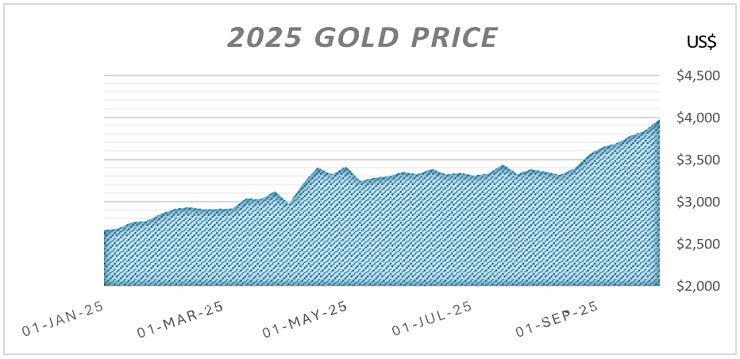
Source: Yahoo Finance, historical gold price (GC=F), retrieved March 2026
At the date of this carve-out MD&A, the gold spot price is approximately US$4,867 per ounce, compared to a 12-month low of approximately US$2,299 per ounce.
As an exploration-stage issuer, Seabridge does not generate operating revenues and is dependent on equity financing to fund its exploration activities. The gold price environment significantly influences investor sentiment toward exploration companies and Seabridge’s ability to access capital on reasonable terms. Sustained strength in gold prices generally supports improved market conditions and financing opportunities, while prolonged weakness in gold prices may adversely affect capital availability and the timing of planned exploration programs.
Management monitors the gold price trends in planning its exploration activities and capital requirements.
K-5
Subsequent events
As described in the “Description of Business” section, after the period-end, Seabridge announced its intention to reorganize its Courageous Lake assets and operations into a separate entity, Valor Gold Corp., pursuant to the Arrangement. Upon completion of the transaction, Valor will cease to be a subsidiary of Seabridge and will operate as an independent entity.
Mineral Interests
In 2002, Seabridge NWT acquired a 100% interest in the Courageous Lake gold project from Newmont Canada Limited and Total Resources (Canada) Limited. The acquisition included a 2% net smelter royalty. The project consists of 85 Northwest Territories Mining Leases and 4 Federal Mining Leases, covering a total area of 50,239.96 hectares. The property is located approximately 240 km northeast of Yellowknife, Northwest Territories, Canada
As outlined in the Overview of Performance 2024 section, in 2024 Seabridge Gold Inc. filed a National Instrument 43-101 compliant technical report presenting an updated Preliminary Feasibility Study (the “2024 PFS”) for the Courageous Lake Project. The technical report outlines the updated mine plan, project economics and other key assumptions supporting the advancement of the project.
During the nine months ending September 2025, little work was undertaken on the Courageous Lake project. Additional activities for the year include maintaining positive relations with local communities, ensuring that existing permits remain in good standing, and initiating the renewal of permits scheduled to expire in 2027.
Financing Activities
During the three and nine months ended September 30, 2025 and 2024, there were no financing activities other than the Parent Company contributions. Contributions for three months ending September 30, 2025: $161,835 (2024: $242,368). Contributions for nine months ending September 30, 2025: $449,401 (2024: $845,326).
Investing Activities
As of September 30, 2025, capitalized mineral property expenditure totaled $1,089,810 (December 31, 2024 - $1,089,810) as shown in the following table:
| September 30, 2025 | December 31 2024 | |||||||
| Exploration Expenditures | ||||||||
| Balance, beginning | 1,089,810 | - | ||||||
| Incurred: | ||||||||
| Direct project costs | 246,100 | 624,189 | ||||||
| Business and property tax | - | 1,111 | ||||||
| Consulting | 59,068 | 282,965 | ||||||
| Claims and permitting | 180,508 | 181,545 | ||||||
| Incurred in period | 485,676 | 1,089,810 | ||||||
| Balance, ending | 1,575,486 | 1,089,810 | ||||||
Refer to the discussion on capitalized costs as outlined in Mineral Interests.
Results of Operations
Valor recorded a gain of $47 for the three months ended September 30, 2025 (2024 – loss of $77). For the nine months ended September 30, 2025, Valor recorded a gain of $35 (2024 – loss of $23). All gains and losses relate to foreign exchange. Mineral interests’ expenditures incurred during the period were capitalized to mineral interests (see “Mineral Interests” section).
K-6
Liquidity and Capital Resources
As at September 30, 2025, Valor had a negative working capital of $19,600 (December 31, 2024 – negative $8,515) and current assets of $5,555 (December 31, 2024 – $3,967).
Valor has incurred operating losses since inception and does not generate cash flows from operations. As a result, Valor is dependent on external financing to fund its exploration, evaluation, and administrative activities.
Upon completion of the Arrangement, Valor intends to continue advancing the Courageous Lake project using funding provided by Seabridge, as discussed in the Outlook section of this carve-out MD&A. Valor also expects to finance its future activities through equity financings and through option or joint venture arrangements with qualified mineral exploration companies on its mineral properties.
In connection with the Arrangement, Seabridge has agreed to provide up to $10 million of funding to support exploration, evaluation, and administrative expenditures. Management expects this funding will be sufficient to finance planned activities for approximately 18 months following completion of the Arrangement. Valor’s ability to continue advancing its projects thereafter will depend on its ability to successfully complete equity financings, including in connection with becoming a publicly listed company, or to obtain other sources of funding. There can be no assurance that such financing will be available when required or on acceptable terms.
These circumstances indicate the existence of a material uncertainty that may cast significant doubt on Valor’s ability to continue as a going concern. The accompanying carve-out financial statements have been prepared on a going concern basis and do not include adjustments to the carrying amounts or classification of assets and liabilities that may be required if Valor is unable to continue as a going concern.
Outlook
Valor intends to use its available funds over the next 18 months after closing the plan of arrangement to further develop Courageous Lake as follows:
| Use of Proceeds | Available Funds (C$) | |||
| Phase 1 work program at Courageous Lake Project | $ | 5,028,000 | ||
| Administrative expenses | $ | 4,073,000 | ||
| Security Bond | $ | 316,000 | ||
| To unallocated working capital | $ | 583,000 | ||
| Total | $ | 10,000,000 | ||
Selected Information
The condensed interim carve-out financial statements have been prepared in accordance with IFRS for the three and nine months ended September 30, 2025, and are expressed in Canadian dollars.
K-7
| As at | September 30, 2025 | December 31 2024 | ||||||
| Total assets | $ | 1,630,041 | $ | 1,142,777 | ||||
| Total liabilities | 25,155 | 12,482 | ||||||
| Total equity | 1,604,886 | 1,130,295 | ||||||
| Total liabilities and equity | $ | 1,630,041 | $ | 1,142,777 | ||||
| For the three months ending | For the nine months ending | |||||||||||||||
| September 30, 2025 | September 30, 2024 | September 30, 2025 | September 30, 2024 | |||||||||||||
| Net gain (loss) | $ | 47 | $ | (77 | ) | $ | 35 | $ | (23 | ) | ||||||
Risks and Uncertainties
There have been no material changes to the risks and uncertainties previously disclosed in Valor’s carve-out MD&A for the year ended December 31, 2024. Readers are referred to that carve-out MD&A for a detailed discussion of these risks and uncertainties.
Financial instruments and financial risk management
Valor’s financial instruments include accounts payable and accrued liabilities. The carrying values of these financial instruments approximate their fair values due to their relatively short periods to maturity.
Valor’s risk management policies are established to identify and analyze the risks faced by Valor, to set appropriate risk limits and controls, and to monitor risks and adherence to market conditions and the Valor’s activities. Valor has exposure to liquidity risk and market risk as a result of its use of financial instruments. This note presents information about the Valor’s exposure to each of the above risks and Valor‘s objectives, policies, and processes for measuring and managing these risks. Further quantitative disclosures are included throughout these carve-out financial statements. The Board of Directors has overall responsibility for the establishment and oversight of Valor’s risk management framework. The Board has implemented and monitors compliance with risk management policies.
Liquidity risk
Liquidity risk is the risk that Valor will incur difficulties meeting its financial obligations as they are due. Valor’s approach to managing liquidity is to ensure, as far as possible, that it will have sufficient liquidity to meet its liabilities when due, under both normal and stressed conditions without incurring unacceptable losses or risking harm to the Valor’s reputation.
Valor prepares annual expenditure budgets, which are regularly monitored and updated as considered necessary. To facilitate its expenditure program, Valor will raise funds through various financing initiatives, which may include private equity placements or other financing alternatives.
Valor anticipates it will have adequate liquidity to fund its financial liabilities.
As of September 30, 2025, and December 31, 2024, Valor’s liabilities were comprised of accounts payable and accrued liabilities, which have a maturity of less than one year.
K-8
Market risk:
Market risk consists of commodity price risk. The objective of market risk management is to manage and control market risk exposures within acceptable limits while maximizing returns.
Commodity price risk is the risk that the fair value or future cash flows will fluctuate as a result of changes in commodity prices. Commodity prices for minerals are impacted by world economic events that dictate the levels of supply and demand. Seabridge is exposed to the price volatilities for precious metals that could significantly impact its future operating cash flow. As part of its routine activities, management is closely monitoring the trend of international metal prices.
Fair value of financial instruments
Valor classifies its financial instruments measured at fair value at one of three levels according to the relative reliability of the inputs used to estimate the fair value:
Level 1 – quoted prices (unadjusted) in active markets for identical assets or liabilities;
Level 2 – inputs other than quoted prices included in Level 1 that are observable for the asset or liability, either directly (i.e., as prices) or indirectly (i.e., derived from prices); and
Level 3 – Inputs for the asset or liability that are not based on observable market data (unobservable inputs).
As of September 30, 2025, and December 31, 2024, Valor did not have financial instruments measured at fair value. Valor’s carrying values of accounts payable and accrued liabilities approximate their fair value due to their short-term nature.
Off Balance Sheet Arrangements
Valor had no Off-Balance Sheet Arrangements.
Transactions With Related Parties
Valor considers a person or entity a related party if they are a member of key management personnel, including their close relatives, those having significant influence over Valor, as well as entities that are controlled by related parties. Key management personnel comprise the Valor’s Board of Directors and executive officers. A transaction is considered to be a related party transaction when there is a transfer of resources or obligations between related parties.
As of September 30, 2025, and December 31, 2024, there were no related party transactions other than the Parent company contributions.
Future Accounting Standards
The Company is currently evaluating the impact of amendments effective January 1, 2025, and will complete its assessment in due course. Based on information available to date, the Company does not expect these amendments to have a material impact on the financial statements
OTHER RISKS AND UNCERTAINTIES
Critical Accounting Estimates
Please refer to Note 3 of Valor’s audited carve-out financial statements for the year ended December 31, 2024, for additional information under “Material Accounting Policies”.
The preparation of the carve-out financial statements requires management to make estimates and judgments that affect the reported amounts of assets and liabilities at the date of the carve-out financial statements, and revenues and expenses for the year. By their nature, these estimates and judgments are subject to uncertainty and the effect on the carve-out financial statements of changes in such estimates in future periods could be significant. Actual results may differ from those estimates and judgements.
K-9
The key sources of estimation uncertainty that have a significant risk of causing material adjustment to the amounts recognized in the carve-out financial statements are as follows:
Impairment of mineral interests
Valor makes estimates and assumptions in assessing the recoverability of the carrying value of its mineral interests. When indicators of impairment exist, the recoverable amount is estimated using valuation techniques such as discounted cash flow models. These models require significant judgments regarding future commodity prices, production levels, operating and capital costs, discount rates, and the timing of development. Changes in these assumptions could result in material adjustments to the carrying value of these assets.
Taxes
Significant management judgement is required to determine the amount of deferred tax assets that can be recognized, based upon the likely timing and the level of future taxable income realized, including the usage of tax planning strategies.
Going concern assumption
In the determination of Valor’s ability to meet its ongoing obligations and future contractual commitments, management relies on Valor’s planning, budgeting and forecasting process to help determine the funds required to support Valor’s normal operations on an ongoing basis and its expansionary plans. The key inputs used by the Valor in this process include forecasted capital deployment, results from operations, results from the exploration and development of its properties and general industry conditions.
Disclosure Controls and Procedures
Management is responsible for establishing and maintaining disclosure controls and procedures and internal control over financial reporting for Valor. Based on an evaluation of Valor’s disclosure controls and procedures as of the end period covered by this carve-out MD&A, management believes such controls and procedures are effective in providing reasonable assurance that material items requiring disclosure are identified and reported in a timely manner.
Cautionary note regarding preparation of Mineral Reserves and Resources
This carve-out MD&A uses the terms “reserves” and “resources” and derivations thereof. These terms have the meanings set forth in Canadian National Instrument 43-101 - Standards of Disclosure for Mineral Projects (NI 43-101) and the Canadian Institute of Mining, Metallurgy and Petroleum’s Classification System (CIM Standards). NI 43-101 and CIM Standards differ significantly from the requirements of the United States Securities and Exchange Commission (the SEC). Under SEC Industry Guide 7, mineralization may not be classified as a “reserve” unless the determination has been made that is part of a mineral deposit, which could be economically and legally extracted or produced at the time of the reserve determination”. In addition, the term “resource”, which does not equate to the term “reserve”, is not recognized by the SEC and the SEC’s disclosure standards normally do not permit the inclusion of information concerning resources in documents filed with the SEC, unless such information is required to be disclosed by the law of Valor’s jurisdiction of incorporation or of a jurisdiction in which its securities are traded. Accordingly, information concerning descriptions of mineralization and resources contained in this Management’s Discussion and Analysis may not be comparable to information made public by US domestic companies subject to the reporting and disclosure requirements of the SEC.
Approval
This carve-out MD&A has been prepared by management with an effective date of April 16th, 2026. The carve-out MD&A and the carve-out condensed interim Financial Statements were approved by the Board of Directors of Seabridge on April 15th, 2026.
Additional Information
Additional information relating to Seabridge can be found on Seabridge’s website at www.seabridgegold.com and on SEDAR+ at www.sedarplus.ca
K-10