SHINHAN FINANCIAL GROUP CO., LTD.
Separate Financial Statements
December 31, 2025 and 2024
(With Independent Auditor’s Report Thereon)
SHINHAN FINANCIAL GROUP CO., LTD.
Separate Financial Statements
December 31, 2025 and 2024
(With Independent Auditor’s Report Thereon)
Contents
|
|
Page |
|
|
|
Independent Auditors’ Report |
|
1 |
|
|
|
Separate Statements of Financial Position |
|
4 |
|
|
|
Separate Statements of Comprehensive Income |
|
5 |
|
|
|
Separate Statements of Changes in Equity |
|
6 |
|
|
|
Separate Statements of Cash Flows |
|
8 |
|
|
|
Notes to the Separate Financial Statements |
|
10 |
|
|
|
Independent Auditors’ Report on Internal Control over Financial Reporting |
|
74 |
|
|
|
ICFR Operating Status Report by CEO and IAM |
|
76 |
Independent Auditors’ Report
Based on a report originally issued in Korean
The Board of Directors and Stockholders
Shinhan Financial Group Co., Ltd.
Opinion
We have audited the separate financial statements of Shinhan Financial Group Co., Ltd. (“the Company”), which comprise the separate statements of financial position as of December 31, 2025 and 2024, the separate statements of comprehensive income, changes in equity and cash flows for the years then ended, and notes, comprising a summary of material accounting policies and other explanatory information.
In our opinion, the accompanying separate financial statements present fairly, in all material respects, the separate financial position of the Company as of December 31, 2025 and 2024, and its separate financial performance and its cash flows for the years then ended in accordance with Korean International Financial Reporting Standards (“KIFRS”).
We have also audited, in accordance with Korean Standards on Auditing (“KSAs”), the Company’s Internal Control over Financial Reporting (“ICFR”) as of December 31, 2025 based on the criteria established in Conceptual Framework for Designing and Operating Internal Control over Financial Reporting issued by the Operating Committee of Internal Control over Financial Reporting in the Republic of Korea, and our report dated March 3, 2026 expressed an unmodified opinion on the effectiveness of the Company’s internal control over financial reporting.
Basis for Opinion
We conducted our audits in accordance with KSAs. Our responsibilities under those standards are further described in the Auditors’ Responsibilities for the Audit of the Separate Financial Statements section of our report. We are independent of the Company in accordance with the ethical requirements that are relevant to our audits of the separate financial statements in the Republic of Korea, and we have fulfilled our other ethical responsibilities in accordance with these requirements. We believe that the audit evidence we have obtained is sufficient and appropriate to provide a basis for our opinions.
Key Audit Matters
We have determined that there are no key audit matters to communicate in our report.
Other Matters
The procedures and practices utilized in the Republic of Korea to audit such separate financial statements may differ from those generally accepted and applied in other countries.
1
Responsibilities of Management and Those Charged with Governance for the Separate Financial Statements
Management is responsible for the preparation and fair presentation of the separate financial statements in accordance with K-IFRS, and for such internal control as management determines is necessary to enable the preparation of separate financial statements that are free from material misstatement, whether due to fraud or error.
In preparing the separate financial statements, management is responsible for assessing the Company’s ability to continue as a going concern, disclosing, as applicable, matters related to going concern and using the going concern basis of accounting unless management either intends to liquidate the Company or to cease operations, or has no realistic alternative but to do so.
Those charged with governance are responsible for overseeing the Company’s financial reporting process.
Auditors’ Responsibilities for the Audit of the Separate Financial Statements
Our objectives are to obtain reasonable assurance about whether the separate financial statements as a whole are free from material misstatement, whether due to fraud or error, and to issue an auditors’ report that includes our opinion. Reasonable assurance is a high level of assurance, but is not a guarantee that an audit conducted in accordance with KSAs will always detect a material misstatement when it exists. Misstatements can arise from fraud or error and are considered material if, individually or in the aggregate, they could reasonably be expected to influence the economic decisions of users taken on the basis of these separate financial statements.
As part of an audit in accordance with KSAs, we exercise professional judgment and maintain professional skepticism throughout the audit. We also:
2
We communicate with those charged with governance regarding, among other matters, the planned scope and timing of the audit and significant audit findings, including any significant deficiencies in the internal controls that we identify during our audit.
We also provide those charged with governance with a statement that we have complied with relevant ethical requirements regarding independence, and communicate with them all relationships and other matters that may reasonably be thought to bear on our independence, and where applicable, related safeguards.
From the matters communicated with those charged with governance, we determine those matters that were of most significance in the audit of the separate financial statements of the current period and are therefore the key audit matters. We describe these matters in our auditors’ report unless law or regulation precludes public disclosure about the matter or when, in extremely rare circumstances, we determine that a matter should not be communicated in our report because the adverse consequences of doing so would reasonably be expected to outweigh the public interest benefits of such communication.
The engagement partner on the audit resulting in this independent auditors’ report is Jung-Soo Bok.
KPMG Samjong Accounting Corp.
Seoul, Korea
March 3, 2026
This report is effective as of March 3, 2026, the audit report date. Certain subsequent events or circumstances, which may occur between the audit report date and the time of reading this report, could have a material impact on the accompanying separate financial statements and notes thereto. Accordingly, the readers of the audit report should understand that the above audit report has not been updated to reflect the impact of such subsequent events or circumstances, if any. |
3
SHINHAN FINANCIAL GROUP CO., LTD.
Separate Statements of Financial Position
As of December 31, 2025 and 2024
(In millions of won) |
|
Notes |
|
2025 |
|
2024 |
|
|
|
|
|
|
|
Assets |
|
|
|
|
|
|
Cash and due from banks at amortized cost |
|
4, 6, 8, 33 |
W |
2,589 |
|
151,143 |
Financial assets at fair value through profit or loss |
|
4, 7, 33 |
|
3,160,174 |
|
2,552,750 |
Loans at amortized cost |
|
4, 8, 33 |
|
2,951,878 |
|
3,837,298 |
Property and equipment |
|
9, 11, 33 |
|
4,833 |
|
6,509 |
Intangible assets |
|
10 |
|
7,114 |
|
6,488 |
Investments in subsidiaries |
|
12 |
|
30,723,705 |
|
30,623,651 |
Net defined benefit assets |
|
16 |
|
9,676 |
|
5,622 |
Deferred tax assets |
|
29 |
|
6,388 |
|
- |
Other assets |
|
4, 8, 13, 33 |
|
927,470 |
|
488,842 |
Total assets |
|
|
W |
37,793,827 |
|
37,672,303 |
|
|
|
|
|
|
|
Liabilities |
|
|
|
|
|
|
Borrowings |
|
4, 14 |
|
9,975 |
|
19,914 |
Debt securities issued |
|
4, 15, 33 |
|
10,457,205 |
|
10,731,336 |
Deferred tax liabilities |
|
29 |
|
- |
|
20,518 |
Other liabilities |
|
4, 17, 33 |
|
991,187 |
|
552,360 |
Total liabilities |
|
|
|
11,458,367 |
|
11,324,128 |
|
|
|
|
|
|
|
Equity |
|
18 |
|
|
|
|
Capital stock |
|
|
|
2,969,641 |
|
2,969,641 |
Hybrid bonds |
|
|
|
4,749,837 |
|
4,600,121 |
Capital surplus |
|
|
|
11,350,744 |
|
11,350,744 |
Capital adjustments |
|
|
|
(647,347) |
|
(296,024) |
Accumulated other comprehensive loss |
|
|
|
(11,363) |
|
(9,307) |
Retained earnings |
|
|
|
7,923,948 |
|
7,733,000 |
Total equity |
|
|
|
26,335,460 |
|
26,348,175 |
Total liabilities and equity |
|
|
W |
37,793,827 |
|
37,672,303 |
See accompanying notes to the separate financial statements.
4
SHINHAN FINANCIAL GROUP CO., LTD.
Separate Statements of Comprehensive Income
For the years ended December 31, 2025 and 2024
(In millions of won, except earnings per share data) |
|
Notes |
|
2025 |
|
2024 |
|
|
|
|
|
|
|
Interest income |
|
28, 33 |
W |
89,331 |
|
98,770 |
Interest expense |
|
33 |
|
(335,753) |
|
(334,798) |
Net interest expense |
|
20 |
|
(246,422) |
|
(236,028) |
|
|
|
|
|
|
|
Fees and commission income |
|
28, 33 |
|
71,038 |
|
71,053 |
Fees and commission expense |
|
33 |
|
(810) |
|
(617) |
Net fees and commission income |
|
21 |
|
70,228 |
|
70,436 |
|
|
|
|
|
|
|
Dividend income |
|
22, 28, 33 |
|
2,624,112 |
|
2,025,956 |
Net gain on financial assets at fair value through profit or loss |
|
24, 28 |
|
71,959 |
|
89,244 |
Net foreign currency transaction loss |
|
28 |
|
(291) |
|
(2,128) |
Reversal of credit loss allowance |
|
8, 23, 28, 33 |
|
266 |
|
215 |
General and administrative expenses |
|
25, 33 |
|
(155,536) |
|
(146,832) |
|
|
|
|
|
|
|
Operating income |
|
|
|
2,364,316 |
|
1,800,863 |
|
|
|
|
|
|
|
Non-operating expenses |
|
27 |
|
(3,788) |
|
(169,111) |
|
|
|
|
|
|
|
Profit before income taxes |
|
|
|
2,360,528 |
|
1,631,752 |
|
|
|
|
|
|
|
Income tax expense (benefit) |
|
29 |
|
(24,929) |
|
11,885 |
Profit for the year |
|
|
|
2,385,457 |
|
1,619,867 |
|
|
|
|
(2,056) |
|
(2,665) |
Other comprehensive loss for the year, net of income tax |
|
16, 18 |
|
|
||
Items that will not be reclassified subsequently to profit or loss: Re-measurements of the defined benefit asset |
|
|
|
(2,056) |
|
(2,665) |
|
|
|
|
|
|
|
Total comprehensive income for the year |
|
|
W |
2,383,401 |
|
1,617,202 |
|
|
|
|
|
|
|
Basic and diluted earnings per share in Korean won |
30 |
W |
4,497 |
|
2,850 |
|
|
|
|
|
|
|
|
See accompanying notes to the separate financial statements.
5
SHINHAN FINANCIAL GROUP CO., LTD.
Separate Statements of Changes in Equity
For the years ended December 31, 2025 and 2024
(In millions of won) |
|
|
|
|
|
|
|
|
|
|
|
|
|
|
|
|
Capital stock |
|
Hybrid bonds |
|
Capital surplus |
|
Capital adjust-ments |
|
Accumulated other comprehensive loss |
|
Retained earnings |
|
Total equity |
Balance at January 1, 2024 |
W |
2,969,641 |
|
4,001,731 |
|
11,350,744 |
|
(148,464) |
|
(6,642) |
|
7,932,131 |
|
26,099,141 |
Total comprehensive income for the year: |
|
|
|
|
|
|
|
|
|
|
|
|
|
|
Profit for the year |
|
- |
|
- |
|
- |
|
- |
|
- |
|
1,619,867 |
|
1,619,867 |
Other comprehensive income |
|
- |
|
- |
|
- |
|
- |
|
(2,665) |
|
- |
|
(2,665) |
Remeasurements of the net defined benefit assets |
|
- |
|
- |
|
- |
|
- |
|
(2,665) |
|
- |
|
(2,665) |
|
|
- |
|
- |
|
- |
|
- |
|
(2,665) |
|
1,619,867 |
|
1,617,202 |
Transactions with owners: |
|
|
|
|
|
|
|
|
|
|
|
|
|
|
Dividends |
|
- |
|
- |
|
- |
|
- |
|
- |
|
(268,697) |
|
(268,697) |
Interim dividends |
|
- |
|
- |
|
- |
|
- |
|
- |
|
(820,287) |
|
(820,287) |
Dividend to hybrid bonds |
|
- |
|
- |
|
- |
|
- |
|
- |
|
(176,945) |
|
(176,945) |
Redemption of hybrid bonds |
|
- |
|
(199,476) |
|
- |
|
(524) |
|
- |
|
- |
|
(200,000) |
Transfer to retained earnings of redemption loss of hybrid bonds |
|
- |
|
- |
|
- |
|
102,667 |
|
- |
|
(102,667) |
|
- |
Issuance of hybrid bonds |
|
- |
|
797,866 |
|
- |
|
- |
|
- |
|
- |
|
797,866 |
Acquisition of treasury stock |
|
- |
|
- |
|
- |
|
(700,300) |
|
- |
|
- |
|
(700,300) |
Disposal of treasury stock |
|
- |
|
- |
|
- |
|
297 |
|
- |
|
- |
|
297 |
Retirement of treasury stock |
|
- |
|
- |
|
- |
|
450,300 |
|
- |
|
(450,402) |
|
(102) |
|
|
- |
|
598,390 |
|
- |
|
(147,560) |
|
- |
|
(1,818,998) |
|
(1,368,168) |
Balance at December 31, 2024 |
|
2,969,641 |
|
4,600,121 |
|
11,350,744 |
|
(296,024) |
|
(9,307) |
|
7,733,000 |
|
26,348,175 |
|
|
|
|
|
|
|
|
|
|
|
|
|
|
|
6
SHINHAN FINANCIAL GROUP CO., LTD.
Separate Statements of Changes in Equity (Continued)
For the years ended December 31, 2025 and 2024
(In millions of won) |
|
|
|
|
|
|
|
|
|
|
|
|
|
|
|
|
Capital stock |
|
Hybrid bonds |
|
Capital surplus |
|
Capital adjust-ments |
|
Accumulated other comprehensive loss |
|
Retained earnings |
|
Total equity |
Balance at January 1, 2025 |
W |
2,969,641 |
|
4,600,121 |
|
11,350,744 |
|
(296,024) |
|
(9,307) |
|
7,733,000 |
|
26,348,175 |
Total comprehensive income for the year: |
|
|
|
|
|
|
|
|
|
|
|
|
|
|
Profit for the year |
|
- |
|
- |
|
- |
|
- |
|
- |
|
2,385,457 |
|
2,385,457 |
Other comprehensive income |
|
- |
|
- |
|
- |
|
- |
|
(2,056) |
|
- |
|
(2,056) |
Remeasurements of the net defined benefit assets |
|
- |
|
- |
|
- |
|
- |
|
(2,056) |
|
- |
|
(2,056) |
|
|
- |
|
- |
|
- |
|
- |
|
(2,056) |
|
2,385,457 |
|
2,383,401 |
Transactions with owners: |
|
|
|
|
|
|
|
|
|
|
|
|
|
|
Dividends |
|
- |
|
- |
|
- |
|
- |
|
- |
|
(267,755) |
|
(267,755) |
Interim dividends |
|
- |
|
- |
|
- |
|
- |
|
- |
|
(828,228) |
|
(828,228) |
Dividend to hybrid bonds |
|
- |
|
- |
|
- |
|
- |
|
- |
|
(197,932) |
|
(197,932) |
Redemption of hybrid bonds |
|
- |
|
(648,154) |
|
- |
|
(1,846) |
|
- |
|
- |
|
(650,000) |
Transfer to retained earnings of redemption loss of hybrid bonds |
|
- |
|
- |
|
- |
|
524 |
|
- |
|
(524) |
|
- |
Issuance of hybrid bonds |
|
- |
|
797,870 |
|
- |
|
- |
|
- |
|
- |
|
797,870 |
Acquisition of treasury stock |
|
- |
|
- |
|
- |
|
(1,250,001) |
|
- |
|
- |
|
(1,250,001) |
Retirement of treasury stock |
|
- |
|
- |
|
- |
|
900,000 |
|
- |
|
(900,070) |
|
(70) |
|
|
- |
|
149,716 |
|
- |
|
(351,323) |
|
- |
|
(2,194,509) |
|
(2,396,116) |
Balance at December 31, 2025 |
W |
2,969,641 |
|
4,749,837 |
|
11,350,744 |
|
(647,347) |
|
(11,363) |
|
7,923,948 |
|
26,335,460 |
See accompanying notes to the separate financial statements.
7
SHINHAN FINANCIAL GROUP CO., LTD.
Separate Statements of Cash Flows
For the years ended December 31, 2025 and 2024
(In millions of won) |
|
Notes |
|
2025 |
|
2024 |
|
|
|
|
|
|
|
Cash flows from operating activities |
|
|
|
|
|
|
Profit for the year |
|
|
W |
2,385,457 |
|
1,619,867 |
Adjustments for: |
|
|
|
|
|
|
Interest income |
|
20 |
|
(89,331) |
|
(98,770) |
Interest expense |
|
20 |
|
335,753 |
|
334,798 |
Dividend income |
|
22 |
|
(2,624,112) |
|
(2,025,956) |
Income tax expense (benefit) |
|
29 |
|
(24,929) |
|
11,885 |
Net gain on financial instruments at fair value through profit or loss |
|
24 |
|
(29,334) |
|
(39,427) |
Reversal of credit loss allowance |
|
|
|
(266) |
|
(215) |
Employee benefits |
|
|
|
12,825 |
|
6,364 |
Depreciation and amortization |
|
25 |
|
4,450 |
|
5,137 |
Net foreign currency translation loss (gain) |
|
|
|
(37,848) |
|
4,201 |
Non-operating expense |
|
|
|
2,272 |
|
167,731 |
|
|
|
|
(2,450,520) |
|
(1,634,252) |
Changes in assets and liabilities: |
|
|
|
|
|
|
Financial instruments at fair value through profit or loss |
|
|
|
(564,963) |
|
(330,111) |
Other assets |
|
|
|
(886) |
|
235 |
Net defined benefit assets |
|
|
|
(8,916) |
|
(4,625) |
Other liabilities |
|
|
|
(2,699) |
|
(4,021) |
|
|
|
|
(577,464) |
|
(338,522) |
|
|
|
|
|
|
|
Income tax paid |
|
|
|
(594) |
|
792 |
Interest received |
|
|
|
88,220 |
|
97,366 |
Interest paid |
|
|
|
(328,744) |
|
(326,008) |
Dividend received |
|
|
|
2,624,048 |
|
2,025,368 |
Net cash inflow from operating activities |
|
|
|
1,740,403 |
|
1,444,611 |
|
|
|
|
|
|
|
Cash flows from investing activities |
|
|
|
|
|
|
Acquisition of financial instruments at fair value through profit or loss |
|
|
|
(100,000) |
|
(150,000) |
Decrease in financial instruments at fair value through profit or loss |
|
|
|
100,000 |
|
- |
Lending of loans at amortized cost |
|
|
|
(1,575,697) |
|
(179,304) |
Collection of loans at amortized cost |
|
|
|
2,480,890 |
|
615,000 |
Acquisition of property and equipment |
|
|
|
(292) |
|
(2,162) |
Disposal of property and equipment |
|
|
|
- |
|
(10) |
Acquisition of intangible assets |
|
|
|
(1,806) |
|
(1,840) |
Disposal of intangible assets |
|
|
|
- |
|
2,387 |
Increase in other assets |
|
|
|
(8,225) |
|
(620) |
Decrease in other assets |
|
|
|
- |
|
71 |
Acquisition of investment in subsidiary |
|
|
|
(100,054) |
|
(100,000) |
Disposal of investments in subsidiaries |
|
|
|
- |
|
32,804 |
Net cash inflow from investing activities |
|
|
W |
794,816 |
|
216,326 |
8
SHINHAN FINANCIAL GROUP CO., LTD.
Separate Statements of Cash Flows (Continued)
For the years ended December 31, 2025 and 2024
9
SHINHAN FINANCIAL GROUP CO., LTD.
Separate Statements of Cash Flows (Continued)
For the years ended December 31, 2025 and 2024
(In millions of won) |
|
Notes |
|
2025 |
|
2024 |
|
|
|
|
|
|
|
Cash flows from financing activities |
|
|
|
|
|
|
Issuance of hybrid bonds |
|
|
|
797,870 |
|
797,867 |
Redemption of hybrid bonds |
|
|
|
(650,000) |
|
(200,000) |
Issuance of debt securities |
|
|
|
2,738,224 |
|
1,836,934 |
Redemption of debt securities |
|
|
|
(3,015,000) |
|
(1,770,000) |
Increase in borrowings |
|
|
|
109,700 |
|
29,316 |
Decrease in borrowings |
|
|
|
(120,000) |
|
(235,000) |
Dividends paid |
|
|
|
(1,293,828) |
|
(1,267,146) |
Acquisition of treasury stock |
|
|
|
(1,250,001) |
|
(700,300) |
Disposal of treasury stock |
|
|
|
- |
|
297 |
Expense for retirement of treasury stock |
|
|
|
(69) |
|
(102) |
Repayments of lease liabilities |
|
|
|
(731) |
|
(1,619) |
Net cash outflow from financing activities |
|
|
|
(2,683,835) |
|
(1,509,753) |
|
|
|
|
|
|
|
Net increase (decrease) in cash and cash equivalents |
|
|
|
(148,616) |
|
151,184 |
|
|
|
|
|
|
|
Cash and cash equivalents at the beginning of year |
|
32 |
|
151,203 |
|
19 |
Cash and cash equivalents at the end of year |
|
32 |
W |
2,587 |
|
151,203 |
See accompanying notes to the separate financial statements.
10
SHINHAN FINANCIAL GROUP CO., LTD.
Notes to the Separate Financial Statements
December 31, 2025 and 2024
1. Reporting entity
Shinhan Financial Group Co., Ltd. (hereinafter referred to as "the Company") was established on September 1, 2001 for the main business purposes such as control and management of companies operating in the financial industry, and financial support for subsidiaries. In addition, the stocks were listed on the Korea Exchange on September 10, 2001, and the Company was registered with the Securities and Exchange Commission (SEC) on September 16, 2003, and on the same date, ADS (American Depositary Shares) was listed on the New York Stock Exchange (NYSE).
2. Basis of preparation
(a) Statement of compliance
The Company maintains its accounting records in Korean won and prepares statutory financial statements in the Korean language (Hangul) in accordance with International Financial Reporting Standards as adopted by the Republic of Korea (K-IFRS) The accompanying separate financial statements have been restructured and translated into English from the Korean language financial statements.
Certain information attached to the Korean language financial statements, but not required for a fair presentation of the Company's financial position, financial performance or cash flows, is not presented in the accompanying separate financial statements.
These financial statements are separate financial statements prepared in accordance with K-IFRS No. 1027 ‘Separate Financial Statements’ in which presented on the basis of direct equity investments, not on that the controlling company, equity interests in associates and joint ventures does not base the investment on the investee’s reported performance and net assets.
(b) Basis of measurement
The separate financial statements have been prepared on the historical cost basis except for the following major items in the separate statement of financial position.
(c) Functional and presentation currency
These separate financial statements are presented in Korean won which is the Company’s functional currency and the currency of the primary economic environment in which the Company operates.
11
SHINHAN FINANCIAL GROUP CO., LTD.
Notes to the Separate Financial Statements
December 31, 2025 and 2024
2. Basis of preparation (continued)
(d) Use of estimates and judgments
The preparation of the separate financial statements in conformity with K-IFRS requires management to make judgments, estimates and assumptions that affect the application of accounting policies and the reported amounts of assets, liabilities, income and expenses. If the estimates and assumptions based on management's judgment as of the end of the annual reporting period differ from the actual circumstances, the related actual results may differ from these estimates.
Estimates and underlying assumptions about estimates are reviewed on an ongoing basis. Revisions to accounting estimates are recognized in the period in which the estimates are revised and in any future periods affected.
(e) Changes in accounting policy
Except for the following new standard, which has been applied from January 1, 2025, the accounting policies applied by the Company in these separate financial statements are the same as those applied by the Company in its separate financial statements as of and for the year ended December 31, 2024.
i) Amendments to K-IFRS No. 1021 'Effects of Changes in Foreign Exchange Rates' and No. 1101 ‘First-time adoption of K-IFRS’ – Lack of Exchangeability
These amendments define scenarios where exchanges with other currencies are considered possible for accounting purposes, clarify the assessment of exchangeability with other currencies, and specify requirements for estimating and disclosing the spot exchange rate in cases where no exchangeability exists.
If exchange with other currencies is not possible, the spot exchange rate must be estimated on the measurement date using observable exchange rates without adjustment or employing alternative estimation techniques. There is no significant impact on the separate financial statements from these amendments.
ii) Amendments to K-IFRS No. 1117 ‘Insurance Contracts’ - Disclosure requirements related to lapse rates for insurance products with no or low surrender value
A paragraph has been added to require disclosure of any differences and their effects on the financial statements when the estimation techniques used for input variables in measuring insurance contracts differ from the principles for estimation required under insurance-related laws and regulations, provided that such information is considered relevant and material to users of the financial statements. These amendments are effective from December 31, 2025, and are applicable to the first annual reporting period ending after the effective date. The amendments will remain in effect until the annual reporting period ending December 31, 2029. There is no significant impact on the separate financial statements from these amendments.
(f) Approval of separate financial statements
These separate financial statements were approved by the Board of Directors on February 5, 2026, which will be submitted for approval to shareholders’ meeting on March 26, 2026.
12
SHINHAN FINANCIAL GROUP CO., LTD.
Notes to the Separate Financial Statements
December 31, 2025 and 2024
3. Material accounting policies
The material accounting policies applied by the Company in preparation of its separate financial statements are included below. The Company applies the same accounting policies applied as when preparing the annual separate financial statements for the years ended December 31, 2025 and 2024, except for the following amendments that have been applied for the first time since January 1, 2025 and as described in Note 2.
(a) Investments in subsidiaries
The accompanying separate financial statements have been prepared on a stand-alone basis in accordance with K-IFRS No. 1027 Separate Financial Statements. The Company’s investments in subsidiaries are recorded at cost less impairment, if any, in accordance with K-IFRS No. 1027. The Company applied K-IFRS No. 1101 First-time Adoption of K-IFRS, and considered the amount reported previously in separate financial statements prepared in accordance with previous K-GAAP as deemed cost at the date of transition. Dividends received from its subsidiaries are recognized in profit or loss when the Company is entitled to receive the dividend.
(b) Cash and cash equivalents
Cash and cash equivalents comprise cash on hand, demand deposits, and short-term, highly liquid investments that are readily convertible to known amounts of cash and which are subject to an insignificant risk of changes in value and are used by the Company in management of its short-term commitments with maturities of three months or less from the date of acquisition.
(c) Non-derivative financial assets
Financial assets are recognized in the separate statement of financial position when the Company becomes a party to the contract. In addition, a standardized purchase or sale (a purchase or sale of a financial asset under a contract whose terms require delivery of the asset within the time frame established generally by regulation or convention in the market concerned) is recognized on the trade date.
i) Financial assets designated at FVTPL
Financial assets can be irrevocably designated as measured at FVTPL despite classification standards stated below, if doing so eliminates or significantly reduces an accounting mismatch that would otherwise arise from measuring assets or liabilities or recognizing the gains or losses on them on different bases. However, once the financial assets are designated at FVTPL, it is irrevocable.
ii) Equity instruments
For the equity instruments that are not held for short-term trading, at initial recognition, the Company may make an irrevocable election to present subsequent changes in fair value in other comprehensive income. Equity instruments that are not classified as financial assets at Fair Value through Other Comprehensive Income (“FVOCI”) are classified as financial assets at FVTPL.
The Company subsequently measures all equity investments at fair value. Valuation gains or losses of the equity instruments that are classified as financial assets at FVOCI previously recognized as other comprehensive income is not reclassified as profit or loss on derecognition. The Company recognizes dividends in profit or loss when the Company’s right to receive payments of the dividend is established.
Valuation gains or losses due to changes in fair value of the financial assets at FVTPL are recognized as gains or losses on financial assets at FVTPL. Impairment loss (reversal) on equity instruments at FVOCI is not recognized separately.
13
SHINHAN FINANCIAL GROUP CO., LTD.
Notes to the Separate Financial Statements
December 31, 2025 and 2024
3. Material accounting policies (continued)
(c) Non-derivative financial assets (continued)
iii) Debt instruments
Subsequent measurement of debt instruments depends on the Company’s business model in which the asset is managed and the contractual cash flow characteristics of the asset. Debt instruments are classified as financial assets at amortized cost, at FVOCI, or at FVTPL. Debt instruments are reclassified only when the Company’s business model changes.
iii-1) Financial assets at amortized cost
Assets that are held within a business model whose objective is to hold assets to collect contractual cash flows where those cash flows represent solely payments of principal and interest are measured at amortized cost. Impairment losses, and gains or losses on derecognition of the financial assets at amortized cost are recognized in profit or loss. Interest income on the effective interest method is included in the ‘Interest income’ in the separate statement of comprehensive income.
iii-2) Financial asset at FVOCI
Assets that are held within a business model whose objective is achieved by both collecting contractual cash flows and selling financial assets, where the assets’ cash flows represent solely payments of principal and interest, are measured at FVOCI. Other than impairment losses, interest income amortized using effective interest method and foreign exchange differences, gains or losses of the financial assets at FVOCI are recognized as other comprehensive income in equity. On removal, gains or losses accumulated in other comprehensive income are reclassified to profit or loss. The interest income on the effective interest method is included in the ‘Interest income’ in the separate statement of comprehensive income. Foreign exchange differences and impairment losses are included in the ‘Net foreign currency transaction gain’ and ‘Provision for credit losses allowance’ in the separate statement of comprehensive income, respectively.
iii-3) Financial asset at FVTPL
Debt securities other than financial assets at amortized costs or FVOCI are classified at FVTPL. Unless hedge accounting is applied, gains or losses from financial assets at FVTPL are recognized as profit or loss and are included in ‘Net gain on financial instruments at fair value through profit or loss’ in the separate statement of comprehensive income.
iv) Embedded derivatives
Financial assets with embedded derivatives are classified regarding the entire hybrid contract, and the embedded derivatives are not separately recognized. The entire hybrid contract is considered when it is determined whether the contractual cash flows represent solely payments of principal and interest.
14
SHINHAN FINANCIAL GROUP CO., LTD.
Notes to the Separate Financial Statements
December 31, 2025 and 2024
3. Material accounting policies (continued)
(d) Expected credit losses of financial assets
The Company recognizes provision for credit loss allowance for debt instruments measured at amortized cost and fair value through other comprehensive income, using the expected credit loss impairment model.
Financial assets migrate through the following three stages based on the change in credit risk since initial recognition and loss allowances for the financial assets are measured at the 12-month expected credit losses (“ECL”) or the lifetime ECL, depending on the stage.
Category |
|
Provision for credit loss allowance |
||
STAGE 1 |
|
When credit risk has not increased significantly since the initial recognition |
|
12-month ECL: the ECL associated with the probability of default events occurring within the next 12 months
|
STAGE 2 |
|
When credit risk has increased significantly since the initial recognition |
|
Lifetime ECL: a lifetime ECL associated with the probability of default events occurring over the remaining lifetime |
STAGE 3 |
|
When assets are impaired |
|
Same as above |
The Company, meanwhile, only recognizes the cumulative changes in lifetime expected credit losses since the initial recognition as a loss allowance for purchased or originated credit-impaired financial assets.
The total period refers to the expected life of the financial instrument up to the contractual maturity date.
i) Reflection of forward-looking information
The Company incorporates forward-looking information when assessing whether credit risk has increased significantly and when measuring expected credit losses.
Assuming that the measurement factor of expected credit losses has a certain correlation with economic fluctuations, the expected credit losses are calculated by reflecting forward-looking information through modeling between macroeconomic variables and measurement factors.
ii) Measurement of amortization cost regarding the expected credit loss of financial assets
The expected credit loss of amortized financial assets is measured as the difference between the present value of the cash flows expected to be received and the cash flow to be received in accordance with loan agreements. For this purpose, the Company calculates expected cash flows for individually significant financial assets.
For financial assets that are not individually significant, the Company collectively measures the expected credit losses thereof with similar credit risk characteristics.
Expected credit losses are deducted from financial assets at amortized cost using ACL, which are written off along with the assets if the assets are not recoverable. The allowance for credit loss is increased when the written-off loan receivables are subsequently collected, and the changes in the allowance for credit loss are recognized in profit or loss.
iii) Measurement of expected credit loss of financial assets at FVOCI
The calculation of expected credit loss of financial assets at FVOCI is the same as for financial assets measured at amortized cost, but changes in allowance for credit loss are recognized in other comprehensive income. In the case of disposal and redemption of financial assets at FVOCI, the allowance for credit loss is reclassified from other comprehensive income to profit or loss and recognized in profit or loss.
15
SHINHAN FINANCIAL GROUP CO., LTD.
Notes to the Separate Financial Statements
December 31, 2025 and 2024
16
SHINHAN FINANCIAL GROUP CO., LTD.
Notes to the Separate Financial Statements
December 31, 2025 and 2024
3. Material accounting policies (continued)
(e) Property and equipment
Depreciation is recognized in profit or loss on a straight-line basis over the estimated useful lives of 5 years, since this most closely reflects the expected pattern of consumption of the future economic benefits embodied in the asset.
(f) Intangible assets
Intangible assets are measured initially at cost and, subsequently, are carried at cost less accumulated amortization and accumulated impairment losses, if any.
Amortization of intangible assets is calculated on a straight-line basis over the estimated useful lives of 5 years from the date that they are available for use. The residual value of intangible assets is zero. However, if there are no foreseeable limits to the periods over which certain intangible assets are expected to be available for use, they are determined to have indefinite useful lives and are not amortized.
(g) Impairment of non-financial assets
The carrying amounts of the Company’s non-financial assets, other than assets arising from employee benefits and deferred tax assets, are reviewed at the end of the reporting period to determine whether there is any indication of impairment. If any such indication exists, then the asset’s recoverable amount is estimated. Intangible assets that have indefinite useful lives or that are not yet available for use, irrespective of whether there is any indication of impairment, are tested for impairment annually by comparing their recoverable amount to their carrying amount.
The Company estimates the recoverable amount of an individual asset, if it is impossible to measure the individual recoverable amount of an asset, then the Company estimates the recoverable amount of cash-generating unit (“CGU”). A CGU is the smallest identifiable group of assets that generates cash inflows that are largely independent of the cash inflows from other assets or groups of assets. The recoverable amount of an asset or CGU is the greater of its value in use and its fair value less costs to sell. The value in use is estimated by applying a pre-tax discount rate that reflects current market assessments of the time value of money and the risks specific to the asset or CGU for which estimated future cash flows have not been adjusted, to the estimated future cash flows expected to be generated by the asset or CGU.
An impairment loss is recognized if the carrying amount of an asset or a CGU exceeds its recoverable amount. Impairment losses are recognized in profit or loss.
17
SHINHAN FINANCIAL GROUP CO., LTD.
Notes to the Separate Financial Statements
December 31, 2025 and 2024
3. Material accounting policies (continued)
(h) Non-derivative financial liabilities
The Company recognizes financial liabilities in the separate statement of financial position when the Company becomes a party to the contractual provisions of the financial liability in accordance with the substance of the contractual arrangement and the definitions of financial liabilities. Transaction costs on the financial liabilities at FVTPL are recognized in profit or loss as incurred.
i) Financial liabilities designated at FVTPL
Financial liabilities can be irrevocably designated as measured at FVTPL if doing so eliminates or significantly reduces an accounting mismatch that would otherwise arise from measuring assets or liabilities or recognizing the gains and losses on them on different bases, or a group of financial instruments is managed and its performance is evaluated on a fair value basis, in accordance with a documented risk management or investment strategy. The amount of change in the fair value of the financial liabilities designated at FVTPL that is attributable to changes in the credit risk of that liabilities shall be presented in other comprehensive income.
ii) Financial liabilities at FVTPL
Since initial recognition, financial liabilities at FVTPL are measured at fair value, and changes in the fair value are recognized as profit or loss.
iii) Other financial liabilities
Non-derivative financial liabilities other than financial liabilities at fair value through profit or loss are classified as other financial liabilities. At the date of initial recognition, other financial liabilities are measured at fair value minus transaction costs that are directly attributable to the acquisition. Subsequent to initial recognition, other financial liabilities are at amortized cost using the effective interest method.
The Company derecognizes a financial liability from the separate statement of financial position when it is extinguished (i.e. when the obligation specified in the contract is discharged, cancelled or expires).
(i) Paid-in capital
i) Hybrid bond
The Company classifies issued financial instrument, or its component parts, as a financial liability or an equity instrument depending on the substance of the contractual arrangement of such financial instrument. Hybrid bond where the Company has an unconditional right to avoid delivering cash or another financial asset to settle a contractual obligation are classified as an equity instrument and presented in equity.
18
SHINHAN FINANCIAL GROUP CO., LTD.
Notes to the Separate Financial Statements
December 31, 2025 and 2024
3. Material accounting policies (continued)
(j) Employee benefits
i) Short-term employee benefits
Short-term employee benefits are employee benefits that are due to be settled within 12 months after the end of the period in which the employees render the related service. When an employee has rendered service to the Company during an accounting period, the Company recognizes the undiscounted amount of short-term employee benefits expected to be paid in exchange for that service.
ii) Other long-term employee benefits
The Company’s net obligation in respect of long-term employee benefits other than pension plans is the amount of future benefit that employees have earned in return for their service in the current and prior periods; that benefit is discounted to determine its present value, and the fair value of any related assets is deducted. The discount rate is the yield at the reporting date on AA credit-rated bonds that have maturity dates approximating the terms of the Company’s obligations. The calculation is performed using the projected unit credit method. Any actuarial gains and losses are recognized in profit or loss in the period in which they arise.
iii) Retirement benefits: defined benefit plans
For the year ended December 31, 2024, defined benefit liabilities related to the defined benefit plan are recognized by deducting the fair value of external reserve from the present value of the defined benefit plan debt.
Defined benefit liabilities are calculated annually by independent actuaries using the predicted unit credit method. If the net present value of the defined benefit obligation less the fair value of the plan assets is an asset then the present value of the economic benefits available to the entity in the form of a refund from the plan or a reduction in future contributions to the plan.
(k) Provisions
A provision is recognized if, as a result of a past event, the Company has a present legal or constructive obligation that can be estimated reliably, and it is probable that an outflow of economic benefits will be required to settle the obligation.
The risks and uncertainties that inevitably surround many events and circumstances are taken into account in reaching the best estimate of a provision. Where the effect of the time value of money is material, provisions are determined at the present value of the expected future cash flows.
Provisions are reviewed at the end of each reporting period and adjusted to reflect the current best estimate. If it is no longer probable that an outflow of resources embodying economic benefits will be required to settle the obligation, the provision is reversed.
Provision shall be used only for expenditures for which the provision is originally recognized.
19
SHINHAN FINANCIAL GROUP CO., LTD.
Notes to the Separate Financial Statements
December 31, 2025 and 2024
3. Material accounting policies (continued)
(l) Recognition of revenues and expenses
The Company recognizes revenue by applying the following five-step revenue recognition model:
① Identify the contract → ② Identify performance obligations → ③ Determine the transaction price → ④ Allocate the transaction price to the performance obligations → ⑤ Recognize revenue once performance obligations are satisfied
i) Interest income and expenses
Interest income and expense are recognized in profit or loss using the effective interest method.
ii) Fees and commissions
The recognition of revenue for financial service fees depends on the purposes for which the fees are assessed and the basis of accounting for any associated financial instrument.
ii-1) Fees that are an integral part of the effective interest rate of a financial instrument
Such fees are generally treated as an adjustment to the effective interest rate. Such fees may include compensation for activities such as evaluating the borrower’s financial condition, evaluating and recording guarantees, collateral and other security arrangements, preparing and processing documents, closing the transaction and the origination fees received on issuing financial liabilities. However, when the financial instrument is measured at fair value with the change in fair value recognized in profit or loss, the fees are recognized as revenue when the instrument is initially recognized.
ii-2) Fees earned as services are provided
Fees and commission income, including investment management fees, sales commission, and account servicing fees, are recognized as the related services are provided.
ii-3) Fees that are earned on the execution of a significant act
The fees that are earned on the execution of a significant act including commission on the allotment of shares or other securities to a client, placement fee for arranging a loan between a borrower and an investor and sales commission, are recognized as revenue when the significant act has been completed.
iii) Dividend income
Dividend income is recognized when the shareholder’s right to receive payment is established.
20
SHINHAN FINANCIAL GROUP CO., LTD.
Notes to the Separate Financial Statements
December 31, 2025 and 2024
3. Material accounting policies (continued)
(m) Income tax
Income tax expense comprises current and deferred tax. Current tax and deferred tax are recognized in profit or loss except to the extent that it relates to a business combination, or items recognized directly in equity or in other comprehensive income.
The Company applies the consolidated tax payment system, under which the Company, as the parent corporation, and its domestic subsidiaries subject to the parent’s consolidated control (hereinafter referred to as the “Consolidated Subsidiaries”) are treated as a single taxable unit for purposes of calculating a single tax base and tax liability.
The Company evaluates the probability of realizing temporary differences by considering the future taxable profit of each entity and the consolidated group and recognizes changes in deferred tax assets (liabilities), except those recognized directly in equity, in profit or loss as income tax expense. In addition, given the Company, as the consolidated parent corporation, files a corporate tax return and pays corporate tax, it recognizes total consolidated income taxes payables and income tax allocated to each subsidiary as liabilities and receivables from subsidiaries, respectively, within its stand-alone financial statements.
The carrying value of deferred tax assets is reviewed at the end of each reporting period. The carrying value of deferred tax assets is reduced when it is no longer likely that sufficient taxable income will be generated to use benefits from deferred tax assets.
Because of the tax polices taken by the Company, tax uncertainties arise from the complexity of transactions and differences in tax law analysis. Also, it arises from a tax refund suit, tax investigation, or a refund suit against the tax authorities' tax amount. The Company paid the tax amount by the tax authorities in accordance with K-IFRS No. 2123. However, it will be recognized as the corporate tax assets if there is a high possibility of a refund in the future. In addition, the amount expected to be paid as a result of the tax investigation is recognized as the tax liability.
The company is subject to the Global Minimum Corporate Tax Act and has applied the temporary exception for deferred taxes under K-IFRS No. 1012. Accordingly, the company does not recognize deferred tax assets and liabilities related to the Global Minimum Corporate Tax Act and does not disclose information related to deferred tax. However, the company separately discloses details of the current income tax expense (income) related to the Global Minimum Corporate Tax Act.
21
SHINHAN FINANCIAL GROUP CO., LTD.
Notes to the Separate Financial Statements
December 31, 2025 and 2024
3. Material accounting policies (continued)
(n) New standards and amendments not yet adopted by the Company
The following new accounting standards and amendments have been published that are not mandatory for annual periods beginning on or after January 1, 2025, and have not been early adopted by the Company.
i) Amendments to K-IFRS No. 1109 ‘Financial Instruments’ and K-IFRS No. 1107 ‘Financial Instruments: Disclosures’ – Classification and measurement requirements of financial instruments
i -1) Derecognition of financial liabilities settled through electronic transfers
The amendments permit an entity, subject to specified criteria, to consider a financial liability (or a portion thereof) that is settled through an electronic payment system as extinguished (and derecognized) prior to the settlement date. When this accounting policy is elected, it must be applied consistently to all settlements made through the same electronic payment system.
i -2) Classification of financial assets
- Contractual terms and conditions consistent with a basic lending arrangement
The amendments provide guidance on how to assess whether the contractual cash flows of a financial asset are consistent with a basic lending arrangement. This guidance is intended to support entities in applying the contractual cash flow characteristics assessment to financial assets with features linked to environmental, social and governance (ESG) factors.
- Non-recourse financial assets
The amendments enhance the explanation of the term ‘non-recourse’, clarifying in particular that a financial asset has non-recourse characteristics when the entity’s ultimate contractual right to receive cash flows is limited to the cash flows generated from specified assets.
- Contractually linked instruments
The amendments clarify the characteristics that distinguish contractually linked instruments from other transactions. Specifically, they emphasize that, in such instruments, the priority of payments to holders of multiple contractually linked instruments (tranches) is established through a waterfall payment structure, resulting in the concentration of credit risk and the uneven allocation of losses among holders of different tranches. In addition, the amendments explain that not all transactions involving multiple debt instruments meet the criteria for contractually linked instruments and clarify that the pool of underlying assets may include financial assets that are outside the scope of the classification requirements of this standard.
i -3) Disclosures
- Investments in equity instruments designated at fair value through other comprehensive income (FVOCI)
The requirements of K-IFRS No. 1107 have been amended to require entities to separately present fair value gains or losses related to investments derecognized during the reporting period and those related to investments held at the end of the reporting period, as well as to disclose fair value gains or losses recognized in other comprehensive income during the reporting period.
- Contractual terms that may change the timing or amount of contractual cash flows
The amendments require disclosure of contractual terms that may change the timing or amount of contractual cash flows as a result of the occurrence (or non-occurrence) of contingent features that are not directly related to changes in basic lending risks or costs. These disclosure requirements apply to each class of financial assets at amortized cost or at fair value through other comprehensive income, and to each class of financial liabilities measured at amortized cost.
22
SHINHAN FINANCIAL GROUP CO., LTD.
Notes to the Separate Financial Statements
December 31, 2025 and 2024
3. Material accounting policies (continued)
(n) New standards and amendments not yet adopted by the Company (continued)
The amendments are effective for annual reporting periods beginning on or after 1 January 2026 with earlier application permitted. The Company expects that there will be no material impact on the separate financial statements from these amendments.
ii) K-IFRS No. 1118 ‘Presentation and Disclosure in Financial Statements’
K-IFRS No. 1118 supersedes K-IFRS No. 1001 . While K-IFRS No. 1118 carries forward many of the requirements of K-IFRS No. 1001 without change, it also introduces new requirements. Certain paragraphs of K-IFRS No. 1001 have been relocated to K-IFRS No. 1008 and K-IFRS No. 1107, and K-IFRS No. 1007 and K-IFRS No. 1033 have been amended.
K-IFRS No. 1118 introduces the following new requirements:
- Presentation of specified categories and defined subtotals in the statement of profit or loss
- Disclosure of management-defined performance measures (MPMs) in the notes to the financial statements
- Improvements to aggregation and disaggregation requirements
The new Standard is effective for annual reporting periods beginning on or after 1 January 2027, with early application permitted. The amendments to K-IFRS No. 1007 and K-IFRS No. 1033, as well as the amended K-IFRS No. 1008 and K-IFRS No. 1107, are effective when K-IFRS No. 1118 is applied. K-IFRS No. 1118 requires retrospective application and provides specific transitional provisions. In accordance with the retrospective application requirements of the Standard, the comparative information for the year ended December 31, 2026 will be restated in accordance with K-IFRS No. 1118.
The Company is currently assessing the impact of the new Standard on its financial statements. The adoption of the Standard is not expected to affect net income. However, it is expected to affect the determination and presentation of operating profit, as income and expenses in the statement of profit or loss will be classified into new categories.
ⅲ) Annual Improvements to Korean International Financial Reporting Standards (K-IFRS)
K-IFRS annual improvements are effective for annual reporting periods beginning on or after 1 January 2026 with earlier application permitted. The Company expects that there will be no material impact on the separate financial statements from these amendments.
- K-IFRS No. 1101 ‘First-time adoption of Korean International Financial Reporting Standards’ – Hedging accounting by a first-time adopter
- K-IFRS No. 1107 ‘Financial Instruments: Disclosures’ – Gain or loss on derecognition
and Guidance on implementing K-IFRS No. 1107
- K-IFRS No. 1109 ‘Financial Instruments’ – Derecognition of lease liabilities and transaction price
- K-IFRS No. 1110 ‘Consolidated Financial Statements’ – Determination of ‘de facto agent’
- K-IFRS No. 1007 ‘Statement of Cash Flows’ – Cost method
- K-IFRS No. 1109 ‘Financial Instruments’ and K-IFRS No. 1107 ‘Financial Instruments: Disclosures’ - Contracts referencing nature-dependent electricity
23
SHINHAN FINANCIAL GROUP CO., LTD.
Notes to the Separate Financial Statements
December 31, 2025 and 2024
4. Financial risk management
(a) Overview
As a financial services provider, Shinhan Financial Group Co., Ltd. and its subsidiaries (hereinafter referred to as the “Group”) manage various risks that may arise within business area, and the main risks are credit risk, market risk, interest rate risk and liquidity risk. These risks are recognized, measured, controlled and reported in accordance with the basic risk management policies established by the controlling company and each subsidiary.
i) Risk management principles
The risk management principles of the Group are as follows:
- All business activities take into account the balance of risks and profits within a predetermined risk appetite.
- The controlling company shall present the Group Risk Management Model Standard, supervise their compliance, and have responsibility and authority for group-level monitoring.
- Operate a risk-related decision-making system that enhances management's involvement.
- Organize and operate risk management organizations independent of the business sector.
- Operate a performance management system that clearly considers risks when making business decisions.
- Aim for preemptive and practical risk management functions.
- Share a cautious view to prepare for possible deterioration of the situation.
ii) Risk management organization
The fundamental policies for risk management of the Group are established by the Board of Directors of the controlling company, while the basic risk management strategies are established by the Risk Management Committee (the “Group Risk Management Committee”) within the controlling company’s Board of Directors. The Group's Chief Risk Officer (CRO) assists the Group Risk Management Committee and consults the risk management policies and strategies of the group and each subsidiary through the Group Risk Council, which includes the Chief Risk Officer of each subsidiary. The subsidiary implements the risk management policies and strategies of the Group through each company's risk management committee, risk-related committee, and risk management organization, and consistently establishes and implements the detailed risk management policies and strategies of the subsidiary. The risk management team of the controlling company assists the Group's Chief Risk Officer for risk management and supervision.
The Company has a hierarchical limit system to manage the risks of the Group to an appropriate level. The Group Risk Management Committee sets the risk limits that can be acceptable by the Group and each subsidiary, while the Risk Management Committee and the management-level risk Commitees of each subsidiary set and manage detailed risk limits by risk, department, desk, and product types.
ii-1) Group Risk Management Committee
The Committee establishes the risk management framework for the controlling company and each of its subsidiaries and comprehensively manages Group-wide risk-related matters, including the establishment of the Group’s fundamental risk management policies and strategies and the approval of limits. The Committee consists of directors of the controlling company.
The Committee's resolutions are as follows.
- Establish risk management basic policy in line with management strategy
- Determine the level of risk that can be assumed by the Group and each subsidiary
- Approve appropriate investment limit or loss allowance limit
- Enact and amend the Group Risk Management Regulations and the Group Risk Council Regulations
- Matters concerning risk management organization structure and division of duties
- Matters concerning the operation of the risk management system
- Matters concerning the establishment of various limits and approval of limits
24
SHINHAN FINANCIAL GROUP CO., LTD.
Notes to the Separate Financial Statements
December 31, 2025 and 2024
- Make decisions on approval of the FSS's internal rating based approach for non-retail and retail credit rating systems
4. Financial risk management (continued)
(a) Overview (continued)
ii-1) Group Risk Management Committee(continued)
- Matters concerning risk disclosure policy
- Analysis of crisis situation, related capital management plan and financing plan
- Matters deemed necessary by the board of directors
- Matters required by external regulations such as the Financial Services Commission and other regulations and guidelines
- Matters deemed necessary by the Chairman
ii-2) Group Risk Management Council
In order to maintain the Group's risk policies and strategies consistently, discuss all risk-related matters of the Group and make resolutions on matters necessary to implement the policies prescribed by the Group Risk Management Committee. The members shall be chaired by the chief risk officer of the group and shall be comprised of the chief risk officer of the major subsidiaries.
iii) Risk management framework
iii-1) Management of the Risk Capital
Risk capital refers to the capital required to compensate for the potential loss (risk) if it is actually realized. Risk capital management refers to the management of the risk assets considering its risk appetite, which is a datum point on the level of risk burden compared to available capital, so as to maintain the risk capital at an appropriate level. The controlling company and subsidiaries establish and operate a risk planning process to reflect the risk plan in advance when establishing financial and business plans for risk capital management, and establish a risk limit management system to control risk to an appropriate level.
iii-2) Risk monitoring
In order to proactively manage risks by periodically identifying risk factors that can affect the Group's business environment, the Company has established a multi-dimensional risk monitoring system. Each subsidiary is required to report to the Company on key issues that affect risk management at the Group level. The Company prepares weekly, monthly and ad-hoc monitoring reports for Group management, including the CRO.
In addition, the Risk Dashboard is operated to derive abnormal symptoms through three-dimensional monitoring of major portfolios, increased risks, and external environmental changes of assets for each subsidiary. If necessary, the Company takes preemptive risk management to establish and implement countermeasures.
iii-3) Risk review
When conducting new product, new business and major policy changes, risk factors are reviewed by using a pre-defined checklist to prevent indiscriminate promotion of business that is not easy to judge risk and to support rational decision making. The subsidiary's risk management department conducts a preliminary review and post-monitoring process on products, services, and projects to be pursued in the business division. In case of matters that are linked or jointly promoted with other subsidiaries, the risk reviews are carried out after prior-consultation with the risk management department of the controlling company.
25
SHINHAN FINANCIAL GROUP CO., LTD.
Notes to the Separate Financial Statements
December 31, 2025 and 2024
4. Financial risk management (continued)
(a) Overview (continued)
iii) Risk management framework (continued)
iii-4) Crisis management
The Company maintains a group-wide risk management system to detect the signals of any risk crisis and, in the event of a crisis actually happening, to respond on a timely, efficient and flexible basis so as to ensure the Group’s survival as a going concern. Each subsidiary maintains crisis planning for four levels of contingencies, namely, “cautious’, “alert”, “imminent crisis” and “crisis”, determination of which is made based on quantitative and qualitative monitoring and consequence analysis, and upon the happening of any such contingency, is required to respond according to a prescribed contingency plan. At the controlling company level, the Company maintains and installs crisis detection and response system which is applied consistently group-wide, and upon the happening of any contingency at two or more subsidiary levels, the Company directly takes charge of the situation so that the Company manages it on a concerted group wide basis.
(b) Credit risk
i) Credit risk management
Credit risk is the risk of potential economic loss that may be caused if a customer or counterparty to a financial instrument fails to meet its contractual obligations, and is the largest risk which the Company faces. The Company’s credit risk management encompasses all areas of credit that may result in potential economic loss, including not just transactions that are recorded on the balance sheet, but also off-balance-sheet transactions such as guarantees, loan commitments and derivative transactions.
< Techniques, assumptions and input variables used to measure impairment>
i-1) Determining significant increases in credit risk since initial recognition
At the end of each reporting period, the Company assesses whether the credit risk on a financial instrument has increased significantly since initial recognition. When making the assessment, the Company uses the change in the risk of a default occurring over the expected life of the financial instrument instead of the change in the amount of expected credit losses. To make that assessment, the Company compares the risk of a default occurring on the financial instrument as at the reporting date with the risk of a default occurring on the financial instrument as at the date of initial recognition and consider reasonable and supportable information, that is available without undue cost or effort, that is indicative of significant increases in credit risk since initial recognition. This information includes the default experience data we have and the analysis results of internal credit rating experts.
① Measuring the risk of default
The Company assigns an internal credit risk rating to each individual exposure based on observable data and historical experiences that have been found to have a reasonable correlation with the risk of default. The internal credit risk rating is determined by considering both qualitative and quantitative factors that indicate the risk of default, which may vary depending on the nature of the exposure and the type of borrower.
② Measuring term structure of probability of default
Internal credit rating is a key input variable for determining term structure of probability of default. The Company accumulates information after analyzing the information regarding exposure to credit risk and default information by the type of product and borrower and results of internal credit risk assessment. For some portfolios, the Company uses information obtained from external credit rating agencies when performing these analyses.
26
SHINHAN FINANCIAL GROUP CO., LTD.
Notes to the Separate Financial Statements
December 31, 2025 and 2024
4. Financial risk management (continued)
(b) Credit risk (continued)
i) Credit risk management (continued)
i-1) Determining significant increases in credit risk since initial recognition (continued)
② Measuring term structure of probability of default (continued)
The Company applies statistical techniques to estimate the probability of default for the remaining life of the exposure from the accumulated data and to estimate changes in the estimated probability of default over time.
③ Significant increases in credit risk
The Company uses the indicators defined as per portfolio to determine the significant increase in credit risk, and such indicators generally consist of changes in the risk of default estimated from changes in the internal credit risk rating, qualitative factors, days of delinquency, and others.
i-2) Risk of default
The Company considers a financial asset to be in default if it meets one or more of the following conditions:
- if a borrower is overdue by 90 days or more from the contractual payment date
- if the Company judges that it is not possible to recover principal and interest without enforcing the collateral on a financial asset
The Company uses the following indicators when determining whether a borrower is in default:
- Qualitative factors (e.g. breach of contractual terms),
- Quantitative factors (e.g. if the same borrower does not perform more than one payment obligations to the Company, the number of days past due per payment obligation. However, in the case of a specific portfolio, the Company uses the number of days past due for each financial instrument),
- Internal observation data and external data
The definition of default applied by the Company generally conforms to the definition of default defined for regulatory capital management purposes; however, depending on the situations, the information used to determine whether a default has incurred, and the extent thereof may vary.
27
SHINHAN FINANCIAL GROUP CO., LTD.
Notes to the Separate Financial Statements
December 31, 2025 and 2024
4. Financial risk management (continued)
(b) Credit risk (continued)
i) Credit risk management (continued)
i-3) Reflection of forward-looking information
The Company reflects forward-looking information presented by internal experts based on a variety of information when measuring expected credit losses. For the purpose of estimating this forward-looking information, the Company utilizes the economic outlook published by domestic and overseas research institutes or government and public agencies.
The Company identified the key macroeconomic variables needed to forecast credit risk and credit losses for each portfolio as follows by analyzing data obtained from past experience and drew correlations across credit risk for each variable. After that, the Company has reflected the forward-looking information through a regression estimation.
Key macroeconomic variables |
|
Correlation with credit risk |
GDP growth rate |
|
(-) |
Private consumption growth rate |
|
(-) |
Facility investment growth rate |
|
(-) |
Consumer price index growth rate |
|
(+) |
Balance on current account |
|
(-) |
The predicted correlations between the macroeconomic variables and the risk of default, used by the Company, are derived based on data from over past ten years.
28
SHINHAN FINANCIAL GROUP CO., LTD.
Notes to the Separate Financial Statements
December 31, 2025 and 2024
4. Financial risk management (continued)
(b) Credit risk (continued)
i) Credit risk management (continued)
i-4) Measurement of expected credit losses
Key variables used in measuring expected credit losses are as follows:
- Probability of default (“PD”)
- Loss given default (“LGD”)
- Exposure at default (“EAD”)
These variables have been estimated from historical experience data and the statistical techniques developed internally and have been adjusted to reflect forward-looking information.
Estimates of PD over a specified period are estimated by reflecting characteristics of counterparties and their exposure, based on a statistical model at a specific point of time. The Company uses its own information to develop a statistical credit assessment model used for the estimation, and additional information observed in the market is considered for some portfolios such as a group of large corporates. When a counterparty or exposure is concentrated in specific grades, the method of measuring PD for those grades would be adjusted, and the PD by grade is estimated by considering contract expiration of the exposure.
LGD refers to the expected loss if a borrower defaults. The Company calculates LGD based on the experience recovery rate measured from past default exposures. The model for measuring LGD is developed to reflect type of collateral, seniority of collateral, type of borrower, and cost of recovery. In particular, LGD for retail loan products uses loan to value (LTV) as a key variable. The recovery rate reflected in the LGD calculation is based on the present value of recovery amount, discounted at the effective interest rate.
EAD refers to the expected exposure at the time of default. The Company derives EAD reflecting a rate at which the current exposure is expected to be used additionally up to the point of default within the contractual limit. EAD of financial assets is equal to the total carrying amount of the asset, and EAD of loan commitments or financial guarantee contracts is calculated as the sum of the amount expected to be used in the future.
In measuring expected credit losses on financial assets, the Company uses the contractual maturity as the period subject to expected credit loss measurement. The contractual maturity is computed by considering the extension right held by the borrower.
Risk factors of PD, LGD and EAD are collectively estimated according to the following criteria:
- Type of products
- Internal credit risk rating
- Type of collateral
- Loan to value (“LTV”)
- Industry that the borrower belongs to
- Location of the borrower or collateral
- Days of delinquency
The criteria classifying groups is periodically reviewed to maintain the homogeneity of the group and adjusted if necessary. The Company uses external benchmark information to supplement internal information for a particular portfolio that did not have sufficient internal data accumulated from past experience.
29
SHINHAN FINANCIAL GROUP CO., LTD.
Notes to the Separate Financial Statements
December 31, 2025 and 2024
(In millions of won)
4. Financial risk management (continued)
(b) Credit risk (continued)
i-5) Write-off of financial assets
The Company writes off a portion of or entire loan or debt security for which the Company does not expect to receive its principal and interest. In general, the Company writes off the balance when it is deemed that the borrower has no sufficient resources or income to repay the principal and interest. Such determination on write-off is carried out in accordance with the internal rules of the Company and is carried out with the approval of Financial Supervisory Service, if necessary. The Company may continue to exercise its right of collection under its own recovery policy even after the write-off of financial assets.
ii) The maximum exposure to credit risk of financial instruments, excluding equity securities, as of December 31, 2025 and 2024 is as follows:
|
|
|
December 31, 2025 |
|
December 31, 2024 |
Due from banks and loans at amortized cost (*1): |
Banks |
W |
2,589 |
|
151,143 |
Corporations |
|
2,951,878 |
|
3,837,298 |
|
|
|
2,954,467 |
|
3,988,441 |
|
Financial assets at fair value through profit or loss |
|
1,667,654 |
|
1,069,628 |
|
Other financial assets at amortized cost (*1), (*2) |
|
927,158 |
|
488,756 |
|
|
|
W |
5,549,279 |
|
5,546,825 |
(*1) The maximum exposure amounts for due from banks, loans and other financial assets are measured as net of allowances.
(*2) It is comprised of accounts receivable, accrued income, and guarantee deposits.
30
SHINHAN FINANCIAL GROUP CO., LTD.
Notes to the Separate Financial Statements
December 31, 2025 and 2024
(In millions of won)
4. Financial risk management (continued)
(b) Credit risk (continued)
iii) Impairment information of financial assets by credit risk
Detailed information of financial assets at amortized costs on impairment as of December 31, 2025 and 2024 is as follows:
|
|
December 31, 2025 |
||||||||
|
|
12-month ECL |
|
Lifetime ECL |
|
Gross amount |
|
Allowance |
|
Total, net |
Due from banks and loans at amortized cost (*): |
|
|
|
|
|
|
|
|
|
|
Banks |
W |
2,590 |
|
- |
|
2,590 |
|
(1) |
|
2,589 |
Corporations |
|
2,953,103 |
|
- |
|
2,953,103 |
|
(1,225) |
|
2,951,878 |
|
|
2,955,693 |
|
- |
|
2,955,693 |
|
(1,226) |
|
2,954,467 |
Other financial assets at amortized cost |
|
927,532 |
|
- |
|
927,532 |
|
(374) |
|
927,158 |
|
W |
3,883,225 |
|
- |
|
3,883,225 |
|
(1,600) |
|
3,881,625 |
|
|
December 31, 2024 |
||||||||
|
|
12-month ECL |
|
Lifetime ECL |
|
Gross amount |
|
Allowance |
|
Total, net |
Due from banks and loans at amortized cost (*): |
|
|
|
|
|
|
|
|
|
|
Banks |
W |
151,206 |
|
- |
|
151,206 |
|
(63) |
|
151,143 |
Corporations |
|
3,838,903 |
|
- |
|
3,838,903 |
|
(1,605) |
|
3,837,298 |
|
|
3,990,109 |
|
- |
|
3,990,109 |
|
(1,668) |
|
3,988,441 |
Other financial assets at amortized cost |
|
488,954 |
|
- |
|
488,954 |
|
(198) |
|
488,756 |
|
W |
4,479,063 |
|
- |
|
4,479,063 |
|
(1,866) |
|
4,477,197 |
(*) Credit quality of due from banks and loans is divided into Prime and Normal. Credit quality of due from banks and loans as of December 31, 2025 and 2024 is classified as Prime. The distinction between prime grade and normal grade is as follows:
Type of Borrower |
|
Corporations and banks |
Grade: 1. Prime |
|
Internal credit rating of BBB+ or above |
Grade: 2. Normal |
|
Internal credit rating of below BBB+ |
31
SHINHAN FINANCIAL GROUP CO., LTD.
Notes to the Separate Financial Statements
December 31, 2025 and 2024
(In millions of won)
4. Financial risk management (continued)
(c) Market risk
Market risk refers to the risk of loss that may occur due to changes in market price such as interest rates, equity prices, and foreign exchange rates, etc.
i) Interest rate risk
Interest rate risk refers to the risk of loss that changes in market interest rates can result in changes in net interest
income (NII) or net asset value (NPV).
Interest rate gap analysis is a method of measuring the sensitivity of net interest income from interest rate fluctuations
by preparing interest rate gap tables that allocate interest income asset, liability, and off-balance-sheet item transaction item positions to maturity based on the agreed cash flow and interest rate revision date.
The results of interest rate gap analysis as of December 31, 2025 and 2024 are as follows:
|
|
December 31, 2025 |
||||||||||||
|
|
Less than 1 month |
|
1 month ~ 3 months |
|
3 months ~ 6 months |
|
6 months ~ 1 year |
|
1 year ~ 5 years |
|
More than 5 years |
|
Total |
Interest-earning assets: |
|
|
|
|
|
|
|
|
|
|
|
|
|
|
Due from banks |
|
2,587 |
|
- |
|
- |
|
- |
|
- |
|
- |
|
2,587 |
Loans at amortized cost |
W |
10,000 |
|
510,000 |
|
530,027 |
|
70,000 |
|
1,833,101 |
|
- |
|
2,953,128 |
|
|
12,587 |
|
510,000 |
|
530,027 |
|
70,000 |
|
1,833,101 |
|
- |
|
2,955,715 |
Interest-bearing liabilities: |
|
|
|
|
|
|
|
|
|
|
|
|
|
|
Borrowings |
|
10,000 |
|
- |
|
- |
|
- |
|
- |
|
- |
|
10,000 |
Debt securities issued |
|
817,450 |
|
550,000 |
|
520,000 |
|
670,000 |
|
7,774,900 |
|
140,000 |
|
10,472,350 |
|
|
827,450 |
|
550,000 |
|
520,000 |
|
670,000 |
|
7,774,900 |
|
140,000 |
|
10,482,350 |
|
|
|
|
|
|
|
|
|
|
|
|
|
|
|
Sensitivity gap |
W |
(814,863) |
|
(40,000) |
|
10,027 |
|
(600,000) |
|
(5,941,799) |
|
(140,000) |
|
(7,526,635) |
Cumulative gap |
|
(814,863) |
|
(854,863) |
|
(844,836) |
|
(1,444,836) |
|
(7,386,635) |
|
(7,526,635) |
|
|
|
|
December 31, 2024 |
||||||||||||
|
|
Less than 1 month |
|
1 month ~ 3 months |
|
3 months ~ 6 months |
|
6 months ~ 1 year |
|
1 year ~ 5 years |
|
More than 5 years |
|
Total |
Interest-earning assets: |
|
|
|
|
|
|
|
|
|
|
|
|
|
|
Due from banks |
|
9 |
|
- |
|
151,194 |
|
- |
|
- |
|
- |
|
151,203 |
Loans at amortized cost |
W |
10,000 |
|
780,300 |
|
350,000 |
|
1,340,590 |
|
1,358,100 |
|
- |
|
3,838,990 |
|
|
10,009 |
|
780,300 |
|
501,194 |
|
1,340,590 |
|
1,358,100 |
|
- |
|
3,990,193 |
Interest-bearing liabilities: |
|
|
|
|
|
|
|
|
|
|
|
|
|
|
Borrowings |
|
10,000 |
|
10,000 |
|
- |
|
- |
|
- |
|
- |
|
20,000 |
Debt securities issued |
|
- |
|
1,285,000 |
|
760,000 |
|
970,000 |
|
7,530,000 |
|
200,000 |
|
10,745,000 |
|
|
10,000 |
|
1,295,000 |
|
760,000 |
|
970,000 |
|
7,530,000 |
|
200,000 |
|
10,765,000 |
|
|
|
|
|
|
|
|
|
|
|
|
|
|
|
Sensitivity gap |
W |
9 |
|
(514,700) |
|
(258,806) |
|
370,590 |
|
(6,171,900) |
|
(200,000) |
|
(6,774,807) |
Cumulative gap |
|
9 |
|
(514,691) |
|
(773,497) |
|
(402,907) |
|
(6,574,807) |
|
(6,774,807) |
|
|
32
SHINHAN FINANCIAL GROUP CO., LTD.
Notes to the Separate Financial Statements
December 31, 2025 and 2024
(In millions of won)
4. Financial risk management (continued)
(c) Market risk
ii) Foreign exchange risk
Foreign exchange risk refers to the risk of loss that may arise from fluctuations in the fair value or future cash flow of foreign exchange risk exposure due to exchange rate fluctuations. Foreign exchange risk exposure can be understood as the difference between foreign currency denominated assets and liabilities (net position), and derivative financial instruments with exchange rate as underlying asset. Meanwhile, there are no items in the company's foreign currency assets and liabilities that apply hedge accounting.
The Company's foreign currency financial assets and liabilities are exposed to exchange rate risk. Exchange rate risk is calculated and managed based on the required capital by the standard method. The risk weighting for the currency has been raised from 8% to 15% (high-flow currency 10.6%) as the standard method of required capital is revised from 2023.
As of December 31, 2025 and 2024, the required capital amount by the standard method, exposure to foreign exchange risk and changes in net assets assuming a 5% weaker and stronger dollar, are as follows.
|
|
December 31, 2025 |
|||||||
Classification |
|
Foreign currency |
|
Won equivalent |
|
5% increase |
|
5% decrease |
|
Currency |
Amount |
||||||||
Assets in foreign currency |
|
|
|
|
|
|
|
|
|
Due from banks |
|
USD |
10,002 |
|
14 |
|
15 |
|
13 |
Loans at amortized cost |
|
USD |
720,000,000 |
|
1,033,128 |
|
1,084,784 |
|
981,472 |
Financial assets - FVTPL |
|
USD |
797,461,386 |
|
1,144,277 |
|
1,201,491 |
|
1,087,063 |
Other financial assets at amortized cost |
|
USD |
11,422,008 |
|
16,389 |
|
17,208 |
|
15,570 |
|
|
USD |
1,528,893,396 |
|
2,193,808 |
|
2,303,498 |
|
2,084,118 |
Liabilities in foreign currency |
|
|
|
|
|
|
|
|
|
Debt securities issued in foreign currency |
|
USD |
1,494,090,016 |
|
2,143,870 |
|
2,251,064 |
|
2,036,677 |
Other financial liabilities |
|
USD |
23,476,900 |
|
33,687 |
|
35,371 |
|
32,003 |
|
|
USD |
1,517,566,916 |
|
2,177,557 |
|
2,286,435 |
|
2,068,680 |
Amount of financial statement exposure |
|
USD |
11,326,480 |
|
16,251 |
|
17,063 |
|
15,438 |
Net capital effect |
|
812 |
|
(813) |
|||||
Regulatory capital (standardized approach) |
|
435,255 |
|||||||
33
SHINHAN FINANCIAL GROUP CO., LTD.
Notes to the Separate Financial Statements
December 31, 2025 and 2024
(In millions of won)
4. Financial risk management (continued)
(c) Market risk (continued)
|
|
December 31, 2024 |
|||||||
Classification |
|
Foreign currency |
|
Won equivalent |
|
5% increase |
|
5% decrease |
|
Currency |
Amount |
||||||||
Assets in foreign currency |
|
|
|
|
|
|
|
|
|
Due from banks |
|
USD |
5,984 |
|
9 |
|
9 |
|
9 |
Loans at amortized cost |
|
USD |
1,217,000,000 |
|
1,788,990 |
|
1,878,440 |
|
1,699,541 |
Financial assets - FVTPL |
|
USD |
282,172,057 |
|
414,793 |
|
435,533 |
|
394,053 |
Other financial assets at amortized cost |
|
USD |
10,952,433 |
|
16,100 |
|
16,905 |
|
15,295 |
|
|
USD |
1,510,130,474 |
|
2,219,892 |
|
2,330,887 |
|
2,108,898 |
Liabilities in foreign currency |
|
|
|
|
|
|
|
|
|
Debt securities issued in foreign currency |
|
USD |
1,495,161,396 |
|
2,197,887 |
|
2,307,781 |
|
2,087,993 |
Other financial liabilities |
|
USD |
20,777,442 |
|
30,543 |
|
32,070 |
|
29,016 |
|
|
USD |
1,515,938,838 |
|
2,228,430 |
|
2,339,851 |
|
2,117,009 |
Amount of financial statement exposure |
|
USD |
(5,808,364) |
|
(8,538) |
|
(8,964) |
|
(8,111) |
Net capital effect |
|
(426) |
|
427 |
|||||
Regulatory capital (standardized approach) |
|
389,673 |
|||||||
(d) Liquidity risk
Liquidity risk refers to the risk of unexpected losses (such as the disposal of assets abnormal pricing, the procurement of high interest rates, etc.) or insolvency due to inconsistency in funding periods between assets and liabilities or a sudden outflow of funds.
Under the Financial Holding Companies Act, the Company manages its liquidity by maintaining assets with a remaining maturity of one month or less in excess of corresponding liabilities at the end of each month
The details of the composition of non-derivative financial instruments by remaining period are as of December 31, 2025 and 2024 are as follows:
|
|
December 31, 2025 |
||||||||||||
|
|
Less than 1 month |
|
1 month ~ 3 months |
|
3 months ~ 6 months |
|
6 months ~ 1 year |
|
1 year ~ 5 years |
|
More than 5 years |
|
Total |
Non-derivatives |
|
|
|
|
|
|
|
|
|
|
|
|
|
|
Assets: |
|
|
|
|
|
|
|
|
|
|
|
|
|
|
Due from banks |
|
2,587 |
|
- |
|
- |
|
- |
|
- |
|
- |
|
2,587 |
Loans at amortized cost |
|
34,142 |
|
516,628 |
|
542,979 |
|
106,872 |
|
2,045,114 |
|
- |
|
3,245,735 |
Financial assets -FVTPL |
|
1,667,654 |
|
- |
|
- |
|
- |
|
- |
|
- |
|
1,667,654 |
Other financial assets |
|
9,877 |
|
54,842 |
|
635,149 |
|
40,882 |
|
143,356 |
|
21,627 |
|
905,733 |
|
W |
1,714,260 |
|
571,470 |
|
1,178,128 |
|
147,754 |
|
2,188,470 |
|
21,627 |
|
5,821,709 |
Liabilities: |
|
|
|
|
|
|
|
|
|
|
|
|
|
|
Borrowings |
|
10,000 |
|
- |
|
- |
|
- |
|
- |
|
- |
|
10,000 |
Debt securities issued |
|
880,482 |
|
591,353 |
|
581,788 |
|
816,521 |
|
8,337,526 |
|
148,540 |
|
11,356,210 |
Other financial liabilities |
|
27,733 |
|
64,960 |
|
7,235 |
|
4,987 |
|
159,489 |
|
- |
|
264,404 |
|
|
918,215 |
|
656,313 |
|
589,023 |
|
821,508 |
|
8,497,015 |
|
148,540 |
|
11,630,614 |
Net assets (liabilities) |
W |
796,045 |
|
(84,843) |
|
589,105 |
|
(673,754) |
|
(6,308,545) |
|
(126,913) |
|
(5,808,905) |
34
SHINHAN FINANCIAL GROUP CO., LTD.
Notes to the Separate Financial Statements
December 31, 2025 and 2024
(In millions of won)
4. Financial risk management (continued)
(d) Liquidity risk (continued)
The details of the composition of non-derivative financial instruments by remaining period are as of December 31, 2025 and 2024 are as follows (continued):
|
|
December 31, 2024 |
||||||||||||
|
|
Less than 1 month |
|
1 month ~ 3 months |
|
3 months ~ 6 months |
|
6 months ~ 1 year |
|
1 year ~ 5 years |
|
More than 5 years |
|
Total |
Non-derivatives |
|
|
|
|
|
|
|
|
|
|
|
|
|
|
Assets: |
|
|
|
|
|
|
|
|
|
|
|
|
|
|
Due from banks |
|
9 |
|
- |
|
151,194 |
|
- |
|
- |
|
- |
|
151,203 |
Loans at amortized cost |
|
16,540 |
|
804,810 |
|
364,413 |
|
1,369,150 |
|
1,388,544 |
|
- |
|
3,943,457 |
Financial assets - FVTPL |
|
1,069,628 |
|
- |
|
- |
|
- |
|
- |
|
- |
|
1,069,628 |
Other financial assets |
|
13,238 |
|
5,031 |
|
315,682 |
|
25,412 |
|
94,157 |
|
13,402 |
|
466,922 |
|
W |
1,099,415 |
|
809,841 |
|
831,289 |
|
1,394,562 |
|
1,482,701 |
|
13,402 |
|
5,631,210 |
Liabilities: |
|
|
|
|
|
|
|
|
|
|
|
|
|
|
Borrowings |
|
10,000 |
|
10,000 |
|
- |
|
- |
|
- |
|
- |
|
20,000 |
Debt securities issued |
|
47,194 |
|
1,341,073 |
|
824,623 |
|
1,108,604 |
|
8,046,442 |
|
214,183 |
|
11,582,119 |
Other financial liabilities |
|
26,469 |
|
7,221 |
|
198,009 |
|
16,128 |
|
105,779 |
|
- |
|
353,606 |
|
|
83,663 |
|
1,358,294 |
|
1,022,632 |
|
1,124,732 |
|
8,152,221 |
|
214,183 |
|
11,955,725 |
Net assets (liabilities) |
W |
1,015,752 |
|
(548,453) |
|
(191,343) |
|
269,830 |
|
(6,669,520) |
|
(200,781) |
|
(6,324,515) |
The above amounts include both principal and interest cash flows. As of December 31, 2025 and 2024, the deposit of W 3 million which is limited to use as a deposit for checking account opening, is excluded from the cash flows.
35
SHINHAN FINANCIAL GROUP CO., LTD.
Notes to the Separate Financial Statements
December 31, 2025 and 2024
(In millions of won)
4. Financial risk management (continued)
(e) Measurement for the fair value of financial instruments
The fair values of financial instruments being traded in an active market are determined by the published market prices of each period end. The published market prices of financial instruments being held by the Company are based on the trading agencies’ notifications.
If the market for a financial instrument is not active, such as OTC (Over-The-Counter market) derivatives, fair value is determined either by using a valuation technique or independent third-party valuation service. The Company uses its judgement to select a variety of methods and make rational assumptions that are mainly based on market conditions existing at the end of each reporting period.
The fair value of financial instruments is determined using valuation techniques, such as, a method of using recent transactions between independent parties with reasonable judgement and willingness to trade, a method of referring to the current fair value of other financial instruments that are substantially identical, discounted cash flow model and option pricing models.
The Company classifies and discloses fair value of financial instruments into the following three-level hierarchy:
i) Financial instruments measured at fair value
i-1) The fair value hierarchy of financial assets which are presented at their fair value in the statements of financial position as of December 31, 2025 and 2024 are as follows:
|
|
December 31, 2025 |
||||||
|
|
Level 1 |
|
Level 2 |
|
Level 3 |
|
Total |
Assets |
|
|
|
|
|
|
|
|
Financial assets at fair value through profit or loss |
W |
- |
|
1,667,654 |
|
1,492,520 |
|
3,160,174 |
|
|
December 31, 2024 |
||||||
|
|
Level 1 |
|
Level 2 |
|
Level 3 |
|
Total |
Assets |
|
|
|
|
|
|
|
|
Financial assets at fair value through profit or loss |
W |
- |
|
1,069,628 |
|
1,483,122 |
|
2,552,750 |
36
SHINHAN FINANCIAL GROUP CO., LTD.
Notes to the Separate Financial Statements
December 31, 2025 and 2024
(In millions of won)
4. Financial risk management (continued)
(e) Measurement for the fair value of financial instruments (continued)
i-2) Changes in level 3 of the fair value hierarchy
- Changes in level 3 of the fair value hierarchy for the years ended December 31, 2025 and 2024 are as follows:
|
|
December 31, 2025 |
|
|
Financial assets at FVTPL |
Beginning balance |
W |
1,483,122 |
Recognized in profit or loss |
|
9,398 |
Purchases |
|
100,000 |
Settlement |
|
(100,000) |
Ending balance |
W |
1,492,520 |
|
|
December 31, 2024 |
|
|
Financial assets at FVTPL |
Beginning balance |
W |
1,250,605 |
Recognized in profit or loss |
|
82,517 |
Purchases |
|
150,000 |
Ending balance |
W |
1,483,122 |
i-3) Valuation techniques and input variables unobservable in markets
i-3-1) The valuation techniques and the fair value measurement input variables of financial instruments classified as level 2 as of December 31, 2025 and 2024 are as follows:
|
Classification |
|
Valuation techniques |
|
Type |
|
Carrying amount |
|
Inputs |
2025 |
Financial assets at fair value through profit or loss |
|
Net asset valuation approach |
|
Beneficiary certificates |
|
1,667,654 |
|
Prices of underlying assets such as bonds |
2024 |
Financial assets at fair value through profit or loss |
|
Net asset valuation approach |
|
Beneficiary certificates |
|
1,069,628 |
|
Prices of underlying assets such as bonds |
37
SHINHAN FINANCIAL GROUP CO., LTD.
Notes to the Separate Financial Statements
December 31, 2025 and 2024
(In millions of won)
4. Financial risk management (continued)
(e) Measurement for the fair value of financial instruments (continued)
i-3-2) Information about valuation techniques and significant unobservable inputs in measuring financial instruments categorized as level 3 as of December 31, 2025 and 2024 are as follows:
|
|
December 31, 2025 |
|||||||||
|
|
Valuation technique |
|
Type of financial instrument |
|
|
Carrying amount |
|
Significant unobservable input |
|
Range of estimates for unobservable input |
|
|
|
|
|
|
||||||
|
|
|
|
|
|
||||||
Financial assets |
|
|
|
|
|
|
|
|
|
||
Financial assets at fair value through profit or loss |
|
Option model (*) |
|
Hybrid bonds |
|
W |
1,492,520 |
|
Volatility of interest rate |
|
0.46%~0.86% |
|
|
December 31, 2024 |
|||||||||
|
|
Valuation technique |
|
Type of financial instrument |
|
|
Carrying amount |
|
Significant unobservable input |
|
Range of estimates for unobservable input |
|
|
|
|
|
|
||||||
|
|
|
|
|
|
||||||
Financial assets |
|
|
|
|
|
|
|
|
|
||
Financial assets at fair value through profit or loss |
|
Option model (*) |
|
Hybrid bonds |
|
W |
1,483,122
|
|
Volatility of interest rate |
|
0.47%~1.13% |
(*) It is calculated by applying the Hull-White model method.
i-4) Sensitivity to changes in unobservable inputs
- For level 3 fair value measurement, changing one or more of the unobservable inputs used to reasonably possible alternative assumptions would have the following effect on profit (loss), and other comprehensive income (loss) as of December 31, 2025 and 2024 are as follows:
|
|
|
December 31, 2025 |
|||
Type of financial instrument |
|
Profit (loss) for the year |
||||
|
Favorable change |
|
Unfavorable change |
|||
Recognized in profit or loss (*) |
Financial assets at fair value through profit or loss |
W |
207 |
|
(233) |
|
38
SHINHAN FINANCIAL GROUP CO., LTD.
Notes to the Separate Financial Statements
December 31, 2025 and 2024
(In millions of won)
4. Financial risk management (continued)
(e) Measurement for the fair value of financial instruments (continued)
i-4) Sensitivity to changes in unobservable inputs (continued)
|
|
|
December 31, 2024 |
|||
Type of financial instrument |
|
Profit (loss) for the year |
||||
|
Favorable change |
|
Unfavorable change |
|||
Recognized in profit or loss (*) |
Financial assets at fair value through profit or loss |
W |
493 |
|
(524) |
|
(*) Based on a 10% increase or decrease in interest rate volatility, which is a major unobservable input.
ii) Financial instruments measured at amortized cost
ii-1) The methods of measuring the fair value of financial instruments at amortized cost are as follows:
Type |
|
Measurement methods of fair value |
Due from banks |
|
The carrying amount and the fair value for cash are identical and most deposits are either floating interest rate deposits or next-day deposits of short-term instruments. For this reason, the carrying value approximates fair value. |
Loans |
|
The fair value of the loans is measured by discounting the expected cash flow at the market interest rate and credit risk of the borrower, etc. |
Borrowings and debt securities issued |
|
The fair value of borrowings and debt securities issued is based on the published price quotations in an active market. In case there is no data for an active market price, it is measured by discounting the contractual cash flow at the market interest rate that takes into account the residual risk |
ii-2) The carrying value and fair value of the financial instruments at amortized cost as of December 31, 2025 and 2024 are as follows:
|
|
December 31, 2025 |
|
December 31, 2024 |
||||
|
|
Carrying value |
|
Fair value |
|
Carrying value |
|
Fair value |
Assets: |
|
|
|
|
|
|
|
|
Due from banks at amortized cost |
W |
2,589 |
|
2,589 |
|
151,143 |
|
151,143 |
Loans at amortized cost |
|
2,951,878 |
|
3,109,700 |
|
3,837,298 |
|
3,814,558 |
Other financial assets |
|
927,158 |
|
927,158 |
|
488,756 |
|
488,756 |
|
W |
3,881,625 |
|
4,039,447 |
|
4,477,197 |
|
4,454,457 |
Liabilities: |
|
|
|
|
|
|
|
|
Borrowings |
W |
9,975 |
|
9,976 |
|
19,914 |
|
19,922 |
Debt securities issued |
|
10,457,205 |
|
10,492,523 |
|
10,731,336 |
|
10,761,924 |
Other financial liabilities |
|
329,942 |
|
329,942 |
|
418,727 |
|
418,727 |
|
W |
10,797,122 |
|
10,832,441 |
|
11,169,977 |
|
11,200,573 |
39
SHINHAN FINANCIAL GROUP CO., LTD.
Notes to the Separate Financial Statements
December 31, 2025 and 2024
(In millions of won)
4. Financial risk management (continued)
(e) Measurement for the fair value of financial instruments (continued)
ii) Financial instruments at amortized cost (continued)
ii-3) The fair value hierarchy of financial assets and liabilities which are not measured at their fair values in the statements of financial position but disclosed with their fair values as of December 31, 2025 and 2024 are as follows:
|
|
December 31, 2025 |
||||||
|
|
Level 1 |
|
Level 2 |
|
Level 3 |
|
Total |
Assets: |
|
|
|
|
|
|
|
|
Due from banks at amortized cost |
W |
2,586 |
|
3 |
|
- |
|
2,589 |
Loans at amortized cost |
|
- |
|
- |
|
3,109,700 |
|
3,109,700 |
Other financial assets |
|
- |
|
- |
|
927,158 |
|
927,158 |
|
W |
2,586 |
|
3 |
|
4,036,858 |
|
4,039,447 |
Liabilities: |
|
|
|
|
|
|
|
|
Borrowings |
W |
- |
|
9,976 |
|
- |
|
9,976 |
Debt securities issued |
|
- |
|
10,492,523 |
|
- |
|
10,492,523 |
Other financial liabilities |
|
- |
|
- |
|
329,942 |
|
329,942 |
|
W |
- |
|
10,502,499 |
|
329,942 |
|
10,832,441 |
|
|
December 31, 2024 |
||||||
|
|
Level 1 |
|
Level 2 |
|
Level 3 |
|
Total |
Assets: |
|
|
|
|
|
|
|
|
Due from banks at amortized cost |
W |
151,140 |
|
3 |
|
- |
|
151,143 |
Loans at amortized cost |
|
- |
|
- |
|
3,814,558 |
|
3,814,558 |
Other financial assets |
|
- |
|
- |
|
488,756 |
|
488,756 |
|
W |
151,140 |
|
3 |
|
4,303,314 |
|
4,454,457 |
Liabilities: |
|
|
|
|
|
|
|
|
Borrowings |
W |
- |
|
19,922 |
|
- |
|
19,922 |
Debt securities issued |
|
- |
|
10,761,924 |
|
- |
|
10,761,924 |
Other financial liabilities |
|
- |
|
- |
|
418,727 |
|
418,727 |
|
W |
- |
|
10,781,846 |
|
418,727 |
|
11,200,573 |
40
SHINHAN FINANCIAL GROUP CO., LTD.
Notes to the Separate Financial Statements
December 31, 2025 and 2024
(In millions of won)
4. Financial risk management (continued)
(e) Measurement for the fair value of financial instruments (continued)
ii) Financial instruments at amortized cost (continued)
ii-4) Information on valuation technique and inputs used as of December 31, 2025 and 2024 in measuring financial instruments not measured at fair value classified as level 2 or 3 is as follows:
|
|
December 31, 2025 |
||||
|
|
Valuation technique |
|
Fair value |
|
Inputs |
Assets: |
|
|
|
|
|
|
Due from banks at amortized cost |
|
- |
W |
3 |
|
- |
Loans at amortized cost |
|
DCF |
|
3,109,700 |
|
Discount rate |
Other financial assets |
|
DCF |
|
927,158 |
|
Discount rate |
|
|
|
W |
4,036,861 |
|
|
Liabilities: |
|
|
|
|
|
|
Borrowings |
|
DCF |
W |
9,976 |
|
Discount rate |
Debt securities issued |
|
DCF |
|
10,492,523 |
|
Discount rate |
Other financial liabilities |
|
DCF |
|
329,942 |
|
Discount rate |
|
|
|
W |
10,832,441 |
|
|
|
|
December 31, 2024 |
||||
|
|
Valuation technique |
|
Fair value |
|
Inputs |
Assets: |
|
|
|
|
|
|
Due from banks at amortized cost |
|
- |
W |
3 |
|
- |
Loans at amortized cost |
|
DCF |
|
3,814,558 |
|
Discount rate |
Other financial assets |
|
DCF |
|
488,756 |
|
Discount rate |
|
|
|
W |
4,303,317 |
|
|
Liabilities: |
|
|
|
|
|
|
Borrowings |
|
DCF |
W |
19,922 |
|
Discount rate |
Debt securities issued |
|
DCF |
|
10,761,924 |
|
Discount rate |
Other financial liabilities |
|
DCF |
|
418,727 |
|
Discount rate |
|
|
|
W |
11,200,573 |
|
|
41
SHINHAN FINANCIAL GROUP CO., LTD.
Notes to the Separate Financial Statements
December 31, 2025 and 2024
(In millions of won)
4. Financial risk management (continued)
(f) Classification by categories of financial instruments
i) Financial assets and liabilities are measured at fair value or amortized cost. The carrying amounts of each category of financial assets and financial liabilities as of December 31, 2025 and 2024 are as follows:
|
|
December 31, 2025 |
||||
|
|
Financial assets at fair value through profit or loss |
|
Financial assets at amortized cost |
|
Financial liabilities at amortized cost |
Assets: |
|
|
|
|
|
|
Cash and due from banks at amortized cost |
W |
- |
|
2,589 |
|
- |
Financial assets at fair value through profit or loss |
|
3,160,174 |
|
- |
|
- |
Loans at amortized cost |
|
- |
|
2,951,878 |
|
- |
Other financial assets at amortized cost |
|
- |
|
927,158 |
|
- |
|
W |
3,160,174 |
|
3,881,625 |
|
- |
Liabilities: |
|
|
|
|
|
|
Borrowings |
W |
- |
|
- |
|
9,975 |
Debt securities issued |
|
- |
|
- |
|
10,457,205 |
Other financial liabilities |
|
- |
|
- |
|
329,942 |
|
W |
- |
|
- |
|
10,797,122 |
|
|
December 31, 2024 |
||||
|
|
Financial assets at fair value through profit or loss |
|
Financial assets at amortized cost |
|
Financial liabilities at amortized cost |
Assets: |
|
|
|
|
|
|
Cash and due from banks at amortized cost |
W |
- |
|
151,143 |
|
- |
Financial assets at fair value through profit or loss |
|
2,552,750 |
|
- |
|
- |
Loans at amortized cost |
|
- |
|
3,837,298 |
|
- |
Other financial assets at amortized cost |
|
- |
|
488,756 |
|
- |
|
W |
2,552,750 |
|
4,477,197 |
|
- |
Liabilities: |
|
|
|
|
|
|
Borrowings |
W |
- |
|
- |
|
19,914 |
Debt securities issued |
|
- |
|
- |
|
10,731,336 |
Other financial liabilities |
|
- |
|
- |
|
418,727 |
|
W |
- |
|
- |
|
11,169,977 |
42
SHINHAN FINANCIAL GROUP CO., LTD.
Notes to the Separate Financial Statements
December 31, 2025 and 2024
(In millions of won)
4. Financial risk management (continued)
(f) Classification by categories of financial instruments (continued)
ii) Comprehensive income by categories of financial instruments for the years ended December 31, 2025 and 2024 are as follows:
|
December 31, 2025 |
|||||||||||
|
Net profit or loss |
|
Other comprehensive income |
|||||||||
|
Interest income (expenses) (*) |
|
Provision for credit loss allowance |
|
Valuation and disposal |
|
Foreign currency |
|
Total |
|
||
Financial assets at fair value through profit or loss |
W |
- |
|
- |
|
71,959 |
|
13,103 |
|
85,062 |
|
- |
Financial assets at amortized cost |
|
89,331 |
|
266 |
|
- |
|
(21,543) |
|
68,054 |
|
- |
Financial liabilities at amortized cost |
W |
(335,753) |
|
- |
|
- |
|
8,149 |
|
(327,604) |
|
- |
|
December 31, 2024 |
|||||||||||
|
Net profit or loss |
|
Other comprehensive income |
|||||||||
|
Interest income (expenses) (*) |
|
Provision for credit loss allowance |
|
Valuation and disposal |
|
Foreign currency |
|
Total |
|
||
Financial assets at fair value through profit or loss |
W |
- |
|
- |
|
89,244 |
|
49,811 |
|
139,055 |
|
- |
Financial assets at amortized cost |
|
98,770 |
|
215 |
|
- |
|
221,280 |
|
320,265 |
|
- |
Financial liabilities at amortized cost |
W |
(334,798) |
|
- |
|
- |
|
(273,219) |
|
(608,017) |
|
- |
(*) Calculated by using the effective interest method.
(g) Capital risk management
Pursuant to Financial Holding Company Supervisory Regulation, the Company complies with the debt ratio calculated as ‘total liability divided by total equity subtracting regulatory reserve for credit loss’ and calculates the dual leverage ratio as 'total invested amount on subsidiaries divided by total equity subtracting regulatory reserve for credit loss', for capital risk management purposes.
43
SHINHAN FINANCIAL GROUP CO., LTD.
Notes to the Separate Financial Statements
December 31, 2025 and 2024
5. Significant estimates and judgments
The preparation of financial statements requires the Company to make estimates and assumptions concerning the future. Estimates and assumptions are continually evaluated and are based on historical experience and other factors, including expectations of future events that are believed to be reasonable under the circumstances. As the resulting accounting estimates will, by definition, seldom equal the related actual results, it can contain a significant risk of causing a material adjustment. The estimates and assumptions that have a significant risk of causing a material adjustment to the carrying amounts of assets and liabilities within the next financial year are discussed below.
(a) Income taxes
The Company has recognized current and deferred taxes that reflect tax consequences based on the best estimates in which the Company expects, at the end of the reporting period, to recover or settle the carrying amount of its assets and liabilities. However, actual income taxes in the future may not be identical to the recognized tax assets and liabilities, and this difference can affect current and deferred tax at the period when the final tax effect is determined.
(b) Fair value of financial instruments
The fair values of financial instruments which are not actively traded in the market are determined by using valuation techniques. The Company determines valuation techniques and assumptions based on significant market conditions at the end of each reporting period. Diverse valuation techniques are used to determine the fair value of financial instruments, from generic valuation techniques to internally developed valuation models that incorporate various types of assumptions and variables.
(c) Allowance for credit losses
The Company determines and recognizes allowances for losses on loans and other receivables measured at amortized cost. The accuracy of allowances and provisions for credit losses is determined by the assumptions used for collectively assessed allowances and provisions for groups of loans.
44
SHINHAN FINANCIAL GROUP CO., LTD.
Notes to the Separate Financial Statements
December 31, 2025 and 2024
(In millions of won)
6. Due from banks
(a) Due from banks as of December 31, 2025 and 2024 are as follows:
|
|
December 31, 2025 |
|
December 31, 2024 |
Due from banks |
|
|
|
|
Due from banks at amortized cost |
W |
2,590 |
|
151,206 |
Less: allowance |
|
(1) |
|
(63) |
|
W |
2,589 |
|
151,143 |
(b) Restricted due from banks as of December 31, 2025 and 2024 are as follows:
|
|
December 31, 2025 |
|
December 31, 2024 |
Deposit for checking account opening |
W |
3 |
|
3 |
7. Financial assets at fair value through profit or loss
Financial instruments at fair value through profit or loss as of December 31, 2025 and 2024 are as follows:
|
|
December 31, 2025 |
|
December 31, 2024 |
Beneficiary certificates |
|
|
|
|
Beneficiary certificates in Korean won |
W |
907,013 |
|
1,023,281 |
Beneficiary certificates in foreign currency |
|
760,641 |
|
46,347 |
|
|
1,667,654 |
|
1,069,628 |
Hybrid Bonds |
|
|
|
|
Hybrid Bonds in Korean won |
|
1,108,884 |
|
1,114,676 |
Hybrid Bonds in foreign currency |
|
383,636 |
|
368,446 |
|
|
1,492,520 |
|
1,483,122 |
|
W |
3,160,174 |
|
2,552,750 |
45
SHINHAN FINANCIAL GROUP CO., LTD.
Notes to the Separate Financial Statements
December 31, 2025 and 2024
(In millions of won)
8. Loans at amortized cost
(a) Loans at amortized cost as of December 31, 2025 and 2024 are as follows:
|
|
December 31, 2025 |
|
|
December 31, 2024 |
Corporate loans (Working Capital Loan) |
W |
2,953,103 |
|
|
3,838,903 |
Less: allowance |
|
(1,225) |
|
|
(1,605) |
|
W |
2,951,878 |
|
|
3,837,298 |
(b) Changes in the carrying amount of loans at amortized cost, etc. for the years ended December 31, 2025 and 2024 are as follows:
|
|
December 31, 2025 |
||||||||||||
|
|
Loans at amortized cost |
|
Due from banks at amortized cost and other financial assets |
|
|
||||||||
|
|
12-month expected credit losses |
|
Lifetime expected credit losses |
|
Impaired financial asset |
|
12-month expected credit losses |
|
Lifetime expected credit losses |
|
Impaired financial asset |
|
Total |
Beginning balance |
W |
3,838,903 |
|
- |
|
- |
|
640,160 |
|
- |
|
- |
|
4,479,063 |
Transfer to 12-month expected credit losses |
|
- |
|
- |
|
- |
|
- |
|
- |
|
- |
|
- |
Transfer to lifetime expected credit losses |
|
- |
|
- |
|
- |
|
- |
|
- |
|
- |
|
- |
Transfer to impaired financial asset |
|
- |
|
- |
|
- |
|
- |
|
- |
|
- |
|
- |
Origination |
|
1,576,004 |
|
- |
|
- |
|
- |
|
- |
|
- |
|
1,576,004 |
Collection |
|
(2,480,890) |
|
- |
|
- |
|
- |
|
- |
|
- |
|
(2,480,890) |
Others (*) |
|
19,086 |
|
- |
|
- |
|
289,962 |
|
- |
|
- |
|
309,048 |
Ending balance |
W |
2,953,103 |
|
- |
|
- |
|
930,122 |
|
- |
|
- |
|
3,883,225 |
|
|
December 31, 2024 |
||||||||||||
|
|
Loans at amortized cost |
|
Due from banks at amortized cost and other financial assets |
|
|
||||||||
|
|
12-month expected credit losses |
|
Lifetime expected credit losses |
|
Impaired financial asset |
|
12-month expected credit losses |
|
Lifetime expected credit losses |
|
Impaired financial asset |
|
Total |
Beginning balance |
W |
4,052,900 |
|
- |
|
- |
|
507,378 |
|
- |
|
- |
|
4,560,278 |
Transfer to 12-month expected credit losses |
|
- |
|
- |
|
- |
|
- |
|
- |
|
- |
|
- |
Transfer to lifetime expected credit losses |
|
- |
|
- |
|
- |
|
- |
|
- |
|
- |
|
- |
Transfer to impaired financial asset |
|
- |
|
- |
|
- |
|
- |
|
- |
|
- |
|
- |
Origination |
|
180,000 |
|
- |
|
- |
|
- |
|
- |
|
- |
|
180,000 |
Collection |
|
(615,000) |
|
- |
|
- |
|
- |
|
- |
|
- |
|
(615,000) |
Others (*) |
|
221,003 |
|
- |
|
- |
|
132,782 |
|
- |
|
- |
|
353,785 |
Ending balance |
W |
3,838,903 |
|
- |
|
- |
|
640,160 |
|
- |
|
- |
|
4,479,063 |
(*) Other changes are due to dividends receivables, consolidation tax receivables, accrued income, changes in foreign exchange rates, etc.
46
SHINHAN FINANCIAL GROUP CO., LTD.
Notes to the Separate Financial Statements
December 31, 2025 and 2024
(In millions of won)
8. Loans at amortized cost (continued)
(c) Changes in allowances for loans at amortized cost and other assets for the years ended December 31, 2025 and 2024 are as follows:
|
|
December 31, 2025 |
||||||||||||
|
|
Loans at amortized cost |
|
Due from banks at amortized cost and other financial assets |
|
|
||||||||
|
|
12-month expected credit losses |
|
Lifetime expected credit losses |
|
Impaired financial asset |
|
12-month expected credit losses |
|
Lifetime expected credit losses |
|
Impaired financial asset |
|
Total |
Beginning balance |
W |
1,605 |
|
- |
|
- |
|
261 |
|
- |
|
- |
|
1,866 |
Transfer to 12-month expected credit losses |
|
- |
|
- |
|
- |
|
- |
|
- |
|
- |
|
- |
Transfer to lifetime expected credit losses |
|
- |
|
- |
|
- |
|
- |
|
- |
|
- |
|
- |
Transfer to impaired financial asset |
|
- |
|
- |
|
- |
|
- |
|
- |
|
- |
|
- |
Provision (Reversal) |
|
(380) |
|
- |
|
- |
|
114 |
|
- |
|
- |
|
(266) |
Ending balance |
W |
1,225 |
|
- |
|
- |
|
375 |
|
- |
|
- |
|
1,600 |
|
|
December 31, 2024 |
||||||||||||
|
|
Loans at amortized cost |
|
Due from banks at amortized cost and other financial assets |
|
|
||||||||
|
|
12-month expected credit losses |
|
Lifetime expected credit losses |
|
Impaired financial asset |
|
12-month expected credit losses |
|
Lifetime expected credit losses |
|
Impaired financial asset |
|
Total |
Beginning balance |
W |
1,896 |
|
- |
|
- |
|
185 |
|
- |
|
- |
|
2,081 |
Transfer to 12-month expected credit losses |
|
- |
|
- |
|
- |
|
- |
|
- |
|
- |
|
- |
Transfer to lifetime expected credit losses |
|
- |
|
- |
|
- |
|
- |
|
- |
|
- |
|
- |
Transfer to impaired financial asset |
|
- |
|
- |
|
- |
|
- |
|
- |
|
- |
|
- |
Provision (Reversal) |
|
(291) |
|
- |
|
- |
|
76 |
|
- |
|
- |
|
(215) |
Ending balance |
W |
1,605 |
|
- |
|
- |
|
261 |
|
- |
|
- |
|
1,866 |
47
SHINHAN FINANCIAL GROUP CO., LTD.
Notes to the Separate Financial Statements
December 31, 2025 and 2024
(In millions of won)
9. Property and equipment
(a) Property and equipment as of December 31, 2025 and 2024 are as follows:
|
|
December 31, 2025 |
|
December 31, 2024 |
||||||||
|
|
Acquisition cost |
|
Accumulated depreciation |
|
Carrying value |
|
Acquisition cost |
|
Accumulated depreciation |
|
Carrying value |
Furniture and fixtures |
W |
10,196 |
|
(7,973) |
|
2,223 |
|
9,949 |
|
(6,932) |
|
3,017 |
Other tangible assets |
|
10,632 |
|
(8,784) |
|
1,848 |
|
10,597 |
|
(7,860) |
|
2,737 |
Right-of-use assets |
|
6,961 |
|
(6,199) |
|
762 |
|
5,843 |
|
(5,088) |
|
755 |
|
W |
27,789 |
|
(22,956) |
|
4,833 |
|
26,389 |
|
(19,880) |
|
6,509 |
(b) Changes in property and equipment for the years ended December 31, 2025 and 2024 are as follows:
|
|
December 31, 2025 |
||||||
|
|
Furniture and fixtures |
|
Others |
|
Right-of-use assets |
|
Total |
Beginning balance |
W |
3,017 |
|
2,737 |
|
755 |
|
6,509 |
Acquisition |
|
247 |
|
36 |
|
1,504 |
|
1,787 |
Disposal |
|
- |
|
- |
|
(139) |
|
(139) |
Depreciation |
|
(1,041) |
|
(925) |
|
(1,358) |
|
(3,324) |
Ending balance |
W |
2,223 |
|
1,848 |
|
762 |
|
4,833 |
|
|
December 31, 2024 |
||||||
|
|
Furniture and fixtures |
|
Others |
|
Right-of-use assets |
|
Total |
Beginning balance |
W |
3,581 |
|
2,188 |
|
1,817 |
|
7,586 |
Acquisition |
|
586 |
|
1,510 |
|
1,452 |
|
3,548 |
Disposal |
|
(1) |
|
- |
|
(118) |
|
(119) |
Depreciation |
|
(1,149) |
|
(961) |
|
(2,396) |
|
(4,506) |
Ending balance |
W |
3,017 |
|
2,737 |
|
755 |
|
6,509 |
48
SHINHAN FINANCIAL GROUP CO., LTD.
Notes to the Separate Financial Statements
December 31, 2025 and 2024
(In millions of won)
10. Intangible assets
(a) Intangible assets as of December 31, 2025 and 2024 are as follows:
|
|
December 31, 2025 |
||||
|
|
Acquisition cost |
|
Accumulated amortization |
|
Carrying amount |
Membership |
W |
3,021 |
|
- |
|
3,021 |
Software |
|
6,440 |
|
(6,132) |
|
308 |
Development costs |
|
5,330 |
|
(1,545) |
|
3,785 |
|
W |
14,791 |
|
(7,677) |
|
7,114 |
|
|
December 31, 2024 |
||||
|
|
Acquisition cost |
|
Accumulated amortization |
|
Carrying amount |
Membership |
W |
3,020 |
|
- |
|
3,020 |
Software |
|
6,235 |
|
(5,894) |
|
341 |
Development costs |
|
3,785 |
|
(658) |
|
3,127 |
|
W |
13,040 |
|
(6,552) |
|
6,488 |
(b) Changes in intangible assets for the years ended December 31, 2025 and 2024 are as follows:
|
|
|
|
December 31, 2025 |
||||||||
|
|
|
|
Beginning balance |
|
Acquisition |
|
Disposal |
|
Amortization (*) |
|
Ending Balance |
Membership |
|
W |
|
3,020 |
|
1 |
|
- |
|
- |
|
3,021 |
Software |
|
|
|
341 |
|
205 |
|
- |
|
(238) |
|
308 |
Development costs |
|
|
|
3,127 |
|
1,546 |
|
- |
|
(888) |
|
3,785 |
|
|
W |
|
6,488 |
|
1,752 |
|
- |
|
(1,126) |
|
7,114 |
|
|
|
|
December 31, 2024 |
||||||||
|
|
|
|
Beginning balance |
|
Acquisition |
|
Disposal |
|
Amortization (*) |
|
Ending Balance |
Membership |
|
W |
|
5,352 |
|
107 |
|
(2,439) |
|
- |
|
3,020 |
Software |
|
|
|
228 |
|
189 |
|
- |
|
(76) |
|
341 |
Development costs |
|
|
|
2,165 |
|
1,517 |
|
- |
|
(555) |
|
3,127 |
|
|
W |
|
7,745 |
|
1,813 |
|
(2,439) |
|
(631) |
|
6,488 |
(*) Amortization of intangible assets is classified as general administrative expenses.
49
SHINHAN FINANCIAL GROUP CO., LTD.
Notes to the Separate Financial Statements
December 31, 2025 and 2024
(In millions of won)
11. Leases
(a) The details of the change in the right-of-use assets for the years ended December 31, 2025 and 2024 are as follows:
|
|
|
|
December 31, 2025 |
||||
|
|
|
|
Real estate |
|
Vehicle |
|
Total |
Beginning balance |
|
W |
|
95 |
|
660 |
|
755 |
Acquisitions |
|
|
|
1,066 |
|
438 |
|
1,504 |
Disposals |
|
|
|
- |
|
(139) |
|
(139) |
Depreciation |
|
|
|
(1,031) |
|
(327) |
|
(1,358) |
Ending balance |
|
W |
|
130 |
|
632 |
|
762 |
|
|
|
||||||
|
|
|
|
December 31, 2024 |
||||
|
|
|
|
Real estate |
|
Vehicle |
|
Total |
Beginning balance |
|
W |
|
1,160 |
|
657 |
|
1,817 |
Acquisitions |
|
|
|
1,013 |
|
439 |
|
1,452 |
Disposals |
|
|
|
- |
|
(118) |
|
(118) |
Depreciation |
|
|
|
(2,078) |
|
(318) |
|
(2,396) |
Ending balance |
|
W |
|
95 |
|
660 |
|
755 |
(b) The details of the maturity of the lease liabilities as the end of December 31, 2025 and 2024 are as follows:
|
|
December 31, 2025 |
||||||||||||
|
|
1 month or less |
|
1 month ~ 3 months or less |
|
3 months ~ 6 months or less |
|
6 months ~ 1 year or less |
|
1 year ~ 5 years or less |
|
More than 5 years |
|
Total |
Real estate |
W |
43 |
|
74 |
|
55 |
|
- |
|
- |
|
- |
|
172 |
Vehicle |
|
54 |
|
60 |
|
81 |
|
153 |
|
365 |
|
- |
|
713 |
|
W |
97 |
|
134 |
|
136 |
|
153 |
|
365 |
|
- |
|
885 |
|
|
December 31, 2024 |
||||||||||||
|
|
1 month or less |
|
1 month ~ 3 months or less |
|
3 months ~ 6 months or less |
|
6 months ~ 1 year or less |
|
1 year ~ 5 years or less |
|
More than 5 years |
|
Total |
Real estate |
W |
37 |
|
63 |
|
34 |
|
- |
|
- |
|
- |
|
134 |
Vehicle |
|
50 |
|
58 |
|
77 |
|
142 |
|
420 |
|
- |
|
747 |
|
W |
87 |
|
121 |
|
111 |
|
142 |
|
420 |
|
- |
|
881 |
(c) The exemptions from the application of lease standards for the years ended December 31, 2025 and 2024 are as follows:
|
|
December 31, 2025 |
|
December 31, 2024 |
Low value lease payments |
W |
48 |
|
50 |
Short-term lease payments (*) |
|
985 |
|
407 |
Total |
W |
1,033 |
|
457 |
(*) Expenses with a lease period of less than 1 month are excluded.
(d) Cash outflows from leases for the years ended December 31, 2025 and 2024 are W 1,764 million and W 2,076 million, respectively.
50
SHINHAN FINANCIAL GROUP CO., LTD.
Notes to the Separate Financial Statements
December 31, 2025 and 2024
(In millions of won)
12. Investments in subsidiaries
Investments in subsidiaries as of December 31, 2025 and 2024 are as follows:
|
|
December 31, 2025 |
|
December 31, 2024 |
||||
Investees |
|
Ownership Interest (%) |
|
Carrying value |
|
Ownership Interest (%) |
|
Carrying value |
Shinhan Bank |
|
100.0 |
|
13,617,579 |
|
100.0 |
|
13,617,579 |
Shinhan Card Co., Ltd. |
|
100.0 |
|
7,919,672 |
|
100.0 |
|
7,919,672 |
Shinhan Securities Co., Ltd. |
|
100.0 |
|
3,001,420 |
|
100.0 |
|
3,001,420 |
Shinhan Life Insurance Co., Ltd. |
|
100.0 |
|
4,204,526 |
|
100.0 |
|
4,204,533 |
Shinhan Capital Co., Ltd. |
|
100.0 |
|
558,921 |
|
100.0 |
|
558,921 |
Shinhan Asset Management Co., Ltd. |
|
100.0 |
|
326,206 |
|
100.0 |
|
326,206 |
Jeju Bank (*1) |
|
64.0 |
|
179,643 |
|
75.3 |
|
179,643 |
Shinhan Savings Bank |
|
100.0 |
|
157,065 |
|
100.0 |
|
157,065 |
Shinhan Asset Trust Co., Ltd. |
|
100.0 |
|
364,789 |
|
100.0 |
|
364,789 |
Shinhan DS |
|
100.0 |
|
23,026 |
|
100.0 |
|
23,026 |
Shinhan Fund Partners Co., Ltd. |
|
99.8 |
|
50,092 |
|
99.8 |
|
50,092 |
Shinhan REITs Management Co., Ltd. |
|
100.0 |
|
30,000 |
|
100.0 |
|
30,000 |
Shinhan Venture Investment Co., Ltd. |
|
100.0 |
|
75,840 |
|
100.0 |
|
75,840 |
Shinhan EZ General Insurance Co., Ltd. (*2) |
|
91.7 |
|
206,271 |
|
85.1 |
|
106,210 |
SHC Management Co., Ltd. |
|
100.0 |
|
8,655 |
|
100.0 |
|
8,655 |
|
|
|
W |
30,723,705 |
|
|
W |
30,623,651 |
(*1) The decrease in ownership interest during the current period was due to a third-party share issuance amounting to W 57,010 million (5,669,783 shares), in which the Company did not participate.
(*2) The Company participated in a common share issuance amounting to W 100,000 million (16,983,695 shares) during the current period.
51
SHINHAN FINANCIAL GROUP CO., LTD.
Notes to the Separate Financial Statements
December 31, 2025 and 2024
(In millions of won)
13. Other assets
Other assets as of December 31, 2025 and 2024 are as follows:
|
|
December 31, 2025 |
|
December 31, 2024 |
Guarantee deposits |
W |
21,627 |
|
13,402 |
Accounts receivable |
|
878,063 |
|
447,733 |
Accrued income |
|
27,841 |
|
27,819 |
Prepaid expenses |
|
301 |
|
74 |
Sundry assets |
|
12 |
|
12 |
Less: allowance |
|
(374) |
|
(198) |
|
W |
927,470 |
|
488,842 |
14. Borrowings
Borrowings as of December 31, 2025 and December 31, 2024 are as follows:
|
|
|
|
|
December 31, 2025 |
|
December 31, 2024 |
||||
|
Lender |
|
Period |
|
Interest rate (%) |
|
Amount |
|
Interest rate (%) |
|
Amount |
Borrowings in Korean won |
DB Financial Investment Co., LTD. |
|
2024.02.01 ~2025.01.30 |
|
3.71 |
|
- |
|
3.71 |
|
9,969 |
〃 |
|
2025.01.31 ~2026.01.30 |
|
3.01 |
|
9,975 |
|
- |
|
- |
|
Kyobo Securities Co., Ltd. |
|
2024.10.11 ~2025.02.26 |
|
3.54 |
|
- |
|
3.54 |
|
9,945 |
|
|
|
|
|
|
|
W |
9,975 |
|
|
W |
19,914 |
52
SHINHAN FINANCIAL GROUP CO., LTD.
Notes to the Separate Financial Statements
December 31, 2025 and 2024
(In millions of won)
15. Debt securities issued
Debt securities issued as of December 31, 2025 and 2024 are as follows:
|
|
December 31, 2025 |
|
December 31, 2024 |
||||
|
|
Interest rate (%) |
|
Amount |
|
Interest rate (%) |
|
Amount |
Debt securities issued in Korean won: |
|
|
|
|
|
|
|
|
Debt securities issued |
|
1.43 ~ 6.17 |
W |
8,320,000 |
|
1.40 ~ 6.17 |
W |
8,540,000 |
Discount |
|
|
|
(6,665) |
|
|
|
(6,551) |
|
|
|
|
8,313,335 |
|
|
|
8,533,449 |
Debt securities issued in foreign currency: |
|
|
|
|
|
|
|
|
Debt securities issued |
|
1.37 ~ 5.06 |
|
2,152,350 |
|
1.37 ~ 5.06 |
|
1,470,000 |
Subordinated debt securities issued |
|
|
|
- |
|
3.34 |
|
735,000 |
Discount |
|
|
|
(8,480) |
|
|
|
(7,113) |
|
|
|
|
2,143,870 |
|
|
|
2,197,887 |
|
|
|
W |
10,457,205 |
|
|
W |
10,731,336 |
16. Defined benefit assets and liabilities
(a) Defined benefit obligations and plan assets
Defined benefit obligations and plan assets as of December 31, 2025 and 2024 are as follows:
|
|
December 31, 2025 |
|
December 31, 2024 |
Present value of defined benefit obligations |
W |
26,483 |
|
23,895 |
Fair value of plan assets |
|
(36,159) |
|
(29,517) |
Recognized assets for defined benefit obligations |
W |
(9,676) |
|
(5,622) |
(b) Changes in the present value of defined benefit obligation and plan assets for the years ended December 31, 2025 and 2024 are as follows:
|
|
December 31, 2025 |
||||
|
|
Defined benefit obligation |
|
Plan assets |
|
Net defined benefit liability |
Beginning balance |
W |
23,895 |
|
(29,517) |
|
(5,622) |
Recognized in profit or loss (*): |
|
|
|
|
|
|
Current service costs |
|
2,087 |
|
- |
|
2,087 |
Interest expense (income) |
|
996 |
|
(1,237) |
|
(241) |
|
|
3,083 |
|
(1,237) |
|
1,846 |
Recognized in other comprehensive income: |
|
|
|
|
|
|
Remeasurements loss (gain): |
|
|
|
|
|
|
- Actuarial losses arising from: |
|
|
|
|
|
|
Demographics assumptions |
|
- |
|
- |
|
- |
Financial assumptions |
|
(44) |
|
- |
|
(44) |
Experience adjustment |
|
2,582 |
|
- |
|
2,582 |
- Return on plan assets |
|
|
|
|
|
|
excluding interest income |
|
- |
|
490 |
|
490 |
|
|
2,538 |
|
490 |
|
3,028 |
Others: |
|
|
|
|
|
|
Benefits paid by the plan |
|
(1,386) |
|
2,025 |
|
639 |
Contributions paid into the plan |
|
- |
|
(7,920) |
|
(7,920) |
Succession |
|
(1,647) |
|
- |
|
(1,647) |
|
|
(3,033) |
|
(5,895) |
|
(8,928) |
Ending balance |
W |
26,483 |
|
(36,159) |
|
(9,676) |
53
SHINHAN FINANCIAL GROUP CO., LTD.
Notes to the Separate Financial Statements
December 31, 2025 and 2024
(In millions of won)
16. Defined benefit assets and liabilities (continued)
(b) Changes in the present value of defined benefit obligation and plan assets for the years ended December 31, 2025 and 2024 are as follows (continued):
|
|
December 31, 2024 |
||||
|
|
Defined benefit obligation |
|
Plan assets |
|
Net defined benefit liability |
Beginning balance |
W |
19,728 |
|
(26,805) |
|
(7,077) |
Recognized in profit or loss (*): |
|
|
|
|
|
|
Current service costs |
|
1,768 |
|
- |
|
1,768 |
Interest expense (income) |
|
954 |
|
(1,308) |
|
(354) |
|
|
2,722 |
|
(1,308) |
|
1,414 |
Recognized in other comprehensive income: |
|
|
|
|
|
|
Remeasurements loss (gain): |
|
|
|
|
|
|
- Actuarial losses arising from: |
|
|
|
|
|
|
Demographics assumptions |
|
(48) |
|
- |
|
(48) |
Financial assumptions |
|
1,537 |
|
- |
|
1,537 |
Experience adjustment |
|
1,654 |
|
- |
|
1,654 |
- Return on plan assets |
|
|
|
|
|
|
excluding interest income |
|
- |
|
478 |
|
478 |
|
|
3,143 |
|
478 |
|
3,621 |
Others: |
|
|
|
|
|
|
Benefits paid by the plan |
|
(1,494) |
|
1,219 |
|
(275) |
Contributions paid into the plan |
|
- |
|
(3,101) |
|
(3,101) |
Succession |
|
(204) |
|
- |
|
(204) |
|
|
(1,698) |
|
(1,882) |
|
(3,580) |
Ending balance |
W |
23,895 |
|
(29,517) |
|
(5,622) |
(*) Profit or loss arising from defined benefit plans is included in general and administrative expenses.
(c) The Company’s plan assets as of December 31, 2025 and 2024 consist entirely of deposits.
(d) Actuarial assumptions as of December 31, 2025 and 2024 are as follows:
|
December 31, 2025 |
|
December 31, 2024 |
|
Description |
Discount rate |
4.60% |
|
4.30% |
|
AA0 corporate bond yields |
Future salary increasing rate |
2.66% + Upgrade rate |
|
2.40% + Upgrade rate |
|
Average of past 5 years |
(e) Sensitivity analysis
As of December 31, 2025 and 2024, reasonably possible changes in one of the relevant actuarial assumptions, holding other assumptions constant, would have affected the defined benefit obligation by the amounts shown below.
|
|
December 31, 2025 |
|
December 31, 2024 |
||||
|
|
The present value of defined benefit obligation |
|
The present value of defined benefit obligation |
||||
|
|
1%p increase |
|
1%p decrease |
|
1%p increase |
|
1%p decrease |
Discount rate |
W |
(1,810) |
|
2,018 |
|
(1,719) |
|
1,927 |
Future salary increasing rate |
|
2,039 |
|
(1,861) |
|
1,946 |
|
(1,767) |
(f) As of December 31, 2025 and 2024, the weighted-average duration of the defined benefit obligation is 7.59 years and 7.99 years, respectively.
(g) As of December 31, 2026, the estimated contribution is W 2,100 million.
54
SHINHAN FINANCIAL GROUP CO., LTD.
Notes to the Separate Financial Statements
December 31, 2025 and 2024
(In millions of won)
17. Other liabilities
Other liabilities as of December 31, 2025 and 2024 are as follows:
|
|
December 31, 2025 |
|
December 31, 2024 |
Accounts payable |
W |
31,381 |
|
189,580 |
Accrued expenses |
|
292,792 |
|
223,478 |
Income taxes payable |
|
659,527 |
|
132,701 |
Dividends payable |
|
4,913 |
|
4,826 |
Lease liabilities (*) |
|
856 |
|
844 |
Taxes withheld |
|
1,718 |
|
931 |
|
W |
991,187 |
|
552,360 |
(*) As of December 31, 2025, the Company accounts for the lease liabilities as other liabilities. For the year ended December 31, 2025, there is no expense of variable lease payments that is not included in the measurement of lease liabilities. For the years ended December 31, 2025 and 2024, interest expense on lease liabilities is W 33 million and W 63 million, respectively.
18. Equity
(a) Equity as of December 31, 2025 and 2024 are as follows:
|
|
December 31, 2025 |
|
December 31, 2024 |
|
Capital stock (*1): |
|
|
|
|
|
Ordinary shares |
W |
2,695,586 |
|
2,695,586 |
|
Preferred shares |
|
274,055 |
|
274,055 |
|
|
|
2,969,641 |
|
2,969,641 |
|
|
|
|
|
|
|
Hybrid bonds |
|
4,749,837 |
|
4,600,121 |
|
|
|
|
|
|
|
Capital surplus |
|
|
|
|
|
Share premium |
|
11,350,744 |
|
11,350,744 |
|
|
|
|
|
|
|
Capital adjustments |
|
(647,347) |
|
(296,024) |
|
|
|
|
|
|
|
Accumulated other comprehensive loss |
|
(11,363) |
|
(9,307) |
|
Retained earnings |
|
|
|
|
|
Legal reserve (*2) |
|
2,969,641 |
|
2,865,461 |
|
Regulatory reserve for loan losses |
|
20,462 |
|
20,656 |
|
Other legal reserves |
|
2,000 |
|
2,000 |
|
Unappropriated retained earnings |
|
4,931,845 |
|
4,844,883 |
|
|
|
7,923,948 |
|
7,733,000 |
|
|
W |
26,335,460 |
|
26,348,175 |
|
(*1) Due to the retirement of earned surplus reserve, the capital is different from the total face value of the issued stock.
(*2) Legal reserve is restricted for the dividend to stockholders by law or legislation. According to the article 53 of the Financial Holding Companies Act, the Company is required to appropriate a legal reserve in an amount equal to at least 10% of cash dividends for each accounting period until the reserve equals 100% of stated capital. The legal reserve may only be used to reduce a deficit or to transfer capital.
55
SHINHAN FINANCIAL GROUP CO., LTD.
Notes to the Separate Financial Statements
December 31, 2025 and 2024
(In millions of won, except per share data)
18. Equity (continued)
(b) Capital
i) Capital as of December 31, 2025 and 2024 are as follows:
|
|
December 31, 2025 |
|
December 31, 2024 |
||||
Total number of shares to be issued |
|
1,000,000,000 |
|
1,000,000,000 |
||||
Type of share |
|
Ordinary shares |
|
Preferred shares |
|
Ordinary shares |
|
Preferred shares |
The amount per share |
W |
5,000 |
|
- |
|
5,000 |
|
- |
Total number of shares issued |
|
485,494,934 |
|
- |
|
503,445,325 |
|
- |
Capital Stock (*) |
|
2,695,586 |
|
274,055 |
|
2,695,586 |
|
274,055 |
(*) Due to the retirement of earned surplus reserve, the capital is different from the total face value of the issued stock.
ii) Changes in the number of ordinary shares for the years ended December 31, 2025 and 2024 are as follows:
|
|
December 31, 2025 |
|
December 31, 2024 |
Beginning |
W |
498,859,764 |
|
512,753,119 |
Increase |
|
- |
|
6,353 |
Decrease |
|
(21,702,365) |
|
(13,899,708) |
Ending |
W |
477,157,399 |
|
498,859,764 |
(c) Hybrid bonds
Hybrid bonds classified as other equity instruments as of December 31, 2025 and 2024 are as follows:
|
Issue date |
|
Maturity date |
|
Interest rate (%) |
|
December 31, 2025 |
|
December 31, 2024 |
|
Hybrid bonds in KRW |
June 25, 2015 |
|
June 25, 2045 |
|
4.38 |
|
- |
|
199,455 |
|
September 15, 2017 |
|
Perpetual bond |
|
4.25 |
|
89,783 |
|
89,783 |
||
April 13, 2018 |
|
Perpetual bond |
|
4.56 |
|
14,955 |
|
14,955 |
||
September 17, 2020 |
|
Perpetual bond |
|
3.12 |
|
- |
|
448,699 |
||
March 16, 2021 |
|
Perpetual bond |
|
2.94 |
|
429,009 |
|
429,009 |
||
March 16, 2021 |
|
Perpetual bond |
|
3.30 |
|
169,581 |
|
169,581 |
||
January 25, 2022 |
|
Perpetual bond |
|
3.90 |
|
560,438 |
|
560,438 |
||
January 25, 2022 |
|
Perpetual bond |
|
4.00 |
|
37,853 |
|
37,853 |
||
August 26, 2022 |
|
Perpetual bond |
|
4.93 |
|
343,026 |
|
343,026 |
||
August 26, 2022 |
|
Perpetual bond |
|
5.15 |
|
55,803 |
|
55,803 |
||
January 30, 2023 |
|
Perpetual bond |
|
5.14 |
|
398,831 |
|
398,831 |
||
July 13, 2023 |
|
Perpetual bond |
|
5.40 |
|
498,815 |
|
498,815 |
||
January 31, 2024 |
|
Perpetual bond |
|
4.49 |
|
398,833 |
|
398,833 |
||
September 12, 2024 |
|
Perpetual bond |
|
4.00 |
|
399,033 |
|
399,033 |
||
56
SHINHAN FINANCIAL GROUP CO., LTD.
Notes to the Separate Financial Statements
December 31, 2025 and 2024
(In millions of won, except per share data)
|
February 13, 2025 |
|
Perpetual bond |
|
3.90 |
|
398,835 |
|
- |
September 9, 2025 |
|
Perpetual bond |
|
3.26 |
|
399,035 |
|
- |
|
Hybrid bonds in USD |
May 12, 2021 |
|
Perpetual bond |
|
2.88 |
|
556,007 |
|
556,007 |
|
|
|
|
|
|
W |
4,749,837 |
|
4,600,121 |
(*) For the year ended December 31, 2025, the deduction for capital related to hybrid bond issued is W 2,131 million.
The Company can make early redemption for the above bonds, after 5 or 10 years from the issue date and has the rights to extend the maturity under the same condition.
57
SHINHAN FINANCIAL GROUP CO., LTD.
Notes to the Separate Financial Statements
December 31, 2025 and 2024
(In millions of won, except per share data)
18. Equity (continued)
(d) Capital adjustments
i) Changes in accumulated capital adjustments for the years ended December 31, 2025 and 2024 are as follows:
|
|
December 31, 2025 |
|
December 31, 2024 |
Beginning balance |
W |
(296,024) |
|
(148,464) |
Disposal of retained earnings |
|
524 |
|
102,667 |
Redemption of hybrid bonds |
|
(1,846) |
|
(524) |
Acquisition of treasury stock |
|
(1,250,001) |
|
(700,300) |
Disposal of treasury stock |
|
- |
|
297 |
Retirement of treasury stock |
|
900,000 |
|
450,300 |
Ending balance |
W |
(647,347) |
|
(296,024) |
ii) Changes in treasury stocks for the years ended December 31, 2025 and 2024 are as follows:
|
|
|
December 31, 2025 |
|||||||
|
|
Beginning balance |
|
Acquisition |
|
Disposal |
|
Retirement (*) |
|
Ending balance |
The number of shares |
|
4,585,561 |
|
21,702,365 |
|
- |
|
(17,950,391) |
|
8,337,535 |
Carrying amount |
W |
250,000 |
|
1,250,001 |
|
- |
|
(900,000) |
|
600,001 |
(*) For the year ended December 31, 2025, the Company acquired treasury stocks for retirement and completed the retirement of 7,603,260 shares and 10,347,131 shares on April 29, 2025 and June 26, 2025, respectively.
|
|
|
December 31, 2024 |
|||||||
|
|
Beginning balance |
|
Acquisition |
|
Disposal |
|
Retirement (*) |
|
Ending balance |
The number of shares |
|
6,352 |
|
13,899,708 |
|
(6,353) |
|
(9,314,146) |
|
4,585,561 |
Carrying amount |
W |
227 |
|
700,300 |
|
(227) |
|
(450,300) |
|
250,000 |
(*) For the year ended December 31, 2024, the Company acquired treasury stocks for retirement and completed the retirement of 3,366,257 shares and 5,947,889 shares on March 22, 2024 and November 1, 2024, respectively.
(e) Changes in accumulated other comprehensive loss for years ended December 31, 2025 and 2024 are as follows:
|
|
December 31, 2025 |
|
December 31, 2024 |
Beginning balance |
W |
(9,307) |
|
(6,642) |
Remeasurement of the defined benefit assets |
|
(3,028) |
|
(3,621) |
Tax effect |
|
972 |
|
956 |
Ending balance |
W |
(11,363) |
|
(9,307) |
58
SHINHAN FINANCIAL GROUP CO., LTD.
Notes to the Separate Financial Statements
December 31, 2025 and 2024
(In millions of won, except per share data)
18. Equity (continued)
(f) Regulatory reserve for loan losses
In accordance with Supervisory Regulations on Financial Holding Companies (the “Regulations”), the Company reserves the difference between allowance for credit losses under K-IFRS and that as required by the Regulations at the account of regulatory reserve for loan losses.
i) Changes in regulatory reserve for loan losses for the years ended December 31, 2025 and 2024 are as follows:
|
|
December 31, 2025 |
|
December 31, 2024 |
Beginning balance |
W |
20,462 |
|
20,656 |
Planned reversal of regulatory reserve for loan losses |
|
(2,754) |
|
(194) |
Ending balance |
W |
17,708 |
|
20,462 |
ii) Profit for the period and earnings per share after adjusted for regulatory reserve for loan losses for the years ended December 31, 2025 and 2024 are as follows:
|
|
December 31, 2025 |
|
December 31, 2024 |
Profit for the period |
W |
2,385,457 |
|
1,619,867 |
Provision for regulatory reserve for loan losses |
|
2,754 |
|
194 |
Profit for the period adjusted for regulatory reserve |
W |
2,388,211 |
|
1,620,061 |
Basic and diluted earnings per share in won factoring in regulatory reserve (*) |
W |
4,503 |
|
2,851 |
(*) Dividends for hybrid bonds are deducted.
59
SHINHAN FINANCIAL GROUP CO., LTD.
Notes to the Separate Financial Statements
December 31, 2025 and 2024
(In millions of won, except per share data)
18. Equity (continued)
(g) Appropriation of retained earnings
The appropriation of retained earnings for the years ended December 31, 2025 and 2024, is as follows:
|
|
December 31, 2025 |
|
December 31, 2024 |
|
|
|
Date of Disposal (Expected): March 26, 2026 |
|
Date of Disposal (Confirmed): March 26, 2025 |
|
Unappropriated retained earnings: |
|
|
|
|
|
Balance at beginning of year |
W |
4,472,618 |
|
4,672,650 |
|
Retirement for treasury stock |
|
(900,070) |
|
(450,402) |
|
Dividend on hybrid bonds |
|
(197,932) |
|
(176,945) |
|
Interim dividends |
|
(828,228) |
|
(820,287) |
|
Profit for the year |
|
2,385,457 |
|
1,619,867 |
|
|
|
4,931,845 |
|
4,844,883 |
|
Transfer from voluntary reserves |
W |
2,754 |
|
194 |
|
|
|
|
4,934,599 |
|
4,845,077 |
Appropriation of retained earnings: |
|
|
|
|
|
Legal reserve |
|
- |
|
104,180 |
|
Dividends |
|
|
|
|
|
Dividends on ordinary shares |
|
417,502 |
|
267,755 |
|
Loss on redemption of hybrid bonds |
|
1,846 |
|
524 |
|
|
|
419,348 |
|
372,459 |
|
Unappropriated retained earnings to be carried over to subsequent year |
W |
4,515,251 |
|
4,472,618 |
|
|
|
|
|
|
|
60
SHINHAN FINANCIAL GROUP CO., LTD.
Notes to the Separate Financial Statements
December 31, 2025 and 2024
(In millions of won, except per share data)
19. Dividends
(a) Details of dividends recognized as distributions to shareholders for the years ended December 31, 2025 and 2024 are as follows:
|
|
December 31, 2025 |
|
December 31, 2024 |
Ordinary shares: |
|
|
|
|
Total number of shares issued and outstanding |
|
485,494,934 |
|
503,445,325 |
Par value per share in won |
|
5,000 |
|
5,000 |
Dividend per share in won (*3) |
|
880 |
|
540 |
Dividends (*1), (*2) |
W |
417,502 |
|
267,755 |
Dividend rate per share (*3) |
% |
17.6 |
|
10.8 |
Record date (*4) |
|
2026-02-20 |
|
2025-02-21 |
(*1) The (proposed) dividend is scheduled to be resolved on March 26, 2026, and therefore has not been recognized as a distribution to owners for the period.
(*2) Dividends on common shares, excluding treasury shares, as 2,723,039 treasury shares acquired between the end of the reporting period and the dividend record date have been excluded.
(*3) The amounts exclude interim dividends. Including interim dividends, dividends per share for the current and prior periods would amount to W 2,590 and W 2,160, respectively, and the corresponding dividend rates per share would be 51.8% and 43.2%, respectively.
(*4) The Articles of Incorporation were amended at the regular general meeting of shareholders held on March 23, 2023, to allow the Board of Directors to determine the dividend record date by resolution. Accordingly, the record date for the 2025 annual dividend is February 20, 2026.
(b) The interim dividends paid for the years ended December 31, 2025 and 2024 are as follows:
Dividend base date |
|
|
Amount |
|
On May 2, 2025(Q1) |
Ordinary shares (W 570 per share) |
W |
278,127 |
|
|
||||
On August 1, 2025(Q2) |
Ordinary shares (W 570 per share) |
W |
276,732 |
|
|
||||
On November 4, 2025(Q3) |
Ordinary shares (W 570 per share) |
W |
273,369 |
|
|
|
|
828,228 |
|
Dividend base date |
|
|
Amount |
|
|
|
|
|
|
On March 31, 2024(Q1) |
Ordinary shares (W 540 per share) |
W |
275,069 |
|
|
||||
On June 30, 2024(Q2) |
Ordinary shares (W 540 per share) |
W |
273,358 |
|
|
||||
On September 30, 2024(Q3) |
Ordinary shares (W 540 per share) |
W |
271,860 |
|
|
|
|
820,287 |
|
61
SHINHAN FINANCIAL GROUP CO., LTD.
Notes to the Separate Financial Statements
December 31, 2025 and 2024
(In millions of won, except per share data)
19. Dividends (continued)
(c) Dividends for hybrid bonds for the years ended December 31, 2025 and 2024 are calculated as follows:
|
|
December 31, 2025 |
|
December 31, 2024 |
Amount of hybrid bond |
W |
4,764,550 |
|
4,614,550 |
Interest rate |
|
2.88% ~ 5.40% |
|
2.88% ~ 5.40% |
Dividend to hybrid bonds |
W |
197,932 |
|
176,945 |
20. Net interest expense
Net interest expense for the years ended December 31, 2025 and 2024 are as follows:
|
|
December 31, 2025 |
|
December 31, 2024 |
Interest income: |
|
|
|
|
Cash and due from banks at amortized cost |
W |
5,561 |
|
3,122 |
Loans at amortized cost |
|
83,158 |
|
94,766 |
Others |
|
612 |
|
882 |
|
|
89,331 |
|
98,770 |
Interest expense: |
|
|
|
|
Borrowings |
|
(451) |
|
(3,443) |
Debt securities issued |
|
(335,269) |
|
(331,292) |
Others |
|
(33) |
|
(63) |
|
|
(335,753) |
|
(334,798) |
Net interest expense |
W |
(246,422) |
|
(236,028) |
62
SHINHAN FINANCIAL GROUP CO., LTD.
Notes to the Separate Financial Statements
December 31, 2025 and 2024
(In millions of won, except per share data)
21. Net fees and commission income
Net fees and commission income for the years ended December 31, 2025 and 2024 are as follows:
|
|
December 31, 2025 |
|
December 31, 2024 |
Fees and commission income: |
|
|
|
|
Royalty |
W |
71,037 |
|
71,038 |
Others |
|
1 |
|
15 |
|
|
71,038 |
|
71,053 |
Fees and commission expense: |
|
|
|
|
Others |
|
(810) |
|
(617) |
Net fees and commission income |
W |
70,228 |
|
70,436 |
22. Dividend income
Dividend income for the years ended December 31, 2025 and 2024 are as follows:
|
|
December 31, 2025 |
|
December 31, 2024 |
Dividend from subsidiaries |
W |
2,565,457 |
|
1,971,428 |
Dividend to hybrid bonds |
|
58,655 |
|
54,528 |
|
|
2,624,112 |
|
2,025,956 |
23. Reversal of credit loss allowance
Reversal of credit loss allowance for the years ended December 31, 2025 and 2024 are as follows:
|
|
December 31, 2025 |
|
December 31, 2024 |
Reversal of credit loss allowance |
W |
266 |
|
215 |
24. Gain and loss on financial instruments at fair value through profit or loss
Gain and loss on financial instruments at FVTPL for the years ended December 31, 2025 and 2024 are as follows:
|
|
December 31, 2025 |
|
December 31, 2024 |
Beneficiary certificates |
|
|
|
|
Gain on valuation of beneficiary certificates |
W |
11,138 |
|
1,127 |
Gain on sale of beneficiary certificates |
|
42,625 |
|
49,817 |
|
|
53,763 |
|
50,944 |
Hybrid bonds |
|
|
|
|
Gain on valuation of hybrid bonds |
|
17,820 |
|
38,300 |
Gain on sale of hybrid bonds |
|
376 |
|
- |
|
|
18,196 |
|
38,300 |
|
W |
71,959 |
|
89,244 |
63
SHINHAN FINANCIAL GROUP CO., LTD.
Notes to the Separate Financial Statements
December 31, 2025 and 2024
(In millions of won, except per share data)
25. General and administrative expenses
General and administrative expenses for the years ended December 31, 2025 and 2024 are as follows:
|
|
December 31, 2025 |
|
December 31, 2024 |
Salaries: |
|
|
|
|
Salary expenses and bonuses |
W |
56,013 |
|
45,979 |
Severance benefits |
|
1,846 |
|
1,414 |
Rent |
|
1,994 |
|
1,854 |
Lease |
|
1,089 |
|
575 |
Entertainment |
|
1,911 |
|
1,898 |
Depreciation |
|
3,324 |
|
4,506 |
Amortization |
|
1,126 |
|
631 |
Taxes and dues |
|
897 |
|
802 |
Advertising |
|
60,008 |
|
61,354 |
Others |
|
27,328 |
|
27,819 |
|
W |
155,536 |
|
146,832 |
26. Share-based payments
(a) Performance shares granted as of December 31, 2025 are as follows:
|
|
Expired |
|
Not expired |
Type |
|
Cash-settled share-based payment |
||
|
|
|
||
Performance conditions |
|
Relative stock price linked (20.0%), management index (80.0%) |
||
|
|
|
||
Exercising period |
|
4 years from the commencement date of the year to which the grant date belongs |
||
|
|
|
|
|
Estimated number of shares vested at December 31, 2025 |
|
880,880 |
|
2,069,238 |
|
|
|
|
|
Fair value per share in Korean won (*) |
|
W 37,387, W 37,081, W 38,156, W 50,444, W 77,757 for the expiration of exercising period from 2021 to 2025 |
|
W 76,900 |
(*) Based on performance-based stock compensation, the reference stock price (the arithmetic average of the weighted average share price of transaction volume for the past two month, the previous one month, and the past one week) of four years after the commencement of the grant year is paid in cash, and the fair value of the reference stock to be paid in the future is assessed as the closing price of the settlement.
64
SHINHAN FINANCIAL GROUP CO., LTD.
Notes to the Separate Financial Statements
December 31, 2025 and 2024
(In millions of won)
26. Share-based payments (continued)
(b) Share-based compensation costs
Based on the share-based payment arrangements held by the Company, the share-based compensation costs for the years ended December 31, 2025 and 2024 are as follows:
|
|
December 31, 2025 |
||||
|
|
Employees of |
|
|
||
|
|
Shinhan Financial Group |
|
Subsidiaries |
|
Total |
Performance shares |
W |
10,979 |
|
95,163 |
|
106,142 |
|
|
December 31, 2024 |
||||
|
|
Employees of |
|
|
||
|
|
Shinhan Financial Group |
|
Subsidiaries |
|
Total |
Performance shares |
W |
4,950 |
|
41,686 |
|
46,636 |
(c) Share-based compensation payable
In accordance with the share-based compensation agreements by the Company, the share-based compensation payable as of December 31, 2025 and 2024 is as follows:
|
|
December 31, 2025 |
|||||
|
|
Accrued expense |
|
||||
|
|
Shinhan Financial Group |
|
Subsidiaries (*) |
|
Total |
|
Performance shares |
W |
22,537 |
|
197,518 |
|
220,055 |
|
(*) The Company recognizes W 197,518 million to be preserved from the subsidiary as the amount to be paid to the executives and employees of the subsidiary.
|
|
December 31, 2024 |
|||||
|
|
Accrued expense |
|
||||
|
|
Shinhan Financial Group |
|
Subsidiaries (*) |
|
Total |
|
Performance shares |
W |
16,396 |
|
135,356 |
|
151,752 |
|
(*) The Company recognizes W 135,356 million to be preserved from the subsidiary as the amount to be paid to the executives and employees of the subsidiary.
65
SHINHAN FINANCIAL GROUP CO., LTD.
Notes to the Separate Financial Statements
December 31, 2025 and 2024
(In millions of won)
27. Non-operating income and expense
Non-operating income and expense for the years ended December 31, 2025 and 2024 are as follows:
|
|
December 31, 2025 |
|
December 31, 2024 |
Non-operating income: |
|
|
|
|
Gain on termination of right-of-use assets |
W |
12 |
|
4 |
Others |
|
1,327 |
|
1,023 |
|
|
1,339 |
|
1,027 |
Non-operating expense: |
|
|
|
|
Loss on termination of right-of-use assets |
|
(3) |
|
(82) |
Donations and contributions |
|
(2,742) |
|
(2,404) |
Impairment loss of investments in subsidiaries |
|
- |
|
(165,659) |
Loss on disposal of investments in subsidiaries |
|
- |
|
(1,930) |
Loss on redemption of debt securities issued |
|
(2,273) |
|
- |
Others |
|
(109) |
|
(63) |
|
|
(5,127) |
|
(170,138) |
|
W |
(3,788) |
|
(169,111) |
28. Operating income
Operating income for the years ended December 31, 2025 and 2024 are as follows.
|
|
December 31, 2025 |
|
December 31, 2024 |
Dividend income |
W |
2,624,112 |
|
2,025,956 |
Fees and commission income |
|
71,038 |
|
71,053 |
Interest income |
|
89,331 |
|
98,770 |
Gains on financial instruments at FVTPL |
|
81,491 |
|
89,244 |
Gains on foreign currency transaction |
|
90,736 |
|
271,265 |
Reversal of credit loss allowance |
|
266 |
|
215 |
|
W |
2,956,974 |
|
2,556,503 |
29. Income taxes
|
|
December 31, 2025 |
|
December 31, 2024 |
Current income tax expense |
W |
1,005 |
|
- |
Change in deferred tax assets and liabilities due to temporary differences (*) |
|
(26,906) |
|
10,929 |
Income tax recognized directly in equity (*) |
|
972 |
|
956 |
Income tax expense (benefit) |
W |
(24,929) |
|
11,885 |
(*) Following the tax law amendments at the end of 2025, deferred tax assets (liabilities) expected to be realized after 2026 have been measured using the revised tax rates.
66
SHINHAN FINANCIAL GROUP CO., LTD.
Notes to the Separate Financial Statements
December 31, 2025 and 2024
(In millions of won)
29. Income taxes (continued)
(b) The reconciliation between income tax expense and accounting profit for the years ended December 31, 2025 and 2024 is as follows.
|
|
December 31, 2025 |
|
December 31, 2024 |
Profit before income taxes |
W |
2,360,528 |
|
1,631,752 |
Income taxes at statutory tax rates |
|
623,179 |
|
430,782 |
Adjustments: |
|
|
|
|
Non-taxable income |
|
(589,765) |
|
(438,292) |
Non-deductible expense |
|
610 |
|
1,152 |
Others (*) |
|
(58,953) |
|
18,243 |
Income tax expense |
W |
(24,929) |
|
11,885 |
Effective income tax rate |
% |
(1.06) |
|
0.73 |
(*) The effect of the remeasurement of deferred tax due to changes in tax rates during the current period is not material and has been included in the movement in deferred tax.
(c) The changes in deferred tax liabilities arising from temporary differences for the years ended December 31, 2025 and 2024 are as follows:
|
|
December 31, 2025 |
||||||
|
|
Beginning balance |
|
Net income effect |
|
Other comprehensive income effect |
|
Ending Balance (*) |
Financial assets at FVTPL |
W |
341 |
|
(7,710) |
|
- |
|
(7,369) |
Net gain on foreign currency conversion |
|
(25,765) |
|
31,702 |
|
- |
|
5,937 |
Allowances |
|
427 |
|
(87) |
|
- |
|
340 |
Defined benefit obligation |
|
6,308 |
|
160 |
|
815 |
|
7,283 |
Plan assets |
|
(7,792) |
|
(432) |
|
157 |
|
(8,067) |
Accrued expenses |
|
5,745 |
|
2,030 |
|
- |
|
7,775 |
Lease assets |
|
(199) |
|
(11) |
|
- |
|
(210) |
Lease liabilities |
|
223 |
|
12 |
|
- |
|
235 |
Others |
|
194 |
|
270 |
|
- |
|
464 |
|
W |
(20,518) |
|
25,934 |
|
972 |
|
6,388 |
|
|
December 31, 2024 |
||||||
|
|
Beginning balance |
|
Net income effect |
|
Other comprehensive income effect |
|
Ending Balance (*) |
Financial assets at FVTPL |
W |
10,848 |
|
(10,507) |
|
- |
|
341 |
Net gain on foreign currency conversion |
|
(26,549) |
|
784 |
|
- |
|
(25,765) |
Allowances |
|
504 |
|
(77) |
|
- |
|
427 |
Defined benefit obligation |
|
5,208 |
|
270 |
|
830 |
|
6,308 |
Plan assets |
|
(6,840) |
|
(1,078) |
|
126 |
|
(7,792) |
Accrued expenses |
|
5,117 |
|
628 |
|
- |
|
5,745 |
Lease assets |
|
(480) |
|
281 |
|
- |
|
(199) |
Lease liabilities |
|
510 |
|
(287) |
|
- |
|
223 |
Others |
|
2,093 |
|
(1,899) |
|
- |
|
194 |
|
W |
(9,589) |
|
(11,885) |
|
956 |
|
(20,518) |
67
SHINHAN FINANCIAL GROUP CO., LTD.
Notes to the Separate Financial Statements
December 31, 2025 and 2024
(In millions of won)
29. Income taxes (continued)
(d) The amounts of deductible temporary differences that are not recognized as deferred tax assets as of December 31, 2025 and 2024 are as follows:
|
|
December 31, 2025 |
|
December 31, 2024 |
|
Investment in subsidiary related (*) |
Taxable temporary differences |
W |
(7,248,127) |
|
(7,248,127) |
|
Deductible temporary differences |
|
332,650 |
|
332,650 |
Other accumulated temporary differences |
|
80 |
|
59 |
|
(*) Deferred tax assets were not recognized due to the Company controls the timing of the disappearance of temporary differences, and temporary differences are unlikely to be extinguished in the foreseeable future.
(e) As of December 31, 2025, there are no tax losses and tax credits carryforwards that are not recognized as deferred tax assets.
(f) The Company offsets deferred tax assets against deferred tax liabilities of the same taxable entity if, and only if, they relate to income taxes levied by the same taxation authority and the entity has a legally enforceable right and intention to set off current tax assets against current tax liabilities; in such cases, the amounts are presented on a net basis in the statement of financial position.
(g) Deferred tax assets and liabilities presented on a gross basis prior to any offsetting as of December 31, 2025 and 2024 are as follows:
|
|
December 31, 2025 |
|
December 31, 2024 |
Deferred tax assets |
W |
22,034 |
|
13,238 |
Deferred tax liabilities |
|
(15,646) |
|
(33,756) |
(h) Under the Global Minimum Corporate Tax Act, the Company is required to pay additional taxes on the difference between the effective tax rate and the minimum tax rate of 15% for each jurisdiction in which its constituent entities operate. The Company has assessed the impact of the Global Minimum Corporate Tax Act in accordance with the relevant legislation and determined that most constituent entities are either eligible for transitional safe harbor relief or subject to effective tax rates exceeding 15%. As a result, no significant additional tax is expected to arise in respect of those entities. However, additional tax has arisen in relation to a subsidiary located in Mexico due to the application of the Global Minimum Tax. Accordingly, the Company’s current income tax expense includes current income tax expense of W 936 million related thereto.
The current income tax expense related to the Global Minimum Tax is subject to estimation uncertainty, as it may change due to various factors, including tax incentives granted to permanent establishments and accounting adjustments required under the relevant legislation for the calculation of Global Minimum Tax income in subsequent periods. Furthermore, the Company has applied the temporary exception to deferred tax accounting under K-IFRS No. 1012 and, accordingly, has not recognized deferred tax assets and liabilities related to Pillar Two legislation and has not disclosed information related thereto.
68
SHINHAN FINANCIAL GROUP CO., LTD.
Notes to the Separate Financial Statements
December 31, 2025 and 2024
(In millions of won, except per share data)
30. Earnings per share
(a) Basic and diluted earnings per share for the years ended December 31, 2025 and 2024 are as follows:
|
|
December 31, 2025 |
|
December 31, 2024 |
Net profit for the year |
W |
2,385,457 |
|
1,619,867 |
Less: |
|
|
|
|
Dividends to hybrid bond |
|
(197,932) |
|
(176,945) |
Profit attributable to ordinary shareholders |
|
2,187,525 |
|
1,442,922 |
|
|
|
|
|
Weighted average number of common shares outstanding (*1), (*2) |
|
486,484,485 |
|
506,231,595 |
Basic and diluted earnings per share in won |
W |
4,497 |
|
2,850 |
(*1) The number of common shares issued by the Company is 485,494,934 shares as of the end of the current period.
The weighted average number of outstanding common shares above was calculated to reflect changes resulting from treasury shares that were acquired and subsequently retired during the current and prior periods.
(*2) The redeemable convertible preferred shares previously issued by the Company were fully redeemed with profits during the prior period. As a result, while preferred share capital remains, there are no outstanding preferred shares as of the end of the period.
(b) The calculation details of the weighted average number of ordinary shares are as follows:
|
|
December 31, 2025 |
|
December 31, 2024 |
||||
|
|
Number of shares |
|
Accumulated number of shares |
|
Number of shares |
|
Accumulated number of shares |
Number of common shares issued |
|
485,494,934 |
|
179,923,930,646 |
|
503,445,325 |
|
186,347,761,912 |
Number of treasury shares |
|
(8,337,535) |
|
(2,357,093,621) |
|
(4,585,561) |
|
(1,066,997,991) |
Average number of ordinary shares |
|
477,157,399 |
|
177,566,837,025 |
|
498,859,764 |
|
185,280,763,921 |
Days |
|
|
|
365 days |
|
|
|
366 days |
Weighted average number of ordinary shares |
|
|
|
486,484,485 |
|
|
|
506,231,595 |
31. Commitments and contingencies
(a) Commitments
The Commitments with financial institutions for the years ended December 31, 2025 and 2024 are as follows:
|
|
|
|
December 31, 2025 |
|
December 31, 2024 |
||||
|
Financial institutions |
|
|
Borrowing Limit |
|
Balance after Execution |
|
Borrowing Limit |
|
Balance after Execution |
Borrowing agreement in Korean won |
Korea Development Bank |
|
W |
100,000 |
|
- |
|
100,000 |
|
- |
Kookmin Bank |
|
|
200,000 |
|
- |
|
200,000 |
|
- |
|
Hana Bank |
|
|
200,000 |
|
- |
|
200,000 |
|
- |
|
|
|
|
W |
500,000 |
|
- |
|
500,000 |
|
- |
69
SHINHAN FINANCIAL GROUP CO., LTD.
Notes to the Separate Financial Statements
December 31, 2025 and 2024
(In millions of won)
32. Statement of cash flows
(a) Cash and cash equivalents as of December 31, 2025 and 2024 are as follows:
|
|
December 31, 2025 |
|
December 31, 2024 |
Due from financial institutions with a maturity less than three months from date of acquisition |
W |
2,587 |
|
151,203 |
(b) Significant non-cash activities for the years ended December 31, 2025 and 2024 are as follows:
|
|
December 31, 2025 |
|
December 31, 2024 |
Share-based payments granted to the employees of subsidiaries |
W |
62,162 |
|
24,299 |
Income tax receivable offset by income tax payable due to consolidated corporate income tax filing |
|
674,741 |
|
307,767 |
Transaction for right-of-use assets |
|
(1,357) |
|
(948) |
(c) Changes in liabilities arising from financing activities for the years ended December 31, 2025 and 2024 are as follows:
|
|
|
|
December 31, 2025 |
||||||
|
|
Borrowings |
|
Debentures |
|
Lease liabilities (*) |
|
Total |
||
Beginning balance |
W |
19,914 |
|
10,731,336 |
|
843 |
|
10,752,093 |
||
Changes from cash flows |
|
(10,300) |
|
(276,776) |
|
(731) |
|
(287,807) |
||
Changes from non-cash flows: |
|
|
|
|
|
|
|
|
||
Amortization of discount on debentures |
|
361 |
|
6,522 |
|
33 |
|
6,916 |
||
Foreign currency difference |
|
- |
|
(6,150) |
|
- |
|
(6,150) |
||
Other changes |
|
- |
|
2,273 |
|
710 |
|
2,983 |
||
Ending balance |
W |
9,975 |
|
10,457,205 |
|
855 |
|
10,468,035 |
||
(*) Cash outflows due to small lease fees and short-term lease fees not recognized as lease liabilities are W 48 million and W 985 million, respectively.
|
|
|
|
December 31, 2024 |
||||||
|
|
Borrowings |
|
Debentures |
|
Lease liabilities (*) |
|
Total |
||
Beginning balance |
W |
223,722 |
|
10,389,276 |
|
1,933 |
|
10,614,931 |
||
Changes from cash flows |
|
(205,684) |
|
66,934 |
|
(1,619) |
|
(140,369) |
||
Changes from non-cash flows: |
|
|
|
|
|
|
|
|
||
Amortization of discount on debentures |
|
1,876 |
|
5,199 |
|
63 |
|
7,138 |
||
Foreign currency difference |
|
- |
|
269,927 |
|
- |
|
269,927 |
||
Other changes |
|
- |
|
- |
|
466 |
|
466 |
||
Ending balance |
W |
19,914 |
|
10,731,336 |
|
843 |
|
10,752,093 |
||
(*) Cash outflows due to small lease fees and short-term lease fees not recognized as lease liabilities are W 50 million and W 407 million, respectively.
70
SHINHAN FINANCIAL GROUP CO., LTD.
Notes to the Separate Financial Statements
December 31, 2025 and 2024
(In millions of won)
33. Related party transactions
The Company defines subsidiaries, key managements, and their families as a range of the related parties in accordance with K-IFRS No. 1024 and discloses the amount of transactions between the Company and related parties and the balance of receivables and payables. For details of subsidiaries, refer to 'Note 12'.
(a) Significant transactions with the related parties for the years ended December 31, 2025 and 2024 are as follows:
Related party |
|
Account |
|
December 31, 2025 |
|
December 31, 2024 |
Revenue: |
|
|
|
|
|
|
Shinhan Bank |
|
Interest income |
W |
613 |
|
424 |
〃 |
|
Fees and commission income |
|
46,442 |
|
46,442 |
〃 |
|
Dividend income |
|
1,662,952 |
|
1,196,396 |
Shinhan Card Co., Ltd. |
|
Interest income |
|
35,501 |
|
52,528 |
〃 |
|
Fees and commission income |
|
13,340 |
|
13,340 |
〃 |
|
Dividend income |
|
317,977 |
|
342,306 |
〃 |
|
Reversal of credit losses |
|
196 |
|
283 |
Shinhan Securities Co., Ltd. |
|
Interest income |
|
27,311 |
|
21,186 |
〃 |
|
Fees and commission income |
|
3,524 |
|
3,524 |
〃 |
|
Dividend income |
|
100,813 |
|
51,144 |
〃 |
|
Reversal of credit losses |
|
55 |
|
- |
Shinhan Life Insurance Co., Ltd. |
|
Fees and commission income |
|
4,879 |
|
4,879 |
〃 |
|
Dividend income |
|
378,307 |
|
315,343 |
Shinhan Capital Co., Ltd. |
|
Interest income |
|
12,587 |
|
13,184 |
〃 |
|
Fees and commission income |
|
1,994 |
|
1,994 |
〃 |
|
Dividend income |
|
38,017 |
|
84,655 |
〃 |
|
Reversal of credit losses |
|
82 |
|
63 |
Jeju Bank |
|
Fees and commission income |
|
40 |
|
40 |
〃 |
|
Dividend income |
|
2,420 |
|
2,420 |
Shinhan Asset Management Co., Ltd. |
|
Fees and commission income |
|
164 |
|
164 |
〃 |
|
Dividend income |
|
79,200 |
|
24,400 |
〃 |
|
Reversal of credit losses |
|
2 |
|
- |
Shinhan DS |
|
Interest income |
|
313 |
|
397 |
〃 |
|
Fees and commission income |
|
16 |
|
21 |
〃 |
|
Reversal of credit losses |
|
1 |
|
4 |
Shinhan Fund Partners |
|
Fees and commission income |
|
104 |
|
104 |
〃 |
|
Dividend income |
|
27,670 |
|
6,083 |
Shinhan Savings Bank |
|
Interest income |
|
2,229 |
|
2,678 |
〃 |
|
Fees and commission income |
|
323 |
|
332 |
〃 |
|
Dividend income |
|
10,000 |
|
- |
〃 |
|
Reversal of credit losses |
|
21 |
|
4 |
Shinhan REITs Management Co., Ltd. |
|
Fees and commission income |
|
75 |
|
75 |
〃 |
|
Reversal of credit losses |
|
1 |
|
- |
Shinhan Asset Trust Co., Ltd. |
|
Interest income |
|
3,761 |
|
2,894 |
〃 |
|
Fees and commission income |
|
96 |
|
96 |
〃 |
|
Dividend income |
|
6,757 |
|
3,210 |
Shinhan Venture Investment Co., Ltd. |
|
Interest income |
|
1,885 |
|
2,364 |
〃 |
|
Fees and commission income |
|
41 |
|
41 |
〃 |
|
Reversal of credit losses |
|
1 |
|
3 |
|
|
|
W |
2,779,710 |
|
2,193,021 |
71
SHINHAN FINANCIAL GROUP CO., LTD.
Notes to the Separate Financial Statements
December 31, 2025 and 2024
(In millions of won)
33. Related party transactions (continued)
(a) Significant transactions with the related parties for the years ended December 31, 2025 and 2024 are as follows (continued):
Related party |
|
Account |
|
December 31, 2025 |
|
December 31, 2024 |
|
Expenses: |
|
|
|
|
|
|
|
Shinhan Bank |
|
Interest expenses |
W |
- |
|
25 |
|
〃 |
|
General and administrative expenses |
|
1,302 |
|
2,098 |
|
〃 |
|
Provision for credit losses |
|
148 |
|
27 |
|
Shinhan Card Co., Ltd. |
|
Interest expenses |
|
2 |
|
4 |
|
〃 |
|
General and administrative expenses |
|
57 |
|
61 |
|
Shinhan Securities Co., Ltd. |
|
Interest expenses |
|
179 |
|
161 |
|
〃 |
|
Fees and commission expenses (*) |
|
150 |
|
584 |
|
〃 |
|
General and administrative expenses |
|
3 |
|
3 |
|
〃 |
|
Provision for credit losses |
|
- |
|
7 |
|
Shinhan Life Insurance Co., Ltd. |
|
Interest expenses |
|
31 |
|
875 |
|
〃 |
|
Provision for credit losses |
|
7 |
|
2 |
|
Shinhan Asset Management Co., Ltd. |
|
Provision for credit losses |
|
- |
|
3 |
|
Shinhan DS |
|
General and administrative expenses |
|
2,495 |
|
2,016 |
|
Shinhan Fund Partners Co., Ltd. |
|
Provision for credit losses |
|
- |
|
1 |
|
Shinhan Asset Trust Co., Ltd. |
|
Provision for credit losses |
|
- |
|
39 |
|
Shinhan EZ General Insurance Co., Ltd. |
|
General and administrative expenses |
|
89 |
|
79 |
|
|
|
|
W |
4,463 |
|
5,985 |
|
(*) It consists of commissions paid for acquisitions of hybrid bonds and was directly deducted from the equity.
72
SHINHAN FINANCIAL GROUP CO., LTD.
Notes to the Separate Financial Statements
December 31, 2025 and 2024
(In millions of won)
33. Related party transactions (continued)
(b) Significant balances with the related parties as of December 31, 2025 and 2024 are as follows:
Creditor |
|
Debtor |
|
Account |
|
December 31, 2025 |
|
December 31, 2024 |
Assets: |
|
|
|
|
|
|
|
|
Shinhan Financial Group Co., Ltd. |
|
Shinhan Bank |
|
Cash and due from banks |
W |
17 |
|
12 |
〃 |
|
〃 |
|
Other assets |
|
637,533 |
|
270,791 |
〃 |
|
Shinhan Card Co., Ltd. |
|
Financial assets at fair value through profit or loss (*1) |
|
713,983 |
|
718,491 |
|
|
〃 |
|
Loans |
|
1,383,047 |
|
1,852,100 |
〃 |
|
〃 |
|
Reserve for loan losses |
|
(574) |
|
(774) |
〃 |
|
〃 |
|
Property and equipment |
|
44 |
|
101 |
〃 |
|
〃 |
|
Other assets |
|
115,259 |
|
105,040 |
〃 |
|
Shinhan Securities Co., Ltd. |
|
Financial assets at fair value through profit or loss (*2) |
|
383,636 |
|
368,446 |
〃 |
|
〃 |
|
Loans |
|
703,101 |
|
862,890 |
〃 |
|
〃 |
|
Reserve for loan losses |
|
(292) |
|
(361) |
〃 |
|
〃 |
|
Other assets |
|
60,923 |
|
27,406 |
〃 |
|
Shinhan Life Insurance Co., Ltd. |
|
Other assets |
|
33,116 |
|
16,704 |
〃 |
|
Shinhan Capital Co., Ltd. |
|
Financial assets at fair value through profit or loss (*3) |
|
247,939 |
|
245,460 |
〃 |
|
〃 |
|
Loans |
|
596,980 |
|
804,000 |
〃 |
|
〃 |
|
Reserve for loan losses |
|
(248) |
|
(336) |
〃 |
|
〃 |
|
Other assets |
|
35,563 |
|
20,470 |
〃 |
|
Shinhan Asset Management Co., Ltd. |
|
Other assets |
|
10,430 |
|
15,400 |
〃 |
|
Jeju Bank |
|
Other assets |
|
3,879 |
|
3,421 |
〃 |
|
Shinhan DS |
|
Loans |
|
9,975 |
|
9,969 |
〃 |
|
〃 |
|
Reserve for loan losses |
|
(4) |
|
(4) |
〃 |
|
〃 |
|
Property and equipment |
|
158 |
|
235 |
〃 |
|
〃 |
|
Intangible assets |
|
126 |
|
112 |
〃 |
|
〃 |
|
Other assets |
|
1,965 |
|
3,296 |
〃 |
|
Shinhan Fund Partners Co., Ltd. |
|
Other assets |
|
5,141 |
|
4,293 |
73
SHINHAN FINANCIAL GROUP CO., LTD.
Notes to the Separate Financial Statements
December 31, 2025 and 2024
(In millions of won)
33. Related party transactions (continued)
Creditor |
|
Debtor |
|
Account |
|
December 31, 2025 |
|
December 31, 2024 |
Assets: |
|
|
|
|
|
|
|
|
Shinhan Financial Group Co., Ltd. |
|
Shinhan Savings Bank |
|
Loans |
|
100,000 |
|
150,000 |
〃 |
|
〃 |
|
Reserve for loan losses |
|
(41) |
|
(63) |
〃 |
|
〃 |
|
Other assets |
|
11,402 |
|
11,826 |
〃 |
|
Shinhan Asset Trust Co., Ltd. |
|
Financial assets at fair value through profit or loss (*4) |
|
146,962 |
|
150,725 |
〃 |
|
〃 |
|
Loans |
|
100,000 |
|
100,000 |
〃 |
|
〃 |
|
Reserve for loan losses |
|
(41) |
|
(42) |
〃 |
|
〃 |
|
Other assets |
|
4,291 |
|
3,160 |
〃 |
|
Shinhan REITS management |
|
Other assets |
|
994 |
|
2,531 |
〃 |
|
Shinhan Venture Investment Co., Ltd. |
|
Loans |
|
60,000 |
|
59,944 |
〃 |
|
〃 |
|
Reserve for loan losses |
|
(25) |
|
(25) |
〃 |
|
〃 |
|
Other assets |
|
813 |
|
2,410 |
〃 |
|
Shinhan EZ General Insurance, Co., Ltd. |
|
Other assets |
|
348 |
|
167 |
|
|
|
|
|
W |
5,366,400 |
|
5,807,795 |
Liabilities: |
|
|
|
|
|
|
|
|
Shinhan Bank. |
|
Shinhan Financial Group Co., Ltd. |
|
Other liabilities |
W |
1,707 |
|
1,103 |
Shinhan Card Co., Ltd. |
|
〃 |
|
Other liabilities |
|
610 |
|
643 |
Shinhan Securities Co., Ltd |
|
〃 |
|
Other liabilities |
|
6,403 |
|
91,463 |
Shinhan Life Insurance Co., Ltd. |
|
〃 |
|
Debt security issued in won |
|
- |
|
30,000 |
〃 |
|
〃 |
|
Other liabilities |
|
6,460 |
|
82,649 |
Shinhan Capital Co., Ltd. |
|
〃 |
|
Other liabilities |
|
25 |
|
14 |
Shinhan Asset Management Co., Ltd. |
|
|
|
Other liabilities |
|
3 |
|
- |
Shinhan DS |
|
〃 |
|
Other liabilities |
|
108 |
|
43 |
Shinhan Savings Bank |
|
〃 |
|
Other liabilities |
|
5 |
|
- |
Shinhan REITs Management Co., Ltd. |
|
〃 |
|
Other liabilities |
|
87 |
|
- |
Shinhan Venture Investment Co., Ltd. |
|
〃 |
|
Other liabilities |
|
1,434 |
|
- |
|
|
|
|
|
W |
16,842 |
|
205,915 |
(*1) The amount represents the carrying amount of hybrid bonds and includes fair value losses through profit or loss of W 4,508 million and fair value gains through profit or loss of W 18,704 million recognized for the years ended December 31, 2025 and 2024, respectively.
(*2) The amount represents the carrying amount of hybrid bonds and includes fair value gains through profit or loss of W 23,988 million and W 8,541 recognized for the years ended December 31, 2025 and 2024, respectively.
(*3) The amount represents the carrying amount of hybrid bonds and includes fair value gains through profit or loss of W 2,103 million and W 10,330 recognized for the years ended December 31, 2025 and 2024, respectively.
(*4) The amount represents the carrying amount of hybrid bonds and includes fair value gains through profit or loss of W 3,764 million and W 725 recognized for the years ended December 31, 2025 and 2024, respectively.
33. Related party transactions (continued)
74
SHINHAN FINANCIAL GROUP CO., LTD.
Notes to the Separate Financial Statements
December 31, 2025 and 2024
(In millions of won)
(c) Right-of-use assets and lease liabilities recognised through lease transactions with related parties as of December 31, 2025 and 2024 are as follows:
Related parties |
|
December 31, 2025 |
|
December 31, 2024 |
Right-of-use assets |
|
|
|
|
Shinhan Card Co., Ltd. |
|
44 |
|
101 |
|
W |
44 |
|
101 |
Lease liabilities |
|
|
|
|
Shinhan Card Co., Ltd. |
|
49 |
|
109 |
|
W |
49 |
|
109 |
(d) Financing transaction
Major financing transactions with related parties for the years ended December 31, 2025 and 2024 are as follows:
|
|
December 31, 2025 |
||||||||||
|
|
Beginning balance |
|
Loan |
|
Acquisition (*1) |
|
Collection |
|
Others (*2) |
|
Ending balance |
Shinhan Card Co., Ltd. |
W |
2,570,590 |
|
670,000 |
|
- |
|
(1,138,000) |
|
(5,561) |
|
2,097,029 |
Shinhan Securities Co., Ltd. |
|
1,231,335 |
|
676,004 |
|
- |
|
(862,890) |
|
42,287 |
|
1,086,736 |
Shinhan Capital Co., Ltd. |
|
1,049,461 |
|
160,000 |
|
100,000 |
|
(460,000) |
|
(4,541) |
|
844,920 |
Shinhan Asset Trust Co., Ltd. |
|
250,725 |
|
- |
|
- |
|
- |
|
(3,764) |
|
246,961 |
Shinhan Savings Bank |
|
150,000 |
|
- |
|
- |
|
(50,000) |
|
- |
|
100,000 |
Shinhan DS |
|
9,970 |
|
10,000 |
|
- |
|
(10,000) |
|
7 |
|
9,977 |
Shinhan Venture Investment Co., Ltd. |
|
59,944 |
|
60,000 |
|
- |
|
(60,000) |
|
56 |
|
60,000 |
|
W |
5,322,025 |
|
1,576,004 |
|
100,000 |
|
(2,580,890) |
|
28,484 |
|
4,445,623 |
|
|
December 31, 2024 |
||||||||||
|
|
Beginning balance |
|
Loan |
|
Acquisition (*1) |
|
Collection |
|
Others (*2) |
|
Ending balance |
Shinhan Card Co., Ltd. |
W |
2,933,452 |
|
- |
|
- |
|
(460,000) |
|
97,138 |
|
2,570,590 |
Shinhan Securities Co., Ltd. |
|
1,072,565 |
|
- |
|
- |
|
- |
|
158,770 |
|
1,231,335 |
Shinhan Capital Co., Ltd. |
|
1,073,011 |
|
- |
|
- |
|
(70,000) |
|
46,450 |
|
1,049,461 |
Shinhan Asset Trust Co., Ltd. |
|
- |
|
100,000 |
|
150,000 |
|
- |
|
725 |
|
250,725 |
Shinhan Savings Bank |
|
150,000 |
|
- |
|
- |
|
- |
|
- |
|
150,000 |
Shinhan DS |
|
14,949 |
|
10,000 |
|
- |
|
(15,000) |
|
21 |
|
9,970 |
Shinhan Venture Investment Co., Ltd. |
|
59,528 |
|
70,000 |
|
- |
|
(70,000) |
|
416 |
|
59,944 |
|
W |
5,303,505 |
|
180,000 |
|
150,000 |
|
(615,000) |
|
303,520 |
|
5,322,025 |
(*1) The purchase amount of hybrid bonds issued by subsidiaries.
(*2) Other transactions are the amount due to financial asset evaluation and foreign currency conversion.
75
SHINHAN FINANCIAL GROUP CO., LTD.
Notes to the Separate Financial Statements
December 31, 2025 and 2024
(In millions of won)
33. Related party transactions (continued)
(e) Related-party transactions
Major equity transactions with related parties for the years ended December 31, 2025 and 2024 are as follows:
Related parties |
|
December 31, 2025 |
|
December 31, 2024 |
Shinhan EZ General Insurance Co., Ltd. |
W |
100,000 |
|
- |
Shinhan Asset Trust Co., Ltd. |
|
- |
|
100,000 |
Shinhan AI Co., Ltd. (*) |
|
- |
|
(32,804) |
|
W |
100,000 |
|
67,196 |
(*) The amount received during the prior period from the liquidation of Shinhan AI, a subsidiary.
(f) Management Compensation
Compensation for key management executives for the years ended December 31, 2025 and 2024 is as follows:
|
|
December 31, 2025 |
|
December 31, 2024 |
Short-term employee benefits |
W |
4,531 |
|
4,676 |
Severance benefits |
|
126 |
|
128 |
Share-based payment expenses (*) |
|
5,758 |
|
3,068 |
|
W |
10,415 |
|
7,872 |
(*) Expenses recognized during the vesting period under the agreement on share-based payments.
(g) Shinhan Securities Co., Ltd., the subsidiary, acquired bonds of both W 270 billion and W 231 billion issued by the Company for the years ended December 31, 2025 and 2024, respectively.
(h) As of the December 31, 2025, the limit for credit card use provided by Shinhan Card Co., Ltd., a subsidiary company, is W 4,000 million.
34. Subsequent events
To enhance shareholder value, the Company resolved to acquire and retire treasury shares totaling W 500 billion based on a resolution of the Board of Directors on February 5, 2026.
76
Independent Auditors’ Report on Internal Control over Financial Reporting
Based on a report originally issued in Korean
The Board of Directors and Stockholders
Shinhan Financial Group Co., Ltd.
Opinion on Internal Control over Financial Reporting
We have audited the internal control over financial reporting (“ICFR”) of Shinhan Financial Group Co., Ltd. (the “Company”) as of December 31, 2025 based on the criteria established in the Conceptual Framework for Designing and Operating ICFR (“ICFR Design and Operation Framework”) issued by the Operating Committee of Internal Control over Financial Reporting in the Republic of Korea (the “ICFR Committee”).
In our opinion, the Company maintained, in all material respects, effective internal control over financial reporting as of December 31, 2025, based on ICFR Design and Operation Framework.
We have also audited, in accordance with Korean Standards on Auditing (“KSAs”), the separate financial statements of the Company, which comprise the separate statement of financial position as of December 31, 2025, the separate statements of comprehensive income, changes in equity and cash flows for the year then ended, and notes, comprising a summary of material accounting policies and other explanatory information, and our report dated March 3, 2026 expressed an unmodified opinion on those separate financial statements.
Basis for Opinion on Internal Control over Financial Reporting
We conducted our audit in accordance with KSAs. Our responsibilities under those standards are further described in the Auditors’ Responsibilities for the Audit of the Internal Control over Financial Reporting section of our report. We are independent of the Company in accordance with the ethical requirements that are relevant to our audit of the internal control over financial reporting in the Republic of Korea, and we have fulfilled our other ethical responsibilities in accordance with these requirements. We believe that the audit evidence we have obtained is sufficient and appropriate to provide a basis for our opinion.
Responsibilities of Management and Those Charged with Governance for the Internal Control over Financial Reporting
The Company’s management is responsible for designing, operating and maintaining effective internal control over financial reporting and for its assessment of the effectiveness of internal control over financial reporting, included in the accompanying ‘ICFR Operating Status Report by CEO and IAM.’
Those charged with governance are responsible for overseeing the Company’s internal control over financial reporting.
Auditors’ Responsibilities for the Audit of the Internal Control over Financial Reporting
Our responsibility is to express an opinion on the Company’s internal control over financial reporting based on our audit. We conducted our audit in accordance with KSAs. Those standards require that we plan and perform the audit to obtain reasonable assurance about whether effective internal control over financial reporting was maintained in all material respects.
77
Our audit of internal control over financial reporting included obtaining an understanding of internal control over financial reporting, assessing the risk that a material weakness exists, and testing and evaluating the design and operating effectiveness of internal control based on the assessed risk.
Definition and Limitations of Internal Control over Financial Reporting
A company’s internal control over financial reporting is a process designed to provide reasonable assurance regarding the reliability of financial reporting and the preparation of financial statements for external purposes in accordance with Korean International Financial Reporting Standards (“K-IFRS”). A company’s internal control over financial reporting includes those policies and procedures that (1) pertain to the maintenance of records that, in reasonable detail, accurately and fairly reflect the transactions and dispositions of the assets of the company; (2) provide reasonable assurance that transactions are recorded as necessary to permit preparation of financial statements in accordance with K-IFRS, and that receipts and expenditures of the company are being made only in accordance with authorizations of management and directors of the company; and (3) provide reasonable assurance regarding prevention or timely detection of unauthorized acquisition, use, or disposition of the company’s assets that could have a material effect on the financial statements.
Because of its inherent limitations, internal control over financial reporting may not prevent or detect misstatements. Also, projections of any evaluation of effectiveness to future periods are subject to the risk that controls may become inadequate because of changes in conditions, or that the degree of compliance with the policies or procedures may deteriorate.
The engagement partner on the audit resulting in this independent auditors’ report is Jung-Soo Bok.
KPMG Samjong Accounting Corp.
Seoul, Korea
March 3, 2026
This report is effective as of March 3, 2026, the audit report date. Certain subsequent events or circumstances, which may occur between the audit report date and the time of reading this report, could have a material impact on the internal control over financial reporting. Accordingly, the readers of the audit report should understand that the above audit report has not been updated to reflect the impact of such subsequent events or circumstances, if any. |
78
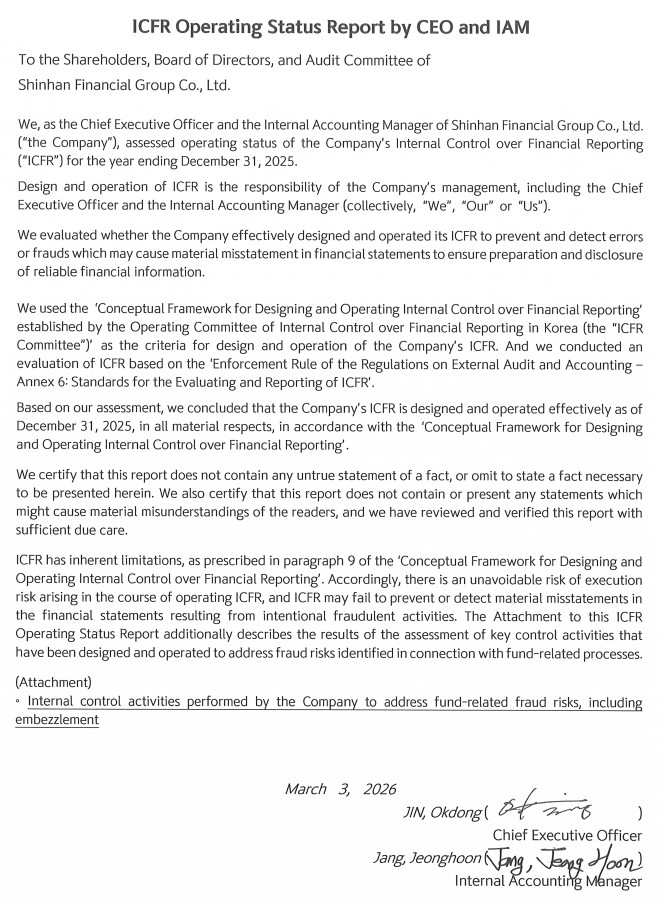
79
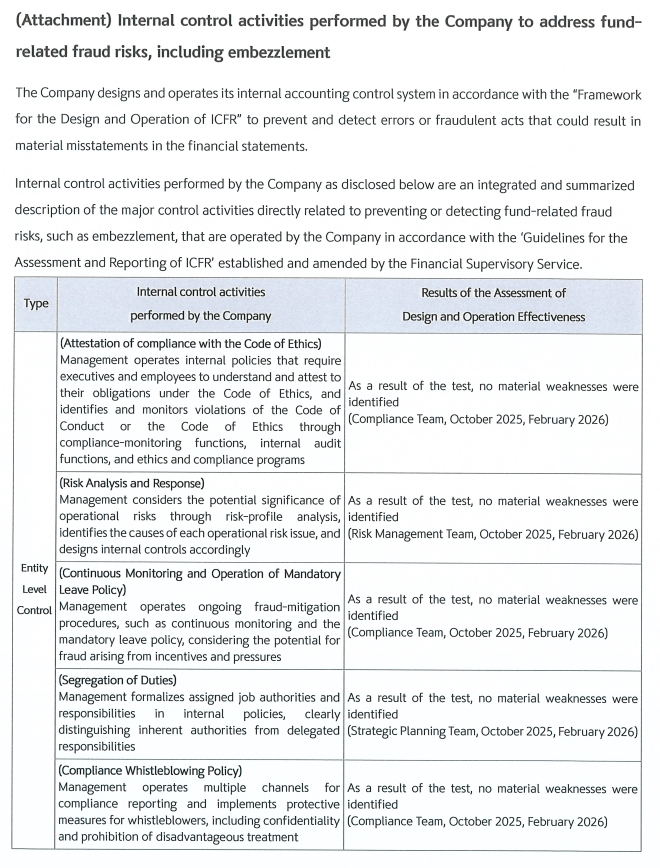
80
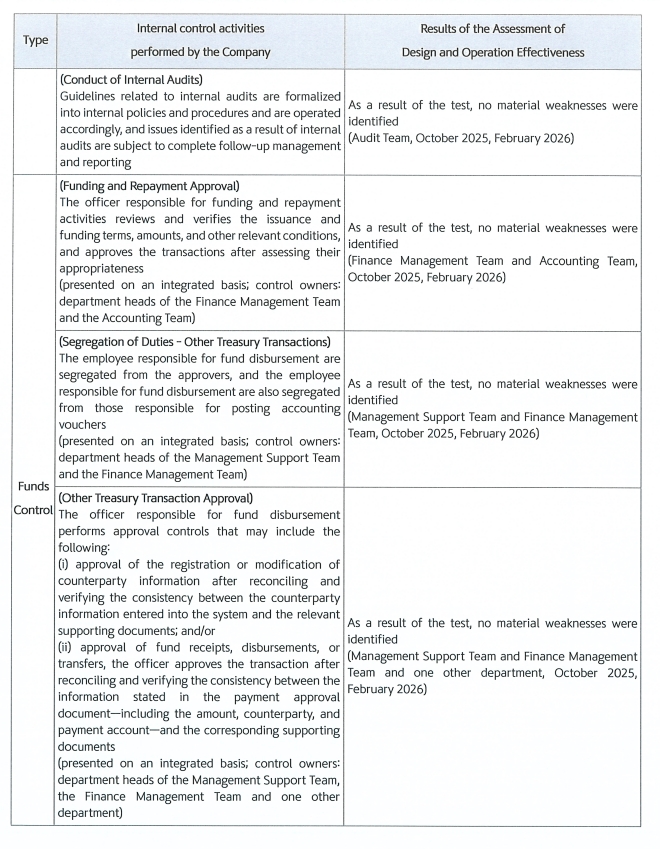
81
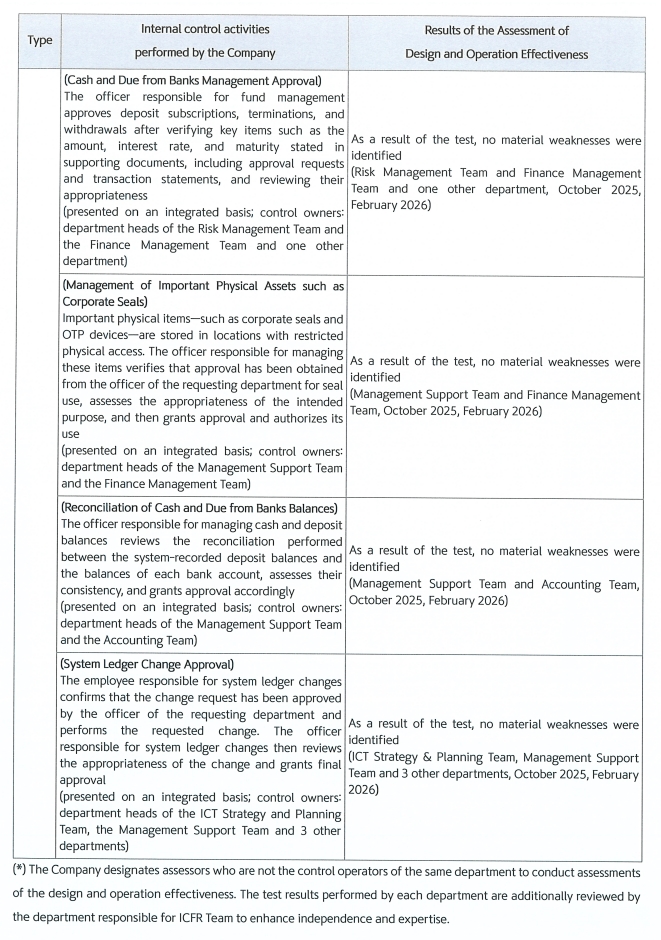
82