UNITED STATES
SECURITIES AND EXCHANGE COMMISSION
WASHINGTON, D.C. 20549
Form CB
TENDER OFFER/RIGHTS OFFERING NOTIFICATION FORM
Please place an X in the box(es) to designate the appropriate rule provision(s) relied upon to file this Form:
| Securities Act Rule 801 (Rights Offering) |
☐ | |||
| Securities Act Rule 802 (Exchange Offer) |
☒ | |||
| Exchange Act Rule 13e-4(h)(8) (Issuer Tender Offer) |
☐ | |||
| Exchange Act Rule 14d-1(c) (Third Party Tender Offer) |
☐ | |||
| Exchange Act Rule 14e-2(d) (Subject Company Response) |
☐ | |||
| Filed or submitted in paper if permitted by Regulation S-T Rule 101(b)(8) |
☐ |
Woori Venture Partners Co., Ltd.
(Name of Subject Company)
Not Applicable
(Translation of Subject Company’s Name into English (if applicable))
The Republic of Korea
(Jurisdiction of Subject Company’s Incorporation or Organization)
Woori Financial Group Inc.
(Name of Person(s) Furnishing Form)
Common Shares of Woori Venture Partners Co., Ltd.
(Title of Class of Subject Securities)
Not Applicable
(CUSIP Number of Class of Securities (if applicable))
Chang-Kyu Kim
Woori Venture Partners Co., Ltd.
670, Daewangpangyo-ro, Bundang-gu
Seongnam-si, Gyeonggi-do, Korea
(Tel) +82-031-628-6499
with a copy to:
Johneth C. Park, Esq.
Sheppard Mullin Richter & Hampton LLP
Foreign Legal Consultant Office
West Tower 23F, Mirae Asset Center 1 Building
26 Eulji-ro 5-gil, Jung-gu, Seoul 04539, Korea
(Tel) +82-02-6030-3030
(Name, Address (including zip code) and Telephone Number (including area code)
of Person(s) Authorized to Receive Notices and Communications on Behalf of Subject Company)
Not Applicable
(Date Tender Offer/Rights Offering Commenced)
PART I – INFORMATION SENT TO SECURITY HOLDERS
| Item 1. | Home Jurisdiction Documents |
| (a) | Prospectus, dated July 7, 2023, attached hereto as Exhibit 1. |
| (b) | Not applicable |
| Item 2. | Informational Legends |
A legend in compliance with Rule 802(b) under the Securities Act of 1933, as amended, has been included in Exhibit 1.
PART II – INFORMATION NOT REQUIRED TO BE SENT TO SECURITY HOLDERS
| (1) | Not applicable |
| (2) | Not applicable |
| (3) | Not applicable |
PART III – CONSENT TO SERVICE OF PROCESS
| (1) | Woori Financial Group Inc. is filing with the Securities and Exchange Commission a written irrevocable consent and power of attorney on Form F-X concurrently with the furnishing of this Form CB. |
| (2) | Not Applicable |
PART IV – SIGNATURES
After due inquiry and to the best of my knowledge and belief, I certify that the information set forth in this statement is true, complete and correct.
| /s/ Kon-Ho Kim |
|
|
| (Signature) |
| Kon-Ho Kim, Managing Director |
|
|
| (Name and Title) |
| Woori Financial Group Inc. |
| July 7, 2023 |
|
|
| (Date) |
Important information
This exchange offer involves the securities of a foreign company. The offer is subject to disclosure requirements of a foreign country that are different from those of the United States. Financial statements included in the document, if any, have been prepared in accordance with foreign accounting standards that may not be comparable to the financial statements of United States companies.
It may be difficult for you to enforce your rights and any claim you may have arising under the federal securities laws, since the issuer is located in a foreign country, and some or all of its officers and directors may be residents of a foreign country. You may not be able to sue a foreign company or its officers or directors in a foreign court for violations of the U.S. securities laws. It may be difficult to compel a foreign company and its affiliates to subject themselves to a U.S. court’s judgment.
You should be aware that the issuer may purchase securities otherwise than in the exchange offer, such as in open market or privately negotiated purchases.
Exhibit 1
PROSPECTUS
SUMMARY INFORMATION
Note: Capitalized term used in this “Summary Information” section without definitions have the meanings ascribed to them in the main body of this document.
I. INVESTMENT RISK FACTORS
| The investment risk factors set forth below are a brief summary of key investment risk factors that are provided in the main body of this document to boost investors’ understanding. For details of the investment risk factors, please see the “Main Body – Section 1. Overview of [Merger, etc.] – VI. Investment Risk Factors.” |
| Business Risks | [Business Risks of Woori Financial Group, Wholly Owning Parent Company]
A. Risk related to the competitiveness and business performance of the subsidiaries
Woori Financial Group Inc. (“Company” or “Woori Financial Group Inc.” or “Woori Financial Group”) is a financial holding company established under the FHCA. Financial holding companies like the Company are not allowed to engage in other profit-making businesses except for managing the business of their subsidiaries, such as financial support and investment support for a subsidiary, and the affairs incidental thereto. Hence, the major source of income is the dividends from their subsidiaries. Accordingly, the competitive elements of a financial holding company are directly related to the competitiveness of its subsidiaries within their respective industries. The Company engages in the financial industry, including its major subsidiary Woori Bank, and other subsidiaries in credit card, capital, merchant banking, asset management, and real estate trust industries. If the Company and its subsidiaries fail to have an efficient business management, such failure may have a negative impact on its overall business conditions. The market competitiveness and business performance of the subsidiaries may have a direct impact on the competitiveness and profit of the Company. Please be advised that investors should have a comprehensive review on the business of its subsidiaries to examine the business risks of the Company.
B. Risk associated with changes in the overall regulatory system
The financial industry is a country’s key industry and regulated industry. It is highly affected by the regulations of the financial authorities and the government policies. In other words, the Company and its subsidiaries are exposed to the risk of profitability fluctuations due to environmental and institutional changes affecting its subsidiaries. Therefore, investors should take into account not only the competitiveness of each subsidiary but also the external environments, such as macro-economics and government regulations. |
1
| C. Risks from changes in domestic and foreign financial markets
Risks from economic uncertainty at home and abroad have significant effects on the financial industry, which directly or indirectly affect the financial industry. Our group, including the Company, is also greatly affected by changes in domestic and foreign financial markets with the result that fluctuations in interest rates, exchange rates, bond and stock prices, and other market factors directly or indirectly affect the Company’s business operations. Investors should be aware of such risks.
D. Risk related to increase of double leverage ratio
The double leverage ratio is a financial holding company’s total amount of investment in its subsidiaries compared to its equity capital. Any amount exceeding 100% is capital amount contributed by the holding company through its borrowing, and the financial authorities recommend the holding company not to exceed 130%. If the double leverage ratio of holding company exceeds such 130%, it may be adversely affected at the time of evaluation of business status.
The average double leverage ratio of Korean financial holding companies is 115.57% as of the end of 2022. However, given their capital structures, which are largely rely on dividends from core subsidiaries, the double leverage ratio may exceed 130%, which is recommended by the financial authorities, due to expansion of business scale including M&A in the future, uncertainty in the financial market and the regulators’ more tightened control. Investors should note that the Company may be sanctioned in case of exceeding such 130%.
E. Risks from fiercer competition due to restructuring of the financial industry
Financial companies are proceeding with M&As for the purpose of enlargement, diversification and creation of business synergy. As such, the financial industry is being restructured and competition is expected to be fiercer. Such fiercer competition may cause the profitability of financial holding companies, like the Company, to be worse in the future.
F. Risks related to personal information
Financial sector has often suffered leakage accidents of personal information, and hackers will continually attempt to hack customer information of financial companies, including the Company, in the future. Accordingly, it is necessary to tighten internal security through internal control procedures to protect customer information. Investors should note that any occurrence of such leakage accident may result in falling of reputation of the Company and its subsidiaries, costs related to claims for damages, and decrease in profits due to customer separation.
G. Risks of the Introduction and Growth of the Fintech Industry
The advance in innovative technologies pursuant to the fourth industrial revolution, a new type of financial service that combines technology with finance, Fintech (Fintech: Financial+Technology), is revamping the fundamentals of the financial industry. Accordingly, in the third regulation reform ministerial meeting held on May 2015, the government released the ‘Fintech Industry Promotion Method’, and proposed 3 major milestones and 11 detailed tasks, including the promotion of Fintech industry startups and growth, full-fledged public-friendly services, and establishment of the Fintech infrastructure. Further, the government announced the ‘Fintech Innovation Facilitation Method’ in March 2018, and suggested 4 policy directions towards achieving financial innovation: 1) testing and supporting innovative financial services, 2) sophistication of financial industry services, 3) expansion of Fintech market, and 4) response to Fintech innovation risks. |
2
| In October 2018, the government conducted regulatory reform to facilitate Fintech by launching a ‘Regulatory Reform T/F for Financial Innovation including Fintech, Etc.’ Further, the FSC proclaimed January 2019 to be the ‘golden time’ for Fintech acceleration, and established a 6 milestone strategy plan for focused and systematic support (① full use of financial regulation sandbox, ② revamping old regulations, ③ increasing Fintech investment, ④ fostering new industry sector, ⑤ supporting global market entry, ⑥ strengthening digital finance/security). In October 2019, the government announced a regulatory innovation method for the promotion of Fintech, and soon thereafter, the FSS released the ‘Fintech scale-up strategy plan’ in December 2019.
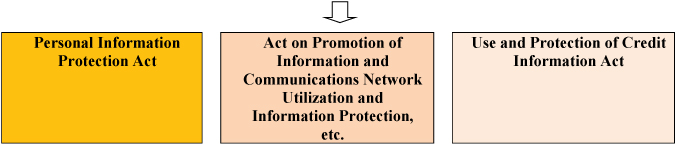
In January 2020, the amendments of the Enforcement Decrees of the three major data laws passed the national assembly (the Personal Information Protection Act, Act on Promotion of Information and Communications Network Utilization and Information Protection, Etc., Credit Information Act) and came into force in August 2020. Key amendments made in the three major data laws include the establishment of a safe data combination procedure, stronger stability of pseudonymized information, unification of personal information related Enforcement Decrees, fostering financial sector mydata industry. Once the ‘mydata’ era arrives pursuant to the above Enforcement Decree, personal information would be provided to Fintech companies only upon consent of the customers. Accordingly the industry must establish response measures and gear the direction of business strategies in accordance therewith.
With the emergence of this Fintech industry, while previous banks are provided with new opportunities to service financial information using Fintech technologies, investors are advised to note that the banks may face excessive competition pressure and lower profits in the new financial environment, as non-financial companies may also enter the Fintech market.
H. Risks from the emergence of internet primary banks
The FSC announced a policy direction for relaxation of regulations of internet primary banks in June 2015, and has issued licenses to three internet primary banks so far. The introduction of internet primary banks may lead to certain positive effects, such as cost-saving effects of internet banks, and promotion of product development by existing financial institutions, while it could cause a decrease in market share, price competitiveness and profitability of existing commercial banks due to fiercer competition. As such, investors should take note of the above.
I. Risks from strengthened anti-money laundering obligations
Recently, finance companies’ anti-money laundering obligations are being strengthened in Korea and abroad. As is the case with inspections by global and US financial authorities, the recent trend of inspections by the Korean financial authorities is to focus on the operational effectiveness in substance, rather than perfunctory compliance with the anti-money laundering system. Evaluation results, which are directly related to the competitiveness of financial business, are risk factors from the standpoint of finance companies, and could deteriorate the soundness of financial institutions subject to anti-money laundering regulation. |
3
|
Meanwhile, according to the “Procedures for Mutual Evaluations and Follow-Up of FATF (Financial Action Task Force)” (dated November 27, 2018) of the AML/CFT (Anti-Money Laundering/ Combating the Financing of Terrorism) Policy Council, Korea was evaluated in July of 2019 for the operation of AML/CFT system in accordance with the Mandate of FATF. Such evaluation involved checks by the international society of Korea’s AML/CFT system, and the results of such evaluation appear to be a measure of the transparency of Korea’s financial and judicial systems. Also, depending upon the results of such evaluation, Korea can be subject to subsequent checks, and can, if deemed negative based on such evaluation, be affected in, among others, the nation’s sovereign rating, financing costs of exporting companies, and foreign exchange transactions.
[Business Risks of Woori Venture Partners, Wholly-Owned Subsidiary]
A. Risks from economic fluctuations and changes in government policies
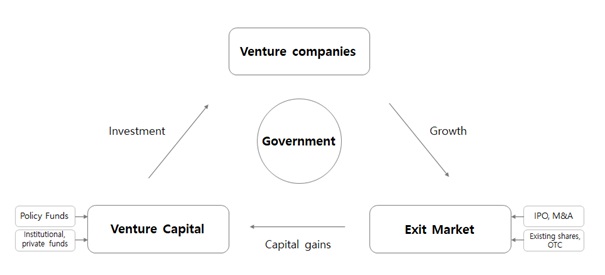
Woori Venture Partners finances investments from policy funds, professional investment institutions, corporations, and other financial investors to form funds (investment partnerships and private equity funds) and runs its venture investment by investing in high-potential SME ventures and foreign companies through such funds. Woori Venture Partners has a cyclical structure in which it increases the investee companies’ corporate value by managing and supporting the companies’ important business activities, generates profits, collects invested amounts, and distributes them to investors. Therefore, changes in government policies, the real economy, and financial markets in and outside of the country directly and indirectly affect the venture capital and private equity industry to which Woori Venture Partners belongs in terms of securing financial resources, executing investments, and recovering investments.
With ventures business emerging as a new growth engine for the national economy amidst stale growth, the government is also implementing economic growth policies and creating jobs by promoting and supporting SMEs and venture companies. Ever since the Ministry of SMEs and Startups was launched as the key government department for innovative growth, job creation, and fair economy, market-friendly policies have been implemented to build an innovative industry ecosystem, and measures to improve business ventures in hopes of building a country with strong global business ventures have been announced. These government-supported policies are expected to have a positive influence, inducing the inflow of talents and capital in the venture capital industry Woori Venture Partners is in and strengthen the venture ecosystem. However, constant changes in the government’s policy to promote venture investments significantly relaxed the regulations for the registration and activities of startup investment companies, which constitute the backbone of the venture investment, ultimately resulting in undesirable results such as disorganized flooding of new companies, low transparency, and illegal activities. In response, the government is continuously establishing and strengthening management and supervisions, while enacting laws and administrative regulations to ensure that startup investment companies have as high transparency as other financial institutions. Government’s policy easing and financial support will likely continue regardless of future government changes. However, the government’s policy is subject to change if its policy easing leads to social side effects and reduction of financial resources, and such a change could negatively affect Woori Venture Partners’ business. |
4
|
B. Risks Associated with Investing in Venture Capital
Woori Venture Partners’ venture capital business strategy is to invest in businesses with superior technical prowess and growth potential, instead of adopting a conservative approach focusing on financial stability and operation performance. Therefore, a new business’ growth and development driven by newly secured funds can yield high investment returns. On the other hand, the business’ lack of growth can result in losses on invested principal.
Woori Venture Partners’ financial status and operational performance may suffer from difficulties in finding businesses with high growth potential and from reduced profitability and diminished valuation of investment recipients caused by lagging growth, business failures, adverse domestic and international economic conditions, and unfavorable changes in financial markets.
C. Risks from low entry barrier and intensifying competition
While government policies to invigorate venture activity are consistently lowering the entry barrier to the venture capital market, competition is steadily intensifying. As of 2022, 231 domestic venture capitals were active in the market while 394 institutions (including asset management companies, financial companies, startup investment companies, new technology venture capitals) were operating in the PEF market as of 2021.
By the end of 2021, 114 out of 197 startup investment companies (those with financial year-ends in December) were at a surplus, with only 34 firms recording a net income of more than KRW 5 billion. 2022 figures show startup investment companies differing greatly in terms of asset amount, fund size, and profit, with 17 of 231 firms possessing over KRW 1 trillion in assets under management.
In the first quarter of 2023, Woori Venture Partners’ assets under management were around the third largest among venture capitals, while net income stands at sixth largest as of the end of 2022. With the size of assets and funds growing annually at a steady pace, Woori Venture Partners is expected to remain competitive despite the increasing number and intensity of competition in the venture capital market.
However, overheating competition may cause difficulties in obtaining investment resources, while the growth of a particular competitor and the loss of talent to industry competition in the backdrop of continued fierce and unfriendly competition may also negatively impact Woori Venture Partners’ financial position and operational performance.
D. Risks related to procurement of sources of funds and investments
Procurement of sources of funds and investments is the most important element of venture capital investments. Venture capitals generally have a harder time procuring sources of funds and investments especially due to the high risks and longer investment periods (approximately 5 to 10 years) associated with venture companies. Therefore, venture capitals typically pool investments from policy agencies, financial institutions, pensions & credit unions, and the private sector. Procurement of sources of funds and investments is the most fundamental component of venture capitals and private equity industry, and is the foundation of investing in enterprises with growth potential yet having trouble with procurement of sources of funds and investments.
Recently, the investments from the policy agencies comprise higher resource proportions of venture capital business and private equity resources. Therefore, the government’s effort to facilitate continuous venture investments, start-up support policy, and the prospect of the parent fund’s investment business are critical in the procurement of funds. The number of newly-formed partnerships and PEFs has been increasing annually due to the government’s continuous policy for facilitating the venture investment market. As a result, the number of newly-formed partnerships and funding for PEFs have been experiencing drastic increases. However, in case of possible change in the government’s policies regarding growth of venture investment or PEF markets, or reductions in investment from the policy agencies or private sector resulting in decrease in number of investors and amount, there is a possibility of hardship for Woori Venture Partners in recruiting investors and forming funds. Such may negatively affect Woori Venture Partners’ financial position and business performance. |
5
| E. Risks related to new investments
The number of new investments by venture capitals has been steadily increasing, but there have been major changes in the main investment sectors during the last 5 years. This indicates how important it is to find and invest in a sector and corporation with high growth potential and a promising future within the venture capital industry. As a result, failure to find or invest in such corporation through appropriate and investment decisions in the ever-changing venture industry may hinder Woori Venture Partners’ future growth and profitability.
F. Regulatory risks
Since the venture capital industry is much affected by laws and regulations, the business environment surrounding Woori Venture Partners may also be affected by amendments to laws and changes in regulations.
Startup investment companies, including Woori Venture Partners, report to the Ministry of SMEs and Startups and are subject to management and supervision by the said ministry with respect to the formation of investment partnerships, asset management, financial results, change of major management matters, etc. from the point of their establishment under the Venture Investment Promotion Act. In addition, when startup investment companies receive funding from a major investor, they become subject to due diligence and inspection of major matters for all stages from the selection of management company to final dissolution. Such faithful compliance and continuous management and supervision by authorities ensure that startup investment companies are operated in a sound manner and reduces the risk of poor investment decisions. However, there is still a possibility of change in laws and regulations and imposition of government sanctions, in which case the financial condition and business results of Woori Venture Partners can be negatively affected. | ||
| Company Risks | [Company Risks of Woori Financial Group, Wholly Owning Parent Company]
A. Risk of impact on profitability of financial holding company from changes in business performance of its subsidiaries
For the primary purpose of controlling, through ownership of shares, subsidiaries operating in the financial business or closely related to the financial business, Woori Financial Group was established on January 11, 2019 in accordance with the FHCA. A financial holding company, like Woori Financial Group, may not engage in any business for profit other than the business management of its subsidiaries and other duties incidental thereto, such as provision and management of loans and equity capital to its subsidiaries, in accordance with the relevant laws. Thus, the dividends from its subsidiaries are its main source of income of Woori Financial Group. As such, the competitiveness of financial holding company is directly related to the competitiveness of its subsidiaries in their respective industries. |
6
| Consolidated net income of Woori Financial Group as of 2023 1Q consist of the followings: 89.34% from banking business, 4.74% from credit card business, and 4.05% from capital business. Accordingly, Woori Financial Group’s profitability and cash flow are greatly affected by its subsidiaries’ operating environment and financial condition, and in order to predict Woori Financial Group’s future performance and competitiveness, it is necessary to review the overall financial industries to which its major subsidiaries, including banks, belong. Investors should keep this in mind.
B. Risks related to the soundness of assets of subsidiary bank
The asset soundness of the Company is similar to that of its subsidiary Woori Bank Co., Ltd. The NPL ratio and the delinquency rate of Woori Bank as of 2023 1Q recorded 0.19% and 0.28%, respectively. Woori Bank’s coverage ratio of allowance for bad debts recorded 264.76% as of 2023 1Q. However, we may not rule out the possibility of deterioration in the soundness of assets as loans may become non-performing loans, given the continuous restructuring of weak industries and failing companies, continuous instability of global economy, the concerns about local real estate market, and the excessive household loans compared to incomes. Investors should keep this in mind.
C. Possible decline in profitability if bank subsidiaries’ NIM falls
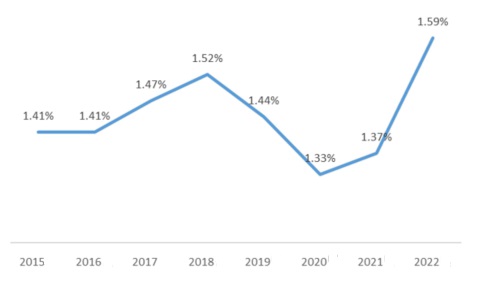
The composition of the Company’s NIM (Net Interest Margin) is expected to be more or less similar to the profit composition of Woori Bank Co., Ltd. As of 2023 1Q, Woori Bank Co., Ltd.’s ROA and NIM recorded 0.79%, and 1.59% respectively, showing positive overall profitability. However, there exists uncertainty due to slowing economic recovery, and Woori Bank has limitations in generating profits through expansion of loan assets due to the Korea government’s regulations on household debts. In such case, Woori Bank’s profitability including NIM may deteriorate.
Meanwhile, the Basel III Liquidity Coverage Ratio (LCR) regulation (high liquidity assets/ future net cash leakage for one month ≥100%) that is in effect since 2015 is also expected to act as a burden to the bank’s profitability. With stronger government regulation related to household debts, and the implementation of LCR regulation, the bank’s asset management policy is shifting towards a more conservative stance. Such change to the policy is expected to have an adverse effect on Woori Bank’s profitability. Investors are advised to take note of these issues.
D. Interest Rate Risks of the Bank Subsidiary
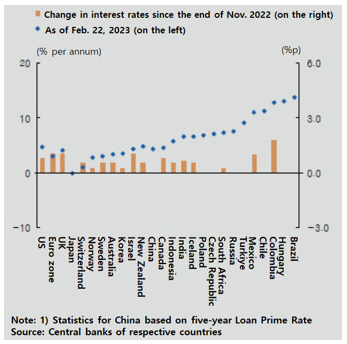
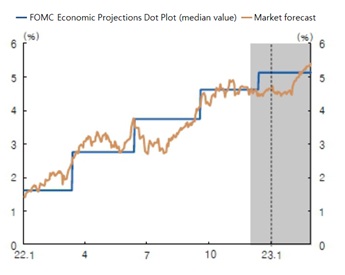
In light of the global spread of COVID-19, the US FOMC lowered the base interest rate by 0.5%p from 1.50%~1.75% to 1.00%~1.25% on March 3, 2020, and by 1%p to 0.00%~0.25% on March 3, 2020. The Bank of Korea, which froze the base interest rate in January and February 2020, lowered the base interest rate from 1.25% to 0.75% on March 16, 2020 and then to 0.5% again on May 28, 2020. However, the Monetary Policy Board raised the base interest rate by 0.25%p each in August and November 2021, and by another 0.25%p in January 2022. Such increase appears to have been made to curb soaring inflation. The Monetary Policy Board froze the base interest rate in February 2022, but raised it by 0.25%p each in April and May 2022. As the FOMC raised the base interest rate by 0.75%p from 0.75%~1.00% to 1.50%~1.75% in June 2022, the Monetary Policy Board raised the base interest rate by 0.50%p from 1.75% to 2.25% in July 2020 by taking into account impending Korea-US interest rate reversal and high inflation rate. The US Federal Reserve decided to raise the base interest rate by 0.75%p each in the FOMC in September and November 2022, and additional 0.50%p in December 2022, and 0.25% each in February, March and May 2023. The US base interest rate as of the business day immediately preceding the filing date of this SRS ranges between 5.00% and 5.25%. In Korea, the Monetary Policy Board decided to raise the base interest rate by 0.25%p in August 2022, and in just three months after July, the Bank of Korea took a big step of raising the base interest rate (by 0.50%p) to curb inflation and exchange rate on October 12, 2022, and raised the rate by 0.25%p on November 24, 2022 and another 0.25%p on January 13, 2023. However, as there were growing concerns over the national economy, Korea’s base interest rate was frozen three times in a row on February 23, April 11 and May 25, 2023 and is currently 3.50%. The recent market rate at home and abroad are difficult to predict due to economic and political circumstances at home and abroad, as well as various market variables that are out of control. We cannot exclude the possibility that the market rate would continue its upward trend. The increase in market interest rate, which is connected with financing cost, may act unfavorably to the profitability of Woori Bank Co., Ltd., a subsidiary of Woori Financial Group. This may also undermine the profitability of Woori Financial Group’s consolidated financial statement. Investors are advised to take note of these issues. |
7
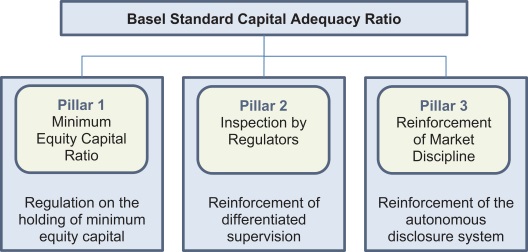
| E. Possibility of satisfying capital adequacy under the Basel III system
As of 2023 1Q, Woori Financial Group’s BIS total equity ratio is 15.79%, while its Tier 1 and C-Tier 1 are 12.71% and 10.91% respectively, which satisfy such level (total equity ratio: 11.5%; Tier 1: 9.5%; C-Tier 1: 8.0%), including conservation buffer (2.5%) and D-SIB (1.0%), as required by Basel III.
However, in the future, Woori Financial Group may fail to satisfy the capital adequacy ratio because of the following reasons: increase in risky assets due to business deterioration resulting from economic depression in and out of Korea, increase in losses, increase in costs due to disposal of non-performing loans, downward adjustment of securities, increase in foreign exchange rates, change in the minimum capital adequacy ratio due to tightened capital adequacy system, change in calculation method of ratio, change in the Basel Committee standards, and other negative factors affecting the asset soundness and capital adequacy.
Meanwhile, Woori Financial Group was selected as a “Domestic Systemically Important Bank” (D-SIB) of 2022 by the FSC and should accumulate additional 1% equity. If the current equity ratio of Woori Financial Group is also maintained in the future, such equity ratio would be above the ratio required by the Korean government for capital control (total equity ratio: 11.5%; Tier 1: 9.5%; C-Tier: 1 8.0%). However, investors should note that there is still a risk that Woori Financial Group’s equity ratio may fail to meet such ratio as required by the Korean government for capital control in the future as its equity ratio may decrease due to the burden of cost of bad debts resulting from a decline in soundness of corporate loans caused by deterioration of Korean companies’ financial stability.
Therefore, Woori Financial Group is trying to maintain the capital adequacy through continued generation of stable profits, issuance of contingent convertible bonds and risk management. Investors are advised to continuously monitor Woori Financial Group’s capital adequacy.
F. Risks related to profitability of subsidiary engaging in card business
Woori Card Co., Ltd. accounts for approximately 4.85% (approximately KRW 45.9 billion) of Woori Financial Group’s consolidated net income for 2023 1Q. Woori Card ranks second only to Woori Bank Co., Ltd., and thus the performance of Woori Card affects the profitability and dividend income of Woori Financial Group. Korean credit card industry has undergone intensive restructuring since the credit card crisis in 2003 and is now in a mature stage. Deterioration of the profitability of Korean credit card industry is expected to continue due to fiercer competition and downward adjustment of card fee rate of merchants. Besides, given the stagnant growth of household income and the growth of household debts, the default ratio of card use charges may increase. Investors should note that deterioration of business profitability of Woori Card due to the above factors may give adverse effect to the financial condition of Woori Financial Group on a consolidated basis. |
8
| G. Risks related to profitability of subsidiary engaging in capital financing business
Woori Financial Capital Co., Ltd. accounts for approximately 4.14% (approximately KRW 39.2 billion) of Woori Financial Group’s consolidated net income for 2023 1Q. The profit structure of Woori Financial Capital Co., Ltd. is focused on auto financing and individual and general loans based on credit financial business. In particular, as of 2023 1Q, the portion of the auto financing assets accounts for approximately 50% of the entire assets, indicating its heavy reliance on auto financing assets. Such a profit structure may prove vulnerable to economic fluctuation or changes of conditions in the industry. Investors should take note of this.
H. Risk of profitability of subsidiary engaging in the merchant banking business
As of 2023 1Q, Woori Investment Bank Co., Ltd. accounts for around 0.85% (approximately KRW 80.1 billion) of Woori Financial Group’s consolidated net income. Competition has become fiercer in the merchant banking industry, which used to be the only financial industry in which the companies were permitted to concurrently engage in other financial business activities, because more financial institutions are participating in this market. Accordingly, it is difficult for Woori Investment Bank to improve its profitability only based on spread between deposits and loans. Woori Investment Bank is trying to expand its business areas focusing on the IB business and to increase the portion of fee income. However, if Woori Investment Bank’s profitability deteriorates due to fiercer competition with other financial institutions and poor performance of new business, the profitability of Woori Financial Group would be adversely affected thereby. Investors should keep this in mind.
I. Risks from contingent liabilities and commitments
Due to the nature of financial industry, to which Woori Financial Group belongs, there may occur litigations and contingent liabilities in the course of business activities. If the amount of such litigations and contingent liabilities becomes large, it may give adverse effect not only to the performance of subsidiaries but also to that of Woori Financial Group. As of the business day immediately preceding the filing date of this SRS, there are outstanding payment guarantees, etc. of Woori Financial Group, which are related to pending litigations and business activities of its subsidiaries. As of the date immediately preceding the filing date of this SRS, there are 520 litigations (excluding litigations brought to merely extend prescription in relation to loans and litigations involving fraud) brought against member companies of Woori Financial Group (total litigation value: KRW 575,835 million), and the litigation provision is KRW 25,675 million. We cannot reasonably foresee the results of pending litigations, and Woori Financial Group’s financial condition could be affected by the judgments thereof to certain extent. Investors should take note of this.
J. Risks regarding legal regulation on financial holding companies
The Company is required to comply with such requirements as restrictions on capital contribution by financial holding companies under the FHCA, restrictions on extending credit facilities to the same borrowers, the same companies and major investors and restricted acts of subsidiaries, etc. Investors should note that the said legal regulations may be applicable. |
9
| K. Risks involved in acquiring new companies
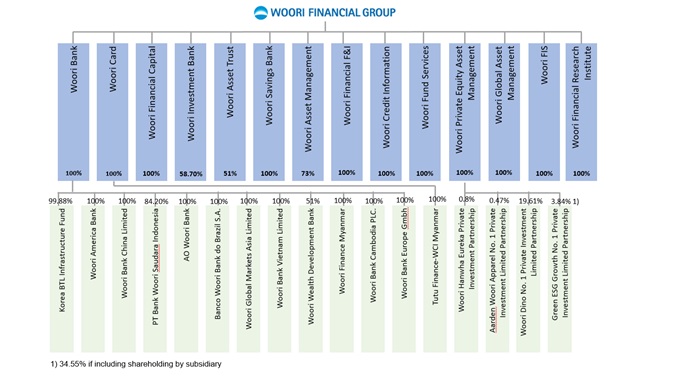
The board of directors of the Company adopted a resolution in March 2019 to take over Tongyang Asset Management Co., Ltd. and ABL Asset Management Co., Ltd. (formerly known as Allianz Asset Management) and also resolved to acquire the shares in Kukje Asset Trust Co., Ltd. in June 2019, the shares in Aju Capital Co., Ltd. in October 2020 and the shares in Woori Savings Bank Co., Ltd. in March 2021.
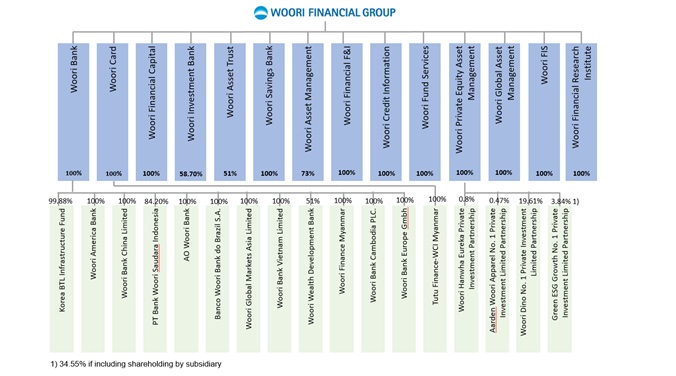
The (formerly known as) Tongyang Asset Management Co., Ltd. was then included as the subsidiary of the Company as of August 1, 2019 (ownership: 73%, acquisition amount: approximately KRW 122.4 billion) and changed its name as Woori Asset Management Corp. (See the disclosure on the inclusion as the subsidiary of the Company’s holding company on August 1, 2019).
The (formerly known as) ABL asset management Co., Ltd. became the subsidiary of the Company as of December 6, 2019 (ownership: 100%, acquisition amount: approximately KRW 33 billion) and changed its name as Woori Global Asset Management Co., Ltd. (See the disclosure on the inclusion as the subsidiary of the Company’s holding company on December 6, 2019).
On July 25, 2019, the Company entered into the share purchase agreement (SPA) to take over the ownership of (formerly known as) Kukje Asset Trust (renamed as Woori Asset Trust). The procedures for the inclusion of Woori Asset Trust as the subsidiary of the Company were completed on December 30, 2019 (ownership: 51%, acquisition amount: approximately KRW 224.2 billion). (See the disclosure on the inclusion as the subsidiary of the Company’s holding company on December 30, 2019).
After that, the Company completed the procedure for inclusion of (formerly known as) Aju Capital (renamed as Woori Financial Capital Co., Ltd.) as the subsidiary of the Company on December 10, 2020 by exercising the preferential right to purchase held by Woori Bank Co., Ltd., a subsidiary of the Company (ownership 74%, acquisition amount: approximately KRW 572.4 billion). (See the disclosure on the inclusion as the subsidiary of the Company’s holding company on December 10, 2020).
With that, (formerly known as) Aju Savings Bank (renamed as Woori Savings Bank Co., Ltd.), a wholly owned subsidiary of Aju Capital, became a sub-subsidiary of the Company. The process was completed on March 12, 2021. (See the disclosure on the inclusion as the subsidiary of the Company’s holding company on March 12, 2021).
In addition, the Company additionally acquired 13.3% of ownership of Woori Financial Capital Co., Ltd. (excluding treasury shares, 12.9% of ownership including treasury shares) on April 15, 2021, additionally acquired treasury shares of Woori Financial Capital Co., Ltd. (3.6% of ownership) on May 24, 2021, issued 5,792,866 new shares of the controlling company to the shareholders of Woori Financial Capital Co., Ltd. excluding the controlling company through comprehensive share exchange, acquired the remaining shares (9.5%) of Woori Financial Capital and Woori Financial Capital became a fully owned subsidiary of the Company.
On January 7, 2022, the Company established Woori Financial F&I which is an investment company for bad debt and restructuring companies (ownership: 100%, share subscription amount: KRW 200 billion) and Woori Financial F&I became a subsidiary of the Company. |
10
| The Company will continue to diversify its business structure by acquiring small-sized businesses including VC in the short-term and securities companies and insurance companies in the medium-and long-term. Accordingly, Woori Financial Group executed an SPA with DAOL Investment & Securities Co., Ltd. in order to take over 52% of the controlling shares of DAOL Investment Co., Ltd. last February, completed the transaction on March 23, and it became the 15th subsidiary. Upon the inclusion as a subsidiary, the name of the company was changed to Woori Venture Partners, and Woori Venture Partners is a No. 5 venture capital company operating a fund with a scale of approximately KRW 1.4 trillion as of the end of last year. As such, investors should note that the difference in such fields as management, business areas and business cultures arising from the Company’s pursuit of new businesses and the strategy of strengthening non-banking sector may affect the Company’s business.
L. Reputation risks due to fund sales by the bank subsidiary
Financial markets both at home and abroad are faced with increasing volatility caused by the possibility of global economic downturn, U.S.-China trade dispute, COVID-19 and so on. For these reasons, interest rates have increasingly been volatile and increasing interest rate volatility has posed the possibility of losses on the part of investors as the derivative products linked to overseas interest rates have fallen below the barrier price. As such, the FSS conducted a joint inspection on financial institutions including Woori Bank Co., Ltd. on August 23, 2019, followed by another inspection later.
In that regard, the FSC convened the fourth regular meeting on March 4, 2020 and passed a resolution to enforce the measures the FSS had suggested after conducting an inspection on KEB Hana Bank Co., Ltd. and Woori Bank Co., Ltd. in connection with the derivative-linked financial products (DLF). Woori Bank Co., Ltd. was ordered (i) partial suspension on its business (i.e., no new sales of PEFs) for six months along with administrative fines and sanctions for violating the obligation of delivering investment prospectus and the regulations on advertisement of PEFs.
Meanwhile, the Lime Asset Management announced on October 8, 2019 that it would
suspend redemption for ‘Pluto FI D-1’ and ‘Tethys 2’ due to difficulties in securing liquidity. ø Please refer to the regular briefing of
the FSS (July 1, 2020)
As for the estimates for the down-payment to be returned and indemnification for loss that Woori Bank Co., Ltd. may have to pay as a result of dispute settlement by FSS regarding the losses on the part of the customers due to delayed fund redemption by Lime Asset Management, Woori Bank Co., Ltd. determined to deem the best estimates for the disbursement as provisions required to perform its obligation. As of the first quarter of 2023, Woori Bank recognized KRW 121.6 billion as estimated liabilities for the Lime Asset Management case.
At the 20th FSC regular meeting in November 2022, the FSC passed a resolution to enforce the measures to suspend business of selling PEFs for three months related to Woori Bank’s mis-selling of Lime Fund (administrative fines imposed in advance).
Investors should note that it is currently difficult to determine the scale of losses from the fund as the redemption of the fund was delayed, which may adversely affect the Company’s reputation in relation to its retail finance services provided to individual customers. |
11
| M. Risk of potential debt reclassification by the International Accounting Standards Board (IASB) for amortization-type contingency capital securities (hybrid capital securities)
The International Accounting Standards Board (IASB) presently seeks to amend the IAS32 Financial Instruments. Under the plan, amortization-type contingent capital securities (hybrid capital securities) are likely to be reclassified into liabilities.
If the value of the contingent capital securities (hybrid capital securities) of Woori Bank and those issued by the Company, each worth around KRW 2,344.8 billion and KRW 2,893 billion respectively as of the end of March 2023 (consolidated), are reclassified into liabilities in the future, the total amount of consolidated debt of the Company will increase to KRW 451,232.1 billion from KRW 445,475.6 billion as of the end of March 2023, an increase of 1.0%. The debt ratio on a consolidation basis may increase by 314.4 percentage points to 1,680.7% from 1,366.3% as of the end of March 2023. In addition, the amount of consolidated debt of Woori Bank will increase by 1.0% to KRW 417,852.5 billion from KRW 415,507.7 billion as of the end of March 2023. The debt ratio on a consolidation basis may increase by 173.7 percentage points to 1,796.4% from 1,622.7% as of the end of March 2023 (any effects from exchange rate fluctuation are not reflected in reclassifying debts). Investors should be aware of such aspects.
N. Changes in the largest shareholder in accordance with the Korea Deposit Insurance Corporation’s sale of the Company’s remaining shares
The Public Fund Oversight Committee (the “Committee”) deliberated and passed a resolution selling the remaining shares of Woori Financial Group in the second half of 2021 at the 190th meeting on August 23, 2021, and notified the sale of the remaining shares of Woori Financial Group on September 9, 2021. Shares subject to sale were 10% at the most, the Submission of LOI was completed on October 8, 2021, the successful bidders were selected on November 22, 2021 and the sales procedure was completed on December 9, 2021. Investors should note that the largest shareholder of the Company has changed from the Korea Deposit Insurance Corporation to employee stock ownership association due to the result of the above sale.
O. Risks related to the occurrence of financial accidents
In April 2022, the Company recognized the occurrence of an embezzlement of an internal employee of Woori Bank which is an entity controlled by the Company. The factual grounds of this case are being inspected by related institutions. The Company perceived this case to have occurred after the reporting period requiring amendment, and has been reflecting the related amount on the financial statement since the end of 1Q in 2022.
Investors should note that Woori Bank has taken measures such as the accusation of the embezzler and provisional attachment of the discovered properties, and the amount of loss may change according to the results of the inspection.
On September 22, 2022, the FSS stated in its press release titled “Progress in Additional Investigation on Abnormal Foreign Currency Remittance of Banks (Provisional)” that it found circumstantial evidence of a total of 12 commercial banks including Woori Bank and Shinhan Bank of their abnormal foreign currency remittance, and undertook the inspection all at once. According to the press release, there are 82 companies suspected of abnormal foreign currency remittance confirmed from the 12 commercial banks with the amount of remittance around USD 7.22 billion and the confirmed details shall be shared among the related institutions (the Prosecution and the Korea Customs Service). Investors should note that the FSS is continuously monitoring the financial institutions that are suspected of abnormal foreign currency transactions, and there may be sanctions by the authorities in the future. |
12
| [Company Risks of Woori Venture Partners, Wholly-Owned Subsidiary]
A. Risks related to fluctuations in operating revenues
Woori Venture Partners recognizes the following sources as a primary stream for operating revenues: (i) management fees paid by investment partnerships under management; (ii) performance fees paid based on the management performance of these partnerships; and (iii) profits from the equity method on shares contributed by general partners. With a stable revenue stream of management fees coupled with the generation of high management returns from liquidated funds, the operating income and net income of the first quarter of 2023 reached approximately KRW 4.6 billion and KRW 3.7 billion respectively which is a 10,583.3% and 709.5% increase year on year from 2022. Considering the status of the partnerships currently under management and other relevant factors, the operating revenue of Woori Venture Partners is expected to grow continuously with the management fees, performance fees and profits from the equity method offsetting each other’s volatility going forward.
However, if Woori Venture Partners (i) faces challenges in establishing new investment partnerships, (ii) experiences a decrease in its management fees due to a reduction in the size of investment partnerships under management, or (iii) encounters a drop in performance fees and profits from the equity method caused by weaker investment execution and recovery performance, the operating revenues may shrink while its financial conditions and business performance may be adversely affected.
B. Risks related to preferential loss allocation
Woori Venture Partners, as a GP of investment partnership, is responsible for distributing profits generated from investments using the partnership’s property based on the management performance thereof as well as the principal amount of capital contributed in accordance with resolutions at the general meeting of partners (or members). The property distributed to partners (or members) originates from a partnership’s property, after deducting management fees and compensation for GPs. Such remaining property is distributed to partners (or members) in proportion to their contribution ratios. In the opposite case as well, i.e., if the partnership incurs a loss, the loss is first deducted against any amount payable to the GP and if such amount does not exceed the total contribution amount, the loss is then allocated to the partners (or members) according to their respective contribution ratios.
The obligation of “preferential loss allocation” is specified in the articles of partnership because it is not required by specific laws or enforcement decrees, but based on the agreement between GPs and investors. This obligation is designed to enhance the accountability of GPs in managing venture capital and PEFs and to provide protection for the investors. This applies not only to Woori Venture Partners but other venture capital and competitors engaged in the private investment business. Furthermore, as compensation for losses in venture investment partnerships has been prohibited by recent amendments, partnerships which have been recently formed are not subject to the obligation of preferential loss allocation. Nonetheless, there remains a risk of contingent liabilities, which could contribute to additional losses in previously formed funds due to economic fluctuations, changes in government policies and intensifying competition. Such risk may pose an adverse impact on the financial conditions and business performance of Woori Venture Partners. |
13
| C. Risk related to financial stability
Due to industry nature of high percentage of long-term investments, Woori Venture Partners usually utilizes its own capital for investing rather than through borrowing. The debt to equity ratio (D/E ratio) of Woori Venture Partners had increased to 24.20% and 22.22% in 2019 and 2020 due to short-term borrowings for securing necessary working capital in 2019 and the increase in other financial liabilities in 2020. However, Woori Venture Partners repaid its loans during the third quarter of 2022 using its performance fee, thereby slightly decreasing its D/E ratio to 12.91% in 2021, 9.84% in 2022, and 10.03% in the first quarter of 2023 and has been maintaining a stable D/E ratio. Nevertheless, Woori Venture Partners’ financial stability may be adversely affected if it experiences a net decrease in the future operating cash flow.
D. Risk of changes in the structure of operating revenue
Even though Woori Venture Partners secures management fees as a stable source of revenue from the investment partnerships it operates, the structure of the operating revenue may vary greatly depending on the timing of the investment partnerships’ liquidation and operational performance. Therefore, the structure of the operating revenue is subject to significant changes depending on the future changes in the stock market and the investment asset management capability of Woori Venture Partners. If the operating performance turns out to be unsatisfying, Woori Venture Partners may become more reliant on the management fees.
E. Risks related to securing key investment/management personnel
The venture capital business conducted by Woori Venture Partners typically relies on a small number of specialized professionals to secure investment resources, identify investment targets, and execute investments. In order to successfully navigate the investment and exit stages in high-growth sectors and regions, expertise and knowledge specific to those sectors and regions are essential. Ensuring a workforce with expertise in their respective fields is crucial and securing specialized professionals in each field (region) directly translates into the competitiveness of a venture capital company. Currently out of the company’s total staff of 40, including the representative director, 26 are responsible for investment and management tasks. Due to the steady increase in the establishment of new funds and the size of the funds managed, there is a growing demand for investment analysts who have a high understanding of investment target sectors and regions, and possess rich experience.
However, there is a shortage of personnel with deep understanding of promising investment sectors and diverse investment experience compared to the demand. This situation poses a challenge not only for the company, but also for the industry as whole in terms of recruiting and replenishing talent. Furthermore, as competition intensifies for talent acquisition, and if key personnel who are essential to the company’s business operations are attracted to external opportunities, it can have a negative impact on stable revenue generation.
To address these challenges and ensure the acquisition and replenishment of investment/management personnel, Woori Venture Partners has established and implemented a reasonable compensation structure based on individual capabilities. This includes a salary system tied to performance, such as fund operation results. Woori Venture Partners also has a fair evaluation system in place and invest significantly in developing the areas where individuals may lack in skill. |
14
|
F. The risks associated with subsidiary
Woori Venture Partners currently has one consolidated subsidiary as of the filing date of this SRS, and the subsidiary is conducting financial business for expansion of companies invested by Woori Venture Partners and for realization of operating revenues of Woori Venture Partners. Fluctuations in the financial condition and operational performance of subsidiary subject to consolidation directly impact Woori Venture Partners’ consolidated financial statements. Therefore, if the operational performance of the consolidated subsidiary deteriorates in the future, it may have a negative impact on Woori Venture Partners’ consolidated financial performance.
G. Risks related to overseas investment
Woori Venture Partners specializes in investments in SMEs in countries such as the United States, China, and India, and possesses strengths in funds aimed at overseas expansion. Further, Woori Venture Partners maintains various strategies to recover its investments using domestic stock markets as well as foreign stock markets such as those of the United States and Hong Kong. Although the proportion of overseas investments decreased from 35.9% in 2018 to 28.0% in 2020 due to the impact of the COVID-19 pandemic, Woori Venture Partners plans to maintain the proportion of overseas investments at around 40% in the future.
Despite the diverse successful experiences and investment strategies of Woori Venture Partners in overseas investments, there are risks associated with the investee companies being exposed to local laws, policies, and business cycle in specific countries. If these risks are exacerbated, there is a possibility that Woori Venture Partners’ profitability may deteriorate due to the challenges in fund recovery and investment failures. | ||
| Other Risks | A. Risks from share price volatility of Woori Financial Group
The share price volatility of Woori Financial Group may increase due to various reasons. Investors should note that the share price of Woori Financial Group may change as a result of issuing new shares for the Share Exchange. Once the Share Exchange is completed, a registered common share of Woori Venture Partners is converted to 0.2234440 registered common share of Woori Financial Group. As the share exchange ratio is fixed without any additional modification to reflect price changes of the shares of Woori Financial Group and Woori Venture Partners, there are risks of share price volatility in connection with the shares of Woori Financial Group which the shareholders of Woori Venture Partners receive as a result of share exchange. Furthermore, as the new shares allocated to the treasury shares acquired as a result of exercising appraisal right must be disposed of later to comply with the obligation of the disposal thereof, investors should note that it would also contribute to the share price volatility.
B. Risks related to suspension of old share certificates of Woori Venture Partners
The deadline for submitting old share certificates for the common shares of Woori Venture Partners, which will be a wholly owned subsidiary, is scheduled to be August 7, 2023. Investors of Woori Venture Partners should note that transaction of the common shares of Woori Venture Partners will be suspended from August 4 to August 25, 2023 which is one business day prior to the date on which transactions of the certificates of exchanged shares (common shares of Woori Financial Group) become possible. |
15
| C. Possibility of changes in legal and regulatory environment
Woori Financial Group and its subsidiaries conduct businesses in a legal and regulatory environment that is subject to change. They are also subject to penalties and other regulatory dispositions for any violation of applicable regulations.
D. Standards for Management & Supervision at KRX being tightened
The standards for management and supervision applicable to Woori Financial Group and other similar listed corporation have been tightened recently. If Woori Financial Group violates the listing regulation or any other applicable regulations, it may be subject to sanctions including suspension of trading, designation as administrative issue, listing maintenance review and delisting by KRX.
E. Possibility of correction during the review of disclosure
This SRS, (preliminary) Offering Circular and other accompanying documents are subject to partial change in the course of reviewing the relevant disclosure. If such changes are about the main points closely related to investment decision, they may cause some setbacks in the schedule. The schedule may also be changed in the course of business with related authorities. Accordingly, Investors should constantly check the progress.
F. Investment decisions and results are attributed to investors
Investors should not solely rely on the information specified in this SRS, including the details on the risk factors above, but use their own independent judgment in making investments. In addition, the fact that the SRS becomes effective does not necessarily acknowledge that the descriptions therein are true or correct nor guarantee or authorize the value of this securities.
G. Regarding taxation on share exchange
Investors should note that the Share Exchange is an over-the counter transaction (including for shareholders exercising appraisal rights), and is thus subject to payments of corporate tax or income tax on the capital gains and securities transaction tax (0.35%).
The Share Exchange does not constitute a qualified comprehensive exchange as it does not satisfy the requirement for continuity of shares under Article 38 of the Restriction of Special Taxation Act. Therefore, Article 38 of the Restriction of Special Taxation Act does not apply to the Share Exchange.
H. Risks involved in shares with mutual ownership without voting rights and fluctuations in the share price of Woori Financial Group caused by disposal of such shares
It should be noted that the shares which Woori Venture Partners, a subsidiary, receives in connection with the treasury shares acquired as a result of exercising appraisal rights by the shareholders dissenting from the Share Exchange are the shares in mutual ownership prescribed in Article 369(3) of the Commercial Act and thus do not have voting rights. |
16
|
Woori Venture Partners is required to dispose of the shares of Woori Financial Group allotted for the treasury shares to be acquired as a result of exercising appraisal right of Woori Venture Partners’ shareholders dissenting from the Share Exchange within 3 years from the date of acquisition (August 8, 2023, which is the share exchange date) under Article 62-2(1) of the FHCA. If appraisal rights are unexpectedly exercised in a large scale, Woori Venture Partners may sell a significant number of the shares of Woori Financial Group to fulfill the share disposal obligation under the FHCA. Investors should be noted that this may affect the price of the shares of Woori Financial Group adversely.
I. Risks related to Small-Scale Share Exchange
The shares newly issued to Woori Venture Partners by Woori Financial Group for the share exchange represent 1.36% of the total issued shares of Woori Financial Group, and Woori Financial Group meets the requirements for small-scale share exchange prescribed under Article 360-10 of the Commercial Act. The exception for small-scale share exchange allows the approval of the board resolution to substitute for approval at the general meeting of shareholder for the purpose of approval of share exchange, and the shareholders of Woori Financial Group are not granted appraisal rights.
J. Risks related to de-listing of Woori Venture Partners
Woori Financial Group is a KOSPI listed corporation in the securities market as of the filing date of this SRS and will continue to maintain the status after the comprehensive share exchange. Woori Venture Partners, which becomes a wholly owned subsidiary after the comprehensive share exchange, will be delisted on August 28, 2023 pursuant to the KOSDAQ Market Listing Regulation. The scheduled date for delisting, however, is currently the expected date as of disclosure and may be changed by consultation with relevant authorities. Investors who receive common shares of Woori Financial Group through a comprehensive share exchange before delisting of Woori Venture Partners or dissent from the comprehensive share exchange will receive cash (share purchase price as a result of exercising appraisal rights) by exercising appraisal rights. Please note that investors will have an opportunity to recover their investments before the date of delisting.
K. Risks related to disposal of fractional shares
The shares of Woori Venture Partners held by the shareholders listed on the register of shareholders of Woori Venture Partners, which will become a wholly owned subsidiary, as of the Share Exchange Date (expected to be on August 8, 2023) excluding Woori Financial Group (but including Woori Venture Partners itself for the treasury shares that Woori Venture Partners acquired due to the exercise of the appraisal rights of its shareholders opposing to the Share Exchange, hereinafter the “shareholders subject to share exchange”) shall be transferred to Woori Financial Group on the Share Exchange Date. In return for this exchange, Woori Financial Group shall allot a total of 9,933,246 newly issued common shares to the shareholders subject to share exchange at the exchange ratio of one common share of Woori Venture Partners to 0.2234440 common shares of Woori Financial Group.
If a fractional share, which is less than one whole share, arises as Woori Financial Group allots its shares to the shareholders subject to share exchange according to the above exchange ratio, the shareholders subject to share exchange to whom such fractional share belongs shall be paid in cash the amount calculated based on the closing price of the listing day of the new shares issued as a result of the Share Exchange (i.e., the closing price of the shares traded on the KRX KOSPI Market) within one month from the Share Exchange Date. As such, investors should note that the amount paid to them in lieu of fractional shares in the transaction concerned may be affected by the closing price on the listing date of new shares. |
17
| Investment Risks Related to the Merger, etc. | 1. Risk Factors related to the Conditions for the Successful Share Exchange
A. Risks concerning approval at the board of directors in lieu of a general meeting of shareholders and extraordinary general meeting of shareholders
Woori Financial Group, which becomes the wholly owning parent company, meets the requirements for small-scale share exchange under Article 360-10 of the Commercial Act; hence, Woori Financial Group intends to carry out the Share Exchange in accordance with the procedures of the small-scale share exchange thereunder. Meanwhile, Woori Venture Partners, which becomes a wholly owned subsidiary, does not satisfy the requirements for simplified share exchange under Article 360-9 of the Commercial Act. Accordingly, Woori Venture Partners shall obtain approval for the Share Exchange at an extraordinary general meeting of shareholders. With regard to the Share Exchange, the approval of the board of directors of Woori Financial Group and the approval of the extraordinary general meeting of shareholders of Woori Venture Partners shall be obtained.
However, in cases where a holder of shares equivalent to at least 20 percent of the total number of issued and outstanding shares of Woori Financial Group notifies his/her intent to oppose to the small-scale share exchange, the approval of its board of directors can no longer replace the approval of its general meeting of shareholders, which may constitute a reason for the contract cancellation or amendment under the Share Exchange Agreement. Moreover, if a party wishes to follow the procedures for common share exchange and get the approval of a general meeting of shareholders for the Share Exchange, but if the item on the approval of the Share Exchange is rejected at the said meeting, the entire Share Exchange may founder. Investors should be aware of this risk.
As of the filing date of this amended SRS (June 16, 2023), the period of receiving any notice of dissent to a small-scale share exchange (June 7, 2023 ~ June 14, 2023) has expired. Since the number of shares held by the shareholders, who have given such dissenting notice, is less than 20/100 of the total number of issued and outstanding shares, the Share Exchange will proceed according to the procedure of small-scale share exchange as proposed.
In addition, if the item on the approval of the Share Exchange is rejected at the extraordinary general meeting of shareholders of Woori Venture Partners, the entire Share Exchange may founder. Investors should be aware of this risk.
B. Risk concerning the amendment, cancellation, and invalidation of the Share Exchange Agreement
According to the Share Exchange Agreement between Woori Financial Group and Woori Venture Partners, if any of the following occurs, the Agreement may lose effect retrospectively, or may be changed or cancelled by written agreement of the parties.
Pursuant to the Share Exchange Agreement, if the item on the approval of the Agreement is rejected at the board of directors meeting of Woori Financial Group or at the general meeting of shareholders of Woori Venture Partners, the Agreement may lose effect retrospectively without any action of the Parties. Also, the Parties may amend or cancel the Agreement. |
18
| It seems that the practical possibility that the Agreement would be cancelled due to the item on the approval of the Share Exchange being rejected at the board of directors meeting of Woori Financial Group or at the general meeting of shareholders of Woori Venture Partners is not high; however, please note that it is difficult to completely rule out the possibility of cancellation due to a variety of reasons, including but not limited to a natural disaster, and other significant changes in the property and business of the Parties.
C. Risk concerning the purchase price for dissenting shareholders being lower than the trading price
The purchase price for dissenting shareholders of Woori Venture Partners in relation to the Share Exchange is KRW 2,686. Also, the closing price of the common shares of Woori Venture Partners on the stock exchanges on June 5, 2023, which is the business day prior to the filing of the SRS, was KRW 2,665. Please be advised that the shareholders who exercise their appraisal rights may sustain financial disadvantages if the purchase price for dissenting shareholders is lower than the actual trading price of the shares of Woori Venture Partners.
D. Risk concerning the worse financial standing due to excessive appraisal rights
The shareholders of Woori Financial Group are not granted the appraisal rights because the Share Exchange constitutes a small-scale share exchange while the dissenting shareholders of Woori Venture Partners are granted the appraisal rights. Please note that if the number of shares subject to the appraisal rights reaches a level that may incur financial burden on Woori Venture Partners, the share exchange cost recognition and capital reduction as a result thereof may have a negative impact on the financial standing of Woori Venture Partners.
E. Risk concerning suits filed by minority shareholders
It is possible that some minority shareholders of the companies that will go through the Share Exchange will file a lawsuit seeking nullification of the Share Exchange on the basis of any procedural fault or unfair exchange ratio. Since the ratio of the Share Exchange was calculated in due compliance with the relevant statutes, and the procedure for the Share Exchange complies with the provisions stipulated in the relevant statutes, such as the Commercial Act, the possibility for the court to nullify the Share Exchange is deemed low. However, please be advised that it is difficult to completely rule out the possibility of a lawsuit being filed in relation to the Share Exchange.
F. Possibility of a separate agreement for the Share Exchange
Woori Financial Group and Woori Venture Partners may enter into a separate agreement on the matters that require further agreement for the Share Exchange, and such separate agreement shall be considered as part of the Agreement.
G. Application of special provisions for share exchanges
The special provisions under Article 62-2 the FHCA may apply to the Share Exchange to shorten the duration of certain procedures under the Commercial Act.
As Woori Financial Group is listed on NYSE and should give a public notice ten days prior to the record date in accordance with NYSE listing regulation, it has set the record date as June 7, 2023, which is more than ten days after May 26, 2023, the date of resolution of its board of directors, as the record date to determine the shareholders who can express their intent to oppose to the small-scale share exchange. In order to enhance stability of the procedure for the Share Exchange, the record date for determining the shareholders of Woori Venture Partners that are entitled to approve or disapprove the Share Exchange at its general meeting of shareholders was also set at June 7, 2023. For other procedures, the special provisions under the FHCA shall apply. |
19
Note: The investment risk factors described above are a summary of the investment risk factors set forth in this SRS and do not reflect the only risks facing Woori Financial Group Inc. or Woori Venture Partners. Additional risks not described herein may have a material adverse effect on Woori Financial Group Inc. or Woori Venture Partners, their business, financial condition, results of operations or growth prospects. Investors should consider all of the information set forth in this SRS, including Section I. Summary of Comprehensive Share Exchange – VI. Investment Risk Factors.
II. FORM
| Form | Comprehensive share exchange | |
| Backdoor Listing | N/A |
III. SCHEDULE OF MAJOR EVENTS
| Resolution of the board of directors | May 26, 2023 | |||
| Date of share exchange agreement | June 1, 2023 | |||
| Record Date | June 7, 2023 | |||
| Date of the general meeting of shareholders for the approval of the share exchange | July 21, 2023 | |||
| Appraisal right exercise period and share purchase price upon exercise of appraisal rights | Start date | July 21, 2023 | ||
| End date | July 31, 2023 | |||
| (Share purchase price suggested by Woori Venture Partners) | KRW 2,686 per one common share of Woori Venture Partners | |||
|
Major events for Woori Financial Group
Resolution of the board of directors approving the share exchange agreement Date of share exchange agreement |
May 26, 2023 June 1, 2023 | |||
| Record Date Public notice of small-scale share exchange Period to receive shareholders’ dissenting opinions to the small-scale share exchange |
June 7, 2023 June 7, 2023 June 7, 2023 ~ June 14, 2023 | |||
| Board meeting substituting a general meeting of shareholders on the approval of the share exchange | July 21, 2023 | |||
| Date of the share exchange Expected date to deliver the new shares Expected date to list the new shares |
August 8, 2023 August 28, 2023 August 28, 2023 | |||
| Major events for Woori Venture Partners | ||||
| Resolution of the board of directors approving the share exchange agreement Date of share exchange agreement Record Date Period to receive shareholders’ dissenting opinions |
May 26, 2023 June 1, 2023 June 7, 2023 May 26, 2023 ~ July 20, 2023 | |||
| General meeting of shareholders on the approval of the share exchange
Appraisal right exercise period
|
July 21, 2023 July 21, 2023 ~ July 31, 2023 | |||
| Public notice of invalidation of share certificates and submission of old share certificates | August 1, 2023 | |||
| Period of trading suspension of Woori Venture Partners |
August 4, 2023 ~ August 25, 2023 | |||
| Expected date of share purchase payment upon exercise of the appraisal rights Expected end date of period of submitting old share certificates Date of the share exchange Expected date to delist the shares |
August 4, 2023 August 7, 2023 August 8, 2023 August 28, 2023 | |||
20
Note 1) With regard to the Share Exchange, Woori Financial Group will only need the approval of the board of directors instead of the approval of a general meeting of shareholders because the exchange will take the form of a small-scale share exchange. The shareholders of Woori Financial Group will not be granted the appraisal rights.
Note 2) Pursuant to Article 360-10(5) of the Commercial Act and Article 62-2(2) of the FHCA, in cases where a holder of shares equivalent to at least 20 percent of the total number of issued and outstanding shares of Woori Financial Group notifies Woori Financial Group in writing of his/her intent to oppose to the small-scale share exchange within seven days from the date of a public notice to the shareholders of such small-scale share exchange, Woori Financial Group may no longer be able to carry out the small-scale share exchange.
Note 3) The “appraisal right exercise period and share purchase price upon exercise of appraisal rights” mentioned in the above table is the schedule applicable only to Woori Venture Partners Co., Ltd. (“Woori Venture Partners”), and only the shareholder of Woori Venture Partners who notified its dissenting opinion to the share exchange during the period from May 26, 2023 to July 20, 2023 shall be given such appraisal rights.
Note 4) The schedule above is effective as of the filing date of this SRS, but may be subject to change due to amendment or correction of the SRS during the review of the regulator. The above schedule may be changed by the representative directors of Woori Financial Group and Woori Venture Partners as delegated by the board of directors of Woori Financial Group and Woori Venture Partners and the Share Exchange Agreement due to the review of or discussion with the regulator or the agreement between Woori Financial Group and Woori Venture Partners.
Note 5) As of September 16, 2019, the enforcement date of the Act on Electronic Registration of Stocks, Bonds, Etc., the share certificates of Woori Financial Group and Woori Venture Partners, both being listed companies, became null and void and were converted into electronically registered shares. This means that the shareholders of Woori Venture Partners do not need to submit their physical share certificates during the period of submitting old share certificates, and the new shares issued by Woori Financial Group following the Share Exchange will be electronically registered to the shareholders of Woori Venture Partners. There is no plan to issue physical share certificates.
IV. APPRAISAL AND ALLOTMENT OF NEW SHARES
(Unit: KRW, share)
| Share exchange ratio | Woori Financial Group : Woori Venture Partners = 1 : 0.2234440 | |||||||||
| External appraisal agency | n/a | |||||||||
| Shares to be issued by Woori Financial Group in consideration of share exchange | Type | Number | Par value |
Offering(issue) price per share |
Total Offering(issue) amount | |||||
| Registered common shares | 9,933,246 | 5,000 | 11,892 | 118,126,161,432 | ||||||
| Cash to be paid by Woori Financial Group in consideration of share exchange |
No cash will be paid by Woori Financial Group other than payment to fractional shares arising from the share exchange | |||||||||
Note 1) Pursuant to Article 176-6(3) of the Enforcement Decree of the FSCMA, this share exchange does not require appraisal by an external appraisal agency.
Note 2) Woori Financial Group has no plan to deliver its existing treasury shares to the shareholders of Woori Venture Partners.
Note 3) The actual amount of capital of Woori Financial Group to be increased as a result of this share exchange may be different from the total offering amount above. Woori Financial Group shall use the closing price of Woori Financial Group’s common shares on the day before the share exchange date as the issuing price of the new shares to be issued from the share exchange.
21
V. SUMMARY OF THE PARTIES TO THE COMPREHENSIVE SHARE EXCHANGE
(Unit: million KRW, share)
| Company name | Woori Financial Group Inc. | Woori Venture Partners Co., Ltd. | ||||
| Classification | Wholly-owning parent company | Wholly-owned subsidiary | ||||
| Total number of issued shares | Common shares |
728,060,549 | 100,000,000 | |||
| Preferred shares |
— | — | ||||
| Total assets | 26,871,259 | 313,895 | ||||
| Share capital | 3,640,303 | 50,000 | ||||
Note 1) Total number of shares issued are as of the filing date of this SRS. The total assets and total amount of share capital are based on the separate financial statements as of the end of the first quarter in 2023.
Note 2) Total assets of Woori Financial Group and Woori Venture Partners based on the consolidated financial statements as of as of the end of the first quarter in 2023 are KRW 478,079,255 million and KRW 314,215 million respectively.
VI. OTHER MATTERS
| [Report for major event] | [Amended] Report for major event (comprehensive share exchange or transfer) – June 1, 2023 | |
| [Other] | Please refer to the report for major event by Woori Financial Group first publicly disclosed electronically on May 26, 2023. |
22
SECTION 1. SUMMARY OF COMPREHENSIVE SHARE EXCHANGE
I. GENERAL ASPECTS OF COMPREHENSIVE SHARE EXCHANGE
1. Purpose of Share Exchange
A. Parties and Background of Share Exchange
(1) Overview of the Parties to Share Exchange
| Company becoming the wholly owning parent company | Name | Woori Financial Group Inc. | ||
| Address | 51, Sogong-ro, Jung-gu, Seoul | |||
| Representative Director | Jong-Ryong Im | |||
| Corporate Type | KOSPI listed corporation |
| Company becoming a wholly owned subsidiary | Name | Woori Venture Partners Co., Ltd. | ||
| Address | 670, Daewangpangyo-ro,
Bundang-gu, Seongnam-si, Gyeonggi-do | |||
| Representative Director | Chang-Kyu Kim | |||
| Corporate Type | KOSDAQ listed corporation |
(2) Background of the Share Exchange
Woori Financial Group established a financial holding company in January 2019 to provide comprehensive financial services. It was to preemptively respond to the risks expected in Korean banking industry, such as growing economic uncertainty at home and abroad, and possibility of a higher credit risk due to accumulated domestic household debts, and to the changing business environment in the sector resulting from expansion of Fintech and launch of direct banks. Accordingly, Woori Financial Group Inc. (“Woori Financial Group”, the “Company”, or “we”) was established pursuant to the comprehensive share transfer under the Commercial Act, whereby Woori Bank Co., Ltd. and five subsidiaries of Woori Bank Co., Ltd. (i.e., Woori FIS Co., Ltd., Woori Financial Research Institute Co., Ltd., Woori Credit Information Co., Ltd., Woori Fund Services Co., Ltd., Woori Private Equity Asset Management Co., Ltd.) transferred all of their shares to Woori Financial Group. In addition, in the same year, Woori Financial Group incorporated Woori Card Co., Ltd., one of its sub-subsidiaries, into a wholly owned subsidiary through a comprehensive share exchange and incorporated Woori Investment Bank, one of its sub-subsidiaries, as a subsidiary through a share purchase agreement with Woori Bank Co., Ltd. Furthermore, in 2019, it took over Woori Asset Management Corp., Woori Global Asset Management Co., Ltd., and Woori Asset Trust, Ltd., pushing for early settlement of the holding company system and expansion of its business portfolio. In the second half of 2020, Woori Financial Group incorporated Aju Capital (currently known as Woori Financial Capital Co., Ltd., hereinafter “Woori Financial Capital”) as a subsidiary by acquiring 74.04% of its shares in order to strengthen its non-banking business portfolio and maximize synergy between the group’s subsidiaries, and in the first half of 2021, incorporated Woori Financial Capital as a wholly owned subsidiary through a comprehensive share exchange.
23
Woori Financial Group actively supported the business activities of Woori Venture Partners, thereby contributing to improving the profitability and increasing net assets of Woori Venture Partners after Woori Venture Partners was converted to a subsidiary through the share purchase agreement entered into between Woori Financial Group and Daol Investment & Securities Co., Ltd. in March 2023. However, Woori Venture Partners not being a wholly owned subsidiary of Woori Financial Group, it is deemed that there are some limitations in terms of management efficiency due to the need for persuading shareholders with different interests. Thus, we have determined that it is necessary to acquire 100% of the shares of Woori Venture Partners and incorporate it as a wholly owned subsidiary in order to ensure a more stable and efficient management system, and we hereby have agreed to execute this share exchange (the “Share Exchange”).
[Need for Incorporation as Wholly Owned Subsidiary & Expected Outcomes]
1. Ensure business management efficiency
(1) Secure management synergy between parent and subsidiary
(2) Improve the speed of management activities by unifying shareholders
(3) Ensure efficiency of internal decision-making process
2. Establish long-term policies
(1) Easy to establish consistent policies within the group
(2) Easy to pursue long-term strategies
3. Improve management indices
(1) Improve the parent company’s stability indices & Expand room for additional capital investment
| • | Improve double leverage ratio and debt ratio (the effect of a paid-in capital increase in case of share exchange) |
| • | Increase the net income of the controlling shareholders |
4. Ensure effective asset management
(1) Possibility to increase subsidiary’s capital ratio and secure growth engines through timely capitalization
| • | Quick and simple decision making and such process for a paid-in capital increase in case Woori Venture Partners becomes a wholly owned subsidiary |
5. Reduce costs and risks
(1) Possibility to reduce costs and risks related to the management of minority shareholders
The incorporation of Woori Venture Partners, which is a major subsidiary in the non-banking sector of Woori Financial Group, as a wholly owned subsidiary is expected to contribute to the stability and maturity of the system of Woori Financial Group as a holding company and to the increase of enterprise value based on Woori Venture Partners higher market competitiveness and stronger synergy between the subsidiaries. Our goal is to establish such stable and efficient financial holding company system, thereby actively entering new businesses and expanding to the global market, promoting a comprehensive growth between the banking and non-banking sectors to diversify the financial business portfolio, and securing a more competitive business structure compared to other financial holding companies. We have conducted this comprehensive share exchange because it is deemed to improve shareholder value and enterprise value.
(3) Backdoor Listing
N/A
B. Major Impacts and Effects on the Company’s Management, Finance, and Sales, Etc.
(1) Impacts and Effects on the Company’s Management
24
Woori Financial Group will issue new shares to the applicable shareholders of Woori Venture Partners in return for the share exchange. Accordingly, the shareholding ratio of the existing shareholders of Woori Financial Group may be diluted according to the share exchange ratio. However, the Share Exchange will not result in any change of control related to the governance structure, and both Woori Financial Group and Woori Venture Partners will remain independent surviving entities. In addition, Woori Financial Group, which will become the wholly owning parent company after the Share Exchange, will continue to be a listed company while Woori Venture Partners, or a wholly owned subsidiary, will be changed to an unlisted company.
Moreover, under the share exchange agreement, the term of office of the directors of Woori Financial Group and the members of the Audit Committee thereof who took office prior to the Share Exchange will continue to serve as previously agreed, notwithstanding Article 360-13 of the Commercial Act. No officer will be newly appointed as a result of the Share Exchange.
(2) Major Impacts and Effects on the Company’s Finance and Sales, Etc.
As new shares are issued as a result of the Share Exchange, Woori Financial Group will have an increased equity. Consequently, capital expansion and improvement of some of the group’s management indices (ROE, debt ratio, etc.) may be expected. Also, as Woori Venture Partners becomes a wholly owned subsidiary, the net income of the controlling shareholder may increase. Lastly, the Share Exchange is expected to reinforce the group’s competitiveness as a comprehensive financial group, by, for instance, implementing the group’s growth strategy based on the expansion of the non-banking sector.
Woori Venture Partners will only have changes in shareholder composition without any change in assets or liabilities, and it is expected to have improved management efficiency, an increased credit rating, and a higher competitiveness in sales. Moreover, upon the completion of the Share Exchange, Woori Venture Partners becomes a wholly owned subsidiary of Woori Financial Group; hence, it is deemed that Woori Venture Partners will be able to improve management efficiency and increase capital in a timely manner. Furthermore, the Share Exchange will reduce business resources to manage minority shareholders. Taking all these into consideration, Woori Venture Partners is expected to play a leading role in ensuring the group’s stable growth in the non-banking finance sector in the future.
Once the Share Exchange is completed, Woori Venture Partners becomes a wholly owned subsidiary of Woori Financial Group. For additional information on the impacts and effects on the finance of Woori Financial Group, please refer to IX. Other Matters Necessary for Investor Protection – 3. Company’s Equity Change After the Share Exchange and 6. Balance Sheet After the Comprehensive Share Exchange, Etc. of this Securities Registration Statement (“SRS”).
(3) Plans for the Company’s Future Reorganization
Woori Financial Group entered into a share purchase agreement on February 27, 2023 by resolution of the board of directors of Woori Financial Group, under which Woori Financial Group acquired 52,000,000 shares (shareholding ratio: 52.00%) in Daol Investment Co., Ltd. from Daol Investment & Securities Co., Ltd.. As the aforementioned transaction was closed on March 23, 2023, Daol Investment Co., Ltd. became a subsidiary. Daol Investment Co., Ltd. changed the name of the company to Woori Venture Partners as it became a subsidiary.
Woori Financial Group entered into the comprehensive share exchange agreement with Woori Venture Partners on June 1, 2023 as part of its effort to improve management efficiency and reinforce the non-banking sector, and it intends to incorporate Woori Venture Partners as a wholly owned subsidiary through this Share Exchange process. Meanwhile, Woori Financial Group and Woori Venture Partners entered into a sales and purchase agreement on May 26, 2023, under which Woori Venture Partners sold all of its 3,544,803 treasury shares to Woori Financial Group which will become the wholly owning parent company, in order to stably proceed with the comprehensive share exchange process. This sales transaction was closed on May 30, 2023. Accordingly, as of the filing date of this SRS, Woori Financial Group holds 55.54% of the shares of Woori Venture Partners.
25
Through this contemplated transaction, Woori Financial Group intends to increase management efficiency and enhance shareholder value by strengthening unity and synergy within the group. Woori Financial Group will continue its strategies for effective management to strengthen the competitiveness of subsidiaries, establish strategies to enhance group value, and expand non-banking business portfolios.
In addition, the board of directors of Woori Financial Group adopted a resolution on May 26, 2023 to conduct a comprehensive share exchange with Woori Investment Bank Co., Ltd. (“Woori Investment Bank”) with the expected date of the share exchange being August 8, 2023, and entered into a share exchange agreement with Woori Investment Bank in relation thereto on June 1, 2023. For details regarding the share exchange between Woori Financial Group and Woori Investment Bank, please see the relevant SRS that was submitted together with this SRS on the filing date thereof. There are no other proposed future reorganization including an M&A with another subsidiary within the group. If any additional reorganization plan or fact is confirmed or occurs, a separate disclosure will be made to inform the investors.
2. Overview of the Other Party to the Share Exchange
A. Outlook of the Other Party
(1) Overview of the Other Party
| Classification | Details | |
| Name | Woori Venture Partners Co., Ltd. | |
| Date of establishment | June 27, 2008 | |
| Address | 670, Daewangpangyo-ro, Bundang-gu, Seongnam-si, Gyeonggi-do | |
| Telephone | 031-628-6499 | |
| Website | https://www.woorivp.com/ | |
| Main business | Other financial business |
(2) Current Status of Executives and Employees
1) Executives
| (As of June 5, 2023) | (Unit: Shares) |
| Name | Sex | Date of Birth |
Position | Registered Executive (Y/N) |
Full- time (Y/N) |
Responsibilities | Major Career Background |
No. of Shares Held | Relationship with the Largest Shareholder |
Term in Office |
Expiration of Term of Office | |||||||||||||
| Voting Shares |
Non-Voting Shares | |||||||||||||||||||||||
| Chang-Kyu Kim | M | Sep. 1966 |
President | Internal Director |
Y |
Representative |
- B.A. in Economics, Yonsei University (Feb. 1990) - M.A. in Economics, Yonsei University (Feb. 1992) - Vice President of KTB Network (currently Woori Venture Partners) (Jun. 2008 – Feb. 2021) - Representative Director/President of Woori Venture Partners (Mar. 2021 - Present) |
- | - | Specially Related Person Note 1) |
14 years and 9 months |
Mar. 22, 2025 | ||||||||||||
26
| Ho-Hyeon Chang | M | Apr. 1959 |
Auditor | Auditor | Y | Auditor | - B.A. in Economics, Korea University (Feb. 1982) - M.A. in Public Administration, Seoul National University (Feb. 1984) - M.A. in Economics, Vanderbilt University (May 1995) - Minister of Economy, Embassy of the Republic of Korea in the United States of America (Apr. 2015 - Apr. 2018) -Standing Director, International Monetary Fund (May 2018 – Sep. 2018) - Auditor, Bank of Korea (Sep. 2018 – Sep. 2021) |
- | - | Specially Related Person Note 1) |
1 month |
Mar. 22, 2026 | ||||||||||||
| Seon- Yeong Park | F | Mar. 1982 |
Director | Outside Director |
N | - | - B.A. in Economics, Seoul National University (Feb. 2004) - M.A. in Economics, Yale University (Feb. 2007) - Ph.D. in Economics, Yale University (May 2011) - Assistant Professor, Industrial & Systems Engineering Dept. at KAIST (Aug. 2011 – Aug. 2018) - Research Member, Korea Capital Market Institute (Sep. 2018 – Aug. 2020) - Assistant Professor, Economics Dept. at Dongguk University |
- | - | Specially Related Person Note 1) |
12 months |
Mar. 20, 2025 |
27
| Seong-Min Kwak | M | Dec. 1969 |
Director | Non-executive Director |
N | - | -B.A. in Business Administration, Sogang University (Feb. 1994) - Senior General Manager, IR Dept. Woori Bank (Nov. 2014 – Nov. 2018) - Senior General Manager, Future Strategy Dept. Woori Bank (Nov. 2014 – Nov. 2018) - General Manager, Finance Management Dept. Woori Financial Group (Jan. 2019 – Dec. 2022) - Head, Finance Management Dept. Woori Financial Group (Dec. 2022 - Present) |
- | - | - Specially Related Person Note 1) |
1 month |
Mar. 22, 2026 | ||||||||||||
| Do Jeong | M | Nov. 1967 |
Vice President |
N | Y | Management General Affairs |
-B.A. in International Economics, Seoul National University (Feb. 1992) - Vice President, Management Support Group of Woori Venture Partners (Jun. 2008 - Present) |
- | - | - Specially Related Person Note 1) |
14 years and 9 months |
- | ||||||||||||
| AMY yeh | F | Aug. 1962 |
Senior Managing Director |
N | Y | Investment Screening |
-B.A. in Business Administration, National chun-hsing University (TAIPEI) (Feb. 1988) - Senior Managing Director, Woori Venture Partners Shanghai Office (Jun. 2008 - Present) |
- | - | N/A | 14 years and 9 months |
- | ||||||||||||
| Seung-Ho Lee | M | Mar. 1969 |
Senior Managing Director |
N | Y | Investment Screening |
-B.A. in History, Yonsei University (Feb. 1995) - Senior Managing Director, Investment Dept. Woori Venture Partners (Jun. 2008 - Present) |
- | - | N/A | 14 years and 9 months |
- |
28
| Dong-Hyeon Lim | M | Feb. 1970 | Senior Managing Director |
N | Y | Investment Screening |
-B.A. in Business Administration, Korea University (Feb. 1995) -M.B.A. Korea University Graduate School (Feb. 2007) - Ph.D. in Business Administration, Suwon University Graduate School - Senior Managing Director, Investment Dept. Woori Venture Partners (Jun. 2011 - Present) |
- | - | N/A | 11 years and 9 months |
- | ||||||||||||
| Seon-Bae Park | M | Jul. 1970 | Senior Managing Director |
N | Y | Investment Screening |
-B.A. in Chemical Engineering, Seoul National University (Feb. 1996) -M.A. in Chemical Engineering, Seoul National University Graduate School (Feb. 1998) - Senior Managing Director, Investment Dept. Woori Venture Partners (Jan. 2009 - Present) |
- | - | N/A | 14 years and 2 months |
- | ||||||||||||
| Tae-Kwang Shin | M | Apr. 1971 | Managing Director |
N | Y | Investment Screening |
-B.A. in Mechanical Design, Sungkyunkwan University (Feb. 1997) - Managing Director, Investment Dept. Woori Venture Partners (Jun. 2008 - Present) |
- | - | N/A | 14 years and 9 months |
- | ||||||||||||
| Jae-Han Kim | M | Sep. 1972 | Managing Director |
N | Y | Investment Screening |
-B.A.in Social Science, Sogang University (Feb. 1999) - Managing Director, Investment Dept. Woori Venture Partners (Jun. 2011 - Present) |
- | - | N/A | 11 years and 9 months |
- | ||||||||||||
| Ji-Hoon Hyeon | M | Sep. 1978 | Vice Managing Director |
N | Y | Investment Screening |
-B.A.in Economics, Yonsei University (Feb. 1995) - Woori Venture Partners Singapore branch manager and China Office Head (Jun. 2008 - Present) |
- | - | N/A | 14 years and 7 months |
- | ||||||||||||
| Moon-Cheol Hwang | M | Dec. 1979 | Vice Managing Director |
N | Y | Management Support |
- B.A. in Business Administration, Korea University (Feb. 2008) - Deputy Head, KTB Investment Securities (Currently Daol Investment & Securities) (Aug. 2016 – May 2018) - Assistant Senior Executive, Business Management Woori Venture Partners |
- | - | N/A | 4 years and 9 months |
- | ||||||||||||
| Kook-Hyeon Kyeong | M | Jan. 1980 | Vice Managing Director |
N | Y | Investment Screening |
-B.A. in Naval Architecture and Ocean Engineering, Seoul National University (Mar. 2002) - Assistant Senior Executive, Investment Dept. Woori Venture Partners (Jan. 2009 - Present) |
- | - | N/A | 12 years and 7 months |
- |
29
Note 1) Corresponds to Article 3(1)2(b) of the Enforcement Decree of the Act on Corporate Governance of Financial Companies
Note 2) The expiration date of the above registered directors is until the closing of the regular shareholders’ meeting for the year pursuant to Article 31 of the Articles of Incorporation
Note 3) Woori Venture Partners was split off from KTB Investment & Securities (Currently Daol Investment & Securities) in June 2008, and the terms of office of employees who joined before the split-off were calculated from the date he or she joined the Woori Venture Partners after the split-off.
2) Executives Holding Concurrent Positions in the Company and Its Affiliates (Registered Executives)
(As of June 5, 2023)
| Position | Name | Status of Concurrent or Present Office | ||||||||
| Company | Position | Duty | Term of Office | |||||||
| Representative Director/President | Chang-Kyu Kim | VIVA REPUBLICA INC. | Non-executive Director | Non-executive Director | 7 years and 6 months | |||||
| Woori Venture Partners US, Inc. | Non-standing Director | Non-standing Director | 1 month | |||||||
| Vice President | Do Jeong | Woori Venture Partners US, Inc. | Non-standing Director | Non-standing Director | 1 month | |||||
| Senior Managing Director | Seung-Ho Lee | Clipservice | Non-executive Director | Non-executive Director | 7 years | |||||
| NFC | Outside Director | Outside Director | 5 years and 11 months | |||||||
| Sangwha | Non-executive Director | Non-executive Director | 5 years | |||||||
| Influential | Non-executive Director | Non-executive Director | 4 years and 5 months | |||||||
| ENCAST | Non-executive Director | Non-executive Director | 4 years | |||||||
| Cleaninglab | Non-executive Director | Non-executive Director | 3 years | |||||||
| STUDIO NEW | Non-executive Director | Non-executive Director | 3 years | |||||||
| Supaja | Outside Director | Outside Director | 3 years | |||||||
| ONUL-SIKTAK | Non-executive Director | Non-executive Director | 2 years and 11 months | |||||||
| Senior Managing Director | Seon-Bae Park | Olum Material | Outside Director | Outside Director | 10 years and 4 months | |||||
| Withelchem | Outside Director | Outside Director | 10 years | |||||||
| Blue Bank | Outside Director | Outside Director | 4 years | |||||||
| micropore | Outside Director | Outside Director | 3 years and 11 months | |||||||
| Managing Director | Tae-Kwang Shin | VIRNECT | Non-executive Director | Non-executive Director | 1 year and 4 months | |||||
| Vice Managing Director | Kook-Hyeon Kyeong | Aprinoia Therapeutics |
Outside Director | Outside Director | 1 year and 11 months | |||||
| Shakr Media | Non-executive Director | Non-executive Director | 1 year and 11 months | |||||||
| NH Special Purpose Acquisition 25 Co | Representative Director | Representative Director | 8 months | |||||||
| Outside Director | Seon- Yeong Park | Mando | External Director | Outside Director | 1 year | |||||
30
3) Employees
| (As of December 31, 2022) | (Unit: No. of persons; KRW million) |
| Employees | Non-affiliated Workers |
Remarks | ||||||||||||||||||||||||||||||||||
|
Business |
Sex |
No. of Employees |
Average Length of Service (in Years) |
Total Salary |
Average Per |
M | F | Total | ||||||||||||||||||||||||||||
| Permanent Employees |
Fixed-Term Workers |
Total | ||||||||||||||||||||||||||||||||||
|
Total |
(Part-time) |
Total |
(Part-time) |
|||||||||||||||||||||||||||||||||
|
- |
M | 16 | - | 14 | - | 30 | 5 years and 8 months |
6,196 | 235 | - | 2 | 2 | - | |||||||||||||||||||||||
|
- |
F | 9 | - | 5 | - | 14 | 5 years and 11 months |
3,667 | 279 | - | ||||||||||||||||||||||||||
|
Total |
25 | - | 19 | - | 44 | 5 years and 9months |
9,863 | 250 | - | |||||||||||||||||||||||||||
Note) Number of Employees: Number of incumbent employees as of the above date (excluding registered officers)
Note) Average Salary Per Person: Total of Average Salary Per month (Total amount of monthly salary/Average of employees working)
Note) Woori Venture Partners was split off from KTB Investment & Securities (Currently Daol Investment & Securities) in June 2008, and the terms of office of employees who joined before the split-off were calculated from the date he or she joined the Woori Venture Partners after the split-off.
31
4) Major Shareholders
| (As of June 5, 2023) | (Unit: No. of shares, %) |
| Name | Relationship | Share Type | No. of Shares Held & Shareholding Ratio | Remarks | ||||||||||
| Beginning of the Term | End of the Term | |||||||||||||
| No. of Shares Held |
Shareholding Ratio |
No. of Shares Held |
Shareholding Ratio | |||||||||||
| Woori Financial Group | Largest shareholder |
Common share |
0 | 0 | 55,544,803 | 55.6 | Execution and implementation of share transfer agreement involving change of the largest shareholder and the purchase of treasury shares of Woori Venture Partners (**) | |||||||
| Woori Asset Management | Specially Related Party |
Common share |
9,090,909 | 9.09 | 0 | 0 | Fund Transfer (*) | |||||||
| Total | Preferred share |
- | - | - | - | - | ||||||||
| Common share |
9,090,909 | 9.09 | 55,544,803 | 55.6 | - | |||||||||
(*) The number of shares has changed according to the transfer of Woori Asset Management Fund (Woori PRE-IPO Normal Private Securities Investment Trust NO. 1 (Shares) to another company, and this transaction excluded Woori Asset Management from the list of specially related persons. Please refer to the Report on Shares, etc. Held in Bulk submitted on May 9, 2023 for further details.
(**) Woori Financial Group has purchased treasury shares of Woori Venture Partners has on May 26, 2023. Please refer to the Report on Shares, etc. Held in Bulk submitted on June 2, 2023 for further details.
B. Summary Financial Information & External Audit in the Last Three Years
32
(1) Summary Consolidated Financial Statements
(Unit: in KRW)
| Item | End of 15th FY | End of 14th FY | End of 13th FY | |||||||||
| Assets |
||||||||||||
| I. Current Assets |
136,913,442,121 | 155,254,301,409 | 32,929,724,076 | |||||||||
| 1. Cash and Cash Equivalents |
3,653,873,898 | 1,356,555,346 | 1,984,588,110 | |||||||||
| 2. Short-Term Financial Instruments |
125,397,110,325 | 147,232,055,467 | 25,000,000,000 | |||||||||
| 3. Other Current Assets |
7,862,457,898 | 6,665,690,596 | 5,945,135,966 | |||||||||
| II. Non-Current Assets |
188,339,440,660 | 195,156,551,799 | 152,897,344,896 | |||||||||
| 1. Investment Returns |
146,645,569,390 | 152,996,150,745 | 128,007,233,764 | |||||||||
| 2. Assets Contracted for Business Management Support |
18,455,185,897 | 23,275,399,647 | 5,745,283,066 | |||||||||
| 3. Financial Assets Measured at Fair Value through Profit or Loss |
125,924,249 | 125,924,249 | 216,394,249 | |||||||||
| 4. Investment in Associates |
1,522,087,405 | 1,722,742,196 | 1,283,551,529 | |||||||||
| 5. Loan Receivables |
157,210,000 | 144,109,159 | 136,397,913 | |||||||||
| 6. Tangible Assets |
8,438,487,876 | 8,315,017,577 | 8,274,317,611 | |||||||||
| 7. Intangible Assets |
2,553,097,611 | 694,628,018 | 697,267,144 | |||||||||
| 8. Other Non-Current Assets |
10,441,878,232 | 7,882,580,208 | 8,536,899,620 | |||||||||
| Total Assets |
325,252,882,781 | 350,410,853,208 | 185,827,068,972 | |||||||||
| Liabilities |
||||||||||||
| I. Current Liabilities |
11,003,562,354 | 22,318,784,169 | 31,397,480,192 | |||||||||
| 1. Short-Term Borrowings |
- | - | 4,000,000,000 | |||||||||
| 2. Issued Notes |
- | 5,000,000,000 | 10,000,000,000 | |||||||||
| 3. Accrued Income Taxes |
7,822,887,667 | 8,013,515,297 | 4,906,836,163 | |||||||||
| 4. Other Current Liabilities |
3,180,674,687 | 9,305,268,872 | 12,490,644,029 | |||||||||
33
| II. Long-Term Liabilities |
18,541,371,110 | 17,742,437,787 | 2,382,721,165 | |||||||||
| 1. Deferred Income Tax Liabilities |
5,809,202,636 | 8,803,362,372 | 2,251,375,364 | |||||||||
| 2. Other Long-Term Liabilities |
12,732,168,474 | 8,939,075,415 | 131,345,801 | |||||||||
| Total Liabilities |
29,544,933,464 | 40,061,221,956 | 33,780,201,357 | |||||||||
| Shareholders’ Equity |
||||||||||||
| I. Share Capital |
50,000,000,000 | 50,000,000,000 | 40,000,000,000 | |||||||||
| II. Other Paid-in Capital |
146,215,944,512 | 146,024,343,219 | 42,553,032,105 | |||||||||
| III. Capital Adjustments |
(12,937,138,410 | ) | - | - | ||||||||
| IV. Retained Earnings |
112,012,301,109 | 114,264,396,861 | 69,513,320,735 | |||||||||
| V. Other Capital Components |
416,842,106 | 60,891,172 | (19,485,225 | ) | ||||||||
| Total Shareholders’ Equity |
295,707,949,317 | 310,349,631,252 | 152,046,867,615 | |||||||||
| Total Liabilities and Shareholders’ Equity |
325,252,882,781 | 350,410,853,208 | 185,827,068,972 | |||||||||
| End of 15th FY (Jan 1, 2022 to |
End of 14th FY (Jan 1, 2021 to |
End of 13th FY (Jan 1, 2020 to |
||||||||||
| I. Operating Revenue |
45,366,195,302 | 114,042,419,248 | 66,974,440,814 | |||||||||
| II. Operating Income (Loss) |
16,637,914,236 | 83,958,005,634 | 44,647,286,732 | |||||||||
| III. Income Before Income Tax Expense |
16,491,219,154 | 83,869,136,748 | 44,624,112,300 | |||||||||
| IV. Net Income |
12,747,904,248 | 64,751,076,126 | 35,764,702,319 | |||||||||
| V. Other Comprehensive Profit or Loss |
355,950,934 | 80,376,397 | (49,467,242 | ) | ||||||||
| VI. Current Total Comprehensive Income |
13,103,855,182 | 64,831,452,523 | 35,715,235,077 | |||||||||
| VII. Basic and Diluted Earnings per Common Share |
130 | 797 | 447 | |||||||||
Note) the financial statements for the 13th FY and 14th FY are identical to the separate financial statements for the same periods, as there were no subsidiaries to be consolidated.
34
(2) Summary Separate Financial Statements
(Unit: in KRW)
| Item | End of 15th FY | End of 14th FY | End of 13th FY | |||||||||
| Assets |
||||||||||||
| I. Current Assets |
134,352,597,605 | 155,254,301,409 | 32,929,724,076 | |||||||||
| 1. Cash and Cash Equivalents |
1,381,062,593 | 1,356,555,346 | 1,984,588,110 | |||||||||
| 2. Short-Term Financial Instruments |
125,135,183,494 | 147,232,055,467 | 25,000,000,000 | |||||||||
| 3. Other Current Assets |
7,836,351,518 | 6,665,690,596 | 5,945,135,966 | |||||||||
| II. Non-Current Assets |
190,507,119,046 | 195,156,551,799 | 152,897,344,896 | |||||||||
| 1. Investment ReturnsAssociates |
146,645,569,390 | 152,996,150,745 | 128,007,233,764 | |||||||||
| 2. Assets Contracted for Business Management Support |
17,187,812,394 | 23,275,399,647 | 5,745,283,066 | |||||||||
| 3. Financial Assets Measured at Face Value through Profit or Loss |
125,924,249 | 125,924,249 | 216,394,249 | |||||||||
| 4. Investments in Subsidiaries |
4,526,607,794 | - | - | |||||||||
| 5. Investments in Associates |
1,522,087,405 | 1,722,742,196 | 1,283,551,529 | |||||||||
| 6. Loan Receivables |
157,210,000 | 144,109,159 | 136,397,913 | |||||||||
| 7. Tangible Assets |
7,886,484,946 | 8,315,017,577 | 8,274,317,611 | |||||||||
| 8. Intangible Assets |
2,046,177,611 | 694,628,018 | 697,267,144 | |||||||||
| 9. Other Non-Current Assets |
10,409,245,257 | 7,882,580,208 | 8,536,899,620 | |||||||||
| Total Assets |
324,859,716,651 | 350,410,853,208 | 185,827,068,972 | |||||||||
| Liabilities |
||||||||||||
| I. Current Liabilities |
10,963,724,779 | 22,318,784,169 | 31,397,480,192 | |||||||||
| 1. Short-Term Borrowings |
- | - | 4,000,000,000 | |||||||||
| 2. Issued Notes |
- | 5,000,000,000 | 10,000,000,000 | |||||||||
| 3. Accrued Income Taxes |
7,822,887,667 | 8,013,515,297 | 4,906,836,163 | |||||||||
| 4. Other Current Liabilities |
3,140,837,112 | 9,305,268,872 | 12,490,644,029 | |||||||||
| II. Long-Term Liabilities |
18,130,359,106 | 17,742,437,787 | 2,382,721,165 | |||||||||
| 1. Deferred Income Tax Liabilities |
5,809,202,636 | 8,803,362,372 | 2,251,375,364 | |||||||||
|
2. Other Long-Term Liabilities |
12,321,156,470 | 8,939,075,415 | 131,345,801 | |||||||||
35
| Total Liabilities |
29,094,083,885 | 40,061,221,956 | 33,780,201,357 | |||||||||
| Shareholders’ Equity |
||||||||||||
| I. Share Capital |
50,000,000,000 | 50,000,000,000 | 40,000,000,000 | |||||||||
| II. Other Paid-in Capital |
146,024,343,219 | 146,024,343,219 | 42,553,032,105 | |||||||||
| III. Capital Adjustments |
(12,937,138,410 | ) | - | - | ||||||||
| IV. Retained Earnings |
112,572,156,699 | 114,264,396,861 | 69,513,320,735 | |||||||||
| V. Other Capital Components |
106,271,258 | 60,891,172 | (19,485,225 | ) | ||||||||
| Total Shareholders’ Equity |
295,765,632,766 | 310,349,631,252 | 152,046,867,615 | |||||||||
| Total Liabilities and Shareholders’ Equity |
324,859,716,651 | 350,410,853,208 | 185,827,068,972 | |||||||||
| End of 15th FY (Jan 1, 2022 to |
End of 14th FY (Jan 1, 2021 to |
End of 13th FY (Jan 1, 2020 to |
||||||||||
| I. Operating Revenue |
44,926,815,411 | 114,042,419,248 | 66,974,440,814 | |||||||||
| II. Operating Income (Loss) |
17,196,433,952 | 83,958,005,634 | 44,647,286,732 | |||||||||
| III. Income Before Income Tax Expense |
17,049,738,872 | 83,869,136,748 | 44,624,112,300 | |||||||||
| IV. Net Income |
13,307,759,838 | 64,751,076,126 | 35,764,702,319 | |||||||||
| V. Other Comprehensive Profit or Loss |
45,380,086 | 80,376,397 | (49,467,242 | ) | ||||||||
| VI. Current Total Comprehensive Income |
13,353,139,924 | 64,831,452,523 | 35,715,235,077 | |||||||||
| VII. Basic and Diluted Earnings per Common Share |
136 | 797 | 447 | |||||||||
Note) Investment securities in subsidiaries and those in associates were valued using the cost method and the equity method, respectively.
36
(3) External Audits of the Financial Statements
| Business Term |
Auditor | Opinion | Focus | Key Audit Item | ||||
| 16th FY, 1Q (Current Quarter) |
KPMG Korea | — | — | — | ||||
| 15th FY (Current Period) |
KPMG Korea | Unqualified | N/A | Evaluation of fair value of financial instruments classified as Level 3 | ||||
| 14th FY (Previous Period) |
N/A | — | — | — |
3. Forms of the Share Exchange
A. Comprehensive Share Exchange
Woori Financial Group plans to incorporate Woori Venture Partners as a wholly owned subsidiary in the manner of a comprehensive share exchange.
B. Small-Scale Share Exchange, Simplified Share Exchange, and the Basis Thereof
The Share Exchange meets the requirements for small-scale share exchange pursuant to Article 360-10 of the Commercial Act; hence, Woori Financial Group intends to carry out the Share Exchange in accordance with the procedures of the small-scale share exchange thereunder, and intends to obtain approval for the Share Exchange from its board of directors in lieu of approval at a general meeting of shareholders.
Meanwhile, Woori Venture Partners does not meet the requirements for simplified share exchange pursuant to Article 360-9 of the Commercial Act. Accordingly, Woori Venture Partners intends to obtain approval for the share exchange agreement at an extraordinary general meeting of shareholders.
| ø Article 360-10 of the Commercial Act (Small-Scale Share Exchange)
① In cases where the total number of new shares issued and treasury shares transferred for a share exchange by a company becoming a wholly owning parent company does not exceed 10% of the total number of issued and outstanding shares of the relevant company, the approval of a general meeting of shareholders under the provision of Article 360-3(1) of the relevant company may be substituted by the approval of the board of directors; provided, that the foregoing shall not apply where the money or other assets to be provided to the shareholders of the company becoming a wholly owned subsidiary has been determined and the value thereof exceeds 5% of the value of the current net assets of the company becoming a wholly owning parent company on its final balance sheet provided for in Article 360-4(1)3.
ø Article 360-9 of the Commercial Act (Simplified Share Exchange)
① In cases where all the shareholders of a company becoming a wholly owned subsidiary give their consent or where a company becoming a wholly owning parent company owns at least 90% of the total number of issued and outstanding shares of the company becoming the wholly owned subsidiary, the approval of a general meeting of shareholders of the company becoming the wholly owned subsidiary may substitute for the approval of the board of directors. |
C. Listing Plan for Entities Surviving the Comprehensive Share Exchange
Woori Financial Group, which becomes the wholly owning parent company after the Share Exchange, is a KOSPI-listed corporation as of the filing date of this SRS, and it will continue to keep the status of a KOSPI-listed corporation after the comprehensive share exchange. Woori Venture Partners, which becomes a wholly owned subsidiary after the Share Exchange, will be delisted as of August 28, 2023.
37
However, the expected delisting date is only an estimated schedule at the time of the disclosure and is subject to change based on consultation with relevant agencies.
D. Special Note on the Methods of the Comprehensive Share Exchange
(1) Small-Scale Share Exchange of the Wholly Owning Parent Company
Woori Financial Group conducts the Share Exchange according to the small-scale share exchange procedure pursuant to Article 360-10 of the Commercial Act, so the appraisal rights of dissenting shareholders are not granted.
However, under Article 360-10(5) of the Commercial Act and Article 62-2(2) the Financial Holding Companies Act (the “FHCA”), in cases where a holder of shares equivalent to at least 20 percent of the total number of issued and outstanding shares of Woori Financial Group notifies Woori Financial Group in writing of his/her intent to oppose to the small-scale share exchange within seven days from the date of a public notice or a notice to the shareholders of such small-scale share exchange under Article 360-10(4) of the Commercial Act, Woori Financial Group may no longer be able to carry out the Share Exchange in the small-scale share exchange method. Also, in such cases, the Parties may cancel or amend the share exchange agreement by written agreement.
ø Article 360-10 of the Commercial Act (Small-Scale Share Exchange)
⑤ In cases where a holder of shares equivalent to at least 20 percent of the total number of issued and outstanding shares of a company becoming a wholly owning parent company notifies the company in writing of his/her intent to oppose to the share exchange under the main body of paragraph (1) within two weeks from the date of a public notice or notice under paragraph (4), the share exchange under this Article shall not be made.
Article 62-2(2) the FHCA (Special Cases for Share Exchanges and Share Transfers)
② In the application of the Commercial Act with respect to a share exchange or share transfer in order to establish a financial holding company (including cases where a financial holding company, etc. newly include a subsidiary or second-tier subsidiary; hereafter the same shall apply in this Article) or to own all the shares of the existing subsidiary or second-tier subsidiary, [...] “when the intent to oppose share exchange is notified” in Article 360-10 (5) of the said Act shall be deemed “when the intent to oppose share exchange is notified within seven days from the notice or public announcement under paragraph (4)”; [...].
(2) Shortening of the Share Exchange Schedule
The special provisions under Article 62-2 the FHCA may apply to the Share Exchange to shorten the duration of certain procedures under the Commercial Act. In this regard, according to Article 62-2 the FHCA, a public notice of the record date of shareholders may be made seven days prior to the record date.
However, Woori Financial Group is listed on NYSE and should give a public notice ten days prior to the record date in accordance with NYSE listing regulation. Therefore, Woori Financial Group has set the record date as June 7, 2023, which is more than ten days after May 26, 2023, the date of resolution of its board of directors, as the record date to determine the shareholders who can express their intent to oppose to the small-scale share exchange. In order to enhance stability of the procedure for the Share Exchange, the record date for determining the shareholders of Woori Venture Partners that are entitled to approve or disapprove the Share Exchange at its general meeting of shareholders was also set at June 7, 2023.
[Comparison of timelines under the Commercial Act and the FHCA]
38
| Classification | Commercial Act | Special Provisions under the FHCA | ||
|
Notification of the closure of register of shareholders and record date |
Two weeks prior to such closure period or record date |
Seven days prior | ||
|
Notification of small-scale or simplified share exchange of the company becoming a wholly owning parent company or a wholly owned subsidiary |
Within two weeks from the date of the preparation of a share exchange agreement |
Within seven days | ||
|
Notification of shareholders’ intents to oppose to the small-scale or simplified share exchange by the shareholders of the company becoming a wholly owning parent company or a wholly owned subsidiary |
Within two weeks from the date of public notice of the small-scale or simplified share exchange |
Within seven days | ||
|
Public notice of the procedures for invalidation of share certificates |
One month prior to the share exchange date |
Five days prior | ||
|
Purchase of the shares subject to the appraisal rights of dissenting shareholders |
Within two months from the expiration of a period during which a request for purchase can be made |
Within one month |
Note) The special provisions under Article 62-2(2) of the FHCA shall apply to the Parties to the comprehensive share exchange, i.e., both the financial holding company and its subsidiary.
The below are the details of the relevant provisions of Article 62-2(2) of the FHCA, and Articles 354, 360-5, 360-8, 360-10, and 374-2 of the Commercial Act:
ø Article 62-2 of the FHCA (Special Cases for Share Exchanges and Share Transfers)
② In the application of the Commercial Act with respect to a share exchange or share transfer in order to establish a financial holding company (including cases where a financial holding company, etc. newly include a subsidiary or second-tier subsidiary; hereafter the same shall apply in this Article) or to own all the shares of the existing subsidiary or second-tier subsidiary, “two weeks” in the main sentence of Article 354 (4), Article 360-4 (1) other than each subparagraph, Article 360-5 (2), the main sentence of Article 360-9 (2), Article 360-10 (4), Article 360-17 (1) other than each subparagraph, and the main sentence of Article 363 (1) of the said Act shall be deemed “seven days”, respectively; “20 days” in Article 360-5 (1) and (2) of the said Act shall be deemed “ten days”, respectively; “one month prior to” in Article 360-8 (1) of the said Act other than each subparagraph shall be deemed “five days prior to”; “when the intent to oppose share exchange is notified” in Article 360-10 (5) of the said Act shall be deemed “when the intent to oppose share exchange is notified within seven days from the notice or public announcement under paragraph (4)”; “within a period determined in excess of one month” in Article 360-19 (1) 2 of the said Act shall be deemed “within a period determined for at least five days”; and “within two months” in Article 374-2 (2) of the said Act shall be deemed “within one month”.
ø Article 354 of the Commercial Act (Closure of Register of Shareholders and Record Date)
④ If a company has determined the period or the date mentioned in paragraph (1), it shall give a public notice two weeks prior to such period or date; provided, that this shall not apply where such period or date has been designated by the articles of incorporation.
ø Article 360-5 of the Commercial Act (Appraisal Rights of Dissenting Shareholders)
② Shareholders who have given a written notice to the company of their intents to oppose to the share exchange within two weeks from the date of public notice or notification under Article 360-9(2) may make a written request to the company for the purchase of shares owned by themselves, indicating the classes and number of such shares, within 20 days of the expiration of such period.
39
③ The provisions of Article 374-2(2) through (5) shall apply mutatis mutandis to requests for purchase under paragraphs (1) and (2).
ø Article 360-8 of the Commercial Act (Procedures for Invalidation of Share Certificates)
① A company becoming a wholly owned subsidiary due to a share exchange shall, where its general meeting of shareholders has made an approval under Article 360-3(1), give a public notice on the following matters one month before the date of share exchange, and notify the shareholders listed in the register of shareholders and the pledgees, respectively:
1. The purport of an approval under Article 360-3 (1);
2. The purport that the share certificates shall be submitted to the company by the day preceding the date of share exchange;
3. The purport that the share certificates shall become invalidated on the date of share exchange.
ø Article 360-10 of the Commercial Act (Small-Scale Share Exchange)
④A company becoming a wholly owning parent company shall give a public notice on the business name and the head office of the company becoming a wholly owned subsidiary, the date of share exchange and the purport that a share exchange is to be made without obtaining an approval under Article 360-3(1), or notify it to the shareholders, within two weeks of the preparation of a share exchange agreement.
⑤ In cases where a holder of shares equivalent to at least 20 percent of the total number of issued and outstanding shares of a company becoming a wholly owning parent company notifies the company in writing of his/her intent to oppose to the share exchange under the main body of paragraph (1) within two weeks from the date of a public notice or notice under paragraph (4), the share exchange under this Article shall not be made.
ø Article 374-2 of the Commercial Act (Appraisal Rights of Dissenting Shareholders)
② Where the company receives a request under paragraph (1), the relevant company shall purchase the shares within two months from the expiration of a period during which a request for purchase can be made (hereafter in this Article referred to as “period during which a request for purchase can be made”) under the aforesaid paragraph.
E. Matters concerning the Companies Becoming the Wholly Owning Parent Company and a Wholly Owned Subsidiary after the Comprehensive Share Exchange
(As of June 5, 2023)
| Classification | wholly owning parent company | wholly owned subsidiary | ||
|
Business name
|
Woori Financial Group Inc. | Woori Venture Partners Co., Ltd. | ||
| Address of the head office
|
51, Sogong-ro, Jung-gu, Seoul | 670, Daewangpangyo-ro, Bundang-gu, Seongnam-si, Gyeonggi-do | ||
| Listed (Y/N) | KOSPI listed | KOSDAQ listed |
40
|
Current subsidiaries |
Woori Bank (shareholding ratio: 100%) Woori Card Co., Ltd. (shareholding ratio: 100%) Woori Financial Capital Co., Ltd. (shareholding ratio: 100%) Woori Investment Bank Co., Ltd. (shareholding ratio: 58.7%) Woori Asset Trust, Ltd. (shareholding ratio: 51.0%) Woori Asset Management Corp. (shareholding ratio: 73%) Woori Savings Bank Co., Ltd. (shareholding ratio: 100%) Woori Credit Information Co., Ltd. (shareholding ratio: 100%) Woori Fund Services Co., Ltd. (shareholding ratio: 100%) Woori Private Equity Asset Management Co., Ltd. (shareholding ratio: 100%) Woori Global Asset Management Co., Ltd. (shareholding ratio: 100%) Woori FIS Co., Ltd. (shareholding ratio: 100%) Woori Financial Research Institute Co., Ltd. (shareholding ratio: 100%) Woori Financial F&I (shareholding ratio: 100%) Woori Venture Partners Co., Ltd. (shareholding ratio: 55.5%) |
Woori Venture Partners US, Inc. (shareholding ratio: 100%) |
41
4. Share Exchange Schedule
A. Progress
| • | May 26, 2023: The resolution of the board of directors approving the execution of the share exchange agreement for the comprehensive share exchange |
| • | June 1, 2023: The execution of the share exchange agreement for the comprehensive share exchange |
| • | June 7, 2023: The record date to determine shareholders eligible to submit their intent to oppose to the share exchange |
| • | June 7, 2023: The filing date of SRS |
B. Important Milestones
The Share Exchange is conducted pursuant to Article 62-2 of the FHCA, Article 165-4 of the Financial Investment Services and Capital Markets Act (the “FISCMA”), Article 176-6 of the Enforcement Decree of the FISCMA, and Articles 360-2 through 360-14 of the Commercial Act.
With regard to the Share Exchange, Woori Financial Group will only need the approval of the board of directors instead of the approval of a general meeting of shareholders because the exchange will take the form of a small-scale share exchange. The shareholders of Woori Financial Group will not be granted the appraisal rights.
Pursuant to Article 360-10(5) of the Commercial Act and Article 62-2(2) of the FHCA, in cases where a holder of shares equivalent to at least 20 percent of the total number of issued and outstanding shares of Woori Financial Group notifies Woori Financial Group in writing of his/her intent to oppose to the small-scale share exchange within seven days from the date of a public notice or a notice to the shareholders of such small-scale share exchange under Article 360-10(4) of the Commercial Act, Woori Financial Group may no longer be able to carry out the small-scale share exchange, and may cancel or amend the share exchange agreement by written agreement with Woori Venture Partners.
As Woori Venture Partners does not satisfy the requirements for simplified share exchange under Article 360-9(1) of the Commercial Act, Woori Venture Partners intends to obtain approval for the share exchange agreement at an extraordinary general meeting of shareholders, and the shareholders of Woori Venture Partners will be granted the appraisal rights.
| Milestones | Woori Financial Group | Woori Venture Partners | ||||
|
Board meeting to approve the execution of the share exchange agreement |
May 26, 2023 | May 26, 2023 | ||||
|
Public notice of the record date to determine the shareholders |
May 26, 2023 | May 26, 2023 | ||||
|
Execution of the share exchange agreement |
June 1, 2023 | June 1, 2023 | ||||
|
Record date to determine the shareholders |
June 7, 2023 | June 7, 2023 | ||||
|
Public notice of small-scale share exchanges |
June 7, 2023 | - | ||||
| Period to receive shareholders’ dissenting opinions to the small-scale/comprehensive share exchange |
Start date | June 7, 2023 | May 26, 2023 | |||
| End date | June 14, 2023 | July 20, 2023 | ||||
|
Board meeting substituting a general meeting of shareholders on the approval of the share exchange/general meeting of shareholders |
July 21, 2023 | July 21, 2023 | ||||
42
|
Period to exercise the appraisal rights |
Start date | - | July 21, 2023 | |||
| End date | - | July 31, 2023 | ||||
|
Public notice and notification of invalidation of share certificates and submission of old share certificates |
- | August 1, 2023 | ||||
|
Period of submitting old share certificates |
- | August 1 – August 7, 2023 | ||||
|
Period of trading suspension of Woori Venture Partners |
- | August 4 – August 25, 2023 | ||||
|
Expected date of share purchase payment |
- | August 4, 2023 | ||||
|
(Expected) date to carry out the share exchange |
August 8, 2023 | August 8, 2023 | ||||
|
Expected listing date of new shares |
August 28, 2023 | - | ||||
|
Expected delisting date |
- | August 28, 2023 | ||||
Note 1) The above matters and schedules may change by the parties’ agreement when it is deemed reasonably necessary to adjust the schedules due to the governmental approvals (e.g., approvals, permits, reporting from/to the supervisory authorities), or other reasons related to the procedure of the Share Exchange (e.g., review of the SRS). The rights to agree on such schedule change are delegated to the Representative Director of each party.
Note 2) As of September 16, 2019, the enforcement date of the Act on Electronic Registration of Stocks, Bonds, Etc., the share certificates of Woori Financial Group and Woori Venture Partners, both being listed companies, became null and void and were converted into electronically registered shares. This means that the shareholders of Woori Venture Partners do not need to submit their physical share certificates during the period of submitting old share certificates, and the new shares issued by Woori Financial Group following the Share Exchange will be electronically registered to the shareholders of Woori Venture Partners. There is no plan to issue physical share certificates.
5. Conditions for the Share Exchange
The share exchange agreement on the comprehensive share exchange entered into between Woori Financial Group and Woori Venture Partners on June 1, 2023 (the “Share Exchange Agreement”) shall become effective immediately upon execution, but if any of the following occurs, it may lose effect retrospectively without any action of the parties, or may be changed or cancelled by written agreement of the parties:
A. Grounds for the Share Exchange Agreement Becoming Null and Void
If the item on the approval of the Share Exchange Agreement is rejected at the board of directors meeting of Woori Financial Group substituting a general meeting of shareholders or at the extraordinary general meeting of Woori Venture Partners, the Share Exchange Agreement shall lose effect retrospectively without any action of the parties, which founders the comprehensive share exchange.
B. Grounds for Amendment and Cancellation of the Share Exchange Agreement
The Share Exchange Agreement may be amended or cancelled if any of the following occurs thereunder:
Share Exchange Agreement
Article 11 (Amendment and Cancellation of the Agreement)
① In cases where any matter related to a provision herein shall be in violation of the relevant statutes or accounting standards from the execution date hereof to the date of share exchange, the Parties may amend the Agreement in compliance with such relevant statutes or accounting standards by written agreement, and the rights to agree on such change shall be delegated to the Representative Director of each Party.
43
② In cases where any of the following occurs from the execution date hereof to the date of share exchange, the Parties may cancel or amend the Agreement by written agreement:
1. In cases where a holder of shares equivalent to at least 20 percent of the total number of issued and outstanding shares of Woori Financial Group notifies in writing of his/her intent to oppose to the Share Exchange under the provisions of Article 360-10(5) of the Commercial Act and Article 62-2(2) the FHCA;
2. In cases of a natural disaster, or a significant change in the property or management status of Woori Financial Group or Woori Venture Partners; and/or
3. In cases where a reason for not being able to continue the Agreement arises, such as an irreversible violation of the statutes or an unfair share exchange ratio resulting from the Share Exchange.
③ The Parties may enter into a separate agreement on the matters that require further agreement for the Share Exchange, and the aforementioned separate agreement shall be considered as part of the Agreement.
④ In cases of any changes in the matters related to the condition of the Share Exchange, such as a share exchange ratio, the Parties shall execute an agreement confirming such changes, and such agreement shall be considered as part of the Agreement.
⑤ In cases where the Agreement is cancelled or amended under this Article, or becomes null and void under Article 10, the Parties as well as their shareholders, executives, employees, agents, and other representatives shall not be held liable against the other Party in relation to any provisions hereunder or the Share Exchange.
⑥ If the Agreement is cancelled in accordance with this Article, the Agreement shall lose effect; provided, that the terms and conditions set forth in Articles 11, 12, 13, 15 and 16 shall remain effective.
C. Invalidation of the Exercise of the Appraisal Rights in case of interruption of the Share Exchange Procedure
If the Share Exchange procedure is interrupted, such as invalidation or cancellation of the Share Exchange Agreement due to the occurrence of any of the grounds stated in the above A. and B., the effect of the exercise of the appraisal rights will become invalidated. Also, in this case, Woori Venture Partners will not purchase the shares whose appraisal rights have been exercised.
D. Requirements for the Resolution of the General Meeting of Shareholders in relation to the Share Exchange
| • | Woori Financial Group |
Woori Financial Group will follow a small-scale share exchange method under Article 360-10 of the Commercial Act, so it will carry out the Share Exchange with the approval of its board of directors in lieu of the approval of its general meeting of shareholders pursuant to Article 360-3(1) of the Commercial Act.
However, in cases where, under Article 360-10(5) of the Commercial Act and Article 62-2(2) the FHCA, a holder of shares equivalent to at least 20 percent of the total number of issued and outstanding shares of Woori Financial Group notifies Woori Financial Group in writing of his/her intent to oppose to the small-scale share exchange within seven days from the date of a public notice or a notice to the shareholders of such small-scale share exchange under Article 360-10(4) of the Commercial Act, Woori Financial Group may no longer be able to carry out the Share Exchange in the small-scale share exchange method. In such cases, the Parties may cancel the Share Exchange Agreement by written agreement or change the small-scale share exchange into a comprehensive share exchange based on a separate agreement between the Parties. Such cases require a special resolution of the general meeting of shareholders pursuant to Articles 360-3(1), 360-3(2), and 434 of the Commercial Act, which require the affirmative votes of at least two thirds of the voting rights of the shareholders present at the general meeting and of at least one third of the total number of issued and outstanding shares.
44
| • | Woori Venture Partners |
Since Woori Venture Partners does not satisfy the requirements for simplified share exchange under Article 360-9 of the Commercial Act, Woori Venture Partners will obtain approval for the Share Exchange Agreement at its extraordinary general meeting of shareholders.
Share Exchange Agreement
Article 5 (Approval of the Share Exchange)
① In accordance with the provisions of Article 360-10 of the Commercial Act regarding small-scale share exchange, Woori Financial Group shall hold a board of directors meeting on July 21, 2023 to approve the Share Exchange in substitution of the approval of a general meeting of shareholders under Article 360-3(1) of the Commercial Act.
② Woori Venture Partners shall hold an extraordinary general meeting of shareholders on July 21, 2023 to approve the Share Exchange.
③ Notwithstanding the above paragraphs 1 and 2, when it is deemed reasonably necessary to adjust the schedules of the Share Exchange procedure due to the governmental approvals (e.g., approvals, permits, reporting from/to the supervisory authorities), or other reasons (e.g., review of the SRS), the Parties may change the above date by mutual agreement. The rights to agree on such schedule change are delegated to the Representative Director of each Party.
Article 10 (Effective Date of the Agreement)
The Agreement shall become effective immediately upon execution; provided, that if the item on the approval for the Share Exchange is rejected at the board of directors meeting of Woori Financial Group or at the general meeting of shareholders of Woori Venture Partners held under Article 5, the Agreement shall lose effect retrospectively without any action of the Parties.
6. Regulations or Special Provisions on the Relevant Statutes
No governmental approvals or permits are required prior to the Share Exchange. However, the contents of the SRS for the Share Exchange may be corrected during the disclosure review process, which may result in changes in the expected schedules. In addition, the parties need to have prior consultation with the government authorities and relevant agencies with regard to the Share Exchange, such as the delisting of Woori Venture Partners and listing of exchanged new shares. This consultation may also change the expected schedules. Please note that if the schedule is changed due to the above consultation with or review by the government authorities and relevant agencies, the schedule may be adjusted by agreement between Woori Financial Group and Woori Venture Partners as set forth in the Share Exchange Agreement the execution of which has been approved at the board of directors meetings of Woori Financial Group and Woori Venture Partners, and the authority to determine whether or not to make the aforementioned agreement shall be delegated to the Representative Directors of Woori Financial Group and Woori Venture Partners.
Although no prior approvals are required for the Share Exchange, Woori Financial Group must submit the Post-Issuance Report to the Financial Supervisory Commission (the “FSC”) after the Share Exchange (Article 2-19 and the proviso of Article 5-15 of the Regulations on Issuance and Disclosure, etc. of Shares (the “IDSR”)). Moreover, under the FISCMA, it also needs to submit the Report on Shares, etc. Held in Bulk to the FSC and Korea Exchange (“KRX”) (Article 147), and the Report on Status of Specific Securities, etc. Owned by Executive Officers and Major Shareholders to the Securities & Futures Commission and the KRX (Article 173). Furthermore, Woori Financial Group has to register the changes in capital with regard to the exchanged new shares issued as a result of the Share Exchange in accordance with Articles 317(2)2 through 317(2)4 and Article 183 of the Commercial Act and Article 146 of the Commercial Registration Rules.
45
After the Share Exchange is completed, Woori Venture Partners shall submit the Completion Report on Merger, Etc. (Comprehensive Share Exchange) to the FSC (under Articles 2-19 and 5-15(5) of the IDSR). In addition, an investment company for the establishment of SMEs (“startup investment company”), if the shareholding of a shareholder who owns at least five percent of the total number of outstanding voting shares changes, or shareholding changes by at least ten percent of the total number of outstanding voting shares, shall register such change with the Minister of SMEs and Startups within fourteen days from the date of the change (Article 37(1) of the Venture Investment Promotion Act and Article 18(2) and (3) of the Enforcement Rules thereof). Therefore, Woori Venture Partners must register the change of shareholding with the Minister of SMEs and Startups within fourteen days from the Share Exchange Date in accordance with the above provision.
As for the special provisions stipulated in Article 62-2 of the FHCA in relation to the schedule of the Share Exchange, please refer to 3. Forms of the Share Exchange - D. Special Note on the Methods of the Comprehensive Share Exchange - (2) Shortening of the Share Exchange Schedule and 4. Share Exchange Schedule. Also, for the matters related to the appraisal rights, please refer to VII. Matters related to Appraisal Rights.
Moreover, Article 62-2(4) of the FHCA stipulates that a company that engages in a share exchange or a shareholder holding at least 30 percent of the number of shares subject to the appraisal opposes to the purchase price of the shares calculated under Article 62-2(3) of the FHCA, Article 33-2(1) of the Enforcement Decree of the FHCA, Article 165-5 of the FISCMA, and Article 176-7(3)1 of the Enforcement Decree of the FISCMA, the relevant company or shareholder may file an application for the adjustment of the purchase price with the FSC until ten days prior to the date of the share purchase payment; or, the relevant company or shareholder opposing to the share purchase price may request the court to determine the purchase price in accordance with Articles 360-5(3), 374-2(4) and 374-2(5) of the Commercial Act. However, please note that there is a possibility that the court may give a different interpretation of Article 62-2(3) of the FHCA with regard to whether the company or shareholder is eligible to make such request the court to determine the purchase price.
A part of the registered common shares of Woori Financial Group is listed on New York Stock Exchange in the form of depository receipts, and the voting rights of the shareholdings are vested in the holders of each depository receipt. Woori Financial Group plans to disclose the documents relevant to the Share Exchange to the U.S. Securities and Exchange Commission (SEC) according to its disclosure obligations under relevant regulations.
46
II. COMPREHENSIVE SHARE EXCHANGE RATIO AND ITS BASIS OF CALCULATION
1. Share Exchange Ratio
| (Unit: KRW) | ||||
| Classification |
Wholly owning parent company (Woori Financial Group) |
Wholly owned subsidiary (Woori Venture Partners) | ||
| Base share price |
11,892 | 2,657 | ||
| - Discount or premium rate |
0% | 0% | ||
|
Average of asset and earnings values |
— | — | ||
| - Asset value |
— | — | ||
| - Earnings value |
— | — | ||
|
Exchange value (per share) |
11,892 | 2,657 | ||
|
Exchange ratio |
1 | 0.2234440 | ||
|
Relative value |
— | — |
* The exchange ratio of the common shares of Woori Financial Group and those of Woori Venture Partners has been determined to be 1:0.2234440. This means that the shareholders of common shares listed on the register of shareholders of Woori Venture Partners as of the Share Exchange Date (expected to be August 8, 2023) (excluding Woori Financial Group but including Woori Venture Partners for the treasury shares that Woori Venture Partners acquired due to the exercise of the appraisal rights of the shareholders of Woori Venture Partners opposing to the Share Exchange) will be given 0.2234440 common shares of Woori Financial Group per common share of Woori Venture Partners.
2. Basis of Calculation
As both Woori Financial Group and Woori Venture Partners are listed companies, the base share prices were calculated based on Article 165-4 of the FISCMA and Articles 176-6(2) and 176-5(1)1 of the Enforcement Decree thereof, and the exchange ratio was calculated based on the base share prices.
ø Article 165-4 of the FISCMA (Special Cases concerning Mergers, etc.)
① A listed company shall comply with the guidelines, such as requirements and methods prescribed by Presidential Decree, if it intends to engage in any of the following activities (hereafter in this Article referred to as “merger, etc.”):
1. Merger with another corporation;
2. Acquisition or transfer of essential business or assets prescribed by Presidential Decree;
3. Comprehensive share exchange or transfer; and/or
4. Split-off, or split and merger.
② Where a listed company intends to conduct a merger, etc. with another company, it shall undergo the assessment of the merger price, etc. and other matters prescribed by Presidential Decree, by a specialized assessment institution (hereafter in this Article and Article 165-18, referred to as “external assessment institution”), as prescribed by Presidential Decree for the protection of investors and sound trading practices.
③ Where the assessment result of a merger, etc. conducted by an external assessment institution is deemed significantly insufficient, or where it is likely to undermine the protection of investors or sound trading practices in circumstances prescribed by Presidential Decree, the Financial Services Commission may limit the services of assessment pursuant to paragraph (2).
47
④ The scope of external assessment institutions, methods for limiting assessment services under paragraph (3) and other relevant matters shall be prescribed by Presidential Decree.
ø Article 176-6 of the Enforcement Decree of the FISCMA (Requirements, Methods, etc. for Business Acquisition or Transfer, etc.)
① “Acquisition or transfer of material business or asset prescribed by Presidential Decree” in Article 165-4(1)2 of the Act means those falling under any of the subparagraphs of Article 171(2)
② Article 176-5(1) (Article 176-5(1)2(b) shall apply where the merger value is calculated with respect to a portion subject to the merger of a corporation to be split) shall apply mutatis mutandis to comprehensive share exchange or transfer under Article 165-4(1)3 of the Act and split and merger under Article 165-4 (1) 4 of the Act; provided, that the same shall not apply where the listed company becomes a complete subsidiary on its own as a result of the comprehensive share transfer.
③ In cases of the acquisition or transfer of material business or asset under Article 165-4(1)2 of the Act, the comprehensive share exchange or transfer (limited to where a listed company is included in corporations to become a wholly owned subsidiary under Articles 360-2 and 360-15 of the Commercial Act and where a wholly owning parent company becomes an unlisted company) under subparagraph 3 of the same Article, the split and merger under Article 165-4(1)4 of the Act, the appropriateness of the value of the acquisition or transfer of business or asset, the ratio of the comprehensive share exchange, the ratio of comprehensive share transfer, or the ratio of split and merger shall be assessed by an external assessment institution excluding an external assessment institution that cannot assess the merger under Article 176-5(9) and Article 176-5(10)), respectively; provided, that such assessment by an external assessment institution may not be required in any of the following cases:
1. Acquisition or transfer of assets which have little necessity of assessment by an external assessment institution, such as the sale and purchase of securities through the securities market, auction of assets, etc., among acquisition or transfer of important assets, as prescribed and publicly notified by the FSC;
2. Acquisition or transfer of an essential business or asset, all-embracing transfer or exchange of shares, or merger after division of a corporation, between a corporation whose shares are listed on the KONEX and unlisted company.
④ Articles 176-5(11) through 176-5(13) shall apply mutatis mutandis to the acquisition or transfer of material business or assets under Article 165-4(1)2 of the Act, the comprehensive share exchange or transfer under Article 165-4 (1) 3 of the Act, and split-off or split and merger under Article 165-4 (1) 4 of the Act.
ø Article 176-5 of the Enforcement Decree of the FISCMA (Requirements, Methods, etc. of Merger)
① When a listed company seeks to merge with another corporation, it shall adopt the merger value calculated by any of the following methods. In such cases, when the listed company is unable to calculate the price referred to in subparagraph 1 or the main sentence of subparagraph 2(a), the price referred to in subparagraph 2(b) shall apply:
1. In cases of a merger between listed companies, the value (hereafter referred to as “base market price” in this Article) computed by discounting or adding up to 30 percent (10 percent in cases of a merger between affiliated companies) of the average of the following closing prices (referring to the closing prices formed in the securities market; hereafter the same shall apply in this paragraph), counted from the day preceding the earlier of the date the board of directors passes a resolution for the merger or the date of concluding the merger contract. In such cases, the average closing price referred to in item (a) or (b) shall be calculated by the weighted average of the closing prices by trading volume:
(a) Average closing price for the most recent one month; provided, that when any ex-dividend or ex-right exists during the period for calculation and the period from the date such ex-dividend or ex-right occurs to the initial date of calculation is not less than seven days, the average closing price during such period;
(b) Average closing price for the most recent one week; and
(c) The most recent closing price;
48
Moreover, according to Articles 176-6(2) and 176-5(1)1 of the Enforcement Decree of the FISCMA, the value may be discounted or added up to 30 percent (10 percent in cases of a merger between affiliated companies) of the value computed in the above-mentioned methods, but the two companies decided not to apply any discount or premium rate based on individual reviews, mutual consultation and mutual agreement.
A. Company Becoming the Wholly Owning Parent Company: Woori Financial Group
| Classification | Period | Value (in KRW) | ||||
|
Weighted average of the closing prices for the most recent one month (A) |
April 26, 2023 – May 25, 2023 | 11,799 | ||||
|
Weighted average of the closing prices for the most recent one week (B) |
May 19, 2023 – May 25, 2023 | 11,998 | ||||
|
The most recent closing price (C) |
May 25, 2023 | 11,880 | ||||
|
Share exchange value {D=(A+B+C)/3} |
- | 11,892 | ||||
Note) The base share price was calculated by [(①+②+③)÷3] from the business day immediately preceding (May 25, 2023) the date the board of directors passed the resolution for the share exchange (May 26, 2023), with ① being the weighted arithmetic average of the closing prices for the most recent one month, ② being the weighted arithmetic average of the closing prices for the most recent one week, and ③ the most recent closing price.
Meanwhile, the closing prices and trading volumes of one month up to May 25, 2023 to calculate the base share price are as follows:
| Date |
Closing Price (in KRW) |
Trading Volume (No. of shares) |
Closing Price x Trading Volume (in KRW) | |||
|
2023-04-26 |
11,750 | 2,313,508 | 27,183,719,000 | |||
|
2023-04-27 |
11,620 | 1,979,105 | 22,997,200,100 | |||
|
2023-04-28 |
11,730 | 2,574,135 | 30,194,603,550 | |||
|
2023-05-02 |
11,720 | 1,670,659 | 19,580,123,480 | |||
|
2023-05-03 |
11,560 | 1,959,304 | 22,649,554,240 | |||
|
2023-05-04 |
11,650 | 1,021,844 | 11,904,482,600 | |||
|
2023-05-08 |
11,770 | 1,832,864 | 21,572,809,280 | |||
|
2023-05-09 |
11,820 | 1,224,312 | 14,471,367,840 | |||
|
2023-05-10 |
11,680 | 1,790,524 | 20,913,320,320 | |||
|
2023-05-11 |
11,820 | 2,230,408 | 26,363,422,560 | |||
|
2023-05-12 |
11,750 | 1,494,669 | 17,562,360,750 | |||
|
2023-05-15 |
11,810 | 1,466,560 | 17,320,073,600 | |||
|
2023-05-16 |
11,800 | 1,455,657 | 17,176,752,600 | |||
|
2023-05-17 |
11,710 | 1,556,133 | 18,222,317,430 | |||
|
2023-05-18 |
11,860 | 1,171,244 | 13,890,953,840 | |||
|
2023-05-19 |
12,040 | 2,617,813 | 31,518,468,520 |
49
| 2023-05-22 |
12,030 | 1,673,318 | 20,130,015,540 | |||
|
2023-05-23 |
12,000 | 1,274,962 | 15,299,544,000 | |||
|
2023-05-24 |
12,010 | 1,406,363 | 16,890,419,630 | |||
|
2023-05-25 |
11,880 | 1,578,453 | 18,752,021,640 | |||
|
A. Weighted arithmetic average of the closing prices for the most recent one month |
11,799 | |||||
|
B. Weighted arithmetic average of the closing prices for the most recent one week |
11,998 | |||||
| C. The most recent closing price | 11,880 | |||||
| D. Weighted average of the closing prices ([A+B+C]÷3) | 11,892 | |||||
50
B. Company Becoming a Wholly Owned Subsidiary: Woori Venture Partners
| Classification | Period | Value (in KRW) | ||||
|
Weighted average of the closing prices for the most recent one month (A) |
April 26, 2023 – May 25, 2023 |
2,593 | ||||
|
Weighted average of the closing prices for the most recent one week (B) |
May 19, 2023 – May 25, 2023 | 2,688 | ||||
|
The most recent closing price (C) |
May 25, 2023 | 2,690 | ||||
|
Share exchange value {D=(A+B+C)/3} |
- | 2,657 | ||||
Note) The base share price was calculated by [(①+②+③)÷3] from the business day immediately preceding (May 25, 2023) the date the board of directors passes a resolution for the share exchange (May 26, 2023), with ① being the weighted arithmetic average of the closing prices for the most recent one month, ② being the weighted arithmetic average of the closing prices for the most recent one week, and ③ the most recent closing price.
Meanwhile, the closing prices and trading volumes of one month up to May 25, 2023 to calculate the base share price are as follows:
| Date |
Closing Price (in KRW) |
Trading Volume (No. of shares) |
Closing Price x Trading Volume (in KRW) | |||
|
2023-04-26 |
2,580 | 340,476 | 878,428,080 | |||
|
2023-04-27 |
2,545 | 428,804 | 1,091,306,180 | |||
|
2023-04-28 |
2,550 | 212,518 | 541,920,900 | |||
|
2023-05-02 |
2,580 | 146,511 | 377,998,380 | |||
|
2023-05-03 |
2,550 | 239,345 | 611,526,475 | |||
|
2023-05-04 |
2,550 | 189,261 | 483,561,855 | |||
|
2023-05-08 |
2,575 | 163,082 | 419,936,150 | |||
|
2023-05-09 |
2,580 | 212,489 | 548,221,620 | |||
|
2023-05-10 |
2,600 | 161,648 | 420,284,800 | |||
|
2023-05-11 |
2,600 | 201,247 | 523,242,200 | |||
|
2023-05-12 |
2,590 | 148,106 | 383,594,540 | |||
|
2023-05-15 |
2,520 | 264,110 | 665,557,200 | |||
|
2023-05-16 |
2,525 | 212,776 | 537,259,400 | |||
|
2023-05-17 |
2,590 | 138,659 | 359,126,810 | |||
|
2023-05-18 |
2,610 | 192,704 | 502,957,440 | |||
|
2023-05-19 |
2,630 | 209,566 | 551,158,580 | |||
|
2023-05-22 |
2,700 | 284,436 | 767,977,200 | |||
|
2023-05-23 |
2,715 | 152,179 | 413,165,985 | |||
|
2023-05-24 |
2,725 | 129,037 | 351,625,825 | |||
|
2023-05-25 |
2,690 | 141,236 | 379,924,840 | |||
|
A. Weighted arithmetic average of the closing prices for the most recent one month |
2,593 | |||||
51
|
B. Weighted arithmetic average of the closing prices for the most recent one week |
2,688 | |||||
|
C. The most recent closing price |
2,690 | |||||
|
D. Weighted average of the closing prices ([A+B+C]÷3) |
2,657 | |||||
52
3. Matters related to External Evaluation
The Share Exchange constitutes a share exchange between listed companies. The exchange value has been computed in accordance with Article 165-4 of the FISCMA, and Articles 176-6 and 176-5 of the Enforcement Decree thereof, and the exchange ratio has been calculated based on the said exchange value. Therefore, under Article 176-6(3) of the Enforcement Decree of the FISCMA, an evaluation by an external assessment institution to determine the fairness of the exchange value is not required.
53
III. GUIDELINES FOR COMPREHENSIVE SHARE EXCHANGE
1. Share Exchange
A. Details of the Share Exchange
The shares of Woori Venture Partners held by the shareholders listed on the register of shareholders of Woori Venture Partners, which will become a wholly owned subsidiary, as of the Share Exchange Date (August 8, 2023) excluding Woori Financial Group (but including Woori Venture Partners itself for the treasury shares that Woori Venture Partners acquired due to the exercise of the appraisal rights of its shareholders opposing to the Share Exchange , hereinafter “the shareholders subject to share exchange”) shall be transferred to Woori Financial Group on the Share Exchange Date. In return for this exchange, Woori Financial Group shall allot a total of 9,933,246 newly issued common shares to the shareholders subject to share exchange at the exchange ratio of one common share of Woori Venture Partners(par value KRW 500) to 0.2234440 common shares of Woori Financial Group (par value KRW 5,000). Woori Financial Group does not have any plan to transfer treasury shares to the shareholders subject to share exchange.
B. How to Deal with Fractional Shares Resulting from the Share Exchange
If a fractional share, which is less than one whole share, arises as Woori Financial Group allots its shares to the shareholders subject to share exchange according to the exchange ratio, the shareholders subject to share exchange to whom such fractional share belongs shall be paid in cash the amount calculated based on the closing price of the listing day of the new shares issued as a result of the Share Exchange (i.e., the closing price of the shares traded on the KRX KOSPI Market) within one month from the Share Exchange Date.
C. Matters related to Listing and Trading of New Shares
The new shares (registered common shares) of Woori Financial Group issued as a result of the Share Exchange are expected to be listed on August 28, 2023; provided, that this expected listing date may change based on the consultation with relevant agencies or the approval process.
2. Share Capital & Capital Reserves to be Increased
Following the Share Exchange, Woori Financial Group will see an increase in its capital of KRW 49,666,230,000(= number of new shares issued: 9,933,246 × par value: KRW 5,000). An increase in the capital reserves will be the total issue price of the new shares of Woori Financial Group minus the total increased amount of the capital. However, in cases where there is a difference between the price calculated by the relevant statutes and K-IFRS and the price calculated in the above manner, the former may be considered the amount of the capital reserves.
3. Payment of Cash, Etc.
There is no cash that Woori Financial Group is required to pay to the shareholders subject to share exchange as a result of the Share Exchange, other than the cash to be paid pursuant to the above III. Guidelines for Comprehensive Share Exchange & Transfer – 1. Share Exchange – B. How to Deal with Fractional Shares Resulting from the Share Exchange.
54
4. Compensation for Certain Shareholders
There is no additional direct or indirect compensation, such as special subsidies, that a Party or its special specially related person pays to a certain shareholder of the other Party in relation to the Share Exchange.
5. Expenses of the Share Exchange
It is agreed that any costs related to the Share Exchange, such as legal fees, tax fees, and financial advisory fees, shall be borne by each Party charged with such fees. The exact amount of the expenses has not been confirmed as of the filing date of the SRS, but the below shows an estimate thereof:
| Classification |
Amount (in million KRW) |
Basis of Calculation | ||||
| Advisory fees | 205 | Legal, tax, and financial advisory services, etc. | ||||
| Listing fees | 20 | Additional listing fees, etc. | ||||
| Other expenses | 733 | Registration and license tax, education tax, PPM costs, etc. | ||||
| Total | 959 | Excluding VAT | ||||
Note) The above expenses related to the Share Exchange are subject to change in the process.
| 6. | Shareholding of Treasury Shares and Handling Policy |
(Base date: June 5, 2023)
| Classification | Woori Financial Group | Woori Venture Partners | ||
| Current shareholding of treasury shares | 2,324 shares | N/A | ||
| How to handle treasury shares | Will not be utilized for the Share Exchange |
The registered common shares of Woori Financial Group will be given or cash (for any fractional share) will be paid according to the exchange ratio. Note 1), Note 2) | ||
| Current shareholding of the other Party’s shares | 55,544,803 common shares of Woori Venture Partners (55.54%) | — |
Note 1) As of the filing date of the SRS. If there are additional treasury shares acquired due to the exercise of the appraisal rights of the shareholders of Woori Venture Partners following the Share Exchange, the registered common shares of Woori Financial Group shall be given or cash shall be paid for any fractional share according to the exchange ratio.
Note 2) A comprehensive share exchange is a system under which a company becoming the wholly owning parent company owns the total number of issued and outstanding shares of another company becoming a wholly owned subsidiary (Article 360-2(1) of the Commercial Act). With regard to the treasury shares held by a company becoming a wholly owned subsidiary as of the share exchange date, the Commercial Act acknowledges an exception to the restrictions on the acquisition of the parent company’s shares by a subsidiary on the premise that the shares of the company becoming the wholly owning parent company are allotted (Article 342-2(1)1). Accordingly, Woori Financial Group plans to allot its new shares based on the exchange ratio for the treasury shares held by Woori Venture Partners as of the Share Exchange Date (i.e., the treasury shares acquired as a result of the exercise of the appraisal rights by the shareholders of Woori Venture Partners). Woori Venture Partners is required to dispose of the shares of Woori Financial Group allotted for the above treasury shares as of the Share Exchange Date in three years from the acquisition date (i.e., August 8, 2023 or the Share Exchange Date), pursuant to Article 62-2(1) of the FHCA, and such disposal of shares may affect the share prices of Woori Financial Group.
55
Note 3) 55,544,803 common shares of Woori Venture Partners that Woori Financial Group holds as of the filing date of the SRS are not subject to the Share Exchange.
7. Transfer of Employment Contracts
N/A
8. Damages Suffered by Certain Class of Shareholders, Etc.
N/A
9. Creditors Protection Procedures
N/A
10. Other Share Exchange Conditions
The term of office of the directors and the members of the Audit Committee of Woori Financial Group who took office prior to the Share Exchange will continue to serve the term as previously agreed, notwithstanding Article 360-13 of the Commercial Act. No director will be newly appointed as a result of the Share Exchange.
The schedule for the Share Exchange may be adjusted by agreement between Woori Financial Group and Woori Venture Partners as set forth in the Share Exchange Agreement the execution of which has been approved at the board of directors meetings of Woori Financial Group and Woori Venture Partners, and the authority to determine whether or not to make the aforementioned agreement shall be delegated to the Representative Directors of Woori Financial Group and Woori Venture Partners.
56
IV. MATTERS RELATED TO BUSINESS AND ASSETS
N/A
57
V. MATTERS RELATED TO MAJOR RIGHTS OF NEW SHARES
1. Registered Common shares Issued at the time of the Share Exchange and the Exchange Ratio
A. Among the shareholders listed on the register of shareholders of Woori Venture Partners, which will become a wholly owned subsidiary, as of the Share Exchange Date (August 8, 2023), the shares of Woori Venture Partners held by the shareholders subject to share exchange excluding Woori Financial Group shall be transferred to Woori Financial Group on the Share Exchange Date. In return for this exchange, Woori Financial Group shall allot a total of 9,933,246 newly issued common shares to the shareholders subject to share exchange at the exchange ratio of one common share of Woori Venture Partners (par value KRW 500) to 0.2234440 common shares of Woori Financial Group (par value KRW 5,000). Woori Financial Group does not have any plan to transfer treasury shares to the shareholders subject to share exchange. Since the new shares of Woori Financial Group are allotted in return for the Share Exchange, the shareholders of Woori Financial Group may experience share dilution effect as a result.
The total number of exchanged new shares that Woori Financial Group plans to allot to the shareholders subject to share exchange is 9,933,246 common shares of Woori Financial Group. Please refer to the table below with regard to the share dilution effect.
| Classification | Current | Increase | After share exchange | |||
| No. of issued shares |
728,060,549 | 9,933,246 | 737,993,795 | |||
| No. of outstanding shares |
728,058,225 | 9,933,246 | 737,991,471 |
Note 1) As of the filing date of the SRS
Note 2) The newly issued common shares of the wholly owning parent company Woori Financial Group that are allotted to the wholly owned subsidiary Woori Venture Partners have been included in the number of the outstanding shares, considering the statutory requirement for the Woori Venture Partners to dispose of the shares.
ø Shareholder holding shares equivalent to 1.00000% of the total number of issued shares of Woori Financial Group will hold the shares equivalent to 0.98654%of the total number of issued shares after the Share Exchange.
Moreover, Woori Venture Partners may additionally acquire treasury shares depending on whether its shareholders’ exercise of the appraisal rights prior to the Share Exchange Date, in which case the new shares of Woori Financial Group will be allotted for the treasury shares held by Woori Venture Partners as of the Share Exchange Date according to the exchange ratio. Woori Venture Partners is required to dispose of the shares of Woori Financial Group allotted for the treasury shares held by it as of the Share Exchange Date in three years from the acquisition date (i.e., August 8, 2023 or the Share Exchange Date) pursuant to Article 62-2(1) of the FHCA, and such disposal of shares may affect the share prices of Woori Financial Group.
B. If a fractional share, which is less than one whole share, arises as Woori Financial Group issues new shares as a result of the Share Exchange, the shareholders subject to share exchange to whom such fractional share belongs shall be paid in cash the amount calculated based on the closing price of the listing day (expected to be August 28, 2023) of the new shares issued as a result of the Share Exchange (i.e., the closing price of the shares traded on the KRX KOSPI Market) within one month from the Share Exchange Date.
C. There is no cash that Woori Financial Group is required to pay to the shareholders subject to share exchange as a result of the Share Exchange other than the cash paid thereto for the fractional shares.
58
2. Matters related to Major Rights of New Shares
A. The exchanged new shares are registered common shares.
B. There are no other special provisions in the articles of incorporation, etc. that restrict the exercise of shareholder rights, such as dividends or voting rights, in relation to exchanged new shares.
3. Major Rights of New Shares to Be Issued by the Wholly Owning Parent Company
The following is an excerpt of the relevant provisions from the articles of incorporation of Woori Financial Group:
[Matters related to the par value, total number of authorized shares, and share classes]
Article 5 (Total Number of Authorized Shares) The total number of authorized shares shall be four billion shares.
Article 6 (Par Value) The par value of each share to be issued by the Company shall be KRW 5,000.
Article 8 (Classes of Shares) ① The shares to be issued by the Company shall be common shares and class shares.
② The class shares issued by the Company shall be: class shares in relation to dividends, class shares in relation to exclusion of voting rights, class shares in relation to conversion of shares, class shares in relation to repayment of shares, and shares which are a mixture of all or part of such class shares.
③ The number of non-voting class shares to be issued by the Company shall be up to 50% of the total number of issued shares notwithstanding Articles 10 through 10-5.
59
[Matters related to the pre-emptive rights]
| Article 11 (Pre-Emptive Rights)
① In cases where new shares are issued by a resolution of the board of directors of the Company, the following methods shall apply:
1. A method that gives a shareholder an opportunity to apply for subscription to new shares to allot new shares based on the number of the shares held by the shareholder;
2. A method that gives an opportunity to foreign investors, domestic and foreign financial institutions, institutional investors, affiliated companies, investment companies, private equity funds, special purpose companies, and other particular persons (including the shareholders of the Company) to apply for subscription to new shares to allot new shares in methods other than the method prescribed in the above subparagraph 1 to the extent that does not exceed 50 percent of the total number of issued shares when necessary for business purposes of the Company, such as introduction of new technology, improvement of the financial structure of the Company or its subsidiary, fundraising, and strategic partnerships; or
3. A method that gives an opportunity to any unspecified persons (including the shareholders of the Company) to apply for subscription to new shares in methods other than the method prescribed in the above subparagraph 1 to the extent that does not exceed 50 percent of the total number of issued shares, and allots new shares to the subscribers.
② In cases where new shares are allotted in the method stipulated in the above paragraph 1(3), the new shares shall be allotted in one of the following methods by a resolution of the board of directors:
1. A method that allots new shares to unspecified subscribers without classifying different types of persons subject to the opportunity to apply for subscription to new shares;
2. A method that gives any unspecified persons an opportunity to apply for subscription to new shares, which include the shares that have been allotted to the members of the employee stock ownership association under the relevant statutes but have not been subscribed;
3. A method that gives the shareholders a preferential opportunity to apply for subscription to new shares, and then gives any unspecified persons an opportunity to be allotted new shares if there are any unsubscribed shares left; or
4. A method that gives specific types of persons an opportunity to apply for subscription to new shares in accordance with the reasonable criteria prescribed in the relevant statutes, such as demand forecast that a financial investment business entity or an investment broker prepared as a subscriber or an arranger.
③ In cases where new shares are allotted under the above paragraphs 1(2) and 1(3), the matters stipulated in Articles 416(1), 416(2), 416(2-2), 416(3), and 416(4) of the Commercial Act shall be notified to the shareholders or publicly announced by no later than two weeks prior to the payment due date; provided, that such notification or public notice may be substituted by disclosing the Report on Material Facts to the FSC and the KRX under the FHCA.
④ In cases where new shares are issued in any of the methods stipulated in the subparagraphs of the above paragraph 1, the type, number, and issue price of the new shares shall be determined by a resolution of the board of directors.
⑤ When allotting the new shares, if there are any shares that remain unsubscribed until the due date or whose prices have not been paid off, the method of handling such shares, such as the adequacy of the issue price, shall be determined by a resolution of the board of directors as prescribed by the relevant statutes.
⑥ The method of handling any fractional shares that may arise from the allotment of new shares shall be determined by a resolution of the board of directors.
⑦ If new shares are allotted under paragraph 1, subparagraph 1, the warrants shall be issued to the shareholders. |
60
[Matters related to the voting rights]
| Article 29 (Voting Rights of the Shareholders)
A shareholder shall have one vote per share.
Article 30 (Exercise of Voting Rights in Disunity)
① If a shareholder holding at least two votes wishes to exercise his/her voting rights in disunity, he/she shall notify the Company, in writing or by an electronic document, of his/her intent to do so and the grounds therefor three days prior to the date set for a general meeting of shareholders.
② The Company may reject the exercise of vote in disunity by a shareholder unless he/she has accepted a trust of shares or he/she holds the shares on behalf of another person.
Article 31 (Exercise of Voting Rights by Proxy)
① A shareholder may cause a proxy to exercise his/her voting rights.
② The proxy stated in the above paragraph 1 shall submit a document proving his/her power of representation (power of attorney) before a general meeting of shareholders begins.
Article 32 (Resolutions at the General Meeting of Shareholders)
① A general meeting of shareholders shall reach a resolution by the majority of the voting rights of the shareholders present at the general meeting and of at least a quarter of the total number of issued and outstanding shares unless otherwise specified in the laws and regulations or the articles of incorporation.
② The number of votes exercised pursuant to Article 33 shall be included in the number of votes of the shareholders present.
Article 33 (Exercise of Voting Rights in Writing)
① Any shareholder may exercise his/her voting rights in writing without being present at a general meeting of shareholders according to a resolution of the board of directors.
② In the case of paragraph 1, the Company shall attach the documents and reference materials to a convocation notice of the general meeting of shareholders needed for shareholders to exercise their voting rights.
③ Any shareholder who wishes to exercise his/her voting rights in writing shall fill out the forms specified in the paragraph 2 and submit them to the Company by no later than the day prior to the meeting date. |
61
[Matters related to dividends]
| Article 13 (Equal Profit-Sharing)
The Company shall distribute the profits equally to all shares of the same class issued (including shares converted) as of the distribution record date regardless of the issue date of the shares.
Article 59 (Dividends)
① The dividends may be paid in cash, with shares, or with other properties.
② The Company may set a record date to determine the shareholders who will receive the dividends of paragraph 1 by resolution of its board of directors, and if such record date has been set, the Company shall publicly disclose the same two weeks prior to the record date.
③ In cases where the Company pays out dividends with other properties under paragraph 1, the shareholders may request the payment be made in cash instead of with other properties, and the Company may pay out dividends in cash instead of with other properties to the shareholders holding fewer than a certain number of shares.
Article 60 (Interim Dividends)
① The Company may pay quarterly dividends under Article 165-12 of the FISCMA to those registered as shareholders as of the end of March, June and September from the commencement date of its fiscal year. The quarterly dividends shall be paid in cash.
② The quarterly dividends of paragraph 1 shall be paid by resolution of the board of directors, which resolution shall be adopted within 45 days after each record date in paragraph 1.
③ The amount of quarterly dividends shall be limited up to the amount calculated by deducting the following amounts from the net assets on the balance sheet of the immediately preceding period for the settlement of accounts:
1. The amount of the capital of the immediately preceding period for the settlement of accounts;
2. The sum of the capital reserves and earned surplus reserves accumulated until the immediately preceding period for the settlement of accounts;
3. The amount of the unrealized gains prescribed in the Enforcement Decree of the Commercial Act;
4. The amount determined to be distributed by a regular general meeting of shareholders of the immediately preceding period for the settlement of accounts;
5. The amount of the voluntary reserves accumulated for a certain purpose until the immediately preceding period for the settlement of accounts under the provision of the articles of incorporation or by a resolution of a general meeting of shareholders;
6. The amount of the earned surplus reserves to be accumulated in this period for the settlement of accounts according to the quarterly dividends; and
7. The sum of the amounts of quarterly dividends if such quarterly dividends were paid during the relevant fiscal year.
④ When paying the quarterly dividends, the same dividend rate shall apply to the common shares and the class shares under Articles 10 through 10-5. |
62
VI. INVESTMENT RISK FACTORS
1. Risk Factors related to the Conditions for the Successful Share Exchange
| A. Risks concerning approval at the board of directors in lieu of a general meeting of shareholders and extraordinary general meeting of shareholders
Woori Financial Group, which becomes the wholly owning parent company, meets the requirements for small-scale share exchange under Article 360-10 of the Commercial Act; hence, Woori Financial Group intends to carry out the Share Exchange in accordance with the procedures of the small-scale share exchange thereunder. Meanwhile, Woori Venture Partners, which becomes a wholly owned subsidiary, does not satisfy the requirements for simplified share exchange under Article 360-9 of the Commercial Act. Accordingly, Woori Venture Partners shall obtain approval for the Share Exchange at an extraordinary general meeting of shareholders. With regard to the Share Exchange, the approval of the board of directors of Woori Financial Group and the approval of the extraordinary general meeting of shareholders of Woori Venture Partners shall be obtained.
However, in cases where a holder of shares equivalent to at least 20 percent of the total number of issued and outstanding shares of Woori Financial Group notifies his/her intent to oppose to the small-scale share exchange, the approval of its board of directors can no longer replace the approval of its general meeting of shareholders, which may constitute a reason for the contract cancellation or amendment under the Share Exchange Agreement. Moreover, if a party wishes to follow the procedures for common share exchange and get the approval of a general meeting of shareholders for the Share Exchange, but if the item on the approval of the Share Exchange is rejected at the said meeting, the entire Share Exchange may founder. Investors should be aware of this risk.
As of the filing date of this amended SRS (June 16, 2023), the period of receiving any notice of dissent to a small-scale share exchange (June 7, 2023 ~ June 14, 2023) has expired. Since the number of shares held by the shareholders, who have given such dissenting notice, is less than 20/100 of the total number of issued and outstanding shares, the Share Exchange will proceed according to the procedure of small-scale share exchange as proposed.
In addition, if the item on the approval of the Share Exchange is rejected at the extraordinary general meeting of shareholders of Woori Venture Partners, the entire Share Exchange may founder. Investors should be aware of this risk. |
Woori Financial Group, which becomes the wholly owning parent company, intends to carry out the Share Exchange in accordance with the procedures of the small-scale share exchange under Article 360-10 of the Commercial Act because it meets the requirements therefor. Meanwhile, Woori Venture Partners, which becomes a wholly owned subsidiary, shall obtain approval for the Share Exchange at the extraordinary general meeting of shareholders because it does not satisfy the requirements for simplified share exchange under Article 360-9 of the Commercial Act. Accordingly, for the Share Exchange, Woori Financial Group shall implement the relevant procedure with approval from its board of directors while Woori Venture Partners shall implement the relevant procedure with approval of its extraordinary general meeting of shareholders. The relevant provisions in the Commercial Act are as follows:
63
| ø Article 360-9 of the Commercial Act (Simplified Share Exchange)
① In cases where all the shareholders of a company becoming a wholly owned subsidiary give their consent or where a company becoming a wholly owning parent company owns at least 90 percent of the total number of issued and outstanding shares of the company becoming the wholly owned subsidiary, the approval of a general meeting of shareholders of the company becoming the wholly owned subsidiary may substitute for the approval of the board of directors.
ø Article 360-10 of the Commercial Act (Small-Scale Share Exchange)
① Where the total number of new shares issued and treasury shares transferred for a share exchange by a company becoming a wholly owning parent company does not exceed ten percent of the total number of issued and outstanding shares of the relevant company, the approval of a general meeting of shareholders under the provision of Article 360-3(1) of the relevant company may be substituted by the approval of the board of directors; provided, that the foregoing shall not apply where the money or other assets to be provided to the shareholders of the company becoming a wholly owned subsidiary has been determined and the value thereof exceeds five percent of the value of the current net assets of the company becoming a wholly owning parent company on its final balance sheet provided for in Article 360-4(1)3.
④ A company becoming a wholly owning parent company shall give a public notice on the business name and the head office of the company becoming a wholly owned subsidiary, the date of share exchange and the purport that a share exchange is to be made without obtaining an approval under Article 360-3(1), or notify it to the shareholders, within two weeks of the preparation of a share exchange agreement.
⑤ In cases where a holder of shares equivalent to at least 20 percent of the total number of issued and outstanding shares of a company becoming a wholly owning parent company notifies the company in writing of his/her intent to oppose to the share exchange under the main body of paragraph (1) within two weeks from the date of a public notice or notice under paragraph (4), the share exchange under this Article shall not be made. |
Please note that in cases where a holder of shares equivalent to at least 20 percent of the total number of issued and outstanding shares of Woori Financial Group notifies his/her intent to oppose to the small-scale share exchange, the approval of its board of directors can no longer replace the approval of its general meeting of shareholders, which may constitute a reason for the contract cancellation or amendment under the Share Exchange Agreement.
Moreover, if a party wishes to follow the procedures for common share exchange and get the approval of a general meeting of shareholders for the Share Exchange, the approval requires the affirmative votes of at least two thirds of the voting rights of the shareholders present at the general meeting of Woori Financial Group and of at least one third of the total number of issued and outstanding shares. If the item on the approval of the Share Exchange is rejected at the said meeting, the entire Share Exchange may founder. Investors should be aware of this risk.
As of the filing date of this amended SRS (June 16, 2023), the period of receiving any notice of dissent to a small-scale share exchange (June 7, 2023 ~ June 14, 2023) has expired. Since the number of shares held by the shareholders, who have given such dissenting notice, is less than 20/100 of the total number of issued and outstanding shares, the Share Exchange will proceed according to the procedure of small-scale share exchange as proposed.
Likewise, if the item on the approval of the Share Exchange is rejected at the extraordinary general meeting of shareholders of Woori Venture Partners, the entire Share Exchange may founder. Investors should be aware of this risk.
64
| B. Risk concerning the amendment, cancellation, and invalidation of the Share Exchange Agreement
According to the Share Exchange Agreement between Woori Financial Group and Woori Venture Partners, if any of the following occurs, the Agreement may lose effect retrospectively, or may be changed or cancelled by written agreement of the parties.
Pursuant to the Share Exchange Agreement, if the item on the approval of the Agreement is rejected at the board of directors meeting of Woori Financial Group or at the general meeting of shareholders of Woori Venture Partners, the Agreement may lose effect retrospectively without any action of the Parties. Also, the Parties may amend or cancel the Agreement.
It seems that the practical possibility that the Agreement would be cancelled due to the item on the approval of the Share Exchange being rejected at the board of directors meeting of Woori Financial Group or at the general meeting of shareholders of Woori Venture Partners is not high; however, please note that it is difficult to completely rule out the possibility of cancellation due to a variety of reasons, including but not limited to a natural disaster, and other significant changes in the property and business of the Parties. |
The Share Exchange may be affected by a variety of conditions, which means that there is always a possibility of the Agreement being invalidated, the Share Exchange being delayed, or not completed at all.
In particular, if any of the reasons for the contract invalidation, amendment, or cancellation stipulated in Share Exchange Agreement arises, the Agreement may lose effect retrospectively without any action of the Parties, or amended or cancelled by the Parties.
[Share Exchange Agreement]
65
| Article 10 (Effective Date of the Agreement)
The Agreement shall become effective immediately upon execution; provided, that if the item on the approval hereof is rejected at the board of directors meeting of Woori Financial Group or at the extraordinary general meeting of shareholders of Woori Venture Partners held under Article 5, it may lose effect retrospectively without any action of the Parties.
Article 11 (Amendment and Cancellation of the Agreement)
① In cases where any matter related to a provision herein shall be in violation of the relevant statutes or accounting standards from the execution date hereof to the date of share exchange, the Parties may amend the Agreement in compliance with such relevant statutes or accounting standards by written agreement, and the rights to agree on such change shall be delegated to the Representative Director of each Party.
② In cases where any of the following occurs from the execution date hereof to the date of share exchange, the Parties may cancel or amend the Agreement by written agreement:
1. In cases where a holder of shares equivalent to at least 20 percent of the total number of issued and outstanding shares of Woori Financial Group notifies in writing of his/her intent to oppose to the Share Exchange under Article 360-10(5) of the Commercial Act and Article 62-2(2) the FHCA;
2. In cases of a natural disaster, or a significant change in the property or management status of Woori Financial Group or Woori Venture Partners; and/or
3. In cases where a reason for not being able to continue the Agreement arises, such as an irreversible violation of the statutes or an unfair share exchange ratio resulting from the Share Exchange.
③ The Parties may enter into a separate agreement for the matters that require additional agreement for the Share Exchange, and such additional agreement shall be deemed part of the Agreement.
④ If any term of the Share Exchange such as the exchange ratio is changed, the Parties shall prepare a written agreement to confirm such change, and the written agreement prepared as above shall be deemed part of the Agreement.
⑤ If the Agreement is amended or cancelled in accordance with this Article or loses effect in accordance with Article 10, the Parties, their respective shareholders, officers and employees, agents and other representatives shall not be liable against the other Party in relation to the Agreement or the Share Exchange.
⑥ If the Agreement is cancelled in accordance with this Article, the Agreement shall lose effect; provided, that the terms and conditions set forth in Articles 11, 12, 13, 15 and 16 shall remain effective. |
With respect to Woori Financial Group, as the Share Exchange is carried out with the approval of the board of directors in lieu of the approval of the general meeting of shareholders, it is deemed very likely that the Share Exchange will be approved. With respect to Woori Venture Partners, as the Share Exchange shall be approved at the extraordinary general meeting of shareholders, it is possible that the item on the approval for the Share Exchange may be rejected at the meeting. However, the shareholding ratio of Woori Financial Group with respect to Woori Venture Partners as of the date immediately preceding the filing date of this SRS is 55.54% and therefore Woori Financial Group has a stable control over Woori Venture Partners. As such, it is not very likely that the item on the approval for the Share Exchange will be rejected at the extraordinary general meeting of shareholders of Woori Venture Partners, and there is a low possibility that the Agreement will be cancelled due to the rejection of the Share Exchange by the board of directors of Woori Financial Group or at the extraordinary general meeting of shareholders of Woori Venture Partners. However, please note that it is difficult to completely rule out the possibility of cancellation due to a variety of reasons, including but not limited to a natural disaster, and other significant changes in the property and business of the Parties.
| C. Risk concerning the purchase price for dissenting shareholders being lower than the trading price
The purchase price for dissenting shareholders of Woori Venture Partners in relation to the Share Exchange is KRW 2,686. Also, the closing price of the common shares of Woori Venture Partners on the stock exchanges on June 5, 2023, which is the business day prior to the filing of the SRS, was KRW 2,665. Please be advised that the shareholders who exercise their appraisal rights may sustain financial disadvantages if the purchase price for dissenting shareholders is lower than the actual trading price of the shares of Woori Venture Partners. |
66
[Purchase price for dissenting shareholders and trading price]
(Unit: in KRW)
| Classification | Woori Financial Group | Woori Venture Partners | ||
| Purchase price for dissenting shareholders |
— | 2,686 | ||
| Closing price on June 5, 2023 |
12,040 | 2,665 |
The purchase price for dissenting shareholders of Woori Venture Partners in relation to the Share Exchange is KRW 2,686. Also, the closing price of the common shares of Woori Venture Partners on the stock exchanges on June 5, 2023, which is the business day prior to the filing of the SRS, was KRW 2,665. Please be advised that the shareholders who exercise their appraisal rights may sustain financial disadvantages if the purchase price for dissenting shareholders is lower than the actual trading price of the shares.
| D. Risk concerning the worse financial standing due to excessive appraisal rights
The shareholders of Woori Financial Group are not granted the appraisal rights because the Share Exchange constitutes a small-scale share exchange while the dissenting shareholders of Woori Venture Partners are granted the appraisal rights. Please note that if the number of shares subject to the appraisal rights reaches a level that may incur financial burden on Woori Venture Partners, the share exchange cost recognition and capital reduction as a result thereof may have a negative impact on the financial standing of Woori Venture Partners. |
As the Share Exchange constitutes a small-scale share exchange for the shareholders of Woori Financial Group, they are not given any appraisal rights. On the other hand, the dissenting shareholders of Woori Venture Partners are granted the appraisal rights. Since Woori Venture Partners is a listed company, the purchase price of the shares of Woori Venture Partners for shareholders opposing to the Share Exchange has been calculated as KRW 2,686 per share on the basis of Article 165-5(3) of the FISCMA and Article 176-7(3)1 of the Enforcement Decree thereof. This price is what the Company suggests for consultation with the shareholders. If no agreement is reached with the shareholders on the purchase price, the following process shall be followed to handle the matter:
[Process to follow in case the agreement is not reached]
| • | Under Article 62-2(4) of the FHCA, if the company that will carry out a share exchange or a shareholder holding at least 30 percent of the number of the shares subject to the appraisal opposes to the above purchase price, the said company or the shareholder may file an application for the adjustment of the purchase price with the FSC until ten days prior to the due date of the purchase payment. |
| • | Also, under Articles 360-5(3), 374-2(4), and 374-2(5) of the Commercial Act, the said company or shareholder opposing to the above purchase price may request the court to determine the purchase price. |
| • | However, please note that there is a possibility that the court may give a different interpretation of Article 62-2(3) of the FHCA with regard to whether the company or shareholder is eligible to make such request the court to determine the purchase price. |
| • | Furthermore, even if the shareholders against the above purchase price request the FSC for adjustment or the court for determination, such request shall not have any effect on the process of the Share Exchange itself. The amount adjusted or determined from such request shall be valid only for the shareholders who made such request for adjustment or determination. |
Please note that if the number of shares subject to the appraisal rights reaches a level that may incur financial burden on Woori Venture Partners as a result of the Share Exchange, the share exchange cost recognition and capital reduction resulting therefrom may have a negative impact on the financial standing of Woori Venture Partners.
| E. Risk concerning suits filed by minority shareholders
It is possible that some minority shareholders of the companies that will go through the Share Exchange will file a lawsuit seeking nullification of the Share Exchange on the basis of any procedural fault or unfair exchange ratio. Since the ratio of the Share Exchange was calculated in due compliance with the relevant statutes, and the procedure for the Share Exchange complies with the provisions stipulated in the relevant statutes, such as the Commercial Act, the possibility for the court to nullify the Share Exchange is deemed low. However, please be advised that it is difficult to completely rule out the possibility of a lawsuit being filed in relation to the Share Exchange. |
It is possible that some minority shareholders of the companies that will go through the Share Exchange will file a lawsuit seeking nullification of the Share Exchange on the basis of any procedural fault or unfair exchange ratio. If the court admits such nullification, there is a risk that the Share Exchange will become null and void.
67
The Share Exchange is being carried out in compliance with the procedures and regulations stipulated in the Commercial Act, the FISCMA, and the FHCA. In particular, in terms of the risk of possible nullification of the Share Exchange on the grounds of an unfair exchange ratio, we can refer to a Supreme Court’s precedent concerning a lawsuit seeking nullification of merger on the grounds of an unfair merger ratio. The precedent states, “When all or part of the companies subject to the merger are listed companies, if the merger price has been calculated in accordance with the methods and procedures stipulated in the relevant statutes, including the Securities and Exchange Act and the Enforcement Decree thereof, and if the merger ratio has been determined accordingly, the court cannot admit that the merger agreement shall be considered null and void on the grounds of remarkable unfairness of the merger ratio unless there are other special circumstances, such as the calculation of the merger price was based on false information or absurd estimates” (Supreme Court Decision No. 2007Da64136 rendered on January 10, 2008).
Both Woori Financial Group and Woori Venture Partners are listed companies, so the share exchange ratio was calculated in accordance with Article 165-4 of the FISCMA and Articles 176-5(1)1 and 176-6(2) of the Enforcement Decree thereof: the base share price calculated by the arithmetic mean of each company’s weighted arithmetic average of the closing prices for the most recent one month, each company’s weighted arithmetic average of the closing prices for the most recent one week, and each company’s most recent closing price was used as the exchange value.
As explained above, the ratio of the Share Exchange was calculated in due compliance with the relevant statutes, and the procedure for the Share Exchange complies with the provisions stipulated in the relevant statutes, such as the Commercial Act; hence, the possibility for the court to nullify the Share Exchange is deemed low. However, please be advised that it is difficult to completely rule out the possibility of a lawsuit being filed in relation to the Share Exchange.
F. Possibility of a separate agreement for the Share Exchange
Woori Financial Group and Woori Venture Partners may enter into a separate agreement on the matters that require further agreement for the Share Exchange, and such separate agreement shall be considered as part of the Agreement.
Woori Financial Group and Woori Venture Partners may enter into a separate agreement on the matters that require further agreement for the Share Exchange, and such separate agreement shall be considered as part of the Agreement. If such separate agreement results in any change to major terms and conditions of or schedules for the Share Exchange, Woori Financial Group will immediately disclose such change, and investors are requested to continuously monitor the Company’s disclosure status.
G. Application of special provisions for share exchanges
The special provisions under Article 62-2 the FHCA may apply to the Share Exchange to shorten the duration of certain procedures under the Commercial Act.
As Woori Financial Group is listed on NYSE and should give a public notice ten days prior to the record date in accordance with NYSE listing regulation, it has set the record date as June 7, 2023, which is more than ten days after May 26, 2023, the date of resolution of its board of directors, as the record date to determine the shareholders who can express their intent to oppose to the small-scale share exchange. In order to enhance stability of the procedure for the Share Exchange, the record date for determining the shareholders of Woori Venture Partners that are entitled to approve or disapprove the Share Exchange at its general meeting of shareholders was also set at June 7, 2023. For other procedures, the special provisions under the FHCA shall apply.
68
The special provisions under Article 62-2 the FHCA may apply to the Share Exchange to shorten the duration of certain procedures under the Commercial Act. In this regard, according to Article 62-2 the FHCA, a public notice of the record date of shareholders may be made seven days prior to the record date.
However, Woori Financial Group is listed on NYSE and should give a public notice ten days prior to the record date in accordance with NYSE listing regulation. Therefore, Woori Financial Group has set the record date as June 7, 2023, which is more than ten days after May 26, 2023, the date of resolution of its board of directors, as the record date to determine the shareholders who can express their intent to oppose to the small-scale share exchange. In order to enhance stability of the procedure for the Share Exchange, the record date for determining the shareholders of Woori Venture Partners that are entitled to approve or disapprove the Share Exchange at its general meeting of shareholders was also set at June 7, 2023.
The special provisions under the FHCA shall apply when conducting other procedures. Please see the below for the details of the special provisions under the FHCA.
[Comparison of timelines under the Commercial Act and the FHCA]
| Classification | Commercial Act | Special Provisions under the FHCA | ||
| Notification of the closure of register of shareholders and record date | Two weeks prior to such closure period or record date | Seven days prior | ||
| Notification of small-scale or simplified share exchange of the company becoming a wholly owning parent company or a wholly owned subsidiary | Within two weeks from the date of the preparation of a share exchange agreement | Within seven days | ||
| Notification of shareholders’ intents to oppose to the small-scale or simplified share exchange by the shareholders of the company becoming a wholly owning parent company or a wholly owned subsidiary | Within two weeks from the date of public notice of the small-scale or simplified share exchange | Within seven days | ||
| Public notice of the procedures for invalidation of share certificates | One month prior to the share exchange date | Five days prior | ||
| Purchase of the shares subject to the appraisal rights of dissenting shareholders | Within two months from the expiration of a period during which a request for purchase can be made | Within one month |
Note) The special provisions under Article 62-2(2) of the FHCA shall apply to the Parties to the comprehensive share exchange, i.e., both the financial holding company and its subsidiary.
| 2. | Listing of New Shares of the Wholly Owning Parent Company to Be Issued as a Result of the Share Exchange & Delisting of the Wholly Owned Subsidiary |
69
A. Expected listing date of the new shares
The listing of exchanged new shares is scheduled to be on August 28, 2023. (However, it is subject to change based on consultation with relevant agencies.)
| • | Share Exchange Date: August 8, 2023 |
| • | Expected listing date: August 28, 2023 |
B. Delisting of the company becoming a wholly owned subsidiary following the share exchange
Woori Venture Partners, which is a KOSDAQ listed company and will become a wholly owned subsidiary, is scheduled to be delisted on August 28, 2023 according to the Regulations on the Listing on the KOSDAQ Market. However, this date is only an estimated date as of the disclosure and is subject to change based on consultation with relevant agencies.
3. Any Put Option, Call Option, Put Back Option Agreements with the Other Party or a Third Party in relation to the Share Exchange
N/A as of the filing date of the SRS
4. Risk Factors to Consider concerning Investment in the Relevant Shares after the Successful Share Exchange
A. Note on investment risk factors
In preparing this section, Woori Financial Group has referred to the data of Woori Financial Group and Woori Venture Partners, and the data published by other institutions (e.g., Financial Statistics Information System (“FISIS”), statistics from Korea Federation of Banks, press releases from the Financial Supervisory Service (the “FSS”)) to help the investors make investment decisions. Also, please see the following definitions of the relevant terms for your better understanding of the investment risk factors:
[Definitions]
The terms used in the SRS shall be defined as follows:
(1) NIM (Net Interest Margin): It is an indicator of a bank’s yield. It shows the net interest income (operating margin) per unit of the bank’s operating funds earned as a result of the bank’s operation of all interest-earning assets. It is calculated by dividing net return on investment (i.e., investment returns – interest expenses) by average earning assets.
(2) ROA (Return on Assets): It is a ratio of net income to total assets. It indicates how efficiently a specific financial institution manages its assets, such as holdings, loans, and marketable securities. It is calculated by dividing after-tax net income by average total assets. In general, total assets are equal to acquisition costs minus depreciation costs, and the average total assets equal to the average of the assets at the beginning and end of the term.
(3) ROE (Return on Equity): It is a ratio of net income to shareholders’ equity. It indicates how efficiently a specific financial institution generates profits based on its shareholders’ equity. In general, it is calculated by dividing (adjusted) net income by average shareholders’ equity. As the total liabilities are excluded from the calculation, ROE reflects the leverage effect unlike ROA.
(4) Non-performing loan (NPL) ratio: It is a ratio of the amount of non-performing loans in a bank’s loan portfolio to the total amount of outstanding loans the bank holds. It is an indicator of the bank’s asset soundness. The total outstanding loans are the sum of total loans in bank accounts, trust accounts, and merchant banking accounts, excluding interbank loans. More specifically, they refer to the non-performing loans specified in Attached Table 12 of the Enforcement Bylaws of Banking Business Supervisory Affairs. Based on the asset soundness criteria, loans are classified into five – normal, precautionary, substandard, doubtful, and estimated loss – and NPL is the sum of the loans classified as substandard, doubtful, and estimated loss.
70
(5) D-SIB (Domestic Systematically Important Banks): It refers to the banks and bank holding companies that the FSC selects every year according to the Supervisory Regulations on Banking Business and on Financial Holding Companies in consideration of a bank’s influence (or systematic significance) on the domestic financial system, such as its size and its connectivity with other financial companies. The FSC has chosen Woori Financial Group, Shinhan Financial Group, Hana Financial Group, KB Financial Group, and NH Financial Group as systematically important bank holding companies and Woori Bank, Shinhan Bank, Jeju Bank, KEB Hana Bank, KB Kookmin Bank, and Nonghyup Bank as systematically important banks. On the recommendation of the Basel Committee on Banking Supervision, the FSC started identifying these D-SIBs in 2016 and the D-SIBs are required to set aside an additional capital of 1% by 0.25% per year in the next four years from 2016 to 2019 in a phased manner. Accordingly, the D-SIBs are required to set aside an additional capital of 1% from 2019.
(6) C-Tier 1: It is a ratio of the common share capital divided by risk-weighted assets.
(7) Tier 1: It is a ratio of core capital to risk-weighted assets. It is an indicator calculated by removing supplementary capital from the total capital (shareholders’ equity) to determine real equity soundness. Core capital refers only to permanent capital, such as paid-in capital, capital reserves, and retained earnings. It is the sum of common share capital and other core capital.
(8) Supplementary capital: Along with core capital, it is part of shareholders’ equity, which is the numerator in the Bank for International Settlements (BIS) capital adequacy ratio formula. Although it is not a typical shareholders’ equity, it is deemed legitimate and important to be included in the shareholders’ equity. It includes the capital that has a nature of liabilities, such as subordinated bonds.
(9) Total equity ratio: It is a ratio of total capital (shareholders’ equity) to risk-weighted assets and indicates capital soundness. It is also called BIS capital adequacy ratio or BIS capital ratio. The total capital is the sum of core capital and supplementary capital.
(10) Risk-weighted assets: It is the denominator in the BIS capital adequacy ratio formula. It is not a simple sum of asset accounts on the balance sheet; rather, it is a sum of the amounts calculated by applying risk weights, or the level of risks exposed, to each asset to reflect actual risks.
(11) Loan-To-Value (LTV) ratio: It is a ratio of the loan amount to the value of the asset securing the loan, and it is one of the criteria for a secured loan. In general, it can be understood as the maximum limit of the loan amount compared to the collateral value when banks offer home mortgages.
(12) Debt-to-income (DTI) ratio: It is a ratio of the amount of principal and interest payments of the borrower’s financial liabilities to his/her income, and it is one of the criteria for a secured loan. The principal and interest payments on a loan should be made primarily from the borrower’s income, so financial institutions consider the DTI ratio to reflect the borrower’s ability to repay the debt based on his/her income when they offer home mortgages.
(13) Debt service ratio (DSR): It is the ratio of the debt service (principal and interest) payments of new and existing loans divided by the borrower’s annual income. It is an indicator used to assess the borrower’s ability to repay the debt. The liabilities used for the calculation of DSR include home mortgages, credit loans, student loans, installments, and credit lines.
(14) Liquidity coverage ratio (LCR): Short-term LCR is an indicator that ensures financial institutions to hold a sufficient level of highly liquid assets without any constraints so that they can deal with a potential liquidity crisis for 30 days.
(15) Net stable funding ratio (NSFR): It is a ratio that indicates whether a financial institution has a sufficient level of long-term stable funds to cover large liabilities that are likely to be flow out within one year to compensate for liquidity risks inherent in the financial institution’s asset-liability structure.
71
| (16) Bail-in: It requires shareholders and creditors to first bear the costs in their order of bearing loss to absorb losses and re-expand capital needed to normalize business and maintain core functions in the process of recovering and liquidating an insolvent financial company prior to a bail-out by the government using taxpayers’ money for funding.
(17) Total loan exposure: It refers to all assets that have credit exposure among the total loans (i.e., assets subject to the asset soundness classifications within the scope of credit facilities under the Attached Tables 2 & 3 of the Supervisory Regulations on Banking Business, which is the sum of the loans subject to the calculation of non-performing loans in accordance with the Report on the Classification of Loan Soundness (B2401) submitted to the FSS).
(18) Double leverage ratio: It indicates the stability of financial structure of a financial holding company. [Total capital contribution in a subsidiary based on the non-consolidated financial statements / total capital x100]
(19) Bail-out: It is when external parties provide large-scale public funds and normalize a bank that is about to go bankrupt. A typical example is the bail-out from the International Monetary Fund (IMF), which offered a bail-out to insolvent Korean banks in 1998 under harsh conditions.
(20) Administrative dispute: In broad terms, it includes both administrative trials before the administrative agencies and administrative litigations before the courts, but in the narrow sense, it only refers to the former. Administrative trials mean any administrative disputes in relation to an objection, request for appeal, request for re-resolution, and request for trial are judged by the administrative agencies (disposition agencies or higher authorities) or judgment agencies established within the administration. On the other hand, the administrative litigations mean the trials by the judiciary. |
| Investors shall carefully examine all the information included in the SRS, and all the information, including the investment risk factors described below and footnotes related to the financial statements of Woori Financial Group and Woori Venture Partners that are parties to the Share Exchange. Any other investment risks and uncertainties that are unknown as of today or deemed insignificant, and any of the investment risk factors described below may, if realized, have a negative impact on the business, financial standing, and operation performance of Woori Financial Group, which will become the wholly owning parent company, and Woori Venture Partners, which will become a wholly owned subsidiary. Please note that in such case, the share prices may fall and investors may sustain loss for some or all of their investments accordingly. |
[Business Risks]
[Business Risks of Woori Financial Group, Wholly Owning Parent Company]
The Company is classified as a bank holding company under the FHCA. There are eight bank holding companies in Korea, and the following is a summary financial information of each company as of the end of the most recent business year.
| [Summary financial information – bank holding companies] | (Unit: in KRW million, %) |
| Bank | Rating | Assets | Liabilities | Equities | Operating Income |
Net Income |
BIS Capital Adequacy Ratio |
NPL ratio | ||||||||||||||||||||||
| Woori | AAA | 441,112,878 | 415,507,696 | 25,605,182 | 1,141,404 | 865,133 | 16.33 | 0.19 | ||||||||||||||||||||||
| KB | AAA | 512,196,869 | 478,159,661 | 340,37,208 | 1,268,140 | 921,924 | 15.92 | 0.23 | ||||||||||||||||||||||
| Shinhan | AAA | 494,329,243 | 462,495,146 | 31,834,097 | 1,227,701 | 931,633 | 18.3 | 0.28 | ||||||||||||||||||||||
| Hana | AAA | 496,484,018 | 465,884,806 | 30,599,212 | 1,331,675 | 974,169 | 18.14 | 0.21 | ||||||||||||||||||||||
| Nonghyup | AAA | 387,379,480 | 365,662,743 | 21,716,737 | 958,400 | 67,210 | 19 | 0.3 | ||||||||||||||||||||||
| BNK | AAA | 75,861,864 | 70,169,317 | 5,692,547 | 173,200 | 145,279 | 17 | 0.3 | ||||||||||||||||||||||
| DGB | AAA | 67,734,205 | 62,748,483 | 4,985,722 | 163,902 | 127,830 | 17.08 | 0.6 | ||||||||||||||||||||||
| JB | AA+ | 23,334,153 | 21,429,952 | 1,904,201 | 70,777 | 53,393 | 14.47 | 0.85 | ||||||||||||||||||||||
(Note 1) In the order of the amount of assets (except for Woori Financial Group)
(Note 2) The figures are those as of the end of the first quarter of 2023.
(Note 3) The figures on the consolidated financial statements are used.
(Source: Financial Statistics Information System of the FSS)
72
| A. Risk related to the competitiveness and business performance of the subsidiaries
Woori Financial Group Inc. (“Company” or “Woori Financial Group Inc.” or “Woori Financial Group”) is a financial holding company established under the FHCA. Financial holding companies like the Company are not allowed to engage in other profit-making businesses except for managing the business of their subsidiaries, such as financial support and investment support for a subsidiary, and the affairs incidental thereto. Hence, the major source of income is the dividends from their subsidiaries. Accordingly, the competitive elements of a financial holding company are directly related to the competitiveness of its subsidiaries within their respective industries. The Company engages in the financial industry, including its major subsidiary Woori Bank, and other subsidiaries in credit card, capital, merchant banking, asset management, and real estate trust industries. If the Company and its subsidiaries fail to have an efficient business management, such failure may have a negative impact on its overall business conditions. The market competitiveness and business performance of the subsidiaries may have a direct impact on the competitiveness and profit of the Company. Please be advised that investors should have a comprehensive review on the business of its subsidiaries to examine the business risks of the Company.
The operating incomes and net incomes of the major subsidiaries of the Company for the past three years and the first quarter of this year are as follows: |
| [Woori Bank] | (Unit: in KRW 1 billion) |
| Classification | 2023 1Q | 2022 | 2021 | 2020 | ||||||||||||
|
Operating Income |
1,141 | 3,783 | 3,073 | 1,926 | ||||||||||||
|
Net Income |
865 | 2,903 | 2,385 | 1,370 | ||||||||||||
(Source: Woori Bank’s quarterly and annual Business Reports)
| [Woori Card] | (Unit: in KRW 1 billion) |
| Classification | 2023 1Q | 2022 | 2021 | 2020 | ||||||||||||
|
Operating Income |
57 | 277 | 271 | 157 | ||||||||||||
|
Net Income |
46 | 205 | 201 | 120 | ||||||||||||
(Source: Woori Card’s quarterly and annual Business Reports)
| [Woori Financial Capital] | (Unit: in KRW 1 billion) |
| Classification | 2023 1Q | 2022 | 2021 | 2020 | ||||||||||||
|
Operating Income |
50 | 253 | 191 | 138 | ||||||||||||
|
Net Income |
39 | 183 | 141 | 59 | ||||||||||||
(Source: Woori Financial Capital’s quarterly and annual Business Reports)
73
| [Woori Investment Bank] | (Unit: in KRW 1 billion) |
| Classification | 2023 1Q | 2022 | 2021 | 2020 | ||||||||||||
|
Operating Income |
10 | 123 | 104 | 69 | ||||||||||||
|
Net Income |
8 | 92 | 80 | 63 | ||||||||||||
(Source: Woori Investment Bank’s quarterly and annual Business Reports)
Woori Financial Group is a financial holding company established in January 2019 under the FHCA. It is not allowed to engage in other profit-making businesses except for managing the business of its subsidiaries and the affairs incidental thereto, such as financial support for a subsidiary, fundraising to provide investment support for a subsidiary, administrative support to develop and sell joint products with a subsidiary or to jointly utilize the facilities and computer systems, and other tasks that do not require licensing, approvals or permits.
[Concerning financial holding company’s business – the FHCA]
| Chapter IV. Business Affairs of Financial Holding Companies and Inclusion of Companies as Subsidiaries Thereof
Article 15 (Business Affairs) No financial holding company shall engage in other profit-making business affairs except for business affairs prescribed by Presidential Decree as incidental to managing its subsidiaries. |
(Source: Ministry of Government Legislation)
[Concerning financial holding company’s business – Enforcement Decree of the FHCA]
| Article 11 (Business Affairs of Financial Holding Companies)
① “Business affairs prescribed by Presidential Decree” in Article 15 of the Act means the following business affairs: <Amended on January 18, 2010 and December 30, 2015>
1. Affairs concerning business administration:
(a) Setting business goals and approving business plans with respect to subsidiaries, etc.;
(b) Evaluation of business performance of subsidiaries, etc. and determination of remuneration;
(c) Determination of management governance structure with respect to subsidiaries, etc.;
(d) Inspection of business affairs and status of property of subsidiaries, etc.;
(e) Internal control and risk management of subsidiaries, etc.;
(f) Affairs incidental to items (a) through (e);
2. Affairs incidental to business administration:
(a) Financial support to subsidiaries, etc. (including loans of money, securities, and other properties having economic value, guarantee of an obligation, and other direct and indirect transactions involving transactional credit risks; hereafter the same shall apply in this Article);
(b) Procurement of funds for investment in subsidiaries, etc. or providing financial support to subsidiaries, etc.;
(c) Provision of resources necessary for the business of subsidiaries, etc., including support for the development and sale of financial products of subsidiaries, etc.;
(d) Business entrusted by subsidiaries, etc. to support the business of the subsidiaries, etc., including computer, legal affairs, accounting, etc.;
(e) Other business affairs which do not require authorization, license or approval, etc. under statutes and regulations.
② Detailed matters concerning paragraph (1)2(c) and (1)2(d) are as prescribed in attached Table 3. <Newly Inserted on January 18, 2010> |
(Source: Ministry of Government Legislation)
74
The major source of income of a financial holding company is the dividends from its subsidiaries, and it does not perform separate business activities. Therefore, the competitive elements of a financial holding company are directly related to the competitiveness of its subsidiaries within their respective industries. Moreover, the dividend payments by its subsidiaries are regulated by the Commercial Act, the Banking Act, and other supervisory regulations of different supervisory authorities on the capital levels and retained earnings. Here are some examples:
Under the Commercial Act, dividends can be paid out only if there are distributable profits. Distributable profits are calculated by deducting the sum of the company’s capital and various obligatory reserves from the net assets as of the end of each fiscal year.
Under the Banking Act, a bank shall accumulate at least 10 percent of its net profits as earned surplus reserves until the reserve reaches the total amount of capital, whenever it pays dividends on earned net profits.
According to the Banking Act and the regulations enacted by the FSC, if a bank fails to meet the required capital adequacy ratio or if it is subject to the management improvement measures by the FSC, the FSC may restrict the bank from making a decision on dividend payment or from paying out dividends.
If a subsidiary of the Company fails to meet the statutes or other regulations that apply to dividend payments, the subsidiary may suspend the dividend payment to the Company or reduce the amount of the dividends, which may result in a negative impact on the dividend of the Company’s common shares.
The subsidiaries of the Company engage in the financial industry, including its major subsidiary Woori Bank, and other subsidiaries in credit card business, specialized credit financial business, and merchant banking business. The market competitiveness and business performance of these subsidiaries are what determines the competitiveness and profit of the Company. The following is the Company’s business performance on the basis of the consolidated financial statements:
| [Woori Financial Group and Its Subsidiaries] | (Unit: in KRW million) |
| Item | 2023 1Q | 2022 | 2021 | |||||||||
|
I. Operating Income |
1,252,000 | 4,430,524 | 3,659,749 | |||||||||
| 1. Net Interest Income |
2,218,821 | 8,696,579 | 6,985,721 | |||||||||
|
2. Net Fee and Commission Income |
418,094 | 1,710,170 | 1,470,775 | |||||||||
| 3. Dividend Income |
49,080 | 159,982 | 309,211 | |||||||||
|
4. Profit/Loss – Gain/Loss on FVOCI Financial Products |
238,498 | 238,502 | 325,751 | |||||||||
| 5. Other Comprehensive Income – Gain/Loss on FVOCI Financial Products |
331 | (21,498 | ) | 32,624 | ||||||||
|
6. Gain/Loss on AC Financial Assets |
64,306 | 74,204 | 107,317 | |||||||||
| 7. Impairment Loss on Credit Loss |
(261,573 | ) | (885,272 | ) | (536,838 | ) | ||||||
|
8. General Administrative Costs |
(1,036,980 | ) | (4,529,890 | ) | (4,147,411 | ) | ||||||
| 9. Other Operating Profit/Loss |
(438,577 | ) | (1,012,253 | ) | (887,401 | ) | ||||||
|
II. Non-Operating Income |
18,321 | 54,850 | 89,492 | |||||||||
| III. Income and Loss Before Tax |
1,270,321 | 4,485,374 | 3,749,241 | |||||||||
|
IV. Corporate Tax |
(323,699 | ) | (1,161,392 | ) | (941,870 | ) | ||||||
| V. Net Income |
946,622 | 3,323,982 | 2,807,371 | |||||||||
|
1. Attribution of Net Income |
946,622 | 3,323,982 | 2,807,371 | |||||||||
| (1) Controlling Shares |
913,686 | 3,141,680 | 2,587,936 | |||||||||
|
(2) Non-Controlling Shares |
32,936 | 182,302 | 219,435 | |||||||||
(Source: The Company’s quarterly and annual Business Reports)
75
Companies belonging to Woori Group are 4 listed companies including the Company and 28 unlisted companies.
[Name of the relevant business group and the number of affiliates]
| (Base date: December 31, 2022) | (Unit: Companies) |
| Name of Business Group | Number of Affiliates | |||||
| Listed | Unlisted | Total | ||||
| Woori Financial Group |
4 | 28 | 32 | |||
Note) Subsidiaries, etc. under the FHCA
[Details of Affiliates]
| (Base date: December 31, 2022) | (Unit: Companies) |
| Listed or Unlisted | Number of Companies |
Company Name | Corporate Registration No. | |||
| Listed | 4 | Woori Financial Group | 110111-6981206 | |||
| Woori Investment Bank | 200111-0000954 | |||||
| PT Bank Woori Saudara Indonesia 1906 Tbk | - | |||||
| PT Woori Finance Indonesia Tbk | - | |||||
| Woori Bank | 110111-0023393 | |||||
| Woori Card | 110111-5101839 | |||||
| Woori Financial Capital | 160111-0038524 | |||||
| Woori Asset Trust | 110111-2003236 | |||||
| Woori Savings Bank | 150111-0000682 | |||||
| Woori Asset Management | 110111-2033150 | |||||
| Woori Financial F&I | 110111-8156659 | |||||
| Woori Credit Information | 110111-0757266 | |||||
| Woori Fund Services | 110111-4573625 | |||||
| Woori Private Equity Asset Management | 110111-3327685 | |||||
| Woori Global Asset Management | 110111-2124347 | |||||
| Woori FIS | 110111-0624018 | |||||
| Woori Finance Research Institute | 110111-5031127 | |||||
| Korea BTL Infrastructure Fund | 110111-3461730 | |||||
| Woori America Bank | - |
76
|
Unlisted |
28 |
Woori Bank China Limited | - | |||
| AO Woori Bank | - | |||||
| Banco Woori Bank do Brazil S.A. | - | |||||
| Woori Global Markets Asia Limited | - | |||||
| Woori Bank Vietnam Limited | - | |||||
| Wealth Development Bank | - | |||||
| Woori Finance Myanmar Co., Ltd. | - | |||||
| Woori Bank Cambodia PLC. | - | |||||
| Woori Bank Europe Gmbh | - | |||||
| Tutu Finance-WCI Myanmar Co., Ltd | - | |||||
| Aarden Woori Apparel No. 1 Private Investment Limited Partnership | 110113-0029868 | |||||
| Woori Dino No. 1 Private Investment Limited Partnership | 110113-0032449 | |||||
| Green ESG Growth No. 1 Private Investment Limited Partnership | 110113-0032952 |
Note) Subsidiaries, etc. under the FHCA
77
[Businesses and major activities of the Company and its subsidiaries]
| Classification | Business | Affiliates | ||||
| Controlling company | Finance holdings | Business management of subsidiaries, and other duties incidental thereto | Woori Financial Group | |||
| Major subsidiaries and sub-subsidiaries | Banking business |
Provision of loans, receipt of deposits, and other duties incidental thereto | Woori Bank | |||
| Credit card business |
Issuance of cards, provision of cash services and card loans, and other duties incidental thereto | Woori Card | ||||
| Specialized credit financial business |
Provision of automobile finance, corporate finance, personal finance, etc., and other duties incidental thereto | Woori Financial Capital | ||||
| Merchant banking business |
Provision of loans and receipt of deposits through merchant bank products, and other duties incidental thereto | Woori Investment Bank | ||||
| Real estate trust business |
Real estate trust, and management duties | Woori Asset Trust | ||||
| Asset management business |
Asset management, and other duties incidental thereto | Woori Asset Management/ Woori Global | ||||
| Credit information business and receivable collection agency business |
Receivable collection, credit investigation, lease investigation, etc. | Woori Credit Information | ||||
| Administrative services for collective investment |
Administrative services for funds, asset management administrative services, etc. | Woori Fund Services | ||||
| Private placement investment business, and specialized private placement collective investment business |
Acting in the capacity of general partner of Korean or foreign company specialized in private placement investment | Woori Private Equity Asset Management | ||||
| Development and supply of systems |
IT services, such as development, sale and maintenance of financial IT systems | Woori FIS | ||||
| Management consulting business |
Management research and investigation, management consulting, etc. | Woori Financial Research Institute | ||||
(Source: Business Report)
① Banking business (Relevant company: Woori Bank)
A banking business plays an important role for economic development including mediating supply and demand for funds required by each economic entity in the national economy and implementing financial policies and providing financial brokerage services by lending funds raised by bearing debts from many and unspecified persons, such as issuing securities or other debt certificates. It creates added value by providing diverse financial services related to financial demand arising from increased production activities in other industries as well as contributing to the stability of financial markets and the development of the national economy. Accordingly, the character of public interest tends to be emphasized in the banking business.
78
The main businesses of banks include the business of extending and receiving credit, which is their own business, domestic and foreign exchanges, payment guarantee, issuance of marketable securities, and investment. They also engage in other incidental businesses related to the Banking Act, as well as trust business.
Banking business is sensitive to economic fluctuations: it can increase assets and generate profits during an upturn while earnings may decrease as asset growth slows during a downturn. Banks’ loan assets have constantly increased since 2009 due to a higher liquidity in the market and lower interest rates. However, asset growth is slowing as Korean banks are strengthening their risk management against potential increase in credit risk volatility due to uncertain global economy and accumulated domestic household debts and regulations are also being tightened against loans to households/sole proprietors. Interest margins are improving, but in a slow state due to fiercer competition in high-quality assets and the long-term low interest rate phase. As growth of the retirement and asset management market, development of digital technology and spread of financial services, and expansion into global markets can have a positive effect in terms of growth of the banking business, banks appear to focus on finding new business models as well as management of soundness.
As the COVID-19 pandemic started to spread globally in the beginning of 2020, the FOMC urgently lowered the interest rates two times, i.e., by 0.50%p on March 4, 2020 from 1.50%-1.75% to 1.00%-1.25%, and then again by 1.00%p on March 16 to 0.00%-0.25%, out of concerns that such pandemic may trigger a prolonged economic recession. Due to sudden deterioration of domestic and overseas economic environment, Bank of Korea also lowered the interest rates from 1.25% to 0.75% in March 2020 and then again from 0.75% to 0.50% in May 2020, thereby making the domestic base rate enter an era of zero-percent interest rate for the first time.
Starting from the end of 2021, there were signs of recovering from the COVID-19-caused economic recession, and the increased liquidity and the threat of inflation due to global interest rate cut over two to three years have brought about a transition to interest rate increase. The FOMC, which seemed reluctant to increase interest rates and was in a stance that inflation was temporary, changed such stance and announced in advance in December 2021 that it will implement tapering (quantitative tightening) and interest rate increase to control high prices. In accordance with such announcement, the FOMC raised the interest rates by 0.25%p from 0.00%~0.25% to 0.25%~0.50% in March 2022, and took a big-step increase by raising the rates from 0.25%~0.50% to 0.75%~1.00% in May 2022. The FOMC took giant steps four consecutive times by raising the base interest rate by 0.75%p each at its regular meetings in June, July, September and November 2022. Although the FOMC slowed down the increase rate by raising the interest rates by 0.50%p in December 2022, but forecasted that the final interest rate would be maintained for a long time. The FOMC further increased the interest rates by 0.25%p each in March and May 2023, and the U.S. base interest rate is being kept at 5.00%~5.25% as of the business day immediately preceding the filing date of this SRS.
In Korea, following the Bank of Korea Governor’s remarks of base interest rate increase that the governor kept making since June 2021, the Monetary Policy Board of the Bank of Korea (the “Monetary Policy Board”) decided to increase the base interest rate by 0.25%p (to 0.75%) in August 2021. The Monetary Policy Board froze the base interest rate at 0.75% in October 2021, but increased the rate by 0.25%p from 0.75% to 1.00% in November 2021, and by another 0.25%p from 1.00% to 1.25% in January 2022, thereby returning the base interest rate to the pre-pandemic level. In February 2022, the Monetary Policy Board froze the base interest rate, but increased it by 0.25%p each in April and May 2022, and the BOK’s base interest rate rose to 1.75%. Given that the Korea-U.S interest rate reversal was coming as a result of proposed additional increase in the U.S. base interest rate and that the high inflation rate continued in Korea (Consumer Price Index as of June 2022: 6.0%), the Monetary Policy Board raised the base interest rate by 0.50%p from 1.75% to 2.25% in July 2022, and additional 0.25%p in August 2022 to curb inflation. In October 2022, the Monetary Policy Board raised the base interest rate by 50bp to tackle high inflation and to stabilize capital outflow and inflow due to a strong U.S. dollar. The board declared that it will respond to still-high inflation, but raised the base interest rate by 25bp in November 2022 by taking into account a decrease in export, global economic slowdown and short-term financial market unrest, and further increased the rate by 25bp on January 13, 2023. Korea’s base interest rate is 3.5% as of the business day immediately preceding the filing date of this SRS. Such increase appears to have been made in response to the downside risk of economic growth, and risks related to financial stability, and ripple effects of previous interest rate increase. Currently, it is necessary to monitor whether the interest rates would be raised again, and keep an eye on the rate of inflation slowdown and changes to currency policies of major countries.
79
Moreover, the Korean government has promoted a policy to curb the growth of household debt as the country saw an emerging issue of massive household debt-to-GDP since 2017. It introduced a rigorous real estate policy on August 2, 2017 followed by the Comprehensive Plan of Household Debt Management in September 2017, which made it harder to get qualified for mortgages. The government introduced additional policies for stable management of the housing market on February 20, 2020 and another housing supply policy for the stability of the housing market on February 4, 2021. Meanwhile, as the real estate market entered the period of stagnation after the inauguration of the Yoon Seok-yeol administration in May 2022, the Korean government held the 2022 3rd Residential Policy Review Committee’s meeting and the 61st Real Estate Price Stabilization Review Committee’s meeting on September 21, 2022 and reviewed and resolved adjustment (draft) of the overheated real estate market and the hot real estate market and 2020 September lifting (draft) of restrictions on the hottest real estate market (designated real estate market). According to the review, restrictions on the hot real estate market in local areas (excluding Sejong-si) and part of the outer Seoul metropolitan area were lifted, and it was decided to lift restrictions on the overheated real estate market in Incheon and Sejong-si except for Seoul and Gyeonggi-do. In addition, the Korean government decided to lift restrictions on the regulated real estate markets in Incheon, Sejong-si and the entire area of Gyeonggi-do Province except for Seoul, Gwacheon-si, Seongnam-si (Bundang-gu and Sujeong-gu), Hanam-si and Gwangmyeong-si. Household debt may be increased in the future accordingly, but the Korean government may change its real estate policy and thus continued monitoring is required.
Furthermore, as of January 2018, the Korean government implemented new DTI criteria for the hottest and overheated real estate markets and the Seoul Metropolitan area to ensure an accurate assessment of a borrower’s ability to repay and establish advanced credit screening practices. From the second half of 2018, it implemented DSR. These measures lead to a decline in the operating profit of loans for the banking business, directly affecting the decrease of NIM.
Meanwhile, the interest income of domestic banks as of the end of 2022 was KRW 55.9 trillion, which increased by 21.6% compared to the previous year. This appears to be attributable to an increase in NIM from 1.45% in 2021 to 1.62% in 2022 and an over 10% increase in interest-earning assets including loans.
| [Interest income of domestic banks] | (Unit: in KRW trillion, %, %p) |
| Classification | 2020 | 2021 | 2022 | |||||||||||||||||
| Annual | 1Q | 2Q | 3Q | 4Q | 1Q | 2Q | 3Q | 4Q | ||||||||||||
| Interest income |
41.2 | 46.0 | 10.8 | 11.3 | 11.6 | 12.3 | 12.6 | 13.6 | 14.3 | 15.4 | ||||||||||
| NIM |
1.42 | 1.45 | 1.43 | 1.45 | 1.44 | 1.48 | 1.53 | 1.60 | 1.63 | 1.71 | ||||||||||
| Difference between deposit and loan interest rates |
1.78 | 1.81 | 1.78 | 1.80 | 1.80 | 1.86 | 1.93 | 2.03 | 2.13 | 2.26 | ||||||||||
| Interest income ratio 1) |
2.83 | 2.59 | 2.57 | 2.54 | 2.54 | 2.70 | 2.93 | 3.16 | 3.57 | 4.28 | ||||||||||
| Interest cost ratio 2) |
1.05 | 0.77 | 0.79 | 0.74 | 0.74 | 0.83 | 1.00 | 1.13 | 1.44 | 2.02 | ||||||||||
80
Note 1) Interest income ratio: average interest rate based on KRW-denominated loans
Note 2) Interest cost ratio: average interest rate based on KRW-denominated deposits
(Source: Press Release of the FSS in March 2023)
As of the end of 2022, ROA of domestic banks was 0.52%, down 0.01%p from the previous year, and their ROE was 7.41%, up 0.44%p from the previous year.
| [ROA & ROE of domestic banks] | (Unit: %,%p) |
| Classification | 2020 | 2021 | 2022 | Variation (B-A) | ||||||||||||||||||||||
|
Annual (A) |
1Q | 2Q | 3Q | 4Q |
Annual (B) |
1Q | 2Q | 3Q | 4Q | |||||||||||||||||
|
ROA |
Total domestic | 0.42 | 0.53 | 0.74 | 0.70 | 0.59 | 0.14 | 0.52 | 0.68 | 0.49 | 0.47 | 0.47 | Δ0.01 | |||||||||||||
| Commercial banks | 0.47 | 0.49 | 0.59 | 0.65 | 0.62 | 0.15 | 0.59 | 0.67 | 0.57 | 0.63 | 0.48 | 0.10 | ||||||||||||||
| Specialized banks | 0.33 | 0.61 | 1.02 | 0.79 | 0.54 | 0.12 | 0.41 | 0.69 | 0.34 | 0.18 | 0.45 | Δ0.20 | ||||||||||||||
|
ROE |
Total domestic | 5.54 | 6.97 | 9.88 | 9.19 | 7.72 | 1.84 | 7.41 | 9.21 | 6.92 | 6.83 | 6.84 | 0.44 | |||||||||||||
| Commercial banks | 6.55 | 7.06 | 8.45 | 9.35 | 8.85 | 2.19 | 9.02 | 9.98 | 8.84 | 9.90 | 7.59 | 1.96 | ||||||||||||||
| Specialized banks | 3.97 | 6.84 | 12.01 | 8.96 | 6.13 | 1.34 | 5.05 | 8.08 | 4.14 | 2.32 | 5.72 | Δ1.79 | ||||||||||||||
(Source: Press Release of the FSS on March 17, 2023)
Since the Asian financial crisis in 1997, the domestic banking sector has become larger and larger through restructuring and converting to holding companies, and has constantly promoted asset growth. In this process of asset expansion, banks have seen decreases in loan-deposit margins and NIM because of intensifying competitions over high-quality assets within the sector and over loans and deposits with non-monetary institutions and private loan providers and because of continued low interest rates. The diversification of the financial industry invited more competitors and a new industrial structure with five major financial holding companies, namely KB, Shinhan, Hana, NH, and Woori Banks, further intensifies competition between the banks. Moreover, a new environment calling for stronger consumer protection and a better social and public role of the banks has resulted in a new competition. Furthermore, the banks face difficulty in improving profitability as the government implemented policies of curbing household debt growth and providing financial support for the financially underprivileged in order to address the excessive household debt-to-GDP issue.
② Credit card business (Relevant company: Woori Card Co., Ltd.)
Credit card business generates profits by issuing credit cards to the members who are qualified and allowing the card holders to purchase goods or services from the affiliate merchants with their credit cards or use financial services, such as short-term card loans (cash advances) and long-term card loans (card loans).
Credit card business is a typical domestic-based business heavily affected by the domestic consumers’ expenditure and overall macro-economic changes. In fact, Korean credit card companies accomplished a large-scale external growth and experienced massive profits between 1999 and 2002 after the Asian financial crisis due to increased consumption and interest rate stabilization resulting from the economic recovery and due to the government policy encouraging the use of credit cards. However, the entire sector went through overall restructuring because the repayment capability of households worsened and bad debts increased significantly due to the economic recession from 2003. In addition, this business is characterized by a high level of competition within the market of a limited size as it requires the players to be licensed based on very strict market entry requirements and qualifications.
81
In addition, the card payment rate is already around 70%, which makes high growth difficult, and the entry of other industries, such as banking, ICT, and retail, into the payment market may be unfavorable to further growth of the credit card business. The credit loan market is also expected to face difficulty in further growth due to intensifying competition (e.g., the full-fledged operation of middle interest rate loans by online banks) and the government’s tighter regulations (e.g., lowering maximum interest rates, guidelines for the total amount of household debt). Moreover, other factors related to the external changes that have a huge impact on the business are posing challenges to the entire sector, such as worsening profitability due to additional reduction of the card merchant fees in 2019 and aggressive market targeting of new payment operators based on new digital technologies.
The reform of the three major data privacy laws (i.e., the Personal Information Protection Act, the Special Act on Promotion of Information and Communications Technology, Vitalization of Convergence Thereof, Etc., and the Credit Information Use and Protection Act) and the Electronic Financial Transactions Act has led to an expansion of the influence of non-financial companies (especially big technology companies) and a new entry of platform-based operators, such as various payment operators, to the market. This requires the full-fledged data-based business (e.g., MyData business). Moreover, it is time for pre-emptive risk management, asset expansion, and diversification of the profit structure because there are factors that may have a negative impact on profitability, such as stricter regulations on DSR and re-calculation of the card merchant fees in 2022.
Against this backdrop, Woori Card plans to obtain the license for the MyData business as the first step to become a true digital company, expand the customer base that will lay the foundation for long-term growth, and then provide stable and differentiated customer service on the basis of accumulated member data and business reorganization to be more profitability-based.
| [Amount of annual credit card usage] | (Unit: in KRW billion) |
| Classification | Amount of credit card usage | Total | ||||||
| General | Installment | Cash advances | ||||||
| 2021 | 634,315 | 144,719 | 55,138 | 834,173 | ||||
| 2020 | 572,943 | 132,303 | 54,084 | 759,330 | ||||
| 2019 | 572,184 | 128,768 | 59,124 | 760,076 | ||||
| 2018 | 539,285 | 124,729 | 60,768 | 724,782 | ||||
| 2017 | 512,081 | 115,260 | 59,266 | 686,607 | ||||
| 2016 | 489,443 | 106,589 | 59,328 | 655,360 | ||||
| 2015 | 435,612 | 99,319 | 59,503 | 594,434 | ||||
| 2014 | 409,010 | 92,211 | 63,326 | 564,547 | ||||
| 2013 | 401,624 | 87,883 | 68,306 | 557,814 | ||||
| 2012 | 382,778 | 95,281 | 74,995 | 553,054 | ||||
| 2011 | 354,779 | 87,821 | 80,170 | 522,769 | ||||
| 2010 | 330,105 | 82,337 | 81,320 | 493,761 | ||||
| 2009 | 304,918 | 71,673 | 81,452 | 458,041 | ||||
| 2008 | 291,758 | 69,030 | 88,759 | 449,547 | ||||
| 2007 | 258,592 | 57,571 | 85,782 | 401,944 | ||||
| 2006 | 234,177 | 49,027 | 91,570 | 374,774 | ||||
| 2005 | 213,022 | 45,201 | 105,238 | 363,460 | ||||
| 2004 | 187,996 | 41,868 | 127,605 | 357,468 | ||||
| 2003 | 189,891 | 50,429 | 23,993 | 480,250 | ||||
| 2002 | 181,092 | 74,215 | 367,802 | 623,109 | ||||
| 2001 | 110,824 | 44,228 | 254,133 | 409,185 | ||||
| 2000 | 33,695 | 15,070 | 88,984 | 137,750 | ||||
(Source: Credit Finance Association of Korea (CREFIA) in May 2023)
82
Through the liquidation of bad assets and improvement of asset soundness, credit card companies have gone through a recovery period since the second half of 2005 and have since maintained a sound financial and stable profit structure. However, the possibility of a downturn in the domestic economy is rising due to global economic downturn, global financial crisis, domestic economic recession, massive natural disasters, and increasing geopolitical risks.
In terms of the delinquency rate, Korean credit card companies are considered to be in a sound state, but it would be difficult for the delinquency rate to fall any further due to a decrease in household disposable income. Risks related to bad debts are on the rise due to household debt burdens, and such situation is expected to continue to impose hardships on the credit card industry.
[Delinquency rate trends per company (delinquent for over one month, including replacement loans)] (Unit: %)
| Classification | Woori Card | Hana Card | KB Kookmin Card |
Shinhan Card |
Samsung Card |
Hyundai Card |
Lotte Card | |||||||
| Dec. 2005 | N/A | N/A | N/A | 7.89 | 15.83 | 4.28 | 2.09 | |||||||
| Dec. 2006 | N/A | N/A | 1.47 | 5.34 | 8.95 | 2.19 | 2.10 | |||||||
| Dec. 2007 | N/A | N/A | 1.12 | 3.65 | 6.26 | 0.45 | 1.51 | |||||||
| Dec. 2008 | N/A | N/A | 1.46 | 3.33 | 5.42 | 0.73 | 1.88 | |||||||
| Dec. 2009 | N/A | 1.78 | 1.09 | 2.92 | 2.97 | 0.35 | 1.25 | |||||||
| Dec. 2010 | N/A | 1.02 | 1.02 | 2.01 | 2.58 | 0.46 | 1.42 | |||||||
| Dec. 2011 | N/A | 2.08 | 1.51 | 2.27 | 2.66 | 0.56 | 1.96 | |||||||
| Dec. 2012 | N/A | 2.71 | 1.26 | 2.62 | 1.68 | 0.68 | 2.23 | |||||||
| Dec. 2013 | 2.89 | 2.50 | 1.82 | 2.15 | 1.71 | 0.83 | 1.94 | |||||||
| Dec. 2014 | 2.44 | 2.25 | 1.59 | 2.18 | 1.47 | 0.88 | 1.48 | |||||||
| Dec. 2015 | 2.41 | 2.11 | 1.38 | 1.68 | 1.31 | 0.78 | 1.69 | |||||||
| Dec. 2016 | 2.15 | 1.88 | 1.47 | 1.68 | 1.18 | 0.84 | 1.62 | |||||||
| Dec. 2017 | 1.82 | 2.04 | 1.52 | 1.49 | 1.14 | 0.84 | 1.49 | |||||||
| Dec. 2018 | 1.78 | 2.20 | 1.57 | 1.53 | 1.38 | 1.07 | 1.37 | |||||||
| Dec. 2019 | 1.61 | 2.09 | 1.47 | 1.50 | 1.25 | 0.93 | 1.73 | |||||||
| Dec. 2020 | 1.18 | 1.50 | 1.31 | 1.35 | 1.10 | 1.56 | 1.16 | |||||||
| Dec. 2021 | 0.95 | 1.23 | 1.35 | 1.05 | 1.00 | 1.12 | 1.00 | |||||||
| Dec.2022 | 1.65 | 1.30 | 1.34 | 1.23 | 0.95 | 1.07 | 1.15 |
(Note 1) Woori Card data is the data after the credit card company was separated from the credit card business unit of Woori Bank in April 2013.
(Note 2) On October 1, 2007, LG Card and Shinhan Card consolidated and launched a new Shinhan Card company.
83
(Note 3) The data of KB Kookmin Card prior to 2011 is the data before the credit card company was separate from the bank.
(Note 4) Hana Card – from 2009 to 2013 is the data of Hana SK Card.
(Source: Financial Statistics Information System of the FSS)
The financial authority has been applying the new card fee system through recalculation of qualified costs every three years since 2012. The new merchant fee system became effective from the end of January 2022 in accordance with the recalculation of qualified costs. Given such reduction in the fee rate as well as an increase in procurement costs and tightened regulations on bad debt provisions for card loans, the credit card companies are expected to suffer a decrease in short-term profitability.
[Expansion of preferential fee rates for credit card merchants]
| Annual sales section |
Rate of fee (debit card) | Decrease in fee rate (debit card) | ||||||
| Current | Changed | |||||||
| Petty merchant | Up to KRW 0.3 billion | 0.8% (0.5%) | 0.5% (0.25%) | Δ0.3%p (Δ0.25%p) | ||||
| Small and medium-sized merchant | KRW 0.3~0.5 billion | 1.3% (1.1%) | 1.0% (0.85%) | Δ0.2%p (Δ0.15%p) | ||||
| KRW 0.5~1 billion | 1.4% (1.25%) | 1.1% (1.0%) | Δ0.15%p (Δ0.10%p) | |||||
| KRW 1~3 billion | 1.6% (1.5%) | 1.3% (1.25%) | Δ0.1%p (Δ0.05%p) | |||||
(Source: Press Release of the FSS on January 26, 2022)
Moreover, there is pressure to cut the merchant fee rates and the interest rates for cash advances due to intensifying competition among the credit card companies, which have been trying to grow in size and carrying out aggressive marketing. This poses a risk of worsening profitability. Competition has further intensified due to the separation of the credit card business of Woori Bank and the competition for a bigger market share among the mid-tier credit card companies, and competition is expected to be in earnest to dominate the financial-digital convergence market in line with KT’s acquisition of BC Card, which can both have a negative impact on the growth of the credit card industry.
[No. of credit cards issued and No. of merchants]
| Classification | Economically active population (in 10,000) |
No. of credit cards (in 10,000) |
No. of credit cards per economically active population |
No. of credit card merchants (in 10,000) | ||||
| 2004 | 2,354 | 8,346 | 3.5 | 150 | ||||
| 2005 | 2,372 | 8,291 | 3.5 | 153 | ||||
| 2006 | 2,402 | 9,115 | 3.8 | 161 | ||||
| 2007 |
2,435 | 8,957 | 3.7 | 175 | ||||
| 2008 |
2,455 | 9,625 | 3.9 | 185 | ||||
| 2009 |
2,458 | 10,699 | 4.4 | 187 | ||||
| 2010 |
2,496 | 11,659 | 4.7 | 208 | ||||
| 2011 |
2,539 | 12,214 | 4.8 | 219 | ||||
| 2012 |
2,578 | 11,623 | 4.6 | 221 | ||||
| 2013 |
2,611 | 10,203 | 3.9 | 226 | ||||
| 2014 |
2,684 | 9,232 | 3.5 | 234 | ||||
| 2015 |
2,715 | 9,314 | 3.5 | 242 | ||||
| 2016 |
2,742 | 9,564 | 3.5 | 250 | ||||
| 2017 |
2,775 | 9,946 | 3.6 | 257 | ||||
| 2018 |
2,790 | 10,506 | 3.8 | 269 | ||||
| 2019 |
2,819 | 11,098 | 3.9 | 281 | ||||
| 2020 |
2,801 | 11,373 | 4.1 | 290 | ||||
| 2021 |
2,831 | 11,769 | 4.2 | 299 | ||||
|
2022 3Q |
2,914 | 12,271 | 4.2 | — |
(Note 1) The employed and unemployed who can engage in job-seeking activities among the working age population aged 15 or older
(Note 2) Based on the occurrence of at least one purchase (i.e., issuance of sales check per year) from the merchants (from 2002)
(Source: CREFIA, Credit Finance Vol. 72 (February 2023))
84
The profitability of the credit card industry is expected to decline due to weaker consumer confidence (caused by the burden of household debt and slowdown of economic growth), the continued demand from the government and the merchants to cut the fee rates, and an intensifying marketing competition in the sector.
In the future, the market growth is likely to remain moderate. In terms of competition, it is expected to further intensify as the credit card companies will continue to make effort to have a bigger market share and as the banks that also offer credit card services will continue to engage in aggressive marketing or even separate their credit card business units into new credit card companies for better sales activities and efficient management as part of their effort to strengthen their fee-based profit structure. Investors should note this before making investment decisions.
③ Specialized credit financial business (Relevant company: Woori Financial Capital)
Specialized credit financial business is a financial sector integrating credit card business, facility leasing business, installment financing business, and new technology venture capital business. Its main business is unique in that it does not accept any deposits but provides loans to customers with the funds raised by issuing corporate bonds, CPs, ABSs, etc. The applicable laws used to be divided for each business, such as the Credit Card Business Act and the Facility Leasing Business Act, but the SCFBA was enacted in 1998 to cover these four financial industries. The credit card business requires the companies to be licensed, but the remaining three businesses require registration only. In other words, any company can do business as long as it meets the requirements under the SCFBA, such as capital, so it is relatively easy for potential players to enter the industry. Also, a company can register for multiple businesses, which allows the provision of comprehensive financial services in various forms.
Specialized credit financial market is heavily influenced by the supervisory policies of the supervisory authorities. For instance, there is Article 48 of the SCFBA, which restricts the management solely focused on expansion of business scale so that the total assets do not exceed 10 times its total equity capital, and there are regulations on reinforcing the Personal Information Protection Act. In addition, in July 2014, new restrictions were put in place to limit the weight of the household debt assets of a specialized credit financial company to the maximum of 20% of its total assets (10% for a specialized credit financial company whose assets exceed KRW 2 trillion) and to limit the transactions with the major shareholders.
85
Major Laws and supervisory regulations related to specialized credit financial businesses are as follows:
| Major Laws and Supervisory Regulations | Major Content | |
| The SCFBA, the Enforcement Decree of the SCFBA, the Enforcement Rule of the SCFBA, Regulation on Supervision of Specialized Credit Financial Business, Enforcement Bylaws thereof, etc. | (a) Total assets to total equity capital: 10 times its equity capital (b) Acquisition of real estate used for business: up to 100% of its equity capital (c) Credit limit for its affiliate: up to 50% of its equity capital (d) Loan limit for a new technology venture entity: 15 times the amount of its annual investment (e) Weight of incidental affairs of credit card companies: within the amount of the credit card payments (f) Weight of loans of a specialized credit financial company: up to 30% of its total assets (excluding the amount of the claims which incur in the course of performing any business affairs prescribed by Presidential Decree) (g) Percentage subject to the limit of middle interest rate loans: 80% of the loan amount (h) Weight of rental business of a facility leasing company: within the facility leasing amount by goods (i) Adjusted equity ratio for adjusted total assets: 7% or higher (j) Liquidity ratio: 100% or higher (k) Limit of shareholding by major shareholders and specially-related persons: 150% of its equity capital |
The Enforcement Decree of the SCFBA, which went into effect as of August 22, 2018, emphasizes responsible lending of the specialized credit financial companies. It has been amended to rationalize the loan regulations imposed on the specialized credit financial companies and to encourage consumers to move from high-interest household loans to middle-interest rate loans and productive loans.
The specialized credit financial companies are required to maintain their household loans to their total assets at up to 30%. Loans to lenders were classified as corporate loans and hence not subject to the loan limitations. However, under the amended Enforcement Decree, the loans granted by a specialized credit financial company to another lender shall be the subject to the lending limits. In addition, when calculating the lending limits, only 80% of the middle-interest rate loans will be subject to the limits. This will help ease the financial burdens of the consumers, but it may negatively affect the profitability of the companies because it practically limits the scope of the loans that the specialized credit financial companies can provide.
Amid these tightening regulations, other financial sectors (e.g., banks, savings banks, loan business) have gradually penetrated into the specialized credit financial business. Also, as the corporate financial market continues to stagnate, more capital companies are turning their eyes to the retail market, further intensifying the competition between the capital companies.
As of the end of 2023 1Q, there are approximately 153 specialized credit financial companies operating in Korea based on members of the Credit Finance Association of Korea, including 49 lease/installment financing companies, 8 credit card companies, and 96 new technology venture capital entities.
86
[Status of the specialized credit financial companies]
| Lease/Installment Financing Companies (49) | DGB Capital, Acuon Capital, Pioneer Investment, De Lage Landen, Deutsch Financial, Lotte Auto Lease, Leading Ace Capital, Mason Capital, Moorim Capital, BNK Capital, BMW Financial Services Korea, KDB Capital, Shinhan Capital, CNH Capital, NBH Capital, M Capital, Orix Capital Korea, OK Capital, Joong Dong Finance, KB Capital, Toyota Financial Services Korea, Porsche Financial Services Korea, Volkswagen Financial Services Korea, Hankook Capital, Korea Investment Capital, Hyundai Commercial, HB Capital, Eco Capital, JM Capital, K Car Capital, DB Capital, Lotte Capital, Mercedes-Benz Financial Services Korea, Meritz Capital, Mugunghwa Capital, Volvo Financial Services Korea, Scania Finance Korea, RCI Financial Services Korea, SY Auto Capital, A Capital, NH Nonghyup Capital, Woori Financial Capital, Welcome Capital, JB Woori Capital, Cosmo Capital, Coupang Financial, Hana Capital, Heidelberg Print Finance Korea, Korea Asset Investment Capital, Hyundai Capital | |
| Credit Card Companies (8) | Lotte Card, BC Card, Samsung Card, Shinhan Card, Woori Card, Hana Card, Hyundai Card, KB Kookmin Card | |
| New Technology Venture Capital Entities (96) | Nongshim Capital, DA Value Investment, Lofty Rock Investment, Leaders Technology Investment, Mobiris Partners, Baro Ventures, Vector Investment, Brave New Investment, Bridge Investment, Valence Investment, Xolon Invest, SU& Financial Investment, Sirius Investment, C&CI Partners, CTK Investment, IBK Capital, Axis Investment, Ulmus Investment, SW Investment, SBI Capital, SB Partners, FNF Partners, NVESTOR, Ncore Ventures, Yellowdog, YG Investment, Widwin Investment, Ubiquoss Investment, Yuil Technology Investment, East Gate Investment, E&Investment, Zenitas Investment, JSG Investment, GS Ventures, Jieum Ventures, Chorokbaem Investment, Kclavis Investment, KT Investment, Cornerstone Investment, Kudos Ventures, Kingo Investment Partners, Tony Investment, Pearl Abyss Capital, Pio Investment, Hana Ventures, NAU IB Capital, NICE Investment Partners, Dongwon Technology Investment, Dongyoo Technology Investment, DSN Investment, Lakewood Partners, Lotte Ventures, Mirae Asset Capital, Mirae Equity Partners, VS Investment, Samsung Venture Investment, Seoul New Technology Investment, Soleq Investment, Synergy IB Investment, Arche Investment, Aju IB Investment, Evolution Investment, ST Capital, ACE Investment & Finance, AFW Partners, NH Venture Investment, LK Technology Investment, MW&Company, Orbit Partners, Woori Technology Investment, U&S Partners, Intops Investment, JB Investment, Pureun Investment, GMB Investment, Caspian Capital, KD Investment, Konai Partners, Korea Omega Investment Corp, Q Capital Partners, Crystal Bioscience, Kiwoom Capital, Tigris Investment, Pentastone Investment, POSCO Capital, Friend Investment Partners, Prologue Ventures, Harang Invest, HBIC, Hyundai Investment Partners, Hyosung Ventures |
(Source: Financial Statistics Information System)
④ Merchant banking business (Relevant company: Woori Investment Bank Co., Ltd.)
Merchant banking companies were established under the Merchant Banking Act enacted in 1975 with an objective to raise the funds for investment needed for the economic development in the 1970s and to contribute to the development of the financial industry by introducing advanced financing techniques. At that time, financial institutions were prohibited from engaging in multiple financial businesses except for the merchant banking companies. They served as an important pillar of the financial industry along with banking, securities, insurance, and investment trust, and led the development of the Korean financial industry, contributing to the national economic development. Initially, there were six merchant banking companies, and then the number increased to 30 as some investment banks were converted into merchant banking companies in 1996. They have established themselves as the center of the non-monetary institutions, but went through multiple restructuring after the Asian financial crisis in 1997. Today, Woori Investment Bank Co., Ltd., which is a subsidiary of the Company, is the only “full-time” merchant bank, and there are two banks that partially engage in the same business (Shinhan Bank and former KEB Bank).
87
Since the enforcement of the FISCMA, financial institutions have been allowed to engage in multiple businesses. As a result, the business unique to merchant banks has been handled by other financial institutions, such as banks and securities firms, which intensifies the competition. In this regard, loan-deposit margins are not sufficient to increase profitability. That is why Woori Investment Bank has been expanding its business portfolio to include IB and F/X, but investors should note that the market can grow only so much because there is only one merchant bank in Korea.
[Market Share]
(Unit: %)
| Classification | End of 2023 1Q | 2022 | 2021 | |||
| Deposits |
15.92 | 14.89 | 15.86 | |||
| Loans |
18.24 | 14.10 | 15.75 |
Note 1) Based on the merchant bank accounts at the specialized merchant bank (Woori Investment Bank) & the partially engaged merchant banks (Shinhan Bank, Hana Bank)
Note 2) Deposits consist of issued notes, CMA deposits, and bills sold; loans consist of CPs discounted and factoring.
Note 3) See Bank of Korea Statistics
(Source: Woori Financial Group’s quarterly report)
⑤ Asset management business (Relevant company: Woori Asset Management Co., Ltd., Woori Global Asset Management Co., Ltd.)
Asset management business constitutes investment agency services, in which joint funds are raised with short-term and long-term funds entrusted by a number of customers, investment is made in assets, such as marketable securities, and the profits from such investment are returned to the customers. The overall size of the market, including fund and discretionary investment management, has been on a constant rise. In particular, as more individual savings tend to be concentrated on a variety of pension assets, the purchase of funds through pension funds and other institutions is increasing.
With the promotion of share-type funds and the money move phenomenon in full swing, the domestic asset management business has showed rapid growth since 2004, but the entrusted fund amount is not showing a constant increase due to deviation of investors who suffered investment loss during the global financial crisis in 2008 and preference for safe assets due to uncertainty and emergence of alternative instruments.
As of the end of 2022, the amount of assets managed by the asset management companies was KRW 1,449 trillion, which decreased by KRW 18 trillion compared to the end of 2021 (by -1.20%).
88
| [Assets managed by asset management companies] |
(Unit: in KRW 100 million) |
| Classification | Securities | Short-term finance |
Derivative | Real estate | Real assets |
Special assets |
Mixed assets |
Privately-placed funds exclusively for institutions |
Discretionary investment |
Total | Compared to the previous year |
|||||||||||||||||||||||
| Share | Mixed share | Mixed bonds | Bonds |
Investment contract |
Fund of funds | |||||||||||||||||||||||||||||
| 2022 | 2,085,532 | 162,441 | 386,544 | 5,352,908 | 65 | 773,801 | 1,533,453 | 543,721 | 1,612,856 | — | 1,373,609 | 618,710 | 30,633 | 11,554 | 14,485,827 | (176,018) | ||||||||||||||||||
| 2021 | 2,591,130 | 194,532 | 343,160 | 5,727,623 | 63 | 777,329 | 1,359,900 | 561,407 | 1,372,859 | — | 1,197,881 | 502,450 | 27,344 | 6,167 | 14,661,845 | 1,359,239 | ||||||||||||||||||
| 2020 | 2,387,612 | 177,403 | 271,677 | 5,367,319 | 77 | 609,729 | 1,263,214 | 576,300 | 1,157,466 | — | 1,069,198 | 364,949 | 28,404 | 29,258 | 13,302,606 | 1,052,096 | ||||||||||||||||||
| 2019 | 2,103,444 | 157,226 | 260,051 | 5,219,722 | 93 | 462,832 | 1,055,882 | 593,320 | 1,035,895 | — | 927,137 | 387,360 | 27,876 | 19,672 | 12,250,510 | 1,563,766 | ||||||||||||||||||
| 2018 | 1,850,176 | 145,333 | 269,795 | 4,853,834 | 51 | 341,434 | 902,746 | 541,037 | 802,597 | — | 704,384 | 233,353 | 28,652 | 13,352 | 10,686,744 | 369,744 | ||||||||||||||||||
| 2017 | 2,089,983 | 146,057 | 292,571 | 4,574,102 | — | 324,680 | 979,627 | 524,709 | 646,803 | — | 575,610 | 121,357 | 22,694 | 18,807 | 10,317,000 | 782,596 | ||||||||||||||||||
| 2016 | 1,659,006 | 123,189 | 324,740 | 4,631,071 | — | 232,138 | 1,049,955 | 431,694 | 516,399 | — | 478,854 | 49,511 | 27,760 | 10,087 | 9,534,404 | 799,619 | ||||||||||||||||||
| 2015 | 1,672,096 | 122,327 | 365,944 | 4,253,210 | — | 188,033 | 940,727 | 364,139 | 359,079 | — | 398,105 | 21,773 | 39,994 | 9,358 | 8,734,785 | 1,520,173 | ||||||||||||||||||
| 2014 | 1,557,280 | 133,700 | 322,844 | 3,151,770 | — | 170,813 | 832,339 | 390,443 | 297,413 | — | 311,518 | — | 32,191 | 14,301 | 7,214,612 | 585,357 | ||||||||||||||||||
(Source: Korea Financial Investment Association (KOFIA))
89
As major countries started COVID-19 vaccination in the end of 2020, expectations are growing for a global economic rebound in 2021. Despite the recent spread of the COVID-19, the global economic growth rate is forecast to rebound from -3.7% in 2020 to 5.7% in 2021 due to the vaccine distribution, easing monetary and fiscal policies, and less protective trade. The forecast for the Korean economy is also positive; its GDP growth rate is expected to increase from -1.0% in 2020 to 3.05% in 2021 due to stronger growth momentum resulting from the improvement of the global economy, continued expansionary macro-economic policy, and the rebound of the private consumption. Although there exist uncertainties, the preference for risky assets is expected to continue due to the economic stimulus measures of major countries and the economic recovery at home and abroad. Globally, factors showing the economic recovery have been reinforced, such as the vaccine distribution, increased consumption, and a higher demand for oil. In Korea, the economic recovery has been led by the export increase of major industries, particularly automobile and semiconductor industries.
The bond interest rates are on the rise, particularly around the long-term market interest rates, due to a loose fiscal policy, concerns over the imbalance in supply and demand in the treasury bond market, and expectations of economic recovery and inflation. In addition, the credit spread of corporate bonds is expected to decrease. In the stock market, the share prices are expected to continue their upward trend because it is expected that the major governments would keep easing their policies, the economic indicators would improve, the distribution of COVID-19 vaccines would accelerate, and the resumption of economic activities would accelerate. As for the domestic and global funds markets, the private equity and alternative investment funds with institutional investors have maintained their growth while the public offering fund market has been shrinking. In the recent days, retirement pensions, OCIO, and socially responsible investing (ESG investing) have emerged as major issues in the asset management market.
As the inflow of funds has been stagnant due to a rise in global interest rates and concerns over economic recession as a result of long-term and short-term interest rates reversal, the amount of assets managed domestically recorded KRW 1,449 trillion as of the end of 2022, which decreased by 1.20% compared to the previous year. In particular, while the entrusted fund amount for traditional assets such as shares and mixed shares is on the decline, funds are being concentrated in short-term financial instruments such as MMF due to the short-term trend of funds.
Meanwhile, the average management fees of the funds have been on the decline since 2012 due to a fierce competition within the industry and a decrease in share-type funds, which have higher profitability. This trend is also related to a rising need of investors to save the fund-related costs because the returns on the funds were slow due to the financial crisis and low economic growth. The competition in the asset management sector is even more intensifying as some companies have introduced incentive-based public offering funds without any management fees.
| [Management fees trends by fund type] |
(Unit: %) |
| Year | Management Fees | |||||||||
| Share | Mixed share | Mixed bond | Bond | Average | ||||||
|
End of 2014 |
0.585 | 0.649 | 0.336 | 0.184 | 0.439 | |||||
|
End of 2015 |
0.580 | 0.618 | 0.349 | 0.156 | 0.426 | |||||
|
End of 2016 |
0.539 | 0.581 | 0.332 | 0.149 | 0.400 | |||||
|
End of 2017 |
0.495 | 0.563 | 0.326 | 0.154 | 0.385 | |||||
|
End of 2018 |
0.439 | 0.546 | 0.325 | 0.123 | 0.359 | |||||
|
End of 2019 |
0.390 | 0.538 | 0.318 | 0.127 | 0.343 | |||||
|
End of 2020 |
0.435 | 0.556 | 0.322 | 0.121 | 0.358 | |||||
|
End of 2021 |
0.420 | 0.557 | 0.344 | 0.108 | 0.357 | |||||
|
End of 2022 |
0.397 | 0.541 | 0.329 | 0.093 | 0.340 | |||||
(Source: KOFIA)
90
Meanwhile, the competition in the collective investment business has further intensified due to the changes in government policy. In October 2015, the financial authorities changed the licensing policy for asset management companies (Phase I financial reform of asset management business). Under this new system, a company wishing to be a specialized private equity management company simply needed to register, instead of being approved and licensed. The key to this new registration system is that any company can enter the business as long as it meets basic requirements, such as KRW 2 billion of total equity and at least three experts. Moreover, the plan to improve the asset management company licensing policy was announced in May 2016 (Phase II financial reform of asset management business), which confirmed the authorities’ intent to completely redesign the licensing policy for asset management companies. Major contents of this plan include: (i) the authorities will accept the application from securities companies wishing to concurrently engage in private equity fund management business as of June 2016, (ii) easing requirements for conversion of private placement management company into public placement fund management company, (iii) easing requirements for conversion into general management company, and (iv) gradual abolition of principle of one asset management company for one group.
As a result of the gradual implementation of such improvement plan, the number of Korean asset management companies has skyrocketed in 2016. It increased from 165 as of the end of 2016 to 437 as of the end of May 2023, recording a whopping 164.8% increase.
[Number of Korean asset management companies]
| Classification | 2016 | 2017 | 2018 | 2019 | 2020 | 2021 | 2022 | |||||||
|
No. of companies |
165 | 215 | 243 | 292 | 326 | 348 | 437 |
(Source: Financial Statistics Information System in May 2023)
If the eased licensing policy continues, it is highly likely that asset management companies are encouraged to enter the market and expand their business scope while a variety of new asset management companies with high credit ratings emerge in the market. Also, the new policy may lay the foundation for asset management groups specialized in asset management. Therefore, if the existing and new asset management companies fail to achieve competitive edges specialized in the business or secure a special position in the market, they may face institutional market risks. Investors should note these factors.
⑥ Real estate trust business (Relevant company: Woori Asset Trust)
A “full-time” real estate trust company is entrusted the real estates from their owners to maintain, manage, or generate investment profits thereon. Its main business is (i) maintaining, managing, or generating profits by developing, leasing, and selling the real estates, (ii) providing such profits to the beneficiaries, and (iii) receiving trust fees in return. As incidental duties, it also provides agency services and consulting services.
Under the FISCMA, only the companies authorized by the FSC can be part of the real estate trust business. However, the competition for new business is fierce, often leading to a price war, and the companies with existing business practices and strategies alone will be weeded out in the current business structure. Accordingly, the real estate trust companies make effort to diversify their business portfolio and generate profits. They compete with each other while having their own distinctive businesses. As of 2023 1Q, there are a total of 14 companies, and the competition between them is expected to only intensify.
91
[Profitability of real estate trust companies]
(Unit: in KRW million, %)
| Company Name | Classification | 2019 | 2020 | 2021 | 2022 | |||||
|
Woori Asset Trust |
Net Income | 27,130 | 33,768 | 30,302 | 74,553 | |||||
| ROE | 33 | 31 | 22 | 37 | ||||||
|
KB Real Estate Trust |
Net Income | 61,421 | 53,933 | 85,474 | 62,629 | |||||
| ROE | 24 | 18 | 26 | 17 | ||||||
|
Kyobo Asset Trust |
Net Income | 26,379 | 16,555 | 24,858 | 18,635 | |||||
| ROE | 23 | 13 | 10 | 6 | ||||||
|
Daishin Asset Trust |
Net Income | (1,841) | 530 | 4,035 | 7,880 | |||||
| ROE | (2) | 1 | 3 | 5 | ||||||
|
Daehan Real Estate Trust |
Net Income | 40,161 | 28,688 | 61,222 | 41,038 | |||||
| ROE | 18 | 11 | 20 | 12 | ||||||
|
Mugunghwa Trust |
Net Income | 18,688 | 30,120 | 20,109 | 33,187 | |||||
| ROE | 24 | 25 | 13 | 15 | ||||||
|
Shinyoung Real Estate Trust |
Net Income | (3,781) | 524 | 10,041 | 17,810 | |||||
| ROE | (13) | 2 | 10 | 16 | ||||||
|
Shinhan Asset Trust |
Net Income | 26,976 | 46,285 | 75,862 | 73,773 | |||||
| ROE | 23 | 31 | 36 | 25 | ||||||
|
KORAMCO REITs & Trust |
Net Income | 20,333 | (27,663) | 78,970 | 71,390 | |||||
| ROE | 8 | (12) | 24 | 18 | ||||||
|
Korea Trust |
Net Income | 24,151 | 24,314 | 38,154 | 30,800 | |||||
| ROE | 27 | 22 | 27 | 17 | ||||||
|
Hana Asset Trust |
Net Income | 68,608 | 80,289 | 94,755 | 76,219 | |||||
| ROE | 28 | 25 | 25 | 17 | ||||||
|
Korea Asset In Trust |
Net Income | 56,101 | 213,947 | 93,673 | 74,739 | |||||
| ROE | 13 | 37 | 13 | 10 | ||||||
|
Korea Real Estate Investment and Trust |
Net Income | 49,488 | 93,626 | 94,720 | 45,369 | |||||
| ROE | 8 | 14 | 13 | 6 | ||||||
|
Korea Investment Real Estate Trust (KORIET) |
Net Income | (5,100) | (7,891) | 3,864 | 16,093 | |||||
| ROE | (11) | (20) | 3 | 8 |
Source: Financial Statistics Information System in May 2023
The real estate trust industry has maintained high growth due to the booming real estate business in recent years and real estate trust companies’ accumulated capital and ability to implement and manage specialized development projects. However, amid prolonged trade disputes between the U.S. and China, economic slump of China and sluggish global economic growth, the Korean government has implemented various real estate regulation policies and the domestic construction investment has been sluggish, all of which has greatly shrunk the domestic construction and real estate markets. Therefore, the real estate trust business is also expected to experience a downturn to some extent. Investors should note the foregoing in the real estate trust business.
92
| B. Risk associated with changes in the overall regulatory system
The financial industry is a country’s key industry and regulated industry. It is highly affected by the regulations of the financial authorities and the government policies. In other words, the Company and its subsidiaries are exposed to the risk of profitability fluctuations due to environmental and institutional changes affecting its subsidiaries. Therefore, investors should take into account not only the competitiveness of each subsidiary but also the external environments, such as macro-economics and government regulations. |
An increasing number of financial institutions seek to make a transition into holding companies. With the development of the financial industry, this is to meet the consumers’ needs for combined financial services, to concurrently engage in multiple financial businesses and grow in size, and to maximize the synergistic effect with and between financial affiliates in other businesses within the same group. It is said that even non-banking conglomerates are highly likely to bring their financial companies together and establish financial holding companies. The establishment of large-scale, new financial holding companies may lead to a fiercer competition in the financial industry.
The Korean banking and insurance sectors are entering their maturity stage, which means there are limits to growth, and the Korean securities and investment banking sectors fall far short of the economy of scale. Investors should note that the Company is exposed to the risk of profitability fluctuations due to environmental and institutional changes affecting its subsidiaries.
The subsidiaries of the Company are facing the following environmental and institutional changes:
① Banking business (Relevant company: Woori Bank)
A bank serves as a medium between those in need of funds and those providing the funds. The banking industry is a strategic industry that improves the efficiency of resource allocation through various services, such as deposits, loans, payment systems, and asset management, and creates added value by providing diverse financial services related to financial demand arising from increased production activities in other industries. In addition, it is an industry that plays a very important role in the national economy, so when it fails to work properly, it can cause serious damages to the nation, such as the Asian financial crisis that Korea went through in the late 1990s. As it is a key industry, the government has provided intensive support to stabilize the financial system during every crisis in the banking business.
Due to its significance, the industry is more heavily regulated and protected by the government than any other industries. For instance, a company wishing to enter the market is required to be licensed by the FSC under the Banking Act. Accordingly, not only the profitability but also the public interests are emphasized for the banks unlike the companies in other industries, and the players in this business are subject to a number of regulations, including the Commercial Act, the Banking Act, the Foreign Exchange Transactions Act, the Act on the Structural Improvement of the Financial Industry, the Depositor Protection Act, and the FISCMA. Consequently, their profitability and growth are greatly influenced by these institutional and environmental factors.
Today, the banking business is also directly affected by the changes in the global regulatory environments unlike in the past. That is why the changes in both domestic and global regulatory environments are considered as important factors. Since the global financial crisis in 2008, the regulatory environment of the global financial industry has changed rapidly. It has been reformed centering around the Basel Committee on Banking Supervision (BCBS), and it has been gradually tightening. Also, the capital requirements have been gradually introduced, starting from Basel I, Basel II, and then Basel III as of December 2013. Accordingly, the players in the banking business are required to comply with the global standards amid the introduction of a variety of regulations focusing on enhancing the soundness of assets and equity, such as regulations on the improvement of the quality of capital, leverage ratio, and liquidity ratio. In addition to them, a number of regulations have been enforced, such as introduction of FX macroprudential levy and protection of consumers, which in turn increased the banks’ burden of costs to deal with the regulations.
93
1) Basel III
As capital regulations and other various regulations under Basel III have been enforced in earnest since 2019, investors are advised to pay attention to them.
94
| Category | Details | |||||||||||||||||||
| Capital Adequacy Regulation |
For now, the Korean financial authorities have completely overhauled their systems to implement the Basel III minimum equity capital ratio and the capital conservation buffer ratio, and also systematically completed the ‘countercyclical capital buffer’ and the ‘D-SIB capital surcharge’ presented by Basel III in addition to the equity ratio.
Basel Standard Capital Adequacy Ratio
• (Introduction Completed) Pillar 1: Common equity capital (4.5%), Tier 1 capital (6%), Total equity ratio (8%)
• (Introduction Completed) Pillar 2: Introduction of the ‘capital conservation buffer’ (2.5%)
• (Introduction Completed) Pillar 2: Capital surcharge on D-SIB (1.0%)
* D-SIB: Domestic Systemically Important Bank
* Applied since January 2016 (additional accumulation on a stage-by-stage basis by 1/4 for four years)
• (Introduction Completed) Pillar 3: Inadequate domestic disclosure items are reflected additionally in the ‘Financial Business Management Unified Disclosure standards’ of the Korea Federation of Banks.
[BIS Capital Adequacy Ratio Regulation] (Unit: %)
|
|||||||||||||||||||
| Category | 2016 | 2017 | 2018 | 2019 | 2020 | 2021 | 2022 | |||||||||||||
| Minimum C-Tier 1 | 4.5 | 4.5 | 4.5 | 4.5 | 4.5 | 4.5 | 4.5 | |||||||||||||
| +) Capital Conservation Buffer | 0.625 | 1.25 | 1.875 | 2.5 | 2.5 | 2.5 | 2.5 | |||||||||||||
| +) D-SIB Banks | 0.25 | 0.5 | 0.75 | 1.0 | 1.0 | 1.0 | 1.0 | |||||||||||||
| +) Countercyclical Capital Buffer | 0 | 0 | 0 | 0 | 0 | 0 | 0 | |||||||||||||
| Minimum Tier 1 Capital | 6.0 | 6.0 | 6.0 | 6.0 | 6.0 | 6.0 | 6.0 | |||||||||||||
| Minimum Total Equity | 8.0 | 8.0 | 8.0 | 8.0 | 8.0 | 8.0 | 8.0 | |||||||||||||
| D-SIB Bank Minimum Regulation Ratio | ||||||||||||||||||||
| C-Tier 1 | 5.375 | 6.25 | 7.125 | 8.0 | 8.0 | 8.0 | 8.0 | |||||||||||||
| Tier 1 | 6.875 | 7.75 | 8.625 | 9.5 | 9.5 | 9.5 | 9.5 | |||||||||||||
| Total Equity | 8.875 | 9.75 | 10.625 | 11.5 | 11.5 | 11.5 | 11.5 | |||||||||||||
| (Note 1) Countercyclical buffer ratio: It is possible to impose buffer up to 2.5% during credit expansion (currently 0%) (Note 2) Minimum capital ratio for D-SIB in 2022 is set forth in the table above, and the ratio may be changed later if there occurs any issue regarding countercyclical buffer or D-SIB reselection. (Source: Press Release of the FSC (“Result of selection of important banks, bank holding companies and financial institutions under 2022 financial system”) (July 13, 2021)
Bank holding companies are also subject to the Basel III capital adequacy regulation.
[Basel III Minimum Capital Adequacy Ratio for Bank Holding Companies] |
||||||||||||||||||||
95
| (As of 2019) | Basel I • II | Basel III | ||||||||||||
| BIS Capital Adequacy |
C-Tier 1 |
Tier 1 Capital Ratio |
Total equity ratio |
|||||||||||
| Minimum Capital Adequacy Ratio |
8.0% | 4.5% | 6.0% | 8.0% | ||||||||||
| Capital Conservation Buffer |
0.0% | 2.5% (Common Equity Capital) | ||||||||||||
| Total | 8.0% | 7.0% | 8.5% | 10.5% | ||||||||||
| Leverage Ratio Regulation |
The purpose of the leverage ratio regulation is to make supplementation for addressing the weakness of the existing risk-based Basel capital regulations that may cause an excessive credit boom due to the underestimation of risks during an economic boom. Many financial institutions have expanded their leverage excessively during an economic boom and drastically deleveraged themselves during a crisis, causing the escalation of the crisis. As risks are underestimated and the rates of return are high during an economic boom, a financial institution tends to increase its leverage by borrow more to invest in highly profitable assets. However, when economic bubbles burst and asset prices drop resultantly, causing losses, during a recession, leverage increased during an economic boom may amplify such losses reversely, and therefore appropriate regulations are necessary. The minimum leverage ratio is 3% and has been enforced since 2018.
Leverage Ratio = Tier 1 Capital (Note 1) / Total Exposure (Note 2) ≥ 3%
Source: Press release of the FSS (October 2017)
Note 1) Tier 1 Capital: Capital + Capital Surplus + Earned Surplus + Hybrid Instruments, etc.
Note 2) Total Exposure: Exposure on Financial Statements + Off-Balance Sheet Item Exposure, etc.
If the regulation of the leverage ratio of 3% is applied, banks are required to have total assets up to 33.3 times as large as Tier 2 capital. As banks’ leverage cannot be increased significantly to such extent, banks’ profitability may decline.
|
|||||||||||||
96
| Liquidity Regulation | In order to satisfy the liquidity regulation ratio (liquidity coverage ratio, net stable funding ratio) requirement applied following the introduction of Basel III, the proportion of investments in national/public bonds and prime corporate bonds to total investments needs to be increased, and as it is expected that household deposits for stable funding and long-term financing need to be increased, profitability is further likely to decrease in the short term.
[Liquidity Coverage Ratio (LCR) Regulation]
Liquidity Coverage Ratio (High Quality Liquid Assets/Amount of Net Cash Outflow for Next One Month) ≥100%
The LCR regulation has been enforced since 2015, and for commercial banks, 80% applied in 2015 has since increased by 5%p each year gradually to reach 100% applicable after January 1, 2019, and for special banks, 60% applied in 2015 has since increased by 10%p each year gradually to reach 100% applicable after January 1, 2019. As the LCR regulation above is to increase the short-term resilience of banks to liquidity risks, it is expected to contribute to the mitigation of the risk of the spread of a crisis in the financial sector to the real economy by enhancing the capacity of the banking sector to absorb shocks from any crisis in the financial sector or the real economy. Banks are required to have an appropriate amount of high quality liquid assets, which can be encashed easily and swiftly in a private market without any restriction on disposition, to make up for a liquidity shortage under a liquidity stress scenario for 30 days.
[Net Stable Funding Ratio (NSFR)]
NSFR = Available Stable Funding (Note 1) / Required Stable Funding (Note 2) ≥ 100%
Note 1) Available Stable Funding: Of the items of liabilities and capital, funds raised in a stable manner as they are unlikely to be withdrawn within the next one year even under a stress
Note 2) Required Stable Funding: Of the items of assets, amounts for which stable financing for one year or longer is required |
97
| Large Exposure Limit Regulation | The large exposure limit regulation is a regulation that manages the exposure for each counterparty in transaction linked to a Korean bank up to 25% of the BIS Tier 1 Capital. The Basel Committee originally intended to introduce the large exposure limit regulation in January 2019, however, as there were delays in the introduction schedule in some major countries involved, the formal introduction of such regulation was postponed in Korea, and the large exposure limit regulation has been enforced on a test basis in Korea through administrative guidance since March 31, 2019 with the voluntary participation by domestic banks, excluding the branches of foreign banks, Internet primary banks, the Korea Development Bank and the Export-Import Bank of Korea, however, the Korean financial authorities announced on April 17, 2020 that the enforcement of the large exposure limit regulation would be postponed after 2021 in order to ease burdens on banks, including those relating to the establishment of related systems, pursuant to a plan to ensure more flexible financial regulations and to help create an environment in which funding support for companies are provided in an efficient way.
The counterparty in transaction means a group linked in the relationship of control (as a relationship of exercising control by the holding of voting rights in excess of 50%/rights to appoint/dismiss directors, etc.; similar to a business group under the Monopoly Regulation and Fair Trade Act) or in the relationship of economic reliance (as a relationship in which the risk of insolvency or bankruptcy of one company may spread to another company (provided, however, that only exposure in excess of 5% of the Tier 1 Capital applies)).
The calculation of exposure includes the granting of credits of the nature of funding support, including loans, financial instruments, including shares and bonds, amounts guaranteed by those who provide guarantees, etc. Example) Where a bank extends a loan of KRW 10 billion to Borrower B with a 50% written guarantee issued by Guarantee Institution A as a collateral, Guarantee Institution A and Borrower B incur the exposure of KRW 5 billion respectively.
The BIS standard capital (based on Basel III, on a consolidated basis) is the capital on which exposure is based.
[Comparison between the regulation on the limit on the granting of credit to the same borrower and the Basel large exposure limit regulation]
|
|||||||||
| Category | Limit on Granting of Credit to Same Borrower | Basel-Based Large Exposure Limit | ||||||||
| Basis of Regulation | Banking Act | Regulations on Supervision of Banking Business (To be confirmed) | ||||||||
| Counterparty in Transaction | Business group under the Monopoly Regulation and Fair Trade Act | Relationship of control, economic reliance | ||||||||
| Subject | Granting of credit | Granting of credit + Share, Third-party guarantee, etc. | ||||||||
| Limit | 25% of the total capital (Note 1) | 25% of the Tier 1 Capital (Note 2) | ||||||||
| (Source: Press release of the FSC dated February 28, 2019) | ||||||||||
| (Note 1) Total Capital: Tier 1 Capital+Tier 2 Capital (Subordinated bonds, etc.) | ||||||||||
| (Note 2) Limit between D-SIBs: 15% of the Tier 1 Capital | ||||||||||
98
2) Introduction of the Bail-in System
The bail-in system is designed to make shareholders and creditors first bear the expenses of the absorption of losses and the re-expansion of capital required for the normalization of an insolvent financial company and the maintenance of the key functions thereof in the course of the rehabilitation/reorganization of such insolvent financial company in the order of the bearing of losses before the implementation of the bail-out package of the government that involves the placing of burdens on taxpayers. Within the framework of the bail-in system, reorganization authorities in each country are authorized to order the amortization of unsecured/unprotected bonds or the implementation of the conversion of capital before the support of public funds, etc. are provided to an insolvent financial company to the extent that the order of repayment to creditors in the event of bankruptcy, the principle of equal treatment between pari passu creditors, the no creditor worse off principle, etc. are complied with. Given that there are differences in the scope of bonds subject to the bail-in system, the order of the bearing of losses, etc. to a certain extent among nations that have introduced the system recently, there are still uncertainties about how specifically the bail-in system will be introduced in Korea.
The FSC’s press release in December 2017 (disclosing the report on the peer review of Korea issued by the Financial Stability Board (FSB)) states that the FSB-recommended reorganization system (including the recovery and resolution plan (RRP) and the bail-in system) will be introduced on a timely basis to enhance response systems against crises, increase the roles of the FSC and the FSS with respect to the supervision of mutual finance, strengthen the supervision of the National Agricultural Cooperative Federation and improve capital regulations on savings banks and mutual finance. Accordingly, preparations for the introduction of the recovery and resolution plan (RRP), the bail-in system, the authority of the temporary stay of the right of premature termination, etc. are in progress in Korea as well.
In Korea, the amendment to the Act on the Structural Improvement of the Financial Industry reflecting the Recovery and Resolution Plan (RRP) of Systemically Important Financial Institutions (SIFI) was promulgated on December 29, 2020 and went into effect on June 30, 2021. However, such amendment excluded the bail-in system that is pivotal to the FSB-recommended reorganization system.
[Major Content of FSB-recommended Reorganization System]
| Classification | Major Content | |
| Recovery and Resolution Plan (RRP) | Advance preparations for potential system risks by preparing RRP on a regular basis by each SIFI (effective on June 30, 2021) | |
| Temporary Stay | Temporary stay on early termination or settlement of SIFI’s qualified financial transactions in order to prevent market disruption that may be caused by a series of early settlement of SIFI’s derivative financial products due to the commencement of the resolution procedure (effective on June 30, 2021) | |
| Bail-in | Introduction of the bail-in system to minimize injection of public funds (the introduction timing will be determined later) |
Source: FSC, NICE Investors Service
Pursuant to the aforementioned amendment, SIFI should establish and submit its recovery plan containing how to recover soundness on their own in preparation for corporate crisis. In addition,
99
the Korea Deposit Insurance Corporation should establish and submit a resolution plan for normalizing or liquidating a SIFI in case the SIFI is not able to recover its soundness.
[Major Content to Be Included in RRP]
| Classification | Recovery Plan | Resolution Plan | ||
| Trigger Event | Financial crisis situation (determined by SIFI) | Unable to recover (determined by the resolution authority) | ||
| Details |
• Key function and key business
• Expected corporate crisis situation and criteria for determining such situation
• Means and measures to overcome the crisis situation
• Plan for continuing normal business operation in the crisis situation |
• Key function and key business
• Strategy for systemic resolution
• Measures to protect depositors, etc.
• Obstacles to resolution and solution thereof | ||
Source: FSC, NICE Investors Service
[Procedure for Preparing RRP and Example]
Source: FSC press release dated Jun. 23, 2022
Major Korean banks and bank holding companies include Woori Financial Group, Shinhan Financial Group, KB Financial Group, Hana Financial Group, NongHyup Financial Group, Woori Bank, Shinhan Bank, Kookmin Bank, Hana Bank and NongHyup Bank.
100
The recovery plan approved at the end of March 2022 includes support for bank holding companies. However, such support is limited compared to the size of bank holding companies’ equity capital and thus bank holding companies should bear losses before senior creditors as banks, and the plan still misses the full-scale bail-in system, and the possibility that banks’ and bank holding companies’ credit rating would change is limited. However, even prior to the introduction of the bail in system, bank holdings companies’ structurally subordinated status would be extended due to gradual strengthening of the RRP and such may have an adverse effect on bank holding companies’ credit rating.
As examined above, the policies and regulations of the government and financial regulators may have adverse effects on the profitability and stability of banks. Accordingly, investors are advised to carefully consider the regulations of the government and financial regulators.
② Credit Card Business (Relevant company: Woori Card Co., Ltd.)
As the Korean credit card business is an industry subject to stringent regulations of the government, merchant fees, as the key revenue source of the credit card business, are directly controlled by the government under applicable laws. Merchant fees have been adjusted every three years after the recalculation of qualified costs since 2012 under Article 18-3 of the Specialized Credit Finance Business Act. A new merchant fee system according to the recalculation of qualified costs has applied from the end of January 2022. Such new system is expected to reduce the burden of merchant fees by 40% for petty merchants with annual sales of KRW 300 million or less (approximately 2.2 million merchants, 75% of the entire merchants). Given that merchant fees account for the half the operating profits of credit card companies, it is concluded that the profitability of the credit card industry will be decreased inevitably.
[Plan for Reform of Card Fee Rate and Expected Effects]
| Annual Sales | Number of Merchants | 2018 Reform (Reduction Rate Compared to 2017) |
2021 Reform (Reduction Rate Compared to 2018) |
Reduction Rate of Compared to 2017 | ||||
| KRW 300 million or less | 2.2 million (75% of the entire merchants) | Up to Δ41% | Δ40% | Up to Δ64% | ||||
| KRW 300 million ~KRW 500 million |
Approximately 230,000 (( 8% of the entire merchants) |
Δ37% | Δ15% | Δ47% | ||||
| KRW 0.5 billion ~KRW 1 billion | Approximately 220,000 ( 7.6% of the entire merchants) | Δ33% | Δ10% | Δ40% | ||||
| KRW 1 billion ~KRW 3 billion | Approximately 150,000 ( 5% of the entire merchants) | Δ23% | Δ6% | Δ27% |
Note 1) Weighted average values of the reduction rates of the burden of credit card and check card fees
Note 2) The reduction rate of the burden of fees varies by merchant due to the 2018 reform that was based on petty merchants.
Source: FSC Press Release dated December 23, 2021
101
Furthermore, the Korean regulation authorities have imposed far-reaching regulations on the card industry in order to manage household debts which have been placing heavy burdens on the Korean economy. The regulation authorities have announced a series of regulatory policies to curb household debts and to prevent excessive competition for scale-up among credit card companies and improve credit card companies’ financial soundness, including the ‘plan to improve the soundness of the credit card market’ announced in March 2011, the ‘special countermeasures to prevent excessive competition for scale-up among credit card companies’ announced in June 2011 and ‘comprehensive measures for the improvement of the structure of the credit card market’ announced in December 2011. Under the regulations above, the ratios of appropriate increase in card assets, newly issued cards and marketing budget (rate) have been established, and leverage regulations, etc. have been introduced, in order to restrict the size expansion of credit card companies, and systems applicable to overall card businesses in general have also been overhauled through the upward revision of the coverage ratio of allowance for bad debts with respect to card loans to strengthen the risk management of card assets, the expansion of the scope of the exchange of information among users of multiple cards, the promotion of the use of check cards, etc.
The series of regulations that have been introduced to date as above have the nature of preemptive measures to prevent potential risks that may be posed to credit card companies and therefore are believed to be effective in the control of the escalation of risks posed to credit card companies, however, it needs to be noted that the prolonged trend of tighter regulations on the credit card industry due to the systematic importance of the credit card industry and for policy purposes, such as the efforts to curb household debts, may lead to the retardation of the growth of credit card companies and a deterioration in their profitability.
③ Specialized Credit Financial Business (Relevant company: Woori Financial Capital Co., Ltd.)
Following the enforcement of the SCFBA in January 1998, the existing four business categories, including the credit card business, the installment financing business, the facility lease business and the new technology project financing business, were combined into the specialized credit financial business as a new financial business category, and while the specialized credit financial business has no deposit-taking function, its major business activity is to extend loans by raising funds through the issuance of bonds, and as a company engaged in another financial business, other than the credit card business, may freely enter into, or exit from, the specialized credit financial business market only by satisfying the relevant large-shareholder and capital requirements after the original license-based entry/exit system has been converted into the current registration-based entry/exit system, the specialized credit financial business constitutes a highly competitive industry.
As of the end of 2023 1Q, there are approximately 153 specialized credit financial companies operating in Korea based on members of the Credit Finance Association of Korea, including 49 lease/installment financing companies, 8 credit card companies, and 96 new technology venture capital entities.
102
[Status of the specialized credit financial companies as of 2023 1Q]
| Lease/Installment Financing Companies (49) | DGB Capital, Acuon Capital, Pioneer Investment, De Lage Landen, Deutsch Financial, Lotte Auto Lease, Leading Ace Capital, Mason Capital, Moorim Capital, BNK Capital, BMW Financial Services Korea, KDB Capital, Shinhan Capital, CNH Capital, NBH Capital, M Capital, Orix Capital Korea, OK Capital, Joong Dong Finance, KB Capital, Toyota Financial Services Korea, Porsche Financial Services Korea, Volkswagen Financial Services Korea, Hankook Capital, Korea Investment Capital, Hyundai Commercial, HB Capital, Eco Capital, JM Capital, K Car Capital, DB Capital, Lotte Capital, Mercedes-Benz Financial Services Korea, Meritz Capital, Mugunghwa Capital, Volvo Financial Services Korea, Scania Finance Korea, RCI Financial Services Korea, SY Auto Capital, A Capital, NH Nonghyup Capital, Woori Financial Capital, Welcome Capital, JB Woori Capital, Cosmo Capital, Coupang Financial, Hana Capital, Heidelberg Print Finance Korea, Korea Asset Investment Capital, Hyundai Capital | |
| Credit Card Companies (8) | Lotte Card, BC Card, Samsung Card, Shinhan Card, Woori Card, Hana Card, Hyundai Card, KB Kookmin Card | |
| New Technology Venture Capital Entities (96) | Nongshim Capital, DA Value Investment, Lofty Rock Investment, Leaders Technology Investment, Mobiris Partners, Baro Ventures, Vector Investment, Brave New Investment, Bridge Investment, Valence Investment, Xolon Invest, SU& Financial Investment, Sirius Investment, C&CI Partners, CTK Investment, IBK Capital, Axis Investment, Ulmus Investment, SW Investment, SBI Capital, SB Partners, FNF Partners, NVESTOR, Ncore Ventures, Yellowdog, YG Investment, Widwin Investment, Ubiquoss Investment, Yuil Technology Investment, East Gate Investment, E&Investment, Zenitas Investment, JSG Investment, GS Ventures, Jieum Ventures, Chorokbaem Investment, Kclavis Investment, KT Investment, Cornerstone Investment, Kudos Ventures, Kingo Investment Partners, Tony Investment, Pearl Abyss Capital, Pio Investment, Hana Ventures, NAU IB Capital, NICE Investment Partners, Dongwon Technology Investment, Dongyoo Technology Investment, DSN Investment, Lakewood Partners, Lotte Ventures, Mirae Asset Capital, Mirae Equity Partners, VS Investment, Samsung Venture Investment, Seoul New Technology Investment, Soleq Investment, Synergy IB Investment, Arche Investment, Aju IB Investment, Evolution Investment, ST Capital, ACE Investment & Finance, AFW Partners, NH Venture Investment, LK Technology Investment, MW&Company, Orbit Partners, Woori Technology Investment, U&S Partners, Intops Investment, JB Investment, Pureun Investment, GMB Investment, Caspian Capital, KD Investment, Konai Partners, Korea Omega Investment Corp, Q Capital Partners, Crystal Bioscience, Kiwoom Capital, Tigris Investment, Pentastone Investment, POSCO Capital, Friend Investment Partners, Prologue Ventures, Harang Invest, HBIC, Hyundai Investment Partners, Hyosung Ventures |
(Source: Financial Statistics Information System of the FSS)
The Enforcement Decree of the SCFBA, which went into effect as of August 22, 2018, emphasizes responsible lending of the specialized credit financial companies. It has been amended to rationalize the loan regulations imposed on the specialized credit financial companies and to encourage consumers to move from high-interest household loans to middle-interest rate loans and productive loans.
The specialized credit financial market is regulated by Article 48 (Restriction on Management Focused on Expansion of Business Scale) of the SCFBA, which does not allow a specialized credit financial company to have its total assets in excess of a certain multiple (up to 10 times) of equity capital, and is further regulated by the Personal Information Protection Act. In addition, from July 2014, the specialized credit financial company may not provide the household loans in excess of 20% of its total assets (10% in case of the specialized credit financial company with its assets of KRW 2 trillion or more) and became more restricted to do transactions with its major shareholders. Amid these tightening regulations, other financial sectors (e.g., banks, savings banks, loan business) have gradually penetrated into the specialized credit financial business. Also, as the corporate financial market continues to stagnate, more capital companies are turning their eyes to the retail market, further intensifying the competition between the capital companies.
103
The followings are the major laws and supervisory regulations related to the specialized credit financial business:
| Major Laws and Supervisory Regulations | Major Content | |
| The SCFBA, the Enforcement Decree of the SCFBA, the Enforcement Rule of the SCFBA, the Regulation on Supervision of Specialized Credit Financial Business, and other enforcement bylaws | (a) Total assets to total equity capital: 10 times its equity capital
(b) Acquisition of real estate used for business: up to 100% of its equity capital
(c) Credit limit for its affiliate: up to 50% of its equity capital
(d) Loan limit for a new technology venture entity: 15 times the amount of its annual investment
(e) Weight of incidental affairs of credit card companies: within the amount of the credit card payments
(f) Weight of loans of a specialized credit financial business company: up to 30% of its total assets (excluding the amount of the claims which incur in the course of performing any business affairs prescribed by Presidential Decree)
(g) Percentage subject to the limit of middle interest rate loans: 80% of the loan amount
(h) Weight of rental business of a facility leasing company: within the facility leasing amount by goods
(i) Adjusted equity ratio for adjusted total assets: 7% or higher
(j) Liquidity ratio: 100% or higher
(k) Limit of shareholding by major shareholders and specially-related persons: 150% of its equity capital |
Besides, the recently revised Specialized Credit Financial Business Act and the Regulation on Supervision of Specialized Credit Financial Business highlight the application of strict accounting rules. On one hand, this helps improve financial soundness of specialized credit financial companies, but, on the other hand their reinvestment capability would be adversely affected due to the underestimation of their business size and incomes under strict accounting rules.
Pursuant to Article 19 of the Regulation on Supervision of Specialized Credit Financial Business, the FSC could issue an order for management improvement to a concerned business in the event where;
| (i) adjusted equity ratio is less than 1/100,
(ii) the management evaluation gives comprehensive performance rating at Grade 5, or
(iii) specialized credit financial companies do not implement or find it difficult to implement key action items of the management improvement plan and the normal operation of business is deemed difficult.
|
Upon receipt of the order for management improvement, the specialized credit financial company should take the following actions:
104
| (i) cancellation of part or all of shares; (ii) suspension of officers from performing their duties, and appointment of managers; (iii) being merged with, or acquired by, a third party, or becoming a subsidiary of a financial holding company; (iv) transfer of all or part of business; (v) partial or full business suspension for up to six months; (vi) transfer of all or part of contracts; and (vii) downsizing of organization, restrictions on new business, etc. |
In addition, by the FSS’ press release dated February 2021, the relevant financial authorities announced measures to strengthen liquidity management of the specialized credit financial companies. It was noted that if a specialized credit financial company becomes insolvent, financial institutions, which hold bonds issued by the specialized credit financial company, would suffer damages from such insolvency. In particular, in the event of occurrence of unpredictable economic shock, such as COVID-19, the specialized credit financial companies may act as a channel of spreading risk to the financial system. It was also noted that if a specialized credit financial company has problem in its liquidity, people with low or medium credit would have difficulty in borrowing loans, and private consumption and companies’ capital expenditures would decrease, thereby giving adverse effect to the real economy. As such, the relevant financial authorities introduced the “Standard Rule of Liquidity Risk Management” for the specialized credit financial companies as one of standard rules of the Credit Finance Association, which has been implemented since April 2021. Below set forth are the major terms of the Standard Rule of Liquidity Risk Management.
<Major Terms of the Standard Rule of Liquidity Risk Management>
| ① | Applicable to: Specialized credit financial companies that have issued corporate bonds + specialized credit financial companies with assets of KRW 100 billion or more* |
Liquidity management system (specifying the roles of the board of directors and those of the management)
| • | (Board of directors) In general charge of establishment and operation of the liquidity risk management system, such as approval of company’s liquidity risk management strategy |
| • | (Management) Prepare the liquidity risk management process and the detailed standards thereof, monitor any changes in risk, and regularly report such changes to the board of directors |
| ② | Liquidity risk management indicators |
| • | (Major indicators) Corporate bond maturity distribution, immediately available liquidity ratio (liquidity assets / liabilities to be matured within one month), ratio of short-term financing (liabilities to be matured within one year / total amount of borrowings), etc. |
| • | (Early warning indicators) Credit rate downgrade, sudden rise in credit spread, outflow of large liquidity due to payment guarantees, concentration of assets and liabilities in specific sectors, etc. |
| ③ | Recognition, measurement and management of liquidity risk |
| • | (Crisis situation analysis) The company designs and implements a crisis situation analysis scenario, considering business characteristics and weaknesses, and periodically checks the adequacy of the scenario. |
| • | (Emergent funding plan) The company establishes and operates an emergent funding plan, such as downsizing of business requiring a large amount of cash outflow, if it is difficult to use regular funding means. |
105
Note) The standard rule will be operated for definite period (2 years), and after evaluation of the operating status thereof, it will be supplemented and announced as a supervisory regulation or enforcement rule.
In addition, the relevant financial authorities are implementing certain enhanced measures to strengthen liquidity management of the specialized credit financial companies by such various ways as (i) expanding the public disclosure scope to a level similar to that of the banking industry, such as including qualitative indicator in the public disclosure of the specialized credit financial companies, (ii) reorganizing the liquidity monitoring by analyzing cases of COVID-19, deleting meaningless indicators from quantitative indicators, and inserting meaningful indicators, and (iii) gradual reduction of leverage limit of non-card companies.
| <Scope of public disclosure regarding liquidity of banks/specialized credit financial companies> |
| Classification |
Banks | Specialized credit financial companies | ||
| Scope of public disclosure | Management status of liquidity risk u(Qualitative public disclosure) Explanation on risk limit, liquidity risk management system, policy to diversify funding sources and periods, liquidity risk mitigation techniques, method of using stress test, and emergent financing plan
u(Quantitative public disclosure) Measures and indicators designed by banks to assess liquidity, restriction on concentration of funding sources, liquidity gap by account for each maturity period |
Management status of liquidity risk Þ(Proposed improvement) Newly insert the qualitative and quantitative public disclosure items like the banks | ||
| Compliance with supervisory regulations uAny violation of LCR, and future plan for compliance * Including the terms of agreement made with the FSS |
Compliance with supervisory regulations Þ(Proposed improvement) Any violation of liquidity ratio in Korean currency, and future plan for compliance |
| (Source: Press release of the FSS) |
As explained above, the specialized credit financial business is regulated by various rules, and given the gravity of the specialized credit financial business toward the national economy and related risks, regulators are expected to continue to tighten their grip on the industry. Investor should note that the results of operations and financial conditions of the specialized credit financial business could be generally affected by changes and adjustments in standards and regulations of the authorities.
④ Merchant banking business (Relevant company: Woori Investment Bank Co., Ltd.)
106
Competition has become fiercer in the merchant banking industry, which is the only financial industry permitting financial institutions to concurrently engage in other financial business activities, because more financial institutions, such as banks and securities companies, are participating in this market. The old Merchant Banking Act and the old Indirect Investment Asset Management Business Act were incorporated into the FISCMA, which became effective from February 4, 2009. Please note that such permission of concurrent engagement in other financial business activities would make competition fiercer in conducting new business, thereby causing decrease in profitability.
Merchant banks are regulated by the FISCMA, the Foreign Exchange Transactions Act, the SCFBA, the Depositor Protection Act, the Act on External Audit of Stock Companies, etc.
Under the Enforcement Decree of the FISCMA, the main business activities of merchant bank include: negotiation (deposit) of notes, CMA deposits, CPs, and receivables; credit (loan), such as short-term loans by purchasing notes at discounted price, factoring, purchasing trade bills at discounted price, guaranteeing notes, and medium and long term loans in Korean currency and foreign currencies; and investment banking business, such as arranging the acquisition of securities, M&A, venture investment, and project financing. As such, merchant banks may provide a variety of financial services, and in terms of financing, may secure business stability because they are able to have deposits whose depositors can be protected.
Merchant banks have such limit in their business as set forth by the FISCMA and its Enforcement Decree and the Financial Investment Business Regulations, and are under monthly and quarterly management and supervision.
The main limits of business include the followings: limit on bond issuance (up to 10 times the equity capital), limit on extension of credit to related parties (up to 15% of the equity capital), limit on large amount of credit extension (up to 5 times the equity capital), limit on investment in securities (up to 100% of the equity capital), limit on acquisition of real estate used for business (up to 100% of the equity capital), and limit on shares of large shareholder and its specially related persons (up to 5% of the equity capital).
| Major Laws and Supervisory Regulations |
Major Content | |
| FISCMA, the Enforcement Decree of the FISCMA, and the Financial Investment Business Regulations |
1. Limit on bond issuance: up to 10 times the equity capital
2. Limit on extension of credit to the same person: up to 20% of the equity capital
3. Limit on extension of credit to the same borrower: up to 25% of the equity capital
4. Limit on extension of credit to related parties: up to 15% of the equity capital
5. Limit on large amount of credit extension (up to 5 times the equity capital
6. Limit on investment in securities: up to 100% of the equity capital
7. Limit on acquisition of real estate used for business: up to 100% of the equity capital
8. Assets reserved for payment: 5% or more of issued bills, debt instruments, CMA deposits, and bills endorsed for security (average balance)
9. Limit on shares of large shareholder and its specially related persons: up to 5% of the equity capital
10. Percentage of support for small and medium-sized enterprises: 25% or more of amount of notes issued by companies, factoring finance, guarantee for payment of notes, and middle and long-term loans |
107
⑤ Asset management business (relevant companies: Woori Asset Management Corp., Woori Global Asset Management Co., Ltd.)
The licensing policy of asset management company, which took effect in July 2014, was required to be improved because it (i) was inconsistent with the current FISCMA, which permits the business expansion of private equity management companies and relaxes the control of entry, and (ii) restricted the dynamics and competition of the asset management industry. As such, in May 2016, the financial authorities announced a plan to improve such licensing policy.
Major contents of such improvement include: (i) allowing securities companies to concurrently engage in private equity fund management business, (ii) easing requirements for conversion of private placement management company into public placement fund management company (expanding the admitted scope of entrustment), (iii) easing requirements for conversion into general management company (entrusted amount KRW 5 trillion ® KRW 3 trillion), and (iv) gradual abolition of principle of one asset management company for one group.
As a result of such improvement plan of the licensing policy of asset management company, the number of Korean asset management companies has increased by more than 400% from 86 (as of the end of 2014) to 433 (as of the end of 2022). Assets under management increased by no less than 105% from KRW 681 trillion (as of the end of 2014) to KRW 1,398 trillion (as of the end of 2022). Due to intensifying competition in the asset management market, more asset management companies are going into red. There are internal and external risk factors, such as the COVID-19 pandemic, US-China trade dispute, Russia’s invasion of Ukraine, global economic slowdown and local economic recession, and competition with other financial industries would be fiercer. As such, the financial authorities will tighten inspection and monitoring of risk factors in the asset management market, and regular monitoring of the financial soundness and adequacy of internal control of asset management companies with weak profit base, such as newly established ones.
[Major Status of Asset Management Companies]
108
| Classification | 2014 | 2015 | 2016 | 2017 | 2018 | 2019 | 2020 | 2021 | 2022 | |||||||||
|
Number of companies |
86 | 93 | 165 | 215 | 243 | 292 | 326 | 348 | 433 | |||||||||
|
Assets under management (in KRW trillion) |
681 | 819 | 907 | 950 | 1,019 | 1,137 | 1,198 | 1,322 | 1,398 | |||||||||
|
Entrusted fund amount (in KRW trillion) |
377 | 422 | 469 | 497 | 551 | 650 | 692 | 786 | 831 | |||||||||
|
Amount under discretionary investment contracts (in KRW trillion) |
303 | 397 | 438 | 452 | 468 | 487 | 506 | 536 | 567 |
(Source: FSS Press Release dated March 30, 2023)
Meanwhile, the FSC proceeds to enact a trust business law by way of separation from the FISCMA. The purpose of such separation is to (i) cause trust business to have flexibility and provide comprehensive wealth management services, and (ii) enable banks to participate in the asset management market. This envisages appearance of new competitors in the asset management industry, and there may be difficulties in maintaining competitiveness and market share in the future. Among the major financial reform tasks announced by the FSC in early 2017, below set forth the key matters of overall reform of trust business system that are related to the asset management industry:
[Improvement of Trust Business System]
| 1. Improvement of licensing policy
• Reasonably improve the licensing policy considering the characteristics of trust to invite various and creative players
• Change the licensing unit from each entrusted property (equivalent to that for financial investment business) to each function (management, disposal, operation, etc.), and lower the entry barrier such as equity capital to invite small-scale trust firms and law firms that can provide more specialized and diversified services
2. Expansion of operational autonomy
Actively eliminate certain restrictions that cause difficulties in providing services for social needs, such as trust inter vivos, testamentary trust, and securitization trust.
3. Enhanced usability
Improve the convenience of consumers, but impose more responsibility on trustee considering expansion of operational autonomy |
| (Source: FSC) |
109
On December 10, 2014, the FSC held a regular meeting to take a resolution of amending the Financial Investment Business Regulations for implementation of certain measures, such as improvement of control of soundness of asset management companies. According to the proposed amendment, the asset management companies would be required no longer to have a NCR (net capital ratio) exceeding 150%. NCR control was introduced in April 1997 to prevent insolvency of financial investment companies, and has applied to asset management companies since April 2001. The FSC has taken certain measures, i.e., recommendation (less than 150%), demand (less than 120%), and order (less than 100%) respectively depending on the level of NCR. However, such NCR control has been viewed to excessively restrict the asset management companies’ investments, when considering that the asset management companies, unlike the securities companies, have relatively low risk because they (i) focus on customer asset management and (ii) have little impact on the financial market even if they become insolvent. As such, the FSC has made new standards for soundness evaluation called “minimum operating capital,” which is the sum of (i) statutory minimum equity capital, (ii) capital required for management of customers’ assets, and (iii) capital required for management of the asset management company’ own assets. If an asset management company’s equity capital fails to meet the minimum operating capital, the FSC would take measure of “recommendation for management improvement,” and if an asset management company’s equity capital meets the “statutory minimum equity capital” but is less than 50% of the capital required for management of customers’ assets and its own assets, the FSC would take measure of “demand for management improvement.” However, it should be noted that the risk of the asset management business may increase if the volatility of the financial market expands due to increase of investment in risky assets as a result of abolition of the NCR.
[Proposed Amendment of Condition for Taking Timely Corrective Measure against Asset Management Companies]
| Classification | ① Soundness |
② Evaluation of management status |
Others | |||||
| Current |
Recommendation |
NCR < 150% |
General Grade 3 & Capital Adequacy Grade 4 |
① and ② are obviously predicted due to a large-scale financial accident. | ||||
|
Demand |
NCR < 120% |
General Grade 4 |
① and ② are obviously predicted due to a large-scale financial accident. | |||||
|
Order |
NCR < 100% |
- |
Liabilities > Assets | |||||
| Proposed Amendment |
Recommendation |
Less than the minimum operating capital |
Abolished |
① is obviously predicted due to a large-scale financial accident. | ||||
|
Demand |
Satisfying the statutory minimum equity capital but less than 50% of the capital required for management of customers’ assets and its own assets |
Abolished |
① is obviously predicted due to a large-scale financial accident. | |||||
|
Order |
Less than the statutory minimum equity capital |
- |
Liabilities > Assets | |||||
110
(Source: FSC)
Besides, the FSC abolished 62 items of management status evaluation for the asset management companies. Accordingly, it is expected that large companies will be able to actively conduct business activities by using their surplus capital for seeding investment in funds managed by them and participation in foreign markets. Small and medium-sized asset management companies are expected to increase their profitability by reducing SG&A expenses and other expenses due to being greatly released from their obligations to comply with such regulatory items. Asset management companies are also greatly released from their burden to prepare materials and undergo inspection due to the lower level of regulatory compliance and the abolition of management status evaluation for their overall business activities. More competent managers can participate in the asset management market because alleviation of soundness control for specialized private placement management company would reduce the expenses required for establishment and operation of such management company to be established after the amendment of the FISCMA. However, it should be noted that the risk of the asset management business may increase if the volatility of the financial market expands due to increase of investment in risky assets as a result of abolition of the NCR.
⑥ Real estate trust business (Relevant company: Woori Asset Trust, Ltd.)
A real estate trust company is a financial institution that engages in financial investment business after being authorized by the FSC in accordance with the FISCMA. As such, a real estate trust company is subject to restrictions on business procedures and methods such as underwriting of trusts and management, operation, and disposal of trust assets under the FISCMA, its Enforcement Decree, the Financial Investment Business Regulations, and other related financial laws and regulations. In addition, trust products related to real estate are seen as essential for real estate business as they provide functions to enhance the stability of development projects and protect trust property based on Article 22 of the Trust Act (Prohibition of Compulsory Execution).
Real estate trust business is a regulated business, and certain standards for real estate trust business have been changed in accordance with the recent revision of the Financial Investment Business Regulations (effective on April 1, 2020). Article 4-86 of the Financial Investment Business Regulations (Borrowing by Real Estate Trust Business Operator) has been amended to increase the limit on borrowing secured by the real estate trust property by a real estate trust business operator for the purpose of carrying out the real estate trust business to 100% of the total amount of funds required for the business. Furthermore, the standards for the classification of asset soundness of real estate trust business operators have been strengthened to classify the soundness of loans to trust according to the level of real estate sales after sales.
[Soundness classification based on the sales percentage]
111
| Classification |
Less than 6 months |
6 months or more ~ less than 12 months |
12 months or more ~ less than 18 months |
18 months or more ~ less than 24 months |
24 months or more | |||||
| Precautionary |
Less than 40% |
Less than 50% |
Less than 60% | Less than 70% | Less than 80% | |||||
| Substandard |
Less than 20% |
Less than 30% |
Less than 40% | Less than 50% | Less than 60% |
(Note 1) From 3 months after construction, Precautionary (80%) and Substandard (70%) apply regardless of the number of months after sale (Source: FSC Press Release dated March 18, 2020)
Accordingly, when calculating the operating net capital ratio, the equity capital deduction ratios are differentially applied according to the asset soundness of loans to trust. Before the revision, the operating net capital ratio was calculated collectively by multiplying the amount of the loans to trust by 16%, but after the revision, the deduction ratios are applied differentially.
[Deduction Ratios based on Loans to Trust Soundness]
| Classification | Normal | Precautionary | Substandard | Doubtful | Estimated Loss | |||||
| Deduction Ratio |
10% | 15% | 25% | 50% | 100% |
(Source: FSC Press Release dated March 18, 2020)
Further, amendments have been made to ensure that the risk amount due to potential payment risk of responsible completion commitment type land trust is determined and reflected in the operating net capital ratio. Investors are advised to note that the enforcement of direct regulations on real estate trust business may serve as a factor of uncertainty in the future prospects and profitability of the industry.
| C. Risks from changes in domestic and foreign financial markets
Risks from economic uncertainty at home and abroad have significant effects on the financial industry, which directly or indirectly affect the financial industry. Our group, including the Company, is also greatly affected by changes in domestic and foreign financial markets with the result that fluctuations in interest rates, exchange rates, bond and stock prices, and other market factors directly or indirectly affect the Company’s business operations. Investors should be aware of such risks.
|
The Korean economy is highly dependent on external factors and its capital market is completely open to external factors. Accordingly, the Korean real economy is greatly affected by global economic fluctuations, and so is the financial industry, which is under the influence of the real economy.
According to the Bank of Korea’s economic outlook report in February 2023, Korea’s economic growth rate is expected to be 1.6% and 2.4% in 2023 and 2024, respectively.
112
[Bank of Korea’s Projection of Korea’s Economic Growth]
(Unit: %)
| Classification | 2021 | 2022 | 2023(E) | 2024(E) | ||||||||||||||
| 1st Half | 2nd Half | Annual | 1st Half | 2nd Half | Annual | Annual (E) | ||||||||||||
| GDP |
4.1 | 3.0 | 2.2 | 2.6 | 1.1 | 2.0 | 1.6 | 2.4 | ||||||||||
| Private Consumption |
3.7 | 4.1 | 4.6 | 4.4 | 3.3 | 1.3 | 2.3 | 2.4 | ||||||||||
| Facilities Investment |
9.0 | -6.4 | 5.4 | -0.7 | 3.2 | -8.9 | -3.1 | 3.6 | ||||||||||
| Intellectual Property Product Investment |
4.4 | 4.6 | 5.0 | 4.8 | 3.6 | 3.5 | 3.5 | 3.5 | ||||||||||
| Construction Investment |
-1.6 | -4.5 | -2.6 | -3.5 | 0.1 | -1.5 | -0.7 | 0.4 | ||||||||||
| Export of Goods |
10.5 | 6.0 | 0.3 | 3.1 | -4.0 | 5.0 | 0.5 | 3.4 | ||||||||||
| Import of Goods |
12.8 | 5.3 | 3.9 | 4.6 | -0.4 | -0.1 | -0.2 | 3.1 | ||||||||||
Despite the recent re-spread of the COVID-19 pandemic, the private consumption is forecast to be boosted by several favorable factors, such as strengthened financial support in the employment and welfare sectors, a gradual recovery in service consumption, and the base effects of a sharp decline in 2020. Government consumption will continue to pursue an expansionary fiscal policy (e.g., the 4th disaster subsidy), which will drive private demand. Capital expenditures are expected to steadily increase with resumption of new investment which has been delayed due to global recession, steady business showings in semiconductor industry, and the Korean version of New Deal (digital and green), which will lead to increased investment in new growth industries. With orders for construction recovering since 2019, construction investment is expected to gradually increase due to, among others, increased public housing construction, increased SOC budgets, and invigoration of civilian investment projects. As economic activities of major countries, which have been sluggish due to COVID-19, are normalized, exports are expected to increase, with focus on exports of commodities, as a result of steady business showings in semiconductor industry, and increase in raw materials prices.
There are certain factors contributing to increased consumer prices, such as increases in international oil prices and raw materials prices, and increases in the prices of livestock and fishery products and agricultural products due to low harvests, but free education and other welfare policies are factors which are likely to decrease prices.
Employment performance is expected to improve with the improvement of employment conditions in wholesale/retail, accommodations, education and face-to-face contact service industries, whose performance drastically worsened last year, and due to certain positive factors, including resumption of new recruitments by major corporations and mitigation of slump in manufacturing jobs as a result of recovery of exports and increased rate of operation.
There are factors contributing to current account deficits, such as increases in import prices due to increased international oil prices, and factors leading to deficits in service accounts, while there are factors contributing to current account surpluses, such as lively exports.
113
The real estate market is expected to continue to see rising prices due to low interest rates and high liquidity in the market, and increased demand resulting from rising jeonse lease prices, but increases in housing prices will be limited as a result of tougher property holding tax and property capital gains tax, wait-and-see attitude after several years of rapid increases, and expectations for increased supply of public housings.
Meanwhile, the International Monetary Fund (IMF) announced that global economic growth for 2023 would record 2.8% in its World Economic Outlook report published in April 2023. As seen from the IMF’s slight downgrade of the economic growth outlook for 2023, there are concerns over the expansion of unrest in the financial market such as Russia-Ukraine war, inflation and the Silicon Valley Bank incident.
[IMF’s Projections of Economic Growth Rate for Major Countries]
(Unit: %, %p)
| Economic Growth Rate | 2022 | 2023 | 2024 | |||||||||||||||||||||||||
| 2023 Jan. | 2023 Apr. | Adjustment | 2023 Jan. | 2023 Apr. | Adjustment | |||||||||||||||||||||||
| (A) | (B) | (B-A) | (C) | (D) | (D-C) | |||||||||||||||||||||||
| World |
3.4 | 2.9 | 2.8 | -0.1 | 3.1 | 3.0 | -0.1 | |||||||||||||||||||||
| Advanced Countries |
2.7 | 1.2 | 1.3 | 0.1 | 1.4 | 1.4 | - | |||||||||||||||||||||
| United States |
2.1 | 1.4 | 1.6 | 0.2 | 1.0 | 1.1 | 0.1 | |||||||||||||||||||||
| Eurozone |
3.5 | 0.7 | 0.8 | 0.1 | 1.6 | 1.4 | -0.2 | |||||||||||||||||||||
| Korea |
2.6 | 1.7 | 1.5 | -0.2 | 2.6 | 2.4 | -0.2 | |||||||||||||||||||||
| Emerging and Developing Countries |
4.0 | 4.0 | 3.9 | -0.1 | 4.2 | 4.2 | - | |||||||||||||||||||||
| China |
3.0 | 5.2 | 5.2 | - | 4.5 | 4.5 | - | |||||||||||||||||||||
Source: IMF World Economic Outlook Update (April 2023)
Various domestic and overseas risks such as China’s lockdown and Russia-Ukraine war, which took place in 2022, are affecting global economy in various ways. The Company’s business may be directly or indirectly affected by the foregoing, and thus investors should consider such circumstances before investment.
114
D. Risk related to increase of double leverage ratio
The double leverage ratio is a financial holding company’s total amount of investment in its subsidiaries compared to its equity capital. Any amount exceeding 100% is capital amount contributed by the holding company through its borrowing, and the financial authorities recommend the holding company not to exceed 130%. If the double leverage ratio of holding company exceeds such 130%, it may be adversely affected at the time of evaluation of business status.
The average double leverage ratio of Korean financial holding companies is 115.57% as of the end of 2022. However, given their capital structures, which are largely rely on dividends from core subsidiaries, the double leverage ratio may exceed 130%, which is recommended by the financial authorities, due to expansion of business scale including M&A in the future, uncertainty in the financial market and the regulators’ more tightened control. Investors should note that the Company may be sanctioned in case of exceeding such 130%.
The double leverage ratio is a financial holding company’s total amount of investment in its subsidiaries compared to its equity capital. Any amount exceeding 100% is capital amount contributed by the holding company through its borrowing, and the financial authorities recommend the holding company not to exceed 130%. If the double leverage ratio of holding company exceeds such 130%, it may be adversely affected at the time of evaluation of business status.
The average double leverage ratio of Korean financial holding companies is 115.57% as of the end of 2022, and there is no financial holding company that exceeds 130% recommended by the financial authorities. As of 2023 1Q, the Company’s double leverage ratio was 97.81%, which is in compliance with such recommended level.
[Changes in double leverage ratios of Korean financial holding companies]
(Unit: %)
| Classification | End of 2022 |
End of 2021 |
End of 2020 |
End of 2019 |
End of 2018 |
End of 2017 |
||||||||||||||||||
| Woori Financial Group |
97.81 | 102.22 | 102.46 | 98.84 | — | — | ||||||||||||||||||
| KB Financial Group |
110.36 | 118.78 | 126.37 | 125.96 | 126.17 | 125.80 | ||||||||||||||||||
| Shinhan Financial Group |
115.20 | 114.94 | 119.61 | 129.00 | 119.05 | 127.44 | ||||||||||||||||||
| Hana Financial Group |
125.04 | 124.77 | 126.49 | 125.49 | 125.61 | 125.20 | ||||||||||||||||||
| NongHyup Financial Group |
121.03 | 119.29 | 117.47 | 117.53 | 120.62 | 121.18 | ||||||||||||||||||
| BNK Financial Group |
123.87 | 125.18 | 118.76 | 118.69 | 122.39 | 122.22 | ||||||||||||||||||
| DGB Financial Group |
113.22 | 112.57 | 117.38 | 120.70 | 119.40 | 109.54 | ||||||||||||||||||
| JB Financial Group |
109.44 | 116.67 | 115.91 | 114.75 | 119.34 | 129.42 | ||||||||||||||||||
| Korea Investment Holdings |
129.00 | 128.80 | 126.25 | 126.85 | 128.74 | 129.09 | ||||||||||||||||||
| Meritz Financial Group |
110.72 | 112.49 | 121.04 | 125.29 | 128.19 | 127.75 | ||||||||||||||||||
| Average |
115.57 | 117.57 | 119.17 | 120.31 | 123.28 | 124.18 | ||||||||||||||||||
115
Note) Double leverage ratio of financial holding company = (Total amount of investment in its subsidiaries / total amount of equity capital) * 100 (based on separate balance sheet)
(Source: Financial Statistics Information System of the FSS)
Bank holding companies are expanding their business into non-banking sectors, such as securities, insurance, credit card, and capital, and using them to grow their assets. Recently, they are strengthening M&As focusing on overseas markets. Non-bank holding companies also try to expand not only their main business through their subsidiary securities companies, but also the business of deposits and loans such as internet primary banks or savings banks. This means that the holding companies and their subsidiaries are expanding the division of financial roles between them, such as provision of capital necessary for business diversification and growth through subsidiaries, supply of liquidity, and payment guarantees.
Meanwhile, in order to stabilize the financial roles of financial holding companies in the long term, it is necessary to manage the double leverage ratio, comprehensively considering the uncertainty of the financial market, the regulatory system by industry, and the balance of profit structure of financial holding companies. Considering that Korean financial holding companies are highly relying on earnings from their flagship subsidiaries, the business performance of such flagship subsidiaries can have a relatively large impact on the long-term financial stability of the financial holding companies.
Therefore, it is necessary to monitor the holding companies’ ability to expand their capital, taking into account their groups’ dependence on earnings from their flagship subsidiaries so as to minimize changes in buffering capacity at the level of groups that may result from changes in the business performance of their flagship subsidiaries.
As explained above, investors should note that the Company may be sanctioned if its double leverage ratio exceeds 130% recommended by the financial authorities.
E. Risks from fiercer competition due to restructuring of the financial industry
Financial companies are proceeding with M&As for the purpose of enlargement, diversification and creation of business synergy. As such, the financial industry is being restructured and competition is expected to be fiercer. Such fiercer competition may cause the profitability of financial holding companies, like the Company, to be worse in the future.
Korean banking and financial industries are being restructured by such as the proposed privatization of Woori Financial Group and KDB Financial Group, the incorporation of Korea Exchange Bank into Hana Financial Group, and the reappearance of Woori Financial Group. It is required to monitor the impact of such restructuring on the competitive composition of the financial industry and the market power of individual banks.
116
Besides, according to the privatization plan of (old) Woori Financial Group, which was announced at the end of June 2013, Kwangju Bank, Kyongnam Bank, NH Investment & Securities (formerly known as Woori Investment & Securities), and DGB Life Insurance (formerly known as Woori Aviva Life) were sold separately and Woori Financial Group was merged into Woori Bank. Hana Bank and Korea Exchange Bank were completely merged on September 1, 2015, and Mirae Asset Securities was merged with Daewoo Securities on December 29, 2016. In connection with the Company, the financial holding company was dissolved in November 2014 but reappeared on January 11, 2019, and has been proceeding with M&As to strengthen its non-banking businesses.
Such restructuring of the financial market can help enlargement and diversification of financial companies, thereby increasing the variety of financial products to provide customers with more opportunities of selection. However, such restructuring may lead to fiercer competition for increase of market share, and a financial company, which fails to effectively respond to changes in customers and markets, may suffer customer separation, and reduced revenue and profitability.
|
F. Risks related to personal information
Financial sector has often suffered leakage accidents of personal information, and hackers will continually attempt to hack customer information of financial companies, including the Company, in the future. Accordingly, it is necessary to tighten internal security through internal control procedures to protect customer information. Investors should note that any occurrence of such leakage accident may result in falling of reputation of the Company and its subsidiaries, costs related to claims for damages, and decrease in profits due to customer separation.
|
With the recent rapid development of information and communication technology and the growing importance of personal information, there have occurred various types of information leakage incidents, such as traditional hacking attempts through external networks and internal leakage by employees of security service providers. Such leakage incidents of personal information have also occurred in banks that have been deemed relatively secured. In December 2013, the prosecutors stated that 34,000 pieces of customer information and 103,000 pieces of customer information had been leaked respectively from Citibank and SC Bank, and a special inspection thereof was conducted.
At the beginning of 2014, approximately 104 million pieces of customer information were leaked from three credit card companies at the same time. In January 2014, the prosecutors indicted an employee of outside service provider, who pilfered the information from KB Kookmin Card, Lotte Card and NH Nonghyup Card, and advertisers and solicitors of loan, who purchased such information from such employee. Such employee was arrested. The prosecutors said that the personal information illegally pilfered by such employee was not sold or distributed. However, the prosecutors’ investigation in February 2014 revealed that 82.7 million pieces of the said 100 million pieces of customer information of three credit card companies were secondarily leaked.
117
By its “Measures to Prevent Leakage of Customer Information of Financial Companies” dated January 2014, the FSC stated that it would issue certain sanctions against the said three credit card companies in February 2014. Such three credit card companies were ordered to suspend their business for three months from February 17, 2014, which was the severest sanction under the law. Besides, in March 2014, the relevant authorities jointly prepared and began to proceed with the “Comprehensive Measures to Prevent Recurrence of Personal Information Leakage in the Financial Sector” as one of the core tasks of the “Three-Year Plan for Economic Innovation” in order to prevent repeated information leakage and hacking accidents. In December 2014, the FSC and the FSS held the 6th meeting to review the implementation plan for follow-up measures for the “Comprehensive Measures to Prevent Recurrence of Personal Information Leakage in the Financial Sector” of March 2014. Below set forth are the basic direction of the “Comprehensive Measures to Prevent Recurrence of Personal Information Leakage in the Financial Sector.”
[Comprehensive Measures to Prevent Recurrence of Personal Information Leakage in the Financial Sector (March 10, 2014)]
|
1. Tightening the rights of financial consumers and the responsibilities of financial companies at each stage of processing information
• Tightening information protection at each stage of collecting, holding, using and destroying
• Minimizing exposure of social security number during financial transactions
• Entire change of consent form for provision of information
• Restriction on contact-free business activities using text messages, etc.
• Guaranteeing financial consumer’ right to determine matters regarding his/her information
2. Establishing a structure by which financial companies obviously take the responsibilities
• Tightening the responsibilities of the CEO, etc.
• Tightening responsibility of financial companies when providing information to solicitors and third parties
• Significantly tightening ex post sanctions
3. Strong response to hacking and other access using electronic means
• Significantly tightening the existing computerized security measures
• Tightening inspection and management of information security
• Tightening the protection of personal information when using credit cards
4. Blocking potential damage caused by previously provided or leaked information
• Blocking potential damage caused by existing information
• Building a system for counteraction
|
(Source: Press Release of the FSS)
Meanwhile, the amendment bill of the FHCA was promulgated on May 28, 2014 (being effective on November 29, 2014) to tighten the regulations on provision of customer information between affiliates of a financial holding company. According to the revised clauses regarding provision of customer information, the scope of information to be provided is limited to such purpose of use as required for internal business management prescribed by Presidential Decree, and the procedure and method of provision of information are to be determined by the FSC. Besides, the details of provided customer information should be notified to customers as prescribed by Presidential Decree.
118
In order to amend the Enforcement Decree and supervisory regulations concerned to reflect the above amendment of the FHCA, on July 17, 2014, the FSC announced the amendments of the Enforcement Decree of the FHCA and the Supervisory Regulations on Financial Holding Companies. Such amended FHCA, Enforcement Decree and Supervisory Regulations on Financial Holding Companies became effective on November 29, 2014. As such, the Company will be subject to strict control and regulation regarding the prevention of leakage of customer information, which may affect the Company’s profits.
[Revised provisions of the FHCA]
Article 48-2 (Provision and Management of Customer Information)
① Notwithstanding Article 4(1) of the Act on Real Name Financial Transactions and Confidentiality and Articles 32 and 33 of the Credit Information Use and Protection Act, a financial holding company, etc. may provide information or data on financial transactions under Article 4 of the Act on Real Name Financial Transactions and Confidentiality (hereinafter referred to as “financial transaction information”) and personal credit information prescribed by Presidential Decree under Article 32(1) of the Credit Information Use and Protection Act (hereinafter referred to as “personal credit information”) regarding the following matters to the financial holding company, etc., to which they belong, in order for them to use such information for the internal business management prescribed by Presidential Decree, such as credit risk management, according to methods and procedures prescribed by the Financial Services Commission (hereinafter referred to as “procedures for providing customer information”): <Amended on July 31, 2009; May 28, 2014>
1. Scope of information that it may provide;
2. Methods of processing, such as the encoding of customer information;
3. Separate keeping of customer information;
4. Period and purposes of use of customer information;
5. Deletion of customer information when the period of use expires; and
6. Other matters prescribed by Presidential Decree for the stringent management of customer information.
② Any investment trader or broker under the Financial Investment Services and Capital Markets Act, which is a subsidiary, etc. of a financial holding company, may provide any of the following information (hereinafter referred to as “information, on the total amount of securities, etc.”), from among information on money or securities deposited by a depositor who trades, or intends to trade, securities through the relevant investment trader or investment broker, to the financial holding company, etc., to which the investment trader or broker belongs, in order for them to use such information for the internal business management prescribed by Presidential Decree, such as credit risk management, according to procedures for providing customer information: <Amended on July 31, 2009; May 28, 2014>
1. The total amount of money deposited;
2. The total amount of securities deposited;
3. The total amount of securities deposited for each type; and
4. Other information prescribed and publicly notified by the Financial Services Commission as equivalent to those under subparagraphs 1 through 3.
③ Where a subsidiary, etc. provide financial transaction information, personal credit information, and information on the total amount of securities, etc. (hereinafter referred to as “customer information”) pursuant to paragraphs (1) and (2), Article 32(7) of the Credit Information Use and Protection Act shall not apply. <Amended on July 31, 2009>
119
④ Where a subsidiary, etc. provide a financial holding company, etc., to which they belong, with customer information pursuant to paragraphs (1) and (2), they shall notify their customers of the details of information they have provided; provided that if they have not collected personal information they may notify, such as contact details, the foregoing shall not apply. <Newly Inserted on May 28, 2014>
④ Kinds of information, which a subsidiary, etc. should notify pursuant to paragraph (4), a cycle and method of notification, and other necessary matters shall be prescribed by Presidential Decree. <Newly Inserted on May 28, 2014>
⑥ A financial holding company, etc. shall appoint at least one person from among their executive officers to take charge of the management of customer information (hereinafter referred to as “customer information officer”) in order to strictly manage customer information. <Amended on July 31, 2009; May 28, 2014>
⑦ Each customer information officer shall prepare a business guidebook, as prescribed by the Financial Services Commission, for the strict management of customer information and then report the details thereof to the Financial Services Commission. <Amended on February 29, 2008; July 31, 2009; May 28, 2014>
⑧ A financial holding company, etc. shall formulate a policy for handling customer information, as prescribed by Presidential Decree, and shall notify their counterparty of such policy or shall make a public announcement of the policy and post it at their business office. <Amended on July 31, 2009; May 28, 2014>
⑨ Detailed scope of a financial holding company, etc. and their subsidiary, etc. subject to the provisions of paragraphs (1) through (8) shall be prescribed by Presidential Decree. <Newly Inserted on July 31, 2009; May 28, 2014>
(Source: Ministry of Government Legislation)
[Revised provisions of the Enforcement Decree of the FHCA]
Article 27-2 (Provision and Management of Customer Information)
① “Internal business management prescribed by Presidential Decree, such as credit risk management” in Articles 48-2(1) and 48-2(2) of the Act means any of the following business affairs, other than the introduction of products and services to customers or recommendation of their purchase thereof: <Newly Inserted on November 24, 2014>
1. Risk management, such as credit risk management, and internal control;
2. Inspection of business affairs and property status;
3. Analysis of customers and development of products and services;
4. Performance management; and
5. Conduct of entrusted business affairs.
② “Matters prescribed by Presidential Decree” in Article 48-2(1)6 of the Act means any of the following matters: <Newly Inserted on November 24, 2014>
1. Approval of a customer information officer under Article 48-2(6) of the Act in requesting and providing customer information; and
2. Inspection of the provision and use of customer information.
③ A financial holding company, etc. shall notify customers of the following matters in accordance with Article 48-2(4) of the Act: <Newly Inserted on November 24, 2014>
120
1. A person who provides customer information;
2. A person who is provided with customer information;
3. Purposes of the provision of customer information; and
4. Items of provided customer information.
④ A financial holding company, etc. shall at least once a year notify customers of the matters in accordance with Article 48-2(4) of the Act. <Newly Inserted on November 24, 2014>
⑤ Policies on handling customer information to be established by a financial holding company, etc. under Article 48-2(8) of the Act (hereafter referred to as “information-handling policies” in this Article) shall contain the following matters: <Amended on January 18, 2010 and November 24, 2014>
1. Kinds of customer information provided;
2. Source of providing customer information;
3. Internal policies for the protection of customer information;
4. Legal grounds for the provision of customer information; and
5. Other matters deemed necessary for the strict management of customer information, as publicly notified by the Financial Services Commission.
⑥ Where information-handling policies are first determined or revised, a financial holding company, etc. shall notify existing transacting parties of such fact without delay, or publish such fact on daily newspapers and put them on the bulletin board at its business offices, such as the main office and branch office, and post it on the Internet. <Amended on November 24, 2014>
⑦ Where a financial holding company, etc. has commenced financial transactions, it shall deliver and explain (or notify in cases of commencing transactions through the internet) its information-handling policies to the other party, and notify it regularly or publicly announce such on daily newspapers once a year. <Amended on November 24, 2014>
⑧ The notification of information-handling policies under paragraphs (6) and (7) above and notification under Article 48-2(4) of the Act may be given by mail or electronic mail, etc. <Amended on November 24, 2014>
⑨ The Financial Services Commission may determine detailed matters concerning contents included in information-handling policies under paragraph (5). <Amended on February 29, 2008 and November 24, 2014>
⑩ Subsidiaries, etc. subject to Articles 48-2(1) through 48-2(8) of the Act under paragraph (9) of the same Article shall be limited to subsidiaries, etc. of financial holding companies which are financial institutions or companies closely related to the operation of financial business under Article 2(2). <Newly Inserted on January 18, 2010 and November 24, 2014>
(Source: Ministry of Government Legislation)
[Revised provisions of the Supervisory Regulations on Financial Holding Companies]
Article 24-2 (Provision and Management of Customer Information) <Amended on November 29, 2014>
① The term “methods and procedures prescribed by the Financial Services Commission” in Article 48-2, Paragraph (1) of the Act shall be as follows: <Newly Inserted on November 29, 2014>
1. No financial holding company shall provide a customer information register;
121
2. A financial holding company shall provide customer information after taking measures, such as encrypting it, so that no person, other than users approved by the customer information officer, can access or utilize information provided;
3. A financial holding company shall provide personally identifiable information under Article 19 of the Enforcement Decree of the Personal Information Protection Act, among customer information after encrypting the personally identifiable information or transforming it into a special management number, etc. so that no third person, who obtains the personally identifiable information, can identify such information;
4. A financial holding company shall store customer information provided separately from other information; provided that the foregoing shall not apply where it generates new information using customer information provided; however, even in such cases, it shall use customer information provided within such periods for using information as approved by the customer information officer;
5. A financial holding company shall set the period for using information up to one month; provided that in any of the following cases, it can set the period for using information exceeding one month after obtaining approval from the customer information officer of the company that has requested customer information and the customer information officer of the company that has provided customer information:
A. if it is necessary to comply with the Act, its Enforcement Decree and other relevant regulations;
B. if it is necessary to comply with internationally acceptable international laws and international standards; or
C. if it is necessary to achieve the purpose of providing information, such as credit risk management;
6. A financial holding company shall immediately destroy the relevant information where the period for using information expires or information is not required due to fulfilling the purpose of providing information;
7. Where a financial holding company requests or provides customer information, the customer information officer of the relevant company shall determine whether to approve the request for customer information or the provision thereof after examining the following:
A. whether the purpose of using customer information requested or provided is specific and appropriate to use such customer information for internal management control under Article 48-2, Paragraph (1) of the Act;
B. whether the scope of, and the period for using, customer information requested or provided are appropriate; and
C. whether the scope of users of customer information, methods of processing customer information after the use thereof, etc. are appropriate;
8. The customer information officer of a financial holding company shall quarterly examine all matters concerning the provision and use of customer information by its affiliates; and shall annually report the result of the comprehensive examination thereof to the Governor of FSS; and
9. The customer information officer of a financial holding company, which requests customer information, shall monthly examine the adequacy of the period for using information approved pursuant to subparagraph 5(C) above.
② The term “information determined and announced by the Financial Services Commission” in Article 48-2(2)4 of the Act shall be as follows: <Newly Inserted on March 8, 2010; Moved from paragraph (3) on November 29, 2014>
122
1. Total amount of debt securities by kind;
2. Total amount of collective investment vehicles by kind according to the classification referred to in each subparagraph Article 229 of the Financial Investment Services and Capital Markets Act as beneficiary certificates; and
3. Average period of holding securities and the average number of trading during a given period of trusters based on the total amount of securities deposited.
③ A business manual referred to in Article 48-2, Paragraph (7) of the Act shall include the following: <Amended on November 29, 2014; Moved from paragraph (2) on November 29, 2014>
1. Purpose of providing customer information;
2. Matters concerning restrictions, etc. on the use of customer information to provide an unfair advantage to specific customers;
3. Types of customer information that may be provided among financial holding companies, etc.;
4. Name of a financial holding company, etc. that provides or accesses customer information;
5. Procedures for providing customer information among financial holding companies, etc.;
6. Safeguards for customer information;
7. Authority and duty of the customer information officer;
8. Criteria and procedures for imposing disciplinary sanctions on a violator of a business manual;
9. Methods of publicly announcing or notifying guidelines for handling customer information;
10. Methods of notifying the details of customer information provided; and
11. Methods of processing customer information at the time of business transfer, division or merger; and methods of performing the duty under Article 32, Paragraph (6) of the Credit Information Use and Protection Act.
④ Subsidiaries, etc. of a financial holding company shall prepare and operate business manuals in the same details as the business manual of the financial holding company, except in extenuating circumstances. <Amended on November 29, 2014; Moved from paragraph (3) on November 29, 2014>
⑤ Where a financial holding company, etc. formulates or amends its business manual, it shall obtain approval from the board of directors of the relevant financial holding company, etc.; and shall report the same to the FSC within two weeks from the date of approval by the board of directors (where a financial holding company, etc. formulates and amends the business manual in the same details and effects as the business manual of the financial holding company, the date of the latest meeting at which the board of directors granted approval) of the financial holding company, etc. <Amended on December 13, 2007; Moved from paragraph (4) on November 29, 2014>
⑥ Guidelines for handling information under Article 27-2, Paragraph (1) of the Decree shall include the following: <Amended on November 29, 2014; Moved from paragraph (5) on November 29, 2014>
1. Name and type of business of a financial holding company, etc.;
2. Name and type of business of a financial holding company, etc. to which customer information is provided;
3. Purpose of providing customer information;
123
4. Safeguards for customer information; and
5. Where customers suffer loss because a financial holding company, etc. unlawfully provides customer information, a remedy for such loss.
(Source: Ministry of Government Legislation)
The Company and its subsidiaries shall further strengthen internal security under the internal control procedure, and invest our efforts to raise the level of regular inspection of customer information management. Further, in order to prevent information being leaked by internal staffs, the Company will invest efforts in the control procedure and stronger security regarding access to customer information, so as to eliminate any possibility of leaking customer information to the extent possible.
However, it is expected that there would be continued attempts by external third parties to leak customer information from the Company as well as other financial companies. Going forward, the possibility of the Company’s reputation being damaged, the possibility of having to pay compensation to customers who have suffered damages and incurred costs due to follow-up measures pursuant to customer information leakage, such as the reissuance of cards, or possible adverse impacts of sanctions by the supervisory authority including fines or suspension of business cannot be excluded. It is advised that you take note of the above in your investment decisions.
G. Risks of the Introduction and Growth of the Fintech Industry
The advance in innovative technologies pursuant to the fourth industrial revolution, a new type of financial service that combines technology with finance, Fintech (Fintech: Financial+Technology), is revamping the fundamentals of the financial industry. Accordingly, in the third regulation reform ministerial meeting held on May 2015, the government released the ‘Fintech Industry Promotion Method’, and proposed 3 major milestones and 11 detailed tasks, including the promotion of Fintech industry startups and growth, full-fledged public-friendly services, and establishment of the Fintech infrastructure. Further, the government announced the ‘Fintech Innovation Facilitation Method’ in March 2018, and suggested 4 policy directions towards achieving financial innovation: 1) testing and supporting innovative financial services, 2) sophistication of financial industry services, 3) expansion of Fintech market, and 4) response to Fintech innovation risks.
In October 2018, the government conducted regulatory reform to facilitate Fintech by launching a ‘Regulatory Reform T/F for Financial Innovation including Fintech, Etc.’ Further, the FSC proclaimed January 2019 to be the ‘golden time’ for Fintech acceleration, and established a 6 milestone strategy plan for focused and systematic support (① full use of financial regulation sandbox, ② revamping old regulations, ③ increasing Fintech investment, ④ fostering new industry sector, ⑤ supporting global market entry, ⑥ strengthening digital finance/security). In October 2019, the government announced a regulatory innovation method for the promotion of Fintech, and soon thereafter, the FSS released the ‘Fintech scale-up strategy plan’ in December 2019.
124
In January 2020, the amendments of the Enforcement Decrees of the three major data laws passed the national assembly (the Personal Information Protection Act, Act on Promotion of Information and Communications Network Utilization and Information Protection, Etc., Credit Information Act) and came into force in August 2020. Key amendments made in the three major data laws include the establishment of a safe data combination procedure, stronger stability of pseudonymized information, unification of personal information related Enforcement Decrees, fostering financial sector mydata industry. Once the ‘mydata’ era arrives pursuant to the above Enforcement Decree, personal information would be provided to Fintech companies only upon consent of the customers. Accordingly the industry must establish response measures and gear the direction of business strategies in accordance therewith.
With the emergence of this Fintech industry, while previous banks are provided with new opportunities to service financial information using Fintech technologies, investors are advised to note that the banks may face excessive competition pressure and lower profits in the new financial environment, as non-financial companies may also enter the Fintech market.
The development of innovative technologies of the fourth industrial revolution, the new financial service, Fintech(Fintech: Financial+Technology), is fundamentally revamping the financial industrial structure. Fintech is a combination of the terms ‘financial’ and ‘technology’, and refers to the service of providing various financial services by combining finance and information technology (IT).
The FSC announced a ‘Fintech Industry Promotion Method’ in the 3rd Regulatory Reform Ministerial Meeting held on May 6, 2015, and proposed 3 major milestones and 11 detailed tasks, including the promotion of Fintech industry startups and growth, full-fledged public-friendly services, and establishment of the Fintech infrastructure.
[‘Fintech Industry Promotion Method’ for the Enhancement of Public Benefits and a Competitive Financial Industry (May 2015)]
125
| Classification | Detailed Targets | |
|
Promotion of Fintech industry startups and growth |
1. Deregulation of Entry of Fintech Companies
Lowered the minimum capital standard for prepayment business, PG, settlement money deposit business (e.g.,: KRW 100 million)
2. Promotion of Contribution to Fintech Companies of Financial Companies
Adjusted the scope of business of electronic finance, financial IT systems, and new business sectors that reflect recent trends, etc. so as to enable the contribution of financial companies. (e.g., development/provision of finance related SW, financial data analysis, etc.)
3. Supporting the Financing of Fintech Companies
1) Promotion of supporting financing for new and existing Fintech companies by way of policy financial institutions, etc.
• KDB, and IBK’s lending and direct investment amounting to 200 billion (100 billion each) within 2015.
2) Incentives for operational branches* that actively support Fintech companies, and priority support for guarantees for Fintech companies
• (KDB) High internal evaluation marks for lending credit to Fintech companies.
• (KIBO) Lower guarantee rate (1.3®1.0%), prime guarantee rate (85®90%), etc.
4. Resolving Restrictions in Using Fintech Technology
Established an exception clause under the Framework Act On Electronic Documents And Transactions, so as to allow Fintech companies that are willing to bear liabilities to also become jointly liable for financial accidents. |
126
| Classification | Detailed Targets | |
| Full-fledged public-friendly services | 1. Permitting the verification of real name via online, etc.
Non-contact method will be permitted, provided that, plural methods (2 or more) shall be applied to prevent side-effects, e.g., financial frauds.
(e.g., submitting copies of personal ID, video calls, confirmation when delivering cash cards, etc., using existing accounts, etc.)
2. Introduction of the crowd funding scheme
A law that systemizes crowd funding for startups so that they may garner business funding from multiple investors via online will pass at the National Assembly
• Capital Markets Act amendment (Submitted to the National Assembly on June 12, 2013 ® Passed the General Meeting of the National Policy Committee on April 30, 2015)
3. Introduction of internet primary banks (internet-only banks) Enhance user convenience and promote competition in the financial industry by introducing internet primary banks that operate without offline branches.
• Announcement of the Method of Introduction of Internet primary Banks (to be effective from June 2015)
4. Promotion of online insurance distribution channels Identify and improve regulation of online subscriptions; support the advent and promotion of online distribution channels (insurance supermarket, etc.) where it is possible to compare, search and purchase various insurance products. |
127
| Classification | Detailed Targets | |
| Establishment of the Fintech infrastructure |
1. Promotion of Fintech Ecosystem
Establish the foundation for sustained development of the Fintech industry, by way of promoting the Fintech support center and improving the Fintech support council.
• (As-is) Participation of 13 financial institutions ® (To-be) Expand participation to member of the financial association, Korea Securities Depository, Korea Exchange.
• Identify various regulations that block Fintech promotion, by acting as a reception that collects feedback from the private sector.
2. Establishment of a firm private-based voluntary security system
The regulatory scheme will adopt follow-up inspections and stronger responsibilities in order to induce the establishment of a voluntary security system of the financial company.
3. Support of IT/finance convergence using big data
Provide non-identifiable big data in the finance sector through the integrated credit information collection agency, and prepare a finance sector big data personal information safeguarding guideline. |
(Source: Press Release of the FSC)
Further, to facilitate the contribution of Fintech companies of financial institutions as part of the 11 detailed targets, authoritative interpretations will be made of full use in advance, regarding applicable laws and regulations, in order to permit contributions. At present, financial institutions are allowed to only contribute or govern companies that have connection with the services performed by the financial institution or the financial business. The FSC noted that active and prior authoritative interpretations shall be applied to clear any disambiguity in relation to the scope of contribution that can be made by financial institutions’ Fintech companies. The scope of authoritative interpretation is as follows.
| Law | Scope of Fintech Business | |
|
Electronic Financial Transactions Act |
Electronic Finance: Issuance and management of electronic direct/pre-payment methods, electronic payment settlement agency (payment gateways, PG) Subsidiary electronic financial business entity: VAN and information system operation, etc. | |
| Financial IT System Business | i) Provision and management of programs that process, transmit materials
ii) Sales or lease of IT systems
iii) Supplementary telecommunications services that relay, process materials | |
| New Industry | i) Analysis of financial data – analysis and development of credit information, development of Big Data
ii) Finance SW development – Finance mobile application, internet banking, finance security, etc.
iii) Operation of finance platform – Membership-based securities information service |
(Source: Press Release of the FSC)
128
In particular, the FSC classified SMEs and big firms, given the principle of separation of industry and financial capital. FSC enabled SMEs to enter the market if it engaged mainly (considering the ratio including average revenue, etc.) in the Fintech business, and enabled big firms to enter the market if its Fintech business portion accounted to no less than 75% of the entire revenue/assets. FSC communicated and implemented the accurate authoritative interpretation to financial companies in May 2015.
However, although the financial companies are working towards expanding Fintech using technical innovation, in response to the fourth industrial revolution, they also face a limit in running in-house Fintech. In 2015, despite the authoritative interpretations and legal reforms, uncertainty remained regarding matters on financial companies making capital contributions in Fintech companies. Accordingly, to encourage financial companies’ capital contribution to Fintech companies, FSC, kicked off a ‘‘Regulatory Reform T/F for the Promotion of Fintech, Etc.’ in October 2018, and decided to 1) notify previous authoritative interpretations and expand the target scope of Fintech companies, 2) confirm whether Fintech company investment is possible pursuant to present laws and regulations and authoritative interpretations, and establish a Fast-Track approval process in relation thereto, 3) clarify the definition of Fintech under financial laws and regulations, and amend related laws and regulations, 4) consider developing a Fintech dedicated statistics classification system in accordance with the fourth industrial revolution.
The FSC saw January 2019 as the ‘golden time’ for Fintech promotion, and established a six-milestone strategy to provide systematic and focused support (i.e., ① full use of financial regulation sandbox, ② revamping old regulations, ③ increasing Fintech investment, ④ fostering new industry sector, ⑤ supporting global market entry, ⑥ strengthening digital finance/security). Further, the Special Act on Financial Innovation Support and Plans for Improvement was enforced from April 2019, and a financial regulation sandbox is in full operation, where new and innovative financial services are provided with a maximum 4 years of grace period or exemptions regarding regulatory permits and approvals or business conducts under finance laws, and open banking for financial infrastructure innovation and introduction of mydata industry are also being proceeded with.
[Achieving Financial Innovation by Promoting Fintech]
129
| Classification | Description | |
| 1. Full use of financial regulation sandboxes |
• Operation of prospective and active ‘financial regulation sandbox’
• Sustained operation of designated agency for core services of financial companies
• Support of test expenses, etc. using Fintech support budget (KRW 7.9B) | |
| 2. Drastic revamp of old, complex regulations |
• Identifying full-time regulation via ‘Fintech-site Friday Meetings’
• Full reform of laws and regulations, shadow regulations, etc. (200 cases)
• Review of fundamental revamp of entry barrier regulation (Small License) | |
| 3. Expansion of investment, support in the Fintech sector |
• Deregulation of Fintech company contribution, procedures imposed on financial companies.
• Expansion of connection with innovative investment funds and substantiation of Fintech lab support
• Expansion of support of Fintech talents and startup youth office spaces. | |
| 4. Pioneering new Fintech markets |
• Innovation of financial payment infrastructure, e.g., allowing innovative access to financial payment networks.
• Revamping electronic financial services, e.g., Payment Initiation Service Provider (PISP), etc.
• Amendment of credit information business for big data, mydata, etc.
• Legalization of P2P lending. | |
| 5. Expanding global Fintech territory |
• Establishment of finance sector new southern policy, “Fintech Road”
• Hosting of the Korea Fintech Week 2019 (May 23 to 25)
| |
| 6. Strengthening digital finance security, protection |
• Financial security in response to expansion of digital finance risks
• Information protection following increased use of big data, open API.
• Strengthening digital finance consumer protection. | |
(Source: Press Release of the FSC)
[Regulatory Reform for the Promotion of Fintech]
130
(Source: the Press Release of the FSS, ‘Regulatory Reform for the Promotion of Fintech’ (June 27, 2019))
131
The FSC announced ways of achieving the ‘Regulatory Reform for the Promotion of Fintech’ as announced earlier in October 2019, and the FSS announced a press release on ‘Fintech Scale-Up Strategy.’ Details are as follows.
[Details of Regulatory Reform for the Promotion of Fintech]
| Classification | Description | |
| 1. Dynamic regulatory reform in connection with sandboxes |
• Conduct a zero-based review of the necessity of regulatory reform using sandboxes as a tool of communication with the market.
• The government enhances the regulatory quality and standard, and the market strengthens the dynamic reform system for the financial regulation so as to continue with sustained innovation. | |
| 2. Tailored regulatory innovation of global Fintech |
• Create a global-standard regulatory environment that can actively accept advanced, global Fintech unicorns’ business model.
• Weighted analysis and comparison of domestic/foreign regulatory environment around global Fintech services that are expected to be in demand in Korea.
• Conduct Focused Review per Sector: ‘Regulatory Reform T/F for the Promotion of Fintech, Etc.’ will be subdivided into 4 sectors, and 13 global Fintech business models will be reviewed with focus.
① Payment/Platform: Improve regulatory scheme so as to enable the support Fintech companies to enter the market and grow phase-by-phase, and scale-up to a comprehensive financial platform.
② Financial Investment: Support the promotion and sophistication of financial investment management services that combine payment systems with financial investments.
③Insurance: Possibility of emergence of new insurance services, e.g., P2P insurance, and promotion of insu-tech via streamlining insurance subscription and insurance proceeds payment procedure.
④ Lending/Data: Improve the accuracy of credit assessment via credit rating/loan evaluation using non-financial information, etc., and promote supply network finance. | |
| 3. Site-dedicated regulatory innovation |
• Visit Fintech sites: Collect opinion by active communication with Fintech sites, e.g., Fintech companies, financial institutions, Fintech labs, etc.
• Continue inspecting progress of tasks of the ‘Regulatory Reform T/F for the Promotion of Fintech, Etc.’ for the first-half of the year (150 cases)(announced June 2019) | |
| (Source: Press Release of the FSC, ‘Regulatory Reform for the Promotion of Fintech’ (October 15, 2019)) |
[Regulatory Reform for the Promotion of Fintech]
à Support scale-up to enforce innovation in the Fintech sector
®Sophisticate Fintech market and industrial ecosystem to a global standard
= Select and focus on 8 sectors, 24 core tasks
132
| 1. Active Operation and Supplementation of Financial Regulation Sandbox for the Designation of 100 case of Innovative Financial Services | 2. Dynamic, Tailored, Site-Oriented Regulatory Innovation for a 2-Phase Regulatory Reform of Fintech | |
| (1) Designate 100 cases of innovative financial services by March 2020.
(2) Supplement the system for the improved operation of sandboxes
(3) Establish methods of follow-up support and supervision for innovative financial businesses |
(1) Dynamic regulatory innovation in connection with sandboxes
(2) Tailored regulatory innovation for the introduction of global services
(3) Site-oriented regulatory reform jointly with the site | |
| 3. Introduction of a Fintech-dedicated entry regulation and lowering of the financial business entry barrier | 4. Establishment of a digital financial regulation scheme that reflects the digital technical innovation and global trends | |
| (1) Extend the application of the special period for regulation sandboxes
(2) Introduction of Fintech-specific temporary permits
(3) Newly establish specific approvals and permits for individual financial business laws |
(1) Advancement of digital finance regulation scheme
(2) Establishment of a regulatory scheme that incorporates digital finance technologies
(3) Efficiency of regulatory compliance and supervision using digital technologies | |
| 5. Establish the digital financial innovation foundation where all financial sectors and Fintech participate in | 6. Creating a private-oriented venture capital ecosystem for the promotion of Fintech investment | |
| (1) Continue progress with the innovation of the financial payment infrastructure without delay
(2) Rearrange laws, infrastructure, systems for the promotion of big data usage
(3) Promote new services based on Fintech |
(1) Expand Fintech startup fostering and investment foundation
(2) Expand investment resources including Fintech innovation fund, etc.
(3) Supplement the KOSDAQ listing system for Fintech promotion | |
| 7. Strengthen the overseas market entry support system through public-private cooperation | 8. Sophistication of public sector Fintech, including budgets, Fintech Support Center, Tax Schemes, etc. | |
| (1) Cooperation between ‘financial companies, fintech, government’
(2) Financial cooperation in Fintech sector in connection with the new southward policy
(3) Establish an overseas market entry support system in the public sector |
(1) Scale-up 2020 year budget projects
(2) Strengthen business capacity of Fintech Support Center
(3) Introduce a Fintech-friendly tax system | |
[Scaling Up Fintech]
(Source: the Press Release of the FSS, ‘Fintech Scale-Up Strategy’ (December 4, 2019))
133
At present, in Korea, various IT service providers started to engage in financial business, e.g., Kakao Talk launched the ‘Kakao Pay’ payment system connected with credit cards within Kakao Talk (Sept. 2014), Viva Republica has launched Toss, a mobile transfer service (February 2015), and Naver has launched Naver Pay (June 2015), among other. Korean banks have also entered the Fintech business using self-created platforms and IT companies that they partner with. Investors are advised to take note that on one hand, this new trend throughout the financial industry may improve the efficiency throughout the financial industry as it grants existing banks with the opportunity to create new financial services using Fintech technologies. On the other hand, financial holdings companies may face worsened profitability in this new competitive financial environment, as non-financial companies are now able to enter the Fintech market.
[Case of Fintech Company Investment of a Foreign Financial Company]
| Country | Examples of Foreign Banks | |
| UK |
• Barclays: Barclays established an internet primary bank and launched a finance application, ‘Ping It’ that provides electronic wallet payment services and phone number-based transfer services. Other banks, e.g., HSBC and First Direct, Nationwide partnered with Zapp, a Fintech company, to introduce a simplified mobile payment service. | |
| Canada |
• TD Bank: Acquired an AI venture, Layer6 (January 2018), and analyzes and predicts individual customers’ needs by analyzing various types of data using AI. | |
| Spain |
• Big Bank BBVA: Acquired a non-financial big data analysis company, Madiva (December 2014) and a UX design company, Spring Studio (April 2015), and discovers big data based new business models and applies them to developing customer-friendly Apps. | |
| US |
• Goldman Sachs: Invested in an SNS company, Dataminr (March 2015), and identifies customers’ needs using big data in social networks, and provides important information and trends.
• Financial Group Capital One: Acquired an internet primary bank, ING Direct, and is currently operating an online bank using Fintech. | |
| (Source: Samsung Economic Research Institute, Press Release of the FSC) |
| [Fintech Cases of Foreign Companies] |
| Business Category | Company | Major Development | ||
| Platform | Released E-wallet ‘Google Wallet’ (2011), Email-based transfers, etc.
Permitted to issue e-currency within the UK, invested in ‘Lending Club’ a micro-finance lending company. | |||
| Apple | Released e-wallet ‘Passbook’, installed as default application since iphone 5 or later models.
Launched NFC-type card payment service ‘Apple Pay’ in the US. | |||
| SNS | Permitted to issue e-currency in Ireland, effective within EU.
Partnering with outbound money transfer company, ‘Azimo(UK)’, etc. | |||
| Tencent | Released payment service ‘Ten Pay’, MMF ‘Li Cai Tong’
Selected by the Chinese government as the pilot-operator for private banks (March 2014) | |||
134
| Business Category | Company | Major Development | ||
| Telecommunications | Verizon | AT&T and T Mobile jointly released a mobile payment system, ‘Isis’ | ||
| Search | Baidu |
• Released online primary MMF ‘Baifa’ (October 2013)
• Selected by the Chinese government as the pilot-operator for private banks (March 2014) | ||
| E-commerce | Alibaba |
• Released payment system ‘Ali Pay’, micro lending ‘Ali Finance’, MMF ‘Yu’e Bao’
• Selected by the Chinese government as the pilot-operator for private banks (March 2014) | ||
| eBay | Released payment service used within eBay, ‘Paypal’
Released e-bay prepayment card, ‘My Cash’ (2012) | |||
| Amazon | Released ‘Amazon Payment,’ ‘Amazon Wallet’
Released mobile credit card payment system ‘Amazon Local Register’ | |||
| (Source: FSS, Samsung Economic Research Institute) |
In January of 2020, amendments to the Enforcement Decrees of the big three data laws (i.e., the Personal Information Protection Act, the Act on Promotion of Information and Communications Network Utilization and Information Protection, etc., and the Use and Protection of Credit Information Act) were passed by the plenary session of the Korean National Assembly, and such amendments became effective in August of 2020. Major amendments included, among others, establishment of procedures for safe data combination, stronger stability of pseudonymous data, all personal information related provisions being set forth in a single enforcement decree, and promotion of My Data industry in the financial sector. With the arrival of “My Data” era under the Enforcement Decrees of the big three data laws, personal information is provided to Fintech companies, etc., subject to the consent of customers, and it becomes necessary to establish industry-wide measures to deal therewith and establish strategies therefor.
[Amendments to the Big Three Data Laws]
135
| Prior to the Amendments | ||||
| Prior consent is required for use of personal information | ||||
| After the Amendments | ||||
| [Use of Personal Information in All Situations]
• Utilization of pseudonymous data for commercial purposes
• Function of managing and supervising personal information
• All functions centralized into the Personal Information Protection Commission |
[Online Personal
• Collection and use of personal information for invigoration of the convergence industry
• Regulation and supervision of online personal information to be handed over to the Personal Information Protection Commission |
[Personal Information Used in Credit Transactions]
• Use of pseudonymous data in the analysis of big data in the financial sector
• Pseudonymous data can be used and provided without the consent of the information subjects |
| |||
Amendments to the Big Three Data Laws
(Source: Press Release of the FSS, “Summary of Pre-announcement of Legislation in Respect of Enforcement Decrees of Big Three Data Laws” (March 31, 2020)
These new trends throughout the financial industry create opportunities to increase efficiency in the financial industry as a whole and provide new financial services using Fintech, while at the same time making it possible for non-financial companies to enter into the Fintech market, which could possibly expose financial holding companies to a new competitive situation and deterioration of profitability. As such, investors should take note of the above.
| H. Risks from the emergence of internet primary banks
The FSC announced a policy direction for relaxation of regulations of internet primary banks in June 2015, and has issued licenses to three internet primary banks so far. The introduction of internet primary banks may lead to certain positive effects, such as cost-saving effects of internet banks, and promotion of product development by existing financial institutions, while it could cause a decrease in market share, price competitiveness and profitability of existing commercial banks due to fiercer competition. As such, investors should take note of the above. |
An internet primary bank is a bank which, with a small number of physical business offices or without physical business offices at all, conducts most of its business through ATMs, the internet or other electronic media. An internet primary bank is different from existing ordinary banks in forms of transaction, business practice, profit structure, risk management, and funding capabilities, among others.
136
The FSC announced, in June of 2015, a policy direction for relaxation of regulation of internet primary banks and issued, in December of 2016, a license to K Bank, the first ever internet primary bank in Korea, which was the first new banking license issued in 24 years. In addition, the FSC issued a final license to Kakao Bank in April of 2017, thereby completing the licensing procedure that progressed for approximately one and a half years following the issuance of the preliminary license for internet primary banks in November 2015.
Thereafter, the FSC determined that internet primary banks played a pivotal role for Fintech innovation, took the lead in providing new services, expanded the landscape of financial products, and following the emergence of internet primary banks, competition among banks for interest rates became more active, but determined that the competition in the banking business is still insufficient. As such, on December 24, 2018, the FSC announced a plan to grant new licenses to not more than 2 internet primary banks in order to lead the innovation of the financial industry and promote the competitiveness of banking business.
At the end of March of 2019, 3 entities (Kium Bank, Toss Bank, and Anyband Smart Bank) filed applications for preliminary license as internet primary bank. On May 26, 2019, however, at the review of the preliminary license, the application by Anyband Smart Bank was rejected as it failed to submit reliable application documents, and the applications by Kium Bank and Toss Bank were rejected according to the evaluation by the external evaluation committee and the result of review by the FSS. Thereafter, Toss Bank obtained the preliminary license in December 2019 and filed an application for definitive license on February 5, 2021. On June 9, 2021, the FSC held a regular meeting and adopted a resolution to grant the definitive license to Toss Bank for its banking business at the meeting. Toss Bank commenced operation of its banking business on October 5, 2021.
[Business Size of Internet Primary Banks]
(Unit: KRW 100 million)
| Classification | 2022 | 2021 | ||||||||||||||||||||||
| Kakao Bank | K Bank | Toss Bank | Kakao Bank | K Bank | Toss Bank | |||||||||||||||||||
| Total Amount of Outstanding Loans |
278,877 | 107,763 | 86,395 | 258,615 | 70,899 | 5,315 | ||||||||||||||||||
| Total Amount of Deposits |
— | — | — | 300,261 | 113,175 | 137,907 | ||||||||||||||||||
Source: Financial Statistics Information System of the FSS
[Profitability of Internet Primary Banks]
(Unit: KRW 100 million, %)
| Classification | 2022 | 2021 | ||||||||||||||||||||||
| Kakao Bank | K Bank | Toss Bank | Kakao Bank | K Bank | Toss Bank | |||||||||||||||||||
| Operating Revenue |
16,058 | 5,581 | 10,649 | 2,878 | 370 | |||||||||||||||||||
| Operating Income |
3,532 | 916 | Δ2,449 | 2,569 | 245 | Δ814 | ||||||||||||||||||
| Net Income |
2,631 | 836 | Δ2,644 | 2,041 | 225 | Δ806 | ||||||||||||||||||
| ROA |
0.67 | 0.55 | —1.08 | 0.65 | 0.18 | —3.28 | ||||||||||||||||||
| ROE |
4.69 | 4.74 | —41.13 | 4.87 | 2.05 | —32.45 | ||||||||||||||||||
| NIM |
2.48 | 2.51 | 0.79 | 1.98 | 1.56 | —0.54 | ||||||||||||||||||
Source: Financial Statistics Information System of the FSS
137
[Soundness of Internet Primary Banks]
(Unit: %)
| Classification | 2022 | 2021 | ||||||||||||||||||||||
| Kakao Bank | K Bank | Toss Bank | Kakao Bank | K Bank | Toss Bank | |||||||||||||||||||
| Non-performing Loan Ratio |
0.36 | 0.95 | 0.53 | 0.22 | 0.54 | 0.10 | ||||||||||||||||||
| Coverage Ratio of Allowance for Bad Debts (against Non-performing Loan) |
259.13 | 185.05 | 405.03 | 242.58 | 205.67 | 12,761.76 | ||||||||||||||||||
Source: Financial Statistics Information System of the FSS
As the COVID-19 pandemic has further strengthened the spread of financial transactions via the internet and mobile, such trend may have an adverse effect on the business environment of Woori Bank, a major subsidiary of Woori Financial Group. Investors are advised to consider risks from a decrease in market share, price competitiveness and profitability in the future before investment.
I. Risks from strengthened anti-money laundering obligations
Recently, finance companies’ anti-money laundering obligations are being strengthened in Korea and abroad. As is the case with inspections by global and US financial authorities, the recent trend of inspections by the Korean financial authorities is to focus on the operational effectiveness in substance, rather than perfunctory compliance with the anti-money laundering system. Evaluation results, which are directly related to the competitiveness of financial business, are risk factors from the standpoint of finance companies, and could deteriorate the soundness of financial institutions subject to anti-money laundering regulation.
Meanwhile, according to the “Procedures for Mutual Evaluations and Follow-Up of FATF (Financial Action Task Force)” (dated November 27, 2018) of the AML/CFT (Anti-Money Laundering/ Combating the Financing of Terrorism) Policy Council, Korea was evaluated in July of 2019 for the operation of AML/CFT system in accordance with the Mandate of FATF. Such evaluation involved checks by the international society of Korea’s AML/CFT system, and the results of such evaluation appear to be a measure of the transparency of Korea’s financial and judicial systems. Also, depending upon the results of such evaluation, Korea can be subject to subsequent checks, and can, if deemed negative based on such evaluation, be affected in, among others, the nation’s sovereign rating, financing costs of exporting companies, and foreign exchange transactions.
138
The FATF (Financial Action Task Force) was established in 1989 as a task force for the implementation of financial actions in relation to the UN Charter and the UN Security Council’s resolutions. It has continually expanded the scope of jurisdiction from drug money to prohibition of money-laundering in grave crimes, financing of terrorism, and proliferation of weapons of mass destruction. Its members consist of regular members, associate members and observers, and Korea joined it as a regular member in 2009. Describe below are major functions of FATF:
Main functions of FATF (Financial Action Task Force)
| • | To prepare international standards to jointly deal with cross-border money-laundering and financing of terrorism and evaluate the compliance status of each country; |
| • | To determine financial sanctions against countries which are uncooperative or fail to comply with the international standards; |
| • | To study, and develop counter-measures against, methods/ means of money-laundering/ financing of terrorism. |
(Source: FSC Press Release, “Materials for 2nd General Assembly of FATF (Financial Action Task Force) in the 30th Period” (February 26, 2019)
FATF can impose follow-up checks and sanctions on a member country by evaluating whether the member country’s AML system is consistent with the international standards. As a matter of fact, in February of 2018, Iceland was subjected to a sanction, the first such sanction to have ever been imposed on a regular member country.
Recently, finance companies’ anti-money laundering obligations are being strengthened in Korea and abroad. The recent trend of inspections by the US financial authorities and international organizations is to focus on the operational effectiveness in substance, rather than perfunctory compliance with the anti-money laundering system. Evaluation results, which are directly related to the competitiveness of financial business, are risk factors from the standpoint of finance companies. The obligations presented by FATF (Financial Action Task Force) are summed up as the following five obligations: (i) know your customer (KYC), (ii) recordkeeping, (iii) suspicious transaction report, (iv) prohibition from disclosing information about suspicious transaction reports and (v) AML/CFT supervision, inspection, sanctions, etc.
Certain foreign banks were subject to sanctions by the US government: BNP Paribas of France, and SC Bank of Britain, were fined in the amount of KRW several trillion, on the ground of financial transactions with countries placed on a blacklist subject to US financial sanctions. Meanwhile, according to the “Procedures for Mutual Evaluations and Follow-Up of FATF (Financial Action Task Force)” (dated November 27, 2018) of the AML/CFT (Anti-Money Laundering/ Combating the Financing of Terrorism) Policy Council, Korea was evaluated in July of 2019 for the operation of AML/CFT system in accordance with the Mandate of FATF. Such evaluation involved checks by the international society of Korea’s AML/CFT system, and the results of such evaluation appear to be a measure of the transparency of Korea’s financial and judicial systems. Also, depending upon the results of such evaluation, Korea can be subject to subsequent checks, and can, if deemed negative based on such evaluation, be affected in, among others, the nation’s sovereign rating, financing costs of exporting companies, and foreign exchange transactions.
[International Standards for AML/CFT System]
139
| Objective |
Financial transparency and strengthened social security through prohibition of money-laundering and financing of terrorism
ø In 2012, “Precision Financial Sanctions for Prohibition of Financing for Proliferation of Weapons of Mass Destruction (WMD)” was added. | |||||||||
|
Evaluation items |
1. Preventive measures | 2. Judicial system | 3. Prohibition of financing of terrorism | 4. International cooperation | 5. System for transparency | |||||
| Details |
• Compliance with the system by financial institutions and certain non-financial business operators, and supervision thereof |
• Criminalization of money-laundering
• Collection and provision of financial information
• Confiscation of criminal proceeds |
• Criminalization of financing of terrorism
• Immediate freezing of terrorist financing
• Precision financial sanctions against persons involved in funding |
Through international cooperation:
• Exchange of information
• Confiscation of criminal assets
• Extradition of criminals |
• Transparent management of information relating to real owners of corporations and trusts | |||||
(Source: FSC Press Release, Announcement of Results under “Procedures for Mutual Evaluations and Follow-Up of FATF (Financial Action Task Force)” and “Evaluation of Country Risks of Money-Laundering and Financing of Terrorism” (dated November 27, 2018)
As a result of infrastructure improvement activities for promotion of effectiveness of anti-money laundering measures, the financial circles have increased manpower for ongoing monitoring and have sophisticated the monitoring system. Now, they have risk assessment procedures in place after introducing a risk-based money-laundering risk assessment system for new goods and services. Also, with respect to virtual currency, they have introduced an implementation system pursuant to the AML (Anti-Money Laundering) guidelines, under which money-laundering risks are managed at all times through special checks and monitoring in respect of parts where CDD (Customer Due Diligence) is vulnerable (such as corporate customers), in light of the FATF (Financial Action Task Force) Mutual Evaluations. Through checks for compliance with the US supervisory authorities (FRB) and the New York State Supervision Regulations (PART504), and support activities (such as dispatch of head office personnel), finance companies are dealing proactively with inspection by local supervisory authorities.
If Korean financial companies fail to establish internal control systems consistent with international standards, they will not only be unable to proactively respond to anti-money laundering regulation risks, but their soundness and management stability may be adversely affected. Therefore, investors should carefully monitor the strategies used by domestic and foreign finance companies in order to respond to changes in the anti-money laundering regulation environment.
[Business Risks of Woori Venture Partners, Wholly-Owned Subsidiary]
140
| A. Risks from economic fluctuations and changes in government policies
Woori Venture Partners finances investments from policy funds, professional investment institutions, corporations, and other financial investors to form funds (investment partnerships and private equity funds) and runs its venture investment by investing in high-potential SME ventures and foreign companies through such funds. Woori Venture Partners has a cyclical structure in which it increases the investee companies’ corporate value by managing and supporting the companies’ important business activities, generates profits, collects invested amounts, and distributes them to investors. Therefore, changes in government policies, the real economy, and financial markets in and outside of the country directly and indirectly affects the venture capital and private equity industry to which Woori Venture Partners belongs in terms of securing financial resources, executing investments, and recovering investments.
With ventures emerging as a new growth engine for the national economy amidst stale growth, the government is also implementing economic growth policies and creating jobs by promoting and supporting SMEs and venture companies. Ever since the Ministry of SMEs and Startups was launched as the key government department for innovative growth, job creation, and fair economy, market-friendly policies have been implemented to build an innovative industry ecosystem, and measures to improve business ventures in hopes of building a country with strong global business ventures have been announced. These government-supported policies are expected to have a positive influence, inducing the inflow of talents and capital in the venture capital industry Woori Venture Partners is in and strengthen the venture ecosystem. However, constant changes in the government’s policy to promote venture investments significantly relaxed the regulations for the registration and activities of startup investment companies, which constitute the backbone of the venture investment, ultimately resulting in undesirable results such as disorganized flooding of new companies, low transparency, and illegal activities. In response, the government is continuously establishing and strengthening management and supervisions, while enacting laws and administrative regulations to ensure that startup investment companies have as high transparency as other financial institutions. Government’s policy easing and financial support will likely continue regardless of future government changes. However, the government’s policy is subject to change if its policy easing leads social side effects and reduction of financial resources, and such a change could negatively affect Woori Venture Partners’ business. |
The venture capital business consists of financing-investment-recovery cycle that collects investment funds to form investment partnerships and private equity funds (PEF), invests in venture business, manages them, and recovers investment funds to distribute after increasing the business’ value. Therefore, business cycle and changes in the financial market can directly influence the overall structure of the business to which Woori Venture Partners is a part of.
As the new Coronavirus, which began spreading in China and Asia, seemed to persist as it spread further to the United States and Europe, the FOMC reduced its interest rates by 1.5% in a month. It reduced the interest rates by 0.5% from 1.50%–1.75% to 1.00%–1.25% on March 3, 2020 and reduced them further by 1%, bringing it down to 0.00%–0.25% on March 15 of the same year.
141
However, the outbreak of war between Russia and Ukraine in early 2022 raised overall prices of raw materials such as energy and grain, worsening global inflation. In response, Powell, chair of the U.S. Federal Reserve (Fed), took four consecutive giant steps to cut record-breaking inflation in the US by raising interest rates by 0.25% in March of 2022, 0.50% in May, 0.75% in June, 0.75% in July, 0.75% in September, and 0.75% in November of the same year. In December 2022, he took less radical but big step and raised the interest rate by 0.50%. In the first FOMC in 2023, Powell mentioned deflation, suggesting that the increase in interest rates was almost over. However, he left possibilities for continued increase in interest rates open, noting that the monetary policy is not sufficiently constraining on the economy and that the inflation is still high. He took three baby steps in 2023, consecutively raising interest rates by 0.25% in February, 0.25% in March, and 0.25% in May. Currently, the US base rate is between 5.00% and 5.25%.
Responding to prospects of lagging domestic economic growth and low inflationary pressure on demand caused by COVID-19, the emergency Monetary Policy Board of the Bank of Korea attempted to facilitate economic recovery by drastically cutting the base rate from 1.25% to 0.75% in March 2020 and reducing it again from 0.75% to 0.50% in May 2020. The Monetary Policy Board kept the base rate at 0.50% until August 2021, but it raised its base rate by 0.25% respectively to 0.75%, 1.00%, 1.25% in August and November of the same year and January of the following year. It left the base rate unchanged at 1.25% in February 2022, but raised it by 0.25% to 1.50% in April 2022, by 0.25% to 1.75% in May, by 0.50% to 2.25% in July, by 0.25% to 2.50% in August, by 0.50% to 3.00% in October, to 3.25% in November, and by 0.25% in January 2023. The Monetary Policy Board left the base rate unchanged in February 2023 and continued to do so until April, and the current base rate in Korea is 3.50%.
[Current Status of Policy Interest Rates in Leading Countries]
Source: Bank of Korea (Monetary Credit Policy Report, March 2023)
[Outlook of the Fed’s Policy Rate Levels at the End of 2023]
142
Source: Bank of Korea (Monetary Credit Policy Report, March 2023)
As a result, concerns over falling asset prices and economic recession have been arising constantly. If such high interest rate continues, major institutional investors could exercise conservative fund management, negatively affecting Woori Venture Partners’ financing of investments. In fact, the Ministry of Economy and Finance (MOEF) announced that it had set KRW 709.5 billion for the 2023 Fund of Funds (FOF) budget, a 24.3% decrease compared to that of 2022. This decrease reflects the impact of the austerity measures.
[Changes in Fund of Funds Investment Budget]
(Unit: KRW 100 million)
| 2018 | 2019 | 2020 | 2021 | 2022 | 2023 | |||||||||||||||||||
| Total Financial Contribution |
6,115 | 4,270 | 11,265 | 11,593 | 9,378 | 7,095 | ||||||||||||||||||
| Rate of Increase/Decrease |
— | -30.2 | % | 163.8 | % | 2.9 | % | -19.1 | % | -24.3 | % | |||||||||||||
Source: Ministry of Economy and Finance
In January 2023, the World Bank warned of inflation and sharp economic recession in countries worldwide its “Global Economic Prospects” reports, drastically reducing its global GDP growth rate prediction from 3.0% presented in June 2022 to 1.7%. This level is the third lowest level in the past 30 years, following the Great Recession in 2009 and the COVID-19 pandemic in 2020.
[Prospect of Global Economic Growth: Banks in the World]
143
(Unit: %)
| Category | 2020 | 2021 | 2022(E) | 2023(E) | 2024(E) | |||||||||||||||
| Worldwide |
-3.2 | % | 5.9 | % | 2.9 | % | 1.7 | % | 2.7 | % | ||||||||||
| Developed Countries |
-4.3 | % | 5.3 | % | 2.5 | % | 0.5 | % | 1.6 | % | ||||||||||
| United States |
-2.8 | % | 5.9 | % | 1.9 | % | 0.5 | % | 1.6 | % | ||||||||||
| Eurozone |
-6.1 | % | 5.3 | % | 3.3 | % | 0.0 | % | 1.6 | % | ||||||||||
| Japan |
-4.3 | % | 2.2 | % | 1.2 | % | 1.0 | % | 0.7 | % | ||||||||||
| Developing Countries |
-1.5 | % | 6.7 | % | 3.4 | % | 3.4 | % | 4.1 | % | ||||||||||
| China |
2.2 | % | 8.1 | % | 2.7 | % | 4.3 | % | 5.0 | % | ||||||||||
| Russia |
-2.7 | % | 4.8 | % | -3.5 | % | -3.3 | % | 1.6 | % | ||||||||||
| India |
-6.6 | % | 8.7 | % | 6.9 | % | 6.6 | % | 6.1 | % | ||||||||||
| Brazil |
-3.3 | % | 5.0 | % | 3.0 | % | 0.8 | % | 2.0 | % | ||||||||||
Source: Global Economic Prospects, World Bank (January 2023)
This result reflects various macroeconomic risk factors. Leading developed countries like the U.S. and Europe are simultaneously implementing austerity measures and raising interest rates to curb inflation that is higher than expected; new variants of COVID-19 are constantly emerging and spreading; geopolitical risks such as the war between Russia and Ukraine are emerging.
According to the “Economic Outlook” published by the Bank of Korea in February 2023, the domestic economic growth rate would gradually decrease from 2.6% in 2022 and 1.7% in 2023 as the number of exports decreases with the leading countries’ economies lagging. However, the report also predicted that the domestic decrease in the spread of COVID-19 and people quickly returning to their daily lives would bring back private consumption.
The “Economic Outlook” published by the Bank of Korea in February 2023 reported that the economic growth rate in 2022 was 2.6% and predicted that the growth rate would be 1.6% in 2023, taking recent domestic and international changes into account. The domestic economy fell below its potential level because of the leading countries’ lagging economy. Such a slump will probably gradually ease after the second half of 2023 as uncertainties wane. Private consumption will likely recover slowly but continuously considering improvements in income and continued recovery to daily lives, but the pace of recovery will probably gradually slow down. Facility investment will likely reduce because of the slowing global demand and rising costs of capital, while construction investment will probably lag because of the slowing housing demand and the decrease in the government’s SOC budget. Exports will likely decline as global import demand, especially from China and of IT items, declines.
144
[Bank of Korea’s Projection of Korea’s Key Macroeconomic Economic Indicators]
(Unit: %)
| Classification | 2021 | 2022 | 2023(E) | 2024(E) | ||||||||||||||||||||||||||||
| 1st Half | 2nd Half | Annual | 1st Half | 2nd Half | Annual | Annual | ||||||||||||||||||||||||||
| GDP |
4.1 | 3.0 | 2.2 | 2.6 | 1.1 | 2.0 | 1.6 | 2.4 | ||||||||||||||||||||||||
| Private Consumption |
3.7 | 4.1 | 4.6 | 4.4 | 3.3 | 1.3 | 2.3 | 2.4 | ||||||||||||||||||||||||
| Facilities Investment |
9.0 | -6.4 | 5.4 | -0.7 | 3.2 | -8.9 | -3.1 | 3.6 | ||||||||||||||||||||||||
| Intellectual Property Product Investment |
4.4 | 4.6 | 5.0 | 4.8 | 3.6 | 3.5 | 3.5 | 3.5 | ||||||||||||||||||||||||
| Construction Investment |
-1.6 | -4.5 | -2.6 | -3.5 | 0.1 | -1.5 | -0.7 | 0.4 | ||||||||||||||||||||||||
| Export of Goods |
10.5 | 6.0 | 0.3 | 3.1 | -4.0 | 5.0 | 0.5 | 3.4 | ||||||||||||||||||||||||
| Import of Goods |
12.8 | 5.3 | 3.9 | 4.6 | -0.4 | -0.1 | -0.2 | 3.1 | ||||||||||||||||||||||||
Note) Year on year
Source: Bank of Korea Economic Outlook, Feb. 2023.
A comprehensive common factor in domestic and foreign macroeconomics is that economic growth will probably continue to slow down in 2023. As of the filing date of this SRS, COVID-19 has not yet ended, and factors that can cause high volatility in the domestic stock market, such as the Russia-Ukraine war, increase in interest rate, inflationary pressures, and risks in banking from the U.S. such as the collapse of Silicon Valley Bank, exist. The domestic and global economy may be normalized depending on the changes in the pace of global monetary austerity measures and consequent changes in the real economy, and may directly or indirectly affect the venture capital industry operated by Woori Venture Partners. Investors should fully consider the international situation and the risks of economic downfall when making investments.
The venture capital industry consists of cycles of financing, investing, and recovering investment funds, and each activity may affect industries differently.
[Key Components of Venture Ecosystem]
145
In terms of financing investment funds, fluctuations in interest rates may affect the amount of investment in venture capital. If the interest rate rises, the incentive to invest decreases, and if the interest rate decreases, it may become easier to finance investment funds.
Also, the inflow of policy funds may change depending on the changes in government policies to address business cycles at home and abroad. This is because the amount of investment funds may increase or decrease as the government reorganizes interest rate policies, job creation, and SME promotion policies based on economic conditions such as the economic growth rate.
Next, analyzing the investment aspect, besides the economic level of the real economy, the society’s overall venture ecosystem, changes in the economic structure, and the presence of government support based on policy may affect the investment scale. Creating a favorable environment for developing venture companies may promote the growth of venture capital industry, but external factors such as the real economy at home and abroad must also be considered.
Although there are many ways to recover investment funds, the recovering is usually done through IPO, M&As, and other methods. A market in which such recovery methods are active is a favorable environment for the venture capital industry, and the active stock market is an important aspect of the market. If the stock market slows down, the primary methods of recovering investment funds, such as IPOs, are not available, possibly making the recovery difficult and ultimately negatively affecting Woori Venture Partners’ financial status and operating performance.
In this way, economic fluctuations, as well as policy direction, economic structure, and the overall business environment affect the venture capital industry. Therefore, it is necessary to fully understand and review the environment when investing in Woori Venture Partners.
The domestic venture capital industry has developed under government initiatives rather than the private sector. The government considers venture business as a very important source of job creation and economic growth, so it is implementing policies that strongly support the development of the venture industry.
146
In 1986, the enactment of the Support for Small and Medium Enterprise Establishment Act and Financial Assistance to New Technology Business Act marked a beginning of the full-scale policy support for the domestic venture capital industry. Later, in an effort to promote ventures, the government implemented a stronger venture support policy by additionally enacting the Act on Special Measures for the Promotion of Venture Businesses in 1997. Following such changes, the venture capital industry grew rapidly with the KOSDAQ market’s reorganization. Also, the government has been playing a major role in supporting venture business and venture capital by creating fund of funds in 2005, thus having policy agencies investing in investment partnerships formed and operated by venture capitals rather than directly investing in individual companies, ultimately inviting other investors to partake in the partnership.
As of the filing date of this SRS, each department of the government is striving to create a dynamic venture investment ecosystem centered on the private sector and has announced the following policy directions and key strategies to restore the motivation for venture investment sharply waned in 2023 and to revitalize the market.
[Policy Directions and Key Strategies for Creating a Dynamic Venture Ecosystem]
| Category | Details | |
| Policy Direction | Creating a dynamic venture investment ecosystem led by the private sector and supported by the government | |
| Objectives | Creating an ecosystem in which venture funds worth KRW 8 trillion are formed annually (Year 2017–2021 Average of KRW 6.0 trillion g Year 2022–2026 Average of KRW 8.0 trillion) |
| 4 Key Strategies | Tasks | |
| 1. Support for Active Venture Investment in Response to Economic Uncertainty | 1) Strengthening investment incentives to promote venture investment 2) Support for the formation of small and medium-sized VC funds |
147
| 4 Key Strategies | Tasks | |
| 3) Revitalizing the interim exit market (integration of private equity funds and M&A regulation improvement) | ||
| 2. Creation of Private Venture Master Fund to Expand Domestic Private Capital Inflow | 1) Laying the foundation for the creation of private venture master fund 2) Establishment of functions of private venture master fund and government fund of funds | |
| 3. Attraction of more global capital | 1) Supporting promising start-ups to attract overseas capital and enter the global market 2) Strengthening the global network between overseas and domestic VCs 3) Supporting large-scale follow-up overseas investment for promising start-ups | |
| 4. Introduction of Advanced Venture Finance Techniques | 1) Introducing agreement for future equity 2) Introducing Venture Debt with conditions 3) Allowing venture fund’s subsequent leverage investments |
Source: “A Plan to Create a Dynamic Venture Investment Ecosystem Led by the Private Sector and Supported by the Government”, Emergency Economic Ministers’ Conference (November 4, 2022)
Meanwhile, in June 2022, the Ministry of Economy and Finance announced “New Government Economic Policy Direction” to address stagnant economic growth, promote economic growth, and create a virtuous cycle of welfare. The announcement includes strengthening the foundation of the venture ecosystem for private sector-oriented economic growth.
[The Government’s Goals of Strengthening the Foundation for the Creation of a Venture Ecosystem in the “New Government Economic Policy Direction”]
| Category | Details | |
| Improvement regarding Stock Options | Increasing the tax exemption limit on gains from exercising stock options from KRW 50 million to KRW 200 million to attract talented people | |
| Improved Regulations | Improving unnecessary regulations restricting venture businesses from entering new markets and discovering and further supporting leading companies in new industries | |
| Strengthening of the TIPS Program | Strengthening the TIPS program, a start-up support project based on ‘Pre-Private Investment and Post-Government Support’ system | |
| Encouragement of Private Venture Investment | Encouragement of private venture investment through the expansion of secondary funds and improvements in regulations concerning M&A and IPOs | |
| Support for Overseas Expansion | Operation of the “Global Unicorn Project” that connects global venture capital to promising venture businesses to support their overseas expansion |
148
Source: Ministry of Economy and Finance (June 2022)
The government’s various venture investment promotion policies have greatly eased regulations on registration requirements and activities of startup investment companies, which play a main role in venture investment. As a result, concerns about the establishment, operation transparency, and illegal activities of startup investment companies have also emerged. In response, the government continues to establish and strengthen management and supervision measures, while enacting laws and regulations to ensure that startup investment companies have as high transparency as other financial institutions.
The government’s favorable policy towards entrepreneurs and venture finance to establish a virtuous cycle of the venture ecosystem, which is the driving force of the national economy, will likely continue regardless of the change of government in the future. However, risk factors that can worsen the investment environment of Woori Venture Partners and other venture businesses such as the social side effects of policy easing, reduction of government support, and the emergency of regulations that hinder the growth of venture business and investment companies, still exist. Investors should be aware that the changes in government policy may negatively affect the business of Woori Venture Partners.
| B. Risks Associated with Investing in Venture Capital
Woori Venture Partners’ venture capital business strategy is to invest in businesses with superior technical prowess and growth potential, instead of adopting a conservative approach focusing on financial stability and operation performance. Therefore, a new business’s growth and development driven by newly secured funds can yield high investment returns. On the other hand, the business’ lack of growth can result in losses on invested principal.
Woori Venture Partners’ financial status and operational performance may suffer from difficulties in finding businesses with high growth potential and from reduced profitability and diminished valuation of investment recipients caused by lagging growth, business failures, adverse domestic and international economic conditions, and unfavorable changes in financial markets. |
Woori Venture Partners engages in venture capital and private equity businesses. The venture capital business involves investing in businesses with technological advantages and business value but lacking capital and stable management. Venture capital also involves providing general managerial assistance and comprehensive operational aid to these businesses to realize higher capital earnings. Private Equity (PE) business involves investing in a business for the purposes of reaping the capital earnings gained by taking control of the company, improving its corporate structure, and selling it at an appreciated value.
(1) Venture Capital Business
A venture capital refers to companies that invest via acquisition of shares and other methods (new technology venture capitals, startup investment companies), or the capital of such companies (new technology investment partnerships, venture investment partnerships), that invest in new, promising businesses that possess tremendous technological upside but currently lack seasoned managerial leadership and are difficult to be funded by ordinary financial institutions due to high risk. Having assessed a venture business for sufficient technological capacity, management expertise, and growth potential, venture capitals raise the venture business’ value by supplying it with funds and business services. Once a higher valuation is achieved, the venture capital collects the rewards on principal investment through the sale of the existing shares, IPO, or M&A. Venture capitals, unlike financial institutions focusing on lending and financial stability, primarily consider the venture business’ growth potential. Accordingly, the venture capital business presents a double-edged sword situation with potential for high profits during growth but damaging principle losses during economic downturns.
149
When consolidating a portfolio of investments that balances the risk of losses and likelihood of profitability, the business’ ages are considered in addition to purpose of investment and scale of business. The business age is categorized into early stages (under 3 years since incorporation), middle stages (3~7 years since incorporation), and later stages (exceeding 7 years since incorporation). As a business progresses through the years, its profitability decreases while its stability increases.
[Large Venture Fund Formation Status Summary]
(Unit: KRW)
| Formation Year |
Company Name | Partnership Name | Registration Date |
Total (KRW 1 million) |
Maturity | |||||
| 2022 (29 cases) |
Murex Partners | Murex Wave No. 3 Venture Partnership | 2022-12-29 | 131,600 | 2030-12-28 | |||||
| LB Investment | LB Innovation Growth Fund II | 2022-12-16 | 280,300 | 2030-12-15 | ||||||
| Woori Venture Partners | Daol 2022 Scale-Up Fund | 2022-12-13 | 261,300 | 2030-12-12 | ||||||
| Intervest | Intervest Deep Tech Investment Association | 2022-12-09 | 312,200 | 2030-12-08 | ||||||
| Daesung Private Equity | Daesung Metaverse Scale-Up Fund | 2022-12-09 | 110,000 | 2030-12-08 | ||||||
| Kiwoom Investment | Kiwoom New Hero No. 5 Digital Innovation Fund | 2022-12-01 | 141,400 | 2030-11-30 | ||||||
| SBI Investment Korea | 2022 SBI Innovation Growth Fund | 2022-11-29 | 138,400 | 2030-11-28 | ||||||
| SJ Investment Partners | SJ GB ESG Innovation Fund* | 2022-11-29 | 105,244 | 2030-11-28 | ||||||
| KB Investment | KB Scale-Up No. 2 Fund | 2022-11-16 | 157,000 | 2030-11-15 | ||||||
| Mirae Asset Venture Investment | Mirae Asset DemoTech Frontier Fund | 2022-11-16 | 110,000 | 2030-11-15 | ||||||
| Penture Invest | Penture K-Contents Investment Association | 2022-11-16 | 101,100 | 2030-11-15 | ||||||
| SL Investment | SLi Quantum Growth No. 2 Fund | 2022-10-18 | 135,000 | 2030-10-17 | ||||||
| K Net Venture Capital | K Net – Crit Contents Investment Association* | 2022-09-27 | 101,500 | 2030-09-26 | ||||||
| Mirae Asset Venture Investment | Mirae Asset—Emart New Growth Fund No. 1* | 2022-08-31 | 100,000 | 2032-08-30 | ||||||
| DSC Investment | DSC Homerun Fund No. 1 | 2022-08-17 | 248,000 | 2030-08-16 | ||||||
| Hanhwa Investment & Securities | Smart Hanhwa KDB Gyeonggi Carbon Neutral ESG Fund | 2022-07-26 | 103,000 | 2030-07-25 | ||||||
| Shinhan Venture Investment | Shinhan Global Flagship Fund 1 | 2022-07-15 | 200,000 | 2032-07-14 | ||||||
| Premier Partners | 2022 Premier Scale Up Fund Investment Association | 2022-07-08 | 163,900 | 2030-07-07 | ||||||
| Bon Angels Venture Partners | Smart KNB Booster Fund | 2022-07-08 | 145,000 | 2030-07-07 | ||||||
| Quad Investment Management | Quad Colabo Opus No. 2 Fund | 2022-06-16 | 104,700 | 2030-06-15 | ||||||
| STIC Ventures | STIC Innovation Fund | 2022-04-29 | 257,000 | 2030-04-28 | ||||||
| Korea Investment Partners | Korea Investment Re-up II Fund | 2022-04-26 | 483,000 | 2030-04-25 | ||||||
| IMM Investment | IMM Start-up Venture Fund 1 | 2022-04-04 | 106,566 | 2030-04-03 | ||||||
| Stonebridge Ventures | Stonebridge DX Business Reorganization Fund | 2022-02-22 | 200,000 | 2030-02-21 | ||||||
| BSK Investment | Shinyoung-BSK Digital Innovation New Deal Fund* | 2022-02-11 | 100,000 | 2030-02-10 | ||||||
| KB Investment | KB Digital Platform Fund* | 2022-01-11 | 300,000 | 2030-01-10 | ||||||
| KB Securities Co., Ltd | KB – Solidus Healthcare Investment Fund * | 2022-01-11 | 102,000 | 2030-01-10 | ||||||
| Korea Investment Partners | Korea Investment ESG New Deal Fund | 2022-01-06 | 110,000 | 2030-01-05 | ||||||
| Company K Partners | Company K New Deal Fund | 2022-01-04 | 193,000 | 2029-01-03 |
150
| 2021 (21cases) | TS Investment | TS No. 14 New Deal Innovation Growth Fund | 2021-12-27 | 130,100 | 2029-12-26 | |||||
| KB Investment | KB New Deal Innovation Fund | 2021-12-23 | 100,000 | 2029-12-22 | ||||||
| Smilegate Investment | Smilegate New Deal Fund | 2021-12-13 | 110,900 | 2029-12-12 | ||||||
| Mirae Asset Venture Investment Co., Ltd. | Mirae Asset Sage Fund No. 2 | 2021-12-07 | 211,166 | 2029-12-06 | ||||||
| Hashed Ventures | Hashed Venture Fund II | 2021-12-03 | 240,000 | 2028-12-02 | ||||||
| Yuanta Investment | Yuanta Innovative Growth MPE Fund | 2021-12-03 | 107,000 | 2029-12-02 | ||||||
| Shinhan Venture Investment | Shinhan Venture Tomorrow Fund 1 | 2021-11-17 | 230,000 | 2029-11-16 | ||||||
| UTC Investment | Smart Korea UTC Bio-Healthcare Venture Fund | 2021-11-08 | 135,000 | 2029-11-07 | ||||||
| Korea Investment Partners | KIP-Kingo Fund for the Development of Materials, Components, and Facilities* | 2021-11-08 | 112,500 | 2030-11-07 | ||||||
| IMM Investment | IMM Growth Venture Fund 1 | 2021-10-29 | 200,000 | 2029-10-28 | ||||||
| SV Investment | SV Scale-up Fund | 2021-10-19 | 200,000 | 2028-10-18 | ||||||
| Kiwoom Investment | Kiwoom New Hero 4 Scale Up Fund | 2021-10-07 | 140,000 | 2029-10-06 | ||||||
| Kolon Investment | Kolon 2021 Innovation Fund | 2021-09-29 | 195,000 | 2029-09-28 | ||||||
| Company K Partners | Smart Korea Company K Untact Fund | 2021-07-28 | 100,000 | 2029-07-27 | ||||||
| New Han Start-up Investment | Saehan Venture Fund No. 17 (SHVF-17) | 2021-06-21 | 190,100 | 2026-06-20 | ||||||
| Solidus Investment | Solidus Smart-Bio Investment Fund | 2021-04-08 | 100,000 | 2029-04-07 | ||||||
| KDB Capital | KDBC-L&S Digital Innovation Investment Fund | 2021-03-17 | 102,000 | 2029-03-16 | ||||||
| Woori Venture Partners | KTBN Venture Fund No. 18 | 2021-01-04 | 281,000 | 2029-01-03 | ||||||
| TS Investment | TS 2020-13 M&A Growth Association | 2021-01-04 | 119,300 | 2029-01-03 | ||||||
| SoftBank Ventures | SVA Smart Korea Fund | 2021-01-04 | 106,370 | 2029-01-03 | ||||||
| Shinhan Venture Investment | Shinhan-Neo Market-Frontier 2nd Fund | 2021-01-04 | 100,000 | 2029-01-03 | ||||||
| 2020 (16 cases) | Atinum Investment | Atinum Growth Fund 2020 | 2020-12-08 | 550,000 | 2028-12-07 | |||||
| Korea Investment Partners | Korea Investment Bio Global Fund | 2020-07-29 | 350,000 | 2028-07-28 | ||||||
| LB Investment | LB Next Unicorn Fund | 2020-12-24 | 310,600 | 2028-12-23 | ||||||
| IMM Investment | 2020 IMM Venture Fund | 2020-07-06 | 221,000 | 2028-07-05 | ||||||
| KB Investment | KB Smart Scaleup Fund | 2020-12-29 | 200,000 | 2028-12-28 | ||||||
| DSC Investment | DSC Startup Scale-up Fund | 2020-12-02 | 170,000 | 2030-12-01 | ||||||
| Stonebridge Ventures | Stonebridge DNA Innovation Growth Fund | 2020-12-02 | 146,000 | 2028-12-01 | ||||||
| Company K Partners | Company K High Growth Fund | 2020-03-03 | 127,000 | 2027-03-02 | ||||||
| Yuanta Investment Kiwoom Securities | Kiwoom-Yuanta 2019 Scale-up Fund | 2020-04-29 | 125,000 | 2028-04-28 | ||||||
| Premier Partners | 2020 Premier Scale-up Fund | 2020-07-27 | 121,600 | 2028-07-26 | ||||||
| Partners Investment | Partners Venture Fund No. 9 | 2020-10-21 | 120,000 | 2028-10-20 | ||||||
| Hashed | Hashed Venture Fund | 2020-11-12 | 117,700 | 2027-11-11 | ||||||
| Medici Investment | Medici 2020-2 Scale-up Fund | 2020-12-16 | 112,000 | 2028-12-15 | ||||||
| Kakao Ventures | Kakao Growth Hacking Fund | 2020-12-22 | 104,400 | 2028-12-21 | ||||||
| STIC Ventures | STIC 4th Industrial Revolution Jump-up Fund | 2020-07-31 | 102,500 | 2028-07-30 | ||||||
| Intervest | Interest Growth Secondary Fund | 2020-12-24 | 101,400 | 2028-12-23 |
151
| 2019 (6 cases) | SoftBank Ventures | Growth Acceleration Fund | 2019-07-19 | 341,020 | 2027-07-18 | |||||
| KB Investment | KB Global Platform Fund | 2019-05-24 | 220,000 | 2029-05-23 | ||||||
| K2 Investment Partners | K2 Expedio Fund | 2019-12-27 | 135,800 | 2027-12-26 | ||||||
| LB Investment | LB Innovation Growth Fund | 2019-12-18 | 124,500 | 2026-12-17 | ||||||
| SV Investment | SV Gap-Coverage Fund No. III | 2019-12-30 | 101,053 | 2026-12-29 | ||||||
| Mirae Asset Venture Investment | Mirae Asset Next Korea Intellectual Information Venture Fund | 2019-12-30 | 100,000 | 2027-12-29 | ||||||
| 2018 (14 cases) | Korea Investment Partners | Korea Investment Re-Up Fund | 2018-01-23 | 285,000 | 2026-01-22 | |||||
| Korea Investment Partners | Korea Investment SEA-CHINA Fund | 2018-10-25 | 233,333 | 2025-10-24 | ||||||
| KTB Network | KTBN Venture Fund No. 16 | 2018-12-28 | 195,000 | 2026-12-27 | ||||||
| Intervest | Intervest Fourth Industrial Revolution Investment Fund II | 2018-12-28 | 158,500 | 2026-12-27 | ||||||
| LB Investment | LB Prospective Industry Venture Fund | 2018-03-29 | 145,600 | 2026-03-28 | ||||||
| TS Investment | TS 2018-12 M&A Investment Fund | 2018-12-20 | 141,434 | 2026-12-19 | ||||||
| KB Investment | KB Digital Innovation Venture Investment Fund | 2018-11-16 | 136,000 | 2026-11-15 | ||||||
| Smilegate Investment | Smilegate Pathfinder Fund | 2018-12-28 | 129,000 | 2026-12-27 | ||||||
| DSC Investment | DSC Startup Follow-on Fund | 2018-12-26 | 120,000 | 2028-12-25 | ||||||
| IMM Investment | 2018 IMM Venture Fund | 2018-12-06 | 113,500 | 2025-12-05 | ||||||
| GNTech Venture Capital | GNTech Big Jump Venture Investment Fund | 2018-12-26 | 111,200 | 2026-12-25 | ||||||
| TBT Partners | TBT Global Growth Investment Fund I | 2018-08-29 | 110,110 | 2028-08-28 | ||||||
| Korea Venture Investment Corp. | Hana-KVIC Unicorn Fund of Funds | 2018-08-21 | 110,000 | 2028-08-20 | ||||||
| Stonebridge Ventures | Stonebridge Korea Unicorn Venture Fund | 2018-12-27 | 105,000 | 2025-12-26 |
Note 1) Large venture fund: Asset Under Management of KRW 100 billion or more
Note 2) * Two or more venture capitals forming a Co-GP arrangement
Source: Electronic Disclosure Information of startup investment companies (accessed Oct. 2021)
A venture investment is divided into stages based on the business’s age: early stages (under 3 years since incorporation), middle stages (3~7 years since incorporation), and later stages (over 7 years since incorporation). Although higher uncertainty in the early stages entails absorbing higher risk, investment returns corresponding to the high risk level can be expected. On the other hand, a business in its later stages following a steady growth progression line produces a lower rate of return on investment compared to its earlier stages but has the advantage of higher stability.
[New Investment Per Stage]
(Unit: KRW 100 million, %)
| Category | 2017 | 2018 | 2019 | 2020 | 2021 | 2022 | ||||||||||||||||||||||||||||||||||||||||||
| Amount | Percentage | Amount | Percentage | Amount | Percentage | Amount | Percentage | Amount | Percentage | Amount | Percentage | |||||||||||||||||||||||||||||||||||||
| Early (Less than 3 years) |
7,796 | 32.8 | 9,810 | 28.7 | 13,901 | 32.5 | 13,205 | 30.7 | 18,598 | 24.2 | 20,050 | 30.0 | ||||||||||||||||||||||||||||||||||||
| Middle (3~7 years) |
6,641 | 27.9 | 11,935 | 34.8 | 17,662 | 41.3 | 17,268 | 40.1 | 34,814 | 45.3 | 27.305 | 40.4 | ||||||||||||||||||||||||||||||||||||
| Later (Exceeding 7 years) |
9,366 | 39.3 | 12,504 | 36.5 | 11,214 | 26.2 | 12,572 | 29.2 | 23,390 | 30.5 | 20,285 | 29.6 | ||||||||||||||||||||||||||||||||||||
| Total |
23,803 | 100.0 | 34,249 | 100.0 | 42,777 | 100.0 | 43,045 | 100.0 | 76,802 | 100.0 | 67,640 | 100.0 | ||||||||||||||||||||||||||||||||||||
152
Source: Korea Venture Capital Association (KVCA), 2022 Venture Capital Market Brief (2023.01.31)
Domestic venture capitals have the tendency to concentrate investment in business’ middle and later stages over their earlier stages. In 2022, with 29.6% of new investment in businesses over 7 years of age and 40.4% to businesses 3~7 years of age, 70% of new investment focused on businesses in their middle to later stages. This result can be attributed to the domestic market’s concentration of exits occurring at the IPO stage, the growth of the venture capital funding market, and the growing size of individual funds.
Among the domestic venture capital recovery of invested money in 2022, 24.3% took place through IPOs, 56.5% through over-the-counter sales of shares, and 9.6% through share redemption, the three methods making up 90.4% of total investment recovery in the year. The fact that over-the-counter sales and share redemption methods of recovering investment are concentrated around companies in their later stages with IPOs visible down the line also indicate domestic venture capitals’ significant reliance on IPOs for recovering invested funds. Although M&A is the preferred choice for investment recovery in the United States and other countries, M&A activity in Korea is sluggish due to its attraction of negative sentiment in the domestic capital market, passiveness of the conglomerates, and other external factors.
The rapid growth of the venture capital market and the enlargement of funds are additional factors contributing to the continuing expansion of investment in middle to later-stage businesses. After the first-ever large venture fund with over KRW 100 billion formed in 2009, the number skyrocketed to 21 such funds in 2021, and in 2022 reached 29 over KRW 100 billion funds despite the hurdles of inflation, rising interest rates, and a sluggish IPO market. The sum amount of funds equaled KRW 1.0224 trillion in 2019, KRW 3.2104 trillion in 2021, and increased by 53.6% to KRW 4.9314 trillion in 2022.
Amidst this backdrop, the government has been providing a solid foundation of continued growth and vitalization to the domestic venture capital market by concentrating assistance to early-stage businesses and diversifying investment recovery channels.
Nevertheless, delays in identifying businesses with high growth potential, low growth actualization, business failures, negative issues surrounding the investment-receiving business, and uncertainties and turbulences in the domestic financial markets and real economy may negatively impact Woori Venture Partners’ financial position and operational performance.
(2) Private Equity Business
A startup investment company may establish and operate PEFs while acting in GP capacity as set forth in the FISCMA.
[PEF Overview]
| Category | Private Equity Fund | |
|
Basis of Establishment |
• Financial Investment Services and Capital Markets Act | |
|
Company Type |
• Collective investment scheme in the form of a limited partnership pursuant to the Korean Commercial Act (investment limited partnership) | |
|
Jurisdictional Authority |
• Financial Services Commission | |
|
Conditions of Establishment |
• Investment approval pursuant to the Act on the Structural Improvement of the Financial Industry (applicable to financial companies only) • 10 or less total investors | |
|
Foreign Investment |
• No limit |
153
PE or PEF business involves pooling money through private placement from a small number of investors and investing the funds to acquire management rights, improve governance structure and increase the company’s valuation before selling the business for a profit. PE or PEF investing can be divided into different categories depending on the investment strategy involved: (1) Growth Capitals seek profit by buying shares in a company in its early stages; (2) Buyouts involve investing to acquire management rights then selling the company after enhancing its valuation; (3) Mezzanine funds involve investing in convertible bonds, bonds with warrants, etc., which share characteristics with debt and equity securities, and (4) Distressed Debt Investing involves investing in bonds of distressed companies experiencing cash flow problems.
After being introduced to the domestic market in late 2004, private equity funds (management participatory PEF) in Korea have consistently increased in number, with 1,101 funds and an investment total of KRW 125.8 trillion on record as of December 2022. Investment in PEFs reached KRW 16.2 trillion in 2022, which is a 30% decline from the increased-market-liquidity-driven record of KRW 23.4 trillion PEF investments in 2021.
The 2021 April amendment to the FISCMA reclassified private equity funds into general private equity funds and institutional private equity funds reserved for professional investors. Enhanced venture capital entry into the PEF market is expected since the amendment also increased management autonomy by relaxing and eliminating management regulations (obligation to acquire a minimum of 10% of voting stocks, borrowing regulations, etc.).
[Status of Domestic PEFs for Institutions]
(Unit: number, KRW trillion, %)
| Category | 2015 | 2016 | 2017 | 2018 | 2019 | 2020 | 2021 | 2022 | ||||||||||||||||||||||||||
| Number of funds |
316 | 383 | 444 | 580 | 721 | 849 | 1,060 | 1,101 | ||||||||||||||||||||||||||
| Type |
General | 277 | 331 | 378 | 487 | 597 | 688 | 860 | 917 | |||||||||||||||||||||||||
| Financial stability | 31 | 45 | 51 | 53 | 63 | 71 | 79 | 69 | ||||||||||||||||||||||||||
| Startup venture | — | — | 9 | 35 | 56 | 87 | 118 | 113 | ||||||||||||||||||||||||||
| Other | 8 | 7 | 6 | 5 | 5 | 3 | 3 | 2 | ||||||||||||||||||||||||||
| Total amount |
58.5 | 62.2 | 62.7 | 74.4 | 84.3 | 96.7 | 116.1 | 125.8 | ||||||||||||||||||||||||||
Source: Institutional PEF Report, Financial Supervisory Service (Mar. 31, 2023)
Even though PEF involves a higher concentration of investment in middle to later stage businesses when compared with venture capital, factors that hinder venture capital performance can also negatively impact Woori Venture Partners’ financial position and business performance regarding PEF. These factors include shortage of businesses with high growth potential, lack of investment opportunities in the market, sluggish growth of investment recipients, drop in business values due to ineffective commercialization and optimization of operations, and increasingly fluctuating values of venture funds and PEF portfolio managing institutions due to macroeconomic slowdowns and contraction of capital markets during venture fund and PEF recovery periods.
154
| C. Risks from low entry barrier and intensifying competition
While government policies to invigorate venture activity are consistently lowering the entry barrier to the venture capital market, competition is steadily intensifying. As of 2022, 231 domestic venture capitals were active in the market while 394 institutions (including asset management companies, financial companies, startup investment companies, new technology venture capitals) were operating in the PEF market as of 2021.
By the end of 2021, 114 out of 197 startup investment companies (those with financial year-ends in December) were at a surplus, with only 34 firms recording a net income of more than KRW 5 billion. 2022 figures show venture capital firms differing greatly in terms of asset amount, fund size, and profit, with 17 of 231 firms possessing over KRW 1 trillion in assets under management.
In the first quarter of 2023, Woori Venture Partners’ assets under management were around the third largest among venture capitals, while net income stands at sixth largest as of the end of 2022. With the size of assets and funds growing annually at a steady pace, Woori Venture Partners is expected to remain competitive despite the increasing number and intensity of competition in the venture capital market.
However, overheating competition may cause difficulties in obtaining investment resources, while the growth of a particular competitor and the loss of talent to industry competition in the backdrop of continued fierce and unfriendly competition may also negatively impact Woori Venture Partners’ financial position and operational performance. |
Pursuant to the Venture Investment Promotion Act, major players in venture capital business Woori Venture Partners is in are categorized into the following categories: startup investment companies, limited liability venture capital companies, startup accelerator, angel investor, and new technology venture capital under the SCFBA. Since these businesses must be registered or reported in accordance with legislations that govern their operations, the venture capital market possesses a legal barrier of entry.
[Classification under the Domestic Venture Capital Laws]
| Participant | Statute | Supervisory Institution | Conditions of Establishment |
Operational status (2022) | ||||
| Startup investment companies | Venture Investment Promotion Act | Ministry of SMEs and Startups |
• Joint stock company under Commercial Act
• Paid-in capital over KRW 2 billion
• Over 2 professional personnel
(lawyer, doctorate degree holder, experienced investment reviewer) |
• 231 entities in operation | ||||
| Limited Liability Venture Capital Company (LLC) | Venture Investment Promotion Act | Ministry of SMEs and Startups |
• Limited company under Commercial Act
• No capital amount requirement
(however, must hold at least 1% of partnership shares)
• Investment must be at least 1% of the total fund
• At least two or three professional personnel |
• 43 entities in operation |
155
| New technology venture capital | Specialized Credit Finance Business Act | FSC FSS |
• KRW 20 billion in paid-in capital
• Professional investment company KRW 10 billion
• At least one legal compliance officer, and one risk management officer |
• 42 entities in operation | ||||
| Accelerator | Venture Investment Promotion Act | Ministry of SMEs and Startups | • KRW 100 million in capital
• 2 professional personnel
• Corporate incubation space |
N/A | ||||
| Angel investor | Venture Investment Promotion Act | Ministry of SMEs and Startups | • Non-institutional professional angel investors must have earned at least KRW 100 million from investment over a three-year period |
N/A | ||||
As shown in the chart above, a startup investment company pursuant to the Venture Investment Promotion Act must have at least KRW 2 billion in paid-in capital, at least 2 professional personnel, and an official approval from the Ministry of SMEs and Startups as of the filing date of this SRS. The KRW 2 billion minimum establishment paid-in capital required by law in 1986 was increased to KRW 10 billion in 1991, and was steadily reduced to KRW 7 billion in 2005 and KRW 5 billion in 2009. A 2017 July amendment to the Enforcement Decree of the Act on Support for Protection of Technologies of Small and Medium Enterprises finally reduced the minimum paid-in capital requirement to the current standard at KRW 2 billion.
As the relaxation of requirements and regulations lowered the legal entry barrier to the domestic venture capital market, the number of venture capital companies increased by 74% from 133 in 2018 to 231 by 2022 year-end, while the total amount of funds in operation enjoyed a 22% compound annual growth rate from the 2018 amount at KRW 24.1 trillion and reached KRW 51.3 trillion by the end of 2022. Startup investment companies can be established by satisfying the establishment requirements and registering at the Ministry of SMEs and Startups and the market for these companies can be considered perfectly competitive.
[Increasing Trend of Venture Capitals]
| Category | 2015 | 2016 | 2017 | 2018 | 2019 | 2020 | 2021 | 2022 | ||||||||
| Number of venture capitals |
115 entities |
120 entities |
121 entities |
133 entities |
149 entities |
165 entities |
197 entities |
231 entities |
Source: 2022 Venture Capital Market Brief, Korea Venture Capital Association (KVCA) (2023.01.31)
[Annual Figures on New Fund Formation and Investment Resources]
(Unit: number, KRW 100 million)
156
| Category | 2018 | 2019 | 2020 | 2021 | 2022 | |||||||||||||||||
| New |
Number of funds | 146 | 170 | 206 | 404 | 380 | ||||||||||||||||
| Fund amount | 48,413 | 42,4 1 | 68,864 | 94,879 | 107,286 | |||||||||||||||||
| Operational |
Number of funds | 805 | 920 | 1,078 | 1,431 | 1,737 | ||||||||||||||||
| Fund amount | 241,446 | 274,012 | 332,941 | 415,780 | 512,653 | |||||||||||||||||
Source: 2022 Venture Capital Market Brief, Korea Venture Capital Association (KVCA) (Jan. 31, 2023)
The establishment of a PEF involves drafting and registering the company’s articles of incorporation and submitting a relevant report to the FSC within 2 weeks of the registration. The GP of a PEF can be registered by satisfying the requirements set forth in Article 249-15 of the FISCMA.
[FISCMA Article 249-15(1) and Enforcement Decree of the same Act Article 271-21]
| (i) To hold at least KRW 100 million in equity capital
(ii) To ensure that the officer complies with Article 5 of the Act on Corporate Governance of Financial Companies
(iii) To maintain at least 2 management personnel
(iv) To maintain an internal control system for the understanding, analysis, and management of the possibility for conflict of interest
(v) To maintain a sound financial position and social credit in accordance with the standards set forth by the Presidential Decree. |
Article 10(1)2 of the Enforcement Decree of the Support for Small and Medium Enterprise Establishment Act amended on May 9, 2008 eliminated the original rule limiting the GP position only to startup investment companies that allocate over 50% of their PEFs to SMEs and resulted in an increase in the number of PEF GPs in the wake of relaxed regulations. Accordingly, the number of GPs for institutional PEFs increased by 17.3% to 394 at the end of 2021 from the previous year’s number at 336.
[GP Trend Over the Years]
| Category | 2015 | 2016 | 2017 | 2018 | 2019 | 2020 | 2021 | |||||||||||||||||||||
| Asset management companies |
94 | 115 | 138 | 168 | 210 | 246 | 294 | |||||||||||||||||||||
| Financial companies |
41 | 41 | 35 | 37 | 38 | 37 | 45 | |||||||||||||||||||||
| Venture-related companies |
32 | 34 | 36 | 49 | 56 | 53 | 55 | |||||||||||||||||||||
| Total |
167 | 190 | 209 | 254 | 304 | 336 | 394 | |||||||||||||||||||||
Note 1) Venture-related companies: startup investment companies, new technology venture capitals, etc.
Source: FSS press release (May 24, 2022)
157
As shown above, the industry in which Woori Venture Partners operates does not have a high entry barrier, and other businesses can be established by satisfying the registration requirements. Nevertheless, Woori Venture Partners’ competitive edge lies in its ability to form investment partnerships and PEFs. A limited partner (LP) for investment partnerships and PEFs is created through a collaboration of fund of funds, policy funds, personal pension funds, and other institutions that evaluate public notices of investment. A business’s reputation and track record are key elements in the investment evaluation.
[Investment Association and Private Equity Fund Assets Under Management Per Company]
(Unit: KRW 100 million)
| 2022 Venture Capital Assets Under Management (VC) | 2022 Venture Capital Assets Under Management (PEF) | |||||||||
| Rank | Company name | Amount | Rank | Company Name | Amount | |||||
| 1 |
Korea Investment Partners | 31,931 | 1 | IMM Investment | 47,000 | |||||
| 2 |
SoftBank Ventures | 18,880 | 2 | Premier Partners | 16,169 | |||||
| 3 |
KB Investment | 18,072 | 3 | AJU IB Investment | 9,295 | |||||
| 4 |
IMM Investment | 14,000 | 4 | Korea Investment Partners | 5,507 | |||||
| 5 |
Daol Investment | 13,918 | 5 | SV Investment | 4,902 | |||||
| 6 |
AJU IB Investment | 13,587 | 6 | SoftBank Ventures | 4,452 | |||||
| 7 |
Intervest | 12,455 | 7 | Shinhan Venture Investment | 4,300 | |||||
| 8 |
Atinum Investment | 12,030 | 8 | Posco Capital | 3,634 | |||||
| 9 |
LB Investment | 11,935 | 9 | Stonebridge Capital | 3,182 | |||||
| 10 |
Smilegate Investment | 11,190 | 10 | KB Investment | 3,090 | |||||
(Note 1) The Bell League Table and electronic disclosures by startup investment companies
[2022 VC Business Performance]
(Unit: KRW 100 million)
| Rank | Company Name | 2022 Net Income | ||
| 1 | Saehan Venture Capital | 1,045 | ||
| 2 | Mirae Asset Venture Investment | 414 | ||
| 3 | Atinum Investment | 282 | ||
| 4 | IMM Investment | 202 | ||
| 5 | DSC Investment | 163 | ||
| 6 | Woori Venture Partners | 133 | ||
| 7 | Korea Venture Investment Corp. | 125 | ||
| 8 | Intervest | 122 | ||
| 9 | CKD Venture Capital | 88 | ||
| 10 | TS Investment | 79 |
158
(Note 1) Based on separate financial statements
In the first quarter of 2023, Woori Venture Partners’ Asset Under Management was around third largest in size among venture capitals, and the company’s 2022 year-end net income figures stood at sixth largest, demonstrating strong annual growth since its inception. Woori Venture Partners is expected to maintain a strong competitive position in the industry despite increasing competition from the influx of new and stronger challengers in the market.
However, slowing growth of the venture capital market and overheating competition may cause temporary problems in acquiring investment resources. Please be aware that Woori Venture Partners’ financial position and operational performance may be negatively impacted by the rapid growth of a particular competitor and the loss of key talent to industry competition in the backdrop of continued fierce and unfriendly competition.
| D. Risks related to procurement of sources of funds and investments
Procurement of sources of funds and investments is the most important element of venture capital investments. Venture capitals generally have a harder time procuring sources of funds and investments especially due to the high risks and longer investment periods (approximately 5 to 10 years) associated with venture companies. Therefore, venture capitals typically pool investments from policy agencies, financial institutions, pensions & credit unions, and the private sector. Procurement of sources of funds and investments is the most fundamental component of venture capitals and private equity industry, and is the foundation of investing in enterprises with growth potential yet having trouble with procurement of sources of funds and investments.
Recently, the investments from the policy agencies comprise higher resource proportions of venture capital business and private equity resources. Therefore, the government’s effort to facilitate continuous venture investments, start-up support policy, and the prospect of the parent fund’s investment business are critical in the procurement of funds. The number of newly-formed partnerships and PEFs has been increasing annually due to the government’s continuous policy for facilitating the venture investment market. As a result, the number of newly-formed partnerships and funding for PEFs have been experiencing drastic increases. However, in case of possible change in the government’s policies regarding growth of venture investment or PEF markets, or reductions in investment from the policy agencies or private sector resulting in decrease in number of investors and amount, there is a possibility of hardship for Woori Venture Partners in recruiting investors and forming funds. Such may negatively affect Woori Venture Partners’ financial position and business performance.
|
Procuring sources of funds and investments is a necessary step for investing in the target company and recollecting return on investment in the future for the venture capital industry. The SMEs and venture companies, the main target companies for venture capitals, suffer from difficulty procuring funds due to the risk related to recovery of the investments and the substantial time that would be needed to recover resulting from lack of finances and management foundations, despite their advanced technology and immense growth potential. Therefore, procuring sources of funds and investments for target companies that have potential but are struggling in acquiring funding is a necessary step and a fundamental element of venture capital’s investments.
159
The domestic venture capitals accumulate their investment contribution from policy agencies, finance agencies, pensions & credit unions, the private sector, etc. The government’s effort to facilitate continuous venture investments, start-up support policy, and the prospect of the parent fund’s investment business are especially important in the procurement of resources, because the resources from the policy agencies comprise higher resource proportions, and fundings are made through inducing investment from the private sector based on investment of government resources.
However, the amount of policy finances (including fund of funds and growth investments) from total funding has reduced from 33.5% in 2020 to 25.3% at the end of 2022 indicating that the involvement in investment from privately funded institutions such as the finance agencies, pensions/credit unions, and general corporations is increasing evenly.
[Annual newly-formed corporations’ investor (partner) composition ratio]
(Unit: %)
| Category | 2018 | 2019 | 2020 | 2021 | 2022 | |||||||||||||||||
|
Policy finance |
Fund of Funds | 19.1 | 20.3 | 18.1 | 16.8 | 13.0 | ||||||||||||||||
| Growth investments | 6.1 | 6.7 | 6.9 | 7.4 | 7.8 | |||||||||||||||||
| Other policy institutions | 9.2 | 6.3 | 8.5 | 5.3 | 4.5 | |||||||||||||||||
| Subtotal | 34.4 | 33.3 | 33.5 | 29.5 | 25.3 | |||||||||||||||||
|
Investment from the private sector |
Financial institutions | 24.6 | 18.4 | 20.5 | 18.3 | 22.6 | ||||||||||||||||
| Pensions/credit unions | 15.0 | 7.7 | 15.8 | 6.3 | 10.3 | |||||||||||||||||
| Venture Capital | 9.8 | 10.4 | 8.8 | 11.8 | 11.0 | |||||||||||||||||
| General corporations | 9.4 | 11.9 | 13.0 | 17.8 | 17.6 | |||||||||||||||||
| Other institutions/foreign investments | 0.8 | 4.7 | 1.9 | 1.1 | 1.1 | |||||||||||||||||
| Individual | 6.0 | 13.7 | 6.6 | 15.2 | 12.1 | |||||||||||||||||
| Subtotal | 65.6 | 66.8 | 66.6 | 70.5 | 74.7 | |||||||||||||||||
| Total |
Weight | 100.0 | 100.0 | 100.0 | 100.0 | 100.0 | ||||||||||||||||
Source: 2022 Venture Capital Market Brief, Korean Venture Capital Association (KVCA) (Jan. 31, 2023)
Nevertheless, systematic governmental support funding consists of the vast majority of the entire domestic contribution investments if policy investment such as fund of funds and growth investment as well as public fundings such as those from Korea Development Bank are included. These policy-driven governmental support has positive effects on procuring funding for the venture investors, but it also makes them more dependent on the change in governmental policy if the government decides to reduce funding for support. Thus, such changes in policy may adversely affect Woori Venture Partners’ financial position and business performance.
160
E. Risks related to new investments
The number of new investments by venture capitals has been steadily increasing, but there have been major changes in the main investment sectors during the last 5 years. This indicates how important it is to find and invest in a sector and corporation with high growth potential and a promising future within the venture capital industry. As a result, failure to find or invest in such corporation through appropriate and investment decisions in the ever-changing venture industry may hinder Woori Venture Partners’ future growth and profitability.
Venture capital’s new investments have increased steadily from KRW 3.4 trillion in 2018 to approximately KRW 7.7 trillion in 2021 due to the recovery from weakened investor sentiment caused by COVID-19. Also, newly formed investments did not suffer a great fall, hitting approximately KRW 6.8 trillion, even despite the external factors including increased concern for recession, increase in stock volatility, and decline in recovery market such as IPOs in 2022. The steady increase in new investments stems from the steady influx of funds and the increase in the number of venture companies. The increase in demand for investment attraction also increased especially due to the rapid growth of innovative companies in new sectors such as ICT or Bio.
[Venture Capital New Investments by Sectors]
(Unit: KRW 100 million, %)
| Category | 2018 | 2019 | 2020 | 2021 | 2022 | |||||||||||||||||||||||||||||||||||
| Amount | Percentage | Amount | Percentage | Amount | Percentage | Amount | Percentage | Amount | Percentage | |||||||||||||||||||||||||||||||
| ICT Manufacturing |
1,489 | 4 | 1,493 | 3 | 1,870 | 4 | 3,523 | 5 | 2,987 | 4 | ||||||||||||||||||||||||||||||
| ICT Service |
7,468 | 22 | 10,446 | 24 | 10,764 | 25 | 24,283 | 32 | 23,518 | 35 | ||||||||||||||||||||||||||||||
|
Electric/Machinery/Equipment |
2,990 | 9 | 2,036 | 5 | 2,738 | 6 | 5,172 | 7 | 4,108 | 6 | ||||||||||||||||||||||||||||||
|
Chemical/Material |
1,351 | 4 | 1,211 | 3 | 1,765 | 4 | 2,297 | 3 | 2,871 | 4 | ||||||||||||||||||||||||||||||
|
Bio/Medical |
8,417 | 25 | 11,033 | 26 | 11,970 | 28 | 16,770 | 22 | 11,058 | 16 | ||||||||||||||||||||||||||||||
|
Movies/Theater/Music |
3,321 | 10 | 3,703 | 9 | 2,902 | 7 | 4,161 | 5 | 4,604 | 7 | ||||||||||||||||||||||||||||||
| Game |
1,411 | 4 | 1,192 | 3 | 1,249 | 3 | 2,355 | 3 | 1,615 | 2 | ||||||||||||||||||||||||||||||
|
Distribution/Services |
5,726 | 17 | 8,145 | 19 | 7,242 | 17 | 14,548 | 19 | 13,126 | 19 | ||||||||||||||||||||||||||||||
| Others |
2,077 | 6 | 3,518 | 8 | 2,546 | 6 | 3,693 | 5 | 3,753 | 6 | ||||||||||||||||||||||||||||||
| Total |
34,250 | 100 | 42,777 | 100 | 43,046 | 100 | 76,802 | 100 | 67,640 | 100 | ||||||||||||||||||||||||||||||
Source: Korean Venture Capital Association (KVCA), 2022 Venture Capital Market Brief (Jan. 31, 2023)
As stated above, while the new investment amounts from venture capitals have been improving solidly since 2018, the main investment sectors have changed greatly during the last 5 years. New investments from venture capitals have greatly increased from KRW 2.3803 trillion of 2017 to KRW 6.7640 trillion of 2022, which resulted from a simultaneous increase in new investments in the following sectors: 1)
161
ICT Services (KRW 515.9 billion g KRW 2.3518 trillion) 2) Bio/Medical (KRW 378.8 billion g KRW 1.1058 trillion) 3) (KRW 418.7 billion g KRW 1.3126 trillion). Looking at the change in percentages within new investments, ICT Services increased the most, from 32% in 2021 to 35% in 2022, while Bio/Medical decreased significantly from 22% in 2021 to 16% in 2022. This change in proportionality reflects the worsening of investment sentiment in the Bio/Medical sector due to the performance-based investment approach within the recent year.
The change within the sectors above again indicates the importance of finding and investing in the sectors and companies with great potential growth in the perspective of venture capitals. While finding the company with great potential growth is critical, finding a promising sector also matters because the future portfolio company’s performance and business environment, liquidity of the exit market may be affected by the growth of the sector as well. Because of the ever-changing nature of venture capitals, if Woori Venture Partners fails to preemptively respond to the industry trends, the growth and profitability of Woori Venture Partners may be adversely affected.
| F. Regulatory risks
Since the venture capital industry is much affected by laws and regulations, the business environment surrounding Woori Venture Partners may also be affected by amendments to laws and changes in regulations.
Startup investment companies, including Woori Venture Partners, report to the Ministry of SMEs and Startups and are subject to management and supervision by the said ministry with respect to the formation of investment partnerships, asset management, financial results, change of major management matters, etc. from the point of their establishment under the Venture Investment Promotion Act. In addition, when startup investment companies receive funding from a major investor, they become subject to due diligence and inspection of major matters for all stages from the selection of management company to final dissolution. Such faithful compliance and continuous management and supervision by authorities ensure that startup investment companies are operated in a sound manner and reduces the risk of poor investment decisions. However, there is still a possibility of change in laws and regulations and imposition of government sanctions, in which case the financial condition and business results of Woori Venture Partners can be negatively affected. |
Startup investment companies, including Woori Venture Partners, are subject to three layers of management and supervision with respect to their establishment and operation: applicable laws, government regulations (i.e., the Ministry of SMEs and Startups) and LP (investor) evaluation.
[Summary of Government Policies for Management and Supervision of Startup Investment Companies]
162
| Policy and Time of Introduction | Details | |||
| Feb 2005 |
Strengthening of management and supervision of startup investment companies (Ministry of SMEs and Startups) |
• Introduced constant startup investment company evaluation systems to evaluate the financial condition, partnership operation results, legal compliance, etc. of startup investment companies.
• Companies with excellent evaluation results are provided with preferential treatment when investing in a fund of funds (such as priority investment or an increase in the investment ratio), while lower-rated companies are subject to special management including on-site inspections.
• Introduced a disclosure system for investment activities of startup investment companies, and a history management system for each company and individual manager to ensure prevention of illegal operations by companies and individual managers. | ||
| Jun 2006 |
Improvement of venture capital funds (Ministry of SMEs and Startups) |
• Introduced an asset trust system that (i) makes it obligatory for investment partnerships to entrust the custody of their assets to trust companies or financial institutions concurrently engaged in trust business under the Trust Act, (ii) makes startup investment companies manage funds through management instructions, and (iii) puts trust banks in charge of acquisition and disposal of assets and withdrawal and implementation of funds (by amendment to the Support for Small and Medium Enterprise Establishment Act).
• Put Korea Venture Investment Corporation primarily in charge of management and supervision with respect to feeder funds invested by the Korean Fund of Funds (KFoF) (with five dedicated professionals). | ||
| Jan 2010 |
Announcement of guidelines for follow-up management of feeder funds invested by the Korean Fund of Funds (KFoF) (Korea Venture Investment Corporation) |
• Released follow-up management guidelines composed of (i) feeder fund operation guideline, (ii) corporate investment and follow-up management guideline, and (iii) project investment guideline and introduced training programs on such guidelines. | ||
| Jul 2011 |
Announcement of measures to strengthen management and supervision of startup investment companies (Ministry of SMEs and Startups) |
• Established regulations on major shareholder qualifications for social credit, making it obligatory to make registrations of major shareholders of startup investment companies, and issuing corrective orders on such shareholders to dispose of their shares in case they fail to meet such qualifications.
• Established a new rule prohibiting illegal and unfair behavior of major shareholders such as interfering with the management of a startup investment company or causing it to engage in illegal investment for their benefit. The measures also make it obligatory for companies to file reports on major shareholders acting unfairly, and enable cancellation of startup investment company registrations and impose criminal punishment on a major shareholder when it materially affects the management of startup investment companies.
• Expanded the scope of reasons for cancellation of startup investment company registrations: a major shareholder’s unfair interference in management, failure to perform administrative orders, and obstruction or avoidance of inspection of startup investment companies are all included in reasons justifying cancellation of registration.
• Introduced a requirement to enter employee sanction histories in an electronic reporting system and manage them accordingly, and to reflect such information in the evaluation of professionals upon investment review by KFoF.
• Professional institutions such as accounting firms are entrusted with the inspection of poorly-managed startup investment companies to ensure that their management matters are audited thoroughly.
• Part of evaluation results of startup investment companies (those who received ‘A’ Grade (Excellent) or above or ‘D’ Grade (Poor) or below) are disclosed in order to promote transparent management. For companies who receive the lowest grade (‘E’) for two consecutive years, the government will cancel their registrations.
(LB Investment received ‘A’ in 2016 and ‘A+’ in 2017.) | ||
163
| Aug 2013 |
Legalization of sound management standards and management status evaluation of startup investment companies (Korea Venture Investment Corporation) |
• Strengthened sanctions on illegal activities of startup investment companies to secure sound management of startup investment companies.
• The sound management standards(*), and the management status evaluation of startup investment companies which had been implemented since 2005, are brought into the law (See Article 42-2, Sound Management Standards, Etc., Support for Small and Medium Enterprise Establishment Act).
(* The sound management standards are satisfied when the capital impairment ratio (referring to the ratio of total capital falling short of paid-in capital) is maintained below 50/100.) | ||
| Feb 2015 |
Announcement of guidelines for follow-up management of feeder funds invested by the Korean Fund of Funds (KFoF) (Korea Venture Investment Corporation) |
• Established a system whereby an external pool of roughly 10~30 professionals assigned to each industry (patent, movie, culture, tourism, sports, future, health, etc.) as recommended by the investor of each account of the KFoF and managed by Korea Venture Investment Corporation
• For each target industry, at least one professional from the external pool participates in the decision-making of the investment review committee in principle.
|
The Ministry of SMEs and Startups, which is responsible for handling matters related to startup investment companies, is acting as the “control tower” of the formation, registration, and management of venture investment partnerships: for instance, the Ministry enacted the Venture Investment Promotion Act and the Regulations on Registration and Management of Startup Investment Companies, and it also cancels registrations of startup investment companies where needed.
The Ministry of SMEs and Startups performs the management and supervision of startup investment companies by (i) receiving reports on the management and operation of companies, (ii) operating the disclosure system, and (iii) implementing regular inspections on companies.
Korea Venture Investment Corporation reports to the Ministry of SMEs and Startups on key business operations on a monthly basis. It also operates a system that makes a public disclosure of legally required information and provides the general public with access to such information, and undergoes evaluation of startup investment companies each year, including regular inspections (which takes place usually every three years). The evaluation and inspection look at the overall situation of startup investment companies, including management status, investment partnership and management results, management professionals, transparency and risk management, and violation of law.
[Startup Investment Company Management System of the Ministry of SMEs and Startups]
164
| Management Item |
Details | |
| Report on management status of startup investment companies and investment partnerships |
Article 47 of the Enforcement Decree to the Venture Investment Promotion Act (Reporting and Inspection)
☐ The general partner of a startup investment company or a venture investment partnership shall make an electronic report on business operation status, etc. on a monthly basis. | |
| Operation of a disclosure system on startup investment companies (http://diva.kvca.or.kr/) |
Article 45 of the Venture Investment Promotion Act (Public Disclosure by Investment Companies for Establishment of Small and Medium Enterprises)
☐ A startup investment company shall disclose key matters as follows:
1) Timing of disclosure
• Regular disclosure: Within four (4) months after the end of each fiscal year
• Ad hoc disclosure: By the last day of each month
• Voluntary disclosure: Voluntarily by the startup investment company
2) Items of disclosure
• Regular disclosure: Organization and personnel, financial and management indicators, and formation and operation status of partnerships
• Ad hoc disclosure: Any change made to the regularly disclosed matters, disposition due to violation of law, etc.
• Voluntary disclosure: Key management matters, formation and dissolution of partnerships, examples of investment success, explanatory material on media reports, etc. | |
| Regular inspection | Article 72 of the Venture Investment Promotion Act (Reporting and Inspection)
☐ A startup investment company shall carry out a regular inspection and an on-site diligence (for 2~4 days depending on the volume of partnerships under management), typically every three years. The inspection team shall be composed of three (3) persons, two from the Ministry of SMEs and Startups and Korea Venture Investment Corporation, respectively, and the last one shall be an accountant.
☐ An inspection shall be conducted on (i) whether the registration requirements of startup investment company remain satisfied; whether investment obligations are met, (ii) whether the relevant company violated behavior controls (such as control on related party transaction), (iii) whether there are any unfairly managed funds, (iv) and whether electronic reports of the company are true and authentic. The startup investment company shall prepare materials on such items and submit them in advance, and cooperate with the inspectors by submitting any requested material before the diligence begins. | |
| Evaluation | Article 41 of the Venture Investment Promotion Act (Standards for Management Soundness of Investment Companies for Establishment of Small and Medium Enterprises)
☐ Evaluation of startup investment companies
• The government evaluates startup investment companies for the purpose of enhancing their management capabilities and transparency and reducing the risk of poor investment. Implemented since 2005, this evaluation system was introduced into the law in August 2013 through amendment of laws.
• The evaluation is jointly carried out by the Ministry of SMEs and Startups and Korea Venture Investment Corporation on four areas: financial indicators, partnership operation indicators, personnel management indicators, and internal control indicators.
• Evaluation procedure: Paper and on-site evaluations are conducted concurrently.
• Areas subject to evaluation: Financial indicators, partnership operation indicators, personnel management indicators, and internal control indicators. |
165
The Korea Fund of Funds (KFoF) (Korea Venture Investment Corp), the largest investor in investment partnerships, is as an LP that manages and supervises all stages of the life of the partnerships from the selection of the GP (to be entrusted with the management of the partnerships) to their formation and dissolution.
At the stage of selecting the GP, KFoF looks at the overall matters of the GP, including its investment performances, risk management, internal controls, etc. through an on-site diligence. At the stages of the formation and management subsequent to the GP selection, KFoF appoints an accounting auditor according to the follow-up management guideline for KFoF-invested funds and the agreement for feeder fund standards, and carries out management reporting, investment funds due diligence reporting, interim inspection and due diligence, etc. At the stage of dissolution, KFoF conducts a dissolution due diligence in the form of on-site diligence one month prior to the scheduled dissolution date, verifies whether the GP has been in compliance with the partnership agreement including provisions on partnership expenses, whether the GP has been making appropriate investments and recollections.
Since startup investment companies manage partnerships, etc. under such management and supervision systems, their management status is generally more sound than other companies. Woori Venture Partners received notification from the Ministry of SMEs and Startups that no particular issue was found as a result of regular inspection by the ministry in 2022, and Woori Venture Partners also received a good rating from the evaluation by the ministry in the same year. Although Woori Venture Partners received such good results from both the inspection and the evaluation, there still exists a possibility that our registration as a startup investment company will be cancelled and Woori Venture Partners will no longer be able to operate as a startup investment company if Woori Venture Partners receive any sanction from the Ministry of SMEs and Startups or fail to comply with any applicable law going forward.
As described above, startup investment companies are managed under strict supervision of applicable laws and relevant authorities, and startup investment companies are additionally subject to checks and evaluation by stakeholders, namely LPs (limited partners), with respect to the formation of partnerships. This, it is believed, further enhances transparency in management of startup investment companies.
Woori Venture Partners is established and operated in compliance with major law provisions and management requirements, and all inspections and evaluations of us ended without any sanction or penalty. However, there still exists a possibility that any tightening of regulations or imposition of sanctions by authorities will have a negative impact on the operation, profitability, etc. of Woori Venture Partners.
Meanwhile, PEFs are subject to management and supervision under the provisions of the FISCMA from the stage of their establishment and reporting to dissolution. In general, all matters related to the establishment of PEFs are reportable to the FSC or the FSS, and PEFs may also be subject to supervision and inspection by the above agencies in addition to regularly-filed change reports.
[Private Equity Fund Management System]
166
| Management Item | Details | |
| Regular reports by PEF |
• PEFs shall file regular report at different intervals depending on the volume of assets under management. Specifically, the reporting interval is determined depending on whether the total assets of a PEF is above or below KRW 10 billion as of the record date of reporting (June 30). (Above KRW 10b: June 30 and December 31 each year / Below KRW 10b: December 31 each year)
• Regular reports shall include the overall situation and the financial status of the company, management status of collective investment assets, status of borrowings or debt guarantees, management status of surplus assets, etc. | |
| Change of reported matters by PEF |
• In the event of any change of reported matters, the PEF shall submit a change report to the FSC (FSS) within two (2) weeks from such change, provided that a change in trivial matters may be reported on an annual or quarterly basis.
1) Annual report: Within one (1) month from the end of the relevant fiscal year
• Financial statements of the GP as at the end of the most recent fiscal year
2) Quarterly report: Prior to the tenth (10th) day of the month following the relevant quarter
• Location of the company and matters related to the GP, and a copy of the administration agreement executed with a third party
• Other matters related to the GP which are determined and publicly notified by the FSC | |
| Supervision and inspection by the FSC (FSS) |
• FSC’s authority to issue orders to PEFs: The FSC may order a PEF to take necessary actions with respect to its asset management, evaluation and accounting, dissolution, etc. for the purpose of investor protection and maintenance of sound transaction order.
• PEF inspection by the FSS Governor: A PEF shall receive an inspection by the Governor of the FSS with respect to its business and asset status. The Governor may require a PEF to submit a report on its business and asset status or other materials where he/she deems it is necessary for the inspection. An inspection report shall be submitted to the FSC after an inspection by the FSS Governor. |
In addition, LPs, investors in a PEF, may request access to the books and documents of the PEF or an investment purpose company invested by the PEF with respect to its assets and properties during business hours, or request a certified or abridged copy of such books and documents. LPs may also inspect the business and asset status of the PEF or an investment purpose company invested by the PEF, with the approval of the FSC (FSS), if it is deemed that the GP is significantly unsuitable for its duties or has committed any material violation in the course of its performance of duties.
As described above, startup investment companies are managed under strict supervision of applicable laws and relevant authorities, and startup investment companies are additionally subject to checks and evaluation by stakeholders named LPs (limited partners) with respect to the formation of partnerships. This, it is believed, further enhances transparency in management of startup investment companies.
Woori Venture Partners is established and operated in compliance with major law provisions and management requirements, and all inspections and evaluations of us ended without any sanction or penalty. However, there still exists a possibility that any tightening of regulations or imposition of sanctions by authorities will have a negative impact on the operation, profitability, etc. of Woori Venture Partners.
[Company Risks]
[Company Risks of Woori Financial Group, Wholly Owning Parent Company]
167
| A. Risk of impact on profitability of financial holding company from changes in business performance of its subsidiaries
For the primary purpose of controlling, through ownership of shares, subsidiaries operating in the financial business or closely related to the financial business, Woori Financial Group was established on January 11, 2019 in accordance with the FHCA. A financial holding company, like Woori Financial Group, may not engage in any business for profit other than the business management of its subsidiaries and other duties incidental thereto, such as provision and management of loans and equity capital to its subsidiaries, in accordance with the relevant laws. Thus, the dividends from its subsidiaries are its main source of income of Woori Financial Group. As such, the competitiveness of financial holding company is directly related to the competitiveness of its subsidiaries in their respective industries.
Consolidated net income of Woori Financial Group as of 2023 1Q consist of the followings: 89.34% from banking business, 4.74% from credit card business, and 4.05% from capital business. Accordingly, Woori Financial Group’s profitability and cash flow are greatly affected by its subsidiaries’ operating environment and financial condition, and in order to predict Woori Financial Group’s future performance and competitiveness, it is necessary to review the overall financial industries to which its major subsidiaries, including banks, belong. Investors should keep this in mind. |
<History of Woori Financial Group>
| Date | Description | |
| 2019.01.11 | Establishment of Woori Financial Group Inc. (Woori Bank Co., Ltd., Woori FIS Co., Ltd., Woori Financial Research Institute Co., Ltd., Woori Credit Information Co., Ltd., Woori Fund Services Co., Ltd., and Woori Private Equity Asset Management Co., Ltd. jointly established Woori Financial Group Inc. by way of comprehensive transfer of their shares.)
ø Woori Financial Group Inc. was established to primarily control and manage companies operating in the financial business, and to provide financial support to its subsidiaries. | |
| 2019.02.13 | Listing of Woori Financial Group Inc. on the Korea Exchange | |
| 2019.04.05 | Woori Financial Group Inc. entered into a share purchase agreement (SPA) for acquisition of Tongyang Asset Management and ABL Global Asset Management. | |
| 2019.06.21 | Execution of a share purchase agreement (largest shareholder) to cause Woori Investment Bank to be a subsidiary of Woori Financial Group Inc. (purchaser: Woori Financial Group Inc., seller: Woori Bank Co., Ltd.) | |
| 2019.07.03 | Execution of a share exchange agreement between Woori Financial Group and Woori Card to cause Woori Card to be a subsidiary of Woori Financial Group. | |
| 2019.07.25 | Execution of a share purchase agreement (SPA) for acquisition by Woori Financial Group Inc. of Kukje Asset Trust | |
| 2019.08.01 | Woori Asset Management Corp. (formerly known as Tongyang Asset Management Corp.) became a subsidiary of Woori Financial Group. | |
| 2019.09.10 | Woori Card Co., Ltd. and Woori Investment Bank Co., Ltd. became subsidiaries of Woori Financial Group. | |
| 2019.09.26 | 4.0% of shares held by Woori Bank in Woori Financial Group were sold to Fubon Life, a Taiwan company. | |
| 2019.12.06 | Woori Global Asset Management Co., Ltd. became a subsidiary of Woori Financial Group. |
168
| Date | Description | |
| 2019.12.30 | Woori Asset Trust, Ltd. became a subsidiary of Woori Financial Group. | |
| 2020.03.25 | Holding of the first annual general meeting of shareholders, and re-appointment of Mr. Tae Seung Son as a chairman | |
| 2020.10.26 | Execution of a share purchase agreement (SPA) for acquisition by Woori Financial Group of Aju Capital Co., Ltd. | |
| 2020.12.10 | Woori Financial Capital Co., Ltd. (formerly known as Aju Capital Co., Ltd.) became a subsidiary of Woori Financial Group.
Woori Savings Bank Co., Ltd. (formerly known as Aju Savings Bank Co., Ltd.) became a sub-subsidiary of Woori Financial Group. | |
| 2021.01.15 | Joined CDP (Carbon Disclosure Project), announced support for TCFD (Task Force on Climate-related Financial Disclosure), and established ESG Management Policy of Woori Financial Group | |
| 2021.03.05 | Establishment of ESG Management within the board of directors | |
| 2021.03.12 | Woori Savings Bank Co., Ltd. became a subsidiary of Woori Financial Group. | |
| 2021.04.09 | Korea Deposit Insurance Corporation sold 2% of shares held by it in Woori Financial Group | |
| 2021.04.15 | Additionally acquired shares (12.9%) in Woori Financial Capital Co., Ltd. | |
| 2021.05.13. | Capital increase (KRW 100 billion) of Woori Savings Bank | |
| 2021.05.24 | Acquired treasury shares (3.6%) from Woori Financial Capital Co., Ltd. | |
| 2021.06.04 | Executed a share exchange agreement to acquire the remaining shares in Woori Financial Capital Co., Ltd. | |
| 2021.08.10 | Woori Financial Capital Co., Ltd. became a wholly owned subsidiary | |
| 2021.09.09 | Korea Deposit Insurance Corporation publicly announced its plan to sell the remaining shares in Woori Financial Group | |
| 2021.10.08 | Joined SBTi (Science Based Targets initiative) | |
| 2021.11.02 | Obtained approval for the internal ratings based approach (IRB) | |
| 2021.11.09 | Obtained AA (up 2 steps compared to the previous year) from MSCI ESG evaluation; obtained A grade (up 1 step compared to the previous year) from Korea Corporate Governance Service (KCGS) | |
| 2021.11.17 | Newly included in Dow Jones Sustainability Asia Pacific Index | |
| 2021.12.26 | Launched “Woori WON Car”, a group-wide automotive financial platform | |
| 2022.01.07 | Incorporated Woori Financial F&I (shareholding ratio: 100%, share subscription price: KRW 200 billion) | |
| 2022.01.13 | Joined Taskforce on Nature-related Financial Disclosures (TNFD), a global environmental initiative | |
| 2022.02.04 | Selected as “Industry Mover” by S&P global 2022 evaluation of corporate sustainability | |
| 2022.02.10 | Korea Deposit Insurance Corporation sold 2.2% of its shares in Woori Financial Group (shareholding ratio: 5.8%g3.6%) | |
| 2022.05.11 | Became the first company in the world to participate in launching “B4L Initiative” for sustainable forest protection and improvement of devastated land | |
| 2022.05.18 | Korea Deposit Insurance Corporation sold 2.3% of its shares in Woori Financial Group (shareholding ratio: 3.6%g1.3%) | |
| 2022.06.19 | Held the inaugural meeting of Woori Financial Future Foundation | |
| 2022.08.22 | Became the first Asian company to join the Partnership for Biodiversity Accounting Financials (PBAF) | |
| 2022.11.07 | Held international conference for “sustainable finance for better world” |
169
| Date | Description | |
| 2022.12.14 | Supported the statement for the financial sector of the United Nations Convention on Biological Diversity (UN CBD) | |
| 2022.12.29 | Obtained AA from MSCI ESG evaluation for two consecutive years | |
| 2023.01.16 | Established “WON Synergy” system to create efficient synergy within the group | |
| 2023.01.26. | Participated in “Plastic Financial Leadership Group” hosted by the United Nations Environment Programme Finance Initiative (UNEP FI) (the only Korean financial company that has participated in the group) | |
| 2023.02.27 | Executed a share purchase agreement (52% shares) for acquisition of Daol Investment Co., Ltd. shares |
| Source: Woori Financial Group’s 2023 business report and its own materials |
Woori Financial Group is a pure financial holding company, which plays a role of coordinating to (i) create synergies among its subsidiaries through management of them, (ii) raise and allocate funds to them, and (iii) establish financial group strategies. Woori Financial Group does not carry out its own business activities, and its incomes primarily consist of dividends from its subsidiaries. Subsidiaries’ operating environment and financial condition give significant impact on the profitability and cash flow of Woori Financial Group. In particular, due to its high level of dependence on its subsidiary bank (Woori Bank Co., Ltd.), Woori Financial Group’s profitability and corporate value are subject to the business result and environment of Woori Bank.
In April 2019, Woori Financial Group entered into a share purchase agreement (SPA) with China’s Anbang Insurance Group to acquire Tongyang Asset Management and ABL Asset Management (formerly, Allianz Asset Management), in an effort to diversify its business portfolios. On July 24, 2019, Woori Financial Group passed examination of the FSC for approval of inclusion of a subsidiary and change to the majority shareholder, and accordingly, Tongyang Asset Management became a subsidiary of Woori Financial Group on August 1, 2019, and changed its name to Woori Asset Management. In addition, ABL Asset Management (formerly, Allianz Asset Management) became a subsidiary of Woori Financial Group and changed its name to Woori Global Asset Management on December 6, 2019, and (formerly known as) Kukje Asset Trust (which changed its name to Woori Asset Trust) became a subsidiary of Woori Financial Group on December 30, 2019. Furthermore, Woori Financial Group acquired Woori Financial Capital (formerly, Aju Capital) in October 2020, and included Woori Financial Capital and Woori Savings Bank (formerly, Aju Savings Bank) as a subsidiary and a sub-subsidiary, respectively, in December 2020.
Woori Financial Group additionally acquired 13.3% shares in Woori Financial Capital Co., Ltd. (excluding treasury shares; if treasury shares are included, the shareholding ratio is 12.9%) on April 15, 2021, and additionally acquired treasury shares (3.6% shares) from Woori Financial Capital Co., Ltd. on May 24, 2021. Woori Financial Group incorporated Woori Financial Capital Co., Ltd. as a wholly owned subsidiary on August 10, 2021 by providing 5,792,866 shares in the controlling company to shareholders of Woori Financial Capital Co., Ltd. excluding the controlling company and by acquiring the remaining shares (9.5%) in Woori Financial Capital Co., Ltd. through comprehensive share exchange. Woori Financial Group incorporated Woori Financial F&I Inc. (shareholding ratio: 100%, share subscription price: KRW 200 billion), an investment company for bad debt and restructuring companies, and included the company as a subsidiary on January 7, 2022. Woori Financial Group entered into a memorandum of understanding (MOU) with Daol Investment & Securities Co., Ltd. to acquire shares in Daol Investment Co., Ltd. in an effort to strengthen Woori Financial Group’s non-banking sector in January 2023. Woori Financial Group may continue to need funds due to the acquisition of the non-banking sector, which may entail burdens. Investors should take note of this.
Meanwhile, as Korea Deposit Insurance Corporation, which was the largest shareholder of Woori Financial Capital, sold its shares in Woori Financial Group, Woori Financial Group was completely privatized in December 2021, and after Korea Deposit Insurance Corporation’s additional sale of shares in Woori Financial Group until 2022, Korea Deposit Insurance Corporation’s shareholding ratio was reduced from 18.32% to 1.29%. As of the end of 2023 1Q, the largest shareholder of Woori Financial Group is the Employee Shareholders’ Association of Woori Financial Group and one other.
170
For disclosure of Korea Deposit Insurance Corporation’s share in Woori Financial Group, please see “FSS DART” and “Korea Deposit Insurance Corporation’s Press Release.”
☐ Business Coverage of Woori Financial Group
| Classification | Business | Affiliates | ||||
| Controlling Company | Finance holding | Business management of subsidiaries, and other duties incidental thereto | Woori Financial Group | |||
| Major Subsidiaries, etc. | Banking business | Provision of loans, receipt of deposits, and other duties incidental thereto | Woori Bank | |||
| Credit card business | Issuance of cards, provision of cash services and card loans, and other duties incidental thereto | Woori Card | ||||
| Specialized credit financial business | Provision of automobile finance, corporate finance, personal finance, etc., and other duties incidental thereto | Woori Financial Capital | ||||
| Merchant banking business | Provision of loans and receipt of deposits through merchant bank products, and other duties incidental thereto | Woori Investment Bank | ||||
| Real estate trust business | Real estate trust, and management duties | Woori Asset Trust | ||||
| Savings banking business | Provision of loans and receipt of deposits under the Mutual Savings Banks Act, and other duties incidental thereto | Woori Savings Bank | ||||
| Other financial business | NPL investment and management, and other duties incidental thereto | Woori Financial F&I | ||||
| Asset management business | Asset management, and other duties incidental thereto | Woori Asset Management/Woori Global Asset Management | ||||
| Start-up investment business | Investments in small and medium-sized business ventures and start-up entrepreneurs, and other duties incidental thereto | Woori Venture Partners | ||||
| Institutional and general private equity fund management business | Duties of general partner of institutional private equity fund, and duties of general private equity fund | Woori Private Equity Asset Management | ||||
| Credit investigation and receivable collection business | Receivable collection, credit investigation, and lease investigation | Woori Credit Information | ||||
| Administrative services for collective investment | Administrative services for funds, asset management administrative services, etc. | Woori Fund Services | ||||
| Development and supply of systems | IT services, such as development, sale and maintenance of financial IT systems | Woori FIS | ||||
| Management consulting business | Management research and investigation, management consulting, etc. | Woori Financial Research Institute | ||||
| (Source: 2023 Quarterly Report) |
As of the end of March 2023, Woori Financial Group consists of 15 subsidiaries, including Woori Bank Co., Ltd., Woori Card, Woori Financial Capital and Woori Investment Bank, and 20 sub-subsidiaries, including overseas entities in the United States, China, Indonesia and Vietnam.
<Organizational diagram showing the relation of control, subordination and investment among affiliates>
171
Note) As of end of Dec. 2022
Source: 2022 Business Report of the Company
Woori Financial Group’s consolidated net income as of 2023 1Q was KRW 947 billion (based on total net income), which mostly consists of net income (KRW 865 billion) earned by Woori Bank. Due to its business structure highly connected with its subsidiary bank, Woori Financial Group’s net income is subject to change depending on profitability of Woori Bank. Investors should note that the profitability of Woori Financial Group may deteriorate if condition of the banking industry becomes worse due to Korean or foreign economic recession, etc.
☐ Business Results by Business Sector of Woori Financial Group
| (Unit: KRW 1 billion, %) |
| Classification | Banking | Credit Card |
Capital | Merchant Banking |
Others | Consolidation & Adjustment |
Group | |||||||||||||||||||||||||
|
2023 1Q |
Net Income | Amount | 865 | 46 | 39 | 8 | 10 | (22 | ) | 947 | ||||||||||||||||||||||
| Percent | 89.34 | 4.74 | 4.05 | 0.83 | 1.04 | — | 100.00 | |||||||||||||||||||||||||
| Total Assets | Amount | 441,113 | 15,988 | 12,038 | 5,800 | 3,069 | 71 | 478,079 | ||||||||||||||||||||||||
| Percent | 92.28 | 3.34 | 2.52 | 1.21 | 0.64 | — | 100.00 | |||||||||||||||||||||||||
|
2022 |
Net Income | Amount | 2,903 | 205 | 183 | 92 | 82 | (141 | ) | 3,324 | ||||||||||||||||||||||
| Percent | 83.79 | 5.91 | 5.29 | 2.65 | 2.37 | — | 100.00 | |||||||||||||||||||||||||
| Total Assets | Amount | 443,341 | 16,119 | 12,581 | 5,657 | 2,946 | (170 | ) | 480,474 | |||||||||||||||||||||||
| Percent | 92.24 | 3.35 | 2.62 | 1.18 | 0.61 | — | 100.00 | |||||||||||||||||||||||||
|
2021 |
Net Income | Amount | 2,385 | 201 | 141 | 80 | 72 | (71 | ) | 2,807 | ||||||||||||||||||||||
| Percent | 82.85 | 6.97 | 4.88 | 2.78 | 2.52 | — | 100.00 | |||||||||||||||||||||||||
| Total Assets | Amount | 415,977 | 14,117 | 10,260 | 5,160 | 2,103 | (432 | ) | 447,184 | |||||||||||||||||||||||
| Percent | 92.93 | 3.15 | 2.29 | 1.15 | 0.47 | — | 100.00 | |||||||||||||||||||||||||
Note 1) Net income: Based on total net income
* 2023 1Q: KRW 914 billion for Group-based controlling shares + KRW 33 billion for non-controlling shares
172
* 2022: KRW 3,142 billion for Group-based controlling shares + KRW 182 billion for non-controlling shares
* 2021: KRW 2,588 billion for Group-based controlling shares + KRW 219 billion for non-controlling shares
Note 2) Total assets: Excluding AUM
Note 3) Others: Woori Asset Trust, Woori Savings Bank, Woori Financial F&I, Woori Asset Management, Woori Venture Partners, Woori Global Asset Management, Woori Private Equity Asset Management, Woori Credit Information, Woori Fund Services, Woori FIS, Woori Financial Research Institute
Note 4) The sum of each business sector is based on the Group’s consolidated amount, and the percent of each business sector is the ratio compared to the simple sum of subsidiaries (excluding consolidation & adjustment).
Source: Quarterly report for 2023 1Q
B. Risks related to the soundness of assets of subsidiary bank
The asset soundness of the Company is similar to that of its subsidiary Woori Bank Co., Ltd. The NPL ratio and the delinquency rate of Woori Bank as of 2023 1Q recorded 0.19% and 0.28%, respectively. Woori Bank’s coverage ratio of allowance for bad debts recorded 264.76% as of 2023 1Q.
However, we may not rule out the possibility of deterioration in the soundness of assets as loans may become non-performing loans, given the continuous restructuring of weak industries and failing companies, continuous instability of global economy, the concerns about local real estate market, and the excessive household loans compared to incomes. Investors should keep this in mind.
<Soundness Indicators of the Group>
| (Unit: KRW billion, %) |
| Classification | 2023 1Q | 2022 | 2021 | |||||||||
| Total loan |
344,287 | 343,821 | 332,797 | |||||||||
| NPL |
1,197 | 1,082 | 990 | |||||||||
| NPL ratio |
0.35 | 0.31 | 0.30 | |||||||||
| Non-performing loan |
1,128 | 997 | 902 | |||||||||
| Non-performing loan ratio |
0.33 | 0,29 | 0.27 | |||||||||
| Coverage ratio of allowance for bad debts (A/B) |
201.8 | 217.6 | 192.2 | |||||||||
| Balance of allowance for bad debts (A) |
2,416 | 2,354 | 1,903 | |||||||||
| NPL (B) |
1,197 | 1,082 | 990 | |||||||||
Note) Based on the Business Report of Woori Financial Group submitted to the FSS
Source: Woori Financial Group’s quarterly report for 2023 1Q
173
<Soundness Indicators of Major Subsidiaries and Consolidated Controlled Companies>
| (Unit: KRW million, %) |
| Company | Indicators | 2023 1Q | 2022 | 2021 | ||||||
|
Woori Bank |
Total loan | 293,397,841 | 295,685,295 | 288,099,068 | ||||||
| NPL | 553,009 | 552,306 | 578,614 | |||||||
| NPL ratio | 0.19 | 0.19 | 0.20 | |||||||
| Non-performing loan | 488,432 | 470,145 | 525,708 | |||||||
| Non-performing loan ratio | 0.17 | 0.16 | 0.18 | |||||||
| Coverage ratio of allowance for bad debts (A/B) | 264.76 | 263.43 | 205.50 | |||||||
| Total allowances for calculation of non-performing loan (A) | 1,464,139 | 1,454,953 | 1,189,015 | |||||||
| NPL (B) | 553,009 | 552,306 | 578,614 | |||||||
|
Woori Card |
Total loan | 14,799,259 | 14,875,738 | 13,268,540 | ||||||
| NPL | 144,021 | 119,457 | 54,186 | |||||||
| NPL ratio | 0.97 | 0.80 | 0.41 | |||||||
| Coverage ratio of allowance for bad debts (A/B) | 105.01 | 104.92 | 103.21 | |||||||
| Balance of allowance for bad debts (A) | 854,047 | 952,812 | 837,588 | |||||||
| Minimum amount required to be reserved as allowance for bad debts (B) Note 2) | 813,333 | 908,127 | 811,548 | |||||||
|
Woori Financial Capital |
Total loan | 10,783,875 | 11,292,049 | 9,661,446 | ||||||
| NPL | 168,793 | 137,832 | 116,092 | |||||||
| NPL ratio | 1.57 | 1.22 | 1.20 | |||||||
| Coverage ratio of allowance for bad debts (A/B) | 176.75 | 198.56 | 196.70 | |||||||
| Balance of allowance for bad debts (A) | 298,346 | 273,684 | 228,354 | |||||||
| NPL (B) | 168,793 | 137,832 | 116,092 | |||||||
|
Woori Investment Bank |
Total loan | 4,288,302 | 4,112,891 | 3,482,602 | ||||||
| NPL | 47,451 | 25,897 | 19,700 | |||||||
| NPL ratio | 1.11 | 0.63 | 0.57 | |||||||
| Non-performing loan | 42,500 | 24,000 | 19,000 | |||||||
| Non-performing loan ratio | 0.99 | 0.58 | 0.55 | |||||||
| Coverage ratio of allowance for bad debts (A/B) | 113.31 | 151.81 | 120.05 | |||||||
| Balance of allowance for bad debts (A) | 53,767 | 39,314 | 23,649 | |||||||
| NPL (B) | 47,451 | 25,897 | 19,700 | |||||||
|
Woori Asset Trust |
Assets subject on soundness classification | 22,734 | 22,716 | 68,177 | ||||||
| Substandard asset | 78,007 | 70,479 | 38,595 | |||||||
| Substandard asset ratio | 29.14 | 32.23 | 56.61 | |||||||
|
Woori Savings Bank, Note 3) |
Total loan | 1,424,632 | 1,469,204 | 1,252,040 | ||||||
| NPL | 70,446 | 47,243 | 29,099 | |||||||
| NPL ratio | 4.94 | 3.22 | 2.32 | |||||||
| Coverage ratio of allowance for bad debts (A/B) | 73.21 | 97.54 | 117.37 | |||||||
| Balance of allowance for bad debts (A) | 51,573 | 46,080 | 34,154 | |||||||
| NPL (B) | 70,446 | 47,243 | 29,099 | |||||||
174
Note 1) Based on the Business Report submitted to the FSS
Note 2) Amount required to be reserved as allowance for bad debts under the SCFBA
Note 3) Based on K-GAAP
Source: Woori Financial Group’s quarterly report for 2023 1Q
<Ratio of Asset Soundness of Woori Bank>
(Unit: %)
| Classification | 2022 | 2021 | 2020 | 2019 | 2018 | 2017 | 2016 | 2015 | ||||||||||
| NPL ratio |
Woori Bank | 0.19 | 0.20 | 0.32 | 0.40 | 0.51 | 0.83 | 0.98 | 1.47 | |||||||||
| Average of Korean banks | 0.24 | 0.36 | 0.68 | 0.58 | 0.70 | 0.81 | 0.90 | 1.12 | ||||||||||
| Reserve ratio of allowance for bad debts (against NPL) |
Woori Bank | 263.43 | 205.49 | 153.95 | 121.80 | 119.21 | 87.71 | 84.48 | 70.24 | |||||||||
| Average of Korean banks | 220.84 | 182.49 | 144.42 | 116.59 | 114.96 | 88.91 | 87.42 | 161.16 | ||||||||||
Note 1) The average of Korean banks is the arithmetic average of those of 12 commercial banks and regional banks that are recorded on the Financial Statistics Information System of the FSS during the period concerned.
Source: Financial Statistics Information System of the FSS
The NPL ratio of Woori Bank Co., Ltd., which is a subsidiary of Woori Financial Group, has shown a continuous decline after recording 1.47% at the end of 2015, and recorded 0.19% as of the end of 2022. On the other hand, Woori Bank’s coverage ratio of allowance for bad debts against NPL has continuously increased since 2015, and recorded 264.76% as of 2023 1Q, showing better asset soundness than the average of Korean banks.
However, given the continuous restructuring of weak industries and failing companies, and house price fluctuations and worsening economic condition for working-class people causing increase in household loans, if the economic condition of household sector does not improve despite the overall economic recovery, there is a risk of increase in default ratio. In particular, any rise in interest rate would cause increase in interest expenses payable by people and decrease in income available to them, thereby increasing such risk of increase in default ratio.
<Market share of Woori Bank Co., Ltd.>
(Unit: KRW million, %)
| Classification | Bank Name |
2022 | 2021 | 2020 | 2019 | Remark | ||||||||||||||
| Balance | Market Share |
Balance | Market Share |
Balance | Market Share | |||||||||||||
|
Loans in Korean currency |
Woori | 266,893,882 | 23.24% | 260,405,186 | 23.55% | 240,656,331 | 23.53% | 219,156,962 | 23.57% | — | ||||||||||
| KB | 328,250,616 | 28.58% | 318,489,478 | 28.80% | 294,650,420 | 28.81% | 268,382,651 | 28.87% | — | |||||||||||
| Shinhan | 281,380,596 | 24.50% | 271,148,434 | 24.52% | 248,812,546 | 24.33% | 225,001,907 | 24.20% | — | |||||||||||
| Hana | 271,837,775 | 23.67% | 255,812,620 | 23.13% | 238,570,830 | 23.33% | 217,216,646 | 23.36% | — | |||||||||||
|
Total |
1,148,362,869 | 100.00% | 1,105,855,718 | 100.00% | 1,022,690,127 | 100.00% | 929,758,166 | 100.00% | — | |||||||||||
Note) Market shares of 4 commercial banks
Source: Financial Statistics Information System of the FSS
175
In 2017, the growth of mortgage loans slowed as a result of the government’s announcement of real estate policies dated August 2 and the implementation of comprehensive management plan of household debts in September. However, in the second half of 2018, the mortgage loans began to increase again, and the private business loans and personal credit loans also increased steadily, thereby recording KRW 260 trillion of loans in Korean currency of Woori Bank (based on the balance as at the end of 2021), which increased by KRW 19 trillion compared to the end of the previous year (KRW 241 trillion), and recording KRW 267 trillion thereof as of the end of 2022. Such growth of loans in Korean currency was the result of increase in (i) general household loans, such as credit loans, collateral loans, and lease deposit loans, and (ii) loans for small and medium companies. If the market interest rate rises, it may cause the borrowers to bear more interest expenses, which would affect the soundness of the Woori Bank. Investors should note that such circumstance may ultimately affect Woori Financial Group’s consolidated financial condition, thereby deteriorating the soundness of its assets.
<Fund Management Performance of Woori Bank Co., Ltd. (Bank Accounts)>
(Unit: KRW million, %)
| Classification | Management Items |
2023 1Q | 2022 | 2021 | ||||||||||||||||
| Average Balance |
Interest Rate |
Percent | Average Balance |
Interest Rate |
Percent | Average Balance |
Interest Rate |
Percent | ||||||||||||
|
Korean currency |
Deposits | 1,228,402 | 3.45 | 0.30 | 630,640 | 1.70 | 0.16 | 1,582,352 | 0.59 | 0.44 | ||||||||||
| Securities | 66,106,819 | 3.81 | 16.32 | 60,644,151 | 1.56 | 15.06 | 49,898,384 | 1.81 | 13.75 | |||||||||||
| Loans | 266,020,834 | 4.71 | 65.66 | 265,475,502 | 3.38 | 65.92 | 252,132,920 | 2.45 | 69.50 | |||||||||||
| Advances for customers on guarantees |
9,757 | 1.57 | 0.00 | 8,451 | 1.33 | 0.00 | 12,396 | 1.23 | 0.00 | |||||||||||
| Call loans | 297,286 | 3.73 | 0.07 | 574,548 | 2.12 | 0.14 | 454,704 | 0.95 | 0.13 | |||||||||||
| Private placement bonds |
28,195 | 0.95 | 0.01 | 69,860 | 2.45 | 0.02 | 96,948 | 3.23 | 0.03 | |||||||||||
| Credit card accounts |
— | — | — | — | — | — | — | — | — | |||||||||||
| Others | 2,185,325 | 5.65 | 0.54 | 3,152,072 | 3.17 | 0.78 | 2,956,305 | 1.06 | 0.81 | |||||||||||
| Allowance for bad debts (Δ) |
1,348,247 | — | 0.33 | 1,176,498 | — | 0.29 | 1,135,272 | 0.00 | 0.31 | |||||||||||
| Sub-total | 334,528,371 | 4.55 | 82.58 | 329,378,725 | 3.05 | 81.79 | 305,998,737 | 2.33 | 84.35 | |||||||||||
|
Foreign currency |
Deposits | 9,903,314 | 3.59 | 2.44 | 10,936,099 | 1.60 | 2.72 | 8,060,871 | 0.20 | 2.22 | ||||||||||
| Securities | 8,914,428 | 2.88 | 2.20 | 7,827,984 | 2.03 | 1.94 | 5,833,377 | 2.20 | 1.61 | |||||||||||
| Loans | 18,650,385 | 5.31 | 4.60 | 19,258,146 | 2.86 | 4.78 | 15,397,155 | 1.67 | 4.24 | |||||||||||
| Call loans | 1,954,733 | 4.65 | 0.48 | 1,273,651 | 2.09 | 0.32 | 866,386 | 0.32 | 0.24 | |||||||||||
| Bills bought in foreign currencies |
4,652,323 | 4.47 | 1.15 | 6,196,744 | 2.12 | 1.54 | 5,715,228 | 0.76 | 1.58 | |||||||||||
| Others | 116,754 | 8.17 | 0.03 | 162,551 | 5.78 | 0.04 | 135,251 | 3.85 | 0.04 | |||||||||||
| Allowance for bad debts (Δ) |
254,516 | — | 0.06 | 237,277 | — | 0.06 | 198,759 | 0.00 | 0.05 | |||||||||||
| Sub-total | 43,937,422 | 4.35 | 10.85 | 45,417,900 | 2.32 | 11.28 | 35,809,509 | 1.26 | 9.87 | |||||||||||
|
Others |
Cash | 1,096,968 | — | 0.27 | 1,007,098 | — | 0.25 | 994,516 | — | 0.27 | ||||||||||
| Tangible assets for business |
2,522,488 | — | 0.62 | 2,539,965 | — | 0.63 | 2,698,536 | — | 0.74 | |||||||||||
| Others | 23,034,381 | — | 5.69 | 24,365,714 | — | 6.05 | 17,269,060 | — | 4.76 | |||||||||||
| Sub-total | 26,653,837 | — | 6.58 | 27,912,777 | — | 6.93 | 20,962,112 | — | 5.78 | |||||||||||
|
Total |
405,119,630 | 4.23 | 100.00 | 402,709,402 | 2.76 | 100.00 | 362,770,358 | 2.09 | 100.00 | |||||||||||
176
Note 1) Deposit in Korean currency = Deposit in Korean currency - reserve requirement deposit
Note 2) Securities in Korean currency = Securities in Korean currency + lent securities (in Korean currency)
* Interest for calculation of interest rate = Interest on securities (including dividend income) + (net) appraisal profit + (net) profit on maturity of securities + (net) profit from sale of securities, excluding (net) profit from sale of shares
Note 3) Loan in Korean currency = Loan in Korean currency + cheques issued by other banks for repayment of current loans
* Interest for calculation of interest rate = Interest on loan in Korean currency – contribution to credit guarantee fund
Note 4) Deposit in foreign currency = Deposit in foreign currency + offshore deposit in foreign currency
Note 5) Securities in foreign currency = Securities in foreign currency + lent securities (in foreign currency)
* Interest for calculation of interest rate = Interest on securities (including dividend income) + (net) appraisal profit + (net) profit from sale of securities, excluding (net) profit from sale of shares
Note 6) Loan in foreign currency = Loan in foreign currency + offshore loan in foreign currency + interbank loans in foreign currency + loans in foreign currency provided with funds borrowed from foreign country + domestic usance
Note 7) Cash = Cash – all cheques issued by other banks
Note 8) Tangible assets for business = Tangible assets for business - accumulated depreciation
Note 9) Based on K-IFRS separate financial statements
Note 10) Average balance = average of daily balances
Source: Woori Financial Group’s quarterly report for 2023 1Q
177
| C. Possible decline in profitability if bank subsidiaries’ NIM falls
The composition of the Company’s NIM (Net Interest Margin) is expected to be more or less similar to the profit composition of Woori Bank Co., Ltd. As of 2023 1Q, Woori Bank Co., Ltd.’s ROA and NIM recorded 0.79%, and 1.59% respectively, showing positive overall profitability. However, there exists uncertainty due to slowing economic recovery, and Woori Bank has limitations in generating profits through expansion of loan assets due to the Korea government’s regulations on household debts. In such case, Woori Bank’s profitability including NIM may deteriorate.
Meanwhile, the Basel III Liquidity Coverage Ratio (LCR) regulation (high liquidity assets/ future net cash leakage for one month ≥100%) that is in effect since 2015 is also expected to act as a burden to the bank’s profitability. With stronger government regulation related to household debts, and the implementation of LCR regulation, the bank’s asset management policy is shifting towards a more conservative stance. Such change to the policy is expected to have an adverse effect on Woori Bank’s profitability. Investors are advised to take note of these issues. |
The composition of the Company’s NIM(Net Interest Margin) is expected to be more or less similar to the profit composition of Woori Bank Co., Ltd. As of 2023 1Q, Woori Bank Co., Ltd.’s ROA and NIM recorded 0.79%, and 1.59% respectively, showing positive overall profitability. In 2019, the Monetary Policy Board lowered the base interest rate by 0.25% each on two occasions in total. The Monetary Policy Board held an ad hoc meeting and lowered the base interest rate from 1.25% to 0.75% per annum on March 16, 2020, and made additional downward adjustment of the base interest rate by 0.25%p from 0.75% to 0.50% on May 28, 2020, and accordingly, Woori Bank’s NIM showed a continued decline by recording 1.44% at the end of 2019 and 1.33% at the end of 2020. However, the Monetary Policy Board increased the base interest rate by 0.25%p each in August and November 2021 and January, April and May 2022. Given the fact that Korea-US interest rate reversal was likely to happen and the inflation rate was high, the Monetary Policy Board increased the base interest rate by 0.50%p from 1.75% to 2.25% in July 2022. In August 2022, the Monetary Policy Board decided to additionally increase the base interest rate by 0.25%p, and on October 12, 2022, the Bank of Korea took a big step of increasing the base interest rate (by 0.50%p) in three months from July to curb a rising inflation and exchange rate, and increased the rate by 0.25%p on November 24, 2022 followed by another 0.25%p on January 13, 2023. However, as there were growing concerns over the domestic economy, the Bank of Korea froze the base interest rate on February 23 and April 11, 2023 and the current base interest rate of Korea is 3.5%. As of the end of 2022, Woori Bank’s NIM was 1.59%, which increased from 1.37% as of the end of 2021. However, Woori Bank’s profitability may be decreased if internal and external uncertainty such as continued protectionism centering on the United States and EU, prolonged Russia-Ukraine war, global supply chain risks, and rising prices of raw materials and energy due to the increased demand caused by China’s resumption of economic activities increases.
178
[Woori Bank’s NIM Trend]
(Note) NIM(Net Interest Margin) – Key indicator for evaluating banks’ profitability, that is calculated by subtracting the funding costs from the profits gained from managing assets by the Bank (or financial institution), and divided by the total amount of managed assets.
(Source: Woori Financial Group and Woori Bank Performance Report)
In the past, Korean banks saw a steady rise in loan assets, due to deregulation in the real estate sector, the government’s SME support policy, and low interest rates. However, due to the recent improvement of the loan guarantee scheme, changes in the housing subscription system and other stronger real estate regulation, and stronger regulation related to household debts following the implementation of credit evaluation guidelines, the rate of increase of loan assets in the banking sector is in decline. Accordingly, there is only so much to be gained from increasing loan assets.
179
[Total loan in general banks]
(Unit: KRW trillion, %)
| Classification | 2022 | End of 2021 | End of 2020 | End of 2019 | ||||||||||||
| Balance at End |
Increase/ Decrease (%) |
Balance at End |
Increase/ Decrease (%) |
Balance at End |
Increase/ Decrease (%) |
Balance at End |
Increase/ Decrease (%) | |||||||||
| Corporate Fund |
706.1 | 9.6% | 644.1 | 10.4 | 583.5 | 10.7 | 527.1 | 5.2 | ||||||||
| Household Funds |
710.1 | -1.0% | 717.5 | 7.2 | 669.0 | 10.7 | 604.5 | 7.4 | ||||||||
| Public and Other Capital Loans |
23.7 | 23.1% | 19.2 | 6.7 | 18.0 | 6.2 | 16.9 | 9.8 | ||||||||
| Loan in Korean currency (except interbank borrowings) |
1,439.9 | 4.3% | 1,380.9 | 8.7 | 1,270.5 | 10.6 | 1,148.5 | 6.4 | ||||||||
Note 1) Year-on-year increase/decrease rate
Note 2) Materials combining those from 15 banks including commercial banks, local banks and internet primary banks
Source: the FSS Financial Statistics Information System
180
Recently, banks are strengthening efforts to diversify profits, but there is not much change yet in the profit structure that is highly reliant on interest profits. Moreover, a fall in NIM may result in lower profitability, exerting an adverse impact on Woori Financial Group’s ROA and ROE.
<The Group’s Profitability Indicator>
(Unit: %)
| Company | 2023 1Q | 2022 | 2021 | |||||||||||||||||||||||||
|
Return on (ROA) |
Return On (ROE) |
Return on (ROA) |
Return On (ROE) |
Return on (ROA) |
Return On (ROE) |
|||||||||||||||||||||||
| Woori Financial Group |
||||||||||||||||||||||||||||
| Including net income for non-controlling shares | 0.79 | 12.96 | 0.70 | 12.21 | 0.66 | 11.48 | ||||||||||||||||||||||
| Excluding net income for non-controlling shares | 0.76 | 12.51 | 0.66 | 11.54 | 0.61 | 10.58 | ||||||||||||||||||||||
| Woori Bank |
0.79 | 13.67 | 0.66 | 11.71 | 0.6 | 9.92 | ||||||||||||||||||||||
| Woori Card |
1.57 | 10.34 | 1.14 | 7.28 | 1.1 | 6.36 | ||||||||||||||||||||||
| Woori Financial Capital |
1.39 | 11.46 | 1.51 | 12.53 | 1.69 | 15.74 | ||||||||||||||||||||||
| Woori Investment Bank |
1.64 | 13.29 | 1.74 | 14.47 | 1.59 | 12.89 | ||||||||||||||||||||||
| Woori Asset Trust |
21.79 | 29.96 | 20.86 | 29.74 | 18.64 | 27.05 | ||||||||||||||||||||||
| Woori Savings Bank Note 3) |
-0.56 | -4.28 | 0.41 | 3.05 | 1.06 | 7.95 | ||||||||||||||||||||||
| Woori Asset Management |
7.9 | 8.4 | 0.75 | 0.8 | 6.82 | 7.11 | ||||||||||||||||||||||
| Woori Venture Partners |
5.32 | 5.82 | 4.06 | 4.51 | 27.83 | 32.93 | ||||||||||||||||||||||
| Woori Private Equity Asset Management |
1.63 | 1.71 | 2.6 | 2.75 | 5.46 | 5.96 | ||||||||||||||||||||||
Note 1) Based on work report of FSS*; based on consolidated financial statements for Woori Financial Group, and separate financial statements for the remaining subsidiaries
* Woori Card, Woori Financial Capital, Woori Investment Bank, Woori Savings Bank: Net income for one year retroactively from the base date ÷ average balance of equity capital for one year retroactively from the base date
* Holding company and other subsidiaries: Value converted to annual rate in accordance with the financial holdings company business report submitted to the FSS
Note 2) Total assets, equity capital: Calculated by simple average of base and quarterly balance
Note 3) Based on K-GAAP
Source: Woori Financial Group’s quarterly report for 2023 1Q
The Basel III Liquidity Coverage Ratio (LCR) regulation (high liquidity assets/ future net cash leakage for one month ≥100%) that is in effect since 2015 is also expected to act as a burden to the bank’s profitability. This is because the banks must maintain a mandatory reserve of relatively low profit, high liquidity assets due to the regulations.
181
In the case of general banks, the combined liquidity coverage ratio was sequentially increased by 5%p p.a. starting from 80% in 2015, to 100% from January 1, 2019. In addition, foreign currency LCR was also introduced starting from 60% in 2017, which was sequentially increased by 10%p p.a. to 80% from 2019. Pursuant to “Status and Plan for Flexible Financial Regulation” of the FSC for 2019 4Q, LCR regulation ratio was temporarily lowered until the end of June 2022 (combined LCR 100% g 85%, foreign currency LCR 80% g 70%). However, at the end of March 2022, the FSC decided to gradually raise the combined LCR regulation ratio on a quarterly basis by taking into account increased loans and potential non-performing loans and to terminate the measures to ease the foreign currency LCR regulation ratio (foreign currency LCR 70% g 80%), at a regular meeting. For stability of the financial market, the FSC decided to maintain the LCR regulation ratio at 92.5% until the end of June 2023 by delaying normalization of the combined LCR regulation ratio for six months, at the end of October 2022. Profitability may be adversely affected if additional procurement of highly liquid assets is needed to comply with the combined LCR regulation ratio.
[Plan to gradually normalize combined LCR regulation ratio]
| Until June 2022 | July 2022 ~ September 2022 | October 2022 ~ June 2023 | ||||
| Regulation Ratio |
85% (-) | 90% (+5%p) | 92.5% (+2.5%p) |
Source: FSC Press Release (October 26, 2022)
182
<Liquidity ratio in Korean currency>
| (Unit: KRW million, %)
| ||||||||||||||||||
| Company | 2023 1Q | 2022 | 2021 | |||||||||||||||
| Liquid assets in Korean currency |
Liquid liabilities in Korean currency |
Liquidity ratio in Korean currency |
Liquid assets in Korean currency |
Liquid liabilities in Korean currency |
Liquidity ratio in Korean currency |
Liquid assets in Korean currency |
Liquid liabilities in Korean currency |
Liquidity ratio in Korean currency | ||||||||||
| Woori Financial Group | 2,061,543 | 719,414 | 286.6 | 316,876 | 7,656 | 4,138.9 | 560,744 | 5,734 | 9,779.3 | |||||||||
| Woori Card | 7,867,829 | 1,955,157 | 402.4 | 8,282,745 | 1,832,484 | 452.0 | 7,455,390 | 1,419,809 | 525.1 | |||||||||
| Woori Financial Capital | 2,545,328 | 1,294,480 | 196.6 | 2,468,298 | 1,205,067 | 204.8 | 1,531,101 | 856,736 | 178.7 | |||||||||
| Woori Investment Bank | 3,454,461 | 1,691,340 | 204.2 | 3,128,499 | 1,802,149 | 173.6 | 2,728,159 | 2,031,260 | 134.3 | |||||||||
| Woori Asset Trust | 229,639 | 29,296 | 783.85 | 232,036 | 32,755 | 708.4 | 176,660 | 25,558 | 691.2 | |||||||||
|
Woori Savings Bank Note 3) |
402,919 | 242,720 | 166.0 | 534,678 | 384,493 | 139.1 | 292,913 | 228,445 | 128.2 | |||||||||
| Woori Venture Partners | 65,063 | 9,350 | 695.8 | 109,432 | 10,707 | 1022.1 | 122,396 | 21,978 | 556.9 | |||||||||
| Woori Private Equity Asset Management | 43,971 | 1,926 | 2,283.2 | 23,226 | 1,897 | 1,224.4 | 8,068 | 1,539 | 540.0 | |||||||||
Note 1) Woori Financial Group: Based on liquid assets and liabilities with remaining maturity of not more than one month
Note 2) Woori Card, Woori Financial Capital, Woori Investment Bank, Woori Asset Trust, Woori Savings Bank, Woori Venture Partners, and Woori Private Equity Asset Management: Based on liquid assets and liabilities with remaining maturity of not more than 90 days
Note 3) Based on K-GAAP
<Liquidity ratio in foreign currency>
(Unit: KRW million, %)
| Company | 2023 1Q | 2022 | 2021 | |||||||||||||||
| Liquid assets in foreign currency |
Liquid liabilities in foreign currency |
Liquidity ratio in foreign currency |
Liquid assets in foreign currency |
Liquid liabilities in foreign currency |
Liquidity ratio in foreign currency |
Liquid assets in foreign currency |
Liquid liabilities in foreign currency |
Liquidity ratio in foreign currency | ||||||||||
|
Woori Investment Bank |
69,294 | 67,667 | 102.40 | 65,102 | 63,365 | 102.74 | 13,583 | — | — | |||||||||
Note) Woori Investment Bank: Based on liquid assets and liabilities with remaining maturity of not more than three months
183
<Liquidity coverage ratio>
(Unit: %)
|
Classification |
2023 1Q, Note 1 | ) | 2022, Note 1 | ) | 2021, Note 2 | ) | ||||||
| Combined
liquidity coverage ratio |
101.00 | 102.40 | 89.95 | |||||||||
| Liquidity
coverage ratio in foreign currency |
121.08 | 143. 1 | 107.40 | |||||||||
| Ratio of tangible assets for business |
10.50 | 11.04 | 11.46 |
Note 1) Combined LCR regulation ratio as of the end of 2023 1Q and end of 2022: 92.5%, foreign currency LCR regulation ratio: 80.0%
Note 2) Combined LCR regulation ratio as of the end of 2021: 85.0%, foreign currency LCR regulation ratio: 70.0%
Note 3) Same calculation formula as the formula in the public disclosure (combined LCR: average of proportion per business day during the quarter; foreign currency LCR: calculation of proportion by calculating the average of values for each item), 2023 1Q, 2022 4Q, 2021 4Q of relevant period
184
D. Interest Rate Risks of the Bank Subsidiary
In light of the global spread of COVID-19, the US FOMC lowered the base interest rate by 0.5%p from 1.50%~1.75% to 1.00%~1.25% on March 3, 2020, and by 1%p to 0.00%~0.25% on March 3, 2020. The Bank of Korea, which froze the base interest rate in January and February 2020, lowered the base interest rate from 1.25% to 0.75% on March 16, 2020 and then to 0.5% again on May 28, 2020. However, the Monetary Policy Board raised the base interest rate by 0.25%p each in August and November 2021, and by another 0.25%p in January 2022. Such increase appears to have been made to curb soaring inflation. The Monetary Policy Board froze the base interest rate in February 2022, but raised it by 0.25%p each in April and May 2022. As the FOMC raised the base interest rate by 0.75%p from 0.75%~1.00% to 1.50%~1.75% in June 2022, the Monetary Policy Board raised the base interest rate by 0.50%p from 1.75% to 2.25% in July 2020 by taking into account impending Korea-US interest rate reversal and high inflation rate. The US Federal Reserve decided to raise the base interest rate by 0.75%p each in the FOMC in September and November 2022, and additional 0.50%p in December 2022, and 0.25% each in February, March and May 2023. The US base interest rate as of the business day immediately preceding the filing date of this SRS ranges between 5.00% and 5.25%. In Korea, the Monetary Policy Board decided to raise the base interest rate by 0.25%p in August 2022, and in just three months after July, the Bank of Korea took a big step of raising the base interest rate (by 0.50%p) to curb inflation and exchange rate on October 12, 2022, and raised the rate by 0.25%p on November 24, 2022 and another 0.25%p on January 13, 2023.However, as there were growing concerns over the national economy, Korea’s base interest rate was frozen three times in a row on February 23, April 11 and May 25, 2023 and is currently 3.50%. The recent market rate at home and abroad are difficult to predict due to economic and political circumstances at home and abroad, as well as various market variables that are out of control. We cannot exclude the possibility that the market rate would continue its upward trend. The increase in market interest rate, which is connected with financing cost, may act unfavorably to the profitability of Woori Bank Co., Ltd., a subsidiary of Woori Financial Group. This may also undermine the profitability of Woori Financial Group’s consolidated financial statement. Investors are advised to take note of these issues.
As COVID-19, which started in China and Asia in early 2020, spread to the United State and Europe and showed signs of dragging on, the FOMC lowered the base interest rate by 0.5%p from 1.50%~1.75% on March 3, 2020 and additional 1%p to 0.00%~0.25% on March 15 of the same year, thereby lowering the base interest rate by 1.5%p in less than one month.
However, with the outbreak of Russia-Ukraine war in early 2022, prices of raw materials such as energy and grains surged and global inflation intensified. The Federal Reserve Chair Powell raised the base interest rate by 0.25%p in March 2022 and by 0.50%p in May 2022 to curb the US’ record-breaking inflation, and took giant steps four times in a row by raising the rate by 0.75%p each in June, July, September and November 2022. In December 2022, the Federal Reserve took a big step to raise the base interest rate by 0.50%p. At the first FOMC meeting held in 2023, Powell implied that the interest rate hike is almost completed, mentioning disinflation. However, he left open the possibility of continued interest rate increases and mentioned that inflation is still high, and judged that the monetary policy is not sufficiently restrictive. Powell raised the base interest rate by 0.25%p each in February, March and May 2023, thereby taking baby steps three times in a row. The US’ current base interest rate is 5.00%~5.25%.
The Bank of Korea sharply lowered the base interest rate from 1.25% to 0.75% at an emergency meeting of the Monetary Policy Board in March 2020, and lowered the rate from 0.75% to 0.50% in May 2020 to support economic recovery by taking into account sluggish economic growth due to COVID-19 and an outlook of low inflation pressure in terms of demand. The base interest rate was kept at 0.50% per annum until August 2021, and then was raised by 0.25%p each to 0.75%, 1.00% and 1.25% in August and November 2021 and in January 2022, respectively. The base interest rate was frozen at 1.25% in February 2022 and then raised again by 0.25%p to 1.50% in April 2022, by 0.25%p to 1.75% in May, 0.50%p to 2.25% in July, 0.25%p to 2.50% in August, 0.50%p to 3.00% in October, to 3.25% in November 2022, and by 0.25%p in January 2023. The base interest rate was frozen three times in a row in February, April and May, 2023, and currently is 3.50%p.
185
As of the end of 2023 1Q, funds procured by Woori Bank, a subsidiary of Woori Financial Group, are mostly from deposits, and the portion of deposits in Korean currency and in foreign currency accounts for 86.27% of the entire funding amount. In particular, deposits in Korean currency account for 74.41%, of the entire funding amount, which is the largest share therein.
[Funding Performance of Woori Bank (Bank Accounts)]
| (Unit: KRW million, %) |
| Classification | Funding Items | 2023 1Q (190th FY, 1Q) | 2022 (189th FY) | 2021 (188th FY) | ||||||||||||||||
| Average Balance |
Interest Rate |
Percent | Average Balance |
Interest Rate |
Percent | Average Balance |
Interest Rate |
Percent | ||||||||||||
| Korean currency |
Deposit installments |
260,309,017 | 2.65 | 64.25 | 260,268,247 | 1.42 | 64.63 | 247,182,494 | 0.80 | 68.14 | ||||||||||
| Negotiable deposit |
6,535,724 | 3.80 | 1.61 | 5,263,025 | 2.19 | 1.31 | 2,857,764 | 0.95 | 0.79 | |||||||||||
| Borrowings | 8,995,197 | 2.52 | 2.22 | 10,032,259 | 1.45 | 2.49 | 10,005,559 | 0.77 | 2.76 | |||||||||||
| Call money |
1,882,183 | 3.40 | 0.46 | 490,885 | 1.69 | 0.12 | 336,242 | 0.60 | 0.09 | |||||||||||
| Others | 23,710,838 | 3.56 | 5.85 | 26,647,516 | 2.40 | 6.62 | 23,758,884 | 1.67 | 6.55 | |||||||||||
| Sub-total | 301,432,960 | 2.74 | 74.41 | 302,701,932 | 1.52 | 75.17 | 284,140,943 | 0.87 | 78.33 | |||||||||||
| Foreign currency | Deposit | 30,791,344 | 2.83 | 7.60 | 28,840,923 | 1.12 | 7.16 | 22,972,746 | 0.20 | 6.33 | ||||||||||
| Borrowings | 10,594,603 | 4.09 | 2.62 | 10,670,903 | 1.69 | 2.65 | 6,806,027 | 0.42 | 1.88 | |||||||||||
| Call money |
602,245 | 4.33 | 0.15 | 559,816 | 1.88 | 0.14 | 435,927 | 0.12 | 0.12 | |||||||||||
| Bonds | 5,117,642 | 6.00 | 1.26 | 4,625,240 | 3.15 | 1.15 | 3,946,276 | 1.43 | 1.09 | |||||||||||
| Others | 946,733 | 6.61 | 0.23 | 1,044,685 | 3.00 | 0.26 | 816,878 | 0.09 | 0.23 | |||||||||||
| Sub-total | 48,052,567 | 3.54 | 11.86 | 45,741,568 | 1.51 | 11.36 | 34,977,854 | 0.38 | 9.64 | |||||||||||
| Others | Total capital | 24,786,842 | — | 6.12 | 23,743,018 | — | 5.90 | 23,612,506 | — | 6.51 | ||||||||||
| Allowances | 451,739 | — | 0.11 | 465,595 | — | 0.12 | 451,774 | — | 0.12 | |||||||||||
| Others | 30,395,522 | — | 7.50 | 30,057,290 | — | 7.46 | 19,587,281 | — | 5.40 | |||||||||||
| Sub-total | 55,634,102 | — | 13.73 | 54,265,902 | — | 13.48 | 43,651,561 | — | 12.03 | |||||||||||
| Total | 405,119,630 | 2.46 | 100.00 | 402,709,402 | 1.32 | 100.00 | 362,770,358 | 0.72 | 100.00 | |||||||||||
Note 1) Deposits = Deposits in Korean currency - cheques in the nature of deposit issued by other banks - reserve requirement deposit - interbank adjustment fund (call loan)
* Cheques in the nature of deposit issued by other banks = All cheques issued by other banks - cheques issued by other banks for repayment of current loans - interbank adjustment fund (call money)
* Interest for calculation of interest rate is the interest on deposit and installment savings plus the deposit insurance premium
Note 2) Deposit in foreign currency = Deposit in foreign currency + offshore deposit in foreign currency
Note 3) Borrowings in foreign currency = Borrowings in foreign currency + entrusted money in foreign currency + offshore borrowings in foreign currency
Note 4) Bonds in foreign currency = Bonds in foreign currency + offshore bonds in foreign currency Note 5) Based on K-IFRS separate financial statements
Source: Woori Financial Group’s quarterly report for 2023 1Q
186
[Funding Performance of Woori Bank (Trust Accounts)]
(Unit: KRW million, % )
| Classification | Funding Items | 2023 1Q (190th FY, 1Q) | 2022 (189th FY) | 2021 (188th FY) | ||||||||||||||||
| Average Balance |
Interest Rate |
Percent | Average Balance |
Interest Rate |
Percent | Average Balance |
Interest Rate |
Percent | ||||||||||||
| Costly | Monetary trust |
52,295,071 | 3.57 | 67.22 | 48,997,007 | 1.80 | 64.20 | 43,387,904 | 1.57 | 62.63 | ||||||||||
| Borrowings | — | — | — | — | — | — | — | — | — | |||||||||||
| Sub-total | 52,295,071 | 3.57 | 67.22 | 48,997,007 | 1.80 | 64.20 | 43,387,904 | 1.57 | 62.63 | |||||||||||
| Costless | Property trust |
24,984,498 | — | 32.11 | 26,873,491 | — | 35.21 | 25,625,188 | — | 36.99 | ||||||||||
| Special reserve |
40,133 | — | 0.05 | 40,701 | — | 0.05 | 40,653 | — | 0.06 | |||||||||||
| Others | 480,155 | — | 0.62 | 406,690 | — | 0.53 | 227,381 | — | 0.33 | |||||||||||
| Sub-total | 25,504,786 | — | 32.78 | 27,320,882 | — | 35.80 | 25,893,222 | — | 37.37 | |||||||||||
| Total | 77,799,857 | — | 100.00 | 76,317,889 | — | 100.00 | 69,281,126 | — | 100.00 | |||||||||||
Source: Woori Financial Group’s quarterly report for 2023
The recent market rate at home and abroad are difficult to predict due to economic and political circumstances at home and abroad, as well as various market variables that are out of control. We cannot exclude the possibility that the market rate would continue its upward trend.
Deposits in Korean currency account for a significant portion of funding resources of Woori Bank, and thus rise of market interest rate, which is connected with financing cost, may give adverse effect to the profitability of Woori Bank. Investors should note that this matter may affect Woori Financial Group’s profit or loss on a consolidated basis.
E. Possibility of satisfying capital adequacy under the Basel III system
As of 2023 1Q, Woori Financial Group’s BIS total equity ratio is 15.79%, while its Tier 1 and C-Tier 1 are 12.71% and 10.91% respectively, which satisfy such level (total equity ratio: 11.5%; Tier 1: 9.5%; C-Tier 1: 8.0%), including conservation buffer (2.5%) and D-SIB (1.0%), as required by Basel III.
However, in the future, Woori Financial Group may fail to satisfy the capital adequacy ratio because of the following reasons: increase in risky assets due to business deterioration resulting from economic depression in and out of Korea, increase in losses, increase in costs due to disposal of non-performing loans, downward adjustment of securities, increase in foreign exchange rates, change in the minimum capital adequacy ratio due to tightened capital adequacy system, change in calculation method of ratio, change in the Basel Committee standards, and other negative factors affecting the asset soundness and capital adequacy.
Meanwhile, Woori Financial Group was selected as a “Domestic Systemically Important Bank” (D-SIB) of 2022 by the FSC and should accumulate additional 1% equity. If the current equity ratio of Woori Financial Group is also maintained in the future, such equity ratio would be above the ratio required by the Korean government for capital control (total equity ratio: 11.5%; Tier 1: 9.5%; C-Tier: 1 8.0%). However, investors should note that there is still a risk that Woori Financial Group’s equity ratio may fail to meet such ratio as required by the Korean government for capital control in the future as its equity ratio may decrease due to the burden of cost of bad debts resulting from a decline in soundness of corporate loans caused by deterioration of Korean companies’ financial stability.
Therefore, Woori Financial Group is trying to maintain the capital adequacy through continued generation of stable profits, issuance of contingent convertible bonds and risk management. Investors are advised to continuously monitor Woori Financial Group’s capital adequacy.
187
Global regulators are recently tightening their control over systemically important banks, macro soundness issues, procedures of crisis management, rehabilitation or reorganization, and governance structure. Regulators of developed countries also try to advance the level of supervision of their banks, considering the business size and activities of banks and the resultant complexity of risks. Such efforts are also being made by Korean regulatory authorities.
As of 2023 1Q, Woori Financial Group’s BIS total equity ratio is 15.79%, while its Tier 1 and C-Tier 1 are 13.62% and 11.57% respectively, which satisfy such level (total equity ratio: 11.5%; Tier 1: 9.5%; C-Tier 1: 8.0%), including conservation buffer (2.5%) and D-SIB (1.0%), as required by Basel III.
☐ BIS equity capital ratio of Woori Financial Group
| (Unit: KRW billion, %) |
| Classification | 2023 1Q | 2022 | 2021 | 2020 | ||||
| BIS equity capital (A) |
32,832 | 31,404 | 28,980 | 27,448 | ||||
| Risk-weighted assets (B) |
207,957 | 205,307 | 192,503 | 198,269 | ||||
| BIS capital adequacy ratio (A/B) |
15.79 | 15.30 | 15.05 | 13.84 |
Note 1) BIS (Bank for International Settlements) capital adequacy ratio
= Equity capital/risk-weighted assets ×100
Note 2) Calculated based on K-IFRS consolidated financial statements and BASEL III (2020 Internal Rating Method newly approved, 2021 Internal Rating Method approved to gradually apply)
Note 3) Figures of 2023 1Q are tentative ones and thus may be changed.
Source: Woori Financial Group’s quarterly report for 2023 1Q
☐ Woori Financial Group’s equity ability (total equity, Tier 1 and C-Tier 1 ratios)
(Unit: KRW billion)
| Classification | End of December 2022 (A) |
Article 43 standards (B) |
Equity ability ratio (C=A-B) |
Equity ability (D=C×risk- weighted assets) | ||||
| Total equity ratio |
15.30% | 4.00% | 11.30% | 23,199.7 | ||||
| Tier 1 ratio |
13.62% | 3.00% | 10.62% | 21,803.7 | ||||
| C-Tier 1 ratio |
11.57% | 2.30% | 9.27% | 19,032.0 |
However, in the future, Woori Financial Group may fail to satisfy the capital adequacy ratio because of the following reasons: increase in risky assets due to business deterioration resulting from economic depression in and out of Korea, increase in losses, increase in costs due to disposal of non-performing loans, downward adjustment of securities, increase in foreign exchange rates, change in the minimum capital adequacy ratio due to tightened capital adequacy system, change in calculation method of ratio, change in the Basel Committee standards, and other negative factors affecting the asset soundness and capital adequacy. Accordingly, investors need to continuously monitor the capital adequacy of Woori Financial Group.
With the introduction of control of conservation buffer from January 2016, the FSC prepared the grounds for (i) selecting “systemically important banks and bank holding companies (D-SIB)” in Korea, and imposing additional capital, through amendments of the Banking Business Supervisory Regulations and the Financial Holding Companies Supervisory Regulations, and (ii) selects D-SIBs every year by evaluating systemic importance. On June 24, 2020, the FSC selected and announced 5 bank holding companies and 5 banks, including Woori Financial Group, as D-SIBs for 2021, and on July 13, 2021, selected the same bank holding companies and banks as D-SIBs for 2022.
188
| [Regulatory Authorities’ control of BIS capital] |
(Unit: %) |
| Classification | 2015 | 2016 | 2017 | 2018 | 2019 | 2020 | 2021 | 2022 | 2023 | |||||||||||||||||||||||||||
| Minimum C-Tier 1 |
4.5 | 4.5 | 4.5 | 4.5 | 4.5 | 4.5 | 4.5 | 4.5 | 4.5 | |||||||||||||||||||||||||||
| +) Conservation buffer |
— | 0.625 | 1.25 | 1.875 | 2.5 | 2.5 | 2.5 | 2.5 | 2.5 | |||||||||||||||||||||||||||
| +) D-SIB bank |
— | 0.25 | 0.5 | 0.75 | 1.0 | 1.0 | 1.0 | 1.0 | 1.0 | |||||||||||||||||||||||||||
| +) Countercyclical buffer |
— | 0 | 0 | 0 | 0 | 0 | 0 | 0 | 0 | |||||||||||||||||||||||||||
| Minimum Tier 1 |
6.0 | 6.0 | 6.0 | 6.0 | 6.0 | 6.0 | 6.0 | 6.0 | 6.0 | |||||||||||||||||||||||||||
| Minimum total equity ratio |
8.0 | 8.0 | 8.0 | 8.0 | 8.0 | 8.0 | 8.0 | 8.0 | 8.0 | |||||||||||||||||||||||||||
|
Minimum ratios for D-SIB banks and bank holding companies |
| |||||||||||||||||||||||||||||||||||
| C-Tier 1 |
4.5 | 5.375 | 6.25 | 7.125 | 8.0 | 8.0 | 8.0 | 8.0 | 8.0 | |||||||||||||||||||||||||||
| Tier 1 |
6.0 | 6.875 | 7.75 | 8.625 | 9.5 | 9.5 | 9.5 | 9.5 | 9.5 | |||||||||||||||||||||||||||
| Total equity ratio |
8.0 | 8.875 | 9.75 | 10.625 | 11.5 | 11.5 | 11.5 | 11.5 | 11.5 | |||||||||||||||||||||||||||
(Note 1) Countercyclical buffer ratio: It is possible to impose buffer up to 2.5% during credit expansion (currently 0%)
(Note 2) Minimum capital ratio for D-SIB in 2023 is set forth in the table above, and the ratio may be changed later if there occurs any issue regarding countercyclical buffer or D-SIB reselection.
(Source: Edited version of previous Press Release of the FSC including the press release dated July 13, 2021)
If the current equity ratio of Woori Financial Group is also maintained in the future, such equity ratio would be above the ratio required by the Korean government for capital control (total equity ratio: 11.5%; Tier 1: 9.5%; C-Tier 1: 8.0%). However, investors should note that there is still a risk that Woori Financial Group’s equity ratio may fail to meet such ratio as required by the Korea government for capital control in the future as its equity ratio may decrease due to the burden of cost of bad debts resulting from a decline in soundness of corporate loans caused by deterioration of Korean companies’ financial stability.
Therefore, Woori Financial Group is trying to maintain the capital adequacy through continued generation of stable profits, issuance of contingent convertible bonds and risk management. Investors are advised to continuously monitor Woori Financial Group’s capital adequacy.
F. Risks related to profitability of subsidiary engaging in card business
Woori Card Co., Ltd. accounts for approximately 4.85% (approximately KRW 45.9 billion) of Woori Financial Group’s consolidated net income for 2023 1Q. Woori Card ranks second only to Woori Bank Co., Ltd., and thus the performance of Woori Card affects the profitability and dividend income of Woori Financial Group. Korean credit card industry has undergone intensive restructuring since the credit card crisis in 2003 and is now in a mature stage. Deterioration of the profitability of Korean credit card industry is expected to continue due to fiercer competition and downward adjustment of card fee rate of merchants. Besides, given the stagnant growth of household income and the growth of household debts, the default ratio of card use charges may increase. Investors should note that deterioration of business profitability of Woori Card due to the above factors may give adverse effect to the financial condition of Woori Financial Group on a consolidated basis.
189
Woori Card Co., Ltd. accounts for approximately 4.85% (approximately KRW 45.9 billion) of Woori Financial Group’s consolidated net income for 2023 1Q. Woori Card ranks second only to Woori Bank Co., Ltd., and thus the performance of Woori Card affects the profitability and dividend income of Woori Financial Group. Consolidated net income of Woori Card as of the end of 2022 is approximately KRW 204.7 billion, which increased by 2.01% than 2021 (approximately KRW 200.7 billion). The consolidated net income of Woori Card for 2023 1Q was KRW 45.9 billion, which decreased by 46.29% than the same period of the previous year (KRW 85.5 billion). The credit card business is a typical local demand-based business, and thus highly affected by changes in local consumption and overall macroeconomy. Recently, Korean credit card market is saturated and its quantitative growth is slowing. Traditional revenue sources of card companies are shrinking due to lowering card fee for expanded scope of small and medium-sized merchants, and restriction on total amount of loans, which are required by the regulators.
| [Woori Card’s business performance] | ||
| (Unit: KRW million) |
| Classification |
2023 1Q | 2022 1Q | 2022 | 2021 | ||||
| Operating income |
56,919 | 114,458 | 276,651 | 271,241 | ||||
| Net income |
45,940 | 85,537 | 204,764 | 200,725 |
(Unit: KRW million, %)
| Classification | March 2023 | 2022 | 2021 | |||||||||||||||||||||
| Amount | Percentage | Amount | Percentage | Amount | Percentage | |||||||||||||||||||
| Revenue from purchases by using credit cards |
141,330 | 25.8 | 554,012 | 30.2 | 502,482 | 32.9 | ||||||||||||||||||
| Revenue from short-term credit card loans |
25,511 | 4.7 | 125,354 | 6.8 | 97,811 | 6.4 | ||||||||||||||||||
| Revenue from long-term credit card loans |
88,678 | 16.2 | 375,630 | 20.5 | 401,616 | 26.3 | ||||||||||||||||||
| Revenue related to revolving contracts |
19,697 | 3.6 | 72,750 | 4.0 | 59,886 | 3.9 | ||||||||||||||||||
| Annual fee revenue |
24,571 | 4.5 | 94,634 | 5.2 | 92,041 | 6.0 | ||||||||||||||||||
| Other revenue from credit cards |
28,547 | 5.2 | 116,285 | 6.3 | 75,506 | 4.9 | ||||||||||||||||||
| Interest revenue Note) |
40,776 | 7.5 | 110,369 | 6.0 | 28,605 | 1.9 | ||||||||||||||||||
| Revenue from installment financing |
11,697 | 2.1 | 51,001 | 2.8 | 39,048 | 2.6 | ||||||||||||||||||
| Lease revenue |
15,158 | 2.8 | 46,724 | 2.5 | 20,813 | 1.4 | ||||||||||||||||||
| Other revenue |
151,149 | 27.6 | 290,055 | 15.7 | 210,871 | 13.7 | ||||||||||||||||||
| Total |
547,114 | 100.0 | 1,836,814 | 100.0 | 1,528,680 | 100.0 | ||||||||||||||||||
Note) Interests on deposits, loans, etc.
Source: Woori Financial Group’s quarterly report for 2023 1Q
[Performance of Funding by Woori Card]
190
| (Unit: KRW million, %) |
| Classification | Funding Items | March 2023 | 2022 | 2021 | ||||||||||||||||||||||||||||||||||
| Average Balance |
Interest Rate |
Percent | Average Balance |
Interest Rate |
Percent | Average Balance |
Interest Rate |
Percent | ||||||||||||||||||||||||||||||
| Korean currency |
Call money | — | — | — | — | — | — | — | — | — | ||||||||||||||||||||||||||||
| Borrowings | 2,485,676 | 3.14 | 15.45 | 2,296,032 | 2.56 | 14.57 | 492,123 | 1.69 | 3.79 | |||||||||||||||||||||||||||||
| Bonds | 8,558,643 | 2.47 | 53.19 | 8,542,900 | 2.09 | 54.20 | 7,954,620 | 1.88 | 61.34 | |||||||||||||||||||||||||||||
| Others | 1,536,284 | 0.00 | 9.55 | 1,461,604 | 0.00 | 9.27 | 1,426,090 | 0.00 | 11.00 | |||||||||||||||||||||||||||||
| Sub-total | 12,580,603 | 2.30 | 78.19 | 12,300,536 | 1.93 | 78.04 | 9,872,833 | 1.60 | 76.13 | |||||||||||||||||||||||||||||
| Foreign currency |
Bonds | 1,097,678 | 2.86 | 6.82 | 1,097,939 | 1.62 | 6.97 | 926,607 | 1.24 | 7.15 | ||||||||||||||||||||||||||||
| Borrowings | 33,988 | 8.43 | 0.21 | 13,544 | 8.61 | 0.09 | 4,587 | 1.81 | 0.04 | |||||||||||||||||||||||||||||
| Others | 9,139 | 0.00 | 0.06 | 6,921 | 0.00 | 0.04 | 5,633 | 0.00 | 0.04 | |||||||||||||||||||||||||||||
| Sub-total | 1,140,805 | 3.00 | 7.09 | 1,118,404 | 1.69 | 7.10 | 936,827 | 1.24 | 7.23 | |||||||||||||||||||||||||||||
| Others |
Total capital |
2,369,326 | 0.00 | 14.72 | 2,341,524 | 0.00 | 14.86 | 2,158,223 | 0.00 | 16.64 | ||||||||||||||||||||||||||||
|
Total |
16,090,734 | 2.01 | 100.00 | 15,760,464 | 1.63 | 100.00 | 12,967,883 | 1.30 | 100.00 | |||||||||||||||||||||||||||||
Source: Woori Financial Group’s quarterly report for 2023 1Q
[Fund management performance by Woori Card]
(Unit: KRW million, %)
| Classification | Management Items | March 2023 | 2022 | 2021 | ||||||||||||||||||||||||||||||||||
| Average Balance |
Interest Rate |
Percent | Average Balance |
Interest Rate |
Percent | Average Balance |
Interest Rate |
Percent | ||||||||||||||||||||||||||||||
| Korean currency |
Cash and deposits | 683,031 | 3.36 | 4.24 | 587,970 | 2.12 | 3.73 | 267,140 | 0.65 | 2.06 | ||||||||||||||||||||||||||||
| Call loan | — | — | — | — | — | — | — | — | — | |||||||||||||||||||||||||||||
| Securities | 84,806 | 3.45 | 0.52 | 151,218 | 2.26 | 0.96 | 272,938 | 0.59 | 2.10 | |||||||||||||||||||||||||||||
| Loan receivables | 14,572,684 | 13.15 | 90.57 | 14,289,147 | 12.42 | 90.66 | 11,803,177 | 12.80 | 91.02 | |||||||||||||||||||||||||||||
| Sub-total | 15,339,801 | 13.01 | 95.33 | 15,028,335 | 12.20 | 95.35 | 12,343,255 | 12.52 | 95.18 | |||||||||||||||||||||||||||||
| Foreign currency |
Cash and deposits | 8,642 | 3.03 | 0.05 | 6,830 | 4.68 | 0.04 | 4,323 | 5.62 | 0.03 | ||||||||||||||||||||||||||||
| Loan receivables Note) |
128,189 | 18.65 | 0.80 | 57,111 | 21.63 | 0.37 | 25,515 | 28.00 | 0.20 | |||||||||||||||||||||||||||||
| Others | 2,669 | — | 0.02 | 1,821 | — | 0.01 | 1,199 | — | 0.01 | |||||||||||||||||||||||||||||
| Sub-total | 139,500 | 17.33 | 0.87 | 65,762 | 20.16 | 0.42 | 31,037 | 24.86 | 0.24 | |||||||||||||||||||||||||||||
| Others |
Tangible and intangible assets |
209,306 | — | 1.30 | 135,829 | — | 0.86 | 97,198 | — | 0.75 | ||||||||||||||||||||||||||||
| Other assets | 402,127 | — | 2.50 | 530,538 | — | 3.37 | 496,393 | — | 3.83 | |||||||||||||||||||||||||||||
| Sub-total | 611,433 | — | 3.80 | 666,367 | — | 4.23 | 593,591 | — | 4.58 | |||||||||||||||||||||||||||||
|
Total |
16,090,734 | 12.55 | 100.00 | 15,760,464 | 11.72 | 100.00 | 12,967,883 | 11.98 | 100.00 | |||||||||||||||||||||||||||||
Note) Interest rate of loan receivables in foreign currency for 2021: Interest rate under loan agreements involving Tutu Finance-WCI Myanmar
Interest rate of loan receivables in foreign currency for 2022 and 2023: Weighted average interest rate of loans involving Tutu Finance-WCI Myanmar and Woori Finance Indonesia
Source: Woori Financial Group’s quarterly report for 2023 1Q
191
On December 23, 2021, the FSC, the FSS and the CREFIA announced a card fee reorganization plan. Credit card companies’ fee rate has been recalculated every three years since 2012 in accordance with Article 18-3 (Prohibition, etc. of Discrimination in Merchant Fee Rates) of the SCFBA and Article 25-4 (Matters to Comply with in Calculating Merchant Fee Rates) of the Regulation on Supervision of Specialized Credit Financial Business. At the center of the 2022 reorganization plan is reduction of fees payable by petty merchants and improvement of systems to establish a sustainable fee system. The adjustment of merchant fee rates varies by annual turnover of merchants. Approximately 60% of the adjustment amount (KRW 470 billion) has been distributed to petty merchants with annual turnover of KRW 300 million or less, approximately 30% to small and medium-sized merchants with annual turnover of KRW 300 million ~ KRW 1 billion, and approximately 10% to small and medium-sized merchants with annual turnover of KRW 1 billion ~ KRW 3 billion, thereby decreasing the fee rate by 0.1%p ~ 0.3%p by annual turnover section of merchants (based on payment by credit cards). Given the level of decrease in sales of the payment sector which is expected to occur due to the reduction of the merchant fee rate and the response capabilities that credit card companies have demonstrated in the past, a decline in profitability appears to be inevitable following the reduction of the merchant fee rate, but the profitability is expected to gradually recover. However, in light of unfavorable circumstances involving credit card companies, the recovery of profitability may be weaker than the past.
Korean credit card industry grew rapidly due to the government’s tax benefits, the expanded scope of card payments, and the launch of new products providing various value added services, but has undergone intensive restructuring since the credit card crisis in 2003 and is now in a mature stage. The profitability of card companies may decrease due to fiercer competition in limited market, public consumption shrinks due to sluggish economic growth, and downward adjustment of card fee rate of merchants. If Woori Card’s business profitability deteriorates due to the aforementioned factors, it may also affect Woori Financial Group’s financial status on a consolidated basis. Investors should take note of this.
G. Risks related to profitability of subsidiary engaging in capital financing business
Woori Financial Capital Co., Ltd. accounts for approximately 4.14% (approximately KRW 39.2 billion) of Woori Financial Group’s consolidated net income for 2023 1Q. The profit structure of Woori Financial Capital Co., Ltd. is focused on auto financing and individual and general loans based on credit financial business. In particular, as of 2023 1Q, the portion of the auto financing assets accounts for approximately 50% of the entire assets, indicating its heavy reliance on auto financing assets. Such a profit structure may prove vulnerable to economic fluctuation or changes of conditions in the industry. Investors should take note of this.
Woori Financial Capital Co., Ltd. was formerly Korea Installment Finance, which was incorporated in 1994 and then changed its name to Daewoo Capital in 1999. In 2005, Daewoo Capital was acquired by Aju Corporation and then changed its name to Aju Capital in 2009. In 2017, Aju Capital was acquired by Well to Sea No. 3 Investment Purpose Company Co., Ltd. and its largest shareholder was changed to Woori Financial Group in 2020. With more than 28 years of experience, Woori Financial Capital Co., Ltd. has built a market position in the capital business based on its know-how specialized in the auto financing sector. Woori Financial Capital Co., Ltd. focused on domestic new vehicle financing in its early years, and started a used vehicle financing business in 2001 and an imported vehicle financing business in 2004, launched personal credit loan products in 2006 and entered a long-term vehicle rental business in 2014, thereby continuously expanding its business scale.
Consolidated net income of Woori Financial Capital Co., Ltd. as of 2023 1Q is KRW 39.2 billion, which accounts for 4.14% of Woori Financial Group’s net income.
192
[Business Performance Status]
| (Unit: KRW million) |
| Classification | 2023 1Q | 2022 1Q | 2022 | 2021 | ||||||||||||
| Operating revenue |
375,446 | 291,847 | 1,324,198 | 998,726 | ||||||||||||
| Operating expense |
325,712 | 224,892 | 1,070,984 | 807,965 | ||||||||||||
| Operating profit |
49,734 | 66,955 | 253,214 | 190,760 | ||||||||||||
| Net income before tax |
49,729 | 66,950 | 251,378 | 173,817 | ||||||||||||
| Net income |
39,224 | 49,127 | 183,328 | 140,579 | ||||||||||||
Note) Based on K-IFRS consolidated financial statements
Source: Woori Financial Capital’s quarterly report for 2023 1Q
The basis for profit creation of Woori Financial Capital Co., Ltd. is composed of two parts. Roughly, it is composed of auto financing and non-auto financing. The auto financing is the purpose of incorporation and simultaneously it is the main business area of Woori Financial Capital. Woori Financial Capital has been expanding the scope of business, with its long experience in the business and accumulated expertise, to include not just domestic new cars but also imported cars and used cars. Since 2007, Woori Financial Capital sought to diversify business portfolios to include non-auto financing sector by laying emphasis on such areas as sales of property PF loans, personal credit facilities and housing mortgage loans. However, Woori Financial Capital’s reliance on auto financing remains relatively high. With such an unevenly distributed business structure, Woori Financial Capital may easily be influenced by economic fluctuation and changing environment surrounding the auto financing market.
[Status of assets in each business segment]
(Unit: KRW 100 million)
| Business segments | 2023 1Q | 2022 | 2021 | |||||||||
| Installment financing |
14,435 | 15,040 | 12,896 | |||||||||
| Lease financing |
22,578 | 22,559 | 17,360 | |||||||||
| Ordinary loans (car loans, etc.) |
58,662 | 62,788 | 58,589 | |||||||||
| New technology financing and investment financing |
18,440 | 18,698 | 12,512 | |||||||||
| Total |
114,115 | 119,085 | 101,357 | |||||||||
ø 2021: Woori Savings Bank is excluded as it was sold off (See Disclosure on Decision on Disposal of the Shares and Subscription Certificates of Other Companies on March 5, 2021)
Source: Woori Financial Capital Co., Ltd.’s quarterly report for 2023 1Q
The retail car market is sensitive to economy and may rapidly contract in times of depression. Therefore, potential interest rates hike depending on economic outlook as well as monetary policy are likely to affect the performance and asset soundness of Woori Financial Capital. In the case of such brands that account for a large portion of domestic car market such as Hyundai, Kia, Renault and Ssangyong, captive companies have established a firm foothold in the market. Recent car retail market trend shows an increase of market share by credit card companies and capital companies affiliated with car makers by offering financial products in the form of a package linked to such makers. Investors should be aware that as Woori Financial Capital Co., Ltd. is not an affiliate or an associate of a car maker, its sales stability amid economic fluctuation and changing market conditions is less competitive than that of an affiliate or an associate of a car maker.
193
H. Risk of profitability of subsidiary engaging in the merchant banking business
As of 2023 1Q, Woori Investment Bank Co., Ltd. accounts for around 0.85% (approximately KRW 80.1 billion) of Woori Financial Group’s consolidated net income. Competition has become fiercer in the merchant banking industry, which used to be the only financial industry in which the companies were permitted to concurrently engage in other financial business activities, because more financial institutions are participating in this market. Accordingly, it is difficult for Woori Investment Bank to improve its profitability only based on spread between deposits and loans. Woori Investment Bank is trying to expand its business areas focusing on the IB business and to increase the portion of fee income. However, if Woori Investment Bank’s profitability deteriorates due to fiercer competition with other financial institutions and poor performance of new business, the profitability of Woori Financial Group would be adversely affected thereby. Investors should keep this in mind.
As of 2023 1Q , Woori Investment Bank Co., Ltd. accounts for around 0.85% (approximately KRW 80.1 billion) of Woori Financial Group’s consolidated net income. Gwangju Investment Bank (renamed to Woori Investment Bank Co., Ltd.) was established in 1974 to provide short-term trade financing services, and changed to a merchant bank in 1994 to include international financing services, securities services, etc. into its business purposes. On June 21, 2013, it became a subsidiary of (old) Woori Financial Group. As a result of merger between Woori Financial Group and Woori Bank, Woori Investment Bank became a subsidiary of Woori Bank on November 3, 2014. Thereafter, through comprehensive share exchange, it became again a subsidiary of Woori Financial Group on September 10, 2019.
Competition has become fiercer in the merchant banking industry, which used to be the only financial industry in which the companies were permitted to concurrently engage in other financial business activities, because more financial institutions are participating in this market. Accordingly, it is difficult for Woori Investment Bank to improve its profitability only based on spread between deposits and loans. Woori Investment Bank is trying to expand its business areas focusing on the IB business and to increase the portion of fee income.
Woori Investment Bank’s consolidated net income as of 2023 1Q was approximately KRW 80.1 billion and its net income is steadily increasing. However, if Woori Investment Bank’s profitability deteriorates due to fiercer competition with other financial institutions and poor performance of new business, the profitability of Woori Financial Group would be adversely affected thereby. Investors should keep this in mind.
<Business Performance of Woori Investment Bank>
| (Unit: KRW million) |
| Classification | 2023 1Q | 2022 1Q | 2022 | 2021 | 2020 | |||||||||||||||
| Operating income |
10,496 | 26,593 | 122,988 | 104,028 | 68,105 | |||||||||||||||
| Net income |
8,008 | 19,989 | 91,794 | 79,924 | 62,233 | |||||||||||||||
Note) Based on K-IFRS consolidated financial statements
Source: Woori Investment Bank’s quarterly report for 2023 1Q
194
<Type of Business of Woori Investment Bank>
| (1) | Deposits and loans |
| Classification | Description | |||
| Deposits | Time deposit (issued note) | Fixed interest rate products that are directly issued by Woori Investment Bank and suitable for short-term management of cash to be matured within one year | ||
| CMA Note (issued note-type CMA) | Fixed interest rate products that combine the advantages of CMA and those of issued notes and can be deposited and withdrawn at any time | |||
| CMA (cash management account) | Products, by which Woori Investment Bank manages the monies deposited by customers and pays the profits from such management and which can be deposited and withdrawn at any time | |||
| The Joeun installment saving | Periodic installment savings with fixed interest rate that are for suitable for stable saving of money | |||
| Time deposit for retirement pension | Financial products with fixed interest rate issued directly by Woori Investment Bank for the purpose of managing retirement pension reserves, which will be matured within one year | |||
| CP | CPs that are issued by eligible issuers selected by Woori Investment Bank through strict credit test and sold to customers of Woori Investment Bank. These products have high rate of return based on the market interest rate. | |||
| Loans | Note discount | Purchase, at discounted price, of notes issued, endorsed, accepted or guaranteed by good companies, which are selected by Woori Investment Bank, to the extent not exceeding such limit as separately determined based on the creditworthiness of such good companies | ||
| Factoring (CP discount) | Immediate purchase, at discounted price, of CPs issued or endorsed by good companies, through simple procedures | |||
| Negotiation and discount of trade bill | In order to alleviate the financial burden of exporters before shipment, Woori Investment Bank purchases, at discounted price, trade bills issued based on export L/Cs or local L/Cs, and also purchases, at discounted price, trade bills negotiated by other financial institutions. | |||
| Note guarantee, and payment guarantee | Provision of guarantee for notes issued, endorsed, accepted or guaranteed by eligible companies, which are selected by Woori Investment Bank, and provision of guarantee for payment in Korean currency for such companies | |||
| Medium and long term loans in Korean currency | Provision of medium and long term loans as required by companies for capital expenditure | |||
| Project Financing | Feasibility study and financial consultation for large-scale investment projects, arrangement of comprehensive financing, and provision of required funds | |||
195
(2) International financing business
| Classification | Description | |
| Foreign exchange | Services for L/C, foreign exchange trading, and purchase and collection of export drafts, etc. | |
| Provision of loans in foreign currency | Provision of foreign currency funds, which are raised from international financial markets to Korea companies to support their investments in facilities and foreign countries | |
| Local import usance | Woori Investment Bank pays, on behalf of an importer, for the imported goods based on the import L/C, and requests the importer to reimburse such payment on a deferred basis. | |
| Offshore Banking | Provision of loans in foreign currency to overseas subsidiaries or joint ventures of Korean companies for their operation and capital expenditures. | |
| Guarantee for payment in foreign currency | Issuance of guarantee for payment in foreign currency as required by companies to borrow foreign currency funds in or out of Korea or to receive order for construction in foreign countries | |
| Arrangement of international financing | Arrangement of services for overall international financing, and provision of services related thereto; arrangement of inflow of foreign currency, issuance of bonds denominated in foreign currency, or technology introduction; and purchase, at discounted price, of export drafts on a deferred payment basis | |
| Arrangement of investment by Korean companies in foreign countries | Arrangement of investment and other procedures for companies that desire to participate in foreign markets | |
| FX dealing | Woori Investment Bank collects, analyzes, and predicts the information on changes in international financial environment to buy and sell dollars and other foreign currencies. |
| (3) | Securities business |
| Classification | Description | |
| Arrangement of issuance of corporate bonds, and guarantee for repayment |
• Arrangement of issuance and underwriting of corporate bonds to enable companies to directly and stably raise funds • Provision of guarantee for repayment of principal and interest of corporate bonds to enable companies to issue their corporate bonds without difficulty | |
| Trading of securities | Woori Investment Bank acts as an institutional investor through trading securities such as stocks and public bonds. To help its customers in managing their surplus funds, the Company sells and repurchases government bonds, public bonds and corporate bonds according to market interest rate. | |
| Issuance of merchant bank bonds | Woori Investment Bank may raise medium and long term funds by issuing merchant bank bonds to provide companies with medium and long term financial resources. | |
| Arrangement of M&A | If its client desires to acquire or merge with a Korean or foreign company, Woori Investment Bank selects and evaluate the target company and finances the funds as required for such M&A. | |
| Crowd Funding | Woori Investment Bank acts as a bridge between a company in need of funds and the public through online platforms, and provides services incidental thereto, such as funding review/investment advertisement/subscription management. |
196
[Performance of Funding by Woori Investment Bank]
(Unit: KRW million, %)
| Classification | Funding Items |
2023 1Q | 2022 | 2021 | ||||||||||||||||||||||||||||||||||
| Average Balance |
Interest Rate |
Percent | Average Balance |
Interest Rate |
Percent | Average Balance |
Interest Rate |
Percent | ||||||||||||||||||||||||||||||
|
Korean currency |
Deposit | 4,018,381 | 4.38 | 68.59 | 3,810,564 | 2.42 | 66.89 | 3,144,023 | 1.44 | 65.52 | ||||||||||||||||||||||||||||
| Borrowings | 837,829 | 3.46 | 14.30 | 899,843 | 2.38 | 15.80 | 642,540 | 0.90 | 13.39 | |||||||||||||||||||||||||||||
| Others | 54,250 | — | 0.93 | 130,326 | — | 2.29 | 250,685 | — | 5.22 | |||||||||||||||||||||||||||||
| Sub-total | 4,910,460 | 4.18 | 83.82 | 2.35 | 84.98 | 4,037,248 | 1.27 | 84.14 | ||||||||||||||||||||||||||||||
|
Others |
Total capital | 437,102 | — | 7.46 | — | 7.67 | 437,102 | — | 9.11 | |||||||||||||||||||||||||||||
| Allowance | 64,226 | — | 1.10 | — | 0.85 | 33,876 | — | 0.71 | ||||||||||||||||||||||||||||||
| Others | 446,428 | — | 7.62 | 370,250 | — | 6.50 | 290,172 | — | 6.05 | |||||||||||||||||||||||||||||
| Sub-total | 947,756 | — | 16.18 | — | 15.02 | — | 15.86 | |||||||||||||||||||||||||||||||
|
Total |
5,858,216 | 3.50 | 100.00 | 5,696,410 | 2.00 | 100.00 | 4,798,398 | 1.06 | 100.00 | |||||||||||||||||||||||||||||
Note 1) Average balance: average of daily balances
Source: Quarterly report for 2023 1Q
[Fund management performance by Woori Investment Bank]
(Unit: KRW million, %)
| Classification | Management Items | 2023 1Q | 2022 | 2021 | ||||||||||||||||||||||||||||||||||
| Average Balance |
Interest Rate |
Percent | Average Balance |
Interest Rate |
Percent | Average Balance |
Interest Rate |
Percent | ||||||||||||||||||||||||||||||
|
Korean currency |
Deposits | 586,209 | 3.34 | 10.01 | 422,290 | 2.24 | 7.41 | 0.60 | 4.60 | |||||||||||||||||||||||||||||
| Securities | 1,085,221 | 7.11 | 18.52 | 1,148,816 | 1.66 | 20.17 | 1,509,476 | 0.91 | 31.46 | |||||||||||||||||||||||||||||
| Loans | 3,609,854 | 6.49 | 61.62 | 3,515,361 | 5.17 | 61.71 | 2,404,523 | 4.75 | 50.11 | |||||||||||||||||||||||||||||
| Private placement bonds |
369,703 | 4.79 | 6.31 | 414,335 | 4.83 | 7.27 | 439,613 | 4.09 | 9.16 | |||||||||||||||||||||||||||||
| Others | — | — | — | — | — | — | — | — | — | |||||||||||||||||||||||||||||
| Allowance for bad debts (Δ) |
44,161 | — | 0.75 | 31,393 | — | 0.55 | 18,012 | — | 0.38 | |||||||||||||||||||||||||||||
| Sub-total | 5,606,826 | 6.22 | 95.71 | 5,469,409 | 4.21 | 96.02 | 4,556,462 | 3.23 | 94.96 | |||||||||||||||||||||||||||||
|
Foreign currency |
Deposits | 1,005 | 1.61 | 0.02 | 904 | 0.22 | 0.02 | 746 | — | 0.02 | ||||||||||||||||||||||||||||
| Securities | 1,639 | 1.65 | 0.03 | 1,929 | 6.34 | 0.03 | 2,337 | 2.37 | 0.05 | |||||||||||||||||||||||||||||
| Sub-total | 2,644 | 1.64 | 0.05 | 2,833 | 4.39 | 0.05 | 3,083 | 1.80 | 0.06 | |||||||||||||||||||||||||||||
|
Others |
Cash | 14 | — | 0.00 | 13 | — | 0.00 | 16 | — | 0.00 | ||||||||||||||||||||||||||||
| Tangible assets for business |
9,532 | — | 0.16 | 8,919 | — | 0.16 | 8,067 | — | 0.17 | |||||||||||||||||||||||||||||
| Others | 239,200 | — | 4.08 | 215,236 | — | 3.78 | 230,770 | — | 4.81 | |||||||||||||||||||||||||||||
| Sub-total | 248,746 | — | 4.25 | 224,168 | — | 3.94 | 238,853 | — | 4.98 | |||||||||||||||||||||||||||||
|
Total |
5,858,216 | 5.96 | 100.0 | 5,696,410 | 4.05 | 100.00 | 4,798,398 | 3.07 | 100.00 | |||||||||||||||||||||||||||||
Note 1) Average balance = Average of daily balances
Note 2) Interest rate: Includes sales and purchase, and profit loss on valuation
Source: Quarterly report for 2023 1Q
197
I. Risks from contingent liabilities and commitments
Due to the nature of financial industry, to which Woori Financial Group belongs, there may occur litigations and contingent liabilities in the course of business activities. If the amount of such litigations and contingent liabilities becomes large, it may give adverse effect not only to the performance of subsidiaries but also to that of Woori Financial Group. As of the business day immediately preceding the filing date of this SRS, there are outstanding payment guarantees, etc. of Woori Financial Group, which are related to pending litigations and business activities of its subsidiaries. As of the date immediately preceding the filing date of this SRS, there are 520 litigations (excluding litigations brought to merely extend prescription in relation to loans and litigations involving fraud) brought against member companies of Woori Financial Group (total litigation value: KRW 575,835 million), and the litigation provision is KRW 25,675 million. We cannot reasonably foresee the results of pending litigations, and Woori Financial Group’s financial condition could be affected by the judgments thereof to certain extent. Investors should take note of this.
Due to the nature of financial industry, to which Woori Financial Group belongs, there may occur litigations and contingent liabilities in the course of business activities. If the amount of such litigations and contingent liabilities becomes large, it may give adverse effect not only to the performance of subsidiaries but also to that of Woori Financial Group. As external uncertainty factors such as Russia-Ukraine war, resurgence of COVID-19 variant and inflation pressure expand, Korea’s economic growth is also expected to remain low, and such slowdown would weigh on the profitability and asset soundness of Korean banks. If the size of contingent liabilities (payment guarantees, litigations, etc.) arising from business operation expands, it may adversely affect subsidiaries and Woori Financial Group. Investors should take note of this.
As of the date immediately preceding the filing date of this SRS, material litigations (with litigation value of KRW 10 billion or more) of Woori Financial Group (including its subsidiaries) are as follows.
Woori Financial Group
-No litigations whose value equals or exceeds KRW 10 billion
Woori Bank
It was prepared based on litigations whose value equals or exceeds KRW 10 billion, excluding litigations related to follow-up management of credit or tax, joint litigations (with other creditors), and litigations for fraud.
198
(1) Lawsuits brought by Woori Bank
1) Request for payment of additional receivables sale price
| Classification | Description | |
|
Date of initiation |
• May 30, 2017 | |
|
Parties |
• Plaintiff: Woori Bank Co., Ltd.
• Defendant: ○○ ○○ ○ Bank and 8 others | |
|
Purpose of lawsuit |
• Woori Bank received the profit and loss settlement amount and the receivables sale price, except the amount to which Woori Bank reserved its right to raise objection, as a result of withdrawal from a creditor financial institutions council of ○○○○○○ Co., Ltd. (borrower).
• Woori Bank brought this lawsuit against the council to re-settle, and request the payment of, the profit and loss amount and the additional receivables sale price, to which Woori Bank had reserved its right to raise objection. | |
|
Litigation value |
• KRW 129.4 billion (after request for payment of part of litigation value (KRW 5.1 billion), the litigation value increased to KRW 129.4 billion in 2020 4Q.) | |
|
Status |
• Pending at the court of the second instance (Woori Bank partially prevailed at the court of first instance) | |
|
Future schedule and counteractions |
• Participating at the second instance through a counsel | |
|
Effect from result of litigation |
• In case Woori Bank’s argument is additionally accepted at the court of second instance, Woori Bank can additionally receive judgment amount. |
2) Request for payment of damages
| Classification |
Description | |
| Date of initiation |
• January 18, 2022 | |
| Parties |
• Plaintiff: Woori Bank Co., Ltd. • Defendant: ○○○○ Financial Investment Co., Ltd. and 1 other | |
| Purpose of lawsuit |
• Losses occurred in the Lime Trade Finance Fund sold by Woori Bank, and Woori Bank accepted the dispute settlement proposal of the Financial Supervisory Service’s Dispute Resolution Committee and returned all investment amount to customers who subscribed to the fund. • Woori Bank brought this lawsuit against ○○○○ Financial Investment Co., Ltd., etc. to recover its damage due to the return of the investment amount | |
| Litigation value |
• KRW 64.7 billion | |
| Status |
• Pending at the court of first instance | |
| Future schedule and counteractions |
• Participating at the trial through a counsel | |
| Effect from result of litigation |
• In case Woori Bank’s argument is accepted in its entirety, Woori Bank can receive the judgement of approximately KRW 64.7 billion. | |
199
3) Objection to penalty related to investment advertising, etc.
| Classification |
Description | |
| Date of initiation (date of appeal) |
• May 22, 2020 (date when a written objection was submitted to the FSC) | |
| Parties (claimant and respondent) |
• Claimant (party in violation): Woori Bank Co., Ltd.
• Respondent (imposing authority): FSC | |
| Purpose of lawsuit (purpose of appeal) |
• On March 25, 2020, the Respondent imposed a penalty of KRW 19,710,000,000 on the Claimant for violation of provisions regarding investment advertising under the FISCMA, but the Claimant raised an objection thereto.Note 1) | |
| Litigation value (penalty subject on appeal) |
• Penalty: KRW 19.7 billion | |
| Status |
• Summary trial in progress Note 2) | |
| Future schedule and counteractions |
• Participating at the summary trial through a counsel | |
| Effect from result of litigation |
• In case of winning the trial, the penalty may be cancelled or reduced. | |
Note 1) Under the Act on the Regulation of Violation of Public Order, if a person receives a notice on imposition of penalty, he/she may file an objection with the relevant administrative agency within 60 days from receipt of such notice. In such case, such imposition will be temporarily invalid until and unless a court confirms such imposition and/or imposition amount.
Note 2) This case is a non-contentious one, and thus in the process of summary trial.
4) Objection to penalty related to obligation to report large cash transactions
| Classification |
Description | |
| Date of initiation (date of appeal) |
• May 29, 2020 (date when a written objection was submitted to the Financial Intelligence Unit) | |
| Parties (claimant and respondent) |
• Claimant (party in violation): Woori Bank Co., Ltd.
• Respondent (imposing authority): Commissioner of Financial Intelligence Unit | |
| Purpose of lawsuit (purpose of appeal) |
• On April 3, 2020, the Respondent imposed a penalty of KRW 16,543,600,000 on the Claimant for violation of obligation to report large cash transactions, but the Claimant raised an objection thereto.Note 1) | |
| Litigation value (penalty subject on appeal) |
• Penalty: KRW 16.5 billion | |
| Status |
• Summary trial was closed and formal procedure is in progress Note 2) | |
| Future schedule and counteractions |
• Participating at the trial through a counsel | |
| Effect from result of litigation |
• In case of winning the trial, the penalty may be cancelled or reduced. | |
Note 1) Under the Act on the Regulation of Violation of Public Order, if a person receives a notice on imposition of penalty, he/she may file an objection with the relevant administrative agency within 60 days from receipt of such notice. In such case, such imposition will be temporarily invalid until and unless a court confirms such imposition and/or imposition amount.
Note 2) This case is a non-contentious one, and thus was carried out as summary trial, and KRW 2,481,540,000 was imposed as a penalty. The respondent appealed to such imposition, and the summary trial was closed and formal procedure is in progress.
200
| (2) | Lawsuits brought against Woori Bank |
1) Indemnification for damage
| Classification |
Description | |
| Date of initiation |
• April 13, 2017 | |
| Parties |
• Plaintiff: ○○○○ Co., Ltd. • Defendant: Woori Bank Co., Ltd. | |
| Purpose of lawsuit |
• Asserting that Woori Bank had violated the principle of suitability and duty of explanation when selling currency option products, the Plaintiff, which suffered loss from currency option products, brought a lawsuit against Woori Bank for damages. | |
| Litigation value |
• KRW 73.4 billion | |
| Status |
• Pending at the Supreme Court (appeal court dismissed the allegations of both of the parties.) ø Woori Bank partially (86%) won the first instance. | |
| Future schedule and counteractions |
• Participating at the trial through a counsel | |
| Effect from result of litigation |
• Judgment by the court of the first instance was paid in advance. Additional financial risk is low because it is unlikely that higher damages will be determined by the Supreme Court. • Woori Bank may collect part of the prepaid judgment depending on the decision of the Supreme Court. | |
2) Claim for wages and severance pay
| Classification |
Description | |
| Date of initiation |
• November 17, 2020 | |
| Parties |
• Plaintiff: ○○○○○ Kwak and five others • Defendant: Woori Bank Co., Ltd. | |
| Purpose of lawsuit |
• Plaintiffs brought a lawsuit against Woori Bank to seek payment of wages and severance pay, asserting that the amended HR regulations are invalid and thus the expression of their intent to make early retirement by mistake should be cancelled lawfully. | |
| Litigation value |
• KRW 2.17 billion Note 1) | |
| Status |
• Woori Bank obtained favorable decision at the court of second instance (September 30, 2022) | |
| Future schedule and counteractions |
• If plaintiffs appeal to the Supreme Court, Woori Bank intends to participate at the trial through a counsel | |
| Effect from result of litigation |
• In case of losing the lawsuit, similar lawsuits may be brought against Woori Bank. | |
Note 1) Thirty-three plaintiffs increased the litigation value to KRW 10.3 billion in 2021 3Q following the request for part (KRW 3.3 billion) of the litigation value for the trial. However, only six of the plaintiffs appealed after Woori Bank prevailed at the court of first instance.
Woori Card
-N/A (No litigation whose value equals or exceeds KRW 10 billion)
Woori Financial Capital
-N/A (No litigation whose value equals or exceeds KRW 10 billion)
201
Woori Investment Bank
| (1) | Lawsuits brought by Woori Investment Bank |
1) Preliminary attachment for receivables (other (monies)) (Suwon District Court Case No. 2022Kadan505635)
| Classification |
Description | |
| Date of initiation |
• October 11, 2022 | |
| Parties |
• Creditor: Woori Investment Bank • Debtor: ○○○○○ Co., Ltd. | |
| Purpose of lawsuit |
• Right to claim for registration of ownership transfer and preliminary attachment for receivables | |
| Litigation value |
• KRW 10.3 billion | |
| Status |
• Application for preliminary attachment was accepted on October 19, 2022. | |
| Future schedule and counteractions |
• Unless any negotiation regarding payment of receivables is carried out, a lawsuit on the merits will be brought. | |
| Effect from result of litigation |
• If the business place of ○○○○ ○ Co., Ltd., which is the actual owner of ○○○ is put under preliminary attachment, the possibility of recovering the loan increases. | |
Woori Asset Trust
| (1) | Lawsuits brought by Woori Asset Trust |
- N/A (No litigation whose value equals or exceeds KRW 10 billion)
(2) Lawsuits brought against Woori Asset Trust
1) Request for performance of procedures for change of holders of beneficiary interest
| Classification |
Description | |
| Date of initiation |
• March 4, 2020 | |
| Parties |
• Plaintiffs: ○○ Kim and 9 others • Defendants: Woori Asset Trust, Ltd. and 5 others | |
| Purpose of lawsuit |
• Asserting that some of the Defendants had transferred their beneficiary interest to the Plaintiffs, the Plaintiffs filed a lawsuit requesting performance of procedures for change of holders of beneficiary interest. | |
| Litigation value |
• KRW 10.6 billion | |
| Status |
• The portion of lawsuit involving Woori Asset Trust was withdrawn on March 31, 2022. | |
| Future schedule and counteractions |
• Lawsuit has been closed. | |
| Effect from result of litigation |
• Impact on Woori Asset Trust’s proprietary property is low because it relates to property entrusted to Woori Asset Trust. | |
202
2) Compensation for damages
| Classification |
Description | |
| Date of initiation |
• April 16, 2021 | |
| Parties |
• Plaintiff: An ○ Regional Housing Association • Defendant: Woori Asset Trust and one other | |
| Purpose of lawsuit |
• The plaintiffs delegated duties to Woori Asset Trust, etc., and claimed for damage arising from breach of contract and malpractice. | |
| Litigation value |
• KRW 15.8 billion | |
| Status |
• Pending at the court of first instance | |
| Future schedule and counteractions |
• Participating at the trial through a counsel | |
| Effect from result of litigation |
• The plaintiff brought the lawsuit for Woori Asset Trust’s fault, and if Woori Asset Trust loses the lawsuit, losses may occur in Woori Asset Trust’s proprietary property. | |
3) Registration of cancellation of registration of ownership transfer
| Classification |
Description | |
| Date of initiation |
• November 15, 2021 | |
| Parties |
• Plaintiff: ○○ Urban Corporation • Defendants: Woori Asset Trust, Ltd. and one other | |
| Purpose of lawsuit |
• The plaintiff was the owner of trust property and claimed for cancellation of registration of ownership transfer for invalid sale and purchase agreement with the trustor | |
| Litigation value |
• KRW 13.9 billion | |
| Status |
• Woori Asset Trust lost the lawsuit at the court of first instance • Pending at the court of second instance | |
| Future schedule and counteractions |
• Participating at the trial through a counsel | |
| Effect from result of litigation |
• Impact on Woori Asset Trust’s proprietary property is low because it relates to property entrusted to Woori Asset Trust. | |
4) Construction costs
| Classification |
Description | |
| Date of initiation |
• December 22, 2021 | |
| Parties |
• Plaintiff: ○○ Construction Co., Ltd. • Defendants: Woori Asset Trust, Ltd. and one other | |
| Purpose of lawsuit |
• The plaintiff was the contractor and claimed for the outstanding interim progress payment and default interest. | |
| Litigation value |
• KRW 15.9 billion | |
| Status |
• Pending at the court of first instance | |
| Future schedule and counteractions |
• Will participate at the trial through a counsel | |
| Effect from result of litigation |
• Impact on Woori Asset Trust’s proprietary property is low because it relates to property entrusted to Woori Asset Trust. | |
203
Woori Savings Bank
-N/A (No litigation whose value equals or exceeds KRW 10 billion)
Woori Asset Management
N/A (No litigation whose value equals or exceeds KRW 10 billion)
☐ Status of bills and checks for security
N/A
☐ Other Contingent Liabilities, etc.
[Guarantees for Payment]
| (Unit: KRW million)
|
||||||||||||
| Classification | 2023 1Q | 2022 | 2021 | |||||||||
|
Guarantees for Fixed Payment (*) |
| |||||||||||
|
Guarantees for Loan Collateral Payment |
45,284 | 39,684 | 38,897 | |||||||||
|
Acquisition |
495,661 | 501,921 | 622,758 | |||||||||
|
Guarantees for Acceptance of Imported Goods |
102,688 | 97,920 | 111,195 | |||||||||
|
Other Guarantees for Fixed Payment |
6,578,333 | 6,847,713 | 7,141,110 | |||||||||
|
Total |
7,221,966 | 7,487,238 | 7,913,960 | |||||||||
|
Guarantees for Unfixed Payment |
| |||||||||||
|
Guarantees for Local L/C |
250,759 | 150,075 | 243,071 | |||||||||
|
Guarantees for Import L/C |
2,838,235 | 3,014,228 | 3,186,513 | |||||||||
|
Other Guarantees for Unfixed Payment |
1,294,382 | 1,144,498 | 778,089 | |||||||||
|
Total |
4,383,376 | 4,308,801 | 4,207,673 | |||||||||
|
Commitments to Purchase Commercial Papers, etc. |
436,966 | 125,547 | 791,729 | |||||||||
| Total |
12,042,308 | 11,921,586 | 12,913,362 | |||||||||
(*) The amount of financial guarantees as of the end of 2023 1Q and the end of 2022 includes KRW 3,171,312 million and KRW 3,095,091 million, respectively.
Source: 2023 Quarterly Business Report of Woori Financial Group
[Details of the Loan Agreement]
| (Unit: KRW million) | ||||||||||||
| Classification | 2023 1Q | 2022 | 2021 | |||||||||
|
Loan Agreement |
123,040,782 | 118,172,070 | 70,387,647 | |||||||||
| Other Agreements |
7,815,125 | 7,107,828 | 4,322,265 | |||||||||
Source: 2023 Quarterly Business Report of Woori Financial Group
204
☐ Details of other agreements
1) Woori FIS, which is a company controlled by Woori Financial Group, is being provided a cap of KRW 6.457 billion in payment bond for bid bonds and contractual/warranty bonds from Korea Software Financial Cooperative as of the end of this quarter, but none has been executed. Investment into the Korea Software Financial Cooperative has been provided as a collateral for the foregoing bond. Also, Woori FIS is currently being provided payment bond of KRW 374 million in relation to return of company kindergarten subsidies from Seoul Guarantee Insurance as of the end of this quarter.
2) Woori FIS, a company controlled by Woori Financial Group, is in a year-long (Nov. 16, 2022 ~ Nov. 16, 2023) agreement with Shinhan Bank for short-term loan with a cap of KRW 20 billion. As of the end of the current quarter, and there has been no execution of the short-term loan as of the end of this quarter.
3) Woori Savings Bank, a company controlled by Woori Financial Group, is being provided a guarantee of KRW 1.219 billion from Seoul Guarantee Insurance in relation to provisional attachments, etc. for the collection of loans, as of the end of this quarter.
4) Woori Asset Trust Co., Ltd., which is a company controlled by Woori Financial Group, made commitments to bear the obligation to complete construction related to 78 cases of businesses including the residential-commercial complex at Udong, Haeundae-gu, Busan as of the end of this quarter. Managed land trust with commitments to completion of construction is a trust bearing the obligation to complete construction if the construction fails to bear such obligation, and bearing the obligation to compensate the damage incurred by the loan financial institution if the company fails to bear such obligation. The total amount of the Woori Asset Trust’s PF loan from the PF loan financial institution put in the business of managed land trust with commitments to completion of construction as of the end of this quarter is KRW 3,457,211 million. Additional losses may be incurred with respect to the commitments to bear the obligation to complete construction, but as such possibility is low and it was difficult to reliably estimate the possible loss, it was not reflected on the financial statement of this quarter. Woori Asset Trust can have a trust account loan for part of the total business expenses with respect to 13 cases of leveraged land trust including Boutique Terrace Hotel at Udong, Haeundae-gu, Busan and managed land trust with commitments to completion of construction contracts for Cheong-ra district in Gyeongseo-dong, Seo-gu, Incheon, and the maximum additional amount of loan (unused limit) of the business place in progress is KRW 55,040 million. That Woori Asset Trust has a trust account loan with respect to the above businesses does not oblige an unconditional payment, and various matters including the banking account and money balance plans for each trust business shall be considered as a whole.
J. Risks regarding legal regulation on financial holding companies
The Company is required to comply with such requirements as restrictions on capital contribution by financial holding companies under the FHCA, restrictions on extending credit facilities to the same borrowers, the same companies and major investors and restricted acts of subsidiaries, etc. Investors should note that the said legal regulations may be applicable.
The Company is required to comply with such requirements as restrictions on capital contribution by financial holding companies under the FHCA, restrictions on extending credit facilities to the same borrowers, the same companies and major investors and restricted acts of subsidiaries, etc. In accordance with Article 48(1)3 of the FHCA, extension of credit to other subsidiary, etc. of the financial holding company to which the relevant subsidiary, etc. belongs, shall not exceed 10/100 of the equity capital of the relevant subsidiary, etc. and the total amount of credit offered to other subsidiaries, etc. shall not exceed 20/100 of the equity capital of the relevant subsidiary, etc. If subsidiaries belonging to the same financial holding company extend credits among themselves, they are required to secure security corresponding to the ratio required by the FSC.
205
The company is also required to comply with the restrictions applicable to holding companies pursuant to the Monopoly Regulation and Fair Trade Act (in terms of holding debts exceeding twice the amount of total capital). The Company has been in compliance with the requirements under the FHCA and the Monopoly Regulation and Fair Trade Act in relation to the restricted acts.
Restricted acts under the FHCA are detailed as follows:
[Restrictions on capital contribution and investment by financial holding companies]
| Limiting Provisions |
Description |
Compliance | ||
|
Restriction on Owning Shares of Affiliates by Financial Holding Companies (Article 6(4)) |
No financial holding company shall own shares of an affiliate other than a subsidiary. | N/A | ||
|
Obligation to Own Shares of Subsidiaries (Article 43(2)) |
50/100 of all outstanding shares issued by the relevant subsidiary (30/100 in the case of a listed corporation) | Yes | ||
|
Limits to Holding Shares of Other Companies (Article 44) |
Limits on holding more than 5/100 of all issued and outstanding shares of a company other than a subsidiary, etc. | N/A | ||
[Limit on Extension of Credit]
| Limiting Provisions |
Description |
Compliance | ||
|
Credit extension to the same borrower (Article 45(1)) |
The total amount of credit extended by a financial holding company to the same borrower shall not exceed 25/100 of the net total amount of the equity capital of the financial holding company, etc. | Yes | ||
|
Credit extension to the same company (Article 45(2)) |
The total amount of credit extended by a financial holding company to the same individual or the same company shall not exceed 20/100 of the net total amount of the equity capital of the financial holding company, etc. | Yes | ||
|
Credit extension to major investors (Article 45-2) |
The total amount of credit which a bank holding company, etc. can extend to the major investors (including persons specially related thereto) of the bank holding company, shall not exceed the lesser of the amount equivalent to the value of 25/100 of the net total amount of its equity capital, and the amount equivalent to the value of the investment proportion of such major investors. In addition, the total amount of credit that a bank holding company, etc. can extend to all major investors of the bank holding company concerned shall not exceed the amount equivalent to the value of 25/100 of the net total amount of its equity capital. | Yes | ||
206
[Restrictions on the Acts of Subsidiaries]
| Limiting Provisions |
Description |
Compliance | ||
| Prohibition of credit extension to a financial holding company to which the relevant subsidiary, etc. belongs (Article 48(1)1) | A subsidiary, etc. of a financial holding company shall not extend credit to the financial holding company to which it belongs. | N/A | ||
| Prohibition of holding shares issued by other subsidiary, etc. (Article 48(1)2) | Holding shares issued by other subsidiary, etc. of the financial holding company to which the relevant subsidiary, etc. belongs is prohibited. | N/A | ||
| Limitation on credit extension to other subsidiary, etc. and procurement of collateral (Article 48(1)3 and Article 48(2) of the Act) | Extension of credit to other subsidiary, etc. of the financial holding company to which the relevant subsidiary, etc. belongs shall not exceed 10/100 of the equity capital of each relevant subsidiary and the total amount of credit offered to other subsidiaries, etc. shall not exceed 20/100 of the equity capital of the relevant subsidiary, etc. | Yes | ||
| If subsidiaries belonging to the same financial holding company extend credits among themselves, they shall secure security at a ratio equivalent to 100~130 percent depending on the type of collateral. | Yes | |||
[Restricted acts under the Monopoly Regulation and Fair Trade Act]
| Limiting Provisions |
Description |
Compliance | ||
| Regulations on Restrictions on Acts of Holding Companies (Article 18(2)1 of the Act) | Act of holding obligations exceeding twice the total capital | Yes | ||
Any violation of the regulations governing limitation on investments by financial holding companies, limitation on credit extension, and restriction on acts of subsidiaries shall be subject to penalty surcharges. Applicable provisions are as follows:
[The FHCA]
Article 64 (Penalty Surcharges)
Where any financial holding company or its subsidiary, etc. violates Article 6-3, 6-4, 34, 36, 44, 45, 45-2, 45-3, 48, or 62-2 (1), or any major investor violates Article 45-4, the Financial Services Commission may impose penalty surcharges in accordance with the following classification: <Amended on Apr. 27, 2002; May 31, 2005; Act Nos. 8571 & 8635, Aug. 3, 2007; Feb. 29, 2008; Jul. 31, 2009; Apr. 18, 2017>
| 1. | In cases of holding shares in violation of Article 6-3 or 6-4: The aggregate of the book values of the shares held in violation marked on the balance sheet prescribed by Presidential Decree; |
| 1-2. | In cases of exceeding the limit on extension of credit under Article 34 (2): Not more than 20/100 of the amount of credit extended in excess; |
| 1-3. | In cases of exceeding the limit on share acquisition under Article 34 (3): Not more than 20/100 of the aggregate of the book values of the shares acquired in excess of the limit; |
207
| 2. | In cases of exceeding the shareholding limit under Article 44: Not more than the amount of the book values of the shares held in excess of the limit; |
| 3. | In cases of exceeding the limit on extension of credit under Articles 36 (1) and 45 (1) through (3): Not more than 30/100 of the amount of the book values of the shares held in excess of the limit; |
| 4. | In cases of exceeding the limit on extension of credit under Article 45-2 (1) and (2): Not more than the amount of credit extended in excess of the limit; |
| 4-2. | In cases of extending credit, transferring assets without consideration, trading or exchanging assets in violation of Article 45-2 (8) or (9): Not more than the amount of credit extended or the book values of the assets; |
| 5. | In cases of exceeding the limit on share acquisition under Article 45-3 (1): Not more than the aggregate of the book values of the shares acquired in excess of the limit; |
| 5-2. | Where a major investor violates Article 45-4 whereby a bank holding company, etc. extend credit to the major investor in excess of the limit on extension of credit under Article 45-2 (1) or (2): Not more than the amount of credit extended in excess of the limit; |
| 5-3. | Where a major investor violates Article 45-4 whereby a bank holding company, etc. extend credit, transfer assets without consideration, or trade or exchange to the major investor in violation of Article 45-2 (8) or (9); Not more than the amount of credit extended or the book values of the assets; |
| 5-4. | Where a major investor violates Article 45-4 whereby a bank holding company, etc. acquire shares of the major investor in excess of the shareholding limit under Article 45-3 (1): Not more than the aggregate of the book values of the shares acquired in excess of the limit; |
| 6. | Deleted; <Jul. 31, 2009> |
| 7. | Where a subsidiary, etc. extend credit to a financial holding company in violation of Article 48 (1) 1: Not more than 30/100 of the amount of credit extended; |
| 8. | In cases of holding shares of a subsidiary, etc. in violation of Article 48 (1) 2: Not more than 30/100 of the aggregate of the book values of the shares held; |
| 9. | In cases of exceeding the limit on extension of credit between subsidiaries, etc. in violation of Article 48 (1) 3: Not more than 10/100 of the amount of credit extended in excess of the limit; |
| 10. | In cases of extending credit without securing appropriate collateral in violation of Article 48 (2): Not more than 30/100 of the amount of credit extended; |
| 11. | In cases of trading dishonored assets in violation of Article 48 (3): Not more than 30/100 of the book values of the assets; |
| 12. | In cases of holding shares in violation of the provisions of Article 48 (5): Not more than 5/100 of the aggregate of the book value of the shares held; |
| 13. | Deleted. <Aug. 3, 2007> |
| 14. | In cases of holding shares in violation of Article 62-2 (1): Not more than 5/100 of the aggregate of the book values of the shares held. |
(Source: The Korean Law Information Center)
These regulations are part of the efforts to secure management stability for major financial institutions and are deemed inevitable to some degree. As of the date of filing of this SRS, the Company complies with the requirements in relation to the restricted acts under the FHCA and the Monopoly Regulation and Fair Trade Act. It should be noted, however, that legal restrictions exist as described above and that penalty may be imposed for any violation thereof.
K. Risks involved in acquiring new companies
The board of directors of the Company adopted a resolution in March 2019 to take over Tongyang Asset Management Co., Ltd. and ABL Asset Management Co., Ltd. (formerly known as Allianz Asset Management) and also resolved to acquire the shares in Kukje Asset Trust Co., Ltd. in June 2019, the shares in Aju Capital Co., Ltd. in October 2020 and the shares in Woori Savings Bank Co., Ltd. in March 2021.
208
The (formerly known as) Tongyang Asset Management Co., Ltd. was then included as the subsidiary of the Company as of August 1, 2019 (ownership: 73%, acquisition amount: approximately KRW 122.4 billion) and changed its name as Woori Asset Management Corp. (See the disclosure on the inclusion as the subsidiary of the Company’s holding company on August 1, 2019).
The (formerly known as) ABL asset management Co., Ltd. became the subsidiary of the Company as of December 6, 2019 (ownership: 100%, acquisition amount: approximately KRW 33 billion) and changed its name as Woori Global Asset Management Co., Ltd. (See the disclosure on the inclusion as the subsidiary of the Company’s holding company on December 6, 2019).
On July 25, 2019, the Company entered into the share purchase agreement (SPA) to take over the ownership of (formerly known as) Kukje Asset Trust (renamed as Woori Asset Trust). The procedures for the inclusion of Woori Asset Trust as the subsidiary of the Company were completed on December 30, 2019 (ownership: 51%, acquisition amount: approximately KRW 224.2 billion). (See the disclosure on the inclusion as the subsidiary of the Company’s holding company on December 30, 2019).
After that, the Company completed the procedure for inclusion of (formerly known as) Aju Capital (renamed as Woori Financial Capital Co., Ltd.) as the subsidiary of the Company on December 10, 2020 by exercising the preferential right to purchase held by Woori Bank Co., Ltd., a subsidiary of the Company (ownership 74%, acquisition amount: approximately KRW 572.4 billion). (See the disclosure on the inclusion as the subsidiary of the Company’s holding company on December 10, 2020).
With that, (formerly known as) Aju Savings Bank (renamed as Woori Savings Bank Co., Ltd.), a wholly owned subsidiary of Aju Capital, became a sub-subsidiary of the Company. The process was completed on March 12, 2021. (See the disclosure on the inclusion as the subsidiary of the Company’s holding company on March 12, 2021).
In addition, the Company additionally acquired 13.3% of ownership of Woori Financial Capital Co., Ltd. (excluding treasury shares, 12.9% of ownership including treasury shares) on April 15, 2021, additionally acquired treasury shares of Woori Financial Capital Co., Ltd. (3.6% of ownership) on May 24, 2021, issued 5,792,866 new shares of the controlling company to the shareholders of Woori Financial Capital Co., Ltd. excluding the controlling company through comprehensive share exchange, acquired the remaining shares (9.5%) of Woori Financial Capital and Woori Financial Capital became a fully owned subsidiary of the Company.
On January 7, 2022, the Company established Woori Financial F&I which is an investment company for bad debt and restructuring companies (ownership: 100%, share subscription amount: KRW 200 billion) and Woori Financial F&I became a subsidiary of the Company.
The Company will continue to diversify its business structure by acquiring small-sized businesses including VC in the short-term and securities companies and insurance companies in the medium-and long-term. Accordingly, Woori Financial Group executed an SPA with DAOL Investment & Securities Co., Ltd. in order to take over 52% of the controlling shares of DAOL Investment Co., Ltd. last February, completed the transaction on March 23, and it became the 15th subsidiary. Upon the inclusion as a subsidiary, the name of the company was changed to Woori Venture Partners, and Woori Venture Partners is a No. 5 venture capital company operating a fund with a scale of approximately KRW 1.4 trillion as of the end of last year. As such, investors should note that the difference in such fields as management, business areas and business cultures arising from the Company’s pursuit of new businesses and the strategy of strengthening non-banking sector may affect the Company’s business.
209
Meanwhile, Woori Financial Group and Woori Venture Partners executed a sale and purchase agreement on May 26, 2023 under which Woori Venture Partners sold all of its treasury shares, i.e. 3,544,803 treasury shares to Woori Financial Group, which will become the wholly owning parent company, to ensure stable implementation of comprehensive share exchange. The aforementioned transaction was closed on May 30, 2023. Accordingly, as of the filing date of this SRS, Woori Financial Group’s shareholding ratio with respect to Woori Venture Partners is 55.54%.
In addition, Woori Asset Management held 9,090,909 shares (9.09%) in Woori Venture Partners through its fund, and the fund was transferred to Hyundai Asset Management in May 2023. Therefore, as of the date immediately preceding the filing date of this SRS, no related party of Woori Financial Group holds any share in Woori Venture Partners.
The board of directors of the Company adopted a resolution on March 6, 2019 to take over Tongyang Asset Management Co., Ltd. and ABL Asset Management Co., Ltd. (formerly known as Allianz Asset Management) and then entered into a share purchase agreement (SPA) with which it would acquire 73% of the shares in Tongyang Asset Management Co., Ltd. and 100% of the shares in ABL Asset Management Co., Ltd. The acquisition amount for the Tongyang Asset Management Co., Ltd. was approximately KRW 122.4 billion, which accounted for 0.6% of the equity capital of the Company as of the third quarter in 2019. Tongyang Asset Management Co., Ltd. became the subsidiary of Woori Financial Group on August 1 and changed its name into Woori Asset Management Corp., after the FSC approved its inclusion as subsidiary and the change of major shareholder on July 24. ABL Asset Management Co., Ltd. became a subsidiary on December 6, 2019 and changed its name into Woori Global Asset Management Co., Ltd.
On July 25, 2019, the Company entered into a share purchase agreement (SPA) under which it would acquire 44.5% of the shares and, after a certain period, acquire additional 21.3% of the shares (28%, voting rights-wise) in order to take over the controlling interests of Kukje Asset Trust Co., Ltd. Inclusion as a subsidiary of the Company was completed on December 30, 2019.
On December 10, 2020, Woori Bank Co., Ltd., a subsidiary of the Company, exercised the third party-designated right of first refusal on the shares of Aju Capital Co., Ltd. held by Well to Sea No.3 Investment Purpose Company Co., Ltd. and, as a result, the Company purchased the shares in Aju Capital Co., Ltd., holding 74% of its ownership.
With that, Aju Savings Bank Co., Ltd. which used to be a wholly owned subsidiary of Aju Capital became a sub-subsidiary of the Company. The Company included Aju Capital as its subsidiary after acquiring its shares on March 12, 2021. (See the disclosure on the inclusion as the subsidiary of the Company’s holding company on March 12, 2021).
In addition, the Company additionally acquired 13.3% of ownership of Woori Financial Capital Co., Ltd. (excluding treasury shares, 12.9% of ownership including treasury shares) on April 15, 2021, additionally acquired treasury shares of Woori Financial Capital Co., Ltd. (3.6% of ownership) on May 24, 2021, and then issued 5,792,866 new shares of the controlling company to the shareholders of Woori Financial Capital Co., Ltd. excluding the controlling company through comprehensive share exchange to acquire the remaining shares (9.5%) of Woori Financial Capital and Woori Financial Capital became a fully owned subsidiary of the Company.
On January 7, 2022, the Company established Woori Financial F&I which is an investment company for bad debt and restructuring companies (ownership: 100%, share subscription amount: KRW 200 billion) and Woori Financial F&I became a subsidiary of the Company.
Woori Financial Group executed an SPA with DAOL Investment & Securities Co., Ltd. in order to take over 52% of the controlling shares of DAOL Investment Co., Ltd. last February, completed the transaction on March 23, and it became the 15th subsidiary. Upon the inclusion as a subsidiary, the name of the company was changed to Woori Venture Partners Co., Ltd., and Woori Venture Partners Co., Ltd. is a No. 5 venture capital company operating a fund with a scale of approximately KRW 1.4 trillion as of the end of last year. Woori Financial Group strengthened non-banking portfolio through the acquisition of Woori Venture Partners and stepped forward as a comprehensive financial group. In particular, the Company, having a key part of the corporate finance value chain supporting the growth of venture companies through investments in innovative companies, is planning to continuously expand the synergetic effect with group affiliates including Woori Bank and Woori Private Equity Asset Management in the future.
210
The Company will continue to diversify its business structure by acquiring small-sized businesses including VC in the short-term and securities companies and insurance companies in the medium-and long-term. As such, the Company executed an MOU with DAOL investment & Securities Co., Ltd. for acquisition of ownership DAOL Investment Co., Ltd. in order to strengthen the non-banking field on January 2023. As such, investors should note that the difference in fields such as management, business areas and business cultures arising from the Company’s pursuit of new businesses and the strategy of strengthening non-banking sector may affect the Company’s business.
[Company’s Report on Material Facts (investment decisions) Disclosure (February 27, 2023)]
| 1. Contract parties |
- Transferor |
DAOL Investment & Securities |
Relationship with the company |
Largest shareholder | ||||
| - Transferee | Woori Financial Group |
Relationship with the company |
Largest shareholder after the change | |||||
| 2. Contract details |
Number of Transferred shares (share) | 52,000,000 | ||||||
| Par value per share (won) | 4,086.35 | |||||||
| Transfer Price (won) | 212,490,200,000 | |||||||
| - Matters related to the schedule and conditions of payment of transfer price | DAOL Investment & Securities which is the largest shareholder of the Company executed a share transfer agreement as below under which it transferred 52,000,000 shares held in the Company, par value of KRW 4,086.35, to Woori Financial Group. -below- 1. Execution date: February 27, 2023 2. Total transfer price: KRW 212,490,200,000 3. Contract parties - Transferor: DAOL Investment & Securities - Transferee: Woori Financial Group 4. Schedule and conditions of payment of transfer price - Deposit: KRW 21.249 billion (February 27, 2023) - Balance: KRW 191.241 billion (Closing date) - Scheduled closing date: March 23, 2023 | |||||||
211
| - Whether the ownership of transferred shares is obligatory | No | |||
| 3. largest shareholder scheduled to change to | Woori Financial Group | |||
| - Scheduled date for change | March 23, 2023 | |||
| - Scheduled number of shares (share) | 52,000,000 | |||
| - Scheduled shareholding ratio (%) | 52.0 | |||
| 4. Contract date | February 27, 2023 | |||
| 5. Other important matters regarding investment decisions | 1. The above scheduled shareholding ratio was calculated on the basis of the total number of issued and outstanding shares of 100,000,000 as of the date of disclosure.
2. The schedules, etc. of this contract may be changed during consultations between the parties, and any changes shall be informed through the disclosure.
3. If the change of the largest shareholder is confirmed following the completion of the share transfer, related disclosures shall be made.
4. The financial information of the largest shareholder to be is as of 2021, and the operating profit was put down for the sales. | |||
| ø Related disclosure | Matters material to the business regarding investment decisions on January 17, 2023 (selection of preferred bidder and execution of MOU for the sale of share of DAOL Investment) | |||
Source: Execution of share transfer agreement involving the change of the largest shareholder of Woori Venture Partners
Disclosure of change of the largest shareholder (disclosed on March 23, 2023)
| 1. Details of change | Before change | Largest shareholder, etc. | DAOL Investment & Securities | |||
| Number of shares (share) | 52,000,000 | |||||
| Shareholding ratio (%) | 52.0 |
212
| After change | Largest shareholder, etc. | Woori Financial Group and one other person |
||||||||||||
| Number of shares (share) | 61,090,909 |
| ||||||||||||
| Shareholding ratio (%) | 61.09 |
| ||||||||||||
|
2. Grounds for change |
Change of the largest shareholder in accordance with the execution of share transfer agreement involving the change of the largest shareholder (February 27, 2023) |
| ||||||||||||
|
- Whether the change was due to the acquisition of forfeited shares |
No |
| ||||||||||||
|
- Whether the ownership of transferred shares is obligatory |
No |
| ||||||||||||
|
3. The purpose of the acquisition of shares |
Participation in management |
| ||||||||||||
|
- Acquisition funding |
Own fund (KRW) | 212,490,200,000 |
| |||||||||||
| Loan (KRW) | - |
| ||||||||||||
|
Loan institution |
- |
| ||||||||||||
|
Loan period |
- | ~ | — | |||||||||||
|
Security |
- |
| ||||||||||||
| - Plans of appointment and dismissal of officers after acquisition | Officers were appointed/dismissed as below at the ordinary general meeting of shareholders on March 23, 2023. (1) Appointment - Standing director Chang-kyu Kim (reappointment) - Non-standing director Seong-min Kwak - Standing auditor Ho-hyeon Chang (*) (2) Dismissal - One standing director was dismissed due to expiration of term - One standing auditor resigned (*) Considering the fact that this person is the “person subject to employment screening” pursuant to Article 17(1) of the Public Service Ethics Act, the effectiveness is subject to the completion of approval for employment from the Public Service Ethics Committee of the Government. (Scheduled date: April 6, 2023, the scheduled date may be changed) |
| ||||||||||||
| 4. Date of change | March 23, 2023 |
| ||||||||||||
| 5. Date of confirmation of change | March 23, 2023 |
| ||||||||||||
| 6. Other important matters regarding investment decisions | ||||||||||||||
213
| 1. The above scheduled shareholding ratio was calculated on the basis of the total number of issued and outstanding shares of 100,000,000 as of the date of disclosure.
2. This disclosure fixes the disclosure regarding the “Execution of share transfer agreement involving the change of the largest shareholder” that was conducted on February 27, 2023.
3. After changes are made to the details of change, the number of shares owned by the largest shareholders, etc. includes the existing number of shares of 9,090,909 (9.09%) of Woori Asset Management which is a specially related affiliate
4. The above “4. Date of change” and “5. Date of confirmation of change” is as of the fulfillment date of the share transfer agreement involving the change of the largest shareholder.
5. The number of shares transferred to Woori Financial Group due to the execution of the share transfer agreement is 52,000,000(52.0%). | ||
| ø Related disclosure |
Execution of share transfer agreement involving the change of the largest shareholder (February 27, 2023) | |
Meanwhile, Woori Financial Group and Woori Venture Partners executed a sale and purchase agreement on May 26, 2023 under which Woori Venture Partners sold all of its treasury shares, i.e. 3,544,803 treasury shares to Woori Financial Group, which will become the wholly owning parent company, to ensure stable implementation of comprehensive share exchange. The aforementioned transaction was closed on May 30, 2023. Accordingly, as of the filing date of this SRS, Woori Financial Group’s shareholding ratio with respect to Woori Venture Partners is 55.54%.
In addition, Woori Asset Management held 9,090,909 shares (9.09%) in Woori Venture Partners through its fund, and the fund was transferred to Hyundai Asset Management in May 2023. Therefore, as of the date immediately preceding the filing date of this SRS, no related party of Woori Financial Group holds any share in Woori Venture Partners.
214
| L. Reputation risks due to fund sales by the bank subsidiary
Financial markets both at home and abroad are faced with increasing volatility caused by the possibility of global economic downturn, U.S.-China trade dispute, COVID-19 and so on. For these reasons, interest rates have increasingly been volatile and increasing interest rate volatility has posed the possibility of losses on the part of investors as the derivative products linked to overseas interest rates have fallen below the barrier price. As such, the FSS conducted a joint inspection on financial institutions including Woori Bank Co., Ltd. on August 23, 2019, followed by another inspection later.
In that regard, the FSC convened the fourth regular meeting on March 4, 2020 and passed a resolution to enforce the measures the FSS had suggested after conducting an inspection on KEB Hana Bank Co., Ltd. and Woori Bank Co., Ltd. in connection with the derivative-linked financial products (DLF). Woori Bank Co., Ltd. was ordered (i) partial suspension on its business (i.e., no new sales of PEFs) for six months along with administrative fines and sanctions for violating the obligation of delivering investment prospectus and the regulations on advertisement of PEFs.
Meanwhile, the Lime Asset Management
announced on October 8, 2019 that it would suspend redemption for ‘Pluto FI D-1’ and ‘Tethys 2’ due to difficulties in securing liquidity. ø Please refer to the regular
briefing of the FSS (July 1, 2020)
As for the estimates for the down-payment to be returned and indemnification for loss that Woori Bank Co., Ltd. may have to pay as a result of dispute settlement by FSS regarding the losses on the part of the customers due to delayed fund redemption by Lime Asset Management, Woori Bank Co., Ltd. determined to deem the best estimates for the disbursement as provisions required to perform its obligation. As of the first quarter of 2023, Woori Bank recognized KRW 121.6 billion as estimated liabilities for the Lime Asset Management case.
At the 20th FSC regular meeting in November 2022, the FSC passed a resolution to enforce the measures to suspend business of selling PEFs for three months related to Woori Bank’s mis-selling of Lime Fund (administrative fines imposed in advance).
Investors should note that it is currently difficult to determine the scale of losses from the fund as the redemption of the fund was delayed, which may adversely affect the Company’s reputation in relation to its retail finance services provided to individual customers. |
Domestic and foreign financial markets suffer increasing volatility due to potential global economic downturn, U.S.-China trade dispute, demonstrations in Hong Kong, Covid-19 and so on. Returns on derivative-linked products based on interest rate, exchange rate and oil price among others depend on fluctuating price of underlying assets, which may lead to a loss of principal if the relevant underlying assets drop below the barrier price. As the volatility surrounding global interest rates grows due to the uncertainty of the world economy and central banks’ tendency to decide a fall in interest rates, interest-linked derivatives (such as DLS and DLF) have fallen below the barrier price, raising the possibility of loss on the part of investors. The FSS conducted a joint inspection on financial institutions including Woori Bank Co., Ltd. on August 23, 2019, followed by another inspection later.
In that regard, the FSC convened the fourth regular meeting on March 4, 2020 and passed a resolution to enforce the measures the FSS had suggested after conducting an inspection on KEB Hana Bank Co., Ltd. and Woori Bank Co., Ltd. in connection with the derivative-linked financial products (DLF). Woori Bank Co., Ltd. was ordered (i) partial suspension on its business (i.e., no new sales of PEFs) for six months along with administrative fines and sanctions for violating the obligation of delivering investment prospectus and the regulations on advertisement of PEFs.
Meanwhile, the Lime Asset Management announced on October 8, 2019 that it would suspend redemption for ‘Pluto FI D-1’ and ‘Tethys 2’ due to difficulties in securing liquidity, and the redemption of the fund sold by the bank subsidiary of the Company was delayed. The FSS announced “Intermediate inspection results and future countermeasures related to Lime Asset Management” on February 14, 2020 with respect to the delay of the redemption of Lime.
Lime Asset Management’s license as financial investment business entity was canceled in December 2020 and the funds whose redemption was delayed were transferred to the WellBridge Asset Management Co., Ltd. which was co-established by the distributors. A dispute settlement committee in the FSS was convened on February 23, 2021 to address mis-selling by distributors, and then Woori Bank decided to accept the decision of the dispute settlement committee in the FSS related to the Lime Fund to compensate each investor’s loss in the range of 65-78% in accordance with procedures including the approval of the Board of Directors.
As for the estimates for the down-payment to be returned and indemnification for loss that Woori Bank Co., Ltd. may have to pay as a result of dispute settlement by FSS regarding the losses on the part of the customers due to delayed fund redemption by Lime Asset Management, Woori Bank Co., Ltd. determined to deem the best estimates for the disbursement as provisions required to perform its obligation. As of the first quarter of 2023, Woori Bank recognized KRW 121.6 billion as estimated liabilities for the Lime Asset Management case.
215
At the 20th FSC regular meeting in November 2022, the FSC passed a resolution to enforce the measures to suspend business of selling PEFs for three months related to Woori Bank’s mis-selling of Lime Fund (administrative fines imposed in advance).
It is currently difficult to determine the scale of losses from the fund as the redemption of the fund was delayed and this may adversely affect the Company’s reputation in relation to its retail finance services provided to individual customers.
| M. Risk of potential debt reclassification by the International Accounting Standards Board (IASB) for amortization-type contingency capital securities (hybrid capital securities)
The International Accounting Standards Board (IASB) presently seeks to amend the IAS32 Financial Instruments. Under the plan, amortization-type contingent capital securities (hybrid capital securities) are likely to be reclassified into liabilities.
If the value of the contingent capital securities (hybrid capital securities) of Woori Bank and those issued by the Company, each worth around KRW 2,344.8 billion and KRW 2,893 billion respectively as of the end of March 2023 (consolidated), are reclassified into liabilities in the future, the total amount of consolidated debt of the Company will increase to KRW 451,232.1 billion from KRW 445,475.6 billion as of the end of March 2023, an increase of 1.0%. The debt ratio on a consolidation basis may increase by 314.4 percentage points to 1,680.7% from 1,366.3% as of the end of March 2023. In addition, the amount of consolidated debt of Woori Bank will increase by 1.0% to KRW 417,852.5 billion from KRW 415,507.7 billion as of the end of March 2023. The debt ratio on a consolidation basis may increase by 173.7 percentage points to 1,796.4% from 1,622.7% as of the end of March 2023 (any effects from exchange rate fluctuation are not reflected in reclassifying debts). Investors should be aware of such aspects. |
The International Accounting Standards Board (IASB) presently seeks to amend the IAS32 Financial Instruments. Under the plan, contingent capital securities are likely to be reclassified into liabilities. The Company previously issued Tier 1 (amortization type) contingent capital securities (hybrid capital securities) in the amount of KRW 3,411.7 billion on July 18 and October 11, 2019, February 6, June 12, and October 23, 2020, April 8, October 14, 2021, February 17, July 28, 2022. In the case of Woori Bank, a subsidiary of the Company, the book value of contingent capital securities (hybrid capital securities) classified as capital on a consolidated basis as of the end of 1Q in 2023 was approximately KRW 2,344.8 billion.
As of the end of March 2023, if the value of the contingent capital securities (hybrid capital securities) of Woori Bank, which are currently classified as capital, amounting to around KRW 2,344.8 billion, and the value of the contingent capital securities (hybrid capital securities) issued by the Company on July 18 and October 11, 2019, February 6, June 12, and October 23, 2020, April 8, October 14, 2021, February 17, July 28, October 25, 2022, February 10, 2023 amounting to KRW 3,411.7 billion, are reclassified into liabilities in the future, the total amount of consolidated debt of the Company will increase to KRW 451,232.1 billion from KRW 445,475.6 billion as of the end of March 2023, an increase of 1.0%. The debt ratio on a consolidation basis may increase by 314.4 percentage points to 1,680.7% from 1,366.3% as of the end of March 2023. In addition, the amount of consolidated debt of Woori Bank will increase by 1.0% to KRW 417,852.5 billion from KRW 415,507.7 billion as of the end of March 2023. The debt ratio on a consolidation basis may increase by 173.7 percentage points to 1,796.4% from 1,622.7% as of the end of March 2023 (any effects from exchange rate fluctuation are not reflected in reclassifying debts). Investors should be aware of such aspects.
[Expected changes to debt ratio after reclassifying contingent capital securities (hybrid capital securities) into debt]
(Unit: KRW 100 million)
| Classification | As of end of March 2023 (Consolidated basis) (A) |
Based on reclassification into debts (B) |
Effect from the change (B-A) | |||||
| Woori Financial Group | Total Liabilities | 4,454,756 | 4,512,321 | 57,565 | ||||
|
Total Equity |
326,036 | 268,471 | r 57,565 | |||||
|
Woori Bank |
Debt Ratio |
1,366.3% | 1,680.7% | 314.4%p | ||||
| Total Liabilities | 4,155,077 | 4,178,525 | 23,448 | |||||
|
Total Equity |
256,052 | 232,604 | r 23,448 | |||||
|
Debt Ratio |
1,622.7% | 1,796.4% | 173.7%p | |||||
(Note 1) Based on K-IFRS consolidated financial statements
(Note 2) Subject to debt reclassification: As of the end of 1Q in 2023, the value of the contingent capital securities (hybrid capital securities) of Woori Bank currently classified as capital amounting to around KRW 2,344.8 billion, and the value of the contingent capital securities (hybrid capital securities) issued by the Company on July and October in 2019, February, June and October in 2020, April and October in 2021, February, July and October in 2022, February in 2023 amounting to KRW 3,411.7 billion
Source: 2023 1Q Report of the Company and Woori Bank
216
N. Changes in the largest shareholder in accordance with the Korea Deposit Insurance Corporation’s sale of the Company’s remaining shares
The Public Fund Oversight Committee (the “Committee”) deliberated and passed a resolution selling the remaining shares of Woori Financial Group in the second half of 2021 at the 190th meeting on August 23, 2021, and notified the sale of the remaining shares of Woori Financial Group on September 9, 2021. Shares subject to sale were 10% at the most, and the Submission of LOI was completed on October 8, 2021, the successful bidders were selected on November 22, 2021 and the sales procedure was completed on December 9, 2021. Investors should note that the largest shareholder of the Company has changed from the Korea Deposit Insurance Corporation to employee stock ownership association due to the result of the above sale.
The Public Fund Oversight Committee (the “Committee”), at the 190th meeting on August 23, 2021, received reports from the Korea Deposit Insurance Corporation on specific measures for selling the remaining shares of Woori Financial Group in the second half of 2021, deliberated and passed a resolution of the foregoing, and notified the sale of the remaining shares of Woori Financial Group on September 9, 2021 in accordance with the resolution of the Committee.
The Korea Deposit Insurance Corporation was the largest shareholder of Woori Financial Group; however, the Committee came up with a road map for selling Woori Financial Group in June 2019, and announced the measures for selling the remaining shares due to market uncertainties regarding the timing for selling the remaining shares of the Korea Deposit Insurance Corporation. In addition, the Korea Deposit Insurance Corporation had sold 2% of the remaining shares (17.25%) of Woori Financial Group through block trading back in April 9, 2021 (14,450,000 shares/KRW149.3 billion (KRW 10,355 per share)).
As the lock-up period (three months) of the block trading was completed, the Committee passed a resolution pushing forward the sale of 10% at most from the 15.25% of shares owned by the Korea Deposit Insurance Corporation through competitive bidding after confirming the market demand, etc. in August 2021. The Submission of LOI was completed on October 8, 2021, the successful bidder was selected on November 22, 2021 and the sales procedure was completed on December 9, 2021, and the related disclosure is as follows.
[Company’s Report on Material Facts (investment decisions) Disclosure (November 22, 2023)]
| 1. Subject | Results of selecting the successful bidder of Competitive Bidding for Desired Quantity selling remaining shares of the Woori Financial Group | |||
| 2. Important Matters | - According to the press release distributed by the Korean Deposit Insurance Corporation on November 22, 2021, the Korean Deposit Insurance Corporation finally selected the successful bidder for competitive Bidding for Desired Quantity in selling the remaining shares of Woori Financial Group. The successful bidders are Eugene Private Equity (4%), KTB Asset Management (2.3%), Align Partners Consortium (1%), Dunamu (1%) and Woori Financial Group’s employee stock ownership association (1%). The closing date (scheduled) for the sale procedure is December 9, 2021. (Thursday), additional disclosure shall be made and upon the completion of the transaction. | |||
217
| 3. Date of resolution of BOD (Decision) or Confirmation | November 22, 2021 | |||
| - Whether external directors attend or not | attend(number) | - | ||
| Not attend(number) | - | |||
| - Whether auditors (auditors who are not external directors) attend or not | - | |||
| 4. Other Important Matters Regarding Investment Decisions | ||||
| - Please refer to the Korea Deposit Insurance Corporation Website – Press Release for details. (https://ww w.kdic.or.kr) | ||||
| ø Related Disclosure | - | |||
[Disclosure of change of the largest shareholder (Disclosed on December 10, 2021)]
| 1. Details of change | Before change | Largest shareholder, etc. | Korean Deposit Insurance Corporation | |||||
| Number of shares (share) | 110,159,443 | |||||||
| Shareholding ratio (%) | 15.13 | |||||||
| After change | Largest shareholder, etc. | Employee Stock Ownership Association of Woori Financial Group and one other person | ||||||
| Number of shares (share) | 71,346,178 | |||||||
| Shareholding ratio (%) | 9.80 | |||||||
| 2. Grounds for change | Sale of shares of the largest shareholder | |||||||
| 3. The purpose of the acquisition of shares | Acquisition of employee stock pursuant to the employee stock ownership plan | |||||||
|
• Acquisition funding |
Own funds | |||||||
| • Plans of appointment and dismissal of officers after acquisition |
— | |||||||
| 4. Date of Change | 2021-12-09 | |||||||
| 5. Date of Confirmation of Change | 2021-12-09 | |||||||
| 6. Other matters important to investment decisions |
• The person other than the employee stock ownership association of the largest shareholder Woori Financial Group after changing Article 1 above is the employee stock ownership association of Woori Bank.
• The date of change in Article 4 and the date of confirmation of change in Article 5 is the closing date of the sale of the Korean Deposit Insurance Corporation.
• The number of shares and the shareholding ratio before change in the table below is as of the end of 3Q 2021 quarterly report.
• The employee stock ownership association of Woori Financial Group and one other person are non-profit organizations pursuant to the Framework Act on Labor Welfare, and therefore the financial condition (as of the end of the recent business year) is not recorded. | |||||||
| ø Related Disclosure | Disclosure on matters material to the business regarding investment decisions on November 22, 2021 | |||||||
218
In accordance with the results of the above sale, the largest shareholder of the Company changed to the employee stock ownership association from the Korean Deposit Insurance Corporation. The Korean Deposit Insurance Corporation sold 2.2% of the shares on February 10, 2022 (shareholding ratio 5.8% g 3.6%), and sold 2.3% on May 18, 2022 (shareholding ratio 3.6% g 1.3%). Meanwhile, the status of shareholders with more than 5% of share as of March 31, 2023 is as follows.
[Status of share ownership of Woori Financial Group]
(Base date: 2023.03.31) (Unit : Shares)
| Classification | Name of the Shareholders |
Number of shares owned |
Shareholding Ratio(%) |
Remark | ||||||
| Shareholders with more than 5% of shareholding ratio | National Pension Service | 49,834,170 | 6.84 | Note 1) | ||||||
| Novis No. 1 | 40,560,000 | 5.57 | Note 2) | |||||||
| Blackrock Fund Advisors | 36,888,004 | 5.07 | Note 3) | |||||||
| Employee Stock Ownership Association | 67,750,724 | 9.31 | Largest Shareholder Note 4) | |||||||
Note 1) As of the Status Report of block ownership of shares of the National Pension Service (Disclosed on March 3, 2023), Number of shares as of February 1, 2023
Note 2) As of the closed shareholders’ registry on December 31, 2022
Note 3) As of the status report of block ownership of shares of Blackrock Fund Advisors (Disclosed on February 6, 2023), Number of shares as of January 30, 2023
Note 4) A total of Woori Financial Group employee stock ownership association and the specially related party Woori Bank employee stock ownership association
219
O. Risks related to the occurrence of financial accidents
In April 2022, the Company recognized the occurrence of an embezzlement of an internal employee of Woori Bank which is an entity controlled by the Company. The factual grounds of this case are being inspected by related institutions. The Company perceived this case to have occurred after the reporting period requiring amendment, and has been reflecting the related amount on the financial statement since the end of 1Q in 2022.
Investors should note that Woori Bank has taken measures such as the accusation of the embezzler and provisional attachment of the discovered properties, and the amount of loss may change according to the results of the inspection.
On September 22, 2022, the FSS stated in its press release titled “Progress in Additional Investigation on Abnormal Foreign Currency Remittance of Banks (Provisional)” that it found circumstantial evidence of a total of 12 commercial banks including Woori Bank and Shinhan Bank of their abnormal foreign currency remittance, and undertook the inspection all at once. According to the press release, there are 82 companies suspected of abnormal foreign currency remittance confirmed from the 12 commercial banks with the amount of remittance around USD 7.22 billion and the confirmed details shall be shared among the related institutions (the Prosecution and the Korea Customs Service). Investors should note that the FSS is continuously monitoring the financial institutions that are suspected of abnormal foreign currency transactions, and there may be sanctions by the authorities in the future.
The Company recognized the occurrence of an embezzlement of an internal employee of the Woori Bank, an entity controlled by the Company, in April 2022. The factual grounds of this case are being inspected by related institutions. The Company perceived this case to have occurred after the reporting period requiring amendment, and reflected approximately KRW 62.2 billion including the amount of the accident of KRW 61.45 billion and the related expense, on the financial statement since the end of 1Q in 2022, and same amount is disclosed on the financial statement as of the end of 2022.
[Details of Other Non-Operating Expenses of Woori Financial Group as of 2022]
|
|
(Unit: KRW million | ) |
| Classification | Amount | |||
| Depreciation Cost of Real Property |
3,925 | |||
| Operational Cost of Real Property |
1,448 | |||
| Loss on disposition of investments in Joint Ventures and Associates |
3,690 | |||
| Loss on disposition of tangible, intangible and other assets |
3,177 | |||
| Impairment Loss on of tangible, intangible and other assets |
260 | |||
| Donations |
50,547 | |||
| Other (*) |
110,877 | |||
| Total |
173,924 | |||
| Total |
119,007 | |||
| (*) | The category “Other” for the current term includes other special loss of KRW 63,354 million related to the embezzlement and other special loss of KRW 18,458 million related to other allowances. The category “Other” for the previous term includes other special loss of KRW 75,921 million related to other allowances. |
220
Source: 2022 Business Reports of the Company
The amount of the financial accident may change according to additional confirmation of the amount of embezzlement in the process of investigation with respect to this financial accident; please refer to the Woori Bank disclosure (www.wooribank.com -Introduction-Investment Information-Other Disclosure-Financial Accident Disclosure) for details.
Woori Bank has taken measures such as the accusation of the embezzler and the provisional attachment of the discovered properties, and that the amount of loss may change according to the results of the investigation.
On September 22, 2022, the FSS stated in the press release titled “Progress in Additional Investigation on Abnormal Foreign Currency Remittance of Banks (Provisional)” that it found circumstantial evidence of abnormal foreign currency remittance of a total of 12 commercial banks including Woori Bank and Shinhan Bank, and undertook the inspection all at once. According to the press release, the number of companies suspected of abnormal foreign currency remittance confirmed from the 13 companies including 12 commercial banks and NH Futures was 84, the amount of remittance was around USD 12.26 billion, and confirmed details shall be shared among the related institutions (the Prosecution and the Korea Customs Service). Investors should note that the FSS is continuously monitoring the financial institutions that are suspected of abnormal foreign currency transactions, and there may be sanctions by the authorities in the future.
[Company Risks of Woori Venture Partners, Wholly-Owned Subsidiary]
A. Risks related to fluctuations in operating revenues
Woori Venture Partners recognizes the following sources as a primary stream for operating revenues: (i) management fees paid by investment partnerships under management; (ii) performance fees paid based on the management performance of these partnerships; and (iii) profits from the equity method on shares contributed by general partners. With a stable revenue stream of management fees coupled with the generation of high management returns from liquidated funds, the operating income and net income of the first quarter of 2023 reached approximately KRW 4.6 billion and KRW 3.7 billion respectively which is a 10,583.3% and 709.5% increase year on year from 2022. Considering the status of the partnerships currently under management and other relevant factors, the operating revenue of Woori Venture Partners is expected to grow continuously with the management fees, performance fees and profits from the equity method offsetting each other’s volatility going forward.
However, if Woori Venture Partners (i) faces challenges in establishing new investment partnerships, (ii) experiences a decrease in its management fees due to a reduction in the size of investment partnerships under management, or (iii) encounters a drop in performance fees and profits from the equity method caused by weaker investment execution and recovery performance, the operating revenues may shrink while its financial conditions and business performance may be adversely affected.
Woori Venture Partners has consistently sustained its revenue growth trajectory by establishing investment partnerships and realized profits based thereon. Since 2011, Woori Venture Partners has continued to expand funds under management and some notable examples are as follows: KoFC-KTBN Pioneer Champ 2011 No.5 (commitment amount of KRW 45 billion) in October 2011; KTB-NHN China PEF(KRW 30 billion) in February 2012; KTB-Korus Fund (KRW 8 billion) in December 2012, KTB Overseas Advancement Platform Fund (KRW 115 billion) in 2013; IBK-KTB Cultural Content IP Investment Partnership (KRW 20 billion) in 2013; KTBN No.7 Venture Investment Partnership (KRW 68.2 billion) in May 2014; KTBN No.8 Investment Partnership (KRW 46 billion) and KTBN No.9 Digital Content Korea Investment Partnership (KRW 30 billion) in March 2016; KTBN Broadcasting Video Content Specialized Investment Partnership (KRW 10 billion) in November 2016; KTBN No.11 Korea China Synergy Fund (KRW 166 billion) in December 2016; NAVER-KTB Audio Content Specialized Investment Partnership (KRW 34 billion) in May 2017; KTBN No. 13 Venture Investment Partnership (KRW 51 billion) in December 2017; KTBN No.14 Venture Investment Partnership (KRW 5.3 billion) in January 2018; KTBN Future Content Job Creation Investment Partnership (KRW 30 billion) in October 2018; KTBN No.16 Venture Investment Partnership (KRW 195 billion) in December 2018; KTBN GI PEF (KRW 10 billion) in August 2019; DAOL 2022 Scale-up Fund (KRW 261.3 billion) in December 2022; and DAOL 2022 Startup Fund (KRW 43.5 billion).
221
In the face of challenging market conditions, Woori Venture Partners has focused on establishing infrastructure conducive to its core mission of conducting investment business. Woori Venture Partners was selected as the asset management company for the funds (feeder funds) falling under the scale-up sector and the early startup sector during the first and second rounds (March and June 2023) of capital contribution for fund of funds (master funds) in 2023, successfully concluding the formation of the funds (to be specific, the initially raised amount for DAOL Scale-up Fund as of the end of 2022 was KRW 261.3 billion and is expected to increase through multi-closing in 2023 while DAOL Start-up Fund raised KRW 43.5 billion). The formation of the funds above underscore Woori Venture Partners’ longstanding reputation in the industry and consistent track record of stable performance as well as its resilience in overcoming challenges stemming from a contracting venture capital funding market and rapid interest rate hikes. Furthermore, Woori Venture Partners’ outstanding investment returns from liquidated funds contributed to the operating income of KRW 4.6 billion and net income of KRW 3.7 billion in the first quarter of 2023, which is a 10,583.3% and 709.5% increase year on year from the previous year.
[Profit and loss for the past three years]
(Unit: KRW 1 million)
| Classification | 2020 | 2021 | 2022 | 1Q 2023 | ||||||||||||
| Amount |
Change rate |
Amount | Change | Amount | Change | Amount | Change | |||||||||
| Operating revenue |
66,974 | 129.24% | 114,042 | 70.28% | 45,366 | -60.22% | 11,813 | -5.60% | ||||||||
| Operating income |
44,647 | 181.45% | 83,958 | 88.05% | 16,637 | -80.18% | 4,632 | 10583.30% | ||||||||
| Income before income taxes |
44,624 | 181.80% | 83,869 | 87.95% | 16,491 | -80.34% | 4,642 | 1998.65% | ||||||||
| Net income |
35,765 | 136.35% | 64,751 | 81.05% | 12,747 | -80.31% | 3,744 | 709.48% | ||||||||
Note: The change rates of 1Q 2023 above represent the changes year on year from 2022.
The operating revenues of Woori Venture Partners are primarily composed of (i) investment revenues, (ii) revenues from investment partnerships and (iii) other operating revenues.
The primary components of partnership-related revenues are (i) management fees, (ii) performance fees and (iii) profits from the equity method, and the details of the operating revenues for the past three years are as follows:
[Components of the operating revenues for the past three years]
222
(Unit: KRW 1,000, %)
| Classification | 2021 | 2022 | 1Q 2023 | |||||||||||||||||||||||
| (14th FY) | (15th FY) | (1st quarter of 16th FY) | ||||||||||||||||||||||||
| Amount | Percentage | Amount | Percentage | Amount | Percentage | |||||||||||||||||||||
| Investment revenue | Profit and loss - Profit on valuation of financial assets measured by fair value | 15,845,956 | 13.89 | % | 6,737,309 | 14.85 | % | 1,618,413 | 13.70 | % | ||||||||||||||||
| Profit and loss - Profit on disposition of financial assets measured by fair value | 1,303,354 | 1.14 | % | 178,355 | 0.39 | % | 126,827 | 1.07 | % | |||||||||||||||||
| Profit and loss – Other profit on financial assets measured by fair value | 74,992 | 0.07 | % | 1,435,939 | 3.17 | % | 62,943 | 0.53 | % | |||||||||||||||||
| Dividend income | 25,202 | 0.02 | % | 8,943 | 0.02 | % | 20,990 | 0.18 | % | |||||||||||||||||
| Reversal of impairment | 12,000 | 0.01 | % | — | — | 3,000 | 0.03 | % | ||||||||||||||||||
| Subtotal | 17,261,504 | 15.14 | % | 8,360,546 | 18.43 | % | 1,832,173 | 15.51 | % | |||||||||||||||||
| Investment partnership revenue | Partnership management fee | 10,626,334 | 9.32 | % | 10,259,923 | 22.62 | % | 2,997,077 | 25.37 | % | ||||||||||||||||
| Partnership performance fee | 27,222,574 | 23.87 | % | 16,306,750 | 35.94 | % | 4,763,572 | 40.32 | % | |||||||||||||||||
| Profit from the equity method | 58,630,559 | 51.41 | % | 8,286,410 | 18.27 | % | 990,365 | 8.38 | % | |||||||||||||||||
| Subtotal | 96,479,467 | 84.60 | % | 34,853,083 | 76.83 | % | 8,751,014 | 74.08 | % | |||||||||||||||||
| Other operating revenue | Profit from the equity method | — | — | 14,507 | 0.03 | % | 42,350 | 0.36 | % | |||||||||||||||||
| Dividend income | — | — | 284,810 | 0.63 | % | — | — | |||||||||||||||||||
| Reversal of allowance for bad debt | 22,830 | 0.02 | % | — | — | 17,564 | 0.15 | % | ||||||||||||||||||
| Interest income | 278,618 | 0.24 | % | 1,853,249 | 4.09 | % | 1,170,553 | 9.91 | % | |||||||||||||||||
| Subtotal | 301,448 | 0.26 | % | 2,152,566 | 4.74 | % | 1,230,467 | 10.42 | % | |||||||||||||||||
| Total | 114,042,419 | 100.00 | % | 45,366,195 | 100.00 | % | 11,813,654 | 100.00 | % | |||||||||||||||||
Note 1) The operating revenue consists of the sum of profits on disposition of proprietary investment assets, profits on valuation and dividend incomes.
Management fees serve as a basic fee charged by GPs who (i) secure a pool of management personnel by using management funds that are based on management fees and (ii) subsequently identify, evaluate and invest in venture companies. GPs also handle disclosure and other administrative affairs of investment partnerships. Management fees vary depending on the articles of investment partnerships or articles of incorporation, but they are typically paid as a certain percentage of the commitment amount raised during the investment period following the establishment of a partnership. During the recovery period, management fees are subsequently paid to GPs as a certain percentage of the investment balance. Therefore, as partnerships mature and progress through the recovery phase, the investment balance steadily decreases, leading to a decline in management fees. However, successful recovery can result in an increase in performance fees.
Performance fees are additional gains paid based on the management performance of a partnership. Regulations on the payment of such fees are different by partnership, but in general cases, a certain percentage (typically around 20%) of the amount allocated to partnership in excess of the internal rate of return (IRR) under the articles of partnership is paid to GPs.
223
Profits from the equity method refer to the profits and losses resulting from the application of the equity method of accounting to the shares contributed by GPs in the investment partnerships they have formed. These profits from the equity method are recognized as operating revenues whereas losses from the equity method are recognized as operating costs. Woori Venture Partners refrains from investing in its proprietary accounts to minimize conflicts of interest with investors of partnerships and maintains a higher contribution rate by GPs compared to the industry average. This approach aims to strengthen confidence in investments and maximize profits from the equity method. Although such approach is exposed to a potential downside where Woori Venture Partners’ profitability could be adversely impacted in the case of losses from the equity method resulted by investment losses, it also holds the potential to secure both profits from the equity method and performance fees in the event of successful investment recovery.
Management revenues refer to revenues generated by disposal and valuation of proprietary investment assets and recognition of dividend incomes (in general cases, stocks invested with independent capital refer to the portion of unsold stocks which are later purchased by a GP at the time of liquidation of investment partnerships or funds).
Woori Venture Partners derives a stable source of revenue from management fees received from investment partnerships under its management and has been consistently generating substantial profits from the equity method on an annual basis which are generally deemed heavily dependent on the management performance of investment partnerships.
The investment partnerships currently under the management of Woori Venture Partners exhibit a well-balanced composition that enables the realization of, among others, management fees to be generated from future management and performance fees from liquidation. Therefore, the operative revenue of Woori Venture Partners is expected to sustain its consistent growth as the management fees, performance fees and profits from the equity method will offset the volatility inherent in one another.
As of the filing date of the SRS, Woori Venture Partners manages a total of 17 venture investment partnerships and PEFs and brief information on such partnerships are as follows:
[Partnerships and PEFs under management]
(Unit: KRW 1 million, %)
| Classification | Incorporation date |
Dissolution (scheduled) date |
Commitment amount |
Funded amount |
||||||||||
| Investment Partnership |
KTB-KORUS Fund | Dec. 3, 2012 | Liquidation in process |
8,000 | 8,000 | |||||||||
| KTBN No.7 Venture Investment Partnership | May 9, 2014 | Liquidation in process |
68,200 | 68,200 | ||||||||||
| KTBN No.8 Investment Partnership | Mar. 4, 2016 | Mar. 3,2024 | 46,000 | 46,000 | ||||||||||
| KTBN No.9 Digital Content Korea Investment Partnership | Mar. 30, 2016 | Liquidation in process |
30,000 | 30,000 | ||||||||||
| KTBN No. 11 Korea China Synergy Fund | Dec. 29, 2016 | Dec. 28, 2024 | 166,000 | 166,000 | ||||||||||
| NAVER-KTB Audio Content Specialized Investment Partnership | May 12, 2017 | May 11, 2023 | 34,000 | 30,015 | ||||||||||
| KTBN No. 13 Venture Investment Partnership | Dec. 29, 2017 | Dec. 28, 2025 | 51,000 | 51,000 | ||||||||||
| KTBN Future Content Job Creation Investment Partnership | Oct. 24, 2018 | Oct. 23, 2026 | 30,000 | 30,000 | ||||||||||
| KTBN No. 16 Venture Investment Partnership | Dec. 28, 2018 | Dec. 27, 2026 | 195,000 | 195,000 | ||||||||||
| KTBN No. 18 Venture Investment Partnership | Jan. 4, 2021 | Jan. 3, 2029 | 281,000 | 252,900 | ||||||||||
| KB-KTB Technology Financing Venture Investment Partnership | Nov. 29, 2021 | Nov. 28, 2029 | 55,000 | 33,000 | ||||||||||
| KTB Overseas Advancement Platform Fund | Jan. 29, 2013 | Liquidation in process |
115,000 | 115,000 | ||||||||||
| KTBN Broadcasting Video Content Specialized Investment Partnership | Nov. 28, 2016 | Liquidation in process |
10,000 | 10,000 | ||||||||||
| DAOL 2022 Scale-up Fund (*) | Dec. 13, 2022 | Dec. 12, 2030 | 261,300 | 2,613 | ||||||||||
| DAOL 2022 Startup Fund | Dec. 13, 2022 | Dec. 12, 2030 | 43,500 | 8,700 | ||||||||||
|
Subtotal |
1,394,000 | 1,046,428 | ||||||||||||
224
| PEF |
KTBN-GI Private Investment Partnership | Aug. 20, 2019 | Aug. 19, 2023 | 10,000 | 10,000 | |||||||||
| KTBN-NHN China Private Investment Specialized Company | Feb. 15, 2012 | Liquidation in process |
30,000 | 26,700 | ||||||||||
|
Subtotal |
40,000 | 36,700 | ||||||||||||
|
Total |
1,434,000 | 1,083,128 |
| (*) | The amount initially raised by Daol 2022 Scale-up Fund as of the end of the first quarter of 2023 is KRW 261.3 billion, but additional formation of funds is in progress as of the filing date of the SRS. |
However, in the event the number of partnerships newly formed decreases in the future or the size of investment partnerships under management shrinks, it is likely that investment execution or recovery performance may fall short of historical levels. This suggests that any decrease in performance fees and profits from the equity method may lead to a drop in the operating revenue of Woori Venture Partners as well, which could adversely affect its financial conditions and business performance.
225
B. Risks related to preferential loss allocation
Woori Venture Partners, as a GP of investment partnership, is responsible for distributing profits generated from investments using the partnership’s property based on the management performance thereof as well as the principal amount of capital contributed in accordance with resolutions at the general meeting of partners (or members). The property distributed to partners (or members) originates from a partnership’s property, after deducting management fees and compensation for GPs. Such remaining property is distributed to partners (or members) in proportion to their contribution ratios. In the opposite case as well, i.e., if the partnership incurs a loss, the loss is first deducted against any amount payable to the GP and if such amount does not exceed the total contribution amount, the loss is then allocated to the partners (or members) according to their respective contribution ratios.
The obligation of “preferential loss allocation” is specified in the articles of partnership because it is not required by specific laws or enforcement decrees, but based on the agreement between GPs and investors. This obligation is designed to enhance the accountability of GPs in managing venture capital and PEFs and to provide protection for the investors. This applies not only to Woori Venture Partners but other venture capital and competitors engaged in the private investment business. Furthermore, as compensation for losses in venture investment partnerships has been prohibited by recent amendments, partnerships which have been recently formed are not subject to the obligation of preferential loss allocation. Nonetheless, there remains a risk of contingent liabilities, which could contribute to additional losses in previously formed funds due to economic fluctuations, changes in government policies and intensifying competition. Such risk may pose an adverse impact on the financial conditions and business performance of Woori Venture Partners.
Woori Venture Partners, as a GP of investment partnership, is responsible for distributing profits generated from the investment of partnership based on the management performance thereof as well as the principal amount of contribution in accordance with resolutions at the general meeting of partners (or members). The property distributed to partners originates from a partnership’s property, after deducting management fees and compensation for GPs. Such remaining property is then distributed to partners (or members) in proportion to their respective contribution ratios. In the opposite case as well, i.e., if the partnership incurs a loss, the loss is first deducted against any amount payable to the GP and if such amount does not exceed the total contribution amount, the loss is then allocated to the partners (or members) according to their respective contribution ratios.
Woori Venture Partners and other GPs manage investment partnerships in pursuit of maximizing investment performance, but they are exposed to a risk that the principal investments made by investors may not be protected due to insufficient investment performance. Such risk, along with the prolonged duration required for final recovery, can lead to private investors (excluding public investors such as fund of funds and growth ladder funds) exhibiting reluctance to invest. To mitigate such risk and enhance the accountability of GPs in managing investment partnerships, a limited obligation to bear losses to the extent not exceeding the amount committed has been imposed on anchor investors and GPs. The obligation requires preferential coverage of losses by GPs, to the extent not exceeding the contribution made by them, against a certain portion of the total contribution amount if a loss arises at the time of dissolution of an investment partnership. If the losses allocated to investors prior to the dissolution exceed the principal investments, the obligation will be extinguished. However, if the obligation remains valid, there is a contingent risk of additional losses and capital payments at the time of dissolution of an investment partnership.
As of the filing date of this SRS, Woori Venture Partners manages fifteen investment partnerships and two PEFs as a GP. Among them, ten investment partnerships have agreement on preferential loss allocation specified in their articles of partnership. Pursuant to such agreement, Woori Venture Partners which is the GP of each partnership has been receiving distributions of the contributed capital after covering losses first. The following table presents the contributions that have not been returned to Woori Venture Partners pursuant to the terms of agreement and agreement on preferential loss allocation and that are currently held within the investment partnerships as of the third quarter of 2021. If the following partnerships are liquidated, additional losses may be incurred due to loss coverage.
[Preferential loss allocation of investment partnerships (companies)]
226
| (Unit: KRW 1,000) |
| Classification | Terms of Agreement | Limit of loss subject to preferential allocation |
As of the end of the quarter |
As of the end of the previous year | ||||
| KTB Overseas Advancement Platform Fund (*1) | Amount determined by applying the ratio of preferential loss allocation to GPs (which is 5% of the capital contributed) under Article 37 ② of the articles of partnership | 5,750,000 | — | — | ||||
| IBK-KTB Cultural Content Intellectual Property Investment Partnership (*2) | Amount equivalent to the loss preferentially allocated to GPs (which is KRW 1.6 billion) under Article 37 ② of the articles of partnership | 1,600,000 | — | 1,732,661 | ||||
| KTBN No. 7 Venture Investment Partnership (*1) | Amount determined by applying the ratio of preferential loss allocation to GPs (which is 5% of the capital contributed) under Article 38 ① of the articles of partnership | 3,410,000 | — | — | ||||
| KTBN No. 8 Investment Partnership (*1) | Amount determined by applying the ratio of preferential loss allocation to GPs (which is 5% of the capital contributed) under Article 38 ① of the articles of partnership | 2,300,000 | — | — |
227
| KTBN No. 9 Digital Content Korea Investment Partnership | Amount equivalent to the loss preferentially allocated to GPs (which is KRW 1.5 billion) under Article 37 ② of the articles of partnership | 1,500,000 | 1,554,538 | 1,542,046 | ||||
| KTBN Broadcasting Video Content Specialized investment Partnership (*1) | Amount equivalent to the loss preferentially allocated to GPs (which is KRW 1 billion) under Article 37 ① of the articles of partnership | 1,000,000 | — | — | ||||
| KTBN No. 11 Korea China Synergy Fund | Amount determined by applying the ratio of preferential loss allocation to GPs (which is 5% of the capital contributed) under Article 38 ② of the articles of partnership | 8,300,000 | 8,620,586 | 8,550,064 | ||||
| KTBN No. 13 Venture Investment Partnership (*3) | Amount determined by applying the ratio of preferential loss allocation to GPs (which is 5% of the capital contributed) under Article 37 ② of the articles of partnership | 2,550,000 | — | — | ||||
| KTBN Future Content Job Creation Investment Partnership(*4) | Amount equivalent to the loss preferentially allocated to GPs (which is KRW 1.2 billion) under Article 37 ② of the articles of partnership | 1,200,000 | — | — | ||||
| Total | 10,175,124 | 11,824,771 |
| (*1) | Since the allocations accumulated as of the end of the quarter exceed the principal contributions, there is no loss to be borne under the agreement on preferential loss allocation. |
| (*2) | The partnership was liquidated as of the end of the quarter. |
| (*3) | The amount of KRW 2.069 billion which was allocated to the consolidated entity as of the end of the quarter constitutes the amount for preferential loss allocation. However, the amount was returned to the consolidated entity as there is no separate provision on the deposit thereof under the articles of partnership. |
| (*4) | There is no amount separately deposited as there are no allocations as of the end of the quarter. However, a separate amount specified in agreement will be deposited at the time of allocation. |
228
The obligation of “preferential loss allocation” is specified in the articles of partnership because it is not required by specific laws or enforcement decrees, but based on the agreement between GPs and investors. This obligation is designed to enhance the accountability of GPs in managing venture capital and PEFs and to provide protection for the investors. This applies not only to Woori Venture partners but other venture capital and competitors engaged in the private investment business. Furthermore, allowances for preferential loss allocation are reserved as provision until a partnership achieves its BEP and later attributed to the partnership once it goes beyond the point. Therefore, such obligation is expected to have only limited impact on the financial statements of Woori Venture partners so long as fund as a whole does not incur any losses. Moreover, since compensation for loss in venture investment partnerships is prohibited under Article 60 of the Venture Investment Promotion Act, most partnerships that have recently been formed do not have the provision on preferential loss allocation. Nonetheless, there remains a risk for Woori Venture Partners to bear preferential losses as a GP if losses arise from investment execution or recovery performance that are poorer than the previous levels. Such risk may pose an adverse impact on the financial conditions and business performance of Woori Venture Partners.
| C. Risk related to financial stability
Due to industry nature of high percentage of long-term investments, Woori Venture Partners usually utilizes its own capital for investing rather than through borrowing. The debt to equity ratio (D/E ratio) of Woori Venture Partners had increased to 24.20% and 22.22% in 2019 and 2020 due to short-term borrowings for securing necessary working capital in 2019 and the increase in other financial liabilities in 2020. However, Woori Venture Partners repaid its loans during the third quarter of 2022 using its performance fee, thereby slightly decreasing its D/E ratio to 12.91% in 2021, 9.84% in 2022, and 10.03% in the first quarter of 2023 and has been maintaining a stable D/E ratio. Nevertheless, Woori Venture Partners’ financial stability may be adversely affected if it experiences a net decrease in the future operating cash flow. |
Due to industry nature, the industry in which Woori Venture Partners operates generally engages in long-term investing, and Woori Venture Partners utilizes its own capital for investing rather than through borrowing.
The liquidity ratio of Woori Venture Partners is increasing, from 695.6% in 2021, 1,225.4% in 2022, to 1,324.0% in the first quarter of 2023. The D/E ratio, 12.91% in 2021, 9.84% in 2022, and 10.03% in the first quarter of 2023, has remained stable. Although Woori Venture Partners has issued commercial papers since 2019 for the purpose of securing operating funds and GP investments and its D/E ratio had increased, the ratio has been declining since it repaid a part of its loans with the performance fee it earned during the third quarter of 2021.
[Financial Stability of Woori Venture Partners]
| Category |
2020 (13th FY) |
2021 (14th FY) |
2022 (15th FY) |
2023 (16th FY Q1) | ||||
| Liquidity Ratio |
104.8% | 695.62% | 1225.43% | 1324.01% | ||||
| Debt to Equity Ratio |
22. 2% | 12.91% | 9.84% | 10.03% | ||||
| Debt Reliance |
7.73% | 1.60% | 0.12% | 0.14% |
Note1) K-IFRS Separate Financial Statement
However, there is a possibility of radical change in the operating revenues and net income due to the nature of venture capitals responding sensitively to the economy, industrial environment, and the stock market. If these changes in the market increases due to the worsening market conditions, there is a risk of the occurrence of additional financial losses.
229
| D. Risk of changes in the structure of operating revenue
Even though Woori Venture Partners secures management fees as a stable source of revenue from the investment partnerships it operates, the structure of the operating revenue may vary greatly depending on the timing of the investment partnerships’ liquidation and operational performance. Therefore, the structure of the operating revenue is subject to significant changes depending on the future changes in the stock market and the investment asset management capability of Woori Venture Partners. If the operating performance turns out to be unsatisfying, Woori Venture Partners may become more reliant on the management fees. |
Woori Venture Partners’ operating revenue in venture capital business can be categorized as follows by its characteristic: revenue from the investment partnerships it manages, management revenue from the investment made through its own capital or investments, and other operating revenues. Details of the operating revenue are as follows:
| Category | Details | |||
| Revenues from Investment Partnerships | Management Fee | Venture capital receives around 2% of the amount managed per year as management fee for operating the investment association of operating amount (investment balance after a certain point) as compensation of operation of funds | ||
| Performance Fee | If revenue is earned in excess of the target percentage of revenue set at the establishment of the investment partnership, 20% of the excess amount is provided to the managing company (venture capital) | |||
| Equity Method Revenue | If the value of the investment partnership increases at the end of a period compared to the beginning of a period, revenue is recognized in accordance with the proportion of the investment made by the venture capital. | |||
| Revenue from Disposal of Investment | Revenue from the disposal of investment association after liquidation. | |||
| Management Revenues | Investment Asset Disposal | Revenue from the disposal of management support asset | ||
| Investment Asset Evaluation | Revenue from the evaluation of management assets at fair value | |||
| Project Investment Revenue | Revenue earned if investments made through contracts for certain business purpose results in excess of the invested amount. | |||
| Other Operating Revenues | Short-term Trading Revenue | Revenue from investing in short-term securities trading such as shares of public companies using proprietary account. | ||
| Others | Interest and dividend revenue, SPAC investment related revenue, etc. | |||
230
The details of Woori Venture Partners’ operating revenue from 2021 – 2022 and the first quarter of 2023 in accordance with the above category are as follows:
[Components of the operating revenues for the past three years]
| (Unit: KRW 1,000, %) |
| Classification |
2021 | 2022 | 1Q 2023 | |||||||||||||||||||||||
| (14th FY) | (15th FY) | (1st quarter of 16th FY) | ||||||||||||||||||||||||
| Amount | Percentage | Amount | Percentage | Amount | Percentage | |||||||||||||||||||||
| Investment revenue | Profit and loss – Profit on valuation of financial assets measured by fair value | 15,845,956 | 13.89 | % | 6,737,309 | 14.85 | % | 1,618,413 | 13.70 | % | ||||||||||||||||
| Profit and loss – Profit on disposition of financial assets measured by fair value | 1,303,354 | 1.14 | % | 178,355 | 0.39 | % | 126,827 | 1.07 | % | |||||||||||||||||
| Profit and loss – Other profit on financial assets measured by fair value | 74,992 | 0.07 | % | 1,435,939 | 3.17 | % | 62,943 | 0.53 | % | |||||||||||||||||
| Dividend income | 25,202 | 0.02 | % | 8,943 | 0.02 | % | 20,990 | 0.18 | % | |||||||||||||||||
| Reversal of impairment | 12,000 | 0.01 | % | — | — | 3,000 | 0.03 | % | ||||||||||||||||||
| Subtotal | 17,261,504 | 15.14 | % | 8,360,546 | 18.43 | % | 1,832,173 | 15.51 | % | |||||||||||||||||
| Investment partnership revenue | Partnership management fee | 10,626,334 | 9.32 | % | 10,259,923 | 22.62 | % | 2,997,077 | 25.37 | % | ||||||||||||||||
| Partnership performance fee | 27,222,574 | 23.87 | % | 16,306,750 | 35.94 | % | 4,763,572 | 40.32 | % | |||||||||||||||||
| Profit from the equity method | 58,630,559 | 51.41 | % | 8,286,410 | 18.27 | % | 990,365 | 8.38 | % | |||||||||||||||||
| Subtotal | 96,479,467 | 84.60 | % | 34,853,083 | 76.83 | % | 8,751,014 | 74.08 | % | |||||||||||||||||
| Other operating revenue | Profit from the equity method | — | — | 14,507 | 0.03 | % | 42,350 | 0.36 | % | |||||||||||||||||
| Dividend income | — | — | 284,810 | 0.63 | % | — | — | |||||||||||||||||||
| Reversal of allowance for bad debt | 22,830 | 0.02 | % | — | — | 17,564 | 0.15 | % | ||||||||||||||||||
| Interest income | 278,618 | 0.24 | % | 1,853,249 | 4.09 | % | 1,170,553 | 9.91 | % | |||||||||||||||||
| Subtotal | 301,448 | 0.26 | % | 2,152,566 | 4.74 | % | 1,230,467 | 10.42 | % | |||||||||||||||||
| Total | 114,042,419 | 100.00 | % | 45,366,195 | 100.00 | % | 11,813,654 | 100.00 | % | |||||||||||||||||
Generally, the operating revenue of venture capitals including Woori Venture Partners relies on management fees generated from the investment partnerships they manage. Such management fees provide a stable foundation and gains from evaluation and disposal of investment assets based on the performance over specific periods provide additional revenue. Additionally, when an investment partnership reaches its maturity or is liquidated, the venture capital may receive performance fees if the disposal gains on the investment exceed the benchmark return.
As stated above, the proportion of management fees in the revenue from investment partnerships of Woori Venture Partners is approximately 9.32% in 2021 and 9.00% in 2022. The management fee amounts are estimated to be approximately KRW 10.6 billion in 2021 and approximately KRW 10.3 billion in 2022, indicating a stable source of revenue received from the investment partnerships.
231
The nature of the business makes the revenue structure very volatile depending on the timing of liquidation of investment associations and the operating performance over specific periods. However, considering the current size of managed assets and the scale of upcoming investment partnerships to be established, Woori Venture Partners will likely have a stable revenue base by receiving certain level of management fees. Nevertheless, future market fluctuations and the investment management capabilities of Woori Venture Partners can greatly impact the revenue structure, and in the event of poor performance, Woori Venture Partners may become more reliant on management fees.
| E. Risks related to securing key investment/management personnel
The venture capital business conducted by Woori Venture Partners typically relies on a small number of specialized professionals to secure investment resources, identify investment targets, and execute investments. In order to successfully navigate the investment and exit stages in high-growth sectors and regions, expertise and knowledge specific to those sectors and regions are essential. Ensuring a workforce with expertise in their respective fields is crucial and securing specialized professionals in each field (region) directly translates into the competitiveness of a venture capital company. Currently out of the company’s total staff of 40, including the representative director, 26 are responsible for investment and management tasks. Due to the steady increase in the establishment of new funds and the size of the funds managed, there is a growing demand for investment analysts who have a high understanding of investment target sectors and regions, and possess rich experience.
However, there is a shortage of personnel with deep understanding of promising investment sectors and diverse investment experience compared to the demand. This situation poses a challenge not only for the company, but also for the industry as whole in terms of recruiting and replenishing talent. Furthermore, as competition intensifies for talent acquisition, and if key personnel who are essential to the company’s business operations are attracted to external opportunities, it can have a negative impact on stable revenue generation.
To address these challenges and ensure the acquisition and replenishment of investment/management personnel, Woori Venture Partners has established and implemented a reasonable compensation structure based on individual capabilities. This includes a salary system tied to performance, such as fund operation results. Woori Venture Partners also has a fair evaluation system in place and invests significantly in developing the areas where individuals may lack in skill. |
The venture capital industry that Woori Venture Partners operates in relies on a small number of specialized investment analysts for investment screening, which involves identifying and investing in target companies based on the nature of the industry.
Investment targets identified by Woori Venture Partners’ specialized investment analyst go through an investment screening process, which involves sharing and reviewing basic investment information, evaluating investment feasibility, and making decisions on investment and progress through discussion and examination. This process is a crucial factor that determines Woori Venture Partners’ competitiveness.
Therefore, securing investment analyst with expertise not only in the financial industry, but also in promising investment sectors is a significant component of a venture capital firm’s core capabilities and an important factor for its continuous development.
Furthermore, as the number of venture capital firms continues to increase, there is a growing demand for investment analysts. If startup investment companies and investment partnerships continue to grow steadily in the future, there may be difficulties in recruiting sufficient skilled investment analysts.
232
[Current Status of Changes in Investment Analysts for the Past 3 Years]
(Unit: Person)
| Year | Position | Beginning of term |
Increase | Decrease | Term End | |||||
| 2018 | Officer-level | 9 | 1 | 1 | 9 | |||||
| Team Leader and below | 12 | 3 | 3 | 12 | ||||||
| Total | 21 | 4 | 4 | 21 | ||||||
| 2019 | Officer-level | 9 | — | 1 | 8 | |||||
| Team Leader and below | 12 | 5 | 2 | 15 | ||||||
| Total | 21 | 5 | 3 | 23 | ||||||
| 2020 | Officer-level | 8 | — | — | 8 | |||||
| Team Leader and below | 15 | — | 1 | 14 | ||||||
| Total | 23 | — | 1 | 22 | ||||||
| 2021 | Officer-level | 8 | 1 | — | 9 | |||||
| Team Leader and below | 14 | 2 | 1 | 15 | ||||||
| Total | 22 | 3 | 1 | 24 | ||||||
| 2022 | Officer-level | 9 | 1 | — | 10 | |||||
| Team Leader and below | 15 | 5 | 4 | 16 | ||||||
| Total | 24 | 6 | 4 | 26 |
233
[Woori Venture Partners’ Key Investment Analysts]
| Position | Name | Major Career Background | Notable Investment Performance and Specialties | |||
| Representative Director | Chang-Kyu Kim | - B.A. in Economics, Yonsei University - M.A. in Economics, Yonsei University Graduate School - Dongnam Leasing Co., Ltd. |
- Notus (IRR 16.5~ 44.2%) - TiumBio (IRR 60.9~95.6%) - PeopleBio (IRR 46.3~48.3%) - Woowa Brothers (IRR 69.5~79.5%) - Auris Surgical Robotics (IRR 35.8~59.6%) - Viva Republica, ToolGen, Joby Aero, Social Finance, etc. | |||
| Senior Managing Director | Amy Yeh | - National Chung-hsing Univ. (TAIPEI) - University of Maryland MBA - PriceWaterHousecoopers - Softbank China Venture Capital |
- Investment personnel at the Chinese office - SMI Corp.(IRR 198.7%) - Xueersi (IRR 165.2%) - Huivo (IRR 39.4%) - Xpeng (IRR 129.7%) - MissFresh, Huajuan, etc. | |||
| Senior Managing Director | Seung-Ho Lee | - B.A. in History, Yonsei University - SN21 - Dacom |
- Overall responsibility for the entertainment sector - Dexter (IRR 124.6%) - Next Entertainment World IRR 162.2%) - Corpus Korea (IRR 25.2%) - Wanted Lab, RBW, other PF, etc. | |||
| Senior Managing Director | Dong-Hyeon Lim | - B.A. in Business Administration, Korea University - M.A. in Business Administration, Korea University Graduate School - Ph.D in Business Administration, Suwon University - Nara Investment Banking Corp. - Samjeong KPMG |
- LP (IRR 53.9%) - BodyTechMed (IRR 43.1~162.7%) - Netmarble Games (IRR 44.1%) - Rainbow Robotics (IRR 52.7%) - HUROM, ESSYS, UDMTEK, etc. | |||
| Senior Managing Director | Seon-Bae Park | - B.A. in Chemical Engineering, Seoul National University - M.A. in Chemical Engineering, Seoul National University - SsangYong Oil Refining |
- Peptron (IRR 10.8~474.4%) - Mplus (IRR 181.2~213.4%) - Hugel (IRR 100.6%) - KOYJ CO (IRR 63.7%) - Oli Pass (IRR 35.1~201.4%) - Nextin (IRR 39.0~49.9%) | |||
| Managing Director | Tae-Kwang Shin | - B.A. in Mechanical Design Engineering, Sungkyunkwang University | - BoditechMed (IRR 43.1~162.7%) - VITZROCELL (IRR 38.6%) - Beyond Bio (IRR 25%) - Rainbow Robotics (IRR 52.7%) - ESSYS, UDMTEK, etc. | |||
| Managing Director | Jae-Han Kim | - B.A. in Sociology, Sogang University - Future & People - I-STUM Investment |
- Mplus (IRR 181.2~213.4%) - Hugel (IRR 100.6%) - Thumbage (IRR 72.5%) - ELP (IRR 53.9%) - ActRO (IRR 42.1~57.7%) | |||
| Managing Director | Ji-Hoon Hyeon | - B.A. in Economics, Yonsei University - IMM Investment |
- Shanghai Office Head (19.07~) - SMI Corp.(198.7%) - Xueersi (165.2%) - Huivo (39.4%) - Grab Inc., M17, CARSGEN, etc. | |||
| Managing Director | Kook-Hyun Kyeong | - B.A. in Naval Architecture and Ocean Engineering, Seoul National University - SK C&C - NHN |
- Peptron (IRR 10.8~474.4%) - Kang Stem Biotech (IRR 116.5%) - Enzychem Lifesciences (IRR 58.8%) - AbClon (IRR 37.1%) -Oli Pass (IRR 35.1~201.4%) - Bridge Biotherapeutics (IRR 45.7~60.3%) - Woowa Brothers (IRR 69.5~79.5%) - HUROM, CARSGEN , etc. |
234
In the future, there may be risks of disruption in securing exceptional talent, which forms the foundation of Woori Venture Partners’ business operations, or the potential outflow of key personnel to external entities, which could adversely affect stable revenue generation. However, to prevent such risks, Woori Venture Partners has implemented several reasonable systems and is making efforts to minimize the risk associated with talent acquisition by maximizing the utilization of internal and external resources.
| Category | Explanation | |
| Specialized personnel compensation system | Differentiated incentive system operation | |
| Various activities to enhance teamwork | Strengthening relationships among organization members | |
| Providing education and training opportunities for self-development |
Enhancing individual capabilities and developing career roadmaps | |
[Stock Option Grant Details]
| Round | Recipient | Type of Stock Granted |
Remaining Number of Stocks |
Exercise Price |
Exercise Period | Grant Date | ||||||
| 1st | Chang- Kyu Kim and 36 others |
Common shares |
1,827,944 shares |
KRW 5,500 |
Within 7 years, from the date two years after the grant resolution (2023.10.01~2030.09.30) |
2021.10.01 | ||||||
| Total (Percentage relative to the total issued shares) | 1,827,944 shares (1.8%) |
- | - | - | ||||||||
Note 1: The number of shares and exercise price are based on the par value (KRW 500).
Note 2: The total issued shares are based on the post-offering basis (100,000,000 shares).
However, despite Woori Venture Partners’ efforts mentioned above, there is still a risk of key personnel attrition or the inability to recruit and retain new talent, which could limit the its growth potential along with a contraction in investment activities. Therefore, securing qualified personnel and ensuring a smooth supply of talent have a significant impact on its business performance. If Woori Venture Partners experiences employee attrition or if timely additional recruitment is not carried out, it may result in a reduction of its business performance.
F. The risks associated with subsidiary
Woori Venture Partners currently has one consolidated subsidiary as of the filing date of this SRS, and the subsidiary is conducting financial business for expansion of companies invested by Woori Venture Partners and for realization of operating revenues of Woori Venture Partners. Fluctuations in the financial condition and operational performance of subsidiary subject to consolidation directly impact Woori Venture Partners’ consolidated financial statements. Therefore, if the operational performance of the consolidated subsidiary deteriorates in the future, it may have a negative impact on Woori Venture Partners’ consolidated financial performance.
As of the filing date of the registration statement, Woori Venture Partners has one consolidated subsidiary, which is engaged in other financial activities with the purpose of securing investment revenue stream for Woori Venture Partners. Woori Venture Partners’ consolidated financial statements are influenced by the financial condition and operational performance of this consolidated subsidiary.
235
[Status of Consolidated Subsidiary]
(Unit: KRW 1,000)
| Company Name | Date of Establishment |
Address | Main Business |
Total Assets at the end of the latest fiscal year |
Basis of Control Relationship |
Major Subsidiary | ||||||
| Woori Venture Partners US, Inc. | 2000.12.20 | 350 Cambridge Ave, Suite 350 Palo Alto, CA 94306 |
Venture Capital |
5,055,764 | Enterprise Accounting Standard No. 1110 |
N |
The fluctuations in the financial condition and operational performance of the aforementioned consolidated subsidiary directly impact Woori Venture Partners’ consolidated financial statements. Therefore, if the operational performance of the consolidated subsidiary deteriorates in the future, it may have a negative impact on Woori Venture Partners’ consolidated financial performance.
| G. Risks related to overseas investment
Woori Venture Partners specializes in investments in SMEs in countries such as the United States, China, and India, and possesses strengths in funds aimed at overseas expansion. Further, Woori Venture Partners maintains various strategies to recover its investments using domestic stock markets as well as foreign stock markets such as those of the United States and Hong Kong. Although the proportion of overseas investments decreased from 35.9% in 2018 to 28.0% in 2020 due to the impact of the COVID-19 pandemic, Woori Venture Partners plans to maintain the proportion of overseas investments at around 40% in the future.
Despite the diverse successful experiences and investment strategies of Woori Venture Partners in overseas investments, there are risks associated with the investee companies being exposed to local laws, policies, and business cycle in specific countries. If these risks are exacerbated, there is a possibility that Woori Venture Partners’ profitability may deteriorate due to the challenges in fund recovery and investment failures.
|
To overcome the limitations of the domestic venture capital industry as a local business, Woori Venture Partners has been actively pursuing overseas expansion from early on. Through this approach, Woori Venture Partners has accumulated experience in overseas investments, diversified its investment portfolio, and generated global synergy effects through co-working with overseas venture capital firms. Woori Venture Partners has continuously strived to secure additional momentum by leveraging these efforts.
236
[Woori Venture Partners’ History of Overseas Expansion]
| Date | Event | |
| 1998.06 | Establishment of U.S. Office | |
| 2000.12 | Conversion into U.S. Corporation | |
| 2006.10 | Opening of China Office (Shanghai) | |
| 2008.11 | Filing for the establishment of Shanghai Office following the split-off | |
| 2009.02 | Acquisition of local representative office license for Shanghai Office | |
| 2022.07. | Opening of Singapore Branch |
Woori Venture Partners, even during its days as the former KTB Network, established its U.S. office in 1988 (corporate conversion in 2000) and its China office in 2006, demonstrating its early entry into overseas market and pioneering role in the globalization of the domestic venture capital industry. Woori Venture Partners has been actively conducting overseas investment through its overseas branch. In addition, in July 2022, they opened a branch in Singapore, establishing a base for executing investments in India and Southeast Asia. As a first mover in the industry to enter the global market, Woori Venture Partners currently has local subsidiaries in the United States and a Shanghai office in China. With the addition of the Singapore branch, it has laid the foundation for active overseas investments in various countries around the world in the future.
[Woori Venture Partners Annual Overseas Investment Performance]
(Unit: KRW 100 million)
| Category | 2018 | 2019 | 2020 | 2021 | 2022 | |||||
| Domestic Investment | 572 | 914 | 778 | 1,433 | 911 | |||||
| Overseas Investment | 320 | 490 | 302 | 385 | 221 | |||||
| Total | 891 | 1,404 | 1,080 | 1,818 | 1,132 | |||||
| Percentage of Overseas Investment |
35.9% | 34.9% | 28.0% | 21.2% | 19.5% |
Note 1) Since 2020, overseas investment has been affected by the COVID-19 pandemic.
Note 2) Most recently announced data.
Furthermore, Woori Venture Partners specializes in investing in SMEs not only in Korea, but also in China, and possesses strengths in funds aimed at overseas expansion. In terms of exit strategies, it is efficiently executing exit plans by considering market volatility and utilizing domestic stock markets as well as overseas stock markets such as the United States and Hong Kong, in addition to strategies based on the domestic stock market.
[Portfolio IPO Performance of Woori Venture Partners by Year]
(Unit: Case)
| Category | ~2000 | 2001~2010 | 2011~2022 | Total | Percentage | |||||
| KSE | 25 | 2 | 0 | 27 | 8.63% | |||||
| KOSDAQ | 78 | 94 | 52 | 215 | 71.57% | |||||
| Overseas Market | 11 | 9 | 3 | 28 | 7.35% | |||||
| Backdoor Listing | - | 30 | 9 | 34 | 12.46% |
Note 1) Most recently announced data.
237
Although the possibility of a significant decrease in the value of investment targets and preferential loss allocation expected in the event of fund liquidation due to investment failures is currently significantly low in the managed investment partnerships, there are still risks associated with specific industries and countries where Woori Venture Partners’ investment targets are concentrated, particularly in the United States and China, including exposures to local laws, policies, and economic volatility. Additionally, while Woori Venture Partners has established bases in the United States, Thailand, and Singapore, and is diversifying its overseas investments beyond China, there is a possibility of adverse effects on profitability due to unforeseen volatility during the process of exploring diversification into investment regions such as India and Southeast Asia, which may impact the recovery of invested funds and result in investment failures.
[Other Risks]
| A. Risks from share price volatility of Woori Financial Group
The share price volatility of Woori Financial Group may increase due to various reasons. Investors should note that the share price of Woori Financial Group may change as a result of issuing new shares for the Share Exchange. Once the Share Exchange is completed, a registered common share of Woori Venture Partners is converted to 0.2234440 registered common share of Woori Financial Group. As the share exchange ratio is fixed without any additional modification to reflect price changes of the shares of Woori Financial Group and Woori Venture Partners, there are risks of share price volatility in connection with the shares of Woori Financial Group which the shareholders of Woori Venture Partners receive as a result of share exchange. Furthermore, as the new shares allocated to the treasury shares acquired as a result of exercising appraisal right must be disposed of later to comply with the obligation of the disposal thereof, investors should note that it would also contribute to the share price volatility.
|
The share price volatility of Woori Financial Group may increase due to various reasons. There are risks that would affect the market conditions with which Woori Financial Group and its subsidiaries would face, including (a) general economic conditions, (b) changing policies and regulations, (c) volatility of sales performance and (d) competition among the financial group and its competitors.
Once the Share Exchange is completed, a registered common share of Woori Venture Partners is converted to 0.2234440 registered common share of Woori Financial Group. As the share exchange ratio is fixed without any additional modification to reflect price changes of the shares of Woori Financial Group and Woori Venture Partners, there are risks of share price volatility in connection with the shares of Woori Financial Group which the shareholders of Woori Venture Partners receive as a result of share exchange. While the Share Exchange Agreement contains the provision under which the agreement could be cancelled or changed by consultation with the Woori Financial Group when any material changes including natural disasters occur in connection with the assets and management situations of Woori Financial Group and Woori Venture Partners, it does not set forth that such changes may be cited as the reason for cancellation of the agreement after the execution of the Share Exchange Agreement. Accordingly, the shareholders of Woori Venture Partners are exposed to the risk from the volatility of the shares acquired to be acquired as a result of the exchange of the Shares.
Woori Financial Group will also allot the shares of Woori Financial Group to the treasury shares to be acquired as a result of exercising appraisal right by the shareholders of Woori Venture Partners who are opposed to the Share Exchange. Accordingly, Woori Venture Partners must dispose of the shares of Woori Financial Group allotted to the treasury shares above to be acquired as a result of exercising the appraisal rights that it holds as of the date of the share exchange within three years from the date of acquisition (August 8, 2023, which is the date of share exchange) in accordance with Article 62-2(1) of FHCA.
238
It is hard to predict the size of appraisal right as of the filing date of this SRS. If the appraisal right is exercised unexpectedly in a large scale, the issue of an overhang would affect the price of the shares of Woori Financial Group adversely.
| B. Risks related to suspension of old share certificates of Woori Venture Partners
The deadline for submitting old share certificates for the common shares of Woori Venture Partners, which will be a wholly owned subsidiary, is scheduled to be August 7, 2023. Investors of Woori Venture Partners should note that transaction of the common shares of Woori Venture Partners will be suspended from August 4 to August 25, 2023 which is one business day prior to the date on which transactions of the certificates of exchanged shares (common shares of Woori Financial Group) become possible.
|
The deadline for submitting old share certificates for the common shares of Woori Venture Partners, which will be a wholly owned subsidiary, is scheduled to be August 7, 2023. Investors of Woori Venture Partners should note that transaction of the common shares of Woori Venture Partners will be suspended from August 4 to August 25, 2023 which is one business day prior to the date on which transactions of the certificates of exchanged shares (common shares of Woori Financial Group) become possible.
[ Submission of old share certificates and scheduled start date for new share certificates ]
| Description | Timeline | |
| Announcement on invalidation of share certificates and submission of old share certificates. Scheduled date for notice |
August 1, 2023 | |
| Period of trade suspension for Woori Venture Partners |
August 4, 2023 ~ August 25, 2023 | |
| Scheduled deadline for submitting old share certificates |
August 7, 2023 | |
| Scheduled start date for the trading of new shares on the exchange |
August 28, 2023 | |
| Date of delisting of Woori Venture Partners | August 28, 2023 |
(Note) The schedule above is subject to change during discussion with related institutions and in the course of business.
239
C. Possibility of changes in legal and regulatory environment
Woori Financial Group and its subsidiaries conduct businesses in a legal and regulatory environment that is subject to change. They are also subject to penalties and other regulatory dispositions for any violation of applicable regulations.
Woori Financial Group and its subsidiaries that provide comprehensive financial services must comply with various regulations to maintain stability of the financial system in Korea and limit their expose to risks. Such regulations may impose restrictions on the transactions by Woori Financial Group and its subsidiaries. If there are any changes to such regulations, Woori Financial Group and its subsidiaries may be required to pay additional expenses. Regulators periodically review the regulations related to the business of Woori Financial Group. Woori Financial Group and its subsidiaries expect the regulatory environment will continue to change.
If the general regulations applicable to the financial sector to which Woori Financial Group belongs are changed, or if the application or interpretation of such regulations are changed, Woori Financial Group and its subsidiaries will be faced with unexpected regulatory risks which will affect their performance and financial status adversely. In addition, Woori Financial Group and its subsidiary may be required to take responsibilities in various ways if they violate regulations. There should be no guarantee that Woori Financial Group and its subsidiaries will not experience such situations, which will adversely affect the reputation and profitability.
D. Standards for Management & Supervision at KRX being tightened
The standards for management and supervision applicable to Woori Financial Group and other similar listed corporation have been tightened recently. If Woori Financial Group violates the listing regulation or any other applicable regulations, it may be subject to sanctions including suspension of trading, designation as administrative issue, listing maintenance review and delisting by KRX.
Woori Financial Group is a KOSPI-listed corporation. As the standards for management and supervision applicable to share-listed corporations by KRX and financial supervisory authorities are being tightened, Woori Financial Group may be subject to sanctions such as suspension of trading, designation as administrative issue, listing maintenance review and delisting. If any regulatory authority imposes sanctions on Woori Financial Group that are not identified as of now, losses may occur due to share price drop and/or limited liquidities. Investors should read relevant regulations thoroughly before making an investment decision in that regard.
In particular, investors are encouraged to pay attention to Article 47 (Designation of Administrative Issues) of the KOSPI Market Listing Regulation, Article 48 (Delisting) of the KOSPI Market Listing Regulation and Article 49 (Listing Maintenance Review) of the KOSPI Market Listing Regulation. For detailed information please visit The Korean Law Information Center (http://law.go.kr), Financial Laws and Regulations Service of the FSS (http://law.fss.or.kr) and KRX Regulations (http://law.krx.co.kr).
E. Possibility of correction during the review of disclosure
This SRS, (preliminary) Offering Circular and other accompanying documents are subject to partial change in the course of reviewing the relevant disclosure. If such changes are about the main points closely related to investment decision, they may cause some setbacks in the schedule. The schedule may also be changed in the course of business with related authorities. Accordingly, Investors should constantly check the progress.
Pursuant to Article 120(3) of the FISCMA, the effectiveness of the SRS disclosed regarding comprehensive share exchange does not necessarily acknowledge that the descriptions of the relevant registration statement are true or correct or that the government assures or approves the value of the securities. As such, investments in the shares will be completely attributable to relevant investors.
240
FSS’s website for the DART system (http://dart.fss.or.kr) provides the business reports (quarterly and semi-annual statements) and the audit reports of Woori Financial Group as well as other regular and occasional disclosures in an electronic form to help investors make investment decision.
This SRS and (preliminary) Offering Circular as well as other accompanying documents are subject to correction in the course of reviewing the relevant disclosure. It may cause setbacks in the schedule if any main points closely related to investment decisions are changed. The schedule may also be changed in the course of business with related authorities. Accordingly, investors should constantly check the progress.
| F. Investment decisions and results are attributed to investors
Investors should not solely rely on the information specified in this SRS, including the details on the risk factors above, but use their own independent judgment in making investments. In addition, the fact that the SRS becomes effective does not necessarily acknowledge that the descriptions therein are true or correct nor guarantee or authorize the value of this securities. |
The fact that this SRS, disclosed in relation to the Share Exchange, becomes effective does not necessarily acknowledge that the description therein is true or correct nor guarantee or authorize the value of the Securities. The descriptions in this SRS are also subject to change.
Before making an investment decision, investors should carefully and sufficiently review the entire content of this SRS or Offering Circular and make their final decision based on such reviews. There are possibilities, however, that other matters not included in the investment risk factors above due to Woori Financial Group’s ignorance or their presumed negligibility would have material negative effect on the operation of Woori Financial Group. As such, investors should not solely rely on the information specified in this SRS, including the information on the investment risk factors provided above, but use their independent decision. Any risks involved in investors’ own decision are attributed to the relevant investors.
This SRS and Offering Circular include information based on predictions. However, investors should note that actual results from such information may turn out differently due to various factors and conditions.
| G. Regarding taxation on share exchange
Investors should note that the Share Exchange is an over-the counter transaction (including for shareholders exercising appraisal rights), and is thus subject to payments of corporate tax or income tax on the capital gains and securities transaction tax (0.35%).
The Share Exchange does not constitute a qualified comprehensive exchange as it does not satisfy the requirement for continuity of shares under Article 38 of the Restriction of Special Taxation Act. Therefore, Article 38 of the Restriction of Special Taxation Act does not apply to the Share Exchange. |
The Share Exchange and exercising appraisal right are over-the-counter transactions and the capital gains (the transfer price less acquisition price and transfer costs) for the shareholders may be subject to capital gains tax. The amount of capital gains tax may vary depending on factors such as shareholder’s shareholding ratio, share price, classification as an individual or corporation, and shareholder’s nationality, and investors are advised to refer to applicable laws and regulations. In addition, the transfer price for the Share Exchange is subject to securities transaction tax of 0.35%.
241
Shareholders of Woori Financial Group and Woori Venture Partners should be aware of the following details with respect to corporate tax or income tax which may be imposed to their capital gains (the transfer price less acquisition price and transfer costs). If the shareholder is a domestic corporation, capital gains will be included in the amount of income for each business year for payment of corporate tax. A resident individual who is not a major shareholder under the Income Tax Act is not subject to payment of capital gains taxes on capital gains, but a major shareholder is required to pay capital gains tax equivalent to 22% to 27.5% (including local income tax) of capital gains. Nevertheless, if a resident individual shareholder is a major shareholder holding shares for a period less than a year, the capital gains tax rate is 33% (including local income tax). If the shareholder is a foreign corporation or non-resident, such a shareholder is required in general to pay corporate tax or income tax equivalent to the lower of 11% of the transfer price (including local income tax) and 22% (including local income tax) of the capital gains. However, taxation details may differ depending on individual cases such as the presence of domestic business place of a foreign corporation or non-resident, tax treaties between the Republic of Korea and the country in which such a foreign corporation or non-resident is based, the content of such treaties, etc.
Please be noted that the securities transaction tax (0.35%) arising out of a comprehensive share exchange need to be paid within two months (if shares are registered electronically on the customer accounts by financial investment companies, until the 10th day of the month after to the month in which the Share Exchange date (transfer date) falls) from the end of the semi-annual period in which the date of share exchange (or, if transferred following exercise of appraisal rights, the date of transfer) falls. For detailed information on the payment process, it is advisable to consult with a securities firm entrusted with share certificates or the custodian bank in Korea.
Meanwhile, the Share Exchange does not constitute a qualified comprehensive exchange under Article 38(1) of the Restriction of Special Taxation Act and thus is not entitled to deferral of corporate or capital gains taxes. Investors should take note of this.
[Restriction of Special Taxation Act]
Article 38 (Special Taxation for Comprehensive Share Exchange or Transfer)
① Where a domestic corporation becomes a wholly-owned subsidiary of the counterpart corporation of an comprehensive share exchange or transfer (hereafter in this Article, referred to as “comprehensive share exchange, etc.”) through an comprehensive share exchange provided for in Article 360-2 of the Commercial Act or comprehensive share transfer provided for in Article 360-15 of the same Act, meeting all the following conditions, capital gains tax or corporate tax on the equivalent to proceeds from transfer of shares accrued to the stockholders of the wholly-owned subsidiary from the comprehensive share exchange, etc., may be deferred until the stockholders of the wholly-owned subsidiary dispose of the shares of a wholly-owning parent company or the wholly-owning parent company, as prescribed by Presidential Decree:
1. The comprehensive share exchange, etc. shall be made between domestic corporations operating business for at least one year as at the date of the comprehensive share exchange or transfer; provided that the wholly-owning parent company, which is to be newly incorporated in the course of the comprehensive share transfer, shall be excluded;
2. Where stockholders of the wholly-owned subsidiary receive the prices for the exchange or transfer from the wholly-owning parent company, the price of the shares of the wholly-owning parent company shall be at least 80/100 of the aggregate of prices for such exchange and transfer, or the price of the shares of the wholly-owning parent company of the wholly-owning parent company shall be at least 80/100, and such shares shall be allocated, as prescribed by Presidential Decree, and the stockholders of the wholly-owning parent company and stockholders of the wholly-owned subsidiary prescribed by Presidential Decree shall hold the shares acquired through the comprehensive share exchange, etc. until the end of the business year in which the date of the share exchange or transfer falls; and
3. The wholly-owned subsidiary shall keep on operating until the end of the business year in which the date of the share exchange or transfer falls.
242
② Where the stockholders of the wholly-owned subsidiary are granted deferred taxation under paragraph (1), the wholly-owning parent company shall acquire the stocks of the wholly-owned subsidiary at the market price referred to in Article 52 (2) of the Corporate Tax Act; and thereafter, if any of the following grounds occurs within the period prescribed by Presidential Decree within three years, the wholly-owning parent company shall notify the stockholders of the wholly-owned subsidiary of the occurrence of such ground within one month from the date of its occurrence, and the stockholders of the wholly-owned stockholders shall, as prescribed by Presidential Decree, pay the capital gains tax or corporate tax deferred pursuant to paragraph (1): <Amended by Act No. 10406, Dec. 27, 2010; Act No. 15227, Dec. 19, 2017>
1. Where the wholly-owned subsidiary discontinues business;
2. Where the stockholders of the wholly-owning parent company or shareholders of the wholly-owned subsidiary prescribed by Presidential Decree dispose of the stocks acquired through the all-inclusive share swap, etc.
③ For the purposes of paragraphs (1) 2 and 3, and (2) 1 and 2, where stocks are unavoidably disposed of pursuant to statutes, or other extenuating circumstances prescribed by Presidential Decree arise, it shall be deemed that stocks are held or business is operated continuously. <Amended by Act No. 10631, May. 19, 2011>
④ Methods for calculating capital gains on transfer of stocks; criteria for determining whether the wholly-owned subsidiary continues or discontinues continuance business; methods for calculating the amount to be included in the gross income and method of inclusion thereof; methods for calculating the book value of stocks of the wholly-owned subsidiary; submitting the detailed statement on the all-inclusive share swap, etc. under paragraphs (1) through (3); and other necessary matters shall be prescribed by Presidential Decree.
The above provisions provide for deferral of taxation in the case of satisfaction of certain eligibility requirements. The following details are requirements for qualified comprehensive exchange under Article 38(1) of the Restriction of Special Taxation Act and whether the Share Exchange satisfies them:
[Requirements for qualified comprehensive exchange]
| Requirement for qualification | Requirements satisfied or not | |
| 1. The comprehensive share exchange shall be made between domestic corporations operating business for at least one year as of the date of the comprehensive share exchange or transfer | Expected to be satisfied | |
| 2. Where stockholders of the wholly owned subsidiary receive from the wholly owning parent company the price for the exchange or transfer, the price of the shares of the wholly owning parent company shall be at least 80/100 of the aggregate of prices for such exchange and transfer | Not satisfied | |
| 3. Shares shall be provided to the controlling shareholder of the wholly owned subsidiary in the amount exceeding “the aggregate prices of the shares of the wholly owning parent company paid by the wholly owning parent company as the consideration of share exchange x the percentage of the shares of the wholly owned subsidiary held by such shareholder.” | Expected to be satisfied | |
| 4. The controlling stockholders of the wholly owning parent company and stockholders of the wholly owned subsidiary shall hold the shares acquired through the comprehensive share exchange until the end of the business year in which the date of the share exchange or transfer falls. | Expected to be satisfied | |
| 5. The wholly owned subsidiary shall keep on operating until the end of the business year in which the date of the share exchange or transfer falls. | Expected to be satisfied |
243
| H. Risks involved in shares with mutual ownership without voting rights and fluctuations in the share price of Woori Financial Group caused by disposal of such shares
It should be noted that the shares which Woori Venture Partners, a subsidiary, receives in connection with the treasury shares acquired as a result of exercising appraisal rights by the shareholders dissenting from the Share Exchange are the shares in mutual ownership prescribed in Article 369(3) of the Commercial Act and thus do not have voting rights.
Woori Venture Partners is required to dispose of the shares of Woori Financial Group allotted for the treasury shares to be acquired as a result of exercising appraisal right of Woori Venture Partners’ shareholders dissenting from the Share Exchange within 3 years from the date of acquisition (August 8, 2023, which is the share exchange date) under Article 62-2(1) of the FHCA. If appraisal rights are unexpectedly exercised in a large scale, Woori Venture Partners may sell a significant number of the shares of Woori Financial Group to fulfill the share disposal obligation under the FHCA. Investors should be noted that this may affect the price of the shares of Woori Financial Group adversely. |
Article 369(3) of the Commercial Act states “Where a company, its parent company and its subsidiary company together, or its subsidiary company alone holds more than one tenth of the total number of issued shares of another company, such another company shall have no voting rights for shares it holds of the company or the parent company.”
Woori Financial Group is going to allot the shares of Woori Financial Group (new shares) in relation to the Woori Venture Partners’ treasury shares (the treasury shares acquired as a result of appraisal right by the shareholders of Woori Venture Partners dissenting from the Share Exchange). Since Woori Financial Group and Woori Venture Partners are in a parent-subsidiary company relationship, it should be noted that the shares of Woori Financial Group, the parent company, to be received by Woori Venture Partners, the subsidiary, will not have voting rights because they constitute the shares in mutual ownership prescribed in Article 369(3) of the Commercial Act. In addition, Woori Venture Partners is required to dispose of the shares of Woori Financial Group acquired as above within three years (applicable for the shares of Woori Financial Group allotted for the treasury shares acquired as a result of exercising appraisal rights) from the date of acquisition in accordance with Article 62-2(1) of the FHCA.
In addition, if appraisal rights are unexpectedly exercised in a large scale, Woori Venture Partners may sell a significant number of the shares of Woori Financial Group to fulfill the share disposal obligation under the FHCA. Investors should be noted that this may affect the price of the shares of Woori Financial Group adversely.
| I. Risks related to Small-Scale Share Exchange
The shares newly issued to Woori Venture Partners by Woori Financial Group for the share exchange represent 1.36% of the total issued shares of Woori Financial Group, and Woori Financial Group meets the requirements for small-scale share exchange prescribed under Article 360-10 of the Commercial Act. The exception for small-scale share exchange allows the approval of the board resolution to substitute for approval at the general meeting of shareholder for the purpose of approval of share exchange, and the shareholders of Woori Financial Group are not granted appraisal rights. |
The 9,933,246 shares which Woori Financial Group newly issues to Woori Venture Partners for share exchange represent approximately 1.36% of the total issued shares of Woori Financial Group, satisfying the requirement for small-scale share exchange prescribed in Article 360-10 of the Commercial Act. However, if the number of notified dissents during the period for notifying dissenting opinion (from June 7, 2023 to June 14, 2023) exceeds 20 percent of the total issued shares, the Share Exchange may not be conducted using procedures for a small-scale share exchange. If the small-scale share exchange procedures apply, the approval of the board resolution for share exchange may substitute for the approval at the general meeting of shareholders, and the shareholders of Woori Financial Group are not granted appraisal rights.
244
| Article 360-10 (Small-scale Share Exchange)
① Where the total number of new shares issued and treasury shares transferred for a share exchange by a company becoming a wholly owning parent company does not exceed ten percent of the total number of issued and outstanding shares of the relevant company, the approval of a general meeting of shareholders under the provision of Article 360-3 (1) of the relevant company may be substituted by the approval of the board of directors; provided, that the foregoing shall not apply where the money or other assets to be provided to the shareholders of the company becoming a wholly owned subsidiary has been determined and the value thereof exceeds five percent of the value of the current net assets of the company becoming a wholly owning parent company on its final balance sheet provided for in Article 360-4 (1) 3. |
J. Risks related to de-listing of Woori Venture Partners
Woori Financial Group is a KOSPI listed corporation in the securities market as of the filing date of this SRS and will continue to maintain the status after the comprehensive share exchange. Woori Venture Partners, which becomes a wholly owned subsidiary after the comprehensive share exchange, will be delisted on August 28, 2023 pursuant to the KOSDAQ Market Listing Regulation. The scheduled date for delisting, however, is currently the expected date as of disclosure and may be changed by consultation with relevant authorities. Investors who receive common shares of Woori Financial Group through a comprehensive share exchange before delisting of Woori Venture Partners or dissent from the comprehensive share exchange will receive cash (share purchase price as a result of exercising appraisal rights) by exercising appraisal rights. Please note that investors will have an opportunity to recover their investments before the date of delisting.
Woori Financial Group is a KOSPI listed corporation in the securities market as of the filing date of this SRS and will continue to maintain the status after the comprehensive share exchange. Woori Venture Partners, which becomes a wholly owned subsidiary after the comprehensive share exchange, will be delisted on August 28, 2023 pursuant to the KOSDAQ Market Listing Regulation. The scheduled date for delisting, however, is currently the expected date as of disclosure and may be changed by consultation with relevant authorities.
Investors who receive common shares of Woori Financial Group through a comprehensive share exchange before delisting of Woori Venture Partners or are opposed to the comprehensive share exchange will receive cash (share purchase price) by exercising appraisal right. Please note that investors will have an opportunity recover their investments before the date of delisting as stated above.
| K. Risks related to disposal of fractional shares
The shares of Woori Venture Partners held by the shareholders listed on the register of shareholders of Woori Venture Partners, which will become a wholly owned subsidiary, as of the Share Exchange Date (expected to be on August 8, 2023) excluding Woori Financial Group (but including Woori Venture Partners itself for the treasury shares that Woori Venture Partners acquired due to the exercise of the appraisal rights of its shareholders opposing to the Share Exchange, hereinafter the “shareholders subject to share exchange”) shall be transferred to Woori Financial Group on the Share Exchange Date. In return for this exchange, Woori Financial Group shall allot a total of 9,933,246 newly issued common shares to the shareholders subject to share exchange at the exchange ratio of one common share of Woori Venture Partners to 0.2234440 common shares of Woori Financial Group.
If a fractional share, which is less than one whole share, arises as Woori Financial Group allots its shares to the shareholders subject to share exchange according to the above exchange ratio, the shareholders subject to share exchange to whom such fractional share belongs shall be paid in cash the amount calculated based on the closing price of the listing day of the new shares issued as a result of the Share Exchange (i.e., the closing price of the shares traded on the KRX KOSPI Market) within one month from the Share Exchange Date. As such, investors should note that the amount paid to them in lieu of fractional shares in the transaction concerned may be affected by the closing price on the listing date of new shares. |
245
The shares of Woori Venture Partners held by the shareholders listed on the register of shareholders of Woori Venture Partners, which will become a wholly owned subsidiary, as of the Share Exchange Date (expected to be on August 8, 2023) excluding Woori Financial Group (but including Woori Venture Partners itself for the treasury shares that Woori Venture Partners acquired due to the exercise of the appraisal rights of its shareholders opposing to the Share Exchange, hereinafter the “shareholders subject to share exchange”) shall be transferred to Woori Financial Group on the Share Exchange Date. In return for this exchange, Woori Financial Group shall allot a total of 9,933,246 newly issued common shares to the shareholders subject to share exchange at the exchange ratio of one common share of Woori Venture Partners to 0.2234440 common shares of Woori Financial Group.
If a fractional share, which is less than one whole share, arises as Woori Financial Group allots its shares to the shareholders subject to share exchange according to the above exchange ratio, the shareholders subject to share exchange to whom such fractional share belongs shall be paid in cash the amount calculated based on the closing price of the listing day of the new shares issued as a result of the Share Exchange (i.e., the closing price of the shares traded on the KRX KOSPI Market) within one month from the Share Exchange Date. As such, investors should note that the amount paid to them in lieu of fractional shares in the transaction concerned may be affected by the closing price on the listing date of new shares.
[Share Exchange Agreement]
| Article 3 (Issuance of New Shares, Etc.)
① Woori Financial Group shall allot to the shareholders listed on the register of shareholders of Woori Venture Partners as of the share exchange date excluding Woori Financial Group (but including Woori Venture Partners itself for the treasury shares acquired by Woori Venture Partners as a result of exercise of appraisal rights by the shareholders of Woori Venture Partners dissenting from the Share Exchange, hereinafter the “shareholders subject to share exchange”) registered common shares newly issued by Woori Financial Group to the shareholders subject to share exchange (the “new shares for exchange”) at the exchange ratio of one registered common share issued by Woori Venture Partners held by such shareholders to 0.2234440 registered common share issued by Woori Financial Group, pursuant to Article 2 hereof.
② The new shares for exchange to be allotted by Woori Financial Group for the shareholders subject to share exchange under Paragraph ① above shall be 9,933,246 registered common shares in total.
③ If a fractional share, which is less than one whole share, arises as Woori Financial Group allots its shares to the shareholders subject to share exchange according to the above exchange ratio, the shareholders subject to share exchange to whom such fractional share belongs shall be paid in cash the amount calculated based on the closing price of the listing day of the new shares issued as a result of the Share Exchange (i.e., the closing price of the shares traded on the KRX KOSPI Market) within one month from the Share Exchange Date.
④ There is no amount to be delivered by Woori Financial Group to the shareholders subject to share exchange as a result of the Share Exchange, except the cash to be paid to the shareholders subject to share exchange under Paragraph ③ above.
|
246
VII. MATTERS RELATED TO APPRAISAL RIGHTS
1. Requirements for the exercise of appraisal rights
A. Wholly owning parent company (Woori Financial Group)
Since Woori Financial Group must follow the procedures for small-scale share exchange in accordance with Article 360-10 of the Commercial Act, appraisal rights will not be provided to the shareholders dissenting from share exchange. Therefore, following description is limited to the matters related to appraisal rights for the shareholders of Woori Venture Partners.
B. Wholly owned subsidiary (Woori Venture Partners)
In accordance with Article 360-5 of the Commercial Act, Article 165-5 of the FISCMA and Article 62-2 of the FHCA, of the shareholders listed on the register of shareholders of Woori Venture Partners as of the record date for closing the register of shareholders (June 7, 2023) only those who informed in writing Woori Venture Partners of their dissent to the board resolution on the approval of Share Exchange dated May 26, 2023 are entitled to demand, in writing by indicating the type and number of shares, that all or part the shares they own should be purchased by Woori Venture Partners within 10 days from the date of resolution at the general meeting of shareholders (July 21, 2023) of Woori Venture Partners.
However, in accordance with Article 165-5(1) of the FISCMA and Article 176-7(2) of the Enforcement Order of the same Act, appraisal right is provided only to such shares that are proved to have been acquired before the date of board resolution on executing the share exchange agreement by Woori Venture Partners or, for the period that ends on the next business day (May 30, 2023) of the date on which board resolution is disclosed (May 26, 2023), to such shares that are proved to have been the subject of (i) conclusion of a sales agreement for the relevant shares; (ii) termination of a contract for loan for consumption of the relevant shares; (iii) other legal acts related to the acquisition of the relevant shares and have been held until the date of exercise of appraisal rights inclusive of the record date for closing the register of shareholders (June 7, 2023) above. Appraisal right is canceled for such shares that are re-acquired after their sell-off during the same period. It is impossible to revoke or cancel appraisal right once it is exercised.
Being a KOSDAQ listed corporation, Woori Venture Partners should purchase shares within one month from the final date of the period during which dissenting shareholders are allowed to exercise their appraisal rights. Accordingly, Woori Venture Partners will pay share purchase price on August 4, 2023 (scheduled date) to the shareholders of Woori Venture Partners who exercised their appraisal rights in relation to the Share Exchange.
2. Proposed Share Purchase Price
A. Common shares of Woori Financial Group
The procedure for small-scale share exchange applies to the common shares of Woori Financial Group under Article 360-10 of the Commercial Act. Accordingly, appraisal right is not provided to the shareholders of Woori Financial Group.
247
B. Common shares of Woori Venture Partners
| Offered price by the Company for negotiation |
Woori Venture Partners | |
| KRW 2,686 | ||
|
Basis of calculation |
The price calculated by the method of calculating purchase price under Article 62-2(3)1 of the FHCA, Article 33-2(1) of the Enforcement Order of the same Act and Article 165-5 of the FISCMA and Article 176-7(3)1 of the Enforcement Order of the same Act | |
|
Disposal method in case a deal is not reached |
(1) Under Article 62-2(4) of the FHCA, if a shareholder holding at least 30/100 of the number of shares subject to appraisal dissents from the purchase price of shares, the relevant company or shareholder may file an application for the adjustment of the purchase price with the Financial Services Commission ten days prior to the date when the purchase shall be completed.
(2) Under Article 360-5(3) and Article 374-2(4) and (5) of the Commercial Act, if the relevant company or shareholder exercising his/her rights for appraisal rights opposes the purchase price of shares under Article 165-5(3) of the FISCMA, the company or the shareholder may request the court to determine the purchase price. It should be noted that the court may decide differently in relation to the interpretation of Article 62-2(3) of the FHCA.
|
(Note) If the shareholders who oppose the purchase price file an application for the adjustment of the purchase price with the Financial Services Commission or request the court to determine the purchase price, such an application for adjustment or request for decision does not affect the procedures for the Share Exchange. The price adjusted or determined as a result of the application for adjustment or request for decision is effective only in terms of the relation with the shareholder who filed an application or requested for a decision.
| (1) | Woori Venture Partners |
[Method of Calculation for Proposed Share Purchase Price]
(Value date: May 25, 2023)
| Classification | Amount (KRW) | Calculation Period | ||
|
(i) Weighted share price average of the trading quantity for the past two months |
2,777 | Mar. 27, 2023 ~ May 25, 2023 | ||
|
(ii) Weighted share price average of the trading quantity for the past month |
2,593 | April 26, 2023 ~ May 25, 2023 | ||
|
(iii) Weighted share price average of the trading quantity for the past week |
2,688 | May 19, 2023 ~ May 25, 2023 | ||
|
Base Purchase Price [((i)+(ii)+(iii))/3] |
2,686 | - |
Following table shows the closing price and trade volume for the past two months from May 25, 2023, the record date, listed retroactively to calculate the base price above.
248
| Date | Closing Price (KRW) |
Trade Quantity (Shares) |
Closing Price x (KRW) | |||
|
Mar. 27, 2023 |
3,035 | 604,063 | 1,833,331,205 | |||
|
Mar. 28, 2023 |
3,020 | 408,680 | 1,234,213,600 | |||
|
Mar. 29, 2023 |
2,990 | 470,682 | 1,407,339,180 | |||
|
Mar. 30, 2023 |
3,000 | 398,251 | 1,194,753,000 | |||
|
Mar. 31, 2023 |
2,945 | 1,183,892 | 3,486,561,940 | |||
|
Apr. 3, 2023 |
2,930 | 427,737 | 1,253,269,410 | |||
|
Apr. 4, 2023 |
2,935 | 278,482 | 817,344,670 | |||
|
Apr. 5, 2023 |
2,890 | 556,423 | 1,608,062,470 | |||
|
Apr. 6, 2023 |
2,855 | 448,323 | 1,279,962,165 | |||
|
Apr. 7, 2023 |
2,855 | 317,530 | 906,548,150 | |||
|
Apr. 10, 2023 |
2,780 | 582,946 | 1,620,589,880 | |||
|
Apr. 11, 2023 |
2,820 | 415,101 | 1,170,584,820 | |||
|
Apr. 12, 2023 |
2,810 | 327,919 | 921,452,390 | |||
|
Apr. 13, 2023 |
2,865 | 478,102 | 1,369,762,230 | |||
|
Apr. 14, 2023 |
2,875 | 380,012 | 1,092,534,500 | |||
|
Apr. 17, 2023 |
2,840 | 292,863 | 831,730,920 | |||
|
Apr. 18, 2023 |
2,785 | 493,942 | 1,375,628,470 | |||
|
Apr. 19, 2023 |
2,770 | 261,059 | 723,133,430 | |||
|
Apr. 20, 2023 |
2,705 | 576,177 | 1,558,558,785 | |||
|
Apr. 21, 2023 |
2,670 | 391,397 | 1,045,029,990 | |||
|
Apr. 24, 2023 |
2,615 | 379,594 | 992,638,310 | |||
|
Apr. 25, 2023 |
2,590 | 535,920 | 1,388,032,800 | |||
|
Apr. 26, 2023 |
2,580 | 340,476 | 878,428,080 | |||
|
Apr. 27, 2023 |
2,545 | 428,804 | 1,091,306,180 | |||
|
Apr. 28, 2023 |
2,550 | 212,518 | 541,920,900 | |||
|
May 2, 2023 |
2,580 | 146,511 | 377,998,380 | |||
|
May 3, 2023 |
2,555 | 239,345 | 611,526,475 | |||
|
May 4, 2023 |
2,555 | 189,261 | 483,561,855 | |||
|
May 8, 2023 |
2,575 | 163,082 | 419,936,150 | |||
|
May 9, 2023 |
2,580 | 212,489 | 548,221,620 | |||
|
May 10, 2023 |
2,600 | 161,648 | 420,284,800 | |||
|
May 11, 2023 |
2,600 | 201,247 | 523,242,200 | |||
|
May 12, 2023 |
2,590 | 148,106 | 383,594,540 | |||
|
May 15, 2023 |
2,520 | 264,110 | 665,557,200 | |||
|
May 16, 2023 |
2,525 | 212,776 | 537,259,400 | |||
|
May 17, 2023 |
2,590 | 138,659 | 359,126,810 | |||
|
May 18, 2023 |
2,610 | 192,704 | 502,957,440 | |||
|
May 19, 2023 |
2,630 | 209,566 | 551,158,580 | |||
|
May 22, 2023 |
2,700 | 284,436 | 767,977,200 | |||
|
May 23, 2023 |
2,715 | 152,179 | 413,165,985 | |||
|
May 24, 2023 |
2,725 | 129,037 | 351,625,825 | |||
|
May 25, 2023 |
2,690 | 141,236 | 379,924,840 | |||
|
A. Weighted arithmetic average closing price for the past two months |
2,777 | |||||
|
B. Weighted arithmetic average closing price for the past one month |
2,593 | |||||
|
C. Weighted arithmetic average closing price for the past one week |
2,688 | |||||
|
D. Arithmetic average price ([A+B+C]÷3) |
2,686 | |||||
3. Procedures, method, period and place for the exercise of appraisal rights
A. Fully owning parent company (Woori Financial Group) Exercise of appraisal right follows the procedures for small-scale share exchange in accordance with Article 360-10 of the Commercial Act and, therefore, appraisal right is not provided to the shareholders of Woori Financial Group.
B. Fully owned subsidiary (Woori Venture Partners)
249
| (1) | Method of notifying dissent |
In accordance with Article 360-5 of the Commercial Act, Article 165-5 of the FISCMA and Article 62-2 of the FHCA, any shareholder who is listed on the register of shareholders of Woori Venture Partners as of the record date for closing the register of shareholders (June 7, 2023) must inform the Woori Venture Partners in writing of his/her intent to oppose the resolution on the approval of Share Exchange dated May 26, 2023 before (until July 20, 2023) the date of resolution at the general meeting of shareholders of Woori Venture Partners (July 21, 2023). In accordance with Article 165-5 of the FISCMA, appraisal right is provided only to such shares that are proved to have been acquired before the date of board resolution on executing the share exchange agreement by Woori Venture Partners or, for the period that ends on the next business day (May 30, 2023) of the date on which board resolution is disclosed (May 26, 2023), to such shares that are proved to have been the subject of (i) conclusion of a sales agreement for the relevant shares; (ii) termination of a contract for loan for consumption of the relevant shares; (iii) other legal acts related to the acquisition of the relevant shares and have been held until the date of exercise of appraisal rights inclusive of the date of closing the register of shareholders (June 7, 2023) above.
In this regard, shareholders registered electronically in the client register are required to inform the securities company or other account management institutions, where the client accounts are opened, by three business days before the end date of dissent notification. The account managing institutions, etc. must gather all notified dissents and file an application accompanied by statements on each shareholder containing the intent and the number of shares of the relevant shareholder to the Korea Securities Depository (KSD). Once such application is received, KSD is required to inform the company of the dissents by the end date of dissent notification on behalf of relevant shareholders.
Shareholders are entitled to directly inform Woori Venture Partners of their intent to oppose. In this case, Woori Venture Partners is required to inform the details to KSD, which must relay such received details to account managing institutions without delay.
(2) Period for filing dissents (period for dissent notification in writing)
| • | Start date: May 26, 2023 |
| • | End date: July 20, 2023 |
(3) Exercise of Appraisal Rights
In accordance with Article 360-5 of the Commercial Act, Article 165-5 of the FISCMA and Article 62-2 of the FHCA, of the shareholders listed on the register of shareholders of Woori Venture Partners as of the record date for closing the register of shareholders (June 7, 2023) only those who informed in writing Woori Venture Partners of their dissent to the board resolution on the approval of Share Exchange dated May 26, 2023 are entitled to demand, in writing by indicating the type and number of shares, that all or part the shares they own should be purchased by Woori Venture Partners within 10 days from the date of resolution at the general meeting of shareholders of Woori Venture Partners (July 21, 2023), (In accordance with Article 165-5 of the FISCMA, appraisal right is provided only to such shares that are proved to have been acquired before the date of board resolution on executing the share exchange agreement by Woori Venture Partners or, for the period that ends on the next business day (May 30, 2023) of the date on which board resolution is disclosed (May 26, 2023), to such shares that are proved to have been the subject of (i) conclusion of a sales agreement for the relevant shares; (ii) termination of a contract for loan for consumption of the relevant shares; (iii) other legal acts related to the acquisition of the relevant shares and have been held until the date of exercise of appraisal right inclusive of the record date for closing the register of shareholders (June 7, 2023) above).
While shareholders are entitled to inform their intent to oppose and exercise their appraisal right in relation to part or all of the shares they own, appraisal right is provided only to such shares that have been owned until the date of exercise of appraisal right. Any shares that have been re-acquired after their sell-off are not eligible for appraisal rights. It is impossible to revoke or cancel appraisal right once it is exercised.
250
Shareholders registered electronically in the client account-book are required to inform the securities company or other account management institutions, where the client accounts are opened, by two business days before the end date of dissent notification. The account managing institutions, etc. must file an application for the exercise of appraisal right at least one business day before the end date of the period for exercising appraisal right to the Korea Securities Depository (if there are shareholders who directly informed the company of their intent to oppose, account managing institutions may include such shareholders in filing application). Once such application is received, KSD is required to aggregate all applications including those from account managing institutions and request in writing the company to purchase the relevant shares at the end of the period for exercising appraisal rights.
The deadlines for applications through the internet, telephone and visit differ among account managing institutions including securities companies. Filing an application on the last day of application may not be completed before deadline for such reasons as early closing per method of filing, increased traffic of telephone calls and attending applicants who filed their applications earlier. As such, it is recommended that shareholders complete their application filing at least two business days before the end of the period in which dissenting shareholders can exercise their appraisal rights. For questions about the deadlines set by each securities company, please contact the securities company (The schedule above is subject to change by consultation with relevant authorities.).
If shareholders intend to exercise their appraisal right directly to the company, such a shareholder may inform the company by the end of business hour on July 31, 2023, the last day for exercising appraisal rights.
(4) Period for exercising appraisal rights
| • | Scheduled date for the general meeting of shareholders: July 21, 2023 |
| • | Period for the exercise of appraisal right: July 21-31, 2023 |
In accordance with Article 360-5 of the Commercial Act and Article 165-5 of the FISCMA, shareholders who have informed the company of their intent in writing to oppose the board resolution on share exchange are entitled to request the company to purchase their shares. It is possible to reduce the period for exercising appraisal rights from within 20 days from the date of the resolution at the general meeting of shareholders to within 10 days.
(5) Location for filing application
|
If appraisal right is exercised directly to the company |
Shareholders registered electronically in the Client Account Book | |
|
Woori Venture Partners 670, Daewangpangyo-ri, Bundang-gu, Seongnam-si, Gyeonggi-do |
Relevant account managing institution (securities company) | |
4. Impacts from the exercise of appraisal rights on the effect of the Comprehensive Share Exchange Agreement, etc.
N/A
251
5. Method of financing for share purchase price, scheduled period of payment, method of payment, etc.
The procedure for small-scale share exchange applies to the common shares of Woori Financial Group under Article 360-10 of the Commercial Act. Accordingly, appraisal right is not provided to the shareholders of Woori Financial Group.
The descriptions under following (A)~(E) are about Woori Venture Partners.
A. Method of financing for share purchase price
Woori Venture Partners plans to use reserved funds and utilize customary financing methods when necessary.
B. Scheduled period for payment of share purchase price
Share purchase price will be paid within one month from the date on which the period for exercising appraisal rights ends (scheduled date of payment: August 4, 2023).
C. Method of payment
Woori Venture Partners will transfer the money to the proprietary account or reported account of the relevant shareholder.
D. Precautions regarding share purchase price and exercising appraisal rights
Please be noted that any matters regarding share purchase price and exercising appraisal rights are subject to change if necessary in the course of consultation with shareholders.
If a shareholder of Woori Venture Partners who is dissenting from the Share Exchange exercises its appraisal rights, it falls under an over-the-counter transaction, which will make the capital gains (the transfer price less acquisition price and transfer costs) of the shareholder subject to corporate tax or income tax. Please refer to applicable laws and regulations as the method of paying capital gains taxes and the amount thereof vary depending on individual cases such as shareholder’s shareholding ratio, share price, classification as an individual or corporation, and shareholder’s nationality. The Share Exchange transaction is subject to the securities transaction tax equivalent to 0.35% of the transfer price.
E. Disposal of the shares of Woori Financial Group allocated to the treasury shares acquired as a result of exercising appraisal rights by Woori Venture Partners
Woori Financial Group will also allot new shares of Woori Financial Group to the treasury shares (those to be acquired as a result of exercising appraisal right by the shareholders of Woori Venture Partners) which Woori Venture Partners holds as of the date of share exchange in proportion to the exchange ratio. Woori Venture Partners must dispose of the newly issued shares of Woori Financial Group, which are allocated to the treasury shares held by it as of the date of share exchange, within three years from the date of acquisition (August 8, 2023, which is the date of share exchange) in accordance with Article 62-2(1) of the FHCA. Such a disposal of shares may affect the price of shares of Woori Financial Group.
6. Cases where appraisal rights are not acknowledged or restricted
In accordance with Article 165-5(1) of the FISCMA and Article 176-7(2) of the Enforcement Order of the same Act, appraisal right is provided only to such shares that are proved to have been acquired before the date of board resolution on executing the share exchange agreement by Woori Venture Partners or, for the period that ends on the next business day (May 30, 2023) of the date on which board resolution is disclosed (May 26, 2023), to such shares that are proved to have been the subject of (i) conclusion of a sales agreement for the relevant shares; (ii) termination of a contract for loan for consumption of the relevant shares; (iii) other legal acts related to the acquisition of the relevant shares and have been held until the date of exercise of appraisal right inclusive of the record date to determine the shareholders eligible for exercising an appraisal right (June 7, 2025) above. Appraisal right is canceled for such shares that are re-purchased after their sell-off during the same period. It is impossible to revoke or cancel appraisal right once it is exercised.
252
In accordance with Article 360-5 of the Commercial Act, Article 165-5 of the FISCMA and Article 62-2 of the FHCA, shareholders listed on the register of shareholders of Woori Venture Partners as of the record date for closing the register of shareholders (June 7, 2023) must inform in writing Woori Venture Partners of their dissent to the board resolution on the approval of the Share Exchange by July 20, 2023, which is the date preceding the date of general meeting of shareholders of Woori Venture Partners (July 21, 2023) (In accordance with Article 165-5 of the FISCMA, appraisal right is provided only to such shares that are proved to have been acquired before the date of board resolution on executing the share exchange agreement by Woori Venture Partners or, for the period that ends on the next business day (May 30, 2023) of the date on which board resolution is disclosed (May 26, 2023), to such shares that are proved to have been the subject of (i) conclusion of a sales agreement for the relevant shares; (ii) termination of a contract for loan for consumption of the relevant shares; or (iii) other legal acts related to the acquisition of the relevant shares and have been held until the date of exercise of appraisal right inclusive of the record date for closing the register of shareholders (June 7, 2023) above).
In addition, in the case where any of the events referred to in VI. Investment Risk Factors 1. Risk Factors related to the Conditions for the Successful Share Exchange occur thereby suspending the procedures for the Share Exchange (e.g., terminating the share exchange agreement), the exercise of appraisal rights will also lose its effect. Accordingly, Woori Venture Partners shall not purchase any shares over which appraisal rights are exercised.
253
VIII. INTERESTS BETWEEN PARTICIPATING COMPANIES, ETC.
1. Relationship with the participating company
A. Relationship as an affiliate or subsidiary, etc.
The participating company to the Share Exchange belongs to Woori Financial Group. Woori Venture Partners is a subsidiary of Woori Financial Group and 55.54% of its issued and outstanding shares is held by Woori Financial Group as of the date preceding the filing date of this SRS.
(1) Name of the Group: Woori Financial Group
(2) Companies belonging to Woori Group
| Classification | Company name | Listed or not |
Taxpayer Registration No. (Company Registration No.) |
Controlling company | ||||
| Holding company (1) | Woori Financial Group Inc. | Listed | 398-87-01116 | — | ||||
| Subsidiary (15) | Woori Bank Co., Ltd. | Unlisted | 201-81-02819 | Woori Financial Group Inc. | ||||
| Woori Card Co., Ltd. | Unlisted | 101-86-79070 | ||||||
| Woori Financial Capital Co., Ltd. | Unlisted | 306-81-18407 | ||||||
| Woori Investment Bank Co., Ltd. | Listed | 408-81-00426 | ||||||
| Woori Asset Trust, Ltd. | Unlisted | 107-81-85459 | ||||||
| Woori Asset Management Corp. | Unlisted | 107-81-87383 | ||||||
| Woori Savings Bank Co., Ltd. | Unlisted | 301-81-00601 | ||||||
| Woori Financial F&I Co., Ltd. | Unlisted | 659-81-02570 | ||||||
| Woori Venture Partners Co., Ltd. | Listed | 220-87-68075 | ||||||
| Woori Credit Information Co., Ltd. | Unlisted | 202-81-52516 | ||||||
| Woori Fund Services Co., Ltd. | Unlisted | 107-87-50651 | ||||||
| Woori Private Equity Asset Management Co., Ltd. | Unlisted | 101-86-19238 | ||||||
| Woori Global Asset Management Co., Ltd. | Unlisted | 107-81-93283 | ||||||
| Woori FIS Co., Ltd. | Unlisted | 211-81-47962 | ||||||
| Woori Financial Research Institute Co., Ltd. | Unlisted | 104-86-46001 | ||||||
| Sub-subsidiary (17) | Korea BTL Infrastructure Fund | Unlisted | 107-86-79006 | Woori Bank Co., Ltd. | ||||
| Woori America Bank | Unlisted | Overseas local entity | ||||||
| Woori Bank China Limited | Unlisted | Overseas local entity | ||||||
| PT Bank Woori Saudara Indonesia | Listed | Overseas local entity | ||||||
| AO Woori Bank | Unlisted | Overseas local entity | ||||||
| Banco Woori Bank do Brazil S.A. | Unlisted | Overseas local entity | ||||||
| Woori Global Markets Asia Limited | Unlisted | Overseas local entity | ||||||
| Woori Bank Vietnam Limited | Unlisted | Overseas local entity | ||||||
| Woori Wealth Development Bank | Unlisted | Overseas local entity | ||||||
| Woori Finance Myanmar | Unlisted | Overseas local entity | ||||||
| Woori Bank Cambodia PLC. | Unlisted | Overseas local entity | ||||||
| Woori Bank Europe Gmbh | Unlisted | Overseas local entity | ||||||
| PT Woori Finance Indonesia Tbk | Listed | Overseas local entity | ||||||
| Tutu Finance-WCI Myanmar | Unlisted | Overseas local entity | Woori Card Co., Ltd. | |||||
| Aarden Woori Apparel No.1 Private Investment Partnership | Unlisted | 110113-0029868 | Woori Private Equity Asset Management | |||||
| Woori Dino No.1 Private Investment Partnership | Unlisted | 110113-0032449 | ||||||
| Green ESG Growth No.1 Private Investment Partnership | Unlisted | 110113-0032952 |
(Note 1) Subsidiaries, etc. under the FHCA as of the end of March 2023
254
B. Organizational diagram showing the relation of control, subordination and investment among affiliates
(Source: 2022 Business Report of Woori Financial Group)
Note) Woori Financial Group Inc. acquired 52% share of Woori Venture Partners in the first quarter of 2023, thus additionally including it as a subsidiary.
C. Concurrent positions among officers
(1) Status of concurrent positions among participating companies
N/A
255
| (2) | Status of concurrent positions of officers among affiliates |
(As of June 5, 2023)
| Position | Name | Status of Concurrent or Present Office | ||||||||
| Company | Position | Duty | Term of Office | |||||||
|
Representative Director/ |
Chang-Kyu Kim | VIVA REPUBLICA INC. | Non-executive Director | Non-executive Director | 7 years and 6 months | |||||
| Woori Venture Partners US, Inc. | Non-standing Director | Non-standing Director | 1 month | |||||||
|
Vice President |
Do Jeong | Woori Venture Partners US, Inc. | Non-standing Director | Non-standing Director | 1 month | |||||
|
Senior Managing Director |
Seung-Ho Lee | Clipservice | Non-executive Director | Non-executive Director | 7 years | |||||
| NFC |
Outside Director | Outside Director | 5 years and 11 months | |||||||
| Sangwha |
Non-executive Director | Non-executive Director | 5 years | |||||||
| Influential |
Non-executive Director | Non-executive Director | 4 years and 5 months | |||||||
| ENCAST |
Non-executive Director | Non-executive Director | 4 years | |||||||
| Cleaninglab |
Non-executive Director | Non-executive Director | 3 years | |||||||
| STUDIO NEW |
Non-executive Director | Non-executive Director | 3 years | |||||||
| Supaja |
Outside Director | Outside Director | 3 years | |||||||
| ONUL-SIKTAK |
Non-executive Director | Non-executive Director | 2 years and 11 months | |||||||
|
Senior Managing Director |
Seon-Bae Park | Olum Material | Outside Director | Outside Director | 10 years and 4 months | |||||
| Withelchem |
Outside Director | Outside Director | 10 years | |||||||
| Blue Bank |
Outside Director | Outside Director | 4 years | |||||||
| micropore |
Outside Director | Outside Director | 3 years and 11 months | |||||||
|
Managing Director |
Tae-Kwang Shin | VIRNECT | Non-executive Director | Non-executive Director | 1 year and 4 months | |||||
|
Vice Managing Director |
Kook-Hyeon Kyeong | Aprinoia Therapeutics |
Outside Director | Outside Director | 1 year and 11 months | |||||
| Shakr Media |
Non-executive Director | Non-executive Director | 1 year and 11 months | |||||||
| NH Special Purpose Acquisition 25 Co | Representative Director | Representative Director | 8 months | |||||||
|
Outside Director |
Seon- Yeong Park | Mando | External Director | Outside Director | 1 year | |||||
256
2. Transactions between participating companies
A. In the case of investment
(Unit: share, million won, %)
| Investing Company | Invested Company | Month & Year of Acquisition |
Number of acquired shares |
Shareholding ratio after acquisition | ||||
|
Woori Financial Group |
Woori Venture Partners | March 2023 | 52,000,000 | 52.00 | ||||
| May 2023 | 3,544,803 | 3.54 | ||||||
| Sum | 55,544,803 | 55.54 |
| B. | Guarantee for obligations and credit extension: N/A |
| C. | Collateral provision: N/A |
| D. | Purchase & Sales transaction: N/A |
| E. | Trade receivables, trade payables, account payables, account receivables: N/A |
3. Transactions with main shareholders of the participating company
N/A
4. Other matters regarding mutual relations including competition on business or complementary relations, etc.
N/A
257
IX. OTHER MATTERS NECESSARY FOR INVESTOR PROTECTION
1. History of merger or business transfer
Woori Bank Co., Ltd., Woori FIS Co., Ltd., Woori Financial Research Institute Co., Ltd., Woori Credit Information Co., Ltd., Woori Fund Services Co., Ltd. and Woori Private Equity Asset Management Co., Ltd. jointly founded Woori Financial Group Inc. by means of comprehensive transfer of shares on January 11, 2019. The status of the company that became the fully owning parent company and those that became fully owned subsidiaries are as follows:
Company that became the fully owning parent company
| Woori Financial Group Inc. |
Location | 51 Sogong-ro, Jung-gu Seoul | ||
| Representative Director | Tae-Seng Son | |||
| Type of Corporation | KOSPI listed corporation |
Companies that became the fully owned subsidiaries
| Woori Bank Co., Ltd. |
Location | 51 Sogong-ro, Jung-gu Seoul | ||
| Representative Director | Tae-Seung Son | |||
| Type of Corporation | KOSPI listed corporation | |||
|
Woori FIS Co., Ltd. |
Location | 17 Worldcup-north-ro 60gil, Mapo-gu Seoul | ||
| Representative Director | Dong-Yeon Lee | |||
| Type of Corporation | Other type of corporation (Unlisted corporation) | |||
| Woori Financial Research Institute Co., Ltd. | Location | 110 Huam-ro, Jung-gu Seoul | ||
| Representative Director | Kwang-Hae, Choi | |||
| Type of Corporation | Other type of corporation (Unlisted corporation) | |||
|
Woori Credit Information Co., Ltd. |
Location | 15 Eulji-ro 11gil, Jung-gu Seoul | ||
| Representative Director | Hong-Hee Kim | |||
| Type of Corporation | Other type of corporation (Unlisted corporation) | |||
|
Woori Fund Services Co., Ltd. |
Location | 17 Worldcup-north-ro 60gil, Mapo-gu Seoul | ||
| Representative Director | Hyeong-Min Park | |||
| Type of Corporation | Other type of corporation (Unlisted corporation) | |||
| Woori Private Equity Asset Management Co., Ltd. | Location | 136 Sejong Dae-ro, Jung-gu Seoul | ||
| Representative Director | Kyung-Woo Kim | |||
| Type of Corporation | Other type of corporation (Unlisted corporation) |
For detailed information on the comprehensive transfer of shares above, please see the Material Fact Report (comprehensive share exchange and transfer) and the SRS (comprehensive share exchange and transfer) on November 26, 2018.
258
The history of mergers and other important events regarding the Company is as follows:
A. Woori Asset Management Corp. included as a subsidiary
The Company included Tongyang Asset Management Co., Ltd. as its subsidiary by acquiring 73% of the outstanding shares of Tongyang Asset Management Co., Ltd. on August 1, 2019. The name of the relevant company was changed to Woori Asset Management Corp.
B. Woori Global Asset Management Co., Ltd. included as a subsidiary
The Company included ABL Global Asset Management Co., Ltd. as its subsidiary by acquiring 100% of the outstanding shares of Tongyang Asset Management Co., Ltd. on December 6, 2019. The name of the relevant company was changed to Woori Global Asset Management Co., Ltd.
C. Woori Card Co., Ltd./Woori Investment Bank Co., Ltd. included as a subsidiary
In order to convert Woori Investment Company Co., Ltd., a sub-subsidiary of the Company, to a subsidiary, the Company entered into an SPA on June 21, 2019 after a board resolution, under which it purchased 403,404,538 shares of Woori Investment Bank Co., Ltd. (shareholding ratio: 59.83%). The transaction was completed on September 10, 2019 and Woori Investment Bank Co., Ltd. became a subsidiary of the Company.
The Company also entered into the Comprehensive Share Exchange Agreement with Woori Card Co., Ltd. on July 3, 2019 after a board resolution on June 21, 2019 with a view to convert Woori Card Co., Ltd., a sub-subsidiary, into a subsidiary. Procedures for small-scale (grants) share exchange were taken. The procedures for share exchange were completed on September 10, 2019 after a board resolution on September 3, 2019 and Woori Card Co., Ltd. became a fully owned subsidiary of the Company.
D. Woori Asset Trust, Ltd. included as a subsidiary
The Company included Kukje Asset Trust Co., Ltd. as its subsidiary by acquiring 51.0% (67.2% in terms of voting rights) of the outstanding shares of Kukje Asset Trust Co., Ltd. on December 30, 2019. The name of the relevant company was changed to Woori Asset Trust, Ltd.
E. Woori Financial Capital included as a subsidiary
The Company included Aju Capital as a subsidiary on December 10, 2020 by acquiring 74.0% of its shares and also included Aju Savings Bank Co., Ltd., owned by Aju Capital, as a sub-subsidiary. The name of the relevant company were changed to Woori Financial Capital and Woori Savings Bank Co., Ltd.), respectively.
F. Woori Savings Bank Co., Ltd. included as a subsidiary
The Company acquired from Woori Financial Capital Co., Ltd. 100% of the shares of Woori Savings Bank Co., Ltd. and thus included Woori Financial Capital Co., Ltd as a subsidiary which had previously been a sub-subsidiary of the Company.
G. Turning Woori Financial Capital Co., Ltd. into a wholly owned subsidiary
The Company acquired from Aju Corporation 12.9% of the shares of Woori Financial Capital Co., Ltd, one of its subsidiaries, on April 15, 2012 and 3.6% of Woori Financial Capital’s treasury shares on May 24, 2021 to include it as a wholly owned subsidiary. Furthermore, the Company provided the shareholders of Woori Financial Capital Co., Ltd., except the shareholders of the Company, with 5,792,866 new shares of the Company through comprehensive (small-scale) share exchange on August 10, 2021 and acquired the remaining shares of Woori Financial Capital Co., Ltd., thereby including Woori Financial Capital Co., Ltd. as a wholly owned subsidiary.
H. Incorporation of Woori Financial F&I
On January 7, 2022, the Company incorporated and included as a subsidiary Woori Financial F&I (at a shareholding percentage of 100% and with a share subscription price of KRW 200 billion), a company specialized in investing in non-performing claims and companies subject to restructuring.
I. Woori Venture Partners Co., Ltd. included as a subsidiary
The Company acquired 61.09% of the shares of DAOL Investment Co., Ltd. (52.00% by Woori Financial Group and 9.09% by Woori Asset Management) on March 3, 2023 and included it as a subsidiary. The name of the relevant company was changed to Woori Venture Partners Co., Ltd.
259
2. Ownership by large shareholders
A. Major shareholders’ ownership changes before and after the share exchange
| Classification | Before Exchange | After Exchange | ||||||
| Woori Financial Group |
Woori Venture Partners |
Woori Financial Group |
Woori Venture Partners | |||||
| Name of the largest shareholder | Woori Financial Group’s employees share ownership association | Woori Financial Group | Woori Financial Group’s employees share ownership association | Woori Financial Group | ||||
| Number of the shareholding of the largest shareholder | 67,750,724 shares | 55,544,803 shares | 67,750,724 shares | 100,000,000 shares | ||||
| Shareholding ratio of the largest shareholder | 9.31% | 55.54% | 9.18% | 100.00% | ||||
(Note 1) The shares of Woori Financial Group and Woori Venture Partners before and after the share exchange are all registered common shares.
(Note 2) The shareholding ratio of the largest shareholder of both companies before and after the share exchange was calculated based on the most recent disclosure documents as of the date of filing of this SRS.
(Note 3) The shareholding ratios above are calculated on the assumption that the largest shareholder and specially related persons of Woori Financial Group do not hold any shares of Woori Venture Partners, and the actual shareholding after the share exchange may differ from the above.
B. Plan to transfer large shareholder’s ownership after share exchange
The largest shareholder of Woori Financial Group is the employees share ownership association of Woori Financial Group, and its stake (ratio) is 67,750,724 shares or 9.31% (or 40,966,002 shares or 5.63% excluding shares held by the employees share ownership association of Woori Bank which is in a special relationship) as of the business day immediately preceding the filing date of this SRS. Please see “Section 2. Ownership by large shareholders - A. Major shareholders’ ownership changes before and after the share exchange” for more detail.
The FSC announced in a statement dated June 24, 2019 that the Korea Deposit Insurance Corporation would sell 18.3%, the remaining position it held in Woori Financial Group within three years.
The Public Fund Oversight Committee (the “Committee”) has sought to sell the shares of Woori Financial Group in accordance with the principle of privatization prescribed in laws and regulations. The Committee provided the ground for privatization by selling off the oligopolistic shareholders in November 2016. It also recovered performing public funds and laid the ground for a governance centering on oligopolistic shareholders. With all that, the Committee is viewed to have achieved some results in establishing the principle of privatization.
260
However, with the Korea Deposit Insurance Corporation still remaining as the largest shareholder of the Woori Financial Group, there still existed concerns about (a) market uncertainty regarding the timing for selling remaining shares and (b) the possibility of delay in a complete privatization. As such, the Committee made it clear that it would collect public funds and complete privatization as soon as possible with an aim of prompt and complete sale of remaining shares.
The plan for transferring shareholdings of major shareholders above is detailed in the FSC-Press Release-Regarding The Korea Deposit Insurance Corporation(11170) [Press Release 20190624_Plan for Disposal of Woori Financial Group_Final].
The said plan was postponed due to the economic fallout from COVID-19 outbreaks that began in late 2019. However, the Korea Deposit Insurance Corporation sold off 14,445,354 shares from its shareholdings in Woori Financial Group in April 2021 through off-hours block trading. In accordance with the plan mentioned above, the Korea Deposit Insurance Corporation executed the sale of a 9.3% share in Woori Financial Group in December 2021 and the employees share ownership association of Woori Financial Group became the new majority shareholder of Woori Financial Group as a result. Subsequently, in February 2022, the Korea Deposit Insurance Corporation further sold approximately a 2.2% share in Woori Financial Group via after-hours block trading. It reduced its ownership below the 5% threshold, resulting in the loss of its position as the largest shareholder.
There is no scheduled plan to transfer major shareholder’s ownership as of the date preceding the filing date of this SRS. However, investors should note that members of the Employees Share Ownership Association of Woori Financial Group, the new largest shareholder, may sell their shares of Woori Financial Group at their discretion.
C. Restrictions on self-off of large shareholder’s ownership after share exchange and its grounds
N/A
3. Company’s Equity Change After the Share Exchange
| Classification | Type | Before Exchange | After Exchange | |||
|
Authorized shares |
Common shares | 4,000,000,000 | 4,000,000,000 | |||
|
Issued shares |
Common shares | 728,060,549 | 737,993,795 | |||
|
Paid-in Capital |
— | 3,640,303 | 3,689,969 | |||
|
Capital reserve |
— | 10,909,281 | 10,977,741 |
(Note 1) The figures before exchange are based on the separate financial statements for 1Q of 2023.
(Note 2) The number of issued shares and common share capital after exchange have been calculated taking into account the new shares (9,933,246 shares) to be issued as a result of the exchange.
(Note 3) The total amount of Woori Financial Group’s capital reserves after exchange is subject to change pursuant to applicable laws and regulations and the K-IFRS. Woori Financial group shall apply the closing price of the date before the share exchange date as the issuing price of the shares being newly issued.
4. Management policy and composition of officers
Directors and auditors who assumed their responsibilities before share exchange will continue to hold office despite Article 360-13 of the Commercial Act. There will not be any officers who will be appointed as a result of the Share Exchange.
261
There are no other changes in relation to the important management policy, composition of officers, etc. in the future as a result of this transactions.
5. Business plan
Woori Financial Group Inc. and Woori Venture Partners, which is going to become a fully owned subsidiary, will continue their current main businesses. There are no plans materialized enough for a disclosure as of the filing date of this SRS in terms of developing, modifying or closing businesses. The Company will make a public announcement each time any decision is made in that regard in compliance with applicable laws and regulations. For other detailed information on restructuring of the Company, please see ‘Part 1 / I. Basic Matters of Comprehensive Share Exchange and Transfer / 1. Purpose of share exchange / C. Plans regarding restructuring of the company’.
6. Balance Sheet After the Comprehensive Share Exchange, Etc.
[Woori Financial Group]
(Unit: KRW million)
| Classification | Before Exchange | After Exchange | Increase/Decrease | |||
| I. Assets | ||||||
| 1. Cash and cash equivalents | 1,460,900 | 1,460,900 | — | |||
| 2. Financial assets at fair value through profit or loss | — | — | — | |||
| 3. Financial assets at fair value through other comprehensive income | 325,083 | 325,083 | — | |||
| 4. Financial assets at amortized cost and other financial assets | 2,269,569 | 2,269,569 | — | |||
|
5. Investments in subsidiaries |
22,786,881 | 22,905,008 | 118,127 | |||
|
6. Tangible assets |
10,420 | 10,420 | — | |||
|
7. Intangible assets |
4,845 | 4,845 | — | |||
|
8. Net defined benefit assets |
2,471 | 2,471 | — | |||
|
9. Current corporate tax assets |
730 | 730 | — | |||
|
10. Deferred corporate tax assets |
9,843 | 9,843 | — | |||
|
11. Other assets |
517 | 517 | — | |||
|
Total Assets |
26,871,259 | 26,989,386 | 118,127 | |||
|
II. Liabilities |
||||||
|
1. Financial Liabilities Measured at Fair Value through Profit or Loss |
— | — | — | |||
|
2. Issued bonds |
1,447,912 | 1,447,912 | — | |||
|
3. Provisions |
1,253 | 1,253 | — | |||
|
4. Current corporate tax liabilities |
766,837 | 766,837 | — | |||
|
5. Other financial liabilities |
736,303 | 736,303 | — | |||
|
6. Other liabilities |
2,678 | 2,678 | — | |||
|
Total Liabilities |
2,954,983 | 2,954,983 | — | |||
|
III. Capital |
||||||
|
1. Paid-in Capital |
3,640,303 | 3,689,969 | 49,666 | |||
|
2. Hybrid capital securities |
3,411,501 | 3,411,501 | — | |||
|
3. Capital surplus |
10,909,281 | 10,977,741 | 68,460 | |||
|
4. Other capital |
-18,508 | -18,508 | — | |||
|
5. Retained earnings |
5,973,699 | 5,973,699 | — | |||
|
Total Capital |
23,916,276 | 24,034,403 | 118,127 | |||
|
Total Liabilities and Capital |
26,871,259 | 26,989,386 | 118,127 |
(Note 1) The financial statements before share exchange represent the figures appearing in the separate financial statements for 1Q of 2023.
(Note 2) The financial statements after share exchange considered only the increased portion of the shares of Woori Venture Partners, which Woori Financial Group came to own as a result of share exchange. The statements do not reflect the portions that cannot be predicted presently.
(Note 3) Above statements are compiled roughly and may differ from actual financial statements made in accordance with the business accounting standards after share exchange.
262
[Woori Venture Partners]
(Unit: KRW million)
| Item |
Before Exchange | After Exchange | Increase/Decrease | |||
| 1. Assets |
||||||
| III. Current Assets |
127,163,510,034 | 127,163,510,034 | — | |||
| 4. Cash and Cash Equivalents |
1,037,934,342 | 1,037,934,342 | — | |||
| 5. Short-Term Financial Instruments |
123,310,867,857 | 123,310,867,857 | — | |||
| 6. Other Current Assets |
2,814,707,835 | 2,814,707,835 | — | |||
| IV. Non-Current Assets |
186,731,939,924 | 186,731,939,924 | — | |||
| 9. Investment Returns |
140,033,132,380 | 140,033,132,380 | — | |||
| 10. Assets Contracted for Business Management Support |
21,378,819,152 | 21,378,819,152 | — | |||
| 11. Financial Assets Measured at Fair Value through Profit or Loss |
125,924,249 | 125,924,249 | — | |||
| 12. Investment in Subsidiaries |
4,526,607,794 | 4,526,607,794 | — | |||
| 13. Investment in Affiliates |
1,563,382,227 | 1,563,382,227 | — | |||
| 14. Loan Receivables |
275,117,500 | 275,117,500 | — | |||
| 15. Tangible Assets |
7,941,612,354 | 7,941,612,354 | — | |||
| 16. Intangible Assets |
2,045,665,010 | 2,045,665,010 | — | |||
| 17. Other Non-Current Assets |
8,841,679,258 | 8,841,679,258 | — | |||
| Total Assets |
313,895,449,958 | 313,895,449,958 | — | |||
| 2. Liabilities |
||||||
| III. Current Liabilities |
9,604,449,922 | 9,604,449,922 | — | |||
| 5. Issued Notes |
— | — | ||||
| 6. Accrued Income Taxes |
7,937,813,376 | 7,937,813,376 | — | |||
| 7. Other Current Liabilities |
1,666,636,546 | 1,666,636,546 | — | |||
| II. Long-Term Liabilities |
19,017,348,342 | 19,017,348,342 | — | |||
| 3. Deferred Income Tax Liabilities |
5,158,147,365 | 5,158,147,365 | - | |||
| 4. Other Long-Term Liabilities |
13,859,200,977 | 13,859,200,977 | — | |||
| Total Liabilities |
28,621,798,264 | 28,621,798,264 | — | |||
| 3. Shareholders’ Equity |
||||||
| VI. Share Capital |
50,000,000,000 | 50,000,000,000 | — | |||
| VII. Other Paid-in Capital |
146,024,343,219 | 146,024,343,219 | — | |||
| VIII. Capital Adjustments |
(12,937,138,410) | (12,937,138,410) | — | |||
| IX. Retained Earnings |
102,052,592,974 | 102,052,592,974 | — | |||
| X. Other Capital Components |
133,853,911 | 133,853,911 | — | |||
| Total Shareholders’ Equity |
285,273,651,694 | 285,273,651,694 | — | |||
| Total Liabilities and Shareholders’ Equity |
313,895,449,958 | 313,895,449,958 | — |
263
(Note 1) The financial statements before share exchange represent the figures appearing in the financial statements for 1Q of 2023.
(Note 2) The financial statements after share exchange do not reflect the result from the exercise of appraisal rights which is hard to predict presently.
(Note 3) Above statements are compiled roughly and may differ from actual financial statements made in accordance with the business accounting standards after share exchange.
7. Existence of Put Back Options regarding share exchange
N/A
8. Other matters required for making investment decisions
A. Conditions for completion of share exchange
The share exchange agreement (the “Share Exchange Agreement”) dated June 1, 2023 entered into for the purpose of a comprehensive exchange of shares between Woori Financial Group and Woori Venture Partners takes effect upon its execution. In any of the following cases, however, the agreement will lose its effect retroactively without requiring any actions by the parties or will be modified or terminated by mutual consent in writing between the parties.
| (1) | Reasons for the share exchange agreement to become invalid |
If the agenda of approval of the Share Exchange Agreement is rejected at the board meeting substituting general meeting of shareholders of Woori Financial Group or at the extraordinary meeting of shareholders of Woori Venture Partners, the Share Exchange Agreement will lose its effect without any actions by the parties to the agreement, in which case the comprehensive share exchange becomes abortive.
| (2) | Reasons for amendment/cancellation, etc. of the share exchange agreement |
264
If any of the following events happens in relation to the Share Exchange Agreement, the agreement may be modified or terminated:
| Article 11 (Amendment and Cancellation of the Agreement)
① In cases where any matter related to a provision herein shall be in violation of the relevant statutes or accounting standards from the execution date hereof to the date of share exchange, the Parties may amend the Agreement in compliance with such relevant statutes or accounting standards by written agreement, and the rights to agree on such change shall be delegated to the Representative Director of each Party.
② In cases where any of the following occurs from the execution date hereof to the date of share exchange, the Parties may cancel or amend the Agreement by written agreement:
1. In cases where a holder of shares equivalent to at least 20 percent of the total number of issued and outstanding shares of Woori Financial Group Inc. notifies in writing of his/her intent to oppose to the Share Exchange under Article 360-10(5) of the Commercial Act and Article 62-2(2) the FHCA;
2. In cases of a natural disaster, or a significant change in the property or management status of Woori Financial Group Inc. or Woori Venture Partners; and/or
3. In cases where a reason for not being able to continue the Agreement arises, such as an irreversible violation of the statutes or an unfair share exchange ratio resulting from the Share Exchange.
③ The Parties may enter into a separate agreement on the matters that require further agreement for the Share Exchange, and such separate agreement shall be considered as part of the Agreement.
④ In cases of any changes in the matters related to the condition of the Share Exchange, such as a share exchange ratio, the Parties shall execute an agreement confirming such changes, and such agreement shall be considered as part of the Agreement.
⑤ In cases where the Agreement is cancelled or amended under this Article, or becomes null and void under Article 10, the Parties as well as their shareholders, executives, employees, agents, and other representatives shall not be held liable against the other Party in relation to any provisions hereunder or the Share Exchange.
⑥ In case where the Agreement is cancelled under this Article, the Agreement shall become null and void; provided, however, that terms specified in Articles 11, 12, 13, 15 and 16 hereof shall survive such cancellation.
|
B. Public notice, etc. of share exchange agreement
In accordance with Article 360-4(1) and Article 360-10(6) of the Commercial Code and Article 62-2(2) of the FHCA, Woori Financial Group will maintain following documents at its main office from the date of public notice of small-scale share exchange until the lapse of six months from the date of share exchange. In the case of Woori Venture Partners the period shall be from the date seven days before a special meeting of shareholders convened for approval for comprehensive share exchange until the lapse of six months from the date of share exchange.
| (1) | Share Exchange Agreement |
| (2) | Document stating the reasons for the allocation of shares to the shareholders of the company that becomes a fully owned subsidiary |
| (3) | Final financial statements and income statements of each company involved in the share exchange prepared within six months prior to the date of public notice of small-scale and/or comprehensive share exchange |
C. Taxation as a result of share exchange
| (1) | Taxation as a result of comprehensive exchange of shares |
265
The capital gains (the transfer price less acquisition price and transfer costs) for the shareholders of Woori Venture Partners may be subject to corporate tax or income tax. Please refer to applicable laws and regulations as the method of paying capital gains taxes and the amount thereof vary depending on individual cases such as shareholder’s shareholding ratio, share price, classification as an individual or corporation, and shareholder’s nationality. Meanwhile, the Share Exchange transaction is subject to the securities transaction tax equivalent to 0.35% of the transfer price.
If any shareholder of Woori Venture Partners dissenting from the Share Exchange exercises appraisal right, the transaction will come under an over-the-counter transaction, in which case the capital gains (the transfer price less acquisition price and transfer costs) for the shareholders of Woori Venture Partners may be subject to corporate tax or income tax. Please refer to applicable laws and regulations since the method of paying capital gains taxes and the amount thereof vary depending on individual cases such as shareholder’s shareholding ratio, share price, classification as an individual or corporation, and shareholder’s nationality. Meanwhile, the Share Exchange transaction is subject to the securities transaction tax equivalent to 0.35% of the transfer price.
D. Disclosure and delivery of the Offering Circular
| (1) | Public notice of the Offering Circular |
The Company will make a public notice on the homepage of FSS (http://dart.fss.or.kr) on the date when these Securities Registration Statements take effect by the FSC pursuant to Article 123 of the FISCMA. The Company will also make it available for public inspection at the main office of Woori Financial Group, the FSC and the Korea Exchange so that its shareholders may access the offering circular.
| (2) | Delivery of Offering Circular |
Any shareholder of Woori Venture Partners receiving registered common shares of the Company as a result of the Share Exchange (excluding such persons as the professional investors defined in Article 9(5) of the FISCMA and are exempt from issuing an offering circular under Article 132 of the Enforcement Order of the same Act) must receive an offering circular before they acquire registered common shares under Article 124(1) of the FISCMA.
① Shareholders subject to delivery of offering circulars and the method of delivery
| • | Shareholders subject to delivery of offering circulars: Shareholders of registered common shares of Woori Venture Partners and listed in the register of shareholders as of the record date for the convention of board of directors’ meeting to decide share exchange |
| • | Method of delivery: Offering circulars will be forwarded by registered mail to the address recorded in the register of shareholders. Electronic documents are also available (only to those who opt for this option) |
② Other matters
| • | If any of the shareholders of Woori Venture Partners who are to receive registered common shares of Woori Financial Group as a result of the Share Exchange are unable to receive offering circulars by registered mail or opt to receive them in an electronic form, they should inform their intent to receive offering circulars in an electronic form pursuant to Article 385 of the Enforcement Decree of the FISCMA and may refuse to receive offering circulars by informing the company of their intent as such in writing. |
| • | For such shareholders who have not received offering circulars from the Company due to such reasons as returned mail or those who have not informed the Company of their intent to receive offering circulars in an electronic form or refuse to receive them, the Company has made it available the offering circulars at its main office, the FSC and the Korea Exchange and posted at the FSS DART homepage (http://dart.fss.or.kr) for a public inspection. |
| • | For any other detailed information about the delivery of offering circulars, please contact the Company or Woori Venture Partners. |
266