|
MANAGEMENT'S DISCUSSION AND ANALYSIS FOR THE YEAR ENDED DECEMBER 31, 2021 |
This Management Discussion and Analysis ("MD&A") should be read in conjunction with the consolidated financial statements of Endeavour Silver Corp. ("Endeavour" or "the Company") for the year ended December 31, 2021 and the related notes contained therein, which were prepared in accordance with International Financial Reporting Standards ("IFRS") as issued by the International Accounting Standards Board ("IASB"). The Company uses certain non-IFRS financial measures in this MD&A as described under "Non-IFRS Measures". Additional information relating to the Company, including the most recent Annual Information Form (the "Annual Information Form"), is available on SEDAR at www.sedar.com, and the Company's most recent annual report on Form 40-F has been filed with the U.S. Securities and Exchange Commission (the "SEC"). This MD&A contains "forward-looking statements" that are subject to risk factors set out in a cautionary note contained herein. All dollar ($) amounts are expressed in United States ("$.") dollars and tabular amounts are expressed in thousands of U.S. dollars unless Canadian dollars (CAN$) are otherwise indicated. This MD&A is dated as of March 8, 2022 and all information contained is current as of March 8, 2022 unless otherwise stated.
Cautionary Note to U.S. Investors Regarding Mineral Reserves and Resources
This MD&A has been prepared in accordance with the requirements of Canadian provincial securities laws, which differ from the requirements of U.S. securities laws. As a result, the Company reports the mineral reserves and resources of the projects it has an interest in according to Canadian standards. Canadian reporting requirements for disclosure of mineral properties are governed by National Instrument 43 101 - Standards of Disclosure for Mineral Projects ("NI 43 101"). NI 43 101 is a rule developed by the Canadian Securities Administrators that establishes standards for all public disclosure an issuer makes of scientific and technical information concerning mineral projects. These standards differ from the requirements of the SEC that are applicable to domestic United States reporting companies under subpart 1300 of Regulation S-K ("S K 1300") under the Exchange Act. As an issuer that prepares and files its reports with the SEC pursuant to the MJDS, the Company is not subject to the requirements of S K 1300. Any mineral reserves and mineral resources reported by the Company in accordance with NI 43 101 may not qualify as such under or differ from those prepared in accordance with S K 1300. Accordingly, information included or incorporated by reference in this MD&A concerning descriptions of mineralization and estimates of mineral reserves and resources under Canadian standards may not be comparable to similar information made public by United States companies subject to the reporting and disclosure requirements of S K 130
|
MANAGEMENT'S DISCUSSION AND ANALYSIS FOR THE YEAR ENDED DECEMBER 31, 2021 |
Forward-Looking Statements
This MD&A contains "forward-looking statements" within the meaning of the U.S. Securities Litigation Reform Act of 1995, as amended and "forward-looking information" within the meaning of applicable Canadian securities legislation. Such forward-looking statements and information include, but are not limited to, statements regarding Endeavour's anticipated performance in 2022, including silver and gold production, financial results, timing and expenditures to develop new silver mines and mineralized zones, silver and gold grades and recoveries, cash costs per ounce (oz), capital expenditures and sustaining capital and the impact of the COVID 19 pandemic on operations. Forward-looking statements are frequently characterized by words such as "plan", "expect", "forecast", "project", "intend", "believe", "anticipate", "outlook" and other similar words, or statements that certain events or conditions "may" or "will" occur. Forward- looking statements are based on the opinions and estimates of management at the dates the statements are made, and are subject to a variety of risks and uncertainties and other factors that could cause actual events or results to differ materially from those projected in the forward-looking statements.
The Company does not intend to, and does not assume any obligation to, update such forward-looking statements or information, other than as required by applicable law. Forward-looking statements or information involve known and unknown risks, uncertainties and other factors and are based on assumptions that may cause the actual results, level of activity, performance or achievements of the Company and its operations to be materially different from those expressed or implied by such statements. Such factors and assumptions include, among others: the ultimate impact of the COVID 19 pandemic on operations and results, fluctuations in the prices of silver and gold, fluctuations in the currency markets (particularly the Mexican peso, Chilean peso, Canadian dollar and U.S. dollar); changes in national and local governments, legislation, taxation, controls, regulations and political or economic developments in Canada and Mexico; operating or technical difficulties in mineral exploration, development and mining activities; risks and hazards of mineral exploration, development and mining (including, but not limited to environmental hazards, industrial accidents, unusual or unexpected geological conditions, pressures, cave-ins and flooding); inadequate insurance, or inability to obtain insurance; availability of and costs associated with mining inputs and labour; the speculative nature of mineral exploration and development, diminishing quantities or grades of mineral reserves as properties are mined; the ability to successfully integrate acquisitions; risks in obtaining necessary licenses and permits, and challenges to the Company's title to properties; as well as those factors described under "Risk Factors" in the Company's Annual Information Form. Although the Company has attempted to identify important factors that could cause actual results to differ materially from those contained in forward-looking statements or information, there may be other factors that cause results to be materially different from those anticipated, described, estimated, assessed or intended. There can be no assurance that any forward-looking statements or information will prove to be accurate as actual results and future events could differ materially from those anticipated in such statements or information. Accordingly, readers should not place undue reliance on forward-looking statements or information.
Qualified Person
The scientific and technical information contained in this MD&A relating to the Company's mines and mineral projects has been reviewed and approved by Dale Mah, B.Sc., P.Geo., Vice President Corporate Development of Endeavour, a Qualified Person within the meaning of NI 43-101.
Table of Contents
|
MANAGEMENT'S DISCUSSION AND ANALYSIS FOR THE YEAR ENDED DECEMBER 31, 2021 |
OPERATING HIGHLIGHTS
| Three Months Ended December 31 | 2021 Highlights | Year Ended December 31 | ||||
| 2021 | 2020 | % Change | 2021 | 2020 | % Change | |
| Production | ||||||
| 1,443,564 | 1,117,289 | 29% | Silver ounces produced | 4,870,787 | 3,513,767 | 39% |
| 9,446 | 12,586 | (25%) | Gold ounces produced | 42,262 | 37,139 | 14% |
| 1,432,578 | 1,108,848 | 29% | Payable silver ounces produced | 4,826,681 | 3,482,094 | 39% |
| 9,261 | 12,314 | (25%) | Payable gold ounces produced | 41,438 | 36,392 | 14% |
| 2,199,244 | 2,124,169 | 4% | Silver equivalent ounces produced(1) | 8,251,747 | 6,484,887 | 27% |
| 8.65 | 6.83 | 27% | Cash costs per silver ounce(2)(3) | 9.31 | 5.55 | 68% |
| 11.99 | 14.58 | (18%) | Total production costs per ounce(2)(4) | 14.70 | 14.01 | 5% |
| 19.48 | 18.52 | 5% | All-in sustaining costs per ounce(2)(5) | 20.34 | 17.59 | 16% |
| 213,492 | 237,389 | (10%) | Processed tonnes | 887,424 | 757,160 | 17% |
| 112.91 | 105.07 | 7% | Direct operating costs per tonne(2)(6) | 115.36 | 101.17 | 14% |
| 136.62 | 129.66 | 5% | Direct costs per tonne(2)(6) | 133.97 | 114.57 | 17% |
| 13.41 | 14.83 | (10%) | Silver co-product cash costs(7) | 15.11 | 12.97 | 16% |
| 1,038 | 1,129 | (8%) | Gold co-product cash costs(7) | 1,072 | 1,109 | (3%) |
| Financial | ||||||
| 48.5 | 60.7 | (20%) | Revenue ($ millions) | 165.3 | 138.4 | 19% |
| 1,413,699 | 1,419,037 | (0%) | Silver ounces sold | 3,856,883 | 3,460,638 | 11% |
| 8,715 | 13,850 | (37%) | Gold ounces sold | 39,113 | 35,519 | 10% |
| 23.41 | 24.76 | (5%) | Realized silver price per ounce | 25.22 | 21.60 | 17% |
| 1,811 | 1,885 | (4%) | Realized gold price per ounce | 1,790 | 1,846 | (3%) |
| (0.5) | 19.9 | (102%) | Net earnings (loss) ($ millions) | 14.0 | 1.2 | 1104% |
| (0.5) | 20.3 | (102%) | Adjusted net earnings (loss) (11) ($ millions) | (8.6) | 1.6 | (646%) |
| 12.2 | 20.8 | 41% | Mine operating earnings (loss) ($ millions) | 36.4 | 27.3 | 33% |
| 18.2 | 30.2 | (40%) | Mine operating cash flow before taxes ($ millions)(8) | 61.9 | 56.2 | 10% |
| 10.7 | 21.6 | (51%) | Operating cash flow before working capital changes(9) | 32.2 | 28.8 | 12% |
| 10.7 | 24.3 | (56%) | Earnings before ITDA(10) ($ millions) | 54.9 | 29.4 | 87% |
| 121.2 | 70.4 | 72% | Working capital(12) ($ millions) | 121.2 | 70.4 | 72% |
| Shareholders | ||||||
| 0.00 | 0.13 | (100%) | Earnings (loss) per share - basic | 0.08 | 0.01 | 700% |
| 0.00 | 0.13 | (98%) | Adjusted earnings (loss) per share - basic(8) | (0.05) | 0.01 | (593%) |
| 0.06 | 0.14 | (54%) | Operating cash flow before working capital changes per share(9) | 0.19 | 0.19 | 1% |
| 170,518,894 | 157,536,658 | 8% | Weighted average shares outstanding | 167,289,732 | 150,901,598 | 11% |
(1) Silver equivalents are calculated using an 80:1 (Ag/Au) ratio.
(2) The Company reports non-IFRS measures and ratios which include cash costs net of by-product revenue on a payable silver basis, total production costs per oz, all-in sustaining costs ("AISC") per oz, direct operating cost per tonne, direct cost per tonne, silver co-product cash costs and gold co-product cash costs in order to manage and evaluate operating performance at each of the Company's mines. These measures, some established by the Silver Institute (Production Cost Standards, June 2011), are widely used in the silver mining industry as a benchmark for performance, but do not have a standardized meaning. These measures are reported on a production basis. See Reconciliations to IFRS beginning on page 20.
(3) Cash costs net of by-product revenue per payable silver oz include mining, processing (including smelting, refining, transportation and selling costs), and direct overhead, net of gold credits. See Reconciliation to IFRS on pages 23 and 24.
(4) Total production costs per oz include mining, processing (including smelting, refining, transportation and selling costs), direct overhead, amortization, depletion and amortization at the operation sites net of by-product revenues. See Reconciliation to IFRS on pages 23 and 24.
(5) AlSC per oz include mining, processing (including smelting, refining, transportation and selling costs), direct overhead, corporate general and administration expenses, on-site exploration, share-based compensation, reclamation and sustaining capital net of gold credits. See Reconciliation to IFRS on pages 24 to 26.
(6) Direct operating costs per tonne include mining, processing (including smelting, refining, transportation and selling costs) and direct overhead at the operation sites. Direct cost per tonne include all direct operating costs, royalties and special mining duty. See Reconciliation to IFRS on pages 23 and 24.
(7) Silver co-product cash cost and gold co-product cash cost include mining, processing (including smelting, refining, transportation and selling costs), and direct overhead allocated on pro-rated basis of realized metal value. See Reconciliation to IFRS on pages 26 and 27.
(8) Mine operating cash flow is calculated by adding back amortization, depletion, inventory write-downs and share-based compensation to mine operating earnings. Mine operating earnings and mine operating cash flow are before taxes. See Reconciliation to IFRS on page 22.
(9) See Reconciliation to IFRS on page 22 for the reconciliation of operating cash flow before working capital changes and for the operating cash flow before working capital changes per share.
(10) See Reconciliation of Earnings before interest, taxes, depreciation and amortization on pages 22 and 23.
(11) Adjusted net earnings is calculated by adding back reversals of impairment on non-current assets and the gain on asset disposal for the El Cubo mine, which had a significant effect on reported net earnings. See Reconciliation to IFRS on page 21.
(12) Working capital is calculated by deducting current liabilities from current assets. See Reconciliation to IFRS on page 21.
The above highlights are key measures used by management, however they should not be the sole measures used in determining the performance of the Company’s operations.
|
MANAGEMENT'S DISCUSSION AND ANALYSIS FOR THE YEAR ENDED DECEMBER 31, 2021 |
HISTORY AND STRATEGY
The Company is engaged in silver mining in Mexico and related activities including property acquisition, exploration, development, mineral extraction, processing, refining and reclamation. The Company is also engaged in exploration activities in Chile and Nevada, USA. Since 2002, the Company's business strategy has been to focus on acquiring advanced-stage silver mining properties in Mexico. Mexico, despite its long and prolific history of metal production, appears to be relatively under-explored using modern exploration techniques and offers promising geological potential for precious metals exploration and production.
The Company's Guanaceví and Bolañitos mines acquired in 2004 and 2007, respectively, demonstrate its initial business model of acquiring fully built and permitted silver mines that were about to close for lack of ore. Investing resources expertise needed to discover new silver ore-bodies, the Company successfully re-opened and expanded these mines to realize their full potential. The benefit of acquiring fully built and permitted mining and milling infrastructure is that, if new exploration efforts are successful, the mine development cycle from discovery to production only takes a matter of months instead of the several years normally required in the traditional mining business model.
In addition to operating the Guanaceví and Bolañitos mines in 2021, the Company also operated the El Compas mine. The Company acquired the El Compas mine in 2016, which was commissioned in March 2019, and operated until August 2021, when the Company suspended mining and milling operations. Management is currently evaluating it alternatives for the asset.
In 2012, the Company acquired the El Cubo silver-gold mine located in Guanajuato, Mexico, which was operated until November 2019. On March 17, 2021, the Company signed a definitive agreement to sell the El Cubo mine and related assets to Guanajuato Silver Company Ltd. ("GSilver") (formerly known as VanGold Mining Corp.) for a combination of cash and share payments plus additional contingency payments with completion of the sale on April, 9, 2021.
The Company is advancing the Terronera development project and on September 9, 2021 released a positive feasibility study for the project. The Company intends to make a formal construction decision, subject to completion of a financing package and receipt of amended permits.
On August 31, 2021 the Company acquired the Bruner Property, a gold exploration project, located in Nye County, Nevada. The Company paid $10 million in cash for 100% of the Bruner Gold Project which includes mineral claims, mining rights, property assets, water rights, and government authorizations and permits.
On January 12, 2022, the Company entered into a definitive agreement to purchase the Pitarrilla project in Durango State, Mexico from SSR Mining Inc. ("SSR") for total consideration of US$70 million, consisting of US$35 million in common shares and a further $35 million in cash or in common shares at the election of SSR and agreed to by the Company, and a grant of a 1.25% NSR royalty. Closing is expected to occur in the first half of 2022 and is subject to TSX and NYSE approvals and receipt of Mexican Federal Economics Competition Commission approval, as well as customary closing conditions for a transaction of this kind.
The Company is advancing several other exploration projects in order to achieve its goal to become a premier senior producer in the silver mining sector.
The Company has historically funded its acquisition, exploration and development activities through equity financings, debt facilities and convertible debentures. In recent years, the Company has financed most of its acquisition, exploration, development and operating activities from production cash flows, treasury and equity financings. The Company may choose to undertake equity, debt, convertible debt or other financings, on an as-needed basis, in order to facilitate its growth.
As of December 31, 2021, the Company held $103.3 million in cash and $121.2 million in working capital. Management believes there is sufficient working capital to meet the Company's current obligations, however the ultimate duration and severity of the COVID-19 pandemic remains uncertain and could impact the financial liquidity of the Company.
|
MANAGEMENT'S DISCUSSION AND ANALYSIS FOR THE YEAR ENDED DECEMBER 31, 2021 |
REVIEW OF OPERATING RESULTS
The Company operates the Guanaceví and Bolañitos mines. The Company suspended mining operations at the El Compas mine in August 2021 due to exhaustion of reserves and it currently remains on care and maintenance.
Consolidated Production Results for the Three Months and Years Ended December 31, 2021 and 2020
|
Three Months Ended December 31 |
CONSOLIDATED |
Years Ended December 31 |
||||
|
2021 |
2020 |
% Change |
|
2021 |
2020 |
% Change |
|
213,492 |
237,389 |
(10%) |
Ore tonnes processed |
887,424 |
757,160 |
17% |
|
235 |
169 |
39% |
Average silver grade (gpt) |
195 |
167 |
17% |
|
89.4 |
86.8 |
3% |
Silver recovery (%) |
87.6 |
86.5 |
1% |
|
1,443,564 |
1,117,289 |
29% |
Total silver ounces produced |
4,870,787 |
3,513,767 |
39% |
|
1,432,578 |
1,108,848 |
29% |
Payable silver ounces produced |
4,826,681 |
3,482,094 |
39% |
|
1.52 |
1.90 |
(20%) |
Average gold grade (gpt) |
1.65 |
1.78 |
(7%) |
|
90.8 |
87.0 |
4% |
Gold recovery (%) |
89.8 |
85.9 |
5% |
|
9,446 |
12,586 |
(25%) |
Total gold ounces produced |
42,262 |
37,139 |
14% |
|
9,261 |
12,314 |
(25%) |
Payable gold ounces produced |
41,438 |
36,392 |
14% |
|
2,199,244 |
2,124,169 |
4% |
Silver equivalent ounces produced(1) |
8,251,747 |
6,484,887 |
27% |
|
8.65 |
6.83 |
27% |
Cash costs per silver ounce(2)(3) |
9.31 |
5.55 |
68% |
|
11.98 |
14.58 |
(18%) |
Total production costs per ounce(2)(4) |
14.70 |
14.01 |
5% |
|
19.48 |
18.52 |
5% |
All in sustaining cost per ounce (2)(5) |
20.34 |
17.59 |
16% |
|
112.91 |
105.07 |
7% |
Direct operating costs per tonne(2)(6) |
115.36 |
101.17 |
14% |
|
136.62 |
129.66 |
5% |
Direct costs per tonne(2)(6) |
133.97 |
114.57 |
17% |
|
13.41 |
14.83 |
(10%) |
Silver co-product cash costs(7) |
15.11 |
12.97 |
16% |
|
1,038 |
1,129 |
(8%) |
Gold co-product cash costs(7) |
1,072 |
1,109 |
(3%) |
(1) Silver equivalents are calculated using an 80:1 (Ag/Au) ratio.
(2) The Company reports non-IFRS measures which include cash costs net of by-product revenue on a payable silver basis, total production costs per oz, AISC per oz, direct operating cost per tonne, direct cost per tonne, silver co-product cash costs and gold co-product cash costs in order to manage and evaluate operating performance at each of the Company's mines. These measures, some established by the Silver Institute (Production Cost Standards, June 2011), are widely used in the silver mining industry as a benchmark for performance, but do not have a standardized meaning. These measures are reported on a production basis. See Reconciliations to IFRS on page 21.
(3) Cash costs net of by-product revenue per payable silver oz include mining, processing (including smelting, refining, transportation and selling costs), and direct overhead, net of gold credits. See Reconciliation to IFRS on pages 23 and 24.
(4) Total production costs per oz include mining, processing (including smelting, refining, transportation and selling costs), direct overhead, amortization, depletion and amortization at the operation sites net of by product revenues. See Reconciliation to IFRS on pages 23 and 24.
(5) AISC per oz include mining, processing (including smelting, refining, transportation and selling costs), direct overhead, corporate general and administration expenses, on-site exploration, share-based compensation, reclamation and sustaining capital net of gold credits. See Reconciliation to IFRS on pages 24 to 26.
(6) Direct operating cost per tonne include mining, processing (including smelting, refining, transportation and selling costs) and direct overhead at the operation sites. Direct cost per tonne include all direct operating costs, royalties and special mining duty. See Reconciliation to IFRS on pages 23 and 24.
(7) Silver co-product cash cost and gold co-product cash cost include mining, processing (including smelting, refining, transportation and selling costs), and direct overhead allocated on pro-rated basis of realized metal value. See Reconciliation to IFRS on pages 26 and 27.
|
MANAGEMENT'S DISCUSSION AND ANALYSIS FOR THE YEAR ENDED DECEMBER 31, 2021 |
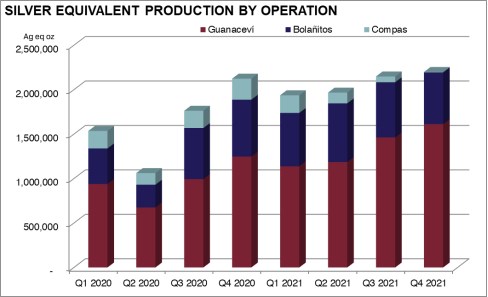
(1) Silver equivalents are calculated using an 80:1 (Ag/Au) ratio.
Consolidated Production
Three months ended December 31, 2021 (compared to the three months ended December 31, 2020)
Consolidated silver production during Q4, 2021 was 1,443,564 oz, an increase of 29% compared to 1,117,289 oz in Q4, 2020, and gold production was 9,446 oz, a decrease of 25% compared to 12,586 oz in Q4, 2020. Plant throughput was 213,492 tonnes at average grades of 235 grams per tonne (gpt) silver and 1.52 gpt gold, compared to 237,389 tonnes grading 169 gpt silver and 1.9 gpt gold in Q4, 2020. Consolidated silver production increased by 29% compared to Q4, 2020, driven by a 31% increase in silver production at the Guanaceví mine and a 42% increase in silver production at the Bolañitos mine, partially offset by the suspension of the El Compas operations. Consolidated gold production decreased by 25% compared to Q4, 2020, primarily due to the suspension of the El Compas operation and a 19% decrease at the Bolañitos mine, partially offset by a 21% increase in gold production at the Guanaceví mine. The increase in silver and gold production at the Guanaceví mine was driven by a 26% increase in silver grade and a 20% increase in gold grade, with slightly higher recoveries. At the Bolañitos mine the increase in silver production was attributable to a 41% increase in ore grade and slightly higher recoveries and the decrease in gold production was attributable to an 18% decrease in ore grade.
Year ended December 31, 2021 (compared to the year ended December 31, 2020)
Consolidated silver production during 2021 was 4,870,787 oz, an increase of 39% compared to 3,513,767 oz in 2020, and gold production was 42,262 oz, an increase of 14% compared to 37,139 oz in 2020. Plant throughput was 887,424 tonnes at average grades of 195 gpt silver and 1.65 gpt gold, a 17% increase compared to 757,160 tonnes grading 167 gpt silver and 1.78 gpt gold in 2020. Consolidated silver production increased by 39% compared to 2020, primarily driven by a 41% increase in silver production at the Guanaceví mine and a 39% increase in silver production at the Bolañitos mine, offset by a 49% reduction in silver production at the El Compas mine. Consolidated gold production increased by 14% compared to 2020, primarily driven by a 36% increase in gold production at the Guanaceví mine and a 30% increase at the Bolañitos mine, offset by a 49% decrease in gold production at the El Compas mine. The increases at the Guanaceví mine were driven by a 20% increase in throughput, an 18% increase in silver grade and a 14% increase in gold grade. The increases at the Bolañitos mine were driven by a 26% increase in throughput, a 5% increase in silver grade with a 6% increase in silver recovery and similar gold grades with a 3% increase in gold recovery. The comparative information for 2020 is also affected by the temporary suspension of the Guanaceví, Bolañitos and El Compas mines during Q2, 2020 due to the COVID-19 pandemic
The Company's 2021 full year production exceeded both original and revised guidance with annual silver production exceeding the high range of revised guidance by 3%, while gold production was in line with the upper range of revised guidance and silver equivalent production beating the high range of the revised 2021 production guidance.
Actual cost metrics were slightly higher than 2021 cost guidance primarily due to the increased labour, power, consumables, third-party ore, higher royalties and special mining duty offset by the higher ore grades mined at Guanaceví
|
MANAGEMENT'S DISCUSSION AND ANALYSIS FOR THE YEAR ENDED DECEMBER 31, 2021 |
Consolidated Operating Costs
Three months ended December 31, 2021 (compared to the three months ended December 31, 2020)
Direct operating costs per tonne in Q4, 2021 increased 7%, to $112.91 compared with Q4, 2020 due to higher operating costs at Guanaceví and Bolañitos. Guanaceví and Bolañitos have seen increased labour, power and consumable costs and at Guanaceví, increased third party ore purchased and operating development have increased compared to the prior year. There has also been a strengthening of the Mexican peso comparative to the U.S. dollar, which increased expenses denominated in that currency. Including royalties and special mining duty, direct costs per tonne increased 5% to $136.62. Royalties were relatively flat compared to Q4, 2020.
Consolidated cash costs per oz, net of by-product credits increased to $8.65 due to higher direct costs per tonne and the lower gold credit driven by lower gold grades and prices. AISC increased by 5% on a per oz basis compared to Q4, 2020 as a result of higher cash costs, increased mine-site exploration and increased capital expenditures at Guanaceví to accelerate mine development within the El Curso ore body, offset by increased production and decreased general and administrative costs. In Q4, 2021 corporate general and administrative expenses included a $0.2 million mark to market expense of cash-settled deferred share units, whereas the mark to market expense was $1.9 million in Q4, 2020, attributed to period end changes in the Company's share price.
On a co-product cash costs basis, silver cost per oz decreased 10% and gold cost per oz decreased 8% compared to the Q4, 2020. The silver co-product cost per oz decreased due to the suspension of operations during Q3, 2021 of the El Compas mine, which contributed higher costs on a per oz basis. Gold co-product cash costs decreased due to the reduced contribution of gold oz from the higher cost El Compas mine, which was partially offset by an increase in gold recovery.
Year ended December 31, 2021 (compared to the year ended December 31, 2020)
Direct operating costs per tonne in 2021 increased 14%, to $115.36 compared with 2020 due to higher operating costs at Guanaceví and Bolañitos. Guanaceví and Bolañitos have seen increased labour, power and consumables costs and at Guanaceví, increased third party ore purchased and operating development have increased compared to the prior year. The appreciation of the Mexican peso to the U.S. dollar increased expenses denominated in Mexican peso compared to the prior period. Including royalties and special mining duty, direct costs per tonne increased 17% to $133.97. Royalties increased 69% to $13.8 million with increased production from the El Curso and El Porvenir concessions at Guanaceví with higher prices. The higher prices and higher grades improved profitability considerably, increasing special mining duty expense 37% to $2.7 million for 2021 from $2.0 million in 2020.
Consolidated cash costs per oz net of by-product credits increased to $9.31 primarily due to the higher direct costs per tonne and lower realized gold prices compared to 2020. AISC increased 16% to $20.34 per oz in 2021 as a result of higher cash costs, increased mine site expensed exploration and increased capital expenditures at Guanaceví to accelerate mine development within the El Curso ore body.
On a co-product cash costs basis silver cost per oz increased 16% and gold cost per oz decreased 3% compared to 2020. The improved silver ore grade was offset by higher operating, royalty and special mining duty costs primarily at the Guanaceví mine. Gold co-product cash costs decreased due to higher gold ore grades and higher gold recoveries offset by the higher operating costs at Bolañitos.
|
MANAGEMENT'S DISCUSSION AND ANALYSIS FOR THE YEAR ENDED DECEMBER 31, 2021 |
GUANACEVÍ OPERATIONS
The Guanaceví operation is currently producing from three underground silver-gold mines along a five kilometre ("km") length of the prolific Santa Cruz vein. Guanaceví provides steady employment to over 500 people and engages over 300 contractors.
In July 2019, the Company acquired a 10 year right to explore and exploit the El Porvenir and El Curso concessions from Ocampo Mining SA de CV ("Ocampo"), a subsidiary of Grupo Frisco. The Company agreed to meet certain minimum production targets from the properties, subject to various terms and conditions and pay Ocampo a $12 fixed per tonne production payment plus a floating net smelter return royalty based on the spot silver price. The Company pays a 4% royalty on sales below $15.00 per silver oz, 9% above $15.00 per silver oz, 13% above $20.00 per silver oz, and a maximum of 16% above $25 per silver oz, based on then current realized prices. On December 12, 2021, the Company executed an amendment to the agreement whereby two additional concessions, adjacent to the existing and historic mine workings, were included in the existing agreement.
The development of two new orebodies, Milache and SCS, and the acquisition of the Ocampo concession rights have provided sufficient ore and flexibility to increase mine output and to reach designed plant capacity.
Production Results for the Three Months and Years Ended December 31, 2021 and 2020
| Three Months Ended December 31 | GUANACEVÍ | Years Ended December 31 | ||||
| 2021 | 2020 | % Change | 2021 | 2020 | % Change | |
| 108,334 | 106,425 | 2% | Ore tonnes processed | 414,355 | 346,679 | 20% |
| 417 | 331 | 26% | Average silver grade (g/t) | 370 | 314 | 18% |
| 89.6 | 87.6 | 2% | Silver recovery (%) | 87.9 | 87.7 | 0% |
| 1,301,941 | 991,697 | 31% | Total silver ounces produced | 4,333,567 | 3,071,075 | 41% |
| 1,298,036 | 988,722 | 31% | Payable silver ounces produced | 4,320,567 | 3,061,982 | 41% |
| 1.21 | 1.01 | 20% | Average gold grade (g/t) | 1.09 | 0.96 | 14% |
| 92.2 | 92.5 | (0%) | Gold recovery (%) | 91.7 | 91.7 | 0% |
| 3,885 | 3,198 | 21% | Total gold ounces produced | 13,317 | 9,814 | 36% |
| 3,873 | 3,188 | 21% | Payable gold ounces produced | 13,277 | 9,786 | 36% |
| 1,612,741 | 1,247,537 | 29% | Silver equivalent ounces produced(1) | 5,398,927 | 3,856,195 | 40% |
| 10.74 | 13.21 | (19%) | Cash costs per silver ounce(2)(3) | 12.12 | 10.44 | 16% |
| 12.49 | 15.52 | (20%) | Total production costs per ounce(2)(4) | 14.40 | 13.36 | 8% |
| 18.74 | 19.67 | (5%) | All in sustaining cost per ounce (2)(5) | 19.46 | 17.14 | 14% |
| 146.51 | 129.91 | 13% | Direct operating costs per tonne(2)(6) | 145.64 | 117.38 | 24% |
| 193.87 | 179.34 | 8% | Direct costs per tonne(2)(6) | 183.86 | 143.46 | 28% |
| 13.11 | 15.45 | (15%) | Silver co-product cash costs(7) | 14.43 | 12.72 | 13% |
| 1,014 | 1,176 | (14%) | Gold co-product cash costs(7) | 1,024 | 1,087 | (6%) |
(1) Silver equivalents are calculated using an 80:1 (silver/gold) ratio.
(2) The Company reports non-IFRS measures which include cash costs net of by-product revenue on a payable silver basis, total production costs per oz, AISC per oz, direct operating cost per tonne, direct cost per tonne, silver co-product cash costs and gold co-product cash costs in order to manage and evaluate operating performance at each of the Company's mines. These measures, some established by the Silver Institute (Production Cost Standards, June 2011), are widely used in the silver mining industry as a benchmark for performance, but do not have a standardized meaning. These measures are reported on a production basis. See Reconciliations to IFRS on page 21.
(3) Cash costs net of by-product revenue per payable silver oz include mining, processing (including smelting, refining, transportation and selling costs), and direct overhead, net of gold credits. See Reconciliation to IFRS on pages 23 and 24.
(4) Total production costs per oz include mining, processing (including smelting, refining, transportation and selling costs), direct overhead, amortization, depletion and amortization at the operation sites net of by product revenues. See Reconciliation to IFRS on pages 23 and 24.
(5) AISC per oz include mining, processing (including smelting, refining, transportation and selling costs), direct overhead, corporate general and administration expenses, on-site exploration, share-based compensation, reclamation and sustaining capital net of gold credits. See Reconciliation to IFRS on pages 24 to 26.
(6) Direct operating costs per tonne include mining, processing (including smelting, refining, transportation and selling costs) and direct overhead at the operation sites. Direct cost per tonne include all direct operating costs, royalties and special mining duty. See Reconciliation to IFRS on pages 23 and 24.
(7) Silver co-product cash cost and gold co-product cash cost include mining, processing (including smelting, refining, transportation and selling costs), and direct overhead allocated on pro-rated basis of realized metal value. See Reconciliation to IFRS on pages 26 and 27.
|
MANAGEMENT'S DISCUSSION AND ANALYSIS FOR THE YEAR ENDED DECEMBER 31, 2021 |
Guanaceví Production Results
Three months ended December 31, 2021 (compared to the three months ended December 31, 2020)
Silver production at the Guanaceví mine during Q4, 2021 was 1,301,941 oz, an increase of 31% compared to 991,697 oz in Q4, 2020, and gold production was 3,885 oz, an increase of 21% compared to 3,198 oz in Q4, 2020. Plant throughput was consistent with Q4, 2020 with 108,334 tonnes at average grades of 417 gpt silver and 1.21 gpt gold, compared to 106,425 tonnes grading 331 gpt silver and 1.01 gpt gold in Q4, 2020. The 31% increase in silver production is due to a 26% increase in silver grades with slightly higher throughput and slightly increased recoveries and the 21% increase in gold production is due to a 20% increase in gold grade. The purchase of third-party ores continued to supplement mine production, amounting to 14% of quarterly throughput, and contributed to the higher ore grades.
Year ended December 31, 2021 (compared to the year ended December 31, 2020)
Silver production at the Guanaceví mine for year ended December 31, 2021 was 4,333,567 oz, an increase of 41% compared to 3,071,075 oz in 2020, and gold production was 13,317 oz, an increase of 36% compared to 9,814 oz in 2020. Plant throughput was 414,355 tonnes at average grades of 370 gpt silver and 1.09 gpt gold, compared to 346,679 tonnes at average grades of 314 gpt silver and 0.96 gpt gold in 2020. The 41% increase in silver production and 36% increase in gold production compared to 2020 are due to the 20% increase in throughput, as the plant reached its 1,200 tonnes per day ("tpd") capacity in Q2, 2021 and maintained it for the remainder of 2021, and increased grades with similar recoveries. Silver and gold grades increased by 18% and 14% respectively. The comparative information for 2020 is also affected by the impact on throughput due to the temporary suspension of the Guanaceví mine during Q2, 2020 due to the COVID-19 pandemic. The purchase of local third-party ores continued to supplement mine production, amounting to 11% of year-to-date throughput, and contributed to the higher ore grades.
Guanaceví Operating Costs
Three months ended December 31, 2021 (compared to the three months ended December 31, 2020)
Direct operating costs per tonne for the three months ended December 31, 2021 increased 13% to $146.51 compared with the same period in 2020, resulting from increased purchase of local third-party ores, increased labour, power and consumables costs, and an increase in operating development. The Company increased in the purchase of local third-party ore contributed $29.04 per tonne during Q4, 2021 $18.58 per tonne in Q4 2020. Including royalty and special mining duty costs, direct cost per tonne increased 8% to $193.87 compared with the same period in 2020. There was a slight reduction in royalty and special mining duty costs during the three months ended December 31, 2021 compared to the prior period primarily due to the timing of sales. In Q4 2020 the Company sold the majority of Q4, 2020 production as well as finished goods inventory that was held as of September 30, 2020.
Cash costs per oz, net of by-product credits, was $10.74 compared to $13.21 for the same period in 2020, with the reduction due to the increased ore grades offset by higher direct costs. AISC per oz decreased 5% to $18.74 per oz for the three months ended December 31, 2021, as a result of the increased silver production offset by increased sustaining capital expenditures.
Year ended December 31, 2021 (compared to the year ended December 31, 2020)
Direct operating costs per tonne for the year ended December 31, 2021 increased 24% to $145.64 compared with 2020, as a result of increased purchase of local third-party ores, increased labour, power and consumables costs, the expensing of development costs at El Porvenir, as there were no reserves to allow for deferral of development costs, and in increase in operating development. Including royalty and special mining duty costs, direct cost per tonne increased 28% to $183.86 compared with 2020. Increased production from the El Curso and El Porvenir concession and higher prices significantly increased the royalties paid during the year. The increased metal prices and higher ore grades resulted in improved profitability and higher special mining duty payable to the Mexican government. The improved profitability of the operations resulted in $2.7 million Mexico special mining duty during 2021 compared to $1.6 million in 2020, and royalties increasing from $7.4 million to $13.2 million, which are included in cost per tonne and oz metrics.
Cash costs per oz, net of by-product credits was $12.12, 16% higher than 2020 due to the higher direct cost per tonne, offset by the higher ore grades and higher gold credit. Similarly, AISC per oz increased 14% to $19.46 per oz for 2021. The increase in cash costs per oz was the primary driver of the higher AISC, while higher capital and exploration expenditures partially offset by lower general and administration expenses contributed to the higher costs compared to 2020. In Q2, 2020 there was a sharp reduction in capital and exploration expenditures due to the suspension of activities due to COVID-19.
|
MANAGEMENT'S DISCUSSION AND ANALYSIS FOR THE YEAR ENDED DECEMBER 31, 2021 |
BOLAÑITOS OPERATIONS
The Bolañitos operation encompasses three underground silver-gold mines and a flotation plant. Bolañitos provides steady employment for over 475 people and engages over 150 contractors.
Production Results for the Three Months and Years Ended December 31, 2021 and 2020
|
Three Months Ended December 31 |
BOLAÑITOS |
Years Ended December 31 |
||||
|
2021 |
2020 |
% Change |
|
2021 |
2020 |
% Change |
|
105,158 |
107,332 |
(2%) |
Ore tonnes processed |
418,514 |
331,174 |
26% |
|
48 |
34 |
41% |
Average silver grade (g/t) |
42 |
40 |
5% |
|
87.0 |
84.7 |
3% |
Silver recovery (%) |
87.0 |
83.0 |
5% |
|
141,258 |
99,417 |
42% |
Total silver ounces produced |
491,412 |
353,318 |
39% |
|
134,178 |
94,526 |
42% |
Payable silver ounces produced |
462,700 |
333,293 |
39% |
|
1.83 |
2.22 |
(18%) |
Average gold grade (g/t) |
2.02 |
2.02 |
0% |
|
88.9 |
88.2 |
1% |
Gold recovery (%) |
90.7 |
88.2 |
3% |
|
5,502 |
6,754 |
(19%) |
Total gold ounces produced |
24,652 |
18,963 |
30% |
|
5,330 |
6,551 |
(19%) |
Payable gold ounces produced |
23,971 |
18,429 |
30% |
|
581,418 |
639,737 |
(9%) |
Silver equivalent ounces produced(1) |
2,463,572 |
1,870,358 |
32% |
|
(10.69) |
(44.56) |
76% |
Cash costs per silver ounce(2)(3) |
(19.77) |
(32.11) |
38% |
|
6.71 |
(15.50) |
143% |
Total production costs per ounce(2)(4) |
10.93 |
(4.76) |
330% |
|
27.46 |
16.98 |
62% |
All in sustaining cost per ounce (2)(5) |
25.14 |
23.53 |
7% |
|
78.38 |
71.88 |
9% |
Direct operating costs per tonne(2)(6) |
79.37 |
70.11 |
13% |
|
77.68 |
75.82 |
2% |
Direct costs per tonne(2)(6) |
80.13 |
71.78 |
12% |
|
14.41 |
13.26 |
9% |
Silver co-product cash costs(7) |
14.96 |
12.04 |
24% |
|
1,115 |
1,010 |
10% |
Gold co-product cash costs(7) |
1,062 |
1,029 |
3% |
(1) Silver equivalents are calculated using an 80:1 (silver/gold) ratio.
(2) The Company reports non-IFRS measures which include cash costs net of by-product revenue on a payable silver basis, total production costs per oz, AISC per oz, direct operating cost per tonne, direct cost per tonne, silver co-product cash costs and gold co-product cash costs in order to manage and evaluate operating performance at each of the Company's mines. These measures, some established by the Silver Institute (Production Cost Standards, June 2011), are widely used in the silver mining industry as a benchmark for performance, but do not have a standardized meaning. These measures are reported on a production basis. See Reconciliations to IFRS on page 21.
(3) Cash costs net of by-product revenue per payable silver oz include mining, processing (including smelting, refining, transportation and selling costs), and direct overhead, net of gold credits. See Reconciliation to IFRS on pages 23 and 24.
(4) Total production costs per oz include mining, processing (including smelting, refining, transportation and selling costs), direct overhead, amortization, depletion and amortization at the operation sites net of by product revenues. See Reconciliation to IFRS on pages 23 and 24.
(5) AISC per oz include mining, processing (including smelting, refining, transportation and selling costs), direct overhead, corporate general and administration expenses, on-site exploration, share-based compensation, reclamation and sustaining capital net of gold credits. See Reconciliation to IFRS on pages 24 to 26.
(6) Direct operating costs per tonne include mining, processing (including smelting, refining, transportation and selling costs) and direct overhead at the operation sites. Direct cost per tonne include all direct operating costs, royalties and special mining duty. See Reconciliation to IFRS on pages 23 and 24.
(7) Silver co-product cash cost and gold co-product cash cost include mining, processing (including smelting, refining, transportation and selling costs), and direct overhead allocated on pro-rated basis of realized metal value. See Reconciliation to IFRS on pages 26 and 27.
Bolañitos Production Results
Three months ended December 31, 2021 (compared to the three months ended December 31, 2020)
Silver production at the Bolañitos mine was 141,258 oz in Q4, 2021, an increase of 42% compared to 99,417 oz in Q4, 2020, and gold production was 5,502 oz in Q4, 2021, a decrease of 19% compared to 6,754 oz in Q4, 2020. Plant throughput in Q4, 2021 was 105,158 tonnes at average grades of 48 gpt silver and 1.83 gpt gold, compared to 107,332 tonnes at average grades of 34 gpt silver and 2.22 gpt gold in Q4, 2020. The 42% increase in silver production and 19% decrease in gold production compared to Q4, 2020 is primarily due to the fluctuations of ore grades from accessing different areas of the mine. Recoveries improved slightly as the operations improved ore blending to maximize recoveries compared to the prior period.
|
MANAGEMENT'S DISCUSSION AND ANALYSIS FOR THE YEAR ENDED DECEMBER 31, 2021 |
Year ended December 31, 2021 (compared to the year ended December 31, 2020)
Silver production at the Bolañitos mine was 491,412 oz for 2021, an increase of 39% compared to 353,318 oz in 2020, and gold production was 24,652 oz for 2021, an increase of 30% compared to 18,963 oz in 2020. Plant throughput in 2021 was 418,514 tonnes at average grades of 42 gpt silver and 2.02 gpt gold, compared to 331,174 tonnes at average grades of 40 gpt silver and 2.02 gpt gold in 2020. The 39% increase in silver production and 30% increase in gold production compared to 2020 are primarily due to the 26% increase in plant throughput, a 5% increase in silver grades and increased silver and gold recoveries of 5% and 3%, respectively. The comparative information for 2020 was also affected by the impact on throughput due to the temporary suspension of the Bolañitos mine during Q2, 2020 due to the COVID-19 pandemic. Recoveries improved as the operations improved ore blending to maximize recoveries compared to the prior period.
Bolañitos Operating Costs
Three months ended December 31, 2021 (compared to the three months ended December 31, 2020)
Direct costs per tonne in Q4, 2021 increased 2% to $77.68 per tonne primarily due to a slight increase in costs and decrease in throughput tonnes compared to the same period in 2020. Cash costs net of by-product credits, were negative $10.69 per oz of payable silver in Q4, 2021 compared to negative $44.56 per oz in Q4, 2020 due in large part to an 18% reduction in the gold grade and a reduction in realized gold price compared to the same period in the prior year. AISC increased in Q4, 2021 to $27.46 per oz as they were similarly affected by the reduction in by-product gold sales.
On a co-product cash costs basis, silver cost per oz increased compared to Q4, 2020. Silver co-product cash costs increased 9% and gold co-product costs increased 10% to $14.41 per silver oz and $1,115 per gold oz, respectively. The increase in the silver cost on a co-product basis was primarily driven by the higher direct costs per tonne and the variation in ore grades, while the higher gold costs on a co-product basis was driven by the lower ore gold grades and the higher direct costs per tonne.
Year ended December 31, 2021 (compared to the year ended December 31, 2020)
Direct costs per tonne in 2021 increased 12%, to $80.13 per tonne due to higher labour, power and consumables costs as well as higher waste tonnes handled during the year. Cash costs net of by-product credits were negative $19.77 per oz of payable silver in 2021 compared to negative $32.11 per oz in the comparative period of 2020 due to the higher direct costs and a 4% decrease in the realized gold price offset by a higher proportion of gold production. AISC increased by 7% in 2021, compared to 2020, to $25.14 per oz due to higher operating cost per oz and increased sustaining capital expenditures offset by lower corporate general and administrative charges. Compared to 2020, there was an increase in mine development of $3.1 million which will extend the mine life.
On a co-product cash costs basis, silver cost per oz increased compared to 2020. Silver co-product cash costs increased 24%, while gold co-product costs increased by 3% to $14.96 per silver oz and $1,062 per gold oz respectively. The increase in the silver cost on a co-product basis was primarily driven by the higher direct costs per tonne and the variation in ore, while the higher gold costs on a co-product basis was driven by the decreased proportional gold production.
EL COMPAS OPERATIONS
The El Compas operation is a small but high grade, permitted gold-silver mine with a small leased flotation plant in the historic silver mining district of Zacatecas, with exploration potential to expand resources. The leased floatation plant has a nominal plant capacity of 250 tpd.
El Compas employed close to 200 people and engaged over 55 contractors until the suspension of operations in mid-August 2021 as the mineral reserves were exhausted. The mine, plant and tailings facilities are on short term care and maintenance, while management conducts an evaluation of the alternatives including final closure.
|
MANAGEMENT'S DISCUSSION AND ANALYSIS FOR THE YEAR ENDED DECEMBER 31, 2021 |
There remain several brownfield exploration opportunities on concessions owned by the Company, however further resource definition and evaluation is required to recommence production. Temporary closure costs were $1.4 million for 2021, inclusive of $0.8 million in severance costs. Company management and contract personnel continue to maintain the security of the mine, plant, and tailings facilities. The mining equipment and selected other assets have been relocated to Endeavour's other operating mines, particularly to Bolañitos and Terronera, to reduce their future capital costs.
Production Results for the Three Months and Years Ended December 31, 2021 and 2020
|
Three Months Ended December 31 |
El Compas |
Years Ended December 31 |
||||
|
2021 |
2020 |
% Change |
|
2021 |
2020 |
% Change |
|
N/A |
23,632 |
N/A |
Ore tonnes processed |
54,555 |
79,307 |
(31%) |
|
N/A |
50 |
N/A |
Average silver grade (g/t) |
36 |
53 |
(32%) |
|
N/A |
68.9 |
N/A |
Silver recovery (%) |
72.5 |
66.1 |
10% |
|
365 |
26,175 |
(99%) |
Total silver ounces produced |
45,808 |
89,374 |
(49%) |
|
364 |
25,600 |
(99%) |
Payable silver ounces produced |
43,414 |
86,819 |
(50%) |
|
N/A |
4.41 |
N/A |
Average gold grade (g/t) |
3.05 |
4.32 |
(29%) |
|
N/A |
78.6 |
N/A |
Gold recovery (%) |
80.2 |
75.9 |
6% |
|
59 |
2,634 |
(98%) |
Total gold ounces produced |
4,293 |
8,362 |
(49%) |
|
58 |
2,575 |
(98%) |
Payable gold ounces produced |
4,190 |
8,177 |
(49%) |
|
5,085 |
236,895 |
(98%) |
Silver equivalent ounces produced(1) |
389,248 |
758,334 |
(49%) |
|
N/A |
(50.04) |
N/A |
Cash costs per silver ounce(2)(3) |
39.37 |
(22.51) |
275% |
|
N/A |
89.45 |
N/A |
Total production costs per ounce(2)(4) |
84.88 |
109.10 |
(22%) |
|
N/A |
(20.19) |
N/A |
All in sustaining cost per ounce (2)(5) |
56.71 |
10.98 |
417% |
|
N/A |
143.96 |
N/A |
Direct operating costs per tonne(2)(6) |
161.56 |
160.04 |
1% |
|
N/A |
150.52 |
N/A |
Direct costs per tonne(2)(6) |
167.98 |
166.97 |
1% |
|
N/A |
15.69 |
N/A |
Silver co-product cash costs(7) |
26.15 |
16.47 |
59% |
|
N/A |
1,194 |
N/A |
Gold co-product cash costs(7) |
1,856 |
1,408 |
32% |
(1) Silver equivalents are calculated using an 80:1 (silver/gold) ratio.
(2) The Company reports non-IFRS measures which include cash costs net of by-products on a payable silver basis, total production costs per oz, AISC per oz and direct production costs per tonne, in order to manage and evaluate operating performance at each of the Company's mines. These measures, some established by the Silver Institute (Production Cost Standards, June 2011), are widely used in the silver mining industry as a benchmark for performance, but do not have a standardized meaning. These measures are reported on a production basis. See Reconciliation to IFRS on page 21.
(3) Cash costs net of by-product revenue per payable silver oz include mining, processing (including smelting, refining, transportation and selling costs), and direct overhead, net of gold credits. See Reconciliation to IFRS on pages 23 and 24.
(4) Total production costs per oz include mining, processing (including smelting, refining, transportation and selling costs), direct overhead, amortization, depletion and amortization at the operation sites net of by product revenues. See Reconciliation to IFRS on pages 23 and 24.
(5) AISC per oz include mining, processing (including smelting, refining, transportation and selling costs), direct overhead, corporate general and administration expenses, on-site exploration, share-based compensation, reclamation and sustaining capital net of gold credits. See Reconciliation to IFRS on pages 24 to 26.
(6) Direct operating costs per tonne include mining, processing (including smelting, refining, transportation and selling costs) and direct overhead at the operation sites. Direct cost per tonne include all direct operating costs, royalties and special mining duty. See Reconciliation to IFRS on pages 23 and 24.
(7) Silver co-product cash cost and gold co-product cash cost include mining, processing (including smelting, refining, transportation and selling costs), and direct overhead allocated on pro-rated basis of realized metal value. See Reconciliation to IFRS on pages 26 and 27.
El Compas Production Results
Three months ended December 31, 2021 (compared to the three months ended December 31, 2020)
As mining and milling operations were suspended in August, 2021, there was no silver production, other than final settlements in Q4, 2021 of concentrates shipped prior to the suspension resulting in the recognition of 365 silver oz and 59 gold oz in the quarter. During Q4, 2020, silver production at the El Compas mine was 26,175 oz and gold production was 2,634 oz with plant throughput of 23,632 tonnes at average grades of 50 gpt silver and 4.41 gpt gold.
|
MANAGEMENT'S DISCUSSION AND ANALYSIS FOR THE YEAR ENDED DECEMBER 31, 2021 |
Year ended December 31, 2021 (compared to the year ended December 31, 2020)
Silver production at the El Compas mine was 45,808 oz and gold production was 4,293 oz for January to mid-August 2021 compared to 89,374 silver oz and 8,362 gold oz in 2020. Plant throughput was 54,555 tonnes at average grades of 36 gpt silver and 3.05 gpt gold compared to 79,307 tonnes at average grades of 53 gpt silver and 4.32 gpt gold in 2020. Although throughput remained steady from January to August 2021, both silver and gold grades decreased significantly resulting in lower proportional production. The comparative information for 2020 was also affected by the impact on throughput due to the temporary suspension of the El Compas mine during Q2, 2020 due to the COVID-19 pandemic.
El Compas Operating Costs
Three months ended December 31, 2021 (compared to the three months ended December 31, 2020)
As mining and milling operations were suspended in August, 2021, there is no comparative cost information for Q4, 2021.
Year ended December 31, 2021 (compared to the year ended December 31, 2020)
Direct costs were $167.98 per tonne for 2021, a 1% increase from 2020. Silver cash costs net of by-product credits were $39.37 per oz of payable silver compared to negative $22.51 per oz in 2020. The significantly lower gold grade was the primary driver in the increase in cash costs compared to the comparative period in 2020. The decrease in costs per tonne was a result of normal variations in costs incurred.
On a co-product cash costs basis, both silver co-product cost per ounce and gold co-product costs per ounce increased to $26.15 per ounce and $1,856 per ounce, respectively, compared to 2020. Both co-product cash cost metrics increased due to the lower ore grades and the slightly higher operating costs on a per tonne basis.
AISC increased to $56.71 per oz compared to $10.98 per oz in the same period ended in 2020. The higher AISC are a function of the lower silver and gold grades.
EL CUBO OPERATIONS
The El Cubo operation included two previously operating underground silver-gold mines and a flotation plant, which employed over 350 people and engaged over 200 contractors until the suspension of operations at the end of November 2019 as the mineral reserves had been exhausted. The mine, plant and tailings facilities were on care and maintenance until the sale of the El Cubo mine and related assets in April 2021.
Company management and contract personnel maintained the security of the mine, plant and tailings facilities until the sale. The Company incurred $0.6 million in legal, administrative and care and maintenance expenses in 2021. In 2020, $0.3 million severance costs and $1.5 million in legal, administrative and care and maintenance expenses were incurred and $0.2 million in building and office depreciation.
On March 17, 2021, the Company signed a definitive agreement to sell the El Cubo mine and related assets to GSilver for $15.0 million in cash and share payments plus additional contingency payments. On April 9, 2021, GSilver purchased the El Cubo assets for the following gross consideration:
GSilver is required to pay the Company up to an additional $3.0 million in contingent payments based on the following events:
|
MANAGEMENT'S DISCUSSION AND ANALYSIS FOR THE YEAR ENDED DECEMBER 31, 2021 |
On November 16, 2021, the Company arranged for early payment of the $2.5 million promissory note. In consideration for the early repayment, the Company agreed to reduce the principal amount of the note by $25,000 and settle the Mexican value added tax payable on the promissory note for 901,224 common shares of GSilver.
DEVELOPMENT ACTIVITIES
Terronera Project
The Terronera project, located 40 km northeast of Puerto Vallarta in the state of Jalisco, Mexico, features a high-grade silver-gold mineral resource in the Terronera vein, which is now over 1,400 metres long, 400 metres deep, 3 to 16 metres thick, and remains open along strike to the southeast and down dip.
In 2020, the Company engaged an external consultant to update a previous Preliminary Feasibility Study based on updated information gathered in 2019 and 2020. In Q3, 2020 the Company completed an updated summary of the project's economics and published the NI 43-101 Technical Report ("2020 PFS"). The 2020 PFS included significant changes to the operations plan, capital and operating costs assumed compared to the previous study and, as a result, project economics improved. The external consultant reviewed all aspects of the previous studies, while further cost-benefit initiatives have been evaluated.
In September 2020, the Company engaged Wood PLC to complete a Feasibility Study ("FS") at an estimated cost of $2.1 million, with the economic information released in a press release dated September 9, 2021 and the full report filed on SEDAR and EDGAR and posted to the Company's website on October 25, 2021.
The FS base case assumed a silver price of $20 per oz and a gold price of $1,575 per oz with an implied 79:1 silver to gold ratio, and a Mexico peso to U.S. dollar exchange rate of 20:1. At base case prices, the improved economics estimated an after-tax net present value of $174.1 million at a 5% discount rate, internal rate of return of 21.3%, and payback period of 3.6 years. Initial capital expenditures were estimated to be $175 million with capital expenditures during production estimated to be $108.5 million. The 12-year life of mine was estimated to produce an average of 3.3 million silver oz and 32,874 gold oz per year generating $476 million pre-tax, $311 million after-tax, free cash flow over the life of the project.
The Company is preparing to commence initial earthworks and intends to make a formal construction decision, subject to completion of a financing package and receipt of additional amended permits, in the coming months. A budget of $9.5 million has been approved for Q1, 2022 to continue to advance the site clearing, preparations for initial earthworks, temporary camp and procuring of long lead items.
The Company re-classified the Terronera Project from an exploration and evaluation project to a development project in September, 2021 and during the year invested $11.8 million on land acquisition, initial development and capital assets to advance development and $8.0 million on exploration and evaluation activities including the completion of the FS.
|
MANAGEMENT'S DISCUSSION AND ANALYSIS FOR THE YEAR ENDED DECEMBER 31, 2021 |
EXPLORATION RESULTS
In 2021, the Company planned to spend $10.2 million drilling 50,000 metres of core on brownfields projects, greenfields exploration and development engineering across its portfolio of mines and properties. At the Guanaceví and Bolañitos operating mines, 11,500 metres of core drilling were planned at a cost of $2.0 million and $1.9 million, respectively to replace reserves and expand resources.
On the exploration and development projects, expenditures of $6.3 million were planned to fund 27,000 metres of core drilling at the Terronera project to test multiple regional targets, the Parral project to continue drilling the San Patricio and Veta Colorada vein systems and the Paloma project in Chile. The Company is currently permitting the Aida project and will continue to map and sample to prioritize targets for drilling.
At Guanaceví, in 2021 the Company drilled 15,360 metres in 60 holes at a total expense of $1.6 million to delineate the extension of the Porvenir Cuatro, El Curso, and SCS ore bodies. Drilling confirmed expectations and intersected significant mineralization with similar ore grades and vein widths to historical results.
At Bolañitos, in 2021 the Company drilled 15,227 metres in 72 holes at total expense of $1.2 million to target the Melladito, Plateros and Belén veins. The Company intersected significant mineralization with ore grades over mineable widths.
At Terronera, the 2021 drill program targeted the southeast area near the Terronera vein and regional area acquired in 2020. A total of 15,448 metres were drilled in 54 holes at a total expense of $2.2 million intersecting high-grade silver-gold mineralization in a number of structures near the Terronera vein, highlighting the potential surrounding the current resource estimate. Four intercepted structures, the San Simon, Fresno, Pendencia and Lindero veins, are located immediately to the southeast of the Terronera vein, and the Los Cuates vein is located approximately 10 km to the northwest of the Terronera Project. The drill results confirm management's projection to grow resources in the district. As the FS is complete, all 2021 drill results are not included as part of FS or initial development plan.
At Parral, the Company commenced the 2021 drill program in March, drilling 80 holes totalling 18,245 metres, with a total cost of $2.6 million targeting various areas of the Colorada vein. Drilling confirmed expectations in a number of areas, intersecting significant mineralization with meaningful vein widths. Management will continue the exploration program in 2022 with the intention to expand the resource estimate published in December 2019 and initiate an economic study in 2022.
In Chile, the Company completed initial drilling on the Paloma properties targeting a bulk tonnage, high-sulfidation epithermal deposit related to intrusive domes or the tops of porphyry systems located in the Chilean Miocene deposit belt, 180 km southeast of the city of Calama, 5,000 metres above sea level. The Company has an option to acquire up to 70% ownership of 5,100 hectares from Compañía Minera del Pacifico. Drilling confirmed widespread alteration and low-grade gold mineralization, however it is interpreted that the drilling did not reach the core of the system. The exploration team has analyzed drill results and commenced a second drill program to test targets for higher-grade mineralization.
RESERVES AND RESOURCES
Proven and probable silver and gold mineral reserves increased year on year by 28% and 29% respectively. Mineral reserves are estimated to be 62.0 million oz silver and 608,000 oz gold. On a silver equivalent basis, mineral reserves total 110.6 million oz using a silver to gold ratio of 80:1. A significant portion of the mineral reserve increase is due to the updated estimate for the Terronera FS, resulting in a 10.7 million increase is silver ounce reserves and 124,000 increase gold ounce reserves. Additionally, the positive delineation drill results and the conversion of mineral resources at Guanacevi and Bolañitos through continued mine development more than offset 2021 production
Measured and indicated mineral resources for silver increased by 1% to 26.1 million oz and measured and indicated mineral resources for gold increased by 8% to 237,700 oz gold. Silver equivalent measured and indicated mineral resources increased 4% to 45.1 million oz due mainly to resource growth at Guanacevi and Bolañitos offset by conversion of resources to reserves through mine development.
|
MANAGEMENT'S DISCUSSION AND ANALYSIS FOR THE YEAR ENDED DECEMBER 31, 2021 |
2021 Mineral Reserve and Resource Estimate Highlights (Compared to December 31, 2020):
Mineral reserve and resource estimates are based on pricing assumptions of $23.00 per oz of silver and $1,725 per oz of gold at Guanaceví and Bolañitos, $20.00 per oz of silver and $1,575 per oz of gold at Terronera and $15.00 per oz of silver and $1,275 per oz of gold at Parral.
Note to U.S Investors: Mineral reserve and resources are as defined by Canadian securities laws. See "Cautionary Note to U.S. Investors Regarding Mineral Reserves and Resources".
CONSOLIDATED FINANCIAL RESULTS
Three months ended December 31, 2021 (compared to the three months ended December 31, 2020)
In Q4, 2021, the Company's mine operating earnings were $12.2 million (Q4, 2020: $20.8 million) on net revenue of $48.5 million (Q4, 2020: $60.7 million) with cost of sales of $36.2 million (Q4, 2020: $39.9 million).
In Q4, 2021, the Company had operating earnings of $4.1 million (Q4, 2020: $12.0 million) after exploration and evaluations costs of $4.1 million (Q4, 2020: $4.1million), general and administrative expense of $2.8 million (Q4, 2020: expense of $3.9 million), care and maintenance expense of $0.4 million (Q4, 2020: $0.4 million), severance costs of $0.2 million (Q4, 2020: $Nil) and a write-off of exploration properties of $0.7 million. In Q4, 2020, the operating earnings included impairments and impairments reversals of non-current assets of $0.4 million related to value in use estimates of the Guanaceví and El Compas operation.
The income before taxes for Q4, 2021 was $5.5 million (Q4, 2020: $14.8 million) after finance costs of $0.3 million (Q4, 2020: $0.3 million), a foreign exchange gain of $0.1 million (Q4, 2020: $1.8 million) and investment and other income of $1.6 million (Q4, 2020: $1.3 million). The Company realized a net loss for the period of $0.5 million (Q4, 2020: net earnings of $20.0 million) after an income tax expense of $6.0 million (Q4, 2020: income tax recovery of $5.2 million).
Net revenue of $48.5 million in Q4, 2021, net of $0.4 million of smelting and refining costs, decreased by 20% compared to $60.7 million, net of $0.5 million of smelting and refining costs, in Q4, 2020. Gross sales of $48.9 million in Q4, 2021 represented a 20% decrease over the $61.2 million for the same period in 2020. Silver oz sold were similar with a 5% decrease in the realized silver price, resulting in a 6% decrease to silver sales. Gold oz sold decreased by 37% with a 4% decrease in realized gold prices resulting in a 40% decrease in gold sales. The significant decrease in gold sales is primarily driven by the decreased gold grades at the Bolañitos mine and the suspension of production from the El Compas mine. During the period, the Company sold 1,413,699 oz silver and 8,715 oz gold, for realized prices of $23.41 and $1,811 per oz, respectively, compared to sales of 1,419,037 oz silver and 13,850 oz gold, for realized prices of $24.76 and $1,885 per oz, respectively, in the same period of 2020. For the three months ended December 31, 2021, the realized prices of silver and gold were within approximately 2% of the London spot prices. Silver and gold London spot prices averaged $23.76 and $1,795, respectively, during the three months ended December 31, 2021.
|
MANAGEMENT'S DISCUSSION AND ANALYSIS FOR THE YEAR ENDED DECEMBER 31, 2021 |
The Company slightly increased its finished goods silver and gold inventory to 1,082,610 oz and 3,674 oz, respectively, at December 31, 2021 compared to 1,067,404 oz silver and 3,239 oz gold at September 30, 2021. The Company significantly increased its finished goods silver and gold inventory compared to 116,484 oz silver and 1,459 oz gold at December 31, 2020. The cost allocated to these finished goods was $15.6 million at December 31, 2021, compared to $18.3 million at September 30, 2021 and $3.6 million at December 31, 2020. At December 31, 2021, the finished goods inventory fair market value was $31.7 million, compared to $28.2 million at September 30, 2021 and $5.8 million at December 31, 2020.
Cost of sales for Q4, 2021 was $36.2 million, a decrease of 9% over the cost of sales of $39.9 million for Q4, 2020. The decrease in cost of sales was primarily impacted by no production in Q4, 2021 from El Compas offset by higher costs at Guanaceví and Bolañitos. Overall costs for Q4, 2021 were impacted by higher labour, power and consumables costs, a strengthening of the Mexican peso partially offset by improved productivity at the Guanaceví and Bolañitos operations, compared to Q4, 2020. The current year cost of sales also includes write down of warehouse inventory of $0.9 million. During Q4, 2021 the Company's operations experienced higher costs than budgeted due to global supply constraints creating inflationary pressure, labour costs tracking higher than planned and increased purchased third-party ore at the Guanaceví operation.
Exploration and evaluation expenses were flat at $4.1 million compared to the same period of 2020. General and administrative expenses decreased to $2.8 million in Q4, 2021 compared to $3.9 million for the same period of 2020 primarily due to the mark-to-market impact of cash-settled director's deferred share units, which comparatively decreased costs by $1.8 million. This was offset by increased labour, legal and investor relations costs.
The Company incurred a foreign exchange gain of $0.1 million in Q4, 2021 compared to $1.8 million in Q4, 2020 due to a strengthening of the Mexican peso at the end of Q4, 2020 compared to Q3, 2020 which resulted in higher valuations of peso denominated tax receivables and cash balances. The Company incurred $0.3 million in finance charges primarily related to mobile equipment purchased compared to $0.3 million in the same period in 2020. The Company recognized $1.6 million in investment and other income compared to $1.3 million in Q4, 2020 with the gain during the quarter primarily resulting from an unrealized gain on marketable securities of $1.1 million, $0.2 million in interest income and $0.2 million in royalty income. In 2020, the majority of the other income derived from interest received on IVA collections.
Income tax expense was $6.0 million in Q4, 2021 compared to income tax recovery of $5.2 million in Q4, 2020. The $6.0 million tax expense is comprised of $1.0 million in current income tax expense (Q4, 2020: $1.9 million) and $5.0 million in deferred income tax expense (Q4, 2020: deferred income tax recovery of $7.1 million). The current income tax expense consists of $0.8 million of special mining duty taxes and $0.2 million of income taxes. The deferred income tax expense of $5.0 million is primarily due to the use of loss carry forwards to offset taxable income generated at the Guanaceví operations and a change in the estimated deferred income tax assets for the Bolañitos operation.
Year ended December 31, 2021 (compared to the year ended December 31, 2020)
For the year ended December 31, 2021, the Company's mine operating earnings were $36.4 million (2020: $27.3 million) on net revenue of $165.3 million (2020: $138.4 million) with cost of sales of $128.9 million (2020: $111.1 million).
The Company had operating earnings of $22.3 million (2020: operating loss $0.8 million) after exploration and evaluation costs of $17.9 million (2020: $9.8 million), general and administrative costs of $10.1 million (2020: $12.7 million), an impairment reversal of $16.8 million (2020: $0.4 million impairment expense), care and maintenance cost of $1.3 million (2020: $5.2 million), severance cost of $0.7 million in severance (2020: $Nil) and a write-off of exploration properties of $0.7 million (2020: $Nil). The impairment reversal of $16.8 million resulted from the valuation assessment done for the El Cubo mine and related assets upon classification as held for sale and the 2020 net impairment charge on non-current assets of $0.4 million related to the value in use estimates of the Guanaceví and El Compas operations. The $1.3 million in care and maintenance costs for 2021 are comprised of $0.7 million recognized for the El Cubo operation for costs to the sale of the mine and related assets in April 2021, and $0.6 million recognized for the El Compas operation, where operations were suspended in mid-August, 2021. During the comparative period of 2020, the Company recognized $3.0 million in care and maintenance costs for the suspended El Cubo operation and $2.2 million in care and maintenance costs related to the temporary suspension of the Guanaceví, Bolañitos and El Compas operations due to COVID-19.
|
MANAGEMENT'S DISCUSSION AND ANALYSIS FOR THE YEAR ENDED DECEMBER 31, 2021 |
The earnings before taxes were $29.7 million (2020: loss before taxes $1.0 million) after finance costs of $1.0 million (2020: $1.3 million), a foreign exchange loss of $1.1 million (2020: $1.5 million), a gain on disposal of the El Cubo mine and related assets of $5.8 million (2020: $Nil) and investment and interest income of $3.7 million (2020: $2.6 million). The Company realized net earnings for the period of $14.0 million (2020: $1.2 million) after an income tax expense of $15.7 million (2020: income tax recovery of $2.2 million).
Net revenue of $165.3 million in 2021, net of $2.0 million of smelting and refining costs, increased by 19% compared to $138.4 million, net of $1.8 million of smelting and refining costs, in 2020. Gross sales of $167.3 million in 2021 represented a 19% increase over the $140.2 million in 2020. Silver oz sold increased by 11% with a 17% increase in the realized silver price, resulting in a 30% increase to silver sales. Gold oz sold increased by 10% with a 3% reduction in realized gold prices resulting in a 7% increase in gold sales. During the period, the Company sold 3,856,883 oz silver and 39,113 oz gold, for realized prices of $25.22 and $1,790 per oz, respectively, compared to sales of 3,460,638 oz silver and 35,519 oz gold, for realized prices of $21.60 and $1,846 per oz, respectively, in 2020. For 2021, the realized prices of silver and gold were within 1% of London spot prices. Silver and gold London spot prices averaged $25.14 and $1,799, respectively, during 2021.
The Company significantly increased its finished goods silver and gold inventory to 1,082,610 oz and 3,674 oz, respectively at December 31, 2021 compared to 116,484 oz silver and 1,459 oz gold at December 31, 2020. The cost allocated to these finished goods was $15.6 million at December 31, 2021, compared to $3.6 million at December 31, 2020. At December 31, 2021, the finished goods inventory fair market value was $31.7 million, compared to $5.8 million at December 31, 2020.
Cost of sales for 2021 was $128.9 million, an increase of 16% over the cost of sales of $111.1 million in 2020. The increase in cost of sales was primarily related to increased production, higher labour, power, consumables and royalty costs offset by improved productivity at the Guanaceví and Bolañitos operations and the temporary suspension of the Guanaceví, Bolañitos and El Compas operations due to COVID-19 during Q2 2020, which significantly affected sales and costs of sales in the prior period. Royalties increased 69% to $13.8 million due to higher realized prices and the increased mining of the high-grade Porvenir and Porvenir Cuatro extensions on the Ocampo concessions at the Guanaceví operation which is subject to the significantly higher royalty rates.
Exploration and evaluation expenses increased in 2021 to $17.9 million from $9.8 million for 2020 primarily based on additional expenditures to advance the Terronera FS and the timing of drill programs, as drilling was also suspended during Q2 2020 due to COVID-19. General and administrative expenses decreased to $10.1 million in 2021 compared to $12.7 million for the same period of 2020, due to mark-to-market fluctuations for director's deferred share units which comparatively decreased costs by $1.2 million, additional salary costs in 2021 as during early 2020 senior management took voluntary pay reductions and received lower bonuses, and the impact of the strengthening of the Canadian dollar which increased the U.S. dollar amount of Canadian dollar expenditures.
The Company incurred a foreign exchange loss of $1.1 million in 2021 compared to $1.5 million in 2020 due to fluctuations in the Mexican peso, the impact the valuations of peso denominated tax receivables and cash balances. The Company incurred $1.0 million in finance charges, primarily related to mobile equipment purchased in 2019 and early 2020, compared to $1.3 million in the same period in 2020 as the loan balances were decreasing in 2021 until December, when new loans were entered into to purchase mine equipment at the Terronera development project. The Company recognized $3.7 million in investment and other income and expenses compared to $2.6 million in 2020 with the majority of the other income derived from a gain on marketable securities of $2.9 million, $0.8 million in interest income and $0.5 million in royalty income offset by various other expenses. In 2021, the Company also recognized a gain on the sale of the El Cubo mine of $5.8 million.
Income tax expense was $15.7 million in 2021 compared to an income tax recovery of $2.2 million in 2020. The $15.7 million tax expense is comprised of $3.5 million in current income tax expense (2020: $3.0 million) and $12.2 million in deferred income tax expense (2020: deferred income tax recovery of $5.2 million). The current income tax expense consists of $2.7 million of special mining duty taxes and $0.8 million of income taxes. The deferred income tax expense of $12.2 million is due to the use of loss carry forwards to offset taxable income generated at Guanaceví and a change in the estimated deferred income tax assets for the Bolañitos operation. The deferred income tax recovery of $5.2 million in 2020 was primarily due to recognition of loss carry forwards as the future profitability of the Guanaceví operation had significantly increased with the increase in reserve estimates.
|
MANAGEMENT'S DISCUSSION AND ANALYSIS FOR THE YEAR ENDED DECEMBER 31, 2021 |
The recoverable amounts of the Company's cash-generating units ("CGUs"), which include mining properties, plant and equipment, are determined at the end of each reporting period, if impairment indicators are identified. In previous years, commodity price declines led the Company to determine there were impairment indicators and assessed the recoverable amounts of its CGUs. The recoverable amounts were based on each CGUs future cash flows expected to be derived from the Company's mining properties and represent each CGU's value in use. The cash flows were determined based on the life-of-mine after-tax cash flow forecast which incorporates management's best estimates of future metal prices, production based on current estimates of recoverable reserves and resources, exploration potential, future operating costs and non-expansionary capital expenditures discounted at risk adjusted rates based on the CGUs weighted average cost of capital.
During Q1, 2021, the El Cubo mine project, consisting of the land rights, plant, buildings and the related reclamation liability, were classified as held for sale and immediately prior to the classification to assets and liabilities held for sale, the carrying amounts of the land rights, plant and building were re-measured and the historical gross impairments of $216.9 million net of depletion and depreciation of $200.1 million were reversed resulting in a $16.8 million impairment reversal. During Q2, 2021 the sale of the El Cubo assets was completed with a gain on disposal of $5.8 million. The reclamation provision for the El Cubo mine of $4.6 million transferred to GSilver upon acquisition of the related mining concessions.
At December 31, 2020, the Company recognized a $2.6 million reversal of a previous impairment of the Guanaceví mine. The significant increase in the resource estimate and increase in precious metal prices were considered to be indicators of an impairment reversal. The updated Guanaceví mine plan with updated assumptions and estimates resulted in significantly higher cash flows compared with the Company's previous estimates and accordingly reversed the 2013 Guanaceví CGU impairment, limited to the carrying amount had no impairment been recognized in prior periods, net of depletion and amortization which would have been recognized in prior periods.
At December 31, 2020, the significant decrease in the El Compas resource estimate was considered to be an indicator of an impairment and the Company recognized an impairment of the El Compas mine. The Company recorded an impairment charge related to the El Compas CGU of $3.0 million.
The recoverable amounts of the Guanaceví and El Compas mines were determined based on its value in use, estimated utilizing a discounted cash flow model. The projected cash flows used are significantly affected by changes in assumptions to metal prices, changes in the amount of recoverable reserves and resources, production cost estimates, future capital expenditures and discount rates. The discounted cash flow models are a Level 3 measurement in the fair value hierarchy.
SELECTED ANNUAL INFORMATION
|
Expressed in thousands US dollars |
Year ended December 31 |
||
|
except per share amounts |
2021 |
2020 |
2019 |
|
|
|||
|
Net revenue |
$165,320 |
$138,461 |
$117,421 |
|
Net earnings (loss) |
$13,955 |
$1,159 |
($48,066) |
|
Basic earnings (loss) per share |
$0.08 |
$0.01 |
($0.36) |
|
Diluted earnings (loss) per share |
$0.08 |
$0.01 |
($0.36) |
|
Dividends per share |
- |
- |
- |
|
Total assets |
$294,024 |
$210,592 |
$163,713 |
|
Total long-term liabilities |
$17,013 |
$16,968 |
$16,076 |
|
MANAGEMENT'S DISCUSSION AND ANALYSIS FOR THE YEAR ENDED DECEMBER 31, 2021 |
NON-IFRS MEASURES
Non-IFRS and Other Financial Measures and Ratios
We have included certain non-IFRS financial measures and rations in this MD&A, as discussed below. We believe that these measures, in addition to conventional measures prepared in accordance with IFRS, provide investors an improved ability to evaluate the underlying performance of the Company. The non-IFRS measures and ratios are intended to provide additional information and should not be considered in isolation or as a substitute for measures of performance prepared in accordance with IFRS. These financial measures and ratios do not have any standardized meaning prescribed under IFRS, and therefore may not be comparable to other issuers.
Non-IFRS financial measures are defined in National Instrument 52-112 – Non-GAAP and Other Financial Measures Disclosure (“NI 52-122”) as a financial measure disclosed that (a) depicts the historical or expected future financial performance, financial position or cash flow of an entity, (b) with respect to its composition, excludes an amount that is included in, or includes an amount that is excluded from, the composition of the most directly comparable financial measure disclosed in the primary financial statements of the entity, (c) is not disclosed in the financial statements of the entity, and (d) is not a ration, fraction, percentage or similar representation.
A non-IFRS ration is defined by 52-112 as a financial measure disclosed that (a) is in the form of a ration, fraction, percentage or similar representation, (b) has a non-IFRS financial measure as one or more of its components, and (c) is not disclosed in the financial statements.
Working capital is a non-IFRS measure that is a common measure of liquidity but does no have any standardized meaning. The most directly comparable measure prepared in accordance with IFRS is current assets and current liabilities. Working capital is calculated by deducting current liabilities from current assets. Working capital should not be considered in isolation or as a substitute from measures prepared in accordance with IFRS. The measure is intended to assist readers in evaluating our liquidity.
| Expressed in thousands US dollars | As at December 31, 2021 |
As at December 31, 2020 |
||||
| Current assets | $161,762 | $104,970 | ||||
| Current liabilities | 40,554 | 34,553 | ||||
| Working capital | $121,208 | $70,417 |
Adjusted earnings and adjusted earnings per share ("EPS") are non-IFRS measures that do not have standardized meanings prescribed by IFRS and, therefore, may not be comparable to similar measures presented by other issuers.
The Company incurred a reversal of impairments on non-current assets and a gain on disposal of the El Cubo mine and equipment that had a significant effect on reported earnings in 2021. Adjusted earnings and adjusted EPS are measures used by management to assess the performance of the operations prior to the impact of the impairment and significant non-routine items to appropriately compare to past performance and are provided to investors as a measure of the Company's operating performance.
|
Expressed in thousands US dollars |
Three Months Ended December 31 |
Years Ended December 31 |
||
|
(except for share numbers and per share amounts) |
2021 |
2020 |
2021 |
2020 |
|
Net income (loss) for the period per financial statements |
($471) |
$19,923 |
$13,955 |
$1,159 |
|
Impairment (reversal) of non-current assets, net of tax |
- |
$424 |
(16,791) |
$424 |
|
Gain on disposal of El Cubo mine and equipment, net of tax |
- |
- |
(5,807) |
- |
|
Adjusted net earnings (loss) |
($471) |
$20,347 |
($8,643) |
$1,583 |
|
Basic weighted average share outstanding |
170,518,894 |
157,536,658 |
167,289,732 |
150,901,598 |
|
Adjusted net earnings (loss) per share |
($0.00) |
$0.13 |
($0.05) |
$0.01 |
Mine operating cash flow before taxes is a non-IFRS measure that does not have a standardized meaning prescribed by IFRS and therefore may not be comparable to similar measures presented by other issuers. Mine operating cash flow is calculated as revenue minus direct production costs and royalties. Mine operating cash flow is used by management to assess the performance of the mine operations, excluding corporate and exploration activities and is provided to investors as a measure of the Company's operating performance.
|
Expressed in thousands US dollars |
Three Months Ended December 31 |
Years Ended December 31 |
||
|
|
2021 |
2020 |
2021 |
2020 |
|
Mine operating earnings (loss) per financial statements |
$12,222 |
$20,814 |
$36,368 |
$27,335 |
|
Share-based compensation |
87 |
60 |
421 |
330 |
|
Amortization and depletion |
5,014 |
8,919 |
23,977 |
28,136 |
|
Write down of inventory to net realizable value |
896 |
405 |
1,168 |
405 |
|
Mine operating cash flow before taxes |
$18,219 |
$30,198 |
$61,934 |
$56,206 |
Operating cash flow before working capital changes per share is a non-IFRS measure that does not have a standardized meaning prescribed by IFRS and therefore may not be comparable to similar measures presented by other issuers. Operating cash flow per share is calculated by dividing cash from operating activities by the weighted average shares outstanding. Operating cash flow per share is used by management to assess operating performance on a per share basis, irrespective of working capital changes and is provided to investors as a measure of the Company's operating performance.
|
Expressed in thousands US dollars |
Three Months Ended December 31 |
Years Ended December 31 |
||
|
(except for per share amounts) |
2021 |
2020 |
2021 |
2020 |
|
Cash from (used in) operating activities per financial statements |
$18,071 |
$26,650 |
$23,462 |
$38,964 |
|
Net changes in non-cash working capital per financial statements |
7,392 |
5,028 |
(8,776) |
10,138 |
|
Operating cash flow before working capital adjustments |
$10,679 |
$21,622 |
$32,238 |
$28,826 |
|
Basic weighted average shares outstanding |
170,518,894 |
157,536,658 |
167,289,732 |
150,901,598 |
|
Operating cash flow before working capital changes per share |
$0.06 |
$0.14 |
$0.19 |
$0.19 |
EBITDA is a non-IFRS financial measure, which excludes the following from net earnings:
Adjusted EBITDA excludes the following additional items from EBITDA:
Adjusted EBITDA per share is calculated by dividing Adjusted EBITDA by the basic weighted average number of shares outstanding for the period.
Management believes EBITDA is a valuable indicator of the Company's ability to generate liquidity by producing operating cash flow to fund working capital needs, service debt obligations, and fund capital expenditures. Management uses EBITDA for this purpose. EBITDA is also frequently used by investors and analysts for valuation purposes whereby EBITDA is multiplied by a factor or "EBITDA multiple" based on an observed or inferred relationship between EBITDA and market values to determine the approximate total enterprise value of a Company.
EBITDA is intended to provide additional information to investors and analysts. It does not have any standardized definition under IFRS and should not be considered in isolation or as a substitute for measures of operating performance prepared in accordance with IFRS. EBITDA excludes the impact of cash costs of financing activities and taxes, and the effects of changes in operating working capital balances, and therefore is not necessarily indicative of operating profit or cash flow from operations as determined by IFRS. Other companies may calculate EBITDA and Adjusted EBITDA differently.
|
Expressed in thousands US dollars |
Three Months Ended December 31 |
Years Ended December 31 |
||
|
|
2021 |
2020 |
2021 |
2020 |
|
Net income (loss) for the period per financial statements |
($471) |
$19,923 |
$13,955 |
$1,159 |
|
Depreciation and depletion - cost of sales |
5,014 |
8,919 |
23,977 |
28,136 |
|
Depreciation and depletion - exploration |
92 |
28 |
330 |
311 |
|
Depreciation and depletion - general & administration |
63 |
49 |
165 |
202 |
|
Depreciation and depletion - care & maintenance |
30 |
(31) |
55 |
214 |
|
Depreciation and depletion - inventory write down |
- |
231 |
6 |
231 |
|
Finance costs |
22 |
332 |
724 |
1,357 |
|
Current income tax expense |
1,005 |
1,937 |
3,481 |
2,993 |
|
Deferred income tax expense (recovery) |
4,992 |
(7,112) |
12,252 |
(5,206) |
|
EBITDA |
$10,747 |
$24,276 |
$54,945 |
$29,397 |
|
Share based compensation |
718 |
617 |
3,636 |
3,003 |
|
Impairment (reversal) of non-current assets, net of tax |
- |
424 |
(16,791) |
424 |
|
Gain on disposal of El Cubo mine and equipment, net of tax |
- |
- |
(5,807) |
- |
|
Adjusted EBITDA |
$11,465 |
$25,317 |
$35,983 |
$32,824 |
|
|
|
|
|
|
|
Adjusted EBITDA per share |
$0.07 |
$0.16 |
$0.22 |
$0.22 |
Cash costs per silver oz, total production costs per oz, direct operating costs per tonne and direct costs per tonne are measures developed by precious metals companies in an effort to provide a comparable standard; however, there can be no assurance that the Company's reporting of these non-IFRS measures and ratios are similar to those reported by other mining companies. Cash costs per oz, total production costs per oz and direct costs per tonne are measures used by the Company to manage and evaluate operating performance at each of the Company's operating mining units. They are widely reported in the silver mining industry as a benchmark for performance, but do not have a standardized meaning and are disclosed in addition to IFRS measures. Direct operating costs include mining, processing (including smelting, refining, transportation and selling costs) and direct overhead at the operation sites. Direct costs include all direct operating costs plus royalties and special mining duty. Cash costs include all direct costs less by-product gold sales and changes in finished gold inventories. Total production costs include all cash costs plus amortization and depletion, changes in amortization and depletion in finished goods inventory and site share-based compensation. Cash costs per silver ounce and total production costs per ounce are calculated by dividing cash costs and total production costs by the payable silver ounces produced. Direct operating cost per tonne and direct costs per tonne are calculated by dividing direct operating costs and direct costs by the number of processed tonnes. The following tables provide a detailed reconciliation of these measures to the Company's direct production costs, as reported in its consolidated financial statements.
|
Expressed in thousands US dollars |
Three Months Ended December 31, 2021 |
Three Months Ended December 31, 2020 |
||||||
|
Guanaceví |
Bolañitos |
El Compas |
Total |
Guanaceví |
Bolañitos |
El Compas |
Total |
|
|
|
||||||||
|
Direct production costs per financial statements |
$18,689 |
$7,329 |
($5) |
$26,013 |
$15,635 |
$7,420 |
$3,060 |
$26,115 |
|
Smelting and refining costs included in net revenue |
- |
362 |
(4) |
358 |
- |
380 |
111 |
491 |
|
Opening finished goods |
(12,910) |
(2,306) |
- |
(15,216) |
(3,318) |
(335) |
(585) |
(4,238) |
|
Finished goods NRV adjustment |
- |
- |
- |
- |
- |
- |
174 |
174 |
|
Closing finished goods |
10,093 |
2,857 |
- |
12,950 |
1,509 |
250 |
642 |
2,401 |
|
Direct operating costs |
15,872 |
8,242 |
(9) |
24,105 |
13,826 |
7,715 |
3,402 |
24,943 |
|
Royalties |
4,199 |
79 |
4 |
4,282 |
4,210 |
69 |
155 |
4,434 |
|
Special mining duty (1) |
932 |
(152) |
- |
780 |
1,050 |
354 |
- |
1,404 |
|
Direct costs |
21,003 |
8,169 |
(5) |
29,167 |
19,086 |
8,138 |
3,557 |
30,781 |
|
By-product gold sales |
(7,293) |
(8,380) |
(112) |
(15,785) |
(8,998) |
(12,327) |
(4,784) |
(26,109) |
|
Opening gold inventory fair market value |
2,127 |
3,560 |
- |
5,687 |
3,712 |
723 |
1,229 |
5,664 |
|
Closing gold inventory fair market value |
(1,900) |
(4,784) |
- |
(6,684) |
(735) |
(746) |
(1,283) |
(2,764) |
|
Cash costs net of by-product |
13,937 |
(1,435) |
(117) |
12,385 |
13,065 |
(4,212) |
(1,281) |
7,572 |
|
Amortization and depletion |
2,181 |
2,827 |
177 |
5,185 |
2,850 |
2,779 |
3,290 |
8,919 |
|
Share-based compensation |
43 |
44 |
- |
87 |
16 |
22 |
22 |
60 |
|
Opening finished goods depreciation and depletion |
(1,920) |
(1,171) |
- |
(3,091) |
(855) |
(158) |
(776) |
(1,789) |
|
NRV depreciation cost adjustment |
- |
- |
- |
- |
- |
- |
231 |
231 |
|
Closing finished goods depreciation and depletion |
1,965 |
635 |
- |
2,600 |
271 |
104 |
804 |
1,179 |
|
Total production costs |
$16,206 |
$900 |
$60 |
$17,166 |
$15,347 |
($1,465) |
$2,290 |
$16,172 |
|
|
Three Months Ended December 31, 2021 |
Three Months Ended December 31, 2020 |
||||||
|
|
Guanaceví |
Bolañitos |
El Compas |
Total |
Guanaceví |
Bolañitos |
El Compas |
Total |
|
Throughput tonnes |
108,334 |
105,158 |
- |
213,492 |
106,425 |
107,332 |
23,632 |
237,389 |
|
Payable silver ounces |
1,298,036 |
134,178 |
364 |
1,432,578 |
988,722 |
94,526 |
25,600 |
1,108,848 |
|
Cash costs per silver ounce |
$10.74 |
($10.69) |
N/A |
$8.65 |
$13.21 |
($44.56) |
($50.04) |
$6.83 |
|
Total production costs per ounce |
$12.49 |
$6.71 |
N/A |
$11.98 |
$15.52 |
($15.50) |
$89.45 |
$14.58 |
|
Direct operating costs per tonne |
$146.51 |
$78.38 |
N/A |
$112.91 |
$129.91 |
$71.88 |
$143.96 |
$105.07 |
|
Direct costs per tonne |
$193.87 |
$77.68 |
N/A |
$136.62 |
$179.34 |
$75.82 |
$150.52 |
$129.66 |
(1) Production at El Compas was suspended in August 2021.
|
MANAGEMENT'S DISCUSSION AND ANALYSIS FOR THE YEAR ENDED DECEMBER 31, 2021 |
|
Expressed in thousands US dollars |
Year Ended December 31, 2021 |
Year Ended December 31, 2020 |
||||||
|
Guanaceví |
Bolañitos |
El Compas |
Total |
Guanaceví |
Bolañitos |
El Compas |
Total |
|
|
|
||||||||
|
Direct production costs per financial statements |
$51,761 |
$28,896 |
$8,946 |
$89,603 |
$40,693 |
$21,796 |
$11,612 |
$74,101 |
|
Smelting and refining costs included in net revenue |
- |
1,715 |
244 |
1,959 |
- |
1,393 |
433 |
1,826 |
|
Opening finished goods |
(1,509) |
(250) |
(642) |
(2,401) |
(1,509) |
(219) |
(169) |
(1,897) |
|
Finished goods NRV adjustment |
- |
- |
266 |
266 |
- |
- |
174 |
174 |
|
Closing finished goods |
10,093 |
2,857 |
- |
12,950 |
1,509 |
250 |
642 |
2,401 |
|
Direct operating costs |
60,345 |
33,218 |
8,814 |
102,377 |
40,693 |
23,220 |
12,692 |
76,605 |
|
Royalties |
13,165 |
265 |
350 |
13,780 |
7,407 |
197 |
550 |
8,154 |
|
Special mining duty (1) |
2,674 |
53 |
- |
2,727 |
1,635 |
354 |
- |
1,989 |
|
Direct costs |
76,184 |
33,536 |
9,164 |
118,884 |
49,735 |
23,771 |
13,242 |
86,748 |
|
By-product gold sales |
(22,639) |
(38,645) |
(8,738) |
(70,022) |
(17,458) |
(33,970) |
(14,126) |
(65,554) |
|
Opening gold inventory fair market value |
735 |
746 |
1,283 |
2,764 |
437 |
244 |
213 |
894 |
|
Closing gold inventory fair market value |
(1,900) |
(4,784) |
- |
(6,684) |
(735) |
(746) |
(1,283) |
(2,764) |
|
Cash costs net of by-product |
52,380 |
(9,147) |
1,709 |
44,942 |
31,979 |
(10,701) |
(1,954) |
19,324 |
|
Amortization and depletion |
7,944 |
13,491 |
2,713 |
24,148 |
8,785 |
8,947 |
10,404 |
28,136 |
|
Share-based compensation |
180 |
180 |
61 |
421 |
114 |
108 |
108 |
330 |
|
Opening finished goods depreciation and depletion |
(271) |
(104) |
(804) |
(1,179) |
(252) |
(43) |
(121) |
(416) |
|
NRV depreciation and depletion cost adjustment |
- |
- |
6 |
- |
- |
- |
231 |
231 |
|
Closing finished goods depreciation and depletion |
1,965 |
635 |
- |
2,600 |
271 |
104 |
804 |
1,179 |
|
Total production costs |
$62,198 |
$5,055 |
$3,685 |
$70,932 |
$40,897 |
($1,585) |
$9,472 |
$48,784 |
|
|
Year Ended December 31, 2021 |
|
Year Ended December 31, 2020 |
|
||||
|
|
Guanaceví |
Bolañitos |
El Compas |
Total |
Guanaceví |
Bolañitos |
El Compas |
Total |
|
Throughput tonnes |
414,355 |
418,514 |
54,555 |
887,424 |
346,679 |
331,174 |
79,307 |
757,160 |
|
Payable silver ounces |
4,320,567 |
462,700 |
43,414 |
4,826,681 |
3,061,982 |
333,293 |
86,819 |
3,482,094 |
|
Cash costs per silver ounce |
$12.12 |
($19.77) |
$39.37 |
$9.31 |
$10.44 |
($32.11) |
($22.51) |
$5.55 |
|
Total production costs per ounce |
$14.40 |
$10.93 |
$84.88 |
$14.70 |
$13.36 |
($4.76) |
$109.10 |
$14.01 |
|
Direct operating costs per tonne |
$145.64 |
$79.37 |
$161.56 |
$115.36 |
$117.38 |
$70.11 |
$160.04 |
$101.17 |
|
Direct costs per tonne |
$183.86 |
$80.13 |
$167.98 |
$133.97 |
$143.46 |
$71.78 |
$166.97 |
$114.57 |
(1) Special mining duty is an EBITDA royalty tax presented as a current income tax in accordance with IFRS.
|
Expressed in thousands US dollars |
Year Ended December 31, 2021 |
Year Ended December 31, 2020 |
||||||
|
Guanaceví |
Bolañitos |
El Compas |
Total |
Guanaceví |
Bolañitos |
El Compas |
Total |
|
|
|
||||||||
|
Closing finished goods |
10,093 |
2,857 |
- |
12,950 |
1,509 |
250 |
642 |
2,401 |
|
Closing finished goods depletion |
1,965 |
635 |
- |
2,600 |
271 |
104 |
804 |
1,179 |
|
Finished goods inventory |
$12,058 |
$3,492 |
$0 |
$15,550 |
$1,780 |
$354 |
$1,446 |
$3,580 |
AISC per oz and all-in costs per oz are measures developed by the World Gold Council (and used as a standard of the Silver Institute) in an effort to provide a comparable standard within the precious metal industry; however, there can be no assurance that the Company's reporting of these non-IFRS measures are similar to those reported by other mining companies. These measures are used by the Company to manage and evaluate operating performance at each of the Company's operating mining units and consolidated group, and are widely reported in the silver mining industry as a benchmark for performance, but do not have a standardized meaning and are disclosed in addition to IFRS measures. The following tables provide a detailed reconciliation of these measures to the Company's cost of sales, as reported in the Company's consolidated financial statements.
|
MANAGEMENT'S DISCUSSION AND ANALYSIS FOR THE YEAR ENDED DECEMBER 31, 2021 |
|
Expressed in thousands US dollars |
Three Months Ended December 31, 2021 |
Three Months Ended December 31, 2020 |
||||||
|
|
Guanaceví |
Bolañitos |
El Compas |
Total |
Guanaceví |
Bolañitos |
El Compas |
Total |
|
Cash costs net of by-product |
$13,937 |
($1,435) |
($117) |
$12,385 |
$13,065 |
($4,212) |
($1,281) |
$7,572 |
|
Operations stock based compensation |
43 |
44 |
- |
87 |
16 |
22 |
22 |
60 |
|
Corporate general and administrative |
1,538 |
578 |
22 |
2,138 |
1,972 |
1,009 |
375 |
3,356 |
|
Corporate stock based compensation |
439 |
141 |
(11) |
569 |
274 |
149 |
50 |
473 |
|
Reclamation - amortization/accretion |
62 |
50 |
2 |
114 |
10 |
8 |
2 |
20 |
|
Mine site expensed exploration |
251 |
448 |
- |
699 |
246 |
199 |
284 |
729 |
|
Intangible payments |
72 |
26 |
- |
98 |
30 |
30 |
31 |
91 |
|
Equipment loan payments |
246 |
489 |
- |
735 |
315 |
650 |
- |
965 |
|
Capital expenditures sustaining |
7,742 |
3,344 |
- |
11,086 |
3,519 |
3,750 |
- |
7,269 |
|
All In Sustaining Costs |
$24,330 |
$3,685 |
($104) |
$27,911 |
$19,447 |
$1,605 |
($517) |
$20,535 |
|
Growth exploration and evaluation |
|
|
|
3,254 |
|
|
|
3,198 |
|
Growth capital expenditures |
|
|
|
4,135 |
|
|
|
(678) |
|
All In Costs |
|
|
|
$35,300 |
|
|
|
$23,055 |
|
|
Three Months Ended December 31, 2021 |
Three Months Ended December 31, 2020 |
||||||
|
|
Guanaceví |
Bolañitos |
El Compas |
Total |
Guanaceví |
Bolañitos |
El Compas |
Total |
|
Throughput tonnes |
108,334 |
105,158 |
- |
213,492 |
106,425 |
107,332 |
23,632 |
237,389 |
|
Payable silver ounces |
1,298,036 |
134,178 |
364 |
1,432,578 |
988,722 |
94,526 |
25,600 |
1,108,848 |
|
Silver equivalent production (ounces) |
1,612,741 |
581,418 |
5,085 |
2,199,244 |
1,247,537 |
639,737 |
236,895 |
2,124,169 |
|
Sustaining cost per ounce |
$18.74 |
$27.46 |
($285.98) |
$19.48 |
$19.67 |
$16.98 |
($20.19) |
$18.52 |
|
All In costs per ounce |
|
|
|
$24.64 |
|
|
|
$20.79 |
|
Expressed in thousands US dollars |
Year Ended December 31, 2021 |
Year Ended December 31, 2020 |
||||||
|
|
Guanaceví |
Bolañitos |
El Compas |
Total |
Guanaceví |
Bolañitos |
El Compas |
Total |
|
Cash costs net of by-product |
$52,380 |
($9,147) |
$1,709 |
$44,942 |
$31,979 |
($10,701) |
($1,954) |
$19,324 |
|
Operations stock based compensation |
180 |
180 |
61 |
421 |
114 |
108 |
108 |
330 |
|
Corporate general and administrative |
4,564 |
2,082 |
329 |
6,975 |
5,961 |
2,891 |
1,172 |
10,024 |
|
Corporate stock based compensation |
1,912 |
873 |
138 |
2,923 |
1,480 |
718 |
291 |
2,489 |
|
Reclamation - amortization/accretion |
100 |
83 |
9 |
192 |
39 |
30 |
9 |
78 |
|
Mine site expensed exploration |
1,611 |
1,216 |
198 |
3,025 |
839 |
707 |
1,115 |
2,661 |
|
Intangible payments |
250 |
114 |
18 |
382 |
117 |
117 |
117 |
351 |
|
Equipment loan payments |
1,099 |
2,082 |
- |
3,181 |
839 |
2,039 |
- |
2,878 |
|
Capital expenditures sustaining |
21,964 |
14,150 |
- |
36,114 |
11,103 |
11,933 |
95 |
23,131 |
|
All In Sustaining Costs |
$84,060 |
$11,633 |
$2,462 |
$98,155 |
$52,471 |
$7,842 |
$953 |
$61,266 |
|
Growth exploration and evaluation |
|
|
|
14,277 |
|
|
|
6,600 |
|
Growth capital expenditures |
|
|
|
7,872 |
|
|
|
2,408 |
|
All In Costs |
|
|
|
$120,304 |
|
|
|
$70,274 |
|
|
Year Ended December 31, 2021 |
Year Ended December 31, 2020 |
||||||
|
|
Guanaceví |
Bolañitos |
El Compas |
Total |
Guanaceví |
Bolañitos |
El Compas |
Total |
|
Throughput tonnes |
414,355 |
418,514 |
54,555 |
887,424 |
346,679 |
331,174 |
79,307 |
757,160 |
|
Payable silver ounces |
4,320,567 |
462,700 |
43,414 |
4,826,681 |
3,061,982 |
333,293 |
86,819 |
3,482,094 |
|
Silver equivalent production (ounces) |
5,398,927 |
2,463,572 |
389,248 |
8,251,747 |
3,856,195 |
1,870,358 |
758,334 |
6,484,887 |
|
Sustaining cost per ounce |
$19.46 |
$25.14 |
$56.71 |
$20.34 |
$17.14 |
$23.53 |
$10.98 |
$17.59 |
|
All In costs per ounce |
|
|
|
$24.92 |
|
|
|
$20.18 |
|
MANAGEMENT'S DISCUSSION AND ANALYSIS FOR THE YEAR ENDED DECEMBER 31, 2021 |
|
Expressed in thousands US dollars |
Three Months Ended December 31 |
Years Ended December 31 |
||
|
|
2021 |
2020 |
2021 |
2020 |
|
Capital expenditures sustaining |
$11,086 |
$7,269 |
$36,114 |
$23,131 |
|
Growth capital expenditures |
4,135 |
(678) |
7,872 |
2,408 |
|
Acquisition capital expenditures |
10,106 |
- |
10,106 |
- |
|
Property, plant and equipment expenditures |
$25,327 |
$6,591 |
$54,092 |
$25,539 |
|
Expressed in thousands US dollars |
Three Months Ended December 31 |
Years Ended December 31 |
||
|
|
2021 |
2020 |
2021 |
2020 |
|
Mine site expensed exploration |
$699 |
$729 |
$3,025 |
$2,661 |
|
Growth exploration and evaluation |
3,254 |
3,198 |
14,277 |
6,600 |
|
Total exploration and evaluation |
3,953 |
3,927 |
17,302 |
9,261 |
|
Exploration depreciation and depletion |
92 |
28 |
330 |
311 |
|
Exploration share-based compensation |
64 |
84 |
293 |
184 |
|
Exploration and evaluation expense |
$4,109 |
$4,039 |
$17,925 |
$9,756 |
Silver co-product cash costs and gold co-product cash costs are measures used by the Company to manage and evaluate operating performance at each of the Company's operating mining units and consolidated group, but do not have a standardized meaning and are disclosed in addition to IFRS measures. The following tables provide a detailed reconciliation of these measures to the Company's cost of sales, as reported in its consolidated financial statements.
|
Expressed in thousands US dollars |
Three Months Ended December 31, 2021 |
Three Months Ended December 31, 2020 |
||||||
|
|
Guanaceví |
Bolañitos |
El Compas |
Total |
Guanaceví |
Bolañitos |
El Compas |
Total |
|
Direct production costs per financial statements |
$18,689 |
$7,329 |
($5) |
$26,013 |
$15,635 |
$7,420 |
$3,060 |
$26,115 |
|
Smelting and refining costs included in net revenue |
- |
362 |
(4) |
358 |
- |
380 |
111 |
491 |
|
Royalties |
4,199 |
79 |
4 |
4,282 |
4,210 |
69 |
155 |
4,434 |
|
Special mining duty (1) |
932 |
(152) |
- |
780 |
1,050 |
354 |
- |
1,404 |
|
Opening finished goods |
(12,910) |
(2,306) |
- |
(15,216) |
(3,318) |
(335) |
(585) |
(4,238) |
|
Finished goods NRV adjustment |
- |
- |
- |
- |
- |
- |
174 |
174 |
|
Closing finished goods |
10,093 |
2,857 |
- |
12,950 |
1,509 |
250 |
642 |
2,401 |
|
Direct costs |
21,003 |
8,169 |
(5) |
29,167 |
19,086 |
8,138 |
3,557 |
30,781 |
|
|
Three Months Ended December 31, 2021 |
Three Months Ended December 31, 2020 |
||||||
|
|
Guanaceví |
Bolañitos |
El Compas |
Total |
Guanaceví |
Bolañitos |
El Compas |
Total |
|
Silver production (ounces) |
1,301,941 |
141,258 |
365 |
1,443,564 |
991,697 |
99,417 |
26,175 |
1,117,289 |
|
Average realized silver price ($) |
23.41 |
23.41 |
23.41 |
23.41 |
24.76 |
24.76 |
24.76 |
24.76 |
|
Silver value ($) |
30,478,439 |
3,306,850 |
8,545 |
33,793,833 |
24,554,418 |
2,461,565 |
648,093 |
27,664,076 |
|
Gold production (ounces) |
3,885 |
5,502 |
59 |
9,446 |
3,198 |
6,754 |
2,634 |
12,586 |
|
Average realized gold price ($) |
1,811 |
1,811 |
1,811 |
1,811 |
1,885 |
1,885 |
1,885 |
1,885 |
|
Gold value ($) |
7,035,735 |
9,964,122 |
106,849 |
17,106,706 |
6,028,230 |
12,731,290 |
4,965,090 |
23,724,610 |
|
Total metal value ($) |
37,514,174 |
13,270,972 |
115,394 |
50,900,539 |
30,582,648 |
15,192,855 |
5,613,183 |
51,388,686 |
|
Pro-rated silver costs (%) |
81% |
25% |
7% |
66% |
80% |
16% |
12% |
54% |
|
Pro-rated gold costs (%) |
19% |
75% |
93% |
34% |
20% |
84% |
88% |
46% |
|
Pro-rated silver costs ($) |
17,064 |
2,036 |
(0) |
19,365 |
15,324 |
1,319 |
411 |
16,570 |
|
Pro-rated gold costs ($) |
3,939 |
6,133 |
(5) |
9,802 |
3,762 |
6,819 |
3,146 |
14,211 |
|
Silver co-product cash costs |
$13.11 |
$14.41 |
($1.01) |
$13.41 |
$15.45 |
$13.26 |
$15.69 |
$14.83 |
|
Gold co-product cash costs |
$1,014 |
$1,115 |
($78) |
$1,038 |
$1,176 |
$1,010 |
$1,194 |
$1,129 |
|
MANAGEMENT'S DISCUSSION AND ANALYSIS FOR THE YEAR ENDED DECEMBER 31, 2021 |
|
Expressed in thousands US dollars |
Year Ended December 31, 2021 |
Year Ended December 31, 2020 |
||||||
|
|
Guanaceví |
Bolañitos |
El Compas |
Total |
Guanaceví |
Bolañitos |
El Compas |
Total |
|
Direct production costs per financial statements |
$51,761 |
$28,896 |
$8,946 |
$89,603 |
$40,693 |
$21,796 |
$11,612 |
$74,101 |
|
Smelting and refining costs included in net revenue |
- |
$1,715 |
$244 |
$1,959 |
- |
1,393 |
433 |
1,826 |
|
Royalties |
13,165 |
265 |
350 |
13,780 |
7,407 |
197 |
550 |
8,154 |
|
Special mining duty (1) |
2,674 |
53 |
- |
2,727 |
1,635 |
354 |
- |
1,989 |
|
Opening finished goods |
(1,509) |
(250) |
(642) |
(2,401) |
(1,509) |
(219) |
(169) |
(1,897) |
|
Finished goods NRV adjustment |
- |
- |
266 |
266 |
- |
- |
174 |
174 |
|
Closing finished goods |
10,093 |
2,857 |
- |
12,950 |
1,509 |
250 |
642 |
2,401 |
|
Direct costs |
76,184 |
33,536 |
9,164 |
118,884 |
49,735 |
23,771 |
13,242 |
86,748 |
|
|
Year Ended December 31, 2021 |
Year Ended December 31, 2020 |
||||||
|
|
Guanaceví |
Bolañitos |
El Compas |
Total |
Guanaceví |
Bolañitos |
El Compas |
Total |
|
Silver production (ounces) |
4,333,567 |
491,412 |
45,808 |
4,870,787 |
3,071,075 |
353,318 |
89,374 |
3,513,767 |
|
Average realized silver price ($) |
25.22 |
25.22 |
25.22 |
25.22 |
21.60 |
21.60 |
21.60 |
21.60 |
|
Silver value ($) |
109,292,560 |
12,393,411 |
1,155,278 |
122,841,248 |
66,335,220 |
7,631,669 |
1,930,478 |
75,897,367 |
|
Gold production (ounces) |
13,317 |
24,652 |
4,293 |
42,262 |
9,814 |
18,963 |
8,362 |
37,139 |
|
Average realized gold price ($) |
1,790 |
1,790 |
1,790 |
1,790 |
1,846 |
1,846 |
1,846 |
1,846 |
|
Gold value ($) |
23,837,430 |
44,127,080 |
7,684,470 |
75,648,980 |
18,116,644 |
35,005,698 |
15,436,252 |
68,558,594 |
|
Total metal value ($) |
133,129,990 |
56,520,491 |
8,839,748 |
198,490,228 |
84,451,864 |
42,637,367 |
17,366,730 |
144,455,961 |
|
Pro-rated silver costs (%) |
82% |
22% |
13% |
62% |
79% |
18% |
11% |
53% |
|
Pro-rated gold costs (%) |
18% |
78% |
87% |
38% |
21% |
82% |
89% |
47% |
|
Pro-rated silver costs ($) |
62,543 |
7,354 |
1,198 |
73,575 |
39,066 |
4,255 |
1,472 |
45,578 |
|
Pro-rated gold costs ($) |
13,641 |
26,182 |
7,966 |
45,309 |
10,669 |
19,516 |
11,770 |
41,170 |
|
Silver co-product cash costs |
$14.43 |
$14.96 |
$26.15 |
$15.11 |
$12.72 |
$12.04 |
$16.47 |
$12.97 |
|
Gold co-product cash costs |
$1,024 |
$1,062 |
$1,856 |
$1,072 |
$1,087 |
$1,029 |
$1,408 |
$1,109 |
(1) Special mining duty is an EBITDA royalty tax presented as a current income tax in accordance with IFRS.
QUARTERLY RESULTS AND TRENDS
The following table presents selected financial information for each of the most recent eight quarters:
|
Table in thousands of U.S. dollars except for share numbers and per share amounts |
2021 |
2020 |
||||||
|
|
Q4 |
Q3 |
Q2 |
Q1 |
Q4 |
Q3 |
Q2 |
Q1 |
|
Gross Sales |
$48,875 |
$34,954 |
$48,357 |
$35,093 |
$61,238 |
$36,148 |
$20,529 |
$22,372 |
|
Smelting and refining costs included in net revenue |
358 |
392 |
582 |
627 |
491 |
562 |
328 |
445 |
|
Total Revenue |
48,517 |
34,562 |
47,775 |
34,466 |
60,747 |
35,586 |
20,201 |
21,927 |
|
Direct production costs |
26,013 |
18,639 |
26,223 |
18,728 |
26,115 |
18,682 |
11,962 |
17,342 |
|
Royalties |
4,285 |
2,698 |
4,340 |
2,460 |
4,434 |
2,029 |
834 |
857 |
|
Mine operating cash flow before taxes |
18,219 |
13,225 |
17,212 |
13,278 |
30,198 |
14,875 |
7,405 |
3,728 |
|
Share-based compensation |
87 |
105 |
111 |
118 |
60 |
87 |
92 |
91 |
|
Amortization and depletion |
5,014 |
4,843 |
6,624 |
7,496 |
8,919 |
8,497 |
4,197 |
6,523 |
|
Write down on inventory |
896 |
- |
272 |
- |
405 |
- |
- |
- |
|
Mine operating earnings (loss) |
$12,222 |
$8,277 |
$10,205 |
$5,664 |
$20,814 |
$6,291 |
$3,116 |
($2,886) |
|
Basic earnings (loss) per share |
$0.00 |
($0.03) |
$0.04 |
$0.08 |
$0.13 |
$0.00 |
($0.02) |
($0.11) |
|
Diluted earnings (loss) per share |
$0.00 |
($0.03) |
$0.04 |
$0.07 |
$0.13 |
$0.00 |
($0.02) |
($0.11) |
|
Weighted shares outstanding |
170,518,894 |
170,432,326 |
168,383,755 |
159,670,842 |
157,536,658 |
156,265,280 |
147,862,393 |
141,810,208 |
|
Net earnings (loss) |
($471) |
($4,479) |
$6,656 |
$12,249 |
$19,923 |
$451 |
($3,289) |
($15,926) |
|
Amortization and depletion |
5,194 |
4,986 |
6,723 |
7,624 |
8,965 |
8,296 |
4,213 |
6,268 |
|
Finance costs |
22 |
195 |
216 |
291 |
332 |
359 |
356 |
310 |
|
Current income tax |
1,005 |
659 |
1,146 |
671 |
1,937 |
595 |
195 |
266 |
|
Deferred income tax |
4,992 |
3,017 |
1,116 |
3,127 |
(7,112) |
556 |
(514) |
1,864 |
|
NRV cost adjustment |
- |
|
6 |
- |
231 |
375 |
246 |
500 |
|
EBITDA |
$10,742 |
$4,378 |
$15,863 |
$23,962 |
$24,276 |
$10,632 |
$1,207 |
($6,718) |
*For Q4, 2020 write downs on inventory at period end have been shown as a separate line item in the above reconciliation. For prior periods, it has been included as components of direct costs and amortization and depletion.
|
MANAGEMENT'S DISCUSSION AND ANALYSIS FOR THE YEAR ENDED DECEMBER 31, 2021 |
The following table presents selected production information for each of the most recent eight quarters:
|
Highlights |
2021 |
2020 |
||||||
|
|
Q4 |
Q3 |
Q2 |
Q1 |
Q4 |
Q3 |
Q2 |
Q1 |
|
Processed tonnes |
213,492 |
222,461 |
242,018 |
209,453 |
237,389 |
206,324 |
114,120 |
199,327 |
|
Guanaceví |
108,334 |
105,496 |
111,893 |
88,632 |
106,425 |
83,816 |
62,231 |
94,207 |
|
Bolañitos |
105,158 |
107,752 |
107,912 |
97,692 |
107,332 |
98,945 |
41,680 |
83,217 |
|
El Compas |
- |
9,213 |
22,213 |
23,129 |
23,632 |
23,563 |
10,209 |
21,903 |
|
Silver ounces |
1,443,564 |
1,305,399 |
1,073,724 |
1,048,100 |
1,117,289 |
942,274 |
596,545 |
857,659 |
|
Guanaceví |
1,301,941 |
1,174,168 |
939,241 |
918,217 |
991,697 |
806,917 |
527,347 |
745,114 |
|
Bolañitos |
141,258 |
123,883 |
120,044 |
106,227 |
99,417 |
112,094 |
55,682 |
86,125 |
|
El Compas |
365 |
7,348 |
14,439 |
23,656 |
26,175 |
23,263 |
13,516 |
26,420 |
|
Silver grade |
235 |
204 |
163 |
179 |
169 |
162 |
188 |
155 |
|
Guanaceví |
417 |
387 |
308 |
369 |
331 |
336 |
304 |
280 |
|
Bolañitos |
48 |
41 |
39 |
38 |
34 |
42 |
47 |
40 |
|
El Compas |
- |
24 |
30 |
47 |
50 |
48 |
60 |
58 |
|
Silver recovery |
89.4 |
89.3 |
84.9 |
86.9 |
86.8 |
87.6 |
86.3 |
86.1 |
|
Guanaceví |
89.6 |
89.5 |
84.8 |
87.3 |
87.6 |
89.1 |
86.7 |
87.9 |
|
Bolañitos |
87.0 |
87.2 |
88.7 |
89.0 |
84.7 |
83.9 |
88.4 |
80.5 |
|
El Compas |
- |
103.4 |
67.4 |
67.7 |
68.9 |
64.0 |
68.6 |
64.7 |
|
Gold ounces |
9,446 |
10,541 |
11,166 |
11,109 |
12,586 |
10,260 |
5,817 |
8,476 |
|
Guanaceví |
3,885 |
3,605 |
3,084 |
2,743 |
3,198 |
2,342 |
1,847 |
2,427 |
|
Bolañitos |
5,502 |
6,215 |
6,753 |
6,182 |
6,754 |
5,779 |
2,508 |
3,922 |
|
El Compas |
59 |
721 |
1,329 |
2,184 |
2,634 |
2,139 |
1,462 |
2,127 |
|
Gold grade |
1.52 |
1.57 |
1.63 |
1.90 |
1.90 |
1.82 |
1.84 |
1.57 |
|
Guanaceví |
1.21 |
1.13 |
0.98 |
1.05 |
1.01 |
0.95 |
1.05 |
0.87 |
|
Bolañitos |
1.83 |
1.98 |
2.14 |
2.15 |
2.22 |
2.04 |
2.10 |
1.71 |
|
El Compas |
- |
1.81 |
2.45 |
4.12 |
4.41 |
3.98 |
5.55 |
4.02 |
|
Gold recovery |
90.8 |
93.9 |
87.9 |
86.7 |
87.0 |
85.0 |
86.3 |
84.4 |
|
Guanaceví |
92.2 |
94.1 |
87.5 |
91.7 |
92.5 |
91.5 |
87.9 |
92.1 |
|
Bolañitos |
88.9 |
90.6 |
91.0 |
91.5 |
88.2 |
89.1 |
89.1 |
85.7 |
|
El Compas |
- |
134.5 |
76.0 |
71.3 |
78.6 |
70.9 |
80.3 |
75.1 |
|
Cash costs per oz (1) |
$8.65 |
$8.16 |
$13.03 |
$7.86 |
$6.83 |
$3.69 |
$2.78 |
$7.85 |
|
Guanaceví |
$10.74 |
$10.40 |
$17.06 |
$11.25 |
$13.21 |
$9.64 |
$8.48 |
$9.01 |
|
Bolañitos |
($10.69) |
($16.82) |
($30.39) |
($23.49) |
($44.56) |
($40.89) |
($30.20) |
($7.32) |
|
El Compas |
- |
$49.17 |
$96.21 |
$7.77 |
($50.04) |
$0.44 |
($96.83) |
$22.10 |
|
AISC per oz (1) |
$19.48 |
$17.46 |
$25.39 |
$19.94 |
$18.52 |
$17.48 |
$14.91 |
$18.38 |
|
Guanaceví |
$18.74 |
$16.12 |
$24.68 |
$19.07 |
$19.67 |
$17.76 |
$15.00 |
$14.61 |
|
Bolañitos |
$27.46 |
$28.88 |
$19.56 |
$24.31 |
$16.98 |
$10.51 |
$29.79 |
$44.17 |
|
El Compas |
N/A |
$48.16 |
$123.73 |
$36.19 |
($20.19) |
$40.39 |
($48.25) |
$45.98 |
|
Direct costs per tonne (1) |
$136.62 |
$130.38 |
$141.61 |
$126.23 |
$129.66 |
$112.37 |
$109.74 |
$101.63 |
|
Guanaceví |
$193.87 |
$176.50 |
$193.09 |
$168.74 |
$179.34 |
$146.26 |
$126.13 |
$111.89 |
|
Bolañitos |
$77.68 |
$81.53 |
$81.69 |
$79.50 |
$75.82 |
$67.82 |
$77.02 |
$68.65 |
|
El Compas |
N/A |
$173.67 |
$173.37 |
$160.71 |
$150.52 |
$178.92 |
$143.50 |
$182.81 |
(1) Cash cost per oz, AISC per oz and direct costs per tonne are not-IFRS measures.
(2) El Compas operations were suspended in August 2021.
|
MANAGEMENT'S DISCUSSION AND ANALYSIS FOR THE YEAR ENDED DECEMBER 31, 2021 |
Key Economic Trends
Precious Metal Price Trends
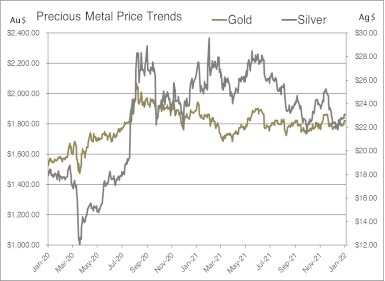
The prices of silver and gold are the largest single factor in determining profitability and cash flow from operations. The financial performance of the Company has been, and is expected to continue to be, closely linked to the prices of silver and gold.
During the year ended December 31, 2021, the average price of silver was $25.14 per oz, with silver trading between $21.53 and $29.59 per oz based on the London Fix silver price. This compares to an average of $20.53 per oz for the year ended December 31, 2020, with a low of $12.01 and a high of $28.89 per oz. For the year ended December 31, 2021, the Company realized an average price of $25.22 per silver oz compared with $21.60 for the year ended December 31, 2020.
During the year ended December 31, 2021, the average price of gold was $1,799 per oz, with gold trading between $1,684 and $1,943 per oz based on the London Fix PM gold price. This compares to an average of $1,771 per oz during the year ended December 31, 2020, with a low of $1,474 and a high of $2,067 per oz. During the year ended December 31, 2021, the Company realized an average price of $1,790 per oz compared with $1,846 for the year ended December 31, 2020.
The impact of measures to combat the spread of COVID-19 on global economy resulted in significant volatility in the financial markets, including the gold and silver market in March 2020. During March 2020, silver prices capitulated on expectations of a global recession with the expectation of reduced industrial demand, then subsequently significantly rebounded as investment demand increased due to the monetary aspects of silver and rising demand as a "green" metal. Government signals of higher interest rates to offset inflation concerns impacted the price of silver in the second half of 2021.
Currency Fluctuations
The Company's operations are located in Mexico and therefore a significant portion of operating costs and capital expenditures are denominated in Mexican pesos. The Company's corporate activities are based in Vancouver, Canada with the significant portion of these expenditures being denominated in Canadian dollars. Generally, as the U.S. dollar strengthens, these currencies weaken, and as the U.S. dollar weakens, these currencies strengthen.
During the year ended December 31, 2021, the Mexican peso was relatively flat. The average foreign exchange rate was $20.27 Mexican pesos per U.S. dollar, with the peso trading within a range of $19.61 to $21.90. This compares to an average of $21.48, with a range of $18.53 to $25.00 Mexican pesos per U.S. dollar in 2020.
During the year ended December 31, 2020, the Mexican peso was relatively flat until a significant decrease in oil prices followed by the COVID-19 crisis in March 2020 when the Mexican peso significantly depreciated against the U.S. dollar as funds flowed to safe haven markets and assets. Subsequently, the Mexican peso gradually appreciated against the U.S. dollar back to levels slightly lower than pre-crisis levels as investment risk was re-established.
|
MANAGEMENT'S DISCUSSION AND ANALYSIS FOR THE YEAR ENDED DECEMBER 31, 2021 |
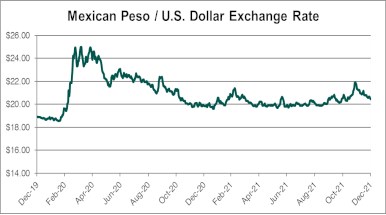
During the year ended December 31, 2020, the Canadian dollar was relatively flat although it initially appreciated compared to the U.S. dollar with the strengthening of oil prices and then weakened again towards the end of the year. During 2021, the average foreign exchange rate was $1.253 Canadian dollars per U.S. dollar, with the Canadian dollar trading within a range of $1.204 to $1.292. This compares to an average of $1.3409, with a range of $1.272 to $1.453 Canadian dollars per U.S. dollar during 2020.
During the year ended December 31, 2020, the Canadian dollar was flat until a significant decrease in oil prices and then the COVID-19 crisis in March 2020 when the Canadian dollar significantly depreciated against the U.S. dollar as funds invested in safe haven markets and assets. Subsequently, the Canadian dollar gradually appreciated against the U.S. dollar back to levels slightly lower than pre-crisis levels as investment risk was re-established.
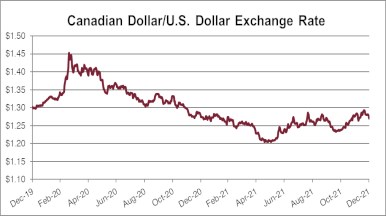
|
MANAGEMENT'S DISCUSSION AND ANALYSIS FOR THE YEAR ENDED DECEMBER 31, 2021 |
Cost Trends
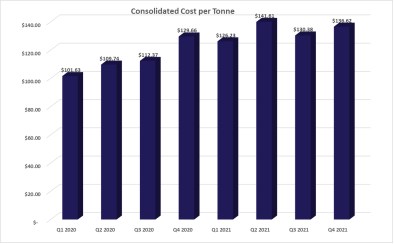
The Company's profitability is subject to industry wide cost pressures on development and operating costs with respect to labour, energy, consumables and capital expenditures. Underground mining is labour intensive and approximately 33% of the Company's production costs are directly tied to labour. In order to mitigate the impact of higher labour and consumable costs, the Company focuses on continuous improvement by promoting more efficient use of materials and supplies and by pursuing more advantageous pricing while increasing performance and without compromising operational integrity. During 2021, mining, processing and indirect costs all increased over 2020 and royalties paid for ore mined from the Porvenir Cuatro extension increased substantially due to increased production and strong metals prices, and improved profitability resulted in special mining duties paid to the government.
ANNUAL OUTLOOK
The Company has implemented plans to minimize the risks of the COVID-19 virus, both to employees and to the business. The Mexican government declared mining as an essential business, however in Mexico positive COVID-19 cases continue at a significant rate. A local outbreak, an impediment to supply or market logistics or change in government health orders remains a significant risk. The mines continue to operate under strict safety protocols with the expectations of operating near throughput capacity. At each site, the Company is following government health protocols and is closely monitoring the pandemic with local health authorities. The Company has posted health advisories to educate employees about the COVID-19 symptoms, best practices to avoid contracting and spreading the virus, and procedures to follow if symptoms are experienced.
As the COVID-19 global pandemic is dynamic, the ultimate duration and severity of the pandemic remains uncertain. The pandemic can have a material impact on the Company's future production and cost estimates.
Production
In 2022, silver production is expected to range from 4.2 to 4.8 million oz and gold production is anticipated be in the 31,000 to 35,000 oz range. Silver equivalent production is forecasted to total 6.7-7.6 million oz using an 80:1 silver:gold ratio.
|
Mine |
Ag (M oz) |
Au (K oz) |
Ag Eq (M oz) |
Tonnes/ Day (tpd) |
|
Guanaceví |
3.8-4.2 |
10.0-12.0 |
4.6 -5.2 |
1,100-1,20 0 |
|
Bolañitos |
0.4-0.6 |
21.0 -23.0 |
2.1-2.4 |
1,000-1,200 |
|
Total |
4.2-4.8 |
31.0 -35.0 |
6.7-7.6 |
2,100-2,400 |
|
MANAGEMENT'S DISCUSSION AND ANALYSIS FOR THE YEAR ENDED DECEMBER 31, 2021 |
At Guanaceví, production will range between 1,100 tpd to 1,200 tpd and average 1,165 tpd from the Milache, SCS and P4E orebodies. A significant portion of production will be mined from the Porvenir Cuatro extension on the El Curso concessions. The El Curso concessions were leased from a third party with no up-front costs but with significant royalty payments on production. Compared to 2021, ore grades are expected to decrease slightly with similar recoveries. Cash costs per ounce and direct operating costs per tonne are expected to increase in 2022, primarily due to the impact of inflation on power costs, reagent costs and salaries as well as higher estimated royalty and mining duty payments.
In 2022, production at Bolañitos is expected to range from 1,000 tpd to 1,200 tpd and average 1,080 tpd from the Plateros-La Luz, Lucero-Karina and Bolañitos-San Miguel vein systems. Ore grades and recoveries are expected to be similar to 2021. Cash costs per oz and direct costs per tonne are expected to increase primarily due to inflationary impact on power costs and salaries.
Operating Costs
In 2022, cash costs, net of gold by-product credits, are expected to be $9.00-$10.00 per oz of silver produced. Consolidated cash costs on a co-product basis are anticipated to be $13.00-$14.00 per oz silver and $1,100-$1,200 per oz gold.
AISC, net of gold by-product credits, in accordance with the World Gold Council standard, are estimated to be $20.00-$21.00 per oz of silver produced. When non-cash items such as stock-based compensation and accretion are excluded, AISC are forecasted to be in the $19.00-$20.00 range.
Direct costs per tonne are estimated to be $95-$100 with inflationary pressures expected to continue in 2022. Direct operating costs, which include royalties and special mining duties are estimated to be in the range of $120-$125 per tonne.
Management made the following assumptions in calculating its 2022 cost forecasts: $22 per oz silver price, $1,760 per oz gold price and 20:1 Mexican peso to U.S. dollar exchange rate.
Sustaining Capital Investments
In 2022, Endeavour's preliminary plan is to invest $34.3 million in sustaining capital, including $32.6 million at its two operating mines and $1.7 million to maintain the exploration concessions and cover corporate infrastructure. At current metal prices, the sustaining capital investments should be covered by operating cash flow.
At Guanaceví, $20.4 million will be invested on capital projects, the largest of which is the development of 5.7 km of mine access at the Milache, SCS and the P4E orebodies for an estimated $10.3 million. The additional $10.1 million will go to upgrade the plant, mining fleet, support site infrastructure, and expand the tailings dam.
At Bolañitos, $12.2 million will be invested on capital projects, including $8.4 million for 5.5 km of mine development to access reserves and resources in the Plateros-La Luz, Lucero-Karina, Bolañitos-San Miguel and Belen vein systems. The additional $3.8 million will go to upgrade the mining fleet, support site infrastructure, raise the tailings dam and commence a new portal to access the Belen ore body.
The capital budget presented below does not include the $70 million acquisition cost associated with the Company's pending acquisition of the Pitarrilla Project in Durango State, Mexico from SSR. The transaction is expected to be completed in the first half of 2022.
|
|
Mine Development |
Other Capital |
Sustaining |
Growth Capital |
Total Capital |
|
Guanaceví |
$10.3 million |
$10.1 million |
$20.4 million |
- |
$20.4 million |
|
Bolañitos |
$8.4 million |
$3.8 million |
$12.2 million |
- |
$12.2 million |
|
Terronera |
- |
- |
- |
$9.5 million |
$9.5 million |
|
Corporate |
- |
- |
$1.7 million |
$2.0 million |
$3.7 million |
|
Total |
$18.7 million |
$13.9 million |
$34.3 million |
$11.5 million |
$45.8 million |
|
MANAGEMENT'S DISCUSSION AND ANALYSIS FOR THE YEAR ENDED DECEMBER 31, 2021 |
Pitarrilla Acquisition
On January 17, 2022, the Company entered into a definitive agreement to purchase the Pitarrilla project, a large undeveloped silver, lead, and zinc project, located in Durango State, Mexico, by acquiring all of the issued and outstanding shares of SSR Durango, S.A. de C.V. from SSR Mining Inc. for a total consideration of US$70 million (consisting of $35 million in Company's shares and a further $35 million in cash or in the Company's shares at the election of SSR Mining and as agreed to by the Company) and a 1.25% net smelter returns royalty. SSR Mining retains a 1.25% NSR Royalty in Pitarrilla. Endeavour will have matching rights to purchase the NSR Royalty in the event SSR Mining proposes to sell it. Closing is expected to occur in the first half of 2022 and is subject to Toronto Stock Exchange and New York Stock Exchange approvals and receipt of Mexican Federal Economic Competition Commission approval, as well as customary closing conditions for a transaction of this kind.
Subject to closing the Pitarrilla acquisition, management plans to invest $1.8 million for drilling to verify the historical data and define a current resource in 2022.
Development Investment and Expenditures
At Terronera, $9.5 million is budgeted for the first quarter of 2022 to continue with final detailed engineering, early earth works, critical contracts and procurement of long lead items. The Company intends to make a formal construction decision, subject to completions of a financing package and receipt of amended permits, in the coming months, at which time the budget for the remainder of 2022 for the project will be determined.
Exploration Expenditures
In 2022, the Company plans to spend $13.0 million drilling 50,000 metres across its properties.
At the Guanaceví and Bolañitos mines, 21,000 metres of drilling is planned as a cost of $3.3 million to replace reserves and expand resources.
At the Terronera development project, 11,000 metres are planned to test multiple regional targets identified in 2021 to expand resources within the district. At the Parral project in Chihuahua state, 7,000 metres are planned at a cost of $1.7 million to delineate existing resources, expand resources and test new targets. In the second half of the year, the Company expects to initiate a preliminary economic assessment.
In Chile, management intends to invest $1.5 million to test the Aida exploration project located in the northern Chile Region II along the Argentina border accessible by paved highway and dirt road. The Company plans to drill 3,000 metres to test a manto target with significant silver-manganese-lead-zinc anomaly at surface in the second half of 2022. Additionally, the Company plans to advance mapping, sampling and surface exploration on its other exploration projects in Chile, estimated to cost $0.9 million including administration costs in the country.
At the Bruner project, management plans to invest $1.9 million to evaluate and verify historical data to define a current resource, map and sample new targets and drill 3,000 metres verifying historical data and testing new targets.
|
Project |
2022 Activity |
Drill Metres |
Expenditures |
|
Guanaceví |
Drilling |
11,000 |
$1.8 million |
|
Bolañitos |
Drilling |
10,000 |
$1.5 million |
|
Terronera |
Drilling |
11,000 |
$1.9 million |
|
Parral |
Drilling/Economic Study |
7,000 |
$1.7 million |
|
Chile - Aida |
Drilling |
3,000 |
$1.5 million |
|
Chile - Other |
Evaluation |
- |
$0.9 million |
|
Bruner |
Drilling/Evaluation |
3,000 |
$1.9 million |
|
Pitarrilla |
Drilling/Evaluation |
5,000 |
$1.8 million |
|
Total |
|
50,000 |
$13.0 million |
|
MANAGEMENT'S DISCUSSION AND ANALYSIS FOR THE YEAR ENDED DECEMBER 31, 2021 |
LIQUIDITY AND CAPITAL RESOURCES
Cash and cash equivalents increased from $61.1 million at December 31, 2020 to $103.3 million at December 31, 2021. The Company had working capital of $121.2 million at December 31, 2021 (December 31, 2020 - $70.4 million). The $50.8 million increase in working capital is primarily due to net ATM (defined below) equity raise of $58.7 million, $4.7 million from proceeds of exercised options, proceeds from the sale of the El Cubo mine assets of $19.5 million and an increase in inventories of $10.8 million offset by $54.1 million investment in mineral property, plant and equipment, which includes $10.1 million for the Bruner Project and $3.6 million loan repayments.
Operating activities provided $23.5 million during 2021 compared to generating $39.0 million during 2020. The significant non-cash adjustments to the net earnings of $14.0 million were amortization and depletion of $24.5 million (2020 - $28.9 million), an impairment reversal of non-current assets of $16.8 million (2020: net impairment of $0.4 million), share-based compensation of $3.6 million (2020 - $3.0 million), a deferred income tax expense of $12.2 million (2020 - deferred income tax recovery $5.2 million), finance costs of $1.0 million (2020 - $1.3 million), a gain on the disposal of the El Cubo mine of $5.8 million, a gain on other investments of $2.1 million (2020 - $0.2 million), a write-off of exploration properties of $0.7 million (2020: $Nil) and an increase in non-cash working capital of $8.8 million (2020 - decrease of $10.1 million). The change in non-cash working capital was primarily due to an increase in finished goods inventory and marketable securities offset by a decrease in accounts receivable.
The Company's Mexican subsidiaries pay Impuesto al Valor Agregado ("IVA") on the purchase and sale of goods and services. The net amount paid is recoverable but is subject to review and assessment by the tax authorities. The Company regularly files the required IVA returns and all supporting documentation with the tax authorities, however, the Company has been advised that certain IVA amounts receivable from the tax authorities are being withheld pending completion of the authorities' audit of certain of the Company's third-party suppliers. Under Mexican law, the Company has legal rights to those IVA refunds and the results of the third-party audits should have no impact on refunds. A smaller portion of IVA refund requests are from time to time denied based on the alleged lack of compliance of certain formal requirements and information returns by the Company's third-party suppliers. The Company takes necessary legal action on the delayed refunds as well as any denied refunds. The Company is in regular contact with the tax authorities in respect of its IVA filings and believes that the full amount of its IVA receivables will ultimately be received; however, the timing of recovery of these amounts and the nature and extent of any adjustments to the Company's IVA receivables remains uncertain.
Investing activities during the year used net $38.0 million for compared to using $29.8 million in 2020. The capital investments were primarily for sustaining capital at existing operations, similar for the comparable period in 2020, and $10.1 million spent on the acquisition of the Bruner Project. The Company received a net $9.3 million on the sale of marketable securities during 2021 and received cash of $10.1 million on the sale of property plant and equipment primarily for the El Cubo mine. Capital additions totalled $60.2 million in property, plant and equipment for 2021.
At Guanaceví, the Company invested $21.9 million, with $12.2 million spent on 5.0 km of mine development and acquired $5.7 million of mobile equipment. The Company continued to invest on upgrades for the plant and surrounding infrastructure, including $2.2 million on plant upgrades, mine site improvements and the tailings facility and $1.8 million on office, building infrastructure and light vehicles.
At Bolañitos, the Company invested $14.2 million, with $9.7 million spent on 6.8 km of mine development and acquired $3.2 million of mobile equipment. The Company continued to invest in upgrades for the plant and surrounding infrastructure, totalling $0.6 million and spent $0.7 million on office, building infrastructure and on light vehicles.
At Terronera, the Company invested $11.3 million, with $4.4 million spent on land payments and preliminary development, $5.7 million in mobile equipment and $1.2 million on buildings, light vehicles, office and IT infrastructure.
Exploration investments were $12.8 million with $11.6 million spent on holding costs and acquisition of concessions, including $10.1 million for the acquisition of the Bruner Project and $1.2 million on mobile equipment, office, building infrastructure and light vehicles.
|
MANAGEMENT'S DISCUSSION AND ANALYSIS FOR THE YEAR ENDED DECEMBER 31, 2021 |
Financing activities for 2021 increased cash by $56.7 million, compared to increasing cash by $27.5 million in the same period in 2020. During 2021, the Company received gross proceeds through an ATM financing of $60.0 million, paid $1.3 million in share issue costs, received $4.7 million on the exercise of employee options, paid $3.7 million in interest and principal repayments on loans and leases and paid $2.4 million on redemption of performance share units. By comparison, during the same period in 2020, the Company raised gross proceeds of $26.4 million, paid $1.1 million in share issue costs, received $6.9 million on the exercise of employee options and paid $3.4 million in interest and principal repayments on loans and lease.
In April 2020, the Company filed a short form base shelf prospectus to qualify the distribution of up to CAD$150 million of various securities of the Company, including common shares (the "Base Shelf"). The distribution of such securities of the Company may be effected from time to time in one or more transactions at a fixed price or prices, which may vary with market prices prevailing at the time of sale, or at prices related to such prevailing market prices to be negotiated with purchasers and as set forth in an accompanying prospectus supplement, including transactions that are deemed to be at-the-market distributions. The Base Shelf also provides the Company with the ability to conduct an "At-The-Market" ("ATM") offering through an ATM facility equity distribution agreement ("ATM Facility").
On May 14, 2020, the Company entered into an ATM Facility (the "May 2020 ATM Facility") with a syndicate of agents. Under the terms of the May 2020 ATM Facility, the Company could, from time to time, sell common shares having an aggregate offering value of up to $23 million on the New York Stock Exchange. The Company determined, at its sole discretion, the timing and number of shares to be sold under the May 2020 ATM Facility. From May 14, 2020 to August 17, 2020, the Company issued 11,640,411 common shares under the May 2020 ATM Facility at an average price of $1.97 per share for gross proceeds of $23.0 million less commission of $0.6 million and deferred financing costs of $0.3 million which has been presented net of share capital. The May 2020 ATM Facility was completed in August 2020. The purpose of the May 2020 ATM Facility was to advance the exploration and development of the Terronera Project and to add to the Company's working capital.
On October 1, 2020, the Company entered into an ATM Facility (the "October 2020 ATM Facility") with a syndicate of agents. Under the terms of the October 2020 ATM Facility, the Company could from time to time, sell common shares having an aggregate offering value of up to $60 million on the New York Stock Exchange. The Company determined, at its sole discretion, the timing and number of shares to be sold under the October 2020 ATM Facility during the 20-month sales agreement term. In the period from January 1, 2021 to July 20, 2021, when the October 2020 ATM Facility was completed, the Company issued 10,060,398 common shares under the October 2020 ATM Facility at an average price of $5.96 per share for gross proceeds of $60.0 million, less commission of $1.2 million and recognized $0.4 million of transaction costs related to the October 2020 ATM Facility. The purpose of the October 2020 ATM Facility was to advance the exploration and development of the Terronera Project, advance the exploration of the Parral Project and to add to the Company's working capital.
For the October 2020 ATM Facility, the net proceeds have been used as follows:
|
Use of proceeds (thousands) |
|
|
Net proceeds received |
$58,768 |
|
Advancement of Terronera Project |
(19,899) |
|
Advancement of Parral Project |
(2,731) |
|
Allocated to working capital |
$36,138 |
Management of the Company believes that operating cash flow and existing working capital will be sufficient to cover 2022 capital requirements and commitments. The Company is assessing financing alternatives, including equity or debt or a combination of both to fund future growth, including the development of the Terronera project.
|
MANAGEMENT'S DISCUSSION AND ANALYSIS FOR THE YEAR ENDED DECEMBER 31, 2021 |
Contingencies
Minera Santa Cruz y Garibaldi SA de CV ("MSCG"), a subsidiary of the Company, received a Mexican peso ("MXN") 238 million assessment on October 12, 2010 by Mexican fiscal authorities for failure to provide the appropriate support for certain expense deductions taken in MSCG's 2006 tax return, failure to provide appropriate support for loans made to MSCG from affiliated companies, and deemed an unrecorded distribution of dividends to shareholders, among other individually immaterial items. MSCG immediately initiated a Nullity action and filed an administrative attachment to dispute the assessment.
In June 2015, the Superior Court ruled in favour of MSCG on a number of the matters under appeal; however, the Superior Court ruled against MSCG for failure to provide appropriate support for certain deductions taken in MSCG's 2006 tax return. In June 2016, the Company received a MXN 122.9 million ($6.0 million) tax assessment based on the June 2015 ruling. The 2016 tax assessment comprised of MXN 41.8 million in taxes owed ($2.0 million), MXN 17.7 million ($0.9 million) in inflationary charges, MXN 40.4 million ($2.0 million) in interest and MXN 23.0 million ($1.1 million) in penalties. The 2016 tax assessment was issued for failure to provide the appropriate support for certain expense deductions taken in MSCG's 2006 tax return and failure to provide appropriate support for loans made to MSCG from affiliated companies. If MSCG agrees to pay the tax assessment, or a lesser settled amount, it is eligible to apply for forgiveness of 100% of the penalties and 50% of the interest.
The Company filed an appeal against the June 2016 tax assessment on the basis that certain items rejected by the courts were included in the new tax assessment and a number of deficiencies exist within the assessment. Since issuance of the assessment interest charges of MXN 12.8 million ($0.6 million) and inflationary charges of MXN 19.1 million ($0.9 million) has accumulated.
Included in the Company's consolidated financial statements are net assets of $595,000 held by MSCG. Following the Tax Court's rulings, MSCG has been in discussions with the tax authorities with regards to the shortfall of assets within MSCG to settle its estimated tax liability. An alternative settlement option would be to transfer the shares and assets of MSCG to the tax authorities. The Company recognized an allowance for transferring the shares and assets of MSCG amounting to $595,000 in a prior year. The Company is currently assessing MSCG's settlement options based on ongoing court proceedings and discussion with the tax authorities. The Company has been advised that the appeal filed with the Federal Tax Court against the June 2016 tax assessment has been rejected and the Company continues to assess MSCG's settlement options and has filed an appeal with the Supreme Court of Justice.
Compania Minera Del Cubo SA de CV ("Cubo"), a subsidiary of the Company, received a MXN 58.5 million ($2.9 million) assessment in 2019 by Mexican fiscal authorities for failure to provide the appropriate support for depreciation deductions taken in the Cubo 2016 tax return and denied deductions of certain suppliers. The tax assessment consists of MXN 24.1 million ($1.2 million) for taxes, MXN 21.0 million ($1.1 million) for penalties, 10.4 million ($0.5 million) for interest and MXN 3.0 million ($0.1 million) for inflation. At the time of the tax assessment the Cubo entity had and continues to have sufficient loss carry forwards which would be applied against the assessed difference of taxable income. The Mexican tax authorities did not consider these losses in the assessment.
Due to the denial of certain suppliers for income tax purposes in the Cubo assessment, the invoices from these suppliers have been assessed as ineligible for refunds of IVA (value-added taxes) paid on the invoices. The assessment includes MXN 14.7 million ($0.7 million) for re-payment of IVA refunded on these supplier payments. In the Company's judgement, the suppliers and invoices meet the necessary requirements to be deductible for income tax purposes and the recovery of IVA.
The Company filed an administrative appeal related to the 2016 Cubo tax assessment. The Company had previously provided a lien on certain El Cubo mining concessions during the appeal process. To facilitate the sale of the El Cubo mine and related assets, the Company elected to pay the assessed amount of $3.5 million during Q1, 2021. During the appeal process the amount paid has been classified as a non-current income tax recoverable. Since issuance of the assessment interest charges of MXN 9.9 million ($0.5 million) and inflationary charges of MXN 1.6 million ($0.1 million) had accumulated. The Company continues to assess that it is probable that its appeal will prevail, and no provision is recognized in respect of the Cubo tax assessment.
|
MANAGEMENT'S DISCUSSION AND ANALYSIS FOR THE YEAR ENDED DECEMBER 31, 2021 |
The Company is required to use judgement to determine certain tax treatments in calculating income tax expense and IVA recoverable. A number of these judgements are subject to various uncertainties. From time to time, Mexican authorities may apply, re-interpret legislation or disregard precedents and it is possible that of these uncertainties may be resolved unfavorably for the Company.
Capital Requirements
As of December 31, 2021, the Company held $103.3 million in cash and $121.2 million in working capital. The duration and severity of the global COVID-19 pandemic could have a material impact on the Company's liquidity. The Mexican government declared mining as an essential business, however in Mexico positive COVID-19 cases continue at a significant rate. A local outbreak, an impediment to supply or market logistics or change in government health orders remains a significant risk. The mines are operating under strict safety protocols with the expectations of operating near throughput capacity.
The Company may be required to raise additional funds through future debt or equity financings in order to finance the development of the Terronera Project and may need to raise additional funds to carry out other business plans. The Company will continue to monitor capital markets, economic conditions, the COVID-19 global pandemic and assess its short term and long term capital needs.
See Annual Outlook on page 31 for discussion on planned capital and exploration expenditures.
Contractual Obligations
The Company had the following undiscounted contractual obligations at December 31, 2021:
| Payments due by period (in thousands of dollars) Contractual Obligations |
Total | Less than 1 year | 1 - 3 years | 3 - 5 years | More than 5 years |
||||||||||
| Capital asset purchases | $ | 8,524 | $ | 8,524 | $ | - | $ | - | $ | - | |||||
| Loans payable | 10,494 | 4,081 | 5,314 | 1,099 | - | ||||||||||
| Lease liabilities | 1,162 | 263 | 313 | 324 | 262 | ||||||||||
| Other contracts(1) | 784 | 170 | 220 | 220 | 174 | ||||||||||
| Other Long-Term Liabilities (2) | 11,026 | - | 167 | 2,125 | 8,734 | ||||||||||
| Total | $ | 31,990 | $ | 13,038 | $ | 6,014 | $ | 3,768 | $ | 9,170 |
(1) Other contracts consist of office premises operating costs and short-term leases.
(2) The $11,026 of other long-term liabilities is the discounted cost estimate to settle the Company's reclamation costs of the Guanacevi, Bolañitos and El Compas mines in Mexico. These costs include land rehabilitation, decommissioning of buildings and mine facilities, ongoing care and maintenance and other costs.
TRANSACTIONS WITH RELATED PARTIES
The Company shares common administrative services and office space with Aztec Metals Corp., which is considered a related party company by virtue of Bradford Cooke, the Company's Executive Chairman, being a common director. From time to time, the Company incurs third-party costs on behalf of related parties, which are charged on a full cost recovery basis. The charges for these costs totalled $2,000 and $5,000 for the three and twelve months ended December 31, 2021, respectively (December 31, 2020 - $1,000 and $4,000, respectively). The Company had a $1,000 net receivable related to administration costs outstanding as at December 31, 2021 (December 31, 2020 - $2,000).
The Company was charged $39,000 and $276,000 for legal services for the three and twelve months ended December 31, 2021, respectively, by a law firm in which the Company's corporate secretary is a partner (December 31, 2020 - $49,000 and $255,000, respectively). The Company has $5,000 payable to the law firm as at December 31, 2021 (December 31, 2020 - $26,000).
|
MANAGEMENT'S DISCUSSION AND ANALYSIS FOR THE YEAR ENDED DECEMBER 31, 2021 |
FINANCIAL INSTRUMENTS AND FAIR VALUE MEASUREMENTS
As at December 31, 2021 and 2020, the carrying and fair values of Endeavour's financial instruments by category were as follows:
| As at December 31, 2021 | As at December 31, 2020 | |||||||||||
| Carrying value | Estimated Fair | Carrying value | Estimated Fair | |||||||||
| Expressed in thousands US dollars | value | value | ||||||||||
| Financial assets: | ||||||||||||
| Cash and cash equivalents | $ | 103,303 | $ | 103,303 | $ | 61,083 | $ | 61,083 | ||||
| Other investments | 11,200 | 11,200 | 4,767 | 4,767 | ||||||||
| Trade receivables | 4,751 | 4,751 | 8,755 | 8,755 | ||||||||
| Other receivables | 9,711 | 9,711 | 11,389 | 11,389 | ||||||||
| Total financial assets | $ | 128,965 | $ | 128,965 | $ | 85,994 | $ | 85,994 | ||||
| Financial liabilities: | ||||||||||||
| Accounts payable and accrued liabilities | $ | 31,991 | $ | 31,991 | $ | 27,764 | $ | 27,764 | ||||
| Loans payable | 10,494 | 10,494 | 9,672 | 9,672 | ||||||||
| Total financial liabilities | $ | 42,485 | $ | 42,485 | $ | 37,436 | $ | 37,436 | ||||
Fair value hierarchy
Fair value is the price that would be received to sell an asset or paid to transfer a liability in an orderly transaction between market participants at the measurement date. The fair value hierarchy establishes three levels to classify the inputs to valuation techniques used to measure fair value. Level 1 inputs are quoted prices (unadjusted) in active markets for identical assets or liabilities. Level 2 inputs are quoted prices in markets that are not active, quoted prices for similar assets or liabilities in active markets, inputs other than quoted prices that are observable for the asset or liability (for example, interest rate and yield curves observable at commonly quoted intervals, forward pricing curves used to value currency and commodity contracts and volatility measurements used to value option contracts), or inputs that are derived principally from or corroborated by observable market data or other means. Level 3 inputs are unobservable (supported by no or little market activity). The fair value hierarchy gives the highest priority to Level 1 inputs and the lowest priority to Level 3 inputs.
Assets and liabilities as at December 31, 2021 that measured at fair value on a recurring basis include:
| Fair value | ||||||||||||
| Expressed in thousands US dollars | through profit | Amortized cost | Carrying value | Estimated Fair | ||||||||
| or loss | value | |||||||||||
| Financial assets: | ||||||||||||
| Cash and cash equivalents | $ | - | $ | 103,303 | $ | 103,303 | $ | 103,303 | ||||
| Other investments | 11,200 | - | 11,200 | 11,200 | ||||||||
| Trade receivables | 4,751 | - | 4,751 | 4,751 | ||||||||
| Other receivables | - | 9,711 | 9,711 | 9,711 | ||||||||
| Total financial assets | $ | 15,951 | $ | 113,014 | $ | 128,965 | $ | 128,965 | ||||
| Financial liabilities: | ||||||||||||
| Accounts payable and accrued liabilities | $ | 5,795 | $ | 26,196 | $ | 31,991 | $ | 31,991 | ||||
| Loans payable | - | 10,494 | 10,494 | 10,494 | ||||||||
| Total financial liabilities | $ | 5,795 | $ | 36,690 | $ | 42,485 | $ | 42,485 |
Other investments
The Company holds marketable securities classified as Level 1 and Level 3 in the fair value hierarchy. The fair values of Level 1 investments are determined based on a market approach reflecting the closing price of each particular security at the reporting date. The closing price is a quoted market price obtained from the stock exchange that is the principal active market for the particular security, being the market with the greatest volume and level of activity for the assets. For Level 3 investments, which consist of share purchase warrants where inputs are not observable, they have an estimated value determined by using an option pricing model. Changes in fair value on available for sale marketable securities are recognized in earnings or loss.
|
MANAGEMENT'S DISCUSSION AND ANALYSIS FOR THE YEAR ENDED DECEMBER 31, 2021 |
Trade receivables
The trade receivables consist of receivables from provisional silver and gold sales from the Bolañitos mine. The fair value of receivables arising from concentrate sales contracts that contain provisional pricing mechanisms is determined using the appropriate quoted closing price on the measurement date from the exchange that is the principal active market for the particular metal. As such, these receivables, which meet the definition of an embedded derivative, are classified within Level 2 of the fair value hierarchy.
Deferred share units
The Company has a cash settled Deferred Share Unit ("DSU") plan whereby deferred share units may be granted to independent directors of the Company in lieu of compensation in cash or stock options. The DSUs vest immediately and are redeemable for cash based on the market value of the units at the time of a director's retirement. The DSUs are classified as Level 1 in the fair value hierarchy. The liability is determined based on a market approach reflecting the closing price of the Company's common shares at the reporting date. Changes in fair value are recognized in general and administrative expenses.
Share appreciation rights
As part of the Company's bonus program, the Company grants share appreciation rights ("SARs") to its employees in Mexico and Chile. The SARs are subject to vesting conditions and, when exercised, constitute a cash bonus based on the value of the appreciation of the Company's common shares between the SARS grant date and the exercise date.
The SARs are classified as Level 2 in the fair value hierarchy. The liability is valued using a Black-Scholes option pricing model. Changes in fair value are recognized in salaries, wages and benefits.
Financial Instrument Risk Exposure and Risk Management
The Company is exposed in varying degrees to a variety of financial instrument related risks. The Board approves and monitors the risk management process. The types of risk exposure and the way in which such exposure is managed is provided as follows:
Credit Risk
The Company is exposed to credit risk on its bank accounts and accounts receivable. Credit risk exposure on bank accounts is limited through maintaining the Company's balances with high-credit quality financial institutions, maintaining investment policies, assessing institutional exposure and continual discussion with external advisors. Value-added tax receivables are generated on the purchase of supplies and services to produce silver, which are refundable from the Mexican government. Trade receivables are generated on the sale of concentrate inventory to reputable metal traders.
Liquidity Risk
Liquidity risk is the risk that the Company will not be able to meet its financial obligations as they come due. The Company manages its liquidity risk by continually monitoring forecasted and actual cash flows. The Company has in place a planning and budgeting process to help determine the funds required to support its normal operating requirement and development plans. The Company aims to maintain sufficient liquidity to meet its short-term business requirements, taking into account its anticipated cash flows from operations, its holdings of cash and cash equivalents, and its committed and anticipated liabilities.
The Company's Mexican subsidiaries pay IVA on the purchase and sale of goods and services. The net amount paid is recoverable but is subject to review and assessment by the tax authorities. The Company regularly files the required IVA returns and all supporting documentation with the tax authorities, however, the Company has been advised that certain IVA amounts receivable from the tax authorities are being withheld pending completion of the authorities' audit of certain of the Company's third-party suppliers. Under Mexican law, the Company has legal rights to those IVA refunds and the results of the third-party audits should have no impact on refunds. A smaller portion of IVA refund requests are from time to time denied based on the alleged lack of compliance of certain formal requirements and information returns by the Company's third-party suppliers. The Company takes necessary legal action on the delayed refunds as well as any denied refunds. The Company is in regular contact with the tax authorities in respect of its IVA filings and believes that the full amount of its IVA receivables will ultimately be received; however, the timing of recovery of these amounts and the nature and extent of any adjustments to the Company's IVA receivables remains uncertain.
|
MANAGEMENT'S DISCUSSION AND ANALYSIS FOR THE YEAR ENDED DECEMBER 31, 2021 |
Market Risk
The significant market risk exposures to which the Company is exposed are foreign currency risk, interest rate risk, and commodity price risk.
Foreign Currency Risk - The Company's operations in Mexico and Canada make it subject to foreign currency fluctuations. Certain of the Company's operating expenses are incurred in Mexican pesos and Canadian dollars; therefore, the fluctuation of the U.S. dollar in relation to these currencies will consequently have an impact upon the profitability of the Company and may also affect the value of the Company's assets and the amount of shareholders' equity. The Company has not entered into any agreements or purchased any instruments to hedge possible currency risks.
Interest Rate Risk - In respect of financial assets, the Company's policy is to invest cash at floating rates of interest and cash reserves are to be maintained in cash equivalents in order to maintain liquidity. Fluctuations in interest rates impact the value of cash equivalents. As at December 31, 2021 the Company has $1.6 million in equipment loans with interest rates that are linked to Libor and, with other variables unchanged, a 1% increase in the Libor rate would result in an additional interest expense of $15,000.
Commodity Price Risk - Gold and silver prices have historically fluctuated significantly and are affected by numerous factors outside of the Company's control, including, but not limited to, industrial and retail demand, central bank lending, forward sales by producers and speculators, levels of worldwide production, short-term changes in supply and demand because of speculative hedging activities and certain other factors. The Company has not engaged in any hedging activities, other than short-term metal derivative transactions less than 90 days, to reduce its exposure to commodity price risk. At December 31, 2021, there are 51,250 oz of silver and 1,935 oz of gold, which do not have a final settlement price and the estimated revenues have been recognized at current market prices. As at December 31, 2021, with other variables unchanged, a 10% decrease in the market value of silver and gold would result in a reduction of revenue of $0.5 million.
OUTSTANDING SHARE DATA
As of March 8, 2022, the Company had the following securities issued and outstanding:
As at December 31, 2021, the Company's issued share capital was $585.4 million (December 31, 2020 - $517.7 million), representing 170,537,307 common shares (December 31, 2020 - 157,924,708), and the Company had options outstanding to purchase 3,848,200 common shares (December 31, 2020 - 5,978,300) with a weighted average exercise price of CAD$3.68 (December 31, 2020 - CAD$3.29).
The Company considers the items included in the consolidated statement of shareholders' equity as capital. The Company's objective when managing capital is to safeguard its ability to continue as a going concern so that it can continue to provide returns for shareholders and benefits for other stakeholders. The Company manages the capital structure and makes adjustments to it in light of changes in economic conditions and the risk characteristics of the underlying assets. In order to maintain or adjust the capital structure, the Company may issue new shares through private placements, prospectus offerings, convertible debentures, asset acquisitions or return capital to shareholders. The Company is not subject to externally imposed capital requirements.
|
MANAGEMENT'S DISCUSSION AND ANALYSIS FOR THE YEAR ENDED DECEMBER 31, 2021 |
CHANGES IN ACCOUNTING POLICIES AND CRITICAL ACCOUNTING ESTIMATES
Accounting standards adopted during the period:
The accounting policies applied in the Company's annual audited consolidated financial statements as at and for the year ended December 31, 2021 are the same as those applied in the Company's annual audited consolidated financial statements as at and for the year ended December 31, 2020 except for the following:
Assets held for sale
Non-current assets, or disposal groups comprising assets and liabilities, are classified as held-for-sale if it is highly probable that they will be recovered primarily through sale rather than through continuing use. For the sale to be highly probable, management must be committed to, and have a plan to sell the assets, the assets must be available for immediate sale in their present condition and the sale must be expected to qualify for recognition as a completed sale within one year from the date of classification.
Such assets, or disposal groups, are measured at the lower or their original carrying amount and fair value less costs to sell. Impairment losses or impairment reversals on initial classification as held-for-sale and subsequent gains and losses on re-measurement are recognized in earnings or loss. Once classified as held-for-sale, intangible assets and property, plant and equipment are no longer amortized or depreciated.
The following amendment to accounting standards has been issued but not yet adopted in the financial statements:
On May 14, 2020, the IASB published a narrow scope amendment to IAS 16 Property, Plant and Equipment - Proceeds before Intended Use. The amendment prohibits deducting from the cost of property, plant and equipment amounts received from selling items produced while preparing the asset for its intended use. Instead, amounts received will be recognized as sales proceeds and the related costs in profit or loss. The effective date is for annual periods beginning on or after January 1, 2022. The Company is assessing the effect of the narrow scope amendment on its consolidated financial statements. The Company expects this amendment to have a material effect related to the allocation of costs between stockpile inventory and deferred development costs during the development phase of its Terronera Project, with no anticipated impact on earnings in 2022.
Critical Accounting Estimates
The preparation of financial statements requires the Company to make estimates that affect the reported amounts of assets and liabilities and disclosure of contingent assets and liabilities at the date of the financial statements and the reported amounts of revenues and expenses during the reporting period. Significant areas requiring the use of management's judgment relate to the determination of mineralized reserves and resources, plant and equipment lives, estimating the fair values of financial instruments and derivatives, impairment of non-current assets, reclamation and rehabilitation provisions, recognition of deferred tax assets, and assumptions used in determining the fair value of share-based compensation.
Determination of ore reserves and resources
Judgments about the amount of product that can be economically and legally extracted from the Company's properties are made by management using a range of geological, technical and economic factors, history of conversion of mineral deposits to proven and probable reserves as well as data regarding quantities, grades, production techniques, recovery rates, production costs, commodity prices and exchange rates. This process may require complex and difficult geological judgments to interpret the data. The Company uses qualified persons (as defined by NI 43-101) to compile this data.
Estimating the quantity and /or grade of reserves and resources requires the size, shape and depth of ore bodies or fields to be determined by analyzing geological data such as drilling samples. Following this, the quantity of ore that can be extracted in an economical manner is calculated using data regarding the life of mine plans and forecast sales prices (based on current and long-term historical average price trends). Changes in estimates can be the result of estimated future production differing from previous forecasts of future production, expansion of mineable ore through exploration activities, differences between estimated and actual costs of mining and differences in the commodity price used in the estimation of mineable ore.
|
MANAGEMENT'S DISCUSSION AND ANALYSIS FOR THE YEAR ENDED DECEMBER 31, 2021 |
The economic assumptions used to estimate mineral reserves may change from period to period and additional geological data is generated during the course of operations, which may change management's judgments surrounding reserves and resources. Any changes in management's judgements may impact the carrying value of mineral properties, plant and equipment, reclamation and rehabilitation provisions, recognition of deferred income tax amounts, and depreciation and depletion.
Review of asset carrying values and assessment of impairment
Management applies significant judgment in assessing each CGU and assets for the existence of indicators of impairment or impairment reversal at the reporting date. Internal and external factors are considered in assessing whether indicators are present that would necessitate impairment testing. Significant assumptions regarding commodity prices, operating costs, capital expenditures and discount rates are used in determining whether there are any indicators of impairment. These assumptions are reviewed regularly by senior management and compared, when applicable, to relevant market consensus views.
If an indicator of impairment or reversal exists, the asset's recoverable amount is estimated. The recoverable amount is the greater of fair value less costs of disposal and value in use. The determination of fair value less costs of disposal and value in use requires management to make estimates and assumptions about expected production and sales volumes, metal prices, ore tonnage and grades, recoveries, operating costs, future capital expenditures and appropriate discount rates for future cash flows. The estimates and assumptions are subject to risk and uncertainty, and as such there is the possibility that changes in circumstances will alter these projections, which may impact the recoverable amount of the assets. In such circumstances, some or all of the carrying value of the assets may be further impaired or the impairment charge reduced with the impact recorded in profit or loss.
In 2013 and 2015, the Company determined there were several indicators of potential impairment of its producing mineral properties which included the sustained decline in precious metal prices, changes in tax legislation and a reduction in reserves and resources. The recoverable amounts were based on each CGU's future cash flows expected to be derived from the Company's mining properties and represent each CGU's fair value in use. The cash flows were determined based on the life-of-mine after tax cash flow estimate which incorporate management's best estimates of future metal prices, production based on estimates of recoverable reserves and resources, exploration potential, future operating costs and non-expansionary capital expenditures.
At December 31, 2020, the Company recognized a $2.6 million reversal of a previous impairment of the Guanaceví mine. An increase in the reserve and resource estimate and increase in precious metal prices were considered to be indicators of an impairment reversal. The updated Guanaceví mine plan, with updated assumptions and estimates, resulted in significantly higher cash flows, using a 6.1% discount rate, compared to the Company's previous estimates. Accordingly, the Company reversed the 2013 Guanaceví CGU impairment, limited to the carrying amount had no impairment been recognized in prior periods, net of depletion and amortization which would have been recognized in prior periods.
At December 31, 2020, the Company recognized an impairment of the El Compas mine project. A decrease in the resource estimate as at December 31, 2020 was considered to be an indicator of an impairment. The carrying value related to the El Compas CGU, excluding working capital and reclamation provision, was $6.0 million which was greater than its estimated recoverable amount of $3.0 million, calculated on a discounted cash flow basis using a 6.1% discount rate. The Company considers use of its internal discounted cash flow economic models as a proxy for the calculation of fair value in use. Based on the above assessment, the Company recorded an impairment charge related to the El Compas CGU of $3.0 million.
At December 31, 2021, the Company recognized a $16.8 million reversal of a previous impairment of the El Cubo mine. The El Cubo mine project, consisting of the land rights, plant, buildings and the related reclamation liability were re-classified to current assets and liabilities as "assets held for sale" and "liabilities held for sale" upon the signing of a definitive agreement to sell the El Cubo mine and related assets. Immediately prior to the classification to assets and liabilities held for sale, the carrying amounts of the land rights, plant and building were re-measured and the historical gross impairments of $216.9 million net of depletion and depreciation of $200.1 million were reversed resulting in a $16.8 million impairment reversal. Accordingly, the Company reversed the CGU impairment, limited to the carrying amount had no impairment been recognized in prior periods, net of depletion and amortization which would have been recognized in prior periods.
|
MANAGEMENT'S DISCUSSION AND ANALYSIS FOR THE YEAR ENDED DECEMBER 31, 2021 |
If an area of interest is abandoned or it is determined that its carrying value cannot be supported by future production or sale, the related costs are charged against operations in the period of abandonment or determination that the carrying value exceeds its fair value. The amounts recorded as mineral properties represent costs incurred to date and do not necessarily reflect present or future values.
Achievement of commercial production
Once a mine reaches the operating levels intended by management, deprecation of capitalized costs begins. Significant judgement is required to determine when certain of the Company's assets reach this level. Management considers several factors including: completion of a reasonable period of commissioning; consistent operating results achieved at a pre-determined level of design capacity and indications exist that this level will continue; mineral recoveries at or near expected levels; and the transfer of operations from development personnel to operational personnel has been completed.
Estimation of the amount and timing of reclamation and rehabilitation costs
Accounting for restoration requires management to make estimates of the future costs the Company will incur to complete the reclamation and rehabilitation work required to comply with existing laws, regulations and agreements in place at each mining operation and any environmental and social principles the Company is in compliance with. The calculation of the present value of these costs also includes assumptions regarding the timing of reclamation and rehabilitation work, applicable risk-free interest rates for discounting those future cash flows, inflation and foreign exchange rates and assumptions relating to probabilities of alternative estimates of future cash flows. Actual costs incurred may differ from those amounts estimated. Also, future changes to environmental laws and regulations could increase the extent of reclamation and rehabilitation work required to be performed by the Company. Increase in future costs could materially impact the amounts charged to operations for reclamation and rehabilitation.
Deferred Income Taxes
The Company follows the asset and liability method of accounting for income taxes. Under this method, future tax assets and liabilities are recognized for the future tax consequences attributable to differences between the financial statement carrying amounts of existing assets and liabilities and their respective tax bases, and losses carried forward. Future tax assets and liabilities are measured using substantively enacted or enacted tax rates expected to apply to taxable income in the years in which those temporary differences are expected to be recovered or settled. The effect on future tax assets and liabilities of a change in tax rates is recognized in income in the period that includes the substantive enactment date. Future tax assets are recognized to the extent that they are considered more likely than not to be realized.
Judgement is required in determining the recognition and measurement of deferred income tax assets and liabilities on the balance sheet. In the normal course of business, the Company is subject to assessment by taxation authorities in various jurisdictions. These authorities may have different interpretations of tax legislation or tax agreements than those applied by the Company in computing current and deferred income taxes. These different interpretations may alter the timing or amounts of taxable income or deductions.
Final taxes payable and receivable are dependent on many factors, including outcomes of tax litigation and resolution of disputes. The resolution of these uncertainties may result in adjustments to the Company's tax assets and liabilities.
Management assesses the likelihood and timing of taxable earnings in future periods in recognizing deferred income tax assets. Estimates of future taxable income is based on forecasted cash flows using life of mine projections and the application of existing tax laws in each jurisdiction.
To the extent that future cash flows and taxable income differ significantly from estimates, the ability of the Company to realize the net deferred income tax assets recorded at the balance sheet date could be impacted. In addition, future changes to tax laws could limit the ability of the Company to obtain tax deductions in future periods from deferred income tax assets.
Inventory
In valuing inventories at the lower of cost and net realizable value, the Company makes estimates in determining the net realizable price and in quantifying the contained metal in finished goods and work in progress.
|
MANAGEMENT'S DISCUSSION AND ANALYSIS FOR THE YEAR ENDED DECEMBER 31, 2021 |
Share-based Compensation
The Company has a stock option plan and records all share-based compensation for options using the fair value method. The fair value of each option award is estimated on the date of the grant using the Black-Scholes option pricing model, with expected volatility based on historical volatility of the Endeavour common shares. The Company uses historical data to estimate the term of the option and the risk-free rate for the expected term of the option is based on the Government of Canada yield curve in effect at the time of the grant.
As part of the Company's bonus program, the Company may from time to time grant SARs to its employees in Mexico and Chile. The SARs are subject to vesting conditions and, when vested, constitute a cash bonus based on the value of the appreciation of the Company's common shares between the SARs grant date and vesting. The fair value of each SAR award is estimated on the grant date using the Black-Scholes option pricing model, with expected volatility based on historical volatility of the Endeavour common shares. The Company uses historical data to estimate the term of the option and the risk-free rate for the expected term of the option is based on the Government of Canada yield curve in effect at the time of the grant.
On March 23, 2021 the Company adopted an equity-based Share Unit Plan ("SUP"), which was approved by the Company's shareholders on May 12, 2021 The SUP allows for, with approval by the Board, granting of Performance Share Units ("PSU"s) and Deferred Share Units ("DSU"s), to its directors, officers, employees to acquire up to 1.5% of the issued and outstanding shares. The SUP incorporates all existing PSUs under the former PSU plan and any new DSUs granted and are to be subject to cash, share settlement or a combination of cash and share procedures at the discretion of the Board of Directors.
PSUs may be granted to employees of the Company. Under the plan, vested PSUs are redeemable, at the election of the Board of Directors in its discretion, for Common Shares, a cash payment equal to the market value of a Common Share as of the redemption date, or a combination of cash and Common Shares. The PSUs granted are subject to a performance payout multiplier between 0% and 200% based on the Company's total shareholder return at the end of a three-year period, relative to the Company's total shareholder return peer group.
DSU plan will be granted to independent directors of the Company in lieu of compensation in cash or share purchase options and are redeemable at the time of a director's retirement.
Business Combinations
On the acquisition of a business, the acquisition method of accounting is used, whereby the purchase consideration is allocated to the identifiable assets, liabilities and contingent liabilities (identifiable net assets) on the basis of fair value at the date of acquisition. When the cost of acquisition exceeds the fair values attributable to the Company's share of identifiable net assets, the difference is treated as purchased goodwill, which is not amortized but is reviewed for impairment annually or more frequently where there is an indication of impairment. If the fair value attributable to the Company's share of the identifiable net assets exceeds the cost of acquisition, the difference is immediately recognized in profit or loss. Incremental costs related to acquisitions are expensed as incurred.
Determination of the fair value of assets acquired and liabilities assumed and the resulting goodwill, if any, requires that management make estimates based on the information provided by the acquiree. Changes to the provisional values of assets acquired and liabilities assumed, deferred income taxes and resulting goodwill, if any, will be adjusted when the final measurements are determined (within one year of acquisition date).
When purchase consideration is contingent on future events, the initial cost of the acquisition recorded includes an estimate of the fair value of the contingent amounts expected to be payable in the future. When the fair value of contingent consideration as at the date of acquisition is finalized, before the end of the 12 month measurement period, the adjustment is allocated to the identifiable assets acquired and liabilities assumed. Changes to the estimated fair value of contingent consideration subsequent to the acquisition date are recorded in profit or loss.
|
MANAGEMENT'S DISCUSSION AND ANALYSIS FOR THE YEAR ENDED DECEMBER 31, 2021 |
RISKS AND UNCERTAINTIES
Besides the risks discussed elsewhere in this MD&A, the following are risks and uncertainties that have affected the Company's financial statements or future performance or that may affect them in the future. See "Risk Factors" in the Company's Annual Information Form for other risks affecting the Company generally.
Impact of COVID-19 Pandemic
The Company's business could be significantly adversely affected by the effects of a widespread global outbreak of contagious disease, including the recent outbreak of respiratory illness caused by COVID-19. The Company cannot accurately predict the impact COVID-19 will have on third parties' ability to meet their obligations with the Company, including due to uncertainties relating to the ultimate geographic spread of the virus, the severity of the disease, the duration of the outbreak, and the length of travel and quarantine restrictions imposed by governments of affected countries. In particular, the continued spread of the COVID-19 globally could materially and adversely impact the Company's business including without limitation, employee health, limitations on travel, the availability of industry experts and personnel, restrictions to planned drill programs, mining and processing operations shutdowns, and other factors that will depend on future developments beyond the Company's control. In addition, a significant outbreak of contagious diseases in the human population could result in a widespread health crisis that could adversely affect the economies and financial markets of many countries (including those in which the Company operates), resulting in an economic downturn that could negatively impact the Company's operating results and ability to raise capital.
Precious and Base Metal Price Fluctuations
The profitability of the precious metals operations in which the Company has an interest is significantly affected by changes in the market prices of precious metals. Prices for precious metals fluctuate on a daily basis, have historically been subject to wide fluctuations and are affected by numerous factors beyond the control of the Company such as the level of interest rates, the rate of inflation, central bank transactions, world supply of the precious metals, foreign currency exchange rates, international investments, monetary systems, speculative activities, international economic conditions and political developments. The exact effect of these factors cannot be accurately predicted, but the combination of these factors may result in the Company not receiving adequate returns on invested capital or the investments retaining their respective values. Declining market prices for these metals could materially adversely affect the Company's operations and profitability.
Fluctuations in the price of consumed commodities
Prices and availability of commodities consumed or used in connection with exploration, development and mining, such as natural gas, diesel, oil, electricity, cyanide and other reagents fluctuate affecting the costs of production at the Company's operations. These fluctuations can be unpredictable, can occur over short periods of time and may have a materially adverse impact on the Company's operating costs or the timing and costs of various projects. The Company's general policy is not to hedge its exposure to changes in prices of the commodities used in its business.
Foreign Exchange Rate Fluctuations
Operations in Mexico, Chile and Canada are subject to foreign currency exchange fluctuations. The Company raises its funds through equity issuances which are generally priced in Canadian dollars or U.S. dollars, and the majority of the exploration costs of the Company are denominated in U.S. dollars, Chilean pesos and Mexican pesos. The Company may suffer losses due to adverse foreign currency fluctuations.
Calculation of Reserves and Resources and Precious Metal Recoveries
There is a degree of uncertainty attributable to the calculation and estimation of reserves and resources and their corresponding metal grades to be mined and recovered. Until reserves or resources are actually mined and processed, the quantities of mineralization and metal grades must be considered as estimates only. Any material change in the quantity of mineral reserves, mineral resources, grades and recoveries may affect the economic viability of the Company's properties.
|
MANAGEMENT'S DISCUSSION AND ANALYSIS FOR THE YEAR ENDED DECEMBER 31, 2021 |
Economic Conditions for Mining
Global financial markets are experiencing extreme volatility as a result of the ongoing COVID-19 pandemic. Events in global financial markets, and the volatility of global financial conditions, will continue to have an impact on the global economy. Many industries, including the mining sector, are impacted by market conditions. Some of the key impacts of financial market turmoil include devaluations and high volatility in global equity, commodity, foreign exchange and precious metal markets and a lack of market liquidity. Financial institutions and large corporations may be forced into bankruptcy or need to be rescued by government authorities. Access to financing may also be negatively impacted by future liquidity crises throughout the world. These factors may impact the Company's ability to obtain equity or debt financing and, where available, to obtain such financing on terms favorable to the Company.
Increased levels of volatility and market turmoil could have an adverse impact on the Company's operations and planned growth and the trading price of the securities of the Company may be adversely affected.
The Company assesses on a quarterly basis the carrying values of its mineral properties. Should market conditions and commodity prices worsen and persist in a worsened state for a prolonged period of time, an impairment of the Company's mineral properties may be required.
Mexican Tax Assessments
As disclosed under "Contingencies", one subsidiary of the Company in Mexico has received a tax assessment from Mexican fiscal authorities. The Company filed an appeal against the June 2016 tax assessment on the basis certain items rejected by the courts were included in the new tax assessment, while a number of deficiencies exist within the assessment. If the Company is unsuccessful this could negatively impact the Company's financial position and create difficulties for the Company in dealing with Mexican fiscal authorities in the future.
Included in the Company's consolidated financial statements, are net assets of $595,000, including $42,000 in cash, held by MSCG. Following the Tax Court's rulings, MSCG is in discussions with the tax authorities with regards to the shortfall of assets within MSCG to settle its estimated tax liability. An alternative settlement option would be to transfer the shares and assets of MSCG to the tax authorities. The Company recognized an allowance for transferring the shares and assets of MSCG amounting to $595,000. The Company is assessing MSCG's settlement options based on on-going court proceedings and discussion with the tax authorities and has filed an appeal with the Supreme Court of Justice.
Compania Minera Del Cubo SA de CV ("Cubo"), a subsidiary of the Company, received a MXN 58.5 million ($2.9 million) assessment in 2019 by Mexican fiscal authorities for alleged failure to provide the appropriate support for depreciation deductions taken in the Cubo 2016 tax return and denied eligibility of deductions of certain suppliers. The tax assessment consists of MXN 24.1 million ($1.2 million) for taxes, MXN 21.0 million ($1.1 million) for penalties, MXN 10.4 million ($0.5 million) for interest and MXN 3.0 million ($0.1 million) for inflation. At the time of the tax assessment the Cubo entity had and continues to have sufficient loss carry forwards which would be applied against the assessed difference of taxable income. The Mexican tax authorities did not consider these losses in the assessment.
Due to the denial of certain suppliers for income tax purposes in the Cubo assessment, the invoices from these suppliers have been assessed as ineligible for refunds of IVA paid on the invoices. The assessment includes MXN 14.7 million ($0.7 million) for re-payment of IVA (value added taxes) refunded on these supplier payments. In the Company's judgement the suppliers and invoices meet the necessary requirements to be deductible for income tax purposes and the recovery of IVA.
The Company filed an administrative appeal related to the 2016 Cubo tax assessment. The Company had previously provided a lien on certain El Cubo mining concessions during the appeal process. As a condition of the sale of the El Cubo mine and related assets, the Company elected to pay the assessed amount of $3.5 million during Q1, 2021. During the appeal process the amount paid has been classified as a non-current income tax recoverable. Since issuance of the assessment interest charges of MXN 9.9 million ($500) and inflationary charges of MXN 1.6 million ($100) had accumulated. The Company continues to assess that it is probable that its appeal will prevail, and no provision is recognized in respect of the Cubo tax assessment.
|
MANAGEMENT'S DISCUSSION AND ANALYSIS FOR THE YEAR ENDED DECEMBER 31, 2021 |
The Company is required to use judgement to determine certain tax treatments in calculating income tax expense and IVA recoverable. A number of these judgements are subject to various uncertainties. From time to time, Mexican authorities may apply, re-interpret legislation or disregard precedents and it is possible that of these uncertainties may be resolved unfavorably for the Company.
Assurance on Financial Statements
The Company prepares the financial reports in accordance with accounting policies and methods prescribed by IFRS. In the preparation of financial reports, management may need to rely upon assumptions, make estimates or use their best judgment in determining the financial condition of the Company. Significant accounting policies and practices are described in more detail in the notes to the annual consolidated financial statements for the year ended December 31, 2021. In order to have a reasonable level of assurance that financial transactions are properly authorized, assets are safeguarded against unauthorized or improper use and transactions are properly recorded and reported, the Company has implemented and continues to analyze the internal control systems for financial reporting.
CONTROLS AND PROCEDURES
The Company's officers and management are responsible for establishing and maintaining disclosure controls and procedures for the Company. Disclosure controls and procedures are designed to provide reasonable assurance that material information required to be disclosed by the Company under securities legislation is recorded, processed, summarized and reported within the applicable time periods and to ensure that required information is gathered and communicated to the Company's management, including the Chief Executive Officer (CEO) and Chief Financial Officer (CFO) as is appropriate to permit timely decisions regarding public disclosure. There are inherent limitations to the effectiveness of any system of disclosure controls and procedures. Accordingly, even effective disclosure controls and procedures can only provide reasonable assurance of achieving their control objectives.
At the end of the period covered by this MD&A, management, including the CEO and CFO, conducted an evaluation of the effectiveness of the Company's disclosure controls and procedures pursuant to National Instrument 52-109 "Certification of Disclosure in Issuers Annual and Interim Filings" ("NI 52-109") and Rule 13a -15(b) of the U.S. Securities Exchange Act of 1934, as amended (the "U.S. Exchange Act"). Based upon that evaluation, the Company's CEO and CFO have concluded that, as of the end of the period covered by this MD&A, the Company's disclosure controls and procedures were effective to give reasonable assurance that the information required to be disclosed by the Company in reports that it files or submits is (i) recorded, processed, summarized and reported, within the time periods specified under applicable securities legislation in Canada and in the U.S. Securities and Exchange Commission's rules and forms, and (ii) accumulated and communicated to management, including its principal executive and principal financial officers, or persons performing similar functions, as appropriate to allow timely decisions regarding required disclosure.
Management's Report on Internal Controls over Financial Reporting
Management is responsible for establishing and maintaining adequate internal control over financial reporting (as defined in NI 52-109 and in Rules 13a-15(f) of the U.S. Exchange Act). A company's internal control over financial reporting is a process designed to provide reasonable assurance regarding the reliability of financial reporting and the preparation of financial statements for external purposes in accordance with applicable generally accepted accounting principles.
A company's internal control over financial reporting includes those policies and procedures that (i) pertain to the maintenance of records that, in reasonable detail, accurately and fairly reflect the transactions and dispositions of the assets of the company; (ii) provide reasonable assurance that transactions are recorded as necessary to permit preparation of financial statements in accordance with generally accepted accounting principles, and that receipts and expenditures of the company are being made only in accordance with authorizations of management and directors of the company; and (iii) provide reasonable assurance regarding prevention or timely detection of unauthorized acquisition, use, or disposition of the company's assets that could have a material effect on the financial statements. It should be noted that a control system, no matter how well conceived or operated, can only provide reasonable assurance, not absolute assurance, that the objectives of the control system are met. Also, projections of any evaluation of effectiveness to future periods are subject to the risk that controls may become inadequate because of changes in conditions, or that the degree of compliance with policies and procedures may deteriorate.
|
MANAGEMENT'S DISCUSSION AND ANALYSIS FOR THE YEAR ENDED DECEMBER 31, 2021 |
Management of the Company, including the CEO and CFO, assessed the effectiveness of the Company's internal control over financial reporting as of December 31, 2021. In making this assessment, management used the criteria set forth in the Internal Control Integrated Framework (2013) issued by the Committee of Sponsoring Organizations of the Treadway Commission (COSO). Based on its assessment, management has concluded that, as of December 31, 2021, the Company's internal control over financial reporting is effective. Also, management determined that there were no material weaknesses in the Company's internal control over financial reporting as at December 31, 2021.
Changes in Internal Control over Financial Reporting
Management, including the CEO and CFO, has evaluated the Company's internal controls over financial reporting to determine whether any changes occurred during the period that have materially affected, or are reasonably likely to materially affect, the Company's internal controls over financial reporting.
There have been no changes in internal control over financial reporting that occurred during the fiscal year ended December 31, 2021 that have materially affected, or are reasonably likely to materially affect, the Company's internal control over financial reporting.