
Internal Use Investor Information November - December
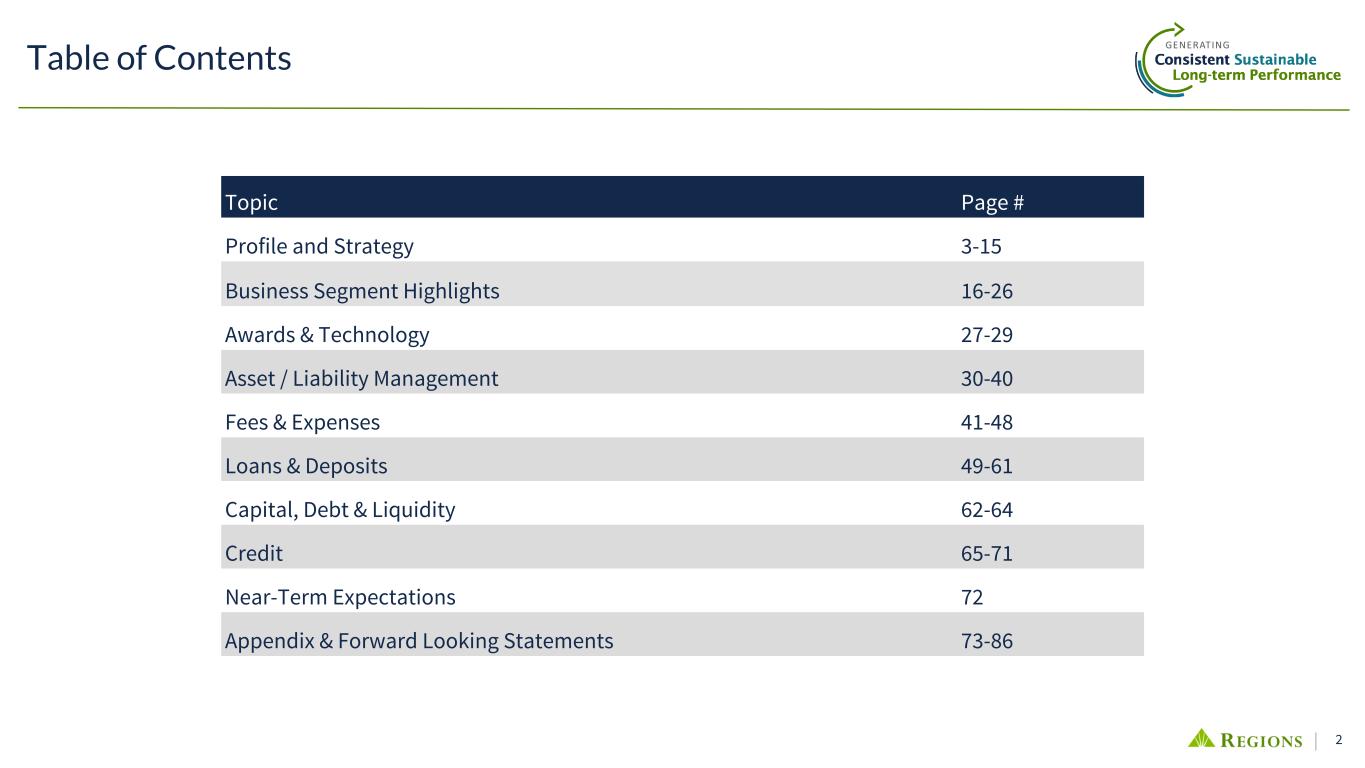
2 Table of Contents Topic Page # Profile and Strategy 3-15 Business Segment Highlights 16-26 Awards & Technology 27-29 Asset / Liability Management 30-40 Fees & Expenses 41-48 Loans & Deposits 49-61 Capital, Debt & Liquidity 62-64 Credit 65-71 Near-Term Expectations 72 Appendix & Forward Looking Statements 73-86
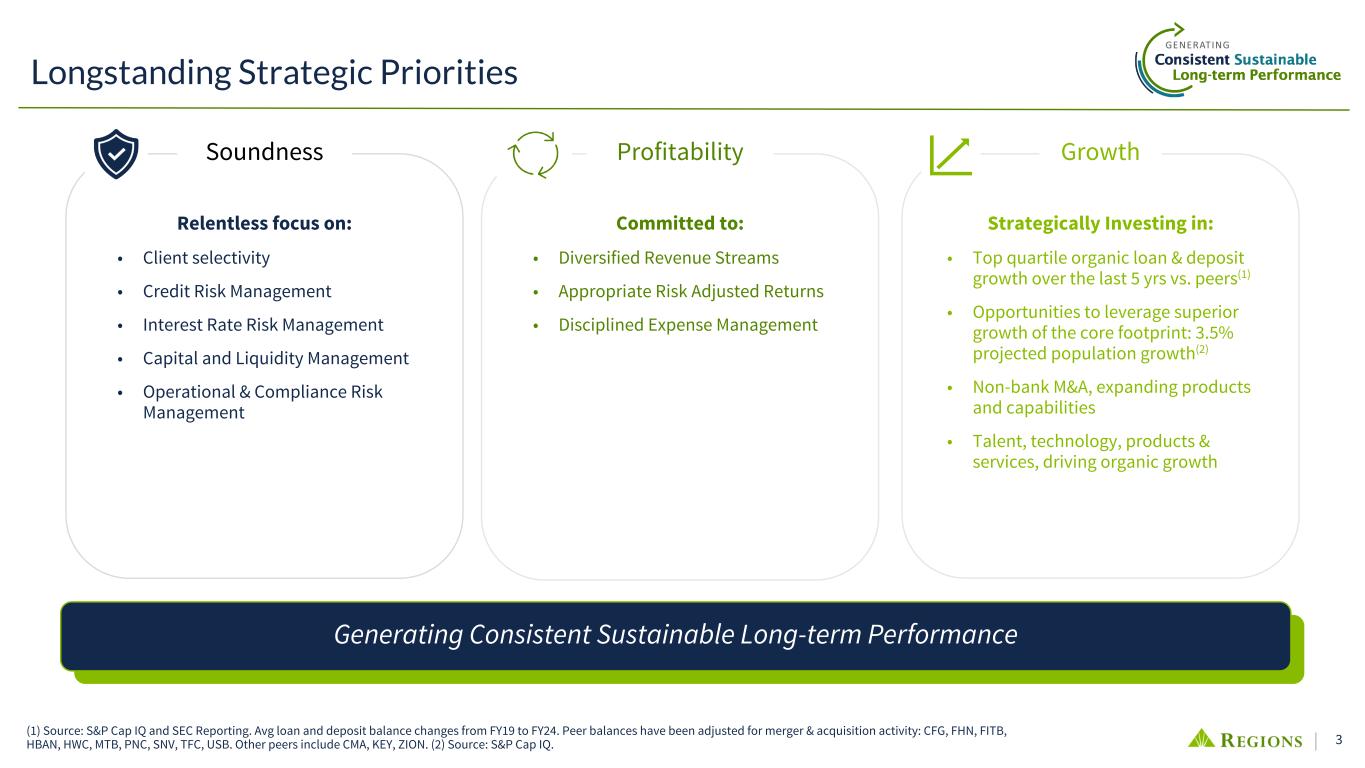
3 Longstanding Strategic Priorities Committed to: • Diversified Revenue Streams • Appropriate Risk Adjusted Returns • Disciplined Expense Management Profitability Strategically Investing in: • Top quartile organic loan & deposit growth over the last 5 yrs vs. peers(1) • Opportunities to leverage superior growth of the core footprint: 3.5% projected population growth(2) • Non-bank M&A, expanding products and capabilities • Talent, technology, products & services, driving organic growth Growth Relentless focus on: • Client selectivity • Credit Risk Management • Interest Rate Risk Management • Capital and Liquidity Management • Operational & Compliance Risk Management Soundness (1) Source: S&P Cap IQ and SEC Reporting. Avg loan and deposit balance changes from FY19 to FY24. Peer balances have been adjusted for merger & acquisition activity: CFG, FHN, FITB, HBAN, HWC, MTB, PNC, SNV, TFC, USB. Other peers include CMA, KEY, ZION. (2) Source: S&P Cap IQ. Generating Consistent Sustainable Long-term Performance
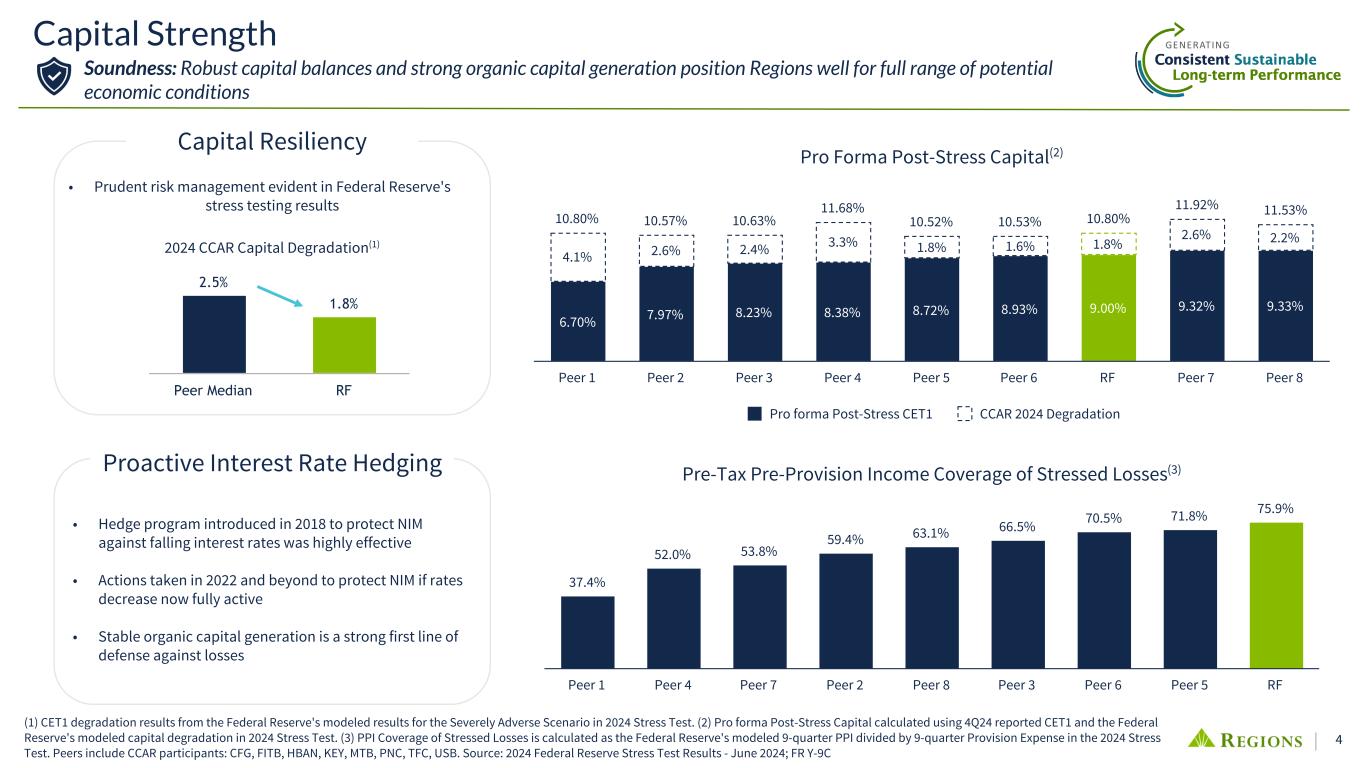
4 • Prudent risk management evident in Federal Reserve's stress testing results 2.5% 1.8% Peer Median RF • Hedge program introduced in 2018 to protect NIM against falling interest rates was highly effective • Actions taken in 2022 and beyond to protect NIM if rates decrease now fully active • Stable organic capital generation is a strong first line of defense against losses 2024 CCAR Capital Degradation(1) Proactive Interest Rate Hedging Capital Resiliency (1) CET1 degradation results from the Federal Reserve's modeled results for the Severely Adverse Scenario in 2024 Stress Test. (2) Pro forma Post-Stress Capital calculated using 4Q24 reported CET1 and the Federal Reserve's modeled capital degradation in 2024 Stress Test. (3) PPI Coverage of Stressed Losses is calculated as the Federal Reserve's modeled 9-quarter PPI divided by 9-quarter Provision Expense in the 2024 Stress Test. Peers include CCAR participants: CFG, FITB, HBAN, KEY, MTB, PNC, TFC, USB. Source: 2024 Federal Reserve Stress Test Results - June 2024; FR Y-9C 10.80% 10.57% 10.63% 11.68% 10.52% 10.53% 10.80% 11.92% 11.53% 6.70% 7.97% 8.23% 8.38% 8.72% 8.93% 9.00% 9.32% 9.33% 4.1% 2.6% 2.4% 3.3% 1.8% 1.6% 1.8% 2.6% 2.2% Pro forma Post-Stress CET1 CCAR 2024 Degradation Peer 1 Peer 2 Peer 3 Peer 4 Peer 5 Peer 6 RF Peer 7 Peer 8 37.4% 52.0% 53.8% 59.4% 63.1% 66.5% 70.5% 71.8% 75.9% Peer 1 Peer 4 Peer 7 Peer 2 Peer 8 Peer 3 Peer 6 Peer 5 RF Pro Forma Post-Stress Capital(2) Pre-Tax Pre-Provision Income Coverage of Stressed Losses(3) Capital Strength Soundness: Robust capital balances and strong organic capital generation position Regions well for full range of potential economic conditions
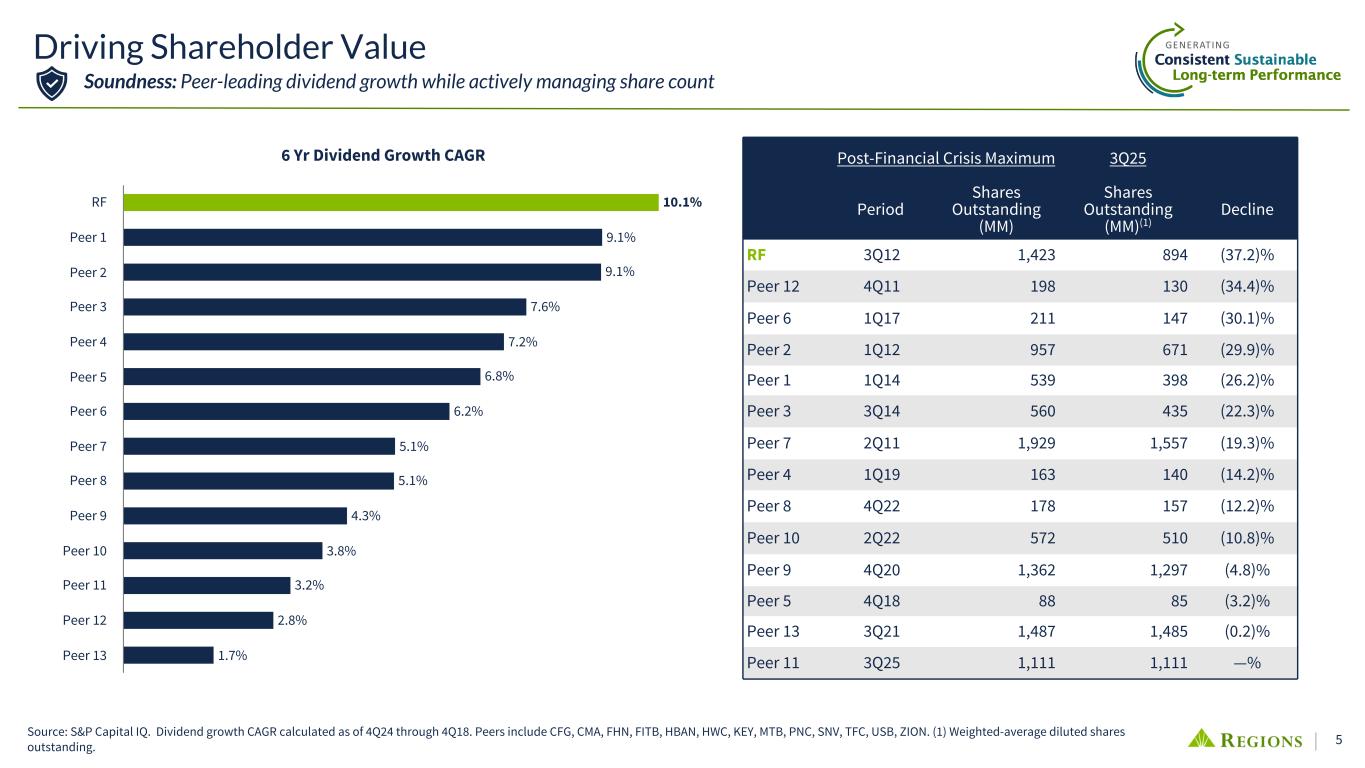
5 Driving Shareholder Value Soundness: Peer-leading dividend growth while actively managing share count Post-Financial Crisis Maximum 3Q25 Period Shares Outstanding (MM) Shares Outstanding (MM)(1) Decline RF 3Q12 1,423 894 (37.2)% Peer 12 4Q11 198 130 (34.4)% Peer 6 1Q17 211 147 (30.1)% Peer 2 1Q12 957 671 (29.9)% Peer 1 1Q14 539 398 (26.2)% Peer 3 3Q14 560 435 (22.3)% Peer 7 2Q11 1,929 1,557 (19.3)% Peer 4 1Q19 163 140 (14.2)% Peer 8 4Q22 178 157 (12.2)% Peer 10 2Q22 572 510 (10.8)% Peer 9 4Q20 1,362 1,297 (4.8)% Peer 5 4Q18 88 85 (3.2)% Peer 13 3Q21 1,487 1,485 (0.2)% Peer 11 3Q25 1,111 1,111 —% 6 Yr Dividend Growth CAGR 10.1% 9.1% 9.1% 7.6% 7.2% 6.8% 6.2% 5.1% 5.1% 4.3% 3.8% 3.2% 2.8% 1.7% RF Peer 1 Peer 2 Peer 3 Peer 4 Peer 5 Peer 6 Peer 7 Peer 8 Peer 9 Peer 10 Peer 11 Peer 12 Peer 13 Source: S&P Capital IQ. Dividend growth CAGR calculated as of 4Q24 through 4Q18. Peers include CFG, CMA, FHN, FITB, HBAN, HWC, KEY, MTB, PNC, SNV, TFC, USB, ZION. (1) Weighted-average diluted shares outstanding.
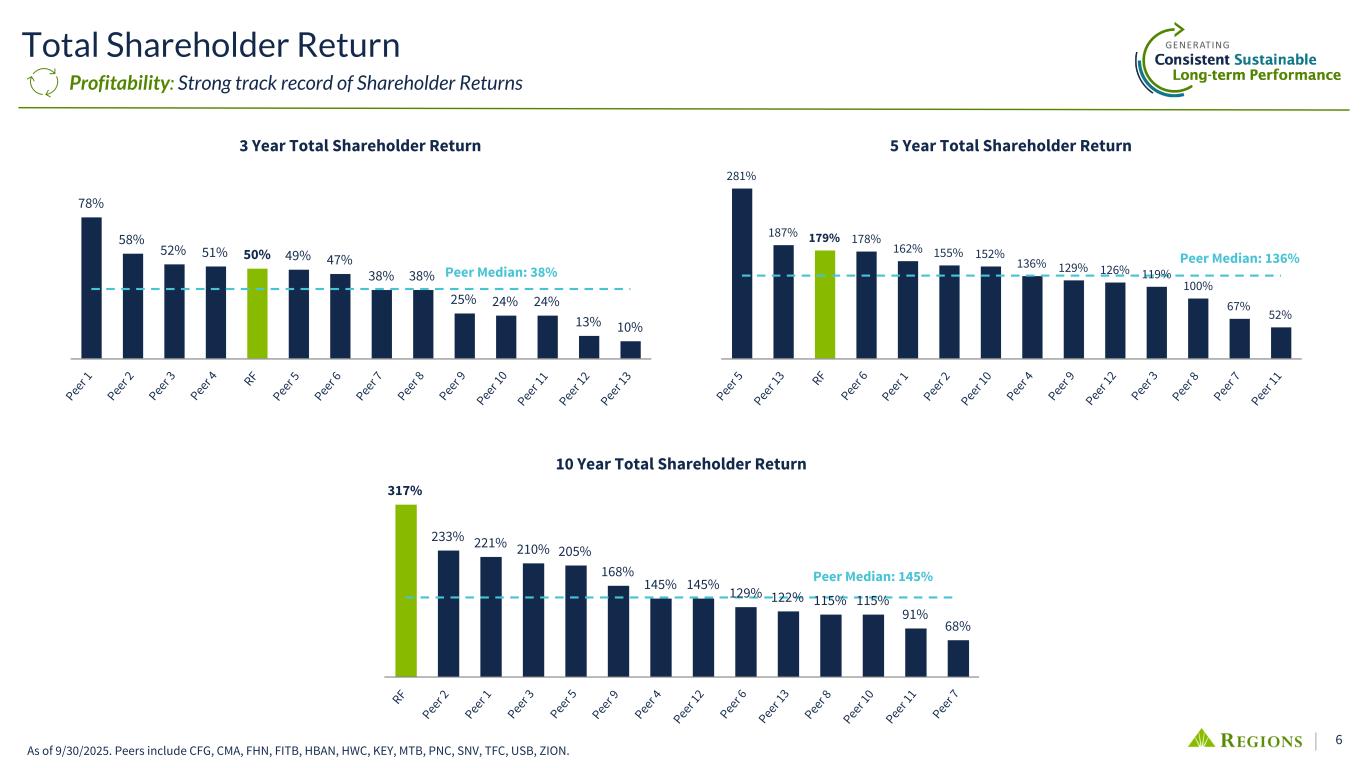
6 3 Year Total Shareholder Return 78% 58% 52% 51% 50% 49% 47% 38% 38% 25% 24% 24% 13% 10% Peer 1 Peer 2 Peer 3 Peer 4 RF Peer 5 Peer 6 Peer 7 Peer 8 Peer 9 Peer 1 0 Peer 1 1 Peer 1 2 Peer 1 3 5 Year Total Shareholder Return 281% 187% 179% 178% 162% 155% 152% 136% 129% 126% 119% 100% 67% 52% Peer 5 Peer 1 3 RF Peer 6 Peer 1 Peer 2 Peer 1 0 Peer 4 Peer 9 Peer 1 2 Peer 3 Peer 8 Peer 7 Peer 1 1 Total Shareholder Return 10 Year Total Shareholder Return 317% 233% 221% 210% 205% 168% 145% 145% 129% 122% 115% 115% 91% 68% RF Peer 2 Peer 1 Peer 3 Peer 5 Peer 9 Peer 4 Peer 1 2 Peer 6 Peer 1 3 Peer 8 Peer 1 0 Peer 1 1 Peer 7 Peer Median: 38% Peer Median: 136% Peer Median: 145% As of 9/30/2025. Peers include CFG, CMA, FHN, FITB, HBAN, HWC, KEY, MTB, PNC, SNV, TFC, USB, ZION. Profitability: Strong track record of Shareholder Returns
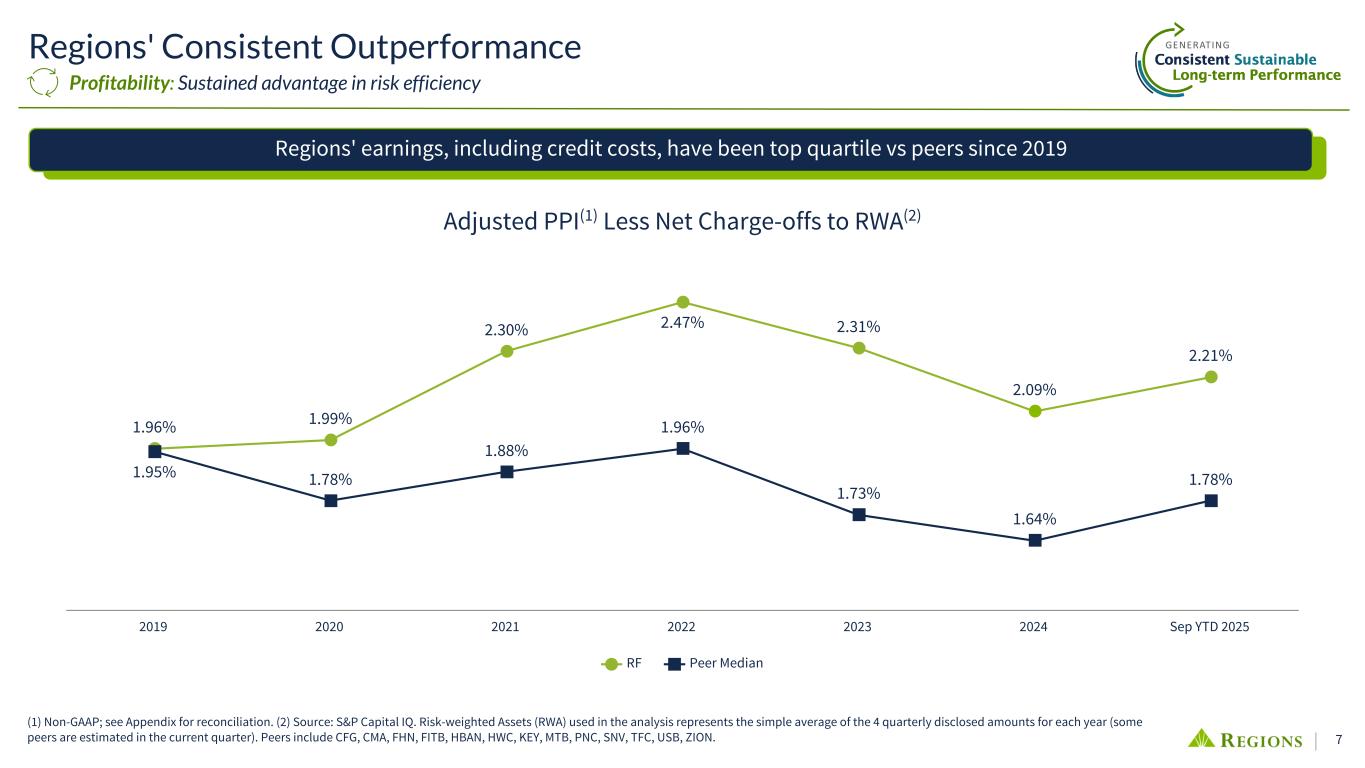
7 Regions' Consistent Outperformance Adjusted PPI(1) Less Net Charge-offs to RWA(2) 1.96% 1.99% 2.30% 2.47% 2.31% 2.09% 2.21% 1.95% 1.78% 1.88% 1.96% 1.73% 1.64% 1.78% RF Peer Median 2019 2020 2021 2022 2023 2024 Sep YTD 2025 (1) Non-GAAP; see Appendix for reconciliation. (2) Source: S&P Capital IQ. Risk-weighted Assets (RWA) used in the analysis represents the simple average of the 4 quarterly disclosed amounts for each year (some peers are estimated in the current quarter). Peers include CFG, CMA, FHN, FITB, HBAN, HWC, KEY, MTB, PNC, SNV, TFC, USB, ZION. Profitability: Sustained advantage in risk efficiency Regions' earnings, including credit costs, have been top quartile vs peers since 2019
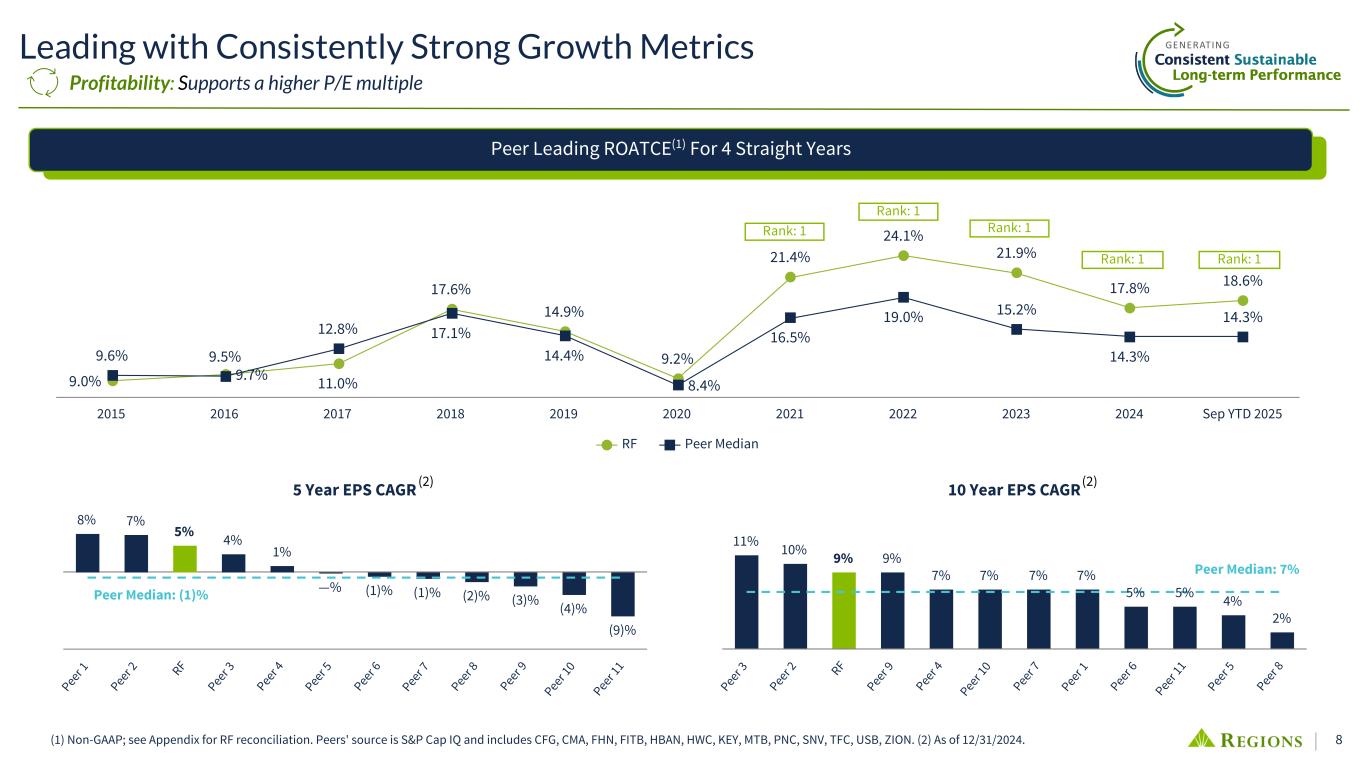
8 9.0% 9.7% 11.0% 17.6% 14.9% 9.2% 21.4% 24.1% 21.9% 17.8% 18.6% 9.6% 9.5% 12.8% 17.1% 14.4% 8.4% 16.5% 19.0% 15.2% 14.3% 14.3% RF Peer Median 2015 2016 2017 2018 2019 2020 2021 2022 2023 2024 Sep YTD 2025 (1) Non-GAAP; see Appendix for RF reconciliation. Peers' source is S&P Cap IQ and includes CFG, CMA, FHN, FITB, HBAN, HWC, KEY, MTB, PNC, SNV, TFC, USB, ZION. (2) As of 12/31/2024. Rank: 1 Rank: 1 Rank: 1Rank: 1 5 Year EPS CAGR 8% 7% 5% 4% 1% —% (1)% (1)% (2)% (3)% (4)% (9)% Peer 1 Peer 2 RF Peer 3 Peer 4 Peer 5 Peer 6 Peer 7 Peer 8 Peer 9 Peer 1 0 Peer 1 1 10 Year EPS CAGR 11% 10% 9% 9% 7% 7% 7% 7% 5% 5% 4% 2% Peer 3 Peer 2 RF Peer 9 Peer 4 Peer 1 0 Peer 7 Peer 1 Peer 6 Peer 1 1 Peer 5 Peer 8 Peer Leading ROATCE(1) For 4 Straight Years Peer Median: (1)% Peer Median: 7% (2) (2) Leading with Consistently Strong Growth Metrics Profitability: Supports a higher P/E multiple Rank: 1
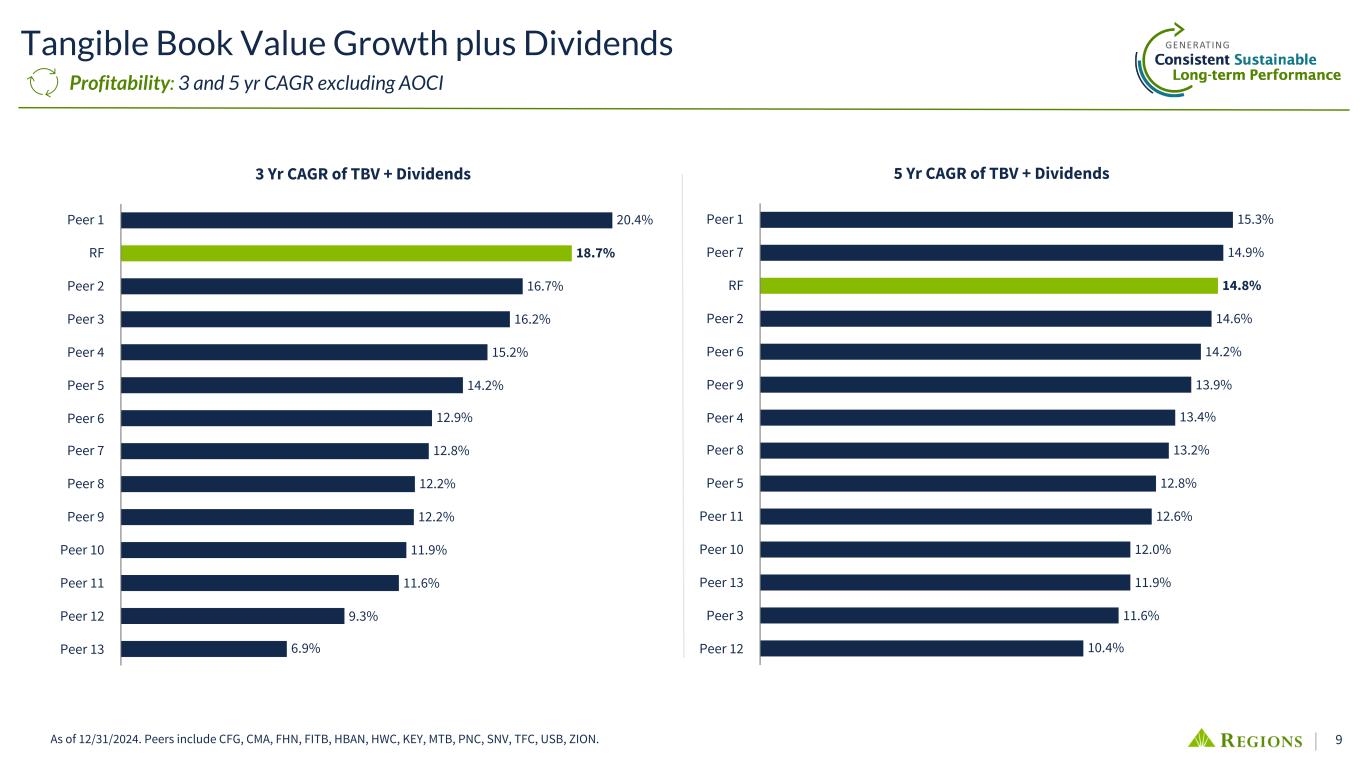
9 Tangible Book Value Growth plus Dividends 3 Yr CAGR of TBV + Dividends 20.4% 18.7% 16.7% 16.2% 15.2% 14.2% 12.9% 12.8% 12.2% 12.2% 11.9% 11.6% 9.3% 6.9% Peer 1 RF Peer 2 Peer 3 Peer 4 Peer 5 Peer 6 Peer 7 Peer 8 Peer 9 Peer 10 Peer 11 Peer 12 Peer 13 5 Yr CAGR of TBV + Dividends 15.3% 14.9% 14.8% 14.6% 14.2% 13.9% 13.4% 13.2% 12.8% 12.6% 12.0% 11.9% 11.6% 10.4% Peer 1 Peer 7 RF Peer 2 Peer 6 Peer 9 Peer 4 Peer 8 Peer 5 Peer 11 Peer 10 Peer 13 Peer 3 Peer 12 As of 12/31/2024. Peers include CFG, CMA, FHN, FITB, HBAN, HWC, KEY, MTB, PNC, SNV, TFC, USB, ZION. Profitability: 3 and 5 yr CAGR excluding AOCI
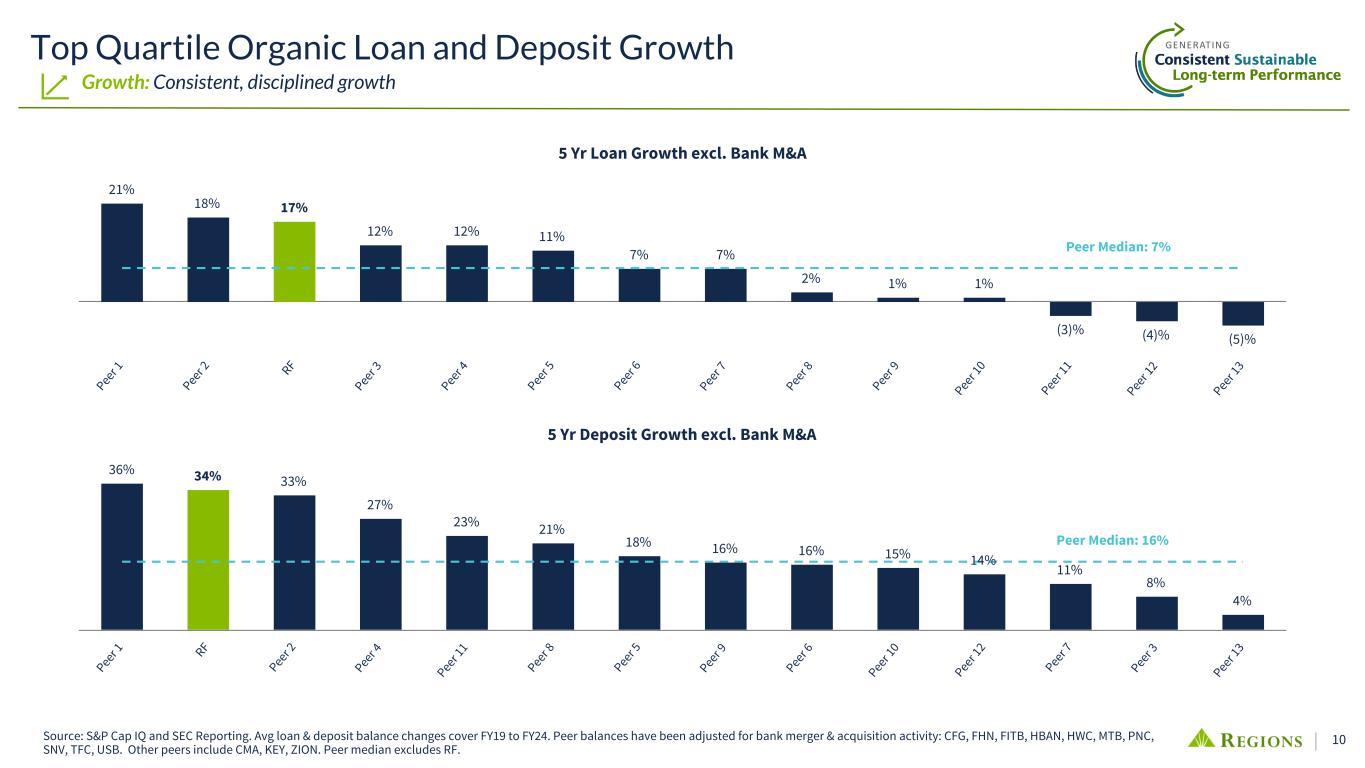
10 Top Quartile Organic Loan and Deposit Growth Growth: Consistent, disciplined growth 5 Yr Loan Growth excl. Bank M&A 21% 18% 17% 12% 12% 11% 7% 7% 2% 1% 1% (3)% (4)% (5)% Peer 1 Peer 2 RF Peer 3 Peer 4 Peer 5 Peer 6 Peer 7 Peer 8 Peer 9 Peer 1 0 Peer 1 1 Peer 1 2 Peer 1 3 Source: S&P Cap IQ and SEC Reporting. Avg loan & deposit balance changes cover FY19 to FY24. Peer balances have been adjusted for bank merger & acquisition activity: CFG, FHN, FITB, HBAN, HWC, MTB, PNC, SNV, TFC, USB. Other peers include CMA, KEY, ZION. Peer median excludes RF. Peer Median: 7% 5 Yr Deposit Growth excl. Bank M&A 36% 34% 33% 27% 23% 21% 18% 16% 16% 15% 14% 11% 8% 4% Peer 1 RF Peer 2 Peer 4 Peer 1 1 Peer 8 Peer 5 Peer 9 Peer 6 Peer 1 0 Peer 1 2 Peer 7 Peer 3 Peer 1 3 Peer Median: 16%
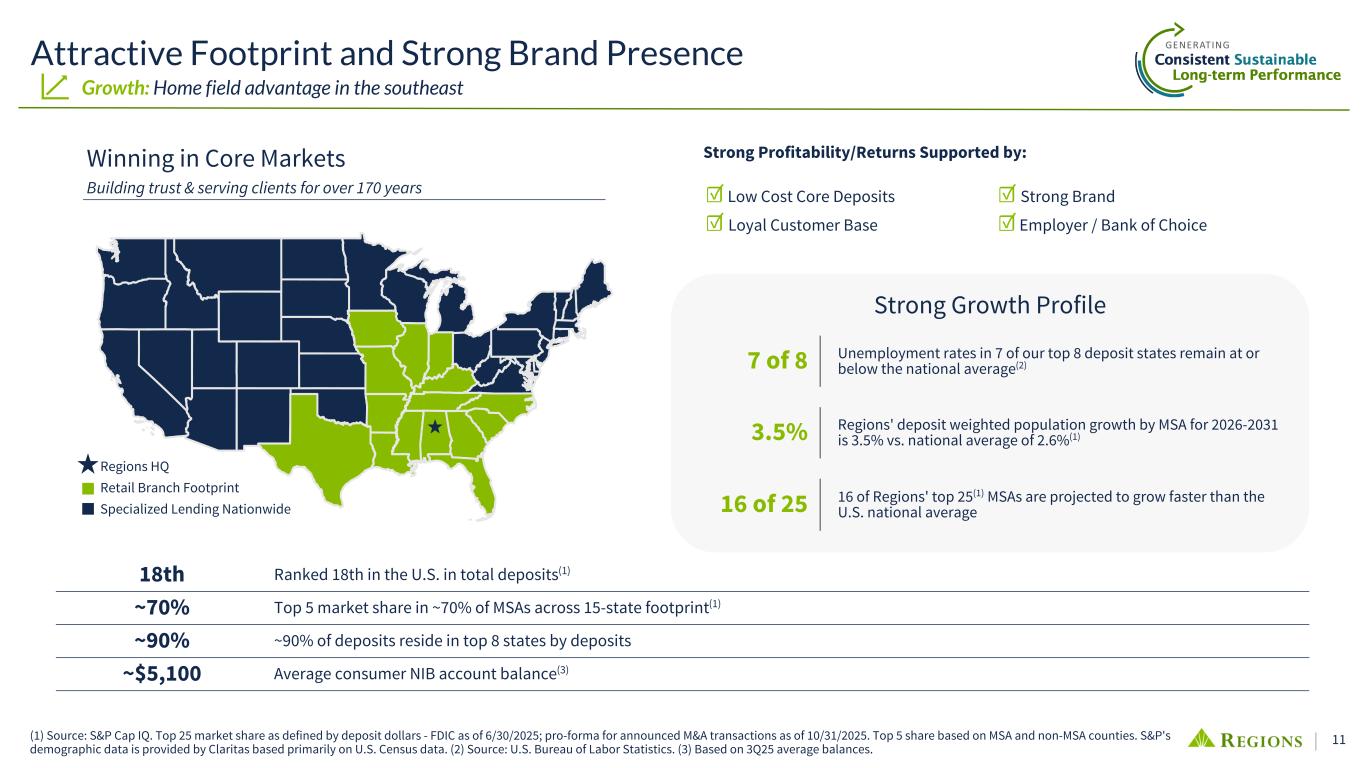
11 Strong Growth Profile Attractive Footprint and Strong Brand Presence Growth: Home field advantage in the southeast Regions HQ Retail Branch Footprint Specialized Lending Nationwide Winning in Core Markets Building trust & serving clients for over 170 years Strong Profitability/Returns Supported by: ☑ Low Cost Core Deposits ☑ Strong Brand ☑ Loyal Customer Base ☑ Employer / Bank of Choice 18th Ranked 18th in the U.S. in total deposits(1) ~70% Top 5 market share in ~70% of MSAs across 15-state footprint(1) ~90% ~90% of deposits reside in top 8 states by deposits ~$5,100 Average consumer NIB account balance(3) 7 of 8 Unemployment rates in 7 of our top 8 deposit states remain at or below the national average(2) 3.5% Regions' deposit weighted population growth by MSA for 2026-2031 is 3.5% vs. national average of 2.6%(1) 16 of 25 16 of Regions' top 25(1) MSAs are projected to grow faster than the U.S. national average (1) Source: S&P Cap IQ. Top 25 market share as defined by deposit dollars - FDIC as of 6/30/2025; pro-forma for announced M&A transactions as of 10/31/2025. Top 5 share based on MSA and non-MSA counties. S&P's demographic data is provided by Claritas based primarily on U.S. Census data. (2) Source: U.S. Bureau of Labor Statistics. (3) Based on 3Q25 average balances.
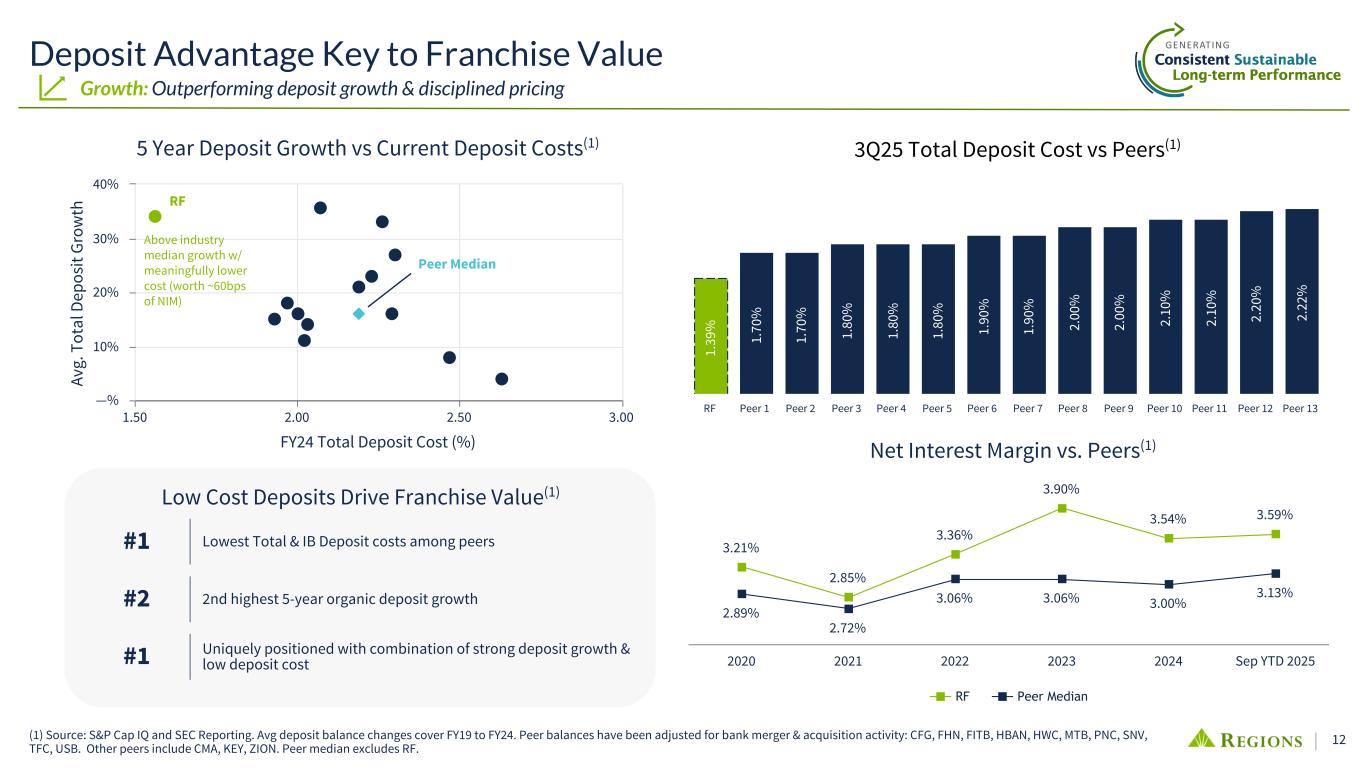
12 Deposit Advantage Key to Franchise Value Growth: Outperforming deposit growth & disciplined pricing FY24 Total Deposit Cost (%) Av g. T ot al D ep os it Gr ow th 1.50 2.00 2.50 3.00 —% 10% 20% 30% 40% RF Peer Median 5 Year Deposit Growth vs Current Deposit Costs(1) Above industry median growth w/ meaningfully lower cost (worth ~60bps of NIM) 1. 39 % 1. 70 % 1. 70 % 1. 80 % 1. 80 % 1. 80 % 1. 90 % 1. 90 % 2. 00 % 2. 00 % 2. 10 % 2. 10 % 2. 20 % 2. 22 % RF Peer 1 Peer 2 Peer 3 Peer 4 Peer 5 Peer 6 Peer 7 Peer 8 Peer 9 Peer 10 Peer 11 Peer 12 Peer 13 3Q25 Total Deposit Cost vs Peers(1) (1) Source: S&P Cap IQ and SEC Reporting. Avg deposit balance changes cover FY19 to FY24. Peer balances have been adjusted for bank merger & acquisition activity: CFG, FHN, FITB, HBAN, HWC, MTB, PNC, SNV, TFC, USB. Other peers include CMA, KEY, ZION. Peer median excludes RF. 3.21% 2.85% 3.36% 3.90% 3.54% 3.59% 2.89% 2.72% 3.06% 3.06% 3.00% 3.13% RF Peer Median 2020 2021 2022 2023 2024 Sep YTD 2025 Net Interest Margin vs. Peers(1) Low Cost Deposits Drive Franchise Value(1) #1 Lowest Total & IB Deposit costs among peers #2 2nd highest 5-year organic deposit growth #1 Uniquely positioned with combination of strong deposit growth & low deposit cost
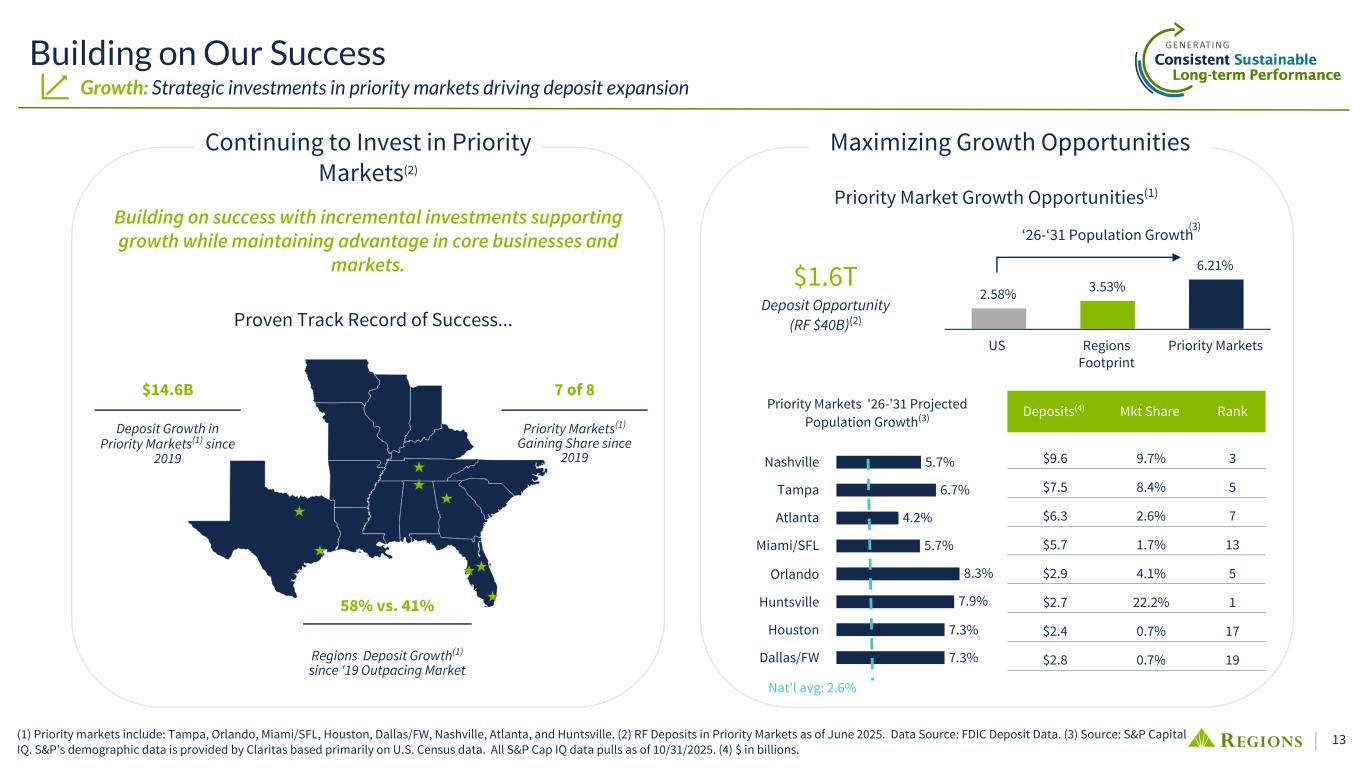
13 ‘26-‘31 Population Growth 2.58% 3.53% 6.21% US Regions Footprint Priority Markets Priority Market Growth Opportunities(1) 5.7% 6.7% 4.2% 5.7% 8.3% 7.9% 7.3% 7.3% Nashville Tampa Atlanta Miami/SFL Orlando Huntsville Houston Dallas/FW Building on Our Success Growth: Strategic investments in priority markets driving deposit expansion (1) Priority markets include: Tampa, Orlando, Miami/SFL, Houston, Dallas/FW, Nashville, Atlanta, and Huntsville. (2) RF Deposits in Priority Markets as of June 2025. Data Source: FDIC Deposit Data. (3) Source: S&P Capital IQ. S&P's demographic data is provided by Claritas based primarily on U.S. Census data. All S&P Cap IQ data pulls as of 10/31/2025. (4) $ in billions. Nat'l avg: 2.6% Priority Markets '26-'31 Projected Population Growth(3) 58% vs. 41% Regions Deposit Growth(1) since '19 Outpacing Market Continuing to Invest in Priority Markets(2) Proven Track Record of Success... Maximizing Growth Opportunities (3) $1.6T Deposit Opportunity (RF $40B)(2) Building on success with incremental investments supporting growth while maintaining advantage in core businesses and markets. 7 of 8 Priority Markets(1) Gaining Share since 2019 $14.6B Deposit Growth in Priority Markets(1) since 2019 Deposits(4) Mkt Share Rank $9.6 9.7% 3 $7.5 8.4% 5 $6.3 2.6% 7 $5.7 1.7% 13 $2.9 4.1% 5 $2.7 22.2% 1 $2.4 0.7% 17 $2.8 0.7% 19
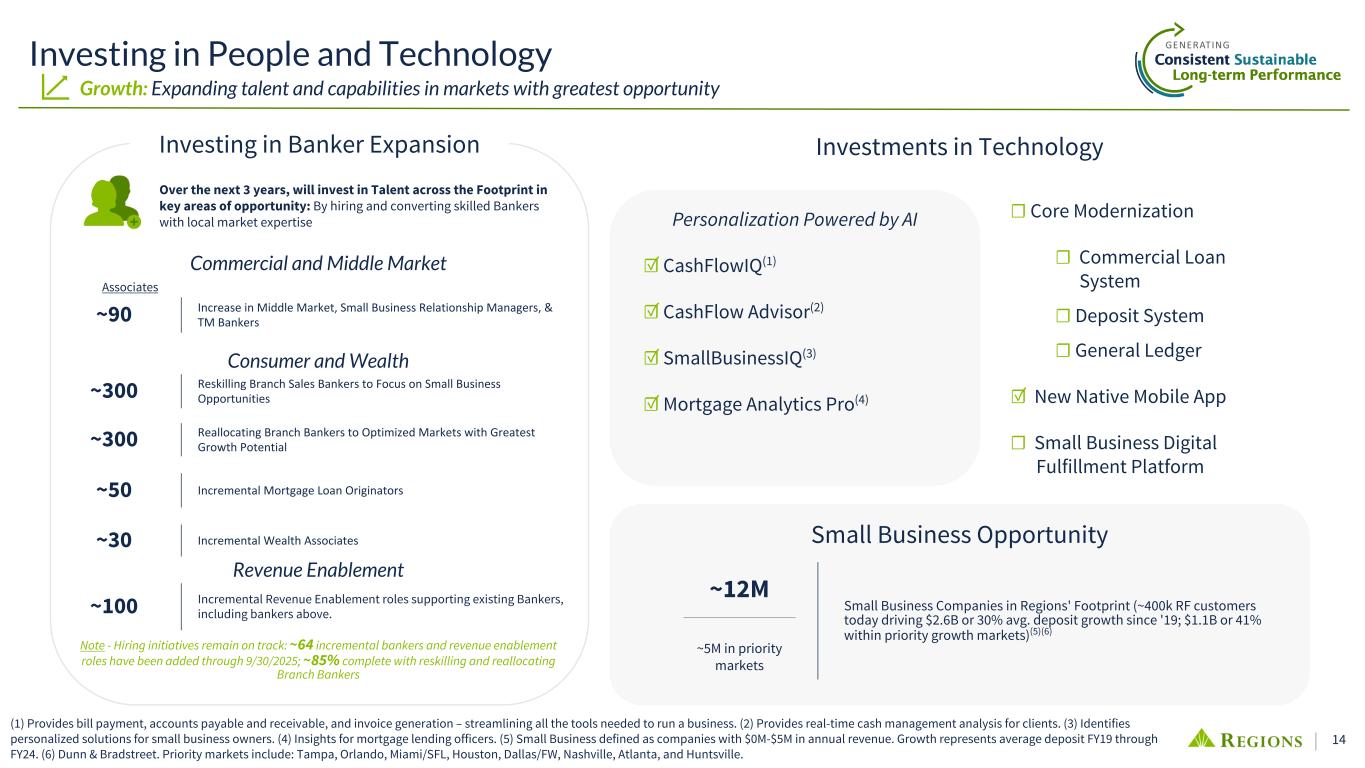
14 Over the next 3 years, will invest in Talent across the Footprint in key areas of opportunity: By hiring and converting skilled Bankers with local market expertise Commercial and Middle Market Associates ~90 Increase in Middle Market, Small Business Relationship Managers, & TM Bankers Consumer and Wealth ~300 Reskilling Branch Sales Bankers to Focus on Small Business Opportunities ~300 Reallocating Branch Bankers to Optimized Markets with Greatest Growth Potential ~50 Incremental Mortgage Loan Originators ~30 Incremental Wealth Associates Revenue Enablement ~100 Incremental Revenue Enablement roles supporting existing Bankers, including bankers above. Note - Hiring initiatives remain on track: ~64 incremental bankers and revenue enablement roles have been added through 9/30/2025; ~85% complete with reskilling and reallocating Branch Bankers Investing in Banker Expansion (1) Provides bill payment, accounts payable and receivable, and invoice generation – streamlining all the tools needed to run a business. (2) Provides real-time cash management analysis for clients. (3) Identifies personalized solutions for small business owners. (4) Insights for mortgage lending officers. (5) Small Business defined as companies with $0M-$5M in annual revenue. Growth represents average deposit FY19 through FY24. (6) Dunn & Bradstreet. Priority markets include: Tampa, Orlando, Miami/SFL, Houston, Dallas/FW, Nashville, Atlanta, and Huntsville. Investing in People and Technology Growth: Expanding talent and capabilities in markets with greatest opportunity ☐ Core Modernization ☐ Commercial Loan System ☐ Deposit System ☐ General Ledger ☑ New Native Mobile App ☐ Small Business Digital Fulfillment Platform Investments in Technology Personalization Powered by AI ☑ CashFlowIQ(1) ☑ CashFlow Advisor(2) ☑ SmallBusinessIQ(3) ☑ Mortgage Analytics Pro(4) Small Business Opportunity ~12M Small Business Companies in Regions' Footprint (~400k RF customers today driving $2.6B or 30% avg. deposit growth since '19; $1.1B or 41% within priority growth markets)(5)(6) ~5M in priority markets
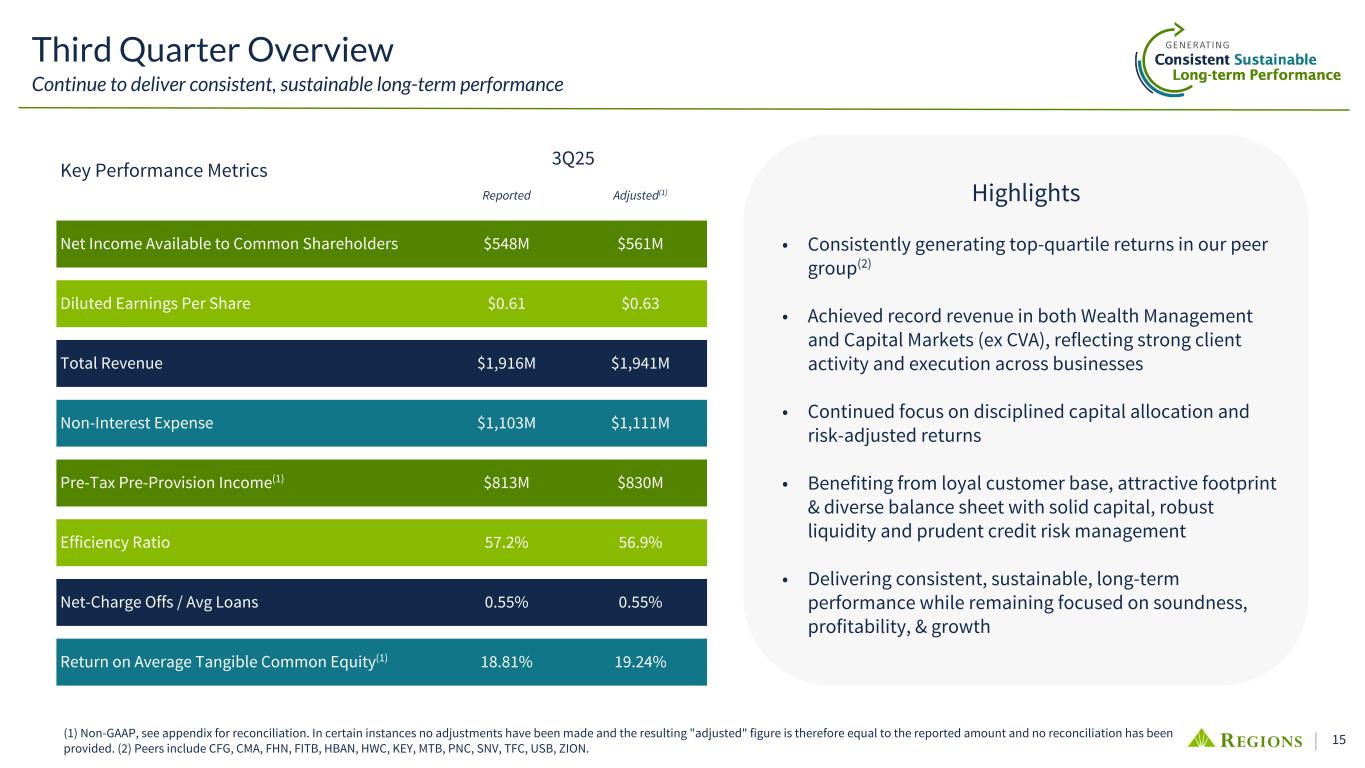
15 Third Quarter Overview Continue to deliver consistent, sustainable long-term performance (1) Non-GAAP, see appendix for reconciliation. In certain instances no adjustments have been made and the resulting "adjusted" figure is therefore equal to the reported amount and no reconciliation has been provided. (2) Peers include CFG, CMA, FHN, FITB, HBAN, HWC, KEY, MTB, PNC, SNV, TFC, USB, ZION. Key Performance Metrics 3Q25 Reported Adjusted(1) Net Income Available to Common Shareholders $548M $561M Diluted Earnings Per Share $0.61 $0.63 Total Revenue $1,916M $1,941M Non-Interest Expense $1,103M $1,111M Pre-Tax Pre-Provision Income(1) $813M $830M Efficiency Ratio 57.2% 56.9% Net-Charge Offs / Avg Loans 0.55% 0.55% Return on Average Tangible Common Equity(1) 18.81% 19.24% Highlights • Consistently generating top-quartile returns in our peer group(2) • Achieved record revenue in both Wealth Management and Capital Markets (ex CVA), reflecting strong client activity and execution across businesses • Continued focus on disciplined capital allocation and risk-adjusted returns • Benefiting from loyal customer base, attractive footprint & diverse balance sheet with solid capital, robust liquidity and prudent credit risk management • Delivering consistent, sustainable, long-term performance while remaining focused on soundness, profitability, & growth
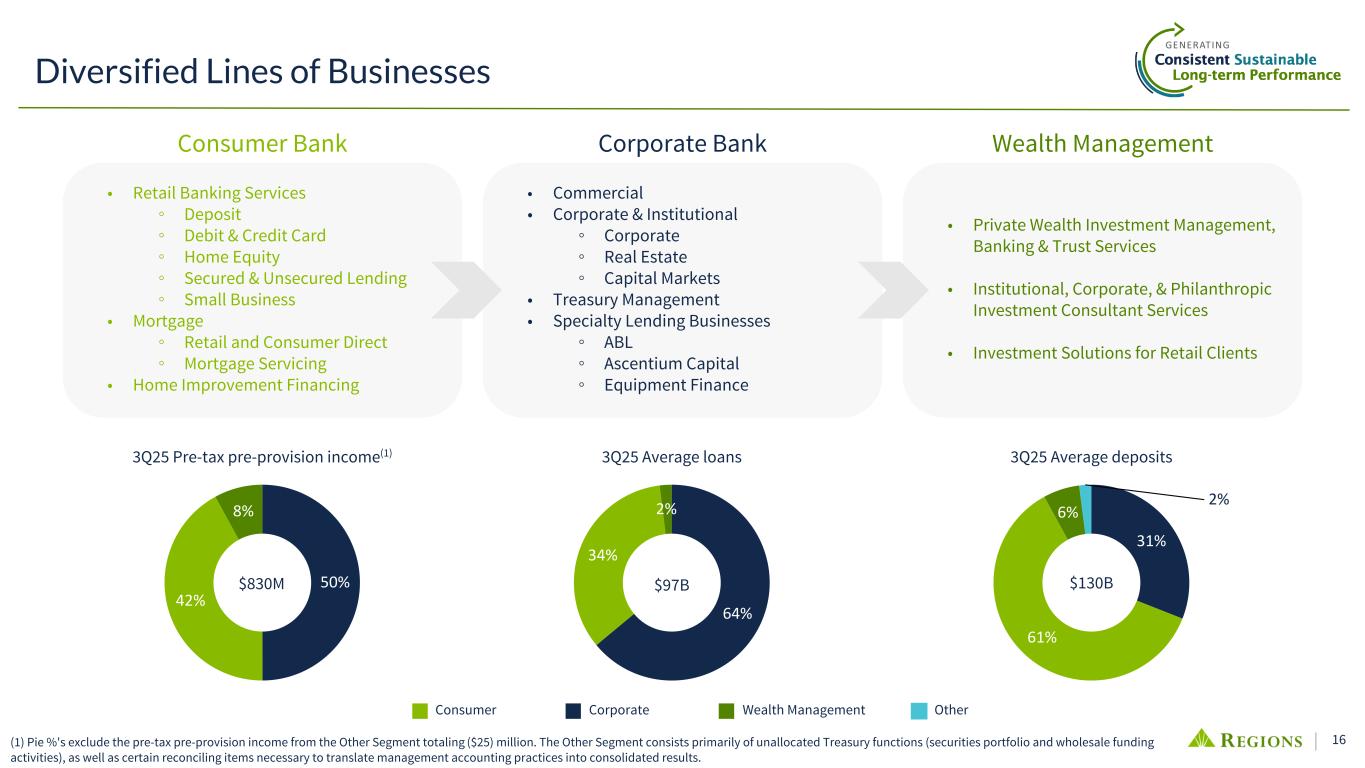
16 Diversified Lines of Businesses • Retail Banking Services ◦ Deposit ◦ Debit & Credit Card ◦ Home Equity ◦ Secured & Unsecured Lending ◦ Small Business • Mortgage ◦ Retail and Consumer Direct ◦ Mortgage Servicing • Home Improvement Financing • Commercial • Corporate & Institutional ◦ Corporate ◦ Real Estate ◦ Capital Markets • Treasury Management • Specialty Lending Businesses ◦ ABL ◦ Ascentium Capital ◦ Equipment Finance • Private Wealth Investment Management, Banking & Trust Services • Institutional, Corporate, & Philanthropic Investment Consultant Services • Investment Solutions for Retail Clients Consumer Bank Corporate Bank Wealth Management (1) Pie %'s exclude the pre-tax pre-provision income from the Other Segment totaling ($25) million. The Other Segment consists primarily of unallocated Treasury functions (securities portfolio and wholesale funding activities), as well as certain reconciling items necessary to translate management accounting practices into consolidated results. 50% 42% 8% 64% 34% 2% 31% 61% 6% 2% $830M $97B $130B Consumer Corporate Wealth Management Other 3Q25 Pre-tax pre-provision income(1) 3Q25 Average deposits3Q25 Average loans
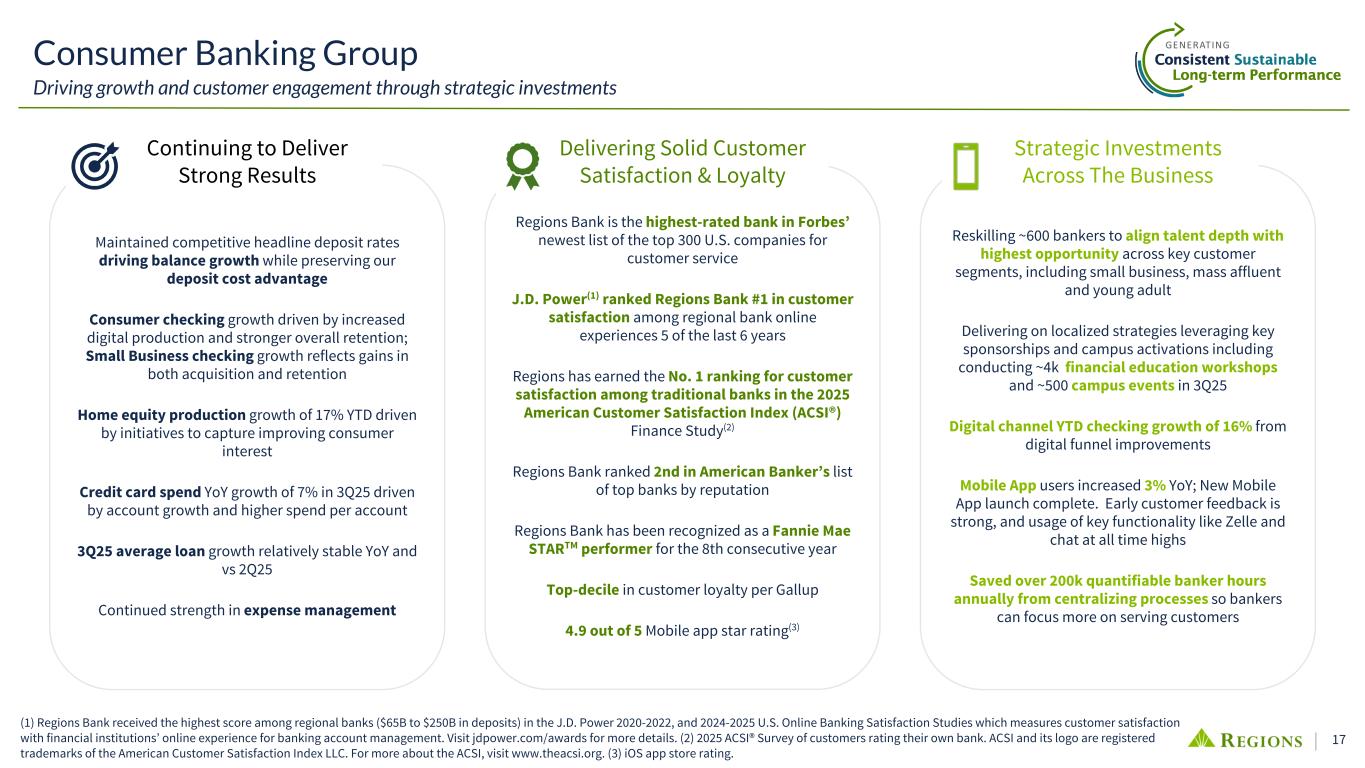
17 Consumer Banking Group Driving growth and customer engagement through strategic investments (1) Regions Bank received the highest score among regional banks ($65B to $250B in deposits) in the J.D. Power 2020-2022, and 2024-2025 U.S. Online Banking Satisfaction Studies which measures customer satisfaction with financial institutions’ online experience for banking account management. Visit jdpower.com/awards for more details. (2) 2025 ACSI® Survey of customers rating their own bank. ACSI and its logo are registered trademarks of the American Customer Satisfaction Index LLC. For more about the ACSI, visit www.theacsi.org. (3) iOS app store rating. Maintained competitive headline deposit rates driving balance growth while preserving our deposit cost advantage Consumer checking growth driven by increased digital production and stronger overall retention; Small Business checking growth reflects gains in both acquisition and retention Home equity production growth of 17% YTD driven by initiatives to capture improving consumer interest Credit card spend YoY growth of 7% in 3Q25 driven by account growth and higher spend per account 3Q25 average loan growth relatively stable YoY and vs 2Q25 Continued strength in expense management Regions Bank is the highest-rated bank in Forbes’ newest list of the top 300 U.S. companies for customer service J.D. Power(1) ranked Regions Bank #1 in customer satisfaction among regional bank online experiences 5 of the last 6 years Regions has earned the No. 1 ranking for customer satisfaction among traditional banks in the 2025 American Customer Satisfaction Index (ACSI®) Finance Study(2) Regions Bank ranked 2nd in American Banker’s list of top banks by reputation Regions Bank has been recognized as a Fannie Mae STARTM performer for the 8th consecutive year Top-decile in customer loyalty per Gallup 4.9 out of 5 Mobile app star rating(3) Delivering Solid Customer Satisfaction & Loyalty Reskilling ~600 bankers to align talent depth with highest opportunity across key customer segments, including small business, mass affluent and young adult Delivering on localized strategies leveraging key sponsorships and campus activations including conducting ~4k financial education workshops and ~500 campus events in 3Q25 Digital channel YTD checking growth of 16% from digital funnel improvements Mobile App users increased 3% YoY; New Mobile App launch complete. Early customer feedback is strong, and usage of key functionality like Zelle and chat at all time highs Saved over 200k quantifiable banker hours annually from centralizing processes so bankers can focus more on serving customers Strategic Investments Across The Business Continuing to Deliver Strong Results
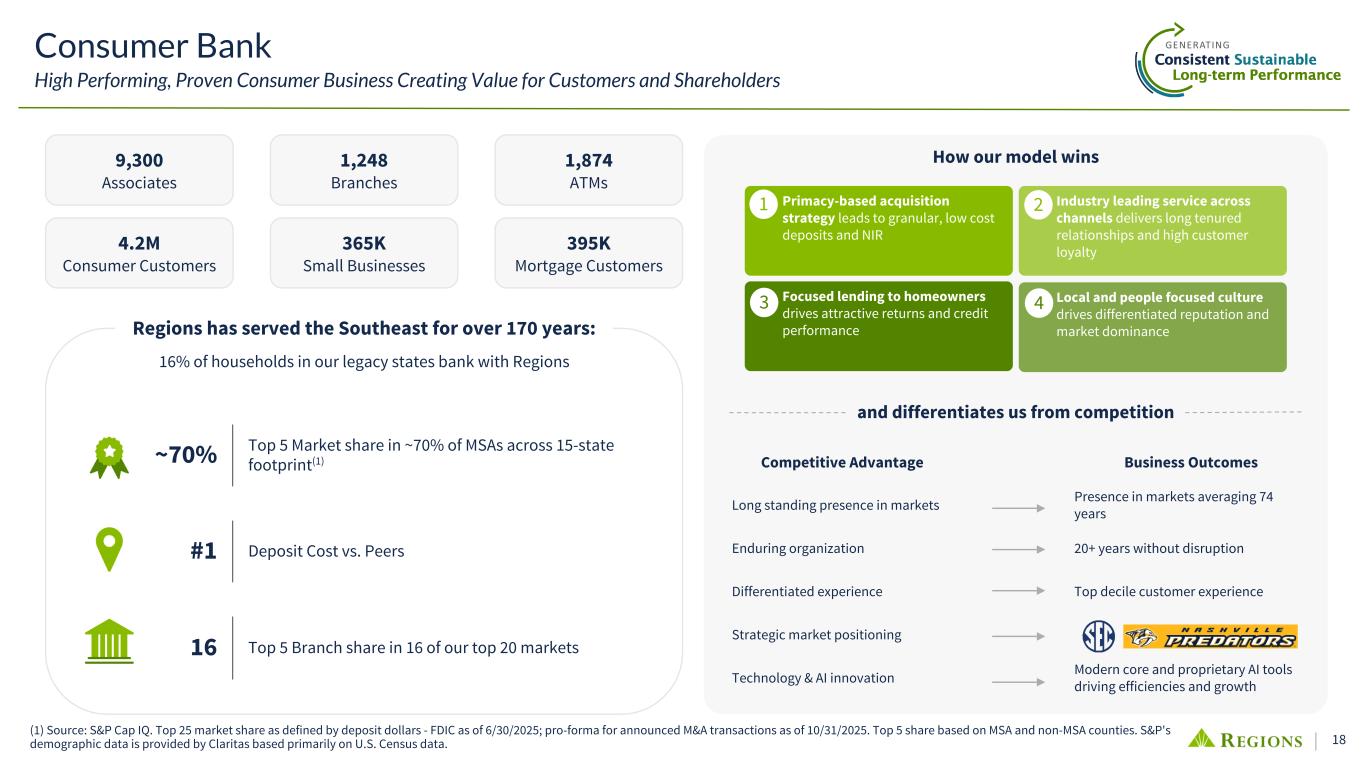
18 Consumer Bank High Performing, Proven Consumer Business Creating Value for Customers and Shareholders 9,300 Associates 1,248 Branches 1,874 ATMs 4.2M Consumer Customers 365K Small Businesses 395K Mortgage Customers and differentiates us from competition How our model wins Primacy-based acquisition strategy leads to granular, low cost deposits and NIR Industry leading service across channels delivers long tenured relationships and high customer loyalty Focused lending to homeowners drives attractive returns and credit performance Local and people focused culture drives differentiated reputation and market dominance 1 2 3 4 ~70% Top 5 Market share in ~70% of MSAs across 15-state footprint(1) #1 Deposit Cost vs. Peers 16 Top 5 Branch share in 16 of our top 20 markets Regions has served the Southeast for over 170 years: 16% of households in our legacy states bank with Regions Competitive Advantage Business Outcomes Long standing presence in markets Presence in markets averaging 74 years Enduring organization 20+ years without disruption Differentiated experience Top decile customer experience Strategic market positioning Technology & AI innovation Modern core and proprietary AI tools driving efficiencies and growth (1) Source: S&P Cap IQ. Top 25 market share as defined by deposit dollars - FDIC as of 6/30/2025; pro-forma for announced M&A transactions as of 10/31/2025. Top 5 share based on MSA and non-MSA counties. S&P's demographic data is provided by Claritas based primarily on U.S. Census data.
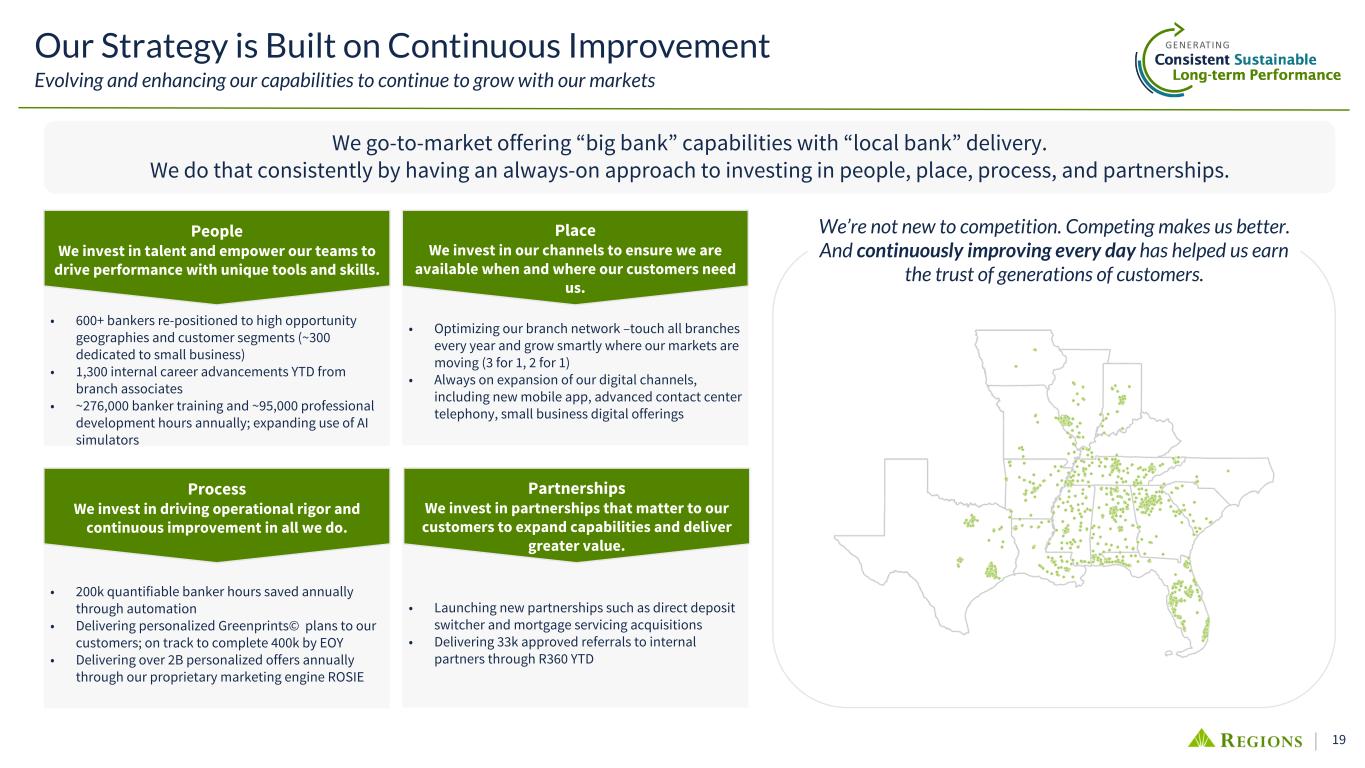
19 • 600+ bankers re-positioned to high opportunity geographies and customer segments (~300 dedicated to small business) • 1,300 internal career advancements YTD from branch associates • ~276,000 banker training and ~95,000 professional development hours annually; expanding use of AI simulators Our Strategy is Built on Continuous Improvement Evolving and enhancing our capabilities to continue to grow with our markets We go-to-market offering “big bank” capabilities with “local bank” delivery. We do that consistently by having an always-on approach to investing in people, place, process, and partnerships. People We invest in talent and empower our teams to drive performance with unique tools and skills. • 200k quantifiable banker hours saved annually through automation • Delivering personalized Greenprints© plans to our customers; on track to complete 400k by EOY • Delivering over 2B personalized offers annually through our proprietary marketing engine ROSIE Process We invest in driving operational rigor and continuous improvement in all we do. We’re not new to competition. Competing makes us better. And continuously improving every day has helped us earn the trust of generations of customers. • Optimizing our branch network –touch all branches every year and grow smartly where our markets are moving (3 for 1, 2 for 1) • Always on expansion of our digital channels, including new mobile app, advanced contact center telephony, small business digital offerings Place We invest in our channels to ensure we are available when and where our customers need us. • Launching new partnerships such as direct deposit switcher and mortgage servicing acquisitions • Delivering 33k approved referrals to internal partners through R360 YTD Partnerships We invest in partnerships that matter to our customers to expand capabilities and deliver greater value.
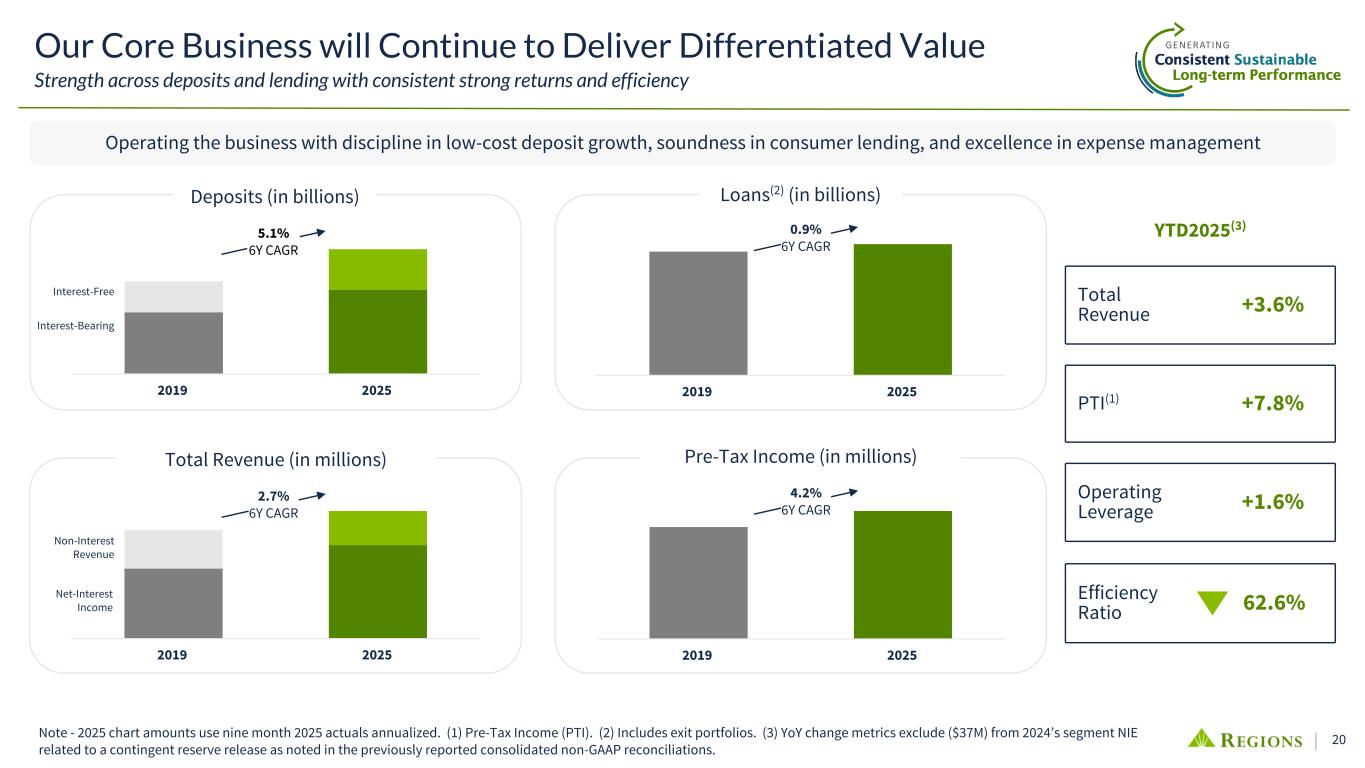
20 Our Core Business will Continue to Deliver Differentiated Value Strength across deposits and lending with consistent strong returns and efficiency Note - 2025 chart amounts use nine month 2025 actuals annualized. (1) Pre-Tax Income (PTI). (2) Includes exit portfolios. (3) YoY change metrics exclude ($37M) from 2024’s segment NIE related to a contingent reserve release as noted in the previously reported consolidated non-GAAP reconciliations. Operating the business with discipline in low-cost deposit growth, soundness in consumer lending, and excellence in expense management 2019 2025 2019 2025 Deposits (in billions) Loans(2) (in billions) Pre-Tax Income (in millions)Total Revenue (in millions) 5.1% 6Y CAGR 2.7% 6Y CAGR YTD2025(3) Total Revenue +3.6% PTI(1) +7.8% Operating Leverage +1.6% Efficiency Ratio 62.6% 2019 2025 4.2% 6Y CAGR 2019 2025 0.9% 6Y CAGR Interest-Free Interest-Bearing Non-Interest Revenue Net-Interest Income
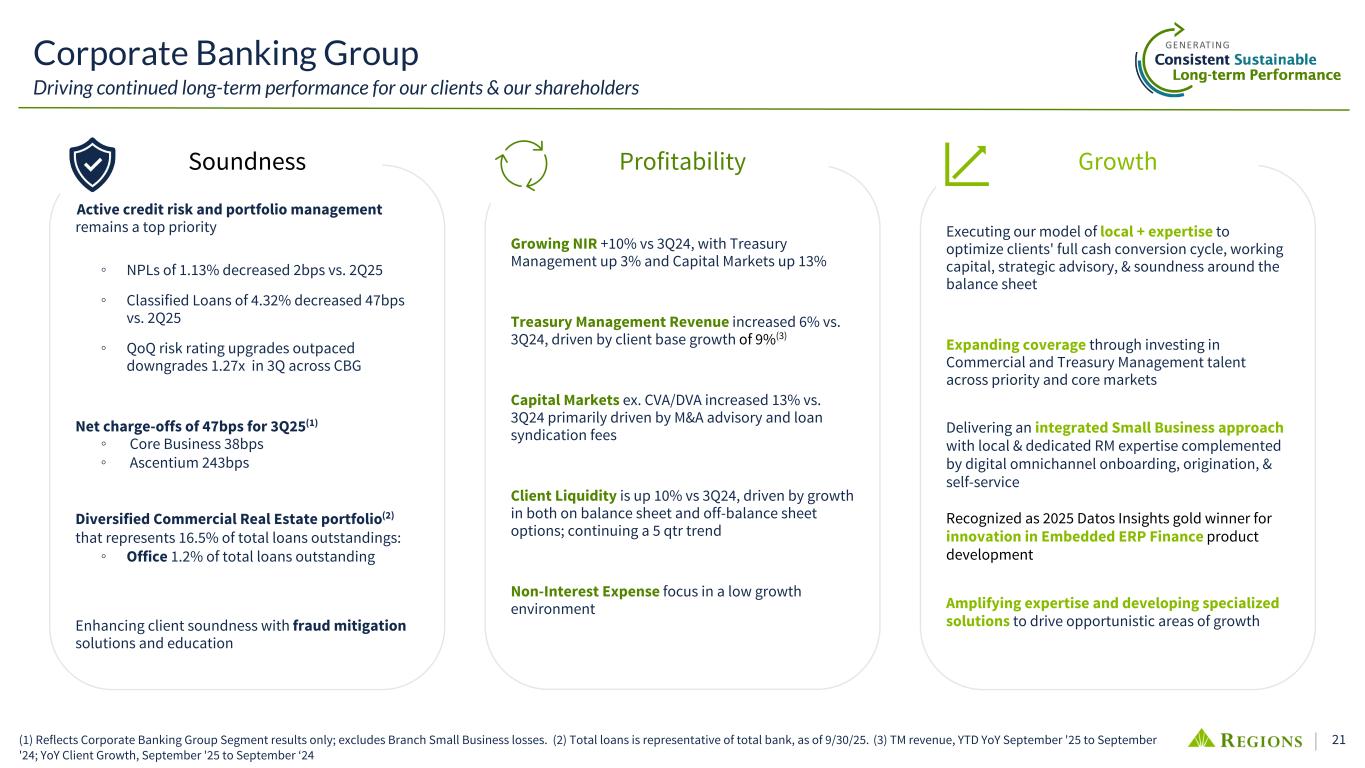
21 Active credit risk and portfolio management remains a top priority ◦ NPLs of 1.13% decreased 2bps vs. 2Q25 ◦ Classified Loans of 4.32% decreased 47bps vs. 2Q25 ◦ QoQ risk rating upgrades outpaced downgrades 1.27x in 3Q across CBG Net charge-offs of 47bps for 3Q25(1) ◦ Core Business 38bps ◦ Ascentium 243bps Diversified Commercial Real Estate portfolio(2) that represents 16.5% of total loans outstandings: ◦ Office 1.2% of total loans outstanding Enhancing client soundness with fraud mitigation solutions and education Growing NIR +10% vs 3Q24, with Treasury Management up 3% and Capital Markets up 13% Treasury Management Revenue increased 6% vs. 3Q24, driven by client base growth of 9%(3) Capital Markets ex. CVA/DVA increased 13% vs. 3Q24 primarily driven by M&A advisory and loan syndication fees Client Liquidity is up 10% vs 3Q24, driven by growth in both on balance sheet and off-balance sheet options; continuing a 5 qtr trend Non-Interest Expense focus in a low growth environment Profitability Executing our model of local + expertise to optimize clients' full cash conversion cycle, working capital, strategic advisory, & soundness around the balance sheet Expanding coverage through investing in Commercial and Treasury Management talent across priority and core markets Delivering an integrated Small Business approach with local & dedicated RM expertise complemented by digital omnichannel onboarding, origination, & self-service Recognized as 2025 Datos Insights gold winner for innovation in Embedded ERP Finance product development Amplifying expertise and developing specialized solutions to drive opportunistic areas of growth GrowthSoundness (1) Reflects Corporate Banking Group Segment results only; excludes Branch Small Business losses. (2) Total loans is representative of total bank, as of 9/30/25. (3) TM revenue, YTD YoY September '25 to September '24; YoY Client Growth, September '25 to September ‘24 Corporate Banking Group Driving continued long-term performance for our clients & our shareholders
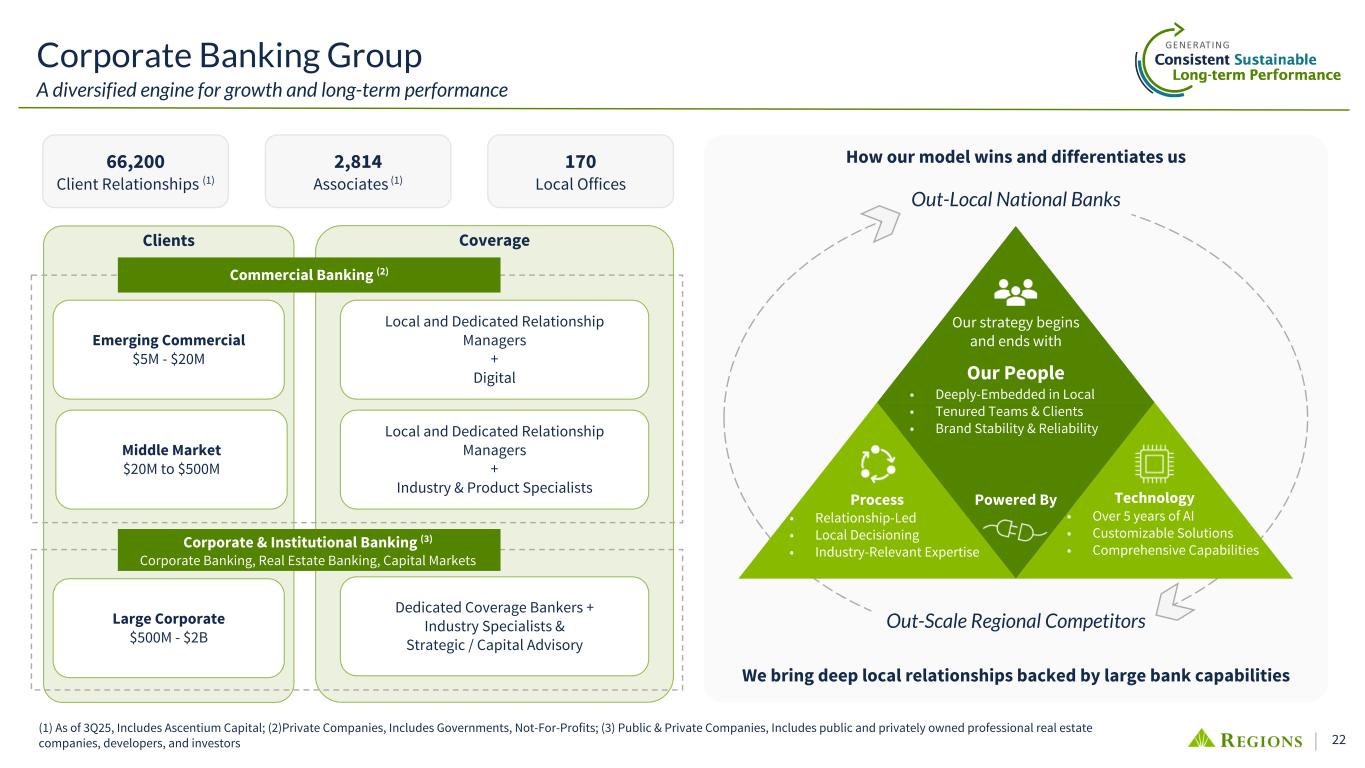
22 Corporate Banking Group A diversified engine for growth and long-term performance (1) As of 3Q25, Includes Ascentium Capital; (2)Private Companies, Includes Governments, Not-For-Profits; (3) Public & Private Companies, Includes public and privately owned professional real estate companies, developers, and investors Emerging Commercial $5M - $20M Middle Market $20M to $500M Large Corporate $500M - $2B Local and Dedicated Relationship Managers + Digital Local and Dedicated Relationship Managers + Industry & Product Specialists Dedicated Coverage Bankers + Industry Specialists & Strategic / Capital Advisory Clients Coverage Commercial Banking (2) 66,200 Client Relationships (1) 2,814 Associates (1) 170 Local Offices We bring deep local relationships backed by large bank capabilities How our model wins and differentiates us Our strategy begins and ends with Our People • Deeply-Embedded in Local • Tenured Teams & Clients • Brand Stability & Reliability Corporate & Institutional Banking (3) Corporate Banking, Real Estate Banking, Capital Markets Powered ByProcess • Relationship-Led • Local Decisioning • Industry-Relevant Expertise Technology • Over 5 years of AI • Customizable Solutions • Comprehensive Capabilities Out-Scale Regional Competitors Out-Local National Banks
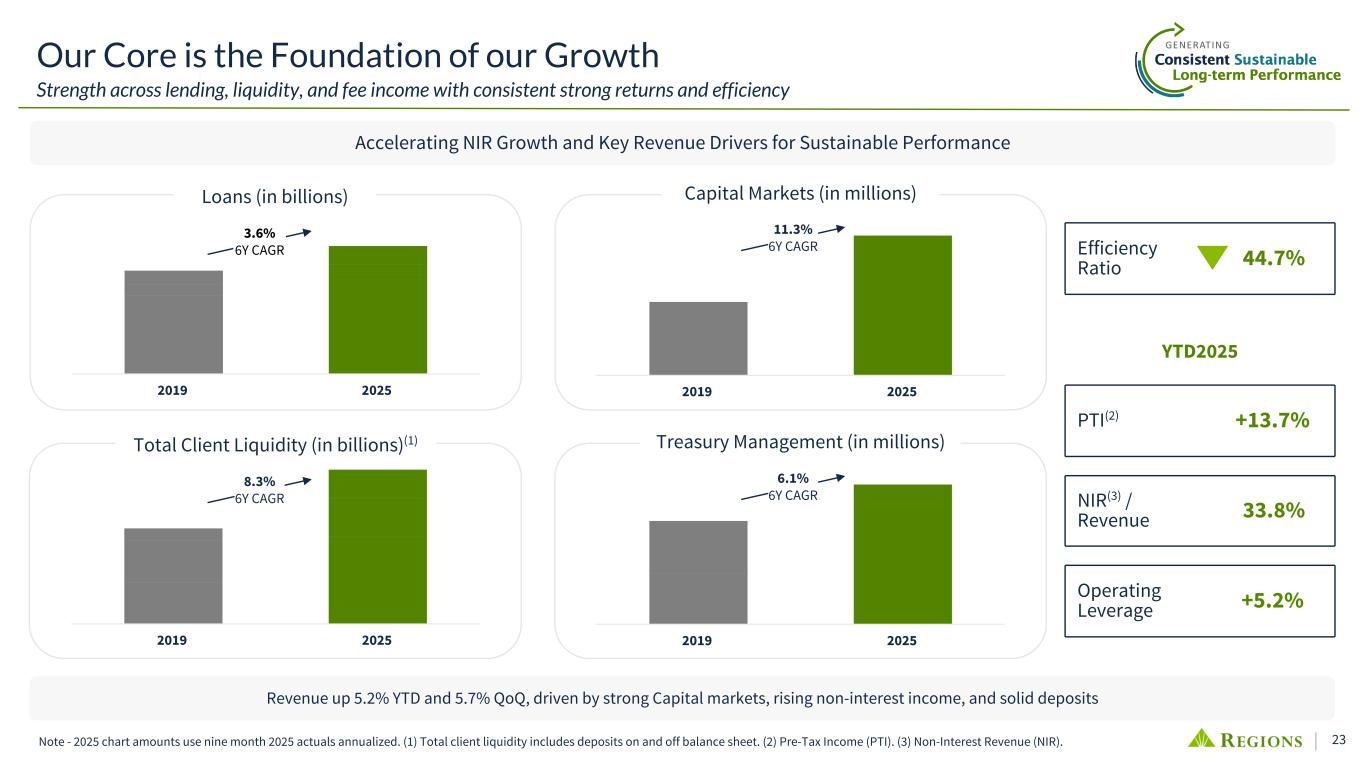
23 Our Core is the Foundation of our Growth Strength across lending, liquidity, and fee income with consistent strong returns and efficiency Note - 2025 chart amounts use nine month 2025 actuals annualized. (1) Total client liquidity includes deposits on and off balance sheet. (2) Pre-Tax Income (PTI). (3) Non-Interest Revenue (NIR). Accelerating NIR Growth and Key Revenue Drivers for Sustainable Performance Revenue up 5.2% YTD and 5.7% QoQ, driven by strong Capital markets, rising non-interest income, and solid deposits 2019 2025 2019 2025 Loans (in billions) Capital Markets (in millions) Treasury Management (in millions)Total Client Liquidity (in billions)(1) 3.6% 6Y CAGR 8.3% 6Y CAGR Efficiency Ratio 44.7% YTD2025 PTI(2) +13.7% NIR(3) / Revenue 33.8% Operating Leverage +5.2% 2019 2025 6.1% 6Y CAGR 2019 2025 11.3% 6Y CAGR
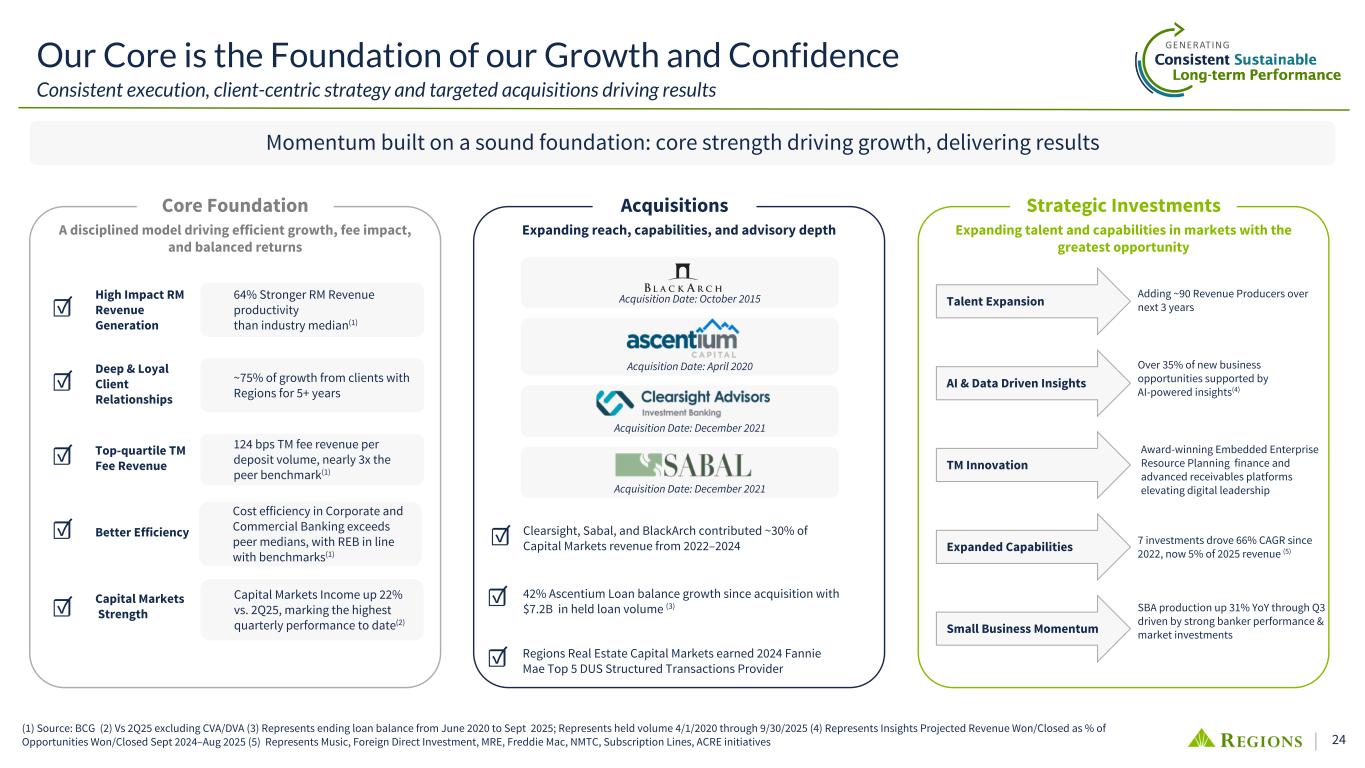
24 Expanding reach, capabilities, and advisory depth Acquisition Date: December 2021 Acquisition Date: December 2021 Acquisition Date: April 2020 Our Core is the Foundation of our Growth and Confidence Consistent execution, client-centric strategy and targeted acquisitions driving results Momentum built on a sound foundation: core strength driving growth, delivering results A disciplined model driving efficient growth, fee impact, and balanced returns Core Foundation Cost efficiency in Corporate and Commercial Banking exceeds peer medians, with REB in line with benchmarks(1) ~75% of growth from clients with Regions for 5+ years 64% Stronger RM Revenue productivity than industry median(1) 124 bps TM fee revenue per deposit volume, nearly 3x the peer benchmark(1) Acquisitions Expanding talent and capabilities in markets with the greatest opportunity Strategic Investments Talent Expansion Capital Markets Income up 22% vs. 2Q25, marking the highest quarterly performance to date(2) (1) Source: BCG (2) Vs 2Q25 excluding CVA/DVA (3) Represents ending loan balance from June 2020 to Sept 2025; Represents held volume 4/1/2020 through 9/30/2025 (4) Represents Insights Projected Revenue Won/Closed as % of Opportunities Won/Closed Sept 2024–Aug 2025 (5) Represents Music, Foreign Direct Investment, MRE, Freddie Mac, NMTC, Subscription Lines, ACRE initiatives High Impact RM Revenue Generation Deep & Loyal Client Relationships Top-quartile TM Fee Revenue Better Efficiency Capital Markets Strength AI & Data Driven Insights TM Innovation Expanded Capabilities Small Business Momentum ☑ ☑ ☑ ☑ ☑ Clearsight, Sabal, and BlackArch contributed ~30% of Capital Markets revenue from 2022–2024☑ 42% Ascentium Loan balance growth since acquisition with $7.2B in held loan volume (3) ☑ Over 35% of new business opportunities supported by AI-powered insights(4) Adding ~90 Revenue Producers over next 3 years Award-winning Embedded Enterprise Resource Planning finance and advanced receivables platforms elevating digital leadership 7 investments drove 66% CAGR since 2022, now 5% of 2025 revenue (5) SBA production up 31% YoY through Q3 driven by strong banker performance & market investments Regions Real Estate Capital Markets earned 2024 Fannie Mae Top 5 DUS Structured Transactions Provider☑ Acquisition Date: October 2015
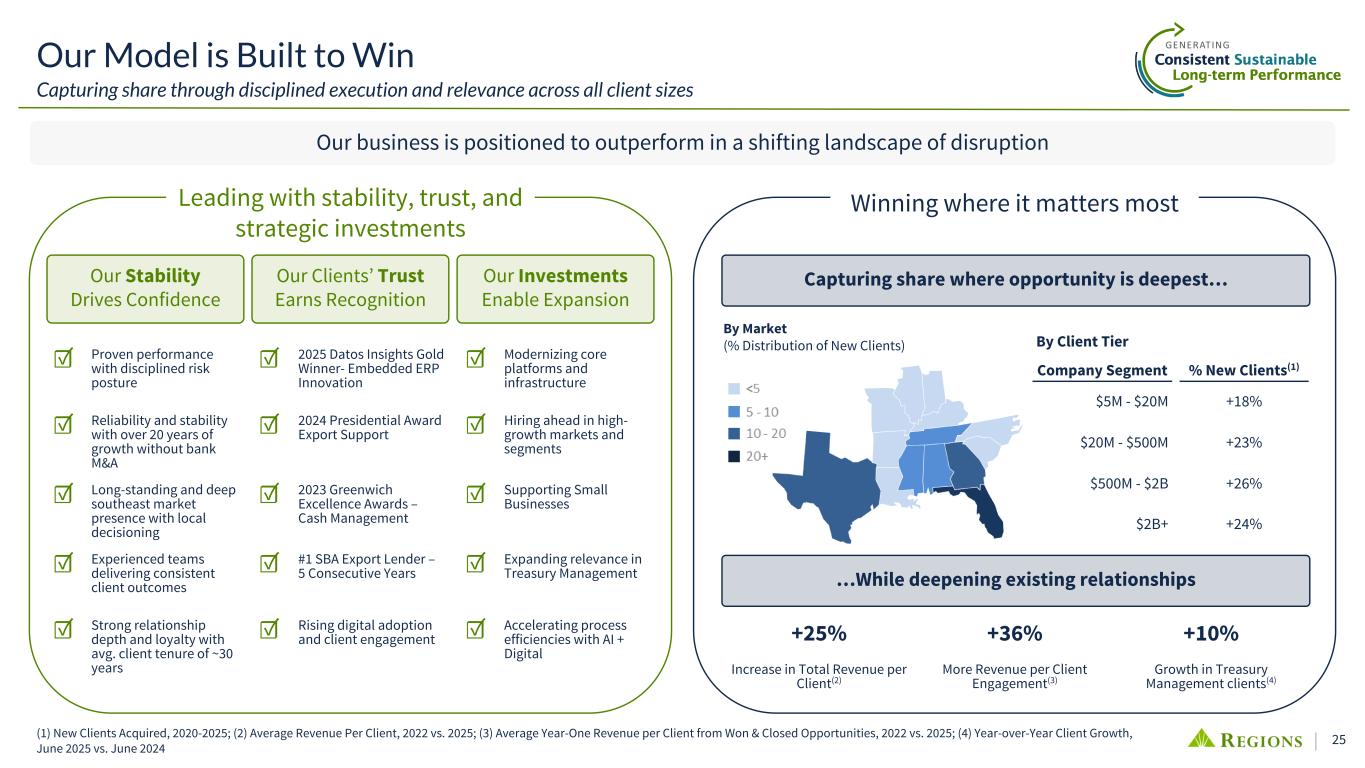
25 Our Stability Drives Confidence Our Model is Built to Win Capturing share through disciplined execution and relevance across all client sizes Leading with stability, trust, and strategic investments Winning where it matters most ☑ Proven performance with disciplined risk posture ☑ 2025 Datos Insights Gold Winner- Embedded ERP Innovation ☑ Modernizing core platforms and infrastructure ☑ Reliability and stability with over 20 years of growth without bank M&A ☑ 2024 Presidential Award Export Support ☑ Hiring ahead in high- growth markets and segments ☑ Long-standing and deep southeast market presence with local decisioning ☑ 2023 Greenwich Excellence Awards – Cash Management ☑ Supporting Small Businesses ☑ Experienced teams delivering consistent client outcomes ☑ #1 SBA Export Lender – 5 Consecutive Years ☑ Expanding relevance in Treasury Management ☑ Strong relationship depth and loyalty with avg. client tenure of ~30 years ☑ Rising digital adoption and client engagement ☑ Accelerating process efficiencies with AI + Digital Our Clients’ Trust Earns Recognition Our Investments Enable Expansion (1) New Clients Acquired, 2020-2025; (2) Average Revenue Per Client, 2022 vs. 2025; (3) Average Year-One Revenue per Client from Won & Closed Opportunities, 2022 vs. 2025; (4) Year-over-Year Client Growth, June 2025 vs. June 2024 Capturing share where opportunity is deepest… …While deepening existing relationships +25% +36% +10% Increase in Total Revenue per Client(2) More Revenue per Client Engagement(3) Growth in Treasury Management clients(4) By Client Tier Company Segment % New Clients(1) $5M - $20M +18% $20M - $500M +23% $500M - $2B +26% $2B+ +24% By Market (% Distribution of New Clients) Our business is positioned to outperform in a shifting landscape of disruption
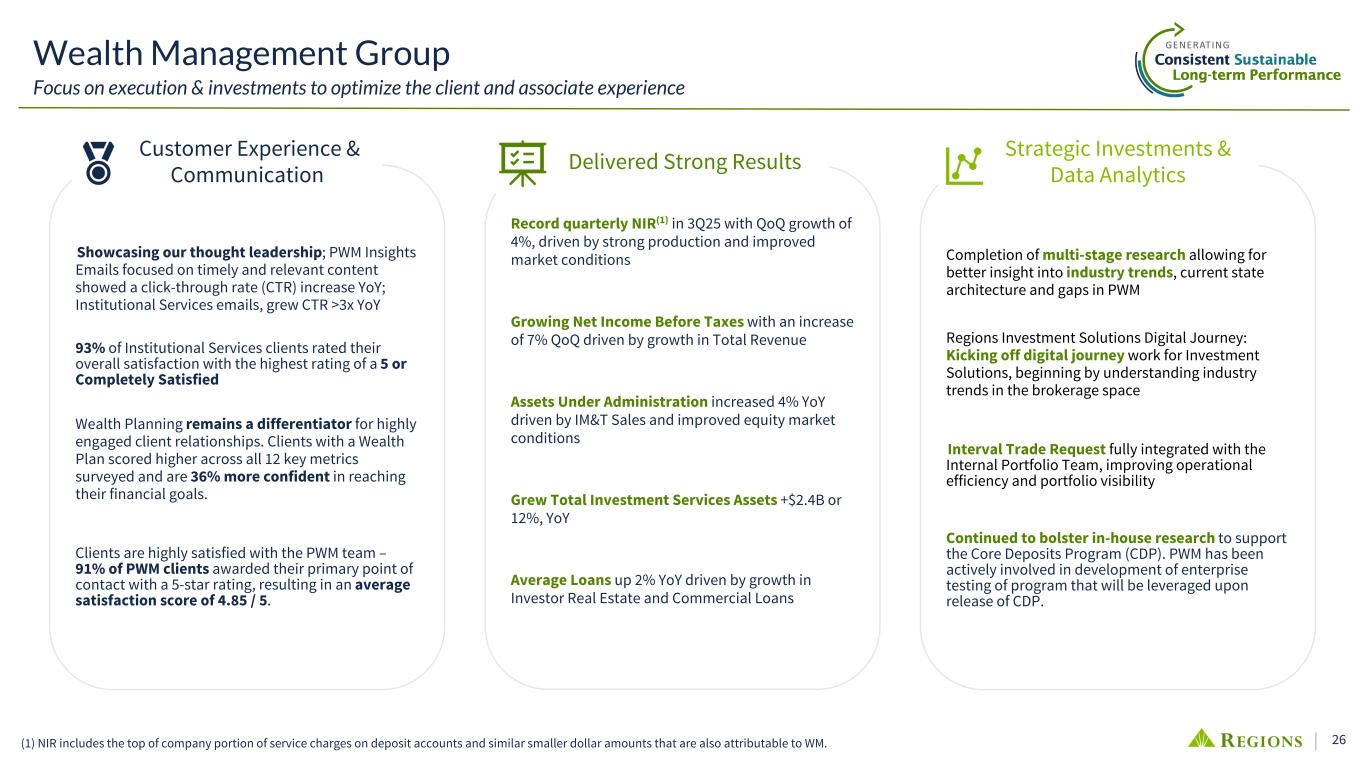
26 Completion of multi-stage research allowing for better insight into industry trends, current state architecture and gaps in PWM Regions Investment Solutions Digital Journey: Kicking off digital journey work for Investment Solutions, beginning by understanding industry trends in the brokerage space Interval Trade Request fully integrated with the Internal Portfolio Team, improving operational efficiency and portfolio visibility Continued to bolster in-house research to support the Core Deposits Program (CDP). PWM has been actively involved in development of enterprise testing of program that will be leveraged upon release of CDP. Showcasing our thought leadership; PWM Insights Emails focused on timely and relevant content showed a click-through rate (CTR) increase YoY; Institutional Services emails, grew CTR >3x YoY 93% of Institutional Services clients rated their overall satisfaction with the highest rating of a 5 or Completely Satisfied Wealth Planning remains a differentiator for highly engaged client relationships. Clients with a Wealth Plan scored higher across all 12 key metrics surveyed and are 36% more confident in reaching their financial goals. Clients are highly satisfied with the PWM team – 91% of PWM clients awarded their primary point of contact with a 5-star rating, resulting in an average satisfaction score of 4.85 / 5. Record quarterly NIR(1) in 3Q25 with QoQ growth of 4%, driven by strong production and improved market conditions Growing Net Income Before Taxes with an increase of 7% QoQ driven by growth in Total Revenue Assets Under Administration increased 4% YoY driven by IM&T Sales and improved equity market conditions Grew Total Investment Services Assets +$2.4B or 12%, YoY Average Loans up 2% YoY driven by growth in Investor Real Estate and Commercial Loans Delivered Strong Results Strategic Investments & Data Analytics Customer Experience & Communication Wealth Management Group Focus on execution & investments to optimize the client and associate experience (1) NIR includes the top of company portion of service charges on deposit accounts and similar smaller dollar amounts that are also attributable to WM.
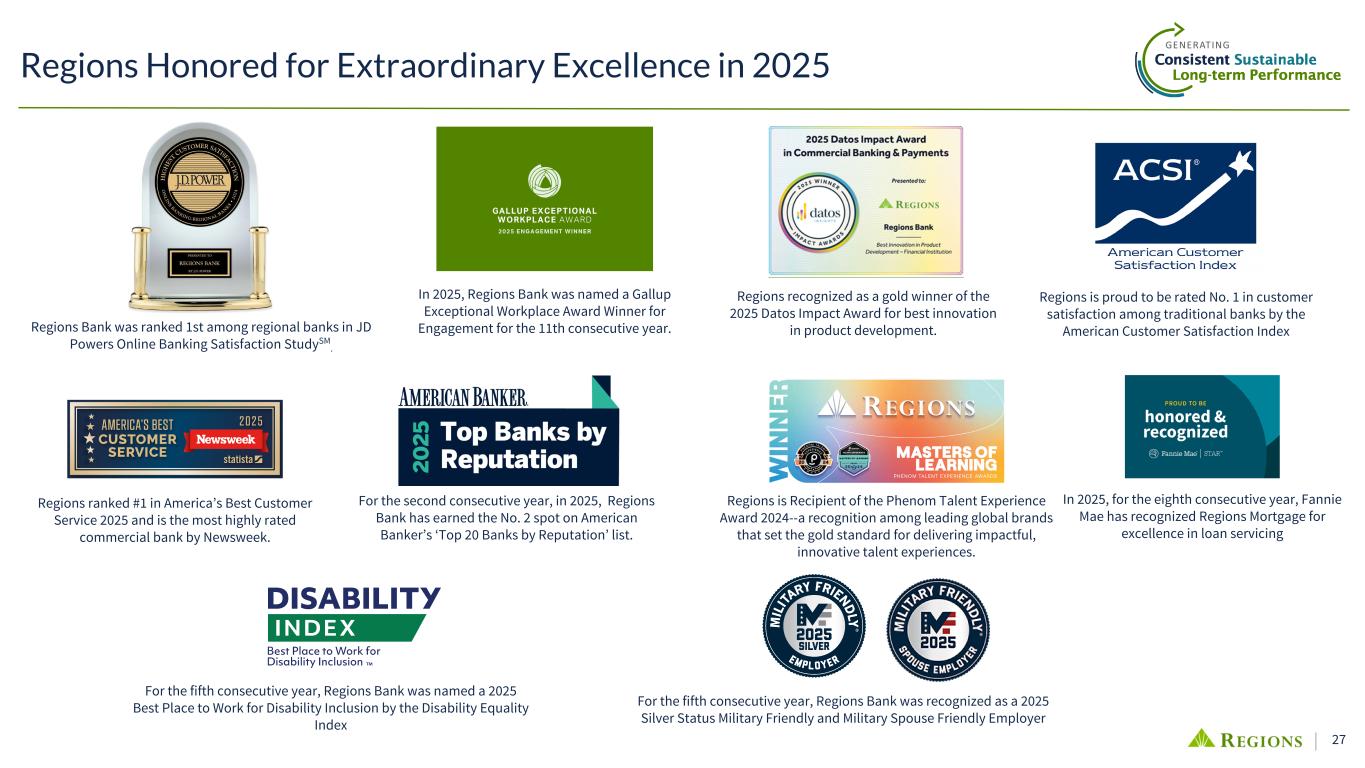
27 Regions Honored for Extraordinary Excellence in 2025 For the fifth consecutive year, Regions Bank was recognized as a 2025 Silver Status Military Friendly and Military Spouse Friendly Employer In 2025, Regions Bank was named a Gallup Exceptional Workplace Award Winner for Engagement for the 11th consecutive year. For the fifth consecutive year, Regions Bank was named a 2025 Best Place to Work for Disability Inclusion by the Disability Equality Index Regions ranked #1 in America’s Best Customer Service 2025 and is the most highly rated commercial bank by Newsweek. Regions Bank was ranked 1st among regional banks in JD Powers Online Banking Satisfaction StudySM . For the second consecutive year, in 2025, Regions Bank has earned the No. 2 spot on American Banker’s ‘Top 20 Banks by Reputation’ list. Regions recognized as a gold winner of the 2025 Datos Impact Award for best innovation in product development. Regions is Recipient of the Phenom Talent Experience Award 2024--a recognition among leading global brands that set the gold standard for delivering impactful, innovative talent experiences. In 2025, for the eighth consecutive year, Fannie Mae has recognized Regions Mortgage for excellence in loan servicing Regions is proud to be rated No. 1 in customer satisfaction among traditional banks by the American Customer Satisfaction Index
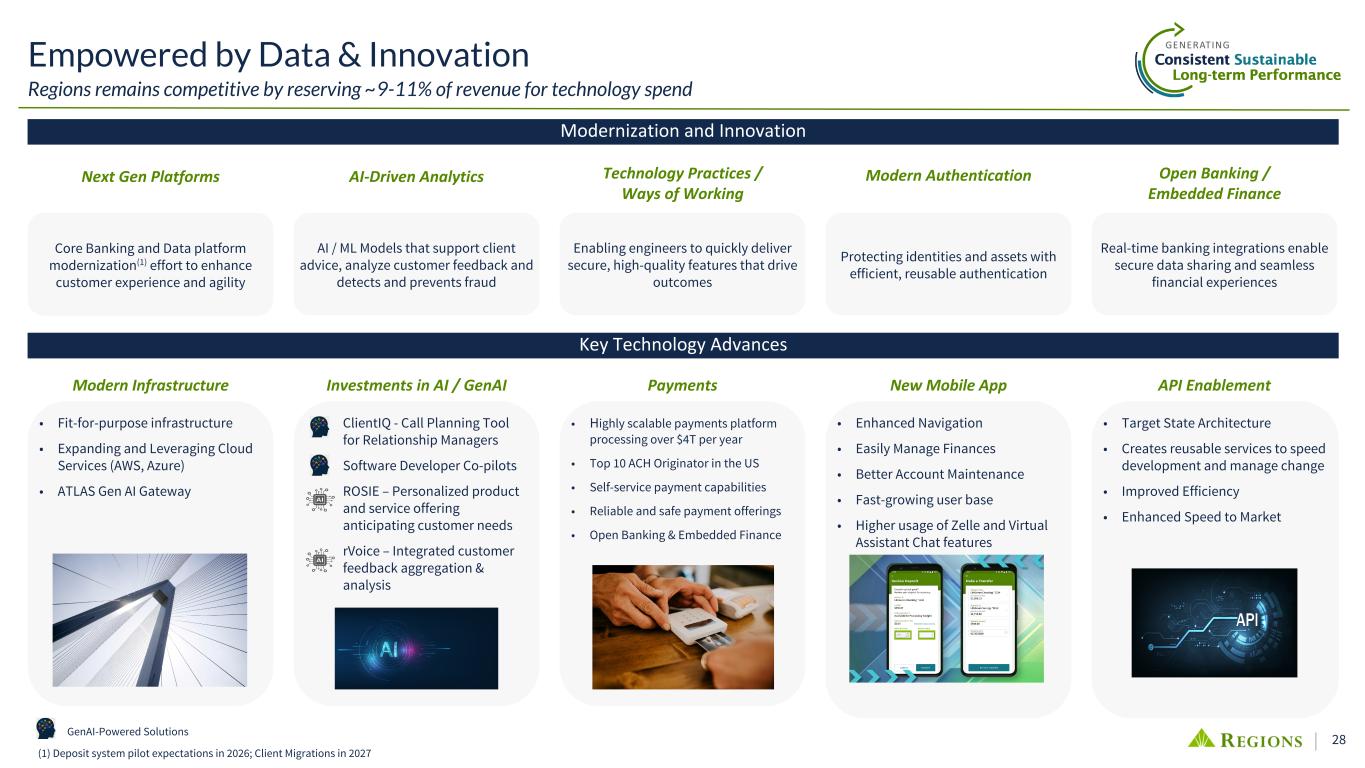
28 Modernization and Innovation Empowered by Data & Innovation Regions remains competitive by reserving ~9-11% of revenue for technology spend Core Banking and Data platform modernization(1) effort to enhance customer experience and agility Next Gen Platforms AI / ML Models that support client advice, analyze customer feedback and detects and prevents fraud AI-Driven Analytics Technology Practices / Ways of Working Modern Authentication Open Banking / Embedded Finance New Mobile App API EnablementModern Infrastructure Investments in AI / GenAI Payments Key Technology Advances Enabling engineers to quickly deliver secure, high-quality features that drive outcomes Protecting identities and assets with efficient, reusable authentication Real-time banking integrations enable secure data sharing and seamless financial experiences • Fit-for-purpose infrastructure • Expanding and Leveraging Cloud Services (AWS, Azure) • ATLAS Gen AI Gateway • ClientIQ - Call Planning Tool for Relationship Managers • Software Developer Co-pilots ROSIE – Personalized product and service offering anticipating customer needs rVoice – Integrated customer feedback aggregation & analysis • Highly scalable payments platform processing over $4T per year • Top 10 ACH Originator in the US • Self-service payment capabilities • Reliable and safe payment offerings • Open Banking & Embedded Finance • Enhanced Navigation • Easily Manage Finances • Better Account Maintenance • Fast-growing user base • Higher usage of Zelle and Virtual Assistant Chat features • Target State Architecture • Creates reusable services to speed development and manage change • Improved Efficiency • Enhanced Speed to Market (1) Deposit system pilot expectations in 2026; Client Migrations in 2027 GenAI-Powered Solutions
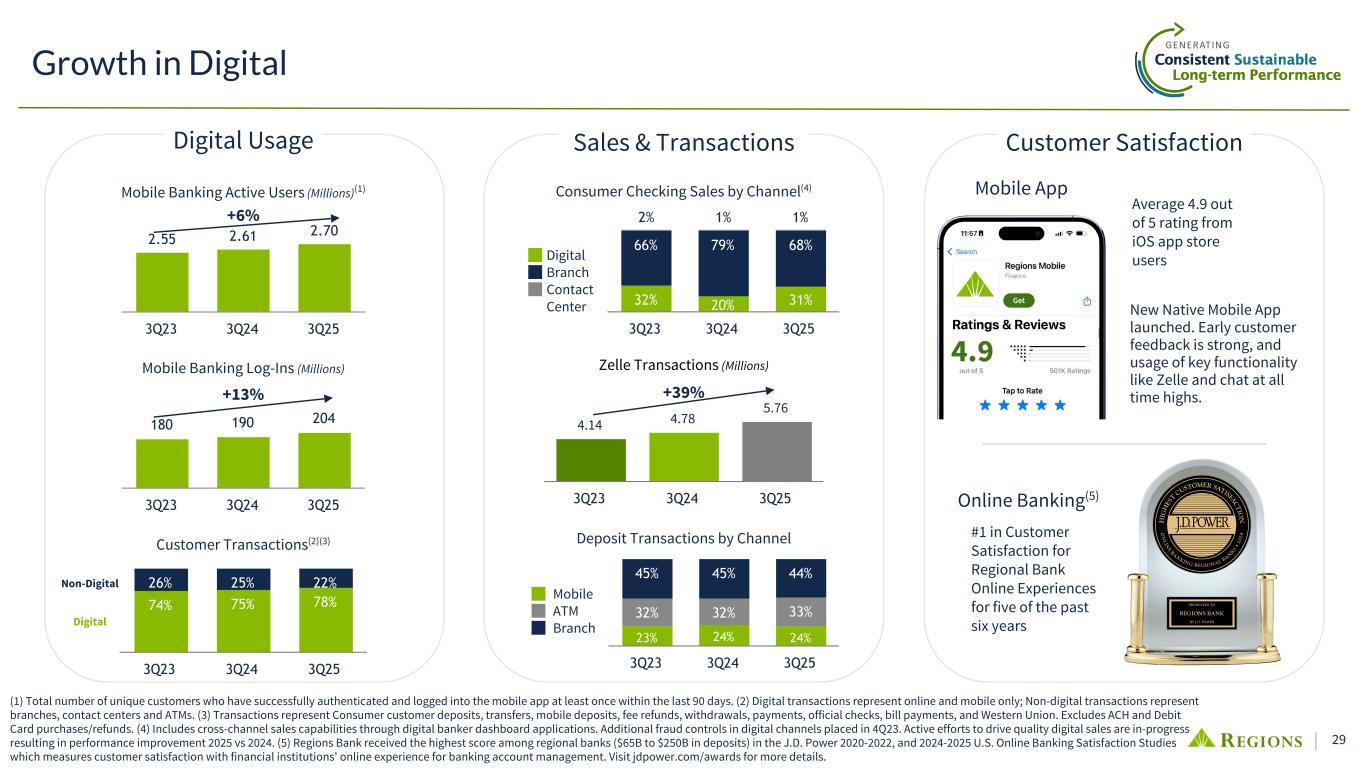
29 2.55 2.61 2.70 3Q23 3Q24 3Q25 4.14 4.78 5.76 3Q23 3Q24 3Q25 180 190 204 3Q23 3Q24 3Q25 23% 24% 24% 32% 32% 33% 45% 45% 44% Mobile ATM Branch 3Q23 3Q24 3Q25 74% 75% 78% 26% 25% 22% 3Q23 3Q24 3Q25 Growth in Digital Mobile Banking Log-Ins (Millions) Customer Transactions(2)(3) Deposit Transactions by Channel Mobile Banking Active Users (Millions)(1) Digital Non-Digital +39%+13% 32% 20% 31% 66% 79% 68% 2% 1% 1% Digital Branch Contact Center 3Q23 3Q24 3Q25 Consumer Checking Sales by Channel(4) Customer Satisfaction Zelle Transactions (Millions) Sales & TransactionsDigital Usage +6% (1) Total number of unique customers who have successfully authenticated and logged into the mobile app at least once within the last 90 days. (2) Digital transactions represent online and mobile only; Non-digital transactions represent branches, contact centers and ATMs. (3) Transactions represent Consumer customer deposits, transfers, mobile deposits, fee refunds, withdrawals, payments, official checks, bill payments, and Western Union. Excludes ACH and Debit Card purchases/refunds. (4) Includes cross-channel sales capabilities through digital banker dashboard applications. Additional fraud controls in digital channels placed in 4Q23. Active efforts to drive quality digital sales are in-progress resulting in performance improvement 2025 vs 2024. (5) Regions Bank received the highest score among regional banks ($65B to $250B in deposits) in the J.D. Power 2020-2022, and 2024-2025 U.S. Online Banking Satisfaction Studies which measures customer satisfaction with financial institutions' online experience for banking account management. Visit jdpower.com/awards for more details. Mobile App Online Banking(5) #1 in Customer Satisfaction for Regional Bank Online Experiences for five of the past six years Average 4.9 out of 5 rating from iOS app store users New Native Mobile App launched. Early customer feedback is strong, and usage of key functionality like Zelle and chat at all time highs.
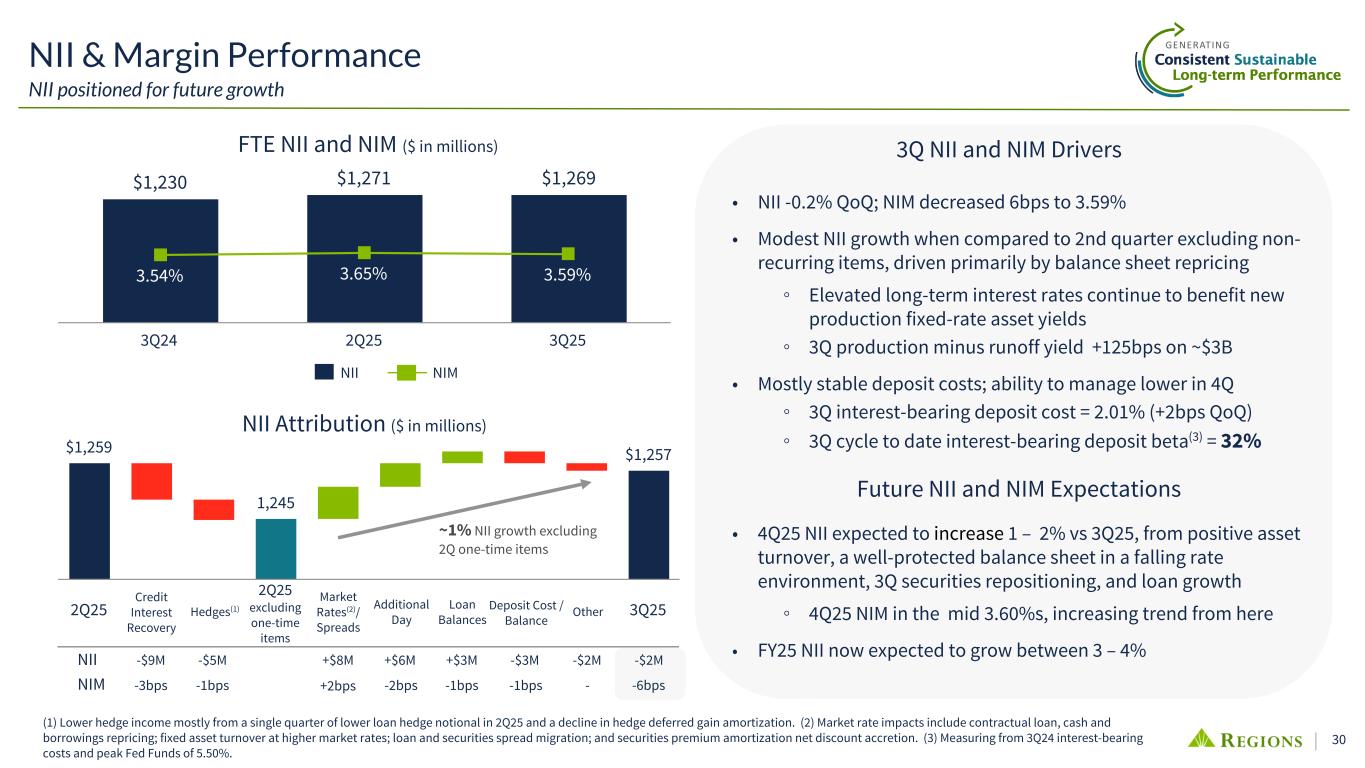
30 $1,259 1,245 $1,257 NII & Margin Performance NII positioned for future growth (1) Lower hedge income mostly from a single quarter of lower loan hedge notional in 2Q25 and a decline in hedge deferred gain amortization. (2) Market rate impacts include contractual loan, cash and borrowings repricing; fixed asset turnover at higher market rates; loan and securities spread migration; and securities premium amortization net discount accretion. (3) Measuring from 3Q24 interest-bearing costs and peak Fed Funds of 5.50%. Deposit Cost / Balance Market Rates(2)/ Spreads 3Q25 2Q25 +2bps -2bps-3bps +$8M +$6M-$9MNII NIM -$5M -1bps $1,230 $1,271 $1,269 3.54% 3.65% 3.59% 3Q24 2Q25 3Q25 NII NIM -$2M FTE NII and NIM ($ in millions) NII Attribution ($ in millions) -$2M - -6bps OtherHedges(1) Loan Balances Additional Day -1bps +$3M • NII -0.2% QoQ; NIM decreased 6bps to 3.59% • Modest NII growth when compared to 2nd quarter excluding non- recurring items, driven primarily by balance sheet repricing ◦ Elevated long-term interest rates continue to benefit new production fixed-rate asset yields ◦ 3Q production minus runoff yield +125bps on ~$3B • Mostly stable deposit costs; ability to manage lower in 4Q ◦ 3Q interest-bearing deposit cost = 2.01% (+2bps QoQ) ◦ 3Q cycle to date interest-bearing deposit beta(3) = 32% Future NII and NIM Expectations • 4Q25 NII expected to increase 1 – 2% vs 3Q25, from positive asset turnover, a well-protected balance sheet in a falling rate environment, 3Q securities repositioning, and loan growth ◦ 4Q25 NIM in the mid 3.60%s, increasing trend from here • FY25 NII now expected to grow between 3 – 4% Credit Interest Recovery 3Q NII and NIM Drivers 2Q25 excluding one-time items -1bps ~1% NII growth excluding 2Q one-time items -$3M
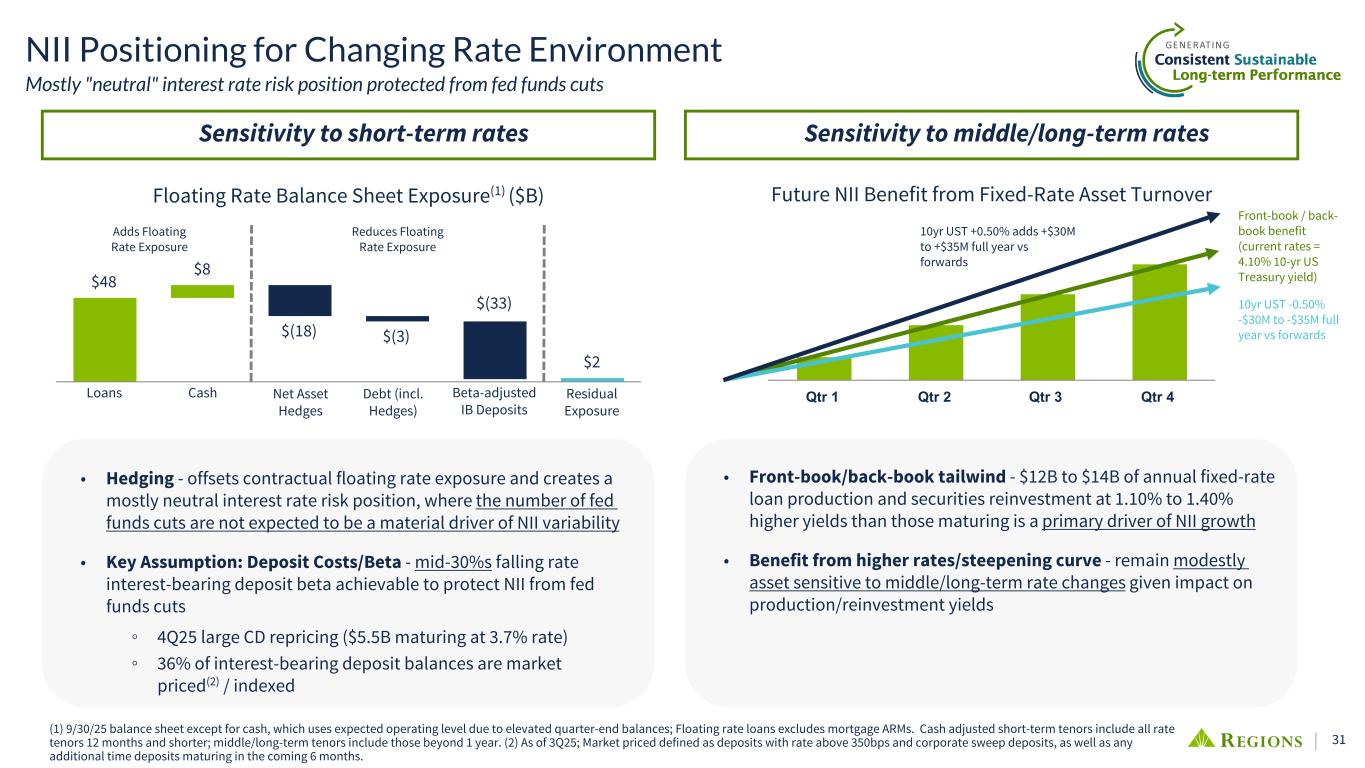
31 $48 $8 $(18) $(3) $2 • Front-book/back-book tailwind - $12B to $14B of annual fixed-rate loan production and securities reinvestment at 1.10% to 1.40% higher yields than those maturing is a primary driver of NII growth • Benefit from higher rates/steepening curve - remain modestly asset sensitive to middle/long-term rate changes given impact on production/reinvestment yields Qtr 1 Qtr 2 Qtr 3 Qtr 4 NII Positioning for Changing Rate Environment Mostly "neutral" interest rate risk position protected from fed funds cuts • Hedging - offsets contractual floating rate exposure and creates a mostly neutral interest rate risk position, where the number of fed funds cuts are not expected to be a material driver of NII variability • Key Assumption: Deposit Costs/Beta - mid-30%s falling rate interest-bearing deposit beta achievable to protect NII from fed funds cuts ◦ 4Q25 large CD repricing ($5.5B maturing at 3.7% rate) ◦ 36% of interest-bearing deposit balances are market priced(2) / indexed Adds Floating Rate Exposure Reduces Floating Rate Exposure (1) 9/30/25 balance sheet except for cash, which uses expected operating level due to elevated quarter-end balances; Floating rate loans excludes mortgage ARMs. Cash adjusted short-term tenors include all rate tenors 12 months and shorter; middle/long-term tenors include those beyond 1 year. (2) As of 3Q25; Market priced defined as deposits with rate above 350bps and corporate sweep deposits, as well as any additional time deposits maturing in the coming 6 months. Loans Cash $(33) Net Asset Hedges Debt (incl. Hedges) Beta-adjusted IB Deposits Residual Exposure Front-book / back- book benefit (current rates = 4.10% 10-yr US Treasury yield) Floating Rate Balance Sheet Exposure(1) ($B) Future NII Benefit from Fixed-Rate Asset Turnover 10yr UST -0.50% -$30M to -$35M full year vs forwards Sensitivity to short-term rates Sensitivity to middle/long-term rates 10yr UST +0.50% adds +$30M to +$35M full year vs forwards
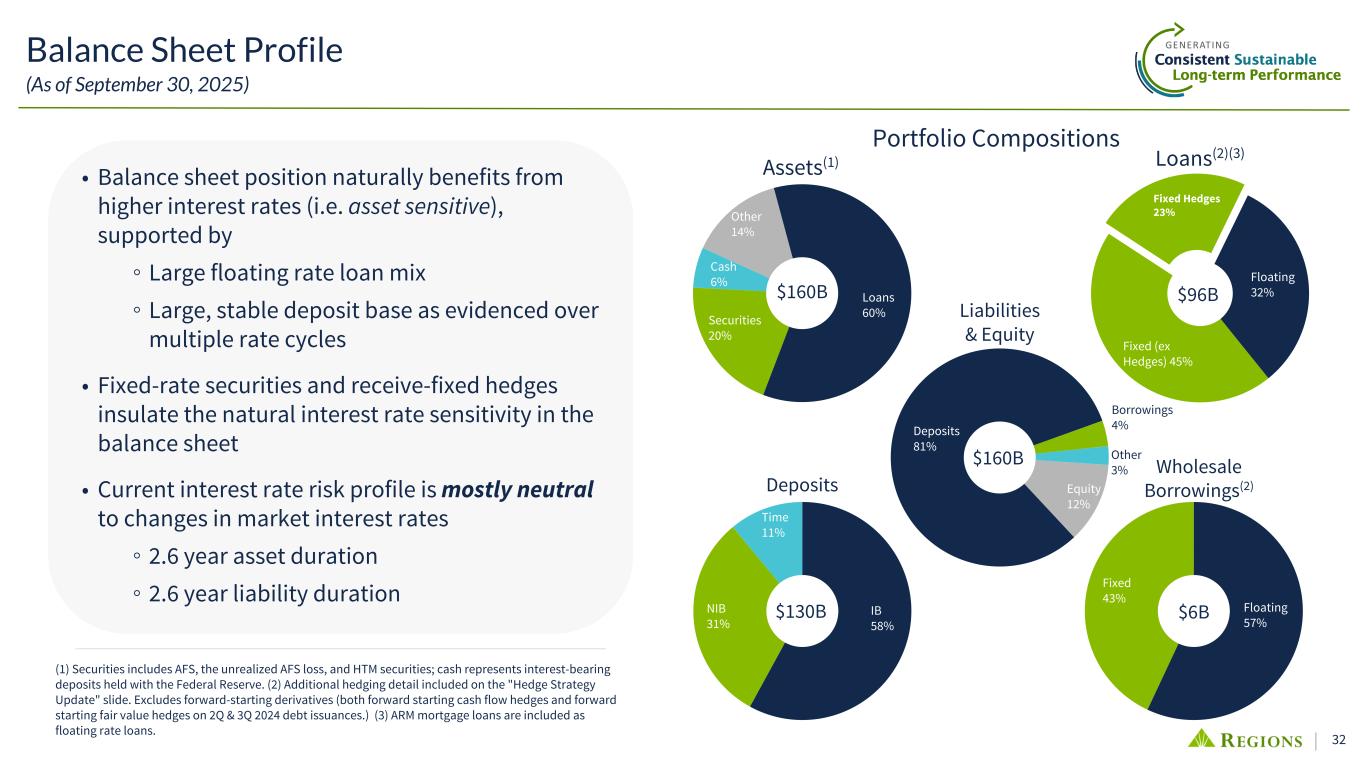
32 • Balance sheet position naturally benefits from higher interest rates (i.e. asset sensitive), supported by ◦ Large floating rate loan mix ◦ Large, stable deposit base as evidenced over multiple rate cycles • Fixed-rate securities and receive-fixed hedges insulate the natural interest rate sensitivity in the balance sheet • Current interest rate risk profile is mostly neutral to changes in market interest rates ◦ 2.6 year asset duration ◦ 2.6 year liability duration Floating 57% Fixed 43% Deposits 81% Borrowings 4% Other 3% Equity 12% IB 58% NIB 31% Time 11% Loans 60%Securities 20% Cash 6% Other 14% Floating 32% Fixed (ex Hedges) 45% Fixed Hedges 23% $130B Loans(2)(3) $96B Balance Sheet Profile (As of September 30, 2025) Portfolio Compositions $160B Assets(1) Liabilities & Equity $160B Wholesale Borrowings(2) $6B Deposits (1) Securities includes AFS, the unrealized AFS loss, and HTM securities; cash represents interest-bearing deposits held with the Federal Reserve. (2) Additional hedging detail included on the "Hedge Strategy Update" slide. Excludes forward-starting derivatives (both forward starting cash flow hedges and forward starting fair value hedges on 2Q & 3Q 2024 debt issuances.) (3) ARM mortgage loans are included as floating rate loans.
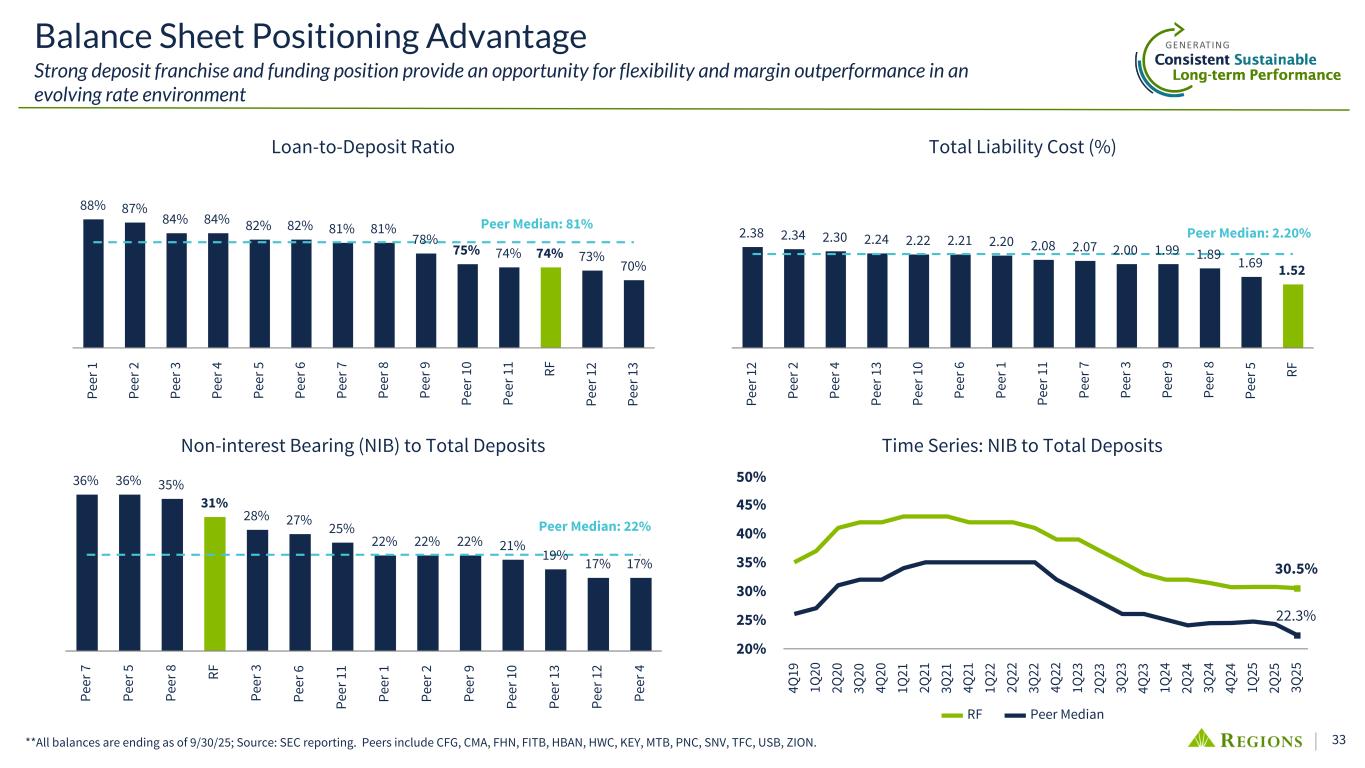
33 Balance Sheet Positioning Advantage Strong deposit franchise and funding position provide an opportunity for flexibility and margin outperformance in an evolving rate environment **All balances are ending as of 9/30/25; Source: SEC reporting. Peers include CFG, CMA, FHN, FITB, HBAN, HWC, KEY, MTB, PNC, SNV, TFC, USB, ZION. Loan-to-Deposit Ratio 88% 87% 84% 84% 82% 82% 81% 81% 78% 75% 74% 74% 73% 70% Pe er 1 Pe er 2 Pe er 3 Pe er 4 Pe er 5 Pe er 6 Pe er 7 Pe er 8 Pe er 9 Pe er 1 0 Pe er 1 1 RF Pe er 1 2 Pe er 1 3 Non-interest Bearing (NIB) to Total Deposits 36% 36% 35% 31% 28% 27% 25% 22% 22% 22% 21% 19% 17% 17% Pe er 7 Pe er 5 Pe er 8 RF Pe er 3 Pe er 6 Pe er 1 1 Pe er 1 Pe er 2 Pe er 9 Pe er 1 0 Pe er 1 3 Pe er 1 2 Pe er 4 Peer Median: 81% Peer Median: 22% Total Liability Cost (%) 2.38 2.34 2.30 2.24 2.22 2.21 2.20 2.08 2.07 2.00 1.99 1.89 1.69 1.52 Pe er 1 2 Pe er 2 Pe er 4 Pe er 1 3 Pe er 1 0 Pe er 6 Pe er 1 Pe er 1 1 Pe er 7 Pe er 3 Pe er 9 Pe er 8 Pe er 5 RF Peer Median: 2.20% Time Series: NIB to Total Deposits 30.5% 22.3% RF Peer Median 4Q 19 1Q 20 2Q 20 3Q 20 4Q 20 1Q 21 2Q 21 3Q 21 4Q 21 1Q 22 2Q 22 3Q 22 4Q 22 1Q 23 2Q 23 3Q 23 4Q 23 1Q 24 2Q 24 3Q 24 4Q 24 1Q 25 2Q 25 3Q 25 20% 25% 30% 35% 40% 45% 50%
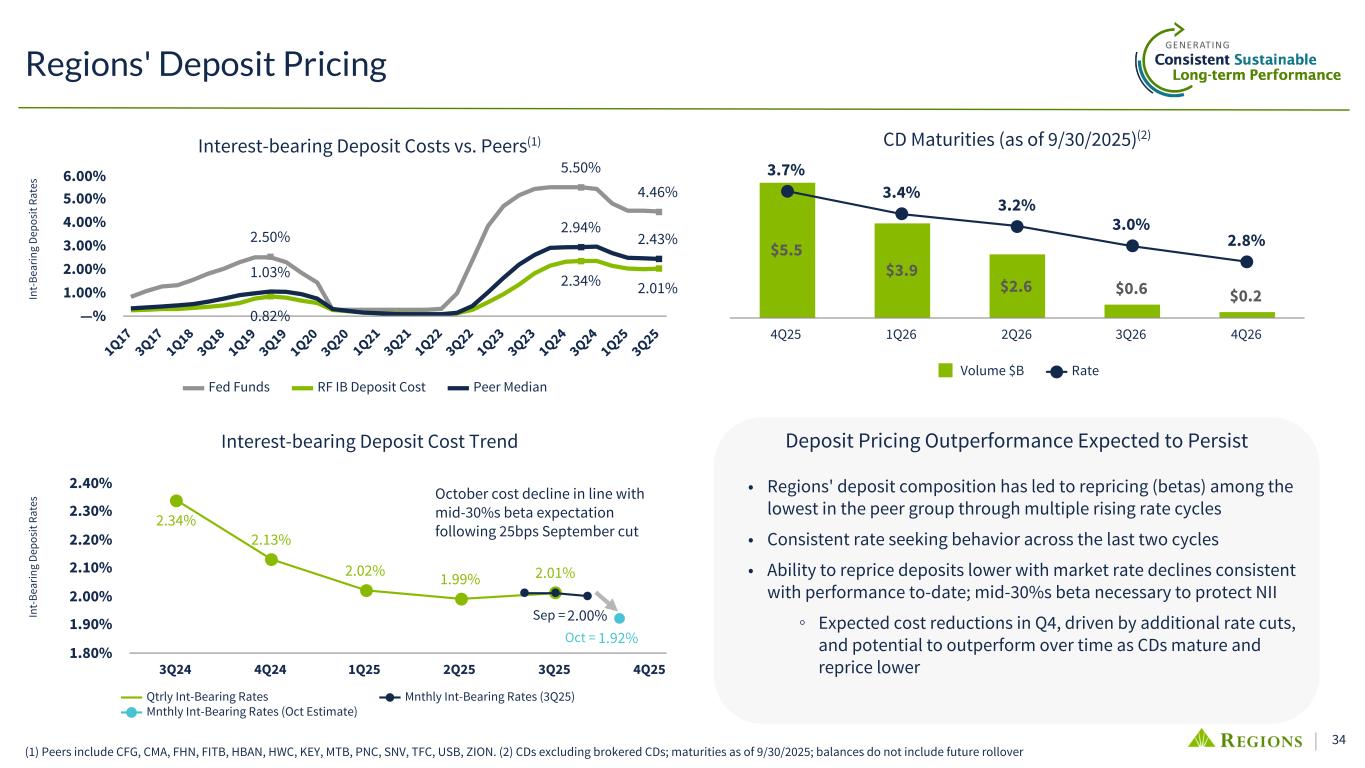
34 2.34% 2.13% 2.02% 1.99% 2.01% 2.00% 1.92% Qtrly Int-Bearing Rates Mnthly Int-Bearing Rates (3Q25) Mnthly Int-Bearing Rates (Oct Estimate) 3Q24 4Q24 1Q25 2Q25 3Q25 4Q25 1.80% 1.90% 2.00% 2.10% 2.20% 2.30% 2.40% 2.50% 5.50% 4.46% 0.82% 2.34% 2.01% 1.03% 2.94% 2.43% Fed Funds RF IB Deposit Cost Peer Median 1Q17 3Q17 1Q18 3Q18 1Q19 3Q19 1Q20 3Q20 1Q21 3Q21 1Q22 3Q22 1Q23 3Q23 1Q24 3Q24 1Q25 3Q25 —% 1.00% 2.00% 3.00% 4.00% 5.00% 6.00% (1) Peers include CFG, CMA, FHN, FITB, HBAN, HWC, KEY, MTB, PNC, SNV, TFC, USB, ZION. (2) CDs excluding brokered CDs; maturities as of 9/30/2025; balances do not include future rollover Interest-bearing Deposit Costs vs. Peers(1) In t- Be ar in g De po si t R at es Regions' Deposit Pricing Deposit Pricing Outperformance Expected to Persist • Regions' deposit composition has led to repricing (betas) among the lowest in the peer group through multiple rising rate cycles • Consistent rate seeking behavior across the last two cycles • Ability to reprice deposits lower with market rate declines consistent with performance to-date; mid-30%s beta necessary to protect NII ◦ Expected cost reductions in Q4, driven by additional rate cuts, and potential to outperform over time as CDs mature and reprice lower $5.5 $3.9 $2.6 $0.6 $0.2 3.7% 3.4% 3.2% 3.0% 2.8% Volume $B Rate 4Q25 1Q26 2Q26 3Q26 4Q26 CD Maturities (as of 9/30/2025)(2) 2.34% 2.13% 2.02% 1.99% 2.01% Qtrly Int-Bearing Rates 3Q24 4Q24 1Q25 2Q25 3Q25 1.90% 2.00% 2.10% 2.20% 2.30% 2.40% October cost decline in line with mid-30%s beta expectation following 25bps September cut Interest-bearing Deposit Cost Trend In t- Be ar in g De po si t R at es Sep = Oct =
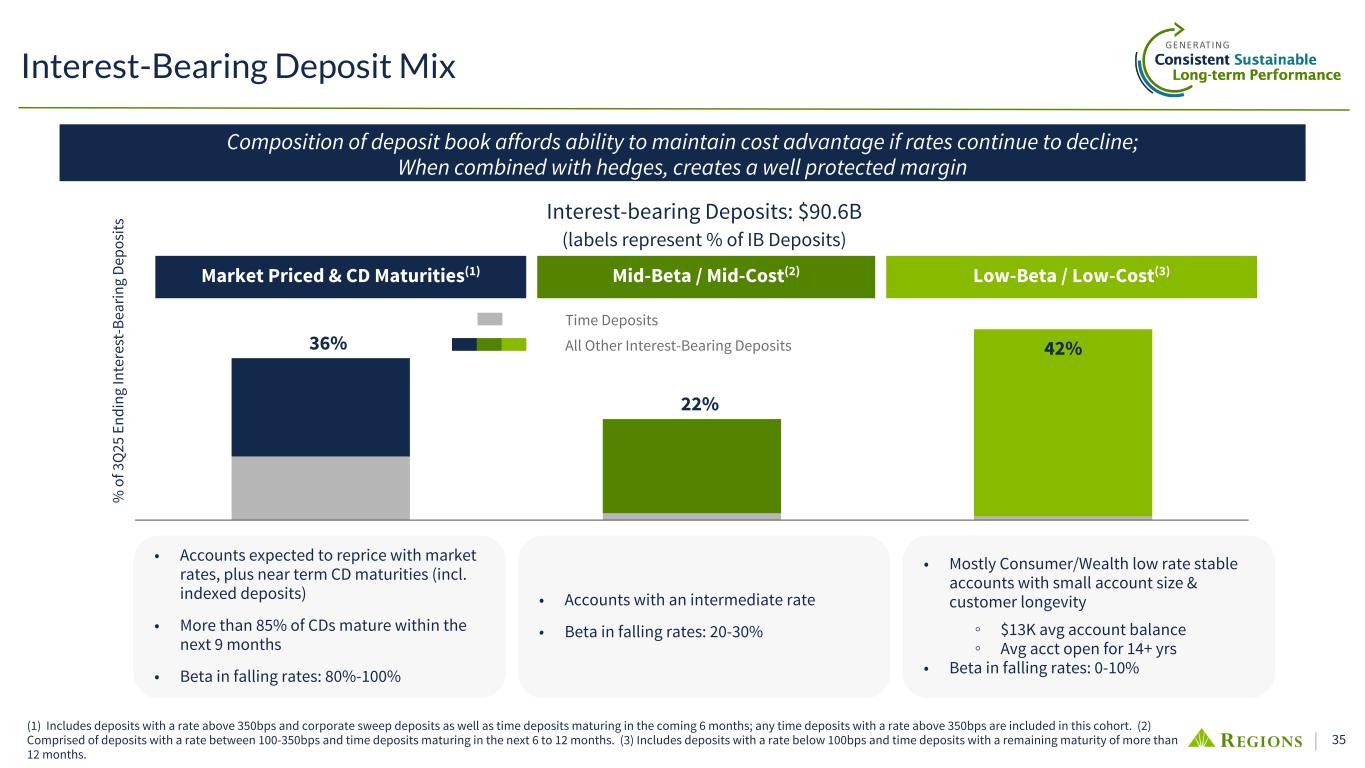
35 % o f 3 Q 25 E nd in g In te re st -B ea rin g De po si ts Interest-bearing Deposits: $90.6B (labels represent % of IB Deposits) Interest-Bearing Deposit Mix Composition of deposit book affords ability to maintain cost advantage if rates continue to decline; When combined with hedges, creates a well protected margin Low-Beta / Low-Cost(3)Market Priced & CD Maturities(1) (1) Includes deposits with a rate above 350bps and corporate sweep deposits as well as time deposits maturing in the coming 6 months; any time deposits with a rate above 350bps are included in this cohort. (2) Comprised of deposits with a rate between 100-350bps and time deposits maturing in the next 6 to 12 months. (3) Includes deposits with a rate below 100bps and time deposits with a remaining maturity of more than 12 months. Mid-Beta / Mid-Cost(2) Time Deposits All Other Interest-Bearing Deposits36% 17% 22% 42% • Accounts expected to reprice with market rates, plus near term CD maturities (incl. indexed deposits) • More than 85% of CDs mature within the next 9 months • Beta in falling rates: 80%-100% • Accounts with an intermediate rate • Beta in falling rates: 20-30% • Mostly Consumer/Wealth low rate stable accounts with small account size & customer longevity ◦ $13K avg account balance ◦ Avg acct open for 14+ yrs • Beta in falling rates: 0-10%
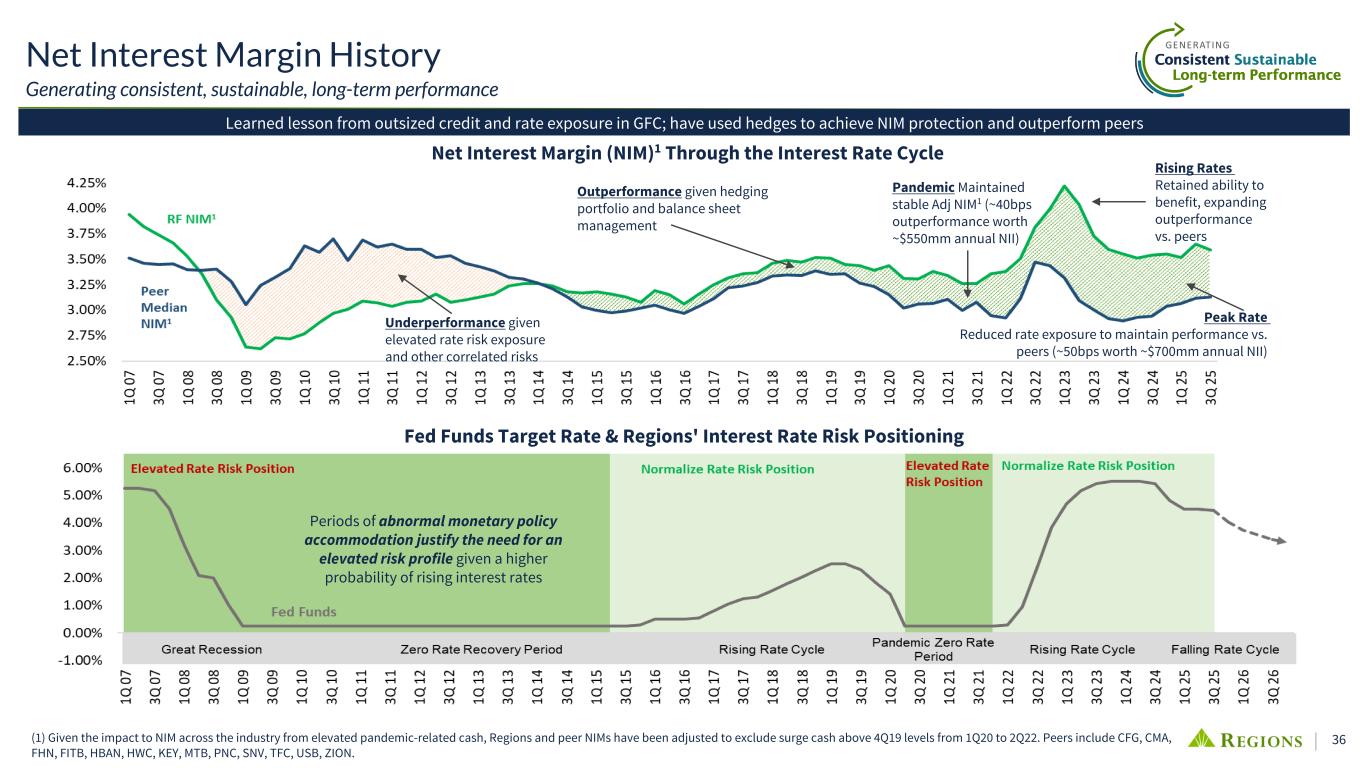
36 Net Interest Margin History Generating consistent, sustainable, long-term performance Learned lesson from outsized credit and rate exposure in GFC; have used hedges to achieve NIM protection and outperform peers Net Interest Margin (NIM)1 Through the Interest Rate Cycle Fed Funds Target Rate & Regions' Interest Rate Risk Positioning Periods of abnormal monetary policy accommodation justify the need for an elevated risk profile given a higher probability of rising interest rates Underperformance given elevated rate risk exposure and other correlated risks Outperformance given hedging portfolio and balance sheet management Pandemic Maintained stable Adj NIM1 (~40bps outperformance worth ~$550mm annual NII) Rising Rates Retained ability to benefit, expanding outperformance vs. peers Peak Rate Reduced rate exposure to maintain performance vs. peers (~50bps worth ~$700mm annual NII) (1) Given the impact to NIM across the industry from elevated pandemic-related cash, Regions and peer NIMs have been adjusted to exclude surge cash above 4Q19 levels from 1Q20 to 2Q22. Peers include CFG, CMA, FHN, FITB, HBAN, HWC, KEY, MTB, PNC, SNV, TFC, USB, ZION.
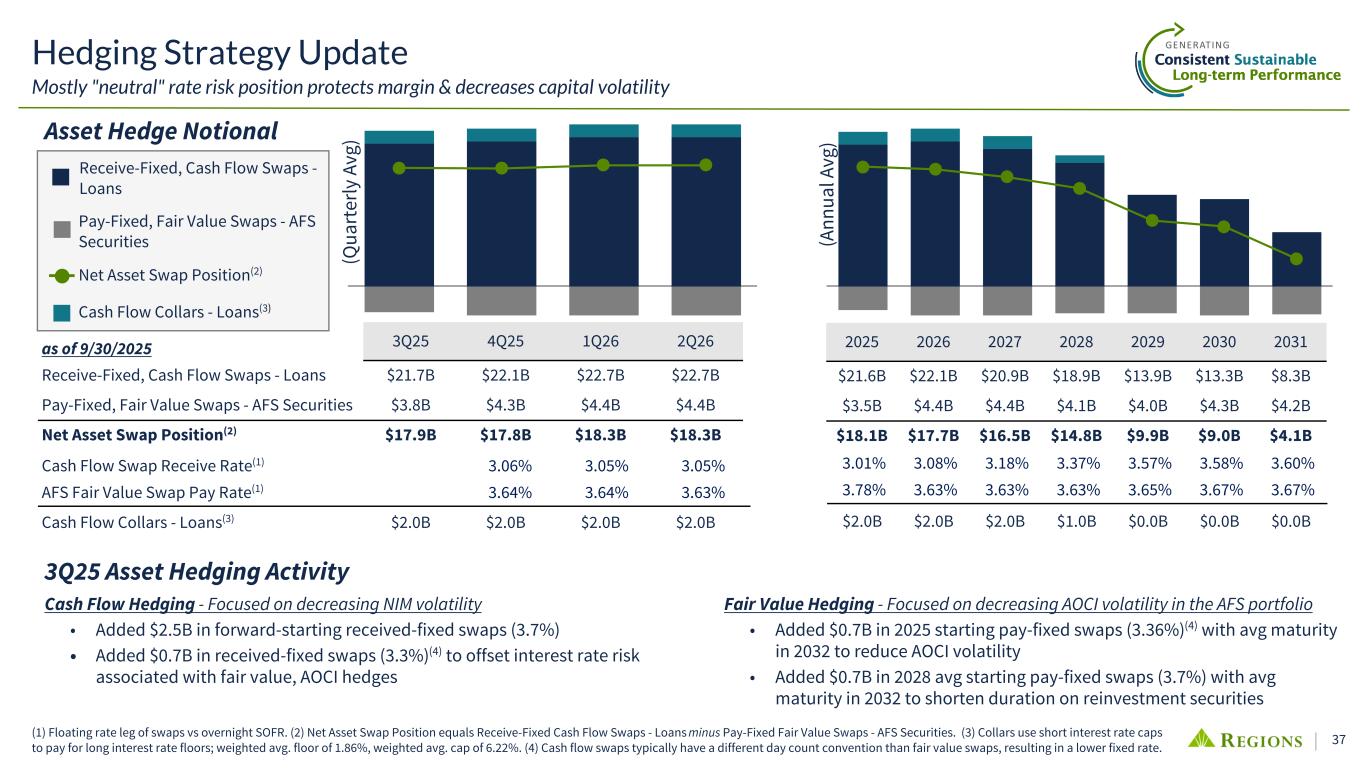
37 3Q25 Asset Hedging Activity 2025 2026 2027 2028 2029 2030 2031 $21.6B $22.1B $20.9B $18.9B $13.9B $13.3B $8.3B $3.5B $4.4B $4.4B $4.1B $4.0B $4.3B $4.2B $18.1B $17.7B $16.5B $14.8B $9.9B $9.0B $4.1B Asset Hedge Notional (Q ua rt er ly A vg ) 3.01% 3.08% 3.18% 3.37% 3.57% 3.58% 3.60% 3.78% 3.63% 3.63% 3.63% 3.65% 3.67% 3.67% (A nn ua l A vg ) as of 9/30/2025 3Q25 4Q25 1Q26 2Q26 Receive-Fixed, Cash Flow Swaps - Loans $21.7B $22.1B $22.7B $22.7B Pay-Fixed, Fair Value Swaps - AFS Securities $3.8B $4.3B $4.4B $4.4B Net Asset Swap Position(2) $17.9B $17.8B $18.3B $18.3B Cash Flow Swap Receive Rate(1) 3.06% 3.05% 3.05% AFS Fair Value Swap Pay Rate(1) 3.64% 3.64% 3.63% $2.0B $2.0B $2.0B $1.0B $0.0B $0.0B $0.0BCash Flow Collars - Loans(3) $2.0B $2.0B $2.0B $2.0B Hedging Strategy Update Mostly "neutral" rate risk position protects margin & decreases capital volatility Receive-Fixed, Cash Flow Swaps - Loans Cash Flow Collars - Loans(3) Pay-Fixed, Fair Value Swaps - AFS Securities Net Asset Swap Position(2) Fair Value Hedging - Focused on decreasing AOCI volatility in the AFS portfolio • Added $0.7B in 2025 starting pay-fixed swaps (3.36%)(4) with avg maturity in 2032 to reduce AOCI volatility • Added $0.7B in 2028 avg starting pay-fixed swaps (3.7%) with avg maturity in 2032 to shorten duration on reinvestment securities (1) Floating rate leg of swaps vs overnight SOFR. (2) Net Asset Swap Position equals Receive-Fixed Cash Flow Swaps - Loans minus Pay-Fixed Fair Value Swaps - AFS Securities. (3) Collars use short interest rate caps to pay for long interest rate floors; weighted avg. floor of 1.86%, weighted avg. cap of 6.22%. (4) Cash flow swaps typically have a different day count convention than fair value swaps, resulting in a lower fixed rate. Cash Flow Hedging - Focused on decreasing NIM volatility • Added $2.5B in forward-starting received-fixed swaps (3.7%) • Added $0.7B in received-fixed swaps (3.3%)(4) to offset interest rate risk associated with fair value, AOCI hedges
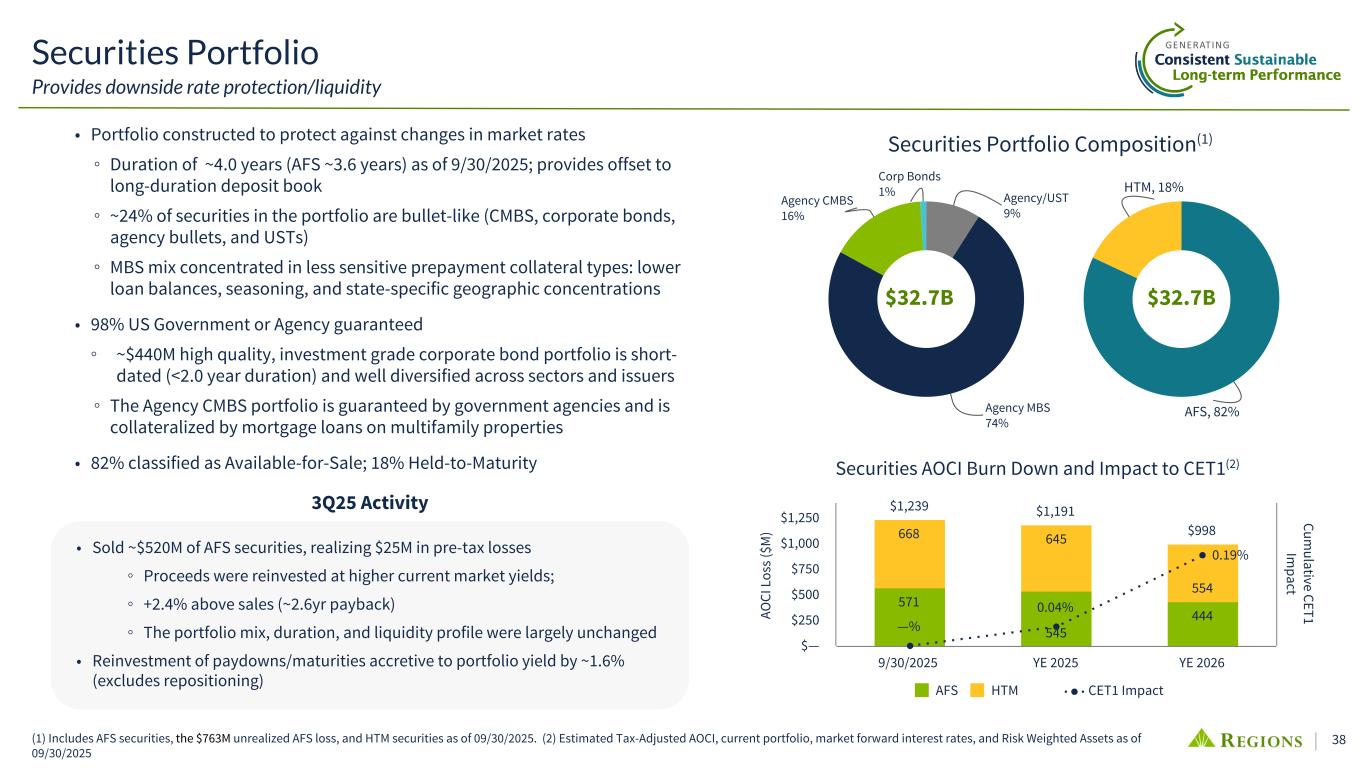
38 • Portfolio constructed to protect against changes in market rates ◦ Duration of ~4.0 years (AFS ~3.6 years) as of 9/30/2025; provides offset to long-duration deposit book ◦ ~24% of securities in the portfolio are bullet-like (CMBS, corporate bonds, agency bullets, and USTs) ◦ MBS mix concentrated in less sensitive prepayment collateral types: lower loan balances, seasoning, and state-specific geographic concentrations • 98% US Government or Agency guaranteed ◦ ~$440M high quality, investment grade corporate bond portfolio is short- dated (<2.0 year duration) and well diversified across sectors and issuers ◦ The Agency CMBS portfolio is guaranteed by government agencies and is collateralized by mortgage loans on multifamily properties • 82% classified as Available-for-Sale; 18% Held-to-Maturity • Sold ~$520M of AFS securities, realizing $25M in pre-tax losses ◦ Proceeds were reinvested at higher current market yields; ◦ +2.4% above sales (~2.6yr payback) ◦ The portfolio mix, duration, and liquidity profile were largely unchanged • Reinvestment of paydowns/maturities accretive to portfolio yield by ~1.6% (excludes repositioning) Agency/UST 9% Agency MBS 74% Agency CMBS 16% Corp Bonds 1% Securities Portfolio Provides downside rate protection/liquidity Securities Portfolio Composition(1) $32.7B Securities AOCI Burn Down and Impact to CET1(2) AO CI L os s ( $M ) Cum ulative CET1 Im pact 571 545 444 668 645 554 $1,239 $1,191 $998 —% 0.04% 0.19% AFS HTM CET1 Impact 9/30/2025 YE 2025 YE 2026 $— $250 $500 $750 $1,000 $1,250 3Q25 Activity AFS, 82% HTM, 18% (1) Includes AFS securities, the $763M unrealized AFS loss, and HTM securities as of 09/30/2025. (2) Estimated Tax-Adjusted AOCI, current portfolio, market forward interest rates, and Risk Weighted Assets as of 09/30/2025 $32.7B
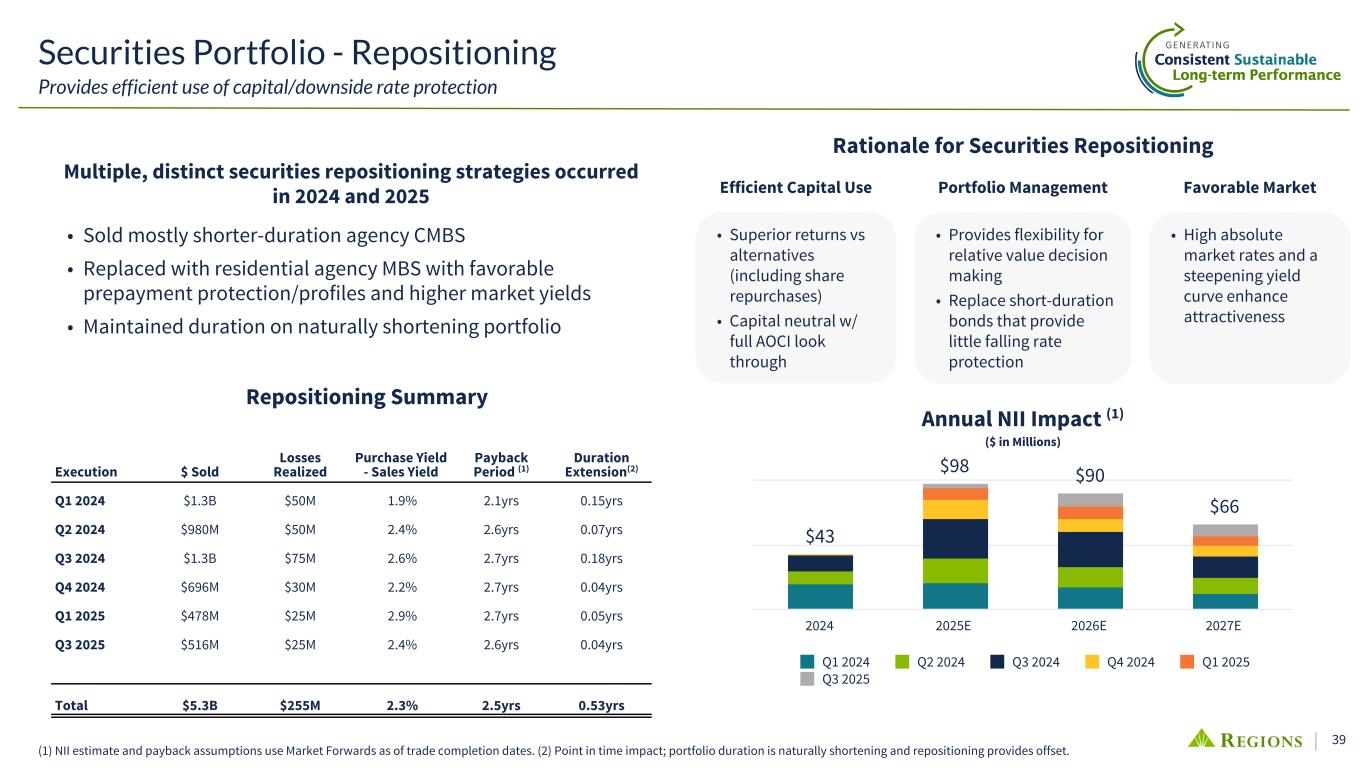
39 (1) NII estimate and payback assumptions use Market Forwards as of trade completion dates. (2) Point in time impact; portfolio duration is naturally shortening and repositioning provides offset. Securities Portfolio - Repositioning Provides efficient use of capital/downside rate protection Rationale for Securities Repositioning Efficient Capital Use Portfolio Management Favorable Market • Superior returns vs alternatives (including share repurchases) • Capital neutral w/ full AOCI look through Annual NII Impact (1) ($ in Millions) $43 $98 $90 $66 Q1 2024 Q2 2024 Q3 2024 Q4 2024 Q1 2025 Q3 2025 2024 2025E 2026E 2027E • High absolute market rates and a steepening yield curve enhance attractiveness Repositioning Summary Multiple, distinct securities repositioning strategies occurred in 2024 and 2025 • Sold mostly shorter-duration agency CMBS • Replaced with residential agency MBS with favorable prepayment protection/profiles and higher market yields • Maintained duration on naturally shortening portfolio • Provides flexibility for relative value decision making • Replace short-duration bonds that provide little falling rate protection Execution $ Sold Losses Realized Purchase Yield - Sales Yield Payback Period (1) Duration Extension(2) Q1 2024 $1.3B $50M 1.9% 2.1yrs 0.15yrs Q2 2024 $980M $50M 2.4% 2.6yrs 0.07yrs Q3 2024 $1.3B $75M 2.6% 2.7yrs 0.18yrs Q4 2024 $696M $30M 2.2% 2.7yrs 0.04yrs Q1 2025 $478M $25M 2.9% 2.7yrs 0.05yrs Q3 2025 $516M $25M 2.4% 2.6yrs 0.04yrs Total $5.3B $255M 2.3% 2.5yrs 0.53yrs
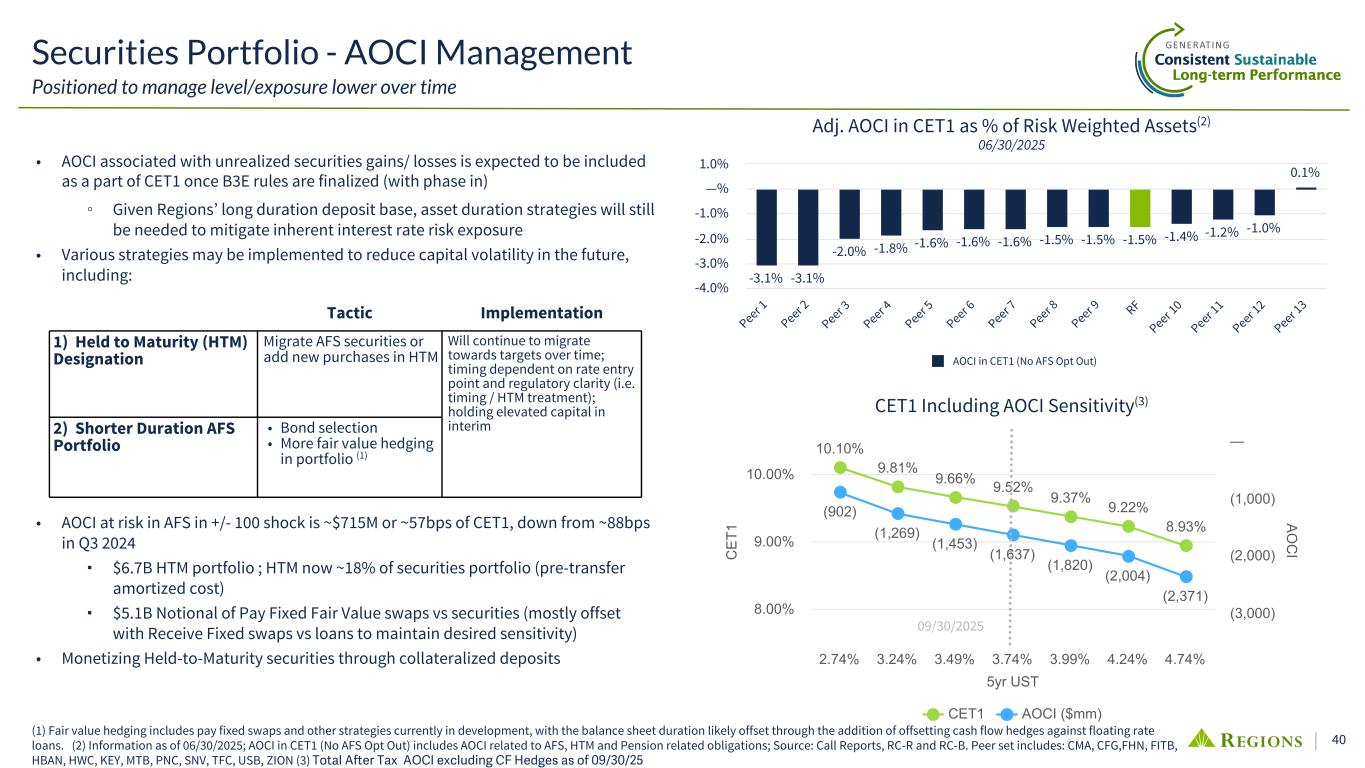
40 • AOCI associated with unrealized securities gains/ losses is expected to be included as a part of CET1 once B3E rules are finalized (with phase in) ◦ Given Regions’ long duration deposit base, asset duration strategies will still be needed to mitigate inherent interest rate risk exposure • Various strategies may be implemented to reduce capital volatility in the future, including: • AOCI at risk in AFS in +/- 100 shock is ~$715M or ~57bps of CET1, down from ~88bps in Q3 2024 ▪ $6.7B HTM portfolio ; HTM now ~18% of securities portfolio (pre-transfer amortized cost) ▪ $5.1B Notional of Pay Fixed Fair Value swaps vs securities (mostly offset with Receive Fixed swaps vs loans to maintain desired sensitivity) • Monetizing Held-to-Maturity securities through collateralized deposits Tactic Implementation 1) Held to Maturity (HTM) Designation Migrate AFS securities or add new purchases in HTM Will continue to migrate towards targets over time; timing dependent on rate entry point and regulatory clarity (i.e. timing / HTM treatment); holding elevated capital in interim 2) Shorter Duration AFS Portfolio • Bond selection • More fair value hedging in portfolio (1) (1) Fair value hedging includes pay fixed swaps and other strategies currently in development, with the balance sheet duration likely offset through the addition of offsetting cash flow hedges against floating rate loans. (2) Information as of 06/30/2025; AOCI in CET1 (No AFS Opt Out) includes AOCI related to AFS, HTM and Pension related obligations; Source: Call Reports, RC-R and RC-B. Peer set includes: CMA, CFG,FHN, FITB, HBAN, HWC, KEY, MTB, PNC, SNV, TFC, USB, ZION (3) Total After Tax AOCI excluding CF Hedges as of 09/30/25 Securities Portfolio - AOCI Management Positioned to manage level/exposure lower over time -3.1% -3.1% -2.0% -1.8% -1.6% -1.6% -1.6% -1.5% -1.5% -1.5% -1.4% -1.2% -1.0% 0.1% AOCI in CET1 (No AFS Opt Out) Peer 1 Peer 2 Peer 3 Peer 4 Peer 5 Peer 6 Peer 7 Peer 8 Peer 9 RF Peer 1 0 Peer 1 1 Peer 1 2 Peer 1 3 -4.0% -3.0% -2.0% -1.0% —% 1.0% Adj. AOCI in CET1 as % of Risk Weighted Assets(2) 06/30/2025 5yr UST C E T1 A O C I 10.10% 9.81% 9.66% 9.52% 9.37% 9.22% 8.93% (902) (1,269) (1,453) (1,637) (1,820) (2,004) (2,371) CET1 AOCI ($mm) 2.74% 3.24% 3.49% 3.74% 3.99% 4.24% 4.74% 8.00% 9.00% 10.00% (3,000) (2,000) (1,000) — CET1 Including AOCI Sensitivity(3) 09/30/2025
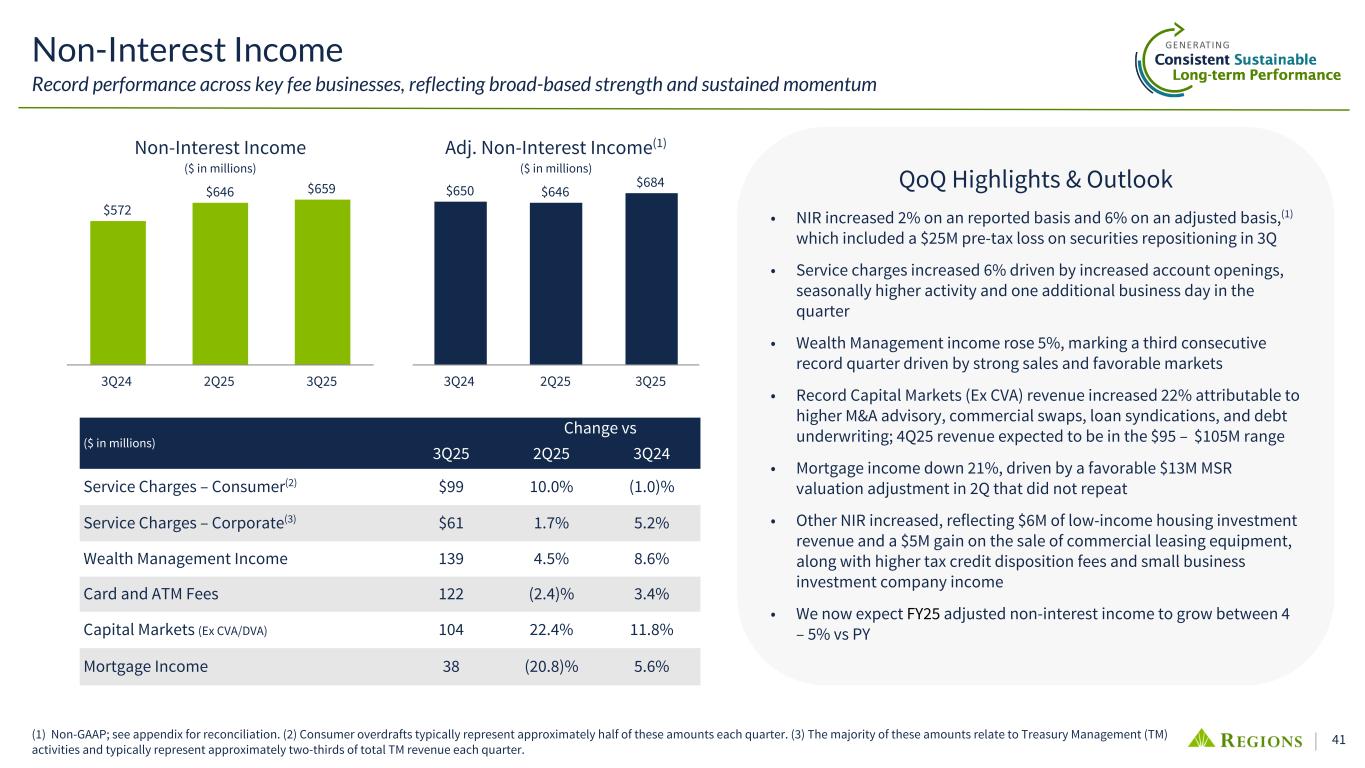
41 QoQ Highlights & Outlook • NIR increased 2% on an reported basis and 6% on an adjusted basis,(1) which included a $25M pre-tax loss on securities repositioning in 3Q • Service charges increased 6% driven by increased account openings, seasonally higher activity and one additional business day in the quarter • Wealth Management income rose 5%, marking a third consecutive record quarter driven by strong sales and favorable markets • Record Capital Markets (Ex CVA) revenue increased 22% attributable to higher M&A advisory, commercial swaps, loan syndications, and debt underwriting; 4Q25 revenue expected to be in the $95 – $105M range • Mortgage income down 21%, driven by a favorable $13M MSR valuation adjustment in 2Q that did not repeat • Other NIR increased, reflecting $6M of low-income housing investment revenue and a $5M gain on the sale of commercial leasing equipment, along with higher tax credit disposition fees and small business investment company income • We now expect FY25 adjusted non-interest income to grow between 4 – 5% vs PY $650 $646 $684 3Q24 2Q25 3Q25 ($ in millions) Change vs 3Q25 2Q25 3Q24 Service Charges – Consumer(2) $99 10.0% (1.0)% Service Charges – Corporate(3) $61 1.7% 5.2% Wealth Management Income 139 4.5% 8.6% Card and ATM Fees 122 (2.4)% 3.4% Capital Markets (Ex CVA/DVA) 104 22.4% 11.8% Mortgage Income 38 (20.8)% 5.6% Non-Interest Income Record performance across key fee businesses, reflecting broad-based strength and sustained momentum (1) Non-GAAP; see appendix for reconciliation. (2) Consumer overdrafts typically represent approximately half of these amounts each quarter. (3) The majority of these amounts relate to Treasury Management (TM) activities and typically represent approximately two-thirds of total TM revenue each quarter. $572 $646 $659 3Q24 2Q25 3Q25 Non-Interest Income ($ in millions) Adj. Non-Interest Income(1) ($ in millions)
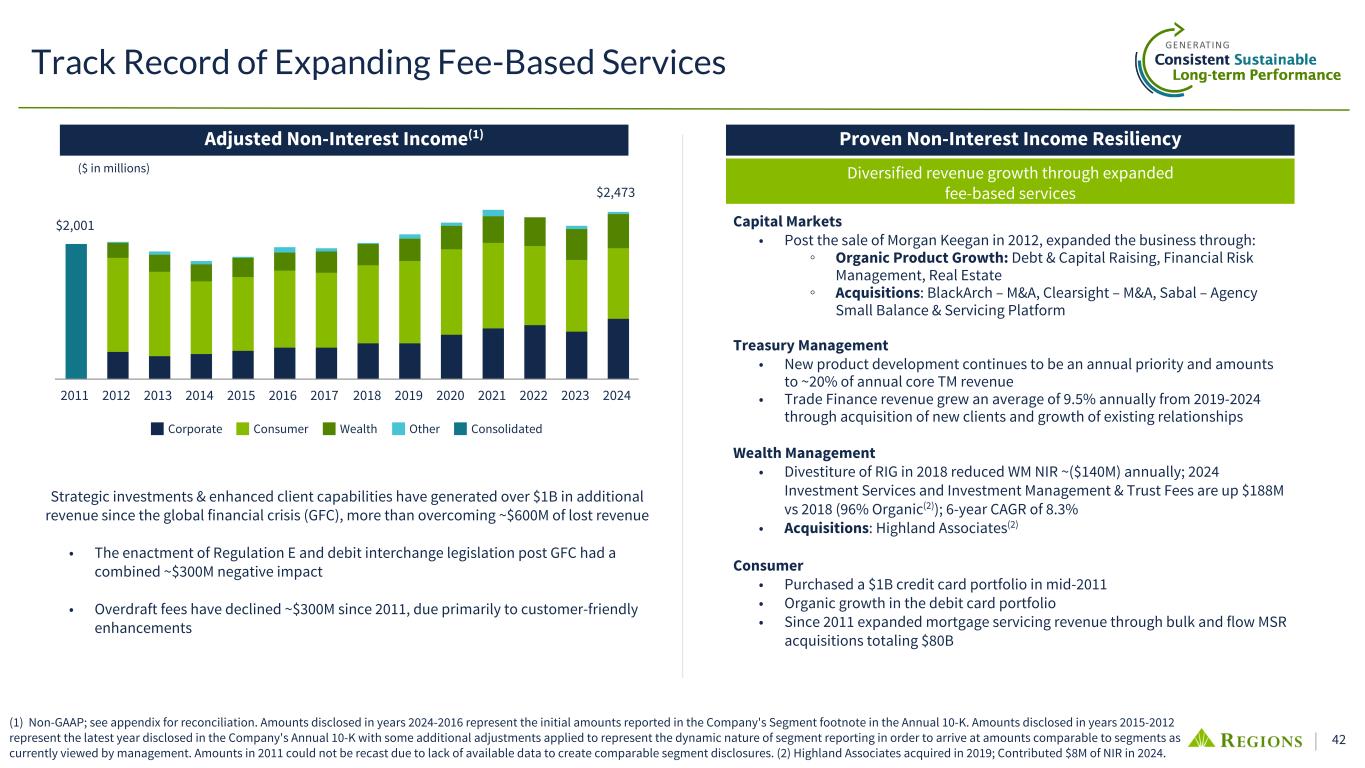
42 Track Record of Expanding Fee-Based Services Proven Non-Interest Income ResiliencyAdjusted Non-Interest Income(1) Diversified revenue growth through expanded fee-based services (1) Non-GAAP; see appendix for reconciliation. Amounts disclosed in years 2024-2016 represent the initial amounts reported in the Company's Segment footnote in the Annual 10-K. Amounts disclosed in years 2015-2012 represent the latest year disclosed in the Company's Annual 10-K with some additional adjustments applied to represent the dynamic nature of segment reporting in order to arrive at amounts comparable to segments as currently viewed by management. Amounts in 2011 could not be recast due to lack of available data to create comparable segment disclosures. (2) Highland Associates acquired in 2019; Contributed $8M of NIR in 2024. ($ in millions) Capital Markets • Post the sale of Morgan Keegan in 2012, expanded the business through: ◦ Organic Product Growth: Debt & Capital Raising, Financial Risk Management, Real Estate ◦ Acquisitions: BlackArch – M&A, Clearsight – M&A, Sabal – Agency Small Balance & Servicing Platform Treasury Management • New product development continues to be an annual priority and amounts to ~20% of annual core TM revenue • Trade Finance revenue grew an average of 9.5% annually from 2019-2024 through acquisition of new clients and growth of existing relationships Wealth Management • Divestiture of RIG in 2018 reduced WM NIR ~($140M) annually; 2024 Investment Services and Investment Management & Trust Fees are up $188M vs 2018 (96% Organic(2)); 6-year CAGR of 8.3% • Acquisitions: Highland Associates(2) Consumer • Purchased a $1B credit card portfolio in mid-2011 • Organic growth in the debit card portfolio • Since 2011 expanded mortgage servicing revenue through bulk and flow MSR acquisitions totaling $80B Strategic investments & enhanced client capabilities have generated over $1B in additional revenue since the global financial crisis (GFC), more than overcoming ~$600M of lost revenue • The enactment of Regulation E and debit interchange legislation post GFC had a combined ~$300M negative impact • Overdraft fees have declined ~$300M since 2011, due primarily to customer-friendly enhancements Corporate Consumer Wealth Other Consolidated 2011 2012 2013 2014 2015 2016 2017 2018 2019 2020 2021 2022 2023 2024 $2,001 $2,473
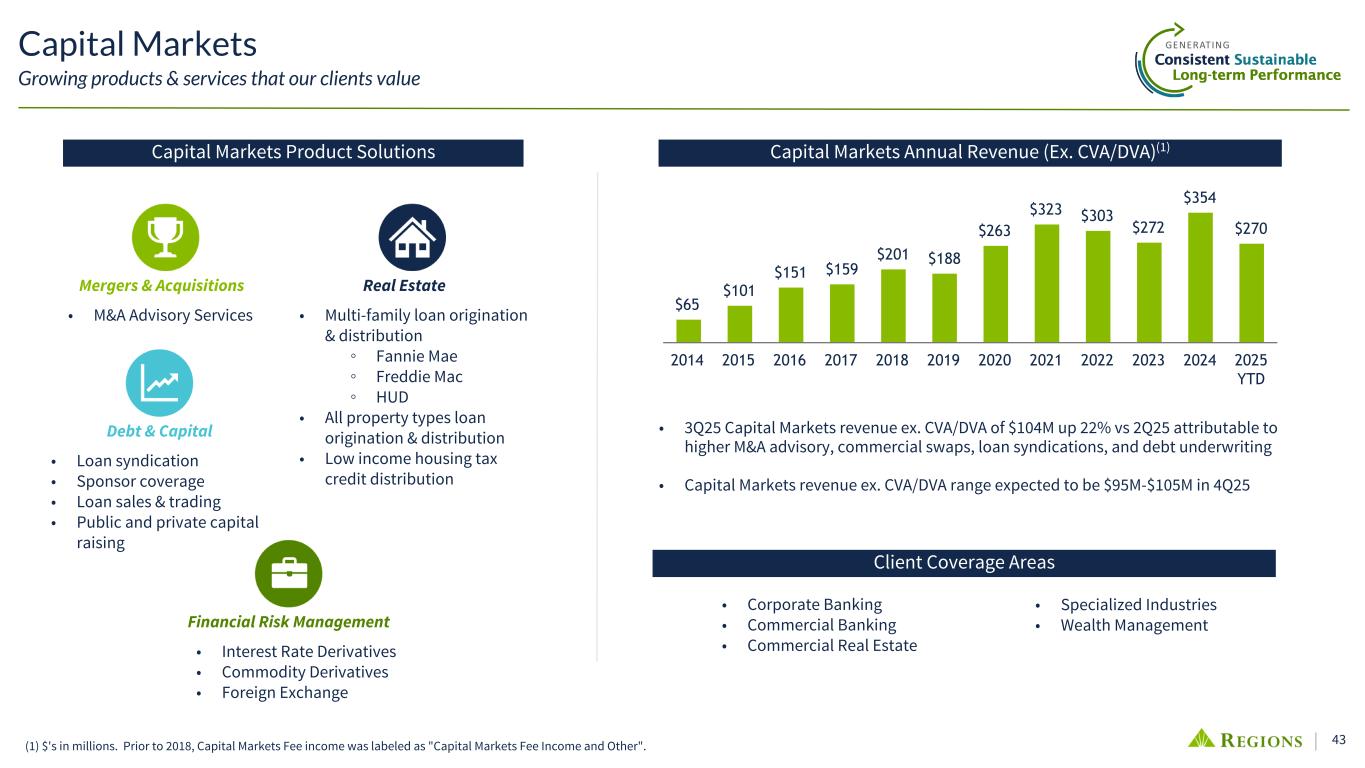
43 Capital Markets Growing products & services that our clients value • 3Q25 Capital Markets revenue ex. CVA/DVA of $104M up 22% vs 2Q25 attributable to higher M&A advisory, commercial swaps, loan syndications, and debt underwriting • Capital Markets revenue ex. CVA/DVA range expected to be $95M-$105M in 4Q25 Capital Markets Product Solutions Real Estate • Multi-family loan origination & distribution ◦ Fannie Mae ◦ Freddie Mac ◦ HUD • All property types loan origination & distribution • Low income housing tax credit distribution Financial Risk Management • Interest Rate Derivatives • Commodity Derivatives • Foreign Exchange Debt & Capital • Loan syndication • Sponsor coverage • Loan sales & trading • Public and private capital raising Client Coverage Areas • Corporate Banking • Commercial Banking • Commercial Real Estate • Specialized Industries • Wealth Management Capital Markets Annual Revenue (Ex. CVA/DVA)(1) Mergers & Acquisitions • M&A Advisory Services (1) $'s in millions. Prior to 2018, Capital Markets Fee income was labeled as "Capital Markets Fee Income and Other". $65 $101 $151 $159 $201 $188 $263 $323 $303 $272 $354 $270 2014 2015 2016 2017 2018 2019 2020 2021 2022 2023 2024 2025 YTD
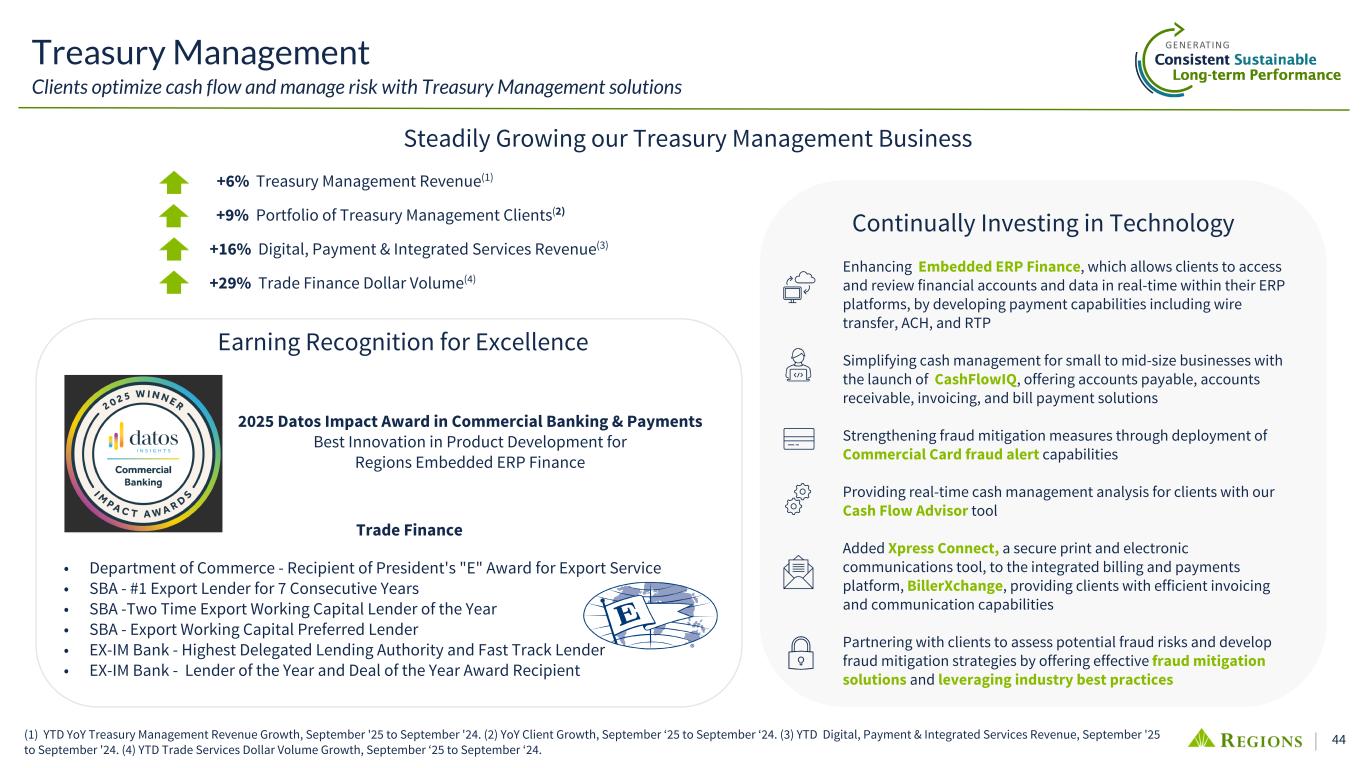
44 +6% Treasury Management Revenue(1) +9% Portfolio of Treasury Management Clients(2) +16% Digital, Payment & Integrated Services Revenue(3) +29% Trade Finance Dollar Volume(4) Continually Investing in Technology Enhancing Embedded ERP Finance, which allows clients to access and review financial accounts and data in real-time within their ERP platforms, by developing payment capabilities including wire transfer, ACH, and RTP Simplifying cash management for small to mid-size businesses with the launch of CashFlowIQ, offering accounts payable, accounts receivable, invoicing, and bill payment solutions Strengthening fraud mitigation measures through deployment of Commercial Card fraud alert capabilities Providing real-time cash management analysis for clients with our Cash Flow Advisor tool Added Xpress Connect, a secure print and electronic communications tool, to the integrated billing and payments platform, BillerXchange, providing clients with efficient invoicing and communication capabilities Partnering with clients to assess potential fraud risks and develop fraud mitigation strategies by offering effective fraud mitigation solutions and leveraging industry best practices Treasury Management Clients optimize cash flow and manage risk with Treasury Management solutions Trade Finance • Department of Commerce - Recipient of President's "E" Award for Export Service • SBA - #1 Export Lender for 7 Consecutive Years • SBA -Two Time Export Working Capital Lender of the Year • SBA - Export Working Capital Preferred Lender • EX-IM Bank - Highest Delegated Lending Authority and Fast Track Lender • EX-IM Bank - Lender of the Year and Deal of the Year Award Recipient (1) YTD YoY Treasury Management Revenue Growth, September '25 to September '24. (2) YoY Client Growth, September ‘25 to September ‘24. (3) YTD Digital, Payment & Integrated Services Revenue, September '25 to September '24. (4) YTD Trade Services Dollar Volume Growth, September ‘25 to September ‘24. Earning Recognition for Excellence Steadily Growing our Treasury Management Business 2025 Datos Impact Award in Commercial Banking & Payments Best Innovation in Product Development for Regions Embedded ERP Finance
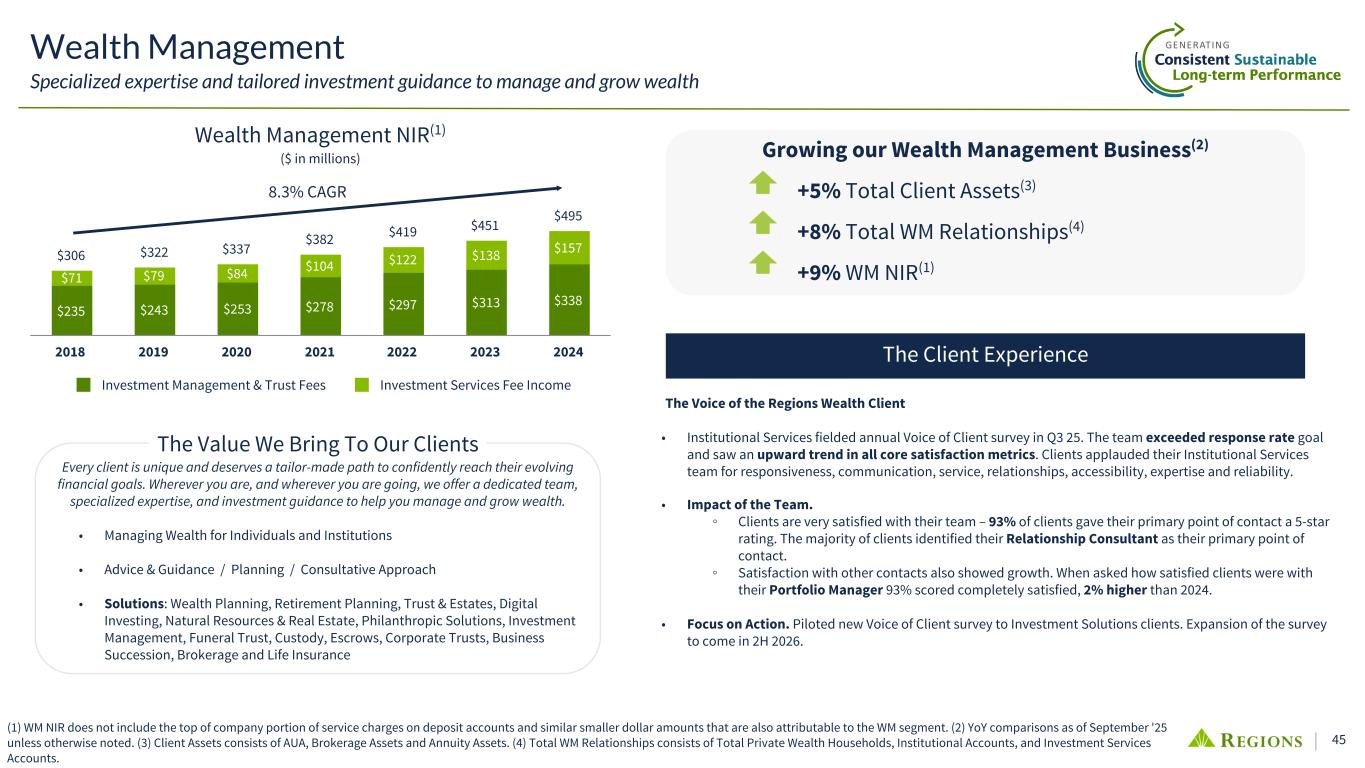
45 Wealth Management NIR(1) ($ in millions) The Voice of the Regions Wealth Client • Institutional Services fielded annual Voice of Client survey in Q3 25. The team exceeded response rate goal and saw an upward trend in all core satisfaction metrics. Clients applauded their Institutional Services team for responsiveness, communication, service, relationships, accessibility, expertise and reliability. • Impact of the Team. ◦ Clients are very satisfied with their team – 93% of clients gave their primary point of contact a 5-star rating. The majority of clients identified their Relationship Consultant as their primary point of contact. ◦ Satisfaction with other contacts also showed growth. When asked how satisfied clients were with their Portfolio Manager 93% scored completely satisfied, 2% higher than 2024. • Focus on Action. Piloted new Voice of Client survey to Investment Solutions clients. Expansion of the survey to come in 2H 2026. The Client Experience Every client is unique and deserves a tailor-made path to confidently reach their evolving financial goals. Wherever you are, and wherever you are going, we offer a dedicated team, specialized expertise, and investment guidance to help you manage and grow wealth. • Managing Wealth for Individuals and Institutions • Advice & Guidance / Planning / Consultative Approach • Solutions: Wealth Planning, Retirement Planning, Trust & Estates, Digital Investing, Natural Resources & Real Estate, Philanthropic Solutions, Investment Management, Funeral Trust, Custody, Escrows, Corporate Trusts, Business Succession, Brokerage and Life Insurance $306 $322 $337 $382 $419 $451 $495 $235 $243 $253 $278 $297 $313 $338 $71 $79 $84 $104 $122 $138 $157 Investment Management & Trust Fees Investment Services Fee Income 2018 2019 2020 2021 2022 2023 2024 (1) WM NIR does not include the top of company portion of service charges on deposit accounts and similar smaller dollar amounts that are also attributable to the WM segment. (2) YoY comparisons as of September '25 unless otherwise noted. (3) Client Assets consists of AUA, Brokerage Assets and Annuity Assets. (4) Total WM Relationships consists of Total Private Wealth Households, Institutional Accounts, and Investment Services Accounts. Wealth Management Specialized expertise and tailored investment guidance to manage and grow wealth 8.3% CAGR Growing our Wealth Management Business(2) +5% Total Client Assets(3) +8% Total WM Relationships(4) +9% WM NIR(1) The Value We Bring To Our Clients
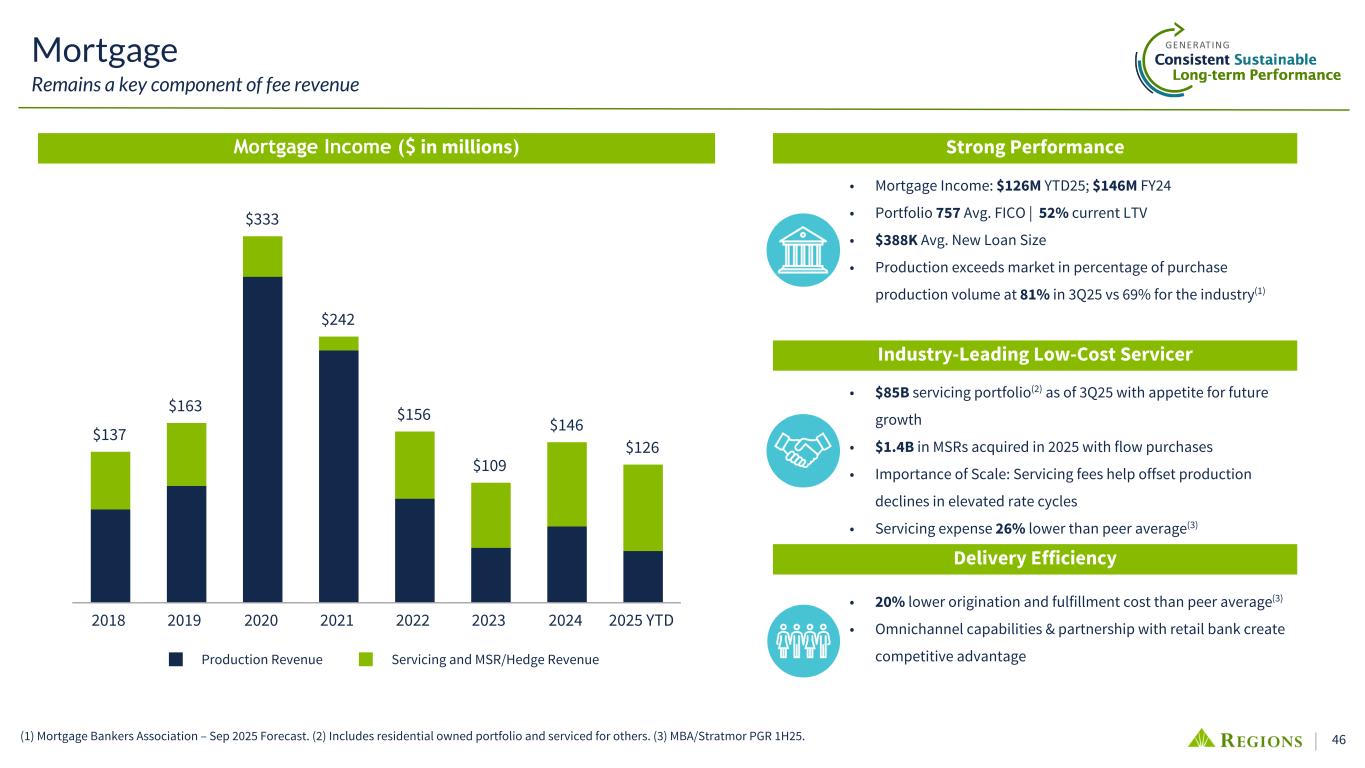
46 Mortgage Remains a key component of fee revenue (1) Mortgage Bankers Association – Sep 2025 Forecast. (2) Includes residential owned portfolio and serviced for others. (3) MBA/Stratmor PGR 1H25. Mortgage Income ($ in millions) Strong Performance Industry-Leading Low-Cost Servicer Delivery Efficiency • Mortgage Income: $126M YTD25; $146M FY24 • Portfolio 757 Avg. FICO | 52% current LTV • $388K Avg. New Loan Size • Production exceeds market in percentage of purchase production volume at 81% in 3Q25 vs 69% for the industry(1) • $85B servicing portfolio(2) as of 3Q25 with appetite for future growth • $1.4B in MSRs acquired in 2025 with flow purchases • Importance of Scale: Servicing fees help offset production declines in elevated rate cycles • Servicing expense 26% lower than peer average(3) • 20% lower origination and fulfillment cost than peer average(3) • Omnichannel capabilities & partnership with retail bank create competitive advantage $137 $163 $333 $242 $156 $109 $146 $126 Production Revenue Servicing and MSR/Hedge Revenue 2018 2019 2020 2021 2022 2023 2024 2025 YTD
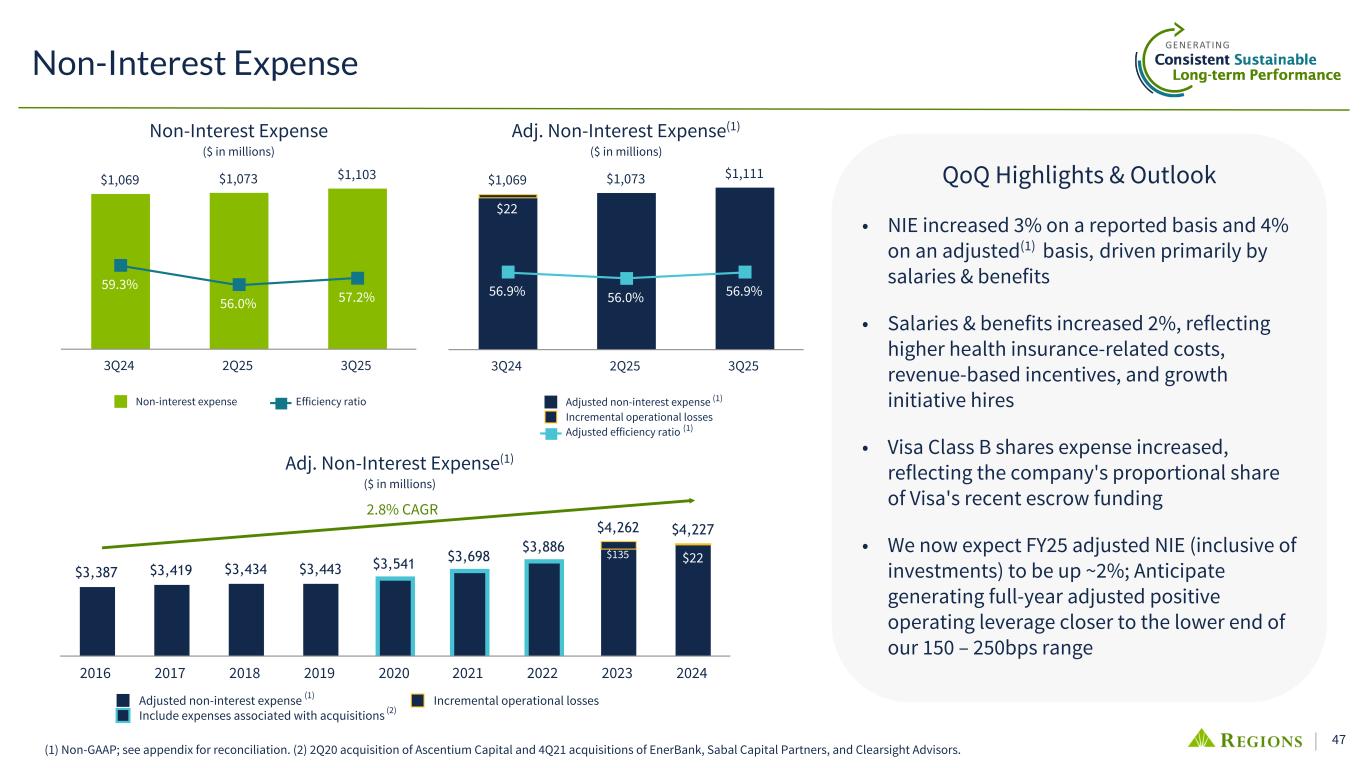
47 QoQ Highlights & Outlook • NIE increased 3% on a reported basis and 4% on an adjusted(1) basis, driven primarily by salaries & benefits • Salaries & benefits increased 2%, reflecting higher health insurance-related costs, revenue-based incentives, and growth initiative hires • Visa Class B shares expense increased, reflecting the company's proportional share of Visa's recent escrow funding • We now expect FY25 adjusted NIE (inclusive of investments) to be up ~2%; Anticipate generating full-year adjusted positive operating leverage closer to the lower end of our 150 – 250bps range $1,069 $1,073 $1,103 59.3% 56.0% 57.2% Non-interest expense Efficiency ratio 3Q24 2Q25 3Q25 $1,069 $1,073 $1,111 $22 $— 56.9% 56.0% 56.9% Adjusted non-interest expense Incremental operational losses Adjusted efficiency ratio 3Q24 2Q25 3Q25 Non-Interest Expense (1) (1) Non-Interest Expense ($ in millions) Adj. Non-Interest Expense(1) ($ in millions) $3,387 $3,419 $3,434 $3,443 $3,541 $3,698 $3,886 $4,262 $4,227 $135 $22 Adjusted non-interest expense Incremental operational losses Include expenses associated with acquisitions 2016 2017 2018 2019 2020 2021 2022 2023 2024 2.8% CAGR Adj. Non-Interest Expense(1) ($ in millions) (1) (2) (1) Non-GAAP; see appendix for reconciliation. (2) 2Q20 acquisition of Ascentium Capital and 4Q21 acquisitions of EnerBank, Sabal Capital Partners, and Clearsight Advisors.
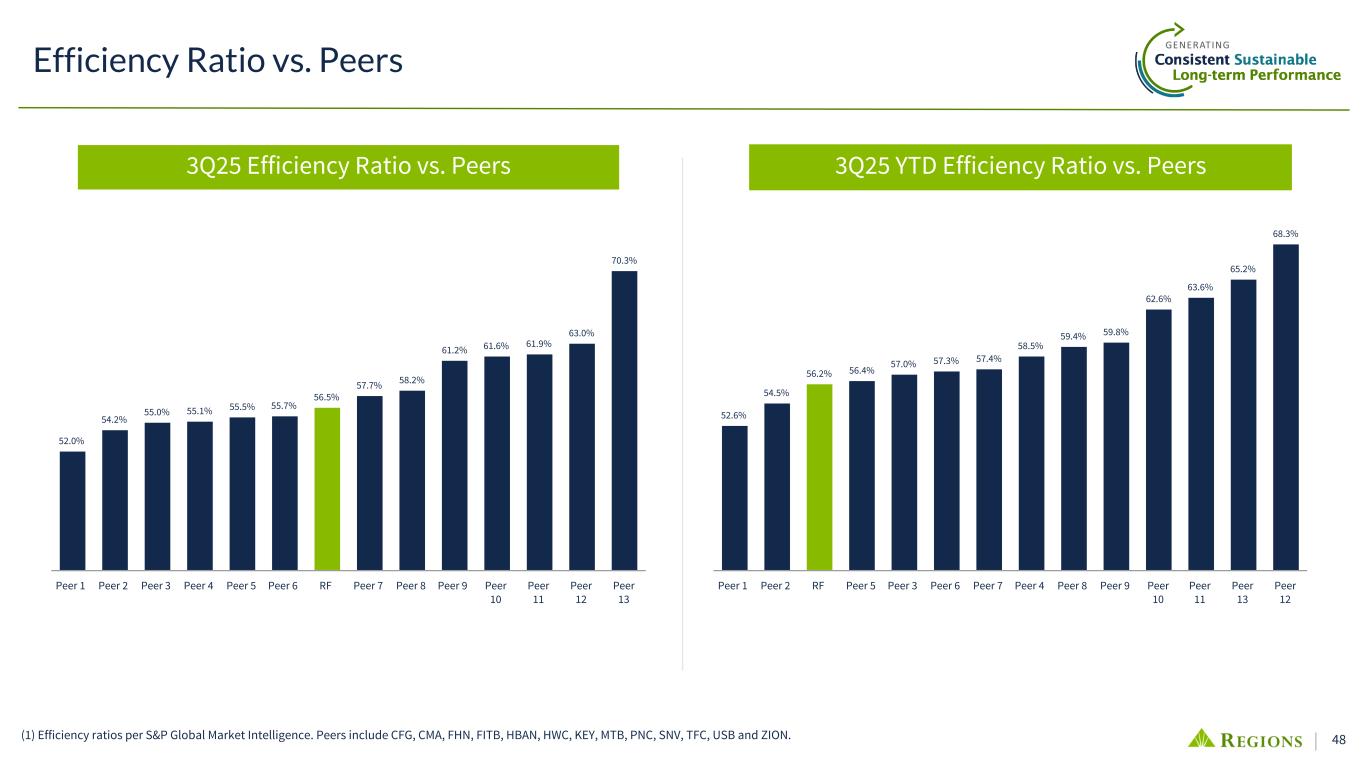
48 Efficiency Ratio vs. Peers 3Q25 Efficiency Ratio vs. Peers 3Q25 YTD Efficiency Ratio vs. Peers 52.0% 54.2% 55.0% 55.1% 55.5% 55.7% 56.5% 57.7% 58.2% 61.2% 61.6% 61.9% 63.0% 70.3% Peer 1 Peer 2 Peer 3 Peer 4 Peer 5 Peer 6 RF Peer 7 Peer 8 Peer 9 Peer 10 Peer 11 Peer 12 Peer 13 52.6% 54.5% 56.2% 56.4% 57.0% 57.3% 57.4% 58.5% 59.4% 59.8% 62.6% 63.6% 65.2% 68.3% Peer 1 Peer 2 RF Peer 5 Peer 3 Peer 6 Peer 7 Peer 4 Peer 8 Peer 9 Peer 10 Peer 11 Peer 13 Peer 12 (1) Efficiency ratios per S&P Global Market Intelligence. Peers include CFG, CMA, FHN, FITB, HBAN, HWC, KEY, MTB, PNC, SNV, TFC, USB and ZION.
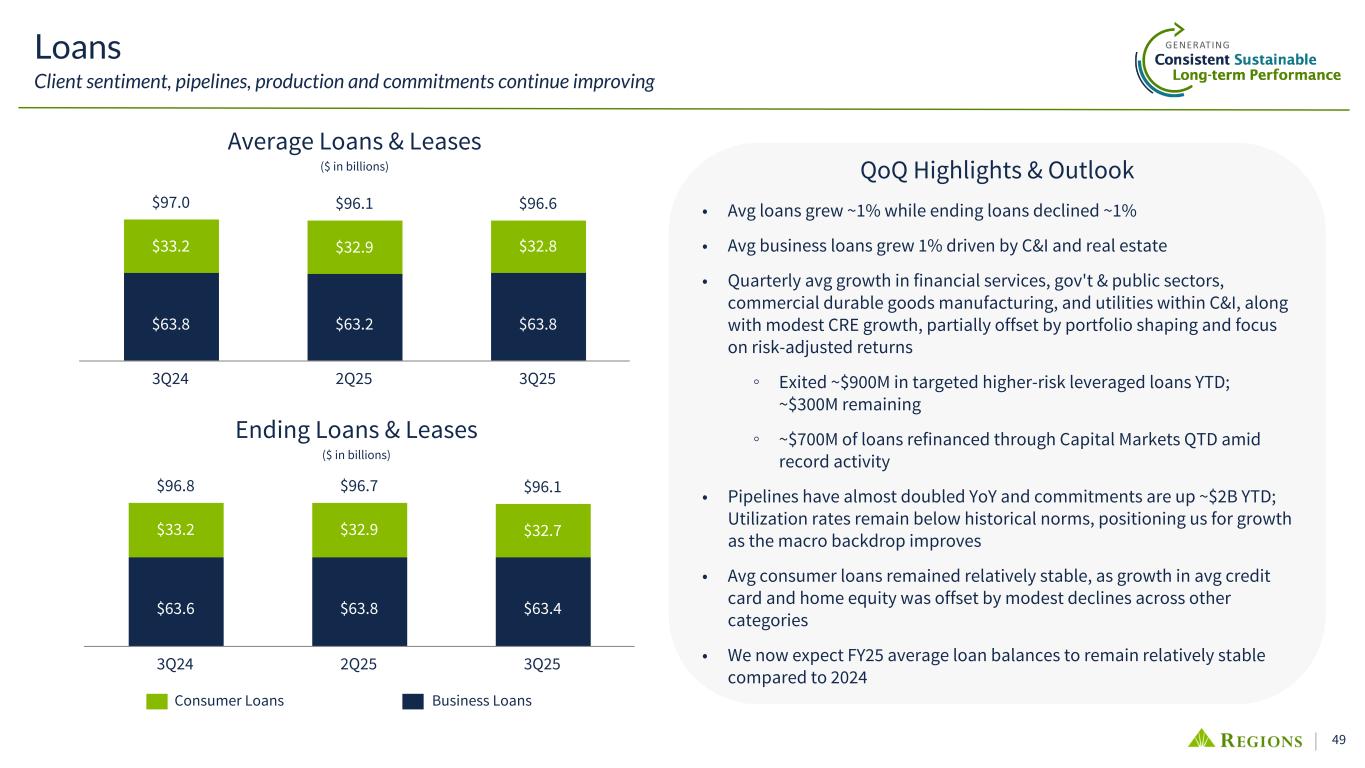
49 QoQ Highlights & Outlook • Avg loans grew ~1% while ending loans declined ~1% • Avg business loans grew 1% driven by C&I and real estate • Quarterly avg growth in financial services, gov't & public sectors, commercial durable goods manufacturing, and utilities within C&I, along with modest CRE growth, partially offset by portfolio shaping and focus on risk-adjusted returns ◦ Exited ~$900M in targeted higher-risk leveraged loans YTD; ~$300M remaining ◦ ~$700M of loans refinanced through Capital Markets QTD amid record activity • Pipelines have almost doubled YoY and commitments are up ~$2B YTD; Utilization rates remain below historical norms, positioning us for growth as the macro backdrop improves • Avg consumer loans remained relatively stable, as growth in avg credit card and home equity was offset by modest declines across other categories • We now expect FY25 average loan balances to remain relatively stable compared to 2024 $96.8 $96.7 $96.1 $63.6 $63.8 $63.4 $33.2 $32.9 $32.7 3Q24 2Q25 3Q25 $97.0 $96.1 $96.6 $63.8 $63.2 $63.8 $33.2 $32.9 $32.8 3Q24 2Q25 3Q25 Average Loans & Leases ($ in billions) Business LoansConsumer Loans Ending Loans & Leases ($ in billions) Loans Client sentiment, pipelines, production and commitments continue improving
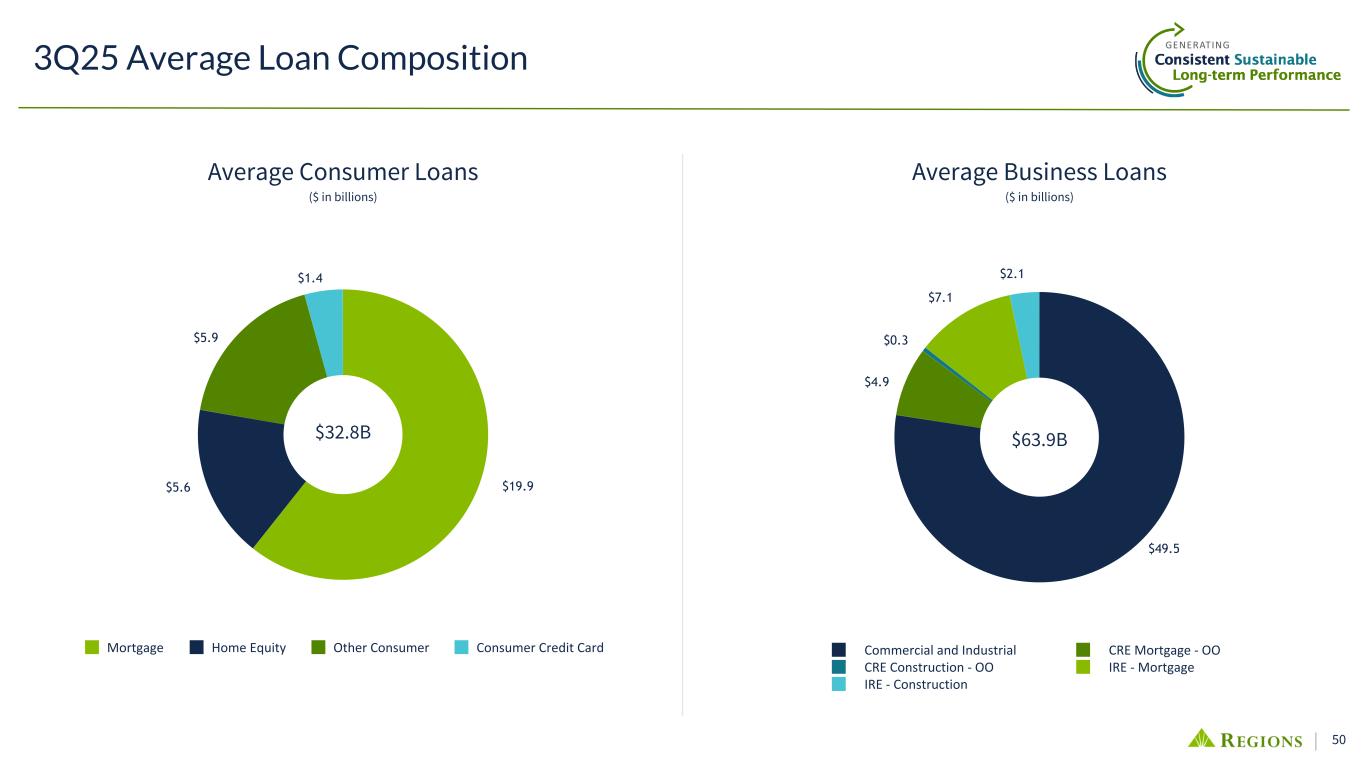
50 $49.5 $4.9 $0.3 $7.1 $2.1 Commercial and Industrial CRE Mortgage - OO CRE Construction - OO IRE - Mortgage IRE - Construction 3Q25 Average Loan Composition $19.9$5.6 $5.9 $1.4 Mortgage Home Equity Other Consumer Consumer Credit Card Average Consumer Loans ($ in billions) $32.8B Average Business Loans ($ in billions) $63.9B
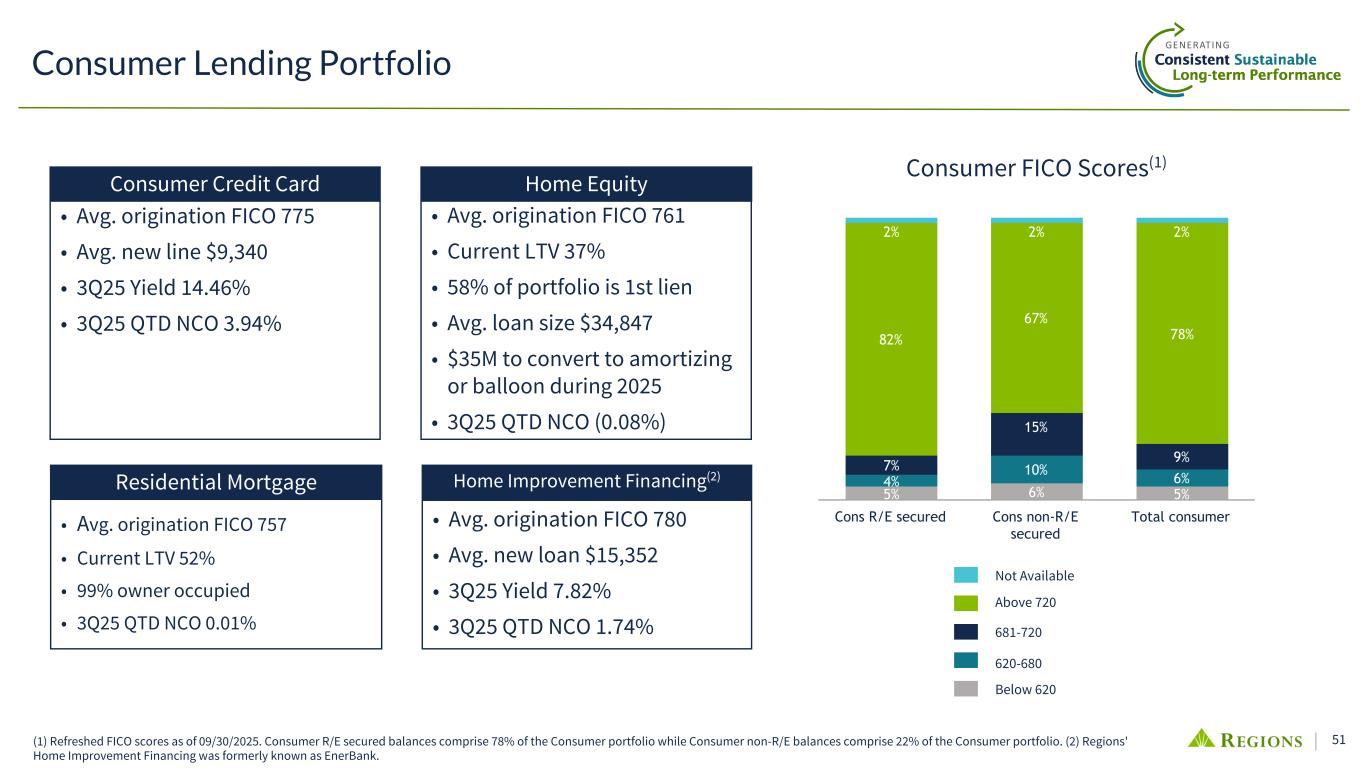
51 Consumer Lending Portfolio • Avg. origination FICO 757 • Current LTV 52% • 99% owner occupied • 3Q25 QTD NCO 0.01% • Avg. origination FICO 761 • Current LTV 37% • 58% of portfolio is 1st lien • Avg. loan size $34,847 • $35M to convert to amortizing or balloon during 2025 • 3Q25 QTD NCO (0.08%) • Avg. origination FICO 780 • Avg. new loan $15,352 • 3Q25 Yield 7.82% • 3Q25 QTD NCO 1.74% • • Avg. origination FICO 775 • Avg. new line $9,340 • 3Q25 Yield 14.46% • 3Q25 QTD NCO 3.94% 5% 6% 5% 4% 10% 6% 7% 15% 9% 82% 67% 78% 2% 2% 2% Cons R/E secured Cons non-R/E secured Total consumer Not Available Above 720 620-680 Below 620 681-720 Consumer FICO Scores(1) (1) Refreshed FICO scores as of 09/30/2025. Consumer R/E secured balances comprise 78% of the Consumer portfolio while Consumer non-R/E balances comprise 22% of the Consumer portfolio. (2) Regions' Home Improvement Financing was formerly known as EnerBank. Residential Mortgage Consumer Credit Card Home Equity Home Improvement Financing(2)
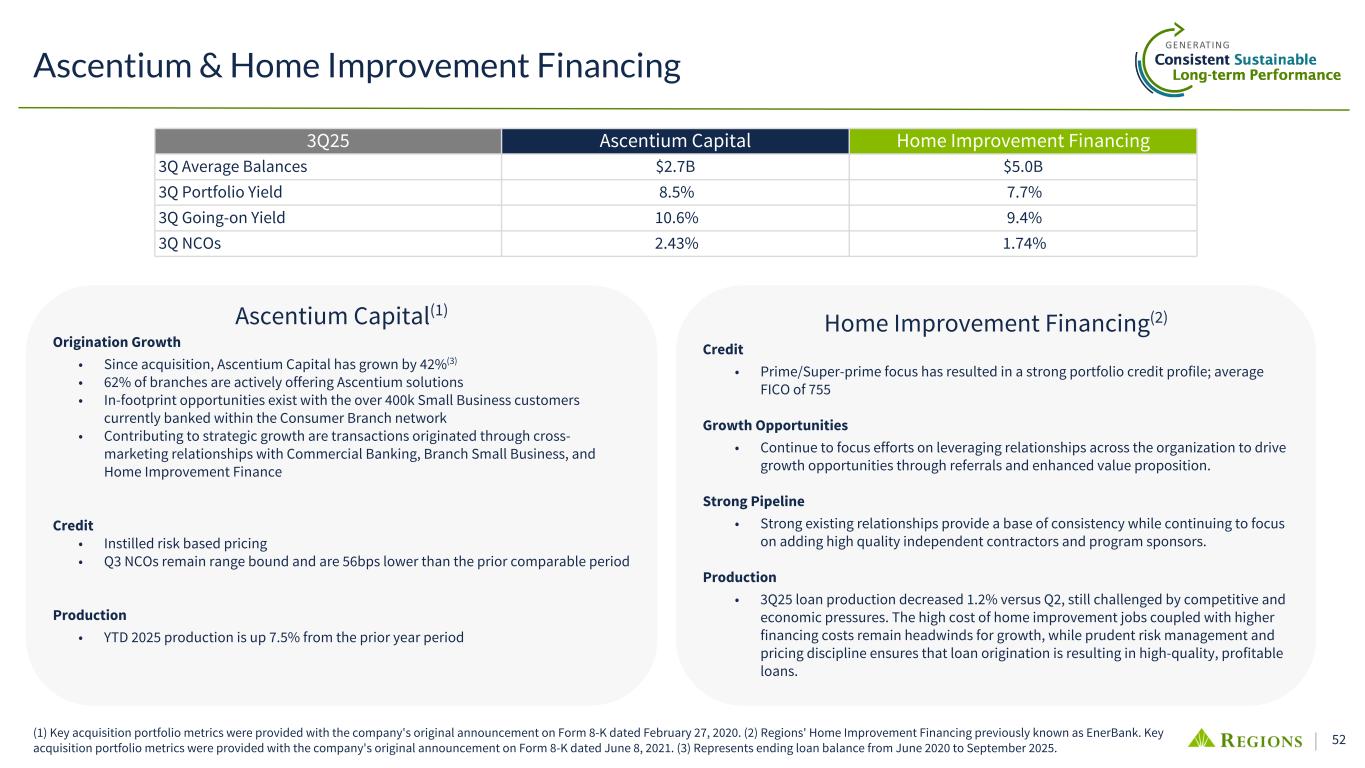
52 Ascentium & Home Improvement Financing (1) Key acquisition portfolio metrics were provided with the company's original announcement on Form 8-K dated February 27, 2020. (2) Regions' Home Improvement Financing previously known as EnerBank. Key acquisition portfolio metrics were provided with the company's original announcement on Form 8-K dated June 8, 2021. (3) Represents ending loan balance from June 2020 to September 2025. 3Q25 Ascentium Capital Home Improvement Financing 3Q Average Balances $2.7B $5.0B 3Q Portfolio Yield 8.5% 7.7% 3Q Going-on Yield 10.6% 9.4% 3Q NCOs 2.43% 1.74% Ascentium Capital(1) Origination Growth • Since acquisition, Ascentium Capital has grown by 42%(3) • 62% of branches are actively offering Ascentium solutions • In-footprint opportunities exist with the over 400k Small Business customers currently banked within the Consumer Branch network • Contributing to strategic growth are transactions originated through cross- marketing relationships with Commercial Banking, Branch Small Business, and Home Improvement Finance Credit • Instilled risk based pricing • Q3 NCOs remain range bound and are 56bps lower than the prior comparable period Production • YTD 2025 production is up 7.5% from the prior year period Home Improvement Financing(2) Credit • Prime/Super-prime focus has resulted in a strong portfolio credit profile; average FICO of 755 Growth Opportunities • Continue to focus efforts on leveraging relationships across the organization to drive growth opportunities through referrals and enhanced value proposition. Strong Pipeline • Strong existing relationships provide a base of consistency while continuing to focus on adding high quality independent contractors and program sponsors. Production • 3Q25 loan production decreased 1.2% versus Q2, still challenged by competitive and economic pressures. The high cost of home improvement jobs coupled with higher financing costs remain headwinds for growth, while prudent risk management and pricing discipline ensures that loan origination is resulting in high-quality, profitable loans.
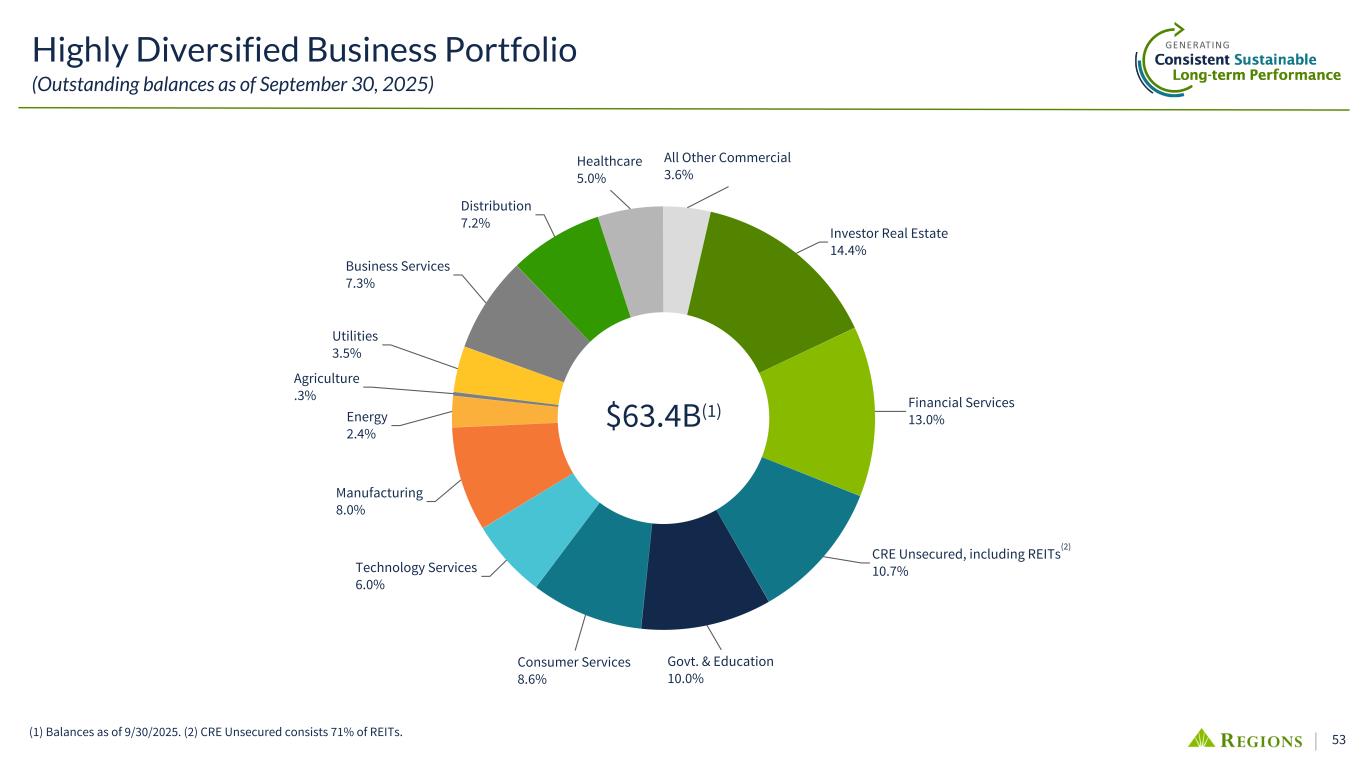
53 All Other Commercial 3.6% Investor Real Estate 14.4% Financial Services 13.0% CRE Unsecured, including REITs 10.7% Govt. & Education 10.0% Consumer Services 8.6% Technology Services 6.0% Manufacturing 8.0% Energy 2.4% Agriculture .3% Utilities 3.5% Business Services 7.3% Distribution 7.2% Healthcare 5.0% Highly Diversified Business Portfolio (Outstanding balances as of September 30, 2025) $63.4B(1) (1) Balances as of 9/30/2025. (2) CRE Unsecured consists 71% of REITs. (2)
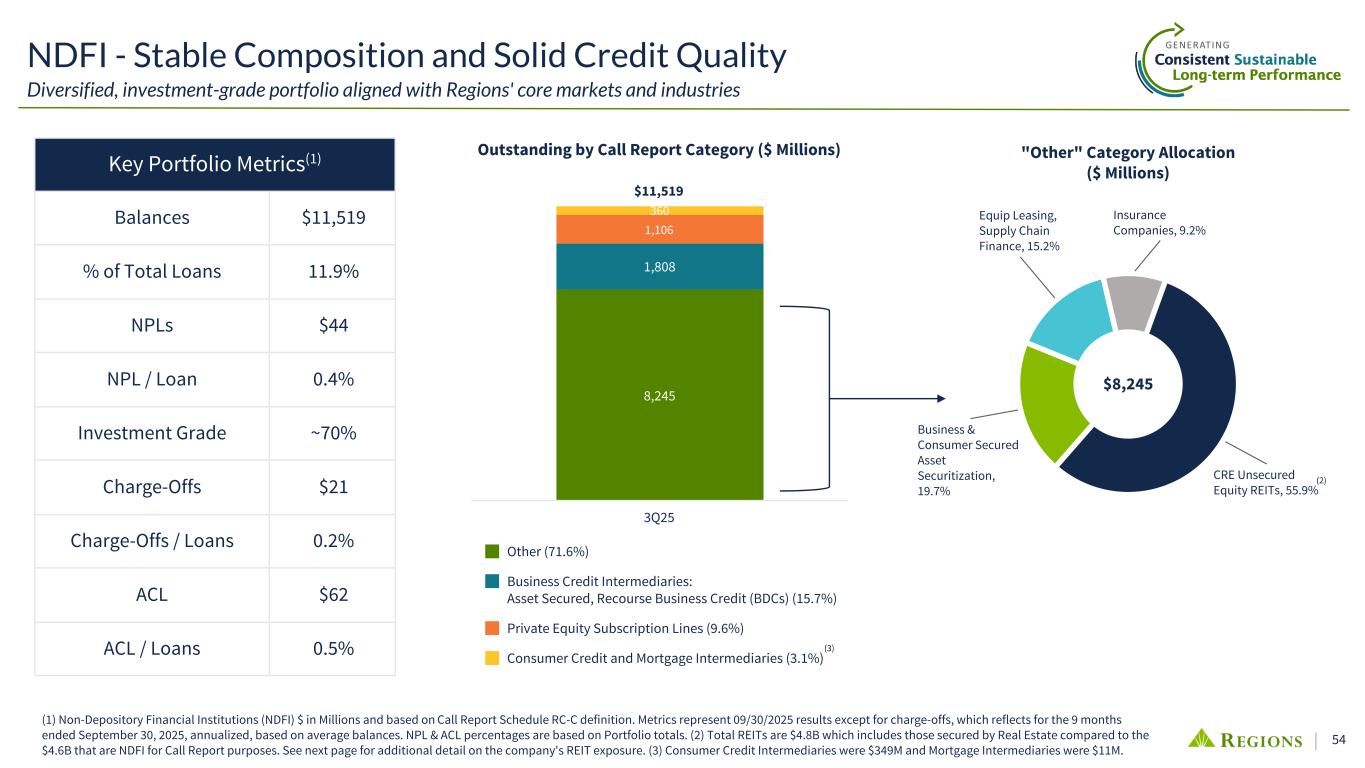
54 Key Portfolio Metrics(1) Balances $11,519 % of Total Loans 11.9% NPLs $44 NPL / Loan 0.4% Investment Grade ~70% Charge-Offs $21 Charge-Offs / Loans 0.2% ACL $62 ACL / Loans 0.5% (1) Non-Depository Financial Institutions (NDFI) $ in Millions and based on Call Report Schedule RC-C definition. Metrics represent 09/30/2025 results except for charge-offs, which reflects for the 9 months ended September 30, 2025, annualized, based on average balances. NPL & ACL percentages are based on Portfolio totals. (2) Total REITs are $4.8B which includes those secured by Real Estate compared to the $4.6B that are NDFI for Call Report purposes. See next page for additional detail on the company's REIT exposure. (3) Consumer Credit Intermediaries were $349M and Mortgage Intermediaries were $11M. Outstanding by Call Report Category ($ Millions) $11,519 8,245 1,808 1,106 360 Other (71.6%) Business Credit Intermediaries: Asset Secured, Recourse Business Credit (BDCs) (15.7%) Private Equity Subscription Lines (9.6%) Consumer Credit and Mortgage Intermediaries (3.1%) 3Q25 NDFI - Stable Composition and Solid Credit Quality Diversified, investment-grade portfolio aligned with Regions' core markets and industries CRE Unsecured Equity REITs, 55.9% Business & Consumer Secured Asset Securitization, 19.7% Equip Leasing, Supply Chain Finance, 15.2% Insurance Companies, 9.2% "Other" Category Allocation ($ Millions) (2) (3) $8,245
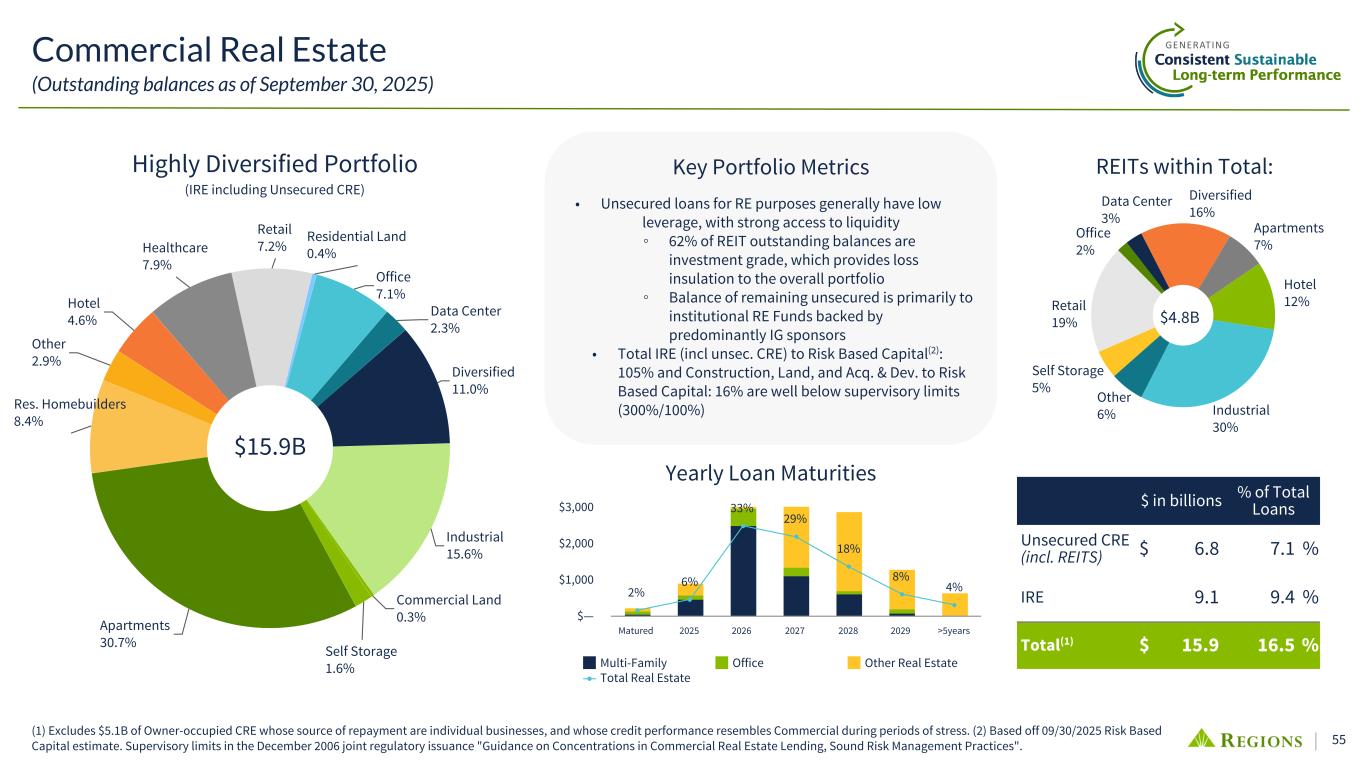
55 Commercial Real Estate (Outstanding balances as of September 30, 2025) Highly Diversified Portfolio (IRE including Unsecured CRE) (1) Excludes $5.1B of Owner-occupied CRE whose source of repayment are individual businesses, and whose credit performance resembles Commercial during periods of stress. (2) Based off 09/30/2025 Risk Based Capital estimate. Supervisory limits in the December 2006 joint regulatory issuance "Guidance on Concentrations in Commercial Real Estate Lending, Sound Risk Management Practices". Res. Homebuilders 8.4% Other 2.9% Hotel 4.6% Healthcare 7.9% Retail 7.2% Residential Land 0.4% Office 7.1% Data Center 2.3% Diversified 11.0% Industrial 15.6% Commercial Land 0.3% Self Storage 1.6% Apartments 30.7% $15.9B $ in billions % of Total Loans Unsecured CRE (incl. REITS) $ 6.8 7.1 % IRE 9.1 9.4 % Total(1) $ 15.9 16.5 % Yearly Loan Maturities 2% 6% 33% 29% 18% 8% 4% Multi-Family Office Other Real Estate Total Real Estate Matured 2025 2026 2027 2028 2029 >5years $— $1,000 $2,000 $3,000 Office 2% Data Center 3% Diversified 16% Apartments 7% Hotel 12% Industrial 30% Other 6% Self Storage 5% Retail 19% REITs within Total: $4.8B Key Portfolio Metrics • Unsecured loans for RE purposes generally have low leverage, with strong access to liquidity ◦ 62% of REIT outstanding balances are investment grade, which provides loss insulation to the overall portfolio ◦ Balance of remaining unsecured is primarily to institutional RE Funds backed by predominantly IG sponsors • Total IRE (incl unsec. CRE) to Risk Based Capital(2): 105% and Construction, Land, and Acq. & Dev. to Risk Based Capital: 16% are well below supervisory limits (300%/100%)
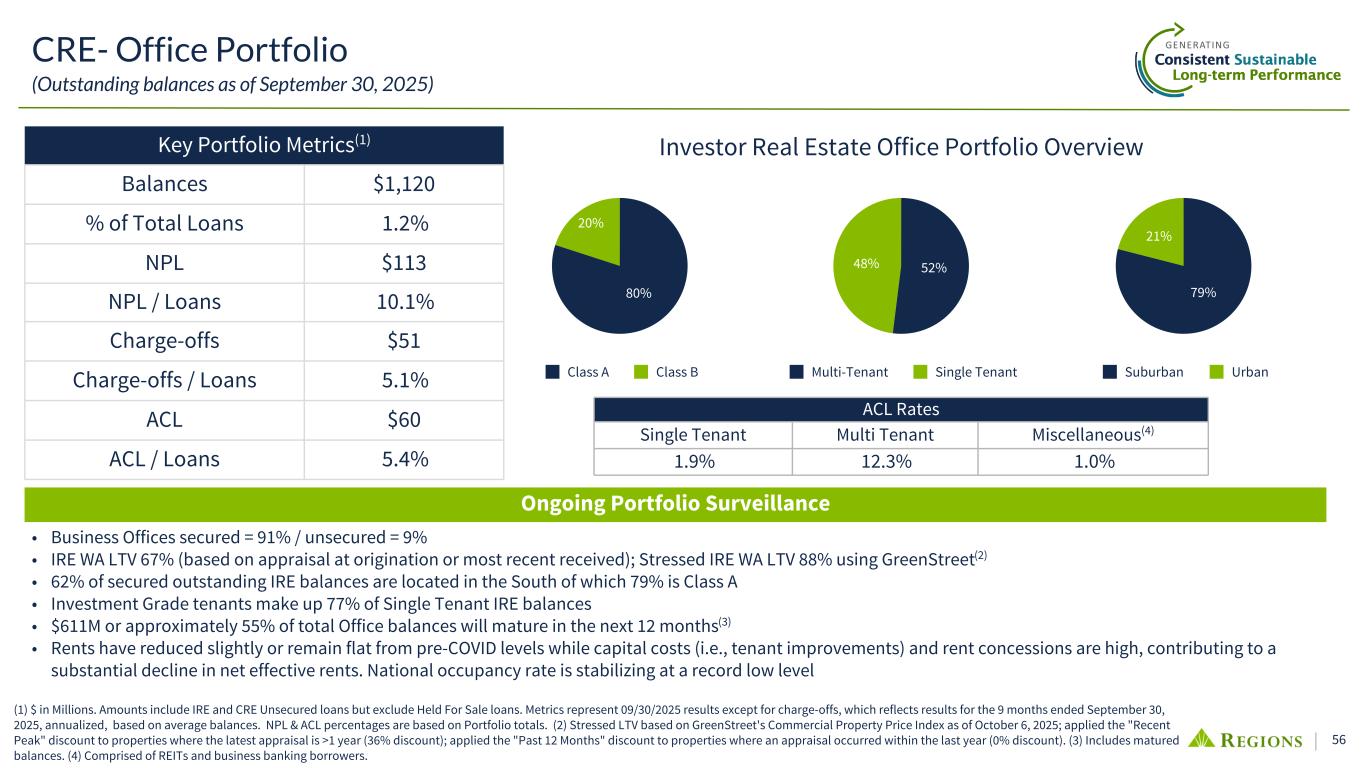
56 CRE- Office Portfolio (Outstanding balances as of September 30, 2025) (1) $ in Millions. Amounts include IRE and CRE Unsecured loans but exclude Held For Sale loans. Metrics represent 09/30/2025 results except for charge-offs, which reflects results for the 9 months ended September 30, 2025, annualized, based on average balances. NPL & ACL percentages are based on Portfolio totals. (2) Stressed LTV based on GreenStreet's Commercial Property Price Index as of October 6, 2025; applied the "Recent Peak" discount to properties where the latest appraisal is >1 year (36% discount); applied the "Past 12 Months" discount to properties where an appraisal occurred within the last year (0% discount). (3) Includes matured balances. (4) Comprised of REITs and business banking borrowers. • Business Offices secured = 91% / unsecured = 9% • IRE WA LTV 67% (based on appraisal at origination or most recent received); Stressed IRE WA LTV 88% using GreenStreet(2) • 62% of secured outstanding IRE balances are located in the South of which 79% is Class A • Investment Grade tenants make up 77% of Single Tenant IRE balances • $611M or approximately 55% of total Office balances will mature in the next 12 months(3) • Rents have reduced slightly or remain flat from pre-COVID levels while capital costs (i.e., tenant improvements) and rent concessions are high, contributing to a substantial decline in net effective rents. National occupancy rate is stabilizing at a record low level Key Portfolio Metrics(1) Balances $1,120 % of Total Loans 1.2% NPL $113 NPL / Loans 10.1% Charge-offs $51 Charge-offs / Loans 5.1% ACL $60 ACL / Loans 5.4% Ongoing Portfolio Surveillance 52%48% Multi-Tenant Single Tenant 80% 20% Class A Class B Investor Real Estate Office Portfolio Overview 79% 21% Suburban Urban ACL Rates Single Tenant Multi Tenant Miscellaneous(4) 1.9% 12.3% 1.0%
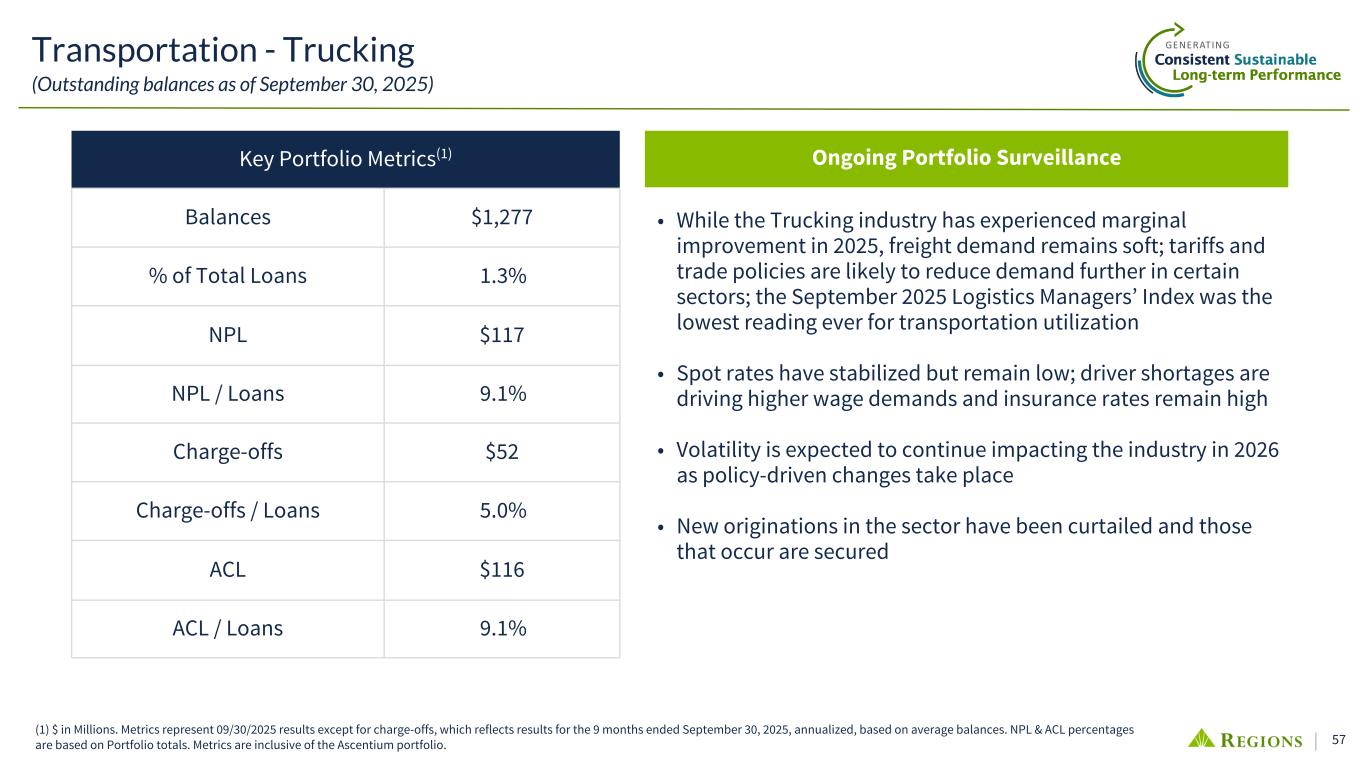
57 Transportation - Trucking (Outstanding balances as of September 30, 2025) (1) $ in Millions. Metrics represent 09/30/2025 results except for charge-offs, which reflects results for the 9 months ended September 30, 2025, annualized, based on average balances. NPL & ACL percentages are based on Portfolio totals. Metrics are inclusive of the Ascentium portfolio. Key Portfolio Metrics(1) Balances $1,277 % of Total Loans 1.3% NPL $117 NPL / Loans 9.1% Charge-offs $52 Charge-offs / Loans 5.0% ACL $116 ACL / Loans 9.1% • While the Trucking industry has experienced marginal improvement in 2025, freight demand remains soft; tariffs and trade policies are likely to reduce demand further in certain sectors; the September 2025 Logistics Managers’ Index was the lowest reading ever for transportation utilization • Spot rates have stabilized but remain low; driver shortages are driving higher wage demands and insurance rates remain high • Volatility is expected to continue impacting the industry in 2026 as policy-driven changes take place • New originations in the sector have been curtailed and those that occur are secured Ongoing Portfolio Surveillance
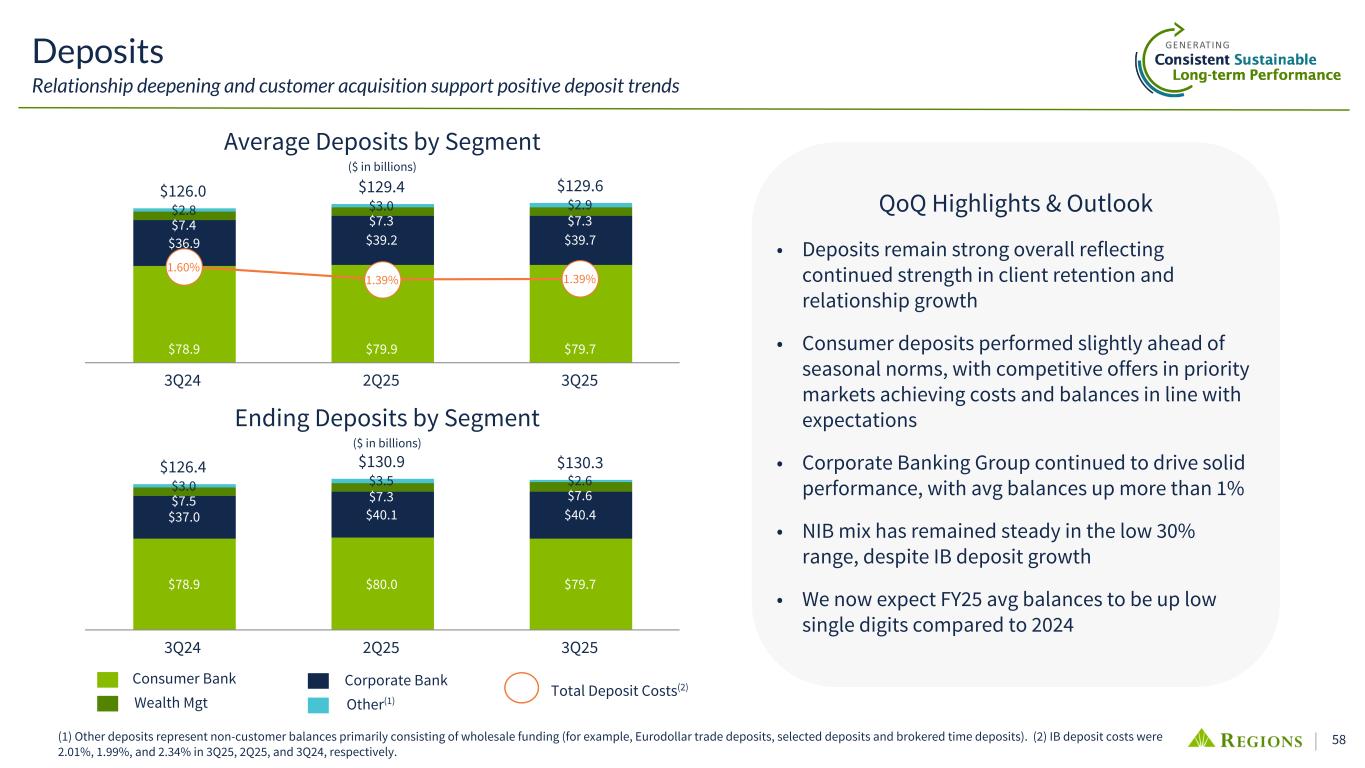
58 QoQ Highlights & Outlook • Deposits remain strong overall reflecting continued strength in client retention and relationship growth • Consumer deposits performed slightly ahead of seasonal norms, with competitive offers in priority markets achieving costs and balances in line with expectations • Corporate Banking Group continued to drive solid performance, with avg balances up more than 1% • NIB mix has remained steady in the low 30% range, despite IB deposit growth • We now expect FY25 avg balances to be up low single digits compared to 2024 $126.4 $130.9 $130.3 $78.9 $80.0 $79.7 $37.0 $40.1 $40.4 $7.5 $7.3 $7.6 $3.0 $3.5 $2.6 3Q24 2Q25 3Q25 $126.0 $129.4 $129.6 $78.9 $79.9 $79.7 $36.9 $39.2 $39.7 $7.4 $7.3 $7.3 $2.8 $3.0 $2.9 1.60% 1.39% 1.39% 3Q24 2Q25 3Q25 (1) Other deposits represent non-customer balances primarily consisting of wholesale funding (for example, Eurodollar trade deposits, selected deposits and brokered time deposits). (2) IB deposit costs were 2.01%, 1.99%, and 2.34% in 3Q25, 2Q25, and 3Q24, respectively. Average Deposits by Segment ($ in billions) Deposits Relationship deepening and customer acquisition support positive deposit trends Wealth Mgt Other(1) Consumer Bank Corporate Bank Ending Deposits by Segment ($ in billions) Total Deposit Costs(2)
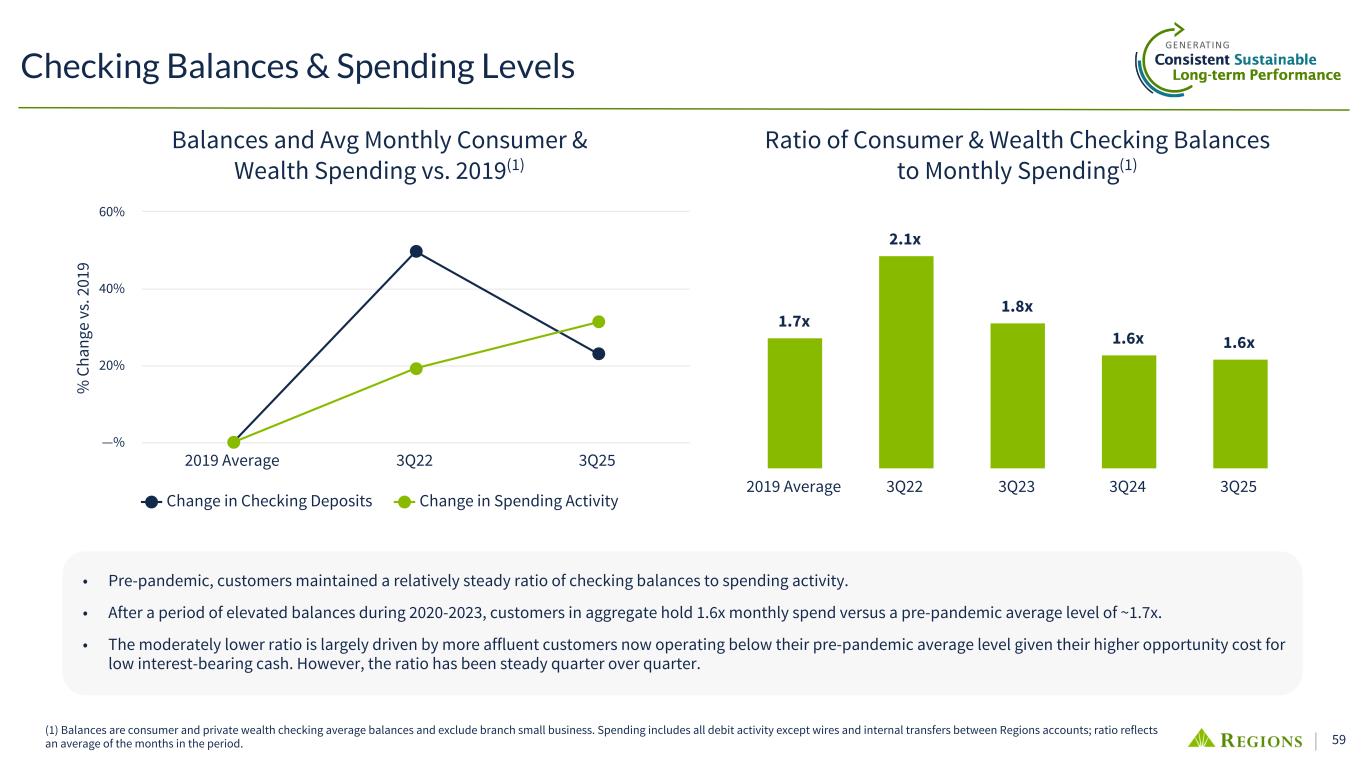
59 Checking Balances & Spending Levels • Pre-pandemic, customers maintained a relatively steady ratio of checking balances to spending activity. • After a period of elevated balances during 2020-2023, customers in aggregate hold 1.6x monthly spend versus a pre-pandemic average level of ~1.7x. • The moderately lower ratio is largely driven by more affluent customers now operating below their pre-pandemic average level given their higher opportunity cost for low interest-bearing cash. However, the ratio has been steady quarter over quarter. % C ha ng e vs . 2 01 9 Change in Checking Deposits Change in Spending Activity 2019 Average 3Q22 3Q25 —% 20% 40% 60% Balances and Avg Monthly Consumer & Wealth Spending vs. 2019(1) 1.7x 2.1x 1.8x 1.6x 1.6x 2019 Average 3Q22 3Q23 3Q24 3Q25 Ratio of Consumer & Wealth Checking Balances to Monthly Spending(1) (1) Balances are consumer and private wealth checking average balances and exclude branch small business. Spending includes all debit activity except wires and internal transfers between Regions accounts; ratio reflects an average of the months in the period.
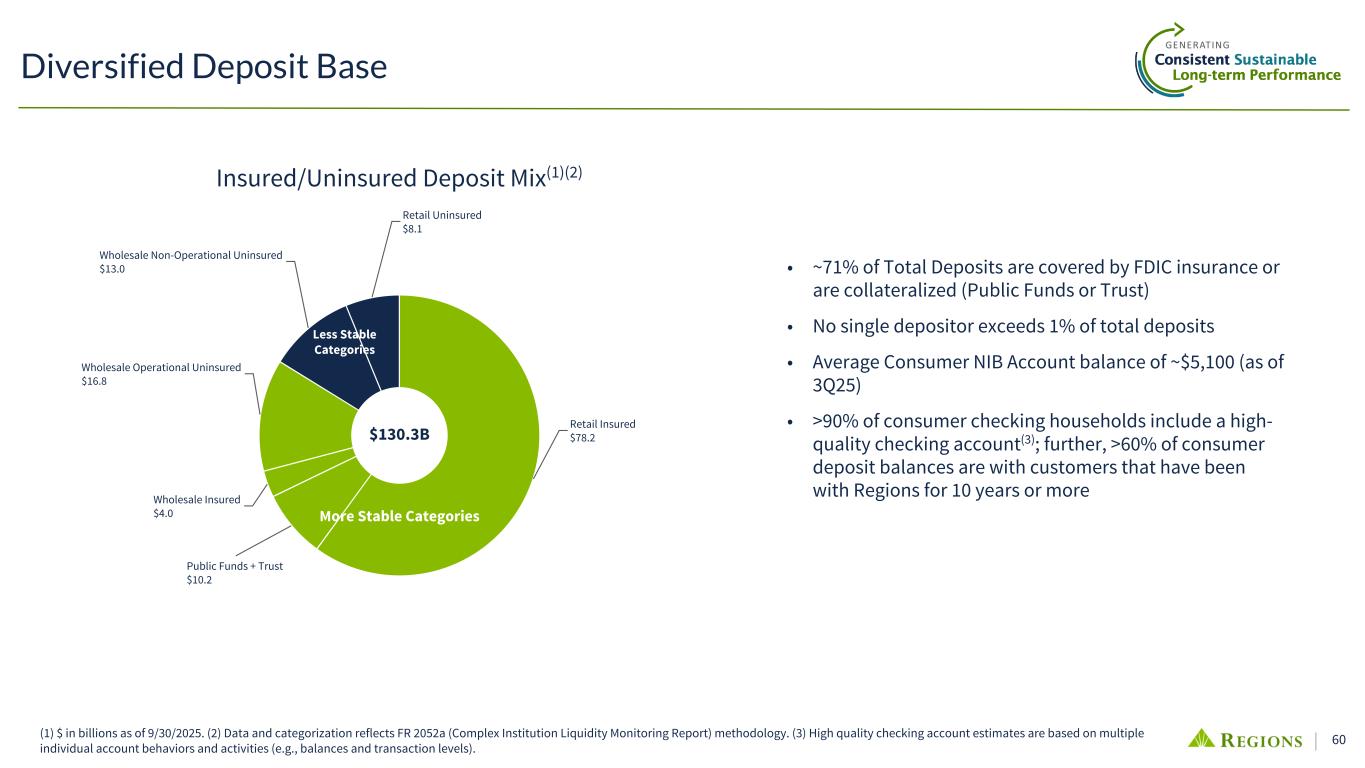
60 Diversified Deposit Base Insured/Uninsured Deposit Mix(1)(2) • ~71% of Total Deposits are covered by FDIC insurance or are collateralized (Public Funds or Trust) • No single depositor exceeds 1% of total deposits • Average Consumer NIB Account balance of ~$5,100 (as of 3Q25) • >90% of consumer checking households include a high- quality checking account(3); further, >60% of consumer deposit balances are with customers that have been with Regions for 10 years or more Retail Insured $78.2 Public Funds + Trust $10.2 Wholesale Insured $4.0 Wholesale Operational Uninsured $16.8 Wholesale Non-Operational Uninsured $13.0 Retail Uninsured $8.1 Less Stable Categories (1) $ in billions as of 9/30/2025. (2) Data and categorization reflects FR 2052a (Complex Institution Liquidity Monitoring Report) methodology. (3) High quality checking account estimates are based on multiple individual account behaviors and activities (e.g., balances and transaction levels). More Stable Categories $130.3B
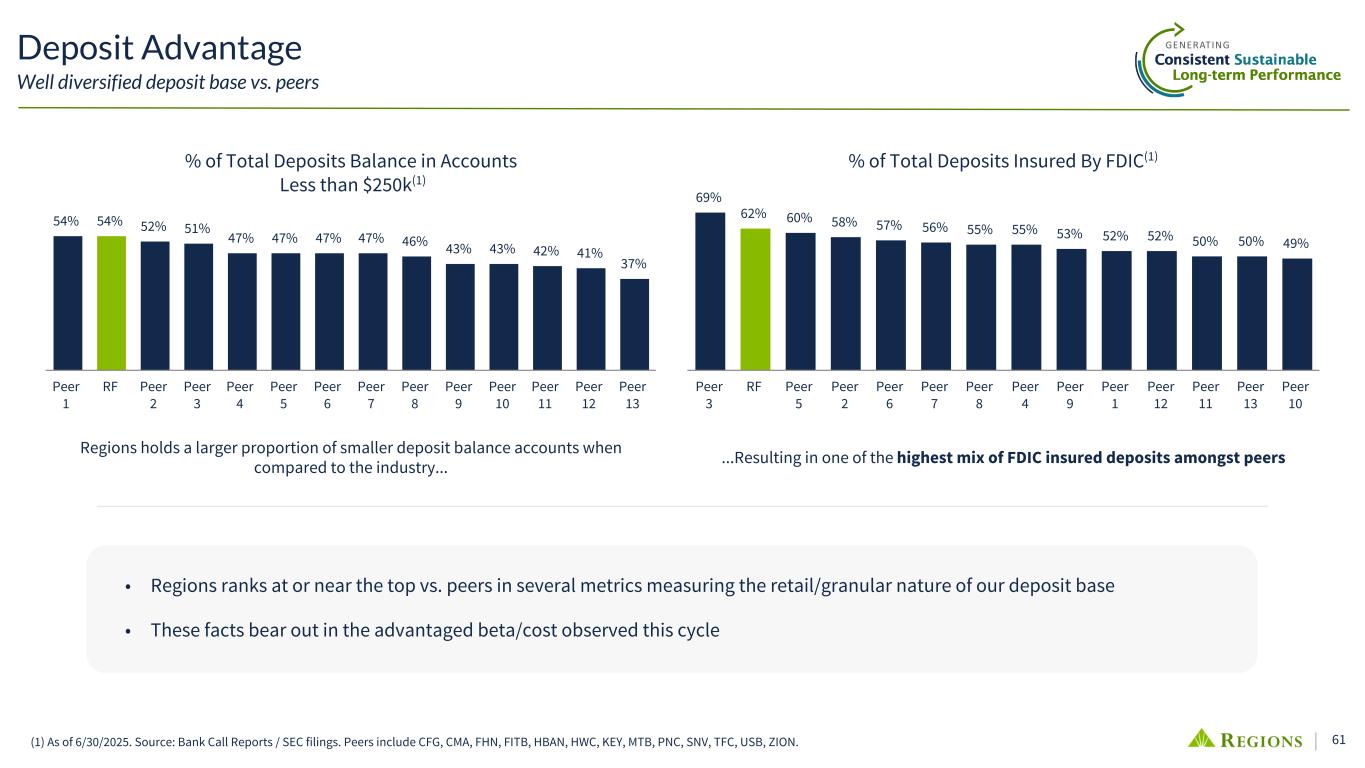
61 Deposit Advantage Well diversified deposit base vs. peers (1) As of 6/30/2025. Source: Bank Call Reports / SEC filings. Peers include CFG, CMA, FHN, FITB, HBAN, HWC, KEY, MTB, PNC, SNV, TFC, USB, ZION. ...Resulting in one of the highest mix of FDIC insured deposits amongst peers % of Total Deposits Insured By FDIC(1)% of Total Deposits Balance in Accounts Less than $250k(1) Regions holds a larger proportion of smaller deposit balance accounts when compared to the industry... 69% 62% 60% 58% 57% 56% 55% 55% 53% 52% 52% 50% 50% 49% Peer 3 RF Peer 5 Peer 2 Peer 6 Peer 7 Peer 8 Peer 4 Peer 9 Peer 1 Peer 12 Peer 11 Peer 13 Peer 10 54% 54% 52% 51% 47% 47% 47% 47% 46% 43% 43% 42% 41% 37% Peer 1 RF Peer 2 Peer 3 Peer 4 Peer 5 Peer 6 Peer 7 Peer 8 Peer 9 Peer 10 Peer 11 Peer 12 Peer 13 • Regions ranks at or near the top vs. peers in several metrics measuring the retail/granular nature of our deposit base • These facts bear out in the advantaged beta/cost observed this cycle
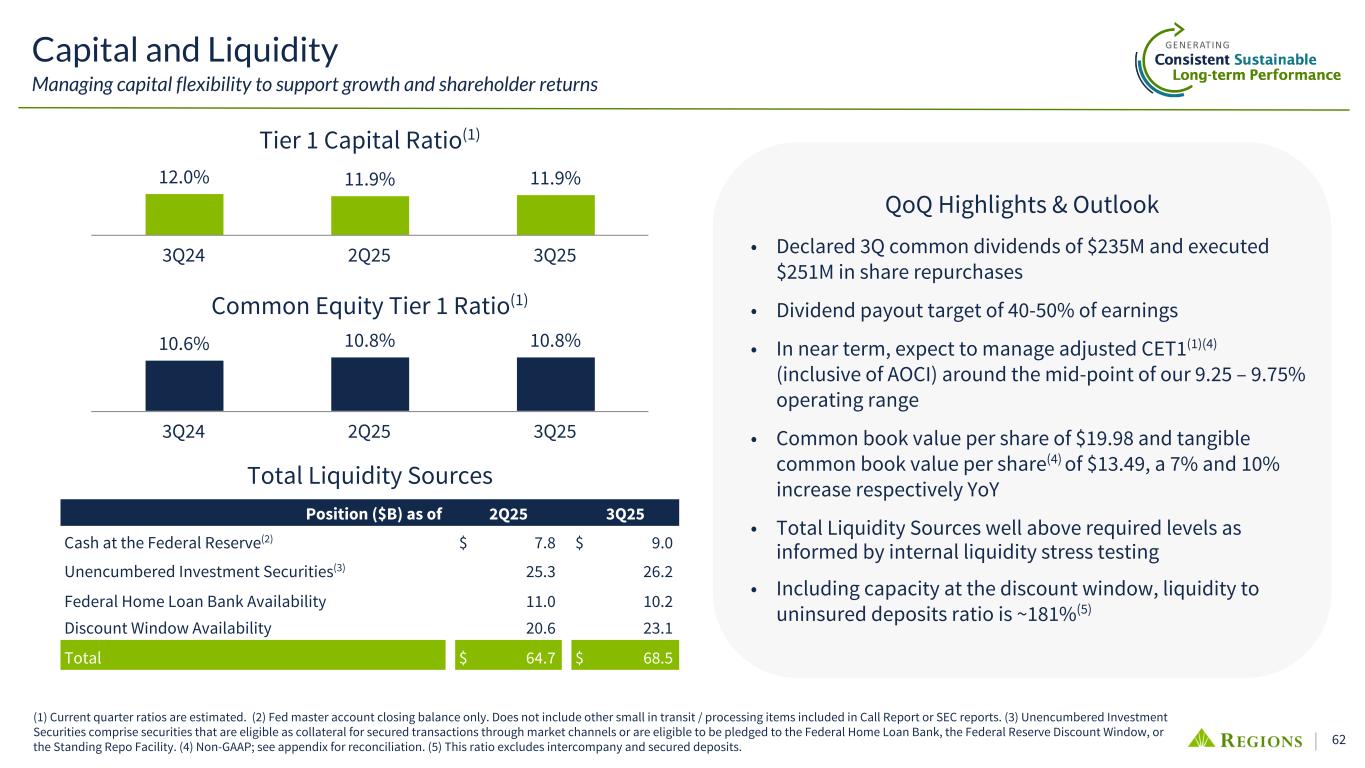
62 QoQ Highlights & Outlook • Declared 3Q common dividends of $235M and executed $251M in share repurchases • Dividend payout target of 40-50% of earnings • In near term, expect to manage adjusted CET1(1)(4) (inclusive of AOCI) around the mid-point of our 9.25 – 9.75% operating range • Common book value per share of $19.98 and tangible common book value per share(4) of $13.49, a 7% and 10% increase respectively YoY • Total Liquidity Sources well above required levels as informed by internal liquidity stress testing • Including capacity at the discount window, liquidity to uninsured deposits ratio is ~181%(5) 10.6% 10.8% 10.8% 3Q24 2Q25 3Q25 Capital and Liquidity Managing capital flexibility to support growth and shareholder returns 12.0% 11.9% 11.9% 3Q24 2Q25 3Q25 Tier 1 Capital Ratio(1) Common Equity Tier 1 Ratio(1) Position ($B) as of 2Q25 3Q25 Cash at the Federal Reserve(2) $ 7.8 $ 9.0 Unencumbered Investment Securities(3) 25.3 26.2 Federal Home Loan Bank Availability 11.0 10.2 Discount Window Availability 20.6 23.1 Total $ 64.7 $ 68.5 (1) Current quarter ratios are estimated. (2) Fed master account closing balance only. Does not include other small in transit / processing items included in Call Report or SEC reports. (3) Unencumbered Investment Securities comprise securities that are eligible as collateral for secured transactions through market channels or are eligible to be pledged to the Federal Home Loan Bank, the Federal Reserve Discount Window, or the Standing Repo Facility. (4) Non-GAAP; see appendix for reconciliation. (5) This ratio excludes intercompany and secured deposits. Total Liquidity Sources
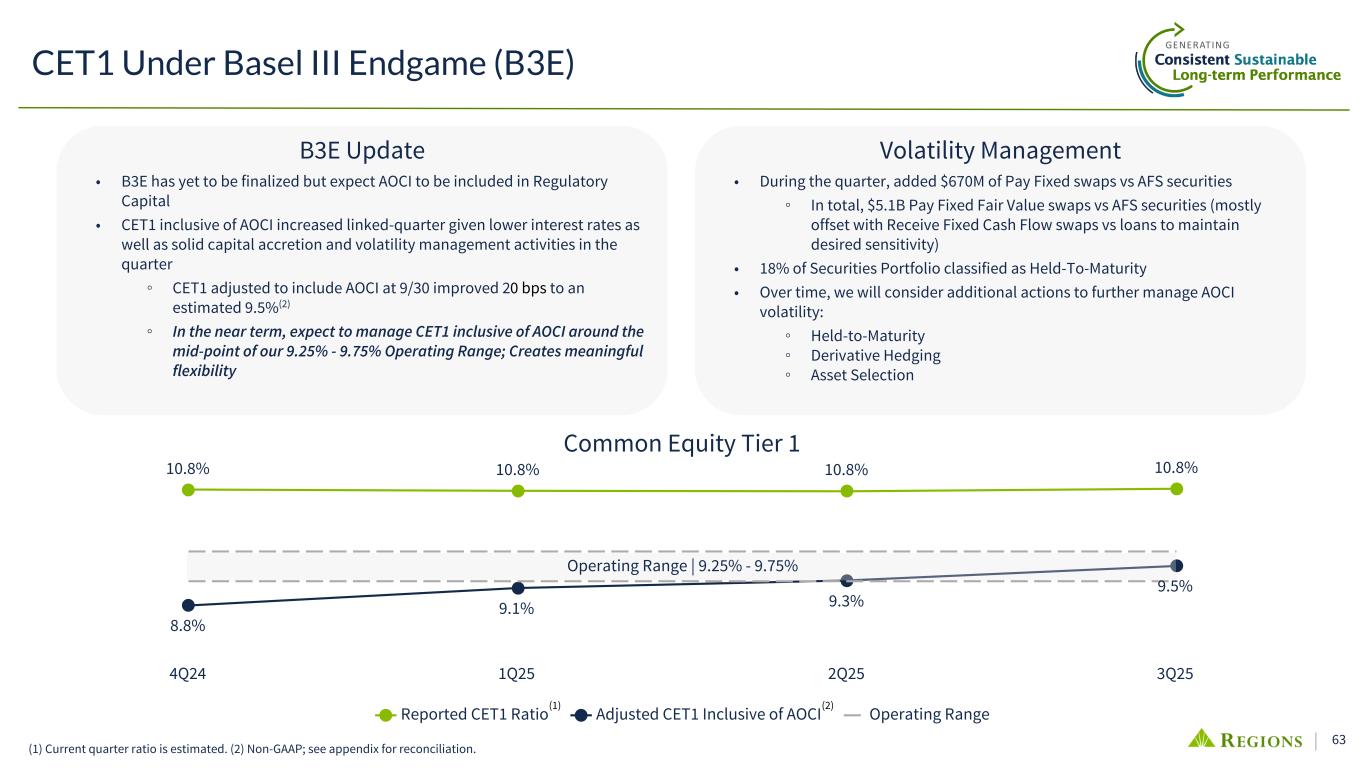
63 Common Equity Tier 1 10.8% 10.8% 10.8% 10.8% 8.8% 9.1% 9.3% 9.5% Reported CET1 Ratio Adjusted CET1 Inclusive of AOCI Operating Range 4Q24 1Q25 2Q25 3Q25 CET1 Under Basel III Endgame (B3E) B3E Update • B3E has yet to be finalized but expect AOCI to be included in Regulatory Capital • CET1 inclusive of AOCI increased linked-quarter given lower interest rates as well as solid capital accretion and volatility management activities in the quarter ◦ CET1 adjusted to include AOCI at 9/30 improved 20 bps to an estimated 9.5%(2) ◦ In the near term, expect to manage CET1 inclusive of AOCI around the mid-point of our 9.25% - 9.75% Operating Range; Creates meaningful flexibility Volatility Management • During the quarter, added $670M of Pay Fixed swaps vs AFS securities ◦ In total, $5.1B Pay Fixed Fair Value swaps vs AFS securities (mostly offset with Receive Fixed Cash Flow swaps vs loans to maintain desired sensitivity) • 18% of Securities Portfolio classified as Held-To-Maturity • Over time, we will consider additional actions to further manage AOCI volatility: ◦ Held-to-Maturity ◦ Derivative Hedging ◦ Asset Selection (1) (1) Current quarter ratio is estimated. (2) Non-GAAP; see appendix for reconciliation. (2) Operating Range | 9.25% - 9.75%
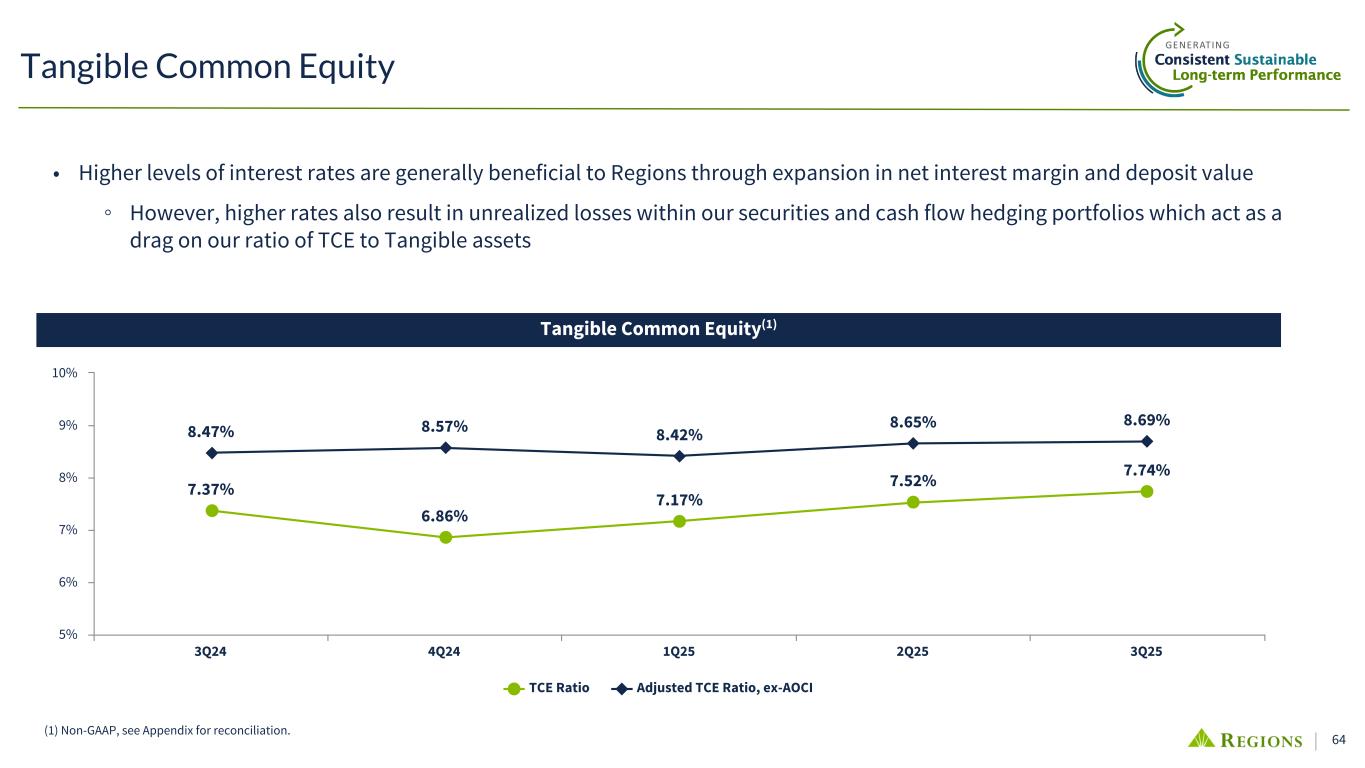
64 7.37% 6.86% 7.17% 7.52% 7.74% 8.47% 8.57% 8.42% 8.65% 8.69% TCE Ratio Adjusted TCE Ratio, ex-AOCI 3Q24 4Q24 1Q25 2Q25 3Q25 5% 6% 7% 8% 9% 10% Tangible Common Equity (1) Non-GAAP, see Appendix for reconciliation. • Higher levels of interest rates are generally beneficial to Regions through expansion in net interest margin and deposit value ◦ However, higher rates also result in unrealized losses within our securities and cash flow hedging portfolios which act as a drag on our ratio of TCE to Tangible assets Tangible Common Equity(1)
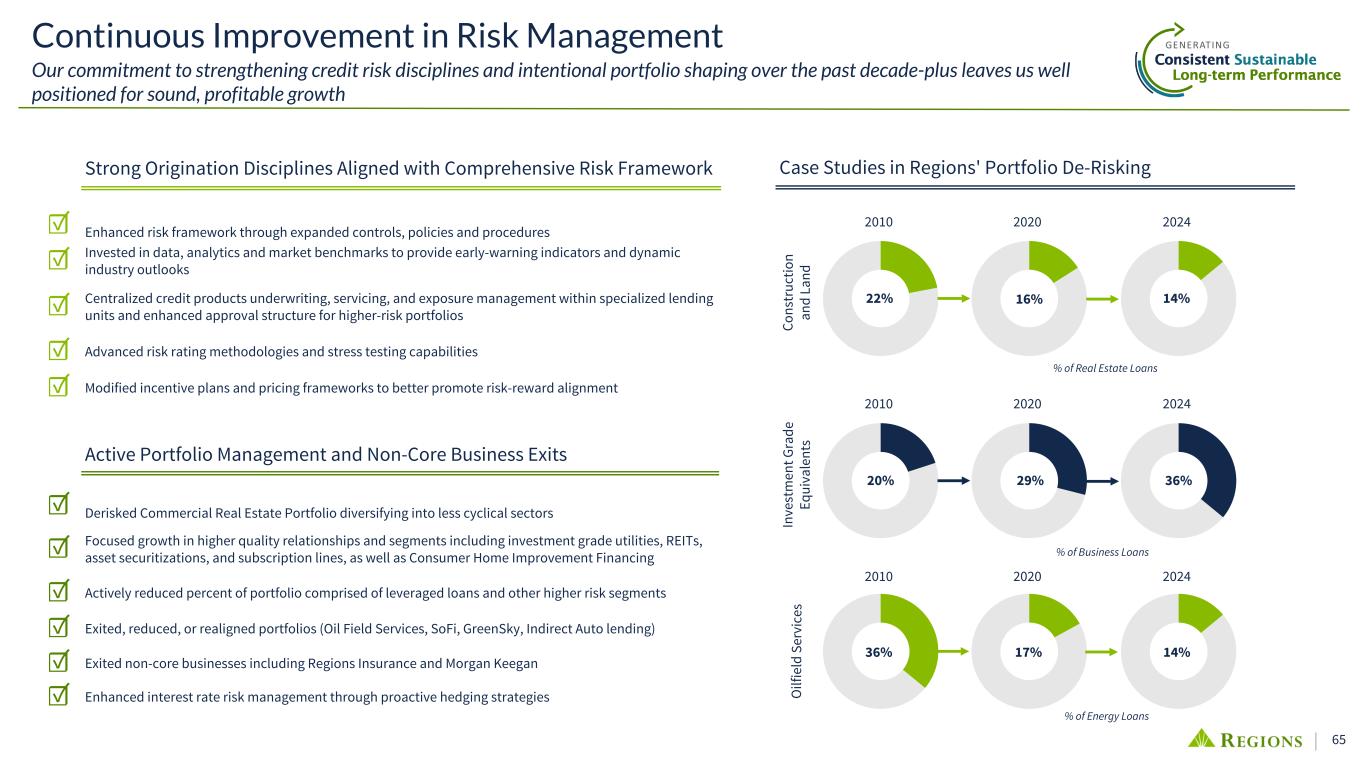
65 Continuous Improvement in Risk Management Our commitment to strengthening credit risk disciplines and intentional portfolio shaping over the past decade-plus leaves us well positioned for sound, profitable growth Strong Origination Disciplines Aligned with Comprehensive Risk Framework ☑ Enhanced risk framework through expanded controls, policies and procedures ☑ Invested in data, analytics and market benchmarks to provide early-warning indicators and dynamic industry outlooks ☑ Centralized credit products underwriting, servicing, and exposure management within specialized lending units and enhanced approval structure for higher-risk portfolios ☑ Advanced risk rating methodologies and stress testing capabilities ☑ Modified incentive plans and pricing frameworks to better promote risk-reward alignment Active Portfolio Management and Non-Core Business Exits ☑ Derisked Commercial Real Estate Portfolio diversifying into less cyclical sectors ☑ Focused growth in higher quality relationships and segments including investment grade utilities, REITs, asset securitizations, and subscription lines, as well as Consumer Home Improvement Financing ☑ Actively reduced percent of portfolio comprised of leveraged loans and other higher risk segments ☑ Exited, reduced, or realigned portfolios (Oil Field Services, SoFi, GreenSky, Indirect Auto lending) ☑ Exited non-core businesses including Regions Insurance and Morgan Keegan ☑ Enhanced interest rate risk management through proactive hedging strategies Case Studies in Regions' Portfolio De-Risking 22% 16% 14% Co ns tr uc tio n an d La nd 2010 2020 2024 2010 2020 2024 In ve st m en t G ra de Eq ui va le nt s O ilf ie ld S er vi ce s 20% 29% 36% 36% 17% 14% % of Real Estate Loans % of Business Loans % of Energy Loans 2010 2020 2024
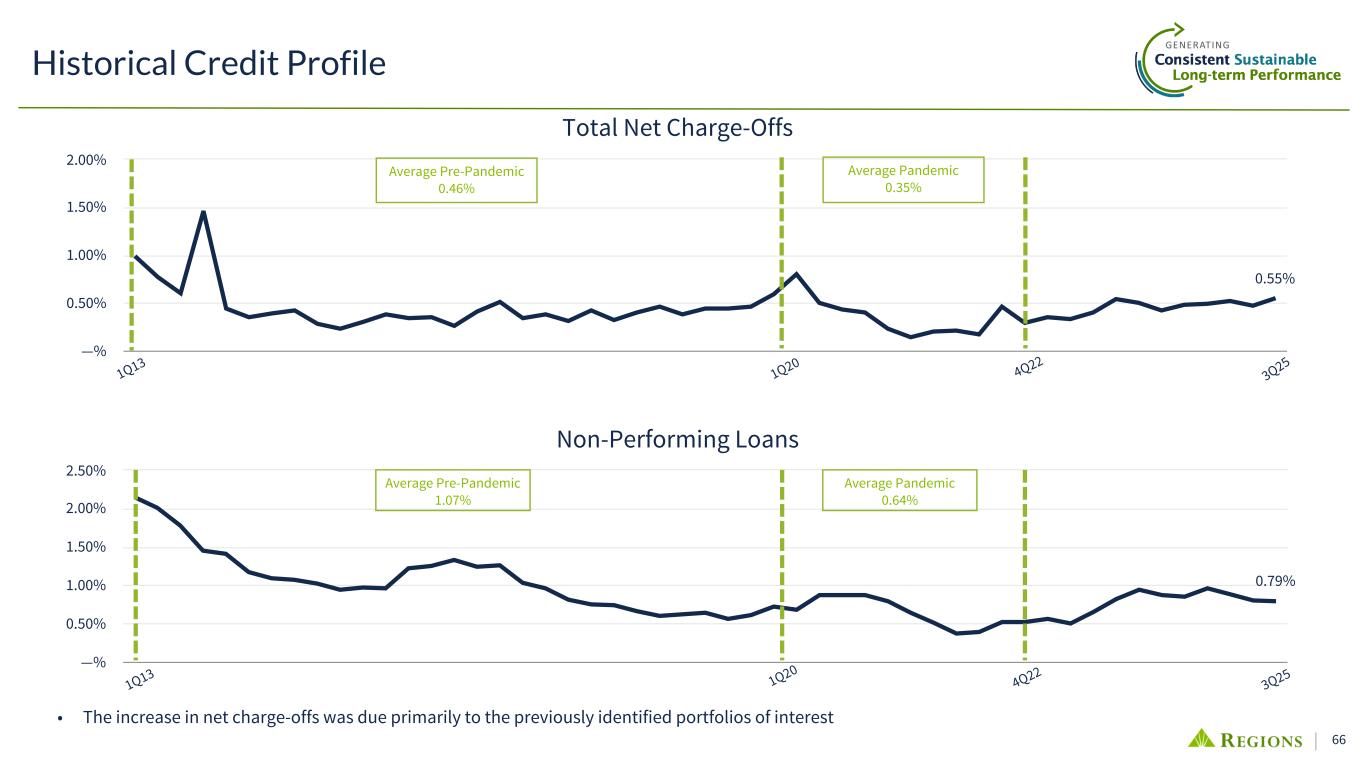
66 0.79% —% 0.50% 1.00% 1.50% 2.00% 2.50% 0.55% —% 0.50% 1.00% 1.50% 2.00% Historical Credit Profile Non-Performing Loans Total Net Charge-Offs 1Q20 3Q254Q221Q20 4Q22 3Q25 • The increase in net charge-offs was due primarily to the previously identified portfolios of interest Average Pre-Pandemic 1.07% Average Pandemic 0.64% 1Q13 1Q13 Average Pre-Pandemic 0.46% Average Pandemic 0.35%
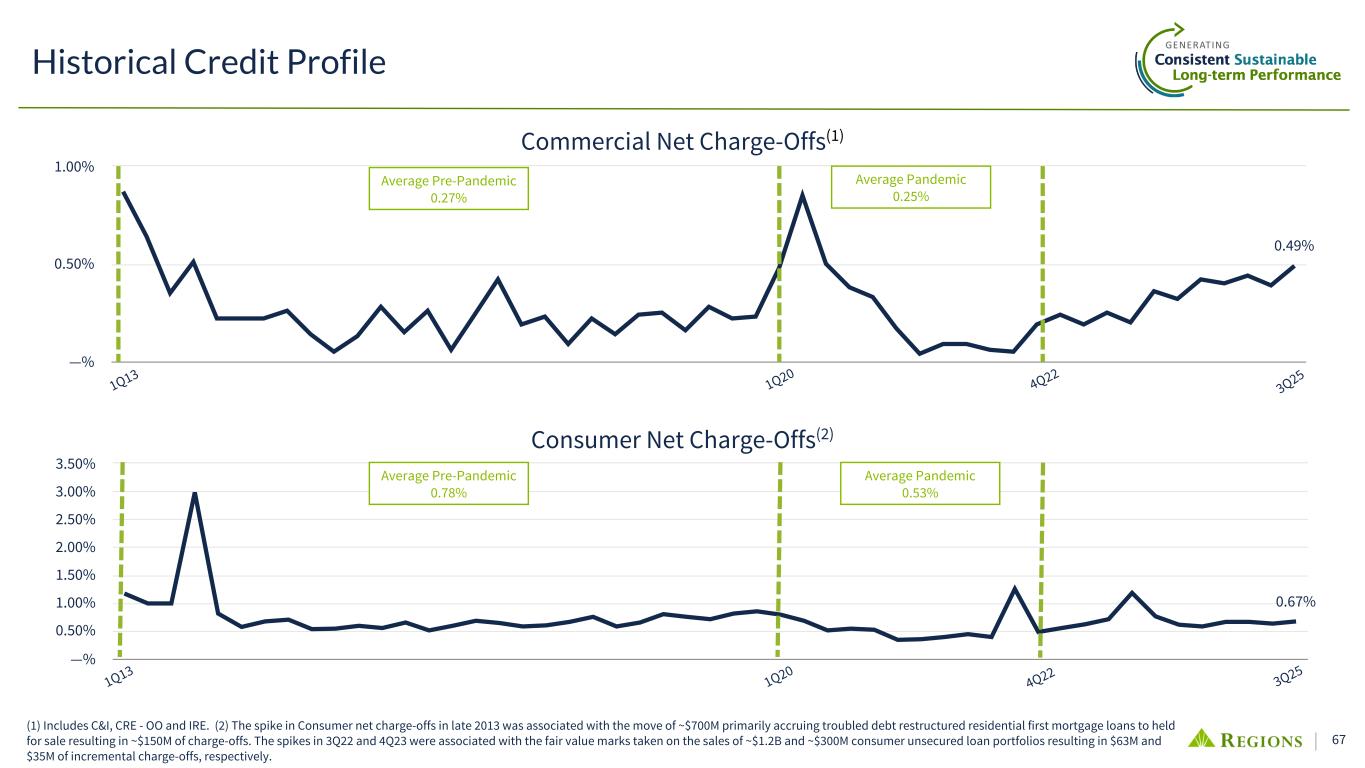
67 0.67% —% 0.50% 1.00% 1.50% 2.00% 2.50% 3.00% 3.50% 0.49% —% 0.50% 1.00% Consumer Net Charge-Offs(2) Commercial Net Charge-Offs(1) 1Q20 3Q25 4Q22 1Q20 4Q22 3Q25 (1) Includes C&I, CRE - OO and IRE. (2) The spike in Consumer net charge-offs in late 2013 was associated with the move of ~$700M primarily accruing troubled debt restructured residential first mortgage loans to held for sale resulting in ~$150M of charge-offs. The spikes in 3Q22 and 4Q23 were associated with the fair value marks taken on the sales of ~$1.2B and ~$300M consumer unsecured loan portfolios resulting in $63M and $35M of incremental charge-offs, respectively. Average Pre-Pandemic 0.27% Average Pandemic 0.25% Average Pre-Pandemic 0.78% Average Pandemic 0.53% 1Q13 1Q13 Historical Credit Profile
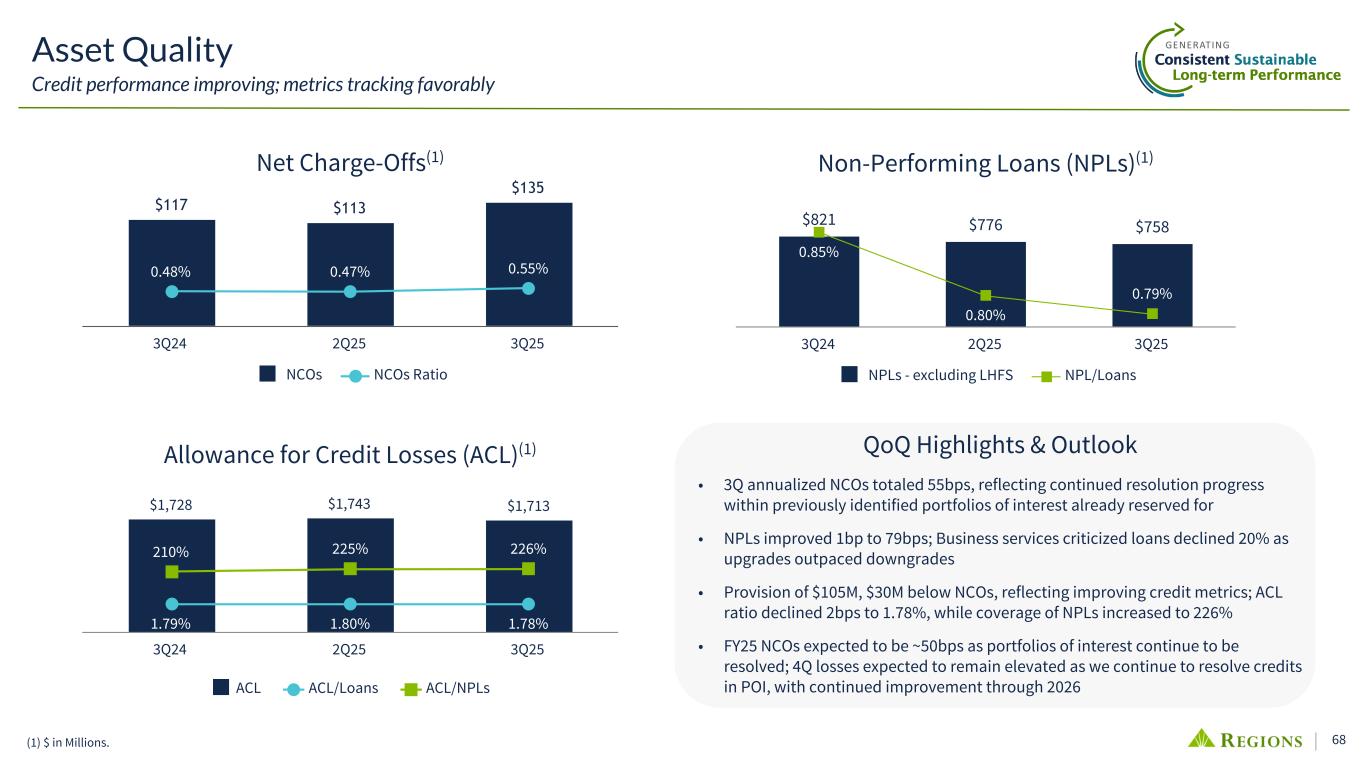
68 QoQ Highlights & Outlook • 3Q annualized NCOs totaled 55bps, reflecting continued resolution progress within previously identified portfolios of interest already reserved for • NPLs improved 1bp to 79bps; Business services criticized loans declined 20% as upgrades outpaced downgrades • Provision of $105M, $30M below NCOs, reflecting improving credit metrics; ACL ratio declined 2bps to 1.78%, while coverage of NPLs increased to 226% • FY25 NCOs expected to be ~50bps as portfolios of interest continue to be resolved; 4Q losses expected to remain elevated as we continue to resolve credits in POI, with continued improvement through 2026 Asset Quality Credit performance improving; metrics tracking favorably $1,728 $1,743 $1,713 1.79% 1.80% 1.78% 210% 225% 226% ACL ACL/Loans ACL/NPLs 3Q24 2Q25 3Q25 $117 $113 $135 0.48% 0.47% 0.55% NCOs NCOs Ratio 3Q24 2Q25 3Q25 $821 $776 $758 0.85% 0.80% 0.79% NPLs - excluding LHFS NPL/Loans 3Q24 2Q25 3Q25 (1) $ in Millions. Net Charge-Offs(1) Allowance for Credit Losses (ACL)(1) Non-Performing Loans (NPLs)(1)
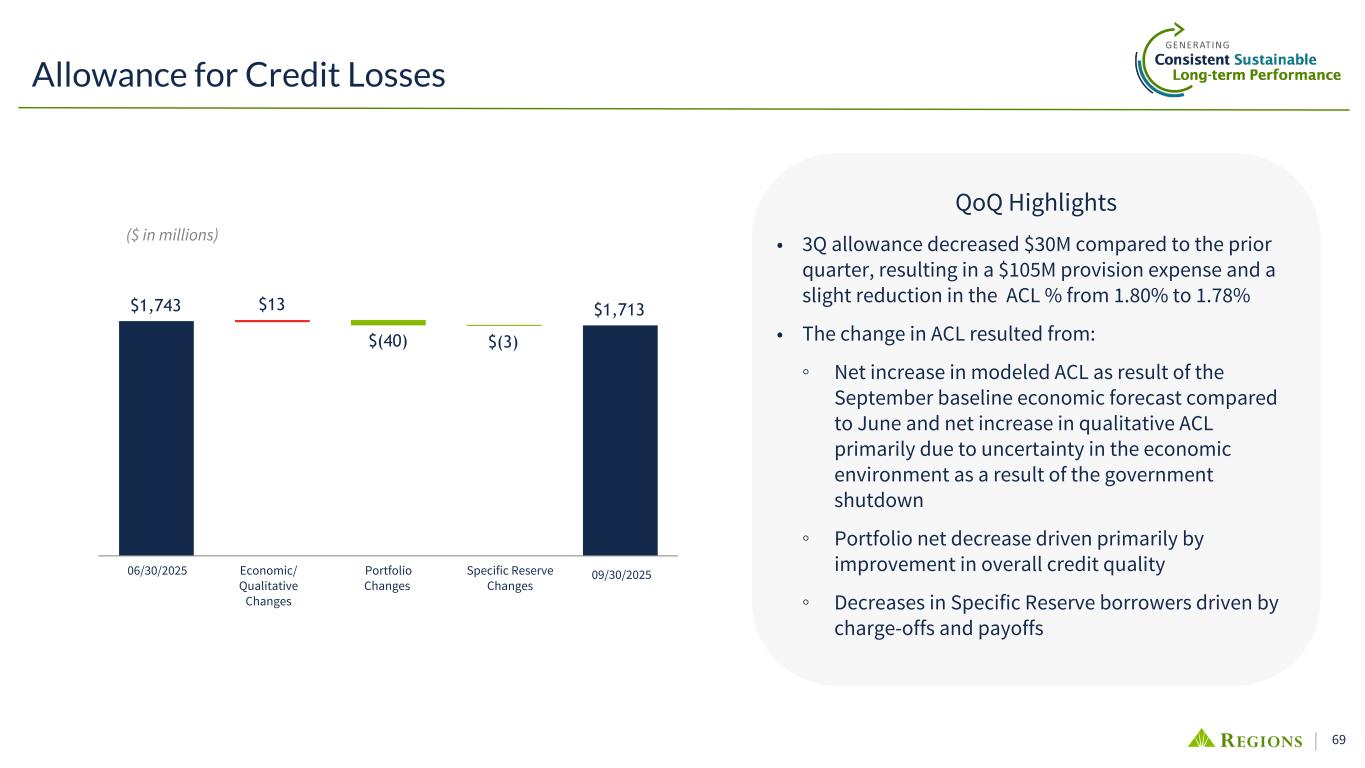
69 QoQ Highlights • 3Q allowance decreased $30M compared to the prior quarter, resulting in a $105M provision expense and a slight reduction in the ACL % from 1.80% to 1.78% • The change in ACL resulted from: ◦ Net increase in modeled ACL as result of the September baseline economic forecast compared to June and net increase in qualitative ACL primarily due to uncertainty in the economic environment as a result of the government shutdown ◦ Portfolio net decrease driven primarily by improvement in overall credit quality ◦ Decreases in Specific Reserve borrowers driven by charge-offs and payoffs $1,743 $13 $(40) $(3) $1,713 Allowance for Credit Losses 09/30/2025 ($ in millions) 06/30/2025 Portfolio Changes Specific Reserve Changes Economic/ Qualitative Changes
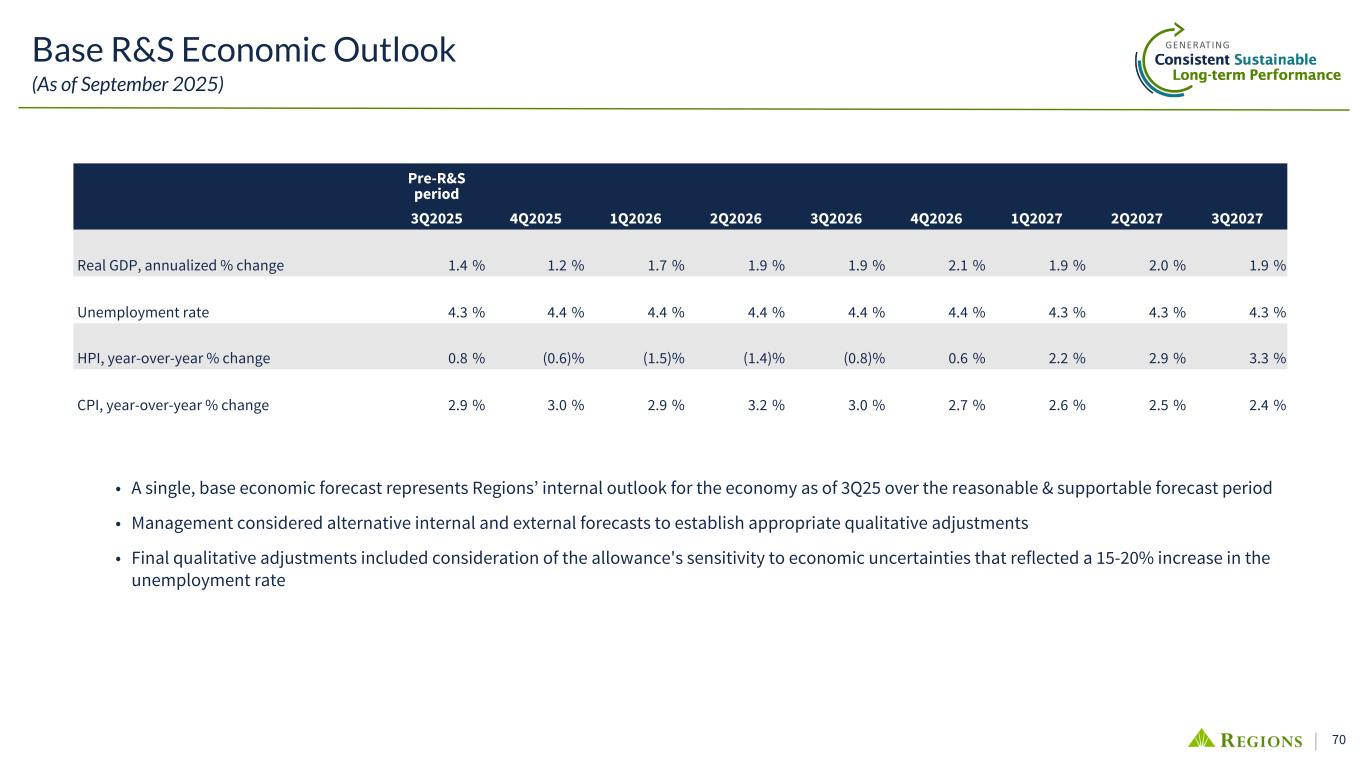
70 Pre-R&S period 3Q2025 4Q2025 1Q2026 2Q2026 3Q2026 4Q2026 1Q2027 2Q2027 3Q2027 Real GDP, annualized % change 1.4 % 1.2 % 1.7 % 1.9 % 1.9 % 2.1 % 1.9 % 2.0 % 1.9 % Unemployment rate 4.3 % 4.4 % 4.4 % 4.4 % 4.4 % 4.4 % 4.3 % 4.3 % 4.3 % HPI, year-over-year % change 0.8 % (0.6) % (1.5) % (1.4) % (0.8) % 0.6 % 2.2 % 2.9 % 3.3 % CPI, year-over-year % change 2.9 % 3.0 % 2.9 % 3.2 % 3.0 % 2.7 % 2.6 % 2.5 % 2.4 % Base R&S Economic Outlook (As of September 2025) • A single, base economic forecast represents Regions’ internal outlook for the economy as of 3Q25 over the reasonable & supportable forecast period • Management considered alternative internal and external forecasts to establish appropriate qualitative adjustments • Final qualitative adjustments included consideration of the allowance's sensitivity to economic uncertainties that reflected a 15-20% increase in the unemployment rate
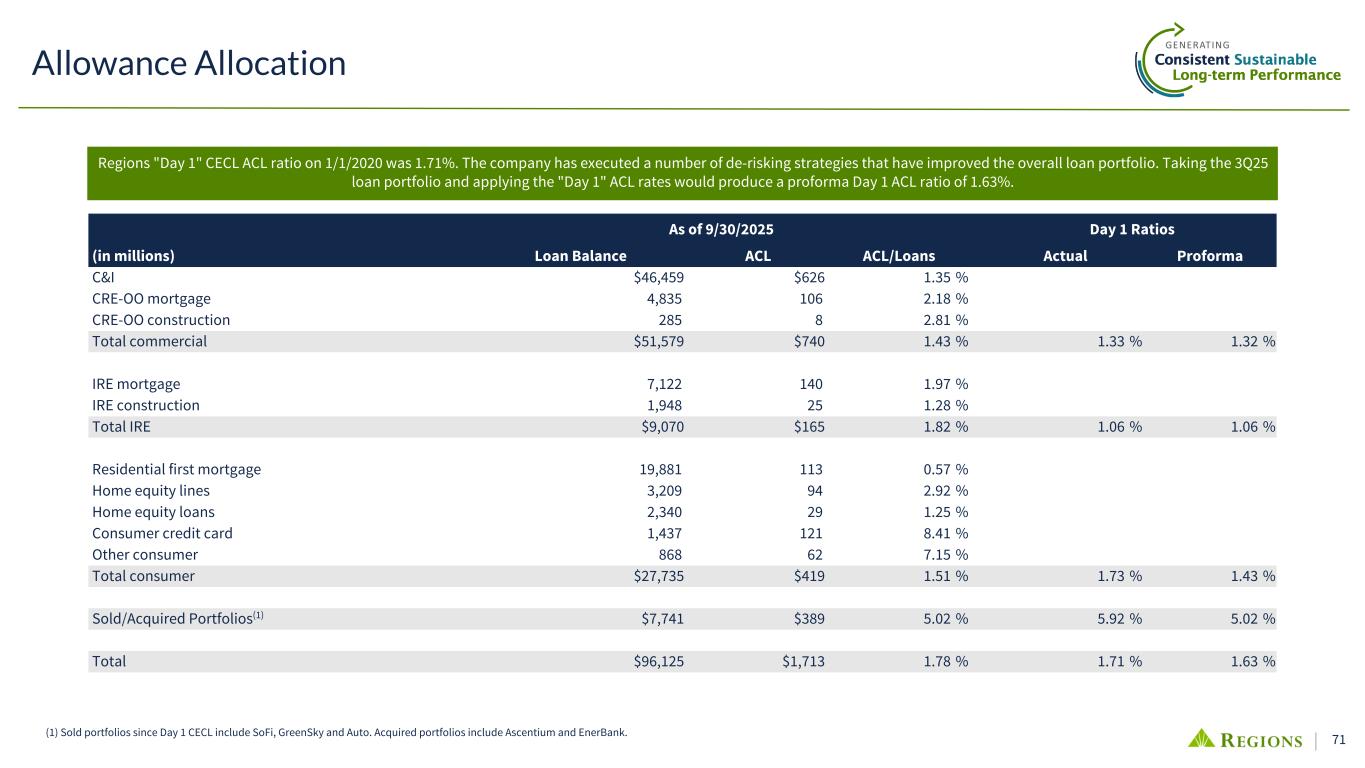
71 As of 9/30/2025 Day 1 Ratios (in millions) Loan Balance ACL ACL/Loans Actual Proforma C&I $46,459 $626 1.35 % CRE-OO mortgage 4,835 106 2.18 % CRE-OO construction 285 8 2.81 % Total commercial $51,579 $740 1.43 % 1.33 % 1.32 % IRE mortgage 7,122 140 1.97 % IRE construction 1,948 25 1.28 % Total IRE $9,070 $165 1.82 % 1.06 % 1.06 % Residential first mortgage 19,881 113 0.57 % Home equity lines 3,209 94 2.92 % Home equity loans 2,340 29 1.25 % Consumer credit card 1,437 121 8.41 % Other consumer 868 62 7.15 % Total consumer $27,735 $419 1.51 % 1.73 % 1.43 % Sold/Acquired Portfolios(1) $7,741 $389 5.02 % 5.92 % 5.02 % Total $96,125 $1,713 1.78 % 1.71 % 1.63 % Allowance Allocation Regions "Day 1" CECL ACL ratio on 1/1/2020 was 1.71%. The company has executed a number of de-risking strategies that have improved the overall loan portfolio. Taking the 3Q25 loan portfolio and applying the "Day 1" ACL rates would produce a proforma Day 1 ACL ratio of 1.63%. (1) Sold portfolios since Day 1 CECL include SoFi, GreenSky and Auto. Acquired portfolios include Ascentium and EnerBank.
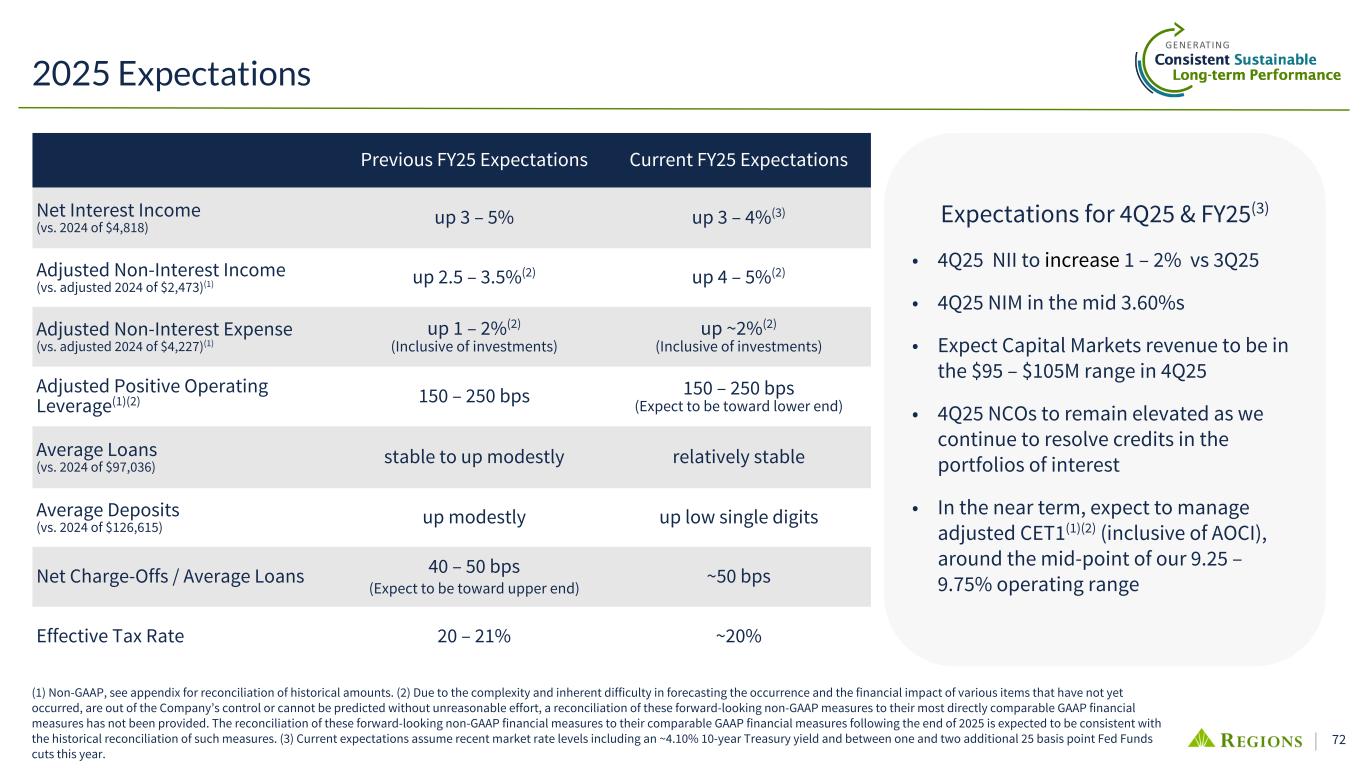
72 Expectations for 4Q25 & FY25(3) • 4Q25 NII to increase 1 – 2% vs 3Q25 • 4Q25 NIM in the mid 3.60%s • Expect Capital Markets revenue to be in the $95 – $105M range in 4Q25 • 4Q25 NCOs to remain elevated as we continue to resolve credits in the portfolios of interest • In the near term, expect to manage adjusted CET1(1)(2) (inclusive of AOCI), around the mid-point of our 9.25 – 9.75% operating range 2025 Expectations (1) Non-GAAP, see appendix for reconciliation of historical amounts. (2) Due to the complexity and inherent difficulty in forecasting the occurrence and the financial impact of various items that have not yet occurred, are out of the Company’s control or cannot be predicted without unreasonable effort, a reconciliation of these forward-looking non-GAAP measures to their most directly comparable GAAP financial measures has not been provided. The reconciliation of these forward-looking non-GAAP financial measures to their comparable GAAP financial measures following the end of 2025 is expected to be consistent with the historical reconciliation of such measures. (3) Current expectations assume recent market rate levels including an ~4.10% 10-year Treasury yield and between one and two additional 25 basis point Fed Funds cuts this year. Previous FY25 Expectations Current FY25 Expectations Net Interest Income (vs. 2024 of $4,818) up 3 – 5% up 3 – 4%(3) Adjusted Non-Interest Income (vs. adjusted 2024 of $2,473)(1) up 2.5 – 3.5%(2) up 4 – 5%(2) Adjusted Non-Interest Expense (vs. adjusted 2024 of $4,227)(1) up 1 – 2%(2) (Inclusive of investments) up ~2%(2) (Inclusive of investments) Adjusted Positive Operating Leverage(1)(2) 150 – 250 bps 150 – 250 bps (Expect to be toward lower end) Average Loans (vs. 2024 of $97,036) stable to up modestly relatively stable Average Deposits (vs. 2024 of $126,615) up modestly up low single digits Net Charge-Offs / Average Loans 40 – 50 bps (Expect to be toward upper end) ~50 bps Effective Tax Rate 20 – 21% ~20%

Internal Use Appendix
74 Management uses pre-tax pre-provision income (non-GAAP), adjusted pre-tax pre-provision income (non-GAAP), the adjusted efficiency ratio (non-GAAP), the adjusted fee income ratio (non-GAAP), return on average tangible common shareholders' equity (non-GAAP), adjusted return on average tangible common shareholders' equity (non-GAAP), adjusted common equity Tier 1 ratio (non-GAAP), as well as adjusted net income available to common shareholders (non-GAAP) and adjusted diluted EPS (non-GAAP) to monitor performance and believes these measures provide meaningful information to investors. Non-interest expense (GAAP) is presented excluding certain adjustments to arrive at adjusted non-interest expense (non-GAAP), which is the numerator for the adjusted efficiency ratio. Non-interest income (GAAP) is presented excluding certain adjustments to arrive at adjusted non-interest income (non-GAAP), which is the numerator for the adjusted fee income ratio. Adjusted non-interest income (non-GAAP) and adjusted non-interest expense (non-GAAP) are used to determine adjusted pre-tax pre-provision income (non-GAAP). Net interest income (GAAP) on a taxable-equivalent basis and non-interest income are added together to arrive at total revenue on a taxable-equivalent basis. Adjustments are made to arrive at adjusted total revenue on a taxable-equivalent basis (non-GAAP), which is the denominator for the adjusted fee income and adjusted efficiency ratios. Net income available to common shareholders (GAAP) is presented excluding certain adjustments, net of tax, to arrive at adjusted net income available to common shareholders (non-GAAP), which is the numerator for adjusted diluted EPS (non-GAAP). Return on average tangible common shareholders' equity (non-GAAP) is calculated by dividing net income available to common shareholders (GAAP) by the average tangible common shareholders’ equity (non-GAAP). Net income available to common shareholders (GAAP) is presented excluding certain adjustments, net of tax, to arrive at adjusted net income available to common shareholders (non-GAAP), which is the numerator for adjusted return on average tangible common shareholders’ equity. Adjusted return on average tangible common shareholders' equity is calculated by dividing the adjusted net income available to common shareholders (non-GAAP) by the average tangible common shareholders’ equity (non-GAAP). Adjusted common equity Tier 1 ratio (non-GAAP) is calculated by dividing the adjusted common equity tier 1 (non-GAAP), which is arrived at by excluding the AOCI loss on securities and AOCI loss on defined benefit pension plans and other post employment benefits from common equity Tier 1, by the company’s total risk-weighted assets (GAAP). Regions believes that the exclusion of these adjustments provides a meaningful basis for period-to-period comparisons, which management believes will assist investors in analyzing the operating results of the company and predicting future performance. These non- GAAP financial measures are also used by management to assess the performance of Regions’ business. It is possible that the activities related to the adjustments may recur; however, management does not consider the activities related to the adjustments to be indications of ongoing operations. Regions believes that presentation of these non-GAAP financial measures will permit investors to assess the performance of the company on the same basis as that applied by management. Tangible common book value per share is calculated by dividing tangible common shareholders' equity (non-GAAP) by tangible assets (non-GAAP). The numerator for tangible book value per share (non-GAAP), tangible common shareholders' equity (non-GAAP), is calculated by excluding intangible assets and the deferred tax liability related to intangible assets from common shareholders' equity (GAAP). The denominator for tangible book value per share (non-GAAP), tangible assets (non-GAAP), is calculated by excluding intangible assets and the deferred tax liability related to intangible assets from total assets (non-GAAP). Tangible common shareholders’ equity ratios have become a focus of some investors and management believes they may assist investors in analyzing the capital position of the company absent the effects of intangible assets and preferred stock. Analysts and banking regulators have assessed Regions’ capital adequacy using the tangible common shareholders’ equity measure. Because tangible common shareholders’ equity is not formally defined by GAAP or prescribed in any amount by federal banking regulations it is currently considered to be a non-GAAP financial measure and other entities may calculate it differently than Regions’ disclosed calculations. Since analysts and banking regulators may assess Regions’ capital adequacy using tangible common shareholders’ equity to tangible assets, management believes that it is useful to provide investors the ability to assess Regions’ capital adequacy on this same basis. Non-GAAP financial measures have inherent limitations, are not required to be uniformly applied and are not audited. Although these non-GAAP financial measures are frequently used by stakeholders in the evaluation of a company, they have limitations as analytical tools, and should not be considered in isolation, or as a substitute for analyses of results as reported under GAAP. In particular, a measure of earnings that excludes selected items does not represent the amount that effectively accrues directly to stockholders. Additionally, our non-GAAP financial measures may not be comparable to similar non-GAAP financial measures used by other companies and there is no certainty that we will not incur expenses in the future that are similar to those excluded in the calculations of non- GAAP financial measures presented herein. Management and the Board of Directors utilize non-GAAP measures as follows: • Preparation of Regions' operating budgets • Monthly financial performance reporting • Monthly close-out reporting of consolidated results (management only) • Presentation to investors of company performance • Metrics for incentive compensation Non-GAAP Information
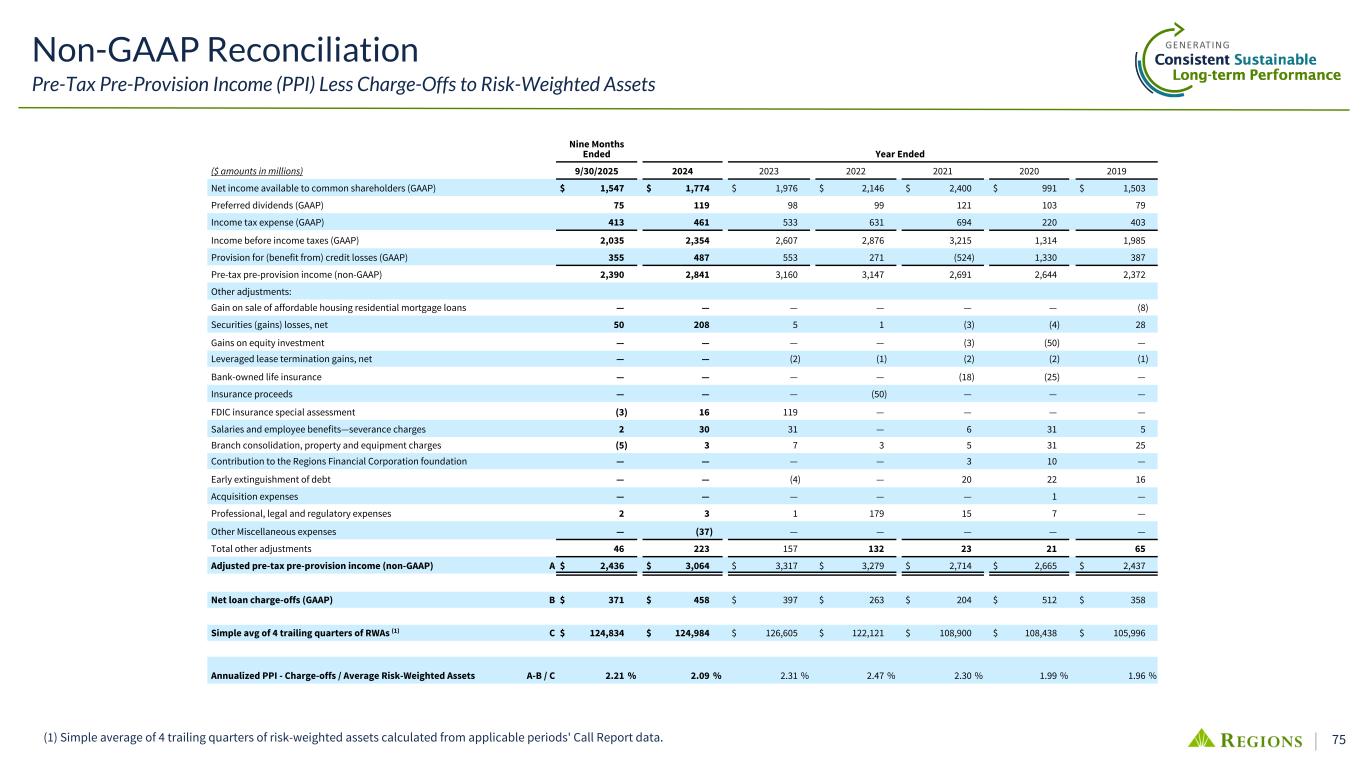
75(1) Simple average of 4 trailing quarters of risk-weighted assets calculated from applicable periods' Call Report data. Nine Months Ended Year Ended ($ amounts in millions) 9/30/2025 2024 2023 2022 2021 2020 2019 Net income available to common shareholders (GAAP) $ 1,547 $ 1,774 $ 1,976 $ 2,146 $ 2,400 $ 991 $ 1,503 Preferred dividends (GAAP) 75 119 98 99 121 103 79 Income tax expense (GAAP) 413 461 533 631 694 220 403 Income before income taxes (GAAP) 2,035 2,354 2,607 2,876 3,215 1,314 1,985 Provision for (benefit from) credit losses (GAAP) 355 487 553 271 (524) 1,330 387 Pre-tax pre-provision income (non-GAAP) 2,390 2,841 3,160 3,147 2,691 2,644 2,372 Other adjustments: Gain on sale of affordable housing residential mortgage loans — — — — — — (8) Securities (gains) losses, net 50 208 5 1 (3) (4) 28 Gains on equity investment — — — — (3) (50) — Leveraged lease termination gains, net — — (2) (1) (2) (2) (1) Bank-owned life insurance — — — — (18) (25) — Insurance proceeds — — — (50) — — — FDIC insurance special assessment (3) 16 119 — — — — Salaries and employee benefits—severance charges 2 30 31 — 6 31 5 Branch consolidation, property and equipment charges (5) 3 7 3 5 31 25 Contribution to the Regions Financial Corporation foundation — — — — 3 10 — Early extinguishment of debt — — (4) — 20 22 16 Acquisition expenses — — — — — 1 — Professional, legal and regulatory expenses 2 3 1 179 15 7 — Other Miscellaneous expenses — (37) — — — — — Total other adjustments 46 223 157 132 23 21 65 Adjusted pre-tax pre-provision income (non-GAAP) A $ 2,436 $ 3,064 $ 3,317 $ 3,279 $ 2,714 $ 2,665 $ 2,437 Net loan charge-offs (GAAP) B $ 371 $ 458 $ 397 $ 263 $ 204 $ 512 $ 358 Simple avg of 4 trailing quarters of RWAs (1) C $ 124,834 $ 124,984 $ 126,605 $ 122,121 $ 108,900 $ 108,438 $ 105,996 Annualized PPI - Charge-offs / Average Risk-Weighted Assets A-B / C 2.21 % 2.09 % 2.31 % 2.47 % 2.30 % 1.99 % 1.96 % Non-GAAP Reconciliation Pre-Tax Pre-Provision Income (PPI) Less Charge-Offs to Risk-Weighted Assets
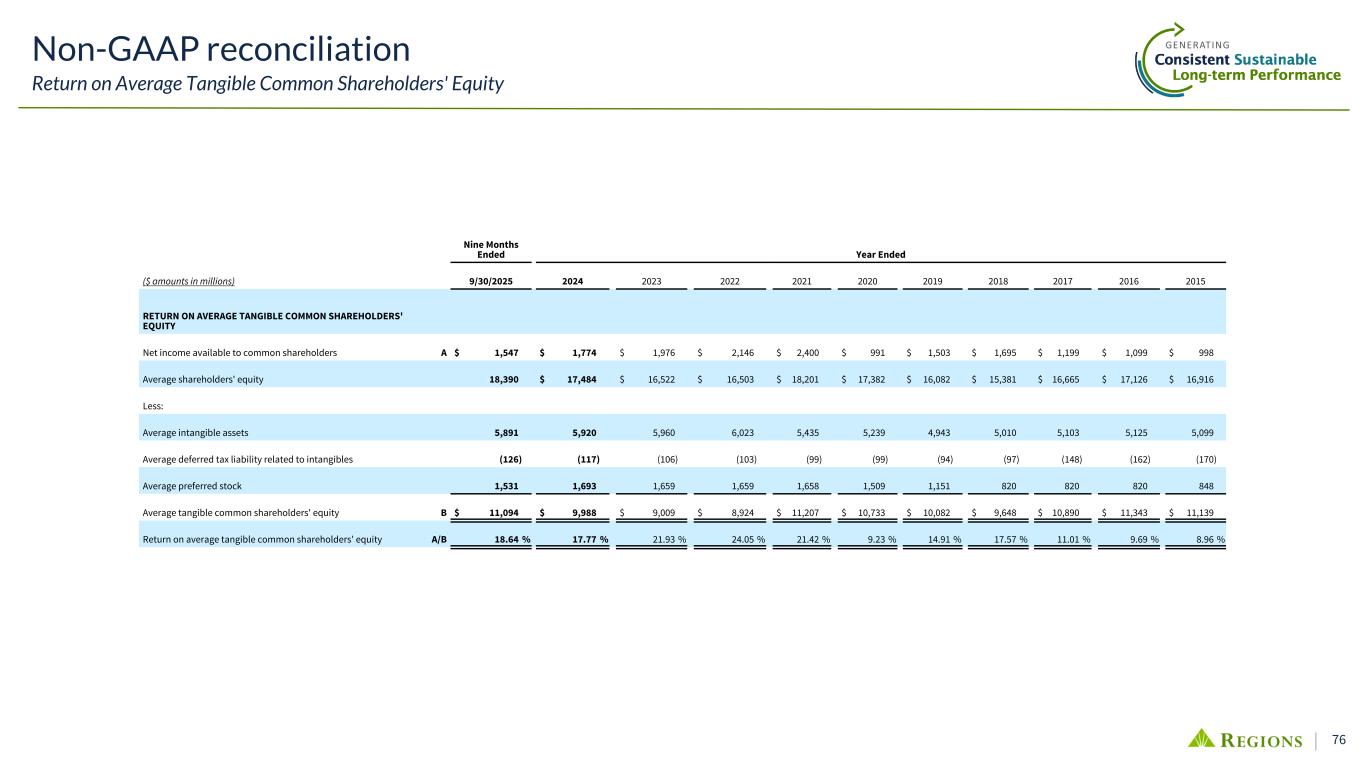
76 Non-GAAP reconciliation Return on Average Tangible Common Shareholders' Equity Nine Months Ended Year Ended ($ amounts in millions) 9/30/2025 2024 2023 2022 2021 2020 2019 2018 2017 2016 2015 RETURN ON AVERAGE TANGIBLE COMMON SHAREHOLDERS' EQUITY Net income available to common shareholders A $ 1,547 $ 1,774 $ 1,976 $ 2,146 $ 2,400 $ 991 $ 1,503 $ 1,695 $ 1,199 $ 1,099 $ 998 Average shareholders' equity 18,390 $ 17,484 $ 16,522 $ 16,503 $ 18,201 $ 17,382 $ 16,082 $ 15,381 $ 16,665 $ 17,126 $ 16,916 Less: Average intangible assets 5,891 5,920 5,960 6,023 5,435 5,239 4,943 5,010 5,103 5,125 5,099 Average deferred tax liability related to intangibles (126) (117) (106) (103) (99) (99) (94) (97) (148) (162) (170) Average preferred stock 1,531 1,693 1,659 1,659 1,658 1,509 1,151 820 820 820 848 Average tangible common shareholders' equity B $ 11,094 $ 9,988 $ 9,009 $ 8,924 $ 11,207 $ 10,733 $ 10,082 $ 9,648 $ 10,890 $ 11,343 $ 11,139 Return on average tangible common shareholders' equity A/B 18.64 % 17.77 % 21.93 % 24.05 % 21.42 % 9.23 % 14.91 % 17.57 % 11.01 % 9.69 % 8.96 %
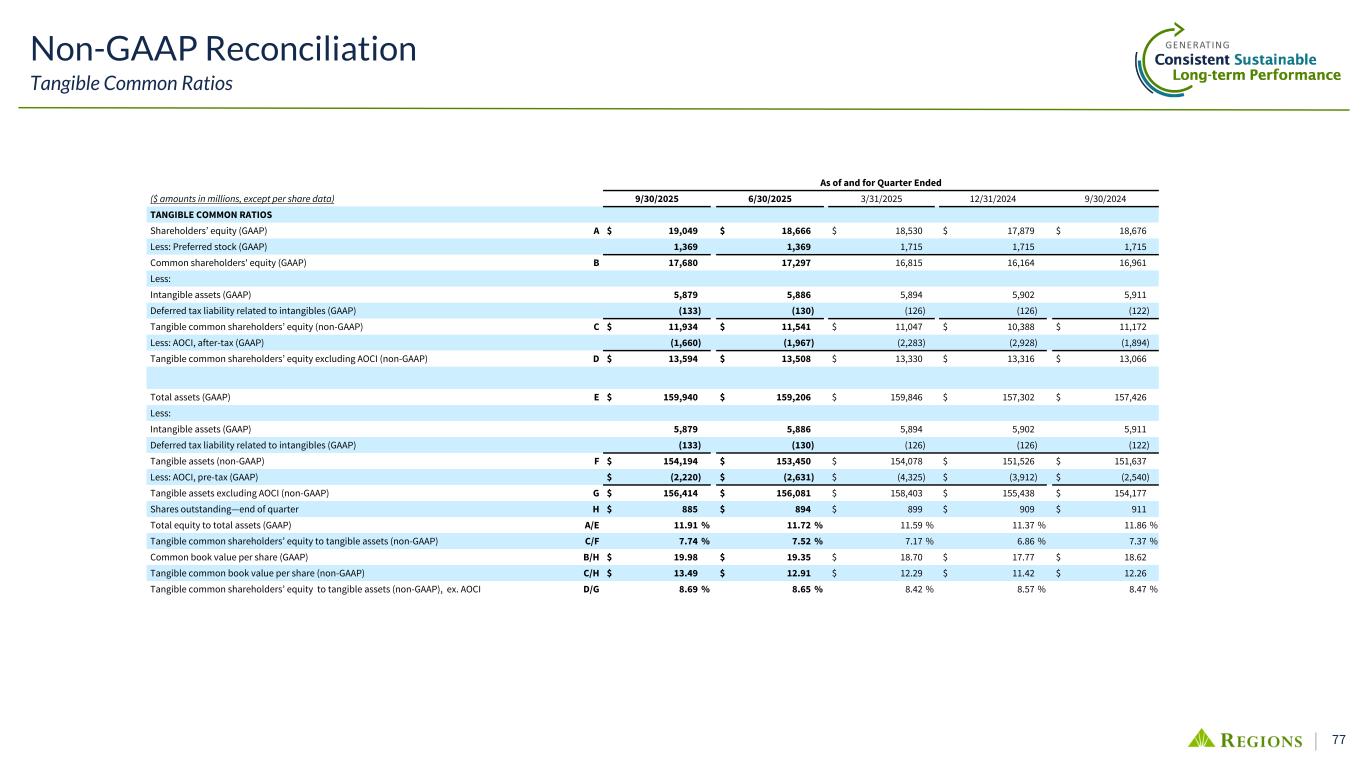
77 Non-GAAP Reconciliation Tangible Common Ratios As of and for Quarter Ended ($ amounts in millions, except per share data) 9/30/2025 6/30/2025 3/31/2025 12/31/2024 9/30/2024 TANGIBLE COMMON RATIOS Shareholders’ equity (GAAP) A $ 19,049 $ 18,666 $ 18,530 $ 17,879 $ 18,676 Less: Preferred stock (GAAP) 1,369 1,369 1,715 1,715 1,715 Common shareholders' equity (GAAP) B 17,680 17,297 16,815 16,164 16,961 Less: Intangible assets (GAAP) 5,879 5,886 5,894 5,902 5,911 Deferred tax liability related to intangibles (GAAP) (133) (130) (126) (126) (122) Tangible common shareholders’ equity (non-GAAP) C $ 11,934 $ 11,541 $ 11,047 $ 10,388 $ 11,172 Less: AOCI, after-tax (GAAP) (1,660) (1,967) (2,283) (2,928) (1,894) Tangible common shareholders’ equity excluding AOCI (non-GAAP) D $ 13,594 $ 13,508 $ 13,330 $ 13,316 $ 13,066 Total assets (GAAP) E $ 159,940 $ 159,206 $ 159,846 $ 157,302 $ 157,426 Less: Intangible assets (GAAP) 5,879 5,886 5,894 5,902 5,911 Deferred tax liability related to intangibles (GAAP) (133) (130) (126) (126) (122) Tangible assets (non-GAAP) F $ 154,194 $ 153,450 $ 154,078 $ 151,526 $ 151,637 Less: AOCI, pre-tax (GAAP) $ (2,220) $ (2,631) $ (4,325) $ (3,912) $ (2,540) Tangible assets excluding AOCI (non-GAAP) G $ 156,414 $ 156,081 $ 158,403 $ 155,438 $ 154,177 Shares outstanding—end of quarter H $ 885 $ 894 $ 899 $ 909 $ 911 Total equity to total assets (GAAP) A/E 11.91 % 11.72 % 11.59 % 11.37 % 11.86 % Tangible common shareholders’ equity to tangible assets (non-GAAP) C/F 7.74 % 7.52 % 7.17 % 6.86 % 7.37 % Common book value per share (GAAP) B/H $ 19.98 $ 19.35 $ 18.70 $ 17.77 $ 18.62 Tangible common book value per share (non-GAAP) C/H $ 13.49 $ 12.91 $ 12.29 $ 11.42 $ 12.26 Tangible common shareholders’ equity to tangible assets (non-GAAP), ex. AOCI D/G 8.69 % 8.65 % 8.42 % 8.57 % 8.47 %
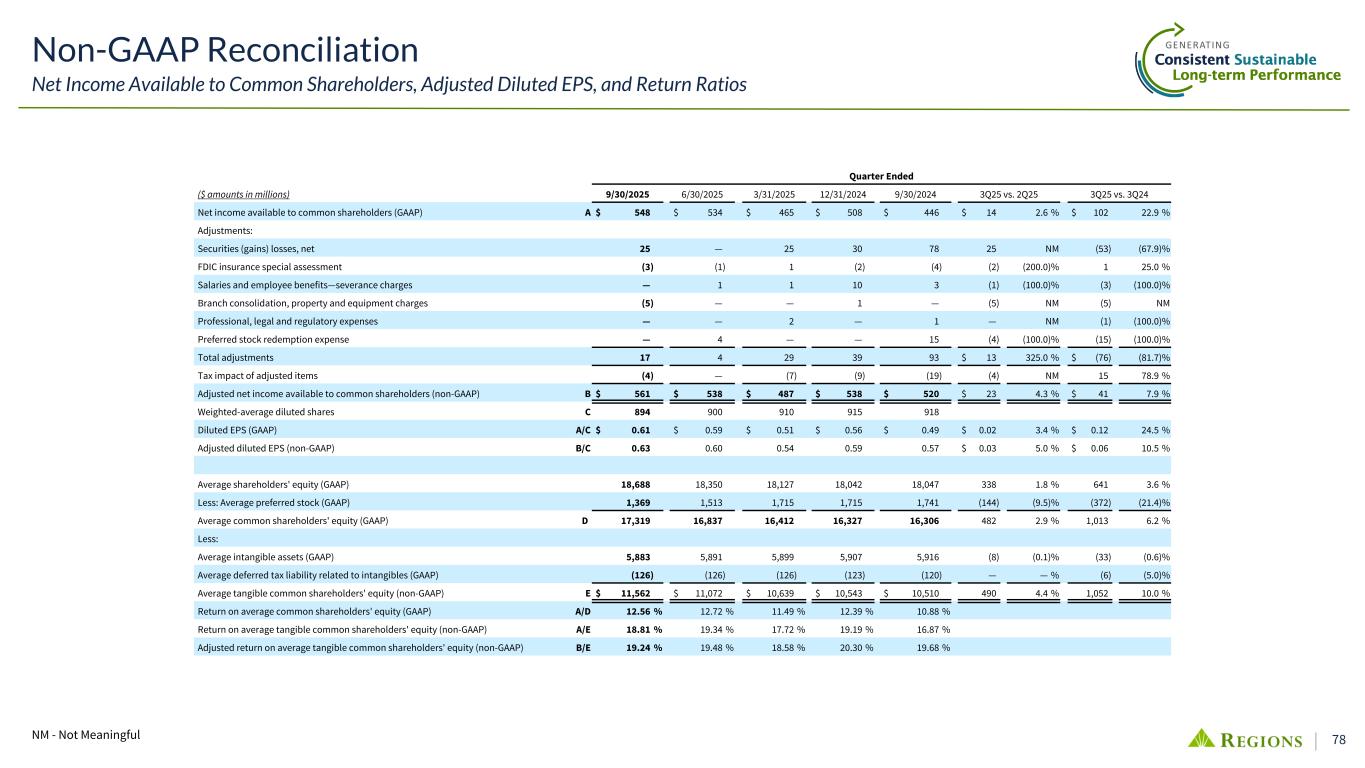
78 Non-GAAP Reconciliation Net Income Available to Common Shareholders, Adjusted Diluted EPS, and Return Ratios NM - Not Meaningful Quarter Ended ($ amounts in millions) 9/30/2025 6/30/2025 3/31/2025 12/31/2024 9/30/2024 3Q25 vs. 2Q25 3Q25 vs. 3Q24 Net income available to common shareholders (GAAP) A $ 548 $ 534 $ 465 $ 508 $ 446 $ 14 2.6 % $ 102 22.9 % Adjustments: Securities (gains) losses, net 25 — 25 30 78 25 NM (53) (67.9) % FDIC insurance special assessment (3) (1) 1 (2) (4) (2) (200.0) % 1 25.0 % Salaries and employee benefits—severance charges — 1 1 10 3 (1) (100.0) % (3) (100.0) % Branch consolidation, property and equipment charges (5) — — 1 — (5) NM (5) NM Professional, legal and regulatory expenses — — 2 — 1 — NM (1) (100.0) % Preferred stock redemption expense — 4 — — 15 (4) (100.0) % (15) (100.0) % Total adjustments 17 4 29 39 93 $ 13 325.0 % $ (76) (81.7) % Tax impact of adjusted items (4) — (7) (9) (19) (4) NM 15 78.9 % Adjusted net income available to common shareholders (non-GAAP) B $ 561 $ 538 $ 487 $ 538 $ 520 $ 23 4.3 % $ 41 7.9 % Weighted-average diluted shares C 894 900 910 915 918 Diluted EPS (GAAP) A/C $ 0.61 $ 0.59 $ 0.51 $ 0.56 $ 0.49 $ 0.02 3.4 % $ 0.12 24.5 % Adjusted diluted EPS (non-GAAP) B/C 0.63 0.60 0.54 0.59 0.57 $ 0.03 5.0 % $ 0.06 10.5 % Average shareholders' equity (GAAP) 18,688 18,350 18,127 18,042 18,047 338 1.8 % 641 3.6 % Less: Average preferred stock (GAAP) 1,369 1,513 1,715 1,715 1,741 (144) (9.5) % (372) (21.4) % Average common shareholders' equity (GAAP) D 17,319 16,837 16,412 16,327 16,306 482 2.9 % 1,013 6.2 % Less: Average intangible assets (GAAP) 5,883 5,891 5,899 5,907 5,916 (8) (0.1) % (33) (0.6) % Average deferred tax liability related to intangibles (GAAP) (126) (126) (126) (123) (120) — — % (6) (5.0) % Average tangible common shareholders' equity (non-GAAP) E $ 11,562 $ 11,072 $ 10,639 $ 10,543 $ 10,510 490 4.4 % 1,052 10.0 % Return on average common shareholders' equity (GAAP) A/D 12.56 % 12.72 % 11.49 % 12.39 % 10.88 % Return on average tangible common shareholders' equity (non-GAAP) A/E 18.81 % 19.34 % 17.72 % 19.19 % 16.87 % Adjusted return on average tangible common shareholders' equity (non-GAAP) B/E 19.24 % 19.48 % 18.58 % 20.30 % 19.68 %
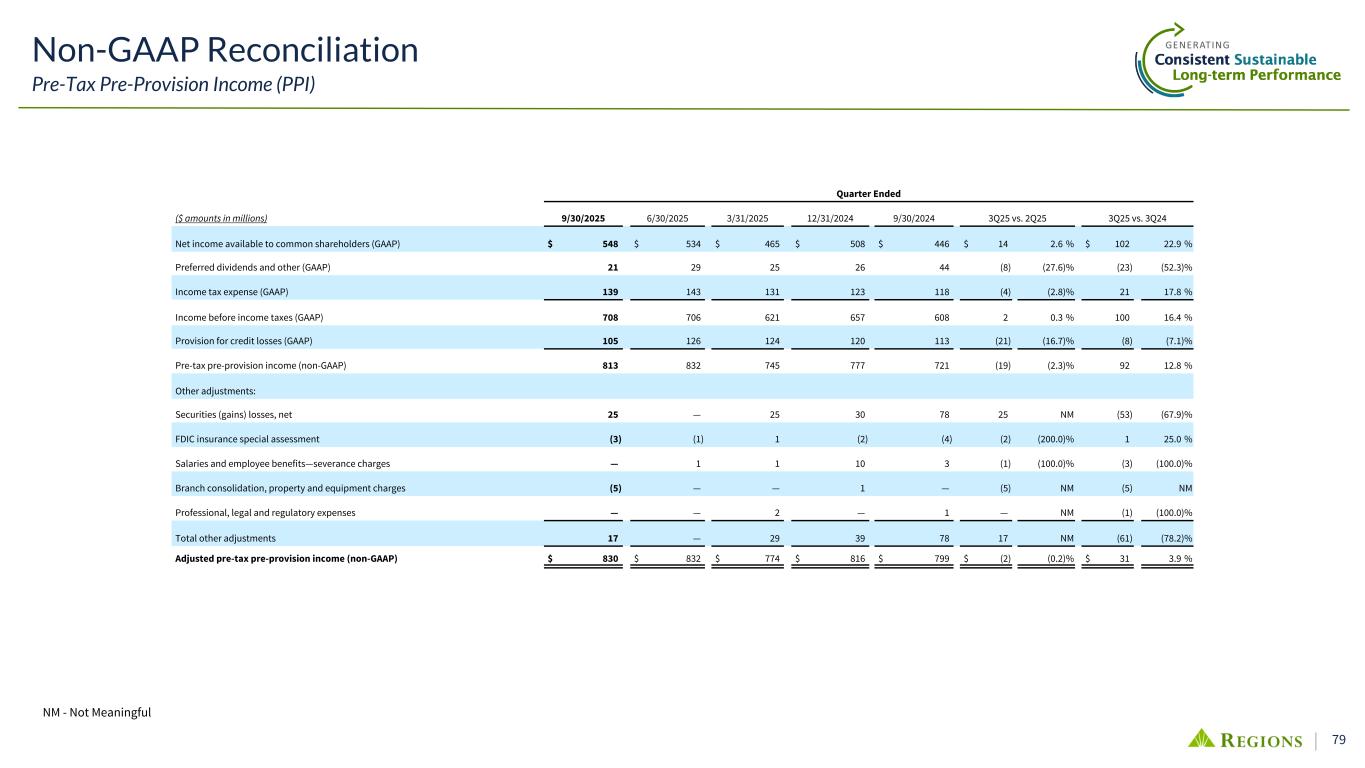
79 Non-GAAP Reconciliation Pre-Tax Pre-Provision Income (PPI) Quarter Ended ($ amounts in millions) 9/30/2025 6/30/2025 3/31/2025 12/31/2024 9/30/2024 3Q25 vs. 2Q25 3Q25 vs. 3Q24 Net income available to common shareholders (GAAP) $ 548 $ 534 $ 465 $ 508 $ 446 $ 14 2.6 % $ 102 22.9 % Preferred dividends and other (GAAP) 21 29 25 26 44 (8) (27.6) % (23) (52.3) % Income tax expense (GAAP) 139 143 131 123 118 (4) (2.8) % 21 17.8 % Income before income taxes (GAAP) 708 706 621 657 608 2 0.3 % 100 16.4 % Provision for credit losses (GAAP) 105 126 124 120 113 (21) (16.7) % (8) (7.1) % Pre-tax pre-provision income (non-GAAP) 813 832 745 777 721 (19) (2.3) % 92 12.8 % Other adjustments: Securities (gains) losses, net 25 — 25 30 78 25 NM (53) (67.9) % FDIC insurance special assessment (3) (1) 1 (2) (4) (2) (200.0) % 1 25.0 % Salaries and employee benefits—severance charges — 1 1 10 3 (1) (100.0) % (3) (100.0) % Branch consolidation, property and equipment charges (5) — — 1 — (5) NM (5) NM Professional, legal and regulatory expenses — — 2 — 1 — NM (1) (100.0) % Total other adjustments 17 — 29 39 78 17 NM (61) (78.2) % Adjusted pre-tax pre-provision income (non-GAAP) $ 830 $ 832 $ 774 $ 816 $ 799 $ (2) (0.2) % $ 31 3.9 % NM - Not Meaningful
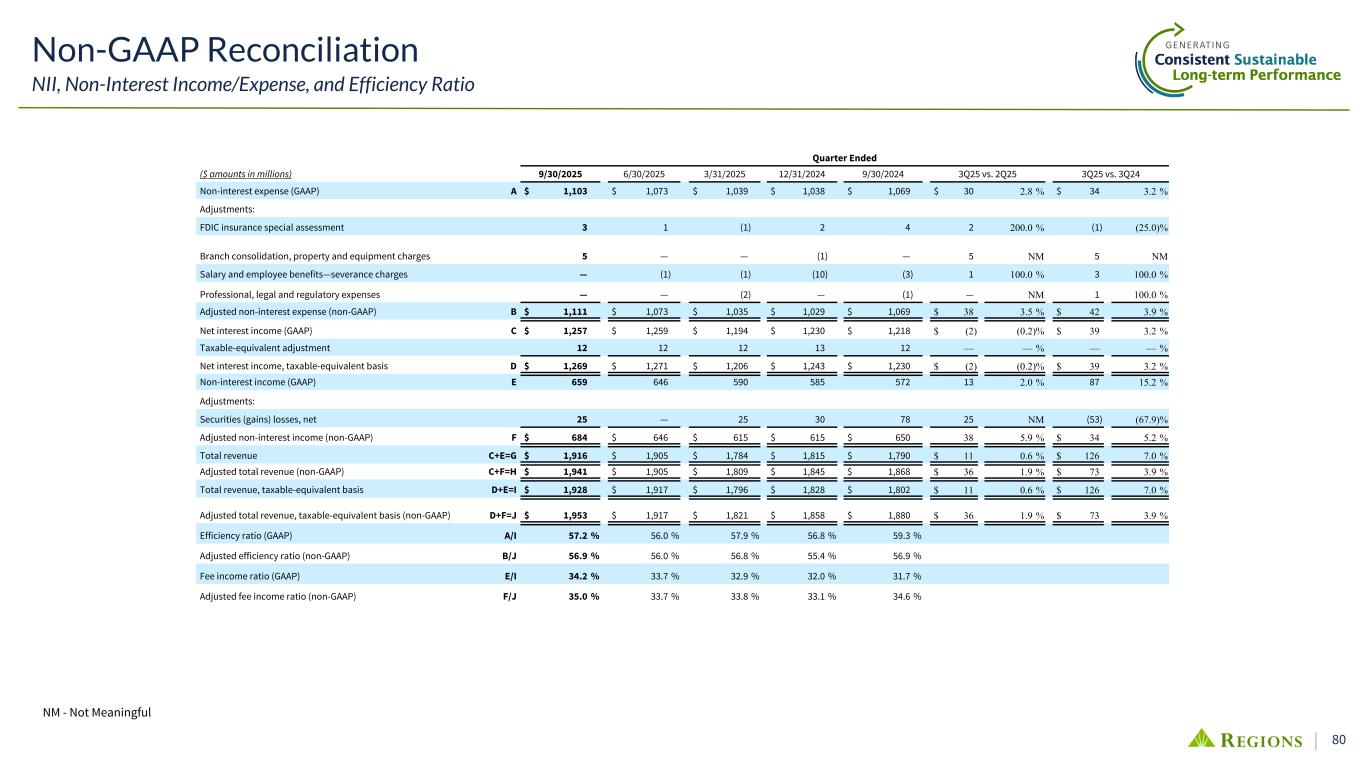
80 Non-GAAP Reconciliation NII, Non-Interest Income/Expense, and Efficiency Ratio NM - Not Meaningful Quarter Ended ($ amounts in millions) 9/30/2025 6/30/2025 3/31/2025 12/31/2024 9/30/2024 3Q25 vs. 2Q25 3Q25 vs. 3Q24 Non-interest expense (GAAP) A $ 1,103 $ 1,073 $ 1,039 $ 1,038 $ 1,069 $ 30 2.8 % $ 34 3.2 % Adjustments: FDIC insurance special assessment 3 1 (1) 2 4 2 200.0 % (1) (25.0) % Branch consolidation, property and equipment charges 5 — — (1) — 5 NM 5 NM Salary and employee benefits—severance charges — (1) (1) (10) (3) 1 100.0 % 3 100.0 % Professional, legal and regulatory expenses — — (2) — (1) — NM 1 100.0 % Adjusted non-interest expense (non-GAAP) B $ 1,111 $ 1,073 $ 1,035 $ 1,029 $ 1,069 $ 38 3.5 % $ 42 3.9 % Net interest income (GAAP) C $ 1,257 $ 1,259 $ 1,194 $ 1,230 $ 1,218 $ (2) (0.2) % $ 39 3.2 % Taxable-equivalent adjustment 12 12 12 13 12 — — % — — % Net interest income, taxable-equivalent basis D $ 1,269 $ 1,271 $ 1,206 $ 1,243 $ 1,230 $ (2) (0.2) % $ 39 3.2 % Non-interest income (GAAP) E 659 646 590 585 572 13 2.0 % 87 15.2 % Adjustments: Securities (gains) losses, net 25 — 25 30 78 25 NM (53) (67.9) % Adjusted non-interest income (non-GAAP) F $ 684 $ 646 $ 615 $ 615 $ 650 38 5.9 % $ 34 5.2 % Total revenue C+E=G $ 1,916 $ 1,905 $ 1,784 $ 1,815 $ 1,790 $ 11 0.6 % $ 126 7.0 % Adjusted total revenue (non-GAAP) C+F=H $ 1,941 $ 1,905 $ 1,809 $ 1,845 $ 1,868 $ 36 1.9 % $ 73 3.9 % Total revenue, taxable-equivalent basis D+E=I $ 1,928 $ 1,917 $ 1,796 $ 1,828 $ 1,802 $ 11 0.6 % $ 126 7.0 % Adjusted total revenue, taxable-equivalent basis (non-GAAP) D+F=J $ 1,953 $ 1,917 $ 1,821 $ 1,858 $ 1,880 $ 36 1.9 % $ 73 3.9 % Efficiency ratio (GAAP) A/I 57.2 % 56.0 % 57.9 % 56.8 % 59.3 % Adjusted efficiency ratio (non-GAAP) B/J 56.9 % 56.0 % 56.8 % 55.4 % 56.9 % Fee income ratio (GAAP) E/I 34.2 % 33.7 % 32.9 % 32.0 % 31.7 % Adjusted fee income ratio (non-GAAP) F/J 35.0 % 33.7 % 33.8 % 33.1 % 34.6 %
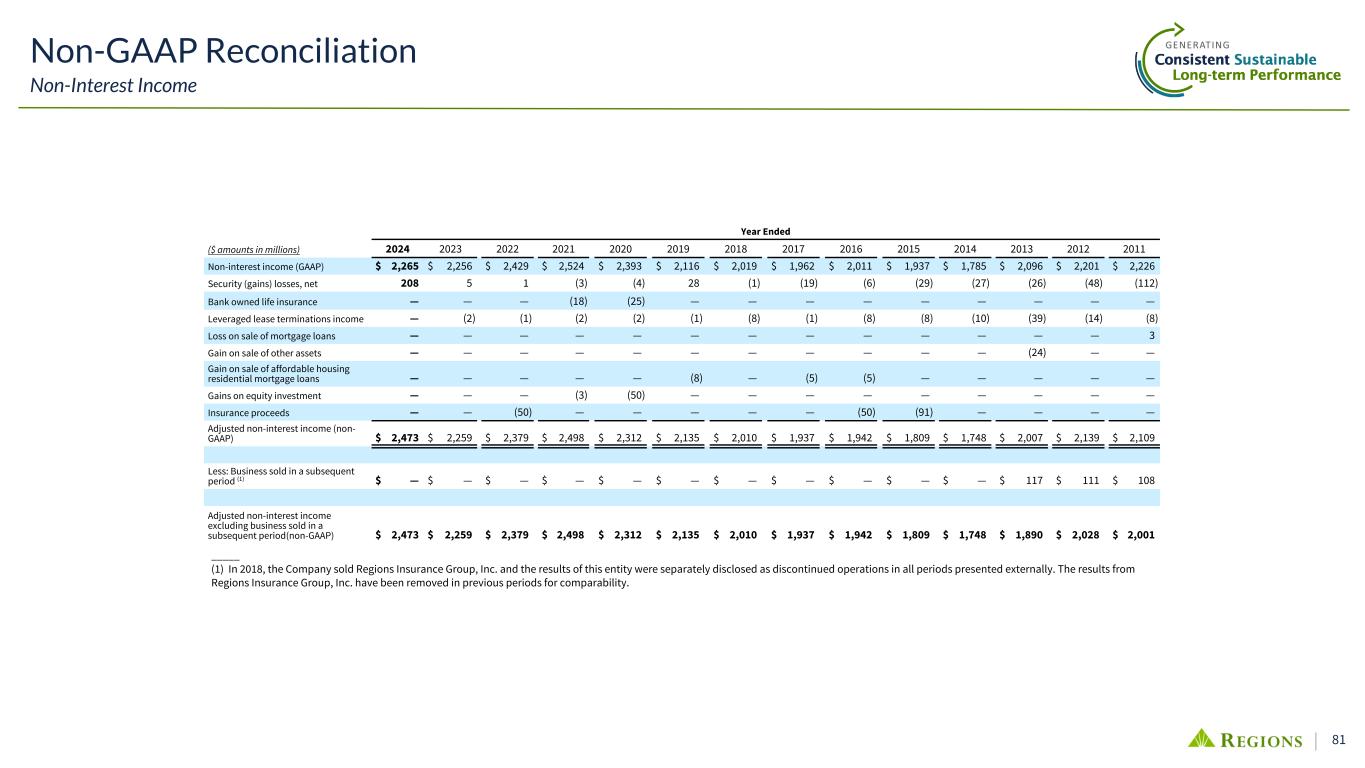
81 Non-GAAP Reconciliation Non-Interest Income Year Ended ($ amounts in millions) 2024 2023 2022 2021 2020 2019 2018 2017 2016 2015 2014 2013 2012 2011 Non-interest income (GAAP) $ 2,265 $ 2,256 $ 2,429 $ 2,524 $ 2,393 $ 2,116 $ 2,019 $ 1,962 $ 2,011 $ 1,937 $ 1,785 $ 2,096 $ 2,201 $ 2,226 Security (gains) losses, net 208 5 1 (3) (4) 28 (1) (19) (6) (29) (27) (26) (48) (112) Bank owned life insurance — — — (18) (25) — — — — — — — — — Leveraged lease terminations income — (2) (1) (2) (2) (1) (8) (1) (8) (8) (10) (39) (14) (8) Loss on sale of mortgage loans — — — — — — — — — — — — — 3 Gain on sale of other assets — — — — — — — — — — — (24) — — Gain on sale of affordable housing residential mortgage loans — — — — — (8) — (5) (5) — — — — — Gains on equity investment — — — (3) (50) — — — — — — — — — Insurance proceeds — — (50) — — — — — (50) (91) — — — — Adjusted non-interest income (non- GAAP) $ 2,473 $ 2,259 $ 2,379 $ 2,498 $ 2,312 $ 2,135 $ 2,010 $ 1,937 $ 1,942 $ 1,809 $ 1,748 $ 2,007 $ 2,139 $ 2,109 Less: Business sold in a subsequent period (1) $ — $ — $ — $ — $ — $ — $ — $ — $ — $ — $ — $ 117 $ 111 $ 108 Adjusted non-interest income excluding business sold in a subsequent period(non-GAAP) $ 2,473 $ 2,259 $ 2,379 $ 2,498 $ 2,312 $ 2,135 $ 2,010 $ 1,937 $ 1,942 $ 1,809 $ 1,748 $ 1,890 $ 2,028 $ 2,001 _____ (1) In 2018, the Company sold Regions Insurance Group, Inc. and the results of this entity were separately disclosed as discontinued operations in all periods presented externally. The results from Regions Insurance Group, Inc. have been removed in previous periods for comparability.
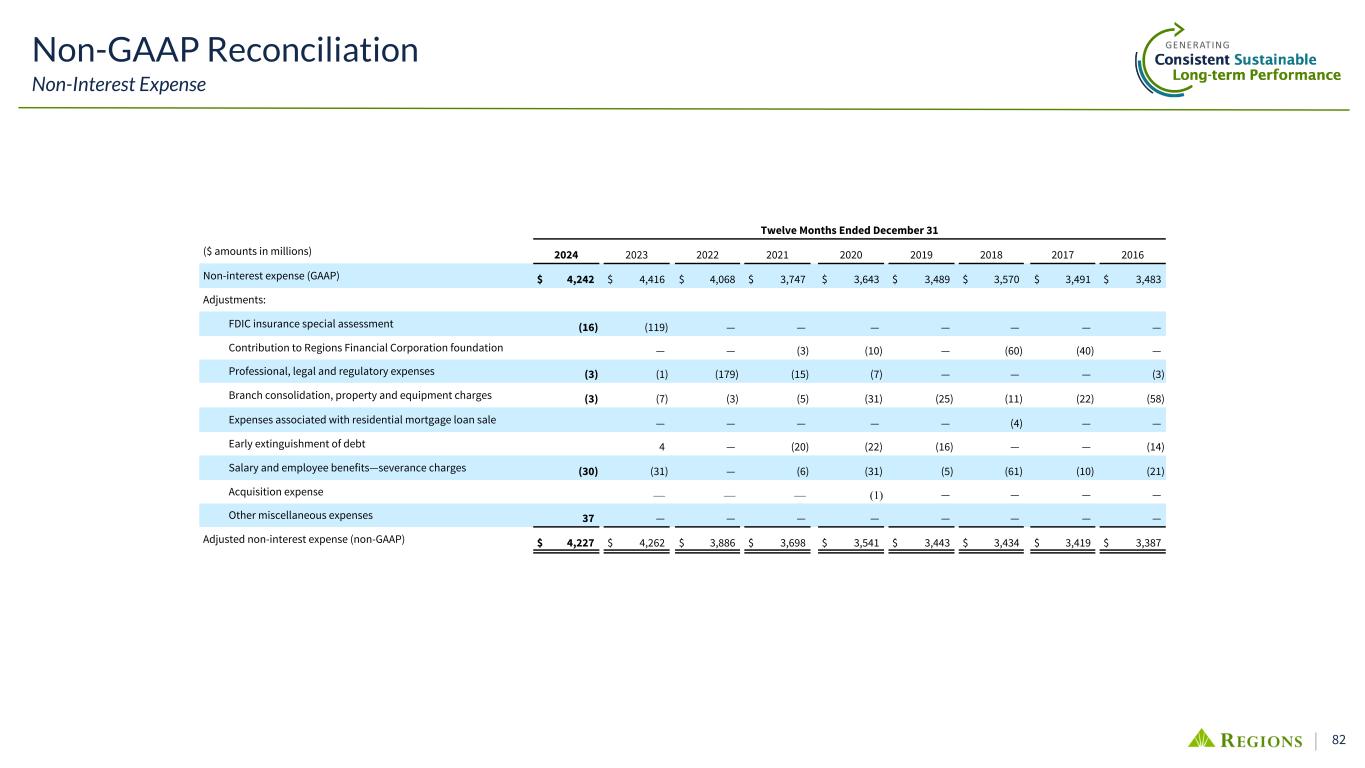
82 Non-GAAP Reconciliation Non-Interest Expense Twelve Months Ended December 31 ($ amounts in millions) 2024 2023 2022 2021 2020 2019 2018 2017 2016 Non-interest expense (GAAP) $ 4,242 $ 4,416 $ 4,068 $ 3,747 $ 3,643 $ 3,489 $ 3,570 $ 3,491 $ 3,483 Adjustments: FDIC insurance special assessment (16) (119) — — — — — — — Contribution to Regions Financial Corporation foundation — — (3) (10) — (60) (40) — Professional, legal and regulatory expenses (3) (1) (179) (15) (7) — — — (3) Branch consolidation, property and equipment charges (3) (7) (3) (5) (31) (25) (11) (22) (58) Expenses associated with residential mortgage loan sale — — — — — (4) — — Early extinguishment of debt 4 — (20) (22) (16) — — (14) Salary and employee benefits—severance charges (30) (31) — (6) (31) (5) (61) (10) (21) Acquisition expense — — — (1) — — — — Other miscellaneous expenses 37 — — — — — — — — Adjusted non-interest expense (non-GAAP) $ 4,227 $ 4,262 $ 3,886 $ 3,698 $ 3,541 $ 3,443 $ 3,434 $ 3,419 $ 3,387
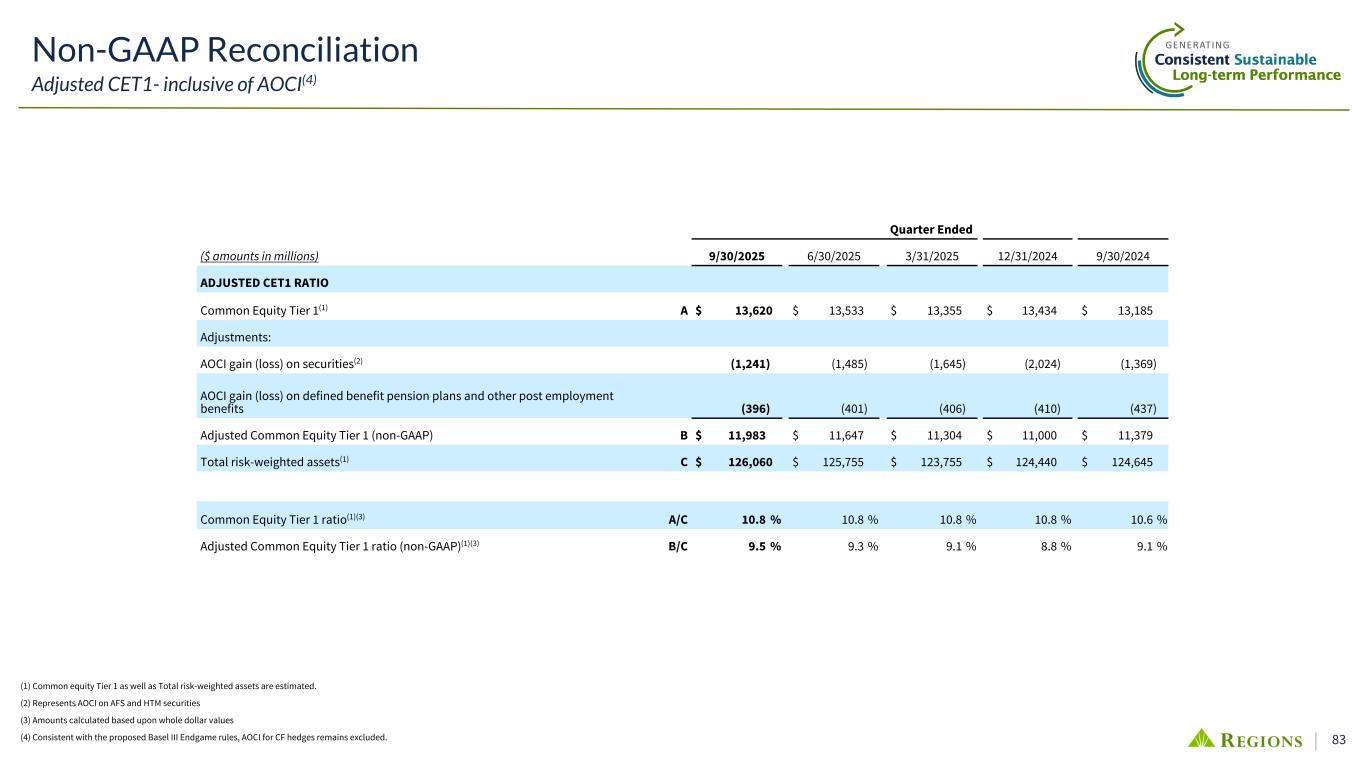
83 Quarter Ended ($ amounts in millions) 9/30/2025 6/30/2025 3/31/2025 12/31/2024 9/30/2024 ADJUSTED CET1 RATIO Common Equity Tier 1(1) A $ 13,620 $ 13,533 $ 13,355 $ 13,434 $ 13,185 Adjustments: AOCI gain (loss) on securities(2) (1,241) (1,485) (1,645) (2,024) (1,369) AOCI gain (loss) on defined benefit pension plans and other post employment benefits (396) (401) (406) (410) (437) Adjusted Common Equity Tier 1 (non-GAAP) B $ 11,983 $ 11,647 $ 11,304 $ 11,000 $ 11,379 Total risk-weighted assets(1) C $ 126,060 $ 125,755 $ 123,755 $ 124,440 $ 124,645 Common Equity Tier 1 ratio(1)(3) A/C 10.8 % 10.8 % 10.8 % 10.8 % 10.6 % Adjusted Common Equity Tier 1 ratio (non-GAAP)(1)(3) B/C 9.5 % 9.3 % 9.1 % 8.8 % 9.1 % Non-GAAP Reconciliation Adjusted CET1- inclusive of AOCI(4) (1) Common equity Tier 1 as well as Total risk-weighted assets are estimated. (2) Represents AOCI on AFS and HTM securities (3) Amounts calculated based upon whole dollar values (4) Consistent with the proposed Basel III Endgame rules, AOCI for CF hedges remains excluded.
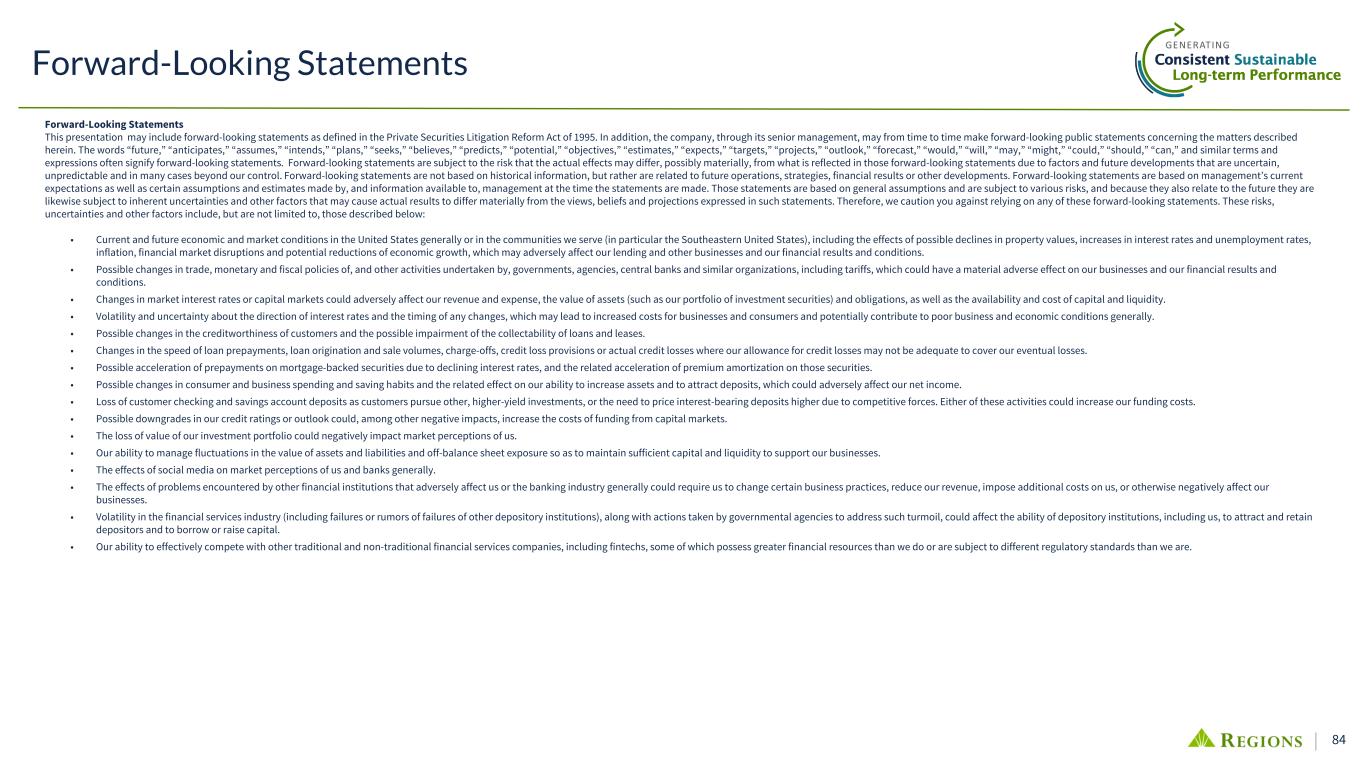
84 Forward-Looking Statements This presentation may include forward-looking statements as defined in the Private Securities Litigation Reform Act of 1995. In addition, the company, through its senior management, may from time to time make forward-looking public statements concerning the matters described herein. The words “future,” “anticipates,” “assumes,” “intends,” “plans,” “seeks,” “believes,” “predicts,” “potential,” “objectives,” “estimates,” “expects,” “targets,” “projects,” “outlook,” “forecast,” “would,” “will,” “may,” “might,” “could,” “should,” “can,” and similar terms and expressions often signify forward-looking statements. Forward-looking statements are subject to the risk that the actual effects may differ, possibly materially, from what is reflected in those forward-looking statements due to factors and future developments that are uncertain, unpredictable and in many cases beyond our control. Forward-looking statements are not based on historical information, but rather are related to future operations, strategies, financial results or other developments. Forward-looking statements are based on management’s current expectations as well as certain assumptions and estimates made by, and information available to, management at the time the statements are made. Those statements are based on general assumptions and are subject to various risks, and because they also relate to the future they are likewise subject to inherent uncertainties and other factors that may cause actual results to differ materially from the views, beliefs and projections expressed in such statements. Therefore, we caution you against relying on any of these forward-looking statements. These risks, uncertainties and other factors include, but are not limited to, those described below: • Current and future economic and market conditions in the United States generally or in the communities we serve (in particular the Southeastern United States), including the effects of possible declines in property values, increases in interest rates and unemployment rates, inflation, financial market disruptions and potential reductions of economic growth, which may adversely affect our lending and other businesses and our financial results and conditions. • Possible changes in trade, monetary and fiscal policies of, and other activities undertaken by, governments, agencies, central banks and similar organizations, including tariffs, which could have a material adverse effect on our businesses and our financial results and conditions. • Changes in market interest rates or capital markets could adversely affect our revenue and expense, the value of assets (such as our portfolio of investment securities) and obligations, as well as the availability and cost of capital and liquidity. • Volatility and uncertainty about the direction of interest rates and the timing of any changes, which may lead to increased costs for businesses and consumers and potentially contribute to poor business and economic conditions generally. • Possible changes in the creditworthiness of customers and the possible impairment of the collectability of loans and leases. • Changes in the speed of loan prepayments, loan origination and sale volumes, charge-offs, credit loss provisions or actual credit losses where our allowance for credit losses may not be adequate to cover our eventual losses. • Possible acceleration of prepayments on mortgage-backed securities due to declining interest rates, and the related acceleration of premium amortization on those securities. • Possible changes in consumer and business spending and saving habits and the related effect on our ability to increase assets and to attract deposits, which could adversely affect our net income. • Loss of customer checking and savings account deposits as customers pursue other, higher-yield investments, or the need to price interest-bearing deposits higher due to competitive forces. Either of these activities could increase our funding costs. • Possible downgrades in our credit ratings or outlook could, among other negative impacts, increase the costs of funding from capital markets. • The loss of value of our investment portfolio could negatively impact market perceptions of us. • Our ability to manage fluctuations in the value of assets and liabilities and off-balance sheet exposure so as to maintain sufficient capital and liquidity to support our businesses. • The effects of social media on market perceptions of us and banks generally. • The effects of problems encountered by other financial institutions that adversely affect us or the banking industry generally could require us to change certain business practices, reduce our revenue, impose additional costs on us, or otherwise negatively affect our businesses. • Volatility in the financial services industry (including failures or rumors of failures of other depository institutions), along with actions taken by governmental agencies to address such turmoil, could affect the ability of depository institutions, including us, to attract and retain depositors and to borrow or raise capital. • Our ability to effectively compete with other traditional and non-traditional financial services companies, including fintechs, some of which possess greater financial resources than we do or are subject to different regulatory standards than we are. Forward-Looking Statements
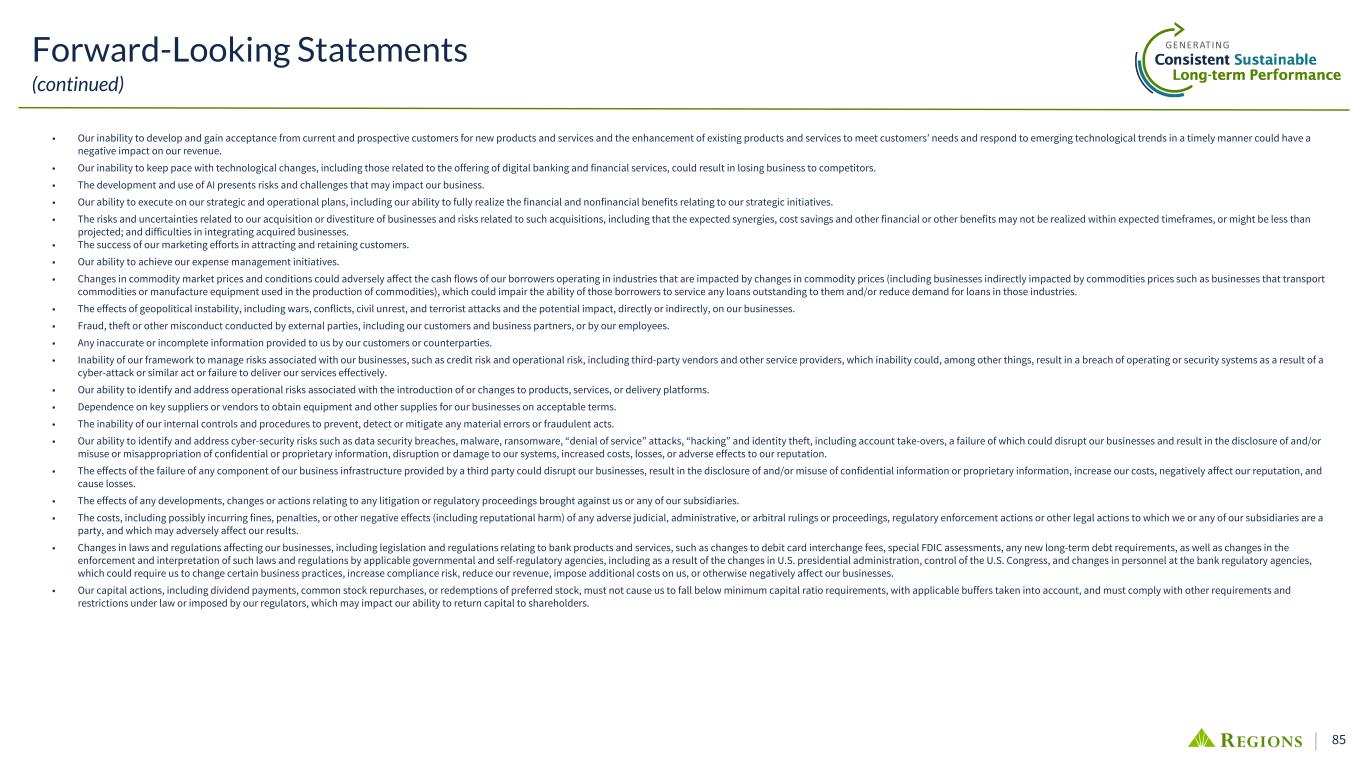
85 • Our inability to develop and gain acceptance from current and prospective customers for new products and services and the enhancement of existing products and services to meet customers’ needs and respond to emerging technological trends in a timely manner could have a negative impact on our revenue. • Our inability to keep pace with technological changes, including those related to the offering of digital banking and financial services, could result in losing business to competitors. • The development and use of AI presents risks and challenges that may impact our business. • Our ability to execute on our strategic and operational plans, including our ability to fully realize the financial and nonfinancial benefits relating to our strategic initiatives. • The risks and uncertainties related to our acquisition or divestiture of businesses and risks related to such acquisitions, including that the expected synergies, cost savings and other financial or other benefits may not be realized within expected timeframes, or might be less than projected; and difficulties in integrating acquired businesses. • The success of our marketing efforts in attracting and retaining customers. • Our ability to achieve our expense management initiatives. • Changes in commodity market prices and conditions could adversely affect the cash flows of our borrowers operating in industries that are impacted by changes in commodity prices (including businesses indirectly impacted by commodities prices such as businesses that transport commodities or manufacture equipment used in the production of commodities), which could impair the ability of those borrowers to service any loans outstanding to them and/or reduce demand for loans in those industries. • The effects of geopolitical instability, including wars, conflicts, civil unrest, and terrorist attacks and the potential impact, directly or indirectly, on our businesses. • Fraud, theft or other misconduct conducted by external parties, including our customers and business partners, or by our employees. • Any inaccurate or incomplete information provided to us by our customers or counterparties. • Inability of our framework to manage risks associated with our businesses, such as credit risk and operational risk, including third-party vendors and other service providers, which inability could, among other things, result in a breach of operating or security systems as a result of a cyber-attack or similar act or failure to deliver our services effectively. • Our ability to identify and address operational risks associated with the introduction of or changes to products, services, or delivery platforms. • Dependence on key suppliers or vendors to obtain equipment and other supplies for our businesses on acceptable terms. • The inability of our internal controls and procedures to prevent, detect or mitigate any material errors or fraudulent acts. • Our ability to identify and address cyber-security risks such as data security breaches, malware, ransomware, “denial of service” attacks, “hacking” and identity theft, including account take-overs, a failure of which could disrupt our businesses and result in the disclosure of and/or misuse or misappropriation of confidential or proprietary information, disruption or damage to our systems, increased costs, losses, or adverse effects to our reputation. • The effects of the failure of any component of our business infrastructure provided by a third party could disrupt our businesses, result in the disclosure of and/or misuse of confidential information or proprietary information, increase our costs, negatively affect our reputation, and cause losses. • The effects of any developments, changes or actions relating to any litigation or regulatory proceedings brought against us or any of our subsidiaries. • The costs, including possibly incurring fines, penalties, or other negative effects (including reputational harm) of any adverse judicial, administrative, or arbitral rulings or proceedings, regulatory enforcement actions or other legal actions to which we or any of our subsidiaries are a party, and which may adversely affect our results. • Changes in laws and regulations affecting our businesses, including legislation and regulations relating to bank products and services, such as changes to debit card interchange fees, special FDIC assessments, any new long-term debt requirements, as well as changes in the enforcement and interpretation of such laws and regulations by applicable governmental and self-regulatory agencies, including as a result of the changes in U.S. presidential administration, control of the U.S. Congress, and changes in personnel at the bank regulatory agencies, which could require us to change certain business practices, increase compliance risk, reduce our revenue, impose additional costs on us, or otherwise negatively affect our businesses. • Our capital actions, including dividend payments, common stock repurchases, or redemptions of preferred stock, must not cause us to fall below minimum capital ratio requirements, with applicable buffers taken into account, and must comply with other requirements and restrictions under law or imposed by our regulators, which may impact our ability to return capital to shareholders. Forward-Looking Statements (continued)
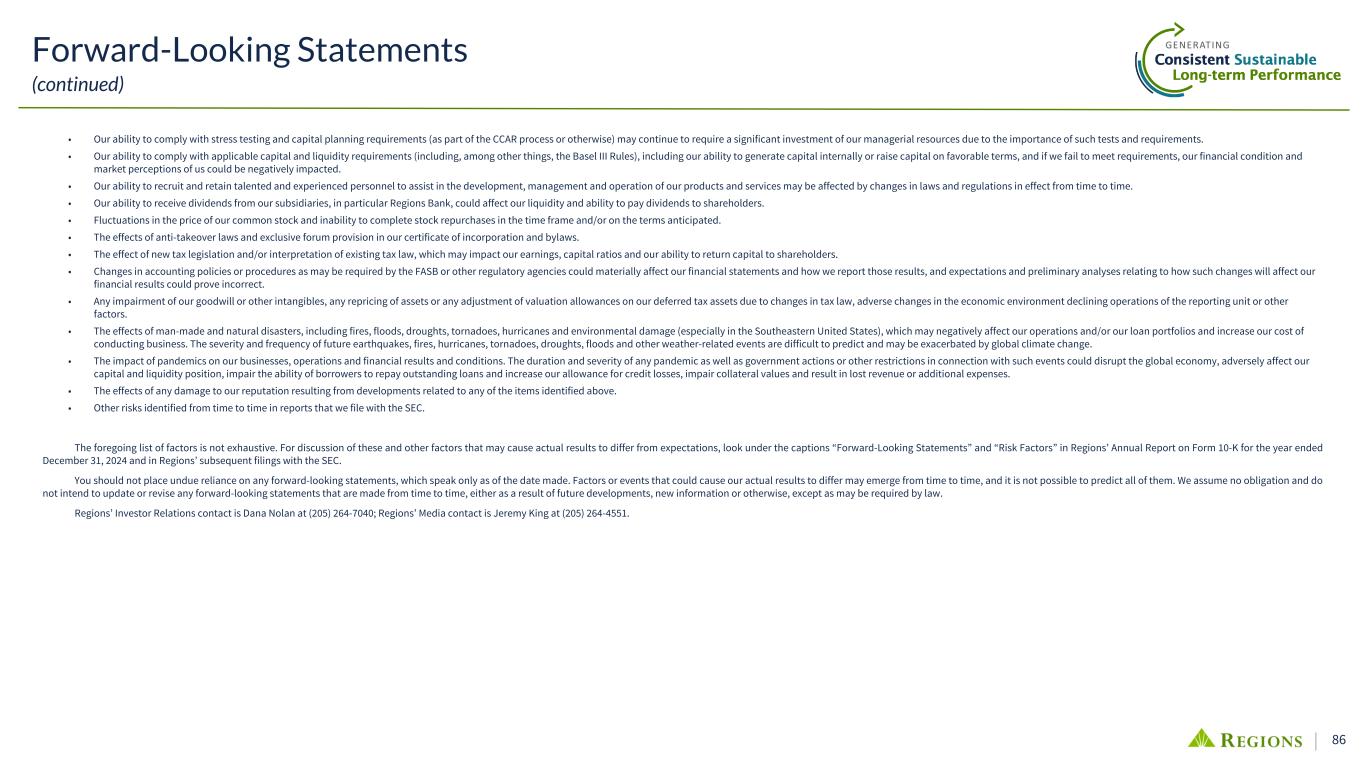
86 • Our ability to comply with stress testing and capital planning requirements (as part of the CCAR process or otherwise) may continue to require a significant investment of our managerial resources due to the importance of such tests and requirements. • Our ability to comply with applicable capital and liquidity requirements (including, among other things, the Basel III Rules), including our ability to generate capital internally or raise capital on favorable terms, and if we fail to meet requirements, our financial condition and market perceptions of us could be negatively impacted. • Our ability to recruit and retain talented and experienced personnel to assist in the development, management and operation of our products and services may be affected by changes in laws and regulations in effect from time to time. • Our ability to receive dividends from our subsidiaries, in particular Regions Bank, could affect our liquidity and ability to pay dividends to shareholders. • Fluctuations in the price of our common stock and inability to complete stock repurchases in the time frame and/or on the terms anticipated. • The effects of anti-takeover laws and exclusive forum provision in our certificate of incorporation and bylaws. • The effect of new tax legislation and/or interpretation of existing tax law, which may impact our earnings, capital ratios and our ability to return capital to shareholders. • Changes in accounting policies or procedures as may be required by the FASB or other regulatory agencies could materially affect our financial statements and how we report those results, and expectations and preliminary analyses relating to how such changes will affect our financial results could prove incorrect. • Any impairment of our goodwill or other intangibles, any repricing of assets or any adjustment of valuation allowances on our deferred tax assets due to changes in tax law, adverse changes in the economic environment declining operations of the reporting unit or other factors. • The effects of man-made and natural disasters, including fires, floods, droughts, tornadoes, hurricanes and environmental damage (especially in the Southeastern United States), which may negatively affect our operations and/or our loan portfolios and increase our cost of conducting business. The severity and frequency of future earthquakes, fires, hurricanes, tornadoes, droughts, floods and other weather-related events are difficult to predict and may be exacerbated by global climate change. • The impact of pandemics on our businesses, operations and financial results and conditions. The duration and severity of any pandemic as well as government actions or other restrictions in connection with such events could disrupt the global economy, adversely affect our capital and liquidity position, impair the ability of borrowers to repay outstanding loans and increase our allowance for credit losses, impair collateral values and result in lost revenue or additional expenses. • The effects of any damage to our reputation resulting from developments related to any of the items identified above. • Other risks identified from time to time in reports that we file with the SEC. The foregoing list of factors is not exhaustive. For discussion of these and other factors that may cause actual results to differ from expectations, look under the captions “Forward-Looking Statements” and “Risk Factors” in Regions’ Annual Report on Form 10-K for the year ended December 31, 2024 and in Regions’ subsequent filings with the SEC. You should not place undue reliance on any forward-looking statements, which speak only as of the date made. Factors or events that could cause our actual results to differ may emerge from time to time, and it is not possible to predict all of them. We assume no obligation and do not intend to update or revise any forward-looking statements that are made from time to time, either as a result of future developments, new information or otherwise, except as may be required by law. Regions’ Investor Relations contact is Dana Nolan at (205) 264-7040; Regions’ Media contact is Jeremy King at (205) 264-4551. Forward-Looking Statements (continued)

Internal Use