
1st Quarter Earnings April 17, 2026 .3
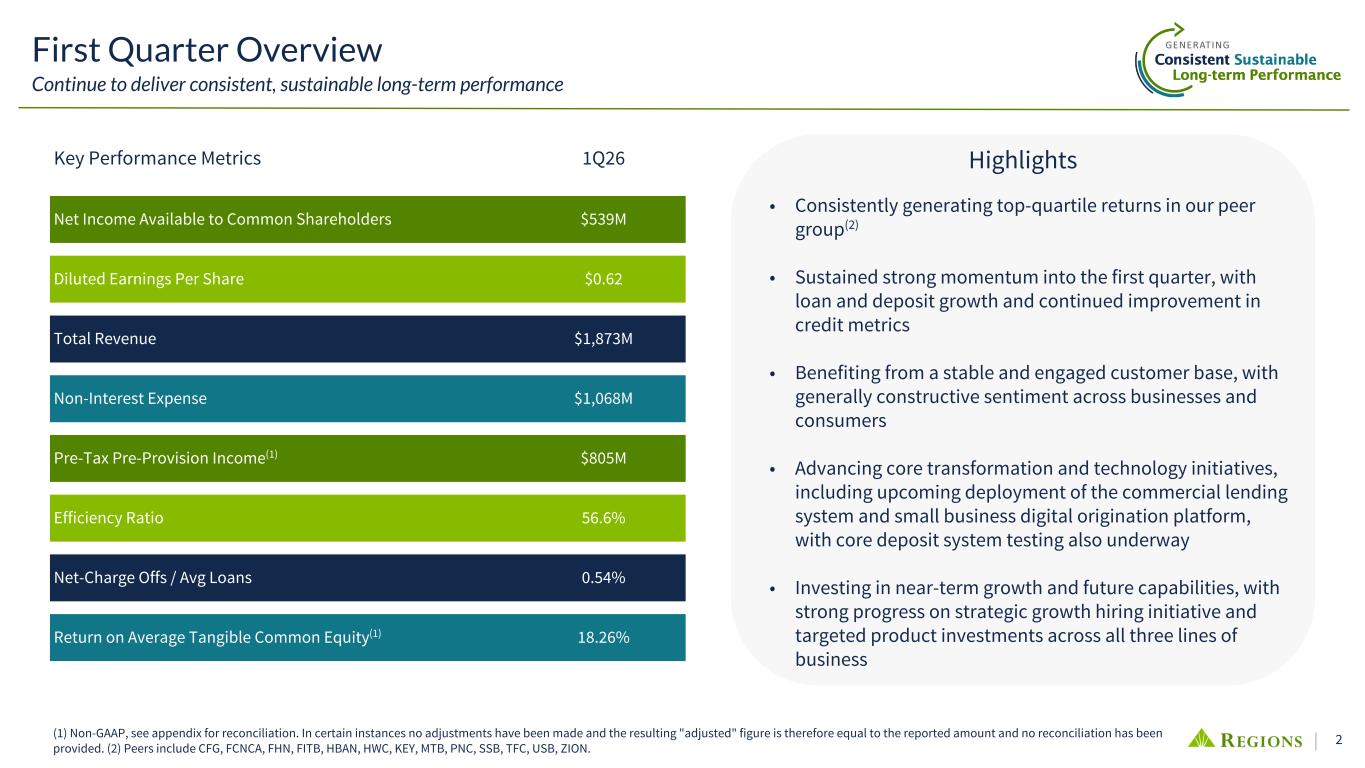
2 Highlights • Consistently generating top-quartile returns in our peer group(2) • Sustained strong momentum into the first quarter, with loan and deposit growth and continued improvement in credit metrics • Benefiting from a stable and engaged customer base, with generally constructive sentiment across businesses and consumers • Advancing core transformation and technology initiatives, including upcoming deployment of the commercial lending system and small business digital origination platform, with core deposit system testing also underway • Investing in near-term growth and future capabilities, with strong progress on strategic growth hiring initiative and targeted product investments across all three lines of business First Quarter Overview Continue to deliver consistent, sustainable long-term performance (1) Non-GAAP, see appendix for reconciliation. In certain instances no adjustments have been made and the resulting "adjusted" figure is therefore equal to the reported amount and no reconciliation has been provided. (2) Peers include CFG, FCNCA, FHN, FITB, HBAN, HWC, KEY, MTB, PNC, SSB, TFC, USB, ZION. Key Performance Metrics 1Q26 Net Income Available to Common Shareholders $539M Diluted Earnings Per Share $0.62 Total Revenue $1,873M Non-Interest Expense $1,068M Pre-Tax Pre-Provision Income(1) $805M Efficiency Ratio 56.6% Net-Charge Offs / Avg Loans 0.54% Return on Average Tangible Common Equity(1) 18.26%
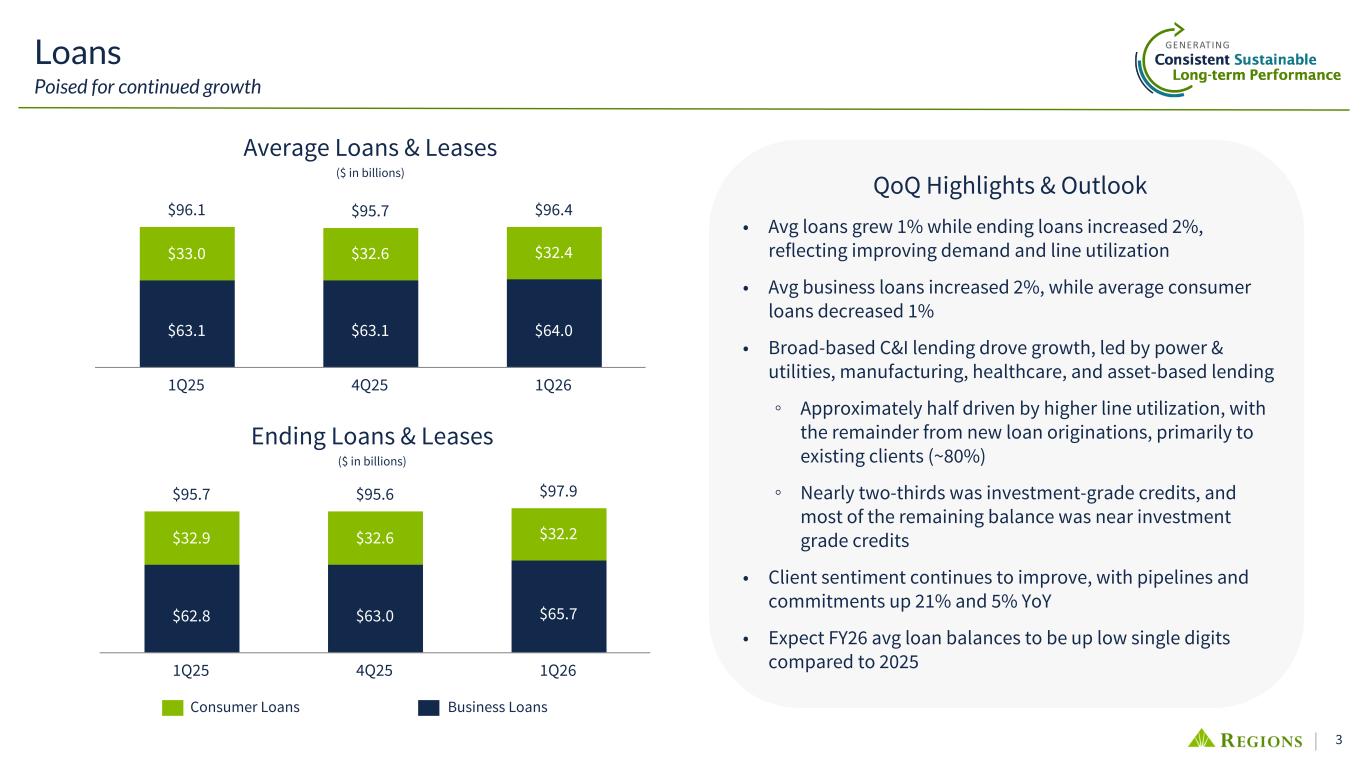
3 $95.7 $95.6 $97.9 $62.8 $63.0 $65.7 $32.9 $32.6 $32.2 1Q25 4Q25 1Q26 $96.1 $95.7 $96.4 $63.1 $63.1 $64.0 $33.0 $32.6 $32.4 1Q25 4Q25 1Q26 Average Loans & Leases ($ in billions) Business LoansConsumer Loans Ending Loans & Leases ($ in billions) Loans Poised for continued growth QoQ Highlights & Outlook • Avg loans grew 1% while ending loans increased 2%, reflecting improving demand and line utilization • Avg business loans increased 2%, while average consumer loans decreased 1% • Broad-based C&I lending drove growth, led by power & utilities, manufacturing, healthcare, and asset-based lending ◦ Approximately half driven by higher line utilization, with the remainder from new loan originations, primarily to existing clients (~80%) ◦ Nearly two-thirds was investment-grade credits, and most of the remaining balance was near investment grade credits • Client sentiment continues to improve, with pipelines and commitments up 21% and 5% YoY • Expect FY26 avg loan balances to be up low single digits compared to 2025
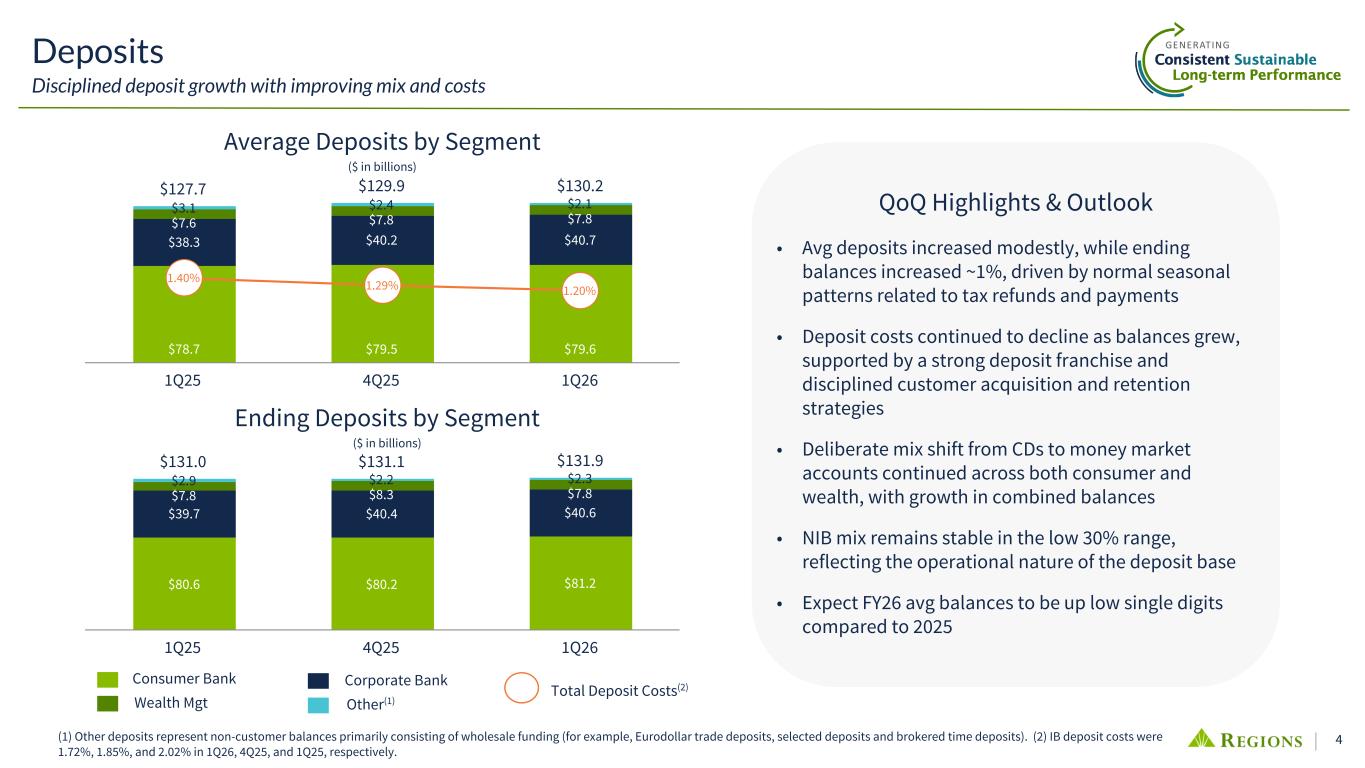
4 QoQ Highlights & Outlook • Avg deposits increased modestly, while ending balances increased ~1%, driven by normal seasonal patterns related to tax refunds and payments • Deposit costs continued to decline as balances grew, supported by a strong deposit franchise and disciplined customer acquisition and retention strategies • Deliberate mix shift from CDs to money market accounts continued across both consumer and wealth, with growth in combined balances • NIB mix remains stable in the low 30% range, reflecting the operational nature of the deposit base • Expect FY26 avg balances to be up low single digits compared to 2025 $131.0 $131.1 $131.9 $80.6 $80.2 $81.2 $39.7 $40.4 $40.6 $7.8 $8.3 $7.8 $2.9 $2.2 $2.3 1Q25 4Q25 1Q26 $127.7 $129.9 $130.2 $78.7 $79.5 $79.6 $38.3 $40.2 $40.7 $7.6 $7.8 $7.8 $3.1 $2.4 $2.1 1.40% 1.29% 1.20% 1Q25 4Q25 1Q26 (1) Other deposits represent non-customer balances primarily consisting of wholesale funding (for example, Eurodollar trade deposits, selected deposits and brokered time deposits). (2) IB deposit costs were 1.72%, 1.85%, and 2.02% in 1Q26, 4Q25, and 1Q25, respectively. Average Deposits by Segment ($ in billions) Deposits Disciplined deposit growth with improving mix and costs Wealth Mgt Other(1) Consumer Bank Corporate Bank Ending Deposits by Segment ($ in billions) Total Deposit Costs(2)
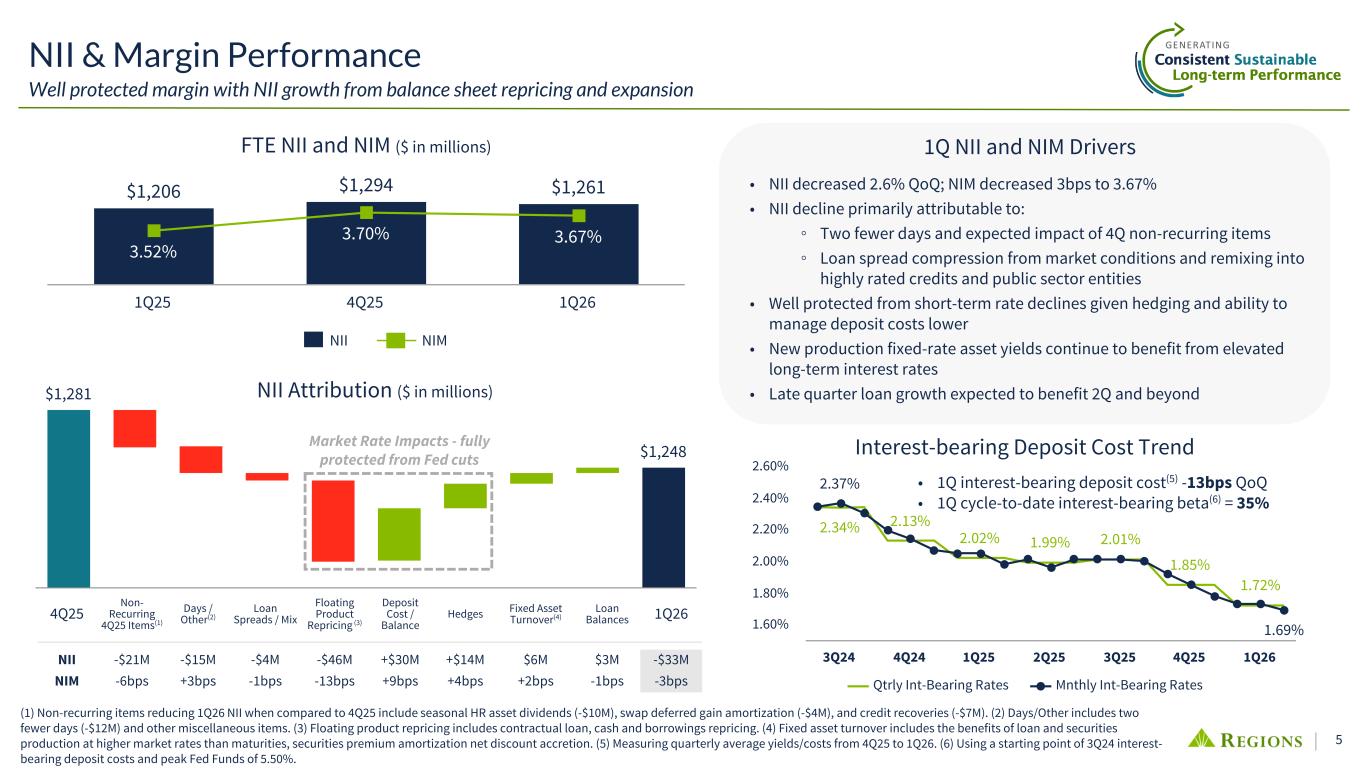
5 • 1Q interest-bearing deposit cost(5) -13bps QoQ • 1Q cycle-to-date interest-bearing beta(6) = 35% 1Q NII and NIM Drivers • NII decreased 2.6% QoQ; NIM decreased 3bps to 3.67% • NII decline primarily attributable to: ◦ Two fewer days and expected impact of 4Q non-recurring items ◦ Loan spread compression from market conditions and remixing into highly rated credits and public sector entities • Well protected from short-term rate declines given hedging and ability to manage deposit costs lower • New production fixed-rate asset yields continue to benefit from elevated long-term interest rates • Late quarter loan growth expected to benefit 2Q and beyond NII & Margin Performance Well protected margin with NII growth from balance sheet repricing and expansion $1,206 $1,294 $1,261 3.52% 3.70% 3.67% 1Q25 4Q25 1Q26 NII NIM FTE NII and NIM ($ in millions) (1) Non-recurring items reducing 1Q26 NII when compared to 4Q25 include seasonal HR asset dividends (-$10M), swap deferred gain amortization (-$4M), and credit recoveries (-$7M). (2) Days/Other includes two fewer days (-$12M) and other miscellaneous items. (3) Floating product repricing includes contractual loan, cash and borrowings repricing. (4) Fixed asset turnover includes the benefits of loan and securities production at higher market rates than maturities, securities premium amortization net discount accretion. (5) Measuring quarterly average yields/costs from 4Q25 to 1Q26. (6) Using a starting point of 3Q24 interest- bearing deposit costs and peak Fed Funds of 5.50%. 2.34% 2.13% 2.02% 1.99% 2.01% 1.85% 1.72% 2.37% 1.69% Qtrly Int-Bearing Rates Mnthly Int-Bearing Rates 3Q24 4Q24 1Q25 2Q25 3Q25 4Q25 1Q26 1.60% 1.80% 2.00% 2.20% 2.40% 2.60% Interest-bearing Deposit Cost Trend $1,281 $1,248 Market Rate Impacts - fully protected from Fed cuts Ad ju st ed NII Attribution ($ in millions) 4Q25 Non- Recurring 4Q25 Items(1) Days / Other(2) Loan Spreads / Mix Floating Product Repricing (3) Deposit Cost / Balance Hedges Fixed Asset Turnover(4) Loan Balances 1Q26 NII -$21M -$15M -$4M -$46M +$30M +$14M $6M $3M -$33M NIM -6bps +3bps -1bps -13bps +9bps +4bps +2bps -1bps -3bps
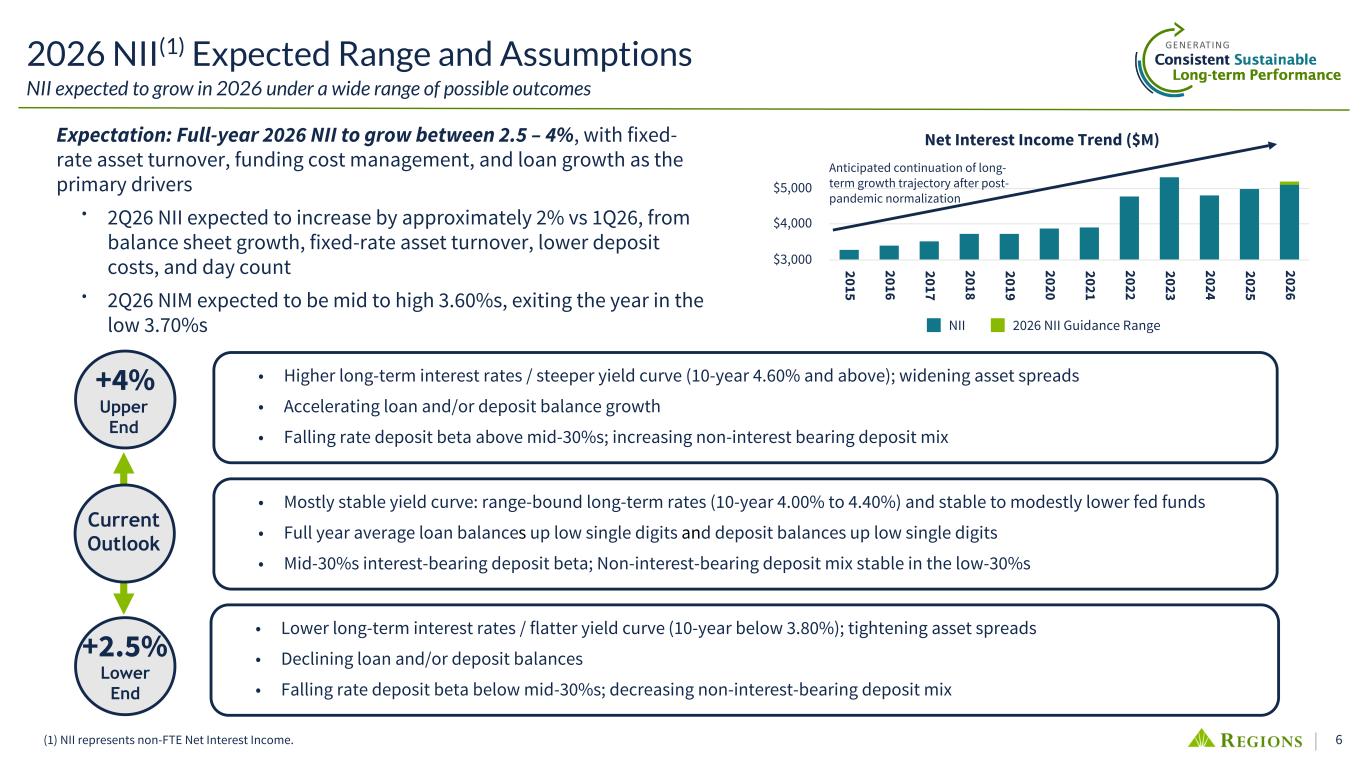
6 • Higher long-term interest rates / steeper yield curve (10-year 4.60% and above); widening asset spreads • Accelerating loan and/or deposit balance growth • Falling rate deposit beta above mid-30%s; increasing non-interest bearing deposit mix Expectation: Full-year 2026 NII to grow between 2.5 – 4%, with fixed- rate asset turnover, funding cost management, and loan growth as the primary drivers • 2Q26 NII expected to increase by approximately 2% vs 1Q26, from balance sheet growth, fixed-rate asset turnover, lower deposit costs, and day count • 2Q26 NIM expected to be mid to high 3.60%s, exiting the year in the low 3.70%s • Lower long-term interest rates / flatter yield curve (10-year below 3.80%); tightening asset spreads • Declining loan and/or deposit balances • Falling rate deposit beta below mid-30%s; decreasing non-interest-bearing deposit mix 2026 NII(1) Expected Range and Assumptions NII expected to grow in 2026 under a wide range of possible outcomes (1) NII represents non-FTE Net Interest Income. +4% +2.5% Current Outlook Upper End Lower End • Mostly stable yield curve: range-bound long-term rates (10-year 4.00% to 4.40%) and stable to modestly lower fed funds • Full year average loan balances up low single digits and deposit balances up low single digits • Mid-30%s interest-bearing deposit beta; Non-interest-bearing deposit mix stable in the low-30%s Net Interest Income Trend ($M) NII 2026 NII Guidance Range 2015 2016 2017 2018 2019 2020 2021 2022 2023 2024 2025 2026 $3,000 $4,000 $5,000 Anticipated continuation of long- term growth trajectory after post- pandemic normalization
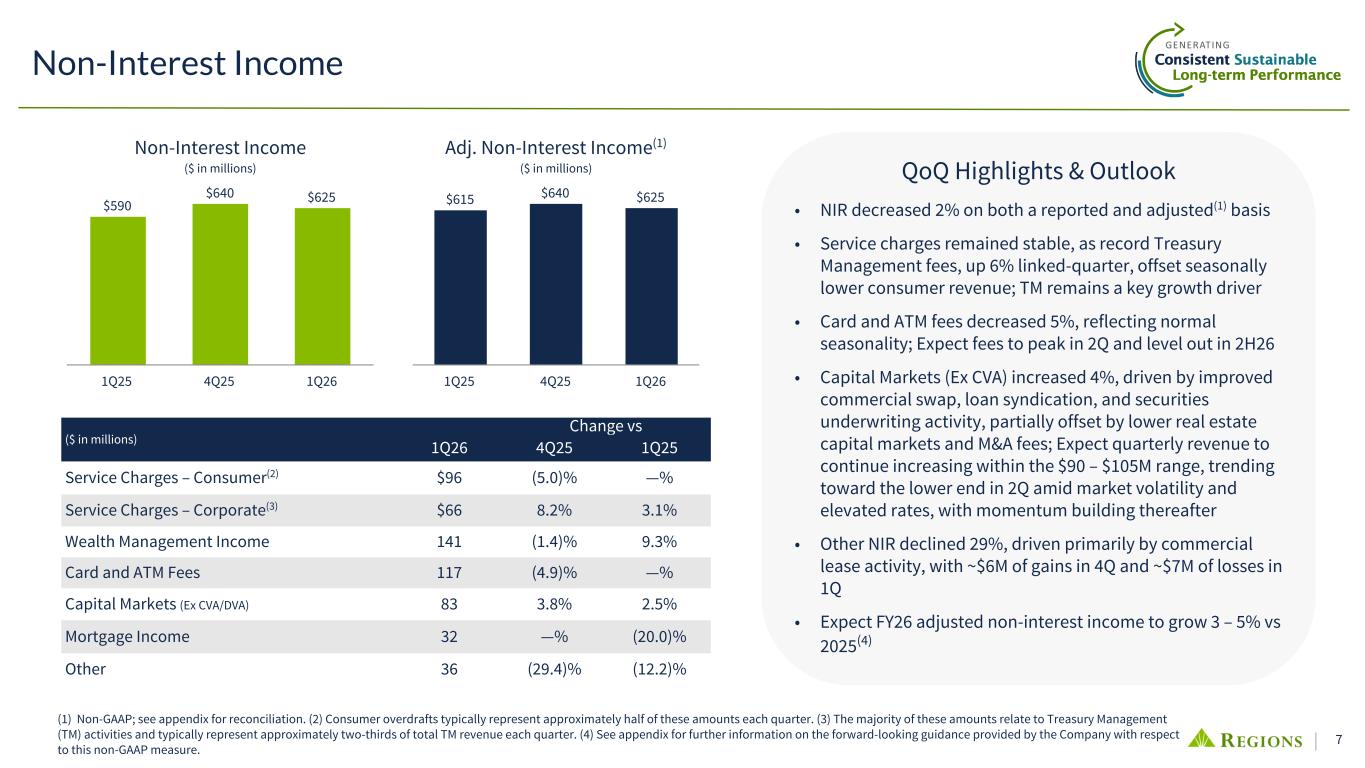
7 $615 $640 $625 1Q25 4Q25 1Q26 ($ in millions) Change vs 1Q26 4Q25 1Q25 Service Charges – Consumer(2) $96 (5.0)% —% Service Charges – Corporate(3) $66 8.2% 3.1% Wealth Management Income 141 (1.4)% 9.3% Card and ATM Fees 117 (4.9)% —% Capital Markets (Ex CVA/DVA) 83 3.8% 2.5% Mortgage Income 32 —% (20.0)% Other 36 (29.4)% (12.2)% Non-Interest Income (1) Non-GAAP; see appendix for reconciliation. (2) Consumer overdrafts typically represent approximately half of these amounts each quarter. (3) The majority of these amounts relate to Treasury Management (TM) activities and typically represent approximately two-thirds of total TM revenue each quarter. (4) See appendix for further information on the forward-looking guidance provided by the Company with respect to this non-GAAP measure. $590 $640 $625 1Q25 4Q25 1Q26 Non-Interest Income ($ in millions) Adj. Non-Interest Income(1) ($ in millions) QoQ Highlights & Outlook • NIR decreased 2% on both a reported and adjusted(1) basis • Service charges remained stable, as record Treasury Management fees, up 6% linked-quarter, offset seasonally lower consumer revenue; TM remains a key growth driver • Card and ATM fees decreased 5%, reflecting normal seasonality; Expect fees to peak in 2Q and level out in 2H26 • Capital Markets (Ex CVA) increased 4%, driven by improved commercial swap, loan syndication, and securities underwriting activity, partially offset by lower real estate capital markets and M&A fees; Expect quarterly revenue to continue increasing within the $90 – $105M range, trending toward the lower end in 2Q amid market volatility and elevated rates, with momentum building thereafter • Other NIR declined 29%, driven primarily by commercial lease activity, with ~$6M of gains in 4Q and ~$7M of losses in 1Q • Expect FY26 adjusted non-interest income to grow 3 – 5% vs 2025(4)
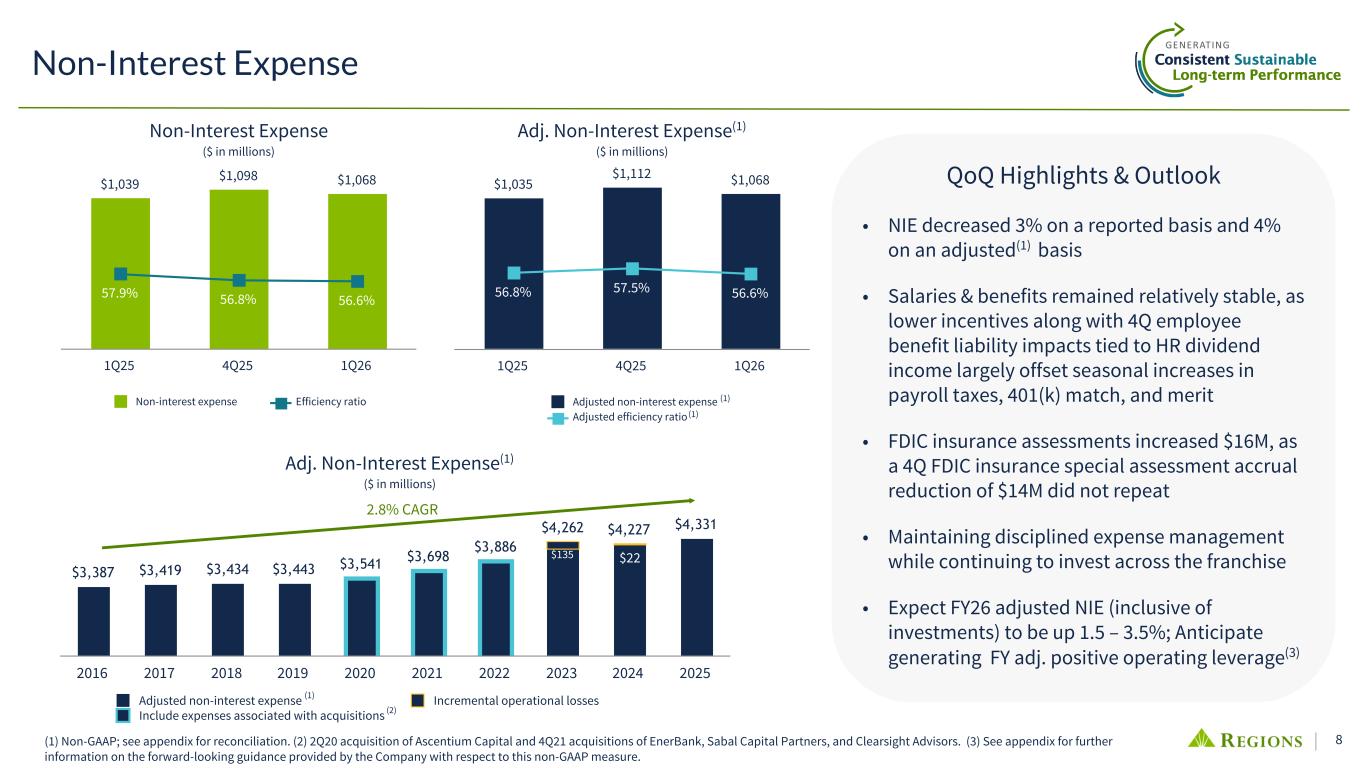
8 QoQ Highlights & Outlook • NIE decreased 3% on a reported basis and 4% on an adjusted(1) basis • Salaries & benefits remained relatively stable, as lower incentives along with 4Q employee benefit liability impacts tied to HR dividend income largely offset seasonal increases in payroll taxes, 401(k) match, and merit • FDIC insurance assessments increased $16M, as a 4Q FDIC insurance special assessment accrual reduction of $14M did not repeat • Maintaining disciplined expense management while continuing to invest across the franchise • Expect FY26 adjusted NIE (inclusive of investments) to be up 1.5 – 3.5%; Anticipate generating FY adj. positive operating leverage(3) $1,039 $1,098 $1,068 57.9% 56.8% 56.6% Non-interest expense Efficiency ratio 1Q25 4Q25 1Q26 $1,035 $1,112 $1,068 56.8% 57.5% 56.6% Adjusted non-interest expense Adjusted efficiency ratio 1Q25 4Q25 1Q26 Non-Interest Expense (1) (1) Non-Interest Expense ($ in millions) Adj. Non-Interest Expense(1) ($ in millions) $3,387 $3,419 $3,434 $3,443 $3,541 $3,698 $3,886 $4,262 $4,227 $4,331 $135 $22 Adjusted non-interest expense Incremental operational losses Include expenses associated with acquisitions 2016 2017 2018 2019 2020 2021 2022 2023 2024 2025 2.8% CAGR Adj. Non-Interest Expense(1) ($ in millions) (1) (2) (1) Non-GAAP; see appendix for reconciliation. (2) 2Q20 acquisition of Ascentium Capital and 4Q21 acquisitions of EnerBank, Sabal Capital Partners, and Clearsight Advisors. (3) See appendix for further information on the forward-looking guidance provided by the Company with respect to this non-GAAP measure.
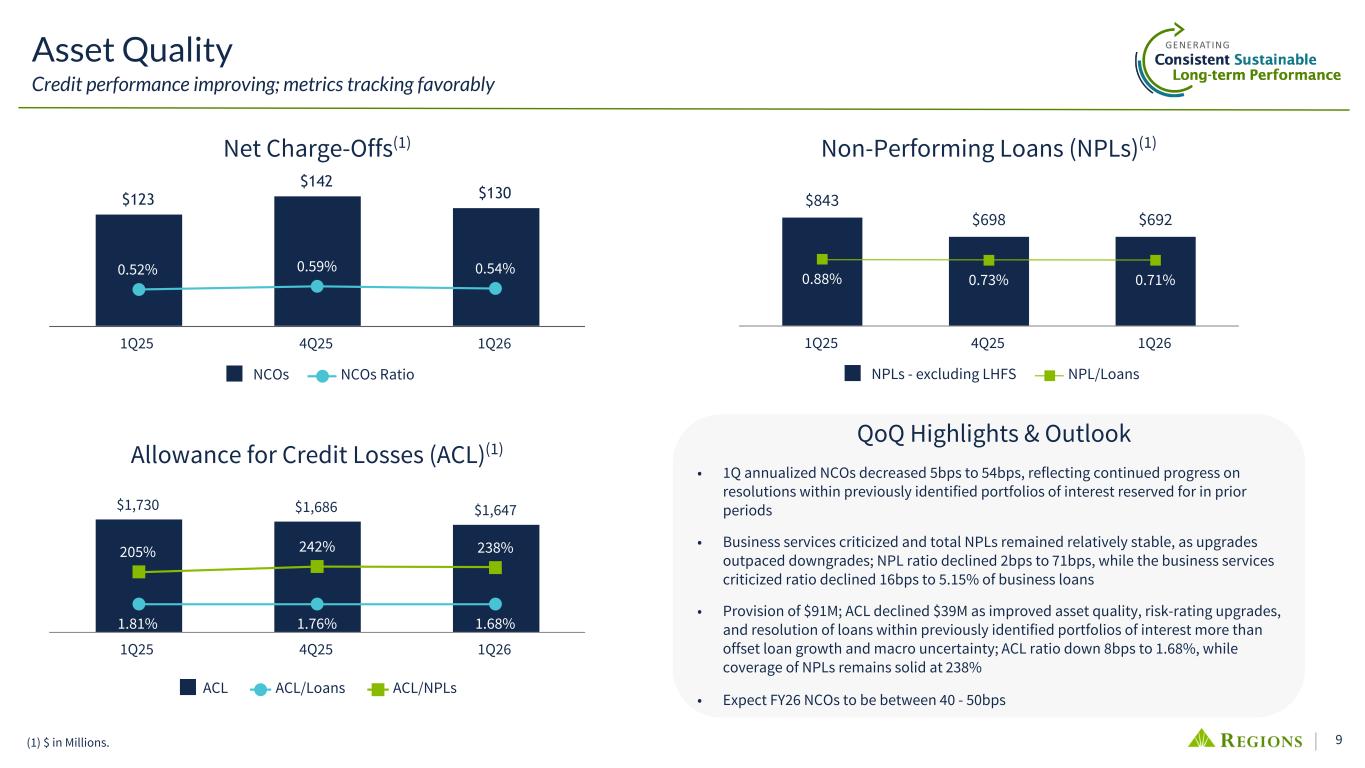
9 QoQ Highlights & Outlook • 1Q annualized NCOs decreased 5bps to 54bps, reflecting continued progress on resolutions within previously identified portfolios of interest reserved for in prior periods • Business services criticized and total NPLs remained relatively stable, as upgrades outpaced downgrades; NPL ratio declined 2bps to 71bps, while the business services criticized ratio declined 16bps to 5.15% of business loans • Provision of $91M; ACL declined $39M as improved asset quality, risk-rating upgrades, and resolution of loans within previously identified portfolios of interest more than offset loan growth and macro uncertainty; ACL ratio down 8bps to 1.68%, while coverage of NPLs remains solid at 238% • Expect FY26 NCOs to be between 40 - 50bps Asset Quality Credit performance improving; metrics tracking favorably $1,730 $1,686 $1,647 1.81% 1.76% 1.68% 205% 242% 238% ACL ACL/Loans ACL/NPLs 1Q25 4Q25 1Q26 $123 $142 $130 0.52% 0.59% 0.54% NCOs NCOs Ratio 1Q25 4Q25 1Q26 $843 $698 $692 0.88% 0.73% 0.71% NPLs - excluding LHFS NPL/Loans 1Q25 4Q25 1Q26 (1) $ in Millions. Net Charge-Offs(1) Allowance for Credit Losses (ACL)(1) Non-Performing Loans (NPLs)(1)
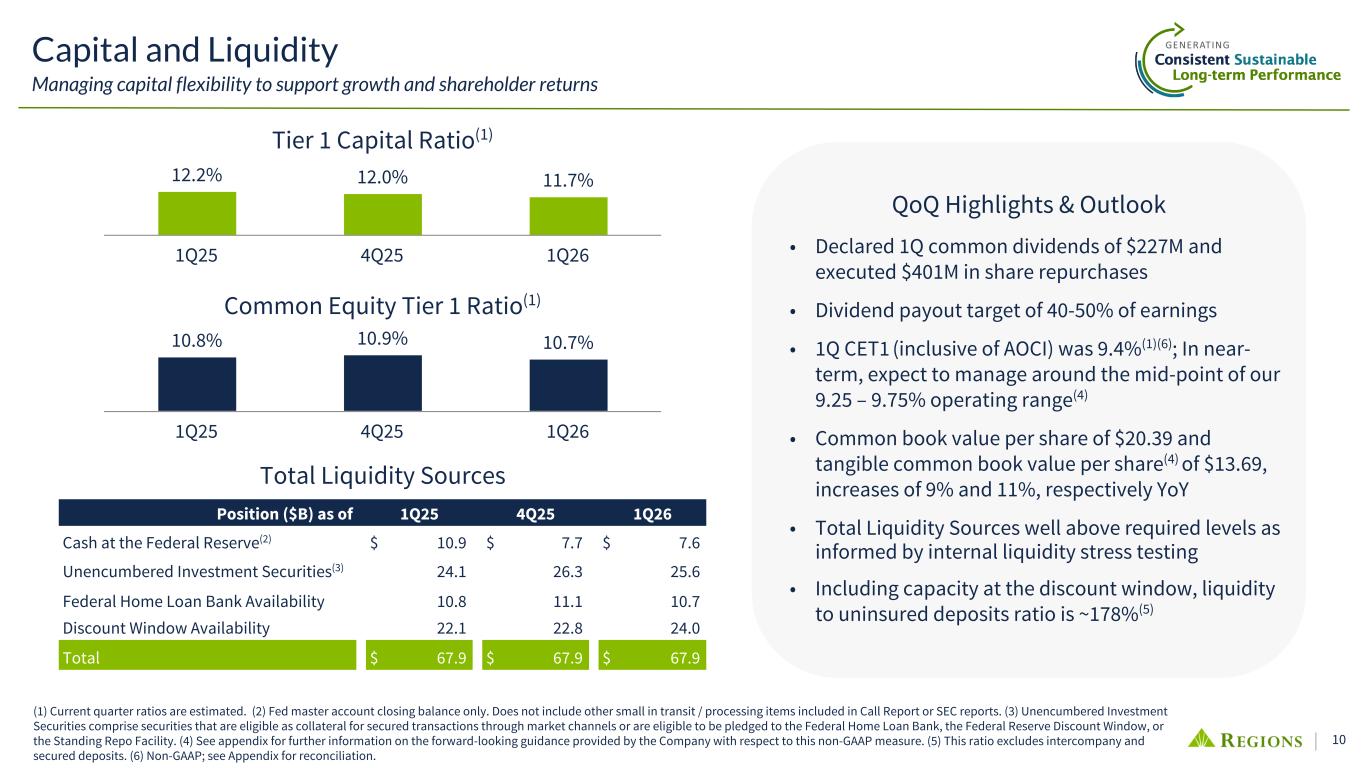
10 QoQ Highlights & Outlook • Declared 1Q common dividends of $227M and executed $401M in share repurchases • Dividend payout target of 40-50% of earnings • 1Q CET1 (inclusive of AOCI) was 9.4%(1)(6); In near- term, expect to manage around the mid-point of our 9.25 – 9.75% operating range(4) • Common book value per share of $20.39 and tangible common book value per share(4) of $13.69, increases of 9% and 11%, respectively YoY • Total Liquidity Sources well above required levels as informed by internal liquidity stress testing • Including capacity at the discount window, liquidity to uninsured deposits ratio is ~178%(5) 10.8% 10.9% 10.7% 1Q25 4Q25 1Q26 Capital and Liquidity Managing capital flexibility to support growth and shareholder returns 12.2% 12.0% 11.7% 1Q25 4Q25 1Q26 Tier 1 Capital Ratio(1) Common Equity Tier 1 Ratio(1) Position ($B) as of 1Q25 4Q25 1Q26 Cash at the Federal Reserve(2) $ 10.9 $ 7.7 $ 7.6 Unencumbered Investment Securities(3) 24.1 26.3 25.6 Federal Home Loan Bank Availability 10.8 11.1 10.7 Discount Window Availability 22.1 22.8 24.0 Total $ 67.9 $ 67.9 $ 67.9 (1) Current quarter ratios are estimated. (2) Fed master account closing balance only. Does not include other small in transit / processing items included in Call Report or SEC reports. (3) Unencumbered Investment Securities comprise securities that are eligible as collateral for secured transactions through market channels or are eligible to be pledged to the Federal Home Loan Bank, the Federal Reserve Discount Window, or the Standing Repo Facility. (4) See appendix for further information on the forward-looking guidance provided by the Company with respect to this non-GAAP measure. (5) This ratio excludes intercompany and secured deposits. (6) Non-GAAP; see Appendix for reconciliation. Total Liquidity Sources
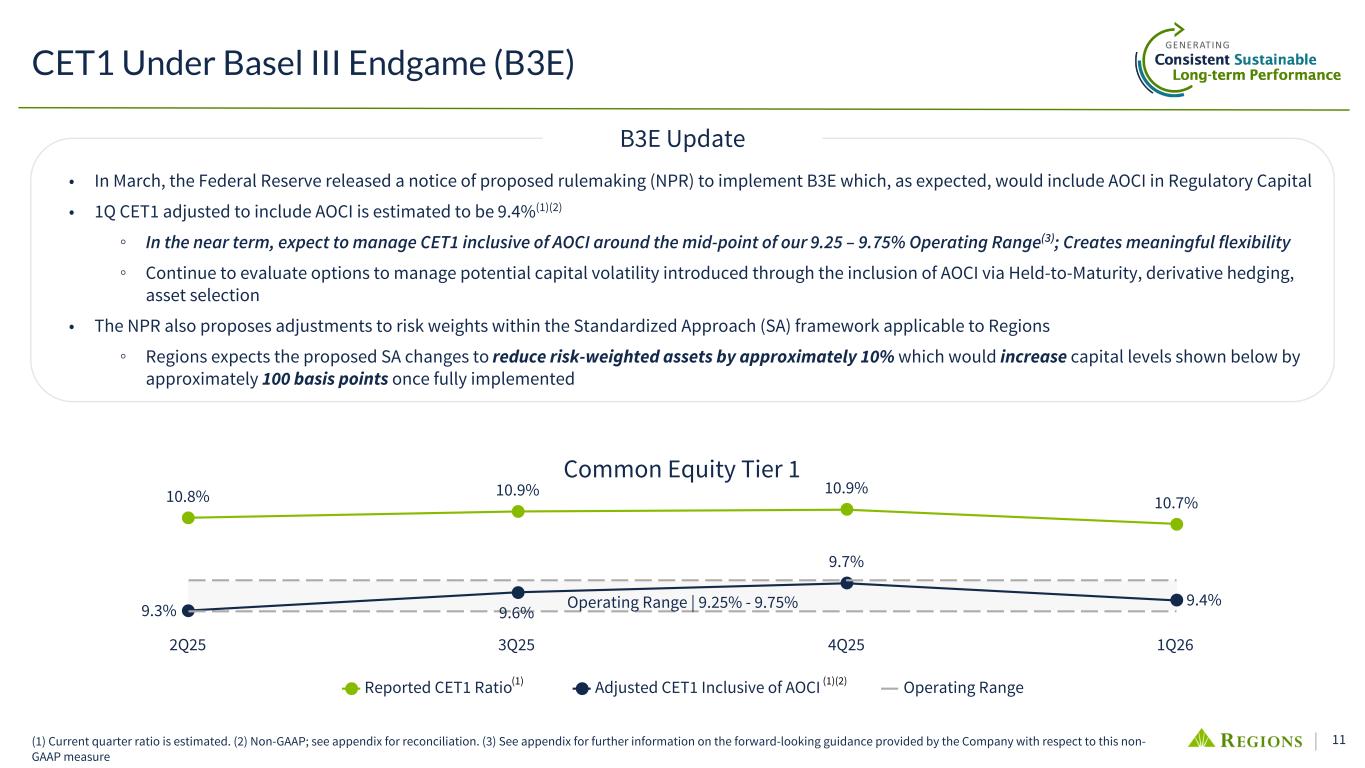
11 Common Equity Tier 1 10.8% 10.9% 10.9% 10.7% 9.3% 9.6% 9.7% 9.4% Reported CET1 Ratio Adjusted CET1 Inclusive of AOCI Operating Range 2Q25 3Q25 4Q25 1Q26 CET1 Under Basel III Endgame (B3E) • In March, the Federal Reserve released a notice of proposed rulemaking (NPR) to implement B3E which, as expected, would include AOCI in Regulatory Capital • 1Q CET1 adjusted to include AOCI is estimated to be 9.4%(1)(2) ◦ In the near term, expect to manage CET1 inclusive of AOCI around the mid-point of our 9.25 – 9.75% Operating Range(3); Creates meaningful flexibility ◦ Continue to evaluate options to manage potential capital volatility introduced through the inclusion of AOCI via Held-to-Maturity, derivative hedging, asset selection • The NPR also proposes adjustments to risk weights within the Standardized Approach (SA) framework applicable to Regions ◦ Regions expects the proposed SA changes to reduce risk-weighted assets by approximately 10% which would increase capital levels shown below by approximately 100 basis points once fully implemented (1) (1) Current quarter ratio is estimated. (2) Non-GAAP; see appendix for reconciliation. (3) See appendix for further information on the forward-looking guidance provided by the Company with respect to this non- GAAP measure (1)(2) Operating Range | 9.25% - 9.75% B3E Update
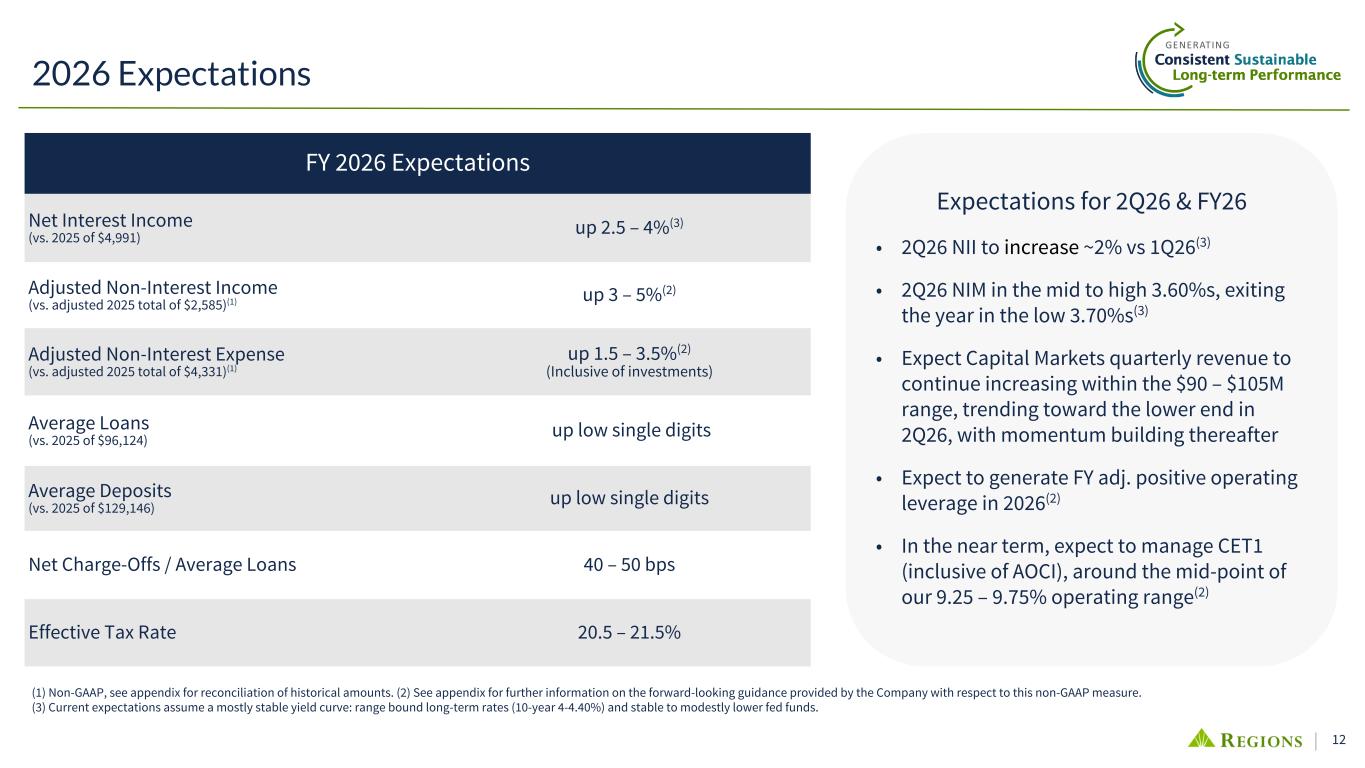
12 Expectations for 2Q26 & FY26 • 2Q26 NII to increase ~2% vs 1Q26(3) • 2Q26 NIM in the mid to high 3.60%s, exiting the year in the low 3.70%s(3) • Expect Capital Markets quarterly revenue to continue increasing within the $90 – $105M range, trending toward the lower end in 2Q26, with momentum building thereafter • Expect to generate FY adj. positive operating leverage in 2026(2) • In the near term, expect to manage CET1 (inclusive of AOCI), around the mid-point of our 9.25 – 9.75% operating range(2) 2026 Expectations (1) Non-GAAP, see appendix for reconciliation of historical amounts. (2) See appendix for further information on the forward-looking guidance provided by the Company with respect to this non-GAAP measure. (3) Current expectations assume a mostly stable yield curve: range bound long-term rates (10-year 4-4.40%) and stable to modestly lower fed funds. FY 2026 Expectations Net Interest Income (vs. 2025 of $4,991) up 2.5 – 4%(3) Adjusted Non-Interest Income (vs. adjusted 2025 total of $2,585)(1) up 3 – 5%(2) Adjusted Non-Interest Expense (vs. adjusted 2025 total of $4,331)(1) up 1.5 – 3.5%(2) (Inclusive of investments) Average Loans (vs. 2025 of $96,124) up low single digits Average Deposits (vs. 2025 of $129,146) up low single digits Net Charge-Offs / Average Loans 40 – 50 bps Effective Tax Rate 20.5 – 21.5%

Appendix
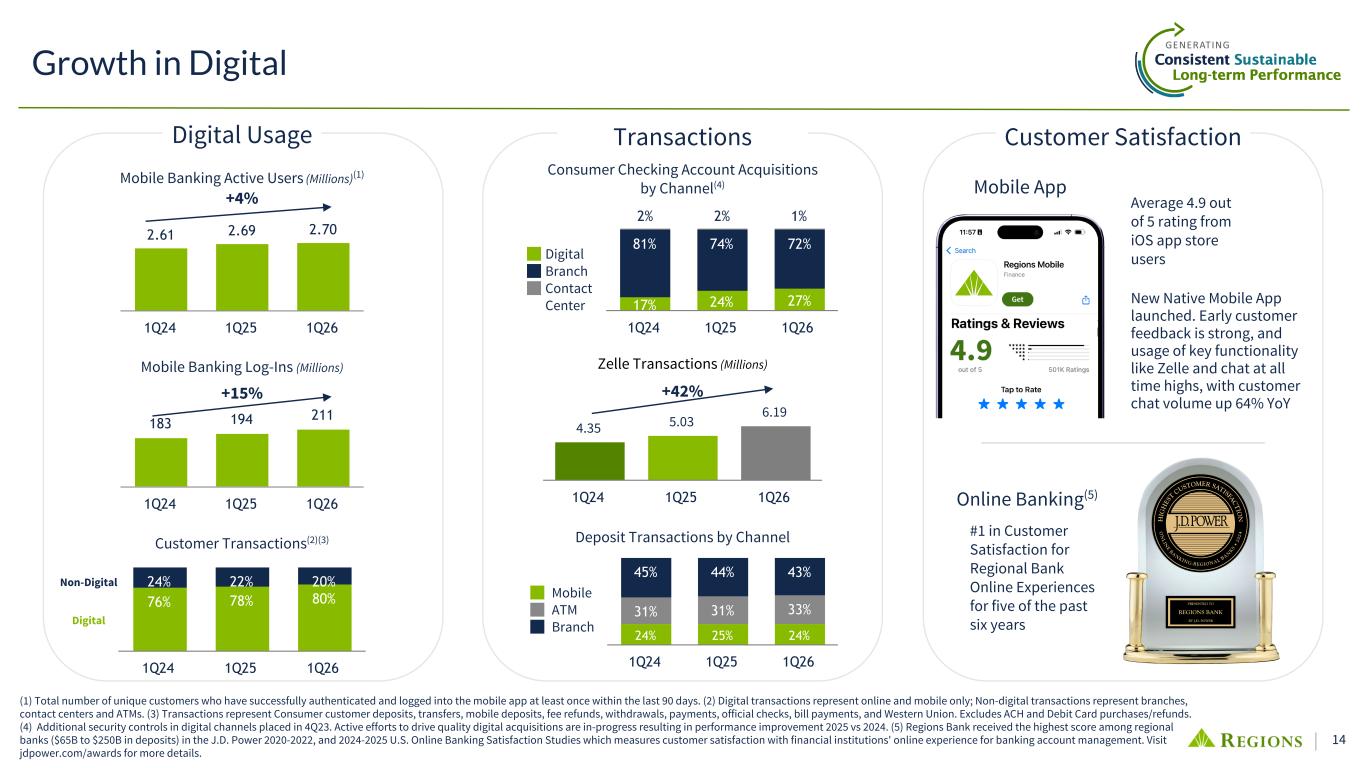
14 2.61 2.69 2.70 1Q24 1Q25 1Q26 4.35 5.03 6.19 1Q24 1Q25 1Q26 183 194 211 1Q24 1Q25 1Q26 24% 25% 24% 31% 31% 33% 45% 44% 43% Mobile ATM Branch 1Q24 1Q25 1Q26 76% 78% 80% 24% 22% 20% 1Q24 1Q25 1Q26 Growth in Digital Mobile Banking Log-Ins (Millions) Customer Transactions(2)(3) Deposit Transactions by Channel Mobile Banking Active Users (Millions)(1) Digital Non-Digital +42%+15% 17% 24% 27% 81% 74% 72% 2% 2% 1% Digital Branch Contact Center 1Q24 1Q25 1Q26 Consumer Checking Account Acquisitions by Channel(4) Customer Satisfaction Zelle Transactions (Millions) TransactionsDigital Usage +4% (1) Total number of unique customers who have successfully authenticated and logged into the mobile app at least once within the last 90 days. (2) Digital transactions represent online and mobile only; Non-digital transactions represent branches, contact centers and ATMs. (3) Transactions represent Consumer customer deposits, transfers, mobile deposits, fee refunds, withdrawals, payments, official checks, bill payments, and Western Union. Excludes ACH and Debit Card purchases/refunds. (4) Additional security controls in digital channels placed in 4Q23. Active efforts to drive quality digital acquisitions are in-progress resulting in performance improvement 2025 vs 2024. (5) Regions Bank received the highest score among regional banks ($65B to $250B in deposits) in the J.D. Power 2020-2022, and 2024-2025 U.S. Online Banking Satisfaction Studies which measures customer satisfaction with financial institutions' online experience for banking account management. Visit jdpower.com/awards for more details. Mobile App Online Banking(5) #1 in Customer Satisfaction for Regional Bank Online Experiences for five of the past six years Average 4.9 out of 5 rating from iOS app store users New Native Mobile App launched. Early customer feedback is strong, and usage of key functionality like Zelle and chat at all time highs, with customer chat volume up 64% YoY
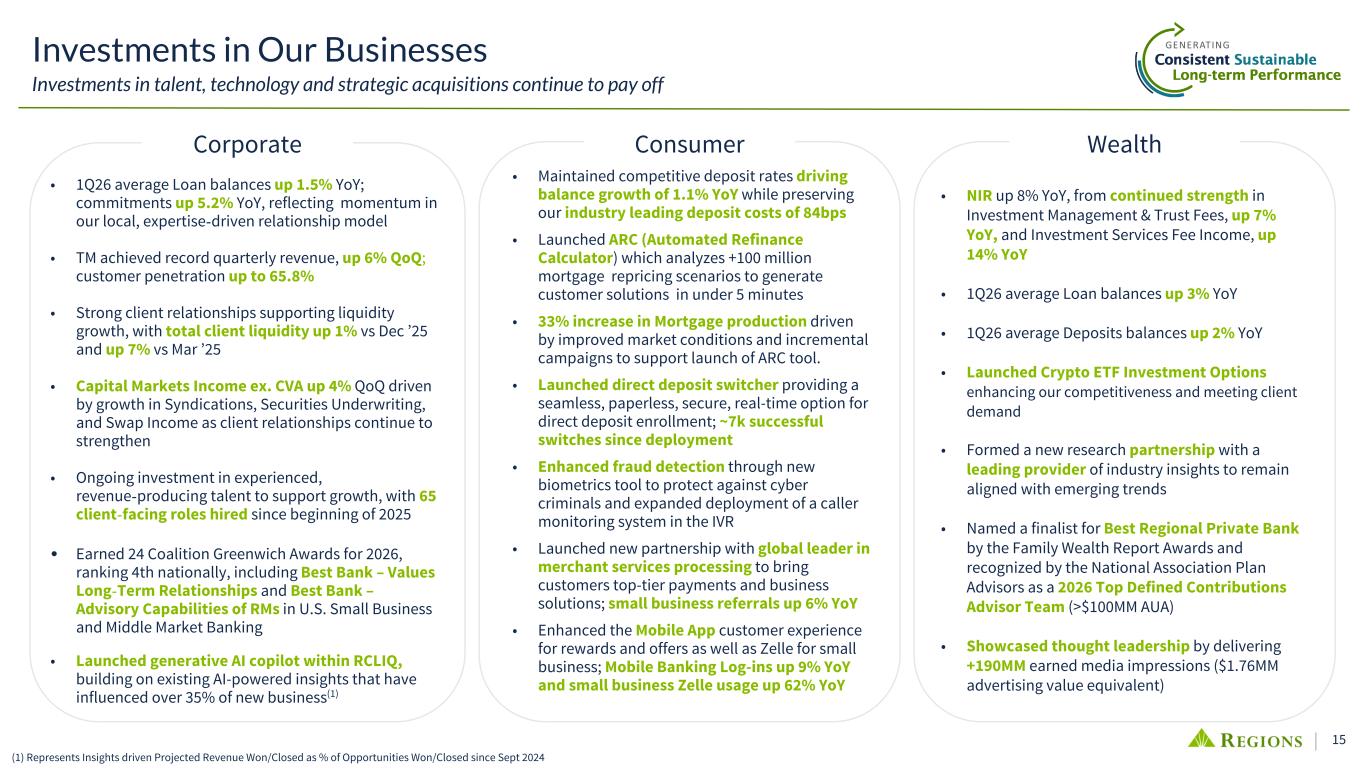
15 • Maintained competitive deposit rates driving balance growth of 1.1% YoY while preserving our industry leading deposit costs of 84bps • Launched ARC (Automated Refinance Calculator) which analyzes +100 million mortgage repricing scenarios to generate customer solutions in under 5 minutes • 33% increase in Mortgage production driven by improved market conditions and incremental campaigns to support launch of ARC tool. • Launched direct deposit switcher providing a seamless, paperless, secure, real-time option for direct deposit enrollment; ~7k successful switches since deployment • Enhanced fraud detection through new biometrics tool to protect against cyber criminals and expanded deployment of a caller monitoring system in the IVR • Launched new partnership with global leader in merchant services processing to bring customers top-tier payments and business solutions; small business referrals up 6% YoY • Enhanced the Mobile App customer experience for rewards and offers as well as Zelle for small business; Mobile Banking Log-ins up 9% YoY and small business Zelle usage up 62% YoY • NIR up 8% YoY, from continued strength in Investment Management & Trust Fees, up 7% YoY, and Investment Services Fee Income, up 14% YoY • 1Q26 average Loan balances up 3% YoY • 1Q26 average Deposits balances up 2% YoY • Launched Crypto ETF Investment Options enhancing our competitiveness and meeting client demand • Formed a new research partnership with a leading provider of industry insights to remain aligned with emerging trends • Named a finalist for Best Regional Private Bank by the Family Wealth Report Awards and recognized by the National Association Plan Advisors as a 2026 Top Defined Contributions Advisor Team (>$100MM AUA) • Showcased thought leadership by delivering +190MM earned media impressions ($1.76MM advertising value equivalent) • 1Q26 average Loan balances up 1.5% YoY; commitments up 5.2% YoY, reflecting momentum in our local, expertise-driven relationship model • TM achieved record quarterly revenue, up 6% QoQ; customer penetration up to 65.8% • Strong client relationships supporting liquidity growth, with total client liquidity up 1% vs Dec ’25 and up 7% vs Mar ’25 • Capital Markets Income ex. CVA up 4% QoQ driven by growth in Syndications, Securities Underwriting, and Swap Income as client relationships continue to strengthen • Ongoing investment in experienced, revenue-producing talent to support growth, with 65 client-facing roles hired since beginning of 2025 • Earned 24 Coalition Greenwich Awards for 2026, ranking 4th nationally, including Best Bank – Values Long-Term Relationships and Best Bank – Advisory Capabilities of RMs in U.S. Small Business and Middle Market Banking • Launched generative AI copilot within RCLIQ, building on existing AI-powered insights that have influenced over 35% of new business(1) Investments in Our Businesses Investments in talent, technology and strategic acquisitions continue to pay off Corporate Consumer Wealth (1) Represents Insights driven Projected Revenue Won/Closed as % of Opportunities Won/Closed since Sept 2024
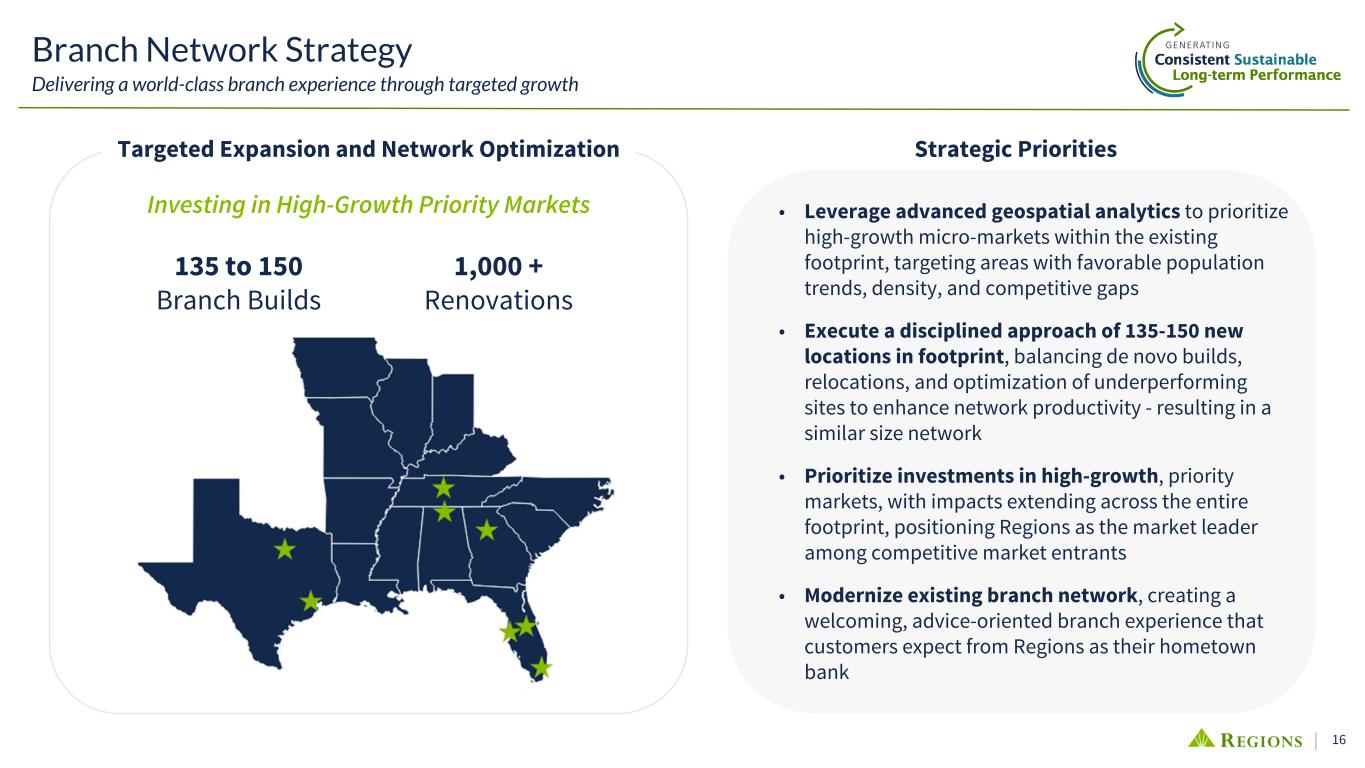
16 Branch Network Strategy Delivering a world-class branch experience through targeted growth • Leverage advanced geospatial analytics to prioritize high-growth micro-markets within the existing footprint, targeting areas with favorable population trends, density, and competitive gaps • Execute a disciplined approach of 135-150 new locations in footprint, balancing de novo builds, relocations, and optimization of underperforming sites to enhance network productivity - resulting in a similar size network • Prioritize investments in high-growth, priority markets, with impacts extending across the entire footprint, positioning Regions as the market leader among competitive market entrants • Modernize existing branch network, creating a welcoming, advice-oriented branch experience that customers expect from Regions as their hometown bank Strategic Priorities 135 to 150 Branch Builds 1,000 + Renovations Investing in High-Growth Priority Markets Targeted Expansion and Network Optimization
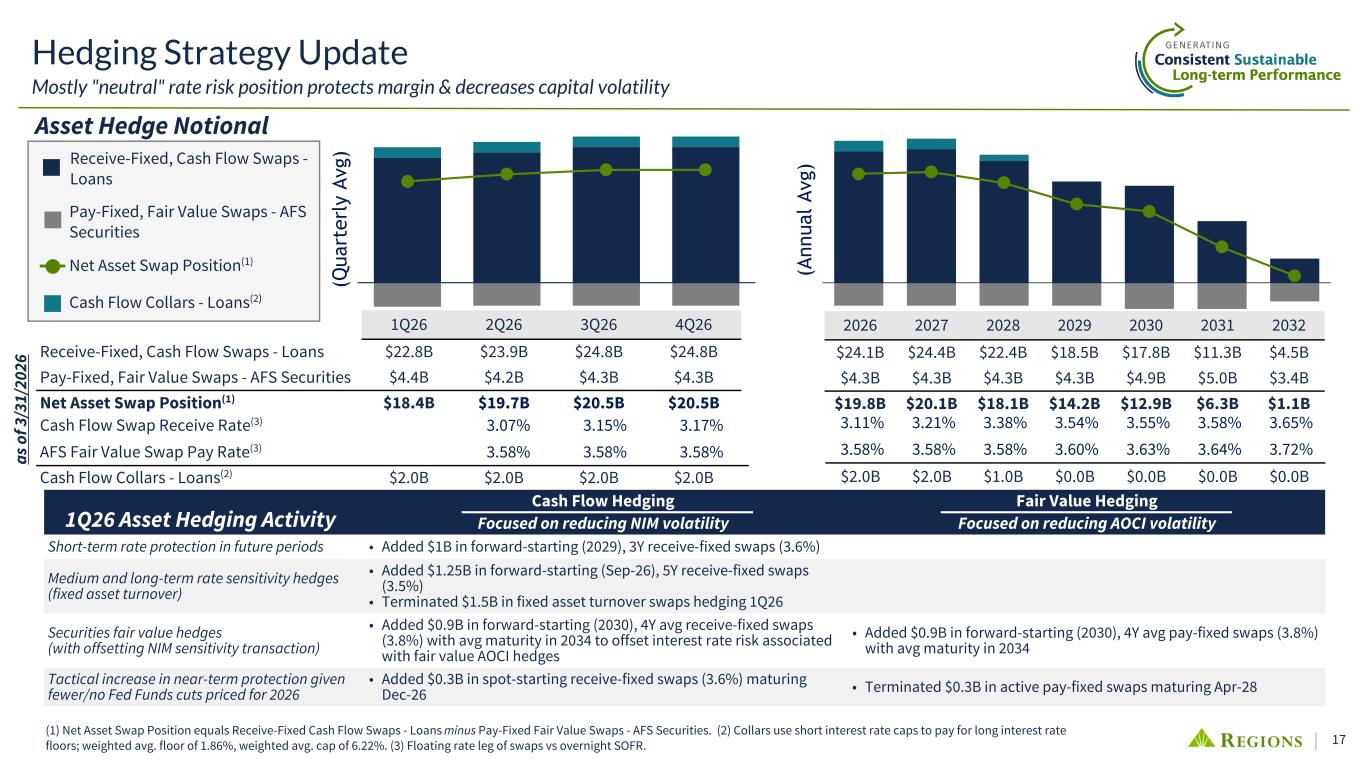
17 2026 2027 2028 2029 2030 2031 2032 $24.1B $24.4B $22.4B $18.5B $17.8B $11.3B $4.5B $4.3B $4.3B $4.3B $4.3B $4.9B $5.0B $3.4B $19.8B $20.1B $18.1B $14.2B $12.9B $6.3B $1.1B (Q ua rt er ly A vg ) Asset Hedge Notional 3.11% 3.21% 3.38% 3.54% 3.55% 3.58% 3.65% 3.58% 3.58% 3.58% 3.60% 3.63% 3.64% 3.72% (A nn ua l A vg ) 1Q26 2Q26 3Q26 4Q26 Receive-Fixed, Cash Flow Swaps - Loans $22.8B $23.9B $24.8B $24.8B Pay-Fixed, Fair Value Swaps - AFS Securities $4.4B $4.2B $4.3B $4.3B Net Asset Swap Position(1) $18.4B $19.7B $20.5B $20.5B Cash Flow Swap Receive Rate(3) 3.07% 3.15% 3.17% AFS Fair Value Swap Pay Rate(3) 3.58% 3.58% 3.58% $2.0B $2.0B $1.0B $0.0B $0.0B $0.0B $0.0BCash Flow Collars - Loans(2) $2.0B $2.0B $2.0B $2.0B Hedging Strategy Update Mostly "neutral" rate risk position protects margin & decreases capital volatility Receive-Fixed, Cash Flow Swaps - Loans Cash Flow Collars - Loans(2) Pay-Fixed, Fair Value Swaps - AFS Securities Net Asset Swap Position(1) (1) Net Asset Swap Position equals Receive-Fixed Cash Flow Swaps - Loans minus Pay-Fixed Fair Value Swaps - AFS Securities. (2) Collars use short interest rate caps to pay for long interest rate floors; weighted avg. floor of 1.86%, weighted avg. cap of 6.22%. (3) Floating rate leg of swaps vs overnight SOFR. 1Q26 Asset Hedging Activity Cash Flow Hedging Fair Value Hedging Focused on reducing NIM volatility Focused on reducing AOCI volatility Short-term rate protection in future periods • Added $1B in forward-starting (2029), 3Y receive-fixed swaps (3.6%) Medium and long-term rate sensitivity hedges (fixed asset turnover) • Added $1.25B in forward-starting (Sep-26), 5Y receive-fixed swaps (3.5%) • Terminated $1.5B in fixed asset turnover swaps hedging 1Q26 Securities fair value hedges (with offsetting NIM sensitivity transaction) • Added $0.9B in forward-starting (2030), 4Y avg receive-fixed swaps (3.8%) with avg maturity in 2034 to offset interest rate risk associated with fair value AOCI hedges • Added $0.9B in forward-starting (2030), 4Y avg pay-fixed swaps (3.8%) with avg maturity in 2034 Tactical increase in near-term protection given fewer/no Fed Funds cuts priced for 2026 • Added $0.3B in spot-starting receive-fixed swaps (3.6%) maturing Dec-26 • Terminated $0.3B in active pay-fixed swaps maturing Apr-28 as o f 3 /3 1/ 20 26
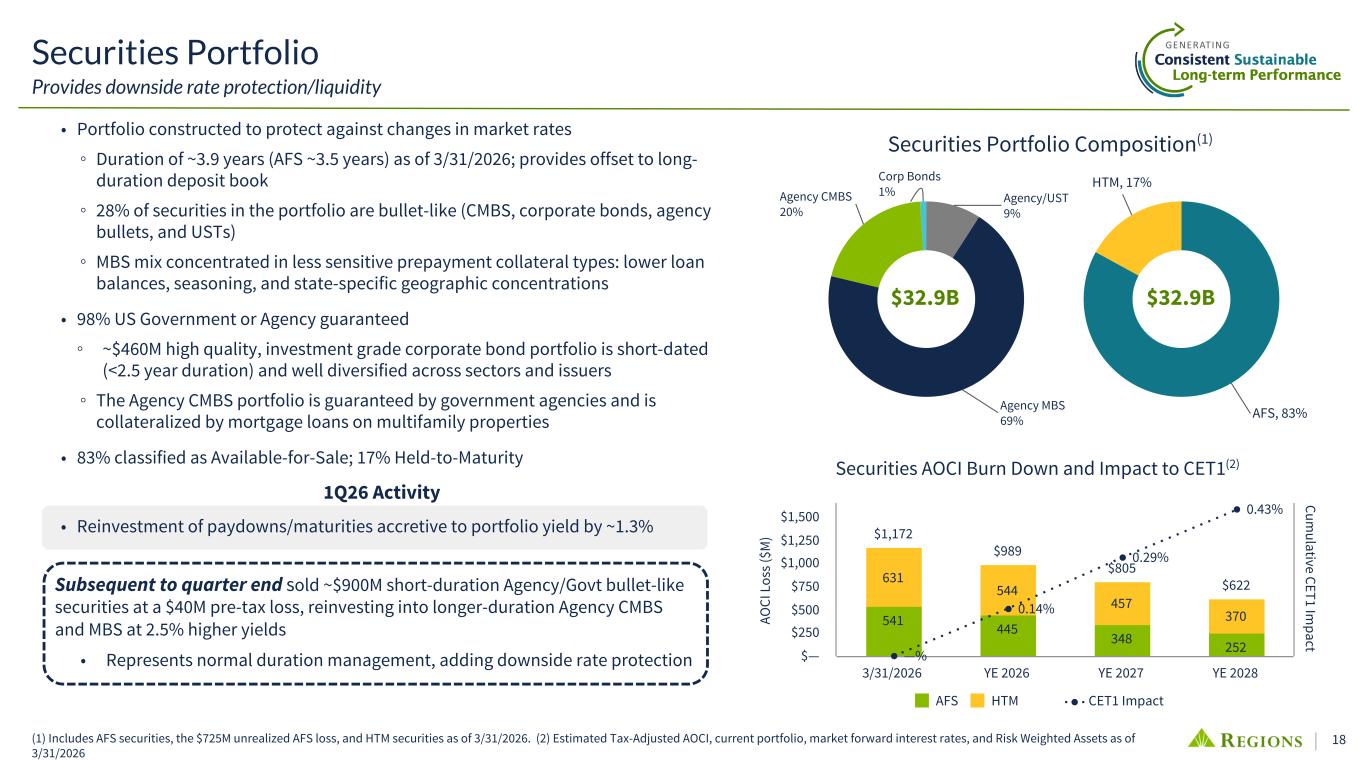
18 Subsequent to quarter end sold ~$900M short-duration Agency/Govt bullet-like securities at a $40M pre-tax loss, reinvesting into longer-duration Agency CMBS and MBS at 2.5% higher yields • Represents normal duration management, adding downside rate protection • Reinvestment of paydowns/maturities accretive to portfolio yield by ~1.3% • Portfolio constructed to protect against changes in market rates ◦ Duration of ~3.9 years (AFS ~3.5 years) as of 3/31/2026; provides offset to long- duration deposit book ◦ 28% of securities in the portfolio are bullet-like (CMBS, corporate bonds, agency bullets, and USTs) ◦ MBS mix concentrated in less sensitive prepayment collateral types: lower loan balances, seasoning, and state-specific geographic concentrations • 98% US Government or Agency guaranteed ◦ ~$460M high quality, investment grade corporate bond portfolio is short-dated (<2.5 year duration) and well diversified across sectors and issuers ◦ The Agency CMBS portfolio is guaranteed by government agencies and is collateralized by mortgage loans on multifamily properties • 83% classified as Available-for-Sale; 17% Held-to-Maturity Agency/UST 9% Agency MBS 69% Agency CMBS 20% Corp Bonds 1% Securities Portfolio Provides downside rate protection/liquidity Securities Portfolio Composition(1) $32.9B Securities AOCI Burn Down and Impact to CET1(2) AO CI L os s ( $M ) Cum ulative CET1 Im pact 541 445 348 252 631 544 457 370 $1,172 $989 $805 $622 —% 0.14% 0.29% 0.43% AFS HTM CET1 Impact 3/31/2026 YE 2026 YE 2027 YE 2028 $— $250 $500 $750 $1,000 $1,250 $1,500 1Q26 Activity AFS, 83% HTM, 17% (1) Includes AFS securities, the $725M unrealized AFS loss, and HTM securities as of 3/31/2026. (2) Estimated Tax-Adjusted AOCI, current portfolio, market forward interest rates, and Risk Weighted Assets as of 3/31/2026 $32.9B
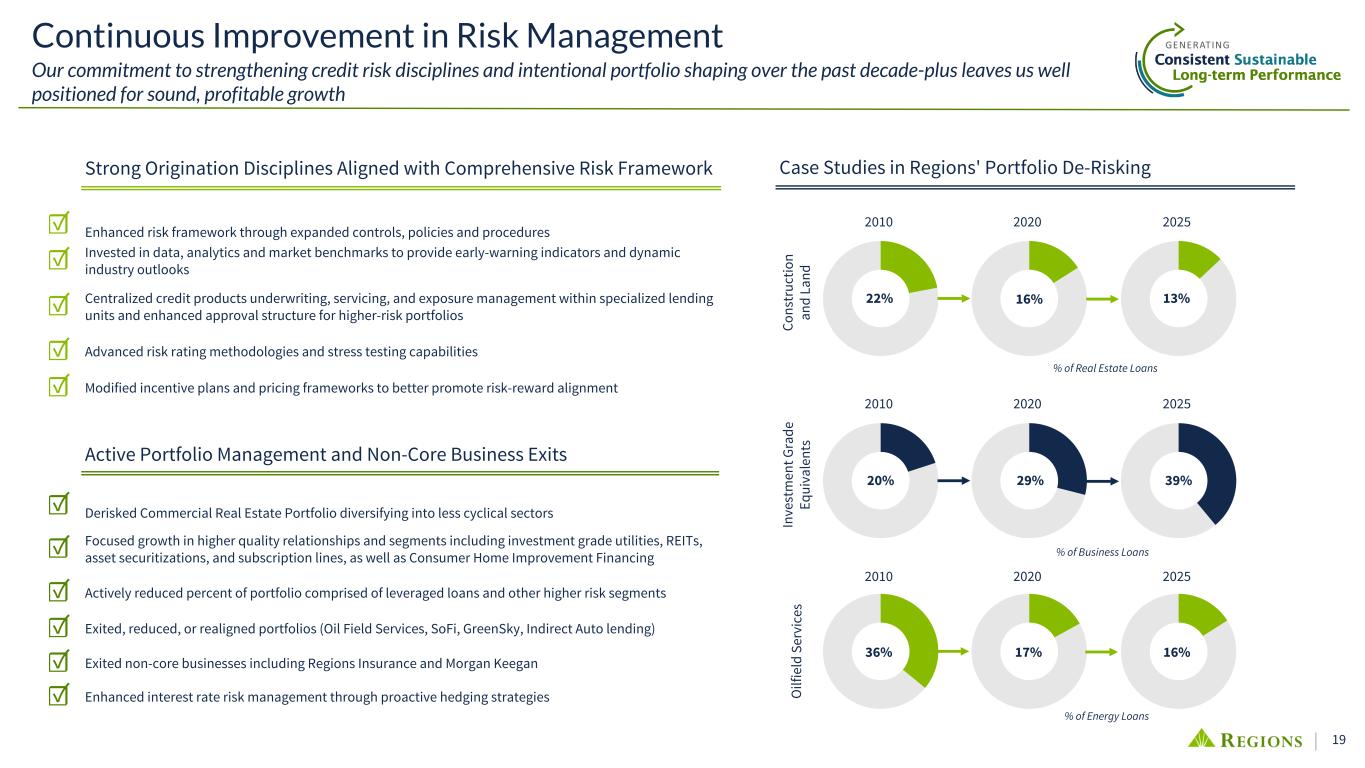
19 Continuous Improvement in Risk Management Our commitment to strengthening credit risk disciplines and intentional portfolio shaping over the past decade-plus leaves us well positioned for sound, profitable growth Strong Origination Disciplines Aligned with Comprehensive Risk Framework ☑ Enhanced risk framework through expanded controls, policies and procedures ☑ Invested in data, analytics and market benchmarks to provide early-warning indicators and dynamic industry outlooks ☑ Centralized credit products underwriting, servicing, and exposure management within specialized lending units and enhanced approval structure for higher-risk portfolios ☑ Advanced risk rating methodologies and stress testing capabilities ☑ Modified incentive plans and pricing frameworks to better promote risk-reward alignment Active Portfolio Management and Non-Core Business Exits ☑ Derisked Commercial Real Estate Portfolio diversifying into less cyclical sectors ☑ Focused growth in higher quality relationships and segments including investment grade utilities, REITs, asset securitizations, and subscription lines, as well as Consumer Home Improvement Financing ☑ Actively reduced percent of portfolio comprised of leveraged loans and other higher risk segments ☑ Exited, reduced, or realigned portfolios (Oil Field Services, SoFi, GreenSky, Indirect Auto lending) ☑ Exited non-core businesses including Regions Insurance and Morgan Keegan ☑ Enhanced interest rate risk management through proactive hedging strategies Case Studies in Regions' Portfolio De-Risking 22% 16% 13% Co ns tr uc tio n an d La nd 2010 2020 2025 2010 2020 2025 In ve st m en t G ra de Eq ui va le nt s O ilf ie ld S er vi ce s 20% 29% 39% 36% 17% 16% % of Real Estate Loans % of Business Loans % of Energy Loans 2010 2020 2025
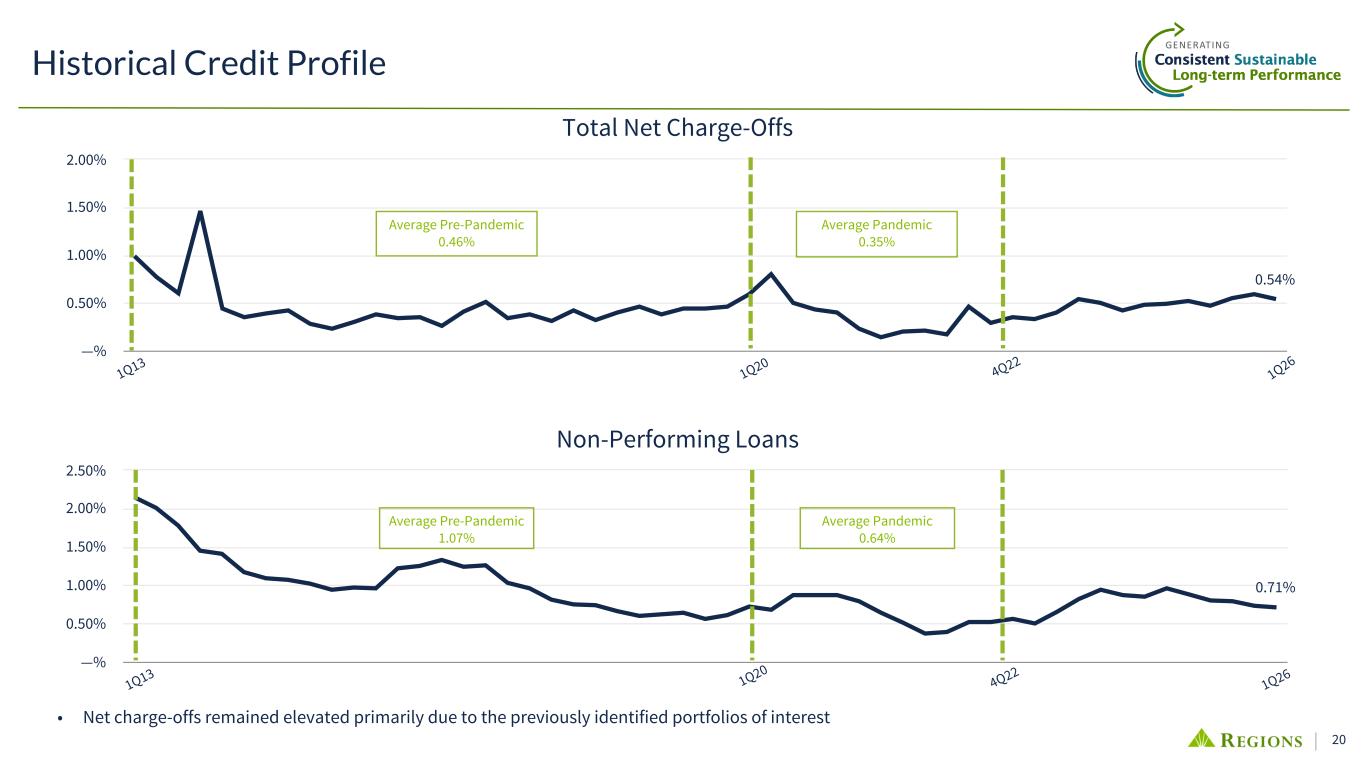
20 0.71% —% 0.50% 1.00% 1.50% 2.00% 2.50% 0.54% —% 0.50% 1.00% 1.50% 2.00% Historical Credit Profile Non-Performing Loans Total Net Charge-Offs 1Q20 1Q264Q221Q20 4Q22 1Q26 • Net charge-offs remained elevated primarily due to the previously identified portfolios of interest Average Pre-Pandemic 0.46% Average Pandemic 0.35% Average Pre-Pandemic 1.07% Average Pandemic 0.64% 1Q13 1Q13
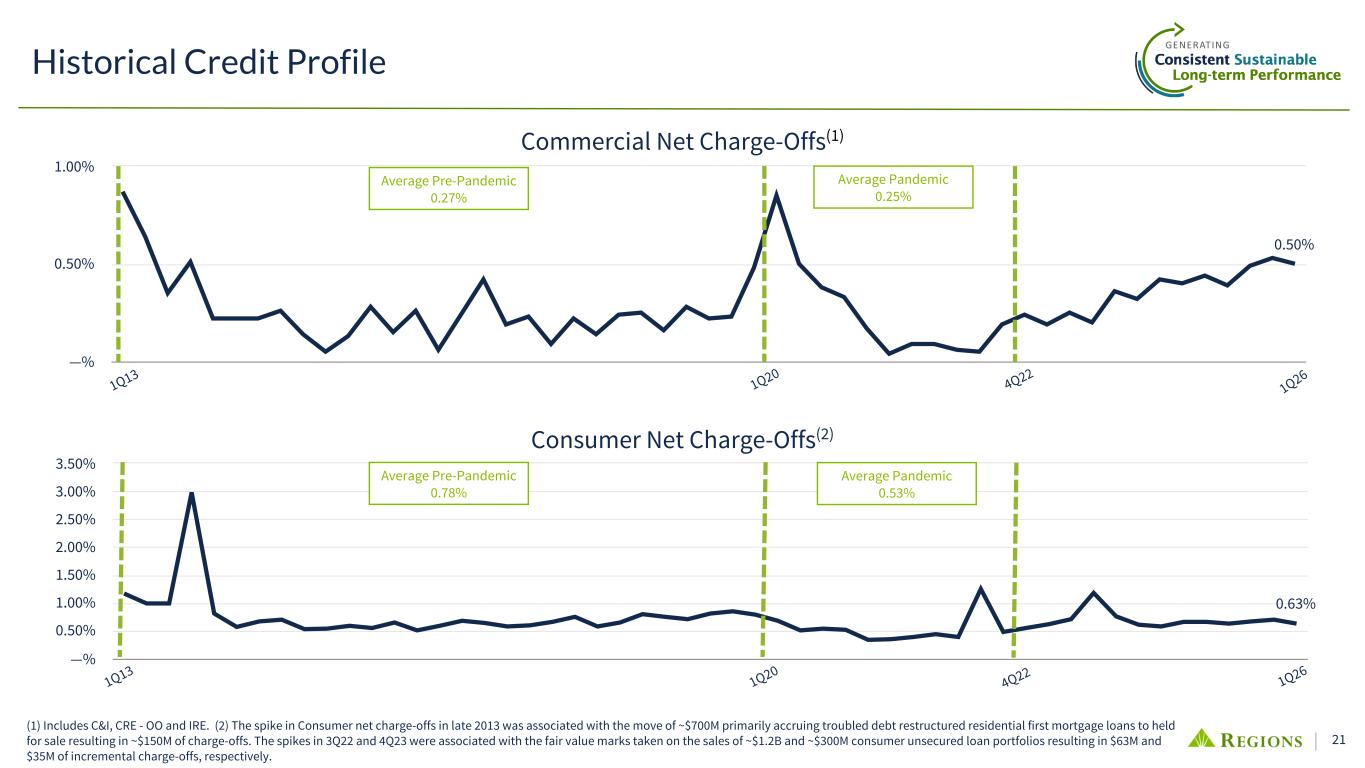
21 0.63% —% 0.50% 1.00% 1.50% 2.00% 2.50% 3.00% 3.50% 0.50% —% 0.50% 1.00% Consumer Net Charge-Offs(2) Commercial Net Charge-Offs(1) 1Q20 1Q26 4Q22 1Q20 4Q22 1Q26 (1) Includes C&I, CRE - OO and IRE. (2) The spike in Consumer net charge-offs in late 2013 was associated with the move of ~$700M primarily accruing troubled debt restructured residential first mortgage loans to held for sale resulting in ~$150M of charge-offs. The spikes in 3Q22 and 4Q23 were associated with the fair value marks taken on the sales of ~$1.2B and ~$300M consumer unsecured loan portfolios resulting in $63M and $35M of incremental charge-offs, respectively. Average Pre-Pandemic 0.27% Average Pandemic 0.25% Average Pre-Pandemic 0.78% Average Pandemic 0.53% 1Q13 1Q13 Historical Credit Profile
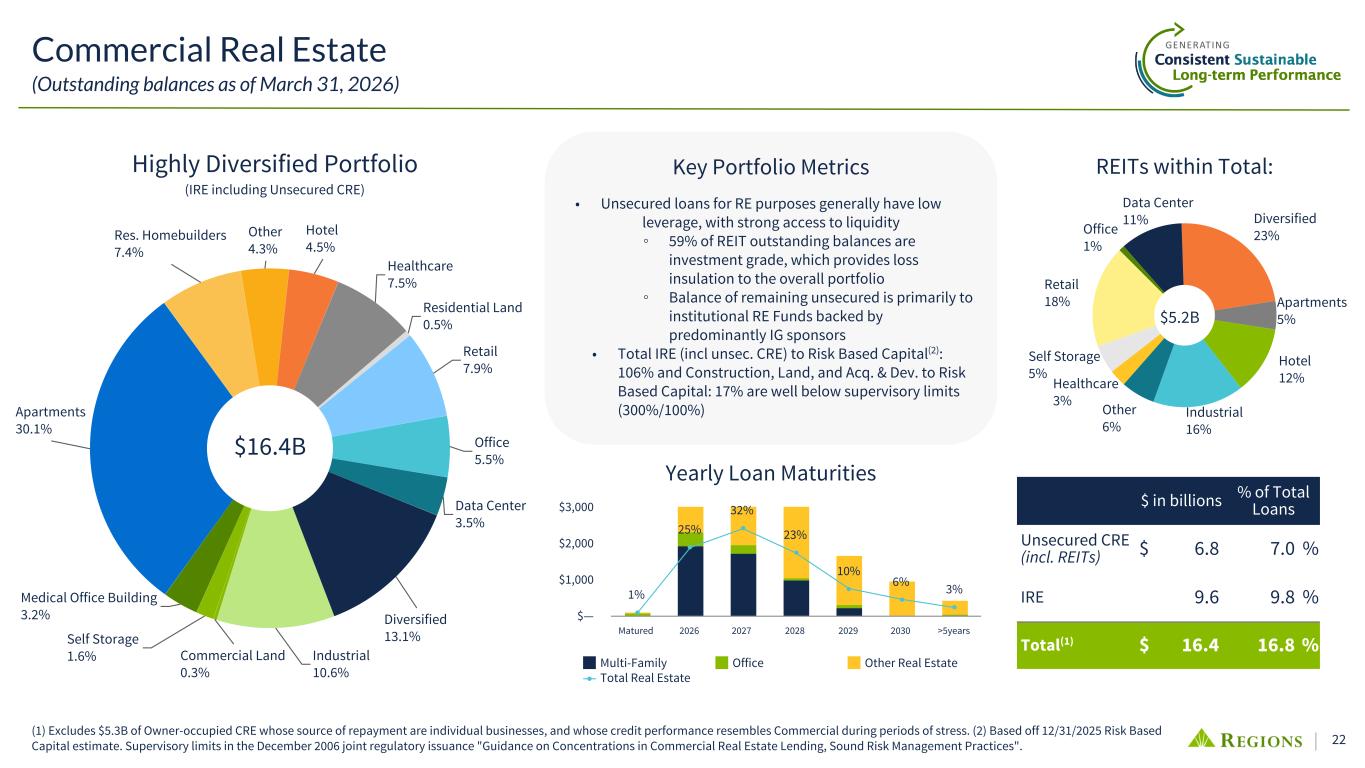
22 Commercial Real Estate (Outstanding balances as of March 31, 2026) Highly Diversified Portfolio (IRE including Unsecured CRE) (1) Excludes $5.3B of Owner-occupied CRE whose source of repayment are individual businesses, and whose credit performance resembles Commercial during periods of stress. (2) Based off 12/31/2025 Risk Based Capital estimate. Supervisory limits in the December 2006 joint regulatory issuance "Guidance on Concentrations in Commercial Real Estate Lending, Sound Risk Management Practices". Res. Homebuilders 7.4% Other 4.3% Hotel 4.5% Healthcare 7.5% Residential Land 0.5% Retail 7.9% Office 5.5% Data Center 3.5% Diversified 13.1% Industrial 10.6% Commercial Land 0.3% Self Storage 1.6% Medical Office Building 3.2% Apartments 30.1% $16.4B $ in billions % of Total Loans Unsecured CRE (incl. REITs) $ 6.8 7.0 % IRE 9.6 9.8 % Total(1) $ 16.4 16.8 % Yearly Loan Maturities 1% 25% 32% 23% 10% 6% 3% Multi-Family Office Other Real Estate Total Real Estate Matured 2026 2027 2028 2029 2030 >5years $— $1,000 $2,000 $3,000 Office 1% Data Center 11% Diversified 23% Apartments 5% Hotel 12% Industrial 16% Other 6% Healthcare 3% Self Storage 5% Retail 18% REITs within Total: $5.2B Key Portfolio Metrics • Unsecured loans for RE purposes generally have low leverage, with strong access to liquidity ◦ 59% of REIT outstanding balances are investment grade, which provides loss insulation to the overall portfolio ◦ Balance of remaining unsecured is primarily to institutional RE Funds backed by predominantly IG sponsors • Total IRE (incl unsec. CRE) to Risk Based Capital(2): 106% and Construction, Land, and Acq. & Dev. to Risk Based Capital: 17% are well below supervisory limits (300%/100%)
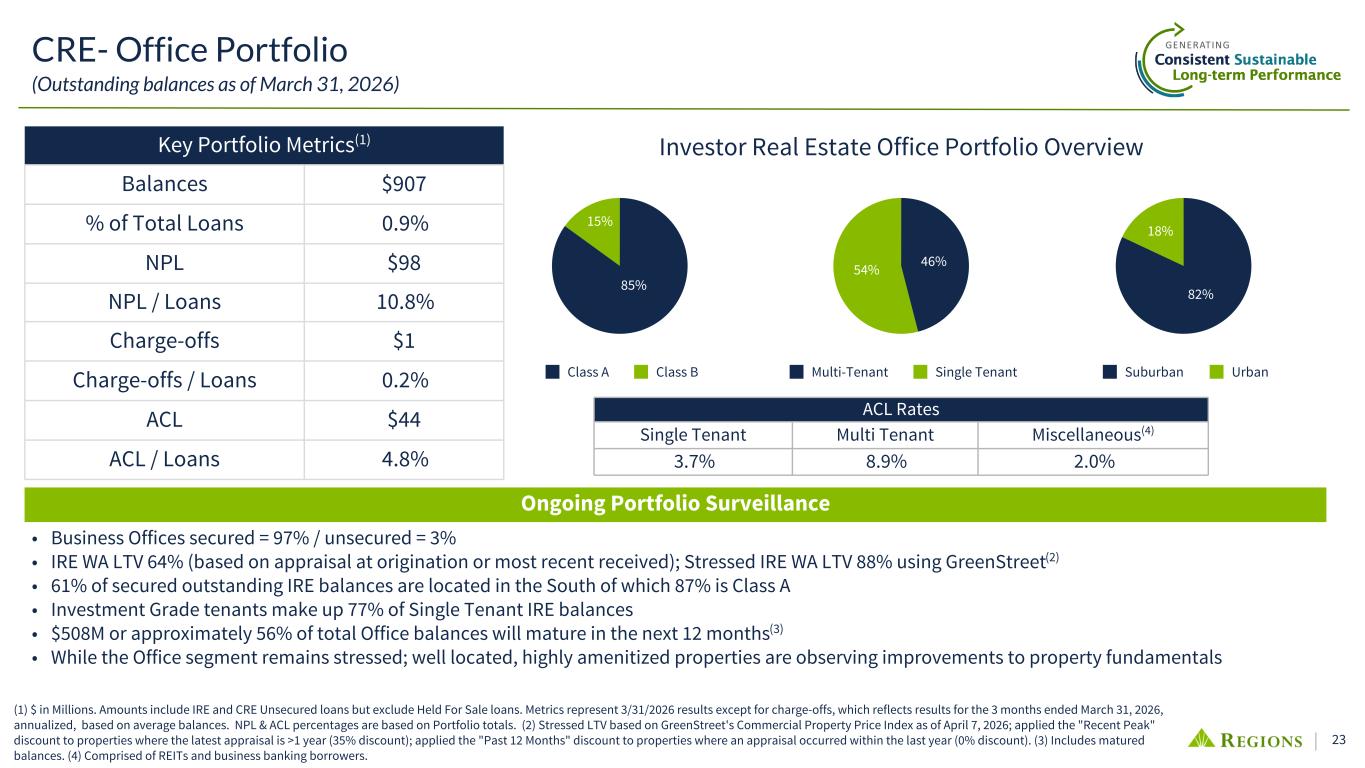
23 CRE- Office Portfolio (Outstanding balances as of March 31, 2026) (1) $ in Millions. Amounts include IRE and CRE Unsecured loans but exclude Held For Sale loans. Metrics represent 3/31/2026 results except for charge-offs, which reflects results for the 3 months ended March 31, 2026, annualized, based on average balances. NPL & ACL percentages are based on Portfolio totals. (2) Stressed LTV based on GreenStreet's Commercial Property Price Index as of April 7, 2026; applied the "Recent Peak" discount to properties where the latest appraisal is >1 year (35% discount); applied the "Past 12 Months" discount to properties where an appraisal occurred within the last year (0% discount). (3) Includes matured balances. (4) Comprised of REITs and business banking borrowers. • Business Offices secured = 97% / unsecured = 3% • IRE WA LTV 64% (based on appraisal at origination or most recent received); Stressed IRE WA LTV 88% using GreenStreet(2) • 61% of secured outstanding IRE balances are located in the South of which 87% is Class A • Investment Grade tenants make up 77% of Single Tenant IRE balances • $508M or approximately 56% of total Office balances will mature in the next 12 months(3) • While the Office segment remains stressed; well located, highly amenitized properties are observing improvements to property fundamentals Key Portfolio Metrics(1) Balances $907 % of Total Loans 0.9% NPL $98 NPL / Loans 10.8% Charge-offs $1 Charge-offs / Loans 0.2% ACL $44 ACL / Loans 4.8% Ongoing Portfolio Surveillance 46%54% Multi-Tenant Single Tenant 85% 15% Class A Class B Investor Real Estate Office Portfolio Overview 82% 18% Suburban Urban ACL Rates Single Tenant Multi Tenant Miscellaneous(4) 3.7% 8.9% 2.0%
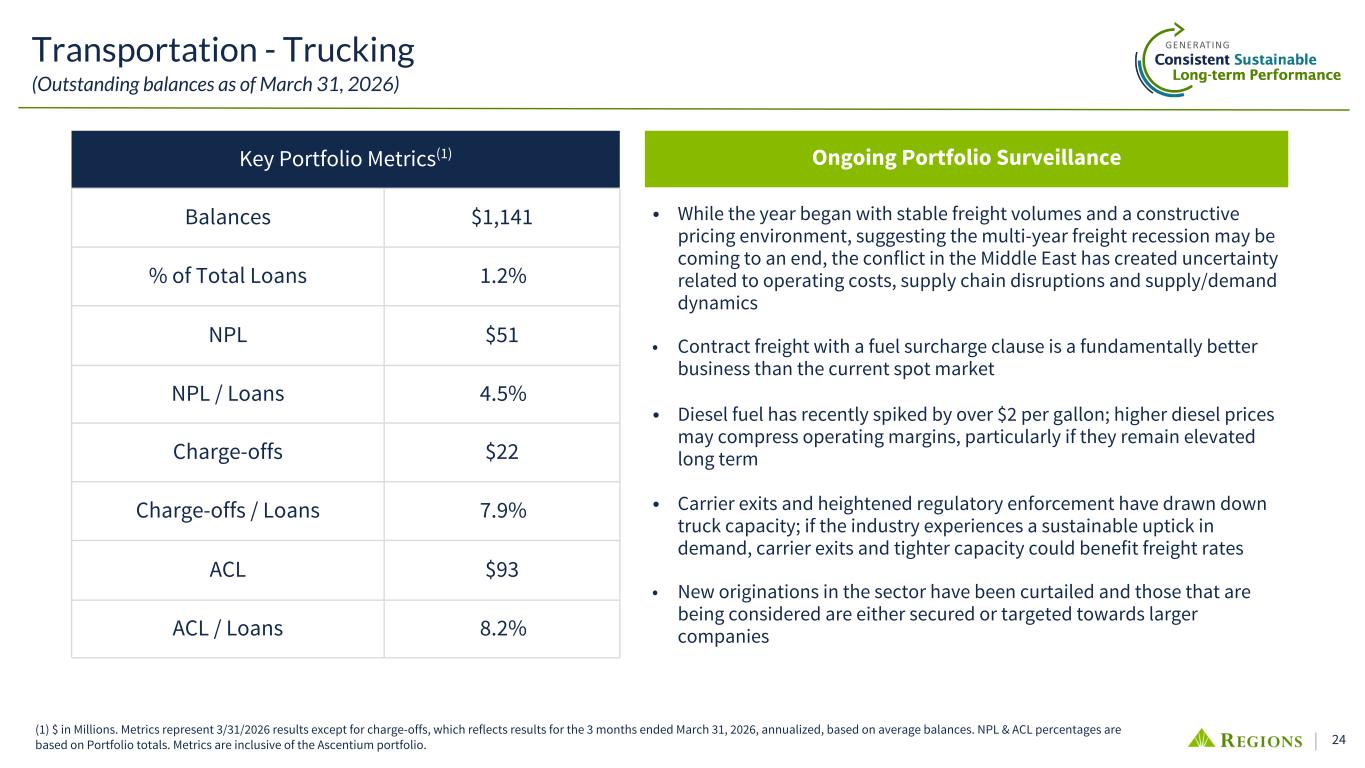
24 Transportation - Trucking (Outstanding balances as of March 31, 2026) (1) $ in Millions. Metrics represent 3/31/2026 results except for charge-offs, which reflects results for the 3 months ended March 31, 2026, annualized, based on average balances. NPL & ACL percentages are based on Portfolio totals. Metrics are inclusive of the Ascentium portfolio. Key Portfolio Metrics(1) Balances $1,141 % of Total Loans 1.2% NPL $51 NPL / Loans 4.5% Charge-offs $22 Charge-offs / Loans 7.9% ACL $93 ACL / Loans 8.2% • While the year began with stable freight volumes and a constructive pricing environment, suggesting the multi-year freight recession may be coming to an end, the conflict in the Middle East has created uncertainty related to operating costs, supply chain disruptions and supply/demand dynamics • Contract freight with a fuel surcharge clause is a fundamentally better business than the current spot market • Diesel fuel has recently spiked by over $2 per gallon; higher diesel prices may compress operating margins, particularly if they remain elevated long term • Carrier exits and heightened regulatory enforcement have drawn down truck capacity; if the industry experiences a sustainable uptick in demand, carrier exits and tighter capacity could benefit freight rates • New originations in the sector have been curtailed and those that are being considered are either secured or targeted towards larger companies Ongoing Portfolio Surveillance
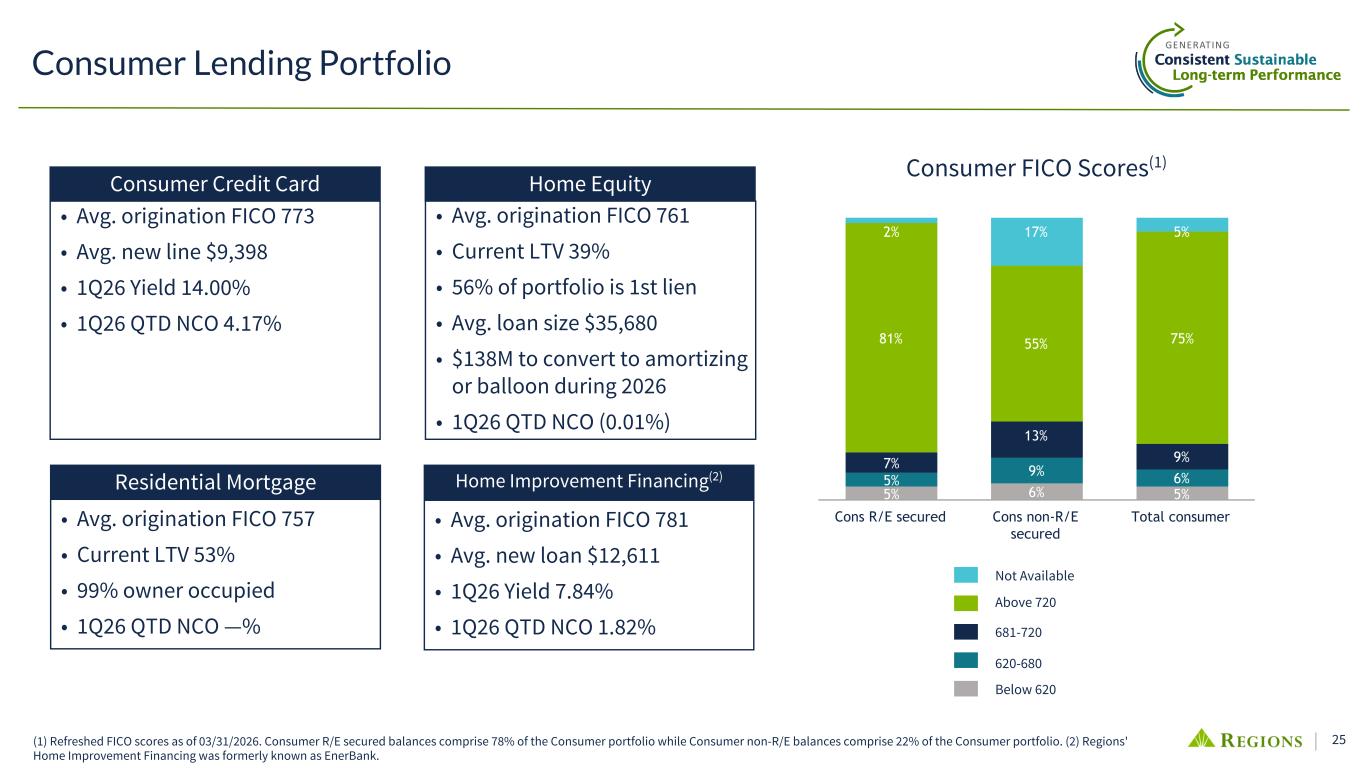
25 Consumer Lending Portfolio • Avg. origination FICO 757 • Current LTV 53% • 99% owner occupied • 1Q26 QTD NCO —% • Avg. origination FICO 761 • Current LTV 39% • 56% of portfolio is 1st lien • Avg. loan size $35,680 • $138M to convert to amortizing or balloon during 2026 • 1Q26 QTD NCO (0.01%) • Avg. origination FICO 781 • Avg. new loan $12,611 • 1Q26 Yield 7.84% • 1Q26 QTD NCO 1.82% • • Avg. origination FICO 773 • Avg. new line $9,398 • 1Q26 Yield 14.00% • 1Q26 QTD NCO 4.17% 5% 6% 5% 5% 9% 6% 7% 13% 9% 81% 55% 75% 2% 17% 5% Cons R/E secured Cons non-R/E secured Total consumer Not Available Above 720 620-680 Below 620 681-720 Consumer FICO Scores(1) (1) Refreshed FICO scores as of 03/31/2026. Consumer R/E secured balances comprise 78% of the Consumer portfolio while Consumer non-R/E balances comprise 22% of the Consumer portfolio. (2) Regions' Home Improvement Financing was formerly known as EnerBank. Residential Mortgage Consumer Credit Card Home Equity Home Improvement Financing(2)
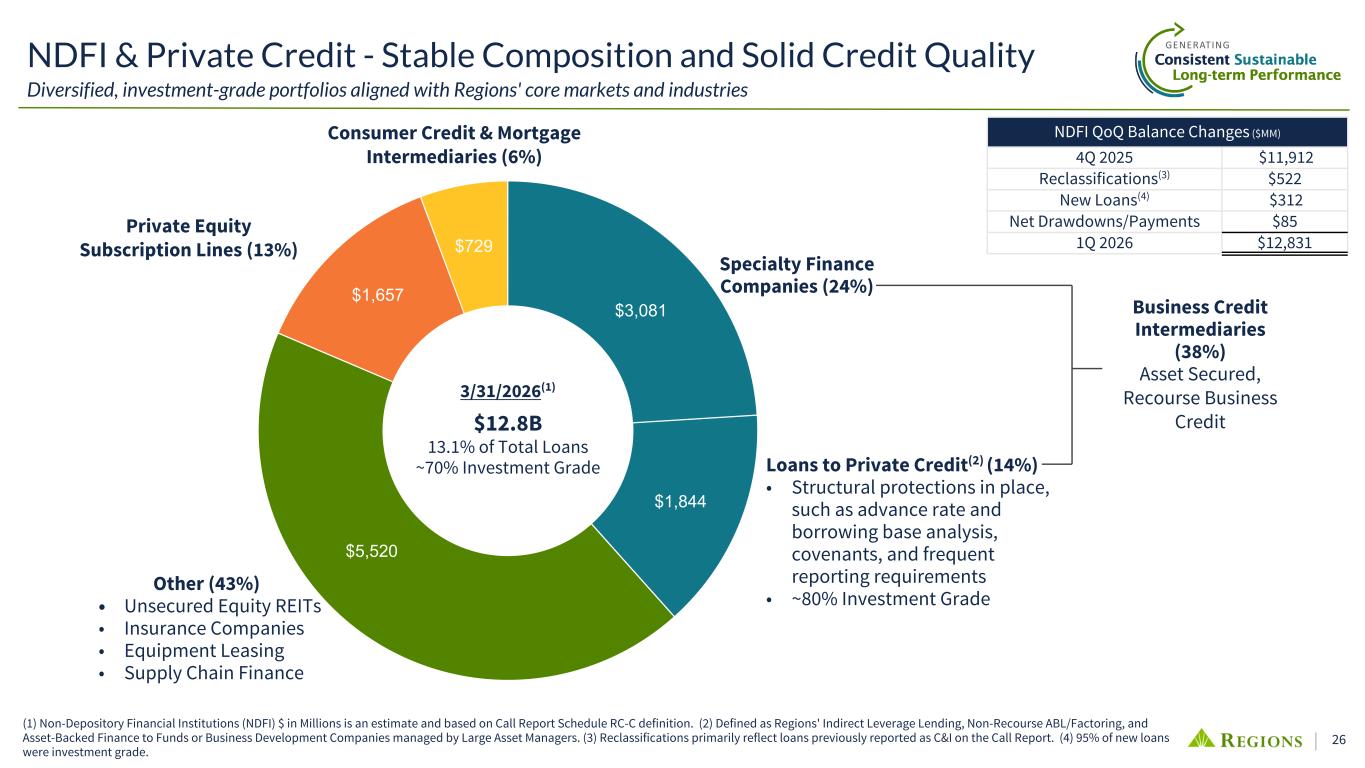
26 $3,081 $1,844 $5,520 $1,657 $729 (1) Non-Depository Financial Institutions (NDFI) $ in Millions is an estimate and based on Call Report Schedule RC-C definition. (2) Defined as Regions' Indirect Leverage Lending, Non-Recourse ABL/Factoring, and Asset-Backed Finance to Funds or Business Development Companies managed by Large Asset Managers. (3) Reclassifications primarily reflect loans previously reported as C&I on the Call Report. (4) 95% of new loans were investment grade. NDFI & Private Credit - Stable Composition and Solid Credit Quality Diversified, investment-grade portfolios aligned with Regions' core markets and industries Loans to Private Credit(2) (14%) • Structural protections in place, such as advance rate and borrowing base analysis, covenants, and frequent reporting requirements • ~80% Investment Grade 3/31/2026(1) $12.8B 13.1% of Total Loans ~70% Investment Grade Private Equity Subscription Lines (13%) Consumer Credit & Mortgage Intermediaries (6%) Other (43%) • Unsecured Equity REITs • Insurance Companies • Equipment Leasing • Supply Chain Finance Specialty Finance Companies (24%) Business Credit Intermediaries (38%) Asset Secured, Recourse Business Credit NDFI QoQ Balance Changes ($MM) 4Q 2025 $11,912 Reclassifications(3) $522 New Loans(4) $312 Net Drawdowns/Payments $85 1Q 2026 $12,831
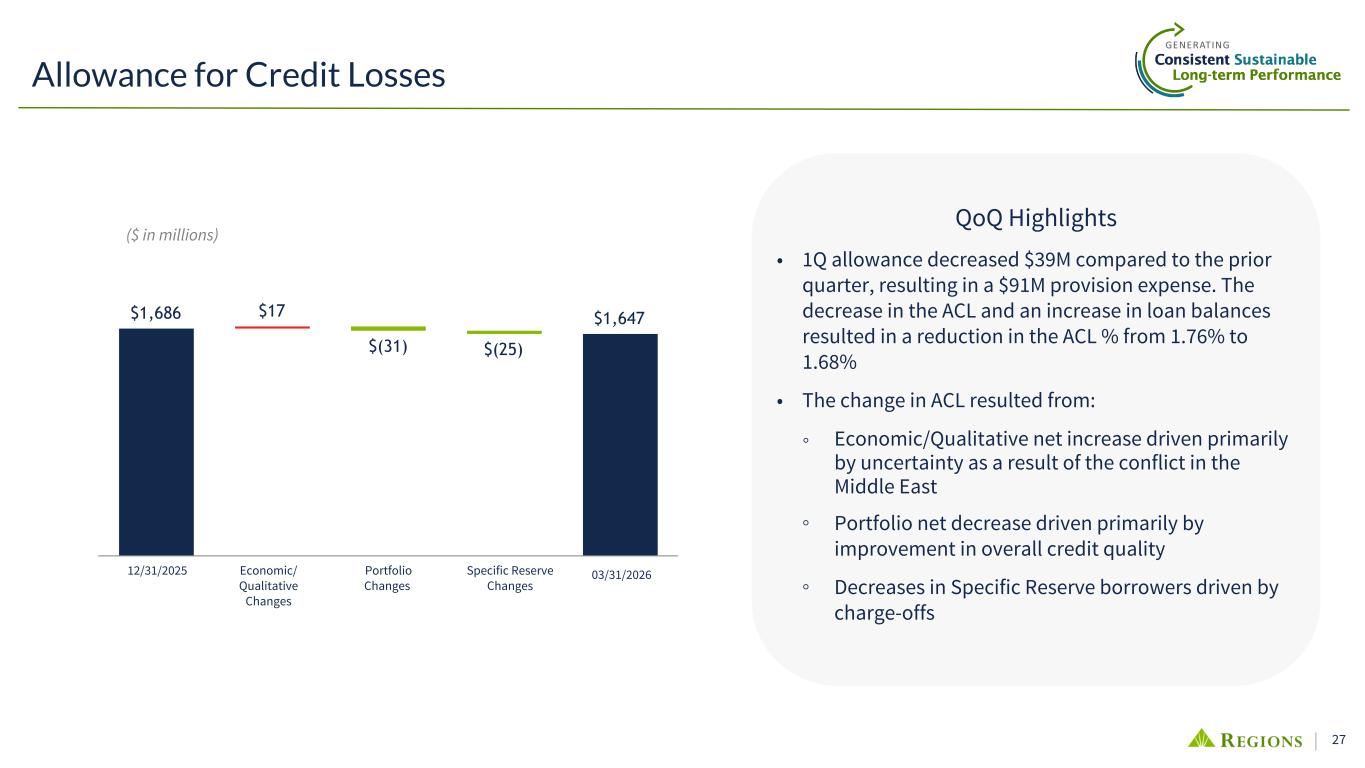
27 QoQ Highlights • 1Q allowance decreased $39M compared to the prior quarter, resulting in a $91M provision expense. The decrease in the ACL and an increase in loan balances resulted in a reduction in the ACL % from 1.76% to 1.68% • The change in ACL resulted from: ◦ Economic/Qualitative net increase driven primarily by uncertainty as a result of the conflict in the Middle East ◦ Portfolio net decrease driven primarily by improvement in overall credit quality ◦ Decreases in Specific Reserve borrowers driven by charge-offs $1,686 $17 $(31) $(25) $1,647 Allowance for Credit Losses 03/31/2026 ($ in millions) 12/31/2025 Portfolio Changes Specific Reserve Changes Economic/ Qualitative Changes
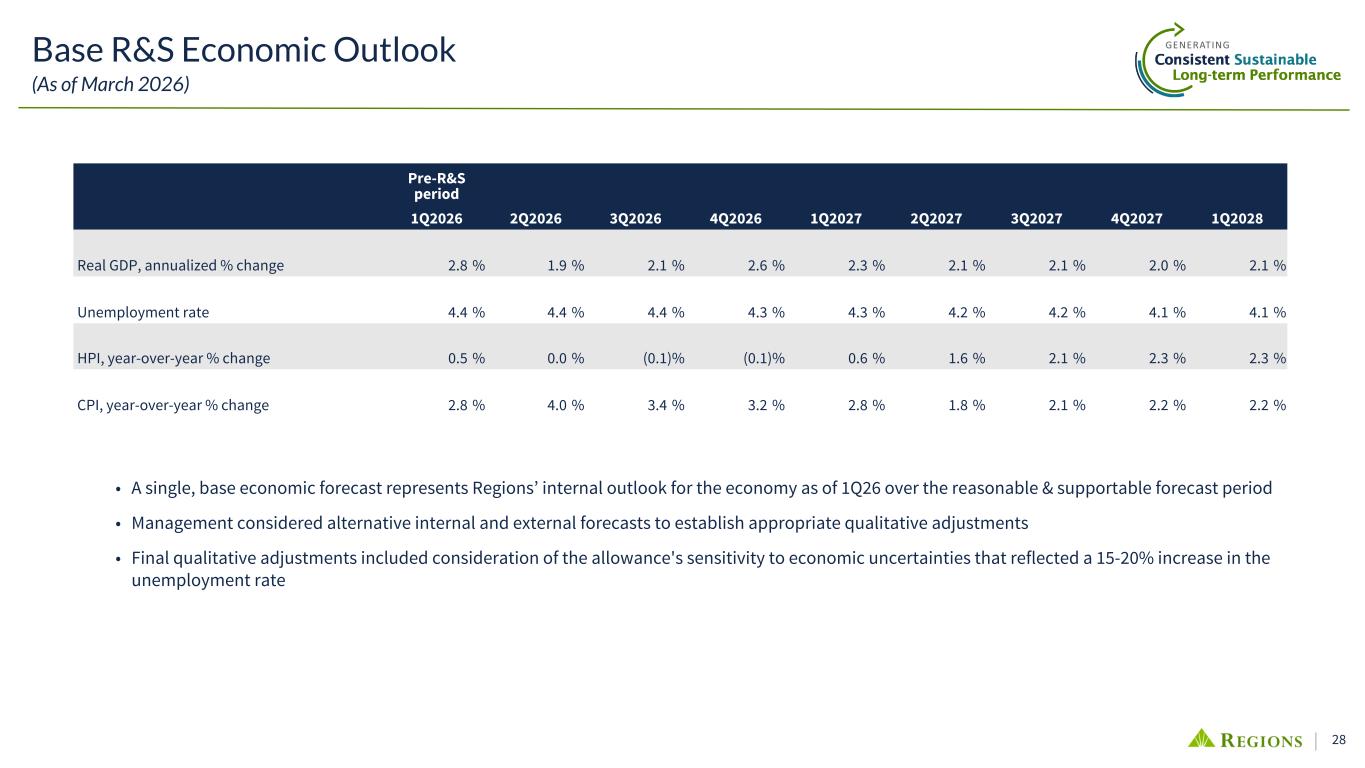
28 Pre-R&S period 1Q2026 2Q2026 3Q2026 4Q2026 1Q2027 2Q2027 3Q2027 4Q2027 1Q2028 Real GDP, annualized % change 2.8 % 1.9 % 2.1 % 2.6 % 2.3 % 2.1 % 2.1 % 2.0 % 2.1 % Unemployment rate 4.4 % 4.4 % 4.4 % 4.3 % 4.3 % 4.2 % 4.2 % 4.1 % 4.1 % HPI, year-over-year % change 0.5 % 0.0 % (0.1) % (0.1) % 0.6 % 1.6 % 2.1 % 2.3 % 2.3 % CPI, year-over-year % change 2.8 % 4.0 % 3.4 % 3.2 % 2.8 % 1.8 % 2.1 % 2.2 % 2.2 % Base R&S Economic Outlook (As of March 2026) • A single, base economic forecast represents Regions’ internal outlook for the economy as of 1Q26 over the reasonable & supportable forecast period • Management considered alternative internal and external forecasts to establish appropriate qualitative adjustments • Final qualitative adjustments included consideration of the allowance's sensitivity to economic uncertainties that reflected a 15-20% increase in the unemployment rate
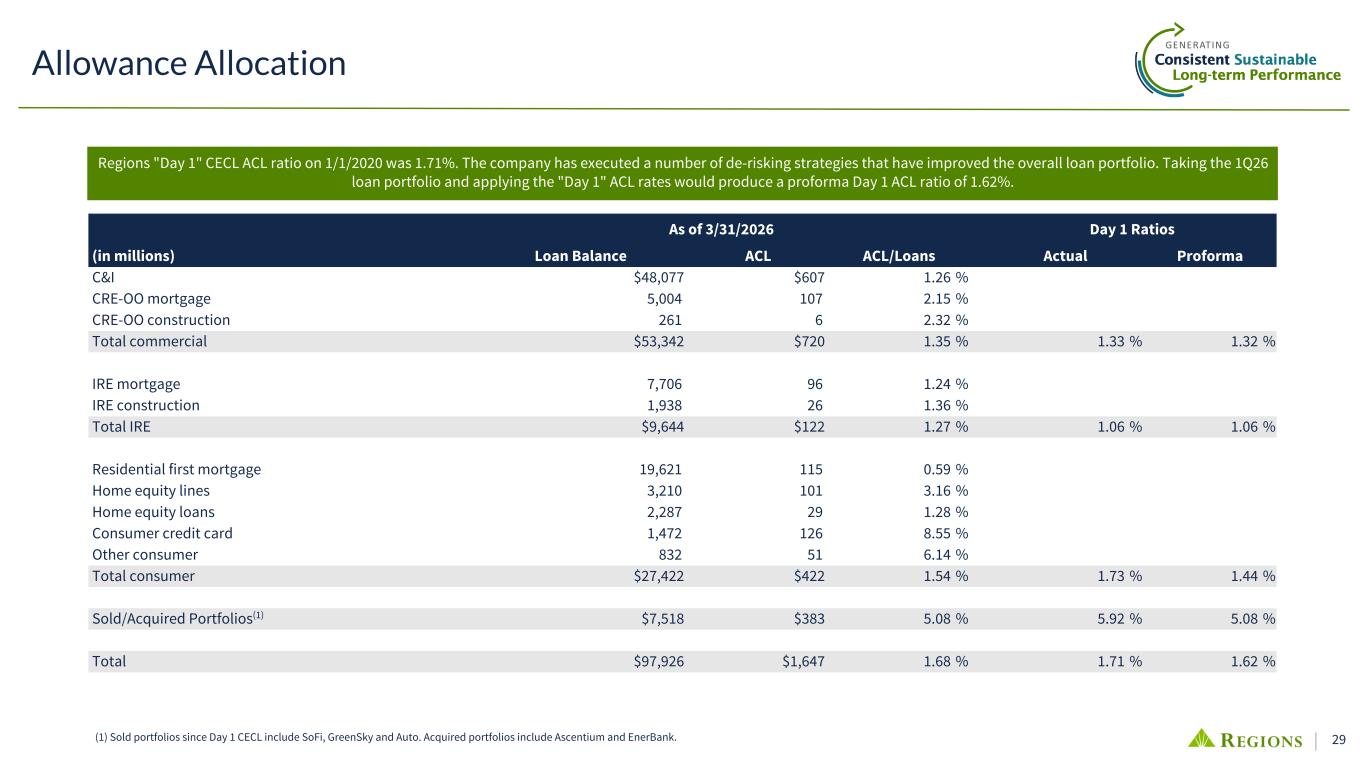
29 As of 3/31/2026 Day 1 Ratios (in millions) Loan Balance ACL ACL/Loans Actual Proforma C&I $48,077 $607 1.26 % CRE-OO mortgage 5,004 107 2.15 % CRE-OO construction 261 6 2.32 % Total commercial $53,342 $720 1.35 % 1.33 % 1.32 % IRE mortgage 7,706 96 1.24 % IRE construction 1,938 26 1.36 % Total IRE $9,644 $122 1.27 % 1.06 % 1.06 % Residential first mortgage 19,621 115 0.59 % Home equity lines 3,210 101 3.16 % Home equity loans 2,287 29 1.28 % Consumer credit card 1,472 126 8.55 % Other consumer 832 51 6.14 % Total consumer $27,422 $422 1.54 % 1.73 % 1.44 % Sold/Acquired Portfolios(1) $7,518 $383 5.08 % 5.92 % 5.08 % Total $97,926 $1,647 1.68 % 1.71 % 1.62 % Allowance Allocation Regions "Day 1" CECL ACL ratio on 1/1/2020 was 1.71%. The company has executed a number of de-risking strategies that have improved the overall loan portfolio. Taking the 1Q26 loan portfolio and applying the "Day 1" ACL rates would produce a proforma Day 1 ACL ratio of 1.62%. (1) Sold portfolios since Day 1 CECL include SoFi, GreenSky and Auto. Acquired portfolios include Ascentium and EnerBank.
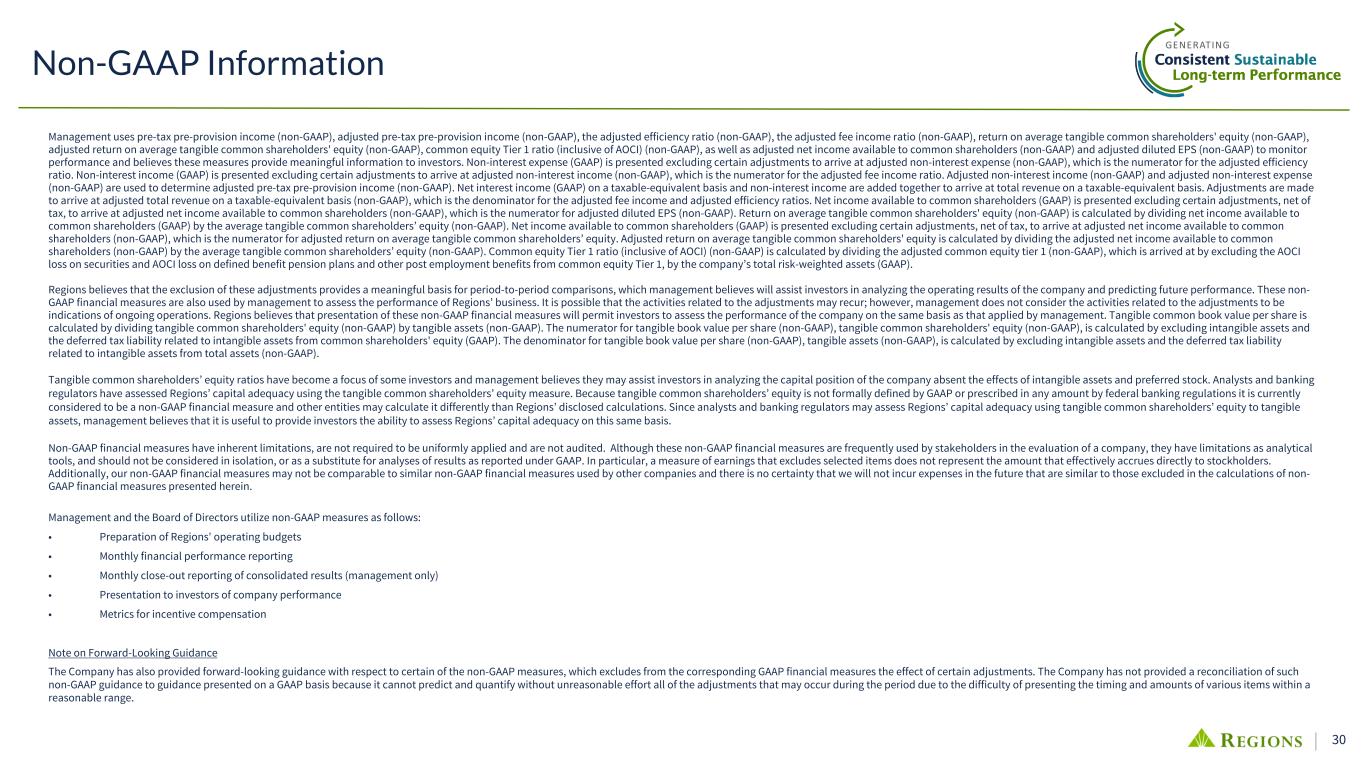
30 Management uses pre-tax pre-provision income (non-GAAP), adjusted pre-tax pre-provision income (non-GAAP), the adjusted efficiency ratio (non-GAAP), the adjusted fee income ratio (non-GAAP), return on average tangible common shareholders' equity (non-GAAP), adjusted return on average tangible common shareholders' equity (non-GAAP), common equity Tier 1 ratio (inclusive of AOCI) (non-GAAP), as well as adjusted net income available to common shareholders (non-GAAP) and adjusted diluted EPS (non-GAAP) to monitor performance and believes these measures provide meaningful information to investors. Non-interest expense (GAAP) is presented excluding certain adjustments to arrive at adjusted non-interest expense (non-GAAP), which is the numerator for the adjusted efficiency ratio. Non-interest income (GAAP) is presented excluding certain adjustments to arrive at adjusted non-interest income (non-GAAP), which is the numerator for the adjusted fee income ratio. Adjusted non-interest income (non-GAAP) and adjusted non-interest expense (non-GAAP) are used to determine adjusted pre-tax pre-provision income (non-GAAP). Net interest income (GAAP) on a taxable-equivalent basis and non-interest income are added together to arrive at total revenue on a taxable-equivalent basis. Adjustments are made to arrive at adjusted total revenue on a taxable-equivalent basis (non-GAAP), which is the denominator for the adjusted fee income and adjusted efficiency ratios. Net income available to common shareholders (GAAP) is presented excluding certain adjustments, net of tax, to arrive at adjusted net income available to common shareholders (non-GAAP), which is the numerator for adjusted diluted EPS (non-GAAP). Return on average tangible common shareholders' equity (non-GAAP) is calculated by dividing net income available to common shareholders (GAAP) by the average tangible common shareholders’ equity (non-GAAP). Net income available to common shareholders (GAAP) is presented excluding certain adjustments, net of tax, to arrive at adjusted net income available to common shareholders (non-GAAP), which is the numerator for adjusted return on average tangible common shareholders’ equity. Adjusted return on average tangible common shareholders' equity is calculated by dividing the adjusted net income available to common shareholders (non-GAAP) by the average tangible common shareholders’ equity (non-GAAP). Common equity Tier 1 ratio (inclusive of AOCI) (non-GAAP) is calculated by dividing the adjusted common equity tier 1 (non-GAAP), which is arrived at by excluding the AOCI loss on securities and AOCI loss on defined benefit pension plans and other post employment benefits from common equity Tier 1, by the company’s total risk-weighted assets (GAAP). Regions believes that the exclusion of these adjustments provides a meaningful basis for period-to-period comparisons, which management believes will assist investors in analyzing the operating results of the company and predicting future performance. These non- GAAP financial measures are also used by management to assess the performance of Regions’ business. It is possible that the activities related to the adjustments may recur; however, management does not consider the activities related to the adjustments to be indications of ongoing operations. Regions believes that presentation of these non-GAAP financial measures will permit investors to assess the performance of the company on the same basis as that applied by management. Tangible common book value per share is calculated by dividing tangible common shareholders' equity (non-GAAP) by tangible assets (non-GAAP). The numerator for tangible book value per share (non-GAAP), tangible common shareholders' equity (non-GAAP), is calculated by excluding intangible assets and the deferred tax liability related to intangible assets from common shareholders' equity (GAAP). The denominator for tangible book value per share (non-GAAP), tangible assets (non-GAAP), is calculated by excluding intangible assets and the deferred tax liability related to intangible assets from total assets (non-GAAP). Tangible common shareholders’ equity ratios have become a focus of some investors and management believes they may assist investors in analyzing the capital position of the company absent the effects of intangible assets and preferred stock. Analysts and banking regulators have assessed Regions’ capital adequacy using the tangible common shareholders’ equity measure. Because tangible common shareholders’ equity is not formally defined by GAAP or prescribed in any amount by federal banking regulations it is currently considered to be a non-GAAP financial measure and other entities may calculate it differently than Regions’ disclosed calculations. Since analysts and banking regulators may assess Regions’ capital adequacy using tangible common shareholders’ equity to tangible assets, management believes that it is useful to provide investors the ability to assess Regions’ capital adequacy on this same basis. Non-GAAP financial measures have inherent limitations, are not required to be uniformly applied and are not audited. Although these non-GAAP financial measures are frequently used by stakeholders in the evaluation of a company, they have limitations as analytical tools, and should not be considered in isolation, or as a substitute for analyses of results as reported under GAAP. In particular, a measure of earnings that excludes selected items does not represent the amount that effectively accrues directly to stockholders. Additionally, our non-GAAP financial measures may not be comparable to similar non-GAAP financial measures used by other companies and there is no certainty that we will not incur expenses in the future that are similar to those excluded in the calculations of non- GAAP financial measures presented herein. Management and the Board of Directors utilize non-GAAP measures as follows: • Preparation of Regions' operating budgets • Monthly financial performance reporting • Monthly close-out reporting of consolidated results (management only) • Presentation to investors of company performance • Metrics for incentive compensation Note on Forward-Looking Guidance The Company has also provided forward-looking guidance with respect to certain of the non-GAAP measures, which excludes from the corresponding GAAP financial measures the effect of certain adjustments. The Company has not provided a reconciliation of such non-GAAP guidance to guidance presented on a GAAP basis because it cannot predict and quantify without unreasonable effort all of the adjustments that may occur during the period due to the difficulty of presenting the timing and amounts of various items within a reasonable range. Non-GAAP Information
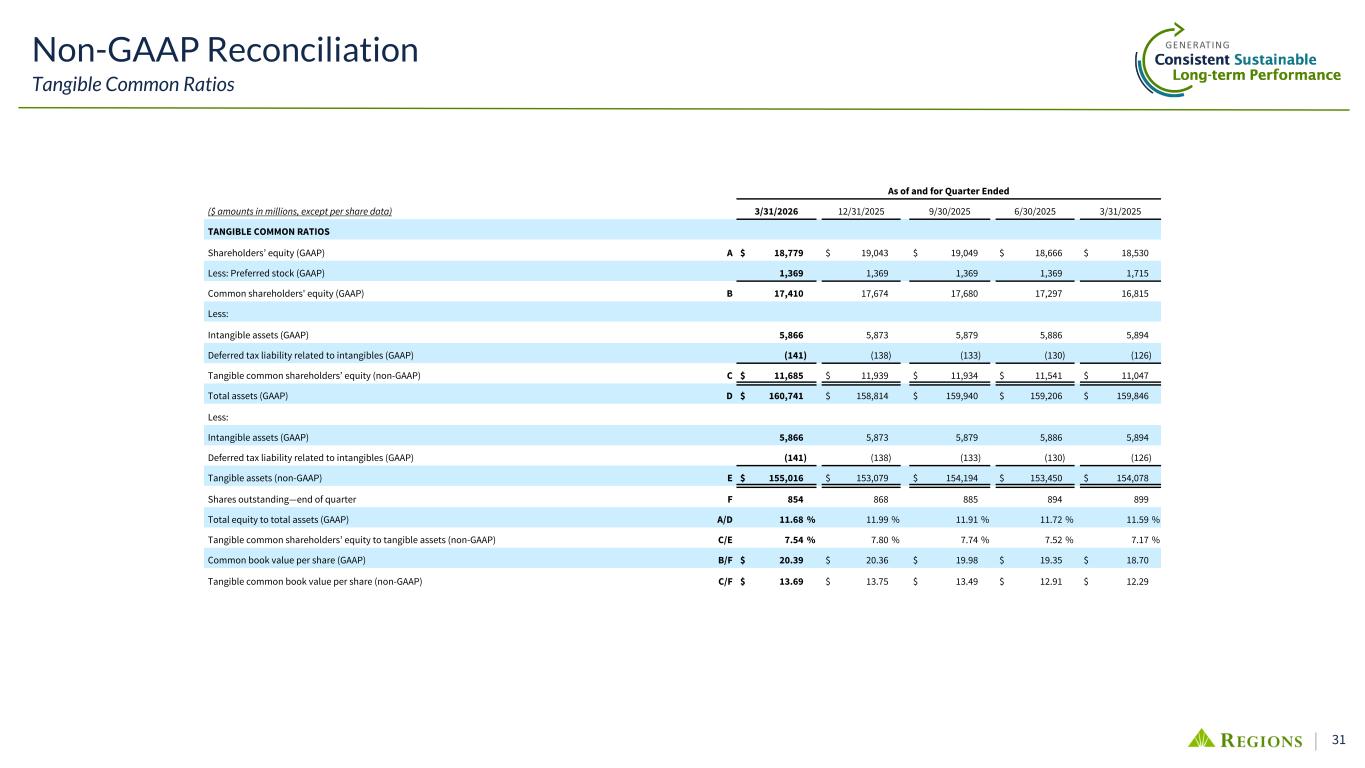
31 As of and for Quarter Ended ($ amounts in millions, except per share data) 3/31/2026 12/31/2025 9/30/2025 6/30/2025 3/31/2025 TANGIBLE COMMON RATIOS Shareholders’ equity (GAAP) A $ 18,779 $ 19,043 $ 19,049 $ 18,666 $ 18,530 Less: Preferred stock (GAAP) 1,369 1,369 1,369 1,369 1,715 Common shareholders' equity (GAAP) B 17,410 17,674 17,680 17,297 16,815 Less: Intangible assets (GAAP) 5,866 5,873 5,879 5,886 5,894 Deferred tax liability related to intangibles (GAAP) (141) (138) (133) (130) (126) Tangible common shareholders’ equity (non-GAAP) C $ 11,685 $ 11,939 $ 11,934 $ 11,541 $ 11,047 Total assets (GAAP) D $ 160,741 $ 158,814 $ 159,940 $ 159,206 $ 159,846 Less: Intangible assets (GAAP) 5,866 5,873 5,879 5,886 5,894 Deferred tax liability related to intangibles (GAAP) (141) (138) (133) (130) (126) Tangible assets (non-GAAP) E $ 155,016 $ 153,079 $ 154,194 $ 153,450 $ 154,078 Shares outstanding—end of quarter F 854 868 885 894 899 Total equity to total assets (GAAP) A/D 11.68 % 11.99 % 11.91 % 11.72 % 11.59 % Tangible common shareholders’ equity to tangible assets (non-GAAP) C/E 7.54 % 7.80 % 7.74 % 7.52 % 7.17 % Common book value per share (GAAP) B/F $ 20.39 $ 20.36 $ 19.98 $ 19.35 $ 18.70 Tangible common book value per share (non-GAAP) C/F $ 13.69 $ 13.75 $ 13.49 $ 12.91 $ 12.29 Non-GAAP Reconciliation Tangible Common Ratios
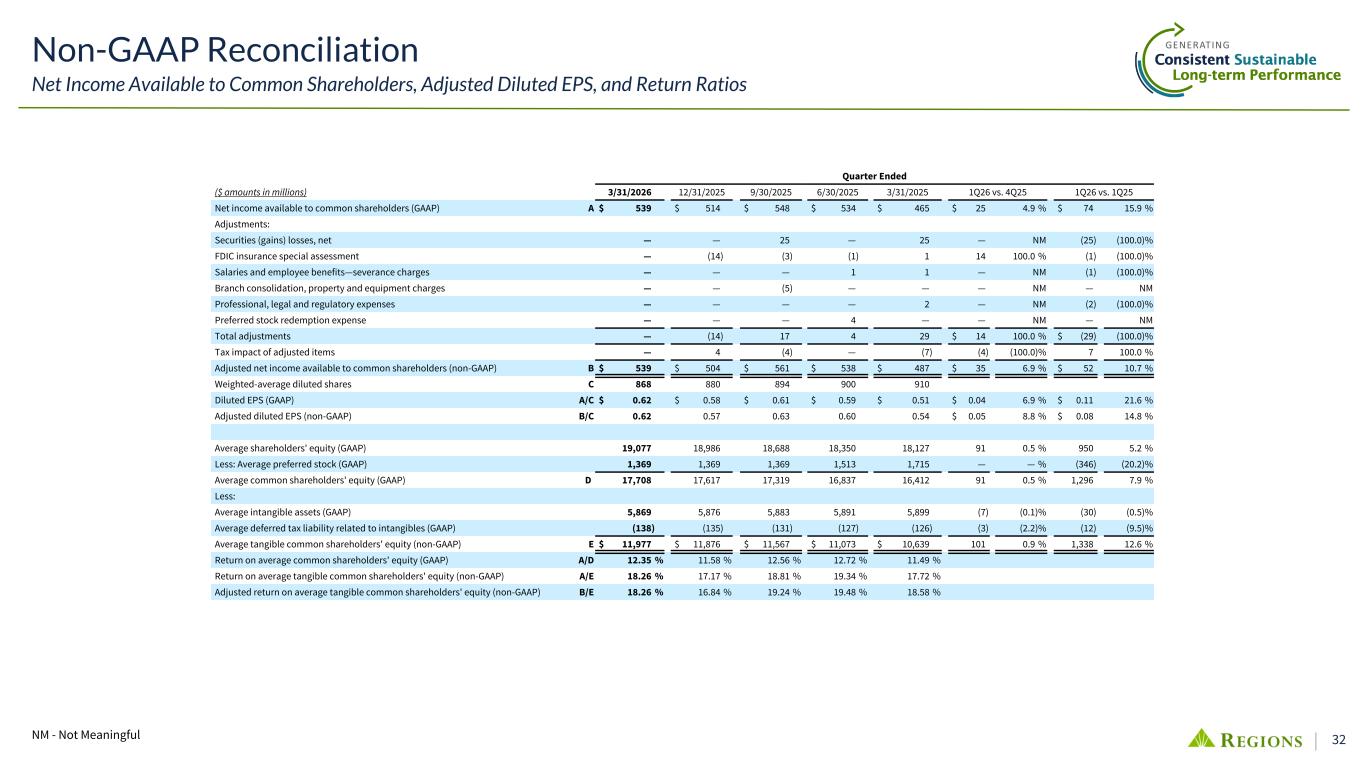
32 Non-GAAP Reconciliation Net Income Available to Common Shareholders, Adjusted Diluted EPS, and Return Ratios NM - Not Meaningful Quarter Ended ($ amounts in millions) 3/31/2026 12/31/2025 9/30/2025 6/30/2025 3/31/2025 1Q26 vs. 4Q25 1Q26 vs. 1Q25 Net income available to common shareholders (GAAP) A $ 539 $ 514 $ 548 $ 534 $ 465 $ 25 4.9 % $ 74 15.9 % Adjustments: Securities (gains) losses, net — — 25 — 25 — NM (25) (100.0) % FDIC insurance special assessment — (14) (3) (1) 1 14 100.0 % (1) (100.0) % Salaries and employee benefits—severance charges — — — 1 1 — NM (1) (100.0) % Branch consolidation, property and equipment charges — — (5) — — — NM — NM Professional, legal and regulatory expenses — — — — 2 — NM (2) (100.0) % Preferred stock redemption expense — — — 4 — — NM — NM Total adjustments — (14) 17 4 29 $ 14 100.0 % $ (29) (100.0) % Tax impact of adjusted items — 4 (4) — (7) (4) (100.0) % 7 100.0 % Adjusted net income available to common shareholders (non-GAAP) B $ 539 $ 504 $ 561 $ 538 $ 487 $ 35 6.9 % $ 52 10.7 % Weighted-average diluted shares C 868 880 894 900 910 Diluted EPS (GAAP) A/C $ 0.62 $ 0.58 $ 0.61 $ 0.59 $ 0.51 $ 0.04 6.9 % $ 0.11 21.6 % Adjusted diluted EPS (non-GAAP) B/C 0.62 0.57 0.63 0.60 0.54 $ 0.05 8.8 % $ 0.08 14.8 % Average shareholders' equity (GAAP) 19,077 18,986 18,688 18,350 18,127 91 0.5 % 950 5.2 % Less: Average preferred stock (GAAP) 1,369 1,369 1,369 1,513 1,715 — — % (346) (20.2) % Average common shareholders' equity (GAAP) D 17,708 17,617 17,319 16,837 16,412 91 0.5 % 1,296 7.9 % Less: Average intangible assets (GAAP) 5,869 5,876 5,883 5,891 5,899 (7) (0.1) % (30) (0.5) % Average deferred tax liability related to intangibles (GAAP) (138) (135) (131) (127) (126) (3) (2.2) % (12) (9.5) % Average tangible common shareholders' equity (non-GAAP) E $ 11,977 $ 11,876 $ 11,567 $ 11,073 $ 10,639 101 0.9 % 1,338 12.6 % Return on average common shareholders' equity (GAAP) A/D 12.35 % 11.58 % 12.56 % 12.72 % 11.49 % Return on average tangible common shareholders' equity (non-GAAP) A/E 18.26 % 17.17 % 18.81 % 19.34 % 17.72 % Adjusted return on average tangible common shareholders' equity (non-GAAP) B/E 18.26 % 16.84 % 19.24 % 19.48 % 18.58 %
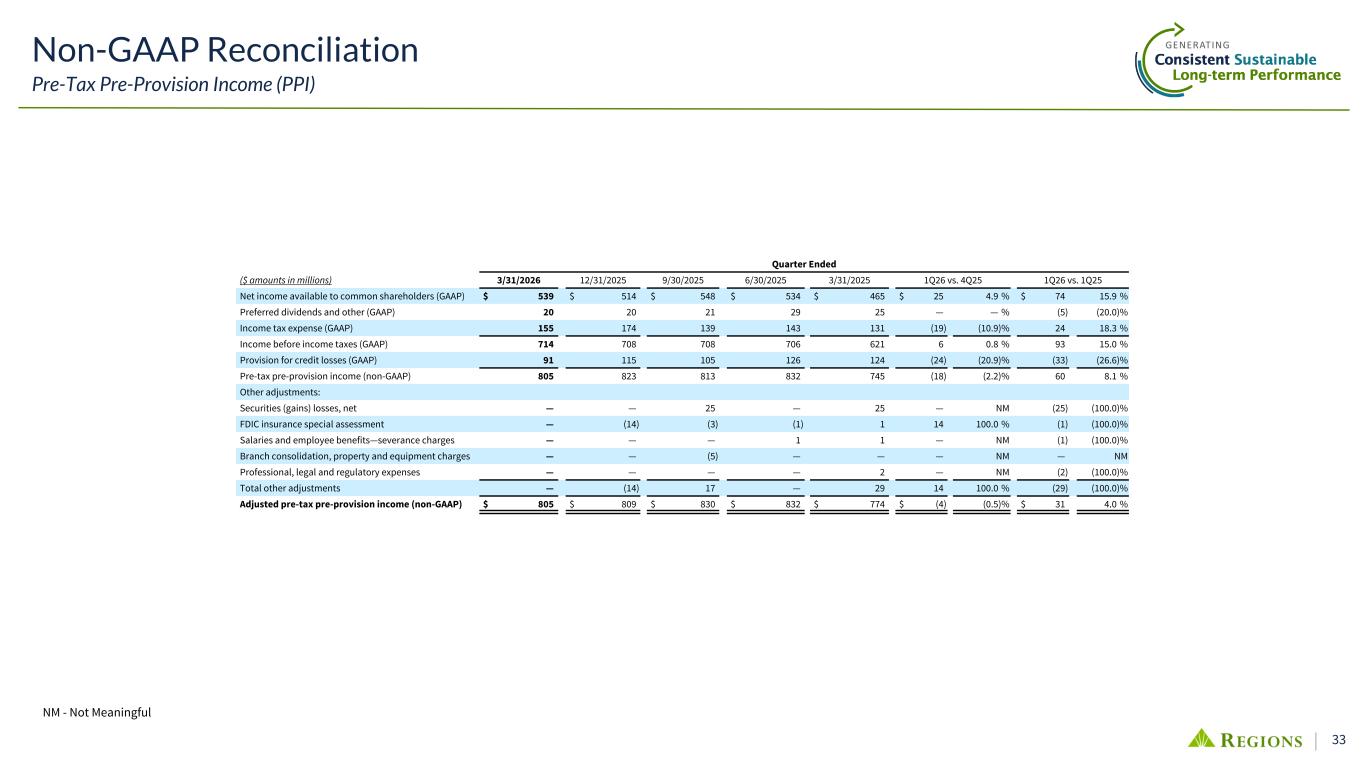
33 Non-GAAP Reconciliation Pre-Tax Pre-Provision Income (PPI) Quarter Ended ($ amounts in millions) 3/31/2026 12/31/2025 9/30/2025 6/30/2025 3/31/2025 1Q26 vs. 4Q25 1Q26 vs. 1Q25 Net income available to common shareholders (GAAP) $ 539 $ 514 $ 548 $ 534 $ 465 $ 25 4.9 % $ 74 15.9 % Preferred dividends and other (GAAP) 20 20 21 29 25 — — % (5) (20.0) % Income tax expense (GAAP) 155 174 139 143 131 (19) (10.9) % 24 18.3 % Income before income taxes (GAAP) 714 708 708 706 621 6 0.8 % 93 15.0 % Provision for credit losses (GAAP) 91 115 105 126 124 (24) (20.9) % (33) (26.6) % Pre-tax pre-provision income (non-GAAP) 805 823 813 832 745 (18) (2.2) % 60 8.1 % Other adjustments: Securities (gains) losses, net — — 25 — 25 — NM (25) (100.0) % FDIC insurance special assessment — (14) (3) (1) 1 14 100.0 % (1) (100.0) % Salaries and employee benefits—severance charges — — — 1 1 — NM (1) (100.0) % Branch consolidation, property and equipment charges — — (5) — — — NM — NM Professional, legal and regulatory expenses — — — — 2 — NM (2) (100.0) % Total other adjustments — (14) 17 — 29 14 100.0 % (29) (100.0) % Adjusted pre-tax pre-provision income (non-GAAP) $ 805 $ 809 $ 830 $ 832 $ 774 $ (4) (0.5) % $ 31 4.0 % NM - Not Meaningful
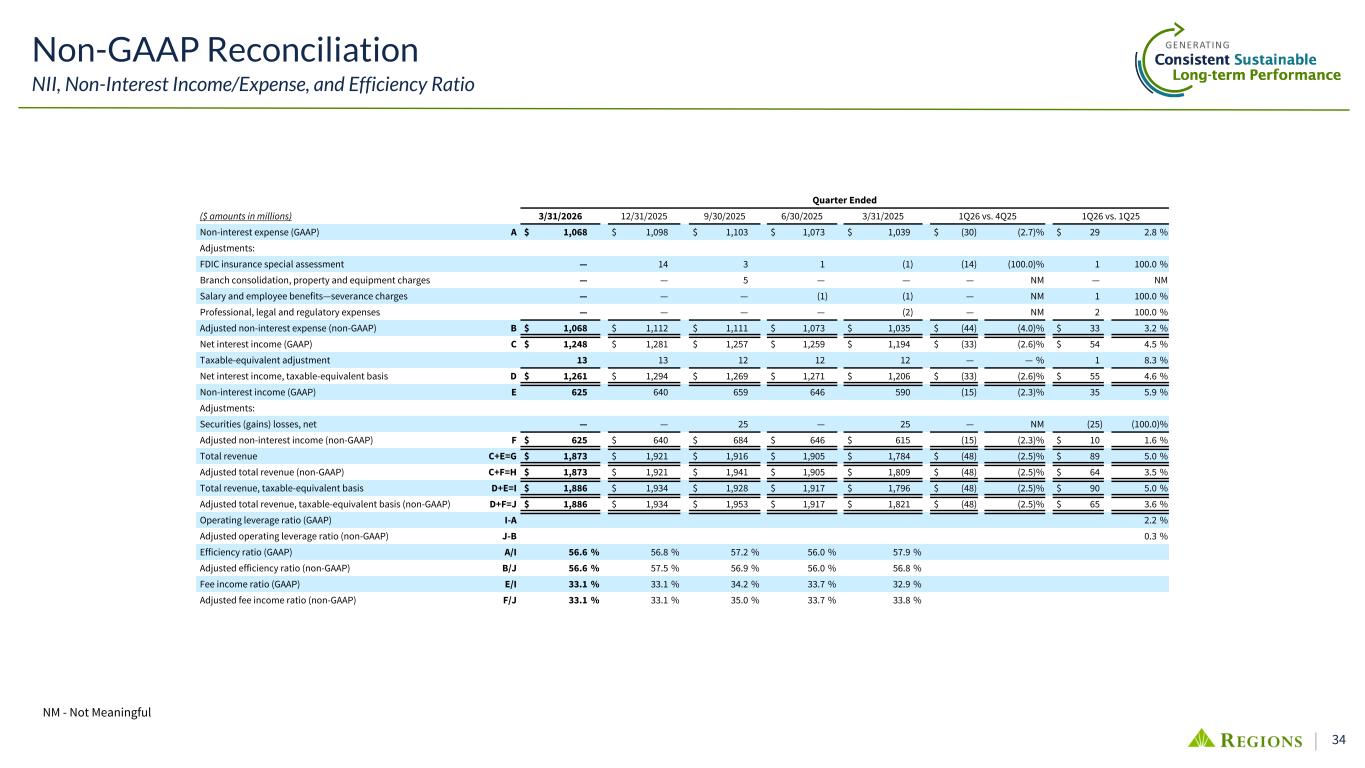
34 Non-GAAP Reconciliation NII, Non-Interest Income/Expense, and Efficiency Ratio NM - Not Meaningful Quarter Ended ($ amounts in millions) 3/31/2026 12/31/2025 9/30/2025 6/30/2025 3/31/2025 1Q26 vs. 4Q25 1Q26 vs. 1Q25 Non-interest expense (GAAP) A $ 1,068 $ 1,098 $ 1,103 $ 1,073 $ 1,039 $ (30) (2.7) % $ 29 2.8 % Adjustments: FDIC insurance special assessment — 14 3 1 (1) (14) (100.0) % 1 100.0 % Branch consolidation, property and equipment charges — — 5 — — — NM — NM Salary and employee benefits—severance charges — — — (1) (1) — NM 1 100.0 % Professional, legal and regulatory expenses — — — — (2) — NM 2 100.0 % Adjusted non-interest expense (non-GAAP) B $ 1,068 $ 1,112 $ 1,111 $ 1,073 $ 1,035 $ (44) (4.0) % $ 33 3.2 % Net interest income (GAAP) C $ 1,248 $ 1,281 $ 1,257 $ 1,259 $ 1,194 $ (33) (2.6) % $ 54 4.5 % Taxable-equivalent adjustment 13 13 12 12 12 — — % 1 8.3 % Net interest income, taxable-equivalent basis D $ 1,261 $ 1,294 $ 1,269 $ 1,271 $ 1,206 $ (33) (2.6) % $ 55 4.6 % Non-interest income (GAAP) E 625 640 659 646 590 (15) (2.3) % 35 5.9 % Adjustments: Securities (gains) losses, net — — 25 — 25 — NM (25) (100.0) % Adjusted non-interest income (non-GAAP) F $ 625 $ 640 $ 684 $ 646 $ 615 (15) (2.3) % $ 10 1.6 % Total revenue C+E=G $ 1,873 $ 1,921 $ 1,916 $ 1,905 $ 1,784 $ (48) (2.5) % $ 89 5.0 % Adjusted total revenue (non-GAAP) C+F=H $ 1,873 $ 1,921 $ 1,941 $ 1,905 $ 1,809 $ (48) (2.5) % $ 64 3.5 % Total revenue, taxable-equivalent basis D+E=I $ 1,886 $ 1,934 $ 1,928 $ 1,917 $ 1,796 $ (48) (2.5) % $ 90 5.0 % Adjusted total revenue, taxable-equivalent basis (non-GAAP) D+F=J $ 1,886 $ 1,934 $ 1,953 $ 1,917 $ 1,821 $ (48) (2.5) % $ 65 3.6 % Operating leverage ratio (GAAP) I-A 2.2 % Adjusted operating leverage ratio (non-GAAP) J-B 0.3 % Efficiency ratio (GAAP) A/I 56.6 % 56.8 % 57.2 % 56.0 % 57.9 % Adjusted efficiency ratio (non-GAAP) B/J 56.6 % 57.5 % 56.9 % 56.0 % 56.8 % Fee income ratio (GAAP) E/I 33.1 % 33.1 % 34.2 % 33.7 % 32.9 % Adjusted fee income ratio (non-GAAP) F/J 33.1 % 33.1 % 35.0 % 33.7 % 33.8 %
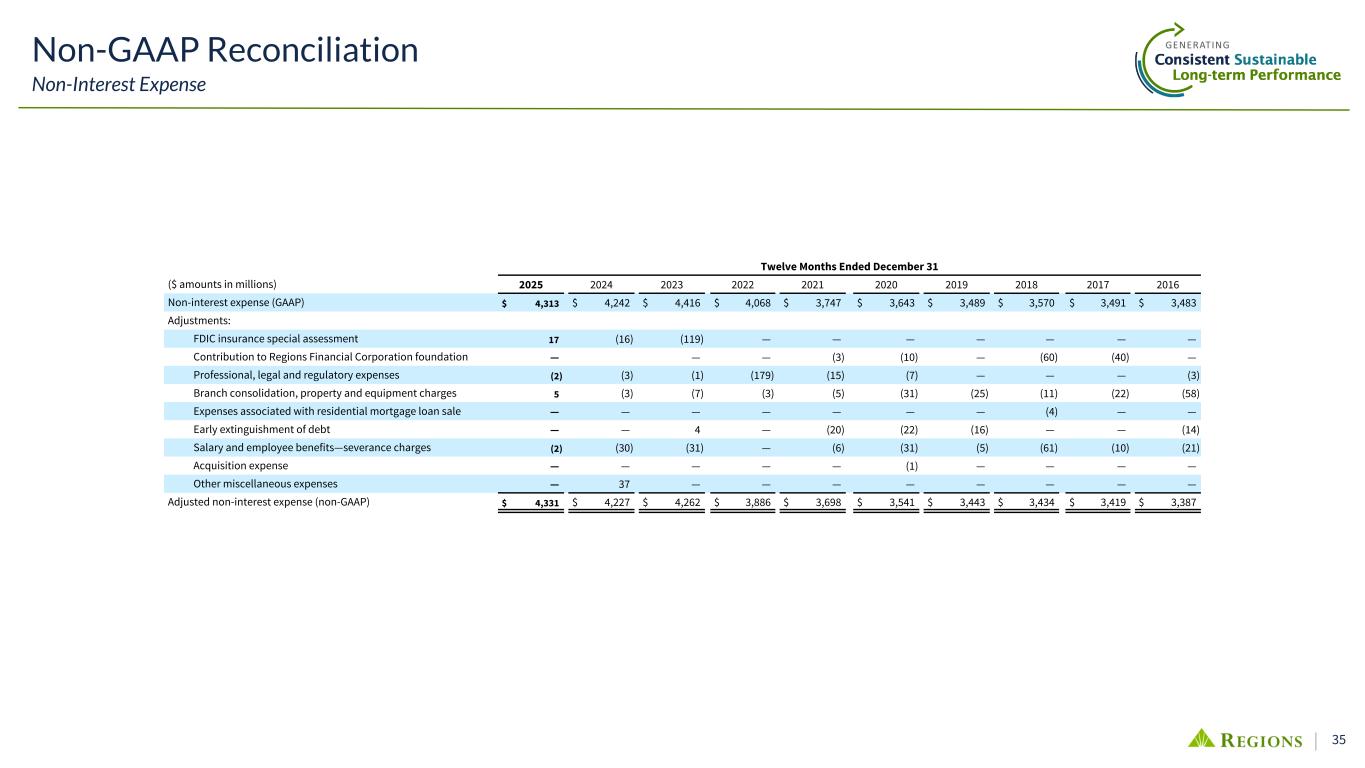
35 Non-GAAP Reconciliation Non-Interest Expense Twelve Months Ended December 31 ($ amounts in millions) 2025 2024 2023 2022 2021 2020 2019 2018 2017 2016 Non-interest expense (GAAP) $ 4,313 $ 4,242 $ 4,416 $ 4,068 $ 3,747 $ 3,643 $ 3,489 $ 3,570 $ 3,491 $ 3,483 Adjustments: FDIC insurance special assessment 17 (16) (119) — — — — — — — Contribution to Regions Financial Corporation foundation — — — (3) (10) — (60) (40) — Professional, legal and regulatory expenses (2) (3) (1) (179) (15) (7) — — — (3) Branch consolidation, property and equipment charges 5 (3) (7) (3) (5) (31) (25) (11) (22) (58) Expenses associated with residential mortgage loan sale — — — — — — — (4) — — Early extinguishment of debt — — 4 — (20) (22) (16) — — (14) Salary and employee benefits—severance charges (2) (30) (31) — (6) (31) (5) (61) (10) (21) Acquisition expense — — — — — (1) — — — — Other miscellaneous expenses — 37 — — — — — — — — Adjusted non-interest expense (non-GAAP) $ 4,331 $ 4,227 $ 4,262 $ 3,886 $ 3,698 $ 3,541 $ 3,443 $ 3,434 $ 3,419 $ 3,387
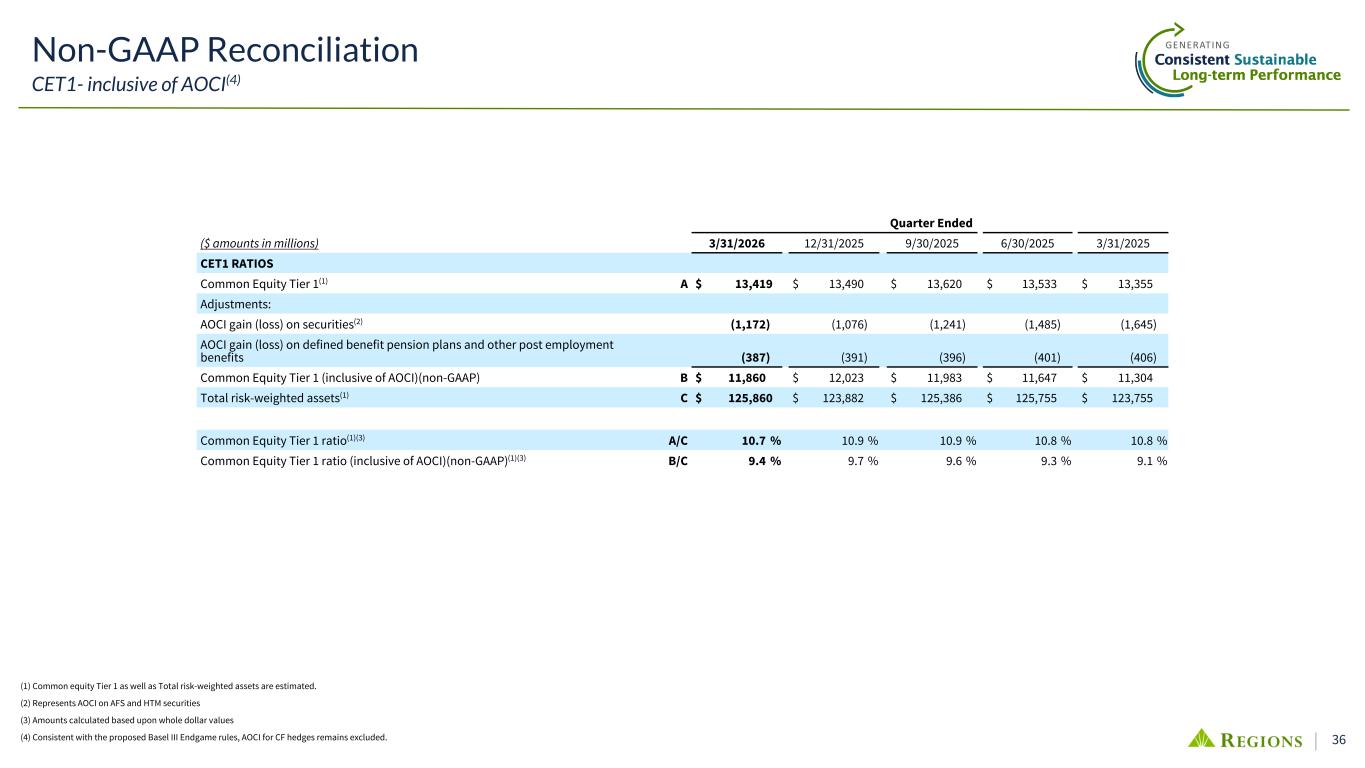
36 Quarter Ended ($ amounts in millions) 3/31/2026 12/31/2025 9/30/2025 6/30/2025 3/31/2025 CET1 RATIOS Common Equity Tier 1(1) A $ 13,419 $ 13,490 $ 13,620 $ 13,533 $ 13,355 Adjustments: AOCI gain (loss) on securities(2) (1,172) (1,076) (1,241) (1,485) (1,645) AOCI gain (loss) on defined benefit pension plans and other post employment benefits (387) (391) (396) (401) (406) Common Equity Tier 1 (inclusive of AOCI)(non-GAAP) B $ 11,860 $ 12,023 $ 11,983 $ 11,647 $ 11,304 Total risk-weighted assets(1) C $ 125,860 $ 123,882 $ 125,386 $ 125,755 $ 123,755 Common Equity Tier 1 ratio(1)(3) A/C 10.7 % 10.9 % 10.9 % 10.8 % 10.8 % Common Equity Tier 1 ratio (inclusive of AOCI)(non-GAAP)(1)(3) B/C 9.4 % 9.7 % 9.6 % 9.3 % 9.1 % Non-GAAP Reconciliation CET1- inclusive of AOCI(4) (1) Common equity Tier 1 as well as Total risk-weighted assets are estimated. (2) Represents AOCI on AFS and HTM securities (3) Amounts calculated based upon whole dollar values (4) Consistent with the proposed Basel III Endgame rules, AOCI for CF hedges remains excluded.
37 Forward-Looking Statements This presentation, the related earnings release, and the accompanying earnings call may include forward-looking statements as defined in the Private Securities Litigation Reform Act of 1995. In addition, the company, through its senior management, may from time to time make forward-looking public statements concerning the matters described herein. The words “future,” “anticipates,” “assumes,” “intends,” “plans,” “seeks,” “believes,” “predicts,” “potential,” “objectives,” “estimates,” “expects,” “targets,” “projects,” “outlook,” “forecast,” “would,” “will,” “may,” “might,” “could,” “should,” “can,” and similar terms, expressions, and graphics often signify forward-looking statements. Forward-looking statements are subject to the risk that the actual effects may differ, possibly materially, from what is reflected in those forward-looking statements due to factors and future developments that are uncertain, unpredictable and in many cases beyond our control. Forward-looking statements are not based on historical information, but rather are related to future operations, strategies, financial results or other developments. Forward-looking statements are based on management’s current expectations as well as certain assumptions and estimates made by, and information available to, management at the time the statements are made. Those statements are based on general assumptions and are subject to various risks, and because they also relate to the future they are likewise subject to inherent uncertainties and other factors that may cause actual results to differ materially from the views, beliefs and projections expressed in such statements. Therefore, we caution you against relying on any of these forward-looking statements. These risks, uncertainties and other factors include, but are not limited to, those described below: • Our businesses have been, and may continue to be, adversely affected by conditions in the financial markets and economic conditions generally. • Fluctuations in market interest rates, including the level and shape of the yield curve, may adversely affect our performance. • If we experience greater credit losses in our loan portfolios than anticipated, our earnings may be materially adversely affected. • Any future reductions in our credit ratings may increase our funding costs and place limitations on business activities. • Changes in the soundness of other financial institutions could adversely affect us. • We may suffer losses if the value of collateral declines in stressed market conditions. • Ineffective liquidity management could adversely affect our financial results and condition. • Loss of deposits or a change in deposit mix could increase our funding costs. • We rely on the mortgage secondary market to manage various risks. • We are at risk of a variety of systems failures or errors and cyber-attacks or other similar incidents that could adversely affect customer experience and our business and financial performance. • We are subject to complex and evolving laws, regulations, rules, standards and contractual obligations regarding privacy and cybersecurity, which could increase the cost of doing business, compliance risks and potential liability. • We will continually encounter technological change and must effectively anticipate, develop and implement new technology. • The development and use of AI presents risks and challenges that may adversely impact our business. • Industry competition, including competition from decentralized finance platforms, cryptocurrencies and blockchain technologies could disrupt our business model and adversely affect our revenues, market share or liquidity. • Our operations are concentrated primarily in the South, Midwest and Texas, and adverse changes in the economic conditions in this region can adversely affect our financial results and condition. • Weakness in the residential real estate markets could adversely affect our performance. • Weakness in the commercial real estate markets could adversely affect our performance. • Risks associated with home equity products where we are in a second lien position could adversely affect our performance. • Weakness in commodity businesses could adversely affect our performance. • An outbreak or escalation of hostilities between countries or within a country or region could have a material adverse effect on the U.S. economy and on our businesses. • We are subject to a variety of operational risks, including the risk of fraud or theft by internal or external parties, which may adversely affect our business and results of operations. • We rely on other companies to provide key components of our business infrastructure. • We depend on the accuracy and completeness of information about clients and counterparties. • We are exposed to risk of environmental liability when we take title to property. • We can be negatively affected if we fail to identify and address operational risks associated with the introduction of or changes to products, services and delivery platforms. • Enhanced regulatory and other standards for the oversight of vendors and other service providers can result in higher costs and other potential exposures. • We are, and may in the future be, subject to claims and litigation calling into question our right to use the intellectual property underlying certain technology in our business. Forward-Looking Statements
38 • Weather-related events, pandemics and other natural or man-made disasters could cause a disruption in our operations or lead to other consequences that could adversely impact our financial results and condition. These impacts could be intensified by climate change. Heightening focus on climate change may also carry transition risks that could negatively impact our results of operations and financial condition. • We are subject to sociopolitical risks that could adversely affect our business, reputation and the trading price of our common stock. • Damage to our reputation could significantly harm our businesses. • We are, and may in the future be, subject to litigation, investigations and governmental proceedings that may result in liabilities adversely affecting our financial condition, business or results of operations or in reputational harm. • We are subject to extensive governmental regulation, which could have an adverse impact on our operations and our business model. • We are subject to a variety of risks in connection with any sale of loans we may conduct. • We may be subject to more stringent capital and liquidity requirements. • Rulemaking changes and regulatory initiatives implemented by the CFPB may result in higher regulatory and compliance costs that may adversely affect our results of operations. • We are subject to numerous laws designed to protect consumers, including the CRA and fair lending laws, and a failure to comply with these laws could lead to a wide variety of penalties and other sanctions. • We may not be able to complete future acquisitions, may not be successful in realizing the benefits of any future acquisitions that are completed or may choose not to pursue acquisition opportunities we might find beneficial. • Increases in FDIC insurance assessments may adversely affect our earnings. • Unfavorable results from ongoing stress analyses may adversely affect our ability to retain customers or compete for new business opportunities. • We are a holding company and depend on our subsidiaries for dividends, distributions and other payments. • We may not pay dividends on shares of our capital stock. • Anti-takeover and banking laws and certain agreements and charter provisions may adversely affect share value. • Our amended and restated by-laws designate (i) the Court of Chancery of the State of Delaware as the sole and exclusive forum for certain types of actions and proceedings that may be initiated by our shareholders and (ii) the federal district courts of the United States as the sole and exclusive forum for any action asserting a cause of action arising under the Securities Act, which could limit our shareholders’ ability to obtain a favorable judicial forum for disputes with our company or our company’s directors, officers or other employees. • We face substantial legal and operational risks in our safeguarding and other processing of personal information. • Differences in regulation can affect our ability to compete effectively. • Our businesses may be adversely affected if we are unable to hire and retain qualified employees. • Our operations rely on our ability, and the ability of key external parties, to maintain appropriately staffed workforces, and on the competence, trustworthiness, health and safety of employees. • Our reported financial results depend on management’s selection of accounting methods and certain assumptions and estimates. • If the models that we use in our business perform poorly or provide inadequate information, our business or results of operations may be adversely affected. • Changes in our accounting policies or in accounting standards could materially affect how we report our financial results and condition. The foregoing list of factors is not exhaustive. For discussion of these and other factors that may cause actual results to differ from expectations, look under the captions “Forward-Looking Statements” and “Risk Factors” in Regions’ Annual Report on Form 10-K for the year ended December 31, 2025 and in Regions’ subsequent filings with the SEC. You should not place undue reliance on any forward-looking statements, which speak only as of the date made. Factors or events that could cause our actual results to differ may emerge from time to time, and it is not possible to predict all of them. We assume no obligation and do not intend to update or revise any forward-looking statements that are made from time to time, either as a result of future developments, new information or otherwise, except as may be required by law. Regions’ Investor Relations contact is Dana Nolan at (205) 264-7040; Regions’ Media contact is Jeremy King at (205) 264-4551. Forward-Looking Statements (continued)