Investor Questions and Answers: June 25, 2026 We encourage current shareholders, potential shareholders, and other interested parties to send questions to us in writing and we make written responses available on a periodic basis. The following answers respond to selected questions received through June 5, 2026. We retain the discretion to combine answers for duplicate or similar questions into one comprehensive response. If you would like to submit a question, please send an e-mail to investors@morningstar.com or write us at the following address: Morningstar, Inc. Investor Relations 22 W. Washington St. Chicago, IL 60602 Morningstar Direct Platform 1. Please quantify to what extent you believe that home offices formally require that advisors only invest in products with Morningstar IP – whether the classic star ratings or analyst ratings? If you were to look at a list of the top 250 or so “home offices” by AUM, what percent would have this formal requirement documented into the process and how has that evolved over time? We are not in a position to comment on formal requirements within our clients’ home offices. That said, we see Morningstar data, research, and intellectual property used widely in the due diligence process at firms representing significant assets under management, including by gatekeepers at many of the largest US wealth management firms. Our data and software are commonly available to advisors and researchers at these firms for use in the investment decision-making process. Our research and ratings can meaningfully influence the investment decision-making process. Our Morningstar Rating (or “star rating”) is widely used in fund marketing materials, and past research has shown a correlation between star ratings and fund flows.
We also see good home office engagement with the analyst-driven Morningstar Medalist Rating, which provides a forward-looking assessment across mutual funds, exchange-traded funds, and other managed investments, including semiliquid funds and 529 college savings plans. For example, we have an agreement with a top US wealth manager with more than $4 trillion in client assets to provide qualitative analyst coverage on strategies available to advisors. Recent research also finds a correlation between flows and changes in Morningstar Medalist Ratings. Specifically, we found that on average, active funds benefit from net inflows in the one and two years after an upgrade and shed assets following a downgrade. For more on our research on fund flows and ratings, please see When Morningstar Downgrades a Fund, Investors Take Note, available at www.morningstar.com. 2. What is the cross-sell rate between managed investment data and Essentials? Do Essentials clients also tend to buy Data or is Essentials often sold stand-alone? Morningstar Essentials sits within our broader managed investment data offering and is designed primarily for marketing use cases. Clients license ratings, rankings, reports, and other metrics for use in client-facing materials, and the scope of an Essentials license is typically limited to the specific strategies an asset manager offers. In practice, we often see Essentials used alongside a broader set of Morningstar capabilities. While we do not disclose cross-sell rates, most asset managers that license Essentials also tend to license additional managed investment and/or equity data, as well as tools like Morningstar Direct and related reporting and analytics. The additional data and Morningstar Direct access can support competitive analysis, research, portfolio construction, and distribution efforts. While Essentials can be sold on a standalone basis, particularly for marketing-focused use cases, it is more commonly part of a broader relationship with Morningstar that extends across data, research, and workflow tools.
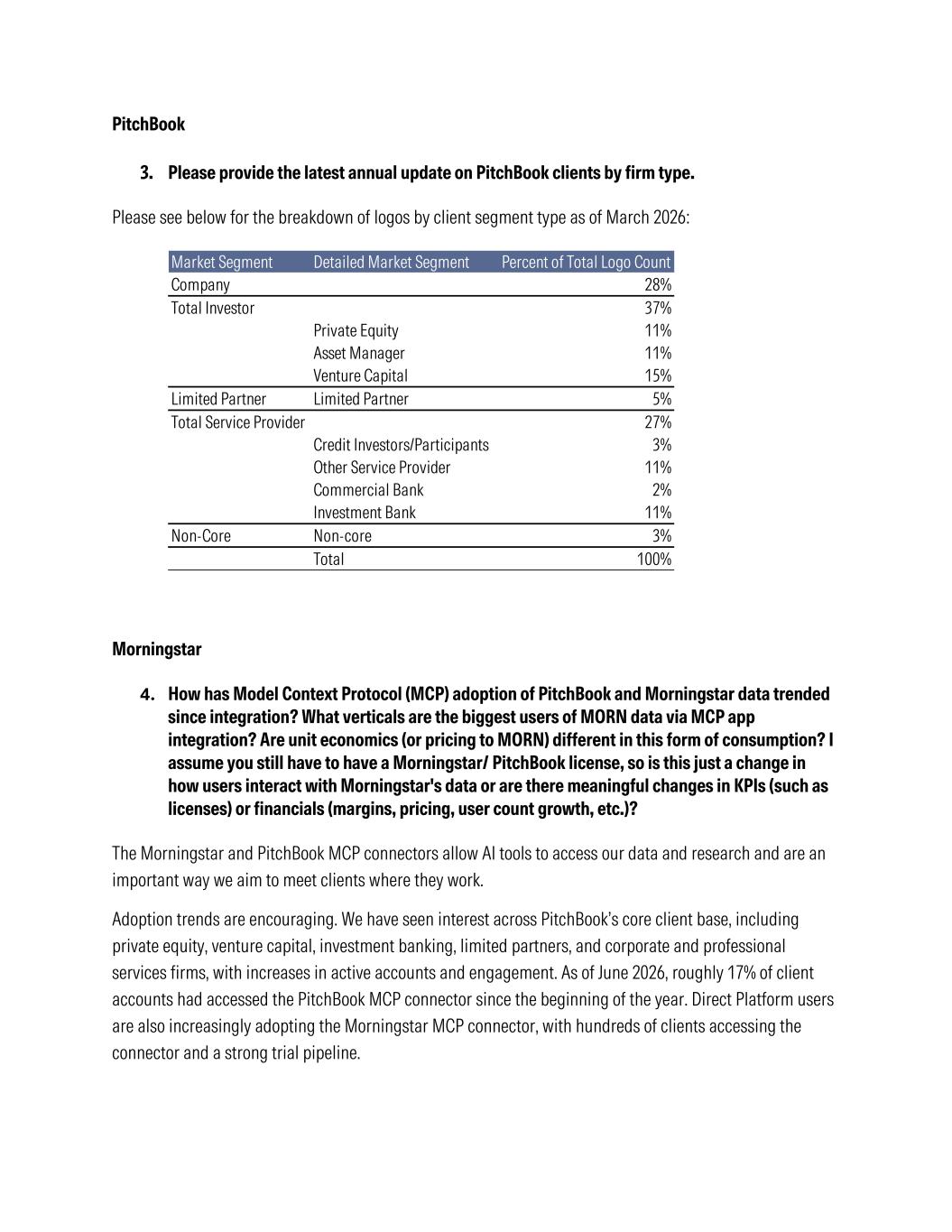
PitchBook 3. Please provide the latest annual update on PitchBook clients by firm type. Please see below for the breakdown of logos by client segment type as of March 2026: Morningstar 4. How has Model Context Protocol (MCP) adoption of PitchBook and Morningstar data trended since integration? What verticals are the biggest users of MORN data via MCP app integration? Are unit economics (or pricing to MORN) different in this form of consumption? I assume you still have to have a Morningstar/ PitchBook license, so is this just a change in how users interact with Morningstar's data or are there meaningful changes in KPIs (such as licenses) or financials (margins, pricing, user count growth, etc.)? The Morningstar and PitchBook MCP connectors allow AI tools to access our data and research and are an important way we aim to meet clients where they work. Adoption trends are encouraging. We have seen interest across PitchBook’s core client base, including private equity, venture capital, investment banking, limited partners, and corporate and professional services firms, with increases in active accounts and engagement. As of June 2026, roughly 17% of client accounts had accessed the PitchBook MCP connector since the beginning of the year. Direct Platform users are also increasingly adopting the Morningstar MCP connector, with hundreds of clients accessing the connector and a strong trial pipeline. Market Segment Detailed Market Segment Percent of Total Logo Count Company 28% Total Investor 37% Private Equity 11% Asset Manager 11% Venture Capital 15% Limited Partner Limited Partner 5% Total Service Provider 27% Credit Investors/Participants 3% Other Service Provider 11% Commercial Bank 2% Investment Bank 11% Non-Core Non-core 3% Total 100%

Access to Direct Platform data via the Morningstar MCP connector requires a license; the connector serves Morningstar Direct and Direct Advisory Suite licensed users and is also licensed on a standalone basis for data and research clients. The PitchBook Premium MCP connector, which provides access to the vast majority of data and research on the PitchBook platform, requires a PitchBook license. PitchBook’s Essential MCP connector offers limited data to users without a license, with the large language model or enterprise partner compensating PitchBook on behalf of its users. This approach allows us to expand reach and awareness while still maintaining a subscription model for premium PitchBook content. We are working with our clients on pricing models that reflect the value delivered from our data and research and the scope of our enterprise relationships. We track core KPIs including licensed users and net revenue renewal rates, although some of these metrics may become less meaningful as models evolve and as we move toward more firmwide, value-based pricing structures. Specific to the MCP connectors, we are also tracking engagement with metrics including monthly tool calls to the connectors on a total and per user basis. Overall, we believe the MCP connectors have the potential to serve as a strategically important distribution channel, extending our data and research into AI workflows and complementing our existing products and client relationships.