| Sincerely, | ||

|
||
Michael J. Grebe Chairman and Chief Executive Officer |
Use these links to rapidly review the document
TABLE OF CONTENTS
UNITED STATES
SECURITIES AND EXCHANGE COMMISSION
Washington, D.C. 20549
SCHEDULE 14A
Proxy Statement Pursuant to Section 14(a) of
the Securities Exchange Act of 1934 (Amendment No. )
| Filed by the Registrant ý | ||
Filed by a Party other than the Registrant o |
||
Check the appropriate box: |
||
o |
Preliminary Proxy Statement |
|
o |
Confidential, for Use of the Commission Only (as permitted by Rule 14a-6(e)(2)) |
|
ý |
Definitive Proxy Statement |
|
o |
Definitive Additional Materials |
|
o |
Soliciting Material Pursuant to §240.14a-12 |
|
| Interline Brands, Inc. | ||||
|
(Name of Registrant as Specified In Its Charter) |
||||
|
(Name of Person(s) Filing Proxy Statement, if other than the Registrant) |
||||
Payment of Filing Fee (Check the appropriate box): |
||||
ý |
No fee required. |
|||
o |
Fee computed on table below per Exchange Act Rules 14a-6(i)(1) and 0-11. |
|||
(1) |
Title of each class of securities to which transaction applies: |
|||
| (2) | Aggregate number of securities to which transaction applies: |
|||
| (3) | Per unit price or other underlying value of transaction computed pursuant to Exchange Act Rule 0-11 (set forth the amount on which the filing fee is calculated and state how it was determined): |
|||
| (4) | Proposed maximum aggregate value of transaction: |
|||
| (5) | Total fee paid: |
|||
o |
Fee paid previously with preliminary materials. |
|||
o |
Check box if any part of the fee is offset as provided by Exchange Act Rule 0-11(a)(2) and identify the filing for which the offsetting fee was paid previously. Identify the previous filing by registration statement number, or the Form or Schedule and the date of its filing. |
|||
(1) |
Amount Previously Paid: |
|||
| (2) | Form, Schedule or Registration Statement No.: |
|||
| (3) | Filing Party: |
|||
| (4) | Date Filed: |
|||
Interline Brands, Inc.
701 San Marco Boulevard
Jacksonville, Florida 32207
(904) 421-1400
March 23, 2012
Dear Shareholder:
On behalf of the Board of Directors of Interline Brands, Inc., I am pleased to invite you to the 2012 Annual Meeting of Shareholders. The Annual Meeting will be held at 9:00 a.m., Eastern Time, on Thursday, May 10, 2012, at The Hyatt Regency Jacksonville Riverfront, 225 East Coastline Drive, Jacksonville, Florida 32202.
Detailed information concerning Interline Brands, Inc.'s activities and operations during fiscal year 2011 is contained in our Annual Report, which is enclosed.
Whether or not you attend the Annual Meeting, it is important that your shares be represented and voted at the Annual Meeting. I encourage you to grant your proxy so that your shares will be represented at the Annual Meeting. Information on how you may vote your shares appears in the Proxy Statement. Your shares cannot be voted unless you grant your proxy or attend the Annual Meeting in person.
The Board of Directors and management look forward to seeing you at the Annual Meeting.
| Sincerely, | ||
|
|
||
Michael J. Grebe Chairman and Chief Executive Officer |

701 San Marco Boulevard
Jacksonville, FL 32207
(904) 421-1400
NOTICE OF 2012 ANNUAL MEETING OF SHAREHOLDERS
Dear Shareholder:
You are cordially invited to the 2012 Annual Meeting of Shareholders of Interline Brands, Inc., a Delaware corporation (the "Company"). The meeting will be held at The Hyatt Regency Jacksonville Riverfront, 225 East Coastline Drive, Jacksonville, Florida 32202, on Thursday, May 10, 2012, at 9:00 a.m. Eastern Time, for the purposes of voting on the following matters:
If you were a shareholder of record at the close of business on March 12, 2012, you are entitled to vote at the meeting. A list of shareholders as of the record date will be available for examination at the meeting.
Whether or not you expect to attend the Annual Meeting in person, I encourage you to grant your proxy. Shareholders may grant a proxy over the Internet, the telephone or the mail by following the instructions in the Proxy Statement. Granting a proxy will not deprive you of the right to attend the Annual Meeting or to vote your shares in person.
| By Order of the Board of Directors | ||
|
||
Michael Agliata Vice President, General Counsel & Secretary |
The Company's Annual Report for the fiscal year ended December 30, 2011 accompanies this notice but is not incorporated as part of the enclosed Proxy Statement and should not be considered part of the proxy solicitation materials.
i
INTERLINE BRANDS, INC.
PROXY STATEMENT
INFORMATION CONCERNING VOTING AND SOLICITATION
This Proxy Statement is being furnished to you in connection with the solicitation by the Board of Directors of Interline Brands, Inc., a Delaware corporation ("Interline" or the "Company"), of proxies to be used at the 2012 Annual Meeting of Shareholders to be held at The Hyatt Regency Jacksonville Riverfront, 225 East Coastline Drive, Jacksonville, Florida 32202, at 9:00 a.m., Eastern Time, on Thursday, May 10, 2012, and any adjournments or postponements thereof.
Distribution and Electronic Availability of Proxy Materials
As permitted by the Securities and Exchange Commission (the "SEC") rules, we are furnishing proxy materials to shareholders via the Internet. If you received a Notice of Internet Availability of Proxy Materials (the "Notice") by mail, you will not receive a printed copy of the proxy materials, unless you specifically request one. The Notice instructs you on how to access and review all of the important information contained in the Proxy Statement and Annual Report as well as how to submit your proxy over the Internet. If you received the Notice and would still like to receive a printed copy of our proxy materials, you should follow the instructions for requesting these materials included in the Notice.
We plan to mail the Notice to our shareholders on or about March 23, 2012. We will continue to mail a printed copy of this Proxy Statement and the accompanying form of proxy card to certain of our shareholders, and we expect that mailing will also begin on or about March 23, 2012.
We first made available the proxy solicitation materials at www.proxyvote.com on or around March 23, 2012 to all of our shareholders entitled to vote at the Annual Meeting. You may also request a printed copy of the proxy solicitation materials by any of the following methods: via Internet at www.proxyvote.com; by telephone at 1-800-579-1639; or by sending an e-mail to sendmaterial@proxyvote.com. Our 2011 Annual Report was made available at the same time and by the same methods.
Appointment of Proxy Holders
Your Board of Directors (the "Board") asks you to appoint Michael Agliata, Vice President, General Counsel and Secretary, and David C. Serrano, Chief Accounting Officer, as your proxy holders to vote your shares at the 2012 Annual Meeting of Shareholders. You make this appointment by voting the enclosed proxy card using one of the voting methods described below.
If appointed by you, the proxy holders will vote your shares as you direct on the matters described in this Proxy Statement. In the absence of your direction, they will vote your shares as recommended by your Board.
Unless you otherwise indicate on the proxy card, you also authorize your proxy holders to vote your shares on any matters not known by your Board at the time this Proxy Statement was printed and which, under our Bylaws, may be properly presented for action at the Annual Meeting.
Who Can Vote
Only shareholders who owned shares of our common stock at the close of business on March 12, 2012, the record date for the Annual Meeting, can vote at the Annual Meeting. As of the close of business on March 12, 2012, we had 31,823,789 shares of common stock outstanding and entitled to vote. Each holder
1
of common stock is entitled to one vote for each share held as of March 12, 2012. There is no cumulative voting in the election of directors.
How You Can Vote
You may vote your shares at the Annual Meeting either in person, by Internet, by telephone or by mail as described below.
Voting by Internet. Go to www.proxyvote.com 24 hours a day, 7 days a week until 11:59 p.m., Eastern Time, the day before the Annual Meeting. Have your Notice or proxy card in hand when you access the website and follow the instructions to obtain your records and to create an electronic voting instruction form.
Voting by Telephone. On a touch-tone telephone, call toll free 1-800-690-6903, 24 hours a day, 7 days a week until 11:59 p.m., Eastern Time, the day before the Annual Meeting. Have your Notice or proxy card in hand when you call and then follow the instructions.
Voting by Mail. Mark your selections on the proxy card, date, and sign your name exactly as it appears on the card, then mail it in the enclosed postage-paid envelope. You should mail the proxy card in plenty of time to allow delivery prior to the Annual Meeting. Do not mail the proxy card if you are voting by Internet or by telephone.
Voting at the Annual Meeting. Voting by Internet, by telephone or by mail will not limit your right to vote at the Annual Meeting, if you decide to attend in person. Your Board recommends that you vote by Internet, by telephone or by mail, as it is not practical for most shareholders to attend the Annual Meeting and you can revoke your proxy if you decide to attend and vote in person at the Annual Meeting. If you hold shares through a bank or broker, you must obtain a proxy, executed in your favor, from the bank or broker to be able to vote at the Annual Meeting.
If you submit your proxy, but do not mark your voting preference, the proxy holders will vote your shares: (i) FOR the election of the nominees for Class II directors; (ii) FOR the approval of the compensation for our named executive officers as presented in the Compensation Discussion and Analysis, the compensation tables, and the related disclosures contained in the accompanying proxy statement on a non-binding, advisory basis; (iii) FOR the approval of our 2012 Executive Cash Incentive Plan; and (iv) FOR the ratification of the appointment of Deloitte & Touche LLP as the independent registered public accounting firm for the Company.
Revocation of Proxies
Shareholders can revoke their proxies at any time before they are exercised in any of three ways:
Required Vote; Effect of Broker Non-Votes and Abstentions
Shares held in "street name" by a broker
If you are the beneficial owner of shares held in "street name" by a broker, then your broker, as the record holder of the shares, must vote those shares in accordance with your instructions. If you fail to provide instructions to your broker then, under New York Stock Exchange ("NYSE") rules, your broker will not be authorized to exercise its discretion and vote your shares on "non-routine" proposals, including
2
the election of directors. As a result, a "broker non-vote" occurs. Accordingly, without your instructions, your broker would have discretionary authority to vote your shares only with respect to Proposal 3, ratification of the appointment of independent registered public accountants.
Quorum
A quorum, which is a majority of the outstanding shares as of March 12, 2012, must be present to hold the Annual Meeting. A quorum is calculated based on the number of shares represented by the shareholders attending in person and by their proxy holders. If you indicate an abstention as your voting preference, your shares will be counted toward a quorum but they will not be voted on the matter. Similarly, broker non-votes will be treated as shares present and entitled to vote for purposes of determining the presence of a quorum, but not as shares present and voting on "non-routine" proposals.
Proposal 1: Election of directors
Directors are elected by an affirmative vote of a plurality of shares present in person or represented by proxy and entitled to vote. For purposes of the vote on Proposal 1, abstentions will have no effect on the results of the vote.
Proposal 2: Approval of executive compensation on a non-binding, advisory basis
A non-binding, advisory vote to approve the compensation for our named executive officers as presented in the Compensation Discussion and Analysis, the compensation tables, and the related disclosures contained in the accompanying proxy statement will be made through an affirmative vote of a majority of shares present in person or represented by proxy and entitled to vote. For purposes of the vote on Proposal 2, abstentions will have no effect on the results of the vote.
Proposal 3: Approve the 2012 Executive Cash Incentive Plan of the Company
A vote to approve the 2012 Executive Cash Incentive Plan of the Company will be made through an affirmative vote of a majority vote of shares present in person or represented by proxy and entitled to vote. For purposes of the vote on Proposal 3, abstentions will have no effect on the results of the vote.
Proposal 4: Ratification of appointment of independent registered public accountants
The appointment of our independent registered public accountants is ratified by an affirmative vote of a majority of shares present in person or represented by proxy and entitled to vote. For purposes of the vote on Proposal 4, abstentions will not be counted as votes cast or votes entitled to be cast on the item and will have no effect on the results of the vote.
Solicitation of Proxies
Interline will pay the cost of printing and mailing management proxy materials. We will reimburse brokerage firms and others for their reasonable expenses in forwarding solicitation materials to beneficial owners of our common stock.
Important
Please promptly vote and grant your proxy over the Internet, the telephone or the mail by following the instructions on your Notice or proxy card. This will not limit your rights to attend or vote at the Annual Meeting.
All meeting attendees may be asked to present a valid, government-issued photo identification (federal, state or local), such as a driver's license or passport, and proof of beneficial ownership if you hold your shares through a broker, bank or other nominee, before entering the meeting. Attendees may be subject to security inspections. Video and audio recording devices and other electronic devices will not be permitted at the meeting.
3
OUR BOARD OF DIRECTORS AND EXECUTIVE OFFICERS
The table below sets forth information regarding the directors and executive officers of Interline.
| Name | Age | Position | |||
|---|---|---|---|---|---|
| Michael J. Grebe | 54 | Chairman of the Board and Chief Executive Officer | |||
| Kenneth D. Sweder | 42 | President and Chief Operating Officer | |||
| John A. Ebner | 43 | Chief Financial Officer | |||
| John M. McDonald | 56 | Senior Vice President, Sales | |||
| Lucretia D. Doblado | 48 | Chief Information Officer | |||
| James A. Spahn | 57 | Vice President, Distribution | |||
| Michael Agliata | 38 | Vice President, General Counsel and Secretary | |||
| David C. Serrano | 48 | Chief Accounting Officer and Corporate Controller | |||
| Gideon Argov | 55 | Director | |||
| Michael E. DeDomenico | 64 | Director | |||
| John J. Gavin | 55 | Director | |||
| Barry J. Goldstein | 69 | Director | |||
| Randolph W. Melville | 53 | Director | |||
| Charles W. Santoro | 52 | Director | |||
| Drew T. Sawyer | 44 | Director | |||
| David G. Zanca | 54 | Director | |||
Our Board of Directors
We strive to maintain a skills-based Board comprised of directors whose experience, expertise and competencies add significant value to the Company and its shareholders. We have set forth below information regarding the specific experience, qualifications, attributes and skills that demonstrate the qualities and value each of our directors adds to our Board and led to the conclusion that each director should serve on our Board. In addition, we believe that all of our directors have a reputation for integrity, honesty, and adherence to high ethical standards. They each have demonstrated business acumen and an ability to exercise sound judgment, as well as commitment of service to the Company, our Board and our shareholders. We also value their significant experience serving on other public and private boards of directors and board committees.
Director Backgrounds and Qualifications
Michael J. Grebe has served as Chairman of the Board of Directors and Chief Executive Officer of Interline and Interline Brands, Inc., a New Jersey corporation and our principal operating subsidiary ("Interline New Jersey"), since January 2007, as Chief Executive Officer and a director of Interline since June 2004, and as a director of Interline New Jersey since May 2000. Mr. Grebe has also previously served as President of Interline and Interline New Jersey and as Chief Operating Officer of Interline New Jersey. Prior to joining Interline, Mr. Grebe served as a Group Vice President of Airgas, Inc. ("Airgas") a distributor of industrial gases, from 1997 to 1998. Mr. Grebe joined Airgas following its acquisition of IPCO Safety, Inc., a national distributor of industrial safety supplies, of which he served as President from 1991 to 1996. As the CEO, Mr. Grebe is the only officer to sit on the Boards of Directors of Interline and Interline New Jersey, consistent with past practice. Mr. Grebe's qualifications to serve on our Board include his more than 20 years of experience serving in senior level leadership positions in distribution companies, and his more than 10 years of experience serving as CEO, President and/or COO of Interline New Jersey.
Gideon Argov has served as a director of Interline since June 2004 and as a director of Interline New Jersey since August 2001. Mr. Argov is currently the President and Chief Executive Officer of Entegris, Inc., a producer of components and materials used in semiconductor and other high-tech
4
manufacturing. From 2001 to November 2004, he was a Managing Director of Parthenon Capital. Prior to joining Parthenon Capital, Mr. Argov served as Chairman, President and CEO of Kollmorgen Corporation from 1991 to 2000. Mr. Argov also currently serves on the boards of directors of Entegris, Inc. and X-Rite, Inc. During the last five years, Mr. Argov has also served on the board of directors of Fundtech Ltd. Mr. Argov's qualifications to sit on our Board include his experience as the CEO of other publicly traded companies and his more than 20 years of experience serving on the boards of other public companies, including on compensation, audit and governance committees. Mr. Argov also brings with him substantial experience in the areas of international business, product sourcing and operations.
Michael E. DeDomenico has served as a director of Interline and Interline New Jersey since August 2005. Mr. DeDomenico is currently the Chairman and Chief Executive Officer of NuCO2 Inc., a national distributor of beverage gases and services. Prior to joining NuCO2, Mr. DeDomenico was, from 1998 to July 2000, President and Chief Executive Officer of Praxair Distribution, Inc., a subsidiary of Praxair Inc. Mr. DeDomenico had been employed by Union Carbide Corp. in various capacities since 1969 and when Praxair was spun off by Union Carbide in 1992, he was named President of Praxair Canada. The following year he was appointed President of Praxair Europe and in March 1998 was named President and Chief Executive Officer of Praxair Distribution. We believe Mr. DeDomenico's qualifications to serve on our Board include his experience as the CEO of another successful distribution company. Through his position as CEO of NuCO2, Mr. DeDomenico has specific experience with issues relating to distribution of consumer products on a national platform in a highly competitive market segment. Mr. DeDomenico also has substantial experience in the areas of international business and operations.
John J. Gavin has served as the Lead Independent Director of Interline and Interline New Jersey since March 2007 and as a director of Interline and Interline New Jersey since June 2004. Mr. Gavin currently serves as an Operating Partner of LLR Partners, a private equity firm based in Philadelphia, Pennsylvania. Mr. Gavin previously served as the Chief Executive Officer of DBM, Inc., a global human resources consulting firm. Prior to that, Mr. Gavin served as a director, President and Chief Operating Officer of Right Management Consultants from January 1999 to January 2004, and as Executive Vice President of Right Management Consultants from December 1996 through December 1998. Prior to joining Right Management Consultants, Mr. Gavin was with Andersen Worldwide from 1978 through 1996, where he was named a Partner in 1990. Mr. Gavin currently serves on the boards of directors for Dollar Financial Corp. and CSS Industries, Inc. Mr. Gavin's qualifications to sit on our Board include his prior experience as the CEO of an international human resources company, his service on other public and private company boards, his knowledge of distribution operations, his financial expertise, his more than 18 years' experience as a CPA with a Big 6 accounting firm, and his experience with mergers and acquisitions.
Barry J. Goldstein has served as a director of Interline since June 2004 and as a director of Interline New Jersey since April 2004. In October 2000, Mr. Goldstein retired as Executive Vice President and Chief Financial Officer of Office Depot, Inc., which he joined as Chief Financial Officer in May 1987. Mr. Goldstein was with Grant Thornton from 1969 through May 1987, where he was named a Partner in 1976. Mr. Goldstein currently serves on the boards of directors of Kraton Performance Polymers, Inc. and Generac Holdings, Inc. Mr. Goldstein's qualifications to sit on our Board include his substantial experience in the areas of international business, sourcing, distribution, operations, capital markets, and acquisitions. Mr. Goldstein also brings to our Board a wealth of expertise in financial and audit matters.
Randolph W. Melville has served as a director of Interline and Interline New Jersey since December 2009. Mr. Melville has held multiple senior executive roles with Frito-Lay, Inc. from 1993 to 1999 and 2001 to the present, including his current role as Senior Vice President, Frito-Lay North America Sales. From 1999 to 2001, Mr. Melville served as a Senior Vice President at Maytag Corporation. Mr. Melville also held various sales and marketing leadership positions with Procter & Gamble Distributing Company from 1981 to 1993. Mr. Melville brings significant national sales, marketing and operations experience to our Board. His position as the senior sales executive of Frito-Lay's North
5
American sales division provides the Board with additional skill-sets that add substantial value to the Board, our management and our shareholders. Mr. Melville also has substantial expertise in the areas of distribution, international business and human resources, all of which add additional value to our Board.
Charles W. Santoro has served as a director of Interline since June 2004 and as a director of Interline New Jersey since May 2000. Mr. Santoro is a co-founder and Managing Partner of Sterling Investment Partners, L.P. and Sterling Investment Partners II, L.P. Before founding Sterling Investment Partners in December 1999, Mr. Santoro was Vice Chairman, Investment Banking of Paine Webber Group, Inc. from 1995 to May 2000. Prior to joining Paine Webber in 1995, Mr. Santoro was a Managing Director of Salomon Smith Barney, Inc., in charge of that firm's Multi-Industry and New Business Development Groups. Prior to that, Mr. Santoro was responsible for Smith Barney's cross-border investment banking activities in New York and London. Mr. Santoro began his career at Morgan Stanley in New York and London and was the operations officer of the European Mergers & Acquisitions Department. During the last five years, Mr. Santoro has served on the Board of Directors of Smith Barney International. Mr. Santoro's qualifications to sit on our Board include his substantial experience in the areas of operations, international and domestic business, logistics and distribution, and finance, including capital markets and mergers and acquisitions.
Drew T. Sawyer has served as a director of Interline since June 2004 and as a director of Interline New Jersey since May 2000. Mr. Sawyer is currently the co-founder and Managing Partner of 2SV Capital, LLC, a private equity management company. Mr. Sawyer was a founding member and Partner of the private equity firm Parthenon Capital, LLC from inception in 1998 through 2005. Prior to joining Parthenon Capital, Mr. Sawyer was a Principal at The Parthenon Group, a management consulting firm, from 1995 to 1998. During the last five years, Mr. Sawyer has served at different times on the boards of directors of Apache Industrial Services, Inc., Restaurant Technologies, Inc. and Atkins Nutritionals, Inc. Mr. Sawyer's qualifications to sit on our Board include his substantial experience in the areas of distribution, operations, capital markets, mergers and acquisitions, and finance.
David G. Zanca has served as a director of Interline and Interline New Jersey since September 2011. Mr. Zanca currently serves as the Senior Vice President, Customer Access and Revenue Systems for FedEx Corporation, where he is responsible for developing architectures and solutions for the FedEx eCommerce, Revenue, Customer Service, Pricing and FedEx Office channels. Mr. Zanca previously held various other senior leadership roles with FedEx, where his responsibilities included information technology oversight and development involving freight, customer systems, shipping solutions, web-based applications, sales and pricing solutions, and information security, among other areas. Mr. Zanca's position as an Information Technology executive of a multinational shipping corporation with significant eCommerce and technology capabilities provides the Board with additional skill-sets that add substantial value to the Board, our management and our shareholders.
Executive Officer Backgrounds
Kenneth D. Sweder has served as President of Interline and Interline New Jersey since February 2011, as Chief Operating Officer of Interline and Interline New Jersey since October 2008, and as Chief Merchandising Officer of Interline and Interline New Jersey since April 2007. Prior to joining Interline, Mr. Sweder was the First Vice President of Property Operations Strategy at Equity Residential Properties from June 2004 to April 2007, a management consultant at Bain & Company from June 2000 to May 2004, and in various positions within the National Corporate Banking division of PNC Bank from July 1991 to May 2000, most recently as Vice President.
John A. Ebner has served as Chief Financial Officer of Interline and Interline New Jersey since January 2010, and previously served as Treasurer of Interline and Interline New Jersey from January 2010 to May 2010. Prior to joining Interline, Mr. Ebner worked for 13 years with Alltel Corporation where he served in various senior leadership roles including Treasurer, Senior Vice President of Investor Relations,
6
Vice President of Finance – Wireless Operations, Vice President – Industry Relations, and Vice President – Pricing and Product Management. Mr. Ebner served as an investment banker with JP Morgan from 1995 to 1996.
John M. McDonald has served as Senior Vice President, Sales of Interline and Interline New Jersey since June 2011. Prior to joining Interline and Interline New Jersey, Mr. McDonald spent 3 years with Service Brands International, where he served as President and Chief Operating Officer, from June 2008 to June 2011. From 2002 to 2007, Mr. McDonald was Senior Vice President of Sales and Executive Vice President of Sales and Marketing (Commercial Document Solutions) for Kinkos and Fedex Kinkos. Prior to that, from 2000 to 2002, Mr. McDonald was Vice President of Sales for Manpower Corporation. Mr. McDonald also spent 19 years with Moore Corporation, where he held various leadership positions, including Vice President of North American Sales from 1998 to 2000.
Lucretia D. Doblado has served as Chief Information Officer of Interline and Interline New Jersey since October 2006. Prior to joining Interline, Ms. Doblado served as the Senior Vice President and Chief Information Officer of The Bombay Company, Inc. from October 2003 to September 2006 and a Partner at Accenture, a premier consulting and business integration firm, from 1986 to 2002, where she assisted clients for 17 years building information technology solutions for Fortune 500 and international companies.
James A. Spahn has served as Vice President, Distribution of Interline and Interline New Jersey since 2002. Mr. Spahn previously served as General Manager and Regional Vice President of Sales of our Detroit distribution center from July 1999 to November 2002. Prior to joining Interline, Mr. Spahn served as the Director of Sales from 1996 to 1999 with The Crown Group (automotive) and as the Director of Operations and Vice President of Sales from 1989 to 1996 with Thermofil, Inc. Mr. Spahn also worked for the DuPont Company from 1976 to 1989, during which time he held various positions in the areas of sales, operations, technical service and personnel.
Michael Agliata has served as Vice President, General Counsel and Secretary of Interline and Interline New Jersey since March 2009. Mr. Agliata previously served as Corporate Counsel for Interline and Interline New Jersey from July 2007 to March 2009 and as Assistant Secretary from March 2008 to March 2009. Prior to joining Interline, Mr. Agliata was a practicing attorney in the Jacksonville, Florida office of Holland & Knight LLP from April 2004 to April 2007 and in the Miami and Fort Lauderdale offices of Fowler White Burnett, P.A. from July 1999 through April 2004.
David C. Serrano has served as Chief Accounting Officer of Interline and Interline New Jersey since May 2010 and as Corporate Controller of Interline and Interline New Jersey since August 2001. Mr. Serrano previously served as Vice President of Finance of Interline and Interline New Jersey from September 2005 to May 2010, and as Divisional Controller of Interline New Jersey from September 2000 to August 2001. Prior to joining Interline, Mr. Serrano served as Corporate Controller of Barnett, Inc., one of our corporate predecessors, from 1990 to 2000, and as Assistant Controller of U.S. Lock Corporation, another one of our predecessor companies, from 1988 to 1990.
There are no family relationships among any of our directors or executive officers.
7
PROPOSAL 1
ELECTION OF DIRECTORS
Board Structure
Our Board of Directors currently includes nine directors divided into three separate classes, designated as Class I, Class II and Class III, with the directors in each class serving staggered three-year terms. Each class should consist, as nearly as possible, of one-third of the directors constituting the entire board. At present, Michael E. DeDomenico, John J. Gavin and David G. Zanca are serving as Class I directors; Barry J. Goldstein, Charles W. Santoro and Drew T. Sawyer are serving as Class II directors; and Michael J. Grebe, Gideon Argov and Randolph W. Melville are serving as Class III directors. At the 2012 Annual Shareholders' Meeting, the term of office of the Class II directors will expire and new Class II directors will be elected for a full term of three years. At the 2013 Annual Shareholders' Meeting, the term of office of the Class III directors will expire and new Class III directors will be elected for a full term of three years. At the 2014 Annual Shareholders' Meeting, the term of office of the Class I directors will expire and new Class I directors will be elected for a full term of three years.
The Nominees
The Nominating & Governance Committee of the Board of Directors has nominated, and the Board of Directors has designated, the two persons listed below for election as Class II directors at the Annual Meeting. The proxies given to the proxy holders will be voted or not voted as directed and, if no direction is given, will be voted FOR these two nominees. Your Board of Directors knows of no reason why either of these nominees should be unable or unwilling to serve. However, if for any reason any nominee should be unable or unwilling to serve, the proxies will be voted for any nominee designated by your Board of Directors to fill the vacancy.
Following discussions between the Board and Mr. Santoro, and in light of his desire to focus more on his other professional endeavors, the Company has agreed not to renominate Mr. Santoro for reelection at the Annual Meeting. Mr. Santoro will continue to serve as a director and member of our Compensation Committee until his term expires at the conclusion of the 2012 Annual Meeting. The Company and our Board would like to express our deepest gratitude to Mr. Santoro for his more than 10 years of dedicated service to Interline Brands and our shareholders.
General Information About Nominees
The age and board committee position with Interline, if any, of each nominee appears below. Ages are as of March 12, 2012. Information regarding the business experience during at least the last 10 years and directorships of other publicly owned corporations of each director during at least the last five years, as applicable, can be found above under "Our Board of Directors and Executive Officers."
Name
|
Age | Position | ||
|---|---|---|---|---|
Barry J. Goldstein |
69 | Chair of the Audit Committee | ||
Drew T. Sawyer |
44 | Audit Committee Member |
Vote Required
An affirmative vote of the plurality of shares present in person or represented by proxy and entitled to vote will elect the two nominees as Class II directors for the specified three-year term. Unless marked to the contrary, proxies received will be voted FOR the nominees.
Your Board of Directors recommends a vote FOR the election of the nominees set forth above as Class II directors of Interline.
8
Meeting Attendance
Our Directors are expected to attend all Board meetings and meetings of committees on which they serve. Directors are also expected to spend the time they need and meet as frequently as necessary to discharge their responsibilities properly. The Chairman of the Board presides at all meetings of the Board, not including meetings of the non-employee Directors. In the absence of the Chairman of the Board, the Lead Independent Director or in the absence of the Lead Independent Director, a Director chosen by a majority of the Directors present, will preside at the meeting. The Lead Independent Director presides at all meetings of the non-employee Directors. In the absence of the Lead Independent Director, a Director chosen by the majority of members present will preside at the meeting. Overall, from January 1, 2011 through December 30, 2011, our Board met nine times. All of our Directors attended at least 75% of the regular meetings of the Board and at least 75% of all meetings of committees on which they served in 2011. A total of seven Directors attended our 2011 Annual Meeting of Shareholders.
Committees
Our Board of Directors currently has three standing committees: the Audit Committee, the Nominating & Governance Committee and the Compensation Committee.
The primary purposes of the Audit Committee are to assist the Board in monitoring the integrity of our financial statements, the qualifications and independence of our independent registered public accounting firm, the performance of our audit function and independent registered public accounting firm, and our compliance with legal and regulatory requirements. The Audit Committee also assists the Board in monitoring various controls implemented by the Company to address and reduce financial and legal risks. Messrs. Gavin, Goldstein and Sawyer are currently serving on the Audit Committee. Mr. Goldstein serves as Chairman of the Audit Committee and also qualifies as an independent "audit committee financial expert," as such term has been defined by the SEC in Item 407(d)(5)(ii) of Regulation S-K. The Audit Committee of the Company met 8 times between January 1, 2011 and December 30, 2011. A copy of the charter adopted by the Board of Directors for the Audit Committee can be found on our website at www.interlinebrands.com and is available in print to any shareholder who requests it.
The Nominating & Governance Committee has the authority to identify individuals qualified to become board members and to select, or to recommend that the Board select, the director nominees for the next annual meeting of shareholders; develop and recommend to the Board a set of corporate governance principles applicable to the Company; oversee the evaluation of the Board and management; and annually evaluate its performance. The Nominating & Governance Committee currently consists of Messrs. Argov, Gavin and Zanca. Mr. Gavin serves as Chairman of the Nominating & Governance Committee. The Nominating & Governance Committee of the Company met 3 times between January 1, 2011 and December 30, 2011. A copy of the charter adopted by the Board of Directors for the Nominating & Governance Committee can be found on our website at www.interlinebrands.com and is available in print to any shareholder who requests it.
The Compensation Committee has the authority to approve salaries and bonuses and other compensation matters for our executive officers. In addition, the Compensation Committee has the authority to approve employee benefit plans as well as administer our 2000 Stock Award Plan and 2004 Amended and Restated Equity Incentive Plan ("2004 Equity Incentive Plan"). The Compensation Committee currently consists of Messrs. Argov, DeDomenico, Melville and Santoro. Mr. Argov serves as Chairman of the Compensation Committee. The Compensation Committee of the Company met 4 times between January 1, 2011 and December 30, 2011. A copy of the charter adopted by the Board of Directors for the Compensation Committee can be found on our website at www.interlinebrands.com and is available in print to any shareholder who requests it.
We believe that all members of the Audit, the Nominating & Governance and the Compensation Committees meet the independence standards of the NYSE and SEC rules and regulations.
9
Compensation Committee Interlocks and Insider Participation
None of our executive officers serves as a member of the Board of Directors or Compensation Committee of any entity that has one or more executive officers who serve on our Board of Directors or Compensation Committee.
Independence of Board Members
Our Board reviews each Director's independence at least annually in accordance with the standards set forth in our Corporate Governance Guidelines and the requirements of the NYSE. No member of our Board will be considered independent unless the Nominating & Governance Committee determines that the Director has no material relationship with us that would affect the Director's independence and the Director satisfies the independence requirements of all applicable laws, rules and regulations. To facilitate the analysis of whether a Director has a relationship with us that could affect his or her independence, in our Corporate Governance Guidelines we have identified the following categories of relationships which should not affect a Director's independence and therefore are deemed immaterial:
The following relationships, amongst others, will be considered material relationships that would impair a Director's independence, absent a determination by the Board to the contrary:
Business relationships, other than those enumerated above, between the Company and an entity for which the Director or an immediate family member serves as an officer or general partner or of which the Director or an immediate family member is the owner of more than five percent of the outstanding equity interests will be evaluated by reference to the following criteria:
Our Board reviewed director independence based on an application of these categorical standards and has determined that each of our Directors, other than Michael J. Grebe, our Chairman and Chief
10
Executive Officer, is an "independent director" in accordance with the corporate governance rules of the NYSE.
Communications with the Board
Shareholders and other interested parties may communicate with the Board of Directors, including non-employee Directors, by submitting such communications in writing to the following address: Board of Directors, Interline Brands, Inc., c/o Vice President, General Counsel & Secretary, 701 San Marco Boulevard, 18th Floor, Jacksonville, Florida 32207. Such communications will be delivered directly to the Board or the appropriate member or members of the Board.
Executive Sessions of Non-employee Directors
To promote open discussion among the non-employee Directors, and in accordance with NYSE corporate governance requirements, the Board schedules regular executive sessions (at least quarterly) in which those Directors meet without management participation. Effective March 1, 2007, the Board elected Mr. Gavin as Lead Independent Director to preside over executive sessions. In the absence of the Lead Independent Director, a Director chosen by the majority of members present at the session will preside over the executive session.
Corporate Governance Guidelines
Our Board and management have a strong commitment to effective corporate governance. The Company has adopted a comprehensive corporate governance framework for its operations (the "Corporate Governance Guidelines"), and periodically reviews and updates its Corporate Governance Guidelines in light of then-current best governance practices. The key items addressed by the Corporate Governance Guidelines are:
A copy of the Corporate Governance Guidelines is available on the Company's website at www.interlinebrands.com and is available in print to any shareholder who requests it.
Code of Conduct and Ethics
Our Board and management also have a strong commitment to ethical conduct and business practices. The Company has adopted a Code of Conduct and Ethics (the "Code"), which applies to all of the Company's Directors, officers (including its Chief Executive Officer, Chief Financial Officer, Controller and any person(s) performing similar functions) and employees. The Code is periodically reviewed and updated to remain current with applicable legal requirements and best practices. The Code is posted on our website at www.interlinebrands.com and is available in print to any shareholder who requests it.
Board Leadership Structure
Michael J. Grebe serves as both our Chairman of the Board and Chief Executive Officer ("CEO"). The independent Board members have determined that the most effective Board leadership structure for Interline at the present time is for the CEO to also serve as Chairman of the Board, a structure that has served Interline well for several years. In Mr. Grebe's role as CEO, he has primary responsibility for the day-to-day operations of the Company and for executing the Company's strategy. In Mr. Grebe's role as
11
Chairman of the Board, he sets the strategic priorities of the Board (with input from the Lead Independent Director), presides over its meetings and communicates its strategic findings and guidance to management. The Board believes that the combination of these two roles provides more consistent communication and coordination throughout the organization, which results in a more effective and efficient implementation of corporate strategy and thereby advances the best interests of all shareholders.
The Board also believes, for the reasons set forth below, that its existing corporate governance practices achieve independent oversight and management accountability:
Board Oversight of Material Risks
The Board of Directors recognizes that, although risk management is primarily the responsibility of our management team, the Board plays a critical role in the oversight of material risks. The Board has identified the Company's material risks and monitors those risks on at least an annual basis. The Board carries out its responsibilities relating to risk oversight by delegating certain specific risk areas to the Board committee whose duties and areas of expertise are best suited to each material risk. For example, material risks relating to the Company's financial reporting and record-keeping practices are overseen by the Audit Committee. Each committee discusses these risks directly with members of the Company's senior management to ensure that appropriate controls are in place and, if necessary, actions are taken to remove or mitigate new or existing material risks. The committees report regularly to the Board on these risks, ensuring full visibility by the Board. The Board and its committees are supported by our General Counsel, who serves as management's principal risk liaison to the Board. We view risk oversight and management as a concerted effort amongst the Board and its committees, our senior management team and our Internal Audit Department. While our General Counsel is the principal management liaison with the Board on risk oversight, our CEO, CFO and Vice President of Internal Audit also play key roles in identifying material risks to our business, communicating those risks to the Board, and assisting the Board in taking timely and appropriate action to address those risks.
Risk and Compensation Policies
The Company's management, at the direction of our Board of Directors and with guidance from the Compensation Committee's independent compensation consultant, Frederic W. Cook & Co., Inc., has reviewed the Company's compensation policies, plans and practices to determine if they create incentives
12
or encourage behavior that is reasonably likely to have a material adverse effect on the Company. In conducting this evaluation, management has reviewed the Company's various compensation plans—including commission plans, incentive and bonus plans, equity award plans, and severance compensation—to evaluate risks and the internal controls the Company has implemented to manage those risks. Such controls include multiple performance metrics, incentive payment caps (such as maximum bonuses), use of corporate-wide financial measures, clawbacks primarily related to equity awards, stock ownership guidelines, and Board and Board Committee oversight and approvals. In completing this evaluation, the Board and management believe that there are no risks created by the Company's compensation policies, plans and practices that create incentives or encourage behavior that is reasonably likely to have a material adverse effect on the Company.
Director Nominations
At present, the Nominating & Governance Committee is responsible for identifying qualified candidates and making recommendations to the Board for nominees for election or re-election to our Board. In identifying director candidates, the Nominating & Governance Committee follows the Board's "Selection Criteria for Board Membership," which is aimed at comprising a skill-based board with diverse personal and professional backgrounds. Accordingly, the Nominating & Governance Committee considers a number of factors in selecting director candidates, including:
In addition, the Board is committed to promoting our core values and maintaining its tradition of inclusion and follows our policy of non-discrimination on the basis of gender, race, religion or national origin when identifying director nominees.
The Nominating & Governance Committee and our Board have the discretion to weigh these factors as appropriate. The importance of these factors may vary from candidate to candidate.
In addition, the Nominating & Governance Committee will consider candidates recommended by our shareholders. Shareholders can submit the name and qualifications of any candidate to our Nominating & Governance Committee, in accordance with the procedures and requirements set forth in our Bylaws, by following the procedures described above under "Communications with the Board". The Nominating & Governance Committee may make such additional inquiries of the candidate or the proposing shareholder as it deems appropriate or necessary to allow the Nominating & Governance Committee to evaluate the shareholder's proposed candidate on the same basis as those candidates referred through directors, members of management or executive search firms. The Nominating & Governance Committee will not consider any candidate who it concludes does not meet its minimum director qualifications described above.
13
Our Directors, other than those who are our employees, receive an annual retainer of $40,000. The Lead Independent Director receives, in addition to the annual retainer, an annual fee of $15,000; the Chair of the Audit Committee receives, in addition to the annual retainer, an annual fee of $15,000; the Chair of the Compensation Committee receives, in addition to the annual retainer, an annual fee of $7,500; and the Chair of the Nominating & Governance Committee receives, in addition to the annual retainer, an annual fee of $6,000. All fees are payable in equal installments on a quarterly basis. At the election of the respective Director, fees are payable in either cash, shares of our common stock or deferred stock units ("DSUs").
Each non-employee Director also receives an annual award of stock options and DSUs with an approximate total award value of $100,000. The stock options, which vest one year after the date of grant, give each non-employee Director the right to purchase shares of our common stock with a fair market value exercise price as of the date of grant. The DSUs are converted to common stock upon the earlier of (i) a change in control and (ii) one year after the Director leaves the Board, thereby effectively serving as a stock ownership guideline.
No additional fees are paid to Directors for attendance at Board or committee meetings. All Director compensation is contingent upon a Director attending a minimum of 75% of our regular meetings each year. Stock options, restricted stock awards, DSUs and shares of common stock are awarded under, and governed by, our 2004 Equity Incentive Plan.
The following table summarizes the fees and other compensation that our non-employee Directors earned for services as members of the Board of Directors or any committee of the Board of Directors during the fiscal year ended December 30, 2011.
| Name | Fees Earned or Paid in Cash |
Stock Awards (1), (2) |
Option Awards (1), (3) |
Total | |||||||||
|---|---|---|---|---|---|---|---|---|---|---|---|---|---|
Gideon Argov |
$ | 47,500 | (4) | $ | 65,003 | $ | 35,004 | $ | 147,507 | ||||
Michael E. DeDomenico |
$ | 40,000 | $ | 65,003 | $ | 35,004 | $ | 140,007 | |||||
John J. Gavin |
$ | 61,000 | $ | 65,003 | $ | 35,004 | $ | 161,007 | |||||
Barry J. Goldstein |
$ | 55,000 | $ | 65,003 | $ | 35,004 | $ | 155,007 | |||||
Randolph W. Melville |
$ | 40,000 | $ | 65,003 | $ | 35,004 | $ | 140,007 | |||||
Charles W. Santoro |
$ | 40,000 | $ | 65,003 | $ | 35,004 | $ | 140,007 | |||||
Drew T. Sawyer |
$ | 40,000 | $ | 65,003 | $ | 35,004 | $ | 140,007 | |||||
David G. Zanca |
$ | 10,000 | $ | 65,500 | $ | — | $ | 75,500 | |||||
14
SECURITY OWNERSHIP OF CERTAIN BENEFICIAL OWNERS AND MANAGEMENT
The following table sets forth the number and percentage of our outstanding shares of common stock beneficially owned by (i) our named executive officers and each of our Directors individually, (ii) all executive officers and Directors as a group and (iii) certain principal shareholders who are known to us to be the beneficial owner of more than five percent of our common stock as of March 12, 2012:
| |
Common Stock | ||||||
|---|---|---|---|---|---|---|---|
Name and Address(1)
|
Shares | Percentage | |||||
Michael J. Grebe(2) |
1,242,263 | 3.8 | |||||
Kenneth D. Sweder(3) |
160,229 | * | |||||
John A. Ebner(4) |
37,617 | * | |||||
Lucretia D. Doblado(5) |
89,242 | * | |||||
John M. McDonald |
— | — | |||||
James A. Spahn(6) |
252,343 | * | |||||
Michael Agliata(7) |
18,928 | * | |||||
David C. Serrano(8) |
31,253 | * | |||||
Gideon Argov(9) |
64,448 | * | |||||
Michael E. DeDomenico(10) |
63,381 | * | |||||
John J. Gavin(11) |
83,353 | * | |||||
Barry J. Goldstein(12) |
78,066 | * | |||||
Randolph W. Melville(13) |
12,229 | * | |||||
Charles W. Santoro(14) |
38,966 | * | |||||
Drew T. Sawyer(14) |
54,966 | * | |||||
David G. Zanca |
— | — | |||||
FMR LLC(15) |
5,002,894 | 15.7 | |||||
Columbia Wanger Asset Management, L.P.(16) |
3,057,000 | 9.6 | |||||
T. Rowe Price Associates, Inc.(17) |
2,708,170 | 8.5 | |||||
P2 Capital Partners LLC(18) |
2,522,059 | 7.9 | |||||
Dimensional Fund Advisors LP(19) |
2,186,600 | 6.9 | |||||
BlackRock, Inc.(20) |
1,922,564 | 6.0 | |||||
All executive officers and directors as a group (15 persons) |
2,227,354 | 6.6 | |||||
15
16
SECTION 16(a) BENEFICIAL OWNERSHIP REPORTING COMPLIANCE
Section 16(a) of the Securities Exchange Act of 1934 requires our executive officers and Directors, and persons who own more than 10% of a registered class of our equity securities, to file reports of ownership on Forms 3, 4 and 5 with the SEC. We are required to disclose any failure to file these reports by the required due dates. All of the filing requirements were satisfied in a timely manner during our fiscal year ended December 30, 2011, with the following exception: one Form 4 for Mr. Melville reporting a single transaction of the partial vesting of a previously disclosed time-based RSU award was filed late. This filing was late due to administrative error.
17
The following table sets forth information as of December 30, 2011 regarding compensation plans under which the Company's equity securities are authorized for issuance:
Plan Category
|
(a) Number of securities to be issued upon exercise of outstanding options, warrants and rights |
(b) Weighted-average exercise price of outstanding options, warrants and rights |
(c) Number of securities remaining available for future issuance under equity compensation plans (excluding securities reflected in column (a) |
|||||||
|---|---|---|---|---|---|---|---|---|---|---|
Equity compensation plans approved by security holders |
3,924,961 | (1) | $ | 18.00 | (2) | 1,789,901 | ||||
Equity compensation plans not approved by security holders |
— | — | — | |||||||
Total |
3,924,961 | (1) | $ | 18.00 | (2) | 1,789,901 | (3) | |||
2004 Equity Incentive Plan
During 2004, the Company adopted the 2004 Equity Incentive Plan, under which the Company may award 3,175,000 shares in the form of incentive stock options, non-qualified stock options, SARs, restricted stock, restricted share units ("RSUs"), DSUs and stock bonus awards, all of which may be awarded to any employee, director, officer or consultant of the Company. In May 2006, the shareholders of the Company approved an amendment to the 2004 Equity Incentive Plan to increase the number of shares of the Company's common stock reserved for issuance under the 2004 Equity Incentive Plan by 2,000,000 shares and to further restrict the re-pricing of awards granted under the 2004 Equity Incentive Plan without first obtaining approval by the Company's shareholders. In May 2008, the shareholders of the Company approved amendments to the 2004 Equity Incentive Plan, including to increase the number of shares of common stock reserved for issuance and available for grants thereunder to 3,800,000 as of January 1, 2008 and to change the method by which shares subject to full value awards granted thereunder are counted against the 2004 Equity Incentive Plan's share limit. Effective January 1, 2008, shares subject to grants of full value awards, or awards other than stock options or SARs, count against the applicable share limits under the 2004 Equity Incentive Plan as 1.8 shares for every 1 share granted, while shares subject to stock options or SARs count against the applicable share limits as 1 share for every 1 share granted.
Under the 2004 Equity Incentive Plan, if any award is forfeited, or if any stock option terminates, expires or lapses without being exercised, shares of our common stock subject to such award will again be available for future grants. In addition, shares owned by a participant that are used to pay the exercise price of stock options will again be available for future grants. No participant may be granted awards of stock options or SARs with respect to more than 750,000 shares of common stock in any one calendar year, provided that such number shall be adjusted on account of changes in the capital structure, and shares otherwise counted against such number, only in a manner that will not cause stock options or SARs granted under the 2004 Equity Incentive Plan to fail to qualify as "performance-based compensation" under Section 162(m) of the Internal Revenue Code of 1986, as amended (the "Internal Revenue Code"). No more than 250,000 shares of common stock may be granted under the 2004 Equity Incentive Plan with respect to restricted share units or restricted stock intended to qualify as "performance-based
18
compensation" under Section 162(m) of the Internal Revenue Code in any one calendar year to any one participant.
Our Compensation Committee administers our 2004 Equity Incentive Plan. Our Compensation Committee has the sole and complete authority to determine who will be granted an award or who will be granted authority to grant awards under the 2004 Equity Incentive Plan. If there is any change in our corporate capitalization, the Compensation Committee in its sole discretion may make substitutions or adjustments to the number of shares reserved for issuance under our 2004 Equity Incentive Plan, the number of shares covered by awards then outstanding under our 2004 Equity Incentive Plan, the limitations on awards under our 2004 Equity Incentive Plan, the exercise price of outstanding stock options and such other equitable substitutions or adjustments as it may determine appropriate.
As of December 30, 2011, there were 1,789,901 shares remaining to be awarded under the 2004 Equity Incentive Plan. The 2004 Equity Incentive Plan will expire in December 2014, and no further awards may be granted after that date. The Company's 2000 Stock Award Plan expired on December 25, 2009.
19
REPORT OF THE COMPENSATION COMMITTEE OF THE BOARD
The following report of the Compensation Committee does not constitute soliciting material and shall not be deemed filed or incorporated by reference into any other filing by INTERLINE under the Securities Act of 1933 or the Securities Exchange Act of 1934.
The Compensation Committee of the Board of Directors reviewed and discussed the Compensation Discussion and Analysis with management. Based on such review and discussions, the Compensation Committee recommended to the Board of Directors that the Compensation Discussion and Analysis be included in the Company's Proxy Statement for its 2012 Annual Meeting of Shareholders and in its Annual Report on Form 10-K for the year ended December 30, 2011, as filed with the SEC.
COMPENSATION
COMMITTEE
Mr. Gideon Argov, Chairman
Mr. Charles W. Santoro
Mr. Michael E. DeDomenico
Mr. Randolph W. Melville
20
COMPENSATION DISCUSSION AND ANALYSIS
The following discussion describes our executive compensation philosophy and compensation programs and how they are applied to our CEO and our other executive officers whose compensation is listed in the Summary Compensation Table and discussed below (our "named executive officers"). This discussion should be read in conjunction with the other compensation information contained in this Proxy Statement.
Executive Summary
As a leading national distributor and direct marketer of maintenance, repair and operations ("MRO") products, we strive to attract, retain, motivate and reward the best talent available to help our Company develop and execute on our long-term business strategy, profitably grow sales, provide a superior customer experience, and increase long-term shareholder value. To help the Company balance each of these goals, the Compensation Committee utilizes a mix of performance-based compensation (annual bonuses and long-term incentive awards subject to achieving EPS targets) and competitive annual base salaries. The Committee receives input and guidance from its independent compensation consultant, Frederic W. Cook & Company (the "Consultant"), and regularly reviews its compensation practices with the Consultant to ensure that the Company has properly aligned the interests of its executives with those of its shareholders. The Committee also reviews its compensation practices annually to ensure that they do not create risks that may have a material adverse effect on the Company. With an appropriate focus on talent management, driving growth and profitability, managing risk and returning shareholder value, we believe our executive compensation practices are properly structured to support our strategic objectives and further establish the Company as a premier broadline MRO distributor.
2011 Business Highlights
During 2011, we made various strategic investments in our people, our technology and our distribution network to strengthen our business, improve our competitive position and enhance our market capabilities. Today, we are growing both organically and through acquisitions, having completed two significant acquisitions in the past 17 months that expanded our position in the attractive janitorial and sanitation end market, accelerated our penetration of the Western United States, and provided a broader platform to extend our MRO offering to more customers. These acquisitions were complemented by the completion of our roll-out of our enhanced e-commerce platform, which added functionality to improve the customer experience and showcase our wide and growing array of products. On the operations side, we consolidated four primary distribution centers in 2011, and have now reduced our total number of distribution centers by one-third since 2007 without exiting any geographic markets. As we have moved to fewer and larger distribution centers, we are now able to offer more products to customers nationally with higher fulfillment rates. As the result of these, and many other, sales growth and cost savings initiatives, we achieved solid financial performance in 2011 with higher top-line sales and significant free cashflow.
During 2011, we had the following significant accomplishments:
While the Company is proud of its accomplishments in 2011, we are equally proud of the Company's performance relative to our peer companies historically. The table below reflects the total shareholder
21
return ("TSR") for the Company and our peers over the 1- and 3-year periods ending as of the Company's record date of March 12, 2012:
Company
|
1-YR. TSR | 3-YR. TSR | |||||
|---|---|---|---|---|---|---|---|
Interline Brands, Inc. |
5.17 | % | 45.47 | % | |||
American Woodmark Corp. |
(21.92 | )% | 1.86 | % | |||
Apogee Enterprises, Inc. |
(0.83 | )% | 13.39 | % | |||
Applied Industrial Technologies, Inc. |
30.10 | % | 35.06 | % | |||
Barnes Group, Inc. |
28.71 | % | 39.00 | % | |||
Beacon Roofing Supply, Inc. |
19.66 | % | 28.97 | % | |||
BlueLinx, Inc. |
(18.11 | )% | 26.41 | % | |||
Builders Firstsource, Inc. |
32.66 | % | 22.27 | % | |||
Kaman Corp. |
3.79 | % | 43.60 | % | |||
Lawson Products, Inc. |
(20.16 | )% | 2.34 | % | |||
MSC Industrial Direct Co., Inc. |
28.94 | % | 38.99 | % | |||
Middleby Corp. |
14.48 | % | 54.98 | % | |||
Pool Corp. |
47.02 | % | 41.55 | % | |||
Watsco, Inc. |
10.06 | % | 30.71 | % | |||
As can be seen from the above table, the Company's performance compares favorably to that of its peers, with positive returns during both measured periods and the second-highest return among its peer companies over the 3-year period. Our Compensation Committee considers the Company's financial performance when making compensation decisions for our executives. In this manner, the Committee further ensures that its executive compensation practices remain aligned with the long-term interests of our shareholders.
2011 CEO Compensation
As with the Company's other executive officers, Mr. Grebe's compensation consists primarily of an annual base salary, annual cash bonus and long-term incentive awards. At his request, Mr. Grebe did not receive an annual base salary increase in 2011. Similarly, Mr. Grebe did not accept annual base salary increases in 2009 and 2010. As a result of his base salary having remained unchanged since 2008, Mr. Grebe's base salary is now positioned below the 25th percentile of our peers, and a much higher percentage of his compensation is tied to performance-based targets.
At Mr. Grebe's request, he was not awarded a discretionary bonus for 2011. Because the Company fell short of its 2011 EPS target, Mr. Grebe also only earned a portion (61.5%) of the EPS component of his target annual bonus. The impact of the Company's financial performance on Mr. Grebe's compensation in 2011 further illustrates the Company's focus on performance-based compensation.
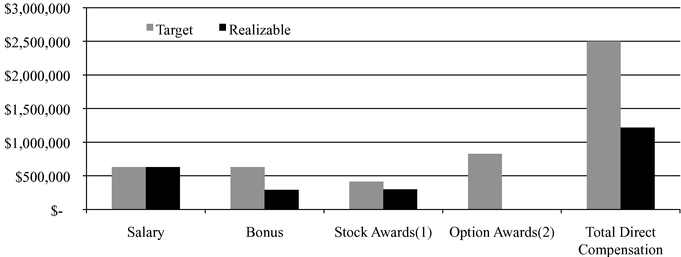
When comparing Mr. Grebe's compensation relative to the Company's financial performance, we believe it is important to consider the distinction between target compensation and the actual compensation Mr. Grebe will ultimately receive. As noted above, a substantial portion of Mr. Grebe's total compensation is performance-based and tied directly to the Company's financial performance. Thus, a lower share price or the failure to achieve individual performance targets can be expected to directly impact Mr. Grebe's compensation. The distinction between target and realizable compensation is
22
illustrated in the graph below, which shows both target and realizable compensation for Mr. Grebe as of December 31, 2011:
2011 CEO Target vs. Realizable Compensation
Finally, the Compensation Committee and Mr. Grebe discussed certain terms of his employment agreement in 2011 in light of emerging best practices, and Mr. Grebe voluntarily agreed to modify his agreement by waiving his right to an automatic annual base salary increase of 5%. In addition, Mr. Grebe agreed to give up his right automatically to collect severance payments and benefits upon any resignation without good reason during the 30-day period following the first anniversary of a change in control. These changes were made to address recent changes in best practice among executive agreements.
Additional 2011 Compensation Highlights
At our 2011 Annual Meeting, approximately 95% of our shareholders approved (on a non-binding basis) the compensation of our named executive officers, as disclosed pursuant to the compensation disclosure rules of the SEC in our annual proxy statement for fiscal 2010. The Compensation Committee viewed the strong support from our shareholders as a sign that our compensation program for our named executive officers was designed and implemented to the satisfaction of the interests of our shareholders.
We have generally retained the same compensation program for 2011, which includes the following components: (i) annual base salaries with modest, merit-based salary increases; (ii) annual performance-based bonuses tied to EPS targets and individual performance metrics; (iii) long-term incentive awards consisting of both stock options and time-based restricted share units; (iv) standard benefits consistent with those offered to all employees (e.g. health insurance, 401k, etc.); and (v) no perquisites other than automotive allowances, which are given to offset business expenses incurred by our executives and keep the
23
Company competitive with our peers. In addition, the following actions were taken by the Compensation Committee:
Following the end of the 2011 fiscal year, our Compensation Committee reviewed the Company's financial performance for the year to determine whether certain performance targets tied to annual bonuses were met. The Committee also considered fiscal 2011 performance in the context of annual long-term incentive grants. During this review, the Committee noted that while the Company performed well in many key areas in 2011, the Company fell short of its targeted EPS goal for the year of $1.22. As a result, the Company's executives earned only 61.5% of this bonus component. The Committee also reviewed the individual performance of the Company's executives in awarding the discretionary component of annual executive bonuses. Annual executive bonuses ranged from 0% to 100% of target.
Compensation Actions Taken in Early 2012
With guidance provided by the Consultant, our Compensation Committee recently undertook a review of its compensation practices relating to long-term incentive awards to our executives. In an effort to further align our executive compensation with the creation of long-term shareholder value, the Committee decided to modify its equity compensation program in 2012 by awarding performance-based share units with a one-year EPS performance target. If that performance target is achieved, the award recipient will then not vest in the award until the second and third anniversaries of the grant date, at which times 50% of the earned award (based upon EPS performance, and subject to continued employment) will vest, respectively. The Committee also decided not to award any time-based restricted share units to our executives, but instead included a mix of both performance-based shares and stock options, the latter of which will only provide compensation to the extent the Company's share price appreciates in value beyond the grant date strike price. The Compensation Committee believes that this mix of awards provides the right incentive to the Company's executives to drive both short and long-term value creation for our shareholders, while also creating an appropriate reward for our executives for superlative performance.
Additional compensation actions taken in early 2012 include the following:
These actions are in keeping with the Company's focus on performance-based compensation, and demonstrate our continued commitment to employ executive compensation practices that help drive our business initiatives, profitably grow sales, and increase long-term shareholder value.
Oversight
Our executive compensation objectives, policies and programs are established by the Compensation Committee. The Compensation Committee is responsible for the following:
24
The Compensation Committee engages Frederic W. Cook & Co., Inc. (the "Consultant") as its compensation consultant to assist the Compensation Committee in assessing best practices with respect to compensation trends and to recommend a relevant group of peer companies against which to assess, among other things, the competitiveness and appropriateness of our executive compensation. We refer to the Consultant's assessment as the "annual competitive compensation assessment."
In addition to the annual competitive compensation assessment, the Consultant provided assistance to us with the following projects and activities relating to our 2011 fiscal year:
Our CEO recommends to the Compensation Committee annual compensation for other executive officers, as well as any new employment contracts or changes to existing contracts.
General Compensation Philosophy
Our compensation program is designed to:
The primary elements of compensation for our named executive officers are: base salary, annual non-equity incentive compensation (also called annual cash bonuses) and equity compensation. We do not maintain any post-retirement benefit plans solely for our named executive officers and we provide limited perquisites to our named executive officers. There are no benefit plans that are available to our named executive officers that are not also available on the same terms to our other employees.
Our elements of compensation are designed to be competitive with comparable employers. The peer group we used for determining 2011 compensation (our "2011 peer group"), which took into account the
25
recommendations of the Consultant, was based on companies of a similar size and business to us and was reviewed and selected by the Compensation Committee. Our 2011 peer group includes: American Woodmark Corp., Apogee Enterprises, Inc., Applied Industrial Technologies, Inc., Barnes Group, Inc., Beacon Roofing Supply, Inc., BlueLinx, Inc., Builders Firstsource, Inc., Kaman Corp., Lawson Products, Inc., MSC Industrial Direct Co., Inc., Middleby Corp., Pool Corp. and Watsco, Inc. The Consultant provides the Compensation Committee with information regarding the 25th percentile, median and 75th percentile levels of total direct compensation (salary, annual bonus and long-term incentive) provided by members of the 2011 peer group to their respective named executive officers. The Compensation Committee reviews this information with the Consultant and the CEO. We believe that compensation that falls within the 25th percentile and 75th percentile is generally competitive in comparison to the 2011 peer group companies, taking into account the Company's revenues, net income, market capitalization and employees as compared to the 2011 peer group companies, with compensation below the median being at the lower end of the competitive range and compensation above the median being at the higher end of the competitive range. The Company uses this range of compensation levels to assess the extent to which the compensation provided to the Company's named executive officers is generally consistent with (or significantly inconsistent with) that offered by the 2011 peer group companies to their named executive officers, but the Company does not tie any particular element of compensation (or total compensation) to any specific targeted peer group level. The Compensation Committee also reviews specific relevant factors for each named executive officer (including his or her performance and accomplishments, the extent to which the position is critical to the Company, length of service and difficulty of recruiting, and other factors described below under "Compensation Program – Base Salaries" and "Compensation Program – Equity Compensation"), in making its determinations that the compensation level is appropriate for the named executive officer.
Our compensation program is also designed to align management's incentives with the long-term interests of our shareholders. We believe we can best increase our shareholders' value over the long-term by attaining earnings growth through increased sales, improved gross margins and lower operating costs. Accordingly, our 2011 annual non-equity incentive compensation program for our named executive officers, in addition to rewarding achievement by each individual of his or her personal performance objectives, also is based on performance targets that reward earnings growth. Consistent with our focus on growth, we elected not to include a free cash flow component in our 2011 non-equity incentive compensation program, which had been included in prior years when cash generation and liquidity were of greater concern given the challenging debt market conditions at that time.
Compensation Program
The compensation elements that make up our compensation program, and the relative value of each component, are selected to achieve the aforementioned objectives and are as follows:
Base Salaries
Base salaries are intended to establish a level of compensation which, together with the other components of the compensation program, will help us attract and retain the talent needed to meet the challenges of the competitive industry in which we operate while maintaining an acceptable level of fixed costs. Our actions with respect to base salaries are based upon our evaluation of the responsibility and scope of each position, the level of compensation for comparable positions in our industry, executive performance over an extended period of time, and the value and potential value to the executive of other elements of our compensation program.
The Company generally determines base salaries and other cash compensation for the Company's named executive officers based upon consideration of the following material factors: (1) the Company's evaluation of the named executive officer's performance in the preceding fiscal year; (2) the anticipated contribution by the named executive officer in the upcoming fiscal year, taking into account the role, responsibility and scope of each position; (3) the extent to which the current base salary level is within (or
26
outside) the 2011 peer group's 25th-75th percentile levels range for base salaries for comparable positions in the Company's industry (and whether it is at the lower end or the upper end of such range); (4) any extraordinary changes that have occurred (such as a significant change in responsibilities or a promotion); (5) any specific requirements set forth in a named executive officer's employment agreement; (6) the named executive officer's length of service and his performance over an extended period of time; (7) general economic conditions; and (8) the value and potential value to the executive of the other elements of the Company's compensation program. The Company does not provide any additional weighting to any single factor and all of the above considerations are addressed collectively in the determination of the named executive officer's base salary level.
For 2011, the base salaries for our named executive officers were increased, or otherwise remained unchanged, as follows:
Named Executive Officer and Principal Position
|
Previous Salary |
2011 Salary |
|||||
|---|---|---|---|---|---|---|---|
Michael J. Grebe(1) |
$ | 630,000 | $ | 630,000 | |||
John A. Ebner |
$ | 350,000 | $ | 360,500 | |||
Kenneth D. Sweder(2) |
$ | 400,000 | $ | 440,000 | |||
Lucretia D. Doblado |
$ | 272,538 | $ | 277,988 | |||
John M. McDonald(3) |
N/A | $ | 365,000 | ||||
We believe our salary structure provides a framework for an equitable compensation ratio between executives, with higher salaries for jobs having greater duties and responsibilities. The amount of base salary is taken into account and affects the amount of annual bonuses for our named executive officers, because the target annual bonus for each of our named executive officers is expressed as a specified percentage of his or her base salary.
Annual Non-Equity Incentive Compensation (Annual Bonuses)
Pursuant to the terms of our Executive Cash Incentive Plan, our annual non-equity incentive compensation, or annual bonuses, is intended to motivate and reward performance by providing cash bonus payments based upon meeting or exceeding performance goals. Upon achievement of the required performance goals, individual awards are determined as variable percentages of the executives' base salaries, depending on the extent to which performance goals are attained. The earning per share (or "EPS") component of our annual bonus program is determined based on audited financial statements. The Compensation Committee confirms achievement of that goal before payments are made. Payments for the prior year are typically made within 75 calendar days of that year's fiscal year-end. The Compensation Committee approves the performance goals for the then-current year typically on or around the same time that the Compensation Committee confirms the achievement of the prior-year performance goals.
2011 Bonuses. The Compensation Committee determined that, for the 2011 fiscal year, the annual bonus would be earned based on two separate components: (1) 75% of the annual bonus would be
27
dependent upon achieving certain targets relating to EPS, adjusted for certain non-recurring items as approved by the Compensation Committee, or adjusted EPS (the "adjusted EPS component"); and (2) the remaining 25% of the annual bonus would be determined by the Compensation Committee in its discretion (the "discretionary component"), primarily based on individual performance goals to be determined in the sole discretion of the Compensation Committee (upon recommendation of the CEO for those named executive officers other than himself). As noted previously, our Compensation Committee elected not to include a free cash flow component in our 2011 non-equity incentive compensation program due to the shift in focus away from cash generation and liquidity, and more toward growth in sales and earnings.
The Compensation Committee believed that each of the adjusted EPS component (which is tied to creation of shareholder value) and the discretionary component (which is intended to balance the focus on financial measures with a combination of individual performance and a targeted assessment by the CEO and the Compensation Committee of 2011 performance beyond formulaic targets) were each important. However, the Compensation Committee determined, with the input and support of the Consultant, that the separate components of the annual bonus should be appropriately balanced and weighted so as to: (i) focus more on EPS growth as market conditions gradually improve; and (ii) provide the Committee with a level of flexibility to incentivize and reward superlative individual performance on key long-term projects and initiatives, as well as address specific retention issues, given continuing global economic uncertainty existing at the time the plan was adopted.
Under the terms of our Executive Cash Incentive Plan, bonus amounts for an executive may not exceed the lowest of (x) 200% of such executive's base salary, (y) $5,000,000 and (z) 2.5% of adjusted EBITDA in the case of Mr. Grebe, 2% of adjusted EBITDA in the case of Messrs. Sweder and Ebner, and 1% of adjusted EBITDA in the case of Ms. Doblado (Mr. McDonald was not with the Company at the time the 2011 Executive Cash Incentive Plan was approved by our Compensation Committee and thus did not have an adjusted EBITDA cap assigned to him). Thus, if there is no positive adjusted EBITDA, no annual bonus would be payable. For this purpose, "adjusted EBITDA" means the Company's net income plus interest expense (income), net change in fair value of interest rate swaps, cumulative effect of change in accounting principle, (gain) loss on extinguishment of debt, loss on impairment of assets (including but not limited to goodwill and intangibles), (gain) loss on sale of assets, equity or debt offering and related expenses, provision for income taxes and depreciation and amortization, but excluding any impairment of goodwill or intangibles and any gains or losses on the sale of assets.
For the 2011 fiscal year, the target and maximum bonuses (as a percentage of base salary) that could be earned in 2011 by our named executive officers were:
Name
|
Target | Maximum | |||||
|---|---|---|---|---|---|---|---|
Michael J. Grebe |
100 | % | 200 | % | |||
John A. Ebner |
50 | % | 200 | % | |||
Kenneth D. Sweder |
75 | % | 200 | % | |||
Lucretia D. Doblado |
43 | % | 200 | % | |||
John M. McDonald |
60 | % | 200 | % | |||
The maximum percentages above supersede the maximum bonus that is provided for in the employment agreements for our named executive officers (which are described under "Employment Agreements" following the Grants of Plan-Based Awards Table). The Compensation Committee sets target and maximum annual bonus amounts, as a percentage of base salary, for each of our named executive officers, based on recommendations by the CEO. Our annual competitive compensation assessment was used to confirm the appropriateness of the target bonus percentages. The different target bonus percentages among the named executive officers reflect their relative duties and responsibilities as well as the Compensation Committee's consideration of the factors described above in "Compensation Program—Base Salaries."
28
Our named executive officers will receive payout of the adjusted EPS component according to the following schedule:
Adjusted EPS
|
Initial Percentage of Adjusted EPS Component Earned |
|||
|---|---|---|---|---|
less than $1.09 |
0 | % | ||
$1.09 |
50 | % | ||
$1.22 |
100 | % | ||
$1.46 |
200 | % | ||
The payout percentages are linearly interpolated if adjusted EPS is between $1.09 and $1.22 or between $1.22 and $1.46. To encourage the management team to broaden its focus and to work on strategic acquisitions, EPS arising from acquisitions is included in EPS for purposes of this bonus component, subject to the discretion of the Compensation Committee.
For 2011, adjusted EPS was computed by dividing net income by the weighted-average number of shares of common stock and participating securities outstanding during the period as adjusted for the potential dilutive effect of stock options and non-vested shares of restricted stock and restricted share units using the treasury stock method. The discretionary component was based on the achievement of individual objectives for each named executive officer, which objectives were agreed upon with the CEO (other than the CEO's own objectives, which were set by the Compensation Committee). Individual performance objectives generally focused on:
Our actual adjusted EPS for 2011 was $1.12, resulting in an earned adjusted EPS component of 61.5% for our named executive officers. After determining the extent to which the individual performance goals were met, the Compensation Committee determined to pay annual bonus amounts as set forth in the Summary Compensation Table below. The threshold, target and maximum amounts of the 2011 annual bonus that were possible to be earned are set forth in the Grants of Plan-Based Awards Table, and the actual amounts earned and paid are set forth in the Summary Compensation Table.
Equity Compensation
We believe that superior results can be achieved through an ownership culture that encourages long-term performance by our executive officers through the use of share-based awards. Our equity compensation program is comprised of restricted share units and stock options granted under our 2004 Equity Incentive Plan. We believe that the use of restricted share unit and stock option awards achieves our compensation objectives because restricted share units contain time-vesting features and stock options have natural performance-based orientation and/or time vesting features built in.
Restricted share units are regarded by grantees as an award with a lower risk than stock options because, at vesting, restricted share units will have value equal to the market price of the underlying shares, even if there has been no appreciation in the market price of our stock during the vesting period. Stock options, even if vested, will not have any value unless the market price for our stock at the time of exercise is greater than the exercise price of the stock option. Our compensation program is generally designed to
29
strike a balance between grants of stock options, which deliver value solely to the extent our share price increases, and the retention value of restricted share units, which generally vest based on continued service to the Company. In 2011, the Compensation Committee placed a greater emphasis upon earnings growth with a split of 67% for stock options and 33% for time-based restricted share units on a value basis for our named executive officers.
The Company has an Equity Award Issuance Policy which provides guidance regarding the date when annual awards will be granted for executive and non-executive management. Annual awards for executive and non-executive management must be approved by the Committee prior to the award being offered to the employee. The grant date for such awards will be no sooner than the third business day following the Company's fiscal year-end earnings release. In order to allow all public performance information to be readily available to the public marketplace, it is the policy of the Compensation Committee to grant annual awards subsequent to the public release of its fiscal year-end earnings and to allow at least two full trading days to pass prior to granting such awards. Notwithstanding the foregoing and subject to the Company policy, under extraordinary circumstances (as determined by the Compensation Committee and explicitly set forth in a Compensation Committee resolution), annual awards for executive and non-executive management may be granted on a different date.
In determining the size of equity awards to each named executive officer, the Compensation Committee begins with a target dollar award value, rather than a target number of shares subject to the award. The target value is set based upon the responsibilities inherent in each named executive officer's position and relative to overall compensation. For example, the target value for our CEO is larger than for the other named executive officers because our CEO is in the position that has the most direct impact on corporate performance. Although target equity award sizes are set for each position, the actual size of annual dollar award value is a subjective determination based on the anticipated contribution of the executive officer to our long-term value and on many of the same material factors that the Company considers when setting other elements of compensation, including (1) the Company's evaluation of the named executive officer's performance in the preceding fiscal year; (2) the anticipated contribution by the named executive officer in the upcoming fiscal year, taking into account the role, responsibility and scope of each position; (3) the extent to which the long-term equity award grant value and resulting total direct compensation is within (or outside) the 2011 peer group's 25th-75th percentile levels range for long-term equity award grants for comparable positions in the Company's industry (and whether it is at the lower end or the upper end of such range); (4) any extraordinary changes that have occurred (such as a significant change in responsibilities or a promotion); (5) the value and potential value to the executive of the other elements of the Company's compensation program; (6) the companywide equity budget, which is taken into account in determining the relative size of awards granted to the named executive officers to ensure there is sufficient value available for grant to the other eligible employees of the Company; and (7) the named executive officer's wealth accumulation from previous grants (with an emphasis on the extent to which outstanding equity grants are still unvested and thus continue to represent substantial retentive value) and other factors that may detract from the award's desired incentive (such as the proximity of the executive to retirement). Similar to the determinations with respect to other elements of compensation, the Company considers all relevant factors taken as a whole in setting the applicable equity grant for the fiscal year.
2011 Grants. Restricted share units granted to our named executive officers during the 2011 fiscal year as part of our annual equity-based compensation program were subject to time-based vesting. One-half of the shares vest upon the second anniversary of the grant and the second half vests on the third anniversary of the grant, all subject to the continued employment of the named executive officer on the vesting dates.
Stock options granted to our named executive officers during the 2011 fiscal year vest in 25% increments over four years and have a term of seven years. In accordance with the 2004 Equity Incentive
30
Plan, the exercise price of all stock options granted during the 2011 fiscal year have an exercise price equal to the closing market price on the grant date.
In addition to the scheduled annual equity grants, we granted a special time-based restricted share unit award with a value of approximately $350,000 to Mr. McDonald as part of his joining the Company as the new Senior Vice President, Sales. This award vests only if Mr. McDonald remains employed with us over a set period of time, with 25% of the award vesting on each of the second, third, fourth and fifth anniversaries of the date of grant. This award was made to entice Mr. McDonald to join the Company and to remain with us long-term.
Other Compensation
Executive officers also participate in our benefit plans on the same terms as other employees. These plans, which include medical, dental and life insurance, participation in a 401(k) plan and discounts on our products, are designed to enable us to attract and retain our workforce in a competitive marketplace.
Medical, dental and life insurance benefits help ensure that we have a productive and focused workforce through reliable and competitive health and other welfare benefit coverage. Participation in a 401(k) plan helps employees save and prepare financially for retirement. Discounts on our products help employees save on purchases of home improvement, maintenance and repair goods.
The only perquisite we provide to our executive officers as part of our competitive compensation package is a monthly automotive allowance. The cost of this benefit constitutes only a small percentage of each executive officer's total compensation. We furnish this benefit because our executive officers are required to travel extensively as part of their responsibilities and providing the automotive allowance enables us to remain competitive in the general marketplace for executive talent.
Allocation of Elements
Under our compensation structure, the approximate relative allocations of base salary, annual bonus and equity compensation for the 2011 fiscal year (assuming target performance was attained) varied among our named executive officers as follows:
Name
|
Base Salary |
Annual Bonus |
Equity Compensation |
|||||||
|---|---|---|---|---|---|---|---|---|---|---|
Michael J. Grebe |
25 | % | 25 | % | 50 | % | ||||
John A. Ebner |
35 | % | 18 | % | 47 | % | ||||
Kenneth D. Sweder |
26 | % | 19 | % | 55 | % | ||||
Lucretia D. Doblado |
41 | % | 18 | % | 41 | % | ||||
John M. McDonald |
35 | % | 20 | % | 45 | % | ||||
The Company reviews the market positioning of each component of compensation for the named executive officers as part of the annual competitive compensation assessment. The mix shown above is reflective of the annual competitive compensation assessment, although adjustments are considered in the context of total compensation rather than a single component.
Executive Stock Ownership Guidelines
In March 2006, the Company adopted stock ownership guidelines for its executive officers. The purpose of these guidelines is to encourage significant ownership of stock in us by senior executives and by virtue of that ownership align the personal interests of our senior executives with those of our shareholders. The guideline for the CEO and President/Chief Operating Officer is share ownership with a value of at least six times their base salary. Other executive officers have a guideline of share ownership
31
with a value of at least four times base salary. The higher multiples for the CEO and President/COO reflect their greater duties and responsibilities. Only shares that are owned outright by the executive or his or her immediate family members (including shares actually acquired through vesting or exercise of any equity awards) count towards satisfaction of the share ownership guideline.
Our executive stock ownership guidelines do not require executives to purchase our stock in the open market or contain a timeframe within which the executive officers must meet the guidelines. Executives increase their share ownership through a variety of methods, including retaining ownership of their after-tax equity awards granted by us, more specifically 50% of such after-tax shares for the CEO and President/Chief Operating Officer and 25% of such after-tax shares for the other executives. The named executive officers have not yet met the stock ownership guidelines due to the fact that most of the equity awards granted since the time the Company became publicly traded in December 2004 have not yet been realized through either exercise of stock options and/or vesting of restricted share units.
The following table summarizes the share ownership value for each of the Company's named executive officers who were employed with the Company as of December 30, 2011. The values in this table assume a stock price of $15.57, the closing price of the Company's stock on the last trading day of the fiscal year ended December 30, 2011.
Name
|
Share Ownership Guideline |
Owned Outright |
Outstanding Equity Awards(1) |
Total | |||||||||
|---|---|---|---|---|---|---|---|---|---|---|---|---|---|
Michael J. Grebe |
$ | 3,780,000 | $ | 2,141,046 | $ | 2,046,619 | $ | 4,187,665 | |||||
John A. Ebner |
$ | 1,442,000 | $ | 233,550 | $ | 629,215 | $ | 862,765 | |||||
Kenneth D. Sweder |
$ | 2,640,000 | $ | 436,801 | $ | 2,542,272 | $ | 2,979,073 | |||||
Lucretia D. Doblado |
$ | 1,111,952 | $ | 116,308 | $ | 861,315 | $ | 977,623 | |||||
John M. McDonald |
$ | 1,460,000 | $ | — | $ | 416,311 | $ | 416,311 | |||||
Severance and Change-in-Control Provisions and Agreements
We believe that companies should provide reasonable severance benefits to their executive officers due to the greater level of difficulty they face in finding comparable employment within a short period of time. We also believe that executive officers have a greater risk of job loss or modification, as a result of a change-in-control transaction, than other employees. For these reasons, we have entered into employment agreements and change-in-control agreements with our named executive officers, and consistent with this practice, we entered into an employment agreement with John McDonald in June 2011.
The principal reason for providing our executive officers severance upon a termination by us without cause or a resignation by the executive for good reason following a change in control is to offer our executive officers appropriate incentive to remain with us before, during and after any change-in-control transaction by providing them with adequate security in the event that their employment is terminated. By reducing the risk of job loss or reduction in job responsibilities of the executive officer, these change-in-control provisions help ensure that the executive officers support any potential change-in-control transactions that may be in the best interests of our shareholders, even though the transaction may create uncertainty in the executive officer's personal employment situation. We believe that the severance and change-in-control provisions within our executive officers' employment agreements or change-in-control agreements are consistent with our objective of motivating and retaining talented employees. In addition, similar provisions are also part of the typical employment arrangements for executive officers within our peer group and within our industry generally, and are necessary to ensure that our total employment package for executive officers remains market-competitive. The severance provisions
32
contained in each named executive officers' employment agreement were in effect as of the Company's IPO or as of such executive's start date with the Company. The change-in-control severance plan adopted in 2007 was recommended by the Consultant taking into account a peer group competitive assessment. We believe these severance protections are appropriate, because we believe that it is in both the best interests of us and our shareholders to have: (i) severance provisions within our executive officers' employment agreements, under which the executive officers will receive certain benefits and compensation if their employment is terminated by us without cause or by the executive officer for good reason; and (ii) either change-in-control provisions within our executive officers' employment agreements or separate change-in-control agreements, under which the executive officers will receive certain benefits and compensation if their employment is terminated by us without cause or by the executive officer for good reason following a change in control. See "Potential Payments Upon Termination Or Change in Control" for a detailed discussion of the terms of these agreements.
Under our agreements with our named executive officers, in order for amounts to become payable, the change-in-control provisions contained in our employment agreements and change-in-control agreements generally require that (i) a change in control occurs and (ii) the executive officer's employment is terminated by us other than for cause or by the executive officer for good reason. Mr. Grebe is provided a higher severance multiple than the other named executive officers to reflect his greater duties and responsibilities. The change-in-control severance multiples for the named executive officers are in line with peer group practice.
In March 2011, we entered into an amendment to Mr. Grebe's employment agreement, under which Mr. Grebe agreed to give up his right automatically to collect severance payments and benefits upon any resignation without good reason during the 30-day period following the first anniversary of a change in control. In addition, under the amendment, Mr. Grebe agreed to waive his contractual right to cost of living increases to his base salary, and we agreed to certain clarifications to the definition of "good reason" set forth in his contract. Also, in March 2011, we entered into an amendment to Mr. Ebner's change-in-control agreement to eliminate his right to a tax gross-up in respect of any amounts that may be due or paid to him under such agreement or any of our other plans or arrangements which may be considered "excess parachute payments" under the Internal Revenue Code. Instead, any amounts due or paid to Mr. Ebner in such a situation will be reduced to the safe harbor amount applicable under such parachute payment tax rules, to the extent such reduction would result in a better after-tax position for him.
Tax Deductibility under Section 162(m) of the Internal Revenue Code
In carrying out its duties, the Compensation Committee makes all reasonable efforts to maintain the Company's executive compensation within the $1,000,000 deduction limit under Section 162(m) of the Internal Revenue Code, which applies to compensation of our CEO and our three other highest paid executive officers at the end of the year (other than our Chief Financial Officer). The Compensation Committee may exceed the Section 162(m) limit if it determines that abiding by the limit in given circumstances would not be in our best interest or in the best interests of our shareholders. We believe that our ability to deduct compensation attributable to our 2009 annual bonuses, and grants of stock options and restricted share units, should not be limited by Section 162(m) of the Internal Revenue Code.
33
The following table summarizes the total compensation earned by each of our named executive officers during the fiscal years ended December 30, 2011, December 31, 2010 and December 25, 2009.
| Name | Year | Salary | Stock Awards (1) |
Option Awards (1) |
Non-Equity Incentive Plan Compensation (2) |
All Other Compensation |
Total | |||||||||||||||
|---|---|---|---|---|---|---|---|---|---|---|---|---|---|---|---|---|---|---|---|---|---|---|
Michael J. Grebe |
2011 | $ | 630,000 | $ | 412,912 | $ | 827,080 | $ | 290,588 | (3) | $ | 18,619 | (4) | $ | 2,179,199 | |||||||
Chairman and |
2010 | $ | 630,000 | $ | 550,001 | $ | 550,009 | $ | 682,542 | $ | 18,619 | (4) | $ | 2,431,171 | ||||||||
Chief Executive Officer |
2009 | $ | 630,000 | $ | 641,063 | $ | 350,000 | $ | 630,000 | $ | 16,212 | (5) | $ | 2,267,275 | ||||||||
John A. Ebner |
2011 |
$ |
360,500 |
$ |
245,048 |
$ |
240,450 |
$ |
105,672 |
$ |
12,000 |
(6) |
$ |
963,671 |
||||||||
Chief Financial Officer |
2010 | $ | 331,154 | $ | 525,011 | $ | 175,001 | $ | 194,845 | $ | 12,000 | (6) | $ | 1,238,011 | ||||||||
Kenneth D. Sweder |
2011 |
$ |
438,462 |
$ |
396,532 |
$ |
543,479 |
$ |
234,713 |
$ |
16,125 |
(7) |
$ |
1,629,311 |
||||||||
President and |
2010 | $ | 398,077 | $ | 200,005 | $ | 200,000 | $ | 344,820 | $ | 16,125 | (7) | $ | 1,159,027 | ||||||||
Chief Operating Officer |
2009 | $ | 350,000 | $ | 453,675 | $ | 139,999 | $ | 275,625 | $ | 12,673 | (8) | $ | 1,231,972 | ||||||||
Lucretia D. Doblado |
2011 |
$ |
274,622 |
$ |
91,586 |
$ |
183,427 |
$ |
73,066 |
$ |
7,200 |
(9) |
$ |
629,900 |
||||||||
Chief Information Officer |
2010 | $ | 265,821 | $ | 162,499 | $ | 87,500 | $ | 118,107 | $ | 7,200 | (9) | $ | 641,127 | ||||||||
|
2009 | $ | 266,538 | $ | 357,520 | $ | 87,501 | $ | 105,840 | $ | 7,200 | (9) | $ | 824,599 | ||||||||
John M. McDonald |
2011 |
$ |
189,519 |
$ |
350,000 |
$ |
— |
$ |
119,016 |
$ |
7,000 |
(10) |
$ |
665,536 |
||||||||
Senior Vice President, Sales |
||||||||||||||||||||||
34
The following table summarizes the awards granted to each of our named executive officers during the fiscal year ended December 30, 2011.
| |
|
|
|
|
All Other Stock Awards: Number of Shares of Stock or Units(2) |
All Other Option Awards: Number of Securities Underlying Options(3) |
Exercise or Base Price of Option Awards ($/Sh) |
Grant Date Fair Value of Stock and Option Awards |
|||||||||||||||||
|---|---|---|---|---|---|---|---|---|---|---|---|---|---|---|---|---|---|---|---|---|---|---|---|---|---|
| |
|
Estimated Future Payouts Under Non-Equity Incentive Plan Awards(1) |
|||||||||||||||||||||||
| |
Grant Date |
||||||||||||||||||||||||
| Name | Threshold | Target | Maximum | ||||||||||||||||||||||
Michael J. Grebe |
3/2/2011 | $ | 236,250 | $ | 630,000 | $ | 1,260,000 | 19,134 | $ | 412,912 | |||||||||||||||
|
3/2/2011 | 98,933 | $ | 21.58 | $ | 827,080 | |||||||||||||||||||
John A. Ebner |
3/1/2011 |
$ |
67,594 |
$ |
180,250 |
$ |
721,000 |
5,852 |
(4) |
$ |
124,999 |
||||||||||||||
|
3/2/2011 | 5,563 | (5) | $ | 120,050 | ||||||||||||||||||||
|
3/2/2011 | 28,762 | $ | 21.58 | $ | 240,450 | |||||||||||||||||||
Kenneth D. Sweder |
2/16/2011 |
$ |
123,750 |
$ |
330,000 |
$ |
880,000 |
11,141 |
$ |
250,004 |
|||||||||||||||
|
2/16/2011 | 28,377 | $ | 22.44 | $ | 250,001 | |||||||||||||||||||
|
3/2/2011 | 6,790 | $ | 146,528 | |||||||||||||||||||||
|
3/2/2011 | 35,105 | $ | 21.58 | $ | 293,478 | |||||||||||||||||||
Lucretia D. Doblado |
3/2/2011 |
$ |
44,826 |
$ |
119,535 |
$ |
555,976 |
4,244 |
$ |
91,586 |
|||||||||||||||
|
3/2/2011 | 21,941 | $ | 21.58 | $ | 183,427 | |||||||||||||||||||
John M. McDonald |
9/9/2011 |
$ |
64,675 |
$ |
153,698 |
$ |
272,396 |
26,738 |
$ |
350,000 |
|||||||||||||||
35
Employment Agreements
The following paragraphs summarize the principal provisions of the employment agreements with our named executive officers.
Michael J. Grebe
We have entered into an employment agreement with Mr. Grebe, which became effective August 13, 2004 and expires two years thereafter, subject to automatic one-year extensions at the beginning of each calendar year thereafter unless we or Mr. Grebe give at least 90 days' written notice of non-extension. Mr. Grebe is entitled to a base salary, and he is eligible for an annual cash bonus based upon the achievement of annual performance targets established by our Compensation Committee. Mr. Grebe's base salary is currently $630,000, subject to increase at the discretion of our Compensation Committee. Mr. Grebe is also eligible to participate in the benefits plans and arrangements generally available to our senior executives, including participation in our 2004 Equity Incentive Plan and a monthly automotive allowance. His employment agreement also provides for severance upon certain terminations of employment, as described under "Potential Payments upon Termination of Change in Control". Mr. Grebe's employment agreement was amended effective as of December 2, 2004, December 31, 2008 (solely in connection with certain changes required by Section 409A of the Internal Revenue Code) and March 31, 2011. Pursuant to the March 31, 2011 amendment, Mr. Grebe agreed to give up his right automatically to collect severance payments and benefits upon any resignation without good reason during the 30-day period following the first anniversary of a change in control. In addition, under the amendment, Mr. Grebe agreed to waive his contractual right to cost of living increases to his base salary, and we agreed to certain clarifications to the definition of "good reason" set forth in his contract.
John A. Ebner
We have entered into an employment agreement with Mr. Ebner dated January 8, 2010. The term of Mr. Ebner's employment agreement is from January 8, 2010 to January 8, 2011, subject to automatic one-year extensions unless we or Mr. Ebner give at least 60 days' prior written notice of non-extension. Mr. Ebner's annual base salary is currently $360,500, subject to increase at the discretion of our CEO. Mr. Ebner is eligible to receive an annual cash bonus based upon the achievement of annual performance targets established by our Compensation Committee. Mr. Ebner is also eligible to participate in the benefits plans and arrangements generally available to our senior executives, including participation in our 2004 Equity Incentive Plan and a monthly automotive allowance. His employment agreement also provides for severance upon certain terminations of employment, as described under "Potential Payments upon Termination of Change in Control".
Pursuant to Mr. Ebner's employment agreement, Mr. Ebner was granted 19,231 time-based restricted share units. One-half of the time-based restricted share units vest on the third anniversary of the date of grant and the second half vest on the fifth anniversary of the date of grant, contingent upon Mr. Ebner's continued employment with the Company on the applicable date.
Kenneth D. Sweder
We have entered into an employment agreement with Mr. Sweder dated April 30, 2007, as amended on October 20, 2008 and December 31, 2008 (the latter amendment was entered into solely in connection with certain changes required by Section 409A of the Internal Revenue Code). The term of Mr. Sweder's employment agreement is from April 30, 2007 to April 30, 2008, subject to automatic one-year extensions unless we or Mr. Sweder give at least 60 days' prior written notice of non-extension. Mr. Sweder's annual base salary is currently $440,000, subject to increase at the discretion of our CEO. Mr. Sweder is eligible to receive an annual cash bonus based upon the achievement of annual performance targets established by our Compensation Committee. Mr. Sweder is also eligible to participate in the benefits plans and
36
arrangements generally available to our senior executives, including participation in our 2004 Equity Incentive Plan and a monthly automotive allowance. His employment agreement also provides for severance upon certain terminations of employment, as described under "Potential Payments upon Termination of Change in Control".
Pursuant to Mr. Sweder's employment agreement, Mr. Sweder was granted 18,298 time-based restricted share units, 8,577 performance-based restricted share units and 30,000 stock options. One-half of the time-based restricted share units vested on the third anniversary of the date of grant and the second half will vest on the fifth anniversary of the date of grant, contingent upon Mr. Sweder's continued employment with the Company on the applicable date. The performance-based restricted share units vest in accordance with the Company's normal vesting schedule for performance-based restricted share units. The performance metric for these performance-based restricted share units was the two-year cumulative adjusted EPS growth during the period from December 30, 2006 to December 26, 2008. The stock options vested in 25% increments over four years and may not be exercised after the expiration date of seven years from the date of grant.
Lucretia D. Doblado
We have entered into an employment agreement with Ms. Doblado dated October 30, 2006, as amended on March 23, 2007 and December 31, 2008 (solely in connection with certain changes required by Section 409A of the Internal Revenue Code). The term of Ms. Doblado's employment agreement is from October 30, 2006 to October 30, 2007, subject to automatic one-year extensions unless we or Ms. Doblado give at least 60 days' prior written notice of non-extension. Ms. Doblado's annual base salary is currently $277,988, subject to increase at the discretion of our CEO. Ms. Doblado is eligible to receive an annual cash bonus based upon the achievement of annual performance targets established by our Compensation Committee. Ms. Doblado is also eligible to participate in the benefits plans and arrangements generally available to our senior executives, including participation in our 2004 Equity Incentive Plan and a monthly automotive allowance. Her employment agreement also provides for severance upon certain terminations of employment, as described under "Potential Payments upon Termination of Change in Control".
John M. McDonald
We have entered into an employment agreement with Mr. McDonald dated June 13, 2011. The term of Mr. McDonald's employment agreement is from June 13, 2011 to June 12, 2012, subject to automatic one-year extensions unless we or Mr. McDonald give at least 60 days' prior written notice of non-extension. Mr. McDonald's annual base salary is currently $365,000, subject to increase at the discretion of our CEO. Mr. McDonald is eligible to receive an annual cash bonus based upon the achievement of annual performance targets established by our Compensation Committee. Mr. McDonald is also eligible to participate in the benefits plans and arrangements generally available to our senior executives, including participation in our 2004 Equity Incentive Plan and a monthly automotive allowance. His employment agreement also provides for severance upon certain terminations of employment, as described under "Potential Payments upon Termination of Change in Control".
37
OUTSTANDING EQUITY AWARDS AT FISCAL YEAR-END
The following table summarizes the number of securities underlying the equity awards held by each of our named executive officers as of the fiscal year ended December 30, 2011.
| |
Option Awards | Stock Awards | ||||||||||||||||||||||||||
|---|---|---|---|---|---|---|---|---|---|---|---|---|---|---|---|---|---|---|---|---|---|---|---|---|---|---|---|---|
| Name | Number of Securities Underlying Unexercised Options Exercisable |
Number of Securities Underlying Unexercised Options Unexercisable |
Equity Incentive Plan Awards: Number of Securities Underlying Unexercised Unearned Options |
Option Exercise Price |
Option Expiration Date |
Number of Shares or Units of Stock That Have Not Vested |
Market Value of Shares or Units That Have Not Vested |
Equity Incentive Plan Awards: Number of Unearned Shares, Units or Other Rights That Have Not Vested |
Equity Incentive Plan Awards: Market or Payout Value of Unearned Shares, Units or Other Rights That Have Not Vested |
|||||||||||||||||||
Michael J. Grebe |
303 | — | $ | 410.51 | 2/5/2013 | 90,451 | (1) | $ | 1,408,321 | |||||||||||||||||||
|
303 | — | $ | 137.11 | 2/5/2013 | |||||||||||||||||||||||
|
302 | — | $ | 1,669.13 | 2/5/2013 | |||||||||||||||||||||||
|
72,338 | — | $ | 23.32 | 3/13/2013 | |||||||||||||||||||||||
|
4,930 | — | $ | 23.25 | 3/14/2013 | |||||||||||||||||||||||
|
98,485 | — | $ | 20.79 | 3/1/2014 | |||||||||||||||||||||||
|
4,847 | — | $ | 20.85 | 3/2/2014 | |||||||||||||||||||||||
|
371,289 | — | $ | 15.00 | 12/16/2014 | |||||||||||||||||||||||
|
125,673 | — | $ | 21.75 | 12/16/2014 | |||||||||||||||||||||||
|
125,673 | — | $ | 26.25 | 12/16/2014 | |||||||||||||||||||||||
|
84,051 | 28,018 | (2) | $ | 19.63 | 2/26/2015 | ||||||||||||||||||||||
|
3,785 | 1,262 | (2) | $ | 19.62 | 2/27/2015 | ||||||||||||||||||||||
|
55,555 | 55,556 | (2) | $ | 7.89 | 2/25/2016 | ||||||||||||||||||||||
|
19,366 | 58,100 | (2) | $ | 17.92 | 2/24/2017 | ||||||||||||||||||||||
|
— | 98,933 | (2) | $ | 21.58 | 3/2/2018 | ||||||||||||||||||||||
John A. Ebner |
6,162 |
18,486 |
(3) |
$ |
17.92 |
2/24/2017 |
40,412 |
(4) |
$ |
629,216 |
||||||||||||||||||
|
— | 28,762 | (3) | $ | 21.58 | 3/2/2018 | ||||||||||||||||||||||
Kenneth D. Sweder |
30,000 |
— |
$ |
21.86 |
4/30/2014 |
111,768 |
(6) |
$ |
1,740,228 |
|||||||||||||||||||
|
16,810 | 5,604 | $ | 19.63 | 2/26/2015 | 40,551 | (7) | $ | 631,379 | |||||||||||||||||||
|
22,222 | 22,222 | (5) | $ | 7.89 | 2/25/2016 | ||||||||||||||||||||||
|
7,042 | 21,127 | (5) | $ | 17.92 | 2/24/2017 | ||||||||||||||||||||||
|
— | 28,377 | (5) | $ | 22.44 | 2/16/2018 | ||||||||||||||||||||||
|
— | 35,105 | (5) | $ | 21.58 | 3/2/2018 | ||||||||||||||||||||||
Lucretia D. Doblado |
12,052 |
— |
(8) |
$ |
20.79 |
3/1/2014 |
48,468 |
(9) |
$ |
754,647 |
||||||||||||||||||
|
12,930 | 4,311 | (8) | $ | 19.63 | 2/26/2015 | ||||||||||||||||||||||
|
13,889 | 13,889 | (8) | $ | 7.89 | 2/25/2016 | ||||||||||||||||||||||
|
3,081 | 9,243 | (8) | $ | 17.92 | 2/24/2017 | ||||||||||||||||||||||
|
— | 21,941 | (8) | $ | 21.58 | 3/2/2018 | ||||||||||||||||||||||
John M. McDonald |
26,738 |
(10) |
$ |
416,311 |
||||||||||||||||||||||||
38
39
OPTION EXERCISES AND STOCK VESTED
The following table summarizes the stock options exercised and stock vested by each of our named executive officers during the fiscal year ended December 30, 2011.
| |
Option Awards | Stock Awards | |||||||||||
|---|---|---|---|---|---|---|---|---|---|---|---|---|---|
| Name | Number of Shares Acquired on Exercise |
Value Realized on Exercise |
Number of Shares Acquired on Vesting |
Value Realized on Vesting |
|||||||||
Michael J. Grebe |
— | $ | — | 40,625 | (1) | $ | 901,875 | ||||||
John A. Ebner |
— | $ | — | — | $ | — | |||||||
Kenneth D. Sweder |
— | $ | — | 17,125 | (2) | $ | 380,175 | ||||||
Lucretia D. Doblado |
— | $ | — | 10,157 | (3) | $ | 225,485 | ||||||
John M. McDonald |
— | $ | — | — | $ | — | |||||||
40
POTENTIAL PAYMENTS UPON TERMINATION OR CHANGE IN CONTROL
The following summaries set forth potential payments payable to our executive officers upon termination of employment or a change in control of us under their current employment agreements, or change-in-control agreements.
Michael J. Grebe
Mr. Grebe's employment may be terminated by us for "cause" (as defined below) or by Mr. Grebe for any reason upon 30 days' prior written notice, which notice must be authorized by a majority of the members of our Board of Directors in the case of a termination for cause. Upon either such termination, we are required to pay his accrued and unpaid base salary and benefits through the date of termination.
If Mr. Grebe's employment terminates due to disability or death, he or his estate will be entitled to receive (i) any accrued and unpaid base salary and benefits, (ii) continuation of his base salary for a period of two years following the date of termination and (iii) a prorated bonus for the calendar year in which termination occurs. Unless otherwise provided by the award agreement entered into by Mr. Grebe at the time he was granted a particular equity award, upon termination of Mr. Grebe's employment as a result of disability or death, Mr. Grebe's unvested equity awards will be forfeited, and he or his estate will have until the earlier of the stock option's expiration date or one year from date of termination to exercise any vested stock options.
If Mr. Grebe's employment is terminated by us "without cause," or by Mr. Grebe for "good reason" (as defined below), upon 10 days' prior written notice, Mr. Grebe will be entitled to receive any accrued and unpaid base salary and benefits and severance equal to (i) two times his base salary payable in a lump sum and (ii) an amount equal to two times the average of the annual bonuses paid to him during the three years prior to his termination, to be paid over a two year period following his termination. If Mr. Grebe's employment is terminated under any of the circumstances described in this paragraph following or otherwise in connection with a change in control of us, all of his severance will be paid in a lump sum. Mr. Grebe will also be entitled to continuation of certain health and welfare benefits at our expense for a period of two years following his termination. In addition, Mr. Grebe's employment agreement provides for a tax gross-up for any amounts due or paid to him under the employment agreement or any of our other plans or arrangements that are considered an "excess parachute payment" under the Internal Revenue Code. All severance payments under this agreement are conditioned upon and subject to Mr. Grebe's execution of a general waiver and release. Upon termination of his employment without cause or for good reason, Mr. Grebe will forfeit any outstanding unvested stock option awards and he will have until the earlier of a stock option's expiration date or 120 days from date of termination to exercise any vested stock options. In the event of a change of control of us, Mr. Grebe will become fully vested in any unvested stock options and restricted stock awards, as well as any unvested time-based restricted share unit awards granted in 2011; however, any unvested time-based restricted share units granted in 2009 and 2010 will not vest upon a change in control if such awards are assumed or replaced with an equivalent award.
If Mr. Grebe's employment agreement is not renewed on account of us giving notice to Mr. Grebe of our desire not to extend his employment term, this termination will be treated as a termination "without cause" entitling Mr. Grebe to the severance outlined above.
Mr. Grebe is subject to a non-compete agreement during his employment and for a period of (i) one year following the termination of his employment by us for cause or by Mr. Grebe without good reason and (ii) two years following the termination of his employment by us without cause or by Mr. Grebe for good reason. Following the termination of his employment by us for cause or by Mr. Grebe without good reason, Mr. Grebe is also subject to a one-year prohibition against the solicitation of (i) clients who were our clients within the six-month period prior to his termination of employment and (ii) any of our employees. Mr. Grebe is also subject to a confidentiality agreement during and after his employment with us.
41
In the event of a change in control of us, Mr. Grebe will also be entitled to a "success" bonus in an amount which will be negotiated in good faith and agreed upon between Mr. Grebe and us. This success bonus will be paid in cash to Mr. Grebe in a lump sum on the date of the closing of such change in control.
For purposes of Mr. Grebe's employment agreement, "cause" is defined as (1) conviction of, or pleading nolo contendere to, a felony or any other crime involving the trading of securities, mail or wire fraud, theft or embezzlement of our property, (2) gross negligence in performance of duties, (3) willful misconduct or material breach of the employment agreement or (4) failure to follow lawful instructions of the Board. "Good reason" is defined as any of the following actions, taken without Mr. Grebe's prior express written consent, and which are not cured by us within 30 days of receiving notice of the event from Mr. Grebe: (1) a material reduction in position, duties, responsibilities, title or authority, including reporting rights and obligations (which would be deemed to occur if neither we nor Interline New Jersey are a reporting company with shares actively and publicly traded on a nationally recognized stock exchange), (2) a reduction in compensation or a material reduction in aggregate benefits (other than generally applicable benefit reductions), (3) a failure by us to pay compensation or benefits to Mr. Grebe when due, (4) a change in Mr. Grebe's principal employment location by more than 35 miles, if this would materially increase his commute, (5) our failure to nominate Mr. Grebe for election to our Board of Directors, or (6) any material breach by us of Mr. Grebe's employment agreement.
For purposes of Mr. Grebe's employment agreement, "change in control" generally means (1) the acquisition by an unrelated third party, pursuant to a sale, merger, consolidation, reorganization or similar transaction, of more than 50% of our common stock, (2) the liquidation or dissolution of us or a sale of substantially all of our assets, or (3) at any time after August 13, 2006, a change in a majority of the membership of our Board of Directors as such membership was constituted on August 13, 2004 (the "Incumbent Board"), excluding membership changes approved by a two-thirds majority of the Incumbent Board. Notwithstanding the foregoing, a "change in control" will not be deemed to occur unless it is a qualifying change in control event under Section 409A of the Internal Revenue Code.
John A. Ebner, Kenneth D. Sweder, Lucretia D. Doblado and John M. McDonald
The executive's employment may be terminated by us for "cause" (as defined in each executive's employment agreement). Upon termination of the executive's employment for "cause," we will pay his or her accrued and unpaid base salary and benefits (as defined in his or her employment agreement) through the date of termination.
If the executive's employment terminates due to disability or death, the executive or his or her estate will be entitled to receive (i) any accrued and unpaid base salary and benefits and (ii) a prorated bonus for the calendar year in which termination occurs. Unless otherwise provided by the award agreement entered into by the executive at the time the executive was granted a particular equity award, upon termination of the executive's employment as a result of disability or death, the executive will forfeit any outstanding unvested equity awards and the executive or the executive's estate will have until the earlier of the stock option's expiration date or one year from date of termination to exercise any vested stock options.
If the executive's employment is terminated by us "without cause", or by the executive for "good reason" (as defined in his or her employment agreement), the executive will be entitled to receive (i) any accrued and unpaid base salary and benefits, (ii) continuation of his or her base salary for a period of one year (eighteen months for Messrs. Ebner and Sweder) from the date of termination, (iii) continuation of his or her medical and dental benefits at our expense for a period of one year (eighteen months for Messrs. Ebner and Sweder) following his or her termination and (iv) a prorated bonus for the calendar year in which termination occurs. All severance payments are conditioned upon and subject to the executive's execution of a general waiver and release. The executive is required to provide us 30 days' advance written notice in the event the executive terminates the executive's employment other than for "good reason." Upon termination of his or her employment without cause or for good reason, the
42
executive will forfeit any outstanding unvested equity awards and the executive will have until the earlier of a stock option's expiration date or 120 days from date of termination to exercise any vested stock options.
The executive's employment agreement provides that the executive is subject to a non-compete agreement during his or her employment and for one year (two years for Messrs. Ebner, Sweder and McDonald) thereafter. The executive is subject to a non-solicitation agreement during his or her employment and for two years (three years for Messrs. Ebner, Sweder and McDonald) thereafter. The executive is subject to a confidentiality agreement during and after his or her employment with us.
For purposes of the executive's employment agreement, "cause" is defined as (1) gross neglect or willful failure to perform duties, (2) a willful act by the executive against us or which causes or is intended to harm us, (3) conviction of, or plea of no contest or guilty to, a felony, or lesser offence involving dishonesty, the theft of our property or moral turpitude, or (4) a material breach of the employment agreement by the executive which is not cured within 20 days of receipt of notice from us.
For purposes of the executive's employment agreement, "good reason" is defined as (1) a material breach of the terms of the employment agreement by us, (2) a change in the executive's place of employment by more than 35 miles, if this would materially increase the executive's commute, or (3) a material diminution of the executive's responsibility which is not cured by us within 20 days of receipt of notice from the executive.
In March 2007, we entered into a change-in-control agreement with Ms. Doblado. On April 30, 2007, we entered into a change-in-control agreement with Mr. Sweder, which was then amended on October 20, 2008. On January 8, 2010, we entered into a change-in-control agreement with Mr. Ebner. On June 13, 2011, we entered into a change-in-control agreement with Mr. McDonald. These change-in-control agreements have a perpetual term, although we may unilaterally amend them with one year's notice. The change-in-control agreements provide that in the event that the executive is terminated by us "without cause" (as defined in the change-in-control agreement), or by the executive for "good reason" (as defined in the change-in-control agreement) within two years following a change in control of us, the executive will be entitled to receive in a cash lump sum (i) any accrued and unpaid base salary and benefits, (ii) a prorated bonus for the calendar year in which termination occurs, (iii) an amount equal to 1.5 times (1.75 times for Messrs. Ebner and Sweder) the sum of the executive's base salary and bonus, and (iv) continuation of his or her medical benefits at our expense for a period of 18 months (21 months for Messrs. Ebner and Sweder) following his or her termination.
In the event of a change in control of us, the executive will also become fully vested in any unvested stock options and restricted stock awards, as well as any unvested time-based restricted share unit awards granted in 2011; however, any unvested time-based restricted share units granted in 2009 and 2010 will not vest upon a change in control if such awards are assumed or replaced with an equivalent award. Upon a change in control, the executive's performance-based restricted share units will be treated as follows:
43
In addition, and with the exception of Mr. Ebner (whose change-in-control agreement was amended to remove any right to a tax gross-up) and Mr. McDonald, the executive's change-in-control agreement provides for a tax gross-up for any amounts due or paid to him or her under the change-in-control agreement or any of our other plans or arrangements that are considered an "excess parachute payment" under the Internal Revenue Code, provided that the "excess parachute payments" are at least 110% of the "safe harbor" amount that would result in no excise tax liability. All severance payments under the change-in-control agreement are conditioned upon and subject to the executive's execution of a general waiver and release.
The executive is subject to restrictive covenants under the executive's change-in-control agreement that are the same as those under his or her employment agreement.
For purposes of the executive's change-in-control agreement:
44
Incremental Payments Associated with an Involuntary Termination without Cause or for Good Reason in the Absence of a Change in Control
The following table summarizes the incremental payments associated with the termination of each of our named executive officers by us without cause or by such named executive officers for good reason on December 30, 2011, in the absence of a change in control. The values in this table assume a stock price of $15.57, the closing price of our stock on the last trading day of the fiscal year ended December 30, 2011, and include all outstanding grants. Actual values will depend on the actual stock price and the actual compensation figures at the time of termination of employment.
Name
|
Cash Severance |
Intrinsic Value of Stock Options (1) |
Restricted Shares (2) |
Performance Shares (3) |
Benefits | Total | |||||||||||||
|---|---|---|---|---|---|---|---|---|---|---|---|---|---|---|---|---|---|---|---|
Michael J. Grebe |
$ | 2,135,028 | (4) | $ | — | $ | — | $ | — | $ | 14,021 | (5) | $ | 2,149,049 | |||||
John A. Ebner |
$ | 646,422 | (6) | $ | — | $ | — | $ | — | $ | 5,066 | (7) | $ | 651,488 | |||||
Kenneth D. Sweder |
$ | 894,713 | (6) | $ | — | $ | 389,250 | $ | — | $ | 10,516 | (7) | $ | 1,294,478 | |||||
Lucretia D. Doblado |
$ | 351,054 | (8) | $ | — | $ | — | $ | — | $ | 6,101 | (9) | $ | 357,155 | |||||
John M. McDonald |
$ | 484,016 | (8) | $ | — | $ | — | $ | — | $ | 7,010 | (9) | $ | 491,026 | |||||
45
Incremental Payments Associated With an Involuntary Termination as a Result of Disability or Death
The following table summarizes the incremental payments associated with the termination of each of our named executive officers as a result of disability or death on December 30, 2011. The values in this table assume a stock price of $15.57, the closing price of our stock on the last trading day of the fiscal year ended December 30, 2011, and include all outstanding grants. Actual values will depend on the actual stock price and compensation figures at the time of termination of employment.
Name
|
Cash Severance |
Intrinsic Value of Stock Options (1) |
Restricted Shares (2) |
Performance Shares (3) |
Total | |||||||||||
|---|---|---|---|---|---|---|---|---|---|---|---|---|---|---|---|---|
Michael J. Grebe |
$ | 1,550,588 | (4) | $ | 426,670 | $ | 1,408,322 | $ | — | $ | 3,385,580 | |||||
John A. Ebner |
$ | 105,672 | (5) | $ | — | $ | 629,215 | $ | — | $ | 734,886 | |||||
Kenneth D. Sweder |
$ | 234,713 | (5) | $ | 170,665 | $ | 1,108,849 | $ | 631,379 | $ | 2,145,605 | |||||
Lucretia D. Doblado |
$ | 73,066 | (5) | $ | 106,668 | $ | 754,647 | $ | — | $ | 934,380 | |||||
John M. McDonald |
$ | 119,016 | (5) | $ | — | $ | 416,311 | $ | — | $ | 535,327 | |||||
46
Incremental Payments Associated With a Change-in-Control Termination
The following table summarizes the incremental payments associated with a termination in connection with a change in control for each of our named executive officers if the change in control had occurred as of December 30, 2011. The values in this table assume a stock price of $15.57, the closing price of our stock on the last trading day of the fiscal year ended December 30, 2011, and include all outstanding grants. Actual values will depend on the actual stock price and compensation figures at the time of termination of employment.
Name
|
Cash Severance |
Intrinsic Value of Stock Options (1) |
Restricted Shares (2) |
Performance Shares (3) |
Benefits | Excise Tax Gross-Up |
Total | |||||||||||||||
|---|---|---|---|---|---|---|---|---|---|---|---|---|---|---|---|---|---|---|---|---|---|---|
Michael J. Grebe |
$ | 2,135,028 | (4) | $ | 426,670 | $ | 1,408,322 | $ | — | $ | 14,021 | (5) | $ | —(6 | ) | $ | 3,984,041 | |||||
John A. Ebner |
$ | 1,152,104 | (7) | $ | — | $ | 629,215 | $ | — | $ | 5,910 | (8) | n/a(9 | ) | $ | 1,787,229 | ||||||
Kenneth D. Sweder |
$ | 1,461,926 | (7) | $ | 170,665 | $ | 1,108,849 | $ | 631,379 | $ | 12,268 | (8) | $ | 883,634 | $ | 4,268,721 | ||||||
Lucretia D. Doblado |
$ | 648,491 | (10) | $ | 106,668 | $ | 754,647 | $ | — | $ | 9,152 | (11) | $ | —(6 | ) | $ | 1,518,957 | |||||
John M. McDonald |
$ | 1,095,000 | (10) | $ | — | $ | 416,311 | $ | — | $ | 10,516 | (11) | n/a(12 | ) | $ | 1,521,826 | ||||||
47
PROPOSAL 2
ADVISORY VOTE ON EXECUTIVE COMPENSATION FOR NAMED EXECUTIVE OFFICERS ("SAY-ON-PAY")
The Company is presenting the following proposal, which gives you as a shareholder an advisory (non-binding) vote on the compensation of our named executive officers by voting for or against the following resolution:
"RESOLVED, that the shareholders approve the compensation of the Company's named executive officers, as disclosed pursuant to the compensation disclosure rules of the SEC (which disclosure shall include the Compensation Discussion and Analysis, the compensation tables, and the related disclosure contained in the accompanying proxy statement)."
This resolution is required pursuant to Section 14A of the Securities Exchange Act. We refer to this non-binding advisory vote as the "say-on-pay" vote. Although the vote is advisory and is not binding on our Board of Directors, our Board of Directors intends to carefully consider the shareholder vote resulting from the proposal when considering future executive compensation decisions, the final vote will not be binding on us and is advisory in nature. The "say-on-pay" vote is required for the first annual meeting at which directors are being elected on or after January 21, 2011, and then must be offered to our shareholders at least once every three calendar years thereafter.
At the 2011 Annual Meeting, our shareholders voted on a proposal relating to the frequency of our shareholders' "say-on-pay" vote. We recommended, and our shareholders approved on an advisory, non-binding basis, an annual say-on-pay vote. We agree with our shareholders and have included this advisory (non-binding) vote on the compensation of our named executive officers for 2012.
Our Compensation Committee recognizes the importance of good corporate governance practices and the significant interest of shareholders in executive compensation matters. Our executive compensation policies and practices are reviewed annually by the Compensation Committee and guided by independent, expert advice from the Company's executive compensation consultant, Frederick W. Cook & Co., Inc., and other advisors. As discussed in the Compensation Discussion and Analysis, our Compensation Committee has established an executive compensation program intended to attract, motivate and retain experienced and skilled executives who will help create and preserve long-term shareholder value. In addition, our philosophy places more emphasis on variable elements of compensation (such as annual cash bonuses and equity-based compensation) than fixed remuneration, and we have adopted stock ownership guidelines for our executive officers.
The Board of Directors recommends that you vote FOR the approval of the compensation of our named executive officers.
48
PROPOSAL 3
APPROVE THE 2012 EXECUTIVE CASH INCENTIVE PLAN
Our shareholders are being asked to approve the 2012 Executive Cash Incentive Plan of the Company (the "2012 ECIP"). The Board of Directors adopted the 2012 ECIP effective March 19, 2012, subject to shareholder approval at the Annual Meeting. The 2012 ECIP is substantially similar to the 2006 Executive Cash Incentive Plan previously approved by our shareholders.
The Board of Directors has determined that it is advisable and in the best interests of the Company and the shareholders to adopt the 2012 ECIP. The purpose of the 2012 ECIP is to promote the success of the Company by (i) compensating and rewarding participating executives with annual cash bonuses for the achievement of performance targets and (ii) motivating such executives by giving them opportunities to receive bonuses directly related to such performance. The 2012 ECIP is generally intended to provide bonuses that qualify as performance-based compensation within the meaning of Section 162(m) of Code. A copy of the 2012 ECIP is attached hereto as Appendix A. The following summary of the material features of the 2012 ECIP is qualified in its entirety by reference to the complete text of the 2012 ECIP.
Section 162(m) generally provides that the Company may not take a federal income tax deduction for compensation in excess of $1,000,000 paid to certain named executive officers in any one year. Certain performance-based compensation is exempt from this limit. That is, Section 162(m) does not preclude the Company from taking a federal income tax deduction for certain qualifying performance-based compensation paid to an executive officer in a year even if that compensation exceeds $1,000,000. The 2012 ECIP is structured to satisfy the requirements for performance-based compensation within the meaning of Section 162(m) and related IRS regulations. Section 162(m) requires that certain material terms of the 2012 ECIP, including the business criteria and maximum amounts payable, be approved by the Company's shareholders. If the 2012 ECIP is not approved by the shareholders of the Company at the Annual Meeting, then the annual cash bonuses payable to our named executive officers (other than the Chief Financial Officer) will not be considered as qualifying performance-based compensation, and will not be deductible by the Company to the extent that such bonus (when added to the officer's base salary and any other compensation that is not qualifying performance-based compensation, such as income attributable to the vesting of non-performance-based restricted stock) exceeds $1,000,000.
Administration. Our 2012 ECIP is administered by our Compensation Committee, which is selected by our Board of Directors and is composed of two or more members of our Board, each of whom is required to be an "outside director" within the meaning of Section 162(m) of the Code. Our Compensation Committee has all the authority that may be necessary or helpful to enable it to discharge its responsibilities with respect to our 2012 ECIP, including authority to determine eligibility for participation, establish the maximum award that may be earned by each participant, which may be expressed in terms of dollar amount, percentage of salary or any other measurement, establish goals for each participant, calculate and determine each participant's level of attainment of these goals and calculate an award for each participant based upon the level of attainment. Except as otherwise specifically limited in our 2012 ECIP, our Compensation Committee has full power and authority to construe, interpret and administer our 2012 ECIP.
Eligibility. Our 2012 ECIP provides that our Compensation Committee will designate the officers and other key executives who will be eligible for awards for the "performance period" during which performance is measured. A performance period is our fiscal year, which is generally the calendar year.
Bonus Awards and Performance Goals. Our Compensation Committee will establish for each performance period a maximum award, and, if our Compensation Committee so determines, a target and/or threshold award, and goals relating to our and/or our subsidiaries', divisions', departments', and/or functional performance for each participant, or "performance goals." Our Compensation Committee will communicate these performance goals to each participant prior to or during the applicable performance
49
period. Participants will earn awards only upon the attainment of the applicable performance goals during the applicable performance period, as and to the extent established by our Compensation Committee.
The performance goals for participants will be based on one or more of the following performance criteria:
50
The performance goals also may be based solely by reference to our performance or the performance of a subsidiary, division, business segment or business unit of us, or based upon the relative performance of other companies or upon comparisons of any of the indicators of performance relative to other companies. Our Compensation Committee may also exclude charges related to an event or occurrence which it determines should appropriately be excluded, including (a) restructurings, discontinued operations, extraordinary items, and other unusual or non-recurring charges, (b) an event either not directly related to our operations or not within the reasonable control of our management, or (c) the cumulative effects of tax or accounting changes in accordance with U.S. generally accepted accounting principles.
As soon as practicable following the end of the applicable performance period, our Compensation Committee will certify the level of attainment of the performance goals and will calculate the award, if any, payable to each participant. Bonus awards will be paid in a lump sum cash payment in the year following the year for which the award is earned, as soon as practicable following the determination of the applicable amount by our Compensation Committee. Our Compensation Committee retains the right to reduce any award, in its discretion. The maximum amount payable to a participant in respect of an annual bonus award that is intended to qualify for the "performance-based compensation" exception to Section 162(m) of the Code is $5,000,000.
Termination or Amendment of Plan. Our Compensation Committee may amend, suspend or terminate our 2012 ECIP at any time, provided that no amendment may be made without the approval of our shareholders if the effect of any amendment would be to cause outstanding or pending awards that are intended to qualify for the "performance-based compensation" exception to Section 162(m) of the Code to cease to qualify for this exception.
New Plan Benefits
Future amounts payable to eligible participants under the 2012 ECIP are based on satisfaction of certain performance goals in each applicable performance period and, therefore, are not determinable at this time.
Vote Required
The adoption of the Executive 2012 ECIP, as described in further detail herein, is under Delaware corporation law ratified by an affirmative vote of a majority of shares present in person or represented by proxy and entitled to vote. Unless marked to the contrary, proxies received will be voted "FOR" the approval of the 2012 ECIP.
Your Board of Directors recommends a vote FOR the approval of the 2012 ECIP.
51
We recognize that related party transactions may present potential or actual conflicts of interest and may create the appearance that Company decisions are based on considerations other than the best interests of Interline and its shareholders. Therefore, the Board has adopted a written policy which provides that prior to entering into any related party transaction, a formal written notice has to be submitted to the Chief Financial Officer and General Counsel, disclosing all relevant terms of the proposed transaction. If the Chief Financial Officer or General Counsel determines that the proposed transaction is a related party transaction, he or she shall refer such transaction to the Audit Committee for review. The Audit Committee shall approve only those related party transactions that are in, or are not inconsistent with, the best interests of the Company. For purposes of this policy, a "related party transaction" is a transaction, arrangement or relationship in which the Company and/or any of its subsidiaries participate and in which any related party has a direct or indirect interest. Related parties include executive officers, directors, vice presidents, director nominees, beneficial owners of more than 5% of the Company's voting securities, immediate family members of any of the foregoing persons, and any firm, corporation or other entity in which any of the foregoing persons is employed and in which such person has a beneficial ownership interest.
Item 404(a) of SEC Regulation S-K requires disclosure of various transactions with related persons since the beginning of the last fiscal year, or that are currently proposed, and in which the Company was or is to be a participant, the amount involved exceeds $120,000 and any related person had or will have a direct or indirect material interest in the transaction.
No transactions occurred in the last fiscal year or are currently proposed that require disclosure under this regulation.
52
REPORT OF THE AUDIT COMMITTEE OF THE BOARD
The following report of the Audit Committee does not constitute soliciting material and shall not be deemed filed or incorporated by reference into any other filing by INTERLINE under the Securities Act of 1933 or the Securities Exchange Act of 1934.
The Audit Committee (the "Committee") oversees the Company's financial reporting, internal controls, and audit function process on behalf of the Board of Directors. The Committee is composed of three directors. The members of the Committee are independent as such term is defined under the New York Stock Exchange's listing standards. The Committee adopted a written charter during fiscal 2004 and has periodically updated that charter, a current copy of which is available on the Company's website. The members of the Committee are not engaged professionally in the practice of auditing or accounting and are not employees of the Company. Management has the primary responsibility for the financial statements and the reporting process, including the systems of internal controls. In fulfilling its oversight responsibilities, the Committee reviewed the audited financial statements in the Company's Annual Report on Form 10-K with management and discussed the quality and acceptability of the Company's accounting principles, the reasonableness of significant judgments, and the clarity of disclosures in the Company's financial statements.
The Committee reviewed with the Company's independent registered public accounting firm, Deloitte & Touche LLP, who are responsible for expressing an opinion on the conformity of those audited financial statements with generally accepted accounting principles and of the effectiveness of the Company's internal control over financial reporting, their judgments as to the quality and acceptability of the Company's accounting principles and such other matters as are required to be discussed with the Committee under generally accepted auditing standards, including the Statement on Auditing Standards No. 61 (Communications with Audit Committees) and Rule 2-07 of SEC Regulation S-X (Communication with Audit Committees). In addition, the Committee has discussed with the Company's independent registered public accounting firm their independence from management and the Company, including the matters in the written disclosures required by Independence Standards Board Standard No. 1 (Independent Discussions with Audit Committees), which were submitted to the Company, and considered the compatibility of non-audit services with the independent registered public accounting firm's independence.
The Committee discussed with the Company's internal auditors and its independent registered public accounting firm the overall scope and plans for their respective audits. The Committee meets with the Company's internal auditors and its independent registered public accounting firm, with and without management present, to discuss the results of their examinations, their evaluations of the Company's internal controls, and the overall quality of the Company's financial reporting.
In reliance on the reviews and discussions referred to above, the Committee recommended to the Board of Directors (and the Board has approved) that the audited financial statements be included in the Annual Report on Form 10-K for the year ended December 30, 2011 for filing with the SEC. The Committee also appointed, and the Board of Directors is proposing, that the shareholders ratify the appointment of Deloitte & Touche LLP as the Company's independent registered public accounting firm for the 2012 fiscal year.
| |
|
|
|---|---|---|
| AUDIT COMMITTEE Mr. Barry J. Goldstein, Chairman Mr. John J. Gavin Mr. Drew T. Sawyer |
53
PROPOSAL 4
RATIFICATION OF THE APPOINTMENT OF INDEPENDENT REGISTERED
PUBLIC ACCOUNTANTS
The Audit Committee has selected Deloitte & Touche LLP as the independent registered public accounting firm for the Company for the fiscal year ending December 28, 2012. Your Board has endorsed this appointment. Ratification of the selection of Deloitte & Touche LLP by shareholders is not required by law. However, as a matter of good corporate practice, such selection is being submitted to the shareholders for ratification at the Annual Meeting. If the shareholders do not ratify the selection, the Board of Directors and the Audit Committee may reconsider whether or not to retain Deloitte & Touche LLP. Even if the selection is ratified, the Audit Committee may change the appointment at any time during the year if it determines that such change would be in the best interests of Interline and its shareholders. Deloitte & Touche LLP audited our consolidated financial statements for fiscal years ended December 30, 2011 and December 31, 2010. Representatives of Deloitte & Touche LLP are expected to be present at the Annual Meeting. They will have an opportunity to make a statement, if they desire to do so, and will be available to respond to appropriate questions.
Audit and Non-Audit Fees
The following is a summary of the fees billed to us by Deloitte & Touche LLP for professional services rendered for the fiscal years ended December 30, 2011 and December 31, 2010:
Fee Category
|
Fiscal 2011 Fees | Fiscal 2010 Fees | |||||
|---|---|---|---|---|---|---|---|
| |
(in thousands) |
||||||
Audit Fees |
$ | 945.5 | $ | 995.5 | |||
Audit-Related Fees |
32.7 | 93.6 | |||||
Tax Fees |
15.7 | 15.9 | |||||
Total Fees |
$ | 993.9 | $ | 1,105.0 | |||
Audit Fees. Consists of fees billed for professional services rendered for the audits of our annual consolidated financial statements and internal control over financial reporting, review of interim condensed consolidated financial statements included in quarterly reports on Form 10-Q, and other services provided in connection with our statutory and regulatory filings or engagements.
Audit-Related Fees. Consists of fees billed for assurance and related services that are reasonably related to the performance of the audit or review of our consolidated financial statements and are not reported under "Audit Fees." These services include employee benefit plan audits and various attest services.
Tax Fees. Consists of fees for tax services including compliance, planning and advice.
Our Audit Committee pre-approves and is responsible for the engagement of all services provided by our independent registered public accountants.
Vote Required
The appointment of Deloitte & Touche LLP as our independent registered public accountants is ratified by an affirmative vote of a majority of shares present in person or represented by proxy and entitled to vote. Unless marked to the contrary, proxies received will be voted FOR ratification of the appointment. In the event ratification is not obtained, your Audit Committee may review its selection of our independent registered public accountants.
Your Board of Directors recommends a vote FOR the ratification of Deloitte & Touche LLP as our independent registered public accountants.
54
SHAREHOLDER PROPOSALS FOR THE 2013 ANNUAL MEETING
If a shareholder wishes to present a proposal to be included in our Proxy Statement for the 2013 Annual Meeting of Shareholders, the proponent and the proposal must comply with the proxy proposal submission rules of the SEC. One of the requirements is that the proposal be received by the Secretary of the Company at the address of the principal executive offices of the Company no later than November 23, 2012. Proposals we receive after that date will not be included in the Proxy Statement. We urge shareholders to submit proposals by Certified Mail – Return Receipt Requested.
A shareholder proposal not included in our Proxy Statement for the 2013 Annual Meeting will be ineligible for presentation at the 2013 Annual Meeting unless the shareholder gives timely notice of the proposal in writing to the Secretary of the Company at the address of the principal executive offices of the Company. Under our Bylaws, in order for a matter to be deemed properly presented by a shareholder, timely notice must be delivered to, or mailed and received by, us not less than 90 nor more than 120 days prior to the first anniversary of the 2012 Annual Meeting of Shareholders. The shareholder's notice must set forth, as to each proposed matter, the following: (a) a brief description of the business desired to be brought before the meeting and reasons for conducting such business at the meeting; (b) the name and address, as they appear on our books, of the shareholder proposing such business; (c) the class and number of shares of our securities that are beneficially owned by the shareholder; (d) any material interest of the shareholder in such business; and (e) any other information that is required to be provided by such shareholder pursuant to proxy proposal submission rules of the SEC. The presiding officer of the meeting may refuse to acknowledge any matter not made in compliance with the foregoing procedure.
You may obtain a copy of the current rules for submitting shareholder proposals from the SEC at:
| |
|
|
|---|---|---|
| U.S. Securities and Exchange Commission Division of Corporation Finance 100 F Street, N.E. Washington, DC 20549 |
or through the SEC's website: www.sec.gov. Request SEC Release No. 34-40018, May 21, 1998.
55
Your Board does not know of any other business that will be presented at the Annual Meeting. If any other business is properly brought before the Annual Meeting, your proxy holders will vote on it as they think best unless you direct them otherwise in your proxy instructions.
Whether or not you intend to be present at the Annual Meeting, we urge you to grant your proxy promptly.
| By Order of the Board of Directors, | ||
|
|
||
| Michael Agliata Vice President, General Counsel & Secretary |
Jacksonville,
Florida
March 23, 2012
Our 2011 Annual Report on Form 10-K has been mailed with this Proxy Statement. We will provide copies of exhibits to the Annual Report on Form 10-K, but will charge a reasonable fee per page to any requesting shareholder. Shareholders may make such request in writing to Interline Brands, Inc., 701 San Marco Boulevard, Jacksonville, FL 32207, Attention: Investor Relations. The request must include a representation by the shareholder that as of March 12, 2012, the shareholder was entitled to vote at the Annual Meeting.
Householding of Annual Meeting Materials
Some banks, brokers and other nominees are participating in the practice of "householding" proxy statements and annual reports. This means that beneficial owners of our common stock who share the same address or household may not receive separate copies of this Proxy Statement and our 2011 Annual Report on Form 10-K. We will promptly deliver an additional copy of either document to you if you write or call us at: Interline Brands, Inc., 701 San Marco Boulevard, Jacksonville, FL 32207, Attention: Investor Relations, or (904) 421-1400.
56
APPENDIX A
INTERLINE BRANDS, INC.
2012 EXECUTIVE CASH INCENTIVE PLAN
I. Purpose
The purpose of the Interline Brands, Inc. 2012 Executive Cash Incentive Plan (the "Plan") is to establish a program of incentive compensation for designated officers and/or key executive employees of Interline Brands, Inc., a Delaware corporation (the "Company") and its subsidiaries and divisions that is directly related to the performance results of such individuals. The Plan provides annual incentives, contingent upon continued employment and meeting certain corporate goals, to certain key executives who make substantial contributions to the Company.
II. Definitions
The following definitions shall be applicable throughout the Plan.
"Affiliate" means (i) any entity that directly or indirectly is controlled by, controls or is under common control with the Company or (ii) to the extent provided by the Committee, any entity in which the Company has a significant equity interest.
"Board" means the Board of Directors of the Company.
"Bonus Award" means the award or awards, as determined by the Committee, to be granted to a Participant based on that Participant's level of attainment of his or her goals established in accordance with Articles IV and V of the Plan.
"Code" means the Internal Revenue Code of 1986, as amended.
"Committee" means either (i) the Board or (ii) a committee selected by the Board to administer the Plan (or a subcommittee thereof) composed of not less than two directors, each of whom is an "outside director" (within the meaning of Section 162(m) of the Code). If at any time such a Committee has not been so designated, the Compensation Committee of the Board (or subcommittee of the Compensation Committee) shall constitute the Committee or if there shall be no Compensation Committee of the Board, the Board shall constitute the Committee. The fact that a Committee member shall fail to qualify as an "outside director" when administering the Plan with respect to 162(m) Bonus Awards shall not invalidate any 162(m) Bonus Award granted by the Committee if such 162(m) Bonus Award is otherwise validly granted under the Plan.
"Company" means Interline Brands, Inc., a Delaware corporation, and any successor thereto.
"Designated Beneficiary" means the beneficiary or beneficiaries designated by a Participant in accordance with Article XIII hereof to receive the amount, if any, payable under the Plan upon such Participant's death.
"162(m) Bonus Award" means a Bonus Award which is intended to qualify for the performance-based compensation exception to Section 162(m) of the Code, as further described in Article VII.
"Participant" means any officer or key executive of the Company and its subsidiaries designated by the Committee to participate in the Plan.
"Performance Goals" means the performance objectives of the Company or an Affiliate during a Performance Period established for the purpose of determining whether, and to what extent, Bonus Awards will be earned for the Performance Period. To the extent a Bonus Award is intended to qualify as "performance-based compensation" under Section 162(m) of the Code, the Performance Goals shall be established with reference to one or more of the following:
A-1
Such Performance Goals also may be based solely by reference to the Company's performance or the performance of a subsidiary, division, business segment or business unit of the Company, or based upon
A-2
the relative performance of other companies or upon comparisons of any of the indicators of performance relative to other companies. The Committee may also exclude charges related to an event or occurrence which the Committee determines should appropriately be excluded, including (a) restructurings, discontinued operations, extraordinary items, and other unusual or non-recurring charges, (b) an event either not directly related to the operations of the Company or not within the reasonable control of the Company's management, or (c) the cumulative effects of tax or accounting changes in accordance with U.S. generally accepted accounting principles. Each grant of a 162(m) Bonus Award shall specify the Performance Goals to be achieved, a minimum acceptable level of achievement below which no payment or award will be made, and a formula for determining the amount of any payment or award to be made if performance is at or above the minimum acceptable level but falls short of full achievement of the specified Performance Goals.
If the Committee determines that a change in the business, operations, corporate structure or capital structure of the Company, or the manner in which it conducts its business, or other events or circumstances render the Performance Goals to be unsuitable, the Committee may modify such Performance Goals or the related minimum acceptable level of achievement, in whole or in part, as the Committee deems appropriate and equitable; provided, however, that no such modification shall be made if the effect would be to cause a 162(m) Bonus Award to fail to qualify for the performance-based compensation exception to Section 162(m) of the Code.
"Performance Period" means the period during which performance is measured to determine the level of attainment of a Bonus Award, which shall be any period of at least 12 consecutive months as determined by the Committee.
"Plan" means the Interline Brands, Inc. 2012 Executive Cash Incentive Plan.
III. Eligibility
Participants in the Plan shall be selected by the Committee for each Performance Period from those officers and key executives of the Company and its subsidiaries whose efforts contribute materially to the success of the Company. No employee shall be a Participant unless he or she is selected by the Committee, in its sole discretion. No employee shall at any time have the right to be selected as a Participant nor, having been selected as a Participant for one Performance Period, to be selected as a Participant in any other Performance Period.
IV. Administration
The Committee, in its sole discretion, will determine eligibility for participation, establish the maximum aggregate award which may be earned by each Participant (which may be expressed in terms of a dollar amount, percentage of salary or any other measurement), establish goals for each Participant (which may be objective or subjective, and based on individual, Company, subsidiary and/or division performance), calculate and determine each Participant's level of attainment of such goals, and calculate the Bonus Award for each Participant based upon such level of attainment.
Except as otherwise herein expressly provided, full power and authority to construe, interpret, and administer the Plan shall be vested in the Committee, including the power to amend or terminate the Plan as further described in Article XV. The Committee may at any time adopt such rules, regulations, policies, or practices as, in its sole discretion, it shall determine to be necessary or appropriate for the administration of, or the performance of its respective responsibilities under, the Plan. The Committee may at any time amend, modify, suspend, or terminate such rules, regulations, policies, or practices.
V. Bonus Awards
The Committee, based upon information to be supplied by management of the Company and, where determined as necessary by the Board, the ratification of the Board, will establish for each Performance Period a maximum aggregate award (and, if the Committee deems appropriate, threshold and target
A-3
awards) and goals relating to Company, subsidiary, divisional, departmental and/or functional performance for each Participant and communicate such award levels and goals to each Participant prior to or during the Performance Period for which such award may be made. Bonus Awards will be earned by each Participant based upon the level of attainment of his or her goals during the applicable Performance Period; provided that the Committee may reduce the amount of any Bonus Award in its sole and absolute discretion. As soon as practicable after the end of the applicable Performance Period, the Committee shall determine the level of attainment of the goals for each Participant and the Bonus Award to be made to each Participant.
VI. Payment of Bonus Awards
Except as provided in Article VIII below, Bonus Awards earned during any Performance Period shall be paid in the following calendar year as soon as practicable following the end of such Performance Period (at a time intended to qualify as a short-term deferral for purposes of Section 409A of the Code) and the determination of the amount thereof shall be made by the Committee. Payment of Bonus Awards shall be made in the form of cash. Bonus Award amounts earned but not yet paid will not accrue interest.
VII. 162(m) Bonus Awards
Unless determined otherwise by the Committee, each Bonus Award awarded under the Plan shall be a 162(m) Bonus Award and will be subject to the following requirements, notwithstanding any other provision of the Plan to the contrary:
VIII. Termination of Employment
Except as otherwise provided by the Committee, a Participant shall be eligible to receive payment of his or her Bonus Award earned during a Performance Period, so long as the Participant is employed on the last day of such Performance Period, notwithstanding any subsequent termination of employment prior to the actual payment of the Bonus Award. In the event of a Participant's death prior to the payment of a Bonus Award which has been earned, such payment shall be made to the Participant's Designated Beneficiary or, if there is none living, to the estate of the Participant. Notwithstanding the foregoing, the
A-4
Committee, in its sole discretion, may permit a Participant to receive payment of all or a pro rata portion of his or her Bonus Award following a termination of such Participant's employment prior to the last day of a Performance Period; provided, however, that, in the event the Bonus Award is a 162(m) Bonus Award the Committee shall only be permitted to exercise such discretion upon a termination of employment described in Section 4 of Article VII.
IX. Reorganization or Discontinuance
The obligations of the Company under the Plan shall be binding upon any successor corporation or organization resulting from a merger, consolidation or other reorganization of the Company, or upon any successor corporation or organization succeeding to substantially all of the assets and business of the Company. The Company will make appropriate provision for the preservation of Participants' rights under the Plan in any agreement or plan which it may enter into or adopt to effect any such merger, consolidation, reorganization or transfer of assets.
If the business conducted by the Company shall be discontinued, any previously earned and unpaid Bonus Awards under the Plan shall become immediately payable to the Participants then entitled thereto.
X. Non-Alienation of Benefits
A Participant may not assign, sell, encumber, transfer or otherwise dispose of any rights or interests under the Plan except by will or the laws of descent and distribution. Any attempted disposition in contravention of the preceding sentence shall be null and void.
XI. No Claim or Right to Plan Participation
No employee or other person shall have any claim or right to be selected as a Participant under the Plan. Neither the Plan nor any action taken pursuant to the Plan shall be construed as giving any employee any right to be retained in the employ of the Company or any of its subsidiaries.
XII. Taxes
The Company shall deduct from all amounts paid under the Plan all federal, state, local and other taxes that the Committee, in its sole discretion, determines are required to be withheld with respect to such payments.
XIII. Designation and Change of Beneficiary
Each Participant may indicate upon notice to him or her by the Committee of his or her right to receive a Bonus Award a designation of one or more persons as the Designated Beneficiary who shall be entitled to receive the amount, if any, payable under the Plan upon the death of the Participant. Such designation shall be in writing to the Committee. A Participant may, from time to time, revoke or change his or her Designated Beneficiary without the consent of any prior Designated Beneficiary by filing a written designation with the Committee. The last such designation received by the Committee shall be controlling; provided, however, that no designation, or change or revocation thereof, shall be effective unless received by the Committee prior to the Participant's death, and in no event shall it be effective as of a date prior to such receipt. In the event that a Participant fails to designate a Designated Beneficiary as provided in this Article XIII, or if the Designated Beneficiary predeceases the Participant, then any Bonus Award payable following the Participant's death shall be payable to such Participant's estate.
XIV. No Liability of Committee Members
No member of the Committee shall be personally liable by reason of any contract or other instrument related to the Plan executed by such member or on his or her behalf in his or her capacity as a member of the Committee, nor for any mistake of judgment made in good faith, and the Company shall indemnify and hold harmless each employee, officer, or director of the Company to whom any duty or power relating to the administration or interpretation of the Plan may be allocated or delegated, against any cost or expense
A-5
(including legal fees, disbursements and other related charges) or liability (including any sum paid in settlement of a claim with the approval of the Board) arising out of any act or omission to act in connection with the Plan unless arising out of such person's own fraud or bad faith.
XV. Termination or Amendment of the Bonus Plan
The Committee may amend, suspend or terminate the Plan at any time; provided that no amendment may be made without the approval of the Company's shareholders if the effect of such amendment would be to cause outstanding or pending 162(m) Bonus Awards to cease to qualify for the performance-based compensation exception to Section 162(m) of the Code.
XVI. Unfunded Plan
Participants shall have no right, title, or interest whatsoever in or to any investments which the Company may make to aid it in meeting its obligations under the Plan. Nothing contained in the Plan, and no action taken pursuant to its provisions, shall create or be construed to create a trust of any kind, or a fiduciary relationship between the Company and any Participant, Designated Beneficiary, legal representative or any other person. To the extent that any person acquires a right to receive payments from the Company under the Plan, such right shall be no greater than the right of an unsecured general creditor of the Company. All payments to be made hereunder shall be paid from the general funds of the Company and no special or separate fund shall be established and no segregation of assets shall be made to assure payment of such amounts except as expressly set forth in the Plan.
The Plan is not intended to be subject to the Employee Retirement Income Security Act of 1974, as amended.
XVII. Governing Law
The terms of the Plan and all rights thereunder shall be governed by and construed in accordance with the laws of the State of Delaware without reference to principles of conflict of laws.
XVIII. Effective Date
The effective date of the Plan is March 19, 2012.
XIX. Shareholder Reapproval
The Plan shall be subject to reapproval by the Company's shareholders no later than the first shareholder meeting that occurs in the fifth year following the year in which the Company's shareholders first approved the Plan.
XX. Section 409A of the Code.
To the extent applicable, notwithstanding anything herein to the contrary, this Plan and Bonus Awards issued hereunder shall be interpreted in accordance with Section 409A of the Code and Department of Treasury regulations and other interpretative guidance issued thereunder, including without limitation any such regulations or other guidance that may be issued after the effective date of the Plan. Notwithstanding any provision of the Plan to the contrary, in the event that the Committee determines that any amounts payable hereunder will be taxable to a Participant under Section 409A of the Code and related Department of Treasury guidance prior to payment to such Participant of such amount, the Company may (i) adopt such amendments to the Plan and Bonus Awards and appropriate policies and procedures, including amendments and policies with retroactive effect, that the Committee determines necessary or appropriate to preserve the intended tax treatment of the benefits provided by the Plan and Bonus Awards hereunder and/or (ii) take such other actions as the Committee determines necessary or appropriate to avoid or limit the imposition of an additional tax under Section 409A of the Code. In the event that it is reasonably determined by the Committee that, as a result of Section 409A of the Code, payments in respect of any Bonus Award under the Plan may not be made at the time contemplated by the terms of the
A-6
Plan or the Bonus Award, as the case may be, without causing the Participant holding such Bonus Award to be subject to taxation under Section 409A of the Code, the Company will make such payment on the first day that would not result in the Participant incurring any tax liability under Section 409A of the Code. The Participant shall be solely responsible for, and nothing herein shall obligate the Company to pay for or on behalf of any Participant, any taxes imposed on such Participant under Section 409A of the Code in respect of any Bonus Award granted under the Plan.
* * *
As
adopted by the Board of Directors of
Interline Brands, Inc. on March 19, 2012.
A-7
|
|
1 1 12345678 12345678 12345678 12345678 12345678 12345678 12345678 12345678 000000000000 NAME THE COMPANY NAME INC. - COMMON 123,456,789,012.12345 THE COMPANY NAME INC. - CLASS A 123,456,789,012.12345 THE COMPANY NAME INC. - CLASS B 123,456,789,012.12345 THE COMPANY NAME INC. - CLASS C 123,456,789,012.12345 THE COMPANY NAME INC. - CLASS D 123,456,789,012.12345 THE COMPANY NAME INC. - CLASS E 123,456,789,012.12345 THE COMPANY NAME INC. - CLASS F 123,456,789,012.12345 THE COMPANY NAME INC. - 401 K 123,456,789,012.12345 . x 02 0000000000 JOB # 1 OF 2 1 OF 2 PAGE SHARES CUSIP # SEQUENCE # THIS PROXY CARD IS VALID ONLY WHEN SIGNED AND DATED. KEEP THIS PORTION FOR YOUR RECORDS DETACH AND RETURN THIS PORTION ONLY TO VOTE, MARK BLOCKS BELOW IN BLUE OR BLACK INK AS FOLLOWS: Signature (Joint Owners) Signature [PLEASE SIGN WITHIN BOX] Date Date CONTROL # SHARES To withhold authority to vote for any individual nominee(s), mark “For All Except” and write the number(s) of the nominee(s) on the line below. 0 0 0 0 0 0 0 0 0 0 0 0 0 0 0 0 0 0 0000132855_1 R1.0.0.11699 For Withhold For All All All Except The Board of Directors recommends you vote FOR the following proposal: 1. Election of Directors Nominees 01 Barry J. Goldstein 02 Drew T. Sawyer INTERLINE BRANDS, INC. 701 SAN MARCO BOULEVARD JACKSONVILLE, FL 32207 Investor Address Line 1 Investor Address Line 2 Investor Address Line 3 Investor Address Line 4 Investor Address Line 5 John Sample 1234 ANYWHERE STREET ANY CITY, ON A1A 1A1 VOTE BY INTERNET - www.proxyvote.com Use the Internet to transmit your voting instructions and for electronic delivery of information up until 11:59 P.M. Eastern Time the day before the cut-off date or meeting date. Have your proxy card in hand when you access the web site and follow the instructions to obtain your records and to create an electronic voting instruction form. Electronic Delivery of Future PROXY MATERIALS If you would like to reduce the costs incurred by our company in mailing proxy materials, you can consent to receiving all future proxy statements, proxy cards and annual reports electronically via e-mail or the Internet. To sign up for electronic delivery, please follow the instructions above to vote using the Internet and, when prompted, indicate that you agree to receive or access proxy materials electronically in future years. VOTE BY PHONE - 1-800-690-6903 Use any touch-tone telephone to transmit your voting instructions up until 11:59 P.M. Eastern Time the day before the cut-off date or meeting date. Have your proxy card in hand when you call and then follow the instructions. VOTE BY MAIL Mark, sign and date your proxy card and return it in the postage-paid envelope we have provided or return it to Vote Processing, c/o Broadridge, 51 Mercedes Way, Edgewood, NY 11717. The Board of Directors recommends you vote FOR proposals 2, 3, 4 and 5. For Against Abstain 2 Approve, on a non-binding advisory basis, the compensation for our named executive officers as presented in the Compensation Discussion and Analysis, the compensation tables, and the related disclosures contained in the accompanying proxy statement. 3 Approve the 2012 Executive Cash Incentive Plan of Interline Brands, Inc. 4 Ratify the selection of Deloitte & Touche, LLP as the independent registered public accounting firm of Interline Brands, Inc. for the fiscal year ending December 28, 2012. 5 Approve such other matters as may properly come before the 2012 Annual Meeting of Shareholders or any adjournments thereof. NOTE: The shares represented by this proxy when properly executed will be voted in the manner directed herein by the undersigned Shareholder(s). If no direction is made, this proxy will be voted FOR items 1, 2, 3, 4 and 5. If any other matters properly come before the meeting, or if cumulative voting is required, the person named in this proxy will vote in their discretion. Please sign exactly as your name(s) appear(s) hereon. When signing as attorney, executor, administrator, or other fiduciary, please give full title as such. Joint owners should each sign personally. All holders must sign. If a corporation or partnership, please sign in full corporate or partnership name, by authorized officer. For address change/comments, mark here. (see reverse for instructions) Yes No Please indicate if you plan to attend this meeting |
|
|
0000132855_2 R1.0.0.11699 Important Notice Regarding the Availability of Proxy Materials for the Annual Meeting: The Notice & Proxy Statement, Form 10K Wrap is/ are available at www.proxyvote.com . INTERLINE BRANDS, INC. 701 SAN MARCO BOULEVARD JACKSONVILLE, FL 32207 THIS PROXY IS SOLICITED ON BEHALF OF THE BOARD OF DIRECTORS ANNUAL MEETING OF STOCKHOLDERS TO BE HELD ON MAY 10, 2012 The stockholder(s) hereby appoint(s) Michael Agliata and David C. Serrano, or either of them, as proxies holders, each with the power to appoint his substitute, and hereby authorize(s) them to represent and to vote, as designated on the reverse side of this ballot, all of the shares of Common Stock of Interline Brands, Inc. that the stockholder(s) is/are entitled to vote at the Annual Meeting of Stockholders to be held at 9:00 a.m., Eastern Daylight Time, on May 10, 2012, at The Hyatt Regency Jacksonville Riverfront, 225 East Coastline Drive, Jacksonville, Florida 32202. THIS PROXY, WHEN PROPERLY EXECUTED, WILL BE VOTED AS DIRECTED BY THE STOCKHOLDER(S). IF NO SUCH DIRECTIONS ARE MADE, THIS PROXY WILL BE VOTED FOR THE ELECTION OF THE NOMINEES LISTED ON THE REVERSE SIDE FOR THE BOARD OF DIRECTORS AND FOR EACH PROPOSAL. PLEASE MARK, SIGN, DATE AND RETURN THIS PROXY CARD PROMPTLY USING THE ENCLOSED REPLY ENVELOPE (If you noted any Address Changes and/or Comments above, please mark corresponding box on the reverse side.) Address change/comments: Continued and to be signed on reverse side |
|
|
BARCODE 1 OF 2 12 15 See the reverse side of this notice to obtain proxy materials and voting instructions. Broadridge Internal Use Only Job # Envelope # Sequence # # of # Sequence # *** Exercise Your Right to Vote *** Important Notice Regarding the Availability of Proxy Materials for the Shareholder Meeting to Be Held on. You are receiving this communication because you hold shares in the above named company. This is not a ballot. You cannot use this notice to vote these shares. This communication presents only an overview of the more complete proxy materials that are available to you on the Internet. You may view the proxy materials online at www.proxyvote.com or easily request a paper copy (see reverse side). We encourage you to access and review all of the important information contained in the proxy materials before voting. Meeting Information Meeting Type: For holders as of: Date: Time: Location: 0000132854_1 R1.0.0.11699 INTERLINE BRANDS, INC. INTERLINE BRANDS, INC. 701 SAN MARCO BOULEVARD JACKSONVILLE, FL 32207 Investor Address Line 1 Investor Address Line 2 Investor Address Line 3 Investor Address Line 4 Investor Address Line 5 John Sample 1234 ANYWHERE STREET ANY CITY, ON A1A 1A1 Annual Meeting March 12, 2012 May 10, 2012 May 10, 2012 9:00 AM EDT The Hyatt Regency Jacksonville Riverfront 225 East Coastline Drive Jacksonville, Florida 32202 |
|
|
Internal Use Only Please Choose One of the Following Voting Methods Vote In Person: Many shareholder meetings have attendance requirements including, but not limited to, the possession of an attendance ticket issued by the entity holding the meeting. Please check the meeting materials for any special requirements for meeting attendance. At the meeting, you will need to request a ballot to vote these shares. Vote By Internet: To vote now by Internet, go to www.proxyvote.com. Have the information that is printed in the box marked by the arrow available and follow the instructions. Vote By Mail: You can vote by mail by requesting a paper copy of the materials, which will include a proxy card. How To Vote . XXXX XXXX XXXX Before You Vote How to Access the Proxy Materials Proxy Materials Available to VIEW or RECEIVE: How to View Online: Have the information that is printed in the box marked by the arrow (located on the following page) and visit: www.proxyvote.com. How to Request and Receive a PAPER or E-MAIL Copy: If you want to receive a paper or e-mail copy of these documents, you must request one. There is NO charge for requesting a copy. Please choose one of the following methods to make your request: 1) BY INTERNET: www.proxyvote.com 2) BY TELEPHONE: 1-800-579-1639 3) BY E-MAIL*: sendmaterial@proxyvote.com * If requesting materials by e-mail, please send a blank e-mail with the information that is printed in the box marked by the arrow (located on the following page) in the subject line. . XXXX XXXX XXXX . XXXX XXXX XXXX 0000132854_2 R1.0.0.11699 1. Notice & Proxy Statement 2. Form 10K Wrap Requests, instructions and other inquiries sent to this e-mail address will NOT be forwarded to your investment advisor. Please make the request as instructed above on or before April 26, 2012 to facilitate timely delivery. |
|
|
BARCODE Broadridge Internal Use Only xxxxxxxxxx xxxxxxxxxx Cusip Job # Envelope # Sequence # # of # Sequence # 0000 0000 0000 . Voting items 0000132854_3 R1.0.0.11699 The Board of Directors recommends you vote FOR the following proposal: 1. Election of Directors Nominees 01 Barry J. Goldstein 02 Drew T. Sawyer The Board of Directors recommends you vote FOR proposals 2, 3, 4 and 5. 2 Approve, on a non-binding advisory basis, the compensation for our named executive officers as presented in the Compensation Discussion and Analysis, the compensation tables, and the related disclosures contained in the accompanying proxy statement. 3 Approve the 2012 Executive Cash Incentive Plan of Interline Brands, Inc. 4 Ratify the selection of Deloitte & Touche, LLP as the independent registered public accounting firm of Interline Brands, Inc. for the fiscal year ending December 28, 2012. 5 Approve such other matters as may properly come before the 2012 Annual Meeting of Shareholders or any adjournments thereof. NOTE: The shares represented by this proxy when properly executed will be voted in the manner directed herein by the undersigned Shareholder(s). If no direction is made, this proxy will be voted FOR items 1, 2, 3, 4 and 5. If any other matters properly come before the meeting, or if cumulative voting is required, the person named in this proxy will vote in their discretion. |
|
|
THIS SPACE RESERVED FOR SIGNATURES IF APPLICABLE Reserved for Broadridge Internal Control Information Broadridge Internal Use Only Job # Envelope # Sequence # # of # Sequence # NAME THE COMPANY NAME INC. - COMMON 123,456,789,012.12345 THE COMPANY NAME INC. - CLASS A 123,456,789,012.12345 THE COMPANY NAME INC. - CLASS B 123,456,789,012.12345 THE COMPANY NAME INC. - CLASS C 123,456,789,012.12345 THE COMPANY NAME INC. - CLASS D 123,456,789,012.12345 THE COMPANY NAME INC. - CLASS E 123,456,789,012.12345 THE COMPANY NAME INC. - CLASS F 123,456,789,012.12345 THE COMPANY NAME INC. - 401 K 123,456,789,012.12345 0000132854_4 R1.0.0.11699 |