Please wait
|
|
As filed with the Securities and Exchange Commission on [March 9, 2015] |
Registration No. 333-194396 |
UNITED STATES
SECURITIES AND EXCHANGE COMMISSION
WASHINGTON, D.C. 20549
_____________________________
POST-EFFECTIVE AMENDMENT NO. 1
to
FORM S-1
REGISTRATION STATEMENT UNDER THE SECURITIES ACT OF 1933
_____________________________
|
|
Interline Brands, Inc. |
(Exact name of registrant as specified in its charter) |
_____________________________
|
|
Delaware |
(State or other jurisdiction of incorporation or organization) |
|
5070 |
(Primary Standard Industrial Classification Code Number) |
|
03-0542659 |
(I.R.S. Employer Identification No.) |
_____________________________
|
|
701 San Marco Boulevard |
Jacksonville, Florida 32207 |
(904) 421-1400 |
(Address, including zip code, and telephone number, including area code, of registrants' principal executive offices) |
|
Michael Agliata, Esq. |
Interline Brands, Inc. |
701 San Marco Boulevard |
Jacksonville, Florida 32207 |
(904) 421-1400 |
(Name, address, including zip code, and telephone number, including area code, of agent for service) |
_____________________________
|
|
Copies to: |
Stuart H. Gelfond, Esq. |
Fried, Frank, Harris, Shriver & Jacobson LLP |
One New York Plaza |
New York, New York 10004 |
(212) 859-8000 |
_____________________________
|
|
As soon as practicable after the effective date of this Registration Statement |
(Approximate date of commencement of proposed sale to the public) |
If any of the securities being registered on this form are to be offered on a delayed or continuous basis pursuant to Rule 415 under the Securities Act of 1933, check the following box. ý
If this form is filed to register additional securities for an offering pursuant to Rule 462(b) under the Securities Act, check the following box and list the Securities Act registration statement number of the earlier effective registration statement for the same offering. o
If this form is a post-effective amendment filed pursuant to Rule 462(c) under the Securities Act, check the following box and list the Securities Act Registration Statement of the earlier effective registration statement for the same offering. o
If this form is a post-effective amendment filed pursuant to Rule 462(d) under the Securities Act, check the following box and list the Securities Act registration statement number of the earlier effective registration statement for the same offering. o
Indicate by check mark whether the registrant is a large accelerated filer, an accelerated filer, a non-accelerated filer, or a smaller reporting company. See definitions of “large accelerated filer,” “accelerated filer” and “smaller reporting company” in Rule 12b-2 of the Exchange Act.
|
| | | | |
| Large accelerated filer o | | Accelerated filer o | |
| | | | |
| Non-accelerated filer ý (Do not check if smaller reporting company) | | Smaller reporting company o | |
_____________________________
CALCULATION OF REGISTRATION FEE
|
| | | | |
Title of each class of securities to be registered | Amount to be registered | Proposed maximum offering price per unit(1) | Proposed maximum aggregate offering price | Amount of registration fee |
10% / 10.75% Senior Notes Due 2018 | (1) | (1) | (1) | (1) |
| |
(1) | An indeterminate amount of securities are being registered hereby to be offered solely for market-making purposes by specified affiliates of the registrant. Pursuant to Rule 457(q) under the Securities Act of 1933, as amended, no filing fee is required. |
_____________________________
The registrant hereby amends this Registration Statement on such date or dates as may be necessary to delay its effective date until the registrant shall file a further amendment which specifically states that this Registration Statement shall thereafter become effective in accordance with Section 8(a) of the Securities Act of 1933 or until this Registration Statement shall become effective on such date as the Commission, acting pursuant to said Section 8(a), may determine.
The information in this prospectus is not complete and may be changed. We may not sell these securities until the registration statement filed with the Securities and Exchange Commission is effective. This prospectus is not an offer to sell these securities and it is not soliciting an offer to acquire or exchange these securities in any state where the offer or sale is not permitted.
Subject to Completion, Dated March 9, 2015
Prospectus
Interline Brands, Inc.
$285,000,000
10% / 10.75% Senior Notes due 2018
_____________________________
The 10% / 10.75% senior notes due November 15, 2018 offered hereby, which we refer to as “the notes”, relate to an aggregate of $285,000,000 of 10% / 10.75% senior notes due November 15, 2018 that were originally issued on August 6, 2012.
We pay interest on the notes on January 15 and July 15 of each year. With respect to each interest payment other than the final interest payment made at stated maturity, which will be made in cash, we will be required to pay interest on the notes entirely in cash unless the conditions described in this prospectus are satisfied, in which case we will be entitled to pay, to the extent described herein, interest for such interest period by increasing the principal amount of the notes or issuing new notes (such increase or issuance being referred to herein as “PIK Interest”). Cash interest will accrue on the notes at the rate of 10% per annum, and PIK Interest will accrue on the notes at the rate of 10.75% per annum. The notes will mature on November 15, 2018. We have the option to redeem all or a portion of the notes at any time on or after November 15, 2014 at the redemption prices set forth in this prospectus plus accrued and unpaid interest.
The notes are our senior unsecured obligations and rank pari passu in right of payment with all of our existing and future senior debt, senior in right of payment to all of our existing and future subordinated debt and effectively subordinated to all of our existing and future secured indebtedness to the extent of the value of the collateral securing such obligations. The notes are not guaranteed by any of our subsidiaries and therefore are structurally subordinated to all existing and future indebtedness (including the Interline Brands, Inc., a New Jersey corporation (“Interline New Jersey”), asset-based senior secured revolving credit facility and existing notes) of, and other obligations and preferred stock of, our subsidiaries (other than indebtedness and other obligations owed to us).
We do not intend to list the notes on any securities exchange or seek approval for quotation through any automated trading system.
_____________________________
You should consider carefully the “Risk Factors” beginning on page 11 of this prospectus. Neither the Securities and Exchange Commission nor any state securities commission has approved or disapproved of these securities or determined if this prospectus is truthful or complete. Any representation to the contrary is a criminal offense.
This prospectus has been prepared for and will be used by Goldman, Sachs & Co. in connection with offers and sales of the notes in market-making transactions. These transactions may occur in the open market or may be privately negotiated at prices related to prevailing market prices at the time of sales or at negotiated prices. Goldman, Sachs & Co. may act as principal or agent in these transactions. We will not receive any proceeds of such sales.
_____________________________
Goldman, Sachs & Co.
The date of this prospectus is , 2015.
TABLE OF CONTENTS
_____________________________
MARKET, RANKING AND OTHER DATA
The data included in this prospectus regarding markets and ranking are estimates based on our management’s knowledge and experience in the markets in which we operate, using various third party sources where available. We believe these estimates to be reliable as of their respective dates; however, no independent sources have verified such estimates. These estimates involve risks and uncertainties and are subject to change based on various factors, including those discussed under “Risk Factors” and “Special Note Regarding Forward-Looking Statements.” As a result, you should be aware that market, ranking and other similar data included in this prospectus, and estimates and beliefs based on that data, may not be reliable.
NON-GAAP FINANCIAL INFORMATION
In this prospectus, we present EBITDA, Adjusted EBITDA and Average Organic Daily Sales, which are “non-GAAP financial measures” that exclude amounts that are not excluded in the most directly comparable measure calculated and presented in accordance with accounting principles generally accepted in the United States (“U.S. GAAP”). We present EBITDA, Adjusted EBITDA and Average Organic Daily Sales herein because we believe these metrics to be relevant and useful information to our investors since they are consistently used by our management to evaluate the operating performance of our business and to compare our operating performance with that of our competitors. Management also uses EBITDA, Adjusted EBITDA and Average Organic Daily Sales for planning purposes, including the preparation of annual operating budgets, and to determine appropriate levels of operating and capital investments. We utilize EBITDA, Adjusted EBITDA and Average Organic Daily Sales as useful alternatives to net (loss) income and net sales as an indicator of our operating performance compared to our plan.
EBITDA, Adjusted EBITDA and Average Organic Daily Sales are not measures of financial performance under U.S. GAAP. Accordingly, EBITDA, Adjusted EBITDA and Average Organic Daily Sales should not be used in isolation or as substitutes for other measures of financial performance reported in accordance with U.S. GAAP, such as gross margin, operating income, net income, cash flows from operating, investing and financing activities or other income or cash flow statement data prepared in accordance with U.S. GAAP.
EBITDA is defined as net (loss) income adjusted to:
| |
• | exclude interest expense, net of interest income; |
| |
• | exclude (benefit) provision for income taxes; and |
| |
• | exclude depreciation and amortization. |
Adjusted EBITDA is defined as EBITDA adjusted to:
| |
• | exclude Merger related expenses associated with the acquisition of the Company by affiliates of GS Capital Partners and P2 Capital Partners; |
| |
• | exclude share-based compensation, which is comprised of non-cash compensation expense arising from the grant of equity incentive awards; |
| |
• | exclude impairment of other intangible assets, which is comprised of excess carrying value over fair value for certain trademark assets determined to have a definite life during 2014; |
| |
• | exclude loss on extinguishment of debt, net, which is comprised of net losses associated with specific significant financing transactions, such as writing off the deferred financing costs associated with refinancing previous credit facilities and indentures as well as tender premiums and transaction costs associated with refinancing previous indentures; |
| |
• | exclude distribution center consolidations and restructuring costs, which are comprised of facility closing costs, such as lease termination charges, property and equipment write-offs and headcount reductions, incurred as part of the rationalization of our distribution network, as well as employee separation costs, such as severance charges, incurred as part of a restructuring; |
| |
• | exclude acquisition-related costs, which includes our direct acquisition-related expenses, including legal, accounting and other professional fees and expenses arising from acquisitions, as well as severance charges and stay bonuses, offset by the fair market value adjustments to earn-outs; |
| |
• | exclude litigation related costs associated with the class action lawsuit filed by Craftwood Lumber Company in 2011 and other nonrecurring litigation related costs; and |
| |
• | exclude the non-cash impact on rent expense associated with the effect of straight-line rent expense on leases. |
We believe EBITDA and Adjusted EBITDA allow management and investors to evaluate our operating performance without regard to the adjustments described above which can vary from company to company depending upon the acquisition history, capital intensity, financing options and the method by which its assets were acquired. While adjusting for these items limits the usefulness of these non-GAAP measures as performance measures because they do not reflect all the related expenses we incurred, we believe adjusting for these items and monitoring our performance with and without them helps management and investors more meaningfully evaluate and compare the results of our operations from period to period and to those of other companies. Actual results could differ materially from those presented. We believe these items for which we are adjusting are not indicative of our core operating results. These items impacted net income over the periods presented, which makes direct comparisons between years less meaningful and more difficult without adjusting for them. While we believe that some of the items excluded in the calculation of EBITDA and Adjusted EBITDA are not indicative of our core operating results, these items did impact our income statement during the relevant periods, and management therefore utilizes EBITDA and Adjusted
EBITDA as operating performance measures in conjunction with other measures of financial performance under U.S. GAAP such as net income. For a reconciliation of EBITDA and Adjusted EBITDA to the most directly comparable U.S. GAAP financial measure, which is net (loss) income, see “Summary—Summary Historical Consolidated Financial Data” and “Selected Historical Consolidated Financial Data.”
Average Organic Daily Sales is defined as sales for a period of time divided by the number of shipping days in that period of time excluding any sales from acquisitions made subsequent to the beginning of the prior year period.
Average Organic Daily Sales is presented herein because we believe it to be relevant and useful information to our investors since it is used by our management to evaluate the operating performance of our business, as adjusted to exclude the impact of acquisitions, and to compare our organic operating performance with that of our competitors. However, Average Organic Daily Sales is not a measure of financial performance under U.S. GAAP and it should be considered in addition to, but not as a substitute for, other measures of financial performance reported in accordance with U.S. GAAP, such as net sales. Management utilizes Average Organic Daily Sales as an operating performance measure in conjunction with U.S. GAAP measures such as net sales. For a reconciliation of Average Organic Daily Sales to the most directly comparable U.S. GAAP financial measure, which is net sales, see “Management’s Discussion and Analysis of Financial Condition and Results of Operations.”
PART I
PROSPECTUS SUMMARY
This summary provides an overview of selected information and does not contain all the information you should consider. Before making a decision to invest in the notes, you should carefully read the entire prospectus, including the sections of this prospectus entitled “Risk Factors,”“Use of Proceeds,” “Capitalization,” “Management’s Discussion and Analysis of Financial Condition and Results of Operations” and the historical financial statements of Interline Brands, Inc., and the related notes appearing elsewhere in this prospectus before deciding whether to invest in the notes.
Unless otherwise indicated or as the context otherwise requires, in this prospectus, (i) the “Issuer” refers to Interline Brands, Inc., a Delaware corporation, the issuer of the notes; (ii) “Interline New Jersey” refers to Interline Brands, Inc., a New Jersey corporation, a subsidiary of the Issuer; (iii) the “Company,” “Interline Brands,” “we,” “us” and “our” refer to the Issuer and its consolidated subsidiaries; and (iv) “Sponsors” refers to GS Capital Partners VI Fund, L.P. and its related entities and P2 Capital Partners, LLC and its related entities, collectively.
Business
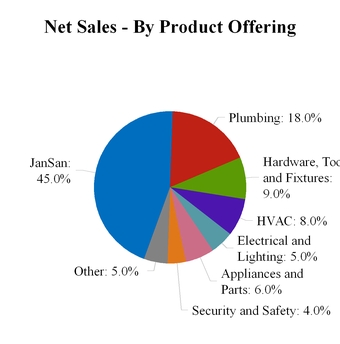
We are a leading national distributor and direct marketer of broad-line maintenance, repair and operations ("MRO") products. We have one operating segment, the distribution of MRO products into the facilities maintenance end-market. We stock approximately 100,000 MRO products in the following categories: janitorial and sanitation ("JanSan"); plumbing; heating, ventilation and air conditioning ("HVAC"); hardware, tools and fixtures; electrical and lighting; appliances and parts; security and safety; and other miscellaneous maintenance products. Our products are primarily used for the repair, maintenance, remodeling, and refurbishment of non-industrial, commercial, multi-family and residential facilities.
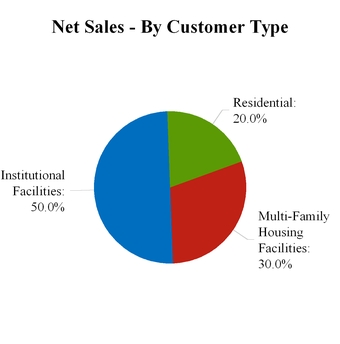
Our diverse facilities maintenance customer base includes institutions, such as educational, lodging, health care, and government facilities; multi-family housing, such as apartment complexes; and residential, such as professional contractors, and plumbing and hardware retailers. Our customers range in size from individual contractors and independent hardware stores to apartment management companies and national purchasing groups.
The following charts illustrate the approximate percentage of our net sales by customer type and product offerings for the year ended December 26, 2014:
We currently market and sell our products primarily through thirteen distinct and targeted brands, each of which is recognized in the facilities maintenance market they serve for providing quality products at competitive prices with reliable same-day or next-day delivery. The AmSan®, JanPak® , CleanSource®, Sexauer®, and Trayco® brands generally serve our institutional facilities customers; the Wilmar® and Maintenance USA® brands generally serve our multi-family housing facilities customers; and the Barnett®, Copperfield®, U.S. Lock®, Hardware Express®, LeranSM and AF Lighting® brands
generally serve our residential facilities customers. Our multi-brand operating model, which we believe is unique in the industry, allows us to use a single platform to deliver tailored products and services to meet the individual needs of each respective customer group served. During the second quarter of 2014, management made a strategic marketing decision to simplify our brand structure for our institutional customer base during 2015. This rebranding initiative is designed to consolidate our institutional brands under a single national brand name and increase brand awareness as a market leading institutional business.
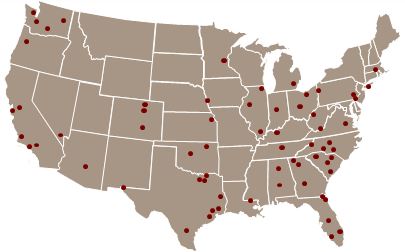
We reach our markets using a variety of sales channels, including a field sales force of approximately 1,160 associates, which includes sales management and related associates, approximately 470 inside sales and customer service and support associates, a direct marketing program consisting of catalogs and promotional flyers, brand-specific websites, a national accounts sales program, and other supply chain programs, such as vendor managed inventory. We deliver our products through our network of 67 distribution centers and 21 professional contractor showrooms located throughout the United States ("U.S."), Canada, and Puerto Rico, 72 vendor-managed inventory locations at large customer locations and a dedicated fleet of trucks and third party carriers. Our broad distribution network enables us to provide reliable, next-day delivery service to approximately 98% of the U.S. population and same-day delivery service to most major metropolitan markets in the U.S.
The following map depicts the location of our primary distribution centers as of December 26, 2014(1).
_____________________________
(1) Distribution Centers not shown on map: Mississauga, Ontario and Bayamon, Puerto Rico.
Our information technology and logistics platforms support our major business functions, allowing us to market and sell our products with same-day or next-day delivery depending on the customer’s service requirements. While we market our products under a variety of brands, generally our brands draw from the same inventory within common distribution centers and share associated employee and transportation costs. In addition, we have centralized marketing, purchasing and catalog production operations to support our brands. We believe that our information technology and logistics platforms also benefit our customers by allowing us to offer a broad product selection at highly competitive prices while maintaining the unique customer appeal, market expertise and service capabilities of each of our targeted brands. Overall, we believe that our common operating platforms have enabled us to improve customer service, maintain lower operating costs, efficiently manage working capital and support our growth initiatives.
Strategy
Our objective is to become the leading supplier of MRO products to the facilities maintenance end-market, which is comprised of our institutional, multi-family housing and residential facilities customers. In pursuing this objective, we plan to increase our net sales, earnings and return on invested capital by capitalizing on our size and scale, sales force, supply chain programs, information technology and logistics platforms to successfully execute our organic growth, operating efficiency and strategic acquisition initiatives.
• Organic Growth Initiatives. We seek to satisfy and solve key customer supply chain needs, which enables us to further penetrate the markets we serve, and to expand into new product and geographic areas by adding sales professionals, and utilizing and increasing our already successful new product and marketing strategies, including: growing web-based sales capabilities; targeting new customer acquisitions; expanding our national accounts program; increasing customer use of our supply chain management services; continuing to develop proprietary products under our exclusive brands; and selectively adding new products and new categories to our various brand offerings.
• Increased Operating Efficiencies. We will continue to focus on enhancing our operating efficiency, which will increase profitability, improve our cash conversion cycle and increase our return on capital.
• Acquisitions. We will continue to maintain a disciplined acquisition strategy of adding new customers and/or product offerings in markets we currently serve and pursuing acquisitions of established brands in new or existing markets in an effort to further leverage our operating infrastructure.
Industry and Market Overview
The MRO distribution industry in the U.S. and Canada is approximately $525 billion in size according to MRO market analyses by Modern Distribution Management ("MDM"), a trade company specializing in wholesale distribution, and Industrial Marketing Information, Inc. ("IMI"), a market research company specializing in quantification of the industrial business-to-business markets. The MRO distribution industry encompasses the supply of a wide range of products, including plumbing and electrical supplies, hand-tools, janitorial supplies, safety equipment and many other categories. Customers served by the MRO distribution industry include heavy industrial manufacturers that use MRO supplies for the repair and overhaul of production equipment and machinery; owners and managers of facilities such as apartment complexes, office buildings, schools, hotels and hospitals that use MRO supplies largely for maintenance, repair and refurbishment; and professional contractors.
Within the MRO distribution industry, we focus on serving customers in the facilities maintenance end-market. Our customers are primarily engaged in the repair, maintenance, remodeling, refurbishment and, to a lesser extent, construction of non-industrial and residential facilities.
The Transactions
On May 29, 2012, Interline Brands entered into an Agreement and Plan of Merger (the “Merger Agreement”) with Isabelle Holding Company LLC (formerly known as Isabelle Holding Company Inc.) (“Parent”) and Isabelle Acquisition Sub Inc. (“Merger Sub”). On September 7, 2012, pursuant to the Merger Agreement, Merger Sub merged with and into Interline Brands, with Interline Brands continuing as the surviving corporation (the “Merger”). Immediately following the completion of the Merger, Parent was merged with and into Interline Brands, with Interline Brands as the surviving entity. In connection with the closing of the Merger, certain members of management purchased shares of common stock of Interline Brands.
The Merger was financed using the proceeds of (i) $365.0 million of debt financing from the issuance of the 10% / 10.75% senior notes due 2018 (the “HoldCo Notes”), (ii) $350.9 of equity capital from the Sponsors and certain members of management, (iii) $107.6 million of available cash from operations, and (iv) $80.0 of drawings under a new senior secured asset-based revolving credit facility (the “ABL Facility”). In addition, in connection with the Merger, Interline New Jersey engaged in a successful consent solicitation to make certain amendments to the terms of our OpCo Notes due 2018 (the "OpCo Notes"). We refer to the Merger, the financing thereof, the consent solicitation and the related transactions collectively as the “Transactions.”
Corporate Structure
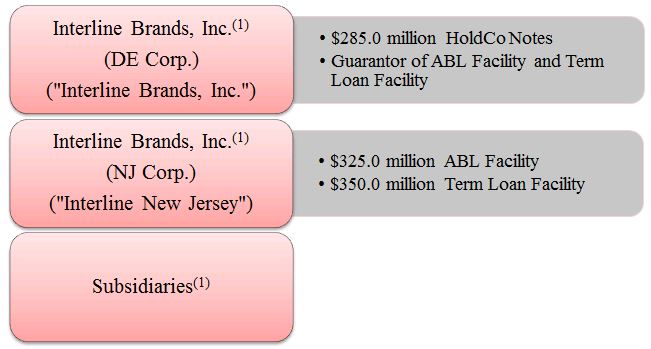
The following diagram illustrates our corporate structure and the aggregate principal amount of indebtedness outstanding as of December 26, 2014. The diagram does not display all of our subsidiaries.
_____________________________
| |
(1) | Interline Brands, along with certain domestic subsidiaries, guarantee Interline New Jersey’s Term Loan Facility and guarantees the ABL Facility. Neither Interline New Jersey nor any of our other subsidiaries guarantee the notes offered hereby, and as a result have no contractual obligations with respect thereto. |
Recent Developments
On December 30, 2014, the Company used a combination of cash on hand and borrowings under the recently amended ABL Facility to redeem $80.0 million of the $365.0 million outstanding aggregate principal amount of the HoldCo Notes at a redemption price of 105% of the outstanding aggregate principal amount to be redeemed, plus accrued and unpaid interest through the redemption date. In connection with the redemption of the HoldCo Notes, the Company recorded a loss on early extinguishment of debt in the amount of $6.6 million which will be included in the statement of operations for the three months ended March 27, 2015. The loss was comprised of $4.0 million in tender premium and related transactions costs and the write-off of the unamortized deferred debt issuance costs of $2.6 million. As a result of this transaction, $285.0 million of the HoldCo Notes are outstanding as of the date of this prospectus.
Our Sponsors
GS Capital Partners LP
Since 1986, the Goldman Sachs Merchant Banking Division ("MBD") has raised $94 billion of fund capital (including leverage) for Corporate Equity and Credit investing. A global leader in private corporate equity investing, MBD focuses on large, high quality companies with strong management in order to fund acquisition or expansion across a range of industries and geographies. Within Corporate investing, of which GS Capital Partners is a part, MBD has invested approximately $95 billion through a combination of external investment funds and firm capital. GS Capital Partners VI fund, the sixth in a series of global diversified private equity funds formed since 1992, was formed in 2007 with $20.3 billion in commitments. Founded in 1869, Goldman Sachs is a leading global investment banking, securities and investment management firm that provides a wide range of financial services to a substantial and diversified client base that includes corporations, financial institutions, governments and high-net-worth individuals.
P2 Capital Partners, LLC
P2 is a New York-based investment firm that applies a private equity approach to investing in the public market. P2 manages a concentrated portfolio of significant ownership stakes in high quality public companies in which it is an active shareholder focused on creating long-term value in partnership with management. The firm also leads private equity transactions within its public portfolio. P2’s limited partners include leading public pension funds, corporate pension funds, endowments, foundations, insurance companies, and high net worth investors.
Corporate Information
Interline Brands was incorporated in the state of Delaware in 2004. Our principal executive offices are located at 701 San Marco Boulevard, Jacksonville, Florida 32207 and our telephone number is (904) 421-1400. We also maintain a website at www.interlinebrands.com. The information on or accessible through our website is not part of this prospectus.
Summary of Terms of the Notes
The summary below describes the principal terms of the notes. Some of the terms and conditions described below are subject to important limitations and exceptions. The “Description of the Notes” section of this prospectus contains a more detailed description of the terms and conditions of the notes.
|
| | | |
Issuer | Interline Brands, Inc., a Delaware corporation. |
| | | |
Securities | $285,000,000 principal amount of 10% / 10.75% Senior Notes due 2018. |
| | | |
Maturity Date | November 15, 2018 |
| | | |
Interest | The initial interest payment on the notes was made in cash. For each interest payment thereafter (other than the final interest payment ending at stated maturity, which will be made in cash), the Issuer will be required to pay interest on the notes entirely in cash unless the conditions described in this prospectus are satisfied, in which case the Issuer will be entitled to pay, to the extent described herein, interest for such interest period by increasing the principal amount of the notes or issuing new notes (such increase or issuance being referred to herein as “PIK Interest”). For additional information on the requirement to pay cash interest or a combination of cash interest and PIK Interest, see “Description of the Notes—Principal, Maturity and Interest.” Cash interest on the notes will accrue at a rate of 10% per annum. PIK interest on the notes will accrue at the rate of 10.75% per annum. If the Issuer pays any PIK Interest, the Issuer will increase the principal amount of the notes or issue new notes in an amount equal to the interest payment for the applicable interest period (rounded up to the nearest $1.00) to holders of notes on the relevant record date. |
| | | |
Interest Payment Dates | January 15 and July 15 of each year, commencing January 15, 2013. |
| | | |
Guarantees | The notes are not guaranteed, and will only be guaranteed in the future under certain limited circumstances. See “Description of the Notes—Guarantees.” |
| | | |
Ranking | The notes constitute our senior unsecured debt and rank: |
| | Ÿ | pari passu in right of payment with all of the Issuer’s future senior debt; |
| | Ÿ | senior in right of payment to all of the Issuer’s existing and future subordinated debt; |
| | Ÿ | effectively subordinated to all of the Issuer’s existing and future secured indebtedness, to the extent of the value of the collateral securing such obligations; and |
| | Ÿ | structurally subordinated to all existing and future indebtedness of, and other obligations and preferred stock of, the Issuer’s subsidiaries (other than indebtedness and other obligations owed to the Issuer). |
| | | As of December 26, 2014, the Issuer had $786.4 million of indebtedness on a consolidated basis, including the notes offered hereby, the Term Loan Facility, borrowings under the ABL Facility, each of which we guarantee and capital leases of $0.01 million. The Issuer’s subsidiaries had $421.4 million of indebtedness and all of the indebtedness of such subsidiaries were structurally senior to the notes. |
| | | |
| | | On December 30, 2014, the Company used a combination of cash on hand and borrowings under the recently amended ABL Facility to redeem $80.0 million of the $365.0 million outstanding aggregate principal amount of the HoldCo Notes at a redemption price of 105% of the outstanding aggregate principal amount to be redeemed, plus accrued and unpaid interest through the redemption date. See "Summary—Recent Developments" for additional information. |
Optional Redemption | The Issuer may redeem some or all of the notes at the redemption prices listed under “Description of the Notes—Optional Redemption,” plus accrued and unpaid interest to the redemption date. |
| | | |
|
| | | |
Mandatory Principal Redemption | If the notes would otherwise constitute “applicable high yield discount obligations” within the meaning of Section 163(i)(1) of the Internal Revenue Code of 1986, as amended (the “Code”), at the end of each “accrual period” (as defined in Section 1272(a)(5) of the Code) ending after the fifth anniversary of the notes’ issuance (each, an “AHYDO redemption date”), the Issuer will be required to redeem for cash a portion of each note then outstanding equal to the “Mandatory Principal Redemption Amount” (each such redemption, a “Mandatory Principal Redemption”). The redemption price for the portion of each note redeemed pursuant to any Mandatory Principal Redemption will be 100% of the principal amount of such portion plus any accrued interest thereon on the date of redemption. “Mandatory Principal Redemption Amount” means, as of each AHYDO redemption date, the portion of a note required to be redeemed to prevent such note from being treated as an “applicable high yield discount obligation” within the meaning of Section 163(i)(1) of the Code. No partial redemption or repurchase of the notes prior to any AHYDO redemption date pursuant to any other provision of the indenture governing the notes will alter the Issuer’s obligation to make any Mandatory Principal Redemption with respect to any notes that remain outstanding on such AHYDO redemption date. |
| | | |
Change of Control | If a change of control occurs, the Issuer must give holders of the notes the opportunity to sell their notes to us at 101% of the principal amount thereof, plus accrued and unpaid interest. See “Description of the Notes—Change of Control.” We may not have sufficient liquidity or have the ability to raise the funds necessary to finance a change of control offer required by the indenture relating to the notes in the event of a change of control. See “Risk Factors—Risks Relating to the Notes—We may not have the ability to raise the funds necessary to finance a change of control offer required by the indenture relating to the notes or the terms of our other indebtedness. In addition, under certain circumstances, we may be permitted to use the proceeds from debt to effect merger payment in compliance with the indenture.” |
| | | |
Certain Covenants | The indenture governing the notes contains covenants that, among other things, limit the Issuer’s ability and the ability of the Issuer’s restricted subsidiaries to: |
| | Ÿ | pay dividends or distributions, repurchase equity, prepay junior debt and make certain investments; |
| | Ÿ | incur additional debt or issue certain disqualified stock and preferred stock; |
| | Ÿ | incur liens on assets; |
| | Ÿ | merge, consolidate or sell all or substantially all assets; |
| | Ÿ | enter into transactions with affiliates; and |
| | Ÿ | allow to exist certain restrictions on the ability of restricted subsidiaries to pay dividends or make other payments to us. |
| | These covenants are subject to important exceptions and qualifications. During any period in which the notes have an investment grade rating from both Rating Agencies (as defined herein) and no default has occurred and is continuing under the indenture governing the notes, the Issuer will not be subject to certain of these covenants. See “Description of the Notes—Material Covenants.” |
| | | |
No Prior Market | The Issuer does not intend to list the notes on any national securities exchange or automated quotation system. Accordingly, we cannot assure you that an active public or other market will develop for the notes or as to the liquidity of the trading market for the notes. If a trading market does not develop or is not maintained, holders of the notes may experience difficulty in reselling the notes or may be unable to sell them at all. If a market for the notes develops, any such market may be discontinued at any time. Accordingly, you may have to bear the financial risks of investing in the notes for an indefinite period of time. The Issuer does not intend to apply for a listing of the notes on any securities exchange or automated dealer quotation system. See “Plan of Distribution |
| | | |
Risk Factors | You should consider carefully the information set forth in the section entitled “Risk Factors” beginning on page 10 and all other information contained in this prospectus before deciding to invest in the notes. |
Summary Historical Consolidated Financial Data
The table below sets forth certain of Interline Brands’ historical consolidated financial data as of and for each of the periods indicated. The consolidated historical financial information as of and for the fiscal years ended December 28, 2012, December 27, 2013, and December 26, 2014 is derived from our audited consolidated financial statements appearing elsewhere in this prospectus. Our historical operating results are not necessarily indicative of future operating results.
The data below should be read in conjunction with “Non-GAAP Financial Information,” “Risk Factors,” “Capitalization,” “Management’s Discussion and Analysis of Financial Condition and Results of Operations” and our consolidated financial statements and the notes thereto appearing elsewhere in this prospectus.
|
| | | | | | | | | | | | | | | | |
| Successor | | | Predecessor |
| Fiscal Year Ended | | For the period September 8, 2012 through December 28, 2012 (1)(3) | | | For the period December 31, 2011 through September 7, 2012 (3) |
| December 26, 2014 | | December 27, 2013 | | | |
Income Statement Data: | | | | | | | | |
Net sales | $ | 1,676,221 |
| | $ | 1,598,055 |
| | $ | 404,593 |
| | | $ | 917,752 |
|
Cost of sales | 1,094,578 |
| | 1,045,084 |
| | 256,349 |
| | | 584,033 |
|
Gross profit | 581,643 |
| | 552,971 |
| | 148,244 |
| | | 333,719 |
|
Operating expenses(5) | 529,729 |
| | 508,651 |
| | 168,011 |
| | | 292,165 |
|
Operating income (loss) | 51,914 |
| | 44,320 |
| | (19,767 | ) | | | 41,554 |
|
Impairment of other intangible assets | (67,500 | ) | | — |
| | — |
| | | — |
|
Loss on extinguishment of debt, net | (4,257 | ) | | — |
| | — |
| | | (2,214 | ) |
Interest and other expense, net | (58,195 | ) | | (61,507 | ) | | (19,180 | ) | | | (15,132 | ) |
(Loss) income before income taxes | (78,038 | ) | | (17,187 | ) | | (38,947 | ) | | | 24,208 |
|
Income tax (benefit) provision | (30,966 | ) | | (10,847 | ) | | (10,503 | ) | | | 11,384 |
|
Net (loss) income | $ | (47,072 | ) | | $ | (6,340 | ) | | $ | (28,444 | ) | | | $ | 12,824 |
|
| | | | | | | | |
Balance Sheet Data (as of end of period): | | | | | | | | |
Cash and cash equivalents | $ | 6,064 |
| | $ | 6,102 |
| | $ | 15,801 |
| | | N/A |
|
Total assets | 1,460,622 |
| | 1,517,733 |
| | 1,523,233 |
| | | N/A |
|
Total debt(6) | 786,385 |
| | 798,588 |
| | 814,741 |
| | | N/A |
|
Stockholders' equity | 316,517 |
| | 356,853 |
| | 357,470 |
| | | N/A |
|
| | | | | | | | |
Other Data: | | | | | | | | |
Depreciation and amortization | $ | 53,814 |
| | $ | 50,038 |
| | $ | 12,837 |
| | | $ | 17,707 |
|
Adjusted EBITDA(7) | 141,802 |
| | 134,144 |
| | 37,610 |
| | | 84,132 |
|
Capital expenditures | 17,437 |
| | 18,738 |
| | 5,748 |
| | | 11,966 |
|
Capital expenditures as a percentage of net sales | 1.0 | % | | 1.2 | % | | 1.4 | % | | | 1.3 | % |
_____________________________
| |
(1) | As a result of the Merger, we applied the acquisition method of accounting, which established a new accounting basis as of September 8, 2012. The financial results for the period September 8, 2012 through December 28, 2012 represent the 16-week Successor Period subsequent to the Merger. |
| |
(2) | As a result of the Merger, we applied the acquisition method of accounting, which established a new accounting basis as of September 8, 2012. The financial results for the period December 31, 2011 through September 7, 2012 represent the 36-week Predecessor Period prior to the Merger. |
| |
(3) | We acquired JanPak, Inc. in December 2012 and Northern Colorado Paper ("NCP") in January 2011. Their results have been included in the financial statements since each respective acquisition date. |
| |
(4) | All fiscal years presented were 52-week years, with the exception of 2012, which is presented as Successor and Predecessor Periods. |
| |
(5) | Included in operating expenses were Merger related costs of $0.1 million for the fiscal year ended December 26, 2014, $1.4 million for the fiscal year ended December 27, 2013, $39.6 million for the period September 8, 2012 through December 28, 2012 (Successor Period), and $19.0 million for the period December 31, 2011 through September 7, 2012 (Predecessor Period). |
| |
(6) | Total debt represents the amount of our short-term debt and long-term debt and short and long-term capital leases. |
| |
(7) | The reconciliation of EBITDA and Adjusted EBITDA to the most directly comparable US GAAP financial measure, which is net (loss) income, is as follows (in thousands): |
|
| | | | | | | | | | | | | | | | |
| Successor | | | Predecessor |
| Fiscal Year Ended | | For the period September 8, 2012 through December 28, 2012 | | | For the period December 31, 2011 through September 7, 2012 |
| December 26, 2014 | | December 27, 2013 | | | |
EBITDA | | | | | | | | |
Net (loss) income | $ | (47,072 | ) | | $ | (6,340 | ) | | $ | (28,444 | ) | | | $ | 12,824 |
|
Interest expense, net | 59,099 |
| | 63,042 |
| | 19,758 |
| | | 16,613 |
|
(Benefit) provision for income taxes | (30,966 | ) | | (10,847 | ) | | (10,503 | ) | | | 11,384 |
|
Depreciation and amortization | 53,814 |
| | 50,038 |
| | 12,837 |
| | | 17,707 |
|
EBITDA | 34,875 |
| | 95,893 |
| | (6,352 | ) | | | 58,528 |
|
| | | | | | | | |
EBITDA Adjustments | | | | | | | | |
Impairment of other intangible assets | 67,500 |
| | — |
| | — |
| | | — |
|
Loss on extinguishment of debt, net | 4,257 |
| | — |
| | — |
| | | 2,214 |
|
Merger related expenses | 102 |
| | 1,377 |
| | 39,641 |
| | | 19,049 |
|
Share-based compensation | 3,720 |
| | 5,330 |
| | 2,945 |
| | | 3,922 |
|
Distribution center consolidations and restructuring costs | 7,459 |
| | 8,307 |
| | 484 |
| | | 323 |
|
Acquisition-related costs, net | 1,496 |
| | 372 |
| | 610 |
| | | 96 |
|
Litigation-related costs | 21,604 |
| | 21,841 |
| | — |
| | | — |
|
Impact of straight-line rent expense | 789 |
| | 1,024 |
| | 282 |
| | | — |
|
Adjusted EBITDA | $ | 141,802 |
| | $ | 134,144 |
| | $ | 37,610 |
| | | $ | 84,132 |
|
Risk Factors
Before making a decision to invest in the notes, you should carefully consider the following risk factors described below. Additional risks and uncertainties not currently known to us or that we currently deem to be immaterial may also materially adversely affect our business, financial condition or results of operations. Any of the following risks could materially adversely affect our business, financial condition or results of operations. In addition, there may be other risks that a prospective investor should consider that are relevant to its particular circumstances or generally. In such case, you may lose all or part of your original investment.
Risks Relating to the Notes
Claims of noteholders will be structurally subordinated to claims of creditors of our subsidiaries.
The notes are not guaranteed by any of our subsidiaries. Accordingly, claims of holders of the notes will be structurally subordinated to the claims of creditors of our subsidiaries, including trade creditors. All obligations of our subsidiaries will have to be satisfied before any of the assets of such subsidiaries would be available for distribution, upon a liquidation or otherwise, to us or our creditors, including the holders of the notes.
As of December 26, 2014, our subsidiaries had total indebtedness of approximately $421.4 million, including $347.4 million outstanding under the Term Loan Facility, $74.0 million outstanding on the ABL Facility and $0.01 million of capital lease obligations, all of which are structurally senior to the notes. On December 30, 2014, the Company used a combination of cash on hand and borrowings under the recently amended ABL Facility to redeem $80.0 million of the $365.0 million outstanding aggregate principal amount of the HoldCo Notes at a redemption price of 105% of the outstanding aggregate principal amount to be redeemed, plus accrued and unpaid interest through the redemption date. See "Summary—Recent Developments" for additional information.
We are the sole obligor of the notes and our direct and indirect subsidiaries do not guarantee our obligations under the notes and do not have any obligation with respect to the notes.
We are a holding company with no business operations or assets other than the capital stock of Interline New Jersey. Operations are conducted through Interline New Jersey and its subsidiaries. Consequently, we will be dependent on loans, dividends and other payments from Interline New Jersey, and, indirectly, its subsidiaries, to make payments of principal and interest in cash on the notes. However, our subsidiaries are separate and distinct legal entities, and they will have no obligation, contingent or otherwise, to pay the amounts due under the notes or to make any funds available to pay those amounts, whether by dividend, distribution, loan or other payments. You will not have any direct claim on the cash flows or assets of our direct and indirect subsidiaries. Moreover, we are a guarantor of the Term Loan Facility and the ABL Facility, and as such, we are an obligor thereunder and have pledged all of our equity interests in Interline New Jersey to secure its obligations under the ABL Facility and Term Loan Facility.
The ability of our subsidiaries to pay dividends and make other payments to us will depend on their cash flows and earnings, which, in turn, will be affected by all of the factors discussed in “Risks Related to Our Business” below. The ability of our direct and indirect subsidiaries to pay dividends and make distributions to us may be restricted by, among other things, applicable laws and regulations and by the terms of the agreements into which they enter. If we are unable to obtain funds from our direct and indirect subsidiaries as a result of restrictions under their debt or other agreements, applicable laws and regulations or otherwise, we may not be able to pay cash interest or principal on the notes when due. The terms of the credit agreement, and any future credit agreements or indentures, governing the ABL Facility and the Term Loan Facility significantly restrict Interline New Jersey from paying dividends and otherwise transferring assets to us, except for administrative, legal and accounting services.
Our ability to make payments on our indebtedness and to fund our other obligations is dependent not only on the ability of our subsidiaries to generate cash, but also on the ability of our subsidiaries to distribute cash to us in the form of dividends, fees, interest, loans or otherwise, as well as our ability to obtain funds from other sources of financing, which may not be available if and when required.
The indenture governing the notes offered hereby requires us to determine the amount of cash interest we will pay in respect of each interest period no later than fifteen days prior to the beginning of such interest period, and there can be no assurance that Interline New Jersey will continue to have sufficient capacity under the restricted payments basket governing the its indebtedness to dividend cash to us at the end of the interest period (over six months after the determination date), when such cash interest would actually be paid to holders of the notes offered hereby. This could lead to a breach of the indenture governing the notes hereby (if we fail to make the required cash interest payment) and/or the indebtedness of Interline New
Jersey (if Interline New Jersey pays such dividend absent sufficient restricted payments availability under its indebtedness), which may result in a cross default under the ABL Facility or the Term Loan Facility.
Our substantial indebtedness could adversely affect our financial health and prevent us from fulfilling our obligations.
As of December 26, 2014, our total indebtedness was $786.4 million comprised of $365.0 million in outstanding HoldCo Notes, a $347.4 million Term Loan Facility, $74.0 million outstanding on the ABL Facility, and capital lease obligations of $0.01 million. As of the same date, cash and cash equivalents were $6.1 million, outstanding letters of credit totaled $11.3 million and there was $209.7 million available under the ABL Facility. Our substantial indebtedness could have important consequences to our financial health including, but not limited to:
| |
• | increased vulnerability to general adverse economic and industry conditions or a downturn in our business; |
| |
• | limited flexibility in planning for, or reacting to, changes in our business and the industry in which we operate; |
| |
• | a competitive disadvantage compared to our competitors that are not as highly leveraged; |
| |
• | difficulties related to satisfying our obligations with respect to the HoldCo Notes, Term Loan Facility, ABL Facility, and our other indebtedness; |
| |
• | reduced availability of cash flows to fund working capital, capital expenditures and general corporate purposes as a result of debt service requirements; |
| |
• | limited capacity to borrow additional funds, if needed; and |
| |
• | an event of default if we fail to satisfy our obligations under the HoldCo Notes, Term Loan Facility, the ABL Facility, or our other indebtedness or if we fail to comply with the financial other restrictive covenants contained in the indenture and agreements governing the ABL Facility, Term Loan Facility and other debt; such event of default could result in all of our debt becoming immediately due and payable and could permit certain of our lenders to foreclose on assets securing our indebtedness. |
If our cash flow and capital resources are insufficient to fund our debt service obligations, including timely payment of principal and interest on our outstanding indebtedness, we may be required to reduce or delay capital expenditures, sell assets, seek to obtain additional capital or refinance all or part of our existing debt. There can be no assurance that we will be able to successfully complete any of these transactions or do so on favorable terms. Any of the above listed factors could have a material adverse effect on our business, financial condition and results of operations.
If we do not have sufficient funds to pay cash interest on the notes offered hereby, all or part of the interest on the notes may be paid in PIK interest.
We will be required to pay interest on the notes entirely in cash unless the conditions described in this prospectus are satisfied, in which case we will be entitled to pay, to the extent described herein, PIK interest. See “Description of the Notes—Principal, Maturity and Interest.” Our ability to pay cash interest is dependent on distributions from our subsidiaries, including Interline New Jersey. The credit agreements governing the ABL Facility and the Term Loan Facility and the indenture governing the notes offered hereby allow our subsidiaries to utilize amounts that would otherwise be available to pay cash dividends to us for purposes such as making restricted investments, capital expenditures and prepaying subordinated indebtedness and, subject to certain limitations, making cash dividends to and other payments in respect of equity holders, and such uses would reduce the amounts available to pay dividends to us in order to pay cash interest on the notes offered hereby. The indenture governing the notes does not restrict the ability of our subsidiaries to use their dividend payment capacity for such alternative uses. See “Description of the Notes—Principal, Maturity and Interest.” As a result, we cannot assure you that we will be required (or able) to make cash interest payments on the notes. The payment of interest through PIK interest will increase the amount of our indebtedness and would exacerbate the risks associated with our high level indebtedness.
The agreements and indenture governing our debt include restrictive and financial covenants that may limit our operating and financial flexibility.
The indenture governing the HoldCo Notes and the agreements governing the ABL Facility and Term Loan Facility, each contain covenants that, among other things, restrict our ability to take specific actions, even if we believe them to be in our best interest. These include restrictive covenants that limit, among other things, our ability to:
| |
• | incur any additional indebtedness; |
| |
• | consolidate, merge, or sell assets or enter into other business combination transactions; |
| |
• | make certain restricted payments, such as paying dividends, making distributions on, redeeming or repurchasing stock; |
| |
• | make certain investments, including acquisitions and capital expenditures; |
| |
• | amend the terms of certain subordinated indebtedness; |
| |
• | enter into transactions with affiliates; |
| |
• | enter into sale leaseback transactions; |
| |
• | use proceeds from sale of assets; |
| |
• | limit the payment of dividends by our subsidiaries; |
| |
• | prepay, redeem or repurchase certain indebtedness; and |
In addition, the ABL Facility requires the Company and its restricted subsidiaries, on a consolidated basis, to maintain a fixed charge coverage ratio (defined as the ratio of EBITDA, as defined in the credit agreement, to the sum of cash interest, principal payments on indebtedness and accrued income taxes, dividends or distributions and repurchases, redemptions or retirement of the equity interest of the Company) of at least 1.00:1.00 when the excess availability is less than or equal to the greater of: (i) 10% of the total commitments under the ABL Facility; and (ii) $25.0 million.
The Term Loan Facility contains similar covenants, including coverage ratio requirements, as discussed in Management's Discussion and Analysis of Financial Condition and Results of Operations—Liquidity and Capital Resources, "—ABL Credit Facility” “—Term Loan Facility” and “—HoldCo Notes.”
To service our indebtedness, we will require a significant amount of cash, which depends on many factors beyond our control.
Based on our current level of operations, we believe our cash flow from operations, available cash and available borrowings under the ABL Facility will be adequate to meet our future liquidity needs for the foreseeable future. However, we cannot assure you that our business will generate sufficient cash flow from operations, or that future borrowings will be available to us under the ABL Facility in amounts sufficient to enable us to fund our liquidity needs, including with respect to the notes and our other indebtedness. In addition, if we consummate significant acquisitions in the future, our cash requirements may increase significantly. As our debt matures, we may also need to raise funds to refinance all or a portion of our debt. We cannot assure you that we will be able to refinance any of our debt, including the ABL Facility or the Term Loan Facility, on attractive terms, commercially reasonable terms or at all. Our future operating performance and our ability to service or refinance the notes and to service, extend or refinance our other debt, including the ABL Facility, the Term Loan Facility and the notes offered hereby, will be subject to future economic conditions and to financial, business and other factors, many of which are beyond our control.
The notes are our senior unsecured obligations. Therefore, our secured creditors (including the lenders under the ABL Facility and the Term Loan Facility) would have a prior claim, ahead of the notes, on our assets.
The notes are our senior unsecured obligations. As a result, upon any distribution to our creditors in a bankruptcy, liquidation or reorganization or similar proceeding relating to us or our property, the holders of our secured indebtedness, including the lenders under the ABL Facility, will be entitled to be paid in full from our assets securing that secured indebtedness before any payment may be made with respect to the notes. Although the indenture governing the notes restricts our ability to incur liens, that restriction is subject to important exceptions such that we may be able to incur more secured debt in the future, which amount could be material. In addition, if we fail to meet our payment or other obligations under our secured debt, the holders of that secured indebtedness would be entitled to foreclose on our assets securing that secured debt and liquidate those assets. Accordingly, we may not have sufficient funds to pay amounts due on the notes. As a result you may lose a portion of or the entire value of your investment in the notes.
Our debt agreements give us flexibility to undertake certain transactions which could be adverse to the interests of holders of the notes, including making restricted payments and incurring additional indebtedness, including secured indebtedness.
Notwithstanding the restrictive covenants described above in our debt agreements, the terms of the ABL Facility, the Term Loan Facility, and indentures (including the indenture governing the notes) give us flexibility to undertake certain transactions which could be adverse to the interests of holders of the notes. For example, the provisions contained in the agreements relating to our indebtedness, including the notes offered hereby, limit but do not prohibit our ability to incur additional indebtedness, including secured indebtedness, and the amount of indebtedness that we could incur could be substantial and could be used to finance acquisitions or to assume debt in connection with an acquisition. Accordingly, we could incur significant additional indebtedness in the future, including additional indebtedness under the ABL Facility. Similarly, if we incur any secured indebtedness, the holders of that secured indebtedness will be entitled to be paid in full from the assets securing that indebtedness before any payment may be made with respect to the notes. If we incur any additional indebtedness that ranks equally with the notes offered hereby, the holders of that indebtedness will be entitled to share ratably with the holders of these notes in any proceeds distributed in connection with any bankruptcy, liquidation, reorganization or similar
proceedings. This may have the effect of reducing the amount of proceeds paid to you. If new indebtedness is added to our current debt levels, the related risks that we now face, including those described above, could intensify.
We may not have the ability to raise the funds necessary to finance a change of control offer required by the indenture relating to the notes or the terms of our other indebtedness. In addition, under certain circumstances, we may be permitted to use the proceeds from debt to effect merger payments in compliance with the indenture.
Upon the occurrence of a change of control, a default could occur in respect of the ABL Facility and the Term Loan Facility, and we will be required to make an offer to purchase all outstanding notes. If such a change of control event were to occur, we cannot assure you that we would have sufficient funds to pay the purchase price for all the notes tendered by the holders or such other indebtedness. See “Description of the Notes—Change of Control.” The ABL Facility, the Term Loan Facility, and the indenture governing the notes offered hereby contain, and any future agreements relating to indebtedness to which we become a party may contain, provisions restricting our ability to purchase notes or providing that an occurrence of a change of control constitutes an event of default, or otherwise requiring payment of amounts borrowed under those agreements. If such a change of control event occurs at a time when we are prohibited from purchasing the notes, we may seek the consent of our then existing lenders and other creditors to the purchase of the notes or may attempt to refinance the indebtedness that contains the prohibition. If we do not obtain such a consent or repay such indebtedness, we would remain prohibited from purchasing the notes. In that case, our failure to purchase tendered notes would constitute a default under the terms of the indenture governing the notes and any other indebtedness that we may enter into from time to time with similar provisions.
It may be difficult for the holders of notes to ascertain that a change of control has occurred, leading to uncertainty as to whether a holder of notes may require us to repurchase the notes.
The definition of change of control includes a disposition of all or substantially all of our and our restricted subsidiaries’ assets. Although there is a limited body of case law interpreting the phrase “substantially all,” there is no precise established definition of the phrase under applicable law. Accordingly, in certain circumstances there may be a degree of uncertainty as to whether a particular transaction would involve a disposition of “all or substantially all” of our and our restricted subsidiaries’ assets. As a result, it may be unclear as to whether a change of control has occurred and whether a holder of notes may require us to make an offer to repurchase the notes. See “Description of the Notes—Change of Control.”
We may enter into certain transactions that would not constitute a change of control but that result in an increase of our indebtedness.
Subject to limitations under the indenture governing the notes offered hereby, and the credit agreement governing the ABL Facility and the Term Loan Facility, we could, in the future, enter into certain transactions, including acquisitions, refinancings or other recapitalizations, that would not constitute a change of control under the indenture governing the notes, the Term Loan Facility, and the ABL Facility, but that could increase the amount of indebtedness outstanding at such time or otherwise affect our capital structure or credit ratings in a way that adversely affects the holders of the notes. See “Description of the Notes—Change of Control.”
Changes in credit ratings issued by statistical rating organizations could adversely affect our cost of financing and the market price of the notes.
Credit rating agencies rate the notes and our other indebtedness on factors that include our operating results, actions that we take, their view of the general outlook for our industry and their view of the general outlook for the economy. Actions taken by the rating agencies can include maintaining, upgrading or downgrading the current rating or placing us on a watch list for possible future downgrading. Downgrading the credit rating of the notes or our other indebtedness or placing us on a watch list for possible future downgrading could limit our ability to refinance maturing liabilities, access the capital markets to meet liquidity needs, increase our cost of financing and lower the market price or liquidity of the notes.
Credit ratings are not recommendations to purchase, hold or sell the notes. Additionally, credit ratings may not reflect the potential effect of risks relating to the structure or marketing of the notes. Any future lowering of our ratings likely would make it more difficult or more expensive for us to obtain additional debt financing. If any credit rating initially assigned to the notes is subsequently lowered or withdrawn for any reason, you may not be able to resell your notes at a favorable price or at all.
Certain restrictive covenants in the indenture governing the notes will be suspended if the notes achieve investment grade ratings.
Most of the restrictive covenants in the indenture governing the notes will not apply so long as the notes achieve investment grade ratings from Moody’s Investor Service, Inc. and Standard & Poor’s Rating Services, and no default or event of default has occurred, subject to continued compliance with our other outstanding debt instruments. If these restrictive covenants cease to apply, we may take actions, such as incurring additional indebtedness or making certain dividends or distributions, which would otherwise be prohibited under the indenture governing the notes. Ratings are given by these rating agencies based on analyses that include many subjective factors. We cannot assure you that the notes will achieve investment grade ratings, nor can we assure you that investment grade ratings, if granted, will reflect all of the factors that would be important to holders of the notes.
Despite our current indebtedness levels, we may incur substantial additional indebtedness.
We may incur substantial additional indebtedness in the future to finance acquisitions, investments, or for other purposes, subject to the restrictions contained in the documents governing our current outstanding indebtedness. For example, based on year-end inventory and trade accounts receivable balances as of December 26, 2014 we were able to incur up to a maximum of $209.7 million in additional indebtedness under the ABL Facility. Although the ABL Facility, the indenture and our other debt agreements contain some limitations on our ability to incur indebtedness, we may still incur substantial indebtedness to refinance existing indebtedness or for other purposes. If new debt is added to our current indebtedness levels, the substantial leverage risks that we now face could intensify.
Major disruptions and volatility in the capital and credit markets may impact our ability to secure sufficient financing on favorable terms.
The availability of financing is dependent on numerous factors, some of which are beyond our control, including, but not limited to, general economic conditions and the volatility of the capital and credit markets. We may not able to obtain additional financing on favorable terms, or at all, which could have a material adverse effect on our business, including the ability to make acquisitions and execute our growth strategies. Furthermore, if our operating results, cash flow or capital resources prove inadequate, or if interest rates increase significantly, we could face substantial liquidity problems, which may impede our ability to seek additional capital in a timely manner or refinance our existing debt on favorable terms. If we are unable to service our debt, we could be forced to reduce or delay planned capital expenditures, sell assets, restructure or refinance our debt or seek additional equity capital. There can be no assurance that any of these actions will be sufficient to allow us to service our debt obligations or that such actions will not result in an adverse impact on our business. In addition, the terms of the ABL Facility, Term Loan Facility and the indenture governing the HoldCo Notes and any future indebtedness may limit our ability to take certain of these actions thereby adversely impacting our results of operations and financial condition.
Risks Relating to Our Business
General economic conditions may adversely impact our industry and customers resulting in adverse effects on the Company’s operating results.
Financial markets in the United States, Europe and Asia experienced substantial disruption from prior recessions, including, among other things, extreme volatility in security prices, severely diminished liquidity and credit availability, rating downgrades of certain investments and declining valuations of others. A slow and extended recovery or a downturn, worsening or broadening of adverse conditions in the worldwide and domestic economies could negatively affect purchases of our products, and create or exacerbate credit issues, cash flow issues and other financial issues for us and for our suppliers and customers. Depending upon their severity and duration, these conditions could have a material adverse impact on our business, liquidity, financial condition and results of operations.
Current and future economic conditions and other factors, including consumer confidence, interest rates, unemployment trends, government regulations, and liquidity in capital markets can impact consumer spending and demand for our products. Such economic developments may affect our business in a number of ways. Reduced demand may drive us and our competitors to offer products at promotional prices, which would have a negative impact on our profitability. Also, credit availability may adversely affect the ability of our customers and suppliers to obtain financing for significant purchases and operations which could result in a decrease in, or cancellation of, orders for our products. If demand for our products slows down or decreases, we will not be able to improve our revenues and we may run the risk of failing to satisfy the financial and other restrictive covenants to which we are subject under our existing indebtedness. Reduced revenues as a result of decreased demand may also hinder our ability to improve our performance in connection with our long-term strategy.
We operate in a highly competitive industry, which may have a material adverse effect on our business, financial condition, and results of operations.
The MRO product distribution industry is highly competitive. We face significant competition from national and regional distributors that market their products through the use of direct sales forces as well as direct marketing, websites and catalogs. In addition, we face competition from traditional channels of distribution such as retail outlets, small wholesalers and large warehouse stores and from buying groups formed by smaller distributors, internet-based procurement service companies, auction businesses and trade exchanges. We expect that new competitors may develop over time as internet-based enterprises become more established and reliable and refine their service capabilities.
Competition in our industry is primarily based upon product line breadth, product availability, technology, service capabilities and price. To the extent that existing or future competitors seek to gain or retain market share by reducing price or by increasing support service offerings, we may be required to lower our prices or to make additional expenditures for support services, thereby reducing our profitability.
In addition, the MRO product distribution industry is undergoing changes driven by ongoing industry consolidation and increased customer demands. Traditional MRO product distributors are consolidating operations and acquiring or merging with other MRO product distributors to achieve greater economies of scale capabilities and increase efficiency. This consolidation trend could cause the industry to become more competitive and may adversely affect our operating margins and growth prospects. Furthermore, an inability on our part to successfully compete within our target markets could result in lost customers and a corresponding decline in sales, which may have a material adverse effect on our business, financial condition, and results of operations.
Adverse changes in industry trends and economic factors specific to the principal markets in which we serve may negatively impact our net sales growth and operating margins.
We currently market and sell our products across certain facilities maintenance end-markets, including institutional facilities, multi-family housing facilities, and residential facilities. The demand for our products and services depends to some degree on the capital spending levels of end-users within these markets. The strength of these markets depends on many factors, generally outside of the Company’s control, including general economic conditions, government spending, credit availability and stability of the housing markets, including new residential construction and home improvement activity levels. The success of our business depends in part on our ability to identify and respond promptly to evolving trends in demographics, consumer preferences, expectations and needs, and unexpected weather conditions. Adverse changes in industry trends as well as weaknesses in the industries in which our customers operate may negatively impact the rate of growth of our net sales and operating margins.
We are exposed to additional risks as a result of our foreign operations and global product sourcing.
Our foreign operations expose us to certain risks associated with global economic conditions, political instability, regulatory changes, cultural and legal differences, and currency exchange rate fluctuations. Risks inherent in international operations also include, among others, potential adverse tax consequences, greater credit risk exposure and risks associated with enhanced logistics complexity. Adverse changes to any of these factors may negatively impact our profitability and results of operations.
Because the functional currency related to most of our foreign operations is the applicable local currency, we are exposed to foreign currency exchange rate risks arising from transactions in the normal course of business. Our primary currency exposure risks are with the Canadian dollar and the Chinese Yuan. Fluctuations in the relative strength of foreign economies and volatility in their related currencies could impact our foreign sales and the ability to procure products overseas.
In addition, China’s turnover tax system consists of value-added tax ("VAT"), consumption tax and business tax. Export sales are exempted under VAT rules and an exporter who incurs input VAT on the manufacture of goods can claim a tax rebate from Chinese tax authorities. Currently, our Chinese suppliers benefit from the tax rebates that China provides them to export their products. If these tax rebates are reduced or eliminated, some of our Chinese-sourced products could become more expensive for us, thereby reducing our profitability.
Fluctuations in the availability or price of raw materials, products, and fuel resources could significantly reduce our revenues and profitability.
As a distributor of manufactured products, our profitability is related to the prices we pay to the suppliers from which we purchase our products and to the cost of transporting the products to us and our customers. The price that our suppliers charge us for our products is dependent in part upon the availability and cost of the raw materials used to produce those products. Such raw materials are often subject to price fluctuations, frequently due to factors beyond our control, including changes in supply and demand, U.S. and global economic conditions, labor costs, competition and government regulations. Increases in the cost of raw materials, such as copper, oil, stainless steel, aluminum, zinc, plastic and polyvinyl chloride ("PVC") and other commodities and raw materials have occurred in the past and adversely impacted our operating results. In addition, transportation prices are significantly dependent on fuel prices, which generally change due to factors beyond our control, such as changes in worldwide demand, disruptions in supply, changes in the political climate in the Middle East and other regions and changes in government regulations, including existing and pending legislation and regulations relating to climate change. For example, efforts to combat climate change through reduction of greenhouse gases may result in higher fuel costs through taxation or other means.
Fluctuations in raw materials and fuel prices may increase our costs and significantly reduce our revenues and profitability. We deliver a significant volume of products to our customers by truck. Our operating margin may be adversely affected if we are unable to obtain the fuel we require or offset the anticipated impact of higher fuel prices through other means. The nature and extent of such an impact is difficult to predict, quantify and measure. To the extent the costs of products increase or decrease, the prices we charge for our products may correspondingly increase or decrease, potentially affecting our revenues and profitability.
Loss of supplier agreements, delivery sources or product supplies could decrease our revenues and profitability.
Our ability to offer a wide variety of products to our customers is dependent upon our ability to obtain adequate product supply from manufacturers or other suppliers. While in many instances we have agreements, including supply chain agreements, with our suppliers, these agreements are generally terminable by either party with limited notice and for any reason. In general, our products are obtainable from various sources and in sufficient quantities; however, the loss of several supplier agreements, or a substantial decrease in the availability of products from our suppliers, could have a short-term material impact on our business.
During the year ended December 26, 2014, we sourced products from approximately 2,600 key suppliers located in various countries around the world. Our two largest suppliers accounted for approximately 6.1% and 5.7% of our total purchases, respectively. No other individual supplier represented more than 5% of our total purchases. Loss of a key supplier could disrupt our supply chain for several months or longer, and loss of key suppliers from an individual country could result in disruptions extending beyond several months. Short and long-term disruptions in our supply chain would result in higher inventory levels as we replace similar products, a higher cost of product and ultimately a decrease in our revenues and profitability. Although we are not substantially dependent on any individual supplier, a disruption in the timely availability of our product by our key suppliers could result in a decrease in our revenues and profitability.
A change in supplier rebates could adversely affect our income and gross margins.
The terms on which we purchase products from many of our suppliers entitle us to receive a rebate based on the volume of our purchases. These rebates effectively reduce our costs for products. If market conditions change, suppliers may adversely change the terms of some or all of these programs. Although these changes would not affect the recorded costs of products already purchased, they may lower our gross margins on products we sell or income we realize in future periods. Further, if we fail to meet specified volume thresholds for certain suppliers, we may not receive the most favorable rebates available, which could increase our expected costs and decrease our gross margins.
In some cases, we are dependent on long supply chains, which may subject us to interruptions in the supply of many of the products that we distribute.
A significant portion of the products that we distribute are imported from foreign countries, including China. Thus, we are dependent on long supply chains for the successful delivery of many of our products. The length and complexity of these supply chains make them vulnerable to numerous risks, many of which are beyond our control, which could cause significant interruptions or delays in delivery of our products, or markedly increase our inventory requirements. Factors such as shortages of raw materials, labor disputes, currency fluctuations, changes in tariff or import policies, natural or man-made disasters,
severe weather, security procedures, terrorist attacks or other threats or armed hostilities may disrupt these supply chains. In addition to these factors, loading container cargo in certain ports can be disrupted or delayed by congestion in port terminal facilities, inadequate equipment to load, dock and offload container vessels or energy-related tie-ups. In any such case, our product shipments will be delayed. We expect more of our name brand and exclusive brand products will be imported in the future, which will further increase these risks. A significant interruption in our supply chains caused by any of the above factors could result in increased costs or delivery delays which in turn would result in a decrease in our revenues and profitability.
The nature of our business exposes us to potential product quality and liability claims as well as other legal proceedings, which could have a material adverse effect on our business, financial conditions and operating results.
We rely on manufacturers and other suppliers to provide us with the products we sell and distribute. As we do not have direct control over the quality of the products manufactured or supplied by such third-parties, we are exposed to risks related to the quality of the products we distribute. It is possible that inventory from a manufacturer or supplier could be sold to our customers and later be alleged to have quality problems or to have caused personal injury or property damage, subjecting us to potential claims from customers or third parties. We have been subject to such claims in the past, which have been resolved without material financial impact. Product liability claims can be expensive to defend and can divert the attention of management and other personnel for significant time periods, regardless of the ultimate outcome, and could result in settlement payments and adjustments not covered by or in excess of insurance. In addition, we may not be able to obtain insurance on terms acceptable to us or at all. An unsuccessful product liability defense could be very costly and could result in a decline in revenues and profitability. In addition, uncertainties with respect to foreign legal systems may adversely affect us in resolving claims arising from our exclusive brand products manufactured outside of the United States. Finally, even if we are successful in defending any claim relating to the products we distribute, claims of this nature could negatively impact customer confidence in our products and our company which may adversely impact our revenues and profitability.
We also operate a large fleet of trucks and other vehicles and therefore face the risk of automobile accidents. While we currently maintain insurance coverage to address a portion of these types of liabilities, we cannot make assurances that we will be able to obtain such insurance on acceptable terms in the future, if at all, or that any such insurance will provide adequate coverage against potential claims.
We are involved from time to time in a number of legal proceedings, including government inquiries and investigations, as well as product liability, employment, tort, intellectual property, commercial, and other litigation. We cannot predict with certainty the outcomes of these legal proceedings and other contingencies. Furthermore, defending against these lawsuits and proceedings may involve significant expense and diversion of management's attention and resources from other matters.
Disruptions in our distribution centers could significantly lower our revenues and profitability.
Our distribution centers are essential to the efficient operation of our national distribution network. Any serious disruption to these distribution centers due to man-made or natural disasters including, among others, fire, earthquake, severe weather, acts of terrorism or any other cause, could damage a significant portion of our inventory and could materially impair our ability to distribute products to our customers. Moreover, we could incur significantly higher costs and longer lead times associated with delivering our products to our customers during the time that it takes for us to reopen or replace these centers. As a result, any such disruptions could significantly lower our revenues and profitability.
Work stoppages and other disruptions at transportation centers or shipping ports may adversely affect our ability to obtain inventory and make deliveries to our customers.
Our ability to rapidly process customer orders is an integral component of our overall business strategy. Interruptions at our company-operated facilities or disruptions at a major transportation center or shipping port, due to events such as severe weather, labor interruptions, natural disasters, security procedures, acts of terrorism or other events, could affect our ability to maintain core products in inventory, deliver products to our customers on a timely basis or adversely affect demand for our products, which may in turn adversely affect our results of operations.
We may not be able to facilitate our growth strategy by identifying or completing transactions with attractive acquisition candidates, which could impede our revenues and profitability.
Our acquisitions have contributed significantly to our growth. An important element of our growth strategy is to continue to seek additional businesses to acquire in order to add new customers and products within our existing markets or
expand our product offerings into new or existing markets in an effort to further leverage our operating infrastructure. There can be no assurance that we will be able to identify attractive acquisition candidates or complete the acquisition of any identified candidates at favorable prices and upon advantageous terms and conditions. Furthermore, we believe that our industry is currently undergoing increased consolidation, thereby limiting the number of acquisition candidates, escalating competition for attractive acquisition candidates, and/or increasing the overall costs of making acquisitions. Difficulties we may face in identifying or completing acquisitions may result in the incurrence of debt and contingent liabilities, an increase in general operating expenses and significant charges related to integration costs, the occurrence of which could impede our revenue growth and profitability. In addition, we may not be able to obtain the financing necessary to complete acquisitions on terms favorable to us, or at all.
We may not be able to effectively integrate acquired businesses, which could have an adverse effect on our business, financial condition, results of operations and cash flows.
Acquisitions involve significant risks and uncertainties including, among others:
| |
• | the assumption of liabilities and exposure to unforeseen liabilities of acquired companies; |
| |
• | uncertainties as to the future performance of the acquired business; |
| |
• | the potential loss of key employees, customers or suppliers; |
| |
• | difficulties integrating acquired personnel and other corporate cultures into our business; |
| |
• | difficulties associated with information technology conversions; |
| |
• | difficulties in achieving targeted synergies; and |
| |
• | the diversion of management attention and resources from existing operations. |
We may not be able to fully integrate the operations of JanPak and CleanSource, or any future acquired businesses with our own in an efficient and cost-effective manner or without significant disruption to our existing or acquired operations. Failure to integrate future acquired businesses effectively or to manage other consequences of our acquisitions, including increased indebtedness, could impede our ability to remain competitive and, ultimately, impact our financial condition, results of operations and cash flows.
An impairment of the carrying value of our goodwill or other intangible assets could adversely affect our financial condition and results of operations.
As of December 26, 2014, goodwill and other intangible assets represented approximately 56.9% of our total assets. The recoverability of goodwill and indefinite-lived intangibles is tested for impairment annually or more frequently if events or circumstances indicate that the carrying value may be impaired. A significant amount of judgment is involved in determining if an indication of impairment exists. Factors may include, among others: a significant decline in our expected future cash flows; a significant adverse change in legal factors or the business climate; unanticipated competition; slower growth rates; or a significant adverse change in the extent or manner in which the asset is being used. Any adverse change in these factors could have a material impact on the recoverability of these assets, which could negatively affect our financial condition and consolidated results of operations. See "Management's Discussion and Analysis of Financial Condition and Results of Operations — Critical Accounting Policies and Estimates — Goodwill, Intangibles and Other Long-Lived Assets" for additional information related to the recoverability and impairment tests performed for these assets.
We cannot accurately predict the amount and timing of any impairment of assets or whether indefinite-lived intangibles will convert to definite-lived and corresponding amortization will be recorded. Should the value of goodwill or other intangible assets become impaired, or should we determine that certain intangible assets have definite lives, there could be an adverse effect on our financial condition and consolidated results of operations.
We may be subject to disruptions in our information technology systems including data and security breaches which could adversely impact operations.
Our operations are dependent upon information technology that encompasses all of our major business functions. We rely upon these information technology systems to manage and replenish inventory, to fill and ship customer orders on a timely basis and to coordinate our sales and marketing activities across all of our brands. As part of our business, we collect, process and retain sensitive and confidential personal information about our customers, employees and suppliers. Furthermore, information technology plays a key role in our ability to achieve operating and financial efficiencies. Despite the implementation of network security measures that we have in place, our facilities and systems, and those of our third-party service providers with which we do business, may be vulnerable to security breaches, cyber-attacks, acts of vandalism,
computer viruses, misplaced or lost data, programming and/or human errors or other similar events. Any security breach involving the misappropriation, loss or other unauthorized disclosure of our confidential information or confidential information of our customers, employees, or suppliers, whether by us or by our third-party service providers with which we do business, could disrupt our business, expose us to risks of litigation and liability, result in a loss of assets or cause reputational damage. Any substantial disruption of our information technology for a prolonged time period could impair our ability to process orders, maintain proper levels of inventories, manage customer billings and collections, prepare and present accurate financial statements and related information, identify business opportunities and otherwise manage our business.
Information technology systems maintenance, enhancements, and compliance with regulatory requirements require substantial ongoing capital expenditures and could involve execution and operational risk to our business.
Information technology plays an increasingly important role in the distribution industry and is central in maintaining a competitive advantage. We have long recognized the importance of technology and have consistently invested in information technology to differentiate ourselves from our competitors and make us even more relevant to customers. The pace of this investment is expected to continue, and most likely increase, as we continue to improve our business through the deployment of new technology. Future technology enhancements - which may be required to achieve our long-term growth plans - are continually planned in many areas of our business. These enhancements may require substantial capital expenditures, and the implementation of any new technology carries execution and operational risk. Failure to secure and implement sufficient new technologies to deliver business process solutions may adversely impact our business and operations. Furthermore, there can be no assurance that the implementation of such initiatives will provide the intended benefits. In addition, the regulatory environment related to information security, data collection and privacy is increasingly rigorous, with new and constantly changing requirements applicable to our business, and compliance with those requirements could result in additional costs.
Our ability to both maintain our existing customer base and to attract new customers is dependent in many cases upon our ability to deliver products and fulfill orders in a timely and cost-effective manner.
To ensure timely delivery of our products to our customers, we frequently rely on third parties, including carriers such as UPS and other national shippers as well as various local and regional trucking contractors and logistics consulting and management companies. Outsourcing this activity generates a number of risks, including decreased control over the delivery process and service timeliness and quality. Any sustained inability of these third parties to deliver our products to our customers could result in the loss of customers or require us to seek alternative delivery sources, which may result in significantly increased expenses and delivery delays. Furthermore, the need to identify and qualify substitute service providers or increase our internal capacity could result in unforeseen operational problems and additional costs. If demand for our products increases, we may be unable to secure sufficient additional capacity from our current suppliers, or others, on commercially reasonable terms, if at all. An inability to effectively manage our third-party service providers, fulfill customer orders and meet customer demands could result in lost sales and damage to our reputation, which could negatively affect our business and results of operations.
The loss of any of our significant customers could significantly reduce our revenues and profitability.
Our 10 largest customers generated approximately $133.1 million, or approximately 8%, of our sales in the fiscal year ended December 26, 2014, and our largest customer accounted for approximately 1% of our sales during the same period. There can be no assurance that we will maintain or improve our relationships with these customers or that we will continue to supply these customers at historic levels. The loss of one or more of our significant customers or deterioration in our relations with any of them could significantly reduce our revenues and profitability.
Our allowance for doubtful accounts may prove inadequate to cover actual losses.
A significant portion of our net sales are facilitated through the extension of credit; therefore, our business depends on the creditworthiness of our customers. We maintain allowances for doubtful accounts for estimated losses on trade receivables resulting from the inability to collect outstanding amounts due from our customers. We continuously review the adequacy of our allowance for doubtful accounts with consideration given to economic conditions and trends, the financial condition of our customers, and credit quality indicators, including the age of accounts receivable as well as historical collection and charge-off experience.
The current economic environment is dynamic and the creditworthiness of our customers can change significantly within very short periods of time. Our allowance may not keep pace with changes in the creditworthiness of our customers which is generally dependent upon economic and industry trends specific to the markets in which they operate. We cannot be
certain that our allowance for doubtful accounts will be adequate over time to cover losses in our accounts receivable because of adverse changes in the economy or events adversely affecting specific customers, industries or markets.
Any significant or unforeseen changes to our credit exposure, including a material decrease in the credit quality of our customers, could adversely affect our financial condition and results of operations.
The departure of existing senior management and key personnel or a decline in our ability to attract and retain skilled employees or qualified sales professionals could hinder our growth and materially affect our financial condition and results of operations.
Our success depends in part on our ability to attract, hire, train and retain qualified managerial, operational, sales, marketing and support personnel. We face significant competition for these types of personnel in our industry. As a result, we may be unsuccessful in attracting and retaining the personnel we require to conduct and expand our operations successfully which could adversely affect our revenues and profitability. In addition, key personnel may leave us and compete against us. Our success also depends, to a significant extent, on the continued service of our senior management team. The loss of any member of our senior management team or other qualified employees could impair our ability to execute our business plan and growth strategy, cause us to lose customers and reduce our net sales, or lead to employee morale problems and/or the loss of other key employees. In any such event, our financial condition and results of operations could be adversely affected.
Our ability to compete effectively may be adversely affected if we are unable to protect our intellectual property rights, particularly trademarks and service marks.
We believe that our trademarks (including both trademarks and service marks) are important to the success of our business and our competitive position within the markets we serve. For instance, we market and sell products primarily through thirteen distinct and targeted brands/service marks: Wilmar®, Barnett®, AmSan®, JanPak®, CleanSource®, Sexauer®, Hardware Express®, Copperfield®, Maintenance USA®, U.S. Lock®, LeranSM, Trayco®, and AF Lighting®. We also sell various private label products under registered tradenames, including Premier™, Pro Plus™, and Renown™.
Accordingly, we devote resources to the establishment and protection of our trademarks and our exclusive brand products. However, the actions we have taken may prove inadequate to prevent imitation and/or infringement of our trademarks by others or to prevent others from claiming violations of their trademarks and proprietary rights by us. Our rights in our trademarks may be subject to change based on the rights of others whose actual or constructive use of such trademark (or a confusingly similar mark) commenced before the date our rights vested. Future actions by third parties may diminish the strength of our trademarks or limit our ability to use our trademarks, thereby undermining our competitive position.
The interests of our equity sponsors may differ from the interests of the Company or other company stakeholders.
As a result of the Merger, the Company’s common stock became privately-held and substantially owned by certain private equity investment funds affiliated with GS Capital Partners VI Fund, L.P. and its related entities (“GS Capital Partners”) and P2 Capital Partners, LLC and its related entities (“P2 Capital Partners”). These private equity investment funds have the power, subject to certain exceptions, to direct the Company’s affairs and policies and to elect a majority of the members of our Board of Directors. Through such representation on our Board of Directors, they are able to substantially influence the appointment of management and entry into extraordinary transactions, including mergers and sales of assets.
The interests of GS Capital Partners and P2 Capital Partners could conflict with the interests of the note holders or our creditors. For example, if we encounter financial difficulties or are unable to pay our debts as they mature, the interests of GS Capital Partners and P2 Capital Partners as equity holders might conflict with the interests of the note holders or creditors. GS Capital Partners and P2 Capital Partners may also have an interest in pursuing acquisitions, divestitures, financings or other transactions that, in their judgment, could enhance their equity investments, despite the potential for increased risks for the note holders or creditors. In addition, GS Capital Partners and P2 Capital Partners or their respective affiliates may in the future own businesses that directly or indirectly compete with us, our suppliers, or our customers.
Our costs of doing business could increase as a result of changes in U.S. federal, state or local regulations.
Our operations are principally affected by various statutes, regulations and laws in which we operate. We are subject to various laws applicable to businesses generally, including laws affecting products, the environment, health and safety, transportation, labor and employment practices, competition, immigration and other matters Changes in U.S. federal, state or local regulations governing the sale of some of our products could increase our costs of doing business. In addition, changes to
U.S. federal, state and local tax regulations could increase our costs of doing business. We cannot provide assurance that we will not incur material costs or liabilities in connection with regulatory requirements.
We cannot predict whether future developments in law and regulations concerning us will affect our business, financial condition and results of operations in a negative manner. Similarly, we cannot assess whether we will be successful in meeting future demands of regulatory agencies in a manner which will not materially adversely affected our business, financial condition or results of operations.
SPECIAL NOTE REGARDING FORWARD-LOOKING STATEMENTS
This prospectus contains forward-looking statements within the meaning of Section 27A of the Securities Act of 1933, as amended (the “Securities Act”) and Section 21E of the Securities Exchange Act of 1934, as amended (the “Exchange Act”) that are subject to risks and uncertainties. You should not place undue reliance on those statements because they are subject to numerous uncertainties and factors relating to our operations and business environment, all of which are difficult to predict and many of which are beyond our control. Forward-looking statements include information concerning our possible or assumed future results of operations, including descriptions of our business strategy and the impact of the Merger. These statements often include words such as “may,” “believe,” “expect,” “anticipate,” “intend,” “plan,” “estimate” or similar expressions, including, without limitation, certain statements in “Results of Operations” and “Liquidity and Capital Resources” in Management's Discussion and Analysis of Financial Condition and Results of Operations, and Quantitative and Qualitative Disclosures About Market Risk appearing elsewhere in this prospectus. Statements herein regarding the Transactions (as defined herein), future financial and operating results, benefits and synergies of the Transactions, future opportunities for the combined company, and any other statements about future expectations constitute forward-looking statements. Any forward-looking statements are based on assumptions that we have made in light of our experience in the industry as well as our perceptions of historical trends, current conditions, expected future developments and other factors we believe are appropriate under the circumstances. As you read and consider this prospectus, you should understand that these statements are not guarantees of performance or results. They involve risks, uncertainties and assumptions. Although we believe that these forward-looking statements are based on reasonable assumptions, you should be aware that many factors could affect our actual financial results or results of operations and could cause actual results to differ materially from those in the forward-looking statements. These factors include:
| |
• | our level of indebtedness; |
| |
• | the highly competitive nature of the maintenance, repair and operations distribution industry; |
| |
• | general market conditions; |
| |
• | the impact of the current rebranding initiative; |
| |
• | the impact of potential future impairment charges; |
| |
• | apartment vacancy rates and effective rents; |
| |
• | governmental and educational budget constraints; |
| |
• | work stoppages or other business interruptions at transportation centers or shipping ports; |
| |
• | our ability to accurately predict market trends; |
| |
• | fluctuations in the cost of commodity-based products and raw materials (such as copper) and fuel prices; |
| |
• | labor and benefit costs; |
| |
• | the loss of significant customers; |
| |
• | adverse changes in trends in the home improvement, remodeling and home building markets; |
| |
• | product cost and price fluctuations due to inflation and currency exchange rates; |
| |
• | inability to identify, acquire and successfully integrate acquisition candidates; |
| |
• | our ability to purchase products from suppliers on favorable terms; |
| |
• | the impact of the resolution of current or future legal claims; |
| |
• | our customers' ability to pay us; |
| |
• | inability to realize expected benefits from acquisitions; |
| |
• | consumer spending and debt levels; |
| |
• | interest rate fluctuations; |
| |
• | weather conditions and catastrophic weather events; |
| |
• | material facilities and systems disruptions and shutdowns; |
| |
• | the length of our supply chains; |
| |
• | dependence on key employees; |
| |
• | credit market contractions; |
| |
• | disruptions in information technology systems; |
Forward-Looking Statements (continued)
| |
• | changes to tariffs between the countries in which we operate; |
| |
• | our ability to protect trademarks; |
| |
• | changes in governmental regulations related to our product offerings; and |
| |
• | changes in consumer preferences. |
Any forward-looking statements made by us in this prospectus, or elsewhere, speak only as of the date on which we make them. New risks and uncertainties arise from time to time, and it is impossible for us to predict these events or how they may affect us. In light of these risks and uncertainties, any forward-looking statements made in this prospectus or elsewhere might not occur.
RATIO OF EARNINGS TO FIXED CHARGES
The following table sets forth our ratio of earnings to fixed charges for the periods indicated.
|
| | | | | | | | | | | | | | | |
| Successor | | | Predecessor |
| Fiscal Year Ended | | For the period September 8, 2012 through December 28, 2012(1)(3) | | | For the period December 31, 2011 through September 7, 2012(2)(3) | | Fiscal Year Ended |
| December 26, 2014 | | December 27, 2013 | | | | | December 30, 2011(3) | | December 31, 2010(3)(4) |
Ratio of Earnings to Fixed Charges | (A) | | (B) | | (C) | | | 2.0 |
| | 2.8 |
| | 2.6 |
|
_____________________________
| |
(A) | For the fiscal year ended December 26, 2014, earnings were inadequate to cover fixed charges. The Company would have needed to generate additional earnings of $78.0 million to achieve a coverage ratio of 1.0 to 1.0 for this period. |
| |
(B) | For the fiscal year ended December 27, 2013, earnings were inadequate to cover fixed charges. The Company would have needed to generate additional earnings of $17.2 million to achieve a coverage ratio of 1.0 to 1.0 for this period. |
| |
(C) | For the period from September 8, 2012 through December 28, 2012, earnings were inadequate to cover fixed charges. The Company would have needed to generate additional earnings of $38.9 million to achieve a coverage ratio of 1.0 to 1.0 for this period. |
For the purposes of calculating the ratio of earnings to fixed charges, earnings represent pretax income from continuing operations, plus fixed charges. Fixed charges consist of interest expense, plus discounts and capitalized expenses related to indebtedness, and our estimate of the interest within rental expense. Fixed charges exclude accrued dividends on previously outstanding preferred stock of Interline New Jersey, which was canceled and retired as of July 1, 2012.
USE OF PROCEEDS
This prospectus is delivered in connection with the sale of notes by Goldman, Sachs & Co. in market-making transactions. We will not receive any of the proceeds from such transactions.
CAPITALIZATION
The following table sets forth our cash and cash equivalents and capitalization as of December 26, 2014:
You should read this table in conjunction with the information under “Management’s Discussion and Analysis of Financial Condition and Results of Operations” and the financial statements of Interline Brands, Inc. and the related notes appearing elsewhere in this prospectus.
|
| | | | | |
(Dollars in thousands) | As of |
December 26, 2014 |
Cash and cash equivalents | $ | 6,064 |
|
| | | |
Total Debt: | |
| Term Loan Facility(2) | 347,375 |
|
| ABL Facility(1)(3) | 74,000 |
|
| HoldCo Notes | 365,000 |
|
| Other debt(4) | 10 |
|
| | Total debt(5) | 786,385 |
|
Total equity | 316,517 |
|
Total capitalization | $ | 1,108,966 |
|
_____________________________
| |
(1) | Interline Brands, along with certain domestic subsidiaries, guarantee the ABL Facility. Neither Interline New Jersey nor any of our other subsidiaries guarantee the HoldCo Notes, and as a result have no contractual obligations with respect thereto. |
| |
(2) | Excludes an unamortized original issue discount of $0.8 million. |
| |
(3) | As of December 26, 2014, approximately $11.3 million of capacity was used under the ABL Facility for letters of credit. |
| |
(4) | Includes $0.01 million of capital leases, all of which were classified as current as of December 26, 2014 |
| |
(5) | Includes $80.0 million of the $365.0 million outstanding aggregate principal amount of the HoldCo Notes that was redeemed subsequent to year-end on December 30, 2014. See “Summary—Recent Developments.” |
Selected Financial Data
The following tables set forth the selected historical consolidated financial data of Interline Brands, Inc. for the periods ended and as of the dates indicated below.
We have derived the selected historical consolidated financial data of Interline Brands, Inc. as of December 28, 2012, December 27, 2013 and December 26, 2014, and for each of the years in the three-year period ended December 26, 2014, from Interline Brands, Inc.’s audited consolidated financial statements appearing elsewhere in this prospectus. We have derived the selected historical consolidated income statement data of Interline Brands, Inc. for each of the years ended December 31, 2010 and December 30, 2011, from Interline Brands, Inc.’s audited consolidated financial statements for such periods, which are not included in this prospectus. Interline Brands, Inc.’s historical results are not necessarily indicative of the results expected for any future period.
You should read the following financial data together with “Risk Factors,” “Use of Proceeds,” “Capitalization,” “Management’s Discussion and Analysis of Financial Condition and Results of Operations” and Interline Brands, Inc.’s audited and financial statements and related notes appearing elsewhere in this prospectus.
|
| | | | | | | | | | | | | | | | | | | | | | | | |
| Successor | | | Predecessor |
| Fiscal Year Ended | | For the period September 8, 2012 through December 28, 2012 (1)(3) | | | For the period December 31, 2011 through September 7, 2012 (2)(3) | | Fiscal Year Ended |
| December 26, 2014 | | December 27, 2013 | | | | | December 30, 2011 (3) | | December 31, 2010 (3)(4) |
Income Statement Data: | | | | | | | | | | | | |
Net sales | $ | 1,676,221 |
| | $ | 1,598,055 |
| | $ | 404,593 |
| | | $ | 917,752 |
| | $ | 1,249,484 |
| | $ | 1,086,989 |
|
Cost of sales | 1,094,578 |
| | 1,045,084 |
| | 256,349 |
| | | 584,033 |
| | 787,017 |
| | 672,745 |
|
Gross profit | 581,643 |
| | 552,971 |
| | 148,244 |
| | | 333,719 |
| | 462,467 |
| | 414,244 |
|
Operating expenses(5) | 529,729 |
| | 508,651 |
| | 168,011 |
| | | 292,165 |
| | 378,493 |
| | 339,060 |
|
Operating income (loss) | 51,914 |
| | 44,320 |
| | (19,767 | ) | | | 41,554 |
| | 83,974 |
| | 75,184 |
|
Impairment of other intangible assets | (67,500 | ) | | — |
| | — |
| | | — |
| | — |
| | — |
|
Loss on extinguishment of debt, net | (4,257 | ) | | — |
| | — |
| | | (2,214 | ) | | — |
| | (11,486 | ) |
Interest and other expense, net | (58,195 | ) | | (61,507 | ) | | (19,180 | ) | | | (15,132 | ) | | (22,463 | ) | | (16,948 | ) |
(Loss) income before income taxes | (78,038 | ) | | (17,187 | ) | | (38,947 | ) | | | 24,208 |
| | 61,511 |
| | 46,750 |
|
Income tax (benefit) provision | (30,966 | ) | | (10,847 | ) | | (10,503 | ) | | | 11,384 |
| | 23,837 |
| | 18,829 |
|
Net (loss) income | $ | (47,072 | ) | | $ | (6,340 | ) | | $ | (28,444 | ) | | | $ | 12,824 |
| | $ | 37,674 |
| | $ | 27,921 |
|
| | | | | | | | | | | | |
Cash Flow Data: | | | | | | | | | | | | |
Net cash provided by (used in): | | | | | | | | | | | | |
Operating activities | $ | 33,940 |
| | $ | 20,931 |
| | $ | 3,908 |
| | | $ | 25,118 |
| | $ | 72,417 |
| | $ | 60,760 |
|
Investing activities | (17,437 | ) | | (18,738 | ) | | (913,965 | ) | | | (15,244 | ) | | (28,966 | ) | | (71,131 | ) |
Financing activities | (16,213 | ) | | (11,612 | ) | | 819,583 |
| | | 660 |
| | (33,715 | ) | | (2,016 | ) |
Capital expenditures | 17,437 |
| | 18,738 |
| | 5,748 |
| | | 11,966 |
| | 19,371 |
| | 17,729 |
|
| | | | | | | | | | | | |
|
| | | | | | | | | | | | | | | | | | | | | | | | |
| Successor | | | Predecessor |
| Fiscal Year Ended | | For the period September 8, 2012 through December 28, 2012 (1)(3) | | | For the period December 31, 2011 through September 7, 2012 (2)(3) | | Fiscal Year Ended |
| December 26, 2014 | | December 27, 2013 | | | | | December 30, 2011 (3) | | December 31, 2010 (3)(4) |
Balance Sheet Data (as of end of period): | | | | | | | | | | | | |
Cash and cash equivalents | $ | 6,064 |
| | $ | 6,102 |
| | $ | 15,801 |
| | | N/A |
| | $ | 95,673 |
| | $ | 86,981 |
|
Total assets | 1,460,622 |
| | 1,517,733 |
| | 1,523,233 |
| | | N/A |
| | 1,036,458 |
| | 1,007,609 |
|
Total debt(6) | 785,609 |
| | 798,588 |
| | 814,741 |
| | | N/A |
| | 301,395 |
| | 314,871 |
|
Stockholders' equity | 316,517 |
| | 356,853 |
| | 357,470 |
| | | N/A |
| | 514,445 |
| | 496,232 |
|
| | | | | | | | | | | | |
Other Data: | | | | | | | | | | | | |
Depreciation and amortization | $ | 53,814 |
| | $ | 50,038 |
| | $ | 12,837 |
| | | $ | 17,707 |
| | $ | 23,739 |
| | $ | 20,612 |
|
Adjusted EBITDA(7) | 141,802 |
| | 134,144 |
| | 37,610 |
| | | 84,132 |
| | 117,158 |
| | 107,094 |
|
____________________
| |
(1) | As a result of the Merger, we applied the acquisition method of accounting, which established a new accounting basis as of September 8, 2012. The financial results for the period September 8, 2012 through December 28, 2012 represent the 16-week Successor Period subsequent to the Merger. |
| |
(2) | As a result of the Merger, we applied the acquisition method of accounting, which established a new accounting basis as of September 8, 2012. The financial results for the period December 31, 2011 through September 7, 2012 represent the 36-week Predecessor Period prior to the Merger. |
| |
(3) | We acquired JanPak in December 2012, NCP in January 2011, and CleanSource in October 2010. Their results have been included in the financial statements since each respective acquisition date. |
| |
(4) | Fiscal year ended December 31, 2010 was a 53-week year. All other years presented were 52-week years, with the exception of 2012, which is presented as Successor and Predecessor Periods. |
| |
(5) | Included in operating expenses were Merger related costs of $0.1 million for the fiscal year ended December 26, 2014, $1.4 million for the fiscal year ended December 27, 2013, $39.6 million for the period September 8, 2012 through December 28, 2012 (Successor Period), and $19.0 million for the period December 31, 2011 through September 7, 2012 (Predecessor Period). There were no Merger related costs in 2011, nor 2010. |
| |
(6) | Total debt represents the amount of our short-term debt and long-term debt and short and long-term capital leases. |
| |
(7) | We present EBITDA, as shown below, and Adjusted EBITDA herein because we believe it to be relevant and useful information to our investors since it is consistently used by our management to evaluate the operating performance of our business and to compare our operating performance with that of our competitors. Management also uses EBITDA and Adjusted EBITDA for planning purposes, including the preparation of annual operating budgets, and to determine appropriate levels of operating and capital investments. We utilize EBITDA and Adjusted EBITDA as a useful alternative to net (loss) income as an indicator of our operating performance compared to the Company's plan. However, EBITDA and Adjusted EBITDA are not measures of financial performance under accounting principles generally accepted in the United States of America (“U.S. GAAP”). Accordingly, EBITDA and Adjusted EBITDA should not be used in isolation or as substitutes for other measures of financial performance reported in accordance with U.S. GAAP, such as gross margin, operating income, net income, cash flows from operating, investing and financing activities or other income or cash flow statement data prepared in accordance with U.S. GAAP. |
EBITDA is defined as net (loss) income adjusted to:
| |
• | exclude interest expense, net of interest income; |
| |
• | exclude (benefit) provision for income taxes; and |
| |
• | exclude depreciation and amortization. |
Adjusted EBITDA is defined as EBITDA adjusted to:
| |
• | exclude Merger related expenses associated with the acquisition of the Company by affiliates of GS Capital Partners and P2 Capital Partners; |
| |
• | exclude share-based compensation, which is comprised of non-cash compensation expense arising from the grant of equity incentive awards; |
| |
• | exclude impairment of other intangible assets, which is comprised of excess carrying value over fair value for certain trademark assets determined to have a definite life during 2014; |
| |
• | exclude loss on extinguishment of debt, net, which is comprised of net losses associated with specific significant financing transactions, such as writing off the deferred financing costs associated with refinancing previous credit facilities and indentures as well as tender premiums and transaction costs associated with refinancing previous indentures; |
| |
• | exclude distribution center consolidations and restructuring costs, which are comprised of facility closing costs, such as lease termination charges, property and equipment write-offs and headcount reductions, incurred as part of the rationalization of our distribution network, as well as employee separation costs, such as severance charges, incurred as part of a restructuring; |
| |
• | exclude acquisition-related costs, which includes our direct acquisition-related expenses, including legal, accounting and other professional fees and expenses arising from acquisitions, as well as severance charges and stay bonuses, offset by the fair market value adjustments to earn-outs; |
| |
• | exclude litigation related costs associated with the class action lawsuit filed by Craftwood Lumber Company in 2011 and other nonrecurring litigation related costs; and |
| |
• | exclude the non-cash impact on rent expense associated with the effect of straight-line rent expense on leases. |
We believe EBITDA and Adjusted EBITDA allow management and investors to evaluate our operating performance without regard to the adjustments described above which can vary from company to company depending upon the acquisition history, capital intensity, financing options and the method by which its assets were acquired. While adjusting for these items limits the usefulness of these non-GAAP measures as performance measures because they do not reflect all the related expenses we incurred, we believe adjusting for these items and monitoring our performance with and without them helps management and investors more meaningfully evaluate and compare the results of our operations from period to period and to those of other companies. Actual results could differ materially from those presented. We believe these items for which we are adjusting are not indicative of our core operating results. These items impacted net income over the periods presented, which makes direct comparisons between years less meaningful and more difficult without adjusting for them. While we believe that some of the items excluded in the calculation of EBITDA and Adjusted EBITDA are not indicative of our core operating results, these items did impact our income statement during the relevant periods, and management therefore utilizes EBITDA and Adjusted EBITDA as operating performance measures in conjunction with other measures of financial performance under U.S. GAAP such as net income.
The reconciliation of EBITDA and Adjusted EBITDA to the most directly comparable U.S. GAAP financial measure, which is net (loss) income, is as follows (in thousands):
|
| | | | | | | | | | | | | | | | | | | | | | | | |
| Successor | | | Predecessor |
| Fiscal Year Ended | | For the period September 8, 2012 through December 28, 2012 | | | For the period December 31, 2011 through September 7, 2012 | | Fiscal Year Ended |
| December 26, 2014 | | December 27, 2013 | | | | | December 30, 2011 | | December 31, 2010 |
EBITDA | | | | | | | | | | | | |
Net (loss) income | $ | (47,072 | ) | | $ | (6,340 | ) | | $ | (28,444 | ) | | | $ | 12,824 |
| | $ | 37,674 |
| | $ | 27,921 |
|
Interest expense, net | 59,099 |
| | 63,042 |
| | 19,758 |
| | | 16,613 |
| | 24,327 |
| | 18,572 |
|
(Benefit) provision for income taxes | (30,966 | ) | | (10,847 | ) | | (10,503 | ) | | | 11,384 |
| | 23,837 |
| | 18,829 |
|
Depreciation and amortization | 53,814 |
| | 50,038 |
| | 12,837 |
| | | 17,707 |
| | 23,739 |
| | 20,612 |
|
EBITDA | 34,875 |
| | 95,893 |
| | (6,352 | ) | | | 58,528 |
| | 109,577 |
| | 85,934 |
|
| | | | | | | | | | | | |
EBITDA Adjustments | | | | | | | | | | | | |
Impairment of other intangible assets | 67,500 |
| | — |
| | — |
| | | — |
| | — |
| | — |
|
Loss on extinguishment of debt, net | 4,257 |
| | — |
| | — |
| | | 2,214 |
| | — |
| | 11,486 |
|
Merger related expenses | 102 |
| | 1,377 |
| | 39,641 |
| | | 19,049 |
| | — |
| | — |
|
Share-based compensation | 3,720 |
| | 5,330 |
| | 2,945 |
| | | 3,922 |
| | 5,935 |
| | 4,533 |
|
Distribution center consolidations and restructuring costs | 7,459 |
| | 8,307 |
| | 484 |
| | | 323 |
| | 1,354 |
| | 4,676 |
|
Acquisition-related costs, net | 1,496 |
| | 372 |
| | 610 |
| | | 96 |
| | 292 |
| | 465 |
|
Litigation-related costs | 21,604 |
| | 21,841 |
| | — |
| | | — |
| | — |
| | — |
|
Impact of straight-line rent expense | 789 |
| | 1,024 |
| | 282 |
| | | — |
| | — |
| | — |
|
Adjusted EBITDA | $ | 141,802 |
| | $ | 134,144 |
| | $ | 37,610 |
| | | $ | 84,132 |
| | $ | 117,158 |
| | $ | 107,094 |
|
Management’s Discussion and Analysis of Financial Condition and Results of Operations
You should read the following discussion in conjunction with “Selected Historical Financial Data” and our consolidated financial statements included elsewhere in this prospectus. Some of the statements in the following discussion are forward‑looking statements. See “Special Note Regarding Forward‑Looking Statements” described above. Our actual results may differ materially from those anticipated in these forward-looking statements as a result of a number of factors, including the risks described elsewhere in this prospectus under "Risk Factors".
Overview
We are a leading national distributor and direct marketer of broad-line maintenance, repair and operations (“MRO”) products. We have one operating segment, the distribution of MRO products into the facilities maintenance end-market. We stock approximately 100,000 MRO products in the following categories: janitorial and sanitation (“JanSan”); plumbing; hardware, tools and fixtures; heating, ventilation and air conditioning (“HVAC”); electrical and lighting; appliances and parts; security and safety; and other miscellaneous maintenance products. Our products are primarily used for the repair, maintenance, remodeling, and refurbishment of non-industrial and residential facilities.
Our diverse facilities maintenance customer base includes institutions, such as educational, lodging, health care, and government facilities; multi-family housing, such as apartment complexes; and residential, such as professional contractors, and plumbing and hardware retailers. Our customers range in size from individual contractors and independent hardware stores to apartment management companies and national purchasing groups.
We currently market and sell our products primarily through thirteen distinct and targeted brands, each of which is recognized in the facilities maintenance market they serve for providing quality products at competitive prices with reliable same-day or next-day delivery. The AmSan®, JanPak® , CleanSource®, Sexauer®, and Trayco® brands generally serve our institutional facilities customers;
the Wilmar® and Maintenance USA® brands generally serve our multi-family housing facilities customers; and the Barnett®, Copperfield®, U.S. Lock®, Hardware Express®, LeranSM and AF Lighting® brands generally serve our residential facilities customers. Our multi-brand operating model, which we believe is unique in the industry, allows us to use a single platform to deliver tailored products and services to meet the individual needs of each respective customer group served. During the second quarter of 2014, management made a strategic marketing decision to simplify our brand structure for our institutional customer base during 2015. This rebranding initiative is designed to consolidate our institutional brands under a single national brand name and increase brand awareness as a market leading institutional platform.
We reach our markets using a variety of sales channels, including a field sales force of approximately 1,160 associates, which includes sales management and related associates, approximately 470 inside sales and customer service and support associates, a direct marketing program consisting of catalogs and promotional flyers, brand-specific websites, a national accounts sales program, and other supply chain programs, such as vendor managed inventory. We deliver our products through our network of 67 distribution centers and 21 professional contractor showrooms located throughout the United States, Canada, and Puerto Rico, 72 vendor-managed inventory locations at large customer locations and a dedicated fleet of trucks and third party carriers. Our broad distribution network enables us to provide reliable, next-day delivery service to approximately 98% of the U.S. population and same-day delivery service to most major metropolitan markets in the U.S.
Our information technology and logistics platforms support our major business functions, allowing us to market and sell our products at varying price points depending on the customer’s service requirements. While we market our products under a variety of brands, generally our brands draw from the same inventory within common distribution centers and share associated employee and transportation costs. In addition, we have centralized marketing, purchasing and catalog production operations to support our brands. We believe that our information technology and logistics platforms also benefit our customers by allowing us to offer a broad product selection at highly competitive prices while maintaining the unique customer appeal of each of our targeted brands. Overall, we believe that our common operating platforms have enabled us to improve customer service, maintain lower operating costs, efficiently manage working capital and support our growth initiatives.
Merger Transaction
On September 7, 2012, pursuant to an Agreement and Plan of Merger dated as of May 29, 2012 ("Merger Agreement"), Isabelle Holding Company Inc., a Delaware corporation ("Parent"), and Isabelle Acquisition Sub Inc., a Delaware corporation and a wholly-owned subsidiary of Parent, merged with and into the Company, with the Company surviving the Merger as a wholly-owned subsidiary of Parent. Immediately following the effective time of the Merger, Parent was merged with and into Interline Brands with
Interline Brands surviving. Under the Merger Agreement, stockholders of the Company received $25.50 in cash for each share of Interline Brands common stock. Please refer to Note 3. Transactions to our consolidated financial statements included in this prospectus for further information about the Merger Agreement. Prior to the Merger Date, the Company operated as a public company with its common stock traded on the New York Stock Exchange. As a result of the Merger, Interline's common stock became privately-held.
Our primary business activities remain unchanged after the Merger. As a result of the Merger, we applied the acquisition method of accounting and established a new accounting basis on September 8, 2012. Although the Company continued as the same legal entity after the Merger, since the financial statements are not comparable as a result of acquisition accounting, the results of operations and related cash flows are presented for two periods: the period prior to the Merger and the period subsequent to the Merger.
In connection with the Merger, we incurred significant indebtedness and became more leveraged. In addition, the purchase price paid in connection with the Merger has been allocated to recognize the acquired assets and liabilities at fair value. The purchase accounting adjustments have been recorded to: (i) establish intangible assets for our trademarks and customer relationships, and (ii) revalue the OpCo Notes to fair value. Subsequent to the Merger, interest expense and non-cash amortization charges have significantly increased. As a result, our Successor financial statements subsequent to the Merger are not comparable to our Predecessor financial statements.
Acquisitions
On December 11, 2012, Interline New Jersey acquired all of the outstanding stock of JanPak for $82.5 million in cash, subject to working capital and other closing adjustments. JanPak, which is headquartered in Davidson, North Carolina, is a large regional distributor of janitorial and sanitation supplies and packaging products, primarily serving property management and building service contractors as well as manufacturing, health care and educational facilities through 16 distribution centers across the Southeast and South Central United States. This acquisition represents an expansion of the Company's offering of JanSan products in the Southeastern, Mid-Atlantic, and South Central United States.
Financing Transactions
On March 17, 2014, Interline New Jersey completed the following financing transactions:
| |
• | entered into a first lien term loan under which Interline New Jersey incurred a term loan in an aggregate principal amount of $350.0 million (the "Term Loan Facility"); and |
| |
• | amended the asset-based senior secured revolving credit facility, dated as of September 7, 2012 (the “ABL Facility”), by entering into the First Amendment to Credit Agreement to permit the incurrence of the Term Loan Facility and make other changes in connection with the refinancing (the “First ABL Facility Amendment”). |
The proceeds from the Term Loan Facility were used to finance the redemption of Interline New Jersey's $300.0 million OpCo Notes, the repayment of a portion of amounts outstanding under the ABL Facility and the payment of related fees, costs and expenses. In connection with the redemption of the OpCo Notes, the Company recorded a loss on early extinguishment of debt in the amount of $4.3 million during the year ended December 26, 2014. The loss was comprised of $18.6 million in consent solicitation, tender premium, call premium and related transaction costs less a non-cash benefit of $14.3 million associated with the write-off of the unamortized fair value premium of $17.8 million less the write-off of the unamortized deferred debt issuance costs of $3.5 million.
On April 8, 2014, Interline New Jersey further amended the ABL Facility by entering into the Second Amendment to the Credit Agreement to amend certain pricing terms applicable to the ABL Facility and extend the maturity date to April 8, 2019, at which date the principal amount outstanding under the ABL Facility will be due and payable in full (the “Second ABL Facility Amendment”).
On December 10, 2014 Interline New Jersey further amended the ABL Facility to increase the aggregate commitments from $275.0 million to $325.0 million (the "Increase Agreement"). Except for this commitment increase, no other material terms were modified by the Increase Agreement.
Subsequent to December 26, 2014, the Company used a combination of cash on hand and borrowings under the recently amended ABL Facility to redeem $80.0 million of the $365.0 million outstanding aggregate principal amount of the HoldCo Notes. See "Summary—Recent Developments" included in this prospectus for further information.
Fiscal Year 2012
In connection with the Merger in 2012, the Company entered into the following financing transactions:
| |
• | the ABL Facility, with an aggregate principal amount of up to $275.0 million; |
| |
• | the issuance of $365.0 million aggregate principal amount of senior notes (the "HoldCo Notes"); and |
| |
• | the modification of the OpCo Notes. |
Simultaneously with the closing of the Merger, the following occurred: the funding of the new ABL Facility, the release of the net proceeds of the $365.0 million HoldCo Notes from escrow, the termination of the Company's previous $225.0 million asset-based revolving credit facility, and the modification of the OpCo Notes. See “Management's Discussion and Analysis of Financial Condition and Results of Operations—Liquidity and Capital Resources” and Note 10. Debt to our consolidated financial statements included in this prospectus for further information regarding our outstanding indebtedness.
As a result of the Merger, acquisitions and refinancing transactions described above, our historical financial results or results of operations may not be indicative of our financial results or results of operations in the future.
Purchases of Equity Securities by the Issuer
On August 15, 2011, the Company announced that its Board of Directors had authorized the repurchase of up to an aggregate amount of $25.0 million of the Company's common stock. As of December 30, 2011, the Company had repurchased 1,783,822 shares of common stock pursuant to the Authorization at an aggregate cost of $25.0 million, or an average cost of $14.01 per share, through open market transactions, thereby completing the amount of shares that may be purchased under the Authorization.
In connection with the Merger transaction, each share of common stock of Interline was canceled on September 7, 2012, and converted automatically into a right to receive $25.50 in cash, without interest.
During the fiscal year ended December 26, 2014 the Company repurchased 2,276 shares representing shares tendered in satisfaction of the exercise price and tax withholding obligations related to the non-cash exercise of stock options during the period.
Results of Operations
Comparison of the operating results for the fiscal year ended December 26, 2014 to the fiscal year ended December 27, 2013
The following table presents information derived from the consolidated statements of operations for the fiscal years ended December 26, 2014 and December 27, 2013 expressed as a percentage of net sales.
|
| | | | | | | | | |
| | % of Net Sales |
| | For the fiscal year ended | | |
| | December 26, 2014 | | December 27, 2013 | | % Increase (Decrease) (1) |
Net sales | | 100.0 | % | | 100.0 | % | | 4.9 | % |
Cost of sales | | 65.3 |
| | 65.4 |
| | 4.7 |
|
Gross profit | | 34.7 |
| | 34.6 |
| | 5.2 |
|
| | | | | | |
Operating Expenses: | | | | | | |
Selling, general and administrative expenses | | 28.4 |
| | 28.6 |
| | 4.1 |
|
Depreciation and amortization | | 3.2 |
| | 3.1 |
| | 7.5 |
|
Merger related expenses | | — |
| | 0.1 |
| | (92.6 | ) |
Total operating expenses | | 31.6 |
| | 31.8 |
| | 4.1 |
|
Operating income | | 3.1 |
| | 2.8 |
| | 17.1 |
|
| | | | | | |
Impairment of other intangible assets | | (4.0 | ) | | — |
| | 100.0 |
|
Loss on extinguishment of debt, net | | (0.3 | ) | | — |
| | 100.0 |
|
Interest expense | | (3.5 | ) | | (3.9 | ) | | (6.2 | ) |
Interest and other income | | 0.1 |
| | 0.1 |
| | (37.8 | ) |
Income before income taxes | | (4.7 | ) | | (1.1 | ) | | 354.1 |
|
Income tax benefit | | (1.8 | ) | | (0.7 | ) | | 185.5 |
|
Net loss | | (2.8 | )% | | (0.4 | )% | | 642.5 | % |
____________________
| |
(1) | Percent increase (decrease) represents the actual change as a percentage of the prior year’s result. |
The following discussion refers to the term average daily sales and average organic daily sales. Average daily sales are defined as sales for a period of time divided by the number of shipping days in that period of time. Average organic daily sales are defined as sales for a period of time excluding any sales from acquisitions made subsequent to the beginning of the prior year period divided by the number of shipping days in that period. For a reconciliation of average organic daily sales growth to U.S. GAAP-based financial measures, see “Reconciliation of Average Organic Daily Sales to Net Sales” table below.
Net Sales and Gross Profit
|
| | | | | | | | | |
| | | Fiscal Year Ended |
(in thousands) | | December 26, 2014 |
| | December 27, 2013 |
|
| | | | | |
Net sales | | $ | 1,676,221 |
| | $ | 1,598,055 |
|
Cost of sales | | 1,094,578 |
| | 1,045,084 |
|
| Gross profit | | $ | 581,643 |
| | $ | 552,971 |
|
Net Sales. Net sales increased by $78.2 million, or 4.9%, for the fiscal year ended December 26, 2014 compared to the fiscal year ended December 27, 2013. The increase in sales was primarily attributable to sales of $44.0 million from net increases in sales to our institutional facilities customers, plus $30.5 million from net increases in sales to our multi-family housing facilities customers, and $6.2 million from net increases in sales to our residential facilities customers.
During the fiscal year ended December 26, 2014, our sales increased 4.9% on an average daily sales basis, primarily reflecting the impact of continued economic improvements across our facilities maintenance end-market, combined with our continued investments in our sales forces and our information technology. Sales to our institutional facilities customers, which
comprised 50% of our total sales, increased 5.6%. Sales to our multi-family housing facilities customers, which comprised 30% of our total sales, increased 6.4%. Sales to our residential facilities customers, which comprised 20% of our total sales, increased 1.9%. We believe we are starting to more fully realize the benefits of our efforts to strengthen our business, improve our competitive position, and enhance our market capabilities. We expect these trends to continue into 2015 as we continue our investments in our sales force and other key areas of our business.
Gross Profit. Gross profit increased by $28.7 million, or 5.2%, in the fiscal year ended December 26, 2014 compared to the fiscal year ended December 27, 2013. Our gross profit margin increased 10 basis points to 34.7% for the fiscal year ended December 26, 2014 compared to 34.6% for the fiscal year ended December 27, 2013. The increase in gross profit margin was primarily related to our investment in sales force development, including selling tools which provide for a greater level of visibility throughout the selling process, as well as a continued focus on controlling our product costs.
Operating Expenses
|
| | | | | | | | | |
| | | Fiscal Year Ended |
(in thousands) | | December 26, 2014 |
| | December 27, 2013 |
|
| | | | | |
Selling, general and administrative expenses | | $ | 475,813 |
| | $ | 457,236 |
|
Depreciation and amortization | | 53,814 |
| | 50,038 |
|
Merger related expenses | | 102 |
| | 1,377 |
|
| Total operating expenses | | $ | 529,729 |
| | $ | 508,651 |
|
Selling, General and Administrative Expenses. Selling, general and administrative ("SG&A") expenses increased by $18.6 million, or 4.1%, in the fiscal year ended December 26, 2014 compared to fiscal year ended December 27, 2013. As a percentage of net sales, SG&A decreased 20 basis points to 28.4% for the fiscal year ended December 26, 2014 compared to 28.6% for the fiscal year ended December 27, 2013. The decrease in SG&A expenses as a percentage of sales was primarily due to reduced legal expense and settlement costs as well as reduced stock compensation expense in fiscal year 2014 compared to fiscal year 2013.
Depreciation and Amortization. Depreciation and amortization expense increased by $3.8 million, or 7.5%, in the fiscal year ended December 26, 2014 compared to the fiscal year ended December 27, 2013. The increase was primarily driven by the additional amortization of trademark assets that were determined to have a definite life during the second quarter of 2014. As a percentage of net sales, depreciation and amortization expense was 3.2% and 3.1% for the fiscal year ended December 26, 2014 and fiscal year ended December 27, 2013, respectively.
Merger related expenses. Merger related expenses incurred during the fiscal year ended December 26, 2014 of $0.1 million are comprised transaction related compensation incurred as a result of the Merger. Merger related expenses incurred in the fiscal year ended December 27, 2013 of $1.4 million are comprised of professional fees of $0.4 million, transaction related compensation of $0.8 million, and other costs of $0.2 million, all incurred as a direct result of the Merger.
Operating Income
|
| | | | | | | | | |
| | | Fiscal Year Ended |
(in thousands) | | December 26, 2014 | | December 27, 2013 |
| | | | | |
Operating income | | $ | 51,914 |
| | $ | 44,320 |
|
Operating income. As a result of the foregoing, operating income increased by $7.6 million, or 17.1%, in the fiscal year ended December 26, 2014 as compared to the fiscal year ended December 27, 2013.
Operating income as a percentage of net sales was 3.1% in the fiscal year ended 2014 compared to 2.8% in the comparable prior year period. The increase in operating income as a percentage of sales is primarily a result of higher gross margins, lower Merger related expenses, and lower SG&A expenses as a percentage of sales.
Other Income (Expense)
|
| | | | | | | | | |
| | | Fiscal Year Ended |
(in thousands) | | December 26, 2014 | | December 27, 2013 |
| | | | | |
Impairment of other intangible assets | | $ | (67,500 | ) | | $ | — |
|
Loss on extinguishment of debt, net | | (4,257 | ) | | — |
|
Interest expense | | (59,178 | ) | | (63,087 | ) |
Interest and other income | | 983 |
| | 1,580 |
|
| (Loss) income before income taxes | | $ | (78,038 | ) | | $ | (17,187 | ) |
Impairment of other intangible assets. During the fiscal year ended December 26, 2014, the Company recorded non-cash charges of $67.5 million related to the impairment of certain indefinite-lived trademark assets. These impairments were primarily due to a strategic marketing decision to phase out certain brand names which resulted in a change in the expected useful life of the intangible assets. The impairment charges were determined by comparing the fair value of the trademarks, derived using discounted cash flow analyses, to the current carrying value. There was no impairment charge that occurred during the prior fiscal year.
Loss on extinguishment of debt. In connection with the redemption of the OpCo Notes and the related financing transactions, we recorded a loss on extinguishment of debt, net of $4.3 million which consisted of $18.6 million in consent solicitation, tender premium, call premium and related transaction costs less a non-cash benefit of $14.3 million associated with the write-off of the unamortized fair value premium of $17.8 million and the write-off of the unamortized deferred debt financing costs of $3.5 million. There was no extinguishment of debt that occurred during the prior fiscal year.
Interest Expense. Interest expense decreased $3.9 million, or 6.2%, in the fiscal year ended December 26, 2014 compared to fiscal year ended December 27, 2013. The decrease in interest expense is directly attributable interest expense savings realized as a result of the financing transactions that occurred in the first quarter of 2014. Refer to the "Liquidity and Capital Resources" section below for additional discussion regarding the current year refinancing transactions.
Income Tax Benefit and Net Loss
|
| | | | | | | | | |
| | | Fiscal Year Ended |
(in thousands) | | December 26, 2014 | | December 27, 2013 |
| | | | | |
Income tax benefit | | $ | (30,966 | ) | | $ | (10,847 | ) |
| Net loss | | $ | (47,072 | ) | | $ | (6,340 | ) |
Income tax benefit. Income taxes changed by $20.1 million, to a benefit of $31.0 million in the fiscal year ended December 26, 2014 as compared to a benefit of $10.8 million in fiscal year ended December 27, 2013. The increase in income tax benefit is related to the increase in current year book loss, primarily related to the impairment charges.
The effective tax rate for the fiscal years ended December 26, 2014, and December 27, 2013, was 39.7%, and 63.1%, respectively. The change in the effective tax rate is primarily caused by the true-up of state apportionment rates to the returns for each legal entity in 2013.
Net loss. As a result of the foregoing, net loss increased by $40.7 million in the fiscal year ended December 26, 2014 as compared to the fiscal year ended December 27, 2013. As a percentage of net sales, net loss was 2.8% for the fiscal year ended December 26, 2014 compared to 0.4% for the same period in the prior year.
Comparison of the operating results for the fiscal year ended December 27, 2013 to the combined results of fiscal year ended December 28, 2012
The following table presents information derived from the consolidated statements of operations expressed as a percentage of net sales in accordance with U.S. GAAP. U.S. GAAP requires that we separately present our results for the period from September 8, 2012 through December 28, 2012 ("Successor Period") and for the December 31, 2011 through September 7, 2012 ("Predecessor Period"). Management believes reviewing our operating results for the fiscal years ended December 27, 2013 and December 28, 2012 by combining the results of the Predecessor and Successor periods is more useful in identifying trends in, or reaching conclusions regarding, our overall operating performance and performs reviews at that level. Accordingly, the table below presents the non-GAAP combined results for the fiscal year December 28, 2012, which we also use to compute the percentage change as compared to the prior year, as we believe this presentation provides a more meaningful basis for comparison of our results. The combined operating results may not reflect the actual results we would have achieved had the Merger closed prior to September 7, 2012, and may not be predictive of our future results of operations.
|
| | | | | | | | | | | | | | | |
| % of Net Sales |
| Successor | | | Predecessor | | Combined | | % Increase (Decrease)
2013 vs. Combined 2012 (1) |
| For the fiscal year ended December 27, 2013 | | For the period September 8, 2012 through December 28, 2012 | | | For the period December 31, 2011 through September 7, 2012 | | For the combined fiscal year ended December 28, 2012 | |
Net sales | 100.0 | % | | 100.0 | % | | | 100.0 | % | | 100.0 | % | | — | % |
Cost of sales | 65.4 |
| | 63.4 |
| | | 63.6 |
| | 63.6 |
| | 1.8 |
|
Gross profit | 34.6 |
| | 36.6 |
| | | 36.4 |
| | 36.4 |
| | (1.8 | ) |
| | | | | | | | | | |
Operating Expenses: | | | | | | | | | | |
Selling, general and administrative expenses | 28.6 |
| | 28.6 |
| | | 27.8 |
| | 28.1 |
| | 0.5 |
|
Depreciation and amortization | 3.1 |
| | 3.2 |
| | | 1.9 |
| | 2.3 |
| | 0.8 |
|
Merger related expenses | 0.1 |
| | 9.8 |
| | | 2.1 |
| | 4.4 |
| | (4.3 | ) |
Total operating expenses | 31.8 |
| | 41.5 |
| | | 31.8 |
| | 34.8 |
| | (3.0 | ) |
Operating (loss) income | 2.8 |
| | (4.9 | ) | | | 4.5 |
| | 1.6 |
| | 1.2 |
|
| | | | | | | | | | |
Loss on extinguishment of debt, net | — |
| | — |
| | | (0.2 | ) | | (0.2 | ) | | 0.2 |
|
Interest expense | (3.9 | ) | | (4.9 | ) | | | (1.8 | ) | | (2.8 | ) | | (1.1 | ) |
Interest and other income | 0.1 |
| | 0.1 |
| | | 0.2 |
| | 0.2 |
| | (0.1 | ) |
(Loss) income before income taxes | (1.1 | ) | | (9.6 | ) | | | 2.6 |
| | (1.1 | ) | | — |
|
Income tax (benefit) provision | (0.7 | ) | | (2.6 | ) | | | 1.2 |
| | 0.1 |
| | (0.8 | ) |
Net (loss) income | (0.4 | )% | | (7.0 | )% | | | 1.4 | % | | (1.2 | )% | | 0.8 | % |
____________________
| |
(1) | Percent increase (decrease) represents the actual change as a percentage of the prior year’s result. |
Net Sales and Gross Profit
|
| | | | | | | | | | | | | | | | | | |
| | | Successor | | | Predecessor | | Combined |
(in thousands) | | For the fiscal year ended December 27, 2013 | | For the period September 8, 2012 through December 28, 2012 | | | For the period December 31, 2011 through September 7, 2012 | | For the fiscal year ended December 28, 2012 |
| | | | | | | | | | |
Net sales | | $ | 1,598,055 |
| | $ | 404,593 |
| | | $ | 917,752 |
| | $ | 1,322,345 |
|
Cost of sales | | 1,045,084 |
| | 256,349 |
| | | 584,033 |
| | 840,382 |
|
| Gross profit | | $ | 552,971 |
| | $ | 148,244 |
| | | $ | 333,719 |
| | $ | 481,963 |
|
Net Sales. Net sales increased by $275.7 million, or 20.9%, in the fiscal year ended December 27, 2013 compared to the combined fiscal year ended December 28, 2012. The increase in sales was primarily attributable to sales of $252.5 million from net increases in sales to our institutional facilities customers, including $234.1 million from acquisitions, plus $20.7 million from net increases in sales to our multi-family housing facilities customers, and $5.3 million from net increases in sales to our residential facilities customers. On an organic basis, our sales increased 3.1%, and on an average organic daily sales basis, our sales increased 3.5%. On an uncombined basis, net sales increased by $1,193.5 million and $680.3 million for fiscal year ended December 27, 2013 as compared to the periods from September 8, 2012 through December 28, 2012 and December 31, 2011 through September 7, 2012, respectively. These increases were directly attributable to the comparison of 252 selling days in the current year Successor Period to 76 and 177 selling days in the prior year Successor and Predecessor Periods, respectively.
Gross Profit. Gross profit increased by $71.0 million, or 14.7%, to $553.0 million in the fiscal year ended December 27, 2013 from $482.0 million in the combined fiscal year ended December 28, 2012. Our gross profit margin decreased 180 basis points to 34.6% for the fiscal year ended December 27, 2013 compared to 36.4% for the combined fiscal year ended December 28, 2012. This decrease in gross profit margin was related to our acquisitions, which accounted for the majority of the decrease in gross profit margins. On an uncombined basis, gross profit increased by $404.7 million and $219.3 million for fiscal year ended December 27, 2013 as compared to the periods from September 8, 2012 through December 28, 2012 and December 31, 2011 through September 7, 2012, respectively. These increases are directly attributable to the comparison of 252 selling days in the current year Successor Period to 76 and 177 selling days in the prior year Successor and Predecessor Periods, respectively.
Operating Expenses
|
| | | | | | | | | | | | | | | | | | |
| | | Successor | | | Predecessor | | Combined |
(in thousands) | | For the fiscal year ended December 27, 2013 | | For the period September 8, 2012 through December 28, 2012 | | | For the period December 31, 2011 through September 7, 2012 | | For the fiscal year ended December 28, 2012 |
| | | | | | | | | | |
Selling, general and administrative expenses | | $ | 457,236 |
| | $ | 115,533 |
| | | $ | 255,409 |
| | $ | 370,942 |
|
Depreciation and amortization | | 50,038 |
| | 12,837 |
| | | 17,707 |
| | 30,544 |
|
Merger related expenses | | 1,377 |
| | 39,641 |
| | | 19,049 |
| | 58,690 |
|
| Total operating expenses | | $ | 508,651 |
| | $ | 168,011 |
| | | $ | 292,165 |
| | $ | 460,176 |
|
Selling, General and Administrative Expenses. SG&A expenses increased by $86.3 million, or 23.3%, to $457.2 million in the fiscal year ended December 27, 2013 from $370.9 million in the combined fiscal year ended December 28, 2012. As a percentage of net sales, SG&A increased 50 basis points to 28.6% for the fiscal year ended December 27, 2013 compared to 28.1% for the combined fiscal year ended December 28, 2012. The increase in SG&A expenses as a percentage of sales was primarily due to higher litigation related costs, higher distribution center consolidation costs, and higher wages and fringe benefit costs, offset in part by the favorable impact from acquisitions. On an uncombined basis, SG&A increased by $341.7 million and $201.8 million for fiscal year ended December 27, 2013 as compared to the periods from September 8, 2012 through December 28, 2012 and December 31, 2011 through September 7, 2012, respectively. These increases are directly attributable to the comparison of 260 expense days in the current year Successor Period to 80 and 180 expense days in the prior year Successor and Predecessor Periods, respectively.
Depreciation and Amortization. Depreciation and amortization expense increased by $19.5 million, or 63.8%, to $50.0 million in fiscal year ended December 27, 2013 from $30.5 million in the combined fiscal year ended December 28, 2012. As a percentage of net sales, depreciation and amortization were 3.1% and 2.3% for the fiscal year ended December 27, 2013 and combined fiscal year ended December 28, 2012, respectively. The increase in depreciation expense was due to higher capital spending associated with our information technology infrastructure and distribution center consolidation and integration efforts that occurred during the last four years, combined with the impact of depreciation expense on the acquired JanPak assets. The increase in amortization expense is primarily driven by the incremental amortization of the fair value adjustments for the definite-lived intangible asset values recorded as a result of the Merger as well as the JanPak acquisition. On an uncombined basis, depreciation and amortization increased by $37.2 million and $32.3 million for fiscal year ended December 27, 2013 as compared to the periods from September 8, 2012 through December 28, 2012 and December 31, 2011 through September 7, 2012, respectively. These increases are directly attributable to the comparison of 260 expense days in the current year Successor Period to 80 and 180 expense days in the prior year Successor and Predecessor Periods, respectively, combined with the increase in amortization on the definite-lived intangibles identified in connection with the Merger transaction, as well as the depreciation and amortization expense associated with the definite-lived tangible and intangible assets acquired with the JanPak acquisition.
Merger related expenses. Merger related expenses incurred in the fiscal year ended December 27, 2013 of $1.4 million are comprised of professional fees of $0.4 million, transaction related compensation of $0.8 million, and other costs of $0.2 million, all incurred as a direct result of the Merger. Merger related expenses incurred in the combined fiscal year ended December 28, 2012 of $58.7 million are comprised of professional fees of $22.4 million, share-based compensation of $18.3 million, fees paid to our Sponsors of $10.0 million, transaction related compensation of $6.8 million, and other costs of $1.2 million, all incurred as a direct result of the Merger.
Operating Income
|
| | | | | | | | | | | | | | | | | | |
| | | Successor | | | Predecessor | | Combined |
(in thousands) | | For the fiscal year ended December 27, 2013 | | For the period September 8, 2012 through December 28, 2012 | | | For the period December 31, 2011 through September 7, 2012 | | For the fiscal year ended December 28, 2012 |
| | | | | | | | | | |
Operating income (loss) | | $ | 44,320 |
| | $ | (19,767 | ) | | | $ | 41,554 |
| | $ | 21,787 |
|
Operating income. As a result of the foregoing, operating income increased by $22.5 million, or 103.4%, to $44.3 million in fiscal year ended December 27, 2013 from $21.8 million in the combined fiscal year ended December 28, 2012. Operating income as a percentage of net sales was 2.8% in the fiscal year ended 2013 compared to 1.6% in the comparable combined prior year period. Excluding expenses associated with the litigation related charge and the Merger, operating income was 4.2% of sales in the fiscal year ended 2013. The increase in operating income as a percentage of sales is primarily a result of lower Merger related expenses, lower selling, general and administrative ("SG&A") expenses as a percentage of sales, net of litigation related costs, offset in part by lower gross profit margins related to changes in customer and product mix, and to a lesser extent, some product cost pressure as compared to the prior year, and higher depreciation and amortization expense, which was predominately driven by the Merger.
Other Income (Expense)
|
| | | | | | | | | | | | | | | | | | |
| | | Successor | | | Predecessor | | Combined |
(in thousands) | | For the fiscal year ended December 27, 2013 | | For the period September 8, 2012 through December 28, 2012 | | | For the period December 31, 2011 through September 7, 2012 | | For the fiscal year ended December 28, 2012 |
| | | | | | | | | | |
Loss on extinguishment of debt, net | | $ | — |
| | $ | — |
| | | $ | (2,214 | ) | | $ | (2,214 | ) |
Interest expense | | (63,087 | ) | | (19,773 | ) | | | (16,631 | ) | | (36,404 | ) |
Interest and other income | | 1,580 |
| | 593 |
| | | 1,499 |
| | 2,092 |
|
| (Loss) income before income taxes | | $ | (17,187 | ) | | $ | (38,947 | ) | | | $ | 24,208 |
| | $ | (14,739 | ) |
Loss on extinguishment of debt. In connection with the termination of the previous asset-based revolving facility, $2.2 million of unamortized deferred debt financing costs were written off during the third quarter of 2012, in the Predecessor Period. There was no extinguishment of debt that occurred during the fiscal year ended December 27, 2013 .
Interest Expense. Interest expense increased $26.7 million, or 73.3%, to $63.1 million in fiscal year ended December 27, 2013 from $36.4 million in the combined fiscal year ended December 28, 2012. The increase in interest expense is directly attributable to the borrowings made under the ABL Facility and the issuance of the HoldCo Notes to finance the Merger transactions, and the incremental interest associated with the modification of the OpCo Notes as more fully discussed in "Liquidity and Capital Resources" below. On an uncombined basis, interest expense increased by $43.3 million and $46.5 million for fiscal year ended December 27, 2013 as compared to the periods from September 8, 2012 through December 28, 2012 and December 31, 2011 through September 7, 2012, respectively. These increases are directly attributable to the comparison of 260 expense days in the current year Successor Period to 80 and 180 expense days in the prior year Successor and Predecessor Periods, respectively, combined with the increase in interest expense as a result of the financing transactions discussed above.
Income Tax (Benefit) Provision and Net (Loss) Income
|
| | | | | | | | | | | | | | | | | | |
| | | Successor | | | Predecessor | | Combined |
(in thousands) | | For the fiscal year ended December 27, 2013 | | For the period September 8, 2012 through December 28, 2012 | | | For the period December 31, 2011 through September 7, 2012 | | For the fiscal year ended December 28, 2012 |
| | | | | | | | | | |
(Benefit) provision for income taxes | | $ | (10,847 | ) | | $ | (10,503 | ) | | | $ | 11,384 |
| | $ | 881 |
|
| Net (loss) income | | $ | (6,340 | ) | | $ | (28,444 | ) | | | $ | 12,824 |
| | $ | (15,620 | ) |
Income tax (benefit) provision. Income taxes changed by $11.7 million, to a benefit of $10.8 million in the fiscal year ended December 27, 2013 as compared to a provision of $0.9 million in the combined fiscal year ended December 28, 2012. The effective tax rate for the fiscal year ended December 27, 2013, and for the periods from September 8, 2012 through December 28, 2012 and December 31, 2011 through September 7, 2012, was 63.1%, 27.0%, and 47.0%, respectively. The change in the effective tax rate is primarily caused by the non-deductibility of certain Merger related expenses incurred in 2012 and true-up of state apportionment rates to the returns for each legal entity.
Reconciliation of Average Organic Daily Sales to Net Sales
Average organic daily sales are defined as sales for a period of time divided by the number of shipping days in that period of time excluding any sales from acquisitions made subsequent to the beginning of the prior year period. The computation of average organic daily sales for each fiscal year shown below is as follows (dollar amounts in thousands):
|
| | | | | | | | | | | | | | | | | | | | | | |
| | Successor | | | | Successor | | Combined (1) | | |
| | December 26, 2014 | | December 27, 2013 | | % Variance | | December 27, 2013 | | December 28, 2012 | | % Variance |
Net sales | | $ | 1,676,221 |
| | $ | 1,598,055 |
| | 4.9 | % | | $ | 1,598,055 |
| | $ | 1,322,345 |
| | 20.9 | % |
Less acquisitions | | — |
| | — |
| | | | (234,118 | ) | | — |
| | |
Organic sales | | $ | 1,676,221 |
| | $ | 1,598,055 |
| | 4.9 | % | | $ | 1,363,937 |
| | $ | 1,322,345 |
| | 3.1 | % |
| | | | | | | | | | | | |
Daily sales: | | | | | | | | | | | | |
Ship days | | 252 |
| | 252 |
| | | | 252 | | 253 | | |
Average daily sales(2) | | $ | 6,652 |
| | $ | 6,341 |
| | 4.9 | % | | $ | 6,341 |
| | $ | 5,227 |
| | 21.3 | % |
Average organic daily sales(3) | | $ | 6,652 |
| | $ | 6,341 |
| | 4.9 | % | | $ | 5,412 |
| | $ | 5,227 |
| | 3.5 | % |
____________________
| |
(1) | The computation of average daily sales is performed using combined Predecessor and Successor net sales, as we believe that there was no impact to net sales as a result of the Merger and we also believe that it is more useful in identifying trends in, or reaching conclusions regarding, our overall operating performance. |
| |
(2) | Average daily sales are defined as sales for a period of time divided by the number of shipping days in that period of time. |
| |
(3) | Average organic daily sales are defined as sales for a period of time excluding any sales from acquisitions made subsequent to the beginning of the prior year period divided by the number of shipping days in that period. |
Average daily sales and average organic daily sales are presented herein because we believe it to be relevant and useful information to our investors since it is used by our management to evaluate the operating performance of our business, as adjusted to exclude the impact of acquisitions, and compare our organic operating performance with that of our competitors. However, average daily sales and average organic daily sales are not measures of financial performance under U.S. GAAP and it should be considered in addition to, but not as a substitute for, other measures of financial performance reported in accordance with U.S. GAAP, such as net sales. Management utilizes average daily sales and average organic daily sales as an operating performance measure in conjunction with U.S. GAAP measures such as net sales.
Seasonality
We experience some seasonal fluctuations as sales of our products typically increase in the second and third fiscal quarters of the year due to increased apartment turnover and related maintenance and repairs in the multi-family residential housing sector during these periods. Typically, November, December and January sales are lower across most of our brands because customers may defer purchases at year-end as their budget limits are met and because of the winter holiday season between Thanksgiving Day and New Year's Day. Our Copperfield brand customarily experiences approximately two-thirds of its sales between July and December. As such, our first quarter sales and earnings typically tend to be lower than the remaining three quarters of the year. In addition, our working capital requirements in the second half of the year tend to be lower.
Liquidity and Capital Resources
Overview
We are a holding company whose only asset is the stock of Interline New Jersey. We conduct virtually all of our business operations through Interline New Jersey. Accordingly, our only material sources of cash are dividends and distributions with respect to our ownership interests in Interline New Jersey that are derived from the earnings and cash flow generated by Interline New Jersey.
On March 17, 2014, Interline New Jersey completed the following refinancing transactions:
| |
• | entered into a first lien term loan agreement under which Interline New Jersey incurred a term loan in an aggregate principal amount of $350.0 million (the “Term Loan Facility”); and |
| |
• | amended the asset-based senior secured revolving credit facility, dated as of September 7, 2012 (the “ABL Facility”), by entering into the First Amendment to Credit Agreement to permit the incurrence of the Term Loan Facility and make other changes in connection with the refinancing (the “First ABL Facility Amendment”). |
The proceeds from the Term Loan Facility were used to finance the redemption of Interline New Jersey's $300.0 million OpCo Notes, the repayment of a portion of amounts outstanding under the ABL Facility and the payment of related fees, costs and expenses. In connection with the redemption of the OpCo Notes, the Company recorded a loss on early extinguishment of debt in the amount of $4.3 million during the year ended December 26, 2014. The loss was comprised of $18.6 million in consent solicitation, tender premium, call premium and related transaction costs less a non-cash benefit of $14.3 million associated with the write-off of the unamortized fair value premium of $17.8 million less the write-off of the unamortized deferred debt issuance costs of $3.5 million.
In addition to making changes that were required in order to permit the incurrence of the Term Loan Facility and the redemption of the OpCo Notes, the First ABL Facility Amendment also made various changes to the ABL Facility that were intended to conform certain covenant baskets and related terms with those contained in the Term Loan Facility (the terms of which are disclosed below under "—Term Loan Facility”). The First ABL Facility Amendment also released the security interest previously granted by the Company to secure the ABL Facility, subject to a requirement that the Company re-pledge its assets to secure the ABL Facility in the event that the Company’s 10.00% / 10.75% Senior Notes due 2018 (the “HoldCo Notes”) are no longer outstanding. Accordingly, while the Company will guaranty both the Term Loan Facility and the ABL Facility, its assets will not be pledged to secure either such facility so long as the HoldCo Notes remain outstanding.
On April 8, 2014, Interline New Jersey further amended the ABL Facility by entering into the Second Amendment to Credit Agreement to amend certain pricing terms applicable to the ABL Facility and extend the maturity date of the ABL Facility to April 8, 2019 (the “Second ABL Facility Amendment”).
On December 10, 2014 Interline New Jersey further amended the ABL Facility to increase the aggregate commitments from $275.0 million to $325.0 million. Except for this commitment increase, no other material terms were modified by the Increase Agreement.
Subsequent to December 26, 2014, the Company used a combination of cash on hand and borrowings under the recently amended ABL Facility to redeem $80.0 million of the $365.0 million outstanding aggregate principal amount of the HoldCo Notes. See "Summary—Recent Developments" included in this prospectus for further information.
The debt instruments of Interline New Jersey, primarily the ABL Facility and the Term Loan Facility, contain significant restrictions on the payment of dividends and distributions to the Company by Interline New Jersey. See “—ABL Facility” and “—Term Loan Facility” for more information on the ABL Facility and the Term Loan Facility, respectively.
Interline New Jersey and the Company were in compliance with all covenants contained in the ABL Facility, the Term Loan Facility, and HoldCo Notes as of December 26, 2014.
The debt instruments of Interline New Jersey, primarily the ABL Facility, contain significant restrictions on the payment of dividends and distributions to the Company by Interline New Jersey.
Liquidity
Historically, our capital requirements have been for debt service obligations, working capital requirements, including inventories, accounts receivable and accounts payable, acquisitions, the expansion and maintenance of our distribution network and upgrades of our information systems. We expect this to continue in the foreseeable future. Historically, we have funded these requirements through cash flow generated from operating activities and funds borrowed under our credit facility. We expect our cash on hand, cash flow from operations and availability under our ABL Facility to be our primary source of funds in the future.
As of December 26, 2014, we had cash and cash equivalents of $6.1 million. A portion of our cash and cash equivalents are denominated in various foreign currencies and held by our foreign subsidiaries. These balances are associated with our permanent reinvestment strategy and are subject to fluctuations in currency exchange rates. We do not believe that the indefinite reinvestment of these funds offshore impairs our ability to meet our domestic working capital needs.
From time to time, based on market conditions and other factors, we may repay or refinance all or any of our existing indebtedness, including repurchasing or redeeming our bonds, or incur additional indebtedness. Letters of credit, which are issued under our ABL Facility, are used to support payment obligations incurred for our general corporate purposes.
As of December 26, 2014, we had $209.7 million of availability under our ABL Facility, net of $11.3 million in letters of credit. We believe that cash and cash equivalents on hand, cash flow from operations and available borrowing capacity under our ABL Facility will be adequate to finance our ongoing operational cash flow needs and debt service obligations in the foreseeable future.
Financial Condition
Working capital decreased by $63.2 million to $240.5 million as of December 26, 2014 from $303.7 million as of December 27, 2013. The decrease in working capital was primarily attributable to an increase in the current portion of long term debt of $83.5 million related to the Term Loan Facility entered into during fiscal year 2014 and the partial redemption of the HoldCo Notes announced during fiscal year 2014, and an increase in accrued expenses of $19.5 million related to the Craftwood Matter. These increases in current liabilities were partially offset by increases in accounts receivable—trade due to increases in net sales and increases in inventory levels to keep up with increasing customer demands of next day shipping.
We regularly review our liquidity needs, the adequacy of cash flow from operations, and other expected liquidity sources to meet these needs. We may seek, from time to time, depending on market conditions, to refinance our existing indebtedness, extend the maturity of our indebtedness or lower the interest margin on our indebtedness. Any such transaction would be subject to market conditions, compliance with our credit agreements, reaching agreement with lenders, completion of a successful syndication and various other factors. There is no assurance that we will seek to refinance our indebtedness, and there can be no assurance that we would be able to refinance our indebtedness on favorable terms or at all.
Cash Flow
Operating Activities
Net cash provided by operating activities was $33.9 million for the fiscal year ended December 26, 2014, $20.9 million for the fiscal year ended December 27, 2013, $3.9 million for the period from September 8, 2012 through December 28, 2012, and $25.1 million for the period from December 31, 2011 through September 7, 2012.
Successor. Net cash provided by operating activities of $33.9 million for the fiscal year ended December 26, 2014 primarily consisted of net loss of $47.1 million, adjustments for non-cash items of $90.2 million and net cash used by working capital items of $8.9 million. Adjustments for non-cash items primarily consisted of an impairment of other intangible assets of $67.5 million, $53.8 million in depreciation and amortization of property and equipment and intangible assets, $4.2 million of amortization of debt financing costs, $3.7 million in share-based compensation, $2.7 million in provisions for doubtful accounts, and loss on early extinguishment of debt in the amount of $4.3 million, which consisted of $18.6 million in consent solicitation, tender premium, call premium and related transaction costs less a non-cash benefit of $14.3 million associated with the write-off of the unamortized fair value premium of $17.8 million less the write-off of the unamortized deferred debt financing costs of $3.5 million. These amounts were partially offset by $44.3 million in deferred income taxes, $0.8 million of amortization of deferred lease incentive obligations, and $0.4 million in net amortization of debt discount/premiums on the OpCo Notes and Term Loan Facility. The cash used by working capital items primarily consisted of $26.6 million from increased inventory levels due to expected sales growth combined with opportunistic year-end purchases, $15.3 million from increased trade receivables, net of changes in provision for doubtful accounts, resulting from increased sales in the current year as compared to the prior year, and $1.8 million in increased prepaid expenses and
other current assets primarily as a result of timing of collections of rebates from our vendors, and a $2.5 million decrease in accrued interest due to due to the early redemption of the OpCo Notes. The cash used by working capital items was partially offset by $25.6 million from an increase in accrued expenses and other current liabilities as a result of the accrual for litigation related costs, combined with higher payroll and incentive compensation accruals as compared to prior year-end due to increased headcount, and timing of promotional spending, offset in part by timing of other miscellaneous accrual and payment activity, $9.8 million from changes in income taxes, and $1.8 million from increased trade payables balances as a result of the timing of purchases and related payments.
Net cash provided by operating activities of $20.9 million for fiscal year ended December 27, 2013 primarily consisted of net loss of $6.3 million, adjustments for non-cash items of $37.4 million and cash used by working capital items of $9.8 million. Adjustments for non-cash items primarily consisted of $50.0 million in depreciation and amortization of property and equipment and intangible assets, $5.3 million in share-based compensation, $3.8 million of amortization of debt financing costs, and $2.0 million in provisions for doubtful accounts. These amounts were partially offset by $19.4 million in deferred income taxes, $3.1 million in amortization of the fair value adjustment recorded to the OpCo Notes in connection with the Merger, $0.8 million of amortization of deferred lease incentive obligations, and $0.4 million of other items. The cash used by working capital items primarily consisted of $27.0 million from increased inventory levels primarily related to increased demand for our products combined with opportunistic year-end purchases, $8.3 million from increased trade receivables, net of changes in provision for doubtful accounts, resulting from increased sales during the fiscal year compared to the prior year, and timing of sales and collections, and $7.8 million in increased prepaid expenses and other current assets primarily as a result of timing of collections of rebates from our vendors. The cash used by working capital items was partially offset by $18.9 million from an increase in accrued expenses and other current liabilities as a result of the accrual for litigation related costs, combined with higher payroll and incentive compensation accruals as compared to prior year-end due to increased headcount, and timing of promotional spending, offset in part by timing of other miscellaneous accrual and payment activity, $11.2 million from increased trade payables balances as a result of the timing of purchases and related payments, $1.7 million from changes in income taxes, and an $1.5 million increase in accrued interest due to normal timing of accrual and payment activity.
Net cash provided by operating activities of $3.9 million for the period from September 8, 2012 through December 28, 2012 primarily consisted of net loss of $28.4 million, adjustments for non-cash items of $25.0 million and cash provided by working capital items of $7.3 million. Adjustments for non-cash items primarily consisted of $12.8 million in depreciation and amortization of property and equipment and intangible assets, which includes increased amortization on the incremental step-up in customer relationships recorded in connection with purchase accounting for the Merger, $10.0 million in share-based compensation associated with the modification of the rolled over options as a result of the Merger transactions as well as share-based compensation associated with options issued during the period, $2.0 million in deferred income taxes, $1.2 million of amortization of debt financing costs, and $0.5 million in provisions for doubtful accounts. These amounts were partially offset by $1.0 million in amortization of the fair value adjustment recorded to the OpCo Notes in connection with the Merger, and $0.3 million of amortization of financing costs. The cash provided by working capital items primarily consisted of $24.0 million from decreased trade receivables, net of changes in provision for doubtful accounts, resulting from timing of sales and collections, $10.7 million from increased trade payables balances as a result of the timing of purchases and related payments, and an $8.3 million increase in accrued interest due in part to interest on the ABL Facility and HoldCo Notes that were incurred in connection with the Merger, combined with the increase in the interest rate on the OpCo notes, as well as normal timing of accrual and payment activity on the OpCo Notes. The cash provided by working capital items was partially offset by $16.4 million from increased inventory levels primarily related to increased demand combined with opportunistic year-end purchases, $9.6 million from a decrease in accrued expenses and other current liabilities as a result of payment of costs associated with the Merger, timing of sales tax payments, and timing of other miscellaneous accrual and payment activity, $6.4 million from changes in income taxes, and $3.1 million in increased prepaid expenses and other current assets primarily as a result of timing of collections of rebates from our vendors.
Predecessor. Net cash provided by operating activities of $25.0 million for the period from December 31, 2011 through September 7, 2012 primarily consisted of net income of $12.8 million, adjustments for non-cash items of $39.3 million and cash used by working capital items of $27.0 million. Adjustments for non-cash items primarily consisted of $17.7 million in depreciation and amortization of property, equipment and intangible assets, $15.2 million in share-based compensation, which includes $11.2 million that was a result of the acceleration of share-based compensation in connection with the Merger transactions, $7.7 million in deferred income taxes, $2.2 million in loss on the extinguishment of debt recorded as a result of the extinguishment of the prior asset-based revolving credit facility, $1.3 million in provision for doubtful accounts, and $1.0 million in amortization of debt financing costs. These amounts were partially offset by $4.6 million in excess tax benefits from share-based compensation and $1.2 million of other items. The cash used by working capital items primarily consisted of $29.8 million from increased trade receivables, net of changes in provision for doubtful accounts, resulting from increased sales in the current year as compared to the prior year, $12.4 million from decreased trade payables balances as a result of the timing of purchases and related payments, and $4.0 million from changes in income taxes. The use of cash was partially offset by $8.8 million from increased accrued expenses and other current liabilities as a result of costs associated with the Merger, timing of sales tax payments, offset in part by lower payroll and incentive compensation
accruals as compared to prior year-end due to timing of payments, $5.6 million from decreased inventory levels due to the normal sales activity and timing of purchases, and $3.9 million in accrued interest due to normal accrual and payment activity.
Investing Activities
Net cash used in investing activities was $17.4 million for fiscal year ended December 26, 2014, $18.7 million for fiscal year ended December 27, 2013, $914.0 million for the period from September 8, 2012 through December 28, 2012, and $15.2 million for the period from December 31, 2011 through September 7, 2012.
Successor. Net cash used in investing activities for the fiscal years ended December 26, 2014 and December 27, 2013 of $17.4 million and $18.7 million, respectively, was attributable to capital expenditures made in the ordinary course of business.
Net cash used in investing activities for the period from September 8, 2012 through December 28, 2012 was attributable to $825.7 million in cash paid to acquire the Company in connection with the Merger, $82.5 million for the acquisition of JanPak, and $5.7 million of capital expenditures made in the ordinary course of business.
Predecessor. Net cash used in investing activities for the period from December 31, 2011 through September 7, 2012 was attributable to $12.0 million of capital expenditures made in the ordinary course of business and $3.3 million related to the purchase of a business.
Financing Activities
Net cash used in financing activities totaled $16.2 million for fiscal year ended December 26, 2014, and $11.6 million for the fiscal year ended December 27, 2013, compared to net cash provided by financing activities of $819.6 million for the period from September 8, 2012 through December 28, 2012, and net cash used in financing activities of $0.7 million for the period from December 31, 2011 through September 7, 2012.
Successor. Net cash used in financing activities for the fiscal year ended December 26, 2014 was primarily attributable to $300.0 million used to finance the redemption of the OpCo Notes, $41.0 million in net payments on the ABL Facility, payments of tender premiums and expenses related to redemption of the OpCo Notes of $18.6 million, $8.1 million of payments for debt issuance costs, and payments made on Term Loan Facility of $2.6 million. The cash outflows were partially offset by proceeds from the issuance of the Term Loan Facility totaling $349.1 million, proceeds of $2.6 million from stock options exercised, and $1.2 million net increase in purchase card payables.
Net cash used in financing activities for the fiscal year ended December 27, 2013 was attributable to $12.5 million in net payments on the ABL Facility, $0.5 million of payments on capital lease obligations, and $0.2 million of payments for debt financing costs, offset in part by a $0.8 million net increase in purchase card payable, and $0.8 million of proceeds from the issuance of common stock.
Net cash provided by financing activities for the period from September 8, 2012 through December 28, 2012 was attributable to $365.0 million in proceeds from the issuance of the HoldCo Notes in connection with the Merger, $350.9 million of equity proceeds in connection with the Merger, $217.5 million in proceeds from the ABL Facility, $1.5 million of proceeds from the issuance of common stock, and a $1.3 million net increase in purchase card payable, offset in part by $90.0 million in repayments on the ABL Facility, and $26.4 million in debt financing costs on the ABL Facility, OpCo Notes, and HoldCo Notes, which were incurred or modified in connection with the Merger.
Predecessor. Net cash provided by financing activities for the period from December 31, 2011 through September 7, 2012 was attributable to $6.8 million of proceeds from stock options exercised and excess tax benefits from share-based compensation, partially offset by a $3.8 million net decrease in purchase card payable, $1.5 million in treasury stock acquired to satisfy minimum statutory tax withholding requirements resulting from the vesting or exercising of equity awards, and $0.5 million of payments on capital lease obligations.
Capital Expenditures
Capital expenditures were $17.4 million for the fiscal year ended December 26, 2014, $18.7 million for the fiscal year ended December 27, 2013, $5.7 million for the period from September 8, 2012 through December 28, 2012, and $12.0 million for the period from December 31, 2011 through September 7, 2012.
Capital expenditures as a percentage of net sales were 1.0% for the fiscal year ended December 26, 2014, 1.2% for the fiscal year ended December 27, 2013, 1.4% for the period from September 8, 2012 through December 28, 2012, and 1.3% for the period from December 31, 2011 through September 7, 2012.
Capital expenditures during 2014, 2013, and 2012 were driven primarily by the continued consolidation of our distribution center network including investments in larger more efficient distribution centers and enhancements to our information technology systems. We expect our capital expenditures for 2015 to be comparable with our historical capital expenditures as a percentage of sales.
ABL Facility
The ABL Facility permits revolving borrowings in an aggregate principal amount of up to $325.0 million. In addition, the ABL Facility provides for a sub-limit of borrowings on same-day notice referred to as swingline loans up to $30.0 million and a sub-limit for the issuance of letters of credit up to $45.0 million. Subject to certain conditions, the principal amount of the ABL Facility may be increased from time to time up to an amount which, in the aggregate for all such increases, does not exceed $100.0 million, in $25.0 million increments.
Advances under the ABL Facility are limited to the lesser of (a) the aggregate commitments under the ABL Facility and (b) the sum of the following:
| |
• | 85% of the book value of eligible accounts receivable; plus |
| |
• | the lesser of (i) 70% of the lower of cost (net of rebates and discounts) or market value of eligible inventory; and (ii) 85% of the appraised net orderly liquidation value of eligible inventory; |
| |
• | minus certain reserves as may be established under the ABL Facility. |
Future borrowings under the ABL Facility are subject to the Company's representation and warranty that no event, change or condition has occurred that has had, or could reasonably be expected to have, a material adverse effect on the Company (as defined in the ABL Facility).
Obligations under the ABL Facility are guaranteed by the Company and each of the wholly-owned material subsidiaries of the co-borrowers under the ABL Facility. These obligations will be primarily secured, subject to certain exceptions, by a security interest in substantially all of the assets of Interline New Jersey and each of its wholly-owned material U.S. subsidiaries. This security interest will be comprised of a first-priority lien on generally all of the current assets (including accounts receivable and inventory) of Interline New Jersey and the other grantors, which assets secure the Term Loan on a second-priority basis, and a second-priority lien on generally all of the fixed assets of Interline New Jersey and the other grantors, which assets secure the Term Loan on a first-priority basis.
From the date of the Second ABL Facility Amendment through the end of Interline New Jersey’s first fiscal quarter after the closing date thereof, borrowings were subject to an interest rate equal to LIBOR plus 1.5% in the case of Eurodollar revolving loans, and an applicable base rate plus 0.5% in the case of Alternate Base Rate (“ABR”) loans.
As of the end of the first fiscal quarter following the closing of the Second ABL Facility Amendment, the interest rates applicable to obligations under the ABL Facility will be determined as of the end of each fiscal quarter in accordance with applicable rates set forth in the table below, which are generally 0.25% lower than the rates in effect prior to the Second ABL Facility Amendment:
|
| | | | |
Availability | | Revolver ABR Spread | | Revolver Eurodollar Spread |
Category 1 | | | | |
Greater than $177.3 million | | 0.25% | | 1.25% |
Category 2 | | | | |
Greater than $88.6 million but less than or equal to $177.3 million | | 0.50% | | 1.50% |
Category 3 | | | | |
Less than or equal to $88.6 million | | 0.75% | | 1.75% |
The applicable rates for Category 1 will be available starting in the second fiscal quarter of 2015. The applicable rates for Category 2 and Category 3 are subject to a 0.25% step-down from the spread described above if the fixed charge coverage ratio for the
period of four consecutive fiscal quarters ending on the last day of the fiscal quarter most recently ended is greater than 1.75:1.00. This step-down is currently available for Category 3 borrowings and will be available for Category 2 borrowings during the second fiscal quarter of 2015. As of December 26, 2014, the interest rate in effect with respect to the ABL Facility was 1.69% for the Eurodollar revolving loans and 3.75% for the ABR revolving loans.
In addition to paying interest on outstanding principal under the ABL Facility, Interline New Jersey is required to pay a commitment fee in respect of unutilized commitments, which is equal to 0.375% per annum for the ABL Facility if utilization is less than 25% of the aggregate commitments and 0.25% per annum if the utilization of the ABL Facility exceeds 25% of the aggregate commitments. The principal balance outstanding may be voluntarily prepaid in advance, without penalty or premium, at any time in whole or in part, subject to certain breakage costs.
The ABL Facility requires the Company and its restricted subsidiaries, on a consolidated basis, to maintain a fixed charge coverage ratio (defined as the ratio of EBITDA, as defined in the credit agreement, to the sum of cash interest, principal payments on indebtedness and accrued income taxes, dividends or distributions and repurchases, redemptions or retirement of the equity interest of the Company) of at least 1.00:1.00 when the excess availability is less than or equal to the greater of: (i) 10% of the total commitments under the ABL Facility; and (ii) $25.0 million.
In addition to making changes that were required in order to permit the incurrence of the Term Loan Facility and the redemption of the OpCo Notes, the First ABL Facility Amendment also made various changes to the ABL Facility that were intended to conform certain covenant baskets and related terms with those contained in the Term Loan Facility (the terms of which are disclosed below under "—Term Loan Facility").
As amended by the First ABL Facility Amendment, Interline New Jersey and its restricted subsidiaries will be permitted under the ABL Facility to incur secured or unsecured indebtedness so long as (i) in the event that the proceeds thereof are used to redeem HoldCo Notes, the pro forma interest coverage ratio of Interline New Jersey and its restricted subsidiaries is at least 2.00:1.00 or (ii) in the event the proceeds thereof are used for another purpose, (A) if such indebtedness is secured on a second-lien or other junior basis or is unsecured, the pro forma total leverage ratio of Interline New Jersey and its restricted subsidiaries is less than or equal to 6.50:1.00, or (B) if such indebtedness is secured on a first-lien basis, the pro forma ratio of (x) consolidated first lien indebtedness of Interline New Jersey and its restricted subsidiaries and (y) consolidated EBITDA of Interline New Jersey and its restricted subsidiaries (such ratio, the “First Lien Leverage Ratio”) is less than or equal to 3.75:1.00.
The First ABL Facility Amendment also released the security interest previously granted by the Company to secure the ABL Facility, subject to a requirement that the Company re-pledge its assets to secure the ABL Facility in the event that the HoldCo Notes are no longer outstanding. Accordingly, while the Company will guaranty both the Term Loan Facility and the ABL Facility, its assets will not be pledged to secure either such facility so long as the HoldCo Notes remain outstanding.
The ABL Facility also contains restrictive covenants (in each case, subject to exclusions) that limit, among other things, the ability of Interline New Jersey and its restricted subsidiaries to:
| |
• | create, incur, assume or suffer to exist, any liens; |
| |
• | create, incur, assume or permit to exist, directly or indirectly, any additional indebtedness; |
| |
• | consolidate, merge, amalgamate, liquidate, wind up or dissolve themselves; |
| |
• | convey, sell, lease, license, assign, transfer or otherwise dispose of their assets; |
| |
• | make certain restricted payments; |
| |
• | make certain investments; |
| |
• | amend or otherwise alter the terms of documents related to certain subordinated indebtedness; |
| |
• | enter into transactions with affiliates; and |
| |
• | prepay certain indebtedness. |
The ABL Facility contains certain customary representations and warranties, affirmative and other covenants and events of default, including, among other things, payment defaults, breach of representations and warranties, covenant defaults, cross-defaults to certain indebtedness bankruptcy, certain events under the Employee Retirement Income Security Act ("ERISA"), judgment defaults, actual or asserted failure of any material guaranty or security document supporting the ABL Facility to be in force and effect and change of control. If such an event of default occurs the agent under the ABL Facility is entitled to take various actions, including the acceleration of amounts due under the ABL Facility, the termination of all revolver commitments and all other actions that a secured creditor is permitted to take following a default.
Term Loan Facility
The initial aggregate principal amount of the Term Loan Facility is equal to $350.0 million. The Term Loan Facility allows for incremental increases in an aggregate principal amount of up to (i) $100.0 million plus (ii) the amount as of the date of incurrence that would not cause the First Lien Leverage Ratio to exceed 3.75:1.00. The Term Loan Facility will mature on the earlier of (A) March 17, 2021 and (B) the date which is 91 days prior to the maturity date of the HoldCo Notes.
Obligations under the Term Loan Facility are guaranteed by the Company and each of the wholly-owned material U.S. subsidiaries of Interline New Jersey. These obligations are primarily secured, subject to certain exceptions, by a security interest in substantially all of the assets of Interline New Jersey and each of its wholly-owned material U.S. subsidiaries. This security interest is comprised of a first-priority lien on generally all of the fixed assets of Interline New Jersey and the other grantors, which assets secure the ABL Facility on a second-priority basis, and a second-priority lien on generally all of the current assets (including accounts receivable and inventory) of Interline New Jersey and the other grantors, which assets secure the ABL Facility on a first-priority basis. The assets held directly by the Company will not secure the Term Loan Facility, except that the Company will be required to grant a security interest in these assets in the event that the HoldCo Notes are no longer outstanding.
The Term Loan Facility will bear interest, at the borrower’s option, at (i) LIBOR subject to a minimum floor of 1.00%, plus 300 basis points ("LIBO Rate") or (ii) an ABR subject to a minimum floor of 2.0%, plus 200 basis points. In addition, at the closing of the Term Loan Facility, Interline New Jersey paid (in addition to customary fees) an upfront fee equal to 0.25% of the principal amount thereof. As of December 26, 2014, the interest rate in effect with respect to the Term Loan Facility was 4.00% for LIBO Rate borrowings and 5.25% for ABR borrowings.
Under the Term Loan Facility, Interline New Jersey may voluntarily prepay principal at any time and from time to time without penalty or premium, other than a 1.00% premium during the first six months following the closing date for re-pricing transactions only. The Term Loan Facility is due and payable in quarterly installments equal to 0.25% of the original principal amount, with the balance payable in one final installment at the maturity date. Additional provisions include the requirement to repay the Term Loan Facility with certain asset sale and insurance proceeds, certain debt proceeds and 50% of excess cash flow (reducing to 25% if the First Lien Leverage Ratio is no more than 3.00:1.00 and 0% if the First Lien Leverage Ratio is no more than 2.75:1.00).
The Term Loan Facility does not include any financial covenants; however, it does contain certain restrictive covenants (in each case, subject to exclusions) that limit, among other things, the ability of Interline and the restricted subsidiaries to:
| |
• | create, incur, assume or suffer to exist, any liens; |
| |
• | create, incur, assume or permit to exist, directly or indirectly, any additional indebtedness; |
| |
• | consolidate, merge, amalgamate, liquidate, wind up or dissolve themselves; |
| |
• | convey, sell, lease, license, assign, transfer or otherwise dispose of their assets; |
| |
• | make certain restricted payments; |
| |
• | make certain investments; |
| |
• | amend or otherwise alter the terms of documents related to certain subordinated indebtedness; |
| |
• | enter into transactions with affiliates; and |
| |
• | prepay certain indebtedness. |
The covenants are subject to various baskets and materiality thresholds, with certain of the baskets to the restrictions on the repayment of subordinated indebtedness, restricted payments and investments being available only when the pro forma interest coverage ratio of Interline New Jersey and its restricted subsidiaries is at least 2.00:1.00.
The Term Loan Facility provides that Interline New Jersey and its restricted subsidiaries may incur secured or unsecured indebtedness so long as (i) (A) in the event that the proceeds thereof are used to redeem HoldCo Notes, the pro forma interest coverage ratio of Interline New Jersey and its restricted subsidiaries is at least 2.00:1.00 or (B) in the event the proceeds thereof are used for another purpose, the pro forma total leverage ratio of Interline New Jersey and its restricted subsidiaries is less than or equal to 6.50:1.00 and (ii) in the event any of such indebtedness is secured on a first-lien basis, the First Lien Leverage Ratio is less than or equal to 3.75:1.00.
The Term Loan Facility contains certain customary representations and warranties, affirmative covenants and events of default, including, among other things, payment defaults, breach of representations and warranties, covenant defaults, cross-defaults to certain indebtedness (subject to certain restrictions on cross-defaults to the financial covenant contained in the ABL Facility), certain events of bankruptcy, certain events under ERISA, judgment defaults, actual or asserted failure of any material guaranty or security documents supporting the Term Loan Facility to be in full force and effect and change of control. If such an event of default occurs,
the Agent under the Term Loan Facility is entitled to take various actions, including the acceleration of amounts due and all other actions that a secured creditor is permitted to take following a default.
HoldCo Notes
In connection with the Merger, as discussed in Note 3. Transactions to the audited consolidated financial statements, included in this prospectus, Interline Delaware issued $365.0 million in aggregate principal amount of 10.00%/10.75% senior notes (the "HoldCo Notes") due November 15, 2018. Debt financing costs capitalized in connection with the HoldCo Notes were $16.7 million.
The HoldCo Notes are the Company's general senior unsecured obligations; rank pari passu in right of payment with all existing and future indebtedness of the Company, other than subordinated obligations; are senior in right of payment to any future subordinated obligations of the Company; are not guaranteed by any subsidiary of the Company; are effectively subordinated to any existing or future obligations of the Company that are secured by liens on assets of the Company (including the Company's guarantee of the ABL Facility which is secured by a pledge of the stock of Interline New Jersey) to the extent of the value of such assets unless the HoldCo Notes are equally and ratably secured by such assets; are structurally subordinated to all existing and future indebtedness (including the OpCo Notes and indebtedness under the ABL Facility) of, and other claims and obligations (including preferred stock) of, the subsidiaries of the Company, except to the extent a subsidiary of the Company executes a guaranty agreement in the future. The HoldCo Notes are not guaranteed by any of the Company's subsidiaries.
The HoldCo Notes bear interest at a rate of 10.00% per annum with respect to cash interest and 10.75% per annum with respect to any paid-in-kind ("PIK") interest, payable semi-annually on January 15 and July 15. The Company is required to pay interest on the HoldCo Notes in cash, unless its subsidiaries are restricted from dividending money to it (or have limited ability to do so), subject to certain circumstances.
The Company may redeem some or all of the HoldCo Notes at certain fixed redemption prices expressed as a percentage of the principal amount, plus accrued and unpaid interest.
The Indenture governing the HoldCo Notes contains covenants limiting, among other things, the ability of the Company and its restricted subsidiaries to incur additional indebtedness, issue preferred stock, create or incur certain liens on assets, pay dividends and make other restricted payments, create restriction on dividend and other payments to the Company from certain of its subsidiaries, sell assets and subsidiary stock, engage in transactions with affiliates, consolidate, merge or transfer all or substantially all of the Company's assets and the assets of its subsidiaries and create unrestricted subsidiaries. These covenants are subject to a number of important exceptions and qualifications.
Subsequent to December 26, 2014, the Company used a combination of cash on hand and borrowings under the recently amended ABL Facility to redeem $80.0 million of the $365.0 million outstanding aggregate principal amount of the HoldCo Notes. See "Summary—Recent Developments" included in this prospectus for further information.
The holders of the HoldCo Notes have the right to require us to repurchase their notes upon certain change of control events.
Purchases of Equity Securities by the Issuer
Purchases of equity securities by the Company during fiscal year ended December 26, 2014 represent shares tendered in satisfaction of the exercise price and tax withholding obligations related to the non-cash exercise of stock options during the period. There were no share repurchases during fiscal years 2013 or 2012.
Contractual Obligations and Off-Balance Sheet Arrangements
The following table sets forth our contractual obligations as of December 26, 2014 (in thousands):
|
| | | | | | | | | | | | | | | | | | | |
| Total | | Less than 1 year | | 2 - 3 years | | 4 - 5 years | | After 5 years |
ABL Facility | $ | 74,000 |
| | $ | — |
| | $ | — |
| | $ | 74,000 |
| | $ | — |
|
Term Loan Facility | 347,375 |
| | 3,500 |
| | 7,000 |
| | 7,000 |
| | 329,875 |
|
HoldCo Notes | 365,000 |
| | 80,000 |
| | — |
| | 285,000 |
| | — |
|
Interest(1) | 205,417 |
| | 47,921 |
| | 86,763 |
| | 54,327 |
| | 16,406 |
|
Operating leases | 116,612 |
| | 33,755 |
| | 50,128 |
| | 21,350 |
| | 11,379 |
|
Legal Settlement(2) | 39,900 |
| | 39,900 |
| | — |
| | — |
| | — |
|
Purchase Obligations (3) | 7,096 |
| | 7,096 |
| | — |
| | — |
| | — |
|
Employment agreements | 5,988 |
| | 5,738 |
| | 250 |
| | — |
| | — |
|
Call Premium(4) | 4,000 |
| | 4,000 |
| | — |
| | — |
| | — |
|
Other(5) | 2,620 |
| | 1,124 |
| | 730 |
| | 566 |
| | 200 |
|
Total contractual cash obligations(6)(7) | $ | 1,168,008 |
| | $ | 223,034 |
| | $ | 144,871 |
| | $ | 442,243 |
| | $ | 357,860 |
|
____________________
| |
(1) | Average interest of 1.69% on the ABL Facility is based on the 30-day LIBOR rate, plus the applicable revolver Eurodollar spread. Average interest of 4% on the Term Loan Facility is based on a minimum LIBOR floor of 1.00%, plus 300 basis points per the credit facility agreement. Actual interest could vary with changes in LIBOR. |
| |
(2) | Legal Settlement represents the Craftwood legal settlement of $40 million, less $0.1 million paid during fiscal year 2014. Refer to Note 15. Commitments and Contingencies to our audited consolidated financial statements included in this prospectus for additional information regarding the Craftwood Matter. |
| |
(3) | Purchase obligations primarily represent contractual obligations related to inventory purchases. |
| |
(4) | Call premium represents the premium payment related to the partial redemption of the HoldCo Notes. Refer to Note 19. Subsequent Events to our audited consolidated financial statements included in this prospectus for additional disclosure regarding partial redemption of HoldCo Notes. |
| |
(5) | Other includes deferred compensation and retirement plans, unused commitment fees on our ABL Facility, administrative fees related to the ABL and Term Loan Facilities, legal claims, and capital leases. |
| |
(6) | Trade accounts payable of $126.1 million are excluded from the table but are generally payable within 30 to 60 days. See our audited consolidated financial statements. |
| |
(7) | As more fully disclosed in Note 17. Income Taxes to our audited consolidated financial statements included in this prospectus, as of December 26, 2014, we are unable to make a reasonably reliable estimate of the timing of payments in individual years beyond 12 months due to uncertainties in the timing of tax audit outcomes totaling $0.4 million as of that date. As a result, this amount is not included in the table above. |
As of December 26, 2014, except for operating leases and letters of credit, we had no material off-balance sheet arrangements.
Critical Accounting Policies and Estimates
The preparation of financial statements and related disclosures in conformity with accounting principles generally accepted in the United States (“U.S. GAAP”) requires management to make judgments, assumptions and estimates that affect the reported amounts of assets and liabilities at the date of the financial statements and the reported amounts of revenues and expenses during the periods presented, including the accompanying notes. Our estimates and assumptions are based on historical experience, current trends and various other factors that we believe are reasonable at the time of evaluation. We periodically evaluate the accounting policies and estimates used to prepare the consolidated financial statements. The Audit Committee of the Board of Directors has reviewed the selection, application and disclosure of our critical accounting policies and estimates. Actual results may differ from these estimates under different circumstances or conditions.
Our significant accounting policies are discussed in Note 2. Summary of Significant Accounting Policies to our audited consolidated financial statements included in this prospectus. We believe that the following accounting policies are the most critical in order to fully understand and evaluate our financial position and results of operations. These estimates and assumptions are material due to the inherent levels of subjectivity and judgment necessary to account for conditions that are highly uncertain and susceptible to change.
Revenue Recognition
While our recognition of revenue is predominantly derived from routine transactions and does not involve significant judgment, revenue recognition represents an important accounting policy for us. We recognize revenue when persuasive evidence of an arrangement exists, the product has been shipped and risk of loss has passed to the customer, the sales price is fixed and determinable and collectability is reasonably assured. Sales are recorded net of estimated discounts, rebates and returns. The provision for discounts, rebates and returns is estimated based on sales volumes and historical experience. Actual results have not varied materially from amounts historically reserved; however, our sales could be impacted if these estimates vary significantly from actual results.
Vendor Rebates
Many of our arrangements with our vendors provide for us to receive a rebate of a specified amount payable to us when we achieve certain targeted measures, generally related to the volume of purchases from them. We account for these rebates as a reduction of the prices of the related vendors' products, which reduces inventory until the period in which we sell the product, at which time the reduced costs are included in cost of sales in our statement of operations. Throughout the year, we estimate the amount of rebates receivable based upon the expected level of purchases. We continually revise these estimates to reflect actual rebates earned based on actual purchase levels. If we determine we will not achieve a measure which is required to obtain a vendor rebate, we will record a charge in the period that we determine the criteria or measure for the vendor rebate will not be met to the extent the vendor rebate was estimated and included as a reduction of cost of sales. Historically, our estimates and assumptions have been materially accurate in regards to the actual rebates earned and received.
Vendors may change the terms of some or all of these programs in response to changes in general market conditions; thus there can be no assurance that vendors will continue to provide comparable amounts of vendor rebates in the future. Although these changes would not affect the amounts which we have recorded related to products already purchased, it may impact our gross margin on revenues earned in future periods.
Allowance for Doubtful Accounts
We maintain an allowance for doubtful accounts for estimated losses resulting from the inability to collect outstanding amounts due from our customers. We evaluate the collectability of trade accounts receivable throughout the year based on a combination of factors including current economic conditions and trends, historical collection and charge-off experience, creditworthiness of customers, changes in customer payment terms, and aging of accounts receivables. On a monthly basis, we estimate an allowance for doubtful accounts as a percentage of net sales based on our historical bad debt trends. We then evaluate the aging of our accounts receivable and adjust the allowance based on historical collection rates. In addition, we periodically adjust the allowance when we become aware of a specific customer’s inability to meet its financial obligations (e.g., bankruptcy filing). Based on our analysis of historical write-offs of uncollectible accounts receivable, our estimates and assumptions have been materially accurate in regards to the valuation of our allowance for doubtful accounts.
As of December 26, 2014, our allowance for doubtful accounts was $4.2 million. To the extent historical credit experience is not indicative of future performance or other assumptions used by management do not prevail, the allowance for doubtful accounts could differ significantly, resulting in either higher or lower future provisions for doubtful accounts.
Valuation of Excess and Obsolete Inventory
Inventories consist primarily of finished goods and are valued at the lower of cost or market. We determine inventory cost using the weighted-average cost method and market value based on net realizable value. The majority of the products we carry in inventory have long shelf lives and are not subject to technical obsolescence. On a quarterly basis we evaluate our inventory balance for excess and obsolete inventory and for the difference by which the cost of the inventory may exceed the estimated market value. This evaluation includes a review of inventory quantities on hand, slow movement reports and sales history reports. Management estimates the required adjustment based on estimated demand for products and general market conditions. To the extent historical inventory reserves are not indicative of future results and if future events impact, either favorably or unfavorably, the saleability of our products or our relationship with certain key vendors, our inventory reserves could differ significantly, resulting in either higher or lower future inventory provisions. As of December 26, 2014, the carrying value of inventory was $302.7 million.
Goodwill, Intangibles and Other Long-Lived Assets
Management assesses the recoverability and performs impairment tests of goodwill, intangible and other long-lived assets in accordance with U.S. GAAP. Under Accounting Standards Codification ("ASC") 350, Intangibles - Goodwill and Other, goodwill and indefinite-lived intangible assets are tested for impairment annually, or more frequently if events or circumstances indicate that an asset may be impaired. For certain other long-lived assets, recoverability and/or impairment tests are required only when conditions exist that indicate the carrying value may not be recoverable. The following factors, among others, may trigger an impairment review: (1) significant under performance relative to previously projected or projected future operating results; (2) a significant adverse change in the extent or manner in which an assets is being used; (3) significant negative industry or economic trends; (4) a significant increase in competition; or (5) recurring or forecasted operating or cash flow losses. If any of the aforementioned or similar factors are present, an impairment analysis is performed by comparing the estimated fair value, calculated in accordance with ASC 820, Fair Value Measurements and Disclosures, to the asset’s carrying value.
The recoverability of goodwill and indefinite-lived intangible assets is evaluated annually during the fourth quarter of the fiscal year or when events or changes in circumstances indicate the carrying amount may not be recoverable. As of December 26, 2014, the Company had one reporting unit that was subject to goodwill impairment testing. Impairment of goodwill exists when the carrying value exceeds its fair value, which is determined using a two-step approach. The first step compares the reporting unit’s estimated fair value to its carrying value. If the carrying value exceeds the estimated fair value, a second step is performed to measure the amount of impairment loss, if any. The identification and measurement of goodwill impairment requires significant management judgment to estimate the fair value of the reporting unit based on a weighting of both the present value of future projected cash flows and the use of comparative market multiples. Factors that management must estimate include revenue growth rates, profit margins, future capital expenditures, working capital needs, discount rates and perpetual growth rates. In conducting the impairment analysis of indefinite-lived intangible assets, management is required to make certain assumptions regarding estimated future cash flows, revenue growth rates, discount rates, assumed royalty rates, and perpetual growth rates to determine the fair value of the respective assets.
During the second quarter of fiscal year 2014, the Company recorded non-cash charges of $67.5 million related to the impairment of certain indefinite-lived trademark assets. These impairments were primarily due to a strategic marketing decision to phase out certain brand names which resulted in a change in the expected useful life of the intangible assets. The charges were determined using a discounted cash flow analysis based on the income approach, relief from royalty method, which requires assumptions related to projected revenues from annual forecasted plans, assumed royalty rates that could be payable if we did not own the trademarks, and an estimated discount rate. Prior to the impairment analysis the associated trademarks had a carrying value of $71.1 million, and after the impairment charge the associated trademarks had a remaining carrying value of $3.6 million which was amortized over an estimated definite life of six months. Management has evaluated whether other triggering events have occurred, noting no events that would cause impairment of the other trademark assets or any other long-lived assets including goodwill. Based on the fiscal year 2014 annual impairment tests of goodwill and indefinite-lived intangible assets, no additional impairment charges were recorded.
The estimation of fair value for goodwill, indefinite-lived intangibles and other long-lived assets is based on the best information available at the date of the assessment. The variability of these factors depends on a number of conditions, including uncertainty about future events and future cash flows which can be affected by changes in the industry or declines in the general economic and market conditions, among others. As a result, our accounting estimates may change from period to period and may result in future impairment charges. The Company records impairment charges in the statements of operations, and any impairment
charge would result in reduced carrying amounts of the related assets on the balance sheet. As of December 26, 2014, the carrying amount of goodwill and other intangible assets was $486.4 million and $345.3 million, respectively.
Share-Based Compensation
The Company accounts for its share-based compensation using the fair value method of accounting in accordance with U.S. GAAP. Under ASC 718, Compensation - Stock Compensation, share-based compensation cost is measured at the grant date based on the fair value of the award. For awards containing only time based service conditions, we recognize share-based compensation cost on a straight-line basis over the expected vesting period or to the retirement eligibility date, if less than the vesting period. For awards with performance conditions, we recognize share-based compensation cost on a straight-line basis for each performance criteria tranche over the implied service period when we believe it is probable that the performance targets, as defined in the agreements, will be achieved. We use the Black-Scholes option pricing model to determine the fair value of stock options. The Black-Scholes option pricing model requires assumptions regarding various complex and subjective variables, including expected stock price volatility over the expected term of the awards, risk-free interest rates, estimated forfeitures, equity share value at date of grant, and expected dividends. The fair value of restricted stock awards is based on the fair value of the underlying shares as of the grant dates.
We estimate the expected term of options granted by calculating the average term from our historical stock option exercise experience. Prior to the Merger, we estimated the volatility of our common stock based on the historical performance of our common stock. Subsequent to the Merger, we estimate the volatility of our common stock based on the historical volatilities of comparable companies over a historical period that matches the expected life of the options as of the grant date. We base the risk-free interest rate on zero-coupon yields implied from U.S. Treasury issues with remaining terms similar to the expected term on the options. Historically, we have not declared or paid cash dividends, and therefore we use an expected dividend yield of zero in the option pricing model. We are required to estimate forfeitures at the time of grant and revise those estimates in subsequent periods if actual forfeiture rates differ from those estimates. Historical data is used to estimate pre-vesting option forfeitures and record share-based compensation expense only for those awards that are expected to vest. To the extent our actual forfeiture rate is different from our estimate; stock-based compensation expense is adjusted accordingly. For additional information, see Note 13. Share-Based Compensation to our audited consolidated financial statements included in this prospectus.
Share-based compensation expense was $3.7 million, $5.3 million and $25.1 million for fiscal years 2014, 2013 and 2012, respectively. If any of the assumptions used in the Black-Scholes model changes significantly, stock-based compensation expense may differ materially in the future from that recorded in the current period.
Income Taxes
Significant judgment is required in determining our provision for income taxes, current tax assets and liabilities, deferred tax assets and liabilities and our future taxable income for purposes of assessing our ability to realize future benefit from our deferred tax assets. Deferred tax assets and liabilities are recognized for the future tax benefit or expenses created by temporary differences between the financial statement and tax reporting basis of assets and liabilities to the extent they are realizable. A valuation allowance is established to reduce our deferred tax assets to the amount that is considered more likely than not to be realized through the generation of future taxable income and other tax planning opportunities. Management considers the reversal of temporary differences, availability of carrybacks, and projected future taxable income in making this determination. To the extent that a determination is made to establish or adjust a valuation allowance, the expense or benefit is recorded in the period in which the determination is made.
Our accounting for income taxes requires us to exercise judgment for known issues under discussion with tax authorities and transactions yet to be settled. The final outcome of these tax uncertainties is dependent upon various matters including tax examinations, legal proceedings, changes in regulatory tax laws, or interpretation of those tax laws, or expiration of statutes of limitation. However, based on the number of jurisdictions, the uncertainties associated with litigation and the status of examinations, including the protocols of finalizing audits by the relevant tax authorities, which could include formal legal proceedings; there is a high degree of uncertainty regarding the future cash outflows associated with these tax uncertainties. Refer to Note 17. Income Taxes to our audited consolidated financial statements included in this prospectus for additional information.
Future rulings by tax authorities and future changes in tax laws and their interpretation, changes in projected levels of taxable income and future tax planning strategies could impact our actual effective tax rate and our recorded tax balances. If actual results differ from estimates we have used, or if we adjust these estimates in future periods, our operating results and financial position could be materially affected.
Legal Contingencies
We are party to various legal proceedings and claims arising in the normal course of business. In accordance with U.S. GAAP, if it is probable that, as a result of a pending legal claim, an asset has been impaired or a liability has been incurred as of the date of the financial statements and the amount of the loss is estimable, an accrual for the costs to resolve the claim is recorded in accrued expenses in our balance sheets. Professional fees related to legal claims are included in selling, general and administrative expenses in our statements of operations. Management, with the assistance of outside counsel, determines whether it is probable that a liability from a legal claim has been incurred and estimates the amount of loss. The analysis is based upon potential results, assuming a combination of litigation and settlement strategies.
During fiscal years 2014 and 2013, we recorded legal contingencies totaling $20.5 million and $19.5 million, respectively, related to resolution of the Craftwood Matter. For additional information, see Note 15. Commitments and Contingencies to our audited consolidated financial statements included in this prospectus. Management does not believe that currently pending proceedings will have a material adverse effect on the consolidated financial statements. However, it is possible that future results of operations for any particular period could be materially affected by changes in our assumptions related to these proceedings.
Recently Issued Accounting Guidance
In March 2013, the Financial Accounting Standards Board ("FASB") issued Accounting Standards Update ("ASU") No. 2013-05, Parent’s Accounting for the Cumulative Translation Adjustment upon Derecognition of Certain Subsidiaries or Groups of Assets within a Foreign Entity or of an Investment in a Foreign Entity ("ASU 2013-05"). The amendments contained within this guidance clarify the applicable guidance for the release of the cumulative translation adjustment under current U.S. GAAP when an entity ceases to have a controlling financial interest in a subsidiary or group of assets that is a business within a foreign entity. The amendments in ASU 2013-05 are effective prospectively for the first annual period beginning after December 15, 2014, and interim and annual periods thereafter, with early adoption permitted. The amendments should be applied prospectively to derecognition events occurring after the effective date, and prior periods should not be adjusted. This ASU is not expected to have a material impact on the Company's consolidated financial statements.
In May 2014, FASB issued ASU No. 2014-09, Revenue From Contracts With Customers, that outlines a single comprehensive model for entities to use in accounting for revenue arising from contracts with customers and supersedes most current revenue recognition guidance, including industry-specific guidance. The ASU is based on the principle that an entity should recognize revenue to depict the transfer of goods or services to customers in an amount that reflects the consideration to which the entity expects to be entitled in exchange for those goods or services. The ASU also requires additional disclosure about the nature, amount, timing and uncertainty of revenue and cash flows arising from customer contracts, including significant judgments and changes in judgments and assets recognized from costs incurred to fulfill a contract. Entities have the option of using either a full retrospective or a modified retrospective approach for the adoption of the new standard. The amendments in this update are effective for annual reporting periods beginning after December 15, 2016, including interim periods within that reporting period. Early application is not permitted. The company is currently assessing the impact that this standard will have on its consolidated financial statements.
In June 2014, the FASB issued ASU No. 2014-12, Accounting for Share-Based Payments When the Terms of an Award Provide That a Performance Target Could Be Achieved after the Requisite Service Period ("ASU 2014-12"). The amendments in ASU 2014-12 require that a performance target that affects vesting and that could be achieved after the requisite service period be treated as a performance condition. A reporting entity should apply existing guidance in Accounting Standards Codification Topic No. 718, “Compensation — Stock Compensation,” as it relates to awards with performance conditions that affect vesting to account for such awards. The amendments in this update are effective for annual periods and interim periods within those annual periods beginning after December 15, 2015. Early adoption is permitted. Entities may apply the amendments in ASU 2014-12 either: (a) prospectively to all awards granted or modified after the effective date; or (b) retrospectively to all awards with performance targets that are outstanding as of the beginning of the earliest annual period presented in the financial statements and to all new or modified awards thereafter. This ASU is not expected to have a material impact on the Company's consolidated financial statements.
In August 2014, the FASB issued ASU No. 2014-15, Presentation of Financial Statements-Going Concern (Subtopic 205-40)-Disclosure of Uncertainties about an Entity’s Ability to Continue as a Going Concern (“ASU 2014-15”). ASU 2014-15 provides guidance to U.S. GAAP about management’s responsibility to evaluate whether there is a substantial doubt about an entity’s ability to continue as a going concern and to provide related footnote disclosures. Specifically, ASU 2014-15 (1) defines the term substantial doubt, (2) requires an evaluation of every reporting period including interim periods, (3) provides principles for considering the mitigating effect of management’s plan, (4) requires certain disclosures when substantial doubt is alleviated as a result of consideration of management’s plans, (5) requires an express statement and other disclosures when substantial doubt is not alleviated, and (6) requires an assessment for a period of one year after the date that the financial statements are issued (or available to be issued). The amendments in this update are
effective for annual periods beginning after December 15, 2016 and interim periods within those reporting periods. Earlier adoption is permitted. This ASU is not expected to have a material impact on the Company's consolidated financial statements.
Other accounting standards that have been recently issued by the FASB are not expected to have a material impact on the Company’s consolidated financial statements.
Recently Adopted Accounting Guidance
In February 2013, the FASB issued ASU No. 2013-04, Liabilities (Topic 405) - Obligations Resulting from Joint and Several Liability Arrangements for Which the Total Amount of the Obligation is Fixed at the Reporting Date ("ASU 2013-04"). The objective of the amendments in this update is to provide guidance for the recognition, measurement, and disclosure of obligations resulting from joint and several liability arrangements for which the total amount of the obligation within the scope of this guidance is fixed at the reporting date, except for obligations addressed within existing U.S. GAAP. Examples of obligations within the scope of this ASU include debt arrangements, other contractual obligations, and settled litigation and judicial rulings. This guidance requires an entity to measure obligations resulting from joint and several liability arrangements for which the total amount of the obligation within the scope is fixed at the reporting date, as the sum of the amount the reporting entity agreed to pay on the basis of its arrangement amount its co-obligors, plus any additional amount the entity expects to pay on behalf of its co-obligors. The guidance also requires an entity to disclose the nature and amount of the obligations as well as other information about those obligations. Effective December 28, 2013 the Company adopted ASU 2013-04, which did not have a material impact on the Company's consolidated financial statements.
In July 2013, the FASB issued ASU No. 2013-11, Presentation of an Unrecognized Tax Benefit When a Net Operating Loss Carryforward, a Similar Tax Loss, or a Tax Credit Carryforward Exists ("ASU 2013-11"). The objective of this ASU is to eliminate the diversity in practice on how entities present unrecognized tax benefits when a net operating loss carryforward, a similar tax loss, or a tax credit carryforward exists. ASU 2013-11 requires entities to present an unrecognized tax benefit, or a portion of an unrecognized tax benefit, as a reduction to a deferred tax asset (with certain exceptions) for a net operating loss carryforward, a similar tax loss, or a tax credit carryforward. Effective December 28, 2013, the Company adopted ASU 2013-11, which did not have a material impact on the Company's consolidated financial statements.
Quantitative and Qualitative Disclosures About Market Risk
Commodity Price Risk
We are aware of the potentially unfavorable effects inflationary pressures may create through higher product and material costs, higher asset replacement costs and related depreciation, and higher interest rates. In addition, our operating performance is affected by price fluctuations in copper, oil, stainless steel, aluminum, zinc, plastic and PVC, and other commodities and raw materials. We seek to minimize the effects of inflation and changing prices through economies of purchasing and inventory management resulting in cost reductions and productivity improvements as well as price increases to maintain reasonable profit margins. However, such commodity price fluctuations have from time to time created cyclicality in our financial performance, and could continue to do so in the future. In addition, our use of priced catalogs may not allow us to offset such cost increases quickly, resulting in a decrease in gross margins and profit.
Interest Rate Risk
Our variable rate term debt is sensitive to changes in the general level of interest rates. As of December 26, 2014, the interest rate in effect with respect to the outstanding balance of $74.0 million variable rate debt was 1.69% for the Eurodollar revolving loans and 3.75% for the ABR revolving loans. While our variable rate term debt obligations exposes us to the risk of rising interest rates, we do not believe that the potential exposure is material to our overall financial performance or results of operations. Based on the outstanding variable rate debt as of December 26, 2014, a 1.0% annual increase or decrease in current market interest rates would have the effect of causing a $0.7 million pre-tax change to our statement of operations.
The fair market value of our Term Loan Facility, ABL Facility and HoldCo Notes is subject to interest rate risk. As of December 26, 2014, the estimated fair market value of our debt was as shown below (in thousands):
|
| | | | | |
| Fair Market Value | | Percent of Par |
Term Loan Facility | $ | 333,480 |
| | 96.00% |
ABL Facility | $ | 74,370 |
| | 100.50% |
HoldCo Notes | $ | 379,600 |
| | 104.00% |
Foreign Currency Exchange Risk
The majority of our purchases from foreign-based suppliers are from China and other countries in Asia and are transacted in U.S. dollars. Accordingly, our risk to foreign currency exchange rates was not material as of December 26, 2014.
Most of our foreign suppliers incur costs of production in non-U.S. currencies. Accordingly, depreciation of the U.S. dollar against foreign currencies could increase the price we pay for these products. A substantial portion of our products is sourced from suppliers in China and the value of the Chinese Yuan has increased relative to the U.S. dollar since July 2005, when it was allowed to fluctuate against a basket of foreign currencies. Most experts believe that the value of the Yuan will continue to increase relative to the U.S. dollar over the next few years absent a policy change in how China regulates its currency. The continued increase in the value of the Chinese Yuan relative to the U.S. dollar would most likely result in an increase in the cost of products that are sourced from suppliers in China.
BUSINESS
Our Company
We are a leading national distributor and direct marketer of broad-line maintenance, repair and operations ("MRO") products. We have one operating segment, the distribution of MRO products into the facilities maintenance end-market. We stock approximately 100,000 MRO products in the following categories: janitorial and sanitation ("JanSan"); plumbing; heating, ventilation and air conditioning ("HVAC"); hardware, tools and fixtures; electrical and lighting; appliances and parts; security and safety; and other miscellaneous maintenance products. Our products are primarily used for the repair, maintenance, remodeling, and refurbishment of non-industrial, commercial, multi-family and residential facilities.
Our diverse facilities maintenance customer base includes institutions, such as educational, lodging, health care, and government facilities; multi-family housing, such as apartment complexes; and residential, such as professional contractors, and plumbing and hardware retailers. Our customers range in size from individual contractors and independent hardware stores to apartment management companies and national purchasing groups.
We currently market and sell our products primarily through thirteen distinct and targeted brands, each of which is recognized in the facilities maintenance market they serve for providing quality products at competitive prices with reliable same-day or next-day delivery. The AmSan®, JanPak® , CleanSource®, Sexauer®, and Trayco® brands generally serve our institutional facilities customers;
the Wilmar® and Maintenance USA® brands generally serve our multi-family housing facilities customers; and the Barnett®, Copperfield®, U.S. Lock®, Hardware Express®, LeranSM and AF Lighting® brands generally serve our residential facilities customers. Our multi-brand operating model, which we believe is unique in the industry, allows us to use a single platform to deliver tailored products and services to meet the individual needs of each respective customer group served. During the second quarter of 2014, management made a strategic marketing decision to simplify our brand structure for our institutional customer base during 2015. This rebranding initiative is designed to consolidate our institutional brands under a single national brand name and increase brand awareness as a market leading institutional business.
We reach our markets using a variety of sales channels, including a field sales force of approximately 1,160 associates, which includes sales management and related associates, approximately 470 inside sales and customer service and support associates, a direct marketing program consisting of catalogs and promotional flyers, brand-specific websites, a national accounts sales program, and other supply chain programs, such as vendor managed inventory. We deliver our products through our network of 67 distribution centers and 21 professional contractor showrooms located throughout the United States, Canada, and Puerto Rico, 72 vendor-managed inventory locations at large customer locations and a dedicated fleet of trucks and third party carriers. Our broad distribution network enables us to provide reliable, next-day delivery service to approximately 98% of the United States ("U.S.") population and same-day delivery service to most major metropolitan markets in the U.S.
Our information technology and logistics platforms support our major business functions, allowing us to market and sell our products with same-day or next-day delivery depending on the customer’s service requirements. While we market our products under a variety of brands, generally our brands draw from the same inventory within common distribution centers and share associated employee and transportation costs. In addition, we have centralized marketing, purchasing and catalog production operations to support our brands. We believe that our information technology and logistics platforms also benefit our customers by allowing us to offer a broad product selection at highly competitive prices while maintaining the unique customer appeal, market expertise and service capabilities of each of our targeted brands. Overall, we believe that our common operating platforms have enabled us to improve customer service, maintain lower operating costs, efficiently manage working capital and support our growth initiatives.
Merger Transaction
On September 7, 2012 (the "Merger Date"), pursuant to an Agreement and Plan of Merger (the "Merger Agreement") dated as of May 29, 2012, Isabelle Holding Company Inc., a Delaware corporation (“Parent”), and Isabelle Acquisition Sub Inc., a Delaware corporation and a wholly-owned subsidiary of Parent (“Merger Sub”), merged with and into the Company (the “Merger”), with the Company surviving the Merger as a wholly-owned subsidiary of Parent. Immediately following the effective time of the Merger, Parent was merged with and into the Company with the Company surviving (the "Second Merger"). Under the Merger Agreement, stockholders of the Company received $25.50 in cash for each share of Company common stock. The Merger was unanimously approved by Interline's Board of Directors and a majority of Interline's stockholders holding the outstanding shares of the common stock. Please refer to Note 3. Transactions to our audited consolidated financial statements included in this prospectus for further information about the Merger Agreement. Prior to the Merger Date, the Company operated as a public company with its common stock traded on the New York Stock Exchange. As a result of the Merger, Interline's common stock became privately-held.
Our primary business activities remain unchanged after the Merger. As a result of the Merger, we applied the acquisition method of accounting and established a new accounting basis on September 8, 2012. Although the Company continued as the same legal entity after the Merger, since the financial statements are not comparable as a result of acquisition accounting, the results of operations and related cash flows are presented for two periods: the period prior to the Merger ("Predecessor") and the period subsequent to the Merger ("Successor").
In connection with the Merger, we incurred significant indebtedness and became more leveraged. In addition, the purchase price paid in connection with the Merger has been allocated to recognize the acquired assets and liabilities at fair value. The purchase accounting adjustments have been recorded to: (i) establish intangible assets for our trademarks and customer relationships, and (ii) revalue the OpCo Notes due 2018 (the "OpCo Notes") to fair value. Subsequent to the Merger, interest expense and non-cash amortization charges have significantly increased. As a result, our Successor financial statements subsequent to the Merger are not comparable to our Predecessor financial statements.
Acquisitions
On December 11, 2012, Interline New Jersey acquired all of the outstanding stock of JanPak, Inc. ("JanPak") for $82.5 million in cash, subject to working capital and other closing adjustments. JanPak, which is headquartered in Davidson, North Carolina, is a large regional distributor of janitorial and sanitation supplies and packaging products, primarily serving property management and building service contractors as well as manufacturing, health care and educational facilities through 16 distribution centers across the Southeast and South Central United States. This acquisition represented an expansion of the Company's offering of JanSan products in the Southeastern, Mid-Atlantic, and South Central United States.
On January 28, 2011, Interline New Jersey acquired substantially all of the assets and a portion of the liabilities of Northern Colorado Paper, Inc. (“NCP”) for $9.5 million in cash and an earn-out of up to $0.3 million in cash over two years. NCP, which is headquartered in Greeley, Colorado, is a regional distributor of JanSan supplies, primarily serving institutional facilities in the health care, education and food service industries. This acquisition represented an expansion of the Company's offering of JanSan products in the western United States.
On October 29, 2010, Interline New Jersey acquired substantially all of the assets and a portion of the liabilities of CleanSource, Inc. (“CleanSource”) for $54.6 million in cash and an earn-out of up to $5.5 million in cash over two years. CleanSource, which is headquartered in San Jose, California, is a large regional distributor of JanSan supplies. CleanSource primarily serves health care and educational facilities, as well as building services contractors. This acquisition represented a geographical expansion of the Company's offering of JanSan products to the western United States.
Financing Transactions
Fiscal Year 2014
On March 17, 2014, Interline New Jersey completed the following financing transactions:
| |
• | entered into a first lien term loan under which Interline New Jersey incurred a term loan in an aggregate principal amount of $350.0 million (the "Term Loan Facility"); and |
| |
• | amended the asset-based senior secured revolving credit facility, dated as of September 7, 2012 (the “ABL Facility”), by entering into the First Amendment to Credit Agreement to permit the incurrence of the Term Loan Facility and make other changes in connection with the refinancing (the “First ABL Facility Amendment”). |
The proceeds from the Term Loan Facility were used to finance the redemption of Interline New Jersey's $300.0 million OpCo Notes, the repayment of a portion of amounts outstanding under the ABL Facility and the payment of related fees, costs and expenses. In connection with the redemption of the OpCo Notes, the Company recorded a loss on early extinguishment of debt in the amount of $4.3 million during the year ended December 26, 2014. The loss was comprised of $18.6 million in consent solicitation, tender premium, call premium and related transaction costs less a non-cash benefit of $14.3 million associated with the write-off of the unamortized fair value premium of $17.8 million less the write-off of the unamortized deferred debt issuance costs of $3.5 million.
On April 8, 2014, Interline New Jersey further amended the ABL Facility by entering into the Second Amendment to the Credit Agreement to amend certain pricing terms applicable to the ABL Facility and extend the maturity date to April 8, 2019, at which date the principal amount outstanding under the ABL Facility will be due and payable in full (the “Second ABL Facility Amendment”).
On December 10, 2014 Interline New Jersey further amended the ABL Facility to increase the aggregate commitments from $275.0 million to $325.0 million (the "Increase Agreement"). Except for this commitment increase, no other material terms were modified by the Increase Agreement.
Subsequent to December 26, 2014, the Company used a combination of cash on hand and borrowings under the recently amended ABL Facility to redeem $80.0 million of the $365.0 million outstanding aggregate principal amount of the HoldCo Notes (as defined below).
Fiscal Year 2012
In connection with the Merger in 2012, the Company entered into the following financing transactions:
| |
• | the ABL Facility, with an aggregate principal amount of up to $275.0 million; |
| |
• | the issuance of $365.0 million aggregate principal amount of senior notes (the "HoldCo Notes"); and |
| |
• | the modification of the OpCo Notes. |
Simultaneously with the closing of the Merger, the following occurred: the funding of the new ABL Facility, the release of the net proceeds of the $365.0 million HoldCo Notes from escrow, the termination of the Company's previous $225.0 million asset-based revolving credit facility, and the modification of the OpCo Notes.
See “Management's Discussion and Analysis of Financial Condition and Results of Operations—Financing Transactions,” “Management's Discussion and Analysis of Financial Condition and Results of Operations—Liquidity and Capital Resources”, and Note 10. Debt to our audited consolidated financial statements included in this prospectus for further information regarding our outstanding indebtedness.
Rebranding Initiative
During the second quarter of fiscal year 2014, Company management made a strategic marketing decision to rebrand certain trademark assets under one new national brand name within our institutional customer end-market. We believe the rebranding initiative will provide positive outcomes as it relates to national scope and capabilities, brand recognition and market share. The rebranding is not expected to have a significant impact on operations or the quality of our product offerings.
As a result of the rebranding initiative, the Company recorded non-cash charges of $67.5 million related to the impairment of certain indefinite-lived trademark assets due to a change in the expected useful life of the intangible assets. The impairment charges were determined by comparing the fair value of the trademarks, derived using discounted cash flow analyses, to the current carrying value. Prior to the impairment analysis, the associated trademarks had a carrying value of $71.1 million, and after the impairment charge, the associated trademarks had a remaining carrying value of $3.6 million which was amortized over an estimated definite life of six months.
Strategy
Our objective is to become the leading supplier of MRO products to the facilities maintenance end-market, which is comprised of our institutional, multi-family housing and residential facilities customers. In pursuing this objective, we plan to increase our net sales, earnings and return on invested capital by capitalizing on our size and scale, sales force, supply chain programs, information technology and logistics platforms to successfully execute our organic growth, operating efficiency and strategic acquisition initiatives.
• Organic Growth Initiatives. We seek to satisfy and solve key customer supply chain needs, which enables us to further penetrate the markets we serve, and to expand into new product and geographic areas by adding sales professionals, and utilizing and increasing our already successful new product and marketing strategies, including: growing web-based sales capabilities; targeting new customer acquisitions; expanding our national accounts program; increasing customer use of our supply chain management services; continuing to develop proprietary products under our exclusive brands; and selectively adding new products and new categories to our various brand offerings.
• Increased Operating Efficiencies. We will continue to focus on enhancing our operating efficiency, which will increase profitability, improve our cash conversion cycle and increase our return on capital.
• Acquisitions. We will continue to maintain a disciplined acquisition strategy of adding new customers and/or product offerings in markets we currently serve and pursuing acquisitions of established brands in new or existing markets in an effort to further leverage our operating infrastructure.
Industry and Market Overview
The MRO distribution industry in the U.S. and Canada is approximately $525 billion in size according to MRO market analyses by Modern Distribution Management ("MDM"), a trade company specializing in wholesale distribution, and Industrial Marketing Information, Inc. ("IMI"), a market research company specializing in quantification of the industrial business-to-business markets. The MRO distribution industry encompasses the supply of a wide range of products, including plumbing and electrical supplies, hand-tools, janitorial supplies, safety equipment and many other categories. Customers served by the MRO distribution industry include heavy industrial manufacturers that use MRO supplies for the repair and overhaul of production equipment and machinery; owners and managers of facilities such as apartment complexes, office buildings, schools, hotels and hospitals that use MRO supplies largely for maintenance, repair and refurbishment; and professional contractors.
Within the MRO distribution industry, we focus on serving customers in the facilities maintenance end-market. Our customers are primarily engaged in the repair, maintenance, remodeling, refurbishment and, to a lesser extent, construction of non-industrial and residential facilities.
Our Brands
We currently market and sell our products primarily through thirteen distinct and targeted brands, each of which is recognized in the facilities maintenance markets they serve for providing quality products at competitive prices with reliable same-day or next-day delivery. The Wilmar®, AmSan®, JanPak® , CleanSource®, Sexauer®, Maintenance USA® and Trayco® brands generally serve our multi-family housing and institutional facilities customers; the Barnett®, Copperfield®, U.S. Lock®, Hardware Express®, LeranSM and AF Lighting® brands generally serve our residential facilities customers. Our brands provide a broad product offering as well as services beyond the product such as developing customer-focused solutions based on each customer’s unique facility, providing better results and total value. We have brands that provide complementary services to our customers including inventory and supply chain management and technical assistance. We believe that our brand-based business model effectively allows us to offer a deep product offering to very targeted customers in our facilities maintenance end-market. We have core competencies in our sales channels, including national accounts sales professionals, field sales representatives, outbound and inside sales and customer service representatives, direct marketing via catalogs and flyers, professional contractor showrooms, vendor-managed inventory locations, and internet-based sales and service capabilities. This allows us to effectively compete for a broad range of customers across our industry by offering our customers the service and delivery platform they prefer and often require.
Institutional, Multi-Family and Residential Facilities Maintenance Brands
We serve our institutional and multi-family housing facilities customers primarily through our Wilmar, AmSan, JanPak, CleanSource, Sexauer, Maintenance USA and Trayco brands. These customers buy our products for the maintenance, repair and remodeling of many types of facilities, and often need to obtain products with minimal delay. In many cases, our institutional and multi-family housing facilities customers also look to us for support services such as inventory management, national accounts, procurement technology, technical advice and assistance, drop ship products and equipment servicing and training. Our residential facilities maintenance customers are comprised of professional contractor customers that are primarily served by our Barnett, Hardware Express, Copperfield, U.S. Lock, Leran, and AF Lighting brands. Residential facilities customers generally purchase our products for specific job assignments and/or to resell the product to end-customers to be used in many types of facilities.
Wilmar. Our Wilmar brand markets and sells maintenance products to our multi-family housing customers. Through its master catalog, Wilmar is able to act as a one-stop shopping resource for multi-family housing maintenance managers by offering one of the industry’s most extensive selections of standard and specialty plumbing, hardware, electrical, janitorial and related products. Wilmar provides same-day or next-day delivery in local markets on our own trucks served by our distribution centers, and ships by parcel delivery services or other carriers to other areas. The Wilmar brand sells primarily through field sales representatives, as well as through its website, direct marketing and inside sales. We also have a successful national accounts program at Wilmar where national account managers market to senior officers at real estate investment trusts and other property management companies. Through this program, we assist large multi-location customers in reducing total supply chain costs.
AmSan. Our AmSan brand markets and sells a comprehensive range of facilities maintenance products to institutional facilities, such as schools and universities, health care sites, lodging and government facilities and building services contractors. We sell our products primarily through field sales representatives supported by a full line catalog and a robust e-commerce platform, which includes national brand product offerings as well as our exclusive brand product lines such as Renown and Appeal. AmSan provides same-day or next-day delivery in local markets on our own trucks served by our distribution centers and ships by parcel delivery services or other carriers to other areas. In addition, AmSan provides customers with reliable technical support, equipment repair services, and customized training programs, all of which make AmSan an important supplier to our customers.
JanPak. Our JanPak brand markets and sells a comprehensive range of cleaning and packaging solutions to building services contractors, property management, health care, education and manufacturing customers. These solutions are sold through a team of field sales professionals with subject matter and market segment expertise to address the most critical needs facing these customers. In addition, JanPak provides a number of after sales service and support capabilities, like technical training, equipment service and repair, and certification platforms, to meet the unique and on-going needs of our customers. Customers are served through a dedicated customer support team, a robust e-commerce platform, and a fleet of delivery vehicles and local distribution centers which provide same-day or next-day delivery.
CleanSource. Our CleanSource brand markets and sells a comprehensive range of facilities maintenance products to institutional facilities, such as schools, health care sites, lodging and government facilities and building services contractors. CleanSource sells products primarily through field sales representatives supported by a catalog and a robust e-commerce platform, which include national brand product offerings as well as our exclusive brand product lines Renown and Appeal. CleanSource field sales representatives are trained and experienced in developing customer-focused solutions based on a careful analysis of each customer’s unique facility, providing better results and total value.
Sexauer. Our Sexauer brand markets and sells specialty plumbing and facility maintenance products to institutional customers, including education, lodging, health care and other facilities maintenance customers. The Sexauer brand sells primarily through field sales representatives. We believe that the catalog of Sexauer products is well known in the industry as a comprehensive source of specialty plumbing and facility maintenance products. In addition to a broad product portfolio, Sexauer offers customers an extensive selection of service and procurement solutions, through its catalog and website, drawing upon our product and supply management expertise.
Maintenance USA. Our Maintenance USA brand markets and sells a broad portfolio of MRO products to facilities, including multi-family housing, lodging and institutional customers. Maintenance USA sells our products primarily through inside sales and direct marketing supplemented by its website, representing a low-cost supply alternative to property managers and customers requiring a reduced level of support services.
Trayco. Our Trayco brand markets and sells an extensive inventory of specialty plumbing items as well as a wide array of other facilities maintenance products. Trayco specializes in hard-to-find items and provides access to hundreds of manufacturers. Trayco sells its products through the use of a catalog and field sales personnel, supplemented by its website.
Barnett. Our Barnett brand markets and sells a broad range of MRO products to professional contractors, including plumbing, electrical, building and HVAC contractors, typically for repair, remodeling and maintenance applications. The Barnett brand also sells its products to specialty distributors, which are generally smaller and carry fewer products than Barnett. The brand sells its products through a catalog, supplemented by its website, direct marketing, inside sales and field sales representatives in select markets throughout the United States. Customers can also receive technical support and assistance in selecting products by calling our customer service centers. In addition to next-day delivery, Barnett also offers customers the convenience of a network of local professional contractor showrooms, or Pro Centers, as well as a suite of inventory related solutions such as on-site vendor-managed inventory, pre-positioned inventory and consigned inventory capabilities.
Hardware Express. Our Hardware Express brand markets and sells our full range of products to resellers of all types, primarily retail hardware stores, small distributors and online retailers. Hardware Express sells primarily through a catalog, supplemented by its website, direct marketing, inside sales and national accounts.
Copperfield. Our Copperfield brand markets and sells specialty ventilation and chimney maintenance products to chimney professionals and hearth retailers, through its website, direct marketing, outbound and inside sales and field sales representatives. Copperfield offers brand name and exclusive brand repair and replacement items including chimney replacement and relining products, specialty ventilation components, hearth products, gas and electrical appliances and an assortment of gas and solid fuel burning appliances.
U.S. Lock. Our U.S. Lock brand markets and sells a broad range of security hardware products, from individual lock-sets to computerized master-key systems. U.S. Lock sells a number of brand name products from leading security hardware manufacturers, as well as a number of exclusive brand security hardware products. U.S. Lock sells primarily to locksmiths nationwide through a catalog and a team of highly technical inside sales account managers supplemented by its website.
Leran. Our Leran brand markets and sells an extensive line of propane, plumbing, HVAC, electrical and hardware products including copper tubing and brass fittings as well as appliances and water heaters to professional contractors. Leran sells its products through the use of a catalog supplemented by inside sales personnel and its website.
AF Lighting. Our AF Lighting brand markets and sells residential lighting and electrical products to electrical contractors, electrical distributors, lighting showrooms and mass merchants through direct marketing, outbound and inside sales and a network of manufacturer’s representatives, supplemented by its website.
Our Products
Our products are primarily used for the repair, maintenance, remodeling and refurbishment of residential and non-industrial facilities. We stock approximately 100,000 standard and specialty MRO products in a number of categories, including: JanSan; plumbing; hardware, tools and fixtures; HVAC; electrical and lighting; appliances and parts; security and safety; and other miscellaneous products. We offer a broad range of brand name and exclusive brand products. We believe we benefit from stable, non-discretionary and recurring end-market demand, which is largely characterized by products that are either consumable or have regular replacement cycles.
Product Categories
The approximate percentages of our net sales for the fiscal year ended December 26, 2014 by principal product category were as follows:
|
| | | |
Product Category | | Percent of Net Sales |
JanSan | | 45 | % |
Plumbing | | 18 | % |
Hardware, tools and fixtures | | 9 | % |
HVAC | | 8 | % |
Electrical and lighting | | 5 | % |
Appliances and parts | | 6 | % |
Security and safety | | 4 | % |
Other | | 5 | % |
Total | | 100 | % |
The following is a discussion of our principal product categories:
Janitorial and Sanitation. Our comprehensive selection of JanSan products includes cleaning chemicals, trash can liners, paper towels, bath tissue, brooms, mops, and other products. We offer a number of products from leading JanSan manufacturers, such as Kimberly-Clark, Georgia-Pacific, 3M, GOJO and Rubbermaid. We also offer exclusive brand JanSan products under our Renown and Appeal brands.
Plumbing. We sell a broad range of plumbing products, from individual faucet parts to complete bathroom renovation kits. In addition, we sell both brand name and exclusive brand products. For example, we sell brand name products from manufacturers including Kohler, Moen and Delta. We also sell exclusive brand plumbing products under various proprietary trademarks, including Premier faucets and water heaters, DuraPro tubular products and ProPlus retail plumbing accessories.
Hardware, Tools and Fixtures. We sell a variety of hardware products, tools and fixtures, including hinges, power tools and mini blinds, and a limited selection of cabinetry, doors and windows. Our brand name products include DeWalt, Channellock, Milwaukee Tool and Sunco. Our exclusive brands of hardware products include Yukon, Legend, Anvil Mark and Designer's Touch.
Heating, Ventilation and Air Conditioning. We offer a variety of HVAC products, including condensing units, thermostats, fans and motors under both name brand and exclusive brand names. We offer brand name products from leading HVAC manufacturers including Goodman, Trane and Honeywell, as well as exclusive brand products such as Garrison. We also offer specialty ventilation and chimney maintenance products through our Copperfield brand.
Electrical and Lighting. Our comprehensive selection of electrical and lighting products ranges from electrical wire and breakers to light fixtures and light bulbs. We offer brand name products from leading electrical supply manufacturers, including Eaton, Sylvania and Leviton, as well as a number of exclusive brand electrical products, such as Monument and Bala.
Appliances and Parts. Our comprehensive range of appliances and parts includes stoves, washer/dryer components, garbage disposers, refrigerators and range hoods. We sell a number of brand name products of leading appliance manufacturers, including General Electric. We also sell a number of high-quality replacement parts from a number of different suppliers.
Security and Safety. We sell a broad range of security hardware products, from individual lock-sets to computerized master-key systems. We sell a number of brand name products of leading security hardware manufacturers, including Kwikset and Schlage. We also sell a number of exclusive brand security hardware products, such as U.S. Lock hardware, Legend locks and Rx master keyways. We sell a variety of safety products, ranging from safety detection devices, such as smoke detectors, to personal protection items, including gloves and masks.
Exclusive Brand Products
Our size and reputation have enabled us to develop and market various lines of exclusive brand products, which we believe offer our customers high-quality, low-cost alternatives to the brand name products we sell. Third-party manufacturers, primarily in Asia and the United States, using our proprietary branding and packaging design, manufacture our exclusive brand products. Our sales force, catalogs, brand-specific websites and promotional flyers emphasize the comparative value of our exclusive brand products. Since our exclusive brand products are typically less expensive for us to purchase from suppliers, we are able to improve our profit margin with the sale of these products while offering lower prices to our customers. In addition, we have found that we develop strong relationships with our exclusive brand customers and generate increased repeat business, as exclusive brand customers generally return to us for future service and replacement parts on previously purchased products.
New Product Offerings
We regularly monitor and evaluate our product offerings, both to assess the sales performance of our existing products and to discontinue products that fail to meet specified sales criteria. We also create new product offerings in response to customer requirements by adjusting our product portfolio within existing product lines as well as by establishing new product line categories. These categories can either be new to Interline or new to a brand. For example, as we enhance our brand-specific websites, we are able to make available products not yet offered in our catalogs. Through these efforts, we are able to sell more products to existing customers as well as address our customers’ changing product needs and thereby retain and attract customers. Further, by introducing new product lines, we provide our customers with additional opportunities for cost savings and a one-stop shopping outlet with broad product offerings. We believe that introducing new products in existing product lines and creating new product lines are both strategies that enable us to increase penetration of existing customer accounts, as well as attract new customers to our brands.
Sales and Marketing
We market our products through a variety of sales channels. The majority of sales to our facilities maintenance customers are made through field sales and inside sales representatives, which are supported by a direct marketing program consisting of catalogs, promotional and instructional mailings. We also serve our customers with brand-specific websites, a national accounts sales program, and other supply chain programs, such as vendor managed inventory.
As MRO customers grow in size, their supply chains often become increasingly complex and difficult to manage. In many cases, customers have a limited view into or control over their product spend, inventory shrinkage, and indirect MRO personnel costs. To meet these needs, we offer a range of sophisticated supply chain management solutions designed to solve the unique problems of each of our customers. By offering customers services beyond fulfillment such as product standardization, vendor consolidation, inventory management, product training, and electronic invoicing, we provide a suite of services that can be utilized either individually or as a group based upon the customer’s size and supply chain complexity. Our customers rely upon us as a supply chain partner rather than a vendor, and in turn realize significant benefits by reducing overall product cost, improving inventory management, and lowering their indirect MRO spend. As supply chain partners, we seek to become our customers’ single source for MRO supplies and knowledge.
Our marketing strategy involves targeting our marketing channels and efforts to specific customer groups. As a result of our long-standing relationships with customers, we have been able to assemble a database of customer purchasing information, such as purchasing trends, product and pricing preferences, and support service requirements. In addition, we are able to track information such as customer retention and reactivation as well as new account acquisitions. We are also able to track the success of a particular marketing effort by analyzing the purchases of the customers targeted by that effort. Our information technology allows us to use this data to develop more effective sales and marketing programs. For example, our understanding of the preferences of our large, multi-family housing customers led to our development of a national accounts program through which field sales representatives focus on developing contacts with national accounts. We will continue to leverage our customer knowledge and shared brand information technology to develop successful print and website-based sales and marketing strategies.
Field Sales Representatives
Our direct sales force markets and sells to all levels of the customer’s organization, including senior property management executives, local and regional property managers, on-site maintenance managers, and owners and managers of professional plumbing, electrical and HVAC contractors. Our direct sales force marketing efforts are designed to establish and solidify customer relationships through frequent contact, while emphasizing our broad product selection, e-commerce capabilities, reliable delivery of our products, high level of customer service and competitive pricing.
We maintain one of the largest direct sales forces in our industry, with approximately 1,160 sales force associates covering markets throughout the United States, Canada and Central America. We have found that we obtain a greater percentage of our customers’ overall spending on MRO products in markets serviced by local sales representatives, particularly in regions where these representatives are supported by a nearby distribution center that enables same-day or next-day delivery of our products.
Our field sales representatives are expected not only to generate orders, but also to act as problem-solving customer service representatives. Our field sales representatives are trained and qualified to assist customers in shop organization, special orders, part identification and complaint resolution. We compensate the majority of our field sales representatives based on a commission program or on a combination of salary and bonus program. We will continue to seek additional opportunities where we can leverage the strength of our field sales force to generate additional sales from our customers.
Inside Sales
Our inside sales operation has been designed to make ordering our products as convenient and efficient as possible. We divide our inside sales staff into outbound and inbound groups. Our outbound sales representatives are responsible for maintaining relationships with existing customers and prospecting for new customers. These representatives are assigned individual accounts in specified territories and have frequent contact with existing and prospective customers in order to make inside sales presentations, notify customers of current promotions and encourage additional purchases. Our inbound sales representatives are trained to process orders quickly from existing customers, provide technical support and expedite and process new customer applications, as well as handle all other customer service requests. We offer our customers nationwide toll-free telephone numbers and brand-specific inside sales representatives who are familiar with a particular brand’s markets, products and customers. Our call centers are staffed by approximately 470 inside sales, customer service and technical support personnel, who utilize our proprietary, on-line order processing system. This sophisticated software provides the inside sales staff with detailed customer profiles and information about products, pricing, promotions and competition.
Catalogs and Direct Mail Marketing
Our catalogs and direct mail marketing promotional flyers are key marketing tools that allow us to communicate our product offerings to both existing and potential customers. We create catalogs for most of our brands and mail or deliver them generally on an annual or semi-annual basis to our existing customers. We often supplement these catalog mailings by sending our customers promotional flyers. Most of our branded catalogs have been distributed for over three decades and we believe that these catalog titles have achieved a high degree of recognition among our customers.
In targeting potential direct marketing customers, we sometimes make our initial contact through promotional flyers, rather than by sending a complete catalog. We obtain mailing lists of prospective customers from outside marketing information services and other sources. We are able to gauge the effectiveness of our promotional flyer mailings through the use of proprietary database analysis methods, as well as through our inside sales operations. Once customers begin to place orders with us, we typically send an initial catalog and include the customer on our periodic mailing list for updated catalogs and promotional materials. We believe that this approach is a cost-effective way for us to contact large numbers of potential customers and to determine which customers should be targeted for continuous marketing.
We produce the design and layout for our catalogs and promotional mailings using a sophisticated catalog content database and software system. Our catalogs are indexed and illustrated to provide simplified pricing information and to highlight new product offerings. Our promotional mailings introduce new product offerings, sale-promotion items and other periodic offerings. Illustrations, photographs and copy are shared among brand catalogs and mailings or customized for a specific brand, allowing for fast and efficient production of multi-branded media. In addition, we frequently build custom catalogs designed specifically for the needs of our larger customers.
E-commerce
Our websites play a significant role in meeting the needs of our customers. Whether the customer shops online, references a catalog, uses a virtual catalog, or prefers to interact directly with a representative, our brand websites are an information resource for our customers. Through our user-friendly search engine, customers can access detailed product information, see customer-specific pricing, view real-time product availability, and see how the product will be shipped to their location. Customers can view their entire order history, regardless if placed on the web or through other channels. We offer an extended product assortment online over and above what is in the published catalog.
We offer our customers a variety of online methods for supply chain spending controls. Customized and shared favorites lists assist our customers for ease of placing orders. Additionally, usage reports are available online. Where budgetary considerations are a concern, customers can control spending through a workflow-enabled budget management and approval tool. The flexible budget management tool tracks our customers' spending and generates invoices to the customers' general ledger codes. We also offer product standardization and customized product assortments. Each method allows the customer the ability to tailor their online shopping experience to their business needs. We handle a variety of customers' unique needs, such as consignment, multi-family and single owner operator requirements, all operating on one single web platform. Our field sales force plays a significant role in educating our customers on how to utilize and leverage our e-commerce platform. Our field sales force can assist our customers with registering on the site, setting up favorites lists, and helping customers place their first orders.
Operations and Logistics
Distribution Network
We have a network strategically located to serve the largest metropolitan areas throughout the United States and Canada comprised of 67 distribution centers and 21 professional contractor showrooms. We also maintain a dedicated fleet of trucks to assist in the local delivery of products. The geographic scope of our distribution network and the efficiency of our information technology enable us to provide reliable, next-day delivery service to approximately 98% of the U.S. population and same-day delivery service to most major metropolitan markets in the U.S.
Our distribution centers are central to our operations and range in size from approximately 6,000 square feet to approximately 384,000 square feet. Our distribution centers are typically maintained under operating leases in commercial or industrial centers, and primarily consist of warehouse and shipping facilities. We have professional contractor showrooms in certain existing distribution centers and in freestanding locations, which allow customers to obtain products from a fixed location without ordering in advance.
Inbound Logistics
Our Regional Replenishment Centers ("RRCs") in Jacksonville, Florida; Philadelphia, Pennsylvania; Nashville, Tennessee; and San Bernardino, California are distribution centers that receive the majority of our supplier shipments, efficiently re-distribute products to our other distribution centers and also deliver directly to customers in their local delivery area. Some over-sized or seasonal products are directly shipped to distribution centers other than the RRCs by our suppliers. Our use of RRCs has significantly reduced distribution center replenishment lead times while simultaneously improving our customer fill rates.
Outbound Logistics
Once an order is entered into our computer system, the order is usually picked and processed in the distribution center nearest to the customer. For customers located within the local delivery radius of a distribution center, our own trucks or third-party carriers will deliver the products directly to the customer the next business day (or same day, if needed). For customers located outside the local delivery radius of a distribution center, we deliver products via parcel delivery companies, such as UPS. Large orders, or orders that cannot be delivered via parcel delivery, are delivered by common carriers. In addition, portions of our sales are delivered direct from the supplier through our drop ship process.
Suppliers and Purchasing
Our suppliers play an important role in our success. We work closely with our supplier base to ensure product merchandising and costs are managed effectively. Wherever possible, we seek to develop long-standing relationships with our suppliers. We also manage sourcing risk by developing multiple sources of competitive product supply for many key products. Due to our high volume of purchases, we are able to obtain purchase terms we believe to be more favorable than those available to most local suppliers of MRO products.
We buy our products from approximately 2,600 suppliers located in the United States and throughout the world. A majority of our purchases are primarily from domestic supplier partners with the remainder from foreign-based suppliers located primarily throughout Asia and South America. No individual supplier represented more than 6.1% of our total purchases during the fiscal year ended December 26, 2014.
With regard to inventory, our customer-centric strategy balances the need for high fill rates with the aggressive management of inventory levels. Our goals are to continue to increase our inventory efficiency over the long term as we grow, further optimize our distribution network, manage stock keeping unit complexity and leverage our common information technology and logistics platforms. We also balance inventory efficiency with global sourcing opportunities, which have longer supply lead times than domestic relationships.
In addition to our inventory management team, our purchasing process is managed through an inventory management system which forecasts demand based on customer ordering patterns. This system monitors our inventory and alerts our purchasing managers of items approaching low levels of stock. We balance ordering and carrying costs in an effort to minimize total inventory costs. Demand forecasting is automated and is primarily based on historical sales, taking into account seasonally adjusted demand and supply lead times, which in turn are key inputs into setting safety stock levels.
Information Technology
We operate a customer service and inventory management system that allows us to manage customer relationships and to administer and distribute thousands of products. Our systems encompass all major business functions for each of our brands and enable us to receive and process orders, manage inventory, verify credit and payment history, generate customer invoices, receive payments and manage our proprietary customer information. We have consistently invested in our information technology, and we will continue to do so, as we believe that the efficiency and flexibility of our information technology are critical to the success of our business.
We constantly seek new ways to generate additional efficiencies, such as by utilizing e-commerce. For most of our brands, our customers can browse brand-specific product offerings online and use the internet to send electronic purchase orders to our order entry system. Additionally, we integrate with industry-leading business-to-business portals that allow customers to receive real-time inventory visibility and order product. Our customers can integrate these systems into their own purchase order systems, thereby making the supply chain operate more seamlessly. In addition, we offer our customers the option of receiving invoices electronically. For customers that place frequent orders and have the ability to receive electronic invoices, this program can dramatically reduce ordering costs by eliminating invoice handling, and by automating the matching and payment process. We believe that by offering services like electronic purchasing and invoicing, which remove transaction costs from the supply chain, we help our customers realize significant cost savings.
Competition
The MRO product distribution industry is highly competitive. Competition in our industry is primarily based upon product line breadth, product availability, technology, service capabilities and price. We face significant competition from national and regional distributors, such as HD Supply, Grainger, and Ferguson. These competitors market their products through the use of direct sales forces as well as direct marketing, websites and catalogs. In addition, we face competition from traditional channels of distribution such as retail outlets, small wholesalers and large warehouse stores, including Home Depot and Lowe’s. We also compete with buying groups formed by smaller distributors, internet-based procurement service companies, auction businesses and trade exchanges.
We expect that competition in our industry will continue to be strong in the future. The MRO product distribution industry continues to consolidate as traditional MRO product distributors attempt to achieve economies of scale and increase efficiency. Furthermore, MRO product customers are continuing to seek low cost alternatives to replace traditional methods of purchasing and sources of supply. We believe that the current trend is for customers to reduce the number of suppliers and rely on lower cost alternatives such as direct marketing and/or integrated supply arrangements, which will contribute to competition in our industry.
Environmental and Health and Safety Matters
Some of the products we handle and sell, such as cleaning chemicals, are considered hazardous materials. Accordingly, we are subject to certain federal, state and local environmental laws and regulations, including those governing the transportation, management and disposal of, and exposure to, hazardous materials and the cleanup of contaminated sites. While we could incur costs as a result of liabilities under, or violations of, such environmental laws and regulations or arising out of the presence of hazardous materials in the environment, including the discovery of any such materials resulting from historical operations at our sites, we do not believe that we are subject to any such costs that are material. We are also subject to various health and safety requirements, including the Occupational, Safety and Health Act, as well as other federal, state and local laws and regulations. We believe we are in compliance in all material respects with all environmental laws and regulations and health and safety requirements applicable to our facilities and operations.
Trademarks and Other Intellectual Property
We have registered and nonregistered trade names, trademarks and service marks covering the principal brand names and product lines under which our products are marketed, including AF Lighting®, AmSan®, Appeal®, Barnett®, CleanSource®, Copperfield®, Hardware Express®, JanPak®, LeranSM, Maintenance USA®, Premier®, ProPlus®, Renown®, Renovations Plus®, Sexauer®, Trayco®, U.S. Lock®, and Wilmar®. We also own several patents for products manufactured and marketed by us, primarily under our Copperfield® brand. We believe that our trademarks and other intellectual property rights are important to our success and our competitive position. Accordingly, our policy is to pursue and maintain registration of our trade names, trademarks and other intellectual property whenever appropriate and to oppose vigorously any infringement or dilution of our trade names, trademarks or other intellectual property.
Employees
As of December 26, 2014, we had approximately 4,300 employees. We believe that our employee relations are satisfactory.
Properties
We operate from 177 locations throughout the United States, Canada and Puerto Rico consisting of 67 distribution centers, 21 free-standing professional contractor showrooms, 72 vendor-managed inventory locations, twelve administrative and support facilities and five cross-dock facilities.
We lease 100 properties. The majority of these leases are for varying term lengths up to twelve years. We own a call center located in Jacksonville, Florida and distribution centers in Long Island, New York, and Bluefield, West Virginia, all of which have attached administrative and support facilities. We also own distribution centers in Bristol, Tennessee, and Piedmont, South Carolina. None of the owned properties are subject to any mortgages; however, our call center in Jacksonville, Florida is subject to a development agreement with the City of Jacksonville. Our 72 vendor-managed inventory locations are customer-specific locations whereby we assist those customers with their MRO inventory management process.
We believe that our properties are in good operating condition and adequately serve our current business operations.
The ranges in size of the locations we operate are as follows (not including vendor-managed inventory locations and cross-dock facilities):
|
| | | | | | |
| Size |
| (in square feet) |
Distribution centers | 6,000 |
| — |
| 384,000 |
|
Professional contractor showrooms | 2,600 |
| — |
| 33,700 |
|
Administrative and support facilities | 3,200 |
| — |
| 72,900 |
|
The following table sets forth the states, territories and provinces in which we operate (not including vendor-managed inventory locations and cross-dock facilities):
|
| | | | | | | | | |
Location | | Distribution Centers | | Professional Contractor Showrooms | | Administrative and Support Locations |
U.S. State | | | | | | |
Alabama | | 2 |
| | — |
| | 1 |
|
Arizona | | 1 |
| | — |
| | — |
|
California | | 5 |
| | 2 |
| | — |
|
Colorado | | 3 |
| | 1 |
| | — |
|
Florida | | 5 |
| | 6 |
| | 2 |
|
Georgia | | 3 |
| | — |
| | 1 |
|
Illinois | | 3 |
| | — |
| | — |
|
Indiana | | 1 |
| | — |
| | — |
|
Iowa | | — |
| | 1 |
| | 2 |
|
Kansas | | 1 |
| | — |
| | — |
|
Kentucky | | 1 |
| | — |
| | — |
|
Louisiana | | 1 |
| | — |
| | — |
|
Massachusetts | | 1 |
| | 1 |
| | — |
|
Michigan | | 1 |
| | — |
| | — |
|
Minnesota | | 1 |
| | — |
| | — |
|
Missouri | | — |
| | 1 |
| | — |
|
Montana | | — |
| | 2 |
| | — |
|
Nebraska | | 1 |
| | — |
| | 1 |
|
Nevada | | 1 |
| | 1 |
| | — |
|
New Jersey | | 1 |
| | — |
| | 1 |
|
New York | | 1 |
| | — |
| | 1 |
|
North Carolina | | 3 |
| | — |
| | 1 |
|
Ohio | | 2 |
| | 2 |
| | — |
|
Oklahoma | | 2 |
| | — |
| | 1 |
|
Oregon | | 1 |
| | 1 |
| | 1 |
|
Pennsylvania | | 2 |
| | — |
| | — |
|
South Carolina | | 4 |
| | — |
| | — |
|
Tennessee | | 2 |
| | 1 |
| | — |
|
Texas | | 9 |
| | 1 |
| | — |
|
Utah | | — |
| | 1 |
| | — |
|
Virginia | | 1 |
| | — |
| | — |
|
Washington | | 4 |
| | — |
| | — |
|
West Virginia | | 2 |
| | — |
| | — |
|
Subtotal | | 65 |
| | 21 |
| | 12 |
|
U.S. Territory | | | | | | |
Puerto Rico | | 1 |
| | — |
| | — |
|
Subtotal | | 1 |
| | — |
| | — |
|
Canadian Province | | | | | | |
Ontario | | 1 |
| | — |
| | — |
|
Subtotal | | 1 |
| | — |
| | — |
|
Total | | 67 |
| | 21 |
| | 12 |
|
Legal Proceedings
In May 2011, we were named as a defendant in the case of Craftwood Lumber Company v. Interline Brands, Inc. ("Craftwood Matter"), filed before the Nineteenth Judicial Circuit Court of Lake County, Illinois, and subsequently removed to the United States District Court for the Northern District of Illinois ("the Court"). The complaint alleges that we sent unsolicited fax advertisements to businesses nationwide in violation of the Telephone Consumer Protection Act of 1991, as amended by the Junk Fax Prevention Act of 2005 (“Junk Fax Act”). At the time of filing the initial complaint in state court, the plaintiff also filed a motion asking the Court to certify a class of plaintiffs comprised of businesses who allegedly received unsolicited fax advertisements from us during the four-year statute of limitations period. In its amended complaint filed in the United States District Court, the plaintiff seeks preliminary and permanent injunctive relief enjoining the Company from violating the Junk Fax Act, as well as statutory damages for each fax transmission found to be in violation of the Junk Fax Act. On November 17, 2014, we filed a joint notice of settlement with the
Court advising them of the settlement of the Craftwood Matter. Under the terms of the settlement agreement we agreed to total settlement consideration of $40.0 million, representing an after tax payment of $24.3 million. The settlement has been preliminarily approved by the Court and is awaiting final approval.
As part of this matter, a pre-tax charge of $20.5 million was recorded in the third quarter of 2013 and an additional $19.5 million pre-tax charge was recorded in the fourth quarter of 2014 and is included in selling, general and administrative expenses in the statements of operations for the fiscal years ended December 27, 2013 and December 26, 2014, respectively. Please refer to Note 15. Commitments and Contingencies to our audited consolidated financial statements included in this prospectus for additional information.
We are involved in various other legal proceedings that have arisen in the ordinary course of our business and have not been fully adjudicated. These actions, when ultimately concluded and determined, will not, in the opinion of management, have a material effect upon our consolidated financial statements.
Because the outcome of litigation is inherently uncertain, we may not prevail in these proceedings and we cannot estimate our ultimate exposure in such proceedings if we do not prevail. Accordingly, any rulings against us in the above proceedings could have a material adverse effect on our financial performance and liquidity.
MANAGEMENT
Our Board of Directors
Our current Board of Directors consists of ten members. Members of the Board of Directors are elected in accordance with the provisions of the Third Amended and Restated Certificate of Incorporation, the Sixth Amended and Restated Bylaws and the Stockholders Agreement dated September 7, 2012 (the “Stockholders Agreement”). The Stockholders Agreement was entered into by and among GS Capital Partners and its affiliates, P2 Capital Partners and its affiliates, and certain stockholders of the Company. Pursuant to the Stockholders Agreement, GS Capital Partners (which owns a majority of the Company's shares) has the right to designate six members of our Board of Directors and P2 Capital Partners has the right to designate two members of our Board of Directors, unless otherwise agreed by GS Capital Partners and P2 Capital Partners. In addition, the Stockholders Agreement provides that the Chief Executive Officer and the President of the Company shall be members of our Board of Directors, with the Chief Executive Officer also serving as Chairman of the Board. Because of these requirements and because our equity is privately-held, we do not currently have a policy or procedures with respect to shareholder recommendations for nominees to our Board of Directors.
As a result of the Stockholders Agreement, Messrs. Mehra, Gross and Crampton, and Ms. Berry were designated as members of our Board of Directors by GS Capital Partners, and Messrs. Moller and Paulson were designated by P2 Capital Partners. In addition, the Board of Directors appointed two independent directors to our Board of Directors: Dennis J. Letham, who also serves as Chair of our Audit Committee; and Jozef Opdeweegh, who also serves as a member of our Compensation Committee. Pursuant to the Stockholders' Agreement, Mr. Opdeweegh was designated as a member of our Board of Directors by GS Capital Partners. In addition, GS Capital Partners and P2 Capital Partners agreed to increase the size of our Board of Directors to ten members in connection with Mr. Letham's appointment in March 2013 and that Mr. Letham would be designated as a member of our Board of Directors by GS Capital Partners pursuant to the terms of the Stockholders' Agreement. Each of our directors, other than Messrs. Letham and Opdeweegh, are employed by us or our principal stockholders.
The names of our current directors, along with their present positions and qualifications, their principal occupations and directorships held with public corporations during the past five years and their ages as of March 9, 2015 are set forth below:
|
| | | | |
Name | | Age | | Position |
Michael J. Grebe | | 57 | | Chairman of the Board and Chief Executive Officer |
Kenneth D. Sweder | | 45 | | Director, President and Chief Operating Officer |
Ann Berry | | 33 | | Director |
Christopher Crampton | | 36 | | Director |
Bradley Gross | | 42 | | Director |
Dennis J. Letham | | 63 | | Director |
Sanjeev Mehra | | 56 | | Director |
Claus J. Moller | | 51 | | Director |
Jozef Opdeweegh | | 48 | | Director |
Joshua D. Paulson | | 37 | | Director |
Director Backgrounds and Qualifications
Unless otherwise indicated, the business experience of our directors described below represents their experience over at least the last five years.
Michael J. Grebe has served as Chairman of the Board of Directors of Interline since January 2007; as a director of Interline since June 2004; as Chairman of the Board of Directors of Interline New Jersey since January 2007; as a director of Interline New Jersey since May 2000; and as Chief Executive Officer of Interline and Interline New Jersey since June 2004. Mr. Grebe has also previously served as President of Interline and Interline New Jersey and as Chief Operating Officer of Interline New Jersey. Prior to joining Interline, Mr. Grebe served as a Group Vice President of Airgas, Inc. (“Airgas”) a distributor of industrial gases, from 1997 to 1998. Mr. Grebe joined Airgas following its acquisition of IPCO Safety, Inc., a national distributor of industrial safety supplies, where he served as President from 1991 to 1996. Mr. Grebe also serves on the Boards of Directors of SRS Distribution, Inc. and Baptist Health System, Inc. Mr. Grebe's qualifications to serve on our Board of Directors include his more than 20 years of experience serving in senior-level leadership positions in distribution companies, and his more than 10 years of experience serving as CEO, President and/or COO of Interline and Interline New Jersey.
Kenneth D. Sweder has served as a director of Interline since September 2012, as President of Interline and Interline New Jersey since February 2011, and as Chief Operating Officer of Interline and Interline New Jersey since October 2008. Mr. Sweder also previously served as Chief Merchandising Officer of Interline and Interline New Jersey from April 2007 to August 2013. Prior to joining Interline, Mr. Sweder was the First Vice President of Property Operations Strategy at Equity Residential Properties from June 2004 to April 2007, a management consultant at Bain & Company from June 2000 to May 2004, and in various positions within the National Corporate Banking division of PNC Bank from July 1991 to May 2000, most recently as Vice President. Mr. Sweder's qualifications to serve on our Board of Directors include his extensive knowledge of our business, industry and operations; high level of financial and capital markets literacy; deep acquisition and integration expertise; and significant experience with our sales, marketing and technology platforms.
Ann Berry has served as a director of Interline since September 2012. Ms. Berry is a Vice President in the Principal Investment Area of the Merchant Banking Division of Goldman, Sachs & Co., which she joined in 2008. She also serves as a director of U.S. Security Associates. Ms. Berry's qualifications to serve on our Board of Directors are described below.
Christopher Crampton has served as a director of Interline and Interline New Jersey since September 2012. Mr. Crampton is a Managing Director in the Principal Investment Area of the Merchant Banking Division of Goldman, Sachs & Co., which he joined in 2003. He also serves as a director of ProQuest Holdings, LLC, Pipeline Supply and Service, LLC, Americold Realty Trust, Andrews International, and U.S. Security Associates. Within the past five years, he has served as a director of MRC Global, Inc. Mr. Crampton's qualifications to serve on our Board of Directors are described below.
Bradley Gross has served as a director of Interline and Interline New Jersey since September 2012. Mr. Gross is a Managing Director of Goldman, Sachs & Co. Mr. Gross joined Goldman, Sachs & Co. in the Real Estate Principal Investment Area in 1995 and joined the Principal Investment Area in 2000. Mr. Gross currently serves as a director of Americold Realty Trust, Griffon Corporation, ProQuest Holdings, LLC and PSAV Holdings LLC. Within the past five years, he has served as a director of Aeroflex Holding Corp., First Aviation Services, Inc., Flynn Restaurant Group LLC, Capmark Financial Group, and Cequel Communications, LLC. Mr. Gross' qualifications to serve on our Board of Directors are described below.
Dennis J. Letham has served as a director of Interline since March 2013. From 1995 until his retirement in 2011, Mr. Letham served as Executive Vice President, Finance and Chief Financial Officer of Anixter International, Inc. During 1993 to 1995, Mr. Letham served as Executive Vice President and Chief Financial Officer of Anixter, Inc., the principal operating subsidiary of Anixter International, Inc. Prior to joining Anixter, Mr. Letham served in various leadership positions during his 10-year career with National Intergroup, Inc. Mr. Letham began his career with Arthur Andersen & Co. where he held progressive responsibilities in the Audit Department. Mr. Letham also serves on the Board of Directors of Tenneco, Inc. and chairs its Audit Committee. Mr. Letham's qualifications to serve on our Board of Directors include his prior experience as a Chief Financial Officer of a large public distribution company, and his extensive experience in complex financial, accounting and operational issues.
Sanjeev Mehra has served as a director of Interline since September 2012. Mr. Mehra serves as Vice Chairman of Goldman, Sachs's private equity business and has been a partner of Goldman, Sachs & Co. since 1998 and a Managing Director of its Merchant Banking Division since 1996. He also serves as a director of ARAMARK Corporation, SunGard Data Systems, Inc., Sigma Electric, Max India Limited and TVS Logistics Services Limited, and in the past five years has served as a director of KAR Auction Services, Inc., Hawker Beechcraft, Inc., First Aviation Services, Inc., Adam Aircraft Industries, Inc. and Burger King Holdings, Inc. Mr. Mehra's qualifications to serve on our Board of Directors are described below.
Claus J. Moller has served as a director of Interline since September 2012. Mr. Moller is the Founder and Managing Partner of P2 Capital Partners, a private equity firm. Mr. Moller's qualifications to serve on our Board of Directors are described below.
Jozef Opdeweegh has served as a director of Interline since February 2013. Mr. Opdeweegh is currently the Chief Executive Officer of Neovia Logistics Services, LLC (f/k/a Caterpillar Logistics Services, Inc.). Mr. Opdeweegh previously served as the Chief Executive Officer of Americold Realty Trust from March 2009 to February 2012, as interim Chief Executive Officer of Americold Realty Trust from September 2008 through March 2009 and as a Trustee of Americold Realty Trust since March 2008. From 2000 through the end of 2007, Mr. Opdeweegh served as the Chief Executive Officer and President of Syncreon, Inc. (f/k/a TDS Logistics & Walsh Western), a supply chain services company focused on the automotive and technology industry. Mr. Opdeweegh's qualifications to serve on our Board of Directors include his extensive knowledge of complex supply chain solutions, warehouse operations and distribution.
Joshua D. Paulson has served as a director of Interline and Interline New Jersey since September 2012. Mr. Paulson is a Partner with P2 Capital Partners, a private equity firm. Mr. Paulson also serves on the Board of Directors of UTi Worldwide Inc. Mr. Paulson's qualifications to serve on our Board of Directors are described below.
We believe that each of our directors nominated by our private equity sponsors have the experience and qualifications that will allow them to make substantial contributions to the Board of Directors. Messrs. Crampton, Gross, Mehra, Moller and Paulson, and Ms. Berry, have expertise in distribution, operations, logistics and marketing as a result of their experience working on investments in other distribution companies. These directors hold positions with national and global private equity firms and possess experience in owning and managing enterprises like the Company and are familiar with corporate finance, strategic business planning activities and issues involving stakeholders more generally. In addition, these directors have experience in corporate governance through their experience serving as directors of other public and private companies.
Our Executive Officers
The following table sets forth the name, age and positions, as of March 9, 2015, of individuals who are currently executive officers of the Company. To our knowledge, there are no family relationships between any director or executive officer and any other director or executive officer of the Company.
|
| | | | |
Name | | Age | | Position |
Michael J. Grebe | | 57 | | Chairman of the Board and Chief Executive Officer |
Kenneth D. Sweder | | 45 | | Director, President and Chief Operating Officer |
Michael Agliata | | 41 | | Vice President, General Counsel and Secretary |
Jonathan S. Bennett | | 46 | | Chief Merchandising Officer |
Lucretia D. Doblado | | 51 | | Chief Information Officer |
Kevin O'Meara | | 52 | | Senior Vice President, Operations |
Federico L. Pensotti | | 47 | | Chief Financial Officer |
David C. Serrano | | 51 | | Chief Accounting Officer and Corporate Controller |
Michael Agliata has served as Vice President, General Counsel and Secretary of Interline and Interline New Jersey since March 2009. Mr. Agliata previously served as Corporate Counsel for Interline and Interline New Jersey from July 2007 to March 2009 and as Assistant Secretary from March 2008 to March 2009. Prior to joining Interline, Mr. Agliata was a practicing attorney in the Jacksonville, Florida office of Holland & Knight LLP from April 2004 to April 2007 and in the Miami and Fort Lauderdale offices of Fowler White Burnett, P.A. from July 1999 through April 2004.
Jonathan S. Bennett has served as Chief Merchandising Officer of Interline and Interline New Jersey since August 2013. Prior to joining Interline, Mr. Bennett served in various leadership positions with The Home Depot from 2002 to January 2013, most recently as Vice President, Pricing and Analytics. Mr. Bennett also worked as Project Leader for the Boston Consulting Group from 1999 through 2003, and as an attorney with the law firm of Davis, Polk and Wardwell from 1994 to 1999.
Lucretia D. Doblado has served as Chief Information Officer of Interline and Interline New Jersey since October 2006. Prior to joining Interline, Ms. Doblado served as the Senior Vice President and Chief Information Officer of The Bombay Company, Inc. from October 2003 to September 2006 and a Partner at Accenture, a premier consulting and business integration firm, from 1986 to 2002, where she assisted clients for 17 years building information technology solutions for Fortune 500 and international companies.
Kevin O'Meara has served as Senior Vice President, Operations of Interline and Interline New Jersey since January 2014. Prior to joining Interline, Mr. O'Meara served as Senior Vice President, Supply Chain Effectiveness for Breakthrough Fuel, LLC from 2012 to January 2014. Mr. O’Meara also held several leadership positions with Whirlpool Corporation between 2005 and 2012, most recently as the Senior Director, Supply Chain Operations. Prior to joining Whirlpool, Mr. O’Meara worked in several leadership positions with Schneider National, Inc. from 1993 to 2005, most recently as Vice President, Customer Relationship Management. Mr. O’Meara was also an officer in the U.S. Army, where he served from 1984 to 1993.
Federico L. Pensotti has served as Chief Financial Officer of Interline and Interline New Jersey since May 2014. Prior to joining Interline, Mr. Pensotti served as the Senior Vice President, Finance and Corporate Controller at Sabre Corporation, a leading technology provider to the global travel and tourism industry from 2009 to 2014. During his time at Sabre Corporation, from 1999 to 2014, he held various positions including Vice President and Treasurer, Chief Financial Officer over several of Sabre's business segments, including Sabre Travel Network, Sabre Airline Solutions, and Travelocity. From 2004 2009, Mr. Pensotti held various positions of progressive responsibility at American Airlines in the areas of Airline Profitability Analysis, Financial and Capital Planning, and Corporate Finance/Treasury. Mr. Pensotti started his career in 1989 as a securities and investment portfolio analyst at Eagle Management and Trust Company.
David C. Serrano has served as Chief Accounting Officer of Interline and Interline New Jersey since May 2010 and as Corporate Controller of Interline and Interline New Jersey since August 2001. Mr. Serrano also served as Interim Chief Financial Officer of Interline and Interline New Jersey from March 19, 2013 through June 10, 2013. Mr. Serrano previously served as Vice President of Finance of Interline and Interline New Jersey from September 2005 to May 2010, and as Divisional Controller of Interline New Jersey from September 2000 to August 2001. Prior to joining Interline, Mr. Serrano served as Corporate Controller of Barnett, Inc., one of our corporate predecessors, from 1990 to 2000, and as Assistant Controller of U.S. Lock Corporation, another one of our predecessor companies, from 1988 to 1990.
Committees
Our Board of Directors currently has two standing committees: the Audit Committee and the Compensation Committee.
The primary purposes of the Audit Committee are to assist the Board of Directors in monitoring the integrity of our financial statements, the qualifications and independence of our independent registered certified public accounting firm, the performance of our audit function and independent registered certified public accounting firm, and our compliance with legal and regulatory requirements. The Audit Committee also assists the Board of Directors in monitoring various controls implemented by the Company to address and reduce financial and legal risks. Messrs. Crampton, Letham and Paulson and Ms. Berry are currently serving on the Audit Committee. Mr. Letham serves as Chairman of the Audit Committee and also qualifies as an independent “audit committee financial expert,” as such term has been defined by the SEC in Item 407(d)(5)(ii) of Regulation S-K.
The Compensation Committee has the authority to approve salaries and bonuses and other compensation matters for our executive officers. In addition, the Compensation Committee has the authority to approve employee benefit plans as well as administer the 2012 Stock Option Plan. The Compensation Committee currently consists of Messrs. Crampton, Gross, Opdeweegh, and Paulson. Mr. Gross serves as Chairman of the Compensation Committee.
COMPENSATION DISCUSSION AND ANALYSIS
The following discussion describes our executive compensation philosophy and compensation programs, and how they are applied to our CEO, to both of the executives who served as our CFO in 2014 and to our other executive officers whose compensation is listed in the Summary Compensation Table and discussed below (our “named executive officers”).
General Compensation Philosophy
Our compensation program is designed to:
| |
(i) | attract, retain, motivate and reward highly qualified executive management who drive the execution of our long-term business strategy and, in turn, generate shareholder value; |
| |
(ii) | create appropriate incentives for executive management without encouraging unnecessary risk-taking; |
| |
(iii) | maintain a simple, consistent, equitable and transparent framework that permits flexibility and room for judgment; and |
| |
(iv) | use compensation judiciously to achieve business objectives without undue transfer of value to employees. |
Our compensation program is also designed to align management's incentives with the long-term interests of our shareholders. We believe we can best increase our shareholders' value over the long-term by attaining earnings growth through increased sales, improved gross margins and lower operating costs. Accordingly, our annual non-equity incentive compensation program for our named executive officers is designed to reward achievement of earnings growth-based performance targets as well as achievement by each individual of his personal performance objectives.
Oversight
Our executive compensation objectives, policies and programs are established by the Compensation Committee. The Compensation Committee is responsible for the following:
| |
• | reviewing and approving annually the goals and objectives relevant to compensation of all executive officers; |
| |
• | reviewing and approving the individual elements of all executive officers' annual compensation; |
| |
• | reviewing and approving all employment agreements, severance agreements, retirement arrangements, and change in control agreements/provisions for the Company's executive officers; |
| |
• | administering the Company's 2012 Stock Option Plan (the "2012 Plan"); |
| |
• | periodically reviewing the compensation paid to non-employee and independent Directors and recommending changes to the full Board, as appropriate; |
| |
• | planning for executive development and succession; and |
| |
• | assisting the Board in its oversight of the development, effectiveness and implementation of our compensation policies and strategies. |
Compensation Program
The primary elements of compensation for our named executive officers are base salary, annual non-equity incentive compensation (also referred to herein as annual cash bonuses) and equity compensation. We do not maintain any post-retirement benefit plans solely for our named executive officers and we provide limited perquisites to our named executive officers. There are no benefit plans that are available to our named executive officers that are not also available on the same terms to our other employees.
Our CEO recommended to the Compensation Committee annual compensation levels for executive officers other than himself, as well as any new employment contracts or changes to existing contracts.
Base Salaries
Base salaries are intended to establish a level of compensation which, together with the other components of the compensation program, will help us attract and retain the talent needed to meet the challenges of the competitive industry in which we operate while maintaining an acceptable level of fixed costs.
The Company generally determines base salaries and other cash compensation for the Company's named executive officers based upon consideration of the following material factors: (1) the Company's evaluation of the named executive officer's performance in the preceding fiscal year; (2) the anticipated contribution by the named executive officer in the upcoming fiscal year, taking into account the role, responsibility and scope of each position; (3) any extraordinary changes that have occurred (such as a significant change in responsibilities or a promotion); (4) any specific requirements set forth in a named executive officer's employment agreement; (5) the named executive officer's length of service and his performance over an extended period of time; (6) general economic conditions; and (7) the value and potential value to the executive of the other elements of the Company's compensation program. All of the above considerations are addressed collectively in the determination of the named executive officer's base salary level.
For 2014, the base salaries for our named executive officers were increased, or otherwise remained unchanged, as set forth below and were implemented in the normal course in 2014:
|
| | | | | | | | |
Named Executive Officer and Principal Position | | 2014 Base Salary | | 2013 Base Salary |
Michael J. Grebe (1) | | $ | 695,000 |
| | $ | 695,000 |
|
Chairman and Chief Executive Officer | | | | |
Federico L. Pensotti (2) | | $ | 375,000 |
| | $ | — |
|
Chief Financial Officer | | | | |
John K. Bakewell (3) | | $ | 375,000 |
| | $ | 375,000 |
|
Former Chief Financial Officer | | | | |
Kenneth D. Sweder | | $ | 500,000 |
| | $ | 466,796 |
|
President and Chief Operating Officer | | | | |
Kevin O'Meara (4) | | $ | 260,000 |
| | $ | — |
|
Senior Vice President, Operations | | | | |
Jonathan S. Bennett | | $ | 307,500 |
| | $ | 292,500 |
|
Chief Merchandising Officer | | | | |
____________________
| |
(1) | Mr. Grebe did not accept a merit increase for himself in 2014. |
| |
(2) | Mr. Pensotti joined the Company effective May 19, 2014. |
| |
(3) | Mr. Bakewell resigned from the Company effective May 16, 2014. |
| |
(4) | Mr. O'Meara joined the Company effective January 28, 2014. |
We believe our base salary structure provides a framework for an equitable compensation ratio between executives, with higher salaries for jobs having greater duties and responsibilities. The amount of base salary is taken into account and affects the amount of annual bonuses for our named executive officers, because the target annual bonus for each of our named executive officers is expressed as a specified percentage of his base salary.
Annual Non-Equity Incentive Compensation (Annual Bonus)
Our annual non-equity incentive compensation awarded under the Executive Cash Incentive Plan (the “ECIP”) is intended to motivate and reward performance by providing cash bonus payments based upon meeting or exceeding performance goals. Upon achievement of the established performance goals, individual awards are determined as variable percentages of the executives' base salaries, depending on the extent to which performance goals are attained. The Compensation Committee determines achievement of performance under the ECIP based on achievement of (i) Company performance targets and (ii) individual performance goals. For 2014, the ECIP Company performance targets were based on achievement of fiscal 2014 Further Adjusted EBITDA of $144.0 million, with a sliding scale applying to over or under-achievement.
The Compensation Committee confirms achievement of performance goals before payment of any bonus amounts, and any such bonus payments are typically made on or before March 15 of the year following the year in which the bonuses are earned. The Compensation Committee approves the performance goals for the then-current fiscal year typically on or around the same time that the Compensation Committee confirms the achievement of the prior year's performance goals.
As a result of the Company’s performance during fiscal 2014, our named executive officers were determined to have achieved 80% of the Further Adjusted EBITDA component of their annual bonuses for 2014.
After determining the extent to which the individual performance goals under the ECIP's discretionary component were met, the Compensation Committee determined to pay annual bonus amounts as set forth in the Summary Compensation Table below. The threshold, target and maximum amounts of the 2014 annual bonus that were possible to be earned during 2014 are set forth in the Grants of Plan-Based Awards Table, and the actual amounts earned are set forth in the Summary Compensation Table.
For the 2014 fiscal year, the threshold, target and maximum bonuses (as a percentage of base salary) that could have been earned by our named executive officers were as follows:
|
| | | | | | |
Name | | Threshold | | Target | | Maximum |
Michael J. Grebe | | 37.50% | | 100% | | 200% |
Federico L. Pensotti (1) | | 18.75% | | 50% | | 200% |
John K. Bakewell (2) | | 18.75% | | 50% | | 200% |
Kenneth D. Sweder (3) | | 37.50% | | 100% | | 200% |
Kevin O'Meara (4) | | 3.75% | | 40% | | 200% |
Jonathan S. Bennett | | 3.75% | | 45% | | 200% |
____________________
| |
(1) | Mr. Pensotti joined the Company effective May 19, 2014. |
| |
(2) | Mr. Bakewell resigned from the Company effective May 16, 2014. |
| |
(3) | Mr. Sweder's annual bonus is payable 75% in the form of cash and 25% in the form of restricted stock. |
| |
(4) | Mr. O'Meara joined the Company effective January 28, 2014. |
The maximum percentages above superseded the maximum bonus that is provided for in the employment agreements for our named executive officers (which are described under “Employee Agreements” following the Grants of Plan-Based Awards Table). The Compensation Committee sets threshold, target and maximum annual bonus amounts, as a percentage of base salary, for each of our named executive officers, based on recommendations by the CEO. Our annual competitive compensation assessment was used to confirm the appropriateness of the target bonus percentages. The different target bonus percentages among the named executive officers reflect their relative duties and responsibilities as well as the Compensation Committee's consideration of the factors described above in “Compensation Program - Base Salaries.”
The discretionary component comprises 25% of each named executive officer’s annual bonus, with the exceptions of Messrs. Bennett and O'Meara, whose annual bonuses have the following components: (i) achievement of specific business objectives (75%) and (ii) achievement of the annual Further Adjusted EBITDA target (25%). For each of our named executive officers, the discretionary component was based on the achievement of individual objectives, which objectives were agreed upon with the CEO (other than the CEO's own objectives, which were set by the Compensation Committee). Individual performance objectives generally focused on:
| |
• | completion of various long-term strategic operational, information technology, and financial improvements to enhance long-term shareholder profitability; |
| |
• | increased sales and profitability in certain brands and business areas; |
| |
• | specific cost-savings measures; and |
| |
• | operational improvements in the areas of sales, distribution, customer service, product quality and sourcing, and information technology infrastructure. |
The Compensation Committee determined that no discretionary bonuses were earned under the annual bonus plan for 2014. A summary of the annual bonuses paid to our named executive officers, as approved by the Compensation Committee, is set forth in the Summary Compensation Table below. The threshold, target and maximum amounts of the 2014 annual bonus that were possible to be earned are set forth in the Grants of Plan-Based Awards Table, and the actual amounts earned are set forth in the Summary Compensation Table.
New Hire Bonus
In connection with the commencing employment with the Company, Mr. Pensotti received a lump sum equal to $100,000, which was given to help make Mr. Pensotti whole for lost equity and to entice him to join the Company.
Equity Compensation
We believe that superior results can be achieved through an ownership culture that encourages long-term performance by our executive officers through the use of equity-based awards.
Following the closing of the Merger, equity compensation continues to be a primary element of our overall compensation program for our named executive officers. In connection with the closing of the Merger, the Compensation Committee adopted the 2012 Plan pursuant to which it granted time-based and performance-based stock options to our named executive officers and other members of the Company's management. The time-based stock options vest in equal increments of 20% on each of the first, second, third, fourth and fifth anniversaries of the date of grant, subject to continued employment. The performance-based stock options vest 20% annually based upon certification of achievement of 95% of the Company's annual Further Adjusted EBITDA targets for the Company's 2012, 2013, 2014, 2015 and 2016 fiscal years (or such other 5-year period as may commence with the date of grant) (in each case, an “Annual Performance Period”). A description of the effect of a change of control or a termination of employment on these time-based and performance-based stock options is below under the heading “Potential Payments Upon Termination or Change in Control.” The number of shares subject to the time-based stock options and performance-based stock options are intended to provide a significant long-term incentive opportunity. The Compensation Committee does not expect to make grants on an annual basis; however, the Compensation Committee may, either directly or through limited authority granted to the CEO, approve special equity grants from time to time for key new hires, superlative performance of existing employees, and such other reasons as the Compensation Committee may determine to be in the best interests of the Company.
In addition, and as described above, a portion of Mr. Sweder's earned annual bonus is granted in share of restricted stock, which vests upon the earlier to occur of (i) a liquidity event (a change in control or a qualified initial public offering) and (ii) the fifth anniversary of the date of grant, subject to continued employment.
Other than the grants to Mr. Sweder described above and the grants to Messrs. Pensotti and O'Meara described in the summary of their respective employement agreements under the heading "Employee Agreements" below, no grants of equity compensation were made to our named executive officers in 2014.
Other Compensation
Executive officers also participate in our benefit plans on the same terms as other employees. These plans, which include medical, dental and life insurance, participation in a 401(k) plan and discounts on our products, are designed to enable us to attract and retain our workforce in a competitive marketplace.
Medical, dental and life insurance benefits help ensure that we have a productive and focused workforce through reliable and competitive health and other welfare benefit coverage. Participation in a 401(k) plan helps employees save and prepare financially for retirement. Discounts on our products help employees save on purchases of home improvement, maintenance and repair goods.
Except as noted below, the only perquisite we provide to our executive officers as part of our competitive compensation package is a monthly automotive allowance. The cost of this benefit constitutes only a small percentage of each executive officer's total compensation. We furnish this benefit because our executive officers are required to travel extensively as part of their responsibilities and providing the automotive allowance enables us to remain competitive in the general marketplace for executive talent. The actual amounts provided to each named executive officer are set forth in the "All Other Compensation" column of the Summary Compensation Table.
In addition to the benefits described above, we provided additional benefits to Messrs. Bennett, Pensotti and O'Meara in 2014 pursuant to the terms of their respective employment agreements: (i) a monthly allowance of $3,500 for Mr. Bennett (not to exceed ten months) and a monthly allowance of $3,000 to Mr. O'Meara (not to exceed six months), in each case for lodging in Jacksonville, Florida and (ii) the reimbursement of relocation expenses for Mr. Bennett (not to exceed $90,000), Mr. O'Meara (not to exceed $62,000) and Mr. Pensotti (not to exceed $100,000).
Severance and Change-in-Control Provisions and Agreements
We believe that companies should provide reasonable severance benefits to their executive officers due to the greater level of difficulty they face in finding comparable employment within a short period of time. We also believe that executive officers have a greater risk of job loss or modification, as a result of a change-in-control transaction, than other employees. For these reasons, we have entered into employment agreements and change-in-control agreements with our named executive officers.
The principal reason for providing our executive officers severance upon a termination by us without cause or a resignation by the executive for good reason following a change in control is to offer our executive officers appropriate incentive to remain with us before, during and after any change-in-control transaction by providing them with adequate security in the event that their employment is terminated. By reducing the risk of job loss or reduction in job responsibilities of the executive officer, these change-in-control provisions help ensure that the executive officers support any potential change-in-control transactions that may be in the best interests of our shareholders, even though the transaction may create uncertainty in the executive officer's personal employment situation. We believe that the severance and change-in-control provisions within our executive officers' employment agreements or change-in-control agreements are consistent with our objective of motivating and retaining talented employees.
The severance provisions contained in each named executive officers' employment agreement (other than those contained in Mr. Grebe's employment agreement which was amended in connection with the Merger) were in effect as of the Company's IPO in December 2004 or as of such executive's start date with the Company. We believe these severance protections are appropriate, because we believe that it is in both the best interests of us and our shareholders to have: (i) severance provisions within our executive officers' employment agreements, under which the executive officers will receive certain benefits and compensation if their employment is terminated by us without cause or by the executive officer for good reason; and (ii) either change-in-control provisions within our executive officers' employment agreements or separate change-in-control agreements, under which the executive officers will receive certain benefits and compensation if their employment is terminated by us without cause or by the executive officer for good reason following a change in control. See “Potential Payments Upon Termination Or Change in Control” for a detailed discussion of the terms of these agreements.
Under our agreements with our named executive officers, in order for amounts to become payable, the change-in-control provisions contained in our employment agreements and change-in-control agreements are generally "double trigger", requiring that (i) a change in control occurs and (ii) the executive officer's employment is terminated by us other than for cause or by the executive officer for good reason.
SUMMARY COMPENSATION TABLE
The following table summarizes the total compensation earned by each of our named executive officers during the fiscal years ended December 26, 2014, December 27, 2013 and December 28, 2012.
|
| | | | | | | | | | | | | | | | | | | | | | | | | | |
Name | | Year | | Salary | | Stock Awards(1) | | Option Awards(1) | | Non-Equity Incentive Plan Compensation(2) | | All Other Compensation | | Total |
Michael J. Grebe Chief Executive Officer | | 2014 | | $ | 695,000 |
| | $ | — |
| | $ | — |
| | $ | 417,000 |
| | $ | 18,250 |
| (3)
| $ | 1,130,250 |
|
| 2013 | | $ | 695,000 |
| | $ | — |
| | $ | — |
| | $ | 203,288 |
| | $ | 18,188 |
| | $ | 916,476 |
|
| 2012 | | $ | 647,500 |
| | $ | 557,998 |
| | $ | 6,224,306 |
| | $ | 622,199 |
| | $ | 3,187,899 |
| | $ | 11,239,902 |
|
Federico L. Pensotti Chief Financial Officer
| | 2014 | | $ | 216,346 |
| | $ | — |
| | $ | 1,048,973 |
| | $ | 69,231 |
| | $ | 140,476 |
| (4) | $ | 1,475,026 |
|
| | | | | | | | | | | | | |
| | | | | | | | | | | | | |
John K. Bakewell (5) Former Chief Financial Officer | | 2014 | | $ | 183,173 |
| | $ | — |
| | $ | — |
| | $ | — |
| | $ | 22,500 |
|
| $ | 205,673 |
|
| 2013 | | $ | 194,712 |
| | $ | — |
| | $ | 1,035,908 |
| | $ | 30,586 |
| | $ | 39,750 |
| | $ | 1,300,956 |
|
| | | | | | | | | | | | | |
Kenneth D. Sweder President and Chief Operating Officer | | 2014 | | $ | 498,723 |
| | $ | 75,000 |
| | $ | — |
| | $ | 225,000 |
| (6)
| $ | 206,916 |
| (7)
| $ | 1,005,639 |
|
| 2013 | | $ | 466,273 |
| | $ | 34,135 |
| | $ | — |
| | $ | 102,403 |
| | $ | 302,688 |
| | $ | 905,499 |
|
| 2012 | | $ | 452,692 |
| | $ | 299,995 |
| | $ | 4,420,915 |
| | $ | 321,715 |
| | $ | 335,959 |
| | $ | 5,831,276 |
|
Kevin O'Meara Senior Vice President, Operations | | 2014 | | $ | 230,000 |
| | $ | — |
| | $ | 469,329 |
| | $ | 45,045 |
| | $ | 86,153 |
| (8) | $ | 830,527 |
|
| | | | | | | | | | | | | |
| | | | | | | | | | | | | |
Jonathan S. Bennett Chief Merchandising Officer | | 2014 | | $ | 297,693 |
| | $ | — |
| | $ | — |
| | $ | 114,159 |
| | $ | 88,132 |
| (9) | $ | 499,984 |
|
| 2013 | | $ | 101,250 |
| | $ | — |
| | $ | 465,773 |
| | $ | 32,426 |
| | $ | 20,188 |
| | $ | 619,637 |
|
| | | | | | | | | | | | | |
____________________
| |
(1) | Represents the aggregate amount of grant date fair value (computed in accordance with FASB ASC Topic 718, Compensation-Stock Compensation). For a complete description of the valuation assumptions, please refer to Note 13. Share-Based Compensation to our audited consolidated financial statements included in this prospectus. |
| |
(2) | Represents bonuses earned under our ECIP, which is a performance-based plan. |
| |
(3) | Consists of (i) annual automobile allowance of $15,000 and (ii) matching contributions to 401(k) plan of $3,250. |
| |
(4) | Consists of (i) annual automobile allowance of $12,000 prorated from his employment effective date of May 19, 2014 and (ii) new hire bonus of $100,000 and (iii) reimbursement of relocation expenses $33,476. |
| |
(5) | Mr. Bakewell resigned from the Company effective May 16, 2014. |
| |
(6) | Mr. Sweder’s non-equity incentive plan compensation (or annual bonus) is paid in cash and in restricted stock. The cash component represents 75% of his earned annual bonus and the non-cash component represents 25% of his earned annual bonus. |
| |
(7) | Consists of (i) annual automobile allowance of $12,000, (ii) matching contributions to 401(k) plan of $3,250 and (iii) the final installment of Mr. Sweder's retention bonus payment of $191,666. |
| |
(8) | Consists of (i) annual automobile allowance of $6,000, prorated from Mr. O'Meara's employment effective date of January 28, 2014, (ii) temporary housing allowance of $18,000 and (iii) reimbursement of relocation expenses of $62,653. |
| |
(9) | Consists of (i) annual automobile allowance of $9,000, (ii) temporary housing allowance of $30,000 and (iii) reimbursement of relocation expenses of $48,364. |
GRANTS OF PLAN-BASED AWARDS
The following table summarizes the awards granted to each of our named executive officers during the fiscal year ended December 26, 2014.
|
| | | | | | | | | | | | | | | | | | | | | | | | | | | |
Name | | Grant Date | | Estimated Future Payouts Under Non-Equity Incentive Plan Awards(1) | | All Other Stock Awards: Number of Shares of Stock or Units | | All Other Option Awards: Number of Securities Underlying Options | | Exercise or Base Price of Option Awards ($/Sh) | | Grant Date Fair Value of Stock and Option Awards |
| | Threshold | | Target | | Maximum | | | | |
Michael J. Grebe | | 3/7/2014 | | $ | 260,625 |
| | $ | 695,000 |
| | $ | 1,390,000 |
| | | | | | | | |
Federico L. Pensotti (2) | | 5/19/2014 | | $ | 70,313 |
| | $ | 187,500 |
| | $ | 750,000 |
| | | | 4,685 |
| (3) | $ | 311.00 |
| | $ | 516,190 |
|
| 5/19/2014 | | | | | | | | | | 4,685 |
| (4) | $ | 311.00 |
| | $ | 532,783 |
|
John K. Bakewell (5) | | 3/7/2014 | | $ | 70,313 |
| | $ | 187,500 |
| | $ | 750,000 |
| | | | | | | | |
Kenneth D. Sweder | | 3/7/2014 | | $ | 187,500 |
| | $ | 500,000 |
| | $ | 1,000,000 |
| | | | | | | | |
Kevin O'Meara | | 3/7/2014 | | $ | 9,750 |
| | $ | 104,000 |
| | $ | 520,000 |
| | | | | | | | |
| | 1/28/2014 | | | | | | | | | | 2,059 |
| (3) | $ | 311.00 |
| | $ | 233,206 |
|
| | 1/28/2014 | | | | | | | | | | 2,059 |
| (4) | $ | 311.00 |
| | $ | 236,122 |
|
Jonathan S. Bennett | | 3/7/2014 | | $ | 11,531 |
| | $ | 138,375 |
| | $ | 615,000 |
| | | | | | | | |
____________________
| |
(1) | Represents bonus awards that were granted under the ECIP, which is a performance-based plan. |
| |
(2) | Prorated to reflect the period of time during which the executive served in each position. |
| |
(3) | Represents option awards that were granted under the 2012 Plan. These stock options vest 20% annually based upon achievement of certain performance targets for the Company's 2014, 2015, 2016, 2017 and 2018 fiscal years. |
| |
(4) | Represents option awards that were granted under the 2012 Plan. These stock options vest in equal increments of 20% on each of the first, second, third, fourth and fifth anniversaries of the date of grant, subject to continued employment. |
| |
(5) | Mr. Bakewell resigned from the Company effective May 16, 2014. |
Employee Agreements
The following paragraphs summarize the principal provisions of the employment agreements and certain other agreements entered into in connection with the closing of the Merger with our named executive officers.
Michael J. Grebe
We have entered into an employment agreement with Mr. Grebe, which became effective August 13, 2004, and was amended effective as of December 2, 2004, December 31, 2008, March 31, 2011, and September 7, 2012. The term of the employment agreement is subject to automatic one-year extensions at the beginning of each calendar year unless we or Mr. Grebe give at least 90 days' written notice of non-extension. Mr. Grebe is entitled to a base salary, and he is eligible for an annual cash bonus based upon the achievement of annual performance targets established by our Compensation Committee. Effective on the closing of the Merger, Mr. Grebe's base salary was increased to $695,000, subject to additional increases at the discretion of our Compensation Committee. Mr. Grebe’s annual base salary is currently $715,850. Mr. Grebe is also eligible to participate in the benefits plans and arrangements generally available to our senior executives, which includes a monthly automotive allowance. His employment agreement also provides for severance upon certain terminations of employment, as described under "Potential Payments upon Termination or Change in Control".
Pursuant to the September 7, 2012 amendment to his employment agreement, Mr. Grebe agreed to certain changes to the definition of “good reason” and terms of the severance to which he would become entitled under certain termination events, as described under “Potential Payments upon Termination or a Change in Control.”
On September 7, 2012, Mr. Grebe was awarded time-vesting and performance-vesting options under the 2012 Plan. Generally, the terms of the time-vesting option award agreement provide that subject to Mr. Grebe's continued employment, the options vest in equal installments of 20% on each of the first, second, third fourth, and fifth anniversaries of the grant date. The terms of Mr. Grebe's performance-vesting option award agreement provide that options will generally vest and become exercisable with
respect to 20% of the shares subject to the option based upon the Company's achievement of specified EBITDA targets for the Company's 2012, 2013, 2014, 2015 and 2016 fiscal years (each, an “Annual Performance Period”), subject to Mr. Grebe's remaining employed through the date on which the audited financial statements for the applicable Annual Performance Period are presented to the board of directors. The treatment of Mr. Grebe's time-vesting and performance-vesting option awards upon a termination of employment or a change in control of the Company is described below in the section entitled “Potential Payments upon Termination or a Change in Control.”
Federico L. Pensotti
We have entered into an employment agreement with Mr. Pensotti dated May 19, 2014. The initial term of his employment agreement is one year and subject to automatic one-year extensions unless we or Mr. Pensotti give at least 60 days' prior written notice of non-extension. Mr. Pensotti's annual base salary is currently $375,000, subject to increase at the discretion of our CEO. Mr. Pensotti is eligible to receive an annual cash bonus based upon the achievement of annual performance targets established by our Compensation Committee. Mr. Pensotti also received a one-time new hire bonus of $100,000 in connection with entering into the employment agreement. Mr. Pensotti is also eligible to participate in the benefits plans and arrangements generally available to our senior executives, which include a monthly automotive allowance. In addition, the employment agreement provides that we will reimburse Mr. Pensotti for actual costs incurred in conjunction with his relocation, provided that the reimbursement will not exceed $100,000. His employment agreement also provides for severance upon certain terminations of employment, as described under "Potential Payments upon Termination or Change in Control."
Additionally, on May 19, 2014, Mr. Pensotti was awarded time-vesting and performance-vesting options under the 2012 Plan. Generally, the terms of the time-vesting option award agreement provide that, subject to Mr. Pensotti's continued employment, the options vest in equal installments of 20% on each of the first, second, third fourth, and fifth anniversaries of the grant date. The terms of Mr. Pensotti's performance-vesting option award agreement provide that options will generally vest and become exercisable with respect to 20% of the shares subject to the option based upon the Company's achievement of specified EBITDA targets for the Company's 2014, 2015, 2016, 2017, and 2018 Annual Performance Periods, subject to Mr. Pensotti's remaining employed through the date on which the audited financial statements for the applicable Annual Performance Period are presented to the board of directors. The treatment of Mr. Pensotti's time-vesting and performance-vesting option awards upon a termination of employment or a change in control of the Company is described below in the section entitled “Potential Payments upon Termination or a Change in Control.”
Kenneth D. Sweder
We entered into an employment agreement with Mr. Sweder dated April 30, 2007, as amended on October 20, 2008, December 31, 2008 and December 31, 2012. The term of Mr. Sweder's employment agreement is subject to automatic one-year extensions unless we or Mr. Sweder give at least 60 days' prior written notice of non-extension. Mr. Sweder's annual base salary is currently $520,000, subject to increase at the discretion of our CEO. Mr. Sweder is eligible to receive an annual cash bonus and shares of restricted stock based upon the achievement of annual performance targets established by our Compensation Committee. Mr. Sweder is also eligible to participate in the benefits plans and arrangements generally available to our senior executives, which include a monthly automotive allowance. His employment agreement also provides for severance upon certain terminations of employment, as described under "Potential Payments upon Termination or Change in Control".
On September 7, 2012, Mr. Sweder was awarded time-vesting and performance-vesting options under the 2012 Plan. Generally, the terms of the time-vesting option award agreement provide that subject to Mr. Sweder's continued employment, the options vest in equal installments of 20% on each of the first, second, third fourth, and fifth anniversaries of the grant date. The terms of Mr. Sweder's performance-vesting option award agreement provide that options will generally vest and become exercisable with respect to 20% of the shares subject to the option based upon the Company's achievement of specified EBITDA targets for the Company's 2012, 2013, 2014, 2015 and 2016 Annual Performance Periods, subject to Mr. Sweder's remaining employed through the date on which the audited financial statements for the applicable Annual Performance Period are presented to the board of directors. The treatment of Mr. Sweder's time-vesting and performance-vesting option awards upon a termination of employment or a change in control of the Company is described below in the section entitled “Potential Payments upon Termination or a Change in Control.”
On September 14, 2012, we and Interline New Jersey entered into a retention bonus agreement with Mr. Sweder (the “Sweder Retention Bonus Agreement”). In light of Mr. Sweder's position and responsibilities, and his value to the organization, the Board of Directors of the Company approved the Sweder Retention Bonus Agreement to encourage Mr. Sweder to remain with the Company on a long-term basis and to add additional shareholder value. The Sweder Retention Bonus Agreement provides that, subject to Mr. Sweder's continued employment with Interline New Jersey through the applicable payment date, Mr. Sweder will be entitled to cash payments in the aggregate amount of $575,000 (the “Sweder Retention Bonus”), payable in six installments in accordance with the
following schedule: (i) $95,834 payable on December 1, 2012; (ii) $95,834 payable on April 1, 2013; (iii) $95,833 payable on July 1, 2013; (iv) $95,833 payable on October 1, 2013; (v) $95,833 payable on January 1, 2014; and (vi) $95,833 payable on April 1, 2014.
Jonathan S. Bennett
We entered into an employment agreement with Mr. Bennett dated August 12, 2013. The term of his employment agreement is subject to automatic one-year extensions unless we or Mr. Bennett give at least 60 days' prior written notice of non-extension. Mr. Bennett’s annual base salary is currently $307,500, subject to increase at the discretion of our CEO or President. Mr. Bennett is eligible to receive an annual cash bonus based upon the achievement of annual performance targets established by our Compensation Committee. Mr. Bennett is also eligible to participate in the benefits plans and arrangements generally available to our senior executives, which include a monthly automotive allowance. His employment agreement also provides for severance upon certain terminations of employment, as described under "Potential Payments upon Termination or Change in Control."
Additionally, on August 21, 2013, Mr. Bennett was awarded time-vesting and performance-vesting options under the 2012 Plan. Generally, the terms of the time-vesting option award agreement provide that, subject to Mr. Bennett's continued employment, the options vest in equal installments of 20% on each of the first, second, third fourth, and fifth anniversaries of the grant date. The terms of Mr. Bennett's performance-vesting option award agreement provide that options will generally vest and become exercisable with respect to 20% of the shares subject to the option based upon the Company's achievement of specified EBITDA targets for the Company's 2013, 2014, 2015, 2016 and 2017 Annual Performance Periods, subject to Mr. Bennett's remaining employed through the date on which the audited financial statements for the applicable Annual Performance Period are presented to the board of directors. The treatment of Mr. Bennett's time-vesting and performance-vesting option awards upon a termination of employment or a change in control of the Company is described below in the section entitled “Potential Payments upon Termination or a Change in Control.”
Kevin O'Meara
We entered into an employment agreement with Mr. O'Meara dated January 28, 2014. The initial term of his employment agreement is one year subject to automatic one-year extensions unless we or Mr. O'Meara give at least 60 days' prior written notice of non-extension. Mr. O'Meara's annual base salary is currently $260,000, subject to increase at the discretion of our CEO or President. Mr. O'Meara is eligible to receive an annual cash bonus based upon the achievement of annual performance targets established by our Compensation Committee. Mr. O'Meara is also eligible to participate in the benefits plans and arrangements generally available to our senior executives, which include a monthly automotive allowance. In addition, the employment agreement provides that we will reimburse Mr. O'Meara for actual costs incurred in conjunction with his relocation, provided that the reimbursement will not exceed $62,000 and we will provide a monthly allowance of $3,000 for temporary lodging in Jacksonville, Florida (for up to a maximum of six months). His employment agreement also provides for severance upon certain terminations of employment, as described under "Potential Payments upon Termination or Change in Control."
Additionally, on January 28, 2014, Mr. O'Meara was awarded time-vesting and performance-vesting options under the 2012 Plan. Generally, the terms of the time-vesting option award agreement provide that subject to Mr. O'Meara's continued employment, the options vest in equal installments of 20% on each of the first, second, third fourth, and fifth anniversaries of the grant date. The terms of Mr. O'Meara's performance-vesting option award agreement provide that options will generally vest and become exercisable with respect to 20% of the shares subject to the option based upon the Company's achievement of specified EBITDA targets for the Company's 2014, 2015, 2016, 2017 and 2018 Annual Performance Periods, subject to Mr. O'Meara's remaining employed through the date on which the audited financial statements for the applicable Annual Performance Period are presented to the board of directors. The treatment of Mr. O'Meara's time-vesting and performance-vesting option awards upon a termination of employment or a change in control of the Company is described below in the section entitled “Potential Payments upon Termination or a Change in Control.”
OUTSTANDING EQUITY AWARDS AT FISCAL YEAR-END
The following table summarizes the number of securities underlying the equity awards held by each of our named executive officers as of the fiscal year ended December 26, 2014.
|
| | | | | | | | | | | | | | | | | | | | | | | | | | |
| | Option Awards | | Stock Awards |
Name | | Number of Securities Underlying Unexercised Options Exercisable | | Number of Securities Underlying Unexercised Options Unexercisable | | Equity Incentive Plan Awards: Number of Securities Underlying Unexercised Unearned Options | | Option Exercise Price | | Option Expiration Date | | Number of Shares or Units of Stock That Have Not Vested | | Market Value of Shares or Units That Have Not Vested | | Equity Incentive Plan Awards: Number of Unearned Shares, Units or Other Rights That Have Not Vested | | Equity Incentive Plan Awards: Market or Payout Value of Unearned Shares, Units or Other Rights That Have Not Vested |
Michael J. Grebe | | 11,111 |
| (1) | — |
| | — |
| | $ | 78.90 |
| | 2/25/2016 | | | | | | | | |
| 9,286 |
| (2) | — |
| | 13,930 |
| (2) | $ | 255.00 |
| | 10/1/2022 | | | | | | | | |
| 9,286 |
| (3) | 13,930 |
| (3) | — |
|
| $ | 255.00 |
| | 10/1/2022 | | | | | | | | |
Federico L. Pensotti | | — |
| (4) | | | 4,685 |
| | $ | 311.00 |
| | 5/19/2014 | | | | | | | | |
| — |
| (3) | 4,685 |
| (3) | | | $ | 311.00 |
| | 5/19/2014 | | | | | | | | |
John K. Bakewell (5) | | — |
|
| — |
| | — |
| | | | | | | | | | | | |
| |
| | | | | | | | | | | | | | | |
Kenneth D. Sweder | | 4,444 |
| (1) | — |
| | — |
| | $ | 78.90 |
| | 2/25/2016 | | 110 |
| | $ | 34,135 |
| | | | |
| 2,817 |
| (1) | — |
| | — |
| | $ | 179.20 |
| | 2/24/2017 | | | | | | | | |
| 6,754 |
| (2) | — |
| | 10,131 |
| (2) | $ | 255.00 |
| | 10/1/2022 | | | | | | | | |
| 6,754 |
| (3) | 10,131 |
| (3) | — |
| | $ | 255.00 |
| | 10/1/2022 | | | | | | | | |
Kevin O'Meara | | — |
| (4) | — |
| | 2,059 |
| (4) | $ | 311.00 |
| | 1/28/2024 | | | | | | | | |
| — |
| (3) | 2,059 |
| (3) | — |
| | $ | 311.00 |
| | 1/28/2024 | | | | | | | | |
Jonathan S. Bennett | | 371 |
| (6) | — |
| | 1,486 |
| (4) | $ | 255.00 |
| | 8/21/2013 | | | | | | | | |
| 371 |
| (3) | 1,486 |
| (3) | — |
| | $ | 255.00 |
| | 8/21/2013 | | | | | | | | |
____________________
| |
(1) | Represents stock options awarded prior to the Merger, which were converted into vested options of Parent and ultimately converted into options of the Company, effective September 7, 2012. |
| |
(2) | The performance-vesting stock options vest 20% annually based upon certification of achievement of certain performance targets for the Company's 2012, 2013, 2014, 2015 and 2016 fiscal years (each period, an “Annual Performance Period”). Upon the occurrence of a change in control of us prior to the end of any Annual Performance Period, a number of options will vest equal to the number of unvested options multiplied by a fraction, the numerator of which is the number of performance periods in which the targets have been achieved and the denominator of which is the number of periods that have elapsed since the date of grant. |
| |
(3) | The time-vesting stock options vest in equal increments of 20% on each of the first, second, third, fourth and fifth anniversaries of the date of grant, subject to continued employment. Upon a change of control of the Company, these time-vesting options become fully vested, subject to continued employment through the date of the change of control. |
| |
(4) | The performance-vesting stock options vest 20% annually based upon certification of achievement of certain performance targets for the Company's 2014, 2015, 2016, 2017 and 2018 fiscal years for Messrs. Pensotti and O'Meara, and 2013, 2014, 2015, 2016 and 2017 for Mr. Bennett (each period, an “Annual Performance Period”). Upon the occurrence of a change in control of us prior to the end of any Annual Performance Period, a number of options will vest equal to the number of unvested options multiplied by a fraction, the numerator of which is the number of performance periods in which the targets have been achieved and the denominator of which is the number of periods that have elapsed since the date of grant. |
| |
(5) | Mr. Bakewell resigned from the Company effective May 16, 2014. |
| |
(6) | The performance-vesting stock options vest 20% annually based upon certification of achievement of certain performance targets for the Company's 2013, 2014, 2015, 2016 and 2017 fiscal years (each period, an “Annual Performance Period”). Upon the occurrence of a change in control of us prior to the end of any Annual Performance Period, a number of options will vest equal to the number of unvested options multiplied by a fraction, the numerator of which is the number of performance periods in which the targets have been achieved and the denominator of which is the number of periods that have elapsed since the date of grant. |
OPTION EXERCISES AND STOCK VESTED
The following table summarizes the stock options exercised by each of our named executive officers during the fiscal year ended December 26, 2014.
|
| | | | | | | | | | | | | | |
| | Option Awards | | Stock Awards |
Name | | Number of Shares Acquired on Exercise | | Value Realized on Exercise | | Number of Shares Acquired on Vesting | | Value Realized on Vesting |
Michael J. Grebe | | 16,603 |
| (1) | $ | 2,673,115 |
| | — |
| | $ | — |
|
Federico L. Pensotti | | — |
| | $ | — |
| | — |
| | $ | — |
|
John K. Bakewell (2) | | — |
| | $ | — |
| | — |
| | $ | — |
|
Kenneth D. Sweder | | — |
| | $ | — |
| | — |
| | $ | — |
|
Kevin O’Meara | | — |
| | $ | — |
| | — |
| | $ | — |
|
Jonathan S. Bennett | | — |
| | $ | — |
| | — |
| | $ | — |
|
____________________
| |
(1) | These stock options were granted to Mr. Grebe on December 16, 2004 and were scheduled to expire on December 16, 2014 unless exercised. |
(2)Mr. Bakewell resigned from the Company effective May 16, 2014.
POTENTIAL PAYMENTS UPON TERMINATION OR CHANGE IN CONTROL
The following summaries set forth potential payments payable to our executive officers upon termination of employment or a change in control of us under their current employment agreements, option award agreements or change-in-control agreements.
Michael J. Grebe
Mr. Grebe's employment may be terminated by us for "cause" (as defined below) or by Mr. Grebe for any reason upon 30 days' prior written notice, which notice must be authorized by a majority of the members of our Board of Directors in the case of a termination for cause. Upon either such termination, we are required to pay his accrued and unpaid base salary and benefits through the date of termination.
If Mr. Grebe's employment terminates due to disability or death, he or his estate will be entitled to receive (i) any accrued and unpaid base salary and benefits, (ii) continuation of his base salary for a period of two years following the date of termination and (iii) a prorated bonus for the calendar year in which termination occurs. Mr. Grebe's time-vesting option award agreement provides that upon termination of his employment as a result of disability or death, Mr. Grebe's unvested equity awards will be forfeited, and he or his estate will have until the earlier of (x) the stock option's expiration date and (y) the later of two years following the date of grant and one year following the date of termination to exercise any vested stock options.
If Mr. Grebe's employment is terminated by us without “cause," or by Mr. Grebe for "good reason" (as defined below), upon 10 days' prior written notice, Mr. Grebe will be entitled to receive any accrued and unpaid base salary and benefits and severance equal to one (1.5 in the case of any such termination upon or following a Change in Control that occurs following the second anniversary of the consummation of the Merger (a “Qualifying Change in Control”)) times the sum of (a) his base salary as of the date of termination and (b) the average of the bonus amounts paid for the prior three year period, such amount payable in a lump sum upon the date of termination; provided, that Mr. Grebe shall be deemed to have been terminated upon or following a Qualifying Change in Control (1) if he reasonably demonstrates that his employment was terminated prior to a Qualifying Change in Control without “cause” (x) at the request of an individual, entity or group who has entered into an agreement with the Company (a “Person”), the consummation of which will constitute a Qualifying Change in Control (or who has taken other steps reasonably calculated to effect a Qualifying Change in Control) or (y) otherwise in connection with, as a result of or in anticipation of a Qualifying Change in Control, or (2) if he terminates his employment for “good reason” prior to a Qualifying Change in Control and he reasonably demonstrates that the circumstance(s) or event(s) which constitute such “good reason” occurred at the request of such Person or otherwise in connection with, as a result of or in anticipation of a Qualifying Change in Control. Mr. Grebe will also be entitled to continuation of certain health and welfare benefits at our expense for a period of one year (18 months in the case of any such termination following a Qualifying Change in Control) following his termination. In addition, Mr. Grebe's employment agreement provides for a tax gross-up for any amounts due or paid to him under the employment agreement or any of our other plans or arrangements that are considered an
"excess parachute payment" under the Internal Revenue Code. All severance payments under this agreement are conditioned upon and subject to Mr. Grebe's execution of a general waiver and release.
Upon Mr. Grebe's termination for “cause,” any unexercised portion of his time-vesting option, whether or not vested, will terminate. Upon his termination of employment other than by the Company for “cause” or by Mr. Grebe without “good reason” (i) prior to the first year anniversary of the date of grant, Mr. Grebe would have become vested as to 40% of the shares subject to the option and (ii) at any time on or following the first anniversary of the date of grant, he will become vested in an additional 20% of the shares subject to the option. Upon termination of employment of Mr. Grebe other than by the Company for “cause” or by him without “good reason,” the unvested portion of the option will expire on the date of termination and the vested portion will remain exercisable through the earlier of (y) the expiration date of the option or (z) the later of two years following the date of grant and one year following the date of termination. Upon Mr. Grebe's resignation other than for “good reason,” the unvested portion of the option will expire and the vested portion will remain exercisable until the earlier of the expiration date and the date that is 90 days following the date of termination.
Upon Mr. Grebe's termination for “cause,” any unexercised portion of his performance-vesting option, whether or not vested, will terminate. Upon termination of Mr. Grebe other than by the Company for “cause” or by him without “good reason” at any time following December 31, 2013, the option with respect to option shares attributable to the Annual Performance Period in which such termination occurs will remain outstanding until the performance determination date for such period and become eligible to vest subject to the attainment of the EBITDA target for such period. Any portion of the option which becomes vested in accordance with the preceding sentence will remain exercisable through the first anniversary of the date on which such portion(s) become vested and exercisable, and any portion of the option which was already vested as of the date of the termination will remain exercisable through the earlier of (x) the expiration date of the option and (y) the later of two years following the date of grant and one year following the date of termination of employment. If Mr. Grebe resigns without “good reason,” the unvested portion of the option will expire on the resignation date and the vested portion would remain exercisable through the earlier of (x) the expiration date of the option and (y) a period of 90 days following the termination.
If Mr. Grebe's employment agreement is not renewed on account of us giving notice to Mr. Grebe of our desire not to extend his employment term, this termination will be treated as a termination "without cause" entitling Mr. Grebe to the severance outlined above.
Pursuant to his employment agreement, Mr. Grebe is subject to a non-compete agreement during his employment and for a period of (i) one year following the termination of his employment by us for cause or by Mr. Grebe without good reason and (ii) two years following the termination of his employment by us without cause or by Mr. Grebe for good reason. Following the termination of his employment by us for cause or by Mr. Grebe without good reason, Mr. Grebe is also subject to a one-year prohibition against the solicitation of (i) clients who were our clients within the six-month period prior to his termination of employment and (ii) any of our employees. Mr. Grebe is also subject to a confidentiality agreement during and after his employment with us, as well as certain restrictive covenants contained in his time-vesting option agreement and performance-vesting option agreement.
Upon a change in control of us, Mr. Grebe's time-vesting options will become fully vested and exercisable. With respect to his performance-vesting options, upon the occurrence of a change in control of us (i) prior to the first anniversary of the date of grant, the options would have become fully vested and (ii) prior to the end of any of the other Annual Performance Periods, a number of options will vest equal to the number of unvested options multiplied by a fraction, the numerator of which is the number of performance periods in which the targets have been achieved and the denominator of which is the number of periods that have elapsed since the date of grant.
In the event of a change in control of us, Mr. Grebe will also be entitled to a "success" bonus in an amount which will be negotiated in good faith and agreed upon between Mr. Grebe and us. This success bonus will be paid in cash to Mr. Grebe in a lump sum on the date of the closing of such change in control.
For purposes of Mr. Grebe's employment agreement, "cause" is defined as (1) conviction of, or pleading nolo contendere to, a felony or any other crime involving the trading of securities, mail or wire fraud, theft or embezzlement of our property, (2) gross negligence in performance of duties, (3) willful misconduct or material breach of the employment agreement or (4) failure to follow lawful instructions of the Board. "Good reason" is defined as any of the following actions, taken without Mr. Grebe's prior express written consent, and which are not cured by us within 30 days of receiving notice of the event from Mr. Grebe: (1) a material reduction in position, duties, responsibilities, title or authority, including reporting rights and obligations, provided that a material reduction shall not be deemed to have occurred solely due to the fact that the Company is no longer a reporting company under the Securities Exchange Act of 1934, (2) a reduction in compensation or a material reduction in aggregate benefits (other than generally applicable benefit reductions), (3) a failure by us to pay compensation or benefits to Mr. Grebe when due, (4) a change in Mr. Grebe's principal
employment location by more than 35 miles, if this would materially increase his commute, (5) removal of Mr. Grebe as Chairman of the Board of Directors (other than for cause or Mr. Grebe's resignation or inability to serve as a result of his incapacity), or (6) any material breach by us of Mr. Grebe's employment agreement.
For purposes of Mr. Grebe's employment agreement, "change in control" generally means (1) the acquisition by an unrelated third party, pursuant to a sale, merger, consolidation, reorganization or similar transaction, of more than 50% of our common stock, (2) the liquidation or dissolution of us or a sale of substantially all of our assets, or (3) at any time after August 13, 2006, a change in a majority of the membership of our Board of Directors as such membership was constituted on August 13, 2004 (the "Incumbent Board"), excluding membership changes approved by a two-thirds majority of the Incumbent Board. Notwithstanding the foregoing, a "change in control" will not be deemed to occur unless it is a qualifying change in control event under Section 409A of the Internal Revenue Code.
Federico L. Pensotti, Kenneth D. Sweder, Jonathan S. Bennett, and Kevin O'Meara
The executive's employment may be terminated by us for "cause" (as defined in each executive's employment agreement). Upon termination of the executive's employment for "cause," we will pay his accrued and unpaid base salary and benefits (as defined in his employment agreement) through the date of termination.
If the executive's employment terminates due to disability or death, the executive or his estate will be entitled to receive (i) any earned or accrued and unpaid base salary and benefits and (ii) a prorated bonus for the calendar year in which termination occurs (excluding Messrs. Bennett and O'Meara). Unless otherwise provided by the award agreement entered into by the executive at the time the executive was granted a particular equity award, upon termination of the executive's employment as a result of disability or death, the executive will forfeit any outstanding unvested equity awards and the executive or the executive's estate will have until the earlier of the stock option's expiration date or one year from date of termination to exercise any vested stock options.
If the executive's employment is terminated by us "without cause", or by the executive for "good reason" (as defined in his employment agreement), the executive will be entitled to receive (i) any accrued and unpaid base salary and benefits, (ii) continuation of his base salary for a period of one year (eighteen months for Mr. Sweder) from the date of termination, (iii) continuation of his medical and dental benefits at our expense for a period of one year (eighteen months for Mr. Sweder) following his termination; (iv) a prorated bonus for the calendar year in which termination occurs (excluding Messrs. Bennett and O'Meara); and (v) reimbursement for outplacement services, not to exceed $5,000 (only for excluding Messrs. Bennett and O'Meara). All severance payments are conditioned upon and subject to the executive's execution of a general waiver and release. The executive is required to provide us 30 days' advance written notice in the event the executive terminates the executive's employment other than for "good reason."
Each executive's employment agreement provides that the executive is subject to a non-compete agreement during his employment and for two years thereafter (18 months Messrs. Bennett and O'Meara). The executive is subject to a non-solicitation agreement during his employment and for three years thereafter (two years for Messrs. Bennett and O'Meara). The executive is subject to a confidentiality agreement during and after his employment with us. The executives are also subject to certain restrictive covenants contained in their time-vesting option agreements and performance-vesting option agreements.
For each of the executives, upon termination for “cause,” any unexercised portion of either the executive's time-vesting and performance-vesting options, whether or not vested, will terminate. With respect to each of Messrs. Pensotti, Bennett and O'Meara, upon the termination by the Company without “cause” or due to death or disability, or by the executive for any reason, the unvested portion of the time-vesting option will expire on the date of termination and the vested portion of the option would remain exercisable until the earlier of the expiration date or 90 days (180 days in the case of death or disability) following the termination date. With respect to Mr. Sweder, upon his termination of employment other than by the Company for “cause” or by him for “good reason” (i) prior to the first year anniversary of the date of grant, Mr. Sweder will become vested as to 40% of the shares subject to the time-vesting option and (ii) at any time on or following the first anniversary of the date of grant, he will become vested in an additional 20% of the shares subject to the time-vesting option. Upon termination of employment of Mr. Sweder other than by the Company for “cause” or by him without “good reason,” the unvested portion of the time-vesting option will expire on the date of termination and the vested portion will remain exercisable through the earlier of (y) the expiration date of the option or (z) the later of two years following the date of grant and one year following the date of termination. Upon Mr. Sweder's resignation without “good reason,” the unvested portion of the time-vesting option will expire and the vested portion will remain exercisable until the earlier of the expiration date and the date that is 90 days following the date of termination.
With respect to each of Messrs. Pensotti, Bennett and O'Meara, upon the executive's termination by the Company without cause or by the executive, the unvested portion of the performance-vesting option will terminate, provided, that, the unvested portion attributable to a completed Annual Performance Period with respect to which the performance determination date has not yet occurred
will remain outstanding until the performance determination date and, if the applicable EBITDA targets are achieved, will be eligible to vest and will remain outstanding for 90 days following the determination date. Any portion of the performance-vesting option that was vested as of the date of termination will remain exercisable until the earlier of the expiration date of the option or the 90th day following such termination.
With respect to Mr. Sweder, upon termination other than by the Company for “cause” or by him without “good reason” at any time following December 31, 2013, the performance-vesting option with respect to option shares attributable to the Annual Performance Period in which such termination occurs will remain outstanding until the performance determination date for such period and become eligible to vest subject to the attainment of the EBITDA target for such period. Any portion of the option which becomes vested in accordance with the preceding sentence will remain exercisable through the first anniversary of the date on which such portion(s) become vested and exercisable, and any portion of the option which was already vested as of the date of the termination will remain exercisable through the earlier of (x) the expiration date of the option and (y) the later of two years following the date of grant and one year following the date of termination of employment. If Mr. Sweder resigns without “good reason,” the unvested portion of the option will expire on the resignation date and the vested portion would remain exercisable through the earlier of (x) the expiration date of the option and (y) a period of 90 days following the termination.
For purposes of the executive's employment agreement, "cause" is defined as (1) gross neglect or willful failure to perform duties, (2) a willful act by the executive against us or which causes or is intended to harm us, (3) conviction of, or plea of no contest or guilty to, a felony, or lesser offence involving dishonesty, the theft of our property or moral turpitude, or (4) a material breach of the employment agreement by the executive which is not cured within 20 days of receipt of notice from us. For purposes of the executive's employment agreement, "good reason" is defined as (1) a material breach of the terms of the employment agreement by us, (2) a change in the executive's place of employment by more than 35 miles, if this would materially increase the executive's commute, or (3) a material diminution of the executive's responsibility which is not cured by us within 20 days of receipt of notice from the executive.
On April 30, 2007, we entered into a change-in-control agreement with Mr. Sweder, which was then amended on October 20, 2008. On May, 19 2014, we entered into a change-in-control agreement with Mr. Pensotti. These change-in-control agreements have a perpetual term, although we may unilaterally amend them with one year's notice. The change-in-control agreements provide that in the event that the executive is terminated by us "without cause" (as defined in the change-in-control agreement), or by the executive for "good reason" (as defined in the change-in-control agreement) within two years following a change in control of us, the executive will be entitled to receive in a cash lump sum (i) any accrued and unpaid base salary and benefits, (ii) a prorated bonus for the calendar year in which termination occurs, (iii) an amount equal to 1.5 times (1.75 times for Mr. Sweder) the sum of the executive's base salary and the average of the annual bonus earned over the prior three fiscal years, and (iv) continuation of his medical benefits at our expense for a period of 18 months (21 months for Mr. Sweder) following his termination.
In the event of a change in control of us, the executive's time-vesting options will become fully vested and exercisable. With respect to the executive's performance-vesting options, upon the occurrence of a change in control of us (i) prior to the first anniversary of the date of grant, the options would have become fully vested and (ii) prior to the end of any of the other Annual Performance Periods, a number of options will vest equal to the number of unvested options multiplied by a fraction, the numerator of which is the number of performance periods in which the targets have been achieved and the denominator of which is the number of periods that have elapsed since the date of grant.
In addition, , each of the change of control agreements with the executives who remain employed with the Company provides for a tax gross-up for any amounts due or paid to him or her under the change-in-control agreement or any of our other plans or arrangements that are considered an "excess parachute payment" under the Internal Revenue Code, provided that the "excess parachute payments" are at least 110% of the "safe harbor" amount that would result in no excise tax liability. All severance payments under the change-in-control agreement are conditioned upon and subject to the executive's execution of a general waiver and release.
The executive is subject to restrictive covenants under the executive's change-in-control agreement that are the same as those under his employment agreement. The executive is also subject to a confidentiality agreement during and after his employment with us. The executive is also subject to certain restrictive covenants contained in his time-vesting option agreement and performance-vesting option agreement.
For purposes of the executive's change-in-control agreement:
"cause" is defined as (1) the executive's conviction of, or pleading nolo contendere to, a felony, (2) gross neglect of duties, (3) willful misconduct in connection with the performance of duties, which results in material and demonstrable damage to us or (4) failure to follow the lawful directions of the Board, consistent with the executive's position with us; "good reason" is
defined as (1) a material and adverse change in duties and responsibilities, (2) a material breach of the terms of the executive's employment agreement by us, (3) a reduction in annual base salary or target annual bonus, (4) a change in the executive's principal employment location by more than 35 miles, if this would increase his commute by more than 20 miles, (5) substantially greater business travel, (6) a reduction of more than 5% in aggregate benefits, (7) failure to provide paid vacation, (8) termination of employment in a manner inconsistent with the notice provisions of the change-in-control agreement, or (9) failure by us to obtain the assumptions and guarantees from any successor or parent corporation; and "change in control" generally means (1) the acquisition by an unrelated third party, pursuant to a sale, merger, consolidation, reorganization or similar transaction, of more than 50% of our common stock, (2) the liquidation or dissolution of us or a sale of substantially all of our assets, (3) during any 24-month period, a change in a majority of the membership of our Board of Directors (the "Incumbent Board"), excluding membership changes approved by a majority of the Incumbent Board, or (4) a merger, reorganization or consolidation of us; notwithstanding the foregoing, a "change in control" will not be deemed to occur unless it is a qualifying change in control event under Section 409A of the Internal Revenue Code.
John K. Bakewell
On May 16, 2014, Mr. Bakewell resigned from his position as Chief Financial Officer of Interline and Interline New Jersey and did not receive any severance or other benefits in connection with his resignation pursuant to his employment agreement or otherwise.
Incremental Payments Associated with an Involuntary Termination without Cause or for Good Reason in the Absence of a Change in Control
The following table summarizes the incremental payments associated with the termination of each of our named executive officers by us without cause or by such named executive officers for good reason on December 26, 2014, in the absence of a change in control.
|
| | | | | | | | | | | | | | | | |
Name | | Cash Severance | | Intrinsic Value of Stock Options | | Benefits | | Total |
Michael J. Grebe | | $ | 1,067,025 |
| (1) | $ | 260,022 |
| (2) | $ | 17,920 |
| (3) | $ | 1,344,967 |
|
Federico L. Pensotti | | $ | 444,231 |
| (4) | $ | — |
| (5) | $ | 17,812 |
| (3) | $ | 462,043 |
|
Kenneth D. Sweder | | $ | 1,559,318 |
| (6) | $ | 189,107 |
| (2) | $ | 31,359 |
| (7) | $ | 1,779,784 |
|
Kevin O'Meara | | $ | 260,000 |
| (8) | $ | — |
| (5) | $ | 17,882 |
| (9) | $ | 277,882 |
|
Jonathan S. Bennett | | $ | 307,500 |
| (8) | $ | — |
| (5) | $ | 22,688 |
| (9) | $ | 330,188 |
|
____________________
| |
(1) | Represents one times the sum of (a) Mr. Grebe's base salary as of the date of termination and (b) the average of the bonus amounts paid for the prior three-year period, such amount payable in a lump sum upon the date of termination. |
| |
(2) | Represents the value equal to the (i) number of time-vesting options that would automatically vest upon a termination of employment multiplied by (ii) the spread between the valuation of the common stock as of that date and the applicable exercise price of each stock option. An additional 20% of the time-vesting options would become vested upon the termination of employment. The performance-vesting option with respect to the option shares attributable to the 2014 Annual Performance Periods would remain outstanding until the performance determination date for the 2014 Annual Performance Period and eligible to vest based on the attainment of the EBITDA targets for such period. |
| |
(3) | Represents the value of twelve months of continued health and welfare benefits. |
| |
(4) | Represents twelve months of base salary continuation and the prorated annual bonus under the ECIP for 2014. |
| |
(5) | Unvested time-vesting stock and performance-vesting options are forfeited for no consideration. |
| |
(6) | Represents 1.75 times the sum of (a) Mr. Sweder's base salary and (b) the average of the bonus amounts paid for the prior three-year period, plus the annual bonus under the ECIP for 2014, such amounts payable in a lump sum upon the date of termination. |
| |
(7) | Represents the value of 21 months of continued health and welfare benefits. |
| |
(8) | Represents twelve months of base salary continuation. |
| |
(9) | Represents the value of twelve months of continued health and welfare benefits, plus reimbursement for outplacement services (not to exceed $5,000). |
Incremental Payments Associated With an Involuntary Termination as a Result of Disability or Death
The following table summarizes the incremental payments associated with the termination of each of our named executive officers as a result of disability or death on December 26, 2014.
|
| | | | | | | | | | | | |
Name | | Cash Severance | | Intrinsic Value of Stock Options | | Total |
Michael J. Grebe | | $ | 1,807,000 |
| (1) | $ | 260,022 |
| (2) | $ | 2,067,022 |
|
Federico L. Pensotti | | $ | 69,231 |
| (3) | $ | — |
| (4) | $ | 69,231 |
|
Kenneth D. Sweder | | $ | 300,000 |
| (3) | $ | 189,107 |
| (2) | $ | 489,107 |
|
Kevin O'Meara | | $ | — |
| | $ | — |
| (4) | $ | — |
|
Jonathan S. Bennett | | $ | — |
| | $ | — |
| (4) | $ | — |
|
___________________
| |
(1) | Represents 24 months of base salary continuation and the annual bonus under the ECIP for 2014. |
| |
(2) | Represents the value equal to the (i) number of time-vesting options that would automatically vest upon a termination of employment multiplied by (ii) the spread between the valuation of the common stock as of that date and the applicable exercise price of each stock option. An additional 20% of the time-vesting options would become vested upon the termination of employment. The performance-vesting option with respect to the option shares attributable to the 2014 Annual Performance Period would remain outstanding until the performance determination date for the 2014 Annual Performance Period and eligible to vest based on the attainment of the EBITDA targets for such period. |
| |
(3) | Represents the prorated annual bonus under the ECIP for 2014. |
| |
(4) | Unvested time-vesting stock and performance-vesting options are forfeited for no consideration. |
Incremental Payments Associated With a Change-in-Control Termination
The following table summarizes the incremental payments associated with a termination in connection with a change in control for each of our named executive officers if the change in control had occurred as of December 26, 2014.
|
| | | | | | | | | | | | | | | | | | | | | | | | |
Name | | Cash Severance | | Intrinsic Value of Stock Options | | Restricted Stock | | Benefits | | Excise Tax Gross-Up | | Total |
Michael J. Grebe | | $ | 1,067,025 |
| (1) | $ | 1,560,130 |
| (2) | $ | — |
| | $ | 17,920 |
| (3) | $ | — |
| | $ | 2,645,075 |
|
Federico L. Pensotti | | $ | 912,981 |
| (4) | $ | — |
| (2) | $ | — |
| | $ | 26,718 |
| (5) | n/a |
| | $ | 939,699 |
|
Kenneth D. Sweder | | $ | 1,559,318 |
| (6) | $ | 1,134,640 |
| (2) | $ | 34,135 |
| (7) | $ | 31,359 |
| (8) | $ | — |
| | $ | 2,759,452 |
|
Kevin O'Meara | | $ | 260,000 |
| (9) | $ | — |
| (2) | $ | — |
| | $ | 17,882 |
| (10) | n/a |
| | $ | 277,882 |
|
Jonathan S. Bennett | | $ | 307,500 |
| (9) | $ | 166,414 |
| (2) | $ | — |
| | $ | 22,688 |
| (10) | n/a |
| | $ | 496,602 |
|
____________________
| |
(1) | Represents one times the sum of (a) Mr. Grebe's base salary as of the date of termination and (b) the average of the bonus amounts paid for the prior three-year period, such amount payable in a lump sum upon the date of termination. |
| |
(2) | Represents the value equal to (i) the number of time-vesting and performance-vesting options that would automatically vest upon a change in control multiplied by (ii) the spread between the valuation of the common stock as of that date and the applicable exercise price of each stock option. |
| |
(3) | Represents the value of 12 months of continued health and welfare benefits. |
| |
(4) | Represents 1.5 times the sum of (a) Mr. Pensotti's base salary as of the date of termination and (b) the average of the bonus amounts paid for the prior three-year period, plus the annual bonus under the ECIP for 2014, such amounts payable in a lump sum upon the date of termination. |
| |
(5) | Represents the value of 18 months of continued health and welfare benefits. |
| |
(6) | Represents 1.75 times the sum of (a) Mr. Sweder's base salary as of the date of termination and (b) the average of the bonus amounts paid for the prior three-year period, plus the annual bonus under the ECIP, such amounts payable in a lump sum upon the date of termination. |
| |
(7) | Represents the value of restricted stock that would automatically vest upon a change in control. |
| |
(8) | Represents the value of twenty-one months of continued health and welfare benefits. |
| |
(9) | Represents twelve months of base salary continuation. |
| |
(10) | Represents the value of twelve months of continued health and welfare benefits, plus reimbursement for outplacement services (not to exceed $5,000). |
Compensation Committee Interlocks and Insider Participation
None of our executive officers serves as a member of the Board of Directors or Compensation Committee of any entity that has one or more executive officers who serve on our Board of Directors or Compensation Committee.
Director Compensation
The Sponsors appointed Ann Berry, Christopher Crampton, Bradley Gross, Sanjeev Mehra, Claus J. Moller, and Joshua D. Paulson (together, the “Sponsor Appointees”) to serve on the Board with Michael J. Grebe and Kenneth D. Sweder. None of the Sponsor Appointees, Mr. Grebe or Mr. Sweder is individually compensated by the Company for service on the Board.
Jozef Opdeweegh and Dennis J. Letham joined the Board as independent directors in 2013. Mr. Opdeweegh and Mr. Letham each receive an annual retainer of $40,000. Mr. Letham also receives an annual fee of $20,000 for serving as the Chair of the Audit Committee, and Mr. Opdeweegh receives an annual fee of $7,500 for serving as a member of the Compensation Committee. All fees are payable in equal installments on a quarterly basis. Upon joining our Board in 2013, Messrs. Letham and Opdeweegh were also each granted 1,961 time-based stock options with an exercise price of $255.00 per share. These options vest in equal increments of 20% of the total stock option grant on each of the first, second, third, fourth and fifth anniversaries of the date of grant, subject to continued service on our Board. No stock options or other stock awards were granted to our directors in 2014.
No additional fees are paid to directors for attendance at Board or committee meetings. For the independent directors, all director compensation is contingent upon a director attending a minimum of 75% of our regular meetings (in person or telephonically) each year.
The following table summarizes the fees and other compensation that our non-employee directors earned for services as members of the Board of Directors and any committee of the Board of Directors for the fiscal year ended December 26, 2014.
|
| | | | | | | | | | | | |
Name | | Fees Earned or Paid in Cash | | Option Awards | | Total |
Ann Berry(1) | | $ | — |
| | $ | — |
| | $ | — |
|
Christopher Crampton(1) | | $ | — |
| | $ | — |
| | $ | — |
|
Bradley Gross(1) | | $ | — |
| | $ | — |
| | $ | — |
|
Dennis J. Letham | | $ | 60,000 |
| | $ | — |
| (2) | $ | 60,000 |
|
Sanjeev Mehra(1) | | $ | — |
| | $ | — |
| | $ | — |
|
Claus J. Moller(1) | | $ | — |
| | $ | — |
| | $ | — |
|
Jozef Opdeweegh | | $ | 47,500 |
| | $ | — |
| (2) | $ | 47,500 |
|
Joshua D. Paulson(1) | | $ | — |
| | $ | — |
| | $ | — |
|
____________________
| |
(1) | Each of these directors was appointed by the Sponsors to serve on the Board effective as of September 7, 2012. These directors were not compensated for their service on the Board in 2014. |
| |
(2) | As of December 26, 2014, Messrs. Letham and Opdeweegh each held options to purchase 1,961 shares of common stock, 392 of which are vested. No other directors held any outstanding option or stock awards as of that date. |
SECURITY OWNERSHIP OF CERTAIN BENEFICIAL OWNERS AND MANAGEMENT
The following table sets forth the number and percentage of our outstanding shares of common stock beneficially owned by (i) our named executive officers and each of our Directors individually, (ii) all executive officers and Directors as a group and (iii) principal shareholders who are known to us to be the beneficial owner of more than five percent of our common stock as of February 20, 2015. Unless otherwise indicated in the table or footnotes below, the address for each beneficial owner is c/o Interline Brands, Inc., 701 San Marco Boulevard, Jacksonville, Florida, 32207.
|
| | | | | | |
Name of Beneficial Owner | | Amount of Common Stock Ownership | | Percent of Common Stock |
5% or greater stockholders: | | | | | |
Investment funds affiliated with GS Capital Partners(1) | | 854,410 |
| | 57.0 | % |
Investment funds affiliated with P2 Capital Partners, LLC(2) | | 588,235 |
| | 39.2 | |
| | | | | |
Directors and executive officers: | | | | | |
Michael Agliata(3) | | 4,510 |
| | * | |
Jonathan S. Bennett(4) | | 1,310 |
| | * | |
Ann Berry(1) | | 854,410 |
| | 57.0 | |
Christopher Crampton(1) | | 854,410 |
| | 57.0 | |
Lucretia D. Doblado(5) | | 9,084 |
| | * | |
Michael J. Grebe(6) | | 62,695 |
| | 4.1 | |
Bradley Gross(1) | | 854,410 |
| | 57.0 | |
Dennis J. Letham(7) | | 2,745 |
| | * | |
Sanjeev Mehra(1) | | 854,410 |
| | 57.0 | |
Claus J. Moller(2) | | 588,235 |
| | 39.2 | |
Kevin O'Meara(8) | | 492 |
| | * | |
Jozef Opdeweegh(7) | | 1,765 |
| | * | |
Joshua D. Paulson(2) | | 588,235 |
| | 39.2 | |
Federico L. Pensotti(9) | | 1,744 |
| | * | |
David C. Serrano(10) | | 2,077 |
| | * | |
Kenneth D. Sweder(11) | | 27,884 |
| | 1.8 | |
All executive officers and directors as a group (16 persons) | | 1,556,951 |
| | 98.8 | % |
____________________
| |
* | Indicates less than 1% ownership. |
| |
(1) | GS Capital Partners VI Fund, L.P., GS Capital Partners VI Parallel, L.P., GS Capital Partners VI Offshore Fund, L.P., GS Capital Partners VI GmbH & Co. KG, MBD 2011 Holding, L.P., Bridge Street 2012 Holdings, L.P. own 373,203; 102,624; 310,417; 13,264; 25,490; and 29,412 shares of our common stock, respectively (the “Goldman Sachs Funds”). The Goldman Sachs Group, Inc., and Goldman, Sachs & Co. may be deemed to beneficially own indirectly, in the aggregate, all of the common stock owned by the Goldman Sachs Funds because affiliates of Goldman, Sachs & Co. and The Goldman Sachs Group, Inc. are the general partner, managing general partner, managing partner, managing member or member of the Goldman Sachs Funds. Goldman, Sachs & Co. is a direct and indirect wholly owned subsidiary of The Goldman Sachs Group, Inc. Goldman, Sachs & Co. is the investment manager of certain of the Goldman Sachs Funds. The Goldman Sachs Group, Inc. and Goldman, Sachs & Co. each disclaim beneficial ownership of the shares of common stock owned directly or indirectly by the Goldman Sachs Funds, except to the extent of their pecuniary interest therein, if any. Messrs. Crampton, Gross, and Mehra are managing directors of Goldman, Sachs & Co., and Ms. Berry is a vice president of Goldman, Sachs & Co., and each may be deemed to beneficially own indirectly, in the aggregate, all of the common stock owned by the Goldman Sachs Funds; each disclaim beneficial ownership of the shares of common stock owned directly or indirectly by the Goldman Sachs Funds, except to the extent of their pecuniary interest therein, if any. The address of the Goldman Sachs Funds, The Goldman Sachs Group, Inc. and Goldman, Sachs & Co. is 200 West Street, New York, NY 10282. |
| |
(2) | P2 Capital Master Fund I, L.P. and P2 Capital Master Fund VII, L.P (collectively, the “P2 Funds”) own 136,078 and 452,157 shares of our common stock, respectively. Mr. Moller is a managing partner and Mr. Paulson is a partner of P2 Capital Partners, and each may be deemed to beneficially own indirectly, in the aggregate, all of the common stock owned by the P2 Funds; each disclaim beneficial ownership of the shares of common stock owned directly or indirectly |
by the P2 Funds, except to the extent of their pecuniary interest therein, if any. The address of the principal office is 590 Madison Avenue, 25th Floor, New York, NY 10022.
| |
(3) | Includes 3,350 shares of common stock issuable pursuant to stock options. |
| |
(4) | Includes 1,114 shares of common stock issuable pursuant to stock options. |
| |
(5) | Includes 8,231 shares of common stock issuable pursuant to stock options. |
| |
(6) | Includes 34,327 shares of common stock issuable pursuant to stock options. |
| |
(7) | Includes 784 shares of common stock issuable pursuant to stock options. |
| |
(8) | Includes 412 shares of common stock issuable pursuant to stock options. |
| |
(9) | Includes 937 shares of common stock issuable pursuant to stock options. |
| |
(10) | Includes 2,077 shares of common stock issuable pursuant to stock options. |
| |
(11) | Includes 351 shares of restricted stock and 24,146 shares of common stock issuable pursuant to stock options. |
EQUITY COMPENSATION PLANS
The following table sets forth information as of December 26, 2014 regarding compensation plans under which the Company's equity securities are authorized for issuance:
|
| | | | | | | |
| | (a) | | (b) | | (c) | |
Plan Category | | Number of securities to be issued upon exercise of outstanding options, warrants and rights | | Weighted-average exercise price of outstanding options, warrants and rights | | Number of securities remaining available for future issuance under equity compensation plans (excluding securities reflected in column (a)) | |
Equity compensation plans approved by security holders | | 201,191 | (1) | $236.01 | | 1,603 | (2) |
Equity compensation plans not approved by security holders | | — | | — | | — | |
Total | | 201,191 | (1) | $236.01 | | 1,603 | (2) |
____________________
| |
(1) | Includes time-vesting and performance-vesting options granted to management and non-employee Directors, respectively, pursuant to the 2012 Plan, and options which had been granted under the 2004 Plan and were replaced with rollover options in connection with the Merger. |
| |
(2) | These securities are available for future issuance under the 2012 Plan. Each of these securities is available for issuance as a full value award or otherwise. |
CERTAIN RELATIONSHIPS AND RELATED PARTY TRANSACTIONS
Independence of Board Members
As a private company whose securities are not listed on any national securities exchange, we are not required to have a majority of, or any, independent directors. However, the rules of the SEC require us to disclose which of our directors would be considered independent within the meaning of the rules of a national securities exchange that we may choose. Messrs. Mehra, Gross and Crampton and Ms. Berry are employed by GS Capital Partners, and Messrs. Moller and Paulson are employed by P2 Capital Partners. Our Board of Directors also includes two members of the Company's management - Messrs. Grebe and Sweder. We currently have two directors, Messrs. Letham and Opdeweegh, who would be considered independent within the definition of the rules of the New York Stock Exchange.
Related Party Transactions
We recognize that related party transactions may present potential or actual conflicts of interest and may create the appearance that Company decisions are based on considerations other than the best interests of Interline and its shareholders. Therefore, the Board has adopted a written policy which provides that prior to entering into any related party transaction, a formal written notice has to be submitted to the Chief Financial Officer and General Counsel, disclosing all relevant terms of the proposed transaction. If the Chief Financial Officer or General Counsel determines that the proposed transaction is a related party transaction, he or she shall refer such transaction to the Audit Committee for review. The Audit Committee shall approve only those related party transactions that are in, or are not inconsistent with, the best interests of the Company. For purposes of this policy, a “related party transaction” is a transaction, arrangement or relationship in which the Company and/or any of its subsidiaries participate and in which any related party has a direct or indirect interest. Related parties include executive officers, directors, vice presidents, director nominees, beneficial owners of more than 5% of the Company's voting securities, immediate family members of any of the foregoing
persons, and any firm, corporation or other entity in which any of the foregoing persons is employed and in which such person has a beneficial ownership interest.
Item 404(a) of SEC Regulation S-K requires disclosure of various transactions with related persons since the beginning of the last fiscal year, or that are currently proposed, and in which the Company was or is to be a participant, the amount involved exceeds $120,000 and any related person had or will have a direct or indirect material interest in the transaction.
Stockholders Agreement
The Stockholders Agreement among GS Capital Partners and its affiliates, P2 Capital and its affiliates and certain stockholders of the Company described in "Management—Our Board of Directors" provides that GS Capital Partners has the right to designate six members of our Board of Directors and P2 Capital Partners has the right to designate two members of our Board of Directors, unless otherwise agreed by GS Capital Partners and P2 Capital Partners. In addition, the Stockholders Agreement includes limitations on the transferability of the parties' respective holdings of our equity securities as well as certain drag-along and tag-along rights.
Equity Registration Rights Agreement
In connection with the Merger, we entered into an equity registration rights agreement with GS Capital Partners and its affiliates and P2 Capital and its affiliates, and certain stockholders of the Company (the “Equity Registration Rights Agreement”). The Equity Registration Rights Agreement grants GS Capital Partners and P2 Capital the right to require us to register under the Securities Act of 1933 for public resale of their shares of our stock that constitute “registrable securities,” whether owned at the closing of the Merger or acquired thereafter. The term “registrable securities” includes any shares of our stock, including any shares issued upon conversion or exercise of all options, warrants or other securities convertible into, or exchangeable or exercisable for, shares of our stock. Shares of our stock will cease to be “registrable securities” when a registration statement relating to the shares has been declared effective and the shares have been disposed of, or when the shares may be sold in compliance with the requirements of Rule 144 under the Securities Act.
Subject to certain exceptions, our stockholders have been granted piggyback rights on any registration statement that we may file on behalf of itself or on behalf of another stockholder. The ability of stockholders to utilize piggyback rights is subject to certain notice requirements specified in the Equity Registration Rights Agreement as well as such stockholder's ability to provide certain information for inclusion in any registration statement.
Indemnification Agreements
We have entered into indemnification agreements with each of our directors, pursuant to which we have agreed to indemnify each of them against certain liabilities that may arise by reason of their status or service as a director of the Company, and to advance each of them the expenses incurred as a result of a proceeding as to which they may be indemnified. The indemnification agreement is intended to provide rights of indemnification to the fullest extent permitted and is in addition to any other rights each indemnitee may have under our certificate of incorporation, its by-laws and applicable law. The indemnification agreements also requires us to maintain directors' and officers' liability insurance with respect to each indemnitee for so long as each indemnitee continues to serve as a director and shall continue thereafter so long as each indemnitee shall be subject to any proceeding by reason of his or her former or current capacities at the Company.
Other Transactions with Related Persons
In connection with the Merger, we entered into a transaction fee agreement with GS Capital Partners and P2 Capital pursuant to which we paid a one-time $10.0 million transaction fee at the closing of the Merger. In addition, Goldman, Sachs & Co., one of the initial purchasers of the Holdco Notes, is an affiliate of GS Capital Partners, and therefore an affiliate of us. We entered into a registration rights agreement with respect to the Holdco Notes pursuant to which we agreed to file a “market-making prospectus” in order to allow Goldman, Sachs & Co. to engage in market-making activities for the Holdco Notes. Also, Goldman Sachs Lending Partners LLC, an affiliate of Goldman, Sachs & Co., acted as a joint bookrunner, joint lead arranger and a co-syndication agent under the ABL Facility. In connection with the Merger, we also paid approximately $10.9 million in various financing fees associated with the HoldCo Notes and ABL Facility to Goldman, Sachs & Co. Goldman Sachs Lending Partners LLC is also one of the lenders under the Term Loan Facility and acted as a joint bookrunner, joint lead arranger and a co-syndication agent under the Term Loan Facility. We paid Goldman Sachs Lending Partners LLC fees of approximately $2.3 million in connection with entering into the Term Loan Facility on March 17, 2014. In addition, Goldman, Sachs & Co. received $0.3 million in connection with services it provided as dealer manager and solicitation agent for the tender offer and consent solicitation for the OpCo Notes.
DESCRIPTION OF THE NOTES
Certain terms used in this description are defined under “-Certain Definitions.” In this description, the words “Company,” “Interline Brands,” “we” and “our” refer only to Interline Brands, Inc., a Delaware corporation, and not to any of its subsidiaries. References “Interline New Jersey” refers only to Interline Brands, Inc., a New Jersey corporation and wholly owned subsidiary of Interline Brands, and not to any of its subsidiaries. Furthermore, we refer to the OpCo Notes in this description as the “Existing Notes.”
The Company issued $365.0 million in aggregate principal amount of 10% / 10.75% Senior Notes under an indenture dated August 6, 2012 (as amended, modified or supplemented from time to time in accordance with its terms, the “Indenture”) among itself and Wells Fargo Bank, National Association, as trustee (the “Trustee”). The terms of the notes include those stated in the Indenture and those made part of the Indenture by reference to the Trust Indenture Act.
On December 30, 2014, the Company used a combination of cash on hand and borrowings under the recently amended ABL Facility to redeem $80.0 million of the $365.0 million outstanding aggregate principal amount of the HoldCo Notes at a redemption price of 105% of the outstanding aggregate principal amount to be redeemed, plus accrued and unpaid interest through the redemption date.On December 30, 2014, the Company used a combination of cash on hand and borrowings under the recently amended ABL Facility to redeem $80.0 million of the $365.0 million outstanding aggregate principal amount of the HoldCo Notes at a redemption price of 105% of the outstanding aggregate principal amount to be redeemed, plus accrued and unpaid interest through the redemption date. As a result of this transaction, $285.0 million of the HoldCo Notes are outstanding as of the date of this prospectus.
The following description is only a summary of the material provisions of the notes and the Indenture. We urge you to read the notes and the Indenture because they, and not this description, define your rights as holders of the notes. Copies of the notes and the Indenture have been filed with the SEC and appear elsewhere in the registration statement of which this prospectus forms a part.
The registered holder of a note will be treated as the owner of it for all purposes. Only registered holders will have rights under the Indenture.
Brief Description of the Notes
The notes:
| |
• | are general senior unsecured obligations of the Company; |
| |
• | rank pari passu in right of payment with all existing and future indebtedness of the Company, other than Subordinated Obligations; |
| |
• | are senior in right of payment to any future Subordinated Obligations of the Company; |
| |
• | except in certain limited circumstances, are not guaranteed by any Subsidiary of the Company; |
| |
• | are effectively subordinated to any existing or future obligations of the Company that are secured by Liens on assets of the Company (including the Company’s guarantee of the Credit Agreement which is secured by a pledge of the stock of Interline New Jersey) to the extent of the value of such assets unless the notes are equally and ratably secured by such assets; and |
| |
• | are structurally subordinated to all existing and future indebtedness (including Indebtedness under the Credit Agreement) of, and other claims and obligations (including Preferred Stock) of, the Subsidiaries of the Company, except to the extent any Subsidiary of the Company executes a Guaranty Agreement in the future. |
Principal, Maturity and Interest
The Company issued $365.0 million in aggregate principal amount of the notes. Subject to the issuance of PIK Notes as described herein, the Company will issue the notes in minimum denominations of $2,000 and integral multiples of $1,000 in excess thereof or, if a PIK Payment has been made, in minimum denominations of $1.00 and any integral multiple of $1.00 in excess thereof in respect of PIK Notes. The notes will mature on November 15, 2018. Subject to our compliance with the covenant described below under “-Material Covenants-Limitation on Indebtedness,” we are permitted to issue additional notes from time to time under the Indenture in an unlimited aggregate principal amount (the “Additional Notes”).
In addition, if the Company is entitled to pay PIK Interest or Partial PIK Interest in respect of the notes as described below, the Company may elect (subject to the restrictions described below) to either increase the outstanding principal amount of the notes or issue additional notes (the “PIK Notes”) under the Indenture having the same terms as the notes offered hereby (in each case, a “PIK Payment”). The notes and the Additional Notes, if any, and PIK Notes subsequently issued under the Indenture will be treated as a single class for all purposes under the Indenture, including waivers, amendments, redemptions and offers to purchase. Unless the context otherwise requires, for all purposes of the Indenture and this “Description of the Notes,” references to the notes include any Additional Notes, and any PIK Notes that are actually issued, and any references to “principal amount” of the notes include any increase in the principal amount of the outstanding notes as a result of a PIK Payment.
Each note bears interest at a rate of 10% per annum with respect to Cash Interest and 10.75% per annum with respect to any PIK Interest (including any Partial PIK Interest) from the Issue Date or from the most recent date to which interest has been paid or provided for, payable semiannually to Holders of record at the close of business on January 1 and July 1 whether or not such date is a business day immediately preceding each January 15 and July 15 of each year (each such date, an “Interest Payment Date”), commencing with the January 15, 2013 Interest Payment Date. Interest will be paid on the basis of a 360-day year consisting of twelve 30-day months.
Except as provided in the immediately succeeding sentence and the definition of “Applicable Amount” below, interest on the notes, including any additional interest as provided below in the last paragraph under this heading, shall be payable entirely in cash (“Cash Interest”) on the then outstanding principal amount of the notes. For any Interest Period other than (i) the first Interest Period and (ii) the final Interest Period ending at the Stated Maturity of the notes, if the Applicable Amount as determined on the Determination Date for such Interest Period shall:
| |
(1) | equal or exceed 75%, but be less than 100%, of the aggregate amount of Cash Interest that would otherwise be due on the relevant Interest Payment Date, then the Company may, at its option, elect to pay interest on (a) 25% of the then outstanding principal amount of the notes by increasing the principal amount of the notes or issuing PIK Notes and (b) 75% of the then outstanding principal amount of the notes in cash; |
| |
(2) | equal or exceed 50%, but be less than 75%, of the aggregate amount of Cash Interest that would otherwise be due on the relevant Interest Payment Date, then the Company may, at its option, elect to pay interest on (a) 50% of the then outstanding principal amount of the notes by increasing the principal amount of the notes or issuing PIK Notes and (b) 50% of the then outstanding principal amount of the notes in cash; |
| |
(3) | equal or exceed 25%, but be less than 50%, of the aggregate amount of Cash Interest that would otherwise be due on the relevant Interest Payment Date, then the Company may, at its option, elect to pay interest on (a) 75% of the then outstanding principal amount of the notes by increasing the principal amount of the notes or issuing PIK Notes and (b) 25% of the then outstanding principal amount of the notes in cash; or |
| |
(4) | be less than 25% of the aggregate amount of Cash Interest that would otherwise be due on the relevant Interest Payment Date, then the Company may, at its option, elect to pay interest on the notes entirely by increasing the principal amount of the then outstanding notes or by issuing PIK Notes. |
Notwithstanding the foregoing, if the Company or any of its Restricted Subsidiaries makes an Equity Restricted Payment on any date (other than a Determination Date), then interest on the notes in respect of the Interest Period corresponding to the Determination Date immediately following the date of such Equity Restricted Payment shall be paid entirely in cash. In addition, notwithstanding anything to the contrary, if the Company or any of its Restricted Subsidiaries makes an Equity Restricted Payment during the period commencing on the Determination Date with respect to a particular Interest Period and prior to delivering a PIK Notice to the Trustee in respect of such Interest Period, interest on the notes in respect of such Interest Period shall be paid entirely in cash.
The payment of interest on the notes through an increase in the principal amount of the outstanding notes or through the issuance of PIK Notes is herein referred to as (i) “PIK Interest” to the extent all interest due on an Interest Payment Date is so paid and (ii) “Partial PIK Interest” to the extent that only a portion of the interest due on an Interest Payment Date is so paid.
The insufficiency or lack of funds available to the Company to pay Cash Interest as required by the immediately preceding paragraph shall not permit the Company to pay PIK Interest (including Partial PIK Interest) in respect of any Interest Period and the sole right of the Company to elect to pay PIK Interest shall be as (and to the extent) provided in the immediately preceding paragraph. We cannot assure you that Interline New Jersey will have available cash or the ability, consistent with its indebtedness or other contractual obligations or applicable law or otherwise, to dividend or otherwise distribute funds to us in order to allow us to make Cash Interest payments on the notes. The ability of Interline New Jersey and its Subsidiaries to make dividends or other distributions to us is subject to important limitations. See “Risk Factors—Risks Related to the Notes—We
are the sole obligor of the notes and our direct and indirect subsidiaries do not guarantee our obligations under the notes and do not have any obligation with respect to the notes.”
As used herein,
| |
(1) | “Applicable Amount” shall be the amount equal to the sum (without duplication) of: (i)(a) the maximum amount of all dividends and distributions which, as of the applicable Determination Date (and after giving pro forma effect to amounts reserved to be paid or distributed to the Company to pay Cash Interest on the next Interest Payment Date), would be permitted to be paid in cash to the Company (in a manner that does not restrict the use of such cash for paying Cash Interest, including dividends and distributions which are conditioned upon such being utilized for a purpose other than paying Cash Interest (including, without limitation, amounts permitted to be distributed to the Company solely for the purpose of paying taxes attributable to the Company’s consolidated Subsidiaries)) after taking into account all restrictions on the ability to make such dividends or distributions (provided such restrictions are otherwise permitted by the covenant described under “Material Covenants-Limitations on Restrictions on Distributions from Restricted Subsidiaries” including, without limitation, any restrictions and limitations in the Credit Agreement, the Existing Notes or any agreement that amends, modifies, renews, increases, supplements, refunds, replaces or refinances such Indebtedness or any future Indebtedness Incurred in accordance with the Indenture, (cash subject to the restrictions described herein, to the extent such restrictions are permitted by this parenthetical constitutes “Restricted Cash”)) by all direct and indirect Restricted Subsidiaries of the Company, including without limitation (1) all corporate shareholder or other comparable actions required in order to make such payment, (2) all requirements of applicable law and (3) all restrictions on the ability to make such dividends or distribution that are otherwise permitted by the covenant described under “Material Covenants-Limitations on Restrictions on Distributions from Restricted Subsidiaries” (including, without limitation, any restrictions and limitations in the Credit Agreement, the Existing Notes or any agreement that amends, modifies, renews, increases, supplements, refunds, replaces or refinances such Indebtedness or any future Indebtedness Incurred in accordance with the Indenture) and, in each case, without regard to whether any such Restricted Subsidiary shall have any funds available to make any such dividends or distributions, less (b) $20.0 million and (ii) (a) all cash and Temporary Cash Investments on hand at the Company on an unconsolidated basis as of such Determination Date (other than any cash and Temporary Cash Investments on hand at the Company that constitute Restricted Cash and amounts reserved to pay Cash Interest on the next Interest Payment Date) less (b) $10.0 million; provided that the amount pursuant to this clause (ii) shall not be less than $0. |
To the extent that interest on the notes with respect to an Interest Period will not be paid entirely in cash, the Applicable Amount shall be calculated by the Company and shall be set forth in an Officer’s Certificate delivered to the Trustee prior to the first day of the relevant Interest Period in which if is to be applied, which Officer’s Certificate shall set forth in reasonable detail the Company’s determination of each component of this definition and in the case of clause (i) (a) identifying in reasonable detail the applicable restrictions and the maximum amount of funds that may be paid after giving effect to such restriction. To the extent the Company is required pursuant to the fourth paragraph of this section “Principal, Maturity and Interest” and the definition of “Applicable Amount” to pay Cash Interest for all or any portion of the interest due on any Interest Payment Date, the Company shall and shall cause each of its Restricted Subsidiaries to take all such shareholder, corporate and other actions necessary or appropriate, to the extent in compliance with all applicable law, to permit the making of any such dividends or distributions without liability to the Company or such Restricted Subsidiaries or their respective Boards of Directors;
| |
(2) | “Determination Date” shall mean, with respect to each Interest Period, the fifteenth calendar day immediately prior to the first day of such Interest Period; and |
| |
(3) | “Interest Period” shall mean the period commencing on and including an Interest Payment Date and ending on and including the day immediately preceding the next succeeding Interest Payment Date, with the exception that the first Interest Period shall commence on and include the Issue Date and end on and include January 15, 2013 (the Interest Payment Date for any Interest Period shall be the Interest Payment Date occurring on the day immediately following the last day of such Interest Period). |
In the event that the Company shall determine to pay PIK Interest (including Partial PIK Interest) for any Interest Period, then the Company shall deliver a notice (a “PIK Notice”) to the Trustee following the Determination Date but prior to the first day of the relevant Interest Period, which notice shall state the total amount of interest to be paid on the Interest Payment Date in respect of such Interest Period and the amount of such interest to be paid as PIK Interest or Partial PIK Interest, as the case may be. The Trustee, on behalf of the Company, shall promptly deliver a corresponding notice provided by the Company to the Holders. For the avoidance of doubt, interest on the notes in respect of any Interest Period for which a PIK Notice is not delivered in accordance with the first sentence of this paragraph must be paid entirely in cash. Interest for the first Interest
Period commencing on the Issue Date and for the last Interest Period ending at Stated Maturity shall be payable entirely in cash.
Notwithstanding anything herein to the contrary, the payment of accrued interest in connection with any redemption of the notes as described under “Optional Redemption” and “Mandatory Redemption; Offers to Purchase; Open Market Purchases,” or in connection with any repurchase of the notes as described under “Change of Control” or “Material Covenants-Limitation on Sales of Assets and Subsidiary Stock” shall be made solely in cash.
Any PIK Interest (including Partial PIK Interest) on the notes will be payable to holders and (x) with respect to the notes represented by one or more global notes registered in the name of, or held by, The Depository Trust Company (“DTC”) or its nominee on the relevant record date, by increasing the principal amount of the outstanding global notes by an amount equal to the amount of PIK Interest for the applicable Interest Period (rounded up to the nearest whole dollar) and (y) with respect to notes represented by certificated notes, by issuing PIK Notes in certificated form in an aggregate principal amount equal to the amount of PIK Interest for the applicable Interest Period (rounded up to the nearest whole dollar), and the Trustee will, at the request of the Company, authenticate and deliver such PIK Notes in certificated form for original issuance to the holders on the relevant record date, as shown by the records of the register of Holders. In the event that the Company is entitled to and elects to pay Partial PIK Interest for any Interest Period, each Holder will be entitled to receive Cash Interest in respect of the applicable percentage of the principal amount of the notes held by such Holder on the relevant record date and PIK Interest in respect of the remaining percentage of the principal amount of the notes held by such Holder on the relevant record date. Following an increase in the principal amount of the outstanding global notes as a result of a PIK Payment, the global notes will bear interest on such increased principal amount from and after the date of such PIK Payment. Any PIK Notes issued in certificated form will be distributed to Holders, dated as of the applicable Interest Payment Date and will bear interest on such increased principal amount from and after the date of such PIK Payment. All notes issued pursuant to a PIK Payment will mature on November 15, 2018 and will be governed by, and subject to the terms, provisions and conditions of, the Indenture and shall have the same rights and benefits as the notes issued on the Issue Date and will be deemed part of the same class. Any certificated PIK Notes will be issued with the description “PIK” on the face of such PIK Note.
Paying Agent and Registrar for the Notes
The Trustee currently acts as paying agent and registrar. We may change the paying agent or registrar without prior notice to the Holders, and we or any of our Subsidiaries may act as paying agent or registrar.
Transfer and Exchange
A Holder may transfer or exchange notes in accordance with the provisions of the Indenture. The registrar and the Trustee may require a Holder, among other things, to furnish appropriate endorsements and transfer documents in connection with a transfer of notes. Holders will be required to pay all taxes due on transfer. We will not be required to transfer or exchange any note selected for redemption. Also, we will not be required to transfer or exchange any note for a period of 15 days before the delivery of a notice of redemption of notes to be redeemed.
Optional Redemption
We are entitled at our option to redeem all or a portion of the notes upon not less than 30 nor more than 60 days’ notice, at the redemption prices (expressed in percentages of principal amount on the redemption date), plus accrued and unpaid interest and additional interest, if any, to the redemption date (subject to the right of Holders of record on the relevant record date to receive interest due on the relevant interest payment date), if redeemed during the twelve-month period commencing on November 15 of the years set forth below:
|
| | | |
Period | | Redemption Price |
2014 | | 105.000 | % |
2015 | | 102.500 | % |
2016 and thereafter | | 100.000 | % |
Selection and Notice of Redemption
If we are redeeming less than all the notes at any time, the Trustee will select notes on a pro rata basis, to the extent practicable (but subject to the requirement that any remaining notes only be in minimum denominations of $2,000 and any greater $1,000 multiples or, if a PIK Payment has been made, in minimum denominations of $1.00 and any integral multiple of $1.00 in excess thereof in respect of PIK Notes).
We will redeem notes of $2,000 or less in whole and not in part or, if a PIK Payment has been made, in minimum denominations of $1.00 and any integral multiple of $1.00 in excess thereof in respect of PIK Notes). We will cause notices of redemption to be sent electronically in accordance with the procedures of DTC or mailed by first class mail at least 30 but not more than 60 days before the redemption date to each holder of notes to be redeemed at its registered address.
If any note is to be redeemed in part only, the notice of redemption that relates to that note will state the portion of the principal amount thereof to be redeemed. We will issue a new note in a principal amount equal to the unredeemed portion of the original note in the name of the holder upon cancellation of the original note. Notes called for redemption become due on the date fixed for redemption. On and after the redemption date, interest ceases to accrue on notes or portions of them called for redemption.
Any notice of redemption may be subject to one or more conditions precedent, including, but not limited to, completion of an Equity Offering or other corporate transaction. In addition, if such redemption or purchase is subject to satisfaction of one or more conditions precedent, such notice shall describe each such condition, and if applicable, shall state that, in the Company’s discretion, the Redemption Date may be delayed until such time as any or all such conditions shall be satisfied, or such redemption or purchase may not occur and such notice may be rescinded in the event that any or all such conditions shall not have been satisfied by the Redemption Date, or by the Redemption Date as so delayed.
The Company will provide prompt written notice to the Trustee at least one business day prior to the Redemption Date rescinding such redemption in the event that any such condition precedent shall not have occurred, and such redemption and notice of redemption shall be rescinded and of no force or effect. Upon receipt of such notice from the Company rescinding such redemption, the Trustee will promptly send a copy of such notice to the Holders of the notes to be redeemed in the same manner in which the notice of redemption was given.
Mandatory Redemption; Offers to Purchase; Open Market Purchases
If the notes would otherwise constitute “applicable high yield discount obligations” within the meaning of Section 163(i)(1) of the Code, at the end of each “accrual period” (as defined in Section 1272(a)(5) of the Code) ending after the fifth anniversary of the Issue Date (each, an “AHYDO redemption date”), the Company will be required to redeem for cash a portion of each Note then outstanding equal to the “Mandatory Principal Redemption Amount” (each such redemption, a “Mandatory Principal Redemption”). The redemption price for the portion of each Note redeemed pursuant to any Mandatory Principal Redemption will be equal to 100% of the principal amount of such portion plus any accrued interest thereon on the date of redemption. “Mandatory Principal Redemption Amount” means, as of each AHYDO redemption date, the portion of a Note required to be redeemed to prevent such Note from being treated as an “applicable high yield discount obligation” within the meaning of Section 163(i)(1) of the Code. No partial redemption or repurchase of the notes prior to any AHYDO redemption date pursuant to any other provision of the Indenture will alter the Company’s obligation to make any Mandatory Principal Redemption with respect to any notes that remain outstanding on such AHYDO redemption date.
We are not required to make any mandatory redemption or sinking fund payments with respect to the notes. In addition, under certain circumstances, we may be required to offer to purchase notes as described under “-Change of Control” and “-Material Covenants-Limitation on Sales of Assets and Subsidiary Stock.” We may at any time and from time to time purchase notes in the open market or otherwise.
Guarantees
As of the date of this prospectus, the notes are not guaranteed by any of the Company’s Subsidiaries.
To the extent that any Subsidiary of the Company guarantees the notes in the future pursuant to the covenant described under “Material Covenants-Future Subsidiary Guarantors,” then such Subsidiary Guarantor, as primary obligor and not merely as surety, will, jointly and severally with any other Subsidiary Guarantor, irrevocably and unconditionally guarantee, on an unsecured senior basis, the performance and full and punctual payment when due, whether at maturity, by acceleration or otherwise, of all obligations of the Company under the Indenture and the notes, whether for payment of principal of, premium, if any, or interest in respect of the notes, expenses, indemnification or otherwise, on the terms set forth in the Indenture. The obligations of each Subsidiary Guarantor (if any) under its Subsidiary Guaranty will be limited as necessary to prevent that Subsidiary Guaranty from constituting a fraudulent conveyance under applicable law.
Each Subsidiary Guarantor that makes a payment under its Subsidiary Guaranty will be entitled upon payment in full of all guarantied obligations under the Indenture to a contribution from each other Subsidiary Guarantor in an amount equal to such other Subsidiary Guarantor’s pro rata portion of such payment based on the respective net assets of all the Subsidiary Guarantors at the time of such payment determined in accordance with GAAP.
If a Subsidiary Guaranty were rendered voidable, it could be deemed unenforceable or be deemed subordinated by a court to all other indebtedness (including guarantees and other contingent liabilities) of the applicable Subsidiary Guarantor, and, depending on the amount of such indebtedness, a Subsidiary Guarantor’s liability on its Subsidiary Guaranty could be reduced to zero.
Pursuant to the Indenture, a Subsidiary Guarantor (if any) may consolidate with, merge with or into, or transfer all or substantially all its assets to any other Person to the extent described below under “-Material Covenants-Merger and Consolidation;” provided, however, that if such other Person is not the Company or another Subsidiary Guarantor, such Subsidiary Guarantor’s obligations under its Subsidiary Guaranty, as the case may be, must be expressly assumed by such other Person, subject to the following paragraph.
The Subsidiary Guaranty of a Subsidiary Guarantor will be released:
| |
(1) | upon the sale or other disposition (including by way of consolidation or merger) of a Subsidiary Guarantor in its entirety; |
| |
(2) | upon the sale or disposition of all or substantially all the assets of a Subsidiary Guarantor; |
| |
(3) | upon the designation of such Subsidiary Guarantor as an Unrestricted Subsidiary; |
| |
(4) | in connection with any sale or other disposition (including by way of merger or consolidation) of Capital Stock of a Subsidiary Guarantor to a Person in accordance with the Indenture that results in the Subsidiary Guarantor no longer being a Restricted Subsidiary; |
| |
(5) | at such time as such Subsidiary Guarantor no longer has any Guarantees outstanding that would have required it to become a Subsidiary Guarantor under the covenant described under “-Material Covenants-Future Subsidiary Guarantors”; |
| |
(6) | upon legal or covenant defeasance of the notes as described under “-Defeasance”; or |
| |
(7) | upon satisfaction of the conditions set forth under “-Satisfaction and Discharge,” |
in the case of clauses (1), (2) and (4) above, other than to the Company or a Subsidiary of the Company and as permitted by the Indenture and, in the case of clauses (1), (2) and (4), if in connection therewith the Company provides an Officer’s Certificate to the Trustee to the effect that the Company will comply with its obligations under the covenant described under “-Material Covenants-Limitation on Sales of Assets and Subsidiary Stock” in respect of such disposition.
Ranking
The notes are the Company’s senior unsecured obligations. The payment of the principal of, premium, if any, and interest and additional interest, if any, on the notes and the payment of any future Subsidiary Guaranty, if any, will rank pari passu in right of payment with all Indebtedness of the Company or the relevant Subsidiary Guarantor, as the case may be, that is not expressly subordinated to the notes or such Subsidiary Guaranty. There are no Subsidiary Guarantors as of the date of this prospectus. The notes rank pari passu in right of payment to the Company’s guarantee of the Existing Notes but will be structurally subordinated to the obligations of Interline New Jersey and its Subsidiaries. The notes are effectively subordinated to all of the Company’s existing and future secured indebtedness, including the Company’s guarantee of the Credit Agreement, to the extent of the value of the collateral securing such obligations.
The Company does not have any operations or any material assets other than the ownership of the Capital Stock of Interline New Jersey. The operations of the Company will be conducted entirely through its indirect Subsidiaries and, therefore, the Company will depend on the cash flow of its Subsidiaries to meet its obligations, including its obligations under the notes. Accordingly, the Company’s ability to make any cash payments to the Holders of the notes is limited by the Credit Agreement and the Existing Notes, each of which limits the ability of Interline New Jersey and its Subsidiaries to pay dividends or make other distributions to the Company, and may be limited by future obligations as well. There can be no assurance that sufficient funds will be available when necessary to make any required cash payments under the notes. See “Risk Factors—Risks Related to the Notes—Claims of noteholders will be structurally subordinated to claims of creditors of our subsidiaries.”
In addition, unless a Subsidiary of the Company is a Subsidiary Guarantor, claims of creditors of such Subsidiary, including trade creditors, and claims of preferred stockholders (if any) of such Subsidiary generally will have priority with respect to the assets and earnings of such Subsidiary over the claims of creditors of the Company, including the Holders of the
notes. The notes, therefore, are structurally subordinated to claims of holders of Indebtedness, including the lenders under the Credit Agreement and the holders of the Existing Notes, and other creditors (including trade creditors) and preferred stockholders (if any) of all Subsidiaries of the Company that are not Subsidiary Guarantors. There are currently no Subsidiary Guarantors.
As of December 26, 2014,
| |
(1) | the Company on a stand-alone basis had $786.4 million of Indebtedness outstanding consisting of the notes, the Company’s guarantee of the Term Loan Facility and approximately $74.0 million of borrowings under the Credit Agreement, of which the Company is a guarantor and capital leases of $0.01 million and excluding outstanding letters of credit of $11.3 million and an unamortized original issue discount on the Term Loan Facility of $0.8 million; and |
| |
(2) | Interline New Jersey and its Subsidiaries had $421.4 million of total Indebtedness outstanding, including borrowings under the Credit Agreement, the Term Loan Facility and capital leases of $0.01 million and excluding outstanding letters of credit of $11.3 million and an unamortized original issue discount on the Term Loan Facility of $0.8 million, all of which would be structurally senior to the notes. |
The foregoing includes $80.0 million of the $365.0 million outstanding aggregate principal amount of the HoldCo Notes that was redeemed subsequent to year-end on December 30, 2014. See “Summary—Recent Developments.”
Although the Indenture contains limitations on the amount of additional indebtedness that the Company and its Restricted Subsidiaries may incur, such limitations are subject to significant exceptions and qualifications. See “—Material Covenants—Limitation on Indebtedness.”
Change of Control
Upon the occurrence of any of the following events (each a “Change of Control”), each Holder shall have the right to require that the Company repurchase such Holder’s notes at a purchase price in cash equal to 101% of the principal amount thereof on the date of purchase plus accrued and unpaid interest, if any, to the date of purchase (subject to the right of holders of record on the relevant record date to receive interest due on the relevant interest payment date):
| |
(1) | any “person” (as such term is used in Sections 13(d) and 14(d) of the Exchange Act), other than one or more Permitted Holders, is or becomes the “beneficial owner” (as defined in Rules 13d-3 and 13d-5 under the Exchange Act, except that for purposes of this clause (1) such person shall be deemed to have “beneficial ownership” of all shares that any such person has the right to acquire, whether such right is exercisable immediately or only after the passage of time), directly or indirectly, of more than 50% of the total voting power of the Voting Stock of the Company (including, without limitation, pursuant to a merger or consolidation); |
| |
(2) | individuals who on the date that the notes were released from escrow in connection with the closing of the Merger (referred to herein as the “Escrow Release Date”) constituted the Board of Directors of the Company (together with any new directors whose election by such Board of Directors or whose nomination for election by the shareholders of the Company was approved by a vote of a majority of the directors of the Company then still in office who were either directors on the Escrow Release Date or whose election or nomination for election was previously so approved) cease for any reason to constitute a majority of such Board of Directors then in office; |
| |
(3) | the adoption of a plan relating to the liquidation or dissolution of the Company; |
| |
(4) | the sale of all or substantially all the assets of the Company (determined on a consolidated basis) to another Person other than (i) a Permitted Holder or (ii) a transaction following which each transferee becomes an obligor or Subsidiary Guarantor in respect of the notes and a Subsidiary of the transferor of such assets; or |
| |
(5) | the Company, together with its wholly owned Subsidiaries, ceases to own 100% of the Voting Stock of Interline New Jersey for any reason (other than the merger or consolidation of Interline New Jersey and the Company with or into each other). |
For purposes of this definition, a Person shall not be deemed to have beneficial ownership of securities that it has the right to acquire pursuant to a stock purchase agreement, merger agreement or other similar agreement until such time as such Person’s right to acquire such securities pursuant to such agreement is no longer subject to conditions that are beyond the control of such Person.
For purposes of this definition, (i) any direct or indirect holding company of the Company (including Parent) shall not itself be considered a “person” for purposes of clause (1) above, provided that no “person,” other than one or more Permitted Holders, beneficially owns, directly or indirectly, more than 50% of the Voting Stock of such holding company and (ii) no
Change of Control pursuant to clause (4) above shall be deemed to have occurred solely as the result of a transfer of assets among the Company and its Restricted Subsidiaries.
Unless delivered prior to the Change of Control as described below, within 45 days following any Change of Control, we will deliver a notice to each Holder with a copy to the Trustee (the “Change of Control Offer”) stating:
| |
(1) | that a Change of Control has occurred and that such Holder has the right to require us to purchase such Holder’s notes at a purchase price in cash equal to 101% of the principal amount thereof on the date of purchase, plus accrued and unpaid interest, if any, to the date of purchase (subject to the right of Holders of record on the relevant record date to receive interest on the relevant interest payment date); |
| |
(2) | the circumstances and relevant facts regarding such Change of Control; |
| |
(3) | the purchase date (which shall be no earlier than 30 days nor later than 60 days from the date such notice is delivered); and |
| |
(4) | the instructions, as determined by us, consistent with the covenant described hereunder, that a Holder must follow in order to have its notes purchased. |
We will not be required to make a Change of Control Offer following a Change of Control if (1) a third party makes the Change of Control Offer in the manner, at the times and otherwise in compliance with the requirements set forth in the Indenture applicable to a Change of Control Offer made by us and purchases all notes validly tendered and not withdrawn under such Change of Control Offer (it being understood that such third-party may make a Change of Control Offer that is conditioned on and prior to the occurrence of a Change of Control pursuant to this clause (1)) or (2) notice of redemption has been given pursuant to the Indenture as described above under “-Optional Redemption,” unless and until there is a default in payment of the applicable redemption price.
A Change of Control Offer may be made in advance of the Change of Control, conditional upon such Change of Control if a definitive agreement is in place for the Change of Control at the time of the making of the Change of Control Offer. In addition, if such redemption or purchase is subject to satisfaction of one or more conditions precedent, such notice shall describe each such condition, and if applicable, shall state that, in the Company’s discretion, the Change of Control Payment Date may be delayed until such time as any or all such conditions shall be satisfied, or such redemption or purchase may not occur and such notice may be rescinded in the event that any or all such conditions shall not have been satisfied by the Change of Control Payment Date, or by the Change of Control Payment Date as so delayed.
For purposes of the “Change of Control” definition, a Person shall not be deemed to have beneficial ownership of securities that it has the right to acquire pursuant to a stock purchase agreement, merger agreement or other similar agreement until such time as such Person’s right to acquire such securities pursuant to such agreement is no longer subject to conditions that are beyond the control of such Person.
Without limiting the foregoing, the consummation of the Merger and the transactions related thereto shall not constitute a Change of Control.
We will comply, to the extent applicable, with the requirements of Section 14(e) of the Exchange Act and any other securities laws or regulations in connection with the repurchase of notes as a result of a Change of Control. To the extent that the provisions of any securities laws or regulations conflict with the provisions of the covenant described hereunder, we will comply with the applicable securities laws and regulations and shall not be deemed to have breached our obligations under the covenant described hereunder by virtue of our compliance with such securities laws or regulations.
The Change of Control purchase feature of the notes may in certain circumstances make more difficult or discourage a sale or takeover of the Company and, thus, the removal of incumbent management. The Change of Control purchase feature is a result of negotiations between the Company and the initial purchasers of the initial notes. We have no present intention to engage in a transaction involving a Change of Control, although it is possible that we could decide to do so in the future. Subject to the limitations discussed below, we could, in the future, enter into certain transactions, including acquisitions, refinancings or other recapitalizations, that would not constitute a Change of Control under the Indenture, but that could increase the amount of indebtedness outstanding at such time or otherwise affect our capital structure or credit ratings. Restrictions on our ability to Incur additional Indebtedness are contained in the covenants described under “-Material Covenants-Limitation on Indebtedness.” Such restrictions can only be waived with the consent of the holders of a majority in principal amount of the notes then outstanding. Except for the limitations contained in such covenants, however, the Indenture will not contain any covenants or provisions that may afford holders of the notes protection in the event of a highly leveraged transaction.
The Credit Agreement limits, and future credit agreements or other agreements relating to Indebtedness to which the Company or its Subsidiaries become a party may prohibit or limit, the ability of Interline New Jersey to make dividends or other distributions to the Company to enable the Company to purchase any notes as a result of a Change of Control. In the event a Change of Control occurs at a time when Interline New Jersey is prohibited from dividending or distributing funds to the Company to enable the Company to purchase the notes, Interline New Jersey could seek the consent of its lenders to permit the purchase of the notes or could attempt to refinance the borrowings that contain such prohibition. If Interline New Jersey does not obtain such consent or repay such borrowings, the Company may be unable to obtain the funds to purchase the notes. In such case, the Company’s failure to purchase tendered notes would constitute an Event of Default under the Indenture. The Credit Agreement also provides that the occurrence of certain change of control events with respect to the Company would constitute a default thereunder.
Future indebtedness that we or Interline New Jersey may incur may contain prohibitions on the occurrence of certain events that would constitute a Change of Control or require the repurchase of such indebtedness upon a Change of Control. Moreover, the exercise by the holders of their right to require us to repurchase the notes could cause a default under such indebtedness, even if the Change of Control itself does not, due to the financial effect of such repurchase on us. Finally, our ability to pay cash to the holders of notes following the occurrence of a Change of Control may be limited by our then existing financial resources. There can be no assurance that sufficient funds will be available when necessary to make any required repurchases.
The definition of “Change of Control” includes a disposition of all or substantially all of the assets of the Company to any Person. Although there is a limited body of case law interpreting the phrase “substantially all,” there is no precise established definition of the phrase under applicable law. Accordingly, in certain circumstances there may be a degree of uncertainty as to whether a particular transaction would involve a disposition of “all or substantially all” of the assets of the Company. As a result, it may be unclear as to whether a Change of Control has occurred and whether a holder of notes may require the Company to make an offer to repurchase the notes as described above.
Holders may not be entitled to require us to purchase their notes in certain circumstances involving a significant change in the composition of the Board of Directors of Interline Brands, including in connection with a proxy contest where the Board of Directors of Interline Brands does not approve a dissident slate of directors but approves them as continuing directors, even if the Board of Directors of Interline Brands initially opposed the directors.
The provisions under the Indenture relative to our obligation to make an offer to repurchase the notes as a result of a Change of Control may be waived or modified with the written consent of the holders of a majority in principal amount of the notes.
Material Covenants
Set forth below are summaries of certain covenants contained in the Indenture. If on any date following the Escrow Release Date (i) the notes have Investment Grade Ratings from both Rating Agencies, and (ii) no Default has occurred and is continuing under the Indenture, then, beginning on that day subject to the provisions of the following paragraph, the covenants specifically listed under the following captions in this “Description of the Notes” section of this prospectus (collectively, the “Suspended Covenants”) will be suspended:
| |
(1) | “-Limitation on Indebtedness”; |
| |
(2) | “-Limitation on Restricted Payments”; |
| |
(3) | “-Limitation on Restrictions on Distributions from Restricted Subsidiaries”; |
| |
(4) | “-Limitation on Sales of Assets and Subsidiary Stock”; |
| |
(5) | “-Limitation on Affiliate Transactions”; |
| |
(6) | clause (3) of the first paragraph of “-Merger and Consolidation”; and |
During any period that the foregoing covenants have been suspended, the Company’s Board of Directors may not designate any of its Subsidiaries as Unrestricted Subsidiaries. Notwithstanding that the Suspended Covenants may be reinstated, no Default or Event of Default will be deemed to have occurred as a result of a failure to comply with the Suspended Covenants during the Suspension Period (as defined herein) and the Company and any of the Restricted Subsidiaries will be permitted, without causing a Default or Event of Default, to honor or otherwise perform any contractual commitments or obligations in the future after any date on which the notes no longer have an Investment Grade Rating from both of the Rating Agencies as long as such contractual commitments or obligations were entered into during the Suspension Period and not in anticipation of the notes no longer having an Investment Grade Rating from both of the Rating Agencies.
Notwithstanding the foregoing, if on any subsequent date one or both of the Rating Agencies withdraw their Investment Grade Rating or downgrade the ratings assigned to the notes below an Investment Grade Rating, the foregoing covenants will be reinstituted as of and from the date of such rating decline (any such date, a “Reversion Date”). The period of time between the suspension of covenants as set forth above and the Reversion Date is referred to as the “Suspension Period.” All Indebtedness incurred during the Suspension Period will be deemed to have been incurred or issued in reliance on the exception provided by clause (4) of the second paragraph of “-Limitation on Indebtedness.” Calculations under the reinstated “Restricted Payments” covenant will be made as if the “Restricted Payments” covenant had been in effect prior to, but not during, the period that the “Restricted Payments” covenant was suspended as set forth above; provided, for the sake of clarity, that no default will be deemed to have occurred solely by reason of a Restricted Payment made while that covenant was suspended. For purposes of determining compliance with the covenant described below under the caption “-Limitation on Sales of Assets and Subsidiary Stock,” the Excess Proceeds from all Asset Disposition not applied in accordance with such covenant will be deemed to be reset to zero after the Reversion Date. The Company shall promptly upon its occurrence deliver to the Trustee an Officer’s Certificate notifying the Trustee of the event giving rise to Suspended Covenants or a Reversion Date, the date thereof and identifying the Suspended Covenants. The Trustee shall not have any obligation to monitor the occurrence or dates of any Suspended Covenants or Reversion Date and may rely conclusively on such Officer’s Certificate. The Trustee shall not have any obligation to notify the holders of the occurrence or dates of any Suspended Covenant or Reversion Date. There can be no assurance that the notes will ever achieve or maintain Investment Grade Ratings.
Limitation on Indebtedness
| |
(a) | The Company will not, and will not permit any Restricted Subsidiary to, Incur, directly or indirectly, any Indebtedness; provided, however, that (i) the Company and any of its Restricted Subsidiaries (other than Interline New Jersey or any Restricted Subsidiary of Interline New Jersey) will be entitled to Incur Indebtedness if, on the date of such Incurrence after giving effect thereto on a pro forma basis (including a pro forma application of the net proceeds therefrom), the Consolidated Coverage Ratio for the Company and its Restricted Subsidiaries exceeds 2.0 to 1.0 and (ii) Interline New Jersey and any of its Restricted Subsidiaries will be entitled to Incur Indebtedness if, on the date of such Incurrence after giving effect thereto on a pro forma basis (including a pro forma application of the net proceeds therefrom), the Consolidated Coverage Ratio for Interline New Jersey and its Restricted Subsidiaries exceeds 2.0 to 1.0; provided, however, that neither Interline New Jersey nor any of its Restricted Subsidiaries will Incur Indebtedness (including Acquired Indebtedness) if the Consolidated Debt Ratio exceeds 4.75 to 1.0, determined on a pro forma basis (including pro forma application of the net proceeds therefrom). |
| |
(b) | Notwithstanding the foregoing paragraph (a), the Company and the Restricted Subsidiaries will be entitled to Incur any or all of the following Indebtedness: |
| |
(1) | Indebtedness Incurred by the Company or any Restricted Subsidiary pursuant to any Credit Facility; provided, however, that, immediately after giving effect to any such Incurrence, the aggregate principal amount (and/or accreted value, as applicable) of all Indebtedness Incurred under this clause (1) and then outstanding does not exceed the greater of (A) $350.0 million or (B) the Borrowing Base as of the date of such incurrence; |
| |
(2) | Indebtedness of the Company owed to and held by any Restricted Subsidiary or Indebtedness of a Restricted Subsidiary owed to and held by the Company or any Restricted Subsidiary; provided, however, that (A) any subsequent issuance or transfer of any Capital Stock or any other event that results in any such Restricted Subsidiary ceasing to be a Restricted Subsidiary or any subsequent transfer of any such Indebtedness (except to the Company or a Restricted Subsidiary) shall be deemed, in each case, to constitute the Incurrence of such Indebtedness by the obligor thereon; (B) if the Company is the obligor on such Indebtedness, such Indebtedness is preferred stock or unsecured and expressly subordinated to the prior payment in full in cash of all obligations with respect to the notes; and (C) if a Subsidiary Guarantor is the obligor on such Indebtedness, such Indebtedness is preferred stock or unsecured and expressly subordinated to the prior payment in full in cash of all obligations of such obligor with respect to its Subsidiary Guaranty; |
| |
(3) | the notes (other than any Additional Notes) and any PIK Notes issued from time to time in respect of any PIK Payment in accordance with the terms of the Indenture and any corresponding Subsidiary Guaranty; |
| |
(4) | Indebtedness outstanding on the Issue Date, including any Existing Notes and the guarantees by Restricted Subsidiaries in respect thereof (but excluding Indebtedness described in clause (b)(1), (2) or (3) of this covenant); |
| |
(5) | Indebtedness of a Restricted Subsidiary Incurred and outstanding on or prior to the date on which such Subsidiary was acquired by the Company (other than Indebtedness Incurred in connection with, or to provide all or any portion of the funds or credit support utilized to consummate, the transaction or series of related transactions pursuant to which such Subsidiary became a Subsidiary or was acquired by the Company); provided, however, that (A) (x) in the case of Indebtedness of a Restricted Subsidiary of the Company (other than Interline New Jersey or a Restricted Subsidiary of Interline New Jersey), on the date of such acquisition after giving pro forma effect thereto, the |
Company would be entitled to Incur at least $1.00 of additional Indebtedness pursuant to clause (i) of paragraph (a) of this covenant or (y) in the case of Indebtedness of Interline New Jersey or a Restricted Subsidiary of Interline New Jersey, on the date of such acquisition after giving pro forma effect thereto, Interline New Jersey would be entitled to Incur at least $1.00 of additional Indebtedness pursuant to clause (ii) of paragraph (a) of this covenant or (B) (x) in the case of Indebtedness of a Restricted Subsidiary of the Company (other than Interline New Jersey or a Restricted Subsidiary of Interline New Jersey), on the date of such acquisition after giving pro forma effect thereto, the Consolidated Coverage Ratio of the Company would be equal to or greater than immediately prior to such acquisition or (y) in the case of Indebtedness of Interline New Jersey or a Restricted Subsidiary of Interline New Jersey, on the date of such acquisition after giving pro forma effect thereto, the Consolidated Coverage Ratio of Interline New Jersey would be equal to or greater than immediately prior to such acquisition;
| |
(6) | Refinancing Indebtedness in respect of Indebtedness Incurred pursuant to paragraph (a) or pursuant to clause (3), (4), (5) or this clause (6) of this paragraph (b); |
| |
(7) | Hedging Obligations entered into not for the purpose of speculation; |
| |
(8) | obligations in respect of one or more standby letters of credit, performance, bid and surety bonds, completion guarantees, bank guarantees, workers’ compensation claims, self-insurance obligations, bankers’ acceptances, statutory, appeal, completion, export or import, indemnities, customs, revenue bonds or similar instruments, including guarantees or obligations with respect thereto (in each case other than for an obligation for money borrowed), in each case provided by the Company or any Restricted Subsidiary in the ordinary course of business; |
| |
(9) | Indebtedness arising from the honoring by a bank or other financial institution of a check, draft or similar instrument drawn against insufficient funds in the ordinary course of business; provided, however, that such Indebtedness is extinguished within five Business Days of its Incurrence; |
| |
(10) | the Guarantee or co-issuance by any Subsidiary Guarantor of any Indebtedness otherwise permitted to be Incurred pursuant to the Indenture; |
| |
(11) | Indebtedness (including Capital Lease Obligations) Incurred by the Company or any of its Restricted Subsidiaries to finance all or any part of the purchase price or cost of design, lease, construction or improvement of property (real or personal) or equipment (whether through the direct purchase of assets or the Capital Stock of any Person owning such assets), and any Refinancing Indebtedness Incurred to Refinance such Indebtedness, in an aggregate principal amount (or accreted value, as applicable) which, when taken together with all other Indebtedness Incurred pursuant to this clause (11) and outstanding on the date of such Incurrence, does not exceed the greater of (x) $25.0 million or (y) 5.0% of Consolidated Tangible Assets determined as of the most recent practical date (as adjusted for any significant acquisition or disposition of assets since such date); |
| |
(12) | Indebtedness of a Receivables Subsidiary Incurred pursuant to a Qualified Receivables Transaction; |
| |
(13) | Indebtedness Incurred by Foreign Subsidiaries which, when taken together with all other Indebtedness Incurred pursuant to this clause (13) and outstanding on the date of such Incurrence, does not exceed the greater of (x) $25.0 million and (y) 4.5% of Consolidated Tangible Assets determined as of the most recent practical date (as adjusted for any significant acquisition or disposition of assets since such date); |
| |
(14) | Indebtedness representing indemnification, adjustment for purchase price or similar obligations relating to the acquisition of any business or assets or any disposition of any business or assets; |
| |
(15) | Indebtedness of the Company or any Restricted Subsidiary in an aggregate principal amount which, when taken together with all other Indebtedness of the Company and the Restricted Subsidiaries Incurred pursuant to this clause (15) and outstanding on the date of such Incurrence, does not exceed the greater of (x) $60.0 million and (y) 10.5% of Consolidated Tangible Assets determined as of the most recent practical date (as adjusted for any significant acquisition or disposition of assets since such date); |
| |
(16) | Contribution Indebtedness; |
| |
(17) | Indebtedness of the Company or any Restricted Subsidiary supported by a letter of credit issued pursuant to the Credit Facilities, in a principal amount not in excess of the stated amount of such letter of credit; |
| |
(18) | Indebtedness of the Company or any Restricted Subsidiary consisting of (i) the financing of insurance premiums or (ii) take-or-pay obligations contained in supply arrangements in each case, incurred in the ordinary course of business; and |
| |
(19) | cash management obligations and Indebtedness in respect of netting services, overdraft facilities, employee credit card programs, Cash Pooling Arrangements or similar arrangements in connection with cash management and deposit accounts; provided that with respect to any Cash Pooling Arrangements, the total amount of all deposits |
subject to any such Cash Pooling Arrangement at all times equals or exceeds the total amount of overdrafts that may be subject to such Cash Pooling Arrangements.
| |
(c) | For purposes of determining compliance with this covenant: |
| |
(1) | any Indebtedness outstanding under the Credit Agreement on the Issue Date will be treated as Incurred under clause (1) of paragraph (b) above; |
| |
(2) | in the event that an item of Indebtedness (or any portion thereof) meets the criteria of more than one of the types of Indebtedness described above, the Company, in its sole discretion, will classify such item of Indebtedness (or any portion thereof) at the time of Incurrence and will only be required to include the amount and type of such Indebtedness in one of the above clauses; |
| |
(3) | the Company will be entitled to divide and classify an item of Indebtedness in more than one of the types of Indebtedness described above; |
| |
(4) | following the date of its Incurrence, any Indebtedness originally classified as Incurred pursuant to paragraph (a) or one of the clauses in paragraph (b) above (other than Indebtedness outstanding under the Credit Agreement on the Issue Date described in clause (1) of paragraph (c) above) may later be divided, classified or reclassified (based on circumstances in existence at the time of such reclassification or division) by the Company in its sole discretion such that it will be deemed as having been Incurred pursuant to paragraph (a) or another clause in paragraph (b) above, as applicable, to the extent that such reclassified Indebtedness could be Incurred pursuant to such new clause or paragraph at the time of such reclassification; |
| |
(5) | for purposes of determining compliance with any U.S. dollar-denominated restriction on the incurrence of Indebtedness, the U.S. dollar-equivalent principal amount of Indebtedness denominated in a foreign currency shall be calculated based on the relevant currency exchange rate in effect on the date such Indebtedness was incurred, in the case of term debt, or first committed, in the case of revolving credit debt; provided that if such Indebtedness is incurred to refinance other Indebtedness denominated in a foreign currency, and such refinancing would cause the applicable U.S. dollar denominated restriction to be exceeded if calculated at the relevant currency exchange rate in effect on the date of such refinancing, such U.S. dollar-denominated restriction shall be deemed not to have been exceeded so long as the principal amount of such refinancing Indebtedness does not exceed the principal amount of such Indebtedness being refinanced, plus the amount of any reasonable premium including reasonable tender premiums), defeasance costs and any reasonable fees and expenses incurred in connection with the issuance of such new Indebtedness; and |
| |
(6) | the principal amount of any Indebtedness incurred to refinance other Indebtedness, if incurred in a different currency from the Indebtedness being refinanced, shall be calculated based on the currency exchange rate applicable to currencies in which such respective Indebtedness is denominated that is in effect on the date of such refinancing. |
In addition, the accrual of interest, the accretion of accreted value and the payment of interest in the form additional Indebtedness (including any PIK Payment), as applicable, will not be deemed to be an incurrence of Indebtedness for purposes of this covenant, or for the covenant set forth below, under the caption “Liens.”
Liens
The Company will not, and will not permit any Subsidiary Guarantor to, directly or indirectly, Incur any Lien (except Permitted Liens) that secures obligations under any Indebtedness or any related guarantee, on any asset or property of the Company or any Subsidiary Guarantor, or any income or profits therefrom, or assign or convey any right to receive income therefrom, unless contemporaneously therewith such Person makes effective provision to secure the notes or the relevant Subsidiary Guaranty, as applicable, equally and ratably with (or on a senior basis to, in the case of a Lien securing Indebtedness that constitutes Subordinated Obligations) such Indebtedness for so long as such Indebtedness is outstanding and is secured by a Lien.
Limitation on Restricted Payments
| |
(a) | The Company will not, and will not permit any Restricted Subsidiary, directly or indirectly, to make a Restricted Payment if at the time the Company or such Restricted Subsidiary makes such Restricted Payment: |
| |
(1) | a Default shall have occurred and be continuing (or would result therefrom); |
| |
(2) | (A) with respect to a Restricted Payment by the Company or any Restricted Subsidiary of the Company (other than Interline New Jersey or any Restricted Subsidiary of Interline New Jersey), the Company is not entitled to incur at least $1.00 of additional Indebtedness under the provisions of clause (i) of paragraph (a) of the covenant described under “-Limitations on Indebtedness,” and (B) with respect to a Restricted Payment by Interline New Jersey or any |
Restricted Subsidiary of Interline New Jersey, Interline New Jersey is not entitled to Incur at least $1.00 of additional Indebtedness under the provisions of clause (ii) of paragraph (a) of the covenant described under “-Limitation on Indebtedness;” or
| |
(3) | the aggregate amount of such Restricted Payment and all other Restricted Payments since the Issue Date would exceed the sum of (without duplication): |
| |
(A) | 50% of the Consolidated Net Income accrued during the period (treated as one accounting period) from the first day of the Company’s third fiscal quarter of 2012 to the end of the most recent fiscal quarter for which internal financial statements are then available prior to the date of such Restricted Payment (or, in case such Consolidated Net Income shall be a deficit, minus 100% of such deficit); plus |
| |
(B) | the sum of (x) 100% of the aggregate Net Cash Proceeds received by the Company from the issuance or sale of its Capital Stock (other than Disqualified Stock) subsequent to the Escrow Release Date (other than (i) an issuance or sale to a Subsidiary of the Company, (ii) an issuance or sale to an employee stock ownership plan or to a trust established by the Company or any of its Subsidiaries for the benefit of their employees with respect to amounts funded or Guaranteed by the Company or any of its Subsidiaries, (iii) Excluded Contributions and (iv) an issuance or sale to an employee if such employee has received any loan or advance made pursuant to clause (6) under the definition of “Permitted Investment,” except, with respect to clause (iv), to the extent such loan or advance is repaid by such employee in cash other than with the proceeds from a Permitted Investment), (y) 100% of the Fair Market Value of property or assets (other than in connection with the consummation of the Merger and other than cash, Indebtedness and Capital Stock, except that Capital Stock of a Person that is or becomes a Restricted Subsidiary shall be valued in accordance with the Company’s interest in the Fair Market Value of such Person’s property and assets) that is received by the Company subsequent to the Escrow Release Date in exchange for Capital Stock (other than Disqualified Stock) of the Company (other than any such property or assets received from a Subsidiary of the Company) or as a capital contribution from its shareholders and (z) 100% of any cash capital contribution received by the Company from its shareholders subsequent to the Escrow Release Date; plus |
| |
(C) | the amount by which Indebtedness of the Company or a Restricted Subsidiary is reduced on the Company’s consolidated balance sheet upon the conversion or exchange (other than by a Subsidiary of the Company) subsequent to the Issue Date of any Indebtedness of the Company convertible or exchangeable for Capital Stock (other than Disqualified Stock) of the Company (less the amount of any cash, or the fair value of any other property, distributed by the Company or a Restricted Subsidiary upon such conversion or exchange); provided, however, that the foregoing amount shall not exceed the Net Cash Proceeds received by the Company or any Restricted Subsidiary from the sale of such Indebtedness (excluding Net Cash Proceeds from sales to a Subsidiary of the Company or to an employee stock ownership plan or to a trust established by the Company or any of its Subsidiaries for the benefit of their employees); plus |
| |
(D) | an amount equal to the sum of (x) the net reduction in the Investments (other than Permitted Investments) made by the Company or any Restricted Subsidiary in any Person resulting from repurchases, repayments or redemptions of such Investments by such Person, proceeds realized on the sale of such Investments and proceeds representing the return of capital (excluding dividends and distributions), in each case received by the Company or any Restricted Subsidiary, and (y) to the extent such Person is an Unrestricted Subsidiary, the portion (proportionate to the Company’s equity interest in such Subsidiary) of the fair market value of the net assets of such Unrestricted Subsidiary at the time such Unrestricted Subsidiary is designated a Restricted Subsidiary; provided, however, that the foregoing sum shall not exceed, in the case of any such Person or Unrestricted Subsidiary, the amount of Investments (excluding Permitted Investments) previously made (and treated as a Restricted Payment) by the Company or any Restricted Subsidiary in such Person or Unrestricted Subsidiary. |
| |
(b) | The preceding provisions will not prohibit: |
| |
(1) | any Restricted Payment made out of the Net Cash Proceeds of the substantially concurrent sale of, or made by exchange for, Capital Stock of the Company (other than Disqualified Stock and other than Capital Stock issued or sold to a Subsidiary of the Company or an employee stock ownership plan or to a trust established by the Company or any of its Subsidiaries for the benefit of their employees with respect to amounts funded or Guaranteed by the Company or any of its Subsidiaries) or Parent with a substantially concurrent cash capital contribution received by the Company from Parent (collectively, including such capital contributions “Refunding Capital Stock”); provided, however, that any such Restricted Payment that occurs within 90 days of such sale or cash capital contribution shall be deemed to have occurred substantially concurrently with such sale or cash capital contribution; provided further, however, that (A) such Restricted Payment shall be excluded in the calculation of the amount of Restricted Payments under paragraph (a) of this covenant and (B) the Net Cash Proceeds from such sale or such cash capital |
contribution (to the extent so used for such Restricted Payment) shall be excluded from the calculation of amounts under clause (3)(B) of paragraph (a) of this covenant;
| |
(2) | any purchase, repurchase, redemption, defeasance, satisfaction, discharge or other acquisition or retirement for value of Subordinated Obligations of the Company or any Subsidiary Guarantor made by exchange for, or out of the proceeds of the substantially concurrent sale of, Subordinated Obligations of such Person which is permitted to be Incurred pursuant to the covenant described under “-Limitation on Indebtedness;” provided, however, that any purchase, repurchase, redemption, defeasance, satisfaction, discharge or other acquisition or retirement of the existing Subordinated Obligations that occurs within 90 days of the incurrence of the new Subordinated Obligations shall be deemed to have occurred substantially concurrently with such incurrence; provided further, however, that such purchase, repurchase, redemption, defeasance, satisfaction, discharge or other acquisition or retirement for value shall be excluded in the calculation of the amount of Restricted Payments under paragraph (a) of this covenant; |
| |
(3) | dividends paid within 60 days after the date of declaration thereof if at such date of declaration such dividend would have complied with this covenant; provided, however, that such dividend shall be included in the calculation of the amount of Restricted Payments under paragraph (a) of this covenant; |
| |
(4) | so long as no Default has occurred and is continuing, the repurchase, redemption, retirement or other acquisition of shares of Capital Stock of the Company or Parent or any of their Subsidiaries from employees, former employees, directors or former directors of the Company or Parent or any of their Subsidiaries (or permitted transferees of such employees, former employees, directors or former directors, including, without limitation, their estates or beneficiaries under their estates), pursuant to the terms of the agreements (including employment, severance, compensation or shareholder agreements) or plans (or amendments thereto) approved by the Board of Directors of the Company or Parent, as the case may be, under which such individuals purchase or sell or are granted the option to purchase or sell, shares of such Capital Stock; provided, however, that the aggregate amount of such repurchases and other acquisitions in any fiscal year shall not exceed $2.5 million and that the aggregate amount of Restricted Payments permitted (but not made) pursuant to this clause (b)(4) in any one fiscal year may be carried forward to any succeeding fiscal year; provided further, that such amounts will be increased by (x) the amount of any net cash proceeds received by or contributed to the Company from the issuance and sale of since the Escrow Release Date of Capital Stock (other than Disqualified Stock) of the Company or Parent to its officers, directors or employees that have not been applied to the payment of Restricted Payments pursuant to clause (3) of paragraph (a) above or this clause (4), plus (y) the cash proceeds of key man life insurance policies received by the Company, its Restricted Subsidiaries or Parent and contributed to the Company; provided further, however, that such repurchases and other acquisitions shall be excluded in the calculation of the amount of Restricted Payments under paragraph (a) of this covenant; |
| |
(5) | payments of dividends on Disqualified Stock issued pursuant to the covenant described under “-Limitation on Indebtedness;” provided, however, that such dividends shall be excluded in the calculation of the amount of Restricted Payments under paragraph (a) of this covenant; |
| |
(6) | Restricted Payments made with Net Available Cash from Asset Dispositions remaining after application thereof as required by the covenant described under “-Limitation on Sales of Assets and Subsidiary Stock;” provided, however, that such Restricted Payments shall be included in the calculation of the amount of Restricted Payments under paragraph (a) of this covenant; |
| |
(7) | (A) repurchases of Capital Stock deemed to occur upon exercise of stock options or the vesting of restricted stock, restricted stock units, deferred stock units or any similar securities if such Capital Stock represents a portion of the exercise price of such options (or withholding of Capital Stock to pay related withholding taxes with regard to the exercise of such stock options or the vesting of any such restricted stock, restricted stock units, deferred stock units or any similar securities), and (B) payments of cash, dividends, distributions, advances or other Restricted Payments by the Company or any Restricted Subsidiaries to allow the payment of cash in lieu of the issuance of fractional shares upon (i) the exercise of options or warrants, (ii) the vesting or settlement of restricted stock, restricted stock units, deferred stock units or any similar securities or (iii) the conversion or exchange of Capital Stock of any such Person; provided, however, that such Restricted Payments shall be excluded in the calculation of the amount of Restricted Payments under paragraph (a) of this covenant; |
| |
(8) | payments of intercompany subordinated Indebtedness, the Incurrence of which was permitted under clause (2) of paragraph (b) of the covenant described under “-Limitation on Indebtedness;” provided, however, that no Default has occurred and is continuing or would otherwise result therefrom; provided further, however, that such payments shall be excluded in the calculation of the amount of Restricted Payments paragraph (a) of this covenant; |
| |
(9) | Permitted Payments to Parent; provided, however, that such Restricted Payments shall be excluded in the calculation of the amount of Restricted Payments under paragraph (a) of this covenant; |
| |
(10) | so long as no Default has occurred and is continuing, the repurchase of any Subordinated Indebtedness at a purchase price not greater than 101% of the principal amount thereof in the event of a Change of Control pursuant to a provision no more favorable to the holders thereof than the provisions described in “-Change of Control” provided that, in each case, prior to the repurchase the Company has made a Change of Control Offer to and repurchased all notes issued under the Indenture that were validly tendered for payment in connection with the offer to purchase; provided, however, that such Restricted Payments shall be included in the calculation of the amount of Restricted Payments under paragraph (a) of this covenant; |
| |
(11) | Restricted Payments made with Excluded Contributions; provided, however, that such Restricted Payments shall be excluded in the calculation of the amount of Restricted Payments under paragraph (a) of this covenant; |
| |
(12) | Restricted Payments by the Company of, or loans, advances, dividends or distributions by the Company to Parent to pay, dividends on the common stock or equity of the Company or Parent following a public offering of such common stock or equity in an amount not to exceed in any fiscal year 6.0% of the aggregate gross proceeds received by the Company (whether directly, or indirectly though a contribution of common equity capital) in or from such public offering; provided, however, that such Restricted Payments shall be included in the calculation of the amount of Restricted Payments under paragraph (a) of this covenant; |
| |
(13) | Restricted Payments in an amount which, when taken together with all Restricted Payments made pursuant to this clause (13), does not exceed the greater of (i) $20.0 million or (ii) 2.0% of Total Assets determined as of the most recent practical date (as adjusted for any significant acquisition or disposition of assets since such date); provided, however, that (A) at the time of each such Restricted Payment, no Default shall have occurred and be continuing (or result therefrom) and (B) such payments shall be excluded in the calculation of the amount of Restricted Payments under paragraph (a) of this covenant; |
| |
(14) | payments or distributions, in the nature of satisfaction of dissenters’ rights, pursuant to or in connection with a consolidation, merger or transfer of assets that complies with the provisions of the Indenture applicable to mergers, consolidations and transfers of all or substantially all of the property and assets of the Company; provided, however, that such Restricted Payments shall be excluded in the calculation of the amount of Restricted Payments under paragraph (a) of this covenant; |
| |
(15) | the distribution, dividend or otherwise of shares of Capital Stock of, or Indebtedness owed to the Company or a Restricted Subsidiary of the Company by, Unrestricted Subsidiaries; provided, however, that such Restricted Payments shall be excluded in the calculation of the amount of Restricted Payments under paragraph (a) of this covenant; |
| |
(16) | (a) the declaration and payment of dividends to holders of any class or series of Designated Preferred Stock (other than Disqualified Stock) issued by the Company after the Escrow Release Date; (b) the declaration and payment of dividends to Parent, the proceeds of which will be used to fund the payment of dividends to holders of any class or series of Designated Preferred Stock (other than Disqualified Stock) of such Parent issued after the Escrow Release Date; provided, in the case of clauses (a) and (b) that (x) the amount of dividends paid pursuant to clause (a) or (b) shall not exceed the aggregate amount of cash actually contributed to the Company from the sale of such Designated Preferred Stock and (y) in the case of each of (a) and (b) of this clause (16), that for the most recently ended four full fiscal quarters for which internal financial statements are available immediately preceding the date of issuance of such Designated Preferred Stock or the declaration of such dividends on Refunding Capital Stock that is Preferred Stock, after giving effect to such issuance or declaration on a pro forma basis, the Company and its Restricted Subsidiaries on a consolidated basis would have had a Consolidated Coverage Ratio of at least 2.00 to 1.00; provided, however, that such Restricted Payments shall be excluded in the calculation of the amount of Restricted Payments under paragraph (a) of this covenant; and |
| |
(17) | Restricted Payments made in connection with the Transactions and the fees and expenses related thereto or owed to Affiliates, in each case to the extent permitted by the covenant described under “-Limitation on Affiliate Transactions;” provided, however, that such Restricted Payments shall be excluded in the calculation of the amount of Restricted Payments under paragraph (a) of this covenant. |
| |
(c) | Notwithstanding the foregoing provisions of this covenant, the Company will not, and will not permit any of its Restricted Subsidiaries to, directly or indirectly make any Equity Restricted Payment if (i) the Company paid all or any portion of the interest due on the notes in the form of PIK Interest or Partial PIK Interest on the Interest Payment Date immediately preceding the date of the proposed Equity Restricted Payment or (ii) if, as of the date of the proposed Equity Restricted Payment, the Company has elected to pay all or any portion of the interest due on the notes on the next Interest Payment Date in the form of PIK Interest or Partial PIK Interest (or has delivered a PIK Notice in respect thereof) or the Company has in good faith determined that it would have to make such election. |
| |
(d) | For the avoidance of doubt, any “deemed dividend” resulting from the filing of a consolidated or combined tax return by any Parent and not involving any cash distribution will not be a Restricted Payment. |
| |
(e) | For purposes of determining compliance with this covenant, in the event that a proposed Restricted Payment (or portion thereof) meets the criteria of more than one of the categories of Restricted Payments described in clauses (1) through (17) of paragraph (b) above, or is entitled to be made in reliance on paragraph (a) of this covenant, the Company will be entitled to classify or re-classify (based on circumstances existing on the date of such reclassification) such Restricted Payment or portion thereof in any manner that complies with this covenant and such Restricted Payment will be treated as having been made pursuant to only such clause or clauses of paragraph (b) or paragraph (a) of this covenant. |
Limitation on Restrictions on Distributions from Restricted Subsidiaries
The Company will not, and will not permit any Restricted Subsidiary to, create or otherwise cause or permit to exist or become effective any consensual encumbrance or restriction on the ability of any Restricted Subsidiary to (a) pay dividends or make any other distributions on its Capital Stock or pay any Indebtedness or other obligations owed to the Company, (b) make any loans or advances to the Company or (c) transfer any of its property or assets to the Company, except:
| |
(1) | with respect to clauses (a), (b) and (c), |
| |
(A) | any encumbrance or restriction pursuant to an agreement (including the indentures governing the notes and the Existing Notes and the Credit Agreement) in effect at or entered into on the Escrow Release Date; |
| |
(B) | any encumbrance or restriction with respect to a Restricted Subsidiary pursuant to an agreement existing on or prior to the date on which such Restricted Subsidiary was acquired by the Company (other than Indebtedness Incurred as consideration in, or to provide all or any portion of the funds or credit support utilized to consummate, the transaction or series of related transactions pursuant to which such Restricted Subsidiary became a Restricted Subsidiary or was acquired by the Company) and outstanding on such date; |
| |
(C) | any encumbrance or restriction pursuant to an agreement effecting a Refinancing of Indebtedness Incurred pursuant to an agreement referred to in clauses (A) or (B) of clause (1) of this covenant or this clause (C) or contained in any amendment to an agreement referred to in clauses (A) or (B) of clause (1) of this covenant or this clause (C); provided, however, that the encumbrances and restrictions with respect to such Restricted Subsidiary contained in any such refinancing agreement or amendment are not materially more restrictive, taken as a whole, than encumbrances and restrictions with respect to such Restricted Subsidiary contained in such predecessor agreements; |
| |
(D) | any encumbrance or restriction consisting of any restriction on the sale or other disposition of assets or property securing Indebtedness solely as a result of a Lien on such asset; |
| |
(E) | any encumbrance or restriction with respect to a Restricted Subsidiary imposed pursuant to an agreement entered into for the sale or disposition of all or a portion of the Capital Stock or assets of such Restricted Subsidiary pending the closing of such sale or disposition; |
| |
(F) | any encumbrance or restriction pursuant to applicable law, rule, regulation or order; |
| |
(G) | any encumbrance or restriction pursuant to the terms of Indebtedness Incurred under clause (15) of paragraph (b) of the covenant described under “-Limitation on Indebtedness;” |
| |
(H) | any encumbrance or restriction pursuant to the terms of Indebtedness Incurred under clause (11) of paragraph (b) of the covenant described under “-Limitation on Indebtedness;” provided, however, that such encumbrance or restriction is limited to the assets being financed and proceeds thereof; |
| |
(I) | any encumbrance or restriction pursuant to the terms of Indebtedness Incurred by a Foreign Subsidiary; provided, however, such encumbrance or restriction is limited to the Foreign Subsidiary Incurring such Indebtedness; |
| |
(J) | any encumbrance or restriction in any agreement that is not more restrictive than the restrictions under the terms of the Credit Agreement as in effect on the Escrow Release Date; |
| |
(K) | any encumbrance or restriction pursuant to the terms of any agreement entered into in connection with any Qualified Receivables Transaction; provided, however, that such encumbrance or restriction applies only to a Receivables Subsidiary; |
| |
(L) | any encumbrance or restriction pursuant to an agreement with a governmental entity providing for developmental financing on terms which are more favorable (at the time such agreement is entered into) than those available from third party financing sources; |
| |
(M) | provisions with respect to the disposition or distribution of assets or property or the transfer of ownership interests in joint venture agreements, partnership, limited liability and other similar agreements or provisions contained in any bona fide joint venture agreement (including any such agreements entered into in connection with a Restricted Investment); |
| |
(N) | non-assignment and non-transfer provisions of any contract, license, or lease entered into in the ordinary course of business; |
| |
(O) | restrictions on cash or other deposits or net worth imposed by suppliers, customers or landlords under contracts entered into in the ordinary course of business; |
| |
(P) | any encumbrance or restriction pursuant to the terms of any agreements governing other Indebtedness permitted to be incurred under the provisions of the “-Limitation on Indebtedness” covenant and any amendments, restatements, modifications, renewals, supplements, refundings, replacements or refinancings of those agreements; provided that either, in the good faith determination of the Company on the date of incurrence (which such determination shall be conclusive), (x) the restrictions therein will not materially adversely impact the ability of the Company to make principal and interest payments on the notes, or (y) the restrictions contained in the agreements governing such Indebtedness are customary for such Indebtedness; and |
| |
(Q) | any encumbrance or restriction pursuant to the terms of any Refinancing Indebtedness; provided, however, that the restrictions contained in the agreements governing such Refinancing Indebtedness are, in the good faith determination of the Company on the date of incurrence (which such determination shall be conclusive), not materially more restrictive, taken as a whole, than those contained in the agreements governing the Indebtedness being refinanced; and |
| |
(2) | with respect to clause (c) only, |
| |
(A) | any encumbrance or restriction consisting of customary nonassignment or subletting provisions in leases governing leasehold interests to the extent such provisions restrict the transfer of the lease or the property leased thereunder; and |
| |
(B) | any encumbrance or restriction contained in security agreements or mortgages securing Indebtedness of a Restricted Subsidiary to the extent such encumbrance or restriction restricts the transfer of the property subject to such security agreements or mortgages. |
Limitation on Sales of Assets and Subsidiary Stock
| |
(a) | The Company will not, and will not permit any Restricted Subsidiary to, directly or indirectly, consummate any Asset Disposition unless: |
| |
(1) | the Company or such Restricted Subsidiary receives consideration at the time of such Asset Disposition (or at the time the Company or such Restricted Subsidiary becomes obligated to complete such Asset Disposition) at least equal to the fair market value (including as to the value of all non-cash consideration), as determined in good faith by the Board of Directors of the Company or the chief financial or accounting officer of the Company, as evidenced by an Officer’s Certificate certifying compliance with the foregoing condition, of the shares and assets subject to such Asset Disposition; |
| |
(2) | at least 75% of the consideration thereof received by the Company or such Restricted Subsidiary is in the form of cash or cash equivalents or Temporary Cash Investments; and |
| |
(3) | an amount equal to 100% of the Net Available Cash from such Asset Disposition is applied by the Company (or such Restricted Subsidiary, as the case may be): |
| |
(A) | to prepay, repay, redeem or purchase (i) Secured Indebtedness of the Company or (ii) any Indebtedness (other than any Preferred Stock or Disqualified Stock) of any Restricted Subsidiary (in each case other than Indebtedness owed to the Company or a Restricted Subsidiary of the Company) within 400 days from the later of the date of such Asset Disposition or the receipt of such Net Available Cash; |
| |
(B) | to acquire Additional Assets within one year from the later of the date of such Asset Disposition or the receipt of such Net Available Cash; provided, however, that the Company or such Restricted Subsidiary shall be deemed to have applied Net Available Cash in accordance with this clause (B) within such 12-month period if, within such 12-month period, it has entered into a binding commitment or agreement to invest such Net Available Cash and continues to use all reasonable efforts to so apply such Net Available Cash no later than the earlier of (x) a date which is 18 months from the later of the date of such Asset Disposition or the receipt of such Net Available Cash or (y) reasonably promptly upon any abandonment or termination of such commitment or agreement; |
| |
(C) | at any time within 400 days from the later of the date of such Asset Disposition or the receipt of such Net Available Cash, to make an offer to the holders of the notes (and to holders of other Indebtedness of the Company (other than Subordinated Obligations) designated by the Company) to purchase notes (and such |
other Indebtedness of the Company) pursuant to and subject to the conditions contained in the Indenture and the terms of such other Indebtedness; and
| |
(D) | for any combination of the foregoing or for any purpose not prohibited by the terms of the Indenture; |
Notwithstanding the foregoing provisions of this covenant, the Company and the Restricted Subsidiaries will not be required to apply any Net Available Cash in accordance with this covenant except (x) to the extent that the aggregate Net Available Cash from all Asset Dispositions on or after the Issue Date which is not applied in accordance with this covenant exceeds $15.0 million and (y) to the extent that the distribution of such aggregate Net Available Cash is permitted under any contractual restriction applicable to any Restricted Subsidiary (so long as such restriction is permitted under “-Limitation on Restrictions on Distributions from Restricted Subsidiaries” above). Pending application of Net Available Cash pursuant to this covenant, the Company (or the applicable Restricted Subsidiary) may temporarily reduce Indebtedness (other than Subordinated Obligations) or otherwise invest such Net Available Cash in any manner that is not prohibited by the Indenture. Following the entering into of a binding agreement with respect to an Asset Disposition and prior to the consummation thereof, cash or Temporary Cash Investments (whether or not actual Net Available Cash related to such Asset Disposition) used for the purposes described in clauses (A) through (C) above that are designated as used in accordance therewith, and not previously or subsequently so designated in respect of any other Asset Disposition, shall be deemed to be Net Available Cash applied in accordance therewith.
For the purposes of this covenant, the following are deemed to be cash or cash equivalents:
| |
(1) | the assumption of Indebtedness of the Company (other than Subordinated Obligations and obligations in respect of Disqualified Stock of the Company) or any Restricted Subsidiary (other than Subordinated Obligations and obligations in respect of Disqualified Stock and Preferred Stock of a Subsidiary Guarantor) and the release of the Company or such Restricted Subsidiary from all liability on such Indebtedness in connection with such Asset Disposition; |
| |
(2) | any Designated Non-cash Consideration received by the Company or any Restricted Subsidiaries in such Asset Disposition having an aggregate Fair Market Value, taken together with all other Designated Non-cash Consideration received pursuant to this clause (ii) that is at that time outstanding, not to exceed the greater of (x) $25.0 million and (y) 2.5% of Total Assets at the time of the receipt of such Designated Non-cash Consideration (with the Fair Market Value of each of Designated Non-cash Consideration being measured at the time received and without giving effect to subsequent changes in value); |
| |
(3) | the fair market value of any assets (other than securities, unless such securities represent Capital Stock in an entity engaged in a Related Business, such entity becomes a Restricted Subsidiary or the Company or a Restricted Subsidiary acquires voting and management control of such entity) received by the Company or any Restricted Subsidiary to be used by it in the business of the Company or such Restricted Subsidiary; and |
| |
(4) | securities received by the Company or any Restricted Subsidiary from the transferee that are converted within 90 days of receipt by the Company or such Restricted Subsidiary (subject to ordinary settlement periods) into cash, to the extent of the cash received in that conversion. |
| |
(b) | Any Net Available Cash from Asset Dispositions not so applied or invested as described in clauses (A) through (D) of paragraph (a)(3) of this covenant will constitute “Excess Proceeds.” Within 10 Business Days after the aggregate amount of Excess Proceeds exceeds $15.0 million, the Company will make an offer to repurchase the notes (an “Asset Disposition Offer”) pursuant to clause (a)(3)(C) above, unless an offer has been previously made. The Company will purchase notes tendered pursuant to such Asset Disposition Offer by (and such other indebtedness) at a purchase price of 100% of their principal amount (or, in the event such other indebtedness of the Company was issued with significant original issue discount, 100% of the accreted value thereof) without premium, plus accrued but unpaid interest (or, in respect of such other indebtedness of the Company, such lesser price, if any, as may be provided for by the terms of such indebtedness) in accordance with the procedures (including prorating in the event of oversubscription) set forth in the Indenture. If the aggregate purchase price of the securities tendered exceeds the Net Available Cash allotted to their purchase, the Company will select the securities to be purchased on a pro rata basis but in round denominations, which in the case of the notes will be minimum denominations of $2,000 principal amount or $1,000 multiples thereof (or, if a PIK Payment has been made, in minimum denominations of $1.00 and any integral multiple of $1.00 in excess thereof in respect of PIK Notes). If any Net Available Cash remain after consummation of such an asset sale offer, such amounts shall no longer be considered Net Available Cash for purposes of the Indenture and the Company may use such Net Available Cash for any purpose not otherwise prohibited by the Indenture. Upon completion of each Asset Disposition Offer, the amount of Excess Proceeds will be reset at zero. |
The Company will comply, to the extent applicable, with the requirements of Section 14(e) of the Exchange Act and any other securities laws or regulations in connection with the repurchase of notes pursuant to this covenant. To the extent that the provisions of any securities laws or regulations conflict with provisions of this covenant, the Company will comply with the
applicable securities laws and regulations and will not be deemed to have breached its obligations under this covenant by virtue of its compliance with such securities laws or regulations.
The Credit Agreement limits or prohibits, and future indebtedness that we or our Subsidiaries may incur may limit or prohibit, the occurrence of certain events that would constitute an Asset Disposition or require the repurchase of such indebtedness upon Asset Disposition. Moreover, the exercise by the holders of their right to require us to repurchase the notes could cause a default under such indebtedness, even if the Asset Disposition itself does not, due to the financial effect of such repurchase on us. Finally, our ability to pay cash to the holders of notes following the occurrence of an Asset Disposition may be limited by our then existing financial resources. There can be no assurance that sufficient funds will be available when necessary to make any required repurchases.
The Credit Agreement limits, and future indebtedness or other agreements relating to Indebtedness to which the Company or its Subsidiaries become a party may prohibit or limit, the ability of the Company’s subsidiaries to make dividends or other distributions to the Company to enable the Company to purchase notes pursuant to this Asset Disposition covenant. In the event the Company is not able to purchase the notes, the Company could seek the consent of its lenders or such other Indebtedness to permit the purchase of the notes or could attempt to refinance the borrowings that contain such prohibition. If the Company does not obtain such consent or repay such borrowings, it may remain unable to purchase the notes. In such case, the Company’s failure to purchase tendered notes would not constitute an Event of Default under the Indenture.
Limitation on Affiliate Transactions
| |
(a) | The Company will not, and will not permit any Restricted Subsidiary to, enter into or permit to exist any transaction (including the purchase, sale, lease or exchange of any property, employee compensation arrangements or the rendering of any service) with, or for the benefit of, any Affiliate of the Company (an “Affiliate Transaction”) involving aggregate payments or consideration in excess of $2.5 million unless: |
| |
(1) | the terms of the Affiliate Transaction are no less favorable to the Company or such Restricted Subsidiary than those that could be obtained at the time of the Affiliate Transaction in arm’s length dealings with a Person who is not an Affiliate; and |
| |
(2) | if such Affiliate Transaction involves an amount in excess of $20.0 million, the material terms of the Affiliate Transaction are set forth in writing and a majority of the directors of the Company have determined in good faith that the criteria set forth in clause (1) are satisfied and have approved the relevant Affiliate Transaction as evidenced by a resolution of the Board of Directors of the Company; |
| |
(b) | The provisions of the preceding paragraph (a) will not prohibit: |
| |
(1) | any Permitted Investment or any Restricted Payment permitted to be made pursuant to the covenant described under “-Limitation on Restricted Payments”; |
| |
(2) | any issuance of securities, or other payments, awards or grants in cash, securities or otherwise pursuant to, or the funding of, employment, compensation or severance arrangements, stock options and stock ownership plans approved by the Board of Directors of the Company; |
| |
(3) | loans or advances (or cancellations thereof) to employees or consultants in the ordinary course of business of the Company or its Restricted Subsidiaries, but in any event not to exceed $5.0 million in the aggregate outstanding at any one time; |
| |
(4) | the payment of reasonable compensation, reimbursements or employee benefits to, and the provision of an indemnity for the benefit of, directors, officers or employees of the Company or its Restricted Subsidiaries in the ordinary course of business; |
| |
(5) | the payment of reasonable fees and reimbursements to directors of the Company and its Restricted Subsidiaries who are not employees of the Company or its Restricted Subsidiaries; |
| |
(6) | any transaction with a Restricted Subsidiary or joint venture or similar entity which would constitute an Affiliate Transaction solely because the Company or a Restricted Subsidiary owns an equity interest in or otherwise controls such Restricted Subsidiary, joint venture or similar entity; |
| |
(7) | the issuance or sale of any Capital Stock (other than Disqualified Stock) of the Company or contribution to the common capital of the Company; |
| |
(8) | any agreement that provides registration rights to the securityholders of the Company (and the performance of such agreements) or any shareholders agreement of the Company or Parent; |
| |
(9) | any merger, consolidation or reorganization of the Company with (i) an Affiliate solely for the purpose and with the sole effect of forming a holding company or reincorporating the Company in a new jurisdiction or (ii) Parent; |
| |
(10) | any transaction with a Receivables Subsidiary pursuant to a Qualified Receivables Transaction; |
| |
(11) | the entering into of a tax sharing agreement, or payments pursuant thereto, between the Company and one or more Subsidiaries, on the one hand, and any other Person with which the Company and such Subsidiaries are required or permitted to file a consolidated tax return or with which the Company and such Subsidiaries are part of a consolidated group for tax purposes, on the other hand; |
| |
(12) | indemnification or similar agreements with, and the payment of the fees and indemnities to, directors, officers and employees of the Company and its Restricted Subsidiaries, in each case in the ordinary course of business; |
| |
(13) | any employment, deferred compensation, consulting, noncompetition, confidentiality or similar agreement entered into by the Company and its Restricted Subsidiaries with its employees or directors in the ordinary course of business and payments and other benefits (including bonus, retirement, severance, health, stock option and other benefit plans) pursuant thereto; |
| |
(14) | transactions with customers, clients, suppliers, or purchasers or sellers of goods or services that are Affiliates, in each case in the ordinary course of business and which, in the reasonable determination of the Board of Directors of the Company are on terms at least as favorable as would reasonably have been obtained at such time from an unaffiliated party; |
| |
(15) | transactions between the Company or any Restricted Subsidiaries and any Person that is an Affiliate solely because one or more of its directors is also a director of the Company or any Parent; provided, however, that such director abstains from voting as a director of the Company or such Parent, as the case may be, on any matter involving such other Person; |
| |
(16) | transactions entered into in good faith with any of the Company’s or Restricted Subsidiary’s Affiliates that provide for shared services and/or facilities arrangements and that provide cost savings and/or other operational efficiencies to the Company and the Restricted Subsidiaries, taken as a whole, as determined in good faith by the Company’s Board of Directors, and payments related thereto; |
| |
(17) | transactions between or among the Company and/or any of its Restricted Subsidiaries; |
| |
(18) | Permitted Payments to Parent; |
| |
(19) | any transaction in which the Company or any Restricted Subsidiary, as the case may be, obtains a favorable written opinion from an Independent Qualified Party as to the fairness of such transaction to the Company and its Restricted Subsidiaries from a financial point of view or that such transaction is not less favorable to the Company and its Restricted Subsidiaries than could reasonably be expected to be obtained at the time in an arm’s length transaction with a Person who was not an Affiliate; |
| |
(20) | (i) any agreement as in effect on the Issue Date, and (ii) any agreements related to the Transactions or any renewals or extensions of any such agreement (so long as such renewals or extensions are not materially less favorable to the Company or the Restricted Subsidiaries) and the transactions evidenced thereby; |
| |
(21) | the Transactions and the payment of all fees and expenses related to the Transactions; |
| |
(22) | payments by the Company or any Restricted Subsidiary of the Company to any of the Sponsors made for any financial advisory, financing, underwriting or placement services or in respect of other investment banking activities, including, without limitation, in connection with acquisitions or divestitures which payments are approved by a majority of the Board of Directors of the Company in good faith; |
| |
(23) | (i) investments by Permitted Holders in securities of the Company or any of its Restricted Subsidiaries (and payment of reasonable out-of-pocket expenses incurred by such Permitted Holders in connection therewith) so long as (A) the investment is being offered by the Company or such Restricted Subsidiary generally to other investors on the same or more favorable terms and (B) the investment constitutes less than 20.0% of the proposed or outstanding issue amount of such class of securities (provided, that any investments in debt securities by any Debt Fund Affiliates shall not be subject to the limitation in this clause (B)), and (ii) payments to Permitted Holders in respect of securities of the Company or any of its Restricted Subsidiaries contemplated in the foregoing subclause (i) or that were acquired from Persons other than the Company and its Restricted Subsidiaries, in each case, in accordance with the terms of such securities; and |
| |
(24) | any capital contribution to the common equity capital of the Company. |
Merger and Consolidation
The Company will not consolidate with or merge with or into, or convey, transfer or lease, in one transaction or a series of transactions, directly or indirectly, all or substantially all its assets to, any Person, unless:
| |
(1) | either (A) the Company is the surviving Person or (B) the resulting, surviving or transferee Person (the “Successor Company”) shall be a Person organized and existing under the laws of the United States of America, any State thereof or the District of Columbia and the Successor Company (if not the Company) shall expressly assume, by an indenture supplemental thereto, executed and delivered to the Trustee, in form reasonably satisfactory to the Trustee, all the obligations of the Company under the notes and the Indenture; |
| |
(2) | immediately after giving pro forma effect to such transaction (and treating any Indebtedness which becomes an obligation of the Company, the Successor Company or any Subsidiary as a result of such transaction as having been Incurred by the Company, such Successor Company or such Subsidiary at the time of such transaction), no Default shall have occurred and be continuing; |
| |
(3) | immediately after giving pro forma effect to such transaction, (A) the Successor Company would be able to Incur an additional $1.00 of Indebtedness pursuant to clause (i) of paragraph (a) of the covenant described under “-Limitation on Indebtedness”; or (B) the Successor Company would have a Consolidated Coverage Ratio that would be equal to or greater than the Consolidated Coverage Ratio of the Company immediately prior to such transaction; and |
| |
(4) | the Company shall have delivered to the Trustee an Officer’s Certificate and an Opinion of Counsel, each stating that such consolidation, merger or transfer and such supplemental indenture (if any) comply with the Indenture; |
provided, however, that clause (3) will not be applicable to (A) a Restricted Subsidiary consolidating with, merging into or transferring all or part of its properties and assets to the Company or any Restricted Subsidiary, (B) the Company merging with an Affiliate of the Company solely for the purpose and with the sole effect of reincorporating the Company in another jurisdiction or forming a holding company for the Company or (C) Parent merging with and into Isabelle Acquisition Sub Inc. prior to the Merger, with Isabelle Acquisition Sub Inc. being the surviving corporation. This “Merger and Consolidation” covenant will not apply to any sale, assignment, transfer, conveyance, lease or other disposition of assets (i) by the Company to any Subsidiary Guarantor or by any Subsidiary Guarantor to the Company, (ii) among Subsidiary Guarantors or (iii) by a Restricted Subsidiary to (x) another Restricted Subsidiary that is not a Subsidiary Guarantor or (y) the Company or any Subsidiary Guarantor.
For purposes of this covenant, the sale, lease, conveyance, assignment, transfer or other disposition of all or substantially all of the properties and assets of one or more Subsidiaries of the Company, which properties and assets, if held by the Company instead of such Subsidiaries, would constitute all or substantially all of the properties and assets of the Company on a consolidated basis, shall be deemed to be the transfer of all or substantially all of the properties and assets of the Company.
The Successor Company will be the successor to the Company and shall succeed to, and be substituted for, and may exercise every right and power of, the Company under the Indenture, and the predecessor Company, except in the case of a lease, shall be released from the obligation to pay the principal of and interest on the notes.
The Company will not permit any Subsidiary Guarantor to consolidate with or merge with or into, or convey, transfer or lease, in one transaction or a series of transactions, all or substantially all of its assets to any Person unless:
| |
(1) | except in the case of a Subsidiary Guarantor that has been disposed of in its entirety to another Person (other than to the Company or a Subsidiary of the Company) or otherwise ceases to be a Subsidiary Guarantor as a result of such transaction or series of transactions, whether through a merger, consolidation or sale of Capital Stock or assets, if in connection therewith the Company provides an Officer’s Certificate to the Trustee to the effect that the Company will comply with its obligations under the covenant described under “-Limitation on Sales of Assets and Subsidiary Stock” in respect of such disposition, either (A) such Subsidiary is the surviving Person or (B) the resulting, surviving or transferee Person (if not such Subsidiary) shall be a Person organized and existing under the laws of the jurisdiction under which such Subsidiary was organized or under the laws of the United States of America, or any State thereof or the District of Columbia, and such Person shall expressly assume, by a Guaranty Agreement, in a form reasonably satisfactory to the Trustee, all the obligations of such Subsidiary, if any, under its Subsidiary Guaranty; |
| |
(2) | immediately after giving effect to such transaction or transactions on a pro forma basis (and treating any Indebtedness which becomes an obligation of the resulting, surviving or transferee Person as a result of such transaction as having been issued by such Person at the time of such transaction), no Default shall have occurred and be continuing; and |
| |
(3) | the Company delivers to the Trustee an Officer’s Certificate and an Opinion of Counsel, each stating that such consolidation, merger or transfer and such Guaranty Agreement, if any, complies with the Indenture. |
Notwithstanding the foregoing, any Subsidiary Guarantor may consolidate with or merge with or into or convey, transfer or lease, in one transaction or a series of transactions, all or substantially all of its assets to the Company or another Subsidiary Guarantor.
Future Subsidiary Guarantors
The notes are not currently guaranteed by any of the Company’s Subsidiaries. The Company will cause each domestic Wholly Owned Subsidiary (other than a Receivables Subsidiary), and non-Wholly Owned Subsidiary if such non-Wholly Owned Subsidiary guarantees other capital markets debt securities of the Company or a Subsidiary Guarantor, that is not then a Subsidiary Guarantor and that Guarantees any Indebtedness of the Company to, in each case at the same time, execute and deliver to the Trustee a Guaranty Agreement pursuant to which such Restricted Subsidiary will Guarantee payment of the notes on the same terms and conditions as those set forth in the Indenture.
SEC Reports
Whether or not required by the SEC, so long as any notes are outstanding, the Company will furnish to the Holders of notes, or file electronically with the SEC through the SEC’s EDGAR System (or any successor system), within the time periods that would be applicable to the Company under Section 13(a) or 15(d) of the Exchange Act and the rules and regulations of the SEC (giving effect to Rule 12h-5 and Rule 12b-25 under the Exchange Act):
| |
(1) | all quarterly and annual financial information that would be required to be contained in a filing with the SEC on Forms 10-Q and 10-K if the Company were required to file these forms, including a “Management’s Discussion and Analysis of Financial Condition and Results of Operations” and, with respect to the annual information only, a report on the annual financial statements by the Company’s certified independent accountants; and |
| |
(2) | all current reports that would be required to be filed with the SEC on Form 8-K if the Company were required to file these reports. |
In addition, whether or not required by the SEC, the Company will file a copy of all of the information and reports referred to in clauses (1) and (2) above with the SEC for public availability within the time periods specified in the SEC’s rules and regulations (giving effect to Rule 12h-5 and Rule 12b-25 under the Exchange Act) (unless the SEC will not accept the filing) and make the information available to securities analysts and prospective investors upon request. The Company and the Subsidiary Guarantors have agreed that, for so long as any notes remain outstanding, the Company will furnish to the Holders and to securities analysts and prospective investors, upon their request, the information required to be delivered pursuant to Rule 144A(d)(4) under the Securities Act.
Notwithstanding anything to the contrary, the Company will be deemed to have complied with its obligations in the preceding two paragraphs following the filing of the exchange offer registration statement and prior to the effectiveness hereof if the exchange offer registration statement includes the information specified in clauses (1) and (2) above at the times it would otherwise be required to file such forms. Notwithstanding the foregoing, the Company may satisfy such requirements to the extent any Parent files and provides such information with respect to the Parent, Parent owns directly or indirectly all of the common stock of the Company and Parent guarantees the notes.
Notwithstanding anything herein to the contrary, at any time prior to the first anniversary of the Issue Date, the Company will not be deemed to have failed to comply with any of its agreements set forth under this covenant for purposes of clause (4) under the caption “-Defaults” until 120 days after the date any report is required to be filed with the SEC pursuant to this covenant.
Any failure to comply with this covenant shall be automatically cured when the Company or Parent, as the case may be, provides all required reports to noteholders or files all required reports with the SEC.
Defaults
Each of the following is an Event of Default:
| |
(1) | a default in the payment of interest on the notes when due, continued for 30 days; |
| |
(2) | a default in the payment of principal of any note when due at its Stated Maturity, upon optional redemption, upon required purchase (including the failure to make a payment to repurchase notes tendered pursuant to a Change of Control Offer or through the application of any Net Available Cash), upon declaration of acceleration or otherwise; |
| |
(3) | the failure by the Company to comply with its obligations under “-Material Covenants-Merger and Consolidation” above; |
| |
(4) | the failure by the Company or any Restricted Subsidiary to comply for 60 days after notice with its other agreements contained in the Indenture; |
| |
(5) | Indebtedness of the Company or any Significant Subsidiary is not paid within any applicable grace period after final maturity or is accelerated by the holders thereof because of a default and the total amount of such Indebtedness unpaid or accelerated exceeds $50.0 million (the “cross acceleration provision”); |
| |
(6) | certain events of bankruptcy, insolvency or reorganization of the Company, a Subsidiary Guarantor or any Significant Subsidiary (the “bankruptcy provisions”); |
| |
(7) | any judgment or decree for the payment of money in excess of $50.0 million is entered against the Company or any Significant Subsidiary, remains outstanding for a period of 60 consecutive days following such judgment and is not discharged, waived or stayed (the “judgment default provision”); or |
| |
(8) | any Subsidiary Guaranty which is a Significant Subsidiary of the Company ceases to be in full force and effect (other than in accordance with the terms of such Subsidiary Guaranty) and such default continues for 10 days or a Subsidiary Guarantor which is a Significant Subsidiary of the Company denies or disaffirms its obligations under its Subsidiary Guaranty. |
However, a default under clause (4) will not constitute an Event of Default until the Trustee or the holders of 25% in principal amount of the outstanding notes notify the Company of the default and the Company does not cure such default within the time specified after receipt of such notice.
If an Event of Default occurs and is continuing, the Trustee or the holders of at least 25% in principal amount of the outstanding notes may declare the principal of and accrued but unpaid interest (including additional interest, if any) on all the notes to be due and payable. Upon such a declaration, such principal and interest (including additional interest, if any) shall be due and payable immediately. If an Event of Default relating to certain events of bankruptcy, insolvency or reorganization of the Company occurs and is continuing, the principal of and interest (including additional interest, if any) on all the notes will ipso facto become and be immediately due and payable without any declaration or other act on the part of the Trustee or any holders of the notes. Under certain circumstances, the holders of a majority in principal amount of the outstanding notes may rescind any such acceleration with respect to the notes and its consequences.
Subject to the provisions of the Indenture relating to the duties of the Trustee, in case an Event of Default occurs and is continuing, the Trustee will be under no obligation to exercise any of the rights or powers under the Indenture at the request or direction of any of the holders of the notes unless such holders have offered to the Trustee indemnity or security reasonably satisfactory to it against any loss, liability or expense. Except to enforce the right to receive payment of principal, premium (if any) or interest (including additional interest, if any) when due, no holder of a Note may pursue any remedy with respect to the Indenture or the notes unless:
| |
(1) | such holder has previously given the Trustee written notice that an Event of Default is continuing; |
| |
(2) | holders of at least 25% in principal amount of the outstanding notes have requested the Trustee to pursue the remedy; |
| |
(3) | such holders have offered the Trustee security or indemnity reasonably satisfactory to it against any loss, liability or expense; |
| |
(4) | the Trustee has not complied with such request within 60 days after the receipt thereof and the offer of security or indemnity; and |
| |
(5) | holders of a majority in principal amount of the outstanding notes have not given the Trustee a direction inconsistent with such request within such 60-day period. |
Subject to certain restrictions, the holders of a majority in principal amount of the outstanding notes are given the right to direct the time, method and place of conducting any proceeding for any remedy available to the Trustee or of exercising any trust or power conferred on the Trustee. The Trustee, however, may refuse to follow any direction that conflicts with law or the Indenture or that the Trustee determines is unduly prejudicial to the rights of any other holder of a note or that would involve the Trustee in personal liability.
If a Default occurs, is continuing and is actually known to the Trustee, the Trustee must deliver to each holder of the notes notice of the Default within 90 days after it occurs. Except in the case of a Default in the payment of principal of or interest (including additional interest, if any) on any note, the Trustee may withhold notice if and so long as it determines that withholding notice is not opposed to the interest of the holders of the notes. In addition, we are required to deliver to the Trustee, within 120 days after the end of each fiscal year, a certificate indicating whether the signers thereof know of any
Default that occurred during the previous year. We are required to deliver to the Trustee, within 30 days after the occurrence thereof is known to us, written notice of any event which would constitute certain Defaults, their status and what action we are taking or propose to take in respect thereof.
Amendments and Waivers
Subject to certain exceptions, the Indenture and the Escrow Agreement may be amended (including but not limited to any change to, or extension of the time for performance under, the escrow release and special mandatory redemption provisions described under “-Escrow of Proceeds; Special Mandatory Redemption”) with the consent of the holders of a majority in principal amount of the notes then outstanding (including consents obtained in connection with a tender offer or exchange for the notes) and any past default or compliance with any provisions may also be waived with the consent of the holders of a majority in principal amount of the notes then outstanding. However, without the consent of each holder of an outstanding note affected thereby, an amendment or waiver may not, among other things:
| |
(1) | reduce the amount of notes whose holders must consent to an amendment; |
| |
(2) | reduce the rate of or extend the time for payment of interest on any note; |
| |
(3) | reduce the principal of or extend the Stated Maturity of any note; |
| |
(4) | change the provisions applicable to the redemption of any note as described under “-Optional Redemption” above (other than the notice provisions with respect to any such redemption); |
| |
(5) | make any note payable in money other than that stated in the note; |
| |
(6) | impair the right of any holder of the notes to receive payment of principal of and interest (including additional interest) on such holder’s notes on or after the due dates therefor or to institute suit for the enforcement of any payment on or with respect to such holder’s notes; |
| |
(7) | make any change in the amendment provisions which require each holder’s consent or in the waiver provisions; |
| |
(8) | make any change to or modify the ranking of the notes that would adversely affect the Holders; or |
| |
(9) | make any change in, or release other than in accordance with the Indenture, any Subsidiary Guaranty that would adversely affect the Noteholders. |
Notwithstanding the preceding, without the consent of any holder of the notes, the Company, the Subsidiary Guarantors and Trustee may amend the Indenture:
| |
(1) | to cure any ambiguity, omission, defect or inconsistency; |
| |
(2) | to provide for the assumption by a successor Person of the obligations of the Company, or any Subsidiary Guarantor under the Indenture; |
| |
(3) | to provide for uncertificated notes in addition to or in place of certificated notes; |
| |
(4) | to add Guarantees with respect to the notes, including any Subsidiary Guaranty, or to secure the notes; |
| |
(5) | to add to the covenants of the Company or a Subsidiary Guarantor for the benefit of the holders of the notes or to surrender any right or power conferred upon the Company or a Subsidiary Guarantor; |
| |
(6) | to make any change that does not adversely affect the rights of any holder of the notes under the Indenture; |
| |
(7) | to conform the text of the Indenture, the notes and the Subsidiary Guarantees to any provision of this “Description of the Notes” to the extent that such provision in this “Description of the Notes” was intended to be a substantially verbatim recitation of a provision of the Indenture, the notes and the Subsidiary Guarantees as evidenced in an Officer’s Certificate; |
| |
(8) | to provide for the issuance of Additional Notes in accordance with the limitations set forth in the Indenture as of the date of the Indenture; |
| |
(9) | to evidence and provide for the acceptance of the appointment of a successor trustee; |
| |
(10) | to comply with any requirement of the SEC in connection with the qualification of the Indenture under the Trust Indenture Act; or |
| |
(11) | in the event that PIK Notes are issued in certificated form, to make appropriate amendments to the Indenture to reflect an appropriate minimum denomination of certificated PIK Notes and establish minimum redemption amounts for certificated PIK Notes. |
The consent of the holders of the notes is not necessary under the Indenture to approve the particular form of any proposed amendment. It is sufficient if such consent approves the substance of the proposed amendment.
After an amendment under the Indenture becomes effective, we are required to deliver to holders of the notes a notice briefly describing such amendment. However, the failure to give such notice to all holders of the notes, or any defect therein, will not impair or affect the validity of the amendment.
Transfer
The notes will be issued in registered form and will be transferable only upon the surrender of the notes being transferred for registration of transfer. We may require payment of a sum sufficient to cover any tax, assessment or other governmental charge payable in connection with certain transfers and exchanges.
Satisfaction and Discharge
When (1) we deliver to the Trustee all outstanding notes for cancellation, (2) all outstanding notes have become due and payable, whether at maturity or on a redemption date as a result of the delivery of a notice of redemption or (3) all outstanding notes will become due and payable within one year or are to be called for redemption within one year under arrangements reasonably satisfactory to the Trustee and, in the case of clauses (2) and (3), we irrevocably deposit with the Trustee funds sufficient to pay at maturity or upon redemption all outstanding notes, including interest thereon to maturity or such redemption date, and if in any case we pay all other sums payable hereunder by us, then the Indenture shall, subject to certain exceptions, cease to be of further effect.
Defeasance
At any time, we may terminate all our obligations under the notes and the Indenture (“legal defeasance”), except for certain obligations, including those respecting the defeasance trust and obligations to register the transfer or exchange of the notes, to replace mutilated, destroyed, lost or stolen notes and to maintain a registrar and paying agent in respect of the notes.
In addition, at any time we may terminate our obligations under “-Change of Control” and under the covenants described under “-Material Covenants” (other than the covenant described under “-Merger and Consolidation”), the operation of the cross acceleration provision, the bankruptcy provisions with respect to Subsidiary Guarantors and Significant Subsidiaries and the judgment default provision described under “-Defaults” above and the limitations contained in clause (3) of the first paragraph under “-Material Covenants-Merger and Consolidation” above (“covenant defeasance”).
We may exercise our legal defeasance option notwithstanding our prior exercise of our covenant defeasance option. If we exercise our legal defeasance option, payment of the notes may not be accelerated because of an Event of Default with respect thereto. If we exercise our covenant defeasance option, payment of the notes may not be accelerated because of an Event of Default specified in clauses (5), (6) (with respect only to Significant Subsidiaries and Subsidiary Guarantors), or (7) under “-Defaults” above or because of the failure of the Company to comply with clause (3) of the first paragraph under “-Material Covenants-Merger and Consolidation” above. If we exercise our legal defeasance option or our covenant defeasance option, each Subsidiary Guarantor will be released from all of its obligations with respect to the its guarantee of the notes.
In order to exercise either of our defeasance options, we must irrevocably deposit in trust (the “defeasance trust”) with the Trustee money or U.S. Government Obligations in such amounts as will be sufficient, in the opinion of a nationally recognized firm of independent public accountants, for the payment of principal and interest (including additional interest, if any) on the notes to redemption or maturity, as the case may be, and must comply with certain other conditions, including delivery to the Trustee of an Opinion of Counsel to the effect that holders and beneficial owners of the notes will not recognize income, gain or loss for Federal income tax purposes as a result of such deposit and defeasance and will be subject to Federal income tax on the same amounts and in the same manner and at the same times as would have been the case if such deposit and defeasance had not occurred (and, in the case of legal defeasance only, such Opinion of Counsel must be based on a ruling of the Internal Revenue Service or other change in applicable Federal income tax law).
Concerning the Trustee
Wells Fargo Bank, National Association is the Trustee under the Indenture.
The Indenture contains certain limitations on the rights of the Trustee, should it become a creditor of the Company, to obtain payment of claims in certain cases, or to realize on certain property received in respect of any such claim as security or otherwise. The Trustee is permitted to engage in other transactions; provided, however, if it acquires any conflicting interest it must either eliminate such conflict within 90 days, apply to the SEC for permission to continue or resign.
The Holders of a majority in principal amount of the outstanding notes have the right to direct the time, method and place of conducting any proceeding for exercising any remedy available to the Trustee, subject to certain exceptions. If an Event of Default occurs (and is not cured), the Trustee is required, in the exercise of its power, to use the degree of care of a prudent person in the conduct of such person’s own affairs. Subject to such provisions, the Trustee is under no obligation to exercise any of its rights or powers under the Indenture at the request of any Holder of notes, unless such Holder shall have offered to the Trustee security and indemnity satisfactory to it against any loss, liability or expense and then only to the extent required by the terms of the Indenture.
No Personal Liability of Directors, Officers, Employees and Stockholders
No director, officer, employee, incorporator or stockholder of the Company or any Subsidiary Guarantor or any Parent will have any liability for any obligations of the Company or any Subsidiary Guarantor (if any) under the notes, any Subsidiary Guaranty (if any) or the Indenture or for any claim based on, in respect of, or by reason of such obligations or their creation. Each Holder of the notes by accepting a note waives and releases all such liability. The waiver and release are part of the consideration for issuance of the notes. Such waiver and release may not be effective to waive liabilities under the U.S. Federal securities laws, and it is the view of the SEC that such a waiver is against public policy.
Governing Law
The Indenture and the notes are governed by, and construed in accordance with, the laws of the State of New York.
Certain Definitions
“Additional Assets” means:
| |
(1) | any capital expenditures or properties or assets, including leasehold interests, used or useful in a Related Business; |
| |
(2) | the Capital Stock of a Person that becomes a Restricted Subsidiary as a result of the acquisition of such Capital Stock by the Company or another Restricted Subsidiary; or |
| |
(3) | Capital Stock constituting a minority interest in any Person that at such time is a Restricted Subsidiary; |
provided, however, that any such Restricted Subsidiary described in clause (2) or (3) above is primarily engaged in a Related Business.
“Additional Notes” has the meaning set forth under “Principal, Maturity and Interest.”
“Affiliate” of any specified Person means any other Person, directly or indirectly, controlling or controlled by or under direct or indirect common control with such specified Person. For the purposes of this definition, “control” when used with respect to any Person means the power to direct the management and policies of such Person, directly or indirectly, whether through the ownership of voting securities, by contract or otherwise; and the terms “controlling” and “controlled” have meanings correlative to the foregoing.
“Affiliate Transaction” has the meaning set forth under “Material Covenants-Limitation on Affiliate Transactions.”
“AHYDO redemption date” has the meaning set forth under “Mandatory Redemption; Offers to Purchase; Open Market Purchases.”
“Applicable Amount ” has the meaning set forth under “Principal, Maturity and Interest.”
“Applicable Outside Date” means (1) the Initial Outside Date unless the Trustee and the Escrow Agent have received the Mandatory Extension Notice and (2) the Extended Outside Date if the Trustee and the Escrow Agent have received the Mandatory Redemption Notice.
“Asset Disposition” means any sale, lease, transfer or other disposition (or series of related sales, leases, transfers or dispositions) by the Company or any Restricted Subsidiary, including any disposition by means of a merger, consolidation or similar transaction (each referred to for the purposes of this definition as a “disposition”), of:
| |
(1) | any shares of Capital Stock of a Restricted Subsidiary (other than directors’ qualifying shares or shares required by applicable law to be held by a Person other than the Company or a Restricted Subsidiary); |
| |
(2) | all or substantially all the assets of any division or line of business of the Company or any Restricted Subsidiary; or |
| |
(3) | any other assets of the Company or any Restricted Subsidiary outside of the ordinary course of business of the Company or such Restricted Subsidiary; |
other than, in the case of clauses (1), (2) and (3) above,
| |
(A) | a disposition by a Restricted Subsidiary to the Company or by the Company or a Restricted Subsidiary to another Restricted Subsidiary (including the sale or issuance of Capital Stock); |
| |
(B) | for purposes of the covenant described under “-Material Covenants-Limitation on Sales of Assets and Subsidiary Stock” only, (x) a disposition that constitutes a Restricted Payment (or would constitute a Restricted Payment but for the exclusions from the definition thereof) and that is not prohibited by the covenant described under “-Material Covenants-Limitation on Restricted Payments”, (y) a disposition of all or substantially all the assets of the Company in accordance with the covenant described under “-Material Covenants-Merger and Consolidation” and (z) a disposition of all or any portion of the Company’s direct or indirect interest in, or assets relating, to, Buyers Access LLC; |
| |
(C) | a disposition of assets with a fair market value of less than $15.0 million; |
| |
(D) | the disposition of cash or Temporary Cash Investments; |
| |
(E) | the sale, lease or other transfer of inventory, products, byproducts, goods held for sale, services, accounts receivable in the ordinary course of business and the disposition of inventory or obsolete, damaged or worn out equipment or assets in the ordinary course of business (including the abandonment or other disposition of any assets, including intellectual property, that is no longer used or useful or no longer economically practical to maintain); |
| |
(F) | entering into Hedging Obligations or the transfer of assets related to any Hedging Obligations pursuant to the unwinding of any such Hedging Obligations; |
| |
(G) | the creation of any Lien permitted under the Indenture (but not the sale or other disposition of the property subject to such Lien); |
| |
(H) | any transfer or sale of accounts receivable and related assets of the type specified in the definition of “Qualified Receivables Transaction” to a Receivables Subsidiary for the fair market value thereof, including cash in an amount at least equal to 75% of the book value thereof as determined in accordance with GAAP, it being understood that, for the purposes of this clause (H), investments received in exchange for the transfer of accounts receivable and related assets will be deemed to constitute cash if the Receivables Subsidiary or other payer is required to repay such investments as soon as practicable from available cash collections less amounts required to be established as reserves pursuant to contractual agreements with entities that are not Affiliates of the Company entered into as part of a Qualified Receivables Transaction; |
| |
(I) | the disposition of property or assets that is a surrender or waiver of contract rights or the settlement, release, recovery on or surrender of contract, tort or other claims of any kind; |
| |
(J) | sales or grants of licenses or sublicenses to use the patents, trade secrets, know-how and other intellectual property, and licenses, leases or subleases of other assets, of the Company or any Restricted Subsidiary to the extent not materially interfering with the business of the Company and the Restricted Subsidiaries; |
| |
(K) | any exchange of assets for assets (including a combination of assets and Temporary Cash Investments) related to a Related Business of comparable or greater market value or usefulness to the business of the Company and its Restricted Subsidiaries as a whole, as determined in good faith by the Company; |
| |
(L) | dispositions of Investments in joint ventures to the extent required by, or made pursuant to, buy/sell arrangements between the joint venture parties set forth in joint venture agreements and similar binding agreements; |
| |
(M) | rights granted to others pursuant to leases or licenses in due course; |
| |
(N) | the sale or discount of accounts receivable arising in the ordinary course of business in connection with the compromise or collection thereof; and |
| |
(O) | any financing transaction, including a sale and leaseback transaction, with respect to any property built or acquired by the Company or any Restricted Subsidiary after the Issue Date. |
“Average Life” means, as of the date of determination, with respect to any Indebtedness, the quotient obtained by dividing:
| |
(1) | the sum of the products of the numbers of years from the date of determination to the dates of each successive scheduled principal payment of, or redemption or similar payment with respect to, such Indebtedness multiplied by the amount of such payment by |
| |
(2) | the sum of all such payments. |
“Board of Directors” with respect to a Person means the Board of Directors of such Person or any committee thereof duly authorized to act on behalf of such Board of Directors.
“Borrowing Base” means, as of any date with respect to the Company, an amount as would be included in a consolidated balance sheet of the Company prepared as of such date (or, if the Company so elects, as of the most recent fiscal month end ending at least 30 days prior to such date) equal to:
| |
(1) | 85% of the book value of the accounts receivable of the Company and its Restricted Subsidiaries on a consolidated basis, plus |
| |
(2) | 60% of the book value of the inventory of the Company and its Restricted Subsidiaries on a consolidated basis outstanding at any time, |
and is calculated on a pro forma basis to give effect to any acquisition of Capital Stock or assets or businesses that has been completed or is contracted to be completed on or prior to such date.
“Business Day” means each day which is not a Legal Holiday.
“Capital Lease Obligation” means an obligation that is required to be classified and accounted for as a capital lease for financial reporting purposes in accordance with GAAP, and the amount of Indebtedness represented by such obligation shall be the capitalized amount of such obligation determined in accordance with GAAP; and the Stated Maturity thereof shall be the date of the last payment of rent or any other amount due under such lease prior to the first date upon which such lease may be terminated by the lessee without payment of a penalty.
“Capital Stock” of any Person means any and all shares, interests (including partnership interests), rights to purchase, warrants, options, participations or other equivalents of or interests in (however designated) equity of such Person, including any Preferred Stock, but excluding any debt securities convertible into such equity.
“Cash Interest” has the meaning set forth under “Principal, Maturity and Interest.”
“Cash Pooling Arrangements” means a deposit account arrangement among a single depository institution and one or more Foreign Subsidiaries of the Company involving the pooling of cash deposits in and overdrafts in respect of one or more deposit accounts (each located outside of the United States and any States and territories thereof) with such institution by such Foreign Subsidiaries for cash management purposes.
“Change of Control” has the meaning set forth under “Change of Control.”
“Change of Control Offer” has the meaning set forth under “Change of Control.”
“Code” means the Internal Revenue Code of 1986, as amended.
“Consolidated Coverage Ratio” as of any date of determination means the ratio of (x) the aggregate amount of EBITDA for the period of the most recent four consecutive fiscal quarters for which internal financial statements are then available prior to the date of such determination (the “Reference Period”) to (y) Consolidated Interest Expense for the Reference Period; provided, however, that:
| |
(1) | if the Company or any Restricted Subsidiary has Incurred any Indebtedness since the beginning of the Reference Period that remains outstanding or if the transaction giving rise to the need to calculate the Consolidated Coverage Ratio is an Incurrence of Indebtedness, or both, EBITDA and Consolidated Interest Expense for the Reference Period shall be calculated after giving effect on a pro forma basis to such Incurrence of Indebtedness as if such Indebtedness had been Incurred on the first day of the Reference Period; |
| |
(2) | if the Company or any Restricted Subsidiary has repaid, repurchased, redeemed, defeased or otherwise discharged any Indebtedness since the beginning of the Reference Period or if any Indebtedness is to be repaid, repurchased, redeemed, defeased or otherwise discharged on the date of the transaction giving rise to the need to calculate the Consolidated Coverage Ratio, EBITDA and Consolidated Interest Expense for the Reference Period shall be calculated after giving effect on a pro forma basis to such discharge as if it had occurred on the first day of the Reference Period and as if the Company or such Restricted Subsidiary had not earned the interest income, if any, actually earned during the Reference Period in respect of cash or Temporary Cash Investments used to repay, repurchase, defease or otherwise discharge such Indebtedness; |
| |
(3) | if since the beginning of the Reference Period the Company or any Restricted Subsidiary shall have made any Asset Disposition, EBITDA for the Reference Period shall be reduced by an amount equal to EBITDA (if positive) directly attributable to the assets which are the subject of such Asset Disposition for the Reference Period, or |
increased by an amount equal to EBITDA (if negative), directly attributable thereto for the Reference Period and Consolidated Interest Expense for the Reference Period shall be reduced by an amount equal to the Consolidated Interest Expense directly attributable to any Indebtedness of the Company or any Restricted Subsidiary repaid, repurchased, redeemed, defeased or otherwise discharged with respect to the Company and its continuing Restricted Subsidiaries in connection with such Asset Disposition for the Reference Period (or, if the Capital Stock of any Restricted Subsidiary is sold, the Consolidated Interest Expense for such period directly attributable to the Indebtedness of such Restricted Subsidiary to the extent the Company and its continuing Restricted Subsidiaries are no longer liable for such Indebtedness after such sale);
| |
(4) | the EBITDA attributable to discontinued operations, as determined in accordance with GAAP, and operations or businesses (and ownership interests therein) disposed of prior to the date of determination, will be excluded; |
| |
(5) | the Consolidated Interest Expense attributable to discontinued operations, as determined in accordance with GAAP, and operations or businesses (and ownership interests therein) disposed of prior to the date of determination, will be excluded, but only to the extent that the obligations giving rise to such Consolidated Interest Expense will not be obligations of the specified Person or any of its Restricted Subsidiaries following the date of determination; |
| |
(6) | if since the beginning of the Reference Period the Company or any Restricted Subsidiary (by merger or otherwise) shall have made an Investment in any Restricted Subsidiary (or any Person which becomes a Restricted Subsidiary) or an acquisition of assets, including any acquisition of assets occurring in connection with a transaction requiring a calculation to be made hereunder, which constitutes all or substantially all of an operating unit, division or line of business, EBITDA and Consolidated Interest Expense for the Reference Period shall be calculated after giving pro forma effect thereto (including the Incurrence of any Indebtedness) as if such Investment or acquisition occurred on the first day of the Reference Period; and |
| |
(7) | if since the beginning of the Reference Period any Person (that subsequently became a Restricted Subsidiary or was merged with or into the Company or any Restricted Subsidiary since the beginning of the Reference Period) shall have made any Asset Disposition, any Investment or acquisition of assets that would have required an adjustment pursuant to clauses (3) or (6) above if made by the Company or a Restricted Subsidiary during the Reference Period, EBITDA and Consolidated Interest Expense for the Reference Period shall be calculated after giving pro forma effect thereto as if such Asset Disposition, Investment or acquisition occurred on the first day of the Reference Period. |
For purposes of this definition, whenever pro forma effect is to be given to an acquisition of assets, the amount of income or earnings relating thereto and the amount of Consolidated Interest Expense associated with any Indebtedness Incurred or repaid, repurchased, redeemed, defeased or otherwise discharged in connection therewith, the pro forma calculations shall be determined in good faith by a responsible financial or accounting Officer of the Company (and may include any applicable Pro forma Adjustments). If any Indebtedness bears a floating rate of interest and is being given pro forma effect, the interest on such Indebtedness shall be calculated as if the rate in effect on the date of determination had been the applicable rate for the entire period (taking into account any Interest Rate Agreement or other Hedging Obligation applicable to such Indebtedness). If any Indebtedness is Incurred under a revolving credit facility and is being given pro forma effect, the interest on such Indebtedness shall be calculated based on the average daily balance of such Indebtedness for the four fiscal quarters subject to the pro forma calculation, to the extent that such Indebtedness was Incurred for working capital purposes.
“Consolidated Debt Ratio” as of any date of determination means, the ratio of (1) Consolidated Total Indebtedness of Interline New Jersey and its Restricted Subsidiaries as of the end of the most recent fiscal period for which internal financial statements are available immediately preceding the date on which such event for which such calculation is being made shall occur to (2) Interline New Jersey’s EBITDA (calculated in accordance with the definition of EBITDA, but on a consolidated basis with respect to Interline New Jersey), as applicable, for the most recently ended four full fiscal quarters for which internal financial statements are available immediately preceding the date on which such event for which such calculation is being made shall occur, in each case with such pro forma adjustments to Consolidated Total Indebtedness and EBITDA as are appropriate in the good faith determination of the Company and consistent with the pro forma adjustment provisions set forth in the definition of “Consolidated Coverage Ratio.”
“Consolidated Interest Expense” means, for any period, the total interest expense of the Company and its consolidated Restricted Subsidiaries determined in accordance with GAAP, plus, to the extent not included in such total interest expense, and to the extent incurred by the Company or its Restricted Subsidiaries, without duplication:
| |
(1) | interest expense attributable to Capital Lease Obligations; |
| |
(2) | amortization of original issue discount or premium; |
| |
(3) | non-cash interest expense; |
| |
(4) | commissions, discounts and other fees and charges owed with respect to letters of credit and bankers’ acceptance financing; |
| |
(5) | net payments pursuant to Hedging Obligations in respect of Indebtedness; |
| |
(6) | accrued dividends in respect of all Disqualified Stock of such Person and any Preferred Stock of any Restricted Subsidiary of the Company to the extent held by Persons other than the Company or a Wholly Owned Subsidiary; and |
| |
(7) | interest accruing on any Indebtedness of any other Person to the extent such Indebtedness is Guaranteed by (or secured by the assets of) the Company or any Restricted Subsidiary; |
minus, to the extent included in such total interest expense, (i) amortization or write off of deferred financing fees, debt issuance costs, commissions, fees and expenses, (ii) any expenses associated with bridge, commitment or other financing fees, tender premiums, call premiums and other non-recurring expenses in connection with the Transactions or any refinancing of Indebtedness or otherwise, and (iii) the total interest income of the Company and its Restricted Subsidiaries for such period, whether received or accrued, to the extent such income was included in determining Consolidated Net Income. However, Consolidated Interest Expense shall be calculated excluding unrealized gains or losses with respect to Hedging Obligations and any dividends or accretion or liquidation preference on any Capital Stock of the Company that is not Disqualified Stock.
“Consolidated Net Income” means, for any period, the net income of the Company and its consolidated Subsidiaries determined in accordance with GAAP and without any reduction in respect of Preferred Stock dividends permitted pursuant to the Indenture; provided, however, that there shall not be included in such Consolidated Net Income:
| |
(1) | any net income of any Person (other than the Company) if such Person is not a Restricted Subsidiary, except that: |
| |
(A) | subject to the exclusion contained in clause (3) below, the Company’s equity in the net income of any such Person for such period shall be included in such Consolidated Net Income up to the aggregate amount of cash actually distributed by such Person during such period to the Company or a Restricted Subsidiary as a dividend or other distribution (subject, in the case of a dividend or other distribution paid to a Restricted Subsidiary, to the limitations contained in clause (3) below); and |
| |
(B) | the Company’s equity in a net loss of any such Person for such period shall be included in determining such Consolidated Net Income, but only to the extent the Company or a Restricted Subsidiary funded such net loss with cash and such funding did not constitute a Restricted Payment that reduced the amount of permitted Restricted Payments under the covenant described under “-Material Covenants-Limitation on Restricted Payments;” |
| |
(2) | solely for the purpose of the covenant described under “-Material Covenants-Limitation on Restricted Payments”, any net income of any Restricted Subsidiary if such Restricted Subsidiary is subject to restrictions, directly or indirectly, on the payment of dividends or the making of distributions by such Restricted Subsidiary, directly or indirectly, to the Company (other than any restrictions permitted with respect to Interline New Jersey or any of its Restricted Subsidiaries under the covenant described under “-Material Covenants-Limitation on Restrictions on Distributions from Restricted Subsidiaries”), except that: |
| |
(A) | subject to the exclusion contained in clause (3) below, the Company’s equity in the net income of any such Restricted Subsidiary for such period shall be included in such Consolidated Net Income up to the aggregate amount of cash that could have been distributed by such Restricted Subsidiary during such period to the Company or another Restricted Subsidiary as a dividend or other distribution (subject, in the case of a dividend or other distribution paid to another Restricted Subsidiary, to the limitation contained in this clause); and |
| |
(B) | the Company’s equity in a net loss of any such Restricted Subsidiary for such period shall be included in determining such Consolidated Net Income; |
| |
(3) | any gain or loss realized upon the sale or other disposition of any assets of the Company, its consolidated Subsidiaries or any other Person (including pursuant to any sale-and-leaseback arrangement) which are not sold or otherwise disposed of in the ordinary course of business and any gain or loss realized upon the sale or other disposition of any Capital Stock of any Person; |
| |
(4) | extraordinary, non-recurring or unusual gains or losses (including charges, fees and expenses associated with the Transactions); |
| |
(5) | non-cash compensation charges or other non-cash expenses or charges arising from the grant of or issuance or repricing of stock, stock options or other equity based awards or any amendment, modification, substitution or change of any such stock, stock options or other equity based awards (including stock appreciation and similar rights); |
| |
(6) | any non-cash intangible impairment charges subsequent to the Issue Date; |
| |
(7) | (i) any amortization or write-offs of deferred financing fees, debt issuance costs, commissions, fees and expenses, (ii) any expenses associated with bridge, commitment or other financing fees, tender, call premiums and other non-recurring expenses in connection with the Transactions or any refinancing of indebtedness or otherwise; |
| |
(8) | gains and losses realized upon the repayment or refinancing of any Indebtedness of the Company or any Restricted Subsidiary; |
| |
(9) | gains and losses due solely to fluctuations in currency values and the related tax effects; |
| |
(10) | unrealized gains and losses with respect to Hedging Obligations; |
| |
(11) | the impact of any dividends or accretion of liquidation preference on any Capital Stock of the Company that is not Disqualified Stock; |
| |
(12) | the cumulative effect of a change in accounting principles; |
| |
(13) | so long as the Company is part of a consolidated group for tax purposes with any Parent, the excess (if any) of (a) the provision for income taxes of the Company and its consolidated Subsidiaries over (b) the sum of (x) the aggregate payments to any Parent described in clause (2) of the definition of “Permitted Payments to Parent” and (y) the amount of any income taxes that the Company or its Subsidiaries paid directly to a taxing authority; |
| |
(14) | effects of adjustments (including the effects of such adjustments pushed down on the Company and Restricted Subsidiaries) in the Company’s consolidated financial statements pursuant to GAAP (including in the inventory, property and equipment, software, goodwill, intangible assets, in-process research and development, deferred revenue and debt line items thereof) resulting from the application of purchase accounting, as the case may be, in relation to any consummated transaction or the amortization or write-off of any amounts thereof, net of taxes; |
| |
(15) | (a)(i) the non-cash portion of “straight-line” rent expense less (ii) the cash portion of “straight-line” rent expense that exceeds the amount expensed in respect of such rent expense and (b) non-cash gains, losses, income and expenses resulting from fair value accounting required by the applicable standard under GAAP and related interpretations; and |
| |
(16) | any expenses or charges related to any issuance of Capital Stock, Investments, acquisition, disposition, recapitalization or issuance, repayment, refinancing, amendment or modification of Indebtedness (including amortization or write offs of debt issuance or deferred financing costs, premiums and prepayment penalties), in each case, whether or not successful, including any such expenses or charges attributable to the issuance or and sale of the notes, |
in each case, for such period. Notwithstanding the foregoing for the purposes of the covenant described under “-Material Covenants-Limitation on Restricted Payments” only, there shall be excluded from Consolidated Net Income any repurchases, repayments or redemptions of Investments, proceeds realized on the sale of Investments or return of capital to the Company or a Restricted Subsidiary to the extent such repurchases, repayments, redemptions, proceeds or returns increase the amount of Restricted Payments permitted under such covenant pursuant to clause (a)(3)(D) thereof.
“Consolidated Tangible Assets” as of any date of determination, means on a pro forma basis the total amount of assets (less accumulated depreciation and amortization, allowances for doubtful receivables, other applicable reserves and other properly deductible items) which would appear on a consolidated balance sheet of the Company and its consolidated Restricted Subsidiaries, determined on a consolidated basis in accordance with GAAP, and after deducting therefrom, to the extent otherwise included, the amounts of:
| |
(1) | minority interests in consolidated Subsidiaries held by Persons other than the Company or a Restricted Subsidiary; |
| |
(2) | excess of cost over fair value of assets of businesses acquired, as determined in good faith by the Company; |
| |
(3) | any revaluation or other write-up in book value of assets subsequent to the Issue Date as a result of a change in the method of valuation in accordance with GAAP consistently applied; |
| |
(4) | unamortized debt discount and expenses and other unamortized deferred charges, goodwill, patents, trademarks, service marks, trade names, copyrights, licenses, organization or developmental expenses and other intangible items; |
| |
(6) | cash set apart and held in a sinking or other analogous fund established for the purpose of redemption or other retirement of Capital Stock; and |
| |
(7) | Investments in and assets of Unrestricted Subsidiaries. |
“Consolidated Total Indebtedness” means, as at any date of determination, an amount equal to the sum of (1) the aggregate principal amount of all outstanding Indebtedness (other than Indebtedness issued with original issue discount, which shall be equal to the amount of Indebtedness outstanding in accordance with GAAP) of the Company and its Restricted Subsidiaries or Interline New Jersey and its Restricted Subsidiaries, as applicable, on a consolidated basis consisting of Indebtedness for borrowed money, Obligations in respect of Capitalized Lease Obligations and debt obligations evidenced by promissory notes and similar instruments (and which, for the avoidance of doubt, shall not include intercompany Indebtedness), (2) the aggregate principal amount of all outstanding Disqualified Stock of the Company and all Preferred Stock of Interline New Jersey and any other Restricted Subsidiaries of the Company or Interline New Jersey, as applicable, on a consolidated basis, with the amount of such Disqualified Stock and Preferred Stock equal to the greater of their respective voluntary or involuntary liquidation preferences and maximum fixed repurchase prices, in each case determined on a consolidated basis in accordance with GAAP and (3) all obligations relating to one or more receivables financing facilities entered into in connection with a Qualified Receivables Transaction, less an amount equal to the amount of any cash and Temporary Cash Investments of the Company and its Restricted Subsidiaries or Interline New Jersey and its Restricted Subsidiaries, as applicable, on a consolidated basis as of such date of determination (with respect to which the Company or Interline New Jersey may, at its option, rely on cash and Temporary Cash Investments reflected on the most recent internal balance sheet then available as of such date of determination). For purposes hereof, the “maximum fixed repurchase price” of any Disqualified Stock or Preferred Stock that does not have a fixed repurchase price shall be calculated in accordance with the terms of such Disqualified Stock or Preferred Stock as if such Disqualified Stock or Preferred Stock were purchased on any date on which Consolidated Total Indebtedness shall be required to be determined pursuant to the Indenture, and if such price is based upon, or measured by, the fair market value of such Disqualified Stock or Preferred Stock, such fair market value shall be determined reasonably and in good faith by the Company.
“Contribution Indebtedness” means Indebtedness of the Company or any Restricted Subsidiary in an aggregate principal amount equal to the aggregate amount of cash contributions (other than Excluded Contributions) made to the equity capital of the Company or such Restricted Subsidiary (other than a contribution from any Subsidiary of the Company) after the Escrow Release Date; provided, that such cash contributions have not been used to make a Restricted Payment or to make other Investments, payments or exchanges pursuant to paragraph (b) of “Limitation on Restricted Payments” or to make Permitted Investments (other than Permitted Investments specified in clauses (1) or (2) of the definition thereof).
“Credit Agreement” means the Credit Agreement to be entered into in connection with the consummation of the Merger, by and among the Company, Interline New Jersey, the Subsidiaries named as guarantors thereto, the lenders party thereto, Bank of America, N.A., as administrative agent, and Goldman, Sachs & Co., as syndication agent, together with the related documents thereto (including any guarantees and security documents), in each case as amended, extended, renewed, restated, replaced, supplemented or otherwise modified (in whole or in part, and without limitation as to amount, terms, conditions, covenants or other provisions) from time to time (whether upon or after termination or otherwise), and any indenture or agreement (and related document or instrument) governing Indebtedness Incurred to Refinance (or increase), in whole or in part, the borrowings and commitments then outstanding or permitted to be outstanding under such Credit Agreement or a successor Credit Agreement, whether by the same or any other lender or group of lenders, whether or not such Credit Agreement or successor Credit Agreement remains in effect.
“Credit Facilities” means one or more debt facilities (which may be outstanding at the same time and including any Credit Agreement) or commercial paper facilities, in each case, with banks or other lenders or investors, or indentures or other agreements providing for revolving credit loans, term loans, letters of credit, receivables financing (including through the sale of receivables to such lenders or to special purpose entities formed to borrow from such lenders against such receivables), commercial paper or any form of debt securities (including convertible securities) or debt obligations and, in each case, as such agreements may be amended, amended and restated, supplemented, modified, extended, refinanced, replaced or otherwise restructured, in whole or in part from time to time (including successive amendments, amendments and restatements, supplements, modifications, extensions, refinancings, replacements or other restructurings and including increasing the amount of available borrowings thereunder or adding Subsidiaries of the Company as additional borrowers or Subsidiary Guarantors thereunder) with respect to all or a portion of the Indebtedness under such agreement or agreements or any successor or replacement agreement or agreements and whether by the same or any other agent, lender or group of lenders.
“Currency Agreement” means any foreign exchange contract, currency swap agreement or other similar agreement or arrangement with respect to currency values and currency exchange rates.
“Debt Fund Affiliate” means any Affiliate of the Sponsors that is a bona fide debt fund or an investment vehicle that is engaged in the making, purchasing, holding or otherwise investing in commercial loans, bonds and similar extensions of credit in the ordinary course.
“Default ” means any event which is, or after notice or passage of time or both would be, an Event of Default.
“Designated Non-cash Consideration” means any non-cash consideration received by the Company or one of its Restricted Subsidiaries in connection with an Asset Disposition that is designated as Designated Non-cash Consideration pursuant to an officer’s certificate executed by an officer of the Company or such Restricted Subsidiary at the time of such Asset Disposition.
“Designated Preferred Stock” means Preferred Stock of the Company or any direct or indirect parent thereof (in each case other than Disqualified Stock), that is issued for cash (other than to a Restricted Subsidiary or an employee stock ownership plan or trust established by the Company or any of its Subsidiaries) and is so designated as Designated Preferred Stock, pursuant to an Officer’s Certificate executed by the principal financial officer of the Company or the applicable direct or indirect parent thereof as the case may be, on the issuance date thereof, the cash proceeds of which are excluded from the calculation set forth in clause (3) of paragraph (a) of the “Material Covenants-Limitation on Restricted Payments” covenant.
“Determination Date” has the meaning set forth under “Principal, Maturity and Interest.”
“Disqualified Stock” means, with respect to any Person, any Capital Stock which by its terms (or by the terms of any security into which it is convertible or for which it is exchangeable at the option of the holder) or upon the happening of any event:
| |
(1) | matures or is mandatorily redeemable (other than redeemable only for Capital Stock of such Person which is not itself Disqualified Stock) pursuant to a sinking fund obligation or otherwise; |
| |
(2) | is convertible or exchangeable at the option of the holder for Indebtedness or Disqualified Stock; or |
| |
(3) | is mandatorily redeemable or must be purchased upon the occurrence of certain events or otherwise, in whole or in part; |
in each case on or prior to the 91st day after the Stated Maturity of the notes; provided, however, that any Capital Stock that would not constitute Disqualified Stock but for provisions thereof giving holders thereof the right to require such Person to purchase or redeem such Capital Stock upon the occurrence of an “asset sale” or “change of control” occurring prior to the 91st day after the Stated Maturity of the notes shall not constitute Disqualified Stock if:
| |
(1) | the “asset sale” or “change of control” provisions applicable to such Capital Stock are not more favorable to the holders of such Capital Stock than the terms applicable to the notes and described under “-Material Covenants-Limitation on Sales of Assets and Subsidiary Stock” and “-Change of Control;” |
| |
(2) | any such requirement only becomes operative after compliance with such terms applicable to the notes, including the purchase of any notes tendered pursuant thereto; |
and provided further that (i) if Capital Stock is issued to any employee or to any plan for the benefit of employees of the Company or its Subsidiaries or by any such plan to such employees, such Capital Stock shall not constitute Disqualified Stock solely because they may be required to be repurchased by the Company in order to satisfy applicable statutory or regulatory obligations or as a result of such employee’s termination, death or disability and (ii) any class of Capital Stock of such Person that by its terms authorizes such Person to satisfy its obligations thereunder by delivery of Capital Stock that is not Disqualified Stock shall not be deemed to be Disqualified Stock.
The amount of any Disqualified Stock that does not have a fixed redemption, repayment or repurchase price will be calculated in accordance with the terms of such Disqualified Stock as if such Disqualified Stock were redeemed, repaid or repurchased on any date on which the amount of such Disqualified Stock is to be determined pursuant to the Indenture; provided, however, that if such Disqualified Stock could not be required to be redeemed, repaid or repurchased at the time of such determination, the redemption, repayment or repurchase price will be the book value of such Disqualified Stock as reflected in the most recent financial statements of such Person.
“DTC” has the meaning set forth under “Principal, Maturity and Interest.”
“EBITDA” for any period means the sum of Consolidated Net Income, plus the following (without duplication) to the extent deducted in calculating such Consolidated Net Income:
| |
(1) | all income tax expense of the Company and its consolidated Restricted Subsidiaries; |
| |
(2) | Consolidated Interest Expense; |
| |
(3) | depreciation and amortization expense of the Company and its consolidated Restricted Subsidiaries (excluding amortization expense attributable to a prepaid operating activity item that was paid in cash in a prior period); |
| |
(4) | all other non-cash charges of the Company and its consolidated Restricted Subsidiaries (excluding any such non-cash charge to the extent that it represents an accrual of or reserve for cash expenditures in any future period) less |
all non-cash items of income (other than accrual of revenue in the ordinary course of business) of the Company and its consolidated Restricted Subsidiaries;
| |
(5) | non-recurring restructuring costs and non-recurring acquisition costs and fees, including integration costs and fees, expenses related to a facilities closing and any reconstruction, recommissioning or reconfiguration of fixed assets for alternate uses, any severance or relocation expenses, executive recruiting costs, curtailments or modifications to pension and post-retirement employee benefit plans, duplicative facilities closing charges, expenses and payments directly attributable to employee reduction or employee relocation (including cash severance payments) and expenses and payments directly attributable to the termination of real estate leases or real estate sales and the relocation of distribution and call center facilities or branch facilities; and |
| |
(6) | all adjustments used in the calculation of “Further Adjusted EBITDA” (as presented in the final offering circular for the notes, dated July 17, 2012) and similar adjustments in the future; |
in each case for such period. Notwithstanding the foregoing, the provision for taxes based on the income or profits of, and the depreciation and amortization and non-cash charges of, a Restricted Subsidiary shall be added to Consolidated Net Income to compute EBITDA only to the extent (and in the same proportion, including by reason of minority interests) that the net income of such Restricted Subsidiary was included in calculating Consolidated Net Income.
“Equity Offering” means any primary sale of Capital Stock (other than Disqualified Stock) of the Company or Parent (a) to the public pursuant to an effective registration statement under the Securities Act or (b) in a private placement pursuant to an exemption from the registration requirements of the Securities Act, but only, if not a sale by the Company, to the extent to which the net proceeds from such sale are contributed to the common equity of the Company.
“Equity Restricted Payment” means each of (1) the payment of any cash dividend and/or the making of any cash distribution on or in respect of the Company’s Capital Stock, (2) the purchase for cash and/or the acquisition for cash any Capital Stock of the Company or any direct or indirect payment of the Company for the purpose of (x) paying any cash dividend or making any cash distribution to or (y) acquiring Capital Stock of any Parent for cash from in the case of either (x) or (y), any holder of the Company’s, or Parent’s, Capital Stock (including, without limitation, any Investor) but excluding acquisitions of Capital of the type described in clauses (4) and (7) of the second paragraph of the covenant entitled “Limitation on Restricted Payments” and (3) the guarantee of any Indebtedness of any Affiliate of the Company for the purpose of paying any such cash dividend, making any such cash distribution or so acquiring for cash any such Capital Stock to or from any holder of the Company’s, or Parent’s, Capital Stock (including, without limitation, any Investor) to the extent, in the case of any of clauses (1), (2) or (3), by means of utilization of (A) the cumulative Restricted Payment credit provided by the first paragraph of the covenant entitled “-Limitation on Restricted Payments” or (B) any exception provided by any of clause (13) of the second paragraph of the covenant entitled “Limitation on Restricted Payments” or clause (11) or (15) of the definition of “Permitted Investments.”
“Excluded Contributions” means the cash and Temporary Cash Investments received by the Company after the Escrow Release Date from (1) contributions to its common equity capital, and (2) the sale (other than to a Subsidiary of the Company or to any Subsidiary management equity plan or stock option plan or any other management or employee benefit plan or agreement) of Capital Stock (other than Disqualified Stock) of the Company, in each case designated as Excluded Contributions pursuant to an Officer’s Certificate executed on or promptly after the date such capital contributions are made or the date such Capital Stock is sold, as the case may be.
“Existing Notes” means Interline New Jersey’s outstanding 7.5% Senior Subordinated notes due 2018.
“Fair Market Value” means, with respect to any asset or property, the price (after taking into account any liabilities relating to such asset or property) which could be negotiated in an arm’s length, free market transaction, for cash, between a willing seller and a willing and able buyer, neither of whom is under undue pressure or compulsion to complete the transaction. Fair Market Value in excess of $20.0 million will be determined in good faith by the Board of Directors of the Company, whose determination will be conclusive and evidenced by a resolution of the Board of Directors of the Company.
“Foreign Subsidiary” means any Restricted Subsidiary of the Company that is not organized under the laws of the United States of America or any State thereof or the District of Columbia.
“GAAP” means generally accepted accounting principles in the United States of America as in effect as of the Issue Date, including those set forth in:
| |
(1) | the opinions and pronouncements of the Accounting Principles Board of the American Institute of Certified Public Accountants; |
| |
(2) | statements and pronouncements of the Financial Accounting Standards Board and the Public Company Accounting Oversight Board; and |
| |
(3) | such other statements by such other entity as approved by a significant segment of the accounting profession. |
“Guarantee” means any obligation, contingent or otherwise, of any Person directly or indirectly guaranteeing any Indebtedness of any Person and any obligation, direct or indirect, contingent or otherwise, of such Person:
| |
(1) | to purchase or pay (or advance or supply funds for the purchase or payment of) such Indebtedness of such Person (whether arising by virtue of partnership arrangements, or by agreements to keep-well, to purchase assets, goods, securities or services, to take-or-pay or to maintain financial statement conditions or otherwise); or |
| |
(2) | entered into for the purpose of assuring in any other manner the obligee of such Indebtedness of the payment thereof or to protect such obligee against loss in respect thereof (in whole or in part); |
provided, however, that the term “Guarantee” shall not include endorsements for collection or deposit in the ordinary course of business. The term “Guarantee” used as a verb has a corresponding meaning.
“Guaranty Agreement” means a supplemental indenture, in a form reasonably satisfactory to the Trustee, pursuant to which a Subsidiary Guarantor guarantees the Company’s obligations with respect to the notes on the terms provided for in the Indenture.
“Hedging Obligations” of any Person means the obligations of such Person pursuant to any (i) Interest Rate Agreement, (ii) Currency Agreement or (iii) other agreements or arrangements designed to protect such Person against fluctuations in commodity or fuel prices.
“Holder ” or “Noteholder” means the Person in whose name a note is registered on the Registrar’s books.
“Incur” means issue, assume, Guarantee, incur or otherwise become liable for; provided, however, that any Indebtedness or Capital Stock of a Person existing at the time such Person becomes a Restricted Subsidiary (whether by merger, consolidation, acquisition or otherwise) shall be deemed to be Incurred by such Person at the time it becomes a Restricted Subsidiary. The term “Incurrence” when used as a noun shall have a correlative meaning. Solely for purposes of determining compliance with “-Material Covenants-Limitation on Indebtedness”:
| |
(1) | amortization of debt discount or the accretion of principal or liquidation value with respect to a non-interest bearing or other discount security; |
| |
(2) | the payment of regularly scheduled interest in the form of additional Indebtedness of the same instrument or the payment of regularly scheduled dividends on Capital Stock in the form of additional Capital Stock of the same class and with the same terms (or the accretion or accumulation of such dividends on Capital Stock); and |
| |
(3) | the obligation to pay a premium in respect of Indebtedness arising in connection with the issuance of a notice of redemption or making of a mandatory offer to purchase such Indebtedness |
will not be deemed to be the Incurrence of Indebtedness.
“Indebtedness” means, with respect to any Person on any date of determination (without duplication):
| |
(1) | the principal in respect of (A) indebtedness of such Person for money borrowed and (B) indebtedness evidenced by notes, debentures, bonds or other similar instruments for the payment of which such Person is responsible or liable, including, in each case, any premium on such indebtedness to the extent such premium has become due and payable; |
| |
(2) | all Capital Lease Obligations of such Person; |
| |
(3) | all obligations of such Person issued or assumed as the deferred purchase price of property, all conditional sale obligations of such Person and all obligations of such Person under any title retention agreement (but excluding trade accounts payable arising in the ordinary course of business); |
| |
(4) | all obligations of such Person for the reimbursement of any obligor on any letter of credit, bankers’ acceptance or similar credit transaction (other than obligations with respect to letters of credit securing obligations (other than obligations described in clauses (1) through (3) above) entered into in the ordinary course of business of such Person to the extent such letters of credit are not drawn upon or, if and to the extent drawn upon, such drawing is reimbursed no later than the tenth Business Day following payment on the letter of credit); |
| |
(5) | the amount of all obligations of such Person with respect to the redemption, repayment or other repurchase of any Disqualified Stock of such Person or with respect to any Preferred Stock of any Restricted Subsidiary of such Person (but excluding, in each case, accrued dividends); |
| |
(6) | all obligations of the type referred to in clauses (1) through (5) of other Persons and all dividends of other Persons for the payment of which, in either case, such Person is responsible or liable, directly or indirectly, as obligor, Subsidiary Guarantor or otherwise, including by means of any Guarantee; |
| |
(7) | all obligations of the type referred to in clauses (1) through (6) of other Persons secured by any Lien on any property or asset of such Person (whether or not such obligation is assumed by such Person), the amount of such obligation being deemed to be the lesser of the value of such property or assets and the amount of the obligation so secured; and |
| |
(8) | to the extent not otherwise included in this definition, Hedging Obligations of such Person. |
Notwithstanding the foregoing, (i) in connection with the purchase by the Company or any Restricted Subsidiary of any business, the term “Indebtedness” will exclude post-closing payment adjustments or earn out or similar obligations to which the seller may become entitled to the extent such payment is determined by a final closing balance sheet or such payment depends on the performance of such business after the closing; provided, however, that, at the time of closing, the amount of any such payment is not determinable and, to the extent such payment thereafter becomes fixed and determined, the amount is paid within 30 days thereafter, (ii) Indebtedness shall not include any liability for Federal, state, local or other taxes owed or owing to any governmental entity or obligations of such Person with respect to performance and surety bonds and completion guarantees entered into in the ordinary course of business, (iii) Indebtedness shall be calculated without giving effect to the effects of ASC 815 and related interpretations to the extent such effects would otherwise increase or decrease an amount of Indebtedness for any purpose under the indenture as a result of accounting for any embedded derivatives created by the terms of such Indebtedness and (iv) Indebtedness shall not include any operating leases as such an instrument would be determined in accordance with GAAP on the Issue Date.
In the case of Indebtedness of any Person sold at a discount, the amount of such Indebtedness at any time shall be the accreted value thereof at such time.
“Independent Qualified Party” means an investment banking firm, accounting firm or appraisal firm of national standing; provided, however, that such firm is not an Affiliate of the Company.
“Interest Payment Date” has the meaning set forth under “Principal, Maturity and Interest.”
“Interest Period” has the meaning set forth under “Principal, Maturity and Interest.”
“Interest Rate Agreement” means any interest rate swap agreement, interest rate cap agreement or other financial agreement or arrangement with respect to exposure to interest rates.
“Interline New Jersey” means Interline Brands, Inc., a New Jersey corporation, and its successors and assigns.
“Investment ” in any Person means any direct or indirect advance, loan (other than advances to customers in the ordinary course of business that are recorded as accounts receivable on the balance sheet of the lender) or other extensions of credit (including by way of Guarantee or similar arrangement) or capital contribution to (by means of any transfer of cash or other property to others or any payment for property or services for the account or use of others), or any purchase or acquisition for value of Capital Stock, Indebtedness or other similar instruments issued by such Person. Except as otherwise provided for herein, the amount of an Investment shall be its fair value at the time the Investment is made and without giving effect to subsequent changes in value.
For purposes of the definition of “Unrestricted Subsidiary,” the definition of “Restricted Payment” and the covenant described under “-Material Covenants-Limitation on Restricted Payments”:
| |
(1) | “Investment” shall include the portion (proportionate to the Company’s equity interest in such Subsidiary) of the fair market value of the net assets of any Subsidiary of the Company at the time that such Subsidiary is designated an Unrestricted Subsidiary; provided, however, that upon a redesignation of such Subsidiary as a Restricted Subsidiary, the Company shall be deemed to continue to have a permanent “Investment” in an Unrestricted Subsidiary equal to an amount (if positive) equal to (A) the Company’s “Investment” in such Subsidiary at the time of such redesignation less (B) the portion (proportionate to the Company’s equity interest in such Subsidiary) of the fair market value of the net assets of such Subsidiary at the time of such redesignation; and |
| |
(2) | any property transferred to or from an Unrestricted Subsidiary shall be valued at its fair market value at the time of such transfer, in each case, with respect to transfers in excess of $20.0 million, as determined in good faith by the Board of Directors of the Company. |
“Investment Grade Rating” means a rating equal to or higher than Baa3 (or the equivalent) by Moody’s and BBB- (or the equivalent) by S&P, or an equivalent rating by any other Rating Agency.
“Issue Date” means August 6, 2012, the date on which the notes were originally issued.
“Legal Holiday” means a Saturday, a Sunday or a day on which banking institutions are not required to be open in the State of New York. If a payment date is a Legal Holiday at a place of payment, payment may be made at that place on the next succeeding day that is not a Legal Holiday, and no interest shall accrue on such payment for the intervening period.
“Lien” means any mortgage, pledge, security interest, encumbrance, lien or charge of any kind (including any conditional sale or other title retention agreement or lease in the nature thereof).
“Mandatory Principal Redemption” has the meaning set forth under “Mandatory Redemption; Offers to Purchase; Open Market Purchases.”
“Mandatory Principal Redemption Amount” has the meaning set forth under “Mandatory Redemption; Offers to Purchase; Open Market Purchases.”
“Merger ” means the merger of Isabelle Acquisition Sub Inc. with and into the Company, with the Company continuing as the surviving corporation, pursuant to the Merger Agreement.
“Merger Agreement” means the Agreement and Plan of Merger, dated as of May 29, 2012, by and among Isabelle Holding Company Inc., Isabelle Acquisition Sub Inc. and the Company, as originally executed or as it may from time to time be amended or supplemented.
“Moody’s” means Moody’s Investors Service, Inc. and any successor to its rating agency business.
“Net Available Cash” from an Asset Disposition means cash payments received therefrom (including any cash payments received by way of deferred payment of principal pursuant to a note or installment receivable or otherwise and proceeds from the sale or other disposition of any securities received as consideration, but only as and when received, but excluding any other consideration received in the form of assumption by the acquiring Person of Indebtedness or other obligations relating to such properties or assets or received in any other non-cash form), in each case net of:
| |
(1) | all legal, title and recording tax expenses, underwriting discounts, commissions, investment banking fees and expenses, employee severance and termination costs, and other fees and expenses incurred (including, fees and expenses of counsel, brokers, finders, consultants, placement agents, accountants and investment advisors), and all Federal, state, provincial, foreign and local taxes required to be accrued as a liability under GAAP, as a consequence of such Asset Disposition; |
| |
(2) | all payments made on any Indebtedness which is secured by any assets subject to such Asset Disposition, in accordance with the terms of any Lien upon or other security agreement of any kind with respect to such assets, or which must by its terms, or in order to obtain a necessary consent to such Asset Disposition, or by applicable law, be repaid out of the proceeds from such Asset Disposition; |
| |
(3) | all distributions and other payments required to be made to minority interest holders in Restricted Subsidiaries as a result of such Asset Disposition; |
| |
(4) | the deduction of appropriate amounts provided by the seller as a reserve, in accordance with GAAP, against any adjustment in the sale price of such property or assets or any liabilities associated with the property or other assets disposed in such Asset Disposition and retained by the Company or any Restricted Subsidiary after such Asset Disposition, including tax liabilities, pensions or other post-employment benefit liabilities, liabilities related to environmental matters and liabilities under any indemnification obligations associated with such Asset Disposition; |
| |
(5) | payments of unassumed liabilities (not constituting Indebtedness) relating to assets sold at the time of, or within 30 days after the date of, such Asset Disposition; and |
| |
(6) | any portion of the purchase price from an Asset Disposition placed in escrow, whether as a reserve for adjustment of the purchase price, for satisfaction of indemnities in respect of such Asset Disposition or otherwise in connection with that Asset Disposition; provided, however, that upon the termination of such escrow, Net Available Cash will be increased by any portion of funds in the escrow that are released to the Company or any Restricted Subsidiary. |
“Net Cash Proceeds,” with respect to any issuance or sale of Capital Stock or Indebtedness, means the cash proceeds of such issuance or sale net of attorneys’ fees, accountants’ fees, underwriters’ or placement agents’ fees, discounts or commissions and brokerage, consultant and other fees actually incurred in connection with such issuance or sale and net of taxes paid or payable as a result thereof.
“Obligations ” means, with respect to any Indebtedness, all obligations for principal, premium, interest, penalties, fees, indemnifications, reimbursements, and other amounts payable pursuant to the documentation governing such Indebtedness.
“Officer” means the Chairman of the Board, the President, the Chief Executive Officer, the Chief Financial Officer, the Chief Accounting Officer, any Vice President, the Treasurer, any Assistant Treasurer or the Secretary of the Company.
“Officer’s Certificate” means a certificate signed by an Officer.
“Opinion of Counsel” means a written opinion from legal counsel who is reasonably acceptable to the Trustee. The counsel may be an employee of or counsel to the Company or the Trustee.
“Parent ” means any of Isabelle Holding Company Inc., a Delaware corporation, (or any successor thereof) of which the Company will become a wholly owned Subsidiary following consummation of the Merger, and any other direct or indirect parent of the Company from time to time.
“Partial PIK Interest” has the meaning set forth under “Principal, Maturity and Interest.”
“Permitted Holders” means (i) GS Capital Partners VI, L.P., P2 Capital Master Fund I, L.P. and their respective Affiliates (the “Sponsors”) and members of management who are holders of Capital Stock of the Company, Interline New Jersey or a direct or indirect parent of the Company and (ii) any group (within the meaning of Section 13(d)(3) or Section 14(d)(2) of the Exchange Act or any successor provision) of which any of the foregoing are members; provided that, in the case of such group and without giving effect to the existence of such group or any other group, the Sponsors and such members of management, collectively, have beneficial ownership of more than 50% of the total direct or indirect voting power of the Voting Stock of the Company or any of its direct or indirect parents.
“Permitted Investment” means an Investment by the Company or any Restricted Subsidiary in:
| |
(1) | the Company, a Restricted Subsidiary or a Person that will, upon the making of such Investment, become a Restricted Subsidiary; |
| |
(2) | another Person if, as a result of such Investment, such other Person is merged or consolidated with or into, or transfers or conveys all or substantially all its assets to, the Company or a Restricted Subsidiary; |
| |
(3) | cash and Temporary Cash Investments; |
| |
(4) | receivables owing to the Company or any Restricted Subsidiary if created or acquired in the ordinary course of business and payable or dischargeable in accordance with customary trade terms; |
provided, however, that such trade terms may include such concessionary trade terms as the Company or any such Restricted Subsidiary deems reasonable under the circumstances;
| |
(5) | payroll, travel, commission, entertainment, relocation and similar advances to cover matters that are expected at the time of such advances ultimately to be treated as expenses for accounting purposes and that are made in the ordinary course of business; |
| |
(6) | loans or advances to employees made in the ordinary course of business of the Company or such Restricted Subsidiary; |
| |
(7) | stock, obligations or securities received in resolution, compromise or settlement of debts owing to the Company or any Restricted Subsidiary, including pursuant to any plan of reorganization or similar arrangement upon bankruptcy or insolvency of the obligor or in satisfaction of judgments or otherwise in resolution or compromise of litigation, arbitration or disputes; |
| |
(8) | any Person to the extent such Investment represents the non-cash portion of the consideration received for an Asset Disposition as permitted pursuant to the covenant described under “-Material Covenants-Limitation on Sales of Assets and Subsidiary Stock” or in any other asset sale not constituting an Asset Disposition; |
| |
(9) | any Person where such Investment was acquired by the Company or any of its Restricted Subsidiaries (a) in exchange for any other Investment or accounts receivable held by the Company or any such Restricted Subsidiary in connection with or as a result of a bankruptcy, workout, reorganization or recapitalization of the issuer of such other Investment or accounts receivable or (b) as a result of a foreclosure by the Company or any of its Restricted |
Subsidiaries with respect to any secured Investment or other transfer of title with respect to any secured Investment in default;
| |
(10) | any Person to the extent such Investments consist of prepaid expenses, negotiable instruments held for collection and lease, utility and workers’ compensation, performance and other similar deposits made in the ordinary course of business by the Company or any Restricted Subsidiary; |
| |
(11) | any Person to the extent such Investments consist of Guarantees of Indebtedness or Hedging Obligations otherwise permitted under the covenant described under “-Material Covenants-Limitation on Indebtedness;” |
| |
(12) | any Person to the extent such Investment consists of the licensing or contribution of intellectual property pursuant to joint marketing arrangements with other Persons; |
| |
(13) | any Person to the extent such Investment consists of loans and advances to vendors, suppliers, licensees, franchisees or customers of the Company or any of the Restricted Subsidiaries made in the ordinary course of business; |
| |
(14) | Persons to the extent such Investments are in existence on, or made pursuant to binding commitments in existence on the Issue Date and any Investment consisting of an extension, modification or renewal of any Investment existing on, or made pursuant to a binding commitment existing on, the Issue Date; provided that the amount of any such Investment may be increased as required by the terms of such Investment as in existence on the Escrow Release Date and in the ordinary course of business; |
| |
(15) | any joint venture, to the extent such Investments, when taken together with all other Investments made pursuant to this clause (15) outstanding on the date such Investment is made, do not exceed the greater of (x) $40.0 million and (y) 4.0% of Total Assets determined as of the most recent practical date (as adjusted for any significant acquisition or disposition of assets since such date); |
| |
(16) | a Receivables Subsidiary, or any Investment by a Receivables Subsidiary in another Person, in each case in connection with a Qualified Receivables Transaction; provided, however, that such Investment is in the form of a purchase money note, equity or residual interest or limited liability company interest; |
| |
(17) | assets or Capital Stock solely in exchange for the issuance of Capital Stock (other than Disqualified Stock) of the Company; |
| |
(18) | acquired after the Issue Date as a result of the acquisition by the Company or any Restricted Subsidiary of another Person, including by way of a merger, amalgamation or consolidation with or into the Company or any of its Restricted Subsidiaries in a transaction that is not prohibited by the covenant described above in the section of this prospectus titled “-Material Covenants-Merger and Consolidation” after the Issue Date to the extent that such Investments were not made in contemplation of such acquisition, merger, amalgamation or consolidation and were in existence on the date of such acquisition, merger, amalgamation or consolidation; and |
| |
(19) | Persons to the extent such Investments, when taken together with all other Investments made pursuant to this clause (19) (in each case measured on the date each such Investment was made and without giving effect to subsequent changes in value) outstanding on the date such Investment is made, do not exceed the greater of (x) $80.0 million and (y) 8.0% of Total Assets determined as of the most recent practical date (as adjusted for any significant acquisition or disposition of assets since such date). |
“Permitted Liens” means, with respect to any Person:
| |
(1) | Liens securing the notes, any PIK Notes, and the related Subsidiary Guarantees; |
| |
(2) | Liens securing Indebtedness permitted to be incurred under Credit Facilities, including any letter of credit facility relating thereto, that is permitted by the terms of the Indenture to be incurred pursuant to clause (1) of paragraph (b) under “Material Covenants-Limitation on Indebtedness;” |
| |
(3) | Liens securing Indebtedness permitted to be incurred pursuant to clauses (11), or (13) or (15) of paragraph (b) under “Material Covenants-Limitations on Indebtedness;” provided that Liens securing Indebtedness permitted to be incurred pursuant to (x) clause (11) extend only to the property or equipment being purchased, leased or improved and (y) clause (13) extend only to the assets of Foreign Subsidiaries; |
| |
(4) | Liens existing on the Issue Date (other than Liens in favor of the lenders under the Credit Agreement); |
| |
(5) | Liens on property or shares of stock of a Person at the time such Person becomes a Subsidiary; provided, however, such Liens are not created or incurred in connection with, or in contemplation of, such other Person becoming such a Subsidiary; provided, further, however, that such Liens may not extend to any other property owned by the Company or any of the Restricted Subsidiaries (other than after-acquired property to the extent it would have been subject to a Lien in respect of the arrangements under which such Liens arose); |
| |
(6) | Liens on property at the time the Company or a Restricted Subsidiary acquired the property, including any acquisition by means of a merger or consolidation with or into the Company or any of the Restricted Subsidiaries; provided, however, that such Liens are not created or incurred in connection with, or in contemplation of, such acquisition; provided, further, however, that the Liens may not extend to any other property owned by the Company or any of the Restricted Subsidiaries (other than after-acquired property to the extent it would have been subject to a Lien in respect of the arrangements under which such Liens arose); |
| |
(7) | Liens securing Indebtedness or other obligations of a Restricted Subsidiary owing to the Company or another Restricted Subsidiary permitted to be incurred in accordance with the covenant described under “Material Covenants-Limitations on Indebtedness;” |
| |
(8) | Liens securing Hedging Obligations so long as related Indebtedness is, and is permitted to be under the Indenture, secured by a Lien on the same property securing such Hedging Obligations; |
| |
(9) | Liens arising from Uniform Commercial Code financing statement filings regarding operating leases entered into by the Company and the Restricted Subsidiaries in the ordinary course of business; |
| |
(10) | Liens in favor of the Company or any Subsidiary Guarantor; |
| |
(11) | Liens on accounts receivable and related assets incurred in connection with a Qualified Receivables Transaction; |
| |
(12) | Liens to secure any refinancing, refunding, extension, renewal or replacement (or successive refinancing, refunding, extensions, renewals or replacements) as a whole, or in part, of any Indebtedness secured by any Lien referred to in clauses (3), (4), (5), (6) and (14); provided, however, that (a) such new Lien shall be limited to all or part of the same property that secured the original Lien (including after-acquired property to the extent it would have been subject to a Lien in respect of the arrangements under which such Liens arose, plus improvements on such property), and (b) the Indebtedness secured by such Lien at such time is not increased to any amount greater than the sum of (i) the outstanding principal amount or, if greater, committed amount of the Indebtedness described under clauses (3), (4), (5), (6) and (14) at the time the original Lien became a Permitted Lien under the Indenture, and (ii) an amount necessary to pay any fees and expenses, including premiums, related to such refinancing, refunding, extension, renewal or replacement; |
| |
(13) | other Liens securing obligations (including Indebtedness) which obligations do not exceed $15.0 million at any one time outstanding; |
| |
(14) | Liens with respect to the assets of a Restricted Subsidiary that is not a Subsidiary Guarantor securing Indebtedness of such Restricted Subsidiary incurred in accordance with the covenant contained under “Material Covenants-Limitations on Indebtedness;” |
| |
(15) | Liens on the Capital Stock of Unrestricted Subsidiaries; |
| |
(16) | Liens incurred or pledges or deposits made in the ordinary course of business in connection with workers’ compensation, unemployment insurance and other types of social security and employee health and disability benefits, including any Lien securing letters of credit issued in the ordinary course of business consistent with past practice in connection therewith; |
| |
(17) | Liens to secure the performance of bids, tenders, completion guarantees, public or statutory obligations, surety or appeal bonds, bid leases, performance bonds, reimbursement obligations under letters of credit that do not constitute Indebtedness or other obligations of a like nature, and deposits as security for contested taxes or for the payment of rent, in each case incurred in the ordinary course of business; |
| |
(18) | Liens for taxes, assessments or governmental charges or claims that are not yet overdue by more than 30 days or that are payable or subject to penalties for nonpayment or that are being contested in good faith by appropriate proceedings promptly instituted and diligently conducted; provided that any reserve or other appropriate provision required under GAAP has been made therefor; |
| |
(19) | carriers’, warehouseman’s, landlords’, mechanics’, suppliers’, materialmen’s and repairmen’s and similar Liens, or Liens in favor of customers or revenue authorities or freight forwarders or handlers to secure payment of customs duties, in each case (whether imposed by law or agreement) incurred in the ordinary course of business; |
| |
(20) | licenses, entitlements, servitudes, easements, rights-of-way, restrictions, reservations, covenants, conditions, utility agreements, rights of others to use sewers, electric lines and telegraph and telephone lines, minor imperfections of title, minor survey defects, minor encumbrances or other similar restrictions on the use of any real property, including zoning or other restrictions as to the use of real properties or Liens incidental to the conduct of the business, that were not incurred in connection with Indebtedness and do not, in the aggregate, materially diminish the value of said properties or materially interfere with their use in the operation of the business of the Company or any of its Restricted Subsidiaries; |
| |
(21) | leases, subleases, licenses, sublicenses or other occupancy agreements granted to others in the ordinary course of business which do not secure any Indebtedness and which do not materially interfere with the ordinary course of business of the Company or any of its Restricted Subsidiaries; |
| |
(22) | with respect to any leasehold interest where the Company or any Restricted Subsidiary of the Company is a lessee, tenant, subtenant or other occupant, mortgages, obligations, liens and other encumbrances incurred, created, assumed or permitted to exist and arising by, through or under a landlord or sub-landlord of such leased real property encumbering such landlord’s or sub-landlord’s interest in such leased real property; |
| |
(23) | Liens (i) of a collection bank arising under Section 4-210 of the New York Uniform Commercial Code on items in the course of collection, (ii) in favor of banking institutions arising as a matter of law encumbering deposits (including the right of set-off) within general parameters customary in the banking industry or (iii) attaching to commodity trading accounts or other commodity brokerage accounts incurred in the ordinary course of business; |
| |
(24) | Liens securing judgments for the payment of money not constituting an Event of Default specified in clause (7) under the heading “Defaults”, so long as such Liens are adequately bonded and appropriate legal proceedings that may have been duly initiated for such judgment have not been finally terminated or the period within which such proceedings may be initiated not expired; |
| |
(25) | deposits made in the ordinary course of business to secure liability to insurance carriers; |
| |
(26) | Liens arising out of conditional sale, title retention, consignment or similar arrangements, or that are contractual rights of set-off, relating to the sale or purchase of goods entered into by the Company or any of its Restricted Subsidiaries in the ordinary course of business; |
| |
(27) | Liens encumbering reasonable customary initial deposits and margin deposits and similar Liens attaching to commodity trading accounts or other brokerage accounts incurred in the ordinary course of business and not for speculative purposes; |
| |
(28) | Liens solely on any cash earnest money deposits made by the Company or any of its Restricted Subsidiaries in connection with any letter of intent or purchase agreement not prohibited by this Indenture; |
| |
(29) | Liens upon specific items of inventory or other goods and proceeds securing obligations in respect of bankers’ acceptances issued or created for the account of such Person to facilitate the purchase, shipment or storage of such inventory or other goods; |
| |
(30) | any encumbrance or retention (including put and call agreements and rights of first refusal) with respect to Capital Stock of any joint venture or similar arrangement pursuant to any joint venture or similar agreement with respect to such joint venture or similar arrangement; |
| |
(31) | Liens in favor of customs and revenue authorities arising as a matter of law to secure payment of customs duties in connection with the importation of goods in the ordinary course of business; and |
| |
(32) | Liens securing obligations owed by the Company or any Restricted Subsidiary to any lender under the Credit Facilities or any Affiliate of such a lender in respect of any overdraft and related liabilities arising from treasury, credit card, depository and cash management services or any automated clearing house transfers of funds. |
The Company classify (or later reclassify) any Lien in any one or more of the above categories in any order (including in part in one category and in part another category).
“Permitted Payments to Parent” means, without duplication as to amounts:
| |
(1) | any Restricted Payment made to Parent to be used by Parent solely (A) to pay its franchise taxes and other fees required to maintain its corporate existence, (B) to pay for general corporate and overhead expenses (including salaries and other compensation (including salary, bonus and benefits) of the employees and directors, board activities, insurance, legal (including litigation, judgments and settlements), accounting, corporate reporting and filing, administrative and other general operating expenses) incurred by Parent in the ordinary course of business, (C) to pay any reasonable and customary indemnification claims made by directors or officers of the Company or Parent, (D) to pay expenses incurred in connection with offerings of securities, debt financings or acquisition or disposition or other non-ordinary course transactions and (E) to satisfy principal, interest and other payment obligations of the Company on Indebtedness of Parent, the proceeds of which were contributed to the Company; provided, however, that all such Restricted Payments pursuant to this clause (1) shall not exceed in the aggregate $20.0 million per year; and |
| |
(2) | payments to Parent in respect of federal, state or local income, franchise or similar taxes of the Company and its any Subsidiaries (“Tax Payments”); provided, however, that the aggregate Tax Payments shall not exceed (i) the aggregate amount of the relevant tax (including any penalties and interest) that the Company would owe after the |
Issue Date for United States Federal, state and local income tax purposes filing a separate tax return (or a consolidated or combined return with any Subsidiaries of the Company that are members of a consolidated or combined group with Parent, taking into account any carryovers and carrybacks of tax attributes (such as net operating losses) of the Company and its Subsidiaries, less (ii) the amount of any income taxes that the Company or its Subsidiaries pay directly to a taxing authority after the Issue Date.
“Person ” means any individual, corporation, partnership, limited liability company, joint venture, association, joint stock company, trust, unincorporated organization, government or any agency or political subdivision thereof or any other entity.
“PIK Interest” has the meaning set forth under “Principal, Maturity and Interest.”
“PIK Notes” has the meaning set forth under “Principal, Maturity and Interest.”
“PIK Notice” has the meaning set forth under “Principal, Maturity and Interest.”
“PIK Payment” has the meaning set forth under “Principal, Maturity and Interest.”
“Preferred Stock,” as applied to the Capital Stock of any Person, means Capital Stock of any class or classes (however designated) which is preferred as to the payment of dividends or distributions, or as to the distribution of assets upon any voluntary or involuntary liquidation or dissolution of such Person, over shares of Capital Stock of any other class of such Person.
“principal ” of a note means the principal of the note plus the premium, if any, payable on the Note which is due or overdue or is to become due at the relevant time.
“Pro forma Adjustments” means, with respect to any period, the operating improvements, synergies, reduction in costs or other adjustments, as applicable, that are
| |
(1) | directly attributable to a business or asset acquisition and calculated on a basis that is consistent with Regulation S-X under the Securities Act in effect and as applied as of the Issue Date; |
| |
(2) | implemented by the business that was the subject of any such asset acquisition within one year prior to the date of the business or asset acquisition and that are supportable and quantifiable (based on the Company’s good faith assumptions); or |
| |
(3) | subject to a plan being implemented or to be implemented by the Company or any Restricted Subsidiary in connection with the business being acquired and reasonably likely to be completed within one year following such acquisition and that are supportable and quantifiable (based on the Company’s good faith assumptions), such Restricted Subsidiary or such business as set forth in an officer’s certificate from the Chief Financial Officer of the Company; |
in each case as if all such reductions in costs or other adjustments had been effected as of the beginning of such period.
“Qualified Receivables Transaction” means any transaction or series of transactions entered into by the Company or any of its Restricted Subsidiaries pursuant to which the Company or any of its Restricted Subsidiaries sells, conveys or otherwise transfers to (i) a Receivables Subsidiary (in the case of a transfer by the Company or any of its Restricted Subsidiaries) and (ii) any other Person (in the case of a transfer by a Receivables Subsidiary), or grants a security interest in, any accounts receivable (whether now existing or arising in the future) of the Company or any of its Restricted Subsidiaries, and any assets related thereto, including all collateral securing such accounts receivable, all contracts and all guarantees or other obligations in respect of such accounts receivable, proceeds of such accounts receivable and other assets (including contract rights) which are customarily transferred or in respect of which security interests are customarily granted in connection with asset securitization transactions involving accounts receivable.
“Rating Agencies” means Moody’s and S&P or if Moody’s or S&P or both shall not make a rating on the notes publicly available, a nationally recognized statistical rating agency or agencies, as the case may be, selected by the Company which shall be substituted for Moody’s or S&P or both, as the case may be.
“Receivables Subsidiary” means a Subsidiary of the Company which engages in no activities other than in connection with the financing of accounts receivable or related assets (including contract rights) and which is designated by the Board of Directors of the Company (as provided below) as a Receivables Subsidiary (a) no portion of the Indebtedness or any other Obligations (contingent or otherwise) of which (i) is Guaranteed by the Company or any of its Restricted Subsidiaries (but excluding customary representations, warranties, covenants and indemnities entered into in connection with a Qualified Receivables Transaction), (ii) is recourse to or obligates the Company or any of its Restricted Subsidiaries in any way other
than pursuant to customary representations, warranties, covenants and indemnities entered into in connection with a Qualified Receivables Transaction or (iii) subjects any property or asset (including contract rights) of the Company or any of its Restricted Subsidiaries (other than accounts receivable and related assets as provided in the definition of “Qualified Receivables Transaction”), directly or indirectly, contingently or otherwise, to the satisfaction thereof, other than pursuant to customary representations, warranties, covenants and indemnities entered into in connection with a Qualified Receivables Transaction, (b) with which neither the Company nor any of its Restricted Subsidiaries has any material contract, agreement, arrangement or understanding other than on terms no less favorable to the Company or such Restricted Subsidiary than those that might be obtained at the time from Persons who are not Affiliates of the Company, other than customary fees payable in connection with servicing accounts receivable and (c) with which neither the Company nor any of its Restricted Subsidiaries has any obligation to maintain or preserve such Subsidiary’s financial condition or cause such Subsidiary to achieve certain levels of operating results. Any such designation by the Board of Directors of the Company will be evidenced to the Trustee by filing with the Trustee a certified copy of the resolution of the Board of Directors of the Company giving effect to such designation and an Officer’s Certificate certifying that such designation complied with the foregoing conditions.
“Refinance” means, in respect of any Indebtedness, to refinance, extend, modify, renew, refund, repay, prepay, redeem, replace, supplement, defease, discharge or retire, or to issue other Indebtedness in exchange or replacement for, such Indebtedness. “Refinanced” and “Refinancing” shall have correlative meanings.
“Refinancing Indebtedness” means Indebtedness that Refinances any Indebtedness of the Company or any Restricted Subsidiary existing on the Issue Date or Incurred in compliance with the Indenture, including Indebtedness that Refinances Refinancing Indebtedness; provided, however, that:
| |
(1) | such Refinancing Indebtedness has a Stated Maturity (A) no earlier than the Stated Maturity of the Indebtedness being Refinanced or (B) more than 91 days after the final maturity date of the notes; |
| |
(2) | such Refinancing Indebtedness has an Average Life at the time such Refinancing Indebtedness is Incurred that is (A) equal to or greater than the Average Life of the Indebtedness being Refinanced or (B) more than 91 days after the final maturity date of the notes; |
| |
(3) | such Refinancing Indebtedness has an aggregate principal amount (or if Incurred with original issue discount, an aggregate issue price) that is equal to or less than the aggregate principal amount (or if Incurred with original issue discount, the aggregate accreted value) then outstanding or committed (plus (i) accrued interest and dividends on the Indebtedness being Refinanced and (ii) fees and expenses, including any premium and defeasance or discharge costs) under the Indebtedness being Refinanced; and |
| |
(4) | if the Indebtedness being Refinanced is subordinated in right of payment to the notes, such Refinancing Indebtedness is subordinated in right of payment to the notes at least to the same extent as the Indebtedness being Refinanced; |
provided further, however, that Refinancing Indebtedness shall not include (A) Indebtedness of a Subsidiary that is not a Subsidiary Guarantor that Refinances Indebtedness of the Company or any Subsidiary that is a Subsidiary Guarantor or (B) Indebtedness of the Company or a Restricted Subsidiary that Refinances Indebtedness of an Unrestricted Subsidiary.
“Related Business” means any business (including, without limitation, the maintenance, repair and operations products distribution business) in which the Company or any of its Restricted Subsidiaries was engaged on the determination date, any business related, ancillary or complementary to any business of the Company or any of its Restricted Subsidiaries in which the Company or any of its Restricted Subsidiaries was engaged on the determination date, any business that is a reasonable extension of, or is necessary or desirable to facilitate, any such business engaged in by the Company or any of its Restricted Subsidiaries on the determination date or any business to the extent it is immaterial in size compared to the Company’s business as a whole.
“Restricted Cash ” has the meaning set forth under “Principal, Maturity and Interest.”
“Restricted Payment” with respect to any Person means:
| |
(1) | the declaration or payment of any dividends or any other distributions of any sort in respect of its Capital Stock, including any payment in connection with any merger or consolidation involving such Person, (other than (i) dividends or distributions payable (x) solely in its Capital Stock (other than Disqualified Stock) or (y) through accretion or accumulation of such dividends on such Capital Stock, (ii) dividends or distributions payable solely to the Company or a Restricted Subsidiary, and (iii) pro rata dividends or other distributions made with respect to any class or series of Capital Stock by a Restricted Subsidiary that is not a Wholly Owned Subsidiary to minority stockholders (or owners of an equivalent interest in the case of a Subsidiary that is an entity other than a corporation)); |
| |
(2) | the purchase, redemption or other acquisition or retirement for value of any Capital Stock of the Company held by any Person, including in connection with any merger or consolidation and including the exercise of any option to exchange any Capital Stock (other than into Capital Stock of the Company that is not Disqualified Stock); |
| |
(3) | the purchase, repurchase, redemption, defeasance or other acquisition or retirement for value, prior to scheduled maturity, scheduled repayment or scheduled sinking fund payment of any Subordinated Obligations of the Company or any Subsidiary Guarantor (other than (A) intercompany Indebtedness between or among the Company and any of the Subsidiary Guarantors or among the Subsidiary Guarantors and (B) the purchase, repurchase or other acquisition of Subordinated Obligations purchased in anticipation of satisfying a sinking fund obligation, principal installment or final maturity, in each case due within one year of the date of such purchase, repurchase or other acquisition); or |
| |
(4) | the making of any Investment (other than a Permitted Investment) in any Person. |
“Restricted Subsidiary” means any Subsidiary of the Company, or if the context so requires, Interline New Jersey, that is not an Unrestricted Subsidiary.
“S&P” means Standard & Poor’s, a division of The McGraw-Hill Companies, Inc., and any successor to its rating agency business.
“SEC” means the Securities and Exchange Commission.
“Secured Indebtedness” means any Indebtedness of the Company secured by a Lien.
“Significant Subsidiary” means any Restricted Subsidiary that would be a “Significant Subsidiary” of the Company within the meaning of Rule 1-02 under Regulation S-X promulgated by the SEC.
“Stated Maturity” means, with respect to any security, the date specified in such security as the fixed date on which the final payment of principal of such security is due and payable, including pursuant to any mandatory redemption provision (but excluding any provision providing for the repurchase of such security at the option of the holder thereof upon the happening of any contingency unless such contingency has occurred).
“Subordinated Obligation” means, with respect to a Person, any Indebtedness of such Person (whether outstanding on the Issue Date or thereafter Incurred) which is subordinate or junior in right of payment to the notes or a Subsidiary Guaranty, of such Person, as the case may be, pursuant to a written agreement to that effect.
“Subsidiary” means, with respect to any Person, any corporation, association, partnership, limited liability company or other business entity of which more than 50% of the total voting power of shares of Voting Stock is at the time owned or controlled, directly or indirectly, by:
| |
(2) | such Person and one or more Subsidiaries of such Person; or |
| |
(3) | one or more Subsidiaries of such Person. |
“Subsidiary Guarantor ” means each Subsidiary of the Company that executes a Guaranty Agreement as a Subsidiary Guarantor that thereafter guarantees the notes pursuant to the terms of the Indenture.
“Subsidiary Guaranty ” means a Guarantee by a Subsidiary Guarantor of the Company’s obligations with respect to the notes.
“Temporary Cash Investments” means any of the following:
| |
(1) | United States dollars, pounds sterling, euros, the national currency of any participating member state of the European Union, Canadian dollars, or, in the case of any Foreign Subsidiary, such local currencies held by it from time to time in the ordinary course of business; |
| |
(2) | any investment in direct obligations of the United States of America or any agency thereof or obligations guaranteed or insured by the United States of America or any agency thereof having maturities of not more than twelve months from the date of acquisition; |
| |
(3) | bankers’ acceptances, investments in demand and time deposit accounts, certificates of deposit, eurodollar time deposits and money market deposits maturing within twelve months of the date of acquisition thereof and overnight bank deposits, in each case issued by a lender party to the Credit Agreement or issued by a bank or trust company which is organized under the laws of the United States of America, any State thereof or any foreign country |
recognized by the United States of America, and which bank or trust company has capital and surplus aggregating in excess of $500.0 million (or the foreign currency equivalent thereof) and has a Thomson Bank Watch Rating of “B” or better or any money market fund sponsored by a registered broker dealer or mutual fund distributor;
| |
(4) | repurchase obligations with a term of not more than 30 days for underlying securities of the types described in clause (1) above entered into with a bank meeting the qualifications described in clause (3) above; |
| |
(5) | investments in commercial paper, maturing not more than 180 days after the date of acquisition, issued by a Person (other than an Affiliate of the Company) with a rating at the time as of which any investment therein is made of “P-2” (or higher) according to Moody’s Investors Service, Inc. or “A-2” (or higher) according to Standard and Poor’s Ratings Group; |
| |
(6) | investments in securities with maturities of six months or less from the date of acquisition issued or fully guaranteed by any state, commonwealth or territory of the United States of America, or by any political subdivision or taxing authority thereof, and rated at least “A” by S&P or A by Moody’s; |
| |
(7) | money market funds at least 95% of the assets of which constitute Temporary Cash Investments of the kinds described in clauses (1) through (6) of this definition; and |
| |
(8) | in the case of a Foreign Subsidiary, substantially similar investments, of comparable credit quality, denominated in the currency of any jurisdiction in which such Person conducts business. |
“Total Assets” as of any date of determination, means the total consolidated assets of the Company and its Restricted Subsidiaries, which would appear on the Company’s consolidated balance sheet as adjusted for any significant acquisition or disposition of assets since such date.
“Transactions” has the meaning set forth in the final offering circular for the notes, dated July 17, 2012.
“Trust Indenture Act” means the Trust Indenture Act of 1939 (15 U.S.C.-77aaa-77bbbb) as in effect on the Issue Date.
“Trust Officer” means, when used with respect to the Trustee, any officer within the corporate trust department of the Trustee, including any vice president, assistant vice president, assistant secretary, assistant treasurer, trust officer or any other officer of the Trustee who customarily performs functions similar to those performed by the Persons who at the time shall be such officers, respectively, or to whom any corporate trust matter is referred because of such person’s knowledge of and familiarity with the particular subject and who shall have direct responsibility for the administration of the Indenture.
“Trustee ” means Wells Fargo Bank, National Association, until a successor replaces it and, thereafter, means the successor.
“Unrestricted Subsidiary” means:
| |
(1) | any Subsidiary of the Company that at the time of determination shall be designated an Unrestricted Subsidiary by the Board of Directors of the Company in the manner provided below; and |
| |
(2) | any Subsidiary of an Unrestricted Subsidiary. |
The Board of Directors of the Company may designate any Subsidiary of the Company (including any newly acquired or newly formed Subsidiary) to be an Unrestricted Subsidiary unless such Subsidiary or any of its Subsidiaries owns any Capital Stock or Indebtedness of, or holds any Lien on any property of, the Company or any Restricted Subsidiary that is not a Subsidiary of the Subsidiary to be so designated; provided, however, that either (A) the Subsidiary to be so designated has total assets of $1,000 or less or (B) if such Subsidiary has assets greater than $1,000, such designation would be permitted under the covenant described under “-Material Covenants-Limitation on Restricted Payments.”
The Board of Directors of the Company may designate any Unrestricted Subsidiary to be a Restricted Subsidiary; provided, however, that immediately after giving effect to such designation (A) either (i) if the designated Subsidiary is a Subsidiary of the Company or any of its Restricted Subsidiaries (but is not a Subsidiary of Interline New Jersey or any of its Restricted Subsidiaries) the Company could Incur $1.00 of additional Indebtedness under clause (i) of paragraph (a) of the covenant described under “-Material Covenants-Limitation on Indebtedness” or (ii) if the designated Subsidiary is a Subsidiary of Interline New Jersey or any of its Restricted Subsidiaries, Interline New Jersey could Incur $1.00 of additional Indebtedness under clause (ii) of paragraph (a) of the covenant described under “-Material Covenants-Limitation on Indebtedness” and (B) no Default shall have occurred and be continuing. Any such designation by the Board of Directors of the Company shall be evidenced to the Trustee by filing with the Trustee a copy of the resolution of the Board of Directors of the Company giving effect to such designation and an Officer’s Certificate certifying that such designation complied with the foregoing provisions.
“U.S. Government Obligations” means direct obligations (or certificates representing an ownership interest in such obligations) of the United States of America (including any agency or instrumentality thereof) for the payment of which the full faith and credit of the United States of America is pledged and which are not callable at the issuer’s option.
“Voting Stock” of a Person means all classes of Capital Stock of such Person then outstanding and normally entitled (without regard to the occurrence of any contingency) to vote in the election of directors, managers or trustees thereof.
“Wholly Owned Subsidiary” means a Restricted Subsidiary all the Capital Stock of which (other than directors’ qualifying shares) is owned by the Company or one or more other Wholly Owned Subsidiaries.
UNITED STATES FEDERAL INCOME TAX CONSEQUENCES
The following is a summary of U.S. federal income tax consequences and, in the case of certain non-U.S. holders (as defined herein), U.S. federal estate tax consequences, of the ownership and disposition of the notes as of the date of this prospectus. This summary applies to you only if you are a beneficial owner of notes and you hold your notes as capital assets (generally, investment property).
This summary does not deal with special tax situations and special classes of taxpayers, such as:
| |
• | dealers in securities or currencies; |
| |
• | U.S. holders (as defined below) whose functional currency is not the U.S. dollar; |
| |
• | persons holding notes as part of a conversion, constructive sale, wash sale or other integrated transaction or a hedge, straddle or synthetic security; |
| |
• | persons subject to the alternative minimum tax; |
| |
• | certain U.S. expatriates; |
| |
• | controlled foreign corporations, passive foreign investment companies, regulated investment companies and real estate investment trusts, and shareholders of such corporations; |
| |
• | entities that are tax-exempt for U.S. federal income tax purposes and retirement plans, individual retirement accounts and tax- deferred accounts; and |
| |
• | partnerships, including entities and arrangements classified as partnerships for U.S. federal tax purposes, and beneficial owners of partnerships. |
In the case of a partnership (including an entity or arrangement classified as a partnership for U.S. federal income tax purposes) that holds notes, the U.S. federal income tax treatment of a partner in the partnership generally will depend on the status of the partner, the activities of the partnership and certain determinations made at the partner level. If you are a partnership holding notes, or a partner in such a partnership, you should consult your own tax advisor regarding the U.S. federal income and estate tax consequences of owning and disposing of the notes.
This summary does not discuss all of the aspects of U.S. federal income or estate taxation that may be relevant to you in light of your particular investment or other circumstances. In addition, this summary does not discuss any U.S. state or local income or non-U.S. income or other tax consequences, nor does it discuss the Medicare tax on certain investment income. This summary is based on U.S. federal income and estate tax law, including the provisions of the Internal Revenue Code of 1986, as amended (the “Internal Revenue Code”), Treasury regulations (proposed, temporary or final), administrative rulings and judicial authority, all as in effect or in existence as of the date of this prospectus. Subsequent developments in U.S. federal income or estate tax law, including changes in law or differing interpretations, which may be applied retroactively, could have a material effect on the U.S. federal income or estate tax consequences of owning and disposing of notes as described in this summary. The Issuer has not sought and does not expect to seek any rulings from the Internal Revenue Service (“IRS”) regarding the matters discussed below. There can be no assurance that the IRS will not take positions concerning the tax consequences of the ownership or disposition of the notes that are different from those discussed below or that a court would not uphold any such positions.
This summary is not intended to be, and should not be construed to be, legal or tax advice to any particular purchaser of notes. You should consult your own tax advisor, before you purchase notes, regarding the particular U.S. federal, state and local and non-U.S. income and other tax consequences of owning and disposing of the notes that may be applicable to you.
The Issuer believes that none of the contingencies applicable to the notes (including the possibility of PIK interest being paid) should cause the notes to be treated as “contingent payment debt instruments” (“CPDIs”) for U.S. federal income tax purposes, and this summary assumes that the Issuer’s view is correct. You should consult your own tax advisors regarding how your tax consequences would differ if the CPDI rules were to apply to the notes.
U.S. Holders
The following summary applies to you only if you are a U.S. holder (as defined below).
Definition of a U.S. Holder
A “U.S. holder” is a beneficial owner of the notes that, for U.S. federal income tax purposes, is any one of the following:
| |
• | an individual who is a citizen or resident of the United States; |
| |
• | a corporation (or other entity classified as a corporation for these purposes) created or organized in or under the laws of the United States, any State thereof or the District of Columbia; |
| |
• | an estate the income of which is subject to U.S. federal income taxation regardless of the source of that income; or a trust, if (1) a U.S. court is able to exercise primary supervision over the trust’s administration and one or more “United States persons” (as defined in the Internal Revenue Code, and referred to herein as “U.S. Persons”) have the authority to control all of the trust’s substantial decisions, or (2) the trust has a valid election in effect under applicable Treasury regulations to be treated as a U.S. Person. |
Interest and Original Issue Discount
Under applicable U.S. Treasury regulations, when a debt instrument contains terms and conditions that make the likelihood of late payment of stated interest a “remote” contingency, the “remote” contingency will be ignored in determining whether stated interest is “qualified stated interest” and, thus, whether the debt instrument is issued with original issue discount (“OID”). As described under “Description of the Notes- Principal, Maturity and Interest,” under certain circumstances the Issuer is entitled to pay PIK interest in lieu of cash interest payments on the notes. The Issuer believes that, as of the issue date of the notes, the likelihood that it will be entitled to exercise its option to pay PIK interest under the terms of the notes was remote within the meaning of the U.S. Treasury regulations.
Accordingly, the Issuer believes that, upon issuance, the notes were not treated as issued with OID because of its option to pay PIK interest under certain circumstances. In addition, since the issue date of the notes, the Issuer has not become entitled to exercise its right to pay PIK interest. Accordingly, based on the foregoing, and subject to the discussion below regarding contrary treatment by the IRS, the notes are not currently subject to the OID rules, so that you will generally be taxed on the stated interest on the notes as ordinary income at the time it is paid or accrued in accordance with your regular method of tax accounting. If, however, the Issuer exercises its right to pay PIK interest on the notes, the notes would become OID instruments at that time. Alternatively, the notes may become OID instruments at the time the Issuer becomes entitled to exercise its right to pay PIK interest. In either case, you will be subject to special OID rules described below. It is also possible that the notes may become subject to special rules governing the treatment of CPDIs if the Issuer exercises its option to pay PIK interest (or becomes entitled to do so). Once the notes become OID instruments (or subject to the special rules governing the treatment of CPDIs) they will be taxed as OID instruments (or subject to such rules) for as long as they remain outstanding. The following discussion assumes that the notes will not become subject to the special rules governing the treatment of CPDIs.
There are no rulings or other interpretations by the IRS that address application of the U.S. Treasury regulations dealing with OID to a situation where the obligor under a debt instrument has rights comparable to the Issuer’s option to pay PIK interest under certain circumstances. It is possible that the IRS would assert that the notes were issued initially with OID because of the Issuer’s right to pay PIK interest under certain circumstances. If the IRS were successful in this regard, you would be subject to the special OID rules described below, regardless of whether the Issuer becomes entitled to exercise its option to pay PIK interest.
Based on the Issuer’s view (as described above), until such time that the Issuer elects to pay PIK interest (or possibly until such time that the Issuer becomes entitled to pay PIK interest), stated interest on the notes generally will be taxable to you as ordinary income at the time it is received or accrued, depending on your method of accounting for U.S. federal income tax purposes.
Regardless of your method of accounting for U.S. federal income tax purposes, you generally must include any OID as ordinary income as it accrues using the “constant yield method,” in advance of the receipt of the cash payment attributable to the OID. The amount of OID that you must include in income each taxable year is the sum of the “daily portions” of OID that accrue with respect to the note for each day during such taxable year or portion of such taxable year on which you held that note (“accrued OID”). The daily portion of OID is determined by allocating to each day in any “accrual period” a pro rata portion of the OID allocable to that accrual period. The “accrual period” for a note may be of any length and may vary in length over the term of the note, provided that each accrual period is no longer than one year and each scheduled payment of principal or interest occurs on the first day or the final day of an accrual period. The amount of OID allocable to any accrual period, other than the final accrual period, is an amount equal to the excess, if any, of:
| |
• | the note’s “adjusted issue price” at the beginning of the accrual period multiplied by its yield to maturity, determined on the basis of compounding at the close of each accrual period and properly adjusted for the length of the accrual period, over |
| |
• | the aggregate of all “qualified stated interest” (i.e., stated interest that is not treated as OID) allocable to the accrual period. |
OID allocable to a final accrual period is the difference between the amount payable at maturity, other than a payment of qualified stated interest, and the adjusted issue price at the beginning of the final accrual period. Special rules will apply for calculating OID for an initial short accrual period.
The “yield to maturity” of a note is the discount rate that causes the present value of all payments on the note as of its original issue date to equal the “issue price” of such note. The “adjusted issue price” of a note at the beginning of any accrual period generally is equal to its issue price increased by the accrued OID for each prior accrual period, less any payments previously made on the notes other than qualified stated interest. The “issue price” of the notes was 100%.
The rules regarding OID are complex and the rules described above may not apply in all cases. Accordingly, you should consult your own tax advisors regarding their application to the notes.
Market Discount
If you purchase a note for an amount that is less than its “stated redemption price at maturity” or, if the notes become OID instruments, its “revised issue price”, the excess of the stated redemption price at maturity or revised issue price (as applicable) over your purchase price will be treated as “market discount.” However, the market discount will be considered to be zero if it is less than 1/4 of 1 percent of the stated redemption price at maturity of the note multiplied by the number of complete years to maturity from the date you purchase the note. The stated redemption price at maturity of a note is the sum of all payments provided by the note other than payments of qualified stated interest. The revised issue price of a note is equal to the issue price of the note plus the amount of OID includible in the income of all holders for periods prior to the acquisition of the note by you (determined without regard to the acquisition premium rules discussed below).
Under the market discount rules of the Internal Revenue Code, if you purchase a note with market discount, you generally will be required to include any gain realized on the disposition (including retirement or redemption) of the note (other than in connection with certain nonrecognition transactions), or any partial principal payment on the note (i.e., as a result of a Mandatory Principal Redemption), as ordinary income (generally treated as interest income) to the extent of the market discount which accrued while you held the note but was not previously included in your gross income. In addition, you may be required to defer, until the maturity of the note or its earlier disposition in a taxable transaction, the deduction of all or a portion of the interest expense on any indebtedness incurred or continued to purchase or carry the note. In general, market discount will be considered to accrue ratably during the period from the date of the purchase of the note to the maturity date of the note, unless you make an irrevocable election (on an instrument-by-instrument basis) to accrue market discount under a constant yield method. However, you may elect to include market discount in income currently as it accrues (under either a ratable or constant yield method), in which case the rules described above regarding the treatment as ordinary income of gain upon the disposition of the note or any partial principal payment on the note and the deferral of interest deductions will not apply. Your election to include market discount in income currently, once made, applies to all market discount obligations acquired by you on or after the first day of the first taxable year to which the election applies, and may not be revoked without the consent of the IRS.
Acquisition Premium
If the notes become OID instruments and you purchase a note for an amount that exceeds the note’s adjusted issue price as of the purchase date and is less than or equal to the sum of all amounts payable on the note after the purchase date (other than payments of qualified stated interest), you will be considered to have purchased the note with acquisition premium. Under the acquisition premium rules, you are permitted to reduce your OID accruals on such note by a fraction, the numerator of which is the excess of your adjusted tax basis in the note immediately after its purchase over the note’s adjusted issue price at the time of purchase and the denominator of which is the total amount of unaccrued OID remaining on the note.
Bond Premium
If you purchase a note for an amount in excess of the sum of all amounts payable on the notes after the purchase date (other than payments of qualified stated interest), you will be considered to have purchased the note with bond premium equal to the excess of your purchase price over the amount payable at maturity (or on an earlier call date if it results in a smaller amortization premium), and you will not be required to include in gross income any OID on the note. It may be possible for you to elect to amortize the premium using a constant yield method over the remaining term of the note (or until an earlier call date, as applicable). However, because the Issuer may call the notes under certain circumstances at a price in excess of their stated principal amount, such amortization may be reduced and/or deferred. The amortized amount of the premium for a taxable year generally will be treated first as a reduction of interest on the note includible in gross income in such taxable year to the extent thereof, then as a deduction allowed in that taxable year to the extent of your prior interest inclusions on the note, and finally as a carryforward allowable against your future interest inclusions on the note. If you make such an election, your tax basis in the note will be reduced by the amount of the allowable amortization. If you do not elect to amortize bond premium, the premium will decrease the gain or increase the loss you would otherwise recognize on a disposition of your note. Your election to amortize premium on a constant yield method will apply to all debt obligations held or subsequently acquired by you on or after the first day of the first taxable year to which the election applies. You may not revoke the election without the consent of the IRS. You should consult your own tax advisor before making this election and regarding the calculation and amortization of any bond premium on your notes.
Constant Yield Method Election
As an alternative to the above-described rules for including interest payments, OID and any market discount in income and amortizing any bond premium, you may elect to include in gross income all interest that accrues on your note, including qualified stated interest, OID, any market discount (including any de minimis market discount), and any adjustments for bond premium, on the constant yield method. If you make such an election with respect to a note with amortizable bond premium, you are deemed to have made the election to amortize bond premium currently with respect to all other debt instruments held or subsequently acquired by you. If you make such an election with respect to a note with market discount, you are deemed to have made the election to include market discount currently in income on all debt instruments held or subsequently acquired by you. Particularly if you are on the cash method of accounting for U.S. federal income tax purposes, a constant yield election may have the effect of causing you to include interest in income earlier than would be the case if no such election were made, and the election may not be revoked without the consent of the IRS. You should consult your own tax advisor before making this election.
Sale or Other Disposition of Notes
Subject to the discussion below regarding the Mandatory Principal Redemption, upon the sale, exchange, redemption, retirement or other taxable disposition of a note, you generally will recognize taxable gain or loss equal to the difference, if any, between:
| |
• | the amount you realize on the disposition (less any amount attributable to accrued and unpaid qualified stated interest, which will be taxable as ordinary interest income to the extent not previously included in your gross income); and |
| |
• | your adjusted tax basis in the note. |
Your adjusted tax basis in a note will, in general, be your cost for that note, increased by any OID and any market discount previously included in your gross income with respect to the note, and reduced by any payments on the note, other than payments of qualified stated interest, and any bond premium previously amortized by you with respect to the note. Your gain or loss generally will be capital gain or loss. This capital gain or loss will be long-term capital gain or loss if at the time of the disposition you have held the note for more than one year. Subject to limited exceptions, your capital losses cannot be used to offset your ordinary income. If you are a non-corporate U.S. holder, your long-term capital gain generally will be subject to a preferential rate of U.S. federal income tax.
Your adjusted tax basis in a note should be allocated between the original note and any new notes received in respect of PIK interest thereon. Your holding period in any new notes received in respect of PIK interest should be identical to your holding period for the original note with respect to which the new notes were received.
Payments you receive upon any Mandatory Principal Redemption of a portion of a note will be treated as tax-free payments of a portion of the then accrued OID with respect to such note in its entirety (i.e., including the portion of the note not redeemed).
Information Reporting and Backup Withholding
In general, information reporting requirements will apply to interest (and any accrued OID) on a note, and the proceeds of the sale or other taxable disposition (including a retirement or redemption) of a note, paid to you (unless, in each case, you are an exempt recipient). Backup withholding may apply to such payments if you fail to provide a taxpayer identification number or a certification that you are not subject to backup withholding or if you are subject to backup withholding because you previously failed to report dividend and interest income in full.
Backup withholding is not an additional tax, and any amounts withheld under the backup withholding rules may be allowed as a refund or a credit against your U.S. federal income tax liability, provided the required information is timely furnished to the IRS. You should consult your own tax advisors regarding the application of backup withholding in your particular situation, the availability of an exemption from backup withholding and the procedure for obtaining such an exemption, if available.
Non-U.S. Holders
The following summary applies to you if you are a “non-U.S. holder.” A non-U.S. holder is a beneficial owner of a note that is not, for U.S. federal income tax purposes, a U.S. holder (as defined above) or a partnership (or an entity or arrangement classified as a partnership for U.S. federal income tax purposes).
U.S. Federal Withholding Tax
Subject to the discussion below, U.S. federal withholding tax generally will not apply to payments of interest on your notes (which, for purposes of this entire discussion under “Non-U.S. Holders,” includes payments of any OID accrued on your notes) under the “portfolio interest” exception of the Internal Revenue Code, provided that:
| |
• | you do not actually (or indirectly or constructively) own ten percent or more of the total combined voting power of all classes of the Issuer’s stock entitled to vote within the meaning of section 871(h)(3) of the Internal Revenue Code and the Treasury regulations thereunder; |
| |
• | you are not a controlled foreign corporation for U.S. federal income tax purposes that is related, directly or indirectly, to the Issuer through sufficient stock ownership (as provided in the Internal Revenue Code); |
| |
• | you are not a bank receiving interest described in section 881(c)(3)(A) of the Internal Revenue Code; |
| |
• | interest paid on your notes is not effectively connected with your conduct of a trade or business within the United States; and |
| |
• | you provide a signed written statement, on an IRS Form W-8BEN or W-8BEN-E (or other applicable form), certifying under penalties of perjury that you are not a U.S. Person, and providing your name and address, to a securities clearing organization, bank or other financial institution that holds customers’ securities in the ordinary course of its trade or business and holds your notes on your behalf and that certifies to the Issuer or the Issuer’s paying agent under penalties of perjury that it, or the bank or financial institution between it and you, has received from you your signed, written statement and provides the Issuer or the Issuer’s paying agent with a copy of this statement. |
The applicable Treasury regulations provide alternative methods for satisfying the certification requirement described in this section.
If you cannot satisfy the requirements of the “portfolio interest” or W-8BEN-E exception described above, payments of interest made to you will be subject to a 30% U.S. federal withholding tax unless you provide the applicable withholding agent with a properly executed (1) IRS Form W-8ECI (or other applicable form) stating that interest paid on your notes is not subject to this withholding tax because it is effectively connected with your conduct of a trade or business within the United States, or (2) IRS Form W-8BEN (or other applicable form) claiming an exemption from, or reduction in, this withholding tax under an applicable income tax treaty.
The 30% U.S. federal withholding tax generally will not apply to any payment of principal or any gain that you realize on the sale, exchange, redemption, retirement or other taxable disposition of a note. However, payments you receive upon any Mandatory Principal Redemption of a portion of a note will be treated as payments of a portion of the then accrued OID with respect to such note in its entirety (i.e., including the portion of the note not redeemed) and, therefore, possibly subject to the 30% U.S. federal withholding tax (subject to the exceptions described above).
U.S. Federal Income Tax
Except for the possible application of U.S. federal withholding tax (discussed above) and backup withholding tax (discussed below), you generally will not be subject to U.S. federal income tax on payments of principal of and interest on your notes, or on any gain realized from (or accrued interest treated as received in connection with) the sale, exchange, redemption, retirement or other taxable disposition of your notes, unless:
| |
• | in the case of interest payments or disposition proceeds representing accrued interest, you cannot satisfy the requirements of the “portfolio interest” exception described above (and your U.S. federal income tax liability has not otherwise been fully satisfied through the U.S. federal withholding tax described above); |
| |
• | in the case of gain, you are an individual who is present in the United States for more than 182 days during the taxable year of the sale or other taxable disposition of your notes and specific other conditions are met (in which case, except as otherwise provided by an applicable income tax treaty, the gain, which may be offset by certain U.S. source capital losses, generally will be subject to a flat 30% U.S. federal income tax, even though you are not considered a resident alien under the Internal Revenue Code); or |
| |
• | the interest or gain is effectively connected with your conduct of a trade or business within the United States and, if required by an applicable income tax treaty, is attributable to a “permanent establishment” maintained by you within the United States. |
If you are engaged in the conduct of a trade or business within the United States, and interest on, or gain realized on, your notes is effectively connected with the conduct of that trade or business (and, if required by an applicable income tax treaty, is attributable to a “permanent establishment” maintained by you within the United States), the interest or gain generally will be subject to U.S. federal income tax on a net income basis at the regular graduated rates and in the manner applicable to a U.S. holder (although the interest will be exempt from the withholding tax discussed in the preceding paragraphs if you provide to the applicable withholding agent a properly executed IRS Form W-8ECI (or other applicable form) on or before any payment date to claim the exemption). In addition, if you are a non-U.S. corporation, a “branch profits tax” may be imposed at a 30% rate, or a lower rate under an applicable income tax treaty, on your earnings and profits (attributable to interest, gain or otherwise) that are effectively connected with your conduct of a trade or business within the United States, subject to adjustments.
U.S. Federal Estate Tax
If you are an individual who is not a U.S. citizen or resident of the United States (as specially defined for U.S. federal estate tax purposes) at the time of your death, your estate will not be subject to U.S. federal estate tax on notes beneficially owned by you (or treated as so owned) at the time of your death, provided that at that time any interest payment to you on the notes would be eligible for exemption from the 30% U.S. federal withholding tax under the “portfolio interest” exception described above under “-U.S. Federal Withholding Tax” without regard to the statement requirement described in the fifth bullet point of that section. If you are an individual, you should consult with your own tax advisors regarding the possible application of the U.S. federal estate tax to your particular circumstances, including the effect of any applicable treaty.
Information Reporting and Backup Withholding
Generally, the applicable withholding agent must report to the IRS and to you payments of interest on the notes and the amount of tax, if any, withheld with respect to those payments. Copies of the information returns reporting such interest payments and any withholding may also be made available to the tax authorities in the country in which you reside under the provisions of a treaty or agreement.
In general, backup withholding will not apply to payments of interest on your notes if you have provided to the applicable withholding agent the required certification that you are not a U.S. Person as described above in the fifth bullet point under “-U.S. Federal Withholding Tax”, and the applicable withholding agent does not have actual knowledge or reason to know that you are a U.S. Person.
Information reporting and, depending on the circumstances, backup withholding will apply to payment to you of the proceeds of a sale or other disposition (including a retirement or redemption) of your notes within the United States or conducted through certain U.S.-related financial intermediaries, unless you certify under penalties of perjury that you are not a U.S. Person or you otherwise establish an exemption, and the payor does not have actual knowledge or reason to know that you are a U.S. Person.
You should consult your own tax advisors regarding application of information reporting and backup withholding in your particular circumstance and the availability of and procedure for obtaining an exemption from backup withholding. Backup withholding is not an additional tax, and any amounts withheld under the backup withholding rules may be allowed as a refund or a credit against your U.S. federal income tax liability, provided the required information is timely furnished to the IRS.
PLAN OF DISTRIBUTION
This prospectus is to be used by Goldman, Sachs & Co. in connection with offers and sales of the notes in market-making transactions effected from time to time. Goldman, Sachs & Co. may act as principal or agent in such transactions. Such sales will be made at prevailing market prices at the time of sale, at prices related thereto or at negotiated prices. We will not receive any of the proceeds from such sales.
Certain affiliates of Goldman, Sachs & Co., including GS Capital Partners VI Fund, L.P. and related entities, are our majority owners. Under the registration rights agreement that we entered into when the notes were initially sold pursuant to Rule 144A and Regulation S under the Securities Act, we agreed to file a “market-making” prospectus in order to enable Goldman, Sachs & Co. to engage in market-making activities for the notes. Goldman, Sachs & Co. was a joint book-running manager for our initial offering of the notes and received fees of $5.5 million in connection with serving in this capacity. An affiliate of Goldman, Sachs & Co. acted as syndication agent, a joint bookrunner and a joint lead arranger in connection with our ABL Facility. In addition, Goldman, Sachs & Co. and its affiliates have engaged in and may in the future continue to engage in commercial banking, investment banking or other financial advisory transactions with us and our affiliates. We have been advised by Goldman, Sachs & Co. that, subject to applicable laws and regulations, it intends to make a market in the notes. However, Goldman, Sachs & Co. is not obligated to do so, and any such market-making may be interrupted or discontinued at any time without notice.
We and Goldman, Sachs & Co., among other parties, have entered into registration rights agreements with respect to the use by Goldman, Sachs & Co. of this prospectus. Pursuant to such agreements, we agreed to indemnify Goldman, Sachs & Co. against certain liabilities, including liabilities under the Securities Act and to contribute to payments which Goldman, Sachs & Co. might be required to make in respect thereof.
LEGAL MATTERS
Fried, Frank, Harris, Shriver & Jacobson LLP, New York, New York, will pass on the validity of the notes offered hereby.
EXPERTS
The consolidated financial statements as of December 26, 2014 and December 27, 2013, and for the years ended December 26, 2014 and December 27, 2013, the period from September 8, 2012 through December 28, 2012 (Successor), and the period from December 31, 2011 through September 7, 2012 (Predecessor), included in this Prospectus, have been so included in reliance on the reports of PricewaterhouseCoopers LLP, an independent registered certified public accounting firm, given on the authority of said firm as experts in auditing and accounting.
WHERE YOU CAN FIND MORE INFORMATION
Interline Brands, Inc. files annual reports on Form 10-K, quarterly reports on Form 10-Q, current reports on Form 8-K, and other information with the SEC. Interline Brands, Inc. has also filed with the SEC a registration statement on Form S-1 with respect to the notes. This prospectus, which forms part of the registration statement, does not contain all of the information included in that registration statement. For further information about us and the exchange notes offered in this prospectus, you should refer to the registration statement and its exhibits. You may read and copy any reports, statements, or other information filed by Interline Brands at the SEC’s public reference rooms at 100 F Street, N.E., Washington, D.C. 20549. Please call the SEC at 1-800-SEC-0330 for more information on the public reference rooms. The SEC also maintains an Internet site at http://www.sec.gov that contains quarterly, annual, and current reports, proxy and information statements, and other information regarding companies, like Interline Brands, Inc., that file electronically with the SEC.
Anyone who receives a copy of this prospectus may obtain a copy of the indenture governing the notes without charge by writing to Interline Brands, Inc., 701 San Marco Boulevard, Jacksonville, Florida 32207, Attention: Corporate Secretary.
No person has been authorized to give any information or to make any representation other than those contained in this prospectus, and, if given or made, any information or representations must not be relied upon as having been authorized. This prospectus does not constitute an offer to sell or the solicitation of an offer to buy any securities other than the securities to which it relates or an offer to sell or the solicitation of an offer to buy these securities in any circumstances in which this offer or solicitation is unlawful. Neither the delivery of this prospectus nor any sale made under this prospectus shall, under any circumstances, create any implication that there has been no change in the affairs of Interline Brands since the date of this prospectus.
INDEX TO CONSOLIDATED FINANCIAL STATEMENTS
Report of Independent Registered Certified Public Accounting Firm
To the Board of Directors and Stockholders of Interline Brands, Inc.:
In our opinion, the accompanying consolidated balance sheets and the related consolidated statements of operations and comprehensive loss, stockholders’ equity and cash flows present fairly, in all material respects, the financial position of Interline Brands, Inc. and its subsidiaries at December 26, 2014 and December 27, 2013 and the results of their operations and their cash flows for each of the periods from December 28, 2013 through December 26, 2014 and from December 29, 2012 through December 27, 2013 and September 8, 2012 through December 28, 2012, in conformity with accounting principles generally accepted in the United States of America. These financial statements are the responsibility of the Company’s management. Our responsibility is to express an opinion on these financial statements based on our audits. We conducted our audits of these statements in accordance with the standards of the Public Company Accounting Oversight Board (United States). Those standards require that we plan and perform the audit to obtain reasonable assurance about whether the financial statements are free of material misstatement. An audit includes examining, on a test basis, evidence supporting the amounts and disclosures in the financial statements, assessing the accounting principles used and significant estimates made by management, and evaluating the overall financial statement presentation. We believe that our audits provide a reasonable basis for our opinion.
/s/ PricewaterhouseCoopers LLP
Jacksonville, FL
February 25, 2015
Report of Independent Registered Certified Public Accounting Firm
To the Board of Directors and Stockholders of Interline Brands, Inc.:
In our opinion, the accompanying consolidated statements of operations, comprehensive income, stockholders' equity and cash flows for the period from December 31, 2011 through September 7, 2012 of Interline Brands, Inc. and its subsidiaries (Predecessor) present fairly, in all material respects, the results of their operations and their cash flows for the period from December 31, 2011 through September 7, 2012 in conformity with accounting principles generally accepted in the United States of America. These financial statements are the responsibility of the Company's management. Our responsibility is to express an opinion on these financial statements based on our audit. We conducted our audit of these statements in accordance with the standards of the Public Company Accounting Oversight Board (United States). Those standards require that we plan and perform the audit to obtain reasonable assurance about whether the financial statements are free of material misstatement. An audit includes examining, on a test basis, evidence supporting the amounts and disclosures in the financial statements, assessing the accounting principles used and significant estimates made by management, and evaluating the overall financial statement presentation. We believe that our audit provides a reasonable basis for our opinion.
/s/ PricewaterhouseCoopers LLP
Jacksonville, FL
March 12, 2013
|
|
INTERLINE BRANDS, INC. AND SUBSIDIARIES |
CONSOLIDATED BALANCE SHEETS |
(in thousands, except share and per share data) |
|
| | | | | | | |
| Successor |
| December 26,
2014 | | December 27,
2013 |
ASSETS | | | |
Current Assets: | | | |
Cash and cash equivalents | $ | 6,064 |
| | $ | 6,102 |
|
Accounts receivable - trade (net of allowance for doubtful accounts of $4,190 and $3,595) | 177,878 |
| | 165,420 |
|
Inventories | 302,743 |
| | 276,341 |
|
Prepaid expenses and other current assets | 42,596 |
| | 40,936 |
|
Income taxes receivable | 4,139 |
| | 13,563 |
|
Deferred income taxes | 30,290 |
| | 15,179 |
|
Total current assets | 563,710 |
| | 517,541 |
|
Property and equipment, net | 54,844 |
| | 58,665 |
|
Goodwill | 486,439 |
| | 486,439 |
|
Other intangible assets, net | 345,314 |
| | 445,046 |
|
Other assets | 10,315 |
| | 10,042 |
|
Total assets | $ | 1,460,622 |
| | $ | 1,517,733 |
|
LIABILITIES AND STOCKHOLDERS' EQUITY | | | |
Current Liabilities: | | | |
Accounts payable | $ | 126,116 |
| | $ | 123,915 |
|
Accrued expenses and other current liabilities | 96,272 |
| | 69,939 |
|
Accrued interest | 17,305 |
| | 19,755 |
|
Current portion of long-term debt | 83,500 |
| | — |
|
Current portion of capital leases | 10 |
| | 231 |
|
Total current liabilities | 323,203 |
| | 213,840 |
|
Long-Term Liabilities: | | | |
Deferred income taxes | 116,358 |
| | 145,584 |
|
Long-term debt, net of current portion | 702,099 |
| | 798,347 |
|
Capital leases, net of current portion | — |
| | 10 |
|
Other liabilities | 2,445 |
| | 3,099 |
|
Total liabilities | 1,144,105 |
| | 1,160,880 |
|
Commitments and contingencies (Note 15) |
|
| |
|
|
Stockholders' Equity: | | | |
Common stock; $0.01 par value, 2,500,000 authorized; 1,501,418 shares issued and 1,499,142 shares outstanding as of December 26, 2014 and 1,478,151 issued and outstanding as of December 27, 2013 | 15 |
| | 15 |
|
Additional paid-in capital | 400,231 |
| | 392,201 |
|
Accumulated deficit | (81,856 | ) | | (34,784 | ) |
Accumulated other comprehensive loss | (1,165 | ) | | (579 | ) |
Treasury stock, at cost, 2,276 shares held as of December 26, 2014 and none as of December 27, 2013 | (708 | ) | | — |
|
Total stockholders' equity | 316,517 |
| | 356,853 |
|
Total liabilities and stockholders' equity | $ | 1,460,622 |
| | $ | 1,517,733 |
|
| | | |
See accompanying notes to consolidated financial statements. |
|
|
INTERLINE BRANDS, INC. AND SUBSIDIARIES |
CONSOLIDATED STATEMENTS OF OPERATIONS |
(in thousands) |
|
|
| | | | | | | | | | | | | | | | |
| Successor | | | Predecessor |
| For the fiscal year ended | | For the period September 8, 2012 through December 28, 2012 | | | For the period December 31, 2011 through September 7, 2012 |
| December 26,
2014 | | December 27,
2013 | | | |
Net sales | $ | 1,676,221 |
| | $ | 1,598,055 |
| | $ | 404,593 |
| | | $ | 917,752 |
|
Cost of sales | 1,094,578 |
| | 1,045,084 |
| | 256,349 |
| | | 584,033 |
|
Gross profit | 581,643 |
| | 552,971 |
| | 148,244 |
| | | 333,719 |
|
| | | | | | | | |
Operating Expenses: | | | | | | | | |
Selling, general and administrative expenses | 475,813 |
| | 457,236 |
| | 115,533 |
| | | 255,409 |
|
Depreciation and amortization | 53,814 |
| | 50,038 |
| | 12,837 |
| | | 17,707 |
|
Merger related expenses | 102 |
| | 1,377 |
| | 39,641 |
| | | 19,049 |
|
Total operating expenses | 529,729 |
| | 508,651 |
| | 168,011 |
| | | 292,165 |
|
Operating income (loss) | 51,914 |
| | 44,320 |
| | (19,767 | ) | | | 41,554 |
|
| | | | | | | | |
Impairment of other intangible assets | (67,500 | ) | | — |
| | — |
| | | — |
|
Loss on extinguishment of debt, net | (4,257 | ) | | — |
| | — |
| | | (2,214 | ) |
Interest expense | (59,178 | ) | | (63,087 | ) | | (19,773 | ) | | | (16,631 | ) |
Interest and other income | 983 |
| | 1,580 |
| | 593 |
| | | 1,499 |
|
(Loss) income before income taxes | (78,038 | ) | | (17,187 | ) | | (38,947 | ) | | | 24,208 |
|
(Benefit) provision for income taxes | (30,966 | ) | | (10,847 | ) | | (10,503 | ) | | | 11,384 |
|
Net (loss) income | $ | (47,072 | ) | | $ | (6,340 | ) | | $ | (28,444 | ) | | | $ | 12,824 |
|
| | | | | | | | |
See accompanying notes to consolidated financial statements. |
|
|
INTERLINE BRANDS, INC. AND SUBSIDIARIES |
CONSOLIDATED STATEMENTS OF COMPREHENSIVE (LOSS) INCOME |
(in thousands) |
|
| | | | | | | | | | | | | | | | |
| Successor | | | Predecessor |
| For the fiscal year ended | | For the period September 8, 2012 through December 28, 2012 | | | For the period December 31, 2011 through September 7, 2012 |
| December 26,
2014 | | December 27,
2013 | | | |
Net (loss) income | $ | (47,072 | ) | | $ | (6,340 | ) | | $ | (28,444 | ) | | | $ | 12,824 |
|
Other comprehensive (loss) income, net of tax: | | | | | | | | |
Foreign currency translation adjustments | (586 | ) | | (546 | ) | | (33 | ) | | | 303 |
|
Other comprehensive (loss) income | (586 | ) | | (546 | ) | | (33 | ) | | | 303 |
|
Comprehensive (loss) income | $ | (47,658 | ) | | $ | (6,886 | ) | | $ | (28,477 | ) | | | $ | 13,127 |
|
| | | | | | | | |
See accompanying notes to consolidated financial statements. |
INTERLINE BRANDS, INC. AND SUBSIDIARIES
CONSOLIDATED STATEMENTS OF STOCKHOLDERS' EQUITY
(in thousands, except share data)
|
| | | | | | | | | | | | | | | | | | | | | | | | | | | |
| Common Stock | | Treasury Stock | | Additional Paid-In Capital | | Accumulated Deficit | | Accumulated Other Comprehensive Income (Loss) | | Total Stockholders' Equity |
| Shares | Amount | | Shares | Amount | | | | |
| Predecessor |
Predecessor balances as of December 30, 2011 | 33,558,842 |
| $ | 335 |
| | 1,962,227 |
| $ | (28,351 | ) | | $ | 599,923 |
| | $ | (59,150 | ) | | $ | 1,688 |
| | $ | 514,445 |
|
Comprehensive income: | | | | | | | | | | | | | |
Net income | — |
| — |
| | — |
| — |
| | — |
| | 12,824 |
| | — |
| | 12,824 |
|
Foreign currency translation | — |
| — |
| | — |
| — |
| | — |
| | — |
| | 303 |
| | 303 |
|
Total comprehensive income | | | | | | | | | 12,824 |
| | 303 |
| | 13,127 |
|
Share-based compensation | — |
| — |
| | — |
| — |
| | 15,169 |
| | — |
| | — |
| | 15,169 |
|
Issuance of common stock from exercise of stock options | 156,297 |
| 2 |
| | — |
| — |
| | 2,186 |
| | — |
| | — |
| | 2,188 |
|
Issuance of common stock from vesting of restricted share units | 253,839 |
| 3 |
| | — |
| — |
| | (2 | ) | | — |
| | — |
| | 1 |
|
Excess tax benefits on stock options exercised and other vested share-based payments | — |
| — |
| | — |
| — |
| | 4,292 |
| | — |
| | — |
| | 4,292 |
|
Repurchases of common stock | — |
| — |
| | 75,025 |
| (1,450 | ) | | — |
| | — |
| | — |
| | (1,450 | ) |
Predecessor balances prior to Merger on September 7, 2012 | 33,968,978 |
| $ | 340 |
|
| 2,037,252 |
| $ | (29,801 | ) | | $ | 621,568 |
| | $ | (46,326 | ) | | $ | 1,991 |
| | $ | 547,772 |
|
| | | | | | | | | | | | | |
| | | | | | | | | | | | | |
| Successor |
Successor opening balances subsequent to Merger on September 8, 2012 | — |
| $ | — |
| | — |
| $ | — |
| | $ | — |
| | $ | — |
| | $ | — |
| | $ | — |
|
Comprehensive loss: | | | | | | | | | | | | | |
Net loss | — |
| — |
| | — |
| — |
| | — |
| | (28,444 | ) | | — |
| | (28,444 | ) |
Foreign currency translation | — |
| — |
| | — |
| — |
| | — |
| | — |
| | (33 | ) | | (33 | ) |
Total comprehensive loss | | | | | | | | | (28,444 | ) | | (33 | ) | | (28,477 | ) |
Capital contribution, net | 1,468,763 |
| 14 |
| | — |
| — |
| | 374,520 |
| | — |
| | — |
| | 374,534 |
|
Share-based compensation | — |
| — |
| | — |
| — |
| | 9,958 |
| | — |
| | — |
| | 9,958 |
|
Issuance of common stock | 5,702 |
| 1 |
| | — |
| — |
| | 1,454 |
| | — |
| | — |
| | 1,455 |
|
Successor balances as of December 28, 2012 | 1,474,465 |
| $ | 15 |
|
| — |
| $ | — |
| | $ | 385,932 |
| | $ | (28,444 | ) | | $ | (33 | ) | | $ | 357,470 |
|
| | | | | | | | | | | | | |
| | | | | | | | | | | | | |
INTERLINE BRANDS, INC. AND SUBSIDIARIES
CONSOLIDATED STATEMENTS OF STOCKHOLDERS' EQUITY, CONTINUED
(in thousands, except share data)
|
| | | | | | | | | | | | | | | | | | | | | | | | | | | |
| Common Stock | | Treasury Stock | | Additional Paid-In Capital | | Accumulated Deficit | | Accumulated Other Comprehensive Income (Loss) | | Total Stockholders' Equity |
| Shares | Amount | | Shares | Amount | | | | |
| Successor |
Successor balances as of December 28, 2012 | 1,474,465 |
| $ | 15 |
| | — |
| $ | — |
| | $ | 385,932 |
| | $ | (28,444 | ) | | $ | (33 | ) | | $ | 357,470 |
|
Comprehensive loss: | | | | | | | | | | | | | |
Net loss | — |
| — |
| | — |
| — |
| | — |
| | (6,340 | ) | | — |
| | (6,340 | ) |
Foreign currency translation | — |
| — |
| | — |
| — |
| | — |
| | — |
| | (546 | ) | | (546 | ) |
Total comprehensive loss | | | | | | | | | (6,340 | ) | | (546 | ) | | (6,886 | ) |
Share-based compensation | — |
| — |
| | — |
| — |
| | 5,330 |
| | — |
| | — |
| | 5,330 |
|
Issuance of common stock | 3,686 |
| — |
| | — |
| — |
| | 939 |
| | — |
| | — |
| | 939 |
|
Successor balances as of December 27, 2013 | 1,478,151 |
| $ | 15 |
|
| — |
| $ | — |
| | $ | 392,201 |
| | $ | (34,784 | ) | | $ | (579 | ) | | $ | 356,853 |
|
Comprehensive loss: | | | | | | | | | | | | | |
Net loss | — |
| — |
| | — |
| — |
| | — |
| | (47,072 | ) | | — |
| | (47,072 | ) |
Foreign currency translation | — |
| — |
| | — |
| — |
| | — |
| | — |
| | (586 | ) | | (586 | ) |
Total comprehensive loss | | | | | | | | | (47,072 | ) | | (586 | ) | | (47,658 | ) |
Share-based compensation | — |
| — |
| | — |
| — |
| | 3,720 |
| | — |
| | — |
| | 3,720 |
|
Issuance of common stock | 2,334 |
| — |
| | — |
| — |
| | 726 |
| | — |
| | — |
| | 726 |
|
Excess tax benefits on stock options exercised | — |
| — |
| | — |
| — |
| | 419 |
| | — |
| | — |
| | 419 |
|
Issuance of common stock from exercise of stock option | 20,818 |
| — |
| | — |
| — |
| | 3,165 |
| | — |
| | — |
| | 3,165 |
|
Issuance of restricted stock | 115 |
| — |
| | — |
| — |
| | — |
| | — |
| | — |
| | — |
|
Repurchase of common stock | — |
| — |
| | 2,276 |
| (708 | ) | | — |
| | — |
| | — |
| | (708 | ) |
Successor balances as of December 26, 2014 | 1,501,418 |
| $ | 15 |
|
| 2,276 |
| $ | (708 | ) | | $ | 400,231 |
| | $ | (81,856 | ) | | $ | (1,165 | ) | | $ | 316,517 |
|
| | | | | | | | | | | | | |
See accompanying notes to consolidated financial statements. |
INTERLINE BRANDS, INC. AND SUBSIDIARIES
CONSOLIDATED STATEMENTS OF CASH FLOWS
(in thousands)
|
| | | | | | | | | | | | | | | | |
| | | | | |
| Successor | | | Predecessor |
| For the fiscal year ended | | For the period September 8, 2012 through December 28, 2012 | | | For the period December 31, 2011 through September 7, 2012 |
| December 26,
2014 | | December 27,
2013 | | | |
Cash Flows from Operating Activities: | | | | | | | | |
Net (loss) income | $ | (47,072 | ) | | $ | (6,340 | ) | | $ | (28,444 | ) | | | $ | 12,824 |
|
Adjustments to reconcile net (loss) income to net cash
provided by operating activities: | | | | | | | | |
Depreciation and amortization | 53,814 |
| | 50,038 |
| | 12,837 |
| | | 17,707 |
|
Impairment of other intangible assets | 67,500 |
| | — |
| | — |
| | | — |
|
Amortization of deferred lease incentive obligation | (811 | ) | | (844 | ) | | (256 | ) | | | (561 | ) |
Amortization of deferred debt financing costs | 4,224 |
| | 3,812 |
| | 1,165 |
| | | 985 |
|
Amortization of debt premium, net
| (445 | ) | | (3,147 | ) | | (1,006 | ) | | | — |
|
Tender premiums and expenses on OpCo Notes | 18,595 |
| | — |
| | — |
| | | — |
|
Write-off of unamortized OpCo Notes fair value adjustment | (17,803 | ) | | — |
| | — |
| | | — |
|
Write-off of deferred debt issuance costs | 3,465 |
| | — |
| | — |
| | | 2,214 |
|
Share-based compensation | 3,720 |
| | 5,330 |
| | 9,958 |
| | | 15,169 |
|
Excess tax benefits from share-based compensation | (419 | ) | | — |
| | — |
| | | (4,573 | ) |
Deferred income taxes | (44,337 | ) | | (19,379 | ) | | 1,995 |
| | | 7,675 |
|
Provision for doubtful accounts | 2,743 |
| | 1,981 |
| | 530 |
| | | 1,285 |
|
Loss (gain) on disposal of property and equipment | 33 |
| | 8 |
| | (83 | ) | | | (125 | ) |
Other | (65 | ) | | (375 | ) | | (138 | ) | | | (494 | ) |
Changes in assets and liabilities, net of businesses acquired: | | | | | | | | |
Accounts receivable - trade | (15,305 | ) | | (8,317 | ) | | 23,969 |
| | | (29,822 | ) |
Inventories | (26,595 | ) | | (26,985 | ) | | (16,437 | ) | | | 5,631 |
|
Prepaid expenses and other current assets | (1,805 | ) | | (7,814 | ) | | (3,126 | ) | | | 964 |
|
Other assets | (359 | ) | | (81 | ) | | 44 |
| | | 38 |
|
Accounts payable | 1,778 |
| | 11,168 |
| | 10,669 |
| | | (12,415 | ) |
Accrued expenses and other current liabilities | 25,596 |
| | 18,888 |
| | (9,643 | ) | | | 8,797 |
|
Accrued interest | (2,451 | ) | | 1,525 |
| | 8,280 |
| | | 3,879 |
|
Income taxes | 9,837 |
| | 1,686 |
| | (6,372 | ) | | | (4,048 | ) |
Other liabilities | 102 |
| | (223 | ) | | (34 | ) | | | (12 | ) |
Net cash provided by operating activities | 33,940 |
| | 20,931 |
| | 3,908 |
| | | 25,118 |
|
| | | | | | | | |
Cash Flows from Investing Activities: | | | | | | | | |
Acquisition of Interline Brands, Inc. | — |
| | — |
| | (825,717 | ) | | | — |
|
Purchases of property and equipment, net | (17,437 | ) | | (18,738 | ) | | (5,748 | ) | | | (11,966 | ) |
Purchase of businesses, net of cash acquired | — |
| | — |
| | (82,500 | ) | | | (3,278 | ) |
Net cash used in investing activities | (17,437 | ) | | (18,738 | ) | | (913,965 | ) | | | (15,244 | ) |
INTERLINE BRANDS, INC. AND SUBSIDIARIES
CONSOLIDATED STATEMENTS OF CASH FLOWS, CONTINUED
(in thousands)
|
| | | | | | | | | | | | | | | | |
| | | | | |
| Successor | | | Predecessor |
| For the fiscal year ended | | For the period September 8, 2012 through December 28, 2012 | | | For the period December 31, 2011 through September 7, 2012 |
| December 26,
2014 | | December 27,
2013 | | | |
Cash Flows from Financing Activities: | | | | | | | | |
Proceeds from equity contributions, net | — |
| | — |
| | 350,886 |
| | | — |
|
Proceeds from issuance of Term Loan Facility, net | 349,125 |
| | — |
| | — |
| | | — |
|
Repayment of OpCo Notes | (300,000 | ) | | — |
| | — |
| | | — |
|
Proceeds from issuance of HoldCo Notes | — |
| | — |
| | 365,000 |
| | | — |
|
Proceeds from ABL Facility | 110,000 |
| | 124,000 |
| | 217,500 |
| | | — |
|
Payments on ABL Facility | (151,000 | ) | | (136,500 | ) | | (90,000 | ) | | | — |
|
Payment of tender premium and expenses on OpCo Notes | (18,595 | ) | | — |
| | — |
| | | — |
|
Payments on Term Loan Facility | (2,625 | ) | | — |
| | — |
| | | — |
|
Payment of deferred debt financing costs | (8,074 | ) | | (228 | ) | | (26,353 | ) | | | (355 | ) |
Proceeds from stock options exercised | 2,597 |
| | — |
| | — |
| | | 2,188 |
|
Excess tax benefits from share-based compensation | 419 |
| | — |
| | — |
| | | 4,573 |
|
Increase (decrease) in purchase card payable, net | 1,233 |
| | 822 |
| | 1,289 |
| | | (3,840 | ) |
Payments on capital lease obligations | (159 | ) | | (506 | ) | | (193 | ) | | | (456 | ) |
Proceeds from issuance of common stock | 866 |
| | 800 |
| | 1,454 |
| | | — |
|
Purchases of treasury stock | — |
| | — |
| | — |
| | | (1,450 | ) |
Net cash (used in) provided by financing activities | (16,213 | ) | | (11,612 | ) | | 819,583 |
| | | 660 |
|
Effect of exchange rate changes on cash and cash equivalents | (328 | ) | | (280 | ) | | (65 | ) | | | 133 |
|
Net (decrease) increase in cash and cash equivalents | (38 | ) | | (9,699 | ) | | (90,539 | ) | | | 10,667 |
|
Cash and cash equivalents at beginning of period | 6,102 |
| | 15,801 |
| | 106,340 |
| | | 95,673 |
|
Cash and cash equivalents at end of period | $ | 6,064 |
| | $ | 6,102 |
| | $ | 15,801 |
| | | $ | 106,340 |
|
| | | | | | | | |
Supplemental Disclosure of Cash Flow Information: | | | | | | | | |
Cash paid (received) during the period for: | | | | | | | | |
Interest | $ | 57,718 |
| | $ | 60,680 |
| | $ | 10,783 |
| | | $ | 11,663 |
|
Income taxes, net of refunds | $ | 3,403 |
| | $ | 7,313 |
| | $ | (5,853 | ) | | | $ | 7,714 |
|
| | | | | | | | |
Schedule of Non-Cash Investing and Financing Activities: | | | | | | | | |
Non-cash equity contributions from shareholders | $ | — |
| | $ | 140 |
| | $ | 23,648 |
| | | $ | — |
|
Property acquired through lease incentives | $ | — |
| | $ | — |
| | $ | 93 |
| | | $ | — |
|
Contingent consideration associated with acquisitions | $ | — |
| | $ | — |
| | $ | — |
| | | $ | 300 |
|
Capital expenditures incurred but not yet paid | $ | 2,167 |
| | $ | 2,117 |
| | $ | 2,143 |
| | | $ | 1,654 |
|
| | | | | | | | |
See accompanying notes to consolidated financial statements. |
INTERLINE BRANDS, INC. AND SUBSIDIARIES
NOTES TO CONSOLIDATED FINANCIAL STATEMENTS
For the years ended December 26, 2014 and December 27, 2013 (Successor) and the periods September 8, 2012 to December 28, 2012 (Successor) and December 31, 2011 to September 7, 2012 (Predecessor)
1. DESCRIPTION OF BUSINESS AND BASIS OF PRESENTATION
Description of Business
Interline Brands, Inc., a Delaware corporation, and its subsidiaries (“Interline” or the “Company”) is a leading national distributor and direct marketer of broad-line maintenance, repair and operations (“MRO”) products into the facilities maintenance end-market. The Company sells janitorial and sanitation (“JanSan”) supplies, plumbing, heating, ventilation and air conditioning (“HVAC”), hardware, electrical, appliances, security, and other MRO products. Interline’s diverse customer base of over 100,000 customers consists of institutions, such as educational, lodging, health care, and government facilities; multi-family housing, such as apartment complexes; and residential, including professional contractors, and plumbing and hardware retailers. Interline's customers range in size from individual contractors and independent hardware stores to apartment management companies and national purchasing groups.
The Company currently markets and sells its products primarily through thirteen targeted brands, each of which is recognized in the facilities maintenance end-market for providing quality products at competitive prices with reliable same-day or next-day delivery. During the second quarter of 2014, the Company made a strategic marketing decision to simplify its brand structure for the institutional customer base, which will result in the consolidation of certain brands serving these customers during 2015. The Company utilizes a variety of sales channels, including a direct field sales force, inside sales representatives, a direct marketing program, brand-specific websites, a national account sales program and various supply chain programs. The Company delivers its products through its network of distribution centers and professional contractor showrooms located throughout the United States, Canada, and Puerto Rico, as well as vendor managed inventory locations at large professional contractor and institutional customer locations, and its dedicated fleet of trucks and third-party carriers. Through its broad distribution network, the Company is able to provide next-day delivery service to approximately 98% of the United States ("U.S.") population and same-day delivery service to most major metropolitan markets in the U.S.
Interline Brands, Inc. is the holding company of the Interline group of businesses, including its principal operating subsidiary, Interline Brands, Inc., a New Jersey corporation (“Interline New Jersey”).
Basis of Presentation
On September 7, 2012 (the "Merger Date"), pursuant to an Agreement and Plan of Merger (the "Merger Agreement") dated as of May 29, 2012, Isabelle Holding Company Inc., a Delaware corporation (“Parent” or "Interline Delaware"), and Isabelle Acquisition Sub Inc., a Delaware corporation and a wholly-owned subsidiary of Parent (“Merger Sub”, and together with Parent, the "Acquiring Parties"), merged with and into the Company (the “Merger”), with the Company surviving the Merger as a wholly-owned subsidiary of Parent. Immediately following the effective time of the Merger, Parent was merged with and into the Company, with the Company surviving (the "Second Merger"). Under the Merger Agreement, stockholders of the Company received $25.50 in cash for each share of Company common stock. The Merger was unanimously approved by Interline's Board of Directors and a majority of Interline's stockholders holding the outstanding shares of the common stock. Please refer to Note 3. Transactions for further information about the Merger Agreement. Prior to the Merger Date, the Company operated as a public company with its common stock traded on the New York Stock Exchange. As a result of the Merger, Interline's common stock became privately-held.
The Merger has been accounted for in accordance with accounting principles generally accepted in the United States of America ("U.S. GAAP") for business combinations and accordingly, the Company's assets and liabilities were recorded using their fair values as of September 7, 2012.
Although the Company continued as the same legal entity after the Merger, since the financial statements are not comparable as a result of acquisition accounting, the accompanying consolidated financial statements are presented for two periods: the period prior to the Merger ("Predecessor") and the period subsequent to the Merger ("Successor").
INTERLINE BRANDS, INC. AND SUBSIDIARIES
NOTES TO CONSOLIDATED FINANCIAL STATEMENTS (Continued)
For the years ended December 26, 2014 and December 27, 2013 (Successor) and the periods September 8, 2012 to December 28, 2012 (Successor) and December 31, 2011 to September 7, 2012 (Predecessor)
2. SUMMARY OF SIGNIFICANT ACCOUNTING POLICIES
Principles of Consolidation
The consolidated financial statements include the accounts of Interline Brands, Inc. and all of its wholly-owned subsidiaries. These statements have been prepared in accordance with U.S. GAAP. All intercompany balances and transactions have been eliminated in consolidation.
Fiscal Year
The Company operates on a 52-53 week fiscal year, which ends on the last Friday in December. The fiscal years ended December 26, 2014 and December 27, 2013 both included 52 weeks each year. As a result of the Merger that occurred on September 7, 2012, the 2012 fiscal year is comprised of two periods, the 16-week Successor period from September 8, 2012 through December 28, 2012, and the 36 week Predecessor period from December 31, 2011 through September 7, 2012. References herein to 2014, 2013 and 2012 are for the fiscal years ended December 26, 2014, December 27, 2013, and the 2012 Successor and Predecessor periods, respectively.
Reclassifications
The Company has reclassified certain items previously reported in the financial statements in order to conform to current year presentation. The reclassifications were made within current assets and had no impact on working capital.
Use of Estimates
The preparation of financial statements in conformity with U.S. GAAP requires management to make estimates and assumptions that affect the reported amounts of assets and liabilities, disclosures of contingent liabilities as of the date of the financial statements, and the reported amounts of revenues and expenses during the fiscal period. Actual results may differ from those estimates and assumptions.
Foreign Currency Translation
The consolidated financial statements are presented in United States dollars ("USD"), which is the functional and presentation currency of the Company. Assets and liabilities of the Company's foreign subsidiaries, where the functional currency is the local currency, are translated into USD at exchange rates effective as of the balance sheet date. Revenues and expenses are translated using average exchange rates in effect for the periods presented.
Cash and Cash Equivalents
Cash and cash equivalents consist of cash and highly liquid investments that can be readily converted into cash or that have an original maturity of three months or less.
Concentrations of Credit Risk
Financial instruments, which potentially subject the Company to concentration of credit risk, consist primarily of trade accounts receivable. The Company's trade accounts receivable are principally from facilities maintenance, professional contractor and specialty distributor customers in the United States and Canada. Concentration of credit risk with respect to accounts receivable is limited due to the large number of customers comprising the Company's customer base. The Company performs credit evaluations of its customers; however, the Company's policy is not to require collateral. As of December 26, 2014 and December 27, 2013, the Company had no significant concentrations of credit risk.
INTERLINE BRANDS, INC. AND SUBSIDIARIES
NOTES TO CONSOLIDATED FINANCIAL STATEMENTS (Continued)
For the years ended December 26, 2014 and December 27, 2013 (Successor) and the periods September 8, 2012 to December 28, 2012 (Successor) and December 31, 2011 to September 7, 2012 (Predecessor)
Allowance for Doubtful Accounts
The Company maintains an allowance for doubtful accounts for estimated losses resulting from the inability of its customers to make payments. The allowance for doubtful accounts is estimated using factors such as general economic conditions and trends, historical collection and charge-off experience, creditworthiness of customers and aging of accounts receivable. Receivables are charged against the allowance for doubtful accounts when it is probable that the receivable will not be recovered.
Inventories
Inventories, consisting substantially of finished goods, are valued at the lower of cost or market. Inventory cost is determined using the weighted-average cost method. The Company adjusts inventory balances for excess and obsolete inventory and for the difference by which the cost of the inventory exceeds the estimated market value. In order to determine the adjustment for excess and obsolete inventory, management reviews inventory quantities on hand, slow movement reports and sales history reports. In addition, management estimates required cost adjustments based on estimated demand for products and market conditions.
Property and Equipment
Property and equipment purchased in the normal course of business are stated at cost, net of accumulated depreciation. Expenditures for additions, renewals and improvements are capitalized. Expenditures for maintenance and repairs are charged to expense as incurred. Property and equipment acquired in connection with acquisitions are recorded at amounts which approximate fair market value as of the date of the acquisition. Upon the retirement or disposal of assets, the cost and accumulated depreciation or amortization is eliminated from the accounts and the resulting gain or loss is credited or charged to operations.
Leasehold improvements are amortized, using the straight-line method, over the lesser of the estimated useful lives or the term of the lease. Lease incentive obligations accrued as a result of leasehold improvements are amortized as a decrease in rent expense over the life of the related leasehold improvements.
Depreciation and amortization, including assets under capital leases, is computed using the straight-line method based upon estimated useful lives of the assets as follows (in years):
|
| | | | |
Buildings | | 39 | - | 40 |
Machinery and equipment | | 2 | - | 7 |
Office furniture and equipment | | 3 | - | 7 |
Vehicles | | 2 | - | 5 |
Leasehold improvements | | 1 | - | 10 |
INTERLINE BRANDS, INC. AND SUBSIDIARIES
NOTES TO CONSOLIDATED FINANCIAL STATEMENTS (Continued)
For the years ended December 26, 2014 and December 27, 2013 (Successor) and the periods September 8, 2012 to December 28, 2012 (Successor) and December 31, 2011 to September 7, 2012 (Predecessor)
Costs of Computer Software Developed or Obtained for Internal Use
The Company capitalizes development costs, including design, coding, installation and testing costs, associated with computer software developed or obtained for internal use. These costs consist of both internal labor costs, the cost of upgrades or modifications that result in additional functionality, as well as third party contract costs directly associated with the software development. The Company capitalizes costs related to internally developed software and amortizes those costs over five years. As of December 26, 2014 and December 27, 2013, there was $12.0 million and $9.6 million of unamortized capitalized software costs, respectively. Capitalized software costs and associated amortization expense during 2014, 2013 and 2012 were as follows (in thousands): |
| | | | | | | | | | | | | | | | |
| Successor | | | Predecessor |
| For the fiscal year ended | | For the period September 8, 2012 through December 28, 2012 | | | For the period December 31, 2011 through September 7, 2012 |
| December 26, 2014 | | December 27, 2013 | | | |
Capitalized software costs | $ | 6,119 |
| | $ | 4,843 |
| | $ | 376 |
| | | $ | 3,107 |
|
Amortization expense of capitalized software costs | $ | 3,780 |
| | $ | 3,001 |
| | $ | 218 |
| | | $ | 2,387 |
|
Impairment of Long-Lived Assets
The Company evaluates its long-lived assets for impairment on an annual basis or when an event occurs or circumstances change that would indicate that the fair value of the long-lived asset has fallen below its carrying amount. Such evaluations include an assessment of customer retention, cash flow projections and other factors the Company believes are relevant. The discounted future expected net cash flows of each identifiable asset are used to measure impairment losses. The determination of whether long-lived assets have become impaired involves a significant level of judgment in the assumptions underlying the approach used to determine the value of the long-lived asset. Changes in the Company's strategy or assumptions, environmental or other regulations, and/or market conditions could significantly impact these judgments. The Company monitors market conditions and other factors to determine if interim impairment tests are necessary. The Company has not identified any impairment losses with respect to long-lived assets for any period presented.
Goodwill
Goodwill represents the excess purchase price of acquired companies over the fair value of their net assets. The Company performs a goodwill impairment analysis, using the two-step method, on an annual basis and whenever events or changes in circumstances indicate that the carrying value may not be recoverable. The Company has elected to perform its annual goodwill impairment test as of the last day of each fiscal year. The recoverability of goodwill is measured at the reporting unit level, which the Company has determined to be consistent with its operating segment, by comparing the reporting unit's carrying amount, including goodwill, to its fair value. The Company determines the fair value of its reporting unit based on a weighting of both the present value of future projected cash flows and the use of comparative market multiples. The determination of whether goodwill has become impaired involves a significant level of judgment in the assumptions underlying the methods used to determine the value of the Company's reporting unit, including assumptions related to revenue growth rates, profit margins, future capital expenditures, working capital needs, discount rates and perpetual growth rates, among other considerations. Changes in the Company's strategy or assumptions, environmental or other regulations, and/or operating, economic or market conditions could significantly impact these judgments. The Company monitors these conditions and other factors to determine if interim impairment tests are necessary. The Company has not identified any impairment losses with respect to goodwill for any period presented.
INTERLINE BRANDS, INC. AND SUBSIDIARIES
NOTES TO CONSOLIDATED FINANCIAL STATEMENTS (Continued)
For the years ended December 26, 2014 and December 27, 2013 (Successor) and the periods September 8, 2012 to December 28, 2012 (Successor) and December 31, 2011 to September 7, 2012 (Predecessor)
Other Intangible Assets
Other intangible assets include amounts assigned to trademarks, customer lists and relationships, and deferred debt issuance costs. Customer lists and relationships are amortized over their useful lives of 7 to 19 years on either a straight-line or accelerated basis, depending on the characteristics of the asset at the beginning of its life. Deferred debt issuance costs are amortized as a component of interest expense over the term of the related debt using the effective interest method or a method that approximates the effective interest method. The Company has historically determined that its trademarks have indefinite lives and has elected to perform its annual impairment test on indefinite-lived assets as of the last day of each year.
During the second quarter of 2014, the Company recorded non-cash charges of $67.5 million related to the impairment of certain indefinite-lived trademark assets. These impairments were primarily due to a strategic marketing decision to phase out certain brand names through the remainder of the fiscal year and market the related products under a new consolidated brand name which resulted in a change in the expected useful life of the intangible assets. The impairment charges were determined by comparing the fair value of the trademarks, derived using discounted cash flow analyses, to the current carrying value. The Company has evaluated whether other trademark assets not associated with the rebranding still remain indefinite-lived, noting no other events have occurred that would cause an impairment of these assets or any other intangible or long-lived assets, including goodwill. Refer to Note 8. Goodwill and Other Intangible Assets for additional disclosure regarding the impairment charges. The Company has not identified any impairment losses with respect to other intangible assets for any prior periods presented.
Risk Insurance
The Company has a $0.4 million self-insured retention per occurrence in connection with its workers' compensation and auto insurance policies (collectively “Risk Insurance”). The Company accrues its estimated cost in connection with its portion of its Risk Insurance losses using an actuarial methodology based on claims filed, historical development factors and an estimate of claims incurred but not yet reported. The Company does not discount its workers compensation reserve. Claims paid are charged against the reserve.
Fair Value Measurements
Fair value is defined as the price that would be received to sell an asset or paid to transfer a liability in an orderly transaction between market participants at the measurement date. Disclosure about how fair value is determined for assets and liabilities is based on a hierarchy established from the significant levels of inputs as follows:
| |
Level 1 | quoted prices in active markets for identical assets or liabilities; |
| |
Level 2 | quoted prices in active markets for similar assets and liabilities and inputs that are observable for the asset or liability; or |
| |
Level 3 | unobservable inputs, such as discounted cash flow models or valuations. |
The determination of where assets and liabilities fall within this hierarchy is based upon the lowest level of input that is significant to the fair value measurement.
The fair value of cash and cash equivalents, accounts receivable, accounts payable, and accrued expenses approximate the carrying amount because of the short maturities of these items. As previously discussed, the Company recorded nonrecurring charges of $67.5 million related to the impairment of certain indefinite-lived trademark assets during the second quarter of 2014. In conjunction with the Company's impairment analysis, these trademark assets were remeasured at their fair value of $3.6 million using Level 3, significant unobservable inputs. Key assumptions include projected revenue attributable to the products and/or services that utilize the trademark assets, their expected economic life, a discount rate of 13% and a royalty rate range of 0.6% to 1.5%. Refer to Note 8. Goodwill and Other Intangible Assets for additional disclosures regarding the impairment charges.
INTERLINE BRANDS, INC. AND SUBSIDIARIES
NOTES TO CONSOLIDATED FINANCIAL STATEMENTS (Continued)
For the years ended December 26, 2014 and December 27, 2013 (Successor) and the periods September 8, 2012 to December 28, 2012 (Successor) and December 31, 2011 to September 7, 2012 (Predecessor)
The fair value of the Company’s Term Loan Facility, ABL Facility, OpCo Notes, and HoldCo Notes (as defined in Note 10. Debt) is determined by quoted market prices and other inputs that are observable for these liabilities, which are Level 2 inputs. The carrying amount and fair value of the financial instruments as of December 26, 2014 and December 27, 2013 were as follows (in thousands):
|
| | | | | | | | | | | | | | | | |
| | Successor |
| | December 26, 2014 | | December 27, 2013 |
Description | | Carrying Amount | | Fair Value | | Carrying Amount | | Fair Value |
Term Loan Facility (1) (2) | | $ | 346,599 |
| | $ | 333,480 |
| | $ | — |
| | $ | — |
|
ABL Facility | | 74,000 |
| | 74,370 |
| | 115,000 |
| | 115,098 |
|
OpCo Notes (1) (3) | | — |
| | — |
| | 318,347 |
| | 317,625 |
|
HoldCo Notes | | 365,000 |
| | 379,600 |
| | 365,000 |
| | 398,763 |
|
____________________
| |
(1) | In March of 2014, Interline New Jersey entered into the Term Loan Facility and used a portion of the proceeds to finance the redemption of the OpCo Notes and discharged its remaining obligations thereunder. |
| |
(2) | As of December 26, 2014, the carrying amount of the Term Loan Facility included an unamortized original issue discount of $0.8 million. |
| |
(3) | As of December 27, 2013, the OpCo notes included an unamortized fair value premium of $18.3 million recorded as a result of the Merger. |
Revenue Recognition
The following four basic criteria must be met before the Company recognizes revenue:
| |
• | persuasive evidence of an arrangement exists; |
| |
• | delivery has occurred or services have been rendered; |
| |
• | the price to the buyer is fixed or determinable; and |
| |
• | collectability is reasonably assured. |
The Company recognizes a sale when the risk of loss has passed to the customer. For goods shipped by third party carriers, the Company recognizes revenue upon shipment since the terms are generally FOB shipping point. For goods delivered on the Company's dedicated fleet of trucks, the Company recognizes revenue upon delivery to the customer. The Company bills some shipping and handling costs to its customers and has included this amount in revenue. Sales are recorded net of estimated discounts, rebates and returns. The provision for discounts, rebates and returns is estimated based on sales volumes and historical experience.
Taxes Collected and Remitted
The Company records non-income taxes collected from customers and remitted to governmental agencies on a net basis.
Cost of Sales
Cost of sales includes merchandise costs less vendor rebates, freight-in and a portion of operating costs related to the activities of some of our regional replenishment centers.
Vendor Rebates
Many of the Company's arrangements with its vendors provide for the Company to receive a rebate of a specified amount of consideration, payable to the Company when the Company achieves certain targeted measures, generally related to the volume level of purchases from its vendors. The Company accounts for such rebates as a reduction of the prices of the vendor's products, which reduces inventory until the period in which the product is sold, at which time the reduced costs are included in cost of sales in the Company's statement of operations. Throughout the year, the Company estimates the amount of rebates earned based upon the
INTERLINE BRANDS, INC. AND SUBSIDIARIES
NOTES TO CONSOLIDATED FINANCIAL STATEMENTS (Continued)
For the years ended December 26, 2014 and December 27, 2013 (Successor) and the periods September 8, 2012 to December 28, 2012 (Successor) and December 31, 2011 to September 7, 2012 (Predecessor)
expected level of purchases relative to the purchase levels that mark the Company's progress toward earning the rebates. The Company continually revises these estimates to reflect actual rebates earned based on actual purchase levels.
Shipping and Handling Costs
Shipping and handling costs to customers have been included in selling, general and administrative expenses on the consolidated statements of operations. Shipping and handling costs were as follows (in thousands):
|
| | | | | | | | | | | | | | | | |
| Successor | | | Predecessor |
| For the fiscal year ended | | For the period September 8, 2012 through December 28, 2012 | | | For the period December 31, 2011 through September 7, 2012 |
| December 26, 2014 | | December 27, 2013 | | | |
Shipping and handling costs | $ | 76,739 |
| | $ | 72,238 |
| | $ | 18,800 |
| | | $ | 41,241 |
|
Advertising Costs
Costs of producing and distributing sales catalogs and promotional flyers are capitalized and charged to expense ratably over the life of the related catalog and promotional flyers. Advertising expense, net of co-op advertising, and co-op advertising was as follows (in thousands):
|
| | | | | | | | | | | | | | | | |
| Successor | | | Predecessor |
| For the fiscal year ended | | For the period September 8, 2012 through December 28, 2012 | | | For the period December 31, 2011 through September 7, 2012 |
| December 26, 2014 | | December 27, 2013 | | | |
Advertising expense, net of co-op advertising | $ | 1,723 |
| | $ | 1,786 |
| | $ | 381 |
| | | $ | 867 |
|
Co-op advertising expense | $ | 2,566 |
| | $ | 2,570 |
| | $ | 651 |
| | | $ | 1,796 |
|
Share-Based Compensation
The Company accounts for its share-based compensation using the fair value method of accounting in accordance with U.S. GAAP. Under Accounting Standards Codification ("ASC") 718, Compensation - Stock Compensation, share-based compensation cost is measured at the grant date based on the fair value of the award. For awards containing only service conditions, the Company recognizes share-based compensation cost on a straight-line basis over the expected vesting period or to the retirement eligibility date, if less than the vesting period. For awards with performance conditions, the Company recognizes share-based compensation cost on a straight-line basis for each performance criteria tranche over the implied service period when the Company believes it is probable that the performance targets, as defined in the agreements, will be achieved. The measurement of fair value of the share-based compensation awards requires judgment in the assumptions underlying the methods used to determine the fair value, including stock price volatility, risk-free interest rates, and estimated forfeitures. Refer to Note 13. Share-Based Compensation for additional disclosure regarding share-based compensation costs.
Income Taxes
The Company accounts for income taxes under the provisions of ASC 740, Income Taxes, using the liability method. Deferred tax assets and liabilities are computed for differences between the financial statement carrying values and the tax bases of assets and liabilities that will result in taxable or deductible amounts in the future. Such deferred tax asset and liability computations are based on enacted tax laws and rates applicable to periods in which the differences are expected to affect taxable income. Valuation allowances are established when necessary to reduce deferred tax assets to the amounts expected to be realized.
INTERLINE BRANDS, INC. AND SUBSIDIARIES
NOTES TO CONSOLIDATED FINANCIAL STATEMENTS (Continued)
For the years ended December 26, 2014 and December 27, 2013 (Successor) and the periods September 8, 2012 to December 28, 2012 (Successor) and December 31, 2011 to September 7, 2012 (Predecessor)
Accounting for income taxes requires the Company to exercise judgment in evaluating uncertain tax positions taken by the Company. The Company accounts for uncertainty in income taxes in accordance with U.S. GAAP. The final outcome of these tax uncertainties is dependent upon various matters including tax examinations, legal proceedings, changes in regulatory tax laws, or interpretation of those tax laws, or expiration of statutes of limitation. The Company recognizes potential penalties and interest related to unrecognized tax benefits within its statements of operations as selling, general and administrative expenses and interest expense, respectively. To the extent penalties and interest are not assessed with respect to uncertain tax positions, amounts accrued will be reduced and reflected as a reduction of selling, general and administrative expenses and interest expense, respectively. Refer to Note 17. Income Taxes for more information.
Segment Information
The Company has one operating segment and, therefore, one reportable segment, the distribution of MRO products into the facilities maintenance end-market. The Company’s revenues and assets outside the United States are not significant. The Company’s net sales by product category were as follows (in thousands):
|
| | | | | | | | | | | | | | | | | |
| | Successor | | | Predecessor |
| | For the fiscal year ended | | For the period September 8, 2012 through December 28, 2012 | | | For the period December 31, 2011 through September 7, 2012 |
Product Category(1) | | December 26, 2014 | | December 27, 2013 | | | |
JanSan | | $ | 757,338 |
| | $ | 722,368 |
| | $ | 170,158 |
| | | $ | 378,944 |
|
Plumbing | | 296,833 |
| | 285,004 |
| | 77,593 |
| | | 178,207 |
|
Hardware, tools and fixtures | | 148,817 |
| | 133,736 |
| | 33,918 |
| | | 76,855 |
|
HVAC | | 130,664 |
| | 127,403 |
| | 32,593 |
| | | 81,330 |
|
Electrical and lighting | | 88,632 |
| | 84,605 |
| | 22,853 |
| | | 51,676 |
|
Appliances and parts | | 92,667 |
| | 81,875 |
| | 20,856 |
| | | 48,762 |
|
Security and safety | | 72,154 |
| | 68,320 |
| | 18,901 |
| | | 41,341 |
|
Other | | 89,116 |
| | 94,744 |
| | 27,721 |
| | | 60,637 |
|
Total | | $ | 1,676,221 |
| | $ | 1,598,055 |
| | $ | 404,593 |
| | | $ | 917,752 |
|
____________________
| |
(1) | The Company continually refines its product classification groupings and, as a result, stock keeping units are periodically realigned within product categories. Therefore, the prior periods in this table have been recast to be consistent with current presentation. |
Recently Issued Accounting Guidance
In March 2013, the Financial Accounting Standards Board ("FASB") issued Accounting Standards Update ("ASU") No. 2013-05, Parent’s Accounting for the Cumulative Translation Adjustment upon Derecognition of Certain Subsidiaries or Groups of Assets within a Foreign Entity or of an Investment in a Foreign Entity ("ASU 2013-05"). The amendments contained within this guidance clarify the applicable guidance for the release of the cumulative translation adjustment under current U.S. GAAP when an entity ceases to have a controlling financial interest in a subsidiary or group of assets that is a business within a foreign entity. The amendments in ASU 2013-05 are effective prospectively for the first annual period beginning after December 15, 2014, and interim and annual periods thereafter, with early adoption permitted. The amendments should be applied prospectively to derecognition events occurring after the effective date, and prior periods should not be adjusted. This ASU is not expected to have a material impact on the Company's consolidated financial statements.
In May 2014, FASB issued ASU No. 2014-09, Revenue From Contracts With Customers ("ASU 2014-09"), that outlines a single comprehensive model for entities to use in accounting for revenue arising from contracts with customers and supersedes most current revenue recognition guidance, including industry-specific guidance. The ASU is based on the principle that an entity should recognize revenue to depict the transfer of goods or services to customers in an amount that reflects the consideration to which the entity expects to be entitled in exchange for those goods or services. The ASU also requires additional disclosure about the nature,
INTERLINE BRANDS, INC. AND SUBSIDIARIES
NOTES TO CONSOLIDATED FINANCIAL STATEMENTS (Continued)
For the years ended December 26, 2014 and December 27, 2013 (Successor) and the periods September 8, 2012 to December 28, 2012 (Successor) and December 31, 2011 to September 7, 2012 (Predecessor)
amount, timing and uncertainty of revenue and cash flows arising from customer contracts, including significant judgments and changes in judgments and assets recognized from costs incurred to fulfill a contract. Entities have the option of using either a full retrospective or a modified retrospective approach for the adoption of the new standard. The amendments in this update are effective for annual reporting periods beginning after December 15, 2016, including interim periods within that reporting period. Early application is not permitted. The company is currently evaluating the transition method that will be elected and assessing the impact that this standard will have on its consolidated financial statements.
In June 2014, the FASB issued ASU No. 2014-12, Accounting for Share-Based Payments When the Terms of an Award Provide That a Performance Target Could Be Achieved after the Requisite Service Period. The amendments in ASU 2014-12 require that a performance target that affects vesting and that could be achieved after the requisite service period be treated as a performance condition. A reporting entity should apply existing guidance in Accounting Standards Codification Topic No. 718, “Compensation — Stock Compensation,” as it relates to awards with performance conditions that affect vesting to account for such awards. The amendments in this update are effective for annual periods and interim periods within those annual periods beginning after December 15, 2015. Early adoption is permitted. Entities may apply the amendments in ASU 2014-12 either: (a) prospectively to all awards granted or modified after the effective date; or (b) retrospectively to all awards with performance targets that are outstanding as of the beginning of the earliest annual period presented in the financial statements and to all new or modified awards thereafter. This ASU is not expected to have a material impact on the Company's consolidated financial statements.
In August 2014, the FASB issued ASU No. 2014-15, Presentation of Financial Statements-Going Concern (Subtopic 205-40)-Disclosure of Uncertainties about an Entity’s Ability to Continue as a Going Concern (“ASU 2014-15”). ASU 2014-15 provides guidance to U.S. GAAP about management’s responsibility to evaluate whether there is a substantial doubt about an entity’s ability to continue as a going concern and to provide related footnote disclosures. Specifically, ASU 2014-15 (1) defines the term substantial doubt, (2) requires an evaluation of every reporting period including interim periods, (3) provides principles for considering the mitigating effect of management’s plan, (4) requires certain disclosures when substantial doubt is alleviated as a result of consideration of management’s plans, (5) requires an express statement and other disclosures when substantial doubt is not alleviated, and (6) requires an assessment for a period of one year after the date that the financial statements are issued (or available to be issued). The amendments in this update are effective for annual periods beginning after December 15, 2016 and interim periods within those reporting periods. Earlier adoption is permitted. This ASU is not expected to have a material impact on the Company's consolidated financial statements.
Other accounting standards that have been recently issued by the FASB are not expected to have a material impact on the Company’s consolidated financial statements.
Recently Adopted Accounting Guidance
In February 2013, the Financial Accounting Standards Board ("FASB") issued Accounting Standards Update ("ASU") No. 2013-04, Liabilities (Topic 405) - Obligations Resulting from Joint and Several Liability Arrangements for Which the Total Amount of the Obligation is Fixed at the Reporting Date ("ASU 2013-04"). The objective of the amendments in this update is to provide guidance for the recognition, measurement, and disclosure of obligations resulting from joint and several liability arrangements for which the total amount of the obligation within the scope of this guidance is fixed at the reporting date, except for obligations addressed within existing U.S. GAAP. Examples of obligations within the scope of this ASU include debt arrangements, other contractual obligations, and settled litigation and judicial rulings. This guidance requires an entity to measure obligations resulting from joint and several liability arrangements for which the total amount of the obligation within the scope is fixed at the reporting date, as the sum of the amount the reporting entity agreed to pay on the basis of its arrangement amount its co-obligors, plus any additional amount the entity expects to pay on behalf of its co-obligors. The guidance also requires an entity to disclose the nature and amount of the obligations as well as other information about those obligations. Effective December 28, 2013 the Company adopted ASU 2013-04, which did not have a material impact on the Company's consolidated financial statements.
In July 2013, the FASB issued ASU No. 2013-11, Presentation of an Unrecognized Tax Benefit When a Net Operating Loss Carryforward, a Similar Tax Loss, or a Tax Credit Carryforward Exists ("ASU 2013-11"). The objective of this ASU is to eliminate the diversity in practice on how entities present unrecognized tax benefits when a net operating loss carryforward, a similar tax loss, or a tax credit carryforward exists. ASU 2013-11 will require entities to present an unrecognized tax benefit, or a portion of an unrecognized tax benefit, as a reduction to a deferred tax asset (with certain exceptions) for a net operating loss carryforward, a similar tax loss, or a tax credit carryforward. Effective December 28, 2013, the Company adopted ASU 2013-11, which did not have a material impact on the Company's consolidated financial statements.
INTERLINE BRANDS, INC. AND SUBSIDIARIES
NOTES TO CONSOLIDATED FINANCIAL STATEMENTS (Continued)
For the years ended December 26, 2014 and December 27, 2013 (Successor) and the periods September 8, 2012 to December 28, 2012 (Successor) and December 31, 2011 to September 7, 2012 (Predecessor)
3. TRANSACTIONS
The Merger and Merger Agreement
Pursuant to the Merger Agreement, Merger Sub merged with and into the Company, with the Company surviving as a wholly-owned subsidiary of Parent. Parent is an affiliate of GS Capital Partners VI L.P. and, at the closing of the transaction, certain interests of Parent became owned by investment funds managed by P2 Capital Partners, LLC and certain members of Company management.
As of the effective time of the Second Merger, the issued and outstanding common stock of the Company was owned as follows: (i) approximately 84% by GS Capital Partners VI Fund, L.P., GS Capital Partners VI Offshore Fund, L.P., GS Capital Partners VI GmbH & Co. KG, GS Capital Partners VI Parallel, L.P., MBD 2011 Holdings, L.P., Bridge Street 2012 Holdings, L.P. (collectively, the “GSCP Parties”), (ii) approximately 14% by P2 Capital Master Fund I, L.P. and P2 Capital Master Fund VII, L.P. (collectively, the “P2 Parties”), and (iii) approximately 2% by certain members of the Company's management.
At the effective time of the Merger, each share of common stock of Interline (other than shares owned by Interline, Parent, Merger Sub, any stockholders who were entitled to and who properly exercised appraisal rights under Delaware law (collectively, the "Excluded Stockholders"), and a portion of shares owned by P2 Capital Partners), was canceled and converted automatically into a
right to receive $25.50 in cash (the "Merger Consideration"), without interest. In connection with the closing of the Merger, P2 Capital Partners rolled 927,386 shares into the Company. In addition, at the effective time of the Merger, each outstanding option to purchase
shares of common stock of Interline were accelerated and fully vested, if not previously vested, and canceled (unless otherwise agreed to by the holder thereof and Parent) and converted into the right to receive cash consideration in an amount equal to the product of the total number of shares previously subject to the option and the excess, if any, of the Merger Consideration over the exercise price per share of the option. All outstanding Restricted Share Units were also accelerated, fully vested and then canceled and converted into the right to receive cash consideration in an amount equal to the Merger Consideration in respect of each share underlying the canceled Restricted Share Unit. In connection with the closing of the Merger, certain members of the Company's senior management reinvested a portion of their after-tax proceeds from the Merger attributable to each component of their existing equity, on terms agreed upon between management and Parent. A portion of this reinvestment was satisfied through an exchange of options based on the intrinsic value of the options on the date of closing of the Merger for shares and/or options in Parent. The options that were exchanged were done so on a 10:1 ratio, with a fair value of $255.00 per share.
The authorization to issue the preferred stock of the Company was canceled at the time of the Merger.
The Related Financing Transactions
In connection with the Merger, the Company entered into the following financing transactions:
| |
• | a new senior secured asset-based revolving credit facility totaling $275.0 million (the "ABL Facility"); and |
| |
• | the issuance of $365.0 million aggregate principal amount of senior notes (the "HoldCo Notes"). |
Simultaneously with the closing of the Merger, the following occurred: the funding of the new senior secured asset-based revolving credit facility, the release of the net proceeds of the $365.0 million aggregate principal amount of senior notes from escrow, and the termination of the Company's previous $225.0 million asset-based revolving credit facility. Please refer to Note 10. Debt for further information regarding the financing transactions.
The Consent Solicitation
In connection with the Merger, on June 21, 2012, Interline New Jersey commenced the Consent Solicitation regarding certain amendments to the indenture governing the OpCo Notes (the "Bond Amendments"). The Bond Amendments permitted the Merger to occur without triggering a "Change of Control" under the indenture governing the OpCo Notes. As consideration for that amendment, and in addition to an aggregate consent payment of $1.5 million paid by Parent, Interline New Jersey agreed to certain additional amendments that apply from and including the closing date of the Merger. These additional amendments included, among other items, increasing the interest rate on the OpCo Notes from 7.00% to 7.50% per annum, increasing the redemption price of the OpCo Notes for certain periods, making the OpCo Notes rank equal in right of payment to all future incurrences of senior indebtedness (including
INTERLINE BRANDS, INC. AND SUBSIDIARIES
NOTES TO CONSOLIDATED FINANCIAL STATEMENTS (Continued)
For the years ended December 26, 2014 and December 27, 2013 (Successor) and the periods September 8, 2012 to December 28, 2012 (Successor) and December 31, 2011 to September 7, 2012 (Predecessor)
the ABL Facility) and replacing the restriction on the incurrence of secured indebtedness contained in the anti-layering covenant with a covenant restricting Interline New Jersey and its restricted subsidiaries from incurring liens, other than permitted liens, without equally and ratably securing the OpCo Notes.
On June 27, 2012, Interline New Jersey received the requisite consents to the Bond Amendments and, as a result, a supplemental indenture reflecting the Bond Amendments was executed and became effective. Interline New Jersey received consents to the Bond Amendments from holders of $296.3 million aggregate principal amount of the OpCo Notes (representing 98.8% of the principal amount outstanding) as of the expiration date of the Consent Solicitation.
Sources and Uses
The sources and uses of funds in connection with the Merger transactions are summarized below (in thousands):
|
| | | | |
Sources: | | |
Debt: | | |
Proceeds from ABL Facility | | $ | 80,000 |
|
Proceeds from HoldCo Notes | | 365,000 |
|
Rollover of OpCo Notes | | 300,000 |
|
Rollover of capital lease obligations | | 940 |
|
Total debt | | 745,940 |
|
Proceeds from equity contributions | | 350,886 |
|
Gross cash used to fund transactions | | 107,602 |
|
Total sources | | $ | 1,204,428 |
|
| | |
Uses: | | |
Equity purchase price: | | |
Payments to common stockholders | | $ | 790,611 |
|
Payments for outstanding equity awards | | 35,106 |
|
Total equity purchase price | | 825,717 |
|
Assumption of indebtedness: | | |
OpCo Notes | | 300,000 |
|
Capital lease obligations | | 940 |
|
Total assumption of indebtedness | | 300,940 |
|
Merger related costs and financing fees | | 60,707 |
|
Cash remaining on balance sheet | | 17,064 |
|
Total uses | | $ | 1,204,428 |
|
Purchase Accounting
The Merger resulted in a significant change in ownership and was accounted for using the acquisition method under Accounting Standards Codification Topic 805, Business Combinations ("ASC 805"). Under the acquisition method, the purchase price was allocated to the underlying tangible and intangible assets acquired and liabilities assumed based on their respective fair values, with the remainder allocated to goodwill. Goodwill recorded in connection with the Merger transaction represents intangible assets that do not qualify for separate recognition, such as assembled workforce. None of the goodwill recorded in connection with the Merger is deductible for income tax purposes. The purchase price paid and related costs and transaction fees incurred have been accounted for in the Company's consolidated financial statements.
INTERLINE BRANDS, INC. AND SUBSIDIARIES
NOTES TO CONSOLIDATED FINANCIAL STATEMENTS (Continued)
For the years ended December 26, 2014 and December 27, 2013 (Successor) and the periods September 8, 2012 to December 28, 2012 (Successor) and December 31, 2011 to September 7, 2012 (Predecessor)
The final purchase price allocation is summarized in the following table (in thousands):
|
| | | |
Total sources | $ | 1,204,428 |
|
| |
Plus: | |
Rollover of equity and stock options | 30,661 |
|
Accelerated share-based compensation | 13,533 |
|
| 44,194 |
|
Less: | |
Rollover of OpCo Notes and capital lease obligations | (300,940 | ) |
Merger related costs and financing fees | (60,707 | ) |
Net cash used to fund transaction | (90,538 | ) |
| (452,185 | ) |
Equals purchase price consideration to be allocated | $ | 796,437 |
|
| |
Fair value of tangible assets and liabilities acquired: | |
Cash and cash equivalents | $ | 17,064 |
|
Accounts receivable - trade | 157,690 |
|
Inventories | 212,712 |
|
Prepaid expenses and other current assets | 50,301 |
|
Property and equipment | 57,289 |
|
Other long-term assets | 35,863 |
|
Deferred income tax assets | 15,094 |
|
Accounts payable | (97,095 | ) |
Other short-term liabilities | (61,225 | ) |
OpCo Notes | (322,500 | ) |
Other long-term liabilities | (4,437 | ) |
Deferred tax liabilities | (157,104 | ) |
Total net tangible assets and liabilities | (96,348 | ) |
| |
Fair value of identifiable intangible assets acquired: | |
Customer relationships | 253,500 |
|
Trademarks | 171,900 |
|
Goodwill | 467,385 |
|
Total intangible assets acquired | 892,785 |
|
Total purchase price | $ | 796,437 |
|
In accordance with ASC 805, changes to the purchase price allocation and corrections of errors are adjusted retrospectively to the consolidated financial results. The values above includes revisions to correctly present deferred taxes as of the Merger Date totaling $24.7 million. This adjustment reduced deferred tax liabilities as well as goodwill. The impact of this change has been deemed immaterial to the consolidated financial position, results of operations, and cash flows. The December 28, 2012 balances included in the consolidated balance sheets have been revised to include the effect of the adjustment.
INTERLINE BRANDS, INC. AND SUBSIDIARIES
NOTES TO CONSOLIDATED FINANCIAL STATEMENTS (Continued)
For the years ended December 26, 2014 and December 27, 2013 (Successor) and the periods September 8, 2012 to December 28, 2012 (Successor) and December 31, 2011 to September 7, 2012 (Predecessor)
Merger Costs
The following table summarizes the Merger costs for the period December 31, 2011 through December 28, 2012, including professional fees and other related costs (in thousands):
|
| | | |
| For the fiscal year ended December 28, 2012 |
Merger costs: | |
Professional fees | $ | 22,371 |
|
Share-based compensation | 18,260 |
|
Sponsors' fees | 10,000 |
|
Transaction related compensation | 6,833 |
|
Other fees | 1,226 |
|
| $ | 58,690 |
|
| |
Deferred financing costs: | |
ABL Facility | $ | 5,627 |
|
OpCo Notes | 4,380 |
|
HoldCo Notes | 16,701 |
|
| $ | 26,708 |
|
Professional fees, share-based compensation, sponsors' fees, transaction related compensation, and other fees are included in merger related expenses line item in the statement of operations. Financing fees associated with the ABL Facility, OpCo Notes, and HoldCo Notes were capitalized in other intangible assets, and are amortized using the straight-line method for the ABL Facility and the effective interest method for the OpCo Notes and HoldCo Notes over the respective terms of the agreements. Approximately $10.9 million of the financing costs were paid to Goldman, Sachs & Co., a related party to the Company.
Pro Forma Financial Information
The following pro forma results of operations gives effect to the Merger transactions as if they had occurred on the first day of the first quarter of fiscal 2012 (December 31, 2011). The pro forma results of operations reflect adjustments (i) to record amortization resulting from purchase accounting, (ii) to record incremental interest expense associated with the ABL Facility and HoldCo Notes as well as the modified OpCo Notes, (iii) to eliminate costs incurred in connection with the Merger including acquisition-related share-based compensation, transaction costs, and loss on extinguishment of debt, and (iv) to record incremental straight-line rent expense. This pro forma financial information should not be relied upon as necessarily being indicative of the historical results that would have been obtained if the Merger transactions had actually occurred on that date, nor the results of operations in the future.
|
| | | | | | | | |
| | For the fiscal year ended December 28, 2012 |
(in thousands) | | As Reported | | Pro Forma |
Net sales | | $ | 1,322,345 |
| | $ | 1,322,345 |
|
Net (loss) income | | $ | (15,620 | ) | | $ | 3,064 |
|
INTERLINE BRANDS, INC. AND SUBSIDIARIES
NOTES TO CONSOLIDATED FINANCIAL STATEMENTS (Continued)
For the years ended December 26, 2014 and December 27, 2013 (Successor) and the periods September 8, 2012 to December 28, 2012 (Successor) and December 31, 2011 to September 7, 2012 (Predecessor)
4. ACQUISITIONS
Acquisition of JanPak
On December 11, 2012, Interline New Jersey acquired all of the outstanding stock of JanPak, Inc. ("JanPak") for $82.5 million in cash, subject to working capital and other closing adjustments. Direct acquisition costs of $0.5 million were incurred in connection with the JanPak acquisition. JanPak, which is headquartered in Davidson, North Carolina, is a large regional distributor of janitorial and sanitation supplies and packaging products, primarily serving property management and building service contractors as well as manufacturing, health care and educational facilities through 16 distribution centers across the Southeast and South Central United States. This acquisition represented an expansion of the Company's offering of JanSan products in the Southeastern, Mid-Atlantic, and South Central United States.
In accordance with the purchase method of accounting, the acquired net assets were recorded at fair value at the date of acquisition. The purchase price was based primarily on the estimated future operating results of JanPak. As the estimates and assumptions used to determine the fair values involved a complex series of judgments about future events and uncertainties. None of the goodwill recorded in connection with the JanPak acquisition is deductible for income tax purposes. The results of operations of JanPak are included in the consolidated results of operations of the Company from the date of acquisition.
The following table summarizes the final fair values of the assets acquired and liabilities assumed in the JanPak acquisition at the date of acquisition (in thousands):
|
| | | | |
| | Successor |
Accounts receivable | | $ | 24,765 |
|
Inventories | | 20,460 |
|
Other current assets | | 4,716 |
|
Property and equipment | | 4,822 |
|
Goodwill | | 19,054 |
|
Intangible assets | | 32,600 |
|
Other assets | | 37 |
|
Total assets acquired | | 106,454 |
|
Current liabilities | | 9,554 |
|
Other liabilities | | 14,400 |
|
Total liabilities assumed | | 23,954 |
|
Net assets acquired | | $ | 82,500 |
|
Of the $32.6 million of acquired intangible assets, $13.7 million was assigned to registered trademarks that are not subject to amortization as the Company believes these intangible assets have indefinite lives. The remaining $18.9 million of acquired intangible assets consists of customer relationships and have a weighted-average useful life of approximately 19 years. The goodwill for the JanPak acquisition represents the value associated with the assembled workforce, anticipated growth from new customer relationships as well as the geographic expansion attained in connection with the acquisition.
Net sales and net income for the year ended December 28, 2012 of $10.3 million and $0.1 million are included in the Consolidated Statement of Operations relating to JanPak for the period from December 12, 2012 through December 28, 2012.
INTERLINE BRANDS, INC. AND SUBSIDIARIES
NOTES TO CONSOLIDATED FINANCIAL STATEMENTS (Continued)
For the years ended December 26, 2014 and December 27, 2013 (Successor) and the periods September 8, 2012 to December 28, 2012 (Successor) and December 31, 2011 to September 7, 2012 (Predecessor)
Pro Forma Financial Information
The following table sets forth the unaudited pro forma net sales and net (loss) income of the Company, which give effect to the JanPak acquisition as if it had occurred on January 1, 2011. The unaudited pro forma net sales and net (loss) income do not purport to present what the Company's results would actually have been if the aforementioned transactions had in fact occurred on such dates or at the beginning of the periods indicated, nor do they project the Company's financial position or results at any future date for any future period.
|
| | | | | | | | |
| Successor | | | Predecessor |
(in thousands) | For the period September 8, 2012 through December 28, 2012 | | | For the period December 31, 2011 through September 7, 2012 |
Net sales | $ | 467,066 |
| | | $ | 1,079,640 |
|
Net (loss) income | $ | (27,924 | ) | | | $ | 13,909 |
|
5. ACCOUNTS RECEIVABLE
The Company's trade accounts receivable consist primarily of individual accounts, none of which is individually significant. Trade receivables are inherently exposed to credit risk, and thus the Company monitors the creditworthiness of its customers on an ongoing basis and provides a reserve for estimated uncollectible accounts. If the financial condition of the Company’s customers were to deteriorate, increases in its allowance for doubtful accounts may be needed.
The activity in the allowance for doubtful accounts consisted of the following (in thousands):
|
| | | | | | | | | | | | | | | | |
| Successor | | | Predecessor |
| For the fiscal year ended | | For the period September 8, 2012 through December 28, 2012 | | | For the period December 31, 2011 through September 7, 2012 |
| December 26, 2014 | | December 27, 2013 | | | |
Beginning balance | $ | 3,595 |
| | $ | 528 |
| | $ | — |
| | | $ | 6,457 |
|
Charged to expense | 2,743 |
| | 1,981 |
| | 530 |
| | | 1,285 |
|
Deductions(1) | (2,148 | ) | | 1,086 |
| | (2 | ) | | | (2,967 | ) |
Ending balance | $ | 4,190 |
| | $ | 3,595 |
| | $ | 528 |
| | | $ | 4,775 |
|
____________________
(1) Accounts receivable previously charged to expense, written-off as uncollectible, net of recoveries.
INTERLINE BRANDS, INC. AND SUBSIDIARIES
NOTES TO CONSOLIDATED FINANCIAL STATEMENTS (Continued)
For the years ended December 26, 2014 and December 27, 2013 (Successor) and the periods September 8, 2012 to December 28, 2012 (Successor) and December 31, 2011 to September 7, 2012 (Predecessor)
6. PREPAID EXPENSES AND OTHER CURRENT ASSETS
Prepaid expenses and other current assets consisted of the following as of December 26, 2014 and December 27, 2013 (in thousands):
|
| | | | | | | |
| Successor |
| December 26, 2014 | | December 27, 2013 |
Vendor rebates receivable | $ | 29,351 |
| | $ | 25,657 |
|
Prepaid insurance | 2,561 |
| | 3,214 |
|
Prepaid maintenance agreements | 2,425 |
| | 1,892 |
|
Prepaid rent | 2,326 |
| | 2,218 |
|
Other (1) | 5,933 |
| | 7,955 |
|
Prepaid expenses and other current assets | $ | 42,596 |
| | $ | 40,936 |
|
____________________
| |
(1) | Amounts within the "Other" category of prepaid expenses and other current assets were not considered individually significant as of December 26, 2014 and December 27, 2013. |
7. PROPERTY AND EQUIPMENT
Major classifications of property and equipment as of December 26, 2014 and December 27, 2013 were as follows (in thousands):
|
| | | | | | | | | | | | | | | | | | | | | | | |
| Successor |
| December 26, 2014 | | December 27, 2013 |
| Owned | | Capital Leases | | Total | | Owned | | Capital Leases | | Total |
Land | $ | 696 |
| | $ | — |
| | $ | 696 |
| | $ | 696 |
| | $ | — |
| | $ | 696 |
|
Building | 5,859 |
| | — |
| | 5,859 |
| | 5,859 |
| | — |
| | 5,859 |
|
Machinery and equipment | 72,460 |
| | 243 |
| | 72,703 |
| | 56,639 |
| | 770 |
| | 57,409 |
|
Office furniture and equipment | 3,649 |
| | 139 |
| | 3,788 |
| | 3,460 |
| | 139 |
| | 3,599 |
|
Vehicles | 4,717 |
| | 1,258 |
| | 5,975 |
| | 4,069 |
| | 1,258 |
| | 5,327 |
|
Leasehold improvements | 14,061 |
| | — |
| | 14,061 |
| | 13,378 |
| | — |
| | 13,378 |
|
Construction in progress | 107 |
| | — |
| | 107 |
| | 165 |
| | — |
| | 165 |
|
Property and equipment, gross | 101,549 |
| | 1,640 |
| | 103,189 |
| | 84,266 |
| | 2,167 |
| | 86,433 |
|
Less: Accumulated depreciation and amortization | (46,715 | ) | | (1,630 | ) | | (48,345 | ) | | (25,840 | ) | | (1,928 | ) | | (27,768 | ) |
Property and equipment, net | $ | 54,834 |
| | $ | 10 |
| | $ | 54,844 |
| | $ | 58,426 |
| | $ | 239 |
| | $ | 58,665 |
|
During 2014, 2013 and 2012, depreciation and amortization expense, which includes amortization of capital leases, was as follows (in thousands):
|
| | | | | | | | | | | | | | | | |
| Successor | | | Predecessor |
| For the fiscal year ended | | For the period September 8, 2012 through December 28, 2012 | | | For the period December 31, 2011 through September 7, 2012 |
| December 26, 2014 | | December 27, 2013 | | | |
Depreciation and amortization expense | $ | 21,197 |
| | $ | 21,780 |
| | $ | 6,117 |
| | | $ | 13,135 |
|
INTERLINE BRANDS, INC. AND SUBSIDIARIES
NOTES TO CONSOLIDATED FINANCIAL STATEMENTS (Continued)
For the years ended December 26, 2014 and December 27, 2013 (Successor) and the periods September 8, 2012 to December 28, 2012 (Successor) and December 31, 2011 to September 7, 2012 (Predecessor)
8. GOODWILL AND OTHER INTANGIBLE ASSETS
Changes to goodwill during 2014, 2013 and 2012 were as follows (in thousands):
|
| | | | | | | | | | | | | | | | |
| Successor | | | Predecessor |
| For the fiscal year ended | | For the period September 8, 2012 through December 28, 2012 | | | For the period December 31, 2011 through September 7, 2012 |
| December 26, 2014 | | December 27, 2013 | | | |
Balance at beginning of period | $ | 486,439 |
| | $ | 486,439 |
| | $ | — |
| | | $ | 344,478 |
|
Acquisition of Interline Brands, Inc. | — |
| | — |
| | 467,385 |
| | | — |
|
Acquired goodwill | — |
| | — |
| | 19,054 |
| | | 1,547 |
|
Balance at end of period | $ | 486,439 |
| | $ | 486,439 |
| | $ | 486,439 |
| | | $ | 346,025 |
|
In connection with the Merger transactions as discussed in Note 3. Transactions, the Company recorded $467.4 million of goodwill as a part of purchase accounting. The acquired goodwill during the period September 8, 2012 through December 28, 2012 primarily relates to the Company's acquisition of JanPak in December of 2012.
As of December 26, 2014 and December 27, 2013, the gross carrying amount and accumulated amortization of the Company's intangible assets other than goodwill as of were as follows (in thousands):
|
| | | | | | | | |
Successor |
| | December 26, 2014 | | December 27, 2013 |
Indefinite-lived | | | | |
Trademarks | | $ | 114,500 |
| | $ | 185,600 |
|
Definite-lived | | | | |
Trademarks (1) | | 3,600 |
| | — |
|
Customer relationships | | 272,400 |
| | 272,400 |
|
Deferred financing costs | | 30,631 |
| | 26,935 |
|
Other intangible assets, gross | | 421,131 |
| | 484,935 |
|
Less: Accumulated amortization | | (75,817 | ) | | (39,889 | ) |
Other intangible assets, net | | $ | 345,314 |
| | $ | 445,046 |
|
| | | | |
____________________
(1) Definite-lived trademark assets were fully amortized as of December 26, 2014.
As discussed in Note 3. Transactions, in connection with the Merger transaction, the Company recognized intangible assets related to trademarks and customer relationships. Customer relationships were determined to have an economic useful life of between 7 and 19 years and will be amortized over those periods using an accelerated amortization method. At the time of the Merger, trademarks were determined to have indefinite lives.
During the second quarter of fiscal year 2014, the Company recorded non-cash charges of $67.5 million related to the impairment of certain indefinite-lived trademark assets. These impairments were primarily due to a strategic marketing decision to phase out certain brand names and market the related products under a new consolidated brand name. This decision resulted in a change in the expected useful life of the trademark assets. The impairment charges were determined by comparing the fair value of the trademarks, derived using a discounted cash flow analysis based on the income approach, relief from royalty method, to the current carrying value. Prior to the impairment analysis, the associated trademarks had a carrying value of $71.1 million, and after the
INTERLINE BRANDS, INC. AND SUBSIDIARIES
NOTES TO CONSOLIDATED FINANCIAL STATEMENTS (Continued)
For the years ended December 26, 2014 and December 27, 2013 (Successor) and the periods September 8, 2012 to December 28, 2012 (Successor) and December 31, 2011 to September 7, 2012 (Predecessor)
impairment charge, the associated trademarks had a remaining carrying value of $3.6 million which was amortized over an estimated definite life of six months.
During 2014, 2013 and 2012, amortization of other intangible assets and amortization of debt financing costs (recorded as a component of interest expense), were as follows (in thousands):
|
| | | | | | | | | | | | | | | | |
| Successor | | | Predecessor |
| For the fiscal year ended December 26, 2014 | | For the fiscal year ended December 27, 2013 | | For the period September 8, 2012 through December 28, 2012 | | | For the period December 31, 2011 through September 7, 2012 |
Amortization of other intangible assets | $ | 32,617 |
| | $ | 28,258 |
| | $ | 6,720 |
| | | $ | 4,572 |
|
Amortization of debt financing costs | $ | 4,224 |
| | $ | 3,812 |
| | $ | 1,165 |
| | | $ | 985 |
|
Expected amortization expense on other intangible assets (excluding deferred financing costs, which will vary depending upon debt payments) for each of the five succeeding fiscal years is expected to be as follows (in thousands):
|
| | | | |
Fiscal Year | | Future Estimated Amortization |
2015 | | $ | 31,467 |
|
2016 | | 30,900 |
|
2017 | | 25,896 |
|
2018 | | 21,723 |
|
2019 | | 18,014 |
|
Thereafter | | 80,471 |
|
Total | | $ | 208,471 |
|
9. ACCRUED EXPENSES AND OTHER CURRENT LIABILITIES
Accrued expenses and other current liabilities consisted of the following as of December 26, 2014 and December 27, 2013 (in thousands):
|
| | | | | | | |
| Successor |
| December 26, 2014 | | December 27, 2013 |
Accrued compensation and benefits | $ | 23,142 |
| | $ | 21,435 |
|
Litigation-related accrual (1) | 39,900 |
| | 20,500 |
|
Purchase card payable | 7,262 |
| | 6,029 |
|
Accrued sales tax | 6,096 |
| | 4,691 |
|
Accrued insurance liabilities | 5,866 |
| | 5,783 |
|
Other (2) | 14,006 |
| | 11,501 |
|
Accrued expenses and other current liabilities | $ | 96,272 |
| | $ | 69,939 |
|
____________________
| |
(1) | Represents amounts recorded in conjunction with the Craftwood Matter, as defined in Note 15. Commitments and Contingencies. |
| |
(2) | Amounts within the "Other" category of accrued expenses and other current liabilities were not considered individually significant as of December 26, 2014 and December 27, 2013. |
INTERLINE BRANDS, INC. AND SUBSIDIARIES
NOTES TO CONSOLIDATED FINANCIAL STATEMENTS (Continued)
For the years ended December 26, 2014 and December 27, 2013 (Successor) and the periods September 8, 2012 to December 28, 2012 (Successor) and December 31, 2011 to September 7, 2012 (Predecessor)
10. DEBT
The Company's outstanding debt consisted of the following as of December 26, 2014 and December 27, 2013 (in thousands):
|
| | | | | | | |
| Successor |
| December 26, 2014 | | December 27, 2013 |
Term Loan Facility(1) | $ | 346,599 |
| | $ | — |
|
ABL Facility | 74,000 |
| | 115,000 |
|
OpCo Notes(2) | — |
| | 318,347 |
|
HoldCo Notes | 365,000 |
| | 365,000 |
|
Total debt | 785,599 |
| | 798,347 |
|
Less: Current portion | 83,500 |
| | — |
|
Total long-term debt | $ | 702,099 |
| | $ | 798,347 |
|
____________________
| |
(1) | As of December 26, 2014, the Term Loan Facility included an unamortized original issue discount of $0.8 million. |
| |
(2) | As of December 27, 2013, the OpCo notes included an unamortized fair value premium of $18.3 million recorded as a result of the Merger. On March 26, 2014, Interline New Jersey discharged its remaining obligations under the OpCo Notes. |
In November 2010, Interline New Jersey completed a series of refinancing transactions: (1) offered $300.0 million of 7.00% senior subordinated notes due 2018 (the "OpCo Notes") and (2) entered into the predecessor $225.0 million asset-based revolving credit facility. The proceeds from the OpCo Notes were used to redeem the previously held 8 1/8% senior subordinated notes due 2012 and to repay the indebtedness under the prior credit facility. Debt financing costs capitalized in connection with the OpCo Notes were $6.9 million.
As previously discussed in Note 3. Transactions, Interline New Jersey completed the Bond Amendments on June 21, 2012 which increased the interest rate on the OpCo Notes from 7.00% to 7.50% per annum, among other amendments.
On September 7, 2012, in connection with the Merger (discussed in Note 3. Transactions) Interline Delaware issued $365.0 million in aggregate principal amount of 10.00%/10.75% senior notes (the "HoldCo Notes") due November 15, 2018 and capitalized deferred debt financing costs in the amount of $16.7 million. Concurrently with the closing of the Merger, Interline New Jersey and certain of its material wholly-owned domestic subsidiaries, as co-borrowers, entered into a new asset-based senior secured revolving credit facility, dated as of September 7, 2012 (the “ABL Facility”) with a syndicate of lenders that permits revolving borrowings in an aggregate principal amount of up to $275.0 million. Debt financing costs capitalized in connection with the ABL Facility were $5.6 million. Additionally, the Company recorded a loss on the extinguishment of the previous asset-based revolving facility in the amount of $2.2 million, comprised of the write-off of unamortized deferred debt issuance costs.
On March 17, 2014, Interline New Jersey completed the following financing transactions: (1) entered into a first lien term loan under which Interline New Jersey incurred a term loan in an aggregate principal amount of $350.0 million (the "Term Loan Facility") and (2) amended the asset-based senior secured revolving credit facility, by entering into the First Amendment to Credit Agreement to permit the incurrence of the Term Loan Facility and make other changes in connection with the refinancing (the “First ABL Facility Amendment”).
Proceeds from the Term Loan Facility were used to finance the redemption of the OpCo Notes, the repayment of a portion of amounts outstanding under the ABL Facility and the payment of related fees, costs and expenses. In connection with the redemption of the OpCo Notes, the Company recorded a loss on early extinguishment of debt in the amount of $4.3 million during the year ended December 26, 2014. The loss was comprised of $18.6 million in consent solicitation, tender premium, call premium and related transaction costs less a non-cash benefit of $14.3 million associated with the write-off of the unamortized fair value premium of $17.8 million less the write-off of the unamortized deferred debt issuance costs of $3.5 million.
INTERLINE BRANDS, INC. AND SUBSIDIARIES
NOTES TO CONSOLIDATED FINANCIAL STATEMENTS (Continued)
For the years ended December 26, 2014 and December 27, 2013 (Successor) and the periods September 8, 2012 to December 28, 2012 (Successor) and December 31, 2011 to September 7, 2012 (Predecessor)
On April 8, 2014, Interline New Jersey further amended the ABL Facility by entering into the Second Amendment to Credit Agreement to amend certain pricing terms applicable to the ABL Facility and extend the maturity date to April 8, 2019, at which date the principal amount outstanding under the ABL Facility will be due and payable in full (the “Second ABL Facility Amendment”).
Debt financing costs capitalized in connection with the Term Loan Facility, the First ABL Facility Amendment and the Second ABL Facility Amendment totaled approximately $8.0 million.
On December 10, 2014, Interline New Jersey further amended the ABL Facility to increase the aggregate commitments from $275.0 million to $325.0 million. Except for this commitment increase, no other material terms were modified by the Increase Agreement.
As of December 26, 2014 and December 27, 2013, respectively, Interline New Jersey had $209.7 million and $113.5 million available under the ABL Facility (as defined below). There were $74.0 million and $115.0 million borrowings under the revolving credit facilities as of December 26, 2014 and December 27, 2013, respectively, and total letters of credit issued under the revolving credit facilities were $11.3 million and $10.5 million as of the same dates.
Interline New Jersey and the Company were in compliance with all covenants contained in the ABL Facility, Term Loan Facility and HoldCo Notes as of December 26, 2014.
Subsequent to December 26, 2014, the Company used a combination of cash on hand and borrowings under the recently amended ABL Facility to redeem $80.0 million of the $365.0 million outstanding aggregate principal amount of the HoldCo Notes. Please refer to Note 19. Subsequent Events for additional information.
ABL Facility
The ABL Facility permits revolving borrowings in an aggregate principal amount of up to $325.0 million. In addition, the ABL Facility provides for a sub-limit of borrowings on same-day notice referred to as swingline loans up to $30.0 million and a sub-limit for the issuance of letters of credit up to $45.0 million. Subject to certain conditions, the principal amount of the ABL Facility may be increased from time to time up to an amount which, in the aggregate for all such increases, does not exceed $100.0 million, in $25.0 million increments.
Advances under the ABL Facility are limited to the lesser of (a) the aggregate commitments under the ABL Facility and (b) the sum of the following:
| |
• | 85% of the book value of eligible accounts receivable; plus |
| |
• | the lesser of (i) 70% of the lower of cost (net of rebates and discounts) or market value of eligible inventory; and (ii) 85% of the appraised net orderly liquidation value of eligible inventory; |
| |
• | minus certain reserves as may be established under the ABL Facility. |
Future borrowings under the ABL Facility are subject to the Company's representation and warranty that no event, change or condition has occurred that has had, or could reasonably be expected to have, a material adverse effect on the Company (as defined in the ABL Facility).
Obligations under the ABL Facility are guaranteed by the Company and each of the wholly-owned material subsidiaries of the co-borrowers under the ABL Facility. These obligations will be primarily secured, subject to certain exceptions, by a security interest in substantially all of the assets of Interline New Jersey and each of its wholly-owned material U.S. subsidiaries. This security interest will be comprised of a first-priority lien on generally all of the current assets (including accounts receivable and inventory) of Interline New Jersey and the other grantors, which assets secure the Term Loan on a second-priority basis, and a second-priority lien on generally all of the fixed assets of Interline New Jersey and the other grantors, which assets secure the Term Loan on a first-priority basis.
From the date of the Second ABL Facility Amendment through the end of Interline New Jersey’s first fiscal quarter after the closing date thereof, borrowings were subject to an interest rate equal to LIBOR plus 1.5% in the case of Eurodollar revolving loans, and an applicable base rate plus 0.5% in the case of Alternate Base Rate (“ABR”) loans.
INTERLINE BRANDS, INC. AND SUBSIDIARIES
NOTES TO CONSOLIDATED FINANCIAL STATEMENTS (Continued)
For the years ended December 26, 2014 and December 27, 2013 (Successor) and the periods September 8, 2012 to December 28, 2012 (Successor) and December 31, 2011 to September 7, 2012 (Predecessor)
As of the end of the first fiscal quarter following the closing of the Second ABL Facility Amendment, the interest rates applicable to obligations under the ABL Facility will be determined as of the end of each fiscal quarter in accordance with applicable rates set forth in the table below, which are generally 0.25% lower than the rates in effect prior to the Second ABL Facility Amendment:
|
| | | | |
Availability | | Revolver ABR Spread | | Revolver Eurodollar Spread |
Category 1 | | | | |
Greater than $177.3 million | | 0.25% | | 1.25% |
Category 2 | | | | |
Greater than $88.6 million but less than or equal to $177.3 million | | 0.50% | | 1.50% |
Category 3 | | | | |
Less than or equal to $88.6 million | | 0.75% | | 1.75% |
The applicable rates for Category 1 will be available starting in the second fiscal quarter of 2015. The applicable rates for Category 2 and Category 3 are subject to a 0.25% step-down from the spread described above if the fixed charge coverage ratio for the
period of four consecutive fiscal quarters ending on the last day of the fiscal quarter most recently ended is greater than 1.75:1.00. This step-down is currently available for Category 3 borrowings and will be available for Category 2 borrowings during the second fiscal quarter of 2015. As of December 26, 2014, the interest rate in effect with respect to the ABL Facility was 1.69% for the Eurodollar revolving loans and 3.75% for the ABR revolving loans.
In addition to paying interest on outstanding principal under the ABL facility, Interline New Jersey is required to pay a commitment fee in respect of unutilized commitments, which is equal to 0.375% per annum for the ABL Facility if utilization is less than 25% of the aggregate commitments and 0.25% per annum if the utilization of the ABL Facility exceeds 25% of the aggregate commitments. The principal balance outstanding may be voluntarily prepaid in advance, without penalty or premium, at any time in whole or in part, subject to certain breakage costs.
The ABL Facility requires the Company and its restricted subsidiaries, on a consolidated basis, to maintain a fixed charge coverage ratio (defined as the ratio of EBITDA, as defined in the credit agreement, to the sum of cash interest, principal payments on indebtedness and accrued income taxes, dividends or distributions and repurchases, redemptions or retirement of the equity interest of the Company) of at least 1.00:1.00 when the excess availability is less than or equal to the greater of: (i) 10% of the total commitments under the ABL Facility; and (ii) $25.0 million.
In addition to making changes that were required in order to permit the incurrence of the Term Loan Facility and the redemption of the OpCo Notes, the First ABL Facility Amendment also made various changes to the ABL Facility that were intended to conform certain covenant baskets and related terms with those contained in the Term Loan Facility (the terms of which are disclosed below under "—Term Loan Facility").
As amended by the First ABL Facility Amendment, Interline New Jersey and its restricted subsidiaries will be permitted under the ABL Facility to incur secured or unsecured indebtedness so long as (i) in the event that the proceeds thereof are used to redeem HoldCo Notes, the pro forma interest coverage ratio of Interline New Jersey and its restricted subsidiaries is at least 2.00:1.00 or (ii) in the event the proceeds thereof are used for another purpose, (A) if such indebtedness is secured on a second-lien or other junior basis or is unsecured, the pro forma total leverage ratio of Interline New Jersey and its restricted subsidiaries is less than or equal to 6.50:1.00, or (B) if such indebtedness is secured on a first-lien basis, the pro forma ratio of (x) consolidated first lien indebtedness of Interline New Jersey and its restricted subsidiaries and (y) consolidated EBITDA of Interline New Jersey and its restricted subsidiaries (such ratio, the “First Lien Leverage Ratio”) is less than or equal to 3.75:1.00.
The First ABL Facility Amendment also released the security interest previously granted by the Company to secure the ABL Facility, subject to a requirement that the Company re-pledge its assets to secure the ABL Facility in the event that the HoldCo Notes are no longer outstanding. Accordingly, while the Company will guaranty both the Term Loan Facility and the ABL Facility, its assets will not be pledged to secure either such facility so long as the HoldCo Notes remain outstanding.
INTERLINE BRANDS, INC. AND SUBSIDIARIES
NOTES TO CONSOLIDATED FINANCIAL STATEMENTS (Continued)
For the years ended December 26, 2014 and December 27, 2013 (Successor) and the periods September 8, 2012 to December 28, 2012 (Successor) and December 31, 2011 to September 7, 2012 (Predecessor)
The ABL Facility also contains restrictive covenants (in each case, subject to exclusions) that limit, among other things, the ability of Interline New Jersey and its restricted subsidiaries to:
| |
• | create, incur, assume or suffer to exist, any liens; |
| |
• | create, incur, assume or permit to exist, directly or indirectly, any additional indebtedness; |
| |
• | consolidate, merge, amalgamate, liquidate, wind up or dissolve themselves; |
| |
• | convey, sell, lease, license, assign, transfer or otherwise dispose of their assets; |
| |
• | make certain restricted payments; |
| |
• | make certain investments; |
| |
• | amend or otherwise alter the terms of documents related to certain subordinated indebtedness; |
| |
• | enter into transactions with affiliates; and |
| |
• | prepay certain indebtedness. |
The ABL Facility contains certain customary representations and warranties, affirmative and other covenants and events of default, including, among other things, payment defaults, breach of representations and warranties, covenant defaults, cross-defaults to certain indebtedness bankruptcy, certain events under the Employee Retirement Income Security Act ("ERISA"), judgment defaults, actual or asserted failure of any material guaranty or security document supporting the ABL Facility to be in force and effect and change of control. If such an event of default occurs the agent under the ABL Facility is entitled to take various actions, including the acceleration of amounts due under the ABL Facility, the termination of all revolver commitments and all other actions that a secured creditor is permitted to take following a default.
Term Loan Facility
The initial aggregate principal amount of the Term Loan Facility is equal to $350.0 million. The Term Loan Facility allows for incremental increases in an aggregate principal amount of up to (i) $100.0 million plus (ii) the amount as of the date of incurrence that would not cause the First Lien Leverage Ratio to exceed 3.75:1.00. The Term Loan Facility will mature on the earlier of (A) March 17, 2021 and (B) the date which is 91 days prior to the maturity date of the HoldCo Notes.
Obligations under the Term Loan Facility are guaranteed by the Company and each of the wholly-owned material U.S. subsidiaries of Interline New Jersey. These obligations are primarily secured, subject to certain exceptions, by a security interest in substantially all of the assets of Interline New Jersey and each of its wholly-owned material U.S. subsidiaries. This security interest is comprised of a first-priority lien on generally all of the fixed assets of Interline New Jersey and the other grantors, which assets secure the ABL Facility on a second-priority basis, and a second-priority lien on generally all of the current assets (including accounts receivable and inventory) of Interline New Jersey and the other grantors, which assets secure the ABL Facility on a first-priority basis. The assets held directly by the Company will not secure the Term Loan Facility, except that the Company will be required to grant a security interest in these assets in the event that the HoldCo Notes are no longer outstanding.
The Term Loan Facility will bear interest, at the borrower’s option, at (i) LIBOR subject to a minimum floor of 1.00%, plus 300 basis points ("LIBO Rate") or (ii) an ABR subject to a minimum floor of 2.0%, plus 200 basis points. In addition, at the closing of the Term Loan Facility, Interline New Jersey paid (in addition to customary fees) an upfront fee equal to 0.25% of the principal amount thereof. As of December 26, 2014, the interest rate in effect with respect to the Term Loan Facility was 4.00% for LIBO Rate borrowings and 5.25% for ABR borrowings.
Under the Term Loan Facility, Interline New Jersey may voluntarily prepay principal at any time and from time to time without penalty or premium, other than a 1.00% premium during the first six months following the closing date for re-pricing transactions only. The Term Loan Facility is due and payable in quarterly installments equal to 0.25% of the original principal amount, with the balance payable in one final installment at the maturity date. Additional provisions include the requirement to repay the Term Loan Facility with certain asset sale and insurance proceeds, certain debt proceeds and 50% of excess cash flow (reducing to 25% if the First Lien Leverage Ratio is no more than 3.00:1.00 and 0% if the First Lien Leverage Ratio is no more than 2.75:1.00).
INTERLINE BRANDS, INC. AND SUBSIDIARIES
NOTES TO CONSOLIDATED FINANCIAL STATEMENTS (Continued)
For the years ended December 26, 2014 and December 27, 2013 (Successor) and the periods September 8, 2012 to December 28, 2012 (Successor) and December 31, 2011 to September 7, 2012 (Predecessor)
The Term Loan Facility does not include any financial covenants; however, it does contain certain restrictive covenants (in each case, subject to exclusions) that limit, among other things, the ability of Interline and the restricted subsidiaries to:
| |
• | create, incur, assume or suffer to exist, any liens; |
| |
• | create, incur, assume or permit to exist, directly or indirectly, any additional indebtedness; |
| |
• | consolidate, merge, amalgamate, liquidate, wind up or dissolve themselves; |
| |
• | convey, sell, lease, license, assign, transfer or otherwise dispose of their assets; |
| |
• | make certain restricted payments; |
| |
• | make certain investments; |
| |
• | amend or otherwise alter the terms of documents related to certain subordinated indebtedness; |
| |
• | enter into transactions with affiliates; and |
| |
• | prepay certain indebtedness. |
The covenants are subject to various baskets and materiality thresholds, with certain of the baskets to the restrictions on the repayment of subordinated indebtedness, restricted payments and investments being available only when the pro forma interest coverage ratio of Interline New Jersey and its restricted subsidiaries is at least 2.00:1.00.
The Term Loan Facility provides that Interline New Jersey and its restricted subsidiaries may incur secured or unsecured indebtedness so long as (i) (A) in the event that the proceeds thereof are used to redeem HoldCo Notes, the pro forma interest coverage ratio of Interline New Jersey and its restricted subsidiaries is at least 2.00:1.00 or (B) in the event the proceeds thereof are used for another purpose, the pro forma total leverage ratio of Interline New Jersey and its restricted subsidiaries is less than or equal to 6.50:1.00 and (ii) in the event any of such indebtedness is secured on a first-lien basis, the First Lien Leverage Ratio is less than or equal to 3.75:1.00.
The Term Loan Facility contains certain customary representations and warranties, affirmative covenants and events of default, including, among other things, payment defaults, breach of representations and warranties, covenant defaults, cross-defaults to certain indebtedness (subject to certain restrictions on cross-defaults to the financial covenant contained in the ABL Facility), certain events of bankruptcy, certain events under ERISA, judgment defaults, actual or asserted failure of any material guaranty or security documents supporting the Term Loan Facility to be in full force and effect and change of control. If such an event of default occurs, the Agent under the Term Loan Facility is entitled to take various actions, including the acceleration of amounts due and all other actions that a secured creditor is permitted to take following a default.
HoldCo Notes
In connection with the Merger, as discussed in Note 3. Transactions, Interline Delaware issued $365.0 million in aggregate principal amount of 10.00%/10.75% senior notes (the "HoldCo Notes") due November 15, 2018. Debt financing costs capitalized in connection with the HoldCo Notes were $16.7 million.
The HoldCo Notes are the Company's general senior unsecured obligations; rank pari passu in right of payment with all existing and future indebtedness of the Company, other than subordinated obligations; are senior in right of payment to any future subordinated obligations of the Company; are not guaranteed by any subsidiary of the Company; are effectively subordinated to any existing or future obligations of the Company that are secured by liens on assets of the Company (including the Company's guarantee of the ABL Facility which is secured by a pledge of the stock of Interline New Jersey) to the extent of the value of such assets unless the HoldCo Notes are equally and ratably secured by such assets; are structurally subordinated to all existing and future indebtedness (including the OpCo Notes and indebtedness under the ABL Facility) of, and other claims and obligations (including preferred stock) of, the subsidiaries of the Company, except to the extent a subsidiary of the Company executes a guaranty agreement in the future. The HoldCo Notes are not guaranteed by any of the Company's subsidiaries.
The HoldCo Notes bear interest at a rate of 10.00% per annum with respect to cash interest and 10.75% per annum with respect to any paid-in-kind ("PIK") interest, payable semi-annually on January 15 and July 15. The Company is required to pay interest on the HoldCo Notes in cash, unless its subsidiaries are restricted from dividending money to it (or have limited ability to do so), subject to certain circumstances.
INTERLINE BRANDS, INC. AND SUBSIDIARIES
NOTES TO CONSOLIDATED FINANCIAL STATEMENTS (Continued)
For the years ended December 26, 2014 and December 27, 2013 (Successor) and the periods September 8, 2012 to December 28, 2012 (Successor) and December 31, 2011 to September 7, 2012 (Predecessor)
The Company has the option to redeem the HoldCo Notes prior to November 15, 2014 at a redemption price equal to 100% of the principal amount plus a make-whole premium and accrued and unpaid interest to the date of redemption. At any time on or after November 15, 2014, the Company may redeem some or all of the HoldCo Notes at certain fixed redemption prices expressed as percentages of the principal amount, plus accrued and unpaid interest. At any time prior to November 15, 2014, the Company may, from time to time, redeem up to 35% of the aggregate principal amount of the HoldCo Notes with any funds up to an aggregate amount equal to the net cash proceeds received by the Company from certain equity offerings at a price equal to 110.00% of the principal amount of the HoldCo Notes redeemed, plus accrued and unpaid interest and additional interest, if any, to the redemption date, provided that the redemption occurs within 90 days of the closing date of such equity offering, and at least 65% of the aggregate principal amount of the HoldCo Notes remain outstanding immediately thereafter.
The Indenture governing the HoldCo Notes contains covenants limiting, among other things, the ability of the Company and its restricted subsidiaries to incur additional indebtedness, issue preferred stock, create or incur certain liens on assets, pay dividends and make other restricted payments, create restriction on dividend and other payments to the Company from certain of its subsidiaries, sell assets and subsidiary stock, engage in transactions with affiliates, consolidate, merge or transfer all or substantially all of the Company's assets and the assets of its subsidiaries and create unrestricted subsidiaries. These covenants are subject to a number of important exceptions and qualifications.
The holders of the HoldCo Notes have the right to require us to repurchase their notes upon certain change of control events.
OpCo Notes
As previously disclosed, Interline New Jersey discharged its remaining obligations under the OpCo Notes on March 26, 2014. Prior to their redemption, the OpCo Notes were unconditionally guaranteed, jointly and severally, by the Company and Interline New Jersey's existing and future domestic subsidiaries that guarantee the ABL Facility (collectively the ''Guarantors''). The OpCo Notes were not guaranteed by any of Interline New Jersey's foreign subsidiaries. While outstanding, interest on the OpCo Notes was payable on May 15 and November 15 of each year.
In connection with the Merger transactions, the OpCo Notes were amended to modify the definition of “Change of Control” and add a definition of “Permitted Holders” in the related indenture, which permitted the Merger to occur without triggering a “Change of Control” under the indenture governing the OpCo Notes. As consideration for these amendments, and in addition to a consent payment of $1.5 million, Interline New Jersey agreed to certain additional amendments that applied from and including the Merger date. These additional amendments included, among other items, increasing the interest rate on the OpCo Notes from 7.00% to 7.50% per annum, increasing the redemption price of the OpCo Notes for certain periods, making the OpCo Notes and the related guarantees rank equal in right of payment to all future incurrences of senior indebtedness (including the ABL Facility) and replacing the restriction on the incurrence of secured indebtedness contained in the anti-layering covenant with a covenant restricting Interline New Jersey and its restricted subsidiaries from incurring liens, other than permitted liens, without equally and ratably securing the OpCo Notes. Additionally, the OpCo Notes were remeasured to the fair value on the date of the Merger, which resulted in a premium of $22.5 million that was amortized through interest expense using the effective interest method over the term of the OpCo Notes. Debt financing costs capitalized in connection with the modification of the OpCo Notes were $4.4 million, and the unamortized balance of the originally capitalized debt financing costs of $5.7 million were allocated to goodwill in connection with purchase accounting.
11. RELATED PARTY TRANSACTIONS
Transactions with Principal Owners
Subsequent to the Merger, all of the Company's outstanding stock became privately held by certain affiliates of Goldman, Sachs & Co., including GS Capital Partners VI Fund, L.P. and its related entities, and P2 Capital Partners, LLC and its related entities (collectively, the "Sponsors"), and certain members of Company management. In conjunction with the financing transactions, the Company paid approximately $2.6 million to Goldman, Sachs & Co. for underwriting services rendered in connection with the Term Loan Facility and tender fees incurred as the lead agent on the OpCo Notes redemption. Please refer to Note 10. Debt for additional information related to the financing transactions and the related redemption of the OpCo Notes.
INTERLINE BRANDS, INC. AND SUBSIDIARIES
NOTES TO CONSOLIDATED FINANCIAL STATEMENTS (Continued)
For the years ended December 26, 2014 and December 27, 2013 (Successor) and the periods September 8, 2012 to December 28, 2012 (Successor) and December 31, 2011 to September 7, 2012 (Predecessor)
12. STOCKHOLDER'S EQUITY
Common Stock
In connection with the Merger (as defined in Note 3. Transactions), each share of common stock of Interline was canceled on September 7, 2012, and converted automatically into a right to receive $25.50 in cash, without interest. As a result of the Merger, Interline's common stock became privately-held.
Employee Stock Purchase Plan
On September 7, 2012, the Company's Board of Directors (the "Board") adopted the Interline Brands, Inc. Employee Stock Purchase Plan (the "ESPP Plan"), pursuant to which certain employees of the Company, including the Company’s named executive officers, were given the opportunity to acquire shares of common stock of the Company at the closing of the Merger at the same price as paid by the GSCP and P2 Parties in the Merger. Up to 50,000 shares of common stock were available under the ESPP Plan. The Plan terminated on December 31, 2012. During the period from September 8, 2012 through December 28, 2012, employees purchased 31,819 shares under this plan at a price of $255.00 per share.
Purchases of Equity Securities by the Issuer
Purchases of equity securities by the Company during fiscal year ended December 26, 2014 represent shares tendered in satisfaction of the exercise price and tax withholding obligations related to the non-cash exercise of stock options during the period. There were no share repurchases during fiscal years 2013 or 2012.
Other Comprehensive Income
Comprehensive income refers to net income plus revenues, expenses, gains and losses that are recorded directly as an adjustment to stockholders' equity, net of tax, including changes in employee benefit plan obligations and foreign currency translation.
Accumulated other comprehensive income is comprised entirely of foreign currency translation adjustments as of December 26, 2014 and December 27, 2013.
13. SHARE-BASED COMPENSATION
Total compensation cost and income tax benefits recognized in the consolidated statements of operations during 2014, 2013, and 2012 for the Company's share-based awards were as follows (in thousands):
|
| | | | | | | | | | | | | | | | | |
| Successor | | | Predecessor |
| For the fiscal year ended | | For the period September 8, 2012 through December 28, 2012 | | | | For the period December 31, 2011 through September 7, 2012 |
| December 26, 2014 | | December 27, 2013 | | | | |
Share-based compensation expense | $ | 3,720 |
| | $ | 5,330 |
| | $ | 9,958 |
| (1) | | | $ | 15,169 |
|
Income tax benefits | $ | 1,463 |
| | $ | 2,095 |
| | $ | 3,892 |
| | | | $ | 5,955 |
|
____________________
(1) In connection with the Merger, all of the outstanding share-based compensation awards were accelerated and fully vested, if not previously vested, and converted to the right to receive cash consideration. Total share-based compensation of $18.3 million was recognized and included in Merger related expenses in the consolidated statements of operations, $11.2 million of which was recorded in the Predecessor Period, and $7.0 million was recorded in the Successor Period.
As of December 26, 2014, there was $8.6 million of total unrecognized share-based compensation expense related to unvested share-based payment awards. The expense is expected to be recognized over a weighted-average period of 1.23 years.
INTERLINE BRANDS, INC. AND SUBSIDIARIES
NOTES TO CONSOLIDATED FINANCIAL STATEMENTS (Continued)
For the years ended December 26, 2014 and December 27, 2013 (Successor) and the periods September 8, 2012 to December 28, 2012 (Successor) and December 31, 2011 to September 7, 2012 (Predecessor)
Current Equity Compensation Plan
On September 7, 2012 the Board adopted the Interline Brands, Inc. 2012 Option Plan, as amended (the “2012 Plan”), for the benefit of certain employees and directors of the Company. The 2012 Plan is administered by the Compensation Committee of the Board (the "Compensation Committee"), pursuant to which grants may be made in the form of stock options, restricted stock and restricted stock units. Subject to adjustment as provided in the plan, 172,766 shares of the Company's common stock are reserved and available for issuance pursuant to equity awards granted under the 2012 Plan as of December 26, 2014. Stock options available under the 2012 Plan include time-vested and performance-vested awards.
The 2012 Plan will terminate on September 7, 2022. However, the Board may suspend, amend, alter, discontinue or terminate the 2012 Plan prior to the termination date, except as provided in the 2012 Plan. Awards granted prior to the termination of the 2012 Plan may extend beyond the date of such termination. During fiscal years 2014 and 2013, 9,363 and 12,584 time-based option awards and 9,363 and 8,663 performance-based stock options were granted, respectively. During the period from September 7, 2012 through December 28, 2012, 73,954 time-based option awards and 73,954 performance-based stock options were granted. As of December 26, 2014, 1,603 shares of common stock were available for future grant.
Time-Vested Option Award Agreements
Subject to an optionee’s continued employment (except as described below), options granted under these agreements vest incrementally at twenty percent (20.0%) of the time-vested options over a period of five years upon each anniversary of the grant date, with accelerated vesting upon a change in control of the Company. Upon the optionee’s termination for cause, any unexercised portion of the option, whether or not vested, will terminate. The optionee is subject to covenants restricting competition with the Company and solicitation of employees and customers of the Company during the optionee’s term of employment and for a period of time thereafter.
Performance-Vested Option Award Agreements
Performance-vested options become vested and exercisable with respect to twenty percent (20.0%) of the shares subject to the option based upon the Company’s achievement of specified EBITDA targets for the Company’s annual performance periods; subject (except as described below) to the optionee remaining employed through the date on which audited financial statements for the applicable annual performance period are presented to the Board. Upon a change in control of the Company (i) prior to the first anniversary of the date of grant, the option will become fully vested and (ii) prior to the end of any of the other annual performance periods, a number of options will vest equal to the number of unvested options multiplied by a fraction, the numerator of which is the number of performance periods in which the targets have been achieved and the denominator of which is the number of periods that have elapsed since the date of grant. Upon the optionee’s termination for cause, any unexercised portion of the option, whether or not vested, will terminate. The optionee is subject to covenants restricting competition with the Company and solicitation of employees and customers of the Company during the optionee’s term of employment and for a period of time thereafter.
Rollover Option Award Agreements
In connection with the Merger, certain members of management were provided the opportunity to roll over options held under the 2004 Plan, as defined below, into the 2012 Plan. In total, 508,449 options under the 2004 Plan were rolled into the new Company at a 10:1 ratio resulting in 50,845 options with a weighted-average exercise price of $117.07.
The fair values of stock options granted under the 2012 Plan were estimated using the Black-Scholes option-pricing model. The stock price is estimated based on an annual valuation of the company. Expected volatility was based on the historical volatilities of comparable companies over a historical period that matches the expected life of the options on the date of grant. The Company also considers historical data to estimate the timing and amount of stock option exercises and forfeitures. The expected life represents the period of time that stock options are expected to remain outstanding and is based on the contractual term of the stock options and expected exercise behavior. The risk-free interest rate is based on U.S. Treasury zero-coupon issues with a remaining term equal to the expected option life assumed at the date of grant.
INTERLINE BRANDS, INC. AND SUBSIDIARIES
NOTES TO CONSOLIDATED FINANCIAL STATEMENTS (Continued)
For the years ended December 26, 2014 and December 27, 2013 (Successor) and the periods September 8, 2012 to December 28, 2012 (Successor) and December 31, 2011 to September 7, 2012 (Predecessor)
The Black-Scholes weighted-average assumptions for the 2012 Plan were as follows:
|
| | | | | | | | | | | | | | | | | | | |
| Successor |
| For the fiscal year ended | | For the period September 8, 2012 through December 28, 2012 |
| December 26, 2014 | | December 27, 2013 | |
| Time-Based Awards | | Performance-Based Awards | | Time-Based Awards | | Performance-Based Awards | | Time and Performance-Based Awards |
Exercise price | $ | 311.00 |
| | $ | 311.00 |
| | $ | 255.00 |
| | $ | 255.00 |
| | $ | 255.00 |
|
Expected volatility | 48.3 | % | | 48.2 | % | | 48.6 | % | | 49.1 | % | | 49.2 | % |
Expected dividends | 0.0 | % | | 0.0 | % | | 0.0 | % | | 0.0 | % | | 0.0 | % |
Risk-free interest rate | 2.2 | % | | 2.1 | % | | 1.4 | % | | 1.4 | % | | 0.9 | % |
Expected life (in years) | 6.5 |
| | 6.3 |
| | 6.5 |
| | 6.2 |
| | 6.3 |
|
The weighted-average fair value per option of stock options granted during fiscal years ended December 26, 2014 and December 27, 2013 was $113.78 and $124.42 for time-based options and $111.66 and $122.79 for performance-based options, respectively. The weighted-average fair value per option of stock options granted during the period from September 8, 2012 through December 28, 2012 for both time and performance-based options was $122.07.
A summary of stock options activity under the 2012 Plan from December 28, 2012 through December 26, 2014 is presented below:
|
| | | | | | | | | | | | |
| Successor |
| Shares | | Weighted- Average Exercise Price | | Weighted- Average Remaining Contractual Term | | Aggregate Intrinsic Value (1) |
| | | | | (in years) | | (in thousands) |
Outstanding at December 28, 2012 | 198,753 |
| | $ | 219.72 |
| | 8.0 | | $ | 7,013 |
|
Granted | 21,247 |
| | 255.00 |
| | | | |
Exercised | — |
| | — |
| | | | |
Forfeited | 4,571 |
| | 255.00 |
| | | | |
Outstanding at December 27, 2013 | 215,429 |
| | $ | 222.45 |
| | 7.2 | | $ | 7,013 |
|
Granted | 18,726 |
| | 311.00 |
| | | | |
Exercised | 20,818 |
| | 152.01 |
| | | | |
Forfeited | 12,146 |
| | 255.00 |
| | | | |
Outstanding at December 26, 2014 | 201,191 |
| | $ | 236.01 |
| | 7.0 | | $ | 15,087 |
|
Vested or expected to vest at December 26, 2014 | 200,385 |
| | $ | 228.17 |
| | 6.4 | | $ | 18,448 |
|
Exercisable at December 26, 2014 | 105,539 |
| | $ | 209.86 |
| | 5.9 | | $ | 10,674 |
|
____________________
| |
(1) | The aggregate intrinsic value represents the amount by which the fair value of the underlying stock at period end exceeds the stock option exercise price. |
Proceeds from stock options exercised during the fiscal year ended December 26, 2014 were $2.6 million. There were no stock options exercised during the fiscal year ended December 27, 2013.
INTERLINE BRANDS, INC. AND SUBSIDIARIES
NOTES TO CONSOLIDATED FINANCIAL STATEMENTS (Continued)
For the years ended December 26, 2014 and December 27, 2013 (Successor) and the periods September 8, 2012 to December 28, 2012 (Successor) and December 31, 2011 to September 7, 2012 (Predecessor)
Restricted Stock And Restricted Stock Units
Restricted stock awards and restricted stock units vest based on time and performance conditions that are determined by the Compensation Committee and set forth in the applicable awards agreement at the time of issuance. The Company measures the fair value of restricted stock and restricted stock units on the date of grant with the related compensation expenses recognized on a straight-line basis over the vesting period, net of estimated forfeitures. For immediate vesting terms, the aggregate compensation expense is recognized on the date of grant.
During the fiscal year ended December 26, 2014, the Company issued 115 shares of common stock as a result of fully-vested restricted stock awards granted during the period. Share-based compensation expense was determined based on a share price of $311.00, the estimated fair value of the Company's common stock as of the grant dates. The total fair value of restricted stock vested during the fiscal year ended December 26, 2014 was less than $0.1 million.
Prior Equity Compensation Plans
Effective as of the closing of the Merger, outstanding awards under the 2000 and 2004 stock incentive plans, as described below, vested in full and were converted into either immediate cash payments or fully vested new options to purchase common stock of the Parent. No additional shares are available to be granted under these plans.
During 2000, Interline New Jersey established a Stock Award Plan (the “2000 Plan”), under which Interline New Jersey could award a total of 6,395 shares of common stock in the form of incentive stock options (which could be awarded to key employees only), nonqualified stock options, stock appreciation rights (“SARs”) and restricted stock awards, all of which could be awarded to directors, officers, key employees and consultants. The Company's compensation committee determined in its sole discretion whether a SAR is settled in cash, shares or a combination of cash and shares. In connection with the Company's initial public offering in December 2004, options to purchase shares of the common stock of Interline New Jersey were converted into options to purchase shares of the Company's common stock. Effective December 25, 2009 no further awards were granted under the 2000 Plan.
During 2004, the Company adopted the 2004 Equity Incentive Plan, (the “2004 Plan”), as amended in May of 2006 and 2008, under which the Company could award 3,800,000 shares in the form of incentive stock options, nonqualified stock options, stock appreciation rights, or SARs, restricted stock, restricted share units (“RSUs”), deferred stock units (“DSUs”) and stock bonus awards, all of which could be awarded to any employee, director, officer or consultant of the Company. In May 2006, the stockholders of the Company approved an amendment to the 2004 Plan to further restrict the repricing of awards granted under the 2004 Plan without first obtaining approval by the Company's stockholders. In May 2008, the stockholders of the Company approved amendments to the 2004 Plan to change the method by which shares subject to full value awards granted thereunder are counted against the 2004 Plan's share limit. Effective January 1, 2008, shares subject to grants of full value awards, or awards other than options or SARs, counted against the applicable share limits under the 2004 Plan as 1.8 shares for every 1 share granted, while shares subject to stock options or SARs counted against the applicable share limits as 1 share for every 1 share granted.
These plans allowed the Company to fulfill its incentive stock option, nonqualified stock option, SAR, restricted stock, RSU, DSU and stock bonus award obligations using unissued or treasury shares.
Stock Options
Under the terms of the 2000 Plan, the exercise price per share for an incentive stock option could not be less than 100% of the fair market value of a share of common stock on the grant date. The exercise price per share for an incentive stock option granted to a person owning stock possessing more than 10% of the total combined voting power of all classes of stock could not be less than 110% of the fair market value of a share of common stock on the grant date. These incentive stock options vested in 25% increments over four years and could not be exercisable after the expiration of ten years from the date of grant.
Under the terms of the 2004 Plan, the exercise price of the options could not be less than the fair market value of the common stock at the date of grant, generally vested in 25% increments over four years and could not be exercisable after the expiration of seven or ten years from the date of grant.
INTERLINE BRANDS, INC. AND SUBSIDIARIES
NOTES TO CONSOLIDATED FINANCIAL STATEMENTS (Continued)
For the years ended December 26, 2014 and December 27, 2013 (Successor) and the periods September 8, 2012 to December 28, 2012 (Successor) and December 31, 2011 to September 7, 2012 (Predecessor)
The fair values of stock options were estimated using the Black-Scholes option-pricing model. Expected volatility was based on historical performance of the Company's stock. The Company also considered historical data to estimate the timing and amount of stock option exercises and forfeitures. The expected life represented the period of time that stock options were expected to remain outstanding and was based on the contractual term of the stock options and expected exercise behavior. The risk-free interest rate was based on U.S. Treasury zero-coupon issues with a remaining term equal to the expected option life assumed at the date of grant. The Black-Scholes weighted-average assumptions were as follows:
|
| | | |
| | Predecessor |
| | For the period December 31, 2011 through September 7, 2012 |
Expected volatility | | 43.5 | % |
Expected dividends | | 0.0 | % |
Risk-free interest rate | | 0.8 | % |
Expected life (in years) | | 5.0 |
|
The weighted-average fair value per option of stock options granted during the period December 31, 2011 through September 7, 2012 was $7.84.
During the period from December 31, 2011 through September 7, 2012, there were 156,297 stock options exercised with an intrinsic value of $1.4 million. Total intrinsic value represents the difference between the exercise price and the market price on the date of exercise. Proceeds from stock options exercised during the period from December 31, 2011 through September 7, 2012 were $2.2 million.
In connection with the Merger, 2,560,744 options were exercised, with an aggregate intrinsic value of $16.9 million, and 171,881 options were canceled. Subsequent to the Merger, 508,449 options were outstanding with a weighted-average exercise price of $11.71, a weighted-average contractual term of 3.12 years and an aggregate intrinsic value of $7.0 million. In connection with the Merger, these 508,449 options were rolled into the new Company at a 10:1 ratio resulting in 50,845 options with a weighted-average exercise price of $117.07.
Restricted Stock, Restricted Share Units and Deferred Stock Units
The share-based compensation expense associated with the restricted stock was based on the quoted market price of the Company's shares of common stock on the date of grant. One-half of the restricted stock awards granted to employees vested evenly over three years and one-half vested evenly over five years.
RSUs granted under the 2004 Plan to management did not have an exercise price. The share-based compensation expense associated with the RSUs was based on the quoted market price of the Company's shares of common stock on the date of grant. Depending on the grant, (1) one-half of the RSUs vested on the second grant date anniversary provided that certain pre-established annual percentage increases in specific Company-wide metrics, such as EBITDA, was attained and one-half vested evenly over three years; or (2) one-half of the RSUs vested evenly over two years and one-half vested evenly over three years; or (3) one-third of the RSUs vested evenly over each of the first three years following the date of grant; or (4) one-half of the RSUs vested evenly over three years and one-half vested evenly over five years; or (5) on the earlier of: (A) the fourth grant date anniversary, provided that the average daily closing price of a share of the Company's common stock during any 20-consecutive-trading-day period (“Average Closing Price”) commencing on or after the grant date equaled or exceeded a specified amount prior to the fourth grant date anniversary; or (B) the date that is the later of: (x) the date on which the Average Closing Price equaled or exceeded a higher specified amount and (y) the fifth grant date anniversary of the Transaction Date, provided that it occurred no later than the seventh grant date anniversary. Under all vesting schedules, the RSUs only vested provided the grantee's service to the Company had not terminated prior to the vesting date.
INTERLINE BRANDS, INC. AND SUBSIDIARIES
NOTES TO CONSOLIDATED FINANCIAL STATEMENTS (Continued)
For the years ended December 26, 2014 and December 27, 2013 (Successor) and the periods September 8, 2012 to December 28, 2012 (Successor) and December 31, 2011 to September 7, 2012 (Predecessor)
DSUs granted under the 2004 Plan to non-employee directors did not have an exercise price. The share-based compensation expense associated with the DSUs was based on the quoted market price of the Company's shares of common stock on the date of grant. DSUs vested on the grant date or evenly over the non-employee directors' current service terms, depending on the grant. All DSUs were to be settled in shares of the Company's common stock upon termination of the non-employee directors' service or one year after termination of the non-employee directors' service, depending on the grant.
The total fair value of restricted stock vested during the period December 31, 2011 through September 7, 2012 was less than $0.1 million. The total fair value of RSUs vested during the period December 31, 2011 through September 7, 2012 was $4.7 million. The total fair value of deferred stock units vested during the period from December 31, 2011 through September 7, 2012 was $0.2 million.
In connection with the Merger, all outstanding restricted share units and deferred stock units vested with a fair value of $14.7 million and $3.5 million, respectively. Subsequent to the Merger, there were no restricted stock, restricted shares units or deferred stock units outstanding.
14. EMPLOYEE BENEFIT PLAN
The Company has a qualified profit sharing plan under Section 401(k) of the Internal Revenue Code. Pursuant to the 401(k) plan, the Company matches employee contributions at a rate of 25% of the first 5% contributed by the employees, up to a maximum of $3,250 per employee. Company contributions to the 401(k) plan were as follows (in thousands):
|
| | | | | | | | | | | | | | | | |
| Successor | | | Predecessor |
| For the fiscal year ended | | For the period September 8, 2012 through December 28, 2012 | | | For the period December 31, 2011 through September 7, 2012 |
| December 26, 2014 | | December 27, 2013 | | | |
Company contributions | $ | 1,457 |
| | $ | 1,384 |
| | $ | 371 |
| | | $ | 819 |
|
INTERLINE BRANDS, INC. AND SUBSIDIARIES
NOTES TO CONSOLIDATED FINANCIAL STATEMENTS (Continued)
For the years ended December 26, 2014 and December 27, 2013 (Successor) and the periods September 8, 2012 to December 28, 2012 (Successor) and December 31, 2011 to September 7, 2012 (Predecessor)
15. COMMITMENTS AND CONTINGENCIES
Lease Commitments
The Company leases its facilities, vehicles, and other equipment under operating and capital leases expiring at various dates through 2024. Minimum future rental payments under these operating and capital leases as of December 26, 2014 are as follows (in thousands):
|
| | | | | | | | |
| | Successor |
Fiscal Year | | Operating | | Capital |
2015 | | $ | 33,755 |
| | $ | 10 |
|
2016 | | 28,583 |
| | — |
|
2017 | | 21,545 |
| | — |
|
2018 | | 14,653 |
| | — |
|
2019 | | 6,697 |
| | — |
|
Thereafter | | 11,379 |
| | — |
|
Total payments | | $ | 116,612 |
| | 10 |
|
Less: Amount representing interest | | | | — |
|
Present value of minimum lease payments | | | | 10 |
|
Less: Current portion | | | | (10 | ) |
Long term portion | | | | $ | — |
|
Certain of the leases provide that the Company pays taxes, insurance and other operating expenses applicable to the leased premises. Rent expense under all operating leases was as follows (in thousands):
|
| | | | | | | | | | | | | | | | |
| Successor | | | Predecessor |
| For the fiscal year ended | | For the period September 8, 2012 through December 28, 2012 | | | For the period December 31, 2011 through September 7, 2012 |
| December 26, 2014 | | December 27, 2013 | | | |
Rent expense | $ | 46,628 |
| | $ | 44,890 |
| | $ | 11,655 |
| | | $ | 25,541 |
|
Employment Agreements
The Company has employment agreements with certain officers and employees totaling combined salaries of $6.0 million, plus bonuses and subject to adjustments.
Contingent Liabilities
As of December 26, 2014 and December 27, 2013, the Company was contingently liable for outstanding letters of credit aggregating to $11.3 million and $10.5 million, respectively.
Legal Proceedings
In May 2011, the Company was named as a defendant in the case of Craftwood Lumber Company v. Interline Brands, Inc. ("Craftwood Matter"), filed before the Nineteenth Judicial Circuit Court of Lake County, Illinois, and subsequently removed to the United States District Court for the Northern District of Illinois. The complaint alleges that the Company sent unsolicited fax advertisements to businesses nationwide in violation of the Telephone Consumer Protection Act of 1991, as amended by the Junk Fax Prevention Act of 2005 (“Junk Fax Act”). At the time of filing the initial complaint in state court, the plaintiff also filed a motion
INTERLINE BRANDS, INC. AND SUBSIDIARIES
NOTES TO CONSOLIDATED FINANCIAL STATEMENTS (Continued)
For the years ended December 26, 2014 and December 27, 2013 (Successor) and the periods September 8, 2012 to December 28, 2012 (Successor) and December 31, 2011 to September 7, 2012 (Predecessor)
asking the Court to certify a class of plaintiffs comprised of businesses who allegedly received unsolicited fax advertisements from the Company during the four-year statute of limitations period. In its amended complaint filed in the United States District Court, the plaintiff seeks preliminary and permanent injunctive relief enjoining the Company from violating the Junk Fax Act, as well as statutory damages for each fax transmission found to be in violation of the Junk Fax Act. In light of the Company's assessment of potential legal risks associated with the Craftwood Matter, the Company recorded a pre-tax charge in the amount of $20.5 million in the third quarter of 2013. In the fourth quarter of 2014, the Company filed a joint notice of settlement with the Court for aggregate consideration in the amount of $40.0 million. The settlement has been preliminarily approved by the Court and is awaiting final approval.
As a result of the executed settlement agreement, the Company recorded an additional pre-tax charge in the amount of $19.5 million during the fiscal year ended December 26, 2014. Estimated charges recorded in conjunction with the Craftwood Matter were included in selling, general and administrative expenses in the statements of operations during the respective fiscal years. The litigation-related accrual of $39.9 million and $20.5 million were included in accrued expenses and other current liabilities in the consolidated balance sheets as of December 26, 2014 and December 27, 2013.
The Company is involved in various other legal proceedings in the ordinary course of its business and have not been fully adjudicated. These actions, when ultimately concluded and determined, will not, in the opinion of management, have a material effect upon the Company’s consolidated financial statements.
Because the outcome of litigation is inherently uncertain, the Company may not prevail in these proceedings and the ultimate exposure cannot be estimated if the Company were not to prevail. Accordingly, any rulings against the Company could have a material adverse effect on the consolidated financial statements.
16. INTEREST AND OTHER INCOME
Interest and other income consisted of the following during 2014, 2013 and 2012 (in thousands):
|
| | | | | | | | | | | | | | | | |
| Successor | | | Predecessor |
| For the fiscal year ended December 26, 2014 | | For the fiscal year ended December 27, 2013 | | For the period September 8, 2012 through December 28, 2012 | | | For the period December 31, 2011 through September 7, 2012 |
Interest income | $ | 79 |
| | $ | 45 |
| | $ | 15 |
| | | $ | 18 |
|
Other income | 904 |
| | 1,535 |
| | 578 |
| | | 1,481 |
|
Interest and other income | $ | 983 |
| | $ | 1,580 |
| | $ | 593 |
| | | $ | 1,499 |
|
INTERLINE BRANDS, INC. AND SUBSIDIARIES
NOTES TO CONSOLIDATED FINANCIAL STATEMENTS (Continued)
For the years ended December 26, 2014 and December 27, 2013 (Successor) and the periods September 8, 2012 to December 28, 2012 (Successor) and December 31, 2011 to September 7, 2012 (Predecessor)
17. INCOME TAXES
The Company files numerous consolidated and separate income tax returns in the U.S. federal jurisdiction and in many state and foreign jurisdictions. With few exceptions, the Company is no longer subject to U.S. federal income tax examinations for years before 2013 and is no longer subject to state and local, or foreign income tax examinations by tax authorities for years before 2011.
The (benefit) provision for income taxes for 2014, 2013 and 2012, is as follows (in thousands):
|
| | | | | | | | | | | | | | | | |
| Successor | | | Predecessor |
| For the fiscal year ended | | For the period September 8, 2012 through December 28, 2012 | | | For the period December 31, 2011 through September 7, 2012 |
| December 26, 2014 | | December 27, 2013 | | | |
Current: | | | | | | | | |
Federal | $ | 12,012 |
| | $ | 7,973 |
| | $ | (15,232 | ) | | | $ | 3,150 |
|
State | 1,381 |
| | 507 |
| | 2,656 |
| | | 383 |
|
Foreign | (22 | ) | | 52 |
| | 78 |
| | | 176 |
|
| 13,371 |
| | 8,532 |
| | (12,498 | ) | | | 3,709 |
|
Deferred: | | | | | | | | |
Federal | (39,694 | ) | | (14,243 | ) | | 4,744 |
| | | 6,842 |
|
State | (4,634 | ) | | (5,287 | ) | | (2,749 | ) | | | 833 |
|
Foreign | (9 | ) | | 151 |
| | — |
| | | — |
|
| (44,337 | ) | | (19,379 | ) | | 1,995 |
| | | 7,675 |
|
| $ | (30,966 | ) | | $ | (10,847 | ) | | $ | (10,503 | ) | | | $ | 11,384 |
|
As of December 26, 2014, the approximate amount of earnings of foreign subsidiaries that the Company considers permanently reinvested and for which deferred taxes have not been provided was $14.4 million. Because of the availability of U.S. foreign tax credits, it is not practicable to determine the U.S. federal income tax impact if such earnings were not permanently reinvested.
The Company no longer has foreign tax credits that may be used to offset future foreign source income taxable in the U.S.
The components of (loss) income before income taxes for 2014, 2013 and 2012 were as follows (in thousands):
|
| | | | | | | | | | | | | | | | |
| Successor | | | Predecessor |
| For the fiscal year ended | | For the period September 8, 2012 through December 28, 2012 | | | For the period December 31, 2011 through September 7, 2012 |
| December 26, 2014 | | December 27, 2013 | | | |
United States | $ | (77,759 | ) | | $ | (17,312 | ) | | $ | (39,202 | ) | | | $ | 23,581 |
|
Foreign | (279 | ) | | 125 |
| | 255 |
| | | 627 |
|
Total | $ | (78,038 | ) | | $ | (17,187 | ) | | $ | (38,947 | ) | | | $ | 24,208 |
|
INTERLINE BRANDS, INC. AND SUBSIDIARIES
NOTES TO CONSOLIDATED FINANCIAL STATEMENTS (Continued)
For the years ended December 26, 2014 and December 27, 2013 (Successor) and the periods September 8, 2012 to December 28, 2012 (Successor) and December 31, 2011 to September 7, 2012 (Predecessor)
The reconciliation of the provision for income taxes at the federal statutory tax rate to the provision for income taxes for 2014, 2013 and 2012 is as follows:
|
| | | | | | | | | | | | |
| Successor | | | Predecessor |
| For the fiscal year ended | | For the period September 8, 2012 through December 28, 2012 | | | For the period December 31, 2011 through September 7, 2012 |
| December 26, 2014 | | December 27, 2013 | | | |
Federal statutory tax rate | 35.00 | % | | 35.00 | % | | 35.00 | % | | | 35.00 | % |
Provision to return true ups | 1.72 |
| | 29.33 |
| | 3.19 |
| | | 0.93 |
|
State and local income taxes, net of Federal benefit | 3.46 |
| | 0.65 |
| | (0.56 | ) | | | 4.92 |
|
Foreign income taxes | (0.07 | ) | | (0.04 | ) | | 0.03 |
| | | (0.18 | ) |
Merger related expenses | — |
| | (0.14 | ) | | (10.38 | ) | | | 5.73 |
|
Nondeductible expenses and other | (0.43 | ) | | (1.69 | ) | | (0.31 | ) | | | 0.63 |
|
| 39.68 | % | | 63.11 | % | | 26.97 | % | | | 47.03 | % |
Deferred income taxes result primarily from temporary differences in the recognition of certain expenses for financial and income tax reporting purposes. The components of the Company's deferred tax assets and liabilities as of December 26, 2014 and December 27, 2013 consist of the following (in thousands):
|
| | | | | | | | |
| | Successor |
| | December 26, 2014 | | December 27, 2013 |
Deferred tax assets: | | | | |
Litigation related accrual | | $ | 15,973 |
| | $ | 8,057 |
|
Inventories | | 6,743 |
| | 7,515 |
|
Share-based compensation | | 7,064 |
| | 6,482 |
|
Net operating loss and tax credit carryforwards | | 2,333 |
| | 2,361 |
|
Accrued workers compensation | | 2,307 |
| | 2,273 |
|
Accrued bonus | | 2,062 |
| | 1,615 |
|
Accrued vacation | | 1,465 |
| | 1,407 |
|
Allowance for doubtful accounts | | 1,462 |
| | 1,338 |
|
Lease incentive obligation | | 890 |
| | 1,208 |
|
Deferred rent | | 784 |
| | 554 |
|
Other | | 616 |
| | 605 |
|
Total deferred tax assets | | 41,699 |
| | 33,415 |
|
Deferred tax liabilities: | | | | |
Intangibles | | (114,610 | ) | | (149,114 | ) |
Depreciation | | (8,955 | ) | | (10,263 | ) |
Other | | (4,202 | ) | | (4,443 | ) |
Total deferred tax liabilities | | (127,767 | ) | | (163,820 | ) |
Net deferred tax liabilities | | $ | (86,068 | ) | | $ | (130,405 | ) |
At December 26, 2014, the Company had $1.9 million of state operating loss carryforwards related primarily to the Merger transaction that will expire at various dates through 2033.
INTERLINE BRANDS, INC. AND SUBSIDIARIES
NOTES TO CONSOLIDATED FINANCIAL STATEMENTS (Continued)
For the years ended December 26, 2014 and December 27, 2013 (Successor) and the periods September 8, 2012 to December 28, 2012 (Successor) and December 31, 2011 to September 7, 2012 (Predecessor)
Unrecognized Tax Benefits
In accordance with U.S. GAAP, the Company will recognize the impact of a tax position if a position is "more likely than not" to prevail.
A reconciliation of the beginning and ending unrecognized tax benefits for the fiscal years ended December 26, 2014 and December 27, 2013 and for the period from September 8, 2012 through December 28, 2012 is as follows (in thousands):
|
| | | | | | | | | | | |
| Successor |
| For the fiscal year ended | | For the period September 8, 2012 through December 28, 2012 |
| December 26, 2014 | | December 27, 2013 | |
Balance at beginning of period | $ | 249 |
| | $ | 1,535 |
| | $ | 152 |
|
Increases related to prior year tax positions | 8 |
| | 45 |
| | 817 |
|
Increases related to current year tax positions | 153 |
| | 52 |
| | 566 |
|
Decreases related to prior year tax positions | — |
| | (1,383 | ) | | — |
|
Balance at end of period | $ | 410 |
| | $ | 249 |
| | $ | 1,535 |
|
There were no material uncertain tax positions as of September 7, 2012.
The unrecognized tax benefit, if recognized, would not have a material effect on the effective tax rate at December 26, 2014.
The Company recognizes potential penalties and interest related to unrecognized tax benefits within its statements of operations as selling, general and administrative expenses and interest expense, respectively. To the extent penalties and interest are not assessed with respect to uncertain tax positions, amounts accrued will be reduced and reflected as a reduction of selling, general and administrative expenses and interest expense, respectively. Interest expense for the year ended December 26, 2014 was not material.
The unrecognized tax benefit with respect to certain of the Company's tax positions may increase or decrease over the next twelve months; however, management does not expect the change, if any, to have a material effect on the Company's financial position or results of operations within the next twelve months.
During 2014, the IRS concluded the examination of the Company's federal income tax return for the fiscal year 2012. The exam resulted in additional refunds received for carryback of credits. During 2013, the IRS concluded the examination of the Company's federal income tax return for the fiscal years 2009-2010. The exam resulted in an immaterial adjustment, which is reflected in the above deferred balances.
INTERLINE BRANDS, INC. AND SUBSIDIARIES
NOTES TO CONSOLIDATED FINANCIAL STATEMENTS (Continued)
For the years ended December 26, 2014 and December 27, 2013 (Successor) and the periods September 8, 2012 to December 28, 2012 (Successor) and December 31, 2011 to September 7, 2012 (Predecessor)
18. QUARTERLY RESULTS OF OPERATIONS (UNAUDITED)
The following is a summary of the Company's quarterly results of operations for 2014 and 2013 (in thousands):
|
| | | | | | | | | | | | | | | | | | | | | |
| Successor |
| First Quarter | | Second Quarter | | Third Quarter | | Fourth Quarter | | Total Fiscal Year |
Fiscal year 2014 | | | | | | | | | |
Net sales | $ | 392,469 |
| | $ | 425,542 |
| | $ | 442,445 |
| | $ | 415,765 |
| | $ | 1,676,221 |
|
Gross profit | 135,790 |
| | 145,570 |
| | 154,399 |
| | 145,884 |
| | 581,643 |
|
Net (loss) income | (6,094 | ) | (1 | ) | (38,577 | ) | (2 | ) | 7,198 |
| | (9,599 | ) | | (47,072 | ) |
Fiscal year 2013 | | | | | | | | | |
Net sales | 380,753 |
| | 405,706 |
| | 421,541 |
| | 390,055 |
| | 1,598,055 |
|
Gross profit | 131,696 |
| | 138,333 |
| | 146,978 |
| | 135,964 |
| | 552,971 |
|
Net (loss) income | $ | (1,480 | ) | | $ | 1,172 |
| | $ | (7,206 | ) | | $ | 1,174 |
| | $ | (6,340 | ) |
____________________
(1) Net loss for the first quarter of 2014 includes a loss on extinguishment of debt of $4.2 million recorded in connection with the redemption of the OpCo Notes and the related financing transactions. Refer to the Note 10. Debt for additional information.
(2) Net loss for the second quarter of 2014 includes non-cash charges of $67.5 million related to the impairment of certain indefinite-lived trademark assets. These impairments were primarily due to a strategic marketing decision to phase out certain brand names which resulted in a change in the expected useful life of the intangible assets. Refer to the Note 8. Goodwill and Other Intangible Assets for additional information related to the impairment charges.
19. Subsequent Events
On December 30, 2014, the Company used a combination of cash on hand and borrowings under the recently amended ABL Facility to redeem $80.0 million of the $365.0 million outstanding aggregate principal amount of the HoldCo Notes at a redemption price of 105% of the outstanding aggregate principal amount to be redeemed, plus accrued and unpaid interest through the redemption date. In connection with the redemption of the HoldCo Notes, the Company recorded a loss on early extinguishment of debt in the amount of $6.6 million which will be included in the statement of operations for the three months ended March 27, 2015. The loss was comprised of $4.0 million in tender premium and related transactions costs and the write-off of the unamortized deferred debt issuance costs of $2.6 million. Please refer to Note 10. Debt for additional information related to the Company's outstanding debt obligations.
PART II
INFORMATION NOT REQUIRED IN PROSPECTUS
Item 13. Other Expenses of Issuance and Distribution
The registration rights agreement relating to the securities of the registrants being registered hereby provides that the Company will bear all expenses in connection with the performance of its obligations relating to the market-making activities of Goldman, Sachs & Co. and its respective affiliates. The following table sets forth the approximate costs and expenses to be paid by the Company.
|
| | | | | |
| Amount |
Expenses: | |
| Accounting fees and expenses | $ | 20,000 |
|
| Legal fees and expenses | 100,000 |
|
| Printing and engraving expenses | 30,000 |
|
| Trustee fee | 10,000 |
|
| Miscellaneous expenses | 10,000 |
|
| | Total expenses | $ | 170,000 |
|
Item 14. Indemnification of Directors and Officers.
Interline Brands, Inc., a Delaware corporation (“Interline Brands”)
Section 145 of the Delaware General Corporation Law authorizes a corporation to indemnify its directors, officers, employees and agents against expenses (including attorneys’ fees), judgments, fines and amounts paid in settlement reasonably incurred, including liabilities under the Securities Act, provided they act in good faith and in a manner reasonably believed to be in or not opposed to the best interests of the corporation, and, with respect to any criminal proceeding, had no reasonable cause to believe their conduct was unlawful, although in the case of proceedings brought by or on behalf of the corporation, such indemnification is limited to expenses and is not permitted if the individual is adjudged liable to the corporation (unless the Delaware Court of Chancery or the court in which such proceeding was brought determines otherwise in accordance with the Delaware General Corporation Law). Section 102 of the Delaware General Corporation Law authorizes a corporation to limit or eliminate its directors’ liability to the corporation or its stockholders for monetary damages for breaches of fiduciary duties, other than for (i) breaches of the duty of loyalty, (ii) acts or omissions not in good faith or that involve intentional misconduct or knowing violations of law, (iii) unlawful payments of dividends, stock purchases or redemptions or (iv) transactions from which a director derives an improper personal benefit. Our certificate of incorporation contains such a provision.
Interline Brands’ Third Amended and Restated Certificate of Incorporation and Fifth Amended and Restated By-Laws provide that it will indemnify each director and officer against all claims and expenses resulting from the fact that such person was an director, officer, agent or employee of Interline Brands. Interline Brands has entered into separate indemnification agreements with each of its directors to the same effect. A claimant is eligible for indemnification if the claimant (i) acted in good faith and in a manner that, in the claimant’s reasonable belief, was in or not opposed to the best interests of Interline Brands or (ii) in the case of a criminal proceeding, had no reasonable cause to believe such person’s conduct was unlawful. This determination will be made by Interline Brands’ disinterested directors, Interline Brands’ stockholders or independent counsel pursuant to the terms of Interline Brands’ amended by-laws and the indemnification agreements.
Section 145 of the Delaware General Corporation Law authorizes a corporation to purchase and maintain insurance on behalf of any person who is or was a director, officer, employee or agent of the corporation against any liability asserted against and incurred by such person in any such capacity, or arising out of such person’s status as such. Interline Brands have obtained liability insurance covering its directors and officers for claims asserted against them or incurred by them in such capacity, including claims brought under the Securities Act.
Interline Brands has entered into indemnification agreements with each of its directors, pursuant to which Interline Brands agreed to indemnify each of them against certain liabilities that may arise by reason of their status or service as a director of the Company, and to advance each of them the expenses incurred as a result of a proceeding as to which they may be indemnified. The indemnification agreement is intended to provide rights of indemnification to the fullest extent permitted and is in addition to any other rights each indemnitee may have under the Company’s certificate of incorporation, its by-laws and applicable law. The indemnification agreements also requires the Company to maintain directors’ and officers’ liability insurance with respect to each
indemnitee for so long as each indemnitee continues to serve as a director and shall continue thereafter so long as each indemnitee shall be subject to any proceeding by reason of his or her former or current capacities at the Company.
Pursuant to a registration rights agreement among Interline Brands and certain of its stockholders’, Interline Brands and those stockholders have agreed to indemnify each other, subject to certain limitations, against, or to make contributions towards, certain liabilities and expenses arising out of or based upon the information contained in certain registration statements (or any amendments and supplements thereto), the related prospectuses (or any amendments or supplements thereto), including liabilities under the Securities Act.
Item 15. Recent Sales of Unregistered Securities
During the period from September 28, 2014 through December 26, 2014, the Company sold 20,095 shares of unregistered equity securities. The sale of the Company's common stock was not subject to any underwriting discount or commission. The common stock was privately offered and sold to employees of the Company, pursuant to Rule 506 of Regulation D, and the sales were exempt from registration under the Securities Act of 1933. The transactions did not involve any public offering and were sold to a limited group of persons. Each recipient either received adequate information about the Company or had access, through employment or other relationships, to such information, and the Company determined that each recipient had such knowledge and experience in financial and business matters that they were able to evaluate the merits and risks of an investment in the Company. For more information see Consolidated Statements of Stockholders’ Equity, Note 12. Stockholder’s Equity and Note 13. Share-Based Compensation to our Consolidated Financial Statements.
Item 16. Exhibits and Financial Statement Schedules.
See the Exhibit Index immediately following the signature pages included in this Registration Statement.
| |
(b) | Financial Statement Schedules |
We have omitted financial statement schedules because they are not required or are not applicable, or the required information is shown in the Consolidated Financial Statements or the notes to the Consolidated Financial Statements incorporated by reference in this prospectus.
| |
(a) | The undersigned registrant hereby undertakes: |
| |
(1) | to file, during any period in which offers or sales are being made, a post-effective amendment to this registration statement: |
| |
(A) | to include any prospectus required by Section 10(a)(3) of the Securities Act; |
| |
(B) | to reflect in the prospectus any facts or events arising after the effective date of the registration statement (or the most recent post-effective amendment thereof) which, individually or in the aggregate, represent a fundamental change in the information set forth in the registration statement. Notwithstanding the foregoing, any increase or decrease in volume of securities offered (if the total dollar value of securities offered would not exceed that which was registered) and any deviation from the low or high end of the estimated maximum offering range may be reflected in the form of prospectus filed with the SEC pursuant to Rule 424(b) if, in the aggregate, the changes in volume and price represent no more than a 20% change in the maximum aggregate offering price set forth in the “Calculation of Registration Fee” table in effective registration statement; and |
| |
(C) | to include any material information with respect to the plan of distribution not previously disclosed in the registration statement or any material change to such information in the registration statement. |
| |
(2) | that, for the purpose of determining any liability under the Securities Act, each such post-effective amendment shall be deemed to be a new registration statement relating to the securities offered therein, and the offering of such securities at that time shall be deemed to be the initial bona fide offering thereof. |
| |
(3) | to remove registration by means of a post-effective amendment any of the securities being registered which remain unsold at the termination of the offering. |
For the purpose of determining liability under the Securities Act to any purchaser, each prospectus filed pursuant to Rule 424(b) as part of a registration statement relating to an offering, other than registration statements relying on Rule 430B or other than prospectuses filed in reliance on Rule 430A, shall be deemed to be part of and included in the registration statement as of the date it is first used after effectiveness. Provided, however, that no statement made in a registration statement or prospectus that is part of the registration statement will, as to a purchaser with a time of contract of sale prior to such first use, supersede or modify any statement that was made in the registration statement or prospectus that was part of the registration statement or made in any such document immediately prior to such date of first use.
For the purpose of determining liability of the registrant under the Securities Act to any purchaser in the initial distribution of the securities the undersigned registrant undertakes that in a primary offering of securities of the undersigned registrant pursuant to this registration statement, regardless of the underwriting method used to sell the securities to the purchaser, if the securities are offered or sold to such purchaser by means of any of the following communications, the undersigned registrant will be a seller to the purchaser and will be considered to offer or sell such securities to such purchaser:
| |
(A) | any preliminary prospectus or prospectus of the undersigned registrant relating to the offering required to be filed pursuant to Rule 424; |
| |
(B) | any free writing prospectus relating to the offering prepared by or on behalf of the undersigned registrant or used or referred to by the undersigned registrant; |
| |
(C) | the portion of any other free writing prospectus relating to the offering containing material information about the undersigned registrant or its securities provided by or on behalf of the undersigned registrant; and |
| |
(D) | any other communication that is an offer in the offering made by the undersigned registrant to the purchaser. |
Insofar as indemnification for liabilities arising under the Securities Act may be permitted to directors, officers and controlling persons of the registrant pursuant to the foregoing provisions, or otherwise, the registrant has been advised that in the opinion of the Securities and Exchange Commission such indemnification is against public policy as expressed in the Act and is, therefore, unenforceable. In the event that a claim for indemnification against such liabilities (other than the payment by the registrant of expenses incurred or paid by a director, officer or controlling person of the registrant in the successful defense of any action, suit or proceeding) is asserted by such director, officer or controlling person in connection with the securities being registered, the registrant will, unless in the opinion of its counsel the matter has been settled by controlling precedent, submit to a court of appropriate jurisdiction the question whether such indemnification by it is against public policy as expressed in the Act and will be governed by the final adjudication of such issue.
Signatures
Pursuant to the requirements of the Securities Act, the registrant has duly caused this registration statement to be signed on its behalf by the undersigned, thereunto duly authorized, in the City of Jacksonville, State of Florida, on [March 9, 2015].
|
| | | |
| | INTERLINE BRANDS, INC. |
| |
| | /s/ Michael Agliata | |
| | Michael Agliata Vice President, General Counsel and Secretary |
| | |
| | Date: March 9, 2015 |
POWER OF ATTORNEY
We, the undersigned directors and officers of Interline Brands, Inc., do hereby constitute and appoint Michael J. Grebe, David C. Serrano, Kenneth D. Sweder, Michael Agliata and Lev Cela, and each and any of them, our true and lawful attorneys-in-fact and agents to do any and all acts and things in our names and our behalf in our capacities as directors and officers and to execute any and all instruments for us and in our name in the capacities indicated below, which said attorneys and agents, or any of them, may deem necessary or advisable to enable Interline Brands, Inc. to comply with the Securities Act and any rules, regulations and requirements of the Securities and Exchange Commission in connection with this registration statement or any registration statement for this offering of securities that is to be effective upon filing pursuant to Rule 462(b) under the Securities Act, including specifically, but without limitation, any and all amendments (including post-effective amendments) hereto, and we hereby ratify and confirm all that said attorneys and agents, or any of them, shall do or cause to be done by virtue thereof.
Pursuant to the requirements of the Securities Act, this Post-Effective Amendment No.1 has been signed by the following persons in the capacities and on the dates indicated.
|
| | | | |
Signature | | Title | | Date |
| | | | |
/s/ Michael J. Grebe | | Chairman of the Board and Chief Executive Officer | | March 9, 2015 |
Michael J. Grebe | | (Principal Executive Officer) | | |
| | | | |
/s/ Federico L. Pensotti | | Chief Financial Officer (Principal Financial Officer) | | March 9, 2015 |
Federico L. Pensotti | | | | |
| | | | |
/s/ David C. Serrano | | Chief Accounting Officer and Corporate | | March 9, 2015 |
David C. Serrano | | Controller (Principal Accounting Officer) | | |
| | | | |
/s/ Ann Berry | | Director | | March 9, 2015 |
Ann Berry | | | | |
| | | | |
/s/ Christopher Crampton | | Director | | March 9, 2015 |
Christopher Crampton | | | | |
| | | | |
/s/ Bradley Gross | | Director | | March 9, 2015 |
Bradley Gross | | | | |
| | | | |
/s/ Dennis J. Letham | | Director | | March 9, 2015 |
Dennis J. Letham | | | | |
| | | | |
/s/ Sanjeev Mehra | | Director | | March 9, 2015 |
Sanjeev Mehra | | | | |
| | | | |
/s/ Claus J. Moller | | Director | | March 9, 2015 |
Claus J. Moller | | | | |
| | | | |
/s/ Jozef Opdeweegh | | Director | | March 9, 2015 |
Jozef Opdeweegh | | | | |
| | | | |
/s/ Joshua D. Paulson | | Director | | March 9, 2015 |
Joshua D. Paulson | | | | |
| | | | |
| | Director | | |
Kenneth D. Sweder | | | | |
EXHIBIT INDEX
|
| | |
Exhibit Number | | Document |
| | PLAN OF ACQUISITION, REORGANIZATION ARRANGEMENT, LIQUIDATION OR SUCCESSION |
2.1 | | Agreement and Plan of Merger among Isabelle Holding Company Inc., Isabelle Acquisition Sub Inc., and Interline Brands, Inc., dated as of May 29, 2012 (incorporated by reference to Exhibit 2.1 of Current Report on Form 8-K filed on May 29, 2012). |
| | |
| | ARTICLES OF INCORPORATION AND BYLAWS |
3.1 | | Third Amended and Restated Certificate of Incorporation of Interline Brands, Inc. (incorporated by reference to Exhibit 3.1 of Current Report on Form 8-K filed on September 13, 2012). |
3.2 | | Sixth Amended and Restated By-Laws of Interline Brands, Inc., effective as of November 9, 2012 (incorporated by reference to Exhibit 3.3 of Quarterly Report on Form 10-Q filed on November 13, 2012). |
| | |
| | INSTRUMENTS DEFINING THE RIGHTS OF SECURITY HOLDERS, INCLUDING INDENTURES |
4.1 | | Form of Specimen Certificate of Common Stock of the Company (incorporated by reference to Exhibit 4.2 to the Company's Amendment No. 4 to Registration Statement on Form S-1 filed on December 3, 2004 (No. 333-116482)). |
4.2 | | Purchase Agreement, dated November 4, 2010, among Interline New Jersey, the Company, as guarantor, subsidiary guarantors named therein and Barclays Capital Inc. as the representative of several initial purchasers named therein (incorporated by reference to Exhibit 10.35 to the Company's Registration Statement on Form S-4 filed on December 16, 2010 (No. 333-171215)). |
4.3 | | Indenture, dated as of November 16, 2010, among Interline New Jersey, as issuer, the Company, as guarantor, subsidiary guarantors named therein and Wells Fargo Bank, National Association, as trustee (incorporated by reference to Exhibit 4.1 to the Company's Registration Statement on Form S-4 filed on December 16, 2010 (No. 333-171215)). |
4.4 | | Registration Rights Agreement, dated as of November 16, 2010, by and among Interline New Jersey, the guarantors named therein, Barclays Capital Inc., J.P. Morgan Securities LLC, BB&T Capital Markets, a division of Scott Stringfellow, LLC, Goldman, Sachs & Co., Lazard Capital Markets LLC, SunTrust Robinson Humphrey, Inc. and U.S. Bancorp Investments, Inc. (incorporated by reference to Exhibit 4.3 to the Company's Registration Statement on Form S-4 filed on December 16, 2010 (No. 333-171215)). |
4.5 | | Second Supplemental Indenture among Interline Brands, Inc., the Subsidiary Guarantors, and Wells Fargo Bank, National Association, as Trustee, dated as of June 19, 2012 (incorporated by reference to Exhibit 4.1 of Current Report on Form 8-K filed on June 29, 2012). |
4.6 | | Indenture Agreement for 10%/10.75% Senior Notes due 2018, among Isabelle Acquisition Sub Inc., as Issuer and Wells Fargo Bank, National Association, as Trustee, dated as of August 6, 2012 (incorporated by reference to Exhibit 4.1 of Current Report on Form 8-K filed on September 13, 2012). |
4.7 | | Successor Supplemental Indenture, among Interline Brands, Inc. (as successor by merger to Isabelle Acquisition Sub Inc.) and Wells Fargo Bank, National Association, as trustee under the Indenture, dated as of September 7, 2012 (incorporated by reference to Exhibit 4.2 of Current Report on Form 8-K filed on September 13, 2012). |
4.8 | | Exchange and Registration Rights Agreement, among Interline Brands, Inc., Goldman, Sachs & Co., and Merrill Lynch, Pierce, Fenner & Smith Incorporated, dated August 6, 2012 (incorporated by reference to Exhibit 4.3 of Current Report on Form 8-K filed on September 13, 2012). |
4.9 | | Joinder Agreement, among Interline Brands, Inc., Goldman, Sachs & Co., and Merrill Lynch, Pierce, Fenner & Smith Incorporated, dated September 7, 2012 (incorporated by reference to Exhibit 4.4 of Current Report on Form 8-K filed on September 13, 2012). |
4.10 | | Fifth Supplemental Indenture, dated as of March 12, 2014, among Interline New Jersey, the Company, the Subsidiary Guarantors and Wells Fargo Bank, National Association, as Trustee, to the Indenture dated as of November 16, 2010 (as amended and supplemented) (incorporated by reference to Exhibit 4.1 of Current Report on Form 8-K filed on March 12, 2014). |
| | |
| | OPINION RE LEGALITY |
5.1 | | Opinion of Fried, Frank, Harris, Shriver & Jacobson LLP (incorporated by reference to Exhibit 5.1 to Interline's Form S-1 (SEC file No. 333-194396), filed on March 7, 2014). |
| | |
|
| | |
Exhibit Number | | Document |
| | MATERIAL CONTRACTS |
10.1 | | Credit Agreement, among Interline Brands, Inc., Wilmar Holdings, Inc., and Wilmar Financial, Inc., as Borrowers; Bank of America, N.A., as Administrative Agent; Goldman Sachs Lending Partners LLC, as Syndication Agent; Wells Fargo Bank, National Association, Keybank National Association, U.S. Bank National Association, and TD Bank, N.A., as Co-Documentation Agents; and Merrill Lynch, Pierce, Fenner & Smith Incorporated, and Goldman Sachs Lending Partners LLC, as Joint Bookrunners and Joint Lead Arrangers; dated as of September 7, 2012 (incorporated by reference to Exhibit 10.1 of Current Report on Form 8-K filed on September 13, 2012). |
10.2 | | First Lien Term Loan Agreement, dated as of March 17, 2014, among Interline Brands, Inc., a New Jersey Corporation, as the borrower, Interline Brands, Inc., a Delaware corporation, the subsidiaries of the borrower from time to time party thereto, the lenders from time to time party thereto, and Barclays Bank PLC, as administrative agent (incorporated by reference to Exhibit 10.1 of Current Report on Form 8-K filed on March 19, 2014). |
10.3 | | First Amendment to Credit Agreement, dated as of March 17, 2014, among Interline Brands, Inc., a New Jersey corporation, Wilmar Financial, Inc., JanPak, LLC, JanPak of South Carolina, LLC, IBI Merchandising Services, Inc., each as a borrower, Interline Brands, Inc., a Delaware corporation, Glenwood Acquisition LLC and Zip Technology, LLC, as additional loan parties, the lenders from time to time party thereto, and Bank of America, N.A., as administrative agent (incorporated by reference to Exhibit 10.2 of Current Report on Form 8-K filed on March 19, 2014). |
10.4 | | Pledge and Security Agreement, dated as of March 17, 2014, among Interline Brands, Inc., a New Jersey corporation, certain of its subsidiaries party thereto, and Barclays Bank PLC, as administrative agent (incorporated by reference to Exhibit 10.3 of Current Report on Form 8-K filed on March 19, 2014). |
10.5 | | Amended and Restated Pledge and Security Agreement, dated as of March 17, 2014, among Interline Brands, Inc., a New Jersey corporation, certain of its subsidiaries party thereto, and Bank of America, N.A., as administrative agent (incorporated by reference to Exhibit 10.4 of Current Report on Form 8-K filed on March 19, 2014). |
10.6 | | Intercreditor Agreement, dated as of March 17, 2014, among Interline Brands, Inc., a New Jersey corporation, Interline Brands, Inc., a Delaware corporation, the other grantors from time to time party thereto, Bank of America, N.A., as revolving facility agent, and Barclays Bank PLC, as first lien administrative agent and first lien security agent (incorporated by reference to Exhibit 10.5 of Current Report on Form 8-K filed on March 19, 2014). |
10.7 | | Second Amendment to Credit Agreement, dated as of April 8, 2014, among Interline Brands, Inc., a New Jersey corporation, Wilmar Financial, Inc., JanPak, LLC, JanPak of South Carolina, LLC, IBI Merchandising Services, Inc., each as a borrower, Interline Brands, Inc., a Delaware corporation, Glenwood Acquisition LLC and Zip Technology, LLC, as additional loan parties, the lenders from time to time party thereto, and Bank of America, N.A., as administrative agent (incorporated by reference to Exhibit 10.1 of Current Report on Form 8-K filed on April 11, 2014). |
10.8 | | First Amendment to Amended and Restated Pledge and Security Agreement, dated as of April 8, 2014, among Interline Brands, Inc., a New Jersey corporation, certain of its subsidiaries party thereto, and Bank of America, N.A., as administrative agent (incorporated by reference to Exhibit 10.2 of Current Report on Form 8-K filed on April 11, 2014). |
10.9 | | Increase Agreement, dated as of December 10, 2014, among Interline Brands, Inc., a New Jersey corporation, Wilmar Financial, Inc., JanPak, LLC, JanPak of South Carolina, LLC, IBI Merchandising Services, Inc., each as a borrower, Interline Brands, Inc., a Delaware corporation, Glenwood Acquisition LLC and Zip Technology, LLC, as additional loan parties, the lenders from time to time party thereto, and Bank of America, N.A., as administrative agent (incorporated by reference to Exhibit 10.1 of Current Report on Form 8-K filed on December 11, 2014). |
10.10 | | Form of Change in Control Severance Agreement (incorporated by reference to Exhibit 10.42 to the Company's Annual Report on Form 10-K for the fiscal year ended December 29, 2006). |
10.11 | | Form of Amendment to Change in Control Severance Agreement (incorporated by reference to Exhibit 10.45 to the Company's Annual Report on Form 10-K for the fiscal year ended December 26, 2008). |
10.12 | | Interline Brands, Inc. 2012 Stock Option Plan, effective September 7, 2012 (incorporated by reference to Exhibit 10.9 of Current Report on Form 8-K filed on September 13, 2012). |
10.13 | | Interline Brands, Inc. 2012 Stock Option Plan, Time-Vesting Nonqualified Stock Option Agreement, form applicable to option holders other than Mssrs. Grebe and Sweder (incorporated by reference to Exhibit 10.10 of Current Report on Form 8-K filed on September 13, 2012). |
10.14 | | Interline Brands, Inc. 2012 Stock Option Plan, Time-Vesting Nonqualified Stock Option Agreement, form applicable to Mssrs. Grebe and Sweder (incorporated by reference to Exhibit 10.11 of Current Report on Form 8-K filed on September 13, 2012). |
10.15 | | Interline Brands, Inc. 2012 Stock Option Plan, Performance-Vesting Nonqualified Stock Option Agreement, form applicable to option holders other than Mssrs. Grebe and Sweder (incorporated by reference to Exhibit 10.12 of Current Report on Form 8-K filed on September 13, 2012). |
|
| | |
Exhibit Number | | Document |
10.16 | | Interline Brands, Inc. 2012 Stock Option Plan, Performance-Vesting Nonqualified Stock Option Agreement, form applicable to Mssrs. Grebe and Sweder (incorporated by reference to Exhibit 10.13 of Current Report on Form 8-K filed on September 13, 2012). |
10.17 | | Interline Brands, Inc. Form of Amended and Restated 2012 Stock Option Plan, as amended through February 12, 2014 (incorporated herein at Exhibit 10.9). |
10.18 | | Interline Brands, Inc. Amended and Restated 2012 Stock Option Plan, Form of Restricted Stock Agreement (incorporated herein at Exhibit 10.10). |
10.19 | | Employment Agreement, dated as of August 13, 2004, by and between Interline New Jersey and Michael J. Grebe (incorporated by reference to Exhibit 10.32 to the Company's Amendment No. 2 to Registration Statement on Form S-1 filed on September 27, 2004 (No. 333-116482)). |
10.20 | | Amendment One to Employment Agreement, dated as of December 2, 2004, by and between Interline New Jersey and Michael J. Grebe (incorporated by reference to Exhibit 10.37 to the Company's Amendment No. 4 to Registration Statement on Form S-1 filed on December 3, 2004 (No. 333-116482)). |
10.21 | | Amendment to Employment Agreement, dated as of December 31, 2008, by and between Interline New Jersey and Michael J. Grebe (incorporated by reference to Exhibit 10.19 to the Company's Annual Report on Form 10-K for the fiscal year ended December 26, 2008). |
10.22 | | Amendment to Employment Agreement, dated as of March 31, 2011, by and between Interline New Jersey and Michael J. Grebe (incorporated by reference to Exhibit 99.1 to the Company's Current Report on Form 8-K filed on March 31, 2011). |
10.23 | | Fourth Amendment to Employment Agreement, by and between Interline Brands, Inc. and Michael J. Grebe, dated September 7, 2012 (incorporated by reference to Exhibit 10.5 of Current Report on Form 8-K filed on September 13, 2012). |
10.24 | | Employment Agreement, dated April 30, 2007, by and between Interline New Jersey and Kenneth D. Sweder (incorporated by reference to Exhibit 10.27 to the Company's Annual Report on Form 10-K for the fiscal year ended December 26, 2008). |
10.25 | | First Amendment to Employment Agreement, dated October 20, 2008, by and between Interline New Jersey and Kenneth D. Sweder (incorporated by reference to Exhibit 10.28 to the Company's Annual Report on Form 10-K for the fiscal year ended December 26, 2008). |
10.26 | | Amendment to Employment Agreement, dated as of December 31, 2008, by and between Interline New Jersey and Kenneth D. Sweder (incorporated by reference to Exhibit 10.29 to the Company's Annual Report on Form 10-K for the fiscal year ended December 26, 2008). |
10.27 | | Change in Control Severance Agreement, dated April 30, 2007, by and between the Company and Kenneth D. Sweder (incorporated by reference to Exhibit 10.30 to the Company's Annual Report on Form 10-K for the fiscal year ended December 26, 2008). |
10.28 | | First Amendment to Change in Control Severance Agreement, dated October 20, 2008, by and between the Company and Kenneth D. Sweder (incorporated by reference to Exhibit 10.31 to the Company's Annual Report on Form 10-K for the fiscal year ended December 26, 2008). |
10.29 | | Transaction Bonus Agreement, by and among Interline Brands, Inc., and Kenneth D. Sweder, dated September 7, 2012 (incorporated by reference to Exhibit 10.6 of Current Report on Form 8-K filed on September 13, 2012). |
10.30 | | Retention Bonus Agreement, by and among Interline Brands, Inc. and Kenneth D. Sweder, dated as of September 14, 2012 (incorporated by reference to Exhibit 10.1 of Current Report on Form 8-K filed on September 19, 2012). |
10.31 | | Employment Agreement, dated as of October 30, 2006, by and between Interline New Jersey and Lucretia D. Doblado (incorporated by reference to Exhibit 10.44 to the Company's Annual Report on Form 10-K for the fiscal year ended December 25, 2009). |
10.32 | | Amendment to Employment Agreement, dated as of March 23, 2007, by and between Interline New Jersey and Lucretia D. Doblado (incorporated by reference to Exhibit 10.45 to the Company's Annual Report on Form 10-K for the fiscal year ended December 25, 2009). |
10.33 | | Amendment to Employment Agreement dated as of December 31, 2008, by and between Interline New Jersey and Lucretia D. Doblado (incorporated by reference to Exhibit 10.46 to the Company's Annual Report on Form 10-K for the fiscal year ended December 25, 2009). |
10.34 | | Transaction Bonus Agreement, by and among Interline Brands, Inc., and Lucretia Doblado dated September 7, 2012 (incorporated by reference to Exhibit 10.7 of Current Report on Form 8-K filed on September 13, 2012). |
10.35 | | Employment Agreement, dated as of April 9, 2009, by and between Interline New Jersey and Michael Agliata (incorporated by reference to Exhibit 10.29 to the Company's Annual Report on Form 10-K for the fiscal year ended December 28, 2012). |
|
| | |
Exhibit Number | | Document |
10.36 | | Change in Control Severance Agreement, dated as of March 16, 2009, by and between the Company and Michael Agliata (incorporated by reference to Exhibit 10.30 to the Company's Annual Report on Form 10-K for the fiscal year ended December 28, 2012). |
10.37 | | Employment Agreement, dated as of June 10, 2013, by and between Interline New Jersey and John K. Bakewell (incorporated by reference to Exhibit 10.1 of Current Report on Form 8-K filed June 11, 2013). |
10.38 | | Employment Agreement, dated as of May 19, 2014, by and between Interline Brands, Inc. and Federico Pensotti (incorporated by reference to Exhibit 10.1 of Current Report on Form 8-K filed on May 16, 2014). |
10.39 | | Employment Agreement, dated as of August 12, 2013, by and between Interline Brands, Inc. and Jonathan S. Bennett (incorporated by reference to Exhibit 10.39 to the Company's Annual Report on Form 10-K for the fiscal year ended December 26, 2014). |
10.40 | | Employment Agreement, dated as of January 28, 2014, by and between Interline Brands, Inc. and Kevin O'Meara (incorporated by reference to Exhibit 10.40 to the Company's Annual Report on Form 10-K for the fiscal year ended December 26, 2014). |
10.41 | | Registration Rights Agreement, by and among Interline Brands, Inc., GS Capital Partners VI Fund, L.P., GS Capital Partners VI Parallel, L.P., GS Capital Partners VI Offshore Fund, L.P., GS Capital Partners VI GmbH & Co. KG, MBD 2011 Holdings, L.P., Bridge Street 2012 Holdings, L.P., P2 Capital Partners, LLC, P2 Capital Master Fund I, L.P., P2 Capital Master Fund VII, L.P., and Other Stockholders that are Signatories Thereto, dated as of September 7, 2012 (incorporated by reference to Exhibit 10.2 of Current Report on Form 8-K filed on September 13, 2012). |
10.42 | | Stockholders Agreement, by and among Interline Brands, Inc., GS Capital Partners VI Fund, L.P., GS Capital Partners VI Parallel, L.P., GS Capital Partners VI Offshore Fund, L.P., GS Capital Partners VI GmbH & Co. KG, MBD 2011 Holdings, L.P., Bridge Street 2012 Holdings, L.P., P2 Capital Master Fund I, L.P., P2 Capital Master Fund VII, L.P., and Other Stockholders that are Signatories Thereto, dated as of September 7, 2011 (incorporated by reference to Exhibit 10.3 of Current Report on Form 8-K filed on September 13, 2012). |
10.43 | | First Amendment to Stockholders Agreement, by and among Interline Brands, Inc., GS Capital Partners VI Fund, L.P., GS Capital Partners VI Parallel, L.P., GS Capital Partners VI Offshore Fund, L.P., GS Capital Partners VI GmbH & Co. KG, MBD 2011 Holdings, L.P., Bridge Street 2012 Holdings, L.P., P2 Capital Master Fund I, L.P., P2 Capital Master Fund VII, L.P., and Other Stockholders that are Signatories Thereto, dated as of November 13, 2012 (incorporated by reference to Exhibit 10.36 to the Company's Annual Report on Form 10-K for the fiscal year ended December 28, 2012). |
10.44 | | Form of Indemnification Agreement, by and between Interline Brands, Inc., and Indemnitee, dated as of September 7, 2012 (incorporated by reference to Exhibit 10.4 of Current Report on Form 8-K filed on September 13, 2012). |
10.45 | | Interline Brands, Inc. Employee Stock Purchase Plan (incorporated by reference to Exhibit 10.14 of Current Report on Form 8-K filed on September 13, 2012). |
| | |
| | STATEMENTS RE COMPUTATION OF RATIOS |
12.1 | | Computation of earnings to fixed charges and earnings to combined fixed charges and preferred dividends of Interline Brands, Inc. (incorporated by reference to Exhibit 10.39 to the Company's Annual Report on Form 10-K for the fiscal year ended December 26, 2014). |
| | |
| | SUBSIDIARIES OF THE REGISTRANT |
21.1 | | List of Subsidiaries of the Company (incorporated by reference to Exhibit 10.39 to the Company's Annual Report on Form 10-K for the fiscal year ended December 26, 2014). |
| | |
| | CONSENTS |
23.1 | | Consent of Fried, Frank, Harris, Shriver & Jacobson LLP (included in the opinion filed as Exhibit 5.1). |
23.2 | † | Consent of PricewaterhouseCoopers LLP. |
| | |
| | POWER OF ATTORNEY |
24.1 | | Power of Attorney (included on signature page). |
| | |
| | STATEMENT OF ELIGIBILITY OF TRUSTS |
25.1 | | Form T-1 Statement of Eligibility under the Trust Indenture Act of 1939 with respect to the Indenture governing the 10%/10.75% Senior Notes due 2018 (incorporated by reference to Exhibit 25.1 to the Company's Registration Statement on Form S-1 filed on March 15, 2013 (No. 333-187272)). |
| | |
|
| | |
Exhibit Number | | Document |
| | INTERACTIVE DATA FILES |
101.INS | * | XBRL Instance Document |
101.SCH | * | XBRL Taxonomy Extension Schema Document |
101.CAL | * | XBRL Taxonomy Extension Calculation Linkbase Document |
101.DEF | * | XBRL Taxonomy Extension Definition Linkbase Document |
101.LAB | * | XBRL Taxonomy Extension Label Linkbase Document |
101.PRE | * | XBRL Taxonomy Extension Presentation Linkbase Document |
† Furnished herewith.
* Attached as Exhibit 101 to this registration statement are the following items formatted in XBRL (Extensible Business Reporting Language):
| |
1 | Consolidated Balance Sheets as of December 26, 2014 and December 27, 2013; |
| |
2 | Consolidated Statements of Operations for the fiscal year ended December 26, 2014, the period from September 8, 2012 through December 28, 2012, the period from December 31, 2011 through September 7, 2012, and the fiscal year ended December 28, 2012; |
| |
3 | Consolidated Statements of Comprehensive (Loss) Income for the fiscal year ended December 26, 2014, the period from September 8, 2012 through December 28, 2012, the period from December 31, 2011 through September 7, 2012, and the fiscal year ended December 28, 2012; |
| |
4 | Consolidated Statements of Stockholders' Equity for the fiscal year ended December 26, 2014, the period from September 8, 2012 through December 28, 2012, the period from December 31, 2011 through September 7, 2012, and the fiscal year ended December 28, 2012; |
| |
5 | Consolidated Statements of Cash Flows for the fiscal year ended December 26, 2014, the period from September 8, 2012 through December 28, 2012, the period from December 31, 2011 through September 7, 2012, and the fiscal year ended December 28, 2012; |
| |
6 | Notes to the Consolidated Financial Statements. |