Please wait

.2

Disclaimer

Certain statements included or incorporated by reference in this document may constitute forward-looking statements or financial outlooks under applicable securities legislation. Such forward-looking statements or information typically contain statements with words such as "anticipate", "believe", "expect", "plan", "intend", "estimate", "propose", or similar words suggesting future outcomes or statements regarding an outlook. Forward looking statements or information in this document may include, but are not limited to: capital expenditures and Vermilion’s ability to fund such expenditures; Vermilion’s additional debt capacity providing it with additional working capital; the flexibility of Vermilion’s capital program and operations; business strategies and objectives; operational and financial performance; estimated volumes of reserves and resources; petroleum and natural gas sales; future production levels and the timing thereof, including Vermilion’s 2022 guidance, and rates of average annual production growth; the effect of changes in crude oil and natural gas prices, changes in exchange rates and significant declines in production or sales volumes due to unforeseen circumstances; the effect of possible changes in critical accounting estimates; statements regarding the growth and size of Vermilion’s future project inventory, and the wells expected to be drilled in 2022; exploration and development plans and the timing thereof; Vermilion’s ability to reduce its debt; statements regarding Vermilion’s hedging program, its plans to add to its hedging positions, and the anticipated impact of Vermilion’s hedging program on project economics and free cash flows; the potential financial impact of climate-related risks; acquisition and disposition plans and the timing thereof; operating and other expenses, including the payment and amount of future dividends; royalty and income tax rates and Vermilion’s expectations regarding future taxes and taxability; and the timing of regulatory proceedings and approvals.

Such forward-looking statements or information are based on a number of assumptions, all or any of which may prove to be incorrect. In addition to any other assumptions identified in this document, assumptions have been made regarding, among other things: the ability of Vermilion to obtain equipment, services and supplies in a timely manner to carry out its activities in Canada and internationally; the ability of Vermilion to market crude oil, natural gas liquids, and natural gas successfully to current and new customers; the timing and costs of pipeline and storage facility construction and expansion and the ability to secure adequate product transportation; the timely receipt of required regulatory approvals; the ability of Vermilion to obtain financing on acceptable terms; foreign currency exchange rates and interest rates; future crude oil, natural gas liquids, and natural gas prices; and management’s expectations relating to the timing and results of exploration and development activities.

Although Vermilion believes that the expectations reflected in such forward-looking statements or information are reasonable, undue reliance should not be placed on forward-looking statements because Vermilion can give no assurance that such expectations will prove to be correct. Financial outlooks are provided for the purpose of understanding Vermilion’s financial position and business objectives, and the information may not be appropriate for other purposes. Forward-looking statements or information are based on current expectations, estimates, and projections that involve a number of risks and uncertainties which could cause actual results to differ materially from those anticipated by Vermilion and described in the forward-looking statements or information. These risks and uncertainties include, but are not limited to: the ability of management to execute its business plan; the risks of the oil and gas industry, both domestically and internationally, such as operational risks in exploring for, developing and producing crude oil, natural gas liquids, and natural gas; risks and uncertainties involving geology of crude oil, natural gas liquids, and natural gas deposits; risks inherent in Vermilion's marketing operations, including credit risk; the uncertainty of reserves estimates and reserves life and estimates of resources and associated expenditures; the uncertainty of estimates and projections relating to production and associated expenditures; potential delays or changes in plans with respect to exploration or development projects; Vermilion's ability to enter into or renew leases on acceptable terms; fluctuations in crude oil, natural gas liquids, and natural gas prices, foreign currency exchange rates and interest rates; health, safety, and environmental risks; uncertainties as to the availability and cost of financing; the ability of Vermilion to add production and reserves through exploration and development activities; the possibility that government policies or laws may change or governmental approvals may be delayed or withheld; uncertainty in amounts and timing of royalty payments; risks associated with existing and potential future law suits and regulatory actions against Vermilion; and other risks and uncertainties described elsewhere in this document or in Vermilion's other filings with Canadian securities regulatory authorities.

The forward-looking statements or information contained in this document are made as of the date hereof and Vermilion undertakes no obligation to update publicly or revise any forward-looking statements or information, whether as a result of new information, future events, or otherwise, unless required by applicable securities laws.

All crude oil and natural gas reserve and resource information contained in this document has been prepared and presented in accordance with National Instrument 51-101 Standards of Disclosure for Oil and Gas Activities and the Canadian Oil and Gas Evaluation Handbook. Reserves estimates have been made assuming that development of each property in respect of which the estimate is made will occur, without regard to the likely availability of funding required for such development. The actual crude oil and natural gas reserves and future production will be greater than or less than the estimates provided in this document.

Natural gas volumes have been converted on the basis of six thousand cubic feet of natural gas to one barrel of oil equivalent. Barrels of oil equivalent (boe) may be misleading, particularly if used in isolation. A boe conversion ratio of six thousand cubic feet to one barrel of oil is based on an energy equivalency conversion method primarily applicable at the burner tip and does not represent a value equivalency at the wellhead.

Financial data contained within this document are reported in Canadian dollars unless otherwise stated.

Vermilion Energy Inc.  ■  Page 1  ■  2021 Management's Discussion and Analysis


Abbreviations

$M

thousand dollars

$MM

million dollars

AECO

the daily average benchmark price for natural gas at the AECO ‘C’ hub in Alberta

bbl(s)

barrel(s)

bbls/d

barrels per day

boe

barrel of oil equivalent, including: crude oil, condensate, natural gas liquids, and natural gas (converted on the basis of one boe for six mcf of natural gas)

boe/d

barrel of oil equivalent per day

GJ

gigajoules

LSB

light sour blend crude oil reference price

mbbls

thousand barrels

mcf

thousand cubic feet

mmcf/d

million cubic feet per day

NBP

the reference price paid for natural gas in the United Kingdom at the National Balancing Point Virtual Trading Point

NGLs

natural gas liquids, which includes butane, propane, and ethane

PRRT

Petroleum Resource Rent Tax, a profit based tax levied on petroleum projects in Australia

tCO2e

tonnes of carbon dioxide equivalent

TTF

the price for natural gas in the Netherlands, quoted in megawatt hours of natural gas, at the Title Transfer Facility Virtual Trading Point

WTI

West Texas Intermediate, the reference price paid for crude oil of standard grade in US dollars at Cushing, Oklahoma

Vermilion Energy Inc.  ■  Page 2  ■  2021 Management's Discussion and Analysis


Management's Discussion and Analysis

The following is Management’s Discussion and Analysis (“MD&A”), dated March 4, 2022, of Vermilion Energy Inc.’s (“Vermilion”, “we”, “our”, “us” or the “Company”) operating and financial results as at and for the three months and year ended December 31, 2021 compared with the corresponding periods in the prior year.

This discussion should be read in conjunction with the audited consolidated financial statements for the year ended December 31, 2021 and 2020, together with the accompanying notes. Additional information relating to Vermilion, including its Annual Information Form, is available on SEDAR at www.sedar.com or on Vermilion’s website at www.vermilionenergy.com.

The audited consolidated financial statements for the year ended December 31, 2021 and comparative information have been prepared in Canadian dollars and in accordance with International Financial Reporting Standards (“IFRS” or, alternatively, “GAAP”) as issued by the International Accounting Standards Board ("IASB").

This MD&A includes references to certain financial and performance measures which do not have standardized meanings prescribed by IFRS. These measures include:

Fund flows from operations: Fund flows from operations (FFO) is a total of segments measure most directly comparable to net earnings and is comprised of sales excluding royalties, transportation, operating, G&A, corporate income tax, PRRT, interest expense, and realized loss on derivatives, plus realized gain on foreign exchange and realized other income. The measure is used to assess the contribution of each business unit to Vermilion's ability to generate income necessary to pay dividends, repay debt, fund asset retirement obligations and make capital investments. A reconciliation to Net Earnings can be found within the "Consolidated Financial Performance Review" section of this MD&A.
Free cash flow: Free cash flow (FCF) is a non-GAAP financial measure most directly comparable to cash flows from operating activities and is comprised of FFO less drilling and development and exploration and evaluation expenditures. The measure is used to determine the funding available for investing and financing activities including payment of dividends, repayment of long-term debt, reallocation into existing business units and deployment into new ventures. A reconciliation to primary financial statement measures can be found within the "Non-GAAP Financial Measures" section of this MD&A.
Net debt: Net debt is a capital management measure in accordance with IAS 1 "Presentation of Financial Statements" and is most directly comparable to long-term debt. Net debt is comprised of long-term debt (excluding unrealized foreign exchange on swapped USD borrowings) plus adjusted working capital (defined as current assets less current liabilities, excluding current derivatives and current lease liabilities), and represents Vermilion's net financing obligations after adjusting for the timing of working capital fluctuations. Net debt excludes lease obligations which are secured by a corresponding right-of-use asset. A reconciliation to primary financial statement measures can be found within the "Financial Position Review" section of this MD&A.
Operating Netbacks: Operating Netbacks is a non-GAAP financial measure most directly comparable to net earnings and is calculated as sales less royalties, operating expense, transportation costs, PRRT, and realized hedging gains and losses presented on a per unit basis. Management assesses operating netback as a measure of the profitability and efficiency of our field operations. A reconciliation to primary financial statement measures can be found within "Supplemental Table 1: Netbacks" of this MD&A.
Fund flows from operations per boe: Fund flows from operations per boe also includes general and administration expense. Fund flows from operations netback is used by management to assess the profitability of our business units and Vermilion as a whole. A reconciliation to primary financial statement measures can be found within "Supplemental Table 1: Netbacks" of this MD&A.

In addition, this MD&A includes references to certain financial measures which are not specified, defined, or determined under IFRS and are therefore considered non-GAAP financial measures. These non-GAAP financial measures are unlikely to be comparable to similar financial measures presented by other issuers. For a full description of these non-GAAP financial measures and a reconciliation of these measures to their most directly comparable GAAP measures, please refer to “Non-GAAP Financial Measures”.

Product Type Disclosure

Under National Instrument 51-101 "Standards of Disclosure for Oil and Gas Activities", disclosure of production volumes should include segmentation by product type as defined in the instrument. In this report, references to "crude oil" and "light and medium crude oil" mean "light crude oil and medium crude oil" and references to "natural gas" mean "conventional natural gas".

In addition, in Supplemental Table 4 "Production", Vermilion provides a reconciliation from total production volumes to product type and also a reconciliation of "crude oil and condensate" and "NGLs" to the product types "light crude oil and medium crude oil" and "natural gas liquids".

Vermilion Energy Inc.  ■  Page 3  ■  2021 Management's Discussion and Analysis


Production volumes reported are based on quantities as measured at the first point of sale.

Guidance

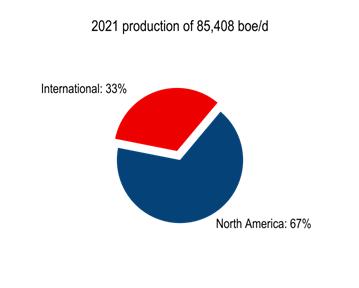
On January 18, 2021, we released our 2021 capital budget and associated production guidance. On November 9, 2021, we increased our 2021 capital expenditure guidance to $375 million and our 2021 annual production guidance to 84,500 to 85,500 boe/d. Actual 2021 capital spending of $375 million was in line with our revised guidance and 2021 average production of 85,408 boe/d was at the upper end of our revised guidance range.

On November 29, 2021, we released our 2022 capital budget and associated production guidance. 2022 guidance does not include contribution from the Corrib Acquisition and will be updated upon close.

The following table summarizes our guidance:


Date


Capital Expenditures ($MM)


Production (boe/d)

2021 Guidance

2021 Guidance

January 18, 2021


300


83,000 to 85,000

2021 Guidance

November 9, 2021


375


84,500 to 85,500

2021 Actual Results

March 7, 2022


375


85,408

2022 Guidance


2022 Guidance

November 29, 2021


425


83,000 to 85,000

Vermilion Energy Inc.  ■  Page 4  ■  2021 Management's Discussion and Analysis


Vermilion's Business

Vermilion is a Calgary, Alberta based international oil and gas producer focused on the acquisition, exploration, development, and optimization of producing properties in North America, Europe, and Australia. We manage our business through our Calgary head office and our international business unit offices.

Graphic

Graphic

Graphic

Vermilion Energy Inc.  ■  Page 5  ■  2021 Management's Discussion and Analysis


Consolidated Results Overview

Q4/21 vs.

2021 vs.


Q4 2021


Q4 2020


  Q4/20


2021


2020


  2020


Production (1)

Crude oil and condensate (bbls/d)


36,264


40,555

(11)

%  

38,143


43,421


(12)

%

NGLs (bbls/d)


8,461


8,627

(2)

%  

8,325


8,937


(7)

%

Natural gas (mmcf/d)


238.16


232.00

3

%  

233.64


256.99


(9)

%

Total (boe/d)


84,417


87,848

(4)

%  

85,408


95,190


(10)

%

(Draw) build in inventory (mbbls)


(144)


(118)


44


(260)


Financial metrics


Fund flows from operations ($M) (2)


322,173


135,212

138

%  

919,862


502,065


83

%

Per share ($/basic share)


1.99


0.85

134

%  

5.71


3.18


80

%

Net earnings (loss) ($M)


344,588


(57,707)

N/A


1,148,696


(1,517,427)


N/A

Per share ($/basic share)


2.12


(0.36)

N/A


7.13


(9.61)


N/A

Cash flows from operating activities ($M)

250,352

135,102

85

%

834,453

500,152

67

%

Free cash flow ($M) (3)

176,366

75,318

134

%

545,066

134,863

304

%

Long-term debt ($M)


1,651,569


1,933,848

(15)

%  

1,651,569


1,933,848


(15)

%

Net debt ($M) (4)


1,644,786


2,009,325

(18)

%  

1,644,786


2,009,325


(18)

%

Activity


Capital expenditures ($M)(5)


145,807


59,894

143

%  

374,796


367,202


2

%

Acquisitions ($M)(6)


23,633


4,821


130,965


25,810


(1)

Please refer to Supplemental Table 4 "Production" for disclosure by product type.

(2)

Fund flows from operations (FFO) and FFO per share are a total of segments measure and non-GAAP ratio respectively most directly comparable to net earnings and net earnings per share, the measures do not have a standardized meaning under IFRS and therefore may not be comparable to similar measures presented by other issuers. FFO is comprised of sales excluding royalties, transportation, operating, G&A, corporate income tax, PRRT, interest expense, and realized loss on derivatives, plus realized gain on foreign exchange and realized other income. The measure is used to assess the contribution of each business unit to Vermilion's ability to generate income necessary to pay dividends, repay debt, fund asset retirement obligations and make capital investments. A reconciliation to primary financial statement measures can be found within the "Consolidated Financial Performance Review" section of this MD&A.

(3)

Free cash flow is a non-GAAP financial measure most directly comparable to cash flows from operating activities and does not have a standardized meaning under IFRS and therefore may not be comparable to similar measures presented by other issuers and is comprised of funds flows from operations less drilling and development and exploration and evaluation expenditures. The measure is used to determine the funding available for investing and financing activities including payment of dividends, repayment of long-term debt, reallocation into existing business units and deployment into new ventures. A reconciliation to primary financial statement measures can be found within the "Non-GAAP Financial Measures and Other Specified Financial Measures" section of this MD&A.

(4)

Net debt prior period comparatives have been revised to meet the current definition. Net debt is a capital management measure in accordance with IAS 1 "Presentation of Financial Statements" and is most directly comparable to long-term debt. Net debt is comprised of long-term debt (excluding unrealized foreign exchange on swapped USD borrowings) plus adjusted working capital (defined as current assets less current liabilities, excluding current derivatives and current lease liabilities), and represents Vermilion's net financing obligations after adjusting for the timing of working capital fluctuations. Net debt excludes lease obligations which are secured by a corresponding right-of-use asset. A reconciliation to primary financial statement measures can be found within the "Financial Position Review" section of this MD&A.

(5)

Capital expenditures is a non-GAAP financial measure that does not have a standardized meaning under IFRS and therefore may not be comparable to similar measures presented by other issuers. The measure is calculated as the sum of drilling and development and exploration and evaluation from the Consolidated Statements of Cash Flows. We consider capital expenditures to be a useful measure of our investment in our existing asset base. Capital expenditures are also referred to as E&D capital.  A reconciliation to primary financial statement measures can be found within the "Non-GAAP Financial Measures and Other Specified Financial Measures" section of this MD&A.

(6)

Acquisitions is a non-GAAP financial measure that does not have a standardized meaning under IFRS and therefore may not be comparable to similar measures presented by other issuers. The measure is calculated as the sum of acquisitions from the Consolidated Statements of Cash Flows, Vermilion common shares issued as consideration, the estimated value of contingent consideration, the amount of acquiree's outstanding long-term debt assumed plus or net of acquired working capital deficit or surplus. We believe that including these components provides a useful measure of the economic investment associated with our acquisition activity. A reconciliation to the acquisitions line item in the Consolidated Statements of Cash Flows can be found in "Supplemental Table 3: Capital Expenditures and Acquisitions" section of this MD&A.

Vermilion Energy Inc.  ■  Page 6  ■  2021 Management's Discussion and Analysis


Financial performance review

Q4 2021 vs. Q4 2020

Graphic

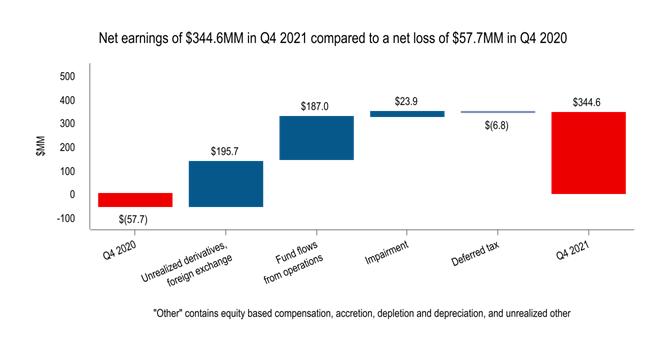
·We recorded net earnings of $344.6 million ($2.12/basic share) for Q4 2021 compared to a net loss of $57.7 million ($0.36/basic share) in Q4 2020. The increase in net earnings was primarily driven by unrealized gains on derivatives due to commodity price movement, combined with an increase in FFO predominantly driven by an increase in realized pricing.

Chart, waterfall chart

Description automatically generated

Vermilion Energy Inc.  ■  Page 7  ■  2021 Management's Discussion and Analysis


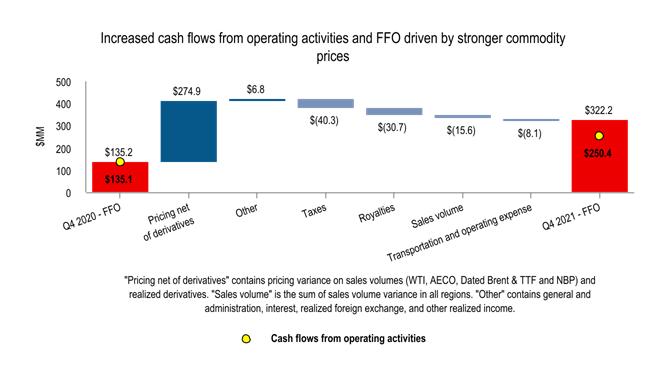
We generated cash flows from operating activities of $250.4 million in Q4 2021 compared to $135.1 million in Q4 2020 and fund flows from operations of $322.2 million in Q4 2021 compared to $135.2 million in Q4 2020. The increases were primarily as a result of higher commodity prices which is reflected in our consolidated realized price per boe increasing from $38.57/boe in Q4 2020 to $96.82/boe in Q4 2021. This was partially offset by increased current taxes and royalties, driven by increased pricing, as well as a decrease in sales volume driven by natural decline. Variances between cash flows from operating activities and funds flow from operations are primarily driven by working capital timing differences.

YTD 2021 vs. YTD 2020

Graphic

Vermilion Energy Inc.  ■  Page 8  ■  2021 Management's Discussion and Analysis


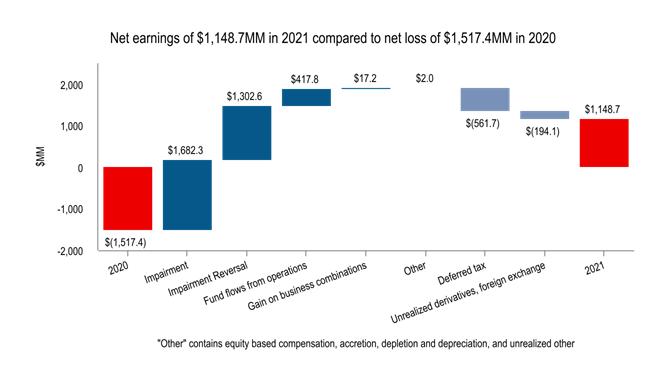
·For the year ended December 31, 2021, we achieved net earnings of $1,148.7 million compared to a net loss of $1,517.4 million for the comparable period in 2020. The increase in net earnings was primarily due to impairment charges we recorded in 2020 of $1,272.1 million (net of $410.2 million income tax recovery), compared to impairment reversal charges we recorded in 2021 of $987.1 million (net of $315.5 million income tax expense) and higher fund flows from operations driven by increased consolidated realized pricing. These increases were partially offset by higher unrealized derivative losses driven by increased commodity prices.

Graphic

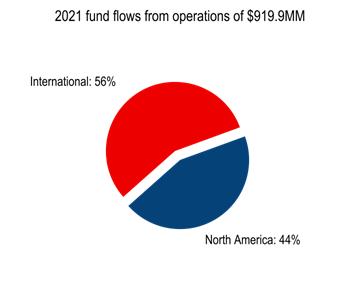
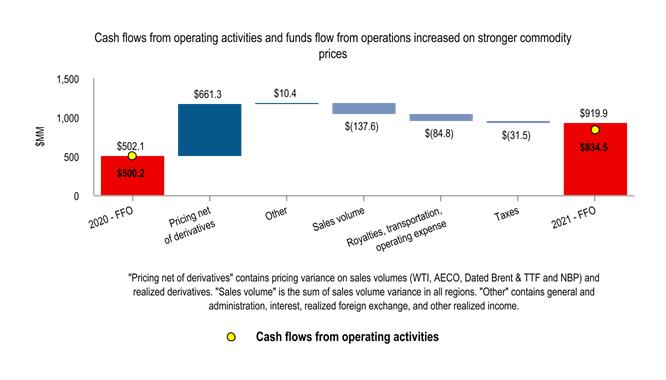
·Cash flows from operating activities increased by $334.3 million to $834.5 million for the year ended December 31, 2021, and fund flows from operations increased by $417.8 million for the year ended December 31, 2021 versus the same period in 2020. These increases were primarily driven by a 109% increase in our consolidated realized price from $31.90/boe to $66.81/boe. Sales volumes decreased year-over-year primarily due to natural decline in North America, Ireland, and Netherlands, as well as timing of liftings in Australia, while royalties and taxes increased primarily due to increased commodity prices. Variances between cash flows from operating activities and funds flow from operations are primarily driven by working capital timing differences.

Production review

Q4 2021 vs. Q4 2020

· Consolidated average production of 84,417 boe/d in Q4 2021 represented a decrease of 4% from Q4 2020 production of 87,848 boe/d. Production decreases were primarily driven by natural decline in Canada of 4,120 boe/d due to reduced capital activity as we focused on maximizing free cash flow and reducing debt in 2021.

2021 vs. 2020

· Consolidated average production of 85,408 boe/d for the year ended December 31, 2021 represented a decrease of 10% from the prior year comparable period of 95,190 boe/d. Production decreases were mainly in Canada of 6,974 boe/d due to reduced capital activity and natural decline, and in Ireland of 1,365 boe/d due to natural decline.

Activity review

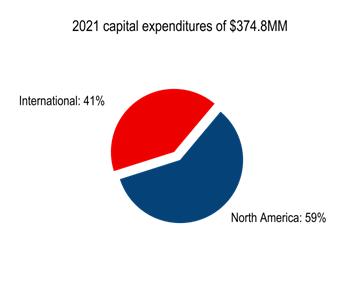
For the three months ended December 31, 2021, capital expenditures of $145.8 million were incurred.
In our North America core region, capital expenditures of $89.6 million were incurred during Q4 2021. In Canada, $86.1 million was incurred primarily related to drilling and facility activity. During the quarter we drilled seven (7.0 net) wells in south-east Saskatchewan and completed eight

Vermilion Energy Inc.  ■  Page 9  ■  2021 Management's Discussion and Analysis


wells, seven of which were brought on production during the quarter. In addition, we drilled fourteen (11.5 net) and completed nine (8.96 net) Mannville natural gas wells in Alberta.
In our International core region, capital expenditures of $56.2 million were incurred during Q4 2021. Our activities included $15.0 million of France investment primarily focused on increased subsurface maintenance, workovers and facilities activities, $10.9 million in Germany mainly related to tie-in, drilling and workover activity, $9.0 million in Central and Eastern Europe mainly related to seismic expenditures in Croatia on the SA-10 block, and $8.8 million incurred in Australia primarily related to a planned turnaround.

Financial sustainability review

Cash flow from operations and free cash flow

Cash flows from operating activities of $834.5 million increased by $334.3 million for the year ended December 31, 2021 compared to the prior year period which was primarily driven by a 109% increase in consolidated realized prices.
Free cash flow of $545.1 million increased by $410.2 million for the year ended December 31, 2021 compared to the prior year period due to increased funds flow from operations and conservative capital spending as we focused on reducing debt in 2021.

Long-term debt and net debt

Long-term debt decreased to $1.7 billion as at December 31, 2021 from $1.9 billion as at December 31, 2020.
Net debt decreased to $1.6 billion as at December 31, 2021 from $2.0 billion as at December 31, 2020 (revised), mainly due to a decrease in long-term debt as a result of debt repayments of $341.3 million partially offset by foreign exchange effects on USD borrowings.
In Q3 2021, we adjusted our net debt calculation in order to provide more meaningful and comparable information.
The ratio of net debt to four quarter trailing fund flows from operations(1) decreased to 1.79 as at December 31, 2021 (December 31, 2020 - 4.00 (revised)) mainly due to lower net debt combined with higher four quarter trailing fund flows from operations.

(1)Net debt to four quarter trailing fund flows from operations is a non-GAAP ratio that does not have a standardized meaning under IFRS and therefore may not be comparable to similar measures presented by other issuers. It is calculated as net debt (capital measure) over the FFO from the preceding 4 quarters (total of segments measure). The measure is used to assess our ability to repay debt.

Vermilion Energy Inc.  ■  Page 10  ■  2021 Management's Discussion and Analysis


Benchmark Commodity Prices


Q4/21 vs.


2021 vs.


Q4 2021

Q4 2020

 Q4/20

2021

2020

2020


Crude oil

WTI ($/bbl)


97.21


55.58


75

%  

85.14


52.86


61

%

WTI (US $/bbl)


77.19


42.66


81

%  

67.92


39.40


72

%

Edmonton Sweet index ($/bbl)


93.30


50.28


86

%  

80.27


45.72


76

%

Edmonton Sweet index (US $/bbl)


74.09


38.59


92

%  

64.03


34.08


88

%

Saskatchewan LSB index ($/bbl)


92.90


50.76


83

%  

80.12


45.80


75

%

Saskatchewan LSB index (US $/bbl)


73.77


38.96


89

%  

63.91


34.14


87

%

Canadian C5+ Condensate index ($/bbl)


99.65


55.43


80

%  

85.50


49.85


72

%

Canadian C5+ Condensate index (US $/bbl)


79.13


42.54


86

%  

68.20


37.16


84

%

Dated Brent ($/bbl)


100.40


57.63


74

%  

88.67


55.90


59

%

Dated Brent (US $/bbl)


79.73


44.23


80

%  

70.73


41.67


70

%

Natural gas


AECO ($/mcf)


4.66


2.64


77

%  

3.62


2.23


62

%

NBP ($/mcf)


37.76


6.99


440

%  

19.62


4.30


356

%

NBP (€/mcf)


26.21


4.50


482

%  

13.22


2.81


371

%

TTF ($/mcf)


38.86


6.63


486

%  

19.86


4.18


375

%

TTF (€/mcf)


26.97


4.27


532

%  

13.39


2.74


389

%

Henry Hub ($/mcf)


7.34


3.47


112

%  

4.82


2.78


73

%

Henry Hub (US $/mcf)


5.83


2.66


119

%  

3.85


2.07


86

%

Average exchange rates


CDN $/US $


1.26


1.30


(3)

%  

1.25


1.34

(7)

%  

CDN $/Euro


1.44


1.55


(7)

%  

1.48


1.53


(3)

%

Realized prices


Crude oil and condensate ($/bbl)


96.88


55.31


75

%  

83.78


50.53


66

%

NGLs ($/bbl)


47.27


19.20


146

%  

34.44


13.06


164

%

Natural gas ($/mcf)


17.89


4.13


333

%  

9.53


2.77


244

%

Total ($/boe)


96.82


38.57


151

%  

66.81


31.90


109

%

As an internationally diversified producer, we are exposed to a range of commodity prices. In our North America core region, our crude oil is sold at benchmarks linked to WTI (including the Edmonton Sweet index, the Saskatchewan LSB index, and the Canadian C5+ index) and our natural gas is sold at benchmarks linked to AECO index (in Canada) or the Henry Hub index (in the United States). In our International core region, our crude oil is sold with reference to Dated Brent and our natural gas is sold with reference to NBP, TTF, or indices highly correlated to TTF.

Graphic

Vermilion Energy Inc.  ■  Page 11  ■  2021 Management's Discussion and Analysis


Crude oil prices increased in Q4 2021 relative to Q4 2020. Global crude oil demand has increased from recent lows faster than production and successive COVID-19 waves have had smaller impacts on demand. Year-over-year, Canadian dollar WTI and Brent prices rose 75% and 74% respectively.
In Canadian dollar terms, year-over-year, the Edmonton Sweet differential narrowed by $1.39/bbl to a discount of $3.91/bbl against WTI, and the Saskatchewan LSB differential narrowed by $0.51/bbl to a discount of $4.31/bbl against WTI.
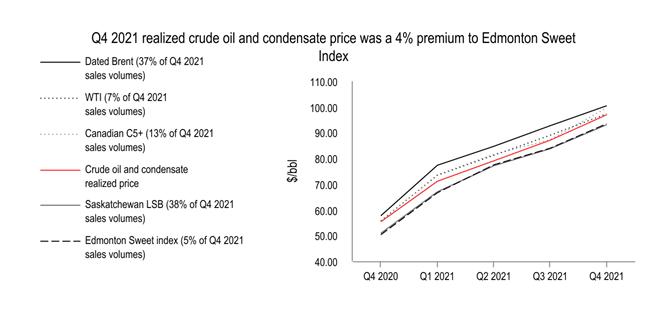
Approximately 37% of Vermilion’s Q4 2021 crude oil and condensate production was priced at the Dated Brent index (which averaged a premium to WTI of US$2.54/bbl), while the remainder of our crude oil and condensate production was priced at the Saskatchewan LSB, Canadian C5+, Edmonton Sweet, and WTI indices.

Graphic

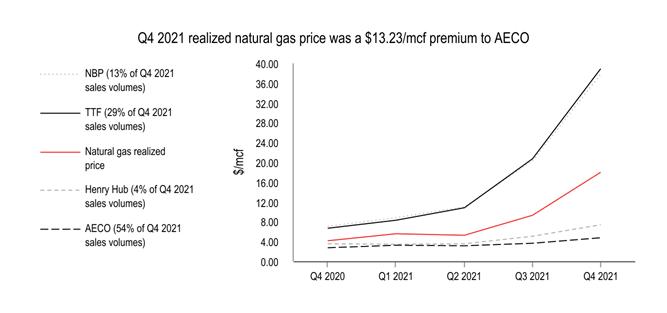
In Canadian dollar terms, prices for European natural gas linked to NBP and TTF rose by 440% and 486%, respectively, in Q4 2021 compared to Q4 2020 as a result of record low inventory levels leading into winter driven by declining supply and competition for LNG in the global market. Demand proved to be inelastic at high natural gas prices. High global coal and European carbon prices have also been supportive to natural gas prices.
Natural gas prices at AECO increased by 77% in Q4 2021 compared to Q4 2020. NYMEX prices benefited from a strong winter premium and increased by a greater extent than AECO natural gas prices. Strong Alberta natural gas demand resulting from permanent additions in the power sector and from oil sands production growth, combined with historically low storage levels to start the winter, helped offset high WCSB production growth.
For Q4 2021, average European natural gas prices represented a $33.65/mcf premium to AECO. Approximately 42% of our natural gas production in Q4 2021 benefited from this premium European pricing.

Graphic

Vermilion Energy Inc.  ■  Page 12  ■  2021 Management's Discussion and Analysis


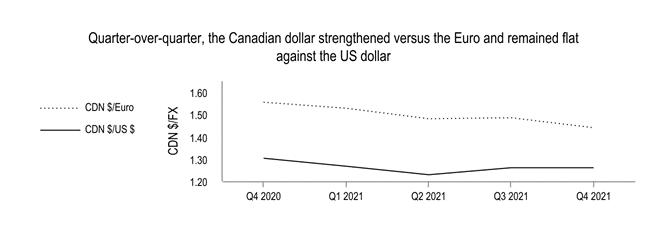
For the three months ended December 31, 2021, the Canadian dollar strengthened 7% against the Euro compared to Q4 2020. The annual average in 2021 was 3% stronger versus 2020.
For the three months ended December 31, 2021, the Canadian dollar strengthened 3% against the US Dollar compared to Q4 2020. The annual average in 2021 was 7% stronger versus 2020.

North America


Q4 2021


Q4 2020


2021


2020

Production (1)


Crude oil and condensate (bbls/d)


23,846


26,459


24,390


29,043

NGLs (bbls/d)


8,461


8,628


8,325


8,937

Natural gas (mmcf/d)


137.93


142.13


144.87


158.85

Total production volume (boe/d)


55,295


58,774


56,858


64,456

(1)Please refer to Supplemental Table 4 "Production" for disclosure by product type.


Q4 2021


Q4 2020


2021


2020

$M


$/boe

$M


$/boe

$M


$/boe

$M


$/boe

Sales


305,054


59.97

175,808


32.51


1,014,190


48.87


635,637


26.94

Royalties


(47,119)

(9.26)


(19,670)

(3.64)


(144,398)

(6.96)


(72,407)

(3.07)

Transportation


(9,447)

(1.86)


(10,358)

(1.92)


(40,100)

(1.93)


(42,843)

(1.82)

Operating


(59,425)

(11.68)


(59,162)

(10.94)


(232,370)

(11.20)


(236,704)

(10.03)

General and administration (1)


(10,224)

(2.01)


(10,484)

(1.94)


(27,887)

(1.34)


(29,784)

(1.26)

Corporate income tax (expense) (1)

2,140

0.42

241

0.04

1,451

0.07

(202)

(0.01)

Fund flows from operations


180,979

35.58


76,375

14.12


570,886

27.51


253,697

10.75

Drilling and development


(89,643)


(33,781)


(222,782)


(265,261)


Free cash flow


91,336


42,594


348,104


(11,564)


(1)Includes amounts from Corporate segment.

Production from our North American operations averaged 55,295 boe/d in Q4 2021, a decrease of 3% from the prior quarter primarily due to natural decline and unplanned downtime. This impact was partially offset by new production from our southeast Saskatchewan drilling program in Canada. During the fourth quarter 2021, we drilled seven (7.0 net) light oil wells in southeast Saskatchewan and brought on production seven (7.0 net) wells. In west-central Alberta, we commenced our condensate-rich Mannville natural gas drilling program where we drilled 14 (11.5 net) wells and completed nine (8.96 net) wells. By executing the majority of this program in Q4 2021, ahead of the busy winter drilling season, we were able to secure our preferred service providers and reduce overall costs, resulting in approximately $85,000 savings per well. The wells were brought on production in early 2022.

No drilling or completion activity occurred in the United States during the fourth quarter 2021. Similar to our program in 2021, we plan to move an experienced drilling crew from our Alberta winter program down to Wyoming in Q2 2022 to complete the six (5.9 net) well Turner drilling program which will include three (2.9 net) two-mile lateral wells which are significantly more economic than one-mile laterals. In addition, one (0.3 net) two-mile non-operated Turner well is planned for Q4, 2022.

Sales


Q4 2021


Q4 2020


2021


2020

$M


$/boe

$M


$/boe

$M


$/boe

$M


$/boe

Canada


270,600

59.16


160,719

32.45


901,775

47.54


569,191

26.38

United States


34,454

67.18


15,089

33.24


112,415

62.98


66,446

32.93

North America


305,054

59.97


175,808

32.51


1,014,190

48.87


635,637

26.94

Sales in North America increased on a dollar and per unit basis for the three months and the year ended December 31, 2021 versus the comparable prior periods due to higher benchmark prices across all products, partially offset by lower production volumes.

Vermilion Energy Inc.  ■  Page 13  ■  2021 Management's Discussion and Analysis


Royalties


Q4 2021


Q4 2020


2021


2020

$M


$/boe

$M


$/boe

$M


$/boe

$M


$/boe

Canada


(37,064)

(8.10)


(15,240)

(3.08)


(113,651)

(5.99)


(54,961)

(2.55)

United States


(10,055)


(19.60)


(4,430)


(9.76)


(30,747)


(17.23)


(17,446)


(8.65)

North America


(47,119)


(9.26)


(19,670)


(3.64)


(144,398)


(6.96)


(72,407)


(3.07)

Royalties in North America increased on a dollar and per unit basis for the three months and the year ended December 31, 2021 versus the comparable prior periods primarily due to higher benchmark prices. Royalties as a percentage of sales for the three months and the year ended December 31, 2021 of 15.4% and 14.2% increased versus comparable prior periods primarily due to the effect of higher commodity prices on sliding scale royalties.

Transportation


Q4 2021


Q4 2020


2021


2020

$M


$/boe

$M


$/boe

$M


$/boe

$M


$/boe

Canada


(9,134)

(2.00)


(9,987)

(2.02)


(38,764)

(2.04)


(41,494)

(1.92)

United States


(313)


(0.61)


(371)


(0.82)


(1,336)


(0.75)


(1,349)


(0.67)

North America


(9,447)


(1.86)


(10,358)


(1.92)


(40,100)


(1.93)


(42,843)


(1.82)

Transportation expense in North America remained relatively consistent on a dollar basis for the three months and the year ended December 31, 2021 versus the comparable prior periods. On a per unit basis for the three months ended December 31, 2021 transportation expense remained relatively consistent, while for the year ended December 31, 2021 transportation expense increased versus the comparable period primarily due to an increase in rates and lower production.

Operating expense


Q4 2021


Q4 2020


2021


2020

$M


$/boe

$M


$/boe

$M


$/boe

$M


$/boe

Canada


(54,695)

(11.96)


(54,725)

(11.05)


(215,378)

(11.35)


(218,596)

(10.13)

United States


(4,730)


(9.22)


(4,437)


(9.77)


(16,992)


(9.52)


(18,108)


(8.97)

North America


(59,425)


(11.68)


(59,162)


(10.94)


(232,370)


(11.20)


(236,704)


(10.03)

Operating expenses in North America on a dollar basis for the three months ended December 31, 2021 remained consistent, increasing by 0.4%, while on a per boe basis operating expenses increased by 6.8% due to lower production volumes and resulting impact in fixed costs per unit. For the year ended December 31, 2021 operating expenses decreased by 1.8% on a dollar basis primarily due to lower spend on maintenance projects, and increased 11.7% on a per boe basis versus the comparable prior period primarily due to lower production volumes and the resulting impact of fixed costs per unit.

International


Q4 2021


Q4 2020


2021


2020

Production (1)


Crude oil and condensate (bbls/d)


12,419


14,096


13,753


14,376

Natural gas (mmcf/d)


100.22


89.86


88.77


98.15

Total production volume (boe/d)


29,123


29,073


28,548


30,734

Total sales volume (boe/d)


30,689


30,336


28,430


31,444

(1)Please refer to Supplemental Table 4 "Production" for disclosure by product type.

Vermilion Energy Inc.  ■  Page 14  ■  2021 Management's Discussion and Analysis


Q4 2021

Q4 2020

2021

2020


$M


$/boe


$M


$/boe


$M


$/boe


$M


$/boe

Sales


460,861

163.23


140,390

50.30


1,065,571

102.69


483,908

42.05

Royalties


(11,666)


(4.13)


(8,438)


(3.02)


(41,724)


(4.02)


(34,147)


(2.97)

Transportation


(9,586)


(3.40)


(6,699)


(2.40)


(37,061)


(3.57)


(24,868)


(2.16)

Operating


(53,255)


(18.86)


(47,414)


(16.99)


(180,643)


(17.41)


(180,547)


(15.69)

General and administration


(7,150)


(2.53)


(8,158)


(2.92)


(24,990)


(2.41)


(31,056)


(2.70)

Corporate income tax recovery (expense)


(34,374)


(12.17)


6,291


2.25


(31,617)


(3.05)


6,012


0.52

PRRT


(5,544)


(1.96)


(4,038)


(1.45)


(15,688)


(1.51)


(20,151)


(1.75)

Fund flows from operations


339,286


120.17


71,934


25.77


733,848


70.72


199,151


17.30

Drilling and development


(29,359)


(19,122)


(116,608)


(87,220)


Exploration and evaluation

(26,805)

(6,991)

(35,406)

(14,721)

Free cash flow


283,122


45,821


581,834


97,210


Production from our International assets averaged 29,123 boe/d in Q4 2021, an increase of 5% from the prior quarter primarily due to higher production in the Netherlands and Ireland. The Netherlands operations benefited from stronger performance from the recently drilled Nijega well and successful optimization work on several other wells. Ireland operations benefited from the absence of planned maintenance activities. Elsewhere in Europe, we commenced drilling on our 2022 three-well program in Germany and completed a small European gas  acquisition to further consolidate our interest in the region. No drilling or completion activity occurred in France during the quarter, however we have offset the majority of natural declines through our ongoing workover campaign. In Croatia we received approval for the spatial plan on the SA-10 gas plant where we continue to advance design work and regulatory work in preparation for the 2023 tie-in of the two standing gas wells.

The higher production from our European assets was partially offset by a planned turnaround in Australia which was successfully completed during the quarter. Detailed engineering work and planning for the two well Australia program continued, with drilling expected to commence in Q2 2022.

Sales

Q4 2021

Q4 2020

2021

2020


$M


$/boe


$M


$/boe


$M


$/boe


$M


$/boe

Australia


40,332

112.26


30,148

75.99


143,014

103.01


141,452

76.70

France


79,809


100.18


53,198


58.11


279,263


88.15


182,292


55.39

Netherlands


165,370


205.17


22,967


34.40


295,723


110.47


65,575


23.02

Germany


65,623


164.96


10,681


39.87


131,935


98.06


34,210


30.40

Ireland


109,352


236.78


23,118


43.38


214,425


120.51


58,446


25.59

Central and Eastern Europe


375


203.80


278


27.22


1,211


65.06


1,933


16.66

International


460,861


163.23


140,390


50.30


1,065,571


102.69


483,908


42.05

As a result of changes in inventory levels, our sales volumes for crude oil in Australia, France, and Germany may differ from our production volumes in those business units. The following table provides the crude oil sales volumes (consisting entirely of "light crude oil and medium crude oil") for those jurisdictions.

Crude oil sales volumes (bbls/d)


Q4 2021


Q4 2020


2021


2020

Australia


3,905


4,312


3,804


5,039

France


8,659


9,951


8,680


8,991

Germany


1,324


996


1,051


967

International

13,888

15,259

13,535

14,997

Sales increased on a dollar and per boe basis for the three months and year ended December 31, 2021 versus the prior year comparable periods due to higher realized prices across all business units. These increases were partially offset by lower sales volumes in Ireland, the Netherlands, and Central Eastern Europe driven by natural decline combined with the timing of liftings in France and Australia.

Vermilion Energy Inc.  ■  Page 15  ■  2021 Management's Discussion and Analysis


Royalties

Q4 2021


Q4 2020

2021

2020


$M


$/boe

$M


$/boe


$M


$/boe


$M


$/boe

France


(10,174)


(12.77)


(9,416)


(10.28)


(37,666)


(11.89)


(32,069)


(9.75)

Netherlands


(419)


(0.52)


(150)


(0.22)


(873)


(0.33)


(444)


(0.16)

Germany


(909)


(2.29)


1,190


4.44


(2,847)


(2.12)


(990)


(0.88)

Central and Eastern Europe


(164)


(89.13)


(62)


(6.07)


(338)


(18.16)


(644)


(5.55)

International


(11,666)


(4.13)


(8,438)


(3.02)


(41,724)


(4.02)


(34,147)


(2.97)

Royalties in our International core region are primarily incurred in France, where royalties include charges based on a percentage of sales and fixed per boe charges. Our production in Australia and Ireland is not subject to royalties.

For the three months ended December 31, 2021 versus the same period in the prior year, royalties increased due to higher sales prices in France, the Netherlands and Germany combined with a refund recorded in the fourth quarter of 2020 related to Germany gas royalties.

Royalties increased in our International core region for the year ended December 31, 2021 versus the same period in the prior year due to higher sales prices in France, the Netherlands and Germany.

Royalties as a percentage of sales for the three months and year ended December 31, 2021 of 2.5% and 3.9% decreased versus the prior year comparable periods of 6.0% and 7.1% primarily due to higher sales in business units that are not subject to royalties combined with the impact of RCDM royalties in France, which are levied on units of production and not subject to changes in commodity prices.

Transportation

Q4 2021

Q4 2020

2021

2020


$M


$/boe


$M


$/boe


$M


$/boe


$M


$/boe

France


(6,574)


(8.25)


(4,264)


(4.66)


(26,497)


(8.36)


(14,604)


(4.44)

Germany


(2,076)


(5.22)


(1,537)


(5.74)


(6,359)


(4.73)


(5,839)


(5.19)

Ireland


(936)


(2.03)


(898)


(1.68)


(4,205)


(2.36)


(4,425)


(1.94)

International


(9,586)


(3.40)


(6,699)


(2.40)


(37,061)


(3.57)


(24,868)


(2.16)

Transportation expense increased for the three months and year ended December 31, 2021 versus the comparable prior year periods. This increase was primarily in France relating to the use of incremental trucking in the Paris Basin following the conversion of the Grandpuits refinery combined with higher production in Germany due to an acquisition in the second quarter of 2021.

Our production in Australia, Netherlands and Central and Eastern Europe is not subject to transportation expense.

Operating expense

Q4 2021

Q4 2020

2021

2020


$M

$/boe


$M

$/boe


$M

$/boe


$M

$/boe

Australia


(15,918)


(44.31)


(14,438)


(36.39)


(50,748)


(36.55)


(54,581)


(29.59)

France


(14,242)


(17.88)


(16,230)


(17.73)


(52,147)


(16.46)


(57,128)


(17.36)

Netherlands


(11,449)


(14.20)


(7,772)


(11.64)


(35,269)


(13.17)


(32,410)


(11.38)

Germany


(7,323)


(18.41)


(5,643)


(21.07)


(27,149)


(20.18)


(20,732)


(18.42)

Ireland


(4,107)


(8.89)


(3,232)


(6.06)


(14,889)


(8.37)


(15,232)


(6.67)

Central and Eastern Europe


(216)


(117.39)


(99)


(9.69)


(441)


(23.69)


(464)


(4.00)

International


(53,255)


(18.86)


(47,414)


(16.99)


(180,643)


(17.41)


(180,547)


(15.69)

Operating expenses on a dollar and per boe basis increased for Q4 2021 versus Q4 2020 by $5.9 million and $1.87/boe, respectively. This increase was primarily due to higher electricity prices in the Netherlands, higher facility maintenance costs in Germany and planned maintenance in Ireland.

For the year ended December 31, 2021 versus the comparable prior year period, operating expenses remained relatively flat on a dollar basis as higher electricity prices in the Netherlands and higher facility maintenance costs in Germany were partially offset by decreased costs in Australia resulting from a higher deferral of costs relating to inventory builds on the balance sheet in 2019.

Vermilion Energy Inc.  ■  Page 16  ■  2021 Management's Discussion and Analysis


Operating expenses on a per boe basis for the year ended December 31, 2021 increased by $1.72 versus the comparable prior year period primarily due to relatively flat operating expenses spread across lower volumes.

Consolidated Financial Performance Review

($M except per share)


Dec 31, 2021


Dec 31, 2020


Dec 31, 2019

Total assets

5,905,323

4,109,139

5,866,120

Long-term debt


1,651,569


1,933,848


1,924,665

Petroleum and natural gas sales


2,079,761


1,119,545


1,689,863

Net earnings (loss)


1,148,696


(1,517,427)


32,799

Net earnings (loss) per share


Basic


7.13


(9.61)


0.21

Diluted


6.97


(9.61)


0.21

Cash dividends ($/share)


0.58


2.76

Financial performance

Q4 2021

Q4 2020

2021

2020


$M


$/boe


$M


$/boe


$M


$/boe


$M


$/boe

Sales


765,915


96.82


316,198


38.57


2,079,761


66.81


1,119,545


31.90

Royalties


(58,785)


(7.43)


(28,108)


(3.43)


(186,122)


(5.98)


(106,554)


(3.04)

Transportation


(19,033)


(2.41)


(17,057)


(2.08)


(77,161)


(2.48)


(67,711)


(1.93)

Operating


(112,680)


(14.24)


(106,576)


(13.00)


(413,013)


(13.27)


(417,251)


(11.89)

General and administration


(17,374)


(2.20)


(18,642)


(2.27)


(52,877)


(1.70)


(60,840)


(1.73)

Corporate income tax recovery (expense)


(32,234)


(4.07)


6,532


0.80


(30,166)


(0.97)


5,810


0.17

PRRT


(5,544)


(0.70)


(4,038)


(0.49)


(15,688)


(0.50)


(20,151)


(0.57)

Interest expense


(16,279)


(2.06)


(19,808)


(2.42)


(73,075)


(2.35)


(75,077)


(2.14)

Realized (loss) gain on derivatives


(189,598)


(23.97)


790


0.10


(327,384)


(10.52)


109,093


3.11

Realized foreign exchange (loss) gain


(2,395)


(0.30)


1,329


0.16


(6,613)


(0.21)


11,110


0.32

Realized other income


10,180


1.29


4,592


0.56


22,200


0.71


4,091


0.12

Fund flows from operations


322,173


40.73


135,212


16.50


919,862


29.54


502,065


14.32

Equity based compensation

(6,666)

(11,012)

(41,565)

(42,906)

Unrealized gain (loss) on derivative instruments (1)

172,265

(66,863)

(181,094)

(100,955)

Unrealized foreign exchange loss (gain) (1)

7,122

50,519

(64,963)

49,012

Accretion

(10,983)

(9,134)

(43,552)

(35,318)

Depletion and depreciation

(148,216)

(148,219)

(571,688)

(580,461)

Deferred tax (expense) recovery

(14,834)

(8,008)

(187,343)

374,313

Gain on business combinations

17,198

Impairment reversal (expense)

23,922

1,302,619

(1,682,344)

Unrealized other expense (1)

(195)

(202)

(778)

(833)

Net earnings (loss)

344,588

(57,707)

1,148,696

(1,517,427)

(1)Unrealized (loss) gain on derivative instruments, Unrealized foreign exchange loss, and Unrealized other expense are line items from the respective consolidated statements of cash flows.

Fluctuations in fund flows from operations may occur as a result of changes in production levels, commodity prices, and costs to produce petroleum and natural gas. In addition, fund flows from operations may be affected by the timing of crude oil shipments in Australia and France. When crude oil inventory is built up, the related operating expense, royalties, and depletion expense are deferred and carried as inventory on the consolidated balance sheet. When the crude oil inventory is subsequently drawn down, the related expenses are recognized within profit or loss.

General and administration

General and administration expense decreased in Q4 2021 versus Q4 2020 primarily due to increased recoveries driven by increased capital spending in Q4 2021. General and administration expense decreased for the year ended December 31, 2021 versus the comparable prior year period primarily due to work-force reductions made in 2020.

Vermilion Energy Inc.  ■  Page 17  ■  2021 Management's Discussion and Analysis


PRRT and corporate income taxes

PRRT increased for the three months ended December 31, 2021 versus the prior year comparable period primarily due to higher sales in Australia, partially offset by higher capital expenditures.
PRRT decreased for the year ended December 31, 2021 versus the prior year comparable period due to higher capital expenditures in Australia.
Corporate income taxes for the three months and year ended December 31, 2021 increased versus the prior year comparable periods primarily due to higher taxable income in the Netherlands partially offset with the application of tax losses in France and Australia.

Interest expense

Interest expense decreased for the three months and year ended December 31, 2021 versus the prior year comparable periods primarily due to lower average drawn balances on the credit facility and a related change to the pricing grid level.

Realized gain or loss on derivatives

For the three months and year ended December 31, 2021, we recorded realized losses on our crude oil and natural gas hedges due to higher commodity pricing compared to the strike prices on our hedges. Realized gains on derivatives for the prior year comparable periods relate to receipts for European natural gas and crude oil hedges.
A listing of derivative positions as at December 31, 2021 is included in “Supplemental Table 2” of this MD&A.

Realized other income

Realized other income for the three months and year ended December 31, 2021 primarily relates to amounts for funding under the Saskatchewan Accelerated Site Closure program to complete abandonment and reclamation on inactive oil and gas wells and facilities.

Net earnings

Fluctuations in net earnings from period-to-period are caused by changes in both cash and non-cash based income and charges. Cash based items are reflected in fund flows from operations. Non-cash items include: equity based compensation expense, unrealized gains and losses on derivative instruments, unrealized foreign exchange gains and losses, accretion, depletion and depreciation expense, and deferred taxes. In addition, non-cash items may also include gains resulting from business combinations or charges resulting from impairment or impairment reversals.

Equity based compensation

Equity based compensation expense relates primarily to non-cash compensation expense attributable to long-term incentives granted to directors, officers, and employees under security-based arrangements. Equity based compensation expense decreased for the three months ended December 31, 2021 compared to the three months ended December 31, 2020 due to a lower average performance factor applied to grants, while equity based compensation remained relatively flat for the year ended December 31, 2021 compared to the year ended December 31, 2020.

Unrealized gain or loss on derivative instruments

Unrealized gain or loss on derivative instruments arise as a result of changes in forecasts for future prices and rates. As Vermilion uses derivative instruments to manage the commodity price exposure of our future crude oil and natural gas production, we will normally recognize unrealized gains on derivative instruments when future commodity price forecasts decline and vice-versa. As derivative instruments are settled, the unrealized gain or loss previously recognized is reversed, and the settlement results in a realized gain or loss on derivative instruments.

USD-to-CAD cross currency interest rate swaps and foreign exchange swaps may be entered into to hedge the foreign exchange movements on USD borrowings on our revolving credit facility. As such, unrealized gains and losses on our cross currency interest swaps are offset by unrealized losses and gains on foreign exchange relating to the underlying USD borrowings from our revolving credit facility.

For the three months ended December 31, 2021, we recognized a net unrealized gain on derivative instruments of $172.3 million. This consists of unrealized gains of $150.8 million on our European natural gas commodity derivative instruments, $12.4 million on our North American natural gas commodity derivative instruments, $12.7 million on our equity swaps, and $3.8 million on our crude oil commodity derivative instruments, partially offset by unrealized losses of $7.4 million on our USD-to-CAD foreign exchange swaps.

For the year ended December 31, 2021, we recognized a net unrealized loss on derivative instruments of $181.1 million. This consists of unrealized losses of $280.4 million on our European natural gas commodity derivative instruments and $5.4 million on our crude oil commodity derivative instruments, partially offset by unrealized gains of $56.3 million on our USD-to-CAD foreign exchange swaps, $38.3 million on our equity swaps, and $10.1 million on our North American natural gas commodity derivative instruments.

Vermilion Energy Inc.  ■  Page 18  ■  2021 Management's Discussion and Analysis


Unrealized foreign exchange gains or losses

As a result of Vermilion’s international operations, Vermilion has monetary assets and liabilities denominated in currencies other than the Canadian dollar. These monetary assets and liabilities include cash, receivables, payables, long-term debt, derivative instruments and intercompany loans. Unrealized foreign exchange gains and losses result from translating these monetary assets and liabilities from their underlying currency to the Canadian dollar.

In 2021, unrealized foreign exchange gains and losses primarily resulted from:

The translation of Euro denominated intercompany loans from Vermilion Energy Inc. to our international subsidiaries. An appreciation in the Euro against the Canadian dollar will result in an unrealized foreign exchange gain (and vice-versa). Under IFRS, the offsetting foreign exchange loss or gain is recorded as a currency translation adjustment within other comprehensive income. As a result, consolidated comprehensive income reflects the offsetting of these translation adjustments while net earnings reflects only the parent company's side of the translation.
The translation of USD borrowings on our revolving credit facility. The unrealized foreign exchange gains or losses on these borrowings are offset by unrealized derivative gains or losses on associated USD-to-CAD cross currency interest rate swaps (discussed further below).
The translation of our USD denominated senior unsecured notes prior to June 12, 2019 and from May 5, 2020 onward. During the period between June 12, 2019 and May 5, 2020 the USD senior notes were hedged by a USD-to-CAD cross currency interest rate swap. Subsequent to the termination of these instruments, amounts previously recognized in the hedge accounting reserve will be recognized into earnings through unrealized foreign exchange loss over the period of the hedged cash flows.

For the three months ended December 31, 2021, we recognized a net unrealized foreign exchange gain of $7.1 million, driven by unrealized gains of $7.0 million on our USD borrowings from our revolving credit facility, as well as an unrealized gain of $1.4 million on US dollar-denominated intercompany loans resulting from the US dollar strengthening 0.3% against the Canadian dollar in Q4 2021. This was partially offset by unrealized loss of $1.2 million on our senior unsecured notes due to the stronger US dollar. In addition, we recognized an unrealized loss of $2.4 million on Euro-denominated intercompany loans due to the Euro weakening 2.7% against the Canadian dollar in Q4 2021.

For the year ended December 31, 2021, we recognized a net unrealized foreign exchange loss of $65.0 million. This was due to unrealized losses of $59.8 million on our USD borrowings from our revolving credit facility and $9.9 million on intercompany loans due primarily to the Euro weakening 7.8% against the Canadian dollar. These were partially offset by the impact of the US dollar weakening 0.4% against the Canadian dollar resulting in an unrealized gain of $1.7 million on our senior unsecured notes.

As at December 31, 2021, a $0.01 appreciation of the Euro against the Canadian dollar would result in a $0.3 million increase to net earnings as a result of an unrealized gain on foreign exchange. In contrast, a $0.01 appreciation of the US dollar against the Canadian dollar would result in a $2.1 million decrease to net earnings as a result of an unrealized loss on foreign exchange.

Accretion

Accretion expense is recognized to update the present value of the asset retirement obligation balance. For the three months and year ended December 31, 2021 accretion expense increased versus the comparable prior year periods, primarily due to additional obligations recognized at the end of 2020 through 2021, partially offset by the weakening of the Euro against the Canadian dollar.

Depletion and depreciation

Depletion and depreciation expense is recognized to allocate the cost of capital assets over the useful life of the respective assets. Depletion and depreciation expense per unit of production is determined for each depletion unit (which are groups of assets within a specific production area that have similar economic lives) by dividing the sum of the net book value of capital assets and future development costs by total proved plus probable reserves.

Fluctuations in depletion and depreciation expense are primarily the result of changes in produced crude oil and natural gas volumes, and changes in depletion and depreciation per unit. Fluctuations in depletion and depreciation per unit are the result of changes in reserves, depletable base (net book value of capital assets and future development costs), and relative production mix.

Depletion and depreciation on a per boe basis for the three months and year ended December 31, 2021 of $18.74 and $18.36, respectively, increased from $18.08 and $16.54 in respective the prior year comparable periods primarily due to impairment reversals and increases in ARO assets recorded in the first half of 2021.

Deferred tax

Deferred tax assets arise when the tax basis of an asset exceeds its accounting basis (known as a deductible temporary difference). Conversely, deferred tax liabilities arise when the tax basis of an asset is less than its accounting basis (known as a taxable temporary difference). Deferred tax assets are recognized only to the extent that it is probable that there are future taxable profits against which the deductible temporary difference can

Vermilion Energy Inc.  ■  Page 19  ■  2021 Management's Discussion and Analysis


be utilized. Deferred tax assets and liabilities are measured at the enacted or substantively enacted tax rate that is expected to apply when the asset is realized, or the liability is settled.

As such, fluctuations in deferred tax expenses and recoveries primarily arise as a result of: changes in the accounting basis of an asset or liability without a corresponding tax basis change (e.g. when derivative assets and liabilities are marked-to-market or when accounting depletion differs from tax depletion), changes in available tax losses (e.g. if they are utilized to offset taxable income), changes in estimated future taxable profits resulting in a derecognition or recognition of deferred tax assets, and changes in enacted or substantively enacted tax rates.

For the three months and year ended December 31, 2021, the Company recorded a deferred tax expense of $14.8 million and $187.3 million, respectively compared to deferred tax expense of $8.0 million and recovery of $374.3 million for the respective prior year comparable periods. The deferred tax expense for the three months ended December 31, 2021 is primarily due to deferred taxes on unrealized derivative gains, and increased taxable income across all jurisdictions, partially offset by the recognition of a portion of non-expiring tax loss pools in Ireland that are expected to be utilized due to an increase in forecast commodity prices. The deferred tax expense for the year ended December 31, 2021 is primarily due to impairment reversals in the during 2021, partially offset by the recognition of a portion of non-expiring tax loss pools in Ireland, Australia, and Germany that are expected to be utilized due to an increase in forecast commodity prices.

Impairment

Impairment losses or reversals of losses are recognized when indicators of impairment or impairment reversal arise and the carrying amount of a cash generating unit ("CGU") greater than (impairment) or less than (impairment reversal) its recoverable amount, determined as the higher of fair value less costs of disposal or value-in-use.

In the fourth quarter of 2021, indicators of impairment reversal were present in our France - Neocomian CGU due to increases and stabilization of commodity prices resulting in increased cash flow estimates. As a result of the indicators of impairment reversal, the Company performed impairment reversal calculations on the identified CGU and the recoverable amounts were determined using fair value less costs to sell, which considered future after-tax cash flows from proved plus probable reserves and an after-tax discount rate of 12.0%. Based on the results of the impairment reversal calculations completed, recoverable amounts were determined to be greater than the carrying values of the CGU tested and $17.7 million (net of $6.2 million deferred income tax expense) of impairment reversal was recorded.

In the third quarter of 2021, indicators of impairment reversal were present in our Ireland CGU due to an increase and stabilization in forecast natural gas prices. As a result of the indicators of impairment reversal, the Company performed impairment reversal calculations on the Ireland CGU and the recoverable amount was determined using fair value less costs to sell, which considered future after-tax cash flows from proved plus probable reserves and an after-tax discount rate of 12.0%. Based on the results of the impairment reversal calculations completed, the recoverable amount was determined to be greater than the carrying value and $16.7 million (net of $5.5 million deferred income tax expense) of impairment reversal was recorded.

In the second quarter of 2021, indicators of impairment reversal were present in our Alberta, Saskatchewan, Germany, Ireland and United States CGUs due to an increase and stabilization in forecast crude oil and natural gas prices. As a result of the indicators of impairment reversal, the Company performed impairment reversal calculations on the identified CGUs and the recoverable amounts were determined using fair value less costs to sell, which considered future after-tax cash flows from proved plus probable reserves and an after-tax discount rate of 12.0%. Based on the results of the impairment reversal calculations completed, recoverable amounts were determined to be greater than the carrying values of the CGUs tested and $460.4 million (net of $133.2 million deferred income tax expense) of impairment reversal was recorded.

In the first quarter of 2021, indicators of impairment reversal were present in our Australia, Alberta, Saskatchewan, and United States CGUs due to an increase and stabilization in forecast crude oil prices versus 2020 when impairment charges were taken. As a result of the indicators of impairment reversal, the Company performed impairment reversal tests on the identified CGUs and the recoverable amounts were determined using fair value less costs to sell, which considered future after-tax cash flows from proved plus probable reserves and an after-tax discount rate of 12.0%. Based on the results of the impairment reversal calculations completed, recoverable amounts were determined to be greater than the carrying values of the CGUs tested and $492.2 million (net of $170.7 million deferred income tax expense) of impairment reversal was recorded.

In the fourth quarter of 2020, indicators of impairment were present in our France CGUs due to a decrease in estimated reserves as a result of economic revisions. As a result of the indicators of impairment, the Company performed impairment tests on its four France CGUs and the recoverable amounts were determined using fair value less costs to sell, which considered future after-tax cash flows from proved plus probable reserves and an after-tax discount rate of 9.5%. Based on the results of the impairment tests completed, recoverable amounts were determined to be greater than the carrying values of the CGUs tested and no impairment charges were recorded.

In the third quarter of 2020, indicators of impairment were present due to a decline in the Company’s market capitalization. As a result of the indicators of impairment, the Company performed impairment tests across all CGUs. The recoverable amounts were determined using fair value less costs to sell, which considered future after-tax cash flows from proved plus probable reserves and an after-tax discount rate of 11.5%. Based on the results of

Vermilion Energy Inc.  ■  Page 20  ■  2021 Management's Discussion and Analysis


the impairment tests completed, the Company recognized non-cash impairment charges of $35.4 million (net of $12.4 million income tax recovery) in the Neocomian CGU due to increased estimated transportation expenses as a result of an announcement during the quarter that the third-party Grandpuits refinery plans on converting into a zero-crude platform in 2021. As a result of this change, the Company's estimates that incremental transportation expenses will be incurred to transport the crude oil production in the Neocomian, Chaunoy, and Champotran CGUs to alternative refineries in France.

In the second quarter of 2020, indicators of impairment were present due to the Company’s market capitalization falling below the carrying value of its net assets as at June 30, 2020. As a result of the indicators of impairment, the Company performed an impairment test. The recoverable amount was determined using fair value less costs to sell, which considered future after-tax cash flows from proved plus probable reserves and an after-tax discount rate of 11.5%. Based on the results of the impairment calculations completed, the Company recognized non-cash impairment charges of $53.1 million (net of $16.6 million income tax recovery).

In the first quarter of 2020, indicators of impairment were present due to global commodity price forecasts deteriorating from decreases in demand and an increase of supply around the world. As a result of the indicators of impairment, the Company performed impairment tests across all CGUs. The recoverable amounts were determined using fair value less costs to sell, which considered future after-tax cash flows from proved plus probable reserves and an after-tax discount rate of 11.5%. Based on the results of the impairment calculations completed, the Company recognized non-cash impairment charges of $1.2 billion (net of $0.4 billion income tax recovery).

Inputs used in the measurement of capital assets are not based on observable market data and fall within level 3 of the fair value hierarchy.

Gain on business combinations

A gain on business combination is recognized when the total consideration paid in a business combination is less than the fair value of the net assets acquired. For the year ended December 31, 2021, a gain of $17.2 million was recognized on our purchase of assets in Germany in the second quarter of 2021.

Vermilion Energy Inc.  ■  Page 21  ■  2021 Management's Discussion and Analysis


Taxes

Current income tax rates

Vermilion typically pays corporate income taxes in France, Netherlands, and Australia. In addition, Vermilion pays PRRT in Australia which is a profit based tax applied at a rate of 40% on sales less operating expenses, capital expenditures, and other eligible expenditures. PRRT is deductible in the calculation of taxable income in Australia.

For 2021 and 2020, taxable income was subject to corporate income tax at the following statutory rates:

Jurisdiction


2021


2020


Canada


24.6

%  

25.3

%

United States


21.0

%  

21.0

%

France


27.4

%  

28.9

%

Netherlands (1)


50.0

%  

50.0

%

Germany


31.4

%  

31.6

%

Ireland


25.0

%  

25.0

%

Australia


30.0

%  

30.0

%

(1)

In the Netherlands, an additional 10% uplift deduction is allowed against taxable income that is applied to operating expenses, eligible general and administration expenses, and tax deductions for depletion and abandonment retirement obligations.

Tax legislation changes

On December 21, 2021, the Dutch Senate approved the 2022 Tax Plan that included an increase to the Dutch corporate tax rate from 25.0% in 2021 to 25.8% in 2022. Due to the tax regime applicable to natural gas producers in the Netherlands, the increase to the corporate tax rate is not expected to have a material impact to Vermilion taxes in the Netherlands.

On July 1, 2020, the Alberta government reduced the provincial corporate tax rate from 10% to 8%, accelerating the previously enacted schedule of rate reductions.

On December 28, 2019, the French Parliament approved the Finance Bill for 2020. The Finance Bill for 2020 provides for a progressive decrease of the French corporate income tax rate for companies with sales below €250 million from 32.0% to 25.8% by 2022.

Tax pools

As at December 31, 2021, we had the following tax pools:

($M)


Oil & Gas
Assets


Tax Losses


Other


Total

Canada

1,853,946

(1)

1,415,731

(4)

17,574


3,287,251

United States

277,505

(2)

180,694

(7)

20,225


478,424

France

290,715

(2)

(6)

15,502


306,217

Netherlands

35,113

(3)

(6)


35,113

Germany

204,766

(3)

147,608

(5)

17,810


370,184

Ireland

944,053

(4)


944,053

Australia

204,215

(1)

3,374

(4)


207,589

Total

2,866,260

2,691,460


71,111


5,628,831

(1)Deduction calculated using various declining balance rates.
(2)Deduction calculated using a combination of straight-line over the assets life and unit of production method.
(3)Deduction calculated using a unit of production method.
(4)Tax losses can be carried forward and applied at 100% against taxable income.
(5)Tax losses carried forward are available to offset the first €1 million of taxable income and 60% of taxable profits in excess each taxation year.
(6)Tax losses carried forward are available to offset the first €1 million of taxable income and 50% of taxable profits in excess each taxation year.
(7)Tax losses of $47 million created prior to January 1, 2018 are carried forward and applied at 100% against taxable income, tax losses of $134 million created after January 1, 2018 are carried forward and applied to 80% of taxable income in each taxation year.

Vermilion Energy Inc.  ■  Page 22  ■  2021 Management's Discussion and Analysis


Financial Position Review

Balance sheet strategy

We regularly review whether our forecast of fund flows from operations is sufficient to finance planned capital expenditures, dividends, and abandonment and reclamation expenditures. To the extent that fund flows from operations forecasts are not expected to be sufficient to fulfill such expenditures, we will evaluate our ability to finance any shortfall by reducing some or all categories of expenditures, with issuances of equity, or with debt (including borrowing using the unutilized capacity of our existing revolving credit facility). We have a long-term goal of achieving and maintaining a ratio of net debt to fund flows from operations of approximately 1.0.

As at December 31, 2021, we have a ratio of net debt to fund flows from operations of 1.79. We will continue to monitor for changes in forecasted fund flows from operations and, as appropriate, will adjust our exploration and development capital plans (and associated production targets) to target optimal debt levels. We intend to continue to strengthen our balance sheet in 2022 through debt reduction and have announced a quarterly dividend in the first quarter of 2022. We will continue to assess our return of capital strategy as we strengthen our balance sheet and may further augment our return of capital to shareholders as debt targets are achieved.

Net debt

Net debt is reconciled to long-term debt, as follows:

As at

($M)


Dec 31,2021


Dec 31,2020
(revised)

Long-term debt


1,651,569


1,933,848

Adjusted working capital deficiency (1)


9,284


35,258

Unrealized FX on swapped USD borrowings


(16,067)


40,219

Net debt


1,644,786


2,009,325

Ratio of net debt to four quarter trailing fund flows from operations


1.79


4.00

(1)

Adjusted working capital is a non-GAAP financial measure that is not standardized under IFRS and may not be comparable to similar measures disclosed by other issuers, it is defined as current assets less current liabilities, excluding current derivatives and current lease liabilities. The measure is used to calculate net debt, capital measure disclosed above. Reconciliation to primary financial statement measures can be found in the “Non-GAAP Financial Measures and Other Specified Financial Measures” section of this document.

In Q3 2021, the Company adjusted the calculation for net debt in order to provide more meaningful and comparable information to users.

As at December 31, 2021, net debt decreased to $1.6 billion (December 31, 2020 - $2.0 billion (revised)) primarily as a result of debt repayments of $341.3 million funded by free cash flow generated for the year ended December 31, 2021 of $545.1 million. We will draw on unutilized capacity of the revolving credit facility to fund working capital deficiencies. The ratio of net debt to four quarter trailing fund flows from operations decreased to 1.79 (December 31, 2020 - 4.00 (revised)) mainly due to the decrease in net debt combined with higher four quarter trailing fund flows from operations.

Long-term debt

The balances recognized on our balance sheet are as follows:

As at

($M)


Dec 31,2021


Dec 31,2020

Revolving credit facility


1,273,755


1,555,215

Senior unsecured notes


377,814


378,633

Long-term debt


1,651,569


1,933,848

Vermilion Energy Inc.  ■  Page 23  ■  2021 Management's Discussion and Analysis


Revolving Credit Facility

As at December 31, 2021, Vermilion had in place a bank revolving credit facility maturing May 31, 2024 with terms and outstanding positions as follows:

As at

($M)


Dec 31,2021


Dec 31,2020

Total facility amount


2,100,000


2,100,000

Amount drawn


(1,273,755)


(1,555,215)

Letters of credit outstanding


(11,035)


(23,210)

Unutilized capacity


815,210


521,575

As at December 31, 2021, the revolving credit facility was subject to the following financial covenants:

As at

Financial covenant


Limit


Dec 31,2021


Dec 31,2020

Consolidated total debt to consolidated EBITDA


Less than 4.0


1.61


3.48

Consolidated total senior debt to consolidated EBITDA


Less than 3.5


1.24


2.82

Consolidated EBITDA to consolidated interest expense


Greater than 2.5


14.78


8.12

Our financial covenants include financial measures defined within our revolving credit facility agreement that are not defined under IFRS. These financial measures are defined by our revolving credit facility agreement as follows:

Consolidated total debt: Includes all amounts classified as “Long-term debt”, “Current portion of long-term debt”, and “Lease obligations” (including the current portion included within "Accounts payable and accrued liabilities" but excluding operating leases as defined under IAS 17) on our balance sheet.
Consolidated total senior debt: Defined as consolidated total debt excluding unsecured and subordinated debt.
Consolidated EBITDA: Defined as consolidated net earnings before interest, income taxes, depreciation, accretion and certain other non-cash items, adjusted for the impact of the acquisition of a material subsidiary.
Total interest expense: Includes all amounts classified as "Interest expense", but excludes interest on operating leases as defined under IAS 17.

In addition, our revolving credit facility has provisions relating to our liability management ratings in Alberta and Saskatchewan whereby if our security adjusted liability management ratings fall below specified limits in a province, a portion of the asset retirement obligations are included in the definitions of consolidated total debt and consolidated total senior debt. An event of default occurs if our security adjusted liability management ratings breach additional lower limits for a period greater than 90 days. As of December 31, 2021, Vermilion's liability management ratings were higher than the specified levels, and as such, no amounts relating to asset retirement obligations were included in the calculation of consolidated total debt and consolidated total senior debt.

Senior Unsecured Notes

On March 13, 2017, Vermilion issued US $300.0 million of senior unsecured notes at par. The notes bear interest at a rate of 5.625% per annum, paid semi-annually on March 15 and September 15, and mature on March 15, 2025. As direct senior unsecured obligations of Vermilion, the notes rank equally in right of payment with existing and future senior indebtedness of the Company.

The senior unsecured notes were recognized at amortized cost and include the transaction costs directly related to the issuance.

Vermilion may redeem some or all of the senior unsecured notes at the redemption prices set forth in the following table plus any accrued and unpaid interest, if redeemed during the twelve-month period beginning on March 15 of each of the years indicated below:

Year


Redemption price


2021


102.813

%

2022


101.406

%

2023 and thereafter


100.000

%

Vermilion Energy Inc.  ■  Page 24  ■  2021 Management's Discussion and Analysis


Shareholders' capital

The following table outlines our dividend payment history:

Date


Monthly dividend per unit or share

January 2003 to December 2007

$

0.170

January 2008 to December 2012

$

0.190

January 2013 to December 2013

$

0.200

January 2014 to March 2018

$

0.215

April 2018 to February 2020

$

0.230

March 2020

$

0.115

In the first quarter of 2022 we announced our plan to distribute a fixed quarterly dividend due to stronger commodity prices and strengthened balance sheet.

The following table reconciles the change in shareholders’ capital:

Shareholders’ Capital


Number of Shares ('000s)


Amount ($M)

Balance at December 31, 2020


158,724


4,181,160

Vesting of equity based awards


2,385


49,922

Equity based compensation


911


8,365

Share-settled dividends on vested equity based awards


241


2,326

Balance at December 31, 2021


162,261


4,241,773

As at December 31, 2021, there were approximately 6.4 million equity based compensation awards outstanding. As at March 4, 2022, there were approximately 162.3 million common shares issued and outstanding.

Contractual Obligations and Commitments

As at December 31, 2021, we had the following contractual obligations and commitments:

($M)


Less than 1 year


1 - 3 years


3 - 5 years


After 5 years


Total

Long-term debt (1)


48,375


1,354,761


391,037


1,794,173

Lease obligations


36,776


34,946


29,908


9,011


110,641

Processing and transportation agreements


25,394


30,449


13,014


27,620


96,477

Purchase obligations


29,667


7,035


21


36,723

Drilling and service agreements


27,916


17,954


27,986


73,856

Total contractual obligations and commitments


168,128


1,445,145


461,966


36,631


2,111,870

(1)

Interest on revolving credit facility calculated assuming an annual interest rate of 2.12%.

(2)

Commitments denominated in foreign currencies have been translated using the related spot rates on December 31, 2021.

Asset Retirement Obligations

As at December 31, 2021, asset retirement obligations were $1,000.6 million compared to $467.7 million as at December 31, 2020. The increase in asset retirement obligations is primarily attributable to a decrease in the credit-adjusted risk-free rate from 10.0% at December 31, 2020 to 4.9% at December 31, 2021, as well as an increase in inflation rates in certain business units. This increase was partially offset by the Euro weakening against the Canadian dollar and obligations settled.

The present value of the obligation is calculated using a credit-adjusted risk-free rate, calculated using a credit spread added to risk-free rates based on long-term, risk-free government bonds. Vermilion's credit spread is determined using the Company's expected cost of borrowing at the end of the reporting period.

Vermilion Energy Inc.  ■  Page 25  ■  2021 Management's Discussion and Analysis


The risk-free rates and credit spread used as inputs to discount the obligations were as follows:


Dec 31,2021


Dec 31,2020


Change


Credit spread added to below noted risk-free rates


4.9

%  

10.0

%  

(5.1)

%

Country specific risk-free rate


Canada


1.8

%  

1.2

%  

0.6

%

United States


1.9

%  

1.6

%  

0.3

%

France


0.8

%  

0.3

%  

0.5

%

Netherlands


(0.3)

%  

(0.6)

%  

0.3

%

Germany


0.1

%  

(0.2)

%  

0.3

%

Ireland


0.5

%  

(0.1)

%  

0.6

%

Australia


1.9

%  

1.3

%  

0.6

%

Risks and Uncertainties

Crude oil and natural gas exploration, production, acquisition and marketing operations involve a number of risks and uncertainties that have affected the financial statements and are reasonably likely to affect them in the future. These risks and uncertainties are discussed further below.

Commodity prices

Crude oil and natural gas prices have fluctuated significantly in recent years due to supply and demand factors. Changes in crude oil and natural gas prices affect the level of revenue we generate, the amount of proceeds we receive and payments we make on our commodity derivative instruments, and the level of taxes that we pay. In addition, lower crude oil and natural gas prices would reduce the recoverable amount of our capital assets and could result in impairments or impairment reversals.

Exchange rates

Exchange rate changes impact the Canadian dollar equivalent revenue and costs that we recognize. The majority of our crude oil and condensate revenue stream is priced in US dollars and as such an increase in the strength of the Canadian dollar relative to the US dollar would result in the receipt of fewer Canadian dollars for our revenue. We also incur expenses and capital costs in US dollars, Euros and Australian dollars and thus a decrease in strength of the Canadian dollar relative to those currencies may result in the payment of more Canadian dollars for our expenditures.

In addition, exchange rate changes impact the Canadian equivalent carrying balances for our assets and liabilities. For foreign currency denominated monetary assets (such as cash and cash equivalents, long-term debt, and intercompany loans), the impact of changes in exchange rates is recorded in net earnings as a foreign exchange gain or loss.

Production and sales volumes

Our production and sales volumes affect the level of revenue we generate and correspondingly the royalties and taxes that we pay. In addition, significant declines in production or sales volumes due to unforeseen circumstances may also result in an indicator of impairment and potential impairment charges.

Interest rates

Changes in interest rates impact the amount of interest expense we pay on our variable rate debt and also our ability to obtain fixed rate financing in the future.

Tax and royalty rates

Changes in tax and royalty rates in the jurisdictions that we operate in would impact the amount of current taxes and royalties that we pay. In addition, changes to substantively enacted tax rates would impact the carrying balance of deferred tax assets and liabilities, potentially resulting in a deferred tax recovery or incremental deferred tax expense.

In addition to the above, we are exposed to risk factors that impact our company and business. For further information on these risk factors, please refer to our Annual Information Form, available on SEDAR at www.sedar.com or on our website at www.vermilionenergy.com.

COVID-19

COVID-19 has continued to result in varied actions by governments worldwide, which has had an effect in all of our operating jurisdictions. The actions taken by these governments have typically included, but is not limited to travel bans, mandatory and self-imposed quarantines and isolations, social distancing, and the closing of non-essential businesses which in the past has had, and in the future may have significant negative effects on economies, including a substantial decline in crude oil and natural gas demand.

Vermilion Energy Inc.  ■  Page 26  ■  2021 Management's Discussion and Analysis


The extent of the risks surrounding the severity and timing of the COVID-19 pandemic is continually evolving; therefore, there is significant risk and uncertainty which may have a material and adverse effect on our operations. The following risks disclosed in our Annual Information Form for the year ended December 31, 2021 may be exacerbated as a result of the continued COVID-19 pandemic: market risks related to the volatility of oil and gas prices, volatility of foreign exchange rates, volatility of the market price of common shares, and hedging arrangements; operational risks related to increasing operating costs or declines in production levels, operator performance and payment delays, and government regulations; financing risks related to the ability to obtain additional financing, ability to service debt, and variations in interest rates and foreign exchanges rates; and other risks related to cyber-security as parts of our workforce continue to work through remote connections, accounting adjustments, effectiveness of internal controls, and reliance on key personnel, management, and labour.

Due to the COVID-19 pandemic, Vermilion has implemented social distancing measures which require deemed non-critical employees to work remotely and has encouraged critical staff to do the same. These measures may, but are not expected to have an effect on the design and performance of internal controls throughout the Company and will be continually monitored to mitigate any risks associated with changes in its control environment.

As part of our cyber security program, policies governing access, networks, and systems are reviewed at minimum on an annual basis. In 2020, with increased work from home requirements due to COVID-19, a further risk assessment was performed against these policies and a series of recommendations were implemented to further strengthen the organization’s cyber resiliency while balancing the need to enable our workforce to continue to be efficient when working from home. In, 2021, we continued efforts to raise staff awareness in order to reduce cyber security risks and safeguard assets.

Other than Vermilion's response to COVID-19 in 2020, there has been no change in Vermilion’s internal control over financial reporting during the period covered by this MD&A that materially affected, or is reasonably likely to materially affect, its internal control over financial reporting.

Financial Risk Management

To mitigate the risks affecting our business whenever possible, we seek to hire personnel with experience in specific areas. In addition, we provide continued training and development to staff to further develop their skills. When appropriate, we use third party consultants with relevant experience to augment our internal capabilities with respect to certain risks.

We consider our commodity price risk management program as a form of insurance that protects our cash flow and rate of return. The primary objective of the risk management program is to support our dividends and our internal capital development program. The level of commodity price risk management that occurs is dependent on the amount of debt that is carried. When debt levels are higher, we will be more active in protecting our cash flow stream through our commodity price risk management strategy.

When executing our commodity price risk management programs, we use derivative financial instruments encompassing over-the-counter financial structures as well as fixed and collar structures to economically hedge a part of our physical crude oil and natural gas production. We have strict controls and guidelines in relation to these activities and contract principally with counterparties that have investment grade credit ratings.

Critical Accounting Estimates

The preparation of financial statements in accordance with IFRS requires us to make estimates. Critical accounting estimates are those accounting estimates that require us to make assumptions about matters that are highly uncertain at the time the estimate is made and a different estimate could have been made in the current period or the estimate could change period-to-period.

The carrying amount of asset retirement obligations

The carrying amount of asset retirement obligations ($1,000.6 million as at December 31, 2021) is the present value of estimated future costs, discounted from the estimated abandonment date using a credit-adjusted risk-free rate. Estimated future costs are based on our assessment of regulatory requirements and the present condition of our assets. The estimated abandonment date is based on the reserve life of the associated assets. The credit-adjusted risk-free rate is based on prevailing interest rates for the appropriate term, risk-free government bonds adjusted for our estimated credit spread (determined by reference to the trading prices for debt issued by similarly rated independent oil and gas producers). Changes in these estimates would result in a change in the carrying amount of asset retirement obligations and capital assets and, to a significantly lesser degree, future accretion and depletion expense.

The estimated abandonment date may change from period to period as the estimated abandonment date changes in response to new information, such as changes in reserve life assumptions or regulations. A one year increase or decrease in the estimated abandonment date would decrease or increase asset retirement obligations (with an offsetting increase to capital assets) by approximately $37.3 million.

Vermilion Energy Inc.  ■  Page 27  ■  2021 Management's Discussion and Analysis


The estimated credit-adjusted risk-free rate may change from period to period in response to market conditions in Canada and the international jurisdictions that we operate in. A 0.5% increase or decrease in the credit-adjusted risk-free rate would decrease or increase asset retirement obligations by approximately $73.0 million.

The recognition of deferred tax assets

The extent to which deferred tax assets are recognized are based on estimates of future profitability. These estimates are based on estimated future commodity prices and estimates of reserves. As at December 31, 2021, the deferred tax asset balance of $375.0 million related to Canada ($310.5 million) and Ireland ($64.5 million).

In Canada, we have $28.7 million of non-expiring oil and gas tax pools where $7.1 million of deferred tax assets has not been recognized as there is uncertainty on our ability to fully use these pools based on estimated future taxable profits. Estimated future taxable profits are calculated using proved and probable reserves and forecast pricing. A 5% increase or decrease in sales would increase or decrease the amount of deferred tax assets recognized by approximately $0.3 million.

In Ireland, we have $409.7 million of non-expiring tax loss pools where $102.4 million of deferred tax assets has not been recognized as there is uncertainty on our ability to fully use these losses based on estimated future taxable profits. Estimated future taxable profits are calculated using proved and probable reserves and forecast pricing. A 5% increase or decrease in sales would increase or decrease the amount of deferred tax assets recognized by approximately $8.5 million.

Depletion and depreciation

Capital assets are grouped into depletion units, which are groups of assets within a specific production area that have similar economic lives. Depletion units represent the lowest level of disaggregation for which costs are accumulated for the purposes of calculating depletion and depreciation.

The net carrying value of each depletion unit is depleted using the unit of production method by reference to the ratio of production in the period to the total proved and probable reserves, taking into account the future development costs necessary to bring the applicable reserves into production.

Key judgments that are made to reserve estimates such as revisions in reserves, changes in forecast commodity prices, foreign exchange rates, capital or operating costs would impact the amount of depletion and depreciation recorded in a period.

The estimated recoverable amount of cash generating units

Each reporting period, we assess our CGUs for indicators of impairment or impairment reversal. If an indicator of impairment or impairment reversal is identified, we estimate the recoverable amount of the CGU. Judgment is required when determining whether indicators of impairment or impairment reversal exist, as well as judgments made when determining the recoverable amount of a CGU. Changes in any of the key judgments, such as a revision in reserves, changes in forecast commodity prices, foreign exchange rates, capital or operating costs would impact the estimated recoverable amount.

In the fourth quarter of 2021, indicators of impairment reversal were present in our France - Neocomian CGU due to increases and stabilization of commodity prices resulting in increased cash flow estimates. As a result of the indicators of impairment reversal, the Company performed impairment reversal calculations on the identified CGU and the recoverable amounts were determined using fair value less costs to sell, which considered future after-tax cash flows from proved plus probable reserves and an after-tax discount rate of 12.0%. Based on the results of the impairment reversal calculations completed, recoverable amounts were determined to be greater than the carrying values of the CGU tested and $17.7 million (net of $6.2 million deferred income tax expense) of impairment reversal was recorded. A 1% increase in the assumed after-tax discount rate would reduce the estimated recoverable amount of assets tested and result in an lower impairment reversal of $6.4 million while a 5% decrease in revenues (due to a decrease in commodity price forecasts or reserve estimates) would reduce the estimated recoverable amount of assets tested and result in lower impairment reversal of $12.9 million.

In the third quarter of 2021, indicators of impairment reversal were present in our Ireland CGU due to an increase and stabilization in forecast gas prices. As a result of the indicators of impairment reversal, the Company performed impairment reversal calculations on the Ireland CGU and the recoverable amount was determined using fair value less costs to sell, which considered future after-tax cash flows from proved plus probable reserves and an after-tax discount rate of 12.0%. Based on the results of the impairment reversal calculations completed, the recoverable amount was determined to be greater than the carrying value and $16.7 million (net of $5.5 million deferred income tax expense) of impairment reversal was recorded. A 1% increase in the assumed after-tax discount rate would reduce the estimated recoverable amount of assets tested and result in an impairment of $5.6 million while a 5% decrease in revenues (due to a decrease in commodity price forecasts or reserve estimates) would reduce the estimated recoverable amount of assets tested and result in an impairment of $24.8 million. A 1% increase in the assumed after-tax discount rate or a 5% decrease in revenues (due to a decrease in commodity price forecasts or reserve estimates) would not effect the amount of impairment reversal recorded.

Vermilion Energy Inc.  ■  Page 28  ■  2021 Management's Discussion and Analysis


In the second quarter of 2021, indicators of impairment reversal were present in our Alberta, Saskatchewan, Germany, Ireland and United States CGUs due to an increase and stabilization in forecast oil and gas prices. As a result of the indicators of impairment reversal, the Company performed impairment reversal calculations on the identified CGUs and the recoverable amounts were determined using fair value less costs to sell, which considered future after-tax cash flows from proved plus probable reserves and an after-tax discount rate of 12.0%. Based on the results of the impairment reversal calculations completed, recoverable amounts were determined to be greater than the carrying values of the CGUs tested and $460.4 million (net of $133.2 million deferred income tax expense) of impairment reversal was recorded. A 1% increase in the assumed after-tax discount rate would reduce the estimated recoverable amount of assets tested and result in an lower impairment reversal of $116.8 million while a 5% decrease in revenues (due to a decrease in commodity price forecasts or reserve estimates) would reduce the estimated recoverable amount of assets tested and result in lower impairment reversal of $254.9 million.

In the first quarter of 2021, indicators of impairment reversal were present in our Australia, Alberta, Saskatchewan, and United States CGUs due to an increase and stabilization in forecast crude oil prices versus 2020 when impairment charges were taken. As a result of the indicators of impairment reversal, the Company performed impairment reversal tests on the identified CGUs and the recoverable amounts were determined using fair value less costs to sell, which considered future after-tax cash flows from proved plus probable reserves and an after-tax discount rate of 12.0%. Based on the results of the impairment reversal calculations completed, recoverable amounts were determined to be greater than the carrying values of the CGUs tested and $492.2 million (net of $170.7 million deferred income tax expense) of impairment reversal was recorded. A 1% increase in the assumed after-tax discount rate would reduce the estimated recoverable amount of assets tested and result in an lower impairment reversal of $146.4 million while a 5% decrease in revenues (due to a decrease in commodity price forecasts or reserve estimates) would reduce the estimated recoverable amount of assets tested and result in lower impairment reversal of $285.6 million.

In the fourth quarter of 2020, indicators of impairment were present in our France CGUs due to a decrease in estimated reserves as a result of economic revisions. As a result of the indicators of impairment, the Company performed impairment tests on its four France CGUs and the recoverable amounts were determined using fair value less costs to sell, which considered future after-tax cash flows from proved plus probable reserves and an after-tax discount rate of 9.5%. Based on the results of the impairment tests completed, recoverable amounts were determined to be greater than the carrying values of the CGUs tested and no impairment charges were recorded. A 1% increase in the assumed after-tax discount rate would reduce the estimated recoverable amount of assets tested and result in an impairment of $5.6 million while a 5% decrease in revenues (due to a decrease in commodity price forecasts or reserve estimates) would reduce the estimated recoverable amount of assets tested and result in an impairment of $24.8 million.

In the third quarter of 2020, indicators of impairment were present due to a decline in the Company’s market capitalization. As a result of the indicators of impairment, the Company performed impairment tests across all CGUs. The recoverable amounts were determined using fair value less costs to sell, which considered future after-tax cash flows from proved plus probable reserves and an after-tax discount rate of 11.5%. Based on the results of the impairment tests completed, the Company recognized non-cash impairment charges of $35.4 million (net of $12.4 million income tax recovery) in the Neocomian CGU due to increased estimated transportation expenses as a result of an announcement during the quarter that the third-party Grandpuits refinery plans on converting into a zero-crude platform in 2021. As a result of this change, the Company's estimates that incremental transportation expenses will be incurred to transport the crude oil production in the Neocomian, Chaunoy, and Champotran CGUs to alternative refineries in France. A 1% increase in the assumed after-tax discount rate would reduce the estimated recoverable amount of impaired assets by $5.2 million (resulting in a $53.0 million impairment) while a 5% decrease in revenues (due to a decrease in commodity price forecasts or reserve estimates) would reduce the estimated recoverable amount of impaired assets by $13.2 million (resulting in a $61.0 million impairment).

In the second quarter of 2020, indicators of impairment were present due to a decline in the Company’s market capitalization. As a result of the indicators of impairment, the Company performed impairment tests across all CGUs. The recoverable amounts were determined using fair value less costs to sell, which considered future after-tax cash flows from proved plus probable reserves and an after-tax discount rate of 11.5%. Based on the results of the impairment tests completed, the Company recognized non-cash impairment charges of $53.1 million (net of $16.6 million income tax recovery). A 1% increase in the assumed after-tax discount rate would reduce the estimated recoverable amount of impaired assets by $14.0 million (resulting in a $83.7 million impairment) while a 5% decrease in revenues (due to a decrease in commodity price forecasts or reserve estimates) would reduce the estimated recoverable amount of impaired assets by $37.5 million (resulting in a $107.2 million impairment).

In the first quarter of 2020, indicators of impairment were present due to global commodity price forecasts deteriorating from decreases in demand and an increase of supply around the world. As a result of the indicators of impairment, the Company performed impairment tests across all CGUs. The recoverable amounts were determined using fair value less costs to sell, which considered future after-tax cash flows from proved plus probable reserves and an after-tax discount rate of 11.5%. Based on the results of the impairment tests completed, the Company recognized non-cash impairment charges of $1.2 billion (net of $0.4 billion income tax recovery). A 1% increase in the assumed after-tax discount rate would reduce the estimated recoverable amount of impaired assets by $137.7 million (resulting in a $1.7 billion impairment) while a 5% decrease in revenues (due to a decrease in commodity price forecasts or reserve estimates) would reduce the estimated recoverable amount of impaired assets by $272.3 million (resulting in a $1.8 billion impairment).

Vermilion Energy Inc.  ■  Page 29  ■  2021 Management's Discussion and Analysis


Off Balance Sheet Arrangements

We have not entered into any guarantee or off balance sheet arrangements that would materially impact our financial position or results of operations.

Recently Adopted Accounting Pronouncements

Vermilion did not adopt any new accounting pronouncements as at December 31, 2021.

Health, Safety and Environment

We are committed to ensuring we conduct our activities in a manner that protects the health and safety of our employees, our contractors and the public. Our HSE Vision is to consistently apply our core values of Excellence, Trust, Respect and Responsibility. We strive to create a workplace free of incidents and ensures that our proactive culture and behaviours create a high-reliability organization where HSE is fully integrated into our business – it is our way of life. Our mantra is HSE: Everywhere. Everyday. Everyone.

Vermilion seeks to maintain health, safety and environmental practices and procedures that comply with or exceed regulatory requirements and industry standards. All of our personnel are expected to work safely and in accordance with established regulations and procedures, and we seek to reduce impacts to land, water and air. During 2021 we:

Maintained clear priorities around 5 key focus areas of HSE Culture, Communication and Knowledge Management, Management Systems, Environmental & Operational Stewardship, and Health;
Proactively adjusted our Emergency Response and Business Continuity Plans to address COVID-19 changes with a primary focus on healthy and safe operations;
Completed ongoing HSE performance monitoring through key performance indicator development, analysis and reporting;
Continued comprehensive investigations of our incidents and near misses to ensure root causes were identified and corrective actions effectively implemented;
Updated our HSE Strategy and further enhanced our Visible Active Leadership program;
Developed enhancements of our recently implemented Event and Environmental Management Information System;
Developed and initiated implementation of our new Process Safety Management System;
Continued reinforcement of the “Vermilion High 5”, an individual safety awareness initiative aimed at keeping front-line workers safe;
Updated our in-house fatal risk program to the Energy Safety Canada and International Oil and Gas Producers Life Saving Rules;
Submitted our CDP Water and Climate reports;
Managed our waste products by reducing, recycling and recovering;
Reduced long-term environmental liabilities through decommissioning, abandoning and reclaiming well leases and facilities;
Continued the development of a robust hazard identification and risk mitigation program specific to environmentally sensitive areas;
Performed auditing, management inspections and workforce observations to measure compliance and identify potential hazards and apply risk reduction measures; and
Assessed the effectiveness of our performance management standards across multiple business units.

We are a member of several organizations concerned with environment, health and safety, including numerous regional co-operatives and synergy groups. In the area of stakeholder relations, we work to build long-term relationships with environmental stakeholders and communities.

Sustainability - Environmental, Social and Governance (ESG)

As an international company, Vermilion responsibly produces essential energy while delivering long-term value to our stakeholders. We believe that integrating sustainability principles into our business increases shareholder returns, enhances development opportunities, reduces long-term risks, and supports the wellbeing of key stakeholders including the communities in which we operate.

Vermilion has established a leadership position in sustainability performance and disclosure, launching our first CDP Climate submission and our first Sustainability Report in 2014, with data to 2012, aligned with the Global Reporting Initiative (GRI). We have since aligned our sustainability reporting with additional recommendations from the Task Force on Climate-related Financial Disclosure (TCFD), the Value Reporting Foundation (VRF) including the Sustainability Accounting Standards Board (SASB), and the International Sustainability Standards Board (ISSB). Of note this year, we have maintained our discussion of Governance in the Information Circular and provided detailed discussions of Strategy, Risk Management, and Metrics and Targets in this MD&A. This recognizes the importance of climate-specific disclosure while reflecting its intersectionality with other environment-related risks and opportunities, social factors such as safety and community engagement, and governance issues.

Vermilion Energy Inc.  ■  Page 30  ■  2021 Management's Discussion and Analysis


Sustainability and Climate-Related Strategy

Vermilion understands our stakeholders’ expectations that we deliver strong financial results in a responsible and ethical way. As a result, we align our strategic priorities in the following order:

the safety and health of our staff and those involved directly or indirectly in our operations;
our responsibility to protect the environment. We follow the Precautionary Principle introduced in 1992 by the United Nations "Rio Declaration on Environment and Development" by using environmental risk as part of our development decision criteria, and by continually seeking improved environmental performance in our operations; and
economic success through a focus on operational excellence across our business, which includes technical and process excellence, efficiency, expertise, stakeholder relations, and respectful and fair treatment of staff, contractors, partners and suppliers.

Reflecting these priorities, we have positioned Vermilion purposefully within the energy transition. Our scenario analysis demonstrated that Vermilion can best contribute by focusing on producing energy responsibly: safely, reliably and cost-effectively. Our Sustainability Report provides further details at: sustainability.vermilionenergy.com.

Vermilion Energy Inc.  ■  Page 31  ■  2021 Management's Discussion and Analysis


Description of Sustainability- and Climate-related Risks and Opportunities, and Impacts

Given the intersectionality of environmental and social issues, and their impact over varying timeframes, we have identified climate-related risks and opportunities within short-term (0-3 years), medium-term (3-6 years) and long-term (6-50 years) horizons. We describe these below, along with their potential company and financial impact (assessed using processes such as scenario analysis, cost projections and our Carbon Liability Assessment Tool), and our resulting management approach, including operations such as equipment upgrade, and capital allocation. Our annual CDP Climate Change and Water Security submissions provide additional information, including where in the value chain these risks and opportunities occur: see “Download Report” at sustainability.vermilionenergy.com.

Category /
Issue

Description of Impacts1

Potential Financial Impact

Management Approach

Short-term Transition Risks (0-3 Years)

Policy and Legal:

Increased Pricing of GHG Emissions

e.g. Carbon Tax


Short-term impact is primarily in Canada and Ireland. Canadian Federal Greenhouse Gas Pollution Pricing Act has set carbon tax rates at $50 per tCO2e in 2022, rising to $170 by 2030. Our exposure is mitigated by provincial responses to the Act, including Alberta's Technology Innovation and Emissions Reduction (TIER) regulation and Saskatchewan’s Output-Based Pricing System (OBPS). Our Ireland operations are subject to the EU ETS and Ireland Carbon Tax systems.

Longer-term impact rests on carbon pricing’s vulnerability to changes in government policy. We note the political focus in the EU, Canada and USA on a COVID-19 economic recovery that is both climate-focused and responsive to social justice issues such as labour practices.

Based on the probable cost scenarios identified in our Carbon Liability Assessment Tool, and our direct experience, our Canadian carbon tax liability is not expected to exceed $0.5MM/year in the medium term. The Ireland EU ETS liability was forecasted to be approximately $2.8MM in 2021, increasing to approximately $3.2MM in 2025 and $4.2MM in 2030. The Ireland Carbon Tax liability is forecasted to be an additional approximately $0.2MM/year over this period.

We voluntarily opted into Alberta’s TIER regulation, which provides tax exemptions contingent on emissions reduction activities that Vermilion is in the process of implementing. Our ongoing efforts to reduce the energy and emissions intensity of our operations are integral to managing this risk, including our announcement of two emission reduction targets in 2021. Vermilion continues to monitor and comply with taxation requirements, engaging external subject matter experts and in-house experts in engineering, asset integrity, optimization, health safety & environment, and sustainability that assess our operations.

Policy and Legal:

Enhanced Emissions Reporting Obligations


Emissions reporting obligations are an ongoing risk and can change due to political and regulatory evolution. The impact to Vermilion would be a decreased netback on a per BOE basis, due to increased expenditures for staff time and system development and implementation. Based on the current output of Vermilion's facilities in Canada and Europe and on the current regulated thresholds, the cost associated with meeting emission reporting obligations will likely increase in the short-term.

The financial impact is a small increase in operational cost associated with the management and quantification of emissions to meet new reporting requirements. This is built into Vermilion's operating expenses and is currently estimated at $0.4MM annually.

Regulations in all of our business units are monitored on an ongoing basis, and assumptions/scenario planning is used annually to assess risk. In Canada, we implemented an external emission data gathering software in 2021 to support the evolving regulatory landscape. Vermilion also engages stakeholders relating to emissions reporting obligations. Management of this risk is built into Vermilion's operations and our ERM.

Policy and Legal

and Technology:

Mandates on and Regulation of Existing Products and Services

Vermilion's operations are subject to regional regulatory changes that result in changes to equipment requirements such as engineering

Operational changes to comply with methane reduction regulations is expected at approx. $1.5MM in the short term, with those associated

Vermilion is allocating resources to complete these works on a planned program basis, as opposed to a reactive single replacement

Vermilion Energy Inc.  ■  Page 32  ■  2021 Management's Discussion and Analysis


Category /
Issue

Description of Impacts1

Potential Financial Impact

Management Approach


and equipment modifications to reduce carbon emissions and / or emissions of criteria air contaminants. The most likely short-term impact is regulations in Canada to reduce methane emissions, in France to reduce flaring and in Netherlands to reduce NOx.

with eliminating routine flaring in France subject to a detailed review in 2022.

program, resulting in an overall reduction in costs associated with the work. Tying in vented equipment to flaring infrastructure in Canada is an example of projects planned in the near term to address this risk; in Netherlands we have used NOx scrubbers on recent drills and purchased NOx certificates for upcoming drills.

Medium-term Transition Risks (3-6 Years)

Policy and Legal:

Changes in Emissions Regulations

The risk associated with a change in emission regulations in one or more of our business units is accounted for by Vermilion's Enterprise Risk Matrix, with mitigation measures being reviewed, updated, and implemented on an annual basis. A shift in international regulations may also result in an impact to Vermilion's supply chain, resulting in a limitation of market access or direct impact to the price of our products. As Vermilion maintains a diversified asset base, we believe the risk to the marketability of our products is low.

Based on the anticipated changes in the various regulatory regimes under which Vermilion operates, the financial impact due to a regulatory change over the next 3 years is anticipated to be less than $2.0MM. This does not include the cost associated with emission reduction projects completed on an annual basis, or previous projects that have annual emissions reductions.

Our ongoing efforts to proactively reduce the energy and emissions intensity of our operations are integral to managing this risk, including our announcement of two emission reduction targets in 2021. We are also working with external partners to further implement and develop emission reduction technologies that are economic to the Company, in part due to the potential generation of carbon credits.

Medium-term Transition Risks (3-6 Years)

Market and Reputational: Changing Customer Behaviour


As consumers and governments become more socially aware of the sources of their energy, negative perceptions of organizations or production methods have the potential to impact energy sector companies through company valuations, restricted licensing and permitting, and stakeholder concerns leading to opposition to our activities.

The impact of decreased consumer confidence and perception is not calculable. On a per share basis, the market impact of the loss of $1 per share would be approximately $156.0MM. The direct cost of Vermilion's operating excellence and risk management cannot be quantified on a single risk basis.

Based on stakeholder engagement, Vermilion believes that independent assessments of our operations by third parties are an important tool to demonstrate our responsible approach to production of essential energy. As a result, we have sought and achieved Equitable Origin responsible gas producer certification for 3 of our Canadian sites, the AFNOR CSR Committed label in France, and the Business Working Responsibly mark in Ireland.

Vermilion Energy Inc.  ■  Page 33  ■  2021 Management's Discussion and Analysis


Category /
Issue

Description of Impacts1

Potential Financial Impact

Management Approach

Medium-term Physical Risks (3-6 Years)

Acute:
Increased Severity of Extreme Weather Events such as Cyclones and Floods

Vermilion owns and operates an offshore platform in the Wandoo field off northwestern Australia, co-owns and operates the Corrib project off the Irish coast, and owns and operates oil fields in the coastal area of SW France. Extreme weather events have the potential to directly impact our offshore operations resulting in down time or damage to infrastructure, and can impact the downstream handling capacity of our partners, resulting in a limitation to the distribution and sale of our products.

Based on the value of the Wandoo Platform and a 1-in-10,000-year cyclonic event, the financial implications associated with damage due to a severe weather event is estimated at $234.5MM (total impact before insurance). The third-party costs associated with potential damages from extreme weather events are not tracked.

Vermilion maintains insurance as a mitigative measure to reduce the financial impact associated with damage to our assets due to severe weather events. We also have a robust asset integrity program that maintains our offshore facilities to their original design specifications of CAT 5 hurricane force. We also have protocols for monitoring and preparing for cyclones, and have invested in our emergency response capabilities in the event of damage to our assets due to severe weather.

Long-term Transition Risks (6-50 Years)

Technology:

Substitution of existing products and services with lower emissions options 

Although we see demand for oil and natural gas remaining robust in the short- to mid-term, it is likely that demand for oil and, to a lesser degree, natural gas will eventually fall as the energy transition evolves and various alternatives for renewable energy options become technologically and economically available. This could impact the need for our products in the longer term, post 2030 for oil and even further out for natural gas. As 2021 and early 2022 have demonstrated, it will be critical to maintain adequate supplies of both oil and natural gas during the energy transition, to provide both accessibility and affordability.


Given the uncertain timeline and progression of the energy transition, and supply-demand dynamics, we are not using a financial forecast for impact. We are, however, using our scenario analysis to identify potential opportunities that would mitigate the risk to our products.

Based on our scenario analysis, we identified the need to explore new and evolving technologies and processes to identify synergistic fits for our business in both traditional and renewable energy production. We are pursuing this via our established track record in geothermal energy from produced water, for which our internal expertise in engineering, geoscience and drilling is particularly well suited. We are also investing in early R&D in other areas, such as biogas and the conversion of traditional oil and gas assets to geothermal and hydrogen production, to better understand the long-term potential.

Vermilion Energy Inc.  ■  Page 34  ■  2021 Management's Discussion and Analysis


Category /
Issue

Description of Impacts1

Potential Financial Impact

Management Approach

Long-term Physical Risks (6-50 Years)

Chronic:
Changes in Temperature Extremes, Including Rising Mean Temperatures

A decrease or increase in the temperature extremes experienced in winter/summer months (i.e. lower seasonal lows, higher seasonal highs) could result in an increase in fuel gas for a variety of equipment essential for safe production, along with additional equipment (e.g. building heaters, line heaters). This would require additional resources (infrastructure) as well as increase our carbon footprint. Temperature extremes also have the potential to increase capital costs associated with drilling, completion and workover operations due to increased timelines, decreased productivity, equipment breakdown, etc.

For example, an overall increase in seasonal lows (warmer winters) would have a direct impact on Vermilion's more northern onshore operations, via a decreased ability to access lands and an increase in construction capital requirements. The financial implications on an annual basis are difficult to quantify; however, based on Vermilion's experience, the most significant financial implications would result from shutdowns in drilling or completions locations. The estimated cost of this would be $0.5MM per day of delay.

As weather extremes cannot be controlled, Vermilion uses our Management Systems and processes to protect the health and safety of our workers, contractors and the public, and to protect the environment from adverse effect. For example, we have reduced the potential impact related to access in remote assets by using multi-well pads wherever possible. This would significantly decrease capital considerations in the event that limited frost days occurred. Each risk associated with weather is assessed on a case-by-case basis.

Chronic:

Changes In Precipitation Patterns and Extreme Variability in Weather Patterns


Vermilion holds assets inland, in coastal regions, and offshore, where a change in precipitation could negatively impact on operations due to drought or flooding. Flooding could result in limited access to locations / facilities, and poses a risk to our corporate headquarters. Alternatively, drought conditions could impact the availability of surface and / or groundwater, which Vermilion, in part, relies on for drilling and completion activities. This could negatively impact forecasted growth by increasing the timelines and capital costs to bring new infrastructure onto production.

The financial implications of a single time event (i.e. wildfire) have been assessed on a case-specific basis, and are believed to be substantive (impact > $10.0MM). Vermilion maintains insurance to mitigate the potential impact of precipitation-related extreme events (i.e. Wildfire, Flooding).

As these incidents are out of Vermilion's control, we take all measures possible to ensure effective emergency response to extreme weather events, to ensure the protection of the health and safety of our workers, contractors and the public, the protection of the environment and limiting the financial impact of the event. In the case of a longer term extreme precipitation event or drought, Vermilion would implement water management programs to reduce our reliance on fresh water sources to limit the potential impact on operations.

Chronic:

Rising Sea Levels


Vermilion owns and operates assets in the Netherlands, where we have assessed the potential risk associated with rising sea levels. This could physically impact our operations due to issues such as flooding, transportation difficulties and supply chain interruptions. Rising sea levels also pose a threat related to the salinization of groundwater.

We have estimated that a rise in sea level could have a maximum foreseeable financial impact of $91.3MM at our main gas processing facility Garijp (GTC) in the Netherlands, caused by an extreme 1-in-10000-years tide/extreme wind event. The cost of insurance coverage associated with this risk is estimated at $0.4MM per annum.

Other than conventional berm protection, there is no measure available to protect Vermilion's assets in the Netherlands if water levels rise to a level resulting in one of our main facilities being temporarily invaded by sea water. Based on Vermilion's assessment of the probability of these events occurring over the next 5 years being less than 0.05%, Vermilion has accepted this level of risk exposure. Vermilion currently includes a review of this risk in our annual risk management process.

Short-term Opportunities (0-3 Years)

Products and Services, and

Resilience:

Development of New Products and Services through R&D and

Directly related to the long-term transitional risk associated with the substitution of low-carbon products, we have the opportunity to participate in the development of those products. This has the potential to reuse our current infrastructure to provide alternative products, such as biogas or hydrogen, or to develop new products such as geothermal energy, creating new revenue streams.

An example of this opportunity is the geothermal heat we are providing heat from the produced water in our oil operations to develop sustainable agriculture and residential projects near our operations.

As this opportunity is in the early stage of assessment, it is difficult to quantify the financial impact, but it is estimated at up to $2.0MM per year in revenue and returns on investment. Potential also exists for significant cost adjustments, as assets slated for abandonment would be repurposed to enable them to continue to generate energy.

We are leveraging our technical experts and partnerships to provide input into alternative and renewable energy projects as they are identified. An example of the development of low emission goods/services is our France-based industry partnership with Avenia to expand the use of geothermal energy production in oil production, and a

Vermilion Energy Inc.  ■  Page 35  ■  2021 Management's Discussion and Analysis


Category /
Issue

Description of Impacts1

Potential Financial Impact

Management Approach

Innovation; participation in renewable energy programs 

geothermal association in Germany. We have also developed criteria for approving the move of these ideas into our Vermilion Opportunity Development Process, which provides clear gates and criteria for considering and implementing such projects.

Products and Services:

Access to New Markets

More stringent global measures to reduce emissions from individual ships by 30% by 2030, established through amendments to MARPOL Annex VI, came into force on Jan 1 2020, limiting the sulphur content of bunker fuel to a maximum of 0.5%. Vermilion’s Australian Wando facility produces 4500 bbl/d of low sulphur crude oil that meets the needs of refineries in the short term to meet IMO regulations.

Vermilion conservatively foresees achieving a premium of $10/bbl for its Wandoo production over the next three years for cumulative incremental revenue of $49.3MM.

Vermilion continues to access local markets for our low sulphur production, while exploring regions to expand our operations. Our Marketing group ensures that Vermilion meets its contractual obligation with our buyers in terms of volumes, delivery dates and crude quality, and maintains our reputation of being a reliable source of low sulphur feedstock to refineries.

Products and Services:

Ability to Diversify Business Activities; Shift in Consumer Preferences 

Vermilion maintains a diverse, stable global portfolio of oil and gas assets. Our strong record of safe and socially conscious development of energy resources has provided opportunities to access and develop these resources. We see our commitment to sustainability as core to our business, which has provided important organizational focus on emissions quantification and management. As consumers become more aware of and involved in the selection of their energy sources and associated carbon intensity, we believe that Vermilion will continue to be a top quartile choice, providing us with opportunities not available to peer organizations.

The financial impact of changing consumer preferences in difficult to quantify. We foresee revenue opportunities in two distinct areas. (1) In consumers selecting premium energy products, with these products demanding a higher price than other energy sources on the market; currently we estimate the potential impact of premium pricing in the long-term to be $1-5 per BOE, or $31.0MM/year based on $1 at 2021 production levels. (2) Access to more stringent markets, supported by our environmental and sustainability performance. Vermilion has entered into the German, Hungarian, Croatian and Slovak oil and gas operations in the last several years, which our sustainability performance has supported.

Based on stakeholder engagement, Vermilion believes that independent assessments of our operations by third parties are an important tool to demonstrate our responsible approach to production of essential energy, and generate premium. As a result, we have sought and achieved Equitable Origin responsible gas producer certification for 3 of our Canadian sites, the AFNOR CSR Committed label in France, and the Business Working Responsibly mark in Ireland. We are currently assessing the potential to expand these certifications.

Medium-term Opportunities (3-6 Years)

Energy Source:

Participation in Carbon Market


Under the revised EU ETS Directive in effect 2021-2030, it is anticipated that there will be an active market and consumers for the offset credits generated at some of Vermilion's sustainability initiatives around the world. This shift in the cap and trade scheme will likely provide opportunities for Vermilion to generate certified energy reduction / offset credits through our geothermal cogeneration projects in France.

Vermilion is not accounting for any short term financial impact. It is currently estimated that following the change to the EU ETS in Phase 4, the carbon price will stabilize at approximately €60per tCO2e; however, this is fluctuating due to the operations of the market. The financial impact to revenue annually is estimated to be up to $1.0MM.

We are currently evaluating the benefit that certified offset credits from various emission reduction projects across our operations could provide.

Examples of projects that have the potential to generate credits include four geothermal co-production projects in France. Vermilion's project assessment framework is applied to each identified opportunity, including considerations associated with emissions offset. 

Vermilion Energy Inc.  ■  Page 36  ■  2021 Management's Discussion and Analysis


Category /
Issue

Description of Impacts1

Potential Financial Impact

Management Approach

Long-term Opportunities (6-50 Years)

Products and Services:

Shift in Consumer Preferences


Under the Canadian Environmental Protection Act and based on commitments made by the Canadian and Alberta governments and energy utilities relating to COP21, there is a commitment to reduce emissions for coal-fired power generation. Based on this and with a number of power generating facilities in Alberta nearing the end of their service life, the demand for natural gas is likely to increase due to increased use of combined cycle gas turbine (CCGT) power generation.

The short term impact of this regulatory change on gas pricing is anticipated to be low and increase to medium in the mid- to long-term. Once the regulations have come into effect and the implementation period has occurred, there is a potential to see an impact on the marketable price and demand for natural gas. As a natural gas and oil producer, Vermilion would benefit from an increase in marketable prices for natural gas in our Canadian operations. Based on 2021 production, an increase in gas price of $1 per MMBTU would impact sales by approximately $85MM.

As we move further into the energy transition, we foresee natural gas playing an impactful role as a less carbon intense fuel than other options (i.e. coal). Vermilion continues to focus on the identification of resources and assets where we have the opportunity to apply our industry leading expertise to optimize production while reducing emissions. An example of our strategy to realize this opportunity is our asset base in Alberta, which currently includes a large liquids rich gas play. Vermilion's marketing team is also actively pursuing options for our natural gas production that will enable Vermilion to achieve the best netbacks on production.

Energy Source:

Shift Toward Decentralized Energy Generation 

The carbon intensity of energy used around the world has a direct relationship to where the energy product was generated. Vermilion’s business unit structure supports production and distribution of energy products into local markets. This strategy results in the significant reduction of the carbon footprint of our energy when compared to non-local sources.

On an operating netback (sales) basis, based on current estimates, the financial premium of our non-Canadian assets was $450.0MM.

Vermilion continues to assess where we can access local markets for our production, while exploring regions to expand our operations. The actions taken in the past several years to realize this opportunity include alterations to our structure, our strategic objectives and our operational development plans to support Vermilion as a distributed energy provider, and exploration and development programs in regions with relatively low energy production as compared to consumption (i.e. Hungary). 

Notes:

(1)Risk summary is based on our fiscal year 2020 environmental reporting through CDP Climate. Fiscal year 2021 environmental reporting will be available in mid-2022.

Resilience of the Company’s Strategy

Countries in all of our operating regions are implementing policies to create a low-carbon future for the world’s economy, consistent with a 1.5-2C or lower scenario. As a global energy producer, we have an opportunity to be part of the solution: to help ensure the supply of safe, reliable and affordable energy during this transition. The Board of Directors and senior leadership therefore responded to our risk and opportunity identification using a robust scenario analysis. Vermilion examined two energy transitions scenarios from the World Economic Forum. These compared a Gradual versus Rapid low-carbon transition based on inputs that included the International Energy Agency’s New Policies Scenario (Gradual) and Sustainable Development Scenario (Rapid), which meets the Paris Agreement’s goal to limit global temperature increases to 1.5 to 2ºC. Vermilion examined key factors impacting the speed of the transition – including the influence of new energy technologies; potential speed of their adoption; anticipated changes in policy and regulation; and emerging market pathways such as India – and resulting factors that could impact the Company, including economics (demand, supply, consumer behaviour, and costs of energy); technological advancement; capital availability; government policy; and Company reputation. Among these, government policy was seen as most influential in the near to mid-term.

We applied these findings to Vermilion’s strategy to 2050 and beyond, described below. In particular, the scenario analysis led us to develop two emission-related targets that were announced in 2021: an aspirational commitment to net zero emissions in our own operations, including Scope 1 and Scope 2 emissions, by 2050, and a near-term target to reduce Scope 1 emissions intensity from our operations by 15 to 20% by 2025, using a baseline year of 2019. See Metrics and Targets, below, for more information.

Vermilion Energy Inc.  ■  Page 37  ■  2021 Management's Discussion and Analysis


Overall, our strategy to ensure our resilience under various scenarios rests on three strategic activities:

Focusing on efficient and responsible production of oil and natural gas, viewing emissions as potential energy sources:
°Lower carbon fuels. Since 2012, we have shifted our production mix towards natural gas as a cleaner burning fuel than other fossil fuels. We also sell our fuels within the country of production wherever possible, reducing the carbon footprint associated with transportation of the fuel to consumers while increasing national energy security.
°Socially responsible fuels. We are committed to ensuring that our products are produced in an environmentally and socially responsible manner, respecting worker rights and community engagement. We operate in regions noted for their stable, well-developed fiscal and regulatory policies related to oil and gas exploration and development, and for their robust health, safety, environmental and human rights legislation.
°Transparency and reporting. We have established a strong record of reporting on greenhouse gas emissions, energy usage and other key environmental metrics, which has supported our emission reduction targets.
Implementing technically and economically feasible options for emission reduction, covering combustion, flaring, venting and fugitive emissions:
°Greater energy efficiency. Many energy and operational efficiency initiatives go hand-in-hand, which in turn helps us minimize our carbon footprint and reduce greenhouse gas emissions.
°Lower greenhouse gas emission intensity. We are committed to reducing the greenhouse gas emissions associated with our production, with particular focus on methane.
Exploring new and evolving technologies and processes to identify synergistic fits for our business in both traditional and renewable energy production:
°Alternative energy. We are continuing to develop our knowledge and use of alternative energy sources, including geothermal energy, for which our internal expertise in engineering, geoscience and drilling is particularly well suited. This work has begun with the geothermal potential of our produced water, supporting a circular economy model that conserves, reuses and recycles resources to better protect our environment. It is also expanding into areas such as biogas and the conversion of traditional oil and gas assets to geothermal and hydrogen production.

In addition, we identified two further pillars of our sustainability strategy that are integral to managing sustainability- and climate-related issues:

Conservation

We are committed to reducing the impact our operations have, beginning with regulatory compliance across all business units. Our conservation efforts are further focused in three areas:

Water: We recognize water as a basic human right, and as a vital resource that is shared among many stakeholders in our communities. We are therefore committed to protecting both the supply and the quality of water sources in our areas of operation by:
°Proactively preventing harm and supporting healthy surface and groundwater bodies
°Reducing potable and freshwater usage to the lowest level practical, and
°Taking a lifecycle and circular economy approach to water, exploring opportunities to reuse and recycle products such as produced water
Asset Retirement Obligations: We are adapting our long-term Asset Retirement Obligation management to include revitalizing or reusing assets to benefit our environment and our communities.
Biodiversity: We are focusing on protecting the species and habitats around us by proactively identifying biodiversity risks and opportunities, and implementing associated plans.

Community

Our communities comprise a wide diversity of people and organizations, but they have one key thing in common: they care deeply about the safety, environmental stewardship and corporate citizenship that we bring to our local operations. In addition, our people care deeply about their communities - whether we work there or live there, these are the places we call home. We therefore steward our operations and relationships to demonstrate our commitment to being a responsible producer and a valued and trusted neighbor and business partner, including:

Transparency with respect to safe and environmentally responsible operations, including our potential impacts on local communities
Maintaining strong, genuine relationships with our communities, with engagement based on respect, listening and openness, and
Creating a shared value focused on local economic and social development

Vermilion Energy Inc.  ■  Page 38  ■  2021 Management's Discussion and Analysis


Sustainability and Climate-Related Risk Management

Process for Identifying, Assessing and Managing Sustainability- and Climate-related Risks, and

Integration into the Company’s Enterprise Risk Management (ERM) System

Sustainability-related risks and opportunities, including those related to climate, are integrated into multi-disciplinary Company-wide risk identification, assessment, and management processes as part of our ERM system, based on the Committee of Sponsoring Organizations of the Treadway Commission (COSO) framework. This provides an integrated approach to managing risk as it impacts strategy and performance, and includes Operational, Market & Financial, Credit, Organizational, Political, Regulatory Compliance, Strategic and Reputational, and Sustainability categories. Our sustainability materiality analysis, which assesses issues with impact for both the Company and our key stakeholders, is integrated into our ERM system using the Corporate Risk Register through a collaboration between our Finance, HSE and Sustainability teams.

Overall, risk management is the responsibility of the Board and the Executive Committee based on a Top-Down, Bottom-Up approach to engage all staff. Top-Down begins with our Board and its committees with clear terms of reference, including oversight for identification and management of specific allocations of risk type. This is translated into action by our Executive Committee, which reviews and manages the ERM process through implementation of associated policies and procedures. Our staff help develop systems, standards and procedures. Bottom-Up is how staff implement, maintain and improve risk management processes, applying the hazard-risk-mitigation process in every part of our business.

Risks are identified by key staff across our Company, including our Operations, Finance, Health, Safety and Environment, Economics, Government and Public Relations, and Sustainability teams at corporate, business unit and asset levels. These employees have significant experience, and use a wide array of inputs, including operational and facility assessments, technical and research reports, external stakeholder organizations, government policy and regulation changes, industry initiatives, communities and landowners, and non-governmental entities.

The results are incorporated into our Corporate Risk Register, which provides a consistent framework to ensure the effective tracking and communication of our material risks. Using our Risk Matrix as a prioritization tool, Teams assess severity, likelihood, speed of onset, and vulnerability using scales from 1 to 5 for each factor, described in terms of human, environment, financial, social license and cybersecurity impacts. Every risk case has also been assessed to determine where sustainability- or climate-related risk is a contributing factor. The results are provided annually at minimum to senior management, the Executive Committee and the Board and its Committees as appropriate, who further assess the risks including interdependencies.

Our risk management approach focuses on reducing the risk to a level as low as reasonably practicable, accepting the risk, and/or controlling it (such as insuring it). For example, if direct mitigation is not possible (e.g. changes in temperature extremes), we would adapt our business processes to reduce the potential impact (e.g. changing work hours to avoid extreme mid-day heat). In other situations (e.g. increasing risk of flood), we may take measures to protect against the risk (e.g. flood controls) while also insuring our operations.

To support climate risk identification and management, we have developed a Carbon Liability Assessment Tool, with Scope 1 emissions quantification and regulatory information for each business unit. We assessed the price of carbon on both a realized cost and shadow pricing basis, and have identified likely carbon pricing scenarios for all our operating areas. The Tool provides the basis for developing carbon liability risk cases for all business units, supports ongoing identification of carbon opportunities, and supports activities such as business development, taxation review and marginal abatement cost curve preparation. In 2021, we launched development of an Emissions Long-Range Planning Tool, to further support our planning of production, capital allocation, and mergers and acquisitions.

Sustainability and Climate-Related Metrics and Targets

Metrics Used to Assess Sustainability- and Climate-Related Risks and Opportunities

Our sustainability reporting (sustainability.vermilionenergy.com) continues to describe significant economic, environmental, social and governance measures, which are reported with reference to CDP, SASB and GRI. These include but are not limited to:

Climate: energy consumption and intensity; investment in and generation of renewable energy; greenhouse gas emission and intensity, including flaring and venting, and avoided emissions; and water withdrawal, including from areas of high baseline water stress, and discharge.
Environment: Waste generation and management; Asset integrity and spills; and Environmental investment
Social: Health and Safety; People; and Community investment
Governance: Ethics

Vermilion Energy Inc.  ■  Page 39  ■  2021 Management's Discussion and Analysis


These metrics contribute to our performance for CDP Climate, S&P Global Corporate Sustainability Assessment and Sustainalytics scores, which comprise 10% of the Corporate Performance Scorecard for our Long-term Incentive Plan. In addition, HSE metrics comprise 25% of the scorecard for our Short-Term Incentive Plan. These plans apply to all employees, including our executive team.

We also track carbon pricing, and have identified actual and likely pricing scenarios for all of our operations based on current government policies and published research relating to the Paris Agreement. For example, in Canada, the 2021 carbon tax was $40 per tCO2e, and in Ireland, carbon pricing was 52 € per tCO2e. Further information is available in our CDP Climate submission, available at sustainability.vermilionenergy.com in the Download Reports section.

In addition, we benchmark our performance via third-party ESG rating agencies, including:

CDP Climate Change and Water Security: CDP Climate and Water scores of “B” in 2021 have us tied for the top decile for our industry
ISS ESG QualityScore: Recognized as a leader in managing risk in our industry with a decile rating of “1” for Environmental and “2’ for Social practices as of February 2022. A decile score of “1” indicates lower governance risk, while “10” indicates higher risk.
MSCI ESG Rating: In 2021, Vermilion maintained an MSCI ESG rating of AA.
S&P Global Corporate Sustainability Assessment: Vermilion was top of our peer group in S&P Global’s 2021 Corporate Sustainability Assessment, and was selected for inclusion in The Sustainability Yearbook 2022, reflecting sustainability performance within the top 15% of our industry.
Sustainalytics ESG Risk Rating: As of February 2022, Vermilion was second in our peer group in the Sustainalytics ESG Risk Rating, and within the top 10 percent of our industry.

Scope 1, 2 and 3 GHG Emissions Disclosure

We report Scopes 1, 2 and 3 emissions, which are externally verified under ISO 14064-3. Historical, corporate and business unit data can be found in the Energy and Emissions Performance Metric document available at sustainability.vermilionenergy.com, summarized in the charts below. The 2018 increase in emissions was associated with the acquisition of southeast Saskatchewan assets. Our Scope 1 and 2 emissions intensity and methane emissions intensity decreased in 2019 and 2020, primarily related to our first full year of operatorship for the Corrib gas asset in Ireland, and our focus on reducing post-acquisition emissions over time through superior operations, as we did in 2014 to 2017 following the acquisition of previous Saskatchewan assets. This has been achieved through a variety of gas conservation and recovery initiatives including construction of new infrastructure, operational changes and increased infrastructure runtimes.

Graphic

Graphic

Related Targets and Performance

Vermilion announced two emission-related targets in 2021:

A commitment to net zero emissions in our own operations, including Scope 1 and Scope 2 emissions, by 2050. We are transparent that this is an aspirational goal, and that we will build the plan to achieve this target over time.
As a first step, we set a near-term target to reduce Scope 1 emissions intensity from our operations by 15 to 20% by 2025, using a baseline year of 2019. We intend to set new targets every five years at minimum, building on this foundation while exploring broader options, including the potential to reduce Scope 3 emissions.

Vermilion Energy Inc.  ■  Page 40  ■  2021 Management's Discussion and Analysis


We will track our performance using Scope 1 and 2 absolute and intensity emission metrics. Fiscal year 2021 environmental reporting will be available in mid-2022 at http://sustainability.vermilionenergy.com, where additional targets to reduce emissions and methane in our southeast Saskatchewan assets, reduce Scope 2 emissions in our Netherlands Business Unit, and generate renewable energy in our France Business Unit can also be found.

For more information on our sustainability- and climate-related performance, please see our 2021 Proxy Statement and Information Circular, online sustainability reporting, particularly the Index and Performance Metrics sections, and 2021 CDP Responses.

Corporate Governance

We are committed to a high standard of corporate governance practices, a dedication that begins at the Board level and extends throughout the Company. We believe good corporate governance is in the best interest of our shareholders, and that successful companies are those that deliver growth and a competitive return along with a commitment to the environment, to the communities where they operate, and to their employees.

We comply with the objectives and guidelines relating to corporate governance adopted by the Canadian Securities Administrators and the Toronto Stock Exchange ("TSX"). In addition, the Board monitors and considers the implementation of corporate governance standards proposed by various regulatory and non-regulatory authorities in Canada. A discussion of corporate governance policies is included each year in our proxy materials for our annual general meeting of shareholders, copies of which are available on SEDAR (www.sedar.com).

As a Canadian reporting issuer with securities listed on the TSX and the New York Stock Exchange (“NYSE”), Vermilion is required to comply with all applicable Canadian requirements adopted by the Canadian Securities Administrators and the TSX, and applicable rules for foreign private issuers adopted by the U.S. Securities and Exchange Commission that give effect to the provisions of the Sarbanes-Oxley Act of 2002.

Our corporate governance practices also incorporate many “best practices” derived from those required to be followed by US domestic companies under the NYSE listing standards. We are required by Section 303A.11 of the NYSE Listed Company Manual to identify any significant ways in which our corporate governance practices differ from those required to be followed by US domestic companies under NYSE listing standards. We believe that there are no such significant differences in our corporate governance practices, except as follows:

Shareholder Approval of Equity Compensation Plans. Section 303A.8 of the NYSE Listed Company Manual requires shareholder approval of all “equity compensation plans” and material revisions to those plans. The definition of “equity compensation plans” covers plans that provide for the delivery of newly issued securities, and also plans which rely on securities reacquired on the market by the issuing company for the purpose of redistribution to employees and directors. The TSX rules provide that equity compensation plans and material amendments thereto require shareholder approval only if they involve newly issued securities and the amendments are not otherwise addressed in the plan’s amendment procedures. In addition, the TSX rules require that every three years after institution, all unallocated options, rights or other entitlements under equity compensation plans which do not have a fixed maximum aggregate of securities issuable must be approved by shareholders. Vermilion follows the TSX rules with respect to shareholder approval of equity compensation plans and material revisions to those plans.

Disclosure Controls and Procedures

Our officers have established and maintained disclosure controls and procedures and evaluated the effectiveness of these controls in conjunction with our filings.

As of December 31, 2021, we have evaluated the effectiveness of the design and operation of our disclosure controls and procedures. Based on this evaluation, the President, for this specific purpose of acting in the capacity of Chief Executive Officer, and Chief Financial Officer have concluded and certified that our disclosure controls and procedures are effective.

Internal Control Over Financial Reporting

A company's internal control over financial reporting is a process to provide reasonable assurance regarding the reliability of financial reporting and the preparation of financial statements for external purposes in accordance with generally accepted accounting principles. A company's internal control over financial reporting includes those policies and procedures that (1) pertain to the maintenance of records that, in reasonable detail, accurately and fairly reflect the transactions of the company; (2) provide reasonable assurance that transactions are recorded as necessary to permit preparation of financial statements in accordance with generally accepted accounting principles, and that receipts and expenditures of the company are being made only in accordance with authorizations of management and directors of the company; and (3) provide reasonable assurance regarding prevention or timely detection of unauthorized acquisition, use, or disposition of the company's assets that could have a material effect on the financial statements.

Vermilion Energy Inc.  ■  Page 41  ■  2021 Management's Discussion and Analysis


The President, for this specific purpose of acting in the capacity of Chief Executive Officer, and the Chief Financial Officer of Vermilion have assessed the effectiveness of Vermilion’s internal control over financial reporting as defined in Rule 13a-15 under the US Securities Exchange Act of 1934 and as defined in Canada by National Instrument 52-109, Certification of Disclosure in Issuers’ Annual and Interim Filings. The assessment was based on the framework in Internal Control – Integrated Framework (2013) issued by the Committee of Sponsoring Organizations of the Treadway Commission. The President, for this specific purpose of acting in the capacity of Chief Executive Officer, and the Chief Financial Officer of Vermilion have concluded that Vermilion’s internal control over financial reporting was effective as of December 31, 2021. The effectiveness of Vermilion’s internal control over financial reporting as of December 31, 2021 has been audited by Deloitte LLP, as reflected in their report included in the 2021 audited annual financial statements filed with the US Securities and Exchange Commission. No changes were made to Vermilion’s internal control over financial reporting during the year ended December 31, 2021, that have materially affected, or are reasonably likely to materially affect, the internal controls over financial reporting.

Vermilion Energy Inc.  ■  Page 42  ■  2021 Management's Discussion and Analysis


Supplemental Table 1: Netbacks

The following table includes financial statement information on a per unit basis by business unit. Liquids includes crude oil, condensate, and NGLs. Natural gas sales volumes have been converted on a basis of six thousand cubic feet of natural gas to one barrel of oil equivalent.


Q4 2021


2021


Q4 2020


2020

Liquids

Natural Gas

Total

Liquids

Natural Gas

Total

Total

Total

$/bbl

$/mcf

$/boe

$/bbl

$/mcf

$/boe

$/boe

$/boe

Canada


Sales


80.89


5.10


59.16


67.35


3.77


47.54


32.45


26.38

Royalties


(12.58)


(0.37)


(8.10)


(9.71)


(0.22)


(5.99)


(3.08)


(2.55)

Transportation


(2.52)


(0.22)


(2.00)


(2.68)


(0.21)


(2.04)


(2.02)


(1.92)

Operating


(15.35)


(1.25)


(11.96)


(14.26)


(1.28)


(11.35)


(11.05)


(10.13)

Operating netback


50.44


3.26


37.10


40.70


2.06


28.16


16.30


11.78

General and administration


(0.71)


(0.97)


(1.60)


(1.18)

Fund flows from operations ($/boe)


36.39


27.19


14.70


10.60

United States


Sales


81.90


4.62


67.18


71.53


5.81


62.98


33.24


32.93

Royalties


(24.05)


(1.28)


(19.60)


(19.48)


(1.64)


(17.23)


(9.76)


(8.65)

Transportation


(0.84)


(0.61)


(0.98)


(0.75)


(0.82)


(0.67)

Operating


(10.00)


(1.19)


(9.22)


(9.80)


(1.43)


(9.52)


(9.77)


(8.97)

Operating netback


47.01


2.15


37.75


41.27


2.74


35.48


12.89


14.64

General and administration


(3.10)


(2.56)


(5.22)


(3.68)

Fund flows from operations ($/boe)


34.65


32.92


7.67


10.96

France


Sales


100.18


100.18


88.15


88.15


58.11


55.39

Royalties


(12.77)


(12.77)


(11.88)


(11.89)


(10.28)


(9.75)

Transportation


(8.25)


(8.25)


(8.36)


(8.36)


(4.66)


(4.44)

Operating


(17.88)


(17.88)


(16.46)


(16.46)


(17.73)


(17.36)

Operating netback


61.28


61.28


51.45


51.44


25.44


23.84

General and administration


(3.02)


(3.46)


(3.68)


(3.98)

Current income taxes


(4.12)


2.88


(0.15)


(0.04)

Fund flows from operations ($/boe)


54.14


50.86


21.61


19.82

Netherlands


Sales


101.75


34.39


205.17


72.10


18.50


110.47


34.40


23.02

Royalties


(0.09)


(0.52)


(0.06)


(0.33)


(0.22)


(0.16)

Operating


(2.39)


(14.20)


(2.23)


(13.17)


(11.64)


(11.38)

Operating netback


101.75


31.91


190.45


72.10


16.21


96.97


22.54


11.48

General and administration


(0.88)


(0.46)


(0.43)

Current income taxes


(41.66)


(17.40)


4.74


1.32

Fund flows from operations ($/boe)


147.91


79.11


27.28


12.37

Germany


Sales


99.74


32.29


164.96


85.02


17.21


98.06


39.87


30.40

Royalties


(2.29)


(0.38)


(2.29)


(1.53)


(0.39)


(2.12)


4.44


(0.88)

Transportation


(11.19)


(0.43)


(5.22)


(10.90)


(0.38)


(4.73)


(5.74)


(5.19)

Operating


(28.16)


(2.35)


(18.41)


(25.48)


(3.01)


(20.18)


(21.07)


(18.42)

Operating netback


58.10


29.13


139.04


47.11


13.43


71.03


17.50


5.91

General and administration


(3.80)


(3.91)


(7.44)


(5.80)

Fund flows from operations ($/boe)


135.24


67.12


10.06


0.11

Ireland


Sales


39.46


236.78


20.08


120.51


43.38


25.59

Transportation


(0.34)


(2.03)


(0.39)


(2.36)


(1.68)


(1.94)

Operating


(1.48)


(8.89)


(1.39)


(8.37)


(6.06)


(6.67)

Operating netback


37.64


225.86


18.30


109.78


35.64


16.98

General and administration


(0.81)


0.01


(0.07)


(0.26)

Fund flows from operations ($/boe)

225.05

109.79

35.57

16.72

Vermilion Energy Inc.  ■  Page 43  ■  2021 Management's Discussion and Analysis


Q4 2021

2021


Q4 2020


2020


Liquids


Natural Gas


Total


Liquids


Natural Gas


Total


Total


Total

$/bbl

$/mcf

$/boe

$/bbl

$/mcf

$/boe

$/boe

$/boe

Australia


Sales

112.26


112.26


103.01

103.01

75.99

76.70

Operating

(44.31)


(44.31)


(36.55)

(36.55)

(36.39)

(29.59)

PRRT (1)

(15.43)


(15.43)


(11.30)

(11.30)

(10.18)

(10.93)

Operating netback

52.52


52.52


55.16

55.16

29.42

36.18

General and administration


(3.07)


(2.49)

(2.56)

(2.08)

Current income taxes


6.73


4.15

7.55

1.14

Fund flows from operations ($/boe)


56.18


56.82

34.41

35.24

Total Company


Sales

87.81


17.89

96.82


74.92

9.53

66.81

38.57

31.90

Realized hedging (loss) gain

(1.54)


(8.35)

(23.97)


(2.80)

(3.28)

(10.52)

0.10

3.11

Royalties

(12.24)


(0.30)

(7.43)


(9.90)

(0.22)

(5.98)

(3.43)

(3.04)

Transportation

(3.48)


(0.19)

(2.41)


(3.56)

(0.20)

(2.48)

(2.08)

(1.93)

Operating

(18.13)


(1.62)

(14.24)


(16.37)

(1.60)

(13.27)

(13.00)

(11.89)

PRRT (1)

(1.30)


(0.70)


(0.93)

(0.50)

(0.49)

(0.57)

Operating netback

51.12


7.43

48.07


41.36

4.23

34.06

19.67

17.58

General and administration


(2.20)


(1.70)

(2.27)

(1.73)

Interest expense


(2.06)


(2.35)

(2.42)

(2.14)

Realized foreign exchange loss


(0.30)


(0.21)

0.16

0.32

Other income


1.29


0.71

0.56

0.12

Corporate income taxes


(4.07)


(0.97)

0.80

0.17

Fund flows from operations ($/boe)


40.73


29.54

16.50

14.32

(1)Vermilion considers Australian PRRT to be an operating item and, accordingly, has included PRRT in the calculation of operating netbacks. Current income taxes presented above excludes PRRT.

Vermilion Energy Inc.  ■  Page 44  ■  2021 Management's Discussion and Analysis


Supplemental Table 2: Hedges

The prices in these tables may represent the weighted averages for several contracts with foreign currency amounts translated to the disclosure currency using forward rates as at the month-end date. The weighted average price for the portfolio of options listed below may not have the same payoff profile as the individual contracts. As such, the presentation of the weighted average prices is purely for indicative purposes.

The following tables outline Vermilion’s outstanding risk management positions as at December 31, 2021:

Weighted


Weighted


Weighted 


Weighted


Weighted


Average

Bought

Average

Average

Average

Average

Bought

Bought

Put

Bought Put

Sold Call

Sold Call

Sold Put

Sold Put

Sold Swap

Sold Swap

Swap

Swap

Unit

Currency

Volume

Price

Volume

Price

Volume

Price

Volume

Price

Volume

Price

Dated Brent


Q1 2022


bbl


USD


2,700


62.50


2,700


81.01


2,700


47.50


500


52.00


Q2 2022


bbl


USD


3,450


63.59


3,450


83.34


3,450


47.50


Q3 2022

bbl

USD

2,600

63.94

2,600

84.35

2,600

47.50

Q4 2022

bbl

USD

2,600

63.94

2,600

84.35

2,600

47.50

WTI


Q1 2022


bbl


USD


9,550


60.52


9,550


75.89


9,550


45.52


Q2 2022


bbl


USD


9,300


60.93


9,300


78.39


9,300


45.54


Q3 2022

bbl

USD

4,500

60.82

4,500

82.92

4,500

45.00

Q4 2022

bbl

USD

4,500

60.82

4,500

82.92

4,500

45.00

AECO Basis (AECO less NYMEX Henry Hub)


Q1 2022


mcf


USD


30,000


(1.10)


Q2 2022


mcf


USD


35,000


(1.09)


Q3 2022


mcf


USD


35,000


(1.09)


Q4 2022


mcf


USD


11,793


(1.09)


NYMEX Henry Hub


Q2 2022


mcf


USD


30,000


3.33


30,000


4.81


Q3 2022


mcf


USD


30,000


3.33


30,000


4.81


Q4 2022


mcf


USD


10,109


3.33


10,109


4.81


Weighted


Weighted


Weighted


Weighted


Weighted


Average

Average

Sold

Average

Average

Average

Bought

Bought

Bought Put

Bought Put

Call

Sold Call

Sold Swap

Sold Put

Sold Swap

Sold Swap

Swap

Swap

Unit

Currency

Volume

Price

Volume

Price

Volume

Price

Volume

Price

Volume

Price

NBP


Q1 2022


mcf

EUR

36,851

6.04

36,851

7.59

34,394

3.63

4,913

4.91

Q2 2022


mcf

EUR

27,024

5.07

27,024

5.84

27,024

3.50

4,913

4.91

Q3 2022


mcf

EUR

19,654

5.11

19,654

6.24

19,654

3.66

4,913

4.91

Q4 2022


mcf

EUR

19,654

5.11

19,654

6.23

19,654

3.66

4,913

4.91

Q1 2023


mcf

EUR

12,284

5.19

12,284

6.45

12,284

3.75

Q2 2023

mcf

EUR

4,913

5.86

4,913

8.24

4,913

4.40

TTF


Q1 2022


mcf

EUR

2,457

4.84

2,457

5.64

2,457

3.52

Q2 2022


mcf

EUR

2,457

4.84

2,457

5.64

2,457

3.52

Q3 2022


mcf

EUR

2,457

4.84

2,457

5.64

2,457

3.52

Q4 2022


mcf

EUR

2,457

4.84

2,457

5.64

2,457

3.52

Q1 2023


mcf

EUR

2,457

4.84

2,457

5.64

2,457

3.52

VET Equity Swaps


Initial Share Price


Share Volume

Swap


Jan 2020 - Apr 2023


20.9788


CAD


2,250,000

Swap


Jan 2020 - Apr 2023


22.4587


CAD


1,500,000

Foreign Currency Swaps


Notional Amount


Notional Amount


Average Rate

Swap


January 2022


562,166,987


USD


700,000,000


CAD


1.2452

Cross Currency Interest Rate


Notional Amount


Receive Rate


Notional Amount


Pay Rate

Swap


January 2022


398,373,887


USD


LIBOR + 1.70%


500,000,000


CAD


CDOR + 1.08%

Vermilion Energy Inc.  ■  Page 45  ■  2021 Management's Discussion and Analysis


Supplemental Table 3: Capital Expenditures and Acquisitions

By classification ($M)


Q4 2021


Q4 2020


2021


2020

Drilling and development


119,002


52,903


339,390


352,481

Exploration and evaluation


26,805


6,991


35,406


14,721

Capital expenditures


145,807


59,894


374,796


367,202

Acquisitions


26,848


4,821


131,628


25,810

Contingent consideration

330

Working capital assumed

(3,215)

(993)

Acquisitions


23,633


4,821


130,965


25,810

By category ($M)


Q4 2021


Q4 2020


2021


2020

Drilling, completion, new well equip and tie-in, workovers and recompletions


97,833


42,063


252,734


285,401

Production equipment and facilities


30,919


21,866


93,901


70,483

Seismic, studies, land and other


17,055


(4,035)


28,161


11,318

Capital expenditures


145,807


59,894


374,796


367,202

Acquisitions


23,633


4,821


130,965


25,810

Total capital expenditures and acquisitions


169,440


64,715


505,761


393,012

Capital expenditures by country ($M)


Q4 2021


Q4 2020


2021


2020

Canada


86,051


32,942


190,242


199,141

United States


3,592


839


32,540


66,120

France


15,030


12,830


39,708


42,328

Netherlands


12,432


3,417


27,037


10,105

Germany


10,883


3,127


20,307


15,819

Ireland


105


211


1,261


1,823

Australia


8,755


4,392


34,785


24,520

Central and Eastern Europe


8,959


2,136


28,916


7,346

Total capital expenditures


145,807


59,894


374,796


367,202

Acquisitions by country ($M)


Q4 2021


Q4 2020


2021


2020

Canada


1,191


791


1,699


13,111

United States


78


946


94,248


7,643

Germany


20,485


828


33,139


1,420

Ireland

1,879

1,879

Central and Eastern Europe


2,256


3,636

Total acquisitions


23,633


4,821


130,965


25,810

Vermilion Energy Inc.  ■  Page 46  ■  2021 Management's Discussion and Analysis


Supplemental Table 4: Production


Q4/21


Q3/21


Q2/21


Q1/21


Q4/20


Q3/20


Q2/20


Q1/20


Q4/19


Q3/19


Q2/19


Q1/19

Canada


Light and medium crude oil (bbls/d)


16,388


16,809


16,868


17,767


19,301


19,847


22,545


22,767


23,259


23,610


23,973


25,067

Condensate (1) (bbls/d)


4,785


4,426


5,558


4,556


4,662


5,200


5,047


4,634


4,140


4,072


4,872


4,096

Other NGLs (1) (bbls/d)


7,073


6,862


7,767


7,016


7,334


8,350


8,248


6,943


7,005


6,632


7,352


6,968

NGLs (bbls/d)


11,858


11,288


13,325


11,572


11,996


13,550


13,295


11,577


11,145


10,704


12,224


11,064

Conventional natural gas (mmcf/d)


128.85


138.42


146.55


138.41


135.27


155.15


164.08


151.16


145.14


145.14


151.87


151.37

Total (boe/d)


49,720


51,168


54,618


52,407


53,840


59,256


63,187


59,537


58,593


58,504


61,507


61,360

United States


Light and medium crude oil (bbls/d)


2,647


3,520


1,888


2,322


2,495


3,243


3,971


2,481


3,149


2,717


2,421


1,750

Condensate (1) (bbls/d)


26


2


2


1


6


6


6


12


4


63


(8)

Other NGLs (1) (bbls/d)


1,388


1,206


928


1,058


1,294


1,158


1,340


1,079


1,156


1,140


754


929

NGLs (bbls/d)


1,414


1,208


930


1,058


1,295


1,164


1,346


1,085


1,168


1,144


817


921

Conventional natural gas (mmcf/d)


9.09


6.75


5.51


5.95


6.87


7.94


8.35


6.72


8.20


6.38


7.06


5.89

Total (boe/d)


5,575


5,854


3,736


4,373


4,934


5,730


6,708


4,685


5,683


4,925


4,414


3,653

France


Light and medium crude oil (bbls/d)


8,453


8,677


9,013


9,062


9,255


9,347


7,046


9,957


10,264


10,347


9,800


11,342

Conventional natural gas (mmcf/d)


0.77

Total (boe/d)


8,453


8,677


9,013


9,062


9,255


9,347


7,046


9,957


10,264


10,347


9,800


11,470

Netherlands


Light and medium crude oil (bbls/d)


6


1


6


1


1


3


4


1


9


Condensate (1) (bbls/d)


97


104


95


92


99


83


86


84


86


81


91


93

NGLs (bbls/d)


97


104


95


92


99


83


86


84


86


81


91


93

Conventional natural gas (mmcf/d)


51.98


42.48


37.59


41.45


42.95


46.09


47.31


48.33


47.99


44.08


52.90


51.51

Total (boe/d)


8,761


7,190


6,362


7,006


7,257


7,764


7,972


8,143


8,088


7,429


8,917


8,677

Germany


Light and medium crude oil (bbls/d)


1,127


1,043


1,093


911


960


964


1,039


909


800


845


1,047


978

Conventional natural gas (mmcf/d)


18.00


16.19


15.60


13.40


11.50


11.25


13.23


14.64


15.44


14.54


14.56


16.71

Total (boe/d)


4,127


3,741


3,694


3,144


2,876


2,839


3,244


3,349


3,373


3,269


3,474


3,763

Ireland


Conventional natural gas (mmcf/d)


30.12


22.67


30.19


34.14


34.76


35.12


38.57


41.38


42.30


43.21


49.21


51.71

Total (boe/d)


5,020


3,778


5,031


5,690


5,793


5,853


6,428


6,896


7,049


7,202


8,201


8,619

Australia


Light and medium crude oil (bbls/d)


2,742


4,190


3,835


4,489


3,781


4,549


5,299


4,041


4,548


5,564


6,689


5,862

Total (boe/d)


2,742


4,190


3,835


4,489


3,781


4,549


5,299


4,041


4,548


5,564


6,689


5,862

Central and Eastern Europe


Conventional natural gas (mmcf/d)


0.12


0.22


0.28


0.63


0.67


0.80


2.89


3.27


1.66


Total (boe/d)


20


36


46


104


111


132


483


546


276


Consolidated


Light and medium crude oil (bbls/d)


31,356


34,245


32,698


34,556


35,793


37,951


39,899


40,157


42,024


43,084


43,938


45,001

Condensate (1) (bbls/d)


4,908


4,532


5,656


4,648


4,762


5,289


5,142


4,724


4,237


4,158


5,026


4,181

Other NGLs (1) (bbls/d)


8,461


8,068


8,695


8,074


8,627


9,509


9,588


8,022


8,160


7,772


8,107


7,897

NGLs (bbls/d)


13,369


12,600


14,351


12,722


13,389


14,798


14,730


12,746


12,397


11,930


13,133


12,078

Conventional natural gas (mmcf/d)


238.16


226.73


235.72


233.98


232.00


256.34


274.42


265.51


260.72


253.36


275.60


277.96

Total (boe/d)


84,417


84,633


86,335


86,276


87,848


95,471


100,366


97,154


97,875


97,239


103,003


103,404

Vermilion Energy Inc.  ■  Page 47  ■  2021 Management's Discussion and Analysis


2021


2020


2019


2018


2017


2016

Canada


Light and medium crude oil (bbls/d)


16,954

21,106


23,971


17,400


6,015


6,657

Condensate (1) (bbls/d)


4,831

4,886


4,295


3,754


3,036


2,514

Other NGLs (1) (bbls/d)


7,179

7,719


6,988


5,914


4,144


2,552

NGLs (bbls/d)


12,010

12,605


11,283


9,668


7,180


5,066

Conventional natural gas (mmcf/d)


138.03

151.38


148.35


129.37


97.89


84.29

Total (boe/d)


51,968

58,942


59,979


48,630


29,510


25,771

United States


Light and medium crude oil (bbls/d)


2,597

3,046


2,514


1,069


662


393

Condensate (1) (bbls/d)


8

5


18


8


4


Other NGLs (1) (bbls/d)


1,146

1,218


996


452


50


29

NGLs (bbls/d)


1,154

1,223


1,014


460


54


29

Conventional natural gas (mmcf/d)


6.84

7.47


6.89


2.78


0.39


0.21

Total (boe/d)


4,890

5,514


4,675


1,992


781


457

France


Light and medium crude oil (bbls/d)


8,799

8,903


10,435


11,362


11,084


11,896

Conventional natural gas (mmcf/d)


0.19


0.21


0.44

Total (boe/d)


8,799

8,903


10,467


11,396


11,085


11,970

Netherlands


Light and medium crude oil (bbls/d)


3

1


3


Condensate (1) (bbls/d)


97

88


88


90


90


88

NGLs (bbls/d)


97

88


88


90


90


88

Conventional natural gas (mmcf/d)


43.40

46.16


49.10


46.13


40.54


47.82

Total (boe/d)


7,334

7,782


8,274


7,779


6,847


8,058

Germany


Light and medium crude oil (bbls/d)


1,044

968


917


1,004


1,060


Conventional natural gas (mmcf/d)


15.81

12.65


15.31


15.66


19.39


14.90

Total (boe/d)


3,679

3,076


3,468


3,614


4,291


2,483

Ireland


Conventional natural gas (mmcf/d)


29.25

37.44


46.57


55.17


58.43


50.89

Total (boe/d)


4,875

6,240


7,762


9,195


9,737


8,482

Australia


Light and medium crude oil (bbls/d)


3,810

4,416


5,662


4,494


5,770


6,304

Total (boe/d)


3,810

4,416


5,662


4,494


5,770


6,304

Central and Eastern Europe


Conventional natural gas (mmcf/d)


0.31

1.90


0.42


1.02


Total (boe/d)


51

317


70


169


Consolidated


Light and medium crude oil (bbls/d)


33,208

38,441


43,502


35,329


24,591


25,250

Condensate (1) (bbls/d)


4,936

4,980


4,400


3,853


3,130


2,602

Other NGLs (1) (bbls/d)


8,325

8,937


7,984


6,366


4,194


2,582

NGLs (bbls/d)


13,261

13,917


12,384


10,219


7,324


5,184

Conventional natural gas (mmcf/d)


233.64

256.99


266.82


250.33


216.64


198.55

Total (boe/d)


85,408

95,190


100,357


87,270


68,021


63,526

(1)Under National Instrument 51-101 "Standards of Disclosure for Oil and Gas Activities", disclosure of production volumes should include segmentation by product type as defined in the instrument. This table provides a reconciliation from "crude oil and condensate", "NGLs" and "natural gas" to the product types. In this report, references to "crude oil" and "light and medium crude oil" mean "light crude oil and medium crude oil" and references to "natural gas" mean "conventional natural gas". Production volumes reported are based on quantities as measured at the first point of sale.

Vermilion Energy Inc.  ■  Page 48  ■  2021 Management's Discussion and Analysis


Supplemental Table 5: Segmented Financial Results


Three Months Ended December 31, 2021

($M)

Canada


USA


France


Netherlands


Germany


Ireland


Australia


Corporate


Total

Drilling and development


86,051


3,592


15,021


5,663


10,626


105


8,755


(10,811)


119,002

Exploration and evaluation


9


6,769


257


19,770


26,805

Crude oil and condensate sales


180,376


23,611


79,809


911


12,146


40,332


337,185

NGL sales


29,812


6,979


36,791

Natural gas sales


60,412


3,864


164,459


53,477


109,352


375


391,939

Sales of purchased commodities


37,936


37,936

Royalties


(37,064)


(10,055)


(10,174)


(419)


(909)


(164)


(58,785)

Revenue from external customers


233,536


24,399


69,635


164,951


64,714


109,352


40,332


38,147


745,066

Purchased commodities


(37,936)


(37,936)

Transportation


(9,134)


(313)


(6,574)


(2,076)


(936)


(19,033)

Operating


(54,695)


(4,730)


(14,242)


(11,449)


(7,323)


(4,107)


(15,918)


(216)


(112,680)

General and administration


(3,233)


(1,589)


(2,407)


(711)


(1,513)


(372)


(1,103)


(6,446)


(17,374)

PRRT


(5,544)


(5,544)

Corporate income taxes


(3,282)


(33,581)


2,418


2,211


(32,234)

Interest expense


(16,279)


(16,279)

Realized loss on derivative instruments


(189,598)


(189,598)

Realized foreign exchange loss


(2,395)


(2,395)

Realized other income


10,180


10,180

Fund flows from operations


166,474


17,767


43,130


119,210


53,802


103,937


20,185


(202,332)


322,173


Year Ended December 31, 2021

($M)

Canada


USA


France


Netherlands


Germany


Ireland


Australia


Corporate


Total

Total assets


3,100,322


545,296


771,707


227,779


422,030


427,362


217,852


192,975


5,905,323

Drilling and development


190,242


32,540


39,587


20,198


19,234


1,261


34,785


1,543


339,390

Exploration and evaluation


121


6,839


1,073


27,373


35,406

Crude oil and condensate sales


625,053


80,208


279,263


2,640


32,607


23


143,014


1,162,808

NGL sales


86,932


17,723


104,655

Natural gas sales


189,790


14,484


293,083


99,328


214,402


1,211


812,298

Sales of purchased commodities


147,091


147,091

Royalties


(113,651)


(30,747)


(37,666)


(873)


(2,847)


(338)


(186,122)

Revenue from external customers


788,124


81,668


241,597


294,850


129,088


214,425


143,014


147,964


2,040,730

Purchased commodities


(147,091)


(147,091)

Transportation


(38,764)


(1,336)


(26,497)


(6,359)


(4,205)


(77,161)

Operating


(215,378)


(16,992)


(52,147)


(35,269)


(27,149)


(14,889)


(50,748)


(441)


(413,013)

General and administration


(18,380)


(4,563)


(10,954)


(1,243)


(5,257)


9


(3,457)


(9,032)


(52,877)

PRRT


(15,688)


(15,688)

Corporate income taxes


9,120


(46,567)


5,759


1,522


(30,166)

Interest expense


(73,075)


(73,075)

Realized loss on derivative instruments


(327,384)


(327,384)

Realized foreign exchange loss


(6,613)


(6,613)

Realized other income


22,200


22,200

Fund flows from operations


515,602


58,777


161,119


211,771


90,323


195,340


78,880


(391,950)


919,862

Vermilion Energy Inc.  ■  Page 49  ■  2021 Management's Discussion and Analysis


Supplemental Table 6: Operational and Financial Data by Core Region

Production volumes (1)


Q4/21


Q3/21


Q2/21


Q1/21


Q4/20


Q3/20


Q2/20


Q1/20


Q4/19


Q3/19


Q2/19


Q1/19

North America


Crude oil and condensate (bbls/d)


23,846


24,757


24,316


24,645


26,459


28,296


31,569


29,888


30,560


30,403


31,329


30,905

NGLs (bbls/d)


8,461


8,068


8,695


8,074


8,628


9,508


9,588


8,022


8,161


7,772


8,106


7,897

Natural gas (mmcf/d)


137.93


145.18


152.06


144.36


142.13


163.09


172.43


157.88


153.34


151.52


158.93


157.26

Total (boe/d)


55,295


57,022


58,354


56,780


58,774


64,986


69,895


64,222


64,276


63,429


65,921


65,013

International


Crude oil and condensate (bbls/d)


12,419


14,020


14,037


14,560


14,096


14,943


13,471


14,994


15,702


16,838


17,636


18,275

Natural gas (mmcf/d)


100.22


81.55


83.66


89.62


89.86


93.25


101.99


107.63


107.38


101.83


116.67


120.70

Total (boe/d)


29,123


27,612


27,981


29,495


29,073


30,484


30,472


32,932


33,598


33,811


37,081


38,391

Consolidated


Crude oil and condensate (bbls/d)


36,264


38,777


38,354


39,204


40,555


43,240


45,041


44,881


46,261


47,242


48,964


49,182

NGLs (bbls/d)


8,461


8,068


8,695


8,074


8,627


9,509


9,588


8,022


8,160


7,772


8,107


7,897

Natural gas (mmcf/d)


238.16


226.73


235.72


233.98


232.00


256.34


274.42


265.51


260.72


253.36


275.60


277.96

Total (boe/d)


84,417


84,633


86,335


86,276


87,848


95,471


100,366


97,154


97,875


97,239


103,003


103,404

(1)Please refer to Supplemental Table 4 "Production" for disclosure by product type.

Vermilion Energy Inc.  ■  Page 50  ■  2021 Management's Discussion and Analysis


Sales volumes


Q4/21


Q3/21


Q2/21


Q1/21


Q4/20


Q3/20


Q2/20


Q1/20


Q4/19


Q3/19


Q2/19


Q1/19

North America

Crude oil and condensate (bbls/d)


23,845


24,757


24,316


24,645


26,459


28,297


31,569


29,888


30,560


30,404


31,327


30,906

NGLs (bbls/d)


8,461


8,068


8,695


8,074


8,628


9,508


9,588


8,022


8,161


7,772


8,106


7,897

Natural gas (mmcf/d)


137.93


145.18


152.06


144.36


142.13


163.09


172.43


157.88


153.34


151.52


158.93


157.26

Total (boe/d)


55,295


57,022


58,354


56,780


58,774


64,986


69,895


64,222


64,276


63,429


65,921


65,013

International


Crude oil and condensate (bbls/d)


13,985


15,227


13,859


11,421


15,359


15,689


12,202


17,090


13,864


18,575


16,009


20,163

Natural gas (mmcf/d)


100.22


81.55


83.66


89.62


89.86


93.25


101.99


107.63


107.38


101.83


116.67


120.70

Total (boe/d)


30,689


28,820


27,802


26,357


30,336


31,229


29,201


35,028


31,760


35,547


35,454


40,279

Consolidated


Crude oil and condensate (bbls/d)


37,830


39,985


38,174


36,066


41,818


43,985


43,771


46,977


44,423


48,979


47,337


51,068

NGLs (bbls/d)


8,461


8,068


8,695


8,074


8,627


9,509


9,588


8,022


8,160


7,772


8,107


7,897

Natural gas (mmcf/d)


238.16


226.73


235.72


233.98


232.00


256.34


274.42


265.51


260.72


253.36


275.60


277.96

Total (boe/d)


85,984


85,841


86,156


83,138


89,111


96,217


99,096


99,250


96,037


98,976


101,377


105,291

Vermilion Energy Inc.  ■  Page 51  ■  2021 Management's Discussion and Analysis


Financial results


Q4/21


Q3/21


Q2/21


Q1/21


Q4/20


Q3/20


Q2/20


Q1/20


Q4/19


Q3/19


Q2/19


Q1/19

North America

Crude oil and condensate sales ($/bbl)


92.99


82.23


75.43


66.31


51.06


49.79


28.94


50.25


66.31


66.67


72.40


65.95

NGL sales ($/bbl)


47.26


35.55


25.43


29.39


19.20


15.04


8.94


8.92


14.63


6.14


11.25


22.49

Natural gas sales ($/mcf)


5.07


3.80


2.72


3.98


2.77


2.02


1.60


1.92


2.29


1.18


1.15


2.52

Sales ($/boe)


59.97


50.40


42.30


43.08


32.51


28.94


18.24


29.22


38.86


35.52


38.56


40.17

Royalties ($/boe)


(9.26)


(7.14)


(5.98)


(5.49)


(3.64)


(3.58)


(1.67)


(3.54)


(4.98)


(4.93)


(4.22)


(5.00)

Transportation ($/boe)


(1.86)


(1.92)


(1.90)


(2.05)


(1.92)


(1.74)


(1.72)


(1.91)


(1.76)


(1.78)


(1.63)


(1.83)

Operating ($/boe)


(11.68)


(11.02)


(10.89)


(11.21)


(10.94)


(7.82)


(9.60)


(11.93)


(11.15)


(10.67)


(10.66)


(11.46)

General and administration ($/boe)


(2.01)


(1.14)


(0.91)


(1.34)


(1.94)


(0.78)


(1.52)


(0.84)


(0.97)


(0.60)


(1.04)


(0.83)

Corporate income taxes ($/boe)


0.42


(0.05)


(0.04)


(0.04)


0.04


(0.02)


(0.02)


(0.04)


(0.11)


0.09


(0.02)


(0.03)

Fund flows from operations ($/boe)


35.58


29.12


22.58


22.94


14.12


14.99


3.72


10.96


19.89


17.63


20.99


21.03

Fund flows from operations


180,979


152,764


119,916


117,227


76,375


89,635


23,639


64,048


117,623


102,867


125,893


123,071

Drilling and development

(89,643)

(35,179)

(38,847)

(59,113)

(33,781)

(9,575)

(23,979)

(197,926)

(69,775)

(91,027)

(42,047)

(148,091)

Exploration and evaluation

Free cash flow


91,336


117,585


81,069


58,114


42,594


80,060


(340)


(133,878)


47,848


11,840


83,846


(25,020)

International


Crude oil and condensate sales ($/bbl)


103.53


94.91


85.41


81.40


62.65


58.19


50.27


73.35


82.14


84.55


93.28


84.95

Natural gas sales ($/mcf)


35.54


18.82


9.83


7.98


6.27


2.91


2.28


4.44


5.49


4.29


5.73


8.46

Sales ($/boe)


163.23


103.39


72.16


62.39


50.30


37.94


28.98


49.42


54.42


56.46


60.98


67.87

Royalties ($/boe)


(4.13)


(4.52)


(3.83)


(3.53)


(3.02)


(3.32)


(2.16)


(3.27)


(3.85)


(3.89)


(3.97)


(3.89)

Transportation ($/boe)


(3.40)


(3.47)


(4.64)


(2.76)


(2.40)


(2.28)


(2.04)


(1.94)


(1.77)


(2.76)


(3.40)


(1.66)

Operating ($/boe)


(18.86)


(17.55)


(16.56)


(16.42)


(16.99)


(15.18)


(14.35)


(16.13)


(15.28)


(13.13)


(11.76)


(15.28)

General and administration ($/boe)


(2.53)


(2.40)


(2.61)


(2.06)


(2.92)


(2.53)


(2.72)


(2.63)


(3.70)


(3.10)


(2.93)


(2.27)

Corporate income taxes ($/boe)


(12.17)


0.64


(0.19)


0.66


2.25


0.04


(0.02)


(0.11)


2.22


(1.55)


(3.63)


(4.30)

PRRT ($/boe)


(1.96)


(2.74)


(0.58)


(0.60)


(1.45)


(1.27)


(1.21)


(2.90)


(0.50)


(1.78)


(2.56)


(2.87)

Fund flows from operations ($/boe)


120.17


73.36


43.74


37.69


25.77


13.40


6.47


22.44


31.54


30.26


32.73


37.60

Fund flows from operations


339,286


194,505


110,654


89,403


71,934


38,498


17,193


71,526


92,160


98,955


105,600


136,298

Drilling and development

(29,359)

(27,994)

(38,856)

(20,399)

(19,122)

(20,187)

(18,404)

(29,507)

(27,339)

(26,096)

(33,102)

(49,200)

Exploration and evaluation

(26,805)

(3,277)

(1,473)

(3,851)

(6,991)

(1,568)

109

(6,271)

(3,511)

(10,756)

(17,458)

(4,762)

Free cash flow


283,122


163,234


70,325


65,153


45,821


16,743


(1,102)


35,748


61,310


62,103


55,040


82,336


Q4/21


Q3/21


Q2/21


Q1/21


Q4/20


Q3/20


Q2/20


Q1/20


Q4/19


Q3/19


Q2/19


Q1/19

Consolidated


Crude oil and condensate sales ($/bbl)


96.88


87.05


79.06


71.09


55.31


52.79


34.89


58.66


71.25


73.45


79.46


73.45

NGL sales ($/bbl)


47.26


35.55


25.43


29.39


19.20


15.04


8.94


8.92


14.63


6.14


11.25


22.49

Natural gas sales ($/mcf)


17.89


9.20


5.24


5.51


4.13


2.34


1.85


2.94


3.61


2.43


3.09


5.10

Sales ($/boe)


96.82


68.19


51.93


49.20


38.57


31.86


21.40


36.35


44.01


43.04


46.40


50.77

Royalties ($/boe)


(7.43)


(6.26)


(5.29)


(4.87)


(3.43)


(3.50)


(1.81)


(3.45)


(4.60)


(4.56)


(4.13)


(4.58)

Transportation ($/boe)


(2.41)


(2.44)


(2.78)


(2.27)


(2.08)


(1.92)


(1.81)


(1.92)


(1.76)


(2.13)


(2.25)


(1.76)

Operating ($/boe)


(14.24)


(13.21)


(12.72)


(12.86)


(13.00)


(10.21)


(11.00)


(13.41)


(12.52)


(11.55)


(11.04)


(12.92)

General and administration ($/boe)


(2.20)


(1.56)


(1.46)


(1.57)


(2.27)


(1.35)


(1.88)


(1.47)


(1.88)


(1.50)


(1.70)


(1.38)

Corporate income taxes ($/boe)


(4.07)


0.18


(0.09)


0.18


0.80


(0.02)


(0.06)


0.66


(0.50)


(1.28)


(1.66)

PRRT ($/boe)


(0.70)


(0.92)


(0.19)


(0.19)


(0.49)


(0.41)


(0.36)


(1.02)


(0.16)


(0.64)


(0.90)


(1.10)

Interest ($/boe)


(2.06)


(2.37)


(2.41)


(2.57)


(2.42)


(1.97)


(1.98)


(2.21)


(2.17)


(2.16)


(2.34)


(2.21)

Realized derivatives ($/boe)


(23.97)


(9.19)


(5.05)


(3.43)


0.10


0.47


6.07


5.47


2.57


4.06


1.54


1.09

Realized foreign exchange ($/boe)


(0.30)


0.37


(0.25)


(0.69)


0.16


(0.31)


0.44


0.94


0.23


(0.37)


(0.17)


(0.22)

Realized other ($/boe)


1.29


0.48


0.35


0.73


0.56


0.29


0.03


(0.37)


0.03


0.04


0.02


0.73

Fund flows from operations ($/boe)


40.73


33.26


22.06


21.66


16.49


12.97


9.08


18.85


24.40


23.74


24.14


26.76

Fund flows from operations


322,173


262,696


172,942


162,051


135,212


114,776


81,852


170,225


215,592


216,153


222,738


253,572

Drilling and development

(119,002)

(63,173)

(77,703)

(79,512)

(52,903)

(29,762)

(42,383)

(227,433)

(97,114)

(117,123)

(75,149)

(197,291)

Exploration and evaluation

(26,805)

(3,277)

(1,473)

(3,851)

(6,991)

(1,568)

109

(6,271)

(3,511)

(10,756)

(17,458)

(4,762)

Free cash flow


176,366


196,246


93,766


78,688


75,318


83,446


39,578


(63,479)


114,967


88,274


130,131


51,519

Vermilion Energy Inc.  ■  Page 52  ■  2021 Management's Discussion and Analysis


Non-GAAP Financial Measures and Other Specified Financial Measures

This MD&A includes references to certain financial measures which do not have standardized meanings and may not be comparable to similar measures presented by other issuers. These financial measures include fund flows from operations, a total of segments measure of profit or loss in accordance with IFRS 8 “Operating Segments” (please see Segmented Information in the Notes to the Consolidated Financial Statements) and net debt, a capital management measure in accordance with IAS 1 “Presentation of Financial Statements” (please see Capital Disclosures in the Notes to the Consolidated Financial Statements).

In addition, this MD&A includes financial measures which are not specified, defined, or determined under IFRS and are therefore considered non-GAAP financial measures and may not be comparable to similar measures presented by other issuers. These non-GAAP financial measures include:

Acquisitions: The sum of acquisitions from the Consolidated Statements of Cash Flows, Vermilion common shares issued as consideration, the estimated value of contingent consideration, the amount of acquiree's outstanding long-term debt assumed plus or net of acquired working capital deficit or surplus. We believe that including these components provides a useful measure of the economic investment associated with our acquisition activity. A reconciliation to the acquisitions line item in the Consolidated Statements of Cash Flows can be found in Supplemental Table 3 of this MD&A.

Capital expenditures: The sum of drilling and development and exploration and evaluation from the Consolidated Statements of Cash Flows. We consider capital expenditures to be a useful measure of our investment in our existing asset base. Capital expenditures are also referred to as E&D capital. Reconciliation to primary financial statement measures can be found below.

($M)


Q4 2021


Q4 2020


2021


2020

Drilling and development


119,002


52,903


339,390


352,481

Exploration and evaluation


26,805


6,991


35,406


14,721

Capital expenditures


145,807


59,894


374,796


367,202

Cash dividends per share: Is a non-GAAP ratio that represents cash dividends declared per share and is a useful measure of the dividends a common shareholder was entitled to during the period.

Covenants: The financial covenants on our revolving credit facility contain non-GAAP measures. The definitions for these financial covenants are included in Financial Position Review.

Diluted shares outstanding: The sum of shares outstanding at the period end plus outstanding awards under the VIP, based on current estimates of future performance factors and forfeiture rates.

('000s of shares)


Q4 2021


Q4 2020

Shares outstanding


162,261


158,724

Potential shares issuable pursuant to the VIP


6,485


6,672

Diluted shares outstanding


168,746


165,396

Free cash flow: Represents a non-GAAP financial Measure comparable to cash flows from operating activities and is comprised of funds flows from operations less drilling and development and exploration and evaluation expenditures. The measure is used to determine the funding available for investing and financing activities including payment of dividends, repayment of long-term debt, reallocation into existing business units and deployment into new ventures. Reconciliation to primary financial statement measures can be found below.

($M)


Q4 2021


Q4 2020


2021


2020

Cash flows from operating activities


250,352


135,102


834,453


500,152

Changes in non-cash operating working capital


58,782


(7,161)


56,884


(12,365)

Asset retirement obligations settled


13,039


7,271


28,525


14,278

Fund flows from operations


322,173


135,212


919,862


502,065

Drilling and development


(119,002)


(52,903)


(339,390)


(352,481)

Exploration and evaluation


(26,805)


(6,991)


(35,406)


(14,721)

Free cash flow


176,366


75,318


545,066


134,863

Fund flows from operations per basic and diluted share: Represents a non-GAAP ratio, management assesses fund flows from operations on a per share basis as we believe this provides a measure of our operating performance after taking into account the issuance and potential future issuance of Vermilion common shares. Fund flows from operations per basic share is calculated by dividing fund flows from operations (total of segments measure) by the basic weighted average shares outstanding as defined under IFRS. Fund flows from operations per diluted share is calculated by

Vermilion Energy Inc.  ■  Page 53  ■  2021 Management's Discussion and Analysis


dividing fund flows from operations by the sum of basic weighted average shares outstanding and incremental shares issuable under the equity based compensation plans as determined using the treasury stock method.

Net debt: Net debt is a capital management measure in accordance with IAS 1 "Presentation of Financial Statements" and is most directly comparable to long-term debt. Net debt is comprised of long-term debt (excluding unrealized foreign exchange on swapped USD borrowings) plus adjusted working capital (defined as current assets less current liabilities, excluding current derivatives and current lease liabilities), and represents Vermilion's net financing obligations after adjusting for the timing of working capital fluctuations. Net debt excludes lease obligations which are secured by a corresponding right-of-use asset.

Net debt to four quarter trailing fund flows from operations: Represents a non-GAAP ratio that does not have a standardized meaning under IFRS and therefore may not be comparable to similar measures presented by other issuers, it is calculated as net debt (capital measure) over the FFO from the preceding 4 quarters. The measure is used to assess the ability to repay debt.

Adjusted working capital: Represents a non-GAAP financial measure that does not have a standardized meaning under IFRS and therefore may not be comparable to similar measures presented by other issuers, defined as current assets less current liabilities, excluding current derivatives and current lease liabilities. The measure is used to calculate net debt, a capital measure disclosed above.

Twelve Months Ended

($M)


Dec 31, 2021


Dec 31, 2020

Current assets


(472,845)


(260,993)

Current derivative asset


19,321


16,924

Current liabilities


746,813


433,128

Current lease liability


(15,032)


(22,882)

Current derivative liability


(268,973)


(130,919)

Adjusted working capital deficiency


9,284


35,258

Net dividends: Represents a non-GAAP measures most directly comparable to dividends declared. We define net dividends as dividends declared less proceeds received for the issuance of shares pursuant to the Dividend Reinvestment Plan. Management monitors net dividends and net dividends as a percentage of fund flows from operations to assess our ability to pay dividends.

Operating netback: a non-GAAP ratio most directly comparable to GAAP measure net earnings and is calculated as sales less royalties, operating expense, transportation costs, PRRT, and realized hedging gains and losses presented on a per unit basis. Management assesses operating netback as a measure of the profitability and efficiency of our field operations.

Fund flows from operations per boe: a Non-GAAP ratio calculated as FFO by boe production. Fund flows from operations netback is used by management to assess the profitability of our business units and Vermilion as a whole.

Payout: a non-GAAP financial measure most directly comparable to net dividends and is comprised of net dividends plus drilling and development costs, exploration and evaluation costs, and asset retirement obligations settled, the measure is used to assess the amount of cash distributed back to shareholders and reinvested in the business for maintaining production and organic growth. The reconciliation of the measure to primary financial statement measure can be found below. Management uses payout and payout as a percentage of fund flows from operations (also referred to as the payout or sustainability ratio).

($M)


Q4 2021


Q4 2020


2021


2020


Dividends declared


90,067

Shares issued for the Dividend Reinvestment Plan


(8,277)

Net dividends


81,790

Drilling and development


119,002


52,903


339,390


352,481

Exploration and evaluation


26,805


6,991


35,406


14,721

Asset retirement obligations settled


13,039


7,271


28,525


14,278

Payout


158,846


67,165


403,321


463,270

% of fund flows from operations


49

%  

50

%  

44

%  

92

%

Return on capital employed (ROCE): Represents a non-GAAP ratio, ROCE is a measure that we use to analyze our profitability and the efficiency of our capital allocation process, the comparable primary financial statement measure is NIBT. ROCE is calculated by dividing net earnings before interest and taxes ("EBIT") by average capital employed over the preceding twelve months. Capital employed is calculated as total assets less current liabilities while average capital employed is calculated using the balance sheets at the beginning and end of the twelve-month period.

Vermilion Energy Inc.  ■  Page 54  ■  2021 Management's Discussion and Analysis


The following tables reconcile net dividends, payout, diluted shares outstanding, and free cash flow from their most directly comparable GAAP measures as presented in our financial statements:

The following table reconciles the calculation of return on capital employed:


Twelve Months Ended


($M)

Dec 31, 2021


Dec 31, 2020


Net earnings (loss)


1,148,696


(1,517,427)

Taxes


233,197


(359,972)

Interest expense


73,075


75,077

EBIT


1,454,968


(1,802,322)

Average capital employed


4,417,260


4,562,960

Return on capital employed


33

%  

(39)

%

Vermilion Energy Inc.  ■  Page 55  ■  2021 Management's Discussion and Analysis


DIRECTORS


OFFICERS / CORPORATE SECRETARY


AUDITORS


Lorenzo Donadeo 1

Lorenzo Donadeo *

Deloitte LLP

Calgary, Alberta

Executive Chairman

Calgary, Alberta

Larry J. Macdonald 2, 4, 8, 10

Dion Hatcher *

BANKERS

Calgary, Alberta

President

The Toronto-Dominion Bank

James J. Kleckner Jr. 8, 10

Lars Glemser *

Edwards, Colorado

Vice President & Chief Financial Officer

Bank of Montreal

Carin Knickel 5, 8, 12

Terry Hergott

Canadian Imperial Bank of Commerce

Golden, Colorado

Vice President Marketing

Export Development Canada

Stephen P. Larke 4, 6, 11

Yvonne Jeffery

Calgary, Alberta

Vice President Sustainability

National Bank of Canada

Timothy R. Marchant 7, 10, 12

Darcy Kerwin *

Royal Bank of Canada

Calgary, Alberta

Vice President International & HSE

The Bank of Nova Scotia

Robert Michaleski 3, 6

Bryce Kremnica *

Calgary, Alberta

Vice President North America

Wells Fargo Bank N.A., Canadian Branch

William Roby 8, 9, 12

Geoff MacDonald

Bank of America N.A., Canada Branch

Katy, Texas

Vice President Geosciences

Citibank N.A., Canadian Branch - Citibank Canada

Manjit Sharma 4,8

Kyle Preston

Toronto, Ontario

Vice President Investor Relations

JPMorgan Chase Bank, N.A., Toronto Branch

Judy Steele 6,12

Averyl Schraven

La Caisse Centrale Desjardins du Québec

Halifax, Nova Scotia

Vice President People and Culture

Alberta Treasury Branches

1    Executive Chairman

Jenson Tan *

Canadian Western Bank

2    Lead Director (Independent)

Vice President Business Development

3    Audit Committee Chair (Independent)

Goldman Sachs Lending Partners LLC

4    Audit Committee Member

Gerard Schut *

5    Governance and Human Resources Committee Chair (Independent)

Vice President European Operations

6    Governance and Human Resources Committee Member

EVALUATION ENGINEERS

7    Health, Safety and Environment Committee Chair (Independent)

Robert (Bob) J. Engbloom

8    Health, Safety and Environment Committee Member

Corporate Secretary

GLJ Petroleum Consultants Ltd.

9    Independent Reserves Committee Chair (Independent)

Calgary, Alberta

10    Independent Reserves Committee Member

* Executive Committee

11    Sustainability Committee Chair (Independent)

LEGAL COUNSEL

12    Sustainability Committee Member

Norton Rose Fulbright Canada LLP

Calgary, Alberta

TRANSFER AGENT

Odyssey Trust Company

STOCK EXCHANGE LISTINGS

The Toronto Stock Exchange (“VET”)

The New York Stock Exchange (“VET”)

INVESTOR RELATIONS

Kyle Preston

Vice President Investor Relations

403-476-8431 TEL

403-476-8100 FAX

1-866-895-8101 IR TOLL FREE

investor_relations@vermilionenergy.com

Vermilion Energy Inc.  ■  Page 56  ■  2021 Management's Discussion and Analysis