ANNUAL REPORT PURSUANT TO SECTION 13 OR 15(d) OF THE SECURITIES EXCHANGE ACT OF 1934
For the fiscal year ended March 31, 2026
OR
☐
TRANSITION REPORT PURSUANT TO SECTION 13 OR 15(d) OF THE SECURITIES EXCHANGE ACT OF 1934
For the transition period from __________ to ______________
Commission File Number: 001-37537
Houlihan Lokey, Inc.
(Exact name of registrant as specified in its charter)
Delaware
95-2770395
(State or other jurisdiction of incorporation or organization)
(I.R.S. Employer Identification Number)
10250 Constellation Blvd.
5th Floor
Los Angeles, California90067
(Address of principal executive offices) (Zip Code)
(310) 553-8871
(Registrant’s telephone number, including area code)
Securities registered pursuant to Section 12(b) of the Act:
Title of Each Class
Trading Symbol(s)
Name of each exchange on which registered
Class A Common Stock, par value $0.001
HLI
New York Stock Exchange
Securities Registered pursuant to Section 12(g) of the Act: None
Indicate by check mark if the registrant is a well-known seasoned issuer, as defined in Rule 405 of the Securities Act. Yes☒ No ☐
Indicate by check mark if the registrant is not required to file reports pursuant to Section 13 or Section 15(d) of the Act. Yes ☐No☒
Indicate by check mark whether the registrant: (1) has filed all reports required to be filed by Section 13 or 15(d) of the Securities Exchange Act of 1934 during the preceding 12 months (or for such shorter period that the registrant was required to file such reports), and (2) has been subject to such filing requirements for the past 90 days. Yes☒ No ☐
Indicate by check mark whether the registrant has submitted electronically every Interactive Data File required to be submitted pursuant to Rule 405 of Regulation S-T (§232.405 of this chapter) during the preceding 12 months (or for such shorter period that the registrant was required to submit such files). Yes☒ No ☐
Indicate by check mark whether the registrant is a large accelerated filer, an accelerated filer, a non-accelerated filer, a smaller reporting company, or an emerging growth company. See the definitions of “large accelerated filer,” “accelerated filer,” “smaller reporting company,” and “emerging growth company” in Rule 12b-2 of the Exchange Act.
Large accelerated filer
x
Accelerated filer
¨
Non-accelerated filer
¨
Smaller reporting company
☐
Emerging growth company
☐
If an emerging growth company, indicate by check mark if the registrant has elected not to use the extended transition period for complying with any new or revised financial accounting standards provided pursuant to Section 13(a) of the Exchange Act. ☐
Indicate by check mark whether the registrant has filed a report on and attestation to its management's assessment of the effectiveness of its internal control over financial reporting under Section 404(b) of the Sarbanes-Oxley Act (15 U.S.C. 7262(b)) by the registered public accounting firm that prepared or issued its audit report. ☒
If securities are registered pursuant to Section 12(b) of the Act, indicate by check mark whether the financial statements of the registrant included in the filing reflect the correction of an error to previously issued financial statements. ☐
Indicate by check mark whether any of those error corrections are restatements that required a recovery analysis of incentive-based compensation received by any of the registrant’s executive officers during the relevant recovery period pursuant to §240.10D-1(b). ☐
Indicate by check mark whether the registrant is a shell company (as defined in Rule 12b-2 of the Exchange Act). Yes ☐ No ☒
As of September 30, 2025, the aggregate market value of the voting and non-voting common equity held by non-affiliates was approximately $11.19 billion.
As of May 18, 2026, the registrant had 54,276,657 shares of Class A common stock, $0.001 par value per share, and 14,782,730 shares of Class B common stock, $0.001 par value per share, outstanding.
DOCUMENTS INCORPORATED BY REFERENCE
Portions of the Registrant’s definitive proxy statement for its 2026 annual meeting of stockholders, which the Registrant anticipates will be filed no later than 120 days after the end of its fiscal year, are incorporated by reference in Part III of this Form 10‑K.
Auditor Name: KPMG LLP Auditor Location: Los Angeles, California Auditor Firm ID: 185
Unless the context otherwise requires, as used in this Annual Report on Form 10-K (“Form 10-K”), the terms the “Company,” “Houlihan Lokey, Inc.,” “Houlihan Lokey,” “HL,” “our firm,” “we,” “us” and “our” refer to Houlihan Lokey, Inc., a Delaware corporation, and, in each case, unless otherwise stated, all of its subsidiaries. We use the term “HL Holders” to refer to our current and former employees and members of our management who hold our Class B common stock through the Houlihan Lokey Voting Trust (the “HL Voting Trust”). Our fiscal year ends on March 31. Accordingly, references to fiscal 2026, fiscal 2025, and fiscal 2024 are to our fiscal years ended March 31, 2026, 2025, and 2024, respectively. However, references in this Form 10-K to years are to calendar years unless otherwise noted.
This Form 10-K contains forward-looking statements. All statements other than statements of historical fact contained in this Form 10-K may be forward-looking statements. Statements regarding our future results of operations and financial position, business strategy and plans and objectives of management for future operations are forward-looking statements. In some cases, you can identify forward-looking statements by terms such as “may,” “might,” “will,” “should,” “expects,” “plans,” “anticipates,” “could,” “targets,” “projects,” “contemplates,” “believes,” “estimates,” “intends,” “predicts,” “potential” or “continue,” or the negative of these terms or other similar expressions.
Forward-looking statements involve known and unknown risks, uncertainties and other important factors that may cause our actual results, performance or achievements to be materially different from any future results, performance or achievements expressed or implied by the forward-looking statements. We believe that these factors include, but are not limited to, the following:
•our ability to retain our Managing Directors and our other senior professionals;
•our ability to successfully identify, recruit and develop talent;
•changing market conditions;
•reputational risk;
•the volatility of our revenue and profits on a quarterly basis;
•risks associated with our acquisitions (including integration) and strategic investments;
•the impact of U.S. fiscal, monetary, and/or trade policies on transaction volumes and, consequently, our revenue
•strong competition from other financial advisory and investment banking firms;
•potential impairment of goodwill and other intangible assets, which represent a significant portion of our assets;
•our ability to execute on our growth initiatives, business strategies or operating plans;
•risks associated with the U.S. tax law changes;
•risks associated with our international operations;
•terrorism, political hostilities, war and other civil disturbances or other catastrophic events that reduce business activity;
•fluctuations in foreign currency exchange rates;
•costs of compliance associated with broker-dealer, employment, labor, benefits and tax regulations;
•our potential to offer new products within our existing lines of business or enter into new lines of business, which may result in additional risks and uncertainties in our business;
•operational risks;
•extensive and evolving regulation of our business and the business of our clients;
•substantial litigation risks;
•cybersecurity and other security risks;
•our dependence on fee-paying clients;
•our clients' ability to pay us for our services;
•our ability to generate sufficient cash in the future to service our indebtedness;
•an epidemic or pandemic, and the measures that international, federal, state and local governments, agencies, law enforcement and/or health authorities may implement to address it, which may cause a severe and prolonged disruption and instability in the global financial markets and may precipitate or exacerbate one or more of the above-mentioned factors and/or other risks, and significantly disrupt or prevent us from operating our business in the ordinary course for an extended period; and
•other factors beyond our control.
We have based these forward-looking statements largely on our current expectations and projections about future events and financial trends that we believe may affect our business, financial condition and results of operations. Because forward-looking statements are inherently subject to risks and uncertainties, some of which cannot be predicted or quantified, you should not rely on these forward-looking statements as predictions of future events. The events and circumstances reflected in our forward-looking statements may not be achieved or occur and actual results could differ materially from those projected in the forward-looking statements. For information about other important factors that could adversely affect our future results, see “Risk Factors” in this Form 10-K.
These forward-looking statements speak only as of the date of this filing. Except as required by applicable law, we do not plan to publicly update or revise any forward-looking statements contained in this Form 10-K after we file this Form 10-K, whether as a result of any new information, future events or otherwise.
Established in 1972, Houlihan Lokey, Inc. is a leading global independent investment bank with expertise in mergers and acquisitions (“M&A”), capital markets, financial restructurings, liability management, and financial and valuation advisory services. We serve a diverse set of clients worldwide, including corporations, financial sponsors and government agencies. We provide our financial professionals with an integrated platform that enables them to deliver meaningful and differentiated advice to our clients. We advise our clients on critical strategic and financial decisions, employing a rigorous analytical approach coupled with deep product and industry expertise. We market our services through our product areas, our industry groups and our Financial Sponsors group, serving our clients in three business segments: Corporate Finance (“CF”), encompassing M&A and capital solutions; Financial Restructuring (“FR”), including restructurings both out-of-court and in formal bankruptcy or insolvency proceedings; and Financial and Valuation Advisory (“FVA”), including financial opinions and a variety of valuation and financial consulting services.
We are committed to a set of principles that serve as the backbone of our success. Independent advice and intellectual rigor, combined with consistent senior-level involvement, are hallmarks of our commitment to client service. Our entrepreneurial culture engenders our flexibility to collaborate across our business practices to provide world-class solutions for our clients. Our broad-based employee ownership serves to align the interests of employees and shareholders, and further encourages a collaborative environment where our CF, FR, and FVA professionals work together to solve our clients’ most critical financial issues. We enter into businesses or offer services where we believe we can excel based on our expertise, analytical sophistication, industry focus and competitive dynamics. Finally, we remain independent and specialized, focusing on advisory products and market segments where our expertise is both differentiating and less subject to conflicts of interest arising from non-advisory products and services. We do not engage in any lending, securities sales and trading, or investment research that might conflict with our clients’ interests.
As of March 31, 2026, we had a team of more than 1,900 financial professionals across more than thirty offices globally, serving more than 2,000 clients annually, ranging from closely held companies to Fortune Global 500 corporations. Information on our business segments is set forth in “Management’s Discussion and Analysis of Financial Condition and Results of Operations.”
Our Advisory Services
We market our services through our three business practices described below, our industry groups and our Financial Sponsors group, who work collaboratively to deliver comprehensive solutions and seamless execution for our clients. This marketing effort is combined with an extensive network of relationships with law firms, consulting firms, accounting firms, and other professional services firms and industry participants that have been developed by our financial professionals, who maintain those relationships both as potential referral sources and as direct clients across our business practices.
Corporate Finance
As of March 31, 2026, we had 251 CF Managing Directors who are able to provide our clients with extensive industry and product expertise and global reach in a wide variety of M&A and capital markets transactions. We compete with boutique firms focused on particular industries or geographies as well as other global independent investment banks and bulge-bracket firms. A majority of our engagements relate to mid-cap transactions, which we believe is an attractive segment that is underserved by bulge-bracket investment banks. We believe that our deep sector expertise, significant senior banker involvement and attention, strong financial sponsor relationships, and global platform provide compelling value for our clients, engendering long-term relationships and providing a competitive advantage against our peers in this segment of the market.
We believe that we have a meaningful presence in every major industry segment, including: business services; consumer; energy; financial services; fintech; healthcare; industrials; real estate; and technology. We continue to expand and deepen our specialized industry capabilities through a combination of internal promotion, external hires, and acquisitions. While the majority of our engagements are in the United States, we continue to enhance our presence in other global geographies and we believe there will be continued opportunities to grow both in the United States and internationally.
Our CF activities are comprised of two significant categories:
Mergers & Acquisitions: Our M&A business consists primarily of sell-side and buy-side engagements. In particular, we believe we have developed a reputation in the marketplace as one of the most prolific sell-side advisors, consistently selling more companies under $1 billion than any competitor. We provide advice and services to a diverse set of parties, including public and private company executives, boards of directors, special committees and financial sponsors.
We believe our team of experienced and talented financial professionals is well positioned to provide advice across a wide range of M&A transactions globally, including sell-side, buy-side, joint ventures, asset sales and divestitures. Our global industry group model with embedded M&A capabilities brings sector-specific knowledge, experience and relationships to our clients, allowing us to provide differentiated expert advice and connect buyers and sellers on a global basis.
Capital Solutions: We provide global financing solutions and capital-raising advisory services for a broad range of corporate and private equity clients across most industry sectors, from large, publicly-held, multinational corporations to financial sponsors to privately-held companies founded and run by entrepreneurs. Our objective is to help clients create a capital structure that enables them to achieve their strategic priorities on the best terms available in the market, which often involves raising more than one type of capital.
Our capital solutions professionals leverage a wide array of longstanding, senior-level lender and investor relationships, including with traditional and non-traditional direct capital providers (such as institutional credit funds, commercial finance companies, business development companies, insurance companies, pension funds, mutual funds, global asset managers, special situations investors and structured equity providers). As the traditional syndicated capital markets have become increasingly complex and regulated, the private capital markets have developed to provide an alternative source of flexible capital that can be tailored to meet clients’ needs.
Financial Restructuring
As of March 31, 2026, we had 59 FR Managing Directors working around the globe, which we believe constitutes one of the largest restructuring groups in the investment banking industry. Our FR group has earned a reputation for being the advisor of choice for many of the largest and most complex restructuring, liability management transactions, offering knowledge, experience, and creativity to address challenging situations. We operate in all major worldwide markets as debt issuances have increased around the world. Our clients include companies, bondholder groups, financial institutions, banks and other secured creditor groups, trade creditors, official Chapter 11 creditors’ committees, equity holders, acquirers, equity sponsors, and other parties-in-interest involved with financially-challenged companies. Given the depth and breadth of the team’s expertise and the high barriers to entry for this expertise and experience, international and multi-jurisdictional restructurings represent an attractive opportunity for our FR group.
The group employs an interdisciplinary approach to engagements, calling upon the expertise of our industry groups, capital solutions group and Financial Sponsors group, and drawing on our worldwide resources as each situation may require. The FR group has deep experience evaluating complex, highly leveraged situations. In addition to comprehensive financial restructuring and liability management transactions, we work with distressed companies on changes of control, asset sales and other M&A and capital markets activities, many times involving the sale of a company or its assets quickly, and in contested or litigious settings on expedited timeframes. We advise companies and creditor constituencies at all levels of the capital structure, in both out-of-court negotiations and in formal bankruptcy or insolvency proceedings. Our experience, geographic diversity, and size allow us to provide the immediate attention and staffing required for time-sensitive and mission-critical restructuring and liability management assignments, making us a valued partner for our clients.
Our FR practice serves as a countercyclical hedge across macroeconomic cycles, with increasing levels of restructuring opportunities often occurring during periods when demand for M&A and capital markets advisory services may be reduced. In robust macroeconomic environments, demand for the services of our FR team generally continues due to opportunities arising from secular and cyclical disruptions in certain industries.
Financial and Valuation Advisory
As of March 31, 2026, we had 44 Managing Directors in our FVA group, which we believe represents one of the largest and most respected valuation and financial opinion practices in the United States. We have developed a reputation as a thought-leader in the field of valuation, and our professionals produce influential studies and publications, which are recognized and valued throughout the financial industry. We believe our extensive transaction expertise and leadership in the fields of valuation, diligence, tax and financial analytics inspire the confidence of the financial executives, boards of directors, special committees, retained counsel, financial and strategic investors and business owners that we serve. We believe that our reputation for delivering an outstanding analytical product that will withstand legal or regulatory scrutiny coupled with our independent financial, accounting and tax skills makes us the advisor of choice for clients with complex valuation, transaction opinion, transaction accounting, tax and diligence needs.
Our core competencies in our FVA practice are based in our deep technical financial, accounting and tax skills. These capabilities include our ability to analyze and value companies, security interests, and different types of assets, including complex illiquid investments, as well as our ability to analyze, diligence and structure the financial and tax aspects of public and private transactions.
Our goal is to attract, develop and retain the best talent in our industry across all levels. We believe our compensation programs are competitive, offering a portion of compensation in deferred cash and a portion in deferred stock awards to provide incentives for our employees to remain with us. In addition, we strive to foster a collaborative environment to attract and retain employees, and we seek individuals who fit our culture of entrepreneurship, integrity, creativity, and commitment to our clients. For over 30 years, we have emphasized broad employee ownership as a way to align the incentives of our employees and shareholders. As of March 31, 2026, we had approximately 850 employee shareholders that collectively owned approximately 21% of our equity, with no single employee owning more than 2% of our equity. We believe that a strong emphasis on cultural fit during our recruiting process combined with broad employee ownership results in high retention rates.
Our Managing Directors are compensated based on their ability to deliver profitable revenues on a consistent basis to our firm, the quality of advice and execution provided to our clients, and their collaboration with their colleagues across industries, products, and regions. We do not compensate on a commission-based pay model. Our compensation structure for junior financial professionals is based on a system of meritocracy whereby bankers are rewarded for past performance and expectation of future development, and compensation levels are tested against prevailing market compensation for bankers at similar levels.
The primary sources of recruitment for our junior financial professionals are leading undergraduate and graduate programs. Our consistent hiring practices year after year have created partnerships with these institutions and resulted in a steady and high-quality pipeline of junior financial professionals. To supplement this annual class of new hires, we opportunistically and strategically hire professionals with experience and backgrounds relevant to our various businesses. When we hire junior financial professionals, we hire them directly into one of our business practices to enable them to begin to develop their relevant skill set from day one.
Additionally, we devote significant time and resources to training and mentoring our employees to help them achieve their highest potential. We strive to identify and cultivate future leaders and are committed to developing our brightest and most promising junior professionals into Managing Directors. This philosophy of investing in our people has been core to our culture and organization. As of March 31, 2026, 2025, and 2024, we employed approximately 2,800, 2,700, and 2,600 people, respectively, worldwide.
Competition
Our competitors are other investment banking and financial advisory firms. We compete on both a global and a regional basis, and on the basis of a number of factors, including industry knowledge, transaction execution skills, strength of client relationships, reputation, and price. Our ability to continue to compete effectively in our business will depend upon our ability to attract new employees and retain our existing employees. We may be at a competitive disadvantage in certain situations with regard to certain of our competitors who are able to, and regularly do, provide financing or market making services that are often instrumental in effecting transactions.
Regulation
United States
As a financial services provider, Houlihan Lokey is subject to extensive regulation in the United States and across the globe. As a matter of public policy, regulatory bodies in the United States and the rest of the world are charged with safeguarding the integrity of the securities and other financial markets and with protecting the interests of customers participating in those markets. In the United States, the Securities and Exchange Commission (the “SEC”) is the federal agency responsible for the administration of the federal securities laws. Houlihan Lokey Capital, Inc. (“Houlihan Lokey Capital”), one of our wholly-owned subsidiaries, through which we conduct our CF, FR and transaction opinion businesses in the United States, is registered as a broker-dealer with the SEC and is subject to regulation and oversight by the SEC. In addition, the Financial Industry Regulatory Authority, Inc. (“FINRA”), a self-regulatory organization that is subject to oversight by the SEC, adopts and enforces rules governing the conduct, and examines the activities, of its broker-dealer member firms, including Houlihan Lokey Capital. State securities regulators also have regulatory or oversight authority over Houlihan Lokey Capital in those states in which it does business.
Broker-dealers are subject to regulations that cover all aspects of the securities business, including sales methods, trade practices, the financing of customers’ purchases, capital structure, record-keeping and the conduct and qualifications of directors, officers and employees. In particular, as a registered broker-dealer and member of a self-regulatory organization, we are subject to the SEC’s uniform net capital rule, Rule 15c3-1. Rule 15c3-1 specifies the minimum level of net capital a broker-dealer must maintain and also requires that a significant part of a broker-dealer’s assets be kept in relatively liquid form. The SEC and FINRA impose rules that require notification when net capital falls below certain predefined criteria, limit the ratio of subordinated debt to equity in the regulatory capital composition of a broker-dealer and constrain the ability of a broker-dealer to expand its business under certain circumstances. Additionally, the SEC’s uniform net capital rule imposes certain requirements that may have the effect of prohibiting a broker-dealer from distributing or withdrawing capital and requiring prior notice to the SEC for certain withdrawals of capital.
Houlihan Lokey Financial Advisors, Inc. (“HLFA”), our wholly owned subsidiary, provides valuation services and related financial analyses of various businesses and types of assets which are used by clients in connection with mergers and acquisitions, divestitures, recapitalizations, dispute analysis, and estate, gift, and income tax support. In rendering such analyses, HLFA does not: (i) make recommendations or provide advice with respect to the merits of any security or transaction, the suitability of transacting in any security, or any investment decision with respect to any security, or (ii) manage or hold client accounts, securities or funds. In addition to valuation and financial consulting and analytic services, HLFA provides dispute resolution services.
The USA PATRIOT Act of 2001 and the Treasury Department’s implementing federal regulations require us, as a “financial institution,” to establish and maintain an anti-money-laundering program. The Financial Crimes Enforcement Network (“FinCEN’’), a part of the United States Department of the Treasury, is charged with protecting the financial system from illicit use, combating money laundering, and promoting national security through financial intelligence. FinCEN’s customer due diligence rule requires certain financial institutions, including broker-dealers, to obtain, verify, and record certain client information, including, in some cases, beneficial ownership, as well as to maintain adequate internal controls to prevent and detect possible violations of anti-money laundering rules. In addition, in connection with its administration and enforcement of economic and trade sanctions based on United States foreign policy and national security goals, the Treasury Department’s Office of Foreign Assets Control (“OFAC”) publishes a list of individuals and companies owned or controlled by, or acting for or on behalf of, targeted countries. It also lists individuals, groups, and entities, such as terrorists and narcotics traffickers, designated under programs that are not country-specific. Collectively, such individuals and companies are called “Specially Designated Nationals” (“SDNs”). Assets of SDNs are blocked, and we are generally prohibited from dealing with them. In addition, OFAC administers a number of comprehensive sanctions and embargoes that target certain countries, governments and geographic regions. We are generally prohibited from engaging in transactions involving any country, government, entity, or person that is subject to such comprehensive sanctions.
Certain parts of our business are subject to compliance with laws and regulations of United States federal and state governments, non-United States governments, their respective agencies and/or various self-regulatory organizations or exchanges relating to, among other things, the privacy of client information, and any failure to comply with these regulations could expose us to liability and/or reputational damage.
Europe
Our European advisory business is conducted primarily through our subsidiaries and or one of their branches, namely, as regards the provision of regulated investment services:
•in the United Kingdom, Houlihan Lokey UK Limited (“HL UK”), which is organized under the laws of England and Wales; and
•in Germany, Houlihan Lokey (Europe) GmbH (“HLE GmbH”) a private limited company organized under the laws of such jurisdiction with branches in England, France, and Spain in addition to its main office in Germany.
In addition to those entities referenced above, we also provide unregulated corporate finance advisory services through other subsidiaries in Germany, Italy, France, the Netherlands, Sweden, Switzerland, and Spain.
HL UK is authorized and regulated by the United Kingdom’s Financial Conduct Authority (“FCA”). The current U.K. regulatory regime is based upon the Financial Services and Markets Act 2000 (“FSMA”), together with secondary legislation and other rules made under FSMA and other relevant legislation. These rules govern our financial advisory business in the United Kingdom, including regulated activities, record keeping, approval standards for individuals, anti-money laundering and periodic reporting.
HLE GmbH, through which we conduct our regulated business in the European Union (“EU”), is approved to conduct regulated investment services by the German regulatory authority, Bundesanstalt für Finanzdienstleistungsaufsicht.
HLE GmbH has exercised the appropriate European financial services passport rights to provide cross-border services into all other members of the European Economic Area (“EEA”) from Germany and to establish branches in France and Spain. These “passport” rights derive from the pan-European regime established by the EU Markets in Financial Instruments Directive, which regulates the provision of investment services and ancillary activities throughout the EEA.
Dubai, United Arab Emirates
Houlihan Lokey (MEA Financial Advisory) Ltd. is licensed under Article 48 of the Regulatory Law 2004 by the Dubai Financial Services Authority (“DFSA”) to provide certain regulated financial services from its office in the Dubai International Financial Centre. Such entity is subject to DFSA administered law and regulation (most notably certain applicable modules of the DFSA Rulebook), and individuals within it carrying out “licensed functions” (essentially senior management roles) are required to be approved by DFSA to so act.
Australia
Houlihan Lokey (Australia) Pty Limited is licensed and subject to regulation by the Australian Securities & Investments Commission and must also comply with applicable provisions of the Corporations Act 2001 and other Australian legal and regulatory requirements, including capital adequacy rules, customer protection rules, and compliance with other applicable trading and investment banking regulations
Hong Kong SAR
In Hong Kong, the Securities and Futures Commission (the “SFC”) regulates our subsidiary, Houlihan Lokey (China) Limited. The compliance requirements of the SFC include, among other things, various codes of conduct and certain capital requirements. The SFC licenses the activities of the officers, directors, and employees of Houlihan Lokey (China) Limited, and requires the registration of such individuals as licensed representatives.
India
Houlihan Lokey’s Indian corporate finance and financial and valuation advisory businesses are conducted through Houlihan Lokey Advisory (India) Private Limited, which is licensed by the Securities and Exchange Board of India (“SEBI”).
Singapore
In Singapore, Houlihan Lokey conducts its business through Houlihan Lokey (Singapore) Private Limited, which is registered with the Monetary Authority of Singapore (“MAS”) as an “exempt corporate finance advisor” and is therefore able to provide exempt corporate finance advisory services to accredited investors only, subject to compliance with regulation governing such status as applicable from time to time in Singapore.
We are also subject to laws and regulations prohibiting corrupt or illegal payments to government officials and other persons, including the U.S. Foreign Corrupt Practices Act and the U.K. Bribery Act. We maintain policies, procedures and internal controls intended to comply with those regulations.
Organizational Structure
Overview
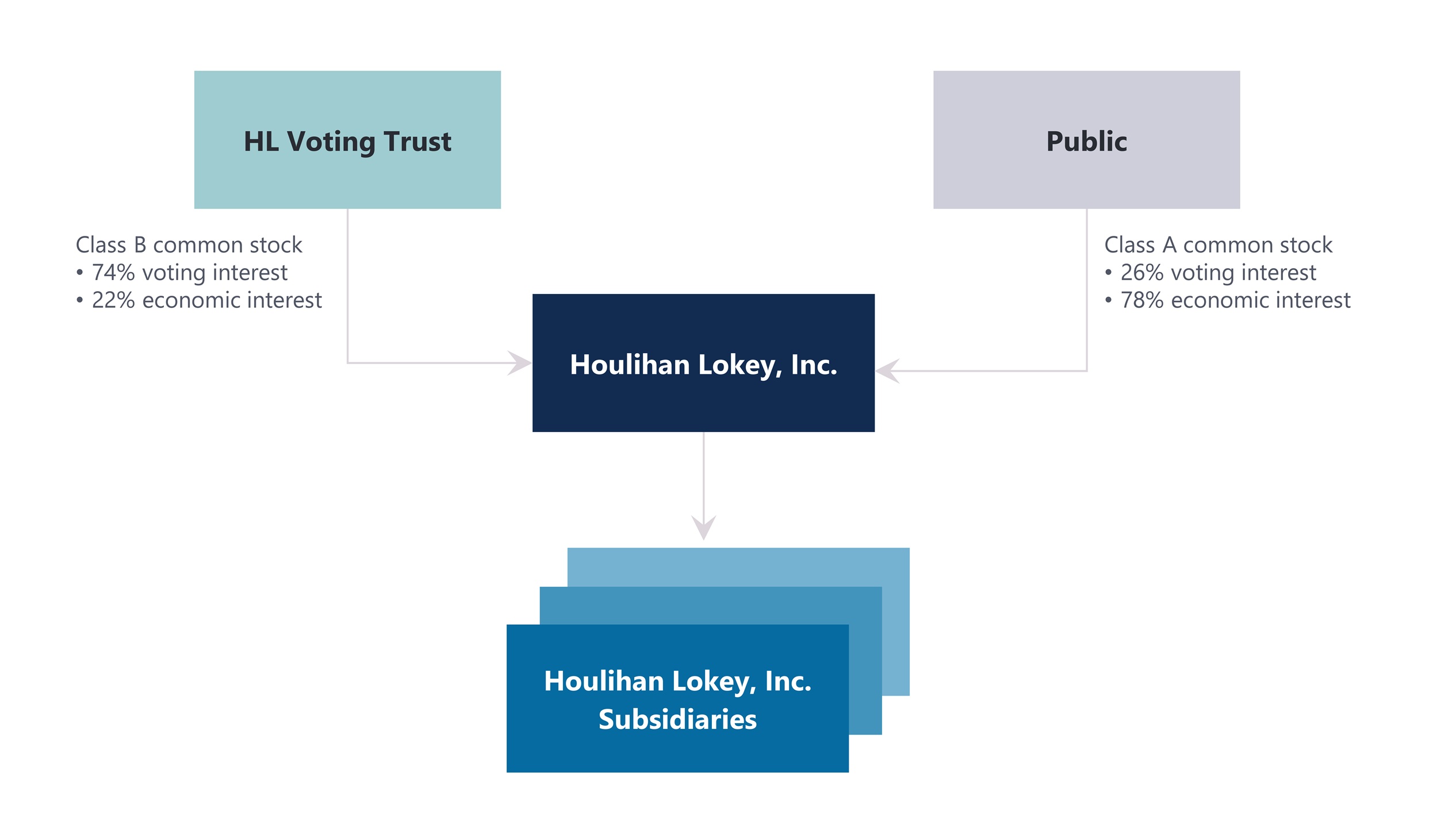
Houlihan Lokey, Inc. is a holding company that operates our business through its subsidiaries. The diagram below depicts our current organizational structure, and the approximate percentages are as of March 31, 2026:
HL Voting Trust Agreement
In connection with the successful completion of the initial public offering (“IPO”) of our Class A common stock in August 2015, we entered into the Voting Trust Agreement, dated as of August 18, 2015, with the HL Holders and the trustees of the HL Voting Trust, which was amended and restated in its entirety by the Amended and Restated Voting Trust Agreement dated as of December 30, 2025 (as so amended and restated, the “HL Voting Trust Agreement”). Pursuant to the HL Voting Trust Agreement, the trustees have the right to vote the shares of our common stock deposited by any HL Holder, together with any shares of Class B common stock acquired by such HL Holder, in their sole and absolute discretion on any matter, without fiduciary duties of any kind to the HL Holders. As of March 31, 2026, the HL Voting Trust controlled approximately 74% of the total voting power of the Company.
The HL Voting Trust controls a majority of the voting power of our outstanding common stock. As a result, we are a “controlled company” under the rules of the New York Stock Exchange (“NYSE”). Under these rules, a company of which more than 50% of the voting power is held by an individual, group or another company is a “controlled company” and may elect not to comply with certain corporate governance standards, including the requirements that (i) a majority of our board of directors consist of independent directors and (ii) that our board of directors have compensation and nominating and corporate governance committees composed entirely of independent directors, as independence is defined in Rule 10A-3 of the Securities Exchange Act of 1934, as amended (the “Exchange Act”) and under the NYSE listing standards. We utilize, and intend to continue to utilize, certain of these exemptions. As of March 31, 2026, the majority of our directors are independent, and we have fully independent audit, compensation, and nominating and corporate governance committees. See the Risk Factor “We are a ‘controlled company’ within the meaning of the NYSE listing standards and, as a result, qualify for, and rely on, exemptions from certain corporate governance requirements. Holders of Class A common stock do not have the same protections afforded to stockholders of companies that are subject to such requirements.” In the event that we cease to be a “controlled company” and our shares continue to be listed on the NYSE, we will be required to comply with all of these corporate governance standards by the expiration of the applicable transition periods.
Market and Industry Data
The industry, market and competitive position data referenced throughout this Form 10-K are based on research, industry and general publications, including surveys and studies conducted by third parties. Industry rankings are based on data provided by LSEG unless otherwise noted. Information from LSEG relating to industry rankings are sourced through direct deal submissions from financial institutions coupled with research performed by LSEG analysts. Industry publications, surveys and studies generally state that they have been obtained from sources believed to be reliable. We have not independently verified such third party information. While we are not aware of any misstatements regarding any industry, market or similar data presented herein, such data involve uncertainties and are subject to change based on various factors, including those discussed under the headings “Cautionary Note Regarding Forward-Looking Statements” and “Risk Factors” in this Form 10-K.
In this Form 10-K, we use the term “independent investment banks” when referring to ourselves and other investment banks or financial advisors that are primarily focused on advisory services and that conduct no or limited commercial banking, lending, or securities sales and trading activities, and which we believe are well positioned to provide uncompromised advice that is less subject to conflicts of interest arising from non-advisory services. In this Form 10-K, we use the term “mid-cap” when referring to transactions with a value below $1 billion.
Other Information
Our principal executive offices are located at 10250 Constellation Blvd., 5th Floor, Los Angeles, California 90067. Our telephone number is (310) 553-8871. Our website address is www.hl.com. We make available free of charge in the Investor Relations section of our website (http://investors.hl.com) our annual reports on Form 10-K, including this Form 10-K, Quarterly Reports on Form 10-Q, Current Reports on Form 8-K and all amendments to those reports as soon as reasonably practicable after such material is electronically filed or furnished with the SEC pursuant to Section 13(a) or 15(d) of the Exchange Act. We also make available through our website other reports filed with or furnished to the SEC under the Exchange Act, including our Proxy Statements and reports filed by officers and directors under Section 16(a) of that Act, as well as various governance documents. From time to time, we may use our website as a channel of distribution of material company information. Financial and other material information regarding the Company is routinely posted on and accessible at http://investors.hl.com. We do not intend for information contained in our website to be part of this Form 10-K. The inclusion of our website address in this Form 10-K does not include or incorporate by reference the information on our website into this Form 10-K or any other document into which this Form 10-K is incorporated by reference.
The SEC maintains a website that contains reports, proxy and information statements, and other information regarding registrants that file electronically with the SEC. The address of the site is http://www.sec.gov.
Changing market conditions can adversely affect our business in many ways, including by reducing the volume and/or size of the transactions we advise on, which could materially reduce our revenue.
As a financial services firm, we are materially affected by conditions in the global financial markets and economic conditions throughout the world.Financial markets and economic conditions can be negatively impacted by many factors beyond our control, such as the inability to access credit markets, rising interest rates or inflation, terrorism, political uncertainty, supply chain disruptions, uncertainty in the U.S. federal fiscal, monetary, or trade policies and the fiscal, monetary and trade policy of foreign governments, an evolving regulatory environment (and the timing and nature of regulatory reform), climate change, extreme weather events or natural disasters, the emergence or continuation of widespread health emergencies or pandemics, disruptive technologies, cyberattacks or campaigns, military conflicts around the world, such as ongoing conflicts in Eastern Europe and the Middle East, or other geopolitical events. The current U.S. administration has implemented, and continues to implement, significant and rapid changes in federal government operations and policies, including international trade policies, which may impact economic stability, the financial markets and the financial services industry broadly. Unfavorable market or economic conditions, including reduced expectations for, or declines in, the U.S. and global economic outlook, may adversely affect our businesses; in particular, where revenue generated is directly related to the volume and size of the transactions in which we are involved.For example, weak market or economic conditions may adversely affect our CF and FVA groups because, in an economic downturn, the volume and size of transactions may decrease, thereby reducing the demand for our M&A, capital raising and opinion advisory services and increasing price competition among financial services companies seeking such engagements.Moreover, in the period following an economic downturn, the volume and size of transactions typically takes time to recover and lags a recovery in market and economic conditions. In particular, our clients and their counterparties engaging in M&A transactions often rely on access to the credit and/or capital markets to finance their transactions. The uncertainty of available credit and interest rates and the volatility of the capital markets and the fact that we do not provide financing or otherwise commit capital to clients can adversely affect the size, volume, timing and ability of such clients to successfully complete M&A transactions and thus can adversely affect our CF and FVA groups. In addition, our profitability would be adversely affected due to our fixed costs and the possibility that we would be unable to reduce our variable costs without reducing revenue or within a timeframe sufficient to offset any decreases in revenue relating to changes in market and economic conditions. On the other hand, strong market or economic conditions may adversely affect our FR group.In a strong environment, the volume and size of recapitalization and restructuring transactions may decrease, thereby reducing the demand for the services provided by our FR business segment and increasing price competition among financial services companies seeking such engagements.Changes in market and economic conditions are expected to impact our businesses in different ways, and we may not be able to benefit from such changes.Further, our business, financial condition and results of operations could be adversely affected by changing market or economic conditions. Our profitability may also be adversely affected by changes in market and economic conditions because we may not be able to reduce certain fixed costs within a time frame sufficient to match any decreases in revenue.Conditions such as an economic recession, stagflation, rising unemployment, the effects of tariffs, trade wars, elevated interest rates, inflationary prices, terrorism or political uncertainty and other factors beyond our control may adversely affect demand for our services and the ability to manage costs associated with employees and vendors. The future market and economic climate may deteriorate because of many factors beyond our control, including tariffs, elevated interest rates or inflation, terrorism or political uncertainty.In addition, the U.S. Federal Reserve changes the federal funds interest rate from time to time, and market interest rates have risen in recent periods.The timing, pace and impact of any future changes in interest rates are uncertain, and the ability of the U.S. Federal Reserve to adjust interest rates or market confidence in the independence of the U.S. Federal Reserve could have an adverse effect on our transaction volumes, results of operations and financial condition. Further, in recent years, concerns arose with respect to the financial condition of a number of banking organizations in the United States, in particular those with exposure to certain types of depositors and large portfolios of investment securities. We maintain our cash at financial institutions, often with balances that exceed the current FDIC insurance limits. If any such financial institutions enter receivership or become insolvent in the future due to financial conditions affecting the banking system and financial markets, our ability to access our cash, cash equivalents and investments, including transferring funds, making payments or receiving funds, may be threatened and could have a material adverse effect on our business and financial condition. In addition, the operating environment and public trading prices of financial services sector securities can be highly correlated, in particular in times of stress, which may adversely affect the trading price of our Class A common stock and potentially our results of operations.
A substantial portion of our revenue is derived from advisory engagements in our CF and FR business segments, where a substantial portion of our fees tend to be contingent on the occurrence of goals, such as the completion of a transaction. As a result, our revenue and profits are highly volatile on a quarterly basis and may cause the price of our Class A common stock to fluctuate and decline.
Revenue and profits derived from our CF and FR business segments can be highly volatile. We derive a substantial portion of our revenue from advisory fees, which are mainly generated at key milestones, such as the closing of a transaction, the timing of which is outside of our control. In many cases, for advisory engagements that do not result in the successful consummation of a transaction, we are not paid a fee other than the reimbursement of certain out-of-pocket expenses and, in some cases, a modest retainer, despite having devoted considerable resources to these transactions. The achievement of these contractually-defined milestones is often impacted by factors outside of our control, such as market conditions and the decisions and actions of our clients and interested third parties. For example, a client could delay or terminate an acquisition transaction because of a failure to agree upon final terms with the counterparty, failure to obtain necessary regulatory consents or board or shareholder approvals, failure to secure necessary financing, adverse market conditions or because the target's business is experiencing unexpected financial problems. Anticipated bidders for client assets during a restructuring transaction may not materialize or our client may not be able to restructure its operations or indebtedness due to a failure to reach agreement with its principal creditors. Because fees in such engagements are typically contingent, revenue on such engagements, which is recognized when all revenue recognition criteria are met, is not certain and the timing of receipt is difficult to predict and may not occur evenly throughout the year.
We expect that we will continue to rely on advisory fees, including fees based upon milestones, such as the completion of a transaction, for a substantial portion of our revenue for the foreseeable future. Accordingly, a decline in our advisory engagements or the market for advisory services would adversely affect our business. In addition, our financial results will likely fluctuate from quarter to quarter based on when fees are earned, and high levels of revenue in one quarter will not necessarily be predictive of continued high levels of revenue in future periods. Should these contingent fee arrangements represent a greater percentage of our business in the future, we may experience increased volatility in our working capital requirements and greater variations in our quarter-to-quarter results, which could affect the price of our Class A common stock. Because advisory revenue can be volatile and represents a significant portion of our total revenue, we may experience greater variations in our revenue and profits than other larger, more diversified competitors in the financial services industry. Fluctuations in our quarterly financial results could, in turn, lead to large adverse movements in the price of our Class A common stock or increased volatility in our stock price generally.
Our acquisitions and strategic investments may result in additional risks and uncertainties in our businesses.
In addition to recruiting and organic expansion, we have grown, and intend to continue to grow, our core businesses through acquisitions and strategic investments.
We regularly evaluate opportunities to acquire other businesses whose key strategic benefit is the addition of financial professionals in sectors and/or geographies that we believe provide a compelling opportunity. Unless and until acquisitions of other businesses generate meaningful revenues, the purchase prices we pay to acquire such businesses could have a material adverse effect on our business, financial condition and results of operations. If we acquire a business, we may be unable to manage it profitably or successfully integrate its operations with our own. Moreover, we may be unable to realize the financial, operational, and other benefits we anticipate from acquisitions. Competition for future acquisition opportunities in our markets could increase the price we pay for businesses we acquire and could reduce the number of potential acquisition targets. Further, acquisitions may involve a number of special financial and business risks, including expenses related to any potential acquisition from which we may withdraw, diversion of our management's time, attention, and resources, decreased utilization during the integration process, loss of key acquired personnel, difficulties in integrating diverse corporate cultures, increased costs to improve or integrate personnel and financial, accounting, technology and other systems, including compliance with the Sarbanes-Oxley Act, dilutive issuances of equity securities, including convertible debt securities, incurrence of debt, the assumption of legal liabilities, amortization of acquired intangible assets, potential write-offs related to the impairment of goodwill, and additional conflicts of interest. If we are unable to successfully manage these risks, we will not be able to implement our growth strategy, which ultimately could materially adversely affect our business, financial condition and results of operations.
Goodwill and other intangible assets represent a significant portion of our assets, and an impairment of these assets could have a material adverse effect on our financial condition and results of operations.
Goodwill and other intangible assets represent a significant portion of our assets, and totaled $1.60 billion as of March 31, 2026. Goodwill is the excess of cost over the fair market value of net assets acquired in business combinations. We review goodwill and intangible assets at least annually for impairment. We may need to perform impairment tests more frequently if events occur or circumstances indicate that the carrying amount of these assets may not be recoverable. These events or circumstances could include a significant change in the business climate, attrition of key personnel, a prolonged decline in our stock price and market capitalization, legal factors, operating performance indicators, competition, sale or disposition of a significant portion of one of our businesses and other factors. Annual impairment reviews of indefinite-lived intangible assets or any future impairment of goodwill or other intangible assets would result in a non-cash charge against earnings, which would adversely affect our results of operations. The valuation of the reporting units requires judgment in estimating future cash flows, discount rates and other factors. In making these judgments, we evaluate the financial health of our reporting units, including such factors as market performance, changes in our client base and projected growth rates. Because these factors are ever changing, due to market and general business conditions, our goodwill and indefinite-lived intangible assets may be impaired in future periods.
Our international operations are subject to certain risks, which may affect our revenue.
In fiscal 2026, we earned approximately 32.2% of our revenue from our international operations. We intend to grow our non-United States business, including growth into new regions with which we have less familiarity and experience, and this growth is important to our overall success. Many of our larger clients are non-United States entities. Our international operations carry special financial and business risks, which could include the following:
•greater difficulties in managing and staffing foreign operations;
•fluctuations in foreign currency exchange rates that could adversely affect our results;
•unexpected and costly changes in trading policies, regulatory requirements, tariffs and other barriers;
•cultural and language barriers and the need to adopt different business practices in different geographic areas;
•longer transaction cycles;
•higher operating costs;
•local labor conditions and regulations;
•adverse consequences or restrictions on the repatriation of earnings;
•potentially adverse tax consequences, such as trapped foreign losses;
•potentially less stable political and economic environments;
•terrorism, political hostilities, war and other civil disturbances or other catastrophic events, such as the conflicts in Ukraine, Israel, and Iran, that reduce business activity; and
•difficulty collecting fees.
As part of our day-to-day operations outside the United States, we are required to create compensation programs, employment policies, compliance policies and procedures and other administrative programs that comply with the laws of multiple countries. We also must communicate and monitor standards and directives across our global operations. Our failure to successfully manage and grow our geographically diverse operations could impair our ability to react quickly to changing business and market conditions and to enforce compliance with non-United States standards and procedures.
Any payment of distributions, loans or advances to and from our subsidiaries could be subject to restrictions on, or taxation of, dividends or repatriation of earnings under applicable local law, monetary transfer restrictions, foreign currency exchange regulations in the jurisdictions in which our subsidiaries operate or other restrictions imposed by current or future agreements, including debt instruments, to which our non-United States subsidiaries may be a party. Our business, financial condition and/or results of operations could be adversely impacted, possibly materially, if we are unable to successfully manage these and other risks of international operations in a volatile environment. If our international business increases relative to our total business, these factors could have a more pronounced effect on our operating results or growth prospects.
Although the current U.S. President has signed an executive order to pause, subject to certain exceptions, the initiation of new investigations and enforcement actions under the FCPA, the United States Department of Justice and the SEC have historically devoted significant resources to enforcement of the FCPA. In addition, the United Kingdom has significantly expanded the reach of its anti-bribery laws. While we have developed and implemented policies and procedures designed to ensure strict compliance by us and our personnel with the FCPA and other anti-corruption laws, such policies and procedures may not be effective in all instances to prevent violations. Any determination that we have violated the FCPA (notwithstanding the current pause on FCPA investigations and enforcement action) or other applicable anti-corruption laws could subject us to, among other things, civil and criminal penalties, material fines, profit disgorgement, injunctions on future conduct, securities litigation and a general loss of investor confidence, any one of which could adversely affect our business prospects, financial condition, results of operations or the market value of our Class A common stock.
Fluctuations in foreign currency exchange rates could adversely affect our results.
Because our financial statements are denominated in United States Dollars and we receive a portion of our net revenue in other currencies, we are exposed to fluctuations in foreign currencies. In addition, we pay certain of our expenses in such currencies. Fluctuations in foreign currency exchange rates led to a net gain in cash of $4.9 million for fiscal 2026, compared to a net loss in cash of $(0.8) million for fiscal 2025. In particular, we are exposed to the Euro, the Yen, and the Pound Sterling, and fluctuations in these and other currencies relative to the United States Dollar have had, and may continue to have, an adverse effect on our revenue. From time to time, we have entered into transactions to hedge our exposure to certain foreign currency fluctuations through the use of derivative instruments or other methods. Notwithstanding our entry into such hedge transactions, a depreciation of any of the currencies to which we are exposed relative to the United States Dollar could result in an adverse impact to our business, financial condition, results of operations and/or cash flows.
The cost of compliance with broker-dealer, employment, labor, benefits, and tax regulations may adversely affect our business and hamper our ability to expand internationally.
Because we operate our business both in the United States and internationally, we are subject to many distinct securities, employment, labor, benefits and tax laws in each country in which we operate, including regulations affecting our employment practices and our relations with our employees and service providers. If we are required to comply with new regulations or new interpretations of existing regulations, or if we are unable to comply with these regulations or interpretations, our business could be adversely affected or the cost of compliance may make it difficult to expand into new international markets. Additionally, our competitiveness in international markets may be adversely affected by regulations requiring, among other things, the awarding of contracts to local contractors, the employment of local citizens and/or the purchase of services from local businesses or favoring or requiring local ownership.
Our ability to retain our Managing Directors and our other senior professionals, as well as our ability to successfully identify, recruit and develop talent, is critical to the success of our business.
We depend on the efforts and reputations of our senior management and financial professionals. Our Managing Directors’ and other senior professionals’ reputations and relationships with clients and potential clients are critical elements in the success of our business. Our future success depends to a substantial degree on our ability to retain qualified management and financial professionals within our organization, including our Managing Directors. In addition, our future growth will depend on, among other things, our ability to successfully identify and recruit individuals and teams to join our firm. It typically takes time for these financial professionals to become profitable and effective. During that time, we may incur significant expenses and expend significant time and resources toward training, integration and business development aimed at developing this new talent. However, we may not be successful in our efforts to identify, recruit, train and retain the required personnel as the market for qualified investment bankers is extremely competitive. Our financial professionals possess substantial experience and expertise and have strong relationships with our advisory clients. As a result, the loss of these financial professionals could jeopardize our relationships with clients and result in the loss of client engagements. For example, if our Managing Directors or other senior professionals, including our executive officers, or groups of professionals, were to join or form a competing firm, some of our current clients could choose to use the services of that competitor rather than our services. Managing Directors and other senior professionals have left Houlihan Lokey in the past and others may do so in the future, and the departure of any of these senior professionals may have an adverse impact on our business. Our compensation arrangements and post-employment restriction agreements with our Managing Directors and other professionals may not provide sufficient incentives or protections to prevent these professionals from resigning to pursue other employment opportunities. In addition, recent initiatives at state and federal levels have sought to restrict or limit the enforceability of restrictive covenants, with several states having enacted such legislation, including California. In addition, some of our competitors have more resources than we do, which may allow them to attract some of our existing employees by offering superior compensation and benefits or otherwise. The departure of a number of Managing Directors or groups of senior professionals could have a material adverse effect on our business, financial condition and results of operations.
We are subject to reputational and legal risk arising from, among other things, actual or alleged employee misconduct, conflicts of interest, failure to meet client expectations or other operational failures.
As a professional services firm, our ability to secure new engagements is substantially dependent on our reputation and the individual reputations of our financial professionals. Any factor that diminishes our reputation or that of our financial professionals, including not meeting client expectations or actual or alleged misconduct by our financial professionals, including misuse of confidential information, could make it substantially more difficult for us to attract new engagements and clients.
In addition, we face the possibility of an actual, potential or perceived conflict of interest where we represent a client on a transaction in which an existing client is a party. We may be asked by two potential clients to act on their behalf on the same transaction, including by two clients as potential buyers in the same acquisition transaction. In each of these situations, we face the risk that our current policies, controls and procedures may not timely identify or appropriately manage actual or potential conflicts of interest. Conflicts may also arise from investments or activities of employees outside their business activities on behalf of the Company. It is possible that actual, potential or perceived conflicts could give rise to client dissatisfaction, litigation or regulatory enforcement actions. Appropriately identifying and managing actual or perceived conflicts of interest is complex and difficult, and our reputation could be damaged if we fail, or appear to fail, to deal appropriately with one or more potential or actual conflicts of interest. Regulatory scrutiny of, or litigation in connection with, conflicts of interest could have a material adverse effect on our reputation which could materially adversely affect our business in a number of ways, including a reluctance of some potential clients and counterparties to do business with us.
Further, because we provide our services primarily in connection with significant or complex transactions, disputes or other matters that usually involve confidential and sensitive information or are adversarial, and because our work is the product of myriad judgments of our financial professionals and other staff operating under significant time and other pressures, we may not always perform to the standards expected by our clients. In addition, we may face reputational damage from, among other things, litigation against us, or our failure to protect confidential information. There is also a risk that our employees could engage in misconduct that could adversely affect our business. If our employees were to improperly use or disclose confidential information provided by our clients, we could be subject to regulatory sanctions and legal liability and suffer serious harm to our reputation, financial position, current client relationships and ability to attract future clients. It is not always possible to deter employee misconduct, and the precautions we take to detect and prevent misconduct may not be effective in all cases. In addition, our financial professionals and other employees are responsible for the security of the information in our systems or under our control and for ensuring that non-public information is kept confidential. Should any employee not follow appropriate security measures, the improper release or use of confidential information could result. If our employees engage in misconduct or fail to follow appropriate security measures, we could be subject to legal liability and reputational harm, which could impair our ability to attract and retain clients and in turn materially adversely affect our business.
We may be unable to execute on our growth initiatives, business strategies, or operating plans.
We are executing on a number of growth initiatives, strategies and operating plans designed to enhance our business. For example, we intend to continue to expand our platform into new industry and product sectors, both organically and through additional hires or acquisitions, and to expand our existing expertise into new geographies. The anticipated benefits from these efforts are based on several assumptions that may prove to be inaccurate. Moreover, we may not be able to complete successfully these growth initiatives, strategies and operating plans and realize all of the benefits, including growth targets and cost savings, we expect to achieve or it may be more costly to do so than we anticipate. A variety of factors could cause us not to realize some or all of the expected benefits. These factors include, among others: delays in the anticipated timing of activities related to such growth initiatives, strategies and operating plans; difficulty in competing in certain industries, product areas and geographies in which we have less experience than others; negative attention from any failed initiatives; and increased or unexpected costs in implementing these efforts.
In addition, sustaining growth will require us to commit additional management, operational and financial resources and to maintain appropriate operational and financial systems to adequately support expansion, especially in instances where we open new offices that may require additional resources before they become profitable. We may not be able to recruit and develop talent and manage our expanding operations effectively, and any failure to do so could materially adversely affect our ability to grow revenue and control our expenses.
Moreover, our continued implementation of these programs may disrupt our operations and performance. As a result, we may not realize the expected benefits from these plans. If, for any reason, the benefits we realize are less than our estimates or the implementation of these growth initiatives, strategies and operating plans adversely affect our operations or cost more or take longer to effectuate than we expect, or if our assumptions prove inaccurate, we will not be able to implement our growth strategy, which ultimately could materially adversely affect our business, financial condition and results of operations.
We are subject to risks relating to our operations, including our information and technology, which could harm our business.
We operate a business that is highly dependent on information systems and technology to securely process, transmit and store such information and to communicate among our locations around the world and with our employees, clients and vendors. For example, our clients typically provide us with sensitive and confidential information. Any failure to keep secure and accurate books and records can render us liable to disciplinary action by governmental and self-regulatory authorities, as well as to claims by our clients. We rely on third-party service providers for important aspects of our business. Any serious interruption or deterioration in the performance of these third parties or failures of their information systems and technology could impair our operations, affect our reputation and adversely affect our business.
We face numerous, evolving cybersecurity threats to our IT systems and information. We have experienced incidents and regularly face cyber-attacks, which will continue in varying degrees for all companies globally. While to date no incidents have materially impacted our business, there is no guarantee that material incidents will not occur in the future. A significant breach could lead to shutdowns or disruptions of our systems or third-party systems on which we rely and materially compromise our proprietary information, client and third party information, destroy data or disable, degrade or sabotage our systems, including through the introduction of computer viruses or malware (e.g., ransomware), cyber-attacks and other means and could originate from a wide variety of sources, such as unknown third parties, nation-state actors or even insiders. As cyber-attack techniques evolve in response to enhanced detection and protection measures, cyber-attacks/threats/incidents could persist for an extended period of time before detection or escalation. There can be no assurance that the cybersecurity protections and controls utilized by us, or by our third parties on whom we rely, will be effective within this cyber threat landscape, particularly as actors are increasingly using tools such as artificial intelligence to enhance their techniques. For example, phishing and email spoofing attacks that, among other things, seek to direct fraudulent bank transfers or obtain valuable information via social engineering are increasingly sophisticated. The proliferation of deepfake technology adds to these risks. Fraudulent transfers resulting from phishing attacks or email spoofing of our employees could result in a material loss of assets, reputational harm or legal liability and in turn materially adversely affect our business. In addition, our employees are responsible for following proper measures to maintain the confidentiality of information we hold. If our systems or third-party systems on which we rely are compromised or perceived to be compromised, do not operate properly or are disabled, or if an employee fails to follow proper measures resulting in the release of confidential information, we could suffer a disruption of our business, financial losses, liability to clients, regulatory sanctions and damage to our reputation.
We and our third-party service providers and their subprocessors, are likely to develop or incorporate artificial intelligence technologies (“AI”) technology in certain business operations, processes or services. The full extent of current or future risks related to the development of AI technology is not possible to predict. We cannot anticipate, prevent or mitigate all of the potential risks, challenges or impacts of such changes. The deployment of AI, which relies on substantial data volumes, introduces risks such as potential leakage of confidential or proprietary information, unauthorized access, misuse, or theft of sensitive data, and the possibility of competitors adopting AI more effectively, which could materially impact our business, financial condition, results of operations, or market share. The worldwide legal and regulatory environment relating to AI is uncertain and rapidly evolving, which could require changes in our potential use and implementation of AI technology, limit our ability to integrate AI and increase our compliance costs and the risk of non-compliance.
In addition, a disaster or other business continuity problem, such as a pandemic, other man-made or natural disaster or disruption involving electronic communications or other services used by us or third parties with whom we conduct business, could lead us to experience operational challenges. The incidence and severity of catastrophes and other disasters are inherently unpredictable, and our inability to timely and successfully recover could materially disrupt our business and cause material financial loss, regulatory actions, reputational harm or legal liability.
Our revenue in any given period is dependent on the number of fee-paying clients in such period and the size of transactions on which we are advising, so a significant reduction in the number of fee-paying clients or the size of transactions in any given period could reduce our revenue and adversely affect our operating results in such period.
Our revenue in any given period is dependent on the number of fee-paying clients in such period and the size of transactions on which we are advising that close during such period. We may lose clients as a result of the sale or merger of a client, a change in a client's senior management, competition from other financial advisors and financial institutions and other causes. A significant reduction in the number of fee-paying clients and/or the size of transactions on which we are advising that close in any given period could reduce our revenue and adversely affect our operating results in such period.
Our clients may be unable to pay us for our services.
We face the risk that certain clients may not have the financial resources to pay our agreed-upon advisory fees, including in the bankruptcy or insolvency context. Our clients include some companies that may from time to time encounter financial difficulties. If a client's financial difficulties become severe, the client may be unwilling or unable to pay our invoices in the ordinary course of business, which could adversely affect collections of both our accounts receivable and unbilled services. On occasion, some of our clients have entered bankruptcy, which has prevented us from collecting amounts owed to us. The bankruptcy of a number of our clients that, in the aggregate, owe us substantial accounts receivable could have a material adverse effect on our business, financial condition and results of operations. In addition, if a number of clients declare bankruptcy after paying us certain invoices, courts may determine that we are not properly entitled to those payments and may require repayment of some or all of the amounts we received, which could adversely affect our business, financial condition and results of operations. In addition, some fees earned from certain activities in our FR business segment are subject to approval by the United States Bankruptcy Courts and other interested parties, including United States Trustees, which have the ability to challenge the payment of those fees. Fees earned and reflected in our revenue may from time to time be subject to successful challenges, which could result in a reduction of revenue. Finally, certain clients may also be unwilling to pay our advisory fees in whole or in part, in which case we may have to incur significant costs to bring legal action to enforce our engagement agreements to obtain our advisory fees. We accrued net bad debt expense of $7.7 million and $9.3 million in fiscal 2026 and 2025, respectively, related to uncollectible or doubtful accounts receivable and unbilled work in progress.
We may not be able to generate sufficient cash in the future to service any future indebtedness.
As of March 31, 2026, we had $151.4 million of other liabilities, but may incur additional debt in the future. Our ability to make scheduled payments on or to refinance our debt obligations will depend on our business, financial condition and results of operations. We cannot provide assurance that we will maintain a level of cash flows from operating activities sufficient to permit us to pay the principal of, and interest on, our indebtedness. If our cash flows and capital resources are insufficient to fund our debt service obligations, we may be forced to reduce or delay investments and capital expenditures, or to sell assets, seek additional capital or restructure or refinance such indebtedness.
We may be adversely affected by the effects of inflation.
Inflation has the potential to adversely affect our liquidity, business, financial condition and results of operations by increasing our overall cost structure, particularly if we are unable to achieve commensurate increases in the fees we charge our clients or if increased prices may lead to our clients requesting fewer services. The existence of inflation in the economy has resulted in, and may continue to result in, higher interest rates and capital costs, increased costs of labor, weakening exchange rates and other similar effects. Although we may take measures to mitigate the impact of inflation, if these measures are not effective our business, financial condition, results of operations and liquidity could be materially adversely affected. Even if such measures are effective, there could be a difference between the timing of when these beneficial actions impact our results of operations and when the cost of inflation is incurred.
We may enter into new lines of business, which may result in additional risks and uncertainties in our business.
We currently generate substantially all of our revenue from advisory services. However, while we have no current plans to do so, we may grow our business by entering into new lines of business other than advisory services. To the extent we enter into new lines of business, we will face numerous risks and uncertainties, including risks associated with actual or perceived conflicts of interest because we would no longer be limited to the advisory business, the possibility that we have insufficient expertise to engage in such activities profitably or without incurring inappropriate amounts of risk, the required investment of capital and other resources and the loss of clients due to the perception that we are no longer focusing on a core business.
Entry into certain lines of business may subject us to new laws and regulations with which we are not familiar, or from which we are currently exempt, and may lead to increased litigation and regulatory risk. In addition, certain aspects of our cost structure, such as costs for compensation, occupancy and equipment rentals, communication and information technology services, and depreciation and amortization will be largely fixed, and we may not be able to timely adjust these costs to match fluctuations in revenue related to our entering into new lines of business. If a new business generates insufficient revenue or if we are unable to efficiently manage our expanded operations, our business, financial condition and results of operations could be materially adversely affected.
We face strong competition from other financial advisory firms, many of which have the ability to offer clients a wider range of products and services than those we offer, which could cause us to lose engagements to competitors and subject us to pricing pressures that could materially adversely affect our revenue and profitability.
The financial services industry is intensely competitive, highly fragmented and subject to rapid change, and we expect it to remain so. Our competitors are other investment banking and financial advisory firms. We compete on both a global and a regional basis, and on the basis of a number of factors, including depth of client relationships, industry knowledge, transaction execution skills, our range of products and services, innovation, reputation and price. In addition, in our business, there are usually no long-term contracted sources of revenue. Each revenue-generating engagement typically is separately solicited, awarded and negotiated. If we are unable to compete successfully with our existing competitors or with any new competitors, we will not be able to implement our growth strategy, which ultimately could materially adversely affect our business, financial condition and results of operations.
Our primary competitors include bulge-bracket institutions, many of which have far greater financial and other resources and greater name recognition than we do and have a greater range of products and services, more extensive marketing resources, larger customer bases, more managing directors to serve their clients' needs, as well as greater global reach and more established relationships with their customers than we have. These larger and better capitalized competitors may be better able to respond to changes in the investment banking market, to compete for skilled professionals, to finance acquisitions, to fund internal growth and to compete for market share generally, which puts us at a competitive disadvantage and could result in pricing pressures or loss of opportunities, which could materially adversely affect our revenue and profitability. In particular, we may be at a competitive disadvantage with regard to certain of our competitors who are able to, and often do, provide financing or market making services that are often a crucial component of the types of transactions on which we advise.
In addition to our larger competitors, over the last few years, a number of independent investment banks that offer independent advisory services have emerged, with several showing rapid growth. As these independent firms or new entrants into the market seek to gain market share there could be pricing pressures, which would adversely affect our revenue and earnings. We have experienced intense competition over obtaining advisory engagements in recent years, and we may experience further pricing pressures in our business in the future as some of our competitors may seek to obtain increased market share by reducing fees. In particular, when making proposals for fixed-fee engagements, we estimate the costs and timing for completing the engagements. These estimates reflect our best judgment regarding the efficiencies of our methodologies and financial professionals as we plan to deploy them on engagements. Any increased or unexpected costs or unanticipated delays in connection with the performance of fixed-fee engagements, including delays caused by factors outside our control, could make these contracts less profitable or unprofitable, which would have an adverse effect on our profit margin.
We face substantial litigation risks.
Our role as advisor to our clients involves complex analysis and the exercise of professional judgment, including, in particular, in rendering fairness opinions in connection with mergers and other transactions. Our activities, and particularly those of our FVA group, may subject us to the risk of significant legal liabilities to our clients and affected third parties, including shareholders of our clients who could bring legal claims against us. In recent years, the volume of claims and amount of damages claimed in litigation and regulatory proceedings against financial services companies continues to be high. Litigation alleging that we performed below our agreed standard of care or breached other obligations to a client or other parties could expose us to significant legal liabilities, particularly with respect to our FVA group, and, regardless of outcome, is often very costly, could distract our management and managing directors and could damage our reputation. These risks often may be difficult to assess or quantify and their existence and magnitude often remain unknown for substantial periods of time. Our engagements typically include broad indemnities from our clients and provisions to limit our exposure to legal claims relating to our services, but these provisions may not protect us in all cases, including when we perform below our agreed standard of care or a client does not have the financial capacity to pay under the indemnity. As a result, we may incur significant legal expenses in defending against or settling litigation. In addition, we may have to spend a significant amount to adequately insure against these potential claims, or insurance coverage may not be available on commercial terms or at all. Substantial legal liability or significant regulatory action against us could have material adverse financial effects or cause significant reputational harm to us, which could seriously harm our business prospects, financial condition and results of operations.
Extensive and evolving regulation of our business and the businesses of our clients exposes us to the potential for significant penalties and fines due to compliance failures, increases our costs, and may result in limitations on the manner in which our business is conducted.
As a participant in the financial services industry, we are subject to extensive regulation in the United States and internationally. We are subject to regulation by governmental and self-regulatory organizations in many of the jurisdictions in which we operate.
Our ability to conduct business and our operating results, including compliance costs, may be adversely affected as a result of any new requirements imposed by the SEC, FINRA or other United States or foreign governmental regulatory authorities or self-regulatory organizations that regulate financial services firms or supervise financial markets. We may be adversely affected by changes in the interpretation or enforcement of existing laws and rules by these governmental authorities and self-regulatory organizations. In addition, some of our clients or prospective clients may adopt policies that exceed regulatory requirements and impose additional restrictions affecting their dealings with us. Accordingly, we may incur significant costs to comply with United States and international regulations. Our expenses incurred in complying with these regulatory requirements, including legal fees and fines or penalties paid to the SEC, FINRA and United States or foreign governmental regulatory authorities or self-regulatory organizations, have increased in recent years. For example, on August 8, 2023, we reached an agreement on an Offer of Settlement with the SEC to resolve an administrative and cease-and-desist proceeding concerning the Company's compliance with records preservation requirements related to business communications sent over off-channel electronic messaging platforms. As part of the agreement, the Company paid a $15 million civil penalty. We maintain an internal team that works full-time to develop and implement regulatory compliance policies and procedures, monitor business activities to ensure compliance with such policies and procedures, and report to senior management. This team also uses various technological tracking and reporting systems and confers regularly with internal and outside legal counsel in the performance of its responsibilities. In addition, new laws or regulations or changes in enforcement of existing laws or regulations applicable to our clients may adversely affect our business. For example, changes in antitrust enforcement could affect the level of M&A activity and changes in applicable regulations could restrict the activities of our clients and their need for the types of advisory services that we provide to them.
Our failure to comply with applicable laws or regulations could result in adverse publicity and reputational harm as well as fines, suspensions of personnel or other sanctions, including revocation of any required registration of us or any of our subsidiaries and/or financial professionals and could impair retention or recruitment of executives and/or senior financial professionals. In addition, any changes in the regulatory framework under which we operate could impose additional expenses or capital requirements on us, result in limitations on the manner in which our business is conducted, have an adverse impact upon our business, financial condition and results of operations and require substantial attention by senior management. In addition, our business is subject to periodic examination by various regulatory authorities, and we cannot predict the outcome of any such examinations.
Risks Related to Our Organizational Structure
The dual class structure of our common stock and the ownership of our Class B common stock by the HL Holders through the HL Voting Trust have the effect of concentrating voting control with the HL Voting Trust, which limits the ability of our Class A common stockholders to influence corporate matters. We are controlled by the HL Voting Trust, whose interests may differ from those of our Class A common stockholders.
Each share of our Class B common stock is entitled to ten votes per share, and each share of our Class A common stock is entitled to one vote per share. As of March 31, 2026, the HL Holders through the HL Voting Trust beneficially owned 15,266,333 shares of common stock representing approximately 22% of the economic interest, and controlled approximately 74% of the voting power of our outstanding capital stock. The HL Voting Trust has significant influence over our corporate management and affairs and is able to control virtually all matters requiring stockholder approval. The HL Voting Trust is able to elect a majority of the members of our board of directors and control actions to be taken by us and our board of directors, including amendments to our amended and restated certificate of incorporation and bylaws and approval of significant corporate transactions, including mergers and sales of substantially all of our assets. The directors so elected will have the authority, subject to the terms of our indebtedness and applicable rules and regulations, to issue additional stock, implement stock repurchase programs, declare dividends and make other decisions. This concentrated control will limit the ability of holders of our Class A common stock to influence corporate matters for the foreseeable future and may materially adversely affect the market price of our Class A common stock. It is possible that the interests of the HL Voting Trust may in some circumstances conflict with our interests and the interests of our other stockholders. For example, the HL Voting Trust may have different tax positions or other differing incentives from other stockholders that could influence their decisions regarding whether and when to cause us to dispose of assets, incur new or refinance existing indebtedness or take other actions. Additionally, the holders of our Class B common stock may cause us to make strategic decisions or pursue acquisitions that could involve risks to holders of our Class A common stock or may not be in the best interests of holders of our Class A common stock.
The holders of our Class B common stock will also be entitled to a separate vote in the event we seek to amend our amended and restated certificate of incorporation to increase or decrease the par value of a class of our common stock or in a manner that alters or changes the powers, preferences, or special rights of the Class B common stock in a manner that affects its holders adversely. Future transfers by holders of Class B common stock will generally result in those shares converting on a one-for-one basis to Class A common stock, which will have the effect, over time, of increasing the relative voting power of those holders of Class B common stock who retain their shares over the long-term.
We are a “controlled company” within the meaning of the New York Stock Exchange listing standards and, as a result, qualify for, and rely on, exemptions from certain corporate governance requirements. Holders of Class A common stock do not have the same protections afforded to stockholders of companies that are subject to such requirements.
The HL Voting Trust controls a majority of the voting power of our outstanding common stock. As a result, we qualify as a “controlled company” within the meaning of the corporate governance standards of the NYSE. Under these rules, a listed company of which more than 50% of the voting power is held by an individual, group or another company is a “controlled company” and may elect not to comply with certain corporate governance requirements, including the requirement that a majority of the board of directors consist of independent directors, the requirement that we have a nominating and corporate governance committee that is composed entirely of independent directors, and the requirement that we have a compensation committee that is composed entirely of independent directors.
We intend to continue to rely on some or all of these exemptions. While at the present time, a majority of our board of directors consists of independent directors and our compensation and nominating and corporate governance committees consist entirely of independent directors, that may not continue to be the case. Accordingly, our stockholders do not have the same protections afforded to stockholders of companies that are subject to all of the corporate governance requirements of the NYSE.
If the Final Conversion Date occurs, the voting power of shares of our common stock controlled by the HL Voting Trust would significantly decline and the voting power of shares held by our other holders of Class A common stock would significantly increase, which could affect our status as a “controlled company”, change the holders of the voting power of our common stock and ultimately affect the market price of our Class A common stock in ways we cannot anticipate.
Our amended and restated certificate of incorporation set out certain triggers for a defined “Final Conversion Date” whereupon all shares of our outstanding Class B common stock (which are entitled to ten votes per share) will automatically convert into the corresponding number of shares of our Class A common stock (which are entitled to one vote per share). One such trigger is if the percentage of the shares held by the HL Voting Trust or other defined holders collectively represent less than 20% of the number of shares of Common Stock then outstanding. As of March 31, 2026, we estimate the shares held by the HL Voting Trust and such other defined holders collectively represented approximately 22% of the number of shares of common stock then outstanding. This percentage fluctuates and we cannot predict if, or when, it will fall below 20% and trigger a Final Conversion Date. If a Final Conversion Date occurs, the conversion of our Class B common stock into Class A common stock would significantly reduce the voting power of the shares controlled by the HL Voting Trust and significantly increase the voting power held by our other holders of Class A common stock. By way of illustration, if the Final Conversion Date had occurred on March 31, 2026, the voting power in our company held by the HL Voting Trust would have gone from approximately 74% to approximately 22% and the voting power in our company held by the other Class A stockholders would have gone from approximately 26% to approximately 78%. If a Final Conversion Date were to occur, we expect we would cease to be a “controlled company” under NYSE rules. In addition, if a Final Conversion Date and the resulting shift in the voting power of our company were to occur, it could lead to numerous outcomes that cannot be predicted, including possible changes in our management, board composition, or strategic direction, the possible increase in our vulnerability to hostile takeovers or activist investors and the possibility of increased market volatility for our Class A common stock. We cannot anticipate with certainty if, or when, a Final Conversion Date could occur or any impact that could have on the value of our Class A common stock.
Our anti-takeover provisions could prevent or delay a change in control of our Company, even if such change in control would be beneficial to our stockholders.
Provisions of our amended and restated certificate of incorporation and amended and restated bylaws, as well as provisions of Delaware law could discourage, delay or prevent a merger, acquisition or other change in control of our company, even if such change in control would be beneficial to our stockholders. Certain provisions of our amended and restated certificate of incorporation and our amended and restated bylaws that could prevent or delay a change in control of our company include:
•the ability to issue “blank check” preferred stock, which could increase the number of outstanding shares and thwart a takeover attempt;
•a classified board of directors so that not all members of our board of directors are elected at one time;
•the ability to remove directors only for cause;
•no use of cumulative voting for the election of directors;
•no ability of stockholders to call special meetings;
•supermajority voting provisions for stockholder approval of amendments to our certificate of incorporation and by-laws;
•the requirement that, to the fullest extent permitted by law and unless we agree otherwise, certain proceedings against or involving us or our directors, officers or employees be brought exclusively in the Court of Chancery in the State of Delaware;
•the ability of stockholders to take action by written consent; and
•advance notice and duration of ownership requirements for nominations for election to the board of directors or for proposing matters that can be acted upon by stockholders at stockholder meetings.
These provisions could also discourage proxy contests and make it more difficult for our stockholders to elect directors of their choosing and cause us to take other corporate actions they desire. In addition, because our board of directors is responsible for appointing the members of our management team, these provisions could in turn affect any attempt by our stockholders to replace current members of our management team.
In addition, the General Corporation Law of the State of Delaware (the “DGCL”), to which we are subject, prohibits us, except under specified circumstances, from engaging in any mergers, significant sales of stock or assets or business combinations with any stockholder or group of stockholders who owns at least 15% of our common stock.
The provision of our amended and restated certificate of incorporation requiring exclusive venue in the Court of Chancery in the State of Delaware for certain types of lawsuits may have the effect of discouraging lawsuits against our directors, officers and stockholders.
Our amended and restated certificate of incorporation requires, to the fullest extent permitted by law, that (i) any derivative action or proceeding brought on our behalf, (ii) any action asserting a claim of breach of a fiduciary duty owed by any of our directors, officers or stockholders to us or our stockholders, (iii) any action asserting a claim arising pursuant to any provision of the DGCL or as to which the DGCL confers jurisdiction in the Court of Chancery of the State of Delaware or (iv) any action asserting a claim governed by the internal affairs doctrine will have to be brought only in the Court of Chancery in the State of Delaware, unless we agree otherwise. Although we believe this provision benefits us by providing increased consistency in the application of Delaware law in the types of lawsuits to which it applies, the provision may have the effect of discouraging lawsuits against our directors, officers and stockholders.
Risks Related to Our Class A Common Stock
Our share price may decline due to the large number of shares eligible for future sale.
The market price of our Class A common stock could decline as a result of sales of a large number of shares of Class A common stock available for sale upon conversion of Class B common stock or the perception that such sales could occur. These sales, or the possibility that these sales may occur, also might make it more difficult for us to sell equity securities in the future at a time and at a price that we deem appropriate.
As of March 31, 2026, 15,266,333 shares of our Class A common stock issuable upon conversion of outstanding Class B common stock (including restricted stock units) are eligible for sale, subject to certain restrictions under the Securities Act of 1933, as amended (the “Securities Act”).
While we currently pay a quarterly cash dividend to our stockholders, we may change our dividend policy at any time and we may not continue to declare cash dividends.
Although we currently pay a quarterly cash dividend to our stockholders, we have no obligation to do so, and our dividend policy may change at any time. Returns on stockholders' investments will primarily depend on the appreciation, if any, in the price of our Class A common stock. The amount and timing of dividends, if any, are subject to capital availability and periodic determinations by our board of directors that cash dividends are in the best interest of our stockholders and are in compliance with all applicable laws and any other contractual agreements limiting our ability to pay dividends. Under our current debt obligations (as described herein) we are restricted from paying cash dividends in certain circumstances, and we expect these restrictions to continue in the future. Our ability to pay dividends may also be restricted by the terms of any future credit agreement or any future debt or preferred equity securities of ours or of our subsidiaries. Future dividends, including their timing and amount, may be affected by, among other factors: general economic and business conditions; our financial condition and operating results; our available cash and current anticipated cash needs; capital requirements; contractual, legal, tax and regulatory restrictions and implications on the payment of dividends by us to our stockholders; and such other factors as our board of directors may deem relevant.
Our dividend payments may change from time to time, and we may not continue to declare dividends in any particular amounts or at all. The reduction in or elimination of our dividend payments could have a negative effect on our stock price.
The trading price of our Class A common stock may be volatile or may decline regardless of our operating performance, which could cause the value of our Class A common stock to decline.
The market price for our Class A common stock is volatile, in part because of the limited number of shares of Class A common stock outstanding, and the limited trading history of the Class A common stock. In addition, the market price of our Class A common stock may fluctuate significantly in response to a number of factors, most of which we cannot control, including:
• our operating and financial performance and prospects;
• our quarterly or annual earnings or those of other companies in our industry;
• the public’s reaction to our press releases, our other public announcements and our filings with the SEC;
• quarterly variations in our operating results compared to market expectations;
• changes in, or failure to meet, earnings estimates or recommendations by research analysts who track our common shares or the stock of other companies in our industry;
• adverse publicity about us, the industries we participate in or individual scandals;
• announcements of new offerings by us or our competitors;
• stock price performance of our competitors;
• changes in the evaluations of our Class A common stock by research analysts;
• fluctuations in stock market prices and volumes;
• default on our indebtedness;
• actions by competitors;
• changes in senior management or key personnel;
• changes in financial estimates by securities analysts;
• our status as a “controlled company”;
• negative earnings or other announcements by us or other financial services companies;
• publication of negative or inaccurate research reports about us or our industry or the failure of securities analysts to provide adequate coverage of the Class A common stock in the future;
• downgrades in our credit ratings or the credit ratings of our competitors;
• incurrence of indebtedness or issuances of capital stock;
• global economic, legal and regulatory factors unrelated to our performance; and
• the other factors listed in this “Risk Factors” section.
In addition, stock markets have experienced extreme price and volume fluctuations that have affected and continue to affect the market prices of equity securities of many companies in our industry. In the past, stockholders have instituted securities class action litigation following periods of market volatility. If we were involved in securities litigation, we could incur substantial costs and our resources and the attention of management could be diverted from our business.
We may issue shares of preferred stock in the future, which could make it difficult for another company to acquire us or could otherwise adversely affect holders of our Class A common stock, which could depress the price of our Class A common stock.
Our amended and restated certificate of incorporation authorizes us to issue one or more series of preferred stock. Our board of directors has the authority to determine the preferences, limitations and relative rights of the shares of preferred stock and to fix the number of shares constituting any series and the designation of such series, without any further vote or action by our stockholders. Our preferred stock could be issued with voting, liquidation, dividend and other rights superior to the rights of our common stock. The potential issuance of preferred stock may delay or prevent a change in control of us, discourage bids for our Class A common stock at a premium to the market price, and materially and adversely affect the market price and the voting and other rights of the holders of our Class A common stock.
The following sets forth certain information regarding our cybersecurity strategy, risk management, and governance.
Cybersecurity Risk Management and Strategy
We have developed and implemented a cybersecurity risk management program designed to protect critical assets, scale with business growth, identify and mitigate threats, and enable us to conduct our business securely. The program’s design applies concepts from the frameworks of the National Institute of Standards and Technology (“NIST”) as guidelines, incorporating their applicable principles while adapting certain elements to align with our specific operational needs and objectives. The program and other cybersecurity processes have been integrated into our overall risk management framework.
Our cybersecurity risk management program is integrated into our overall enterprise risk management program, and shares common methodologies, reporting channels and governance processes that apply across the enterprise risk management program to other legal, compliance, strategic, operational, and financial risk areas. There can be no assurance that our cybersecurity risk management program and processes, including our policies, controls, or procedures, will be fully implemented, complied with or effective in protecting our systems and information.
Our cybersecurity risk management program includes:
•a security team principally responsible for managing (1) our cybersecurity risk assessment processes, (2) our security controls, and (3) our response to cybersecurity incidents;
•the use of external service providers, where appropriate, to assess, test or otherwise assist with aspects of our security controls;
•cybersecurity awareness training for our employees, incident response personnel, and senior management;
•ongoing risk assessments designed to help identify material cybersecurity risks to our critical systems, information, products, services, and our broader enterprise IT environment;
•a cybersecurity incident response plan that includes procedures for responding to cybersecurity incidents; and
•a third-party risk management process for service providers, suppliers, and vendors.
We have not identified risks from known cybersecurity threats, including as a result of any prior cybersecurity incidents, that have materially affected or are reasonably likely to materially affect us, including our operations, business strategy, results of operations, or financial condition.
Cybersecurity Governance
Our board of directors considers cybersecurity risk as part of its risk oversight function and has delegated to the audit committee oversight of cybersecurity and other information technology risks.The audit committee oversees management’s implementation of our cybersecurity risk management program.
The audit committee receives regular reports from management on our cybersecurity risks. In addition, management updates the audit committee, as necessary, regarding any material cybersecurity incidents, as well as any incidents with lesser impact potential. The audit committee reports to our full board of directors regarding its activities, including those related to cybersecurity. Our full board of directors also receives briefings from management on our cybersecurity risk management program.
The cybersecurity management team, including our Chief Information Officer, is responsible for assessing and managing material risks from cybersecurity threats. The team has primary responsibility for our overall cybersecurity risk management program and supervises both our internal cybersecurity personnel and our retained external cybersecurity consultants.The cybersecurity team leads dedicated cybersecurity meetings with key members of the legal and compliance and internal audit departments. This group meets monthly and regularly reviews key cybersecurity metrics. The information security team monitors public cybersecurity threats and meets with external experts periodically to review these threats and to stay abreast of the evolving threat landscape. The leadership of our cybersecurity team has more than 25 years of experience with information technology, with a background deeply rooted in data management and protection and data analytics and brings extensive experience in information security strategy and risk management.
Our management team supervises efforts to prevent, detect, mitigate, and remediate cybersecurity risks and incidents through various means, which may include briefings from internal security personnel; threat intelligence and other information obtained from governmental, public or private sources, including external consultants engaged by us; and alerts and reports produced by security tools deployed in the IT environment.
Our headquarters is located in leased office space at 10250 Constellation Boulevard, Los Angeles, California 90067. We do not own any real property.
Item 3. Legal Proceedings
In the ordinary course of business, from time to time, we are involved in judicial or regulatory proceedings, arbitrations or mediations concerning matters arising in connection with the conduct of our businesses, including contractual and employment matters. In addition, government agencies and self-regulatory organizations conduct periodic examinations and initiate administrative proceedings regarding our business, including, among other matters, compliance, accounting and operational matters, that can result in censure, fine, the issuance of cease-and-desist orders or the suspension or expulsion of a broker-dealer or its directors, officers or employees. In view of the inherent difficulty of determining whether any loss in connection with such matters is probable and whether the amount of such loss can be reasonably estimated, particularly in cases where claimants seek substantial or indeterminate damages or where investigations and proceedings are in the early stages, we cannot estimate the amount of such loss or range of loss, if any, related to such matters, how or if such matters will be resolved, when they will ultimately be resolved, or what the eventual settlement, fine, penalty or other relief, if any, might be. Subject to the foregoing, we believe, based on current knowledge and after consultation with counsel, that we are not currently party to any material pending proceedings, individually or in the aggregate, the resolution of which would have a material effect on the Company. Where appropriate, provisions for losses are established in accordance with Accounting Standards Codification (“ASC”) 450, “Contingencies.” Once established, such provisions are adjusted when there is more information available or when an event occurs requiring a change.
Item 5. Market for Registrant’s Common Equity, Related Stockholder Matters and Issuer Purchases of Equity Securities
Our Class A common stock is traded on the New York Stock Exchange under the symbol “HLI.” There is no publicly traded market for our Class B common stock. Each share of Class B common stock may be converted into one share of Class A common stock at the option of its holder and will be converted automatically into one share of Class A common stock upon transfer thereof, subject to certain exceptions. Our fiscal year ends on March 31 of each year.
As of May 18, 2026, there were approximately thirty holders of record of our Class A common stock and one holder of record of our Class B common stock. This does not include the number of shareholders that hold shares in “street-name” through banks or broker-dealers or through the HL Voting Trust.
Dividend Payments and Dividend Policy
The Company has regularly declared and paid quarterly dividends and plans to continue paying regular quarterly dividends.
The declaration and payment of any future dividends will be at the sole discretion of our board of directors. Our board of directors will take into account: general economic and business conditions; our financial condition and operating results; our available cash and anticipated cash needs; capital requirements; contractual, legal, tax and regulatory restrictions and implications on the payment of dividends by us to our stockholders; and such other factors as our board of directors may deem relevant.
Unregistered Sales of Equity Securities and Use of Proceeds
On March 31, 2026, the Company issued 339 shares of Class B common stock to certain former employees of a business acquired in 2024. The Company relied upon the exemption from registration provided by Section 4(a)(2) under the Securities Act of 1933, as amended, for transactions not involving a public offering and received no proceeds in connection with this issuance.
The stock performance graph below compares the cumulative total stockholder return on our Class A common stock from the fiscal year ended March 31, 2021 through March 31, 2026, with that of the S&P 500 Index and the S&P 500 Financials Index. The graph assumes $100 was invested in each of our Class A common stock, the S&P 500 Index and the S&P 500 Financials Index on March 31, 2021. It also assumes that dividends were reinvested on the date of payment. The performance shown in the graph represents past performance and should not be considered an indication of future performance. The following performance graph and related information shall not be deemed “soliciting material” or to be “filed” with the Securities and Exchange Commission, nor shall such information be incorporated by reference into any future filing under the Securities Act or the Exchange Act except to the extent we specifically incorporate it by reference into such filing.
Purchases of Equity Securities
The following table summarizes all of the repurchases of Houlihan Lokey, Inc. equity securities, on a trade date basis, during the quarter ended March 31, 2026:
Period
Total Number of Shares Purchased
Average Price Paid Per Share
Total Number of Shares Purchased As Part of Publicly Announced Plans or Programs
Approximate Dollar Value of Shares That May Yet Be Purchased Under the Plans or Programs (1)
January 1, 2026 - January 31, 2026 (2)
14,670
$
176.30
—
$
280,115,884
February 1, 2026 - February 28, 2026
296,312
166.09
296,312
230,902,172
March 1, 2026 - March 31, 2026
4,823
161.13
4,823
230,125,054
Total
315,805
$
166.49
301,135
$
230,125,054
(1)The shares of Class A common stock repurchased through this program have been retired. On May 12, 2022, the Company announced that the Company's board of directors had authorized a replacement program to the previous July 2021 share repurchase program, which provides for share repurchases of a new aggregate amount of up to $500 million of the Company's Class A common stock and Class B common stock. This share repurchase program does not expire.
(2)Total Number of Shares Purchased consists of 14,670 shares of Class B common stock at an average price per share of $176.30, which were withheld from employees to satisfy tax withholding obligations resulting from the vesting of certain restricted stock awards.
Item 7. Management’s Discussion and Analysis of Financial Condition and Results of Operations
This Management’s Discussion and Analysis of Financial Condition and Results of Operations should be read together with our historical financial statements and related notes included elsewhere in this Form 10-K. Actual results and the timing of events may differ significantly from those expressed or implied in any forward-looking statements due to a number of factors, including those set forth in the sections entitled “Risk Factors” and “Cautionary Note Regarding Forward-Looking Statements” and elsewhere in this Form 10-K. For discussion related to changes in financial condition and the results of operations for fiscal year 2024-related items, refer to Part II, Item 7. Management's Discussion and Analysis of Financial Condition and Results of Operations in our Annual Report on Form 10-K for fiscal year 2025, which was filed with the Securities and Exchange Commission on May 15, 2025.
Executive Overview
Established in 1972, Houlihan Lokey, Inc. is a leading global independent investment bank with expertise in mergers and acquisitions (“M&A”), capital markets, financial restructurings, liability management, and financial and valuation advisory services. We serve a diverse set of clients worldwide, including corporations, financial sponsors and government agencies. We provide our financial professionals with an integrated platform that enables them to deliver meaningful and differentiated advice to our clients. We advise our clients on critical strategic and financial decisions, employing a rigorous analytical approach coupled with deep product and industry expertise. We market our services through our product areas, our industry groups and our Financial Sponsors group, serving our clients in three business segments: Corporate Finance (“CF”), encompassing M&A and capital solutions; Financial Restructuring (“FR”), including restructurings both out-of-court and in formal bankruptcy or insolvency proceedings; and Financial and Valuation Advisory (“FVA”), including financial opinions and a variety of valuation and financial consulting services.
As of March 31, 2026, we employed more than 1,900 financial professionals, including 354 Managing Directors. We plan to continue to grow our firm across industry sectors, geographies and products to deliver quality advice and innovative solutions to our clients, both organically and through acquisitions.
We generate revenues primarily from providing advisory services on transactions that are subject to individually negotiated engagement letters that set forth our fees. A significant portion of our engagements include Progress Fees (as defined herein) and/or Completion Fees (as defined herein). The occurrence and timing of milestone-related payments, such as upon the closing of a transaction, are generally not within our control. Accordingly, revenue and net income in any period may not be indicative of full year results or the results of any other period and may vary significantly from year to year and quarter to quarter.
Corporate expenses represent expenses that are not allocated to individual business segments such as those relating to our executive management, accounting, information technology, legal and compliance, marketing, and human capital groups, including related compensation expense for corporate employees.
Business Environment and Outlook
Economic and global financial conditions can materially affect our operational and financial performance. See the section entitled “Risk Factors” for a discussion of some of the factors that can affect our performance.
Our fiscal year ends on March 31 of each year. For the fiscal year ended March 31, 2026, we earned revenues of $2.62 billion, an increase of 10% from the $2.39 billion earned during the fiscal year ended March 31, 2025.
For the fiscal years ended March 31, 2026, 2025, and 2024, we earned revenues of $842 million, $687 million, and $570 million, respectively, from our international operations.
Based on historical experience, we believe current economic conditions provide a relatively stable environment for M&A and capital markets activities, but the continued threat from elevated interest rates or inflation, international conflict, and international trade policies provide some level of uncertainty in the coming year. Our dialogue with clients who are evaluating strategic alternatives remains positive as they consider their options for liquidity even in the face of the uncertainty caused by the factors mentioned above.
Our Financial Restructuring activity also remains stable as a result of the factors mentioned above (elevated interest rates, global trade policy and conflict). We continue to see sustained levels of restructuring and liability management activity over the short to medium term due to elevated interest rates, record levels of company leverage, disruption in the software space, recent geopolitical events and global trade policy disruption.
Key Financial Measures
Revenues
Revenues include fee revenues and reimbursements of expenses (see Note 2 and Note 3 included in Part II, Item 8 of this Form 10-K). Revenues are generated from our CF, FR, and FVA business segments and primarily consist of fees for advisory services.
Revenues for all three business segments are recognized upon satisfaction of the performance obligation and may be satisfied over time or at a point in time. The amount and timing of the fees paid vary by the type of engagement. In general, advisory fees are paid at the time an engagement letter is signed (“Retainer Fees”), during the course of the engagement (“Progress Fees”), or upon the successful completion of a transaction or engagement (“Completion Fees”).
CF provides general financial advisory services and advice on mergers and acquisitions and capital markets offerings. We advise public and private institutions, including financial sponsors, on a wide variety of matters, including buy-side and sell-side M&A transactions, debt and equity financings in both the private and public markets, and other corporate finance transactions. The majority of our CF revenues consists of Completion Fees. A CF transaction can fail to be completed for many reasons that are outside of our control. In these instances, our fees are generally limited to Retainer Fees and in some cases Progress Fees that may have been received.
FR provides advice to debtors, creditors and other parties-in-interest in connection with recapitalization/deleveraging transactions implemented through bankruptcy proceedings and out-of-court exchanges, consent solicitations or other mechanisms, as well as in distressed mergers and acquisitions and capital markets activities. As part of these engagements, our FR business segment offers a wide range of advisory services to our clients, including: the structuring, negotiation, and confirmation of plans of reorganization; structuring and analysis of exchange offers; liability management transactions; corporate viability assessment; dispute resolution and expert testimony; and procuring debtor-in-possession financing. The majority of our FR revenues consists of Completion Fees. Although atypical, FR transactions can fail to be completed for many reasons that are outside of our control. In these instances, our fees are generally limited to the Retainer Fees and/or Progress Fees.
FVA primarily provides financial advisory and valuation services with respect to companies, debt and equity interests (including complex illiquid investments), and other types of assets and liabilities; fairness opinions in connection with mergers and acquisitions and other transactions, solvency opinions in connection with corporate spin-offs and dividend recapitalizations, and other types of financial opinions in connection with other transactions; as well as diligence, tax, transaction accounting, and other financial advisory services to companies, boards of directors, special committees, retained counsel, financial and strategic investors, trustees, and other parties. Also, our FVA business segment provides dispute resolution services to clients, for which fees are usually based on the hourly rates of our financial professionals. The majority of our FVA revenues consists of Retainer Fees, Progress Fees and/or Completion Fees.
Operating Expenses
Our operating expenses are classified as compensation expenses and non-compensation expenses; revenue and headcount are the primary drivers of our operating expenses. Reimbursements of certain out-of-pocket deal expenses are recorded on a gross basis and are therefore included in both Revenues and Operating expenses in the Consolidated Statements of Income.
Compensation Expenses. Our compensation expenses are comprised of employee compensation and benefits and acquisition related compensation and benefits expenses. Compensation expenses account for the majority of our operating expenses, and are determined by management based on revenues earned, headcount, the competitiveness of the prevailing labor market, and anticipated compensation expectations of our employees. These factors may fluctuate, and as a result, our compensation expenses may fluctuate materially in any particular period. Accordingly, the amount of compensation expenses recognized in any particular period may not be consistent with prior periods or indicative of future periods. In connection with certain acquisitions, certain employees may be entitled to deferred consideration, primarily in the form of retention payments, should certain service and/or performance conditions be met in the future. As a result of these conditions, such deferred consideration would be expensed as compensation in current and future periods and has been accrued as liabilities on the Consolidated Balance Sheets as of March 31, 2026 and 2025.
Employee compensation and benefits consist of base salary, payroll taxes, benefits, annual incentive compensation payable as cash bonus awards, deferred cash bonus awards, and the amortization of equity-based bonus awards. Base salary and benefits are paid ratably throughout the year. Equity awards are generally subject to annual vesting requirements over a four-year period beginning at the date of grant, which typically occurs in the first quarter of each fiscal year; accordingly, expenses are amortized over the stated vesting period. In most circumstances, the unvested portion of these awards is subject to forfeiture should the employee depart from the Company, and in certain cases if certain financial metrics are not met. Certain annual equity-based bonus awards granted prior to December 31, 2024 include fixed share compensation awards and liability classified fixed dollar awards as a component of the annual bonus awards for certain employees. Cash bonuses, which are accrued monthly, are discretionary and dependent upon a number of factors including the Company's performance, and are generally paid in the first quarter of each fiscal year with respect to prior year performance. Generally, a portion of the cash bonus is deferred and paid in the third quarter of the fiscal year in which the bonus is awarded.
We refer to the ratio of our compensation expenses to our revenues as our “Compensation Ratio.”
Non-Compensation Expenses. The balance of our operating expenses includes costs for travel, meals and entertainment, rent, depreciation and amortization, information technology and communications, professional fees, other operating expenses, and gains and/or losses associated with changes in the fair value of earnout liabilities. We refer to all of these expenses as non-compensation expenses. A portion of our non-compensation expenses fluctuates in response to changes in headcount.
Other (Income) Expense, Net
Other (income) expense, net primarily includes interest income and gains earned on non-marketable and investment securities, cash and cash equivalents, loans receivable from affiliates, employee loans, and commercial paper.
Results of Consolidated Operations
The following is a discussion of our results of operations for the years ended March 31, 2026 and 2025. For a more detailed discussion of the factors that affected the revenues and the operating expenses of our CF, FR, and FVA business segments in these periods, see “Business Segments” below.
Year Ended March 31,
Change
($ in thousands)
2026
2025
’25-’26
Revenues
$
2,617,516
$
2,389,416
10
%
Operating expenses:
Compensation
1,683,391
1,524,268
10
%
Non-compensation
407,106
362,581
12
%
Total operating expenses
2,090,497
1,886,849
11
%
Operating income
527,019
502,567
5
%
Other (income) expense, net
(35,246)
(28,768)
23
%
Income before provision for income taxes
562,265
531,335
6
%
Provision for income taxes
138,091
131,624
5
%
Net income
424,174
399,711
6
%
Net income (loss) attributable to noncontrolling interest
1,523
—
100
%
Net income attributable to Houlihan Lokey, Inc.
$
425,697
$
399,711
7
%
Year Ended March 31, 2026 versus March 31, 2025
Revenues were $2.62 billion for the year ended March 31, 2026, compared with $2.39 billion for the year ended March 31, 2025, representing an increase of 10%. The increase in revenues was primarily the result of an increase in CF revenues, as described in further detail below.
Operating expenses were $2.09 billion for the year ended March 31, 2026, compared with $1.89 billion for the year ended March 31, 2025, an increase of 11%. Compensation expenses, as a component of operating expenses, was $1.68 billion for the year ended March 31, 2026, compared with $1.52 billion for the year ended March 31, 2025, an increase of 10%. The increase was primarily due to the increase in revenues for the fiscal year. The Compensation Ratio was 64% for both the years ended March 31, 2026 and 2025, respectively. Non-compensation expenses, as a component of operating expenses, were $407.1 million for the year ended March 31, 2026, compared with $362.6 million for the year ended March 31, 2025, an increase of 12%. The increase in non-compensation expenses was primarily a result of increases in revaluation of acquisition contingent consideration, travel, meals and entertainment, and information technology and communications expenses.
Other (income) expense, net increased to $(35.2) million for the year ended March 31, 2026, compared with $(28.8) million for the year ended March 31, 2025. The increase in other (income) expense, net was primarily due to higher interest income.
The provision for income taxes for the year ended March 31, 2026 was $138.1 million, which reflected an effective tax rate of 25%. The provision for income taxes for the year ended March 31, 2025 was $131.6 million, which reflected an effective tax rate of 25%.
Business Segments
The following table presents revenues, expenses and profit from our business segments. The revenues by segment represent each segment’s revenues, and the profit by segment represents profit for each segment before corporate expenses, other (income) expense, net, and income taxes.
Year Ended March 31,
Change
($ in thousands)
2026
2025
’25-’26
Revenues by segment
Corporate Finance
$
1,744,634
$
1,526,756
14
%
Financial Restructuring
528,655
544,478
(3)
%
Financial and Valuation Advisory
344,227
318,182
8
%
Revenues
$
2,617,516
$
2,389,416
10
%
Segment profit (1)
Corporate Finance
581,240
474,423
23
%
Financial Restructuring
179,093
209,306
(14)
%
Financial and Valuation Advisory
93,582
88,583
6
%
Total segment profit
853,915
772,312
11
%
Corporate expenses (2)
326,896
269,745
21
%
Other (income) expense, net
(35,246)
(28,768)
23
%
Income before provision for income taxes
$
562,265
$
531,335
6
%
Segment Metrics:
Number of Managing Directors (3)
Corporate Finance
251
240
5
%
Financial Restructuring
59
57
4
%
Financial and Valuation Advisory
44
42
5
%
Number of closed transactions/Fee Events (4)
Corporate Finance
644
564
14
%
Financial Restructuring
143
145
(1)
%
Financial and Valuation Advisory
2,519
2,441
3
%
(1)We adjust the compensation expense for a business segment in situations where an employee residing in one business segment is performing work in another business segment where the revenues are accrued. Segment profit may vary significantly between periods depending on the levels of collaboration among the different segments.
(2)Corporate expenses include costs not allocated to individual segments, including certain acquisition related charges and share-based payments to corporate employees, as well as expenses of senior management and corporate departmental functions managed on a worldwide basis, including office of the executives, accounting, human capital, marketing, information technology, and legal and compliance.
(3)As of the end of the respective reporting period.
(4)Fee Events applicable to FVA only; a Fee Event includes any engagement that involves revenue activity during the measurement period with a revenue minimum of $1,000. References to closed transactions should be understood to be the same as transactions that are “effectively closed” as described in Note 2 of our Consolidated Financial Statements.
Corporate Finance
Year Ended March 31, 2026 Compared to the Year Ended March 31, 2025
Revenues for CF were $1.74 billion for the year ended March 31, 2026, compared with $1.53 billion for the year ended March 31, 2025, representing an increase of 14%. The increase in revenues was primarily due to an increase in the number of closed transactions during the period, which was driven by favorable market conditions.
Segment profit for CF was $581 million for the year ended March 31, 2026, compared with $474 million for the year ended March 31, 2025, representing an increase of 23%. The increase in segment profit was primarily a result of higher revenues when compared to the same period last year.
Financial Restructuring
Year Ended March 31, 2026 Compared to the Year Ended March 31, 2025
Revenues for FR were $529 million for the year ended March 31, 2026, compared with $544 million for the year ended March 31, 2025, representing a decrease of (3)%. The decrease in revenues was primarily due to a decrease in the number of closed transactions, which was driven by less favorable market conditions for restructuring.
Segment profit for FR was $179 million for the year ended March 31, 2026, compared with $209 million for the year ended March 31, 2025, a decrease of (14)%. The decrease in segment profit was primarily a result of lower revenues and higher compensation expenses as a percentage of revenue when compared to the same period last year.
Financial and Valuation Advisory
Year Ended March 31, 2026 Compared to the Year Ended March 31, 2025
Revenues for FVA were $344 million for the year ended March 31, 2026, compared with $318 million for the year ended March 31, 2025, an increase of 8%. The increase in revenues was primarily due to an increase in the average fee per Fee Event, driven by improvements in the M&A markets.
Segment profit for FVA was $94 million for the year ended March 31, 2026, compared with $89 million for the year ended March 31, 2025, representing an increase of 6%. The increase in segment profit was primarily a result of higher revenues.
Corporate Expenses
Year Ended March 31, 2026 Compared to the Year Ended March 31, 2025
Corporate expenses were $327 million for the year ended March 31, 2026, compared with $270 million for the year ended March 31, 2025, representing an increase of 21%. The increase in corporate expenses was driven primarily by increased compensation expense and increased revaluation of acquisition contingent consideration when compared to the same period last year.
Liquidity and Capital Resources
Our current assets are primarily comprised of cash and cash equivalents, investment securities, accounts receivable, and unbilled work in progress related to fees earned from providing advisory services. Our current liabilities are primarily comprised of accrued salaries and bonuses and accounts payable and accrued expenses.
Our cash and cash equivalents include cash held at banks. We maintain moderate levels of cash on hand in support of regulatory requirements for our registered broker-dealer. As of March 31, 2026 and 2025, we had $860 million and $686 million of cash and cash equivalents in foreign subsidiaries, respectively. Our excess cash may be invested in short-term investments, including treasury securities, commercial paper, certificates of deposit, and investment grade corporate debt securities. Please refer to Note 6 for further detail.
As of March 31, 2026 and 2025, our cash and cash equivalents and investment securities were as follows:
(In thousands)
March 31, 2026
March 31, 2025
Cash and cash equivalents
$
1,189,454
$
971,007
Investment securities
170,271
195,624
Total unrestricted cash and cash equivalents and investment securities
$
1,359,725
$
1,166,631
As of each fiscal year end, a material portion of our cash and cash equivalents is reserved to cover accrued bonuses that are paid the following May and November.
Our liquidity is highly dependent upon cash receipts from clients that are generally dependent upon the successful completion of transactions as well as the timing of receivables collections, which typically occur within 60 days of billing. As of March 31, 2026, accounts receivable, net of allowance for credit losses was $228 million. As of March 31, 2026, Unbilled work in progress, net of allowance for credit losses was $271 million.
Subsequent to the end of fiscal 2026, our board of directors declared a quarterly cash dividend of $0.70 per share of common stock, payable on June 15, 2026 to shareholders of record as of the close of business on June 1, 2026.
On August 23, 2019, the Company entered into a syndicated revolving line of credit with Bank of America, N.A. and certain other financial institutions party thereto, which was amended by the First Amendment to Credit Agreement dated as of August 2, 2022, and further amended by the Second Amendment to Credit Agreement on August 19, 2025 (as amended, the "HLI Line of Credit"). The HLI Line of Credit allows for borrowings of up to $150 million (and, subject to certain conditions, provides the Company with an uncommitted expansion option, which, if exercised in full, would provide for a total credit facility of $200 million) and matures on August 19, 2030 (or if such date is not a business day, the immediately preceding business day). Borrowings under the HLI Line of Credit bear interest at a floating rate, which can be either, at the Company's option, (i) a term Secured Overnight Financing Rate ("SOFR") plus a 0.95% margin per annum or (ii) a base rate, which is the highest of (a) the Federal Funds Rate plus one-half of one percent (0.50%), (b) the rate of interest in effect for such day as publicly announced from time to time by Bank of America as its “prime rate,” and (c) a term SOFR rate plus a 1.00% margin. Commitment fees apply to unused amounts. The HLI Line of Credit contains certain financial covenants and other restrictions, including a financial loan covenant to maintain a consolidated leverage ratio of less than 2.00 to 1.00. As of March 31, 2026, we were, and expect to continue to be, in compliance with such covenants. As of March 31, 2026, no principal was outstanding under the HLI Line of Credit.
The majority of the Company's payment obligations and commitments pertain to routine operating leases. The Company also has various obligations, including notes payable and contingent consideration issued in connection with businesses previously acquired (see Note 10 included in Part II, Item 8 of this Form 10-K).
Cash Flows
Our operating cash flows are primarily influenced by the amount and timing of receipt of advisory fees and the payment of operating expenses, including payments of incentive compensation to our employees. We pay a significant portion of our incentive compensation during the first and third quarters of each fiscal year. A summary of our operating, investing, and financing cash flows is as follows:
Year Ended March 31,
(In thousands)
2026
2025
Operating activities:
Net income
$
424,174
$
399,711
Non-cash charges
282,029
252,823
Other operating activities
(2,072)
196,075
Net cash provided by operating activities
704,131
848,609
Net cash provided by/(used in) investing activities
2,176
(265,058)
Net cash used in financing activities
(492,944)
(329,070)
Effects of exchange rate changes on cash and cash equivalents
4,926
(756)
Net increase in cash, cash equivalents, and restricted cash
218,289
253,725
Cash, cash equivalents, and restricted cash – beginning of period
975,579
721,854
Cash, cash equivalents, and restricted cash – end of period
$
1,193,868
$
975,579
Year Ended March 31, 2026
Operating activities resulted in a net cash inflow of $704.1 million, primarily due to net income reflecting the strong business performance. Investing activities resulted in a net inflow of $2.2 million, primarily attributable to sales or maturities of investment securities, largely offset by purchases of investment securities and capital expenditures. Financing activities resulted in a net outflow of $(492.9) million, primarily attributable to share repurchases, dividends paid, and payments made to settle employee tax obligations on share-based awards.
Year Ended March 31, 2025
Operating activities resulted in a net cash inflow of $848.6 million, primarily attributable to net income, non-cash charges, and changes in our operating assets and liabilities. Investing activities resulted in a net outflow of $(265.1) million, primarily attributable to purchases of investment securities and cash consideration transferred in connection with business acquisitions. Financing activities resulted in a net outflow of $(329.1) million, primarily attributable to dividends paid, payments to settle employee tax obligations on share-based awards, and share repurchases.
We believe that the critical accounting policies and practices included below are both most important to the portrayal of the Company's financial condition and results, and require management's most difficult, subjective, or complex judgments, often as a result of the need to make estimates about the effects of matters that are inherently uncertain. For a discussion of these and other significant accounting policies and their impact on our consolidated financial statements, see Note 2 included in Part II, Item 8 of this Form 10-K.
The preparation of consolidated financial statements and related disclosures in conformity with GAAP requires management to make estimates and assumptions that affect the reported amounts of assets and liabilities and disclosure of contingent assets and liabilities at the date of the financial statements, and the reported amounts of revenues and expenses during the reporting period. Actual results may differ from those estimates. Estimates and assumptions are reviewed periodically, and the effects of revisions are reflected in the period for which they are determined to be necessary.
Recognition of Revenue
CF provides general financial advisory services and advice on mergers and acquisitions and capital markets offerings. We advise public and private institutions, including financial sponsors, on a wide variety of matters, including buy-side and sell-side M&A transactions, debt and equity financings in both the private and public markets, and other corporate finance transactions. The majority of our CF revenues consists of Completion Fees. A CF transaction can fail to be completed for many reasons that are outside of our control. In these instances, our fees are generally limited to Retainer Fees and in some cases Progress Fees that may have been received.
FR provides advice to debtors, creditors and other parties-in-interest in connection with recapitalization/deleveraging transactions implemented through bankruptcy proceedings and out-of-court exchanges, consent solicitations or other mechanisms, as well as in distressed mergers and acquisitions and capital markets activities. As part of these engagements, our FR business segment offers a wide range of advisory services to our clients, including: the structuring, negotiation, and confirmation of plans of reorganization; structuring and analysis of exchange offers; liability management transactions; corporate viability assessment; dispute resolution and expert testimony; and procuring debtor-in-possession financing. The majority of our FR revenues consists of Completion Fees. Although atypical, FR transactions can fail to be completed for many reasons that are outside of our control. In these instances, our fees are generally limited to the Retainer Fees and/or Progress Fees.
FVA primarily provides financial advisory and valuation services with respect to companies, debt and equity interests (including complex illiquid investments), and other types of assets and liabilities; fairness opinions in connection with mergers and acquisitions and other transactions, solvency opinions in connection with corporate spin-offs and dividend recapitalizations, and other types of financial opinions in connection with other transactions; as well as diligence, tax, transaction accounting, and other financial advisory services to companies, boards of directors, special committees, retained counsel, financial and strategic investors, trustees, and other parties. Also, our FVA business segment provides dispute resolution services to clients, for which fees are usually based on the hourly rates of our financial professionals. The majority of our FVA revenues consists of Retainer Fees, Progress Fees and/or Completion Fees.
See Note 2 and Note 3 included in Part II, Item 8 of this Form 10-K for additional information.
Business Combinations
Accounting for business combinations requires management to make significant estimates and assumptions to determine the fair value of assets acquired and liabilities assumed. Our most critical estimates in this area involve the valuation of contingent consideration, both at the time of acquisition and subsequently through the earn out period. The fair value of these instruments is determined using valuation models that require highly subjective management judgment regarding future performance. Key assumptions include, but are not limited to, projected revenues, backlog realization, and discount rates. These estimates are inherently uncertain and highly sensitive to changes in economic conditions and business performance. Changes in underlying assumptions to our contingent consideration liabilities can cause volatility in our earnings, resulting in potentially material recognized gains or losses.
Recent Accounting Developments
For additional information on recently issued accounting developments and their impact or potential impact, if applicable, on our consolidated financial statements, see Note 2 included in Part II, Item 8 of this Form 10-K.
Item 7A.Quantitative and Qualitative Disclosures about Market Risk
Market Risk and Credit Risk
Our business is not capital intensive and we generally do not issue debt or invest in derivative instruments. As a result, our balance sheet is not subject to significant market risk (including interest rate risk) or credit risk (except in relation to receivables). We maintain our cash and cash equivalents with financial institutions with high credit ratings. Although these deposits are generally not insured, management believes we are not exposed to significant credit risk due to the financial position of the depository institutions in which those deposits are held.
Our cash and cash equivalents are denominated primarily in U.S. Dollars, Pound Sterling, Euros, and Yen, and we face foreign currency risk in our cash balances and other assets and liabilities held in accounts outside the U.S. due to potential currency movements and the associated foreign currency translation accounting requirements.
We regularly review our accounts receivable and allowance for credit losses by considering factors such as historical experience, credit quality, age of the accounts receivable and recoverable expense balances, and the current economic conditions that may affect a customer’s ability to pay such amounts owed to us. We maintain an allowance for credit losses that, in our opinion, provides for an adequate reserve to cover losses that may be incurred.
Risks Related to Cash and Short-Term Investments
Our cash is maintained in U.S. and non-U.S. bank accounts. We have exposure to foreign exchange risks through all of our international affiliates, and through some of our investments. However, we believe our cash is not subject to any material interest rate risk, equity price risk, credit risk or other market risk. Consistent with our past practice, we expect to maintain our cash in bank accounts or invested in highly liquid securities.
Exchange Rate Risk
The exchange rate of the U.S. Dollar relative to the currencies in the non-U.S. countries in which we operate may have an effect on the reported value of our non-U.S. Dollar denominated or non-U.S.-based assets and liabilities and, therefore, be reflected as a change in other comprehensive income, net of tax. Our non-U.S. assets and liabilities that are sensitive to exchange rates consist primarily of trade payables and receivables, work in progress, and cash. For the years ended March 31, 2026, 2025, and 2024, the net impact of the fluctuation of foreign currencies in other comprehensive income within the Consolidated Statements of Comprehensive Income was $14.4 million, $3.3 million, and $(3.8) million, respectively. A hypothetical 10% depreciation in the U.S. Dollar relative to the functional currencies of our foreign subsidiaries as of March 31, 2026 would have resulted in an increase in our other comprehensive income, net of tax, of approximately $116 million for the year ended March 31, 2026.
In addition, the reported amounts of our revenues and expenses may be affected by movements in the rate of exchange between the currencies in the non-U.S. countries in which we operate and the U.S. Dollar, affecting our operating results. We have analyzed our potential exposure to changes in the value of the U.S. Dollar relative to the Pound Sterling, Euro, and Yen, the primary currencies of our international operations, by performing a sensitivity analysis on our net income, and determined that while our earnings are subject to fluctuations from changes in foreign currency rates, at this time we do not believe we face any material risk in this respect.
In summary, we have been impacted by changes in exchange rates and the potential impact of future currency fluctuation will increase as our international expansion continues. The magnitude of this impact will depend on the timing and volume of revenues and expenses of, and the amounts of assets and liabilities in, our foreign subsidiaries along with the timing of changes in the relative value of the U.S. Dollar to the currencies of the non-U.S. countries in which we operate.
Report of Independent Registered Public Accounting Firm
To the Stockholders and Board of Directors
Houlihan Lokey, Inc.:
Opinion on the Consolidated Financial Statements
We have audited the accompanying consolidated balance sheets of Houlihan Lokey, Inc. and subsidiaries (the Company) as of March 31, 2026 and 2025, the related consolidated statements of income, comprehensive income, changes in stockholders’ equity, and cash flows for each of the years in the three-year period ended March 31, 2026, and the related notes (collectively, the consolidated financial statements). In our opinion, the consolidated financial statements present fairly, in all material respects, the financial position of the Company as of March 31, 2026 and 2025, and the results of its operations and its cash flows for each of the years in the three-year period ended March 31, 2026, in conformity with U.S. generally accepted accounting principles.
We also have audited, in accordance with the standards of the Public Company Accounting Oversight Board (United States) (PCAOB), the Company’s internal control over financial reporting as of March 31, 2026, based on criteria established in Internal Control – Integrated Framework (2013) issued by the Committee of Sponsoring Organizations of the Treadway Commission. Our report dated May 22, 2026 expressed an unqualified opinion on the effectiveness of the Company’s internal control over financial reporting.
Basis for Opinion
These consolidated financial statements are the responsibility of the Company’s management. Our responsibility is to express an opinion on these consolidated financial statements based on our audits. We are a public accounting firm registered with the PCAOB and are required to be independent with respect to the Company in accordance with the U.S. federal securities laws and the applicable rules and regulations of the Securities and Exchange Commission and the PCAOB.
We conducted our audits in accordance with the standards of the PCAOB. Those standards require that we plan and perform the audit to obtain reasonable assurance about whether the consolidated financial statements are free of material misstatement, whether due to error or fraud. Our audits included performing procedures to assess the risks of material misstatement of the consolidated financial statements, whether due to error or fraud, and performing procedures that respond to those risks. Such procedures included examining, on a test basis, evidence regarding the amounts and disclosures in the consolidated financial statements. Our audits also included evaluating the accounting principles used and significant estimates made by management, as well as evaluating the overall presentation of the consolidated financial statements. We believe that our audits provide a reasonable basis for our opinion.
Critical Audit Matter
The critical audit matter communicated below is a matter arising from the current period audit of the consolidated financial statements that was communicated or required to be communicated to the audit committee and that: (1) relates to accounts or disclosures that are material to the consolidated financial statements and (2) involved our especially challenging, subjective, or complex judgments. The communication of a critical audit matter does not alter in any way our opinion on the consolidated financial statements, taken as a whole, and we are not, by communicating the critical audit matter below, providing a separate opinion on the critical audit matter or on the accounts or disclosures to which it relates.
Recognition of Revenue
As disclosed in Note 2 to the consolidated financial statements, the Company recognizes revenue from contracts with customers upon satisfaction of the performance obligation by transferring the promised service to the customers. A service is transferred to a customer when the customer obtains control of and derives benefit from that service. Revenues from Corporate Finance engagements primarily consist of fees generated in connection with advisory services related to mergers and acquisitions, capital markets, and other corporate finance transactions. Fees earned upon the successful completion of a Corporate Finance transaction or engagement (“Completion Fees”) are recognized when the related transaction has been effectively closed. Effective closure of a transaction or engagement occurs when the Company has transferred control of the promised service, the customer obtains control, and the variable consideration constraint has been resolved. The Company recorded revenue of approximately $1.7 billion for Corporate Finance for the year ended March 31, 2026.
34
We identified the evaluation of the revenue recognition related to uncollected Completion Fees of Corporate Finance transaction and engagement fees as a critical audit matter because auditor judgment was required in evaluating the effective closure of a transaction or engagement.
The following are the primary procedures we performed to address this critical audit matter. We evaluated the design and tested the operating effectiveness of the internal controls related to the Company’s uncollected transaction and engagement fee revenue recognition process, including controls related to the evaluation of the effective closure of transactions and resolution of the variable consideration constraints. For a sample of transactions, we tested the effective closure by comparing the transaction or engagement completion status to contract terms, using a combination of executed third party contracts and other relevant and reliable third-party information.
/s/ KPMG LLP
We have served as the Company’s auditor since 2006.
Los Angeles, California
May 22, 2026
35
Report of Independent Registered Public Accounting Firm
To the Stockholders and Board of Directors
Houlihan Lokey, Inc.:
Opinion on Internal Control Over Financial Reporting
We have audited Houlihan Lokey, Inc. and subsidiaries' (the Company) internal control over financial reporting as of March 31, 2026, based on criteria established in Internal Control – Integrated Framework (2013) issued by the Committee of Sponsoring Organizations of the Treadway Commission. In our opinion, the Company maintained, in all material respects, effective internal control over financial reporting as of March 31, 2026, based on criteria established in Internal Control – Integrated Framework (2013) issued by the Committee of Sponsoring Organizations of the Treadway Commission.
We also have audited, in accordance with the standards of the Public Company Accounting Oversight Board (United States) (PCAOB), the consolidated balance sheets of the Company as of March 31, 2026 and 2025, the related consolidated statements of income, comprehensive income, changes in stockholders’ equity, and cash flows for each of the years in the three-year period ended March 31, 2026, and the related notes (collectively, the consolidated financial statements), and our report dated May 22, 2026 expressed an unqualified opinion on those consolidated financial statements.
Basis for Opinion
The Company’s management is responsible for maintaining effective internal control over financial reporting and for its assessment of the effectiveness of internal control over financial reporting, included in the accompanying Management's Annual Report on Internal Control over Financial Reporting. Our responsibility is to express an opinion on the Company’s internal control over financial reporting based on our audit. We are a public accounting firm registered with the PCAOB and are required to be independent with respect to the Company in accordance with the U.S. federal securities laws and the applicable rules and regulations of the Securities and Exchange Commission and the PCAOB.
We conducted our audit in accordance with the standards of the PCAOB. Those standards require that we plan and perform the audit to obtain reasonable assurance about whether effective internal control over financial reporting was maintained in all material respects. Our audit of internal control over financial reporting included obtaining an understanding of internal control over financial reporting, assessing the risk that a material weakness exists, and testing and evaluating the design and operating effectiveness of internal control based on the assessed risk. Our audit also included performing such other procedures as we considered necessary in the circumstances. We believe that our audit provides a reasonable basis for our opinion.
Definition and Limitations of Internal Control Over Financial Reporting
A company’s internal control over financial reporting is a process designed to provide reasonable assurance regarding the reliability of financial reporting and the preparation of financial statements for external purposes in accordance with generally accepted accounting principles. A company’s internal control over financial reporting includes those policies and procedures that (1) pertain to the maintenance of records that, in reasonable detail, accurately and fairly reflect the transactions and dispositions of the assets of the company; (2) provide reasonable assurance that transactions are recorded as necessary to permit preparation of financial statements in accordance with generally accepted accounting principles, and that receipts and expenditures of the company are being made only in accordance with authorizations of management and directors of the company; and (3) provide reasonable assurance regarding prevention or timely detection of unauthorized acquisition, use, or disposition of the company’s assets that could have a material effect on the financial statements.
Because of its inherent limitations, internal control over financial reporting may not prevent or detect misstatements. Also, projections of any evaluation of effectiveness to future periods are subject to the risk that controls may become inadequate because of changes in conditions, or that the degree of compliance with the policies or procedures may deteriorate.
(In thousands, except share data or as otherwise stated)
Note 1 — Background
Houlihan Lokey, Inc. is a Delaware corporation. Unless the context otherwise requires, as used in this Annual Report on Form 10-K, the terms “Houlihan Lokey”, “HL, Inc.”, “the Company”, “we”, “our”, and “us”, refer to Houlihan Lokey, Inc., and, in each case, unless otherwise stated, all of its subsidiaries.
The Company offers financial services and advice to a broad clientele through more than thirty offices worldwide. The Company earns professional fees by providing focused services across the following three business segments:
• Corporate Finance (“CF”) provides general financial advisory services and advice on mergers and acquisitions and capital markets offerings. We advise public and private institutions, including financial sponsors, on a wide variety of matters, including buy-side and sell-side M&A transactions, debt and equity financings in both the private and public markets, and other corporate finance transactions. The majority of our CF revenues consists of fees paid upon the successful completion of the transaction or engagement (“Completion Fees”). A CF transaction can fail to be completed for many reasons that are outside of our control. In these instances, our fees are generally limited to the fees paid at the time an engagement letter is signed (“Retainer Fees”) and, in some cases, fees paid during the course of the engagement (“Progress Fees”).
• Financial Restructuring (“FR”) provides advice to debtors, creditors and other parties-in-interest in connection with recapitalization/deleveraging transactions implemented through bankruptcy proceedings and out-of-court exchanges, consent solicitations or other mechanisms, as well as in distressed mergers and acquisitions and capital markets activities. As part of these engagements, our FR business segment offers a wide range of advisory services to our clients, including: the structuring, negotiation, and confirmation of plans of reorganization; structuring and analysis of exchange offers; liability management transactions; corporate viability assessment; dispute resolution and expert testimony; and procuring debtor-in-possession financing. The majority of our FR revenues consists of Completion Fees. Although atypical, FR transactions can fail to be completed for many reasons that are outside of our control. In these instances, our fees are generally limited to Retainer Fees and/or Progress Fees.
• Financial and Valuation Advisory (“FVA”) primarily provides financial advisory and valuation services with respect to companies, debt and equity interests (including complex illiquid investments), and other types of assets and liabilities; fairness opinions in connection with mergers and acquisitions and other transactions, solvency opinions in connection with corporate spin-offs and dividend recapitalizations, and other types of financial opinions in connection with other transactions; as well as diligence, tax, transaction accounting, and other financial advisory services to companies, boards of directors, special committees, retained counsel, financial and strategic investors, trustees, and other parties. Also, our FVA business segment provides dispute resolution services to clients, for which fees are usually based on the hourly rates of our financial professionals. The majority of our FVA revenues consists of Retainer Fees, Progress Fees and/or Completion Fees.
Note 2 — Basis of Presentation and Consolidation
Basis of Presentation
The accompanying consolidated financial statements have been prepared in accordance with generally accepted accounting principles in the U.S. (“GAAP”), pursuant to the rules and regulations of the U.S. Securities and Exchange Commission (the “SEC”), and include all information and footnotes required for consolidated financial statement presentation, and include all disclosures required under GAAP for annual financial statements.
In connection with certain acquisitions, contingent consideration is issued as part of the purchase price. Historically, the associated quarterly fair-value remeasurements of this consideration were recorded in Other (income) expense, net. Beginning with the Quarterly Report on Form 10-Q for the quarter ended June 30, 2025, these remeasurements are presented on the face of the Consolidated Statements of Income under the line item Revaluation of acquisition contingent consideration. Prior period amounts have been recast to conform with this presentation. These reclassifications did not affect net income, stockholders’ equity, or cash flows as previously reported.
Additionally, certain other prior year amounts have been reclassified to conform to the current period's presentation. These reclassifications had no impact on net income, shareholders' equity or net cash flows as previously reported.
Principles of Consolidation
The consolidated financial statements include the accounts of the Company and its subsidiaries where it has a controlling financial interest. All intercompany balances and transactions have been eliminated.
NOTES TO CONSOLIDATED FINANCIAL STATEMENTS (CONTINUED)
(In thousands, except share data or as otherwise stated)
Use of Estimates
The preparation of the consolidated financial statements in conformity with GAAP requires management to make estimates and assumptions that affect the reported amounts of assets and liabilities at the date of the consolidated financial statements. Management estimates and assumptions also affect the reported amounts of revenues and expenses during the reporting period, and disclosure of contingent assets and liabilities at the reporting date. These estimates and assumptions are based on management’s best estimates and judgment. Management evaluates its estimates and assumptions on an ongoing basis using historical experience and other factors, including the current economic environment, which management believes to be reasonable under the circumstances. Management adjusts such estimates and assumptions when facts and circumstances dictate. As future events and their effects cannot be determined with precision, actual results could differ significantly from these estimates. Items subject to such estimates and assumptions include, but are not limited to: the allowance for credit losses; the valuation of deferred tax assets, valuation of acquired intangibles and goodwill, accrued expenses, and share based compensation; the allocation of goodwill and other assets across the reporting units (segments); and reserves for income tax uncertainties and other contingencies.
Revenues
Revenues consist of fee revenues from advisory services and reimbursed costs incurred in fulfilling the contracts. Revenues reflect fees generated from our CF, FR, and FVA business segments. Revenues for all three business segments are recognized upon satisfaction of the performance obligation, which may be satisfied over time or at a point in time. The amount and timing of the fees paid vary by the type of engagement.
The amount of revenue recognized reflects the consideration we expect to be entitled to in exchange for those promised services (i.e., the “transaction price”). In determining the transaction price, we consider multiple factors, including the effects of variable consideration. Variable consideration is included in the transaction price only to the extent it is probable that a significant reversal in the amount of cumulative revenue recognized will not occur when the uncertainties with respect to the amount are resolved. In determining when to include variable consideration in the transaction price, we consider the range of possible outcomes, the predictive value of our past experiences, the time period of when uncertainties are expected to be resolved and the amount of consideration that is susceptible to factors outside of our influence, such as market volatility or the judgment and actions of third parties. The substantial majority of the Company’s advisory fees (i.e., the success-related Completion Fees) are considered variable and constrained as they are contingent upon a future event which includes factors outside of our control (e.g., completion of a transaction or third-party emergence from bankruptcy or approval by the court).
Revenues from CF engagements primarily consist of fees generated in connection with advisory services related to mergers and acquisitions, capital markets, and other corporate finance transactions. Completion Fees from these engagements are recognized at a point in time when the related transaction has been effectively closed. At that time, the Company has transferred control of the promised service and the customer obtains control. CF contracts generally contain a variety of promised services that may be capable of being distinct, but they are not distinct within the context of the engagement as the various services are inputs to the combined output of successfully brokering a specific transaction. Completion Fees, Retainer Fees, and Progress Fees from these engagements are considered variable and constrained until the corresponding transaction has been effectively closed as they are contingent upon a future event, which includes factors outside of our control (e.g., completion of a transaction or regulatory approval).
Revenues from FR engagements primarily consist of fees generated in connection with advisory services to debtors, creditors and other parties-in-interest involving recapitalization or deleveraging transactions implemented both through bankruptcy proceedings and out-of-court exchanges, consent solicitations or other mechanisms, as well as in distressed mergers and acquisitions and capital markets activities. Retainer Fees and Progress Fees from FR engagements are recognized over time using a time elapsed measure of progress as our clients simultaneously receive and consume the benefits of those services as they are provided. Completion Fees from these engagements are recognized at a point in time when the related transaction has been effectively closed. At that time, the Company has transferred control of the promised service and the customer obtains control. Completion Fees from these engagements are considered variable and constrained until the related transaction has been effectively closed as they are contingent upon a future event, which includes factors outside of our control (e.g., completion of a transaction or third party emergence from bankruptcy or approval by the court).
NOTES TO CONSOLIDATED FINANCIAL STATEMENTS (CONTINUED)
(In thousands, except share data or as otherwise stated)
Revenues from FVA engagements primarily consist of fees generated in connection with valuation, diligence, tax transaction accounting, and other financial advisory services and rendering fairness, solvency and other financial opinions. Revenues are recognized at a point in time as these engagements include a singular objective that does not transfer any notable value to the Company’s clients until the opinions or reports have been rendered and delivered to the client. However, certain engagements consist of advisory services where fees are usually based on the hourly rates of our financial professionals. Such revenues are recognized over time as the benefits of these advisory services are transferred to the Company’s clients throughout the course of the engagement, and, as a practical expedient, the Company has elected to use the ‘as-invoiced’ approach to recognize revenue.
Taxes, including value added taxes, collected from customers and remitted to governmental authorities are accounted for on a net basis, and therefore, are excluded from revenue in the Consolidated Statements of Income.
Operating Expenses
The majority of the Company’s operating expenses are related to compensation for employees, which includes the amortization of the relevant portion of the Company’s share-based incentive plans (Note 14). Other types of operating expenses include: Travel, meals, and entertainment; Rent; Depreciation and amortization; Information technology and communications; Professional fees; and Revaluation of acquisition contingent consideration.
Redeemable Noncontrolling Interest
Noncontrolling interests subject to redemption features outside the Company's control are presented outside of permanent equity on the Consolidated Balance Sheets. Redeemable noncontrolling interests are initially recorded at fair value. At the end of each reporting period, the carrying amount is adjusted for the noncontrolling interest’s share of comprehensive income (loss), redemptions, and distributions, if applicable.
The Company subsequently measures the redeemable noncontrolling interest at the greater of its adjusted carrying amount or its current redemption value. The Company has elected to recognize the entire change in redemption value at each reporting period, such that the carrying amount of the noncontrolling interest equals the redemption amount at each reporting date (or its adjusted carrying amount, if greater). In accounting for these remeasurements, any excess of the redemption value over the fair value of the redeemable noncontrolling interest is recorded to retained earnings, with the residual difference between the carrying value and the redemption value recorded to additional paid-in capital. The remeasurement adjustment recorded to retained earnings is treated as a reduction to net income available to the Company's common stockholders in the calculation of earnings per share.
Translation of Foreign Currency Transactions
The reporting currency for the consolidated financial statements of the Company is the U.S. Dollar. The assets and liabilities of subsidiaries whose functional currency is other than the U.S. Dollar are included in the consolidation by translating the assets and liabilities at the reporting period-end exchange rates; however, revenues and expenses are translated using the applicable exchange rates determined on a monthly basis throughout the fiscal year. Resulting translation adjustments are reported as a separate component of Accumulated other comprehensive loss, net of applicable taxes.
From time to time, we enter into transactions to hedge our exposure to certain foreign currency fluctuations through the use of derivative instruments or other methods. As of March 31, 2026, we had no open foreign currency forward contracts outstanding. As of March 31, 2025, we had one foreign currency forward contract between the U.S. Dollar and Pound Sterling, with an aggregate notional value of $75,000 and one foreign currency forward contract between the Swedish Krona and the Pound Sterling, with an aggregate notional value of SEK 79,000. The fair value of these foreign currency forward contracts represented a gain included in Other operating expenses of $0 and $237 during the year ended March 31, 2026 and March 31, 2025, respectively.
NOTES TO CONSOLIDATED FINANCIAL STATEMENTS (CONTINUED)
(In thousands, except share data or as otherwise stated)
Fair Value Measurements
The Company utilizes valuation techniques that maximize the use of observable inputs and minimize the use of unobservable inputs to the extent possible. The Company determines fair value based on assumptions that market participants would use in pricing an asset or liability in the principal or most advantageous market. When considering market participant assumptions in fair value measurements, the following fair value hierarchy distinguishes between observable and unobservable inputs, which are categorized in one of the following levels in accordance with Accounting Standards Codification (“ASC”) Topic 820, Fair Value Measurement:
•Level I Inputs: Unadjusted quoted prices in active markets for identical assets or liabilities accessible to the reporting entity at the measurement date.
•Level II Inputs: Other than quoted prices included in Level 1 inputs that are observable for the asset or liability, either directly or indirectly, for substantially the full term of the asset or liability.
•Level III Inputs: Unobservable inputs for the asset or liability used to measure fair value to the extent that observable inputs are not available, thereby allowing for situations in which there is little, if any, market activity for the asset or liability at measurement date.
For Level III investments in which pricing inputs are unobservable and limited market activity exists, management's determination of fair value is based upon the best information available, and may incorporate management's own assumptions or involve a significant degree of judgment.
The following methods and assumptions were used by the Company in estimating fair value disclosures:
•Corporate debt securities: All fair value measurements are obtained from a third-party pricing service and are not adjusted by management.
•U.S. treasury securities: Fair values for U.S. treasury securities are based on quoted prices from recent trading activity of identical or similar securities. All fair value measurements are obtained from a third-party pricing service and are not adjusted by management.
In certain cases, the inputs used to measure fair value may fall into different levels of the fair value hierarchy. In such cases, the determination of which category within the fair value hierarchy is appropriate for any given investment is based on the lowest level of input that is significant to the fair value measurement. The Company's assessment of the significance of a particular input to the fair value measurement in its entirety requires judgment and consideration of factors specific to the instrument.
The carrying value of cash and cash equivalents, restricted cash, accounts receivable, unbilled work in progress, accounts payable and accrued expenses, and deferred income approximates fair value due to the short maturity of these instruments.
The carrying value of loans to employees included in Other assets approximates fair value due to the variable interest rate borne by those instruments.
Cash and Cash Equivalents, and Restricted Cash
Cash and cash equivalents include cash held at banks and highly liquid investments with original maturities of three months or less. As of March 31, 2026, the Company had cash balances with banks in excess of insured limits. The Company believes it is not exposed to any significant credit risk with respect to Cash and cash equivalents.
The following table provides a reconciliation of cash and cash equivalents and restricted cash included within the Consolidated Balance Sheets that sum to the total of the same such amounts shown in the Consolidated Statements of Cash Flows.
March 31, 2026
March 31, 2025
Cash and cash equivalents
$
1,189,454
$
971,007
Restricted cash (1)
4,414
4,572
Total cash, cash equivalents, and restricted cash
$
1,193,868
$
975,579
(1)Restricted cash included deposits securing letters of credit for leases, cash held in escrow accounts, and collateral to support rent guarantees. Restricted cash is included within Other assets in the Consolidated Balance Sheets.
Investment Securities
Investment securities consist primarily of corporate debt and U.S. treasury securities with original maturities over 90 days. The Company classifies its corporate debt and U.S. treasury securities as trading and measures them at fair value in the Consolidated Balance Sheets. Unrealized holding gains and losses for trading securities are included in Other operating expenses in the accompanying Consolidated Statements of Income.
NOTES TO CONSOLIDATED FINANCIAL STATEMENTS (CONTINUED)
(In thousands, except share data or as otherwise stated)
Allowance for Credit Losses
The allowance for credit losses on accounts receivable and unbilled work in progress reflects management’s best estimate of expected losses by applying the current expected credit losses model. This model analyzes expected losses based on relevant information about historical experience, current conditions, and reasonable and supportable forecasts that could potentially affect the collectability of the reported amounts. This is recorded through provision for bad debts, which is included in Other operating expenses in the accompanying Consolidated Statements of Income. Amounts deemed to be uncollectible are written off against the allowance for credit losses.
Property and Equipment
Property and equipment are stated at cost. Repair and maintenance charges are expensed as incurred and costs of renewals or improvements are capitalized at cost. Depreciation on furniture and office equipment is recognized on a straight-line basis over the estimated useful lives of the respective assets.
Income Taxes
The Company files a consolidated federal income tax return, as well as consolidated and separate returns in state and local jurisdictions, and the Company reports income tax expense on this basis.
We account for income taxes in accordance with ASC Topic 740, Income Taxes, which requires the recognition of tax benefits or expenses on temporary differences between the financial reporting and tax basis of our assets and liabilities. Deferred tax assets and liabilities are recognized for future tax consequences attributable to differences between the financial reporting basis and the tax basis of the Company’s assets and liabilities. The measurement of the deferred items is based on enacted tax laws and applicable tax rates. A valuation allowance related to a deferred tax asset is recorded if it is more likely than not that some portion or all of the deferred tax asset will not be realized. The Company accounts for the tax impacts of the Global Intangible Low-Taxed Income tax as a period cost (permanent item).
The Company utilized a comprehensive model to recognize, measure, present, and disclose in its financial statements any uncertain tax positions taken or that are expected to be taken on a tax return. The impact of an uncertain tax position that is more likely than not of being sustained upon audit by the relevant taxing authority must be recognized at the largest amount that is more likely than not to be sustained. No portion of an uncertain tax position will be recognized if the position has less than a 50% likelihood of being sustained. Interest expense and penalties related to income taxes are included in the provision for income taxes in the accompanying Consolidated Statements of Income.
Share-Based Incentive Plans
We recognize compensation expense for all stock-based awards, including restricted stock and RSU awards, based on the estimate of fair value of the award at the grant date. The fair value of each restricted stock and RSU award is measured based on the closing stock price of our common stock on the date of grant. We account for forfeitures as they occur. The compensation expense is recognized using a straight-line basis over the requisite service periods of the awards.
The share awards are generally classified as equity awards at the time of grant unless the number of shares granted is unknown. Awards that are settleable in shares based upon a future determinable stock price are classified as liabilities until the price is established and the resulting number of shares is known, at which time they are re-classified from liabilities to equity awards.
Leases
We assess whether an arrangement is or contains a lease at the inception of the agreement. Right-of-use (“ROU”) assets represent our right to use underlying assets for the lease term and lease liabilities represent our obligation to make lease payments arising from leases. ROU assets and lease liabilities are recognized at the commencement date based on the present value of future lease payments over the lease terms utilizing the discount rate implicit in the leases. If the discount rate implicit in the leases is not readily determinable, the present value of future lease payments is calculated utilizing the Company’s incremental borrowing rate, which approximates the interest that the Company would have to pay on a secured loan. The Company elected to utilize a portfolio approach and applies the rates to a portfolio of leases with similar terms and economic environments. The terms of our leases include options to extend a lease when it is reasonably certain that we will exercise those options. ROU assets and lease liabilities are subject to adjustment in the event of modification to lease terms, changes in probability that an option to extend or terminate a lease would be exercised and other factors. In addition, ROU assets are periodically reviewed for impairment.
Lease expense is recognized on a straight-line basis over the lease terms. Lease expense includes amortization of the ROU assets and accretion of the lease liabilities. Amortization of ROU assets is calculated as the periodic lease cost less accretion of the lease liability. The amortized period for ROU assets is limited to the expected lease term.
NOTES TO CONSOLIDATED FINANCIAL STATEMENTS (CONTINUED)
(In thousands, except share data or as otherwise stated)
The Company has elected a practical expedient to combine the lease and non-lease components into a single lease component. The Company also elected the short-term lease measurement and recognition exemption and does not establish ROU assets or lease liabilities for operating leases with terms of 12 months or less.
Goodwill and Intangible Assets
Goodwill represents an acquired company’s acquisition cost over the fair value of acquired net tangible and intangible assets. Goodwill is the net asset representing the future economic benefits arising from other assets acquired in a business combination that are not individually identified and separately recognized. Intangible assets identified and accounted for include tradenames and marks, backlog, developed technologies, and customer relationships. Those intangible assets with finite lives, including backlog and customer relationships, are amortized over their estimated useful lives.
Goodwill is reviewed annually during the fourth quarter for impairment and more frequently if potential impairment indicators exist. Goodwill is reviewed for impairment in accordance with ASC Topic 350, Intangibles – Goodwill and Other, which permits management to perform a qualitative analysis to determine whether it is more likely than not that the fair value of a reporting unit is less than its corresponding carrying value. If management determines the reporting unit's fair value is more likely than not less than its carrying value, a quantitative analysis will be performed to compare the fair value of the reporting unit with its corresponding carrying value. If the conclusion of the quantitative analysis is that the fair value is in fact less than the carrying value, management will recognize a goodwill impairment charge for the amount by which the reporting unit’s carrying value exceeds its fair value. Impairment testing of goodwill requires a significant amount of judgment in assessing both qualitative factors and if necessary, quantitative factors used to estimate the fair value of the reporting unit. As of March 31, 2026, management concluded that it was not more likely than not that the Company’s reporting units’ fair value was less than their carrying amount and no further quantitative impairment testing was necessary.
Indefinite-lived intangible assets are reviewed annually for impairment through performance of a qualitative assessment. If it is more likely than not that the asset is impaired, the amount that the carrying value exceeds the fair value is recorded as an impairment expense. As of March 31, 2026, management concluded that it was not more likely than not that the fair values were less than the carrying values.
Intangible assets subject to amortization are reviewed for impairment whenever events or changes in circumstances indicate that the carrying amount of an asset may not be recoverable. If circumstances require a long-lived asset or asset group (inclusive of other long-lived assets) be tested for possible impairment, management first compares undiscounted cash flows expected to be generated by that asset or asset group to its carrying amount. If the carrying amount of the long-lived asset or asset group is not recoverable on an undiscounted cash flow basis, an impairment is recognized to the extent that the carrying amount exceeds its fair value. Fair value is determined through various valuation techniques including discounted cash flow models, quoted market values and third-party independent appraisals, as considered necessary. As of March 31, 2026, no events or changes in circumstances were identified that indicated that the carrying amount of the finite-lived intangible assets were not recoverable.
Business Combinations
Accounting for business combinations requires management to make significant estimates and assumptions. We allocate the purchase consideration to identifiable tangible and intangible assets acquired and liabilities assumed based on their estimated fair values as of the acquisition date, with any consideration transferred in excess of these fair values recorded as goodwill. Contingent consideration obligations, typically associated with future revenue performance targets by the acquiree, are recognized at fair value on the acquisition date, generally as part of the purchase consideration. These arrangements are carried at fair value as of each reporting period, with changes in fair value recognized in the Consolidated Statements of Income. During the measurement period, which does not exceed one year from the acquisition date, we may record adjustments to the provisional amounts recognized, with a corresponding offset to goodwill. The results of operations of businesses acquired by the Company are included in the Consolidated Statements of Income from their respective dates of acquisition.
Recent Accounting Pronouncements
In December 2025, the Financial Accounting Standards Board (“FASB”) issued ASU No. 2025-11, Interim Reporting (Topic 270): Narrow-Scope Improvements. This ASU clarifies existing interim reporting disclosure requirements by providing a comprehensive list of required interim disclosures and introducing a principle that requires entities to disclose events occurring since the end of the most recent annual reporting period that materially affect the entity. The guidance is effective for interim periods within fiscal years beginning after December 15, 2027, with early adoption permitted. The Company is currently evaluating the impact of this ASU on its consolidated financial statements and related disclosures.
NOTES TO CONSOLIDATED FINANCIAL STATEMENTS (CONTINUED)
(In thousands, except share data or as otherwise stated)
In September 2025, the FASB issued ASU No. 2025-06, Intangibles—Goodwill and Other—Internal-Use Software (Subtopic 350-40): Targeted Improvements to the Accounting for Internal-Use Software. This ASU modernizes the accounting for costs associated with internal-use software by replacing the project-stage approach with a principles-based model for capitalization. The guidance is effective for fiscal years beginning after December 15, 2027, with early adoption permitted. The Company has early adopted this ASU as of September 30, 2025, and the adoption did not have a material impact on its consolidated financial statements and related disclosures.
In November 2024, the FASB issued ASU No. 2024-03, Income Statement—Reporting Comprehensive Income—Expense Disaggregation Disclosures (Subtopic 220-40): Disaggregation of Income Statement Expenses. This ASU requires disaggregated disclosure of certain income statement expenses within the footnotes of the financial statements. The guidance is effective for fiscal years beginning after December 15, 2026, with early adoption permitted. The Company is currently evaluating the impact of this ASU on its consolidated financial statements and related disclosures.
In December 2023, the FASB issued ASU No. 2023-09, Income Taxes (Topic 740): Improvements to Income Tax Disclosures. This ASU enhances transparency in income tax reporting by expanding disclosure requirements for the rate reconciliation and income taxes paid. The guidance is effective for fiscal years beginning after December 15, 2024, with early adoption permitted. The Company has adopted ASU 2023-09 in the current year and applied such adoption on a prospective basis. See Note 12 for the expanded disclosures required under this accounting update.
Note 3 — Revenue Recognition
Disaggregation of Revenues
The Company has disclosed disaggregated revenues based on its business segment and geographical area, which provides a reasonable representation of how the nature, amount, timing and uncertainty of revenue and cash flows are affected by economic factors. See Note 18 for additional information.
Contract Balances
The timing of revenue recognition may differ from the timing of payment by customers. The Company records a receivable when revenue is recognized prior to payment and there is an unconditional right to payment. Alternatively, when payment precedes the provision of the related services, the Company records deferred income (contract liability) until the performance obligations are satisfied.
Costs incurred in fulfilling advisory contracts with point-in-time revenue recognition are recorded as a contract asset when the costs (i) relate directly to a contract, (ii) generate or enhance resources of the Company that will be used in satisfying performance obligations, and (iii) are expected to be recovered. The Company amortizes the contract asset costs related to fulfilling a contract based on recognition of fee revenues for the corresponding contract.
Costs incurred in fulfilling an advisory contract with over-time revenue recognition are expensed as incurred.
The change in the Company’s contract assets and liabilities during the period primarily reflects the timing difference between the Company’s performance and the customer’s payment. The following table provides information about receivables, contract assets, and contract liabilities from contracts with customers:
March 31, 2026
March 31, 2025
Receivables, net (1)
$
217,891
$
247,622
Unbilled work in progress, net of allowance for credit losses
271,243
157,760
Contract Assets (1)
10,416
9,704
Contract Liabilities (2)
38,854
48,215
(1)Included within Accounts receivable, net of allowance for credit losses in the Consolidated Balance Sheets.
(2)Represents deferred income which is included within Other liabilities in the Consolidated Balance Sheets.
During the years ended March 31, 2026 and 2025, $37,129 and $21,514 of revenues, respectively, were recognized that were included in the Deferred income balance at the beginning of the period.
As a practical expedient, the Company does not disclose information about remaining performance obligations pertaining to (i) contracts that have an original expected duration of one year or less and/or (ii) contracts where the variable consideration is allocated entirely to a wholly unsatisfied promise to transfer a distinct service that is or forms part of a single performance obligation. The transaction price allocated to remaining unsatisfied or partially unsatisfied performance obligations with an original expected duration exceeding one year was not material at March 31, 2026.
NOTES TO CONSOLIDATED FINANCIAL STATEMENTS (CONTINUED)
(In thousands, except share data or as otherwise stated)
Note 4 — Related Party Transactions
Other assets in the accompanying Consolidated Balance Sheets includes loans receivable from certain employees of $35,914 and $44,290 as of March 31, 2026 and 2025, respectively.
Note 5 — Fair Value Measurements
The following table presents information about the Company's financial assets, and indicates the fair value hierarchy of the valuation techniques utilized by the Company to determine such fair values:
March 31, 2026
Level I
Level II
Level III
Total
Corporate debt securities
$
—
$
117,657
$
—
$
117,657
U.S. treasury securities
—
52,250
—
52,250
Common stock
5
—
—
5
Certificates of deposit
—
359
—
359
Total asset measured at fair value
$
5
$
170,266
$
—
$
170,271
March 31, 2025
Level I
Level II
Level III
Total
Corporate debt securities
$
—
$
178,150
$
—
$
178,150
U.S. treasury securities
—
16,904
—
16,904
Common stock
21
—
—
21
Certificates of deposit
—
549
—
549
Total asset measured at fair value
$
21
$
195,603
$
—
$
195,624
The Company had no transfers between fair value levels during the years ended March 31, 2026 and March 31, 2025.
Note 6 — Investment Securities
The amortized cost and gross unrealized gains (losses) of our investment securities accounted under the fair value method were as follows:
NOTES TO CONSOLIDATED FINANCIAL STATEMENTS (CONTINUED)
(In thousands, except share data or as otherwise stated)
Note 9 — Goodwill and Other Intangible Assets
The following table provides a reconciliation of Goodwill and Other intangible assets, net reported on the Consolidated Balance Sheets.
Useful Lives
March 31, 2026
March 31, 2025
Goodwill
Indefinite
$
1,395,857
$
1,284,589
Tradename-Houlihan Lokey
Indefinite
192,210
192,210
Other intangible assets
Varies
140,677
133,785
Total cost
1,728,744
1,610,584
Less: accumulated amortization
(128,685)
(113,325)
Goodwill and other intangible assets, net
$
1,600,059
$
1,497,259
The following table provides a reconciliation of goodwill attributable to the Company’s business segments:
April 1, 2025
Change
March 31, 2026
Corporate Finance (1)
$
1,017,983
$
110,015
$
1,127,998
Financial Restructuring
162,815
—
162,815
Financial and Valuation Advisory (2)
103,791
1,253
105,044
Goodwill
$
1,284,589
$
111,268
$
1,395,857
(1)Change is primarily attributable to a business combination.
(2)Change is primarily attributable to foreign currency translation adjustments.
Amortization expense of approximately $15,080, $19,328, and $10,754 was recognized for the years ended March 31, 2026, 2025, and 2024, respectively.
The estimated future amortization for finite-lived intangible assets for each of the next five years and thereafter are as follows:
Year Ended March 31,
2027
$
5,556
2028
1,380
2029
671
2030
671
2031 and thereafter
3,411
Note 10 — Other Liabilities
On August 23, 2019, the Company entered into a syndicated revolving line of credit with Bank of America, N.A. and certain other financial institutions party thereto, which was amended by the First Amendment to Credit Agreement dated as of August 2, 2022, and further amended by the Second Amendment to Credit Agreement on August 19, 2025 (as amended, the "HLI Line of Credit"). The HLI Line of Credit allows for borrowings of up to $150,000 (and, subject to certain conditions, provides the Company with an uncommitted expansion option, which, if exercised in full, would provide for a total credit facility of $200,000) and matures on August 19, 2030 (or if such date is not a business day, the immediately preceding business day). Borrowings under the HLI Line of Credit bear interest at a floating rate, which can be either, at the Company's option, (i) a term Secured Overnight Financing Rate ("SOFR") plus a 0.95% margin per annum or (ii) a base rate, which is the highest of (a) the Federal Funds Rate plus one-half of one percent (0.50%), (b) the rate of interest in effect for such day as publicly announced from time to time by Bank of America as its “prime rate,” and (c) a term SOFR rate plus a 1.00% margin. Commitment fees apply to unused amounts. The HLI Line of Credit contains certain financial covenants and other restrictions, including a financial loan covenant to maintain a consolidated leverage ratio of less than 2.00 to 1.00. As of March 31, 2026 and 2025, no principal was outstanding under the HLI Line of Credit.
In December 2024, the Company acquired Waller Helms Advisors LLC (“WHA”). Contingent consideration was issued in connection with the acquisition of WHA, which had a fair value of $31,670 and $30,000 as of March 31, 2026 and 2025, respectively.
NOTES TO CONSOLIDATED FINANCIAL STATEMENTS (CONTINUED)
(In thousands, except share data or as otherwise stated)
Note 11 — Accumulated Other Comprehensive (Loss)
Accumulated other comprehensive (loss) is comprised entirely of foreign currency translation adjustments.
Note 12 — Income Taxes
The Company’s provision for income taxes was $138,091, $131,624, and $110,238, for the years ended March 31, 2026, 2025, and 2024, respectively. These represent effective tax rates of 24.6%, 24.8%, and 28.2% for the years ended March 31, 2026, 2025, and 2024, respectively.
Year Ended March 31,
2026
2025
2024
Income before provision for income taxes by geography
United States
$
363,222
$
356,072
$
256,472
International
199,043
175,263
134,067
Income before provision for income taxes
$
562,265
$
531,335
$
390,539
The provision for income taxes on operations for the years ended March 31, 2026, 2025, and 2024 is comprised of the following:
NOTES TO CONSOLIDATED FINANCIAL STATEMENTS (CONTINUED)
(In thousands, except share data or as otherwise stated)
The provision for income taxes on operations for the year ended March 31, 2026 is reconciled to the income taxes computed at the statutory federal income tax rate (computed by applying the federal corporate rate of 21% to consolidated operating income before provision for income taxes) as follows:
Year Ended March 31,
2026
U.S. federal statutory tax rate
$
118,076
21.0
%
Nontaxable or nondeductible items
Executive compensation limit
10,485
1.9
%
Stock compensation
(25,225)
(4.5)
%
Other
5,997
1.1
%
Effect of cross-border tax laws
(2,513)
(0.4)
%
State and local income tax, net of federal (national) income tax effect (1)
15,257
2.7
%
Foreign tax effects
Other foreign jurisdictions
16,014
2.8
%
Effective tax rate
$
138,091
24.6
%
(1)State and local taxes in NYC, NY and CA made up the majority (greater than 50 percent) of the tax effect in this category.
A reconciliation of the U.S. federal statutory income tax rate to the Company’s effective tax rates prior to the adoption of the new income tax disclosures guidance is shown below for the years ended March 31, 2025 and 2024:
Year Ended March 31,
2025
2024
Federal income tax provision computed at statutory rate
NOTES TO CONSOLIDATED FINANCIAL STATEMENTS (CONTINUED)
(In thousands, except share data or as otherwise stated)
Deferred income taxes arise principally from temporary differences between book and tax recognition of income, expenses, and losses relating to financing and other transactions. Deferred income taxes as of March 31, 2026 and March 31, 2025, comprise the following:
March 31, 2026
March 31, 2025
Deferred tax assets:
Deferred compensation expense/accrued bonus
$
139,533
$
125,428
Allowance for credit losses
2,089
2,246
Accounts receivable and work in progress
1,153
950
US foreign tax credits
2,375
2,365
Operating lease liabilities
99,492
85,088
Non-U.S.
49,512
40,639
Other, net
3,528
2,431
Total deferred tax assets
297,682
259,147
Deferred tax asset valuation allowance
(12,623)
(13,415)
Total deferred tax assets
285,059
245,732
Deferred tax liabilities:
Intangibles
(70,133)
(69,335)
Operating lease right-of-use assets
(79,940)
(67,901)
Other, net
(25,328)
(24,504)
Total deferred tax liabilities
(175,401)
(161,740)
Net deferred tax assets
$
109,658
$
83,992
The Company has various foreign net operating losses totaling $37,541. If not utilized, the foreign net operating loss carryforwards will begin to expire in two years, although in certain jurisdictions these attributes do not expire.
We continue to expect that the remaining balance of our undistributed foreign earnings will be indefinitely reinvested. If we determine that all or a portion of such foreign earnings are no longer indefinitely reinvested, we may be subject to additional foreign withholding taxes and U.S. state income taxes. Determination of the amount of unrecognized deferred tax liability on these unremitted earnings is not practicable.
A reconciliation of the unrecognized tax position as of March 31, 2026 and 2025 is as follows:
March 31, 2026
March 31, 2025
Unrecognized tax position at the beginning of the year
$
329
$
15,800
Decrease related to prior year tax positions
—
(15,471)
Unrecognized tax position at the end of the year
$
329
$
329
The Company files a consolidated federal income tax return, as well as consolidated and separate returns in state and local jurisdictions. As of March 31, 2026, all of the federal income tax returns filed since 2023 by the Company are still subject to adjustment upon audit. The Company also files combined and separate income tax returns in many states, which are also open to adjustment.
NOTES TO CONSOLIDATED FINANCIAL STATEMENTS (CONTINUED)
(In thousands, except share data or as otherwise stated)
The amount of cash income taxes, net of refunds paid during the fiscal year ended March 31, 2026 were as follows:
March 31, 2026
Federal taxes
United States
$
89,436
State & local taxes
Other state jurisdictions
26,356
Foreign taxes
Germany
29,712
United Kingdom
24,449
Other foreign jurisdictions
17,294
Total cash taxes paid
$
187,247
Note 13 — Earnings Per Share
The calculations of basic and diluted earnings per share attributable to holders of shares of common stock are presented below. The determination of weighted average shares of common stock outstanding includes both the Company's Class A common stock and Class B common stock. Please refer to Note 15 for further detail on our two classes of authorized Company common stock
Year Ended March 31,
2026
2025
2024
Numerator:
Net income attributable to Houlihan Lokey, Inc.
$
425,697
$
399,711
$
280,301
Denominator:
Weighted average shares of common stock outstanding — basic
66,547,768
65,724,473
64,337,975
Weighted average number of incremental shares pertaining to unvested restricted stock and issuable in respect of unvested restricted stock units, as-calculated using the treasury stock method
1,887,128
2,933,874
3,821,415
Weighted average shares of common stock outstanding — diluted
68,434,896
68,658,347
68,159,390
Basic earnings per share
$
6.40
$
6.08
$
4.36
Diluted earnings per share
$
6.22
$
5.82
$
4.11
Note 14 — Employee Benefit Plans
Share-Based Incentive Plans
Awards of restricted shares and restricted stock units have been and will continue to be made under the Amended and Restated Houlihan Lokey, Inc. 2016 Incentive Award Plan (the “2016 Incentive Plan”), which became effective in September 2017 and was amended in October 2017 and again in October 2024. Under the 2016 Incentive Plan, it is anticipated that the Company will continue to grant cash and equity-based incentive awards to eligible employees in order to attract, motivate, and retain the talent necessary to operate the Company's business. Equity-based incentive awards issued under the 2016 Incentive Plan generally vest over a four-year period. As of March 31, 2026, pursuant to the 2016 Incentive Plan, the number of remaining shares available for issuance was approximately 10.9 million.
Excess tax benefits of $31,330 and $20,387 were recognized during the years ended March 31, 2026 and 2025, respectively, as a component of the provision for income taxes.
NOTES TO CONSOLIDATED FINANCIAL STATEMENTS (CONTINUED)
(In thousands, except share data or as otherwise stated)
Activity in equity-classified share awards which relate to the 2016 Incentive Plan during the years ended March 31, 2026, 2025, and 2024, is as follows:
Unvested Share Awards
Shares
Weighted Average Grant Date Fair Value
Balance, April 1, 2023
5,281,779
$
79.57
Granted
1,244,902
87.60
Vested
(1,655,390)
74.28
Forfeited/Repurchased
(352,267)
84.05
Balance, March 31, 2024
4,519,024
83.37
Granted
1,011,584
137.59
Vested
(1,619,144)
80.49
Forfeited/Repurchased
(225,371)
91.62
Balance, March 31, 2025
3,686,093
99.02
Granted
1,151,768
173.46
Vested
(1,600,036)
93.66
Forfeited/Repurchased
(199,730)
116.41
Balance, March 31, 2026
3,038,095
$
128.91
Activity in liability classified share awards during the years ended March 31, 2026, 2025, and 2024 is as follows:
Awards Settleable in Shares
Fair Value
Balance, April 1, 2023
$
11,971
Offer to grant
7,022
Share price determined-converted to cash payments
(3)
Share price determined-transferred to equity grants (1)
(1,806)
Forfeited
—
Balance, March 31, 2024
17,184
Offer to grant
1,198
Share price determined-converted to cash payments
(5)
Share price determined-transferred to equity grants (1)
(3,896)
Forfeited
(4,139)
Balance, March 31, 2025
10,342
Offer to grant
95
Converted to equity grants (unvested)
(3,127)
Share price determined-transferred to equity grants (1)
(4,703)
Forfeited
(1,070)
Balance, March 31, 2026
$
1,537
(1)27,165, 29,057, and 40,702 shares for the years ended March 31, 2026, 2025, and 2024, respectively.
NOTES TO CONSOLIDATED FINANCIAL STATEMENTS (CONTINUED)
(In thousands, except share data or as otherwise stated)
Activity in RSU awards during the years ended March 31, 2026, 2025, and 2024, respectively.
Restricted Stock Units
RSUs
Weighted Average Grant Date Fair Value
RSUs as of April 1, 2023
1,050,646
$
95.46
Issued
94,286
87.60
Forfeitures
(266,883)
94.38
Vested
(34,319)
91.07
RSUs as of March 31, 2024
843,730
95.09
Issued
136,559
155.37
Forfeitures
(28,396)
94.99
Vested
(274,880)
94.77
RSUs as of March 31, 2025
677,013
107.39
Issued
62,818
173.74
Forfeitures
(9,094)
96.74
Vested
(296,055)
102.20
RSUs as of March 31, 2026
434,682
$
120.74
Compensation expenses for the Company associated with both equity-classified and liability-classified awards totaled $201,304, $168,443, and $166,595 for the years ended March 31, 2026, 2025, and 2024, respectively. As of March 31, 2026 and March 31, 2025 there was $300,801 and $303,520, respectively, of total unrecognized compensation cost related to unvested share awards granted under the 2016 Incentive Plan. These costs are recognized over a weighted average period of approximately 1.9 years and 1.8 years, as of March 31, 2026 and March 31, 2025, respectively.
Note 15 — Stockholders' Equity
There are two classes of authorized Company common stock: Class A common stock and Class B common stock. The rights of the holders of Class A common stock and Class B common stock are identical, except with respect to voting and conversion rights. Each share of Class A common stock is entitled to one vote per share, and each share of Class B common stock is entitled to ten votes per share. Each share of Class B common stock may be converted into one share of Class A common stock at the option of its holder and will be automatically converted into one share of Class A common stock upon transfer thereof, subject to certain exceptions. All Class B shares are held by the HL Voting Trust.
Dividends
Previously declared dividends related to unvested shares of $19,084 and $22,790 were unpaid as of March 31, 2026 and 2025, respectively.
On April 30, 2026, the Company's board of directors declared a quarterly cash dividend of $0.70 per share of Class A and Class B common stock, payable on June 15, 2026, to shareholders of record on June 1, 2026.
Share Repurchases
In April 2022, the board of directors authorized an increase to the existing July 2021 share repurchase program, which provides for share repurchases of an aggregate amount of up to $500,000 of the Company's Class A common stock and Class B common stock. As of March 31, 2026, shares with a value of $230,125 remained available for purchase under the program.
During the years ended March 31, 2026, 2025, and 2024, the Company repurchased 792,248, 676,572, and 772,794 shares, respectively, of our common stock, to satisfy $142,738, $102,343, and $70,713 of required withholding taxes in connection with the vesting of restricted awards, respectively. During the years ended March 31, 2026, 2025, and 2024, the Company repurchased an additional 977,600, 322,344, and 240,666 shares of its outstanding common stock, respectively, at a weighted average price of $179.42, $161.90, and $103.68 per share, excluding commissions, for an aggregate purchase price of $175,399, $52,189, and $24,952, respectively.
NOTES TO CONSOLIDATED FINANCIAL STATEMENTS (CONTINUED)
(In thousands, except share data or as otherwise stated)
Note 16 — Leases
Lessee Arrangements
Operating Leases
We primarily lease real estate which is utilized for our office locations. As of March 31, 2026, the remaining term of our operating leases ranged from 1 to 13 years with various automatic extensions.
The following table outlines the maturity of our existing operating lease liabilities on a fiscal year-end basis as of March 31, 2026.
Maturity of Operating Leases
Operating Leases
2027
$
63,752
2028
65,620
2029
64,602
2030
63,133
2031
61,110
Thereafter
326,571
Total
644,788
Less: present value discount
(152,680)
Operating lease liabilities
$
492,108
Lease costs
March 31, 2026
March 31, 2025
Operating lease expense
$
63,427
$
61,106
Variable lease expense (1)
20,053
19,419
Short-term lease expense
268
231
Less: Sublease income
(3,938)
(2,874)
Total lease costs
$
79,810
$
77,882
(1)Primarily consists of payments for property taxes, common area maintenance and usage-based operating costs.
Weighted-average details
March 31, 2026
March 31, 2025
Weighted-average remaining lease term (years)
10
11
Weighted-average discount rate
5.5
%
5.4
%
Supplemental cash flow information related to leases:
March 31, 2026
March 31, 2025
Operating cash flows:
Cash paid for amounts included in the measurement of Operating lease liabilities
$
56,931
$
56,312
Non-cash activity:
Operating lease right-of-use assets obtained in exchange of Operating lease liabilities
$
90,891
$
55,433
Change in Operating lease right-of-use assets due to remeasurement
NOTES TO CONSOLIDATED FINANCIAL STATEMENTS (CONTINUED)
(In thousands, except share data or as otherwise stated)
Note 17 — Commitments and Contingencies
The Company has been named in various legal actions arising in the normal course of business. In the opinion of the Company, in consultation with legal counsel, the final resolutions of these matters are not expected to have a material adverse effect on the Company’s financial condition, operations and cash flows.
The Company provides routine indemnifications relating to certain real estate (office) lease agreements under which it may be required to indemnify property owners for claims and other liabilities arising from the Company’s use of the applicable premises. In addition, the Company guarantees the performance of its subsidiaries under certain office lease agreements. The terms of these obligations vary, and because a maximum obligation is not explicitly stated, the Company has determined that it is not possible to make an estimate of the maximum amount that it could be obligated to pay under such contracts. Based on historical experience and evaluation of specific indemnities, management believes that judgments, if any, against the Company related to such matters are not likely to have a material effect on the consolidated financial statements. Accordingly, the Company has not recorded any liability for these obligations as of March 31, 2026 or March 31, 2025.
Note 18 — Segment and Geographical Information
The Company’s reportable segments, described in Note 1, were identified based on several primary factors, including: each segment operates under independent management, offers distinct services, and requires specialized expertise for service delivery. Revenues by segment represent fees earned on the various services offered within each segment. Our operating expenses are classified as employee compensation and benefits expense and non-compensation expense; revenue and headcount are the primary drivers of our operating expenses. Our employee compensation and benefits expense consists of base salary, payroll taxes, benefits, annual incentive compensation payable as cash bonus awards, deferred cash bonus awards, and the amortization of equity-based bonus awards. The balance of our operating expenses (non-compensation expense) includes costs for travel, meals and entertainment, rent, depreciation and amortization, information technology and communications, professional fees, and other operating expenses.
Segment profit consists of segment revenues, less (1) direct expenses including employee compensation and benefits, travel, meals and entertainment, professional fees, and bad debt and (2) expenses allocated by headcount such as communications, rent, depreciation and amortization, and office expense. The corporate expense category includes costs not allocated to individual segments, including certain acquisition related charges and share-based payments to corporate employees, as well as expenses of senior management and corporate departmental functions managed on a worldwide basis, including office of the executives, accounting, human capital, marketing, information technology, and legal and compliance.
The following tables present information about revenues, profit and assets by segment and geography. The Company's Chief Operating Decision Maker ("CODM") is its Chief Executive Officer. The CODM oversees the performance of the Company's three reportable segments by analyzing their financial metrics, including revenues by segment and segment profit. The financial metrics the CODM regularly receives does not include asset information and the CODM does not use segment asset information to assess performance or allocate resources.
NOTES TO CONSOLIDATED FINANCIAL STATEMENTS (CONTINUED)
(In thousands, except share data or as otherwise stated)
Year Ended March 31,
2026
2025
2024
Revenues by segment
Corporate Finance
$
1,744,634
$
1,526,756
$
1,106,826
Financial Restructuring
528,655
544,478
521,984
Financial and Valuation Advisory
344,227
318,182
285,594
Revenues
2,617,516
2,389,416
1,914,404
Employee compensation and benefits by segment (1)
Corporate Finance
965,291
871,313
638,072
Financial Restructuring
299,614
289,979
282,431
Financial and Valuation Advisory
188,526
175,412
155,502
Non-compensation expense by segment
Corporate Finance
198,103
181,020
166,221
Financial Restructuring
49,948
45,193
45,437
Financial and Valuation Advisory
62,119
54,187
55,670
Segment profit
Corporate Finance
581,240
474,423
302,533
Financial Restructuring
179,093
209,306
194,116
Financial and Valuation Advisory
93,582
88,583
74,422
Total segment profit
853,915
772,312
571,071
Corporate expenses
326,896
269,745
197,837
Other (income) expense, net
(35,246)
(28,768)
(17,305)
Income before provision for income taxes
$
562,265
$
531,335
$
390,539
(1)We adjust the compensation expense for a business segment in situations where an employee residing in one business segment is performing work in another business segment where the revenues are accrued. Segment profit may vary significantly between periods depending on the levels of collaboration among the different segments.
NOTES TO CONSOLIDATED FINANCIAL STATEMENTS (CONTINUED)
(In thousands, except share data or as otherwise stated)
March 31, 2026
March 31, 2025
Assets by geography
United States
$
2,634,651
$
2,439,032
International
1,674,304
1,380,676
Total assets
$
4,308,955
$
3,819,708
Note 19 — Redeemable Noncontrolling Interest
In February 2026, the Company closed the Audere Partners transaction, resulting in a controlling interest in the France-based entity. The remaining noncontrolling interest is subject to a series of put and call option redemption features, which may be exercised to acquire the remaining non-controlling interest over a period of approximately three years.
The following table presents the changes in the Company’s redeemable noncontrolling interest for the year ended March 31, 2026.
Balance as of April 1, 2025
$
—
Redeemable noncontrolling interest acquired
98,846
Net income (loss) attributable to noncontrolling interest
(1,523)
Change in redemption value of redeemable noncontrolling interest
Item 9. Changes in and Disagreements with Accountants on Accounting and Financial Disclosure
None.
Item 9A. Controls and Procedures
Evaluation of Disclosure Controls and Procedures
Our management, with the participation of our chief executive officer and chief financial officer, evaluated, as of the end of the period covered by this Annual Report on Form 10-K, the effectiveness of our disclosure controls and procedures (as defined in Rules 13a-15(e) and 15d-15(e) under the Exchange Act). Based on that evaluation, our chief executive officer and chief financial officer concluded that our disclosure controls and procedures were effective at the reasonable assurance level as of March 31, 2026.
Management’s Annual Report on Internal Control over Financial Reporting
Our management is responsible for establishing and maintaining adequate internal control over financial reporting (as such term is defined in Rules 13a-15(f) and 15d-15(f) under the Exchange Act). Our management, with the participation of our principal executive officer and principal financial officer, conducted an evaluation of the effectiveness, as of March 31, 2026, of our internal control over financial reporting using the criteria set forth by the Committee of Sponsoring Organizations of the Treadway Commission in Internal Control—Integrated Framework (2013). Based on this evaluation, our management concluded that our internal control over financial reporting was effective as of March 31, 2026.
Because of its inherent limitations, internal control over financial reporting may not prevent or detect misstatements. Also, projections of any evaluation of effectiveness to future periods are subject to the risks that controls may become inadequate because of changes in conditions, or that the degree of compliance with the policies and procedures may deteriorate.
The Company’s independent registered public accounting firm, KPMG LLP, has issued an audit report on the Company’s internal control over financial reporting. This report appears on page 36 of this report.
Changes in Internal Control Over Financial Reporting
There was no change in our internal control over financial reporting (as defined in Rules 13a-15(f) and 15d-15(f) under the Exchange Act) identified in connection with the evaluation of our internal control over financial reporting performed during the fiscal quarter ended March 31, 2026 that has materially affected, or is reasonably likely to materially affect, our internal control over financial reporting.
Item 9B. Other Information
During the fiscal quarter ended March 31, 2026, no director or officer of the Company adopted or terminated a “Rule 10b5-1 trading arrangement” or a “non-Rule 10b5-1 trading arrangement” (in each case, as defined in Item 408 of Regulation S-K).
Item 9C. Disclosure Regarding Foreign Jurisdictions that Prevent Inspections
Item 10. Directors, Executive Officers and Corporate Governance
Information relating to this Item 10 is incorporated by reference to the Company's definitive proxy statement to be filed with the SEC no later than 120 days after the end of the fiscal year covered by this Form 10-K. The Company has an insider trading policy governing the purchase, sale, and other disposition of our securities for all personnel, including directors, officers, employees, and other covered persons. We believe our insider trading policy is reasonably designed to promote compliance with insider trading laws, rules and regulations, and listing standards applicable to the Company. A copy of our insider trading policy is filed as Exhibit 19.1 to this Form 10-K.
Item 11. Executive Compensation
Information relating to this Item 11 is incorporated by reference to the Company's definitive proxy statement to be filed with the SEC no later than 120 days after the end of the fiscal year covered by this Form 10-K.
Item 12. Security Ownership of Certain Beneficial Owners and Management and Related Stockholder Matters
Information relating to this Item 12 is incorporated by reference to the Company's definitive proxy statement to be filed with the SEC no later than 120 days after the end of the fiscal year covered by this Form 10-K.
Item 13. Certain Relationships and Related Transactions, and Director Independence
Information relating to this Item 13 is incorporated by reference to the Company's definitive proxy statement to be filed with the SEC no later than 120 days after the end of the fiscal year covered by this Form 10-K.
Item 14. Principal Accounting Fees and Services
Information relating to this Item 14 is incorporated by reference to the Company's definitive proxy statement to be filed with the SEC no later than 120 days after the end of the fiscal year covered by this Form 10-K.
The consolidated financial statements required to be filed in the Form 10-K are listed in Part II, Item 8 hereof.
Financial Statement Schedules
See “Index to Consolidated Financial Statements” in this Form 10-K listed in Part II, Item 8 hereof.
Exhibits
The agreements and other documents filed as exhibits to this report are not intended to provide factual information or other disclosure other than with respect to the terms of the agreements or other documents themselves, and you should not rely on them for that purpose. In particular, any representations and warranties made by us in these agreements or other documents were made solely within the specific context of the relevant agreement or document and may not describe the actual state of affairs as of the date they were made or at any other time.
Credit Agreement, dated as of August 23, 2019, by and among Houlihan Lokey, Inc., certain domestic subsidiaries of the borrower party thereto as guarantors, Bank of America, N.A., as the administrative agent and the L/C issuer, the lenders party thereto.
Second Amendment to Credit Agreement, Amendment to Pledge Agreement and Joinder Agreement, dated as of August 19, 2025, by and among the Company, its subsidiaries that are party thereto as guarantors, the lenders party thereto, and Bank of America, N.A., as agent.
Pursuant to the requirements of the Securities Exchange Act of 1934, the registrant has duly caused this report to be signed on its behalf by the undersigned, thereunto duly authorized.
HOULIHAN LOKEY, INC.
Date: May 22, 2026
By:
/s/ SCOTT J. ADELSON
Name:
Scott J. Adelson
Title:
Chief Executive Officer
Each of the officers and directors of Houlihan Lokey, Inc. whose signature appears below, in so signing, also makes, constitutes and appoints each of Scott J. Adelson, J. Lindsey Alley, Christopher M. Crain and Charles A. Yamarone, and each of them, his or her true and lawful attorneys-in-fact and agents, with full power to act separately and full power of substitution, for him or her in any and all capacities, to execute and cause to be filed with the SEC any and all amendments (including post-effective amendments) to this Annual Report on Form 10-K, with all exhibits thereto and all other documents in connection therewith and to perform any acts necessary to be done in order to file such documents, and hereby ratifies and confirms all that said attorneys-in-fact or their substitute or substitutes may do or cause to be done by virtue hereof.
67
Pursuant to the requirements of the Securities Exchange Act of 1934, this report has been signed below by the following persons in the capacities on the dates indicated.