
ANNUAL INFORMATION FORM
FOR THE YEAR ENDED DECEMBER 31, 2025
March 30, 2026
Suite 1800 – 925 West Georgia Street, Vancouver, B.C. V6C 3L2, Canada
Phone: 604.688.3033 | Fax: 604.639.8873| Toll Free: 1.866.529.2807 | Email: info@firstmajestic.com
www.firstmajestic.com
TABLE OF CONTENTS
Suite 1800 – 925 West Georgia Street, Vancouver, B.C. V6C 3L2, Canada
Phone: 604.688.3033 | Fax: 604.639.8873| Toll Free: 1.866.529.2807 | Email: info@firstmajestic.com
www.firstmajestic.com
PRELIMINARY NOTES
Date of Information
Unless otherwise indicated, all information contained in this Annual Information Form ("AIF") of First Majestic Silver Corp. ("First Majestic" or the "Company") is as of December 31, 2025.
Financial Information
The Company's financial results are prepared and reported in accordance with IFRS Accounting Standards as issued by the International Accounting Standards Board ("IFRS Accounting Standards") and are presented in United States dollars.
Forward-looking Information
Certain statements contained in this AIF constitute forward-looking information or forward-looking statements under applicable securities laws (collectively, “forward-looking statements”). These statements relate to future events or the Company’s future performance, business prospects or opportunities that are based on forecasts of future results, estimates of amounts not yet determinable and assumptions of management made in light of management’s experience and perception of historical trends, current conditions and expected future developments. Forward-looking statements include, but are not limited to: future financings, the redemption and/or conversion of the Company’s securities, statements with respect to the Company’s business strategy, future planning processes, commercial mining operations, anticipated mineral recoveries, projected quantities of future mineral production, interpretation of drill results and other technical data, anticipated development, expansion, exploration activities and production rates and mine plans and mine life, metal price assumptions and mining cost assumptions, the security situation at the San Martin mine, statements with respect to water source development and water inventory levels at La Encantada, exploration efforts at the Navidad and Santa Niño discoveries at the Santa Elena property, the operations of the Company’s Central Laboratory (as defined herein), the sale of the Company’s Del Toro Silver Mine (as defined herein), the estimated cost and timing of plant improvements at the Company’s operating mines and development of the Company’s development projects, the timing of completion of exploration and drilling programs and preparation of technical reports, viability of the Company’s projects, temporary suspension of mining activities at Jerritt Canyon (as defined herein), anticipated reclamation and decommissioning activities and associated costs, future exploration activities at Jerritt Canyon and the costs thereof, the implementation and effect of cost-reduction initiatives, the management and costs of future mine closures and decommissioning, the restarting of operations or potential interim plans at the Company’s temporarily suspended and/or non‐operating mines, conversion of mineral resources to proven and probable mineral reserves, potential metal recovery rates, analyses and other information that are based on forecasts of future results, estimates of amounts not yet determinable, statements with respect to the Company’s future financial position including operating efficiencies, cash flow, capital budgets, credit risk, liquidity risk, interest rate risk, costs and expenditures, cost savings, allocation of capital, the Company’s ability to service, refinance, settle, or manage its outstanding debt obligations, future compliance with financial covenants and terms of debt instruments, the Company’s share price, statements with respect to the recovery of value added tax receivables and the tax regime in Mexico, labour reforms in Mexico, the operations of mines that are not wholly-owned or that are owned through joint arrangements, the conduct, timing, or outcome of outstanding litigation, regulatory proceedings, negotiations or proceedings under NAFTA (as defined herein) or other claims and the compliance by counterparties with judgments or decisions, the Company’s plans with respect to enforcement of certain judgments in favour of the Company and the likelihood of collection under those judgments, the impact of amendments on accounting policies, the effectiveness of internal controls and procedures, the timing, receipt, maintenance and renewal of material permits, licenses and regulatory approvals, the validity of the Advanced Pricing Agreement between the Mexican Taxation Authority, Servicio de Administracion Tributaria and the Company’s subsidiary, Primero Empresa Minera, S.A. de C.V., the Company’s ability to comply with future legislation or regulations, the Company’s intent to comply with future regulatory and compliance matters, future regulatory trends, future market conditions, future staffing levels and needs, the Company’s ability to attract, train and retain qualified personnel, assessment of future opportunities of the Company, the production, projected quantities of silver bullion production, sales and other commissioning and production risks from the Company’s minting facility, operations at the Company’s minting facility, the release of the Company’s fifth Sustainability Report, timing and payments of dividends by the Company, assumptions of management, maintaining relations with local communities, maintaining relations with employees, renewing contracts related to material properties, the sourcing, availability, cost and use of energy, including liquefied natural gas, expectations regarding the effects of potential public health crises on the Company’s operations, the global economy and the market for the Company’s products and securities, the Share Repurchase Program (as defined herein), the potential impact of tariffs imposed by governments, the global economy and the market for the Company’s products and securities, those factors identified under the section “Risk Factors” in this AIF, and other statements identified as such in the documents incorporated by reference herein. All statements other than statements of historical fact may be forward-looking statements. Statements concerning proven and probable mineral reserves and mineral resource estimates may also be deemed to constitute forward-looking statements to the extent that they involve estimates of the mineralization that will be encountered as and if the property is developed, and in the case of Measured and Indicated Mineral Resources or Proven and Probable Mineral Reserves, such statements reflect the conclusion based on certain assumptions that the mineral deposit can be economically exploited. Any statements that express or involve discussions with respect to predictions, expectations, beliefs, plans, projections, objectives, assumptions or future events or performance (often, but not always, using words or phrases such as “seek”, “anticipate”, “plan”, “continue”, “estimate”, “expect”, “may”, “will”, “project”, “predict”, “forecast”, “potential”, “targeting”, “intend”, “could”, “might”, “should”, “believe” and similar expressions) are not statements of historical fact and may be “forward-looking statements”.
Forward-looking statements involve known and unknown risks, uncertainties and other factors that may cause actual results or events to differ materially from those anticipated in such forward-looking statements. These forward-looking statements involve risks and uncertainties relating to, among other things, global economic conditions, including public health threats, the inherent risks involved in mining, exploration and development of mineral properties, the uncertainties involved in interpreting drilling results and other geological data, changes in commodity prices and, particularly, silver and gold prices, changes in exchange rates, the possibility of project delays or cost overruns or unanticipated excessive operating costs and expenses, access to skilled mining development and mill production personnel, labour relations, costs of labour, relations with local communities and indigenous groups, results of exploration and development activities, accuracy of resource estimates, uncertainties related to the necessity of financing, uninsured risks, air travel to the Company’s mineral properties, the adverse effects of violence and criminal activity by organized crime groups around the Company’s projects and properties in Mexico, cyber threats, defects in title, availability and costs of materials and equipment, inability to meet future financing needs on acceptable terms, conflicts with joint venture partners, changes in national or local governments, changes in applicable legislation or application thereof, timeliness of government approvals, actual performance of facilities, equipment, and processes relative to specifications and expectations, climate change events including, but not limited to, drought conditions, flooding or freezing, availability of time on court calendars in Canada and elsewhere, the recognition of Canadian judgments under Mexican law, the possibility of settlement discussions, the risk of appeal of judgment, the insufficiency of the defendant’s assets to satisfy the judgment amount, and unanticipated environmental impacts on operations. Additional factors that could cause actual results to differ materially include, but are not limited to, the risk factors described herein. See the “Risk Factors” section in this AIF.
The Company believes that the expectations reflected in those forward-looking statements are reasonable, but no assurance can be given that these expectations will prove to be correct and such forward-looking statements included in, or incorporated by reference into, this AIF should not be unduly relied upon. These statements speak only as of the date of this AIF or as of the date specified in the documents incorporated by reference into this AIF, as the case may be. The Company does not intend, and does not assume any obligation, to update these forward-looking statements, except as required by applicable laws. Actual results may differ materially from those expressed or implied by such forward-looking statements.
Cautionary Notes to U.S. Investors Concerning Reserve and Resource Estimates
This AIF has been prepared in accordance with the requirements of the securities laws in effect in Canada, which differ materially from the requirements of United States securities laws applicable to U.S. companies. Information concerning our mineral properties has been prepared in accordance with the requirements of Canadian securities laws, which differ in material respects from the requirements of the United States Securities and Exchange Commission (the "SEC") applicable to domestic United States issuers. Accordingly, the disclosure in this AIF regarding our mineral properties is not comparable to the disclosure of United States issuers subject to the SEC's mining disclosure requirements.
Currency and Exchange Rate Information
The Company uses the US dollar as its presentation currency. This AIF contains references to both U.S. dollars and Canadian dollars. All dollar amounts (i.e. "$" or "US$"), unless otherwise indicated, are expressed in U.S. dollars and Canadian dollars are referred to as "C$".
On December 31, 2025, the exchange rate of Canadian dollars into US dollars, being the average exchange rate published by the Bank of Canada was US$1.00 equals C$1.3706.
GLOSSARY OF CERTAIN TECHNICAL TERMS
Following is a description of certain technical terms and abbreviations used in this AIF.
"AAS" means atomic absorption spectroscopy.
"Ag" means silver.
"Ag-Eq" means silver equivalent.
"Au" means gold.
"CAF" means cut-and-fill.
"CCD" means counter-current decantation, a separation technique involving water or solution and a solid.
"CIL" means carbon-in-leach.
"Concentrate" means partially purified ore.
"CRMs" means certified reference materials.
"Cu" means copper.
"Doré" means a mixture of gold and silver in cast bars, as semi-refined bullion.
"FA" means fire assay.
"Fe" means iron.
"FTSF" means filtered-tailings storage facility.
"g/t" means grams per tonne.
"GC" means general cut-off grade.
"Grade" means the metal content of ore in grams per tonne or percent.
"ha" means hectare.
"HQ" means a standard wire line bit size which produces a core diameter of 63 millimetres.
"IC" means incremental cut-off grade.
"ICP" means inductively coupled plasma.
"ID2" means inverse distance squared.
"Indicated Mineral Resource" or "Indicated Resource" means that part of a Mineral Resource for which quantity, grade or quality, densities, shape, physical characteristics are so well established that they can be estimated with a level of confidence sufficient to allow the appropriate application of technical and economic parameters, to support mine planning and evaluation of the economic viability of the deposit. The estimate is based on detailed and reliable exploration and testing information gathered through appropriate techniques from locations such as outcrops, trenches, pits, workings and drill-holes that are spaced closely enough for geological and grade continuity to be reasonably assumed.
"Inferred Mineral Resource" or "Inferred Resource" means that part of a Mineral Resource for which quantity and grade or quality can be estimated on the basis of geological evidence and limited sampling and reasonably assumed, but not verified, geological grade and continuity. The estimate is based on limited information and sampling gathered through appropriate techniques from locations such as outcrops, trenches, pits, workings and drill-holes.
"ISO 9001" is the International Organization for Standardization's standard which sets out the criteria for a quality management system.
"ISO 14001" is the International Organization for Standardization's standard which sets out the criteria for an environmental management system.
"ISO/IEC 17025" is the International Organization for Standardization's standard which specifies the general requirements for the competence to carry out test and/or calibrations, including sampling.
"kg" means kilogram.
"kt" means kilotonne.
"LHS" means longhole stoping.
"Life of Mine" or "LOM" means the time in which, through the employment of the available capital, the ore reserves, or such reasonable extension of the ore reserves as conservative geological analysis may justify, will be extracted.
"LNG" means liquid natural gas.
"LVC" means Lower Volcanic Complex.
"m" means metres.
"M tonnes" means metric tonne.
"Ma" means millions of years.
"masl" means metres above sea level.
"Measured Mineral Resource" means that part of a Mineral Resource for which quantity, grade or quality, densities, shape, and physical characteristics are so well established that they can be estimated with confidence sufficient to allow the appropriate application of technical and economic parameters, to support production planning and evaluation of the economic viability of the deposit. The estimate is based on detailed and reliable exploration, sampling and testing information gathered through appropriate techniques from locations such as outcrops, trenches, pits, workings and drill-holes that are spaced closely enough to confirm both geological and grade continuity.
"Merrill-Crowe" means a separation technique for extracting silver and gold from a cyanide solution.
"Mineral Reserve" means the economically mineable part of a Measured Mineral Resource or Indicated Mineral Resource demonstrated by at least a preliminary feasibility study. This study must include adequate information on mining, processing, metallurgical, economic, and other relevant factors that demonstrate, at the time of reporting, that economic extraction can be justified. A Mineral Reserve includes diluting materials and allowances for losses that may occur when the material is mined.
"Mineral Resource" means a concentration or occurrence of diamonds, natural solid inorganic material, or natural solid fossilized organic material including base and precious metals, coal, and industrial minerals in or on the Earth's crust in such form and quantity and of such a grade or quality that it has reasonable prospects for economic extraction. The location, quantity, grade, geological characteristics and continuity of a Mineral Resource are known, estimated or interpreted from specific geological evidence and knowledge.
"mm" means millimetres.
"Moz Au" means million ounces of gold.
"Mt" means million tonnes.
"MW" means megawatts.
"NQ" means a standard wire line bit size which produces a core diameter of 48 millimetres.
"NSR" means net smelter return.
"OK" means ordinary kriging.
"OP" means open pit.
"Oxides" means a mixture of valuable minerals and gangue minerals from which at least one of the minerals can be extracted.
"oz/st Au" means ounce per short ton of gold.
"Pb" means lead.
"Probable Mineral Reserve" means the economically mineable part of an Indicated Mineral Resource, and in some circumstances, a Measured Mineral Resource demonstrated by at least a preliminary feasibility study. This study must include adequate information on mining, processing, metallurgical, economic, and other relevant factors that demonstrate, at the time of reporting, that economic extraction can be justified.
"Proven Mineral Reserve" means the economically mineable part of a Measured Mineral Resource demonstrated by at least a preliminary feasibility study. This study must include adequate information on mining, processing, metallurgical, economic, and other relevant factors that demonstrate, at the time of reporting, that economic extraction is justified.
"QA/QC" means quality assurance and quality control.
"Qualified Person" or "QP" has the meaning given to that term in National Instrument 43-101 Standards of Disclosure for Mineral Projects.
"RC" means reverse circulation, a type of drilling.
"RDA" means rock disposal area.
"Reserves" means Mineral Reserves.
"Resources" means Mineral Resources.
"RQD" means rock quality designation.
"Run of Mine" or "ROM" means ore in its natural, unprocessed state.
"Specific Gravity" or "SG" means a measurement that determines the density of minerals.
"SRM" means standard reference material.
"Sulphide Minerals" or "Sulphides" means any member of a group of compounds of sulfur with one or more metals.
"t" means tonne.
"t/m3" means tonnes per cubic metre.
"TOC" means total organic carbon.
"tpd" means metric tonnes per day.
"TSF" means tailings storage facility.
"μm" means micrometre.
"UVG" means upper volcanic group.
"Zn" means zinc.
CORPORATE STRUCTURE
Name, Address and Incorporation
First Majestic Silver Corp. is a company existing under the Business Corporations Act (British Columbia). Since incorporation, First Majestic has undergone three name changes. The last name change occurred on November 22, 2006, when the Company adopted its current name.
The Company's head office is located at Suite 1800 - 925 West Georgia Street, Vancouver, British Columbia V6C 3L2, Canada, and its registered office is located at Suite 2500 - 666 Burrard Street, Vancouver, British Columbia V6C 2X8, Canada.
The Company is a reporting issuer in each of the provinces of Canada.
Intercorporate Relationships
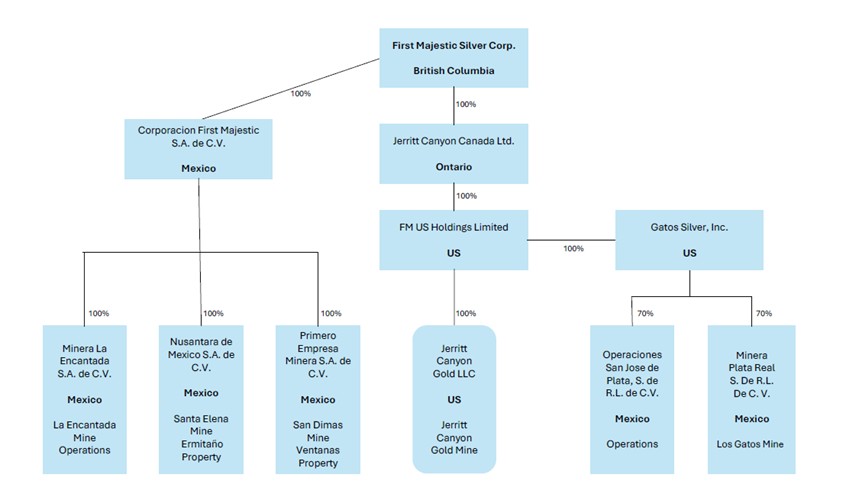
The chart set out below illustrates the corporate structure of the Company and its material subsidiaries, their respective jurisdictions of incorporation, the percentage of voting securities held and their respective interests in the Company's material mining properties as of the date of this AIF.
DESCRIPTION OF BUSINESS
General
The Company is in the business of the production, development, exploration and acquisition of mineral properties with a focus on silver and gold production, primarily in Mexico and the U.S.A. As such, the Company's business is dependent on foreign operations. The common shares of the Company (the "Common Shares") trade on the Toronto Stock Exchange ("TSX") and on the New York Stock Exchange ("NYSE") under the symbol "AG". The Company's Common Shares are also quoted on the Frankfurt Stock Exchange under the symbol "FMV".
The Company presently owns and operates four producing mines in Mexico:
1. the wholly-owned San Dimas Silver/Gold Mine in Durango State ("San Dimas Silver/Gold Mine" or "San Dimas");
2. the wholly-owned Santa Elena Silver/Gold Mine in Sonora State ("Santa Elena Silver/Gold Mine" or "Santa Elena");
3. a 70% joint venture interest in the Los Gatos Silver Mine in Chihuahua, Mexico, acquired in January 2025 ("Los Gatos Silver Mine" or "Los Gatos") and held through a joint venture (the "Los Gatos Joint Venture") with Dowa Metal & Mining Co., Ltd. ("Dowa"); and
4. the wholly-owned La Encantada Silver Mine in Coahuila State ("La Encantada Silver Mine" or "La Encantada").
The Company also owns the Jerritt Canyon Gold Mine ("Jerritt Canyon") in Elko, Nevada, USA. In 2023, the Company temporarily suspended all operating activities at Jerritt Canyon to focus on exploration, definition, and expansion of the mineral resources and optimization of mine planning and plant operation (see "General Development of the Business - Significant Business Developments during the Most Recent Three Years - 2023").
In addition, the Company owns the following non-material properties:
1. the San Martín Silver Mine in Jalisco State, Mexico ("San Martín Silver Mine" or "San Martín"), currently under care and maintenance;
2. the Del Toro Silver Mine in Zacatecas State, Mexico ("Del Toro Silver Mine" or "Del Toro"), currently under care and maintenance; and
3. the La Luz Silver Project ("La Luz"), an advanced-stage silver development project in San Luis Potosi State, Mexico.
The Company does not consider San Martin, Del Toro or La Luz to be material properties for the purposes of National Instrument 51-102 Continuous Disclosure Obligations ("NI 51-102") or for the purposes of National Instrument 43-101 Standards of Disclosure for Mineral Projects ("NI 43-101"). On December 17, 2025, the Company entered into a share purchase agreement to sell the subsidiary that owns the Del Toro Silver Mine to Sierra Madre Gold and Silver Ltd. (see the section in this AIF entitled "General Development of the Business - Mineral Properties - Non-Material Properties - Del Toro Silver Mine, Zacatecas State, Mexico" for further details).
In addition, the Company has a 100%-owned and operated minting facility ("First Mint"), located in Las Vegas, Nevada, through a subsidiary of the Company, First Mint, LLC. By vertically integrating the production of investment-grade fine silver bullion, First Mint allows First Majestic to sell a substantially greater portion of its silver production directly to its shareholders and bullion customers. Bullion sales out of First Mint commenced at the end of the first quarter of 2024, following the completion of commissioning for the facility. The First Mint facility provides the Company with a steady supply of high quality, 0.999+ fine silver cast bars and silver rounds. In 2025, bullion product sales by First Mint totalled approximately 7% of the Company's silver production.
The Company's business is not materially affected by intangibles such as licences, patents and trademarks, nor is it significantly affected by seasonal changes other than weather. The Company is not aware of any aspect of its business that may be materially affected in the current financial year by renegotiation or termination of contracts.
The Company's business requires personnel with specialized skills and knowledge, certain of which are in high demand and may be in limited supply. Such skills and knowledge include the areas of mining, exploration, engineering, geology, metallurgy, logistical planning, capital projects, mine construction and development, mine operation and mill production, as well as legal, finance, accounting, risk management, mine safety and security, community relations and human resources. Although the Company believes it will be successful in attracting, training and retaining qualified personnel, there can be no assurance of such successes.
On December 31, 2025, the Company had a total of 5,535 employees and/or contractors. Additional consultants and contractors are also retained from time to time for specific corporate activities, capital projects, development and exploration programs.
GENERAL DEVELOPMENT OF THE BUSINESS
History
Since its inception in 2003, First Majestic has been in the business of production, development, exploration and acquisition of mineral properties with a focus on silver and gold production in Mexico and the United States.
Over the past 23 years, the Company has assembled a portfolio of silver and gold mines, properties and projects which presently includes four producing mines which it operates in Mexico, three of which are wholly-owned by the Company and one of which, the Los Gatos Silver Mine, is 70% owned by the Company through the Los Gatos Joint Venture. The Company also owns one temporarily suspended gold mine in Nevada, two silver mines under care and maintenance, an advanced-stage development silver project as well as several exploration projects.
In September 2023, the Company established its 100%-owned and operated minting facility, First Mint, located in Las Vegas, Nevada.
Significant Business Developments during the Most Recent Three Years
2023
On February 23, 2023, the Company entered into an equity distribution agreement with BMO Capital Markets Corp. and TD Securities (USA) LLC in connection with an "at-the-market" offering by the Company of up to US$100 million of Common Shares (the "2023 ATM Offering"). Sales of Common Shares under the 2023 ATM Offering were made through "at-the-market distributions" as defined in National Instrument 44‐102 Shelf Distributions ("NI 44-102"), by means of ordinary brokers' transactions on the NYSE at prevailing market prices. No offer or sales of Common Shares were made in Canada on the TSX or other trading markets in Canada. The Company completed distributions under the 2023 ATM Offering on June 16, 2023, selling an aggregate of 12,200,000 Common Shares for aggregate gross proceeds to the Company of approximately US$79.5 million.
Also on February 23, 2023, the Company's Board of Directors (the "Board") approved and declared a quarterly dividend of US$0.0054 per Common Share, payable on or about March 24, 2023, to all shareholders of record as of the close of business on March 10, 2023.
In March 2023, the Company renewed its share repurchase program (the "Share Repurchase Program") which it initially commenced in March 2013 and had renewed on an annual basis thereafter. Pursuant to the renewed Share Repurchase Program, the Company was authorized to repurchase up to 5,000,000 Common Shares during the period from March 22, 2023, until March 21, 2024, which represented approximately 1.83% of the 274,479,942 issued and outstanding shares of the Company as of March 10, 2023. During the year ended December 31, 2023, the Company did not repurchase any Common Shares under the Share Repurchase Program.
On March 20, 2023, the Company announced that it was taking action to reduce overall costs by reducing investments, and temporarily suspending all operating activities and reducing its workforce, at Jerritt Canyon. The suspension took effect April 24, 2023.
On March 29, 2023, the Company completed the sale of all of the shares of La Guitarra Compañia Minera, S.A. de C.V., its wholly-owned subsidiary which owns the La Guitarra Silver Mine located in the Temascaltepec mining district, Mexico State, to Sierra Madre Gold & Silver Ltd. ("Sierra Madre") for total consideration of $35 million. Total consideration consisted of 69,063,076 common shares of Sierra Madre at a deemed price of C$0.65 per share, having an aggregate value of $35 million. First Majestic was also granted a 2% NSR on all mineral production from the La Guitarra concessions, with the NSR subject to a 1% buy-back option for $2 million.
On April 20, 2023, the Company announced that the Exploration and Technical Services Group had been combined into a single group under the leadership of Gonzalo Mercado, who was promoted to Vice-President, Exploration & Technical Services. The Company also announced that Ramon Mendoza, the former Vice-President of Technical Services, and Persio Rosario, the former Vice-President of Innovation, Processing & Metallurgy, had left the Company. The Company also announced that Michael Deal had been promoted to Vice-President, Metallurgy & Innovation.
On May 4, 2023, the Board approved and declared a quarterly dividend of US$0.0057 per Common Share, payable on or about June 9, 2023, to all shareholders of record as of the close of business on May 18, 2023.
On May 26, 2023, the NAFTA Arbitration Tribunal (the "Tribunal") issued an order requiring the Government of Mexico to permit the Company to withdraw VAT refunds that had been deposited by the Servicio de Administracion Tributaria (the "SAT") into Primero Empresa Minera, S.A. de C.V. ("PEM") frozen bank account from January 4, 2023 onwards, and to deposit all future VAT refunds into a bank account which shall remain freely accessible to the Company (the "PM Decision").
On May 8, 2023, the Mexican Government enacted a decree amending several provisions of the Mining Law, the Law on National Waters, the Law on Ecological Equilibrium and Environmental Protection and the General Law for the Prevention and Integral Management of Waste (the "Decree"), which became effective on May 9, 2023. The Decree enacts various amendments to existing laws, including: (i) reductions in the duration of mining concession titles, (ii) revisions to the process to obtain new mining concessions (through a public tender), (iii) imposing additional conditions on water use and availability for mining concessions, (iv) the elimination of the "free land and first applicant" scheme, (iv) imposing additional social and environmental requirements to obtain and keep mining concessions, (v) requiring the authorization by the Ministry of Economy for the transfer of any mining concession, (vi) imposing additional penalties including cancellation of mining concessions due to non-compliance with applicable laws, (vii) dismissing all outstanding applications for new concessions, and (viii) requiring new financial instruments or collateral to guarantee the preventive, mitigation and compensation plans resulting from the social impact assessments, among other amendments. These amendments are expected to have an impact on our current and future exploration activities and operations in Mexico. The extent of the impact of the Decree is yet to be determined as, among other things, the Mexican Government has not yet filed the Regulations in respect of the Decree, but the impact may be material for the Company. On June 7, 2023, the Senators of the opposition parties (PRI, PAN and PRD) filed a constitutional action against the Decree, which is pending before the Plenary of the Supreme Court of Justice of Mexico ("Mexican Supreme Court"). During the second quarter of 2023, the Company filed various amparo lawsuits, challenging the constitutionality of the Decree. As of the date of this AIF, these amparos filed by the Company, along with numerous amparos in relation to the Decree that have been filed by other companies, are still pending before the District or Collegiate Courts. On July 15, 2024, the Mexican Supreme Court suspended all ongoing amparo lawsuits against the Decree whilst the aforementioned constitutional action is being considered by the Mexican Supreme Court. As of the date of this AIF, the court has not yet rendered an official ruling on the constitutional action against the Decree that was brought by the opposition parties within the Mexican government.
On June 29, 2023, the Company entered into an agreement to amend its senior secured revolving credit facility with the Bank of Nova Scotia, Bank of Montreal and Toronto Dominion Bank by extending the maturity date from March 31, 2025 to June 29, 2026 and increasing the credit limit from $100.0 million to $175.0 million (the "Revolving Credit Facility"). As part of this amendment, National Bank Financial was added to the lending syndicate and was made a party to the agreement for the Revolving Credit Facility.
On July 7, 2023, the Company reported a decrease in the production of silver at La Encantada mostly due to drought conditions in the area which limited water availability and reduced the utilization of the ball mills. The Company announced that it had hired a geophysical consultant to help determine pilot well drill targets in an effort to locate additional water sources. A replacement water well was discovered in April 2024.
On July 20, 2023, the Company announced the appointment of Samir Patel as General Counsel & Corporate Secretary, and the departure of Connie Lillico (former Corporate Secretary) and Sophie Hsia (former General Counsel), as a result of a reorganization at the Company.
On July 21, 2023, the Company's request for a second set of arbitration proceedings against Mexico in connection with their ongoing denial of access to PEM's VAT refunds (the "NAFTA VAT Claim") was registered by the International Centre for Settlement of Investment Disputes ("ICSID").
On July 28, 2023, the Government of Mexico filed a Preliminary Objection to Jurisdiction (the "Preliminary Objection"). Under this objection, Mexico requested the Tribunal stay the merits phase of the 2021 arbitration proceedings commenced by the Company against Mexico under Chapter 11 of the North American Free Trade Agreement ("NAFTA") with respect to the nullification of the Advanced Pricing Agreement (the "APA") that had previously been negotiated and finalized in 2012 between the SAT and PEM, the Company's Mexican subsidiary (the "NAFTA APA Claim"), with respect to the San Dimas mine. The Preliminary Objection was dismissed by the Tribunal on December 20, 2023.
On August 3, 2023, the Board approved and declared a quarterly dividend of US$0.0051 per Common Share, payable on or about August 31, 2023, to all shareholders of record as of the close of business on August 16, 2023.
On August 14, 2023, the Company announced the closing of the sale of its 100%-owned past producing La Parrilla Silver Mine located in the state of Durango, Mexico to Golden Tag Resources Ltd. (now known as Silver Storm Mining Ltd.) ("Silver Storm") for total consideration of up to US$33.5 million. In consideration of the sale, First Majestic received 143,673,684 common shares of Silver Storm at a deemed price of C$0.19 per share for an approximate value of C$27.0 million or US$20.0 million, representing approximately 40% of the then outstanding common shares of Silver Storm. The Company is also entitled to receive up to US$13.5 million in either cash or common shares of Silver Storm, payable in three deferred payments upon the occurrence of specific milestones. In addition, the Company participated in Silver Storm's offering of subscription receipts and purchased 18,009,000 Silver Storm subscription receipts at a price of C$0.20 each, which, in accordance with their terms, converted into 18,009,000 common shares and 9,004,500 common share purchase warrants, each exercisable for one additional Silver Storm common share until August 14, 2026 at a price of C$0.34 per share.
On September 14, 2023, the Company announced the opening of its 100%-owned and operated minting facility, First Mint, located in the State of Nevada. First Mint expands upon First Majestic's existing bullion sales through vertically integrating the production of investment-grade fine silver bullion, allowing First Majestic to sell a substantially greater portion of its silver production directly to its shareholders and bullion customers.
In September 2023, the Company announced that Mani Alkhafaji had been appointed to the role of Vice-President, Corporate Development & Investor Relations. The Company also announced that Todd Anthony had left the Company to pursue other opportunities.
On November 2, 2023, the Board approved and declared a quarterly dividend of US$0.0046 per Common Share, payable on or about November 30, 2023, to all shareholders of record as of the close of business on November 15, 2023.
On December 5, 2023, a Mexican court issued a decision partially granting constitutional protection sought by the Company in its defense of the proceeding initiated by the SAT seeking to nullify the APA. On January 18, 2024, PEM filed an extraordinary appeal to the Mexican Supreme Court with respect to the foregoing decision (see the section in this AIF entitled "Legal Proceedings and Regulatory Actions - Legal Proceedings - Mexican Tax and NAFTA Proceedings - Domestic Remedies in Mexico" for further details).
2024
On January 18, 2024, PEM filed an extraordinary appeal to the Mexican Supreme Court with respect to PEM's constitutional arguments that were not accepted in the Mexican Circuit Court's decision.
On February 12, 2024, Mexico filed a request (the "Consolidation Request") with ICSID pursuant to the procedure in Article 1126 of NAFTA to consolidate the NAFTA APA Claim and the NAFTA VAT Claim into one arbitration proceeding. A separate three-person tribunal to consider the Consolidation Request (the "Consolidation Tribunal") was constituted on May 8, 2024, and the first procedural hearing of the Consolidation Tribunal took place on July 16, 2024.
On February 20, 2024, Ana Lopez resigned from the Board.
On February 21, 2024, the Board approved and declared a quarterly dividend of US$0.0048 per Common Share, payable on or about March 28, 2024, to all shareholders of record as of the close of business on March 14, 2024.
On February 22, 2024, the Company entered into an equity distribution agreement (the "2024 Sales Agreement") with BMO Capital Markets Corp. and TD Securities (USA) LLC in connection with an "at-the-market" offering by the Company of up to $150 million of Common Shares (the "2024 ATM Offering"). Sales of Common Shares under the 2024 ATM Offering were made through "at-the-market distributions" as defined in NI 44-102, by means of ordinary brokers' transactions on the NYSE at prevailing market prices. No offer or sales of Common Shares were made in Canada on the TSX or any other trading markets in Canada. The Company distributed an aggregate of 14,300,000 Common Shares under the 2024 Sales Agreement for gross aggregate proceeds of $96.2 million. The 2024 Sales Agreement terminated in accordance with its terms on the expiry of the Company's then-current base shelf prospectus on September 3, 2025.
On March 26, 2024, the Company announced that it had completed commissioning of its First Mint minting facility and that bullion sales had commenced. Initial production by First Mint included limited edition "first-strike" bullion bars of various sizes.
On May 7, 2024, Jean des Rivières resigned from the Board.
On May 7, 2024, the Board approved and declared a quarterly dividend of US$0.0037 per Common Share, payable on or about June 7, 2024, to all shareholders of record as of the close of business on May 17, 2024.
On May 27, 2024, the Company's stock ticker symbol on the TSX changed from "FR" to "AG". As a result of the change, "AG" is now the ticker symbol for the Company's Common Shares listed in Canada on the TSX, and in the United States on the NYSE.
On May 28, 2024, the Company announced the release of its 2023 Sustainability Report summarizing the Company's Environmental, Social and Governance performance for the year ended December 31, 2023.
On June 13, 2024, the Company announced drill results from its 2024 exploration program, designed to test new silver and gold mineral targets, at San Dimas Silver/Gold Mine.
On July 9, 2024, the Company received a transfer of $11.0 million (198.4 million MXN) from the frozen bank account to a new bank account of PEM that the Company opened in July 2023. The transfer of such funds was carried out by Mexico in order to partially comply with the PM Decision.
On July 30, 2024, the Company announced the discovery of a significant new high-grade, vein-hosted gold and silver mineralized system, the Navidad vein system at the Santa Elena Silver and Gold Mine.
On July 31, 2024, the Board approved and declared a quarterly dividend of US$0.0046 per Common Share, payable on or about August 30, 2024, to all shareholders of record as of the close of business on August 16, 2024.
On September 5, 2024, the Company entered into a definitive merger agreement (the "Merger Agreement") with Gatos Silver, Inc. ("Gatos") pursuant to which the Company agreed to acquire all the issued and outstanding common shares of Gatos (the "Gatos Transaction") in exchange for an aggregate of approximately 177,433,006 Common Shares pursuant to a merger under Delaware Law. Gatos was a Delaware incorporated company listed on the New York Stock Exchange and its primary assets consisted of a 70% interest in the Los Gatos Joint Venture which owns the Los Gatos Silver Mine in Chihuahua, Mexico. For further detail regarding the Los Gatos Silver Mine, please see "Mineral Properties -Los Gatos Silver Mine, Chihuahua, Mexico" below.
On September 10, 2024, the Company announced that it had renewed its Share Repurchase Program. Pursuant to the renewed Share Repurchase Program, the Company was authorized to repurchase up to 10,000,000 of its Common Shares (approximately 3.32% of the 301,616,350 Common Shares that were issued and outstanding as of September 4, 2024) pursuant to a normal course issuer bid in the open market through the facilities of the TSX or alternative Canadian marketplaces during the period commencing September 12, 2024, until September 11, 2025. During such period, the Company repurchased an aggregate of 836,500 Common Shares under the program, and all such shares were cancelled and returned to treasury.
On November 6, 2024, the Board approved and declared a quarterly dividend of US$0.0048 per Common Share, payable on or about November 29, 2024, to all shareholders of record as of the close of business on November 15, 2024.
On December 3, 2024, the Company announced that the Registration Statement on Form F-4 filed in connection with, and as a condition of, the Gatos Transaction became effective under the U.S. Securities Act of 1933.
On December 4, 2024, the Mexican Federal Tax Court on Administrative Matters ("Mexican Federal Tax Court") issued a new decision relating to PEM's constitutional arguments (see the section in this AIF entitled "Legal Proceedings and Regulatory Actions - Legal Proceedings - Mexican Tax and NAFTA Proceedings - Domestic Remedies in Mexico" for further details).
On December 5, 2024, the Collegiate Court issued a decision confirming the 2012 tax reassessment and as a result, on January 22, 2025, PEM filed an extraordinary appeal against the decision, and such appeal was admitted by the former President of the Mexican Supreme Court on February 10, 2025.
On December 19, 2024, the Company announced that Gatos had amended and restated its agreements (the "Amended Agreements"), with an effective date of January 1, 2025, with its joint venture partner, Dowa, regarding the Los Gatos Joint Venture, the effect of which provides Gatos with control over a variety of decisions that significantly affect the operations of, and the returns generated from, the Los Gatos Joint Venture. As a result, Gatos commenced consolidating the financial results of the LGJV when the Amended Agreements became effective. The Amended Agreements did not affect the ownership interests of Gatos and Dowa in the Los Gatos Joint Venture, being 70% and 30% respectively.
2025
On January 16, 2025, the Company announced the completion of the Gatos Transaction. Under the terms of the Merger Agreement, Gatos shareholders received 2.55 Common Shares for each common share of Gatos ("Gatos Shares") and Gatos became a wholly-owned subsidiary of the Company. The Company issued an aggregate of 177,433,006 Common Shares to acquire all of the issued and outstanding Gatos Shares (in addition to a nominal amount of cash in lieu of fractional Common Shares), resulting in former Gatos shareholders holding approximately 38% of the issued and outstanding Common Shares post-closing on a fully diluted basis. In addition, the Merger Agreement provided for the issuance by the Company of stock options to purchase an aggregate of 8,242,244 Common Shares in exchange for all existing Gatos stock options at exercise prices adjusted by the exchange ratio. All existing RSUs and DSUs of Gatos were settled on January 28, 2025 for an aggregate of 2,207,762 Common Shares.
On January 23, 2025, the Company announced drill results from its 2024 exploration program at the San Dimas Silver and Gold Mine.
On February 4, 2025, the Company provided new exploration results for the Navidad discovery at Santa Elena.
On February 13, 2025, the Company announced its consolidated 2025 production and cost guidance for its producing mines.
On February 20, 2025, the Board approved and declared a quarterly dividend of US$0.0057 per Common Share, payable on or about March 14, 2025, to all shareholders of record as of the close of business on February 28, 2025.
On March 13, 2025, the Company announced the appointment of Mr. Daniel Muñiz Quintanilla to the Board. Also on March 13th, the Company signed an amendment agreement (the "Amended Springpole Stream Agreement") to the Springpole Stream Agreement (as defined in the section in this AIF entitled "Risk Factors - Operational Risks - The Springpole Stream Agreement") among the Company, Gold Canyon Resources Inc. and First Mining Gold Corp. ("First Mining") to accelerate the final tranche payment owed by the Company under the Springpole Stream Agreement, which the Company paid in cash on March 27, 2025. As consideration for entering into the Amended Springpole Stream Agreement, First Mining agreed to extend the expiry date of the common share purchase warrants that were issued to the Company on July 20, 2020, and to amend the exercise price of such warrants. For further details, see the section in this AIF entitled "Risk Factors - Operational Risks - The Springpole Stream Agreement".
On March 31, 2025, the Company provided 2024 Mineral Reserve and Mineral Resource estimates for its five material properties.
On April 9, 2025, the Company announced its total production for the first quarter of 2025 from its four producing mines in Mexico. The mines produced a total of 7.7 million silver equivalent ounces during the quarter, consisting of 3.7 million silver ounces, 36,469 gold ounces, 12.5 million pounds of zinc and 7.5 million pounds of lead.
On April 10, 2025, the Company announced the release of its 2024 Sustainability Report, which summarized its sustainability-related performance for the 2024 calendar year.
On April 11, 2025, the Company entered into an agreement to amend its Revolving Credit Facility with the Bank of Montreal, the Bank of Nova Scotia, the Toronto Dominion Bank, BMO Bank, N.A. and National Bank of Canada by, among other things, extending its maturity date from June 29, 2026 to April 11, 2028.
On May 7, 2025, the Board approved and declared a quarterly dividend of US$0.0045 per Common Share, payable on or about May 30, 2025, to all shareholders of record as of the close of business on May 16, 2025.
On May 20, 2025, the Company announced the results of its 2025 Annual General Meeting, at which Ms. Ayesha Hira was elected as a director of the Company, along with the current members of the Board.
On May 28, 2025, the Company reported a second significant discovery of vein-hosted gold and silver mineralization within a year at Santa Elena, the Santo Niño vein, and drilling results from the Navidad discovery.
On July 8, 2025, the Company provided its updated 2025 guidance, including updates to its capital budget and anticipated capital investments for 2025. The Company also announced its total production for the second quarter of 2025 from its four producing mines in Mexico, with the mines producing a total of 7.9 million silver equivalent attributable ounces in the quarter, consisting of 3.7 million silver ounces, 33,865 gold ounces, 16.1 million pounds of zinc and 9.0 million pounds of lead.
On July 28, 2025, the Consolidation Tribunal rendered its decision (the "Consolidation Decision") and rejected Mexico's Consolidation Request. It also lifted the suspension on the arbitration proceedings related to the NAFTA APA Claim and the NAFTA VAT Claim effective July 28, 2025. Accordingly, the arbitration proceedings related to the NAFTA APA Claim and the NAFTA VAT Claim have now reconvened after being suspended for the past year (see the section in this AIF entitled "Legal Proceedings and Regulatory Actions - Legal Proceedings - Mexican Tax and NAFTA Proceedings - International Remedies - i. NAFTA APA Claim" for further details).
On August 14, 2025, the Board approved and declared a quarterly dividend of US$0.0048 per Common Share, payable on or about September 15, 2025, to all shareholders of record as of the close of business on August 29, 2025.
On August 18, 2025, the Company announced exploration results from its ongoing exploration program at the San Dimas mine.
On September 3, 2025, the Company announced drilling results from its 2024/2025 exploration programs at the Los Gatos mine.
On October 7, 2025, the Company announced that it had disposed of 37,600,000 common shares of Silver Storm for aggregate gross proceeds of C$8,715,680. Immediately after the sale, the Company held beneficial ownership of, or control and direction over, 140,749,350 shares of Silver Storm Mining Ltd. and 25,671,166 common share purchase warrants, representing approximately 19.07% of the issued and outstanding shares of Silver Storm Mining Ltd. at that time on a non-diluted basis and approximately 21.79% on a partially-diluted basis.
On October 8, 2025, the Company announced its total production for the third quarter of 2025 from its four producing mines in Mexico. The mines produced a total of 7.7 million attributable silver equivalent ounces during the quarter, consisting of 3.9 million silver ounces, 35,681 gold ounces, 13.9 million pounds of zinc and 7.7 million pounds of lead.
On October 14, 2025, the Company renewed its ongoing Share Repurchase Program. Under the renewed program, the Company may repurchase up to 24.5 million Common Shares (being 5% of the Company's issued and outstanding Common Shares as at September 30, 2025) during the 12-month term of the program, and daily purchases are subject to a maximum of 402,698 Common Shares (being 25% of the average daily trading volume of the Common Shares for the six calendar months preceding the renewal, which was 1,610,792 Common Shares), subject to the TSX rules permitting block purchases. The program renewed Share Repurchase Program expires on October 13, 2026.
On October 30, 2025, the Mexican Supreme Court issued a decision in favour of the appeal filed by the Mexican Ministry of Finance and Public Credit (the "Mexican Finance Ministry"), thereby overturning the prior February 10, 2025 admission by the Mexican Supreme Court of PEM's appeal regarding the Collegiate Court's decision with respect to the reassessment that had been issued by the SAT against PEM for the 2012 tax year (the "2012 Reassessment"). As a result, the Mexican Supreme Court will not hear PEM's appeal of the Collegiate Court's decision regarding the 2012 Reassessment.
On November 5, 2025, the Company announced that it had disposed of 17,500,000 common shares of Sierra Madre for aggregate gross proceeds of C$23,275,000. Immediately after the sale, the Company held beneficial ownership of, or control and direction over, 51,563,076 shares of Sierra Madre, representing approximately 27.72% of the issued and outstanding shares of Sierra Madre at that time on a non-diluted basis.
Also on November 5, 2025, the Board approved and declared a quarterly dividend of US$0.0052 per Common Share, payable on or about November 28, 2025, to all shareholders of record as of the close of business on November 14, 2025.
On December 8, 2025, the Company announced the closing of a private placement offering of US$350,000,000 aggregate principal amount of unsecured convertible senior notes due in 2031 (the "2031 Notes"). The initial conversion rate for the 2031 Notes is 44.7227 Common Shares per US$1,000 principal amount of 2031 Notes, equivalent to an initial conversion price of approximately US$22.36 per Common Share. The 2031 Notes are governed by an indenture (the "2031 Note Indenture") entered into between the Company and Computershare Trust Company, N.A. on December 8, 2025. A copy of the 2031 Note Indenture is available under the Company's SEDAR+ profile at www.sedarplus.ca.
On December 15, 2025, the Company announced the appointment of Mani Alkhafaji, former Vice-President of Corporate Development & Investor Relations, to the new role of President & Chief Corporate Development Officer of the Company, effective January 1, 2026, with Keith Neumeyer to remain as Chief Executive Officer of the Company.
Also on December 15, 2025, the Company announced the start of preliminary mine planning for the Navidad and Santo Niño discoveries located at the Company's Santa Elena Silver/Gold Mine.
On December 17, 2025, the Company announced that it had entered into a definitive agreement to sell its 100%-owned past producing Del Toro Silver Mine to Sierra Madre for total consideration in cash and shares of up to US$60 million, comprised of upfront consideration of US$30 million payable upon closing and an additional US$30 million in delayed and contingent consideration. Closing is subject to Sierra Madre completing a concurrent financing and other customary conditions, including approval of the TSX Venture Exchange (the "TSXV"), Mexican anti-trust approval and approval by the disinterested shareholders of Sierra Madre. For further details, see "Mineral Properties - Non-Material Properties - Del Toro Silver Mine, Zacatecas State, Mexico" below.
2026 to Date
On January 1, 2026, Mani Alkhafaji commenced his new role as President & Chief Corporate Development Officer of the Company, and Keith Neumeyer's role changed to Chief Executive Officer of the Company.
On January 15, 2026, the Company announced that it is increasing its dividend per Common Share from 1% to 2% of net quarterly revenues earned from January 1, 2026 onwards divided by the number of Common Shares outstanding as at the record date for the dividend (with respect to net quarterly revenues generated from the Los Gatos Silver Mine, 70% of such revenue, being the revenue that is attributable to the Company, is used for the purposes of the Company's quarterly dividend calculation).
On February 8, 2026, Daniel Muñiz Quintanilla resigned from the Board.
On February 19, 2026, the Company announced its financial results for the year ended December 31, 2025, which included record revenues of approximately US$1.25 billion, and a record US$937.7 million cash in its treasury as at December 31, 2025. Also on February 19, 2026, the Company announced that the Board had approved and declared a quarterly dividend of US$0.0083 per Common Share, payable on or about March 16, 2026, to all shareholders of record as of the close of business on February 27, 2026.
On March 10, 2026, the Company announced the results of its 2025 exploration drill program at Jerritt Canyon.
Principal Markets for Silver and Gold
The Company's products are silver and gold. Silver is a precious metal that is a very important industrial commodity used for the transmission of electricity in several commercial applications, with growing uses in several technologies, and desirable for jewellery, silverware and investment purposes. Silver has a unique combination of characteristics including: durability, malleability, ductility, electrical and thermal conductivity, reflectivity and anti-bacterial properties that make it valuable in numerous industrial applications including solar panels, circuit boards, electrical wiring, semi & superconductors, brazing and soldering, mirror and window coatings, electroplating, chemical catalysts, pharmaceuticals, filtration systems, batteries, televisions, computers, cell phones, household appliances, automobiles and a wide variety of other electronic products.
Product fabrication and bullion investment are two principal sources of gold demand. Gold bullion is held as an asset class for a variety of reasons, including as a store of value and a safeguard against the collapse of paper assets such as stocks, bonds and other financial instruments that are traded in fiat currencies not exchangeable into gold (at a fixed rate) under a "gold standard", as a hedge against future inflation and for portfolio diversification. Governments, central banks and other official institutions hold significant quantities of gold as a component of exchange reserves. Within the fabrication category, there are a wide variety of end uses, the largest of which is the manufacture of jewelry. Other fabrication purposes include official coins, electronics, miscellaneous industrial and decorative uses, dentistry, medals and medallions.
Silver and gold are global commodities predominantly traded on the London Bullion Market, an over-the-counter market and the COMEX, a futures and options exchange in New York, where most fund activity in relation to silver is focused. The London Bullion Market is the global hub of over-the-counter trading in silver and gold and is the metal's main physical market. Here, a bidding process results in a daily reference price known as the fix. Silver and gold are quoted in US dollars per troy ounce. The Company assigns silver and gold from its doré sales to several major metal brokers. The Company also has streaming obligations for gold and silver from its Santa Elena and San Dimas mines, respectively, which are settled directly with the streaming companies, not through its banking relationships.
Silver can be supplied as a primary product from mining silver, or as a by-product from the mining of gold or base metals such as lead and zinc. The Company is a primary silver producer with approximately 58% of its revenue in 2025 from the sale of silver and approximately 32% of its revenue in 2025 from the sale of gold, in comparison to approximately 43% of its revenue in 2024 from the sale of silver and approximately 57% of its revenue in 2024 from the sale of gold.
The Company also sells a portion of its silver production directly to retail buyers (business to consumer) through First Mint as high quality 0.999+ fine silver rounds, cast bars and custom medallion products. In 2025, bullion product sales by First Mint totalled approximately 7% of the Company's silver production (see "Product Marketing and Sales").
Scientific and Technical Information
Scientific and technical disclosure in this AIF for the material properties is based on technical reports prepared in accordance with NI 43-101 (collectively, the "Technical Reports"). The Technical Reports have been filed on SEDAR+ at www.sedarplus.ca. The technical information has been updated with more current information where appropriate. Current Mineral Resource estimates for the Company set out in this AIF were prepared under the supervision of, or were reviewed by, David Rowe, CPG, the Company’s Director of Mineral Development who is responsible for such resource estimates. Current Mineral Reserve estimates for the Company set out in this AIF were prepared under the supervision of, or were reviewed by, Andrew Pocock, P.Eng., the Company’s Director, Technical Services who is responsible for such reserve estimates. Technical information relating to current and planned exploration programs for the Company set out in this AIF are prepared, reviewed, or carried out under the supervision of Gonzalo Mercado, P.Geo., the Company’s Vice-President, Exploration & Technical Services. Gonzalo Mercado, David Rowe and Andrew Pocock are all Qualified Persons, as that term is defined in NI 43-101.
Technical Reports for Material Properties
The current Technical Reports for the Company's five (5) material properties are as follows:
1. Technical Report titled "San Dimas Silver/Gold Mine, Durango and Sinaloa States, Mexico, NI 43-101 Technical Report on Mineral Resource and Mineral Reserve Estimates" with an effective date of August 31, 2025, and prepared by Mr. Gonzalo Mercado, P.Geo., Mr. David Rowe, CPG, Mr. Michael Jarred Deal, RM SME, Mr. Andrew Pocock, P.Eng. and Ms. María Elena Vázquez Jaimes, P.Geo.;
2. Technical Report titled "First Majestic Silver Corp., Santa Elena Silver/Gold Mine, Sonora, México, NI 43-101 Technical Report on Mineral Resource and Mineral Reserve Estimates", with an effective date of June 30, 2021, and prepared by Mr. Ramon Mendoza Reyes, P.Eng., Mr. Phillip J. Spurgeon, P.Geo., Ms. María Elena Vázquez Jaimes, P.Geo., and Mr. Persio P. Rosario, P. Eng.;
3. Technical Report titled "La Encantada Silver Mine, State of Coahuila, Mexico, NI 43-101 Technical Report on Mineral Resource and Mineral Reserve Estimates" with an effective date of August 31, 2025, and prepared by Mr. Gonzalo Mercado, P.Geo., Ms. Karla Michelle Calderon Guevara, CPG, Mr. Andrew Pocock, P.Eng., Mr. Michael Jarred Deal, RM SME and Ms. María Elena Vázquez Jaimes, P.Geo.;
4. Technical Report titled "Technical Report on the Jerritt Canyon Gold Mine, Elko County, Nevada, USA" with an effective date of March 31, 2023, and prepared by Mr. Gonzalo Mercado, P.Geo., Mr. David Rowe, CPG, Mr. Michael Jarred Deal, RM SME, Ms. María Elena Vázquez Jaimes, P.Geo., and Mr. David W. Wanner, P.E.; and
5. Technical Report titled "Mineral Resource and Mineral Reserve Update, Los Gatos Joint Venture, Chihuahua, Mexico" with an effective date of July 1, 2024, and prepared by Stephan Blaho, P.Eng and PEO, Dawn Garcia, PG, CPG, Adam Johnston, FAusIMM CP (Metallurgy), Ibrahim Karajeh, P.Eng., PEO, PMP, William Richard McBride, P.Eng., PEO, Mathew P. Oommen, Ph.D., Registered Member SME, Ronald Turner, MAusIMM CP, and Matthew L. Fuller, L.E.G., P.Geo.
Material Mineral Properties
The following properties are material to First Majestic's business: the San Dimas Silver/Gold Mine; the Santa Elena Silver/Gold Mine, the Los Gatos Silver Mine, the La Encantada Silver Mine and the Jerritt Canyon Gold Mine. The Jerritt Canyon Gold Mine was placed on temporary suspension in April 2023 to focus on exploration, definition, and expansion of the mineral resource estimates, and optimization of mine planning and plant operations.
Production estimates and throughputs for operating mines are quoted as metric tonnes related to the tonnes per day ("tpd") capacity of the mine and mill. Production estimates and throughput averages for each mine consider an average of two days of maintenance per month. Annual estimates of production are based on an average of 365 calendar days per year for each of the operating mines, and these mines generally operate 330 days per year even though the throughput rates are based on a 365 calendar days average.
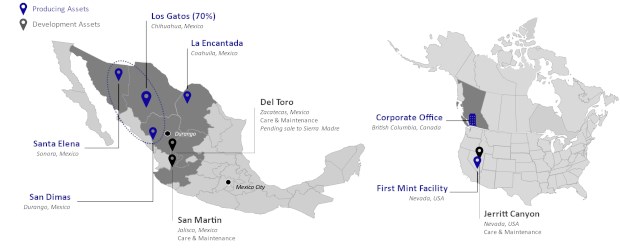
The following map indicates the location of each of the Company's operating mines, care and maintenance mines and its other projects in Mexico and the United States, as of the date of this AIF.
Summary of Mineral Resource and Mineral Reserve Estimates
The internal Mineral Resource and Mineral Reserve estimates reported herein represent the most up to date revisions completed by First Majestic. Readers are cautioned against relying upon the Mineral Resource and Mineral Reserve estimates herein, as these estimates are based on certain assumptions regarding future events and performance such as: commodity prices, operating costs, taxes, metallurgical performance, and commercial terms (see "Forward-looking Information" in this AIF). Geologic modeling and Mineral Resource and Mineral Reserve estimates are based on limited sampling information. The following tables set out the Company's Mineral Reserve and Mineral Resource Estimates effective as of December 31, 2025.
From January 1, 2025 to December 31, 2025, the consolidated Proven and Probable Mineral Reserve Estimates for First Majestic's material properties have increased 53% in tonnage, 16% in silver metal content, 2% in gold metal content, 17% in zinc metal content, 18% in lead metal content and increased 21% in copper content. These changes reflect mining depletion; updated cut-off grades resulting from revised economic parameters, including costs, recoveries, and metal prices; and the incorporation of exploration drilling completed in 2025. The Los Gatos Mineral Reserve Estimates silver contained metal slightly decreased due to depletion of high-grade areas and increased for zinc, lead and copper. The Los Gatos Mineral Reserves are reported on a 70% attributable basis to First Majestic. The Santa Elena Mineral Reserve Estimates contained metal are roughly unchanged with new Reserves at Luna and lower cut off grades offsetting the yearly depletion. The San Dimas Mineral Reserve Estimates slight decrease is driven by mining depletion. At La Encantada, contained silver in the Mineral Reserve Estimates increased as a result of the inclusion of TSF4 mineralized material as Mineral Reserves due to a positive economic evaluation for including such material at the assumed metal price guidance.
TABLE 1: Mineral Reserve Estimates for the Material Properties,
Effective Date of December 31, 2025
| Mineral | Tonnage | Grades | Metal Content | ||||||||||||
| Mine | Category | Type | M tonnes | Ag (g/t) | Au (g/t) | Cu (%) | Pb (%) | Zn (%) | AgEq (g/t) | Ag (M Oz) | Au (MOz) | Cu (Mlb) | Pb (Mlb) | Zn (Mlb) | AgEq (MOz) |
| LOS GATOS (70% FM Attributable) | |||||||||||||||
| Proven (UG) | All Mineral Types | 1.97 | 231 | 0.25 | 0.07 | 1.85 | 3.51 | 332 | 14.57 | 0.02 | 3.23 | 80.08 | 152.03 | 21.02 | |
| Probable (UG) | All Mineral Types | 7.59 | 85 | 0.17 | 0.21 | 1.74 | 3.19 | 185 | 20.70 | 0.04 | 35.88 | 291.33 | 533.89 | 45.11 | |
| Total Proven and Probable (UG) | All Mineral Types | 9.55 | 115 | 0.19 | 0.19 | 1.76 | 3.26 | 215 | 35.28 | 0.06 | 39.10 | 371.41 | 685.92 | 66.13 | |
| SAN DIMAS | |||||||||||||||
| Proven (UG) | Sulphides | 1.45 | 217 | 2.64 | 451 | 10.13 | 0.12 | 21.01 | |||||||
| Probable (UG) | Sulphides | 2.25 | 180 | 2.30 | 383 | 13.03 | 0.17 | 27.74 | |||||||
| Total Proven and Probable (UG) | Sulphides | 3.70 | 195 | 2.43 | 410 | 23.16 | 0.29 | 48.75 | |||||||
| SANTA ELENA | |||||||||||||||
| Proven (UG - Ermitano) | Sulphides | 0.68 | 59 | 2.29 | 342 | 1.29 | 0.05 | 7.50 | |||||||
| Proven (UG - Santa Elena) | Sulphides | 0.38 | 105 | 1.22 | 215 | 1.29 | 0.02 | 2.64 | |||||||
| Proven (Stockpile) | Sulphides | 0.24 | 46 | 1.74 | 264 | 0.35 | 0.01 | 2.02 | |||||||
| Probable (UG - Ermitano) | Sulphides | 3.39 | 29 | 1.16 | 153 | 3.15 | 0.13 | 16.69 | |||||||
| Probable (UG - Santa Elena) | Sulphides | 1.22 | 120 | 1.09 | 218 | 4.73 | 0.04 | 8.57 | |||||||
| Probable (Pad) | Oxides | 0.39 | 27 | 0.42 | 81 | 0.33 | 0.01 | 1.00 | |||||||
| Total Proven and Probable | All mineral types | 6.30 | 55 | 1.25 | 190 | 11.14 | 0.25 | 38.42 | |||||||
| LA ENCANTADA | |||||||||||||||
| Probable (UG) | Oxides | 7.87 | 121 | 121 | 31.50 | 31.50 | |||||||||
| Total Probable (UG) | Oxides | 7.87 | 121 | 121 | 31.50 | 31.50 | |||||||||
| Consolidated FMS | |||||||||||||||
| Proven (UG) | All mineral types | 4.72 | 27.63 | 0.22 | 3.23 | 80.08 | 152.03 | 54.19 | |||||||
| Probable (UG) | All mineral types | 22.71 | 73.44 | 0.39 | 35.88 | 291.33 | 533.89 | 130.60 | |||||||
| Total Proven and Probable | All mineral types | 27.43 | 101.07 | 0.61 | 39.10 | 371.41 | 685.92 | 184.79 | |||||||
1. Mineral Reserves have been classified in accordance with the Canadian Institute of Mining, Metallurgy and Petroleum ("CIM") Definition Standards on Mineral Resources and Mineral Reserves, whose definitions are incorporated by reference into NI 43-101.
2. The Mineral Reserve statement provided in the table above has an effective date of December 31, 2025.
3. The Los Gatos Mineral Reserves are reported on a 70% First Majestic attributable basis.
4. The Mineral Reserve estimates were prepared under the supervision of, or were reviewed by, Andrew Pocock, P.Eng., the Company’s Director, Technical Services and the “Qualified Person” (as such term is defined in NI 43-101) responsible for the above Mineral Reserve estimates.
5. The Mineral Reserves were estimated from the Measured and Indicated portions of the Mineral Resource estimates. Inferred Mineral Resources were not considered to be converted into Mineral Reserve estimates.
6. Silver-equivalent grade (AgEq) is estimated considering metal price assumptions, metallurgical recovery for the corresponding mineral type/mineral process and the metal payable of the selling contract. The AgEq grade formulas are different for all mines and are presented in the description of each mine in this AIF.
7. Metal prices considered for Mineral Reserve estimates for Santa Elena, San Dimas and La Encantada were $35/oz Ag and $3,100 oz Au; metal prices considered for Los Gatos were $35/oz Ag, $3,100/oz Au, $0.95/lb Pb, $1.25/lb Zn and $4.35/lb Cu.
8. Other key assumptions and parameters include: metallurgical recoveries; metal payable terms; direct mining costs, processing costs, indirect and G&A costs and sustaining costs. These parameters are different for each mine and mining method assumed and are presented in the description of each mine in this AIF.
9. A two-step constraining approach has been implemented to estimate reserves for each mining method in use: A General Cut-off Grade ("GC") was used to delimit new mining areas that will require development of access, infrastructure and all sustaining costs. A second Incremental Cut-off Grade ("IC") was considered to include adjacent mineralized material which recoverable value pays for all associated costs, including but not limited to the variable cost of mining and processing, indirect costs, treatment, administration costs and plant sustaining costs but excludes the access development assumed to be covered by the block above the GC grade.
10. The cut-off grades, metallurgical recoveries, payable terms and modifying factors used to convert Mineral Reserves from Mineral Resources are different for all mines and are presented in each mine section in this AIF.
11. Modifying factors for conversion of resources to reserves include consideration for planned dilution which is based on spatial and geotechnical aspects of the designed stopes and economic zones, additional dilution consideration due to unplanned events, materials handling and other operating aspects, and mining recovery factors. Mineable shapes were used as geometric constraints.
12. Tonnage is expressed in thousands of tonnes; metal content is expressed in thousands of ounces for gold and silver and in million of pounds for zinc, lead and copper. Metal prices and costs are expressed in US$.
13. Numbers have been rounded as required by reporting guidelines. Totals may not sum due to rounding.
14. The technical reports from which the above-mentioned information is derived are cited under the heading "Scientific and Technical Information - Technical Reports for Material Properties" in this AIF.
From January 1, 2025 to December 31, 2025, the Company's consolidated Measured and Indicated Mineral Resource estimates for its material properties increased by 149% in tonnage, increased 7% in contained silver, and increased 79% in contained gold. At Los Gatos, base metal resources increased by 25% in contained lead, increased 25% in contained zinc, and increased 25% in contained copper. Los Gatos Mineral Resources are reported on a 70% First Majestic attributable basis. These changes reflect conversion of Inferred to Indicated Mineral Resources as a result of infill drilling; mining depletion, updated cut-off grades resulting from revised economic parameters, including costs, recoveries, and metal prices; and the reporting of increased open pit resources at Jerritt Canyon. At Jerritt Canyon, all changes in the Mineral Resources resulted from higher gold price assumptions and the corresponding reduction in underground and open pit gold cut-off grades. Results from the 2025 exploration drilling program at Jerritt Canyon were received in early 2026 and as a result were not included in this Mineral Resource update and will be included in the next Mineral Resource update as at year-end 2026. Measured and Indicated Mineral Resources are reported inclusive of Mineral Reserves and reflect mining depletion through 2025. Mineral Resources that are not Mineral Reserves do not have demonstrated economic viability.
From January 1, 2025 to December 31, 2025, the Company's consolidated Inferred Mineral Resource estimates increased by 169% in tonnage, increased 40% in contained silver, and increased 76% in contained gold. At Los Gatos, the base metal Inferred Resources have increased 106% in contained lead, increased 103% in contained zinc, and increased 168% in contained copper. The Los Gatos Mineral Resources are reported on a 70% First Majestic attributable basis. The changes primarily reflect the discovery and declaration of a maiden resource estimate for the Santo Niño project (Santa Elena), expansionary drilling at Navidad (Santa Elena) and Los Gatos, updated cut-off grades based on revised economic parameters including costs, recoveries, and metal prices, and the reporting of increased open pit resources at Jerritt Canyon. At Jerritt Canyon, all changes resulted from higher gold price assumptions and the related reduction in underground and open pit gold cut-off grades.
TABLE 2: Measured and Indicated Mineral Resource Estimates for the Material Properties,
Effective Date of December 31, 2025
| Mine/ | Mineral Type | Tonnage | Grades | Metal Content | |||||||||||
| Project | Category / Area | Mt | Ag (g/t) | Au (g/t) | Cu (%) | Pb (%) | Zn (%) | AgEq (g/t) | Ag (Moz) | Au (Moz) | Cu (Mlb) | Pb (Mlb) | Zn (Mlb) | AgEq (Moz) | |
| LOS GATOS (70% Attributable) | |||||||||||||||
| Total Measured (UG) | All Mineral Types | 1.80 | 314 | 0.36 | 0.11 | 2.64 | 4.99 | 463 | 18.14 | 0.02 | 4.27 | 104.81 | 198.09 | 26.78 | |
| Total Indicated (UG) | All Mineral Types | 6.67 | 113 | 0.24 | 0.27 | 2.35 | 4.39 | 252 | 24.22 | 0.05 | 39.73 | 345.36 | 644.47 | 54.00 | |
| Total Measured + Indicated (UG) | All Mineral Types | 8.46 | 156 | 0.26 | 0.24 | 2.41 | 4.52 | 297 | 42.35 | 0.07 | 44.00 | 450.17 | 842.56 | 80.78 | |
| SAN DIMAS | |||||||||||||||
| Total Measured (UG) | Sulphides | 1.90 | 349 | 4.49 | 758 | 21.32 | 0.27 | 46.34 | |||||||
| Total Indicated (UG) | Sulphides | 2.97 | 252 | 2.98 | 524 | 24.10 | 0.28 | 50.07 | |||||||
| Total Measured + Indicated (UG) | Sulphides | 4.87 | 290 | 3.57 | 615 | 45.42 | 0.56 | 96.41 | |||||||
| SANTA ELENA | |||||||||||||||
| Total Measured (UG + Stockpile) | Sulphides | 2.22 | 71 | 1.97 | 301 | 5.08 | 0.14 | 21.43 | |||||||
| Total Indicated (UG + Stockpile) | Sulphides | 8.49 | 59 | 1.34 | 203 | 16.01 | 0.37 | 55.36 | |||||||
| Total Measured + Indicated (UG + Stockpile) | Sulphides | 10.70 | 61 | 1.47 | 223 | 21.09 | 0.51 | 76.78 | |||||||
| JERRITT CANYON | |||||||||||||||
| Total Measured (UG + OP) | Sulphides | 21.58 | 2.76 | 243 | 1.91 | 168.93 | |||||||||
| Total Indicated (UG + OP) | Sulphides | 32.68 | 2.08 | 184 | 2.19 | 193.42 | |||||||||
| Total Measured + Indicated (UG + OP) | Sulphides | 54.26 | 2.35 | 208 | 4.10 | 362.35 | |||||||||
| LA ENCANTADA | |||||||||||||||
| Total Indicated (UG + Tailings) | All Mineral Types | 8.31 | 136 | 136 | 36.43 | 36.43 | |||||||||
| Total Indicated (UG + Tailings) | All Mineral Types | 8.31 | 136 | 136 | 36.43 | 36.43 | |||||||||
| TOTAL MATERIAL PROPERTIES | |||||||||||||||
| Total Measured (All Areas) | All Mineral Types | 27.50 | 44.54 | 2.35 | 4.27 | 104.81 | 198.09 | 263.48 | |||||||
| Total Indicated (All Areas) | All Mineral Types | 59.11 | 100.76 | 2.89 | 39.73 | 345.36 | 644.47 | 389.29 | |||||||
| Total Measured + Indicated (All Areas) | All Mineral Types | 86.61 | 145.30 | 5.24 | 44.00 | 450.17 | 842.56 | 652.76 | |||||||
TABLE 3: Inferred Mineral Resource Estimates for the Material Properties,
Effective Date of December 31, 2025
| Mine/ | Mineral Type | Tonnage | Grades | Metal Content | |||||||||||
| Project | Category / Area | Mt | Ag (g/t) | Au (g/t) | Cu (%) | Pb (%) | Zn (%) | AgEq (g/t) | Ag (Moz) | Au (Moz) | Cu (Mlb) | Pb (Mlb) | Zn (Mlb) | AgEq (Moz) | |
| LOS GATOS (70% FM Attributable) | |||||||||||||||
| Inferred Total (UG) | All Mineral Types | 4.06 | 82 | 0.19 | 0.21 | 1.78 | 3.88 | 196 | 10.71 | 0.02 | 18.80 | 159.20 | 347.30 | 25.63 | |
| Inferred Total (UG) | All Mineral Types | 4.06 | 82 | 0.19 | 0.21 | 1.78 | 3.88 | 196 | 10.71 | 0.02 | 18.80 | 159.20 | 347.30 | 25.63 | |
| SAN DIMAS | |||||||||||||||
| Inferred Total (UG) | Sulphides | 5.82 | 234 | 2.64 | 475 | 43.76 | 0.49 | 88.83 | |||||||
| Inferred Total (UG) | Sulphides | 5.82 | 234 | 2.64 | 475 | 43.76 | 0.49 | 88.83 | |||||||
| SANTA ELENA | |||||||||||||||
| Inferred Total (UG + Stockpile) | Sulphides | 18.40 | 71 | 1.64 | 232 | 41.87 | 0.97 | 137.31 | |||||||
| Inferred Total (UG + Stockpile) | Sulphides | 18.40 | 71 | 1.64 | 232 | 41.87 | 0.97 | 137.31 | |||||||
| JERRITT CANYON | |||||||||||||||
| Total Inferred (UG) | Sulphides | 16.16 | 3.76 | 332 | 1.95 | 172.49 | |||||||||
| Total Inferred (OP) | Sulphides | 30.46 | 1.74 | 154 | 1.71 | 150.89 | |||||||||
| Inferred Total (UG + OP) | Sulphides | 46.62 | 2.44 | 216 | 3.66 | 323.39 | |||||||||
| LA ENCANTADA | |||||||||||||||
| Total Inferred (UG + Tailings) | All Mineral Types | 3.02 | 176 | 176 | 17.13 | 17.13 | |||||||||
| Total Inferred (UG + Tailings) | All Mineral Types | 3.02 | 176 | 176 | 17.13 | 17.13 | |||||||||
| TOTAL MATERIAL PROPERTIES | |||||||||||||||
| Total Inferred (All Areas) | All Mineral Types | 77.91 | 113.47 | 5.15 | 18.80 | 159.20 | 347.30 | 592.27 | |||||||
1. Mineral Resource estimates are classified per CIM Definition Standards and NI 43-101.
2. The Mineral Resource estimates have an effective date of December 31, 2025. Sample data was collected through a cut-off date of December 31, 2025 for the five properties. All properties account for relevant technical information and mining depletion through December 31, 2025.
3. The Los Gatos Mineral Resources are reported on a 70% First Majestic attributable basis.
4. The Mineral Resource estimates were prepared under the supervision of, or were reviewed by, David Rowe, CPG, the Company's Director of Mineral Development and the "Qualified Person" (as such term is defined in NI 43-101) responsible for the above Mineral Resource estimates.
5. AgEq is estimated considering metal price assumptions, metallurgical recovery for the corresponding mineral type/mineral process and the metal payable of the corresponding contract of each mine. Estimation details are listed in each mine section of this AIF.
6. Metal prices considered for all Mineral Resources estimates were $38.50/oz Ag, $3,400/oz Au, $1.05/lb Pb, $1.40/lb Zn and $4.75/lb Cu.
7. The cut-off grades and cut-off values used to report Mineral Resources are different for all mines. The cut-off grades, values and economic parameters are listed in the applicable section describing each mine in this AIF.
8. Mineral Resources are reported within mineable stope or open pit shapes from the cut-off values calculated using the stated metal prices and metal recoveries in the description of each mine in this AIF. The cut-off values include mill recoveries and payable metal factors appropriate to the existing processing circuit.
9. No dilution was applied to the Mineral Resources which are reported on an in-situ basis.
10. Tonnage is expressed in millions of tonnes; metal content is expressed in millions of ounces for silver, silver equivalent and gold and millions of pounds for copper, lead and zinc. Totals may not add up due to rounding.
11. Measured and Indicated Mineral Resources are reported inclusive of Mineral Reserves. Mineral Resources that are not Mineral Reserves do not have demonstrated economic viability.
12. The technical reports from which the above-mentioned information is derived are cited under the heading "Scientific and Technical Information - Technical Reports for Material Properties" in this AIF.
The San Martin and Del Toro mines are currently in temporary suspension of production activities and are considered non-material properties. On December 17, 2025, the Company entered into a share purchase agreement to sell the subsidiary that owns the Del Toro Silver Mine to Sierra Madre (see the section in this AIF entitled "General Development of the Business - Mineral Properties - Non-Material Properties - Del Toro Silver Mine, Zacatecas State, Mexico for further details). The Mineral Resource estimates shown below for the non-material properties have an effective date of December 31, 2020.
TABLE 4: Measured and Indicated Mineral Resource Estimates for the Non-Material Properties
| Mine/ | Mineral Type | Tonnage | Grades | Metal Content | |||||||||||
| Project | Category / Area | Mt | Ag (g/t) | Au (g/t) | Cu (%) | Pb (%) | Zn (%) | AgEq (g/t) | Ag (Moz) | Au (Moz) | Cu (Mlb) | Pb (Mlb) | Zn (Mlb) | AgEq (Moz) | |
| SAN MARTIN | |||||||||||||||
| Total Measured (UG) | Oxides | 0.07 | 221 | 0.40 | 255 | 0.50 | 0.00 | 0.58 | |||||||
| Total Indicated (UG) | Oxides | 0.96 | 277 | 0.53 | 321 | 8.52 | 0.02 | 9.89 | |||||||
| Total Measured + Indicated (UG) | Oxides | 1.03 | 273 | 0.52 | 317 | 9.02 | 0.02 | 10.46 | |||||||
| DEL TORO | |||||||||||||||
| Total Indicated (UG) | All Mineral Types | 0.59 | 201 | 0.43 | 3.90 | 4.26 | 398 | 3.83 | 0.01 | 50.73 | 55.60 | 7.57 | |||
| Total Measured + Indicated (UG) | All Mineral Types | 0.59 | 201 | 0.43 | 3.90 | 4.26 | 398 | 3.83 | 0.01 | 50.73 | 55.60 | 7.57 | |||
| TOTAL NON-MATERIAL PROPERTIES | |||||||||||||||
| Total Measured | All Mineral Types | 0.07 | 0.50 | 0.00 | 0.58 | ||||||||||
| Total Indicated | All Mineral Types | 1.55 | 12.35 | 0.02 | 50.73 | 55.60 | 17.45 | ||||||||
| Total Measured + Indicated (UG) | All Mineral Types | 1.62 | 12.85 | 0.03 | 50.73 | 55.60 | 18.03 | ||||||||
TABLE 5: Inferred Mineral Resource Estimates for the Non-Material Properties
| Mine/ | Mineral Type | Tonnage | Grades | Metal Content | |||||||||||
| Project | Category / Area | Mt | Ag (g/t) | Au (g/t) | Cu (%) | Pb (%) | Zn (%) | AgEq (g/t) | Ag (Moz) | Au (Moz) | Cu (Mlb) | Pb (Mlb) | Zn (Mlb) | AgEq (Moz) | |
| SAN MARTIN | |||||||||||||||
| Inferred Total (UG) | Oxides | 2.53 | 226 | 0.36 | 256 | 18.40 | 0.03 | 20.87 | |||||||
| Inferred Total (UG) | Oxides | 2.53 | 226 | 0.36 | 256 | 18.40 | 0.03 | 20.87 | |||||||
| DEL TORO | |||||||||||||||
| Inferred Total (UG) | All Mineral Types | 1.19 | 183 | 0.15 | 3.46 | 1.15 | 293 | 6.99 | 0.01 | 90.64 | 30.06 | 11.21 | |||
| Inferred Total (UG) | All Mineral Types | 1.19 | 183 | 0.15 | 3.46 | 1.15 | 293 | 6.99 | 0.01 | 90.64 | 30.06 | 11.21 | |||
| TOTAL NON-MATERIAL PROPERTIES | |||||||||||||||
| Total Inferred (UG) | All Mineral Types | 3.72 | 25.38 | 0.03 | 90.64 | 30.06 | 32.07 | ||||||||
1. Mineral Resource estimates have been classified in accordance with the CIM Definition Standards on Mineral Resources and Mineral Reserves, whose definitions are incorporated by reference into NI 43-101.
2. The Mineral Resource estimates for the other non-material properties were updated December 31, 2020.
3. The Mineral Resource estimates were prepared under the supervision of, or were reviewed by, David Rowe, CPG, the Company's Director of Mineral Development and the "Qualified Person" (as such term is defined in NI 43-101) responsible for the above Mineral Resource estimates.
4. Sample data was collected through a cut-off date of December 31, 2020, for the two non-material properties.
5. Sample data was collected through a cut-off date of December 31, 2020, for the two non-material properties.
6. Metal prices considered for Mineral Resources estimates of the non-material properties on December 31, 2020, were $22.50/oz Ag, $1,850/oz Au, $0.90/lb Pb and $1.05/lb Zn.
7. AgEq grade is estimated considering: metal price assumptions, metallurgical recovery for the corresponding mineral type/mineral process and the metal payable of the corresponding contract of each mine.
8. The cut-off grades and cut-off values used to report Mineral Resources are different for all mines.
9. Tonnage is expressed in millions of tonnes; metal content is expressed in millions of ounces for silver, silver equivalent and gold and millions of pounds for copper, lead and zinc. Totals may not add up due to rounding.
10. Measured and Indicated Mineral Resources are reported inclusive of Mineral Reserves. Mineral Resources that are not Mineral Reserves do not have demonstrated economic viability.
11. The technical reports from which the above-mentioned information for these two non-material properties is derived are available on the Company's website.
The following table shows the total tonnage mined from each of the Company's producing mines during 2025, including ounces of silver and gold produced from each property and the tonnage mined from Mineral Reserves at each property. A portion of the production from each mine came from material other than Mineral Reserves, as set out below under the heading "Material Mined from Areas Not in Reserves".
TABLE 6: First Majestic 2025 Production
| Concept | Units | LOS GATOS (2) | SAN DIMAS | SANTA ELENA | LA ENCANTADA | JERRITT CANYON | TOTAL |
| Ore Processed | Tonnes | 867,467 | 928,352 | 1,101,613 | 1,106,025 | - | 4,003,457 |
| Material from Reserves Mined and Processed | Tonnes | 743,725 | 842,178 | 1,101,613 | 277,802 | - | 2,965,318 |
| Material Mined from Areas Not In Reserves | Tonnes | 123,742 | 86,174 | - | 828,223 | - | 1,038,139 |
| Silver Produced | Ounces | 5,869,370 | 5,385,150 | 1,416,862 | 2,764,123 | - | 15,435,506 |
| Gold Produced | Ounces | 3,121 | 55,724 | 88,107 | 137 | 342 | 147,433 |
| AgEq Produced (1) | Ounces | 8,906,267 | 10,240,773 | 9,114,483 | 2,776,460 | 22,781 | 31,060,764 |
1. Silver‐equivalent ounces are estimated considering spot metal price assumptions, metallurgical recovery for the corresponding mineral type/mineral process and the metal payable of the corresponding contract of each mine. Details as to the method of calculation can be found in description of each mine in this AIF.
2. Production and non-GAAP results reported on attributable basis to account for First Majestic's 70% ownership.
San Dimas Silver/Gold Mine, Durango and Sinaloa States, Mexico
The following description of the San Dimas Silver/Gold Mine (the "San Dimas mine") has been based on the Technical Report titled "San Dimas Silver/Gold Mine, Durango and Sinaloa States, Mexico, NI 43-101 Technical Report on Mineral Resource and Mineral Reserve Estimates" with an effective date of August 31, 2025 (the "San Dimas Technical Report"). The San Dimas Technical Report was prepared in accordance with NI 43‐101. Reference should be made to the full text of the San Dimas Technical Report which is available for review on the Company's profile on SEDAR+ at www.sedarplus.ca.
Property Description, Location, and Access
The San Dimas mine is an actively producing silver and gold mining complex owned and operated by the Company's wholly-owned subsidiary, PEM. The San Dimas mine is located near the town of Tayoltita on the borders of the states of Durango and Sinaloa, approximately 125 kilometres ("km") northeast of Mazatlán, Sinaloa, and 150 km west of the city of Durango, in Durango State, Mexico. The San Dimas mine is centered on latitude 24°06'38" N and longitude 105°55'36"W.
Access to San Dimas is by air or road from the city of Durango and Mazatlán. Flights from either Mazatlán or Durango to the town of Tayoltita require approximately 40 minutes. Road access from Durango is through a 112 km paved road plus 120 km service road to Tayoltita, this trip requires about six and a half hours. Road access from Mazatlán is through a newly constructed ~240km paved road, this trip requires approximately 4 hours to complete.
Water for the mining operations is obtained from wells, underground dewatering, recycled from processing activities and from the Piaxtla River. The main infrastructure consists of roads, a townsite, an airport, the Tayoltita mill crushing and processing facilities, the Tayoltita/Cupias dry-stack tailings facilities, the Las Truchas hydroelectric generation facilities (the "Las Truchas Facilities"), four LNG 1 MW generators recently installed in 2025, and a backup portable diesel power generation site. The main administrative offices and employee houses, the warehouses, assay laboratory, core shack and other facilities are located in Tayoltita.
San Dimas is located in the central part of the Sierra Madre Occidental (the "SM Occidental"), a mountain range characterized by rugged topography with steep, often vertical, walled valleys, and narrow canyons. Elevations vary from 2,400 masl on the high peaks to elevations of 400 masl in the valley floor of the Piaxtla River.
The San Dimas mine consists of 119 individual concessions covering 71,867 ha in total that have been organized into six groups of concessions. There are no royalties to be paid on the San Dimas mining concessions, other than certain government royalties in the section "Taxation".
On May 8, 2023, the Mexican government enacted the Decree, which became effective on May 9, 2023. These amendments may have an impact on the Company's current and future exploration activities and operations in Mexico and the extent of such impact is yet to be determined but could be material for the Company. For further information, see "Risk Factors - Operational Risks - Amendments to Mining and Other Related Laws in Mexico" in this AIF.
First Majestic is party to a precious metals purchase (streaming) agreement with Wheaton Precious Metals which entitles Wheaton Precious Metals to receive 25% of the gold equivalent production from the San Dimas mine converted at a fixed exchange ratio of silver to gold at 70 to 1 in exchange for ongoing payments equal to the lesser of $641 per ounce (as of December 31, 2025, increasing every May 10th by 1%) and the prevailing market price for each gold equivalent ounce delivered under the agreement. The exchange ratio includes a provision to adjust the gold to silver ratio if the average gold to silver ratio moves above or below 90:1 or 50:1, respectively, for a period of six months. The fixed gold to silver exchange ratio as of December 31, 2025 was 70:1.
First Majestic (and its predecessor companies) secured surface rights by either acquisition of private and public land or by entering into temporary occupation agreements with surrounding Ejido communities. The surface right agreements in place with the communities provide for use of surface land for exploration activities and mine-related ventilation infrastructure. Current agreements cover the operation for the Company's current LOM plan presented in the San Dimas Technical Report. An updated design and associated permit for long-term filtered tailings storage is currently being developed.
The Company has material permits for the current operations. The Company is waiting on final resolution documents for select new environmental permits requested to the competent authorities in connection with specific projects/upgrades.
History
The San Dimas property contains a series of epithermal gold silver veins that have been mined intermittently since 1757. Modern mining began in the 1880s, by the American-owned San Luis Mining Company and the Mexican-owned Candelaria Company.
In 1961, Minas de San Luis, a company owned by Mexican interests, acquired 51% of the San Dimas group of properties and assumed operations of the mine. In 1978, the remaining 49% interest in the mine was obtained by Luismin S.A. de C.V ("Luismin"). In 2002, Wheaton River Minerals Ltd. ("Wheaton River") acquired the property from Luismin and in 2005 Wheaton River merged with Goldcorp Inc. ("Goldcorp"). Under its prior name Mala Noche Inc., Primero Mining Corp. ("Primero") acquired San Dimas from subsidiaries of Goldcorp in August 2010. In May 2018, First Majestic acquired 100% interest in the San Dimas property through acquisition of Primero.
Historical production through December 2025 from San Dimas is estimated at more than 772 Moz of silver and more than 11.2 Moz of gold, placing the district third in Mexico for precious metal production after Pachuca and Guanajuato. The majority of this production was prior to First Majestic's acquisition of the property. The average production rate by First Majestic during 2019-2025 was approximately 2,190 tpd.
Historical mined tonnes and metal production from 2015 to 2025 for the San Dimas mine are shown in Figures 1 and 2 below.
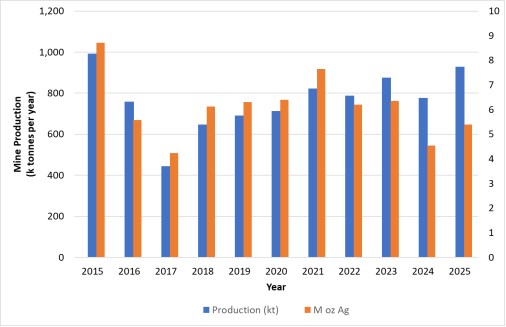
Figure 1: San Dimas mine and silver production from 2015 to 2025
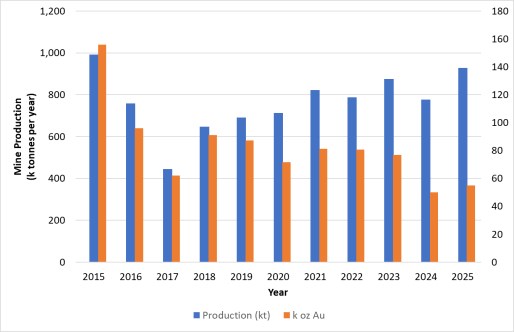
Figure 2: San Dimas mine and gold production from 2015 to 2025
Geological Setting, Mineralization and Deposit Types
The San Dimas property is located in the central part of the SM Occidental, near the Sinaloa-Durango state border, which has an average elevation exceeding 2000 masl, extending from the Mexico-US border to the Trans-Mexican Volcanic Belt. Numerous epithermal deposits have been found along the SM Occidental. The SM Occidental consists of Late Cretaceous to early Miocene igneous rocks including two major volcanic successions totalling approximately 3,500 m in thickness and are separated by erosional and depositional unconformities: the LVC and UVG. The LVC consists of predominantly intermediate volcanic and intrusive rocks formed between approximately 100 and 50 Ma. The LVC has traditionally been divided into local geological units based on field observations. The lower part of the sequence consists of more than 700 m thick Socavon rhyolite, which is host to several productive veins in the district. This overlain by the Buelna andesite and the Portal rhyolite which range from 50-250 m in thickness.
The lower sequence of rhyolitic rocks is unconformably overlain by a succession of andesitic lava flows and volcanogenic sedimentary rocks including the Productive andesite (>750 m thick), Las Palmas rhyo-andesite tuffs and flows (>300 m thick), and the Camichin Unit, a volcanogenic sedimentary unit.
The UVG sits unconformably on the LVC and consists of the lower Guarisamey andesite and the Capping rhyolite. The Capping rhyolite consists of rhyolitic ash flows and air-fall tuffs and may reach as much as 1,500 m in thickness in the eastern part of the district. The LVC and UVG volcanic rocks are intruded by intermediate rocks, consisting of the Arana intrusive andesite and the Arana intrusive diorite, and a felsic suite comprising the Piaxtla granite and the Santa Lucia, Bolaños, and Santa Rita dikes. The basic dikes intrude both the LVC and the UVG.
The most prominent structures are major north-northwest-trending normal faults with opposite vergence that divide the district into five fault-bounded blocks that are tilted to the east-northeast or west-northwest. East-west to west-southwest-east-northeast striking fractures, perpendicular to the major normal faults, are often filled by quartz veins, dacite porphyry dikes, and pebble dikes. The veins are generally west-southwest-east-northeast-oriented, within a corridor approximately 10 km wide. The veins are often truncated by the north-northwest-south-southeast-trending major faults, separating the original veins into segments. These segments are named as individual veins and grouped within the mine zones by fault block.
The mine zone groupings of veins are, from west to east: West Block, Graben Block, Central Block, Tayoltita Block, Alto de Arana Block (also known as Arana HW), San Vicente, El Cristo and Santa Rita.
Three deformational events appear to be related to the development of the major faults, hydrothermal veins, and dikes.
Within the San Dimas property, the mineralization is typical of epithermal vein structures with banded and drusy textures. Epithermal-style veins occupy east-west-trending fractures, except in the southern part of the Tayoltita Block where they strike mainly northeast, and in the Santa Rita area where they strike north-northwest. The metal rich stage consists primarily of white to light grey, medium-to-coarse-grained crystalline quartz. The quartz contains intergrowths of base metal sulphides (sphalerite, chalcopyrite, and galena) as well as pyrite, argentite, polybasite, stromeyerite, native silver, and electrum.
Mine geologists observed that bonanza grades along the San Luis vein in the Tayoltita Block appear to be spatially related to the Productive andesite unit and/or to the interface between the Productive andesite and the Portal rhyolite and/or the Buelna andesite. This spatial association of vein-hosted mineralization with a favourable host-rock zone within the volcanic sequence is now recognized in other fault blocks and constitutes a major exploration criterion for the district.
More than 125 mineralized quartz veins have been recognized across the San Dimas property. The silver and gold rich quartz veins have been followed underground from a few metres in strike-length to more than 1,500 m. One of these veins, the Jessica Vein, extends for more than 1,000 m in the Central Block. The vein-hosted mineral deposits within the San Dimas district are considered to be examples of silver- and gold-bearing epithermal quartz veins that formed in a low-sulphidation setting.
Exploration
The San Dimas property has been the subject of modern exploration and mine development activities since the early 1970s, and a considerable information database has been developed from both exploration and mining activities. Exploration uses information from surface and underground mapping, sampling, and drilling together with extensive underground mine tunneling to help identify targets. Other exploration activities include prospecting, geochemical surface sampling, geophysical, predictive artificial intelligence, and remote sensing surveys.
Most of the exploration activities carried out within the San Dimas property were centered around the Piaxtla River where exposures of silver-gold veins were found. Outside of this area, the Lechuguilla and Ventanas areas were explored to some extent during 2008 and 2015-16. The remainder of the property had limited exploration due to post-mineral cover by a thick layer of ignimbrites.
The most important exploration strategy at San Dimas has been underground mine tunnelling. Tunnelling consists of advancing mine development to the north at the preferred elevation to intersect quartz veins mapped at surface. This method discovered veins with no surface exposure, such as the Jessica Vein, which has been a major contributor to silver and gold production of metal produced in recent years. This exploration strategy has been used at San Dimas by all property owners after Luismin, resulting in more than 500 km of underground mine development.
The San Dimas exploration potential remains open in many of the known mineralized zones. As the mine was developed to the north, new veins were found. South of the Piaxtla River, the El Cristo area has potential for new quartz vein discoveries. The West Block is currently being explored by drilling and tunnelling. Opportunities to intercept the projection of fault-offset quartz veins from the Graben Block are considered good.
Drilling
Drilling in the San Dimas property is focused on the identification and delineation of vein-hosted silver and gold resources by using structural and stratigraphic knowledge of the district, and preferred vein trends. Since the "favourable horizon" for mineral deposits concept emerged in 1975, the exploration drilling strategy has focused on core drilling perpendicular to the preferred vein orientation within the mine zones, which has proven to be the most effective method of exploration in the area. Core drilling is predominantly done from underground stations, as the rugged topography and the great drilling distance from surface locations to the target(s) makes surface drilling challenging and expensive. Over 1,531,000 m of core drilling has been completed since 2000, with approximately 118,000 m completed in 2025.
Sampling, Analysis and Data Verification
Diamond drill core is delivered to the core logging facility where San Dimas geologists select and mark sample intervals according to lithological contacts, mineralization, alteration, and structural features. Sample intervals range from 0.25-1.20 m in length within mineralized structures to 0.5-1.20 m in length when sampling waste rock. Drill core intervals selected for sampling are cut in half using a diamond saw. One half of the core is retained in the core box for further inspection and the other half is placed in a sample bag. For smaller diameter delineation drill core (TT-46) "termite" the entire core is sampled for analysis.
The sample number is printed with a marker on the core box beside the sampled interval, and a sample tag is inserted into the sample bag. Sample bags are tied with string and placed in rice bags for shipping.
Since 2013, underground mine production channel samples for ore control and channel samples for resource estimation have been collected at San Dimas. Earlier channel samples were taken either across the roof of developments or across the face in developments. From 2016 to present, production channel samples for ore control and channel samples for resource estimation are routinely taken across the mine development face and within stopes.
Bulk density measurements are systematically taken on drill core. From 2016 to 2023, specific gravity measurements were collected on 10 cm or longer whole core vein samples using the unsealed water immersion method. Based on this method, an average bulk density value of 2.6 t/m3 was determined.
Quality control samples such as duplicates, checks and standards are included with all samples.
Since 2004, four different laboratories have been used for sample preparation and analysis. These include First Majestic's San Dimas Laboratory, SGS Durango, ALS-Chemex Zacatecas, and First Majestic's ISO9001 certified Central Lab facility located at the Company's Santa Elena operation in Sonora, Mexico.
Channel samples and drill core samples were dried, crushed, and pulverized.
In general, samples were analyzed for gold by a 30 g FA AAS method. Silver was analyzed by a 2 g, three-acid digestion AAS method. A multi-element suite was analyzed by a 0.25 g, aqua regia digestion inductively coupled plasma optical emission spectroscopy method.
From 2013 to 2018, the QA/QC program for the San Dimas laboratory samples included insertion of a SRM and a blank in every batch of 20 samples. From 2013 to 2018, the QA/QC program for channel and core samples included insertion of a SRM and a blank in every batch of 20 samples. In 2013, 5% of the coarse reject and pulp duplicates from core samples were randomly selected for analysis at SGS Durango and 5% of pulp checks from core samples were analyzed at ALS-Chemex Zacatecas. Since 2022, the QA/QC samples inserted in the core sampling include field, coarse reject, and pulp duplicates, CRMs, and coarse and pulp blanks.
The data verification included data entry error checks, visual inspections of data, and a review of QA/QC assay results was completed. Several site visits were completed as part of the data verification process. No significant differences were observed.
Mineral Processing and Metallurgical Testing
The San Dimas operation is made up of several operating underground mines within the property boundaries, which all feed a central milling operation. The metallurgical test work data used to support the initial plant design has been consistently validated and reinforced by years of operational results, complemented by more recent metallurgical studies. Metallurgical testing and mineralogical investigations are routinely conducted to support ongoing performance optimization. The plant continuously performs tests to optimize metal recoveries and reduce operating costs, even when current performance falls within expected parameters. This test work is conducted by the on-site metallurgical laboratory.
The metallurgical recovery projections outlined in the LOM plan are supported by the historical performance of the processing plant and metallurgical testing of future ore. Based on plant performance data from 2021 to 2025, the estimated metal recoveries for the LOM plan and financial analysis are 91.2% for silver and 94.1% for gold. The last two years (2024 and 2025) were used in the LOM based on future material type and corresponding metallurgical testing. San Dimas doré consistently exceeds 97% purity (Au + Ag) and incurs no refinery penalties. Since March 2023, purity has surpassed 98% due to process improvements, including higher-purity zinc powder and optimized flux blends.
Summary of Mineral Resource and Mineral Reserve Estimates
Mineral Resource Estimates
The block model Mineral Resource estimates are based on the database of exploration drill holes and production channel samples, underground level geological mapping, geological interpretations and models, as well as surface topography and underground mining development wireframes available as of the December 31, 2025, the cut-off date for scientific and technical data supporting the estimates.
Exploratory data analysis was completed for gold and silver assay sample values to assess the statistical and spatial character of the sample data. Boundary analysis was completed to review the change in metal grade across the domain contacts. Hard boundaries were used during the creation of composite samples during mineral resource estimation.
To assess the statistical character of the composite samples within each of domains, data were declustered to account for over-sampling in certain regions. The selected composite sample length varied by domain with the most common composite sample length being 1.0 m. The assay sample intervals were composited within the limits of the domain boundaries and then tagged with the appropriate domain code. Drill hole and channel composite samples were evaluated for high-grade outliers and those outliers were capped to values considered appropriate for each domain.
Mineral Resources were estimated into sub-block models rotated parallel to the resource domain trend. Parent block grades were estimated using inverse distance weighting interpolation. The block estimates were made with multiple passes to limit the influence the channel production samples at longer ranges. Pass 1 was a restrictive short-range pass that used channel and drill hole composite samples, and subsequent less restrictive passes used drill hole samples only. An average bulk density value of 2.6 t/m3 was used in estimation for all resource domains.
Validation was completed for each of the resource estimation domains in multiple steps including visual inspection, global grade bias checks, and swath plots. Overall, the block model validations demonstrated that the current Mineral Resource estimates are a reasonable representation of the primary input sample data. Block model estimate to mine claim reconciliation has shown estimation performance within industry-expected ranges.
The Mineral Resource estimates were classified into Measured, Indicated, or Inferred based on the confidence in the geological interpretation and models, the confidence in the continuity of metal grades, the sample support for the estimation and reliability of the sample data, and on the presence of underground mining development providing detailed mapping and production channel sample support.
The Mineral Resource estimates were evaluated for reasonable prospects for eventual economic extraction by application of input parameters based on mining and processing information from the last two years of operations. Deswik Stope Optimizer software was used to identify the blocks representing mineable volumes that exceed the cut-off value while complying with the aggregate of economic parameters.
The Mineral Resource estimates for San Dimas are presented in Table 7 and Table 8, using a NSR cut-off value of $149/t. Measured and Indicated Mineral Resources, reported inclusive of Mineral Reserves, have an effective date of December 31, 2025 and reflect mining depletion through that date. Mineral Resources that are not Mineral Reserves do not have demonstrated economic viability. From December 31, 2024 to December 31, 2025, the Measured and Indicated Mineral Resource estimates at San Dimas are unchanged in tonnage, decreased 7% in contained silver and decreased 2% in contained gold. Over the same period, the Inferred Mineral Resource estimates increased by 9% in tonnage, increased 2% contained silver and are unchanged in contained gold. These changes primarily reflect mining depletion, additions from exploration drilling, conversion of Inferred to Indicated Mineral Resources through drilling, and updated cut-off grades based on revised economic parameters including costs, recoveries, and metal prices.
Table 7: San Dimas Measured and Indicated Mineral Resource Estimate (Effective Date: December 31, 2025)
| Category / Area | Mineral Type | Tonnage | Grades | Metal Content | ||||
| Mt | Ag (g/t) | Au (g/t) | AgEq (g/t) | Ag (Moz) | Au (Moz) | AgEq (Moz) | ||
| Measured Western Block (UG) | Sulphides | 0.22 | 413 | 3.68 | 748 | 2.94 | 0.03 | 5.34 |
| Measured Central Block (UG) | Sulphides | 1.17 | 343 | 4.61 | 763 | 12.85 | 0.17 | 28.61 |
| Measured Sinaloa Graben (UG) | Sulphides | 0.50 | 339 | 4.56 | 755 | 5.46 | 0.07 | 12.16 |
| Measured Other Areas (UG) | Sulphides | 0.01 | 170 | 4.22 | 554 | 0.07 | 0.00 | 0.24 |
| Total Measured (UG) | Sulphides | 1.90 | 349 | 4.49 | 758 | 21.32 | 0.27 | 46.34 |
| Indicated Western Block (UG) | Sulphides | 0.52 | 214 | 2.27 | 420 | 3.54 | 0.04 | 6.97 |
| Indicated Central Block (UG) | Sulphides | 1.25 | 244 | 2.81 | 500 | 9.84 | 0.11 | 20.15 |
| Indicated Sinaloa Graben (UG) | Sulphides | 0.59 | 246 | 3.52 | 567 | 4.64 | 0.07 | 10.69 |
| Indicated Tayoltita (UG) | Sulphides | 0.15 | 318 | 4.02 | 684 | 1.57 | 0.02 | 3.38 |
| Indicated Other Areas (UG) | Sulphides | 0.46 | 303 | 3.23 | 598 | 4.51 | 0.05 | 8.87 |
| Total Indicated (UG) | Sulphides | 2.97 | 252 | 2.98 | 524 | 24.10 | 0.28 | 50.07 |
| Measured + Indicated Western Block (UG) | Sulphides | 0.74 | 274 | 2.69 | 519 | 6.49 | 0.06 | 12.31 |
| Measured + Indicated Central Block (UG) | Sulphides | 2.42 | 292 | 3.68 | 627 | 22.68 | 0.29 | 48.76 |
| Measured + Indicated Sinaloa Block (UG) | Sulphides | 1.09 | 289 | 4.00 | 654 | 10.10 | 0.14 | 22.85 |
| Measured + Indicated Tayoltita Block (UG) | Sulphides | 0.15 | 318 | 4.02 | 684 | 1.57 | 0.02 | 3.38 |
| Measured + Indicated Other Areas (UG) | Sulphides | 0.48 | 300 | 3.26 | 596 | 4.58 | 0.05 | 9.11 |
| Total Measured + Indicated (UG) | Sulphides | 4.87 | 290 | 3.57 | 615 | 45.42 | 0.56 | 96.41 |
Table 8: San Dimas Inferred Mineral Resource Estimate (Effective Date: December 31, 2025)
| Category / Area | Mineral Type | Tonnage | Grades | Metal Content | ||||
| Mt | Ag (g/t) | Au (g/t) | AgEq (g/t) | Ag (Moz) | Au (Moz) | AgEq (Moz) | ||
| Inferred Western Block (UG) | Sulphides | 1.08 | 200 | 2.09 | 390 | 6.94 | 0.07 | 13.55 |
| Inferred Central Block (UG) | Sulphides | 2.11 | 231 | 2.58 | 466 | 15.65 | 0.18 | 31.61 |
| Inferred Sinaloa Block (UG) | Sulphides | 0.55 | 322 | 4.60 | 741 | 5.66 | 0.08 | 13.01 |
| Inferred Tayoltita Block (UG) | Sulphides | 0.51 | 262 | 3.18 | 552 | 4.30 | 0.05 | 9.05 |
| Inferred Other Areas (UG) | Sulphides | 1.57 | 223 | 2.26 | 428 | 11.22 | 0.11 | 21.60 |
| Total Inferred (UG) | Sulphides | 5.82 | 234 | 2.64 | 475 | 43.76 | 0.49 | 88.83 |
1. Mineral Resource estimates are classified per CIM Definition Standards and NI 43-101.
2. Mineral Resource estimates are based on internal estimates with an effective date of December 31, 2025.
3. The Mineral Resource estimates were prepared under the supervision of, or were reviewed by, David Rowe, CPG, the Company's Director of Mineral Development and the "Qualified Person" (as such term is defined in NI 43-101) responsible for the above Mineral Resource estimates.
4. AgEq is calculated as follows:
AgEq = Ag Grade + (Au Grade x Au Recovery x Au Payable x Au Price) / (Ag Recovery x Ag Payable x Ag Price).
5. Metal prices for Mineral Resources estimates were $38.50/oz Ag and $3,400/oz Au. Metallurgical recovery used was 91.2% for Ag and 94.1% for Au. Metal payable used was 99.95% for Ag and Au.
6. NSR cut-off value considered to constrain resources assumed an underground operation was $149/t and was based on actual and budgeted operating and sustaining costs.
7. Mineral Resources are reported within mineable stope shapes using the NSR cut-off value calculated using the stated metal prices and metal recoveries. The NSR cut-off includes mill recoveries and payable metal factors appropriate to the existing processing circuit.
8. No dilution was applied to the Mineral Resource which are reported on an in-situ basis.
9. Tonnage is expressed in millions of tonnes; metal content is expressed in millions of ounces. Totals may not add up due to rounding.
10. Measured and Indicated Mineral Resources are reported inclusive of Mineral Reserves. Mineral Resources that are not Mineral Reserves do not have demonstrated economic viability.
For risk factors that could materially impact the Mineral Resource estimates, see "Risk Factors - Operational Risks - Uncertainty in the Estimation of Mineral Resources and Mineral Reserves".
Mineral Reserve Estimates
The Mineral Reserves estimation process consists of converting Mineral Resources into Mineral Reserves by identifying material that exceeds the mining cut-off grades and conforms to the geometrical constraints defined by the selected mining method. Modifying factors, such as mining methods, mining recovery, dilution, sterilization, depletion, cut-off grades, geotechnical conditions, metallurgical factors, infrastructure, operability, safety, environmental, regulatory, salability of products, social and legal factors. These factors were applied to produce mineable stope shapes. If the Mineral Resources comply with the previous constraints, Measured Resources could be converted to Proven Reserves and Indicated Resources could be converted to Probable Reserves, in some instances Measured Resources could be converted to Probable Reserves if any or more of the modifying factors reduces the confidence of the estimates.
The NSR is the variable that was used as an indicator to segregate if the revenue from the mineralized material in a block, which is part of the Measured and Indicated Mineral Resources, exceeds the operating and capital costs. NSR formulas were derived from the assumed economic parameters shown in Table 9.
Table 9: Economic Parameters Assumed for Calculation of NSR
| Concept | Units | Values |
| Metal Price Ag | $/oz Ag | 35.00 |
| Metal Price Au | $/oz Au | 3,100 |
| Metallurgical Recovery Ag | % | 91.17 |
| Metallurgical Recovery Au | % | 94.09 |
| Metal Payable Ag and Au | % | 99.95 |
| Dore Transport Cost | $/oz Dore | 1.03 |
| Insurance and Representation Cost | $/oz Dore | 0.048 |
| Refining Change Ag | $/oz Ag | 0.228 |
| Refining Change Au | $/oz Au | 0.500 |
Three types of cut-off values ("COV") have been determined for San Dimas: general COV, incremental COV, and marginal COV. The COVs are expressed in $/tonne, reflecting the value that the ROM material will carry before is fed to the processing plant.
The planned dilution assumes a minimum mining width, which will depend on the applied mining method. The minimum mining width for cut-and-fill using jackleg drills was 0.8 m, while when using jumbo drills was 3.5 m. In the case of longhole mining, the minimum mining width assumed was 1.2 m.
The estimated overbreak in each side of the designed stope is 0.2 m for the two mining methods, longhole and cut-and-fill. An extra dilution from the backfill floor of 0.3 m for longhole and 0.2 m for cut-and-fill is also assumed. The unplanned dilution assumed was an additional 10% of the extracted material before becoming plant-feed.
Other than for sill mining, average mining loss throughout each mining block for both cut-and-fill and longhole mining has been assumed to be 5%. A factor of 25% has been used for sill pillars.
From December 31, 2024 to December 31, 2025, the Proven and Probable Mineral Reserves estimates for San Dimas increased 15% in tonnage, decreased 9% in contained silver, and decreased 2% in contained gold. These changes primarily reflect mining depletion, additions from exploration drilling, conversion of Inferred to Indicated Mineral Resources through drilling, and updated cut-off grades based on revised economic parameters including costs, recoveries, and metal prices.
The Mineral Reserves for the San Dimas mine are presented in Table 10 below.
Table 10: San Dimas Mineral Reserves Estimates (Effective Date: December 31, 2025)
| Category / Area | Mineral Type | Tonnage | Grades | Metal Content | ||||
| Mt | Ag (g/t) | Au (g/t) | AgEq (g/t) | Ag (Moz) | Au (Moz) | AgEq (Moz) | ||
| Proven Western Block | Sulphides | 0.23 | 282 | 2.33 | 489 | 2.10 | 0.017 | 3.63 |
| Proven Central Block (UG) | Sulphides | 0.94 | 209 | 2.77 | 454 | 6.28 | 0.083 | 13.65 |
| Proven Sinaloa Block (UG) | Sulphides | 0.27 | 195 | 2.44 | 412 | 1.70 | 0.021 | 3.57 |
| Proven Other Areas (UG) | Sulphides | 0.01 | 108 | 2.82 | 358 | 0.05 | 0.001 | 0.16 |
| Total Proven (UG) | Sulphides | 1.45 | 217 | 2.64 | 451 | 10.13 | 0.123 | 21.01 |
| Probable Western Block (UG) | Sulphides | 0.31 | 186 | 2.05 | 368 | 1.84 | 0.020 | 3.63 |
| Probable Central Block (UG) | Sulphides | 0.92 | 186 | 2.24 | 384 | 5.48 | 0.066 | 11.33 |
| Probable Sinaloa Block (UG) | Sulphides | 0.43 | 185 | 2.80 | 432 | 2.56 | 0.039 | 5.99 |
| Probable Tayoltita Block (UG) | Sulphides | 0.17 | 191 | 2.54 | 417 | 1.05 | 0.014 | 2.28 |
| Probable Other Areas (UG) | Sulphides | 0.42 | 154 | 1.99 | 331 | 2.10 | 0.027 | 4.51 |
| Total Probable (UG) | Sulphides | 2.25 | 180 | 2.30 | 383 | 13.03 | 0.166 | 27.74 |
| Proven + Probable Western Block (UG) | Sulphides | 0.54 | 227 | 2.17 | 420 | 3.94 | 0.038 | 7.27 |
| Proven + Probable Central Block (UG) | Sulphides | 1.85 | 197 | 2.51 | 419 | 11.76 | 0.149 | 24.98 |
| Proven + Probable Sinaloa Block (UG) | Sulphides | 0.70 | 189 | 2.66 | 424 | 4.26 | 0.060 | 9.56 |
| Proven + Probable Tayoltita Block (UG) | Sulphides | 0.17 | 191 | 2.54 | 417 | 1.05 | 0.014 | 2.28 |
| Proven + Probable Other Areas (UG) | Sulphides | 0.44 | 153 | 2.02 | 331 | 2.15 | 0.028 | 4.67 |
| Total Proven + Probable (UG) | Sulphides | 3.70 | 195 | 2.43 | 410 | 23.16 | 0.289 | 48.75 |
1. Mineral Reserves are classified per CIM Definition Standards and NI 43-101.
2. Mineral Reserves are effective December 31, 2025, are derived from Measured & Indicated Resources, account for depletion to that date, and are reported with a reference point of mined ore delivered to the plant.
3. The Mineral Reserve estimates were prepared under the supervision of, or were reviewed by, Andrew Pocock, P.Eng., the Company’s Director, Technical Services and the “Qualified Person” (as such term is defined in NI 43-101) responsible for the above Mineral Reserve estimates.
4. AgEq is calculated as follows:
AgEq Grade = Ag Grade + Au Grade *(Au Recovery * Au Payable * Au Price) / (Ag Recovery * Ag Payable * Ag Price)
5. Metal prices for Mineral Reserves: $35/oz Ag, $3,100/oz Au. Other key assumptions and parameters include: Metallurgical recoveries of 91.2% Ag, 94.1% Au; metal payable of 99.95% Ag & Au, costs ($/t): mining $56.83 for longhole stoping and $129.93 for cut & fill, processing $38.28 mill feed, indirect/G&A $56.96 and sustaining cost of $23.49.
6. A two-step cut-off approach was used per mining method: A general cut-off grade defines mining areas covering all associated costs; and a 2nd pass incremental cut-off includes adjacent material covering only its own costs, excluding shared general development access & infrastructure costs which are covered by the general cut-off material.
7. Modifying factors for conversion of Mineral Resources to Mineral Reserves include but are not limited to consideration for mining methods, mining recovery, dilution, sterilization, depletion, cut-off grades, geotechnical conditions, metallurgical factors, infrastructure, operability, safety, environmental, regulatory, social and legal factors. These factors were applied to produce mineable stope shapes.
8. Tonnage in millions of tonnes, metal content in millions of ounces, prices/costs in US$. Numbers are rounded per guidelines; totals may not sum due to rounding.
For risk factors that could materially impact the Mineral Reserves estimates, see "Risk Factors - Operational Risks - Uncertainty in the Estimation of Mineral Resources and Mineral Reserves".
The Company is not aware of any known mining, metallurgical, environmental, permitting, legal, title, taxation, socio-economic, marketing, political, or other relevant factors that could materially affect the Mineral Resource or Mineral Reserve estimates, other than discussed herein.
Mining Operations
San Dimas includes five underground gold and silver mining areas: West Block (San Antonio, Perez mine), Sinaloa Graben Block (Graben Block), Central Block, Tayoltita Block, and the Arana Hanging-wall Block (Santa Rita mine).
Both First Majestic and contractor personnel conduct mining activities. Two mining methods are currently being used at San Dimas, cut-and-fill, and longhole mining. Cut-and-fill is carried out by either jumbo or jackleg drills, whereas longhole is carried out with pneumatic and electro-hydraulic drills. Primary access is provided by adits and internal ramps.
Ground conditions throughout most of the San Dimas underground workings are considered good. Bolting is used systematically in the main haulage ramps, drifts, and underground infrastructure. For those sectors that present unfavorable rock quality, shotcrete, mesh, and/or steel arches are used.
Groundwater inflow has not been a significant concern within San Dimas. Dewatering systems in San Dimas consist of main and auxiliary pumps in place at each of the mine areas.
The San Dimas ventilation system consists of an exhaust air extraction system through its main fans located on surface. These fans generate the necessary pressure change for fresh air to enter through the portals and ventilation raises.
Processing and Recovery Operations
The San Dimas processing plant has been in successful operation for several years, consistently achieving high recoveries based on both historical performance and recent metallurgical testing. The plant operates on a conventional cyanide leaching and Merrill-Crowe process to produce silver-gold doré bars, with an installed capacity of 3,000 tpd.
The facility is designed as a single processing train, with the crushing area separated from the rest of the circuit and connected via a belt conveyor that transfers screened material to the fine-ore bins. The plant consists of the following operating units: a two-stage crushing circuit with a primary jaw crusher and a secondary cone crusher (one in operation, one standby) in closed circuit with a double-deck 8'x 16' dry vibrating screen; three ball mills operating in parallel, each with two hydrocyclones (one operational, one standby) in closed circuit; cyanide leaching in 16 agitated tanks with two intermediate thickeners; two CCD thickeners in series; Merrill-Crowe zinc precipitation followed by smelting; and four horizontal vacuum belt filters for tailings filtration, located adjacent to the TSF. This configuration supports high metallurgical performance and operational efficiency across the circuit.
Infrastructure, Permitting and Compliance Activities
The infrastructure in San Dimas is fully developed to support current mining and mineral processing activities, with part of its facilities located in the town of Tayoltita.
The main infrastructure of San Dimas consists of access roads, the district mines, which are divided into five mining areas, crushing and processing facilities known as the Tayoltita mill, the Tayoltita/Cupias tailings facilities, an assay laboratory, offices and staff camp, the Las Truchas Facilities, an LNG power plant, and diesel-powered emergency generation plant, a local airport and infrastructure supporting the inhabitants of the Tayoltita townsite including a local clinic, schools and sport facilities.
Most of the personnel and light supplies for San Dimas arrive on First Majestic's regular flights from Mazatlán and Durango. Heavy equipment and other supplies are brought by road from Mazatlán and Durango.
Electrical power is provided by a combination of First Majestic's own hydroelectric generation system (the Las Truchas Facilities), LNG generators and the Federal Power Commission supply system ("CFE"). First Majestic operates the hydroelectric generation plant, which is interconnected with the CFE power grid, four 1 MW LNG power generators, and a series of back-up diesel generators. During 2025, the Las Truchas Facilities contributed approximately 41% of the site's energy requirements, an improvement from the prior year.
The source of water for industrial use comes mainly from mine dewatering stations and from the recycled filtered-tailings water after it has been treated. About 80% of the water required for processing activities is being treated and recycled. A project to improve water sourcing and reliability is under review and consideration.
Environmental and social studies are routinely performed in San Dimas to characterize existing conditions and to support the preparation of Risk Assessments and Accident Prevention Programs for the operation and are documented as part of the Environmental Management System implemented by First Majestic.
San Dimas consists of several mining areas, and it holds major environmental permits and licenses required by the Mexican authorities to carry out mineral extracting activities in the mining complex. As historic operation of the mine pre-dates several of the Mexico mining regulations, the Company has endeavoured to progressively acquire permits and regularize the operation as well as addressing historic environmental liabilities.
The main environmental permit is the environmental license "Licencia Ambiental Unica" ("LAU") under which the mine operates its industrial facilities in accordance with the Mexican environmental protection laws administered by the Ministry of Environment and Natural Resources ("SEMARNAT") as the agency in charge of environment and natural resources. The most recent update to the LAU was approved in April 2024.
San Dimas has implemented First Majestic's Environmental Management System ("EMS"), which supports the implementation of environmental policy and is applied to standardize tasks and strengthen a culture focused on minimizing environmental impacts. The EMS is based on the requirements of the international standard ISO 14001:2015 and the requirements to obtain the Clean Industry Certificate ("CIC"), issued by SEMARNAT, through the Federal Attorney for Environmental Protection ("PROFEPA") in Mexico. The EMS includes an annual compliance program to review all environmental obligations.
In May 2018, San Dimas received the CIC for improvements to its environmental management practices at the mine.
In February 2025, for the fourteenth consecutive year, the San Dimas mine was awarded the Socially Responsible Company designation by the Mexican Center for Philanthropy ("CEMEFI").
Environmental liabilities for the operation are typical of those that would be expected to be associated with an operating underground precious metals mine, including the future closure and reclamation of mine portals and ventilation infrastructure, access roads, processing facilities, power lines, dry-stacked tailings and all surface infrastructure that supports the operations. Other potential liabilities include industrial water management, petroleum spills and carbon emissions from mobile equipment.
Capital and Operating Costs
San Dimas has been owned and operated by First Majestic since May 10, 2018. The LOM plan includes estimates for sustaining capital expenditures for the planned mining and processing activities. Estimated sustaining capital expenditures for the LOM plan is assumed to average approximately $25 million per annum and will mostly be allocated for on-going development, infill drilling, mine equipment rebuilding, major overhauls or replacements, plant maintenance, on-going plant refurbishing, and tailings facilities expansion as needed. Table 11 presents the summary of the sustaining capital expenditures.
Table 11: San Dimas Mining Capital Costs Summary (Sustaining Capital) ($ Million)
| Type | Total | 2026 | 2027 | 2028 | 2029 | 2030 |
| Mine Development | $67.3 | $15.7 | $13.6 | $15.7 | $16.0 | $6.1 |
| Property, Plant & Equipment | $37.6 | $7.55 | $7.6 | $7.6 | $7.6 | $7.4 |
| Other Sustaining Costs | $8.3 | $1.7 | $1.7 | $1.7 | $1.6 | $1.6 |
| Total Sustaining Capital Costs | $113.1 | $24.9 | $22.9 | $25.0 | $25.2 | $15.2 |
| Near Mine Exploration | $6.9 | $1.5 | $1.4 | $1.4 | $1.3 | $1.3 |
| Total Capital Costs | $120 | $26.4 | $24.3 | $26.4 | $26.5 | $16.5 |
Operating costs for San Dimas have been estimated for the underground mining, processing, indirect, and general & administrative costs. Operating costs are presented as a weighted average based on mining method. A summary of the annual operating expense is presented in Tables 12 and 13 below.
Table 12: San Dimas Operating Costs ($ Million)
| Type | $/tonne milled |
| Mining Cost | $56.8 |
| Processing Cost | $38.3 |
| Indirect Costs | $56.9 |
| Total Production Cost | $152.0 |
| Selling Cost | $1.3 |
| Total Cash Cost | $153.3 |
Table 13: San Dimas Annual Operating Costs ($ Million)
| Type | Total | 2026 | 2027 | 2028 | 2029 | 2030 |
| Mining Cost | $210.3 | $42.3 | $42.4 | $42.4 | $41.9 | $41.3 |
| Processing Cost | $141.7 | $28.5 | $28.6 | $28.6 | $28.2 | $27.8 |
| Indirect Costs | $210.7 | $42.4 | $42.5 | $42.5 | $42.0 | $41.4 |
| Total Production Cost | $562.6 | $113.1 | $113.4 | $113.5 | $112.0 | $110.6 |
| Selling Costs | $4.7 | $0.9 | $1.0 | $1.0 | $0.9 | $0.9 |
| Total Cash Cost | $567.4 | $114.1 | $114.4 | $114.4 | $113.0 | $111.5 |
Exploration, Development and Production
The following general annual exploration drill programs were executed in 2025:
This amount of drilling is expected to continue on an annual basis while production continues but amounts required are reviewed annually. In addition, an annual prospect generation program consisting of prospecting, soil and rock geochemical surveys, mapping, or geophysical surveys is conducted.
In 2025, the Company continued operating the Jessica vein, the Regina vein, the Victoria vein, and the Perez vein among other veins. During 2025, 928,352 tonnes of mineralized material were processed with an average grade of 203 g/t Ag and 2.00 g/t Au.
Development continues in the San Dimas mine preparing extraction levels in the Perez vein and new extraction areas in the West and the Sinaloa/Graben blocks.
Santa Elena Silver/Gold Mine, Sonora State, Mexico
The following information on the Santa Elena Silver/Gold Mine ("Santa Elena mine") is based on a Technical Report prepared in accordance with NI 43‐101 and titled "First Majestic Silver Corp. Santa Elena Silver/Gold Mine Sonora, Mexico NI 43-101 Technical Report on Mineral Resource and Mineral Reserve Estimates" with effective date of June 30, 2021 (the "Santa Elena Technical Report"). Reference should be made to the full text of the Santa Elena Technical Report which is available for review on the Company's profile on SEDAR+ at www.sedarplus.ca.
Property Description, Location and Access
The Santa Elena mine is an actively producing underground gold and silver mining complex owned and operated by the Company's wholly-owned indirect subsidiary, Nusantara de México, S.A. de C.V. The property is located in Sonora, Mexico, approximately 150 km northeast of the state capital city of Hermosillo and seven kilometres east of the community of Banámichi. The property is centered on latitude 30°01.3'N and longitude 110°09.5'W.
The Santa Elena mine can be easily accessed year-round by paved highways 90 km east from Hermosillo to Ures, then 50 km north along a paved secondary road to the community of Banámichi, then by a well-maintained gravel road for 7 km to the mine site. The Ermitaño mine can be accessed by a 5 km gravel road from the Santa Elena mine. The Santa Elena property complex currently consists of 32 individual concessions covering 102,172 hectares and four concession applications in process which cover 72 hectares, for a total of 102,244 hectares.
In 2017, First Majestic expanded the Santa Elena property complex by purchasing a royalty-free 100% interest in the El Gachi property from Santacruz Silver Mining Ltd. First Majestic expanded the Santa Elena property again in 2018 by completing the acquisition of a 100% interest in the Ermitaño and Cumobabi properties from Evrim Resources Corp. (whose current name is Orogen Royalties Inc.). Upon completion of the acquisition, Orogen Royalties retained a 2% NSR royalty from the sale of mineral products extracted from the Ermitaño property and retained a 1.5% NSR from the sale of mineral products extracted from the Cumobabi property. On October 1, 2023, Orogen Royalties Inc. assigned these two NSRs to Minera Inmet Mexico S.A. de C.V., a wholly-owned subsidiary of Orogen Royalties Inc. In addition, Osisko Gold Royalties Ltd., through its wholly-owned subsidiary Mining Royalties Mexico, S.A de C.V., holds a 2% NSR from the sale of mineral products extracted from the Ermitaño and Cumobabi properties.
In addition to the above-mentioned NSRs on the Ermitaño and Cumobabi properties, the Los Hernandez property is subject to a 2.5% NSR on the sale of mineral products derived from the property that is held by Triple Flag Precious Metals Corp.
First Majestic is party to a purchase (streaming) agreement with Royal Gold Inc. ("Royal Gold") which entitles Royal Gold to receive 20% of the gold production from the leach pad and a designated area of the Santa Elena mine in exchange for ongoing payments equal to the lesser of $487.3/oz Au as of December 31, 2025 and the prevailing market price for each gold ounce delivered under the agreement.
Surface rights in the area of the mining concessions are held both privately and through group ownership either as communal or Ejido lands. First Majestic has agreements in place regarding surface rights with Bienes Comunales de Banámichi, Mr. Francisco Maldonado, Dabafa S.P.R. de R.L., Ejido Banámichi, and the Community of Banámichi. As of December 2025, all obligations were met for these agreements.
Santa Elena holds the necessary permits to operate, such as the LAU, water rights concessions, and federal land occupation concessions.
History
London-based Consolidated Goldfields of Mexico Limited owned and operated the Santa Elena mine in the late 19th century and mined from surface and underground until around 1910. There is no indication of any further significant mining or exploration at Santa Elena until Industrias Peñoles S.A de C.V. drilled two or three holes on the property in the 1960s. During the early 1980s, Tungsteno de Baviacora ("Tungsteno") owned the property and mined 45,000 tonnes grading 3.5 g/t Au and 60 g/t Ag from an open cut. Tungsteno periodically surface mined high silica/low fluorine material from Santa Elena.
The property remained under control of Tungsteno until 2009, when SilverCrest Mines Inc. ("SilverCrest") acquired the property. SilverCrest commenced production from the Santa Elena open pit in October 2010.
First Majestic acquired the Santa Elena property in October 2015 through its acquisition of SilverCrest, and by year end 2025 has produced 3.9 Mt at 120 g/t Ag and 2.06 g/t Au from underground, plus 3.6 Mt of ore from Ermitaño with 61 g/t Ag and 3.58 g/t Au and has reprocessed 2.5 Mt at 40 g/t Ag and 0.68 g/t Au from the leach pad. The 2015 to 2025 production history is presented in Figures 3 & 4 below.
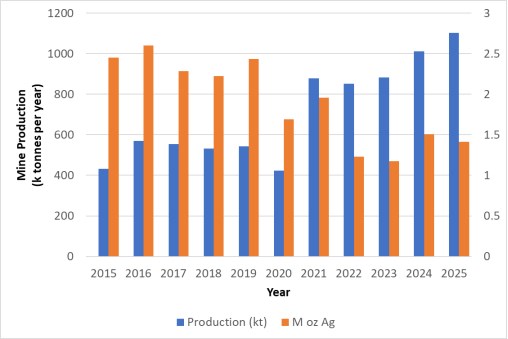
Figure 3: 2015 to 2025 Santa Elena District mine and silver production.
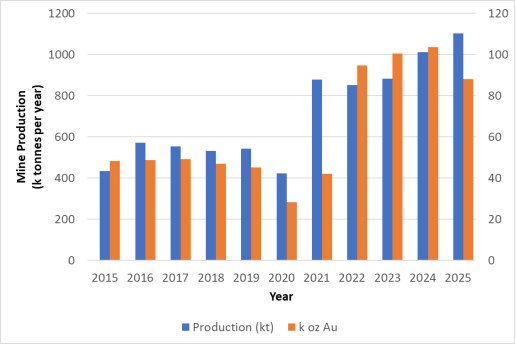
Figure 4: 2015 to 2025 Santa Elena District mine and gold production.
Geological Setting, Mineralization and Deposit Types
The Santa Elena deposits are hosted in rocks of the SM Occidental, an igneous province that extends from the USA-Mexican border south to Guadalajara, Mexico. The SM Occidental geological province consists of Late Cretaceous to early Miocene volcanic and sedimentary rocks that formed during two main periods of continental magmatic activity. The first period, concurrent with the Laramide orogeny, produced an intermediate intrusive suite and its volcanic counterpart. These rocks, named the LVC, include the Late Cretaceous to Paleocene volcanic succession of the Tarahumara Formation and are intruded by the Sonora batholiths. In the late Eocene, volcanism became dominated by rhyolitic ignimbrites. Extensional basins and associated continental sedimentary deposits formed between 27 Ma and 15 Ma in a north-northwest-trending belt along the western half of the SM Occidental.
Many significant porphyry deposits of the SM Occidental occur in the LVC rocks. Northwest-trending fault zones associated with early Eocene east-west directed extension, appear to control epithermal mineralization in the Sonora region. The Santa Elena Main Vein and the Ermitaño Vein have orientations similar to this extensional trend.
The Santa Elena, Ermitaño and Navidad deposits are the most significant zones of gold and silver mineralization currently known within the Santa Elena property.
Drilling at the Santa Elena mine has delineated three primary structures occupied by veins. The Main Vein strikes east, dips approximately 55-45° south and is delineated 1,950 m along strike and 750 m down dip. The Alejandra and America Veins are splay of the Main Vein and strike east to east-southeast and dip steeply to the south. Andesite and granodiorite dykes occur adjacent and sub-parallel to the Main Vein.
Drilling at the Ermitaño mine has delineated one primary vein, one secondary vein and several sub-parallel tertiary veins. The Ermitaño Vein strikes east, dips 60° to 80° north, and is delineated 1,800 m along strike and 550 m down dip. The vein is best developed where the structure cuts the older, brittle volcanic rocks.
The mineral deposits of Santa Elena are typical of low sulphidation gold and silver epithermal vein-hosted deposits. Silver and gold mineralization is hosted in quartz veins and stockworks displaying typical epithermal textures, including banded, crustiform and vuggy quartz, bladed calcite (pseudomorph to quartz) and hydrothermal breccia. Sulphide abundance is generally low within the veins and are dominantly pyrite and pyrrhotite with minor galena, sphalerite, and chalcopyrite. Gold occurs typically as native gold, electrum, and silver occurs as electrum, minor acanthite, and argentite.
Exploration
There have been several surface and airborne exploration surveys and studies completed within the Santa Elena mineral concessions since 2006, including prospecting, mapping, rock and soil geochemical sampling, petrographic and spectrographic studies, magnetic, electromagnetic, and induced polarization surveys. Most of this work has focused on the Santa Elena and Ermitaño mine areas. The regional satellite and airborne surveys have been useful for developing a conceptual geological framework and local mapping and geochemical soil and rock sampling have been useful for identifying prospective drill targets.
Drilling remains the best and most widely used exploration tool within the Santa Elena property.
Drilling
Between 2006 and year-end 2025, more than 560,000 m have been drilled at the Santa Elena District.
During 2025 a total of approximately 70,000 m were drilled.
Sampling Analysis and Data Verification
The Santa Elena and Ermitaño Mineral Resource estimates are based on logging and sampling of NQ and HQ diameter core and underground channel samples. The entire length of drill core is photographed and logged for lithology, mineralization, structure, and alteration. Core recovery, RQD and SG measurements are also collected. Sampling intervals respect lithology and mineralization boundaries. The core is sawn in half for sampling. Channel samples are collected within a 20 cm wide swath along the line using a hammer and hand chisel and are collected on a tarpaulin and then bagged.
Sample quality control is monitored using CRMs, blanks, and quarter-core field duplicates, coarse reject duplicates, and pulp duplicates. Coarse reject and pulp samples are prepared and inserted by the primary laboratory during sample preparation. Pulp duplicates checks are also periodically submitted to a secondary laboratory to assess between-laboratory bias.
From 2016 to 2025, samples from Ermitaño surface drill holes were dispatched to SGS in Hermosillo, Mexico for sample preparation and to SGS in Durango, Mexico for analysis. Samples from the Santa Elena mine underground drill holes were dispatched to First Majestic's Central Laboratory in La Parrilla, Durango, Mexico which was relocated to Santa Elena in June 2023, and to SGS in Hermosillo and Durango. Between 2022 and 2025, samples from Ermitaño surface drillholes were dispatched to First Majestic's Central Laboratory underground channel samples and underground drill hole samples from Ermitaño were sent to the Santa Elena Laboratory. Since 2021, pulp duplicates checks are sent to ALS. ALS and SGS laboratories are independent of First Majestic. ALS received ISO 9001 certification in 2005 and received accreditation of ISO/IEC 17025 from Standards Council of Canada in 2005 and 2020. The SGS laboratories conform to the ISO/IEC 17025 standard and most regional facilities have been ISO 9001 certified since 2008. First Majestic's Central Laboratory is not independent of First Majestic. The Central Laboratory received ISO 9001 accreditation in mid-2015 and 2017, and the Santa Elena laboratory received ISO 9001:2015 accreditation in September 2021. In September 2023, the Santa Elena Laboratory was incorporated under Central Laboratory management.
At SGS, samples are dried crushed and pulverized and then analyzed for 34 elements using aqua regia digestion with an ICP atomic emission spectroscopy finish. Samples are also analyzed for silver by three-acid digestion with an AAS finish. Older samples returning greater than 300 g/t and newer samples returning greater than 100 g/t Ag were reanalyzed for silver by 30 g fire assay with a gravimetric method. Gold is analyzed by a 30 g fire assay with an AAS finish and samples returning >10 g/t Au are reanalyzed for gold by a 30 g fire assay with a gravimetric finish.
At the First Majestic Central Laboratory, samples are dried crushed and pulverized and then analyzed for 34 elements by two-acid digestion with an ICP finish. All samples are also analyzed for silver by three-acid digestion with AAS finish. Older samples returning greater than 200 g/t Ag and recent samples returning greater than 100 g/t Ag were reanalyzed for silver by a 30 g fire assay with a gravimetric finish. Gold is analyzed by two-acid digestion with an AAS finish. Samples returning >10 g/t Au are reanalyzed for gold by a 30 g fire assay with a gravimetric finish.
At the Santa Elena Laboratory, samples were dried crushed and pulverized and then analyzed for silver by a 30 g fire assay gravimetric finish. Gold is analyzed by a 30 g fire assay AA finish. Samples with gold values >10 g/t Au are analyzed by a 30 g fire assay gravimetric method. The assay laboratory in Santa Elena mine has been certified under the ISO 9001:2015 standard, enabling a quality management framework that facilitates consistent quality results and continuous improvement to achieve the best industry practices.
Data verification included data entry error checks, visual inspections of important data, and a review of QA/QC assay results for data collected between 2012 and December 2025 from the Ermitaño, Alejandra, America, Santa Elena Main, Tortugas, Santo Niño, Navidad and Winter veins (the verification dataset). Several site visits were also completed as part of the data verification process at which time drilling, logging, and sampling procedures were observed and cross sections as, core photos, core logs, and QA/QC reports were reviewed. No significant transcription errors or grade accuracy from assessed certified standards and contamination issues were observed.
In early 2024 the gold bias assessment between Central Laboratory and check laboratories (SGS and ALS) indicated a negative marginal 10% bias for the Central Laboratory for results ranging between 3 g/t to 8 g/t (original Central Laboratory assay results were lower than check assay). After applying necessary corrective actions by Central Laboratory, no significant bias was observed in all Au results.
Mineral Processing and Metallurgical Testing
Santa Elena is an operating mine and the metallurgical test-work data supporting the initial plant design has been proven and reinforced by plant operating results through the years of operation, combined with more recent metallurgical studies.
Metallurgical testing along with mineralogical investigation is periodically performed, and the plant is continually running tests to optimize metal recoveries and operating costs. Composite samples are analyzed monthly to determine the metallurgic behaviour of the mineralized material fed into the processing plant. The metallurgical testing is carried out by the Central Laboratory at Santa Elena.
Typical metal recoveries for the Santa Elena mineralized material ranged from 91% to 94% for silver and 94% to 97% for gold from the combination of ROM production from the underground mine and the leach pad material.
During 2025, metallurgical recoveries for the Ermitaño mineralized material averaged 65% for silver and 94% for gold. Throughout 2025, performance of the new Tailings Press Filter and additional equipment that was commissioned in Q4 2022 improved, resulting in reduced moisture content in the tailings and finer grinding. These improved metallurgical recoveries of silver and gold resulted in increased throughputs quarter on quarter and reduced rehandling costs of stacking the tailing within the tailing storage facility.
Due to the high purity of the Santa Elena and Ermitaño doré (greater than 95% silver and gold), no penalties are applied by the refineries for the presence of heavy metals.
Summary of Mineral Resource and Mineral Reserve Estimates
Mineral Resource Estimates
The block model Mineral Resource estimates for the Santa Elena, Ermitaño Navidad and Santo Niño deposits are based on the current database of exploration drill holes and production channel samples, the underground level geological mapping, the geological interpretation and model, as well as surface topography and underground mining excavation wireframes. Geostatistical analysis, analysis of semi-variograms, block model resource estimation, and validation of the model blocks were completed.
The drill hole and channel composite samples were evaluated for high-grade outliers and those outliers were capped to values considered appropriate for estimation. Capping of composite sample values was limited to a select few extreme values. Outlier restriction was also used to restrict the influence of high-grade samples.
The dominant gold and silver mineralization trends were identified based on the 3D numeric models for the metal in each domain. To establish the metal grade continuity within the domains, model variograms for composite values were developed along the trends identified, and the nugget values were established from downhole variograms.
Bulk density was derived from SG measurements. Bulk density for the resource domains was either estimated into the block models from the SG data or the mean SG value was assigned.
Block grades were estimated by either ID2 or OK. The method chosen in each case considered the characteristics of the domain, data spacing, variogram quality, and which method produced the best representation of grade continuity.
All channel samples that were used during construction of the geological models were reviewed. Only those channels that completely cross the mineralized deposit were used during grade estimation.
The grade estimation was completed in two successive passes if channel samples were used. The first pass used all composites, including channel samples and drill holes, and only estimated blocks within a restricted short distance from the channel samples. The second pass applied less restrictive criteria using drill hole composites only. If only drill hole composites were used, the estimation was sometimes completed with a single pass.
The Mineral Resources were classified into Measured, Indicated, or Inferred categories based on the confidence in the geological interpretation and models, the confidence in the continuity of metal grades, the sample support for the estimation and reliability of the sample data, and on the presence of underground mining development providing detailed mapping and production channel sample support. Block model estimate to mine claim reconciliation has shown estimation performance within industry-expected ranges.
The Mineral Resource estimates for Santa Elena, Ermitaño, Navidad, and Santo Niño are summarized in Table 14 and Table 15 using the NSR cut-off value appropriate for the mining method assigned to each domain. The current Mineral Resource estimates also include two surface stockpiles: one derived from the spent ore leach pad - Indicated and the other from the Ermitaño mine. Measured and Indicated Mineral Resources, reported inclusive of Mineral Reserves, have an effective date of December 31, 2025 and reflect mining depletion through that date. Mineral Resources that are not Mineral Reserves do not have demonstrated economic viability.
From December 31, 2024 to December 31, 2025, the Measured and Indicated Mineral Resource estimates for Santa Elena increased 85% in tonnage, increased 30% in contained silver, and increased 26% in contained gold. Over the same period, the Inferred Mineral Resource estimates increased 193% in tonnage, increased 144% in contained silver, and increased 100% in contained gold. The changes to Measured and Indicated Mineral Resources are primarily driven by mining depletion offset by lower cut-off values resulting from updated metal price guidance, as well as infill drilling that converted Inferred Resources to the Measured and Indicated categories at the Ermitaño mine. The increase in Inferred Mineral Resources is mainly related to drilling-driven expansion of the Navidad discovery and the discovery and initial reporting of the Santo Niño silver-gold deposit. Year-over-year, the Navidad and Santo Niño discoveries added to the district Inferred Mineral Resources of 8.25 million tonnes containing 61 million AgEq ounces, comprised of 21.5 million ounces of silver and 0.41 million ounces of gold.
Table 14: Santa Elena Mineral Resource Estimates, Measured and Indicated Category
(Effective Date: December 31, 2025)
| Category / Area | Mineral Type | Tonnage | Grades | Metal Content | ||||
| Mt | Ag (g/t) | Au (g/t) | AgEq (g/t) | Ag (Moz) | Au (Moz) | AgEq (Moz) | ||
| Measured Ermitaño (UG) | Sulphides | 1.20 | 56 | 2.53 | 369 | 2.14 | 0.10 | 14.21 |
| Measured Santa Elena (UG) | Sulphides | 0.78 | 103 | 1.16 | 208 | 2.58 | 0.03 | 5.20 |
| Measured Stockpile | Sulphides | 0.24 | 46 | 1.74 | 264 | 0.35 | 0.01 | 2.02 |
| Total Measured (UG) | Sulphides | 2.22 | 71 | 1.97 | 301 | 5.08 | 0.14 | 21.43 |
| Indicated Ermitaño (UG) | Sulphides | 5.69 | 35 | 1.49 | 203 | 6.39 | 0.27 | 37.06 |
| Indicated Santa Elena (UG) | Sulphides | 2.41 | 120 | 1.15 | 223 | 9.29 | 0.09 | 17.29 |
| Indicated Stockpile | Oxides Spent Ore | 0.39 | 27 | 0.42 | 81 | 0.33 | 0.01 | 1.00 |
| Total Indicated (UG + Stockpile) | All Mineral Types | 8.49 | 59 | 1.34 | 203 | 16.01 | 0.37 | 55.36 |
| Measured + Indicated Ermitaño (UG) | Sulphides | 6.89 | 39 | 1.67 | 231 | 8.54 | 0.37 | 51.27 |
| Measured + Indicated Santa Elena (UG) | Sulphides | 3.19 | 116 | 1.15 | 220 | 11.87 | 0.12 | 22.49 |
| Measured + Indicated Stockpile | All Mineral Types | 0.62 | 34 | 0.92 | 151 | 0.68 | 0.02 | 3.02 |
| Total Measured + Indicated (UG + Stockpile) | All Mineral Types | 10.70 | 61 | 1.47 | 223 | 21.09 | 0.51 | 76.78 |
Table 15: Santa Elena Mineral Resource Estimates, Inferred Category
(Effective Date: December 31, 2025)
| Category / Area | Mineral Type | Tonnage | Grades | Metal Content | ||||
| Mt | Ag (g/t) | Au (g/t) | AgEq (g/t) | Ag (Moz) | Au (Moz) | AgEq (Moz) | ||
| Inferred Ermitaño (UG) | Sulphides | 5.10 | 35.29 | 1.28 | 177.62 | 5.78 | 0.21 | 29.11 |
| Inferred Santa Elena (UG) | Sulphides | 2.79 | 97 | 1.09 | 195 | 8.71 | 0.10 | 17.45 |
| Inferred Navidad (UG) | Sulphides | 6.42 | 89 | 2.21 | 307 | 18.41 | 0.46 | 63.37 |
| Inferred Santo Niño (UG) | Sulphides | 4.10 | 68 | 1.57 | 208 | 8.97 | 0.21 | 27.38 |
| Total Inferred (UG) | Sulphides | 18.40 | 71 | 1.64 | 232 | 41.87 | 0.97 | 137.31 |
1. Mineral Resource estimates are classified per CIM Definition Standards and NI 43-101.
2. Mineral Resource estimates are based on internal estimates with an effective date of December 31, 2025.
3. The Mineral Resource estimates were prepared under the supervision of, or were reviewed by, David Rowe, CPG, the Company's Director of Mineral Development and the "Qualified Person" (as such term is defined in NI 43-101) responsible for the above Mineral Resource estimates.
4. AgEq is calculated as follows:
AgEq = Ag Grade + (Au Grade x Au Recovery x Au Payable x Au Price) / (Ag Recovery x Ag Payable x Ag Price).
5. Metal prices used in the Mineral Resources estimates were $38.50/oz Ag and $3,400/oz Au. Metallurgical recoveries range from 89 - 96% for gold and 66 - 95% for silver. Metal payable used was 99.9% for silver and 99.9% gold.
6. The NSR cut-off values used to constrain the Mineral Resources range from $65/t -$140/t.
7. Mineral Resources are reported within mineable stope shapes using the NSR cut-off value calculated using the stated metal prices and metal recoveries. The NSR cut-off includes mill recoveries and payable metal factors appropriate to the existing processing circuit.
8. Mineral Resources are reported within stope shapes using the NSR cut-off value calculated using the stated metal prices and metal recoveries. The NSR cut-off includes mill recoveries and payable metal factors appropriate to the existing processing circuit.
9. No dilution was applied to the Mineral Resource which are reported on an in-situ basis.
10. Tonnage is expressed in millions of tonnes; metal content is expressed in millions of ounces. Totals may not add up due to rounding.
11. Measured and Indicated Mineral Resources are reported inclusive of Mineral Reserves.
12. Mineral Resources that are not Mineral Reserves do not have demonstrated economic viability.
Mineral Reserve Estimates
The Mineral Reserves estimation process consists of converting Indicated and Measured Mineral Resources into Mineral Reserves by identifying material that exceeds the mining cut-off grades while conforming to specified geometrical constraints determined by the applicable mining method and modifying factors.
From December 31, 2024 to December 31, 2025, the Proven and Probable Mineral Reserves estimates for Santa Elena increased 43% in terms of tonnage, increased 8% in terms of silver metal content, and increased 3% in terms of gold metal content.
The Mineral Reserves for the Santa Elena mine are presented in Table 16.
Table 16: Santa Elena Mineral Reserves Estimates (Effective Date: December 31, 2025)
| Category / Area | Mineral Type | Tonnage | Grades | Metal Content | ||||
| Mt | Ag (g/t) | Au (g/t) | AgEq (g/t) | Ag (Moz) | Au (Moz) | AgEq (Moz) | ||
| Proven Ermitaño (UG) | Sulphides | 0.68 | 59 | 2.29 | 342 | 1.29 | 0.05 | 7.50 |
| Proven Santa Elena (UG) | Sulphides | 0.38 | 105 | 1.22 | 215 | 1.29 | 0.02 | 2.64 |
| Proven Stockpile | Sulphides | 0.24 | 46 | 1.74 | 264 | 0.35 | 0.01 | 2.02 |
| Total Proven (UG) | Sulphides | 1.30 | 70 | 1.88 | 290 | 2.93 | 0.08 | 12.16 |
| Probable Ermitaño (UG) | Sulphides | 3.39 | 29 | 1.16 | 153 | 3.15 | 0.13 | 16.69 |
| Probable Santa Elena (UG) | Sulphides | 1.22 | 120 | 1.09 | 218 | 4.73 | 0.04 | 8.57 |
| Probable Heap leach | Oxides Spent Ore | 0.39 | 27 | 0.42 | 81 | 0.33 | 0.01 | 1.00 |
| Total Probable (UG) + Stockpile | Sulphides | 5.00 | 51 | 1.09 | 163 | 8.21 | 0.17 | 26.26 |
| Proven + Probable Ermitaño (UG) | Sulphides | 4.07 | 34 | 1.35 | 185 | 4.45 | 0.18 | 24.18 |
| Proven + Probable Santa Elena (UG) | Sulphides | 1.60 | 117 | 1.12 | 217 | 6.01 | 0.06 | 11.21 |
| Proven + Probable Stockpile | Sulphides | 0.24 | 46 | 1.74 | 264 | 0.35 | 0.01 | 2.02 |
| Proven + Probable PAD | Sulphides | 0.39 | 27 | 0.42 | 81 | 0.33 | 0.01 | 1.00 |
| Total Proven + Probable (UG) + Stockpile | Sulphides | 6.30 | 55 | 1.25 | 190 | 11.14 | 0.25 | 38.42 |
1. Mineral Reserves are classified per CIM Definition Standards and NI 43-101.
2. Mineral Reserves are effective December 31, 2025, are derived from Measured & Indicated Resources, account for depletion to that date, and are reported with a reference point of mined ore delivered to the plant.
3. The Mineral Reserve estimates were prepared under the supervision of, or were reviewed by, Andrew Pocock, P.Eng., the Company’s Director, Technical Services and the “Qualified Person” (as such term is defined in NI 43-101) responsible for the above Mineral Reserve estimates.
4. AgEq is calculated as follows:
AgEq Grade = Ag Grade + Au Grade *(Au Recovery * Au Payable * Au Price) / (Ag Recovery * Ag Payable * Ag Price)
5. Metal prices considered for Mineral Reserves estimates were $35/oz Ag and $3,100/oz Au.
6. Other key assumptions and parameters include: Metallurgical recoveries of 66.3% Ag, 94.1% Au for the Ermitaño ore, 93.2% Ag, 89.2% Au for Ermitaño Central Zone and; for the Luna zone (Ermitaño East Complex) 89.8% Ag, 93.8% Au, for Santa Elena ore 92.7% Ag and 94.4% Au; metal payable of 99.85% Ag and 99.80% Au; direct mining costs of $26/t in Ermitaño and $62.7/t in Santa Elena, processing costs of $38.5/t mill feed for the Ermitaño and Santa Elena ore, and general and administration (indirect costs) of $20.3/t.
7. A two-step cut-off approach was used per mining method: A general cut-off grade defines mining areas covering all associated costs; and a 2nd pass incremental cut-off includes adjacent material covering only its own costs, excluding shared general development access & infrastructure costs which are covered by the general cut-off material.
8. Modifying factors for conversion of resources to reserves include but are not limited to consideration for mining methods, mining recovery, dilution, sterilization, depletion, cut-off grades, geotechnical conditions, metallurgical factors, infrastructure, operability, safety, environmental, regulatory, social and legal factors. These factors were applied to produce mineable stope shapes.
9. Tonnage in millions of tonnes, metal content in millions of ounces, prices/costs in US$. Numbers are rounded per guidelines; totals may not sum due to rounding.
For risk factors that could materially impact the Mineral Resource estimates, see "Risk Factors - Operational Risks - Uncertainty in the Estimation of Mineral Resources and Mineral Reserves".
The Company is not aware of any known mining, metallurgical, environmental, permitting, legal, title, taxation, socio-economic, marketing, political, or other relevant factors that could materially affect the Mineral Resource or Mineral Reserve estimates, other than discussed herein.
Mining Operations
The Santa Elena Mine operation currently consists of the Santa Elena and Ermitaño underground mines. Mining activities are conducted by First Majestic and contractor personnel. In December 2022, active mining operations at the Santa Elena mine were temporarily suspended and all mining was concentrated on the Ermitaño mine from 2023 as exploration activities continued in both mines.
The Santa Elena and the Ermitaño deposits vary in dip, thickness, and geotechnical conditions along strike and dip. Multiple mining methods are required to achieve an efficient extraction of mineralized material at site. Three well-established methods were selected for mining extraction at Santa Elena: Longitudinal longhole stoping, Modified Avoca, and Cut-and-fill. The Modified Avoca mining method and transverse longhole stoping are in use at the Ermitaño project.
Ground conditions throughout most of the Santa Elena underground workings are considered good. Bolting is used systematically in the main haulage ramps, drifts, and underground infrastructure. For those sectors that have poorer rock quality, shotcrete, mesh and/or steel arches are used.
Groundwater inflow has been increasing at depth in the Santa Elena Mine. Dewatering systems consist of main and auxiliary pumps in place in each of the active mine areas. Groundwater inflows in Ermitaño increased when the workings reached the 760 metres above sea level (masl) elevation. A new permanent mine dewatering system was installed in Ermitaño in 2023 and enhanced in 2025.
The ventilation system consists of a forced air intake system through two main fans located on surface. These fans generate the necessary pressure change for return air to exhaust through the portals and ventilation raises. The ventilation system in Ermitaño is using a pull system with fresh air being drawn through the main twin ramps, Western Emergency Access ramp and one surface vent raise. Spent air is exhausted out of two vent raises to surface at the edges of planned underground operations.
Processing and Recovery Operations
The processing plant has been successfully operating for several years and has continuously improved silver and gold metallurgical recoveries. The process is based on cyanide tank leaching and Merrill-Crowe smelting of fine-ground ore to produce silver-gold doré bars.
The process plant is mostly built as a single train with the crushing area split from the remaining areas and connected through a belt conveyor to transfer the crushed product to the fine stockpiles. The current leaching plant includes a grinding ball mill, one Metso-Outotec HIG-Mill, leaching tanks, four counter-current decantation or washing tanks, a previously processed leach-pad, a high-capacity filter plant for dewatering tailings material, a belt-filter facility and a FTSF.
The predominant feed in 2025 was Ermitaño ore. Throughput levels averaged 3,200 tpd in 2025, with Q4 performance exceeding the projected plant capacity with an average of 3,280 tpd.
Infrastructure, Permitting and Compliance Activities
The existing infrastructure can support current and LOM plan mining and mineral processing activities.
Most of the operation's support facilities are located within a 1.5 km radius of the main plant area, facilitating the transportation and logistics of personnel, material, and equipment. Operations personnel are transported by passenger buses from nearby towns. All equipment, supplies and materials are brought in by road.
Most non-local staff and contractor personnel stay in rental homes available in the nearby towns of Banámichi, Huepac and Aconchi. There are multiple hotels available in the area for visitors.
The main infrastructure consists of roads, administrative offices, a first-aid station, warehouse, assay laboratory, diesel and natural gas power generation plants, maintenance shop, water storage tanks, and water supply tank.
As of December 2025, at a throughput rate of 3,200 tpd, the optimized FTSF 1 has a capacity of 2.3 Mt, equivalent to 2.0 years and the FTSF 2 converted from a leach pad in May 2025 has a capacity of 1.9 Mt equivalent to 1.7 years with a total of 4.2Mt and 3.7 years of useful life. The Company plans to expand FTSF 1 during 2026 and expects the expansion to be completed by December 2026, providing an additional three years of useful life.
The electric power required for the Santa Elena mine operation and supporting infrastructure is generated on-site. In 2022 an expansion to the LNG power generation plant was completed and commissioned at site. This expanded plant has an installed capacity of 24MW, supporting the Ermitaño Mine and the new tailings filter-press plant, replacing the diesel generation at the property, significantly reducing greenhouse gas emissions and reducing energy costs. In 2025, 99.9% of the site's power was sourced from this LNG plant, with 0.1% supplied by a backup diesel generator.
Industrial water is supplied mainly from the mine dewatering system. Two licensed water-wells are also equipped and regularly pump water to an elevated tank for non-process uses.
The Santa Elena mine has implemented First Majestic's EMS, which supports the implementation of environmental policy and is applied to standardize tasks and strengthen a culture focused on minimizing environmental impacts. The EMS is based on the requirements of the international standard ISO 14001:2015 and the requirements to obtain the CIC, issued by SEMARNAT, through PROFEPA in Mexico. The EMS includes an annual compliance program to review all environmental obligations.
Environmental and social studies are routinely performed to characterize existing conditions and to support the preparation of Risk Assessments and Accident Prevention Programs for the operation and are documented as part of the EMS.
Santa Elena holds all major environmental permits and licenses required by the Mexican authorities to carry out mineral extracting activities in the mining complex. The environmental permits that are in place authorize the various works and mining activities that are currently being carried out in the Santa Elena mine, in the surroundings of the site and in the Ermitaño Project.
The main environmental permit is the LAU under which the mine operates its industrial facilities in accordance with the Mexican environmental protection laws administered by SEMARNAT as the agency in charge of environment and natural resources. The most recent update to the main environmental permit was approved in July 2018.
Other permits and authorizations include:
Environmental liabilities for the operation are typical of those that would be expected to be associated with an operating underground precious metals mine, including the future closure and reclamation of mine portals and ventilation infrastructure, mining waste deposits, access roads, processing facilities, power lines, filtered tailings and all surface infrastructure that supports the operations. Other potential liabilities include industrial water management, hydrocarbon spills and carbon emissions from mobile equipment. The reclamation work carried out at Santa Elena in 2025 includes the conforming of terraces in the filtered tailings deposits in accordance with the design, and relocation of flora (hydroseeding) and fauna in the Ermitaño industrial zone and the access road.
In addition to environmental management, Santa Elena has developed an externally-recognized health and safety management program. In October 2022 and again in 2025, Santa Elena received a "Silver Helmet" safety award from the Mining Chamber of Mexico. This is a significant achievement, which is awarded once per year to the safest underground mine in Mexico with over 500 employees according to the mandatory safety regulations.
Capital and Operating Costs
The LOM plan includes estimates for sustaining capital expenditures for the planned mining and processing activities.
Sustaining capital expenditures will mostly be allocated for on-going development in waste, infill drilling, mine equipment rebuilding, equipment overhauls or replacements, plant maintenance and on-going refurbishing, and for tailings management facilities expansion as needed. Table 17 presents the summary of the sustaining capital expenditures.
Table 17: Santa Elena Mining Capital Costs Summary (Sustaining Capital) (in millions)
| Type | Total | 2026 | 2027 | 2028 | 2029 | 2030 | 2031 |
| Mine Development | $23.9 | $6.7 | $6.5 | $5.7 | $5.0 | ||
| Property, Plant & Equipment | $43.5 | $8.8 | $8.3 | $8.4 | $8.3 | $8.1 | $1.6 |
| Other Sustaining Costs | $7.5 | $1.5 | $1.5 | $1.5 | $1.5 | $1.3 | $0.2 |
| Total Sustaining Capital Costs | $74.9 | $17.0 | $16.3 | $15.6 | $14.8 | $9.4 | $1.9 |
| Near Mine Exploration | $10.9 | $2.9 | $2.7 | $2.7 | $2.6 | ||
| Total Capital Costs | $85.8 | $19.9 | $19.0 | $18.3 | $17.4 | $9.4 | $1.9 |
Operating costs for Santa Elena have been estimated for the underground mining including delineation drilling, processing costs, operations indirect, and general and administrative costs. First Majestic currently estimates operating costs at an average of $91.2 per tonne of ore processed based on current and projected costs. Table 18 lists the operating costs per tonne milled. Operating costs are presented as a weighted average based on mining method.
Table 18: Santa Elena District Operating Costs ($/t)
| Type | $/tonne milled |
| Mining Cost | $32.4 |
| Processing Cost | $38.5 |
| Indirect Costs | $20.3 |
| Total Production Cost | $91.2 |
| Selling Cost | $1.0 |
| Total Cash Cost | $92.2 |
Table 19: Santa Elena Annual Operating Costs ($ Million)
| Type | Total | 2026 | 2027 | 2028 | 2029 | 2030 | 2031 |
| Mining Cost | $191.9 | $44.3 | $40.4 | $41.2 | $40.4 | $25.7 | |
| Processing Cost | $241.3 | $42.8 | $47.1 | $47.1 | $47.1 | $47.1 | $10.2 |
| Indirect Costs | $128.6 | $23.8 | $24.9 | $24.9 | $24.9 | $24.9 | $5.4 |
| Total Production Cost | $561.9 | $110.9 | $112.3 | $113.1 | $112.4 | $97.6 | $15.6 |
| Selling Costs | $5.8 | $1.5 | $1.2 | $1.2 | $1.2 | $0.8 | |
| Total Cash Cost | $567.7 | $112.4 | $113.5 | $114.3 | $113.5 | $98.4 | $15.6 |
Exploration, Development and Production
The following general annual exploration drill programs were executed in 2025:
This amount of drilling is expected to continue on an annual basis while production continues, amounts required will be reviewed annually. In addition, an annual prospect generation program consisting of prospecting, soil and rock geochemical surveys, mapping, or geophysical surveys is underway.
In 2025, the Company mined mostly within the Ermitaño mine. No reprocessing of spent-ore material from the leach-pad was carried out in 2025. During 2025, 1,101,613 tonnes of mineralized material were processed with an average grade of 62 g/t Ag and 2.65 g/t Au.
Los Gatos Silver Mine, Chihuahua, Mexico
The following information on the Los Gatos Silver Mine is based on a Technical Report prepared in accordance with NI 43-101 and titled "Mineral Resource and Mineral Reserve Update, Los Gatos Joint Venture, Chihuahua, Mexico" with an effective date of July 1, 2024 (the "Los Gatos Technical Report"). Reference should be made to the full text of the Los Gatos Technical Report which is available for review under Gatos' profile on SEDAR+ at www.sedarplus.ca. The tables and statements in this section, reflecting updates and estimates as of December 31, 2025, and including additional information, have been reviewed and updated by First Majestic Qualified Persons.
Property Description, Location and Access
The Los Gatos Silver Mine is an active producing underground silver, lead, zinc, gold, and copper mine located approximately 7 km from the town of San José de Sitio, within the Municipality of Satevó in the State of Chihuahua, Mexico. The mine is approximately 120 km south of the state capital of Chihuahua City. The Esther deposit is an undeveloped Mineral Resource located approximately 4 km south-west of Los Gatos Silver Mine.
The Los Gatos Silver Mine is accessible by automobile from Mexican Federal Highway 24 to km 81 and then turning west on a newly paved road for 40 km west to the community of San José de Sitio, situated near the southeast-end of the concession block. Travel time by automobile is approximately two hours, either from Chihuahua City from the north or Hidalgo del Parral from the south.
The Company holds its interest in the Los Gatos Silver Mine through the Los Gatos Joint Venture which consists of two Mexican companies, Minera Plata Real, S. de R.L. de C.V. ("MPR") and Operaciones San José de Plata, S. de R.L. de C.V. ("OpCo" and together with MPR, the "Joint Venture Entities"), both of which are 70% owned by the Company's wholly-owned subsidiary, Gatos, and 30% owned by Dowa. MPR is the owner of mineral rights held in eighteen titled concessions, covering approximately 103,000 ha. MPR has purchased surface lands covering the known extents of the Los Gatos Silver Mine and Esther Resource areas, totalling approximately 5,189 ha, and has negotiated and ratified an access agreement with the community of San José del Sitio for the use of the access road.
On December 19, 2024, Gatos, Dowa (collectively, the "Partners"), MPR and OpCo entered into the amended and restated joint venture agreement (the "A&R JVA") regarding the Los Gatos Joint Venture to explore, develop and operate the Los Gatos concessions including the Los Gatos Silver Mine in northern Mexico. This agreement came into effect on January 1, 2025. For more details on the A&R JVA, see "Material Contracts - The A&R JVA" in this AIF.
Two concessions are subject to royalty contracts. A NSR royalty agreement was established in 2015 with the previous owner of the Los Gatos concession (title 231498) (the "La Cuesta Royalty Agreement"). The La Cuesta Royalty Agreement stipulated a 2% royalty on revenue until a threshold of $10 million in payments was reached. Thereafter, the royalty was reduced to 0.5% until $15 million has been paid. The 0.5% royalty was extinguished in Q3 2025 upon total royalty payments having reached $15 million. The La Cuesta Royalty Agreement also provides for a production payment of 0.5% NSR on production from lands within a 1 km boundary of the Los Gatos concession which is also subject to the previously referenced $15 million maximum.
History
The Los Gatos area has been the subject of very limited historical prospecting and mineral exploration. There are small prospect pits and minor historic workings in the Esther, San Luis, Tren/Margarita, and Paula zones. There is no known record keeping from this small-scale production. Los Gatos was initially recognized by reconnaissance activities by La Cuesta International Inc. ("La Cuesta") and La Cuesta applied for the original Los Gatos concession in 2005.
There are no records of historical Mineral Resource and Mineral Reserve estimates before the involvement of MPR and La Cuesta. A feasibility study was completed on Los Gatos in 2017 (Tetra Tech, 2017) and the project secured financing for construction, commissioning, and start up with first concentrate produced in the second half of 2019.
The Company holds a 70% interest in the Los Gatos Joint Venture that owns the Los Gatos Silver Mine following the acquisition of Gatos completed in January 2025.
Figure 5 below shows the Los Gatos Silver Mine production from 2019 through to December 2025.
Figure 5: 2019 to 2025 Los Gatos District silver, lead and zinc production
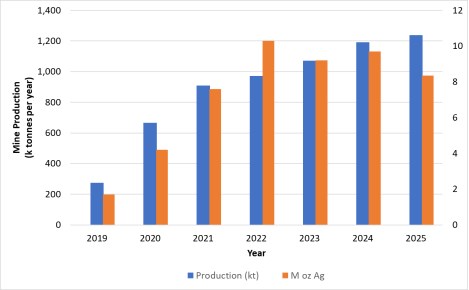
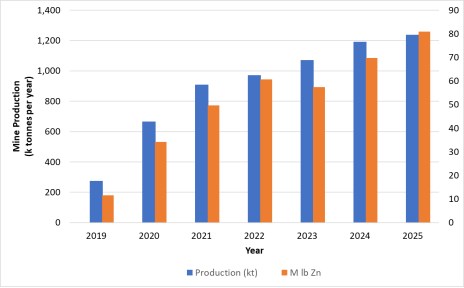
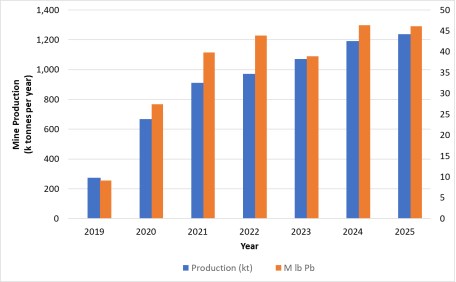
Geological Setting, Mineralization and Deposit Types
The Los Gatos Silver Mine and Esther deposits are embedded within andesites of the Lower Volcanic Series ("LVS") of the SM Occidental volcanic province. On the Los Gatos Joint Venture concessions, the LVS is exposed in a horst feature that stretches from the Los Gatos Silver Mine deposit approximately 25 km to the northwest to the edge of the concession package.
The Los Gatos Silver Mine is an intermediate sulphidation epithermal vein developed within a listric fault zone. Mineralization at the Los Gatos Silver Mine is characterized by silver, lead, zinc, and copper sulphides and their corresponding oxides, along with fluorite, manganese, barite, and traces of gold associated with quartz and calcite veins. The veins vary in orientation from West-Northwest to North-Northwest and vary in thickness up to 25 m.
The Los Gatos Silver Mine deposit is a listric-shaped mineralized horizon hosting steeply to shallowly dipping mineralized-shoots at depth. Mineralization of interest occurs for approximately 1,800 m in length, between an elevation varying roughly between 700 masl and 1,400 masl. The top of the mineralized horizon at the Los Gatos Silver Mine is generally located at an elevation of 1,400 masl. The natural topographic surface is in the order of 1,570 masl ± 50 masl.
The veins at the Los Gatos Silver Mine contain silver, zinc, and lead. Lower concentrations of gold and copper are also associated with the veining. Silver mineralization occurs dominantly as acanthite (argentite) and native silver. Zinc mineralization occurs as sphalerite, zinc silicates and zinc carbonates of variable grain sizes disseminated in quartz vein material, as open-space filling in cavities, and as replacements in the andesitic and dacitic flow units. Sphalerite ranges from yellow to brown in color and is deposited in a similar style but is not always associated with the galena mineralization. Zinc oxides after sphalerite also exists down along fault structures through the deposit. Lead mineralization occurs primarily as galena and lead oxide minerals of varying grain sizes that are disseminated in quartz vein material, as open-space filling in cavities, and as replacements in the andesitic and dacitic flow units. Copper mineralization occurs dominantly as chalcopyrite disseminated within quartz veins. Various other copper minerals are present in trace amounts including azurite, malachite, covellite, chalcocite and native copper. Gold mineral species have not been identified visually but are present in small quantities in assay results.
Exploration
Detailed mapping and rock geochemistry has been completed from 2022 to 2025 on various exploration targets on the Los Gatos Joint Venture concession package outside the Los Gatos Silver Mine and Esther zones.
During 2023, the first phase of a Magneto-Telluric study was completed over the Los Gatos Silver Mine and the Los Gatos fault to the northwest and southeast. The intent of this survey was to attempt to identify structures within the basin that may indicate accumulations of mineralization similar to South-East Deeps.
Regional scale geologic mapping has been conducted over areas of the Los Gatos concession where the Los Gatos Joint Venture controls the surface rights utilizing both local staff from MPR and independent contractors. Limited areas of detailed surface mapping exist in the immediate vicinity of the Esther and the Los Gatos Silver Mine deposits.
During 2023, a drone LiDAR and air photo survey was completed over the Ojito ranch approximately 20 km northwest of the Los Gatos Silver Mine operation. The intent of this survey was to prioritize geological mapping targets. During 2024, drone surveys were carried out along the Los Gatos fault area between the Los Gatos Silver Mine and San Luis and in the Los Veranos area.
Drilling
Exploration at the Los Gatos Silver Mine by MPR has been completed primarily by diamond drilling.
Since the acquisition of Los Gatos by MPR, several drilling campaigns have been carried out with different objectives. As of December 31, 2025, approximately 647,000 m of drilling has been completed at the Los Gatos Joint Venture concessions
During 2025 a total of approximately 50,000 m were drilled.
Sampling Analysis and Data Verification
At Los Gatos only diamond drill holes core samples have been used for resource estimation purposes.
Sample intervals are selected only where the geologist recognizes mineralization. In practice, the core is extensively sampled above the hanging wall and below the footwall on either side of the mineralized zone. Samples are constrained to a minimum length of 80 cm and a maximum of 10 m. Surface drilling is dominantly assayed at 2.0 m intervals with underground ("UG") drill core dominantly sampled on 1.5 m intervals. Samples are selected by the geologist as representative for each lithology; however, in the presence of hydrothermal veins and hydrothermal breccias, samples are taken every two metres, unlike the country rock where only representative samples are taken. Geologists mark a cut line along the core to ensure adequate representation of the style of mineralization. A sample sheet is provided to the core cutter containing sample numbers and the "from - to" intervals. NQ and HQ core is sawn in half along its long axis with an electric diamond saw. One half is bagged while the remaining half of the core is stored at the Geological core shack for further geological characterization and storage. The smaller 42 mm diameter core from the UG Termite drill rigs is whole core sampled.
Samples of holes drilled from surface are sent to ALS Chemex in Chihuahua, Mexico for mechanical preparation. After preparation, samples are sent to ALS Vancouver for chemical assay. After analysis, pulp samples are returned to the Los Gatos Silver Mine and stored in a secured core storage facility in San José del Sitio, Chihuahua, Mexico.
Core samples from the underground drilling programs undergo mechanical preparation and analysis at an onsite laboratory at the mine.
At ALS samples are dried at 105°C, crushed 70% passing 2 mm, and split into a 250 g subsample and pulverized to 85% passing 75 μm. Samples are analyzed by Ag, Pb, Zn, Cu using four acid digestion inductively coupled plasma - atomic emission spectroscopy (ICP61). Samples with Ag greater than 100 g/t Ag, 1% Pb, Zn, Cu are analyzed by four acids inductively coupled plasma - atomic emission spectroscopy (OG62). Samples with Ag values exceeding 1,500 g/t are analyzed using fire assay with gravimetric finish (GRA21). Samples are analyzed for Au using fire assay with atomic absorption spectroscopy finish (AA23) with a re-run for values exceeding 10 g/t Au, using fire assay with gravimetric finish (GRA21).
At the Los Gatos Silver Mine, laboratory samples are dried at 105 °C, crushed 75% passing 2 mm, split into a 300 g subsample and pulverized to 85% passing 75 μm. Samples are analyzed by Ag using Fire Assay Atomic Spectrometry. Samples are analyzed by Pb, Zn, Cu and Fe using 2-acid digestion with atomic absorption finish.
ALS Chemex Chihuahua is independent of First Majestic and is ISO 17025 accredited. The accreditation of ALS Vancouver encompasses preparation processes completed at ALS Chemex Chihuahua.
The Los Gatos Silver Mine laboratory is not certified and it is not an independent, third-party laboratory.
Sample assays reported by ALS and Los Gatos Silver Mine laboratory are subject to a comprehensive QA/QC program for monitoring Ag, Au, Pb and Zn. The QA/QC procedure includes insertion of control samples to monitor precision, accuracy and contamination for the sampling, mechanical preparation, and assaying stages. Since 2008, the QA/QC controls include pulp blanks, CRMs (Standards) and field duplicates. Since 2022, coarse and pulp duplicates are inserted. All quality control results are assessed using statistical analysis and visual inspection of control plots.
The data verification completed to support the 2025 mineral resource estimate includes a detailed internal review of all drilling, surface and underground, that was to be used in the Mineral Resource estimate. This review entailed validating the database geochemical analysis values for Ag, Zn, Pb and Au back to original assay certificate from the relevant laboratory, Los Gatos Silver Mine or ALS-Chemex. The complete UG and surface assay databases were validated against original assay certificates. No significant errors were found during the verification programs. The data verification for the data used for the Resource model adequately support the geological interpretations, and the analytical and database quality; and therefore, support the use of the data in Mineral Resource estimation.
Mineral Processing and Metallurgical Testing
From 2021 to 2025, the Los Gatos geometallurgy team analyzed 1,070 samples to refine the short-term block model. This included flotation tests on 185 drill core samples (109 analyzed for mineralogy) and 885 underground channel samples. Representativeness was assessed by comparing unprocessed samples to drill core data, confirming they reflected resource and reserve characteristics.
Since 2022, mineralogical studies have examined variability, with 109 geometallurgical samples analyzed at SGS Canada in 2025. Zinc was primarily found as sphalerite, hemimorphite, and chlorite, with sphalerite being >80% liberated. Galena was 79% free, with the remainder tied to sphalerite, pyrite, and gangue minerals. Spatial mapping showed hemimorphite concentrated in the Central and SE zones, while sphalerite varied. Zinc in oxide, silicate, and carbonate forms was deemed unrecoverable by flotation, and reducing pyrite in bulk Cu/Pb concentrates could improve quality.
Summary of Mineral Resource and Mineral Reserve Estimates
Mineral Resource Estimates
All Mineral Resource estimates at Los Gatos were completed using block modeling techniques. The Mineral Resource estimates are constrained by the three-dimensional geological interpretation and modelled domains for vein-hosted mineral deposits. Resource geologists constructed the modelled domains using information collected by mine geology staff and interpretations by geologists. Information used included underground geological mapping, drill hole logs and drill hole assays, production channel sampling and assays. The interpreted boundaries of the domain models strictly adhered to the contacts of mineralized veins with the surrounding country rock to produce reasonable representations of the deposit locations and volumes.
Exploratory data analysis and geostatistical analysis were completed on the raw and composite datasets to help define the interpolation parameters and Mineral Resource classifications. The Mineral Resources were estimated into sub-block models. Block grades were estimated using ID3 and nested search passes with outlier capping, variography, and estimation plan defined per each estimation domain.
The Mineral Resource estimates were classified into Measured, Indicated, or Inferred categories based on the confidence in the geological interpretation and models, the confidence in the continuity of metal grades, the sample support for the estimation and reliability of the sample data, and on the presence of underground mining development providing detailed mapping and production channel sample support. Block model estimate to mine claim reconciliation has shown estimation performance within industry-expected ranges.
Mineral Resources were constrained based on a stope optimization that considered economic NSR cut-off value, price, mining costs, infrastructure constraints, and mining licenses. For the cut-off definition, a NSR calculation was used for generation of the stope optimization shapes.
The Mineral Resource estimates for the Los Gatos Silver Mine and the Esther project are summarized in Table 20 and 21 and are reported on a 70% First Majestic attributable basis. Measured and Indicated Mineral Resources, reported inclusive of Mineral Reserves, have an effective date of December 31, 2025 and reflect mining depletion through that date. Mineral Resources that are not Mineral Reserves do not have demonstrated economic viability.
From December 31, 2024 to December 31, 2025, the tonnes and contained metal have increased and the percentage changes to the Measured and Indicated and Inferred Mineral Resource estimates are shown in Figure 6. These changes are primarily attributable to mining depletion, resource additions from exploration drilling at depth, drilling-driven conversion of Inferred to Indicated Mineral Resources, and lower NSR cut-off values resulting from updated economic parameters including costs, recoveries, and metal prices.
Figure 6: Year-over-Year Change in Mineral Resources 2024-2025
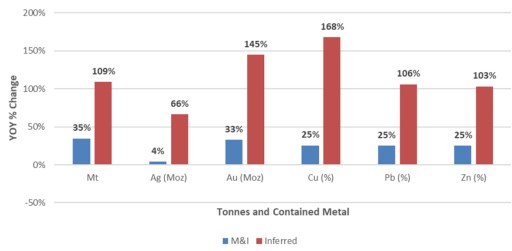
Table 20: Los Gatos Mineral Resource Estimates, Measured and Indicated Category Effective Date
December 31, 2025 (70% First Majestic Attributable Basis)
| Category / Area | Mineral Type | Tonnage | Grades | Metal Content | ||||||||||
| Mt | Ag (g/t) | Au (g/t) | Cu (%) | Pb (%) | Zn (%) | AgEq (g/t) | Ag (Moz) | Au (Moz) | Cu (Mlb) | Pb (Mlb) | Zn (Mlb) | AgEq (Moz) | ||
| Measured Los Gatos (UG) | All Mineral Types | 1.80 | 314 | 0.35 | 0.11 | 2.65 | 5.00 | 464 | 18.14 | 0.02 | 4.27 | 104.81 | 198.09 | 26.78 |
| Total Measured (UG) | All Mineral Types | 1.80 | 314 | 0.36 | 0.11 | 2.64 | 4.99 | 463 | 18.14 | 0.02 | 4.27 | 104.81 | 198.09 | 26.78 |
| Indicated Los Gatos (UG) | All Mineral Types | 6.26 | 113 | 0.24 | 0.29 | 2.38 | 4.41 | 254 | 22.67 | 0.05 | 39.31 | 328.29 | 608.43 | 51.06 |
| Indicated Esther (UG) | All Mineral Types | 0.41 | 118 | 0.13 | 0.05 | 1.90 | 4.01 | 225 | 1.54 | 0.00 | 0.42 | 17.07 | 36.04 | 2.94 |
| Total Indicated (UG) | All Mineral Types | 6.67 | 113 | 0.24 | 0.27 | 2.35 | 4.39 | 252 | 24.22 | 0.05 | 39.73 | 345.36 | 644.47 | 54.00 |
| Measured + Indicated Los Gatos (UG) | All Mineral Types | 8.05 | 158 | 0.26 | 0.25 | 2.44 | 4.54 | 301 | 40.81 | 0.07 | 43.58 | 433.10 | 806.51 | 77.84 |
| Measured + Indicated Esther (UG) | All Mineral Types | 0.41 | 118 | 0.13 | 0.05 | 1.90 | 4.01 | 225 | 1.54 | 0.00 | 0.42 | 17.07 | 36.04 | 2.94 |
| Total Measured + Indicated (UG) | All Mineral Types | 8.46 | 156 | 0.26 | 0.24 | 2.41 | 4.52 | 297 | 42.35 | 0.07 | 44.00 | 450.17 | 842.56 | 80.78 |
Table 21: Los Gatos Mineral Resource Estimates, Inferred Category Effective Date December 31, 2025 (70% First
Majestic Attributable Basis)
| Category / Area | Mineral Type | Tonnage | Grades | Metal Content | ||||||||||
| Mt | Ag (g/t) | Au (g/t) | Cu (%) | Pb (%) | Zn (%) | AgEq (g/t) | Ag (Moz) | Au (Moz) | Cu (Mlb) | Pb (Mlb) | Zn (Mlb) | AgEq (Moz) | ||
| Inferred Los Gatos (UG) | All Mineral Types | 2.88 | 75 | 0.21 | 0.28 | 1.94 | 4.17 | 202 | 6.94 | 0.02 | 17.51 | 123.17 | 265.24 | 18.77 |
| Inferred Esther (UG) | All Mineral Types | 1.18 | 100 | 0.09 | 0.05 | 1.39 | 3.17 | 182 | 3.77 | 0.00 | 1.28 | 36.03 | 82.07 | 6.86 |
| Total Inferred (UG) | All Mineral Types | 4.06 | 82 | 0.19 | 0.21 | 1.78 | 3.88 | 196 | 10.71 | 0.02 | 18.80 | 159.20 | 347.30 | 25.63 |
Notes:
1. Mineral Resource estimates are classified per CIM Definition Standards and NI 43-101.
2. Mineral Resource estimates are based on estimates with an effective date of December 31, 2025, and reflect mining depletion through December 31, 2025.
3. Mineral Resources estimates are reported on a 70% FMS attributable basis.
4. The Mineral Resource estimates were prepared under the supervision of, or were reviewed by, David Rowe, CPG, the Company's Director of Mineral Development and the "Qualified Person" (as such term is defined in NI 43-101) responsible for the above Mineral Resource estimates.
5. AgEq is calculated as follows:
AgEq = Ag Grade + Au Grade *(Au Recovery x Au Payable x Au Price) / (Ag Recovery x Ag Payable x Ag Price)+ Cu Grade*(Cu Recovery x Cu Payable x Cu Price x 685.7) / (Ag Recovery x Ag Payable x Ag Price) + Pb Grade*(Pb Recovery x Pb Payable x Pb Price x 685.7) / (Ag Recovery x Ag Payable x Ag Price) + Zn Grade*(Zn Recovery x Zn Payable x Zn Price x 685.7) / (Ag Recovery x Ag Payable x Ag Price)
6. Metal prices considered for all Mineral Resources estimates were $38.50/oz Ag, $3,400/oz Au, $1.05/lb Pb, $1.40/lb Zn and $4.75/lb Cu.
7. Metallurgical recoveries used varied depending on the concentrate recovered and varied from 83.98 - 88.5% Ag, 69.61 - 70.96% Zn, 54.36 - 55.53% Au, 89.15 - 91.74% Pb and 85.14-99.06% Cu.
8. NSR cut-off value considered to constrain resources assumed an underground operation was $61.09/t and was based on actual and budgeted operating and sustaining costs.
9. Mineral Resources are reported within mineable stope shapes using the NSR cut-off value calculated using the stated metal prices and metal recoveries. The NSR cut-off includes mill recoveries and payable metal factors appropriate to the existing processing circuit.
10. No dilution was applied to the Mineral Resource which are reported on an in-situ basis.
11. Tonnage is expressed in millions of tonnes; metal content is expressed in millions of ounces for gold, silver and AgEq, and millions of pounds for copper, lead and zinc. Totals may not add up due to rounding.
12. Measured and Indicated Mineral Resources are reported inclusive of Mineral Reserves. Mineral Resources that are not Mineral Reserves do not have demonstrated economic viability.
For risk factors that could materially impact the Mineral Resource estimates, see "Risk Factors - Operational Risks - Uncertainty in the Estimation of Mineral Resources and Mineral Reserves".
Mineral Reserve Estimates
The Los Gatos Silver Mine assigned block NSR values to the resource block model for three processing recovery/revenue/cost outcomes, differentiated by the Pb/Cu ratio:
The Los Gatos Silver Mine used NSR cut-offs to estimate the Mineral Reserve. The NSR cut-off represents the minimum value that a tonne of mineralized material must generate, considering on-site costs related to mining and processing, to ensure economic viability. This value ensures that only material which can be mined profitably is included in the reserve estimate. For this analysis, six NSR cut-offs were applied, corresponding to three different mining methods and two cost allocation approaches.
Mining recovery and unplanned dilution of host rock were estimated considering the selected mining method, the dip and width of the vein, and the influence of a significant hanging wall fault. In addition, dilution from backfill was evaluated based on the mining method employed and the type of backfill material used.
The Mineable Shape Optimizer algorithm, integrated within Deswik mine design software, was employed to generate preliminary stope solids. This process identified the potentially mineable portions of the Mineral Resource that may qualify for inclusion in the Mineral Reserve.
From December 31, 2024 to December 31, 2025, the Proven and Probable Mineral Reserves estimates for Los Gatos increased 37% in terms of tonnage, decreased 3% in terms of silver metal content, increased 21% in terms of gold metal content, and increased 21%, 18% and 17% in copper, lead and zinc content, respectively.
Table 22 presents the Mineral Reserve estimate for the Los Gatos Silver Mine as of December 31, 2025. The estimates are reported on a 70% ownership basis.
Table 22: Los Gatos Mineral Reserve Estimates
(Effective Date: December 31, 2025) (70% First Majestic Attributable Basis)
| Category / Area | Mineral Type | Tonnage | Grades | Metal Content | ||||||||||
| Mt | Ag (g/t) | Au (g/t) | Cu (%) | Pb (%) | Zn (%) | AgEq (g/t) | Ag (Moz) | Au (Moz) | Cu (Mlb) | Pb (Mlb) | Zn (Mlb) | AgEq (Moz) | ||
| Proven CLG (UG) | All Types | 1.97 | 231 | 0.25 | 0.07 | 1.85 | 3.51 | 332 | 14.57 | 0.016 | 3.23 | 80.08 | 152.03 | 21.02 |
| Total Proven (UG) | All Types | 1.97 | 231 | 0.25 | 0.07 | 1.85 | 3.51 | 332 | 14.57 | 0.016 | 3.23 | 80.08 | 152.03 | 21.02 |
| Probable CLG (UG) | All Types | 7.59 | 85 | 0.17 | 0.21 | 1.74 | 3.19 | 185 | 20.70 | 0.042 | 35.88 | 291.33 | 533.89 | 45.11 |
| Total Probable (UG) | All Types | 7.59 | 85 | 0.17 | 0.21 | 1.74 | 3.19 | 185 | 20.70 | 0.042 | 35.88 | 291.33 | 533.89 | 45.11 |
| Proven + Probabled CLG (UG) | All Types | 9.55 | 115 | 0.19 | 0.19 | 1.76 | 3.26 | 215 | 35.28 | 0.058 | 39.10 | 371.41 | 685.92 | 66.13 |
| Total Proven + Probable (UG) | All Types | 9.55 | 115 | 0.19 | 0.19 | 1.76 | 3.26 | 215 | 35.28 | 0.058 | 39.10 | 371.41 | 685.92 | 66.13 |
1. Mineral Reserves are classified per CIM Definition Standards and NI 43-101.
2. Mineral Reserves are effective December 31, 2025, are reported on a 70% FMS attributable basis, and are reported with a reference point of mined ore delivered to the plant.
3. The Mineral Reserve estimates were prepared under the supervision of, or were reviewed by, Andrew Pocock, P.Eng., the Company’s Director, Technical Services and the “Qualified Person” (as such term is defined in NI 43-101) responsible for the above Mineral Reserve estimates.
4. Mineral Reserves are reported within stope shapes using a variable cut-off basis with an Ag price of US$35/oz, Zn price of US$1.25/lb, Pb price of US$0.95/lb, Au price of US$3,100/oz and Cu price of US$4.35/lb. Metallurgical recoveries used in the NSR calculation for generation of the stope solids vary based on the block Pb:Cu ratio. For a Pb:Cu ratio >15 the NSR metallurgical recovery parameters were 84% Ag, 69.6% Zn, 89.15% Pb, 54.4% Au and 85.14% Cu, for Pb:Cu of >7 and <15, the NSR metallurgical recovery parameters were 84% Ag, 69.6% Zn, 89.15% Pb, 54.4% Au and 85.14% Cu and for Pb:Cu ratio of <7 the NSR metallurgical recovery parameters used were 88.5% Ag, 71% Zn, 91.74% Pb, 55.5% Au and 99% Cu. The payability used in the economic analysis vary based on the block Pb:Cu ratio. For a Pb:Cu ratio >15 the payability parameters were 92% Ag, 77% Zn, 94% Pb, 84% Au and 0% Cu, for Pb:Cu of >7 and <15, the payability parameters were 92% Ag, 77% Zn, 94% Pb, 84% Au and 37% Cu and for Pb:Cu ratio of <7 the NSR payability parameters used were 92% Ag, 74% Zn, 92% Pb, 85% Au and 69% Cu.
5. Metal Content (MC) is calculated as follows:
• Zn, Pb and Cu, MC (Mlb) = Tonnage (Mt) * Grade (%) / 100 * 2204.6
• Ag and Au, MC (Moz) = Tonnage (Mt) * Grade (g/t) / 31.1035; multiply Au MC (Moz) by 1000 to obtain Au MC (koz)
6. AgEq grade in g/t is calculated as follows:
• AgEq = Ag Grade + Au Grade *(Au Recovery x Au Payable x Au Price) / (Ag Recovery x Ag Payable x Ag Price)+ Cu Grade*(Cu Recovery x Cu Payable x Cu Price x 685.7) / (Ag Recovery x Ag Payable x Ag Price) + Pb Grade*(Pb Recovery x Pb Payable x Pb Price x 685.7) / (Ag Recovery x Ag Payable x Ag Price) + Zn Grade*(Zn Recovery x Zn Payable x Zn Price x 685.7) / (Ag Recovery x Ag Payable x Ag Price)
7. Modifying factors for conversion of Mineral Resources to Mineral Reserves include, but are not limited to, consideration for mining methods, mining recovery, dilution, sterilization, depletion, cut-off grades, geotechnical conditions, metallurgical factors, infrastructure, operability, safety, environmental, regulatory, social and legal factors. These factors were applied to produce mineable stope shapes.
8. Tonnage is expressed in millions of tonnes; metal content is expressed in millions of ounces for gold, silver and silver equivalent, and millions of pounds for copper, lead and zinc, prices/costs in US$. Totals may not add up due to rounding.
For risk factors that could materially impact the Mineral Reserves estimates, see "Risk Factors - Operational Risks - Uncertainty in the Estimation of Mineral Resources and Mineral Reserves".
The Company is not aware of any known mining, metallurgical, environmental, permitting, legal, title, taxation, socio-economic, marketing, political, or other relevant factors that could materially affect the Mineral Reserve estimates, other than discussed herein.
Mining Operations
The Los Gatos Silver Mine is an underground mine that produces Ag, Zn, and Pb, with Au and Cu as by-products. The orebody is characterized by high-grade polymetallic sulphide mineralization in an epithermal vein-style deposit. The deposit consists of four zones called the Northwest ("NW"), Central, Southeast Upper, and Southeast ("SE") zones. The Los Gatos Silver Mine effectively addresses several challenges in developing and operating the underground mine, including groundwater management, temperature regulation, and ground control.
The ground conditions in parts of the deposit are adversely affected by proximity to a major hanging wall fault called the Los Gatos fault. This major basin boundary fault ranges from centimetres to tens of metres in width. While the fault itself does not host mineralization, in areas where the mineralized veins are located adjacent to the structure, mining and ground support methods need to be adapted to limit mining dilution and increase mining recovery.
Geotechnical engineers at the Los Gatos Silver Mine have developed a rock support system which is applied to development headings (ramps and drifts), cut-and-fill stopes, longhole stopes, and pillars. The WSP QP has engaged a highly experienced geotechnical engineer to review the rock support designs and who has visited the mine to observe installed rock support and the behaviour of the standing rock mass. Discussions have been held with the Los Gatos Silver Mine technical staff to investigate rock mechanics challenges and identify and mitigate excavation risks.
Various combinations of rock bolts, welded-wire fabric (mesh), shotcrete and cable bolts are utilized in the mine. In addition, stope voids are backfilled with cemented backfill to provide support for remnant pillars and stope spans.
Rock support in the Los Gatos Silver Mine is complicated by major fault structures intersecting the mineralized veins at oblique and high angles. Engineers have applied specific mining methods and rock support techniques to provide secure and safe mine openings.
The unmined rock above the uppermost stopes is referred to as the crown pillar. At the Los Gatos Silver Mine the crown pillar has been evaluated for stability, probability of failure and likelihood of surface subsidence. Since the mineralized veins peter out many tens of metres from the topographic surface and the stopes will be backfilled, there is very little to no likelihood of crown pillar failures, nor of surface subsidence, along the strike of the deposit. The QP is of the opinion that the rock support designs and installation protocols employed by the Los Gatos Silver Mine are adequate to manage the natural and induced stresses in the rock mass and are consistent with observed rock support strategies in mines of similar mining techniques and rock conditions.
The Los Gatos Silver Mine deposit is characterised by the Los Gatos Fault ("LGF") and a number of cross faults, including the Falla Aportadora NW, which is a major water-bearing structure. Of the six identified hydrogeological units identified at the Los Gatos Silver Mine, the central gouge zone of the LGF and less-fractured rock masses distal to the fault zones are considered to be of relatively lower permeability. The fractured rock masses on either side of the LGF and areas where cross faults intersect the LGF are considered to be of relatively higher permeability and to be favorable conduits for groundwater flow.
Water flows into the mining area from two sources - rainwater through epiclastics and fracture zones, and upswelling thermal waters via the Lower Gatos Fault.
The strategy for managing water at the Los Gatos Silver Mine is to draw down the water table and thus minimize the rate of inflow of groundwater. The original topographic surface of the Los Gatos Silver Mine deposit ranges from 1,571 to 1,624 masl. The natural water table was at 1,400 masl and inflows occur below 1,450 masl. A series of 18 wells were drilled from surface to establish dewatering wells and piezometer stations. Once underground development began, additional wells were drilled from underground bays to intercept groundwater within the rock mass before it flowed into the mine for the dual purpose of lowering the water table and reducing the temperature gradient in the mine. Wells have been drilled and pumps installed in the NW and Central zones with more planned in the SE zones as the mine deepens.
The QP observes that mining productivity and mine development rates increase when the water table has been drawn down below the mining horizon in advance of excavations.
The Los Gatos Silver Mine deposit is situated within a regional aquifer, which poses significant challenges for controlling groundwater inflows into the underground workings. The Los Gatos Silver Mine employs two dewatering systems to manage the groundwater:
The Mineral Reserve estimate is based on a detailed mine design and production schedule, both of which were developed using Deswik software. The design process began with the establishment of key criteria for stope production and mine development, ensuring that the mining methods and development sequence align with the overall project objectives and economic constraints.
The Los Gatos Silver Mine employs two primary mining methods: CAF and LHS. The selection between these methods is determined by the geotechnical characteristics of the mineralization and surrounding host rock. These methods are implemented in either longitudinal or transverse orientations, depending on the vein width and geometry.
The mine infrastructure is as follows:
The Los Gatos Silver Mine operates as a fully mechanized mine, utilizing rubber-tired, diesel-powered equipment for all phases of its mining operations. The current fleet includes the following:
As of December 31, 2025, the mine department employed a total of 316 individuals. The underground mine operates on a two-shift schedule, with each shift working 10-hours per day. The workforce is organized into three rotational crews, each working 14 days on followed by 7 days off. At any given time, two of the three crews are present onsite, ensuring continuous operation.
The current LOM plan projects that the Los Gatos Silver Mine will remain in operation for 9.4 years1 from January 1, 2026, with production continuing until Q1 of 2035. Over this period, the mine's average annual production is estimated at approximately 1.4 Mt.
Processing and Recovery Operations
The processing plant at Los Gatos Silver Mine employs a conventional flotation-based process typical of base metal operations. The installed plant capacity was originally designed for 2,500 tpd; however, recent throughput levels have increased to an average of 3,915 tonnes per calendar day from January to June 2025, with the 2025 LOM plan targeting an average of 3,950 tonnes per calendar day and a nominal rate of 4,100 tonnes per operating day.
The processing plant is built as a single train with the crushing area separated from the remaining sections. The crushing circuit includes a jaw crusher, a semi autogenous grinding mill, and a ball mill, which collectively feed the flotation circuit. The flotation process consists of lead and zinc flotation circuits, including rougher, regrind, and cleaner stages, followed by lead and zinc concentrate thickening and tailings thickening.
Since operations began in 2019, the primary sources of processed material have been the Central and NW zones. Over the remaining Reserve life, increasing contributions from the SE zone are expected. No significant changes in ore characteristics are anticipated, and the throughput and recovery assumptions applied for future processing are considered reasonable for the LOM. The plant equipment sizing remains robust for the projected throughput.
In early 2023, a fluorine leach circuit was constructed and began operations in June 2023. This circuit is designed to reduce fluorine content in the zinc concentrate to approximately 500 ppm, which has been consistently achieved. Minor silver and zinc losses occur during the leaching process, which have been accounted for in plant production calculations.
Infrastructure, Permitting and Compliance Activities
Infrastructure
The Los Gatos Silver Mine is an operating mine with significant existing infrastructure in place supporting the operation, including offsite and onsite components. Existing offsite infrastructure comprises grid power distribution to the mine and previously completed road upgrades to facilitate heavy equipment transport during construction, material deliveries and concentrate shipments, in addition to worker traffic. On site infrastructure is comprised of office and maintenance facilities, processing facilities, a TSF, backfill plants, a refrigeration plant, a mine ventilation system, and dewatering ponds for sediment settling and water cooling. The operation also includes two personnel camps.
________________________________
1 The LOM stated in the Los Gatos Technical Report was 8.3 years from the effective date of the report, being July 1, 2024, with production until Q4 2032. First Majestic has updated the LOM to reflect current information and Mr. Andrew Pocock, P.Eng., the Company’s Director, Technical Services, has assumed responsibility as a “Qualified Person” (as defined under NI 43-101) for the updated LOM reflected in this AIF.
In 2022, the Los Gatos Silver Mine entered into a power purchase agreement to source the entirety of the mine's energy from the solar energy producer Energía Solar de Poniente. This agreement covers all electricity needs of the site, sourcing all site power from a photovoltaic power plant located in Matamoros, Coahuila. In November 2025, MPR signed a new power purchase agreement with CFE for the provision of LNG-generated energy for the Los Gatos Silver Mine, commencing in March 2026. Accordingly, since March 1, 2026, CFE has been the sole provider of all electricity for the Los Gatos Silver Mine, with such power being generated from LNG.
The underground mine operates three air extractive fans to exhaust spent air, with fresh air intake via the decline ramp and two downcast fresh air raises equipped with refrigeration plants and air coolers. The current installed capacity of the ventilation system is 1.3 M cubic feet per minute, and plans are in place for an expansion to provide fresh air to the SE zone.
The mine dewatering system consists of both surface and underground infrastructure. None of the dewatering wells drilled from surface are currently active, as the water table is now beneath the effective depth of those wells. There are currently five main underground wells in the NW zone, with two more under development. Two underground wells are present in the Central zone. As the mine expands, capital has been allocated for the anticipated additional dewatering infrastructure in the NW, Central and SE zones that will be required to manage the water underground.
Site infrastructure in addition to production-related installations are typical of a mining operation of this scale, located some distance from supporting populations, and include a concrete batch plant, maintenance shops, administration and engineering building, mine dry for underground personnel, warehouse facilities, security guard house and gates, residential camps and cafeterias.
The Los Gatos Silver Mine TSF has been constructed, and tailings have been deposited in the facility since 2019. Regular dam raises have been constructed to increase the volume of the TSF. The material used in the dam construction is mostly rockfill with some screened filter material. All TSF stages are built using local borrow materials, primarily rockfill excavated and blasted from foundation material within the TSF. The TSF uses downstream construction methods.
The tailings dam has a composite liner consisting of geosynthetic clay liner overlain by a 1.5 mm (60-mil), Linear Low-density Polyethylene geomembrane. The liner extends along the base of the impoundment and the embankment's upstream slope and anchored along the edges of each concurrent construction stage. The lining system is placed on a 0.15 m thick bedding fill.
The original permitted TSF design consists of four Stages (I to IV) with an ultimate crest elevation of 1638.0 m. However, due to a change in the tailings delivery rate to the TSF with the commissioning of the paste plant in the fourth quarter of 2022, the ultimate TSF is planned to have a maximum crest elevation of 1,636.0 m (Stage III) which is adequate for the revised and reduced volume of tailings to be stored based on the Mineral Reserve and LOM plan.
To date, five dam raises have been constructed to the existing crest elevation of 1,631 m. The LOM plan requires one additional 7-metre raise to be built during 2027 to 2028 to a final maximum crest elevation of 1,638 m. The most recent raise completed allows storage for 8.9 Mt of processed material starting September 2025 onwards. 40% of the tailings in the LOM are planned to be sent back to the mine in the form of paste backfill, while the remaining 60% will be sent to the TSF.
The TSF design criteria were established based on the facility size and risk using applicable dam safety and water quality regulations and industry best practice for the TSF embankment on a standalone basis. The dam has a blanket drain in the foundation to control and reduce the water level in the dam due to any infiltration that could occur. Incorporating the blanket drain is expected to improve the stability of the embankment in the event of liner failure. The TSF has an Operations, Maintenance, and Surveillance Manual that describes operating and monitoring procedures to confirm the condition of the embankment, foundation, and performance of the TSF dam and impoundment. Regular TSF inspections are completed, including annual inspections by the Engineer of Record.
Permitting and Compliance
Mexico has established environmental laws and regulations that apply to the development, construction, operation and closure of mining projects, and the Company has management systems in place to ensure ongoing regulatory compliance. Of particular importance are the air, surface water and groundwater quality monitoring programs. An environmental compliance report is submitted annually to the Mexican environmental authority. There are no outstanding violations issued by the environmental authority against MPR.
The Company has all material permits for the current operations. The Company is waiting on the final resolution document for a permit regarding the use of treated water from the personnel camp sewage treatment facilities. This pending permit document is not a material risk for the current operations at the Los Gatos Silver Mine.
MPR has produced several social baseline studies that collected information from official statistical sources, as well as interviews and participatory workshops with stakeholders and the local communities in the area of direct influence. The social baseline study was updated in 2023, with consultations carried out in nine communities. A detailed analysis to identify and characterize stakeholders was prepared. The information obtained has been used to identify social impacts in the communities, as well as social risks for the mining operations. The Company has mitigation measures in place for the highest priority social risks.
MPR has established a community relations office in the nearby town of San José del Sitio, which allows for a permanent point of contact between local communities and the mine. MPR has established various commitments for the hiring of local labour, as well as in the acquisition of services during the life of the project, through agreements with stakeholders. A total of 156 direct employees from the area of influence work for the Los Gatos Silver Mine.
A conceptual mine closure strategy was presented in the closure plan (Tetra Tech, 2018) that was submitted to the Mexican environmental authority. The closure cost estimate was updated at the end of 2023 based on disturbance areas and 2023 local rates for closure activities such as haulage, demolition and removal. The closure cost was estimated at $16.4 million.
Capital and Operating Costs
The projected amounts for sustaining capital in the LOM plan have been updated to an effective date of December 31, 2025 by First Majestic's QPs, as shown in Table 23 below, and relate to continuing underground mine development, installation of a copper-lead separation circuit, and two additional raises of the TSF dam, as well as other miscellaneous equipment and infrastructure projects. Sustaining capital is estimated in 2025 dollars with no inflation or escalation considered.
Table 23: Los Gatos Mining Capital Costs Summary (Sustaining Capital) ($ Million)
| Type | Total | 2026 | 2027 | 2028 | 2029 | 2030 | 2031 | 2032 | 2033 | 2034 | 2035 |
| Mine Development | $136.7 | $12.0 | $12.0 | $12.0 | $19.2 | $19.2 | $19.2 | $19.2 | $19.2 | $4.9 | |
| Property, Plant & Equipment | $115.7 | $11.9 | $12.4 | $12.4 | $12.4 | $12.4 | $12.4 | $12.4 | $12.4 | $12.4 | $4.8 |
| Total Sustaining Capital Costs | $252.4 | $23.9 | $24.4 | $24.4 | $31.5 | $31.5 | $31.5 | $31.6 | $31.5 | $17.2 | $4.8 |
| Near Mine Exploration | $21.7 | $2.4 | $2.3 | $2.3 | $2.2 | 2.2 | $2.1 | $2.1 | $2.1 | $2.0 | $2.0 |
| Total Capital Costs | $274.1 | $26.3 | $26.7 | $26.7 | $33.7 | $33.7 | $33.6 | $33.7 | $33.6 | $19.2 | $6.8 |
Operating cost estimates were developed based on recent actual costs with minor specific adjustments for business improvement initiatives that are currently being implemented. Operating costs are estimated in 2025 dollars with no inflation or escalation considered. They were prepared on an annual basis using a detailed buildup of individual cost centres and considering specific mine site activity levels and cost drivers. The plant has demonstrated typical operating costs for a facility of its size.
Operating cost expenditures for the LOM are estimated at $1,541.2 M from January 1, 2026 to the planned end of the mine's life in Q1 2035, equivalent to $112.9 per tonne milled (see Table 24 below).
Table 24: 2025 LOM Operating Costs ($/tonne)
| Type | $/tonne milled |
| Mining Cost | $43.8 |
| Processing Cost | $21.7 |
| Indirect Costs | $19.8 |
| Total Production Cost | $85.3 |
| Selling Cost | $27.6 |
| Total Cash Cost | $112.9 |
Note: Numbers may not necessarily add up due to rounding.
There are no expansion plans requiring development capital in the LOM plan.
Table 25 summarizes the expected site operating expenses projected to the end of mine life to mine and process the defined Mineral Reserve, segmented by major cost centre of Mining, Processing (which includes TSF operations), and General and Administrative.
Table 25: Los Gatos Annual Operating Costs ($ Million)
| Type | Total | 2026 | 2027 | 2028 | 2029 | 2030 | 2031 | 2032 | 2033 | 2034 | 2035 |
| Mining Cost | $598.0 | $61.3 | $64.0 | $64.1 | $64.0 | $64.0 | $64.0 | $64.1 | $64.0 | $64.0 | $24.6 |
| Processing Cost | $295.9 | $30.3 | $31.6 | $31.7 | $31.6 | $31.6 | $31.6 | 31.7 | $31.6 | $31.6 | $12.2 |
| Indirect Cost | $270.0 | $27.7 | $28.9 | $29.0 | $28.9 | $28.9 | $28.9 | $29.0 | $28.9 | $28.9 | $11.1 |
| Total Production Cost | $1,163.8 | $119.3 | $124.5 | $124.8 | $124.8 | $124.5 | $124.5 | $124.8 | $124.5 | $124.5 | $47.8 |
| Selling Costs | $377.4 | $38.7 | $40.4 | $40.5 | $40.4 | $40.4 | $40.4 | $40.5 | $40.4 | $40.4 | $15.5 |
| Total Cash Cost | $1,541.2 | $158.0 | $164.9 | $165.3 | $164.9 | $164.9 | $164.9 | $165.3 | $164.9 | $164.9 | $63.3 |
Exploration, Development and Production
The following general annual exploration drill programs were executed in 2025:
This amount of drilling is expected to continue on an annual basis while production continues but amounts required are reviewed annually. In addition, an annual prospect generation program consisting of prospecting, soil and rock geochemical surveys, mapping, or geophysical surveys is conducted.
During 2025, 1,239,240 tonnes of mineralized material were processed with an average grade of 240 g/t Ag, 0.23 g/t Au, 4% Zn, 2% Pb and 0.08% Cu.
Development continues in the Los Gatos Silver Mine preparing new extraction areas.
La Encantada Silver Mine, Coahuila State, Mexico
The following information on the La Encantada Silver Mine ("La Encantada mine") is based on a Technical Report prepared in accordance with NI 43‐101 and titled "La Encantada Silver Mine, State of Coahuila, Mexico, NI 43-101 Technical Report on Mineral Resource and Mineral Reserve Estimates" with an effective date of August 31, 2025 (the "La Encantada Technical Report"). Reference should be made to the full text of the La Encantada Technical Report which is available for review on the Company's profile on SEDAR+ at www.sedarplus.ca.
Project Description, Location and Access
La Encantada is owned and operated by Minera La Encantada S.A. de C.V. ("MLE") which is an indirect wholly-owned subsidiary of First Majestic. La Encantada is an actively producing silver mining complex located in the municipality of Ocampo, State of Coahuila, Mexico, approximately 120 km northwest of the city of Melchor Múzquiz, Coahuila and approximately 120 km north of the town of Ocampo, Coahuila and is centered on latitude 28°21.5'N and longitude 102°33.5'W. The property is located in the La Encantada mountain range which runs for about 45 km in the northwest-southeast direction and has elevations that vary from about 1,500 m to over 2,400 m.
Access to La Encantada is primarily by charter airplane from Durango city (about two hours flying time), or from the city of Torreón, Coahuila (about 1:15 hours flying time). MLE operates its own private airstrip at the La Encantada mine. Driving time from the city of Melchor Múzquiz is approximately 2.5 hours by asphalt road, about five hours from the town of Ocampo and about eight hours from the international airport in Torreón city. Mining operations can be conducted year-round at the La Encantada mine.
La Encantada consists of 22 exploitation concessions covering 4,076 ha, which are operated and owned by MLE. All 22 concessions are currently in good standing. The oldest of the concessions was granted in 1965 and the most recent in 2008. A 100% gross overriding royalty on the first 1,000 payable ounces of gold production at La Encantada is held by Royalty & Streaming Mexico SA de CV, which is owned by Metalla Royalty & Streaming Ltd. There are no other royalties to be paid on the La Encantada mining concessions, other than certain government royalties in the section "Taxation".
Surface rights in the area of the mining concessions are held both privately and through group ownership either as communal lands or Ejido lands. MLE owns surface rights covering 2,237 ha on the Canon del Regalado properties. This surface covers the following features: access to the mining complex, mine portals, grinding mill and flotation plant ("Plant No. 1"), cyanidation plant ("Plant No. 2"), tailings management facilities, the mine camp, offices, and an airstrip.
In 2011, the Tenochtitlán Ejido filed a lawsuit against MLE in agrarian court claiming title to 1,097 ha of the land owned by MLE. The initial lawsuit was decided in favour of MLE and was followed by a series of motions and appeals regarding judicial reviews of the subsequent rulings. However, on July 5, 2024, MLE was served notice of a decision, which declared that the disputed lands are the property of Ejido Tenochtitlán; however, the court ruled that the Company and the Ejido must reach an economic agreement, so the Company can continue using these Ejido lands. The Ejido needs to elect a new Board before MLE can enter into negotiations with the Ejido regarding use and access of the lands. MLE has strengthened its relationship with the Tenochtitlán Ejido in the meantime, and the Company does not believe that this matter poses a material risk to current operations at La Encantada.
On May 8, 2023, the Mexican government enacted the Decree amending several provisions of the Mining Law, the Law on National Waters, the Law on Ecological Equilibrium and Environmental Protection and the General Law for the Prevention and Integral Management of Waste, which became effective on May 9, 2023. These amendments may have an impact on the Company's current and future exploration activities and operations in Mexico and the extent of such impact is yet to be determined but could be material for the Company. For further information, see "Risk Factors - Operational Risks - Amendments to Mining and Other Related Laws in Mexico" in this AIF.
The remote location required the construction of substantial infrastructure. The La Encantada camp consists of 160 houses for accommodation of employees, offices, warehouses, a union hall, a church, a hospital, water purification plant, water treatment plant, water wells and an airstrip. Power supply to the mine, processing facilities and camp site is from diesel and natural gas generators provided by First Majestic. First Majestic also provides potable water. Most of the supplies and labour required for the operation are sourced from the city of Múzquiz, Coahuila, or directly from suppliers.
History
In 1967, Industrias Peñoles, S.A.B. de C.V. ("Peñoles") and Tormex Industrias S.A. de C.V. established a joint venture partnership, Minera La Encantada, to acquire and develop La Encantada. In July 2004, Peñoles awarded a contract to operate the La Encantada mine, including the processing plant and all mine infrastructure facilities, to the private Mexican company Desmin S.A. de C.V. ("Desmin"). Desmin operated the mine and processing plant until November 1, 2006, when First Majestic purchased all the outstanding shares of Desmin. Subsequently, First Majestic reached an agreement to acquire all the outstanding shares of MLE from Peñoles, and as a result, First Majestic is the sole owner of La Encantada and all its assets, including mineral rights, surface rights position, water rights, processing plants and ancillary facilities.
From November 2006 to June 2010, La Encantada operated a 1,000 tpd flotation plant. All production during this period from the flotation plant was in the form of a lead‐silver concentrate. In 2007, La Encantada commenced construction of a cyanidation plant with a capacity of 3,750 tpd, and in 2009 began producing precipitates and silver doré bars. Commercial production was achieved on April 1, 2010, and the flotation circuit was placed in care-and-maintenance in June 2010. During 2011, several modifications were made to the cyanidation plant increasing its capacity to 4,000 tpd. Since that time, the La Encantada operation has only produced doré bars.
During the period of 2010 to 2013, La Encantada reprocessed old tailings from the flotation circuit with approximately 1,000 tpd of ore feed from the underground mine for a combined throughput of 4,000 tpd. Starting in 2014, silver market economic conditions precluded the reprocessing of tailings, and only ore production from underground workings was fed to the mill and the cyanidation plant. In 2015, the plant was expanded to bring the crushing and grinding capacity to 3,400 tpd.
In 2017, La Encantada started the construction of a roasting facility with the objective of increasing recoveries when reprocessing tailings. In 2018, the main components of the roasting system were installed, and commissioning tests were started in the last quarter and continued into 2019. Observations from the commissioning tests revealed materials handling issues at the feed and discharge of the roasting system. Engineering work is in progress to analyze these issues to establish whether there is an option of processing tailings material economically.
Mine production tonnes and silver metal production since 2015 is summarised in Figure 7 below.
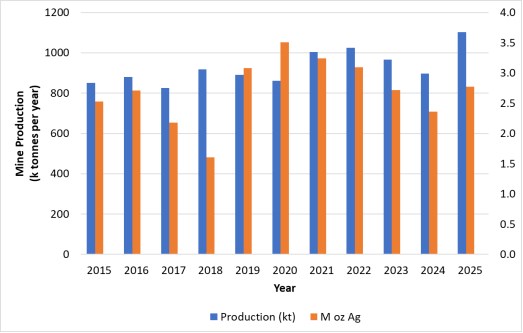
Figure 7: Mine and silver production since 2015
Geological Setting, Mineralization and Deposit Types
La Encantada is in the Sierra Madre Oriental ("SM Oriental") fold and thrust belt where Jurassic and the Cretaceous age Sabinas Basin carbonate rocks overlie the Paleozoic Coahuiltecano terrane. Northeast-southwest oriented compression during the Cretaceous to early Tertiary Laramide Orogeny deformed the Mesozoic sedimentary rocks into a series of north-northwest-trending folds and faults, which gave rise to the SM Orientalfold and thrust belt. Extension in the mid to late Tertiary was accompanied by widespread magmatism, with the related fault zones acting as conduits for the emplacement of shallow level intrusive rocks within the carbonate sedimentary sequence.
La Encantada consists of polymetallic (silver, iron, lead, and zinc) oxide carbonate replacement and tabular vein deposits hosted by Cretaceous carbonate sedimentary formations. At deeper structural levels, silver-gold-lead-zinc and sulphide mineralization are hosted in skarn alteration associated with a granodiorite intrusion.
A granodiorite stock, and rhyolite to basalt dikes of Eocene-Oligocene age intrudes the Cretaceous carbonate rocks. Intrusion-related alteration of the wall rocks produced irregular skarn, hornfels and marble aureoles. Due to its spatial relationship to the skarn alteration and mineralization, it is believed that the intrusion is genetically linked to the polymetallic mineralization.
La Encantada lies on the southwestern flank of the northwest-trending Sierra de La Encantada anticlinorium and the deposits occur along a series of northeast-trending faults and fractures that cut obliquely across the regional north-northwest-trending anticlinorium. The northeast-trending normal faults and fractures control the formation of breccia pipes and vein shoots at intersections with the northwest-trending cross structures.
Deposits at La Encantada are examples of polymetallic, high-temperature, intrusion-related carbonate-replacement and minor skarn-hosted deposits. Mineralization occurs as tabular veins, mantos, massive lenses, breccia pipes, and irregular replacement zones. The deposits were grouped into four geological zones: the Prieta complex, the San Javier-Milagros complex, the Vein systems, and FTSF No. 4.
Mineralization consists of secondary oxide minerals including silver, iron, zinc, lead, copper oxides and native silver. The secondary oxide minerals are products of the strong supergene oxidation of primary sulphides, extending to >500 m depth. The most common oxide minerals are hematite, goethite, jarosite, argento-jarosite, cerussite, anglesite, zincite, pyrolusite, hemimorphite, smithsonite, willemite, malachite and brochanthite. Native silver occurs as the oxidation product of the silver sulphide mineral acanthite.
Native silver and oxide minerals also occur with sulphides in skarn and carbonate replacement zones where sulphides are partially converted to oxide minerals. The sulphide minerals acanthite, pyrite, magnetite, marmatite (iron-rich sphalerite), galena, chalcopyrite, and covellite occur in the Prieta and the San Javier-Milagros complexes.
The silver mineral deposits at La Encantada are high-temperature polymetallic replacement deposits hosted in sedimentary carbonate rocks related to felsic intrusions and controlled by local and regional structures. Carbonate replacement deposits are characterized by irregular shaped pods, lenses, and tabular masses of oxides. Some replacement deposits are associated with skarn alteration and mineralization is also hosted by the sedimentary carbonate rocks.
The FTSF No. 4 consists of cyanidation circuit filtered tailings from previously processed ore that has been stacked on the surface close to cyanidation Plant No. 2.
Exploration
Surface exploration work completed by First Majestic includes geological mapping, geochemical sampling, a natural source audio-frequency magnetotellurics geophysical survey, acquisition and processing of regional aeromagnetic data, an isotopic study, and core drilling. Surface geological mapping and sample geochemistry was completed in the El Camello, Anomaly B, La Escalera and El Plomo areas. Surface drilling was completed at Ojuelas in the Prieta Complex, El Camello, El Plomo, Conejo Extension, Brecha Encanto, Veta Sucia, El Monje and other areas that had geologic, geochemical and or geophysical anomalies. Underground exploration primarily consists of a combination of drilling and mine development along structures due to the complexity of the mineralized bodies.
Drilling
From 2008-2011, drilling at La Encantada consisted of smaller diameter delineation drill holes used to support mine development. From 2011-2025, First Majestic conducted diamond core drilling programs for exploration purposes and to support geological interpretations, modelling, and Mineral Resource estimation. No reverse circulation drilling has been conducted by First Majestic. Channel sampling from underground mine developments was conducted to provide information for geological models, support mine production, and Mineral Resource estimation.
Between March 2011 and December 2025, several drilling campaigns were completed at La Encantada. Total drilling during this period amounts to more than 152,000 m in surface and underground diamond drillholes.
Data collected from drilling includes collar surveys, downhole surveys, logging (lithology, alteration, mineralization, structure, veins, sampling, etc.), specific gravity, and geotechnical information.
Sampling Analysis and Data Verification
Diamond drill core is delivered to the core logging facility where La Encantada geologists select and mark sample intervals according to lithological contacts, mineralization, alteration, and structural features. Sample intervals range from 0.25-1.20 m in length within mineralized structures to 0.5-1.20 m in length when sampling waste rock.
All core intervals selected for sampling are cut in half using a diamond blade saw. One half of the core is retained in the core box and the other half is placed in sample bags for shipment to the laboratory. Sample tickets displaying the sample number are stapled into the core box beside the sampled interval, and a copy is placed in the sample bag. Sample bags are sealed to prevent contamination during handling and transportation.
Three-meter spaced production channel samples are used for geological models, grade control and to support Mineral Resource estimation. Channel sample intervals range from 0.30-1.5 m and respect vein/wall contacts. From 2014 to 2015, 12 m spaced sawn channel samples were also collected to support Mineral Resource estimation.
Since 1995, four different laboratories have been used for sample preparation and analysis. These include the First Majestic Central Laboratory, the La Encantada Laboratory, SGS Durango, and Bureau Veritas Laboratories.
Since 2013, QA/QC samples submitted to the primary laboratories include SRMs, CRMs, coarse and pulp blanks, and field, coarse and pulp duplicates. Check samples sent to a secondary laboratory was introduced in 2014 and became a customary practice by 2018.
First Majestic assesses between-laboratory bias in terms of the slope of a reduced major axis ("RMA") line. The RMA analysis of samples submitted to all secondary laboratories indicate no significant bias between the primary laboratory and the second laboratory.
The data verification included data entry error checks, visual inspections of data collected between 2013 and 2025, and a review of QA/QC assay results was completed. Several site visits were completed as part of the data verification process. No significant differences were observed.
Mineral Processing and Metallurgical Testing
La Encantada is an operating mine where the metallurgical test work data used to support the initial plant design has been consistently validated and reinforced by years of operational results, complemented by more recent metallurgical studies.
Metallurgical testing and mineralogical investigations are routinely conducted to support ongoing performance optimization. The plant continuously performs tests to improve silver recovery and reduce operating costs, even when current performance falls within expected parameters. This test work is conducted by the on-site Metallurgical Laboratory.
The presence of manganese in the mineralized material has been identified as a limiting factor for silver recovery. Several tests were performed on high-manganese material to assess the effectiveness of roasting as a pre-conditioning step prior to cyanide leaching. Some tests achieved silver recoveries between 57% and 73%, supporting the potential inclusion of a roasting circuit for processing material from FTSF No. 4.
Additional roasting tests were conducted on ROM material with high manganese content, which is refractory in nature. Samples from the Buenos Aires deposit yielded silver recoveries of 68% to 71% after roasting followed by leaching. Although the roasting circuit is currently inactive, studies are ongoing to determine the required modifications to the cooling stage and material handling systems to enable its commissioning.
The metallurgical recovery projections in the LOM plan are supported by both the historical performance of the processing plant and results from recent testing. Recovery variability is addressed by assigning different recovery assumptions to specific geological domains. The annual silver recovery projected in the LOM plan is dependent on the ore sources.
The doré produced at La Encantada contains 60% to 85% silver, depending on the presence of base metals such as copper, lead, and zinc. The silver content affects the treatment charges, which are calculated based on the weight of the doré. These charges were incorporated into the cut-off grade calculations and the economic analysis supporting the LOM plan.
Summary of Mineral Resource and Mineral Reserve Estimates
Mineral Resource Estimates
The block model Mineral Resource estimates for La Encantada are based on the current database of exploration drill holes and production channel samples, the underground level geological mapping, the geological interpretation and model, the surface topography, and underground mining excavation wireframes. The combined drill hole and channel sample database for La Encantada was reviewed and verified by the resource geologists and supports that the QA/QC programs were reasonable.
The Mineral Resource estimates for the deposits at La Encantada are constrained by 3D geological interpretation and resource domain models constructed from drill hole core logs, drill hole and production channel sample assay intervals, and underground geological maps produced by the mine's geology staff. Silver estimates are restricted to detailed wireframe domain models. Thirty-seven resource domains were constructed for the four mining areas.
Exploratory data analysis was completed for Ag assay sample values to assess the statistical and spatial character of the sample data. Boundary analysis was completed to review the change in metal grade across the domain contacts.
To assess the statistical character of the composite samples within each of the domains, data were declustered to account for over-sampling in certain regions. Composite lengths vary from 1-2 m by domain, with short residual composite samples left at the end of the vein intersection added to the previous interval.
The drill hole and channel composite samples were evaluated for high-grade outliers. Capping of composite sample values was limited to a select few extreme values. Outlier restriction was also used to restrict the influence of high-grade samples.
Bulk density for the resource domains was either estimated into the block models from the SG core data, or the mean SG value was assigned.
Block models were prepared for each domain. Ten block models were used in resource estimation. A sub-blocked octree model type was created that consists of primary parent blocks that were sub-divided into smaller sub-blocks. Silver grades were estimated into the parent blocks and domains were evaluated into the sub-blocks.
Silver block model estimates were completed for all resource domains at La Encantada from composite samples captured within the respective resource domains. Block grades were estimated primarily by inverse distance squared and less commonly by ordinary kriging.
Grade estimation was completed in two successive passes. The first pass used all composites, including drill hole and channel samples, and only estimated blocks within a short distance from the channel samples. The second pass applied less restrictive criteria using only drill hole composites.
Validation was completed for each of the resource estimation domains in multiple steps including visual inspection, global grade bias checks, and swath plots. Overall, the block model validations demonstrated that the current resource estimates are a reasonable representation of the primary input sample data.
Mineral Resource estimates were classified as Indicated or Inferred based on the confidence in the geological interpretation and models, the confidence in the continuity of metal grades, the sample support for the estimation and reliability of the sample data, and on the presence of underground mining development providing detailed mapping and production channel sample support.
The Mineral Resource estimates were evaluated for reasonable prospects for eventual economic extraction by application of input parameters based on mining and processing information from the last 12 months of operations at La Encantada. Mineral Resource estimates are for silver only. Deswik Stope Optimizer software was used to identify the blocks representing mineable volumes that exceed the cut-off value while complying with the aggregate of economic parameters.
Models of the underground mining excavations were evaluated into the block models for all resource domains. These modelled volumes were used to deplete the block model prior to tabulating the Mineral Resources. Regions within the mine that are in situ but judged to be un-mineable were also removed from the Mineral Resource estimates.
The Mineral Resource estimates for La Encantada are summarized in Table 26 and Table 27 and are reported using Ag cut-off grades appropriate to the mining method assigned to each domain. Indicated Mineral Resources, reported inclusive of Mineral Reserves, have an effective date of December 31, 2025 and reflect mining depletion through that date. Mineral Resources that are not Mineral Reserves do not have demonstrated economic viability.
From December 31, 2024 to December 31, 2025, the Measured and Indicated Mineral Resource estimates for La Encantada increased by 41% in tonnage and by 24% in contained silver. Over the same period, the Inferred Mineral Resource estimates increased by 24% in tonnage and by 16% in contained silver. These changes primarily reflect mining depletion, the conversion of Inferred to Indicated Mineral Resources through infill drilling, and adjustments to cut-off grades resulting from changes in silver price assumptions.
Table 26: La Encantada Mineral Resource Estimate Statement, Indicated Category,
(Effective Date: December 31, 2025)
| Category / Area | Mineral Type | Tonnage | Grades | Metal Content | |
| Mt | Ag (g/t) | Ag (Moz) | AgEq (Moz) | ||
| Indicated Encantada Mine Complex (UG) | Oxides + Mixed | 2.78 | 153 | 13.64 | 13.64 |
| Indicated Prieta Mine Complex (UG) | Oxides + Mixed | 1.16 | 191 | 7.17 | 7.17 |
| Indicated Tailings | Oxides + Mixed | 4.37 | 111 | 15.63 | 15.63 |
| Total Indicated (UG + Tailings) | All Mineral Types | 8.31 | 136 | 36.43 | 36.43 |
Table 27: La Encantada Mineral Resource Estimate Statement, Inferred Category,
(Effective Date: December 31, 2025)
| Category / Area | Mineral Type | Tonnage | Grades | Metal Content | |
| Mt | Ag (g/t) | Ag (Moz) | AgEq (Moz) | ||
| Inferred Encantada Mine Complex (UG) | Oxides + Mixed | 1.79 | 197 | 11.36 | 11.36 |
| Inferred Prieta Mine Complex (UG) | Oxides + Mixed | 0.63 | 178 | 3.58 | 3.58 |
| Inferred Tailings | Oxides + Mixed | 0.60 | 113 | 2.19 | 2.19 |
| Total Inferred (UG + Tailings) | All Mineral Types | 3.02 | 176 | 17.13 | 17.13 |
1. Mineral Resource estimates are classified per CIM Definition Standards and NI 43-101.
2. Mineral Resource estimates are based on internal estimates with an effective date of December 31, 2025.
3. The Mineral Resource estimates were prepared under the supervision of, or were reviewed by, David Rowe, CPG, the Company's Director of Mineral Development and the "Qualified Person" (as such term is defined in NI 43-101) responsible for the above Mineral Resource estimates.
4. The AgEq grade equals the Ag grade.
5. Metal price for the Mineral Resource estimates was $38.50/oz Ag.
6. The cut-off grades used to constrain the Mineral Resource estimates are 60 g/t Ag for sub-level caving at Ojuelas, 145 g/t Ag for cut and fill , 90 g/t Ag for bodies in the Vein System (Cuerpo El Regalo, Cuerpo Marisela), 105 g/t Ag for Longhole at Vein System (Bonanza, C236), 70 g/t Ag for bodies at Veta Dique San Francisco, 50 g/t for bodies at San Javier and Milagros Breccias, and 100 g/t Ag for Tailings Deposit No. 4.
7. Mineral Resources are reported within mineable stope shapes using the cut-off grade calculated using the stated metal prices and metal recoveries.
8. No dilution was applied to the Mineral Resource which are reported on an in-situ basis.
9. Tonnage is expressed in millions of tonnes; metal content is expressed in millions of ounces. Totals may not add up due to rounding.
10. Measured and Indicated Mineral Resources are reported inclusive of Mineral Reserves. Mineral Resources that are not Mineral Reserves do not have demonstrated economic viability.
For risk factors that could materially impact the Mineral Resource estimates, see "Risk Factors - Operational Risks - Uncertainty in the Estimation of Mineral Resources and Mineral Reserves".
Mineral Reserve Estimates
The Mineral Reserve estimation process involves converting Mineral Resources to Mineral Reserves by identifying material that exceeds the mining cut-off grades and conforms to the geometrical constraints defined by the selected mining method. Modifying factors, such as mining methods, mining recovery, dilution, sterilization, depletion, cut-off grades, geotechnical conditions, metallurgical factors, infrastructure, operability, safety, environmental, regulatory, saleability of products, social and legal factors. These factors were applied to produce mineable stope shapes.
If the Indicated Mineral Resources comply with these constraints, Indicated Mineral Resource estimates are converted to Probable Mineral Reserves using the following procedures:
Once these steps are completed and a positive cash flow is demonstrated, the Mineral Reserve statement is prepared.
From December 31, 2024 to December 31, 2025, the Proven and Probable Mineral Reserves estimates for La Encantada increased 132% in tonnage and increased 112% in silver metal content. The main factor driving the increase was the conversion of tailings dam material from Mineral Resources to Mineral Reserves. The Mineral Reserve estimates for La Encantada are tabulated in Table 28 and have an effective date of December 31, 2025.
Table 28: La Encantada Mineral Reserves Statement (Effective Date: December 31, 2025)
| Category / Area | Mineral Type | Tonnage | Grades | Metal Content | |
| Mt | Ag (g/t) | Ag (Moz) | AgEq (Moz) | ||
| Probable Encantada Mine Complex (UG) | Oxides + Mixed | 2.42 | 155 | 10.45 | 10.45 |
| Probable Prieta Mine Complex (UG) | Oxides + Mixed | 1.09 | 89 | 5.42 | 5.42 |
| Probable Tailings Deposit (UG) | Oxides + Mixed | 4.37 | 111 | 15.63 | 15.63 |
| Total Probable (UG + Tailings) | All Mineral Types | 7.87 | 121 | 31.50 | 31.50 |
1. Mineral Reserves are classified per CIM Definition Standards and NI 43-101.
2. Mineral Reserves are effective December 31, 2025, are derived from Measured & Indicated Resources, account for depletion to that date, and are reported with a reference point of mined ore delivered to the plant.
3. The Mineral Reserve estimates were prepared under the supervision of, or were reviewed by, Andrew Pocock, P.Eng., the Company’s Director, Technical Services and the “Qualified Person” (as such term is defined in NI 43-101) responsible for the above Mineral Reserve estimates.
4. AgEq is silver grade and is included for consistency across all material properties.
5. Metal prices for Mineral Reserves: $35/oz Ag. Other key assumptions and parameters include: Metallurgical recoveries per domain of 59% for Prieta Complex: Ojuelas, weighted average of 55% for Veins Systems, 70% San Francisco Dike 70.8% for San Javier Milagros Complex, and 25% for tailings material; cut & fill direct mining costs of $71.35/t, longhole stoping direct mining costs of $32.58/t, sublevel caving direct mining costs of $11.00/t, average haulage costs of $3.71/t, mill feed, process, and treatment costs of $21.41/t mill feed and general and administration (indirect costs) of $10.33/t.
6. A two-step cut-off approach was used per mining method: A general cut-off grade defines mining areas covering all associated costs; and a 2nd pass incremental cut-off includes adjacent material covering only its own costs, excluding shared general development access & infrastructure costs which are covered by the general cut-off material.
7. Modifying factors for conversion of resources to reserves include but are not limited to consideration for mining methods, mining recovery, dilution, sterilization, depletion, cut-off grades, geotechnical conditions, metallurgical factors, infrastructure, operability, safety, environmental, regulatory, social and legal factors. These factors were applied to produce mineable stope shapes.
8. Tonnage in millions of tonnes, metal content in millions of ounces, prices/costs in US$. Numbers are rounded per guidelines; totals may not sum due to rounding.
For risk factors that could materially impact the Mineral Reserves estimates, see "Risk Factors - Operational Risks - Uncertainty in the Estimation of Mineral Resources and Mineral Reserves".
The Company is not aware of any known mining, metallurgical, environmental, permitting, legal, title, taxation, socio-economic, marketing, political, or other relevant factors that could materially affect the Mineral Resource or Mineral Reserve estimates, other than discussed herein.
Mining Operations
The La Encantada mining operation consists of an underground mine. The deposits vary in dip, thickness, and geotechnical conditions along strike and dip. Multiple mining methods including sublevel caving, longhole stoping and cut and fill mining are required to achieve the maximum efficient extraction of mineralization.
Sub-level caving is used for the bulk tonnage Ojuelas deposit. Longhole stoping is being used for near-vertical structures that are consistent along strike and length and have competent wall rock. Cut and fill is used in areas of poorer ground conditions and strong alterations in the hanging wall and footwall.
Ground conditions throughout most of the La Encantada mine are considered good. In contrast, the mineralized breccia and massive lens-type deposits form weak, soft material that lends itself to caving mining methods. The vein deposits possess fair rock quality and are hosted in competent limestone. Waste pillars are left where necessary to increase stability in longhole stoping.
All working areas are above the water table which is at 1,424 masl. The main water inflow comes from surface filtration during the rainy season.
Ventilation for the Prieta complex is primarily supplied through the Esperanza ramp and 660 vent raise and extracted through the Maria Isabel shaft (113 kilo-cubic feet per minute). For the La Encantada mine, fresh air enters via the old Plomo area and Guadalupe mine portal and is exhausted through the main vent raise.
The tailings dam 4 will be mined using surface mining equipment where the material will be mined in 5m benches without the need to blast. This material will be trucked to the mill and fed through the plant after all the mine ore is depleted.
Processing and Recovery Operations
The processing plant has been in operation for several years. The facility is divided into two primary areas: Plant No. 1, which includes the crushing and grinding circuits, and Plant No. 2, which contains the leaching circuit. The process utilizes cyanide tank leaching followed by Merrill-Crowe precipitation to produce silver doré bars from ground ROM ore. The crushing and grinding circuits are designed for 3,400 tpd, while the leaching circuit has a capacity of 4,500 tpd.
ROM material is delivered to a 300-tonne steel coarse ore bin equipped with a grizzly feeder. Oversized material is sent to a primary jaw crusher, then combined with undersized material and conveyed to two primary vibrating screens. The crushing circuit operates 18 hours per day.
The grinding section features three ball mills with a nominal capacity of 3,400 tpd.
In the leaching circuit, cyanide and lime (as a pH modifier) are added to the slurry. Cyclone overflow is directed to a 125-foot primary thickener, whose underflow feeds 12 agitated leach tanks providing 50 hours of residence time (first leaching stage). Overflow from the last tank proceeds to an intermediate thickener, where the pregnant solution overflows and the underflow feeds a second leaching stage with five additional agitated tanks for a further 22 hours.
The pregnant leach solution ("PLS") is clarified and filtered through three autojet pressure filters and stored in a 1,200 m³ tank before being deaerated and sent to three press filters. PLS production averages 18,000 m³/day at a grade of 17 g/t Ag. The resulting precipitate is dried and smelted in two induction furnaces, yielding 23-kg doré bars. The Merrill-Crowe system has a capacity of 550 kg doré per day.
The CCD circuit consists of four 125-foot thickeners in series. Overflow and underflow streams are systematically recycled to maximize solution recovery. Final tailings are filtered through three press-filters and deposited in the filtered tailings storage facilities.
In 2018, a roasting plant was added to reprocess tailings. However, operational issues during ramp-up, particularly in the cooling and materials handling stages, led to the circuit being placed on care and maintenance pending resolution.
Infrastructure, Permitting and Compliance Activities
The existing infrastructure at La Encantada can support current mining and mineral processing activities and the LOM plan.
Most of the operation's support facilities are located near Plant No. 1 and include administrative offices, a medical clinic, warehouse, assay laboratory, core shed, fuel storage facilities, mine compressor building, surface maintenance shop, mine dry, water storage tanks and contractor offices. The mine camp is located approximately 1 km west of Plant No. 1 and the First Majestic-owned airstrip is approximately 6 km west of the mine camp.
Operations personnel are transported by passenger buses from the city of Múzquiz and the town of Ocampo. All equipment, supplies and materials are brought in by road.
The Waste Rock Storage Facilities ("WRSFs") consist of eight different storage locations. WRSF No. 1 to 6 are active and located south, WRSF No. 7 is inactive and located north, and WRSF No. 8 is active and located between the other locations. FTSF No. 5 is currently in operation and FTSF No. 4 is inactive. Rainwater management includes two main diversion channels. The current storage capacity of FTSF No. 5 is 1.9 Mt of filtered tailings which represents 1.5 years at the current throughput rates. An Environmental Impact Manifestation was received in late 2024 for an expansion of FTSF No. 5. The expansion adds 7.1 Mt taking the total capacity to 7.4 years of production, sufficient to support the LOM plan.
First Majestic's camp facilities include 160 housing units for workers and staff with 440 beds, a new 180-person kitchen/dining area for salaried staff, accommodations for contractor managers and visitors, offices for union representatives, an elementary school, a chapel, a grocery store, and recreational facilities.
The electric power for the operation and supporting infrastructure is generated on-site. Additional rental portable generators are installed on an as needed basis. Power demand is currently 7.3 MW per month, which is being supplied by seven natural gas generators: four 1.1 MW MTU units, one 1.9 MW CAT unit, and two 0.8 MW Siemens units.
Fresh water for the offices and employee housing is obtained from a well located in the underground mine. Industrial water for the mine and plant is obtained from a series of wells located 25 km away. This water is pumped to site and stored in a series of storage tanks located throughout the plant and mine facilities.
The La Encantada mine holds major environmental permits and licenses required by the Mexican authorities to carry out mineral extracting activities, such as an operating license for mining and mineral processing activities, a mine water use permit, an EIA for the La Encantada mine, processing plants and TMF, and a permit for power generation.
Major permits granted to La Encantada include: the LUA, a groundwater use permit, a power generation permit, a change of land use for the industrial plant and FTSFs, an EIA for FTSFs, an EIA for a roasting circuit and EIS for exploration.
On May 8, 2023, the Mexican government enacted the Decree amending several provisions of the Mining Law, the Law on National Waters, the Law on Ecological Equilibrium and Environmental Protection and the General Law for the Prevention and Integral Management of Waste, which became effective on May 9, 2023. These amendments may have an impact on the Company's current and future exploration activities and operations in Mexico and the extent of such impact is yet to be determined but could be material for the Company. For further information, see "Risk Factors - Operational Risks - Amendments to Mining and Other Related Laws in Mexico" in this AIF.
Environmental liabilities for the operation are typical of those that would be expected to be associated with an operating underground precious metals mine, including the future closure and reclamation of mine portals and ventilation infrastructure, access roads, processing facilities, power lines, filtered tailings deposits and all surface infrastructure that supports the operations. Other potential liabilities include industrial water management, petroleum spills and carbon emissions from mobile equipment. The reclamation work carried out at La Encantada in 2022 includes the conforming of terraces in the filtered tailings deposits in accordance with the design, reforestation and relocation of flora from areas to be impacted by subsidence.
Capital and Operating Costs
The La Encantada mine has a well-established cost management system. Relevant key-performance indicators are compiled and analyzed on a monthly basis to monitor operational performance, analyze financial results, and prepare economic projections.
The LOM plan includes estimates for sustaining capital expenditures for the planned mining and processing activities. Sustaining capital expenditures will mostly be allocated for on-going development in waste, infill drilling, mine equipment rebuilding, equipment overhauls or replacements, plant maintenance and on-going refurbishing, and for tailings management facilities expansion as needed. Table 29 presents the summary of the sustaining and expansionary capital expenditures.
Table 29: La Encantada Mining Capital Costs Summary (Sustaining Capital) (in millions)
| Type | Total | 2026 | 2027 | 2028 | 2029 | 2030 | 2031 | 2032 |
| Mine Development | $16.2 | $2.8 | $4.9 | $8.6 | ||||
| Property, Plant & Equipment | $26.7 | $5.0 | $5.6 | $4.7 | $3.3 | $3.3 | $3.3 | $1.5 |
| Other Sustaining Costs | $8.3 | $1.2 | $1.7 | $1.2 | $1.2 | $1.2 | $1.2 | $0.5 |
| Total Sustaining Capital Costs | $51.2 | $9.0 | $12.1 | $14.5 | $4.5 | $4.5 | $4.5 | $2.0 |
| Near Mine Exploration | $1.5 | $0.5 | $0.5 | $0.5 | ||||
| Total Capital Costs | $52.7 | $9.5 | $12.6 | $15.0 | $4.5 | $4.5 | $4.5 | $2.0 |
The cost inputs in the economic model supporting the LOM are based on site actuals and contractor quotes, the majority of which are priced in Mexican pesos and converted to US dollars (e.g., labour, various supplies, etc.). While some variance may occur between the estimated and actual costs, the total mining and processing costs are expected to be within ±15% of the estimates. Given the current level of detail and operating experience at La Encantada, these estimates are considered sufficient to support the Mineral Reserves stated. A summary of the La Encantada operating costs resulting from the LOM plan and the associated economic model used for assessing economic viability is presented in Table 30 and Table 31. A summary of the annual operating expense is presented in Table 32.
Table 30: La Encantada Mine Operating Costs ($/tonne)
| Type | $/tonne milled |
| Mining Cost | $15.9 |
| Processing Cost | $21.4 |
| Indirect Costs | $10.2 |
| Total Production Cost | $47.5 |
| Selling Cost | $0.35 |
| Total Cash Cost | $47.8 |
Table 31: La Encantada Tailings Mining Operating Costs ($/tonne)
| Type | $/tonne milled |
| Mining Cost | $1.1 |
| Processing Cost | $20.0 |
| Indirect Costs | $5.1 |
| Total Production Cost | $26.2 |
| Selling Cost | $0.35 |
| Total Cash Cost | $26.6 |
Table 32: La Encantada Annual Operating Costs (in millions$)
| Type | Total | 2026 | 2027 | 2028 | 2029 | 2030 | 2031 | 2032 |
| Mining Cost | $60.6 | $19.0 | $21.4 | $15.6 | $1.4 | $1.4 | $1.4 | $0.6 |
| Processing Cost | $162.6 | $25.7 | $28.8 | $25.4 | $24.0 | $24.0 | $24.0 | 10.6 |
| Indirect Costs | $58.1 | $12.2 | $13.7 | $11.0 | $6.1 | $6.1 | $6.1 | $2.7 |
| Total Production Cost | $281.3 | $57.0 | $63.9 | $52.0 | $31.5 | $31.5 | $31.5 | $14.0 |
| Selling Costs | $2.78 | $0.4 | $0.5 | $0.4 | $0.4 | $0.4 | $0.4 | $0.2 |
| Total Cash Cost | $284.1 | $57.4 | $64.4 | $52.4 | $31.9 | $31.9 | $31.9 | $14.2 |
Exploration, Development and Production
The following general annual exploration drill programs were executed in 2025:
Exploration is carried out under a multi-year plan which is reviewed annually. Upon completion of the recommended exploration, the next program of work, which is contingent upon the successful completion of the corresponding exploration activities, would be roasting, which involves capital upgrades to the existing, inoperative roasting circuit.
In 2025, the Company continued operating the caving system in the San Javier-Milagros Breccia while mining mineralized material from historical mined areas, in particular the La Prieta area, and the extraction of backfill material. Development and mining out of the Ojuelas deposit continues.
Total mill throughput in 2025 was 1,106,025 million tonnes grading an average of 114 g/t Ag.
Production activities will continue in the underground mine, currently extracting material from the La Prieta complex breccia, the Milagros breccia, continuing production from the Beca Zone of the Ojuelas deposit and from historically mined areas that are out of the Mineral Reserve estimates due to the complexity to drill, survey and compile the estimates.
Mine development is currently focused in preparing the Milagros breccia area for production using the sublevel caving method. Also, development will be focused in preparing the extension of the 660 orebodies in an area known as the Beca zone which sits on the upper part of the Ojuelas orebody.
Jerritt Canyon Gold Mine, Elko County, Nevada, USA
The following information on the Jerritt Canyon Gold Mine is based on a Technical Report prepared in accordance with NI 43‐101 and titled "Technical Report on the Jerritt Canyon Gold Mine, Elko County, Nevada, USA" with effective date of March 31, 2023 (the "2023 Jerritt Canyon Technical Report"). Reference should be made to the full text of the 2023 Jerritt Canyon Technical Report which is available for review on the Company's profile on SEDAR+ at www.sedarplus.ca.
Property Description and Location
Jerritt Canyon is owned by Jerritt Canyon Gold LLC ("JCG"), an indirect, wholly-owned subsidiary of the Company. Jerritt Canyon consists of the SSX Mine, Smith Mine, West Generator Mine, Murray Mine and various infrastructure supporting exploration and potential mining activities.
Jerritt Canyon is located in Elko County, northeastern Nevada. The mill site, shops, and administration and security buildings are located approximately 80 km north of the town of Elko. The Jerritt Canyon property forms an irregular area that extends approximately 33 km north-south and 27 km east-west at its widest and is approximately 32,000 hectares. The Jerritt Canyon property is bounded by 116° 10' west and 115° 78' west longitude and 41° 23' north and 41° 46' north latitude. The Jerritt Canyon property boundaries have been surveyed and are located in the field with wooden stakes.
Jerritt Canyon operations are located on a combination of public and private lands, with the deposits and mining related surface facilities being located primarily on mining claims in United States Forest Service land within the Humboldt-Toiyabe National Forest. The process facilities, offices, shops, and tailings dams are located on private land owned by JCG. Additional claims in the southern part of the land package are mostly located on private land with some located on land administered by the United States Bureau of Land Management. Land tenure on the Jerritt Canyon property includes patented claims, unpatented claims, and fee land.
Certain claims and fee lands of Jerritt Canyon are subject to NSR royalties which vary from 1.5% to 10% depending upon the lease agreements with various property owners. The fee land, which was originally purchased to secure access from State Route 225, is subject to a 33% NSR. Certain leased land may be subject to production royalties and/or annual or semi-annual land payments that include advance royalties, land use payments, rentals, loss of grazing, and the use of land for a communications tower. The advance royalties are the minimum amounts the lease holders are entitled to annually. On producing land, these advance royalties may be offset against production royalty payments if certain production royalty thresholds are met or surpassed during the production year. Some of the land payments may be adjusted annually based on consumer/producer price indexes or annual increases. There is also a per ton royalty interest on the Jerritt Canyon processing facilities and an additional 0.5% NSR royalty on the entire Jerritt Canyon property held by Gold Royalty Corp Inc.
Environmental liabilities for Jerritt Canyon include future closure and reclamation of mine portals and ventilation infrastructure, access roads, processing facilities, power lines, tailings storage facilities and all surface infrastructure that supports the operations. The historic operation of Jerritt Canyon resulted in a number of environmental issues, including air emission exceedances, ground water contamination from a tailings storage facility, lack of water treatment capacity, and surface water contamination from the rock disposal areas. Since the acquisition of Jerritt Canyon, JCG has worked to address legacy environmental issues with the regulators. In 2021 and 2022, the Nevada Division of Environmental Protection ("NDEP") issued a number of notices of alleged violation relating to emission monitoring, testing, record-keeping requirements, and emission and throughput limits, alleged exceedances of a mercury emission limitations, exceedances of operating parameters, and installation of equipment. JCG has appealed the air permit violation notices and has developed an action plan to address the violation notices and all other known environmental issues, including by working in collaboration with the NDEP.
History
The Jerritt Canyon deposit was discovered by Food Machinery Corporation in 1972. In 1976, Meridian Gold LLC and Freeport Minerals Company formed a joint venture to explore and develop the gold deposits in the Jerritt Canyon area and, in 1980, mining commenced with production from the North Generator and Marlboro Canyon open pit mines. The first gold production from Jerritt Canyon occurred in July 1981.
Open pit mining was conducted from early 1981 until late 1999, with the mining carried out in the areas of Marlboro Canyon, Alchem, Lower North Generator Hill, Upper North Generator Hill, West Generator, Burns Basin, Mill Creek, Pattani Springs, California Mountains, Dash, Winters Creek, Steer Canyon, and Saval Canyon. The annual production from these areas ranged from approximately 40,000 ounces to 1.4 million ounces.
Underground operations started in 1997 at the SSX mine and continued with some temporary suspensions until March of 2023.
From the commencement of mining in 1981 to March 2023, approximately 9.85 Moz Au were produced from approximately 46 million tons of ore mined at an average grade of 6.6 g/t Au. Open pit mining at Jerritt Canyon produced a total of approximately 5.2 Moz Au from approximately 27 Mt of ore at an average grade of 5.9 g/t Au. The underground mines produced a total of approximately 4.65 Moz Au from approximately 18.6 Mt of ore at an average grade of 7.7 g/t Au. Since 2010, the majority of production has come from the SSX and Smith underground deposits.
The Company acquired Jerritt Canyon from Sprott Mining Inc. in April 2021. From May 2021 to March 2023, JCG produced approximately 155,000 ounces of gold from approximately 1.5 Mt of mineralized material at an average grade of 3.6 g/t Au, which included marginal grade from previously mined surface material located on the project.
On March 20, 2023, First Majestic announced the temporary suspension of mining activities at Jerritt Canyon due to ongoing challenges such as high contractor costs, inflationary cost pressures, lower than expected head grades and multiple extreme weather events affecting northern Nevada during the winters of 2022/23.
Geological Setting, Mineralization and Deposit Types
Jerritt Canyon is a Carlin-type gold deposit, hydrothermal in origin and usually structurally controlled with specific lithologies as favorable host rock.
The Jerritt Canyon district is located in the Great Basin geological province, north and northeast of the Carlin Trend of gold deposits. Carlin-type gold mineralization at Jerritt Canyon is hosted by silty carbonate or carbonaceous siliciclastic rocks originally deposited as shelf sedimentary rocks during the Lower Paleozoic. The Paleozoic host rocks have been imbricated, faulted, and folded through several orogenic events through the Upper Paleozoic and Mesozoic. An early phase of intrusive igneous activity is represented by west-northwest mafic igneous dikes of Paleozoic age. Carlin-type gold deposits were emplaced in the Middle to Late Eocene during an initial phase of extensional tectonics at which time high potassium calc-alkaline magmatic rocks were emplaced. Mafic and intermediate igneous dikes were emplaced during this phase of igneous activity and trend north-northeast.
The occurrence and distribution of gold mineralization at Jerritt Canyon is controlled both by lithology and structure. Gold mineralization at Jerritt Canyon is hosted by Hanson Creek Formation units I to III and the lower part of the Roberts Mountains Formation. The Saval discontinuity, being the contact between the Hanson Creek and the Roberts Mountain Formations, is interpreted as a primary control on gold mineralization at Jerritt Canyon.
Gold mineralization is hosted by, or spatially associated with, high angle west-northwest- and north-northeast-trending structures. Much of the more continuous gold mineralization occurs within the favourable stratigraphic intervals along the limbs or hinge zones of large anticlinal folds, and at the intersection of the two sets of high angle structures. The mineralized zones form along well defined structural and mineralization trends as stratigraphically controlled tabular pods that are locally stacked upon one another resulting from the presence of more than one favourable stratigraphic unit and/or local thrust and/or high angled fault intersection controls. The deposits are Carlin-type, sediment-hosted gold mineralization within carbonaceous sediments. Gold occurs as very fine-grained micron-sized particles as grain boundaries or inclusions in arsenic-rich pyrite rims, and as free grains in carbonaceous-rich and fine-grained, calcareous, clastic sedimentary rocks.
Alteration in the Jerritt Canyon district includes silicification, dolomitization, and reconstitution of organic carbon, decalcification, argillization, and pyritization (typically containing elevated arsenic). The rocks also exhibit hypogene and supergene oxidation and bleaching. The most important alteration types relative to gold deposition are silicification, and reconstitution of organic carbon, pyritization, and decalcification.
There are currently several models for the genesis of Carlin-type gold deposits:
Exploration
Exploration activities completed on Jerritt Canyon by the various owners since 1976 have included prospecting, geological mapping, various types of geophysical surveys and various types of geochemistry. Exploration efforts at Jerritt Canyon include a combination of surface and underground geologic mapping at various scales, geochemical sampling (rock chip and soil mainly) and geophysical surveys (gravity, magnetics, DIGHEM EM, etc.). All data sets and information from drilling are combined to determine areas of high prospectivity where further work is completed.
In 2015, JCG contracted a consulting geophysicist to compile and interpret the available historical geophysical survey data for Jerritt Canyon. In early 2017, JCG commissioned further detailed evaluation of the historical gravity data, inversion and examination of DIGHEM EM and magnetic data, inversion and examination of the ground magnetic data, and examination of the Titan survey results.
In the spring of 2017, JCG commissioned Goldspot Discoveries Inc. ("Goldspot") to complete a machine learning (AI) compilation, interpretation, and targeting study. The 2017 study incorporated several datasets from Jerritt Canyon including drilling (lithology and assay), surface geology, topography, soil geochemistry, gravity, DIGHEM EM, magnetic, and radiometric data. Goldspot incorporated hyperspectral data into the compilation and interpretation. Based on the 2017 study, Goldspot generated target areas, planned drill holes, and completed a 3D geological model incorporating structural and lithological information in Leapfrog software.
Drilling
Drilling is the most widely used exploration tool within Jerritt Canyon. Over 83,000 drill holes for a total of approximately 5,076,000 m have been drilled in the Jerritt Canyon area since 1973. Over the history of the exploration drilling on the Jerritt Canyon, several different drilling techniques have been employed including RC surface, RC underground (Cubex), core, air rotary and mud rotary.
Surface RC and diamond drilling is used for exploration purposes at Jerritt Canyon. Widely spaced offsets to open, known mineralization or geological features are the most common drilling targets. Underground core drilling is used by exploration to test mineralization that has often been defined by surface drilling at a spacing of 30 m or greater. It is also used to test anomalous areas, or areas of exploration potential defined by surface holes and targets defined by Jerritt Canyon geologists based on the interpretation of stratigraphy, structures, and dikes. Occasionally, core drilling is used for resource de-risking or defining the geometry, volume, and gold grade of a mineralized zone. RC Cubex drill holes are completed for delineation, definition, and extension of resources to support mine planning and near-mine exploration. Cubex drill holes have a maximum length of approximately 90 m. Typically, mine development drilling stations are established where a Cubex drill is set up and the target delineated. Delineation drilling is completed along drifts with drill holes fanned to intercept targets at ~7.5 m centres, depending on the distance and angle from the drift.
Core and chips are logged, recording lithology, mineralization, structure, and alteration. For core programs, core recovery and rock quality designation are also recorded. Drill collars are typically surveyed using global positioning system or total station instruments. Down-hole surveys have been collected using gyroscopic, Trushot, Reflex EZ-Trac, and magnetic survey tools. Surveys are collected at 3 or 15 m intervals down hole, depending on the survey instrument.
There are no drilling, sampling or recovery factors that could materially impact the accuracy and reliability of the drill results. In the opinion of the authors of the 2023 Jerritt Canyon Technical Report, the quantity and quality of the logged geological data, collar, and downhole survey data collected in the drill programs since 2008 are sufficient to support Mineral Resource estimation.
Sampling Analysis and Data Verification
The following sample preparation methods and quality control measures are employed at Jerritt Canyon before the samples are dispatched to analytical laboratories:
The laboratories used for sample preparation and analysis at Jerritt Canyon are summarized below:
| Laboratory | Drilling Period |
Certification | Independent | Comments |
| ALS Limited Vancouver ("ALS") | 1993, 2001-2013, 2021-2022, 2024 |
ISO 9001 ISO/IEC 17025 |
Yes | Primary laboratory for surface RC, underground and surface drill-core samples. Check laboratory for samples submitted to AAL. Sample preparation at Elko, Nevada, USA and analysis at the Vancouver laboratory in Canada. |
| American Assay Laboratory ("AAL") | 1985, 2002, 2004-2008, 2010-2013, 2016-2017 | ISO 9001:2008 ISO/IEC 17025:2005 |
Yes | Primary laboratory or surface RC, underground and surface drill-core samples. Check laboratory for samples submitted to ALS. Sample preparation and analysis at Sparks, Nevada, USA. |
| Bureau Veritas Commodities Canada Ltd., formerly ACME Laboratories Ltd. ("Bureau Veritas") | 2006, 2015-2022, 2025 | ISO 9001:2008 ISO/IEC 17025:2017 |
Yes | Primary laboratory for RC surface and underground drill-core samples. Sample preparation at the Sparks, Nevada, USA laboratory. Sample analysis at Bureau Veritas. |
| Paragon Geochemical Laboratories ("PGL") | 2021-2023 | ISO:9001:2015 ISO/IEC 17025:2017 |
Yes | Primary laboratory for RC Cubex and underground drill-core samples. Sample preparation and analysis at Sparks, Nevada, USA. |
| Jerritt Canyon Laboratory | Pre-2006, 2006-2023 | Uncertified | No | Primary laboratory (sample preparation and analysis) for RC Cubex samples, drill-core (pre-2022), production samples (sludge and windrow). Sample preparation laboratory for Cubex and drill-core samples submitted and analyzed at Central Laboratory. |
| First Majestic Central Laboratory ("Central Laboratory") | 2022-2023 | ISO 9001-2015 | No | Primary laboratory for RC Cubex and underground drill-core samples. Sample preparation and analysis. Central Laboratory previously located at the La Parrilla mine site, Durango, Mexico, until June 2023, and subsequently relocated in June 2023 to Santa Elena mine. |
From 2007 to 2021, drill core samples have been submitted to ALS, AAL, Bureau Veritas, Paragon Geochemical and Jerritt Canyon laboratories. During 2021 and 2022, samples were prepared at the Jerritt Canyon Laboratory and submitted for analysis to Paragon Geochemical or Central laboratory. Since late 2022, samples have been submitted to Paragon Geochemical or the Central Laboratory for sample preparation and analysis.
For drilling programs prior to 2021, Cubex samples have been prepared and analyzed at the Jerritt Canyon Laboratory. During 2022, samples were prepared and analyzed at Jerritt Canyon Laboratory and ALS. In late 2022, Cubex samples were prepared at the Jerritt Canyon laboratory and analyzed at Paragon Geochemical or the Central Laboratory. Since 2023, Cubex samples are prepared and analyzed at Central Laboratory.
For drilling programs prior to 2020, RC surface samples were submitted to Jerritt Canyon, ALS, AAL, Bureau Veritas, and Paragon Geochemical laboratories. After 2015, RC surface samples were prepared and analyzed at Bureau Veritas. Core samples from the surface drilling program in 2024 were submitted to ALS.
At ALS, samples were dried, weighed, then crushed 70% passing 2 mm, split to a 250 g and pulverized to 85% passing 75 μm. At AAL, samples were dried, weighted, crushed 80% passing 2 mm, split to 300 g and pulverized to 85% passing 75 μm. At ALS and AAL, samples were analyzed for gold using 30 g fire assay with an atomic absorption spectroscopy finish. Samples returning >1 g/t Au were reanalyzed for gold by 30 g fire assay with a gravimetric finish.
At Bureau Veritas and Paragon Geochemical, samples were dried, weighed, then crushed 70% passing 2 mm, and split to a 250 g subsample that was pulverized to 85% passing 75 μm. Gold was analyzed by 30 g fire assay with an AA finish. At Bureau Veritas samples >10 g/t Au were reanalyzed for gold by 30 g fire assay with a gravimetric finish. At Paragon Geochemical, samples >8 g/t Au were reanalyzed by 30 g fire assay with a gravimetric finish.
At the Central Laboratory, samples were dried at 105 °C ± 5°C and then crushed to 80% passing 2 mm, split to a 250 g subsample, and pulverized to 85% passing 75 μm. Gold is analyzed by 20 g fire assay with an atomic absorption spectroscopy finish. Samples >10 g/t Au were reanalyzed for gold by 20 g fire assay with a gravimetric finish. Samples also were analyzed for a 31-element suite by aqua regia digestion and inductively coupled plasma-mass spectrometry.
At the Jerritt Canyon laboratory, samples are dried at 121 °C, crushed to 65% passing 2 mm, split to 200 g subsample, and pulverized to 80% passing 75 μm. Samples are analyzed by aqua regia digestion, with an atomic absorption spectroscopy finish. Samples >15 g/t Au are analyzed by fire assay with a gravimetric finish or diluted at bench top with a matrix matched blank. The laboratory also conducts LECO analysis and moisture determination.
From 2008 to 2021, underground drill-core, RC Cubex and surface RC samples submitted to the primary laboratories included in-house prepared reference and certified reference materials, blanks, and pulp duplicates for quality assurance and quality control purposes. Since 2022, field and coarse duplicates were added. All quality control results were assessed using statistical analysis and visual inspection of control plots. An analysis of quality assurance and quality control data collected for Jerritt Canyon from 2008 to 2023 concluded that no significant accuracy, precision, or contamination issues were observed. Data verification from data collected before 2021 included data entry error checks, visual inspections in 3D of important data, review of historical data and assay results collected between 2018 and 2020. No significant transcription errors were observed. Bias related to RC Cubex field sampling procedure has not yet been fully assessed. However, the assessment of accuracy, contamination, and precision at Central, PGL and JC laboratories confirms that assay results are suitable to support Mineral Resource estimation.
Data verification from data collected before 2020 by previous operators included data entry error checks, review of historical data and assay results. No significant transcription errors were observed. Since 2021, data verification consists in data entry errors checks, review of the quality assurance and quality control assay results, verifying the position of collars relative to the underground workings, down-hole deviation relative to drill trace, lithology, and assay intervals relative to the three-dimension geological models.
No significant errors have been detected during this verification and the analysis of quality assurance and quality control data indicates no significant accuracy, precision, or contamination issues from assay results were observed. The data validation and verification procedures carried out since 2007 complied with industry standards and it is considered suitable to support Mineral Resource estimation.
Mineral Processing and Metallurgical Testing
The mineralized material at Jerritt Canyon is classified as double refractory ore that contains relatively high concentrations of sulfide sulfur in addition to organic carbon. Since 1989, whole ore roasting started to be applied for processing crushed and milled material. The roasted product is then quenched, cyanide leached and refined to produce gold doré bars.
As a matured operation, there are years of processing data which can be used as the basis for recovery projections. In addition, in 2021, three representative samples were prepared and submitted to the Hazen research laboratory for analytic analysis, X-ray diffraction analysis, and for Bond ball mill work index determinations. The analytic results confirmed the presence of organic carbon (0.7 to 0.9 wt%) and sulfide sulfur (1 to 2.3 wt%), the X-ray diffraction analysis showed that quartz, dolomite, muscovite, and calcite are the main minerals in the material, and the comminution testwork demonstrated a soft to moderate level of grindability with Bond ball mill work index ranging from 11 to 13 kWh/t. In 2021, Hazen research laboratory conducted grind, roast and leach recovery tests and these tests suggested that the suitable grind size falls within the range of 75 to 100 µm, which was in accordance with recent processing practice prior to the temporary suspension of mining activities at the mine In March 2023.
The projected gold recovery for Mineral Resource estimates at Jerritt Canyon is 82.3% based on the head grade, relying on the established historical daily gold grade-recovery relationship. This historical gold grade-recovery relationship is updated monthly at a minimum and is also compared to laboratory results to continue to validate it against plant performance.
The operation has been mine limited for many years averaging 2,000-2,500 tpd compared to the permitted processing limit of 4,100 tpd. As a result, extensive variability testing has not been completed as all ore mined is processed. The material is sorted by sulfide and organic carbon content and blended to target fuel value in the roaster to obtain necessary roasting temperatures and conditions. Minimal variability testing completed between the Smith Mine and SSX Mine does not indicate a difference in performance.
There are no known deleterious elements in the doré processed. The gold mineralization contains significant levels of mercury but there are controls in the process to manage mercury.
Mineral Resource Estimates
The block model Mineral Resource estimates for the Jerritt Canyon deposits are based on the December 2025 database of exploration drill holes, the geological interpretations and models, as well as surface topography and underground and open pit mining excavation wireframes. Geostatistical analysis, analysis of semi-variograms, block model resource estimation, and validation of the model blocks were completed.
The drill hole composite samples were evaluated for high-grade outliers and those outliers were capped to values considered appropriate for estimation. Capping of composite sample values was limited to a few extreme values. Outlier restriction was also used to limit the influence of high-grade samples.
The dominant gold mineralization trends were identified based on the modeled host rock geometry for each domain. To establish the gold grade continuity within the domains, model variograms for composite values were developed along the trends identified, and the nugget values were established from downhole variograms.
Block grades were estimated by ordinary kriging. The method chosen considered the characteristics of the domain, data spacing, variogram quality, and which method produced the best representation of grade continuity. The grade estimation was completed in two successive passes. The first pass only estimated blocks within a restricted short distance from the composite samples. The second pass applied less restrictive criteria.
The Mineral Resources were classified into Measured, Indicated, or Inferred categories based on the confidence in the geological interpretation and models, the confidence in the continuity of metal grades, the sample support for the estimation and reliability of the sample data, and on the presence of underground mining development.
The Mineral Resource estimates were evaluated for reasonable prospects for eventual economic extraction by application of input parameters based on assumed mining costs and metallurgical recoveries. Parameters including operating costs, metallurgical recovery, long-term forecast metal prices and other technical and economic factors were used. These economic parameters result in gold resource cut-off grades of 1.13 g/t for estimates potentially amenable to underground mining methods and 0.43 g/t for estimates potentially amenable to open pit mining methods.
Wireframe models of the underground and open pit mining excavations at Jerritt Canyon were evaluated into the block models for all domains. These volumes were used to deplete the block model Mineral Resource estimates prior to reporting estimates. Regions within the mine that are in-situ but judged to be un-mineable were also removed from the estimates.
The Mineral Resource estimates for Jerritt Canyon are summarized in Table 33 and Table 34 and are reported using gold cut-off grades appropriate to the underground or open pit mining methods optimized for each domain. Measured and Indicated Mineral Resources, reported inclusive of Mineral Reserves, have an effective date of December 31, 2025 and reflect mining depletion through that date. Mineral Resources that are not Mineral Reserves do not have demonstrated economic viability.
From December 31, 2024 to December 31, 2025, the Measured and Indicated Mineral Resource estimates for Jerritt Canyon increased by 353% in tonnage and by 116% in contained gold. Over the same period, the Inferred Mineral Resource estimates increased by 259% in tonnage and by 90% in contained gold. These changes are primarily attributable to updated gold price assumption, which resulted in lower gold cut-off grades for both underground and open pit mining. The lower cut-off grades significantly expanded the reasonable prospects for eventual economic extraction, particularly through lower-cost bulk mining methods such as open pit mining. The application of new open pit shells captured Mineral Resources that had previously been assigned to underground mining domains.
.
Table 33: Jerritt Canyon Mineral Resource Estimates, Measured and Indicated Category
(Effective Date: December 31, 2025)
| Category / Area | Mineral Type | Tonnage | Grades | Metal Content | ||
| Mt | Au (g/t) | AgEq (g/t) | Au (Moz) | AgEq (Moz) | ||
| Measured Central (UG) | Sulphides | 6.14 | 3.78 | 334 | 0.75 | 65.92 |
| Measured Southern (UG) | Sulphides | 0.10 | 4.20 | 371 | 0.01 | 1.24 |
| Total Measured (UG) | Sulphides | 6.25 | 3.79 | 334 | 0.76 | 67.16 |
| Indicated Northern (UG) | Sulphides | 1.39 | 3.94 | 348 | 0.18 | 15.55 |
| Indicated Central (UG) | Sulphides | 5.02 | 3.75 | 331 | 0.61 | 53.45 |
| Indicated Southern (UG) | Sulphides | 0.16 | 4.40 | 388 | 0.02 | 1.94 |
| Total Indicated (UG) | Sulphides | 6.57 | 3.81 | 336 | 0.80 | 70.94 |
| Measured + Indicated Northern (UG) | Sulphides | 1.39 | 3.94 | 348 | 0.18 | 15.55 |
| Measured + Indicated Central (UG) | Sulphides | 11.16 | 3.77 | 333 | 1.35 | 119.37 |
| Measured + Indicated Southern (UG) | Sulphides | 0.26 | 4.32 | 381 | 0.04 | 3.18 |
| Total Measured + Indicated (UG) | Sulphides | 12.81 | 3.80 | 335 | 1.56 | 138.10 |
| Measured Central (OP) | Sulphides | 15.26 | 2.33 | 206 | 1.14 | 101.11 |
| Measured Southern (OP) | Sulphides | 0.08 | 2.95 | 260 | 0.01 | 0.67 |
| Total Measured (OP) | Sulphides | 15.34 | 2.34 | 206 | 1.15 | 101.77 |
| Indicated Northern (OP) | Sulphides | 2.35 | 2.28 | 201 | 0.17 | 15.21 |
| Indicated Central (OP) | Sulphides | 23.00 | 1.58 | 139 | 1.17 | 103.14 |
| Indicated Southern (OP) | Sulphides | 0.76 | 1.92 | 170 | 0.05 | 4.14 |
| Total Indicated (OP) | Sulphides | 26.11 | 1.65 | 146 | 1.39 | 122.48 |
| Measured + Indicated Northern (OP) | Sulphides | 2.35 | 2.28 | 201 | 0.17 | 15.21 |
| Measured + Indicated Central (OP) | Sulphides | 38.26 | 1.88 | 166 | 2.31 | 204.24 |
| Measured + Indicated Southern (OP) | Sulphides | 0.84 | 2.02 | 178 | 0.05 | 4.80 |
| Total Measured + Indicated (OP) | Sulphides | 41.45 | 1.91 | 168 | 2.54 | 224.25 |
| Total Measured (UG + OP) | Sulphides | 21.58 | 2.76 | 243 | 1.91 | 168.93 |
| Total Indicated (UG + OP) | Sulphides | 32.68 | 2.08 | 184 | 2.19 | 193.42 |
| Total Measured + Indicated (UG + OP) | Sulphides | 54.26 | 2.35 | 208 | 4.10 | 362.35 |
Table 34: Jerritt Canyon Mineral Resource Estimates, Inferred Category
(Effective Date: December 31, 2025)
| Category / Area | Mineral Type | Tonnage | Grades | Metal Content | ||
| Mt | Au (g/t) | AgEq (g/t) | Au (Moz) | AgEq (Moz) | ||
| Inferred Northern (UG) | Sulphides | 3.81 | 4.26 | 376 | 0.52 | 46.09 |
| Inferred Central (UG) | Sulphides | 12.19 | 3.60 | 318 | 1.41 | 124.53 |
| Inferred Southern (UG) | Sulphides | 0.16 | 4.10 | 362 | 0.02 | 1.87 |
| Total Inferred (UG) | Sulphides | 16.16 | 3.76 | 332 | 1.95 | 172.49 |
| Inferred Northern (OP) | Sulphides | 3.90 | 2.24 | 198 | 0.28 | 24.81 |
| Inferred Central (OP) | Sulphides | 23.79 | 1.66 | 147 | 1.27 | 112.07 |
| Inferred Southern (OP) | Sulphides | 2.77 | 1.78 | 157 | 0.16 | 14.00 |
| Total Inferred (OP) | Sulphides | 30.46 | 1.74 | 154 | 1.71 | 150.89 |
| Total Inferred (UG + OP) | Sulphides | 46.62 | 2.44 | 216 | 3.66 | 323.39 |
1. Mineral Resource estimates are classified per CIM Definition Standards and NI 43-101.
2. Mineral Resource estimates are based on internal estimates with an effective date of December 31, 2025.
3. The Mineral Resource estimates were prepared under the supervision of, or were reviewed by, David Rowe, CPG, the Company's Director of Mineral Development and the "Qualified Person" (as such term is defined in NI 43-101) responsible for the above Mineral Resource estimates.
4. All mineral resource estimates are for deposits considered amenable to underground mining (UG) or by open pit mining (OP).
5. AgEq grade was calculated using the ratio of gold and silver prices.
6. Metal prices for Mineral Resources estimates were $38.5/oz Ag and $3,400/oz Au.
7. The cut-off grade considered to constrain resources assuming an underground operation was of 1.13g/t Au based on actual and budgeted operating and sustaining costs. Mineral Resources amenable to open pit mining methods are reported above a cut-off grade of 0.43 g/t Au.
8. Underground Mineral Resources are reported within mineable stope shapes using the cut-off grades calculated using the stated metal prices and metal recoveries. Open pit Mineral Resources are reported within a mineable pit shape and the cut-off grade for open pits.
9. No dilution was applied to the Mineral Resources which are reported on an in-situ basis.
10. Tonnage is expressed in millions of tonnes; metal content is expressed in millions of ounces. Totals may not add up due to rounding.
11. Measured and Indicated Mineral Resources do not have demonstrated economic viability.
For risk factors that could materially impact the Mineral Resource estimates, see "Risk Factors - Operational Risks - Uncertainty in the Estimation of Mineral Resources and Mineral Reserves".
There are currently no Mineral Reserves estimates for Jerritt Canyon.
Mining Operations
The Jerritt Canyon property started operations in 1980. Between 1981 and 1999, mining was carried out by open pit. Underground operations began in 1993 with the opening of the Murray mine and West Gen underground mine. Underground operations started in 1997 at SSX, and continued until 2008 with production from the Steer, Murray, MCE, Smith, West Generator, and Saval deposits. In 2009, a new mine plan was prepared. Underground mining from the Smith deposit recommenced in late January 2010 and underground mining at SSX recommenced in early October 2010.
Mining was carried out using the underhand cut-and-fill mining method at the Smith, SSX, Saval II and WestGen mines. A significant portion of the Mineral Resources at Smith and SSX are located below the water table and requires dewatering. Dewatering infrastructure, including pumps, dewatering wells and water treatment facilities are in operation. A regional geohydrological model study is ongoing with the objective of improving the design and sequencing of the dewatering infrastructure.
The Company announced the temporary suspension of mining activities at Jerritt Canyon on March 20, 2023. During the suspension, the Company processed 45 kilotonnes of above ground stockpiles through the plant. Additional plans for 2026 include:
Processing and Recovery Operations
The processing facilities at Jerritt Canyon are designed to operate at a rate of 4,500 tpd with an operating availability of 90% and are permitted to operate at 4,100 tpd. The facilities include, primary crushing, ore drying, secondary crushing, tertiary crushing, dry grinding, roasting, thickening, CIL, carbon stripping, carbon reactivation, electrowinning, electrowinning sludge refining, oxygen plant, cooling pond, water evaporation pond, and tailing impoundment.
Infrastructure, Permitting and Compliance Activities
Jerritt Canyon was in commercial production for approximately 42 years and the infrastructure to support a mining and milling operation is established. Surface rights to sustain mining operations on the Jerritt Canyon property are secured through current ownership and claim holder rights. The current infrastructure includes:
The main access road is approximately seven miles long and is a 6.7 m wide paved road between Nevada highway 225 and the mill site. A 30 m wide haul road provides access between the mines and the mill site. This road network is approximately 27 km long.
Power to Jerritt Canyon is purchased from Nevada Energy through a 125 kV, three-phase transmission line. Monthly power consumption is approximately 8.0 MWh.
Water available on site is sufficient to support all mining and milling operations. All water used at Jerritt Canyon is from permitted and certificated water rights held by JCG and regulated by the Nevada Division of Water Resources.
For the management and disposal of tailings and reduction of surplus process solutions, Jerritt Canyon operates one active tailings storage facility ("TSF 2") and two main process water storage facilities which include the water storage reservoir ("WSR") and the evaporation pond. Jerritt Canyon also operates two process water treatment plants ("WTP") to remove process water contaminates in an effort to reduce process water inventories and maintain an overall negative site water balance. The Company is currently in the process of closing and reclaiming TSF-1, which was the first tailing storage facility constructed and continuously operated at Jerritt Canyon between 1980 and 2014.
TSF 2 was originally commissioned in 2013 as TSF 2 Phase 1 to store approximately 3.7 Mt of tailings. In 2018, TSF 2 was expanded as to store an additional 1.5 Mt of tailings. Tailings slurry is delivered to the TSF 2 in a slurry consisting of 40 tons solids to 60 tons water by weight. The TSF 2 Phase 3 was designed to contain an additional 1.1 Mt of tailings and was completed in 2021.
TSF 2 Phase 4 was designed to allow storage of an additional 1.7 Mt of tailings and was completed in Q3 2021. Assuming a production rate of 2,350 tpd, TSF 2 Phase 4 holds a remaining capacity of approximately 9 months.
After TSF 2 Phase 4 is filled to capacity, JCG plans to dispose of future tailings in the previously designed and approved TSF 3, which is the existing WSR that will be converted to accept tailings disposal. The WSR's conversion to TSF 3 will allow disposal of approximately of 2.4 Mt of tailings. At an assumed average production rate of 2,350 tpd, TSF 3 would provide approximately 2.6 years of additional tailings storage.
The process WTP was constructed to eliminate the surplus process water inventory located in the Jerritt Canyon WSR and evaporation pond and to create additional storage capacity for future tailings storage. The process WTP's treated permeate is disposed of in injection wells while its brine concentrate is disposed of in the evaporation pond.
Jerritt Canyon has been in operation since 1981. Prior to and during operation, numerous environmental studies and evaluations have been conducted to support permit applications and operations. Operating permits are in place and current.
The historic operation of Jerritt Canyon resulted in a number of material environmental concerns, including air emission exceedances, ground water contamination from the TSF1 tailings storage facilities, lack of water treatment capacity, and surface water contamination from the Rock Disposal Areas ("RDAs"). The Company inherited this legacy and has been working diligently to mitigate the concerns since it took over the operation on April 30, 2021.
There are historic environmental issues that may have the potential to impact JCG's ability to extract mineral. These issues are being addressed through discussions with the NDEP. Below is a list of items and actions that may require some additional investment at site:
On August 26, 2021, the NDEP issued 10 NOAVs (collectively, the "2021 NOAVs") that alleged the Company (doing business as JCG) had violated various air permit conditions and regulations applicable to operations at Jerritt Canyon. The 2021 NOAVs are related to compliance with emission monitoring, testing, recordkeeping requirements, and emission and throughput limits. The Company filed a Notice of Appeal on September 3, 2021, challenging the 2021 NOAVs before the Nevada State Environmental Commission ("NSEC"). There is currently no hearing scheduled or any scheduling order in the matter, and the parties have yet to engage in discovery.
JCG developed an environmental action plan to address the air permit violations. The action plan consisted of two phases: Phase I involved the analysis and development of remediation solutions, and Phase II included the implementation of these solutions. The remediation plan was jointly developed with third-party experts, JCG and the NDEP.
On March 8, 2022, NDEP issued an additional four NOAVs (collectively, the "2022 NOAVs") to JCG for alleged noncompliance of an Air Quality Operating permit and Mercury Operating Permit to Construct. The 2022 NOAVs are related to alleged exceedances of a mercury emission limitations, exceedances of operating parameters, installation of equipment, and recordkeeping requirements. JCG filed a Request for Hearing with the NSEC on March 18, 2022, that challenged the bases for the alleged 2022 NOAVs and any potential penalties associated with the 2022 NOAVs. Jerritt Canyon Gold and NDEP agreed to waive the 20-day hearing requirement for the 2022 NOAVs and the parties requested that the NSEC withhold scheduling a hearing for the 2022 NOAVs. At this time the estimated amount cannot be reliably determined.
In addition to the action plan to address the above NOAVs, the Company has developed an action plan to address all other known environmental issues at Jerritt Canyon, working in collaboration with the NDEP. JCG has not received any additional NOAV since the 2022 NOAVs. At this time the estimated amount of any potential fines or penalties for the 2021 NOAVs or the 2022 NOAVs cannot be reliably determined.
Approved closure and reclamation plans are in place for Jerritt Canyon. Total reclamation expenses incurred in 2025 were $930,000. An updated reclamation plan and cost estimate was submitted to NDEP in November 2021. Revised plans were submitted in April 2022 and December 2023. The December 2023 plan is currently under review by NDEP, and approval is expected in mid 2026. The anticipated increase in bonding requirements for Jerritt Canyon is approximately $23-27 million. The 2025 estimate submitted to NDEP for private land surety is $114,054,126. This is approximately $10M higher than the 2023 estimate.
Exploration, Development, and Production
Based on the Mineral Resource estimates at Jerritt Canyon and the decision by First Majestic to temporarily suspend mining operations, the QPs recommend that mineral exploration continues in order to increase the Mineral Resource estimates, and that studies be completed to at least pre-feasibility level to support Mineral Reserve estimation. If Mineral Reserve estimates are promising, then further work may be conducted in support of a re-start of mining operations.
The QPs propose a two-phase program of work, with an overall budget recommendation of $44 million to $73 million.
Phase 1 recommendations are estimated to cost between $21 million to $37 million and consist of:
Exploration for additional high quality (high grade and continuous) mineralized material:
Update mine design aiming to improve the capital development per ton of mineralization and increase the expected bulk tonnage mining methods (including potential open pit mining) at an estimated cost of $100,000 to $150,000.
Phase 2 recommendations are contingent on the results of Phase 1 and would consist of infill drilling programs and the advance of at least pre-feasibility level studies. Phase 2 is estimated to cost $23 million to $36 million and would consist of:
Pre-feasibility level studies:
Infill drilling:
Non-Material Properties
San Martín Silver Mine, Jalisco State, Mexico
The San Martín Silver Mine ("San Martin mine") is an underground silver and gold mine and processing facility in Jalisco State, Mexico, approximately 250 km north of the state capital city of Guadalajara, and owned by the Company's wholly-owned indirect subsidiary, Minera El Pilón, S.A. de C.V. The Company acquired the San Martin mine in 2006 and operated it until July 2019 when it was placed on temporary suspension due to increased insecurity in the area caused by organized criminal groups and safety concerns for the Company's workforce. Although the Company has made repeated attempts to secure the operations and continue with its care and maintenance program, increasing violence and safety concerns resulted in the Company removing all of its remaining workforce from the area in 2021 and the mine and plant are currently occupied and under the de facto control of an organized criminal group. The Company has repeatedly requested all applicable governmental authorities to take action to secure the area but, to date, the Mexican government has failed to take any such action and the Company's own efforts have been unsuccessful. Due to this situation the Company has been unable to carry out proper care and maintenance of the mine and plant and tailings storage facilities and the Company has limited information as to the current state of repair at the mine, including the tailing storage facility. As a result, the Company may face additional unexpected costs in the event of a re-start of mining at San Martin.
The surface infrastructure includes a 1,300 tpd cyanidation processing facility, temporary ore stockpiles, a tailings storage facility, water management and diversion structures, a drill core and logging shack, power substations, and power lines. There are also onsite support facilities for the operations, which are located near the plant and include the main administrative offices, warehouse, assay laboratory, maintenance buildings, cafeteria and other employee housing. Existing underground workshop facilities in the Rosario mine include a washing bay, a lube station, and several repair stations for mobile equipment.
Since its acquisition of the mine in 2006 First Majestic has completed 195,628 m in 1,125 diamond drill‐holes. No mining, drilling or exploration has been carried out since the mine was placed on temporary suspension in 2019. A buttressing program was started on tailings impoundment #2 as part of the Company's stability and reclamation/closure program but, due to the removal of the Company's workforce, has not been completed. The Company continues to request assistance from the Mexican Government and the Canadian Embassy to address the situation.
Table 35 below shows the Mineral Resources for the San Martin mine.
Table 35: Internal Mineral Resource Estimates for the San Martin Silver Mine
(Effective Date: December 31, 2020)
| Category/ Area | Mineral Type | Tonnage | Grades | Metal Content | ||||
| Mt | Ag (g/t) | Au (g/t) | AgEq (g/t) | Ag (Moz) | Au (Moz) | AgEq (Moz) | ||
| Measured Intermedia Zone (UG) | Oxides | 0.01 | 215 | 0.04 | 218 | 0.03 | 0.00 | 0.04 |
| Measured La Veladora (UG) | Oxides | 0.05 | 240 | 0.24 | 261 | 0.42 | 0.00 | 0.46 |
| Measured Other Veins (UG) | Oxides | 0.01 | 128 | 1.34 | 241 | 0.05 | 0.00 | 0.09 |
| Total Measured (UG) | Oxides | 0.07 | 221 | 0.40 | 255 | 0.50 | 0.00 | 0.58 |
| Indicated Rosario (UG) | Oxides | 0.52 | 247 | 0.64 | 301 | 4.13 | 0.01 | 5.03 |
| Indicated Intermedia Zone (UG) | Oxides | 0.13 | 358 | 0.18 | 373 | 1.53 | 0.00 | 1.59 |
| Indicated La Veladora (UG) | Oxides | 0.09 | 322 | 0.31 | 348 | 0.96 | 0.00 | 1.04 |
| Indicated Hediondas (UG) | Oxides | 0.05 | 299 | 0.84 | 370 | 0.52 | 0.00 | 0.64 |
| Indicated La Lima (UG) | Oxides | 0.04 | 233 | 0.15 | 245 | 0.29 | 0.00 | 0.31 |
| Indicated Zuloaga (UG) | Oxides | 0.05 | 417 | 0.03 | 419 | 0.69 | 0.00 | 0.70 |
| Indicated Other Veins (UG) | Oxides | 0.07 | 183 | 1.02 | 269 | 0.39 | 0.00 | 0.58 |
| Total Indicated (UG) | Oxides | 0.96 | 277 | 0.53 | 321 | 8.52 | 0.02 | 9.89 |
| Measured + Indicated Rosario (UG) | Oxides | 0.52 | 247 | 0.64 | 301 | 4.13 | 0.01 | 5.03 |
| Measured + Indicated Intermedia Zone (UG) | Oxides | 0.14 | 352 | 0.17 | 367 | 1.56 | 0.00 | 1.63 |
| Measured + Indicated La Veladora (UG) | Oxides | 0.15 | 292 | 0.29 | 316 | 1.38 | 0.00 | 1.50 |
| Measured + Indicated Hedionda (UG) | Oxides | 0.05 | 299 | 0.84 | 370 | 0.52 | 0.00 | 0.64 |
| Measured + Indicated La Lima(UG) | Oxides | 0.04 | 233 | 0.15 | 245 | 0.29 | 0.00 | 0.31 |
| Measured + Indicated Zuloaga (UG) | Oxides | 0.05 | 417 | 0.03 | 419 | 0.69 | 0.00 | 0.70 |
| Measured + Indicated Other Veins (UG) | Oxides | 0.08 | 176 | 1.06 | 265 | 0.44 | 0.00 | 0.66 |
| Total Measured + Indicated (UG) | Oxides | 1.03 | 273 | 0.52 | 317 | 9.02 | 0.02 | 10.46 |
| Inferred Mineral Resources | ||||||||
| Category/ Area | Mineral Type | Tonnage | Grades | Metal Content | ||||
| Mt | Ag (g/t) | Au (g/t) | AgEq (g/t) | Ag (Moz) | Au (Moz) | AgEq (Moz) | ||
| Inferred Rosario (UG) | Oxides | 0.83 | 219 | 0.53 | 263 | 5.84 | 0.01 | 7.02 |
| Inferred Intermedia Zone (UG) | Oxides | 0.10 | 303 | 0.20 | 320 | 0.95 | 0.00 | 1.00 |
| Inferred La Veladora (UG) | Oxides | 0.03 | 220 | 0.22 | 238 | 0.19 | 0.00 | 0.20 |
| Inferred Hediondas (UG) | Oxides | 0.15 | 253 | 0.65 | 308 | 1.22 | 0.00 | 1.48 |
| Inferred La Lima (UG) | Oxides | 0.38 | 218 | 0.07 | 223 | 2.63 | 0.00 | 2.70 |
| Inferred Zuloaga (UG) | Oxides | 0.90 | 245 | 0.08 | 252 | 7.07 | 0.00 | 7.27 |
| Inferred Other Veins (UG) | Oxides | 0.16 | 100 | 1.63 | 237 | 0.50 | 0.01 | 1.19 |
| Inferred Total (UG) | Oxides | 2.53 | 226 | 0.36 | 256 | 18.40 | 0.03 | 20.87 |
Del Toro Silver Mine, Zacatecas State, Mexico
The Del Toro Silver Mine ("Del Toro mine") is an underground silver, lead and zinc mine and processing facility located in Zacatecas State, Mexico, approximately 150 km northwest of the state capital city of Zacatecas, and is 100% owned by the Company's wholly-owned indirect subsidiary, First Majestic Del Toro, S.A. de C.V. ("FMDT"). The Company operated the mine from 2004 until January 21, 2020 when mining operations were placed on temporary suspension.
On December 17, 2025, the Company announced that it had entered into a definitive agreement (the "Del Toro Agreement") to sell the Del Toro mine to Sierra Madre for total consideration in cash and shares of up to US$60 million (the "Del Toro Transaction"), comprised of upfront consideration of US$30 million payable upon closing and an additional US$30 million in delayed and contingent consideration.
Pursuant to the Del Toro Agreement, Sierra Madre has agreed to acquire all of the issued and outstanding shares of FMDT. In exchange, Sierra Madre is required to pay the Company:
at closing, US$20 million in cash and US$10 million in common shares of Sierra Madre ("Sierra Madre Shares") at a deemed price of C$1.30 per share;
within 18 months of closing, US$10 million in cash or, at Sierra Madre's option, Sierra Madre Shares at a price per share equal to the market price (as determined in accordance with the policies of the TSXV) ("Market Price") on the day prior to issuance, subject to a maximum of 10,575,385 Sierra Madre Shares, provided that if the aggregate deemed value of the maximum number of Sierra Madre Shares (based on the Market Price on the day prior to issuance) does not equal US$10 million, the remaining balance will be paid in cash;
if, within 48 months of closing, Sierra Madre files a technical report in accordance with NI 43-101 over any or all of Del Toro that indicates Mineral Resources of at least 100 Moz AgEq or issues a news release announcing Mineral Resources of at least 100 Moz AgEq, an additional US$10 million in cash or, at Sierra Madre's option, Sierra Madre Shares at a price per share equal to the Market Price on the day prior to issuance, subject to a maximum of 10,575,385 Sierra Madre Shares, provided that if the aggregate deemed value of the maximum number of Sierra Madre Shares (based on the Market Price on the day prior to issuance) does not equal US$10 million, the remaining balance will be paid in cash; and
if, within 60 months of closing, Sierra Madre achieves commercial production at Del Toro of at least 4,000 tpd for 30 consecutive days, an additional US$10 million in cash or, at Sierra Madre's option, Sierra Madre Shares at a price per share equal to the Market Price on the day prior to issuance, subject to a maximum of 10,575,385 Sierra Madre Shares, provided that if the aggregate deemed value of the maximum number of Sierra Madre Shares (based on the Market Price on the day prior to issuance) does not equal US$10 million, the remaining balance will be paid in cash.
Closing of the Del Toro Transaction is conditional upon Sierra Madre completing a concurrent private placement financing of at least C$40 million in gross proceeds and other customary conditions, including approval of the TSXV, Mexican anti-trust approval and approval by the disinterested shareholders of Sierra Madre. On January 14, 2026, Sierra Madre announced that it had closed the first tranche of a brokered private placement of subscription receipts and had issued 30,521,724 subscription receipts at a price of C$1.30 per subscription receipt for gross proceeds of approximately C$39.7 million. On January 30, 2026, Sierra Madre announced that it had closed a second and final tranche of the private placement, issuing a further 13,709,576 subscription receipts at a price of C$1.30 for gross proceeds of approximately C$17.8 million. Across the two tranches of the private placement, Sierra Madre raised approximately C$57.5 million, satisfying the financing condition set out in the Del Toro Agreement.
The Company expects the Del Toro Transaction to close on or around May 31, 2026. The Del Toro Agreement will terminate if the closing of the Del Toro Transaction does not occur on or before June 30, 2026.
Project generation exploration at Del Toro continues, with an emphasis on brownfield and greenfield targets within the property mineral concessions.
The existing surface mining infrastructure includes a 2,000 tpd flotation circuit and a 2,000 tpd cyanidation circuit which is currently in care and maintenance, workshops, analytical laboratory, temporary ore stockpiles, waste rock and tailings storage facilities, water management and diversion structures, offices, drill core and logging shack, water ponds, power substations and power lines. The Del Toro mine includes three main independent underground mining areas which are accessed via surface portals: the San Juan mine, the Dolores mine and the Perseverancia mine.
The Mineral Resource estimates for Del Toro are summarized in Table 36.
Table 36: Internal Mineral Resource Estimates for the Del Toro Silver Mine
(Effective Date: December 31, 2020)
| Category / Area | Mineral Type | Tonnage | Grades | Metal Content | ||||||||
| Mt | Ag (g/t) | Au (g/t) | Pb (%) | Zn (%) | AgEq (g/t) | Ag (Moz) | Au (Moz) | Pb (Mlb) | Zn (Mlb) | AgEq (Moz) | ||
| Indicated Dolores (UG) | Sulphides | 0.19 | 210 | 0.76 | 2.21 | 0.93 | 338 | 1.27 | 0.00 | 9.19 | 3.85 | 2.05 |
| Indicated San Juan (UG) | Sulphides | 0.23 | 179 | 0.38 | 4.57 | 9.97 | 484 | 1.34 | 0.00 | 23.42 | 50.90 | 3.61 |
| Indicated Perseverancia (UG) | Sulphides | 0.01 | 201 | 0.04 | 4.54 | 2.49 | 350 | 0.09 | 0.00 | 1.40 | 0.77 | 0.16 |
| Indicated Zaragoza (UG) | Sulphides | 0.01 | 181 | 0.17 | 1.60 | 0.76 | 244 | 0.03 | 0.00 | 0.17 | 0.08 | 0.04 |
| Subtotal Indicated (UG) | Sulphides | 0.44 | 193 | 0.53 | 3.52 | 5.75 | 414 | 2.73 | 0.01 | 34.17 | 55.60 | 5.85 |
| Indicated Dolores (UG) | Oxides + Transition | 0.04 | 238 | 0.29 | 2.48 | 0.00 | 317 | 0.33 | 0.00 | 2.33 | 0.00 | 0.44 |
| Indicated San Juan (UG) | Oxides + Transition | 0.06 | 279 | 0.13 | 6.41 | 0.00 | 434 | 0.51 | 0.00 | 8.05 | 0.00 | 0.80 |
| Indicated Perseverancia (UG) | Oxides + Transition | 0.05 | 159 | 0.07 | 5.47 | 0.00 | 289 | 0.26 | 0.00 | 6.18 | 0.00 | 0.48 |
| Subtotal Indicated (UG) | Oxides + Transition | 0.15 | 226 | 0.15 | 4.97 | 0.00 | 351 | 1.10 | 0.00 | 16.56 | 0.00 | 1.72 |
| Total Indicated (UG) | All Mineral Types | 0.59 | 201 | 0.43 | 3.90 | 4.26 | 398 | 3.83 | 0.01 | 50.73 | 55.60 | 7.57 |
| Total Measured & Indicated (UG) | All Mineral Types | 0.59 | 201 | 0.43 | 3.90 | 4.26 | 398 | 3.83 | 0.01 | 50.73 | 55.60 | 7.57 |
| Inferred Mineral Resources | ||||||||||||
| Category / Area | Mineral Type | Tonnage | Grades | Metal Content | ||||||||
| Mt | Ag (g/t) | Au (g/t) | Pb (%) | Zn (%) | AgEq (g/t) | Ag (Moz) | Au (Moz) | Pb (Mlb) | Zn (Mlb) | AgEq (Moz) | ||
| Inferred Dolores (UG) | Sulphides | 0.16 | 223 | 0.46 | 2.39 | 0.74 | 328 | 1.14 | 0.00 | 8.32 | 2.59 | 1.67 |
| Inferred San Juan (UG) | Sulphides | 0.18 | 186 | 0.12 | 4.08 | 4.49 | 366 | 1.09 | 0.00 | 16.39 | 18.10 | 2.14 |
| Inferred Perseverancia (UG) | Sulphides | 0.01 | 93 | 0.11 | 3.12 | 3.52 | 234 | 0.04 | 0.00 | 0.87 | 0.97 | 0.10 |
| Inferred Zaragoza (UG) | Sulphides | 0.14 | 149 | 0.20 | 2.57 | 2.64 | 269 | 0.69 | 0.00 | 8.18 | 8.40 | 1.25 |
| Subtotal Inferred (UG) | Sulphides | 0.50 | 185 | 0.25 | 3.08 | 2.73 | 322 | 2.96 | 0.00 | 33.75 | 30.06 | 5.16 |
| Inferred Dolores (UG) | Oxides + Transition | 0.08 | 167 | 0.32 | 2.91 | 0.00 | 258 | 0.45 | 0.00 | 5.43 | 0.00 | 0.70 |
| Inferred San Juan (UG) | Oxides + Transition | 0.36 | 196 | 0.02 | 3.30 | 0.00 | 273 | 2.27 | 0.00 | 26.15 | 0.00 | 3.15 |
| Inferred Perseverancia (UG) | Oxides + Transition | 0.25 | 165 | 0.08 | 4.64 | 0.00 | 277 | 1.31 | 0.00 | 25.31 | 0.00 | 2.20 |
| Subtotal Inferred (UG) | Oxides + Transition | 0.69 | 182 | 0.08 | 3.74 | 0.00 | 272 | 4.03 | 0.00 | 56.88 | 0.00 | 6.05 |
| Inferred Total (UG) | All Mineral Types | 1.19 | 183 | 0.15 | 3.46 | 1.15 | 293 | 6.99 | 0.01 | 90.64 | 30.06 | 11.21 |
For risk factors that could materially impact the Mineral Resource estimates, see "Risk Factors - Operational Risks - Uncertainty in the Estimation of Mineral Resources and Mineral Reserves" in this AIF.
RISK FACTORS
Investment in securities of the Company should be considered speculative due to the high-risk nature of the Company's business and the present stage of the Company's development. The following risk factors, as well as risks currently unknown to the Company, could materially adversely affect the future business, operations and financial condition of the Company and could cause them to differ materially from the estimates described in forward-looking statements herein relating to the Company or the Company's business, property or financial results, each of which could cause investors to lose part or all of their investment in the Company's securities. The risks set out below are not the only risks the Company faces; risks and uncertainties not currently known to the Company or that the Company currently deems to be immaterial may also materially and adversely affect the Company's business, financial condition, results of operations and prospects. Investors should carefully consider the following risk factors along with the other information set out in this AIF prior to making an investment in the Company. While First Majestic engages in certain risk management practices, there can be no assurance that such measures will limit the occurrence of events that may negatively impact the Company as many factors are beyond the control of the Company. In addition to the other information presented in this AIF, the risk factors that follow should be given special consideration when evaluating an investment in the Company's securities.
Operational Risks
Inaccuracies in Production and Cost Estimates
From time to time, the Company prepares estimates of future production and future production costs for operations. No assurance can be given that production and cost estimates will be achieved. These production and cost estimates are based on, among other things, the following factors: the accuracy of Mineral Reserve estimates; the accuracy of assumptions regarding ground conditions and physical characteristics of ores, such as hardness and presence or absence of particular metallurgical characteristics; equipment and mechanical availability; labour; and the accuracy of estimated rates and costs of mining and processing, including the cost of human and physical resources required to carry out the Company's activities. Failure to achieve production or cost estimates or increases in costs (including as a result of inflation), could have an adverse impact on the Company's future cash flows, earnings, results of operations and financial condition.
Actual production and costs may vary from estimates for a variety of reasons, including actual ore mined varying from estimates of grade, tonnage, dilution and metallurgical and other characteristics; short-term operating factors relating to the Mineral Reserves, such as the need for sequential development of ore bodies and the processing of new or different ore grades; and risks and hazards associated with mining described under "Operating Hazards and Risks" in this section of the AIF. In addition, there can be no assurance that metal recoveries in small-scale laboratory tests will be duplicated in larger scale tests under on-site conditions or during production, or that the existing known and experienced recoveries will continue. Costs of production may also be affected by a variety of factors including: dilution, widths, ore grade and metallurgy, labour costs, costs of supplies and services (such as, for example, fuel and power), general inflationary pressures and currency exchange rates.
Future Exploration and Development Activities
The Company has projects at various stages of development and there are inherent risks in the development, construction and permitting of all new mining projects or in restarting production at any of the Company's non-producing mines. Exploration and development of mineral properties involves significant financial risks that even a combination of careful evaluation, experience and knowledge may not eliminate. While the discovery of an ore body may result in substantial rewards, few properties that are explored are ultimately developed into producing mines. Major expenses may be required to establish economic reserves by drilling, constructing mining and processing facilities at a site, developing metallurgical processes and extracting precious metals from ore. The Company cannot ensure that its current exploration and development programs will result in profitable commercial mining operations. Also, substantial expenses may be incurred on exploration projects which are subsequently abandoned or otherwise disposed of due to poor exploration results or the inability to define resources which can be developed and mined economically.
The economic feasibility of development projects or of the Company's non-producing mines is reliant upon many factors, including the accuracy of Mineral Reserve and Mineral Resource estimates, metal recoveries, capital and operating costs, government regulations relating to prices, taxes, royalties, land tenure, land use, importing, exporting, environmental protection, and metal prices, which are highly volatile. Commencing production at development projects or restarting production at any of the Company's non-producing mines may also be subject to the successful completion of economic evaluations or feasibility studies, issuance of necessary governmental permits and availability of adequate financing. Furthermore, material changes in developing resources into economically viable Mineral Reserves can be affected by commodity prices, development costs and other economic factors, ore grades, widths and dilution or metal recoveries at any project.
Uncertainty in the Estimation of Mineral Resources and Mineral Reserves
There is a degree of uncertainty attributable to the estimation of Mineral Resources and Mineral Reserves and undue reliance should not be placed on the Company's estimates of Mineral Reserves and Mineral Resources. Mineral Resources that are not Mineral Reserves do not have demonstrated economic viability. Until the parts of the Company's Mineral Resources that have been converted to Mineral Reserves are actually mined, extracted and processed, the quantity of minerals and their grades must be considered estimates only. In addition, the quantity of Mineral Reserves and Mineral Resources may vary depending on, among other things, applicable metal prices, exchange rate assumptions used, underground stability conditions, the ability to maintain constant underground access to all working areas, geological variability, mining methods assumptions used and operating cost escalation. Any material change in the quantity of Mineral Reserves, Mineral Resources, grade or dimensions of the geological structures may affect the economic viability of some or all of the Company's mineral properties and may have a material adverse effect on the Company's operational results and financial condition. Mineral Reserves on the Company's properties have been estimated on the basis of economic factors at the time of calculation, including commodity prices and operating costs. Variations in such factors may result in a material reduction to the Company's estimates of Mineral Reserves or may affect the Company's ability to extract Mineral Reserves, all of which could have a material adverse effect on the Company's results of operations and financial condition.
Risk factors that could materially impact the Mineral Reserve and/or Mineral Resource estimates include: metal price and exchange rate assumptions and changes; changes to the assumptions used to generate the silver-equivalent cut-off grade; changes in the interpretations of mineralization geometry and continuity of mineralized zones; changes to geological and mineralization shape and geological and grade continuity assumptions; changes to geotechnical, mining and metallurgical recovery assumptions; finding historically mined areas in zones where resources are assumed to be in-situ; unplanned dilution; mining recovery; equipment productivities; mill throughput capacities; operating cost estimates; capital cost estimates; changes to the assumed permitting and regulatory environment under which the mine plan was developed; changes in the taxation conditions; changes to the assumptions related to the continued ability to access the site, retain mining concessions, mineral and surface right titles, maintain environment and other regulatory permits and maintain the social license to operate. The production channel sampling method has some risk of non-representative sampling that could result in poor precision and accuracy.
Development projects have no operating history upon which to base estimates of future cash flow. Estimates of Proven and Probable Mineral Reserves, Measured Mineral Resources, Indicated Mineral Resources and Inferred Mineral Resources are, to a large extent, based upon detailed geological and engineering analysis. Due to the uncertainty of Inferred Mineral Resources, there is no assurance that Inferred Mineral Resources will be upgraded to Proven or Probable Mineral Reserves as a result of continued exploration.
Need for Additional Mineral Reserves
Because mines have limited lives based primarily on Proven and Probable Mineral Reserves, the Company must continually replace and expand its Mineral Reserves as the Company's mines produce metals. The ability of the Company to maintain or increase its annual production of metals and the Company's future growth and productivity will be dependent in significant part on its ability to identify and acquire additional commercially mineable mineral rights, to bring new mines into production and to continue to invest in exploration and development at the Company's existing mines or projects in order to develop resources into minable economic Mineral Reserves.
Failure to identify additional mineral reserves may result in the reduction of mineral production at one or more of the Company's mines and may result in a mine ceasing to be economic, which ultimately may lead to the temporary or permanent closure of the mine. For details regarding mine closure risks, see "Risk Factors - Operational Risks - Mine Closure Risks; Substantial Decommissioning and Reclamation Costs".
Operating Hazards and Risks
The operation and development of a mine or mineral property involves many risks which a combination of experience, knowledge and careful evaluation may not be able to overcome. These risks include:
These occurrences could result in environmental damage and liabilities, work stoppages and delayed production, increased production costs, damage to, or destruction of, mineral properties or production facilities, personal injury or death, asset write-downs, monetary losses, liabilities to third parties and other liabilities.
Infrastructure
Mining, processing, development and exploration activities depend, to one degree or another, on adequate infrastructure. Reliable roads, bridges, power sources, water supplies and, in certain cases, air access are important determinants for capital and operating costs. The lack of availability on acceptable terms or the delay in the availability of any one or more of these items could prevent or delay exploitation or development of the Company's projects and may require the Company to construct alternative infrastructure (for example, powerlines and other energy-related infrastructure). If adequate infrastructure is not available in a timely manner, there can be no assurance that the exploitation of the Company's projects will be commenced or completed on a timely basis, if at all; the resulting operations will achieve the anticipated production volume, or the construction costs and ongoing operating costs associated with the exploitation and/or development of the Company's mines and other projects will not be higher than anticipated. In addition, unusual weather phenomena, sabotage, terrorism, the actions of organized crime groups, non-governmental organization ("NGO") and governmental or other community or indigenous interference in the maintenance or provision of such infrastructure could adversely affect the Company's business, operations and profitability.
While the Company believes that it has adequate infrastructure to support current operations, future developments could limit the availability of certain aspects of the infrastructure. The Company could be adversely affected by the need for new infrastructure. There can be no guarantee that the Company will be successful in maintaining adequate infrastructure for its operations which could adversely affect the Company's business, operations and profitability.
Future increases in metal prices may lead to renewed increases in demand for exploration, development and construction services and equipment used in mineral exploration and development activities. Such increases could result in delays if services or equipment cannot be obtained in a timely manner due to inadequate availability and may cause delays due to the need to coordinate the availability of services or equipment, any of which could materially decrease project exploration and development and/or increase production costs and limit profits.
Aviation Risk
Certain of the Company's mineral properties are accessed primarily through air travel, including airplane and helicopter. An airplane or helicopter incident resulting in loss of life, facility shutdown or regulatory action could result in liability to the Company. In addition, any such incident may result in reduced access or loss of access to a particular facility which the Company may or may not be able to mitigate by alternative air or ground-based travel methods. Accordingly, any such incident could have a material adverse effect on the operations of the Company.
Governmental Regulations, Licenses and Permits
The Company's mining, exploration and development projects are subject to extensive laws and regulations which vary based on the jurisdiction in which the projects are located. Such laws and regulations govern various matters, which may include exploration, development, production, price controls, exports, taxes, mining royalties, environmental levies, labour standards, expropriation of property, maintenance of mining claims, land use, land claims of local people, water use, waste disposal, power generation, protection and remediation of the environment, reclamation, historic and cultural resource preservation, mine safety, occupational health, and the management and use of toxic substances and explosives, including handling, storage and transportation of hazardous substances.
Such laws and regulations may require the Company to obtain licenses and permits from various governmental authorities, and there can be no assurance that the Company will be able to obtain or maintain all necessary licenses and permits that may be required to carry out exploration, development and mining operations at the Company's projects. Failure to comply with applicable laws and regulations, including licensing and permitting requirements, may result in civil or criminal fines, penalties or enforcement actions, including orders issued by regulatory or judicial authorities enjoining or curtailing operations, requiring corrective measures, requiring the installation of additional equipment, requiring remedial actions or imposing additional local or foreign parties as joint venture partners, any of which could result in significant expenditures or loss of income by the Company. The Company may also be required to compensate private parties suffering loss or damage by reason of a breach of such laws, regulations, licensing requirements or permitting requirements.
The Company's income and its mining, exploration and development projects, could be adversely affected by amendments to applicable existing laws and regulations, by future laws and regulations, by more stringent enforcement of current laws and regulations, by changes in applicable government policies affecting investment, mining and repatriation of financial assets, by shifts in political attitudes, by changes in trade policy and the imposition of tariffs or non-tariff trade barriers, and by exchange controls. The effect, if any, of these factors cannot be accurately predicted.
The costs of discovering, evaluating, planning, designing, developing, constructing, operating and closing the Company's mining, exploration and development activities and operations in compliance with such laws and regulations are significant. It is possible that the costs and delays associated with compliance with such laws and regulations, and new taxes, could become such that the Company would not proceed with mining, exploration and development at one or more of its properties. Moreover, it is possible that future regulatory developments, such as increasingly strict environmental protection laws, regulations and enforcement policies thereunder, could result in substantial costs and liabilities for the Company, such that the Company would halt or not proceed with mining, exploration and development at one or more of its properties.
Amendments to Mining and Other Related Laws in Mexico
On May 8, 2023, the Mexican Government enacted a decree amending several provisions of the Mining Law, the Law on National Waters, the Law on Ecological Equilibrium and Environmental Protection and the General Law for the Prevention and Integral Management of Waste (the "Decree"), which became effective on May 9, 2023. The Decree amends the mining and water laws, including: (i) the duration of the mining concession titles; (ii) the process to obtain new mining concessions (through a public tender); (iii) imposing conditions on water use and availability for the mining concessions; (iv) the elimination of "free land and first applicant" scheme; (v) new social and environmental requirements in order to obtain and keep mining concessions; (vi) the authorization by the Mexican Ministry of Economy of any mining concession's transfer; (vii) new penalties and cancellation of mining concessions grounds due to non-compliance with the applicable laws; (viii) the automatic dismissal of any application for new concessions; and (ix) new financial instruments or collaterals that should be provided to guarantee the preventive, mitigation and compensation plans resulting from the social impact assessments, among other amendments.
These amendments are expected to have an impact on our current and future exploration activities and operations in Mexico and the extent of such impact is yet to be determined but could be material for the Company. On June 7, 2023, the Senators of the opposition parties (PRI, PAN and PRD) filed a constitutional action against the Decree, which is pending to be decided by the Mexican Supreme Court. Additionally, during the second quarter of 2023, the Company filed various amparo lawsuits, challenging the constitutionality of the Decree. As of the date of this AIF, these amparos filed by First Majestic, along with numerous amparos in relation to the Decree that have been filed by other companies, are still pending before the District or Collegiate Courts. On July 15, 2024, the Mexican Supreme Court suspended all ongoing amparo lawsuits against the Decree whilst the aforementioned constitutional action is being considered by the court. As of the date of this AIF, the Mexican Supreme Court has not yet rendered an official ruling on the constitutional action against the Decree that was brought by the opposition parties within the Mexican government.
In addition, on September 15, 2024, the Mexican Congress and a majority of state legislatures approved amendments to the Mexican Constitution to implement certain structural changes to the Mexican judiciary (the "Judiciary Reform"). The Judiciary Reform introduces significant changes to the Mexican judiciary, including (i) shifting from an appointment-based system, largely dependent on qualifications, to a system where judges are elected; and (ii) replacing the Federal Judicial Council with two new entities: the Judicial Administration Body and the Judicial Discipline Tribunal, which will oversee judicial careers, the Judiciary Branch's budgeting, and disciplinary actions for public officials. Initial judicial elections were held in 2025 and a second stage of the Judiciary Reform is expected to take place in 2027. This second stage is anticipated to include (i) the extension of the election system to the remaining state-level judicial branches that did not participate in the 2025 elections; (ii) the gradual replacement through elections of federal judges and magistrates whose terms will expire between 2025 and 2027; (iii) the enactment of comprehensive amendments to various secondary laws, including the Organic Law of the Federal Judiciary, the Amparo Law, and other related statutes, to fully align them with the new judicial structure; and (iv) the first formal performance evaluation process for the judges and magistrates elected in 2025 to determine their continuity in office. These proposed changes may have impacts on the Mexican court system and litigation in Mexico, the effects of which cannot be predicted at this time.
On March 3, 2026, a Labour reform was passed in Mexico establishing a 40-hour workweek. The reform sets forth the constitutional framework for reducing the maximum work week in Mexico from 48 hours to 40 hours, to be implemented gradually over the next four years, with a two-hour reduction in the work week each year commencing on January 1, 2027. The regulations in respect of this new Labour law have not yet been published.
The Company's income and its mining, exploration and development projects, could be adversely affected by amendments to such laws and regulations, by future laws and regulations, by more stringent enforcement of current laws and regulations, by changes in applicable government policies affecting investment, mining and repatriation of financial assets, by changes in the independence and reliability of Mexican courts, by shifts in political attitudes and by exchange controls. The effect, if any, of these factors cannot be accurately predicted.
Joint Ventures
The Company holds a 70% interest in the Los Gatos Joint Venture, which owns the producing Los Gatos Silver Mine in Chihuahua, Mexico, and may enter into other joint venture or partnership agreements in the future. Accordingly, the Company's activities may be subject to the risks associated with the conduct of non-wholly owned projects or joint arrangements. Such risks may include, but are not limited to, inability of joint venture partners to meet their obligations pursuant to the joint venture arrangement, disagreements with joint venture partners on how to develop and operate mines effectively, inconsistent economic or business interests or goals between joint venture partners, disputes between joint venture partners regarding management or other decisions related to the joint venture and inability to have complete control over strategic decisions made in respect of the properties. The potential occurrence of one or more of the foregoing events could have a material impact on the financial position and the results of operations of the Company.
Evolving Foreign Trade Policies
New tariffs and evolving trade policy between the United States and other countries, including China, Mexico and Canada, may have an adverse effect on the Company's business and results of operations. There is currently significant uncertainty about the future relationship between the United States and various other countries, including China, Mexico and Canada, with respect to trade policies, treaties, government regulations and tariffs. Any increased restrictions or disruptions on international trade or significant increases in tariffs on goods could potentially disrupt the Company's existing supply chains and impose additional costs on the Company's business. The United States government has passed executive orders establishing tariffs against certain goods from Canada and Mexico. As of the date of this AIF, the extent and duration of such tariffs is unclear and the potential impact of these tariffs on the Company's operations remains uncertain.
On November 30, 2018, Canada, Mexico and the United States entered into a new trade agreement (the "United States-Mexico-Canada Agreement" or the "CUSMA"). Among other things, the CUSMA requires its member countries to respect international labour standards including rights to free association and collective bargaining and to uphold their labour laws. The CUSMA came into effect on July 1, 2020, and is subject to review and renewal in July 2026. Under the CUSMA's review mechanism, any member country may elect to withdraw from or decline to renew the CUSMA, and the agreement may be subject to renegotiation or amendments. There can be no assurance that the CUSMA will remain in force, be renewed on existing terms, or that any newly negotiated terms will not adversely affect the Company's business or operations. Although management has determined that there have been no material effects to date on its operations regarding these developments, management cannot predict future potentially adverse developments in the political climate involving Canada, the United States and Mexico and thus these may have an adverse and material impact in the future on the Company's operations and financial performance.
Natural Protected Areas Risk
Pursuant to the General Law of Ecological Equilibrium and Environmental Protection (the "General Law"), the government of Mexico may from time to time establish Natural Protected Areas. There are a variety of different levels of environmental protection provided under the General Law which limit the economic activity that may be undertaken in any particular Natural Protected Area. The Mexican government has announced its intention to create additional Natural Protected Areas in Mexico. Although the Company has not received notice from any governmental entity of the creation of any such areas over land which is part of or nearby to any of the Company's mineral properties, there can be no assurance that any such area will not be established in the future. In the event that a Natural Protected Area is established over land which is a part of or is nearby to any of the Company's mineral properties, the Company's activities on such properties may be restricted or prevented entirely, which may have a material adverse impact on the Company's business for which the Company may not be entitled to compensation.
Environmental and Health and Safety Regulation Risks
The Company's activities are subject to extensive laws and regulations governing environmental protection and employee health and safety. Environmental laws and regulations are complex and have tended to become more stringent over time. The Company is required to obtain governmental permits and in some instances air, water quality, waste disposal, hazardous substances and mine reclamation rules and permits. Although the Company makes provisions for environmental compliance and reclamation costs, it cannot be assured that these provisions will be adequate to discharge its future obligations for these costs. Failure to comply with applicable environmental and health and safety laws may result in injunctions, damages, suspension or revocation of permits and imposition of penalties. Environmental regulation is evolving in a manner resulting in stricter standards and the costs of compliance with such standards are increasing while the enforcement of, and fines and penalties for, non-compliance are also becoming more stringent. In addition, certain types of operations require submissions of, and approval of, EIAs. Environmental assessments of proposed projects carry a heightened degree of responsibility for companies and directors, officers and employees. Climate change regulations may become more onerous over time as governments implement policies to further reduce carbon emissions, including the implementation of taxation regimes based on aggregate carbon emissions. The cost of compliance with environmental regulation and changes in environmental regulation have the potential to result in increased cost of operations, reducing the profitability of the Company's operations.
In 2021 and 2022, the NDEP issued the 2021 NOAVs and the 2022 NOAVs, respectively, alleging that the Company (doing business as JCG) had violated applicable air permit conditions, regulations regarding emission monitoring and limitations, and recordkeeping requirements at Jerritt Canyon. JCG appealed the NOAVs before the NSEC and has developed a multi-phase environmental action plan to address these matters in collaboration with the NDEP. JCG has not received any additional NOAVs since the 2022 NOAVs were issued. At this time, the estimated amount of any potential fines or penalties cannot be reliably determined. For further information on the 2021 NOAVs and the 2022 NOAVs, the appeals and the remediation plan, see "Jerritt Canyon Gold Mine, Elko County, Nevada, USA - Infrastructure, Permitting and Compliance Activities" in this AIF.
The Company intends to, and attempts to, fully comply with all applicable environmental regulations; however, the Company's ability to conduct adequate maintenance and safety protocols may be considerably constrained or even prevented in areas where its control is impacted by criminal activities, such as the San Martin mine and plant, which have been occupied and are currently under the de facto control of an organized criminal group. For further information, see "Risk Factors - Operational Risks - Violence and other Criminal Activities in Mexico" below. Due to this situation, the Company has been unable to conduct care and maintenance activities at San Martin since its remaining employees were withdrawn in 2021 and the Company has limited information as to the current state of repair at the mine, including the tailing storage facility. As a result, there may be an increased risk that an environmental incident may occur at this operation and, as applicable Mexican laws impose strict liability on the property owner, the Company could incur material financial liabilities which may not be covered by our insurance policies and suspension of authorizations as a result.
While responsible environmental stewardship is a top priority for the Company, there can be no assurance that the Company has been or will be at all times in complete compliance with applicable environmental laws, regulations and permits, or that the costs of complying with current and future environmental laws and permits will not materially and adversely affect the Company's business, results of operations or financial condition.
Health and Safety Hazards
Workers involved in mining operations are subject to many inherent health and safety risks and hazards, including, but not limited to, rock bursts, cave-ins, floods, falls of ground, tailings dam failures, chemical hazards, mineral dust and gases, use of explosives, noise, electricity and moving equipment (especially heavy equipment) and slips and falls, which could result in occupational illness or health issues, personal injury, and loss of life, and/or facility and workforce evacuation. These risks cannot be eliminated completely and are managed through the Company's safety management systems, and any incidents may adversely affect the Company's reputation, business and future operations.
Tailings Storage Facility Management
In order to manage the risk in the operation of mining TSFs, the Company invests in available technologies and practices designed to safely facilitate the handling and storage of mine tailings, in particular the operation of press filters and belt filters in Mexico, and automated pump-back and monitoring systems in Nevada at Jerritt Canyon. Tailing filter presses are also installed at two of the Company's suspended operations at Del Toro and San Martin. All of the Company's operating TSFs are FTSFs, except at the Los Gatos Silver Mine and Jerritt Canyon, where "wet" TSFs are operated. All TSFs (except the San Martin mine) are monitored continuously by an internal geotechnical team that specializes in mine waste, and are audited annually by third party consultants to meet local and international safety guidelines. In addition, at the TSF for the Los Gatos Silver Mine, a real-time monitoring platform was established which provides easy online access for key data review.
Prior to removal of its workforce at San Martin in 2021, the Company increased the rock supporting abutment to TSF2 to further increase this TSF's factor of safety to international standards and this project is 98% complete. Due to the safety concerns and subsequent removal of the Company's workforce at San Martin, to date this project has not been fully completed. The Company has also been unable to conduct ongoing care and maintenance activities on the San Martin TSF since 2021. As a result, the Company has limited information as to the current state of repair at the mine, including the TSF and is unable to confirm the continued compliance of the TSF with federal and state safety guidelines. The Company's inability to conduct care and maintenance and to complete the rock supporting abutment project may increase the risk of overflow or failure of the TSF. An overflow or failure of this TSF could result in significant environmental contamination in the local area and could result in the Company incurring material financial liabilities for clean-up and/or penalties, notwithstanding that the Company does not have control over the San Martin mine and the failure of the Mexican government to secure the area. There is a risk that any such costs and penalties may not be covered by insurance. In such a situation, the Company may be unable to conduct adequate clean-up activities in the event that the security conditions at the San Martin mine are not remedied by the Mexican government.
The Company complies, to the extent the local security conditions allow it to, with applicable regulations, which establish the procedures to characterize tailings deposits, as well as the specifications and criteria for the characterization and preparation of the deposit sites, construction, operation and closure of tailings deposits. The designs and operation of the Company TSFs are guided by international standards such as the Canadian Dam Association ("CDA"), where the minimum required operational stability factors are established. The designs and current stability conditions have also been reviewed by third party consultants through the Dam Safety Inspection reports, carrying out the risk analysis and classification according to international standards of both the CDA and the International Commission on Large Dams. However, due to the security conditions at the San Martin mine, the Company has been unable to have the stability conditions at the San Martin TSF reviewed since October 2022.
The Company may be exposed to liability if accidents and/or contamination arise as a result of any failure in or overflow of its TSFs which liabilities may not be covered by insurance. Such failures or overflows could result from various risks and hazards, including natural hazards like earthquakes and flooding, uncertainty in the behaviour of rock formations beneath the TSF foundations, industrial accidents, involuntary failures in the design and management of the TSF and failure to carry out adequate care and maintenance.
To the extent that the Company is subject to unfunded or uninsured environmental liabilities, the payment for such liabilities would reduce funds otherwise available and could have a material adverse effect on the Company. Should the Company be unable to fund fully the cost of remedying an environmental problem, the Company may be required to suspend operations or enter into interim compliance measures pending completion of required remediation, which could have a material adverse effect on the Company.
Title to Properties
The validity of mining or exploration titles or claims or rights, which constitute most of the Company's property holdings, can be uncertain and may be contested. The Company has used reasonable commercial efforts to investigate the Company's title or claim to its various properties; however, no assurance can be given that applicable governments will not revoke or significantly alter the conditions of the applicable exploration and mining titles or claims and that such exploration and mining titles or claims will not be challenged or impugned by third parties. Mining laws are continually developing and changes in such laws could materially impact the Company's rights to its various properties or interests therein.
Although the Company has obtained title opinions for certain material properties, there is no guarantee that title to such properties will not be challenged or impugned by third parties. The Company has obtained title insurance for its Jerritt Canyon mine but there is a risk that such insurance could be insufficient, or the Company could not be successful in any claim against its insurer. Accordingly, the Company may have little or no recourse as a result of any successful challenge to title to any of its properties. The Company's properties may be subject to prior unregistered liens, agreements or transfers, land claims or undetected title defects which may have a material adverse effect on the Company's ability to develop or exploit the properties.
In Mexico, legal rights applicable to mining concessions are different and separate from legal rights applicable to surface lands (as set out below under the heading "Local Groups and Civil Disobedience"); accordingly, title holders of mining concessions must obtain agreement from surface landowners to obtain suitable access to mining concessions and for the amount of compensation in respect of mining activities conducted on such land. If the Company is unable to agree to terms of access with the holder of surface rights with respect to a particular claim, the Company may be able to gain access through a regulatory process in Mexico; however, there is no guarantee that such process will be successful or timely or that the terms of such access will be favorable to the Company. In any such event, access to the Company's properties may be curtailed, which may result in reductions in production and corresponding reductions in revenue. Any such reductions could have a material adverse effect on the Company, its business and its results of operations.
Local Groups and Civil Disobedience
In Mexico, an Ejido is a form of communal ownership of land recognized by Mexican federal laws with respect to groups of farmers known as Ejidos. While mineral rights are administered by the federal government through federally issued mining concessions, in many cases, an Ejido may control surface rights over communal property. While the Company has agreements with the Ejidos that may impact certain of the Company's properties, some of these agreements may be subject to renegotiation from time to time. Changes to the existing agreements may have a significant impact on operations at the Company's mines.
If the Company is not able to reach an agreement for the use of the lands with the Ejido, the Company may be required to modify its operations or plans for the development of its mines. In the event that the Company conducts activities in areas where no agreements exist with owners which are Ejidos, the Company may face legal action from the Ejido.
1,254 hectares of land included in the San Dimas mine and for which the Company holds legal title are subject to legal proceedings commenced in 2008 by the Ejido Guarisamey asserting title to the property. These proceedings do not name the Company or the Company's subsidiaries as a party and the Company therefore had no standing to participate in them. The defendants were prior owners of the land who were not provided notice of the lawsuit. This resulted in a default judgment which the Company is seeking to nullify through the commencement of a claim of fraudulent proceedings, which proceedings remain in the initial stages.
If the Company is not successful in these proceedings, the San Dimas mine could face higher costs associated with agreed or mandated payments that would be payable to the Ejidos for use of the properties.
The Company's operations have in the past and may in the future be subject to protest, roadblocks, or other forms of civil disobedience or public expressions against its activities, including action by organized criminal groups or the Company's own employees. There can be no assurance that there will not be further disruptions to workforce availability or site access at any of our projects in the future, which could negatively impact production from the projects and, ultimately, the long-term viability of the projects, any of which may have a material adverse impact on our operations.
Community Relations and Social License to Operate
The Company's relationships with communities near where the Company operates are critical to ensuring the future success of existing operations and the construction and development of future projects. There is an increasing level of public interest worldwide relating to the perceived effect of mining activities on the environment and on communities impacted by such activities. Certain NGOs, some of which oppose globalization and resource development, are often vocal critics and attempt to interfere with the mining industry and its practices. Adverse publicity generated by such NGOs or others related to extractive industries generally, or their operations specifically, could have an adverse effect on the Company's reputation or financial condition and may impact the Company's relationship with the communities in which it operates. While the Company believes that it operates in a socially responsible manner, there is no guarantee that the Company's efforts in this respect will mitigate this potential material risk.
Political and Country Risk
The Company currently conducts foreign operations in Mexico and the United States, and as such the Company's operations are exposed to various levels of political and economic risks by factors outside of the Company's control. These potential factors include, but are not limited to: royalty and various tax increases or claims by governmental bodies (including the imposition of import and export tariffs or duties), expropriation or nationalization, foreign exchange controls, trade disputes, high rates of inflation, fluctuations in currency exchange rates, import and export regulations, lawlessness, cancellation or renegotiation of contracts, environmental and permitting regulations, illegal mining operations by third parties on the Company's properties, labour unrest and surface access issues. The Company currently has no political risk insurance coverage against these risks.
The Company is unable to determine the potential impact of these risks on its future financial position or results of operations. Changes, if any, in mining or investment policies or shifts in political attitude in foreign countries may substantively affect the Company's exploration, development and production activities.
Violence and other Criminal Activities in Mexico
Certain areas of Mexico have experienced outbreaks of localized violence, threats, thefts, kidnappings and extortion associated with drug cartels and other criminal organizations in various regions. Any increase in the level of violence, or a concentration of violence in areas where the projects and properties of the Company are located, could have an adverse effect on the results and the financial condition of the Company. In July 2019, the Company announced the temporary suspension of all mining and processing activities at the San Martin operation due to a growing level of insecurity in the area and safety concerns for the Company's workforce. Increasing violence and safety concerns resulted in the Company removing all of its remaining employees from the area in 2021 and the mine and plant have been occupied and are currently under de facto control of an organized criminal group. The Company has repeatedly requested all applicable governmental authorities to take action to secure the area but, to date, the Mexican government has failed to take action and the Company's own efforts have been unsuccessful. The Company is continuing its efforts to cause the applicable governmental authorities to take action to secure the area.
The Company has in the past experienced incidents of significant theft of products and equipment and other incidents of criminal activity have occasionally affected the Company's employees, including, but not limited to, the Company's employees at the San Martin operations. The Company maintains extensive security at each of its operating facilities and has implemented detailed and timely assaying protocols and enhanced security procedures in an effort to reduce the probability of such events in the future, however, there can be no guarantee that the Company's security will be sufficient or that such protocols and procedures will be effective at preventing future occurrences of theft or other criminal activity. If similar events occur in the future, there could be a significant impact on the Company's sale of precious metals and on its gross and net revenues. Previous losses due to theft have in large part been recovered under the Company's insurance policies, however, any such losses in the future may not be mitigated completely or at all by the Company's insurance policies. Produced metals that are subject to a streaming agreement may still be subject to payment under the agreement where such metals have been stolen, whether or not the resulting losses are covered by insurance.
Changes in Climate Conditions
A number of governments have introduced or are moving to introduce climate change legislation and treaties at the international, national, state/provincial and local levels. Regulation relating to emission levels (such as carbon taxes) and energy efficiency is becoming more stringent. If the current regulatory trend continues, this may result in increased costs at some or all of the Company's operations. In addition, the physical risks of climate change may also have an adverse effect on the Company's operations. These risks include the following:
There can be no assurance that efforts to mitigate the risks of climate changes will be effective and that the physical risks of climate change will not have an adverse effect on the Company's operations and profitability.
Mine Closure Risks; Substantial Decommissioning and Reclamation Costs
Mine closure involves long-term management of permanent engineered structures and potential acid rock drainage, achievement of environmental closure standards, orderly termination of employees and contractors and, ultimately, relinquishment of the site. The successful completion of these and other associated tasks is dependent on sufficient financial resources and the ability to successfully implement negotiated agreements with relevant governmental authorities, communities, unions, employees and other stakeholders. The consequences of a difficult closure range from increased closure costs and handover delays to ongoing environmental impacts and corporate reputation damage if desired outcomes cannot be achieved. There can be no assurance that any future mine closures will be successfully managed to the satisfaction of all stakeholders.
During the year ended December 31, 2025, the Company reassessed its reclamation obligation at each of its operating and non-operating mines based on updated LOM estimates, rehabilitation, and closure plans. The total discounted amount of estimated cash flows required to settle the Company's estimated obligations on its mineral portfolio as of December 31, 2025, is $187.1 million, which has been discounted using a risk-free rate of 9.2% for the mines in Mexico and 4.1% for the Jerritt Canyon mine. The estimated decommissioning and reclamation obligations breakdown primarily consists of $119.3 million for the reclamation obligation of the Jerritt Canyon mine, including $20.2 million related to the environmental trust that was funded on October 31, 2022; $15.6 million for the San Dimas Silver/Gold Mine; $13.7 million for the La Encantada Silver Mine; $13.9 million for the Santa Elena Silver/Gold Mine; $8.6 million for the San Martin Silver Mine; $4.4 million for the Del Toro Silver Mine; and $11.2 million for the Los Gatos Silver Mine. The present value of the reclamation liabilities may be subject to change based on management's current and future estimates, changes in the remediation technology or changes to applicable laws and regulations. Such changes will be recorded in our accounts as they occur.
The costs of performing the decommissioning and reclamation can be significant and are subject to change. The Company cannot predict what level of decommissioning and reclamation may be required in the future by regulators. If the Company is required to comply with significant additional regulations or if the actual cost of future decommissioning and reclamation is significantly higher than current estimates, this could have an adverse impact on the Company's future cash flows, earnings, results of operations and financial condition.
Key Personnel
Recruiting and retaining qualified personnel is critical to the Company's success. The number of persons skilled in mining, exploration, development and finance of mining properties is limited and competition for such persons can be intense. As the Company's business activity grows, the Company will require additional key operational, financial, administrative and mining personnel. Although the Company believes it will be successful in attracting, training and retaining qualified personnel, there can be no assurance of such successes. If the Company is not successful in attracting and training and in retaining qualified personnel, the efficiency of the Company's operations could be affected, which could have an adverse impact on the Company's future cash flows, earnings, results of operations and financial condition.
Employee Relations
The Company's ability to achieve its future goals and objectives is dependent, in part, on maintaining positive relations with its employees and minimizing employee turnover. In certain of the Company's operations employees in Mexico are represented by unions and the Company has experienced labour strikes and work stoppages in the past, which were resolved in a relatively short period. However, in some instances, labour strikes and work stoppages may take longer to resolve. There can be no assurance that the Company will not experience future labour strikes or work stoppages or that, if it does, that such labour strikes or work stoppages will be resolved speedily. Union agreements are periodically renegotiated and there can be no assurance that any future union contracts will be on terms favorable to the Company. Any labour strikes, work stoppages or adverse changes in such legislation or in the relationship between the Company and its employees may have a material adverse effect on the Company's business, results of operations and financial condition.
Competition
The mining industry is highly competitive in all its phases. The Company competes with a number of companies which are more mature or in later stages of production and may be better positioned to attract talent, equipment and materials. These companies may possess greater financial resources, more significant investments in capital equipment and mining infrastructure for the ongoing development, exploration and acquisition of mineral interests, as well as for the recruitment and retention of qualified employees and mining contractors. The Company may not be able to compete successfully against current and future competitors, and any failure to do so could have a material adverse effect on the Company's business, financial condition or results of operations.
Acquisitions and Dispositions
As part of the Company's business strategy, it has sought and expects to continue to seek new exploration, mining and development opportunities with a focus on silver and gold and to dispose of properties if appropriate opportunities arise. As a result, the Company may from time to time acquire additional mineral properties or securities of issuers which hold mineral properties, such as its acquisition of the Jerritt Canyon mine in April 2021 and the acquisition of Gatos in January 2025. In pursuit of such acquisition opportunities, the Company may fail to select appropriate acquisitions or negotiate acceptable arrangements, including arrangements to finance acquisitions or integrate the acquired businesses and their personnel into the Company's operations, and such acquired businesses may be subject to unanticipated liabilities. In addition, the Company may be required to provide contractual indemnities to a proposed purchaser of its properties. The agreement for the sale of the Del Toro mine contains extensive representations and warranties from the Company and a misrepresentation thereunder or breach by the Company of any of the other terms or conditions of this agreement or any future sale agreements could lead to potential liability, which may have a material adverse impact on the Company's financial performance, cash flow and results of operations.
Prior to any acquisition, extensive due diligence of the proposed acquisition is completed; however, such due diligence may fail to identify all potential issues with respect to any particular acquisition target. The ability to realize the benefits of an acquisition will depend in part on successfully consolidating functions and integrating operations, procedures and personnel in a timely and efficient manner, as well as on the Company's ability to realize the anticipated growth opportunities and synergies, efficiencies and cost savings from integrating our business and the acquired business following completion of the acquisition. This integration will require the dedication of substantial management effort, time and resources which may divert management's focus and resources from other strategic opportunities following completion of the acquisition and from operational matters during this process.
The Company cannot assure that it can complete any acquisition, disposition or business arrangement that it pursues, or is pursuing, on favourable terms, or that any acquisitions, dispositions or business arrangements completed will ultimately benefit the Company. In addition, future acquisitions by the Company may be completed through the issuance of debt or equity, and in the case of equity, the interests of shareholders in the net assets of the Company may be diluted.
Conflicts of Interest
Certain directors of the Company are also directors, officers or shareholders of other companies that are similarly engaged in the business of acquiring, developing and exploiting natural resource properties. Such associations may give rise to conflicts of interest from time to time. In addition, Keith Neumeyer, the Company's Chief Executive Officer, and Raymond Polman, a director of the Company, are each directors of First Mining and accordingly may be considered to have a conflict of interest with respect to First Mining and the Springpole Stream Agreement, which is outlined below in the section "The Springpole Stream Agreement". The directors of the Company are required by law and the Company's policies to act honestly and in good faith with a view to the best interests of the Company and those of the Company's stakeholders and to disclose any interest which they may have in any project or opportunity of the Company. If a conflict of interest arises, any director in a conflict is required to disclose his or her interest and abstain from voting on such matter. All employees, including officers, are required to disclose any conflicts of interest pursuant to the Company's Code of Ethical Conduct. Such conflicts of the Company's directors and officers may result in a material and adverse effect on the Company's profitability, results of operation and financial condition. As a result of these conflicts of interest, the Company may miss the opportunity to participate in certain transactions, which may have a material adverse effect on the Company's financial position.
Claims and Legal Proceedings Risks
The Company is subject to various claims and legal proceedings covering a wide range of matters that arise in the ordinary course of business activities. Each of these matters is subject to various uncertainties and it is possible that some of these other matters may be resolved in a manner that is unfavourable to the Company and which may result in a material adverse impact on the Company's financial performance, cash flow or results of operations. First Majestic carries liability insurance coverage and establishes provisions for matters that are probable and can be reasonably estimated; however, there can be no guarantee that the amount of such coverage is sufficient to protect against all potential liabilities. See "Risk Factors - Financial Risks - Insurance Risk" below.
Enforcement of Judgments/Bringing Actions
The Company is organized under the laws of, and headquartered in, British Columbia, Canada. In addition, the majority of the Company's assets are located outside of Canada and the United States. As a result, it may be difficult or impossible for an investor to enforce judgments against the Company and its directors and officers obtained in United States courts or Canadian courts in courts outside of the United States and Canada based upon the civil liability provisions of United States federal securities laws or applicable Canadian securities laws or bring an original action against the Company and its directors and officers to enforce liabilities based upon such United States or Canadian securities laws in courts outside of the United States and Canada.
Anti-Corruption and Anti-Bribery Laws
The Company's operations are governed by, and involve interactions with, many levels of government in numerous countries. The Company is required to comply with anti-corruption and anti-bribery laws, including the Corruption of Foreign Public Officials Act (Canada) and the Foreign Corrupt Practices Act (United States) and similar laws in the other jurisdictions in which it operates or maintains a public listing. In recent years, there has been a general increase in both the frequency of enforcement and the severity of penalties under such laws, resulting in greater scrutiny and punishment to companies convicted of violating anti-corruption and anti-bribery laws. Furthermore, a company may be found liable for violations committed by not only its employees, but also by its contractors and third-party agents. The Company's internal procedures and programs may not always be effective in ensuring that it, its employees, contractors or third-party agents will comply strictly with all such applicable laws. All employees, directors and contractors are subject to the Company's Anti-Bribery and Corruption Policy. Annual training on the policy is provided to all supervisory employees. If the Company becomes subject to an enforcement action or is found to be in violation of such laws, this may have a material adverse effect on the Company's reputation, result in significant penalties, fines and/or sanctions, and/or have a material adverse effect on the Company's operations.
Critical Operating Systems
Cyber threats have evolved in severity, frequency and sophistication in recent years, and target entities are no longer primarily from the financial or retail sectors. Individuals engaging in cybercrime may target corruption of systems or data, or theft of sensitive data. The Company's mines and mills are for the most part automated and networked such that a cyber‐incident involving the Company's information systems and related infrastructure could negatively impact its operations. A corruption of the Company's financial or operational data or an operational disruption of its production infrastructure could, among other potential impacts, result in: (i) loss of production or accidental discharge; (ii) expensive remediation efforts; (iii) distraction of management; (iv) damage to the Company's reputation or its relationship with suppliers and/or counterparties; or (v) in events of noncompliance, which events could lead to regulatory fines or penalties. Cyber threats also involve risks to information technology, data loss or damage caused by viruses, exposure of confidential information, which may include unintended disclosure of personal details in company records about employees, contractors, or consultants, loss of control over computer systems and security breaches. Any of the foregoing could have a material adverse effect on the Company's business, results of operations and financial condition.
While the Company invests in robust security systems to detect and block inappropriate or illegal access to its key systems and works diligently to ensure data and system integrity, there can be no assurance that a critical system is not inadvertently or intentionally breached and compromised. This may result in business interruption losses, equipment damage, or loss of critical or sensitive information.
Operating a Minting Facility
There are various operational risks that arise when owning and operating a minting facility including, but not limited to, risks associated with the commissioning and production at First Mint, reliability of machinery and down-time due to machinery breakdown or maintenance needs, product quality control, security of the facility and the bullion products, and establishing branding and marketing for the new facility. If any such matters arise there may be an adverse effect on the business of First Mint.
Financial Risks
Metal Prices May Fluctuate
The Company's revenue is primarily dependent on the sale of silver and gold and movements in the spot price of silver or gold may have a direct and immediate impact on the Company's income and the value of related financial instruments. The Company's sales are directly dependent on commodity prices. Metal prices have historically fluctuated widely and are affected by numerous factors beyond the Company's control including international economic and political trends, including hostilities in Ukraine and the Middle East, uncertainty with respect to international trade regimes, expectations for inflation, currency exchange rate fluctuations, interest rates, global and regional supply and demand, consumption patterns, speculative market activities, worldwide production and inventory levels, and sales programs by central banks. Mineral Reserves on the Company's properties have been estimated on the basis of economic factors at the time of estimation; variations in such factors may have an impact on the amount of the Company's Mineral Reserves and future price declines could cause any future development of, and commercial production from, the Company's properties to be uneconomic. Depending on metal prices, projected cash flow from planned mining operations may not be sufficient and the Company could be forced to discontinue operations or development at some of its properties or may be forced to sell some of its properties. Future production from the Company's mining properties is dependent on metal prices that are adequate to make these properties economic.
Furthermore, Mineral Reserve estimations and LOM plans using significantly lower metal prices could result in material write-downs of the Company's investment in mineral properties and increased amortization, reclamation and closure charges.
In addition to adversely affecting the Company's possible future reserve estimates and its financial condition, declining metal prices may impact operations by requiring a reassessment of the feasibility of a particular project. Even if the project is ultimately determined to be economically viable, the need to conduct such a reassessment may cause substantial delays or may interrupt operations until the reassessment can be completed.
Occasionally, the Company may hold silver or gold in inventory due to market conditions, in anticipation of higher prices which may expose it to additional pricing risk.
Price Volatility of Other Commodities
The Company's cost of operations and profitability are also affected by the market prices of commodities that are consumed or otherwise used in connection with the Company's operations, such as LNG, diesel fuel, electricity, cyanide, explosives and other reagents and chemicals, steel and cement. Prices of such consumable commodities may be subject to volatile price movements over short periods of time and are affected by factors that are beyond the Company's control, such as changes in legislation and hostilities in Ukraine and the Middle East, sanctions imposed by many nations on Russia and Belarus and uncertainty with respect to international trade disputes. Increases in the prices for such commodities could materially adversely affect the Company's results of operations and financial condition.
Global Financial Conditions
Global financial markets are experiencing extreme volatility as a result of increasing input cost inflation, increased interest rates, hostilities in Ukraine and the Middle East, sanctions imposed by nations on Russia and Belarus and uncertainty with respect to international trade regimes. Events in global financial markets, and the volatility of global financial conditions, will continue to have an impact on the global economy. Many industries, including the mining sector, are impacted by market conditions. Some of the key impacts of financial market turmoil include devaluations and high volatility in global equity, commodity, foreign exchange and precious metal markets and a lack of market liquidity. Access to financing may also be negatively impacted by liquidity crises. These factors may impact the Company's ability to obtain equity or debt financing and, where available, to obtain such financing on terms favorable to the Company.
Increased levels of volatility and market turmoil could have an adverse impact on the Company's operations and planned growth and the trading price of the securities of the Company may be adversely affected.
Taxation in Multiple Jurisdictions
In the normal course of business, the Company is subject to assessment by taxation authorities in various jurisdictions. Income tax provisions and income tax filing positions require estimates and interpretations of income tax rules and regulations of the various jurisdictions in which the Company and its subsidiaries operate and judgments as to their interpretation and application to the specific situation. The Company's business and operations and the business and operations of its subsidiaries is complex, and the Company has, historically, undertaken a number of significant financings, acquisitions and other material transactions.
In assessing the probability of realizing income tax assets recognized, the Company makes estimates related to expectations of future taxable income, applicable tax planning opportunities, expected timing of reversals of existing temporary differences and the likelihood that tax positions taken will be sustained upon examination by applicable tax authorities. In making its assessments, the Company gives additional weight to positive and negative evidence that can be objectively verified. Estimates of future taxable income are based on forecasted cash flows from operations and the application of existing tax laws in each jurisdiction. While management believes that the Company's provision for income tax is appropriate and in accordance with IFRS Accounting Standards and applicable legislation and regulations, tax filing positions are subject to review and adjustment by taxation authorities who may challenge the Company's interpretation of the applicable tax legislation and regulations. Examination by applicable tax authorities is supported based on individual facts and circumstances of the relevant tax position examined in light of all available evidence. Any review or adjustment may result in the Company or its subsidiaries incurring additional tax liabilities. Any such liabilities may have a material adverse effect on the Company's financial condition.
The introduction of new tax laws, tax reforms, regulations or rules, or changes to, or differing interpretation of, or application of, existing tax laws, regulations or rules in Canada, the USA, Mexico, Barbados, or Switzerland or any other countries in which the Company's subsidiaries may be located, or to which shipments of products are made, could result in an increase in the Company's taxes payable, or other governmental charges, interest and penalties, duties or impositions. No assurance can be given that new tax laws, tax reforms, regulations or rules will not be enacted or that existing tax laws, regulations or rules will not be changed, interpreted or applied in a manner which could result in the Company's profits being subject to additional taxation, interest and penalties, or which could otherwise have a material adverse effect on the Company.
Challenges to the Advance Pricing Agreement
In 2015, the SAT initiated a proceeding seeking to nullify the APA with respect to the San Dimas mine which it had previously issued to Primero, the owner of the San Dimas mine prior to the Company's acquisition of Primero in 2018. The Company has since been involved in various legal proceedings in Mexico, in addition to international arbitration proceedings relating to the SAT's nullification challenge and the related tax reassessments that have been issued against PEM. For further information, see "Legal Proceedings and Regulatory Actions - Legal Proceedings - Mexican Tax and NAFTA Proceedings" in this AIF. If the SAT's nullification challenge is successful, it would have a material adverse effect on the Company's business, financial condition and results of operations. Although the Company is continuing discussions with the SAT and legal proceedings in Mexico, as well as the Company's NAFTA arbitration proceeding, are ongoing, there can be no certainty on the timing or outcome of such discussions or proceedings, and the ultimate outcome of such discussions or proceedings may have a material adverse effect on the Company.
Tax Audits and Reassessments
PEM, a subsidiary of the Company, is currently subject to the tax reassessments detailed in the section below entitled "Legal Proceedings and Regulatory Actions - Legal Proceedings - Mexican Tax and NAFTA Proceedings". The Company is vigorously defending its position that it has a legally valid and binding APA for the period of 2010 to 2014 and believes that the SAT is acting outside of domestic and international tax conventions. If the Company is unable to favourably resolve any of these reassessment matters, there may be a material adverse effect on the Company and its financial condition.
VAT Receivables
The Company is subject to credit risk through VAT receivables collectible from the government of Mexico. Due to legislative rules and a complex collection process, there is a risk that the Company's VAT receivable balance may not be refunded, or payment will be delayed. Even though the Company has in the past recovered VAT routinely, VAT recovery in Mexico remains a highly regulated, complex and, at times, lengthy collection process. In connection with the PEM tax ruling described below under "Legal Proceedings and Regulatory Actions - Legal Proceedings - Mexican Tax and NAFTA Proceedings", the tax authority has frozen PEM's bank accounts, which collectively contain approximately $124.1 million as security for certain tax reassessments that are currently being disputed by PEM, which are currently in the Company's restricted cash accounts. This balance consists of VAT refunds that the Company has received which were previously withheld by the tax authority. If the Company does not receive the VAT receivable balances or if payment to the Company is delayed, the Company's financial condition may be materially adversely affected.
Transfer Pricing
The Company conducts business operations in various jurisdictions and through legal entities incorporated in several jurisdictions, including Canada, Mexico, USA, Switzerland, and Barbados. The tax laws of these jurisdictions and other jurisdictions in which the Company may conduct future business operations have detailed transfer pricing rules which require that all transactions with non-resident related parties be priced using arm's-length pricing principles and that contemporaneous documentation must exist to support that pricing. The taxation authorities in the jurisdictions where the Company carries on business could challenge its arm's-length related party transfer pricing policies. International transfer pricing is a subjective area of taxation and generally involves a significant degree of judgment. If any of these taxation authorities were to successfully challenge the Company's transfer pricing policies, the Company may be subject to additional income tax expenses and could also be subject to interest and penalty charges. Any such increase in the Company's income tax expense and related interest and penalties could have a significant impact on the Company's future earnings and future cash flows.
Hedging Risk
The Company currently does not use derivative instruments to hedge its silver or gold commodity price risk. The effect of price variation factors for silver or gold cannot accurately be predicted and are at this time completely unhedged. In the past, the Company has entered into forward sales arrangements with respect to a portion of its lead and zinc production. In the future the Company may enter into further forward sales arrangements or other hedging agreements. Hedging involves certain inherent risks including: the risk that the creditworthiness of a counterparty may adversely affect its ability to perform its payment and other obligations under its agreement with the Company or adversely affect the financial and other terms the counter-party is able to offer the Company; the risk that the Company enters into a hedging position that cannot be closed out quickly; and the risk that, in respect of certain hedging products, an adverse change in the market prices for commodities, currencies or interest rates will result in the Company incurring losses in respect of such hedging products as a result of the hedging products being out-of-the money on their settlement dates.
There can be no assurance that a hedging program will be successful, and although hedging may protect the Company from adverse changes in foreign exchange or currency, and interest rate or commodity price fluctuations, it may also prevent the Company from realizing gains from positive changes.
Commitments under Streaming Agreements
The Company's ability to make deliveries under the streams on the San Dimas mine or the Santa Elena mine is dependent on the Company's financial condition and operating performance, which are subject to prevailing economic and competitive conditions and to certain financial, business, legislative, regulatory and other factors beyond the Company's control, including the other factors set out in these Risk Factors. Failure to fulfill the Company's commitments under these agreements could result in adverse impacts on the Company's business. Further, if metal prices improve over time, these agreements may reduce the Company's ability to sell resources later at higher market prices due to obligations under these agreements.
The San Dimas Stream Agreement fixes the ratio that will be used to calculate the amount of gold the Company is required to deliver to WPMI on account of silver production at the San Dimas mine at 70 to 1, with provisions to adjust the ratio if the ratio of the market price of gold to the market price of silver (calculated in accordance with the San Dimas Stream Agreement) moves above or below 90 to 1 or 50 to 1, respectively, for any consecutive 6-month period during the term of the San Dimas Stream Agreement. Any adjustment to the ratio may impact the amount of gold deliverable under the San Dimas Stream Agreement which may have a material adverse effect on the Company's financial performance depending on the relative market prices of gold and silver. Subject to such adjustment provisions, the ratio that will be used to calculate the amount of gold the Company is required to deliver under the San Dimas Stream Agreement is fixed. The market prices of gold and silver may fluctuate. At any given time, the amount of gold that the Company is required to deliver under the San Dimas Stream Agreement may have a greater value than the amount of silver production on which the calculation is based. This may have a material adverse effect on the Company's financial performance.
The Springpole Stream Agreement
The Company is party to a silver purchase agreement dated June 11, 2020, as amended pursuant to an amendment agreement dated March 13, 2025 (as amended, the "Springpole Stream Agreement"), with Gold Canyon Resources Inc., a wholly-owned subsidiary of First Mining, a company listed on the TSX. Pursuant to the Springpole Stream Agreement, the Company acquired a stream on 50% of payable silver produced from First Mining's Springpole Gold Project ("Springpole"), a development-stage gold project located in Ontario, Canada which is not currently a producing mine.
Under the terms of the Springpole Stream Agreement, the Company is required to make ongoing cash payments to First Mining of 33% of the silver spot price per ounce, to a maximum of $7.50 per ounce, for all payable silver delivered under the Springpole Stream Agreement.
Accordingly, the Company is subject to risks related to the development of the Springpole project, including the risk that the project may never be developed into a mine and go into production. Development of Springpole into an operating mine is subject to the inherent risks of developing a mining project. The Company is not directly involved in the ownership or operation of Springpole and has no contractual rights relating to its operations. First Mining, not the Company, has the power to determine the manner in which the Springpole project is developed and ultimately exploited, including decisions to develop a mine, commence production, expand, advance, continue, reduce, suspend or discontinue production. As a result, the ability of the Company to purchase payable silver produced at Springpole at the agreed upon price is dependent upon the activities of First Mining, which creates the risk that at any time First Mining may: (i) have business interests or targets that are inconsistent with those of the Company including a decision not to take the Springpole mine into production; (ii) take action contrary to the Company's policies or objectives; (iii) be unable or unwilling to fulfill its obligations under the Springpole Stream Agreement; or (iv) experience financial, operational or other difficulties, including insolvency, which could limit or suspend First Mining's ability to perform its obligations under the Springpole Stream Agreement. Keith Neumeyer, the Company's Chief Executive Officer, and Raymond Polman, a director of the Company, are each directors of First Mining and accordingly may be considered to have a conflict of interest with respect to First Mining and the Springpole Stream Agreement. See "Risk Factors - Operational Risks - Conflicts of Interest" in this AIF.
Counterparty and Market Risks
From time to time the Company may enter into sales contracts to sell its products, including refined silver and gold from doré bars, to metal traders after being refined by refining companies. In addition to these commercial sales, the Company also markets a small portion of its silver production in the form of coins and bullion products to retail purchasers directly through the Company's corporate e-commerce website. There is no assurance that the Company will be successful in entering into or re-negotiating sales contracts with brokers and metal traders or refining companies and retail purchasers on acceptable terms, if at all. If the Company is not successful in entering into or re-negotiating such sales contracts, it may be forced to sell some or all of its products, or greater volumes of its products than it may desire in adverse market conditions, thereby reducing the Company's revenues on a per ounce basis.
In addition, should any counterparty to any sales contract not honour such contract or become insolvent, the Company may incur losses for products already shipped, may be forced to sell greater volumes of products, may be forced to sell at lower prices than could be obtained through sales on the spot market, or may not have a market for its products. The Company's future operating results may be materially adversely impacted as a result. Moreover, there can be no assurance that the Company's products will meet the qualitative requirements under future sales contracts or the requirements of buyers.
Credit Risk
Credit risk is the risk of financial loss if a customer or counterparty fails to meet its contractual obligations. The Company's credit risk relates primarily to chartered banks, trade receivables in the ordinary course of business, value added taxes receivable and other receivables.
As at December 31, 2025, net VAT receivable was $46.9 million (December 31, 2024 - $44.6 million).
The Company sells and receives payment upon delivery of its silver doré and by-products primarily through four international customers. All of the Company's customers have good ratings and payments of receivables are scheduled, routine and fully received within 60 days of submission; therefore, the balance of trade receivables owed to the Company in the ordinary course of business is not significant.
The carrying amount of financial assets recorded in the consolidated financial statements represents the Company's maximum exposure to credit risk. With the exception to the above, the Company believes it is not exposed to significant credit risk.
Obtaining Future Financing
The further exploitation, development and exploration of mineral properties in which the Company holds an interest or which it acquires may depend in part upon the Company's ability to obtain financing through equity financing or debt financing, pre-sale arrangements, joint ventures or other means. There is no assurance that the Company will be successful in obtaining required financing as and when needed. Volatile precious metals and equity markets may make it difficult or impossible for the Company to obtain further financing on favorable terms or at all. If the Company is unable to obtain additional financing, it may be required to delay or postpone exploration, development or production on some or all of its properties, potentially indefinitely.
As of December 31, 2025, the Company had approximately $793.4 million of cash and cash equivalents in its treasury and working capital of $733.6 million while total available liquidity, including $139.6 million of undrawn revolving credit facility (under the Revolving Credit Facility (as defined herein)), was $873.2 million. As a result of the Company's ability to earn cash flow from our ongoing operations, the Company expects to have sufficient capital to support our current operating requirements in the foreseeable future, provided we can continue to generate cash from our operations and that costs of our capital projects are not materially greater than our projections. There is a risk that commodity prices or demand for the products decline and that we are unable to continue generating sufficient cash flow from operations or that we require significant additional cash to fund expansions and potential acquisitions. The availability of such additional cash may be adversely impacted by uncertainty in the financial markets. Failure to obtain additional financing on a timely basis may cause us to postpone acquisitions, major expansion, development, and exploration plans.
Liquidity Risk
Liquidity risk is the risk that the Company will not be able to meet its financial obligations as they arise. The Company has in place a planning and budgeting process to help determine the funds required to support the Company's normal operating requirements and contractual obligations.
Based on the Company's current operating plan, the Company believes it has sufficient cash on hand, combined with cash flows from operations, to meet operating requirements as they arise for at least the next 12 months. If commodity prices in the metals market were to decrease significantly, or the Company was to deviate significantly from its operating plan, the Company may need injection of additional capital to address its cash flow requirements.
Currency Risk
The Company is exposed to foreign exchange risk primarily relating to financial instruments that are denominated in Canadian dollars or Mexican pesos, which would impact the Company's net earnings or loss. To manage foreign exchange risk, the Company may occasionally enter into short-term foreign currency derivatives, such as forwards and options, to hedge its cash flow.
The sensitivity of the Company's net earnings or loss and comprehensive income or loss due to changes in the exchange rates of the Canadian Dollar and the Mexican Peso relative to the U.S. Dollar is included in the table below:
| December 31, 2025 | |||||||||||||||||||||||||||
| Cash and cash equivalents |
Restricted cash |
Value added taxes receivable |
Trade and other receivables |
Other financial assets |
Trade and other payables |
Foreign exchange derivative |
Net assets (liabilities) exposure |
Effect of +/- 10% change in currency |
|||||||||||||||||||
| Canadian Dollar | $ | 45,545 | $ | — | $ | — | $ | 564 | $ | 18,321 | ($6,384 | ) | $ | 9 | $ | 58,055 | $ | 5,806 | |||||||||
| Mexican Peso | 36,091 | 124,090 | 46,931 | — | — | (107,505 | ) | — | 99,607 | 9,961 | |||||||||||||||||
| $ | 81,636 | $ | 124,090 | $ | 46,931 | $ | 564 | $ | 18,321 | ($113,889 | ) | $ | 9 | $ | 157,662 | $ | 15,767 | ||||||||||
Commodity Price Risk
The Company is exposed to commodity price risk on silver and gold, which have a direct and immediate impact on the value of its related financial instruments and net earnings. The Company's revenues are directly dependent on commodity prices that have shown volatility and are beyond the Company's control. The Company does not use long-term derivative instruments to hedge its commodity price risk to silver or gold. In addition, revenues from concentrate sales are recorded on a provisional basis at the time of shipment using estimated forward prices for the expected settlement period and are subsequently adjusted to reflect changes in metal prices until final settlement based on the contracts quotational period. Accordingly, fluctuations in commodity prices between the date of shipment and the date of final settlement may result in adjustments to provisional sales previously recognized and expose the Company to ongoing commodity price risk, which could materially impact operating results, financial condition and cash flows.
The following table summarizes the Company's exposure to commodity price risk and the impact of such risk on net earnings:
| December 31, 2025 | ||||||||||||||||||
| Effect of +/- 10% change in metal prices | ||||||||||||||||||
| Silver | Gold | Zinc | Lead | Copper | Total | |||||||||||||
| Metals in inventory | $ | 2,882 | $ | 1,872 | $ | 160 | $ | 48 | $ | 3 | $ | 4,965 | ||||||
| Trade receivable from concentrate sales subject to provisional pricing | $ | 13,927 | $ | 57 | $ | 3,145 | $ | 19 | $ | 15 | $ | 17,163 | ||||||
| $ | 16,809 | $ | 1,929 | $ | 3,305 | $ | 67 | $ | 18 | $ | 22,128 | |||||||
Indebtedness
As of December 31, 2025, the Company's total consolidated indebtedness was $292.2 million (comprised of $291.8 million relating to the outstanding Notes (as defined further below) and $0.4 million in secured indebtedness relating to the Revolving Credit Facility (as defined herein)).
The Company may be required to use a portion of its cash flow to service principal and interest owing thereunder, which will limit the cash flow available for other business opportunities. The Company may in the future determine to borrow additional funds from lenders.
The Company's ability to make scheduled payments on the principal of, to pay interest on, or to refinance its indebtedness depends on its future performance, which is subject to economic, financial, competitive and other factors beyond the Company's control. The Company may not continue to generate sufficient cash flow from operations in the future to service this debt and to make necessary capital expenditures. If the Company is unable to generate such cash flow, it may be required to adopt one or more alternatives, such as selling assets, restructuring debt or obtaining additional equity capital on terms that may be onerous or highly dilutive. The Company's ability to refinance its indebtedness will depend on the capital and credit markets and its financial condition at such time. The Company may not be able to engage in any of these activities or engage in these activities on desirable terms, which could result in a default on its debt obligations.
The terms of the Revolving Credit Facility require the Company to satisfy various positive and negative covenants, including maintaining at all times, certain financial ratios and tests. These covenants limit, among other things, the Company's ability to incur further indebtedness, assume certain liens or engage in certain types of transactions. Any future or additional indebtedness may be subject to more stringent covenants. The Company can provide no assurances that in the future, the Company will not be constrained in its ability to respond to changes in its business or be restricted in its ability to engage in mergers, acquisitions or dispositions of assets. Failure to comply with these covenants, including a failure to meet the financial tests or ratios, would result in an event of default and would allow the lenders thereunder to accelerate maturity of the debt or realize upon security over the Company's assets. An event of default under the Revolving Credit Facility could result in a cross-default under the Company's equipment leases, streaming agreements or other indebtedness (and vice versa) and could otherwise materially and adversely affect the Company's business, financial condition and results of operations and the Company's ability to meet its payment obligations with respect to the Company's debt facilities, as well as the market price of the Company's Common Shares. The Revolving Credit Facility matures on April 11, 2028, and there can be no assurances that it will be extended or on what terms it may be extended.
Interest Rate Risk
The Company is exposed to interest rate risk on its short-term investments, debt facilities and lease liabilities. The Company monitors its exposure to interest rates and has not entered into any derivative contracts to manage this risk. The Company's interest-bearing financial assets comprise of cash and cash equivalents which bear interest at a mixture of variable and fixed rates for pre-set periods of time.
As of December 31, 2025, the Company's exposure to interest rate risk on interest bearing liabilities is limited to its debt facilities and lease liabilities. The Company's finance leases bear interest at fixed rates. Based on the Company's interest rate exposure on December 31, 2025, a 25 basis points increase or decrease in the market interest rate does not have a significant impact on net earnings or loss.
Future Issuances of Shares
The Company may issue and sell additional securities of the Company to finance its operations or future acquisitions including sales pursuant to one or more "at-the-market" offerings. The Company cannot predict the size of future issuances of securities of the Company or the effect, if any, that future issuances and sales of securities will have on the market price of any securities of the Company that are issued and outstanding from time to time. Sales or issuances of substantial amounts of securities of the Company, or the perception that such sales could occur, may adversely affect market prices for the securities of the Company that are issued and outstanding from time to time.
The Company has outstanding $55,292,000 aggregate principal amount of 0.375% unsecured convertible senior notes due 2027 (the "2027 Notes"), in addition to the 2031 Notes (together, the "Notes"), which in accordance with their terms, are convertible into Common Shares at a ratio which is subject to adjustment for certain dilutive events. In addition, the Company has outstanding stock options, restricted share units and deferred share units and, from time to time, may also issue share purchase warrants of the Company pursuant to which Common Shares may be issued in the future. Any such convertible securities are more likely to be exercised when the market price of the Company's Common Shares exceeds the exercise price of such instruments. The issuance of shares pursuant to an at-the-market offering and the exercise of convertible securities and the subsequent resale of such Common Shares in the public markets could adversely affect the prevailing market price of the Company's Common Shares and the Company's ability to raise equity capital in the future at a time and price which it deems appropriate. The Company may also enter into commitments in the future which would require the issuance of additional Common Shares and the Company may grant additional convertible securities. Any issuances of Common Shares from the Company's treasury will result in immediate dilution to existing shareholders, depending on the nature of the transaction or circumstances giving rise to the issuance of such shares.
Volatility of Share Price
No assurance can be given that an active or liquid trading market for the Common Shares will be sustained. If an active or liquid market for the Common Shares fails to be sustained, the prices at which such shares trade may be adversely affected. The market price of the shares of precious metals and resource companies, including the Company, tends to be volatile. The trading price of the Company's shares may be subject to large fluctuations and may increase or decrease in response to a number of events and factors, including the following:
In addition, the market price of the Company's shares are affected by many variables not directly related to the Company's success and are therefore not within the Company's control, including developments that affect the market for all resource sector shares; the breadth of the public market for the Company's shares; the attractiveness of alternative investments; general economic conditions (including increased inflation, supply chain disruptions and changes to economic conditions as a result of public health crises, hostilities in Ukraine and the Middle East or international trade disputes); legislative changes; possible efforts by investors, including short sellers, to impact the market price of the Common Shares through various means including influencing investors through social media and investor discussion forums and short selling; and other events and factors outside of the Company's control. Securities markets frequently experience price and volume volatility, and the market price of securities of many companies may experience wide fluctuations not necessarily related to the operating performance, underlying asset values or prospects of such companies. The effect of these and other factors on the market price of the Company's Common Shares on the exchanges in which the Company trades has historically made the Company's share price volatile and suggests that the Company's share price will continue to be volatile in the future.
Equity Interests in Other Issuers
The Company may from time to time hold shares or other financial interests in other companies, including publicly listed companies. In particular, following the dispositions of the La Guitarra mine and the La Parrilla mine, the Company has become a major shareholder of Sierra Madre and Silver Storm, respectively, each of which is currently listed on the TSXV. The Company does not have the right to appoint directors of either such company. As a major shareholder, the Company is not in a position to direct the day-to-day business of such companies and is subject to the risk that these companies may make business, financial or management decisions with which the Company does not agree or may take risks or otherwise act in a manner that does not serve the Company's interests. In addition, the market price of the shares of such companies may be highly volatile and will be subject to many of the same factors as apply to the Company's Common Shares. These shares may also be subject to restrictions on resale or may be illiquid, particularly with respect to junior companies such as Sierra Madre or Silver Storm. The Company may therefore face delays in selling such securities or realizing value for them.
The Company has also advanced funds to Sierra Madre pursuant to a convertible loan agreement and may advance further loans to these or other issuers in which it has an interest. There can be no guarantee that these loans will be realized, that the Company will be able to realize on security or that such security will be sufficient. Failure to receive repayment of such loans may have a material effect on the Company's financial position.
Impairments
It is possible that material changes could occur that may adversely affect management's ability to realize the estimated cash generating capability of the carrying value of non-current assets which may have a material adverse effect on the Company. Impairment estimates are based on management's cash generating assumptions of its operating units, and sensitivity analyses and actual future outcomes may differ from these estimates.
Internal Control over Financial Reporting
The Company's management, with the participation of its Chief Executive Officer and Chief Financial Officer, is responsible for establishing and maintaining adequate internal control over financial reporting as such term is defined in the rules of the SEC and the Canadian Securities Administrators.
The Company documented and tested its internal control procedures during its most recent fiscal year in order to satisfy the requirements of Section 404 of the Sarbanes-Oxley Act ("SOX"), using criteria established in Internal Control-Integrated Framework (2013) issued by the Committee of Sponsoring Organization of the Treadway Commission. SOX requires an annual assessment by management and an independent assessment by the Company's independent registered public accounting firm of the effectiveness of the Company's internal control over financial reporting. The Company may fail to achieve and maintain the adequacy of its internal control over financial reporting as such standards are modified, supplemented, or amended from time to time, and the Company may not be able to ensure that it can conclude on an ongoing basis that it has effective internal controls over financial reporting in accordance with Section 404 of SOX. The Company's failure to satisfy the requirements of Section 404 of SOX on an ongoing, timely basis could result in the loss of investor confidence in the reliability of its financial statements, which in turn could harm the Company's business and negatively impact the trading price of its Common Shares or market value of its other securities. In addition, any failure to implement required new or improved controls, or difficulties encountered in their implementation, could harm the Company's operating results or cause it to fail to meet its reporting obligations. There can be no assurance that the Company will be able to remediate material weaknesses, if any, identified in future periods, or maintain all of the controls necessary for continued compliance, and there can be no assurance that the Company will be able to retain sufficient skilled finance and accounting personnel, especially in light of the increased demand for such personnel among publicly traded companies. Future acquisitions of companies may provide the Company with challenges in implementing the required processes, procedures and controls in its acquired operations. Acquired companies may not have disclosure controls and procedures or internal control over financial reporting that are as thorough or effective as those required by securities laws currently applicable to the Company.
No evaluation can provide complete assurance that the Company's internal control over financial reporting will detect or uncover all failures of persons within the Company to disclose material information otherwise required to be reported. The effectiveness of the Company's control and procedures could also be limited by simple errors or faulty judgments. In addition, as the Company continues to expand, the challenges involved in implementing appropriate internal controls over financial reporting will increase and will require that the Company continue to improve its internal controls over financial reporting. Although the Company intends to devote substantial time and incur costs, as necessary, to ensure ongoing compliance, the Company cannot be certain that it will be successful in complying with Section 404 of SOX, or that these controls will prevent theft or fraud, especially where collusion exists amongst employees.
Allocation of Capital - Sustaining and Expansionary Capital
The Company has budgeted $224.5 million for 2026 as sustaining capital and expansionary capital for investments in property, plant and equipment, mine development and exploration. Sustaining capital consists of capital expenditures required to maintain current operations. Expansionary capital is earmarked for growth projects to expand current operations. A total of $62 million has been earmarked for sustaining capital and $162.5 million has been planned for expansionary projects in 2026. There can be no assurance that such cost estimates will prove to be accurate. The Company may alter its allocation of capital to provide for revised strategic planning, metal price declines or other external economic conditions. Actual costs may vary from the estimates depending on a variety of factors, many of which are not within the Company's control. Failure to stay within cost estimates or material increases in costs could have a material adverse impact on the Company's future cash flows, profitability, results of operations and financial condition.
Factors which may influence costs include the risks outlined under the headings "Operating Hazards and Risks" and "Infrastructure", as well as the following:
Insurance Risk
The Company has multimodal insurance policies that cover the following risks: material damage to buildings, including by earthquakes; material damage to contents, including by earthquakes; loss and consequential damages (including removal, utilities, fixed costs, wages and extraordinary expenses); and responsibility to third parties. However, such insurance might not cover all the potential risks associated with its operations. These policies also carry deductibles for which the Company would be obligated to pay in connection with a claim thereunder. Liabilities that the Company incurs may exceed the policy limits of its insurance coverage, may not be insurable, or may be liabilities against which the Company has elected not to insure due to high premium costs or other reasons. In any such event, the Company could incur significant costs that could adversely impact its business, operations or profitability.
Dividend Policy
The declaration, timing, amount and payment of dividends are at the discretion of the Board of Directors and will depend on then current financial position, profitability, cash flow, debt covenant compliance, legal requirements and other factors considered relevant. No assurances can be made that any future dividends will be declared and/or paid on a quarterly, annual or other basis. For further information, see the section entitled "Dividends" in this AIF.
Product Marketing and Sales
Silver and gold are sold by the Company using a small number of international metal brokers who buy from the Company and act as intermediaries between the Company, the London Bullion Market or end consumers.
The Company delivers its production via a combination of private aircraft, armoured cars and trucks to several refineries who then, once they have refined the silver and gold to commercial grades, transfer the silver and gold to the physical market. The Company normally receives 95% to 98% of the value of its sales of doré on delivery to the refinery with final settlements upon outturn of the refined metals, less processing tolling fees. In the event that any such refinery was to become insolvent, the Company may incur losses for products already shipped to such refinery and would also be required to re-route additional products to alternative refineries, which may result in additional expense and delay in selling the Company's products.
As the Company has a number of metal brokers and refineries with which it does business, the Company is not economically dependent on any one of its brokers or refineries, however, in 2025 approximately 72% of the Company's revenue was derived from sales through two metal brokers. In the event such brokers were to become insolvent, the Company may incur losses. The Company's future operating results may be negatively impacted as a result.
The Company's senior management in Vancouver and Europe negotiate sales contracts. Contracts with refining companies are generally negotiated annually, and metals brokers and traders are re-negotiated as required. The Company currently sells its silver and gold contained in doré bars through one international brokerage organization. Additionally, the Company has contractual obligations to deliver a portion of silver and gold through streaming agreements with two international streaming companies. For further information regarding the Company's streaming agreements, see the sections in this AIF entitled "Risk Factors - Financial Risks - Commitments under Streaming Agreements", and "Risk Factors - Financial Risks - The Springpole Stream Agreement".
Social and Environmental Policies
First Majestic recognizes the growing strategic importance of the management of social and environmental performance to assure the sustainability of the Company's operations, and land access requirements. First Majestic works to avoid, minimize, rehabilitate, offset or compensate for any social or environmental impacts of the Company's activities, while always abiding by environmental regulations and pursuing international best practices.
Aligned with the Company values and commitments to continuous improvement, the Company has developed a strategic and systematic approach to social and environmental management. Responsible practices and systems of governance are incorporated into corporate strategy, policies and management standards, and the Company continuously evaluates and improves its social and environmental performance.
The Board of Directors has adopted formal policies, procedures, and industry best practices to manage the Company's impacts and contribute to the social and economic development of local communities. The Board is directly responsible for this through its supervision of the Sustainability Committee (the "Sustainability Committee"). The purpose of the Sustainability Committee is, under the supervision of the Board of Directors, to monitor, assess and make recommendations to the Board of Directors respecting the sustainability policies, practices, and performance of the Company including worker health and safety; environmental matters including water, waste, biodiversity and air quality management, emissions and climate change, engagement with local communities and Indigenous Peoples, tailings facility management and emergency response plans, diversity, equity and inclusion, and human rights.
Corporate Social Responsibility ("CSR")
First Majestic is committed to socially responsible mining: working ethically and with integrity, taking responsibility for its impacts on the environment and the communities where it operates, while contributing to local sustainable development. First Majestic recognizes that only by acting in a socially responsible manner and integrating such practices into its management systems and standards, can it assure the sustainability of its business.
The Company seeks to develop and maintain collaborative relationships with host communities and aims to contribute to the quality of life and sustainable development in the locations in which it operates. The Company has adopted a Social Management System ("SMS") that addresses key aspects of social performance management and guides its local teams to work to standards aligned with international best practices. First Majestic's approach is rooted in constructive dialogue with local and regional partners and demonstrating transparency regarding its operational plans and activities while respecting the rights, traditions and cultural identity of local communities.
Local teams engage in constructive dialogue with local and regional partners, demonstrating transparency regarding its operational plans and activities and respecting the rights, traditions and cultural identity of local communities.
First Majestic aims to proactively support the development needs of local communities and leverage the social and economic benefits that can be generated by its operations and projects. The Company works to identify and collaboratively address development opportunities that intersect with its business, and actively engage with host communities and other stakeholders to ensure social investments are aligned with local priorities and contribute to development aimed at the needs and expectations of our host communities for present and future generations. The Company's local teams work closely with municipal and state governments, local schools, medical services, local business associations and the agricultural sector on a variety of initiatives in the form of infrastructure projects and educational activities in areas such as water, sanitation, agriculture, green energy, youth sports, arts and culture programs, health promotion, environmental management and emergency response.
This past year, the Company's social investments continued across all sites on access to potable water, road construction and maintenance, sanitation and waste management infrastructure, education, health, and communications facilities and programs as well as support for the development of rural economic livelihoods such as small businesses capacity building, agriculture and ranching. Additionally, funding for social sustainable development projects in communities was obtained through contributions made by the Company to local partnerships including educational institutions, NGOs, local governments, and public entities. A new seed investment program was launched for the host communities of San Dimas and Santa Elena, with successful results on the local businesses leadership looking for sustainable projects and solutions for their needs.
The First Majestic SMS is based on knowledge management, social performance best practices, clear performance indicators, structured analysis and a longer-term planning process for operational continuity and sustainability. The following core elements of the First Majestic SMS are incorporated at all First Majestic operation and exploration sites:
Early in 2025, the Company's San Dimas and Los Gatos mines were recognized for another consecutive year with the Socially Responsible Business Distinction Award by the CEMEFI and the Alliance for Corporate Social Responsibility. Since being acquired by First Majestic, San Dimas has been recognized for fourteen consecutive years. Los Gatos began receiving this award prior to being acquired by First Majestic, with 2025 marking the seventh consecutive year that the mine received this award. This honour from within the Mexican community recognizes excellence in CSR management, corporate ethics, work environment, community involvement and environmental responsibility. The awards affirm First Majestic's commitment to sound CSR practices and demonstrates the Company's commitment to transparency, and social responsibility within its operations and projects in Mexico. In October 2022 and again in 2025, Santa Elena received a "Silver Helmet" safety award from the Mining Chamber of Mexico. This is a significant milestone for First Majestic because it is awarded once per year to the safest underground mine in Mexico with over 500 employees according to the mandatory safety regulations.
Environmental Stewardship
The Company's operations are subject to, and materially conform with, all current applicable environmental laws and regulations in the jurisdictions where it operates. These environmental regulations provide strict restrictions and prohibitions against spills, releases and emission of various substances related to industrial mining operations that could result in environmental contamination.
First Majestic's EMS is applied in all operations to standardize tasks and strengthen a culture focused on preventing, minimizing and mitigating environmental impacts. External audits of First Majestic's EMS are aimed at reviewing the performance of each of its mining operations. These audits are conducted by PROFEPA-accredited external environmental consultants for evaluating compliance to applicable environmental regulations.
The First Majestic EMS supports the implementation of the environmental policy and is applied in all operations, to standardize tasks and strengthen a culture focused on minimizing environmental impacts.
First Majestic's EMS has implemented an Annual Compliance Program to review all environmental obligations, and these are conducted by each business unit. Additionally, the Company has implemented an on-line risk management platform that contains all the environmental obligations or conditions that must be fulfilled under the environmental permits.
The Company has implemented an environmental policy and the general objectives of the policy are to:
During the financial year ended December 31, 2025, the Company paid environmental duties of approximately $10.2 million and environmental expenditures for concurrent reclamation were approximately $1.3 million. The Company currently estimates the aggregate present value of expenditures required for future closure and decommissioning costs in respect of the Company's operating mines and those under care and maintenance, along with its development properties, to be approximately $187.1 million.
Health and Safety
First Majestic believes that all of its employees and contractors have the right to be safe when at work and is committed to providing the means to achieve a safe and healthy workplace free of accidents and injuries.
First Majestic's Occupational Health and Safety Management Policy directs it to identify, understand, eliminate or control any foreseeable hazards in the workplace and to provide ongoing training, equipment and systems to its employees and contractors, as well as procedures and training for emergency preparedness and response.
The Company's Occupational Health and Safety Management System is applied in all operations to standardize tasks, and strengthen a culture focused on keeping our people safe. Key pillars of the system are Visible Felt Leadership, regulatory compliance, effective industrial hygiene, and fulfillment of the requirements to obtain the Mexico Safe Company Certification, issued by the Mexican Secretariat of Labour and Social Welfare. All of the Company's operations have subscribed to the voluntary program and self-audit process.
Employment Practices
First Majestic supports its employees and contractors to maintain workplace relationships based on mutual respect, fairness and integrity. Wherever the Company works, it complies with local employment laws and does not tolerate discrimination in any form. First Majestic is committed to fair and equitable employment practices, freedom of association and the right to free collective bargaining, and actively promotes equal opportunity throughout its operations, offices and projects. First Majestic values the diversity of its people, its partners, and communities. First Majestic believes a successful organization is built on its commitment in providing a respectful, equitable, diverse and inclusive work environment that promotes trust and encourages innovation, agility and sustainability.
Sustainability Performance Reporting
The Company's operations strive to follow the highest industry standards and sustainability frameworks to demonstrate, using qualitative and quantitative data, our performance across non-technical Environmental, Social, and Governance ("ESG") issues. In connection with that corporate goal, on August 31, 2020, First Majestic published its first Sustainability Report to voluntarily disclose the Company's impacts and benefits across host communities.
First Majestic published its fourth Sustainability Report on April 10, 2025, in which the Company identified certain material topics for its operational and care and maintenance sites the following areas:
As a result of the Company's systems, policies, and practices implemented, First Majestic collected relevant and comparable data across its operations. The Sustainability Report and ESG disclosure respond to internationally recognized guidance for extractive companies operating globally and in line with Canadian Enhanced Corporate Social Responsibility Strategy. Those guides include the OECD Guidelines for Multinational Enterprises, Voluntary Principles on Security and Human Rights, International Finance Corporation Performance Standards, Global Reporting Initiative, and UN Guiding Principles on Business and Human Rights.
The Company expects to publish its fifth Sustainability Report in April 2026.
In addition to directly providing its sustainability data to the public via its own Sustainability Report, the Company also directly engages with third-party ESG data brokers ("ESG agencies"). These ESG agencies provide issuers' empirical sustainability data to primarily investor clients, and calculate ratings and rankings of issuers' sustainability performance to the same. First Majestic primarily engages with these agencies to verify that the Company's sustainability-related data is accurately reported and utilized, so that market stakeholders such as investors may access the most fulsome and correct sustainability information about the Company.
Taxation
The taxation of corporations in the jurisdictions in which the Company does business is often complex and is assessed via overlapping layers of taxation on a number of different tax bases, with credits or offsets permitted in certain cases between various tax liabilities. The explanation below is not intended to be a detailed and conclusive description of all of the many forms of Mexican corporate taxes but is a current summary of the most relevant and material forms of corporate taxes impacting mining companies operating in Mexico and expected to apply on a prospective basis.
Taxes in Mexico are levied in the normal course of business and are levied in the form of: (i) Corporate Income Taxes (referred to as ISR), (ii) Special Mining Duty (also referred to as Mining Royalty), (iii) Value Added Taxes ("VAT" or "IVA"), (iv) Profit sharing taxes ("PTU"), (v) Mining Rights Taxes, and (vi) Municipal or Property Taxes. All of these taxes (except for Municipal Taxes) are administered at the federal level by the SAT, often colloquially referred to as "Hacienda".
Corporations resident in Mexico are taxed on their worldwide income. The applicable tax rates and related tax bases applicable to fiscal 2025 are as follows:
(i) Corporate Income taxes ("ISR") - 30% on a corporation's taxable income in 2025. Normal business expenses may be deducted in computing a corporation's taxable income, including inflationary accounting for certain concepts of revenue and expenses;
(ii) Special Mining Duty - 8.5% on a royalty base which is computed as taxable revenues for income tax purposes (except interest and inflationary adjustment), less allowable deductions for income tax purposes (except interest, inflationary adjustment, depreciation and mining fees), less prospecting and exploration expenses of the year. The royalty is deductible for corporate income tax purposes, therefore after taxes the net impact is 70% of 8.5% or 5.95% after tax;
(iii) Environmental Duty - 1% on revenues from the sale of precious metals (gold, silver, platinum). The duty is deductible for corporate income tax purposes;
(iv) Value Added Taxes - 16% payable monthly on taxable receipts from the sales of goods and services in Mexico and 0% on exports, creditable against the IVA paid on deductible services, expenses and imports;
(v) Profit sharing Taxes - 10% on a corporation's taxable income and payable to the workers in the corporation, with such amount limited to the greater of three months' of the worker's salary and the average of the last three PTU payments made by the corporation to the worker, creditable against corporate income taxes payable;
(vi) Mining Rights Taxes - a nominal rate charged on a per hectare basis on a corporation's mining rights; and
(vii) Municipal Taxes - Zacatecas State (Chalchihuites Municipality) levies a 1.5% tax on the value of constructed facilities at the Del Toro mine.
Dividends received by a Mexican resident from another Mexican resident are exempt from corporate taxes if they are paid out of tax paid retained earnings. Mexican entities have no preferred treatment for capital gains and in some cases capital losses are restricted. A ten-year loss carry-forward period exists, subject to inflation adjustment. The Organization for Economic Co-operation and Development rules apply to transfer pricing matters crossing country borders. Thin capitalization rules are based on a 3-to-1 debt to equity limitation for foreign companies investing in Mexican mining companies.
There is a 10% withholding tax on dividends distributed to resident individuals or foreign residents (including foreign corporations). Per the Mexico-Canada tax treaty this dividend withholding tax rate may be reduced to 5% in certain instances.
On December 9, 2019, Mexico introduced additional tax reforms to address its Corporate, VAT, and Excise Taxes, referred to as the 2020 Tax Reforms. In addition to a new General Anti-avoidance Rule, the Mexican tax reform of 2020 proposes to deny, under a broad set of circumstances, the deductibility of payments made by Mexican corporations to foreign-related parties subject to a preferred tax regime, where the effective tax rate is less than 22.5%, regardless of whether the payment is made on an arm's length basis.
Public Health Crises
Global financial conditions and the global economy in general have at various times in the past and may in the future, experience extreme volatility in response to economic shocks or other events, as most recently seen during the COVID‐19 pandemic. Many industries, including the mining industry, are impacted by volatile market conditions in response to the widespread outbreak of epidemics, pandemics or other health crises. Such public health crises and the responses of governments and private actors can result in disruptions and volatility in economies, financial markets and global supply chains as well as declining trade and market sentiment and reduced mobility of people, all of which could impact commodity prices, interest rates, credit ratings, credit risk and inflation. The Company’s business could be materially adversely affected by the effects of such public health crises.
There is no guarantee that the Company will not experience disruptions to some of its active mining operations due to restrictions related to public health crises in the future, as most recently seen during the COVID-19 pandemic. Any spread of public health crises could materially and adversely impact the Company’s business, including without limitation, employee health, workforce availability and productivity, limitations on travel, supply chain disruptions, increased insurance premiums, increased costs and reduced efficiencies, the availability of industry experts and personnel, restrictions on the Company’s exploration and drilling programs and/or the timing to process drill and other metallurgical testing and the slowdown or temporary suspension of operations at some or all of the Company’s properties, resulting in reduced production volumes. Although the Company has the capacity to continue certain administrative functions remotely, many other functions, including mining operations, cannot be conducted remotely. Any such disruptions could have an adverse effect on the Company’s production, revenue, net income and business. In addition, parties with whom the Company does business or on whom the Company is reliant, including suppliers and refineries may also be adversely impacted by public health crises which may in turn cause further disruption to the Company’s business, including delays or halts in availability or delivery of consumables and delays or halts in refining of ore from the Company’s mines. The impact of public health crises and government responses thereto may also have an impact on financial markets and could constrain the Company’s ability to obtain equity or debt financing in the future, which may have a material and adverse effect on its business, financial condition and results of operations.
DIVIDENDS
On December 7, 2020, the Company announced it had adopted a dividend policy under which the Company would pay quarterly dividends of 1% of the Company's net revenues commencing after the completion of the first quarter of 2021. On January 15, 2026, the Company announced an increase to its quarterly dividend under its dividend policy from 1% to 2% of net quarterly revenues earned from January 1, 2026 onwards (with respect to net quarterly revenues generated from the Los Gatos Silver Mine, 70% of such revenue, being the revenue that is attributable to the Company, is used for the purposes of the Company's quarterly dividend calculation). Payment of the dividends under the dividend policy is subject to the Board's discretion. The Company may also declare special dividends from time to time, in cash or in kind, at the Board's discretion.
The Company will review its dividend policy on an ongoing basis and may amend the policy at any time in light of the Company's then current financial position, profitability, cash flow, debt covenant compliance, legal requirements and other factors considered relevant. All of the Common Shares are entitled to an equal share of any dividends declared and paid. There are currently no restrictions that could prevent the Company from paying dividends.
Over the past three years, the Company has declared the following dividends:
| Year | Declaration Date | Amount per Common Share |
| 2026 | February 18, 2026 | $0.0083 |
| 2025 | November 5 August 14 May 7 February 20 |
$0.0052 $0.0048 $0.0045 $0.0057 |
| 2024 | November 6 July 31 May 7 February 21 |
$0.0048 $0.0046 $0.0037 $0.0048 |
| 2023 | November 2 August 3 May 4 February 23 |
$0.0046 $0.0051 $0.0057 $0.0054 |
CAPITAL STRUCTURE
The Company’s authorized capital consists of an unlimited number of Common Shares without par value. A total of 493,724,650 Common Shares were issued and outstanding as at the date of this AIF.
Each Common Share of the Company ranks equally with all other Common Shares with respect to dissolution, liquidation or winding-up of the Company and payment of dividends. The holders of Common Shares are entitled to one vote for each share of record on all matters to be voted on by such holders and are entitled to receive pro rata such dividends as may be declared by the board of directors of the Company out of funds legally available therefore and to receive, pro rata, the remaining property of the Company on dissolution. The holders of Common Shares have no redemption, retraction, purchase, pre-emptive or conversion rights. The rights attaching to the Common Shares can only be modified by the affirmative vote of at least two-thirds of the votes cast at a meeting of shareholders called for that purpose.
As described above, on December 2, 2021, the Company issued an aggregate of $230 million principal amount of 2027 Notes. As of March 30, 2026, there remain outstanding $55,292,000 aggregate principal amount of 2027 Notes. The 2027 Notes may be converted by the holders, in whole or in part, at any time. The initial conversion rate for the 2027 Notes is 60.3865 Common Shares per $1,000 principal amount of 2027 Notes, equivalent to an initial conversion price of approximately $16.56 per Common Share (subject to certain adjustment provisions). Interest is payable on the 2027 Notes semi-annually in arrears on January 15 and July 15 of each year to holders of record at the close of business on the preceding January 1 and July 1, respectively.
As further described above, on December 8, 2025, the Company issued an aggregate of $350 million principal amount of 2031 Notes. The 2031 Notes may be converted by the holders, in whole or in part, at any time. The initial conversion rate for the 2031 Notes is 44.7227 Common Shares per $1,000 principal amount of 2031 Notes, equivalent to an initial conversion price of approximately $22.36 per Common Share (subject to certain adjustment provisions). Interest is payable on the 2031 Notes semi-annually in arrears on January 15 and July 15 of each year to holders of record at the close of business on the preceding January 1 and July 1, respectively.
As of January 20, 2025, the Company may redeem for cash all or part of the outstanding 2027 Notes, and on or after January 20, 2029, the Company may redeem for cash all or part of the outstanding 2031 Notes, but in either case only if the last reported sale price of the Common Shares for 20 or more trading days in a period of 30 consecutive trading days ending on the trading day prior to the date the Company provides notice of redemption to holders exceeds 130% of the conversion price in effect on each such trading day. The redemption price will be equal to the sum of (1) 100% of the principal amount of the Notes to be redeemed and (2) accrued and unpaid interest, if any, to, but excluding, the redemption date. The outstanding Notes are also redeemable by the Company in the event of certain changes to the laws governing Canadian withholding taxes.
The Company is required to offer to purchase for cash all of the outstanding Notes upon a "fundamental change" as described in the indenture that governs the 2027 Notes (the "2027 Note Indenture") and the 2031 Note Indenture, at a purchase price equal to 100% of the principal amount of the Notes to be purchased, plus accrued and unpaid interest, if any, to, but excluding, the purchase date. Copies of the 2027 Note Indenture and the 2031 Note Indenture are available under the Company's SEDAR+ profile at www.sedarplus.ca.
The Notes do not carry any rights to vote alongside the holders of the Company's Common Shares on any shareholder resolutions.
MARKET FOR SECURITIES
Trading Price and Volume
The Common Shares are listed and posted for trading on the TSX under the trading symbol "AG". The following table sets forth the high and low trading prices and trading volume of the Common Shares as reported by the TSX for the periods indicated:
| Period | High (C$) | Low (C$) | Volume | ||||||
| December 2025 | 24.61 | 19.85 | 49,453,722 | ||||||
| November 2025 | 21.35 | 14.42 | 37,730,330 | ||||||
| October 2025 | 22.02 | 16.23 | 64,668,330 | ||||||
| September 2025 | 17.64 | 12.44 | 51,890,157 | ||||||
| August 2025 | 12.95 | 10.69 | 24,540,062 | ||||||
| July 2025 | 12.97 | 10.88 | 29,114,103 | ||||||
| June 2025 | 11.89 | 8.75 | 39,485,909 | ||||||
| May 2025 | 9.04 | 7.66 | 28,962,042 | ||||||
| April 2025 | 9.64 | 7.40 | 29,106,991 | ||||||
| March 2025 | 10.71 | 7.40 | 25,480,408 | ||||||
| February 2025 | 8.95 | 7.44 | 24,522,990 | ||||||
| January 2025 | 8.88 | 7.40 | 27,963,071 |
The Common Shares are also listed and posted for trading on the New York Stock Exchange under the trading symbol "AG". The following table sets forth the high and low trading prices and trading volume of the Common Shares as reported by the New York Stock Exchange for the periods indicated:
| Period | High ($) | Low ($) | Volume | ||||||
| December 2025 | 17.91 | 14.33 | 87,430,792 | ||||||
| November 2025 | 15.26 | 10.20 | 55,412,826 | ||||||
| October 2025 | 15.69 | 11.61 | 89,076,256 | ||||||
| September 2025 | 12.69 | 9.00 | 99,285,146 | ||||||
| August 2025 | 9.38 | 7.74 | 49,681,257 | ||||||
| July 2025 | 9.48 | 7.88 | 60,424,897 | ||||||
| June 2025 | 8.70 | 6.39 | 75,971,403 | ||||||
| May 2025 | 6.54 | 5.50 | 53,283,005 | ||||||
| April 2025 | 6.91 | 5.19 | 61,707,244 | ||||||
| March 2025 | 7.49 | 5.10 | 63,232,104 | ||||||
| February 2025 | 6.25 | 5.16 | 49,872,358 | ||||||
| January 2025 | 6.15 | 5.14 | 37,513,759 |
The Common Shares are also quoted on the Frankfurt Stock Exchange under the symbol "FMV".
PRIOR SALES
Options
The following table sets forth the date, price and number of options that were granted by the Company during the financial year ended December 31, 2025 and up to the date of this AIF:
| Date of Grant | Number of Options Granted | Exercise Price (C$) | ||
| January 3, 2025 | 637,038 | 8.59 | ||
| January 8, 2025 | 15,000 | 8.53 | ||
| February 7, 2025 | 140,000 | 8.32 | ||
| February 11, 2025 | 50,000 | 8.16 | ||
| February 19, 2025 | 15,000 | 7.63 | ||
| February 20, 2025 | 50,000 | 7.63 | ||
| March 3, 2025 | 15,000 | 7.75 | ||
| April 15, 2025 | 50,000 | 9.23 | ||
| July 3, 2025 | 641,286 | 11.55 | ||
| August 6, 2025 | 25,000 | 11.52 | ||
| September 3, 2025 | 50,000 | 13.26 | ||
| September 17, 2025 | 25,000 | 14.41 | ||
| November 19, 2025 | 15,000 | 16.35 | ||
| January 1, 2026 | 100,000 | 22.90 | ||
| January 5, 2026 | 557,334 | 22.06 | ||
| February 9, 2026 | 5,000 | 30.06 | ||
| February 18, 2026 | 25,000 | 29.37 | ||
| March 11, 2026 | 15,000 | 36.27 | ||
| TOTAL | 2,430,658 |
Restricted Share Units
The following table sets forth the date and number of restricted share units that were granted by the Company during the financial year ended December 31, 2025 and up to the date of this AIF:
| Date of Grant | Number of RSUs Granted | |
| January 3, 2025 | 827,770 | |
| January 3, 2025 | 213,190 (1) | |
| February 11, 2025 | 8,557 | |
| March 21, 2025 | 1,075 (1) | |
| March 25, 2025 | 4,043 | |
| May 22, 2025 | 3,752 | |
| September 3, 2025 | 5,429 | |
| September 26, 2025 | 12,449 | |
| September 26, 2025 | 17,892 (1) | |
| January 1, 2026 | 25,000 | |
| January 5, 2026 | 368,636 | |
| January 5, 2026 | 126,480 (1) | |
| February 9, 2026 | 2,510 | |
| TOTAL | 1,616,783 (2) |
Note:
(1) May be settled for cash only (no Common Shares issuable).
(2) Of this total, 358,637 of these RSUs may be settled for cash only (no Common Shares issuable).
Performance Share Units
The following table sets forth the date and number of performance share units that were granted by the Company during the financial year ended December 31, 2025 and up to the date of this AIF:
| Date of Grant | Number of PSUs Granted | |
| January 3, 2025 | 461,300 | |
| January 3, 2025 | 26,840 (1) | |
| February 11, 2025 | 8,557 | |
| January 1, 2026 | 10,000 | |
| January 5, 2026 | 199,560 | |
| January 5, 2026 | 13,650 (1) | |
| February 9, 2026 | 1,260 (1) | |
| TOTAL | 721,167 (2) |
Note:
(1) May be settled for cash only (no Common Shares issuable).
(2) Of this total, 41,750 of these PSUs may be settled for cash only (no Common Shares issuable).
Deferred Share Units
The following table sets forth the date and number of deferred share units that were granted by the Company during the financial year ended December 31, 2025 and up to the date of this AIF:
| Date of Grant | Number of DSUs Granted (1) | |
| January 3, 2025 | 50,057 | |
| March 25, 2025 | 6,874 | |
| May 22, 2025 | 6,379 | |
| January 5, 2026 | 27,197 | |
| TOTAL | 90,507 |
Note:
(1) DSUs may be settled for cash only (no Common Shares issuable).
DIRECTORS AND OFFICERS
The following table sets out the names of the current directors and officers of the Company, their respective provinces or states and countries of residence, positions with the Company, principal occupations within the five preceding years, periods during which each director has served as a director and the number of each class of securities of the Company and percentage of such class beneficially owned, directly or indirectly, or subject to control or direction by that person.
The term of each of the current directors of the Company will expire at the Company's next Annual General Meeting unless his or her office is earlier vacated in accordance with the Articles of the Company, or he or she becomes disqualified to act as a director. The Company is not required to have an executive committee but it has an Audit Committee, a Compensation Committee, a Corporate Governance & Nominating Committee and a Sustainability Committee as indicated below.
| Name, Position and City, Province and Country of Residence |
Principal Occupation or Employment for Past 5 Years (1) |
Period as a Director of the Company |
No. and Class of Securities (1) |
Percentage of Class (2) |
|
KEITH NEUMEYER |
CEO of the Company from November 3, 2001 to present and President of the Company from November 3, 2001 to January 1, 2026; Director of the Company since December 5, 1998; Director and Chairman of First Mining Gold Corp. from March 31, 2015, to present |
December 5, 1998 to present |
4,717,582 Common Shares 835,015 Stock options 384,510 RSUs 201,430 PSUs |
Less than 1.0% |
|
THOMAS F. FUDGE, JR., P.E., P.Eng. (ret) (4)(5) |
Semi-retired consultant from February 2019 to present; Chairman of the Company from January 2022 to present |
February 17, 2021 to present |
5,165 Common Shares NIL Stock options 8,264 RSUs 10,932 DSUs (share-settled) 70,146 DSUs (cash settled) |
Less than 1.0% |
| Name, Position and City, Province and Country of Residence |
Principal Occupation or Employment for Past 5 Years (1) |
Period as a Director of the Company |
No. and Class of Securities (1) |
Percentage of Class (2) |
|
MARJORIE CO, B.Sc., LL.B., MBA (3)(5) |
Director of the Company since March 1, 2017; Principal of MC3 Solutions Inc. from February 2015 to present; Principal of Marjorie Co Law Corporation from March, 2020 to present |
March 1, 2017 to present |
13,821 Common Shares NIL Stock options 8,234 RSUs 11,017 DSUs (share-settled) 31,934 DSUs (cash settled) |
Less than 1.0% |
|
RAYMOND L. POLMAN, CPA, CA, ICD.D. (6) |
Director of the Company since May 26, 2022; Director of First Mining Gold Corp. from March 2015 to present; Chief Financial Officer of the Company from February 2007 to December 2021 |
May 26, 2022 to present |
100,667 Common Shares NIL Stock options 8,234 RSUs 36,678 DSUs (cash settled) |
Less than 1.0% |
|
COLETTE RUSTAD, CPA, CA, ICD.D. (3)(4) |
Director of the Company since July 1, 2021; Independent corporate advisor from 2018 to present |
July 1, 2021 to present |
9,875 Common Shares NIL Stock options 13,739 RSUs 8,212 DSUs (share-settled) 31,934 DSUs (cash settled) |
Less than 1.0% |
| Name, Position and City, Province and Country of Residence |
Principal Occupation or Employment for Past 5 Years (1) |
Period as a Director of the Company |
No. and Class of Securities (1) |
Percentage of Class (2) |
|
AYESHA HIRA, B.Sc., CFA, ICD.D. (3)(6) |
Director of the Company since May 20, 2025; Director of Belo Sun Mining Corp. from June 2022 to June 2025 and Interim President & CEO from May 2024 to July 2025; Vice-President of Corporate Development & Strategy of Lucara Diamond Corp. from 2018 to 2022 |
May 20, 2025 to present |
NIL Common Shares NIL Stock options 6,018 RSUs 10,232 DSUs (cash settled) |
Less than 1.0% |
|
MANI ALKHAFAJI |
President & Chief Corporate Development Officer from January 2026 to present; Vice-President of Corporate Development & Investor Relations of the Company from August 2023 to December 2025; Vice-President of Business Planning & Procurement of the Company from September 2020 to September 2023 |
N/A |
59,231 Common Shares 252,149 Stock options 68,282 RSUs 67,270 PSUs |
Less than 1.0% |
|
STEVEN C. HOLMES |
Chief Operating Officer of the Company from February 2020 to present |
N/A |
228,590 Common Shares 584,925 Stock options 86,246 RSUs 134,540 PSUs |
Less than 1.0% |
| Name, Position and City, Province and Country of Residence |
Principal Occupation or Employment for Past 5 Years (1) |
Period as a Director of the Company |
No. and Class of Securities (1) |
Percentage of Class (2) |
|
DAVID SOARES, CPA, CA, MBA |
Chief Financial Officer of the Company from March 2022 to present; Chief Financial Officer of Kirkland Lake Gold from November 2018 to February 2022 |
N/A |
36,720 Common Shares 223,711 Stock options 119,156 RSUs 93,220 PSUs |
Less than 1.0% |
|
SAMIR PATEL, LL.B. |
General Counsel & Corporate Secretary of the Company from July 2023 to present; General Counsel & Corporate Secretary of First Mining Gold Corp. from January 2019 to July 2023; Corporate Counsel & Corporate Secretary of First Mining Gold Corp. from June 2016 to December 2018 |
N/A |
12,500 Common Shares 47,750 Stock options 29,978 RSUs 44,877 PSUs |
Less than 1.0% |
(1) The information as to principal occupation and securities of the Company beneficially owned has been furnished by the respective individuals and is presented as of the date of this AIF.
(2) Based upon the 493,724,650 Common Shares issued and outstanding as of the date of this AIF.
(3) Member of the Audit Committee.
(4) Member of the Compensation Committee.
(5) Member of the Corporate Governance & Nominating Committee.
(6) Member of the Sustainability Committee.
The directors and senior officers of the Company beneficially own, directly or indirectly, or exercise control or direction over an aggregate of 5,184,151 Common Shares or approximately 1.05% of the Common Shares issued and outstanding as of the date of this AIF.
Cease Trade Orders, Bankruptcies, Penalties or Sanctions
To the knowledge of the Company, no director or executive officer of the Company nor a shareholder holding a sufficient number of Common Shares to materially affect the control of the Company, nor a personal holding company of any of them,
(a) is, at the date of this AIF or has been within the 10 years before the date of this AIF, a director or executive officer of any company (including the Company), that while that person was acting in that capacity,
(i) was the subject of a cease trade order or similar order or an order that denied the relevant company access to any exemption under securities legislation, for a period of more than 30 consecutive days; or
(ii) was subject to an event that resulted, after the director or executive officer ceased to be a director or executive officer, in the company being the subject of a cease trade or similar order or an order that denied the relevant company access to any exemption under securities registration, for a period of more than 30 consecutive days; or
(iii) within a year of that person ceasing to act in that capacity, became bankrupt, made a proposal under any legislation relating to bankruptcy or insolvency or was subject to or instituted any proceedings, arrangement, or compromise with creditors, or had a receiver, receiver manager, or trustee appointed to hold its assets; or
(b) has, within the 10 years before the date of this AIF, become bankrupt, made a proposal under any legislation relating to bankruptcy or insolvency, or become subject to or instituted any proceedings, arrangement or comprise with creditors, or had a receiver, receiver manager or trustee appointed to hold the assets of the director, officer or shareholder.
To the knowledge of the Company, no director or executive officer of the Company, nor a shareholder holding a sufficient number of Common Shares to affect materially the control of the Company, nor a personal holding company of any of them, has been subject to:
(a) any penalties or sanctions imposed by a court relating to securities legislation or by a securities regulatory authority or has entered into a settlement agreement with a security's regulatory authority; or
(b) any other penalties or sanctions imposed by a court or regulatory body that would likely be considered important to a reasonable investor in making an investment decision.
Conflicts of Interest
Certain directors of the Company are also directors or officers or shareholders of other companies that are similarly engaged in the business of acquiring, developing and exploiting mineral properties. Such associations may give rise to conflicts of interest from time to time. The directors of the Company are required by law and by the Company's policies to act honestly and in good faith with a view to the best interests of the Company and to disclose any interest which they may have in any project or opportunity of the Company. For further information, see "Risk Factors - Operational Risks - Conflicts of Interest" in this AIF.
AUDIT COMMITTEE INFORMATION
Pursuant to the provisions of National Instrument 52-110 Audit Committees ("NI 52-110") the Company is required to provide the following disclosure with respect to its Audit Committee.
Audit Committee Mandate
The text of the Audit Committee's Charter is attached as Appendix "A" to this AIF.
Composition of the Audit Committee
The members of the Audit Committee are Colette Rustad, Marjorie Co and Ayesha Hira. All three members are independent within the meaning of applicable securities laws and all three members are considered financially literate.
Relevant Education and Experience
Ms. Colette Rustad is an international financial expert with over 30 years of diverse financial and operational experience, including mergers and acquisitions, project construction, risk management and advisory expertise in the mining, financial services, energy and technology sectors. She currently serves as a director of the Sanford Housing Society, previously served as a director for Terrane Metals and held executive positions at Barrick Africa, VP & CFO; Goldcorp Inc, Senior Vice-President Treasurer and Controller; EY Toronto, Senior Manager and Alio Gold, EVP & CFO. She is a Chartered Professional Accountant (CPA)(CA), has the Institute of Corporate Directors Designation (ICD.D), a Bachelor of Commerce from the University of Calgary and completed the Advanced Management Program from the Wharton Graduate School of Business, University of Pennsylvania.
Ms. Marjorie Co was called to the British Columbia Bar in 1996 and is a Member of the Law Society of British Columbia. Ms. Co obtained her Master of Business Administration and Bachelor of Laws degrees from the University of British Columbia, and her Bachelor of Science degree from Simon Fraser University. Ms. Co currently provides business development and legal advice for technology-focused organizations and start-up companies. Her previous roles have included being the Director of Strategic Relations at Westport Innovations and Chief Development Officer at The Proof Centre of Excellence.
Ms. Ayesha Hira is a seasoned mining executive with over 30 years of experience in the sector. Ms. Hira is a Chartered Financial Analyst charter-holder (CFA) with a Bachelor of Science (Honours) in Geology from Queen’s University, Canada, and she holds an ICD.D designation from the Institute of Corporate Directors in Canada. Ms. Hira has held various board positions, previously serving as a board member of Belo Sun Mining Corp., Lucara Botswana and Clara Diamond Solutions, as well as being elected to the board of the Responsible Jewellery Council representing the Mining Forum, and being appointed as a committee member with the Natural Diamond Council.
Reliance on Certain Exemptions
Since the commencement of the Company's most recently completed financial year, the Company has not relied on:
a. the exemption in section 2.4 (De Minimis Non-Audit Services) of NI 52-110;
b. the exemption in section 3.2 (Initial Public Offerings) of NI 52-110;
c. the exemption in section 3.4 (Events Outside the Control of the Member) of NI 52-110;
d. the exemption in section 3.5 (Death, Disability or Resignation of Audit Committee Member) of NI 52-110; or
e. an exemption from NI 52-110 in whole or in part, granted under Part 8 of NI 52-110.
Audit Committee Oversight
For the year ended December 31, 2025, the Board adopted all recommendations by the Audit Committee with respect to the nomination and compensation of the external auditor.
Pre-Approval Policy and Procedures
The Audit Committee has adopted specific policies for the engagement of non-audit services to be provided to the Company by the external auditor which require the auditor to submit to the Audit Committee a proposal for services to be provided and cost estimates for approval.
External Auditor Service Fees
The following table sets out the fees billed to the Company by Deloitte LLP, Independent Registered Public Accounting Firm, and its affiliates for professional services in each of the years ended December 31, 2024, and December 31, 2025, respectively:
| Category | Year ended December 31, 2025 |
Year ended December 31, 2024 |
||||
| Audit Fees | $2,505,000 | $1,752,000 | ||||
| Audit Related Fees | $273,150 | $215,000 | ||||
| Tax Fees | $50,500 | Nil | ||||
| All Other Fees | Nil | Nil |
Audit fees include fees for services rendered by the Independent Registered Public Accounting Firm in relation to the audit and review of our financial statements and in connection with our statutory and regulatory filings. Tax fees include professional services rendered by the Independent Registered Public Accounting Firm for tax compliance, tax advice, and tax planning. Audit related fees include an audit opinion on housing fund remittances in Mexico along with fees in connection with our prospectus supplement. The 2025 audit fee includes amounts billed for services relate to fiscal year ended December 31, 2025.
INTEREST OF MANAGEMENT AND OTHERS IN MATERIAL TRANSACTIONS
Other than as disclosed herein, no director, executive officer or persons or companies who beneficially own, control or direct, directly or indirectly, more than 10% of any class of outstanding voting securities of the Company, nor any associate or affiliate of the foregoing persons, has or has had any material interest, direct or indirect, in any transactions with the Company within the three most recently completed financial years or during the current financial year, that has materially affected or is reasonably expected to have a material effect on the Company.
TRANSFER AGENT AND REGISTRAR
The Company's transfer agent and registrar is Computershare Trust Company of Canada ("Computershare"). Computershare's register of transfers for the Common Shares is located at 510 Burrard Street, 2nd Floor, Vancouver, British Columbia V6C 3B9, Canada.
LEGAL PROCEEDINGS AND REGULATORY ACTIONS
Legal Proceedings
Davila Santos Litigation
Pursuant to a share purchase agreement (the "FSR Purchase Agreement") dated April 3, 2006, the Company acquired a controlling interest in First Silver Reserve Inc. ("FSR") for an aggregate purchase price of C$53.4 million. The purchase price was payable to Hector Davila Santos ("Davila Santos" or the "Defendant") in three instalments. The first and second instalments totaling C$40.0 million were paid in accordance with the FSR Purchase Agreement. The final 25% instalment of C$13.3 million was not paid to Davila Santos as a result of a dispute between the Company and Davila Santos and his private company involving a mine in Mexico (the "Bolaños Mine") as set out further below.
In November 2007, the Company and FSR commenced an action against Davila Santos (the "Action"). The Company and FSR alleged, among other things that, while holding the positions of director, President and Chief Executive Officer of FSR, Davila Santos through his private company, acquired control of the Bolaños Mine in breach of his fiduciary duties to FSR.
In April 2013, the Company received a positive judgment from the Supreme Court of British Columbia (the "BC Supreme Court"), which awarded the sum of $93.8 million in favour of First Majestic. The Company received the sum of $14.1 million (representing monies previously held in trust by Davila Santos' lawyer) on June 27, 2013, in partial payment of the April 24, 2013, judgment, leaving an unpaid amount of $64.3 million (C$81.5 million). As part of the ruling, the Court granted orders restricting any transfer or encumbrance of the Bolaños Mine by the Defendant and limiting mining at the Bolaños Mine. The orders also require the Defendant to preserve net cash flow from the Bolaños Mine in a holding account and periodically provide to the Company certain information regarding the Bolaños Mine. After many years of domestic Mexican litigation, the enforceability of the British Columbia judgment was finally recognized by the Mexican Supreme Court in a written judgment on November 11, 2022. The Company is continuing its enforcement efforts in respect of the Defendant's assets in Mexico. There are no assurances that the Company will be successful in collecting on the remainder of the BC Supreme Court's judgment in respect of the Defendant's assets. Therefore, as at December 31, 2025, the Company has not accrued any of the remaining $64.3 million (C$81.5 million) unrecovered judgment in favour of the Company.
Mexican Tax and NAFTA Proceedings
Background
In 2004, affiliates of Goldcorp entered into a streaming agreement (the "Prior San Dimas Stream Agreement") with Silver Wheaton Corp., now Wheaton Precious Metals Corp. ("Wheaton") in connection with the San Dimas mine and two other mines in Mexico. Under the Prior San Dimas Stream Agreement, Goldcorp received cash and securities in exchange for an obligation to sell certain silver extracted from the mines at a price set forth in the Prior San Dimas Stream Agreement.
In order to satisfy its obligations under the Prior San Dimas Stream Agreement, sales were made by Goldcorp through a non-Mexican subsidiary to a Wheaton company in the Cayman Islands ("SWC"). Upon Primero's acquisition of the San Dimas mine, the Prior San Dimas Stream Agreement was amended and restated, and Primero assumed all of Goldcorp's obligations with respect to the San Dimas mine concession under the Prior San Dimas Stream Agreement.
As amended and restated, the provisions of the Prior San Dimas Stream Agreement required that, on a consolidated basis, Primero sell to Wheaton during a contract year (August 6th to the following August 5th), 100% of the amount of silver produced from the San Dimas mine concessions up to 6 million ounces and 50% of silver produced thereafter, at the lower of (i) the current market price and (ii) $4.014 per ounce plus an annual increase of 1% (the "PEM Realized Price"). In 2017, the contract price was $4.30. The price paid by Wheaton under the Prior San Dimas Stream Agreement represented the total value that Primero and its affiliates received for the sale of silver to Wheaton. In May 2018, the Prior San Dimas Stream Agreement was terminated between Wheaton and STB in connection with the Company entering into a new precious metal purchase agreement with Wheaton Precious Metals International Ltd. ("WPMI") and FM Metal Trading (Barbados) Inc.
The specific terms of the Prior San Dimas Stream Agreement required that Primero sell the silver through one of its non-Mexican subsidiaries, STB, to Wheaton's Cayman subsidiary, WPMI. As a result, Primero's Mexican subsidiary that held the San Dimas mine concessions, PEM, entered into an agreement (the "Internal Stream Agreement") to sell the required amount of silver produced from the San Dimas Mine concessions to STB to allow STB to fulfill its obligations under the Prior San Dimas Stream Agreement.
When Primero initially acquired the San Dimas mine, the sales from PEM to STB were made at the spot market price while the sales by STB to SWC were at the contracted PEM Realized Price, which at that time was $4.04 per ounce. In 2010, PEM amended the terms of sales of silver between itself and STB under the Internal Stream Agreement and commenced to sell the amount of silver due under the Prior San Dimas Stream Agreement to STB at the PEM Realized Price. For Mexican income tax purposes, PEM then recognized the revenue on these silver sales on the basis of its actual realized revenue, which was the PEM Realized Price.
Advanced Pricing Agreement
In order to obtain assurances that the SAT would accept the PEM Realized Price (and not the spot market silver price) as the proper price to use to calculate Mexican income taxes, Primero applied for and received the APA from the SAT in 2012. The APA confirmed the PEM Realized Price would be used as PEM's basis for calculating taxes owed by it on the silver sold to STB under the Internal Stream Agreement for taxation years 2010 to 2014.
Challenges to the APA for 2010-2014 Tax Years
In 2015 the SAT initiated a legal proceeding seeking to retroactively nullify the APA; however, SAT did not identify an alternative basis in the legal claim for calculating taxes on the silver sold by PEM for which it received the PEM Realized Price.
In 2019, the SAT issued reassessments for the 2010 ($37.9 million), 2011 ($112.3 million) and 2012 ($211.9 million) tax years in the total amount of $362.2 million (6,507 million MXN) inclusive of interest, inflation, and penalties. In 2021, the SAT also issued a reassessment against PEM for the 2013 tax year in the total amount of $191.6 million (3,442 million MXN) inclusive interest, inflation and penalties, and in 2023, the SAT issued reassessments for the 2014, 2015, and 2016 tax years in the total amount of $488.2 million (8,771 million MXN) inclusive of interest, inflation, and penalties (collectively, the "Reassessments"). For the 2017 and 2018 tax years, the SAT has initiated audits that have not yet been concluded, and therefore, tax reassessments for these years have yet to be issued. The Company believes that the Reassessments fail to recognize the applicability of a valid transfer pricing methodology. The major items in the Reassessments include determination of revenue based on spot market prices of silver, denial of the deductibility of interest expense and service fees, SAT technical error related to double counting of taxes, and interest and penalties.
The Company continues to defend the APA in domestic legal proceedings in Mexico, and the Company has also requested resolution of the transfer pricing dispute pursuant to the Mutual Agreement Procedure ("MAP") under the relevant avoidance of double taxation treaties between the competent tax authorities of Mexico, Canada, Luxembourg and Barbados. The SAT has refused to take the necessary steps under the MAP processes contained in the three tax treaties. The Company believes that by its refusal, Mexico is in breach of its international obligations regarding double taxation treaties. Furthermore, the Company continues to believe that the APA remains valid and legally binding on the SAT.
Domestic Remedies in Mexico
In September 2020, the Company was served with a decision of the Mexican Federal Tax Court seeking to nullify the APA granted to PEM, which the Company subsequently appealed. On December 5, 2023, the Mexican Circuit Court issued a decision, which was formally notified to the Company on January 4, 2024. In such decision, the Mexican Circuit Court partially granted constitutional protection to the Company with respect to certain matters, but not others.
Accordingly, on January 18, 2024, PEM filed an extraordinary appeal to the Mexican Supreme Court with respect to PEM's constitutional arguments that were not accepted in the Mexican Circuit Court's decision. On September 18, 2024, the Mexican Supreme Court issued its decision, which was formally notified to the Company on October 15, 2024. The Mexican Supreme Court dismissed the Company's appeal regarding the constitutional arguments, but affirmed the validity of certain precedents of the Mexican Supreme Court which the Company believes are favourable to PEM and that were not considered by the Mexican Federal Tax Court in its original decision in September 2020. The case was sent back to the Mexican Federal Tax Court, and on December 4, 2024, the Mexican Federal Tax Court issued a new decision which the Company believes did not take into account the Mexican Supreme Court precedents. Accordingly, on January 23, 2025, PEM filed a new constitutional lawsuit against the latest decision of the Mexican Federal Tax Court, and it expects that a decision on this new lawsuit may be issued by the Collegiate Court in the second half of 2026.
PEM has been challenging the 2010, 2011 and 2012 Reassessments in the Mexican courts. After the Collegiate Court issued its decision on December 5, 2024 upholding the 2012 Reassessment, PEM appealed the decision to the Mexican Supreme Court, and the Mexican Finance Ministry responded by filing its own appeal. On October 30, 2025, the Mexican Supreme Court granted the Mexican Finance Ministry's appeal, and therefore, the Mexican Supreme Court will not hear PEM's appeal of the Collegiate Court's decision. As a result, the Collegiate Court's decision with respect to the 2012 Reassessment is a final decision and there are no further challenges available domestically to PEM in respect of the 2012 Reassessment. However, the Company is assessing what further actions it may wish to take internationally. The Company's ongoing NAFTA proceeding against Mexico covers the 2010 to 2020 tax years, the disregard of the APA during such years and the tax reassessments which have been issued against PEM as a result of such disregard, which includes the 2012 Reassessment.
International Remedies
i. NAFTA APA Claim
In respect of the APA, the Company submitted a Request for Arbitration dated March 1, 2021 to the ICSID, on its own behalf and on behalf of PEM, pursuant to Chapter 11 of NAFTA. The Tribunal was fully constituted on August 20, 2021. Various procedural filings have since been made by the Company and Mexico.
Of note, on May 26, 2023, the Tribunal partially granted certain provisional measures requested by the Company, issuing an order for Mexico to permit the withdrawal of the Company's VAT refunds for the period as of January 4, 2023 that had been deposited by the SAT into a frozen bank account, and to deposit all future VAT refunds into an account which shall remain freely accessible by the Company. The PM Decision was upheld by the Tribunal on September 1, 2023, in response to a request from Mexico to revoke the decision. As a result, Mexico is obligated to comply with the PM Decision which requires payment of VAT refunds owing to PEM as of January 4, 2023 and into the future until the final award is rendered by the Tribunal. On July 9, 2024, the Company received a transfer of $11.0 million (198.4 million MXN) from the frozen bank account
On February 12, 2024, Mexico filed a Consolidation Request with ICSID pursuant to the procedure in Article 1126 of NAFTA to consolidate the NAFTA APA Claim and the NAFTA VAT Claim into one arbitration proceeding. The Consolidation Tribunal was constituted on May 8, 2024, and the first procedural hearing of the Consolidation Tribunal took place on July 16, 2024.
On July 28, 2025, the Consolidation Tribunal rendered the Consolidation Decision and rejected the Consolidation Request. It also lifted the suspension on the arbitration proceedings related to the NAFTA APA Claim and the NAFTA VAT Claim effective immediately as of July 28, 2025. Accordingly, the arbitration proceedings related to the NAFTA APA Claim and the NAFTA VAT Claim reconvened after having been suspended for over a year. On October 21, 2025, the Company filed its Ancillary Claims Memorial in order to add the claims covered by the NAFTA VAT Claim as ancillary claims to the NAFTA APA Claim. In addition, on December 10, 2025, the Company filed an amendment to its Arbitration Request to increase its damages claim against Mexico with respect to the NAFTA APA Claim to $1.09 billion.
If the SAT's attempts to retroactively nullify the APA are successful, the SAT can be expected to enforce any Reassessments for 2010 through 2014 against PEM in respect of its sales of silver pursuant to the Internal Stream Agreement. Such an outcome would likely have a material adverse effect on the Company's results of operations, financial condition and cash flows. Should the Company ultimately be required to pay tax on its silver revenues based on spot market prices without any mitigating adjustments, the incremental income tax for the years 2010-2019 would be $319.2 million (5,735 million MXN), before taking into consideration interest or penalties.
Based on the Company's consultations with third party advisors, the Company believes PEM filed its tax returns in compliance with applicable Mexican law and that the APA is valid, therefore, at this time, other than with respect to the 2012 Reassessment, no liability has been recognized in the Company's financial statements with respect to this matter.
To the extent it is ultimately determined that the pricing for silver sales under the Prior San Dimas Stream Agreement is significantly different from the PEM Realized Price, and while PEM would have rights of appeal in connection with any reassessments, it is likely to have a materially adverse effect on the Company's business, financial position and results of operations.
ii. NAFTA VAT Claim
On March 31, 2023, the Company filed a new Notice of Intent on its own behalf and on behalf of PEM under the "legacy investment" claim provisions contained in Annex 14-C of the CUSMA and Chapter 11 of NAFTA to invite the Government of Mexico to engage in discussions to resolve the dispute regarding the NAFTA VAT Claim. As a result of the Consolidation Request (described above), the NAFTA VAT Claim was suspended for over a year. Following the Consolidation Decision, on October 21, 2025, the Company filed its Ancillary Claims Memorial with the Tribunal for the NAFTA APA Claim in order to bring its claims under the NAFTA VAT Claim as ancillary claims to its NAFTA APA Claim, and thereby negating the need for separate arbitration proceedings in respect of the NAFTA VAT Claim. Following Mexico's confirmation that they did not object to the discontinuance of the arbitration proceedings in respect of the NAFTA VAT Claim, the Company received confirmation from ICSID that the arbitration proceedings in respect of the NAFTA VAT Claim had been discontinued effective as of January 27, 2026.
While the Company remains confident in its position with regards to the NAFTA APA Claim, it continues to engage the Government of Mexico in consultation discussions so as to amicably resolve the dispute.
Tax Uncertainties
For the 2015 and subsequent tax years through to the Company's acquisition of PEM, Primero continued to record its revenue from sales of silver for purposes of Mexican tax accounting in a manner consistent with the APA on the basis that the applicable facts and laws have not changed, and PEM has paid its taxes accordingly. To the extent the SAT determines that the appropriate price of silver sales under the Internal Stream Agreement is significantly different from the PEM Realized Price and while PEM would have rights of appeal in connection with any reassessments, it would have a material adverse effect on Company's business, financial condition and results of operations.
Minera La Encantada Tax Reassessments
In December 2019, as part of the ongoing annual audits of the tax returns of MLE and Corporacion First Majestic S.A. de C.V. ("CFM"), the SAT issued tax assessments for fiscal 2012 and 2013 for corporate income tax in the amount of $41.6 million (747 million MXN) and $30.3 million (544 million MXN) including interest, inflation and penalties, respectively. In December 2022, the SAT issued tax assessments to MLE for fiscal years 2014 and 2015 for corporate income tax in the amount of $19.1 million (343 million MXN) and $240.4 million (4,318 million MXN). In 2023, the SAT issued a tax assessment to MLE for the fiscal year 2016 for corporate income tax in the amount of $3.4 million (61 million MXN). The SAT also issued an assessment for fiscal 2017 in the amount of $7.3 million (130 million MXN). The major items relate to forward silver purchase agreement and denial of the deductibility of mine development costs and service fees. The Company continues to defend the validity of the forward silver purchase agreement and will vigorously dispute the assessments that have been issued. The Company, based on advice from legal and financial advisors, believes MLE's tax filings were appropriate and its tax filing position is correct, therefore no liability has been recognized in the financial statements.
San Martin Tax Reassessments
In 2023, as part of the ongoing annual audits of the tax returns of Minera El Pilon S.A. de C.V. ("MEP"), the SAT issued tax assessments for fiscal 2014, 2015 and 2016 for corporate income tax in the total amount of $26.7 million (505 million MXN) including interest, inflation and penalties. In 2024, the SAT issued a tax assessment for fiscal 2017 for corporate income tax in the amount of $3.4 million (65 million MXN) including interest, inflation, and penalties. The major items relate to forward silver purchase agreement and denial of the deductibility of mine development costs. Pursuant to ongoing discussions, the Company and the SAT came to a resolution whereby the Company paid the SAT additional income taxes in the amount of $5.2 million (95.3 million MXN) in 2025 whereby amounts related to a forward silver purchase agreement were removed from the assessed amounts for the relevant years. The tax assessments for fiscal 2014, 2015, 2016, and 2017 for corporate income tax now total $24.8 million (445 million MXN), including interest, inflation and penalties. In 2025, the SAT issued an additional tax assessment for fiscal 2018 in the amount of $5.4 million (96 million MXN) including interest, inflation, and penalties. The Company continues to defend the validity of the forward silver purchase agreement and will vigorously dispute the assessments that have been issued. The Company, based on advice from legal and financial advisors, believes MEP's tax filings were appropriate and its tax filing position is correct, therefore no liability has been recognized in the financial statements.
La Parrilla Tax Reassessments
In 2023 and 2024, as part of the ongoing annual audits of the tax returns of First Majestic Plata S.A. de C.V. ("FMP") (an indirect wholly-owned subsidiary of the Company which was the owner of the Company's La Parrilla property which was disposed of in 2023), the SAT issued tax assessment for fiscal 2014, 2015, and 2016 for corporate income tax in the total amount of $30.1 million (542 million MXN) including interest, inflation and penalties. In 2025, the SAT issued a tax assessment for fiscal 2017 for corporate income tax in the total amount of $2.6 million (47 million MXN) including interest, inflation and penalties. The majority of these tax assessments relate to a prior forward silver purchase agreement to which FMP was a party, and to the denial of the deductibility of mine development costs. The Company continues to defend the validity of the forward silver purchase agreement and will vigorously dispute the assessments that have been issued. The Company, based on advice from legal and financial advisors, believes FMP's tax filings were appropriate and its tax filing position is correct, therefore no liability has been recognized in the financial statements.
Del Toro Tax Reassessments
In 2023, as part of the ongoing annual audits of the tax returns of FMDT, the SAT issued tax assessment for fiscal 2015 and 2016 for corporate income tax in the total amount of $28.4 million (544 million MXN) including interest, inflation and penalties. The major items relate to and denial of the deductibility of mine development costs, refining costs, and other expenses. The Company continues to defend the validity of the expenses and will vigorously dispute the assessments that have been issued. The Company, based on advice from legal and financial advisors, believes FMDT's tax filings were appropriate and its tax filing position is correct, therefore no liability has been recognized in the financial statements.
CFM Tax Reassessments
In 2023, as part of the ongoing annual audits of the tax returns of CFM, the SAT issued tax assessment for fiscal 2016 for corporate income tax in the total amount of $82 million (1,473 million MXN) including interest, inflation and penalties. The major item relates to planning that took place post-acquisition of Santa Elena (via the acquisition of SilverCrest on October 1, 2015) at the Canadian level. Mexico contends a right to tax a disposition of the shares of SilverCrest by First Majestic although the transaction in question involved the disposition of the shares of one Canadian company by another Canadian company and was reported for tax purposes in Canada. The Company continues to defend the validity of the transaction in question and will vigorously dispute the assessments that have been issued. The Company, based on advice from legal and financial advisors, believes CFM's tax filings were appropriate and its tax filing position is correct, therefore no liability has been recognized in the financial statements.
Regulatory Actions
No penalties or sanctions were imposed against the Company by a court relating to securities legislation or by a securities regulatory authority during the year ended December 31, 2025.
No penalties or sanctions were imposed by a court or regulatory body against the Company that would likely be considered important to a reasonable investor in making an investment decision.
The Company did not enter into any settlement agreements before a court relating to securities legislation or with a securities regulatory authority during the year ended December 31, 2025.
MATERIAL CONTRACTS
Other than material contracts entered into in the ordinary course of business and upon which the Company's business is not substantially dependent, the following contracts are considered material contracts of the Company:
The A&R JVA
On December 19, 2024, Gatos, Dowa, MPR and OpCo entered into the A&R JVA regarding the Los Gatos Joint Venture to explore, develop and operate the Los Gatos concessions including the Los Gatos Silver Mine in northern Mexico. This agreement came into effect on January 1, 2025.
The A&R JVA governs and defines the respective rights, interests, powers and obligations of each of the Partners to each other and to the Joint Venture Entities. Under the terms of the A&R JVA, Gatos has a 70% participating interest and Dowa has a 30% participating interest in the Joint Venture Entities, which reflects the capital contributions made by each of the Partners. The business of the Joint Venture Entities includes exploration, development and mining of the properties, operation of the Los Gatos Silver Mine and completion of environmental compliance obligations and other obligations affecting the properties.
Each of the Joint Venture Entities is governed by a board which consists of up to three managers, two of which are nominated by Gatos, and one of which is nominated by Dowa. Each Partner is required to vote its participating interest to appoint or elect nominated managers, and each Partner is entitled to remove or replace its nominees upon written notice to the other Partner. Neither the MPR board nor the OpCo board may make any major decisions, as described in the A&R JVA, or enter into binding agreement with respect to any major decisions without having first obtained the requisite partner approval (being the approval of Partners holding, in the aggregate, at least 90% of the participating interests in MPR and OpCo). In the event that a Partner's participating interest in either MPR or OpCo falls below 5%, the remaining Partner shall have the right to purchase such Partner's participating interest in all of the Joint Venture Entities by delivering written notice to such Partner.
The A&R JVA provides that, as consideration for the execution of Gatos' rights and duties under the A&R Services Agreement, Gatos is entitled to a management fee equal to $6 million per year to be paid in equal monthly installments. Such fee is subject to inflationary adjustment as approved by the Partners. Such fee may be adjusted to 3% of the total operating and capital expenditures in the case of any year in which the Joint Venture Entities do not have any commercial production of mineral products.
Certain provisions of the A&R JVA require requisite partner approval, which is defined as the approval of Partners holding, in the aggregate, at least 90% of the participating interests in MPR and OpCo. Therefore, despite Gatos' 70% ownership in the Joint Venture Entities, certain matters also require the approval of Dowa. For example, requisite partner approval is required for any major decisions, which includes, but is not limited to, approval of any program or budget, termination of the A&R JVA or the A&R Services Agreement, any project financing or any loan from the Partners, the authorization of financing policies or loans and authorizing transactions between any Joint Venture Entity and a Partner or an affiliate of a Partner other than the A&R Services Agreement and the A&R Offtake Agreement; provided, however that if such major decision was included in any approved program or approved budget, there would not be a requirement to obtain requisite partner approval prior to taking action in respect thereto.
The A&R Offtake Agreement
On December 19, 2024, OpCo and Dowa entered into the A&R Offtake Agreement regarding Dowa's purchase of the zinc concentrates produced at the Los Gatos Silver Mine. The A&R Offtake Agreement amends and restates the zinc offtake agreement dated as of June 27, 2019, as amended, among OpCo and Dowa. Under the terms of the A&R Offtake Agreement, Dowa has the right to elect to purchase all, none, or the lesser of 100% and a maximum tonnage of no less than 25% of the preliminary concentrates budget provided by OpCo of the zinc concentrates produced at the Los Gatos Silver Mine. This agreement came into effect on January 1, 2025.
The A&R Services Agreement
On December 19, 2024, Gatos, MPR and OpCo entered into the A&R Services Agreement regarding Gatos oversight and direction of OpCo and the provision of services by OpCo to MPR. The A&R Services Agreement amends and restates the services agreement dated as of January 23, 2015, as amended, among Gatos, MPR and OpCo. Under the terms of the A&R Services Agreement, all of OpCo's duties are to be performed in accordance with instructions, guidelines and strategic direction provided by Gatos, and requires OpCo to transparently and timely share all information in the possession of OpCo with Gatos. Such duties of OpCo include, but are not limited to, the day-to-day operations of MPR and its assets and monitoring the operating performance of MPR. This agreement came into effect on January 1, 2025.
Copies of the A&R JVA, the A&R Offtake Agreement and the A&R Services Agreement may be found under Gatos' SEDAR+ profile page at www.sedarplus.ca.
INTERESTS OF EXPERTS
Deloitte LLP is independent with respect to First Majestic Silver Corp. within the meaning of the Securities Act of 1933, as amended and the applicable rules and regulations thereunder adopted by the Securities and Exchange Commission (SEC) and the Public Company Accounting Oversight Board (United States) (PCAOB) and within the meaning of the rules of professional conduct of the Chartered Professional Accountants of British Columbia.
Michael Jarred Deal, RM SME, Gonzalo Mercado, P.Geo., David Rowe, CPG, Andrew Pocock, P.Eng., María Elena Vázquez Jaimes, P.Geo., Karla Michelle Calderon Guevara, CPG, David W. Wanner, P.E., Ramon Mendoza Reyes, P.Eng., Persio P. Rosario, P.Eng., and Phillip J. Spurgeon, P.Geo. prepared certain technical reports or information relating to the Company’s material mining properties. Mr. Mendoza Reyes is the former Vice-President of Technical Services of the Company, Mr. Rosario is the former Vice-President of Processing, Metallurgy and Innovation of the Company, and Mr. Spurgeon is a former Senior Resource Geologist of the Company. To management’s knowledge, neither Mr. Mendoza Reyes nor Mr. Rosario hold any registered or beneficial interests, direct or indirect, in any securities or other property of the Company (or of any of its associates or affiliates), and Mr. Spurgeon holds stock options, restricted share units and/or performance share units of the Company which represent less than 1% of the outstanding Common Shares. Mr. Deal is the Company’s Vice-President of Operations, Mr. Mercado is the Vice-President of Exploration & Technical Services at the Company, Mr. Rowe is the Company’s Director of Mineral Development, Mr. Pocock is the Company’s Director, Technical Services, Ms. Vázquez is the Company’s Geological Database Manager, Ms. Calderon Guevara is a Senior Resource Geologist at the Company, and Mr. Wanner is Environmental Manager at Jerritt Canyon Gold, LLC, a subsidiary of the Company. Each of Mr. Deal, Mr. Mercado, Mr. Rowe, Mr. Pocock, Ms. Vázquez, Ms. Calderon Guevara, and Mr. Wanner hold stock options, restricted share units and/or performance share units of the Company which represent less than 1% of the outstanding Common Shares.
In connection with the Los Gatos Technical Report (which has an effective date of July 1, 2024), Stephan Blaho, P.Eng., PEO, a former employee of WSP Canada Inc., Ibrahim Karajeh, P.Eng., PEO, PMP, an employee of WSP Canada Inc., William Richard McBride, P.Eng., Registered Member PEO, an employee of WSP Canada Inc., Mathew P. Oommen, Ph.D., Registered Member SME, an employee of WSP USA Inc., Ronald Turner, MAusIMM CP, an employee of WSP Chile S.A., Matthew L. Fuller, L.E.G., P.Geo., an employee of Tierra Group International, Ltd., Dawn H. Garcia, PG, CPG, an employee of Stantec USA, and Adam Johnston, FAusIMM CP (Metallurgy), an employee of Transmin Metallurgical Consultants, prepared certain scientific and technical information contained in the Los Gatos Technical Report. To management's knowledge, each of the foregoing do not hold any registered or beneficial interests, direct or indirect, in any securities or other property of the Company (or of any of its associates or affiliates) equal to or greater than 1% of the outstanding Common Shares.
Mr. Blaho is no longer employed by WSP Canada Inc., and as such, WSP Canada Inc. has assumed responsibility for the preparation and supervision of the portions of the Los Gatos Technical Report (which has an effective date of July 1, 2024) that were authored by Stephan Blaho.
ADDITIONAL INFORMATION
Additional information relating to the Company may be found under the Company's SEDAR+ profile page at www.sedarplus.ca.
Additional information including directors' and officers' remuneration and indebtedness, principal holders of the Company's securities, and securities authorized for issuance under the Company's equity compensation plan, as applicable, is contained in the Company's information circular for its most recent annual general meeting.
Additional financial information is provided in the Company's audited financial statements and Management's Discussion and Analysis for the year ended December 31, 2025, copies of which may be requested from First Majestic's head office, or may be viewed on the Company's website (www.firstmajestic.com) or under the Company's SEDAR+ profile page at www.sedarplus.ca.
APPENDIX A
AUDIT COMMITTEE CHARTER
INTRODUCTION
The purpose of the Audit Committee (the "Committee") is to assist the board of directors (the "Board") of the Company in its oversight responsibilities for:
Consistent with this function, the Committee should encourage continuous improvement of, and should foster adherence to, the Company's policies, procedures, and practices at all levels. The Committee should also provide for open communication among the Company's external auditor, financial and senior management, and the Board.
AUTHORITY
The Committee has the authority to conduct investigations into any matters within its scope of responsibility and obtain advice and assistance from outside legal, accounting, or other advisers, as necessary, to perform its duties and responsibilities.
In carrying out its duties and responsibilities, the Committee shall also have the authority to meet with and seek any information it requires from employees, officers, directors, or external parties.
The Company will provide appropriate funding, as determined by the Committee, for compensation to the Company's external auditor, to any advisers that the Committee chooses to engage, and for payment of ordinary administrative expenses of the Committee that are necessary or appropriate in carrying out its duties.
COMPOSITION
1. The Audit Committee must be composed of a minimum of three members. Every member of the Audit Committee must be a director of the Company.
2. All members of the Committee must, to the satisfaction of the Board, be independent and financially literate in accordance with applicable corporate and securities laws, regulations and stock exchange rules and have such other qualifications as determined by the Board from time to time.
3. No Committee member may serve on the audit committees of more than two other reporting issuers.
RESPONSIBILITIES
To fulfill its responsibilities and duties, the Committee will:
Financial Reporting
4. Meet with management and, where appropriate, the Company's external auditor to review:
(i) the annual audited financial statements, with the report of the Company's external auditors, Management's Discussion and Analysis for such period and the impact of unusual items and changes in accounting policies and estimates;
(ii) interim unaudited financial statements, Management's Discussion and Analysis for such period and the impact of unusual items and changes in accounting policies and estimates;
(iii) financial information in earnings press releases, including the type and presentation of information, paying particular attention to any pro forma or adjusted non-IFRS Accounting Standards information;
(iv) financial information in annual information forms, and annual reports;
(v) prospectuses;
(vi) the report that the United States Securities and Exchange Commission requirements be included in the Company's annual proxy statement; and
(vii) financial information in other public reports and public filings requiring approval by the Board.
5. Discuss with management financial information and earnings guidance provided to analysts and ratings agencies. Such discussions may be in general terms (i.e., discussion of the types of information to be disclosed and the type of presentations to be made).
External Auditor
6. Recommend for appointment by shareholders, compensate, retain, and oversee the work performed by the Company's external auditor retained for the purpose of preparing or issuing an audit report or related work.
7. Review the performance and independence of the Company's external auditor, including obtaining written confirmation from the Company's external auditor that it is objective and independent within the meaning of applicable securities legislation and the applicable governing body of the institute to which the external auditor belongs, and remove the Company's external auditor if circumstances warrant.
8. Actively engage in dialogue with the Company's external auditor with respect to any disclosed relationships or services that may affect the independence and objectivity of the auditor and take appropriate actions to oversee the independence of the Company's external auditor.
9. Review and preapprove (which may be pursuant to preapproval policies and procedures) all services (audit and non-audit) to be provided by the Company's external auditor. The authority to grant preapprovals may be delegated to one or more designated members of the Committee, whose decisions will be presented to the full Committee at its next regularly scheduled meeting.
10. Consider whether the auditor's provision of permissible non-audit services is compatible with the auditor's independence.
11. Review with the Company's external auditor any problems or difficulties and management's responses thereto.
12. Oversee the resolution of disagreements between management and the Company's external auditor if any such disagreement arises.
13. Hold timely discussions with the Company's external auditor regarding the following:
(a) All critical accounting policies and practices.
(b) All alternative treatments of financial information within IFRS Accounting Standards related to material items that have been discussed with management, ramifications of the use of such alternative disclosures and treatments, and the treatment preferred by the Company's external auditor; and
(c) Other material written communications between the Company's external auditor and management, including, but not limited to, the management letter and schedule of unadjusted differences.
14. At least annually, obtain and review a report by the Company's external auditor describing:
(a) The Company's external auditor's internal quality-control procedures.
(b) Any material issues raised by the most recent internal quality-control review or peer review, or by any inquiry or investigation by governmental or professional authorities within the preceding five years with respect to independent audits carried out by the Company's external auditor, and any steps taken to deal with such issues; and
(c) All relationships between the Company's external auditor and the Company.
This report should be used to evaluate the Company's external auditor's qualifications, performance, and independence. Further, the committee will review the experience and qualifications of the lead audit partner each year and consider whether all partner rotation requirements, as promulgated by applicable rules and regulations, have been complied with. The committee will also consider whether there should be rotation of the Company's external auditor itself. The Committee should present its conclusions to the full board.
15. Set policies, consistent with governing laws and regulations, for hiring former personnel of the Company's external auditor.
Financial Reporting Processes, Accounting Policies and Internal Control Structure
16. In consultation with the Company's external auditor, review the integrity of the Company's financial reporting processes.
17. Periodically review the adequacy and effectiveness of the Company's disclosure controls and procedures and the Company's internal control over financial reporting, including any significant deficiencies and significant changes in internal controls.
18. Understand the scope of the Company's external auditors' review of internal control over financial reporting and obtain reports on significant findings and recommendations, together with management responses.
19. Receive and review any disclosure from the Company's Chief Executive Officer and Chief Financial Officer made in connection with the certification of the Company's quarterly and annual financial statements, regarding:
(a) significant deficiencies and material weaknesses in the design or operation of internal control over financial reporting which are reasonably likely to adversely affect the Company's ability to record, process, summarize, and report financial data; and
(b) any fraud, whether or not material, that involves management or other employees who have a significant role in the Company's internal controls.
20. Review major issues regarding accounting principles and financial statement presentations, including any significant changes in the Company's selection or application of accounting principles; major issues as to the adequacy of the Company's internal controls; and any special audit steps adopted in light of material control deficiencies.
21. Review analyses prepared by management and the Company's external auditor setting forth significant financial reporting issues and judgments made in connection with the preparation of the financial statements, including analyses of the effects of alternative accounting methods on the financial statements.
22. Review the effect of regulatory and accounting initiatives, as well as off-balance-sheet structures, on the financial statements of the Company.
23. Review and report to the Board with respect to all related-party transactions, unless a special committee has been established by the Board to consider a particular matter.
24. Establish and oversee procedures for the receipt, retention, and treatment of complaints regarding accounting, internal accounting controls, or auditing matters, including procedures for confidential, anonymous submissions by Company employees regarding questionable accounting or auditing matters.
Ethical Compliance, Legal Compliance and Risk Management
25. Set and periodically review the standards of business conduct set out in, and oversee and monitor compliance with the Company's Code of Ethical Conduct.
26. Review, with the Company's counsel, legal compliance and legal matters that could have a significant impact on the Company's financial statements.
27. Discuss policies with respect to risk assessment and risk management, including appropriate guidelines and policies to govern the process, as well as the Company's major financial risk exposures and the steps management has undertaken to control them.
28. Consider the risk of management's ability to override the Company's internal controls.
29. Review with the Company's external auditors, and if necessary, legal counsel, any litigation, claim or contingency, including tax assessments, that could have a material effect upon the financial position of the Company and the manner in which these matters are being disclosed in the financial statements.
30. Review adequacy of security of information, information systems and recovery plans.
31. Review the Company's insurance, including directors' and officers' coverage, and provide recommendations to the Board.
Other Responsibilities
32. Report regularly to the Board regarding the execution of the Committee's duties and responsibilities, activities, any issues encountered and related recommendations.
33. Discuss, with the Company's external auditor the extent to which changes or improvements in financial or accounting practices have been implemented.
34. Conduct an annual performance assessment relative to the Committee's purpose, duties, and responsibilities outlined herein.
EFFECTIVE DATE
This Charter was approved and adopted by the Board on March 10, 2014, as amended on November 30, 2017 and March 30, 2024 (the "Effective Date") and is and shall be effective and in full force and effect in accordance with its terms and conditions from and after such date.
GOVERNING LAW
This Charter shall be interpreted and enforced in accordance with the laws of the Province of British Columbia and the federal laws of Canada applicable in that province.
Last reviewed by the Audit Committee on February 19, 2025.