Please wait
0001320461DEF 14AFALSEiso4217:USD00013204612025-01-012025-12-3100013204612024-01-012024-12-3100013204612023-01-012023-12-3100013204612022-01-012022-12-3100013204612021-01-012021-12-310001320461ecd:AggtChngPnsnValInSummryCompstnTblForAplblYrMemberecd:PeoMember2025-01-012025-12-310001320461ecd:AggtChngPnsnValInSummryCompstnTblForAplblYrMemberecd:PeoMember2024-01-012024-12-310001320461ecd:AggtChngPnsnValInSummryCompstnTblForAplblYrMemberecd:PeoMember2023-01-012023-12-310001320461ecd:AggtChngPnsnValInSummryCompstnTblForAplblYrMemberecd:PeoMember2022-01-012022-12-310001320461ecd:AggtChngPnsnValInSummryCompstnTblForAplblYrMemberecd:PeoMember2021-01-012021-12-310001320461ecd:AggtChngPnsnValInSummryCompstnTblForAplblYrMemberecd:NonPeoNeoMember2025-01-012025-12-310001320461ecd:AggtChngPnsnValInSummryCompstnTblForAplblYrMemberecd:NonPeoNeoMember2024-01-012024-12-310001320461ecd:AggtChngPnsnValInSummryCompstnTblForAplblYrMemberecd:NonPeoNeoMember2023-01-012023-12-310001320461ecd:AggtChngPnsnValInSummryCompstnTblForAplblYrMemberecd:NonPeoNeoMember2022-01-012022-12-310001320461ecd:AggtChngPnsnValInSummryCompstnTblForAplblYrMemberecd:NonPeoNeoMember2021-01-012021-12-310001320461ecd:AggtPnsnAdjsSvcCstMemberecd:PeoMember2025-01-012025-12-310001320461ecd:AggtPnsnAdjsSvcCstMemberecd:PeoMember2024-01-012024-12-310001320461ecd:AggtPnsnAdjsSvcCstMemberecd:PeoMember2023-01-012023-12-310001320461ecd:AggtPnsnAdjsSvcCstMemberecd:PeoMember2022-01-012022-12-310001320461ecd:AggtPnsnAdjsSvcCstMemberecd:PeoMember2021-01-012021-12-310001320461ecd:AggtPnsnAdjsSvcCstMemberecd:NonPeoNeoMember2025-01-012025-12-310001320461ecd:AggtPnsnAdjsSvcCstMemberecd:NonPeoNeoMember2024-01-012024-12-310001320461ecd:AggtPnsnAdjsSvcCstMemberecd:NonPeoNeoMember2023-01-012023-12-310001320461ecd:AggtPnsnAdjsSvcCstMemberecd:NonPeoNeoMember2022-01-012022-12-310001320461ecd:AggtPnsnAdjsSvcCstMemberecd:NonPeoNeoMember2021-01-012021-12-310001320461ecd:EqtyAwrdsInSummryCompstnTblForAplblYrMemberecd:PeoMember2025-01-012025-12-310001320461ecd:EqtyAwrdsInSummryCompstnTblForAplblYrMemberecd:PeoMember2024-01-012024-12-310001320461ecd:EqtyAwrdsInSummryCompstnTblForAplblYrMemberecd:PeoMember2023-01-012023-12-310001320461ecd:EqtyAwrdsInSummryCompstnTblForAplblYrMemberecd:PeoMember2022-01-012022-12-310001320461ecd:EqtyAwrdsInSummryCompstnTblForAplblYrMemberecd:PeoMember2021-01-012021-12-310001320461ecd:EqtyAwrdsInSummryCompstnTblForAplblYrMemberecd:NonPeoNeoMember2025-01-012025-12-310001320461ecd:EqtyAwrdsInSummryCompstnTblForAplblYrMemberecd:NonPeoNeoMember2024-01-012024-12-310001320461ecd:EqtyAwrdsInSummryCompstnTblForAplblYrMemberecd:NonPeoNeoMember2023-01-012023-12-310001320461ecd:EqtyAwrdsInSummryCompstnTblForAplblYrMemberecd:NonPeoNeoMember2022-01-012022-12-310001320461ecd:EqtyAwrdsInSummryCompstnTblForAplblYrMemberecd:NonPeoNeoMember2021-01-012021-12-310001320461ecd:YrEndFrValOfEqtyAwrdsGrntdInCvrdYrOutsdngAndUnvstdMemberecd:PeoMember2025-01-012025-12-310001320461ecd:YrEndFrValOfEqtyAwrdsGrntdInCvrdYrOutsdngAndUnvstdMemberecd:PeoMember2024-01-012024-12-310001320461ecd:YrEndFrValOfEqtyAwrdsGrntdInCvrdYrOutsdngAndUnvstdMemberecd:PeoMember2023-01-012023-12-310001320461ecd:YrEndFrValOfEqtyAwrdsGrntdInCvrdYrOutsdngAndUnvstdMemberecd:PeoMember2022-01-012022-12-310001320461ecd:YrEndFrValOfEqtyAwrdsGrntdInCvrdYrOutsdngAndUnvstdMemberecd:PeoMember2021-01-012021-12-310001320461ecd:YrEndFrValOfEqtyAwrdsGrntdInCvrdYrOutsdngAndUnvstdMemberecd:NonPeoNeoMember2025-01-012025-12-310001320461ecd:YrEndFrValOfEqtyAwrdsGrntdInCvrdYrOutsdngAndUnvstdMemberecd:NonPeoNeoMember2024-01-012024-12-310001320461ecd:YrEndFrValOfEqtyAwrdsGrntdInCvrdYrOutsdngAndUnvstdMemberecd:NonPeoNeoMember2023-01-012023-12-310001320461ecd:YrEndFrValOfEqtyAwrdsGrntdInCvrdYrOutsdngAndUnvstdMemberecd:NonPeoNeoMember2022-01-012022-12-310001320461ecd:YrEndFrValOfEqtyAwrdsGrntdInCvrdYrOutsdngAndUnvstdMemberecd:NonPeoNeoMember2021-01-012021-12-310001320461ecd:VstngDtFrValOfEqtyAwrdsGrntdAndVstdInCvrdYrMemberecd:PeoMember2025-01-012025-12-310001320461ecd:VstngDtFrValOfEqtyAwrdsGrntdAndVstdInCvrdYrMemberecd:PeoMember2024-01-012024-12-310001320461ecd:VstngDtFrValOfEqtyAwrdsGrntdAndVstdInCvrdYrMemberecd:PeoMember2023-01-012023-12-310001320461ecd:VstngDtFrValOfEqtyAwrdsGrntdAndVstdInCvrdYrMemberecd:PeoMember2022-01-012022-12-310001320461ecd:VstngDtFrValOfEqtyAwrdsGrntdAndVstdInCvrdYrMemberecd:PeoMember2021-01-012021-12-310001320461ecd:VstngDtFrValOfEqtyAwrdsGrntdAndVstdInCvrdYrMemberecd:NonPeoNeoMember2025-01-012025-12-310001320461ecd:VstngDtFrValOfEqtyAwrdsGrntdAndVstdInCvrdYrMemberecd:NonPeoNeoMember2024-01-012024-12-310001320461ecd:VstngDtFrValOfEqtyAwrdsGrntdAndVstdInCvrdYrMemberecd:NonPeoNeoMember2023-01-012023-12-310001320461ecd:VstngDtFrValOfEqtyAwrdsGrntdAndVstdInCvrdYrMemberecd:NonPeoNeoMember2022-01-012022-12-310001320461ecd:VstngDtFrValOfEqtyAwrdsGrntdAndVstdInCvrdYrMemberecd:NonPeoNeoMember2021-01-012021-12-310001320461ecd:ChngInFrValAsOfVstngDtOfPrrYrEqtyAwrdsVstdInCvrdYrMemberecd:PeoMember2025-01-012025-12-310001320461ecd:ChngInFrValAsOfVstngDtOfPrrYrEqtyAwrdsVstdInCvrdYrMemberecd:PeoMember2024-01-012024-12-310001320461ecd:ChngInFrValAsOfVstngDtOfPrrYrEqtyAwrdsVstdInCvrdYrMemberecd:PeoMember2023-01-012023-12-310001320461ecd:ChngInFrValAsOfVstngDtOfPrrYrEqtyAwrdsVstdInCvrdYrMemberecd:PeoMember2022-01-012022-12-310001320461ecd:ChngInFrValAsOfVstngDtOfPrrYrEqtyAwrdsVstdInCvrdYrMemberecd:PeoMember2021-01-012021-12-310001320461ecd:ChngInFrValAsOfVstngDtOfPrrYrEqtyAwrdsVstdInCvrdYrMemberecd:NonPeoNeoMember2025-01-012025-12-310001320461ecd:ChngInFrValAsOfVstngDtOfPrrYrEqtyAwrdsVstdInCvrdYrMemberecd:NonPeoNeoMember2024-01-012024-12-310001320461ecd:ChngInFrValAsOfVstngDtOfPrrYrEqtyAwrdsVstdInCvrdYrMemberecd:NonPeoNeoMember2023-01-012023-12-310001320461ecd:ChngInFrValAsOfVstngDtOfPrrYrEqtyAwrdsVstdInCvrdYrMemberecd:NonPeoNeoMember2022-01-012022-12-310001320461ecd:ChngInFrValAsOfVstngDtOfPrrYrEqtyAwrdsVstdInCvrdYrMemberecd:NonPeoNeoMember2021-01-012021-12-310001320461ecd:ChngInFrValOfOutsdngAndUnvstdEqtyAwrdsGrntdInPrrYrsMemberecd:PeoMember2025-01-012025-12-310001320461ecd:ChngInFrValOfOutsdngAndUnvstdEqtyAwrdsGrntdInPrrYrsMemberecd:PeoMember2024-01-012024-12-310001320461ecd:ChngInFrValOfOutsdngAndUnvstdEqtyAwrdsGrntdInPrrYrsMemberecd:PeoMember2023-01-012023-12-310001320461ecd:ChngInFrValOfOutsdngAndUnvstdEqtyAwrdsGrntdInPrrYrsMemberecd:PeoMember2022-01-012022-12-310001320461ecd:ChngInFrValOfOutsdngAndUnvstdEqtyAwrdsGrntdInPrrYrsMemberecd:PeoMember2021-01-012021-12-310001320461ecd:ChngInFrValOfOutsdngAndUnvstdEqtyAwrdsGrntdInPrrYrsMemberecd:NonPeoNeoMember2025-01-012025-12-310001320461ecd:ChngInFrValOfOutsdngAndUnvstdEqtyAwrdsGrntdInPrrYrsMemberecd:NonPeoNeoMember2024-01-012024-12-310001320461ecd:ChngInFrValOfOutsdngAndUnvstdEqtyAwrdsGrntdInPrrYrsMemberecd:NonPeoNeoMember2023-01-012023-12-310001320461ecd:ChngInFrValOfOutsdngAndUnvstdEqtyAwrdsGrntdInPrrYrsMemberecd:NonPeoNeoMember2022-01-012022-12-310001320461ecd:ChngInFrValOfOutsdngAndUnvstdEqtyAwrdsGrntdInPrrYrsMemberecd:NonPeoNeoMember2021-01-012021-12-310001320461ecd:FrValAsOfPrrYrEndOfEqtyAwrdsGrntdInPrrYrsFldVstngCondsDrngCvrdYrMemberecd:PeoMember2025-01-012025-12-310001320461ecd:FrValAsOfPrrYrEndOfEqtyAwrdsGrntdInPrrYrsFldVstngCondsDrngCvrdYrMemberecd:PeoMember2024-01-012024-12-310001320461ecd:FrValAsOfPrrYrEndOfEqtyAwrdsGrntdInPrrYrsFldVstngCondsDrngCvrdYrMemberecd:PeoMember2023-01-012023-12-310001320461ecd:FrValAsOfPrrYrEndOfEqtyAwrdsGrntdInPrrYrsFldVstngCondsDrngCvrdYrMemberecd:PeoMember2022-01-012022-12-310001320461ecd:FrValAsOfPrrYrEndOfEqtyAwrdsGrntdInPrrYrsFldVstngCondsDrngCvrdYrMemberecd:PeoMember2021-01-012021-12-310001320461ecd:FrValAsOfPrrYrEndOfEqtyAwrdsGrntdInPrrYrsFldVstngCondsDrngCvrdYrMemberecd:NonPeoNeoMember2025-01-012025-12-310001320461ecd:FrValAsOfPrrYrEndOfEqtyAwrdsGrntdInPrrYrsFldVstngCondsDrngCvrdYrMemberecd:NonPeoNeoMember2024-01-012024-12-310001320461ecd:FrValAsOfPrrYrEndOfEqtyAwrdsGrntdInPrrYrsFldVstngCondsDrngCvrdYrMemberecd:NonPeoNeoMember2023-01-012023-12-310001320461ecd:FrValAsOfPrrYrEndOfEqtyAwrdsGrntdInPrrYrsFldVstngCondsDrngCvrdYrMemberecd:NonPeoNeoMember2022-01-012022-12-310001320461ecd:FrValAsOfPrrYrEndOfEqtyAwrdsGrntdInPrrYrsFldVstngCondsDrngCvrdYrMemberecd:NonPeoNeoMember2021-01-012021-12-310001320461ecd:DvddsOrOthrErngsPdOnEqtyAwrdsNtOthrwsRflctdInTtlCompForCvrdYrMemberecd:PeoMember2025-01-012025-12-310001320461ecd:DvddsOrOthrErngsPdOnEqtyAwrdsNtOthrwsRflctdInTtlCompForCvrdYrMemberecd:PeoMember2024-01-012024-12-310001320461ecd:DvddsOrOthrErngsPdOnEqtyAwrdsNtOthrwsRflctdInTtlCompForCvrdYrMemberecd:PeoMember2023-01-012023-12-310001320461ecd:DvddsOrOthrErngsPdOnEqtyAwrdsNtOthrwsRflctdInTtlCompForCvrdYrMemberecd:PeoMember2022-01-012022-12-310001320461ecd:DvddsOrOthrErngsPdOnEqtyAwrdsNtOthrwsRflctdInTtlCompForCvrdYrMemberecd:PeoMember2021-01-012021-12-310001320461ecd:DvddsOrOthrErngsPdOnEqtyAwrdsNtOthrwsRflctdInTtlCompForCvrdYrMemberecd:NonPeoNeoMember2025-01-012025-12-310001320461ecd:DvddsOrOthrErngsPdOnEqtyAwrdsNtOthrwsRflctdInTtlCompForCvrdYrMemberecd:NonPeoNeoMember2024-01-012024-12-310001320461ecd:DvddsOrOthrErngsPdOnEqtyAwrdsNtOthrwsRflctdInTtlCompForCvrdYrMemberecd:NonPeoNeoMember2023-01-012023-12-310001320461ecd:DvddsOrOthrErngsPdOnEqtyAwrdsNtOthrwsRflctdInTtlCompForCvrdYrMemberecd:NonPeoNeoMember2022-01-012022-12-310001320461ecd:DvddsOrOthrErngsPdOnEqtyAwrdsNtOthrwsRflctdInTtlCompForCvrdYrMemberecd:NonPeoNeoMember2021-01-012021-12-31000132046112025-01-012025-12-31000132046122025-01-012025-12-31000132046132025-01-012025-12-31
UNITED STATES
SECURITIES AND EXCHANGE COMMISSION
Washington, D.C. 20549 
SCHEDULE 14A
Proxy Statement Pursuant to Section 14(a) of the
Securities Exchange Act of 1934
 
     
Filed by the Registrant        
  Filed by a party other than the Registrant 
 
Check the appropriate box:
  
Preliminary Proxy Statement
  
Confidential, for Use of the Commission Only (as permitted by Rule 14a-6(e)(2))
  
Definitive Proxy Statement
  
Definitive Additional Materials
  
Soliciting Material Pursuant to Rule14a-12
Cooper-Standard Holdings Inc.
(Name of Registrant as Specified In Its Charter)
(Name of Person(s) Filing Proxy Statement, if Other Than The Registrant)
Payment of Filing Fee (Check all boxes that apply):
No fee required
Fee paid previously with preliminary materials
Fee computed on table in exhibit required by Item 25(b) per Exchange Act Rules 14a-6(i)(1) and 0-11
2026 Proxy Cover.jpg
1 More details on the Company’s EcoVadis Sustainability Rating can be found at https://recognition.ecovadis.com/VzeBTOxUzEOSJv8dfzzkdQ
A Letter from our Chairman and Chief Executive Officer
To Our Investors,
On behalf of the Board of Directors of Cooper-Standard Holdings Inc. (the “Board”), I am pleased to invite you to attend the
2026 Annual Meeting of the Stockholders (the “Annual Meeting”) to be held virtually May 14, 2026, beginning at 9:00 a.m.,
Eastern Time.
By nearly every measure, 2025 was the strongest operational year in Cooper Standard’s history - an especially meaningful
achievement as we celebrated our 65th anniversary.  This operational excellence drove results for the year that exceeded our
original business plan and expectations despite significant industry disruption, a reflection of our disciplined execution of our
strategic priorities, continued improvements across our entire business, and strong alignment across our teams. Our focused
investments in innovation, operational excellence, and customer partnership are strengthening the Company and positioning
us well for the future.  Our achievements in 2025 included:
Strengthening financial results
Margin expansion, positive cash flow and 24% increase in operating income compared to 2024;
$298 million in net new business awards, 74% related to innovation products;
Operational excellence
World-class safety benchmarks with a total incident rate of 0.24 per 200,000 hours worked, our best year ever,
including 31 plants that completed the year with zero reported incidents;
World-class product quality, launches and customer service, including 99% green customer scorecards for product
quality, and 98% green customer scorecards for program launches;
External recognition and awards
SPE Automotive Innovation Award Finalist for our Quick Connector with Integrated Temperature Sensor;
2025 Automotive News PACE Pilot recognition for our eCoFlow™ Switch Pump technology;
One of Newsweek’s America’s Most Responsible Companies for the seventh consecutive year;
Leader in Sustainability recognition from Nissan;
2025 EcoVadis Silver Status1, the eighth consecutive time for evolving sustainability achievements;
2024 Ford Supplier of the Year Award;
Toyota Motor North America for Supplier Excellence;
2024 GM Supplier of the Year, the eighth consecutive time earning this recognition;
USA TODAY America’s Best Climate Leaders 2025 List.
These accomplishments were driven by our world-class culture and unwavering commitment to integrity and doing business
the right way. Building on the momentum of 2025, we remain confident in our strategy and are optimistic about 2026 as we
continue to position Cooper Standard for sustainable, long-term profitable growth and value creation.
As fellow shareholders, I encourage you to participate in our Annual Meeting, as your vote and engagement are important to
the ongoing success of the Company. This year’s Annual Meeting will again be in a virtual format. You will be able to attend the
meeting online, vote your shares electronically and submit your questions during the meeting via a live webcast by visiting
www.virtualshareholdermeeting.com/CPS2026. Details of the business to be conducted at the Annual Meeting are given in the
Notice of the 2026 Annual Meeting of the Stockholders and the proxy statement.
Thank you in advance for your participation in the meeting and for your continued support.
Jeff.gif
Sincerely,
J.E. Signature.jpg
Jeffrey S. Edwards
Chairman and Chief Executive Officer
2026 ANNUAL MEETING OF THE STOCKHOLDERS
Meeting Notice
Items of Business
01
To elect the director nominees described in the proxy statement
for a one-year term ending at the next annual meeting of the
stockholders;
CPS_When Icon.jpg
WHEN
02
To hold an advisory vote on named executive officer
compensation;
Thursday, May 14, 2026
9:00 a.m. Eastern Time
Online check-in will begin at 8:45 a.m. Eastern
Time, and you should allow ample time for the
online check-in procedures.
03
To ratify the appointment of the independent registered public
accounting firm for the 2026 fiscal year; and
04
To conduct any other business if properly brought before
the Annual Meeting.
CPS_Where Icon.jpg
WHERE
Online via live webcast at
www.virtualshareholdermeeting.com/CPS2026
You will find more information about the matters to be voted on at the Annual
Meeting in the proxy statement.
You may vote your shares electronically and
submit questions during the webcast
Who can vote
Holders of the Company’s common stock as of the close of business on
March 20, 2026, the record date, are entitled to vote at the Annual
Meeting. A list of these stockholders will be open for examination by any
stockholder for any purpose germane to the Annual Meeting for a period
of 10 days prior to the Annual Meeting at our principal executive offices at
40300 Traditions Drive, Northville, Michigan, 48168, and electronically
during the Annual Meeting at www.virtualshareholdermeeting.com/
CPS2026 when you enter your 16-digit control number.
Pre-meeting Questions to Management
The online format used by the Company for the Annual Meeting also
allows us to communicate more effectively with you. Stockholders can
submit appropriate questions in advance of the Annual Meeting by visiting
www.proxyvote.com. Stockholders will need their 16-digit control number
to enter the website.
CPS_How Icon.jpg
HOW TO ATTEND
Use the 16-digit control number included
on your Notice Regarding the Availability
of Proxy Materials, on your proxy card (if
you received a printed copy of the proxy
materials), or on the instructions that
accompanied your proxy material
By Order of the Board of Directors,
M. Kanary sig..jpg
YOUR VOTE IS IMPORTANT!
We strongly encourage you to
exercise your right to vote as a
stockholder.  You may revoke your
proxy at any time before it is
exercised. You will find instructions
on how to vote on page 6 of the
proxy statement.
MaryAnn Peterson Kanary
Senior Vice President, Chief Legal Officer & Secretary
April 2, 2026
Important Notice Regarding the Availability of Proxy Materials for the
Annual Meeting of Stockholders to be Held on May 14, 2026
The Notice of the 2026 Annual Meeting, the 2026 Proxy Statement, and the
Company’s Annual Report to Stockholders on Form 10-K for the year ended
December 31, 2025 are available free of charge at: www.proxyvote.com.
i
TABLE OF
Contents
PROXY SUMMARY ............................................................................................................................................
PROXY STATEMENT ........................................................................................................................................
PROPOSAL 1: ELECTION OF DIRECTORS  ..............................................................................................
Director Nominee Overview ......................................................................................................
Director Recruitment Process  .....................................................................................................................
Nominees ............................................................................................................................................................
CORPORATE GOVERNANCE .........................................................................................................................
Board of Directors ............................................................................................................................................
Independence of Directors .............................................................................................................................
Board Leadership Structure ...........................................................................................................................
Board of Director’s Meeting Attendance Requirements ..............................................................................
Evaluation of Board Performance                              ................................................................................
Board Committees and Their Functions .....................................................................................................
Corporate Governance Principles and Code of Conduct .......................................................................
Securities Trading Policy ................................................................................................................................
Board’s Role in Risk Oversight .....................................................................................................................
Corporate Responsibility ................................................................................................................................
Director Compensation ....................................................................................................................................
Stock Ownership and Related Stockholder Matters ...............................................................................
Executive Officers ............................................................................................................................................
Transactions with Related Persons .............................................................................................................
Communications with Directors ....................................................................................................................
Compensation Discussion and Analysis ....................................................................................................
Compensation Committee Report ................................................................................................................
Executive Compensation ................................................................................................................................
Pay Versus Performance .................................................................................................................................
Fees and Services of Independent Registered Public Accounting Firm ............................................
Report of the Audit Committee ......................................................................................................................
Additional Information .....................................................................................................................................
Discretionary Voting of Proxies on Other Matters ...................................................................................
Cooper Standard Logo Mark-300.jpg
1
2026 Proxy Statement
COOPER STANDARD
2026 Proxy Summary
Proposals and Board Recommendations
Proposal
Board Recommendation
Page
01
Election of Directors Named Herein
FOR ALL
02
Advisory Vote on Named Executive Officer Compensation
FOR
03
Ratification of Appointment of Ernst & Young LLP as the Company’s Independent
Registered Public Accounting Firm for 2026
FOR
Ways to Vote Before the Annual Meeting
We encourage stockholders to submit their votes in advance of the Annual Meeting. If your shares are registered directly in
your name with our transfer agent, you are considered the “stockholder of record” with respect to those shares. By following
the instruction provided in your proxy card, you may submit your votes in the following ways:
Vote Online Icon-300.jpg
Vote online at
www.proxyvote.com
until 11:59 p.m.
Eastern Time on
May 13, 2026
Vote by Phone Icon-300.jpg
Call 1-800-690-6903
until 11:59 p.m.
Eastern Time on
May 13, 2026
Vote by Mail Icon-300.jpg
Mail Proxy Card to:
Vote Processing
c/o Broadridge
51 Mercedes Way
Edgewood, NY 11717
Director Nominees
Age
Director
Since
Independent
John G. Boss
66
2020
l
Jeffrey S. Edwards
63
2012
Richard J. Freeland
68
2020
l
Adriana E. Macouzet Flores
64
2020
l
David J. Mastrocola
64
2010
l
Christine M. Moore
63
2021
l
Robert J. Remenar
70
2015
l
Sonya F. Sepahban
65
2016
l
Stephen A. Van Oss
71
2008
l
This proxy statement was first sent or made available to stockholders on or about April 2, 2026.
2026 Proxy Statement
2
Cooper Standard Logo Mark-300.jpg
Proxy Summary
Our Purpose, Mission, Values and Capabilities
CREATING SUSTAINABLE SOLUTIONS TOGETHER
Our Purpose Poster_English (outlined).jpg
Cooper Standard’s Purpose, Mission, Values and
Capabilities define our culture and agility for future growth
and development and align with the evolving transportation
and industrial markets. Our Purpose is composed of four
foundational words:
Creating: To develop the next, game-changing
advancements in materials science and product innovations
to be the leader in mobility solutions.
Sustainable: To preserve our planet and business viability
by reducing our environmental footprint for better
communities, people and societies.
Solutions: To deliver high-quality products and services to
our stakeholders, so they can trust us as their preferred
partner that is ready to deliver.
Together: To partner with all our stakeholders to create a
better tomorrow.
2025 Highlights
99%
achieved on green customer
scorecards for world-class
quality
98%
achieved on green customer
scorecards launches
0.24
total incident rate (TIR),
achieving world-class safety
31
facilities with perfect TIR of 0
$64m
in cost savings through
manufacturing efficiency and
purchasing lean initiatives
$18m
in cost optimization through
restructuring savings
.+24%
operating income year-over-
year improvement
$298m
net new business awards
supporting profitable future
growth
Cooper Standard Logo Mark-300.jpg
3
2026 Proxy Statement
Proxy Summary
Governance Highlights
Independent Lead Director
8 of the 9 director nominees are independent
Minimum stock ownership requirements for directors
Board committees composed of independent directors
Annual Board evaluations
Board comprised of members with the right mix of key skills, experiences, background
and tenure, bringing a broad range of perspectives integral to the Company’s success
Board meets regularly in executive sessions
Strong governance framework for the oversight of environmental, social and governance
matters
10
Years
average tenure of board
members
SKILLS AND EXPERIENCE OF BOARD NOMINEES
Core Industry
6
Senior Executive Leadership
9
Financial/ Audit & Risk
4
Mergers & Acquisition/ Capital Markets
8
International Business Markets
8
Engineering/ Technical
4
Manufacturing/ Supply Chain
7
Innovation & Technology Strategy
6
Cybersecurity/ Information Technology
3
Environmental/ Social/ Governance
6
BOARD ENGAGEMENT IN 2025
6
Board Meetings
17
Committee Meetings
98%
Attendance1
6
Executive Sessions
1Percentage represents average attendance of the directors based on the total number of meetings of the Board and of the committees
on which each such director served during 2025. Each director attended 75% or more of the total number of meetings of the Board and
of the committees on which each such director served during 2025.
2026 Proxy Statement
4
Cooper Standard Logo Mark-300.jpg
Proxy Summary
RISK OVERSIGHT
Circle Arrow Icon-300.jpg
CPS Workiva Assets_Circle Arrow Icon.jpg
CORPORATE RESPONSIBILITY
Robust enterprise risk management approach
Active participation from leaders of the Company
with the Board’s oversight
Culture of integrity and risk awareness throughout
the Company
The Board’s environmental, social and governance
framework that integrates environmental, social and
governance risks and opportunities into the
Company’s long-term strategy and enterprise risk
management processes
Global Sustainability Council providing oversight for
the Company’s sustainability strategy
Long term environmental, social and governance
goals aligned with business goals and stakeholder
priorities
Materiality assessment refreshed every three years,
including double materiality assessment in 2024
Developing a near-term science-based target to
guide our pathway toward our 2040 in Europe and
2050 globally ambition
Rating agency analyses showing continued
environmental, social and governance overall score
improvement
Named to Newsweek’s 2026 list of America's Most
Responsible Companies based on key areas of
environmental, social and governance for the
seventh consecutive year
Named to the USA Today America’s Best Climate
Leaders 2025 list
Executive  Compensation
2025 HIGHLIGHTS
Strong pay-for-performance approach aligned with the significant improvement in company performance on a year-over-
year basis, as demonstrated by (i) 2025 annual incentive payments that were above target, and (ii) payouts on
performance-based long-term incentive awards with performance periods ending in 2025
Use of Adjusted EBITDA and Free Cash Flow as the two metrics in our annual incentive plan (AIP)
Continued use of performance-based long-term incentive awards, with performance measured against both Company
financial targets and the Relative Total Shareholder Return of comparable companies
In response to lower than anticipated (or historical) support for our 2025 Say-on-Pay vote results, we conducted
significant shareholder outreach efforts in the Fall of 2025 under the direction of the Chair of the Compensation
Committee of the Board of Directors.  We reached out to several shareholders, including nine of our top ten shareholders,
representing over 40% of outstanding shares, and held meetings with these shareholders who accepted a meeting. 
These meetings were led by our Compensation Committee Chair and also included senior members of our investor
relations, human resources, and legal teams. As a result of these enhanced engagement efforts, we made several
responsive modifications to our pay programs in light of investor feedback, which are detailed in the Compensation
Discussion and Analysis section.
PRACTICES WE EMPLOY
PROGRAM OBJECTIVES
Independent compensation consultant
Annual benchmarking using general industry surveys
and a peer group proxy analysis
Performance-based  long-term incentive compensation
programs
Balanced mix of performance measures aligned with
long-term strategy
Clawback policy
Anti-hedging and anti-pledging policy
Executive and non-employee director stock ownership
guidelines
Achieve true pay-for-performance
Attract and retain highly-qualified executives
Align the interests of executives with those of our
stockholders
Focus on profitability and shareholder return metrics
Motivate our leadership team to execute Company plans
for sustainable growth
Cooper Standard Logo Mark-300.jpg
5
2026 Proxy Statement
Proxy Summary
Awards and Recognitions
SUSTAINABILITY AND ENVIRONMENTAL LEADERS
VISIONARIES IN INNOVATION AND TECHNOLOGY
EcoVadis silver medal for the eighth consecutive time
Newsweek’s America’s Most Responsible Companies for
the seventh consecutive year
USA TODAY America’s Best Climate Leaders 2025 List
Earned Leader in Sustainability recognition from Nissan
Automotive News PACE Pilot winner for our eCoFlow™
Switch Pump technology
SPE Automotive Innovation Award finalist for our Quick
Connector with Integrated Temperature Sensor
SPOTLIGHT ON OUR TALENTED PEOPLE
COMMITMENT TO MANUFACTURING EXCELLENCE
Shannon Quinn, named one of Automotive News’ 100
Leading Women in the North American Auto Industry for
2025
GM’s Supplier of the Year award for the eighth
consecutive time
2025 Ford Supplier of the Year Awarded for Crisis
Management in 2024
Toyota Motor North America Supplier Excellence
Award Collage 2026.jpg
2026 Proxy Statement
6
Cooper Standard Logo Mark-300.jpg
COOPER STANDARD
2026 Proxy Statement
Voting and Virtual Meeting Information
WHO IS ENTITLED TO VOTE?
Holders of the Company’s common stock as of the close of business on March 20, 2026, the record date, are entitled to vote
at the Annual Meeting. On March 20, 2026,17,755,284 shares of common stock were outstanding and, thus, eligible to be
voted. Each outstanding share of common stock will be entitled to one vote on each proposal.
WHAT IS THE VOTE REQUIRED TO APPROVE EACH PROPOSAL?
You may vote for or against or abstain from voting on each proposal submitted for voting. Provided that there is no competing
proxy, if you are a beneficial owner and do not provide voting instructions to your broker, trustee, or other nominee under the
New York Stock Exchange (“NYSE”) rules, your broker, trustee, or other nominee has the discretion to vote those shares only
on matters that are routine. A broker cannot vote shares on non-routine matters without your instructions. This is referred to as
a “broker non-vote.”
The following table sets forth the vote required for approval and the effect of abstentions and broker non-votes for each of the
following Proposals for the Annual Meeting.
Proposal
Vote Required for Approval
Effect of Abstentions and
Broker Non-Votes
01
Election of Directors Named Herein
More votes are cast “for”
than “against” a nominee.
Abstentions and Broker
non-votes have no effect on
the outcome of the vote.
02
Advisory Vote on Named Executive Officer
Compensation
More votes are cast “for”
than “against” the proposal.
Abstentions and Broker
non-votes have no effect on
the outcome of the vote.
03
Ratification of Appointment of Ernst & Young LLP
as the Company’s Independent Registered Public
Accounting Firm for 2026
More votes are cast “for”
than “against” the proposal.
Abstentions have no effect
on the outcome of the vote.
NYSE rules permit brokers
to vote uninstructed shares
at their discretion on this
proposal in uncontested
situations.
Cooper Standard Logo Mark-300.jpg
7
2026 Proxy Statement
Proxy Statement
HOW DO I VOTE BEFORE THE ANNUAL MEETING?
We encourage stockholders to submit their votes in advance of the Annual Meeting. If your shares are registered directly in
your name with our transfer agent, you are considered the “stockholder of record” with respect to those shares. By following
the instruction provided in your proxy card, you may submit your votes in the following ways:
Vote Online Icon-300.jpg
Vote online at
www.proxyvote.com until
11:59 p.m. Eastern Time
on
May 13, 2026
Vote by Phone Icon-300.jpg
Call 1-800-690-6903 until
11:59 p.m. Eastern Time
on May 13, 2026
Vote by Mail Icon-300.jpg
Mail Proxy Card to:
Vote Processing
c/o Broadridge
51 Mercedes Way
Edgewood, NY 11717
If your shares are held in a brokerage account, by a trustee or by another nominee (that is, in “street name”), you are
considered to be the beneficial owner of those shares, and you have the right to give instructions to your broker, trustee or
other nominee on how to vote your shares following the instructions provided in the voting instructions form.
HOW DO I VOTE ONLINE DURING THE ANNUAL MEETING?
You may vote your shares by completing a ballot online during the designated time during the Annual Meeting if you are a
stockholder of record or a “street name” holder. 
HOW CAN I CHANGE MY VOTE?
After you have submitted your proxy or voting instructions by the Internet, telephone, or mail, you may revoke your proxy at
any time until it is voted at the Annual Meeting. If your shares are registered in your name, you may do this by (i) written notice
of revocation to the secretary of the Company; (ii) timely delivery of a valid, later-dated proxy or later-dated vote by telephone
or Internet; or (iii) voting your shares online during the Annual Meeting. If your shares are held in street name, you may revoke
your vote (i) through your broker, trustee or other nominee in accordance with their voting instructions, or (ii) by subsequently
voting online during the Annual Meeting.
WHAT CONSTITUTES A QUORUM AT THE ANNUAL MEETING?
The presence of the holders of a majority of the outstanding shares of our common stock, in person or by proxy, will constitute
a quorum for transacting business at the Annual Meeting. Abstentions and broker non-votes are counted as present for
purposes of establishing a quorum at the Annual Meeting.
WHAT IF I DO NOT SPECIFY HOW I WANT MY SHARES VOTED?
If you return your proxy card with no votes marked or do not specify when giving your proxy by telephone or online how you
want to vote your shares, we will vote them: 
FOR the election of all nominees for director (Proposal 1);
FOR the approval of named executive officer compensation (Proposal 2); and
FOR the ratification of the appointment of Ernst & Young LLP as the Company’s independent registered public accounting
firm for 2026 (Proposal 3).
WHO PAYS FOR THIS PROXY SOLICITATION?
This solicitation of proxies is made by and on behalf of the Board of Directors. We will bear the cost of the solicitation of
proxies. We do not currently plan to hire a proxy solicitor to help us solicit proxies from brokers, bank nominees, or other
institutions or stockholders although we reserve the right to do so. In addition, our officers, directors, and employees may
solicit proxies in person, by telephone, or other means of communication, but they will not receive any additional compensation
in connection with such solicitation.
HOW CAN I ATTEND THE ANNUAL MEETING?
This year’s annual meeting will be a completely virtual meeting of stockholders, which will be conducted through an audio
webcast. You will be able to attend the annual meeting of stockholders online and submit your questions during the meeting by
visiting www.virtualshareholdermeeting.com/CPS2026. To participate in the annual meeting, you will need the 16-digit control
number included on your notice of Internet availability of the proxy materials, on your proxy card, or on the instructions that
accompanied your proxy materials.
2026 Proxy Statement
8
Cooper Standard Logo Mark-300.jpg
Proxy Statement
The virtual meeting platform is fully supported across browsers (Internet Explorer, Firefox, Chrome, and Safari) and devices
(desktops, laptops, tablets, and cell phones) running the most updated version of applicable software and plugins. Participants
should ensure that they have a strong WiFi connection wherever they intend to participate in the meeting. Participants should
also give themselves plenty of time to log in and ensure that they can hear streaming audio prior to the start of the meeting.
The meeting webcast will begin promptly at 9:00 a.m., Eastern Time. We encourage you to access the meeting prior to the
start time. Online access to the meeting will open at 8:45 a.m., Eastern Time, and you should allow ample time to log in to the
meeting webcast and test your computer audio system.
WHAT IF DURING THE CHECK-IN TIME OR DURING THE MEETING I HAVE TECHNICAL DIFFICULTIES OR TROUBLE
ACCESSING THE VIRTUAL MEETING WEBSITE?
For technical difficulties, you may call the telephone numbers provided on the login page of the virtual meeting platform at
www.virtualshareholdermeeting.com/CPS2026.
HOW DO I SUBMIT A QUESTION AT THE 2026 MEETING?
If you wish to submit a question, you may do so in two ways:
Before the meeting: Once you receive your proxy materials, you may log into www.proxyvote.com and enter your 16-digit
control number. Once past the login screen, click on "Question for Management," type in your question, and click "Submit."
You may submit questions through this pre-meeting forum until the start of the meeting.
During the meeting: Log into the virtual meeting platform at www.virtualshareholdermeeting.com/CPS2026 to attend the
meeting, during which you may type your question into the "Ask a Question" field, and click "Submit."
Questions pertinent to meeting matters will be answered during the meeting, subject to time constraints. Questions regarding
personal matters, including those related to employment, product or service issues, or suggestions for product innovations, are
not pertinent to meeting matters and therefore will not be answered. Any questions pertinent to meeting matters that cannot be
answered during the meeting due to time constraints will be posted online and answered at http://www.ir.cooperstandard.com.
The questions and answers will be available as soon as practical after the meeting and will remain available until one week
after posting.
Cooper Standard Logo Mark-300.jpg
9
2026 Proxy Statement
Table of Contents
PROPOSAL 1
Election of Directors
Our 2026 Director Nominees
Upon the recommendation of the Nominating and Corporate Governance
Committee, the Board has nominated the nine individuals listed below to
stand for election to the Board for a one-year term ending at the annual
meeting of the stockholders in 2027 and until their successors, if any, are
elected or appointed and qualified, or until their earlier resignation,
removal, or death. All of these nominees have consented to being named
in this proxy statement and to serve, if elected. If any of them is unable or
declines to serve as a director, proxies voting for that nominee may be
voted for a substitute nominee selected by the Board. The Board may
also choose to reduce the number of directors to be elected at the
meeting.
Each incumbent director who has been nominated for reelection by the
Board must submit or have submitted an irrevocable resignation. If an
incumbent director is not reelected, then (within 90 days of receiving the
certified vote pertaining to the election of directors) the Nominating and
Corporate Governance Committee will make a recommendation to the
Board as to whether to accept or reject the resignation or take other
action. The Nominating and Corporate Governance Committee, in
making its recommendation, and the Board, in making its determination,
may consider any factors they determine appropriate.
Because this is an uncontested election, a nominee will be elected if
more votes are cast “for” than “against” that nominee’s election, and any
abstentions or broker non-votes will not be counted as a vote “for” or
“against” that nominee’s election. If a nominee is not elected, or if the
Board accepts an unsuccessful incumbent director’s resignation, then the
Board may fill the resulting vacancy.
CPS_Vote by Phone White Icon.jpg
The Board of Directors
recommends that the
stockholders vote FOR
each of our nominees.
DIRECTOR NOMINEES
John G. Boss
Jeffrey S. Edwards
Richard J. Freeland
Adriana E. Macouzet-Flores
David J. Mastrocola
Christine M. Moore
Robert J. Remenar
Sonya F. Sepahban
Stephen A. Van Oss
2026 Proxy Statement
10
Cooper Standard Logo Mark-300.jpg
SKILLS AND EXPERIENCE (OUT OF 9)
The Board considers the following skills and experiences to be integral to the success of the Company:
 
Core Industry Icon-300.jpg
6
 
Engineer Icon-300.jpg
4
CORE INDUSTRY
experience is important to providing relevant
understanding of our business, strategy, and
marketplace dynamics
ENGINEERING/TECHNICAL
experience is critical to ensuring we are able to
provide our customers with market-leading
solutions with predictable quality that meet and
exceed expectations
 
Leadership Icon-300.jpg
9
 
Supply Chain Icon-300.jpg
7
SENIOR EXECUTIVE LEADERSHIP
experience is important to providing the
Company with unique insights on developing
talent, a productive work culture, and strategy in
solving problems in large, complex
organizations
MANUFACTURING/SUPPLY CHAIN
experience is critical to ensuring optimal
processes are used in the creation of our
products
 
Financial Risk Icon-300.jpg
4
 
Innovation Icon-300.jpg
6
FINANCIAL/AUDIT & RISK
experience is important in overseeing accurate
financial reporting, informed decision making on
value-adding initiatives, and robust auditing
INNOVATION & TECHNOLOGY STRATEGY
is integral to furthering our commitment to
nurturing a culture that encourages innovative
ideas that are translated into development of
new and advanced technologies
 
Mergers Icon-300.jpg
8
 
Cybersecurity Icon-300.jpg
3
MERGERS & ACQUISITIONS/CAPITAL
MARKETS
experience is critical to strategically pursuing
complementary acquisitions and joint ventures that
enhance our customer base, geographic
penetration, scale and technology
CYBERSECURITY/INFORMATION
TECHNOLOGY
experience is important because the Board
plays a vital role in recognizing the urgency of
IT/cybersecurity risks and ensuring the
Company has appropriate plans in place to
prevent and respond to cyber-attacks that could
result in reputational, legal, and operational
issues for the Company
 
Internation Business Icon-300.jpg
8
 
ESG Icon-300.jpg
6
INTERNATIONAL BUSINESS/MARKETS
experience is critical to cultivating and
sustaining business and governmental
relationships internationally and providing
oversight of our multinational operations
ENVIRONMENTAL/SOCIAL/GOVERNANCE
experience is vital to ensure that the Company
fulfills its commitment to good corporate
citizenship and sustainability with world-class
performance in all areas of our business and to
elevate our value for all our stakeholders
Cooper Standard Logo Mark-300.jpg
11
2026 Proxy Statement
Our Board is committed to ensuring that it has the right mix of key skills, experiences, background and tenure, bringing a broad
range of perspectives contributing to our Company’s success. A particular director or director nominee may possess additional
experience, qualifications, attributes and skills that are valuable to the Company, even if not expressly indicated below.
 
Boss
Edwards
Freeland
Macouzet
Mastrocola
Moore
Remenar
Sepahban
Van Oss
KEY SKILLS AND EXPERIENCE
Core Industry
l
l
l
l
l
l
Senior Executive Leadership
l
l
l
l
l
l
l
l
l
Financial/Audit and Risk
l
l
l
l
Mergers and Acquisition/
Capital Markets
l
l
l
l
l
l
l
l
International Business/ Markets
l
l
l
l
l
l
l
l
Engineering/ Technical
l
l
l
l
Manufacturing/ Supply Chain
l
l
l
l
l
l
l
Innovation and Technology Strategy
l
l
l
l
l
l
Cyber Security/
Information Technology
l
l
l
Environmental/ Social/ Governance
l
l
l
l
l
l
DEMOGRAPHICS
Age
66
63
68
64
64
63
70
65
71
Director Since
2020
2012
2020
2020
2010
2021
2015
2016
2008
Independent
l
l
l
l
l
l
l
l
2026 Proxy Statement
12
Cooper Standard Logo Mark-300.jpg
Director Recruitment Process
 
CPS_Identify Icon White.jpg
Circle Arrow Icon-300.jpg
CPS_Recommendation Icon White.jpg
Circle Arrow Icon-300.jpg
CPS_Ballot White.jpg
Circle Arrow Icon-300.jpg
CPS_Voting Icon.jpg
IDENTIFICATION
Stockholders,
Management, Directors
and Search Firms
Identify Director
Candidates
RECOMMENDATION
Nominating and
Corporate Governance
Committee Evaluates
Candidates and Makes
Recommendation
NOMINATIONS
Board of Directors
Makes Nominations
ELECTION
Stockholders Elect
Directors at Annual
Meeting of Stockholders
The Board is responsible for selecting its own members and recommending them for election by the stockholders. The Board
delegates the screening process to the Nominating and Corporate Governance Committee. The Nominating and Corporate
Governance Committee, with the active involvement and input of the Chairman and Chief Executive Officer (“CEO”) and other
members of the Board, as appropriate, will consider candidates recommended by stockholders, management, members of the
Board, and other sources as necessary, including search firms it may engage to assist in the identification and evaluation of
qualified director candidates. The procedures for a stockholder to nominate director candidates are described under
“Submitting Stockholder Proposals and Nominations for the 2027 Annual Meeting” in this proxy statement. The Nominating
and Corporate Governance Committee will evaluate candidates recommended by the stockholders using the same criteria that
it uses in evaluating all other candidates.
The Nominating and Corporate Governance Committee is responsible for reviewing with the Board, on an annual basis, the
appropriate skills and characteristics required of Board members, considering current Board composition, Company strategy
and all relevant facts and circumstances at that time.
In identifying and evaluating the suitability of nominees for director, the Nominating and Corporate Governance Committee
reviews the applicable requirements for directors under the Exchange Act and the NYSE listing rules. In addition, the
Nominating and Corporate Governance Committee considers other criteria it deems appropriate and which may vary over time
depending on the Board’s needs, including criteria such as automotive or manufacturing industry experience, general
understanding of various business disciplines (e.g., marketing, finance, etc.), the Company’s business environment,
educational and professional background, analytical ability, and a willingness to devote adequate time to Board duties. Director
candidates should demonstrate commitment to the highest personal and professional ethical standards, integrity, and the core
values of the Company and will be evaluated on their ability to consider and balance the legitimate interests and concerns of
the Company’s stockholders and other stakeholders effectively, consistently, and appropriately in reaching decisions. The
Nominating and Corporate Governance Committee also ensures the Board has a broad range of valuable perspectives by
seeking candidates from varied backgrounds and viewpoints. The Board evaluates each individual in the context of the Board
as a whole, with the objective of retaining a group that can best enhance the Company’s success and represent the interests
of stockholders and other stakeholders with sound judgment.
The Nominating and Corporate Governance Committee presents its recommendations for director nominees to the Board of
Directors, who analyze the committee’s findings and select the nominees to be presented to the stockholders for a vote at the
annual meeting of the stockholders.
Cooper Standard Logo Mark-300.jpg
13
2026 Proxy Statement
Director Nominees
The names of the nominees, along with their present positions, their principal occupations, directorships held with other public
corporations currently over the last five years, their ages, and the year first elected as a director are set forth below. In addition,
certain individual qualifications, experiences, and skills of our nominees that led the Board to the conclusion to nominate each
such individual are set forth below.
 
John.gif
Professional Experience
Until his retirement in March 2020, Mr. Boss was the president and chief executive officer of Momentive
Performance Materials Inc. (“MPM”), a global producer of silicones, quartz and specialty ceramic
materials, serving in this capacity for six years. Mr. Boss also served as a director of MPM Holdings Inc.
from October 2014 to March 2020 and served as President of the Silicones & Quartz Division of MPM
from March 2014 to December 2014. Mr. Boss’s career spans more than 30 years in the specialty
chemicals and materials industry, including various executive leadership positions with Honeywell
International, a producer of commercial, industrial and consumer products. Mr. Boss also serves on the
board of directors of Wabash National Corporation, where he chairs the Compensation Committee and
serves on the Audit Committee; Libbey, Inc., where he serves on the Audit Committee; and Calumet
Inc., where he chairs the Compensation Committee and serves on the Audit Committee. Mr. Boss
earned a Master of Business Administration degree in Marketing and Finance from Rutgers Graduate
School of Management and a Bachelor’s Degree in Mechanical Engineering from West Virginia
University.
JOHN G. BOSS
Age
66
Director Since
2020
Independent
Yes
Committees
Compensation (Chair)
Skills and Experience
Core Industry
Senior Executive Leadership
Mergers & Acquisitions/Capital Markets
International Business/ Markets
Engineering/Technical
Manufacturing/Supply Chain
Innovation & Technology Strategy
Environmental/Social/Governance
Other Current Public Company Directorships
Wabash National Corporation
Calumet Inc.
Former Public Company Directorships (past 5 years)
None
2026 Proxy Statement
14
Cooper Standard Logo Mark-300.jpg
 
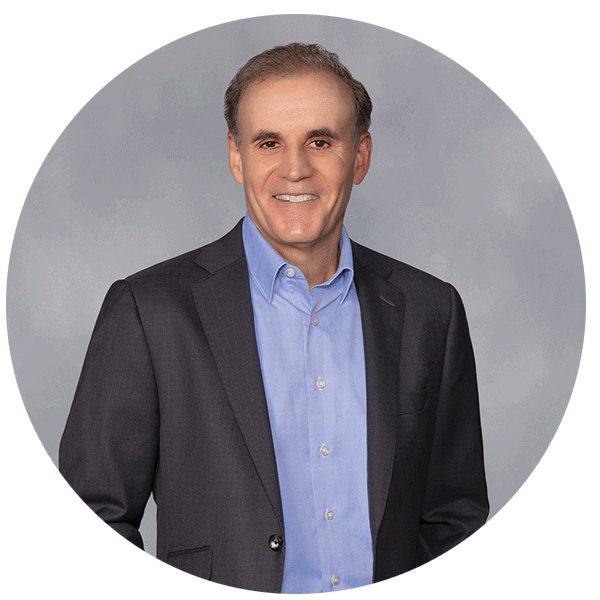
Jeff.gif
Professional Experience
With more than 40 years of automotive industry experience, Jeffrey Edwards serves as chairman and
CEO of Cooper Standard, a position he has held since May 2013. He joined Cooper Standard as CEO
and became a member of the Company's board of directors in October 2012. Since joining Cooper
Standard, Mr. Edwards has been focused on driving value through culture, innovation and results.
Mr. Edwards also serves on the board of directors of Standex International Corp., where he serves on
the Compensation and Nominating and Corporate Governance Committees.
Prior to joining Cooper Standard, Mr. Edwards held positions of increasing responsibility at Johnson
Controls, Inc. from 1984 to 2012. Most recently, he led the Automotive Experience Asia Group, serving
as corporate vice president as well as group vice president and general manager.
Mr. Edwards earned a Bachelor of Science degree in business administration from Clarion University in
Pennsylvania. He has also completed an executive training program at INSEAD, an international
graduate business school and research institution.
JEFFREY S.
EDWARDS
(CHAIRMAN)
Age
63
Director Since
2012
Independent
No
Skills and Experience
Core Industry
Senior Executive Leadership
Mergers & Acquisitions/Capital Markets
International Business/Markets
Manufacturing/Supply Chain
Innovation & Technology Strategy
Environmental/Social/Governance
Other Current Public Company Directorships
Standex International Corp.
Former Public Company Directorships (past 5 years)
None
Cooper Standard Logo Mark-300.jpg
15
2026 Proxy Statement
 
Richard.gif
Professional Experience
Mr. Freeland served as president and chief operating officer of Cummins Inc., a global manufacturer of
engines, power systems, and related components, from July 2014 to October 2019, prior to which he
served in various senior leadership positions, including vice president and president of the Engine
Business from 2010 to 2014, president of the Components Group from 2008 to 2010, and president of
Worldwide Distribution Business from 2005 to 2008. Mr. Freeland serves as chair of the board of
directors of Valvoline Inc., and as a member of its Compensation and  Nominating and Governance 
Committees, and serves on the board of directors of Hyliion Holdings Corp. and as a member of its
Compensation and Technology Committees. He is also a member of the Advisory Council of Purdue
University, Krannert School of Management. Mr. Freeland earned a Bachelor of Science degree from
Purdue University in industrial management and a Master of Business Administration degree from
Indiana University.
RICHARD J.
FREELAND
Age
68
Director Since
2020
Independent
Yes
Committees
Nominating and Corporate
Governance (Chair)
Skills and Experience
Core Industry
Senior Executive Leadership
Mergers & Acquisitions/Capital Markets
International Business/Markets
Manufacturing/Supply Chain
Innovation & Technology Strategy
Environmental/Social Governance
Other Current Public Company Directorships
Valvoline Inc.
Hyliion Holdings Corp
Former Public Company Directorships (past 5 years)
None
 
Adriana.gif
Professional Experience
Ms. Macouzet-Flores is vice president, Latin America and PMC general manager, Latin America of PPG
Industries de Mexico, S.A. de C.V., a subsidiary of PPG Industries Inc., a manufacturer and distributor
of a broad range of paints, coatings and specialty materials, prior to which she served as its general
manager, Latin America North and general manager, Automotive OEM Coatings from January 2012 to
June 2017. Ms. Macouzet-Flores held several other positions of increasing responsibility at PPG
Industries since she started with the company in 1989.
Ms. Macouzet-Flores has over 25 years of leadership experience in multinational settings.  She earned
an undergraduate degree in chemical engineering from Universidad La Salle, Mexico City, Mexico, and
has completed executive training courses in Finance Management at University of Michigan Ross
School of Business; Corporate Strategy at The University of Chicago Booth School of Business; and
Women on Boards at Harvard Business School.
ADRIANA E.
MACOUZET
FLORES
Age
64
Director Since
2020
Independent
Yes
Committees
Nominating and Corporate
Governance
Skills and Experience
Core Industry
Senior Executive Leadership
Mergers & Acquisitions/ Capital Markets
International Business/Markets
Engineering/Technical
Manufacturing/Supply Chain
Innovation & Technology Strategy
Environmental/Social/Governance
Other Current Public Company Directorships
None
Former Public Company Directorships (past 5 years)
None
2026 Proxy Statement
16
Cooper Standard Logo Mark-300.jpg
 
David.gif
Professional Experience
Mr. Mastrocola is a private investor. Previously, Mr. Mastrocola served as partner and managing
director of Goldman, Sachs & Co. During his 22 years at Goldman, Sachs & Co., he held a number of
senior management positions in the Investment Banking Division, including heading and coheading the
corporate finance, mergers/strategic advisory and industrials/natural resources departments, as well as
serving as a member of firm-wide capital and commitments committees. Prior to Goldman, Sachs &
Co., Mr. Mastrocola was a senior auditor at Arthur Anderson & Co. Mr. Mastrocola also served on the
Board of Trustees of Save the Children Foundation for 12 years. Mr. Mastrocola earned his Master of
Business Administration degree from Harvard University and his undergraduate degree from Boston
College.
DAVID J.
MASTROCOLA
Age
64
Director Since
2010
Lead Director Since
2011
Independent
Yes
Committees
Compensation
Skills and Experience
Senior Executive Leadership
Financial/Audit & Risk
Mergers & Acquisitions/Capital Markets
International Business/Markets
Other Current Public Company Directorships
None
Former Public Company Directorships (past 5 years)
None
 
Christine.gif
Professional Experience
Ms. Moore retired in January 2026 as executive vice president and Chief Audit Executive of Comerica
Bank, a financial services company, a position she held since 2024. Prior to that time she held positions
at Comerica Bank of increasing responsibility, including Executive Vice President and General Auditor
from 2016 to 2024, Senior Vice President & Deputy General Auditor from 2014 to 2016, Senior Vice
President & Audit Director from 2004 to 2014, and Senior Auditor, Audit Manager, Audit Director from
1991 to 1999. She has also served as Controller, Jordan Services Inc. from 2000 to 2004 and began
her accounting and auditing career at PricewaterhouseCoopers.
Ms. Moore earned a Bachelor of Business Administration degree from Marygrove College and a Master
of Business Administration degree from University of Detroit Mercy. She has participated in the
Leadership at the Peak, a Center for Creative Leadership Executive Leadership Program, Inforum’s
Center for Women’s Leadership Executive Leadership Program, as well as earned: the certifications
and designations of Certified Public Accountant (CPA); Certified Information System Auditor (CISA);
Certified Anti-Money Laundering Specialists (CAMS); Certified Fiduciary and Investment Risk Specialist
(CFIRS); and NACD Directorship. She  is a member of the Michigan Association of CPAs, Information
Systems Audit & Control Association, Institute of Internal Auditors, Association of Certified Anti-Money
Laundering Specialists, the Executive Leadership Council, and National Association of Corporate
Directors.
CHRISTINE M.
MOORE
Age
63
Director Since
2021
Independent
Yes
Committees
Audit
Skills and Experience
Senior Executive Leadership
Financial/Audit & Risk
Cybersecurity/Information Technology
Environmental/Social/ Governance
Other Current Public Company Directorships
None
Former Public Company Directorships (past 5 years)
None
Cooper Standard Logo Mark-300.jpg
17
2026 Proxy Statement
 
Robert.gif
Professional Experience
Mr. Remenar serves as chief operating officer of Kensington Capital Acquisition Corp. VI, a special
purpose acquisition company since February, 2026. Mr. Remenar served as chief operating officer of
Kensington Capital Acquisition Corp. IV, a special purpose acquisition company from March 2022 to
September 2022. Mr. Remenar was president of Kensington Capital Acquisition Corp. II, a special
purpose acquisition company, from February 2021 to October 2021 and served as vice chairman of its
board of directors. From June 2020 to November 2020, he was president of Kensington Capital
Acquisition Corp. I, a special purpose acquisition company, also serving as vice chairman of its board of
directors. Mr. Remenar also served as president and chief executive officer of Chassix Inc., a
manufacturer of chassis systems, from July 2012 to June 2014, and he served as president and chief
executive officer of Nexteer Automotive from December 2009 to June 2012, and president of Delphi
Steering/Nexteer Automotive from April 2002 to November 2012. Previously, he held several executive
positions within Delphi Corp. since 1998 and several executive and managerial positions within General
Motors since 1985. Mr. Remenar also serves on the board of directors of Samvardhana Motherson
International Limited, where he serves as Lead Independent Director, chair of the Risk Management
Committee and as a member of the Strategic Relationship, Strategic Business Matters and Global
Sustainability Committees, and the board of directors of Munro & Associates and HEVO Inc. He earned
his Master of Business and Professional Accountancy degrees from Walsh College and his
undergraduate degree from Central Michigan University.
ROBERT J.
REMENAR
Age
70
Director Since
2015
Independent
Yes
Committees
Compensation
Audit
Skills and Experience
Core Industry
Senior Executive Leadership
Financial/Audit & Risk
Mergers & Acquisitions/Capital Markets
International Business/Markets
Engineering/Technical
Manufacturing/Supply Chain
Innovation & Technology Strategy
Other Current Public Company Directorships
Samvardhana Motherson International Limited (formerly known as Motherson Sumi Systems
Limited)
Former Public Company Directorships (past 5 years)
Kensington Capital Acquisition Corp.
Kensington Capital Acquisition Corp. II
2026 Proxy Statement
18
Cooper Standard Logo Mark-300.jpg
 
Sonya.gif
Professional Experience
Ms. Sepahban is the CEO and chair of the board of directors of OurOffice, Inc., a provider of enterprise
Human Resources and Workplace Communication suite of products. From 2009 to 2015, she served
as senior vice president of engineering, development and technology at General Dynamics Land
Systems, a business unit of General Dynamics, a global aerospace and defense company. From 1997
to 2009, she held a number of leadership positions with Northrop Grumman Space Technology,
including chief technology officer and senior vice president and chief engineer. Previously, Ms.
Sepahban held a number of technical and management positions at the NASA Johnson Space Center.
Ms. Sepahban earned a Master of Business Administration degree from the University of Houston, a
master’s degree in chemical engineering from Rice University, a bachelor’s degree in chemical
engineering from Cornell University, and a political science degree from the Institute of Political
Sciences in Paris, France.
SONYA F.
SEPAHBAN
Age
65
Director Since
2016
Independent
Yes
Committees
Nominating and Corporate
Governance
Skills and Experience
Core Industry
Senior Executive Leadership
Mergers & Acquisitions/Capital Markets
International Business/Markets
Engineering/Technical
Manufacturing/Supply Chain
Innovation & Technology Strategy
Cybersecurity/Information Technology
Environmental/Social/ Governance
Other Current Public Company Directorships
None
Former Public Company Directorships (past 5 years)
None
 
Stephen.gif
Professional Experience
Mr. Van Oss currently serves as an Operating Partner, Distribution for Gamut Capital Management, a
New York based private equity firm. From 2009 until his retirement in December 2015, Mr. Van Oss
served as senior vice president and chief operating officer and director of WESCO International, Inc., a
supply chain solutions company. He served as a senior vice president and chief financial and
administrative officer of WESCO from 2004 to 2009 and as vice president and chief financial officer of
WESCO from 2000 to 2004. Previously, he served as WESCO’s director of information technology from
1997 to 2000 and as its director of acquisition management in 1997. Mr. Van Oss serves on the board
of directors of JPW Industries as the chairman and is a member of the audit and compensation
committees.  He earned his graduate degree from Cleveland State University, undergraduate degree
from Wright State University and is a Certified Public Accountant licensed in Ohio.
STEPHEN A.
VAN OSS
Age
71
Director Since
2008
Independent
Yes
Committees
Audit (Chair)
Compensation
Skills and Experience
Senior Executive Leadership
Financial/Audit & Risk
Mergers & Acquisitions/Capital Markets
International Business/Markets
Manufacturing/Supply Chain
Cybersecurity/Information Technology
Other Current Public Company Directorships
None
Former Public Company Directorships (past 5 years)
None
Cooper Standard Logo Mark-300.jpg
19
2026 Proxy Statement
Corporate Governance
Board of Directors
INDEPENDENCE OF DIRECTORS
Board’s Guidelines on Director Independence:
Our Corporate Governance Guidelines provide that a majority of the members of the Board must meet the criteria for
independence set forth under applicable law and NYSE listing standards. On an annual basis, the Board determines whether
each director qualifies as independent under these criteria. In addition to applying the NYSE independence rules, the Board
considers all relevant facts and circumstances of which it is aware in making an independence determination with respect to
any director. Furthermore, our Audit, Compensation and Nominating and Corporate Governance Committees are constituted
so as to comply with the NYSE listing standards regarding independence, including committee independence.
Application of Guidelines:
The Board has determined that all of our directors and director nominees are independent as determined pursuant to NYSE
rules, except for Mr. Edwards who serves as our CEO.
BOARD LEADERSHIP STRUCTURE
The Board’s leadership structure currently includes a combined chairman and CEO role with a non-employee lead director, as
permitted by our Corporate Governance Guidelines.
Chairman and Chief Executive Officer
Mr. Edwards serves as chairman of the board of directors and CEO, a structure the Board believes is in the best interests of
our stakeholders. This approach recognizes the importance of having a chairman with in-depth knowledge of, and experience
in, our industry, while promoting communication between management and the Board, particularly regarding the Board’s
oversight of the Company’s strategic direction. In addition, this structure ensures that the non-employee directors’ attention is
devoted to the Company’s critical issues and our stakeholders. Our Board periodically reviews its determination to have a
single individual serve as both chairman and CEO.
Lead Director
The lead director position is elected by the non-employee members of the Board upon the recommendation of the Nominating
and Corporate Governance Committee. The Board believes that the role of the lead director, together with the existence of a
substantial majority of independent directors, fully independent Board committees, and the use of regular executive sessions
of non-employee and independent directors achieves an appropriate balance between the effective development of key
strategic and operational objectives and independent oversight of management.
As the lead director, Mr. Mastrocola:
1.presides at all meetings of the Board at which the chair is not present, including executive sessions of the
independent directors, and communicates with management concerning the substance of such meetings and
sessions;
2.serves as the liaison between the chair and the independent directors;
3.approves the Board’s meeting agendas, schedules and information sent to the Board;
4.in consultation with the Compensation Committee, assists the Board with its evaluation of the performance of the
CEO; and
5.if requested by major stockholders, ensures that he is available for consultation and direct communication.
BOARD OF DIRECTORS ATTENDANCE REQUIREMENTS FOR MEETINGS
Meetings
Our Board of Directors met six times in 2025. As set forth in our Corporate Governance Guidelines, Board members are
expected to attend Board meetings and meetings of the committees on which they serve. All directors are also strongly
encouraged to attend our annual meeting of the stockholders. All director nominees attended at least 75% of the meetings of
our Board and the committees on which they served during 2025. All of the then-serving directors attended the 2025 Annual
Meeting.
2026 Proxy Statement
20
Cooper Standard Logo Mark-300.jpg
Corporate Governance
Meetings of Non-Employee Directors
In accordance with our Corporate Governance Guidelines and the listing standards of NYSE, our non-employee directors meet
regularly in executive sessions of the Board without management present. Executive sessions of non-employee directors are
led by Mr. Mastrocola, the lead director, and are held in conjunction with each regularly scheduled Board meeting. Each
committee of the Board also meets in executive session without management in conjunction with regularly scheduled
committee meetings, as appropriate. At least once a year, the independent directors meet in an executive session led by one
of the independent directors who is selected by all of the independent directors to lead the session.
EVALUATION OF BOARD PERFORMANCE
The Board believes that its annual evaluation process, illustrated below, is integral to enhancing our Board’s effectiveness.
These annual self-evaluations are intended to facilitate a candid assessment and discussion by the Board of its effectiveness
as a group in fulfilling its responsibilities, its performance as measured against the Corporate Governance Guidelines, and
areas for improvement. Each Committee of the Board also conducts a similar annual self-evaluation of its performance and
procedures.
QUESTIONNAIRE
Circle Arrow Icon-300.jpg
Questionnaire enables each director to provide candid feedback.
BOARD ASSESSMENTS
AND DISCUSSIONS
Circle Arrow Icon-300.jpg
During an executive session of the Board led by the Chair of the Nominating and
Corporate Governance Committee and the lead director, the questionnaires are used
to facilitate assessments of the following areas:
Individual performances of the directors, including
in the capacity of lead director and committee chair;
Board and committee operations;
Board performance; and
Committee performance.
FOLLOW-UP
Circle Arrow Icon-300.jpg
Policies and practices updated as appropriate.
Cooper Standard Logo Mark-300.jpg
21
2026 Proxy Statement
Corporate Governance
Board Committees and Their Functions
COMMITTEES OF THE BOARD OF DIRECTORS
Our Board currently has three standing committees: the Audit Committee, the Compensation Committee and the Nominating
and Corporate Governance Committee.
The Board determined that each member of each Committee is independent under applicable NYSE listing standards and
SEC rules. Each Committee is organized and conducts its business pursuant to a written charter adopted by the Board and
available on our website at www.cooperstandard.com under the “Investors” tab.
The following chart sets forth our Board’s standing committees and membership on these committees.
Directors
Audit Committee
Compensation
Committee
Nominating and
Corporate Governance
Committee
John G. Boss
C
Jeffrey S. Edwards*
Richard J. Freeland
C
Adrian E. Macouzet Flores
David J. Mastrocola**
Christine M. Moore†
Robert J. Remenar†
Sonya F. Sepahban1
Stephen A. Van Oss†
C
*Chairman of Board
**Lead Director
Financial Expert
“C”Denotes member and Chair of Committee
“●”Denotes member
1Ms. Sepahban was appointed to the Nominating and Governance Committee on May 15, 2025.
2026 Proxy Statement
22
Cooper Standard Logo Mark-300.jpg
Corporate Governance
 
AUDIT COMMITTEE
Committee’s Key Responsibilities
Select independent registered public accounting firm and regularly review and evaluate the firm’s
independence, qualifications and performance
Oversee accounting and financial reporting processes and the annual audit and quarterly review of
financial statements
Oversee, review and evaluate the Company’s internal audit function
Oversee compliance with legal and regulatory requirements
Review and oversee our system of internal controls regarding finance, accounting, cybersecurity
and legal compliance
Review and oversee the Company’s assessment and management of the Company’s major
litigation, and any significant compliance, cybersecurity and financial risk exposures
Oversee environmental, social and governance disclosures, processes, and controls
Chair
Stephen A. Van Oss
Members
Christine M. Moore
Robert J. Remenar
Thomas W. Sidlik (until
May 15, 2025)
Number of Meetings in 2025
7
Audit Committee Financial Expertise and Independence
Our Board has determined that each member of the Audit Committee is financially literate and that
Messrs. Van Oss and Remenar and Ms. Moore qualify as audit committee financial experts as defined
by the rules and regulations of the Securities and Exchange Commission (“SEC”).
 
COMPENSATION
COMMITTEE
Committee’s Key Responsibilities
Review and approve corporate goals, objectives, and other criteria relevant to the CEO’s and the
other executive officers’ compensation
Evaluate the performance of all executive officers and determine their compensation
Establish overall compensation philosophy and review, approve executive compensation programs
and assess related risks
Review and approve employment and severance arrangement with executive officers
Review and approve equity-based compensation plans and awards made pursuant to such plans
Oversee the Company’s employee benefit plans, including the delegation of responsibility for such
programs to the Company’s Benefit Plan Committee
Integrate select environmental, social and governance goals and milestones into executive
compensation plans where deemed appropriate
Chair
John G. Boss
Members
David J.  Mastrocola
Robert J. Remenar
Stephen A. Van Oss
Number of Meetings in 2025
5
Compensation Consultant
The Compensation Committee has engaged FW Cook as its independent compensation consultant.
The consultant reports directly to the Compensation Committee and advises the Compensation
Committee on a number of compensation-related considerations, including compensation practices
among our peer group companies, pay-for-performance measures, competitiveness of pay levels,
program design, and market trends. Other than consulting on executive compensation matters, FW
Cook has performed no other services for the Compensation Committee or the Company.
The Compensation Committee maintains a formal process to ensure the independence of any
executive compensation advisor engaged by the Compensation Committee, including consideration of
all factors relevant to the advisor’s independence from management as required by applicable NYSE
listing standards.  In connection with its engagement of FW Cook, the Compensation Committee
considered these factors and determined that FW Cook qualified as independent and that its
engagement does not raise any conflict of interest. 
Cooper Standard Logo Mark-300.jpg
23
2026 Proxy Statement
Corporate Governance
 
NOMINATING AND
CORPORATE
GOVERNANCE
COMMITTEE
Committee’s Key Responsibilities
Identify and evaluate individuals qualified to become members of the Board consistent with criteria
approved by the Board
Select and recommend to the Board the director nominees to stand for election by the stockholders
or to fill vacancies on the Board and its committees
Develop and ensure compliance with corporate governance principles and practices applicable to
the Company
Review our legal compliance and ethics programs and policies
Review and make recommendations to the Board on director compensation
Oversee the annual performance evaluation of the Board and its committees
Ensure effective Company communication with investors and other stakeholders on environmental,
social and governance matters
Ensure the Board has the skills, expertise and continued education necessary to oversee the
successful execution of the Company’s environmental, social and governance priorities
Chair
Richard J. Freeland
Members
Adriana E. Macouzet Flores
Sonya F. Sepahban
(beginning May 15, 2025)
Thomas W. Sidlik (until
May 15, 2025)
Number of Meetings in 2025
5
Corporate Governance Principles and Code of Conduct
Cooper Standard is committed to sound corporate governance principles that are essential to maintaining our integrity in the
marketplace and ensuring that we are managed for the long-term benefit of our stockholders. Our business is overseen by our
Board which strives to promote the success, sustainability and continuity of our business through the selection of a qualified
management team and is responsible for ensuring that our activities are conducted responsibly, lawfully, and ethically.
The Board abides by our Corporate Governance Guidelines which provide a framework for the effective governance of the
Company. The Board has also adopted a Code of Conduct which applies to all directors, officers, and employees, including our
CEO, our chief financial officer, and our chief accounting officer. All of our corporate governance documents, including the
Corporate Governance Guidelines, the Code of Conduct, and committee charters are available on our website at
www.cooperstandard.com under the “Investors” tab or in printed form upon request by contacting Cooper Standard at 40300
Traditions Drive, Northville, Michigan, 48168, Attention: Investor Relations. The Board regularly reviews corporate governance
developments and modifies our policies as warranted. Any modifications will be reflected on our website. In addition, if the
Board grants any waivers from our Code of Conduct to any of our directors or executive officers, or if we amend our Code of
Conduct, we will, if required, disclose these matters through the “Investor” section of our website on a timely basis. The
information on our website is not part of this proxy statement and is not deemed to be incorporated by reference in this proxy
statement.
Securities Trading Policy
The Board has adopted a Securities Trading Policy governing the purchase, sale, and/or other dispositions of our securities by
all directors, officers, employees and any other person the Company determines should be subject to the policy, such as
contractors and consultants. We believe that the Securities Trading Policy is reasonably designed to promote compliance with
insider trading laws, rules and regulations, and the exchange listing standards applicable to us. In addition, it is the practice of
the Company to comply with applicable securities laws, including laws, rules and regulations related to trading in our
securities. A copy of our Securities Trading Policy was filed as Exhibit 19.1 to our Annual Report on Form 10-K for the year
ended December 31, 2024.
Board’s Role in Risk Oversight
The Board, as a whole and through its committees, is responsible for the oversight of risk management, while management is
responsible for the day-to-day management of risks to the Company. The effective oversight and management of the risks
facing the Company are supported through a top-down and bottom-up communication framework that includes a robust
enterprise risk management approach and active participation from the Global Leadership Team and our leaders across all
functional areas of the Company, fostering an appropriate culture of integrity and risk awareness throughout the Company.
The Board has also developed a strong governance framework for overseeing management’s strategy that integrates
environmental, social and governance risks and opportunities into the Company’s long-term strategy and enterprise risk
management processes. 
2026 Proxy Statement
24
Cooper Standard Logo Mark-300.jpg
Corporate Governance
RISK OVERSIGHT
The Board has implemented a risk governance framework designed to:
understand material risks in the Company’s business, strategy and environmental, social and governance priorities;
allocate responsibilities for risk oversight among the full Board and its committees;
evaluate the Company’s enterprise risk management processes and whether they are functioning adequately; and
facilitate open communication between management and Directors.
The Board delegates to its committees the task of reviewing and overseeing specific risks that align with their functional
responsibilities, as presented below:
Audit Committee
Nominating and
Corporate Governance Committee
Compensation Committee
Effectiveness of policies on risk
assessment and management.
Exposure to major litigation or
significant compliance, cybersecurity
and financial risks and the mitigation of
such risks.
Effectiveness of Company’s system of
disclosure and internal controls over
financial reporting and environmental,
social and governance disclosures.
Compliance with legal and regulatory
requirements.
Risks related to our governance
structure and processes, related party
transactions, and our legal and ethical
compliance programs, including our
Code of Conduct.
Risks related to  programs and
practices that are likely to have a
material adverse effect on the
Company.
ENTERPRISE RISK MANAGEMENT APPROACH
Our enterprise risk management (ERM) approach is designed to inform the Board and the strategic and business planning
processes through identification, detection, prevention and mitigation of risks that could impede the achievement of the
Company’s strategic objectives and business goals. The results of the Company’s annual risk assessment process are
reviewed with the Audit Committee on an annual basis. A priority in our approach is to connect the ERM process with strategic
planning and corporate responsibility initiatives to ensure the sustainability of the enterprise.
ERM Flow_Updated.jpg
The ERM committee is comprised of senior-level leaders from each of the functional areas of the company working in concert
with our Global Leadership Team and the Board. On an annual basis, the ERM committee is charged with pursuing a holistic,
consolidated risk management approach for all risk classes, including strategic, operational, financial and compliance risks.
The ERM committee has adopted a common risk management language, process, and metrics that are designed to inventory,
assess and rank unmitigated and mitigated risks so that the Global Leadership Team can determine the appropriate response
and mitigation strategies in alignment with the Company’s risk appetite. The committee considers the likelihood, magnitude
and timeframe of individual risks (short-term, intermediate-term or long-term) when assessing response and mitigation
strategies. This comprehensive risk management process allows for effective risk management and efficient capital allocation
and fosters a risk-aware culture embedded into daily operations across the organization at all levels.
Cooper Standard Logo Mark-300.jpg
25
2026 Proxy Statement
Corporate Governance
To learn more about risks facing the Company, you can review the factors included in Part I, “Item 1A. Risk Factors” in the
Company’s most recent Annual Report on Form 10-K for the fiscal year ended December 31, 2025, which are aligned to the
risks that are identified during the annual ERM risk assessment process. The risks described in the Form 10-K are not the only
risks facing the Company. Additional risks and uncertainties not currently known or that may currently be deemed to be
immaterial based on the information known to the Company also may materially adversely affect the Company’s business,
financial condition or results of operations in future periods.
Corporate Responsibility
Cooper Standard’s commitment to corporate responsibility remains integral to strengthening every aspect of our business and
supporting long-term value creation.  This commitment reinforces our ability to attract and retain talent, maintain a resilient
supply base, and advance innovative, cost-effective solutions that meet the evolving needs of our customers. Consistent with
our longstanding focus on operational excellence, we continue to embed continuous improvement across our global
operations.
Delivering sustainable, long-term value requires a strong foundation grounded in ethical business practices and responsible
corporate citizenship.  Our approach aligns with our purpose Creating Sustainable Solutions TOGETHER and includes Board-
level oversight of sustainability strategy, ongoing stakeholder engagement, and a double materiality assessment that informs
our strategic priorities and risk management processes.
We integrate corporate responsibility into our broader business strategy by establishing goals that support our operational and
financial objectives and by evaluating sustainability-related risks alongside our ERM framework.  Each year, we refine our data
collection, reporting practices and performance targets to meet evolving stakeholder expectations and enhance transparency,
reflecting our commitment to strong governance and responsible business practices.
Through consistent actions aligned with our core values, we maintain our reputation as an honest, ethical and responsible
company. As we continue to develop innovative products and systems, we remain committed to advancing our sustainability
and environmental, social, and governance priorities in order to Be the First Choice of the Stakeholders We Serve.
In 2025, Cooper Standard was named one of America's Most Responsible Companies by Newsweek, for the seventh
consecutive year and was included in USA Today America’s Best Climate Leaders 2025 list. We are proud of this
acknowledgment of our efforts and continue building upon our performance to address the evolving needs of our stakeholders.
We focus on corporate responsibility to deliver value to all our stakeholders and ensure the Company’s long-term sustainability
through our environmental, social and governance initiatives.
ENVIRONMENTAL SOCIAL AND GOVERNANCE BOARD GOVERNANCE FRAMEWORK
The Board is responsible for oversight of our environmental, social and governance strategy and ensures the management of
environmental, social and governance impacts, risks and opportunities are integrated into the Company’s long-term strategy
and Enterprise Risk Management. The Board delegates certain environmental, social and governance oversight
responsibilities to its committees as set forth below:
Audit Committee
Compensation Committee
Nominating and
Corporate Governance Committee
Disclosures, processes and controls, and
their assurance ensuring:
Environmental, social and governance
disclosures (both qualitative and
quantitative) are comprehensive and
follow appropriate environmental, social
and governance frameworks and/or
standards
Processes and controls are in place to
ensure environmental, social and
governance disclosures are accurate,
comparable and consistent
Whether independent assurance is
required
Accountability ensuring:
Integration of select environmental,
social and governance disclosures,
goals and milestones into executive
compensation plans where deemed
appropriate
Engagement, board composition and
education ensuring:
Effective communication of the
Company’s environmental, social and
governance priorities and performance
to investors and other stakeholders
The Board has the necessary
environmental, social and governance
skills and expertise
Environmental, social and governance
Board education
The full Board and its committees receive regular updates on key environmental, social and governance topics according to a
standard Board calendar, including but not limited to corporate governance topics, which are reviewed by the Nominating and
2026 Proxy Statement
26
Cooper Standard Logo Mark-300.jpg
Corporate Governance
Corporate Governance Committee at least twice per year and by the full Board annually, and ethics and compliance topics,
which are reviewed by the Audit and Nominating and Corporate Governance Committees at least three times per year and by
the full Board annually. In addition to reporting on our progress, we regularly invite expert speakers to Board meetings to report
on emerging trends in our evolving global landscape.
GLOBAL SUSTAINABILITY COUNCIL
Our commitment to sustainability and corporate responsibility is reflected in the work of our Global Sustainability Council
(GSC). This cross-functional council, led by an executive sponsor and comprised of subject matter experts from across Cooper
Standard, provides executive-level oversight of the Company's sustainability strategy to ensure alignment with business
objectives and stakeholder priorities. The GSC meets quarterly to evaluate environmental, social and governance  initiatives,
monitor emerging best practices and regulatory developments, and advance long-term goals that support work-class
environmental, social and governance performance.
SIGNIFICANT ENVIRONMENTAL, SOCIAL AND GOVERNANCE TOPICS
In 2025, Cooper Standard completed a climate risk assessment aligned with the recommendations of the Task Force on
Climate-related Financial Disclosures (TCFD). With support from an independent third-party advisor, the Company conducted
an initial scenario-based screening of both physical and transition risks. This enterprise-wide assessment evaluated potential
climate-related risks and opportunities across our upstream, operational, and downstream activities over short-, medium-, and
long-term time horizons. The process included engagement from multiple functions and senior leaders to provide oversight,
validate key findings, and help ensure that the results support future strategic planning and decision-making. By enhancing 
our understanding of climate-related risks and integrating appropriate response strategies, we aim to enhance our resilience
and advance our long-term sustainability objectives. We expect to conduct further quantification and evaluation of material
climate-related risks in 2026.
Employee Engagement, Human Capital, Culture, Inclusion and Belonging
Our employees are our most important asset, and therefore we take action to attract, develop, engage, retain and recognize
world-class talent. We work to create and maintain a physically and psychologically safe workplace for all our employees
through our Total Safety Culture. We also support our employees by giving back to the communities where we work and live,
focusing on our local impact. As we aim to strengthen our world-class reputation and stay competitive, we remain focused on
several human capital-related topics among our top material environmental, social and governance focus areas, including
Workplace Health & Safety, Talent Engagement, Talent Development, Performance Management, and Culture, Inclusion &
Belonging.
Innovation, Materials and Product Lifecycle
At Cooper Standard, we continuously evolve and embrace innovative ideas to exceed stakeholder expectations. Our
unwavering commitment to making our products more sustainable guides our innovation processes, material selection, and
product lifecycle considerations. We intentionally provide internal and external visibility of our product portfolio to further our
culture of innovation and transparency. Our highly engaged workforce pursues technological innovations and implements
manufacturing and business processes that deliver high quality and robust solutions. These innovative solutions enable us to
meet the evolving needs of our customers and the global industries we serve as we face the challenges of today and into the
future.
Climate Change, Greenhouse Gas Emissions, and Waste
Cooper Standard remains committed to responsible environmental stewardship, including the management of climate-related
risks and opportunities across our global operations.  We continue to advance our climate strategy by monitoring and working
to reduce greenhouse gas (GHG) emissions in alignment with our long-term sustainability objectives and industry best
practices.  As part of this effort, we are enhancing energy-efficiency initiatives, expanding the use of renewable electricity, and
improving the accuracy and transparency of our Scope 1, Scope 2, and Scope 3 emissions reporting.
In addition, we are implementing waste-reduction programs focused on enhancing circularity across our operations by
minimizing landfill disposal, reducing material consumption, and improving the recyclability of the materials we use.  We are
also developing near-term science-based targets and an associated roadmap to reduce our Scope 1, Scope 2, and Scope 3
GHG emissions, which we expect to complete in 2026.  These actions are intended to enhance our management of climate-
related risks and support our broader sustainability strategy.
ENVIRONMENTAL, SOCIAL AND GOVERNANCE REPORTING
Cooper Standard’s approach to sustainability reporting is grounded in a commitment to transparency and accountability.  Each
year, the Company publishes a Corporate Responsibility Report that outlines its progress on key environmental, social and
governance priorities.  These disclosures reference globally recognized frameworks, including the Global Reporting Initiative
Cooper Standard Logo Mark-300.jpg
27
2026 Proxy Statement
Corporate Governance
(GRI) Standards and the Sustainable Accounting Standard Board (SASB) Auto Part sector standard, and include qualitative
information, methodologies, and quantitative performance data.  The Company also continues to monitor evolving regulatory
requirements and is proactively preparing for anticipated changes in disclosure obligations.  Our archive of annual Corporate
Responsibility Reports is available on our website at www.cooperstandard.com.  These materials are provided for reference
only and are not incorporated by reference into, nor considered part of, this proxy statement or the Company’s solicitation
materials.
2026 Proxy Statement
28
Cooper Standard Logo Mark-300.jpg
Corporate Governance
Director Compensation
SUMMARY OF COMPENSATION
Members of the Board who are not Cooper Standard employees receive an annual cash fee of $100,000 and, if they chair a
committee, an additional cash fee of $10,000 per year. The lead director receives an additional cash fee of $20,000 per year,
less any amount the lead director may receive in fees as chair of a committee. Non-employee directors were also eligible to
receive equity grants under the Amended and Restated 2021 Omnibus Incentive Plan (“2021 Plan”). In 2025, the value of the
equity awards granted to non-employee directors was approximately equal in value to 120% of the annual base director fee
using stock price averaging as discussed below. Consistent with its charter, the Nominating and Corporate Governance
Committee reviews and recommends to the Board any changes with respect to the compensation of directors.  With respect to
fiscal year 2025, the Nominating and Corporate Governance Committee determined not to recommend any changes to the
Company’s director compensation program relative to the prior year.
The following table sets forth information regarding the compensation earned by each non-employee director during the year
ended December 31, 2025.
Name
Fees Earned or
Paid in Cash
$
 
Stock Awards1 
$
Total
$
(a)
(b)
(c)
(d)
John G. Boss
110,000
2
182,906
292,906
Richard J. Freeland
110,000
3
182,906
292,906
Adriana E. Macouzet-Flores
100,000
182,906
282,906
David J. Mastrocola
120,000
4
182,906
302,906
Christine M. Moore
100,000
182,906
282,906
Robert J. Remenar
100,000
182,906
282,906
Sonya F. Sepahban
100,000
182,906
282,906
Thomas W. Sidlik
37,329
5
37,329
Stephen A. Van Oss
110,000
6
182,906
292,906
1Due to the Company’s stock price volatility in recent years, the Nominating and Corporate Governance Committee has used the 20-day
average price as of the five days preceding the grant date of the non-employee director time-based RSUs to convert grant values into a
number of units.  In 2025, the average stock price used to convert grant value to units was $15.94 and the accounting value on the grant
date was $24.30.The amount shown in column (c) represents the grant-date fair value of 7,527 time-vested RSUs granted to each of the
non-employee directors who were directors on the grant date, May 15, 2025, under the Company’s 2021 Plan. These RSUs will vest,
assuming continued service as a director, on the earlier of the first annual stockholder meeting after the grant date or the one year
anniversary of the grant date. Each RSU represents a contingent right to receive, at the Company’s option, either one share of common
stock or the cash equivalent upon satisfaction of the vesting requirements. Under the Cooper-Standard Holdings Inc. Deferred
Compensation Plan for Non-Employee Directors, the directors may make an irrevocable election to defer their RSU awards. Messrs.
Freeland, Mastrocola, Remenar, and Van Oss, and Mses. Moore and Sepahban each deferred their 2025 RSU awards.
As of December 31, 2025, the aggregate number of deferred RSUs and outstanding and unvested RSUs held by current non-employee
directors were as follows:
Cooper Standard Logo Mark-300.jpg
29
2026 Proxy Statement
Corporate Governance
Name
Deferred
RSUs
Outstanding and
Unvested RSUs
(a)
(b)
(c)
John G. Boss
7,527
Richard J. Freeland
54,338
7,527
Adriana E. Macouzet-Flores
7,527
David J. Mastrocola
62,517
7,527
Christine M. Moore
7,527
Robert J. Remenar
37,587
7,527
Sonya F. Sepahban
56,934
7,527
Stephen A. Van Oss
62,517
7,527
2Represents Mr. Boss’s annual cash fee, plus $10,000 for his services as the chair of the Compensation Committee.
3Represents Mr. Freeland’s annual cash fee, plus $10,000 for his services as the chair of the Nominating and Corporate Governance
Committee.
4Represents Mr. Mastrocola’s annual cash fee, plus $20,000 for his services as the lead director.
5Represents Mr. Sidlik’s annual cash fee through May 15, 2025, when his service on the board concluded.
6Represents Mr. Van Oss’s annual cash fee plus $10,000 for his services as the chair of the Audit Committee.
Stock Ownership Policy for Non-Employee Directors
To align the interests of our non-employee directors with the interests of our stockholders, the Board has a policy requiring that
non-employee directors achieve a level of ownership of our common stock equal to five times their annual cash fee. Under this
policy, non-employee directors are required to hold 75% of the net shares resulting from stock option exercises or vesting of
other stock-based awards until they reach their applicable stock ownership level. For purposes of the policy, “stock ownership”
or “stock owned” shall include the following, whether owned directly by, or held in trust for the benefit of, the director or any
member of his or her immediate family:
Common stock of the Company, except to the extent such stock is subject to vesting conditions other than conditions
based solely on the passage of time.
Company stock units or similar stock rights granted under the Company’s Omnibus Incentive Plan (or any predecessor or
successor plan) or credited under any deferred compensation plan of the Company which are to be settled in shares of
common stock, except to the extent such stock units or rights are subject to vesting conditions other than conditions based
solely on the passage of time.
In the case of time-vested common stock or stock units in the categories above which are not yet fully vested and not deferred,
only a portion representing the net after-tax holdings at vesting will count as stock owned. For purposes of calculating these
estimated net holdings, the applicable rate assumed to apply at vesting shall equal 50%.
All of our incumbent non-employee directors meet the requirements of this policy or are retaining their acquired amounts until
they reach their applicable stock ownership levels.
2026 Proxy Statement
30
Cooper Standard Logo Mark-300.jpg
Corporate Governance
Stock Ownership and Related Stockholder Matters
OWNERSHIP OF CERTAIN BENEFICIAL OWNERS AND MANAGEMENT
The following table and accompanying footnotes show information regarding the beneficial ownership of the issued and
outstanding common stock of Cooper-Standard Holdings Inc. by (i) each person known by us to beneficially own more than
5% of the issued and outstanding common stock of Cooper-Standard Holdings Inc. as of the dates indicated in the footnotes
and (ii) (A) each of our directors, (B) each named executive officer, and (C) all directors and executive officers as a group,
each as of March 15, 2026. Unless otherwise indicated, (i) the address of each beneficial owner is c/o Cooper-Standard
Holdings Inc., 40300 Traditions Drive, Northville, Michigan, 48168; and (ii) each of the beneficial owners listed below has sole
voting and dispositive (investment) power over the shares beneficially owned.
As of March 15, 2026, there were 17,755,284 shares of our common stock outstanding.
Common Stock Beneficially Owned
Named Executive Officers and
Directors
Number of
Common
Shares1
#
Common
Shares
Underlying
Exercisable
Options2
#
Common
Shares
Underlying 
Restricted
Stock Units3
#
Total
Number of 
Shares of 
Common Stock
Beneficially
Owned
#
Percentage of 
Common 
Stock
Beneficially
Owned
%
(a)
(b)
(c)
(d)
(e)
(f)
Jeffrey S. Edwards
411,904
265,267
3,015
680,186
3.8
Jonathan P. Banas
67,277
51,031
118,308
*
Patrick R. Clark
53,820
19,645
73,465
*
Christopher E. Couch
42,432
28,644
71,076
*
Larry E. Ott
53,261
24,834
400
78,495
*
John G. Boss
79,338
79,338
*
Richard J. Freeland
61,865
61,865
*
Adriana E. Macouzet-Flores
50,515
50,515
*
David J. Mastrocola 
25,000
70,044
95,044
*
Christine M. Moore
41,296
7,527
48,823
*
Robert J. Remenar
27,575
45,114
72,689
*
Sonya F. Sepahban
3,357
64,461
67,818
*
Stephen A. Van Oss
77,846
70,044
147,890
*
Current directors and executive
officers as a group (17 persons)
981,635
399,926
322,470
1,704,031
9.2
Significant Owners
BlackRock Inc.4
1,208,159
1,208,159
6.8
Millstreet Capital Management
LLC5
931,971
931,971
5.3
*Less than 1%
1Includes common stock directly or indirectly owned by each listed person.
2          Includes shares underlying options exercisable on March 15, 2026, and options that become exercisable within 60 days thereafter.
3          Includes common shares underlying Restricted Stock Units that a) are credited to non-employee directors as of March 15, 2026, or within
60 days thereafter, which have been deferred under the Company’s Deferred Compensation Plan for Non-Employee Directors and are
payable in shares of common stock within 45 days following termination of board service or a change of control and b) with respect to
Messrs. Edwards and Ott, can only be paid in shares of common stock to each if they retired from the Company as of March 15, 2026. 
Cooper Standard Logo Mark-300.jpg
31
2026 Proxy Statement
Corporate Governance
Not included are the following Restricted Stock Units that are payable within 60 days of  March 15, 2026, that may be paid in cash or
shares of common stock at the election of the Company:
John G. Boss
7,527
Adriana E. Macouzet-Flores
7,527
4Based solely on the Schedule 13G filed with the SEC on April 17, 2025, BlackRock, Inc. reported being the beneficial holder of 1,208,159
shares of common stock as of March 31, 2025. BlackRock, Inc. has the sole power to vote 1,186,160 shares of common stock and the
sole power to dispose of 1,208,159 shares of common stock. The address for BlackRock, Inc., is 50 Hudson Yards, New York, New York
10001.
5Based solely on the Schedule 13G filed with the SEC on February 14, 2023, Millstreet Capital Management LLC reported being the
beneficial holder of  931,971 shares of common stock as of December 31, 2022, which represents shares which may be deemed
beneficially owned by Millstreet Capital Management LLC in its capacity as investment manager to private investment vehicles.  Mr.
Connolly and Mr. Kelleher, also named as Reporting Persons on this Schedule 13G, are Managing Members of Millstreet Capital
Management LLC. Shares reported for Messers. Connolly and Kelleher represent the above referenced shares reported with respect to
Millstreet Capital Management LLC. Messers. Connolly and Kelleher disclaim beneficial ownership of the shares reported except to the
extent of their pecuniary interest therein. As of December 31, 2022, Millstreet Capital Management LLC and Messers Connolly and
Kelleher each had the shared power to vote 931,971 shares of common stock and the shared power to dispose of 931,971 shares of
common stock.  The address for Millstreet Capital Management LLC is c/o Millstreet Capital Management LLC, 545 Boylston Street, 8th
Floor, Boston, MA 02116.
2026 Proxy Statement
32
Cooper Standard Logo Mark-300.jpg
Corporate Governance
SECURITIES AUTHORIZED FOR ISSUANCE UNDER EQUITY COMPENSATION PLANS
The following table provides information about our equity compensation plans as of December 31, 2025:
Plan Category
Number of securities to be
issued upon exercise of
outstanding options,
warrants
and rights
#
Weighted average exercise
price of outstanding
options,
warrants and rights
$
Number of securities
remaining available for
future
issuance (excluding
securities
reflected in column (b))
#
(a)
(b)1
(c)2
(d)3
Equity compensation plans
approved by security holders
1,788,153
$54.45
1,181,850
Equity compensation plans
not approved by security
holders
Total
1,788,153
1,181,850
1Included in column (b) are stock-settled restricted stock unit awards and stock-settled performance-based awards converted to shares by
dividing the accounting value of the award by the grant date stock price.  The number in column (b) includes 473,293 shares subject to
options; 737,209 shares covered by stock-settled time-vested Restricted Stock Units; and 577,651 shares representing the target (or
achieved if applicable) number of shares covered by Performance RSUs that may be earned pursuant to rights granted (assuming
maximum payout level is achieved, Performance RSUs earned would be 1,155,302 and the total number of securities to be issued would
be 2,365,804).
2The weighted-average exercise price presented in column (c) reflects the weighted average exercise price of 520,993 options
outstanding under the Long-Term Incentive Program, as further described herein.  The price does not take into account the shares
issuable upon vesting of outstanding restricted stock unit awards and stock-settled performance-based awards, which have no exercise
price.
3The number of securities remaining available for issuance under the Company's 2021 Plan is 1,181,850.  At the date of grant,
Performance RSUs are debited from the 2021 Plan number of securities remaining available assuming the maximum payout level. As of
May 15, 2025, the date on which the 2021 Plan was most recently amended and restated, a total of 1,231,930 shares of common stock
were reserved for awards granted under the 2021 Plan. 
Cooper Standard Logo Mark-300.jpg
33
2026 Proxy Statement
Corporate Governance
Executive Officers
Set forth below is certain information with respect to the current executive officers of the Company.
Name
Age
Position
Jeffrey S. Edwards
63
Chairman and Chief Executive Officer
Jonathan P. Banas
55
Executive Vice President and Chief Financial Officer
Patrick R. Clark
53
President, Sealing Systems and Chief Manufacturing Officer
Christopher E. Couch
56
President, Fluid Handling Systems and Chief Technology Officer
Shannon B. Quinn
57
President, Industrial and Specialty Group
MaryAnn P. Kanary
51
Senior Vice President, Chief Legal Officer and Secretary
Larry E. Ott
66
Senior Vice President and Chief Human Resources Officer
Somasundhar
Venkatasubramanian
56
Senior Vice President, Chief Information Technology and AI Officer
Alison S. Nudd
55
Vice President, Chief Accounting Officer
Jeffrey S. Edwards is our chairman and chief executive officer, a position he has held since May 2013, previously serving as
chief executive officer and member of the Board of Directors of the Company since October 2012.
Jonathan P. Banas is our executive vice president and chief financial officer, a position he has held since June 2017,
previously serving as our vice president, corporate controller, and chief accounting officer since September 2015.
Patrick R. Clark is our president, Sealing Systems and chief manufacturing officer, a position he has held since January 2024.
Prior to his current position, Mr. Clark served in a series of roles in the Company with increasing levels of responsibility,
including as senior vice president and managing director - Global Automotive from January 2022 to December 2023, senior
vice president and chief global manufacturing officer from August 2020 to December 2021, and senior vice president, chief
global engineering and product strategy officer from January 2019 to July 2020.
Christopher E. Couch is our president, Fluid Handling Systems and chief technology officer, a position he has held since
January 2024. Prior to his current position, Mr. Couch served in a series of roles in the Company with increasing levels of
responsibility, including senior vice president, chief technology officer from July 2021 to December 2023, senior vice president
and chief technology and procurement officer from January 2020 to December 2020, and senior vice president and chief
innovation officer from January 2019 to January 2020.
Shannon B. Quinn is our president, Industrial and Specialty Group, a position she has held since June 2024.  Prior to her
current position, Ms. Quinn served as vice president, chief commercial and strategy officer beginning in April 2022, when she
joined the Company. Ms. Quinn served as president, consumer original equipment (OE) North America for Bridgestone Corp.,
a company specializing in the manufacture and sale of tires and other rubber products, from 2017 until she joined the
Company.
MaryAnn P. Kanary is our senior vice president, chief legal officer, and secretary, a position she has held since August 2023. 
Prior to her current position, Ms. Kanary served as executive vice president and chief legal officer at Barton Malow Holdings
LLC, a company specializing in commercial and institutional construction, beginning in October 2017.
Larry E. Ott is our senior vice president and chief human resources officer, a position he has held since January 2014.
Somasundhar Venkatasubramanian (Soma Venkat) is our senior vice president, chief information technology and AI officer,
a position he has held since September 2025.  Prior to his current position, Dr. Venkat served as our senior vice president,
chief information technology and officer from September 2021 to September 2025, and was chief information officer at IXS
Coatings, a supplier of polyurea solutions, from January 2021 to September 2021, prior to which he served as our vice
president, information technology from January 2016 to December 2020.
Alison S. Nudd is our vice president, chief accounting officer, a position she has held since March 2024. Beginning in August
2022 until she was promoted to her current position, Ms. Nudd served as the Company’s vice president, global internal audit
and compliance, prior to which she served as the Company’s senior director, financial reporting beginning in August 2020
when she joined the Company. Prior to joining the Company, Ms. Nudd held roles of increasing responsibility at Owens
Corning, a supplier of global building and construction materials, beginning in 2014.
2026 Proxy Statement
34
Cooper Standard Logo Mark-300.jpg
Corporate Governance
Transactions with Related Persons
RELATED PERSONS TRANSACTIONS POLICIES AND PROCEDURES
We have established a formal written policy regarding transactions with related persons as defined under Item 404(a) of
Regulation S-K (the “Related Party Transaction Policy” or the “Policy”). The Policy assists us in identifying, reviewing,
monitoring and, as appropriate, approving transactions with related parties. The Policy requires that any transaction involving
the Company and a shareholder who owns greater than 5% of our shares, a director, a nominee for director, or an executive
officer, and/or their immediate family members (“Related Party”) which exceeds $120,000 and in which a Related Party had or
will have a direct or indirect material interest (“Related Party Transaction”) must be approved or ratified by the Nominating and
Corporate Governance Committee. 
The Chief Legal Officer, in consultation with members of management and external counsel, will determine if a transaction with
a Related Party constitutes a Related Party Transaction under the Policy requiring approval from the Nominating and
Corporate Governance Committee. In connection with the review and approval or ratification of a Related Party Transaction,
the Nominating and Corporate Governance Committee will consider relevant facts and circumstances, including:
whether the terms of the transaction would apply on the same basis if the transaction did not involve a Related Party;
whether there are compelling business reasons for the Company to enter into the transaction and the nature of any
alternative transactions;
the timing of the transaction;
whether the transaction would impair the independence of a director; and
whether the transaction would present an improper conflict of interest.
We have implemented procedures to ensure compliance with the Related Party Transaction Policy. In particular, each director,
nominee for director, and executive officer is required to complete a questionnaire in connection with the annual proxy
statement that asks a series of questions aimed at identifying possible Related Party Transactions. In addition, on a quarterly
basis, we seek to identify related party transactions through an internal inquiry across various departments, including finance,
sales, and legal, which includes a review of payments to or from any party that may be considered related. In addition, our
Code of Conduct prohibits our directors, officers, employees, and associates from participating in transactions involving
conflicts of interest and requires disclosure of any potential conflicts of interest.
FISCAL YEAR 2025 RELATED PERSONS TRANSACTIONS
As of December 31, 2025, Mr. Van Oss, one of our directors, owned $3,000,000 in principal amount of the Company’s 5.625%
Senior Notes due 2026 (described in Note 10 to the Consolidated Financial Statements in our Annual Report on Form 10-K for
the fiscal year ended December 31, 2025), which he acquired through three open market purchases in the principal amount of
$1,000,000 each on August 10, 2020, September 30, 2020, and March 2, 2022.  The Company paid cash interest to Mr. Van
Oss in the amount of $168,750 in each of the years ended December 31, 2023, December 31, 2024, and December 31, 2025,
with respect to these securities. The Company’s 5.625% Senior Notes due 2026 were redeemed in full on March 4, 2026.
Communications with the Board of Directors
The Board has established procedures for the stockholders and other interested parties to communicate with the Board. A
stockholder or other interested party may contact the Board by writing to the lead director or the non-employee or independent
members of the Board at the Company’s principal executive offices at 40300 Traditions Drive, Northville, Michigan, 48168. Any
stockholder must include the number of shares of the Company’s common stock he or she holds and any interested party
must detail his or her relationship with the Company in any communication to the Board. Communications received in writing
are distributed to the lead director or independent members of the Board as a group, as appropriate, unless such
communications are considered, in the reasonable judgment of the Company’s secretary, improper for submission to the
intended recipient(s). Examples of communications that would be considered improper for submission include, without
limitation, customer complaints, solicitations, communications that do not relate directly or indirectly to the Company or the
Company’s business, or communications that relate to improper or irrelevant topics.
Cooper Standard Logo Mark-300.jpg
35
2026 Proxy Statement
PROPOSAL 2
Advisory Vote on Named
Executive Officer Compensation
Pursuant to Section 14A of the Securities Exchange Act of 1934, as
amended (the “Exchange Act”), we are asking the stockholders to vote,
on an advisory or non-binding basis, to approve the compensation of our
named executive officers (“NEOs”) as disclosed in this proxy statement.  A
detailed description of our compensation program is available in the
Compensation Discussion and Analysis section.
The advisory vote, commonly known as a say-on-pay vote, gives
stockholders the opportunity to express their views on the overall
compensation of our NEOs and the philosophy, policies and practices
described in this proxy statement. Approval of this advisory proposal
requires the affirmative vote of a majority of the votes cast by the
stockholders present in person or represented by proxy at the Annual
Meeting and entitled to vote. Abstentions and broker non-votes are not
counted as votes FOR or AGAINST the proposal, and will therefore have
no effect on such vote. The say-on-pay vote is an advisory vote only, and
therefore it will not bind the Company or the Board. However, the Board
and the Compensation Committee will consider the voting results as
appropriate when making future decisions regarding executive
compensation. We intend to hold the next advisory vote on the
compensation of our named executive officers at the 2027 annual
meeting of the stockholders.
The Board and the Compensation Committee believe that we have
created an executive compensation program that is tied to performance,
aligns with stockholder interests and merits stockholder support.
Accordingly, we are asking the stockholders to indicate their support for
our NEOs’ compensation by voting FOR the following resolution at the
Annual Meeting:
CPS_Vote by Phone White Icon.jpg
The Board of
Directors
recommends that the
stockholders vote
FOR Proposal 2.
RESOLVED, that the Company’s stockholders approve, on an advisory basis, the compensation of the named
executive officers, as disclosed in the proxy statement pursuant to the compensation disclosure rules of the
Securities and Exchange Commission, including the Compensation Discussion and Analysis, the
compensation tables, and the narrative discussion contained in this proxy statement.
2026 Proxy Statement
36
Cooper Standard Logo Mark-300.jpg
Compensation Discussion and Analysis
This Compensation Discussion and Analysis describes the key principles and material elements of the compensation
programs applicable to our NEOs in 2025, who are listed below.
EXECUTIVE SUMMARY
Cooper Standard’s financial performance continued to improve in 2025, despite industry
production volumes that resulted in flat sales for 2025 compared to 2024. Despite flat
revenues, our profit margins improved considerably. Our intense focus on areas within our
control, world-class service and quality, operational excellence, and cost reduction efforts
generated a 24% improvement in operating profit and a 16% improvement in Adjusted
EBITDA in 2025 over 2024.  Improvements in 2025 were driven by manufacturing and
purchasing efficiencies, savings generated by restructuring actions and favorable foreign
exchange which more than offset headwinds from wage and general economic inflationary
increases and lower production volumes and mix.
Additionally, the Company was able to generate positive Free Cash Flow (“FCF”) in 2025. 
FCF for 2025 was $16.3 million, compared to $25.9 million in 2024.  The continued positive
FCF generation was achieved despite over $12 million in higher cash interest year over
year, as well as increased working capital needs primarily due to tooling for new programs.
Overall, relentless focus on our strategic imperatives – Financial Strength; World-Class
Execution; Profitable Growth driven by Innovation; and Corporate Responsibility – continues
to propel us to grow our solid foundation toward sustainable double-digit returns on invested
capital and Adjusted EBITDA margins, as well as continued positive free cash flow, going
forward. Management expects to build on the positive momentum and successes of 2025 to
drive further margin expansion and value for all the Company’s stakeholders in 2026.
JEFFREY S. EDWARDS
Chairman and Chief Executive
Officer
JONATHAN P.
BANAS
Executive Vice President and
Chief Financial Officer
PATRICK R.
CLARK
President, Sealing Systems
and Chief Manufacturing
Officer
CHRISTOPHER E. COUCH
President, Fluid Handling
Systems and Chief
Technology Officer
LARRY E. OTT
Senior Vice President,
    Chief Human Resources
Officer
In 2025, and consistent with prior years, Compensation Committee decisions and incentive program outcomes continue to
reflect the strong pay-for-performance orientation of the program as highlighted below:
The 2025 annual incentive program (“AIP”) was earned at 136.8% of target, reflective of the stronger operating
performance noted above. 
The 2023 performance share unit (“PSU”) awards, which were based on relative total shareholder return from 2023 through
2025, were earned at 200.0% of target, as Cooper Standard was in the 100th percentile of the peer group. 
The first year of the performance in the 2025 performance share unit (“PSU”) awards, which are based on return on
invested capital (“ROIC”) during each of 2025, 2026 and 2027, were earned at 93.0% of target for the 2025 performance
period, falling just below target. Total performance of this award will not be known until the end of the three-year period.
The CEO received no target TDC increase for 2025.  Further, the CEO has only received a single 4.0% base salary
increase since 2017 and no other target total direct compensation (“TDC”) increases since 2019 (his long-term incentive
target was temporarily decreased in 2020).  Additionally, the CEO did not receive an increase to target TDC for 2026.
Cooper Standard Logo Mark-300.jpg
37
2026 Proxy Statement
Below is the five-year history of payouts under the annual incentive program and the Performance RSUs in the Long-Term
Incentive Plan. The figures presented represent payout levels for performance periods ending during the respective year.  For
performance periods ending in 2023, payouts are described more fully under “Long-Term Incentive Compensation.”
Payout (% of Target)
Incentive Award
2021
2022
2023
2024
2025
5-Year
Average
Annual Incentive Program
0.0%
74.7%
132.0%
106.5%
136.8%
90.0%
Long-Term Incentive Plan1
0.0%
0.0%
100.0%
128.7%
200.0%
85.7%
1Payouts represent those awards where performance cycles were completed in the year noted (and in some cases includes payouts
earned from awards granted in different years) and final payout of the award was known.
COMPENSATION PHILOSOPHY AND OBJECTIVES
Compensation Program Objectives
Compensation Program Components 
Our compensation programs are designed to:
Link executive compensation to Company performance;
Attract and retain a highly-qualified executive
leadership team;
Align the interests of executives with those of our
stockholders; and
Motivate our leadership team to execute our long-term
growth strategy while delivering consistently strong
financial results.
To help achieve these goals, we believe compensation for
executive officers should include the following
components: 
Base salary;
Annual performance-based cash incentives;
Long-term equity incentives;
Regular and change-of-control termination benefits; and
Competitive health, welfare, and retirement benefits.
Governance Practices We Employ
We are committed to sound and effective compensation and related governance practices. As such, we have adopted the
following: 
Independent compensation consultant retained by the Compensation Committee;
Regular benchmarking using general industry surveys and a peer group proxy analysis;
Majority of long-term incentive compensation is performance-based;
Balanced mix of performance measures aligned with long-term strategy;
Clawback policy covering incentive awards of our executive officers;
Anti-hedging and anti-pledging policy; and
Robust executive and non-employee director stock ownership guidelines.
The Compensation Committee regularly reviews these components and evaluates each in connection with furthering our
compensation philosophy and objectives. To assist with determining appropriate target compensation levels and components,
the Compensation Committee reviews market data and best practices, including benchmarking our senior executive target
compensation levels to those provided to similarly-situated executives at comparable companies as discussed below. The
Compensation Committee generally targets compensation for our NEOs at approximately the 50th percentile of market
practice (based on our benchmarking peer group and general industry survey data), recognizing that actual compensation
levels will fluctuate above or below median levels depending on our performance. In addition, target compensation for specific
executives can be above or below the market median based on the individual’s importance to the organization, the difficulty
and cost of replacement, the expected future contribution to the organization, tenure at current position, and skill set relative to
the external marketplace.
2026 Proxy Statement
38
Cooper Standard Logo Mark-300.jpg
PROCESSES RELATING TO EXECUTIVE COMPENSATION
The Compensation Committee assists the Board in discharging its responsibilities relating to the compensation of our NEOs
and overseeing our compensation plans, policies, and benefit programs. Our human resources team supports the
Compensation Committee in its work. In evaluating and determining target compensation levels for our NEOs, the
Compensation Committee relies on data received from its independent compensation consultant and the Chief Human
Resources Officer, as well as recommendations from the CEO. The Compensation Committee, following discussions with the
CEO, determines the base salary and target annual and long-term incentive compensation of the other NEOs. Executives
whose compensation is under consideration are not present during the Compensation Committee’s review meetings, and
neither the CEO nor management has any input into the compensation decisions for the CEO. The considerations, criteria and
procedures applicable to these determinations are discussed more fully under “Executive Compensation Components.”
Executive Compensation Review for 2025
As discussed above, the Compensation Committee has engaged FW Cook as its independent compensation consultant. With
respect to its engagement of FW Cook, the Compensation Committee considers all factors relevant to FW Cook’s
independence from management as required by applicable NYSE standards. Apart from the work it performed for the
Compensation Committee, FW Cook provided no other services to the Company in 2025. As a result of this and the
consideration of other factors, the Compensation Committee determined that the engagement of FW Cook in 2025 was
appropriate and raised no conflict of interest.
As part of its engagement, FW Cook benchmarks the target compensation levels of our NEOs to assess the competitiveness
of our executive compensation programs in the markets in which we compete for talent, focusing in particular on base salaries,
target annual incentive opportunities and long-term incentive (“LTI”) opportunities. FW Cook also uses the peer group to
benchmark the Company’s aggregate LTI grant practices, incentive program design and other policies and practices.  In 2024,
FW Cook compared our programs in these areas to a peer group comprised of 18 publicly-traded automotive suppliers with
annual revenues between $1.0 billion and $6.1 billion and median revenues of $2.9 billion at the time of the benchmarking
analysis. FW Cook also supplements its analysis of peer group proxy data with general industry survey data, which was
adjusted to reflect the revenue responsibility of each executive.
The 18-company peer group below was used in December 2024 to inform the compensation planning process for 2025.  In
comparison to 2024, Linamar and Terex were removed from the peer group, due to their large market capitalization and
PHINIA and Manitowoc were added to the peer group as more appropriate comparator companies. At the time the market
analysis was completed in the winter of 2024, Cooper Standard was positioned near the median of the peer group for revenue
and below the 25th percentile for market capitalization.
Dauch Corporation
 
Manitowoc
 
Standard Motor Products
Commercial Vehicle Group
 
Martinrea International Inc.
 
Stoneridge
Garrett Motion
 
Modine Manufacturing Co.
 
Superior Industries Int’l
Gentherm
Patrick Industries
Trinity Industries
Greenbrier Companies
 
PHINIA
 
Visteon Corp.
LCI Industries
REV Group
Wabash National
The peer group was again reviewed in June 2025 to inform the compensation planning process for 2026.  As part of this
review, the Committee made changes intended (1) to remove companies whose market capitalizations were significantly
above the peer group median and (2) to add companies whose market cap and revenues are generally more aligned to the
peer group median to demonstrate responsiveness to the changing landscape within the industry, while still maintaining a peer
group of 15-20 companies. As a result of this review, Patrick Industries and Modine Manufacturing were removed from the
peer group used for 2026 and Hyster-Yale and Park-Ohio were added. The resulting peer group continues to have 18
companies.
Cooper Standard Logo Mark-300.jpg
39
2026 Proxy Statement
“Say-on-Pay” Vote
Our annual stockholder advisory vote on the compensation of our NEOs was held in May 2025. Our stockholders approved the
compensation of the NEOs as disclosed in the 2025 Proxy Statement, with over 63% of shares voted in favor of the “Say-on-
Pay” advisory proposal. While the Compensation Committee believes our executive compensation philosophy, compensation
objectives, and compensation elements continue to be appropriate, this was a disappointing result considering that the
average support level over the previous ten-year period was over 95%.   
The Committee considered these results and feedback from our shareholders when developing the 2026 compensation
programs. The Committee believes these updates have further strengthened the alignment of our executive pay program with
our strategic objectives and shareholders’ interests, while also enhancing the simplicity and transparency of the program.
In response to the low support for our Say-on-Pay vote, we reached out to shareholders holding over 40% of our outstanding
shares to request meetings, including nine of our top ten holders (excluding only our CEO who was the ninth largest
shareholder at the time of our annual meeting).  Four of the top ten shareholders accepted the meeting invitation, totaling 17%
of our outstanding shares – all of whom we met. All meetings were led by the Chair of the Compensation Committee and
included senior members from our investor relations, human resources, and legal teams.
These meetings covered a variety of compensation and governance topics, including:
Pay-for-performance alignment;
Incentive plan design and metric selection;
Board refreshment;
Shareholder rights; and
Corporate responsibility.
Below is a summary of the feedback we received from our shareholders and our responses on key topics relative to our NEO
compensation programs.
What We Heard
Our Response
Creating challenging performance
goals on a year-over-year basis
Annual Incentive: The Adjusted EBITDA goal for our 2025 annual incentive plan
target required over an 11% improvement from 2024 results to achieve target
payout (on plan revenues). Furthermore, the Adjusted EBITDA goal for the 2026
annual incentive plan requires significant improvement over the results of 2025 to
receive a target payout.
Long-term Incentive: The ROIC target for the 2025 long-term incentive plan
required a 44% improvement over the target for 2024 (47% improvement over the
actual ROIC achieved in 2024). Similarly to the annual incentive, the ROIC goal
associated with the 2026 long-term incentive plan requires substantial growth over
the 2025 results for a target payout. Additionally, significant stock price growth (over
100% improvement in stock price over the three-year performance period) is
required under the 2025 long-term incentive plan for any payout to be above target,
directly linking the final payout to the shareholder experience. The 2025 long-term
incentive plan design is detailed in the Long-Term Incentive Compensation, under
the 2025 Long-Term Incentive Program in the CD&A.
2026 Proxy Statement
40
Cooper Standard Logo Mark-300.jpg
Utilization of different metrics in the
annual and long-term incentive plans
2024 programs: 2024 presented unique challenges for Cooper-Standard and the
Compensation Committee deemed it appropriate to use FCF as a metric in both the
annual incentive and long-term incentive plan to align with the Company’s business
objectives. While this created metric overlap across both programs, it reflected the
criticality of FCF performance and was an exception to our normal practice.
2025 programs: In 2025, we returned to our past practice of using differentiated
performance metrics in our incentive programs. The annual incentive program was
based on Adjusted EBITDA and free cash flow performance, while the long-term
incentive program was focused on ROIC and, as noted above, contained a stock
price growth performance hurdle in order to earn an above target award.
2026 programs: We are continuing this approach in 2026, using Adjusted EBITDA
and FCF in the annual incentive program and ROIC with a rTSR modifier in the
long-term incentive program.
Establishing long-term goals and
performance periods in the long-term
incentive plan
2024 and prior: Due to uncertainty in our industry and the global market, we more
recently utilized annual performance periods in our long-term incentive plans.
2025 plan: In 2025, we implemented a plan with three one-year ROIC goals, where
any earned units would vest on the third anniversary of the grant date. This award
also includes a rigorous stock price hurdle that must be achieved over the three-
year period to unlock any  above-target payouts. Further details of the stock price
hurdle can be found in the Long-Term Incentive Compensation under the 2025
Long-Term Incentive Program section in this CD&A.
2026 plan: In 2026 we returned to a more traditional plan, with a single, three-year
average ROIC goal that also includes a rTSR modifier measured over the same
three-year period. The 2026 long-term incentive program is further described in the
Long-Term Incentive Compensation under the 2026 Performance-based Restricted
Stock Units section in this CD&A.
Modifications to goals in incentive
compensation programs
2024 long-term incentive plan: Due to improved operations and cash flow
positioning, the Company made a 2024 interest payment in cash, rather than paid-
in-kind, as originally planned. Although the cash interest payment was not part of
the 2024 financial plan, this was in the best interests of Cooper Standard’s
shareholders as it did not further add to our debt, as would a paid-in-kind payment.
In June 2024, the Compensation Committee approved the exclusion of the $25
million cash interest payment from the FCF metric of our 2024 Long-term incentive
plan, which was deemed a modification based on accounting rules. This was an
extraordinary circumstance and not a typical practice of Cooper Standard.
Previously and going forward: Prior to the modification that allowed for the
exclusion of the $25 million cash interest payment for the 2024 plan (as described
above), Cooper Standard had not previously made modifications to awards.
Additionally, we do not anticipate making modifications to incentive plan metrics
going forward, absent extraordinary circumstances.
EXECUTIVE COMPENSATION COMPONENTS
The following describes the components of our 2025 executive compensation program as approved by the Compensation
Committee.
Base Salary
Our NEOs are paid a base salary determined early in each fiscal year or upon changes in roles or positions within the
Company. The Compensation Committee determines the CEO’s base salary and, taking into account recommendations from
the CEO, the salaries of the other NEOs. Generally, our practice is to pay base salaries that are competitive in the markets in
which we compete for talent and commensurate with the responsibilities and contributions of each executive. Based upon the
Cooper Standard Logo Mark-300.jpg
41
2026 Proxy Statement
Compensation Committee’s evaluation of data supplied by FW Cook, the Compensation Committee determined no base pay
adjustments were needed in 2025 and all NEO base salaries remained the same from 2024 to 2025 as detailed in the table
below:
2024 Base Salary
2025 Base Salary
Increase
Mr. Edwards1
$1,040,000
$1,040,000
%
Mr. Banas2
$550,000
$550,000
%
Mr. Clark3
$520,000
$520,000
%
Mr. Couch4
$520,000
$520,000
%
Mr. Ott
$484,000
$484,000
%
1Mr. Edwards’s base salary was last increased on August 8, 2023, which was the first increase to Mr. Edwards’ salary since 2017 and
there was no increase in 2025.
2Mr. Banas’ base salary increased effective March 4, 2024, to better align with the market data for his role and there was no increase in
2025.
3Mr. Clark’s base salary was last increased on January 1, 2023, in light of his assumption of responsibilities for the Company’s global
purchasing function and the criticality of the role.  As noted above, Mr. Clark did not receive an increase for 2024 or 2025.
4Mr. Couch’s base salary increased effective March 4, 2024, in light of his assumption of responsibilities for the Global Fluid business.  Mr.
Couch did not receive an increase in 2025.
5Mr. Ott’s base salary was last increased on August 8, 2023.
Annual Incentive Award
Prior to, or early in each fiscal year, the Compensation Committee determines target annual incentive opportunities payable to
the NEOs upon the achievement of performance targets approved by the Compensation Committee for the year.  For 2025,
the Compensation Committee determined that the program would include two Company financial performance metrics,
Adjusted EBITDA and FCF. For purposes of evaluating potential 2025 incentive payouts, achievement against the Adjusted
EBITDA metric determined 75% of funded incentive amounts and the remaining 25% of the funded incentive amounts were
dependent upon achievement relative to the FCF metric.
Adjusted EBITDA and FCF are deemed by the Compensation Committee to be appropriate objective measurements of the
financial performance of the Company because they are indicators of our strategy to achieve sustained profitable growth,
generate positive cash flows and align executive compensation with the interests of our stockholders over the long term. 
For 2025, the Compensation Committee established a “threshold” or minimum performance Adjusted EBITDA goal of 80% of
the Adjusted EBITDA target, the achievement of which would entitle the NEOs to a payment equal to 50% of the target
incentive. 
The Company sets challenging targets in the annual incentive plan and no annual incentive award is payable if the Company
fails to meet the threshold company financial performance metrics, unless the Compensation Committee applies a
discretionary adjustment in extraordinary situations. The Compensation Committee also sets a “superior performance” level,
the achievement of which entitles the NEOs to a maximum payout equal to 200% of the target amounts. The superior
performance level represents a goal deemed difficult to achieve at the beginning of the year based on the assumptions
underlying our business plan. Actual annual incentive payments are determined using linear interpolation for performance
attainment between “threshold” and “target” and between “target” and “superior.”
While funding of the bonus pool is determined based on company financial performance metrics (Adjusted EBITDA and FCF),
the annual incentive plan provides that the Compensation Committee may recommend a discretionary adjustment to the
potential award amount for any participant based upon overall individual performance and/or other factors; provided, however,
that the final total awarded amount may not be greater than 200% of target amount for the performance award.  As such, with
respect to the NEOs, the calculated payout may be subject to downward adjustment to 0% and to upward adjustment to 200%
of target at the discretion of the Compensation Committee in extraordinary situations.  No such discretionary adjustments were
made to earnouts for the 2025 performance year.
For 2025, the Compensation Committee established target awards under the AIP for each NEO based on a percentage of
base salary as follows: 120% for Mr. Edwards; 80% for Mr. Banas, 75% for Messrs. Clark and Couch; and 65% for Mr. Ott.
2026 Proxy Statement
42
Cooper Standard Logo Mark-300.jpg
Compared to 2024, the target award percentage for Mr. Banas increased from 75% to 80% effective January 1, 2025, in
alignment with market data.  The target award percentages for Messrs. Edwards, Clark, Couch and Ott remained unchanged
from 2024.
The Compensation Committee set Adjusted EBITDA and FCF targets applicable to the Company as a whole in accordance
with our 2025 business plan as approved by the Board of Directors, as outlined below.
2025 Achievement Level (25% Weighting)
FCF1
Award Payout as %
of Award Target
Below Threshold
Below ($5M)
0%
Threshold
($5M)
50%
Target
Positive FCF ($1)
100%
Superior (125% of target performance)
>$20M
200%
1Free Cash Flow is not a measure recognized under U.S. GAAP and is defined as net cash provided by operating activities minus capital
expenditures.
2025 Achievement Level (75% Weighting)
Adjusted EBITDA1 (000)
Award Payout as %
of Award Target
Below Threshold
Below $160,000
0%
Threshold (80% of target performance)
$160,000
50%
Target
$200,000
100%
Superior (120% of target performance)
$240,000
200%
1Adjusted EBITDA is not a measure recognized under U.S. GAAP and is defined as net income plus income tax expense, interest
expense net of interest income, depreciation and amortization, and certain items that management does not consider to be reflective of
the Company's core operating performance.
In 2025, for purposes of the AIP, our FCF and Adjusted EBITDA were $16.3 million and $209.7 million respectively, both above
target.
2025 AIP Metrics
Overall Weighting
Actual
Performance
Payout
Achievement
(Individual Metric)
Weighted
Payout
(as % of Award
Target)
FCF
25%
$16.3 million
176.2%
44.1%
Adjusted EBITDA
75%
$209.7 million
123.6%
92.7%
Total 2025 Payout
100%
136.8%
Overall performance achievement for 2025 resulted in a payout at 136.8% of target on a weighted basis, resulting in the
following AIP award payments to our NEOs.
Cooper Standard Logo Mark-300.jpg
43
2026 Proxy Statement
2025 Year- End
Base Salary
Target
Bonus
Opportunity
Weighted
Achievement as a
Percent of Target
Award
2025 Amount Earned
Under AIP
Mr. Edwards
$1,040,000
120%
136.8%
$1,707,264
Mr. Banas
$550,000
80%
136.8%
$601,920
Mr. Clark
$520,000
75%
136.8%
$533,520
Mr. Couch
$520,000
75%
136.8%
$533,520
Mr. Ott
$484,000
65%
136.8%
$430,373
Long-Term Incentive Compensation
2025 Long-Term Incentive Program
The 2021 Plan authorizes the Compensation Committee to award stock options, stock appreciation rights, shares of common
stock, restricted stock, RSUs, incentive awards, and certain other types of awards to our key employees and directors. Except
in the case of newly hired or promoted executives, it has been the practice of the Compensation Committee to grant incentive
awards, including equity-based incentive awards, during the first quarter of the calendar year so that all elements of executive
target TDC can be considered in a coordinated, comprehensive manner.
For 2025, the Compensation Committee, following consultation with FW Cook, determined that equity-based awards to our
NEOs should have a value generally equal to or slightly below the typically targeted market median for executives in
comparable positions due to the Company’s lower market capitalization relative to its peers. The equity-based awards we
granted in 2025 consisted of stock-settled time-vested RSUs, and performance-based RSUs (“Performance RSUs”).
Performance RSUs can be earned based on the Company’s ROIC performance and the requirement to achieve an additional
stock price growth hurdle to be eligible for any above target payout.
The percentage mix of the Long-Term Incentive Program (“LTIP”) awards granted in 2025 (on a grant date fair value basis)
was approximately 60% for the Performance RSUs and 40% for the time-vested RSUs, consistent with the approach in each
of the prior three years. For 2025, the Compensation Committee determined that continuing with the mix of awards established
in 2022, provides alignment between pay and shareholder value.
Mr. Edwards did not receive an increase to his targeted 2025 LTIP value as compared to 2024 (and has not received an
increase in his targeted LTIP value for the last four years). Furthermore, based on external market data, the Compensation
Committee did not increase any other NEO target LTIP value for 2025.  All values were held from 2024 to 2025 as detailed in
the table below:
Number of Awards Granted in 20251
2024
Targeted LTIP 
Grant Value
2025
Targeted LTIP 
Grant Value
% Change
from
2024 to 2025
Performance
RSUs
at Target
Time 
Vested
RSUs
Mr. Edwards
$3,800,000
$3,800,000
%
150,198
100,132
Mr. Banas
$975,000
$975,000
%
38,538
25,692
Mr. Clark
$800,000
$800,000
%
31,621
21,080
Mr. Couch
$800,000
$800,000
%
31,621
21,080
Mr. Ott
$495,000
$495,000
%
19,565
13,043
1The Company’s 20-day average closing stock price as of the fifth day preceding the date of grant was used to convert targeted LTIP
award levels to units granted in 2025. For NEO grants in 2025, the number of units were calculated using price of $15.18.  The closing
stock price on the grant date, used for accounting values in the Summary Compensation Table was $14.41.
2026 Proxy Statement
44
Cooper Standard Logo Mark-300.jpg
Impact of Stock Price Averaging and Performance Periods on Reported Grant Values
Due to the Company’s stock price volatility in recent years, since 2022, the Committee has used the 20-day average price as
of the five days preceding the grant date to convert grant values into a number of shares.  In 2025, this average stock price
used to convert grant value to shares was $15.18 and the accounting value on the grant date was $14.41.  As a result, the
equity grant values reported in the Summary Compensation and Grants of Plan Based Awards Tables, which require reporting
on an accounting value basis, are lower than the intended grant value. The opposite dynamic has occurred in prior years,
where the average stock price used to convert value to shares was lower than the accounting value on the grant date and
therefore a higher value was reported in the Summary Compensation Table. This dynamic impacted all NEOs in a similar
manner and is further described in the footnotes to the Summary Compensation Table.  Additionally, because the 2025
Performance RSUs are made up of three equal tranches which have three one-year performance periods (as further described
below), only the first third of the units are considered granted for accounting purposes as a ROIC performance goal has only
been set for these units.  For example, the CEO’s 2025 target LTIP grant value of $3.8M is reported in the Summary
Compensation Table as $2.16M.
2025 Performance-Based Restricted Stock Units
Following its review of the benchmarking analysis by FW Cook, and considering peer group prevalence data, the
Compensation Committee determined that the value of the Performance RSUs granted in 2025 should approximate 60% of
the total value of each NEO’s annual long-term incentive opportunity. Further, the Compensation Committee determined that
Performance RSUs granted in 2025 should be based on ROIC with a stock price growth hurdle. The payout of this award is
based on the Company’s ROIC performance in each of 2025, 2026, 2027 (three one-year targets that will be set at the
beginning of each year respectively).  Additionally, there must be significant stock price growth over the cumulative three-year 
performance period (2025-2027) to achieve any above target payout under the award, as described below.  These
Performance RSUs align the interests of our NEOs with those of our stockholders and further emphasize the importance of our
long-term performance.
The ROIC metric is measured over three, individual one-year performance periods, for the fiscal years ending on December
31, 2025, December 31, 2026, and December 31, 2027, respectively, with target and above target payout opportunities as
detailed below.  For 2025 the Company returned to ROIC as the financial metric best aligned with the long-term performance
of the Company.  The three, one-year performance periods were used due to the continued difficulty in multi-year forecasting
of financial performance metrics given industry volatility, which the Committee viewed as balanced by the three-year stock
price growth hurdle (further described below) along with a three-year cliff vesting requirement where any earned Performance
RSUs would not vest until the third anniversary of the award, regardless of which performance period they were earned under.
The ROIC metric payout scale is similar to Adjusted EBITDA under the annual incentive program, where 80% of target aligns
to threshold performance and linear interpolation between threshold and target.  Additionally, performance below threshold
would result in no earnout for the Performance RSUs tied to that particular performance period.  Further, The Compensation
Committee also set a “superior performance” level, the achievement of which entitles the NEOs to a maximum earnout equal
to 200% of the target amounts.  Actual annual earnouts are determined using linear interpolation for performance attainment
between “threshold” and “target” and between “target” and “superior.”
Achievement Level
Return on Invested Capital for the One-Year
Period Ending December 31, 2025
Award Payout as % of 2025
ROIC Award Target      
Below Threshold
<5.8%
0%
Threshold (80% of target performance)
5.8%
50%
Target
7.2%
100%
Superior (120% of target performance)
>8.6% + stock price growth
200%
The target goal for the 2025 ROIC represents a 230 basis point improvement over the 2024 ROIC achievement and a 220
basis point improvement over the 2024 ROIC target.
The target ROIC goal for the 2026 and 2027 performance periods will be set at the beginning of each performance period
respectively, but will follow the same payout scale as detailed above for the 2025 ROIC metric.
Additionally, as noted above, the Compensation Committee determined that the use of a three-year stock price growth target
as a requirement for any above target payout to be earned for any performance period of this award was appropriate to further
align NEOs with the shareholder experience and to maintain a multi-year performance component in the program. The stock
price growth component will require the average closing price during the fourth quarter of 2027 to be at or above $30.00 which
Cooper Standard Logo Mark-300.jpg
45
2026 Proxy Statement
represented a 110% increase over the average fourth quarter of 2024 stock price of $14.30.  If the ROIC performance is above
the target level, up to and including at the superior level (as detailed above), but the stock price growth objective is not
achieved, the award earnout will be capped at 100% of the target award units. 
Earnouts under the 2025 Performance-Based Restricted Stock Units
For the 2025 performance period ending December 31, 2025, the Company achieved ROIC of 7.0%, which was between
threshold and target performance achievement.  This ROIC resulted in a 93.0% earnout for the first third of the total target
units granted under the 2025 Performance RSUs.  Pursuant to the terms of the award agreement, these units will vest on
March 1, 2028 (the third anniversary of the vest-from-date, March 1, 2025), provided that the NEO also remains employed with
the Company through this date.     
2026 Performance-Based Restricted Stock Units
In 2026, with the stabilization of the industry environment allowing for the improved ability to forecast financial performance
metrics over multi-year periods, the Compensation Committee determined it was appropriate to return to a more traditional
single, three-year performance period, implementing a single, three-year average ROIC goal that also includes a rTSR
modifier measured over the same three-year period for the 2026 Performance RSUs.
2025 Time-Vested Stock-Settled Restricted Stock Unit Awards
For 2025, we granted time-vested stock settled RSUs to our NEOs, similar to the time-vested stock settled RSUs granted in
2024. The 2025 RSUs vest ratably on each of the three-year anniversaries, beginning as of March 1, 2025 (“Vest-From Date”). 
Following its review of a benchmarking analysis by FW Cook, the Compensation Committee determined that the value of time-
vested RSUs granted in 2025 should continue to constitute approximately 40% of the total value of the long-term incentive
awards granted.  We believe that the use of time-vested RSUs as a component of compensation helps retain executives and
aligns the interests of our executives and stockholders, as the value of RSUs is directly linked to the price of our common
stock.
Payouts under the 2023 Performance-Based Restricted Stock Units
In 2023, the Compensation Committee granted performance-based RSUs for each of the NEOs who was employed by us at
the time.  These performance-based RSUs were comprised of a mix of Financial Performance RSUs and rTSR Performance
RSUs.  While the Financial Performance RSUs payouts were detailed in the Company’s 2024 Proxy Statement, following the
completion of the performance period, payouts under the rTSR Performance RSUs were based on the Company’s RTSR
performance versus a pre-established comparator group over the three-year performance period,  2023-2025.
The rTSR awards payout was based on rTSR to the comparator group established at the time of the award (and disclosed in
the Company’s 2023 Proxy Statement). The rTSR awards payout is determined using linear interpolation for performance
attainment between “threshold” and “target” and between “target” and “superior” as described in the table below. The
Company’s rTSR for the period ending December 31, 2025, was at the 100th percentile, above the Superior achievement
level. This achievement resulted in a payout of 200.0% of the target units granted under the rTSR award issued in 2023.
Achievement Level
rTSR Percentile Rank for the Three-Year
Period Ending December 31, 2025
Award Payout as %
of Award Target      
Below Threshold
< 25th Percentile
0%
Threshold (80% of target performance)
25th Percentile
50%
Target
Median
100%
Superior (120% of target performance)
75th Percentile
200%
Special Bonuses
In addition to the annual cash incentive program, we from time to time provide our NEOs discretionary bonuses as determined
by the board of directors or the Compensation Committee to reflect superior individual performance, to recognize new roles
and responsibilities, to attract new hires or to compensate new hires for amounts forfeited from their previous employer. There
were no special bonuses in 2025 for any NEO.
2026 Proxy Statement
46
Cooper Standard Logo Mark-300.jpg
Retirement Plan Benefits
Our NEOs participate in a tax-qualified 401(k) retirement savings plan (the “CSA Savings Plan”) and our nonqualified
retirement plan. Benefits under these plans provide executives with an income source during their retirement years and reward
executives for long-term service to the Company. We believe that our retirement plans are generally competitive in the
automotive industry and assist the Company in attracting and retaining a high caliber executive leadership team. Please see
the 2024 Nonqualified Deferred Compensation table and the accompanying narrative for further information regarding our
retirement plans. 
Termination and Change of Control Benefits
Our NEOs receive certain benefits upon certain termination events including following a change of control of the Company
under the Executive Severance Pay Plan. These benefits, described in detail under “Terms Applicable to Payments upon
Termination of Employment,” are intended to ensure that the executive leadership team is able to objectively evaluate potential
change of control transactions without the distraction of the potential impact such transactions may have on their employment.
Health Benefits
We provide our NEOs with health and welfare benefits that are available to all of our salaried employees. Our plan is a flexible
plan which permits participants to choose among various co-pay options and available benefits, including medical, prescription
drug, dental, long-term disability and life insurance, and other benefits depending on the needs of the participant and his or her
dependents. These benefits help us remain competitive in attracting and retaining a high-caliber management team.
Perquisites
Our executives are provided with a vehicle allowance. This program helps us to attract and retain a high-caliber management
team in the very competitive automotive supplier industry. The value of this benefit is treated as ordinary income for tax
purposes at the full extent of its value, and participants, including the NEOs, do not receive any tax “gross up” payments or
similar compensation to cover this tax.
Stock Ownership Policy
We require that our officers achieve and maintain levels of ownership of our common stock. The levels are based on multiples
of each officer’s base salary. The Compensation Committee reviewed the stock ownership policy in June 2025 for market
appropriateness and best practices. Based on its review, and input from FW Cook and management, the committee concluded
that the terms and provisions of the policy remained appropriate; therefore, no changes were recommended or approved by
the Compensation Committee. Under our policy, officers are required to hold 50% of the net shares resulting from stock option
exercises or vesting of other stock-based awards until they reach the applicable ownership level based on position. Only
shares owned outright and time-vested RSUs count toward satisfaction of the guideline (time-vested RSUs are counted on an
after-tax basis assuming a 35% tax rate for ease of administration). The “in-the-money” spread of outstanding stock options
and the value of unearned performance-based restricted stock units do not count toward satisfaction of the guideline. This
policy is intended to align the interests of our key executives with the interests of our stockholders by maintaining a strong link
between the Company’s long-term success and the ultimate compensation of key executives. The 2025 stock ownership
requirement was as follows:
Positions
Stock Ownership Level
  (Multiple of Base Salary)  
Chief Executive Officer
6X
Chief Financial Officer and Business Unit Presidents
3X
All Other NEOs
2X
All NEOs are in compliance with the required multiple of base salary or are retaining their acquired amounts until they reach
the required multiple.
Policy Concerning Transactions Involving Company Securities
Our Securities Trading Policy prohibits certain transactions involving our stock, including engaging in short-term speculative
transactions, which includes hedging transactions and buying or selling put or call options.  The policy also prohibits holding
the Company’s securities in a margin account, pledging the Company’s securities as collateral for a loan, and engaging in
short sales of the Company’s securities.
Cooper Standard Logo Mark-300.jpg
47
2026 Proxy Statement
Clawback Policy
Cooper Standard has an incentive compensation clawback policy which addresses the recoupment of incentive-based
compensation from current or former executive officers to ensure compliance with the requirements of the Dodd-Frank Act,
Rule 10D-1 of the Exchange Act and NYSE Rule 303A.14. Under the policy, upon the occurrence of an accounting
restatement of the Company’s financial statements to correct an error, the Compensation Committee must recoup incentive-
based compensation that was erroneously granted, earned or vested to our current and former “officers” (as defined under
Rule 16a-1 of the Exchange Act) based wholly or in part upon the attainment of any financial reporting measure, subject to
limited exceptions. Recoupment will be required regardless of whether or not any of the covered officers engaged in fraud or
misconduct or contributed to the restatement. Further, the policy allows the Compensation Committee to recoup additional
amounts of incentive compensation in certain situations if the Compensation Committee determines that the covered executive
officer has engaged in misconduct.
Policies and Practices Related to the Grant of Certain Equity Awards Close in Time to the Release of Material Non-
public Information
We do not currently grant stock options, SARs, or similar option-like instruments and, as such, do not have any policy or
practice in place on the timing of awards of options, SARs, or similar option-like instruments in relation to the disclosure of
material non-public information. If, in the future, we anticipate granting stock options, SARs, or similar option-like instruments,
we may determine to establish a policy regarding how the Compensation Committee or Board determines when to grant such
awards and how the Compensation Committee or Board will take material non-public information into account when
determining the timing and terms of such awards.
Compensation Committee Report
The Compensation Committee of the Board of Directors of Cooper-Standard Holdings Inc. oversees our executive
compensation program. In fulfilling its oversight responsibilities, the Compensation Committee reviewed and discussed with
management the Compensation Discussion and Analysis set forth in this proxy statement.
In reliance on the review and discussions referred to above, the Compensation Committee recommended to the Board that the
Compensation Discussion and Analysis be incorporated in the Company’s Annual Report on Form 10-K for the fiscal year
ended December 31, 2025, and included in this Proxy Statement.
Compensation Committee
John G. Boss, Chair
David J. Mastrocola
Robert J. Remenar
Stephen A. Van Oss
2026 Proxy Statement
48
Cooper Standard Logo Mark-300.jpg
Executive Compensation
Set forth below is information regarding compensation for services to the Company in all capacities of the following NEOs
during the year ended December 31, 2025: (i) our current chief executive officer; (ii) our current chief financial officer; and (iii)
the three most highly compensated executive officers other than the chief executive officer and chief financial officer who were
serving as executive officers at December 31, 2025.
2025 SUMMARY COMPENSATION TABLE
Name and
Principal Position(1)
Year
Salary2
$
Bonus
$
Stock
Award3
$
Non-Equity
Incentive Plan
Compensation4
$
Change in
Pension
Value and
Nonqualified
Deferred
Compensation
Earnings
$
All Other
Compensation
$
 
Total
$
(a)
(b)
(c)
(d)
(e)
(f)
(g)
(h)
 
(i)
JEFFREY S.
EDWARDS
Chairman and Chief
Executive Officer
2025
1,040,000
2,164,353
1,707,264
267,562
5
5,179,179
2024
1,040,000
6,032,596
1,329,120
300,977
8,702,693
2023
1,015,385
4,751,899
1,647,360
219,542
7,634,186
JONATHAN P.
BANAS
Executive Vice
President and Chief
Financial Officer
2025
550,000
555,333
601,920
119,718
6
1,826,971
2024
547,308
1,547,854
439,313
130,057
2,664,532
2023
523,077
1,031,683
530,640
100,411
2,185,811
PATRICK R.
CLARK
President, Sealing
Systems and Chief
Manufacturing Officer
2025
520,000
455,644
533,520
113,769
7
1,622,933
2024
520,000
1,270,048
415,350
123,211
2,328,609
2023
519,615
937,889
514,800
379,795
2,352,099
CHRISTOPHER E.
COUCH
President, Fluid
Handling Systems and
Chief Technology
Officer
2025
520,000
455,644
533,520
113,897
8
1,623,061
2024
516,154
1,270,048
415,350
122,158
.
2,323,710
2023
487,692
606,519
462,000
94,134
1,650,345
LARRY E. OTT
Senior Vice President,
Chief Human
Resources Officer
2025
484,000
281,932
430,373
105,874
9
1,302,179
2024
484,000
785,862
335,049
125,971
1,730,882
2023
472,308
594,013
415,272
96,063
1,577,656
1The column reflects each NEO’s position as of December 31, 2025.
2Amounts shown reflect the NEO's annual base salary earned during the fiscal year and are not reduced to reflect the NEOs’ elections, if
any, to defer receipt of salary into the CSA Savings Plan for salaried U.S. employees.
3The amounts shown in column (e) represent the aggregate grant-date fair value of time-vested RSUs and Performance RSUs, which
were granted under the 2021 Plan on February 12, 2025, computed in accordance with Financial Accounting Standards Board
Accounting Standards Codification 718, Stock Compensation (“ASC Topic 718”). In the case of  Performance RSUs, the amounts shown
are based on the probable outcome of performance conditions at the time of the grant, consistent with the estimate of aggregate
compensation cost to be recognized over the service period determined as of the grant date under ASC Topic 718 as follows: Mr.
Edwards, $721,451; Mr. Banas, $185,111; Mr. Clark, $151,881; Mr. Couch, $151,881; and Mr. Ott, $93,982. Assuming the highest level of
performance is achieved for the Performance RSUs, the maximum value of the Performance RSU awards at the grant date would be as
follows: Mr. Edwards, $1,442,902; Mr. Banas, $370,222; Mr. Clark, $303,763; Mr. Couch, $303,763; and Mr. Ott, $187,964.  The amounts
shown exclude the impact of estimated forfeitures related to service-based vesting conditions. Assumptions used in the calculation of
these amounts are included in Note 19 to the Company’s audited financial statements included in our Annual Report on Form 10-K for the
fiscal year ended December 31, 2025. Note that these accounting fair values differ than the intended grant values as discussed above in
the Impact of Stock Price Averaging on Reported Grant Values section. Additionally, the Performance RSU value reflected in the column 
Cooper Standard Logo Mark-300.jpg
49
2026 Proxy Statement
represent only one-third of the intended grant value, due to the remaining two-thirds of the Performance RSU grant-date fair value not
being known until the performance criteria is set for each respective performance period ending in 2026 and 2027.
4The amount shown in column (f) represent the payments for 2025 under the Company’s annual incentive award program.  Payouts under
the annual incentive program were made based on achievement by the Company of Adjusted EBITDA and FCF as compared to the
established targets. The determination of the amounts achieved is described under “Annual Incentive Award” under the Executive
Compensation Components section of the Compensation Discussion and Analysis
5The amount shown in column (h) for Mr. Edwards represents Company contributions under the CSA Savings Plan ($22,250) and
nonqualified Supplemental Executive Retirement Plan ($227,768); car allowance ($12,000); and life insurance premiums paid by the
Company ($5,544).
6The amount shown in column (h) for Mr. Banas represents Company contributions under the CSA Savings Plan ($22,250) and
nonqualified Supplemental Executive Retirement Plan ($82,888); car allowance ($12,000); and life insurance premiums paid by the
Company ($2,580).
7The amount shown in column (h) for Mr. Clark represents Company contributions under the CSA Savings Plan ($22,250),  nonqualified
Supplemental Executive Retirement Plan ($77,222) and Health Savings account ($1,000); car allowance ($12,000); and life insurance
premiums paid by the Company ($1,297).
8The amount shown in column (h) for Mr. Couch represents Company contributions under the CSA Savings Plan ($22,250) and
nonqualified Supplemental Executive Retirement Plan ($77,222); car allowance ($12,000); and life insurance premiums paid by the
Company ($2,425).
9The amount shown in column (h) for Mr. Ott represents Company contributions under the CSA Savings Plan ($22,250) and nonqualified
Supplemental Executive Retirement Plan ($65,010); car allowance ($12,000); and life insurance premiums paid by the Company
($6,614).
2026 Proxy Statement
50
Cooper Standard Logo Mark-300.jpg
2025 GRANTS OF PLAN-BASED AWARDS
The following table sets forth information regarding plan-based awards made to the NEOs during 2025.


Estimated Future Payouts Under
Non-Equity Incentive Plan Awards
Estimated Future Payouts Under
Equity Incentive Plan Awards (#) 1
All Other
Stock
Awards:
Number
of
Shares
of Stock
or Units
#
All Other
Option
Awards;
Number of
Securities
Underly-
ing
Options
#
Exercise
or Base
Price of
Option
Awards
$/sh
Grant
Date Fair
value of
Stock
and
Option
Awards 2
$
Name
Award Type
Grant
Date
Threshold
$
Target
$
Maximum
$
Threshold
#
Target
#
Maximum
#
(a)
 
(b)
(c)
(d)
(e)
(f)
(g)
(h)
(i)
(j)
(k)
(l)    
Jeffrey S.
Edwards
Annual Bonus 3
N/A
156,000
1,248,000
2,496,000
RSUs 4
2/12/2025
100,132
1,442,902
Performance
RSUs
2/12/2025
25,033
50,066
100,132
721,451
Jonathan P.
Banas
Annual Bonus 3
N/A
55,000
440,000
880,000
RSUs 4
2/12/2025
25,692
370,222
Performance
RSUs
2/12/2025
6,423
12,846
25,692
185,111
Patrick R.
Clark
Annual Bonus 3
N/A
48,750
390,000
780,000
RSUs 4
2/12/2025
21,080
303,763
Performance
RSUs
2/12/2025
5,270
10,540
21,080
151,881
Christopher
E. Couch
Annual Bonus 3
N/A
48,750
390,000
780,000
RSUs 4
2/12/2025
21,080
303,763
Performance
RSUs
2/12/2025
5,270
10,540
21,080
151,881
Larry E. Ott
Annual Bonus 3
N/A
39,325
314,600
629,200
RSUs 4
2/12/2025
13,043
187,964
Performance
RSUs
2/12/2025
3,261
6,522
13,044
93,982
1The number of shares represents the range of potential payouts under the Performance RSU awards granted under the 2021 Plan. The
number of performance units that are earned, if any, associated with the Performance RSUs awards will be based on ROIC in the fiscal
year 2025 performance period and the potential for above target earnout will include the stock price growth hurdle. The determination of
the amounts achieved is described under “Long-Term Incentive Compensation” under the Executive Compensation Components section
of the Compensation Discussion and Analysis. 
2Represents the grant-date fair value of time-vested RSU and Performance RSUs granted under the 2021 Plan on February 12, 2025,
computed in accordance with ASC Topic 718. Assumptions used in the calculation of these amounts are included in Note 19 to the
Company’s audited financial statements included in our Annual Report on Form 10-K for the fiscal year ended December 31, 2025.
3For 2025, the Compensation Committee approved target annual incentive awards under the AIP for executive officers and, as the basis
for determining the entitlement of executives to actual payment of annual incentive awards, set Adjusted EBITDA and FCF performance
target for the year in accordance with the Company’s 2025 business plan approved by the Company’s Board. Funding of the bonus pool
was determined 75% based on Adjusted EBITDA and 25% based on FCF. The determination of annual incentive award payments is
described under “Annual Incentive Award” under the Executive Compensation Components section. The amounts set forth under
“Estimated Future Payouts under Non-Equity Incentive Plan Awards” reflects the possible payouts of cash annual incentive awards under
the AIP. Amounts reported in the “Threshold” column assume that the NEO only earns the minimum payout under the AIP (or 12.5% of
target). For 2025, payouts under the annual incentive program were made based on achievement by the Company of Adjusted EBITDA
and FCF targets. The determination of the amounts achieved is described under “Annual Incentive Award” under the Executive
Compensation Components section of the Compensation Discussion and Analysis. Payouts, as approved by the Company's
Compensation Committee, are noted under column (g) of the Summary Compensation Table.
Cooper Standard Logo Mark-300.jpg
51
2026 Proxy Statement
4Represents time-vested RSUs granted under the 2021 Plan. These RSUs vest ratably, with one-third of the RSUs vesting on each of the
first three anniversaries of March 1, 2025 ("vest from" date).
2026 Proxy Statement
52
Cooper Standard Logo Mark-300.jpg
OUTSTANDING EQUITY AWARDS AT 2025 FISCAL YEAR END
The following table sets forth information concerning outstanding equity awards held by the NEOs at December 31, 2025.
 
Option Awards1
 
Stock Awards
Name
Number of
Securities
Underlying
Unexercised
Options
Exercisable 2
#
Number of
Securities
Underlying
Unexercised
Options 
Unexercisable
#
Number of
Securities
Underlying
Unearned
Options 
Unexercisable
#
 
Option
Exercise
Price
$
Option
Expiration
Date
 
Number of
Shares or Units
of Stock That
Have Not
Vested
#
 
Market Value of
Shares or Units
of Stock That
Have Not
Vested 3
$
Equity
Incentive Plan
Awards;
Number of
Unearned
Shares, Units
or Other Rights
That Have Not
Vested
#
 
Equity
Incentive
Plan
Awards;
Market or
Payout
Value of
Unearned 
Shares,
Units or
Other
Rights That
Have Not
Vested 3
$
(a)
(b)
(c)
 
(d)
 
(e)
(f)
 
(g)
 
(h)
(i)
 
(j)
Jeffrey S.
Edwards
35,200
68.50
2/18/2026
4
34,585
5
1,135,426
49,024
6
1,609,458
26,573
107.48
2/13/2027
4
59,225
7
1,944,357
101,742
8
3,340,190
25,117
112.71
2/13/2028
11
100,132
9
3,287,334
123,146
10
4,042,883
45,293
74.15
2/14/2029
11
150,198
12
4,931,000
101,695
25.19
2/13/2030
11
66,589
37.28
2/16/2031
11
Jonathan P.
Banas
2,000
68.50
2/18/2026
4
7,509
5
246,520
10,644
6
349,443
1,384
107.48
2/13/2027
4
15,196
7
498,885
22,090
8
725,215
3,152
108.00
6/7/2027
11
25,692
9
843,468
31,597
10
1,037,330
4,248
112.71
2/13/2028
11
38,538
12
1,265,203
7,748
74.15
2/14/2029
11
21,356
25.19
2/13/2030
11
13,143
37.28
2/16/2031
11
Patrick R.
Clark
1,478
112.71
2/13/2028
11
6,826
5
224,098
9,676
6
317,663
2,682
74.15
2/14/2029
11
12,469
7
409,357
20,082
8
659,292
8,475
25.19
2/13/2030
11
21,080
9
692,056
25,926
10
851,151
7,010
37.28
2/16/2031
11
31,621
12
1,038,117
Christopher
E. Couch
2,700
81.45
7/11/2026
4
4,415
5
144,944
6,257
6
205,417
1,897
107.48
2/13/2027
4
12,469
7
409,357
6,493
8
213,165
1,581
112.71
2/13/2028
11
21,080
9
692,056
25,926
10
851,151
3,576
74.15
2/14/2029
11
31,621
12
1,038,117
8,475
25.19
2/13/2030
11
6,134
37.28
2/16/2031
11
4,281
24.59
7/28/2031
11
Larry E. Ott
5,500
68.50
2/18/2026
4
4,324
5
141,957
6,129
6
201,215
3,666
107.48
2/13/2027
4
7,716
7
253,316
12,178
8
399,804
2,955
112.71
2/13/2028
11
13,043
9
428,202
16,042
10
526,659
5,364
74.15
2/14/2029
11
19,565
12
642,319
12,882
25.19
2/13/2030
11
7,448
37.28
2/16/2031
11
Cooper Standard Logo Mark-300.jpg
53
2026 Proxy Statement
1All of the amounts presented in this portion of the table relate to options to purchase shares of the Company’s common stock granted to
the NEOs under the following Plans:
- 2011 Plan (for awards granted in 2016, and on February 13, 2017);
- 2017 Plan (for awards granted on June 7, 2017 and in 2018, 2019, 2020, and on February 16, 2021); and
- 2021 Plan (for awards granted on July 28, 2021).
2Represents options which have vested and were exercisable as of December 31, 2025.
3The values in column (h) equal the total number of shares of stock or RSUs listed in column (g) for each NEO multiplied by the value of
Company common stock as of December 31, 2025. The values in column (j) equal the total number of shares of stock or Performance
RSUs listed in column (i) for each NEO multiplied by the value of Company common stock as of December 31, 2025. The value of
common stock as of December 31, 2025, was $32.83 per share, which was the closing price of Company stock listed on the NYSE on
December 31, 2025. 
4Options listed expire on the earliest to occur of: (i) the tenth anniversary of the date of grant; (ii) the first anniversary of the date of the
optionee’s termination of employment due to death or disability, or in connection with a change of control; (iii) the third anniversary of the
date of the optionee’s termination of employment due to retirement after attaining age 65 or attaining age 60 with at least five years of
service; or (iv) 90 days following the date of the optionee’s termination of employment by the Company and its affiliates for any reason not
described in clauses (ii) through (iii) above.
5Represents time-vested RSUs granted on February 15, 2023, under the 2021 Plan that had not yet vested as of December 31, 2025. 
These RSUs vest ratably over three years.
6Earned but not yet settled awards of Financial Performance RSUs that will be settled in cash were granted in February 2023 under the
2021 Plan to be earned in a multiple ranging from zero to two times the target awards based on our performance during the performance
period commencing on January 1, 2023, and ending on December 31, 2025, subject to continued employment during the performance
period. One-half of the total target awards granted was earned based on our performance during the one-year period commencing on
January 1, 2023, and ending on December 31, 2023, with earned Financial Performance RSUs vesting as of December 31, 2023, and
settled in 2025. This is the remaining half of the total award granted that was earned based on performance during the one-year period
commencing on January 1, 2024, and ending on December 31, 2024, with earned Financial Performance RSUs vesting as of December
31, 2025, and settled in 2026.  Performance for the 2024 period was 94.5% of target with respect to the second-half of the total target
awards granted. Actual number of units earned are reflected in the table.
7Represents time-vested RSUs granted on February 14, 2024, under the 2021 Plan that had not yet vested as of December 31, 2025. 
These RSUs vest ratably over three years.
8Target awards of RTSR Performance RSUs will be settled in cash and were granted in February 2023 under the 2021 Plan to be earned
in a multiple ranging from zero to two times the target awards based on performance relative to the performance of a comparator group
during the performance period commencing on January 1, 2023 and ending on December 31, 2025, subject to continued employment
during the performance period. The TSR Performance RSUs earned will be settled in 2026. Achievement for performance period was
200.0% of target awards granted. Actual number of units earned are reflected in the table.
9Represents time-vested RSUs granted on February 12, 2025, under the 2021 Plan that had not yet vested as of December 31, 2025. 
These RSUs vest ratably over three years.
10Target awards of Performance RSUs with optionality to be settled in cash or stock and were granted in February 2024 under the 2021
Plan to be earned in a multiple ranging from zero to two times the target awards based on FCF relative to the performance period
commencing on January 1, 2024 and ending on December 31, 2024, and RTSR performance modifier relative to the performance of a
comparator group during the performance period commencing on January 1, 2024 and ending on December 31, 2026, subject to
continued employment during the performance period.  The Performance RSUs earned will be settled in 2027. The actual number of
shares that will be issued is not yet determinable.
11Options listed expire on the earliest to occur of: (i) the tenth anniversary of the date of grant; provided, however, that (other than as would
otherwise result in the violation of Section 409A of the Internal Revenue Code (the “Code”)), to the extent an option would expire at a time
when the holder of such option is prohibited by applicable law or by the Company’s insider trading policy from exercising the option (the
closed window period), then such option shall remain exercisable until the thirtieth (30th) day following the end of the closed window
period; (ii) the first anniversary (as defined in the 2017 Plan) of the date of the optionee’s termination of employment due to death or
disability, or in connection with a change of control; (iii) the third anniversary of the date of the optionee’s termination of employment due
to retirement after attaining age 65 or attaining age 60 with at least five years of service; or (iv) 90 days following the date of the
optionee’s termination of employment by the Company or its affiliates for any reason not described in clauses (ii) or (iii) above.
12Target awards of Performance RSUs with optionality to be settled in cash or stock and were granted in February 2025 under the 2021
Plan to be earned in a multiple ranging from zero to two times the target awards based on ROIC relative to the performance period
commencing on January 1, 2025 and ending on December 31, 2027, and the absolute stock price hurdle relative to the performance
period commencing on January 1, 2025 and ending on December 31, 2027, subject to continued employment during the performance
period.  The Performance RSUs earned will be settled in 2028. The actual number of shares that will be issued is not yet determinable.
2026 Proxy Statement
54
Cooper Standard Logo Mark-300.jpg
2025 OPTION EXERCISES AND STOCK VESTED
The following table sets forth information concerning the exercise of stock options and vesting of stock for each NEO during
2025.
  
Option Awards
  
Stock Awards
Name
  
Number of Shares
Acquired on
Exercise
#
  
Value Realized on
Exercise
$
  
Number of Shares
Acquired on Vesting1
#
  
Value Realized on
Vesting 2
$
(a)
  
(b)
  
(c)
  
(d)
  
(e)
Jeffrey S. Edwards
  
  
295,220
4,254,860
Jonathan P. Banas
65,266
941,497
Patrick R. Clark
  
  
51,959
751,588
Christopher E. Couch
  
  
40,136
580,247
Larry E. Ott
  
4,000
55,440
  
37,059
534,226
1The number of shares reported includes the number of shares withheld by the Company for the payment of tax liabilities incurred upon
the vesting of restricted stock units.
2The amount represents the market price of the underlying shares on the date of vesting.
2025 NONQUALIFIED DEFERRED COMPENSATION
The following table sets forth annual contributions, withdrawals, earnings and fiscal year-end balances for each NEO under the
Company’s non-qualified Supplemental Executive Retirement Plan (“SERP”).
Name
Executive
Contributions
in Last FY
$
Registrant
Contributions 
in Last FY 1
$
Aggregate
Earnings
in Last FY 2
$
Aggregate
Withdrawals/
Distributions
$
Aggregate
Balance at Last
FYE
$
(a)
(b)
(c)
(d)
(e)
(f)
Jeffrey S. Edwards
227,768
411,638
3,767,643
Jonathan P. Banas
82,888
84,722
677,612
Patrick R. Clark
77,222
58,971
496,233
Christopher E. Couch
77,222
62,772
523,242
Larry E. Ott
65,010
108,301
1,018,087
1Amounts are included in column (i) of the Summary Compensation Table and represent nonqualified Company contributions under the
SERP for the 2025 plan year.
2Includes earnings/(losses) from the SERP for the 2025 plan year.
Cooper Standard Logo Mark-300.jpg
55
2026 Proxy Statement
SERP
The SERP provides a benefit equal to one and one-half times the percentage of Company contributions actually credited to the
participant’s account under the CSA Savings Plan, multiplied by the participant’s compensation (without regard to qualified
plan limits prescribed by the Code), but offset by the amount of Company contributions made for such participant under the
CSA Savings Plan.
Under the SERP, benefits are payable after a period of six months from the date of termination. Benefits vest under the SERP
at the same time as Company contributions under the CSA Savings Plan vest (generally after two years of service). Accounts
under the SERP are credited with hypothetical investment earnings based on participant investment elections made from
among the options available under the CSA Savings Plan. From among the available investment alternatives, participants may
change their instructions relating to their deferred compensation daily via the third-party administrator for the Company’s
SERP. Earnings on a participant’s balance are determined solely by the performance of the investments that the participant
has chosen for his or her plan balance; the Company does not guarantee any minimum return on investments and accounts
are not credited with above-market earnings.
The table below reflects the investment fund options available under the SERP as of December 31, 2025, and the annualized
rates of return for the calendar year ended December 31, 2025.
Name of Fund
Rate of
Return
Name of Fund
Rate of
Return
American Funds EuroPacific Growth Fund® Class
R-5
29.18%
Vanguard High Dividend Yield Index Fund Admiral
15.39%
DFA U.S. Targeted Value Portfolio Institutional Class
9.55%
T. Rowe Price Retirement 2005 Trust
Class F
11.35%
Fidelity® 500 Index Fund
17.86%
T. Rowe Price Retirement 2010 Trust Class F
11.83%
Fidelity® Inflation-Protected Bond Index Fund
6.79%
T. Rowe Price Retirement 2015 Trust Class F
12.25%
Fidelity® International Index Fund
31.96%
T. Rowe Price Retirement 2020 Trust Class F
12.64%
Fidelity® Mid Cap Index Fund
10.57%
T. Rowe Price Retirement 2025 Trust Class F
13.14%
Fidelity® Small Cap Index Fund
12.93%
T. Rowe Price Retirement 2030 Trust Class F
14.58%
Fidelity® U.S. Bond Index Fund
7.13%
T. Rowe Price Retirement 2035 Trust Class F
16.37%
Loomis Sayles Bond Fund Institutional Class
9.21%
T. Rowe Price Retirement 2040 Trust Class F
17.70%
Fidelity Blue Chip Growth Fund
21.33%
T. Rowe Price Retirement 2045 Trust Class F
18.81%
T. Rowe Price Retirement Balanced Trust Class F
11.24%
T. Rowe Price Retirement 2050 Trust Class F
19.14%
T. Rowe Price Stable Value Common Trust Fund A
2.74%
T. Rowe Price Retirement 2055 Trust Class F
19.28%
T. Rowe Price Mid Cap Equity Growth Fund
3.79%
T. Rowe Price Retirement 2060 Trust Class F
19.25%
Fidelity® Government Money Market Fund Class
4.12%
T. Rowe Price Retirement 2065 Trust Class F
19.22%
CSA SAVINGS PLAN
The Company maintains the CSA Savings Plan, a tax-qualified 401(k) retirement savings plan pursuant to which all U.S. non-
union employees, including eligible NEOs, may contribute the lesser of up to 50% of their compensation or the limit prescribed
by the Code. The CSA Savings Plan provides a 50% fixed match on employee contributions of up to 8% of compensation and
2026 Proxy Statement
56
Cooper Standard Logo Mark-300.jpg
permits additional discretionary contributions depending on Company performance. An additional non-matching employer
contribution of 3% of compensation is also made to the CSA Savings Plan. The account balances for NEOs under the CSA
Savings Plan are not reflected in the table above, which reflects only nonqualified benefits.
POTENTIAL PAYMENTS UPON TERMINATION OR CHANGE OF CONTROL
As indicated in the table below, compensation upon termination of employment varies depending on the circumstances of the
termination and whether or not it occurred following a change of control. Amounts presented in the table are calculated as if
employment terminated effective December 31, 2025. Payments due to any one of the NEOs upon actual termination of
employment can only be determined at the time of termination. There can be no assurance that an actual termination or
change of control would produce the same or similar results as those described below if it were to occur on any other date or if
the actual circumstances at the time of termination were different.
Amounts accrued under the normal terms of our deferred compensation plans are not included in this table and are instead
presented under “Nonqualified Deferred Compensation.” Similarly, information concerning vested equity awards is not included
in the table and is presented under “Outstanding Equity Awards at Fiscal Year End.”
Name
Severance 
Payment1
$
Health/Life2
$
Outplacement
Services3
$
Accelerated
Vesting of
Equity
Awards4
$
280G
Treatment/
Cut-Back5
Totals
$
(a)
(b)
(c)
(d)
(e)
(f)
(g)
Jeffrey S. Edwards
Change in Control Without Termination
Termination Without Cause or Resignation for
Good Reason, After Change in Control
4,576,000
$20,099
$50,000
18,620,541
23,266,640
Termination Without Cause or Resignation for
Good Reason, with no Change in Control
4,576,000
$20,099
$50,000
N/A
4,646,099
Termination for Cause or Resignation Without
Good Reason
N/A
Termination due to Death
18,620,541
N/A
18,620,541
Termination due to Disability
18,620,541
N/A
18,620,541
Jonathan P. Banas
Change in Control Without Termination
Termination Without Cause or Resignation for
Good Reason, After Change in Control
1,980,000
$29,515
$50,000
4,603,444
6,662,959
Termination Without Cause or Resignation for
Good Reason, with no Change in Control
1,485,000
$29,515
$50,000
N/A
1,564,515
Termination for Cause or Resignation Without
Good Reason
N/A
Termination due to Death
4,603,444
N/A
4,603,444
Termination due to Disability
4,603,444
N/A
4,603,444
Patrick R. Clark
Change in Control Without Termination
Termination Without Cause or Resignation for
Good Reason, After Change in Control
1,820,000
28,864
50,000
3,862,077
5,761,941
Termination Without Cause or Resignation for
Good Reason, with no Change in Control
1,365,000
28,864
50,000
N/A
1,444,864
Termination for Cause or Resignation Without
Good Reason
N/A
Termination due to Death
3,862,077
N/A
3,862,077
Termination due to Disability
3,862,077
N/A
3,862,077
Cooper Standard Logo Mark-300.jpg
57
2026 Proxy Statement
Name
Severance 
Payment1
$
Health/Life2
$
Outplacement
Services3
$
Accelerated
Vesting of
Equity
Awards4
$
280G
Treatment/
Cut-Back5
Totals
$
(a)
(b)
(c)
(d)
(e)
(f)
(g)
Christopher E. Couch
Change in Control Without Termination
Termination Without Cause or Resignation for
Good Reason, After Change in Control
1,820,000
29,513
50,000
3,554,176
5,453,689
Termination Without Cause or Resignation for
Good Reason, with no Change in Control
1,365,000
29,513
50,000
N/A
1,444,513
Termination for Cause or Resignation Without
Good Reason
N/A
Termination due to Death
3,554,176
N/A
3,554,176
Termination due to Disability
3,554,176
N/A
3,554,176
Larry E. Ott
Change in Control Without Termination
Termination Without Cause or Resignation for
Good Reason, After Change in Control
1,597,200
20,182
50,000
2,402,390
4,069,772
Termination Without Cause or Resignation for
Good Reason, with no Change in Control
1,197,900
20,182
50,000
N/A
1,268,082
Termination for Cause or Resignation Without
Good Reason
N/A
Termination due to Death
2,402,390
N/A
2,402,390
Termination due to Disability
2,402,390
N/A
2,402,390
1Pursuant to the January 1, 2011 Executive Severance Pay Plan, as amended and restated on June 9, 2021, NEO’s cash severance for
termination without cause prior to a change of control is two times for Mr. Edwards and one and a half times for the other NEOs the sum
of (i) their annual base pay as in effect immediately prior to the date of termination plus (ii) their target cash incentive compensation award
for the year in which termination occurs, with payments to be made in accordance with the Company's regular payroll schedule, plus the
prorated annual incentive award based on actual performance for the year of termination; for termination without cause after a change of
control, each NEO’s cash severance is two times the sum of (i) their base pay as in effect immediately prior to the date of termination plus
(ii) their target annual cash incentive compensation award for the year in which termination occurs, and will be paid in a single lump sum
cash payment, plus (iii) a pro rata portion of the greater of their target or actual annual bonus for the year of termination; for disclosure
purposes we have only reported the incremental value by which the target annual incentive exceeds the actual annual incentive, if any.
Further description of the terms applicable to cash severance payments is included under "Terms Applicable to Payments Upon
Termination of Employment."
2Health benefits are continued for the NEOs and their covered dependents after termination of employment under certain circumstances.
In such cases, the commitment is generally to provide for coverage for these benefits in a manner such that (i) benefits provided are
substantially similar to those at termination and (ii) recipients of such benefits will not pay higher share of cost for such benefits than had
been required prior to termination of employment based on elections in place at that time. Further description of the terms applicable to
health and life insurance benefits is included under ‘‘Terms Applicable to Payments Upon Termination of Employment.’’ The NEOs are
entitled to receive continued health coverage for 18 months upon termination without cause or by the employee for good reason with or
without a change in control.
3Upon termination without cause (or resignation for good reason) prior to or after a change of control, the NEOs are entitled to payment of
the cost of outplacement services in an amount equal to the lesser of 15% of annual base salary at the time of termination, or $50,000.
4For the NEOs, represents the effect of accelerated vesting related to time-based RSUs, stock options, and performance-based RSUs.In
the event of a change in control without termination: For the time-based RSUs, and performance-based RSUs granted in February 2023,
February 2024 and February 2025  pursuant to the award agreements, 100% of all outstanding and unvested RSUs would become
immediately vested and exercisable if the successor in the change in control does not assume the stock units or does not issue
replacement awards. For purposes of this disclosure, we have assumed that the awards will be assumed or replaced by the successor of
the change in control and, therefore, have not reflected 100% immediate vesting on either the February 2023, February 2024, or
February 2025 awards. In the event of a change in control with termination within two years of a change in control: For all other unvested
time-based restricted stock granted in February 2023, February 2024, and February 2025, 100% of the outstanding and unvested grants
become fully vested and exercisable. For purposes of this disclosure, we have assumed that 100% of the outstanding and unvested
target level of performance-based RSUs granted in February 2023, February 2024 and February 2025 will become fully vested. In the
event of a termination upon death or disability prior to a change in control: For time-based RSUs granted in February 2023, February
2024 and February 2025, 100% of the unvested awards become fully vested and exercisable. For performance-based RSUs granted in
February 2023 and February 2024 and February 2025 100% of the target level of the unvested award become fully vested and
exercisable.
2026 Proxy Statement
58
Cooper Standard Logo Mark-300.jpg
5Upon a change of control of the Company, each executive may be subject to certain excise taxes pursuant to Section 280G of the
Internal Revenue Code. Pursuant to the January 1, 2011 Executive Severance Pay Plan, the NEOs will receive the treatment that
provides the best after-tax benefit (taking into account the applicable federal, state, and local income taxes and the excise tax) between
(i) total payments being delivered in full, or (ii) total payments cutback to such amount so that no portion of such total payments would be
subject to the excise tax. These amounts assume that no amounts will be discounted as attributable to reasonable compensation and no
value will be attributed to the non-competition covenants included in the agreement. Amounts will be discounted to the extent the
Company can demonstrate by clear and convincing evidence that the non-competition covenants included in the agreement substantially
constrains the executive’s ability to perform services and there is a reasonable likelihood that the non-competition covenants will be
enforced against the individual.
TERMS APPLICABLE TO PAYMENTS UPON TERMINATION OF EMPLOYMENT
The terms applicable to payments upon termination of employment with respect to Messrs. Edwards, Banas, Clark, Couch,
and Ott  are governed by the Executive Severance Pay Plan.
Named Executive Officers Covered by the Executive Severance Pay Plan (“Severance Plan”)
The Severance Plan, adopted in 2011 and amended and restated as of June 9, 2021, applies to officers of the Company,
including our NEOs (currently Messrs. Edwards, Banas, Clark, Couch and Ott, the “Covered NEOs”) who are not covered by
employment agreements that specifically provide for benefits upon termination of employment. Under the Severance Plan, if a
Covered NEO is terminated by the Company without “Cause,” as the term is defined in the Severance Plan and described
below, prior to a change of control of the Company, then the Company will pay or provide the following:
In the case of Mr. Edwards, the sum of his base pay as in effect immediately prior to his termination and the target annual
cash incentive amount for the year in which his termination occurs multiplied by two; in the case of Messrs. Banas, Clark,
Couch and Ott, the sum of each executive’s current base pay as in effect immediately prior to their termination and the
target annual cash incentive amount for the year in which their termination occurs multiplied by one and one-half. Cash
Severance payments are to be made in installment payments in accordance with the Company’s regular payroll schedule;
A pro rata portion of the Covered NEO’s annual cash incentive compensation award for the year in which the termination
occurs, based on actual performance;
Continued health insurance coverage at the active employee rate for 18 months following the termination; and
Outplacement services.
If a Covered NEO terminates employment for “Good Reason,” as the term is defined in the Severance Plan and described
below, or is terminated by the Company without Cause during the two-year period following a change of control of the
Company, then the Company will pay or provide to the Covered NEO the following:
The sum of the Covered NEO’s current base salary and the previous year’s target annual bonus, multiplied by two;
A pro rata portion of the Covered NEO’s annual cash incentive compensation award for the year in which the termination
occurs, based on target performance;
Continued health insurance coverage at active employee rates for 18 months following the termination; and
Outplacement services.
Termination for “Cause” under the Severance Plan means termination for any of the following reasons: (i) the executive’s
material breach of his or her significant obligations to, or agreements with, the Company or its affiliates, if the breach is or may
be materially injurious to the Company or its affiliates (and is not cured within 30 days of notice); (ii) the executive’s
commission of and indictment for a felony, or certain other criminal or civil verdicts against the executive; or (iii) any other willful
act or omission which is or may be materially injurious to the financial condition or business reputation of, or otherwise is or
may be materially injurious to, the Company or its affiliates (and that is not cured within 30 days of notice).
Termination by an executive for “Good Reason” under the Severance Plan means termination during the two-year period
following a change of control of the Company after any of the following: (i) a significant adverse change in the nature or scope
of the authorities, powers, functions, responsibilities or duties compared to immediately prior to the change of control (subject
to cure within 30 days of notice); (ii) a reduction in base pay or opportunities for incentive compensation other than a reduction
that is applied generally to other executives in a similar manner (subject to cure within 30 days of notice); or (iii) a requirement
that the executive change his or her principal location of work by more than 50 miles.
In exchange for these benefits, the Covered NEOs would be required to agree to (i) non-competition and non-solicitation
provisions for the period represented by the applicable severance multiple, (ii) confidentiality and non-disparagement
provisions, and (iii) a release of claims.
A “Change of Control” under the Severance Plan means the occurrence of any of the following events: (i) the sale or
disposition, in one or a series of related transactions, of all or substantially all of the assets of the Company to any “person” or
“group” (as such terms are defined in Sections 13(d)(3) and 14(d)(2) of the Exchange Act) other than certain permitted entities
Cooper Standard Logo Mark-300.jpg
59
2026 Proxy Statement
affiliated with the Company; or (ii) any person or group, other than such permitted entities, becomes the “beneficial owner” (as
defined in Rules 13d-3 and l3d-5 under the Exchange Act), directly or indirectly, of greater than or equal to 50% of the total
voting power of the voting stock of the Company, including by way of merger, consolidation or otherwise. A transaction or
series of transactions that would otherwise not constitute a Change of Control is treated as a Change of Control for purposes
of the Covered NEO’s entitlements under the plan if clause (i) above is satisfied in respect of the business or division in which
such executive is principally engaged.
The Severance Plan also provides that if any payment or the amount of benefits due under the plan or otherwise would be
considered an excess parachute payment that subjects the Covered NEO to excise tax under Section 4999 of the Code, then
the benefits will either be delivered in full or delivered in an amount such that no portion of the benefits would be subject to the
excise tax, whichever would result in the receipt by the executive of the greatest benefit on an after-tax basis.
If a Covered NEO’s employment is terminated for any other reason, then no amounts are payable under the Severance Plan
2026 Proxy Statement
60
Cooper Standard Logo Mark-300.jpg
Ratio of the Annual Total Compensation of the Median-Paid Employee to the CEO
Cooper Standard has approximately 22,000 workers, including 3,900 contingent workers, with 124 facilities in 20 countries. 
With our global footprint, a significant percentage (approximately 85%) of our employee population is located outside of the
United States. In line with the customary nature of manufacturing organizations, a large segment of our employees is
operations-based and paid on an hourly basis (approximately 80%). To attract and retain employees globally, we pay what we
believe to be market competitive rates in each market where we operate. Our pay ratio (i.e., the total annual compensation of
our CEO to the median of the annual total compensation of all our employees, other than the CEO (the “CEO Pay Ratio”))
below is a reasonable estimate that has been calculated in a manner consistent with Item 402(u) of Regulation S-K using the
data and assumptions summarized below.
In accordance with the pay ratio regulations, the Company is required to identify the median employee every three years at a
minimum. For the 2026 Proxy Statement disclosure, the Company determined that there had not been a change in the
circumstances of the identified median employee for fiscal 2025 or the Company’s employee population or compensation
arrangements for fiscal 2025 relative to fiscal 2026 which the Company reasonably believes would result in a significant
change in the CEO Pay Ratio disclosure. As such, the Company determined that use of the same previously identified median
employee in 2025 for purposes of the 2026 CEO Pay Ratio outlined below, remains appropriate.
For 2025, to determine the CEO Pay Ratio required by Item 402(u) of Regulation S-K for the 2026 Proxy Statement disclosure,
the Company first identified the median employee using our global employee population as of December 31, 2025, which
included all global full-time, part-time, temporary, and seasonal employees who were employed on that date.  In determining
our median employee, we used the consistently applied compensation measure of "gross compensation, excluding equity
compensation", which included salary, overtime, shift differential, allowances, bonus payments, and other monetary payments
provided by the employer during the period from January 1 through December 31, 2025. We annualized the gross
compensation for newly hired permanent employees who were not employed for the entire year.
Our median employee represents the composition of our workforce, as the individual was located outside of the United States,
in Czech Republic, and was in an hourly and production-based position.
Our median employee's 2025 compensation1 was $18,243. Comparing this to the Chief Executive Officer's 2025 compensation
($5,179,179), we estimate that the CEO Pay Ratio was 284:12.
Supplemental Ratio: The following is provided in addition to (and not as a substitute for) the required pay ratio disclosed
above. If we accounted for the cost of living differences, the ratio of the annual total compensation of our CEO compared to
that of the median employee identified above would be reduced approximately 40%. Specifically, the median employee's 2025
total compensation1 with the cost of living adjustment3 would have been $33,030. Comparing this to the Chief Executive
Officer's 2025 compensation ($5,179,179), the CEO Pay Ratio would have been 157:1.
The SEC rules for identifying the median employee and calculating the pay ratio based on that employee’s annual total
compensation allow companies to adopt a variety of methodologies, apply certain exclusions and make reasonable estimates
and assumptions that reflect their compensation practices.
As such, the pay ratio reported by other companies may not be comparable to the pay ratio reported above, as other
companies may have different employment and compensation practices and may utilize different methodologies, exclusions,
estimates and assumptions in calculating their own pay ratios.
1The median employee's annual total compensation was calculated using the Summary Compensation Table methodology as detailed in
Item 402(c)(2)(x) of Regulation S-K.
2We calculated the total compensation of Mr. Jeffrey S. Edwards, our CEO, as detailed in the Summary Compensation Table for 2025, and
compared it to the median employee’s total compensation for 2025 to arrive at the Pay Ratio.
3Utilized the World Bank, Price level ratio of PPP Conversion Factor (GDP) to Market Exchange Rate for 2024.
Cooper Standard Logo Mark-300.jpg
61
2026 Proxy Statement
Pay Versus Performance
Set forth below is information demonstrating the relationship between executive compensation actually paid, calculated in
accordance with the applicable SEC regulations (“CAP”) and the financial performance of the Company over the five-year
period 2021 through 2025.
PAY VERSUS PERFORMANCE TABLE
Year
Summary
Compensation
Table Total
for PEO1
$
Compensation
Actually Paid
to PEO2
$
Average
Summary
Compensation
Table Total
for Non-PEO
NEOs3
$
Average
Compensation
Actually Paid
to Non-PEO
NEOs4
$
Value of Initial Fixed $100
Investment Based On:
GAAP Net
Income7
$ (Millions)
Company
Selected
Measure:
Company
Total
Shareholder
Return5
$
Peer Group
Total
Shareholder
Return6
$
Adjusted
EBITDA8
$( Millions)
(a)
(b)
(c)
(d)
(e)
(f)
(g)
(h)
(i)
2025
5,179,179
17,470,915
1,593,786
3,902,904
95
84
(4)
210
2024
8,702,693
3,530,059
2,268,299
1,410,228
39
69
(79)
181
2023
7,634,186
11,439,878
1,941,477
2,570,224
56
87
(202)
180
2022
4,707,758
1,890,963
1,349,459
924,716
26
82
(215)
43
2021
5,087,944
1,178,083
1,208,695
567,824
65
121
(323)
(8)
1The amounts shown in column (b) represent total compensation amount for the principal executive officer (“PEO”), Mr. Edwards, for each
respective year as reflected in column (j) of the Summary Compensation Table ("SCT Compensation").
2The amounts shown in column (c) represent, for each respective year, the PEO's SCT Compensation, reduced by the grant date fair
value of equity-based compensation for the PEO as reported in the applicable Summary Compensation Table; and increased (or
decreased, as applicable) by the change in value of equity awards for the PEO during the year (as of year-end, or upon vesting or
forfeiture, if earlier).  Mr. Jeffrey Edwards served as the PEO for years 2021 through 2025.
Mr. Edwards does not have a defined benefit pension; thus, the amounts in column (c) are not reflective of any adjustment associated
with pension benefits or costs.
2026 Proxy Statement
62
Cooper Standard Logo Mark-300.jpg
PEO
Other Non-PEO NEOs (average)
2025
2024
2023
2022
2021
2025
2024
2023
2022
2021
$
$
$
$
$
$
$
$
$
$
Summary
Compensation Table
(SCT) Total
Compensation
(a)
5,179,179
8,702,693
7,634,186
4,707,758
5,087,944
1,593,786
2,268,299
1,941,477
1,349,459
1,208,695
SCT Change in
Pension Value
(b)
CAP Pension Service
Cost
(c)
SCT Stock and
Option Awards Value
(d)
2,164,353
6,032,596
4,751,899
2,689,813
3,878,199
437,138
1,220,438
792,526
426,497
599,125
Fair Value as of Year-
End of Equity Awards
Granted during the
Year
(e)
4,931,000
3,034,128
6,062,451
1,215,173
963,615
995,923
613,827
1,050,723
192,676
120,928
Fair value as of Vest
Date of Equity Awards
Granted during the
Year
(f)
12,889
Increase (Decrease)
from Prior Year-End in
Fair Value of Awards
That Vested During
the Year
(g)
1,688,264
(532,212)
754,892
(253,996)
104,808
295,717
(90,701)
104,110
(42,014)
(17,898)
Year-over-Year
Increase (Decrease)
in Fair Value of
Unvested Awards
Granted in Prior Years
(h)
7,836,825
(1,641,955)
1,740,247
(1,088,159)
(1,100,085)
1,454,616
(160,759)
266,440
(148,908)
(106,829)
Fair Value at the End
of the Prior Year of
Awards that Failed to
Meet Vesting
Conditions in the Year
(i)
50,836
Value of Dividends or
other Earnings Paid
on Stock or Option
Awards not Otherwise
Reflected in Fair
Value of Total
(j)
Compensation
Actually Paid (CAP)
(k) = (a) - (b) + (c) –
(d) + (e) + (f) + (g) +
(h) - (i) + (j)
(k)
17,470,915
3,530,059
11,439,878
1,890,963
1,178,083
3,902,904
1,410,228
2,570,224
924,716
567,824
3The amounts shown in column (d) represent, for each respective year, the average of the total compensation amounts for all NEOs
other than the PEO, as reflected in column (j) of the applicable Summary Compensation Table. See details in the table for footnote
2.
The non-PEO NEOs for each respective year, are as follows:
2025
2024
2023
2022
2021
Mr. Jonathan P. Banas
Mr. Patrick R. Clark
Mr. D. William Pumphrey, Jr.
Mr. Christopher E. Couch
Mr. Larry E. Ott
Ms. MaryAnn P. Kanary
Mr. Larry E. Ott
Ms. Joanna M. Totsky
4The amounts shown in column (e) represent the average, for each respective year, of the CAP for all non-PEO NEOs, equal to SCT
Compensation, reduced by the grant date fair value of equity-based compensation as reported in the applicable Summary Compensation
Cooper Standard Logo Mark-300.jpg
63
2026 Proxy Statement
Table and the change in pension value as reported in the applicable Summary Compensation Table; and increased (or decreased, as
applicable) by the change in value of equity-based awards during the year (as of year-end, or upon vesting or forfeiture, if earlier) and the
pension service cost (and prior service cost, if applicable) associated with any applicable defined benefit pension benefit.  See details in
the table for footnote 2.
For 2021, 2022, 2024 and 2025, no non-PEO NEOs had a defined benefit pension; thus, there was no impact on the calculation of CAP.
For 2023, Mr. Clark was the only NEO with a defined benefit pension; however, both the change in his pension value as reported in the
Summary Compensation Table and the combined service and prior service costs for 2023 associated with his pension benefit were zero,
having no impact on the calculation of his CAP.
5The amounts shown in column (f) represent the Company's Total Shareholder Return or cumulative growth of a hypothetical $100
investment in the Company made as of December 31, 2020, reflected as of the end of each respective year, and inclusive of the
reinvestment of all dividends, where applicable.
6The amounts shown in column (g) represent the Total Shareholder Return or cumulative growth of a hypothetical $100 investment made
as of December 31, 2020 in the Standard & Poor's Supercomposite Auto Parts & Equipment Index, which we also use for purposes of the
stock performance graph required by Item 201(e) of Regulation S-K included in our Annual Report for the year ended December 31,
2025, reflected as of the end of each respective year and inclusive of the reinvestment of all dividends, where applicable.
7The amounts shown in column (h) represent the Company's net income (loss) as reflected in Item 8. Financial Statements and
Supplementary Data - Consolidated Statements of Operations on page 48 in our Annual Report on Form 10-K for the fiscal year ended
December 31, 2025.
8For purposes of Item 401(v) of Regulation S-K, we have identified Adjusted EBITDA as our Company-Selected Measure, as described
under “Annual Incentive Award” in the Executive Compensation Components section of the Compensation Discussion and Analysis. 
Additional information regarding the Adjusted EBITDA measure is also provided with the Financial Performance Measures list below.
Financial Performance Measures
Set forth below is a list of the financial performance measures used to link compensation actually paid to NEOs for the most
recently completed fiscal year to company performance.
Adjusted Earnings Before Interest, Taxes, Depreciation and Amortization (Adjusted EBITDA)1
Free Cash Flow2
Return on Invested Capital (ROIC)
1Adjusted EBITDA is defined as net income (loss) plus income tax expense (benefit), interest expense, net of interest income, depreciation
and amortization (or “EBITDA”), as adjusted for items that management does not consider to be reflective of our core operating
performance (including, but not limited to, restructuring costs, impairment charges, non-cash fair value adjustments and acquisition-
related costs).  Adjusted EBITDA is deemed by the Compensation Committee to be an appropriate objective measurement of the financial
performance of the Company because it is an indicator of our strategy to achieve sustained profitable growth and align executive
compensation with the interests of our stockholders over the long term. Further information regarding Adjusted EBITDA, including a
description of the use of Adjusted EBITDA for NEO performance-based compensation for the most recently completed fiscal year is
included under “Annual Incentive Award” under the Executive Compensation Components section.
2Free Cash Flow (FCF)  is a non-GAAP financial measure defined as net cash provided by operating activities minus capital expenditures.
During the most recently completed fiscal year, FCF was used as a financial measure within our annual incentive compensation programs
for NEOs, designed to motivate leadership to execute our long-term growth strategy while delivering consistently strong financial results.
A description of the use of FCF as a metric for NEO performance-based compensation for the most recently completed fiscal year is
included under “Annual Incentive Award” under the Executive Compensation Components section..
3Return on Invested Capital (ROIC)  is a non-GAAP financial measure defined as net operating profit after tax (NOPAT) plus joint venture
earnings, including restructuring, divided by the five-quarter average of:  (i) net working capital (the sum of net receivables, net inventory,
and minimum cash minus current liabilities); plus (ii) net property, plant and equipment (PPE), joint venture investments and goodwill and
intangibles. During the most recently completed fiscal year, ROIC was used as a financial measure within our long-term incentive
compensation programs for NEOs, designed to motivate leadership to execute our long-term growth strategy while delivering consistently
strong financial results. A description of the use of ROIC as a performance metric for NEO performance-based compensation for the most
recently completed fiscal year is included under “Long-Term Incentive Compensation” under the Executive Compensation Components
section.
2026 Proxy Statement
64
Cooper Standard Logo Mark-300.jpg
Relationship Between Financial Performance Measures and Executive Compensation Actually Paid
Set forth below are graphical depictions of the relationships between CAP for the PEO and the non-PEO NEOs, with: (i) the
Company’s TSR, (ii) peer group TSR, (iii) the Company’s net income, and (iv) Adjusted EBITDA, the Company-Selected
Measure.
61
Cooper Standard Logo Mark-300.jpg
65
2026 Proxy Statement
64
69
2026 Proxy Statement
66
Cooper Standard Logo Mark-300.jpg
Proposal 3
Ratification of Appointment of
Company’s Independent
Registered Public Accounting
Firm for 2026
Proposal 3 is the ratification of the Audit Committee’s selection and
reappointment of Ernst & Young LLP as the independent registered public
accounting firm to audit the financial statements of the Company for the
2026 fiscal year.
Each year, the Audit Committee reviews the performance, independence,
and qualifications of the Company’s independent registered public
accounting firm. Ernst & Young LLP has served as the Company’s
independent registered public accounting firm since 2005, and the Audit
Committee has selected Ernst & Young LLP to serve as the Company’s
independent registered public accounting firm for 2026. In considering
whether to reappoint Ernst & Young LLP in 2026, the Audit Committee
considered, among other things:
all relationships between Ernst & Young LLP and the Company to
determine Ernst & Young LLP’s continuing independence;
Ernst & Young LLP’s knowledge of and expertise in the automotive
industry and the Company’s business;
Ernst & Young LLP’s global capacity and ability to serve the
Company’s worldwide operations;
the qualifications and performance of the audit firm’s partners and
managers who are responsible for the audit;
the quality control procedures the audit firm has established;
external data on audit quality and performance, including recent Public
Company Accounting Oversight Board (United States) (“PCAOB”)
reports on Ernst & Young LLP;
the reasonableness of the fees paid to the audit firm for audit and
permitted non-audit services, as more fully described below; and
the firm’s known legal risks and any significant legal or regulatory
proceedings in which it is involved.
CPS_Vote by Phone White Icon.jpg
The Board of
Directors
recommends that the
stockholders vote
FOR Proposal 3.
Ratification on an advisory basis of the Audit Committee’s reappointment of Ernst & Young LLP as the Company’s independent
registered public accounting firm for 2026 requires the affirmative vote of a majority of the votes cast by the stockholders
present in person or represented by proxy at the Annual Meeting and entitled to vote. Abstentions are not counted as votes
FOR or AGAINST ratification and will therefore have no effect on such vote. If the stockholders fail to ratify the reappointment
on an advisory basis, the Audit Committee will reconsider this selection and take such actions as it deems appropriate as a
result of such advisory vote. Even if the appointment of Ernst & Young LLP is ratified, the Audit Committee, in its discretion,
may select a different independent registered public accounting firm at any time during the year if the Audit Committee
determines that such a change would be in the Company’s and its stockholders’ best interests.
Representatives of Ernst & Young LLP are expected to be present at the Annual Meeting. They are expected to be available to
respond to your questions and may make a statement if they desire.
Cooper Standard Logo Mark-300.jpg
67
2026 Proxy Statement
Fees and Services of Independent Registered Public Accounting Firm
The Audit Committee has adopted procedures for pre-approving audit and non-audit services provided by Ernst & Young LLP.
The Audit Committee is required to pre-approve all services Ernst & Young LLP provides to the Company.  All services
provided are to conform with SEC and Public Company Accounting Oversight Board permitted services guidelines.  All fee and
billing arrangements are reviewed with management of the Company prior to the commencement of services.  Ernst & Young
LLP regularly reports to the Audit Committee on services performed and to be performed by it with respect to which pre-
approval is required.  All of the audit, audit-related and tax services performed by Ernst & Young LLP were pre-approved by the
Audit Committee pursuant to its pre-approval policies and procedures.
During 2024 and 2025, we retained Ernst & Young LLP as the Company’s independent registered public accounting firm to
provide services in the following categories and amounts (dollar amounts in thousands):
2025
2024
$
$
Audit fees1
3,374
3,499
Audit-related fees2
223
82
Tax fees3
488
631
All other fees4
Total
4,085
4,212
1Audit fees include services related to the annual audit of our consolidated financial statements, the audit of our internal controls over
financial reporting, the reviews of our Quarterly Reports on Form 10-Q, international statutory audits, audit services performed in
connection with the issuance of comfort letters and consents and other services that are normally provided by the independent
accountants in connection with our regulatory filings.
2Audit-related fees include services related to due diligence in connection with acquisitions and divestitures and audit procedures related
to IT implementations.
3Tax fees include services related to tax compliance, tax advice, and tax planning.
4All other fees are related to other advisory services.
The Audit Committee has considered whether the provision of services described under the line items “Tax fees” and “All other
fees” are compatible with maintaining Ernst & Young LLP’s independence. In light of the nature of work performed and the
amount of the fees paid to Ernst & Young LLP for those services, the Audit Committee concluded that the provision of such
services is compatible with maintaining Ernst & Young LLP’s independence.
2026 Proxy Statement
68
Cooper Standard Logo Mark-300.jpg
Report of the Audit Committee
The Audit Committee, which is comprised entirely of directors who have been determined to be independent under the
applicable NYSE listing standards and SEC rules, was established for the purpose of assisting the Board in fulfilling its
responsibility to oversee (i) the Company’s financial reporting process, (ii) the integrity of its financial statements, (iii) its
compliance with legal and regulatory requirements, (iv) the independence and qualifications of its independent auditor, (v) the
effectiveness of its internal controls, and (vi) the performance of its internal audit function and its independent auditor. 
The Audit Committee is responsible for the appointment, compensation (including negotiation of fees), and oversight of the
Company’s independent registered public accounting firm. As part of its oversight and assessment of the independent
registered public accounting firm, the Audit Committee considers the quality and efficiency of the services provided, the firm’s
global capability, and the technical expertise and knowledge of the Company’s global operations and industry. The Audit
Committee also considers the impact of changing auditors when assessing whether to retain the current external auditor. In
connection with the mandatory rotation of the independent registered public accounting firm’s lead engagement partner, the
Audit Committee is directly involved in the selection of the lead engagement partner. Based on its assessment, the Audit
Committee has determined that its selection of Ernst & Young LLP, as the Company’s independent registered public
accounting firm, is in the best interest of the Company.
The Company’s management is responsible for its internal controls and the financial reporting process. The Company’s
independent registered public accounting firm is responsible for performing an independent audit of the Company’s
consolidated financial statements and issuing an opinion on the conformity of those audited financial statements with U.S.
GAAP and the effectiveness of the Company’s internal controls over financial reporting. The Audit Committee’s responsibility is
to monitor and oversee these processes. In this context, the Audit Committee hereby reports as follows:
1.The Audit Committee has reviewed and discussed with management the Company’s 2025 audited financial
statements.
2.The Audit Committee has discussed with Ernst & Young LLP, the Company’s independent registered public
accounting firm responsible for expressing an opinion on the conformity of the Company’s audited financial
statements with generally accepted accounting principles, the matters required to be discussed pursuant to the
applicable standards adopted by the PCAOB, including Ernst & Young LLP’s  evaluation of, and conclusions about,
the qualitative aspects of the significant accounting principles and practices applied in the Company’s financial
reporting.
3.The Audit Committee has received from the independent registered public accounting firm written disclosures and a
letter as required by the applicable requirements of the PCAOB regarding the independent accountant’s
communications with the Audit Committee concerning independence and discussed with the independent registered
public accounting firm its independence from management and the Company. In considering the independence of the
Company’s independent registered public accounting firm, the Audit Committee took into consideration the amount
and nature of the fees paid to the firm for non-audit services, as described above.
4.Based on the review and discussions referred to in paragraphs (1) through (3) above, the Audit Committee
recommended to the Board that the audited financial statements be included in the Company’s Annual Report on
Form 10-K for the fiscal year ended December 31, 2025, for filing with the SEC.
Audit Committee
Stephen A. Van Oss, Chair
Christine M. Moore
Robert J.  Remenar
Cooper Standard Logo Mark-300.jpg
69
2026 Proxy Statement
Submitting Stockholder Proposals and Nominations for the 2027 Annual Meeting
Proposals received from stockholders will be carefully considered by the Company. Any proposal should be directed to the
Company’s secretary at 40300 Traditions Drive, Northville, Michigan, 48168. Stockholder proposals are eligible for
consideration for inclusion in the proxy statement for the 2027 Annual Meeting in accordance with Rule 14a-8 under the
Exchange Act if they are received by the Company on or before December 3, 2026,120 days before the first anniversary of the
mailing date of the 2026 proxy statement.
In order for a stockholder proposal submitted outside of Rule 14a-8 to be considered “timely” within the meaning of
Rule 14a-4(c), such proposal must be delivered to the Company’s secretary at the Company’s principal offices not later than
the last date for submission of stockholder proposals under the Company’s By-Laws. In order for a proposal to be “timely”
under the Company’s By-Laws, it must be received not later than February 13, 2027, and not earlier than January 14, 2027;
provided, however, if we hold the 2027 Annual Meeting more than 30 days before or more than 60 days after the anniversary
of the 2026 Annual Meeting, notice by stockholders to be timely must be received no earlier than the opening of business on
the 120th day prior to the 2027 Annual Meeting date and no later than the close of business on (i) the 90th day prior to the
2027 Annual Meeting date or (ii) the 10th day after the day on which disclosure of the date of the 2027 Annual Meeting is
made, whichever is later. In addition, any notice of director nomination must include the additional information required by Rule
14a-19(b) under the Exchange Act.
Additional Information
The SEC has adopted rules that permit companies and intermediaries such as brokers to satisfy delivery requirements for
proxy statements and annual reports with respect to two or more stockholders sharing the same address by delivering a single
proxy statement and annual report addressed to those stockholders. This process, which is commonly referred to as
“householding,” potentially provides extra convenience for stockholders and cost savings for companies. The Company and
some brokers household proxy materials, delivering a single proxy statement and annual report to multiple stockholders
sharing an address unless contrary instructions have been received from the affected stockholders. Once you have received
notice from your broker or the Company that your broker or the Company will be householding materials to your address,
householding will continue until you are notified otherwise or until you revoke your consent. If, at any time, you no longer wish
to participate in householding and would prefer to receive a separate proxy statement and annual report, please notify your
broker if your shares are held in a brokerage account or the Company if you hold registered shares. You can notify the
Company by phone at (248) 596-5900 or by sending a written request to the Company at 40300 Traditions Drive, Northville,
Michigan, 48168, Attention: Secretary. If your household has received multiple copies of proxy statements and annual reports,
you can request the delivery of single copies in the future by notifying the Company as listed above.
Discretionary Voting of Proxies on Other Matters
As of the date of this proxy statement, there are no other matters that the Company’s management intends to present, or have
reason to believe others will present, at the Annual Meeting. If, however, other matters are brought before the Annual Meeting
in a proper manner, the accompanying proxy authorizes the persons named as proxies or their substitutes to vote on such
matters as they determine appropriate.
cslogoblacka06.jpg
COOPER-STANDARD HOLDINGS INC.
ATTN: MaryAnn Peterson Kanary
40300 Traditions Drive
Northville, Michigan, 48168
Proxy card image.jpg
VOTE BY INTERNET
Before The Meeting Go to www.proxyvote.com or scan the QR Barcode
above
Use the Internet to transmit your voting instructions, your questions to
management and your request for electronic delivery of proxy materials up until
11:59 P.M. Eastern Time the day before the cut-off date or meeting date. Have
your proxy card in hand when you access the website and follow the
instructions to obtain your records and to create an electronic voting instruction
form.
 
During The Meeting Go to www.virtualshareholdermeeting.com/CPS2026
You will be able to attend and vote at the Annual Meeting via the Internet by
visiting the website referenced right above. Have the information that is printed
in the box marked by the arrow available and follow the instructions.
VOTE BY PHONE - 1-800-690-6903
Use any touch-tone telephone to transmit your voting instructions up until 11:59
P.M. Eastern Time the day before the cut-off date or meeting date. Have your
proxy card in hand when you call and then follow the instructions.
VOTE BY MAIL
Mark, sign and date your proxy card and return it in the postage-paid envelope
we have provided or return it to Vote Processing, c/o Broadridge, 51 Mercedes
Way, Edgewood, NY 11717.
TO VOTE, MARK BLOCKS BELOW IN BLUE OR BLACK INK AS FOLLOWS:
_ _ _ _ _ _ _ _ _ _ _ _ _ _ _ _ _ _ _ _ _ _ _ _ _ _ _ _ _ _ _ _ _ _ _ _ _ _ _ _ _ _ _ _ _ _ _ _ _ _ _ _ _ _ _ _ _ _ _ _ _ _ _ _ _ _ _ _ _ _ _ _ _ _ _ _ _ _
THIS  PROXY  CARD  IS  VALID  ONLY  WHEN  SIGNED  AND   DATED.
COOPER-STANDARD HOLDINGS INC.
 
The Board of Directors recommends you vote FOR the listed
nominees.
1.
Election of Directors
For  
Against
Abstain


The Board of Directors recommends you
vote FOR Proposals 2 and 3.
For  
Against
Abstain
1a.  John G. Boss
2.
Advisory Vote on Named Executive Officer
Compensation.
1b.  Jeffrey S. Edwards
3.
Ratification of Appointment of Independent
Registered Public Accounting Firm.
1c.  Richard J. Freeland
1d. Adriana E. Macouzet-Flores
1e.  David J. Mastrocola
NOTE: Conduct such other business as may properly come before the meeting or any
adjournment thereof.
1f.  Christine M. Moore
1g.  Robert J. Remenar


1h.  Sonya F. Sepahban
1i.  Stephen A. Van Oss
 
Please sign exactly as your name(s) appear(s) hereon. When signing as attorney, executor, administrator, or other fiduciary, please give full title as such. Joint
owners should each sign personally. All holders must sign. If a corporation or partnership, please sign in full corporate or partnership name, by authorized officer.
 
Signature [PLEASE SIGN WITHIN BOX]
 Date
Signature (Joint Owners)    
Date
Important Notice Regarding the Availability of Proxy Materials for the Annual Meeting:
The Notice, Proxy Statement and Annual Report on Form 10-K for the fiscal year ended December 31, 2025,
are available at www.proxyvote.com
_ _ _ _ _ _ _ _ _ _ _ _ _ _ _ _ _ _ _ _ _ _ _ _ _ _ _ _ _ _ _ _ _ _ _ _ _ _ _ _ _ _ _ _ _ _ _ _ __ _ _ _ _ _ _ _ _ _ _ _ _ _ _ _ _ _ _ __ _ _ _ _ _ _ _
 
COOPER-STANDARD HOLDINGS INC.
Annual Meeting of Stockholders
May 14, 2026 9:00 AM
This proxy is solicited by the Board of Directors
 
The stockholder(s) hereby appoint(s) Jeffrey S. Edwards and MaryAnn Peterson Kanary, or either of them, as proxies, each with
the power to appoint his or her substitute, and hereby authorizes them to represent and to vote, as designated on the reverse
side of this ballot, all of the shares of Common Stock of COOPER-STANDARD HOLDINGS INC. that the stockholder(s) is/are
entitled to vote at the Annual Meeting of Stockholders to be held at 9:00 AM, EDT on May 14, 2026, at
www.virtualshareholdermeeting.com/CPS2026, and any adjournment or postponement thereof.
 
This proxy, when properly executed and returned, will be voted in the manner directed herein. If no such direction is
made, this proxy will be voted in accordance with the Board of Directors’ recommendations.
 
Continued and to be signed on reverse side