WHEATON PRECIOUS METALS CORP.
ANNUAL INFORMATION FORM
FOR THE YEAR ENDED DECEMBER 31, 2025
| DESCRIPTION |
PAGE NO. | |||
| CORPORATE STRUCTURE |
3 | |||
| GENERAL DEVELOPMENT OF THE BUSINESS |
4 | |||
| Three Year History |
4 | |||
| DESCRIPTION OF THE BUSINESS |
5 | |||
| Acquisition & Production History |
5 | |||
| Principal Product |
6 | |||
| Competitive Conditions |
35 | |||
| Operations |
35 | |||
| Long-Term Investments |
40 | |||
| Risk Factors |
43 | |||
| TECHNICAL INFORMATION |
70 | |||
| FURTHER DISCLOSURE REGARDING MINERAL PROJECTS ON MATERIAL PROPERTIES |
79 | |||
| PEÑASQUITO MINE, MEXICO |
79 | |||
| SALOBO MINE, BRAZIL |
89 | |||
| ANTAMINA MINE, PERU |
102 | |||
| DIVIDENDS |
107 | |||
| DESCRIPTION OF CAPITAL STRUCTURE |
107 | |||
| TRADING PRICE AND VOLUME |
109 | |||
| DIRECTORS AND OFFICERS |
109 | |||
| LEGAL PROCEEDINGS AND REGULATORY ACTIONS |
115 | |||
| INTEREST OF MANAGEMENT AND OTHERS IN MATERIAL TRANSACTIONS |
115 | |||
| TRANSFER AGENT AND REGISTRAR |
115 | |||
| MATERIAL CONTRACTS |
115 | |||
| INTERESTS OF EXPERTS |
115 | |||
| AUDIT COMMITTEE |
116 | |||
| ADDITIONAL INFORMATION |
117 | |||
| IMPORTANT NOTES |
118 | |||
Information in this annual information form is as of March 26, 2026, unless otherwise indicated.
Wheaton is a trademark of Wheaton Precious Metals Corp. in Canada, the United States and certain other jurisdictions.
This annual information form contains forward-looking statements and information. Please see “Cautionary Note Regarding Forward-Looking Statements” on page 116 for material risks, assumptions and important disclosure associated with this information.
This annual information form contains references to United States dollars and Canadian dollars. All dollar amounts referenced, unless otherwise indicated, are expressed in United States dollars. Canadian dollars are referred to herein as “Canadian dollars” or “C$”. See page 120 for details on currency presentation and exchange rate information.
Wheaton Precious Metals Corp. provides certain links to websites in this annual information form. No such websites are incorporated by reference herein. Wheaton Precious Metals Corp. also produces other materials that may be of assistance when reviewing (but which do not form part of, nor are incorporated by reference into) this annual information form, including Company’s financial statements and management’s discussions and analysis (“MD&A”), as well as the most recent Guidebook, Sustainability Report and Climate Change Report.
WHEATON 2025 ANNUAL INFORMATION FORM [2]
CORPORATE STRUCTURE
Wheaton Precious Metals Corp. (“Wheaton” or the “Company”) is a corporation that, pursuant to Articles of Continuance dated December 17, 2004, is governed by the Business Corporations Act (Ontario) (the “Act”).
Wheaton’s head office is located at 3500 – 1021 West Hastings Street, Vancouver, British Columbia, V6E 0C3 and its registered office is located at 40 Temperance Street, Suite 3200, Bay Adelaide Centre – North Tower, Toronto, Ontario, M5H 0B4.
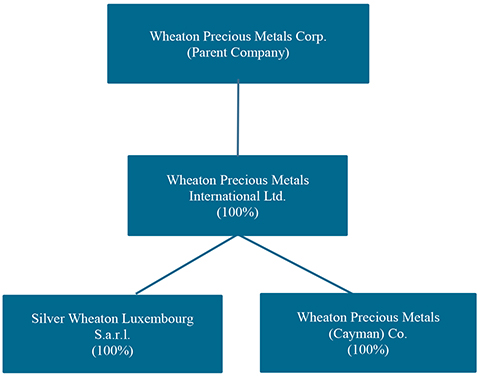
The Company’s active direct and indirect subsidiaries are Wheaton Precious Metals International Ltd. (“Wheaton International”) (formerly Silver Wheaton (Caymans) Ltd.) which is wholly owned by the Company and is governed by the laws of the Cayman Islands, together with Wheaton Precious Metals (Cayman) Co. (“Wheaton Cayman”) which is governed by the laws of the Cayman Islands and Silver Wheaton Luxembourg S.a.r.l. (“Silver Wheaton Luxembourg”) which is governed by the laws of Luxembourg. Wheaton Cayman and Silver Wheaton Luxembourg are both wholly owned by Wheaton International. As used in this annual information form, except as otherwise required by the context, reference to “Wheaton” or the “Company” means Wheaton Precious Metals Corp., Wheaton International, Silver Wheaton Luxembourg and Wheaton Cayman.
On May 21, 2009, the Company completed the acquisition of all of the outstanding common shares of Silverstone Resources Corp. (“Silverstone”) by way of a statutory plan of arrangement (the “Silverstone Acquisition”). During the year ended December 31, 2024, the Company wound up Silverstone (Barbados) Corp., an inactive and non-material subsidiary that was acquired through the Silverstone Acquisition. During the year ended December 31, 2025, all of the shares of Wheaton Cayman were transferred from Wheaton to Wheaton International as part of an internal reorganization.
On May 10, 2017, the Company changed its name from “Silver Wheaton Corp.” to “Wheaton Precious Metals Corp.” and changed its Toronto Stock Exchange (“TSX”) and New York Stock Exchange (“NYSE”) ticker symbol from “SLW” to “WPM.” Concurrent with the name change, the Company’s web domain changed to www.wheatonpm.com. Information contained on Wheaton’s website should not be deemed to be a part of this annual information form or incorporated by reference herein. On October 28, 2020, the common shares of the Company (“Common Shares”) commenced trading on the London Stock Exchange (“LSE”). The Common Shares are currently listed and posted for trading on the LSE (symbol: WPM), the NYSE (symbol: WPM) and the TSX (symbol: WPM).
WHEATON AND ITS PRINCIPAL SUBSIDIARIES
WHEATON 2025 ANNUAL INFORMATION FORM [3]
GENERAL DEVELOPMENT OF THE BUSINESS
Three Year History
The following is a summary of the three-year history of the Company. Further details concerning these and other transactions can be found under “Description of the Business”.
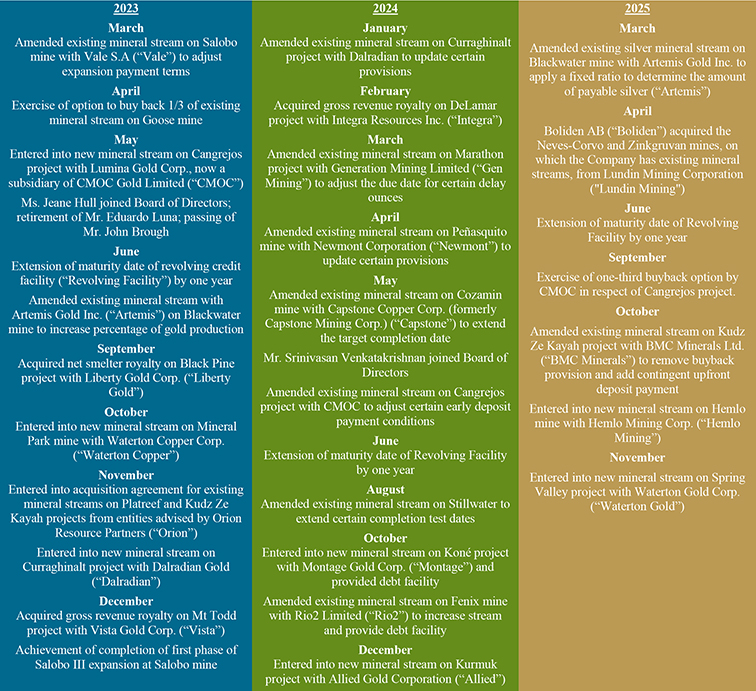
During the period January 1, 2026 to March 26, 2026, Wheaton announced that as part of the Company’s strategic succession planning, Haytham Hodaly, currently President, will succeed Randy Smallwood as the Company’s Chief Executive Officer effective March 31, 2026, and concurrently, Randy Smallwood will assume the role of non-executive Chair of the Board of Directors and George Brack, the current Chair of the Board, will transition to Lead Independent Director.
Additionally, Wheaton announced that Wheaton International had entered into a new mineral stream on the Antamina mine with a wholly-owned subsidiary of BHP Group Limited (“BHP”). For further details, see “Description of the Business – Principal Product – Antamina Mine (Silver) – BHP”.
WHEATON 2025 ANNUAL INFORMATION FORM [4]
DESCRIPTION OF THE BUSINESS
Acquisition & Production History
Wheaton is a streaming company which generates its revenue primarily from the sale of precious metals and cobalt. Wheaton enters into (i) precious metal purchase agreements to purchase all or a portion of the precious metals or cobalt production from mines located around the globe for an upfront payment and an additional payment upon the delivery of the precious metal or cobalt, and (ii) royalty agreements (together, “PMPAs”).
As of December 31, 2025, the Company has entered into 42 PMPAs (34 of which are precious metal purchase agreements, three of which are early deposit agreements, and five of which are royalty agreements), with 34 different mining companies, for the purchase of precious metals and cobalt relating to 23 mining assets which are currently operating, 23 which are at various stages of development and two of which have been placed in care and maintenance or have been closed, located in 18 countries. Pursuant to the precious metal purchase agreements, Wheaton acquires metal production from the counterparties for an initial upfront payment plus an additional cash payment for each ounce or pound delivered which is fixed by contract, generally at or below the prevailing market price. Attributable metal production as referred to in this annual information form is the metal production to which Wheaton is entitled pursuant to the various precious metal purchase agreements. The primary drivers of the Company’s financial results are the volume of metal production at the various mining assets to which the precious metal purchase agreements relate and the price realized by Wheaton upon sale of the metals received. The production and sales volume of gold, silver and palladium are reported in ounces, while cobalt is reported in pounds.
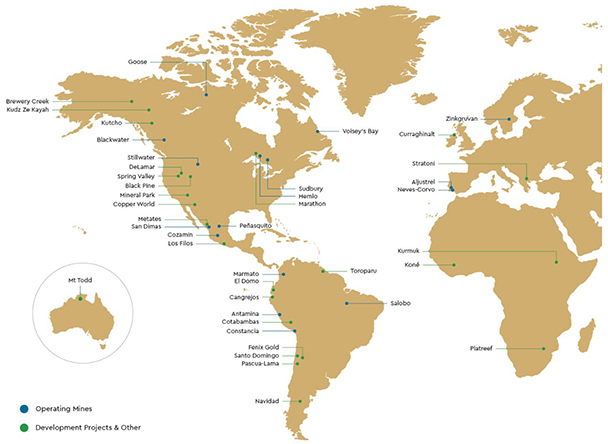
The Company is actively pursuing future growth opportunities, primarily by way of entering into additional precious metal purchase agreements. There is no assurance, however, that any potential transaction will be successfully completed. The following map illustrates the geographic location of the Company’s PMPAs:
WHEATON 2025 ANNUAL INFORMATION FORM [5]
Principal Product
The Company’s principal products are precious metals and cobalt that it has agreed to purchase pursuant to PMPAs. The following tables summarize the mineral stream interests and mineral royalty interests owned by the Company (collectively, the “Mining Operations”) as of December 31, 2025. Note that statements made in this section contain forward-looking information. Please see “Cautionary Note Regarding Forward-Looking Statements” for material risks, assumptions and important disclosure associated with this information. Following these tables, a description of the Company’s PMPAs is included in reverse-chronological order of acquisition. The following table summarizes the mineral stream interests currently owned by the Company:
| Total Upfront Consideration | ||||||||||||||||||||||||||||||||||||||||||||
| Production | Depletion | |||||||||||||||||||||||||||||||||||||||||||
| Mineral Stream Interests |
Mine Owner ¹ |
Location¹ | Attributable Production |
Payment Per Unit 2,3 |
Rate Per Unit 1 |
Paid
to Dec 31, 2025 3 |
To be Paid 2 | Total ³ | Cash Flow Generated to Date ³ |
Q4-2025 PBND 3, 4 |
Term ¹ | |||||||||||||||||||||||||||||||||
| Gold |
||||||||||||||||||||||||||||||||||||||||||||
| Salobo |
Vale | BRA | 75 | % | $433 | $ | 404 | $ | 3,573,360 | $ | - | $ | 3,573,360 | $ | 3,519,774 | 79,466 | LOM | |||||||||||||||||||||||||||
| Sudbury 5 |
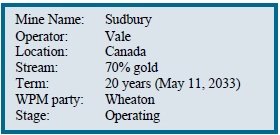
Vale | CAN | 70 | % | $400 | $ | 1,399 | 623,572 | - | 623,572 | 373,177 | 12,761 | 20 years 5 | |||||||||||||||||||||||||||||||
| Constancia |
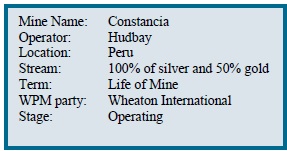
Hudbay | PER | 50 | % | $429 | $ | 338 | 135,000 | - | 135,000 | 434,418 | 7,240 | LOM | |||||||||||||||||||||||||||||||
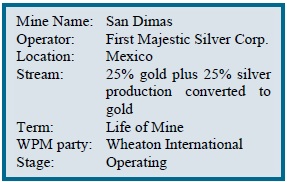
| San Dimas |
FM | MEX | variable | 6 | $643 | $ | 428 | 220,000 | - | 220,000 | 395,909 | 2,098 | LOM | |||||||||||||||||||||||||||||||
| Stillwater 7 |
Sibanye | USA | 100 | % | 18% | $ | 570 | 237,880 | - | 237,880 | 118,935 | 4,462 | LOM | |||||||||||||||||||||||||||||||
| Blackwater |
Artemis Gold | CAN | 8 | % 8 | 35% | $ | 606 | 340,000 | - | 340,000 | 40,543 | 319 | LOM | |||||||||||||||||||||||||||||||
| Platreef |
Ivanhoe | SA | 62.5 | % 9 | $100 | NP | 275,300 | - | 275,300 | - | - | LOM 9 | ||||||||||||||||||||||||||||||||
| Other |
||||||||||||||||||||||||||||||||||||||||||||
| Copper World |
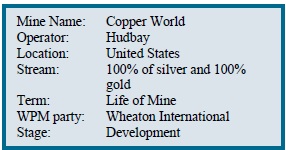
Hudbay | USA | 100 | % | $450 | NP | - | 39,296 | 39,296 | - | - | LOM | ||||||||||||||||||||||||||||||||
| Marmato |
Aris | CO | 10.5 | % 10 | 18% | $ | 527 | 85,416 | 77,584 | 163,000 | 24,630 | 112 | LOM | |||||||||||||||||||||||||||||||
| Santo Domingo |
Capstone | CHL | 100 | % ¹¹ | 18% | NP | 25,028 | 260,000 | 285,028 | 6,159 | - | LOM | ||||||||||||||||||||||||||||||||
| Fenix |
Rio2 | CHL | 22 | % ¹² | 18% | NP | 150,000 | - | 150,000 | - | - | LOM | ||||||||||||||||||||||||||||||||
| El Domo |
Silvercorp | ECU | 50 | % ¹³ | 18% | NP | 31,981 | 96,655 | 128,636 | 1,203 | - | LOM | ||||||||||||||||||||||||||||||||
| Marathon |
Gen Mining | CAN | 100 | % 14 | 18% | NP | 21,857 | 102,145 | 124,002 | - | - | LOM | ||||||||||||||||||||||||||||||||
| Goose |
B2Gold | CAN | 2.78 | % 15 | 18% | $ | 1,212 | 83,750 | - | 83,750 | 2,124 | 810 | LOM | |||||||||||||||||||||||||||||||
| Cangrejos |
CMOC | ECU | 4.4 | % 16 | 18% | NP | 32,160 | 168,840 | 201,000 | - | - | LOM | ||||||||||||||||||||||||||||||||
| Curraghinalt |
Dalradian | UK | 3.05 | % 17 | 18% | NP | 20,000 | 55,000 | 75,000 | - | - | LOM | ||||||||||||||||||||||||||||||||
| Kudz Ze Kayah |
BMC | CAN | 6.875 | % 18 | 20% | NP | 14,760 | 5,400 | 20,160 | - | - | LOM | ||||||||||||||||||||||||||||||||
| Koné |
Montage | CIV | 19.5 | % 19 | 20% | NP | 468,750 | 156,250 | 625,000 | - | - | LOM | ||||||||||||||||||||||||||||||||
| Kurmuk |
Allied | ETH | 6.7 | % 20 | 15% | NP | 175,000 | - | 175,000 | - | - | LOM | ||||||||||||||||||||||||||||||||
| Spring Valley |
Waterton Gold | USA | 8 | % ²¹ | 20% | NP | 50,000 | 620,000 | 670,000 | - | - | LOM | ||||||||||||||||||||||||||||||||
| Hemlo |
Hemlo | CAN | 10.13 | % ²² | 20% | $ | 1,423 | 300,000 | - | 300,000 | - | 1,622 | LOM | |||||||||||||||||||||||||||||||
| $ | 6,863,814 | $ | 1,581,170 | $ | 8,444,984 | $ | 4,916,872 | 108,890 | ||||||||||||||||||||||||||||||||||||
| Silver |
||||||||||||||||||||||||||||||||||||||||||||
| Peñasquito |
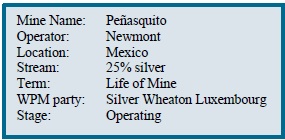
Newmont | MEX | 25 | % | $4.62 | $ | 5.09 | $ | 485,000 | $ | - | $ | 485,000 | $ | 1,819,088 | 1,105 | LOM | |||||||||||||||||||||||||||
| Antamina |
Glencore | PER | 33.75 | % ²³ | 20% | $ | 4.39 | 900,000 | - | 900,000 | 949,639 | 1,206 | LOM | |||||||||||||||||||||||||||||||
| Constancia |
Hudbay | PER | 100 | % | $6.32 | $ | 6.43 | 294,900 | - | 294,900 | 351,874 | 433 | LOM | |||||||||||||||||||||||||||||||
| Blackwater |
Artemis Gold | CAN | 50 | % 8 | 18% | $ | 7.55 | 170,800 | - | 170,800 | 16,561 | 17 | LOM | |||||||||||||||||||||||||||||||
| Other |
||||||||||||||||||||||||||||||||||||||||||||
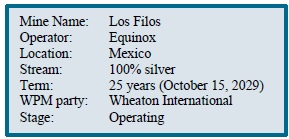
| Los Filos |
Equinox | MEX | 100 | % | $4.74 | $ | 0.00 | 4,463 | - | 4,463 | 45,193 | 51 | 25 years 24 | |||||||||||||||||||||||||||||||
| Zinkgruvan |
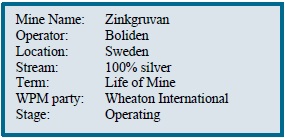
Boliden | SWE | 100 | % | $4.81 | $ | 1.00 | 77,866 | - | 77,866 | 606,915 | 172 | LOM | |||||||||||||||||||||||||||||||
| Stratoni |
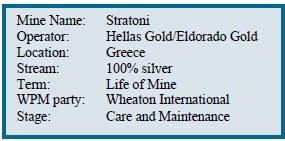
Eldorado | GRC | 100 | % | $11.54 | NP | 57,500 | - | 57,500 | 155,868 | - | LOM | ||||||||||||||||||||||||||||||||
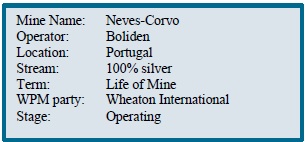
| Neves-Corvo |
Boliden | PRT | 100 | % | $4.55 | $ | 1.36 | 35,350 | - | 35,350 | 210,142 | 101 | 50 years 25 | |||||||||||||||||||||||||||||||
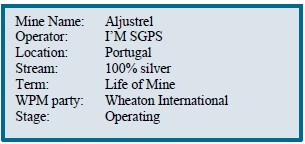
| Aljustrel |
Almina | PRT | 100 | % 26 | 50% | $ | 0.00 | 2,451 | - | 2,451 | 60,062 | - | 50 years 25 | |||||||||||||||||||||||||||||||
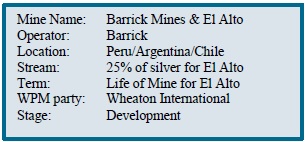
| El Alto 27 |
Barrick | |
CHL/ ARG |
25 | % | $3.90 | NP | 625,000 | - | 625,000 | 372,767 | - | LOM | |||||||||||||||||||||||||||||||
| Copper World |
Hudbay | USA | 100 | % | $3.90 | NP | - | 191,855 | 191,855 | - | - | LOM | ||||||||||||||||||||||||||||||||
| Navidad |
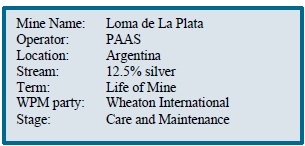
PAAS | ARG | 12.5 | % | $4.00 | NP | 10,788 | 32,400 | 43,188 | - | - | LOM | ||||||||||||||||||||||||||||||||
| Marmato |
Aris | CO | 100 | % 10 | 18% | $ | 6.60 | 7,600 | 4,400 | 12,000 | 4,295 | 2 | LOM | |||||||||||||||||||||||||||||||
| Cozamin |
Capstone | MEX | 50 | % 28 | 10% | $ | 21.62 | 150,000 | - | 150,000 | 77,715 | 133 | LOM | |||||||||||||||||||||||||||||||
| El Domo |
Silvercorp | ECU | 75 | % ¹³ | 18% | NP | 11,531 | 34,969 | 46,500 | - | - | LOM | ||||||||||||||||||||||||||||||||
| Mineral Park |
Waterton | US | 100 | % | 18% | $ | 12.29 | 115,000 | - | 115,000 | - | 7 | LOM | |||||||||||||||||||||||||||||||
| Kudz Ze Kayah |
BMC | CAN | 6.875 | % 18 | 20% | NP | 26,240 | 9,600 | 35,840 | - | - | LOM | ||||||||||||||||||||||||||||||||
| $ | 2,974,489 | $ | 273,224 | $ | 3,247,713 | $ | 4,670,119 | 3,227 | ||||||||||||||||||||||||||||||||||||
| Palladium |
||||||||||||||||||||||||||||||||||||||||||||
| Stillwater 7 |
Sibanye | USA | 4.5 | % 29 | 18% | $ | 492.09 | $ | 262,120 | $ | - | $ | 262,120 | $ | 171,460 | 5,169 | LOM | |||||||||||||||||||||||||||
| Platreef |
Ivanhoe | SA | 5.25 | % 9 | 30% | NP | 78,700 | - | 78,700 | - | - | LOM 9 | ||||||||||||||||||||||||||||||||
| $ | 340,820 | $ | - | $ | 340,820 | $ | 171,460 | 5,169 | ||||||||||||||||||||||||||||||||||||
WHEATON 2025 ANNUAL INFORMATION FORM [6]
| Total Upfront Consideration | ||||||||||||||||||||||||||||||||||||||||||||
| Production | Depletion | |||||||||||||||||||||||||||||||||||||||||||
| Mineral Stream Interests |
Mine Owner ¹ |
Location¹ | Attributable Production |
Payment Per Unit 2,3 |
Rate Per Unit 1 |
Paid
to Dec 31, 2025 3 |
To be Paid 2 | Total ³ | Cash Flow Generated to Date ³ |
Q4-2025 PBND 3, 4 |
Term ¹ | |||||||||||||||||||||||||||||||||
| Platinum |
||||||||||||||||||||||||||||||||||||||||||||
| Marathon |
Gen Mining | CAN | 22 | % 14 | 18 | % | NP | $ | 9,367 | $ | 43,776 | $ | 53,143 | $ | - | - | LOM | |||||||||||||||||||||||||||
| Platreef |
Ivanhoe | SA | 5.25 | % 9 | 30 | % | NP | 57,500 | - | 57,500 | - | - | LOM 9 | |||||||||||||||||||||||||||||||
| $ | 66,867 | $ | 43,776 | $ | 110,643 | $ | - | - | ||||||||||||||||||||||||||||||||||||
| Cobalt |
||||||||||||||||||||||||||||||||||||||||||||
| Voisey’s Bay |
Vale | CAN | 42.4 | % 30 | 18 | % | $9.02 | $ | 390,000 | $ | - | $ | 390,000 | $ | 84,040 | 1,341 | LOM | |||||||||||||||||||||||||||
| Total PMPAs Currently Owned |
|
$ | 10,635,990 | $ | 1,898,170 | $ | 12,534,160 | $ | 9,842,491 | |||||||||||||||||||||||||||||||||||
| Terminated / Matured PMPAs |
|
1,358,502 | - | $ | 1,358,502 | 3,376,971 | ||||||||||||||||||||||||||||||||||||||
|
Total |
$ | 11,994,492 | $ | 1,898,170 | $ | 13,892,662 | $ | 13,219,462 | ||||||||||||||||||||||||||||||||||||
| 1) | Abbreviations as follows: FM = First Majestic Silver Corp; BMC = BMC Minerals; PAAS = Pan American Silver Corp; Gen Mining = Generation Mining Ltd.; Waterton = Waterton Copper LP.; Waterton Gold = Waterton Gold LP; ARG = Argentina; BRA = Brazil; CAN = Canada; CHL = Chile; CIV = Côte d’Ivoire, CO = Colombia; ECU = Ecuador; ETH = Ethiopia, GRC = Greece; MEX = Mexico; PER = Peru; PRT = Portugal; SA = South Africa; SWE = Sweden; USA = United States; UK = United Kingdom; NP = Not Producing; and LOM = Life of Mine. |
| 2) | Please see the section entitled “Contractual Obligations and Contingencies – Mineral Stream Interests” on page 36 of Wheaton’s MD&A for the year ended December 31, 2025 for more information. |
| 3) | All figures in thousands except gold and palladium ounces and per ounce amounts. The total upfront consideration paid to date excludes closing costs and capitalized interest, where applicable. Please refer to the section entitled “Other Contractual Obligations and Contingencies” on page 38 of this MD&A for details of when the remaining upfront consideration is forecasted to be paid. Certain contracts, including Santo Domingo and El Domo, contain delay ounce provisions whereby should construction of the mine not be completed by an agreed to date, the mine operator must compensate the Company for the delay until certain conditions are satisfied by delivering additional ounces. The value of these ounces on the date first due, net of amounts owed to the mine operator, is treated as a reduction to the upfront consideration paid. Sale of the resulting ounces received is treated as revenue, with the associated cost of sales being equal to the fair value of the ounces on the date received. |
| 4) | Payable gold, silver, palladium and cobalt PBND are based on management estimates. These figures may be updated in the future as additional information is received. Please see “Cautionary Note Regarding Forward-Looking Statements” for material risks, assumptions and important disclosures associated with this information. |
| 5) | Comprised of the operating Coleman, Copper Cliff, Garson, Creighton, Stobie and Totten gold interests as well as the non-operating Victor gold interest. As of December 31, 2025, the Company has received approximately $373 million of operating cash flows from the Sudbury stream. Should the market value of gold delivered to Wheaton through the 20-year term of the contract, net of the per ounce cash payment, be lower than the initial $670 million refundable deposit, the Company will be entitled to a refund of the difference at the conclusion of the term. The term of the Sudbury PMPA ends on May 11, 2033. |
| 6) | The original San Dimas SPA, entered into on October 15, 2004, was terminated on May 10, 2018 and concurrently the Company entered into the new San Dimas PMPA. Under the terms of the San Dimas PMPA, the Company is entitled to an amount equal to 25% of the payable gold production plus an additional amount of gold equal to 25% of the payable silver production converted to gold at a fixed gold to silver exchange ratio of 70:1 from the San Dimas mine. If the average gold to silver price ratio decreases to less than 50:1 or increases to more than 90:1 for a period of 6 months or more, then the “70” shall be revised to “50” or “90”, as the case may be, until such time as the average gold to silver price ratio is between 50:1 to 90:1 for a period of 6 months or more in which event the “70” shall be reinstated. During the period of April 30, 2025 to October 28, 2025, the fixed gold to silver exchange ratio was revised from 70:1 to 90:1. The current gold to silver price ratio is 70:1. |
| 7) | Comprised of the Stillwater and East Boulder gold and palladium interests. |
| 8) | Once the Company has received 464,000 ounces of gold under the amended Blackwater Gold PMPA, the attributable gold production will be reduced to 4%. Once the Company has received 17.8 million ounces of silver under the Blackwater Silver PMPA, the attributable silver production will be reduced to 33%. |
| 9) | Once the Company has received 218,750 ounces of gold under the Platreef Gold PMPA, the attributable gold production will reduce to 50% until 428,300 ounces have been delivered, after which the stream drops to 3.125%. Under the Platreef Palladium and Platinum PMPA, once the Company has received 350,000 ounces of combined palladium and platinum, the attributable palladium and platinum production will reduce to 3% until 485,115 ounces have been delivered, after which the stream drops to 0.1% of the payable palladium and platinum production. If certain thresholds are met, including if production through the Platreef project concentrator achieves 5.5 million tonnes per annum (“Mtpa”), the 3.125% residual gold stream and the 0.1% residual palladium and platinum stream will terminate. Under the Platreef Gold PMPA, a subsidiary of Royal Gold Inc. (formerly Sandstorm Gold Ltd./Nomad Royalty Ltd.) (“Royal Gold”) is entitled to purchase 37.5% of payable gold. The decrease in the percentage of payable metal that Wheaton will be entitled to purchase is conditional on delivery of the total amount of payable gold to all purchasers (Wheaton and Royal Gold combined). The values set out herein pertain only to Wheaton’s share of the payable gold. |
| 10) | Once the Company has received 310,000 ounces of gold and 2.15 million ounces of silver under the Marmato PMPA, the attributable gold and silver production will be reduced to 5.25% and 50%, respectively. |
| 11) | Once the Company has received 285,000 ounces of gold under the Santo Domingo PMPA, the Company’s attributable gold production will be reduced to 67%. The units sold under Santo Domingo relate to ounces received due to the delay ounce provision (see footnote 3, above). |
| 12) | On October 21, 2024, the Company amended the Fenix PMPA. Under the original agreement, the Company was to acquire an amount of gold equal to 6% of the gold production until 90,000 ounces have been delivered, 4% of the gold production until the delivery of a further 140,000 ounces and 3.5% gold production thereafter for the life of mine. Under the revised agreement, the Company is entitled to purchase an additional 16% of payable gold production (22% in total) (subject to adjustment if there are delays in deliveries relative to an agreed schedule). Once Rio2 delivers the incremental 95,000 ounces (as adjusted), the stream reverts to the percentages and thresholds under the original Fenix PMPA (as described). Rio2 has a one-time option to terminate the requirement to deliver the incremental gold production from the end of 2027 until the end of 2029 by delivering 95,000 ounces (as adjusted) less previously delivered gold ounces, excluding those gold ounces which would have been delivered under the original Fenix PMPA. |
| 13) | Once the Company has received 145,000 ounces of gold under the El Domo PMPA, the attributable gold production will be reduced to 33%, and once the Company has received 4.6 million ounces of silver, the attributable silver production will be reduced to 50%. The units sold under El Domo relate to ounces received due to the delay ounce provision (see footnote 3, above). |
| 14) | Once the Company has received 150,000 ounces of gold and 120,000 ounces of platinum under the Marathon PMPA, the attributable gold and platinum production will be reduced to 67% and 15%. |
| 15) | Once the Company has received 87,100 ounces of gold under the Goose PMPA, the Company’s attributable gold production will be 1.44%, and once the Company has received 134,000 ounces of gold under the agreement, the Company’s attributable gold production will be reduced to 1.0%. |
| 16) | During Q3 2025, in connection with its acquisition of Lumina Gold Corp., CMOC exercised its 33% buy-back option under the Cangrejos PMPA for a cash payment of $102 million, resulting in a gain of $86 million on partial disposal of the Cangrejos PMPA. In connection with the exercise of the option, once the Company has received 469,000 ounces of gold under the Cangrejos PMPA, the Company’s attributable gold production will be reduced to 2.9%. |
| 17) | Once the Company has received 125,000 ounces of gold under the Curraghinalt PMPA, the Company’s attributable gold production will be reduced to 1.5%. |
| 18) | Once the Company has received 330,000 ounces of gold and 43.30 million ounces of silver under the Kudz Ze Kayah PMPA, the Company’s attributable gold and silver production will be reduced to 6.125%, with a further reduction to 5.5% until the Company has received an additional 59,800 ounces of gold and 7.96 million ounces of silver, with a further reduction to 5.5% until the Company has received an additional 270,200 ounces of gold and 35.34 million ounces of silver, thereafter increased to 6.75%. |
| 19) | Once the Company has received 400,000 ounces of gold under the Koné PMPA, subject to adjustment if there are delays in deliveries relative to an agreed schedule, the attributable gold production will reduce to 10.8% until an additional 130,000 ounces of gold has been delivered, after which the stream drops to 5.4%. |
| 20) | Once the Company has received 220,000 ounces of gold under the Kurmuk PMPA, the Company’s attributable gold production will be reduced to 4.8%. During any period in which debt exceeding $150 million ranks ahead of the gold stream, the stream percentage increases to 7.15% and decreases to 5.25% once the drop-down threshold is reached. |
| 21) | Once the Company has received 300,000 ounces of gold under the Spring Valley PMPA, the Company’s attributable gold production will be reduced to 6%. |
| 22) | Once the Company has received 135,750 ounces of gold under the Hemlo PMPA (the “First Dropdown Threshold”), the Company’s attributable gold production will be reduced to 6.75% until an additional 117,998 ounces of gold has been delivered (the “Second Dropdown Threshold”), at which point the Company’s attributable gold production will be 4.50% for the life of the mine. Each of the First Dropdown Threshold and the Second Dropdown Threshold will be subject to adjustment if there are delays in deliveries relative to an agreed schedule, and commencing in 2033, if deliveries fall behind the agreed schedule by 10,000 ounces or more, the stream percentage will be increased by 5% until deliveries catch up with the agreed schedule. The payable gold will be reduced by half with respect to gold production from certain claims comprising the Interlake deposit. |
| 23) | Once Wheaton has received 140 million ounces of silver under the Antamina PMPA, the Company’s attributable silver production will be reduced to 22.5%. |
| 24) | The term of the Los Filos PMPA ends on October 15, 2029. |
| 25) | The term of the Neves-Corvo and Aljustrel PMPAs ends on June 5, 2057. |
| 26) | Wheaton only has the rights to silver contained in concentrate containing less than 15% copper at the Aljustrel mine. |
| 27) | Previously referred to as Pascua-Lama in this MD&A. |
| 28) | Once Wheaton has received 10 million ounces of silver under the Cozamin PMPA, the Company’s attributable silver production will be reduced to 33%. |
| 29) | Once the Company has received 375,000 ounces of palladium under the Stillwater PMPA, the Company’s attributable palladium production will be reduced to 2.25%, and once the Company has received 550,000 ounces of palladium under the agreement, the Company’s attributable palladium production will be reduced to 1%. |
| 30) | Once the Company has received 31 million pounds of cobalt under the Voisey’s Bay PMPA, the Company’s attributable cobalt production will be reduced to 21.2%. |
WHEATON 2025 ANNUAL INFORMATION FORM [7]
The following table summarizes the early deposit mineral stream interests currently owned by the Company:
| Attributable Production to be |
||||||||||||||||||||||||||||||||||||
| Early Deposit Mineral Stream Interests |
Mine Owner |
Location of Mine |
Upfront Consideration Paid to Date 1 |
Upfront Consideration to be Paid 1, 2 |
Total Upfront Consideration¹ |
Gold | Silver | Term of Agreement |
Date of Original Contract |
|||||||||||||||||||||||||||
| Toroparu |
|
Aris Mining |
|
|
Guyana |
|
$ |
15,500 |
|
$ |
138,000 |
|
$ |
153,500 |
|
|
10% |
|
|
50% |
|
|
Life of Mine |
|
|
11-Nov-13 |
| |||||||||
| Cotabambas |
|
Panoro |
|
|
Peru |
|
|
14,000 |
|
|
126,000 |
|
|
140,000 |
|
|
25% ³ |
|
|
100% ³ |
|
|
Life of Mine |
|
|
21-Mar-16 |
| |||||||||
| Kutcho |
|
Kutcho |
|
|
Canada |
|
|
16,852 |
|
|
58,000 |
|
|
74,852 |
|
|
100% |
|
|
100% |
|
|
Life of Mine |
|
|
14-Dec-17 |
| |||||||||
| $ |
46,352 |
|
$ |
322,000 |
|
$ |
368,352 |
|
||||||||||||||||||||||||||||
| 1) | Expressed in thousands; excludes closing costs and capitalized interest, where applicable. |
| 2) | Please refer to the section entitled “Other Contractual Obligations and Contingencies” on page 38 of Wheaton’s MD&A for the year ended December 31, 2025 for details of when the remaining upfront consideration is forecast to be paid. |
| 3) | Once 90 million silver equivalent ounces attributable to Wheaton have been produced, the attributable production will decrease to 16.67% of gold production and 66.67% of silver production for the life of mine. |
The following table summarizes the mineral royalty interests currently owned by the Company:
| Royalty Interests | Mine Owner |
Location of Mine |
Royalty 1 | Total Upfront Consideration 2 |
Term of Agreement |
Date of Original Contract |
||||||||||||||||||
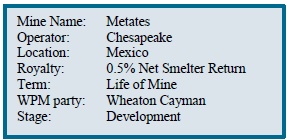
| Metates |
|
Chesapeake |
|
|
Mexico |
|
|
0.5% NSR |
|
$ |
3,000 |
|
|
Life of Mine |
|
|
07-Aug-2014 |
| ||||||
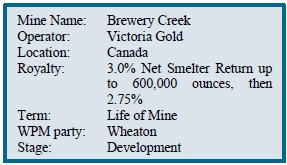
| Brewery Creek 3 |
|
Victoria Gold |
|
|
Canada |
|
|
2.0% NSR |
|
|
3,529 |
|
|
Life of Mine |
|
|
04-Jan-2021 |
| ||||||
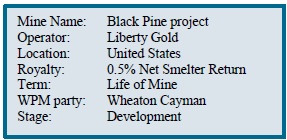
| Black Pine 4 |
|
Liberty Gold |
|
|
USA |
|
|
0.5% NSR |
|
|
3,600 |
|
|
Life of Mine |
|
|
10-Sep-2023 |
| ||||||
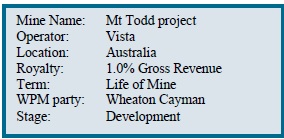
| Mt Todd 5 |
|
Vista |
|
|
Australia |
|
|
1.0% GR |
|
|
20,000 |
|
|
Life of Mine |
|
|
13-Dec-2023 |
| ||||||
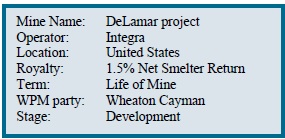
| DeLamar 6 |
|
Integra |
|
|
USA |
|
|
1.5% NSR |
|
|
9,750 |
|
|
Life of Mine |
|
|
20-Feb-2024 |
| ||||||
| $ |
39,879 |
|
||||||||||||||||||||||
| 1) | Abbreviation as follows: NSR = Net Smelter Return Royalty; and GR = Gross Royalty. |
| 2) | Expressed in thousands; excludes closing costs. |
| 3) | The Company paid $3 million for an existing 2.0% net smelter return royalty interests on the first 600,000 ounces of gold mined and a 2.75% net smelter returns royalty interest thereafter. The Brewery Creek Royalty agreement provides, among other things, that Golden Predator Mining Corp., (subsidiary of Victoria Gold) may reduce the 2.75% net smelter royalty interest to 2.125% on payment of the sum of Cdn$2 million to the Company. On August 14, 2024, the Ontario Superior Court of Justice placed Victoria Gold Corp into receivership following the failure of the heap leach pad at its Eagle Mine in June, 2024. |
| 4) | Liberty Gold has been granted an option to repurchase 50% of the NSR for $4 million at any point in time up to the earlier of commercial production at Black Pine or January 1, 2030. |
| 5) | The Mt Todd royalty is at a rate of 1% of gross revenue with such rate being subject to increase to a maximum rate of 2%, depending on the timing associated with the achievement of certain operational milestones. |
| 6) | Under the DeLamar royalty, if completion is not achieved by January 1, 2029, the DeLamar royalty will increase annually by 0.15% of net smelter returns to a maximum of 2.7% of net smelter returns. |
Further details regarding the PMPAs entered into by the Company in respect of mineral stream interests can be found below, listed in reverse-chronological order:
Antamina Mine (Silver) - BHP
|
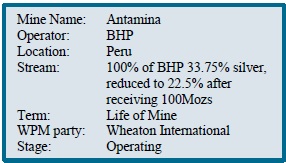
Subsequent to December 31, 2025, on February 16, 2026, Wheaton International entered into a PMPA (the “BHP Antamina PMPA”) to acquire from BHP Billiton Group Ltd. (“BHP Billiton”), a subsidiary of BHP, an amount of silver equal to 33.75% of the silver production from the Antamina mine in Peru (the “Antamina mine”) until the delivery of 100 million ounces of silver and 22.5% of silver production thereafter for the life of mine at a fixed 90% payable rate. Subject to the satisfaction of customary conditions, on closing, Wheaton International will pay total upfront cash consideration of $4.3 billion. In addition, Wheaton International will make ongoing payments of 20% of the spot price per silver ounce delivered under the Antamina BHP PMPA. In connection with the BHP Antamina PMPA, BHP and a BHP holding company affiliate have provided corporate guarantees along with customary contractual protections. Recourse under the BHP corporate guarantee |
WHEATON 2025 ANNUAL INFORMATION FORM [8]
will be capped at the upfront deposit amount and reduces after certain ounces are received, while recourse under the BHP holding company guarantee is unlimited. The BHP Antamina PMPA will be effective April 1, 2026.
The upfront payment of $4.3 billion will be funded through a combination of existing liquidity and new financing, including a new $1.5 billion non-revolving term loan credit facility.
See “Further Disclosure Regarding Mineral Projects on Material Properties – Antamina Mine, Peru” for details regarding the Antamina mine.
Spring Valley Project (Gold)
|
|
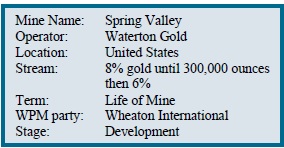
Under the Spring Valley PMPA, Wheaton International is required to pay Waterton Gold total cash consideration of $670 million in installments during construction, subject to various conditions being satisfied. As of December 31, 2025, $50 million had been advanced to Waterton Gold. In addition, Wheaton International will make ongoing payments for the gold ounces delivered equal to 20% of the spot price until the value of gold delivered, net of the production payment, is equal to the upfront consideration of $670 million, at which point the production payment will increase to 22% of the spot price. Under the Spring Valley PMPA, a fixed payable factor of 99.9% will be applied to payable gold.
Wheaton International also has a right of first refusal on any future streaming agreement, royalty agreement, prepay agreement or similar transaction entered into by Waterton Gold or any of its affiliates relating to production of any precious metals from the Spring Valley project. Wheaton International has also entered into a loan agreement to provide a secured cost overrun facility of up to $150 million to the Spring Valley owner, an affiliate of Waterton Gold, once the full upfront consideration has been paid.
Hemlo Mine (Gold)
|
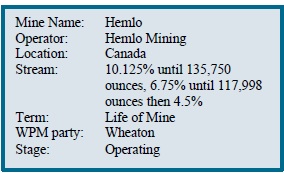
Effective October 31, 2025, the Company entered into a PMPA (the “Hemlo PMPA”) with Hemlo Mining in respect of gold production from the Hemlo mine located in Ontario, Canada (the “Hemlo mine”). Under the terms of the Hemlo PMPA, Wheaton is entitled to acquire from Hemlo (“Hemlo”) an amount of gold equal to 10.125% of the gold production until the delivery of 135,750 ounces of gold (“First Hemlo Dropdown Threshold”), 6.75% of gold production until the delivery of an additional 117,998 gold ounces of gold (“Second Hemlo Dropdown Threshold”) and 4.5% of gold production thereafter for the life of mine. In addition, Hemlo Mining provided Wheaton with a corporate guarantee and certain other security over the Hemlo mine, which will be shared with the lenders under Hemlo Mining’s acquisition facility. |
Under the Hemlo PMPA, Wheaton paid Hemlo Mining total cash consideration of $300 million in connection with Hemlo Mining’s acquisition of the Hemlo mine from Barrick Mining Corporation. In addition, Wheaton will make ongoing payments equal to 20% of the spot gold price. Wheaton also has a right of first refusal on any future streaming agreement, royalty agreement or similar transaction entered into by Hemlo Mining or any of its affiliates relating to production of any precious metal from the Hemlo mine. Under the Hemlo PMPA, each of the First Hemlo Dropdown Threshold and the Second Hemlo Dropdown Threshold will be subject to adjustment if there are delays in deliveries relative to an agreed schedule, and commencing in 2033, if deliveries fall behind the agreed schedule by 10,000 ounces or more, the amount of gold to be
WHEATON 2025 ANNUAL INFORMATION FORM [9]
delivered will be increased by 5% until deliveries catch up with the agreed schedule. In addition, the payable gold will be reduced by half with respect to gold production from certain claims comprising the Interlake deposit. Payable gold is calculated using a fixed payable factor of 99.95%. The Hemlo mine has been operating continuously for more than 30 years.
Kurmuk Project (Gold)
|
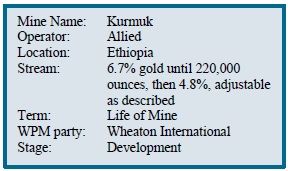
On December 5, 2024, Wheaton International entered into a PMPA with Allied (the “Kurmuk PMPA”) in respect of gold production from the Kurmuk project located in Ethiopia (the “Kurmuk project”). Under the terms of the Kurmuk PMPA, Wheaton International is entitled to purchase an amount of gold equal to 6.7% of the gold production until 220,000 gold ounces have been delivered, after which the stream drops to 4.8% of the gold production for the life of mine. During any period in which debt exceeding US$150 million ranks ahead of the Kurmuk PMPA, the stream percentage increases to 7.15% and decreases to 5.25% once the drop-down threshold is reached. Under the Kurmuk PMPA, Allied and its subsidiaries provide Wheaton International with corporate guarantees and certain other security. Other Allied subsidiaries will provide guarantees and security in respect of the Sadiola mine pending the delivery of certain Kurmuk project related security. |
Under the Kurmuk PMPA, Wheaton International committed to pay Allied total cash consideration of $175 million, payable in staged equal installments during construction, subject to various customary conditions being satisfied. As of December 31, 2025, all upfront cash consideration has been advanced to Allied. In addition, Wheaton International will make ongoing payments for the gold ounces delivered equal to 15% of the spot price. Wheaton International also has a right of first refusal on any future streaming agreement, royalty agreement, prepay agreement or similar transaction entered into by Allied or any of its affiliates relating to production of any precious metals from the Kurmuk project. Until the earlier of January 1, 2027 and completion, Allied has a one-time option to repurchase 33% of the gold stream on a change in control for an amount ensuring a fixed internal rate of return to Wheaton International. The Kurmuk PMPA will cover the existing mining license for the Kurmuk project and until 255,000 ounces of payable gold are delivered to Wheaton International, an additional 50 km radius around the mining license.
During the year ended December 31, 2024, Wheaton subscribed for 20,150,000 Allied common shares. Wheaton holds less than 10% of Allied’s issued and outstanding common shares.
On January 26, 2026, Allied announced it has entered into a definitive agreement with Zijin Gold International Company Limited (“Zijin Gold”), where Zijin Gold will acquire all of the issued and outstanding shares of Allied in cash. Allied has indicated that, subject to the satisfaction or waiver by the parties of all necessary closing conditions and the receipt of all required approvals, the completion of the transaction is anticipated in late April 2026.
Koné Project (Gold)
|
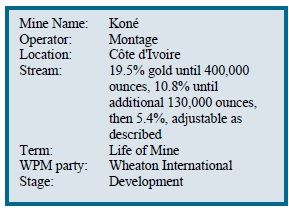
On October 23, 2024, Wheaton International entered into a PMPA with Montage (the “Koné PMPA”) in respect of gold production from its 90% owned Koné project located in Côte d’Ivoire (the “Koné project”). Under the terms of the Koné PMPA, Wheaton International is entitled to purchase an amount of gold equal to 19.5% of the gold production until 400,000 gold ounces have been delivered (“First Dropdown Threshold”), after which the stream drops to 10.8% of the gold production until an additional 130,000 gold ounces have been delivered (“Second Dropdown Threshold”), after which the stream drops to 5.4% for the life of mine. Under the Koné PMPA, Montage and its subsidiaries provide Wheaton International with corporate guarantees and other security over their assets. |
Under the Koné PMPA, Wheaton International committed to pay Montage total cash consideration of $625 million, payable in four equal installments during construction, subject to various customary conditions being satisfied. As of December 31, 2025, approximately $469 million had been advanced to Montage. In addition, Wheaton International will make ongoing payments for the gold ounces delivered equal to 20% of the spot price. For the first five years after October 23, 2024, there will be a price adjustment mechanism in place if the spot price of gold is less than $2,100/oz or greater than $2,700/oz. For example, if spot gold is $3,200 per ounce, Wheaton International’s production payment would be $675 per
WHEATON 2025 ANNUAL INFORMATION FORM [10]
ounce, equating to 21% of the spot price. This price adjustment mechanism expires on the fifth anniversary of the Koné PMPA, after which the production payment will be equal to 20% of the spot price going forward.
Wheaton International also has a right of first refusal on any future streaming agreement, royalty agreement, prepay agreement or similar transaction entered into by Montage or any of its affiliates relating to production of any precious metals from the Koné project. Until the earlier of December 31, 2026 and completion, Montage has a one-time option to repurchase 33% of the gold stream on a change in control for an amount ensuring a fixed internal rate of return to Wheaton International.
The Koné PMPA will apply to a Core Area of Interest inclusive of the Koné and Gbongogo deposits (the “Core Area of Interest”). Ore from within a 100km Expanded Area of Interest (“Expanded Area of Interest”) will be subject to the Koné PMPA if that ore is processed at the Koné mineral processing facility, until such time following the Second Dropdown Threshold that ounces received under the stream from the Expanded Area of Interest is equal to the remaining ounces from the Core Area of Interest, at which point the stream percentage will be reduced to nil. If at any point after that the remaining ounces from the Core Area of Interest exceed the ounces received from the Expanded Area of Interest, the Company will continue receiving 5.4% of payable gold from the Core Area of Interest, for the remaining life of mine.
Wheaton International has also entered into a loan agreement to provide a secured debt facility of up to $75 million to Montage to be allocated to project costs, including cost overruns, prior to completion and once the full upfront consideration under the Koné PMPA has been paid.
On January 19, 2026, Montage announced that rapid construction progress continues to be made at the Koné project, where first gold pour through the oxide circuit is anticipated in late Q4 2026.
Platreef Project (Gold)
|
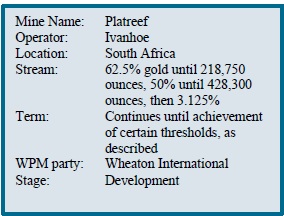
Under the terms of the Platreef Gold PMPA, Wheaton International is entitled to purchase an amount of gold equal to 62.5% of the payable gold production until 218,750 gold ounces have been delivered, after which the stream drops to 50% of the payable gold production until 428,300 gold ounces have been delivered, after which the stream drops to |
3.125% of the payable gold production.1 If certain thresholds are met, including if production through the Platreef project concentrator achieves 5.5 Mtpa, the 3.125% residual gold stream will terminate. In connection with the Platreef Gold PMPA, certain limited corporate guarantees and other subordinated security over the Platreef project are provided, to be released upon certain conditions being met, including when the value of gold delivered, net of the production payment, is equal to $125 million, and with limited claims for damages in certain circumstances.
Under the Platreef Gold PMPA, Wheaton International will make ongoing payments for the gold ounces delivered equal to $100 per ounce of gold until a total of 428,300 ounces of gold have been delivered, increasing to 80% of the spot price of gold thereafter.
1 Under the Platreef Gold PMPA, Royal Gold, Inc. (successor to Sandstorm Gold Ltd.) (“Royal Gold”) is entitled to purchase 37.5% of payable gold. The decrease in the percentage of payable gold that Wheaton International will be entitled to purchase is conditional on delivery of the total amount of payable gold to all purchasers (Wheaton International and Royal Gold combined). The values set out herein pertain only to Wheaton International’s share of the payable gold.
WHEATON 2025 ANNUAL INFORMATION FORM [11]
The Platreef project is fully permitted and currently under construction. On January 12, 2026, Ivanhoe reported that the first production of concentrate occurred on November 18, 2025.
Platreef Project (Palladium & Platinum)
|
Under the Orion Purchase Agreement, Wheaton International agreed to acquire the existing palladium and platinum purchase agreement between Orion and Ivanhoe (the “Platreef Palladium and Platinum PMPA”) in respect of palladium and platinum production from the Platreef project. On closing of the Orion Purchase Agreement on February 27, 2024, Wheaton and Wheaton International paid an aggregate of $450 million to Orion for all three existing streams.
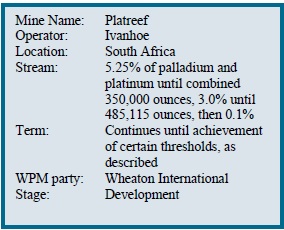
Under the terms of the Platreef Palladium and Platinum PMPA, Wheaton International is entitled to purchase an amount of palladium and platinum equal to 5.25% of payable palladium and platinum production until a total of 350,000 ounces of combined palladium and platinum have been delivered, after which the stream drops to 3.0% of the payable palladium and platinum production until 485,115 ounces have been delivered, after which the stream drops to 0.1% of the payable palladium and platinum production. If certain thresholds are met, including if production through the Platreef project concentrator achieves 5.5 Mtpa, the 0.1% residual palladium and platinum stream will terminate. In connection with the Platreef Palladium and Platinum PMPA, certain limited corporate guarantees and other |
subordinated security over the Platreef project are provided, to be released upon certain conditions being met, including when the value of palladium and platinum delivered, net of the production payment, is equal to $100 million, and with limited claims for damages in certain circumstances.
Under the Platreef Palladium and Platinum PMPA, Wheaton International will make ongoing payments for the palladium and platinum ounces delivered equal to 30% of the respective spot prices until 485,115 combined ounces have been delivered, increasing to 80% of the spot price of palladium and platinum thereafter.
Kudz Ze Kayah Project (Gold and Silver)
|
Under the Orion Purchase Agreement, Wheaton agreed to acquire the existing gold and silver purchase agreement between Orion and BMC Minerals Ltd. (“BMC Minerals”) (the “KZK PMPA”) in respect of gold and silver production from the Kudz Ze Kayah project located in central Yukon, Canada (the “Kudz Ze Kayah project” or the “KZK project”). On closing of the Orion Purchase Agreement on February 27, 2024, Wheaton and Wheaton International paid an aggregate of $450 million to Orion for all three existing streams.
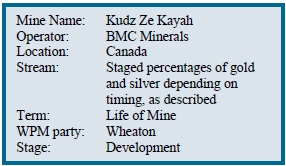
Under the KZK PMPA, Wheaton is entitled to acquire from BMC Minerals 7.375% of produced gold and produced silver until 330,000 oz of gold and 43,300,000 oz of silver are produced (on 100% basis), reducing to 6.125% until a further 59,800 oz of gold and 7,958,000 oz of silver are produced (on 100% basis), further reducing to 5.500% until a further 270,200 |
oz of gold and 35,342,000 oz of silver are produced (on 100% basis) (for a total of 660,000 oz of gold and 86,600,000 oz of silver), and thereafter 6.75%. Under the KZK PMPA, Wheaton will make ongoing payments for the gold and silver delivered equal to 20% of the respective spot prices.
In connection with the KZK PMPA, BMC Minerals and its subsidiaries provided Wheaton with corporate guarantees and certain other security over the KZK project. Certain security over the KSK project was released in connection with the public listing of BMC Minerals’ shares in December 2025.
Under the KZK PMPA, BMC Minerals had a buyback option to repurchase 50% of the gold and silver streams for a period of 30 days after June 22, 2026, for $36 million. On October 8, 2025, the KZK PMPA was amended to eliminate the buyback option, for which the Company paid $2.5 million additional cash consideration to BMC Minerals. In addition, the KZK PMPA was amended to provide for an additional $15 million cash consideration contingency payment to be made to BMC Minerals if the KZK project achieves certain permitting milestones.
WHEATON 2025 ANNUAL INFORMATION FORM [12]
Curraghinalt Project (Gold)
|
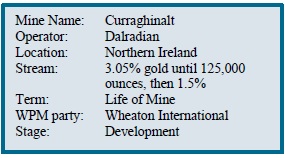
On November 15, 2023, Wheaton International entered into a PMPA with Dalradian (the “Curraghinalt PMPA”) in respect of gold production from the Curraghinalt project located in Northern Ireland, United Kingdom (the “Curraghinalt project”). Under the terms of the Curraghinalt PMPA, Wheaton International is entitled to purchase an amount of gold equal to 3.05% of the gold production until 125,000 refined gold ounces have been delivered, after which the stream drops to 1.5% of the gold production for the life of mine. Under the Curraghinalt PMPA, Dalradian and its subsidiaries provide Wheaton International with corporate guarantees and other security over their assets, including over the Curraghinalt project. |
Under the Curraghinalt PMPA, Wheaton International is required to pay Dalradian total cash consideration of $75 million, $20 million of which was paid as an early deposit on December 21, 2023. The remainder will be payable in staged equal installments during construction, subject to various customary conditions being satisfied. In addition, Wheaton International will make ongoing payments for the gold ounces delivered equal to 18% of the spot price until the value of gold delivered, net of the production payment, is equal to the upfront consideration of $75 million, at which point the production payment will increase to 22% of the spot price.
Wheaton International also has a right of first refusal on any future streaming agreement, royalty agreement, prepay agreement or similar transaction entered into by Dalradian or any of its affiliates relating to production of any precious metals from the Curraghinalt project. Until the earlier of January 1, 2027 and first production, Dalradian has a one-time option to repurchase 33% of the gold stream on a change in control for an amount ensuring a fixed internal rate of return to Wheaton International. Once the complete financing package for the Curraghinalt project has been finalized, the stream percentages will be subject to increases in the event that Wheaton International’s gold stream is subordinated to debt.
On January 18, 2024, the Curraghinalt PMPA was amended to update the mining properties subject to the stream. On May 3, 2024, the Planning Appeals Commission & Water Appeals Commission in Northern Ireland concluded that the water abstraction and impoundment licenses relative to the Curraghinalt project have been rescinded and that license applications would need to be resubmitted and subsequent public inquiry referrals held. Dalradian re-submitted two new applications for the abstraction licenses on September 5, 2024. The public inquiry process is currently set to be re-convened on April 13, 2026.
Mineral Park Mine (Silver)
|
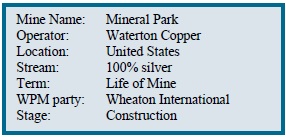
On October 24, 2023, Wheaton International entered into a PMPA with Waterton Copper (the “Mineral Park PMPA”) in respect of silver production from the Mineral Park mine located in Arizona, United States (the “Mineral Park mine”).2 Under the terms of the Mineral Park PMPA, Wheaton International is entitled to purchase an amount of silver equal to 100% of the silver production for the life of mine. In addition, Waterton Copper and Origin Mining Company, LLC (the direct owner of the Mineral Park mine) provided Wheaton International with corporate guarantees and other security over their assets, including over the Mineral Park mine. |
2 Wheaton International previously entered into a silver purchase agreement with Mercator Minerals Ltd. (“Mercator”) in respect of the Mineral Park mine. In 2014, Mercator was deemed to have filed an assignment in bankruptcy in Canada and certain Mercator’s subsidiaries (including Mineral Park Inc. the owner of the Mineral Park mine) filed Chapter 11 bankruptcy petitions in the United States. Under the settlement agreement for the United States bankruptcy process, a portion of the sale proceeds from the sale of the Mineral Park mine and assets was paid to Wheaton International and Wheaton International retained the right to proceed against Mercator. In return for these agreements, the settlement provided for the termination of any claim Wheaton International may have against the Mineral Park mine.
WHEATON 2025 ANNUAL INFORMATION FORM [13]
Under the Mineral Park PMPA, Wheaton International is required to pay Waterton Copper total cash consideration of $115 million in four installments during construction (three installments of $25 million and a final installment of $40 million), subject to various customary conditions being satisfied. As of December 31, 2025, $115 million had been advanced to Waterton Copper. In addition, Wheaton International will make ongoing payments for the silver ounces delivered equal to 18% of the spot price until the value of silver delivered, net of the production payment, is equal to the upfront consideration of $115 million, at which point the production payment will increase to 22% of the spot price. Under the Mineral Park PMPA, a fixed payable factor of 90% will be applied to payable silver.
Wheaton International also has a right of first refusal on any future streaming agreement, royalty agreement, prepay agreement or similar transaction entered into by Waterton Copper or any of its affiliates relating to production of any precious metals from the Mineral Park mine. Wheaton International has also entered into a loan agreement to provide a secured debt facility of up to $25 million to the Mineral Park owner, an affiliate of Waterton Copper, once the full upfront consideration has been paid.
Cangrejos Project (Gold)
|
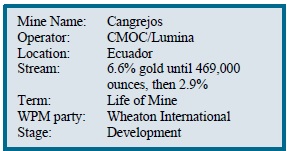
On May 16, 2023, Wheaton International entered into a PMPA with Lumina Gold Corp. (“Lumina”) (the “Cangrejos PMPA”) in respect of gold production from the Cangrejos project located in Ecuador (the “Cangrejos project”). Under the terms of the Cangrejos PMPA, Wheaton International was entitled to purchase an amount of gold equal to 6.6% of the gold production until 700,000 refined gold ounces have been delivered, after which the stream drops to 4.4% of the gold production for the life of mine. On June 23, 2025, a subsidiary of CMOC announced that it had completed its previously disclosed acquisition of Lumina. Under the Cangrejos PMPA, certain subsidiaries of CMOC will provide Wheaton International with corporate guarantees and other security over their assets, including over the Cangrejos project. In connection with the acquisition and the new corporate guarantees, the Cangrejos PMPA was amended in 2025 to extend certain due dates. |
Under the Cangrejos PMPA, Wheaton International was required to pay total cash consideration of $300 million, $48 million of which was to be available pre-construction as an early deposit. The early deposit was to be paid in four components, of which $32 million was advanced as of December 31, 2025 (taking into account the exercise of the buy back option noted below). The remainder will be payable in staged equal installments during construction, subject to various customary conditions being satisfied. On May 31, 2024, the Cangrejos PMPA was amended to delay the payment of US$6 million of the upfront cash consideration until Lumina finalized the terms of the exploitation contract with the Government of Ecuador. In addition, until the earlier of January 1, 2030 and 12 months after first production, CMOC had a one-time option to repurchase 33% of the gold stream on a change in control for an amount ensuring a fixed internal rate of return to Wheaton International. In connection with its acquisition of Lumina, CMOC exercised the buy-back option for a cash payment to Wheaton International of $102 million. As a result, the total cash consideration to be paid by Wheaton International has been reduced to $200 million and once the Company has received 469,000 ounces of gold under the Cangrejos PMPA, the Company’s attributable gold production will be reduced to 2.9%.
Further, Wheaton will make ongoing payments for the gold ounces delivered equal to 18% of the spot prices until the value of gold delivered, net of the production payment, is equal to the upfront consideration of $200 million, at which point the production payment will increase to 22% of the spot price. Wheaton International also has a right of first refusal on any future streaming agreement, royalty agreement or similar transaction entered into by Lumina or any of its affiliates relating to production of any gold or silver from the Cangrejos project.
WHEATON 2025 ANNUAL INFORMATION FORM [14]
Goose Mine (Gold)
|
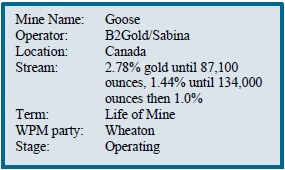
On February 7, 2022, the Company entered into a PMPA (the “Goose PMPA”) in respect of gold production from the Goose mine, part of Sabina Gold and Silver Corp.’s (“Sabina”) 100% owned Back River Gold District located in Nunavut, Canada (the “Goose mine”). Under the Goose PMPA, Wheaton was entitled to acquire from Sabina (now a subsidiary of B2Gold Corp. (“B2Gold”)) an amount of gold equal to 4.15% of the gold production until the delivery of approximately 130,000 ounces of gold, 2.15% of gold production thereafter until the delivery of 200,000 ounces of gold and 1.5% of gold production thereafter for the life of mine. In addition, Sabina and its subsidiaries provide Wheaton with corporate guarantees and certain other security over the Goose mine, which will be subordinate to project debt and other customary liens. |
Under the Goose PMPA, Wheaton paid Sabina total cash consideration of approximately $125 million in four equal installments during construction of the Goose mine. In addition, Wheaton will make ongoing payments equal to 18% of the spot gold price until the value of gold delivered, net of the production payment, is equal to the upfront consideration, at which point the production payment will increase to 22% of the spot gold price. Wheaton also has a right of first refusal on any future streaming agreement, royalty agreement or similar transaction entered into by Sabina or any of its affiliates relating to production of any precious metal from the Goose mine. In addition, under certain circumstances, Sabina has the option under the Goose PMPA of deferring delivery of gold ounces to Wheaton if the average market price of gold falls below $1,500 per ounce during a period of at least 180 days.
In addition, Sabina had a one-time option to repurchase 33% of the gold stream on a change in control for an amount ensuring a fixed internal rate of return to Wheaton. On April 19, 2023, B2Gold acquired Sabina. Subsequent to closing, B2Gold exercised the option to acquire 33% of the stream under the Goose PMPA in exchange for a cash payment in the amount of $46 million. As a result of the repurchase, Wheaton is now entitled to acquire from Sabina an amount of gold equal to 2.78% of the gold production, until the delivery of approximately 87,100 ounces of gold, 1.44% of gold production thereafter until the delivery of 134,000 ounces of gold and 1.0% of gold production thereafter for the life of mine, and the production payment will increase to 22% of spot gold price once the value of gold delivered is equal to the adjusted upfront consideration of $83,750,000. In connection with its acquisition of Sabina, B2Gold has provided Wheaton with a corporate guarantee.
On October 6, 2025, B2Gold announced that the Goose mine achieved commercial production on October 2, 2025.
Marathon Project (Gold & Platinum)
|
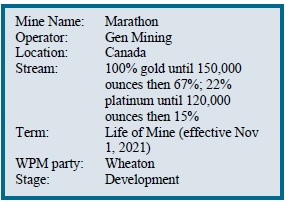
On January 26, 2022, the Company entered into a PMPA with Gen Mining (the “Marathon PMPA”) in respect of gold and platinum production from the Marathon project located in Ontario, Canada (the “Marathon project”). Under the terms of the Marathon PMPA, Wheaton is entitled to purchase an amount of gold equal to 100% of the gold production until 150,000 gold ounces have been delivered, after which the stream drops to 67% of the gold production for the life of mine and an amount of platinum equal to 22% of the platinum production until 120,000 platinum ounces have been delivered, after which the stream drops to 15% of platinum production for the life of mine. In addition, Gen Mining and its subsidiaries provide Wheaton with corporate guarantees and other security over their assets, including over the Marathon project. |
Under the Marathon PMPA, Wheaton is required to pay Gen Mining total cash consideration of C$240 million, C$40 million of which was payable prior to construction to be used for development of the Marathon project, with the remainder payable in four staged installments during construction, subject to various customary conditions being satisfied and pre-determined completion tests. C$20 million was paid on March 31, 2022 and C$20 million was paid on September 7, 2022. Amounts are paid in US$ calculated in reference to the C$ amounts set out above. In addition, Wheaton will make ongoing payments for the gold and platinum ounces delivered equal to 18% of the spot prices until the value of gold and
WHEATON 2025 ANNUAL INFORMATION FORM [15]
platinum delivered, net of the production payment, is equal to the upfront consideration of C$240 million, at which point the production payment will increase to 22% of the spot prices.
Wheaton also has a right of first refusal on any future streaming agreement, royalty agreement or similar transaction entered into by Gen Mining or any of its affiliates relating to production of any precious metal from the Marathon project. Until July 1, 2025, Gen Mining has a one-time option to repurchase 33% of the gold and platinum stream on a change in control for an amount ensuring a fixed internal rate of return to Wheaton. On March 21, 2024 and February 21, 2025, the Marathon PMPA was amended to adjust the due date for certain delay ounces.
El Domo Project (Gold & Silver)
|
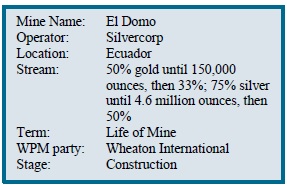
On January 17, 2022, Wheaton International entered into a PMPA with Adventus Mining Corporation (“Adventus”) (the “El Domo PMPA”) in respect of gold and silver production from the El Domo-Curipamba project located in Ecuador (the “El Domo project”). Under the terms of the El Domo PMPA, Wheaton is entitled to purchase an amount of gold equal to 50% of the gold production until 150,000 refined gold ounces have been delivered, after which the stream drops to 33% of the gold production for the life of mine and an amount of silver equal to 75% of the silver production until 4.6 million refined silver ounces have been delivered, after which the stream drops to 50% of silver production for the life of mine. In addition, Adventus and its subsidiaries provide Wheaton International with corporate guarantees and other security over their assets, including over the El Domo project. On July 31, 2024, Silvercorp Metals Inc. (“Silvercorp”) completed the acquisition of all of the issued and outstanding common shares of Adventus. |
Under the El Domo PMPA, Wheaton International is required to pay Silvercorp total cash consideration of $175.5 million, $13 million pre-construction as an early deposit, and $500,000 to support certain local community development initiatives around the El Domo project. The initial payment of $13 million was paid on December 6, 2022 however on November 8, 2024, Silvercorp made a temporary repayment of amounts advanced to date under the El Domo PMPA, which ended Silvercorp’s requirement to make certain delay ounce payments. The remainder will be payable in four staged installments during construction, subject to various customary conditions being satisfied. In addition, Wheaton will make ongoing payments for the gold and silver ounces delivered equal to 18% of the spot prices until the value of gold and silver delivered, net of the production payment, is equal to the upfront consideration of $175.5 million, at which point the production payment will increase to 22% of the spot prices. On September 23, 2025, the El Domo PMPA was amended to adjust the timing of certain payments.
Wheaton International also has a right of first refusal on any future streaming agreement, royalty agreement or similar transaction relating to production of any precious metal from the El Domo project. Until the first drawdown of an installment under the stream, Adventus had a one-time option to repurchase 33% of the gold and silver stream on a change in control for an amount ensuring a fixed internal rate of return to Wheaton International. As a result, in connection with Silvercorp’s acquisition of Adventus, Silvercorp had a one-time option to repurchase 33% of the gold and silver stream, which expired unexercised.
On August 5, 2025, Silvercorp announced that the Constitutional Court of Ecuador has delivered a unanimous decision to uphold the validity of the environmental license for the El Domo project.
WHEATON 2025 ANNUAL INFORMATION FORM [16]
Blackwater Mine (Gold)
|
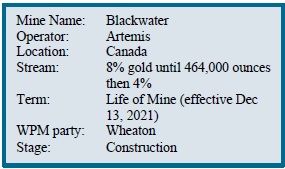
On December 13, 2021, the Company entered into a purchase agreement to acquire the existing gold purchase agreement between Artemis and New Gold Inc. (“New Gold”) (the “Blackwater Gold PMPA”) in respect of gold production from the Blackwater mine, located in British Columbia, Canada (the “Blackwater mine”). Under the terms of the Blackwater Gold PMPA, Wheaton is entitled to purchase an amount of gold equal to 8% of the gold production until 279,908 gold ounces have been delivered, after which the stream drops to 4% of the gold production for the life of mine. In connection with the Blackwater Gold PMPA, Artemis has provided a corporate guarantee and certain other security over the Blackwater mine. This Artemis corporate guarantee and certain security will be released on the Blackwater mine achieving completion. |
On closing of the Blackwater Gold PMPA, Wheaton paid $300 million to New Gold and will make ongoing payments to Artemis equal to 35% of the spot gold price for ounces delivered.
On June 14, 2023, the Company and Artemis agreed to amend the Blackwater Gold PMPA. Under the terms of the amended agreement, the Company is entitled to purchase an amount of gold equal to 8% of the payable gold production until 464,000 ounces have been delivered (previously 279,908 ounces), with this threshold to increase should there be a delay in the anticipated timing of deliveries. Once the threshold has been achieved, the Company’s attributable gold production will drop to 4% of payable gold production for the life of the mine. In exchange for the amendment, the Company committed to pay additional upfront cash consideration of $40 million, which was paid in four installments during the year ended December 31, 2023.
On September 26, 2025, the Blackwater Gold PMPA was further amended to adjust certain indebtedness restrictions.
Blackwater Mine (Silver)
|
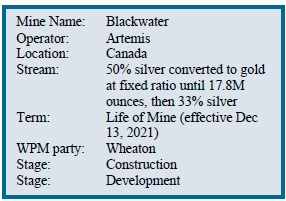
On December 13, 2021, the Company entered into a PMPA with Artemis (the “Blackwater Silver PMPA”) in respect of silver production from the Blackwater mine, located in British Columbia in Canada. Under the Blackwater Silver PMPA, Wheaton was to acquire an amount of silver equal to 50% of the payable silver production from the Blackwater mine, until 17.8 million ounces of silver have been delivered and 33% of payable silver production thereafter for the life of mine. Artemis and its subsidiaries have provided Wheaton with corporate guarantees and certain other security over the Blackwater mine. The Artemis corporate guarantee and certain security will be released on the Blackwater mine achieving certain completion milestones.
Under the Blackwater Silver PMPA, Wheaton committed to pay Artemis total upfront cash consideration of approximately $141 million in four equal installments during construction of the Blackwater mine, subject to customary conditions. As of December 31, 2025, all upfront cash consideration has been advanced to Artemis. In addition, Wheaton will |
make ongoing payments equal to 18% of the spot silver price until the uncredited portion of the upfront payment is reduced to zero, and 22% of the spot silver price thereafter. Wheaton also has a right of first refusal on any future streaming agreement, royalty agreement or similar transaction entered into by Artemis or any of its affiliates relating to production of any precious metal from the Blackwater mine. Until the earlier of January 1, 2025 and the first date on which operation of the Blackwater mine commences, Artemis has a one-time option to repurchase 33% of the silver stream on a change in control for an amount ensuring a fixed internal rate of return to Wheaton. On June 14, 2023, the Company and Artemis agreed to amend the Blackwater Silver PMPA to reflect amendments made to the Blackwater Gold PMPA and on October 27, 2023 the Company and Artemis amended certain methodologies and procedures for calculations under the Blackwater Silver PMPA.
On March 7, 2025, the Blackwater Silver PMPA was amended. Previously, the determination of payable silver production under the Blackwater Silver PMPA required the application of a complex metallurgical protocol to determine the silver content of the mill feed and applied a fixed recovery rate of 61%. As a result of the amendment, the amount of payable silver will be determined based on a fixed ratio of silver to gold ounces produced. The ratio will be as follows:
WHEATON 2025 ANNUAL INFORMATION FORM [17]
| ● | 5.17 ounces of silver for every ounce of gold produced while the plant throughput is less than 15Mtpa; |
| ● | 5.10 ounces of silver for every ounce of gold produced while the plant throughput exceeds 15Mtpa, but is less than 20Mtpa; and |
| ● | 5.07 ounces of silver for every ounce of gold produced while the plant throughput exceeds 20Mtpa. |
Once 17.8 million ounces of silver have been delivered, the determination of payable silver will revert to being based on a fixed silver recovery factor, consistent with the previous terms of the Blackwater Silver PMPA. As a result of the changed payable silver profile which is expected to deliver silver ounces to the Company sooner relative to the original profile, coupled with the administrative benefits when it comes to determining payable silver, on March 10, 2025, the Company paid Artemis $30 million in connection with this amendment. On September 26, 2025, the Blackwater Silver PMPA was further amended to adjust certain indebtedness restrictions.
Fenix Mine (Gold)
|
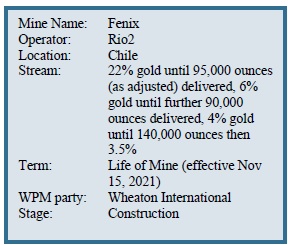
On November 15, 2021, the Company entered into a PMPA with Rio2 (the “Fenix PMPA”) in respect of the Fenix gold mine in located in Chile (the “Fenix mine”). Under the PMPA, Wheaton International will purchase an amount of gold equal to 6% of the gold production until 90,000 ounces have been delivered, 4% of the gold production until the delivery of 140,000 ounces of gold and 3.5% of gold production thereafter for the life of mine. In addition, Rio2 and its subsidiaries provide Wheaton International with corporate guarantees and certain other security over the Fenix mine.
Under the Fenix PMPA, Wheaton International agreed to pay Rio2 total upfront cash consideration of $50 million in two installments, $25 million of which was advanced in the first quarter of 2022, and $25 million which was advanced on March 21, 2025 after satisfaction of certain conditions, including Rio2’s receipt of its environmental impact assessment (“EIA”) for the Fenix mine. Wheaton International also has a right of first refusal on any future streaming agreement, royalty agreement or similar transaction entered into by Rio2 or any of its affiliates relating to production of any precious metal from the Fenix mine. |
On October 21, 2024, the Fenix PMPA was amended. Under the amended Fenix PMPA, Wheaton International is entitled to purchase an additional 16% of payable gold production (22% in total) (subject to adjustment if there are delays in deliveries relative to an agreed schedule). Once Rio2 delivers the incremental 95,000 ounces (as adjusted), the stream reverts to the percentages and thresholds under the original Fenix PMPA (as described above). Rio2 has a one-time option to terminate the requirement to deliver the incremental gold production from the end of 2027 until the end of 2029 by delivering 95,000 ounces (as adjusted) less previously delivered gold ounces, excluding those gold ounces which would have been delivered under the original Fenix PMPA. Finally, Wheaton International has also agreed to adjust the production payment for all gold ounces delivered to 20% of the spot gold price. In exchange for the amendment, the Company committed to pay additional upfront cash consideration of $100 million, payable in two equal installments, subject to various customary conditions being satisfied. To December 31, 2025, a total of $150 million has been advanced under the amended Fenix PMPA.
Wheaton International had also provided a $20 million contingent secured debt facility in the form of a standby loan facility, however that debt facility was cancelled December 19, 2025.
Lastly, the Company participated in a private placement of Rio2 common shares for Cdn$5 million at a price per share equal to, and concurrent with, a public offering by Rio2.
On January 26, 2026, Rio2 announced the first official gold pour at the Fenix mine.
WHEATON 2025 ANNUAL INFORMATION FORM [18]
Santo Domingo Project (Gold)
|
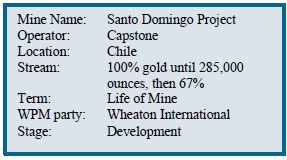
On March 24, 2021, Wheaton International entered into a PMPA (the “Santo Domingo PMPA”) with Capstone in respect to the Santo Domingo project located in the Atacama region, Chile (the “Santo Domingo project”). Capstone has provided Wheaton International with a corporate guarantee and certain other security over the Santo Domingo project.
Under the terms of the Santo Domingo PMPA, Wheaton International is entitled to purchase an amount of gold equal to 100% of the gold production until 285,000 gold ounces have been delivered, after which the stream drops to 67% of the gold production for the life of mine. |
Under the Santo Domingo PMPA, Wheaton International is required to pay Capstone total cash consideration of $290 million, $30 million of which was paid on April 21, 2021, and the remaining portion of which is payable during construction of the Santo Domingo project, subject to certain conditions being satisfied, including Capstone attaining sufficient financing to cover total expected capital expenditures. In addition, Wheaton International will make ongoing payments equal to 18% of the spot gold price until the market value of gold delivered to the Company, net of the per ounce production payment, exceeds the initial upfront cash deposit, and 22% of the spot gold price thereafter. Wheaton International is entitled to the attributable gold and silver effective the date of the Santo Domingo PMPA.
On October 13, 2025, Capstone announced that Orion Resource Partners LP (“Orion”) agreed to acquire a 25% ownership interest in the Santo Domingo project. On February 17, 2026, Capstone reported that they plan to progress the financing strategy, detailed engineering and infrastructure optimization opportunities at its Santo Domingo project towards a sanctioning decision expected in the second half of 2026. On March 9, 2026, Capstone repaid the $30 million previously advanced by Wheaton International, so that the full total cash consideration of $290 million will now be payable during construction.
Cozamin Mine (Silver)
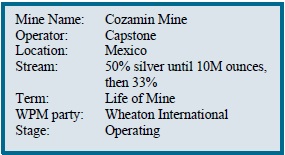
|
On December 11, 2020, Wheaton International entered into a new PMPA (the “New Cozamin PMPA”) with Capstone in respect of the Cozamin mine.3 Under the terms of the New Cozamin PMPA, Wheaton International is entitled to purchase an amendment of silver equal to 50% of the silver production until 10 Moz have been delivered, thereafter dropping to 33% of silver production for the life of the mine. In addition, Wheaton International will make ongoing payments for silver ounces delivered equal to 10% of the silver spot price. Wheaton International is entitled to the attributable silver production effective December 1, 2020. Wheaton International paid Capstone upfront cash consideration of $150 million upon closing on February 19, 2021. Capstone has provided Wheaton International with a corporate guarantee. On May 15 2024, the New Cozamin PMPA was amended to extend the target completion date. |
3 In connection with the Silverstone Acquisition, Wheaton International had previously acquired an existing PMPA dated April 4, 2007 between Silverstone and Capstone in respect of the Cozamin mine. Under this agreement, Wheaton International was entitled to acquire 100% of the silver produced from the Cozamin mine until 2017 for the lesser of $4.00 (subject to an annual inflationary adjustment after three years) and the then prevailing market price per ounce of silver. Under the terms of the agreement, all deliveries under this agreement ceased as of April 4, 2017.
WHEATON 2025 ANNUAL INFORMATION FORM [19]
Marmato Mine (Gold & Silver)
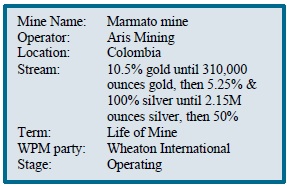
|
On November 5, 2020, Wheaton International entered into a PMPA (the “Marmato PMPA”) with Aris Mining Corporation (“Aris Mining”) in respect of the Marmato mine located in Colombia (the “Marmato mine”). The Marmato mine comprises an operating Upper Mine and the Marmato Deeps zone development (“Lower Mine”), both of which are covered by the Marmato PMPA. Aris Mining and its subsidiaries have provided Wheaton International with corporate guarantees and certain other security over their assets.
Under the terms of the Marmato PMPA, Wheaton International is entitled to purchase an amount of precious metals equal to 6.5% of the gold production and 100% of the silver production until 190,000 ounces of gold and 2.15 million ounces of silver have been delivered, after which the stream drops to 3.25% of the gold production and 50% of the silver production for the life of mine. |
Under the Marmato PMPA, Wheaton International is required to pay Aris Mining total cash consideration of $110 million. In addition, Wheaton International will make ongoing payments equal to 18% of the spot gold and silver price until the uncredited portion of the upfront payment is reduced to zero, and 22% of the spot gold and silver price thereafter. Wheaton International is entitled to the attributable gold and silver effective July 1, 2020.
Effective March 21, 2022, Wheaton International and Aris Mining agreed to amend the Marmato PMPA to increase the upfront cash consideration by $65 million to $175 million, with $15 million to be paid upon closing of Aris Mining’s acquisition of a 20% joint venture interest in the Soto Norte gold project in Colombia, and the remaining $50 million to be payable during the construction of the Lower Mine development portion of the Marmato mine, in each case subject to customary conditions. In connection with the increase in the upfront cash consideration, Wheaton International will be entitled to purchase 10.5% of the gold production and 100% of the silver production from the Marmato upper and Lower Mines until 310,000 ounces of gold and 2.15 million ounces of silver have been delivered, after which the stream drops to 5.25% of the gold production and 50% of the silver production for the life of mine. As of December 31, 2025, a total of $85 million has been paid and the remaining amount is payable during the construction of the Marmato Lower Mine, subject to customary conditions.
On January 21, 2026, Aris reported that the expansion construction of the Bulk Mining Zone at the Marmato mine is approximately 45% complete and is scheduled for completion in Q3 2026.
WHEATON 2025 ANNUAL INFORMATION FORM [20]
Stillwater and East Boulder Mines (Gold & Palladium)
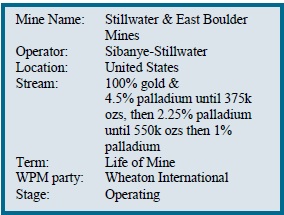
|
On July 16, 2018, Wheaton International entered into a PMPA (the “Stillwater PMPA”) to acquire from Sibanye Gold Limited (“Sibanye-Stillwater”) from the Stillwater and East Boulder mines located in Montana, United States (collectively referred to as the “Stillwater mines”) an amount of gold equal to 100% of the gold production and an amount of palladium equal to: (i) 4.5% of Stillwater mines palladium production until 375 Koz delivered to Wheaton; (ii) thereafter, 2.25% of Stillwater mines palladium production until 550 Koz delivered to Wheaton; and, (iii) 1% of Stillwater mines palladium production thereafter for the life of mine. Wheaton International paid total upfront cash consideration of $500 million in July 2018. In addition, Wheaton International will make ongoing payments of 18% of the spot price of each of gold and palladium for each ounce of gold or palladium delivered under the agreement until the upfront cash payment is reduced to $NIL and 22% of the spot price thereafter. Wheaton International is entitled to the attributable gold production for which an offtaker payment is received after July 1, 2018 at a fixed payable rate of 99% and the attributable palladium production for which an offtaker payment is received after July 1, 2018 at a fixed payable rate of 99.6%. Certain subsidiaries of Sibanye-Stillwater (including the |
owner of the Stillwater mines) and the parent company of Sibanye-Stillwater have provided Wheaton International with corporate guarantees. On August 30, 2024, the Stillwater PMPA was amended to extend the target completion date.
On September 12, 2024, Sibanye-Stillwater announced that as a result of low palladium prices it was placing the Stillwater West operations into care and maintenance, while using Stillwater East and East Boulder operations to improve efficiencies that could get Stillwater West back to production as prices permit.
Voisey’s Bay Mine (Cobalt)
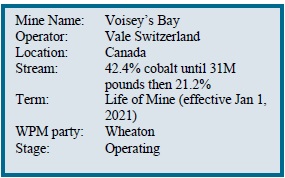
|
On June 11, 2018, the Company entered into a PMPA (the “Voisey’s Bay PMPA”) to acquire from Vale Switzerland S.A (“Vale Switzerland”), a subsidiary of Vale, an amount of cobalt equal to 42.4% of the cobalt production from its Voisey’s Bay mine, located in Newfoundland and Labrador in Canada, until the delivery of 31 million pounds of cobalt and 21.2% of cobalt production thereafter for the life of mine. Wheaton paid total upfront cash consideration of $390 million for the cobalt stream in June 2018. In addition, the Company will make ongoing payments of 18% of the spot price of cobalt per pound of cobalt delivered under the agreement until the upfront cash payment is reduced to $NIL and 22% of the spot price thereafter. Payable rates for cobalt in concentrate have generally been fixed at 93.3% and deliveries under the contract began January 1, 2021. The agreement also includes a completion test on underground operations measured by the throughput rate. Vale has also provided Wheaton with a corporate guarantee. In August 2018, the obligations under the |
agreement were transferred from Vale Switzerland to Vale Power SA, also a subsidiary of Vale.
In connection with deliveries of cobalt commencing after January 1, 2021, Vale and the Company agreed to certain amendments to the Voisey’s Bay PMPA, including an adjustment to the location of delivery of cobalt.
On December 3, 2024, Vale reported that it has completed construction and commission of the Voisey’s Bay underground mine extension. The expansion transitioned Voisey’s Bay from open pit to underground mining. The project involved the development of two underground mines, Reid Brook and Eastern Deeps, which will deliver ore for processing at Vale’s Long Harbour refinery. The full ramp-up is expected by the second half of 2026. On March 3, 2025 the outside date for the completion test was extended to March 31, 2026 in accordance with the terms of the Voisey’s Bay PMPA.
WHEATON 2025 ANNUAL INFORMATION FORM [21]
Early Deposit Gold and Silver Interest – Kutcho Project (Gold & Silver)
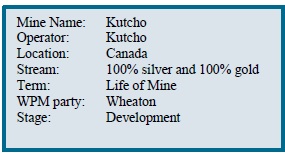
|
On December 14, 2017, Wheaton entered into an early deposit PMPA with Kutcho Copper Corp. (formerly Desert Star Resources Ltd.) (“Kutcho”) (the “Kutcho Early Deposit Agreement”) for the Kutcho project located in British Columbia, Canada (the “Kutcho project”). Under the terms of the Kutcho Early Deposit Agreement, Wheaton is entitled to purchase 100% of the payable silver production and 100% of the payable gold production from the Kutcho project for the life of mine. Kutcho and its subsidiaries have provided Wheaton with corporate guarantees and certain other security over their assets. |
Under the Kutcho Early Deposit Agreement, Wheaton has advanced $17 million to date and is required to pay additional total cash consideration of $58 million plus make ongoing payments of 20% of the spot price per silver ounce and per gold ounce delivered. Following the delivery of certain feasibility documentation, or after two years if the feasibility documentation has not been delivered, Wheaton may elect to terminate the Kutcho Early Deposit Agreement. If Wheaton elects to terminate, Wheaton will be entitled to a return of the portion of the early deposit paid less $1 million payable upon certain triggering events occurring.
Early Deposit Gold and Silver Interest – Cotabambas Project (Gold & Silver)
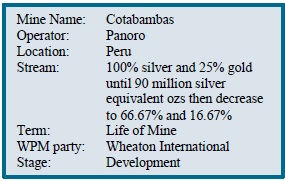
|
On March 21, 2016, Wheaton International entered into an early deposit precious metal purchase agreement with Panoro Minerals Ltd. and its wholly owned subsidiary Cordillera Copper Ltd. (“Panoro”) (the “Cotabambas Early Deposit Agreement”) for the Cotabambas project located in Peru (the “Cotabambas project”). Panoro and its subsidiaries have provided Wheaton with corporate guarantees and certain other security over their assets.
Under the terms of the Cotabambas Early Deposit Agreement, Wheaton International is entitled to purchase 100% of the payable silver production and 25% of the payable gold production from the Cotabambas project until 90 million silver equivalent ounces attributable to Wheaton International have been delivered, at which point the stream would decrease to 66.67% of payable silver production and 16.67% of payable gold production for the life of mine. |
Under the Cotabambas Early Deposit Agreement, Wheaton International will pay a total cash consideration of $140 million plus an ongoing production payment of the lesser of: (i) $5.90 for each silver ounce and $450 for each gold ounce (both subject to a 1% annual inflation adjustment starting in the fourth year after the completion test is satisfied) and (ii) the prevailing market price. To December 31, 2025, Wheaton International has advanced $14 million to Panoro. Following the delivery of certain feasibility documentation Wheaton International may elect to terminate the Cotabambas Early Deposit Agreement. If Wheaton International elects to terminate, Wheaton International will be entitled to a return of the portion of the $14 million paid less $2 million payable upon certain triggering events occurring.
Effective June 26, 2025, Wheaton International advanced a $1 million short term loan to Panoro which was repaid in full in February 2026.
Antamina Mine (Silver) - Glencore
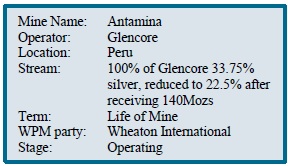
|
On November 3, 2015, Wheaton International entered into a PMPA (the “Antamina PMPA”) to acquire from Anani Investments Ltd. (“Anani”), a subsidiary of Glencore plc (“Glencore”), an amount of silver equal to 33.75% of the silver production from the Antamina mine in Peru until the delivery of 140 million ounces of silver and 22.5% of silver production thereafter for the life of mine at a fixed 100% payable rate. Wheaton International paid total upfront cash consideration of $900 million for the silver stream in December 2015. In addition, Wheaton International will make ongoing payments of 20% of the spot price per silver ounce delivered under the Antamina PMPA. In connection with the Antamina PMPA, |
WHEATON 2025 ANNUAL INFORMATION FORM [22]
Glencore and Noranda Antamina SCRL (the holder of Glencore’s interest in the Antamina mine) (“Noranda”) also provided Wheaton International with corporate guarantees and certain other assurances, including encumbrance and debt restrictions by Noranda.
On February 15, 2024, Peru’s National Environmental Certification Service for Sustainable Investments approved, after a detailed evaluation process, the Modification of the Environmental Impact Study, which will allow for the extension of the Antamina mine life from 2028 to 2036.
See “Further Disclosure Regarding Mineral Projects on Material Properties – Antamina Mine, Peru” for details regarding the Antamina mine.
Early Deposit Gold and Silver Interest – Toroparu Project (Gold & Silver)
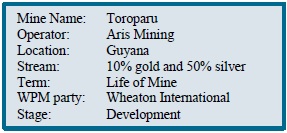
|
On November 11, 2013, Wheaton International entered into a life of mine early deposit precious metal purchase agreement (the “Toroparu Early Deposit Agreement”) to acquire an amount of gold equal to 10% of the gold production from the Toroparu project (the “Toroparu project”) located in the Republic of Guyana, South America. Under the Toroparu Early Deposit Agreement, the Company agreed to pay a subsidiary of Aris Mining total upfront cash consideration of $148.5 million, of which $13.5 million has been paid to date. In addition, the Company will make ongoing payments of the lesser $400 per ounce of gold (subject to an inflationary adjustment of 1% beginning in the fourth year of satisfaction of the completion test) or the prevailing market price per ounce of gold delivered. |
On April 22, 2015, the Company amended the Toroparu Early Deposit Agreement to include the acquisition of an amount equal to 50% of the payable silver production from the Toroparu project. Wheaton International will make a total upfront cash payment of $5 million in connection with this amendment, of which $2 million has been paid to date, and $3 million will be payable on an installment basis to partially fund construction of the mine. In addition, Wheaton International will make ongoing payments of the lesser of $3.90 per ounce of silver (subject to an inflationary adjustment of 1% beginning in the fourth year of satisfaction of the completion test) or the prevailing market price per ounce of silver delivered. In connection with the amendment to the Toroparu Early Deposit Agreement, Aris Mining and ETK Inc., the owner of the Toroparu project, have provided Wheaton International with corporate guarantees and certain other security over their assets. As a result of the addition of the silver stream to the Toroparu Early Deposit Agreement, Wheaton International is committed to pay a subsidiary of Aris Mining additional total upfront cash consideration of $138 million, payable on an installment basis to partially fund construction of the mine.
Under the amended Toroparu Early Deposit Agreement, the feasibility study, environmental study and impact assessment and other related documents (collectively the “Toroparu Feasibility Documentation”) must be delivered to the Company. Prior to the delivery of the Toroparu Feasibility Documentation, Wheaton International may elect not to proceed with the Toroparu Early Deposit Agreement. If Wheaton International elects to terminate, Wheaton International will be entitled to a return of the amounts advanced less $2 million which is non-refundable or, at Aris Mining’s option, the gold stream percentage will be reduced from 10% to 0.909% and the silver stream percentage will be reduced from 50% to nil.
Effective December 24, 2019, in connection with the Toroparu Early Deposit Agreement, the Company advanced $10 million to the former owner of the Toroparu project, Gold X Mining Corp. (formerly Sandspring Resources Ltd.) (“Gold X”) as part of a $20 million 10% secured convertible debenture private placement offering completed by Gold X (the “Gold X Convertible Note”). On July 14, 2020, the Company elected to convert the Gold X Convertible Note (and accrued interest) and received common shares of Gold X, which were subsequently exchanged for shares of Aris Mining.
WHEATON 2025 ANNUAL INFORMATION FORM [23]
Salobo Mine (Gold)
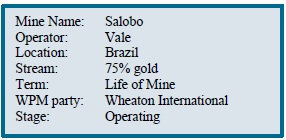
|
On February 28, 2013, Wheaton International entered into a PMPA (the “Salobo PMPA”) to acquire from Vale an amount of gold equal to 25% of the life of mine gold production from its currently producing Salobo mine (the “Salobo mine”), located in Brazil. Wheaton International paid total upfront cash consideration of $1.33 billion in March 2013. Vale also provided Wheaton International with a corporate guarantee.
On March 2, 2015, Wheaton International agreed to amend the Salobo PMPA with Vale Switzerland (the “First Amended Salobo PMPA”) to acquire from Vale Switzerland an additional amount of gold equal to 25% of the life of mine gold production from any minerals from the Salobo mine that enter the Salobo mineral processing facility from and after |
January 1, 2015. Under the First Amended Salobo PMPA, Wheaton International paid Vale cash consideration of $900 million on March 24, 2015 for the increased gold stream. On August 2, 2016, Wheaton International agreed to further amend the First Amended Salobo PMPA (the “Second Amended Salobo PMPA”) to acquire an additional amount of gold equal to 25% of the life of mine gold production in respect of gold production for which an off-taker payment is received after July 1, 2016. Under the Second Amended Salobo PMPA, Wheaton International paid Vale cash consideration of $800 million and the 10 million warrants expiring on February 28, 2023 were amended to reduce the strike price from $65 to $43.75. With these amendments, Wheaton International increased the gold stream from 25% to 75% of the life of mine gold production from the Salobo mine. In addition, Wheaton International is required to make ongoing payments of the lesser of $400 per ounce of gold (subject to a 1% annual inflation adjustment commencing as of January 1, 2019) or the prevailing market price per ounce of gold delivered for the full 75% of gold production. Under the terms of the Second Amended Salobo PMPA, Wheaton was required to make an additional set payment to Vale based on the size of the expansion, the timing of completion and the grade of the material processed, based on a set fee schedule ranging from $113 million if throughput was expanded beyond 28 Mtpa by January 1, 2036, to up to $861 million if throughput is expanded beyond 40 Mtpa by January 1, 2024. There was to be no additional deposit due if the expansion was completed after January 1, 2036.
Salobo III Expansion – Vale undertook the Salobo III mine expansion (the “Salobo Expansion”) to include a third concentrator line and use the Salobo mine’s existing infrastructure to increase throughput capacity from 24 Mtpa to 36 Mtpa once fully ramped up. Assuming the Salobo Expansion project achieved 12 Mtpa of additional processing capacity (bringing total processing capacity at Salobo to 36 Mtpa) by the end of 2023, Wheaton International expected to pay a total expansion payment of $552 million. However, on March 8, 2023, Wheaton International and Vale agreed to amend the Second Amended Salobo PMPA (the “Third Amended Salobo PMPA”) to adjust the Salobo Expansion payment terms. If actual throughput was expanded above 32 Mtpa, then under the terms of the Third Amended Salobo PMPA, Wheaton International was required to make additional set payments to Vale based on the size of the expansion and the timing of completion (the “Expansion Payments”). The set payments ranged from a total of $283 million if throughput is expanded beyond 32 Mtpa by January 1, 2031, to up to $552 million if throughput is expanded beyond 35 Mtpa by January 1, 2024. In addition, Wheaton International is required to make annual payments of $8 million for a 10-year period following payment of the Expansion Payments if the Salobo mine implements a high-grade mine plan.
On November 21, 2023, Vale reported the successful completion of the throughput test for the first phase of the Salobo Expansion, with the Salobo complex exceeding an average of 32 Mtpa over a 90-day period. Under the terms of the Third Amended Salobo PMPA, the Company paid Vale $370 million for the completion of the first phase of the Salobo Expansion on December 1, 2023. The Salobo mine is currently ramping up to full capacity of 36 Mtpa, expected in the first half of 2025. If actual throughput is expanded above 35 Mtpa by January 1, 2031, Wheaton will be required to make additional payments to Vale ranging from $52 million if throughput is expanded beyond 35 Mtpa by January 1, 2031, to up to $144 million if throughput is expanded beyond 35 Mtpa by January 1, 2026. On March 4, 2025, Vale informed the Company that it had achieved a sustained throughput capacity of over 35 Mtpa over a 90-day period, indicating completion of the second phase of the Salobo III expansion project. Pending Wheaton’s review of the final completion test, the Company anticipates advancing the remaining balance of the expansion payment to Vale in the amount of $144 million within thirty days of the date of receipt of Vale’s notification.
See “Further Disclosure Regarding Mineral Projects on Material Properties – Salobo Mine, Brazil” for details regarding the Salobo mine.
WHEATON 2025 ANNUAL INFORMATION FORM [24]
See “Risks Relating to the Company – Counterparty Credit and Liquidity Risk”, “Risks Relating to the Company – Security Over Underlying Assets”, “Risks Relating to the Company – Mine Operator and Counterparty Concentration Risk”, “Risks Relating to the Company – Indebtedness and Guarantees Risk”, “Risks Relating to the Mining Operations – International Operations”, “Risks Relating to the Mining Operations – Exploration, Development, Operating, Expansions and Improvements Risks”, and “Risks Relating to the Mining Operations – Land Title and Indigenous Peoples”.
Sudbury Mines (Gold)
|
|
On February 28, 2013, the Company entered into a PMPA (the “Sudbury mines PMPA”) to acquire from Vale Switzerland, an amount of gold equal to 70% of the payable gold production from certain of its currently producing Sudbury mines located in Canada, including the Coleman mine, Copper Cliff mine, Garson mine, Stobie mine, Creighton mine, Totten mine and the Victor project (the “Sudbury mines”) for a period of 20 years. Wheaton made a total upfront cash payment in March, 2013 of $570 million plus warrants to purchase 10 million Common Shares at a strike price of $65, with a term of 10 years (see “Salobo Mine” above for further details). In addition, Wheaton will make ongoing payments of the lesser of $400 per ounce of gold or the prevailing market price per ounce of gold delivered. In connection with the | |
| Sudbury mines PMPA, Vale also provided Wheaton with a corporate guarantee. | ||
Constancia Mine (including Pampacancha Deposit) (Gold & Silver)
|
|
On August 8, 2012, Wheaton International entered into a PMPA with Hudbay Minerals Inc. and its subsidiary Hudbay (BVI) Inc. (“Hudbay”) to acquire 100% of the life of mine payable silver production from the Constancia mine in Peru (the “Constancia mine”). On November 4, 2013, Wheaton International amended the PMPA with Hudbay to include the acquisition of an amount equal to 50% of the life of mine payable gold production from the Constancia mine (as amended, the “Constancia PMPA”). |
As at the end of the first quarter of 2014, as a result of capital expenditures at the Constancia mine reaching $1 billion, a $125 million cash payment was made by Wheaton International to Hudbay. On September 10, 2014, Wheaton International further amended its agreement with Hudbay and as a result of capital expenditures meeting the $1.35 billion requirement, on September 26, 2014 Wheaton International paid further cash consideration of $135 million to Hudbay by delivery of 6,112,282 Common Shares, at an average issuance price of $22.09 per share. As at December 31, 2014, Wheaton International had paid Hudbay total upfront cash consideration of $429.9 million.
Wheaton International will make ongoing payments of the lesser of $5.90 per ounce of silver and $400 per ounce of gold (both subject to an inflationary adjustment of 1% beginning in the fourth year) or the prevailing market price per ounce of silver and gold delivered.
The silver and gold production at the Constancia mine was subject to the same completion test which was satisfied in 2016. Under the Constancia PMPA, if Hudbay failed to achieve a minimum level of throughput at the Pampacancha deposit (the “Pampacancha deposit”) during 2018, 2019 or by June 30, 2021, Wheaton International would be entitled to additional compensation in respect of the gold stream. Hudbay has granted Wheaton International a right of first refusal on any future streaming agreement, royalty agreement, or similar transaction related to the production of silver or gold from the Constancia mine. In connection with the Constancia PMPA, Hudbay Peru S.A.C. (“Hudbay Peru”) provided Wheaton International with a corporate guarantee and certain other security over its assets and the Constancia mine. Wheaton International has also entered into intercreditor arrangements with lenders to Hudbay.
Recovery rates for gold under the amended agreement were fixed given the early nature of the metallurgical test work on gold recoveries from the Pampacancha deposit. Recoveries were set at 55% for the Constancia mine deposit and 70% for the Pampacancha deposit until Wheaton International receives 265,000 payable ounces of gold, after which actual recoveries are to be applied.
On May 10, 2021, Wheaton International and Hudbay agreed to amend the Constancia PMPA so that Hudbay would no longer be required to deliver an additional compensation of 8,020 ounces of gold to Wheaton International for not mining
WHEATON 2025 ANNUAL INFORMATION FORM [25]
four million tonnes of ore from Pampacancha by June 30, 2021. As part of that amendment, Hudbay also agreed to increase the fixed gold recoveries that apply to Constancia ore production from 55% to 70% during the reserve life of Pampacancha. Additionally, as Hudbay mined and processed four million tonnes of ore from the Pampacancha deposit by December 31, 2021, the Company was required to make an additional deposit payment of $4 million to Hudbay, which was paid on December 23, 2021.
Hudbay reported that from September 23, 2025 to October 7, 2025, the mill at the Constancia mine was shut down as a safety precaution due to ongoing social unrest in Peru. On February 20, 2026, Hudbay announced that 2026 gold production is expected to be lower than 2025 production, reflecting the depletion of ore from the Pampacancha deposit in 2025.
777 Mine (Gold & Silver)
|
|
On
August 8, 2012, the Company entered into a PMPA (the “777 PMPA”) with Hudbay to acquire 100% of the life of mine payable silver and gold production from its currently producing 777 mine (the “777 mine”), located in
Canada. Wheaton’s share of gold production at the 777 mine remained at 100% until the satisfaction of a completion test relating to the Constancia mine, after which it was reduced to 50% for the remainder of the mine life. Wheaton made an
upfront cash payment of $455.1 million in September, 2012 and, in addition, will make ongoing payments of the lesser of $5.90 per ounce of silver and $400 per ounce of gold (both subject to an inflationary adjustment of 1% beginning in the
fourth year and subject to being increased to $9.90 per ounce of silver and $550 per ounce of gold after the initial 40 year term) or the prevailing market price per ounce of silver and gold | |
| delivered. Hudbay has granted Wheaton a right of first refusal on any future streaming agreement, royalty agreement or similar transaction related to the production of silver or gold from the 777 mine. In connection with the 777 PMPA, certain supplier subsidiaries of Hudbay provided Wheaton with a corporate guarantee and certain other security over their assets and the 777 mine. | ||
On June 22, 2022, Hudbay announced that mining activities at the 777 mine have concluded after the reserves were depleted and the 777 mine is closed. Under the terms of the 777 PMPA, should the market value of gold and silver delivered to Wheaton through the initial 40-year term of the contract, net of the per ounce cash payment, be lower than the initial $455 million upfront consideration, the Company is entitled to a refund of the difference (the “Refundable Deposit”) at the conclusion of the 40-year term.
Copper World Complex (Rosemont) Transaction (Gold & Silver)
|
|
On February 10, 2010, Wheaton International entered into a PMPA (the “Copper World PMPA”) with Augusta Resource Corporation (subsequently acquired by Hudbay) to acquire an amount equal to 100% of the life of mine silver and gold production from its Rosemont copper project (the “Rosemont project”) part of the Copper World complex located in Pima County, Arizona. The payable rate for silver and gold has been fixed at 92.5% of production. Under the Copper World PMPA, as amended in 2019, Wheaton International is committed to pay Hudbay total upfront cash payments of $230 million in two installments, with the first $50 million being advanced upon Hudbay’s receipt of permitting for the Rosemont project and other customary conditions and the balance of $180 million being advanced once project costs incurred on the Rosemont project exceed $98 million and certain | |
| other customary conditions. Under the Copper World PMPA, the Company is permitted to elect to pay the deposit in cash or the delivery of Common Shares. Additionally, the Company will be entitled to certain delay payments, including where construction ceases in any material respect, or if completion is not achieved within agreed upon timelines. In addition, a per ounce cash payment of the lesser of $3.90 per ounce of silver and $450 per ounce of gold (both subject to an inflationary adjustment) or the prevailing market price is due, for silver and gold delivered under the Copper World PMPA. Hudbay and certain affiliates have provided Wheaton International with a corporate guarantee and other security over their assets. The Copper World project is included in Wheaton’s area of interest under the Copper World PMPA. | ||
WHEATON 2025 ANNUAL INFORMATION FORM [26]
On August 5, 2025, Hudbay and Wheaton International agreed to amend the Copper World PMPA to provide for an additional upfront deposit payment of up to $70 million if a mill expansion is completed, to adjust the per ounce cash payment to 15% of the spot price of each gold and silver ounce, and to align with the Copper World project development plan. The amendment is subject to execution of definitive agreements and the satisfaction of customary conditions.
On August 1, 2019, Hudbay announced that the U.S. District Court for the District of Arizona (“Court”) issued a ruling challenging the U.S. Forest Service’s issuance of the Final Record of Decision (“FROD”) for the Rosemont project. The Court ruled to vacate and remand the FROD thereby delaying the expected start of construction of the Rosemont project. On May 12, 2022, Hudbay received a split decision from the U.S. Court of Appeals for the Ninth District which affirmed the Court’s decision in July 2019, agreeing with the Court’s ruling that the U.S. Forest Service relied on incorrect assumptions regarding its legal authority and the validity of Rosemont’s unpatented mining claims in the issuance of Rosemont’s Final Environmental Impact Statement. This decision does not impact the development of other deposits within the Copper World complex.
On August 13, 2025, Hudbay announced that Mitsubishi Corporation had agreed to purchase a 30% joint venture interest in the Copper World project, and on January 12, 2026, Hudbay announced the closing of the acquisition.
Barrick Mines and El Alto (formerly Pascua-Lama) Project (Silver)
|
|
On September 8, 2009, the Company entered into a PMPA (the “El Alto PMPA”) with Barrick Gold Corporation (“Barrick”) pursuant to which the Company agreed to purchase an amount of silver equivalent to 25% of the life of mine payable silver production from Barrick’s El Alto project (formerly the Pascua-Lama project) (the “El Alto project”) located on the border of Chile and Argentina, as well as an amount of silver equivalent to 100% of the silver production from its Lagunas Norte mine (the “Lagunas Norte mine”) and Pierina mine (the “Pierina mine”), which are both located in Peru, and its Veladero mine (the “Veladero mine”) (Wheaton’s attributable silver production is subject to a maximum of 8% of the silver contained in the ore processed at the Veladero | |
| mine during the period), which is located in Argentina, until the end of 2015 (the “Barrick Transaction”). Wheaton International made a total upfront cash payment to Barrick of $625 million (the “Upfront Payment”). In addition, per ounce cash payments of the lesser of $3.90 (subject to an annual inflationary adjustment starting three years after achieving project completion at El Alto) and the prevailing market price is due for silver delivered under the El Alto PMPA. In connection with the El Alto PMPA, Barrick provided Wheaton International with a corporate guarantee. | ||
As a result of Barrick’s decision to suspend construction activities at the El Alto project, and the various amendments to the El Alto PMPA, Wheaton International was entitled to 100% of the silver production from Barrick’s Lagunas Norte mine, Pierina mine (now in closure) and Veladero mine until the earlier of April 1, 2018 and the date Barrick satisfied the completion test. In 2013 Barrick initiated the closure of its Pierina mine and in accordance with the terms of the El Alto PMPA, all deliveries from the Pierina mine, Lagunas Norte mine and Veladero mine ceased as of April 1, 2018.
As part of the original agreement, Barrick provided the Company with a completion guarantee, requiring Barrick to complete the El Alto project to at least 75% design capacity by December 31, 2015, which was subsequently extended to December 31, 2016 and then to June 30, 2020. As the requirements of the completion test were not satisfied by the completion test deadline of June 30, 2020, Wheaton International was entitled, within 90 days of such date, to provide to Barrick notice of termination of the El Alto PMPA and demand repayment of the upfront payment of $625 million reduced by the cash flows received relative to the Lagunas Norte mine, Pierina mine and Veladero mine. Wheaton elected not to terminate the El Alto PMPA in exchange for a refund.
On September 28, 2020, Barrick announced that it accepted the First Environmental Court of Antofagasta’s decision to uphold a closure order and sanctions the Superintendencia del Medio Ambiente imposed on Barrick’s Chilean subsidiary that holds the Chilean portion of the El Alto project. Barrick clarified that the El Alto project would be transitioned from care and maintenance to closure in accordance with the First Environmental Court of Antofagasta’s decision.
WHEATON 2025 ANNUAL INFORMATION FORM [27]
Minto Mine (Gold & Silver)
|
|
In connection with the Silverstone Acquisition, on May 21, 2009, the Company acquired the existing PMPA dated November 20, 2008 between Silverstone and Minto Explorations Ltd. (the “Minto PMPA”) in respect of the Minto mine located in Yukon, Canada (the “Minto mine”). Under the Minto PMPA, Wheaton is entitled to acquire 100% of the silver produced from the Minto mine and 100% of the first 30,000 ounces of gold produced per annum and 50% thereafter. Capstone, the former owner of the Minto mine, has provided Wheaton with a corporate guarantee under the Minto PMPA.
The Minto mine was sold by Capstone to Pembridge Resources plc (“Pembridge”) effective June 3, 2019 and Pembridge assumed Capstone’s obligations under the Minto PMPA. In November 2021, Minto Metals Corp. (“Minto Metals”) announced that it had completed a | |
| reverse take-over transaction with Minto Explorations Ltd. (the owner of the Minto mine). In late 2022, negotiations to amend and restate the Minto PMPA were concluded to reflect an agreement that the cash payment per ounce of gold delivered would be the lower of 65% of the spot price of gold and $1,250. This amended pricing ended on January 12, 2023. Effective January 12, 2023, the cash payment per ounce of gold and silver delivered was at 90% of the spot price until February 28, 2023. On May 13, 2023, Minto Metals announced the suspension of operations at the Minto mine and that the Yukon Government assumed care and control of the site. At the time of this announcement, the parties were in discussions in connection with a possible further restructuring of the Minto PMPA, with the cash payment per ounce of gold delivered maintained at 90% during the negotiation period. As the parties were unable to agree to terms for the restructuring, the production payment for gold remains as set out in the existing Minto PMPA, being 65% of spot price of gold. A court appointed receiver was engaged to assist with the sale of the Minto mine and during 2025, Selkirk Copper Mines Inc., a newly formed company with a controlling interest held by the Selkirk First Nation, acquired the Minto mine. | ||
Neves-Corvo Mine (Silver)
|
|
In connection with the Silverstone Acquisition, on May 21, 2009, the Company acquired the existing PMPA (the “Neves-Corvo PMPA”) dated June 5, 2007 between Silverstone and Lundin Mining Corporation (“Lundin”) in respect of the Neves-Corvo mine in Portugal (the “Neves-Corvo mine”). Under the Neves-Corvo PMPA, Wheaton International is entitled to acquire 100% of the silver produced from the Neves-Corvo mine for the life of mine (to June 5, 2057) for the lesser of $3.90 (subject to an annual inflationary adjustment after three years) and the then prevailing market price per ounce of silver. Lundin had also provided Wheaton International with a corporate guarantee under the Neves-Corvo PMPA. On February 12, 2024, Lundin reported a fatality at its | |
| Neves-Corvo mine. Lundin noted that operations were temporarily suspended following the incident and appropriate authorities were notified. | ||
On December 9, 2024, Lundin announced that it has signed a definitive agreement to sell its Neves-Corvo operation in Portugal and Zinkgruvan operation in Sweden to Boliden AB (“Boliden”). The sale closed April 6, 2025. In connection with the acquisition, Boliden has provided a corporate guarantee under the Neves-Corvo PMPA in replacement of the Lundin corporate guarantee.
WHEATON 2025 ANNUAL INFORMATION FORM [28]
Aljustrel Mine (Silver)
|
|
In connection with the Silverstone Acquisition, on May 21, 2009, the Company acquired the existing PMPA between Silverstone and Lundin (the “Aljustrel PMPA”) in respect of the Aljustrel mine in Portugal (the “Aljustrel mine”). Under the Aljustrel PMPA, Wheaton International is entitled to acquire 100% of the silver produced from the Aljustrel mine (the “Aljustrel mine”) for the life of mine (to June 5, 2057). Wheaton International only has the rights to silver contained in concentrate containing less than 15% copper at the Aljustrel mine. Wheaton International has not waived its rights to the silver contained in zinc and lead concentrate. I’M SGPS SA (“I’M SGPS”) acquired the Aljustrel mine from Lundin and has provided Wheaton International with a corporate | |
| guarantee. In May 2018, Wheaton International agreed to amend the Aljustrel PMPA to increase the production payment per ounce of silver to 50% of the spot price of silver, to fix the silver payable rates for a period of two years with certain restrictions on changes thereafter and to make certain other modernization amendments. | ||
On September 12, 2023, it was announced that as a result of low zinc prices, the production of zinc and lead concentrates at the Aljustrel mine will be halted from September 24, 2023 until the third quarter of 2025. Production of attributable silver resumed at the Aljustrel mine during the third quarter of 2025.
Loma de La Plata Mine (Silver)
|
|
In connection with the Silverstone Acquisition, on May 21, 2009, the Company acquired an existing debenture with Aquiline Resources Inc. (which was acquired by Pan American Silver Corp. (“PAAS”)) convertible into an agreement to purchase 12.5% of the life of mine silver production from the Loma de La Plata (the “Loma de La Plata project”) zone of the Navidad project in Argentina. On February 25, 2010, the Company elected to convert the debenture with PAAS into a PMPA. As such, Wheaton International will make total upfront cash payments of $32.4 million following the satisfaction of certain conditions, including PAAS receiving all necessary permits to proceed with the mine construction. In addition, a per ounce cash payment of the lesser of $4.00 per ounce and | |
| the prevailing market price is due for silver delivered under the agreement. The terms of the definitive PMPA remain to be negotiated. The Navidad project is currently placed on care and maintenance. | ||
Peñasquito Mine (Silver)
|
|
On July 24, 2007, Silver Wheaton Luxembourg entered into a PMPA (the “Peñasquito PMPA”) with Goldcorp Inc. (“Goldcorp”) and Minera Peñasquito, S.A. de C.V. (“Newmont Peñasquito”), a wholly owned subsidiary of Goldcorp, pursuant to which Silver Wheaton Luxembourg agreed to purchase 25% of the payable silver produced by Newmont Peñasquito from the Peñasquito mine located in Mexico (the “Peñasquito mine”) over its entire mine life, for upfront consideration of $485 million, plus a payment equal to the lesser of $3.90 per ounce of delivered silver (subject to an annual inflationary adjustment three years after commercial production commences) and the then prevailing market price per ounce of silver. Silver Wheaton Luxembourg and Wheaton International entered into a back to back PMPA in | |
| respect of the Peñasquito mine. The area of interest for the stream is limited to specific concessions set out in the Peñasquito PMPA. In connection with the Peñasquito PMPA, Goldcorp also provided Silver Wheaton Luxembourg with a corporate guarantee. In April 2019, Newmont Corporation (“Newmont”) acquired Goldcorp. On April 30, 2024, the Peñasquito PMPA was amended to update certain provisions. | ||
See “Further Disclosure Regarding Mineral Projects on Material Properties—Peñasquito Mine, Mexico” for details regarding the Peñasquito mine.
WHEATON 2025 ANNUAL INFORMATION FORM [29]
Stratoni Mine (Silver)
|
|
On April 23, 2007, Wheaton International entered into a PMPA (the “Stratoni PMPA”) with European Goldfields Limited (“European Goldfields”) (which was acquired by Eldorado Gold Corporation (“Eldorado”) on February 24, 2012), and Hellas Gold S.A. (“Hellas Gold”), a 95%-owned subsidiary of European Goldfields, pursuant to which Wheaton International agreed to purchase 100% of the payable silver produced by Hellas Gold from the Stratoni mine (the “Stratoni mine”) located in Greece over its entire mine life, for total upfront cash consideration of $57.5 million, plus a payment equal to the lesser of $3.90 per ounce of delivered silver (subject to an annual inflationary adjustment after April 23, 2010) and the then prevailing market price per ounce of silver. During the term of the Stratoni PMPA, Wheaton | |
| International has a right of first refusal on any future sales of silver streams from any other mine owned by Hellas Gold or European Goldfields. In connection with the Stratoni PMPA, Hellas Gold and European Goldfields provided certain covenants in respect of their obligations. | ||
In October 2015, in order to incentivize additional exploration and potentially extend the limited remaining mine life of the Stratoni mine, Wheaton International and Eldorado agreed to modify the Stratoni PMPA. The primary modification was to increase the production price per ounce of silver delivered to Wheaton International over the current fixed price by one of the following amounts: (i) $2.50 per ounce of silver delivered if 10,000 metres of drilling is completed outside of the existing ore body and within Wheaton International’s defined area of interest (“Expansion Drilling”); (ii) $5.00 per ounce of silver delivered if 20,000 metres of Expansion Drilling is completed; and (iii) $7.00 per ounce of silver delivered if 30,000 metres of Expansion Drilling is completed. Eldorado completed a total of 30,000 metres of Expansion Drilling by December 31, 2020, resulting in a $7.00 per ounce of silver increase.
Operations at the Stratoni mine were suspended in late 2021, and the mine was placed on care and maintenance.
Zinkgruvan Mine (Silver)
|
|
On December 8, 2004, Wheaton International entered into an agreement with Lundin and Zinkgruvan Mining AB (“Zinkgruvan AB”) to acquire 100% of the payable silver produced by Lundin’s Zinkgruvan mining operations (the “Zinkgruvan mine”) in Sweden for the life of mine for the lesser of $3.90 per ounce of silver (subject to an annual inflationary adjustment) and the then prevailing market price per ounce of silver. Upfront consideration payable to Zinkgruvan AB was approximately $77.9 million. In connection with the Zinkgruvan agreement, Lundin had provided Wheaton with a corporate guarantee and a pledge of charge deed over mining operations. |
On December 9, 2024, Lundin announced that it has signed a definitive agreement to sell its Neves-Corvo operation in Portugal and Zinkgruvan operation in Sweden to Boliden. The sale closed April 6, 2025. In connection with the acquisition, Boliden has provided a corporate guarantee under the Zinkgruvan PMPA in replacement of the Lundin corporate guarantee.
Los Filos Mine (Silver)
|
|
The Los Filos mine is located in the Nukay mining district of central Guerrero State in southern Mexico. Wheaton International entered into an agreement with Goldcorp to acquire 100% of the silver production from the Los Filos mine for a period of 25 years, commencing October 15, 2004 (the “Los Filos PMPA”) and expected to terminate on October 15, 2029. On April 7, 2017, Leagold Mining Corporation (“Leagold”) completed the acquisition of the Los Filos mine from Goldcorp. In connection with the acquisition, the Los Filos PMPA was amended to include a corporate guarantee from Leagold. Goldcorp’s guarantee of deliveries in respect of the Los Filos mine remains in place. On March 10, 2020, Leagold and Equinox Gold Corp. (“Equinox”) announced that they had completed their | |
| previously announced arrangement pursuant to which Equinox acquired all of the issued and outstanding shares of Leagold and assumed Leagold’s obligations under the Los Filos PMPA. | ||
WHEATON 2025 ANNUAL INFORMATION FORM [30]
On April 1, 2025, Equinox reported it has indefinitely suspended operations at the Los Filos mine following the expiry of its land access agreement with the community of Carrizalillo on March 31, 2025.
San Dimas Mine (Gold & Silver)
|
|
In connection with First Majestic Silver Corp.’s (“First Majestic”) acquisition of all the issued and outstanding common shares of Primero Mining Corp. (the “Acquisition”), on May 10, 2018, the Company terminated the San Dimas SPA4 and entered into a new precious metal purchase agreement with First Majestic (the “San Dimas PMPA”) to purchase an amount of gold equal to 25% of the life of mine payable gold production from the San Dimas mine plus an additional amount of gold equal to 25% of the life of mine payable silver production from the San Dimas mine converted to gold at a fixed gold to silver exchange ratio of 70:1.5 The Company paid a total upfront cash payment of $220 million for the San Dimas PMPA and, in addition, will make ongoing payments of $600 per gold ounce delivered. As consideration for terminating the San Dimas SPA, the Company received a cash payment of $220 million and 20,914,590 First Majestic common shares with a fair value of $151 million, which were subsequently sold, and the Goldcorp Guarantee was terminated in exchange for a payment of $10 million. | |
First Majestic indicates in its MD&A for the period ended December 31, [2025] that its Mexican subsidiary, Primero Empresa Minera S.A. de C.V. (“PEM”) received a legal claim from the Mexican tax authorities, the Servicio de Administración Tributaria (“SAT”), seeking to nullify the Advance Pricing Agreement issued by SAT in 2012 (“APA”). The APA confirmed PEM’s ability to pay taxes in Mexico on the sale of silver on actual prices realized by its Mexican subsidiary in connection with silver sales under the San Dimas SPA for the tax years 2010 through 2014. First Majestic indicates that if the SAT is successful in retroactively nullifying the APA and enforcing reassessments, it would likely have a material adverse effect on First Majestic’s results of operations, financial condition and cash flows. If the Company was unable to purchase any further gold under the San Dimas PMPA, it may have a material adverse effect on Wheaton’s business, financial condition, results of operation and cash flows. In addition, should this occur, there is no assurance that Wheaton would be successful in enforcing its rights under the security interest granted by First Majestic or its other remedies under the San Dimas PMPA.
See “Risks Relating to the Company – Security Over Underlying Assets”, “Risks Relating to the Company – Counterparty Credit and Liquidity Risk” and “Risks Relating to the Mining Operations – International Operations”.
Set out below are PMPAs entered into by the Company in respect of mineral stream interests that have been terminated, in reverse-chronological order:
4 On October 15, 2004, the Company previously entered into a precious metal purchase agreement (the “San Dimas SPA”) with Goldcorp to acquire an amount equal to 100% of the silver produced by Goldcorp’s Luismin mining operations in Mexico (owned at the date of the transaction) for a period of 25 years. The Luismin operations consisted primarily of the San Dimas mine (the “San Dimas mine”) and Los Filos mine (the “Los Filos mine”). On August 6, 2010, Goldcorp completed the sale of the San Dimas mine to Primero Mining Corp. (“Primero”). In conjunction with the sale, the term of the San Dimas SPA, as it related to San Dimas, was extended to the life of mine. During the first four years following the closing of the transaction, Primero delivered to Wheaton a per annum amount equal to the first 3.5 million ounces of payable silver produced at the San Dimas mine and 50% of any excess, plus Wheaton received an additional 1.5 million ounces of silver per annum delivered by Goldcorp. Beginning in the fifth year after closing, Primero delivered a per annum amount to Wheaton equal to the first six million ounces of payable silver produced at the San Dimas mine and 50% of any excess. In addition, a per ounce cash payment of the lesser of $4.04 per ounce of silver (subject to an annual inflationary adjustment) or the prevailing market price was due, for silver delivered under the San Dimas SPA. Goldcorp guaranteed the delivery by Primero of all silver produced and owing to the Company until 2029 (the “Goldcorp Guarantee”).
5 If the average gold to silver price ratio decreases to less than 50:1 or increases to more than 90:1 for a period of 6 months or more, then the “70” shall be revised to “50” or “90”, as the case may be, until such time as the average gold to silver price ratio is between 50:1 to 90:1 for a period of 6 months or more in which event the “70” shall be reinstated. The current ratio is 70:1.
WHEATON 2025 ANNUAL INFORMATION FORM [31]
Keno Hill Mines (Silver)
|
|
On October 2, 2008, the Company entered into a PMPA (the “Alexco PMPA”) with Alexco Resources Corp. (“Alexco”), Elsa Reclamation & Development Company Ltd. and Alexco Keno Hill Mining Corp. (formerly called Alexco Resource Canada Corp.), each subsidiaries of Alexco, pursuant to which the Company agreed to pay, subject to the completion of certain conditions, an upfront cash payment of $50 million in order to acquire 25% of all payable silver produced from the Keno Hill district, including the producing Bellekeno mine in the Yukon Territory, Canada (the “Keno Hill mines”), over its entire mine-life, for the lesser of $3.90 (subject to an annual inflationary adjustment beginning in year four after the achievement of specific operating targets) and the then prevailing market price per | |
| ounce of delivered silver. Alexco provided a completion guarantee with certain minimum production criteria by specific dates. In connection with the Alexco PMPA, Alexco and each of the parties to the Alexco PMPA provided Wheaton with corporate guarantees and certain other security over their assets and the Keno Hill mines. | ||
On September 7, 2022, Hecla completed its acquisition of all the outstanding common shares of Alexco and the Company received $135 million of Hecla common stock for the termination of the Alexco PMPA.
Yauliyacu Mine (Silver)
|
|
On March 23, 2006, Wheaton International entered into a PMPA (the “Yauliyacu mine PMPA”) with Glencore International AG (“Glencore International”) and its subsidiary Anani to acquire an amount equal to 100% of the payable silver produced from the Yauliyacu mining operations (the “Yauliyacu mine”) in Peru, up to a maximum of 4.75 million ounces per year, for a period of 20 years commencing in March of 2006, for $3.90 per ounce of silver (subject to an annual inflationary adjustment).
On November 30, 2015, the Yauliyacu mine PMPA was extended to the life of mine. Additionally, effective January 1, 2016, Anani was to deliver to Wheaton a per annum amount equal to the first 1.5 million ounces of payable silver produced at the | |
| Yauliyacu mine and 50% of any excess. The price paid for each ounce of silver delivered under the agreement was increased by an additional $4.50 per ounce plus, if the market price of silver exceeded $20 per ounce, 50% of the excess, to a maximum of $40 per ounce. | ||
On August 18, 2022, Wheaton International entered into an agreement to terminate the Yauliyacu mine PMPA for a cash payment of $150 million, less the aggregate value of any deliveries to Wheaton International, prior to closing, of silver produced subsequent to December 31, 2021. Wheaton International agreed to terminate the stream in order to help facilitate the sale of the Yauliyacu mine by Glencore. The Yauliyacu mine PMPA was terminated effective December 14, 2022 and Wheaton International received a net payment of $132 million.
Further details regarding the PMPAs entered into by the Company in respect of mineral royalty interests can be found below, listed in reverse-chronological order:
DeLamar Royalty
|
|
On February 20, 2024, the Company, through its wholly owned subsidiary Wheaton Cayman, purchased a 1.5% net smelter return royalty interest (the “DeLamar Royalty”) in the DeLamar and Florida mountain project located in Idaho, United States (the “DeLamar project”) from a subsidiary of Integra Resources Corporation (“Integra”) for $9.75 million which was paid in two equal installments. Under the DeLamar Royalty, if completion is not achieved by January 1, 2029, the DeLamar Royalty will increase annually by 0.15% of net smelter returns to a maximum of 2.7% of net smelter returns. The Company had previously acquired a right of first refusal on any precious metals streaming, royalty, pre-pay or other similar transaction on the DeLamar project. | |
WHEATON 2025 ANNUAL INFORMATION FORM [32]
Mt Todd Royalty
|
|
On December 13, 2023, the Company, through its wholly owned subsidiary Wheaton Cayman, purchased a 1.0% gross revenue royalty interest (the “Mt Todd Royalty”) in the Mt Todd gold project located in Northern Territory, Australia from a subsidiary of Vista for $20 million which was paid in three installments. Under the Mt Todd Royalty, if completion is not achieved by April 1, 2028, the Mt Todd Royalty will increase annually by 0.13% of gross revenue to a maximum of 2.0% of gross revenue. The Mt Todd Royalty rate, annual increase percentage, and maximum rate can each be reduced by one-third upon the occurrence of one of the following events: (i) a change of control of the subsidiary of Vista occurs prior to April 1, 2028 and the payment of certain amounts to Wheaton Cayman; or (ii) payment to Wheaton | |
| Cayman of the applicable Mt Todd Royalty associated with the subsidiary of Vista delivering 3.47 million gold ounces to a third-party. The Company, through its wholly owned subsidiary Wheaton Cayman, also acquired a right of first refusal on any precious metals streaming, royalty, pre-pay or other similar transaction on the Mt Todd properties. | ||
Black Pine Royalty
|
|
On September 9, 2023, the Company, through its wholly owned subsidiary Wheaton Cayman, purchased a 0.5% net smelter return royalty interest (the “Black Pine Royalty”) in the Black Pine project located in Idaho, United States from Liberty Gold for $3.6 million. Under the Black Pine Royalty, Liberty has the option to re-acquire one-half of the Black Pine Royalty for $3.6 million so that the Black Pine Royalty would be reduced to 0.25%. The Company, through its wholly owned subsidiary Wheaton International, also acquired a right of first refusal on any precious metals streaming, royalty, pre-pay or other similar transaction on the Black Pine properties. On September 25, 2024, Liberty Gold announced the receipt of a Hardrock Prospector Permit covering four areas located directly adjacent to the Black Pine project. | |
Brewery Creek Royalty
|
|
On January 5, 2021, the Company paid $3 million for an existing 2.0% net smelter return royalty interest on the first 600,000 ounces of gold and 2.75% thereafter from ore extracted from the Brewery Creek quartz mineral claims located in the Yukon Territories, Canada owned by Golden Predator Exploration Ltd. (“Golden Predator”), a subsidiary of Victoria Gold Corp. (“Victoria Gold”), and any mineral tenure derived therefrom (the “Brewery Creek Royalty”). The Brewery Creek Royalty agreement provides, among other things, that Golden Predator may reduce the 2.75% net smelter returns royalty interest to 2.125%, on payment of the sum of C$2.0 million to Wheaton. Golden Predator was acquired by Victoria Gold in September 2023. The Brewery Creek Royalty has been registered at the Mining Recorder’s Office. On August 14, 2024, Victoria Gold was placed into receivership. |
WHEATON 2025 ANNUAL INFORMATION FORM [33]
Metates Royalty
|
|
On August 7, 2014, the Company, through its wholly owned subsidiary Wheaton Cayman, purchased a 1.5% net smelter return royalty interest (the “Metates Royalty”) in the Metates properties located in Mexico from Chesapeake Gold Corp. (“Chesapeake”) for $9 million. In accordance with the terms of the agreement, on August 7, 2019, Chesapeake exercised its option to re-acquire two-thirds of the Metates Royalty, or 1%, for the sum of $9 million. As a result, the Metates Royalty has been reduced to 0.5%. The Company also has a right of first refusal on any silver streaming, royalty or any other similar transaction on the Metates properties. In connection with the Metates Royalty, American Gold Metates, S. de R.L. de C.V., the owner of the Metates properties, granted Wheaton a mortgage on the Metates | |
| properties. On November 13, 2024, Chesapeake announced that its lawsuit against the Dirección General de Minas of Mexico (“DGM”) in response to the DGM’s cancellation of the Metates San Vicente 3 mineral concession was dismissed by the North Center III and Auxiliary Regional Chamber of the Federal Court of Administrative Justice. Chesapeake noted that San Vicente 3 is one of 12 mineral concessions comprising the Metates project. Chesapeake indicated that in the event Chesapeake is unsuccessful in reinstating San Vicente 3, Chesapeake’s current mineral resource estimate for Metates and the ability to develop the Metates project may be materially affected. On December 2, 2024, Chesapeake noted that it had filed an appeal with the Collegiate Court in Mexico of the decision. | ||
WHEATON 2025 ANNUAL INFORMATION FORM [34]
Competitive Conditions
The Company is the one of the largest precious metals streaming companies in the world. The Company competes with other companies for PMPAs and similar transactions. The ability of the Company to acquire additional precious metals in the future will depend on its ability to select suitable properties, be successful in any competitive process initiated by a mine operator in respect of a property and enter into similar PMPAs. See “Description of the Business — Risk Factors — Competition” in this annual information form.
Operations
Upfront Consideration
During the year ended December 31, 2025, the Company advanced a total of $1.3 billion in upfront consideration under the following PMPAs:
| PMPA |
| Blackwater Silver PMPA |
| Cangrejos PMPA |
| El Domo PMPA |
| Fenix PMPA |
| Hemlo PMPA |
| Kone PMPA |
| Kurmuk PMPA |
| KZK PMPA |
| Mineral Park PMPA |
| Spring Valley PMPA |
| Salobo PMPA |
Raw Materials
The Company purchases precious metals and cobalt pursuant to the PMPAs described under “Description of the Business – Principal Product” in this annual information form.
Sales of Principal Product
There are worldwide markets into which the Company can sell the precious metals and cobalt purchased under its PMPAs and, as a result, the Company will not be dependent on a particular purchaser with regard to the sale of the precious metals or cobalt that it acquires pursuant to its PMPAs. Under certain PMPAs, precious metal is acquired from the mine operator in concentrate form, which is then sold under the terms of the concentrate sales contracts to third-party smelters or traders. The payable silver in concentrate from the Zinkgruvan mine and the Neves-Corvo mine, and previously the payable silver in concentrate from the Stratoni mine and the payable silver and gold from the Minto mine, is/was purchased from the Company by third-party smelters and off-takers at the worldwide market price for gold and silver.
Precious Metal Credit Sales
Under most precious metals purchase agreements, precious metal is acquired from the mine operator in the form of precious metal credits, which is then sold to bullion banks. Revenue from precious metal credit sales is recognized at the time of the sale of such credits, which is also the date that control of the precious metal is transferred to the customer.
During the year ended December 31, 2025, sales to three financial institutions accounted for 37%, 26% and 10% of the Company’s revenue as compared to sales to four financial institutions accounted for 34%, 17%, 14% and 14% of the Company’s revenue during the comparable period of the previous year. The Company would not be materially affected should any of these financial institutions cease to buy precious metal credits from the Company as these sales would be redirected to alternate financial institutions.
WHEATON 2025 ANNUAL INFORMATION FORM [35]
Cobalt Sales
During 2023, cobalt purchased under the Voisey’s Bay PMPA was sold to a third-party sales agent who generally on-sold the cobalt to Company approved third-party customers. This arrangement was terminated effective December 31, 2023. Revenue from the sale of cobalt was recognized once the third-party customer and sales terms were agreed to between the Company and the third-party sales agent, which was also the date that control of the cobalt is transferred to the third-party sales agent. Where the sales agent retained the cobalt for their own use, revenue was recognized once the sales terms were agreed to between the Company and the third-party sales agent and the product was delivered, which was also the date that control of the cobalt was transferred to the third-party sales agent.
During late 2023, Wheaton entered into a cobalt sale and purchase agreement with Glencore AG (the “Cobalt Sales Agreement”). The Cobalt Sales Agreement is for a term of two years and is extendable for a further year at Wheaton’s option. Under the terms of the Cobalt Sales Agreement, Wheaton has agreed to sell all cobalt purchased under the Voisey’s Bay PMPA to Glencore AG. The Cobalt Sales Agreement became effective as of January 1, 2024 and Wheaton has exercised its extension right.
The Company would not be materially affected should Glencore AG cease to buy cobalt from the Company as these sales would be redirected to an alternate third-party agent, dealer or purchaser.
Employees
As of March 26, 2026, the Company and its subsidiaries have an aggregate of 47 employees.
Foreign Interests
In addition to Canada, the Company currently purchases or expects to be purchasing precious metals from mines, or enter into Royalty Agreements in respect of mines, in Argentina, Australia, Brazil, Chile, Colombia, Côte d’Ivoire, Ecuador, Ethiopia, Greece, Guyana, Mexico, Northern Ireland, Peru, Portugal, South Africa, Sweden, and the United States. Any changes in legislation, regulations or shifts in political attitudes in such foreign countries are beyond the control of the Company and may adversely affect its business. The Company may be affected in varying degrees by such factors as government legislation and regulations (or changes thereto) with respect to the restrictions on production, export controls, income and other taxes, expropriation of property, repatriation of profits, environmental legislation, land use, water use, land claims of local people and mine safety. The effect of these factors on the Company cannot be accurately predicted. See “Description of the Business — Risk Factors — Risks Relating to the Mining Operations — International Operations” in this annual information form.
Tax Matters
On December 13, 2018, the Company announced that it reached a settlement with the Canada Revenue Agency (“CRA”) which provided for a final resolution of the Company’s tax appeal in connection with the reassessment under transfer pricing rules of the 2005 to 2010 taxation years related to the income generated by the Company’s foreign subsidiaries outside of Canada (the “CRA Settlement”). Under the terms of the CRA Settlement, income earned outside of Canada by the Company’s foreign subsidiaries will not be subject to income tax in Canada under transfer pricing rules. The CRA Settlement principles apply to all taxation years after 2010 subject to there being no material change in facts or change in law or jurisprudence. Bill C-15, Budget 2025 Implementation Act, No.1, contains proposed amendments to the existing transfer pricing regime under the Tax Act, which could have an impact on the application of the CRA Settlement to taxation years after 2025. Once it is in force, the Company expects to apply the same transfer pricing methodology and achieve a consistent outcome with past periods.
The CRA is not restricted under the terms of the CRA Settlement from issuing reassessments on some basis other than transfer pricing which could result in some or all of the income of the Company’s foreign subsidiaries being subject to tax in Canada.
It is not known or determinable by the Company when any ongoing audits by CRA of international and domestic transactions will be completed, or whether reassessments will be issued, or the basis, quantum or timing of any such reassessments, and it is therefore not practicable for the Company to estimate the financial effect, if any, of any ongoing audits. From time to time there may also be proposed legislative changes to law or outstanding legal actions that may have
WHEATON 2025 ANNUAL INFORMATION FORM [36]
an impact on the current or prior periods, the outcome, applicability and impact of which is also not known or determinable by the Company, but which may have a material adverse effect on the Company or the price of the Common Shares.
Global Minimum Tax
The majority of the Company’s income generating activities is conducted by its 100% owned subsidiary, Wheaton International, which operates in the Cayman Islands and is not subject to tax. On December 20, 2021, the OECD issued model rules for the Pillar Two initiative (“Pillar Two”) which provided a framework for the imposition, by individual countries, of a 15% global minimum tax (“GMT”) on the adjusted financial statement income of large multinational companies, such as the Company.
Wheaton is within the scope of GMT under Pillar Two. The Wheaton group is liable to pay a top-up tax for any deficiency between the minimum tax rate of 15% and the effective tax rate in the jurisdictions where the Company and its subsidiaries operate. Wheaton, as well as Silver Wheaton Luxembourg have an effective tax rate that exceeds 15% or are in a loss position. The Wheaton group’s subsidiaries that operate in the Cayman Islands have an effective tax rate of 0%. Jurisdictional updates are as follows:
Canada
On June 20, 2024, Canada’s Global Minimum Tax Act (“GMTA”), received royal assent. The GMTA enacts Pillar Two where in scope companies are subject to GMT for fiscal years commencing on or after December 31, 2023. With the enactment of the GMTA on June 20, 2024, the income of the Company’s Cayman Island subsidiaries, who have a statutory tax rate of 0%, are subject to the GMTA.
Luxembourg
Pillar Two legislation was enacted in Luxembourg on December 22, 2023. The rules are applicable from January 1, 2024. As discussed above, Silver Wheaton Luxembourg has an effective tax rate in excess of 15% and given the adoption of the GMTA, the Company does not expect the Luxembourg Pillar Two legislation to have a material impact on the Company.
Cayman Islands
To date, the government of the Cayman Islands has indicated that they do not intend to enact Pillar Two legislation.
See page 31 of the Company’s Management’s Discussion and Analysis for the year ended December 31, 2025, for further details. See “Description of the Business — Risk Factors — Risks Relating to the Company — Taxes”.
Revolving Facility
On June 30, 2025, the Company entered into a third amended and restated revolving term facility credit agreement (as amended to the date hereof, the “Credit Agreement”) with, among others, the Company and Wheaton International, as borrowers, The Bank of Nova Scotia and Bank of Montreal, as co-lead arrangers, joint book-runners, Bank of Montreal as administrative agent, The Bank of Nova Scotia as syndication agent, Canadian Imperial Bank of Commerce, National Bank of Canada, Royal Bank of Canada and The Toronto-Dominion Bank, as co-documentation agents, Bank of Montreal and Royal Bank of Canada, as Co-Lead Sustainability Structuring Agents and Coordinators, The Bank of Nova Scotia and Canadian Imperial Bank of Commerce, as Co-Sustainability Agents and The Bank of Nova Scotia, Bank of Montreal, Canadian Imperial Bank of Commerce, Royal Bank of Canada, The Toronto-Dominion Bank, Export Development Canada, National Bank of Canada and Bank of America, N.A., as lenders, providing for a $2 billion sustainability-linked revolving credit facility together with an incremental $500 million accordion feature, providing expanded financial capacity (the “Revolving Facility”). The financial covenant in the Credit Agreement requires the Company to maintain a net debt to total capitalization ratio of less than or equal to 0.60:1 (the “Financial Covenant”). The current maturity of the Revolving Facility is June 25, 2030. The interest rate applicable to drawn amounts and standby fees under the Revolving Facility is adjusted based upon the Company’s performance in three sustainability-related areas:
| ● | the Company’s attributable emissions from third-party mining partners operations covered by science-based emissions targets, |
| ● | diversity at the board and management levels of the Wheaton group of companies, and |
WHEATON 2025 ANNUAL INFORMATION FORM [37]
| ● | Wheaton’s S&P environmental, social and governance score. |
At the Company’s option, amounts drawn under the Revolving Facility incur interest based on the Company’s leverage ratio at either (i) SOFR plus 1.00% to 2.05%; or (ii) The Bank of Nova Scotia’s Base Rate plus 0.00% to 1.05% (the “Interest Rate”). Under both options, the Interest Rate shall not be less than 0%. The Interest Rate paid on drawn amounts will be adjusted by up to +/- 0.05% based upon the Company’s performance in the three above-noted sustainability-related areas. Undrawn amounts under the Revolving Facility are subject to a stand-by fee of 0.20% to 0.41% per annum, dependent on the Company’s leverage ratio, and subject to adjustment by up to +/- 0.0099% based upon the Company’s performance in the three above-noted sustainability-related areas.
While the Revolving Facility is unsecured, each of Wheaton Cayman and Silver Wheaton Luxembourg, as subsidiaries of the Company, have guaranteed the obligations of the Company and Wheaton International under the Revolving Facility, the Company has guaranteed the obligations of Wheaton International and Wheaton International has guaranteed the obligations of the Company.
Effective December 31, 2025, the Company had nil drawn under the Revolving Facility. However, in connection with the closing of the acquisition of the BHP Antamina PMPA, the Company expects to draw funds under the Revolving Facility to satisfy a portion of the upfront payment under the BHP Antamina PMPA.
Term Loan
In connection with the closing of the acquisition of the BHP Antamina PMPA, on March 26, 2026, the Company entered into a term facility credit agreement (the “Term Loan Credit Agreement”) with, among others, the Company and Wheaton International, as borrowers, and Bank of Montreal and The Bank of Nova Scotia, as Lead Arrangers and Joint Bookrunners, the Bank of Montreal as Administrative Agent, The Bank of Nova Scotia as Syndication Agent and Sustainability Agent, BMO Nesbitt Burns Inc. and Royal Bank of Canada as Co-Lead Sustainability Structuring Agents and Coordinators and the Bank of Montreal, The Bank of Nova Scotia, the Bank of America, N.A., Export Development Canada, National Bank of Canada, Royal Bank of Canada and The Toronto-Dominion Bank, as lenders, providing for a $1.5 billion senior, unsecured, non-revolving term loan (the “Term Loan”). The Term Loan carries a two-year maturity, and its terms are consistent with the terms of the Revolving Facility, including the same Financial Covenant and Interest Rate.
At the Market Equity Program
During the year ended December 31, 2024, the Company had in place an at the market equity program (“ATM Program”) to allow the Company to issue up to $300 million worth of Common Shares from treasury to the public from time to time at the Company’s discretion and subject to regulatory requirements. No Common Shares were issued under the ATM Program in the year ended December 31, 2024. Given the strength of Wheaton’s balance sheet and forecasted cash flows, the Company elected to not renew the ATM Program in 2025.
Information Systems and Cyber Security
The Company’s information systems and cyber security program are designed and developed by information technology consultants retained by the Company and overseen by internal management, the Audit Committee and the Board of Directors. The operational status of the Company’s approach to information systems and cyber security are periodically reviewed with management, the Audit Committee and the Board of Directors. Both the Audit Committee, which is comprised of independent directors, and the Board of Directors receive at least quarterly reports on the Company’s information systems and cyber security. Additional consultants are retained to provide ongoing information systems support and management, maintenance and cyber security services, which include systems event monitoring, managed endpoint security, managed backup and information systems response management.
The Company actively seeks to mitigate information systems and cyber security risks by identifying, reviewing and developing risk mitigating and response strategies for such risks. The Company has a multi-layered, defense-in-depth approach to information systems and cyber security, with intentional redundancies to increase protection of valuable data and information. The Company’s overall enterprise data security and information technology infrastructure is managed in accordance with the National Institute of Standards and Technology (NIST) cyber security framework and best practices.
The Company undergoes an annual data penetration test, vulnerability assessment, and off-site disaster recovery test, to assess our data security and information technology infrastructure and recovery abilities, and the Company has external information security assurance and audit activities performed by qualified, independent professional service firms which validate the effectiveness of the information systems and cyber security program and controls. The Company has implemented
WHEATON 2025 ANNUAL INFORMATION FORM [38]
third-party managed cyber security and incident response support services for the Company’s information technology infrastructure and systems.
The ongoing cyber security monitoring, detection, and incident response services provides additional capabilities to address potential cyber related events. In addition, on an annual basis, the Company’s information systems and information technology infrastructure are reviewed in connection with the Company’s annual internal audit.
The Company’s information systems and information technology controls are reviewed annually. The Company has also established an enterprise cyber security awareness training program to validate compliance and effectiveness, which is completed by all employees twice annually. Finally, during 2025, the Company updated the formal cyber security incident response plan and completed a cyber security incident table top simulation exercise.
To date, the Company has not experienced or been impacted by any material or significant cyber-attack.
See “Description of the Business – Risk Factors – Risks Relating to the Company – Information Systems, Cyber Security”.
Artificial Intelligence
Artificial intelligence (“AI”) can be used by the Company in its operations and will be designed and developed by the Company with input from third party consultants retained by the Company and overseen by internal management, the Audit Committee and the Board of Directors.
The Company is currently using commercially available AI services to assist Company employees in completing tasks using various office applications more efficiently. The Company uses built-in security controls to protect corporate and employee data and to monitor AI-user interactions and has adopted an AI governance framework related to these AI services.
The Company’s use of AI will be periodically reviewed with management, the Audit Committee and the Board of Directors. Both the Audit Committee, which is comprised of independent directors, and the Board of Directors, will receive reports on the Company’s AI, with a view to considering the quality, limitations, vulnerabilities and potential legal and regulatory concerns, as well as enhanced controls, processes and practices designed to address challenges.
The Company will adopt appropriate frameworks for effective oversight of AI and actively seek to mitigate AI risks by identifying, reviewing and developing risk mitigating and response strategies for such risks.
WHEATON 2025 ANNUAL INFORMATION FORM [39]
Long-Term Investments
The Company holds securities of companies for strategic purposes, including, but not limited to, exploration and mining companies. As of December 31, 2025, the value of these long-term investments (including common shares and warrants) (“LTIs”) had a market value of approximately $410 million. The majority of the LTIs are securities of streaming or royalty partners. In early 2026, the Company realized $323 million on the disposal of certain LTIs.
Sustainability
Wheaton has a longstanding commitment to industry leading sustainability practices. Wheaton’s Sustainability Report includes detailed information on sustainability issues which are directly related to our operations and over which Wheaton has direct control, as well as sustainability issues Wheaton may be exposed to through the Mining Operations.
To support sustainability management, Wheaton has established clear oversight of sustainability at the Board of Directors level, consistent with its responsibility for overseeing strategy and risk, and has integrated sustainability management throughout the Company. Details on oversight of sustainability at Wheaton will be contained in the Company’s management information circular for the annual general and special meeting scheduled for May 8, 2026.
Wheaton has also established a number of sustainability-related policies and commitments, listed below:
| ● | Code of Business Conduct and Ethics (includes anti-bribery & anti-corruption) |
| ● | Whistleblower Policy |
| ● | Climate Change and Environmental Policy |
| ● | Community Investment Policy |
| ● | Human Rights Policy |
| ● | Diversity Policy |
| ● | Investment Principles |
| ● | Partner/Supplier Code of Conduct |
This annual information form includes summaries of, and updates to, these policies where relevant. However, all of these policies and commitments can be accessed on Wheaton’s website at www.wheatonpm.com.
For additional information on Wheaton’s sustainability-related governance structure, approach and performance, including sustainability targets and progress against our goals, please see Wheaton’s Sustainability Report.
Climate Change and Environmental Commitments and Policy
Under its Climate Change and Environmental Policy, the Company is committed to assess and disclose information about its climate-related risks and opportunities guided by the recommendations of the Task Force for Climate-related Financial Disclosures (“TCFD”) and applicable regulatory requirements. Wheaton has also committed to: undertake regular climate scenario analysis and integrate climate considerations into our risk assessments, strategic planning and business processes; identify opportunities to reduce emissions in our direct operations; collaborate with and support our mining partners, industry associations, and other stakeholders to reduce emissions at our mining partners’ operations from which we obtain metal and across the mining industry; and measure and disclose our material emissions in line with the Greenhouse Gas Protocol and other internationally recognized frameworks, including the Partnership for Carbon Accounting Financials.
The Governance and Sustainability Committee has primary oversight of sustainability performance at Wheaton and reviews progress against the Company’s climate change strategy based on semi-annual reporting by the Chief Sustainability Officer. In addition, the Governance and Sustainability Committee reviews physical and transitional climate-related risks related to Wheaton and its Mining Partners. Other committees also consider climate change within their functions. For example, climate risks are reviewed by the Audit Committee on a quarterly basis as part of overall enterprise risk monitoring. Performance against elements of the climate change strategy are also considered annually by the Human Resources Committee as part of Wheaton’s sustainability performance objective. During 2024, an education session entitled “Sustainability and Climate-Related Reporting Standards” was provided to the Board by KPMG to support their climate-related responsibilities.
WHEATON 2025 ANNUAL INFORMATION FORM [40]
In addition to the various responsibilities of Wheaton’s executive team for climate related disclosure, strategies, risk and opportunity assessment and management, and processes related to Climate Change, Wheaton also has a Climate Solutions Committee that supports decision-making related to investments to support decarbonization at mining partner sites.
During 2025, the Company published its second Climate Change Report, which aligns with the recommendations of the TCFD. The Climate Change Report can be accessed on the Company’s website at www.wheatonpm.com and includes details on:
| ● | Wheaton’s overall approach to climate change. |
| ● | Wheaton’s oversight and governance of climate change, including Board and Board committee oversight, management responsibility and Wheaton’s Climate Solutions Committee. |
| ● | Details on the timing and frequency of considerations of climate change and climate-related issues by the Board and the applicable Board committees. |
| ● | Wheaton’s strategic process in considering the actual or potential impacts of climate change. |
| ● | Wheaton’s processes for the identification and assessment of risks and opportunities relating to climate change. |
| ● | Wheaton’s metrics and performance relating to its Scope 1, Scope 2 and Scope 3 emission-generating activities, together with climate scenarios. |
The Climate Change Report includes scenarios for analyzing the potential impacts of climate change to Wheaton. Details on this analysis can be found in the Climate Change Report which can be accessed on the Company’s website at www.wheatonpm.com.
Code of Business Conduct and Ethics
During 2024, Wheaton’s Code of Business Conduct and Ethics (the “Code”) was amended to expand the definition of “diversity” and expand the prohibitions around political activities and contributions.
Human Rights Policy
Our human rights policy is contained in the Code. Our human rights policy recognizes that while government has the primary responsibility to protect human rights, it is the responsibility of businesses to support and respect the protection of internationally proclaimed human rights. Our human rights policy outlines our commitment to support and respect human rights in our own operations and complying with the laws of countries in which we do business. Our human rights policy also outlines Wheaton’s commitment to seek to emphasize the rights of vulnerable groups impacted by its operations, including women, children and indigenous peoples. Our human rights policy is guided by Canadian laws respecting human rights as well as international statements on human rights including the United Nations Guiding Principles on Business and Human Rights, the Universal Declaration of Human Rights, and the International Labour Organization’s Declaration on the Fundamental Principles and Rights of Work.
Inclusion
Our Code contains our policies around inclusion and diversity. Wheaton is committed to fostering a diverse environment where individual differences are respected and diversity is promoted and valued. The Company recognizes the benefits from creating and maintaining a diverse and inclusive culture within our workforce, including exposure to different perspectives. Therefore, while opportunities will be primarily based on performance, skill and merit, due consideration will be given to diversity in all aspects of employment and engagement by an employee, officer or director with the Company, including selection, recruitment, hiring, promotion, compensation, termination, training and development. Under our diversity policy, “diversity” means any element or quality that can be used to differentiate groups and people from one another, including differences based on race, colour, religion, gender, gender identity, gender expression, sexual orientation, family or marital status, political belief, age, national or ethnic origin, citizenship or physical or mental disability and any other protected ground. For 2026, the Company has established a target to increase the percentage of diversity in leadership at Wheaton and advance diversity and inclusion initiatives across the company by 2028 against a 2022 baseline.6
6 Leadership refers to the Company’s Board of Directors, Wheaton International’s Board of Directors, executive management and vice presidents. Diversity considers gender and visible minorities. Diversity and inclusion initiatives include training, accessibility, awareness, celebration and recognition overseen by the Diversity and Leadership committee.
WHEATON 2025 ANNUAL INFORMATION FORM [41]
Anti-Bribery and Anti-Corruption Policies
Our anti-bribery and anti-corruption policies are contained in our Code. Our anti-bribery and anti-corruption policies outline the obligations and requirements that must be met by all of our employees, officers and directors as well as third-party contractors working on our behalf. These include prohibitions against bribery, facilitation payments, money laundering as well as gifts to public officials and institutions.
Sustainability-Related Investment Principles
Wheaton is not involved in, nor does it control the operational decisions of mine projects by third-party operators; however, Wheaton is indirectly exposed to sustainability and other risks arising from these mine projects. Wheaton has adopted Investment Principles to Wheaton’s approach to evaluating potential streaming transactions as well as monitoring existing streaming agreements. The purpose of these principles is to identify third-party independent mining companies that appropriately manage their sustainability and other risks in order to minimize Wheaton’s indirect exposure to those risks. Details concerning these investment principles can be found on Wheaton’s website at www.wheatonpm.com.
Partner/Supplier Code of Conduct
Wheaton believes that it is our responsibility to partner with suppliers that share our commitment to sustainable development and the standards set out in our partners/supplier code of conduct. Our partner/supplier code of conduct requires that our suppliers, including our streaming partners, meet or exceed certain standards of business practice which include compliance with applicable law, business ethics and integrity, health and safety, human rights and labour standards and environment and sustainability. Wheaton will show preference for those suppliers who are able to demonstrate alignment with the standards contained in the partner/supplier code of conduct.
WHEATON 2025 ANNUAL INFORMATION FORM [42]
Risk Factors
The operations of the Company are speculative due to the nature of its business which is the purchase of precious metals and/or cobalt production from producing mining companies. These risk factors could materially affect the Company’s future operating results and could cause actual events to differ materially from those described in forward-looking statements relating to the Company. The risks described herein are listed in order of significance and potential risk to the Company, from the most significant to the least significant. The risks described herein are not the only risks facing the Company, as additional risks and uncertainties not currently known to the Company, or that the Company currently deems immaterial, may also materially and adversely affect its business.
Risks Relating to the Company
Commodity Prices and Markets: Changes in the market price of commodities that we purchase under our PMPAs and in the commodities markets will affect our profitability
The Company’s business operations are fully exposed to changes in the market prices of precious metals and cobalt. The price of the Common Shares and the Company’s financial results may be significantly and adversely affected by a decline in the price of precious metals and cobalt. The price of precious metals and cobalt fluctuates widely, especially in recent years, and is affected by numerous factors beyond the Company’s control, including but not limited to, the sale or purchase of precious metals by various central banks and financial institutions, interest rates, exchange rates, inflation or deflation, fluctuation in the value of the United States dollar and foreign currencies, global and regional supply and demand, the emergence of cryptocurrencies as a store of value and hedge against inflation in competition with precious metals, and the political and economic conditions of major precious metals and cobalt producing countries throughout the world. The precious metals and cobalt markets tend to be cyclical, and a general downturn could result in a significant decrease in the Company’s revenue. Any such price decline may have a material adverse effect on the Company.
The profitability of Wheaton’s interests under the PMPAs is directly related to the market price of precious metals and cobalt. The Company’s revenue is sensitive to changes in the price of precious metals and cobalt and the overall condition of the precious metal and cobalt mining industry and markets, as it derives all of its revenue from precious metals and cobalt streams. If Wheaton is unable to sell precious metals or cobalt production as a result of a reduction in, or an absence of, demand for precious metals or cobalt, there could be a significant decrease in the Company’s revenue which may have a material adverse effect on the Company or result in the Company not generating positive cash flow or earnings.
In the event that the prevailing market price of precious metals and cobalt is at or below the price at which the Company can purchase such commodities pursuant to the terms of the PMPAs associated with its precious metals and cobalt interests, the Company will not generate positive cash flow or earnings, which could have a material adverse effect on the Company.
Precious metals and cobalt are by-product metals at all of the Mining Operations, other than gold at the Marmato mine, Toroparu project, Fenix mine, Goose mine, Blackwater mine, Black Pine project, Curraghinalt project, Mt Todd project, DeLamar project, Hemlo mine, Koné project, Kurmuk project and Spring Valley project, silver at the Loma de La Plata zone of the Navidad project and palladium at the Stillwater mines and Platreef project, and therefore, the economic cut off applied to the reporting of precious metals and cobalt reserves and resources will be influenced by changes in the commodity prices of other metals at the mines.
Risks Relating to Production from the Mining Operations
To the extent that they relate to the production of precious metals or cobalt from, or the continued operation of, the Mining Operations, the Company will be subject to the risk factors applicable to the operators of such mines or projects, some of which are set forth below under “Risks Relating to Production from the Mining Operations”.
Counterparty Credit and Liquidity: The inability of the Company’s counterparties to perform their obligations under agreements with the Company or the inability of the Company to meet operating expenditure requirements could adversely impact the Company’s cash flows
The Company is exposed to counterparty risks and liquidity risks including, but not limited to: (i) through the companies with which the Company has PMPAs which may experience financial, operational or other difficulties, including insolvency, which could limit or suspend those companies’ ability to perform their obligations under those PMPAs;
WHEATON 2025 ANNUAL INFORMATION FORM [43]
(ii) through the companies with which the Company has advanced funds in exchange for convertible notes receivable; (iii) through financial institutions that hold the Company’s cash and cash equivalents; (iv) through companies that have payables to the Company, including concentrate customers; (v) through the Company’s insurance providers; (vi) through companies that owe a refund of the refundable deposit under the terms of the respective PMPA; and (vii) through the Company’s lenders, financial institutions, and bullion banks. The Company is also exposed to liquidity risks in meeting its operating expenditure requirements in instances where cash positions are unable to be maintained or appropriate financing is unavailable. These factors may impact the ability of the Company to obtain loans and other credit facilities in the future and, if obtained, on terms favourable to the Company. If these risks materialize, the Company’s operations could be adversely impacted and the trading price of the Company’s securities could be adversely affected.
In the event that a counterparty with which the Company has a PMPA were to experience financial, operational or other difficulties (such as a counterparty that is unable to favourably resolve the application of new or existing tax laws, regulations or rules or any tax audits or disputes), then that counterparty may (i) be unable to deliver some or all of the precious metals or cobalt due under the applicable PMPA with that counterparty; (ii) otherwise default in its obligations under that PMPA; (iii) cease operations at one or more mines that are the subject of that PMPA; or (iv) become insolvent. As a result, any of these or other adverse financial or operational consequences on a counterparty may also have a material adverse effect on Wheaton’s business, financial condition, results of operations and cash flows. While Wheaton may have in place security or guarantees to mitigate the risks related to counterparty credit and liquidity, there is no assurance that Wheaton will be successful in enforcing its rights under any security or guarantees.
In addition, parties to contracts do not always honour contractual terms and contracts themselves may be subject to interpretation or technical defects. Furthermore, counterparties with which the Company has PMPAs face risks in the jurisdictions in which they operate that could increase the likelihood that contractual and/or mineral rights as between such counterparties and governmental or other administrative bodies may be disregarded or unilaterally altered, thus indirectly affecting the Company’s rights under its PMPAs. To the extent counterparties with which the Company has PMPAs do not abide by their contractual obligations, the Company would be forced to take legal action to enforce its contractual rights. Such litigation may be time-consuming and costly and there is no guarantee of success. Any pending proceedings or actions or any decisions determined adversely may have a material and adverse effect on Wheaton’s business, financial condition, results of operations and cash flows.
See “Description of the Business – Principal Product – San Dimas Mine (Gold and Silver)” for further details in respect of the legal claim by Mexican tax authorities in respect of the San Dimas mine.
See also “Risks Relating to the Company – Security Over Underlying Assets”, “Risks Relating to the Company – Mine Operator and Counterparty Concentration Risk”, “Risks Relating to the Company – Indebtedness and Guarantees Risk”, “Risks Relating to the Mining Operations – International Operations”, “Risks Relating to the Mining Operations – Exploration, Development, Operating, Expansions and Improvements Risks” and “Risks Relating to the Mining Operations – Land Title and Indigenous Peoples”.
Mine Operator and Counterparty Concentration Risk: If mine operators or counterparties are unwilling or unable to fulfill their obligations to the Company, the Company’s cash flows could be adversely impacted
Precious metals and cobalt purchases under certain of Wheaton’s PMPAs are subject to both mine operator concentration risk and counterparty concentration risk, including as follows:
| ● | The counterparty obligations under the Salobo, Sudbury and Voisey’s Bay PMPAs are guaranteed by the parent company Vale. Total revenues relative to Vale during the year ended December 31, 2025 were 49% of the Company’s total revenue; |
| ● | The counterparty obligations under the Peñasquito PMPA are guaranteed by the parent company Newmont. Total revenues relative to Newmont during the year ended December 31, 2025 were 13% of the Company’s total revenue; |
| ● | The counterparty obligations under the Constancia PMPA are guaranteed by the parent company Hudbay. Total revenues relative to Hudbay during the year ended December 31, 2025 were 10% of the Company’s total revenue; and |
| ● | The counterparty obligations under the Antamina PMPA are guaranteed by the parent company Glencore. Total revenues relative to Glencore during the year ended December 31, 2025 were 10% of the Company’s total revenue. |
WHEATON 2025 ANNUAL INFORMATION FORM [44]
Should any of these mine operators or counterparties become unable or unwilling to fulfill their obligations under their agreements with Wheaton, or should any of the risk factors identified by Wheaton materialize in respect of the mine operators, counterparties or the Mining Operations, there could be a material adverse effect on Wheaton, including, but not limited to, Wheaton’s revenue, net income and cash flows from operations.
In particular, total revenues relative to PMPAs with Vale were approximately 49% and 46% of the Company’s total revenue for the years ended December 31, 2025 and December 31, 2024, respectively; operating cash flows from the PMPAs with Vale represented approximately 52% and 48% of the Company’s operating cash flows for the years ended December 31, 2025 and December 31, 2024, respectively; and as at December 31, 2025, the PMPAs with Vale proven and probable precious metal and cobalt reserves represented approximately 40% of the Company’s total proven and probable GEO reserves, measured and indicated precious metals and cobalt resources represented approximately 23% of the Company’s GEO measured and indicated precious metals and cobalt resources and inferred precious metals and cobalt resources represented approximately 15% of the Company’s total inferred GEO resources (as described in the Attributable Reserves and Resources section of the Company’s MD&A for the year ended December 31, 2025). If Wheaton was unable to purchase any further precious metals or cobalt under the PMPAs with Vale, Wheaton’s reserves and resources would be significantly reduced and Wheaton’s forecasted gold equivalent production for 2026 and average five year forecasted gold equivalent production for 2026-2030 would be lowered by approximately 36% and 31%, respectively, leading to a corresponding reduction to its revenue, net earnings and cash flows.
See also “Risks Relating to the Company – Counterparty Credit and Liquidity Risk”, “Risks Relating to the Company – Security Over Underlying Assets”, “Risks Relating to the Company – Indebtedness and Guarantees Risk”, “Risks Relating to the Mining Operations – International Operations”, “Risks Relating to the Mining Operations – Exploration, Development, Operating, Expansions and Improvements Risks” and “Risks Relating to the Mining Operations – Land Title and Indigenous Peoples”.
Taxes: New or changed tax legislation, or changes to the interpretation of existing tax legislation or jurisprudence, could impact the profitability of the Company
The majority of the Company’s income generating activities is conducted by its 100% owned subsidiary, Wheaton International, which operates in the Cayman Islands and is not subject to tax. Effective 2024, the income of these subsidiaries is taxable in Canada under the GMTA.
The introduction of new tax laws, regulations or rules, or changes to, or differing interpretation of, or application of, or court decisions in respect of, existing tax laws, regulations or rules in Canada, the Cayman Islands or Luxembourg, or any of the countries in which the Company’s subsidiaries or the Mining Operations are located, or to which deliveries of precious metals, precious metals credits or cobalt are made, could result in an increase in the Company’s taxes, or other governmental charges, duties or impositions.
No assurance can be given that new tax laws, regulations or rules will not be enacted or that existing tax laws, regulations or rules will not be changed, interpreted, applied or decided upon in a manner which could result in the Company’s profits being subject to additional taxation or which could otherwise have a material adverse effect on the Company or the price of the Common Shares.
Under the terms of the CRA Settlement, income earned outside of Canada by the Company’s foreign subsidiaries will not be subject to income tax in Canada under transfer pricing rules. The CRA Settlement principles apply to all taxation years after 2010 subject to there being no material change in facts or change in law or jurisprudence. . Bill C-15, Budget 2025 Implementation Act, No.1, contains proposed amendments to the existing transfer pricing regime under the Tax Act, which could have an impact on the application of the CRA Settlement to taxation years after 2025.
The CRA is not restricted under the terms of the CRA Settlement from issuing reassessments on some basis other than transfer pricing which could result in some or all of the income of the Company’s foreign subsidiaries being subject to tax in Canada.
Ongoing Audits
It is not known or determinable by the Company when any ongoing audits by CRA of international and domestic transactions will be completed, or whether reassessments will be issued, or the basis, quantum or timing of any such potential
WHEATON 2025 ANNUAL INFORMATION FORM [45]
reassessments, and it is therefore not practicable for the Company to estimate the financial effect, if any, of any ongoing audits.
See “Description of the Business – Operations – Tax Matters” for further details in respect of the CRA Settlement and ongoing audits.
Competition: The competition for PMPAs and similar transactions could adversely impact the Company’s ability to acquire desirable PMPAs
The Company competes with other companies for PMPAs and similar transactions. Some of these companies may possess greater financial and technical resources or may be willing to agree to contractual terms that are unacceptable to the Company. Such competition may result in the Company being unable to enter into desirable PMPAs or similar transactions, to recruit or retain qualified employees or to acquire the capital necessary to fund its PMPAs. As a result, existing or future competition for PMPAs and similar transactions could materially adversely affect the Company’s prospects for entering into additional PMPAs in the future. In addition, competition from companies with substantial resources could impact the Company’s ability to acquire PMPAs and similar transactions at acceptable valuations or at acceptable returns, which could adversely impact the Company’s cash flows, results of operations and financial condition.
Indebtedness and Guarantees Risk: If the Company and its subsidiaries are unable to meet debt repayment obligations or covenants, the Company’s business and operations could be adversely impacted
As of December 31, 2025, the Company had no debt outstanding under the Revolving Facility or the Term Loan. Any future draws on the Revolving Facility or the Term Loan will require the Company to use a portion of its cash flow to service principal and interest on the debt, which will limit the cash flow available for other business opportunities. The Company’s ability to make scheduled payments of the principal of, to pay interest on, or to refinance indebtedness depends on its future performance, which is subject to economic, financial, competitive and other factors beyond its control (including, in particular, the continued receipt of precious metals and/or cobalt under the terms of the relevant PMPA agreements). If any of these factors beyond its control arose, the Company may not continue to generate cash flow in the future sufficient to service debt and make necessary capital expenditures. If the Company is unable to generate such cash flow, it may be required to adopt one or more alternatives, such as reducing or eliminating dividends, restructuring debt or obtaining additional equity capital on terms that may be onerous or highly dilutive. The Company’s ability to refinance indebtedness will depend on the capital markets and its financial condition at such time. The Company may not be able to engage in any of these activities or engage in these activities on desirable terms, which could result in a default on its debt obligations.
The terms of the Revolving Facility and the Term Loan require the Company to satisfy various affirmative and negative covenants and to meet certain financial ratios and tests. These covenants limit, among other things, the Company’s ability to incur further indebtedness if doing so would cause it to fail to meet certain financial covenants, create certain liens on assets or engage in certain types of transactions. The Company can provide no assurances that in the future, it will not be limited in its ability to respond to changes in its business or competitive activities or be restricted in its ability to engage in mergers, acquisitions or dispositions of assets. Furthermore, due to factors beyond its control (for example, due to an event of force majeure or other disruption at operations, the Company does not receive sufficient precious metals or cobalt from its counterparties in accordance with the terms of the PMPAs), the Company may fail to comply with these covenants, including a failure to meet the financial tests or ratios, and any subsequent failure by the Company’s subsidiaries to comply with guarantee obligations, would likely result in an event of default under the Revolving Facility and/or the Term Loan and would allow the lenders to accelerate the debt, which could materially and adversely affect the Company’s business, financial condition and results of operations and its ability to meet its payment obligations under debt, and the price of the Common Shares. See also “Risks Relating to the Mining Operations – Sanctions and Trade Restriction Risks”.
In addition, each subsidiary of the Company has guaranteed the obligations of the Company under the Revolving Facility and the Term Loan. See “Description of the Business – Operations – Revolving Facility and Term Loan” for further details. While the Revolving Facility and Term Loan are both unsecured, as guarantors, any or all of Wheaton’s subsidiaries can be called upon by lenders for the repayment of the obligations under the Revolving Facility and/or Term Loan if Wheaton were to default.
WHEATON 2025 ANNUAL INFORMATION FORM [46]
Hedging: The Company’s hedging policy may not reduce the risks associated with foreign exchange, interest rate or commodity fluctuations, which could adversely impact the Company’s cash flows
The Company has a policy that permits hedging its foreign exchange and interest rate exposures to reduce the risks associated with currency and interest rate fluctuations. The Company also has adopted a policy to allow the forward sale of forecast precious metals deliveries provided that such sales shall not extend beyond the end of a financial quarter of the Company.
Hedging involves certain inherent risks including: (a) credit risk - the risk that the creditworthiness of a counterparty may adversely affect its ability to perform its payment and other obligations under its agreement with the Company or adversely affect the financial and other terms the counterparty is able to offer the Company; (b) market liquidity risk - the risk that the Company has entered into a hedging position that cannot be closed out quickly, by either liquidating such hedging instrument or by establishing an offsetting position; and (c) unrealized fair value adjustment risk - the risk that, in respect of certain hedging products, an adverse change in market prices for commodities, currencies or interest rates will result in the Company incurring losses in respect of such hedging products as a result of the hedging products being out-of-the money on their settlement dates.
There is no assurance that a hedging program designed to reduce the risks associated with foreign exchange/currency, interest rate or commodity fluctuations will be successful. Although hedging may protect the Company from adverse changes in foreign exchange/currency, interest rate or commodity fluctuations, it may also prevent the Company from fully benefitting from positive changes.
Security Over Underlying Assets: The Company’s security and other interests in its PMPAs may not be enforceable which may have a material adverse effect on the Company
There is no guarantee that the Company will be able to effectively enforce any guarantees, indemnities or other security interests it may have. Should a bankruptcy or other similar event related to a mining operator occur that precludes a party from performing its obligations under the PMPA, the Company would have to consider enforcing its security or other interests. In the event that the mining operator has insufficient assets to pay its liabilities, it is possible that other liabilities will be satisfied prior to the liabilities owed to the Company. In addition, bankruptcy or other similar proceedings are often a complex and lengthy process, the outcome of which may be uncertain and could result in a material adverse effect on the Company.
In addition, because many of the Mining Operations are owned and operated by foreign affiliates, the Company’s security and other interests may be subject to enforcement and insolvency laws of foreign jurisdictions that differ significantly from those in Canada, and the Company’s security and other interests may not be enforceable as anticipated. Further, there can be no assurance that any judgments obtained in Canadian courts will be enforceable in any of those jurisdictions outside of Canada. If the Company is unable to enforce its security or other interests, there may be a material adverse effect on the Company.
WHEATON 2025 ANNUAL INFORMATION FORM [47]
Third-Party PMPAs: PMPAs acquired from third-parties may not reflect typical terms and conditions
The terms and conditions of PMPAs that the Company acquires from a third-party have been, by their nature, negotiated by the third-party with the applicable mining operator and not by the Company. Therefore, such PMPAs may not reflect terms and conditions that the Company would normally seek to obtain in PMPAs, including, without limitation, terms and conditions relating to indemnities, covenants, representations and warranties, security, guarantees, events of default, remedies and other matters. As a result, the contractual remedies and protections that the Company may have in connection with such PMPAs may be more limited relative to its typical PMPAs, whether in an insolvency proceeding, default situation or otherwise, and the Company may not be able to recover all, or any portion of, the liabilities owed to the Company which could result in a material adverse effect on the Company.
Key Personnel: The Company may experience difficulty in recruiting and retaining qualified personnel and we are dependent upon our personnel being able to perform their jobs in a safe and healthy work environment, free from discrimination
The Company and its subsidiaries have an aggregate of 47 employees and are therefore dependent upon the services of a small number of employees. The Company is also dependent on the services of a small number of key executives and other key employees who are highly skilled and experienced. If Wheaton loses key executives or other key employees or Wheaton fails to develop adequate succession plans, or if Wheaton fails to attract, hire, retain and develop qualified employees, including executives, it could impact its business, financial condition, results of operations and cash flows.
Wheaton is committed to creating and maintaining a work environment in which each employee, officer and director is treated with professional courtesy, dignity and respect in a fair and non-discriminatory manner. Wheaton is also committed to supporting and respecting human rights in its operations. However, Wheaton’s policies and procedures may not prevent or detect all potential harmful workplace situations. If Wheaton is unable to maintain a respectful and non-discriminatory workplace, it could impact the Company’s ability to attract and retain skilled employees, including executives.
Wheaton’s operations are dependent upon its workforce being able to safely perform their jobs. If Wheaton’s employees are unable to perform their jobs for any reason (including due to physical or psychological illness or injuries related to an unsafe or unhealthy workplace), it may adversely impact employee engagement, performance and productivity, result in legal or human rights claims, or damage Wheaton’s reputation. For instance, employees traveling to areas with elevated crime rates, civil unrest, or political instability may face increased risks of assault, theft, kidnapping, or being caught in demonstrations or violence. This can directly threaten their physical safety and well-being during business travel. The inability of employees to perform their jobs for any reason could impact Wheaton’s business, financial condition, results of operations, cash flows, or the trading price of the Company’s securities.
Revenue from Royalties: The Company holds mineral royalty interests where revenue is subject to cost deductions, which are beyond the control of the Company and may have an adverse effect on the Company
The Company holds mineral royalty interests that allow the mining operator to deduct certain costs, including, but not limited to, marketing and sales charges, sampling, transportation of minerals, refinery or smelter costs, taxes or other incidental and handling costs. Such costs will fluctuate in ways that are unpredictable and are beyond the control of the Company and can significantly impact the revenue the Company may receive on these mineral royalty interests. Increases in costs incurred by the mining operator on permitted cost deductions will likely result in a decline in the revenue received by the Company on these mineral royalty interests and will impact overall revenue of the Company and could result in an adverse effect on the Company.
Acquisition Strategy: The Company’s acquisition strategy for PMPAs may not be successful, which may have a material adverse effect on the Company
As part of the Company’s business strategy, it has sought and will continue to seek new exploration, development and mining opportunities in the resource industry. In pursuit of such opportunities, the Company may fail to select appropriate acquisition candidates or negotiate acceptable arrangements, including arrangements to finance acquisitions or integrate the acquired businesses and their personnel into the Company. The Company cannot assure that it can complete any acquisition or business arrangement that it pursues, or is pursuing, on favourable terms, or that any acquisitions or business arrangements completed will ultimately benefit the Company.
In addition, the introduction of new tax laws or regulations, or accounting rules or policies, or rating agency policies,
WHEATON 2025 ANNUAL INFORMATION FORM [48]
or changes to, or differing interpretations of, or application of, existing tax laws or regulations or accounting rules or policies or rating agency policies, could make PMPAs less attractive to counterparties. Such changes could adversely affect the Company’s ability to enter into new PMPAs and could have a negative impact on the Company’s financial position.
As part of the Company’s portfolio optimization, the Company may consider opportunities to restructure or dispose of PMPAs where it believes such a restructuring or disposition may provide a long-term benefit to the Company, even if such restructuring or disposition may reduce near-term operating revenues, reduced mineral reserves and/or mineral resources or result in the Company incurring transaction related costs. In connection with a restructuring or disposition, the Company may receive different forms of consideration, including long-term equity investments in other companies. See “Description of the Business – Long-Term Investments”.
The Company may enter into one or more acquisitions, restructurings, dispositions or other streaming transactions at any time.
Future Financing and Future Securities Issuances: The Company can provide no assurance that it will be able to obtain adequate financing in the future. The Company may have to raise additional capital or finance transactions through the issuance of additional equity securities, which could result in dilution to its shareholders
There can be no assurance that the Company will be able to obtain adequate financing in the future or that the terms of such financing will be favourable. Failure to obtain such additional financing could impede the Company’s funding obligations, or result in delay or postponement of further business activities which may result in a material and adverse effect on the Company’s profitability, results of operations and financial condition. The Company may require new capital to continue to grow its business and there are no assurances that capital will be available when needed, if at all. In the event that the Company chooses to raise debt capital to finance any acquisition, the Company’s leverage will be increased.
To the extent that additional capital is raised through the issuance of additional equity securities or the Company issues additional equity securities in the future in connection with acquisitions, strategic transactions or other purposes, this could result in dilution to existing shareholders and some or all of the Company’s financial measures could be reduced on a per share basis.
Third-Party Interests: Certain of the Company’s mineral stream interests and mineral royalty interests may be subject to rights in favour of others or third-parties that could adversely affect the revenues generated from the PMPAs
Some of the Company’s mineral stream interests and mineral royalty interests are subject to: (i) buy-back right provisions pursuant to which an operator may buy-back a portion of the mineral stream or mineral royalty interest, as applicable, and (ii) pre-emptive rights pursuant to which parties to PMPAs have the right of first refusal or first offer with respect to a proposed sale or assignment of such interest by or to the Company. Holders may exercise these rights such that certain mineral stream interests and mineral royalty interests would no longer be held by the Company or would be difficult for the Company to acquire. Any compensation received as a result may be significantly less than the Company’s assumptions regarding the asset.
WHEATON 2025 ANNUAL INFORMATION FORM [49]
Defects, Impairments and Limitations: A defect or impairment in a PMPA may defeat or impair the claim of the Company, and a limitation in the PMPA may limit or restrict the Company’s rights, which may have a material adverse effect on the Company
A defect in a streaming transaction and/or a PMPA may arise to defeat or impair the claim of the Company to such transaction, which may have a material adverse effect on the Company. It is possible that material changes could occur that may adversely affect management’s estimate of the recoverable amount for any PMPA. Any impairment estimates, which are based on applicable key assumptions and sensitivity analysis, are based on management’s best knowledge of the amounts, events or actions at such time, and the actual future outcomes may differ from any estimates that are provided by the Company.
In addition to the above, any of the risk factors identified in this annual information form (including, but not limited to, a decrease in commodity prices) could give rise to an impairment in a PMPA. Any impairment charges on the Company’s carrying value of the PMPAs could have a material adverse effect on the Company.
Further, the terms and conditions of PMPAs that the Company acquires from a third-party have been, by their nature, negotiated by the third-party with the applicable mining operator and not by the Company. Therefore, such PMPAs may not reflect terms and conditions that the Company would normally seek to obtain in PMPAs, and the contractual provisions that the Company may have in connection with such PMPAs may be more limited or restricted relative to its typical PMPAs. Such limits or restrictions could result in a material adverse effect on the Company.
Litigation Claims and Proceedings: Litigation against the Company may result in the diversion of management and resources and substantial costs to the Company, impacting the Company’s financial position
The Company is from time to time involved in various claims, legal proceedings and disputes arising in the ordinary course of business. If the Company is unable to resolve these disputes favorably, it may have a material adverse effect on the Company. In addition, disputes in respect of agreements entered into by the Company with third parties may impact the validity and enforceability of those agreements.
Further, any litigation could result in substantial costs and damages and divert the Company’s management’s attention and resources. Any decision resulting from any such litigation that is adverse to the Company could have a negative impact on the Company’s financial position.
The Company was previously the subject of litigation in securities class action complaints in the United States and in Canada.
Market Price of the Common Shares: The trading price of the Common Shares fluctuates and is often unrelated to the operating performance of the Company
The Common Shares are listed and posted for trading on the TSX, NYSE and on the LSE. An investment in the Company’s securities is highly speculative and the price of the Common Shares has fluctuated significantly in the past. During the year ended December 31, 2025, the trading price of the Common Shares has fluctuated as follows:
| Exchange | Low | High | ||
| TSX | C$80.04 | C$170.16 | ||
| NYSE | $55.51 | $124.30 | ||
| LSE | £44.71 | £96.05 |
The market price of the Company’s Common Shares may increase or decrease in response to a number of events and factors, including: any future offerings of the Common Shares, and other events and factors identified in this annual information form.
In addition, the global stock markets and prices for streaming and mining company shares have experienced volatility that often has been unrelated to the operating performance or prospects of such companies. These market and industry fluctuations may adversely affect the market price of the Common Shares, regardless of the Company’s operating performance. The variables which are not directly related to the Company’s success and are, therefore, not within the Company’s control, include other developments that affect the market for streaming and mining company shares,
WHEATON 2025 ANNUAL INFORMATION FORM [50]
macroeconomic developments globally, the breadth of the public market for the Common Shares and the attractiveness of alternative investments and particular industries. The effect of these and other factors on the market price of the Common Shares on the exchanges on which they trade has historically made its common share price volatile and suggests that the Company’s Common Share price will continue to be volatile in the future.
It is not uncommon for securities class actions to be brought against publicly listed companies following periods of volatility or significant decline in the market price of their securities. The Company was previously the subject of litigation in securities class action complaints in the United States and in Canada.
Interest Rates: Fluctuations in interest rates applicable to the Company could have a material adverse effect on the Company’s results of operations and cash flows
The Company is exposed to interest rate risk on its outstanding borrowings and short-term investments. As of March 26, 2026, the Company has no outstanding borrowings, and historically all borrowings have been at floating interest rates; however, in connection with the closing of the acquisition of the BHP Antamina PMPA, the Company expects to draw funds under both the Revolving Facility and the Term Loan Credit Agreement to satisfy a portion of the upfront payment under the BHP Antamina PMPA.
The Company monitors its exposure to interest rates and has not entered into any derivative contracts to manage this risk. During the years ended December 31, 2025 and 2024, the weighted average effective interest rate paid by the Company on its outstanding borrowings was Nil. During the years ended December 31, 2025 and December 31, 2024, a fluctuation in interest rates of 100 basis points (one percent) would not have impacted the amount of interest expensed by the Company. Depending upon the amount of the Company’s outstanding borrowings, fluctuations in the interest rates applicable to the Company could have a material adverse effect on the Company’s business, financial condition, results of operations and cash flows.
WHEATON 2025 ANNUAL INFORMATION FORM [51]
Dividend Policy: The Company’s ability to pay dividends is dependent on the Company’s financial condition
The declaration, timing, amount and payment of dividends are at the discretion of the Board of Directors and will depend upon the Company’s future earnings, cash flows, acquisition capital requirements and financial condition, and other relevant factors. There can be no assurance that the Company will continue to declare a dividend on a quarterly, annual or other basis.
Confidentiality: The Company may have limited access to data and information regarding the Mining Operations which may result in a material adverse effect on the Company’s results of operations and cash flows
The Company may not be able to access all data and information regarding the Mining Operations, which may impact its ability to assess the status and performance of those Mining Operations and the PMPAs. The lack of sufficient data and information could impact the accuracy of the Company’s forecasts or the ability of the Company to respond to any challenges with Mining Operations on a timely or efficient basis, which may result in a material adverse effect on the Company’s business, financial condition, results of operations and cash flows. Further, the PMPAs may contain confidentiality provisions which limit the Company’s ability to disclose non-public data or information concerning a Mining Operation or its mining operator. While the Company attempts to obtain contractual rights to the data and information necessary when negotiating with mining operators, there is no assurance that they will be able to do so.
Multiple Listings: Multiple Listings of the Common Shares on the LSE, the TSX and the NYSE may lead to an inefficient market for the Common Shares
Multiple listings of the Common Shares will result in differences in liquidity, settlement and clearing systems, trading currencies, prices and transaction costs between the exchanges where the Common Shares will be quoted. These and other factors may hinder the transferability of the Common Shares between the three exchanges. The Common Shares are quoted on the TSX, the NYSE and the LSE. Consequently, the trading in and liquidity of the Common Shares will be split between these three exchanges. The price of the Common Shares may fluctuate and may at any time be different on the TSX, the NYSE and the LSE. This could adversely affect the trading of the Common Shares on these exchanges and increase their price volatility and/or adversely affect the price and liquidity of the Common Shares on these exchanges. The Common Shares are quoted and traded in Canadian Dollars on the TSX, and in US Dollars on the NYSE. The Common Shares are quoted and traded in pence sterling on the LSE. The market price of the Common Shares on those exchanges may also differ due to exchange rate fluctuations.
Trading: The Common Shares may be suspended from trading which will limit shareholders ability to dispose of Common Shares
Each of the TSX, NYSE and LSE has the right to suspend trading in certain circumstances. If the Common Shares are suspended from trading, the holders of Common Shares may not be able to dispose of their Common Shares on the LSE, the TSX or the NYSE (as the case may be).
TSX: The objective of the TSX’s policies regarding continued listing privileges is to facilitate the maintenance of an orderly and effective auction market for securities of a wide variety of listed issuers, in which there is a substantial public interest, and that comply with the requirements of the TSX. The policies are designed and administered in a manner consistent with that objective. The TSX has adopted certain quantitative and qualitative criteria under which it will normally consider the suspension from trading and delisting of securities. However, no set of criteria can effectively anticipate the unique circumstances which may arise in any given situation. Accordingly, each situation is considered individually on the basis of relevant facts and circumstances. As such, whether or not any of the delisting criteria has become applicable to a listed issuer or security, the TSX may, at any time, suspend from trading and delist securities if in the opinion of the TSX, such action is consistent with the objective noted above or further dealings in the securities on the TSX may be prejudicial to the public interest. In addition, the TSX may at any time suspend from trading the Common Shares if it is satisfied that the Company has failed to comply with any of the provisions of its listing agreement with the TSX or other agreements with the TSX, or with any TSX requirement or policy.
NYSE: The NYSE may suspend trading in, and commence proceedings to delist, the Common Shares from time to time if it determines that Wheaton or the Common Shares fail to satisfy the applicable quantitative or qualitative continued listing criteria under the NYSE listing standards. Such continued quantitative listing criteria include, but are not limited to, a minimum number of stockholders, a minimum average closing price over a consecutive 30 trading-day period, and a minimum average global market capitalization over a consecutive 30 trading-day period. Such continued qualitative listing
WHEATON 2025 ANNUAL INFORMATION FORM [52]
criteria include, but are not limited to, the satisfaction of certain requirements of the NYSE Governance Rules such as the maintenance of an audit committee satisfying certain criteria including with respect to independence and the continued timely filing of periodic reports with the United States Securities and Exchange Commission (“SEC”). The NYSE may also suspend trading in, and commence proceedings to delist, the securities of an issuer if the issuer or its management engage in operations that are in the opinion of the NYSE contrary to the public interest. Typically, if an issuer or its NYSE-listed securities fall below the NYSE’s quantitative or qualitative listing criteria, the NYSE reviews the appropriateness of continued listing and may give consideration to any definitive action proposed by the issuer, pursuant to procedures and timelines set forth in the NYSE listing standards, that would bring the issuer or such securities above the applicable continued listing standards. However, in certain cases, the failure of the issuer or its listed securities to meet certain continued listing criteria may result in immediate suspension and delisting by the NYSE without such evaluation or follow-up procedures.
LSE: The FCA may suspend the Common Shares from trading on the LSE from time to time if it determines that the smooth operation of the market is or may be temporarily jeopardized or it is necessary to protect investors.
Long-Term Equity Investments: The Company’s long-term equity investments are exposed to equity price risk as well as the risks in each investee Company, and the Company may lose the value of such investments
The Company is exposed to equity price risk as a result of holding long-term equity investments in other companies, including, but not limited to, exploration and mining companies. Just as investing in the Company is inherent with risks such as those set out in this annual information form, by investing in these other companies, the Company is exposed to the risks associated with owning equity securities and those risks inherent in the investee companies, including the loss of the full value of these investments. The Company generally does not actively trade these investments. See “Description of the Business – Long-Term Investments”.
Activist Shareholders: Campaigns by activist shareholders could adversely impact the Company’s business and operations
Publicly-traded companies are often subject to demands or publicity campaigns from activist shareholders advocating for changes to corporate governance practices, such as executive compensation practices, environmental, social and governance issues, or for certain corporate actions or reorganizations. There can be no assurance that the Company will not be subject to any such campaign, including proxy contests, media campaigns or other activities. Responding to challenges from activist shareholders can be costly and time consuming and may have an adverse effect on the Company’s reputation. In addition, responding to such campaigns would likely divert the attention and resources of the Company’s management and Board of Directors, which could have an adverse effect on the Company’s business and results of operations. Even if the Company were to undertake changes or actions in response to activism, activist shareholders may continue to promote or attempt to effect further changes, and may attempt to acquire control of the Company. If shareholder activists are ultimately elected to the Board of Directors, this could adversely affect the Company’s business and future operations. This type of activism can also create uncertainty about the Company’s future strategic direction, resulting in loss of future business opportunities, which could adversely affect the Company’s business, future operations, profitability and the Company’s ability to attract and retain qualified personnel.
Reputation Damage: Reputational loss could have a material adverse effect on the Company’s business and operations
Reputational damage can be the result of the actual or perceived occurrence of any number of events, and could include any negative publicity, whether true or not. While the Company does not ultimately have direct control over how it is perceived by others, reputational loss could have a material adverse effect on the Company’s financial performance, financial condition, cash flows, growth prospects and the trading price of the Company’s securities.
Industry Analysts: The Company’s trading price and volume may be negatively impacted by the views expressed by industry analysts
Both the market price and trading price of the Common Shares may depend on the opinions of the securities analysts who monitor the operations of the Company and publish research reports on the Company’s future performance. The Company does not have control over such analysts, who may downgrade their recommended prices for the Common Shares at any time, issue opinions which are not in line with the Board of Director’s view or not even cover the Company in their publications and reports. Such actions by analysts could have an adverse impact on the trading price and volume of the Common Shares.
WHEATON 2025 ANNUAL INFORMATION FORM [53]
Climate Change: The Company’s operations may be adversely affected by physical risks related to climate change, including acute weather events
Wheaton’s own operations are exposed to acute and chronic physical climate-related risks as a result of geographical location. Wheaton has sought to reduce its environmental footprint and located its operations in appropriate facilities, however acute weather events such as higher intensity storms, flooding and fire as well as chronic weather and physical conditions such as rising temperatures and changes in precipitation patterns may disrupt operations. Acute weather events may result in extended loss of power, global supply route disruption and reduced worker productivity related to safety protocols at our operations and worker transportation to our operations. Wheaton has developed and implemented a business continuity plan in the event of an acute weather event, however this plan may not fully mitigate the risks associated with such acute weather event, and Wheaton’s operations may be impacted (including, but not limited to, the ability of its employees to sell precious metal or cobalt production or travel to the Mining Operations) or have to be relocated, which could have an adverse effect on the Company’s business and results of operations.
To the extent that climate change adversely affects Wheaton’s business and financial position, it may also have the effect of heightening many of the other risk factors for the Company, including, but not limited to, risks related to commodity prices and markets, counterparty credit and liquidity risk, mine operator and counterparty concentration risk, Wheaton’s indebtedness and guarantees, competition, litigation claims and proceedings, Wheaton’s ability to enforce security interests, acquisition strategy, market price of Common Shares, equity price risk associated with the Company’s equity investments, interest rate risk, dividends, industry analysts, reputational damage and risks relating to the Mining Operations such as risks related to mineral reserve and mineral resource estimates, production forecasts, impacts of governmental regulations, international operations and availability of infrastructure and employees.
In addition, the Mining Operations are subject to climate change risk factors, as more fully described below.
Climate Change: The Company’s operations are subject to risks related to transitioning to a low-carbon economy
Both climate change and the anticipated transition to a low-carbon economy are expected to impact Wheaton.
Governments are moving to introduce and implement new and more stringent climate change and sustainability legislation. While some of the costs associated with reducing emissions can be offset by increased energy efficiency and technological innovation, Wheaton expects that continued efforts to address climate change and sustainability, including complying with enhanced regulatory requirements, may result in increased costs for Wheaton.
Investors are increasingly seeking enhanced disclosure on the risks, challenges, governance implications and financial impacts of climate change and sustainability faced by companies. In addition, there are increasing legal and regulatory requirements with respect to climate change and sustainability disclosure, including anti-greenwashing related legislation, compliance with which can be complex and require extensive time and resources. Failure to comply with such requirements has the potential to lead to significant financial and other penalties, including criminal liability in some cases. If Wheaton is unable to respond to such disclosure requirements, or meet the expectations of investors and other stakeholders, it could have a material adverse effect on Wheaton’s ability to access, and the costs of accessing, debt and equity markets for capital required for its operations.
Shifts in demand and supply of commodities, products and services as a result of evolving consumer and investor sentiments will create challenging market conditions. Changes in consumer demand for metals and minerals that are required in a low-carbon economy or increases or decreases in commodity prices and markets may also impact the Company’s ability to acquire accretive PMPAs or to sell precious metals or cobalt that it acquires. There may be increased competition for PMPAs on Mining Operations that are considered to be low carbon emitting or less subject to climate-related physical risks, which may impact the Company’s ability to enter into desirable PMPAs or similar transactions or to acquire the capital necessary to fund its PMPAs. These impacts could have a material adverse effect on the Company’s business and financial position, the Company’s reputation and the trading price of the Company’s securities. In addition, market perceptions of the mining sector and the role of particular metals or minerals in a transition to a low-carbon economy remain uncertain. There could be a material adverse effect on the Company’s business and financial position, the Company’s reputation and the trading price of the Company’s securities where there is significant negative market perception of the mining sector.
In connection with Wheaton’s sustainability strategy, Wheaton has adopted the Climate Change and Environmental Commitments. These Climate Change and Environmental Commitments may not be achievable or may not be achieved partially or at all, by Wheaton. Should the Commitments not be achieved, it could have an adverse effect on the Company’s
WHEATON 2025 ANNUAL INFORMATION FORM [54]
business and financial position, the Company’s reputation and the trading price of the Company’s securities and result in litigation claims or proceedings (including, but not limited to, claims or proceedings under anti-greenwashing related legislation). In addition, the Revolving Facility and Term Loan interest rate paid on drawn amounts and standby fees will be adjusted based upon the Company’s performance in three sustainability-related areas, including in respect of the Company’s attributable emissions from Mining Operations covered by science-based emissions targets. As such, a failure to meet our Climate Change and Environmental Commitments can result in increased costs for Wheaton and impact our results of operations.
Further, as there is currently no defined methodology for calculating financed emissions for metals streaming and royalty companies, Wheaton has developed its own methodology, using an attribution factor based on Wheaton’s attributable production relative to the overall production of the Mining Operations in a given year. This methodology relies upon the calculations and estimates of emissions by the Mining Operations, which is necessarily imprecise because it depends upon the judgment of the individuals who operate the Mining Operations as well as those who review and assess the emissions information. As a result, no assurance can be given that the calculated financed emissions are fully accurate or that the percentage of those emissions that are covered by emission reduction targets are fully accurate.
If Wheaton does not respond quickly enough to meet accepted climate change reduction targets, Wheaton may be subject to increased risks of climate litigation. Climate-related impact litigation has been advanced in Canada, the United States and Europe, and may be broadened if there are failures to meet long-term reduction targets. Adverse publicity or climate-related litigation could result in significant costs, which could have a material adverse effect on the Company’s business and financial position, the Company’s reputation and the trading price of the Company’s securities.
Natural Disasters: The Company’s operations may be adversely affected by natural disasters
Wheaton’s own operations are exposed to potential natural disasters as a result of geographical location. Wheaton has located its operations in appropriate facilities, however earthquakes, seismic activity or other natural disasters may disrupt operations. Natural disasters may result in extended loss of power, global supply route disruption and reduced worker productivity related to safety protocols at our operations, worker transportation to our operations evacuation from our operations. Wheaton has developed and implemented a business continuity plan in the event of a natural disaster, however this plan may not fully mitigate the risks associated with such natural disaster, and Wheaton’s operations may be impacted (including, but not limited to, the ability of its employees to sell precious metal or cobalt production or travel to the Mining Operations) or have to be relocated, which could have an adverse effect on the Company’s business and results of operations.
Information Systems, Cyber Security: Compromises or breaches of the Company’s data or information systems could result in material losses to the Company
Wheaton’s information systems, and those of its counterparties under the PMPAs, third-party service providers and vendors, are vulnerable to an increasing threat of continually evolving information systems and cyber security risks. Unauthorized parties may attempt to gain access to these systems or the Company’s information through fraud or other means of deceiving the Company’s counterparties under its PMPAs, third-party service providers or vendors.
Wheaton’s operations depend, in part, on how well Wheaton and its suppliers, as well as counterparties under the PMPAs, protect networks, equipment, information technology (“IT”) systems and software against damage from a number of threats. Wheaton has entered into agreements with third parties for hardware, software, telecommunications and other services in connection with its operations. The Company’s operations and Mining Operations also depend on the timely maintenance, upgrade and replacement of networks, equipment, IT systems, applications and software, as well as pre-emptive expenses to mitigate the risks of failures. Any of these and other events could result in information system failures, delays and/or increases in capital and remediation expenditures. The failure of information systems or a component of information systems could, depending on the nature of any such failure, adversely impact the Company’s reputation and results of operations.
Although to date the Company has not experienced any known material losses relating to cyber-attacks or other data/information security breaches, there can be no assurance that Wheaton will not incur such losses in the future. The Company’s risk and exposure to these matters cannot be fully mitigated because of, among other things, the evolving nature of these threats. As a result, cyber security and the continued development and enhancement of controls, processes and practices designed to protect systems, computers, software, data and networks from attack, damage or unauthorized access remain a priority.
WHEATON 2025 ANNUAL INFORMATION FORM [55]
Any significant future compromise or breach of the Company’s data / information security, whether external or internal, or misuse of data or information, could result in additional significant costs, lost sales, fines and lawsuits, unauthorized transactions, inappropriate disclosures, and damage to the Company’s reputation. In addition, as the regulatory environment related to data / information security, data collection and use, and privacy becomes increasingly rigorous, with new and constantly changing requirements applicable to Wheaton’s business and counterparties to the PMPAs, compliance with those requirements could also result in additional costs. As cyber threats continue to evolve, the Company or its counterparties may be required to expend additional resources to continue to modify or enhance protective measures or to investigate and remediate any security vulnerabilities.
Artificial Intelligence: The Company may not successfully adopt or respond to artificial intelligence
Wheaton currently uses artificial intelligence (“AI”) related tools in a limited manner, primarily to support certain internal administrative, analytical, and employee productivity functions. The Company does not rely on AI to autonomously make operational, financial, or investment decisions. The use of AI related tools at Wheaton involves risks related to data accuracy, bias, cybersecurity, confidentiality, and the potential generation of incomplete or misleading outputs, which, if not appropriately reviewed, could adversely affect internal processes, or disclosures.
Wheaton’s effective governance and oversight of AI-enabled tools may require additional policies, controls, employee training, and incremental costs. The Company relies on third-party vendors for these tools and is therefore subject to risks related to vendor performance, service availability, data handling practices, and contractual limitations.
The legal and regulatory framework governing the use of AI is evolving in Canada and other jurisdictions and may impose additional compliance obligations or restrictions on Wheaton’s use of AI related tools. Changes in applicable laws, regulations, or industry standards could increase costs or limit the Company use of AI-related tools. Further, the Company may be exposed to intellectual property or contractual risks associated with third-party AI tools, including uncertainties regarding ownership of outputs and potential infringement claims. In addition, AI could be used by the Company’s competitors to obtain a competitive advantage over the Company and could adversely impact the Company’s results of operations.
Any failure to appropriately manage or govern the Company’s use of AI-enabled tools could adversely affect the Company’s results of operations, compliance obligations, and/or reputation.
Legal Risks: The Company is subject to anti-corruption and anti-bribery laws and regulations which could result in liability and require the Company to incur costs
The Company is subject to the Canadian Corruption of Foreign Public Officials Act, the U.S. Foreign Corrupt Practices Act, the UK Bribery Act and other laws that prohibit improper payments or offers of payments to third parties, including foreign governments and their officials, for the purpose of obtaining or retaining business. In some cases, the Company invests in Mining Operations in certain jurisdictions where corruption may be more common, which can increase the risk of unauthorized payments or offers of payments in violation of anti-corruption and anti-bribery laws and regulations and in violation of our policies. In addition, the operators of the Mining Operations may fail to comply with anti-corruption and anti-bribery laws and regulations. Although the Company does not operate the Mining Operations, enforcement authorities could deem us to have some culpability for the operators’ actions. Any violations of the applicable anti-corruption and anti-bribery laws could result in significant civil or criminal penalties to us and could have an adverse effect on our reputation.
Regulatory: The Company’s business is subject to evolving corporate governance and public disclosure regulation that have increased compliance costs and the risk of non-compliance
The Company is subject to changing rules and regulations promulgated by a number of Canadian, United States and United Kingdom governmental and self-regulated organizations, including the Canadian Securities Administrators, the SEC, the FCA, the NYSE, the TSX, the LSE the International Accounting Standards Board and the Financial Accounting Standards Board. These rules and regulations continue to evolve in scope and complexity making compliance more difficult and uncertain. The Company’s efforts to comply with these and other new and existing rules and regulations have resulted in, and are likely to continue to result in, increased general and administrative expenses and a diversion of management time and attention from revenue-generating activities to compliance activities.
WHEATON 2025 ANNUAL INFORMATION FORM [56]
Adequacy of Internal Control over Financial Reporting: The Company may fail to maintain adequate internal control over financing reporting
The Company documented and tested its internal control procedures during its most recent fiscal year in order to satisfy the requirements of Section 404 of the Sarbanes-Oxley Act (“SOX”). SOX requires an annual assessment by management of the effectiveness of the Company’s internal control over financial reporting and an attestation report by the Company’s Independent Registered Public Accounting Firm addressing this assessment. The Company may fail to achieve and maintain the adequacy of its internal control over financial reporting as such standards are modified, supplemented, or amended from time to time, and the Company may not be able to ensure that it can conclude on an ongoing basis that it has effective internal controls over financial reporting in accordance with Section 404 of SOX. The Company’s failure to satisfy the requirements of Section 404 of SOX on an ongoing, timely basis could result in the loss of investor confidence in the reliability of its financial statements, which in turn could harm the Company’s business and negatively impact the trading price of the Common Shares or market value of its other securities. In addition, any failure to implement required new or improved controls, or difficulties encountered in their implementation, could harm the Company’s operating results or cause it to fail to meet its reporting obligations. There can be no assurance that the Company will be able to remediate material weaknesses, if any, identified in future periods, or maintain all of the controls necessary for continued compliance, and there can be no assurance that the Company will be able to retain sufficient skilled finance and accounting personnel. Future acquisitions of companies, if any, may provide the Company with challenges in implementing the required processes, procedures and controls in its acquired operations. Future acquired companies, if any, may not have disclosure controls and procedures or internal control over financing reporting that are as thorough or effective as those required by securities laws currently applicable to the Company.
No evaluation can provide complete assurance that the Company’s internal control over financial reporting will detect or uncover all failures of persons within the Company to disclose material information otherwise required to be reported. The effectiveness of the Company’s internal controls and procedures could also be limited by simple errors or faulty judgments. In addition, as the Company continues to expand, the challenges involved in implementing appropriate internal controls over financial reporting will increase and will require that the Company continue to improve its internal controls over financial reporting. The Company cannot be certain that it will be successful in complying with Section 404 of SOX and a failure to comply with such requirements could damage the Company’s reputation in the market and adversely affect its business and financial condition.
Impact of Epidemics and Pandemics: Epidemics, pandemics and similar public health emergencies may significantly adversely impact the Company
Wheaton’s own operations are exposed to the risk of emerging infectious diseases or the threat of outbreaks of viruses or other contagions or epidemic diseases and as such Wheaton’s operations may be adversely affected by such infectious disease risks. These infectious disease risks may not be adequately responded to locally, nationally, regionally or internationally due to lack of preparedness to detect and respond to outbreaks or respond to significant pandemic threats. In addition, a government may impose strict emergency measures in response to the threat or existence of an infectious disease or virus pandemic. As such, there are potentially significant economic and social impacts of infectious disease risks, including the inability of the Company to operate as intended, shortage of skilled employees or labour unrest, delays or shortages in supply chains, inability of employees to access sufficient healthcare, significant social upheavals or unrest, government or regulatory actions or inactions, capital markets volatility, availability of credit, loss of investor confidence or other unknown but potentially significant impacts. Accordingly, any outbreak or threat of an outbreak of a virus or other contagions or epidemic disease could have a material adverse effect on Wheaton, its business, results from operations and financial conditions directly.
To the extent that an epidemic or pandemic adversely affects the Company’s business and financial results, it may also have the effect of heightening many of the other risks, including, but not limited to, risks relating to the Company such as risks related to commodity prices and markets, commodity price fluctuations, equity price risk associated with the Company’s equity investments, credit and liquidity of counterparties to the PMPAs, mine operator concentration, our indebtedness and guarantees, our ability to raise additional capital, our ability to enforce security interests, information systems and cyber security.
WHEATON 2025 ANNUAL INFORMATION FORM [57]
Risks Relating to Production from the Mining Operations
No Control Over Mining Operations Production: The Company has no direct involvement in the operation of the Mining Operations and as a result the activities of third-party operators at these Mining Operations could negatively affect the cash flows generated by the Company
The Company’s business operations are fully exposed to the risk that Mining Operations will not meet production forecasts or targets. The Company has agreed to purchase a certain percentage of the gold, silver, platinum, palladium and/or cobalt produced by the Mining Operations. The Company is not directly involved in the ownership or operation of mines and generally has no contractual rights relating to the operation of the Mining Operations. The owners and operators will generally have the power to determine the manner in which the relevant properties subject to the asset portfolio are exploited, including decisions to expand, advance, continue, reduce, suspend or discontinue production from a property and decisions about the marketing of products extracted from the property. The interests of the Company and the operators of the relevant properties may not always be aligned. As a result, the cash flows of the Company are dependent upon the activities of third parties, which creates the risk that at any time those third parties may: (i) have business interests or targets that are inconsistent with those of the Company, (ii) take action contrary to the Company’s policies or objectives, (iii) be unable or unwilling to fulfill their obligations under their agreements with the Company, or (iv) experience financial, operational or other difficulties, including insolvency, which could limit or suspend a third-party’s ability to perform its obligations under the PMPAs. At any time, any of the operators of the Mining Operations may decide to suspend or discontinue operations, including if the costs to operate the mine, or observe the obligations of the PMPA, exceed the revenues from operations.
The ability for the operators of the Mining Operations to act in their sole discretion could therefore have a material adverse effect on the Company’s business, financial condition, results of operations and cash flows.
Except in limited circumstances, the Company will not be entitled to any material compensation if such operations do not meet their forecasted precious metals or cobalt production targets in any specified period or if the operations shut down, suspend or discontinue on a temporary or permanent basis. There can be no assurance that the precious metals or cobalt production from such properties will ultimately meet forecasts or targets. In addition, payments from production generally flow through the operator and there is a risk of delay and additional expense in receiving such revenues. The PMPA and royalty payments are calculated by the operators based on reported production, and the calculations of the Company’s payments are subject to, and dependent upon, the adequacy and accuracy of the operators’ production and accounting functions, and errors may occur from time to time in the calculations made by an operator. Certain PMPAs require the operators to provide the Company with production and operating information that may, depending on the completeness and accuracy of such information, enable the Company to detect errors in the calculation of the payments that it receives. The Company does not, however, have the contractual right to receive production information under all of its PMPAs. As a result, the Company’s ability to detect payment errors through its monitoring program and its associated internal controls and procedures is limited, and the possibility exists that the Company may not receive all metal owed under the respective contract. Some of Wheaton’s PMPAs may provide the right to audit the operational calculations and production data for the associated payments; however, such audits may occur many months following when the original delivery of metal was due, which may result in the delay of metal deliveries to later periods, which may impact the Company’s business, financial condition, results of operations and cash flows.
Failure to receive payments under the PMPAs to which the Company is entitled may have a material adverse effect on the Company. In addition, the Company has limited access to data on the Mining Operations themselves and must rely on the accuracy and timeliness of the public disclosure and other information it receives from the owners and operators of the Mining Operations, and uses such information, including production estimates, in its analyses, forecasts, valuations and assessments relating to its own business. This could affect the Company’s ability to assess the performance of the PMPAs. If the information provided by such third parties to the Company contains material inaccuracies or omissions, the Company’s ability to accurately forecast or achieve its stated objectives may be materially impaired. In addition, some PMPAs may be subject to confidentiality arrangements which govern the disclosure of information with regards to the applicable interest and, as such, the Company may not be in a position to publicly disclose non-public information with respect to certain PMPAs. The limited access to data and disclosure regarding the Mining Operations may restrict the Company’s ability to enhance its performance which may result in a material and adverse effect on the Company’s business, financial condition, results of operations and cash flows. Although the Company attempts to obtain these rights when entering into new PMPAs or amending existing PMPAs, there is no assurance that its efforts will be successful.
WHEATON 2025 ANNUAL INFORMATION FORM [58]
Production Forecasts: Production estimates and projections can be imprecise and subject to change and actual production may vary from those estimates
The Company prepares estimates and forecasts of future attributable production from the Mining Operations and relies on public disclosure and other information it receives from the owners, operators and independent experts of the Mining Operations to prepare such estimates. Such information is necessarily imprecise because it depends upon the judgment of the individuals who operate the Mining Operations as well as those who review and assess the geological and engineering information. These production estimates and projections are based on existing mine plans and other assumptions with respect to the Mining Operations which change from time to time, and over which the Company has no control, including the availability, accessibility, sufficiency and quality of ore, the costs of production, the operators’ ability to sustain and increase production levels, the sufficiency of infrastructure, the performance of personnel and equipment, the ability to maintain and obtain mining interests and permits and compliance with existing and future laws and regulations. Any such information is forward-looking and no assurance can be given that such production estimates and projections will be achieved. Actual attributable production may vary from the Company’s estimates for a variety of reasons, including: actual ore mined varying from estimates of grade, tonnage, dilution and metallurgical and other characteristics; actual ore mined being less amenable than expected to mining or treatment; short-term operating factors relating to the ore reserves, such as the need for sequential development of orebodies and the processing of new or different ore grades; delays in the commencement of production and ramp up at new mines; revisions to mine plans; unusual or unexpected orebody formations; risks and hazards associated with the Mining Operations, including but not limited to cave-ins, sinkholes, rock falls, rock bursts, pit wall failures, seismic activity, weather related complications, fires or flooding or as a result of other operational problems such as production drilling challenges, power failures or a failure of a key production component such as a hoist, an autoclave, a filter press or a grinding mill; and unexpected labour shortages, strikes, local community opposition or blockades. Occurrences of this nature and other accidents, adverse conditions or operational problems in future years may result in the Company’s failure to achieve the production forecasts currently anticipated. If the Company’s production forecasts prove to be incorrect, it may have a material adverse effect on the Company.
Commodity Price Fluctuations: Declining commodity prices can adversely impact production from Mining Operations
The price of metals has fluctuated widely in recent years, and future serious price declines could cause continued development of and commercial production from the Mining Operations to be impracticable. Depending on the price of other metals produced from the mines which generate cash flow to the owners, cash flow from the Mining Operations may not be sufficient and such owners could be forced to discontinue production and may lose their interest in, or may be forced to sell, some of their properties. Future production from the Mining Operations is dependent on metal prices that are adequate to make these properties economic.
In addition to adversely affecting the reserve estimates and financial conditions, declining commodity prices can impact operations by requiring a reassessment of the feasibility of a particular project. Such a reassessment may be the result of a management decision or may be required under financing arrangements related to a particular project. Even if the project is ultimately determined to be economically viable, the need to conduct such a reassessment may cause substantial delays or may interrupt operations until the reassessment can be completed.
Mineral Reserve and Mineral Resource Estimates: Mineral reserve and mineral resource estimates are uncertain and may be adversely impacted by market fluctuations, productions costs operating factors or reduced recovery rates
All reported mineral reserves and mineral resources for the Mining Operations are only estimates. No assurance can be given that the estimated mineral reserves and mineral resources will be recovered or that they will be recovered at the rates estimated. Mineral reserve and mineral resource estimates are based on limited sampling and geological interpretation, and, consequently, are uncertain. Mineral reserve and mineral resource estimates may require revision (either up or down) based on actual production experience. Market fluctuations in the price of metals, as well as increased production costs, short-term operating factors or reduced recovery rates, may render certain mineral reserves and mineral resources uneconomic and may ultimately result in a restatement of estimated mineral reserves and/or mineral resources. For example, the Mining Operations may base their estimates of mineral reserves and/or mineral resources on commodity prices that may be higher than spot commodity prices. The economic viability of a mineral deposit may also be impacted by other attributes of a particular deposit, including, but not limited to, size, grade and proximity to infrastructure, governmental regulations and policy relating to price, taxes, duties, land tenure, land use permitting, the import and export of minerals and environmental protection, by political and economic stability and by a social license to operate in a particular jurisdiction. Any of these factors may require operators of Mining Operations to reduce their mineral reserves and mineral resources, which may result in a material and
WHEATON 2025 ANNUAL INFORMATION FORM [59]
adverse effect on the Company’s profitability, results of operations, financial condition and the trading price of the Company’s securities.
Mineral resources that are not mineral reserves do not have demonstrated economic viability. Due to the uncertainty of inferred mineral resources, there is no assurance that inferred mineral resources will be upgraded to proven and probable mineral reserves as a result of continued exploration. It should not be assumed that any part or all of the mineral resources on properties underlying the Company’s streaming transactions constitute or will be converted into mineral reserves. See “Technical Information – Cautionary Note to United States Investors Regarding Presentation of Mineral Reserve and Mineral Resource Estimates.”
Governmental Regulations: Compliance with governmental regulations can adversely impact the ability of Mining Operations to commence operations or to continue to operate as planned or at all
The Mining Operations are subject to extensive laws and regulations governing exploration, development, production, exports (including tariffs), taxes, labour standards, waste disposal, protection and remediation of the environment, reclamation, historic and cultural resources preservation, mine safety and occupational health, handling, storage and transportation of hazardous substances and other matters. The costs of discovering, evaluating, planning, designing, developing, constructing, operating and closing the Mining Operations in compliance with such laws and regulations are significant. It is possible that the costs and delays associated with compliance with such laws and regulations could become such that the owners or operators of the Mining Operations would not proceed with the development of or continue to operate a mine. Moreover, it is possible that future regulatory developments, such as increasingly strict environmental protection laws, regulations and enforcement policies thereunder, and claims for damages to property and persons resulting from the Mining Operations could result in substantial costs and liabilities for the owners or operators of the Mining Operations in the future such that they would not proceed with the development of, or continue to operate, a mine or mines which may impact on the amount of precious metals or cobalt that the Company may receive under the terms of its relevant PMPAs and which could have a material adverse effect on the Company’s business and financial position.
International Operations: International political, economic and other risks can adversely impact the ability of Mining Operations to commence operations or to continue to operate as planned or at all
The Mining Operations are all exposed to various levels of political, economic and other risks and uncertainties due to their location as follows:
| Argentina: |
Loma de La Plata project, El Alto project | |
| Australia: |
Mt Todd project | |
| Brazil: |
Salobo mine | |
| Canada: |
777 mine, Blackwater mine, Brewery Creek project, Goose mine, Hemlo mine, Kutcho project, KZK project, Marathon project, Minto mine, Sudbury mine, Voisey’s Bay mine | |
| Chile: |
Fenix mine, El Alto project, Santo Domingo project | |
| Colombia: |
Marmato mine | |
| Cote d’Ivoire: |
Koné project | |
| Ecuador: |
Cangrejos project, El Domo project | |
| Ethiopia: |
Kurmuk project | |
| Greece: |
Stratoni mine | |
| Guyana: |
Toroparu project | |
| Mexico: |
Cozamin mine, Los Filos mine, Metates project, Peñasquito mine, San Dimas mine | |
| Northern Ireland: |
Curraghinalt project | |
| Peru: |
Antamina mine, Constancia mine, Cotabambas project | |
| Portugal: |
Aljustrel mine, Neves-Corvo mine | |
| South Africa: |
Platreef project | |
| Sweden: |
Zinkgruvan mine | |
| United States: |
Black Pine project, Copper World project, DeLamar project, Spring Valley project, Stillwater mines |
These risks and uncertainties include, but are not limited to, terrorism, outbreak of disease or epidemics, hostage taking, military repression, crime, political instability, currency controls, extreme fluctuations in currency exchange rates,
WHEATON 2025 ANNUAL INFORMATION FORM [60]
high rates of inflation, trade disputes (including the imposition of new or increased tariffs by jurisdictions other than where the Mining Operations are located), labour unrest, the risks of war or civil unrest (including war or unrest in jurisdictions other than where the Mining Operations are located, such as the Russian invasion of Ukraine or events in the Middle East), expropriation and nationalization, renegotiation or nullification of existing concessions, licenses, permits, approvals and contracts, illegal mining, changes in taxation and mining laws, regulations and policies, restrictions on foreign exchange and repatriation, and changing political conditions and governmental regulations relating to foreign investment and the mining business. Argentina, Chile, Colombia, Ecuador, Ethiopia, Greece, Mexico and Peru are countries that are or have experienced political, social and economic unrest and protestors have from time-to-time targeted foreign mining firms, such as recent events in Mexico or unrest in Peru and Ecuador.
Changes, if any, in mining or investment policies or shifts in political attitude may adversely affect the operations or profitability of the Mining Operations in these countries. Mining Operations may be affected in varying degrees by government regulations with respect to, but not limited to, restrictions on production, price controls, export controls, currency remittance, income taxes, monetary policy (including the imposition of new or increased tariffs by jurisdictions other than where the Mining Operations are located), expropriation of property, foreign investment, maintenance of claims, environmental legislation, land use, land claims of local people, water use, mine safety and the rewarding of contracts to local contractors or requiring foreign contractors to employ citizens of, or purchase supplies from, a particular jurisdiction. Failure to comply strictly with applicable laws, regulations and local practices relating to mineral right applications and tenure, could result in additional taxes, costs, fines, penalties or other expenses being levied on the Mining Operations, as well as other potential adverse consequences such as economic impacts on the Mining Operations, loss, reduction or expropriation of entitlements, or the imposition of additional local or foreign parties as joint venture partners with carried or other interests.
For example, as disclosed by First Majestic in its MD&A for the period ended December 31, 2025, its Mexican subsidiary, PEM, received a legal claim from the Mexican tax authorities, SAT, seeking to nullify the APA. First Majestic indicates that if the SAT is successful in retroactively nullifying the APA and enforcing reassessments, it would likely have a material adverse effect on First Majestic’s results of operations, financial condition and cash flows. If the Company was unable to purchase any further gold under the San Dimas PMPA, it may have a material adverse effect on Wheaton’s business, financial condition, results of operation and cash flows. In addition, should this occur, there is no assurance that Wheaton would be successful in enforcing its rights under the security interest granted by First Majestic or its other remedies under the San Dimas PMPA.
Further, certain operators of the Company’s Mining Operations are subject to risks normally associated with the conduct of business in developing economies. Risks may include, among others, problems relating to power supply, labour disputes, delays or invalidation of governmental orders and permits, corruption, uncertain political and economic environments, civil disturbances and crime, arbitrary changes in laws or policies, foreign taxation and exchange controls, nationalization of assets, opposition to mining from environmental or other non-governmental organizations or changes in the political attitude towards mining, empowerment of previously disadvantaged people, local ownership requirements, limitations on foreign ownership, power supply issues, limitations on repatriation of earnings, infrastructure limitations and increased financing costs. The above risks may limit, disrupt or negatively impact the operator’s business activities.
The occurrence of these various factors and uncertainties cannot be accurately predicted and could have an adverse effect on the Mining Operations or on the ability of the companies with which the Company has PMPAs to perform their obligations under those PMPAs.
See also “Risks Relating to the Company – Security Over Underlying Assets” and “Risks Relating to the Company – Counterparty Credit and Liquidity Risk”.
Exploration, Development, Operating, Expansions and Improvements Risks: The Mining Operations are subject to significant hazards and risks that can adversely impact the Mining Operations ability to commence operations or to continue to operate as planned or at all
Mining operations generally involve a high degree of risk. The Mining Operations are subject to all the hazards and risks normally encountered in the exploration, development and production of metals, including unusual and unexpected geologic formations, seismic activity, rock bursts, cave-ins, flooding, environmental hazards and the discharge of toxic chemicals, explosions and other conditions involved in the drilling, blasting and removal of material, any of which could result in damage to, or destruction of mines and other producing facilities, damage to property, injury or loss of life, environmental damage, work stoppages, delays in production, increased production costs and possible legal liability. Milling operations, waste rock dumps and tailings impoundments are subject to hazards such as equipment failure, or breaches in or
WHEATON 2025 ANNUAL INFORMATION FORM [61]
the failure of retaining dams around tailings disposal areas and may be subject to ground movements or deteriorating ground conditions, or extraordinary weather events that may result in structure instability, or impoundment overflow, requiring that deposition activities be suspended. The tailings storage facility infrastructure, including pipelines, pumps, liners, etc. may fail or rupture. Should any of these risks or hazards affect a Mining Operation, it may (i) result in an environmental release or environmental pollution and liability; (ii) cause the cost of development or production to increase to a point where it would no longer be economic to produce, (iii) result in a write down or write-off of the carrying value of one or more projects, (iv) cause extended interruption to the business, including delays or stoppage of mining or processing, (v) result in the destruction of properties, processing facilities or third-party facilities necessary to the Mining Operations, (vi) cause personal injury or death and related legal liability, (vii) result in regulatory fines and penalties, revocation or suspension of permits or licenses; (viii) result in the loss of insurance coverage; or (ix) result in the loss of a social license to operate. The occurrence of any of above-mentioned risks or hazards could result in an interruption or suspension of operation of the Mining Operations and have a material adverse effect on the Company and the trading price of the Company’s securities as well as the Company’s reputation.
See also “Risks Relating to the Company – Counterparty Credit and Liquidity Risk”, “Risks Relating to the Company – Security Over Underlying Assets”, “Risks Relating to the Company – Indebtedness and Guarantees Risk”, “Risks Relating to the Company – Mine Operator and Counterparty Concentration Risk” and “Risks Relating to the Mining Operations – International Operations”.
The Mining Operations are limited to the area of interest as set out in each PMPA and as a result, to the extent that there is exploration, development, expansions or improvements which extend outside of the particular area of interest of a PMPA, the Company would not participate in the benefit of such exploration, development, expansions or improvements.
The exploration for and development of mineral deposits involves significant risks which even a combination of careful evaluation, experience and knowledge may not eliminate. Few properties which are explored are ultimately developed into producing mines. Major expenditures may be required to locate and establish mineral reserves, to develop metallurgical processes and to construct mining and processing facilities at a particular site. It is impossible to ensure that the exploration or development programs planned by the owners or operators of the Mining Operations will result in a profitable commercial mining operation. Whether a mineral deposit will be commercially viable depends on a number of factors, some of which are: the particular attributes of the deposit, such as size, grade and proximity to infrastructure; metal prices which are highly cyclical; government regulations, including regulations relating to prices, taxes, royalties, land tenure, land use, importing and exporting of minerals and environmental protection; and political stability. The exact effect of these factors cannot be accurately predicted. There can be no assurances that Mining Operations will be established or that the Mining Operations, which are not currently in production, will be brought into a state of commercial production.
While these risks exist for all Mining Operations, these risks are heightened with Early Deposit interests in which the Company invests prior to the production of a final feasibility study. In such a case, there can be no assurances that the Company will be able to secure repayment of any upfront deposit paid to the counterparty under the terms of the PMPA where Mining Operations are not established or not brought into a state of commercial production.
Where precious metal is acquired from the mine operator in concentrate form, generally the risk of loss of such precious metal remains with the mine operator until it is acquired by third-party smelters or traders. However, delivery of such concentrates by a mine operator to such third-party smelters or traders is subject to a high level of environmental and financial risks, including delays in delivery of shipments, roadblocks, political unrest, outbreak of disease or epidemics, terrorism, theft, weather conditions and environmental liabilities in the event of an accident or a spill. The occurrence of any of above-mentioned risks or hazards could result in an interruption or suspension of delivery of concentrate to third-party smelters or traders and have a material adverse effect on the Company and the trading price of the Company’s securities.
Sanctions and Trade Restrictions Risks: The Mining Operations may be subject to economic sanctions, export controls, trade restrictions and similar laws and regulations that can adversely impact the Mining Operations
The Mining Operations or their operators may be subject to economic sanctions, export controls, anti-terrorism, trade restrictions and similar laws and regulations administered by Canada, the United States, the United Nations Security Council, the United Kingdom, the European Union and other jurisdictions, including where the Mining Operations are located (collectively, “Sanctions Laws”). These Sanctions Laws are complex, frequently amended without notice, and may be applied, enforced or interpreted in a manner that is adverse to the Mining Operations or their operators. or the Company’s counterparties.
WHEATON 2025 ANNUAL INFORMATION FORM [62]
If the Mining Operations or their operators become sanctioned or breach or fail to comply with Sanctions Laws, it could result in asset freezes and the forfeiture of assets by government authorities, civil or criminal penalties, fines, sanctions, loss of permits or licenses, contractual defaults, restrictions on the Mining Operations’ ability to operate in certain jurisdictions, limitations on access to capital or financial services, and significant reputational harm. The occurrence of these various factors and uncertainties cannot be accurately predicted and could have an adverse effect on the Mining Operations, the ability of the companies with which the Company has PMPAs to perform their obligations under those PMPAs. or on the ability of the Company to continue to engage in transactions with these companies.
In addition, the Company’s Revolving Facility and Term Loan may contain representations, covenants and termination rights relating to Sanctions Laws. A breach or alleged breach of such covenants by the Company could result in events of default, accelerated repayment obligations, suspension of performance, or suspension or termination of contractual rights, any of which could materially and adversely affect the Company’s business, financial condition and results of operations and its ability to meet its payment obligations under its indebtedness, and the price of the Common Shares.
Climate Change: The Mining Operations are subject to risks related to transitioning to operating in a low-carbon economy
Both climate change and the anticipated transition to a low-carbon economy are expected to impact the Mining Operations. All phases of mining and exploration operations are energy-intensive and currently have a large carbon footprint. The anticipated transition to a low-carbon economy will require significant investment and may require extensive policy, legal, technology and market changes to meet the mitigation and adaptation needs of the transition.
Wheaton supports initiatives consistent with international initiatives on climate change. Wheaton also acknowledges the increase in the introduction of climate change legislation and treaties at the international, national, state/provincial and local levels. For instance, the 21st Conference of the Parties of the United Nations Framework Convention on Climate Change (“UNFCC”) held in Paris in 2015 adopted the Paris Agreement around emission reductions beyond 2020. Inconsistent application or delay in adoption of consistent, country-level policies related to the Paris Agreement or the UN Climate Change Conference of the Parties (COP26) in 2021 are likely to increase the risk of sudden regulatory change and adoption of low-carbon technologies, which may have an adverse impact on the Mining Operations.
Stricter emissions and environmental regulations (including increased application of carbon pricing) and the development and adoption of technological innovations required to support a transition to a low-carbon economy are likely to increase future operational costs for Mining Operations. While some of the costs associated with reducing emissions may be offset by increased energy efficiency and technological innovation, Wheaton expects that increased international initiatives and government regulation will result in increased costs at some Mining Operations if the current regulatory trend continues. Proposed policy, regulatory and tax changes related to climate and water protections in a transition to low-carbon economy may result in increased costs for the Mining Operations.
It is possible that the costs and delays associated with compliance with such initiatives and regulations could become such that the owners or operators of the Mining Operations would not proceed with the development of, or continue to operate, a mine which may impact on the amount of precious metals or cobalt or other payments that the Company may receive under the terms of its relevant PMPAs and which could have a material adverse effect on the Company’s business and financial position, the Company’s reputation and the trading price of the Company’s securities. In addition, the costs, delays and potential inability of Mining Operations to adopt and deploy low carbon technologies could impact on the amount of precious metals or cobalt or other payments that the Company may receive under the terms of its relevant PMPAs, and which could have a material adverse effect on the Company’s business and financial position, the Company’s reputation and the trading price of the Company’s securities.
It is clear that there will be complex and varying market impacts related to climate change and the transition to a low-carbon economy. Shifts in demand and supply of commodities, products and services as a result of evolving consumer and investor sentiments will create challenging market conditions. In addition, market perceptions of the mining sector and the role of particular metals or minerals in a transition to a low-carbon economy remain uncertain. Changes in consumer demand for metals and minerals that are required in a low-carbon economy may encourage Mining Operations to invest in operations that supply a particular demand, which may impact the development or operation of a mine and the amount of precious metals or cobalt or other payments that the Company may receive under the terms of its relevant PMPAs. In addition, increases or decreases in commodity prices and markets may also impact the development or operation of a mine and the amount of precious metals or cobalt or other payments that the Company may receive under the terms of its relevant PMPAs. These impacts could have a material adverse effect on the Company’s business and financial position, the Company’s reputation and the trading price of the Company’s securities.
WHEATON 2025 ANNUAL INFORMATION FORM [63]
Further, the potential impacts and mitigation efforts of companies, including the owners of the Mining Operations, are of increasing interest to investors who are seeking enhanced disclosure on the risks, challenges, implications and financial impacts of climate change. In addition, Mining Operations are faced with increasing legal and regulatory requirements with respect to climate change and sustainability disclosure, including anti-greenwashing related legislation, compliance with which can be complex and require extensive time and resources. If the Mining Operations are unable to respond to such disclosure requirements, or meet the expectations of investors and other stakeholders, it could have a material adverse effect on their ability to access, and the costs of accessing, debt and equity markets for capital required for the Mining Operations, and could, in the case of disclosure requirement imposed by legislation, potentially lead to significant financial and other penalties, including criminal liability in some cases. Existing Mining Operations which are not considered to be low carbon emitting or subject to increase climate-related physical risks may not be able to obtain capital to fund those Mining Operations, which could impact the amount of precious metals or cobalt or other payments that the Company may receive under the terms of its relevant PMPAs, and which could have a material adverse effect on the Company’s business and financial position, the Company’s reputation and the trading price of the Company’s securities. Depending upon the Mining Operations, this could also have a material adverse effect on the Company’s ability to access debt and equity markets and obtaining new PMPAs. See “Long-Term Equity Investments: The Company’s long-term equity investments are exposed to equity price risk as well as the risks in each investee Company, and the Company may lose the value of such investments” for additional risks associated with long-term equity investments in exploration and mining companies.
If the mining sector is perceived to be contributing to climate impacts and not contributing to decarbonization, the mining sector may be subject to increased risks of climate litigation. In addition, a failure by Mining Operations to meet their climate change commitments could result in damage to their reputation and their ability to maintain positive community relations and increase the risk of litigation claims or proceedings (including, but not limited to, claims or proceedings under anti-greenwashing related legislation). Climate-related impact litigation has been advanced in Canada, the United States and Europe, and may be broadened if there are failures to meet long-term reduction targets. Adverse publicity or climate-related litigation (including, but not limited to, claims or proceedings under greenwashing-related legislation) in respect of the Mining Operations could result in significant costs at some Mining Operations, which could impact the development or operation of a mine and the amount of precious metals or cobalt or other payments that the Company may receive under the terms of its relevant PMPAs, and which could have a material adverse effect on the Company’s business and financial position, the Company’s reputation and the trading price of the Company’s securities.
Climate Change: The Mining Operations are subject to physical risks related to climate change
All of Wheaton’s PMPAs are exposed to climate-related risks through the Mining Operations. Climate change could result in challenging physical conditions including acute weather events such as higher intensity storms, extreme heat, flooding (surface and fluvial), wildfire and landslides, as well as chronic weather and physical conditions such as rising temperatures, water stress, changes in precipitation patterns and drought. For instance, Wheaton has a number of PMPAs in respect of Mining Operations that are considered to be in water stressed regions and during 2025, over 27% of Wheaton’s production came from regions designated as high or extremely high water stressed. Acute weather events may also result in extended loss of power generation and delivery to Mining Operations, global supply route disruption and reduced worker productivity related to safety protocols at site and worker transportation to site. These conditions, and the costs of efforts by the Mining Operations to manage such conditions, may adversely affect the Mining Operations and there can be no assurances that the Mining Operations will be able to predict, respond to, measure, monitor or manage the risks posed such conditions.
Climate change risks may be exacerbated at operations where Wheaton is also subject to Mine Operator and Counterparty Concentration risks. Further, such conditions could result in the owners or operators of the Mining Operations not proceeding with the development of or continue to operate a mine, which may impact the amount of precious metals or cobalt or other payments that the Company may receive under the terms of its relevant PMPAs. This could have a material adverse effect on the Company’s business and financial position, the Company’s reputation and the trading price of the Company’s securities, in particular where a Mining Operation is one of the Company’s material properties such as the Salobo mine, the Penasquito mine, or the Antamina mine.
In addition, while Wheaton may assess the vulnerability of a particular Mining Operation with respect to physical risks and will consider certain climate factors in its decision to proceed with a streaming transaction, Wheaton may not be able to accurately predict which Mining Operations will be subject to climate-related risks or the quantum of such risks.
To the extent that climate change adversely affects Wheaton’s business and financial position, it may also have the effect of heightening many of the other risk factors for the Company, including, but not limited to, risks related to commodity
WHEATON 2025 ANNUAL INFORMATION FORM [64]
prices and markets, counterparty credit and liquidity risk, mine operator and counterparty concentration risk, Wheaton’s indebtedness and guarantees, competition, litigation claims and proceedings, Wheaton’s ability to enforce security interests, acquisition strategy, market price of Common Shares, equity price risk associated with the Company’s equity investments, interest rate risk, dividends, industry analysts, reputational damage and risks relating to the Mining Operations such as risks related to mineral reserve and mineral resource estimates, production forecasts, impacts of governmental regulations, international operations and availability of infrastructure and employees.
Licenses, Permits, Approvals and Rulings: Changes in the granting or renewal of licenses, permits, approvals and rulings could have a material adverse effect on the Mining Operations
The Mining Operations are subject to receiving and maintaining licenses, permits, approvals and rulings from appropriate governmental authorities. Changes in laws and regulations or in the granting or renewal of licenses, permits, approvals and rulings could have a material adverse effect on the revenue the Company derives from the Mining Operations. There can be no assurance that such licenses, permits, approvals or rulings will continue to be obtained, that delays will not occur in connection with obtaining all necessary renewals of such licenses, permits, approvals or rulings for the existing operations, or that additional licenses, permits, approvals or rulings for any possible future changes to operations or additional permits associated with new legislation will be obtained. Prior to any development on any of these properties, licenses and permits from appropriate governmental authorities may be required. Such licenses and permits are subject to change and legal challenge in various circumstances and are required to be kept in good standing through a variety of means, including cash payments and satisfaction of conditions of issue. Such licenses and permits are subject to expiration, relinquishment and/or termination without notice to, control of or recourse by the Company. There can be no assurance that the owners or operators of the Mining Operations will continue to hold all licenses and permits necessary to develop or continue operating at any particular property or successfully respond to any legal challenge to any such licenses or permits. Any failure to comply with applicable laws and regulations, permits and licenses, or to maintain permits and licenses in good standing, even if inadvertent, could result in interruption or closure of exploration, development or mining operations or fines, penalties or other liabilities accruing to the owner or operator of the Mining Operations. Any such occurrence could substantially decrease production or cause the termination of operations on the property and have a material adverse effect on the Company and the trading price of the Company’s securities.
See “Permitting, Construction, Development and Expansion Risk” for additional permitting risks associated with development projects.
Environmental Regulation: Changes to environmental regulations may adversely affect the ability of Mining Operations to operate as planned or at all
All phases of mining and exploration operations are subject to governmental regulation including environmental regulation. Environmental legislation is becoming stricter, with increased fines and penalties for non-compliance, more stringent environmental assessments of proposed projects and heightened responsibility for companies and their officers, directors and employees. Continuing issues with tailings dam failures at other companies’ operations and heightened focus on emissions reductions, biodiversity loss, and water use, may increase the likelihood that stricter standards and enforcement mechanisms will be implemented in the future. There can be no assurance that possible future changes in environmental regulation will not adversely affect the Mining Operations, and consequently, the results of Wheaton’s operations. Failure by the operators of the Mining Operations to comply with these laws, regulations and permitting requirements may result in enforcement actions, including orders issued by regulatory or judicial authorities causing operations to cease or be curtailed, and may include corrective measures requiring capital expenditures, installation of additional equipment, or remedial actions. Parties engaged in Mining Operations or in the exploration or development of mineral properties may also be required to compensate those suffering loss or damage by reason of the mining activities and may have civil or criminal fines or penalties imposed for violations of applicable laws or regulations. The occurrence of any environmental violation or enforcement action may have an adverse impact on the Mining Operations, Wheaton’s reputation and could adversely affect Wheaton’s results of operations. As well, environmental hazards may exist on a property in which the owners or operators of the Mining Operations hold an interest which were caused by previous or existing owners or operators of the properties and of which such owners or operators are not aware at present and which could impair the commercial success, levels of production and continued feasibility and project development and mining operations on these properties. While Wheaton will consider certain environmental factors in its decision to proceed with a streaming transaction, Wheaton may not be able to accurately predict which Mining Operations will be subject to such risks or the quantum of such risks.
See “Climate Change: The Mining Operations are subject to risks related to transitioning to operating in a low-carbon economy” for additional risks associated with policy and regulation.
WHEATON 2025 ANNUAL INFORMATION FORM [65]
Permitting, Construction, Development and Expansion Risk: Deliveries of precious metals or cobalt could be impacted by delays or an inability to obtain permits, construct, develop or expand the Mining Operations
Many of the Mining Operations, including, but not limited to, the Salobo mine, the Antamina mine and the Peñasquito mine, are currently in various stages of permitting, construction, development and expansion. Construction, development and expansion of such projects is subject to numerous risks, including, but not limited to, delays in obtaining equipment, material and services essential to completing construction of such projects in a timely manner; delays or inability to obtain all required permits; changes in environmental or other government regulations; currency exchange rates; labour shortages; and fluctuation in metal prices. There can be no assurance that the operators of such projects will have the financial, technical and operational resources to complete the permitting, construction, development and expansion of such projects in accordance with current expectations or at all. In the event that such permitting, construction, development and expansion of such projects cannot be completed, this could impact the amount of precious metals or cobalt that the Company may receive under the terms of its relevant PMPAs which could have a material adverse effect on the Company’s business, financial condition, results of operations and cash flows.
See “Description of the Business – Principal Product – Salobo Mine (Gold)”, “Description of the Business – Principal Product – Antamina Mine (Silver)—Glencore” , “Description of the Business – Principal Product – Antamina Mine (Silver)—BHP” and “Description of the Business – Principal Product – Peñasquito Mine (Silver)”.
Land Title and Indigenous Peoples: Claims or opposition by indigenous peoples may impact the Mining Operations ability to deliver precious metals or cobalt
A defect in the chain of title to any of the properties underlying the Mining Operations or necessary for the anticipated development or operation of a particular project to which an interest relates may arise to defeat or impair the claim of the operator to a property. In addition, claims by third parties or aboriginal groups in Canada and elsewhere may impact the operator’s ability to conduct activities on a Mining Operation to the detriment of the Company’s interests. No assurances can be given that there are no title defects affecting the properties and mineral claims owned or used by the Mining Operations. Such properties and claims may be subject to prior unregistered liens, agreements, transfers or claims, including native land claims, and title may be affected by, among other things, undetected defects. To the extent an owner or operator does not have title to the property, it may be required to cease operations or transfer operational control to another party. In addition, the operators of such operations may be unable to operate them as permitted or to enforce their rights with respect to their properties and claims which may ultimately impair the ability of these operators to fulfill their obligations under the PMPAs.
Various international, national, state and provincial laws, codes, regulations, resolutions, conventions, guidelines, treaties, and other materials relate to the rights of indigenous peoples. Some of the Mining Operations are located in areas presently or previously inhabited or used by indigenous peoples. Many of these laws impose obligations on government to respect the rights of indigenous people. Some mandate that government consult with indigenous people regarding government actions which may affect indigenous people, including actions to approve or grant mining rights or permits. The obligations of government and private parties under the various international and national laws pertaining to indigenous people continue to evolve and be defined and their impact may be uncertain. One or more groups of indigenous people may oppose continued operation, further development, or new development of the Mining Operations. Such opposition may be directed through legal or administrative proceedings or protests, roadblocks or other forms of public expression against the activities at the Mining Operations. These activities could have an adverse impact on the Company’s reputation. Opposition by indigenous people to mining activities may require modification of or preclude operation or development of projects or may require the entering into of agreements with indigenous people. Claims and protests of indigenous peoples may disrupt or delay activities of the operators of the Mining Operations and therefore may impact on the amount of precious metals and cobalt that the Company may receive under the terms of its relevant PMPAs which could have a material adverse effect on the Company’s business, financial condition, results of operations and cash flows.
For additional information regarding this matter, see “Description of the Business – Principal Product – San Dimas Mine (Gold & Silver)”.
Impact of Epidemics and Pandemics: Epidemics, pandemics and similar public health emergencies may significantly adversely impact the Mining Operations and the Company
All of Wheaton’s PMPAs are subject to the risk of emerging infectious diseases or the threat of outbreaks of viruses or other contagions or epidemic diseases through the Mining Operations. These infectious disease risks may not be adequately
WHEATON 2025 ANNUAL INFORMATION FORM [66]
responded to locally, nationally, regionally or internationally due to lack of preparedness to detect and respond to outbreaks or respond to significant pandemic threats. In addition, a government may impose strict emergency measures in response to the threat or existence of an infectious disease or virus pandemic. As such, there are potentially significant economic and social impacts of infectious disease risks, including the inability of Mining Operations to operate as intended, shortage of skilled employees or labour unrest, delays or shortages in supply chains, inability of employees to access sufficient healthcare, significant social upheavals or unrest, government or regulatory actions or inactions (including but not limited to, changes in taxation or policies, or delays in permitting or approvals), decreased demand or the inability to sell precious metals or cobalt or declines in the price of precious metals and cobalt, capital markets volatility, availability of credit, loss of investor confidence or other unknown but potentially significant impacts. Given the global nature of Mining Operations, there are potentially significant economic losses from infectious disease outbreaks that can extend far beyond the initial location of an infection disease outbreak. As such, both global outbreaks, as well as regional and local outbreaks can have a significant impact on Wheaton’s PMPAs and the related Mining Operations. Wheaton may not be able to accurately predict which Mining Operations will be subject to infectious disease risks or the quantum of such risks. Accordingly, any outbreak or threat of an outbreak of a virus or other contagions or epidemic disease could have a material adverse effect on Wheaton, its business, results from operations and financial conditions directly or due to a counterparty (i) being unable to deliver some or all of the precious metals or cobalt due under the applicable PMPA with that counterparty; (ii) otherwise defaulting in its obligations under that PMPA; (iii) ceasing operations at one or more mines that are the subject of that PMPA; or (iv) becoming insolvent. As a result, any of these or other adverse financial or operational consequences on a counterparty may also have a material adverse effect on Wheaton’s business, financial condition, results of operations and cash flows.
Epidemics and pandemics may evolve rapidly and the effects on the Mining Operations are uncertain. It is possible that in the future operations at the Mining Operations may be temporarily shut down or suspended for indeterminate amounts of time, any of which may, individually or in the aggregate, have a material and adverse impact on the Company’s business, financial condition, results of operations and cash flows. In addition, the impact of epidemics and pandemics on economies and the prospects of economic growth globally may lead to decreased demands for commodities, including precious metals or cobalt, which may have a material and adverse impact on the Company’s business, financial condition, results of operations and cash flows.
There can be no assurance that our partners’ operations that are operational as of the date of this annual information form will continue to remain operational should there be an epidemic or pandemic. In addition, even if operational, these operations may be subject to adverse impacts on production and other impacts due to epidemic or pandemic response measures, absenteeism and otherwise as a result of the epidemic or pandemic and any of these impacts may be material with respect to those operations, as well as our business and financial results.
To the extent that an epidemic or pandemic adversely affects the Company’s business and financial results, it may also have the effect of heightening many of the other risks, including, but not limited to, risks relating to the Company such as risks related to commodity prices and markets, commodity price fluctuations, equity price risk associated with the Company’s equity investments, credit and liquidity of counterparties to the PMPAs, mine operator concentration, our indebtedness and guarantees, our ability to raise additional capital, our ability to enforce security interests, information systems and cyber security and risks relating to the Mining Operations such as risks related to mineral reserve and mineral resource estimates, production forecasts, impacts of governmental regulations, international operations, availability of infrastructure and employees and challenging global financial conditions.
WHEATON 2025 ANNUAL INFORMATION FORM [67]
Sustainability Matters: The Mining Operations may be subject to risks relating to sustainability matters which could have a material adverse effect on the Company
Mining Operations are subject to sustainability risks which could have a significant impact on project development, operational performance, reputation and social license to operate. The Company has adopted sustainability policies and principles which guide the Company’s investment decisions and the ongoing review of the Mining Operations and our PMPAs, however there is no assurance that such policies and procedures will be sufficient to identify or address sustainability risks. sustainability issues at the Mining Operations could have a material and adverse effect on the Company’s financial conditions, results of operations, cash flows and the trading price of the Company’s securities.
Compliance with Laws: Failure by the Mining Operations to conduct activities in accordance with applicable laws could impact the Mining Operations ability to operate and deliver precious metals or cobalt
Failure to comply with applicable laws, regulations and permitting requirements may result in enforcement actions thereunder, including orders issued by regulatory or judicial authorities causing operations to cease or be curtailed, and may include corrective measures requiring capital expenditures, installation of additional equipment or remedial actions. Parties engaged in mining operations may be required to compensate those suffering loss or damage by reason of the mining activities and may be liable for civil or criminal fines or penalties imposed for violations of applicable laws or regulations. Amendments to current laws, regulations and permitting requirements, or more stringent application of existing laws, may have a material adverse effect on the owners or operators of the Mining Operations, resulting in increased capital expenditures or production costs, reduced levels of production at producing properties or abandonment or delays in development of properties. If the owners or operators of the Mining Operations do not conduct their activities in accordance with the relevant local laws, the licenses and/or permits held by them in respect of the Mining Operations could be revoked or suspended and this in turn could impact production at the Mining Operations and as a result could have a material adverse effect on the Company’s business, financial condition, results of operations and cash flows.
Uninsured Risks: Risks at Mining Operations may not be covered by adequate insurance
The mining industry is subject to significant risks that could result in damage to, or destruction of, mineral properties or producing facilities, personal injury or death, environmental damage, delays in mining, monetary losses and possible legal liability. Where each of the Mining Operations considers it practical to do so, it maintains insurance in amounts that it believes to be reasonable, including insurance for workers’ compensation, theft, general liability, all risk property, automobile, directors and officers liability and fiduciary liability and others. Such insurance, however, contains exclusions and limitations on coverage. Accordingly, the Mining Operations’ insurance policies may not provide coverage for all losses related to their business (and specifically do not cover environmental liabilities and losses). The occurrence of losses, liabilities or damage not covered by such insurance policies could have a material adverse effect on the Mining Operations profitability, results of operations and financial condition.
Supplies, Infrastructure and Employees: Limited availability of supplies, equipment and qualified employees could impact the Mining Operations ability to operate and deliver precious metals or cobalt
Natural resource exploration, development and mining activities are dependent on the availability of mining, drilling and related equipment and numerous consumables and services, including electricity and carbon-based fuels, in the particular areas where such activities are conducted. A limited supply, access restrictions or escalating prices of such equipment or supplies may affect the availability of such equipment or supplies to the owners and operators of the Mining Operations and may delay exploration, development or extraction activities. Certain equipment or supplies may not be immediately available, or may require long lead time orders or planning. The lack of availability on acceptable terms or the delay in the availability of any one or more of these items could prevent or delay exploration, development or production at the Mining Operations.
Mining, processing, development and exploration activities depend, to one degree or another, on adequate infrastructure. Reliable roads, bridges, power sources and water supply are important determinants, which affect capital and operating costs. Unusual or infrequent weather phenomena, including climate change, sabotage, global and regional supply and demand, the ability to extend supply contracts, government or other interference in the maintenance or provision of such infrastructure could adversely affect the Mining Operations. There is no assurance that the Mining Operations will be able to secure adequate infrastructure going forward or on reasonable terms.
The ability of the owners and operators of properties to hire and retain geologists and persons with mining expertise is key to those operations. Changes in legislation or otherwise in the relationships of the owners and operators of such
WHEATON 2025 ANNUAL INFORMATION FORM [68]
properties with their employees may result in strikes, lockouts or other work stoppages. If these factors cause the owners and operators of such properties to decide to cease production at one or more of the properties, such decision could impact on the amount of precious metals or cobalt that the Company may receive under the terms of the relevant PMPAs which could have a material adverse effect on the Company’s business, financial condition, results of operations and cash flows.
Need for Additional Mineral Reserves: The Company’s financial condition and results could be impacted if Mining Operations are not able to expand the life of a mine
Because mines have limited lives based primarily on proven and probable mineral reserves, the Mining Operations must continually replace and expand their mineral reserves as their mines produce metals. The life of mine estimates for the Mining Operations may not be correct. The ability of the owners or operators of the Mining Operations to maintain or increase their annual production of precious metals or cobalt will be dependent in significant part on their ability to bring new mines into production and to expand mineral reserves at existing mines. In the event that the future annual production of precious metals or cobalt is reduced due to a depletion of mineral reserves at the Mining Operations and an inability to extend the life of a mine, the Company’s future earning potential from any such Mining Operation could also be reduced and as a result could have a material adverse effect on the Company’s business, financial condition, results of operations and cash flows.
Additional Capital: If Mining Operations are not able to obtain sufficient additional capital or financing, it may impact the Mining Operations’ ability to deliver precious metals or cobalt
The mining, processing, development and exploration of the Mining Operations may require substantial additional financing. Failure to obtain sufficient financing may result in delaying or indefinite postponement of exploration, development or production on any or all of the Mining Operations and related properties or even a loss of property interest. There can be no assurance that additional capital or other types of financing will be available if needed or that, if available, will be on satisfactory terms and a failure of the mining operator in obtaining such financing could impact production at the Mining Operations and consequently may impact the amount of precious metals or cobalt that the Company may receive under the terms of its PMPAs which could have a material adverse effect on the Company’s business, financial condition, results of operations and cash flows.
Challenging Global Financial Conditions: Increased levels of volatility or a rapid destabilization of global economic conditions could have a material adverse effect on the Mining Operations and the Company
Global financial conditions have been characterized by increased volatility, with numerous financial institutions having either gone into bankruptcy or having to be rescued by government authorities. Global financial conditions could suddenly and rapidly destabilize in response to existing and future events, as government authorities may have limited resources to respond to existing or future crises. Global capital markets have continued to display increased volatility in response to global events, and the resulting significant inflation experienced globally, as well as the effects of certain countermeasures taken by central banks. Future crises may be precipitated by any number of causes, including natural disasters, epidemics, geopolitical instability, trade disputes (including changes to the tariff arrangements as between countries) and war (such as the Russian invasion of Ukraine and recent events in the Middle East), financial institution bankruptcy, changes to energy prices or sovereign defaults. Any sudden or rapid destabilization of global economic conditions could negatively impact the Company’s ability, or the ability of the operators of the properties in which the Company holds streams or other interests, to obtain equity or debt financing or make other suitable arrangements to finance their projects. If increased levels of volatility continue or if a rapid destabilization of global economic conditions occurs, it may result in a material adverse effect on the Company and the trading price of the Company’s securities could be adversely affected.
WHEATON 2025 ANNUAL INFORMATION FORM [69]
TECHNICAL INFORMATION
CIM Standards Definitions
The estimated Mineral Reserves and Mineral Resources for the Mining Operations have been calculated in accordance with the Canadian Institute of Mining, Metallurgy and Petroleum (“CIM”) — Definitions adopted by CIM Council on May 10, 2014 (the “CIM Standards”) or in accordance with the Australasian Code for Reporting of Mineral Resources and Ore Reserves (the “JORC Code”), the Australian worldwide standards, and restated in accordance with the requirements of the Canadian Securities Administrators’ National Instrument 43-101 Standards of Disclosure for Mineral Projects (“NI 43-101”) to comply with the CIM Standards. The following definitions are reproduced from the CIM Standards:
The term “Mineral Resource” is a concentration or occurrence of solid material of economic interest in or on the earth’s crust in such form, grade or quality and quantity that there are reasonable prospects for eventual economic extraction. The location, quantity, grade or quality, continuity and other geological characteristics of a Mineral Resource are known, estimated or interpreted from specific geological evidence and knowledge including sampling.
The term “Inferred Mineral Resource” is that part of a Mineral Resource for which quantity and grade or quality are estimated on the basis of limited geological evidence and sampling. Geological evidence is sufficient to imply but not verify geological and grade or quality continuity. An Inferred Mineral Resource has a lower level of confidence than that applying to an Indicated Mineral Resource and must not be converted to a Mineral Reserve. It is reasonably expected that the majority of Inferred Mineral Resources could be upgraded to Indicated Mineral Resources with continued exploration.
The term “Indicated Mineral Resource” is that part of a Mineral Resource for which quantity, grade or quality, densities, shape and physical characteristics are estimated with sufficient confidence to allow the application of Modifying Factors in sufficient detail to support mine planning and evaluation of the economic viability of the deposit. Geological evidence is derived from adequately detailed and reliable exploration, sampling and testing and is sufficient to assume geological and grade or quality continuity between points of observation.
The term “Measured Mineral Resource” is that part of a Mineral Resource for which quantity, grade or quality, densities, shape and physical characteristics are established with confidence sufficient to allow the application of Modifying Factors to support detailed mine planning and final evaluation of the economic viability of the deposit.
The term “Modifying Factors” are considerations used to convert Mineral Resources to Mineral Reserves. These include, but are not restricted to, mining, processing, metallurgical, infrastructure, economic, marketing, legal, environmental, social and governmental factors.
The term “Mineral Reserve” is the economically mineable part of a Measured and/or Indicated Mineral Resource. It includes diluting materials and allowances for losses, which may occur when the material is mined or extracted and is defined by studies at Pre-Feasibility or Feasibility level as appropriate that include application of Modifying Factors. Such studies demonstrate that, at the time of reporting, extraction could reasonably be justified. The reference point at which Mineral Reserves are defined, usually the point where the ore is delivered to the processing plant, must be stated. It is important that, in all situations where the reference point is different, such as for a saleable product, a clarifying statement is included to ensure that the reader is fully informed as to what is being reported.
The term “Probable Mineral Reserve” is the economically mineable part of an Indicated Mineral Resource and, in some circumstances, a Measured Mineral Resource. The confidence in the Modifying Factors applying to a Probable Mineral Reserve is lower than that applying to a Proven Mineral Reserve.
The term “Proven Mineral Reserve” is the economically mineable part of a Measured Mineral Resource. A Proven Mineral Reserve implies a high degree of confidence in the Modifying Factors.
WHEATON 2025 ANNUAL INFORMATION FORM [70]
Cautionary Note to United States Investors Regarding Presentation of Mineral Reserve and Mineral Resource Estimates
The Company reports information regarding mineral properties, mineralization and estimates of mineral reserves and mineral resources in accordance with Canadian reporting requirements which are governed by, and utilize definitions required by, NI 43-101 and the CIM Standards. These definitions differ from the definitions adopted by the SEC under the United States Securities Act of 1933, as amended (the “U.S. Securities Act”) which are applicable to U.S. companies. Accordingly, there is no assurance any mineral reserves or mineral resources that the Company may report as “proven mineral reserves”, “probable mineral reserves”, “measured mineral resources”, “indicated mineral resources” and “inferred mineral resources” under NI 43-101 would be the same had the Company prepared the reserve or resource estimates under the standards adopted by the SEC.
Information contained herein that describes Wheaton’s mineral deposits may not be comparable to similar information made public by U.S. companies subject to reporting and disclosure requirements under the United States federal securities laws and the rules and regulations thereunder. United States investors are urged to consider closely the disclosure in Wheaton’s Form 40-F, a copy of which may be obtained from Wheaton or from www.sec.gov.
Summary of Mineral Reserves and Mineral Resources
The following tables set forth the estimated Mineral Reserves and Mineral Resources (gold, silver, palladium, platinum and/or cobalt) for the mines relating to which the Company has PMPAs, adjusted where applicable to reflect the Company’s percentage entitlement to gold, silver, palladium, platinum and/or cobalt produced from such mines, as of December 31, 2025, unless otherwise noted. The tables are based on information available to the Company as of the date of this annual information form, and therefore will not reflect updates, if any, after such date. The most current Mineral Reserves and Mineral Resources will be available on the Company’s website:
WHEATON 2025 ANNUAL INFORMATION FORM [71]
| Mineral Reserves Attributable to Wheaton Precious Metals (1,2,3,8,44) | ||||||||||||||||||||||||||||||||||||||||||||||||||||||
| December 31, 2025 (6) | December 31, 2024 | |||||||||||||||||||||||||||||||||||||||||||||||||||||
| Proven | Probable | Proven & Probable | Proven & Probable | |||||||||||||||||||||||||||||||||||||||||||||||||||
| Tonnage | Grade | Contained | Tonnage | Grade | Contained | Tonnage | Grade | Contained | Process | Tonnage | Grade | Contained | ||||||||||||||||||||||||||||||||||||||||||
| Asset | Interest | Mt | g/t / % | Moz / Mlbs | Mt | g/t / % | Moz / Mlbs | Mt | g/t / % | Moz / Mlbs | Recovery (7) | Mt | g/t / % | Moz / Mlbs | ||||||||||||||||||||||||||||||||||||||||
| GOLD | ||||||||||||||||||||||||||||||||||||||||||||||||||||||
| Black Pine Royalty (32) | 0.5% | - | - | - | 1.5 | 0.32 | 0.02 | 1.5 | 0.32 | 0.02 | 70 | % | 1.5 | 0.32 | 0.02 | |||||||||||||||||||||||||||||||||||||||
| Blackwater (11,27) | 8% | 23.5 | 0.73 | 0.55 | 0.7 | 0.80 | 0.02 | 24.1 | 0.73 | 0.57 | 91 | % | 24.1 | 0.74 | 0.57 | |||||||||||||||||||||||||||||||||||||||
| Cangrejos (11,31) | 4.4% | - | - | - | 29.0 | 0.55 | 0.51 | 29.0 | 0.55 | 0.51 | 85 | % | 43.5 | 0.55 | 0.76 | |||||||||||||||||||||||||||||||||||||||
| Constancia | 50% | 229.9 | 0.04 | 0.27 | 14.2 | 0.03 | 0.02 | 244.0 | 0.04 | 0.28 | 61 | % | 258.5 | 0.04 | 0.34 | |||||||||||||||||||||||||||||||||||||||
| Copper World Complex (21) | 100% | 319.4 | 0.03 | 0.27 | 65.7 | 0.02 | 0.04 | 385.1 | 0.02 | 0.31 | 60 | % | 385.1 | 0.02 | 0.31 | |||||||||||||||||||||||||||||||||||||||
| Curraghinalt (11,33) | 3.05% | 0.002 | 9.14 | 0.001 | 0.4 | 6.43 | 0.08 | 0.4 | 6.45 | 0.08 | 94 | % | 0.4 | 6.45 | 0.08 | |||||||||||||||||||||||||||||||||||||||
| DeLamar Royalty(37) | 1.5% | 0.2 | 0.40 | 0.002 | 1.6 | 0.32 | 0.02 | 1.8 | 0.33 | 0.02 | 72 | % | 1.4 | 0.40 | 0.02 | |||||||||||||||||||||||||||||||||||||||
| El Domo (11,29) | 50% | 1.6 | 2.83 | 0.14 | 1.7 | 2.23 | 0.12 | 3.2 | 2.52 | 0.26 | 53 | % | 3.2 | 2.52 | 0.26 | |||||||||||||||||||||||||||||||||||||||
| Fenix (11,26) | 22% | 8.3 | 0.50 | 0.13 | 6.8 | 0.45 | 0.10 | 15.1 | 0.48 | 0.23 | 75 | % | 15.1 | 0.48 | 0.23 | |||||||||||||||||||||||||||||||||||||||
| Goose (11,30) | 2.78% | - | - | - | 0.3 | 6.79 | 0.07 | 0.3 | 6.79 | 0.07 | 92.5 | % | 0.3 | 6.82 | 0.07 | |||||||||||||||||||||||||||||||||||||||
| Hemlo (11,41) | 10.13% | |||||||||||||||||||||||||||||||||||||||||||||||||||||
| Hemlo O/P |
- | - | - | 2.6 | 0.85 | 0.07 | 2.6 | 0.85 | 0.07 | 92.6 | % | 2.6 | 0.85 | 0.07 | ||||||||||||||||||||||||||||||||||||||||
| Hemlo Interlake |
- | - | - | 0.2 | 3.93 | 0.02 | 0.2 | 3.93 | 0.02 | 92.6 | % | 0.2 | 3.94 | 0.03 | ||||||||||||||||||||||||||||||||||||||||
| Hemlo Non-Interlake |
- | - | - | 0.8 | 3.67 | 0.10 | 0.8 | 3.67 | 0.10 | 92.6 | % | 0.7 | 3.63 | 0.09 | ||||||||||||||||||||||||||||||||||||||||
| Koné (11,38) | 19.5% | - | - | - | 26.7 | 0.72 | 0.62 | 26.7 | 0.72 | 0.62 | 89 | % | 26.7 | 0.72 | 0.62 | |||||||||||||||||||||||||||||||||||||||
| Kudz Ze Kayah (11,34) | 7.27% | - | - | - | 1.1 | 1.32 | 0.05 | 1.1 | 1.32 | 0.05 | 64 | % | 1.1 | 1.32 | 0.05 | |||||||||||||||||||||||||||||||||||||||
| Kurmuk (11,39) | 6.7% | 1.5 | 1.51 | 0.07 | 2.6 | 1.35 | 0.11 | 4.1 | 1.41 | 0.18 | 92 | % | 4.1 | 1.41 | 0.18 | |||||||||||||||||||||||||||||||||||||||
| Kutcho (12) | 100% | 6.8 | 0.37 | 0.08 | 10.6 | 0.39 | 0.13 | 17.4 | 0.38 | 0.21 | 41 | % | 17.4 | 0.38 | 0.21 | |||||||||||||||||||||||||||||||||||||||
| Marathon (11,28) | 100% | 111.6 | 0.07 | 0.26 | 12.3 | 0.06 | 0.03 | 123.8 | 0.07 | 0.28 | 71 | % | 123.8 | 0.07 | 0.28 | |||||||||||||||||||||||||||||||||||||||
| Marmato (11,15) | 10.5% | 0.2 | 4.31 | 0.03 | 3.0 | 3.07 | 0.30 | 3.2 | 3.16 | 0.33 | 90 | % | 3.2 | 3.16 | 0.33 | |||||||||||||||||||||||||||||||||||||||
| Mt Todd Royalty (11,36) | 1% | 0.7 | 0.95 | 0.02 | 0.9 | 0.93 | 0.03 | 1.6 | 0.94 | 0.05 | 88.5 | % | 2.4 | 0.77 | 0.06 | |||||||||||||||||||||||||||||||||||||||
| Platreef (11,35) | 62.5% | - | - | - | 72.3 | 0.29 | 0.67 | 72.3 | 0.29 | 0.67 | 79 | % | 72.3 | 0.29 | 0.67 | |||||||||||||||||||||||||||||||||||||||
| Salobo (10) | 75% | 262.2 | 0.34 | 2.87 | 505.5 | 0.33 | 5.43 | 767.7 | 0.34 | 8.29 | 72 | % | 793.2 | 0.35 | 8.85 | |||||||||||||||||||||||||||||||||||||||
| San Dimas (14) | 25% | 0.4 | 2.64 | 0.03 | 0.6 | 2.29 | 0.04 | 0.9 | 2.43 | 0.07 | 95 | % | 0.8 | 2.84 | 0.07 | |||||||||||||||||||||||||||||||||||||||
| Santo Domingo (11,25) | 100% | 125.9 | 0.07 | 0.28 | 293.5 | 0.04 | 0.33 | 419.4 | 0.05 | 0.61 | 56 | % | 419.4 | 0.05 | 0.61 | |||||||||||||||||||||||||||||||||||||||
| Spring Valley (11,42) | 8% | - | - | - | 22.3 | 0.43 | 0.31 | 22.3 | 0.43 | 0.31 | 78 | % | 22.3 | 0.43 | 0.31 | |||||||||||||||||||||||||||||||||||||||
| Stillwater (13) | 100% | 7.9 | 0.39 | 0.10 | 37.1 | 0.36 | 0.43 | 45.0 | 0.37 | 0.53 | 69 | % | 44.5 | 0.36 | 0.52 | |||||||||||||||||||||||||||||||||||||||
| Sudbury (11) | 70% | 12.0 | 0.45 | 0.17 | 9.3 | 0.38 | 0.11 | 21.2 | 0.42 | 0.29 | 75 | % | 28.0 | 0.26 | 0.24 | |||||||||||||||||||||||||||||||||||||||
| TOTAL GOLD | 5.28 | 9.75 | 15.02 | 15.85 | ||||||||||||||||||||||||||||||||||||||||||||||||||
| SILVER | ||||||||||||||||||||||||||||||||||||||||||||||||||||||
| Aljustrel (19) | 100% | 7.8 | 46.2 | 11.7 | 19.2 | 39.4 | 24.3 | 27.0 | 41.4 | 36.0 | 26 | % | 24.3 | 43.4 | 33.9 | |||||||||||||||||||||||||||||||||||||||
| Antamina (10,11,18,43) | 67.5% | |||||||||||||||||||||||||||||||||||||||||||||||||||||
| Copper |
143.1 | 7.9 | 36.3 | 118.1 | 9.6 | 36.4 | 261.2 | 8.7 | 72.8 | 75 | % | 130.6 | 8.7 | 36.7 | ||||||||||||||||||||||||||||||||||||||||
| Copper-Zinc |
32.5 | 18.7 | 19.6 | 63.0 | 19.4 | 39.3 | 95.5 | 19.2 | 58.8 | 75 | % | 55.0 | 18.8 | 33.3 | ||||||||||||||||||||||||||||||||||||||||
| Blackwater (11,27) | 50% | 165.0 | 5.7 | 30.3 | 4.7 | 5.8 | 0.9 | 169.7 | 5.7 | 31.2 | 61 | % | 169.9 | 5.8 | 31.6 | |||||||||||||||||||||||||||||||||||||||
| Constancia | 100% | 459.7 | 2.4 | 35.3 | 28.3 | 2.0 | 1.8 | 488.0 | 2.4 | 37.1 | 70 | % | 516.9 | 2.5 | 42.1 | |||||||||||||||||||||||||||||||||||||||
| Copper World Complex (21) | 100% | 319.4 | 5.7 | 58.3 | 65.7 | 4.3 | 9.1 | 385.1 | 5.4 | 67.4 | 75.5 | % | 385.1 | 5.4 | 67.4 | |||||||||||||||||||||||||||||||||||||||
| Cozamin (11,20) | 50% | |||||||||||||||||||||||||||||||||||||||||||||||||||||
| Copper |
0.0 | 38.0 | 0.0 | 2.8 | 40.6 | 3.6 | 2.8 | 40.6 | 3.7 | 86 | % | 3.5 | 41.8 | 4.7 | ||||||||||||||||||||||||||||||||||||||||
| Zinc |
- | - | - | 0.5 | 50.9 | 0.9 | 0.5 | 50.9 | 0.9 | 60 | % | 0.5 | 50.9 | 0.9 | ||||||||||||||||||||||||||||||||||||||||
| DeLamar Royalty (37) | 1.5% | 0.2 | 16.3 | 0.1 | 1.6 | 13.3 | 0.7 | 1.8 | 13.6 | 0.8 | 37 | % | 1.4 | 17.3 | 0.8 | |||||||||||||||||||||||||||||||||||||||
| El Domo (11,29) | 75.0% | 2.4 | 41.4 | 3.1 | 2.5 | 49.7 | 4.0 | 4.9 | 45.7 | 7.1 | 63 | % | 4.9 | 45.7 | 7.1 | |||||||||||||||||||||||||||||||||||||||
| Kudz Ze Kayah (11,34) | 7.21% | - | - | - | 1.1 | 137.5 | 4.8 | 1.1 | 137.5 | 4.8 | 86 | % | 1.1 | 137.5 | 4.8 | |||||||||||||||||||||||||||||||||||||||
| Kutcho (12) | 100% | 6.8 | 24.5 | 5.4 | 10.6 | 30.1 | 10.2 | 17.4 | 27.9 | 15.6 | 46 | % | 17.4 | 27.9 | 15.6 | |||||||||||||||||||||||||||||||||||||||
| Los Filos (11,40) | 100% | 13.0 | 4.2 | 1.8 | 57.8 | 6.0 | 11.1 | 70.7 | 5.6 | 12.8 | 10 | % | 70.7 | 5.6 | 12.8 | |||||||||||||||||||||||||||||||||||||||
| Marmato (11,15) | 100% | 2.1 | 16.4 | 1.1 | 27.4 | 5.3 | 4.7 | 29.5 | 6.1 | 5.8 | 34 | % | 29.7 | 6.1 | 5.8 | |||||||||||||||||||||||||||||||||||||||
| Mineral Park | 100% | 123.3 | 2.3 | 9.2 | 247.1 | 2.5 | 19.6 | 370.4 | 2.4 | 28.9 | 61 | % | 188.3 | 2.4 | 14.6 | |||||||||||||||||||||||||||||||||||||||
| Neves-Corvo | 100% | |||||||||||||||||||||||||||||||||||||||||||||||||||||
| Copper |
3.9 | 29.0 | 3.7 | 20.0 | 31.0 | 20.0 | 24.0 | 30.7 | 23.6 | 24 | % | 20.1 | 31.6 | 20.5 | ||||||||||||||||||||||||||||||||||||||||
| Zinc |
6.7 | 66.0 | 14.1 | 17.5 | 57.0 | 32.0 | 24.1 | 59.5 | 46.1 | 30 | % | 18.7 | 62.2 | 37.4 | ||||||||||||||||||||||||||||||||||||||||
| Peñasquito (10) | 25% | 21.1 | 35.3 | 23.9 | 34.2 | 30.6 | 33.6 | 55.3 | 32.4 | 57.5 | 82 | % | 64.2 | 30.7 | 63.3 | |||||||||||||||||||||||||||||||||||||||
| San Dimas (14) | 25% | 0.4 | 217.2 | 2.5 | 0.6 | 180.3 | 3.3 | 0.9 | 194.8 | 5.8 | 94 | % | 0.8 | 245.5 | 6.4 | |||||||||||||||||||||||||||||||||||||||
| Zinkgruvan | 100% | |||||||||||||||||||||||||||||||||||||||||||||||||||||
| Zinc |
3.9 | 63.0 | 7.9 | 9.9 | 75.0 | 23.9 | 13.8 | 71.6 | 31.8 | 83 | % | 11.3 | 76.7 | 27.8 | ||||||||||||||||||||||||||||||||||||||||
| Copper |
1.4 | 32.0 | 1.4 | 0.2 | 34.0 | 0.3 | 1.6 | 32.3 | 1.7 | 70 | % | 1.6 | 33.1 | 1.7 | ||||||||||||||||||||||||||||||||||||||||
| TOTAL SILVER | 265.8 | 284.3 | 550.1 | 469.2 | ||||||||||||||||||||||||||||||||||||||||||||||||||
| PALLADIUM | ||||||||||||||||||||||||||||||||||||||||||||||||||||||
| Platreef (11,35) | 5.25% | - | - | - | 5.7 | 1.9 | 0.35 | 5.7 | 1.9 | 0.35 | 87 | % | 5.7 | 1.9 | 0.35 | |||||||||||||||||||||||||||||||||||||||
| Stillwater (11,13) | 4.5% | 0.3 | 11.6 | 0.09 | 1.2 | 10.2 | 0.39 | 1.4 | 10.5 | 0.48 | 90 | % | 1.4 | 10.3 | 0.48 | |||||||||||||||||||||||||||||||||||||||
| TOTAL PALLADIUM | 0.09 | 0.74 | 0.83 | 0.83 | ||||||||||||||||||||||||||||||||||||||||||||||||||
| PLATINUM | ||||||||||||||||||||||||||||||||||||||||||||||||||||||
| Marathon (11,28) | 22% | 25.4 | 0.2 | 0.17 | 2.8 | 0.2 | 0.01 | 28.2 | 0.2 | 0.18 | 76 | % | 28.2 | 0.2 | 0.18 | |||||||||||||||||||||||||||||||||||||||
| Platreef (11,35) | 5.25% | - | - | - | 5.7 | 1.9 | 0.34 | 5.7 | 1.9 | 0.34 | 87 | % | 5.7 | 1.9 | 0.34 | |||||||||||||||||||||||||||||||||||||||
| TOTAL PLATINUM | 0.17 | 0.35 | 0.52 | 0.52 | ||||||||||||||||||||||||||||||||||||||||||||||||||
| COBALT | ||||||||||||||||||||||||||||||||||||||||||||||||||||||
| Voisey’s Bay (11,22) | 42.4% | 8.4 | 0.11 | 20.3 | 3.6 | 0.11 | 8.5 | 12.0 | 0.11 | 28.8 | 84 | % | 12.4 | 0.11 | 30.6 | |||||||||||||||||||||||||||||||||||||||
| TOTAL COBALT | 20.3 | 8.5 | 28.8 | 30.6 | ||||||||||||||||||||||||||||||||||||||||||||||||||
WHEATON 2025 ANNUAL INFORMATION FORM [72]
| Mineral Resources Attributable to Wheaton Precious Metals (1,2,3,4,5,9,44) | ||||||||||||||||||||||||||||||||||||||||||||||||||||
| December 31, 2025 (6) | ||||||||||||||||||||||||||||||||||||||||||||||||||||
| Measured | Indicated | Measured & Indicated | Inferred | |||||||||||||||||||||||||||||||||||||||||||||||||
| Asset | Interest | Tonnage Mt |
Grade g/t / % |
Contained Moz / Mlbs |
Tonnage Mt |
Grade g/t / % |
Contained Moz / Mlbs |
Tonnage Mt |
Grade g/t / % |
Contained Moz / Mlbs |
Tonnage Mt |
Grade g/t / % |
Contained Moz / Mlbs |
|||||||||||||||||||||||||||||||||||||||
| GOLD | ||||||||||||||||||||||||||||||||||||||||||||||||||||
| Black Pine Royalty (32) | 0.5% | - | - | - | 1.0 | 0.26 | 0.01 | 1.0 | 0.26 | 0.01 | 0.8 | 0.21 | 0.005 | |||||||||||||||||||||||||||||||||||||||
| Blackwater (11,27) | 8% | 4.6 | 0.37 | 0.06 | 6.4 | 0.49 | 0.10 | 11.0 | 0.44 | 0.16 | 0.7 | 0.45 | 0.01 | |||||||||||||||||||||||||||||||||||||||
| Brewery Creek Royalty (24) | 2% | 0.3 | 1.06 | 0.01 | 0.5 | 1.02 | 0.02 | 0.8 | 1.03 | 0.03 | 1.0 | 0.88 | 0.03 | |||||||||||||||||||||||||||||||||||||||
| Cangrejos (11,31) | 4.4% | - | - | - | 13.7 | 0.38 | 0.17 | 13.7 | 0.38 | 0.17 | 8.7 | 0.39 | 0.11 | |||||||||||||||||||||||||||||||||||||||
| Constancia | 50% | 53.2 | 0.04 | 0.06 | 35.2 | 0.03 | 0.04 | 88.4 | 0.03 | 0.10 | 17.1 | 0.07 | 0.04 | |||||||||||||||||||||||||||||||||||||||
| Copper World Complex (21) | 100% | 424.0 | 0.02 | 0.30 | 191.0 | 0.02 | 0.10 | 615.0 | 0.02 | 0.40 | 192.0 | 0.01 | 0.08 | |||||||||||||||||||||||||||||||||||||||
| Cotabambas (12,23) | 25% | - | - | - | 126.8 | 0.20 | 0.82 | 126.8 | 0.20 | 0.82 | 105.9 | 0.17 | 0.57 | |||||||||||||||||||||||||||||||||||||||
| Curraghinalt (11,33) | 3.05% | - | - | - | - | - | - | - | - | - | 0.2 | 12.24 | 0.07 | |||||||||||||||||||||||||||||||||||||||
| DeLamar Royalty (37) | 1.5% | 0.4 | 0.49 | 0.006 | 1.5 | 0.38 | 0.02 | 1.9 | 0.40 | 0.02 | 0.6 | 0.31 | 0.006 | |||||||||||||||||||||||||||||||||||||||
| El Domo (11,29) | 50% | - | - | - | 1.2 | 1.63 | 0.06 | 1.2 | 1.63 | 0.06 | 0.4 | 1.62 | 0.02 | |||||||||||||||||||||||||||||||||||||||
| Fenix (11,26) | 22% | 2.4 | 0.34 | 0.03 | 8.5 | 0.34 | 0.09 | 10.9 | 0.34 | 0.12 | 3.2 | 0.33 | 0.03 | |||||||||||||||||||||||||||||||||||||||
| Goose (11,30) | 2.78% | - | - | - | 0.1 | 6.91 | 0.03 | 0.1 | 6.91 | 0.03 | 0.1 | 7.63 | 0.03 | |||||||||||||||||||||||||||||||||||||||
| Hemlo (11,41) | 10.13% | |||||||||||||||||||||||||||||||||||||||||||||||||||
| Hemlo O/P |
- | - | - | 1.9 | 0.85 | 0.05 | 1.9 | 0.85 | 0.05 | 0.4 | 0.42 | 0.01 | ||||||||||||||||||||||||||||||||||||||||
| Hemlo Interlake |
- | - | - | 0.03 | 5.37 | 0.01 | 0.0 | 5.37 | 0.01 | 0.0 | 7.13 | 0.01 | ||||||||||||||||||||||||||||||||||||||||
| Hemlo Non-Interlake |
- | - | - | 0.1 | 4.41 | 0.01 | 0.1 | 4.41 | 0.01 | 0.1 | 3.78 | 0.01 | ||||||||||||||||||||||||||||||||||||||||
| Koné (11,38) | 19.5% | - | - | - | 4.7 | 0.43 | 0.06 | 4.7 | 0.43 | 0.06 | 2.4 | 0.54 | 0.04 | |||||||||||||||||||||||||||||||||||||||
| Kudz Ze Kayah (11,34) | 7.27% | - | - | - | 0.2 | 1.23 | 0.01 | 0.2 | 1.23 | 0.01 | 0.04 | 1.15 | 0.002 | |||||||||||||||||||||||||||||||||||||||
| Kurmuk (11,39) | 6.7% | 0.2 | 1.30 | 0.01 | 0.5 | 1.35 | 0.02 | 0.6 | 1.34 | 0.03 | 0.4 | 1.62 | 0.02 | |||||||||||||||||||||||||||||||||||||||
| Kutcho (12) | 100% | 0.4 | 0.20 | 0.003 | 5.0 | 0.38 | 0.06 | 5.4 | 0.37 | 0.06 | 12.9 | 0.25 | 0.10 | |||||||||||||||||||||||||||||||||||||||
| Marathon (11,28) | 100% | 32.4 | 0.06 | 0.06 | 44.9 | 0.06 | 0.08 | 77.3 | 0.06 | 0.15 | 20.0 | 0.04 | 0.03 | |||||||||||||||||||||||||||||||||||||||
| Marmato (11,15) | 10.5% | 0.1 | 5.04 | 0.01 | 1.7 | 2.28 | 0.13 | 1.8 | 2.40 | 0.14 | 1.9 | 2.43 | 0.15 | |||||||||||||||||||||||||||||||||||||||
| Metates Royalty (17) | 0.5% | 0.2 | 0.86 | 0.004 | 4.5 | 0.56 | 0.08 | 4.6 | 0.57 | 0.08 | 0.7 | 0.47 | 0.01 | |||||||||||||||||||||||||||||||||||||||
| Mt Todd Royalty (11,36) | 1% | 0.353 | 0.60 | 0.0068 | 0.8 | 0.73 | 0.02 | 1.2 | 0.69 | 0.03 | 0.4 | 0.78 | 0.01 | |||||||||||||||||||||||||||||||||||||||
| Platreef (11,35) | 62.5% | - | - | - | 7.7 | 0.26 | 0.07 | 7.7 | 0.26 | 0.07 | 15.8 | 0.26 | 0.13 | |||||||||||||||||||||||||||||||||||||||
| Salobo (10) | 75% | 8.7 | 0.25 | 0.07 | 459.9 | 0.22 | 3.25 | 468.6 | 0.22 | 3.32 | 148.3 | 0.30 | 1.43 | |||||||||||||||||||||||||||||||||||||||
| San Dimas (14) | 25% | 0.2 | 4.49 | 0.03 | 0.3 | 1.84 | 0.02 | 0.5 | 2.87 | 0.05 | 1.5 | 2.64 | 0.12 | |||||||||||||||||||||||||||||||||||||||
| Santo Domingo (11,25) | 100% | 2.0 | 0.02 | 0.001 | 72.3 | 0.03 | 0.07 | 74.3 | 0.03 | 0.07 | 154.1 | 0.03 | 0.13 | |||||||||||||||||||||||||||||||||||||||
| Spring Valley (11,42) | 100% | - | - | - | 5.1 | 0.37 | 0.06 | 5.1 | 0.37 | 0.06 | 4.6 | 0.37 | 0.05 | |||||||||||||||||||||||||||||||||||||||
| Stillwater (13) | 100% | 20.5 | 0.36 | 0.24 | 20.6 | 0.31 | 0.20 | 41.0 | 0.34 | 0.44 | 96.5 | 0.37 | 1.14 | |||||||||||||||||||||||||||||||||||||||
| Sudbury (11) | 70% | 1.0 | 0.25 | 0.01 | 2.0 | 0.28 | 0.02 | 3.0 | 0.27 | 0.03 | 1.4 | 0.34 | 0.02 | |||||||||||||||||||||||||||||||||||||||
| Toroparu (12,16) | 10% | 4.9 | 1.31 | 0.20 | 7.8 | 1.30 | 0.33 | 12.7 | 1.30 | 0.53 | 2.3 | 1.60 | 0.12 | |||||||||||||||||||||||||||||||||||||||
| TOTAL GOLD | 1.11 | 6.00 | 7.11 | 4.55 | ||||||||||||||||||||||||||||||||||||||||||||||||
| SILVER | ||||||||||||||||||||||||||||||||||||||||||||||||||||
| Aljustrel (19) | 100% | 14.2 | 45.3 | 20.7 | 11.5 | 45.2 | 16.8 | 25.8 | 45.2 | 37.5 | 27.1 | 41.7 | 36.3 | |||||||||||||||||||||||||||||||||||||||
| Antamina (10,11,18,43) | 33.75% | |||||||||||||||||||||||||||||||||||||||||||||||||||
| Copper |
57.2 | 6.6 | 12.1 | 118.1 | 8.2 | 31.0 | 175.2 | 7.7 | 43.1 | 488.1 | 8.9 | 140.0 | ||||||||||||||||||||||||||||||||||||||||
| Copper-Zinc |
9.5 | 25.5 | 7.8 | 43.9 | 18.4 | 25.9 | 53.4 | 19.6 | 33.7 | 132.1 | 16.2 | 69.0 | ||||||||||||||||||||||||||||||||||||||||
| Blackwater (11,27) | 50% | 37.8 | 4.7 | 5.7 | 52.9 | 8.7 | 14.8 | 90.8 | 7.0 | 20.5 | 5.6 | 12.8 | 2.3 | |||||||||||||||||||||||||||||||||||||||
| Constancia | 100% | 106.3 | 2.4 | 8.1 | 70.4 | 2.0 | 4.5 | 176.7 | 2.2 | 12.6 | 34.2 | 3.7 | 4.1 | |||||||||||||||||||||||||||||||||||||||
| Copper World Complex (21) | 100% | 424.0 | 4.1 | 55.9 | 191.0 | 3.5 | 21.5 | 615.0 | 3.9 | 77.4 | 192.0 | 3.1 | 19.1 | |||||||||||||||||||||||||||||||||||||||
| Cotabambas (12,23) | 100% | - | - | - | 507.3 | 2.4 | 39.5 | 507.3 | 2.4 | 39.5 | 423.6 | 2.5 | 34.5 | |||||||||||||||||||||||||||||||||||||||
| Cozamin (11,20) | 50% | |||||||||||||||||||||||||||||||||||||||||||||||||||
| Copper |
0.2 | 53.8 | 0.3 | 3.9 | 40.1 | 5.0 | 4.0 | 40.7 | 5.3 | 2.8 | 42.1 | 3.8 | ||||||||||||||||||||||||||||||||||||||||
| Zinc |
- | - | - | 1.4 | 36.4 | 1.6 | 1.4 | 36.4 | 1.6 | 1.7 | 33.8 | 1.8 | ||||||||||||||||||||||||||||||||||||||||
| DeLamar Royalty (37) | 25% | 0.4 | 32.3 | 0.40 | 1.5 | 19.5 | 1.0 | 1.9 | 22.1 | 1.4 | 0.6 | 11.7 | 0.2 | |||||||||||||||||||||||||||||||||||||||
| El Alto | 1.5% | 10.7 | 57.2 | 19.7 | 97.9 | 52.2 | 164.4 | 108.6 | 52.7 | 184.1 | 3.8 | 17.8 | 2.2 | |||||||||||||||||||||||||||||||||||||||
| El Domo (11,29) | 75% | - | - | - | 1.8 | 38.4 | 2.2 | 1.8 | 38.4 | 2.2 | 0.7 | 31.6 | 0.7 | |||||||||||||||||||||||||||||||||||||||
| Kudz Ze Kayah (11,34) | 7.21% | - | - | - | 0.2 | 134.7 | 0.9 | 0.2 | 134.7 | 0.9 | 0.04 | 144.2 | 0.2 | |||||||||||||||||||||||||||||||||||||||
| Kutcho (12) | 100% | 0.4 | 28.0 | 0.4 | 5.0 | 25.7 | 4.1 | 5.4 | 25.9 | 4.5 | 12.9 | 20.0 | 8.3 | |||||||||||||||||||||||||||||||||||||||
| Loma de La Plata | 12.5% | - | - | - | 3.6 | 169.0 | 19.8 | 3.6 | 169.0 | 19.8 | 0.2 | 76.0 | 0.4 | |||||||||||||||||||||||||||||||||||||||
| Marmato (11,15) | 100% | 0.7 | 25.3 | 0.6 | 16.3 | 6.0 | 3.1 | 17.0 | 6.8 | 3.7 | 17.8 | 3.2 | 1.8 | |||||||||||||||||||||||||||||||||||||||
| Metates Royalty (17) | 0.5% | 0.2 | 18.2 | 0.1 | 4.5 | 14.2 | 2.0 | 4.6 | 14.3 | 2.1 | 0.7 | 13.2 | 0.3 | |||||||||||||||||||||||||||||||||||||||
| Mineral Park | 100% | 13.6 | 1.9 | 0.8 | 233.4 | 1.9 | 14.1 | 246.9 | 1.9 | 15.0 | 391.2 | 1.2 | 15.5 | |||||||||||||||||||||||||||||||||||||||
| Neves-Corvo | 100% | |||||||||||||||||||||||||||||||||||||||||||||||||||
| Copper |
5.9 | 27.0 | 5.2 | 23.5 | 31.0 | 23.4 | 29.4 | 30.2 | 28.6 | 39.2 | 23.0 | 29.0 | ||||||||||||||||||||||||||||||||||||||||
| Zinc |
5.6 | 58.0 | 10.5 | 15.0 | 56.0 | 27.1 | 20.7 | 56.5 | 37.6 | 4.4 | 51.0 | 7.2 | ||||||||||||||||||||||||||||||||||||||||
| Peñasquito (10) | 25% | 13.2 | 28.3 | 12.0 | 43.0 | 25.3 | 35.0 | 56.2 | 26.0 | 47.0 | 2.3 | 24.2 | 1.8 | |||||||||||||||||||||||||||||||||||||||
| San Dimas (14) | 25% | 0.2 | 322.8 | 2.2 | 0.3 | 184.1 | 2.0 | 0.5 | 237.9 | 4.1 | 1.5 | 234.1 | 10.9 | |||||||||||||||||||||||||||||||||||||||
| Stratoni | 100% | - | - | - | 1.4 | 151.7 | 6.8 | 1.4 | 151.7 | 6.8 | 1.8 | 166.5 | 9.7 | |||||||||||||||||||||||||||||||||||||||
| Toroparu (12,16) | 50% | 24.3 | 1.8 | 1.4 | 39.2 | 1.2 | 1.5 | 63.5 | 1.4 | 2.9 | 11.5 | 0.7 | 0.3 | |||||||||||||||||||||||||||||||||||||||
| Zinkgruvan | 100% | |||||||||||||||||||||||||||||||||||||||||||||||||||
| Zinc |
3.7 | 70.0 | 8.3 | 3.0 | 53.0 | 5.1 | 6.7 | 62.4 | 13.4 | 16.0 | 96.0 | 49.4 | ||||||||||||||||||||||||||||||||||||||||
| Copper |
0.6 | 25.0 | 0.5 | 0.1 | 30.0 | 0.1 | 0.7 | 25.6 | 0.6 | 0.3 | 29.0 | 0.3 | ||||||||||||||||||||||||||||||||||||||||
| TOTAL SILVER | 172.6 | 473.1 | 645.7 | 449.0 | ||||||||||||||||||||||||||||||||||||||||||||||||
| PALLADIUM | ||||||||||||||||||||||||||||||||||||||||||||||||||||
| Platreef (11,35) | 5.25% | - | - | - | 0.3 | 1.5 | 0.01 | 0.3 | 1.5 | 0.01 | 0.5 | 1.5 | 0.02 | |||||||||||||||||||||||||||||||||||||||
| Stillwater (11,13) | 4.5% | 0.2 | 10.7 | 0.07 | 0.2 | 8.7 | 0.06 | 0.4 | 9.7 | 0.13 | 1.0 | 10.3 | 0.32 | |||||||||||||||||||||||||||||||||||||||
| TOTAL PALLADIUM | 0.07 | 0.07 | 0.14 | 0.34 | ||||||||||||||||||||||||||||||||||||||||||||||||
| PLATINUM | ||||||||||||||||||||||||||||||||||||||||||||||||||||
| Marathon (11,28) | 22% | 7.6 | 0.1 | 0.04 | 10.5 | 0.1 | 0.04 | 18.1 | 0.1 | 0.08 | 4.5 | 0.1 | 0.01 | |||||||||||||||||||||||||||||||||||||||
| Platreef (11,35) | 5.25% | - | - | - | 0.3 | 1.5 | 0.01 | 0.3 | 1.5 | 0.01 | 0.5 | 1.4 | 0.02 | |||||||||||||||||||||||||||||||||||||||
| TOTAL PLATINUM | 0.04 | 0.06 | 0.09 | 0.04 | ||||||||||||||||||||||||||||||||||||||||||||||||
| COBALT | ||||||||||||||||||||||||||||||||||||||||||||||||||||
| Voisey’s Bay (11,22) | 42.4% | 0.5 | 0.07 | 0.7 | 3.5 | 0.11 | 8.5 | 3.9 | 0.11 | 9.2 | 2.9 | 0.08 | 5.3 | |||||||||||||||||||||||||||||||||||||||
| TOTAL COBALT | 0.7 | 8.5 | 9.2 | 5.3 | ||||||||||||||||||||||||||||||||||||||||||||||||
WHEATON 2025 ANNUAL INFORMATION FORM [73]
Notes on Mineral Reserves & Mineral Resources:
| (1) | All Mineral Reserves and Mineral Resources have been estimated in accordance with the 2014 Canadian Institute of Mining, Metallurgy and Petroleum (CIM) Standards for Mineral Resources and Mineral Reserves and National Instrument 43-101 – Standards for Disclosure for Mineral Projects (“NI 43-101”), or the 2012 Australasian Joint Ore Reserves Committee (JORC) Code for Reporting of Exploration Results, Mineral Resources and Ore Reserves. |
| (2) | Mineral Reserves and Mineral Resources are reported above in millions of metric tonnes (“Mt”), grams per metric tonne (“g/t”) for gold, silver, palladium and platinum, percent (“%”) for cobalt, millions of ounces (“Moz”) for gold, silver, palladium and platinum and millions of pounds (“Mlbs”) for cobalt. |
| (3) | Qualified persons (“QPs”), as defined by the NI 43-101, for the technical information contained in this document (including the Mineral Reserve and Mineral Resource estimates) are: |
| a. | Ryan Ulansky, M.A.Sc., P.Eng. (Vice President, Engineering); and |
| b. | Jeremy Vincent, M.Sc., P.Geo. (Director, Geology), |
| both employees of the Company (the “Company’s QPs”). |
| (4) | The Mineral Resources reported in the above tables are exclusive of Mineral Reserves. The Aljustrel mines, Black Pine project, Blackwater project, Cangrejos project, Cozamin mine, Curraghinalt project, El Domo project, Fenix project, Goose project, Hemlo mine, Kudz Ze Kayah project, Kutcho project, Marathon project, Platreef project, San Dimas mine, Santo Domingo project, and Spring Valley project report Mineral Resources inclusive of Mineral Reserves. The Company’s QPs have made the exclusive Mineral Resource estimates for these mines based on average mine recoveries and dilution. |
| (5) | Mineral Resources, which are not Mineral Reserves do not have demonstrated economic viability. |
| (6) | Other than as detailed below, Mineral Reserves and Mineral Resources are reported as of December 31, 2025 based on information available to the Company as of the date of this document, and therefore will not reflect updates, if any, after such date. |
| a. | Mineral Resources for Aljustrel’s Moinho mine are reported as of June 30, 2025, for the Feitais mine as of May 31, 2025, the Estação mine as of April 2024, and the São João project as of December 31, 2023. Mineral Reserves for, Moinho, Feitais, and Estação are reported as of December 31, 2024. |
| b. | Mineral Resources and Mineral Reserves for the Black Pine project are reported as of January 31, 2026. |
| c. | Mineral Resources for the Brewery Creek project are reported as of May 31, 2020. |
| d. | Mineral Resources for the Cangrejos project are reported as of January 30, 2023 and Mineral Reserves as of March 30, 2023. |
| e. | Mineral Resources and Mineral Reserves for the Copper World Complex project are reported as of July 1, 2023. |
| f. | Mineral Resources for the Cotabambas project are reported as of November 20, 2023. |
| g. | Mineral Resources for the El Domo project are reported as of October 26, 2021 and Mineral Reserves as of October 22, 2021. |
| h. | Mineral Resources for the Curraghinalt project are reported as of May 10, 2018 and Mineral Reserves as of February 25, 2022. |
| i. | Mineral Resources and Mineral Reserves for the DeLamar project are reported as of December 8, 2025. |
| j. | Mineral Resources and Mineral Reserves for the Fenix project are reported as of October 16, 2023. |
| k. | Mineral Resources and Mineral Reserves for the Hemlo mine are reported as of December 31, 2024. |
| l. | Mineral Resources for the Koné project are reported as of January 31, 2025 for the satellite and Gbongogo deposits and as of February 20, 2025 for the Koné deposit. Mineral Reserves are reported as of January 14, 2024. |
| m. | Mineral Resources for the Kudz Ze Kayah project are reported as of January 3, 2025 for the ABM deposit and June 30, 2025 for the Kona Deposit, and Mineral Reserves as of October 30, 2023 for the ABM deposit. |
| n. | Mineral Resources for the Kutcho project are reported as of July 30, 2021 and Mineral Reserves are reported as of November 8, 2021. |
| o. | Mineral Resources for the Loma de La Plata project are reported as of May 20, 2009. |
| p. | Mineral Resources and Mineral Reserves for the Los Filos mine are reported as of June 30, 2022. |
| q. | Mineral Resources and Mineral Reserves for the Marathon project are reported as of November 1, 2024. |
| r. | Mineral Resources and Mineral Reserves for the Marmato mine are reported as of June 30, 2022. |
| s. | Mineral Resources for the Metates royalty are reported as of January 28, 2023. |
| t. | Mineral Resources for the Mineral Park project are reported as of January 31, 2026 and Mineral Reserves as of February 11, 2026. |
| u. | Mineral Resources and Mineral Reserves for the Mt. Todd project are reported as of July 25, 2025. |
| v. | Mineral Resources and Mineral Reserves for the Platreef project are reported as of February 15, 2025. |
| w. | Mineral Resources and Mineral Reserves for the Santo Domingo project are reported as of March 31, 2024. |
| x. | Mineral Resources and Mineral Reserves for the Spring Valley project are reported as of October 31, 2025. |
| y. | Mineral Resources for the Stratoni mine are reported as of September 30, 2025. |
| z. | Mineral Resources for the Toroparu project are reported as of February 10, 2023. |
| (7) | Process recoveries are the Company’s estimated average percentage of gold, silver, palladium, platinum, or cobalt in a saleable product (doré or concentrate) recovered from mined ore at the applicable site process plants. |
| (8) | Mineral Reserves are estimated using appropriate process and mine recovery rates, dilution, operating costs and the following commodity prices: |
| a. | Aljustrel mine – 2.5% zinc cut-off for the Moinho, Feitais, and Estação mines project. |
| b. | Antamina mine - $6,000 per hour of mill operation cut-off assuming $3.75 per pound copper, $1.21 per pound zinc, $15.00 per pound molybdenum and $27.00 per ounce silver. |
| c. | Black Pine – 0.1 grams per tonne gold cut-off assuming $1,650 per ounce gold. |
| d. | Blackwater mine – NSR cut-off of Cdn $13.00 per tonne assuming $1,400 per ounce gold and $15.00 per ounce silver. |
| e. | Cangrejos project – declining NSR cut-offs of between $23.00 and $7.76 per tonne assuming $1,500 per ounce gold, $3.00 per pound copper and $18.00 per ounce silver. |
| f. | Constancia mine – NSR cut-off of $7.30 per tonne for Pampacancha and Constancia assuming $2,800 per ounce gold, $32.00 per ounce silver, $4.40 per pound copper and $17.00 per pound molybdenum. |
| g. | Copper World Complex project – $4.00 per pound copper, $12.00 per pound molybdenum, $23.00 per ounce silver and $1,700 per ounce gold. |
WHEATON 2025 ANNUAL INFORMATION FORM [74]
| h. | Cozamin mine - NSR cut-off of $60.54 per tonne for long-hole and $65.55 per tonne for cut and fill for MNV and MNFWZ, and $82.78 per tonne for both mining methods at MNV West, assuming $3.55 per pound copper for MNV and MNFWZ and $3.75 per pound for MNV West, $20.00 per ounce silver, $0.90 per pound lead and $1.15 per pound zinc. |
| i. | Curraghinalt project - 3.0 grams per tonne gold cut-off assuming $1,200 per ounce gold. |
| j. | DeLamar project – Variable cut-offs based on variable processing costs of $3.26-$5.30 per tonne and metallurgical recoveries of 45%-95% for gold and 15%-92% for silver, all assuming $2,000 per ounce gold and $25.00 per ounce silver. |
| k. | El Domo project - NSR cut-off of $32.99 per tonne assuming $1,630 per ounce gold, $21.00 per ounce silver, $3.31 per pound copper, $0.92 per pound lead and $1.16 per pound zinc. |
| l. | Fenix mine – 0.235 grams per tonne gold cut-off assuming $1.650 per ounce gold. |
| m. | Goose mine – 1.65 grams per tonne gold cut-off for open pit and 4.64 grams per tonne for underground, assuming $1,750 per ounce gold. |
| n. | Hemlo mine – NSR cut-off of $110.8 per tonne or $120.0 per tonne cut-off depending on underground mining method, and $34.13 per tonne for open pit material assuming $1,700 per ounce gold. |
| o. | Koné project – gold grade cut-offs ranging from 0.19 to 0.49 grams per tonne assuming $1,550 per ounce gold. |
| p. | Kudz Ze Kayah project - NSR cut-off of Cdn$29.30 per tonne for open pit and Cdn$173.23 per tonne for underground assuming $1,700 per ounce gold, $22.60 per ounce silver, $3.80 per pound copper, $0.95 per pound lead and $1.20 per pound zinc. |
| q. | Kurmuk project - gold grade cut-offs ranging from 0.30 to 0.45 grams per tonne assuming $1,500 per ounce gold. |
| r. | Kutcho project – NSR cut-offs of Cdn $38.40 per tonne for oxide ore and Cdn $55.00 per tonne for sulfide for the open pit and Cdn $129.45 per tonne for the underground assuming $3.50 per pound copper, $1.15 per pound zinc, $20.00 per ounce silver and $1,600 per ounce gold. |
| s. | Los Filos mine – Variable break-even cut-offs for the open pits depending on process destination and metallurgical recoveries and NSR cut-offs of $65.80 - $96.60 per tonne for the underground mines, assuming $1,450 per ounce gold and $18.00 per ounce silver. |
| t. | Marathon project - NSR cut-off of Cdn $16.00 per tonne assuming $1,525 per ounce palladium, $950 per ounce platinum, $4.00 per pound copper, $2,000 per ounce gold and $24.00 per ounce silver. |
| u. | Marmato mine – 2.05 grams per tonne gold cut-off for the Upper Mine and 1.62 grams per tonne gold cut-off for the Lower Mine, all assuming $1,500 per ounce gold. |
| v. | Mineral Park mine - NSR cut-off of $8.50 per tonne assuming $4.50 per pound copper, $20.00 per pound molybdenum and $37.00 per ounce silver. |
| w. | Mt Todd project – 0.50 grams per tonne gold cut-off for the Batman deposit and zero cut-off for the Heap Leach, assuming $1,800 per ounce gold. |
| x. | Neves-Corvo mine – NSR cut-offs ranging from EUR 49 to 89 per tonne depending on area and mining method for both the copper and zinc Mineral Reserves assuming $4.04 per pound copper, $0.91 per pound lead and $1.27 per pound zinc. |
| y. | Peñasquito mine - $1,700 per ounce gold, $25.00 per ounce silver, $0.90 per pound lead and $1.20 per pound zinc. |
| z. | Platreef project - declining NSR cut-offs of between $155 and $80 per tonne assuming $1,600 per ounce platinum, $815 per ounce palladium, $1,300 per ounce gold, $1,500 per ounce rhodium, $8.90 per pound nickel and $3.00 per pound copper. |
| aa. | Salobo mine – 0.248% copper equivalent cut-off assuming $1,925 per ounce gold and $4.15 per pound copper. |
| bb. | San Dimas mine – $3,100 per ounce gold and $35.00 per ounce silver. |
| cc. | Santo Domingo project – NSR cut-off of $9.77 per tonne assuming $3.75 per pound copper, $1,400 per ounce gold and $69 to $115 per tonne iron. |
| dd. | Spring Valley project – 0.10 grams per tonne gold cut-off assuming $1,800 per ounce gold. |
| ee. | Stillwater mines - combined platinum and palladium cut-off of 10.1 grams per tonne for Stillwater and 8.0 grams per tonne for East Boulder assuming $1,172 per ounce 2E PGM prices. |
| ff. | Sudbury mines - $1,300 to 1,450 per ounce gold, $6.07 to $8.53 per pound nickel, $2.77 to $3.40 per pound copper, $1,155 to $1,225 per ounce platinum, $925 to $1,400 per ounce palladium and $20.41 to $22.68 per pound cobalt. |
| gg. | Voisey’s Bay mines – NSR cut-offs of Cdn $28.35 per tonne for Discovery Hill Open Pit, Cdn$220 to $230 per tonne for Reid Brook and Cdn$220 per tonne for Eastern Deeps all assuming $3.40 per pound copper, $8.16 per pound nickel and $22.68 per pound cobalt. |
| hh. | Zinkgruvan mine – NSR cut-offs ranging from SEK 1,050 to 1,300 per tonne depending on area and mining method for both the zinc and copper Mineral Reserves assuming $3.85 per pound copper and $0.90 per pound lead and $1.20 per pound zinc and $4.83 per ounce silver. |
| (9) | Mineral Resources are estimated using appropriate recovery rates and the following commodity prices: |
| a. | Aljustrel mine – 2.5% zinc cut-off for Feitais, Moinho and St João mines and the Estação project. |
| b. | Antamina mine - $6,000 per hour of mill operation cut-off for the open pit and $58.70 per tonne NSR cut-off for the undergound, both assuming $3.75 per pound copper, $1.33 per pound zinc, $21.00 per pound molybdenum and $31.38 per ounce silver. |
| c. | Black Pine – 0.1 grams per tonne gold cut-off assuming $2,000 per ounce gold. |
| d. | Blackwater project – 0.2 grams per tonne gold equivalent cut-off assuming $2,002 per ounce gold and $21.45 per ounce silver. |
| e. | Brewery Creek project – 0.37 grams per tonne gold cut-off assuming $1,500 per ounce gold. |
| f. | Cangrejos project - 0.25 grams per tonne gold equivalent cut-off assuming $1,600 per ounce gold, $3.50 per pound copper, $11.00 per pound molybdenum and $21.00 per ounce silver. |
| g. | Constancia mine – NSR cut-off of $7.30 per tonne for open pit and 0.65% copper cut-off for underground, both assuming $2,800 per ounce gold, $32.00 per ounce silver, $4.40 per pound copper and $17.00 per pound molybdenum. |
| h. | Copper World Complex project – 0.1% copper cut-off and an oxidation ratio of lower than 50%, assuming $3.75 per pound copper, $12.00 per pound molybdenum, $22.00 per ounce silver, and $1,650 per ounce gold. |
| i. | Cotabambas project – 0.15% copper equivalent cut-off assuming $1,850 per ounce gold, $23.00 per ounce silver, $4.25 per pound copper and $20.00 per pound molybdenum. |
| j. | Cozamin mine – NSR cut-off of $59.00 per tonne assuming $3.75 per pound copper, $22.00 per ounce silver, $1.00 per pound lead and $1.35 per pound zinc. |
| k. | Curraghinalt project – 5.0 grams per tonne gold cut-off assuming $1,200 per ounce gold. |
| l. | DeLamar project – 0.17 grams per tonne gold equivalent cut-off for oxide leach and mixed leach and 0.1 grams per tonne gold equivalent cut-off for stockpile, all assuming $2,650 per ounce gold and $30.00 per ounce silver |
WHEATON 2025 ANNUAL INFORMATION FORM [75]
| m. | El Domo project - NSR cut-off of $29.00 per tonne for the open pit and $105 per tonne for the underground assuming $1,800 per ounce gold, $24.00 per ounce silver, $4.00 per pound copper, $1.05 per pound lead and $1.30 per pound zinc. |
| n. | Fenix project – 0.15 grams per tonne gold cut-off assuming $1,800 per ounce gold. |
| o. | Goose project - 0.9 grams per tonne gold cut-off for open pit and 2.2 grams per tonne for underground, assuming $2,500 per ounce gold. |
| p. | Hemlo mine – 2.38 grams per tonne gold cut-off on average for underground and 0.21 grams per tonne gold cut-off for open pit. |
| q. | Koné project - 0.2 grams per tonne gold cut-off for the Koné deposit, 0.5 grams per tonne for the Gbongogo, Gbongogo South, Koban North, Sena, Diouma North and Lokolo Main deposits and 0.6 grams per tonne for the Yere North and ANV deposits, all assuming a gold price of $2,000 per ounce. |
| r. | Kudz Ze Kayah project – NSR cut-off of $40 per tonne for “shallow” and $150 per tonne for ”deep” mineralization at the ABM deposit, assuming $1,700 per ounce gold, $22.60 per ounce silver, $3.80 per pound copper, $0.95 per pound lead and $1.20 per pound zinc. |
| s. | Kurmuk project - gold grade cut-off of 0.5 grams per tonne assuming a gold price of $1,800 per ounce. |
| t. | Kutcho project – 0.45% copper equivalent cut-off for the Main open pit and underground copper equivalent cut-offs of 1.05%, 0.95% and 1.05% for Main, Esso and Sumac respectively, all assuming $3.50 per pound copper, $1.15 per pound zinc, $20.00 per ounce silver and $1,600 per ounce gold. |
| u. | Loma de La Plata project – 50 grams per tonne silver equivalent cut-off assuming $12.50 per ounce silver and $0.50 per pound lead. |
| v. | Marathon project – NSR cut-off of Cdn $13.60 per tonne for the Marathon project assuming $1,550 per ounce palladium, $1,100 per ounce platinum, $4.25 per pound copper, $2,300 per ounce gold and $27.00 per ounce silver. NSR cut-off of Cdn $13.00 per tonne for the Sally and Geordie projects assuming $1,600 per ounce palladium, $900 per ounce platinum, $3.00 per pound copper, $1,500 per ounce gold and $18.00 per ounce silver. |
| w. | Marmato mine – 1.8 grams per tonne gold cut-off for the Upper Mine and 1.3 grams per tonne gold cut-off for the Lower Mine, all assuming $1,700 per ounce gold. |
| x. | Metates royalty – 0.26 grams per tonne gold equivalent cut-off assuming $1,600 per ounce gold and $20.00 per ounce silver. |
| y. | Mineral Park project – NSR cut-off of $8.00 per tonne assuming $4.50 per pound copper, $20.00 per pound molybdenum and $37.00 per ounce silver. |
| z. | Mt Todd project – 0.4 grams per tonne gold cut-off for the Batman and Quigleys deposits and zero cut-off for Heap Leach, assuming $1,950 per ounce gold. |
| aa. | Neves-Corvo mine – 15% lower than the Mineral Reserve cut-off value for each mine zone and mining method. |
| bb. | El Alto project – $1,700 per ounce gold, $21.00 per ounce silver and $3.75 per pound copper. |
| cc. | Peñasquito mine - $2,000 per ounce gold, $28.00 per ounce silver, $1.00 per pound lead and $1.30 per pound zinc. |
| dd. | Platreef project - 2.0 grams per tonne 3PE + Au (platinum, palladium, rhodium and gold) cut-off assuming $1,200 per ounce platinum, $1,130 per ounce palladium, $2,170 per ounce gold, $5,000 per ounce rhodium, $8.50 per pound nickel and $4.25 per pound copper. |
| ee. | Salobo mine – 0.248% copper equivalent cut-off assuming $2,300 per ounce gold and $4.54 per pound copper. |
| ff. | San Dimas mine – NSR cut-off of $149 per tonne assuming $3,400 per ounce gold and $38.50 per ounce silver. |
| gg. | Santo Domingo project – NSR cut-off of $9.85 per tonne assuming $4.10 per pound copper, $1,600 per ounce gold and $95 to $140 per tonne iron. |
| hh. | Spring Valley – 0.10 grams per tonne gold cut-off assuming $2,200 per ounce gold. |
| ii. | Stillwater mines – combined platinum and palladium cut-off of 8.8 grams per tonne for Stillwater and 6.5 grams per tonne for East Boulder assuming $1,350 per ounce 2E PGM prices. |
| jj. | Stratoni mine – NSR cut-off of $200 per tonne assuming $2.75 per pound copper, $0.91 per pound lead, $1.04 per pound zinc and $17.00 per ounce silver. |
| kk. | Sudbury mines - $1,000 to $1,950 per ounce gold, $6.07 to $9.44 per pound nickel, $2.77 to $4.31 per pound copper, $1,124 to $1,350 per ounce platinum, $925 to $1,450 per ounce palladium and $20.41 to $25.54 per pound cobalt. |
| ll. | Toroparu project – 0.45 grams per tonne gold cut-off for open pit and 1.5 grams per tonne gold for underground assuming $1,950 per ounce gold. |
| mm. | Voisey’s Bay mines – NSR cut-off of Cdn $28.35 per tonne for Discovery Hill Open Pit and Cdn$230 to $250 per tonne for Reid Brook, Cdn$145 to $220 per tonne for Eastern Deeps Underground, and Cdn$210 to $250 per tonne for Discovery Hill Underground, all assuming $3.40 per pound copper, $8.16 per pound nickel and $22.68 per pound cobalt. |
| nn. | Zinkgruvan mine – NSR cut-offs ranging from SEK 750 to 1,100 per tonne depending on area and mining method for the zinc Mineral Resources assuming $3.85 per pound copper and $0.90 per pound lead and $1.20 per pound zinc and $4.83 per ounce silver. |
| (10) | The scientific and technical information in these tables regarding the Antamina, Peñasquito and Salobo mines was sourced by the Company from the following filed documents: |
| a. | Antamina – Teck Resources Annual Information Form filed on SEDAR on February 18, 2026. |
| b. | Peñasquito – Newmont’s December 31, 2025 Resources and Reserves press release dated February 19, 2026 and |
| c. | Salobo – Vale has filed a technical report summary for the Salobo Mine, which is available on Edgar at https://www.sec.gov/Archives/edgar/data/0000917851/000110465922040322/tm2210823d1_6k.htm. |
| The Company QP’s have approved this partner disclosed scientific and technical information in respect of the Company’s Mineral Resource and Mineral Reserve estimates for the Antamina mine, Peñasquito mine and Salobo mine. |
| (11) | The Company’s attributable Mineral Resources and Mineral Reserves have been constrained to the production expected for the various contracts. |
| (12) | The Company has the option in the Early Deposit agreements, to terminate the agreement following the delivery of a feasibility study or if the feasibility study is not delivered within a required time frame. |
| (13) | The Stillwater PMPA provides that effective July 1, 2018, Sibanye-Stillwater will deliver 100% of the gold production for the life of the mines and 4.5% of palladium production until 375,000 ounces are delivered, 2.25% of palladium production until a further 175,000 ounces are delivered and 1.0% of the palladium production thereafter for the life of the mines. Attributable palladium Mineral Reserves and Mineral Resources are calculated based upon the 4.5% / 2.25% / 1.0% production entitlements. |
WHEATON 2025 ANNUAL INFORMATION FORM [76]
| The Stillwater mine has been in operation since 1986 and the East Boulder mine since 2002. Individual grades for platinum, palladium, gold and rhodium are estimated using ratios applied to the combined platinum plus palladium grades based upon average historic production results provided to the Company as of the date of this document. As such, the Attributable Mineral Resource and Mineral Reserve palladium and gold grades for the Stillwater mines have been estimated using the following ratios: |
| a. | Stillwater mine: Pd = (Pt + Pd) / (1/3.46 + 1) and Au = (Pd + Pt) x 0.0238 |
| b. | East Boulder mine: Pd = (Pt + Pd) / (1/3.66 + 1) and Au = (Pd + Pt) x 0.0323 |
| (14) | Under the terms of the San Dimas PMPA, the Company is entitled to an amount equal to 25% of the payable gold production plus an additional amount of gold equal to 25% of the payable silver production converted to gold at a fixed gold to silver exchange ratio of 70:1 from the San Dimas mine. If the average gold to silver price ratio decreases to less than 50:1 or increases to more than 90:1 for a period of 6 months or more, then the “70” shall be revised to “50” or “90”, as the case may be, until such time as the average gold to silver price ratio is between 50:1 to 90:1 for a period of 6 months or more in which event the “70” shall be reinstated. |
| (15) | The Marmato PMPA provides that Aris Gold Corp will deliver 10.5% of the gold production until 310,000 ounces are delivered and 5.25% of gold production thereafter, as well as 100% of the silver production until 2.15 million ounces are delivered and 50% of silver production thereafter. Attributable reserves and resources have been calculated on the 10.5% / 5.25% basis for gold and 100% / 50% basis for silver. |
| (16) | Under the Company’s Toroparu Early Deposit Agreement, the Company will be entitled to purchase 10% of the gold production and 50% of the silver production from the Toroparu project for the life of mine. |
| (17) | The Company’s Metates Royalty entitles the Company to a 0.5% net smelter return royalty. |
| (18) | The Glencore Antamina PMPA provides that Glencore will deliver silver equal to 33.75% of the silver production until 140 million ounces are delivered and 22.5% of silver production thereafter. Attributable reserves and resources have been calculated on the 33.75% / 22.5% basis. |
| (19) | The Company only has the rights to silver contained in concentrates containing less than 15% copper at the Aljustrel mine. |
| (20) | The new Cozamin PMPA provides that Capstone will deliver silver equal to 50% of the silver production until 10 million ounces are delivered and 33% thereafter for the life of the mine. Attributable reserves and resources have been calculated on the 50% / 33% basis. |
| (21) | The Copper World Complex Mineral Resources and Mineral Reserves do not include the Leach material. |
| (22) | The Voisey’s Bay PMPA provides that Vale will deliver 42.4% of the cobalt production until 31 million pounds are delivered to the Company and 21.2% of cobalt production thereafter, for the life of the mine. Attributable reserves and resources have been calculated on the 42.4% / 21.2% basis. |
| (23) | Under the Cotabambas Early Deposit Agreement, the Company will be entitled to purchase 100% of the silver production and 25% of the gold production from the Cotabambas project until 90 million silver equivalent ounces have been delivered, at which point the stream will drop to 66.67% of silver production and 16.67% of gold production for the life of mine. |
| (24) | Under the Brewery Creek Royalty, the Company will be entitled to a 2.0% net smelter return royalty for the first 600,000 ounces of gold produced from the Brewery Creek project, above which the NSR will increase to 2.75%. Victoria Gold has the right to repurchase 0.625% of the increased NSR by paying the Company Cdn $2.0 million. Attributable resources have been calculated on the 2.0% / 2.75% basis. |
| (25) | The Santo Domingo PMPA provides that Capstone will deliver gold equal to 100% of the gold production until 285,000 ounces are delivered and 67% thereafter for the life of the mine. Attributable reserves and resources have been calculated on the 100% / 67% basis. |
| (26) | The Fenix PMPA provides that Rio2 will deliver gold equal to 22% of the gold production until 130,625 ounces are delivered, then 6% of the gold production until 185,000 ounces are delivered, then 4% of the gold production until 235,000 ounces are delivered and 3.5% thereafter for the life of the mine. Attributable reserves and resources have been calculated on this 22% / 6% / 4% / 3.5% basis. |
| (27) | The Blackwater Silver and Blackwater Gold PMPAs provide that Artemis will deliver respectively silver and gold equal to (i) a multiple ranging from 5.07 to 5.17 of the number of ounces of gold produced until 17.8 million ounces of silver are delivered and 33% of the payable silver thereafter for the life of the mine, and (ii) 8% of the payable gold production until 464,000 ounces are delivered and 4% thereafter for the life of the mine. Attributable reserves and resources have been calculated on the 5.17 ratio / 33% basis for silver and 8% / 4% basis for gold. |
| (28) | The Marathon PMPA provides that Gen Mining will deliver 100% of the gold production until 150,000 ounces are delivered and 67% thereafter for the life of the mine and 22% of the platinum production until 120,000 ounces are delivered and 15% thereafter for the life of the mine. Attributable reserves and resources have been calculated on the 100% / 67% basis for gold and 22% / 15% basis for platinum. |
| (29) | The El Domo PMPA provides that Adventus will deliver silver and gold equal to 75% of the silver production until 4.6 million ounces are delivered and 50% thereafter for the life of the mine and 50% of the gold production until 150,000 ounces are delivered and 33% thereafter for the life of the mine. Attributable reserves and resources have been calculated on the 75% / 50% basis for silver and 50% / 33% basis for gold. |
| (30) | In connection with Sabina’s exercise of its option to repurchase 33% of the Goose gold stream on a change in control, the gold delivery obligations under the Goose PMPA with Sabina, a subsidiary of B2Gold, were reduced so that Sabina will deliver gold equal to 2.78% of the gold production until 87,100 ounces are delivered, then 1.44% until 134,000 ounces are delivered and 1.0% thereafter for the life of the mine. Attributable reserves and resources have been calculated on the 2.78% / 1.44% / 1.0% basis. |
| (31) | The Cangrejos PMPA provides that Lumina will deliver gold equal to 4.40% of the gold production until 0.47 million ounces are delivered and 2.93% thereafter for the life of the mine. Attributable reserves and resources have been calculated on the 4.40% / 2.93% basis. |
| (32) | The Black Pine Royalty provides that the Company will be entitled to a 0.5% net smelter return. Attributable resources have been calculated on the 0.5% basis. |
| (33) | The Curraghinalt PMPA provides that Dalradian will deliver gold equal to 3.05% of the payable gold production until 125,000 ounces of gold are delivered and 1.5% thereafter for the life of the mine. Attributable gold reserves and resources have been calculated on the 3.05% / 1.5% basis. |
| (34) | The Kudz Ze Kayah PMPA provides that BMC will deliver gold and silver equal to 7.375% of the metal contained in concentrates until 24,338 ounces of gold and 3,193,375 ounces of silver are delivered, then 6.125% until 28,000 ounces of gold and 3,680,803 ounces of silver are delivered, then 5.5% until 42,861 ounces of gold and 5,624,613 ounces of silver are delivered |
WHEATON 2025 ANNUAL INFORMATION FORM [77]
| and 6.75% thereafter for the life of the mine. Attributable gold and silver reserves and resources have been calculated on the 7.375% / 6.125% / 5.5% / 6.75% basis. |
| (35) | The Platreef Gold PMPA provides that Ivanhoe will deliver gold equal to 62.5% of the payable gold production until 218,750 ounces of gold are delivered and 50% until 428,300 ounces of gold are delivered, then 3.125% thereafter for a tail period which will terminate on certain conditions being met. The Platreef Palladium and Platinum PMPA provides that Ivanhoe will deliver 5.25% of the platinum and palladium until 350,000 ounces are delivered and 3.0% until 485,115 ounces are delivered, then 0.1% for a tail period which will terminate on certain conditions being met. Attributable gold reserves and resources have been calculated on the 62.5% / 50% / 3.125% basis and attributable platinum and palladium on the 5.25% / 3.0% / 0.1% basis. |
| (36) | The Mt Todd Royalty provides that the Company will be entitled to 1.0% of gross revenue until 3.47 million ounces of gold are delivered to an offtaker, then 0.667% of gross revenue for the life of the mine. Attributable gold reserves and resources have been calculated on the 1.0% / 0.667% basis. |
| (37) | The DeLamar Royalty provides that the Company will be entitled to a 1.5% net smelter return on Oxide and Mixed material. Attributable resources and reserves have been calculated on the 1.5% basis. |
| (38) | The Koné PMPA provides that Montage will deliver gold equal to 19.5% of the payable gold production until 400,000 ounces of gold are delivered, then 10.8% until 530,000 ounces are delivered and 5.4% thereafter for the life of the mine. Attributable reserves and resources have been calculated on the 19.5% / 10.8% / 5.4% basis. |
| (39) | The Kurmuk PMPA provides that Allied will deliver gold equal to 6.7% of the payable gold production until 220,000 ounces of gold are delivered, then 4.8% thereafter for the life of the mine. Attributable reserves and resources have been calculated on the 6.7% / 4.8% basis. |
| (40) | The Los Filos PMPA has a 25-year term and is expected to terminate on October 15, 2029. Attributable reserves have been limited to this term and include only heap leach material as detailed in Equinox’s October 2022 technical report for the Los Filos mine. |
| (41) | The Hemlo PMPA provides that Hemlo Mining Corp. will deliver gold equal to 10.13% of the payable gold production until 135,750 ounces of gold are delivered, then 6.75% until an additional 117,998 ounces of gold are delivered, and 4.5% thereafter for the life of the mine. Attributable reserves and resources have been calculated on the 10.13% / 6.75% / 4.5% basis. |
| (42) | The Spring Valley PMPA provides that Waterton will deliver gold equal to 8% of the payable gold production until 300,000 ounces of gold are delivered, then 6% thereafter for the life of the mine. Attributable reserves and resources have been calculated on the 8% / 6% basis. |
| (43) | The BHP Antamina PMPA provides that BHP will deliver silver equal to 33.75% of the silver production until 100 million ounces are delivered and 22.5% of silver production thereafter. Attributable reserves and resources have been calculated on the 33.75% / 22.5% basis. |
| (44) | Precious metals and cobalt are by-product metals at all of the Mining Operations, other than gold at the Marmato mine, Toroparu project, Fenix project, Goose project, Blackwater project, Black Pine project, Curraghinalt project, Mt Todd project, DeLamar project, Koné project, Kurmuk project, Hemlo Mine, and Spring Valley project, silver at the Loma de La Plata zone of the Navidad project and palladium at the Stillwater mines and Platreef project, and therefore, the economic cut-off applied to the reporting of precious metals and cobalt reserves and resources will be influenced by changes in the commodity prices of other metals at the mines. |
WHEATON 2025 ANNUAL INFORMATION FORM [78]
FURTHER DISCLOSURE REGARDING MINERAL PROJECTS ON MATERIAL PROPERTIES
Wheaton considers its mineral stream interests in the Penasquito mine, the Salobo mine and the Antamina mine to be material mining projects for Wheaton for the purposes of NI 43-101. Wheaton will continue to assess the materiality of its mineral stream interests as new streaming interests are acquired or existing mineral streaming interests change their production status. See “Interests of Experts” below for further details on scientific and technical information related to these material mining projects contained in this annual information form.
PEÑASQUITO MINE, MEXICO
The Peñasquito mine, wholly owned by Newmont, is an open pit mining operation located in north-central Mexico with a plant to process sulfide ore.
On February 29, 2024, Newmont filed a technical report entitled “Peñasquito Operations Mexico Technical Report Summary” with an effective date of December 31, 2023 (the “Peñasquito Report”). A copy of the Peñasquito Report is available on EDGAR at www.sec.gov/Archives/edgar/data/1164727/000116472724000016/exhibit961-penasquitoope.htm.
The following description of the Peñasquito mine has been prepared by Wheaton, and is based, in part, on information disclosed in the Peñasquito Report and Newmont’s annual report on Form 10-K for the year ended December 31, 2025 available on EDGAR at https://www.sec.gov/ix?doc=/Archives/edgar/data/1164727/000116472725000011/nem-20241231.htm . The Company QP’s have approved the disclosure of scientific and technical information in respect of the Peñasquito mine in this annual information form.
Property Description, Location and Access
The Peñasquito mine is wholly owned by Newmont’s subsidiary, Newmont Peñasquito. Peñasquito is an open pit operation located in the northeast corner of Zacatecas State, Mexico, approximately 125 miles (200 kilometers) northeast of the city of Zacatecas and is accessible by paved roads with a private airport close to the site. Peñasquito consists of the Peñasco and Chile Colorado open pit mines. Open pit mining commenced in 2007, and commercial production was reached during 2011. The open pits feed a sulfide concentrator (mill). Goldcorp acquired its ownership in the mine in 2006 when it acquired Glamis Gold Ltd. (“Glamis”) and Newmont acquired the Peñasquito mine in 2019 in the Newmont Goldcorp transaction.
Peñasquito is comprised of 20 mining concessions for operations comprising 113,231 acres (45,823 hectares) and 60 mining concessions for exploration of 107,456 acres (43,486 hectares). The mining operations are within the Las Peñas, Alfa, La Peña and El Peñasquito concessions. As per Mexican requirements for grant of tenure, the concessions comprising the Project were surveyed by a licensed surveyor. Duty payments for the concessions have been made as required. In Mexico, mining concessions are granted by the Economy Ministry and are considered to be exploitation concessions with a 50-year term. Valid mining concessions can be renewed for an additional 50-year term as long as the mine is active, and the applicant has abided by all appropriate regulations and makes the application within five years prior to the expiration date.
Surface rights in the vicinity of the Chile Colorado and Peñasco open pits are held by three ejidos: Ejido Cedros, Ejido Mazapil, and Ejido Cerro Gordo. Newmont has signed land use agreements with each ejidos, valid through 2035 and 2036, and the relevant private owners. All temporary occupancy (such as land use) agreements are filed with the Public Agrarian Registry and the Public Mining Registry. All required power line and road easements have been granted.
Based on completed applications, a 4.6 Mm3 water concession was obtained in August 2006 and an additional water concession of 9.1 Mm3 per year was received in early 2008. A concession title to pump 4.837 Mm3 was received in November 2008. A concession title to pump an additional 0.450 Mm3 was obtained in April 2009, and an additional 16.87 Mm3 concession title was obtained in July 2009.
In January 2011, Peñasquito entered into a 20-year power delivery agreement with a subsidiary of InterGen Servicios Mexico (now Saavi Energia) where Peñasquito agreed to purchase electrical power from a gas-fired electricity generating facility located near San Luis de la Paz, Guanajuato, Mexico. The agreement commenced in August 2015. Power is also supplied by the Mexican Electricity Federal Commission (Comision Federal de Electricidad) at its central power grid through the El Salero-Peñasquito powerline.
WHEATON 2025 ANNUAL INFORMATION FORM [79]
Agreements and Royalties
In 2007, the Company acquired 25% of the silver produced by the Peñasquito mine over the life of mine for an upfront cash payment of $485 million and a per ounce cash payment of the lesser of $3.90 and the prevailing market price (subject to an inflationary adjustment commencing in 2011), for silver delivered under the contract.
A 2% net smelter return royalty is owed to Royal Gold Inc. from both the Chile Colorado and Peñasco locations of the Peñasquito mine. The Mexican Government levies a 7.5% mining royalty that is imposed on earnings before interest, taxes, depreciation, and amortization. There is also a 0.5% environmental erosion fee payable on precious metals, based on gross revenues. In December 2016, the State of Zacatecas in Mexico approved new environmental taxes (“Ecological Taxes”) that became effective January 1, 2017. The Ecological Taxes are calculated based on a predetermined formula and the volume of carbon emissions, as well as other environmental variables, at Peñasquito. Newmont’s payment of the Ecological Taxes primarily relates to the volume of carbon emissions at Peñasquito from fixed and mobile sources.
Environment, Permitting and Socio-Economic
Baseline and supporting environmental studies were completed to assess both pre-existing and ongoing site environmental conditions, as well as to support decision-making processes during operations start-up. Characterization studies were completed that included the following: hydrogeology and groundwater quality; aquifer assessments; surface water quality and sediment; metals toxicity and acid mine drainage studies; air and climate; noise and vibration; vegetation; wildlife; conservation area management plan; biomass and carbon fixation studies; land use and resources; and socio-economics.
Environmental monitoring is ongoing at the Peñasquito mine and will continue over the life of the operations. Key monitoring areas include air, water, noise, wildlife, forest resources and waste management.
A closure and reclamation plan was prepared for the mine site, and updated in accordance with applicable laws.
All major permits and approvals are in place to support operations. Where permits have specific terms, renewal applications are made of the relevant regulatory authority as required, prior to the end of the permit term. Newmont monitors the regulatory regime in place at each of its operations and ensures that all permits are updated in line with any regulatory changes.
Public consultation and community assistance and development programs are ongoing.
Newmont, Ejido Cedros and Ejido Mazapil have established trust funds for locally-managed infrastructure, education and health projects. Newmont provides annual funding for these trusts. The communities around the Peñasquito mine also benefit from a number of programs and services provided, or supported, by the Peñasquito mine.
In October 2024, Newmont and the National Union of Mine and Metal Workers of the Mexican Republic agreed on a new Collective Bargaining Agreement for the 2024 to 2026 period.
Accessibility, Climate, Local Resources, Infrastructure and Physiography
There are two access routes to the Peñasquito mine site. The first is via a turnoff from Highway 54 onto the State La Pardita road, then onto the Mazapil to Cedros State road. The second access is via the Salaverna by-pass road from Highway 54 approximately 25 kilometres south of Concepción Del Oro. Within the operations area, access is primarily by gravel roads, and foot trails and tracks. The closest rail link is 100 kilometres to the west. There is a private airport on site and commercial airports in the cities of Saltillo, Zacatecas and Monterrey. Travel from Monterrey/Saltillo is approximately 260 kilometres, about three hours to site. Travel from Zacatecas is approximately 275 kilometres, about 3.5 hours to site.
There is sufficient suitable land available within the Newmont mineral tenure for tailings disposal, mine waste disposal, and mining-related infrastructure, such as the open pit, process plant, workshops and offices. A skilled labour force is available in the region where the Peñasquito mine is located and in the surrounding mining areas of Mexico. Accommodation comprises a 3,421-bed camp with full dining, laundry and recreational facilities. Fuel and supplies are sourced from nearby regional centres such as Monterrey, Monclova, Saltillo and Zacatecas and imports from the United States via Laredo.
WHEATON 2025 ANNUAL INFORMATION FORM [80]
The climate is generally dry with precipitation being limited for the most part to a rainy season in the months of June and July. Annual precipitation for the area is approximately 700mm, most of which falls in the rainy season. The Peñasquito mine area can be affected by tropical storms and hurricanes which can result in short-term high precipitation events. Temperatures range between 20 degrees Celsius and 30 degrees Celsius in the summer and zero degrees Celsius to 15 degrees Celsius in the winter. Mining operations are conducted year-round.
The Peñasquito mine is situated in a wide valley bounded to the north by the Sierra El Mascaron and the south by the Sierra Las Bocas. Except for one small outcrop, the area is covered by up to 30 metres of alluvium. The terrain is generally flat, rolling hills; vegetation is mostly scrub, with cactus and coarse grasses. The prevailing elevation of the property is approximately 1,900 metres above sea level.
History
The earliest recorded work in the Peñasquito mine consists of excavation of a shallow shaft and completion of two drill holes in the 1950s. Kennecott Canada Explorations Inc. through its Mexican subsidiary, Minera Kennecott S.A. de C.V. (“Kennecott”) acquired initial title to the Peñasquito mine and commenced exploration in 1994. Regional geochemical and geophysical surveys were undertaken in the period 1994 to 1997. This work led to the early discovery of two large, mineralized diatreme breccia bodies, the Outcrop (Peñasco) and Azul Breccias.
In 1998, Western Copper Holdings Ltd. (“Western Copper”) acquired a 100% interest in the Peñasquito mine from Kennecott. Exploration efforts were focused on the Chile Colorado zone and the Azul Breccia pipe targets. Western Copper optioned the property to Minera Hochschild S.A. (“Hochschild”) in 2000. Hochschild completed core drilling into the Chile Colorado anomaly, but subsequently returned the property to Western Copper. From 2002 to 2009, Western Copper completed additional core and reverse circulation drill holes and undertook a scoping-level study, a pre-feasibility study, and a feasibility study in 2003, 2004, and 2005 respectively. The feasibility study was updated in 2006. Under the assumptions in the studies, the Peñasquito mine returned positive economics. In 2003, Western Copper underwent a name change to Western Silver Corporation (“Western Silver”). Glamis acquired Western Silver in May 2006, and Goldcorp subsequently acquired the combined company in November 2006.
During 2005, a drill rig was used to perform geotechnical field investigations to support the design of the heap leach facility, waste rock piles, tailings impoundment and process plant. Standard penetration tests were performed. Construction in the Peñasquito mine commenced in 2007. In October 2009, the first lead and zinc concentrates were produced and concentrate shipment to smelters commenced with first sales recorded in November 2009.
Newmont acquired Goldcorp in 2019 and became the Peñasquito mine operator. Newmont has continued mining operations, and has conducted additional metallurgical test work, internal mining studies, and core and RC drill programs in support of mine area and regional exploration activities.
Geological Setting, Mineralization and Deposit Types
Deposits currently mined within the Peñasquito mine operations are considered to be examples of breccia pipe deposits developed as a result of intrusion-related hydrothermal activity.
Regional Geology
The regional geology of the operations area is dominated by Mesozoic sedimentary rocks, which are intruded by Tertiary stocks of intermediate composition (granodiorite and quartz monzonite), and overlain by Tertiary terrestrial sediments and Quaternary alluvium. The Mesozoic sedimentary rocks comprise a 2.5km thick series of marine sediments deposited during the Jurassic and Cretaceous Periods with a 2,000me thick sequence of carbonaceous and calcareous turbiditic siltstones and interbedded sandstones underlain by a 1,500m to 2,000m thick limestone sequence.
Large granodiorite stocks are interpreted to underlie large portions of the mineralized areas within the Concepción Del Oro District, including the Peñasquito mine. Slightly younger quartz–feldspar porphyries, quartz monzonite porphyries, and other feldspar-phyric intrusions occurring as dikes, sills, and stocks cut the sedimentary units. The intrusions are interpreted to have been emplaced from the late Eocene to mid-Oligocene.
WHEATON 2025 ANNUAL INFORMATION FORM [81]
Project Geology
The two diatreme pipes, Peñasco and Brecha Azul, are the principal hosts for gold–silver–zinc–lead mineralization at the Peñasquito mine. The pipes flare upward and are filled with breccia clasts in a milled matrix of similar lithological composition. The larger diatreme, Peñasco, has a diameter of 900m by 800m immediately beneath surface alluvial cover. The second, and smaller, diatreme, Brecha Azul, is about 500m in diameter immediately below alluvium. The diatremes are surrounded by coalesced halos of lower grade, disseminated sphalerite, galena, and sulphosalts containing silver and gold.
Chile Colorado is a mineralized stock work located southwest of Brecha Azul, in sediments of the Caracol Formation. It has a geometry of approximately 600m by 400m immediately beneath the surface alluvial cover, and it extends to at least 500 metres below surface.
Both of the breccia pipes lie within a hydrothermal alteration shell consisting of a central sericite–pyrite–quartz (phyllic) alteration assemblage, surrounding sericite–pyrite–quartz–calcite assemblage, and peripheral calcite-pyrite alteration halo.
Manto-style sulphide replacements of carbonate strata have been discovered beneath the clastic-hosted disseminated sulphide zones, and adjacent to the diatreme pipes. The mantos consist of semi-massive to massive sulphide replacements of sub-horizontal limestone beds, as well as cross-cutting chimney-style, steeply dipping, fracture and breccias zones filled with high concentrations of sulphides.
Garnet skarn-hosted polymetallic mineralization has been identified at depth between the Peñasco and Brecha Azul diatremes. The skarn has horizontal dimensions of approximately 1,000m by 1,200m and is open at depth.
Mineralization
The diatreme and sediments contain, and are surrounded by, disseminated, veinlet and vein-hosted sulfides and sulfosalts containing base metals, silver, and gold. Mineralization is breccia or dike hosted, mantos, or associated with skarns.
Mineralization consists of disseminations, veinlets and veins of various combinations of medium to coarse-grained pyrite, sphalerite, galena, and argentite (Ag2S). Sulfosalts of various compositions are also abundant in places, including bournonite (PbCuSbS3), jamesonite (PbSb2S4), tetrahedrite, polybasite ((Ag,Cu)16(Sb,As)2S11), and pyrargyrite (Ag3SbS3). Stibnite (Sb2S3), rare hessite (AgTe), chalcopyrite, and molybdenite have also been identified. Telluride minerals are the main gold-bearing phase, with electrum and native gold also identified.
Gangue mineralogy includes calcite, sericite, and quartz, with rhodochrosite, fluorite, magnetite, hematite, garnets (grossularite–andradite) and chlorite–epidote. Carbonate is more abundant than quartz as a gangue mineral in veins and veinlets, particularly in the “crackle breccia” that occurs commonly at the diatreme margins.
Exploration
Work undertaken included reconnaissance geological inspections, regional-scale geochemical and geophysical surveys (including gravity, controlled source audio frequency magnetollurics, reconnaissance induced polarization, scaler induced polarization, airborne radiometrics, magnetics and ground magnetics), rotary air blast, reverse circulation and core drilling.
The exploration programs completed to date are appropriate to the style of the deposits and prospects within the Peñasquito mine and support the genetic and geological interpretations.
Significant potential exists at depth below the current operating pits within the current diatreme bodies as well as skarn and mantos mineralization within the surrounding limestone units. Additionally, the surrounding district has relatively little exploration work completed.
Drilling
Drilling to December 31, 2025 comprises 2,017 core holes (997,955 m), 52 RC holes with core tails (26,332 m) and 331 RC holes (48,563m) for a total of 2,341 drill holes (1,043,209 m).
WHEATON 2025 ANNUAL INFORMATION FORM [82]
Drilling that supports mineral resource and mineral reserve estimation consists of core and RC drill holes, and totals 2,041 holes for 938,201 m. The database closeout date for estimation was April 25, 2025.
Fourteen drill holes (MHC-01 to MHC-14) completed by Mauricio Hochschild in the current open pit area in 2000 are excluded from estimation, because there are no assay certificates. Short (<40 m) RC holes were not used in mineral resource estimation.
Standardized logging procedures and software are used to record geological and geotechnical information. The level of detail collected varied by drill program and operator, but generally collected lithology, alteration, mineralization, structural features, oxidation description, and vein types.
The Peñasquito Report indicates core recovery is good, averaging about 96%.
Collar location methods included chain-and-compass, or digital global positioning system (DGPS) instruments. Downhole survey instrumentation included single shot and gyroscopic tools.
Hydrogeology
A combination of historical and current hydrological data, together with operating experience, govern the pit dewatering plan. There are currently two groundwater models for pit dewatering that cover the two open pits, and a regional-scale aquifer model.
Pit dewatering is undertaken using vertical, in-pit dewatering wells. Mining operations staff perform water level monitoring on observation and pumping wells.
Monitoring wells are used to track potential environmental non-compliance in the vicinity of the tailings storage facility (TSF) and heap leach pad facilities; to date, no significant issues have been identified by the monitoring programs.
Geotechnical
A combination of historical and current geotechnical data, together with mining experience, are used to establish pit slope designs and procedures that all benches must follow. The geotechnical model for the Peñasquito operations was defined by geotechnical drilling and logging, laboratory test work, rock mass classification, structural analysis and stability modeling. Analytical methods are used to evaluate structural behavior of the rock mass. A combination of internal staff and third-party consultants provided the recommended pit slope guidance.
A geotechnical events register is maintained, and incidences are logged. There is also a record of the zones of instability zones in each pit, with information such as location, key structural data, lithologies, and event type noted.
Sampling, Analysis and Data Verification
RC and core drill holes were sampled at intervals of 2 m. Bulk density values were collected primarily using the water immersion method.
Independent laboratories used for sample preparation and analysis included ALS Chemex, and Bondar Clegg (absorbed into ALS Chemex in 2001). At the time the early work was performed ALS Chemex was ISO-9000 accredited for analysis; the laboratory is currently ISO-17025 certified. Independent check laboratories included Acme Laboratories in Vancouver, which at the time held ISO-9000 accreditation, and more recently, SGS Mexico (SGS), which holds ISO/IEC 17025:2005 certification. The on-site mine laboratory is not certified and is not independent of Newmont.
Various sample preparation crushing and pulverizing protocols were used since the late 1900s, depending on the drill campaign. ALS Chemex crushed to either ≥70% or 75% passing 10 mesh (2.0 mm) and pulverized to either ≥85% or ≥95% passing 200 mesh (75 µm). The onsite laboratory crushed to ≥70% passing 10 mesh and pulverized to ≥85% passing 200 mesh (75 µm). Analytical methods also varied by campaign. Gold analyses consisted of fire assays with either atomic absorption (AA) or inductively-coupled plasma (ICP) emissions spectrometer (ES) finishes. Overlimits were assayed using fire assay with a gravimetric finish. Silver assays were performed using ICP-ES or ICP atomic emission spectroscopy (AES). Overlimits were assayed using fire assay with a gravimetric finish. Zinc and lead assays were reported from either ICP-AES or ICP mass spectrometer (MS) methods.
WHEATON 2025 ANNUAL INFORMATION FORM [83]
A quality assurance and quality control (“QA/QC”) program was in place from 2006 onward. Goldcorp, Newmont Goldcorp, and Newmont maintained a QA/QC program for the Peñasquito operations. This included regular submissions of blank, duplicate and standard reference materials (standards) in samples sent for analysis from both exploration and mine geology.
Results were and are regularly monitored. The QA/QC programs adequately address issues of precision, accuracy and contamination.
Newmont personnel regularly visit the laboratories that process Newmont samples to inspect sample preparation and analytical procedures.
The database that supports Mineral Resource and Mineral Reserve estimates is checked using electronic data scripts and triggers. Newmont also conducted a number of internal data verification programs since obtaining its Project interest. Newmont conducts internal audits, termed Reserve and Resource Review (3R) audits, of all its operations. The most recent Peñasquito mine operations 3R audits were conducted in 2019, 2021 and 2024. The September 2024 3R audit found that the Peñasquito mine operations were generally adhering to Newmont’s internal standards and guidelines with respect to the estimation of mineral resources and mineral reserves.
Data verification was performed by external consultants in support of mine development and operations. These external reviews were also undertaken in support of acquisitions, support of feasibility-level studies, and in support of technical reports, producing independent assessments of the database quality.
Observations made during the site visit by the Peñasquito Report author, in conjunction with discussions with site-based technical staff, also support the geological interpretations, and analytical and database quality. The Peñasquito Report author’s personal inspection supports the use of the data in mineral resource and mineral reserve estimation, and in mine planning.
The author of the Peñasquito Report receives and reviews monthly reconciliation reports from the mine site. These reports include the industry standard reconciliation factors for tonnage, grade and metal. Through the review of these reconciliation factors the QP is able to ascertain the quality and accuracy of the data and its suitability for use in the assumptions underlying the mineral resource and mineral reserve estimates.
Reconciliation of tonnage, grade and metal is reviewed monthly. These reviews confirm the quality and accuracy of the data and its suitability for use in the Mineral Resource and Mineral Reserve estimates.
Mineral Processing and Metallurgical Testing
Metallurgical testwork was conducted by a number of laboratories prior to and during early operations. These included: Hazen Research, Golden Colorado, USA; Instituto de Metalurgia, UASLP, San Luis Potosi, México; FLSmidth Knelson, British Columbia, Canada; ALS Metallurgy Kamloops, British Columbia; Kemetco, Richmond, British Columbia; Surface Science Western, London, Ontario; AuTec, Vancouver, British Columbia; Blue Coast Research, Parksville, British Columbia; XPS, Falconbridge, Ontario; and Met-Solve, Langley, British Columbia. All of these laboratories were and are independent. Additional metallurgical tests were performed at the Newmont Peñasquito Metallurgical Laboratory, which is not independent. Current testwork is being performed at Newmont’s internal Malozemoff Technical Facility which is not independent and by independent laboratories Alfa Laval, Coatex, Solvay, Patterson and Cooke, and Microanalytical.
Metallurgical test work included: mineralogy; open and closed-circuit flotation; lead–copper separation flotation; pyrite flotation; bottle and column cyanide leaching; flotation kinetics and cell design parameters, flowsheet definition, and leach response with regrind size, slurry density, leaching time, reagent consumption values, and organic carbon effects; gravity-recoverable gold; hardness characterization (SMC, breakage parameter, Bond ball mill work index, drop weight index, rod work index, unconfined compressive strength, semi-autogenous grind (SAG) power index); and batch and pilot plant tests. These test programs were sufficient to establish the optimal processing routes for the oxide and sulfide ores, performed on mineralization that was typical of the deposits. The results obtained supported estimation of recovery factors for the various ore types.
Samples selected for testing were representative of the various types and styles of mineralization. Samples were selected from a range of depths within the deposit. Sufficient samples were taken so that tests were performed on sufficient
WHEATON 2025 ANNUAL INFORMATION FORM [84]
sample mass.
Recovery factors estimated are based on appropriate metallurgical test work and are appropriate to the mineralization types and the selected process routes. However, the mineralogical complexity of the Peñasquito mine ores makes the development of recovery models difficult as eight elements (gold, silver, lead, zinc, copper, iron, arsenic, and antimony) are tracked through the process. Recovery models need to be sufficiently robust to allow for changes in mineralogy and plant operations, while providing reasonable predictions of concentrate quality and tonnage. LOM recovery forecasts the sulfide plant are 61% for gold, 82% for silver, 75% for lead, and 83% for zinc.
Galena and sphalerite are the main payable base metals minerals, with a host of complex sulfosalts (including tennantite and tetrahedrite) also reporting to the concentrates. These sulfosalts can carry varying amounts of deleterious elements such as arsenic, antimony, copper and mercury. Copper can also be considered as a commodity as it is paid by certain customers. At the date of the Peñasquito Report, the processing plant, in particular the flotation portion of the circuit, does not separate the copper-bearing minerals from the lead minerals, so when present the sulfosalts report (primarily) to the lead concentrate. There is no direct effect of deleterious elements on the recovery of precious and base metals. The marketing contracts are structured to allow for small percentages of these deleterious elements to be incorporated into the final product, with any exceedances then incurring nominal penalties. Historically, due to the relatively small proportion of concentrate that has high levels of deleterious elements, the marketing group was able to sufficiently blend the majority of the deleterious elements such that little or no financial impact has resulted.
One small area of the mine (located within a narrow fault zone that is hosted in sedimentary rock in the southwest of the pit) was defined as containing above-average mercury grades. Due to its limited size, blending should be sufficient to minimize the impact of mercury from this area on concentrate quality.
Organic carbon was recognized as a deleterious element affecting gold recovery and plant operating costs. Test work indicates that applying a carbon depression scheme will mitigate the carbon impact, albeit with higher operating costs.
Mineral Reserve and Mineral Resource Estimates
See “Technical Information – Summary of Mineral Reserves and Mineral Resources” for the estimated Mineral Reserves and Mineral Resources (silver only, 25% attributable) for the Peñasquito mine as of December 31, 2025.
Mining Operations
Open pit mining is conducted using conventional techniques and an owner-operated conventional truck and shovel fleet. Currently, only the Peñasco deposit is actively being mined.
The geotechnical model is based on information from geotechnical drilling and logging, laboratory test work, rock mass classification, structural analysis and stability modeling. Pit slope angles are based on inputs from third-party consultants and Newmont staff. As mining operations progress in the pit, additional geotechnical drilling and stability analysis will continue to be conducted to support optimization of the geotechnical parameters in the LOM designs.
A combination of Newmont staff and external consultants have developed the pit water management program, completed surface water studies, and estimated the life- of-mine site water balance. Management of water inflows to date have been appropriate, and no hydrological issues that could impact mining operations have been encountered.
The Peñasquito mine pit has three remaining stages (Phases 7 to 9), and will be excavated to a total depth of 780 m. The decision was made to discontinue mining the Chile Colorado pit due to geotechnical constraints, reaching a maximum depth of 330 m. An ore stockpiling strategy is practiced.
The remaining mine life is nine years, with the last year, 2033, being a partial year. The open pit operations progress at a nominal annual mining rate of 131 Mt/a until the end of 2025, subsequently decreasing to a nominal mining rate of 117 Mt/a until the end of 2028. The LOM plan assumes a nominal milling rate of 35 Mt/a until 2028.
The LOM personal requirements for LOM mine operations including mine operation/maintenance and mine technical services is 720.
WHEATON 2025 ANNUAL INFORMATION FORM [85]
Processing and Recovery Operations
The sulfide process plant design was based on a combination of metallurgical test work, previous study designs, and previous operating experience. The design is conventional to the gold industry and has no novel parameters.
The sulfide plant consists of the following units: coarse ore stockpile; grinding (semi-autogenous grind (SAG) and ball) mills circuit; augmented feed circuit (cone crusher, pebble crusher and high-pressure grind roll (HPGR)) and carbon, lead and zinc flotation circuits.
Newmont currently uses power sourced from Saavi Energia (formerly Intergen) located in San Luis de la Paz, Guanajuato as its central power grid; however, the Peñasquito mine operations are still using Mexican Electricity Federal Commission infrastructure to bring the electricity from Guanajuato to Mazapil. Water is sourced from several locations: the TSF, well fields, pit dewatering wells, and process operational recycle streams. Consumables used in the processing include collectors, depressants, frothers, activators, flocculants, and zinc dust.
The process personnel required for the LOM plan total 566 persons, including plant operations and maintenance.
Markets / Contracts
Newmont has established contracts and buyers for its lead and zinc concentrate and has a corporate internal marketing group that monitors markets for its concentrate. Together with public documents and analyst forecasts, these data support that there is a reasonable basis to assume that for the LOM plan, that the lead and zinc concentrate will be saleable at the assumed commodity pricing.
Newmont uses a combination of historical and current contract pricing, contract negotiations, knowledge of its key markets from along operations production record, short-term versus long-term price forecasts prepared by Newmont’s corporate internal marketing group, public documents, and analyst forecasts when considering long-term commodity price forecasts.
Higher metal prices are used for the Mineral Resource estimates to ensure the Mineral Reserves are a sub-set of, and not constrained by, the Mineral Resources, in accordance with industry-accepted practice.
Newmont has multiple long-term contracts in place covering the majority of the lead and zinc concentrate production. The terms contained within the concentrate sales contracts are typical and consistent with standard industry practice for lead and zinc concentrates with high gold and silver contents.
The largest in-place contracts other than for product sales cover items such as bulk commodities, operational and technical services, mining and process equipment, and administrative support services. Contracts are negotiated and renewed as needed. Contract terms are typical of similar contracts in Mexico that Newmont is familiar with.
Infrastructure, Permitting and Compliance Activities
The key infrastructure to support the Peñasquito operations mining activities envisaged in the LOM is in place. Personnel reside in an on-site accommodation complex.
Stockpile classification is based on material types that require different treatment at the process plant. Classifications that determine stockpile routing to one of six major stockpiles are based on elements such as organic carbon content, NSR value, lead, and zinc grades. The approximately 478 Mt of waste rock remaining to be mined in the LOM plan will be stored in a series of five waste rock storage facilities (WRSFs). All facilities are located within Newmont’s overall operating area. There is sufficient capacity in these WRSFs for LOM requirements.
Tailings are deposited in a TSF, termed Presa de Jales that is a paddock style facility with four perimeter containment structures, the north, south, east, and west dams. The TSF is currently constructed to an ultimate dam crest elevation of
WHEATON 2025 ANNUAL INFORMATION FORM [86]
1,880.2 masl; however, future plans for the TSF include raising to elevation 1,905.2 masl. With the planned expansion, there is sufficient tailings capacity for the current LOM plan.
The water supply for the Peñasquito operations is obtained from groundwater in the Cedros basin, from an area known as the Torres and Vergel well field. As much water as practicable is recycled. Newmont continues to monitor the local aquifers to ensure they remain sustainable. A network of monitoring wells was established to monitor water levels and water quality.
Water management infrastructure for mine operations includes pit dewatering and mine surface water drainage infrastructure. The mine is operated as a zero-discharge system. Process water is not discharged to surface waters, nor are there direct discharges to surface waters.
Power is currently supplied from the 182 MW power purchase agreement with Saavi Energia, delivered to the Peñasquito mine by the Mexican Federal Electricity Commission. The Federal Electricity Commission continues to provide backup power supply for both planned and unplanned shutdowns from the Saavi Energia power plant.
Operating and Capital Costs
Capital cost estimates are at a minimum at a pre-feasibility level of confidence, having an accuracy level of ±25% and a contingency range not exceeding 15%.
Capital costs are based on recent prices or operating data. Capital costs include funding for infrastructure, pit dewatering, development drilling, and permitting as well as miscellaneous expenditures required to maintain production. Mobile equipment re-build/replacement schedules and fixed asset replacement and refurbishment schedules are included. Sustaining capital costs reflect current price trends.
The December 31, 2025 capital cost estimate for the LOM was $0.5 B and as summarized below.
| Area | Unit | Value | ||
| Mining | $ B | 0.2 | ||
| Process | $ B | 0.2 | ||
| Site G&A | $ B | 0.1 | ||
| Total | $ B | 0.5 | ||
Operating cost estimates are at a minimum at a pre-feasibility level of confidence, having an accuracy level of ±25% and a contingency range of 15%.
Operating costs are based on actual costs seen during operations and are projected through the LOM plan. Historical costs are used as the basis for operating cost forecasts for supplies and services unless there are new contract terms for these items. Labor and energy costs are based on budgeted rates applied to headcounts and energy consumption estimates.
Operating costs (mining, processing and G&A) for the LOM as of December 31, 2025 were estimated at $5.2 B, as summarized in the following table. The estimated LOM mining cost was $3.14/t mined. Base processing costs was estimated at $9.61/t milled. In addition, G&A costs were estimated at $3.75/t milled.
| Area | Unit | Value | ||
| Mining | $ B | 2.2 | ||
| Process | $ B | 2.1 | ||
| G&A | $ B | 0.8 | ||
| Total | $ B | 5.2 | ||
WHEATON 2025 ANNUAL INFORMATION FORM [87]
Production Information
The following table summarizes 2018 to 2025 gold and silver production (100% basis) from the Peñasquito mine:
| Units | 2018 | 2019 | 2020 | 2021 | 2022 | 2023 | 2024 | 2025 | ||||||||||
| Produced Payable Gold | (koz) | 272 | 187 | 526 | 686 | 566 | 143 | 299 | 415 | |||||||||
| Produced Payable Silver | (koz) | 18,292 | 22,139 | 28,001 | 31,375 | 29,667 | 17,786 | 32,440 | 27,702 | |||||||||
WHEATON 2025 ANNUAL INFORMATION FORM [88]
SALOBO MINE, BRAZIL
The Salobo operations are owned and operated by Salobo Metais S.A., which is part of the Vale Base Metals group. Salobo Metais S.A is a wholly owned subsidiary of Vale Base Metals Limited. Vale Base Metals Limited is 90% indirectly owned by Vale, and 10% indirectly owned by Manara Minerals Investment Company (Manara Minerals).
On March 27, 2026, Vale filed a technical report entitled “Technical Report Summary, Salobo Operations, Pará State, Brazil” with an effective date of December 31, 2025 (the “Salobo Report”). A copy of the Salobo Report is available on EDGAR at https://www.sec.gov/Archives/edgar/data/917851/000129281426001844/ex96-4.pdf.
The following description of the Salobo mine has been prepared by Wheaton, and is based, in part, on information in the Salobo Report. The Company QPs have approved the disclosure of scientific and technical information in respect of the Salobo mine in this annual information form.
Property Description, Location and Access
The Salobo mine is located along the southern margin of the Amazon Basin, northern central Brazil, in the eastern part of the State of Pará. It is also located in the Parauapebas micro-region in the municipality of Marabá and is part of the Carajás Mineral Province. Geographic coordinates for the operation are 5°47’30” S latitude and 50°32’4” W longitude.
The Salobo mine is a copper-gold deposit located approximately 80 kilometres northwest of Carajás, Pará State in northern Brazil. The area is well-served by railroads and highways that connect the villages and cities. Air service is available at the Carajás airport, which is approximately 70 kilometres from Salobo and is capable of receiving commercial aircrafts and it is served by two daily flights to Belém (Pará state major’s city) and to the main Brazilian cities. Marabá is approximately 240 kilometres from the Salobo mine by highway.
The Salobo mine tenement title is 100% owned by Vale S.A. The Salobo mine is located on one claim granted for copper ore by the National Mining Agency (Agência Nacional de Mineração – ANM) former National Department of Mineral Production (DNPM) licence 807.426/1974 on 16 July, 1987, and defined as a polygon covering 9,180.6 ha. In 2002, changes to the Exploitation Economic Plan allowing Vale to extract silver and gold were approved by ANM. An annual report is required to be lodged with the ANM, detailing the production for the year. This reporting obligation has been met for each year since concession grant.
Permitting
The Salobo Operations hold all the environmental permits required to support ongoing mining and processing activities. The main Operating License for Salobo I and II was last renewed on October 19, 2018 and remained valid through 2024. Under Brazilian environmental law, when a renewal request is submitted at least 120 days before expiration, the existing license automatically remains valid until the environmental agency issues a final decision. Vale submitted the renewal application on May 27, 2024, ensuring uninterrupted compliance during the renewal process.
Environmental permits for the three processing lines are issued independently. The Operating License for Salobo III was granted on May 20, 2025, and the Salobo I and II licenses remain valid under the automatic-extension rule.
All permits have fixed terms and must be renewed periodically as part of routine regulatory procedure. Salobo has a long record of obtaining timely renewals, and there are no indications of restrictions that would limit future permitting. The existing licenses are sufficient to support operations across Salobo I, II, and III for the full Life of Mine.
Brazilian legislation separates surface ownership from sub-surface ownership. Salobo is located entirely within the National Forest of Tapirapé-Aquiri, which belongs to the Federal Government. There are no associated payments related to surface rights.
The operations have a control and monitoring system to ensure that permits remain current, and to ensure that the requirements of each permit are monitored to comply with the relevant regulatory conditions imposed.
In addition to the Salobo Operating License, 33 environmental permits were issued for Salobo Operations Line 3, including:
| ● | Six installation licenses (No 1046/2015, No 1249/2018, No 1209/2018, No 1383/2021, 1395/2021 and 1471/2023); |
WHEATON 2025 ANNUAL INFORMATION FORM [89]
| ● | Five vegetation removal licenses (No 10539202020631, No 1053.9.2021.38386, No 10539201917636, No 10539202020632 and No 10539202020631); |
| ● | Five authorizations for fauna and flora assessments and rescue (No 797/2017, No 1017/2018. No 1330/2020, No 085/2021, and No 1504/2023); |
| ● | Four operation licenses (No 1035/2011, No 1081/2012, No 1096/2012, No 1585/2020); |
| ● | 13 water collection and disposal concessions (No 1895/2017, No 3188/2018, No 4443/2020, No 1896/2017, No 2024/2020, No 2108/2021. No 2341/2022, No 2342/2022, No 2343/2022, No 639/2023, No 7298/2024, No 7402/2024 and No 7578/2025. |
WHEATON 2025 ANNUAL INFORMATION FORM [90]
Accessibility, Climate, Local Resources, Infrastructure and Physiography
The Salobo mine is in the northwest of the Carajás Reserve within the Tapirapé–Aquiri National forest. In the Salobo mine area the topography is steep, varying between 190–520 m in elevation. The area is heavily forested and dominated by relative dense trees with substantial underbrush. The two drainages on either side of the Salobo Ridge are the Cinzento and Salobo Rivers which flow into the Itacaiúnas River. The Itacaiúnas River flows into the Tocantins River close to Marabá City.
The Salobo mine is connected via an all-weather road network to the cities of Parauapebas (80 kilometres), Marabá (240 kilometres), and a commercial airport at Carajás (90 kilometres). Infrastructure within the mining concession is accessed via gravel roads. The Carajás airport is capable of accommodating large aircraft and is served by daily flights to Belém (Pará State major’s city) and other major Brazilian cities. Railroads link Carajás with the port city of São Luis and the Ponta da Madeira Maritime Terminal.
The Salobo mine is located in the Carajás mountain range in the eastern Amazon humid tropical rainforest. The area is characterized by distinct wet and dry seasons. The dry season extends from May to October and the wet season from November to April. Rainfall occurs all year, but approximately 80% falls during the six month-long wet season, and nearly 50% during January, February and March. Mean annual rainfall is 1.9 m. Temperatures range from 20.8–37.8°C with an average relative humidity of 80.5%. Mining operations are conducted year-round.
Mining is the primary industry of the area. In addition to the Salobo mine operations, Vale operates the Sossego copper mine; 136 kilometres by road to the south, the Onça-Puma Nickel mine, 110 kilometres air miles to the southwest, and the very large iron ore and manganese mines at Carajás about 60 kilometres by road southeast.
Local housing is available for employees within the communities surrounding the mine. There are adequate schools, medical services and businesses to support the work force. The mine site has medical facilities to handle emergencies. In addition, medical facilities are available in Carajás to support the mine’s needs.
Vale has invested significantly in infrastructure in Carajás, building a 130-kilometre-long paved road to Parauapebas and a 20 kilometre-long sewage system, together with a school, hospital, and day care center.
The Salobo mine operations currently have all infrastructure in place to support the current mining and processing activities. A process plant expansion, consisting of the addition of a third circuit, is underway.
The tailings storage facility (“TSF”) was constructed in Mirim Creek close to the confluence of the Salobo River, and approximately 650 m from the plant site. Tailings are deposited by gravity. The facility was originally designed to withstand extreme hydrological events, and its governance framework has since been upgraded to comply with the Global Industry Standard on Tailings Management (GISTM), including enhanced monitoring, documentation and emergency preparedness requirements.
The TSF is a cross-valley impoundment comprising a compacted earth and rock-fill embankment with internal drainage and transition zones, and a concrete lined spillway. The TSF is currently raised to a crest elevation of 266 m, providing a storage capacity of 353 Mm³. A final design elevation of 285 m is planned. Once the final raise is completed, there will be sufficient capacity to store 742 Mm3. Additional storage capacity will be required should mineralization currently classified as Indicated Mineral Resources be incorporated into future mine plans.
The facility is subject to an integrated geotechnical stewardship program consistent with GISTM expectations, including continuous instrumentation monitoring (piezometers, inclinometers, and automated sensors) with near-real-time data acquisition; radar-based deformation monitoring; routine inspections and evaluations under ANM Resolution 95/2022, including the Mining Dam Emergency Action Plan (PAEBM), Periodic Dam Safety Review (RPSB), and Regular Safety Inspection (ISR).
These systems and governance structures are supported by Vale Base Metals’ centralized Geotechnical Monitoring Center in Carajás, which provides 24/7 oversight of TSF performance in alignment with GISTM requirements.
Environmental
Environmental and social baseline study areas were defined to characterize the current conditions in the areas potentially affected by mine components or activities.
WHEATON 2025 ANNUAL INFORMATION FORM [91]
The social and environmental management plans that are in place detail best practices and comply with Brazilian legislation. Vale aims to prevent as well as mitigate any potential impacts related to the Salobo operations and ensure compliance with all relevant Brazilian legislation.
The operations run environmental programs that mitigate and compensate for the previously identified local impacts on fauna, and flora, and the physical and social environments.
The site maintains a monitoring program for a number of different elements, including water monitoring of the Salobo Stream and Itacaiunas River (elements of concern), total suspended particulates (TSPs), ongoing rehabilitation of degraded and disturbed areas, reforestation.
Static acid base accounting and non-acid generating (NAG) test work concluded that all wastes were non-acid forming. Low-grade oxides are comingled with non-potentially acid-generating (PAG) waste rock within the centre of the WRSF as a preventive measure to neutralize potential acid generation for low-grade oxides.
An Environmental Control Centre was commissioned in September 2022, which provides continuous remote monitoring of over 180 environmental parameters across the Base Metals sites. This centralized system consolidates existing monitoring activities, trending data to better inform operational teams, facilitating early intervention for greater environmental protection. In addition to conventional periodic measurements made by analysts in the field, sensors, transmission technology and high-resolution cameras were added, which will also allow real-time monitoring of environmental indicators during mining activity.
Social
The Salobo mine is located in the Tapirapé Aquiri National Forest, Pará, whose indigenous lands Xikrin do Bacajá and Xikrin do Cateté, are 60 km and 25 km away, respectively, from the Salobo mine area. The indigenous peoples from Xikrin do Cateté land traditionally move once a year to the same National Forest to collect Brazilian nuts, whose season goes from January until April. This activity is not shared by any other indigenous group, who does not use the Tapirapé Aquiri for any traditional practices.
As a result, Vale maintains a Communication Plan with the Xikrin do Cateté that includes a continued dialogue about health and safety during their stay in the region where the Salobo mine is located. Vale also supports their camp with clean water, electricity, a specialist that speaks to the community on a daily basis and provides health aid to any emergencies that may occur during the harvesting period. In addition, the operations workers are fully trained in regard to the annual collecting practices, to avoid any ethnic or cultural conflicts.
That Social Inclusion is intended to support sustainable development by capitalizing on the positive effects and minimizing any potential negative effects of the project. This plan is supported by a Social Communications program that facilitates information exchange and works to improve relations between the Salobo mine and surrounding communities through an active community consultation program and a process for registering complaints.
The non-traditional communities closest to the Salobo III project are Paulo Fonteles and Sanção. The expected impact on these settlements is an increase in vehicle traffic using the Paulo Fonteles road during Salobo III’s construction activities.
In December 2021, Vale and Xikrin do Cateté Indigenous community signed an out-of-court agreement for social and economic compensation to these communities. The agreement with Xikrin do Cateté was ratified by the Marabá Court of Justice and it is in a regular execution with the transfer of funds by Vale (+ R$1.5 million) and application by the indigenous community.
WHEATON 2025 ANNUAL INFORMATION FORM [92]
In September 2025, following discussions with the Xikrin do Cateté community, Vale agreed to increase the monthly payments by anticipating the 2025 IPCA adjustment (5.46%) for a 12-month period starting in September 2025.
History
Docegeo, the exploration division of Companhia Vale do Rio Doce (CVRD; a predecessor company to Vale) discovered copper mineralization in the Igarapé Salobo region in 1974 and commenced detailed exploration in 1977. Work completed included stream sediment sampling, reconnaissance exploration, and ground induced polarization (IP) and magnetometer geophysical surveys. As a result, various targets were identified.
In 1978, the 1974 Salobo mine exploration targets were revisited and the presence of copper sulphides in an outcrop of magnetite schists at the Salobo 3 Alfa target was noted. Drilling of this target followed in conjunction with the development of two exploration audits. The Salobo 3 Alfa target is now referred to as Salobo. A pilot-scale study was carried out from 1985–1987 to further define the mineralization style and geometry. This included additional drilling and an additional 1 kilometre of exploration audits.
The Carajás Copper Project team submitted an Exploitation Economical Plan for the Salobo mine deposit to the DNPM in June 1981. A pilot-scale study was completed between 1985 and 1987 to further define the mineralization style and geometry. The MME granted CVRD mining rights in 1987 through Ordinance No. 1121. A pre-feasibility study was completed by Bechtel in 1988 and a feasibility study was completed by Minorco in 1998. The feasibility study was revised and updated by Kvaerner in 2001.
Salobo Metais S.A. was incorporated on 29 June 1993 as a joint-venture vehicle between CVRD and Morro Velho Mining (a subsidiary of Anglo American Brasil Ltda., AABL). In June 2002, the Brazilian Council for Economic Defense approved the acquisition by CVRD of the 50% of Salobo Metais that was held by AABL. CVRD thus became the owner of Salobo Metais. CVRD changed its name to Vale in 2007.
The Salobo mine commenced pre-stripping in 2009. Project ramp-up for Phase I of the Salobo mine was completed three years later and the first concentrate was shipped in September 2012. The first Salobo PMPA was completed in 2013. The Salobo mine Phase I nameplate process plant capacity is 12 Mt/a. In 2014, the Salobo mine Phase II process line, which doubled the nameplate capacity to 24 Mt/a, was completed. The First Amended Salobo PMPA was completed in 2015, and the Second Amended Salobo PMPA in 2016, increasing the total stream to 75%.
During 2019, construction began on the Salobo Expansion, which consists of a new beneficiation line with processing capacity of 12 Mt/a and supporting infrastructure. The Salobo Expansion plant began commissioning in the fourth quarter of 2022.
In November, 2023, Vale reported the successful completion of the throughput test for the first phase of the Salobo Expansion, with the Salobo mine complex exceeding an average of 32 Mt/a over a 90-day period. Under the terms of the Third Amended Salobo PMPA, Wheaton International paid Vale $370 million for the completion of the first phase of the Salobo Expansion.
In August 2024, the Salobo plant complex reached the milestone of over 3 Mt ore processed. For the first time, Salobo III surpassed the 1 Mt mark and after 4 years, Salobo I & II processed over 2 Mt in a month. From August to December 2025, Salobo processed ore at an average rate of 3.09 Mt per month, the equivalent of 37 Mt/a. For the full calendar year 2025, the Salobo complex processed 34.6 Mt of ore.
WHEATON 2025 ANNUAL INFORMATION FORM [93]
Geological Setting and Mineralization
Regional Geology
The Carajás Mining District, located in the southeast of Pará State, lies between the Xingu and Tocantins/Araguaia Rivers and covers an area of about 300 kilometres x 100 kilometres. It is hosted in the Carajás Province, forming a sigmoidal-shaped, west–northwest–east–southeast-trending late Archean basin.
The Archean basin contains a basement assemblage that is dominated by granite–tonalitic ortho-gneisses of the Pium Complex, and amphibolite, gneisses and migmatites of the Xingu Complex. The metamorphic rocks are cut by Archean-age intrusions, including the calc-alkaline Plaquê Suite, and the alkaline Salobo and Estrela granites.
The basement rocks are overlain by volcanic and sedimentary rocks of the Itacaiúnas Supergroup, which in turn is overlain by an extensive succession of Archean marine to fluvial sandstones and siltstones known as the Rio Fresco Group or the Águas Claras Formation.
The non-deformed, Proterozoic Gorotire Formation, consisting of coarse arkoses and conglomerates with quartz, BIF, and basic rock clasts, overlies the older lithological units. A Proterozoic suite of anorogenic, alkaline granites, the Serra dos Carajás, the Cigano and the Pojuca granites, as well as several generations of younger mafic dykes, crosscut the entire sequence.
Local Geology
The Itacaiúnas Supergroup hosts all the Carajás IOCG deposits, including Salobo and Sossego, and is interpreted to have been deposited in a marine rift environment. The metamorphism and deformation are attributed to the development of a sinistral strike-slip ductile shear zone (the Itacaiúnas Shear Zone) and to sinistral, ductile–brittle to brittle transcurrent fault systems (e.g., the Cinzento and Carajás Faults).
The Itacaiúnas Supergroup is sub-divided as follows (oldest to youngest): Igarapé Salobo Group; Igarapé Pojuca Group; Grão Pará Group: basal Parauapebas Formation and the Igarapé Bahia Group.
Mineralization at Salobo is hosted by the Igarapé Salobo Group which has undergone upper greenschist to lower amphibolite metamorphism. The group thickness varies from 300–600m in the Salobo Operations. Weathering in the area is to depths of 30–100 m. The rocks strike approximately N70°W and have a subvertical dip.
The major host units are biotite (BDX) and magnetite schists (XMT). Granitic intrusions (GR) occur adjacent to the north and southern sides of the BDX and XMT, and a series of much younger diabase dikes (DB) crosscut the mineralization forming barren zones.
The Salobo mine deposit extends over an area of approximately 4 kilometres along strike (west–northwest), is 100–600 m wide, and has been recognized to depths of 750 m below the surface.
Mineralization
Mineral assemblages occur in a number of styles: disseminations, stringers, stockworks, massive accumulations, fracture fillings, or veins associated with local concentrations of magnetite and/or garnet filling the cleavages of amphiboles and platy minerals, and remobilized in shear zones. Textural relationships indicate that mineralization was developed initially as an oxide stage, with a second, subsequent, sulphide stage.
There is a positive relationship between copper minerals and magnetite. Copper content is typically >0.8% in XMT and BIF, but in gneisses and schists it is <0.8%. A positive correlation between copper and uranium exists.
Sulphide mineralization typically consists of magnetite–chalcopyrite–bornite and magnetite–bornite–chalcocite. Accessory minerals include hematite, molybdenite, ilmenite, uraninite, graphite, digenite, covellite, and sulphosalts.
Chalcopyrite, bornite, and chalcocite occur interstitially to silicate minerals. These sulphide minerals are commonly found filling cleavage planes of biotite and the amphibole grunerite. Hematite is rare, but in places it can reach as much as 4% by volume. It exhibits tabular textures (specularite), with bornite infill, and partial replacement by magnetite.
WHEATON 2025 ANNUAL INFORMATION FORM [94]
Native gold occurs as grains in cobaltite, safflorite ((Co,Fe)As2), magnetite and copper sulphides, or interstitial to magnetite and chalcopyrite grains.
The gangue minerals are garnet, grunerite, and tourmaline, reflecting the intense iron-metasomatism. Minor amounts of fayalite and hastingsite are pseudomorphed by grunerite and magnetite. Ilmenite, uraninite, allanite, fluorite and apatite occur as accessory minerals.
Kinked biotite crystals are associated with potassic alteration, and spatially related to the copper–gold mineralization. Uraninite and zircon inclusions may be locally abundant in biotite.
Quartz is associated with biotite in better mineralized samples and forms concordant veins within the host rocks.
Exploration
The discovery of the Salobo mine copper deposit occurred during a systematic program of geochemical, geophysical and geological exploration in the Carajás region, initiated by CVRD/Docegeo in 1974. Since then, the area has been the subject of exploration and development activities and a considerable information database has developed as a result of both exploration and mining activities.
In 1977 a program of detailed geological and geochemical work explored magnetic anomalies existing in the basin of Igarapé Salobo (Salobo stream). Anomalies of up to 2,700 parts per million of copper were detected in stream sediments collected from tributaries of Igarapé Salobo. These anomalies lead to the development of detailed work in the area, involving geological, geochemical and geophysical prospecting. In 1978, exploration revealed the presence of copper sulphides associated with magnetic schist and the first phase of several drilling programs was initiated.
No exploration occurred at the Salobo mine between 2003 and 2011. In 2012, a regional airborne gravity survey was completed. The survey identified a potential continuation of the Salobo orebody at depth. In 2017, a deep drilling campaign was initiated exploring this potential orebody extension at depth. At the time of the Salobo Report, nine holes had been completed.
The primary method employed in the exploration and evaluation of the Salobo mine deposit is diamond core drilling, details of which are presented below.
Drilling
Core drilling commenced in 1978 and was conducted through to 2003 in five different drilling campaigns, for a total of 420 holes (148,311 metres) completed for exploration purposes, and an additional 14 drill holes (8,042 metres) for geotechnical purposes. Most drill holes were vertical or oriented to the south–southwest, the latter with dips usually ranging from 60° to 70°. However, one campaign included holes with a north–northwest orientation and similar dips. Various holes were also drilled from an audit. In 2010, two infill holes were completed. In 2017, infill core drilling recommenced and a deep drilling program was also initiated. The following table summarizes the drilling campaigns completed on the Salobo mine.
The total exploration drilling from 1978 to the end of 2024 was 750 holes (252,416 metres). An additional 19 geotechnical holes (9,292 m) had been drilled to the end of 2024.
In 2025, both the infill and resource drilling programs were significantly impacted by a management restructuring. As a result, the infill drilling program transitioned from Exploration to Mining Operations, with the objective of being integrated into a medium-term planning function currently under development. Consequently, exploration-related drilling activity during 2025 was limited, and no material exploration or resource-upgrade drilling was conducted, with drilling restricted to geotechnical and geometallurgical purposes.
During the 2025 calendar year, drilling activities comprised 9 geotechnical holes and 28 geometallurgical holes, totaling 37 holes and approximately 4,259 m drilled. By the end of 2025, total diamond drilling was expected to reach approximately 265,967 metres.
WHEATON 2025 ANNUAL INFORMATION FORM [95]
Diamond drill hole core is the majority sample type for geological modelling and mineral resource estimation at the Salobo mine. Blast holes have been drilled since 2009 but are used only for grade control and short-term planning purposes.
Sampling, Analysis and Data Verification
Exploration
Sample preparation details prior to 2002 are unknown. During 2002 – 2003, sample preparation was conducted by Lakefield / GEOSOL laboratory at a local facility built at the Salobo mine site.
During the 1978 campaign, samples were assayed at the Docegeo laboratory in Belém, Pará, and at the SUTEC laboratory in Santa Luzia, Minas Gerais. Copper was assayed on 0.5 g aliquots by multi-acid digestion and atomic absorption spectroscopy (AAS). Iron, molybdenum, and silver were also determined using this method. Gold was assayed by aqua regia leaching, with solvent extraction (MIBX) and AAS determination.
During the 1986 campaign, CVRD assayed the samples at the Docegeo laboratory in Belém and at the pilot plant laboratory on the mine site, using the same analytical methods as in the previous campaign.
During the 1993 campaign, SML used the Mineração Morro Velho (MMV) laboratory. Copper was again assayed with multi-acid digestion and AAS reading on 0.5 g aliquots (0.002% detection limit), and gold was determined using the fire-assay method with gravimetric finish on 100 g aliquots (0.05 g/t detection limit). In addition, samples were assayed for sulphur and carbon by LECO, and fluorine by alkaline fusion with sodium carbonate and potassium nitrate, followed by ion-selective electrode determination. SMSA used the same analytical procedures during the 1997 campaign.
In the early stages of the exploration program platinum, palladium, nickel, molybdenum and uranium were also analyzed; however, these elements were later excluded from the analytical package.
The infill and deep drilling programs that began in 2010 are using sample preparation procedures similar to the 2002 – 2003 campaign. Sample preparation was being done at the Salobo mine laboratory but was switched to ALS, Vespasiano, Minas Gerais, Brazil in December 2018 in order to advance the backlog of pending samples. In September 2021 the sample preparation was moved to ALS, Parauapebas, Para, Brazil. Since 2017, samples are being analyzed at ALS, Lima, Peru as the primary lab and since March 2018 SGS Geosol, Belo Horizonte, Minas Gerais, Brazil has been used as the check assay laboratory.
Grade Control
Blast-hole samples are prepared and assayed at the Salobo mine operations laboratory which has separate areas for the preparation of concentrate, tailings and blast-hole samples to avoid contamination. The preparation laboratory is well organized, and has modern equipment including ESSA jaw crushers, rotary splitters, puck-and-bowl pulverizers and Mettler-Toledo precision scales. A special, separated, scale room is used only for gold assays. The dust-extraction system is in place to reduce the chances of sample contamination.
Blast-hole samples are assayed at the Salobo mine operations analytical laboratory for copper, gold, silver iron, carbon, sulphur, fluorine, chlorine and soluble copper.
Assay batches are usually organized in 25 samples, not including the internal control samples. The lab’s quality control (QC) protocol includes the insertion of one reference material, one reactive blank (consisting of pure solution or flux in the case of FA), one coarse duplicate, and one pulp duplicate per batch.
Quality Assurance and Quality Control
QA/QC programs before 2002 mostly included seldom submission of external assay checks and, to lesser extent, standard reference material (standard) samples and coarse duplicates.
A re-assay program was undertaken in 2002–2003 to validate the pre–2002 data, and following that program, the earlier data that were not re-assayed for lack of analytical material were accepted for use in estimation.
WHEATON 2025 ANNUAL INFORMATION FORM [96]
In the 2002–2003 drilling campaign, the QA/QC program consisted of the sample preparation blanks, SRM samples, pulp duplicates and external assay checks. The reliability of the 2002–2003 copper, gold, and silver assays was additionally verified by a re-assaying program that included two matrix-matched in-house standard samples.
The most recent QA/QC program, which was undertaken from 2017 to the Report date, included sample preparation blanks (2.5% frequency), standard samples (2.5%), twin or core duplicate samples (1%), coarse reject duplicates (2.5%), the same and different batch pulp duplicates (both at 2.5% frequency) and external assay checks (5%).
The QA/QC results were monitored regularly either by third-party consultants retained by Vale, or by Vale and predecessor company staff. No material issues from the QA/QC programs were noted, and the data were considered acceptable to support mineral resource estimates.
A QA/QC routine is in place, performed by the logging geologists, and checked by senior Vale personnel. An annual QA/QC report is prepared that summarizes the QA/QC for the drill programs that will be used in support of mineral reserve and mineral resource estimates.
External data verification audits are performed approximately every five years, following the Vale Global Guidelines for Mineral Resources and Reserves Management.
Sample Security
During the drill campaigns, the drill core was brought from the drill sites, at the end of shift, to a dedicated logging and storage facility, originally in Parauapebas, and later at the mine site.
All drill core was stored in wooden boxes with proper numbering to indicate the drill hole number and meterage. The core storage and logging facilities were kept locked when unoccupied. Unshipped samples were also stored in a secure facility at the same location.
Pulps are stored in paper envelopes grouped in plastic bags and the coarse rejects are stored in plastic bags. Both are organized in properly identified boxes.
The second phase of the Integrated Core Shed (CEGEO), located at Entreposto do Cobre in Parauapebas, was completed in December 2024. The issuance of the operating license experience delays due to the non-approval of the firefighting system, however, the operating license is expected in January 2026. The formal start of CEGEO operations is planned for April 2026.
Mineral Reserve and Mineral Resource Estimates
See “Technical Information –Summary of Mineral Reserves and Mineral Resources” for the estimated Mineral Reserves and Mineral Resources (gold only, 75% attributable) for the Salobo mine as of December 31, 2025.
Mining Operations
The Salobo mine utilizes standard open pit methods, with the operations strategy based on Owner-operator mining equipment and labour mining 15 metre benches, with trucks and shovels. After drilling and blasting the material, cable shovels, large front-end loaders and hydraulic excavators are used to load this material. A fleet of 240 tonne, 320 tonne and 360 tonne trucks are used to haul the waste material to waste dumps proximal to the pit or ore material to the primary crusher. Lower grade ore is stockpiled for later processing.
The mine planning objective is to mine the ore sequentially in mining phases, considering the largest possible vertical spacing between phases. The ultimate pit was updated and subdivided into ten phases; three of which have been mined out, and the remaining seven phases form the basis of the LOM plan. Phasing of the open pit development and application of a cut-off grade strategy allowed higher-grade ore (>0.90% Cu) to be processed in the initial years of the operation.
The base case mine production schedule supports the total material movement of 145 Mt/a to feed 42.0 Mt/a of ore to the process plants. With the planned integration of Coarse Particle Flotation (CPF), the plant is being configured to
WHEATON 2025 ANNUAL INFORMATION FORM [97]
operate at a coarser primary grind and higher throughput, and mine scheduling has been adjusted to ensure suitable ore delivery and blending for both the conventional and CPF circuits.
The open pit mine life is approximately 21 years, ending in 2046. However, the process plant will continue to operate by reclaiming stockpiled material until 2050. A stockpiling strategy is practiced, using different stockpiles for high-grade (>0.85% CuEq), medium-grade (0.60–0.85% CuEq) and low-grade (0.25–0.60% CuEq) material.
Once the stockpile has been reclaimed, there are additional mineral resources in the Salobo pit that could sustain the operation for an additional 7 years beyond 2050.
Mineral Processing, Metallurgical Testing, Processing and Recovery Operations
The mineralogy and metallurgical performance of the Salobo mine deposit is well understood, based on a combination of the initial metallurgical test work programs and a decade of production data.
Completed metallurgical test work relevant to the current plant designs included rougher flotation, open cleaner, and locked-cycle tests; a pilot plant program; flotation variability; abrasion and grinding studies; a trade-off study using high-pressure grinding rolls (HPGR) for tertiary crushing as an alternative to conventional semi-autogenous grinding (SAG); and testing of modified reagent schemes. Evaluations were undertaken to determine how much mixed ore stockpile material could be fed to the plant with the run-of-mine fresh mineralization.
Recovery projections for copper and gold are based on equations that result in a fixed target copper grade in concentrate of 37.5% Cu. These equations are used to project metallurgical recoveries in the mineral reserve estimate, cut-off grade calculations, and the LOM financial model.
The process flowsheet has evolved through various study phases, incorporating the additional knowledge gained from metallurgical test work and the relative importance of the identified lithologies in the mineral resource and mineral reserve estimates. HPGR were retained instead of SAG mills because of the high magnetite (and copper) content of critical-size pebbles that would have been removed with the magnet protecting the pebble crushers, and therefore requiring additional re-handling. In addition, the relatively high ore hardness and its expected variability as different mixtures of ore lithologies are introduced as plant feed, would have caused high-frequency variability in plant throughput in a typical SAG mill–ball mill–pebble crusher (SABC) circuit. The process plant was de-bottlenecked during operations where operating conditions deviated from design.
In 2024-2025, a multi-phase metallurgical test program evaluated Coarse Particle Flotation (CPF) using HydroFloat® technology. Testing by Eriez and Vale Base Metals confirmed that Salobo ore is amenable to CPF under both tailings-scavenging and coarse-gangue-rejection (CGR) configurations, with CGR offering the strongest results. CPF recovers coarse liberated sulphides while rejecting 30–35% coarse gangue. These results provided the technical basis for CPF integration.
CPF will be integrated through the selected CGR flowsheet in late 2026 and continuing through 2027. This will classify the primary grind product into fine and coarse fractions. Fines continue through the existing flotation circuit, while the coarse fraction is treated in HydroFloat® cells. Implementation of CPF requires upgrades to crushing, classification, HydroFloat® units, vertical regrind mills, and supporting utilities. CPF is expected to result in increased production of 39 Mt/a in 2028 and to 42 Mt/a once fully ramped up in 2029.
The existing processing plants, Salobo I, II and III, each have a nominal 12 Mt/a capacity for a total of 36 Mt/a. The Salobo III plant reached full capacity in 2025. With the planned integration of the CPF expansion, the processing complex is being configured to operate at a coarser primary grind and increased throughput, enabling total plant capacity to rise to approximately 42 Mt/a.
Apart from the inclusion of HPGR for tertiary crushing duty, ahead of ball milling, the circuits are conventional, but with the flotation cleaning circuit making extensive use of flotation columns, to reduce entrainment of fluorine-bearing non-sulphide gangue minerals such as fluorite and biotite.
WHEATON 2025 ANNUAL INFORMATION FORM [98]
Concentrate produced at the Salobo is transported 85 kilometres by road to a rail load-out facility near the town of Parauapebas. There it is loaded onto cars for rail transport using the 892 kilometres long Carajás Railroad Extension that links Carajás with the city of São Luis, where the seaport terminal of Itaqui is operated by Vale. At the port, there is one ship loading system that is shared by Vale’s Salobo mine and Sossego Operations. Salobo mine produced copper concentrates are sold to third parties and shipped through the Itaqui Port in São Luís, Maranhão State.
WHEATON 2025 ANNUAL INFORMATION FORM [99]
Production Information
Capital and Operating Costs
The LOM plan estimated capital costs are summarized in the table below, and total $3,918 M (from 2026 onward).
| Area | Unit | 2026 | 2027 |
2028- LOM | ||||
| CFO Project – Growth | $ M | 10 | 89 | 115 | ||||
| Mining Sustaining | $ M | 266 | 268 | 1,677 | ||||
| Processing Sustaining | $ M | 43 | 33 | 886 | ||||
| Piles and Dams Sustaining | $ M | 71 | 32 | 161 | ||||
| Other Sustaining | $ M | 32 | 10 | 227 | ||||
| Total | $ M | 422 | 432 | 3,065 | ||||
Operating costs are based on actual costs seen during operations and are projected through the LOM plan.
Fresh and updated cost references are used as the basis for mine operating cost forecasts, which are estimated using a long-term cost model. This model accounts for the impact of varying production rates and labour complement. Operating cost forecasts are based on a combination of historical performance and calculations from first principles to take account of variation in production rates and expected process improvements. The cash mining costs include the direct operating costs, mine operating expenses and transportation to the mill. As the mine approaches the end of mine life, forecast mine overhead and distributed overhead costs are reduced in line with the projected lower production rates.
Mining operating costs are estimated in conjunction with the mobile equipment fleet selection process, using a cost model containing annually reviewed production indicators in line with budget assumptions (five years and annual). In addition to the equipment direct operating costs, other key costs include maintenance, labour, salaries, energy, fuel, tires, services, etc.
The processing operating cost estimates are the average cash costs applied to the mineral reserves mined throughout the LOM plan. These unit costs include both variable and fixed plant components.
In 2023 the Processing Cost increased due to the startup of the Salobo Expansion, which increased the plant’s processing by 50%. With the planned integration of CPF, processing cost forecasts incorporate the additional infrastructure and operating requirements. CPF does not change the current Mineral Reserve, but operating impacts are reflected in the long-term processing costs.
The LOM plan estimated operating costs are provided in the table below. The overall operating cost estimate for the LOM is $27,056 million (from 2026 onward).
WHEATON 2025 ANNUAL INFORMATION FORM [100]
| Area | Unit | 2026 | 2027 | 2028-LOM | ||||
| Mining cost | $ M | 365 | 424 | 7,478 | ||||
| Processing cost | $ M | 400 | 403 | 10,953 | ||||
| Logistics costs | $ M | 45 | 47 | 978 | ||||
| G&A | $ M | 64 | 64 | 1,343 | ||||
| Corporate overhead | $ M | 32 | 32 | 726 | ||||
| Ocean Freight | $ M | 28 | 49 | 1,147 | ||||
| Royalty | $ M | 64 | 68 | 1,247 | ||||
| Other | $ M | 54 | 56 | 990 | ||||
| Total | $ M | 1,051 | 1,143 | 24,863 | ||||
Gold Production
The following table summarizes 2012 to 2025 production (100% basis) from the Salobo mine.
| Year | Tonnage
(kt) |
Feed Cu (%) |
Grades Au (g/t) |
Concentrate Tonnage (t) |
Cu (%) |
Au (g/t) | ||||||||
| 2012 |
1,816 | 1.13 | 0.74 | 32,231 |
40.8 | 20.44 | ||||||||
| 2013 |
7,366 | 1.09 | 0.76 | 165,471 |
39.4 | 21.92 | ||||||||
| 2014 |
12,474 | 0.97 | 0.62 | 255,511 |
38.5 | 19.51 | ||||||||
| 2015 |
20,288 | 0.88 | 0.57 | 402,592 |
38.6 | 19.41 | ||||||||
| 2016 |
21,401 | 0.94 | 0.67 | 445,238 |
39.5 | 22.18 | ||||||||
| 2017 |
23,650 | 0.95 | 0.67 | 498,172 |
38.8 | 21.63 | ||||||||
| 2018 |
23,657 | 0.95 | 0.66 | 509,811 |
37.8 | 22.05 | ||||||||
| 2019 |
22,486 | 0.97 | 0.68 | 509,778 |
37.2 | 22.47 | ||||||||
| 2020 |
20,468 | 0.97 | 0.66 | 468,598 |
36.9 | 21.94 | ||||||||
| 2021 |
19,445 | 0.85 | 0.58 | 388,429 |
37.2 | 21.96 | ||||||||
| 2022 |
17,675 | 0.86 | 0.51 | 344,524 |
37.1 | 19.40 | ||||||||
| 2023 |
25,000 | 0.85 | 0.53 | 494,565 |
36.5 | 20.07 | ||||||||
| 2024 |
30,768 | 0.76 | 0.48 | 546,073 |
36.6 | 20.64 | ||||||||
| 2025 |
35,063 |
0.74 | 0.45 |
597,855 |
36.9 |
20.08 |
WHEATON 2025 ANNUAL INFORMATION FORM [101]
ANTAMINA MINE, PERU
The Antamina mine is indirectly owned by Glencore plc (33.75%), BHP Billiton plc (33.75%), Teck Resources Limited (“Teck”) (22.5%), and Mitsubishi Corporation (10%). The Antamina mine is an open pit mining operation located in the Central Andes of northern Peru.
The following description of the Antamina mine has been prepared by Wheaton and is based, in part, on information disclosed in the annual information form of Teck filed on February 18, 2026. The Company QP’s have approved the disclosure of scientific and technical information in respect of the Antamina mine in this annual information form.
Property Description, Location and Access
The Antamina mine is jointly owned by Glencore plc (33.75%), BHP Billiton plc (33.75%), Teck (22.5%) and Mitsubishi Corporation (10%). The participants’ interests are represented by shares of Compañía Minera Antamina S.A. (“CMA”), the Peruvian company that owns and operates the project.
The Antamina property consists of numerous mining concessions and mining claims covering an area of approximately 105,000 hectares and an area of approximately 15,716 hectares of surface rights. These concessions can be held indefinitely, contingent upon the payment of annual licence fees and provision of minimum annual investment or production from each mining concession. CMA also owns a port facility located at Huarmey and an electrical substation located at Huallanca. In addition, CMA holds title to all easements and rights-of-way for the 302-kilometre concentrate pipeline from the mine to the port at Huarmey.
The deposit is located at an average elevation of 4,200 metres, 385 kilometres by road and 270 kilometres by air north of Lima, Peru. The Antamina mine lies on the eastern side of the Western Cordillera in the upper part of the Rio Marañon basin.
Accessibility, Climate, Local Resources, Infrastructure and Physiography
Antamina mine personnel live in a camp facility while at work and commute from both local communities and larger population centres, including Lima. The Antamina mine is an open-pit, truck/shovel operation. The ore is processed in a mill with a capacity of approximately 165,000 tonnes per day, depending on ore hardness. A 302-kilometre-long slurry concentrate pipeline, transports copper and zinc concentrates to the port where they are dewatered and stored prior to loading onto vessels for shipment to smelters and refineries world-wide.
Access to the mine site is by an all-weather chip sealed road maintained by CMA. The mine road connects at the Peruvian National Highway 14 at Conococha Lake. Highway 14 connects to the Pan American highway with the city of Huaraz via Peruvian National Highway 3N. The closest town to the mine site is San Marcos, 38 kilometres by dirt road. Huaraz is the closest city to the mine site, 200 kilometres by paved road. Power for the mine is taken from the Peru national energy grid through an electrical substation constructed at Huallanca. Fresh water requirements are sourced from a dam-created reservoir upstream from the tailings impoundment facility. The tailings impoundment facility is located next to the mill. Water reclaimed from the tailings impoundment is used as process water in the mill operation. The operation is subject to water and air permits issued by the Government of Peru and is in material compliance with those permits. The operation holds all the permits that are material to its current operations.
The Antamina site ambient air temperatures range from an hourly maximum of 15.3°C to an hourly minimum of minus 0.1°C and the rainfall averages 1,870 millimetres per year. These conditions are appropriate to conduct mining operation through the year. Occasional interruptions in the mining activities may be due to strong lightning storms.
History
Early History
The Antamina valley has seen limited mineral production by indigenous peoples for centuries. The first recorded owner and operator at Antamina was Leopold Pflucker in 1850. He built a small copper and lead smelter at Juproc using coal from nearby outcrops. The Italian naturalist Antonio Raymondi visited the area in November 1860 and found the smelter to be producing lead ingots of 35 kg containing 20 to 25 ounces of silver.
WHEATON 2025 ANNUAL INFORMATION FORM [102]
In 1903 Vicente Lezameta mined at Antamina and produced copper matte at a grade of 32%. Mining was stopped and then resumed in 1912 to 1914 with an unsuccessful attempt to leach copper.
With the start of the World War I in 1914, there was a search for new copper deposits and several geologists visited Antamina, including E. Diez Canseco, D. J. McLaughlin, J. L. Gilden, and A. H. Means.
In 1925 A. H. Means visited Antamina for Northern Perú Copper and recommended a diamond drill program. Eight holes (totaling 780 m) were drilled looking for a porphyry copper deposit and Northern Perú Copper dropped the property after failing to obtain favorable results.
Cerro de Pasco 1952 –1971
The Cerro de Pasco Corporation was the first company to carry out exploratory work of any magnitude. Its work was confined to the steep slopes on the East side of the deposit where the topography allowed easy underground access by means of audits, at several levels.
Some 32 diamond drill holes totaling 3,200 metres, were completed, 18 from surface and 14 from underground. In addition, Cerro drifted and crosscut 4,300 metres within the eastern zone and drove raises totaling 220 metres in the heart of the zone. The objective was to prove up a high-grade copper deposit and to this end; Cerro defined over one million tonnes averaging better than 3.0% copper and a lower grade reserve of 10 million tonnes.
On October 30, 1970, all of the mining assets owned by Cerro were transferred to the Government of Perú.
Minero Perú and Geomin 1971 –1981
Following expropriation, 2,200 hectares of mining rights were passed to Minero Perú, the mining administration agency of the Government of Perú, which in 1974 formed the Empresa Minera Especial (EME) in partnership with the Government of Romania mining agency called Geomin.
EME carried out a careful and methodical program of work on the property culminating in a full feasibility study. The caliber of the work done is high and although much of it required updating, the resulting database provided a firm base to build on.
EME completed a series of full feasibility studies of Antamina based on the proven and probable reserves determined from the drilling and underground sampling. The studies included full engineering appraisals of all aspects, including open pit design, mine equipment selection, concentrator design, all surface facilities, local social impact, geotechnical studies, marketing and economic analysis, etc. Bench and pilot plant metallurgical work was done in the period 1975 to 1978 in Romania.
Several studies were completed at different mining rates. The basic mining plan involved an initial open pit producing 10,000 tonnes per day of ore for seven years then 20,000 tonnes per day for 13 years. EME update the initial study in 1978, 1979 and 1982. Lower rates of production were addressed from 2,500 to 5,000 tonnes per day, with the objective of limiting the capital investment.
1981 - Present Day
Due to its failure to finance the project, EME was disbanded in the 1981-82 period. In the ensuing years, Minero Perú continued its studies to the extent that there were over 100 reports on the project.
In 1992, Minero Perú used the above studies as a basis for an attempt to market Antamina and produced an Investment Compendium that was not widely circulated, and the sales effort failed.
Then as socio-economic conditions improved under President Fujimori, the Antamina mine property was transferred to Centromin and became part of its sale package in 1993.
In 1995 and 1996 Rio Algom Limited and Inmet Mining Corporation, both of Canada, conducted extensive reviews of the project culminating in the formation of a partnership to bid on Antamina and the subsequent successful bid in early 1996. Shortly afterward Rio Algom and Inmet formed Compañía Minera Antamina S.A. as a 50:50 owned company.
WHEATON 2025 ANNUAL INFORMATION FORM [103]
In 1998 Inmet sold its interest in Compañía Minera Antamina S.A. to two other Canadian companies and Compañía Minera Antamina S.A. was restructured under an ownership of 37.5% Rio Algom, 37.5% Noranda Inc., and 25% Teck Corporation. In 1999, the ownership was further modified as each of the three partners sold 10% of their interest to Mitsubishi Corporation, resulting in the ownership of 33.75% Rio Algom, 33.75%, Noranda Inc. 22.50% Teck, and 10% Mitsubishi.
In 2000, Billiton Plc of Great Britain bought 100% of Rio Algom Limited thereby effectively becoming one of the partners. In 2001 BHP Limited merged with Billiton PLC forming BHP Billiton Group. Teck Corporation and Cominco Limited merged in 2001 forming Teck Cominco Limited (now Teck Resources Limited). In 2005 Noranda Inc. amalgamated with Falconbridge Limited with the resulting company called Falconbridge Limited. In November 2006 Xstrata acquired Falconbridge Limited became one of the owners.
Geological Setting, Mineralization and Deposit Types
The Antamina mine polymetallic deposit is skarn-hosted. It is unusual in its persistent mineralization and predictable zonation and has a SW-NE strike length of more than 2,500 metres and a width of up to 1,000 metres. The skarn is well-zoned symmetrically on either side of the central intrusion with the zoning used as the basis for four major subdivisions being a brown garnet skarn, green garnet skarn, wollastonite/diopside/green garnet skarn and a marbleized limestone with veins or mantos of wollastonite. Other types of skarn, including the massive sulphides, massive magnetite, and chlorite skarn, represent the remainder of the skarn and are randomly distributed throughout the deposit. The variability of ore types can result in significant changes in the relative proportions of copper and zinc produced in any given year.
Exploration Drilling
In 2025, the drilling program consisted of 72 drill holes totaling 42,265 meters. A total of 93 holes totaling 55,556 metres were used to update the site geologic model and the current Mineral Resource model. The current drillhole database now includes 4,306 drillholes totaling 1,399,121 metres. For diamond core, three-metre samples on average of half core (HQ or NQ) are collected and prepared for assay at an external laboratory. The remaining half of the core is retained for future reference. The assay program includes approximately 20% of quality-control samples, comprising reference materials, duplicates and blanks, as well as samples for external control at a secondary laboratory. The reference materials consist of matrix-matched material from Antamina, homogenized and certified in accordance with industry practice.
Mineral Reserve and Mineral Resource Estimates
See “Technical Information –Summary of Mineral Reserves and Mineral Resources” for the estimated Mineral Reserves and Mineral Resources (silver only, 33.75% attributable) for the Antamina mine as of December 31, 2024.
Mining Operations
The Antamina mine is a large open pit mining operation using standard mining equipment and methods. Drilling is done with large rotary drills and blasting uses bulk explosives. Electric cable shovels and haul trucks do the principal material movement mining in 15 metres benches.
Waste is hauled to final deposition on large waste dumps in areas outside the ultimate pit. Ore is either delivered directly to the Primary Crusher (located south of the pit in the Antamina valley) or to a stockpile for later feeding to the crusher. The long-term operational strategy is currently based on the use of a variable cut-off grade over time to improve the Net Present Value of the project. As a consequence of this strategy, large ore stockpiles are created and then reclaimed through the life of the operation. This strategy is reviewed annually.
Processing and Recovery Operations
The ore is crushed adjacent to the pit and conveyed to a coarse ore stockpile at the mill. It is then processed utilizing two SAG mills, followed by ball mill grinding and flotation to produce separate copper, zinc molybdenum and lead/bismuth concentrates. The mill has the capacity to process approximately 165,000 tonnes per day, depending on the ore hardness. At 302 kilometre long slurry concentrate pipeline, transports copper and zinc concentrates to the port where they are dewatered and stored prior to loading into vessels for shipment to smelters and refineries worldwide.
WHEATON 2025 ANNUAL INFORMATION FORM [104]
Production
On a 100% basis, Antamina’s copper production in 2024 was 381,800 tonnes, compared to 427,000 tonnes in 2024. Zinc production was 454,800 tonnes in 2024, an increase from 267,900 tonnes in 2024. Differences in copper and zinc production from 2024 were the result of variations in ore feed and specifically higher zinc grades in 2025, with more Cu/Zn ore processed compared to Cu ore. In 2025, on a 100% basis, molybdenum production was 5,100 tonnes compared to 8,100 tonnes in 2024, due to lower recovery. Lead production was 9,100 tonnes in 2025, compared to less than 1,000 tonnes in 2024. Silver production, on a 100% basis, in 2025 was 17.6 Moz, compared to 11.3 Moz in 2024. Lead and silver production increases from 2024 were the result of increased feed grades.
Antamina has entered into long-term off-take agreements with affiliates of the Antamina shareholders on market terms for copper, zinc and molybdenum concentrates.
The collective bargaining agreement for Antamina’s labour force follows a three-year renegotiation. A new three-year agreement was signed in 2024, largely in-line with the previous agreement.
Taxation
In Peru, the mining tax regime includes the Special Mining Tax and the Modified Mining Royalty which apply to CMA’s operating margin based on a progressive sliding scale ranging from 3% to 20.4%. CMA is subject to Peruvian corporate income tax at 29.5%.
Mine Life
On February 14, 2024, the Peruvian regulators approved the Modification of Environmental Impact Assessment (MEIA) for the mine life expansion at Antamina, extending the permitted mine life until 2036. The project includes an expansion of the existing tailings dam facility, expansion of the open pit and waste dump areas, as well as changes to related infrastructure to support these expansions. CMA is also conducting engineering studies for additional tailings storage options and alternative mine plans that could result in mine life extension beyond 2036.
Capital and Operating Costs
On 100% basis the 2026 projected capital costs for the Antamina mine is approximately $955 - $1,200 million. The major components of the projected capital costs are:
| Component |
Approximate | |
|
| ||
| Sustaining |
488 – 600 | |
| Growth |
67 - 90 | |
| Capitalized stripping |
400 - 510 | |
|
| ||
| Total |
955 – 1,200 | |
On 100% basis, the 2025 projected cash operating costs for the Antamina mine are approximately $1,133 - $1,378 million. The major components of the projected cash operating costs are:
| Component |
Approximate projected cost ($M) | |
|
| ||
| Labour |
600 – 733 | |
| Supplies |
578 – 711 | |
| Energy |
289 – 355 | |
| Other (including general & administrative, inventory changes) |
67 – 89 | |
| Less amounts associated with projected capitalized stripping |
(400) – (511) | |
|
| ||
| Total |
1,133 – 1,378 | |
WHEATON 2025 ANNUAL INFORMATION FORM [105]
The cash operating costs presented above do not include transportation or royalties.
Production Information
The following table summarizes 2018 to 2025 production (100% basis) from the Antamina mine:
| Antamina Production |
Units |
2018 |
2019 |
2020 |
2021 |
2022 |
2023 |
2024 |
2025 | |||||||||
|
| ||||||||||||||||||
| Total Ore Processed |
(mt) |
51.2 |
51.1 |
46.5 |
51.9 |
54.2 |
55.3 |
55.3 |
50.3 | |||||||||
| Produced Copper |
(kt) |
446.1 |
448.5 |
380.7 |
445.3 |
454.8 |
423.5 |
427.0 |
381.8 | |||||||||
| Produced Zinc |
(kt) |
409.3 |
303.3 |
427.8 |
462.2 |
433.0 |
463.1 |
267.9 |
454.8 | |||||||||
| Produced Silver |
(moz) |
15.8 |
15.0 |
15.9 |
17.9 |
15.2 |
11.7 |
11.3 |
17.6 | |||||||||
WHEATON 2025 ANNUAL INFORMATION FORM [106]
DIVIDENDS
| For the year ended December 31, 2024, the Company revised its dividend policy for dividends payable after December 31, 2023 to adopt a progressive dividend policy. Prior to this, the Company’s dividend policy was that the quarterly dividend per Common Share was targeted to equal the greater of 30% of the average cash generated by operating activities in the previous four quarters divided by the then outstanding number of Common Shares, all rounded to the nearest cent and the dividend declared in the prior quarter.
The declaration, timing, amount and payment of dividends remains at the discretion of the Company’s Board of Directors and will depend on the Company’s cash requirements, future prospects and other factors deemed relevant by the Board of Directors.
The following dividends were declared and paid by the Company during the period January 1, 2023 to December 31, 2025. |
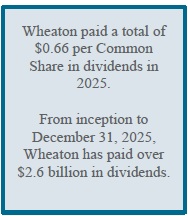
|
| Year | Quarter | Amount of Dividend | Record Date | Total Amount Paid in Year | ||||
|
2023(1) |
First | $0.15 | March 24, 2023 | |||||
| Second | $0.15 | May 19, 2023 | ||||||
| Third | $0.15 | August 25, 2023 | ||||||
| Fourth | $0.15 | November 28, 2023 | ||||||
| $0.60 | ||||||||
| 2024 |
First | $0.155 | April 3, 2024 | |||||
| Second | $0.155 | May 29, 2024 | ||||||
| Third | $0.155 | August 21, 2024 | ||||||
| Fourth | $0.155 | November 21, 2024 | ||||||
| $0.62 | ||||||||
| 2025 |
First | $0.165 | April 1, 2025 | |||||
| Second | $0.165 | May 28, 2025 | ||||||
| Third | $0.165 | August 21, 2025 | ||||||
| Fourth | $0.165 | November 20, 2025 | ||||||
| $0.66 |
| (1) | To minimize volatility in quarterly dividends, the Company set a minimum quarterly dividend for the duration of 2023 equal to the dividend per Common Share declared in the prior quarter. |
Effective March 20, 2014, the Company adopted a Dividend Reinvestment Plan. The Dividend Reinvestment Plan was effective commencing with the second quarterly dividend of 2014. A total of 141,979 Common Shares were issued under the Dividend Reinvestment Plan during 2023, a total of 38,534 Common Shares were issued under the Dividend Reinvestment Plan during 2024, and a total of 36,517 Common Shares were issued under the Dividend Reinvestment Plan during 2025.
DESCRIPTION OF CAPITAL STRUCTURE
Authorized Capital
The authorized share capital of the Company consists of an unlimited number of Common Shares and an unlimited number of preference shares (the “Preference Shares”), issuable in series. As of March 26, 2026, 454,099,562 Common Shares and no Preference Shares were issued and outstanding.
WHEATON 2025 ANNUAL INFORMATION FORM [107]
Common Shares
Holders of Common Shares are entitled to receive notice of any meetings of shareholders of the Company, to attend and to cast one vote per Common Share at all such meetings. Holders of Common Shares do not have cumulative voting rights with respect to the election of directors and, accordingly, holders of a majority of the Common Shares entitled to vote in any election of directors may elect all directors standing for election. The Company has adopted advance notice provisions for the nomination of directors which apply in circumstances where director nominations are made by shareholders of the Company, other than in connection with (i) the requisition of a shareholders’ meeting, or (ii) a shareholder proposal, in each case made pursuant to the Act. The advance notice provisions fix a deadline by which holders of record of Common Shares must submit director nominations to the Company prior to any annual or special meeting of shareholders and sets forth the information that a shareholder must include in the notice to the Company.
Holders of Common Shares are entitled to receive on a pro rata basis such dividends, if any, as and when declared by the Company’s Board of Directors at its discretion from funds legally available therefor and upon the liquidation, dissolution or winding up of the Company are entitled to receive on a pro rata basis the net assets of the Company after payment of debts and other liabilities, in each case subject to the rights, privileges, restrictions and conditions attaching to any other series or class of shares ranking senior in priority to or on a pro rata basis with the holders of Common Shares with respect to dividends or liquidation. Although the articles of the Company provide for the potential issuance of Preference Shares, there is currently no other series or class of shares outstanding which ranks senior in priority to the Common Shares. The Common Shares do not carry any pre-emptive, subscription, redemption or conversion rights, nor do the Common Shares contain any sinking or purchase fund provisions.
Preference Shares
The Preference Shares may, at any time or from time to time, be issued in one or more series. The Company’s Board of Directors shall fix before issue, the number of, the consideration per share of, the designation of, and the provisions attaching to the shares of each series. Except as required by law or as otherwise determined by the Company’s Board of Directors in respect of a series of shares, the holder of a Preference Share shall not be entitled to vote at meetings of shareholders. The Preference Shares of each series rank on a priority with the Preference Shares of every other series and are entitled to preference over the Common Shares and any other shares ranking subordinate to the Preference Shares with respect to priority and payment of dividends and distribution of assets in the event of liquidation, dissolution or winding-up of the Company.
WHEATON 2025 ANNUAL INFORMATION FORM [108]
TRADING PRICE AND VOLUME
Common Shares
The Common Shares are listed and posted for trading on the TSX, the NYSE and LSE under the symbol “WPM”. The following table sets forth information relating to the monthly high and low closing prices and volume of the Common Shares on the TSX for the most recently completed financial year.
| Month | High (C$) |
Low (C$) |
Volume (million shares) | |||||||||
| January 2025 |
92.21 | 80.04 | 11,858,665 | |||||||||
| February 2025 |
101.33 | 90.72 | 14,601,944 | |||||||||
| March 2025 |
112.21 | 98.70 | 16,865,203 | |||||||||
| April 2025 |
120.60 | 96.18 | 19,627,064 | |||||||||
| May 2025 |
120.50 | 105.36 | 19,062,041 | |||||||||
| June 2025 |
129.87 | 118.26 | 15,160,749 | |||||||||
| July 2025 |
131.82 | 117.13 | 12,742,935 | |||||||||
| August 2025 |
143.00 | 125.86 | 15,637,500 | |||||||||
| September 2025 |
156.67 | 137.67 | 20,037,291 | |||||||||
| October 2025 |
160.44 | 129.69 | 18,428,953 | |||||||||
| November 2025 |
153.96 | 132.89 | 14,705,284 | |||||||||
| December 2025 |
170.16 | 145.20 | 15,936,548 | |||||||||
The price of the Common Shares as quoted by the TSX at the close of business on December 31, 2025 (being the last trading day of 2025) was C$161.36 and on March 26, 2026 was C$164.95.
DIRECTORS AND OFFICERS
The following table sets forth the name, province/state and country of residence, position(s) held with the Company and principal occupation of each person who is a director and/or an executive officer of the Company as of the date of this annual information form and details certain leadership changes effective March 31, 2026 as part of the Company’s strategic succession planning.
| Name, Province/State and Country of Residence |
Position(s) with the Company |
Principal Occupation | ||
| George L. Brack British Columbia, Canada |
Chair of the Board Lead Independent Director of the Board (effective March 31, 2026); Director since November 2009 (4) |
Corporate Director | ||
| Jaimie Donovan (1)(3) Ontario, Canada |
Director since May 2022 (4) | Corporate Director | ||
| Chantal Gosselin (2)(3) British Columbia, Canada |
Director since November 2013 (4) | Corporate Director | ||
| Jeane Hull (1) Arizona, USA |
Director since May 12, 2023 | Corporate Director | ||
| Glenn A. Ives (2) British Columbia, Canada |
Director since May 2020 | Corporate Director |
WHEATON 2025 ANNUAL INFORMATION FORM [109]
| Name, Province/State and Country of Residence |
Position(s) with the Company |
Principal Occupation | ||
| Charles A. Jeannes (2)(3) Nevada, USA |
Director since November 2016(4) | Corporate Director | ||
| Marilyn Schonberner (1)(2) Alberta, Canada |
Director since February 2018(4) | Corporate Director | ||
| Srinivasan Venkatakrishnan (1) Dublin, Ireland |
Director since May 2024(4) | Corporate Director | ||
| Randy V. J. Smallwood British Columbia, Canada |
Chief Executive Officer Non-Executive Chair of the Board Director since May 2011(4) |
Corporate Director | ||
| Haytham H. Hodaly (5) British Columbia, Canada |
President Chief Executive Officer and Director |
Chief Executive Officer and President of Wheaton | ||
| Vincent Lau (6) British Columbia, Canada |
Senior Vice President and Chief Financial Officer |
Senior Vice President and Chief Financial Officer of Wheaton | ||
| Curt D. Bernardi (5) British Columbia, Canada |
Executive Vice President, Strategy and General Counsel |
Executive Vice President, Strategy and General Counsel of Wheaton | ||
| Patrick E. Drouin Grand Cayman, Cayman Islands |
President & Chief Sustainability Officer, Wheaton International |
President & Chief Sustainability Officer, Wheaton International |
| (1) | Member of the Audit Committee. Ms. Marilyn Schonberner is the Chair of the Audit Committee. |
| (2) | Member of the Human Resources Committee. Ms. Chantal Gosselin is the Chair of the Human Resources Committee. |
| (3) | Member of the Governance and Sustainability Committee. Mr. Charles Jeannes is the Chair of the Governance and Sustainability Committee. |
| (4) | Directors are elected at each annual meeting of Wheaton’s shareholders and serve as such until the next annual meeting or until their successors are elected or appointed. As announced by the Company on February 5, 2026, effective March 31, 2026, Mr. Brack will transition to Lead Independent Director, Mr. Smallwood will become non-executive Chair of the Company and Mr. Hodaly will join the Board as a Director. |
| (5) | Effective June 30, 2025, Mr. Hodaly was promoted from Senior Vice President, Corporate Development to President of Wheaton and Mr. Bernardi was promoted from Senior Vice President, Legal and Strategic Development to Executive Vice President, Strategy and General Counsel. As announced by the Company on February 5, 2026, effective March 31, 2026, Mr. Smallwood will cease to be Chief Executive Officer of the Company and Mr. Hodaly will become Chief Executive Officer of the Company. |
| (6) | Effective March 31, 2025, Mr. Gary Brown retired from his position as Senior Vice President and Chief Financial Officer and Mr. Vincent Lau became Senior Vice President and Chief Financial Officer. Mr. Lau is resident in British Columbia, Canada. |
The principal occupations, businesses or employments of each of the Company’s directors and executive officers within the past five years are disclosed in the brief biographies set forth below.
George L. Brack – Lead Independent Director of the Board (effective March 31, 2026) and Director. Mr. Brack is currently the Chair of the Wheaton Board, a position he has held from 2022. Effective March 31, 2026, Mr. Brack will cease to be the Chair and will be the Lead Independent Director of the Wheaton Board. Mr. Brack retired as the Lead Independent Director of Capstone Mining Corp. in May 2023 and served as the non-Executive Chair from 2011-2022. Mr. Brack is also a Director of Dateline Resources. In addition to his current board roles, during the past 20 years, Mr. Brack served as a director on the boards of directors of Alio Gold Inc., ValOro Resources Inc. (now Defiance Silver Corp. and formerly Geologix Explorations Inc.), Aurizon Mines Ltd., Newstrike Capital Inc., NovaGold Resources Inc., Red Back Mining Inc. and chaired the board of Alexco Resources Corp. Mr. Brack’s over 35-year career in the mining industry focused on exploration, corporate development and investment banking, specifically identifying, evaluating and executing strategic mergers and acquisitions, and raising equity capital. Until 2009, he was Managing Director and Industry Head, Mining at Scotia Capital. Prior to joining Scotia in 2006, Mr. Brack spent seven years as President of Macquarie North America Ltd. and lead its northern hemisphere mining industry mergers and acquisitions advisory business. Previously, Mr. Brack was Vice President, Corporate Development at Placer Dome Inc., Vice President in the mining investment banking group at CIBC Wood Gundy and worked on the corporate development team at Rio Algom. Mr. Brack earned an MBA at York University, a B.A.Sc. in Geological Engineering at the University of Toronto and the CFA designation.
WHEATON 2025 ANNUAL INFORMATION FORM [110]
Jaimie Donovan – Director. Ms. Donovan has over 25 years of mining industry experience, spanning roles in operations, technical services, capital allocation and corporate development. She was the Head of Growth and Evaluations for Barrick Gold Corporation in North America until March 2019. Prior to that, Ms. Donovan held senior positions at Barrick Gold Corporation as Vice President of Evaluations and Waterton Global Resource Management as a Principal and Head of Evaluations, where she led teams responsible for the due diligence of investment and growth opportunities. Ms. Donovan has significant technical and operations experience working at mines in Australia and Canada for Barrick Gold Corporation, Goldfields Limited and Western Mining Corp. Ms. Donovan joined the board of directors of Dundee Precious Metals Inc. in November 2020 and the board of Dundee Corporation in May 2024. She formerly served on the board of Perpetua Resources from January 2019 to December 2020. Ms. Donovan holds Bachelor’s degrees in Mining Engineering (B.Eng. Honours) and Commerce (B.Com. Finance) from the University of Western Australia. She has also completed the ICD Director Education Program at the Rotman School of Management.
Chantal Gosselin – Director. Ms. Gosselin is an experienced corporate board member with over 30 years combined experience in mining operations and capital markets. Her involvement in the financial markets ranges from asset management to sell side analyst. Ms. Gosselin held positions as Vice President and Portfolio Manager at Goodman Investment Counsel and Senior Mining Analyst at Sun Valley Gold LLP, along with various analyst positions earlier in her career. Ms. Gosselin also held various mine-site management positions in Canada, Peru and Nicaragua, giving her firsthand experience in underground and open pit mine development and production in diverse cultural and social environments. Ms. Gosselin has a Masters of Business Administration from Concordia University and a Bachelor of Science (Mining Engineering) from Laval University and has completed the ICD – Director Education Program. She currently serves on the boards of a variety of TSX-listed companies in the natural resources sectors.
Jeane Hull – Director. Ms. Hull has over 35 years of mining operational leadership and engineering experience, most notably holding the positions of Chief Operating Officer for Rio Tinto plc at the Kennecott Utah Copper Mine and Executive Vice President and Chief Technical Officer of Peabody Energy Corporation. She also held numerous management engineering and operations positions with Rio Tinto affiliates. Prior to joining Rio Tinto, she held positions with Mobil Mining and Minerals and has additional environmental engineering and regulatory affairs experience in the public and private sectors. In addition to her extensive mining experience, Ms. Hull has over 11 years of independent director experience. Ms. Hull currently serves as a member of the Board of Directors of Hudbay Minerals Inc., Epiroc AB and Coeur Mining, Inc. She previously served on the boards of Interfor Corporation, Trevali Mining Company (“Trevali”), Copper Mountain Mining Corporation, Pretium Resources Inc. and Cloud Peak Energy Inc. Ms. Hull is currently on the Advisory Board for ABC to CEO and Ms. Hull served on the Advisory Board for South Dakota School of Mines and Technology.
Glenn A. Ives – Director. Mr. Ives joined the Board of Wheaton in May 2020. Mr. Ives retired as a Canadian partner of Deloitte LLP on March 31, 2020. He served as the Executive Chair of Deloitte Canada from 2010 and 2018, a director of Deloitte Global from 2010 to 2018 and Chair of the Deloitte Global Risk Committee from 2012 to 2018. Mr. Ives was the leader of the North and South America Mining group for Deloitte from 2007 to 2020. He served as an audit partner at Deloitte serving public mining companies from 1999 to 2010. Mr. Ives currently serves as a director of Kinross Gold Corporation. Mr. Ives served as Director from 2021 to 2025 and Chair from 2024 to 2025 of NervGen Pharma Corp. From 1993 to 1999, Mr. Ives was the Chief Financial Officer and a Director of Vengold Inc. He served as a director of Lihir Gold Inc. from 1997 to 1999. Mr. Ives served as the Vice-President of Finance of TVX Gold Inc. from 1988 to 1993. Mr. Ives has extensive corporate governance experience with non-profit organizations including serving as Chair of the St. Paul’s Foundation (Vancouver) and as a director of the Princess Margaret Cancer Foundation from 2010 to 2019 and Chair from 2016 to 2018. Mr. Ives holds a Bachelor of Mathematics degree (honors) from the University of Waterloo, graduating on the Dean’s Honor List. He is a Fellow of the Chartered Professional Accountants of British Columbia, a member of the Chartered Professional Accountants of Ontario and was the Ontario Gold medalist for the Uniform Final Exams in 1984. Mr. Ives is also a member of the ICD and the NACD.
Charles A. Jeannes – Director. Mr. Jeannes joined the Board of Wheaton in November 2016. Mr. Jeannes is a mining industry veteran with over 30 years of experience. As President and CEO of Goldcorp Inc. (now Newmont Corporation) from December 2008 to April 2016, he led Goldcorp’s development into one of the world’s largest and most successful gold mining companies with mining operations and development projects located throughout the Americas. Mr. Jeannes formerly held the role of Executive Vice President, Corporate Development of Goldcorp where he managed a series of M&A transactions that contributed to the company’s significant growth. Prior to joining Goldcorp, Mr. Jeannes held senior positions with Glamis Gold Ltd. and Placer Dome Inc. Mr. Jeannes was formerly a director of Tahoe Resources Inc. until its acquisition by Pan American Silver Corp. in early 2019 and currently serves as a director of Pan American Silver Corp. and Chair of Orla Mining Ltd. He holds a B.A. degree from the University of Nevada (1980) and graduated from the University
WHEATON 2025 ANNUAL INFORMATION FORM [111]
of Arizona College of Law with honors in 1983. He practiced law for 11 years and has broad experience in capital markets, mergers and acquisitions, public and private financing and international operations. Mr. Jeannes has received numerous awards including British Columbia CEO of the Year for 2013, Canada’s Most Admired CEO for 2015, 2016 Alumnus of the Year for the University of Nevada and 2015 Alumnus of the Year for the University of Arizona College of Law. Mr. Jeannes is involved in various philanthropic activities and currently serves as a Trustee of the Wolf Pack Athletic Association at the University of Nevada.
Marilyn Schonberner – Director. Ms. Schonberner is a Corporate Director with over 35 years of international experience in the Energy and Mining sectors. She retired in 2018 as the Chief Financial Officer of Nexen Energy ULC. During her 21-year career with Nexen, she held various executive roles with responsibility for financial and risk management, audit, human resources, strategic planning and budgeting, supply chain, and information services. Ms. Schonberner currently serves on the board of directors of New Gold Inc. where she is the Chair of the Audit Committee and a member of the Governance and Nominating Committee. She holds a Bachelor of Commerce from the University of Alberta and a Master of Business Administration from the University of Calgary. She is a CPA, CMA and a Certified Internal Auditor. Ms. Schonberner completed the Senior Executive Development Programme at the London Business School and has obtained the ICD.D designation from the ICD. Ms. Schonberner also serves on the Calgary ICD Advisory Board.
Randy V. J. Smallwood – Chair of the Board (effective March 31, 2026) and Director. Effective March 31, 2026, Mr. Smallwood will cease to be the Chief Executive Officer and will be the non-executive Chair of the Wheaton Board. Mr. Smallwood holds a geological engineering degree from the University of British Columbia and a mine engineering diploma from the British Columbia Institute of Technology. Mr. Smallwood was involved in the founding of Wheaton and in 2007, he joined Wheaton full time as Executive Vice President of Corporate Development, primarily focusing on growing the Company through the evaluation and acquisition of silver stream opportunities. In January 2010 he was appointed President, and in April 2011 he was appointed Wheaton’s Chief Executive Officer. Mr. Smallwood ceased to be President of Wheaton effective June 30, 2025 and will cease to be Chief Executive Officer and be appointed non-executive Chair of the Wheaton Board effective March 31, 2026. Mr. Smallwood originally started as an exploration geologist with Wheaton River Minerals Ltd., and in 2001 was promoted to Director of Project Development, his role through its 2005 merger with Goldcorp. Mr. Smallwood was an instrumental part of the team that built Wheaton River / Goldcorp into one of the largest, and more importantly, one of the most profitable gold companies in the world, and he is now focused on continuing to add to the impressive growth profile of Wheaton. Mr. Smallwood formerly served on the boards of Defiance Silver Corp. (formerly ValOro Resources Inc. and Geologix Explorations Inc.) from 2005 to 2019, Ventana Gold from 2008 to 2011, Castle Peak Resources from 2010 to 2012, and Tigray Resources Inc. from 2011 to 2014. Mr. Smallwood is also the Chair of MineralsEd BC and serves as a past Chair and board member of the World Gold Council, and as a board member of Special Olympics BC and Mining4Life. Mr. Smallwood also previously served on the board of the BC Cancer Foundation. In 2015, Mr. Smallwood received the British Columbia Institute of Technology Distinguished Alumni Award.
Srinivasan Venkatakrishnan – Director. Mr. Venkatakrishnan joined the Board of Wheaton in May 2024. Mr. Venkatakrishnan is a Corporate Director and an experienced mining executive who brings a wealth of mining and financial experience, gained through his vast experience of leading global mining businesses, in a career that has spanned across 17 countries and six continents. Mr. Venkatakrishnan has a proven track record of leading multinational organizations - including major publicly listed companies - through periods of challenging and transformative change. He is currently the Chair of Endeavour Mining plc. and a director of BlackRock World Mining Trust plc. Mr. Venkatakrishnan was previously a Director of Weir Group Plc. and served as CEO of Vedanta Resources plc from 2018 to 2020 and CEO of AngloGold Ashanti Limited between 2013 to 2018, having previously been Chief Financial Officer of the business from 2005, and of Ashanti Goldfields Limited from 2000. In his early career, he was a Director with Deloitte in London, leading corporate restructurings on behalf of both corporates and financiers. Mr. Venkatakrishnan, who is a Chartered Accountant (ICAI), is a past board member of the World Gold Council, International Council on Mining and Metals, Business Leadership South Africa, the Chamber of Mines of South Africa and a past member of the Financial Review Investigation Panel of the Johannesburg Stock Exchange.
Haytham H. Hodaly – Director and Chief Executive Officer (effective March 31, 2026) and President. Mr. Hodaly is currently President of Wheaton, a position he has held since 2025. Effective March 31, 2026, Mr. Hodaly will also be Chief Executive Officer and a Director of Wheaton. He joined the Company in 2012 and has since been involved with more than $11.0 billion worth of streaming transactions. Mr. Hodaly brings with him more than 30 years of experience in analyzing mining opportunities. Prior to joining Wheaton, Mr. Hodaly had spent more than 16 years in the North American securities industry, most recently as Director and Mining Analyst, Global Mining Research, at RBC Capital Markets. Prior to this, Mr. Hodaly held the position of Co-Director of Research and Senior Mining Analyst at Salman Partners Inc., in addition to holding
WHEATON 2025 ANNUAL INFORMATION FORM [112]
the titles of Vice President and Director of the firm. Mr. Hodaly is an engineer with a Bachelor of Applied Science in Mining and Mineral Processing Engineering and a Master of Engineering, specializing in Mineral Economics, both obtained from the University of British Columbia. Mr. Hodaly is a past Director of GoldSource Mines Inc, Denver Gold Group, Blue Moon Metals Inc. and NEXE Innovations Inc.
Vincent Lau – Senior Vice President and Chief Financial Officer. Mr. Vincent Lau became Senior Vice President and Chief Financial Officer in March 2025. Mr. Lau previously served as Wheaton’s Vice President of Finance for 13 years, where he managed the corporate finance and risk management functions. Prior to joining Wheaton, Vincent held senior finance roles at CHC Helicopters and in KPMG’s Transaction Services group based in New York. Vincent holds the Chartered Professional Accountant and Chartered Financial Analyst designations and received a Bachelor of Commerce degree from the University of British Columbia.
Curt D. Bernardi – Executive Vice President, Strategy and General Counsel. Mr. Bernardi joined the Company in 2008 and has been practicing law since his call to the British Columbia bar in 1994. He worked for the law firm of Blake, Cassels & Graydon in the areas of corporate finance, mergers and acquisitions and general corporate law until leaving to join Westcoast Energy in 1998. Following the acquisition of Westcoast Energy by Duke Energy in 2002, Mr. Bernardi continued to work for Duke Energy Gas Transmission as in-house legal counsel, working primarily on reorganizations, mergers and acquisitions, joint ventures and general corporate/commercial work. In 2005, Mr. Bernardi joined Union Gas as their Director, Legal Affairs and was responsible for legal matters affecting Union Gas. Mr. Bernardi is on the board of the Lions Gate Hospital Foundation, serving as past Chair. He obtained his Bachelor of Commerce from the University of British Columbia and his Bachelor of Law from the University of Toronto.
Patrick E. Drouin – President and Chief Sustainability Officer, Wheaton International. Mr. Drouin joined the Company in 2012, bringing with him 12 years of experience in the financial industry. He worked for UBS Securities from 2001 to 2012 in institutional equity sales across North America and in Europe, most recently in London as Head of European Sales for UBS Canada. In this role, Mr. Drouin built a sales platform responsible for advising fund managers on Canadian equities. He was also a member of the UBS Canadian Executive Committee, which oversaw strategic decisions for the Canadian business. Prior to this, Mr. Drouin worked in both Toronto and San Francisco for UBS Canada, advising the largest US institutional investors on Canadian equities. Throughout his advisory career, he has focused on the resource sector. Prior to UBS, he served as a Project Geologist in the San Francisco Bay Area for William Lettis & Associates. Effective October 16, 2023, Mr. Drouin became President and Chief Sustainability Officer at Wheaton International. Mr. Drouin was previously Senior Vice President, Sustainability and Investor Relations at the Company. Mr. Drouin has an MBA from the Rotman School of Management, University of Toronto, and a Masters in Geology from the University of Memphis.
As at December 31, 2025, the directors and executive officers of Wheaton, as a group, beneficially owned, directly and indirectly, or exercised control or direction over 0.1046% of the Company’s Common Shares, representing less than one percent of the total number of Common Shares outstanding before giving effect to the exercise of options or warrants to purchase Common Shares held by such directors and executive officers. The statement as to the number of Common Shares beneficially owned, directly or indirectly, or over which control or direction is exercised by the directors and executive officers of Wheaton as a group is based upon information furnished by the directors and executive officers.
Cease Trade Orders, Bankruptcies, Penalties or Sanctions
To the knowledge of the Company, no director or executive officer of the Company is, or within ten years prior to the date hereof has been, a director, chief executive officer or chief financial officer of any company (including the Company) that: (i) was subject to a cease trade order, an order similar to a cease trade order or an order that denied the relevant company access to any exemption under securities legislation, that was in effect for a period of more than 30 consecutive days, that was issued while the director or executive officer was acting in the capacity as director, chief executive officer or chief financial officer; or (ii) was subject to a cease trade order, an order similar to a cease trade order or an order that denied the relevant company access to any exemption under securities legislation, that was in effect for a period of more than 30 consecutive days, that was issued after the director or executive officer ceased to be a director, chief executive officer or chief financial officer and which resulted from an event that occurred while that person was acting in the capacity as director, chief executive officer or chief financial officer.
To the knowledge of the Company, no director or executive officer of the Company, or a shareholder holding a sufficient number of securities of the Company to affect materially control of the Company, is, or within ten years prior to the date hereof has been, a director or executive officer of any company (including the Company) that, while that person was
WHEATON 2025 ANNUAL INFORMATION FORM [113]
acting in that capacity, or within a year of that person ceasing to act in that capacity, became bankrupt, made a proposal under any legislation relating to bankruptcy or insolvency or was subject to or instituted any proceedings, arrangement or compromise with creditors or had a receiver, receiver manager or trustee appointed to hold its assets, other than as set out below:
| ● | Ms. Hull was a director from July 2016 to October 24, 2019 of Cloud Peak Energy Inc. (“Cloud Peak”), a company that filed for Chapter 11 bankruptcy protection in the United States on May 10, 2019, received court approval for its plan of reorganization on December 5, 2019 and emerged from bankruptcy on December 17, 2019. In connection with its plan of reorganization, Cloud Peak sold substantially all of its operating assets to Navajo Transitional Energy Company. |
| ● | Ms. Hull was a director from January 2021 to September 2022 of Trevali, a company that obtained an initial order from the Supreme Court of British Columbia under the Companies’ Creditors Arrangement Act (Canada) in August 2022. Trevali indicated that its financial position deteriorated significantly in 2022 as a result of a number of events and challenges which impacted operations and production. In January, 2023, a Receiver was appointed for Trevali by the Court. |
| ● | Mr. Venkatakrishnan was the Chief Executive Officer and executive director of Vedanta Resources Limited (“VRL”) from August 31, 2018 to April 5, 2020. During that time, Mr. Venkatakrishnan was also a non-executive director of Konkola Copper Mines Limited (“KCM”) in which VRL holds a majority shareholder position. In connection with an ownership dispute with VRL, ZCCM IH (a Zambian state-owned corporation that holds a minority interest in KCM) brought a petition before the Zambian High Court to have KCM wound up and an ex-parte petition to have a provisional liquidator appointed to manage KCM’s affairs. It was reported in November 2023 that VRL and ZCCM entered into an agreement to reinstate the KCM board of directors and a withdrawal of all legal challenges in court, including the removal of the provisional liquidator. During 2024, the provisional liquidator vacated his role and the Government of Zambia returned the control of the mine to VRL, who are operating the mine currently. |
To the knowledge of the Company, no director or executive officer of the Company, or a shareholder holding a sufficient number of securities of the Company to affect materially control of the Company, has, within ten years prior to the date hereof, become bankrupt, made a proposal under any legislation relating to bankruptcy or insolvency, or become subject to or instituted any proceedings, arrangement or compromise with creditors, or had a receiver, receiver manager or trustee appointed to hold the assets of the director, executive officer or shareholder.
To the knowledge of the Company, no director or executive officer of the Company, or a shareholder holding a sufficient number of securities of the Company to affect materially the control of the Company, has been subject to: (i) any penalties or sanctions imposed by a court relating to securities legislation or by a securities regulatory authority or has entered into a settlement agreement with a securities regulatory authority; or (ii) any other penalties or sanctions imposed by a court or regulatory body that would likely be considered important to a reasonable investor in making an investment decision.
Conflicts of Interest
To the best of Wheaton’s knowledge, and other than as disclosed in this annual information form, there are no known existing or potential material conflicts of interest between Wheaton and any director or officer of Wheaton, except that certain of the directors and officers serve as directors and officers of other public companies and therefore it is possible that a conflict may arise between their duties as a director or officer of Wheaton and their duties as a director or officer of such other companies. Certain of the directors and officers of the Company also serve as directors and/or officers of other companies involved in natural resource exploration, development and mining operations and consequently there exists the possibility for such directors and officers to be in a position of conflict. Any decision made by any of such directors and officers will be made in accordance with their duties and obligations to deal fairly and in good faith with a view to the best interests of the Company and its shareholders. In addition, each of the directors is required to declare and refrain from attending the portion of the meeting dedicated to discussing any matter in which such directors may have a conflict of interest or voting on such matter in accordance with the procedures set forth in the Business Corporations Act (Ontario) and other applicable laws. See “Interest of Management and Others in Material Transactions”.
WHEATON 2025 ANNUAL INFORMATION FORM [114]
LEGAL PROCEEDINGS AND REGULATORY ACTIONS
Other than as set forth below, to the best of the Company’s knowledge, the Company is not and was not, during the year ended December 31, 2025, a party to any legal proceedings, nor is any of its property, nor was any of its property during the year ended December 31, 2025, the subject of any legal proceedings. As at the date hereof, no such legal proceedings are known to be contemplated, except as set forth below.
There have been no penalties or sanctions imposed against the Company by a court relating to securities legislation or by any securities regulatory authority during the year ended December 31, 2025, or any other penalties or sanctions imposed by a court or regulatory body against the Company that would likely be considered important to a reasonable investor making an investment decision, and the Company has not entered into any settlement agreements with a court relating to securities legislation or with a securities regulatory authority during the year ended December 31, 2025.
INTEREST OF MANAGEMENT AND OTHERS IN MATERIAL TRANSACTIONS
Other than as described in this annual information form, within the three most recently completed financial years or during the current financial year, no director, executive officer or 10% shareholder of the Company or any associate or affiliate of any such person or company, has or had any material interest, direct or indirect, in any transaction that has materially affected or is reasonably expected to materially affect the Company or any of its subsidiaries.
TRANSFER AGENT AND REGISTRAR
The transfer agent and registrar for the Common Shares is Odyssey Trust Company at its offices in Vancouver, British Columbia, Calgary, Alberta and Toronto, Ontario.
MATERIAL CONTRACTS
The only material contract(s) entered into by the Company as of the date of this annual information form or before such time that are still in effect, other than in the ordinary course of business, are the Revolving Facility and the Term Loan. See “Description of the Business – Revolving Facility and Term Loan.” The Revolving Facility (with all amendments) and the Term Loan are available on SEDAR+ at www.sedarplus.ca under the Company’s profile.
INTERESTS OF EXPERTS
The scientific and technical information for the Company’s mineral projects on a property material to the Company contained in this annual information form has been prepared in accordance with the exemption set forth in Section 9.2 of NI 43-101 and was sourced by the Company from the following SEDAR+ (www.sedarplus.ca) and EDGAR (www.sec.gov) filed documents:
| a. | Peñasquito mine – Peñasquito Report and Newmont’s annual report on Form 10-K for the year ended December 31, 2025 available on EDGAR at https://www.sec.gov/ix?doc=/Archives/edgar/data/1164727/000116472725000011/nem-20241231.htm; |
| b. | Salobo mine – Salobo Report; and |
| c. | Antamina mine – Teck annual information form filed on SEDAR+ on February 19, 2026. |
A summary of the information sourced from the Peñasquito Report is contained in this annual information form under “Technical Information — Further Disclosure Regarding Mineral Projects on Material Properties — Peñasquito Mine, Mexico”. A summary of the information sourced from the Salobo Report is contained in this annual information form under “Technical Information — Further Disclosure Regarding Mineral Projects on Material Properties — Salobo Mine, Brazil”. A summary of the information sourced from the annual information form of Teck Resources Limited is contained in this annual information form under “Technical Information — Further Disclosure Regarding Mineral Projects on Material Properties – Antamina Mine, Peru”.
Ryan Ulansky, M.A.Sc., P.Eng., Vice President, Engineering, and Jeremy Vincent, P.Geo., Director, Geology, of the Company are the qualified persons as defined by NI 43-101 in connection with the mineral reserve and mineral resource estimates and the scientific and technical information contained in this annual information form, and have reviewed and approved the disclosure, for the Peñasquito mine, the Salobo mine and the Antamina mine contained in this annual information form.
WHEATON 2025 ANNUAL INFORMATION FORM [115]
The aforementioned firms or persons (including any designated professional of such firms or persons, as such term is defined in National Instrument 51-102) held no securities of the Company or of any associate or affiliate of the Company when they prepared the reports, the mineral reserve estimates or the mineral resource estimates referred to above, or following the preparation of such reports or estimates and did not receive any direct or indirect interest in any securities of the Company or of any associate or affiliate of the Company in connection with the preparation of such reports or estimates, other than Ryan Ulansky and Jeremy Vincent, who together hold less than 1% of the Common Shares. None of the aforementioned persons are currently expected to be elected, appointed or employed as a director, officer or employee of the Company or of any associate or affiliate of the Company, other than Ryan Ulansky and Jeremy Vincent who are employees of the Company.
Deloitte LLP is the independent registered public accounting firm of the Company and is independent of the Company within the meaning of the Rules of Professional Conduct of the Chartered Professional Accountants of British Columbia and within the meaning of the U.S. Securities Act and the applicable rules and regulations thereunder adopted by the Securities and Exchange Commission and the Public Company Accounting Oversight Board (United States).
AUDIT COMMITTEE
The Company’s Audit Committee is responsible for monitoring the Company’s systems and procedures for financial reporting and internal control, reviewing certain public disclosure documents and monitoring the performance and independence of the Company’s external auditors. The Audit Committee is also responsible for reviewing the Company’s annual audited financial statements, unaudited quarterly financial statements and management’s discussion and analysis of financial results of operations for both annual and interim financial statements and review of related operations prior to their approval by the full Board of Directors of the Company. The Audit Committee also has oversight responsibility for significant business, political, financial and control risks that the Company is exposed to, including a review of management’s assessment of the likelihood and severity of those risks and any mitigation steps taken.
The Audit Committee’s charter sets out its responsibilities and duties, qualifications for membership, procedures for committee member removal and appointment and reporting to the Company’s Board of Directors. A copy of the Audit Committee charter is attached hereto as Schedule “A”.
The current members of the Company’s Audit Committee are Marilyn Schonberner (Chair), Jaimie Donovan, Jeane Hull and Srinivasan Venkatakrishnan. Each of the members of Audit Committee are independent and financially literate within the meaning of National Instrument 52-110 Audit Committees (“NI 52-110”). In addition to being independent directors as described above, all members of the Audit Committee must meet an additional “independence” test under NI 52-110 in that their directors’ fees are the only compensation they, or their firms, receive from the Company and that they are not affiliated with the Company.
The Audit Committee met four times in 2025. Each of the members of the Audit Committee who were directors of the Company and members of the Audit Committee at the time were present at all four meetings.
Relevant Education and Experience
See “Directors and Officers” for a description of the education and experience of each Audit Committee member that is relevant to the performance of his responsibilities as an Audit Committee member.
Pre-Approval Policies and Procedures
The Audit Committee’s charter sets out responsibilities regarding the provision of non-audit services by the Company’s external auditors. This policy requires consideration of whether the provision of services other than audit services is compatible with maintaining the auditor’s independence and requires Audit Committee pre-approval of permitted non-audit, audit and audit-related services.
WHEATON 2025 ANNUAL INFORMATION FORM [116]
External Auditor Fees
Deloitte LLP were the auditors of the Company for the year ended December 31, 2024. Fees billed by Deloitte LLP in respect of services for the years ended December 31, 2024 and December 31, 2025 are detailed below:
| 2024
(1) (C$) |
2025 (1) (C$) | |||
| Audit Fees (2) |
1,292,302 | 1,272,400 | ||
| Audit-Related Fees (3) |
95,017 | 89,238 | ||
| Tax Fees (4) |
42,137 | 22,272 | ||
| All Other Fees |
- | 1,137 | ||
| TOTAL | 1,429,456 | 1,385,047 |
| (1) | Fees are paid in Canadian dollars. |
| (2) | Audit fees were paid for professional services rendered by the auditors for the audit of the Company’s annual financial statements or services provided in connection with statutory and regulatory filings or engagements. |
| (3) | Audit related fees relate to attestation services provided in connection with reporting requirements under the Company’s Revolving Facility and certain metrics disclosed in the Company’s annual Sustainability Report. |
| (4) | Tax fees were paid for tax related compliance and advisory services. |
ADDITIONAL INFORMATION
Additional information relating to the Company can be found on SEDAR+ at www.sedarplus.ca and on EDGAR at www.sec.gov. Additional information, including directors’ and officers’ remuneration and indebtedness, principal holders of the Company’s securities and securities authorized for issuance under equity compensation plans is contained in the management information circular of the Company dated March 21, 2025 prepared in connection with its annual and special meeting of shareholders held on May 9, 2025. The Company’s management information circular for the year ended December 31, 2025 will be prepared in connection with the Company’s annual and special meeting of shareholders scheduled to be held on May 8, 2026 which will be available on SEDAR+ at www.sedarplus.ca and EDGAR at www.sec.gov. Additional financial information is provided in the Company’s audited consolidated financial statements and management’s discussion and analysis for the year ended December 31, 2025.
WHEATON 2025 ANNUAL INFORMATION FORM [117]
IMPORTANT NOTES
Cautionary Note Regarding Forward-Looking Statements
This annual information form of Wheaton Precious Metals Corp. (“Wheaton” or the “Company”) contains “forward-looking statements” within the meaning of the United States Private Securities Litigation Reform Act of 1995 and “forward-looking information” within the meaning of applicable Canadian securities legislation. Forward-looking statements, which are all statements other than statements of historical fact, include, but are not limited to, statements with respect to:
| ● | payment by Wheaton International of $4.3 billion to BHP and the satisfaction of each party’s obligations in accordance with the BHP Antamina PMPA; |
| ● | the receipt by Wheaton International of silver production in respect of the Antamina mine under the BHP Antamina PMPA; |
| ● | the ability of the Company to drawdown sufficient funds under both its existing Revolving Facility and the new Term Loan and the satisfaction of each party’s obligations under the existing Revolving Facility and the new Term Loan; |
| ● | the ability of the Company to repay the existing Revolving Facility and new Term Loan; |
| ● | the future price of commodities; |
| ● | the estimation of future production from Mining Operations (including in the estimation of production, mill throughput, grades, recoveries and exploration potential); |
| ● | the estimation of mineral reserves and mineral resources (including the estimation of reserve conversion rates and the realization of such estimations); |
| ● | the commencement, timing and achievement of construction, expansion or improvement projects by Wheaton’s PMPA counterparties at Mining Operations; |
| ● | the payment of upfront cash consideration to counterparties under PMPAs, the satisfaction of each party’s obligations in accordance with PMPAs and the receipt by the Company of precious metals and cobalt production or other payments in respect of the applicable Mining Operations under PMPAs; |
| ● | the ability of Wheaton’s PMPA counterparties to comply with the terms of a PMPA (including as a result of the business, mining operations and performance of Wheaton’s PMPA counterparties) and the potential impacts of such on Wheaton; |
| ● | future payments by the Company in accordance with PMPAs, including any acceleration of payments; |
| ● | the costs of future production; |
| ● | the estimation of produced but not yet delivered ounces; |
| ● | continued listing of the Common Shares on the LSE, NYSE and TSX; |
| ● | any statements as to future dividends; |
| ● | the ability to fund outstanding commitments and the ability to continue to acquire accretive PMPAs; |
| ● | projected increases to Wheaton’s production and cash flow profile; |
| ● | projected changes to Wheaton’s production mix; |
| ● | the ability of Wheaton’s PMPA counterparties to comply with the terms of any other obligations under agreements with the Company; |
| ● | the ability to sell precious metals and cobalt production; |
| ● | confidence in the Company’s business structure; |
| ● | the Company’s assessment of taxes payable, and the Company’s ability to pay its taxes; |
| ● | possible CRA domestic or international audits; |
| ● | the Company’s assessment of the impact of any tax reassessments; |
| ● | the Company’s climate change and environmental commitments; and |
| ● | assessments of the impact and resolution of various legal and tax matters, including but not limited to audits. |
Generally, these forward-looking statements can be identified by the use of forward-looking terminology such as “plans”, “expects” or “does not expect”, “is expected”, “budget”, “scheduled”, “estimates”, “forecasts”, “projects”, “intends”, “anticipates” or “does not anticipate”, or “believes”, “potential”, or variations of such words and phrases or statements that certain actions, events or results “may”, “could”, “would”, “might” or “will be taken”, “occur” or “be achieved”.
Forward-looking statements are subject to known and unknown risks, uncertainties and other factors that may cause the actual results, level of activity, performance or achievements of Wheaton to be materially different from those expressed or implied by such forward-looking statements, including but not limited to:
WHEATON 2025 ANNUAL INFORMATION FORM [118]
| ● | risks relating to the satisfaction of each party’s obligations in accordance with the terms of the BHP Antamina PMPA; |
| ● | risks relating to the Company’s ability to meet the conditions of, and the satisfaction of each party’s obligations under, the existing Revolving Facility and the new Term Loan; |
| ● | risks relating to the generation of sufficient cash flow to repay the existing Revolving Facility and the new Term Loan; |
| ● | risks associated with fluctuations in the price of commodities (including Wheaton’s ability to sell its precious metals or cobalt production at acceptable prices or at all); |
| ● | risks related to the Mining Operations (including fluctuations in the price of the primary or other commodities mined at such operations, regulatory, political and other risks of the jurisdictions in which the Mining Operations are located, actual results of mining, risks associated with exploration, development, operating, expansions and improvement at the Mining Operations, environmental and economic risks of the Mining Operations, and changes in project parameters as Mining Operations plans continue to be refined); |
| ● | absence of control over the Mining Operations and having to rely on the accuracy of the public disclosure and other information Wheaton receives from the owners and operators of the Mining Operations as the basis for its analyses, forecasts and assessments relating to its own business; |
| ● | risks related to the uncertainty in the accuracy of mineral reserve and mineral resource estimation; |
| ● | risks related to the satisfaction of each party’s obligations in accordance with the terms of the Company’s PMPAs, including the ability of the companies with which the Company has PMPAs to perform their obligations under those PMPAs in the event of a material adverse effect on the results of operations, financial condition, cash flows or business of such companies, any acceleration of payments, estimated throughput and exploration potential; |
| ● | risks relating to production estimates from Mining Operations, including anticipated timing of the commencement of production by certain Mining Operations; |
| ● | Wheaton’s interpretation of, or compliance with, or application of, tax laws and regulations or accounting policies and rules, being found to be incorrect or the tax impact to the Company’s business operations being materially different than currently contemplated, or the ability to pay such taxes as and when due; |
| ● | any challenge or reassessment by the CRA of the Company’s tax filings being successful and the potential negative impact to the Company’s previous and future tax filings; |
| ● | risks in assessing the impact of the CRA Settlement; |
| ● | risks related to any changes to the Income Tax Act (Canada) that may result in a material change to the amount of future taxes payable; |
| ● | counterparty credit and liquidity risks; |
| ● | mine operator and counterparty concentration risks; |
| ● | indebtedness and guarantees risks; |
| ● | hedging risk; |
| ● | competition in the streaming industry risk; |
| ● | risks relating to security over underlying assets; |
| ● | risks relating to third-party PMPAs; |
| ● | risks relating to revenue from royalty interests; |
| ● | risks related to Wheaton’s acquisition strategy; |
| ● | risks relating to third-party rights under PMPAs; |
| ● | risks relating to future financings and security issuances; |
| ● | risks relating to unknown defects and impairments; |
| ● | risks related to governmental regulations; |
| ● | risks related to international operations of Wheaton and the Mining Operations; |
| ● | risks relating to exploration, development, operating, expansions and improvements at the Mining Operations; |
| ● | risks related to environmental regulations; |
| ● | the ability of Wheaton and the Mining Operations to obtain and maintain necessary licenses, permits, approvals and rulings; |
| ● | the ability of Wheaton and the Mining Operations to comply with applicable laws, regulations and permitting requirements; |
| ● | lack of suitable supplies, infrastructure and employees to support the Mining Operations; |
| ● | risks related to underinsured Mining Operations; |
WHEATON 2025 ANNUAL INFORMATION FORM [119]
| ● | inability to replace and expand mineral reserves, including anticipated timing of the commencement of production by certain Mining Operations (including increases in production, estimated grades and recoveries); |
| ● | uncertainties related to title and indigenous rights with respect to the mineral properties of the Mining Operations; |
| ● | the ability of Wheaton and the Mining Operations to obtain adequate financing; |
| ● | the ability of the Mining Operations to complete permitting, construction, development and expansion; |
| ● | challenges related to global financial conditions; |
| ● | risks associated with sustainability-related matters; |
| ● | risks related to fluctuations in commodity prices of metals produced from the Mining Operations other than precious metals or cobalt; |
| ● | risks related to claims and legal proceedings against Wheaton or the Mining Operations; |
| ● | risks related to the market price of the Common Shares of Wheaton; |
| ● | the ability of Wheaton and the Mining Operations to retain key management employees or procure the services of skilled and experienced personnel; |
| ● | risks related to interest rates; |
| ● | risks related to the declaration, timing and payment of dividends; |
| ● | risks related to access to confidential information regarding Mining Operations; |
| ● | risks associated with multiple listings of the Common Shares on the LSE, NYSE and TSX; |
| ● | risks associated with a possible suspension of trading of Common Shares; |
| ● | equity price risks related to Wheaton’s holding of long-term investments in other companies; |
| ● | risks relating to activist shareholders; |
| ● | risks relating to reputational damage; |
| ● | risks relating to expression of views by industry analysts; |
| ● | risks related to the impacts of climate change and the transition to a low-carbon economy; |
| ● | risks associated with the ability to achieve climate change and environmental commitments at Wheaton and at the Mining Operations; |
| ● | risks related to ensuring the security and safety of information systems, including cyber security risks; |
| ● | risks relating to artificial intelligence; |
| ● | risks relating to compliance with anti-corruption and anti-bribery laws; |
| ● | risks relating to corporate governance and public disclosure compliance; |
| ● | risks of significant impacts on Wheaton or the Mining Operations as a result of an epidemic or pandemic; |
| ● | risks related to the adequacy of internal control over financial reporting; and |
| ● | other risks disclosed under the heading “Risk Factors” in this annual information form. |
Forward-looking statements are based on assumptions management currently believes to be reasonable including, but not limited to:
| ● | that the payment of $4.3 billion to BHP will be made and that each party’s obligations in accordance with the terms of the BHP Antamina PMPA will be satisfied; |
| ● | that the Company will be able to drawdown sufficient funds under both its existing Revolving Facility and the new Term Loan and that each party’s obligations under the existing Revolving Facility and the new Term Loan will be satisfied; |
| ● | that the Company will be able to repay the existing Revolving Facility and new Term Loan; |
| ● | that there will be no material adverse change in the market price of commodities; |
| ● | that the Mining Operations will continue to operate and the mining projects will be completed in accordance with public statements and achieve their stated production estimates; |
| ● | that the mineral reserves and mineral resource estimates from Mining Operations (including reserve conversion rates) are accurate; |
| ● | that public disclosure and other information Wheaton receives from the owners and operators of the Mining Operations is accurate and complete; |
| ● | that the production estimates from Mining Operations are accurate; |
| ● | that each party will satisfy their obligations in accordance with the PMPAs; |
| ● | that Wheaton will continue to be able to fund or obtain funding for outstanding commitments; |
| ● | that Wheaton will be able to source and obtain accretive PMPAs; |
| ● | that the terms and conditions of a PMPA are sufficient to recover liabilities owed to the Company; |
WHEATON 2025 ANNUAL INFORMATION FORM [120]
| ● | that Wheaton has fully considered the value and impact of any third-party interests in PMPAs; |
| ● | that expectations regarding the resolution of legal and tax matters will be achieved (including CRA audits involving the Company); |
| ● | that Wheaton has properly considered the application of Canadian tax laws to its structure and operations and that Wheaton will be able to pay taxes when due; |
| ● | that Wheaton has filed its tax returns and paid applicable taxes in compliance with applicable tax laws; |
| ● | that the trading of the Common Shares will not be adversely affected by the differences in liquidity, settlement and clearing systems as a result of multiple listings of the Common Shares on the LSE, the TSX and the NYSE; |
| ● | that the trading of the Company’s Common Shares will not be suspended; |
| ● | the estimate of the recoverable amount for any PMPA with an indicator of impairment; |
| ● | that neither Wheaton nor the Mining Operations will suffer significant impacts as a result of an epidemic or pandemic; and |
| ● | such other assumptions and factors as set out herein. |
Although Wheaton has attempted to identify important factors that could cause actual results, level of activity, performance or achievements to differ materially from those contained in forward-looking statements, there may be other factors that cause results, level of activity, performance or achievements not to be as anticipated, estimated or intended. There can be no assurance that forward- looking statements will prove to be accurate and even if events or results described in the forward-looking statements are realized or substantially realized, there can be no assurance that they will have the expected consequences to, or effects on, Wheaton. Accordingly, readers should not place undue reliance on forward-looking statements and are cautioned that actual outcomes may vary. The forward-looking statements included herein are for the purpose of providing investors with information to assist them in understanding Wheaton’s expected financial and operational performance and may not be appropriate for other purposes. Any forward-looking statement speaks only as of the date on which it is made. Wheaton does not undertake to update any forward-looking statements that are included or incorporated by reference herein, except in accordance with applicable securities laws.
WHEATON 2025 ANNUAL INFORMATION FORM [121]
Currency Presentation and Exchange Rate Information
This annual information form contains references to United States dollars and Canadian dollars. The high, low and closing rates for Canadian dollars in terms of the United States dollar for each of the three years in the period ended December 31, 2025, as quoted by the Bank of Canada, were as follows:
| Year ended December 31 |
||||||||||||
|
2025 |
2024 |
2023 |
||||||||||
| High |
$ | 1.4603 | $ | 1.4416 | $ | 1.3875 | ||||||
| Low |
$ | 1.3558 | $ | 1.3316 | 1.3128 | |||||||
| Closing |
$ | 1.3706 | $ | 1.4389 | 1.3226 | |||||||
* The high, low and closing rates are the Bank of Canada daily rates.
On March 26, 2026, the daily rate for Canadian dollars in terms of the United States dollar, as quoted by the Bank of Canada, was US$1.00 = C$1.3844.
Gold Prices
The high, low, average and closing afternoon fixing gold prices in United States dollars per troy ounce for each of the three years in the period ended December 31, 2025, as quoted by the London Bullion Market Association (“LBMA”), were as follows:
| Year ended December 31 |
||||||||||||
|
2025 |
2024 |
2023 |
||||||||||
| High |
$ | 4,449.40 | $ | 2,777.80 | $ | 2078.40 | ||||||
| Low |
2,633.35 | 1,985.10 | 1810.95 | |||||||||
| Average |
3,431.54 | 2,386.20 | 1940.54 | |||||||||
| Closing |
4,367.80 | 2,609.10 | 2078.40 | |||||||||
On March 26, 2026, the LBMA Gold Price PM in United States dollars per troy ounce, as published by the LBMA, was $4,456.45.
Silver Prices
The high, low, average and closing fixing silver prices in United States dollars per troy ounce for each of the three years in the period ended December 31, 2025, as quoted by the LBMA, were as follows:
| Year ended December 31 |
||||||||||||
|
2025 |
2024 |
2023 |
||||||||||
| High |
$ | 74.84 | $ | 34.51 | $ | 26.03 | ||||||
| Low |
29.41 | 22.09 | 20.09 | |||||||||
| Average |
40.03 | 28.27 | 23.35 | |||||||||
| Closing |
71.99 | 28.91 | 23.79 | |||||||||
On March 26, 2026, the LBMA Silver Price in United States dollars per troy ounce, as published by the LBMA, was $67.29.
WHEATON 2025 ANNUAL INFORMATION FORM [122]
Palladium Prices
The high, low, average and closing afternoon fixing palladium prices in United States dollars per troy ounce for each of the three years in the period ended December 31, 2025, as quoted by the LBMA, were as follows:
| Year ended December 31 |
||||||||||||
|
2025 |
2024 |
2023 |
||||||||||
| High |
$ | 1,837.00 | $ | 1,222.00 | $ | 1802.00 | ||||||
| Low |
901.00 | 852.00 | 957.00 | |||||||||
| Average |
1,147.56 | 983.62 | 1337.39 | |||||||||
| Closing |
1,660.00 | 909.00 | 1136.00 | |||||||||
On March 26, 2026, the London Metal Exchange (“LME”) Palladium Price PM in United States dollars per troy ounce, as published by the LBMA, was $1,372.00.
Platinum Prices
The high, low, average and closing afternoon fixing platinum prices in United States dollars per troy ounce for each of the three years in the period ended December 31, 2025, as quoted by the LBMA, were as follows:
| Year ended December 31 |
||||||||||||
|
2025 |
2024 |
2023 |
||||||||||
| High |
$ | 2,226.00 | $ | 1,065.00 | $ | 1128.00 | ||||||
| Low |
920.00 | 872.00 | 850.00 | |||||||||
| Average |
1,274.73 | 955.73 | 964.98 | |||||||||
| Closing |
2,226.00 | 913.00 | 1000.00 | |||||||||
On March 26, 2026, the LME Platinum Price PM in United States dollars per troy ounce, as published by the LBMA, was $1,869.00.
Cobalt Prices
The average prices for high and low standard and alloy grades of cobalt shown below in United States dollars per pound of cobalt for each of the three years in the period ended December 31, 2025. Cobalt prices listed below have been sourced from Fastmarkets Metal Bulletin.
| Year ended December 31 |
||||||||||||||
| Cobalt Grade |
|
2025 |
2024 |
2023 |
||||||||||
| Standard Grade |
High | $ | 17.18 | $ | 13.15 | $ | 16.44 | |||||||
| Low | 16.08 | 11.26 | 15.11 | |||||||||||
| Alloy Grade |
High | 20.29 | 16.31 | 18.03 | ||||||||||
| Low | 18.72 | 14.93 | 16.73 | |||||||||||
WHEATON 2025 ANNUAL INFORMATION FORM [123]
| SCHEDULE “A”
TERMS OF REFERENCE FOR THE AUDIT COMMITTEE |
| I. | PURPOSE |
The Audit Committee is a committee of the Board of Directors (the “Board”) of Wheaton Precious Metals Corp. (the “Company”). The primary function of the Audit Committee is to assist the Board in fulfilling its financial reporting and controls responsibilities to the shareholders of the Company and the investment community. The external auditors will report directly to the Audit Committee. The Audit Committee’s primary duties and responsibilities are:
| A. | overseeing the integrity of the Company’s financial statements and reviewing the financial reports and other financial information provided by the Company to any governmental body or the public and other relevant documents; |
| B. | assisting the Board in oversight of the Company’s compliance with legal and regulatory requirements; |
| C. | recommending the appointment and reviewing and appraising the audit efforts of the Company’s independent auditor, overseeing the non-audit services provided by the independent auditor, overseeing the independent auditor’s qualifications and independence and providing an open avenue of communication among the independent auditor, financial and senior management and the Board of Directors; |
| D. | assisting the Board in oversight of the performance of the Company’s internal audit function; |
| E. | serving as an independent and objective party to oversee and monitor the Company’s financial reporting process and internal controls, the Company’s processes to manage business and financial risk, and its compliance with legal, tax, ethical and regulatory requirements; |
| F. | preparing Audit Committee report(s) as required by applicable regulators; and |
| G. | encouraging continuous improvement of, and fostering adherence to, the Company’s policies, procedures and practices at all levels. |
| II. | COMPOSITION AND MEETINGS |
| A. | The Committee shall operate under the guidelines applicable to all Board committees, which are located in Tab A-6, Board Guidelines. |
| B. | The Audit Committee shall be comprised of at least three directors, all of whom are “independent” as such term is defined in the Board Guidelines (Tab A-8, Appendix), and will satisfy such other applicable criteria for independence as may be contained in the laws, rules, regulations and listing requirements to which the Company is subject. |
| C. | In addition, unless otherwise authorized by the Board, no director shall be qualified to be a member of the Audit Committee if such director (i) is an “affiliated person”, as defined in Appendix I, or (ii) receives (or his/her immediate family member or the entity for which such director is a director, member, partner or principal and which provides consulting, legal, investment banking, financial or other similar services to the Company), directly or indirectly, any consulting, advisory, or other compensation from the Company other than compensation for serving in his or her capacity as member of the Board and as a member of Board committees. |
A-1
| SCHEDULE “A”
TERMS OF REFERENCE FOR THE AUDIT COMMITTEE |
| D. | All members shall, to the satisfaction of the Board of Directors, be “financially literate” as defined in Appendix I, and at least one member shall have accounting or related financial management expertise to qualify as a “financial expert” as defined in Appendix I, and will satisfy such other applicable criteria for financial expertise as may be contained in the laws, rules, regulations and listing requirements to which the Company is subject. |
| E. | If a Committee member simultaneously serves on the audit committees of more than three public companies, the Committee shall seek the Board’s determination as to whether such simultaneous service would impair the ability of such member to effectively serve on the Company’s audit committee and ensure that such determination is disclosed. |
| F. | The Committee shall meet at least four times annually, or more frequently as circumstances require. The Committee shall meet within 45 days following the end of each of the first three financial quarters to review and discuss the unaudited financial results for the preceding quarter and the related MD&A and shall meet within 90 days following the end of the fiscal year end to review and discuss the audited financial results for the year and related MD&A prior to their publishing. |
| G. | The Committee may ask members of management or others to attend meetings and provide pertinent information as necessary. For purposes of performing their audit related duties, members of the Committee shall have full access to all corporate information and shall be permitted to discuss such information and any other matters relating to the financial position of the Company with senior employees, officers and independent auditor of the Company. |
| H. | As part of its job to foster open communication, the Committee should meet at least quarterly with management and the independent auditor in in-camera sessions, and as determined in the discretion of the Committee with the head of internal audit, to discuss any matters that the Committee or each of these groups believe should be discussed privately. In addition, the Committee or at least its Chair should meet with the independent auditor and management quarterly to review the Company’s financial statements. |
| I. | Each of the Chairman of the Committee, members of the Committee, Chairman of the Board, independent auditors, Chief Executive Officer, Chief Financial Officer or Secretary shall be entitled to request that the Chairman of the Audit Committee call a meeting which shall be held within 48 hours of receipt of such request. |
| III. | RESPONSIBILITIES AND DUTIES |
To fulfill its responsibilities and duties the Audit Committee shall:
| A. | Create an agenda for the ensuing year. |
| B. | Review and update this Charter at least annually, as conditions dictate. |
| C. | Describe briefly in the Company’s Management Information Circular and/or the Company’s Annual Information Form the Committee’s composition and responsibilities and how they were discharged. |
A-2
| SCHEDULE “A”
TERMS OF REFERENCE FOR THE AUDIT COMMITTEE |
| D. | Documents/Reports Review |
| i) | Review with management and the independent auditor, the Company’s interim and annual financial statements, management discussion and analysis, earnings releases and any other financial information to be publicly disclosed including any certification, report, opinion, or review rendered by the independent auditor for the purpose of recommending their approval to the Board prior to their filing, issue or publication. The Chair of the Committee may represent the entire Committee for purposes of this review in circumstances where time does not allow the full Committee to be available. |
| ii) | Review analyses prepared by management and/or the independent auditor setting forth significant financial reporting issues and judgments made in connection with the preparation of the financial statements, including analyses of the effects of alternative accounting principles methods on the financial statements. |
| iii) | Review the effect of regulatory and accounting initiatives, as well as off balance sheet structures, on the financial statements of the Company. |
| iv) | Review policies and procedures with respect to directors’ and officers’ expense accounts, and review the results of any procedures performed in these areas by the internal auditor. |
| v) | Review expenses of the Board Chair and CEO annually. |
| vi) | Ensure that adequate procedures are in place for the review of the Company’s public disclosure of financial information extracted or derived from the issuer’s financial statements, as well as review any financial information and earnings guidance provided to analysts and rating agencies, and periodically assess the adequacy of those procedures. |
| vii) | Review with management, and provide oversight over the effectiveness of controls and policies related to the Company’s information systems, cyber security environment, and usage of generative artificial intelligence. |
| E. | Independent Auditor |
| i) | Recommend to the Board and approve the selection of the independent auditor, consider the independence and effectiveness and approve the fees and other compensation to be paid to the independent auditor. |
| ii) | Review and approve the independent auditor’s audit plan and engagement letter and discuss and approve the audit scope and approach, staffing, locations, reliance upon management and internal audit and general audit approach. |
| iii) | Monitor the relationship between management and the independent auditor including reviewing any management letters or other reports of the independent auditor and discussing any material differences of opinion between management and the independent auditor. |
| iv) | Review and discuss, on an annual basis, with the independent auditor all significant relationships they have with the Company to determine their independence and report to the Board of Directors. |
A-3
| SCHEDULE “A”
TERMS OF REFERENCE FOR THE AUDIT COMMITTEE |
| v) | Review and approve requests for any non-audit services to be performed by the independent auditor and be advised of any other study undertaken at the request of management that is beyond the scope of the audit engagement letter and related fees. |
| vi) | Ensure disclosure of any specific policies or procedures adopted by the Committee to satisfy pre-approval requirements for non-audit services by the independent auditor. |
| vii) | Review the relationship of non-audit fees to audit fees paid to the independent auditor to ensure that auditor independence is maintained. |
| viii) | Ensure that both the audit and non-audit fees are disclosed to shareholders by category. |
| ix) | Conduct annual formal assessment of the independent auditor and review the performance of the independent auditor and approve any proposed discharge and replacement of the independent auditor when circumstances warrant. Consider with management and the independent auditor the rationale for employing accounting/auditing firms other than the principal independent auditor. |
At least every five years, conduct a comprehensive review of the independent auditor. The comprehensive review is deeper and broader than an annual assessment. The comprehensive review focuses on the audit firm, its independence and the application of professional skepticism. The comprehensive review should include three key factors of audit quality for the Committee to consider and assess:
| (1) | Independence, objectivity and professional skepticism — Do the independent auditors approach their work with objectivity to ensure they appropriately question and challenge management’s assertions in preparing the financial statements? |
| (2) | Quality of the engagement team — Do the independent auditors’ firm put forward team members with the appropriate industry and technical skills to carry out an effective audit? |
| (3) | Quality of communications and interactions with the independent auditor — Are the communications with the independent auditor (written and oral) clear, concise and free of boilerplate language? Is the independent auditor open and frank, particularly in areas of significant judgments and estimates or when initial views differ from management? |
| x) | At least annually, consult with the independent auditor out of the presence of management about significant risks or exposures, internal controls and other steps that management has taken to control such risks, and the fullness and accuracy of the organization’s financial statements. Particular emphasis should be given to the adequacy of internal controls to expose any payments, transactions, or procedures that might be deemed illegal or otherwise improper. |
| xi) | Arrange for the independent auditor to be available to the Committee and the full Board as needed. Ensure that the auditors report directly to the Committee and are |
A-4
| SCHEDULE “A”
TERMS OF REFERENCE FOR THE AUDIT COMMITTEE |
| made accountable to the Board and the Committee, as representatives of the shareholders to whom the auditors are ultimately responsible. |
| xii) | Oversee the work of the independent auditor undertaken for the purpose of preparing or issuing an audit report or performing other audit, review or attest services. |
| xiii) | Ensure that the independent auditor is prohibited from providing the following non-audit services and determining which other non-audit services the independent auditor is prohibited from providing: |
| a) | bookkeeping or other services related to the accounting records or financial statements of the Company; |
| b) | financial information systems design and implementation; |
| c) | appraisal or valuation services, fairness opinions, or contribution-in-kind reports; |
| d) | actuarial services; |
| e) | internal audit outsourcing services; |
| f) | management functions or human resources; |
| g) | broker or dealer, investment adviser or investment banking services; |
| h) | legal services and expert services unrelated to the audit; and |
| i) | any other services which the Public Company Accounting Oversight Board determines to be impermissible. |
| xiv) | Approve any permissible non-audit engagements of the independent auditor, in accordance with applicable legislation. |
| F. | Internal Auditor |
| i) | Review the effectiveness and independence of the internal auditor function and ensure there are no unjustified restrictions or limitations on the functioning of the internal auditor; |
| ii) | Review and approve the scope of the proposed internal audit plan and ensure it addresses key areas of risk; |
| iii) | Periodically review: |
| a) | progress on the internal audit plan, including any significant changes to it; |
| b) | significant internal audit findings, including issues relating to the adequacy of internal control over financial reporting; and |
A-5
| SCHEDULE “A”
TERMS OF REFERENCE FOR THE AUDIT COMMITTEE |
| c) | any significant internal fraud issues; |
| iv) | Annually, consult with the internal auditor out of the presence of management about significant risks or exposures, internal controls and other steps that management has taken to control such risks, and the fullness and accuracy of the organization’s financial statements. Particular emphasis should be given to the adequacy of internal controls to expose any payments, transactions, or procedures that might be deemed illegal or otherwise improper; and |
| v) | Ensure the internal audit’s significant findings and recommendations are received, discussed and appropriately acted upon by the Committee and management. |
| G. | Financial Reporting Processes |
| i) | Periodically review the adequacy and effectiveness of the company’s disclosure controls and procedures and the Company’s internal control over financial reporting, including any significant deficiencies and significant changes in internal controls. |
| ii) | Understand the scope of the independent auditor’s examination and report on the Company’s assessment of internal control over financial reporting and review and discuss significant findings and recommendations, together with management’s responses. |
| iii) | Consider the independent auditor’s judgments about the quality, appropriateness and acceptability, of the Company’s accounting principles and financial disclosure practices, as applied in its financial reporting, particularly about the degree of aggressiveness or conservatism of its accounting principles and underlying estimates and whether those principles are common practices or are minority practices. |
| iv) | Consider and approve, if appropriate, major changes to the Company’s accounting principles and practices as suggested by management with the concurrence of the independent auditor and ensure that the accountants’ reasoning is described in determining the appropriateness of changes in accounting principles and disclosure. |
| H. | Process Improvement |
| i) | Discuss with the independent auditor (i) the auditor’s internal quality-control procedures; and (ii) any material issues raised by the most recent internal quality-control review, or peer review, of the auditors, or by any inquiry of investigation by governmental or professional authorities, within the preceding five years, respecting one or more independent audits carried out by the auditors, and any steps taken to deal with any such issues. |
| ii) | Reviewing and approving hiring policies for employees or former employees of the past and present independent auditors. |
| iii) | Establish regular and separate systems of reporting to the Audit Committee by each of management and the independent auditor regarding any significant judgments made in management’s preparation of the financial statements and the view of each as to appropriateness of such judgments. |
A-6
| SCHEDULE “A”
TERMS OF REFERENCE FOR THE AUDIT COMMITTEE |
| iv) | Review the scope and plans of the independent auditor’s audit and reviews prior to the audit and reviews being conducted. The Committee may authorize the independent auditor to perform supplemental reviews or audits as the Committee may deem desirable. |
| v) | Following completion of the annual audit and quarterly reviews, review separately with each of management and the independent auditor any significant changes to planned procedures, any difficulties encountered during the course of the audit and reviews, including any restrictions on the scope of work or access to required information and the cooperation that the independent auditor received during the course of the audit and reviews. |
| vi) | Review any significant disagreements among management and the independent auditor in connection with the preparation of the financial statements. |
| vii) | Where there are significant unsettled issues the Committee shall ensure that there is an agreed course of action for the resolution of such matters. |
| viii) | Review with the independent auditor and management significant findings during the year and the extent to which changes or improvements in financial or accounting practices, as approved by the Audit Committee, have been implemented. This review should be conducted at an appropriate time subsequent to implementation of changes or improvements, as decided by the Committee. |
| ix) | Review activities, organizational structure, and qualifications of the CFO and the staff in the financial reporting area and see to it that matters related to succession planning within the Company are raised for consideration at the full Board. |
| I. | Ethical and Legal Compliance |
| i) | Review management’s monitoring of the Company’s system in place to ensure that the Company’s financial statements, reports and other financial information disseminated to governmental organizations, and the public satisfy legal requirements. |
| ii) | Review, with the Company’s counsel, legal and regulatory compliance matters, including corporate securities trading policies, and matters that could have a significant impact on the organization’s financial statements. |
| iii) | Review implementation of compliance with the Sarbanes-Oxley Act, applicable securities regulatory requirements and other legal requirements. |
| iv) | Ensure that the CEO and CFO provide written certification with annual and interim financial statements and interim MD&A and the Annual Information Form. |
| J. | Risk Management |
| i) | Make inquires of management and the independent auditor to identify significant business, political, financial and control risks and exposures and assess the steps management has taken to minimize such risk to the Company. |
A-7
| SCHEDULE “A”
TERMS OF REFERENCE FOR THE AUDIT COMMITTEE |
| ii) | Ensure that the disclosure of the process followed by the Board and its committees, in the oversight of the Company’s management of principal business risks, is complete and fairly presented. |
| iii) | Review management’s program of risk assessment and steps taken to manage these risks and exposures, including insurance coverage; and including a more extensive review on an annual basis. |
| K. | General |
| i) | Conduct or authorize investigations into any matters within the Committee’s scope of responsibilities. The Committee shall be empowered to retain independent counsel, accountants and other professionals to assist it in the conduct of any investigation. |
| ii) | The Committee shall comply with the requirements set out in the Board Guidelines relating to the engagement of outside advisors. |
| iii) | The Company must provide funding for the Committee to pay ordinary administrative expenses that are necessary for the Committee to carry out its duties. |
| iv) | Establish procedures for the receipt, retention and treatment of complaints received by the Company regarding accounting, internal accounting controls, or auditing matters; and the confidential, anonymous submission by employees of concerns regarding questionable accounting or auditing matters and institute and oversee special investigations as needed. |
| v) | Review the findings of any examinations by regulatory agencies with respect to financial matters, and any external auditors observations made regarding those findings. |
| vi) | Ensure disclosure in the Annual Information Form if, at any time since the commencement of most recently completed financial year, the issuer has relied on any possible exemptions for Audit Committees. |
| vii) | Perform any other activities consistent with this Charter, the Company’s Articles and By-laws and governing law, as the Committee or the Board deems necessary or appropriate. |
A-8
| SCHEDULE “A”
TERMS OF REFERENCE FOR THE AUDIT COMMITTEE |
| IV. | ACCOUNTABILITY |
| A. | The Committee Chair has the responsibility to make periodic reports to the Board, as requested, on audit and financial matters relative to the Company. |
| B. | The Committee shall report its discussions to the Board by maintaining minutes of its meetings and providing an oral report at the next Board meeting. |
| C. | The minutes of the Audit Committee should be filed with the Corporate Secretary. |
| V. | COMMITTEE TIMETABLE |
The timetable on the following pages outlines the Committee’s schedule of activities during the year.
A-9
| SCHEDULE “A”
TERMS OF REFERENCE FOR THE AUDIT COMMITTEE |
| Q1 | Q2 | Q3 | Q4 | |||||
|
A. Create agenda for ensuing year.
|
✓ | |||||||
|
B. Review and update Committee Charter |
✓ | |||||||
|
C. Describe briefly in the Company’s Management Information Circular and/or the Company’s Annual Information Form the Committee’s composition and responsibilities and how they were discharged. |
✓ | |||||||
|
D. Documents/Reports Review
i) Review with management and independent auditor, interim and annual financial statements, MD&A, earnings releases and any other financial information to be publicly disclosed and recommend approval to Board |
✓ | ✓ | ✓ | ✓ | ||||
|
ii) Review analyses prepared by management and/or independent auditor setting forth significant financial reporting issues and judgments made in connection with the preparation of the financial statements |
✓ | ✓ | ✓ | ✓ | ||||
|
iii) Review effect of regulatory and accounting initiatives, as well as off balance sheet structures, on the financial statements |
✓ | ✓ | ✓ | ✓ | ||||
|
iv) Review policies and procedures with respect to directors’ and officers’ expense accounts |
✓ | |||||||
|
v) Review Board Chair & CEO expenses |
✓ | |||||||
|
vi) Ensure adequate procedures are in place to review disclosure of financial information extracted or derived from financial statements, and review any financial information and earnings guidance provided to analysts and rating agencies, and periodically assess adequacy of those procedures |
✓ | ✓ | ✓ | ✓ | ||||
A-10
| SCHEDULE “A”
TERMS OF REFERENCE FOR THE AUDIT COMMITTEE |
| Q1 | Q2 | Q3 | Q4 | |||||
|
vii) Review with management, and provide oversight over the effectiveness of controls and policies related to the Company’s information systems, cyber security environment, and usage of generative artificial intelligence |
✓ | ✓ | ✓ | ✓ | ||||
|
E. Independent Auditor
i) Recommend independent auditor to Board and consider independence and effectiveness and approve compensation for independent auditor |
✓ | |||||||
|
ii) Review and approve the independent auditor’s audit plan and engagement letter and approve the audit scope and approach, staffing, locations, reliance upon management and internal audit and general audit approach |
✓ | |||||||
|
iii) Monitor relationship between management and independent auditor |
✓ | ✓ | ✓ | ✓ | ||||
|
iv) Review and discuss with independent auditor all significant relationships they have with the Company to determine their independence, and report to Board |
✓ | ✓ | ✓ | ✓ | ||||
|
v) Review and approve requests for non-audit services to be performed by independent auditor & be advised of any study undertaken at request of management beyond scope of audit engagement letter and related fees |
As Required | |||||||
|
vi) Ensure disclosure of any specific policies or procedures adopted to satisfy pre-approval requirements for non-audit services by independent auditor |
✓ | |||||||
|
vii) Review relationship of non-audit fees to audit fees paid to independent auditor |
✓ | ✓ | ✓ | ✓ | ||||
A-11
| SCHEDULE “A”
TERMS OF REFERENCE FOR THE AUDIT COMMITTEE |
| Q1 | Q2 | Q3 | Q4 | |||||
|
viii) Ensure audit and non-audit fees are disclosed by category |
✓ | ✓ | ✓ | ✓ | ||||
|
ix) Conduct annual formal assessment and review independent auditor performance and approve any proposed discharge and replacement of independent auditor. Consider with management and independent auditor the rationale for employing accounting/auditing firms other than the principal independent auditor. Once every five years, conduct a comprehensive review of the independent auditor (see item E(ix) in the Terms of Reference for further details of the comprehensive review). |
✓ | |||||||
|
x) Consult with independent auditor out of presence of management about significant risks or exposures, internal controls and other steps that management has taken to control such risks, and the fullness and accuracy of the organization’s financial statements |
✓ | ✓ | ✓ | ✓ | ||||
|
xi) Arrange for independent auditor to be available to the Committee and Board. Ensure independent auditors report directly to the Committee and are made accountable to the Board and the Committee |
✓ | ✓ | ✓ | ✓ | ||||
|
xii) Oversee independent auditor
|
✓ | ✓ | ✓ | ✓ | ||||
|
xiii) Ensure independent auditor is prohibited from providing certain non-audit services |
✓ | ✓ | ✓ | ✓ | ||||
A-12
| SCHEDULE “A”
TERMS OF REFERENCE FOR THE AUDIT COMMITTEE |
| Q1 | Q2 | Q3 | Q4 | |||||
|
F. Internal Auditor
i) Review effectiveness and independence of the internal auditor function and ensure there are no unjustified restrictions or limitations on the functioning of the internal auditor |
✓ | |||||||
|
ii) Review and approve the scope of the proposed internal audit plan and ensure it addresses key areas of risk |
✓ | |||||||
|
iii) Periodically review: |
✓
|
✓ | ✓ | ✓ | ||||
|
a) progress on the internal audit plan, including any significant changes to it; |
||||||||
|
b) significant internal audit findings, including issues relating to the adequacy of internal control over financial reporting; and |
✓ | |||||||
|
c) any significant internal fraud issues
|
✓
|
✓
|
✓
|
✓
| ||||
A-13
| SCHEDULE “A”
TERMS OF REFERENCE FOR THE AUDIT COMMITTEE |
| Q1 | Q2 | Q3 | Q4 | |||||
|
iv) Annually, consult with the internal auditor out of the presence of management about significant risks or exposures, internal controls and other steps that management has taken to control such risks, and the fullness and accuracy of the organization’s financial statements. Particular emphasis should be given to the adequacy of internal controls to expose any payments, transactions, or procedures that might be deemed illegal or otherwise improper |
✓ | |||||||
|
v) Ensure the internal audit’s significant findings and recommendations are received, discussed and appropriately acted upon by the Committee and management. |
✓ | ✓ | ✓ | ✓ | ||||
|
G. Financial Reporting Processes
i) Periodically review the adequacy and effectiveness of the Company’s disclosure controls and procedures and the Company’s internal control over financial reporting, including any significant deficiencies and significant changes in internal controls |
✓ | |||||||
|
ii) Understand the scope of the independent auditor’s examination and report on the Company’s assessment of internal control over financial reporting and review and discuss significant findings and recommendations, together with management’s responses. |
✓ | |||||||
A-14
| SCHEDULE “A”
TERMS OF REFERENCE FOR THE AUDIT COMMITTEE |
| Q1 | Q2 | Q3 | Q4 | |||||
|
iii) Consider independent auditor’s judgments about quality, appropriateness and acceptability of accounting principles and financial disclosure practices |
✓ | ✓ | ✓ | ✓ | ||||
|
iv) Consider and approve any major changes to accounting principles and practices |
✓ | ✓ | ✓ | ✓ | ||||
|
H. Process Improvement
i) Discuss with independent auditor (i) auditors’ internal quality-control procedures; and (ii) any material issues raised by the most recent internal quality-control review, or peer review, of the auditors, or by any inquiry of investigation by governmental or professional authorities, within the preceding 5 years, respecting independent audits carried out by auditors and steps taken to deal with such issues |
✓ | |||||||
|
ii) Review and approve hiring policies for employees or former employees of the past and present independent auditors |
As Required | |||||||
|
iii) Establish reporting system for management and independent auditor regarding significant judgments made in management’s preparation of financial statements |
✓ | ✓ | ✓ | ✓ | ||||
|
iv) Review scope and plans of independent auditor’s audit and reviews |
✓ | |||||||
|
v) Review with management and independent auditor significant changes to planned procedures, difficulties encountered during course of audit and reviews, and cooperation received by independent auditor during course of audit and reviews |
✓ | ✓ | ✓ | ✓ | ||||
A-15
| SCHEDULE “A”
TERMS OF REFERENCE FOR THE AUDIT COMMITTEE |
| Q1 | Q2 | Q3 | Q4 | |||||
|
vi) Review significant disagreements among management and independent auditor connected with financial statement preparation |
✓ | ✓ | ✓ | ✓ | ||||
|
vii) Ensure course of action for resolving significant unsettled issues |
✓ | ✓ | ✓ | ✓ | ||||
|
viii) Review with independent auditor and management significant findings and the extent to which changes or improvements in financial or accounting practices have been implemented |
✓ | |||||||
|
ix) Review activities, organizational structure, and qualifications of CFO and financial reporting staff and ensure matters related to succession planning are raised with Board |
✓ | |||||||
|
I. Ethical and Legal Compliance
i) Review management’s monitoring system for ensuring financial statements, reports and other financial information disseminated to governmental organizations, and the public satisfy legal requirements |
✓ | ✓ | ✓ | ✓ | ||||
|
ii) Review with counsel, legal and regulatory compliance matters and matters that could have significant impact on financial statements |
✓ | ✓ | ✓ | ✓ | ||||
|
iii) Review implementation of compliance with SOX and OSC requirements |
✓ | ✓ | ✓ | ✓ | ||||
|
iv) Ensure CEO and CFO certify annual and interim financial statements and interim and annual MD&A |
✓ | ✓ | ✓ | ✓ | ||||
A-16
| SCHEDULE “A”
TERMS OF REFERENCE FOR THE AUDIT COMMITTEE |
| Q1 | Q2 | Q3 | Q4 | |||||
|
J. Risk Management
i) Inquire of management and independent auditor to identify significant business, political, financial and control risks and exposures and assess the steps management has taken to minimize such risk |
✓ | ✓ | ✓ | ✓ | ||||
|
ii) Ensure disclosure of process followed by Board and committees for oversight of management of principal business risks, is complete and fairly presented |
✓ | |||||||
|
iii) Review management’s risk assessment program and steps taken to manage risks and exposures |
✓ | ✓ | ✓ | ✓ | ||||
|
iv) More extensive review of Enterprise Risk Management program |
✓ | |||||||
|
K. General
i) Conduct or authorize investigations into matters within the Committee’s scope of responsibilities |
As Required | |||||||
A-17
| SCHEDULE “A”
TERMS OF REFERENCE FOR THE AUDIT COMMITTEE |
| Q1 | Q2 | Q3 | Q4 | |||||
|
ii) With the approval of the Board Chair and in consultation with the CEO where reasonably practical, each committee has the authority and responsibility to engage, set the terms of, compensate and oversee any outside advisor that it determines to be necessary to permit it to carry out its duties. In considering the selection of any outside advisor, the applicable committee shall conduct an independence assessment of such advisor, having regard to, among other matters, (A) the provision of other services provided by the advisor to the Company, (B) the amount of fees received by the advisor from the Company as a percentage of total revenue of the advisor, (C) policies of the advisor designed to prevent conflicts of interest, (D) any business or personal relationship of the advisor with a member of the committee, Board or executives of the Company, and (E) any shares or securities of the Company held by the advisor. |
As Required | |||||||
|
iii) Acquire funding from the Company to pay for ordinary administrative expenses |
As Required | |||||||
|
iv) Establish procedures for receipt, retention and treatment of complaints regarding accounting, internal accounting controls, or auditing matters; and for anonymous submission by employees of concerns regarding questionable accounting or auditing matters and institute and oversee special investigations as needed |
✓ | ✓ | ✓ | ✓ | ||||
A-18
| SCHEDULE “A”
TERMS OF REFERENCE FOR THE AUDIT COMMITTEE |
| Q1 | Q2 | Q3 | Q4 | |||||
|
v) Review the findings of any examinations by regulatory agencies with respect to financial matters, and any external auditors observations made regarding those findings |
As Required | |||||||
|
vi) Ensure disclosure in AIF if any possible exemptions for Audit Committees have been used |
✓ | |||||||
|
vii) Assess adequacy of these terms of reference and recommend to Board |
✓ | |||||||
|
viii) Conduct annual self-evaluation and report to Board |
✓ | |||||||
A-19
| TERMS OF REFERENCE FOR THE AUDIT COMMITTEE
Appendix One: Definitions Related to Audit Committee Composition |
Affiliated Person under SEC Rules
An “affiliated person”, in accordance with the rules of the United States Securities and Exchange Commission adopted pursuant to the Sarbanes-Oxley Act, means a person who directly or indirectly controls the Company, or a director, executive officer, partner, member, principal or designee of an entity that directly, or indirectly through one or more intermediaries, controls, or is controlled by, or is under common control with, the Company.
Financial Literacy Under Multilateral Instrument 52-110
“Financially literate”, in accordance with MI 52-110, means that the director has the ability to read and understand a set of financial statements that present a breadth and level of complexity of accounting issues that are generally comparable to the breadth and complexity of the issues that can reasonably be expected to be raised by the Company’s financial statements.
Financial Expert Under SEC Regulation S-K
A person will qualify as “financial expert” if he or she possesses the following attributes:
| a) | an understanding of financial statements and generally accepted accounting principles; |
| b) | the ability to assess the general application of such principles in connection with the accounting for estimates, accruals and reserves; |
| c) | experience preparing, auditing, analyzing or evaluating financial statements that present a breadth and level of complexity of accounting issues that are generally comparable to the breadth and complexity of issues that can reasonably be expected to be raised by the Company’s financial statements, or experience actively supervising one or more persons engaged in such activities; |
| d) | an understanding of internal controls and procedures for financial reporting; and |
| e) | an understanding of audit committee functions. |
A person shall have acquired such attributes through:
| a) | education and experience as a principal financial officer, principal accounting officer, controller, public accountant or auditor or experience in one or more positions that involve the performance of similar functions; |
| b) | experience actively supervising a principal financial officer, principal accounting officer, controller, public accountant, auditor or person performing similar functions; |
| c) | experience overseeing or assessing the performance of companies or public accountants with respect to the preparation, auditing or evaluation of financial statements; or |
| d) | other relevant experience. |
A-20
| TERMS OF REFERENCE FOR THE AUDIT COMMITTEE
Appendix Two: Disclosure Items Under Audit Committee Responsibility under CSA MI 52-110 and NYSE Rule 303A |
| Item | CSA* | NYSE** | ||||||
| Ensure that the CEO’s Terms of Reference include responsibility to make annual and interim written affirmations regarding the Audit Committee, and ensure that such written affirmations are submitted as required.
|
✓ | |||||||
| Disclose the text of the Audit Committee’s charter.
|
✓ | |||||||
| Disclose names of committee members and state whether or not each is (i) independent and (ii) financially literate. Describe each member’s education and experience relevant to responsibilities.
|
✓ | |||||||
|
Disclosure whether, at any time since the commencement of most recently completed financial year, the Company has relied on any possible exemptions for Audit Committees.
|
✓ | |||||||
| If, at any time since the commencement of the issuer’s most recently completed financial year, a recommendation of the audit committee to nominate or compensate an external auditor was not adopted by the board of directors, state that fact and why.
|
✓ | |||||||
| Disclose by category how much the auditor is paid for consulting and other services.
|
✓ | |||||||
| Disclose any specific policies or procedures adopted by the Audit Committee for pre-approval of non-audit services by the external auditor.
|
✓ | |||||||
| Prepare and disclose any Audit Committee reports required by applicable regulators.
|
✓ | |||||||
A-21