UNITED STATES
SECURITIES AND EXCHANGE COMMISSION
Washington, D.C. 20549
SCHEDULE 14A
Proxy Statement Pursuant to Section 14(a) of
the Securities Exchange Act of 1934 (Amendment No. )
Filed by the Registrant x Filed by a Party other than the Registrant ¨
Check the appropriate box:
| ¨ | Preliminary Proxy Statement |
| ¨ | Confidential, for Use of the Commission Only (as permitted by Rule 14a-6(e)(2)) |
| x | Definitive Proxy Statement |
| ¨ | Definitive Additional Materials |
| ¨ | Soliciting Material Pursuant to §240.14a-12 |
SOLERA HOLDINGS, INC.
(Name of Registrant as Specified In Its Charter)
(Name of Person(s) Filing Proxy Statement, if other than the Registrant)
Payment of Filing Fee (Check the appropriate box):
| x | No fee required. |
| ¨ | Fee computed on table below per Exchange Act Rules 14a-6(i)(1) and 0-11. |
| (1) | Title of each class of securities to which transaction applies: |
| (2) | Aggregate number of securities to which transaction applies: |
| (3) | Per unit price or other underlying value of transaction computed pursuant to Exchange Act Rule 0-11 (set forth the amount on which the filing fee is calculated and state how it was determined): |
| (4) | Proposed maximum aggregate value of transaction: |
| (5) | Total fee paid: |
| ¨ | Fee paid previously with preliminary materials. |
| ¨ | Check box if any part of the fee is offset as provided by Exchange Act Rule 0-11(a)(2) and identify the filing for which the offsetting fee was paid previously. Identify the previous filing by registration statement number, or the Form or Schedule and the date of its filing. |
| (1) | Amount Previously Paid: |
| (2) | Form, Schedule or Registration Statement No.: |
| (3) | Filing Party: |
| (4) | Date Filed: |
Solera Holdings, Inc.
7 Village Circle, Suite 100
Westlake, TX 76262
October 6, 2014
To our Stockholders:
You are cordially invited to attend the Solera Holdings, Inc. 2014 annual meeting of stockholders beginning at 8:00 a.m. local time on November 13, 2014 at the Hyatt Regency DFW International Airport, 2334 North International Parkway, DFW Airport, Texas 75261. The attached Notice of Annual Meeting and Proxy Statement describes all known items to be acted upon by stockholders at the meeting and describes certain other details related to the annual meeting.
It is important that your shares are represented at the annual meeting, whether or not you plan to attend. To ensure your shares will be represented, we ask that you vote your shares by completing, signing, dating and returning the enclosed proxy card by mail, or you may vote by telephone or electronically through the Internet, as further described on the proxy card. Please vote your shares as soon as possible. This is your annual meeting and your participation is important.
If you are a registered stockholder and plan to attend the annual meeting, you may be required to present evidence of your stockholdings to gain admission. If you hold shares through a broker or other nominee, you will be required to present a current statement from that institution showing a Solera stockholding or the non-voting portion of the voting instruction form you may receive through that entity. Please note that the document evidencing your stockholdings to be used to gain entry to the meeting is non-transferable.
Please vote your shares promptly and join us at the meeting.
Sincerely,
Tony Aquila
Chairman of the Board, Chief Executive Officer and President

NOTICE OF ANNUAL MEETING OF STOCKHOLDERS
To our Stockholders:
The 2014 annual meeting of stockholders of Solera Holdings, Inc. (the “Company”, “Solera”, “we”, “our” or “us”) will be held at the Hyatt Regency DFW International Airport, 2334 North International Parkway, DFW Airport, Texas 75261, on November 13, 2014, beginning at 8:00 a.m. local time. At the meeting, the holders of our outstanding common stock will act on the following matters:
| (1) | the election of eight directors to serve a term of one year; |
| (2) | the ratification of the appointment of Deloitte & Touche LLP as our independent registered public accounting firm for the fiscal year ending June 30, 2015; |
| (3) | the approval of a non-binding advisory vote on the compensation of our named executive officers; and |
| (4) | to transact any other business as may properly come before the meeting or any adjournment or postponement thereof. |
Stockholders of record at the close of business on September 26, 2014 are entitled to notice of and to vote at the annual meeting and any postponements or adjournments thereof.
Whether or not you expect to be present at the meeting, please vote your shares by following the instructions on the enclosed proxy card or voting instruction card. If your shares are held in the name of a bank, broker or other recordholder, their voting procedures should be described on the voting form they send to you. Any person voting by proxy has the power to revoke it at any time prior to its exercise at the meeting in accordance with the procedures described in the accompanying Proxy Statement.
IF YOU PLAN TO ATTEND:
Please note that space limitations make it necessary to limit attendance to stockholders and one guest. Admission to the meeting will be on a first-come, first-served basis. Registration and seating will begin at 7:30 a.m. Each stockholder may be asked to present valid picture identification, such as a driver’s license or passport. Stockholders holding stock in brokerage accounts (“street name” holders) will need to bring a copy of a brokerage statement reflecting stock ownership as of the record date. Cameras (including cellular phones with photographic capabilities), recording devices and other electronic devices will not be permitted at the meeting.
By order of the Board of Directors,
Jason Brady
Secretary
October 6, 2014
Westlake, Texas
| 1 | ||||
| 6 | ||||
| 6 | ||||
| 9 | ||||
| ITEM 3—ADVISORY VOTE ON APPROVAL OF THE COMPENSATION OF THE COMPANY’S NAMED EXECUTIVE OFFICERS |
11 | |||
| 11 | ||||
| 12 | ||||
| 18 | ||||
| SECURITY OWNERSHIP OF CERTAIN BENEFICIAL OWNERS AND MANAGEMENT |
20 | |||
| 22 | ||||
| 23 | ||||
| 24 | ||||
| 24 | ||||
| 26 | ||||
| 29 | ||||
| 30 | ||||
| 32 | ||||
| 35 | ||||
| 35 | ||||
| 38 | ||||
| 41 | ||||
| 41 | ||||
| 42 | ||||
| 45 | ||||
| 49 | ||||
| 52 | ||||
| 53 | ||||
| 54 | ||||
| STOCKHOLDER PROPOSALS AND DIRECTOR NOMINATIONS FOR THE 2015 MEETING |
63 | |||
| 65 | ||||
7 VILLAGE CIRCLE, SUITE 100
WESTLAKE, TX 76262
ANNUAL MEETING OF STOCKHOLDERS
To Be Held November 13, 2014
PROXY STATEMENT
The Board of Directors (the “Board”) of Solera Holdings, Inc. (the “Company” or “Solera”) is soliciting proxies from its stockholders to be used at the 2014 annual meeting of stockholders to be held on November 13, 2014, beginning at 8:00 a.m. local time, at the Hyatt Regency DFW International Airport, 2334 North International Parkway, DFW Airport, Texas 75261 and at any postponements or adjournments thereof. This Proxy Statement contains information related to the annual meeting. The notice of annual meeting, a proxy card, this Proxy Statement and our Annual Report on Form 10-K filed with the Securities and Exchange Commission (“SEC”) on August 29, 2014 for the fiscal year ended June 30, 2014 (the “2014 Annual Report”) are being mailed to stockholders on or about October 6, 2014. The fiscal year ended June 30, 2014 is referred to as “fiscal 2014” in this Proxy Statement.
Why did I receive these materials?
Our Board is soliciting proxies for the 2014 annual meeting of stockholders. You are receiving a Proxy Statement because you owned shares of our common stock on September 26, 2014, and that entitles you to vote at the meeting. By use of a proxy, you can vote whether or not you attend the meeting. This Proxy Statement describes the matters on which we would like you to vote and provides information on those matters so that you can make an informed decision.
The notice of annual meeting, a proxy card, this Proxy Statement and the 2014 Annual Report are being mailed to stockholders on or about October 6, 2014.
What information is contained in this Proxy Statement?
The information in this Proxy Statement relates to the proposals to be voted on at the annual meeting, the voting process, our Board and Board committees, the compensation of directors and executive officers for fiscal 2014 and other information that the U.S. Securities and Exchange Commission (SEC) requires us to provide annually to our stockholders.
How may I obtain Solera’s 10-K and other financial information?
Stockholders can access our 2014 Annual Report, our other filings with the SEC and our corporate governance and other information on the investor relations page of our website at www.solerainc.com.
Stockholders may request an additional free copy of our 2014 Annual Report from:
Solera Holdings, Inc.
Attn: Chief Financial Officer
7 Village Circle, Suite 100
Westlake, TX 87272 (817) 961-2100
We will also furnish any exhibit to the 2014 Annual Report if specifically requested.
1
What is the purpose of the annual meeting?
At our annual meeting, stockholders will act upon the matters outlined in the accompanying notice of annual meeting. In addition, management will report on our fiscal 2014 performance and respond to appropriate questions from stockholders.
Who is entitled to vote at the meeting?
Only stockholders of record at the close of business on September 26, 2014, which is referred to herein as the Record Date, are entitled to receive notice of and to participate in the annual meeting. If you were a stockholder of record on the Record Date, you will be entitled to vote all of the shares that you held on that date at the meeting, or any postponements or adjournments of the meeting.
If on the Record Date, your shares were held in an account with a brokerage firm, bank or other nominee, then you are the beneficial owner of the shares held in street name. As a beneficial owner, you have the right to direct your nominee on how to vote the shares held in your account, and it has enclosed or provided voting instructions for you to use in directing it on how to vote your shares. However, the organization that holds your shares is considered the stockholder of record for purposes of voting at the meeting. Because you are not the stockholder of record, you may not vote your shares at the meeting unless you request and obtain a valid proxy from the organization that holds your shares giving you the right to vote the shares at the meeting.
How many votes do I have?
You will be entitled to one vote for each outstanding share of our common stock you owned as of the Record Date on each matter considered at the meeting. As of the Record Date, there were 68,162,896 shares of our common stock outstanding and eligible to vote. There is no cumulative voting.
Who can attend the meeting?
Subject to space availability, all stockholders as of the Record Date, or their duly appointed proxies, may attend the meeting, and each may be accompanied by one guest. Since seating is limited, admission to the meeting will be on a first-come, first-served basis. Registration and seating will begin at 7:30 a.m. If you attend, please note that you may be asked to present valid picture identification, such as a driver’s license or passport. Cameras (including cell phones with photographic capabilities), recording devices and other electronic devices will not be permitted at the meeting.
Please also note that if you hold your shares in “street name” (that is, through a broker, bank or other nominee), you will need to bring a copy of a brokerage statement reflecting your stock ownership as of the Record Date and check in at the registration desk at the meeting.
Please let us know if you plan to attend the meeting by marking the appropriate box on the enclosed proxy card.
What constitutes a quorum?
The presence at the meeting, in person or represented by proxy, of the holders of a majority of the aggregate voting power of the common stock outstanding on the Record Date will constitute a quorum, permitting the conduct of business at the meeting. As of the Record Date, 68,162,896 shares of our common stock, representing the same number of votes, were outstanding. Thus, the presence of the holders of common stock representing at least 34,081,449 votes will be required to establish a quorum. Proxies received but marked as abstentions and broker non-votes will be included in the calculation of the number of votes considered to be present at the meeting.
2
How do I vote?
If you are a holder of record (that is, your shares are registered in your own name with our transfer agent), you can vote either in person at the annual meeting or by proxy without attending the annual meeting. We urge you to vote by proxy even if you plan to attend the annual meeting so that we will know as soon as possible that enough votes will be present for us to hold the meeting. If you attend the meeting in person, you may vote at the meeting and your proxy will not be counted. You can vote by proxy by any of the following methods.
Voting by Proxy Card. Each stockholder may vote by proxy by using the enclosed proxy card. When you return a proxy card that is properly signed and completed, the shares of Common Stock represented by your proxy will be voted as you specify on the proxy card.
Voting by Telephone or Through the Internet. If you are a registered stockholder (that is, if you own Common Stock in your own name and not through a broker, bank or other nominee that holds Common Stock for your account in a “street name” capacity), you may vote by proxy by using either the telephone or Internet methods of voting. Proxies submitted by telephone or through the Internet must be received by 12:00 a.m., Central Standard Time, on November 13, 2014. Please see the proxy card provided to you for instructions on how to access the telephone and Internet voting systems.
If you hold your shares in “street name,” you must either direct the bank, broker or other record holder of your shares as to how to vote you shares, or obtain a proxy from the bank, broker or other record holder to vote at the meeting. Please refer to the voter instruction cards used by your bank, broker or other record holder for specific instructions on methods of voting, including by telephone or using the Internet.
Your shares will be voted as you indicate. If you return the proxy card but you do not indicate your voting preferences, then the individuals named on the proxy card will vote your shares in accordance with the recommendations of the Board. The Board and management do not now intend to present any matters at the annual meeting other than those outlined in the notice of the annual meeting. Should any other matter requiring a vote of stockholders arise, stockholders returning the proxy card confer upon the individuals named on the proxy card discretionary authority to vote the shares represented by such proxy on any such other matter in accordance with their best judgment.
If you do not vote and you hold your shares in street name, and your broker does not have discretionary power to vote your shares, your shares may constitute “broker non-votes” (as described below) and will not be counted in determining the number of shares necessary for approval of certain proposals. However, shares that constitute broker non-votes will be counted for the purpose of establishing a quorum for the meeting. Voting results will be tabulated and certified by the inspector of elections appointed for the meeting.
Can I change my vote after I return my proxy card?
Yes. If you are a stockholder of record, you may revoke or change your vote at any time before the proxy is exercised by filing with our corporate Secretary a notice of revocation or another proxy bearing a later date or by attending the annual meeting and voting in person. For shares you hold beneficially in “street name,” you may change your vote by submitting new voting instructions to your broker, bank or other nominee or, if you have obtained a legal proxy from your broker, bank or other nominee giving you the right to vote your shares, by attending the meeting and voting in person. In either case, the powers of the proxy holders will be suspended if you attend the meeting in person and so request, although attendance at the meeting will not by itself revoke a previously granted proxy.
How are we soliciting this proxy and who is bearing the cost of this solicitation?
We are soliciting this proxy on behalf of our Board by mail and will pay all expenses associated with this solicitation. In addition to mailing these proxy materials, certain of our officers and other employees may,
3
without compensation other than their regular compensation, solicit proxies by further mailing or personal conversations, or by telephone, facsimile or other electronic means. We will also, upon request, reimburse brokers and other persons holding stock in their names, or in the names of nominees, for their reasonable out-of-pocket expenses for forwarding proxy materials to the beneficial owners of our common stock and for obtaining proxies. We have engaged Georgeson, Inc. to assist us in the solicitation of proxies and to provide related advice and information support at an estimated cost of $20,000, plus expenses and disbursements.
What are the Board’s recommendations?
Unless you give other instructions on your proxy card, the persons named as proxy holders on the proxy card will vote in accordance with the recommendations of the Board. The Board’s recommendation is set forth together with the description of each item in this Proxy Statement. In summary, the Board recommends a vote FOR each of the proposals.
Will stockholders be asked to vote on any other matters?
Our Bylaws require that we receive advance notice of any proposal to be brought before the annual meeting by our stockholders, and we have not received notice of any such proposals. If any other matters properly come before the meeting, the persons named as proxies for stockholders will vote on those matters in the manner they consider appropriate.
What vote is required to approve each item?
Election of Directors. Directors are elected by a plurality of the votes cast at the meeting, which means that the eight nominees who receive the highest number of properly executed votes will be elected as directors, even if those nominees do not receive a majority of the votes cast. Each share of our common stock is entitled to one vote for each of the director nominees. A properly executed proxy marked “withhold authority” with respect to the election of one or more directors will not be voted with respect to the director or directors indicated.
Ratification of Appointment of Deloitte & Touche LLP. Ratification of Deloitte & Touche LLP as our independent registered public accounting firm for the fiscal year ending June 30, 2015 requires the affirmative vote of the majority of a quorum permitting the conduct of business at the annual meeting.
Approval of the Compensation of our Named Executive Officers. Approval, by a non-binding advisory vote, of the compensation of our named executive officers (“Say on Pay”) requires an affirmative vote of the majority of the votes cast on the proposal at the meeting.
How are votes counted?
In the election of directors, you may vote “FOR” all or some of the nominees or your vote may be “WITHHELD” with respect to one or more of the nominees. You may not cumulate your votes for the election of directors.
For the other items of business, you may vote “FOR,” “AGAINST” or “ABSTAIN.” If you elect to “ABSTAIN,” the abstention has the same effect as a vote “AGAINST.” If you provide specific instructions with regard to certain items, your shares will be voted as you instruct on such items.
If you hold shares beneficially in street name and do not provide your broker with voting instructions, your shares may constitute “broker non-votes.” Generally, broker non-votes occur on a matter when a broker is not permitted to vote on that matter without instructions from the beneficial owner and instructions are not given. In
4
tabulating the voting result for any particular proposal, shares that constitute broker non-votes are not considered votes cast on that proposal. Thus, broker non-votes will not affect the outcome of any matter being voted on at the meeting, assuming that a quorum is obtained. Abstentions are considered votes cast and thus have the same effect as votes against the matter. We have supplied copies of our proxy materials for our 2014 annual meeting of stockholders to the broker, bank or other nominee holding your shares of record, and they have the responsibility to send these proxy materials to you.
If you are a beneficial holder and do not provide specific voting instructions to your broker, bank or other nominee that holds your shares in its name, the broker, bank or other nominee will not be authorized to vote on the election of directors, the compensation of our named executive officers or the frequency of advisory votes to approve the compensation of our named executive officers. Accordingly, we encourage you to provide voting instructions to your broker, whether or not you plan to attend the meeting to avoid having your shares being broker non-votes.
What should I do if I receive more than one set of voting materials?
You may receive more than one set of voting materials, including multiple copies of this Proxy Statement and multiple proxy cards or voting instruction cards. For example, if you hold your shares in more than one brokerage account, you may receive a separate voting instruction card for each brokerage account in which you hold shares. If you are a stockholder of record and your shares are registered in more than one name, you will receive more than one proxy card. Please vote your shares applicable to each proxy card and voting instruction card that you receive.
Where can I find the voting results of the annual meeting?
The preliminary voting results will be announced at the annual meeting. The final results will be tallied by the inspector of elections and filed with the SEC in a current report on Form 8-K within four business days of the annual meeting.
How may I obtain a copy of Solera’s Bylaw provisions regarding stockholder proposals and director nominations?
You may contact the Secretary at our principal executive offices for a copy of the relevant Bylaw provisions regarding the requirements for making stockholder proposals and nominating director candidates.
How may I view a list of Solera’s stockholders?
A list of our stockholders entitled to attend and vote at the 2014 annual meeting will be available for viewing during normal business hours during the ten days preceding the date of the 2014 annual meeting at our offices located at:
7 Village Circle, Suite 100
Westlake, TX 76262
The list will be available for viewing also at the 2014 annual meeting. You must be a stockholder of Solera and present valid identification to view the list.
IMPORTANT NOTICE REGARDING THE AVAILABILITY OF PROXY
MATERIALS FOR THE 2014 ANNUAL MEETING
This proxy statement and our 2014 Annual Report to stockholders are available on the investor relations page of our website at www.solerainc.com.
5
PROPOSALS SUBMITTED FOR STOCKHOLDER VOTE
Our Board consists of nine directors, each of whom (other than Kenneth A. Viellieu) is nominated for election at the annual meeting, including eight independent directors and our Chief Executive Officer. Each director is elected to serve a one-year term, with all directors subject to annual election. At the recommendation of the Nominating and Corporate Governance Committee, the Board has nominated the following eight persons to serve as directors for the term beginning at the annual meeting on November 13, 2014: Tony Aquila, Arthur F. Kingsbury, Thomas C. Wajnert, Stuart J. Yarbrough, Thomas A. Dattilo, Dr. Kurt J. Lauk, Patrick D. Campbell and Michael E. Lehman. In connection with our 2014 annual meeting, the size of our Board will be reduced by one director to eight authorized directors, as Kenneth A. Viellieu, a current member of our Board, has decided not to stand for re-election and, accordingly, was not nominated by our Board for re-election as a director at our 2014 annual meeting.
Unless proxy cards are otherwise marked, the persons named as proxies will vote all proxies FOR the election of each nominee named in this section. Proxies submitted to us cannot be voted at the annual meeting for nominees other than those nominees named in this Proxy Statement.
All of the nominees have indicated to us that they will be available to serve as directors. If any nominee named herein for election as a director should for any reason become unavailable to serve prior to the 2014 annual meeting, the Board will, prior to the 2014 annual meeting, (i) reduce the size of the Board to eliminate the position for which that person was nominated, (ii) nominate a new candidate in place of such person and vote in favor of the new candidate all shares represented by stockholder proxies received by the Board, unless authority to vote for all candidates nominated by the Board is withheld, or (iii) leave the place vacant to be filled at a later time. The information presented below for the director nominees has been furnished to us by the director nominees.
The names of each nominee for director, their ages as of October 6, 2014, and other information about each nominee is shown below.
Tony Aquila, age 49, has served as our President and CEO since our formation in April 2005, and served as a member of our board of managers between April 2005 and May 2007 and has been the Chairman of the Board since the completion of our corporate reorganization on May 10, 2007. From September 2001 until December 2004, Mr. Aquila held various positions, including President and Chief Operating Officer, at Mitchell International Inc., a provider of software and services to the automobile insurance, collision repair, medical claim and glass replacement industries. Mr. Aquila joined Mitchell when it acquired Ensera, Inc., an automotive claims workflow and software processing company Mr. Aquila founded in 1999. Prior to Ensera, Mr. Aquila was the Chief Executive Officer and founder of MaxMeyer America, Inc., an importer and distributor of European automotive refinishing products formed in partnership with MaxMeyer-Duco S.p.A.
As our President and CEO, Mr. Aquila brings significant senior leadership, operational, industry and technical experience to the Board. As CEO, Mr. Aquila has direct responsibility for our strategy and operations.
Arthur F. Kingsbury, age 66, has been a member of our Board since October 4, 2008. He has been a private investor since 1996. Mr. Kingsbury has over thirty-five years of business and financial experience, including financial, senior executive and director positions at companies engaged in newspaper publishing, radio broadcasting, database publishing, internet research, cable television and cellular telephone communications. Specific positions included President and Chief Operating Officer of VNU-USA, Inc., Vice Chairman and Chief Operating Officer of BPI Communications, Inc. and Chief Financial Officer of Affiliated Publications, Inc. Mr. Kingsbury has served on the board of directors of six public companies, most recently The Dolan Company, NetRatings, Inc. and Remark Media (formerly HSW International, Inc.). Mr. Kingsbury holds a BSBA in Business Administration from Babson College.
6
Mr. Kingsbury brings to the Board extensive industry experience with information and database companies, as well as management, leadership and financial expertise through his various leadership and directorship roles in public companies, including service on audit, compensation and nominating and governance committees.
Thomas C. Wajnert, age 71, has been a member of our Board since September 15, 2011. Since January 2011, Mr. Wajnert has been a Senior Managing Director of The AltaGroup, LLC, a global consulting organization providing advisory services to the financial services industry. He was self-employed from July 2006 to December 2010 providing advisory services to public and private companies and private equity firms. From January 2002 to June 2006, he was Managing Director of Fairview Advisors, LLC, a merchant bank he co-founded. Mr. Wajnert retired as Chairman of the Board and Chief Executive Officer of AT&T Capital Corporation, a commercial finance and leasing company, where he was employed from November 1984 until December 1997. Mr. Wajnert is currently a member of the boards of directors of Reynolds America, Inc., a holding company for tobacco products companies, Luther Burbank Savings, a privately-held, federally-regulated bank and International Financial Group, a privately held property and casualty insurance company. Mr. Wajnert has also served on the boards of directors of NYFIX, Inc., UDR, Inc. and JLG Industries, Inc. Mr. Wajnert holds a B.S. from the Illinois Institute of Technology and an M.B.A. from Southern Methodist University.
Mr. Wajnert, with his nearly 38 years of operational and executive management experience, including 17 years of service as the chairman and chief executive officer of a national commercial finance and leasing company and the managing director and co-founder of a merchant bank, brings to the Board strong leadership skills and extensive knowledge in the areas of strategy development and execution; corporate finance and credit; management of global operations; financial reporting, accounting and controls; marketing and brand leadership; corporate governance; and executive compensation. In addition, Mr. Wajnert’s service on other public and private company boards and committees, and his role in providing advisory services to public and private companies and private equity firms, bring valuable experience and insight to the Board.
Stuart J. Yarbrough, age 63, has been a member of our Board since the completion of our initial public offering on May 16, 2007. Mr. Yarbrough was elected as our Lead Independent Director on October 4, 2008. Mr. Yarbrough’s professional experience includes over twenty four years in public accounting, primarily with Ernst & Young and BDO Seidman, LLP. Since June 2008, Mr. Yarbrough has been a private investor. From February 2007 through its final distributions during June 2008, Mr. Yarbrough served as the chief executive officer of 3Point Capital Partners, a private equity firm. From 1994 through February 2007, Mr. Yarbrough was a principal at CrossHill Financial Group Inc., a company he co-founded, which provided investment banking services and venture debt financing to growth companies. Mr. Yarbrough previously served on the board of directors of DigitalNet Holdings, Inc., as well as several other public companies. Mr. Yarbrough has a B.A. in management sciences from Duke University.
Mr. Yarbrough brings to the Board extensive practical and management experience in public accounting and corporate finance, as well as leadership expertise through his directorship roles in public companies, including service on audit and other board of directors committees.
Thomas A. Dattilo, age 63, has been a member of our Board since January 8, 2013. Mr. Dattilo is an advisor and consultant to various private investment firms. He served as a Senior Advisor for Cerberus Operations and Advisory Company, LLC, a unit of Cerberus Capital Management, a private investment firm, from 2007 until June 2009. Prior to joining Cerberus, Mr. Dattilo was most recently Chairman, President and Chief Executive Officer of Cooper Tire & Rubber Company, a company that specializes in the design, manufacture and sale of passenger and truck tires. He joined Cooper in 1999 as President and Chief Operating Officer and was Chairman, President and Chief Executive Officer from 2000 until 2006. Prior to joining Cooper, he held senior positions with Dana Corporation, a provider of axles, drive shafts, off-highway transmissions and other vehicle service parts. His last position with Dana was President of its sealing products group. Mr. Dattilo currently serves on the board of directors of Harris Corporation, a publicly-traded international communications and information
7
technology company serving government and commercial markets in more than 125 countries, Hayworth, Inc., a privately-held global designer and manufacturer of office furniture and organic workspaces and the Portfolio Group, a privately-held company that provides and manages extended automobile warranties for automotive dealers. He is past Chairman of the Rubber Manufacturers Association and past Chairman of the Board of Trustees of the Manufacturers Alliance. Mr. Dattilo served as a director of Cooper Tire & Rubber Company and Alberto-Culver Company.
Mr. Dattilo’s prior service as a senior executive of large, publicly traded companies, including as a former Chairman, President and Chief Executive Officer of Cooper Tire & Rubber, a company serving the automotive industry, provides him with extensive knowledge of complex operational, management, financial, strategic and governance issues faced by a large global public company. This experience brings our Board important knowledge and expertise related to the automotive industry, mergers and acquisitions, international operations, human resources and talent management, accounting and internal controls, and investor relations. His more recent experience as an advisor to private investment firms also provides him with additional experience and knowledge related to strategic planning, capital raising, mergers and acquisitions, and economic analysis. Based on his senior executive experience and his service on other public company boards, Mr. Dattilo also brings to our Board a strong understanding of public company governance and executive compensation.
Dr. Kurt J. Lauk, age 69, has been a member of our Board since June 4, 2013. He is the co-founder and President of Globe CP GmbH, a private investment firm established in 2000. He possesses extensive European automotive industry experience, primarily through his positions as Member of the Board of Management and Head of World Wide Commercial Vehicles Division of Daimler Chrysler (1996 – 1999), as well as Deputy Chief Executive Officer and Chief Financial Officer (with responsibility for finance, controlling and marketing) of Audi AG (1989 – 1992). Dr. Lauk has other extensive senior management experience, including as Chief Financial Officer and Controller of Veba AG (now known as E.On AG) (1992 – 1996), Chief Executive Officer of Zinser Textil Machinery GmbH (1984 – 1989) and as a Partner and Vice-President of the German practice of Boston Consulting Group (1978 – 1984). Dr. Lauk served as a Member of European Parliament (2004 – 2009), including as a Member of the Economic and Monetary Affairs Committee and Deputy Member of the Foreign and Security Affairs Committee. Dr. Lauk currently serves on the board of directors of Magna International Inc., a publicly-traded a diversified automotive supplier, and Ciber, Inc., a publicly-traded global information technology consulting, services and outsourcing company. He currently serves as a Trustee of the International Institute for Strategic Studies in London and is an honorary professor with a chair for international studies at the prestigious European Business School in Reichartshausen, Germany. Dr. Lauk received a Ph.D. in international politics from the University of Kiel in Germany, as well as an M.B.A. from Stanford University.
Dr. Lauk’s current service as a member of the board of directors of Magna International Inc. and his prior service as Member of the Board of Management and Head of World Wide Commercial Vehicles Division of Daimler Chrysler and as Deputy Chief Executive Officer and Chief Financial Officer of Audi AG, provides him with extensive knowledge of the automotive industry, including the complex operational, management, financial and strategic issues faced by large original equipment manufacturers (“OEMs”). We have important business and supplier relationships with most of the world’s largest OEMs, and Dr. Lauk’s insights can help us strengthen these relationships. Based on his senior executive experience and his service on other public company boards, Dr. Lauk also brings to our Board a strong understanding of public company governance.
Michael E. Lehman, age 64, has been a member of our Board since October 1, 2014. Since February 2014, he has been an independent consultant to various companies. He was the interim Chief Financial Officer at Ciber Inc., a global information technology company, from September 2013 until February 2014. He was Chief Financial Officer of Arista Networks, a cloud networking firm, from September 2012 through July 2013, and Chief Financial Officer of Palo Alto Networks, a network security firm, from April 2010 until February 2012. Prior to that, he was the Executive Vice President and Chief Financial Officer of Sun Microsystems, Inc., a provider of computer systems and professional support services, from February 2006 to January 2010, when Sun Microsystems, Inc. was acquired by Oracle Corporation. From July 2000 until his initial retirement in September
8
2002, he was Executive Vice President of Sun Microsystems, as well as its Chief Financial Officer from February 1994 to July 2002, and held senior executive positions with Sun Microsystems for more than five years before then. Mr. Lehman is also a director of MGIC Investment Corp., and also serves as the chairman of its audit committee. Mr. Lehman has a B.A. in business administration, with a minor in accounting, from the University of Wisconsin-Madison.
Mr. Lehman brings to the Board financial and accounting knowledge gained through his service as chief financial officer of a large, multinational public company, skills in addressing the range of financial issues facing a large company with complex operations, senior executive and operational experience, and leadership skills. Based on his senior executive experience and his service on other public company boards, Mr. Lehman also brings to our Board a strong understanding of public company governance and executive compensation.
Patrick D. Campbell, age 62, has been a member of our Board since October 1, 2014. He is the retired Senior Vice President and Chief Financial Officer of 3M Company, a position he held from 2002 to 2011. Prior to his tenure with 3M, Mr. Campbell had been Vice President of International and Europe for General Motors Corporation, where he served in various finance functions during his 25 years with the company. Mr. Campbell is also a director of Stanley Black & Decker and SPX Corporation.
As the former Senior Vice President and Chief Financial Officer of 3M Company, a globally diversified technology company, Mr. Campbell has expert knowledge in finance and complex global business. In addition to responsibilities for traditional finance functions at 3M, Mr. Campbell was also responsible for Mergers and Acquisitions and Information Technology, and offers significant expertise in each of those areas. Mr. Campbell’s broad range of experience at General Motors, including his role as Vice President and Chief Financial Officer, General Motors International Operations, gives Mr. Campbell a diverse and international knowledge base.
The Board recommends a vote FOR the election of each of the directors listed above.
ITEM 2—RATIFICATION OF ACCOUNTANTS
The Audit Committee has appointed the firm of Deloitte & Touche LLP, independent certified public accountants, to audit our consolidated financial statements for fiscal 2015. We do not expect representatives of Deloitte & Touche LLP to be present at the 2014 annual meeting.
The following table presents fees for professional services rendered by Deloitte & Touche LLP for the fiscal years ended June 30, 2014 and 2013:
| Fiscal Year Ended | ||||||||
| Fee Category |
June 30, 2014 | June 30, 2013 | ||||||
| Audit Fees |
$ | 4,342,000 | $ | 4,740,000 | ||||
| Audit-Related Fees |
509,000 | 328,000 | ||||||
| Tax Fees |
1,041,000 | 247,000 | ||||||
| All Other Fees |
— | — | ||||||
|
|
|
|
|
|||||
| Total Fees |
$ | 5,892,000 | $ | 5,315,000 | ||||
Audit Fees: Includes the audit of our consolidated financial statements included in our annual report on Form 10-K, review of our condensed consolidated financial statements included in our Form 10-Q quarterly reports, audit of our internal control over financial reporting and the statutory audits required by non-U.S. jurisdictions.
Audit-Related Fees: Consists of fees billed for services that are reasonably related to the performance of the audit or review of our consolidated financial statements and are not reported under “Audit Fees.” These services include services in connection with our filings with the SEC and the offering circulars related to our issuances of senior unsecured notes in the aggregate principal amount of $850 million in November 2013 and in the aggregate principal amount of $150 million in June 2014.
9
Tax Fees: Consists of fees for professional services performed by Deloitte & Touche LLP with respect to tax compliance, tax advice and tax planning. Tax compliance, tax advice and tax planning include preparation of original and amended tax returns, refund claims, tax payment planning and tax audit assistance.
All audit, audit-related and tax services performed by Deloitte & Touche LLP in fiscal year 2014 were pre-approved by the Audit Committee of our Board in accordance with the Audit Committee’s pre-approval policy, which concluded that the provision of such services by Deloitte & Touche LLP was compatible with the maintenance of that firm’s independence in the conduct of its auditing functions.
Pursuant to the Audit Committee charter, the Audit Committee must approve all audit engagement fees and other significant compensation to be paid to the independent auditor and the terms of such engagement. The Audit Committee’s charter provides that individual engagements must be separately approved, and the Audit Committee must pre-approve any non-audit services to be provided to us by the independent auditor. The Audit Committee must also specifically approve any audit-related services, tax services or other permitted services if total fees for such services would exceed $50,000, and management will notify the Audit Committee if the aggregate service costs for pre-approved services exceeds $200,000 in any fiscal year. The Audit Committee is authorized to delegate to one or more of its members pre-approval authority with respect to permitted services.
The Board recommends that stockholders vote FOR ratification of the appointment of Deloitte &
Touche LLP as our independent public accountants for the fiscal year ending June 30, 2015.
Audit Committee Report
The information contained in the following report of Solera’s Audit Committee is not considered to be “soliciting material,” “filed” or incorporated by reference in any past or future filing by Solera under the Securities Exchange Act of 1934 or the Securities Act of 1933 unless and only to the extent that Solera specifically incorporates it by reference.
The Audit Committee of our Board has reviewed and discussed the audited financial statements with management, which has represented that the financial statements were prepared in accordance with accounting principles generally accepted in the United States. The Audit Committee discussed with management the quality and acceptability of the accounting principles employed including all critical accounting policies used in the preparation of the financial statements and related notes, the reasonableness of judgments made, and the clarity of the disclosures included in the statements.
The Audit Committee also reviewed our consolidated financial statements for fiscal 2014 with Deloitte & Touche LLP, our independent auditors for fiscal 2014, which is responsible for expressing an opinion on the conformity of those audited financial statements with accounting principles generally accepted in the United States. The Audit Committee has discussed with Deloitte & Touche LLP, the matters required to be discussed by Statement on Auditing Standards No. 61, as amended (AICPA, Professional Standards, Vol. 1 AU Section 380), as adopted by the Public Company Accounting Oversight Board in Rule 3200T.
The Audit Committee has received the written disclosures and the letter from Deloitte & Touche LLP in accordance with applicable requirements of the Public Company Accounting Oversight Board regarding Deloitte & Touche LLP’s communication with the Audit Committee concerning independence, and has discussed with Deloitte & Touche LLP its independence and has considered whether the provision of non-audit services by Deloitte & Touche LLP to us is compatible with maintaining Deloitte & Touche LLP’s independence.
In reliance on the reviews and discussions referred to above, the Audit Committee recommended to the Board that the audited financial statements be included in our Annual Report Form 10-K for the year ended June 30, 2014 for filing with the Securities and Exchange Commission. The Audit Committee has selected Deloitte & Touche LLP as our independent auditor for fiscal 2015.
10
This report is submitted by the members of the Audit Committee that served on the Audit Committee during fiscal 2014 and were Audit Committee members at the time that the Audit Committee recommended the inclusion of the audited financial statements in our Annual Report on Form 10-K for the fiscal year ended June 30, 2014 for filing with the Securities and Exchange Commission.
Arthur F. Kingsbury
Stuart J. Yarbrough
Dr. Kurt J. Lauk
ITEM 3—ADVISORY VOTE ON APPROVAL OF THE COMPENSATION OF THE COMPANY’S NAMED EXECUTIVE OFFICERS AS DISCLOSED IN THIS PROXY STATEMENT UNDER “EXECUTIVE COMPENSATION”
Consistent with our stockholders’ preference as indicated at our 2011 annual meeting, we are providing our stockholders with the opportunity to cast a non-binding advisory vote on the compensation of our named executive officers, as disclosed in “Compensation Discussion and Analysis” (beginning on page 23), the Executive Compensation tables (beginning on page 54), and any related information contained in this Proxy Statement under “Executive Compensation.” We currently conduct this advisory vote on an annual basis, and the next advisory vote is expected to be conducted at our 2015 annual meeting of stockholders.
The Board believes that our compensation policies and procedures are centered on a pay–for–performance culture and are strongly aligned with the long-term interests of our stockholders. You are urged to read the “Executive Compensation” section of this Proxy Statement for details on the structure of our executive compensation program, how it is evolving with our business strategy and how it impacted the fiscal year 2014 compensation of the named executive officers.
Your vote is requested. We believe that the information regarding named executive officer compensation as disclosed within the “Executive Compensation” section of this Proxy Statement demonstrates that our executive compensation program was designed appropriately and structured to ensure the retention of talented executives and a strong alignment with the long-term interests of our stockholders. This vote is not intended to address any specific item of compensation, but rather the overall compensation of our named executive officers, as described in this Proxy Statement. Accordingly, we will ask our stockholders to vote “FOR” the following resolution:
“RESOLVED, that the compensation paid to the Company’s named executive officers as disclosed under “Executive Compensation” pursuant to Item 402 of Regulation S-K, including the Compensation Discussion and Analysis, compensation tables and narrative disclosure, is hereby APPROVED.”
This vote is advisory and therefore, it will not be binding on the Company, the Compensation Committee or the Board, nor will it overrule any prior decision or require the Board or the Compensation Committee to take any action. However, the Compensation Committee and the Board value the opinions of our stockholders and to the extent there is any significant vote against the named executive officer compensation as disclosed in this Proxy Statement, the Compensation Committee and the Board will consider stockholders’ concerns and the Compensation Committee will evaluate whether any actions are necessary to address those concerns.
The Board of Directors recommends a vote FOR Item 3.
As of the date of this Proxy Statement, we know of no business that will be presented for consideration at the 2014 annual meeting other than the items referred to above. If any other matter is properly brought before the meeting for action by stockholders, proxies in the enclosed form returned to us will be voted in accordance with the recommendation of the Board or, in the absence of such a recommendation, in accordance with the best judgment of the proxy holder.
11
CORPORATE GOVERNANCE STANDARDS AND BOARD OF DIRECTORS
Corporate Governance Guidelines
Our Corporate Governance Guidelines generally specify, among other things, the responsibilities, expectations and operations of the Board as well as general qualification criteria for directors. Our Corporate Governance Guidelines can be found in the Corporate Governance section of our website at www.solerainc.com. You may contact the Secretary at our principal executive offices for a printed copy of this document. The Corporate Governance Guidelines are reviewed by our Nominating and Corporate Governance Committee, and changes are recommended to our Board for approval as appropriate.
Conflict of Interest and Code of Conduct Policy; Code of Ethics for Senior Financial Employees
We have adopted a Conflict of Interest and Code of Conduct Policy that applies to all of our Board members, officers and employees. We have also adopted a code of ethics for our senior financial officers, including our principal financial officer and principal accounting officer. Our Conflict of Interest and Code of Conduct Policy and Code of Ethics for Senior Financial Employees are posted in the Corporate Governance section of our website at www.solerainc.com. You may contact the Secretary at our principal executive offices for a printed copy of these documents. The Conflict of Interest and Code of Conduct Policy and the Code of Ethics for Senior Financial Employees are reviewed by our Nominating and Corporate Governance Committee, and changes are recommended to our Board for approval as appropriate. Any amendments or waivers of our Conflict of Interest and Code of Conduct Policy and Code of Ethics for Senior Financial Employees pertaining to a member of our Board or one of our executive officers will be disclosed on our website at the above-referenced address.
Compensation Governance Policies
We use guidelines and policies to ensure that our overall compensation structure is responsive to stockholder interests and competitive with the market. Specific policies include: stock ownership guidelines for our executive officers and directors; prohibitions against our executive officers or directors engaging in any transaction involving a hedge or pledge of our securities or maintaining a margin account involving our securities; and reimbursement of excess incentive compensation paid to our executive officers if our financial statements are the subject of a restatement. Details of our directors’ stock ownership guidelines and prohibitions against engaging in any transaction involving a hedge or pledge of our securities or maintaining a margin account involving our securities are disclosed under “Compensation of Directors” on page 60, and details of our other policies and guidelines described above are disclosed under “Executive Compensation—Compensation Discussion and Analysis” on page 23.
Board Composition
Our Amended and Restated Certificate of Incorporation provides that our Board shall consist of such number of directors as determined from time to time by resolution adopted by a majority of the total number of directors then in office. Our Board consists of nine members with no vacancies. Immediately following the 2014 annual meeting, the size of our Board will be reduced by one director to eight authorized directors; and, if all director nominees are elected to the Board, the Board will consist of eight members with no vacancies. Any additional directorships resulting from an increase in the number of directors may be filled only by the directors then in office. The term of office for each director will be until his successor is elected and qualified or until his earlier death, resignation or removal. Elections for directors will be held annually.
Board Leadership Structure
The leadership of our Board includes a Chairman of the Board, which position is currently held by our CEO, Mr. Aquila, and a Lead Independent Director. Mr. Yarbrough currently serves as our Lead Independent Director
12
and, if Mr. Yarbrough is re-elected to our Board at the 2014 annual meeting, he will continue to serve as our Lead Independent Director. In accordance with our Bylaws, the Lead Independent Director performs all of the substantive responsibilities and functions of the Chairman of the Board when the positions of Chairman of the Board and CEO are occupied by the same person, which results in clear divisions of responsibility for these positions. At the recommendation of the Nominating and Corporate Governance Committee, the Lead Independent Director of the Board is chosen by the independent directors of the Board. A copy of the Lead Independent Director Charter can be found in the Corporate Governance section of our website at www.solerainc.com.
We believe that combining the roles of Chairman of the Board and Chief Executive Officer have benefited and continue to benefit us. Our Board benefits from having at the Chairman of the Board level direct knowledge of the operations of, and opportunities and challenges facing, our business on a regular and company-wide basis. We believe that this board leadership structure is complemented and further enhanced by our Lead Independent Director, Mr. Yarbrough. Messrs. Aquila and Yarbrough work closely with one another to make sure the interests and issues of the independent directors, the Board as a whole and management are well understood and addressed. As Lead Independent Director, Mr. Yarbrough acts as an active liaison and point of contact between management and our independent directors, who are able to funnel questions and follow-up responses through Mr. Yarbrough and to rely on him to seek answers between formal Board meetings. This permits additional follow-up from and fully-developed exchanges with management that are difficult to replicate fully in the context and constraints of formal Board meetings. This in turn helps management prepare and present to our Board more relevant and accurate data and reports, which further enables our Board to efficiently receive the information it needs to oversee our Company and to make decisions.
Board’s Role in Risk Oversight
Our management team is responsible for our day-to-day risk management, and our Board is responsible for risk oversight. The Board executes its risk management responsibility directly and through its committees. During Board meetings, our Board regularly receives reports from our senior executive officers as well reports from certain members of our regional management teams. These reports are designed to provide our Board with a detailed understanding of our business operations that both apprise the Board of risks we face and enable the Board to assess risks effectively.
The Audit Committee has responsibility for overseeing the Company’s enterprise risk management process. The Audit Committee receives reports from our internal audit department, including reports that rank and assess risks we face, as well as risk assessment and monitoring reports from our senior management team, which are typically reviewed on a quarterly basis. Overall risk areas include financial risk assessments, risk management policies, information technology risks and major financial risk exposures and the steps management has taken to monitor and control such risks and exposures. The Compensation Committee oversees risks associated with our compensation policies and practices with respect to both executive compensation and compensation generally. The Compensation Committee receives reports, including reports from management and the Compensation Committee’s compensation consultant, and discusses whether our compensation policies and practices create risks that are reasonably likely to have a material adverse effect on us. The Nominating and Corporate Governance Committee provides oversight of our compliance programs and assists the Board’s other standing committees with respect to their oversight of our compliance programs.
Director Independence
Certain rules of the New York Stock Exchange require that a majority of the members of the Board be “independent directors,” that the Audit Committee of the Board comprise only “independent directors” and that a majority of the members of each of the Compensation Committee and the Nominating and Corporate Governance Committee of the Board be “independent directors,” in each case, as defined under the New York Stock Exchange Listed Company Manual.
13
Based upon the information submitted by each director, and following the recommendation of the Nominating and Corporate Governance Committee, the Board has determined that director nominees standing for election Arthur F. Kingsbury, Thomas C. Wajnert, Stuart J. Yarbrough, Thomas A. Dattilo, Dr. Kurt J. Lauk, Michael E. Lehman and Patrick D. Campbell have no relationship which, in the opinion of the Board, would interfere with the exercise of independent judgment in carrying out the responsibilities of a director and each is an “independent director” as defined in Section 303A.02 of the New York Stock Exchange Listed Company Manual and Rule 10A-3 promulgated under the Securities Exchange Act of 1934, as amended (the “Exchange Act”). In determining the independence of our directors, the Board has adopted independence standards that mirror exactly the criteria specified by applicable laws and regulations of the SEC and the New York Stock Exchange.
Board and Committee Effectiveness
It is important to us that our Board and its committees are performing effectively and in the best interests of Solera and our stockholders. An evaluation of the Board’s and its committees’ operations and performance is conducted annually by the Nominating and Governance Committee. Changes are recommended by the Nominating and Governance Committee for approval by the full Board as appropriate.
Outside Advisors
The Board and its committees are free to engage independent outside financial, legal and other advisors as they deem necessary to provide advice and counsel on various topics or issues, at our expense, and are provided full access to our officers and employees.
Number of Meetings of the Board
The Board held seven meetings during fiscal 2014. Directors are expected to attend Board meetings and meetings of committees on which they serve, and to spend time needed and meet as frequently as necessary to properly discharge their responsibilities. Each current director attended 100% of the aggregate number of meetings of the Board and the Board committees on which he served during the period for which he served as a director and committee member in fiscal 2014.
Attendance at Annual Meetings of the Stockholders
All directors and director nominees are encouraged to attend the annual meeting of the stockholders. All of our directors who were members of the Board on the date of the 2013 annual meeting attended the 2013 annual meeting.
Executive Sessions
In accordance with our Corporate Governance Guidelines, our non-management directors meet in executive sessions on a periodic basis without management. The presiding director, for purposes of leading these meetings, is our Lead Independent Director, when these executive sessions take place in connection with Board meetings, and the Chairman of the standing committee, when these executive sessions take place in connection with standing committee meetings.
Communications with the Board
Stockholders or interested parties may send communications to our directors as a group or individually, by writing to those individuals or the group: c/o the Secretary, 7 Village Circle, Suite 100, Westlake, TX 76262. The Secretary will review all correspondence received and will forward all correspondence that is relevant to the duties and responsibilities of the Board or our business to the intended director(s). Examples of inappropriate communication include business solicitations, advertising and communication that is frivolous in nature, relates
14
to routine business matters (such as product inquiries, complaints or suggestions), or raises grievances that are personal to the person submitting the communication. Upon request, any director may review communication that is not forwarded to the directors pursuant to this policy.
The Board has adopted a policy for submitting concerns regarding our accounting or auditing matters. A copy of the Policy and Procedures for Complaints Regarding Accounting, Internal Accounting Controls and Auditing Matters, or the Ethics Policy, can be found in the Corporate Governance section of our website at www.solerainc.com. We have contracted with an independent third party to handle in-bound phone calls and emails relating to reports properly made pursuant to the Ethics Policy. Reports may be sent to our General Counsel and the Audit Committee through one of the following means: (1) calling one of the telephone numbers set forth in Schedule A of the Ethics Policy, which are available 24 hours per day, 365 days per year, (2) writing to the Audit Committee, c/o General Counsel, at 7 Village Circle, Suite 100, Westlake, TX 76262 or (3) emailing the Audit Committee at soleraholdings@signius.com. In the case of phone calls and emails, reports will be received by our independent service provider that will forward the reports to our General Counsel and the Chairman of the Audit Committee. In the case of written reports, they will be received by our General Counsel who will forward the reports to the Chairman of the Audit Committee. The confidentiality of all reports will be maintained to the extent consistent with law.
Committees of the Board
The composition, duties and responsibilities of our Audit Committee, Compensation Committee and Nominating and Corporate Governance Committee are set forth below. Committee members hold office for a term of one year. In the future, our Board may establish other committees, as it deems appropriate, to assist with its responsibilities. The charter for each of our committees is available on the investor relations page of our website at www.solerainc.com. You may contact the Secretary at our principal executive offices for a printed copy of these documents. The Compensation Committee Charter and Audit Committee Charter were modified during fiscal 2014 and are attached as Appendix A and Appendix B to this Proxy Statement, respectively.
Audit Committee. The Audit Committee is responsible for (1) selecting the independent auditors, (2) approving the overall scope of the audit, (3) assisting the Board in monitoring the integrity of our financial statements, the independent auditors’ qualifications and independence, the performance of the independent auditors and our internal audit function and our compliance with legal and regulatory requirements, (4) annually reviewing an independent auditors’ report describing the auditing firms’ internal quality-control procedures and any material issues raised by the most recent internal quality-control review, or peer review, of the auditing firm, (5) discussing the annual audited financial and quarterly statements with management and the independent auditor, (6) discussing earnings press releases, as well as financial information (including “pro forma”, “adjusted” or non-GAAP information) and earnings guidance provided to analysts and rating agencies from time to time, (7) discussing policies with respect to risk assessment and risk management, (8) periodically meeting separately with management, internal auditors and the independent auditor, (9) reviewing with the independent auditor any audit problems or difficulties and management’s response, (10) setting clear hiring policies for employees or former employees of the independent auditors, (11) handling such other matters that are specifically delegated to the Audit Committee by the Board from time to time and (12) reporting regularly to the full Board.
Our Audit Committee currently consists of Messrs. Kingsbury (Chairman) and Yarbrough and Dr. Lauk. Following our 2014 annual meeting, our Audit Committee will consist of Messrs. Kingsbury (Chairman) and Lehman and Dr. Lauk, assuming each is elected to our Board. Our Board has determined that Messrs. Kingsbury and Lehman and Dr. Lauk are independent directors according to the rules and regulations of the SEC and the NYSE. Each member of the Audit Committee has the ability to read and understand fundamental financial statements. Our Board has determined that each of Messrs. Kingsbury and Lehman and Dr. Lauk qualify as an “Audit Committee financial expert” as such term is defined in Item 407(d) of Regulation S-K. Our Audit Committee held ten meetings in fiscal 2014.
15
Compensation Committee. The Compensation Committee is responsible for (1) reviewing key employee compensation policies, plans and programs, (2) reviewing and approving the compensation of our senior executive officers, (3) reviewing and approving employment contracts and other similar arrangements between us and our senior executive officers, (4) reviewing and consulting with our Chief Executive Officer on the selection of officers and evaluation of executive performance and other related matters, (5) administration of stock plans and other incentive compensation plans and (6) such other matters that are specifically delegated to the Compensation Committee by the Board from time to time. Our Compensation Committee currently consists of Messrs. Dattilo (Chairman), Viellieu and Wajnert. Following our 2014 annual meeting, our Compensation Committee will consist of Messrs. Dattilo (Chairman), Campbell and Wajnert, assuming each is elected to our Board. Our Compensation Committee held nine meetings in fiscal 2014. Our Board has determined that Messrs. Dattilo, Campbell and Wajnert are independent directors according to the rules and regulations of the SEC and the NYSE.
The Compensation Committee has the authority to delegate certain of its functions, although the ultimate responsibility for executive compensation policy and determinations rests with the Compensation Committee. Specifically, the Compensation Committee looks to the Chief Executive Officer for input and recommendations regarding the performance and compensation of the other senior executive officers and to the Senior Vice President, Global Human Resources and the General Counsel for information within their areas of responsibility. During the first half of fiscal 2014, our Compensation Committee also retained an independent compensation consultant, Frederick W. Cook & Co., or FWC, for advice regarding benchmarking and compensation structure. During the second half of fiscal 2014, our Compensation Committee terminated the engagement of FWC and hired independent compensation consultant, Pearl Meyer & Partners, LLC, or PMP, for advice regarding benchmarking and compensation structure. The Compensation Committee assessed the independence of FWC and PMP pursuant to SEC rules and concluded that no conflict of interest then existed or exists now that would prevent FWC or PMP from independently representing the Compensation Committee. Neither FWC nor PMP has made or makes any recommendations regarding the specific compensation awarded to senior executive officers and directors. We retained Mercer, a compensation consulting firm, to provide management with compensation related advice. The Compensation Committee and FWC have worked, and the Compensation Committee and PMP may work, with Mercer and other members of our management, in each case at the direction of the Compensation Committee, on matters such as setting base salaries, assessing our independent director compensation, establishing performance metrics for incentive programs and granting equity awards. For more information regarding the responsibilities and activities of the Compensation Committee, including its processes for determining executive compensation, see “Compensation Discussion and Analysis.”
Nominating and Corporate Governance Committee. Our Nominating and Corporate Governance Committee’s purpose is to assist our Board by identifying individuals qualified to become members of our Board consistent with criteria set by our Board and to develop our corporate governance principles. The Nominating and Corporate Governance Committee’s responsibilities include: (1) evaluating the composition, size and governance of our Board and its committees and making recommendations regarding future planning and the appointment of directors to our committees, (2) establishing a policy for considering stockholder nominees for election to our Board, (3) evaluating and recommending candidates for election to our Board, (4) overseeing the performance and self-evaluation process of our Board, standing committees and Chief Executive Officer, (5) developing continuing education programs for our directors, (6) reviewing our corporate governance principles and providing recommendations to the Board regarding possible changes, (6) Chief Executive Officer succession planning and (7) reviewing and monitoring compliance with our code of ethics and our insider trading policy. Our Nominating and Corporate Governance Committee currently consists of Messrs. Wajnert (Chairman), Dattilo and Kingsbury and Dr. Lauk. Following our 2014 annual meeting, our Nominating and Corporate Governance Committee will consist of Messrs. Wajnert (Chairman), Dattilo and Kingsbury and Dr. Lauk, assuming each is elected to our Board. Our Nominating and Corporate Governance Committee held five meetings in fiscal 2014.
16
Director Candidates and Diversity
Criteria for Nomination to the Board of Directors
The Nominating and Corporate Governance Committee will consider candidates submitted by stockholders in accordance with our Bylaws and applicable law, as well as candidates recommended by directors and management, for nomination to our Board. One of the goals of the Nominating and Corporate Governance Committee is to assemble a Board that offers a variety of perspectives, backgrounds, knowledge and skills derived from high-quality business and professional experience. The Nominating and Corporate Governance Committee annually reviews the appropriate skills and characteristics required of directors in the context of the current composition of the Board, our operating requirements and the long-term interests of our stockholders. The Nominating and Corporate Governance Committee has generally identified nominees based upon suggestions by independent directors, management and executive recruiting firms.
Process for Identifying and Evaluating Nominees
The Nominating and Corporate Governance Committee considers candidates by first evaluating the current members of the Board who intend to continue in service, balancing the value of continuity of service with that of obtaining new perspectives, skills and experience. If the Nominating and Corporate Governance Committee determines that an opening exists, it identifies the desired skills and experience of a new nominee, including the need to satisfy rules of the SEC and the New York Stock Exchange.
The Nominating and Corporate Governance Committee generally will evaluate each candidate based on the extent to which the candidate contributes to the range of talent, skill, experience and expertise appropriate for the Board generally, as well as the candidate’s integrity, business acumen, understanding of our industry and business, diversity, potential conflicts of interest, availability, independence of thought, and overall ability to represent the interests of our stockholders. The Nominating and Corporate Governance Committee does not assign specific weights to particular criteria, and no particular criterion is necessarily applicable to all prospective nominees. Although the Nominating and Corporate Governance Committee uses these and other criteria as appropriate to evaluate potential nominees, it has no stated minimum criteria for nominees. We have from time to time engaged, for a fee, search firms to identify and assist the Nominating and Corporate Governance Committee with identifying, evaluating and screening candidates for our Board and may do so in the future.
In evaluating candidates for election to our Board, the Nominating and Corporate Governance Committee and our Board seek the most qualified individuals based on the criteria and desired qualities described above and consider diversity in the following manner. We believe a diversity of professional backgrounds enhances our Board’s performance of its leadership and oversight functions in that directors with a variety of professional experience and expertise will be able to view all of the different elements and aspects of our business from different critical viewpoints and ask questions and make proposals and decisions from a broader range of professional views. Such diversity enables a broader critical review of more aspects of our business which we believe enhances, among other things, the Board’s oversight of our risk management processes.
Compensation Committee Interlocks and Insider Participation
No member of our Compensation Committee is or has been an officer or employee of the Company, and none of our executive officers served on the compensation committee or board of directors of any entity that employed any member of our Compensation Committee or Board. There are, and during fiscal 2014 there were, no interlocking relationship between any of our executive officers and the Compensation Committee, on the one hand, and the executive officers and compensation committee of any other companies, on the other hand.
17
CERTAIN RELATIONSHIPS AND RELATED TRANSACTIONS
Related Party Transactions Policy and Procedure
Our legal and finance departments are primarily responsible for developing and implementing processes and controls to obtain information from our directors, executive officers and significant stockholders regarding related party transactions and then determining, based on the facts and circumstances, whether we or a related-party has a direct or indirect material interest in our transactions. In accordance with our Conflict of Interest and Code of Conduct Policy, our Nominating and Corporate Governance Committee is responsible for the review, approval or ratification of “related-person transactions” between us or our subsidiaries and related persons. In accordance with our Audit Committee Charter, our Audit Committee is responsible for monitoring “related-person transactions” approved or ratified by our Nominating and Corporate Governance Committee. “Related person” refers to a person or entity that is, or at any point since the beginning of the previous fiscal year was, a director, officer, nominee for director, or 5% stockholder of us, or the immediate family members of such a person or entity. We do not have a written policy regarding the approval of related party transactions but the Nominating and Corporate Governance Committee will apply its review procedures to potential related-person transactions as a part of its standard operating procedures. In the course of their duties in reviewing, approving, ratifying and monitoring a related-party transaction, our Nominating and Corporate Governance Committee and Audit Committee, as appropriate, will consider:
| • | the nature of the related party’s interest in the transaction; |
| • | the material terms of the transaction, including, the amount involved and type of transaction; |
| • | the importance of the transaction to the related party and to us; |
| • | whether the transaction would impair the judgment of a director or executive officer to act in our best interest and the best interest of our stockholders; and |
| • | any other matters our Nominating and Corporate Governance Committee or Audit Committee deems appropriate. |
Any member of our Nominating and Corporate Governance Committee or Audit Committee who is a related person with respect to a transaction under review may not participate in the deliberations or vote on the approval or ratification of the transaction. However, such a director may be counted in determining the presence of a quorum at a meeting of our Nominating and Corporate Governance Committee or Audit Committee at which the transaction is considered. Except as set forth below (Agreements Relating to Our Use of Aquila Guest Ranch Facilities), since July 1, 2012, we have not been a party to, and we have no plans to be a party to, any transaction or series of similar transactions in which the amount involved exceeded or will exceed $120,000 and in which any current director, executive officer, holder of more than 5% of our capital stock, or any member of the immediate family of any of the foregoing, had or will have a direct or indirect material interest, other than in connection with the transactions described below.
Indemnification Agreements
As permitted by the Delaware General Corporation Law, our Amended and Restated Certificate of Incorporation includes provisions that authorize and require us to indemnify our officers and directors to the full extent permitted under Delaware law, subject to limited exceptions. We have also entered into indemnification agreements with each of our directors and named executive officers.
Employment Agreements with Named Executive Officers
We have entered into employment agreements with our named executive officers. These agreements are described in greater detail under the captions “Executive Compensation—Compensation Discussion and Analysis—Section III: The Executive Compensation Program In Detail” and “Executive Compensation—Severance Payments; Change of Control Benefits” or “Executive Compensation—Potential Payments upon Termination or Change in Control.”
18
Agreements Relating to Our Use of Aquila Guest Ranch Facilities
Aquila Guest Ranch, LLC (“AGR”), an entity owned by the family of Mr. Aquila, owns a working guest ranch in Wyoming. Mr. Aquila and AGR have supported our development by hosting numerous events at the ranch and, at AGR’s expense, renovating several facilities on the premises. The ranch has been used for various Solera-related purposes, including: functions intended to foster client, partner and vendor relations as well as business and corporate development; global employee training and team building; management retreats; and employee excellence awards.
Prior to February 11, 2013, we used the ranch without charge. The Nominating and Corporate Governance Committee has determined that our use of the ranch in the past and going forward has been and is beneficial to our business. On February 11, 2013, the Nominating and Corporate Governance Committee approved entering into a Facilities Use Agreement and an Indemnification Agreement between us and AGR, which agreements govern our use of the ranch.
Under the Facilities Use Agreement, we paid AGR a fixed annual fee of $140,000 (the “Fee”) for use of the facilities during calendar year 2013. The fee was determined by multiplying the estimated daily operating costs of the ranch by an assumed number of days that we will use the ranch, which use is based on our historical and expected future use. In approving the amount of the fee, the Nominating and Corporate Governance Committee and the independent members of the Board considered the rates charged by comparable third-party facilities in the vicinity of the ranch and determined that the Fee is lower than the amounts we would pay for the use of such comparable facilities.
The Facilities Use Agreement automatically renews on an annual basis unless either party provides the other party 30 days written notice of termination. Under the Facilities Use Agreement, we are also obligated to pay out-of-pocket costs incurred in connection with, and replenish expendable goods used as a result of, our use of the ranch. The Indemnification Agreement provides that we will indemnify AGR and certain other indemnitees for any claims, demands, causes of action and damages that may arise out of our use of the ranch.
In accordance with the Audit Committee’s charter, the Audit Committee will periodically, and at least annually, review our use of the ranch, the Fee, the Facilities Use Agreement and the Indemnification Agreement.
On December 26, 2013, we entered into an amendment to the Facilities Use Agreement with AGR and Chaparral Lane Investment, LLC (“CLI”), an entity owned by our Mr. Aquila and his family, to (i) add an additional facility in Roanoke, Texas (the “Roanoke Facility”) to the Facilities Use Agreement and (ii) increase the fixed annual fee to $170,000 in exchange for our use during calendar year 2014 of the Wyoming Facility. This fee increase is due to increased operating expenses of the Wyoming Facility and an increase in the number of days during which we use the Wyoming Facility.
19
SECURITY OWNERSHIP OF CERTAIN BENEFICIAL OWNERS AND MANAGEMENT
The following table sets forth information known to us regarding beneficial ownership of our common stock, as of the Record Date, by each person known by us to own more than 5% of our common stock, each director and each of the named executive officers identified in the Summary Compensation Table and by all of our directors and named executive officers as a group (eight persons). The table lists the number of shares and percentage of shares beneficially owned based on 68,162,896 shares of common stock outstanding as of the Record Date, including (1) shares for which options will vest or will be exercisable within 60 days of the Record Date and (2) shares underlying restricted stock units that may vest and deliver shares within 60 days of the Record Date. Information in the table is derived from Securities and Exchange Commission filings made by such persons on Schedule 13F, Schedule 13G and/or under Section 16(a) of the Securities Exchange Act of 1934, as amended, and other information received by us. Except as indicated in the footnotes to this table, and subject to applicable community property laws, the persons or entities named have sole voting and investment power with respect to all shares of our common stock shown as beneficially owned by them.
| Shares of Common Stock Beneficially Owned | ||||||||
| Name of Beneficial Owner |
Number | Percent | ||||||
| Stockholders owning 5% or more: |
||||||||
| Morgan Stanley Investment Management, Inc. (1) |
8,363,143 | 12.3 | % | |||||
| Janus Capital Management LLC (2) |
5,311,786 | 7.8 | % | |||||
| TimesSquare Capital Management, LLC (3) |
5,151,597 | 7.6 | % | |||||
| BlackRock Institutional Trust Company, NA (4) |
4,235,128 | 6.2 | % | |||||
| The Vanguard Group (5) |
4,122,696 | 6.0 | % | |||||
| Neuberger Berman Group, LLC (6) |
3,922,740 | 5.8 | % | |||||
| Directors, Named Executive Officers: |
||||||||
| Tony Aquila (7) |
1,162,334 | 1.7 | % | |||||
| Renato Giger (8) |
170,974 | * | ||||||
| Abilio Gonzalez (9) |
111,747 | * | ||||||
| Jason Brady (10) |
166,419 | * | ||||||
| Stuart J. Yarbrough (11) |
34,432 | * | ||||||
| Arthur F. Kingsbury (12) |
30,299 | * | ||||||
| Kenneth A. Viellieu (13) |
17,217 | * | ||||||
| Thomas C. Wajnert (14) |
9,919 | * | ||||||
| Thomas A. Dattilo (15) |
6,947 | * | ||||||
| Dr. Kurt J. Lauk (16) |
7,420 | * | ||||||
| Patrick D. Campbell(17) |
0 | * | ||||||
| Michael E. Lehman(18) |
0 | * | ||||||
| All directors and executive officers as a group (twelve persons) (17)(18)(19) |
1,717,708 | 2.4 | % | |||||
| * | Less than 1% |
| (1) | The address for Morgan Stanley Investment Management Inc. is 522 Fifth Avenue, New York, New York, 10036. |
| (2) | The address for Janus Capital Management LLC is 151 Detroit Street, Denver, Colorado, 80206. |
| (3) | The address for TimesSquare Capital Management, LLC is 1177 Avenue of the Americas, 39th Floor, New York, New York, 10036. |
| (4) | The address for BlackRock Institutional Trust Company, NA is 40 East 52nd Street, New York, New York, 10022. |
| (5) | The address for The Vanguard Group is 100 Vanguard Boulevard, Malvern, PA. 19355. |
| (6) | The address for Neuberger Berman Group, LLC is 605 Third Avenue, New York, New York, 10158. |
| (7) | Includes options to purchase 881,987 shares of common stock that are exercisable and 5,530 restricted stock units that will vest within 60 days of September 26, 2014. |
| (8) | Includes options to purchase 126,049 shares of common stock that are exercisable and 1,755 restricted stock units that will vest within 60 days of September 26, 2014. |
20
| (9) | Includes options to purchase 95,644 shares of common stock that are exercisable and 1,483 restricted stock units that will vest within 60 days of September 26, 2014. |
| (10) | Includes options to purchase 144,878 shares of common stock that are exercisable and 1,663 restricted stock units that will vest within 60 days of September 26, 2014. |
| (11) | Includes 1,742 restricted stock units that will vest within 60 days of September 26, 2014. Also includes 9,260 shares of common stock held by the Stuart J. Yarbrough Family Trust UAD January 20, 2012. Mr. Yarbrough does not exercise any voting or investment control over the shares of common stock held by the Stuart J. Yarbrough Family Trust UAD January 20, 2012. |
| (12) | Includes 1,742 restricted stock units that will vest within 60 days of September 26, 2014. |
| (13) | Includes 1,742 restricted stock units that will vest within 60 days of September 26, 2014. |
| (14) | Includes 1,742 restricted stock units that will vest within 60 days of September 26, 2014. |
| (15) | Includes 1,742 restricted stock units that will vest within 60 days of September 26, 2014. |
| (16) | Includes 1,742 restricted stock units that will vest within 60 days of September 26, 2014. |
| (17) | Mr. Campbell beneficially owned zero shares of our common stock as of the Record Date. See “Summary Compensation Tables—Compensation of Directors” for a description of the director compensation received by Mr. Campbell since the Record Date. |
| (18) | Mr. Lehman beneficially owned zero shares of our common stock as of the Record Date. See “Summary Compensation Tables—Compensation of Directors” for a description of the director compensation received by Mr. Lehman since the Record Date. |
| (19) | Includes options to purchase 1,248,558 shares of common stock that are exercisable and 20,883 restricted stock units that will vest within 60 days of September 26, 2014. |
21
SECTION 16(A) BENEFICIAL OWNERSHIP REPORTING COMPLIANCE
Section 16(a) of the Exchange Act requires that our executive officers, directors and greater than 10% owners file reports of ownership and changes of ownership of Common Stock with the Securities and Exchange Commission and the New York Stock Exchange. Based solely on our review of the copies of such reports received by us, or written representations from certain reporting persons, we believe that for fiscal 2014 all reporting persons complied with Section 16(a) filing requirements.
22
Compensation Discussion and Analysis
This Compensation Discussion and Analysis discusses the fiscal 2014 compensation for our named executive officers (“NEOs”), who are identified in the Summary Compensation Table on page 54 of this Proxy Statement. The purpose of this discussion is to provide and describe the context, policies and objectives underlying compensation for our NEOs, as detailed in the tables and narratives following this section.
Our NEOs during fiscal 2014 were:
| • | Tony Aquila: Founder, Chairman of the Board, Chief Executive Officer and President; |
| • | Renato Giger: Chief Financial Officer, Treasurer and Assistant Secretary; |
| • | Abilio Gonzalez: Senior Vice President, Global Human Resources; and |
| • | Jason Brady: Senior Vice President, General Counsel and Secretary. |
In September 2014, Mr. Gonzalez’s employment as Senior Vice President, Global Human Resources concluded. Messrs. Aquila, Giger and Brady are sometimes referred to in this Compensation Discussion and Analysis as the “Continuing NEOs”.
A Letter to Our Stockholders:
Our executive compensation program has been specifically tailored for our business. Its design is grounded by our compensation philosophy and strategy, which centers on pay-for-performance. Our program takes cues from competitive market practices and incorporates governance standards and best practices. At its core, our program is focused on our Mission 2020 initiative announced in 2013 — to achieve $2 billion in revenue and $800 million in Adjusted EBITDA over an eight-year period (through fiscal 2020). The duration of Mission 2020 requires a compensation design that drives success of the mission through motivation and retention of our Continuing NEOs.
In support of Mission 2020, we granted our Mission 2020 Awards, making fiscal 2013 a year of significant transition for the Company and our executive compensation program. The Mission 2020 Awards triggered concerns expressed by some of our investors leading up to last year’s annual stockholders meeting. As a Compensation Committee, our job is to ensure that the links between compensation and our business goals are responsible, appropriate and strongly aligned with your interests as a Solera investor. To this end and based on stockholder feedback that we received, we bolstered the performance measures applicable to the Mission 2020 Awards. However, the goal of the awards did not change: to obtain for the Company and our investors the executives’ long-term commitment and continued substantial efforts and contributions to both increased profitability and stockholder value creation during the first phase of Mission 2020 (fiscal 2013 through fiscal 2017).
Solera has an uncommon culture based on simple operating principles of focus, efficiency, and accountability. These operating principles encourage and foster an environment of innovation, high performance, and outstanding results and have guided us to become a global leader. The lean structure of our senior leadership team embodies these principles, allowing us to have executive officers that perform multiple roles (see page 36 below). Our extremely lean structure also requires a unique approach to compensation design that focuses on how we align pay with not only our unique business strategy, but our leadership talent objectives, which we believe are critical in differentiating us from our competitors. We intend to attract the best talent in our industry, and understand that attractive compensation opportunities are essential in order to do so.
In the following pages of this Proxy Statement, you will find an overview of how our executive compensation program works. We also outline the compensation decisions we made for fiscal 2014 in the context of our long-term performance goals. The Solera Way is to succeed by innovating, adapting, and never losing our drive for continuous growth. Our ambitious financial missions have evolved and grown along with our business, always pushing the team to raise the bar even higher. Our senior leadership team is positioned to continue its track record of solid performance and your ongoing support of the executive compensation program is critical to our future success.
Thank you for making Solera a part of your investment portfolio.
Sincerely,
The Compensation Committee
23
Fiscal 2014 Business Climate and Results
| Mission 2020 Goal
In August 2012, we announced Mission 2020, a mission to grow to $2 billion in revenue and $800 million in Adjusted EBITDA by 2020, more than double our fiscal 2012 revenue and Adjusted EBITDA results. Mission 2020 requires acceleration of our ongoing efforts to diversify and grow our business through the introduction of new products and services and the acquisition of businesses that complement or expand our offerings. During fiscal 2014, we made significant investments in our business (including through acquisitions) through the leadership and efforts of our executive officers in the execution of the first phase of Mission 2020.
Economic Conditions and Financial Results
Our ability to be successful is impacted by a variety of factors, notably economic conditions in the global markets we serve. Fiscal 2014 saw uneven but, in the aggregate, overall positive economic conditions and macroeconomic factors affecting our business, including improvements in several of our key geographic markets, the increasing size of the global car parc and increasing global new car sales.
|
Who We Are
We are a leading global provider of software and services to the automobile insurance claims processing and decision support industries and a leading U.S. provider of automobile service, maintenance and repair (“SMR”) software and services. We also provide products and services that complement our claims processing, decision support and SMR software and services. At fiscal 2014 year end, we served over 160,000 customers and were active in 70 countries across six continents. We count as customers the ten largest automobile insurance companies in Europe and eight of the ten largest automobile insurance companies in North America. | |
Our financial, operating and strategic results in fiscal 2014 improved upon our fiscal 2013 results, as evidenced by the following:
|
|
On a constant currency1 basis, we increased Adjusted EBITDA by 11.3% over comparable fiscal 2013 results.
On a constant currency basis, we grew revenue approximately 16.8% versus fiscal 2013 revenue.
This performance puts us on a trajectory toward achieving our Mission 2020 goals. | |
| 1 | We measure constant currency, or the effects on our results that are attributed to changes in foreign currency exchange rates, by measuring the incremental difference between translating the current and prior period results at the monthly average rates for the same period from the prior year. |
24
Our Acquisition Growth Strategy and Results
The compound annual growth rate required to achieve Mission 2020 requires contributions from acquired businesses. Leverage, Diversify and Disrupt (“LDD”) is a key principle of our acquisition growth strategy and framework for innovation and sustained, scalable growth. Applying LDD, we classify our acquisition targets accordingly:
| • | Leverage – generally either provides us a claims footprint in a new geography or brings new claims or claims related products that we can distribute across our global auto platform; |
| • | Diversification – generally provides us entry into non-claims related businesses that build on one of our three product platforms –auto, customer’s customer or property; and |
| • | Disruption – provides us with the ability to deliver a solution to the market that disrupts or displaces existing solutions or connects our product platforms for our customers or our customers’ customer. |
In fiscal 2014, we completed the following acquisitions in furtherance of our LDD strategy:
| Acquired Company/Business |
Business Description |
Acquisition Category | ||
| Pusula Otomotiv Danişmanlik Ekspertiz Hizmetleri Anonim Şirketi | A leading provider of vehicle disposition and titling services in Turkey | Leverage | ||
| Servicios Informaticos Serinfo S.A. | The leading provider of dealership and bodyshop management systems software in Chile | Diversification | ||
| Service Repair Solutions, Inc. (“SRS”) (50% acquisition, with the right, or obligation, to acquire the remaining 50% over time through a series of put and call options) | A leading provider in the U.S. SMR market with proprietary databases and workflow solutions | Diversification | ||
| Distribution Services Technologies, Inc. | A leading provider of B2B e-Commerce, ERP support and analytics solutions for automotive mechanical part distributors in North America | Diversification | ||
| Autosoft S.r.l. | A leading platform that provides workflow, damage assessment and claims management for insurance companies, vehicle repairers and assessors in Italy | Leverage | ||
| sachcontrol AG | A leading property claims management provider in Germany | Diversification | ||
| Auto Point, LLC and Mobile Productivity, LLC | A software and services platform that leverages a proprietary database of more than 100 million repair orders and 55 million completed inspections to enhance drivers’ service, maintenance and repair experiences at over 1,000 North American auto dealers | Diversification | ||
Additionally, we announced the following acquisitions in fiscal 2014 that were completed during the first quarter of fiscal 2015:
| Acquired Company/Business |
Business Description |
Acquisition Category | ||
| Sherwood Group claims related business | A leading provider of innovative exchanges, settlement platforms, and data analytics focused on the insurance industry in the United Kingdom, including car rental billing services and pet insurance claims | Diversification |
25
| Acquired Company/Business |
Business Description |
Acquisition Category | ||
| Insurance & Services Division of Pittsburgh Glass Works, LLC | A leading provider of software and business management tools, third-party claims administration, first notice of loss and network management services to the U.S. auto and property repair industries, specializing in glass claims | Diversification/ Leverage | ||
Additional Operational Achievements
We also completed senior notes offerings totaling $1 billion, enabling us to redeem $850 million of existing senior notes. The indentures for the new senior notes include a flexible covenant package that provides us with more freedom to operate than we had under the prior senior notes. We expect our capital structure will further facilitate the execution of our long-term strategic and operating plans.
In addition, we increased the amounts we returned to our stockholders. In fiscal 2014 we commenced a new $200 million common stock repurchase program, to be effective through November 2015, replacing our prior $180 million stock repurchase program. We also provided our stockholders with a 36% increase in the annualized dividend in fiscal 2014 versus our annualized dividend paid in fiscal 2013.
| Total Shareholder Return Results
These achievements, our efforts to diversify our products and services, and our ongoing execution of Phase 1 of Mission 2020 were recognized by investors and resulted in total shareholder return “TSR” of 22.0% during fiscal 2014, consistent with our five-year compound annual TSR of 22.5% through fiscal 2014. |
| |
2013 Say-on-Pay Vote — Stockholder Feedback
Our Stockholder Engagement
We take stockholder views of our operations, governance, and executive compensation program very seriously. On a regular basis, members of our executive management team talk to and receive feedback from our investors through in-person and telephonic conversations and outreach. During fiscal 2014 and fiscal 2015, we have connected (in many cases, multiple times) with stockholders representing approximately 72% of our outstanding shares, including representatives from 17 of our 20 largest investors, to ensure that we understand and, to the extent possible, address our investors’ concerns and observations with respect to our operations, corporate governance and compensation policies. Participants in this process included our NEOs and our Vice President of Investor Relations. An important outcome of these efforts is the strengthening of our processes for fostering ongoing dialog with our investors on these topics. We found feedback received leading up to our 2013 annual stockholders meeting, which feedback related primarily to the Mission 2020 Awards and our use of Adjusted EBITDA as a performance-based executive compensation metric, to be particularly illuminating.
At our 2013 annual stockholders meeting, we gave our stockholders an opportunity to cast an advisory vote on our say-on-pay proposal. Approximately 51.5% of the votes cast approved our executive compensation program, down from the 94% approval rate we received at our 2012 annual stockholders meeting.
26
In the weeks leading up to that meeting, we approached our investors to understand their views concerning our executive compensation, philosophy and strategy and the design of our Mission 2020 Awards. The Mission 2020 Awards are long-term awards designed to incentivize our executives’ commitment to us and continued contributions to both increasing the profitability and value of our Company during phase one of Mission 2020.
In recognition that the structure and magnitude of the Mission 2020 Awards is not standard and the 51.5% support for our say-on-pay proposal, we continued to probe our largest investors in fiscal 2014 and fiscal 2015 to better understand their concerns. The two consistent themes that emerged from these outreach efforts were (1) recommendations that we consider other financial metrics (such as a return on capital metric) as vesting hurdles for the performance-based Mission 2020 Awards (the “Performance-Based Awards”), which metrics support the growth required for Mission 2020 and (2) observations that most of our performance-based executive compensation elements are tied to the achievement of the same financial metric – Adjusted EBITDA.
Our Responses to Stockholder Feedback on Mission 2020 Awards and Use of Adjusted EBITDA Metric
In response to this feedback, we have incorporated a return on invested capital metric (“ROIC”) as an additional vesting hurdle for the Performance-Based Awards. This metric is in addition to, rather than in lieu of, the existing Adjusted EBITDA vesting hurdle and relative TSR vesting hurdle, resulting in more rigorous performance standards overall.
As described in further detail on pages 46-49:
| • | Mission 2020 is a unique mission that requires the long-term commitment of management to achieve significant and defined growth over an eight-year period. |
| • | Because the Mission 2020 Awards are stock options, our executives are only rewarded to the extent that our stock price appreciates above $58.33, the exercise price of the Mission 2020 Awards. |
| • | The Performance-Based Awards (70% of the Mission 2020 Awards) are designed to pay only for exceptional performance delivered during a multi-year period due to: increasing annual Adjusted EBITDA hurdles); 60th percentile relative TSR hurdles; and specified ROIC hurdles. |
| • | The performance period for these awards is multi-year and matches phase one of Mission 2020. The Compensation Committee does not intend to grant our CEO any additional equity awards until at least the fourth quarter of fiscal 2016, and none of the NEOs received equity awards during fiscal 2014. |
| • | The Adjusted EBITDA target for each year during the performance period is rigorous, requiring significant year-to-year growth well above our 6.8% compounded annual growth rate during the three fiscal years ended June 30, 2013. Although we did achieve our fiscal 2014 Adjusted EBITDA Vesting Trigger ($415.4 million achievement versus a target of $380.0 million), we have not achieved the TSR Vesting Trigger as of October 6, 2014, and our initial 25% tranche of the Performance-Based Awards will not vest unless the TSR Vesting Trigger is achieved. |
| • | While we achieved our Adjusted EBITDA vesting hurdle for fiscal 2014, we have not yet achieved our relative TSR vesting hurdle for the initial tranche of the Performance-Based Awards. Therefore, this tranche has not yet vested. |
27
Our Responses to Stockholder Feedback Regarding Other Matters
We also discussed other topics with our investors based on either feedback received directly from our investors or from proxy advisory services firms. The following table summarizes themes that emerged from these discussions. However, the general consensus among our investors was that the concerns outlined above relating to the bulk of our performance-based compensation being tied to achievement of Adjusted EBITDA and preference to include additional financial metrics for the Performance-Based Awards took precedence over the items detailed in the table below.
| Topic |
Compensation Committee Observations | |
| NEO compensation opportunities have historically exceeded peer median levels. | • Our performance has historically exceeded peer median levels, supporting above median pay.
• Our CEO’s total direct compensation for fiscal 2014 was well below the median for similarly situated positions at our fiscal 2014 peer group companies, due to the fact that no ling-term incentive awards were granted to the CEO.
• We have an extremely lean senior management team with three Continuing NEO’s, necessitating that each executive perform duties of scope and complexity that exceed “typical” job descriptions for their roles.
• While our target total direct compensation is higher on a “per executive” basis, our aggregate compensation expense remains modest.
• None of our NEOs received new equity awards in fiscal 2014.
| |
| The Mission 2020 Awards have multiple vesting opportunities. | • There is a relatively broad value creation time horizon for investments undertaken as part of Mission 2020 execution.
• Mission 2020 Awards are intended to provide true long-term alignment with performance and performance outcomes may be volatile in the short-to-medium term. Contributions from acquired business are an important driver for Mission 2020 growth. The timeline for completing acquisitions can be uneven, and the design of the Mission 2020 Awards were designed to not unduly influence acquisition decisions or timelines.
• Providing multiple possible performance gates for each vesting tranche provides ongoing incentive to achieve clear financial performance hurdles and create stockholder value, even if early hurdles are missed.
• Progressively higher Adjusted EBITDA vesting hurdles demonstrate a commitment to the aggressive performance path and related value creation that is embedded in Mission 2020.
• While the Adjusted EBITDA hurdles are important, the relative TSR hurdles and the ROIC hurdles reinforce alignment with our stockholders interests. The Performance-Based Awards vest only if all of the vesting hurdles, including 60th percentile relative TSR, are achieved. Our executives realize value from the awards only if the Company delivers stockholder returns.
| |
| Maximum discretionary multiplier has been applied to the CEO’s annual cash incentive. | • The discretionary multiplier provides an opportunity to recognize performance beyond that which is captured by the Annual Business Incentive Plan (“ABIP”) financial performance targets.
• Discretion may be applied to either increase or decrease amounts determined by ABIP financial performance achievement.
|
28
| Topic |
Compensation Committee Observations | |
| • The presence of discretion requires the Compensation Committee to conduct a more thorough assessment of CEO performance than what is captured by financial formulae.
• The rationale for the use of the discretionary multiplier to either increase or decrease ABIP payouts are clearly described to stockholders. See page 44 for a discussion of fiscal 2014 achievements evaluated in connection with the ABIP payout determination. |
2014 Compensation Program Changes and Updates
We did not make substantive changes to the executive compensation program for fiscal 2014. However, we did make the following few adjustments to the principle elements of pay.
| What’s Changed | How It’s Changed | Explanation | ||||||||||||||
| Base Salary |
Named Executive Officer |
Base Salary Prior to September 1, 2013 |
Base Salary Effective September 1, 2013 |
% Increase |
The Compensation Committee believes that these increases positioned base salaries and target total cash (the sum of base salary and target annual cash incentives paid to the NEOs pursuant to our Annual Business Incentive Plan, or ABIP) appropriately to reflect each NEO’s relative experience, skills, knowledge, past performance and responsibilities, as well as the increasing size and complexity of our Company. The Compensation Committee also considered competitive market data and the relative complexity of each NEO’s position as compared to typical market roles and responsibilities (see page 36) in approving these increases. | |||||||||||
| Tony Aquila |
$780,000 | $810,000 | 3.8 | % | ||||||||||||
| Renato Giger |
$431,000 | $431,000 | 0.0 | % | ||||||||||||
| Jason Brady |
$334,000 | $401,000 | 20.0 | % | ||||||||||||
| Abilio Gonzalez |
$351,000 | $386,100 | 10.0 | % | ||||||||||||
| ABIP: Target Opportunity as % of Base Salary |
Named Executive Officer |
Fiscal 2013 Target ABIP |
Fiscal 2014 Target ABIP |
|||||||||||||
| Tony Aquila | 100 | % | 100 | % | ||||||||||||
| Renato Giger | 75 | % | 80 | % | ||||||||||||
| Jason Brady | 70 | % | 75 | % | ||||||||||||
| Abilio Gonzalez |
70 | % | 75 | % | ||||||||||||
| ABIP: Discretionary Multiplier |
The maximum increased from 1.50 to 2.0. | The Compensation Committee believes having a mechanism for adjusting individual bonus amounts to recognize the strength – or weakness – of financial results, stockholder value creation, and individual performance is a critical tool in providing the appropriate annual bonus. The Discretionary Multiplier may be used to either increase or lower formulaic awards, as appropriate, within the context of an assessment of performance that goes beyond one-year Revenue and Adjusted EBITDA goal achievement. The increase in the maximum multiplier provides the Compensation Committee with greater flexibility to recognize and reward
| ||||||||||||||
29
| What’s Changed | How It’s Changed | Explanation | ||||||||
| overall performance for the year. The presence of wider discretion additionally requires the Compensation Committee to conduct an even more comprehensive assessment of our NEOs’ performance.
| ||||||||||
| ABIP: Treatment of Acquisitions | Beginning with fiscal 2014, acquisition financial results from businesses acquired during the fiscal year with a purchase price of $200 million or less were included in the calculation of revenue and Adjusted EBITDA for purposes of the ABIP. | The compound annual growth rate required to achieve Mission 2020 necessarily includes contributions from acquired businesses, and our corporate personnel are primarily responsible for the execution of our acquisitions. Accordingly, the Compensation Committee believes that the inclusion of acquisition financial results from businesses acquired during the fiscal year (but excluding acquisition financial results from significant acquired businesses that could skew the calculation of revenue and Adjusted EBITDA) is appropriate and beneficial to motivate the successful completion and assimilation of acquisitions, a key growth driver for Mission 2020.
| ||||||||
| Long-Term Incentive Awards | No long-term incentive award grants were made in fiscal 2014. | The Mission 2020 Awards now serve as a critical component of our executive compensation program, largely replacing our historical approach to granting long-term incentives, which was generally on an annual basis. As expressly stated in the Mission 2020 Award agreements, the Compensation Committee does not intend to grant additional long-term equity incentive awards to our CEO until the fourth quarter of fiscal 2016.
| ||||||||
The executive compensation program is designed to focus our senior leadership team on aggressively positioning Solera for future growth, in the context of our business strategy. This means a substantial portion of total direct compensation is directly tied to the achievement of the performance goals driving the progress of Mission 2020 and long-term stockholder value creation.
The chart below illustrates Mr. Aquila’s total direct compensation for the last five fiscal years – 2010, 2011, 2012, 2013 and 2014. It also shows the five-year average. Total direct compensation reflects the Compensation Committee’s decisions based on both the performance in a given fiscal year and overall compensation philosophy. For fiscal 2010 through fiscal 2013, this includes base salary paid in the fiscal year, annual bonus paid for performance in the fiscal year and the grant date fair value of equity awards (stock options, restricted stock units and performance share units) in the fiscal year. The amount for fiscal 2011 includes a performance share unit grant valued at $4.2 million. Due to the rigorous relative TSR performance hurdle required, less than 5% of this award was earned, and Mr. Aquila forfeited the balance of this award. For fiscal 2013, this includes
30
the Mission 2020 Awards, none of which have vested to date. For fiscal 2014, this includes base salary paid in the fiscal 2014 and annual bonus paid for performance in fiscal 2014; as a result of the Mission 2020 Awards, the CEO did not receive any grant of long-term equity incentive awards during fiscal 2014.
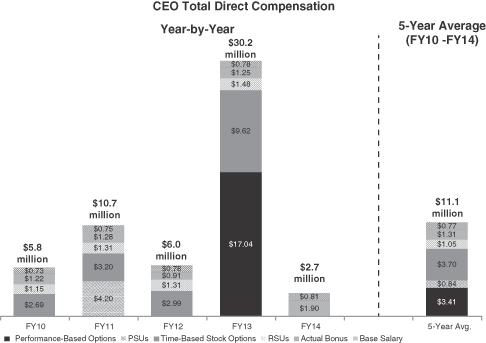
As a result of our approach to executive compensation, the amount of total direct compensation can change significantly from year-to-year.
In particular, Mr. Aquila’s reported compensation experienced a significant spike in fiscal 2013 due to the grant date fair value of the Mission 2020 Awards. However, in fiscal 2014, there was a measurable decrease since he did not receive a long-term incentive award, and Mr. Aquila’s total direct compensation for fiscal 2014 was well below the median for similarly situated positions at our fiscal 2014 peer group companies. The Committee does not intend to grant him additional equity awards until the fourth quarter of fiscal 2016.
The ultimate value that Mr. Aquila will realize from equity awards will not likely match these grant date fair value values, since value realized depends on factors including share price on date of exercise and sale and degree of achievement vs. both performance and time-based vesting hurdles. However, the clear majority of Mr. Aquila’s compensation opportunity has been in the form of equity awards in general, and equity awards with performance hurdles in particular.
Consistent with our pay-for-performance compensation philosophy and strategy, over 90% of Mr. Aquila’s total direct compensation is comprised of variable, performance-based incentive pay. The charts below compare Solera’s five-year average compensation mix to the current mix of its fiscal 2015 peers. The charts illustrate how Solera’s compensation mix for its CEO, specifically with respect to long-term incentive (LTI) awards, has more performance risk than typical market practice among the peers.
31
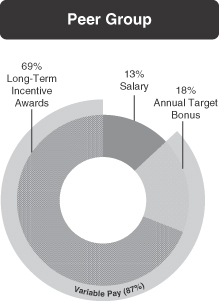
|
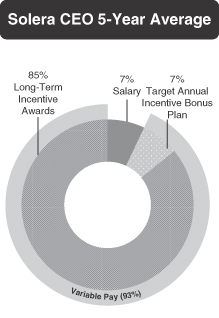
|
As set forth above, our executive compensation program is strongly focused on pay-for-performance principles and is designed to align the interests of executives with the interests of investors. The table and chart below demonstrate the alignment of our performance, as measured using a variety of financial metrics, and Mr. Aquila’s compensation.
We reviewed Mr. Aquila’s realizable compensation relative to a pay-for-performance model that considered five financial performance measures: (1) compounded annual growth rate of revenues, (2) compounded annual growth rate of Adjusted EBITDA, (3) growth of cash flows from operations, (4) average return on invested capital, and (5) total shareholder return. A percentile ranking was determined for each fiscal 2015 peer company for each of these five measures. For each peer company, we then calculated the average percentile ranking across the five measures, weighting each measure equally, to develop a single comprehensive performance score.
For example, the following table illustrates our own absolute performance for each of these measures during the last five fiscal years, and the resulting percentile ranking relative to the fiscal 2015 peer companies.
| Measure |
Revenue Compounded |
Adjusted EBITDA Compounded Annual |
Cash Flow from |
Average |
Total Shareholder |
|||||||||||||||
| Solera Achievement |
12.1% | 14.8% | 13.3% | 18.3% | 22.5% | |||||||||||||||
| Solera Percentile Ranking vs. 2015 Peers |
57th | 71st | 73rd | 64th | 45th | |||||||||||||||
| Solera Rank Order (out of 17 companies including 16 peers and Solera) |
8th | 6th | 6th | 7th | 10th | |||||||||||||||
Our average percentile ranking across these categories—which we term our “comprehensive performance score”—was 62. We also calculated a comprehensive performance score for each peer company, with results ranging from a low of 12 to a high of 73. Our score of 62 equated to the 72nd percentile relative to our peers, and positioned us as the 6th out of 17 companies.
32
The following chart graphically depicts our percentile ranking for each measure, as well as the percentile ranking of our comprehensive performance score.
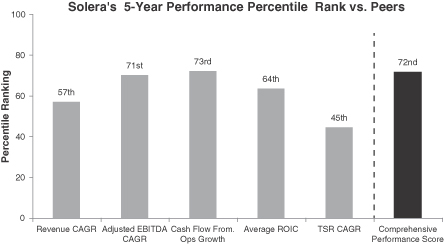
The following graph compares our comprehensive performance score percentile rank and Mr. Aquila’s realizable compensation percentile for the five-year period ended June 30, 2014. The peer realizable compensation and comprehensive performance score are measured through the end of each peer’s most recent fiscal year ended prior to June 30, 2014. Each point on the chart represents a CEO’s percentile position for realizable compensation relative to his or her company’s five-year comprehensive performance score percentile rank.
Our independent compensation consultant, Pearl Meyer & Partners (“PM&P”), has advised the Compensation Committee that a difference of fewer than 25 points between comprehensive performance score percentile and realizable compensation percentile – the alignment corridor banded by the diagonal bars below generally suggests reasonable alignment between comprehensive performance and realizable compensation, with realizable compensation neither significantly outpacing performance nor significantly trailing performance relative to the peer companies. PM&P also noted that this approach differs from protocols used by proxy advisory firm Institutional Shareholder Services (“ISS”) to assess the Relative Degree of Alignment between pay and performance in that it (a) considers a longer time period of five years rather than ISS’ three years, (b) provides a more comprehensive assessment of performance as opposed to ISS’ exclusive focus on total shareholder return and (c) references the value of outstanding executive compensation awards taking into consideration stock price movements and shares actually earned as opposed to ISS’ focus on Summary Compensation Table data, which does not reflect realizable pay. PM&P noted that this approach is similar to protocols used by ISS in that it compares relative percentile ranking for “pay” and “performance”, although ISS does not express concern for Relative Degree of Alignment between pay and performance until a company’s percentile ranking for pay exceeds its percentile ranking for performance by 30 points or more.
We noted that when compared to the fiscal 2015 peer group, Mr. Aquila’s realizable compensation approximated the 90th percentile, while our comprehensive performance for this time period approximated the 72nd percentile.
33
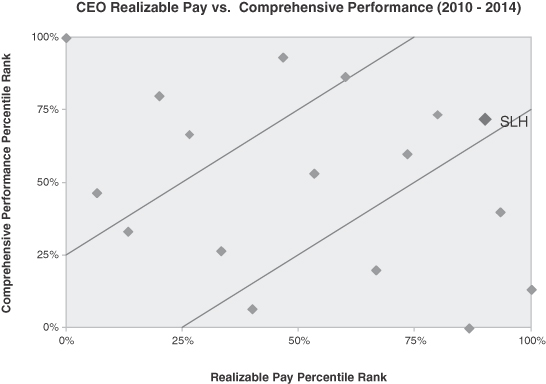
We define “realizable compensation” as the sum total of base salaries, bonuses and non-equity incentive plan compensation paid out over the past five years, in addition to the period-end in-the-money value of options, SARs, and stock awarded over the past five years. For performance-based equity awards or cash-based long-term incentive plans, we have assumed “target” performance for performance periods extending beyond June 30, 2014. Peer realizable compensation and performance are measured through the end of each peer’s most recent fiscal year prior to June 30, 2014.
We believe that realizable compensation is more representative of compensation actually earned than is the compensation shown in the Summary Compensation Table and that realizable compensation is therefore the better measure of compensation to compare to corporate performance.
We also reviewed Mr. Aquila’s realizable compensation relative to shareholder value created over the past five years. Shareholder value created includes the change in market capitalization plus dividends paid.
The following graph compares our shareholder value created percentile rank and Mr. Aquila’s realizable compensation percentile for the five-year period ended June 30, 2014. Peer realizable compensation and shareholder value created are measured through the end of each peer’s most recent fiscal year ended prior to June 30, 2014. Each point on the chart represents a CEO’s percentile position for realizable compensation relative to his or her company’s five-year shareholder value created percentile rank. PM&P advised the Compensation Committee that a difference of fewer than 25 points between shareholder value created percentile and realizable compensation percentile – the alignment corridor banded by the diagonal bars below—generally suggests reasonable alignment between shareholder value created and realizable compensation. When compared to the fiscal 2015 peer group, we noted that Mr. Aquila’s realizable compensation approximated the 90th percentile, while our shareholder value created for this time period approximated the 69th percentile.
34
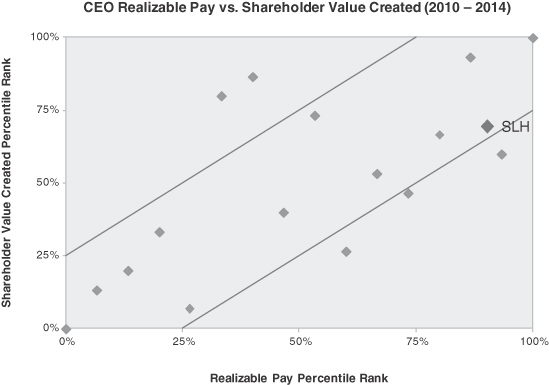
SECTION II: OVERVIEW OF THE EXECUTIVE COMPENSATION PROGRAM
Compensation Philosophy and Strategy
The Compensation Committee considers the following objectives and principles in determining the form and amount of compensation for our NEOs:
| • | Pay appropriately for each executive officer’s role, responsibilities, competencies and achievements, as well as for overall corporate results; |
| • | Provide compensation that is sufficiently competitive with companies with which we compete for executive talent to attract and retain high-quality executive officers; |
| • | Align the interests of executives and our stockholders through the use of a mix of compensation elements (salary, annual bonus incentive, long-term incentives) that support our missions and encourage achievement of our business goals, support short-term initiatives and drive long-term success; |
| • | Link a significant portion of an executive’s compensation to objective measures of corporate performance and individual or team development and achievement; |
| • | Subject meaningful amounts of compensation to our stock price to ensure that the amount of compensation actually realized by executives rises or falls as our stockholders’ return rises or falls; |
| • | Motivate executives to deliver results at or above our short- and long-term plan targets; and |
| • | Reinforce a culture of accountability and excellence. |
Application of our philosophy and strategy puts a substantial portion of an executive’s compensation at risk. Accordingly, the better our financial and operating results, our executive officers’ performance, and the better
35
our stock price performance, then the greater the amount of compensation earned. If our results or the performance of our executive officers falls short of our expectations, or our stock price lags, then a lesser amount of compensation will be earned.
| Why Has Solera Provided Pay Opportunities Above its Peer Group Median?
Solera executives have position scope and complexity that exceed “typical” job descriptions. This affects the way the Compensation Committee evaluates market data and sets target total direct compensation opportunities for each of the Continuing NEOs. We have a lean senior management team — we do more with substantially fewer senior management team members than our peers. So while our target total direct compensation is higher than our peers on a “per executive” basis, our aggregate compensation expense remains modest. The following table outlines each Continuing NEO’s primary, secondary and tertiary roles:
|
||||||||||
|
|
NEO | Primary Role | Secondary Role | Tertiary Role | ||||||
| Tony Aquila | Chairman, CEO and President of Solera Holdings, Inc. | Significant Corporate human resources management responsibility, including recruiting, compensation design and talent and labor management |
• Corporate Development for material transactions
• Direct supervisory role within U.S. restructuring efforts
• Top-level decisions for all Corporate marketing and investor relations efforts and initiatives
|
|||||||
| Renato Giger | CFO, Treasurer and Assistant Secretary of Solera Holdings, Inc. | Regional Managing Director for Germany, Italy and Austria | Provides human resources support for employee on-boarding and administrative matters
|
|||||||
| Jason Brady | SVP, General Counsel and Secretary of Solera Holdings, Inc. | Head of Corporate Development | Administrative head of human resources focused on the mechanics of selecting and terminating employees | |||||||
Principal Elements of Compensation
Our compensation philosophy and strategy are supported by the following elements in our executive compensation program:
| Element | Form | Purpose | ||
| Base salary | Cash (Fixed) | To help Solera attract and retain executive talent and provide a fixed amount of compensation for their services during the year, which is necessary to secure their services. Base salary generally reflects each NEO’s relative experience in his role and our expectations for their respective contributions to the growth in the value of our Company. We consider their experience, skills, knowledge, past performance and responsibilities. Other factors considered include the complexity and scope of the NEO’s expanded role (see page 36), ability to replace the executive, the base salary at the executive’s prior employment and market data on similar positions provided by our compensation consultant. | ||
36
| Element | Form | Purpose | ||
| Annual cash incentives | Cash (Variable) | To provide an incentive to achieve annual corporate financial goals (revenue and Adjusted EBITDA), as well as individual objectives. The Compensation Committee believes that that continuous execution against financial goals and individual objectives will result in creation of sustained stockholder value over time. The amount of the bonus is based upon both the satisfaction of certain pre-established financial criteria and achievement of individual objectives. | ||
| Long-term incentives | Equity (Variable) | To incentivize our NEOs to continue their significant contributions to both increasing the profitability and value of the Company over the long term. We use awards of stock options and restricted stock units as the principal method of providing long-term incentive compensation under our 2008 Omnibus Incentive Plan, or 2008 Plan.
We grant options to provide an incentive for NEOs to drive long-term share price appreciation through the development and execution of effective long-term strategies, for example, the Mission 2020 Awards motivating the achievement of phase one of Mission 2020. We view stock options as being purely performance-based pay as pay is realized only if the trading price of our common stock increases. In addition, our stock option awards often will have vesting contingent upon achievement of additional performance hurdles.
We grant restricted stock units to enhance retention and balance the more volatile rewards associated with stock options. We believe that restricted stock units align the interests of the NEOs with the interests of the stockholders because the value of these awards fluctuate up and down with the trading price of our common stock, and, unlike stock options, provide retention value during periods of short-term market volatility. This, together with the vesting schedule, supports continuity in the senior management team. | ||
We also provide post-termination benefits, including severance and retirement benefits, and limited additional executive benefits such as an annual perquisite allowance to our NEOs.
Compensation Mix
These components, individually and in combination, are designed to accomplish one or more of the compensation objectives described above. We view executive compensation as an integrated total compensation program. The mix of compensation elements varies based on the NEO’s position and responsibilities. The percentage of the NEO’s compensation that is performance-based/at-risk or variable instead of fixed is based primarily on the NEO’s level of influence at our Company, including his or her impact on our financial results. We believe that our compensation mix places a greater emphasis on performance-based compensation than is the case for our peers, that the percentage of that performance-based compensation represented by equity-based awards is greater than is the case for our peers, and that equity awards over time have more performance risk (awards with clear performance hurdles) and market risk (for example, the increased leverage associated with a stock option versus a restricted stock unit) than is the case for our peers.
37
|
|
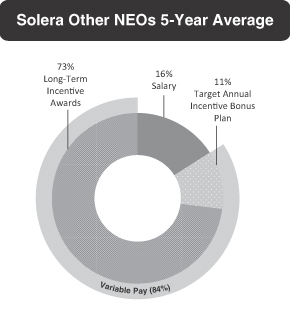
|
Compensation Policies
Our policies are in line with our compensation philosophy, strategy and good corporate governance standards:
| • | Our executive compensation program is designed to align with our long-term business strategy and places a significant amount of weight on variable pay, which is dependent on the achievement of rigorous financial and strategic performance hurdles. |
| • | Our employment agreements and long term incentive awards are “double trigger” with respect to severance and vesting upon a change in control. |
| • | We do not provide excise tax gross-ups in the event of change in control. |
| • | We do not provide supplemental pensions or extraordinary perquisites. |
| • | We have mandatory stock ownership guidelines for our senior executives, including a 6.0x salary guideline for the CEO. |
| • | Our CEO and other senior executives are subject to a clawback policy. |
| • | Our Compensation Committee engages its own independent compensation consultant. |
How Compensation Decisions Are Made
The Role of the Compensation Committee
The Compensation Committee, which is comprised solely of independent directors, establishes our compensation philosophy and is responsible for designing and evaluating our compensation programs for directors and senior executive officers, including the CEO, making recommendations to the Board of Directors
38
and management regarding those programs, awarding incentive compensation to senior executive officers and administering other compensation programs as authorized by the Board of Directors. The Compensation Committee alone determines the salary and overall compensation of our CEO. When establishing the compensation of the other NEOs, the Compensation Committee receives an evaluation of their performance from the CEO, along with compensation recommendations from the CEO, makes any appropriate adjustments, and approves their compensation.
The Role of Independent Consultants
The Compensation Committee has the authority to retain the services of outside advisors, experts and compensation and benefits consultants to provide input and advice in compensation matters. We select consultants on the basis of their ability to advise us on prevailing market trends and emerging best practices for executive pay program design, as well as to ensure our program is linked to our specific business strategy and aligns compensation outcomes with our performance. For the first half of fiscal 2014, the Compensation Committee utilized the services of Frederic W. Cook & Co. (“FWC”) as its independent compensation consulting firm. In January 2014, the Compensation Committee engaged Pearl Meyer & Partners (“PM&P”) as its new independent outside advisor.
FWC provided the Compensation Committee with advice on executive and general compensation matters, which included:
| • | Executive compensation benchmarking; |
| • | Executive cash compensation and executive equity compensation (including annual share usage under our 2008 Plan); and |
| • | Analysis of the degree to which the executive compensation program aligned with financial performance results. |
During fiscal 2014, PM&P provided benchmarking and advice relating to our overall incentive program for executives.
The Compensation Committee is solely responsible for the engagement of its independent compensation consultant, and neither FWC nor PM&P has and, without the prior consent of the Compensation Committee, PM&P will not provide any services for our management or any other services for our directors. FWC representatives met and PM&P representatives meet informally with the Compensation Committee Chairman and formally with the Compensation Committee during the Compensation Committee’s regular meetings, including from time to time in executive sessions without any members of management present.
In fiscal 2014, the Company retained Mercer, a compensation consulting firm, to provide management with compensation and benefits input and advice. Mercer’s advice included cash compensation and equity compensation matters for senior executive officers and other key employees. Entities affiliated with Mercer provided benefit plan management services to us during fiscal 2014.
The Role of Management
In carrying out its role of establishing our executive compensation philosophy and strategy and approving our compensation programs, the Compensation Committee solicits input and advice from several of our executive officers. As mentioned above, our CEO provides the Compensation Committee with feedback on the performance of the other NEOs and makes compensation recommendations for the other NEOs to the Compensation Committee for their approval. Our CEO and General Counsel frequently attend Compensation Committee meetings to provide their perspectives on competition in the industry, the needs of the business, information regarding our performance, and other information specific to their areas of responsibility. In
39
addition, at the Compensation Committee’s direction, FWC worked and PM&P works with our members of management to obtain information necessary to make their own recommendations as well as to evaluate management’s recommendations.
Benchmarking
For fiscal 2014, the Compensation Committee engaged FWC to perform benchmarking analysis to assess the competitiveness of executive compensation for each of our NEOs. FWC assessed base salaries, annual incentives, total cash compensation, long-term incentives and total direct compensation (total cash compensation and long-term incentives) relative to a peer group of 22 companies, listed below, and from general industry surveys. The companies were chosen in May 2012 by the Compensation Committee, in consultation with FWC, because of their similarities to us in business (automotive and insurance services companies; software and business services providers), market capitalization, TSR, revenue and overlap with certain analyses performed by external stockholder advisory firms. They also are (i) companies with which we compete or may compete for executive talent and (ii) that would reasonably be used by stockholders for comparisons of executive compensation and performance. The companies were chosen using objective size criteria, with revenue between approximately two-fifths and two times our revenue and market capitalization between one-third and three times our market capitalization, at the time the group was chosen. The Compensation Committee used the same peer group for fiscal 2014 benchmarking purposes that it used for fiscal 2013 as the peer group evaluation criteria did not change substantially, and the Compensation Committee’s compensation setting focus for fiscal 2014 was centered on cash compensation as the NEOs did not receive any long-term incentive awards.
The fiscal 2014 peer group companies are set forth below:
| ANSYS |
Cadence Design Systems | Concur Tech | Copart | |||
| DealerTrack |
FactSet Research | Fair Isaac | IHS | |||
| Informatica |
J Henry & Assoc | MICROS Systems | MSCI | |||
| Parametric Tech |
Progress Software | Quest Software | Red Hat | |||
| Rovi |
Synopsys | TIBCO Software | VeriSign | |||
| Verisk Analytics |
WebMD Health |
We generally review the full range of data reported for similar positions at the companies within our peer group as a market reference when determining total direct compensation for our NEOs. We believe that reviewing this full range of data rather than narrowly focusing on a specific percentile level of pay provides us with additional context as to how market compensation levels vary for factors including company and position complexity, size, and performance. Having this context better positions us to attract and retain executive talent and allows us to establish meaningful goals, while also recognizing individual differences in performance, experience and professional development. The range provides an incentive for our NEOs to achieve the goals established for our annual and strategic plans and realize gains or incur losses from increases and decreases in stockholder value alongside our stockholders. Importantly, we do not guarantee compensation at any specific percentile. Rather, we use the percentile range for guidance when results are consistent with our plans and goals. When our goals are not achieved, or an individual is new to or developing into his or her position, then compensation may be set, or delivered in the case of performance-contingent awards, at a relatively low percentile position relative to market. The Compensation Committee makes a distinction between the compensation opportunity (setting of base salary, annual cash incentive target amounts and long-term equity awards) and compensation delivered (the amounts actually earned). The compensation opportunity may benchmark above median levels reflecting individual qualifications and experience and position complexity, but the amount of compensation earned and/or realizable is designed to adjust with the results of our performance.
In June 2014, the Compensation Committee asked PM&P to review our fiscal 2014 peer group to determine whether the transformation of the business, including our strong revenue and Adjusted EBITDA growth, the diversification of our business and increasing operations in foreign markets, supported modifications to the peer
40
group roster. After reviewing recommendations from PM&P, the Compensation Committee chose to remove Cadence Design Systems, Progress Software, Red Hat, Rovi Corporation, Synopsys and WebMD Health, while adding KAR Auction Services, Pegaystems, Qlik Technologies, SS&C Technologies Holding and Total System Services. These peers continue to be size-relevant, with revenue between approximately two-fifths and two times our revenue and market capitalization between one-third and three times our market capitalization, at the time the group was chosen. This new roster comprises our fiscal 2015 peer group:
| ANSYS |
Concur Tech | Copart | DealerTrack | |||
| FactSet Research |
Fair Isaac | IHS | Informatica | |||
| J Henry & Assoc |
KAR Auction Services | MICROS Systems | MSCI | |||
| Parametric Tech |
Pegasystems | Qlik Technologies | Quest Software | |||
| SS&C Technologies Holding |
TIBCO Software | Total Systems Services | VeriSign | |||
| Verisk Analytics |
SECTION III: THE EXECUTIVE COMPENSATION PROGRAM IN DETAIL
The Compensation Committee typically reviews and determines base salary levels and potential changes annually within 90 days after the beginning of our fiscal year. For fiscal 2014, the Compensation Committee approved the annual base salaries for all of the NEOs in September 2013. The following table summarizes year-over-year adjustments to base salaries.
| Named Executive Officer |
Base Salary Prior to |
Base Salary Effective |
% Increase |
Approximate Competitive Effective September 1, 2013 | ||||
| Tony Aquila |
$780,000 | $810,000 | 3.8% | 75th percentile | ||||
| Renato Giger |
$431,000 | $431,000 | 0.0% | 75th percentile | ||||
| Jason Brady |
$334,000 | $401,000 | 20.0% | Between 50th and 75th percentiles | ||||
| Abilio Gonzalez |
$351,000 | $386,100 | 10.0% | 75th percentile |
41
The Compensation Committee believes that these increases positioned base salaries appropriately to reflect each NEO’s relative experience, skills, knowledge, past performance and responsibilities. In approving these increases, the Compensation Committee also considered competitive market data, the relative complexity of each NEO’s position as compared to typical market roles and responsibilities and the historical and anticipated future contributions to our performance and growth from the NEOs. Specifically, the Compensation Committee’s determination included consideration of the following factors in recommending an increase in base salary for each of Messrs. Aquila, Brady and Gonzalez:
| • Mr. Aquila – the increasing size and diversified nature of the Company’s business. |
Why We Use Adjusted EBITDA and Revenue in the ABIP | |
| • Mr. Brady – Mr. Brady’s significant progress in his professional and leadership development relative to prior years, positioning him to undertake additional responsibilities in fiscal 2014 and future periods.
• Mr. Gonzalez – the continued expansion of Mr. Gonzalez’s professional responsibilities, including operating responsibilities in certain of our country operations. |
Adjusted EBITDA is used by us and our investors to compare our current operating results with corresponding prior periods as well as to the operating results of other companies in our industry. We believe that Adjusted EBITDA provides valuable insight into our profitability exclusive of unusual adjustments.
Revenue is included in the ABIP financial criteria, although with a lesser weighting than Adjusted EBITDA, because revenue growth is a key driver of profit growth over time, which we believe ultimately creates stockholder value. | |
How the Annual Business Incentives Plan (“ABIP”) Works
For fiscal 2014, our NEOs participated in ABIP. The financial metrics under the ABIP, which were based upon our Board-approved budget for fiscal 2014, were revenue and Adjusted EBITDA. For purposes of the ABIP, Adjusted EBITDA represents our GAAP net income, excluding (i) interest expense, (ii) provision for income taxes, (iii) depreciation and amortization, (iv) stock-based compensation expense, (v) restructuring charges, asset impairments, and other costs associated with exit or disposal activities, (vi) other (income) expense, net, (vii) litigation-related expenses, (viii) acquisition-related costs and (ix) acquisition financial results. Acquisition financial results are the financial results from any business we acquired during the fiscal year with a purchase price greater than $200 million. For fiscal 2014, our acquisition financial results for SRS have been excluded from the ABIP revenue and Adjusted EBITDA calculations.
In fiscal 2014 and consistent with fiscal 2013, the ABIP financial metrics were established and the results were calculated using Budgeted FX Rates (as defined below) in effect for fiscal 2014. For purposes of the ABIP, Budgeted FX Rates are the currency exchange rates that were fixed by our Board of Directors at the end of fiscal 2013 in connection with review and approval of our fiscal 2014 budget. We applied the Budgeted FX Rates for fiscal 2014 versus actual currency exchange rates during 2014 to reduce the effect of currency volatility, which is beyond our executives’ control, on our results. In removing such volatility, the financial results are more readily related or attributable to the actual operating performance of our NEOs.
Under the ABIP, the Compensation Committee established each NEO’s target bonus opportunity as a percentage of base salary. Revenue was weighted at 40% of financial performance, and Adjusted EBITDA was weighted at 60%, to emphasize profitable growth. The ABIP is formulaic and awards are determined as follows:
Bonus Target x (40% (% of Revenue Award Funded) + 60% (% of Adjusted EBITDA Award Funded))
X Discretionary Multiplier
42
The range of the discretionary multiplier is 0 to 2.0. The discretionary multiplier provides a mechanism to adjust the bonus amount earned by the ABIP participants to recognize the strength or weakness of our financial results and stockholder value creation, as well as individual performance.
Revenue Goals and Funding
The table below sets forth: (i) a range of fiscal 2014 revenue levels (in millions) above and below the revenue goal of $867.10 million (noted in bold type); (ii) the percentage of target achieved at the various revenue levels; and (iii) the corresponding funding percentage of the 40% weighted revenue portion of the fiscal 2014 ABIP formula.
| 2014 Revenue Goal ($Mil.) |
% Rev. |
% Revenue | ||
| $780.4 |
90.0% | 50% | ||
| $823.8 |
95.0% | 75% | ||
| $867.1 |
100.0% | 100% | ||
| $910.5 |
105.0% | 125% | ||
| $953.8 |
110.0% | 150% |
Adjusted EBITDA Goals and Funding
The table below sets forth: (i) a range of fiscal 2014 Adjusted EBITDA levels (in millions) above and below the Adjusted EBITDA goal of $346.80 million (noted in bold type); (ii) the percentage of Adjusted EBITDA target achieved at various Adjusted EBITDA levels; and (iii) the corresponding funding percentage of the 60% weighted Adjusted EBITDA portion of the fiscal 2014 ABIP formula.
|
2014 Adj. |
% EBITDA |
% Adj. | ||
| $277.4 |
80% | 50% | ||
| $312.1 |
90% | 75% | ||
| $346.8 |
100% | 100% | ||
| $364.1 |
105% | 125% | ||
| $381.4 |
110% | 150% |
For fiscal 2014 and using 2014 Budgeted FX Rates, revenues were approximately $886.8 million and Adjusted EBITDA was approximately $361.2 million. Applying 2014 Budgeted FX Rates to revenue and Adjusted EBITDA results for fiscal 2014 and fiscal 2013, revenues grew approximately 16.8% versus comparable fiscal 2013 revenues, and Adjusted EBITDA grew approximately 11.3% versus comparable fiscal 2013 Adjusted EBITDA. The amounts awarded under the ABIP are set forth in the “Non-Equity Incentive Plan Compensation” column in the Summary Compensation Table for our NEOs and reflect: revenue achieved at 102.3% of target with the revenue award funded at 44.5% (111.4% revenue portion of award funded x 40% weighting); Adjusted EBITDA achieved at 104.2% of target with the Adjusted EBITDA award funded at 72.5% (120.8% Adjusted EBITDA portion of award funded x 60% weighting); and weighted award funding before application of the discretionary multiplier of 117.0%. The table below reflects for each of the NEOs: (i) discretionary multiplier applied to his annual cash incentive payment and (ii) the total payout as a percentage of his target bonus amount for fiscal 2014:
| Named Executive Officer |
Discretionary Multiplier | Total Payout as a Percentage of Target Bonus Amount | ||
| Tony Aquila |
2.00x | 234% | ||
| Renato Giger |
1.50x | 176% | ||
| Jason Brady |
2.00x | 234% | ||
| Abilio Gonzalez |
0.85x | 100% |
43
For all of the NEOs, the Compensation Committee considered the following factors in the application of the discretionary multiplier:
| • | Our above-plan financial results in fiscal 2014, which were achieved in a volatile global economic environment. |
| • | The stockholder value created during fiscal 2014 as evidenced by stock price growth of 22% during fiscal 2014 and the 36% increase in the annualized dividend to our stockholders in fiscal 2014 versus our annualized dividend paid in fiscal 2013. |
| • | Successful completion of seven acquisitions and our SRS joint venture. |
| • | Growth in revenue per household2 of 16.8% in fiscal 2014 versus fiscal 2013. |
| • | Individual and collective performance, which are described below. |
For Mr. Aquila, the Compensation Committee’s evaluation and decision to approve the maximum discretionary multiplier centered on the positive operating outcomes listed above which occurred in a volatile economic environment and were the result of Mr. Aquila’s strong and disciplined leadership, his overall responsibility for the Company’s performance and execution of pre-established strategic and operational goals in the areas of:
| • | Progress against Mission 2020 strategic objectives. |
| • | Completion of seven corporate development (strategic) transactions and the announcement of two acquisitions, which diversify our business and strengthen our management ranks. These transactions expand our business into new market segments, such as vehicle service and mechanical repair and property claims, each of which have significant addressable markets and expand our growth opportunities beyond our vehicle collision claims processing business. |
| • | Continued improvements in financial and operational performance of recently-acquired businesses through effective integration programs, management on-boarding programs and waste reduction initiatives, which positions these businesses for continued solid revenue and Adjusted EBITDA contributions. |
| • | Expanded and enhanced product and solution offerings that combine internally-developed and acquired offerings, which delivers a more comprehensive suite of offerings to our customers and differentiates us from our competitors. |
| • | Geographic expansion, which positions us for growth across our three product platforms – auto, customer’s customer and property. |
| • | Management, talent and Board development, recruitment and succession planning, which prepares our present and future corporate, regional and country leaders and our Board members to manage the increasing size and complexities of our business and drive towards our achievement of Mission 2020. |
| • | Enhancements to our capital structure that are designed to facilitate our achievement of Mission 2020, increase our operating flexibility and extend our maturity profile. |
| • | Achievement of the Road to $1 Billion Mission on a run-rate basis. |
For each of the other NEOs, the Compensation Committee considered and accepted Mr. Aquila’s evaluation of each officer’s actual individual performance measured against the individual’s pre-established performance objectives and his recommendation with respect to the discretionary multiplier for each of the officers:
| • | Mr. Giger: an above-target discretionary multiplier was recommended for Mr. Giger primarily in recognition of his contributions to the positive outcomes listed above as well as Mr. Giger’s achievements |
| 2 | Revenue per household is the quotient obtained by dividing our revenue generated in Advanced Markets by the number of households in Advanced Markets. Advanced Markets consist of the following countries: the United States, Canada, France, Belgium, the Netherlands, Germany, the United Kingdom, Spain, Switzerland and Austria. |
44
| against his individual performance objectives relating to: waste reduction achievements; performance in Mr. Giger’s secondary role as Regional Managing Director for Germany and Austria; Mr. Giger’s role in securing the enhancements to our capital structure described above; enhancements to our annual strategic and operating planning process; and progress in the development of our global finance organization. |
| • | Mr. Gonzalez: Mr. Gonzalez’s discretionary multiplier was designed to deliver Mr. Gonzalez an annual cash incentive payment equal to his target opportunity given his more limited role in the senior management of the Company during the second half of fiscal 2014. |
| • | Mr. Brady: the maximum discretionary multiplier was recommended for Mr. Brady primarily in recognition of his contributions to the positive outcomes listed above as well as Mr. Brady’s achievements against his individual performance objectives relating to: performance in Mr. Brady’s secondary role as Head of Corporate Development, including enhancements to our corporate development processes and the execution of corporate development transactions; Mr. Brady’s role in securing the enhancements to our capital structure described above; professional development of our legal personnel and succession planning for the legal organization; execution of intellectual property and tax transactions; and performance in Mr. Brady’s tertiary role as administrative head of Human Resources. |
The NEOs’ collective achievements contributed to our strong financial performance described above as well as operational, personnel, governance and other improvements described below:
| • | The geographic, platform and product diversification of our business, which increases our revenue opportunities, offerings to our customers and our reach into the household while decreasing our reliance on any one product, platform or geographic market; |
| • | Improving the operating efficiency, product development and strategic planning acumen of our businesses, which positions our businesses to plan for and execute the contributions necessary for us to achieve Mission 2020; and |
| • | Through the increasing complexity of our NEOs’ roles and their assumption of additional responsibilities, our NEOs were able to extend their influence over our operations and coach our country and regional senior leaders in a manner that better aligns our leadership teams to achieve Mission 2020 and facilitates our succession planning efforts for key regional and corporate leadership positions. |
Based on the foregoing factors and evaluation, the Compensation Committee approved Mr. Aquila’s recommendation for discretionary multipliers for the other NEO’s set forth in the table above. The amount of the ABIP payments for fiscal 2014 are included in the “Non-Equity Incentive Plan Compensation” column of the Summary Compensation Table on page 54 of this Proxy Statement.
Historically, the Compensation Committee granted annual awards in the form of stock options and restricted stock units under our 2008 Plan. These equity awards typically vest over a period of time to encourage retention of our executive officers and focus their efforts on the creation of long-term stockholder value. In addition, the Compensation Committee has periodically granted additional awards in connection with important corporate strategic initiatives.
Examples include the Mission 2020 Awards, as described below, and a special PSU award made in fiscal 2011 to our CEO. Pursuant to the special PSU award, Mr. Aquila would earn PSUs if we achieved TSR during the applicable measurement periods within a three-year performance period that ended in March 2014 significantly above that of a peer group consisting of 48 publicly-traded, U.S.-based companies in the “software and services” GICS group with market capitalizations between $2 billion and $10 billion. Under the PSU award, Mr. Aquila would earn the target number of PSUs for a measurement period if our TSR for the period was at the 65th percentile of the peer group and 200% of the PSUs if our TSR for the period equaled or exceeded the 90th percentile. No units would be earned for the measurement
45
period if relative TSR is below the 50th percentile. As a result of the challenging goals, only 4.9% of the target PSU awards were earned and all remaining portions of the 2011 special PSU award were forfeited by Mr. Aquila.
When reviewing long-term incentives award opportunities, the Compensation Committee carefully considers various factors, including, the alignment of executives and stockholder interests, performance risk and market competitiveness, as well as the current holdings of each NEO. In considering all of these factors, in combination with the introduction of the Mission 2020 Awards in fiscal 2013, the Compensation Committee did not grant any long-term incentive awards in fiscal 2014.
Mission 2020 Awards
Overall Structure
Mission 2020 Awards are the predominant way in which we deliver long-term incentives to our NEOs – they are a critical component of our executive compensation program. Consistent with our pay-for-performance philosophy and strategy supported by our stockholders, the Compensation Committee designed the Mission 2020 Awards as non-qualified stock options granted under the 2008 Plan. By using options, the substantial compensation opportunity presented by the Mission 2020 Awards will be realized by our NEOs only if they deliver the financial growth required by phase one of Mission 2020 (fiscal 2013 through fiscal 2017) and an increased stockholder value. The Mission 2020 Awards include performance requirements beyond stock price growth and are long-term oriented in support of the eight-year business plan embedded in Mission 2020.
The Mission 2020 Awards were granted on March 29, 2013 (the “Date of Grant”) and have two key pieces:
| • Time-Based Awards. Only 30% of the Mission 2020 Awards vest pursuant to a time-based vesting schedule. In keeping with the long-term nature of the Mission 2020 Awards, these options vest in three equal installments beginning at fiscal year-end 2015, more than two years from the date of grant.
• Performance-Based Awards. Vesting and exercisability for 70% of the Mission 2020 Awards is dependent upon achievement of three3 specific financial hurdles: Adjusted EBITDA, relative TSR, and ROIC.
The exercise price of the Mission 2020 Awards is $58.33 per share, the closing price of the Company’s common stock on March 28, 2013 as reported by the New York Stock Exchange (“NYSE”). In accordance with the 2008 Plan, the prior day’s closing price was used due to the fact that the NYSE was closed on the date of grant in observance of Good Friday. The Mission 2020 Awards are seven-year stock options and will expire if not exercised by March 29, 2020 (the “Expiration Date”). |
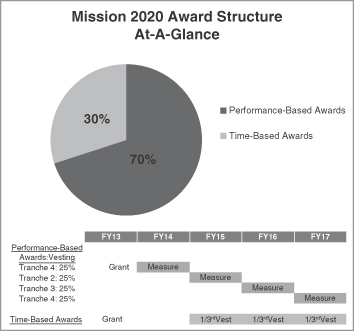
| |
| 3 | For the initial 25% tranche of the Performance-Based Awards, the financial metrics are Adjusted EBITDA and relative TSR. |
46
In sizing the Mission 2020 Awards, recognition of the multi-year nature of these awards and the criticality of successful execution against Mission 2020 performance objectives was considered — in addition to other factors that we review when determining long-term incentive award size. These other factors include competitive market data, each NEO’s relative experience, skills, knowledge, past performance and responsibilities, and the relative complexity of each NEO’s position as compared to typical market roles and responsibilities.
Performance-Based Awards
Vesting of the Performance-Based Awards are driven by the achievement of specific goals tied to the following performance measures:
| Performance Measure | Rationale and Hurdles | |
| Adjusted EBITDA | Has a strong correlation to profitable revenue growth and margin discipline objectives underlying Mission 2020. | |
| Relative TSR | Requires actual stockholder returns during the vesting periods to meet or exceed the 60th percentile as compared to the stockholder returns of companies listed at the Date of Grant in the S&P 400 Midcap Index4. | |
| ROIC* | Recognizes that Mission 2020 will require significant capital investments and further aligns compensation with our ability to provide returns on investments that both provide longer-term value creation and exceed our weighted average cost of capital plus a one percent premium |
| * | Starting in fiscal 2015, vesting of three of the four tranches of the Performance-Based Awards will also be tied to the achievement of an ROIC hurdle. |
Performance-Based Awards include four separate tranches, as described below. In devising performance hurdles and performance measurement periods for the Performance-Based Awards, the Compensation Committee considered that there is a relatively broad value creation time horizon for investments undertaken as a part of Mission 2020 execution. In recognition that the Mission 2020 Awards are intended to provide true long-term alignment with performance and that performance outcomes may be volatile in the short-to-medium term, we created multiple possible performance gates for each vesting tranche. In general, the Company must meet specified Adjusted EBITDA, ROIC, and relative TSR vesting triggers before any single tranche may vest. However, if an Adjusted EBITDA hurdle specific to an earlier fiscal year performance gate is missed, the tranche in question may still vest if a subsequent Adjusted EBITDA hurdle—established at a higher level of performance—is met. These progressively higher performance standards demonstrate our commitment to an aggressive performance path and related value creation.
Our performance measurement periods and performance hurdles at the time the Mission 2020 Awards were granted are as follows:
| • | The initial tranche of 25% of the Performance-Based Awards vested if we achieved the (i) Adjusted EBITDA Vesting Trigger for fiscal 2014, or the progressively higher Adjusted EBITDA Vesting Trigger for fiscal 2015 or fiscal 2016 and (ii) TSR Vesting Trigger during any consecutive 20 trading day period ending July 1, 2014 or any day thereafter through March 29, 2020. |
| • | Although we did achieve our fiscal 2014 Adjusted EBITDA Vesting Trigger ($415.4 million achievement versus a target of $380.0 million), we have not achieved the TSR Vesting Trigger as of October 3, 2014, and our initial 25% tranche of the Performance-Based Awards has not yet vested. |
| • | This tranche will only vest if the TSR Vesting Trigger is met by the March 29, 2020. |
| 4 | Measure 20-day trailing average for start point and each subsequent measurement. 4 |
47
| • | The second tranche of 25% of the Performance-Based Awards will vest if we achieve the (i) Adjusted EBITDA Vesting Trigger for fiscal 2015, or the progressively higher Adjusted EBITDA Vesting Trigger for fiscal 2016 or fiscal 2017, (ii) TSR Vesting Trigger during any consecutive 20 trading day period ending July 1, 2015 or any day thereafter through March 29, 2020 and (iii) ROIC Vesting Trigger is achieved when either the Adjusted EBITDA Vesting Trigger or the TSR Vesting Trigger is achieved. |
| • | The third tranche of 25% of the Performance-Based Awards will vest if we achieve the (i) Adjusted EBITDA Vesting Trigger for fiscal 2016 or the progressively higher Adjusted EBITDA Vesting Trigger for fiscal 2017, (ii) TSR Vesting Trigger during any consecutive 20 trading day period ending July 1, 2016 or any day thereafter through March 29, 2020 and (iii) ROIC Vesting Trigger is achieved when either the Adjusted EBITDA Vesting Trigger or the TSR Vesting Trigger is achieved. |
| • | The final tranche of 25% of the Performance-Based Awards will vest if we achieve the (i) Adjusted EBITDA Vesting Trigger for fiscal 2017, TSR Vesting Trigger during any consecutive 20 trading day period ending July 1, 2017 or any day thereafter through March 29, 2020 and (iii) ROIC Vesting Trigger is achieved when either the Adjusted EBITDA Vesting Trigger or the TSR Vesting Trigger is achieved. |
We added the ROIC Vesting Trigger to the above performance hurdles during fiscal 2015. If the Adjusted EBITDA Vesting Trigger and TSR Vesting Triggers are achieved, the tranche is still subject to the ROIC Vesting Trigger. The ROIC Vesting Trigger requires that we achieve ROIC in excess of our weighted average cost of capital (“WACC”) plus a one percent premium. For purposes of this calculation, ROIC is defined as net operating profit after tax (“NOPAT”) divided by our average Invested Capital. NOPAT is defined as adjusted EBITDA multiplied by one less an assumed tax rate of 26%. Invested Capital is equal to the four-quarter average of total assets less accounts payable less cash less one half of capital expenditures. Contributions from acquired businesses will be phased into Invested Capital during a four-year period following the completion of the acquisition at a rate of 1/16 per calendar quarter.
By way of further illustration, the following graphic contains a flow chart summarizing the vesting criteria for the second tranche of Performance-Based Awards:

48
| Relative TSR Trigger – Achieve greater than 60th percentile TSR rank vs. the S&P 400 midcap index constituents. Beginning point for all measurements is March 29, 2013 and measurements consider 20 trading day trailing average stock price. Ending date for measurement may be any 20 trading day period ending July 1, 2014 or ending any day thereafter through Expiration Date of March 29, 2020. | ROIC Trigger– Achieve ROIC in excess our weighted average cost of capital plus a one percent premium. ROIC Trigger must be achieved during when either the applicable Adjusted EBITDA Vesting Trigger or the applicable Relative TSR Trigger is achieved. |
Equity Grant Practices: We do not have a formal policy regarding when we grant annual or other equity incentive awards to our NEOs, although annual equity awards are typically granted in one or two installments during our fiscal year. The approval date and the grant date for equity awards granted to employees, including the NEOs, is generally the first day of the calendar month (or the business day closest to such day if such day is not a business day). Awards may also be granted during regularly-scheduled meetings of the Compensation Committee. The exercise price for stock options is the closing price of our common stock, as reported on the NYSE, on the date of grant.
Dividends: In fiscal 2014, our Board continued the practice of paying quarterly dividends to holders of our common stock and restricted stock units granted prior to fiscal 2011. The amount of the dividend was $0.17 per share of common stock and restricted stock unit.
Effective for restricted stock units and PSUs granted in fiscal 2011 and thereafter, no cash dividends were paid to the NEOs on unvested awards. Instead, dividend equivalents were accrued in the form of additional restricted stock units, to be paid only as the underlying restricted stock units or PSUs vest and are paid.
We pay dividends or provide dividend equivalents to the holders of restricted stock units and PSUs to reward them for their contributions to our overall financial results that generate the capital resources to pay dividends.
Additional Information: Additional information relating to the long-term incentive awards is included in the “Stock Awards” and “Option Awards” columns in the Summary Compensation Table, and in the Grants of Plan- Based Awards Table and Outstanding Equity Awards at Fiscal Year End Table, and related narrative, beginning on page 54 below.
Other Practices, Policies and Guidelines
Employment Agreements; Severance and Post-Termination Benefits
We provide post-termination benefits to our NEOs in accordance with their respective employment agreements. All cash severance payments for change-in-control are “double trigger,” requiring both a change-in-control and a qualifying termination event, and none of the officers have change-in-control excise tax gross-up protection.
We have entered into employment agreements with our NEOs to assist in attracting and retaining their services by affording them financial protection in the event of a termination without cause irrespective of whether the termination is in connection with a change of control, resignation for good reason in connection with a change of control, and, in the case of Mr. Aquila only, resignation for good reason irrespective of whether the termination is in connection with a change-in-control. Our long-term incentive plans, employment agreements and, in certain cases, our equity award agreements, provide change-in-control benefits to enable named executive
49
officers to have a balanced perspective in making overall business decisions in the context of a potential acquisition of our Company. We believe that change-in-control benefits, structured appropriately, serve to minimize the distraction caused by a potential transaction and reduce the risk that our key talent would leave before a transaction closes.
Details of each individual NEO’s benefits, including the specific components of accelerated vesting and estimates of amounts payable in specified circumstances, are disclosed under “Potential Payments Upon Termination or Change in Control” beginning on page 59 below.
Retirement Benefits
We do not have any special executive retirement plans. We sponsor a tax-qualified employee savings and retirement plan, or 401(k) plan, that covers most employees in the United States who satisfy certain eligibility requirements relating to minimum age and length of service. We also contribute to social security and sponsor pension plans in various countries in which we have operations that cover most employees in these countries who satisfy certain eligibility requirements. In addition, Mr. Giger participates in a social security and pension plan available to most of our Swiss employees that enables him to save for retirement.
Annual Allowance
In fiscal 2014 and consistent with fiscal 2013, our CEO received an annual allowance of $50,000 and each of the other NEOs received an annual allowance of $25,000 in lieu of any executive perquisites to cover items such as company automobile perquisite, country club fees or payment for the cost of financial counseling services and health club membership. All are viewed as benefits that assist with customer acquisition/retention, or that increase each officer’s health or working efficiency. The Compensation Committee approved the annual allowance in lieu of executive perquisites in order to control costs and to simplify administration. The Company does not make any tax gross-up payments in connection with the annual allowance.
Executive Benefits
In fiscal 2014 and consistent with fiscal 2013, we continued to provide certain executive benefits for our NEOs. The benefits include supplemental life and long-term disability insurance and annual physical exams. These benefits are intended to enhance the health and welfare of our named executive officers and recognize the potential physical toll related to managing our global operations. The Compensation Committee believes these are important business-related benefits as applied to our named executive officers as this group of employees spends a considerable amount of time traveling outside the United States, including less developed international locations where they may be more susceptible to illness.
Compensation Governance Policies
We use additional policies to ensure that our overall compensation structure is responsive to stockholder interests and competitive with the market. Specific policies include:
Stock Ownership Guidelines. The Compensation Committee has approved and instituted stock ownership guidelines for senior executive officers. After the beginning of fiscal 2015 or, in the case of executive officers hired after fiscal 2009, a period of five years from the employment start date, referred to as the Achievement Date, each senior executive officer listed below should beneficially own a number of shares of Solera common stock with a value listed below:
| Employee |
Multiple of Salary |
|||
| CEO |
6.0x | |||
| COO and CFO |
2.0x | |||
| CEO’s direct Solera reports and NEOs |
1.5x | |||
50
The ownership guideline is the lesser number of shares calculated as either (1) the multiple of salary above at the then-current trading price for a share of Solera’s common stock or (2) 75,000 shares for the CEO, 20,000 shares for the CFO and COO, and 8,500 shares for the CEO’s other direct reports (excluding the CEO’s executive assistant).
To the extent any senior executive officer does not own the guideline number of shares by the Achievement Date, such senior executive officer is required to hold 50% of his/her net after tax profit shares following a stock option exercise or settlement of a restricted stock unit until the guideline is achieved.
Messrs. Aquila, Giger, Gonzalez and Brady are in compliance with our stock ownership guidelines.
No Hedging or Pledging of Solera Stock. Our policies prohibit our executive officers from engaging in any transaction involving a hedge or pledge of Solera securities or maintaining a margin account involving Solera securities.
Recoupment Policies (Clawbacks). Our policies also provide that in the event we are required to restate our financial statements, we will seek reimbursement of excess incentive compensation to the extent required by the Sarbanes-Oxley Act of 2002 and any rules or regulations that may be issued under the so-called “Dodd-Frank” legislation. In general, the amount to be paid back to us will be based on revised incentives that match the formula payout under the revised results, with discretion to reduce the revised awards to reflect the results.
Tax and Accounting Considerations on Compensation
The financial reporting and income tax consequences to us of individual compensation elements are considerations for the Compensation Committee when it reviews compensation practices and makes compensation decisions. While structuring compensation programs that result in more favorable tax and financial reporting treatment is a general principle, the Compensation Committee balances these goals with other business needs that may be inconsistent with obtaining the most favorable tax and accounting treatment for each component of executive compensation.
Deductibility by Us. Under Section 162(m) of the Internal Revenue Code, we may not be able to claim a federal income tax deduction for compensation that is not performance-based (as defined in the Section 162(m) rules) paid to the CEO and the next three most highly compensated executive officers (other than the CFO) to the extent that any of these persons receives more than $1,000,000 in nonperformance-based compensation in any fiscal year. While the Compensation Committee considers our ability to deduct compensation amounts paid or to be paid to our executive officers in determining appropriate levels or manner of compensation, it has and may from time to time in the future approve amounts of compensation that are not, or may not be, fully deductible under Section 162(m).
Salaries, restricted stock unit awards which vest solely on the basis of time, and most perquisites and benefits paid to executive officers do not qualify as “performance-based” compensation under Section 162(m). Accordingly, a portion of these amounts of compensation may not be fully deductible (depending upon the value of our stock, and the amount of other nonperformance-based compensation an executive officer has during the year in which such amounts are paid. Our ABIP, stock options (including the Special Option Awards) and our restricted stock unit awards to our named executive officers are structured as performance-based for purposes of Section 162(m) and therefore should be deductible.
51
COMPENSATION COMMITTEE REPORT ON EXECUTIVE COMPENSATION
The information contained in the following report of Solera’s Compensation Committee is not considered to be “soliciting material,” “filed” or incorporated by reference in any past or future filing by Solera under the Securities Exchange Act of 1934 or the Securities Act of 1933 unless and only to the extent that Solera specifically incorporates it by reference.
The Compensation Committee has reviewed and discussed the Compensation Discussion and Analysis included in this Proxy Statement with management and, based on that review and discussion, recommended to the Board that it be included in this Proxy Statement.
This report is submitted by the members of the Compensation Committee that served on the Compensation Committee during fiscal 2014 and that participated in the review, discussion and analysis with respect to the Compensation Discussion and Analysis included in this Proxy Statement.
Thomas A. Dattilo
Kenneth A. Viellieu
Thomas C. Wajnert
52
Set forth below are the name, age, position and a description of the business experience of each of our current executive officers.
| Name |
Age | Position | ||
| Tony Aquila |
49 | Chairman of the Board, Chief Executive Officer and President | ||
| Renato Giger |
54 | Chief Financial Officer, Treasurer and Assistant Secretary | ||
| Jason Brady |
45 | Senior Vice President, General Counsel and Secretary |
Please see “ITEM 1—ELECTION OF DIRECTORS” above for a description of Mr. Aquila’s business experience.
Renato Giger has served as our Chief Financial Officer, Treasurer and Assistant Secretary since July 2010. Prior to that, Mr. Giger served as our EMEA Chief Financial Officer since we acquired our predecessor company in April 2006 and served as our Global Corporate Controller since October 2009. Mr. Giger has been employed by us and our predecessor since July 1993 during which time he has held several positions, most recently as Chief Financial Officer of Audatex. Mr. Giger has a Master of Sciences Degree from the University of Bern (Switzerland).
Jason Brady has served as our Senior Vice President and General Counsel since December 2007, and our Secretary since August 2008. Prior to joining us, Mr. Brady provided legal consulting services to technology and entertainment companies. Prior to that, Mr. Brady was the Vice President, General Counsel and Corporate Secretary of Xenogen Corporation, a biotechnology company, from March 2005 through its acquisition by Caliper Life Sciences in August 2006. From April 2004 to March 2005, Mr. Brady was the Director of Legal Affairs for Abbott Diabetes Care, Abbott Laboratories’ diabetes testing device business. Prior to that, Mr. Brady was the Senior Corporate Counsel, Director of Legal Affairs and Assistant Secretary of TheraSense, Inc., a diabetes testing device company, from June 2001 until its acquisition by Abbott Laboratories in April 2004. Mr. Brady has a B.A. in History from the University of California, Los Angeles and a J.D. from Santa Clara University School of Law.
There are no family relationships among our directors or executive officers.
In September 2014, Abilio Gonzalez’s employment as Senior Vice President, Global Human Resources was concluded.
53
The following table sets forth the compensation of our named executive officers during the fiscal years ended June 30, 2014, 2013 and 2012.
| Name and Principal Position |
Fiscal Year Ended June 30, |
Salary | Bonus | Stock Awards (1) |
Option Awards (1) |
Non-Equity Incentive Plan Compensation (2) |
All Other Compensation (3) |
Total | ||||||||||||||||||||||||
| Tony Aquila |
2014 | $ | 796,154 | $ | — | $ | — | $ | — | $ | 1,895,400 | $ | 91,180 | $ | 2,782,734 | |||||||||||||||||
| Chief Executive Officer |
2013 | 780,000 | — | 1,367,316 | 26,400,045 | 1,247,000 | 101,250 | 29,895,831 | ||||||||||||||||||||||||
| and President |
2012 | 776,308 | — | 1,314,980 | 2,986,828 | 913,575 | 109,717 | 6,101,408 | ||||||||||||||||||||||||
| Renato Giger |
2014 | 431,000 | — | — | — | 605,124 | 220,073 | 1,256,197 | ||||||||||||||||||||||||
| Chief Financial Officer, |
2013 | 426,961 | — | 693,501 | 6,004,555 | 516,877 | 219,940 | 7,861,834 | ||||||||||||||||||||||||
| Treasurer and Assistant |
2012 | 405,754 | — | 389,889 | 569,332 | 360,159 | 112,661 | 1,837,794 | ||||||||||||||||||||||||
| Secretary |
||||||||||||||||||||||||||||||||
| Abilio Gonzalez |
2014 | 379,350 | — | — | — | 289,500 | 57,736 | 726,586 | ||||||||||||||||||||||||
| Senior Vice President, |
2013 | 347,731 | — | 456,142 | 3,914,030 | 327,395 | 63,517 | 5,108,815 | ||||||||||||||||||||||||
| Global Human |
2012 | 325,877 | — | 266,736 | 389,506 | 273,838 | 66,229 | 1,322,186 | ||||||||||||||||||||||||
| Resources (4) |
||||||||||||||||||||||||||||||||
| Jason Brady |
2014 | 388,115 | — | — | — | 703,755 | 56,559 | 1,148,539 | ||||||||||||||||||||||||
| Senior Vice President, |
2013 | 330,923 | — | 588,850 | 4,108,265 | 336,462 | 59,106 | 5,433,606 | ||||||||||||||||||||||||
| General Counsel and |
2012 | 316.754 | 306,861 | 456,965 | 260,720 | 53,086 | 1,394,386 | |||||||||||||||||||||||||
| Secretary |
||||||||||||||||||||||||||||||||
| (1) | The amounts shown in the applicable column represent the aggregate grant date fair value of each restricted stock unit award granted during the fiscal year and represent the aggregate grant date fair value of each stock option award granted during the fiscal year in each case calculated in accordance with Financial Accounting Standards Board Accounting Standards Codification Topic No. 718, Compensation—Stock Compensation (FAS 123(R)) (“ASC Topic No. 718”). A discussion of the assumptions used in determining the grant date fair value and share-based compensation expense of these equity awards is set forth in Note 11 to the consolidated annual financial statements included in our 2014 Annual Report. |
| (2) | The amounts shown in this column represent annual management incentive bonuses earned in each fiscal year pursuant to our Annual Business Incentive Plan. All amounts were paid in the following fiscal year. |
| (3) | All Other Compensation for the fiscal year ended June 30, 2014 consists of the following: |
| All Other Compensation Items |
Tony Aquila |
Renato Giger |
Abilio Gonzalez |
Jason Brady |
||||||||||||
| Medical, dental and vision insurance premiums paid by us |
$ | 16,337 | $ | 16,337 | $ | 16,337 | $ | 16,337 | ||||||||
| Life insurance premiums paid by us |
3,884 | 4,666 | 4,467 | 2,841 | ||||||||||||
| Short- and long-term disability premiums paid by us |
11,485 | 7,210 | 2,792 | 6,091 | ||||||||||||
| Company 401(k) and pension plan contributions |
9,048 | 146,536 | 9,048 | 6,125 | ||||||||||||
| Annual allowance |
50,000 | 25,000 | 25,000 | 25,000 | ||||||||||||
| Cash dividends paid on unvested restricted stock units |
425 | 588 | 91 | 275 | ||||||||||||
| Physical examinations paid by us |
— | — | — | — | ||||||||||||
| Tax return preparation fees paid by us |
— | 19,735 | — | — | ||||||||||||
| Total all other compensation |
91,180 | 220,073 | 57,736 | 56,669 | ||||||||||||
| (4) | In September 2014, Abilio Gonzalez’s employment as Senior Vice President, Global Human Resources was concluded. |
54
Grants of Plan-Based Awards
During fiscal 2014, each of our named executive officers participated in our annual cash incentive plan for named executive officers. We did not grant restricted stock units or options to purchase our common stock to our named executive officers during fiscal 2014. The following table provides information on the annual cash incentive plan awards.
| Name |
Grant Date |
Estimated Possible
Payouts |
All Other Stock Awards: Number of Shares of Stock or Units (#) |
All Other Option Awards: Number of Securities Underlying Options (#) |
Exercise or Base Price of Option Awards ($/Sh) |
Grant Date Fair Value of Stock and Option Awards ($) |
||||||||||||||||||||||||||
| Threshold ($) (1) |
Target ($) (1) |
Maximum ($) (1) |
||||||||||||||||||||||||||||||
| Tony Aquila |
September 1, 2011 | (2) | — | 810,000 | 2,430,000 | — | — | — | — | |||||||||||||||||||||||
| Renato Giger |
September 4, 2012 | (2) | — | 344,800 | 1,034,400 | — | — | — | — | |||||||||||||||||||||||
| Abilio Gonzalez |
September 4, 2012 | (2) | — | 289,575 | 868,725 | — | — | — | — | |||||||||||||||||||||||
| Jason Brady |
September 4, 2012 | (2) | — | 300,750 | 902,250 | — | — | — | — | |||||||||||||||||||||||
| (1) | Represents potential payouts of non-equity incentive plan awards for fiscal 2013 as set forth in our Annual Business Incentive Plan. Actual amounts paid to our named executive officers are disclosed in the Summary Compensation Table above under the heading “Non-Equity Incentive Plan Compensation.” The material terms of our Annual Business Incentive Plan are described in “Compensation Discussion and Analysis Section III: The Executive Compensation Program In Detail—Annual Cash Incentives” above. |
| (2) | Represents the date that the Compensation Committee of the Board approved the respective executive officer’s cash bonus target applicable for fiscal 2014. |
55
Outstanding Equity Awards at Fiscal Year-End
The table below sets forth certain information regarding the outstanding equity awards held by our named executive officers as of June 30, 2014.
| Option Awards | Stock Awards | |||||||||||||||||||||||
| Name |
Number of Securities Underlying Options Exercisable |
Number of Securities Underlying Options Unexercisable |
Option Exercise Price ($) |
Option Expiration Date |
Number of Restricted Stock Units or Restricted Shares That Have Not Vested |
Market Value of Options, Restricted Stock Units or Restricted Shares That Have Not Vested (1) |
||||||||||||||||||
| Tony Aquila |
67,626 | — | (2) | $ | 25.79 | May 1, 2018 | $ | — | ||||||||||||||||
| 6,011 | — | (2) | 24.45 | November 3, 2018 | — | |||||||||||||||||||
| 242,469 | — | (2) | 31.15 | October 1, 2016 | — | |||||||||||||||||||
| 247,124 | 16,475 | (2) | 43.73 | October 1, 2017 | 385,845 | |||||||||||||||||||
| 130,543 | 59,338 | (2) | 57.71 | September 1, 2018 | 560,151 | |||||||||||||||||||
| 139,888 | 179,857 | (2) | 41.52 | September 4, 2019 | 4,609,735 | |||||||||||||||||||
| — | 1,288,468 | (3) | 58.33 | March 29, 2020 | 11,364,288 | |||||||||||||||||||
| 1,879 | (2) | $ | 126,175 | |||||||||||||||||||||
| 7,121 | (2) | 478,175 | ||||||||||||||||||||||
| 20,042 | (2) | 1,345,820 | ||||||||||||||||||||||
| Renato Giger |
7,091 | — | (2) | 36.01 | December 1, 2016 | — | ||||||||||||||||||
| 39,686 | — | (2) | 39.33 | August 2, 2017 | — | |||||||||||||||||||
| 24,883 | 11,311 | (2) | 57.71 | September 1, 2018 | 106,776 | |||||||||||||||||||
| 45,611 | 58,644 | (2) | 41.52 | September 4, 2019 | 1,503,046 | |||||||||||||||||||
| — | 276,072 | (3) | 58.33 | March 29, 2020 | 2,434,955 | |||||||||||||||||||
| 2,112 | (2) | 141,821 | ||||||||||||||||||||||
| 10,165 | (2) | 682,580 | ||||||||||||||||||||||
| 203 | (2) | 13,631 | ||||||||||||||||||||||
| Abilio Gonzalez |
7,353 | — | (2) | 25.55 | September 1, 2016 | $ | — | |||||||||||||||||
| 8,407 | — | (2) | 33.01 | January 31, 2017 | — | |||||||||||||||||||
| 25,337 | 1,690 | (2) | 43.73 | October 1, 2017 | 39,580 | |||||||||||||||||||
| 17,023 | 7,739 | (2) | 57.71 | September 1, 2018 | 73,056 | |||||||||||||||||||
| 30,000 | 38,572 | (2) | 41.52 | September 4, 2019 | 988,600 | |||||||||||||||||||
| — | 179,625 | (3) | 58.33 | March 29, 2020 | 1,584,293 | |||||||||||||||||||
| 300 | (2) | 20,145 | ||||||||||||||||||||||
| 1,445 | (2) | 97,032 | ||||||||||||||||||||||
| 6,686 | (2) | 448,965 | ||||||||||||||||||||||
| 151 | (2) | 10,140 | ||||||||||||||||||||||
| Jason Brady |
29,000 | — | (2) | 24.03 | January 2, 2018 | $ | — | |||||||||||||||||
| 9,111 | — | (2) | 36.01 | December 1, 2016 | — | |||||||||||||||||||
| 19,285 | — | (2) | 39.33 | August 2, 2017 | — | |||||||||||||||||||
| 20,168 | 1,345 | (2) | 43.73 | October 1, 2017 | 31,500 | |||||||||||||||||||
| 3,941 | 1,314 | (2) | 60.45 | July 1, 2018 | 8,804 | |||||||||||||||||||
| 15,985 | 7,266 | (2) | 57.71 | September 1, 2018 | 68,591 | |||||||||||||||||||
| 38,729 | 49,745 | (2) | 41.52 | September 4, 2019 | 1,276,246 | |||||||||||||||||||
| — | 179,625 | (3) | 58.33 | March 29, 2020 | 1,584,293 | |||||||||||||||||||
| 239 | (2) | 16,049 | ||||||||||||||||||||||
| 234 | (2) | 15,713 | ||||||||||||||||||||||
| 1,357 | (2) | 91,123 | ||||||||||||||||||||||
| 8,631 | (2) | 579,752 | ||||||||||||||||||||||
| 134 | (2) | 8,998 | ||||||||||||||||||||||
| (1) | The market value of options that have not vested is based on the closing price of our common stock on the New York Stock Exchange on June 30, 2014 ($67.15 per share) less the exercise price of the option; provided that the table reflects a value of zero if the exercise price of the option is greater than $67.15. The market value of restricted stock units that have not vested is based on the closing price of our common stock on the New York Stock Exchange on June 30, 2014 ($67.15 per share). |
| (2) | The unvested equity awards in the table above vest 6.25% of the total number of units awarded on each September 30, December 31, March 31 and June 30 until fully vested. |
| (3) | Represents a special stock option award granted to each of the named executive officers. 30% of the stock options vest in three, equal installments at the end of fiscal 2015, 2016 and 2017. 70% of the stock options vest in accordance with the achievement of specific performance criteria. The performance criteria are the Company’s Adjusted EBITDA and total shareholder return. The material terms of these special stock option awards are described in “Compensation Discussion and Analysis—Section III: The Executive Compensation Program In Detail—Long-Term Incentives” above. |
56
Stock Options Exercised and Restricted Stock Units Vested
The table below sets forth the number of restricted stock units held by our named executive officers that vested during fiscal year 2014 and information about exercises of stock option awards during fiscal year 2014.
| Option Awards | Stock Awards | |||||||||||||||
| Name |
Number of Shares Acquired on Exercise (#) |
Value Realized on Exercise (1) ($) |
Number of Shares Acquired on Vesting (#) |
Value Realized on Vesting (2) ($) |
||||||||||||
| Tony Aquila |
50,000 | 1,686,537 | 31,296 | 1,890,366 | ||||||||||||
| Renato Giger |
— | — | 11,839 | 715,786 | ||||||||||||
| Abilio Gonzalez |
— | — | 8,639 | 521,049 | ||||||||||||
| Jason Brady |
10,400 | 410,471 | 10,248 | 620,043 | ||||||||||||
| (1) | The value realized on exercise is based on the closing price of our common stock on the New York Stock Exchange on the date of exercise less the exercise price of the option award. |
| (2) | The value realized on vesting is based on the closing price of our common stock on the New York Stock Exchange on the vesting date. |
Severance Payments; Change of Control Benefits
We provide severance payments to our executive officers and change of control benefits for certain of our executive officers. The severance payments and change of control benefits, as applicable, are set forth in the following agreements:
| • | Mr. Aquila: executive employment agreement dated June 6, 2011; equity award agreements relating to the stock options and restricted stock units granted to Mr. Aquila in fiscal 2008, fiscal 2009, fiscal 2010 and fiscal 2011 (the “Award Agreements”); |
| • | Mr. Giger: executive employment agreement dated September 4, 2012; |
| • | Mr. Brady: executive employment agreement dated September 4, 2012; and |
| • | Mr. Gonzalez: executive employment agreement dated September 4, 2012. |
Severance Payments. Set forth below is a summary description of the severance benefits for each of the named executive officers who is entitled to or has received a contractual severance benefit:
| • | Mr. Aquila: if Mr. Aquila’s employment is terminated by us without “cause” or is terminated by Mr. Aquila for “good reason”, then he is entitled to receive (i) salary continuation equal to three times his then-applicable annual base salary payable over eighteen months, (ii) with respect to long-term incentive awards subject to time-based vesting, immediate vesting of the number of awards that are scheduled to vest during the twelve months immediately following the employment termination date, (iii) with respect to performance share unit awards, accelerated vesting as provided in the performance share unit award grant agreement and (iv) benefits continuation for a period of eighteen months. |
| • | Messrs. Giger, and Brady, or the Other NEOs: if the employment of any of the Other NEOs is terminated by us without “cause”, then he is entitled to receive (i) salary continuation equal to one times the sum of his base salary and annual target bonus payable over eighteen months, (ii) with respect to long-term incentive awards subject to time-based vesting, immediate vesting of the number of awards that are scheduled to vest during the twelve months immediately following the employment termination date, (iii) with respect to performance share unit awards, accelerated vesting as provided in the performance share unit award grant agreement and (iv) benefits continuation for a period of eighteen months. |
| • | Mr. Gonzalez: in connection with Mr. Gonzalez’s separation from us, pursuant to the terms of his existing executive employment and conditioned upon Mr. Gonzalez’s general release and waiver of claims and covenant not to sue in favor of us, Mr. Gonzalez is entitled to receive the following |
57
| payments and benefits: (i) cash payments in the aggregate amount of $675,000, less applicable withholding taxes and other deductions, paid to Mr. Gonzalez in eighteen equal monthly installments and representing an amount equal to twelve months of Mr. Gonzalez’s annual base salary, plus a amount equal to Mr. Gonzalez’s 75% target annual cash bonus opportunity; (ii) vesting of 41,297 stock options and 4,127 restricted stock units; and (iii) in the event Mr. Gonzalez timely elects health care continuation coverage under COBRA, reimbursement of the COBRA premiums for Mr. Gonzalez and his dependents for the shorter of eighteen months following Mr. Gonzalez’s separation date or the date he becomes eligible for health care coverage under the health care plans of another employer. |
“Cause” and “good reason” are more fully described below under “—Potential Payments upon Termination of Change in Control.”
Change of Control Arrangements. Set forth below is a summary description of the change of control arrangements set forth in our long-term incentive plans and for each of the named executive officers:
Our 2007 Long-Term Equity Incentive Plan and our 2008 Omnibus Incentive Plan do not provide for automatic acceleration of vesting in the event of a change in control of our Company. To the extent outstanding awards are assumed or continued in connection with the change in control, no acceleration of vesting will occur. If the outstanding awards are not assumed or continued, then, with respect to awards under the 2008 Plan, all unvested stock options and restricted stock units granted pursuant to the plan will immediately vest in connection with a change in control (as defined in the plan) if the successor company does not assume the plan stock option and restricted stock unit awards or grant substitute awards to the holders of plan stock option and restricted stock unit awards. The vesting of unvested stock options and restricted stock units granted pursuant to the 2007 Plan will be determined based on the terms of the specific change of control transaction. Awards subject to performance-based vesting will only vest to the extent provided in the particular award.
In accordance with the terms of Mr. Aquila’s Award Agreements, the equity awards are subject to accelerated vesting as follows: in the event of a change of control of Solera, all of the unvested equity awards will immediately vest if (i) the acquirer fails to assume the equity awards or issue an equivalent replacement award for the equity awards, or (ii) within twenty-four months immediately following a change of control, Mr. Aquila’s employment by or services to us are terminated without “cause” (as defined above) or Mr. Aquila resigns for “good reason” (as defined above). In accordance with the terms of Mr. Aquila’s executive employment agreement, if Mr. Aquila’s employment is terminated by the Company or the acquirer without “cause” or is terminated by Mr. Aquila for “good reason” within 24 months following a change of control, then he is entitled to receive (i) salary continuation equal to two times his then-applicable annual base salary and an amount equal to two times his then-applicable annual target bonus opportunity payable over eighteen months, (ii) with respect to long-term incentive awards subject to time-based vesting, immediate vesting of the 100% of the awards, (iii) with respect to performance share unit awards, accelerated vesting as provided in the performance share unit award grant agreement and (iv) benefits continuation for a period of eighteen months. For purposes of Mr. Aquila’s change of control arrangements, the definition of change of control is identical to the definition of change of control set forth in our 2007 Long-Term Equity Incentive Plan and 2008 Omnibus Incentive Plan.
In accordance with the terms of the executive employment agreement for each of the Other NEOs, if his employment is terminated by the Company or the acquirer without “cause” or is terminated by him for “good reason” within 24 months following a change of control, then he is entitled to receive (i) salary continuation equal to 1.5 times his then-applicable annual base salary and an amount equal to 1.5 times his then-applicable annual target bonus opportunity payable over eighteen months, (ii) with respect to long-term incentive awards subject to time-based vesting, immediate vesting of the 100% of the awards, (iii) with respect to performance share unit awards, accelerated vesting as provided in the performance share unit award grant agreement and (iv) benefits continuation for a period of eighteen months. For purposes of each of the Other NEOs’ change of control arrangements, the definition of change of control is identical to the definition of change of control set forth in our 2007 Long-Term Equity Incentive Plan and 2008 Omnibus Incentive Plan.
58
The special stock option awards granted to each of the named executive officers on March 29, 2013 that consist of the stock option awards with performance-based vesting (the “Performance-Based Awards”) and the stock option awards with time-based vesting (the “Time-Based Awards”) will vest upon or following a change of control under certain circumstances. In the event of a change of control of the Company, the Performance-Based Awards will vest as follows: (i) if the actual total shareholder return as defined in the award agreement of the Company’s common stock measured from the date of grant through the consummation date of the change in control equals or exceeds 67%, then all of the unvested Performance-Based Awards (other than those that have been previously forfeited) (the “Unvested Performance-Based Awards”) will vest upon the consummation of the change in control; or (ii) if the actual total shareholder return of the Company’s common stock measured from the date of grant through the consummation date of the change in control is greater than 0% but less than 67%, then the Unvested Performance-Based Awards will vest upon the consummation of the change in control at the rate of 1.5% for each whole percentage point of total shareholder return. If a change of control of the Company occurs before June 30, 2017, the Time-Based Awards will vest as follows: (i) if the Time-Based Awards are not assumed or substituted for in an economically equivalent manner by the acquiror, then the Time-Based Awards will vest upon the consummation of the change in control; or (ii) if the Time-Based Awards are assumed or substituted for in an economically equivalent manner by the acquiror and the named executive officer’s employment is terminated without cause or for good reason within 24 months following the change in control, then the Time-Based Awards will vest immediately following such termination.
Potential Payments upon Termination or Change in Control
The following table sets forth the benefits that would arise upon certain terminations of employment or a change in control under the terms of (1) Mr. Aquila’s executive employment agreement and the restricted stock unit grant agreements and stock option agreements relating to the equity awards granted to Mr. Aquila in fiscal 2008, fiscal 2009, fiscal 2010 and fiscal 2011, or the Award Agreements and (2) the executive employment agreement for each of the Other NEOs. The table assumes that (i) the termination and/or change in control occurred on June 30, 2014 and (ii) in connection with a change in control, the acquiring company assumed or granted substitute awards for all of Solera’s outstanding equity awards granted pursuant to Solera’s 2007 Long-Term Equity Incentive Plan or 2008 Omnibus Incentive Plan.
| Name |
Benefit | Termination without Cause or for Good Reason (1) |
After Change in Control— Termination without Cause or for Good Reason (1) |
Change in Control |
Voluntary Termination |
Death or Disability |
||||||||||||||||
| Named Executive Officers |
||||||||||||||||||||||
| Tony Aquila |
Severance payments | $ | 2,430,000 | (2) | $ | 3,240,000 | (3) | $ | — | $ | — | $ | — | |||||||||
| Accelerated vesting of restricted stock units and stock options |
3,989,487 | (2) | 18,870,188 | (4) | — | — | — | |||||||||||||||
| Renato Giger |
Severance payments | 775,800 | (5) | 1,163,700 | (6) | — | — | — | ||||||||||||||
| Accelerated vesting of restricted stock units and stock options |
1,183,798 | (5) | 4,882,809 | (7) | — | — | — | |||||||||||||||
| Abilio Gonzalez |
Severance payments | — | — | — | — | — | ||||||||||||||||
| Accelerated vesting of restricted stock units and stock options |
— | (8) | — | (8) | — | — | — | |||||||||||||||
| Jason Brady |
Severance payments | 701,750 | (5) | 1,052,625 | (6) | — | — | — | ||||||||||||||
| Accelerated vesting of restricted stock units and stock options |
1,033,592 | (5) | 3,680,887 | (7) | — | — | — | |||||||||||||||
59
| (1) | Cause is generally defined as (A) the conviction or plea of no contest of a felony or a crime involving moral turpitude or the commission of any other act or omission involving dishonesty or fraud with respect to our Company or any of our subsidiaries or any of our or our subsidiaries’ customers or suppliers, (B) substantial and repeated failure to perform duties, (C) gross negligence or willful misconduct with respect to our Company or any of our subsidiaries, (D) conduct tending to bring our Company or any of our subsidiaries into substantial public disgrace or disrepute or (E) any breach of the confidentiality provision, non-solicitation provisions or non-competition provisions of the executive’s employment agreement. Good reason is generally defined as (X) a reduction in base salary of more than 5%, (Y) a material diminution in titles or duties, or (Z) a change in the location of our Company’s principal office by more than 25 miles. |
| (2) | If Mr. Aquila’s employment is terminated by us without “cause” or is terminated by Mr. Aquila for “good reason”, then he is entitled to receive (i) salary continuation equal to three times his then-applicable annual base salary payable over eighteen months and (ii) with respect to long-term incentive awards subject to time-based vesting, immediate vesting of the number of awards that are scheduled to vest during the twelve months immediately following the employment termination date. |
| (3) | If Mr. Aquila’s employment is terminated by the Company or the acquirer without “cause” or is terminated by Mr. Aquila for “good reason” within 24 months following a change in control, then he is entitled to receive salary continuation equal to two times his then-applicable annual base salary and an amount equal to two times his then-applicable annual target bonus opportunity payable over eighteen months. |
| (4) | If Mr. Aquila’s employment is terminated by the Company or the acquirer without “cause” or is terminated by Mr. Aquila for “good reason” within 24 months following a change in control, then all of the unvested restricted stock units and/or stock options held by Mr. Aquila will immediately vest in full. The value of such restricted stock units and stock options as set forth in the table above is based upon the price of our common stock reported on the New York Stock Exchange as of June 30, 2014 (less, in the case of stock options, the exercise price). |
| (5) | If any of the Other NEOs’ employment is terminated by us without “cause”, then he is entitled to receive (i) salary continuation equal to one times the sum of his base salary and annual target bonus payable over eighteen months and (ii) with respect to long-term incentive awards subject to time-based vesting, immediate vesting of the number of awards that are scheduled to vest during the twelve months immediately following the employment termination date. |
| (6) | If any of the Other NEOs’ employment is terminated by the Company or the acquirer without “cause” or is terminated by him for “good reason” within 24 months following a change in control, then he is entitled to receive salary continuation equal to 1.5 times his then-applicable annual base salary and an amount equal to 1.5 times his then-applicable annual target bonus opportunity payable over eighteen months. |
| (7) | If any of the Other NEOs’ employment is terminated by the Company or the acquirer without “cause” or is terminated by him for “good reason” within 24 months following a change in control, then all of the unvested restricted stock units and/or stock options held by him will immediately vest in full. The value of such restricted stock units and stock options as set forth in the table above is based upon the price of our common stock reported on the New York Stock Exchange as of June 30, 2014 (less, in the case of stock options, the exercise price). |
| (8) | As described in greater detail on page 57 above, in connection with Mr. Gonzalez’s separation from his employment with us, Mr. Gonzalez is entitled to receive pursuant to the terms of his existing executive employment agreement the following: $675,500, less applicable withholding taxes and other deductions, the vesting of 41,297 of his stock options and 4,127 of his restricted stock units, and certain COBRA premium reimbursements. |
Compensation of Directors
All of our non-employee directors receive equity awards and annual cash retainers. The cash retainers are paid on a quarterly basis. The annual retainers are set forth below:
| Annual Fees (1) | ||||
| Board member |
$ | 65,000 | ||
| Lead Independent Director |
$ | 75,000 | ||
| Audit Committee Chair |
$ | 42,500 | ||
| Audit Committee member |
$ | 17,500 | ||
| Compensation Committee Chair |
$ | 40,000 | ||
| Compensation Committee member |
$ | 15,000 | ||
| Nominating and Corporate Governance Committee Chair |
$ | 30,000 | ||
| Nominating and Corporate Governance Committee member |
$ | 10,000 | ||
60
| (1) | Standing committee chairperson retainer includes the chairperson’s member retainer; chairperson does not receive a separate member retainer. |
In addition to the annual retainers, each non-employee director receives a per-meeting fee of $1,000 for each meeting of the Board and each standing committee that the director is a member of after the first eight meetings of each corporate body in a fiscal year.
Each new non-employee director elected or appointed to our Board of Directors is automatically granted an initial restricted stock unit award to cover a number of shares of our common stock determined by dividing (A) $450,000 by (B) the fair market value of a share of our common stock on the date of grant, with the number of shares rounded down to the nearest whole share. $225,000 of the initial restricted stock unit awards vest in equal quarterly installments during the first twelve months following the date of grant. The remaining $225,000 of the initial restricted stock unit awards vest in equal annual installments on each of the first, second and third anniversaries of the date of grant.
Each non-employee director who is re-elected to our Board automatically receives a restricted stock unit award, as of the date of the annual meeting, to cover a number of shares of our common stock determined by dividing (A) $225,000 by (B) the fair market value of a share of our common stock on the date of the annual meeting, with the number of shares rounded down to the nearest whole share. These annual restricted stock unit awards vest in equal quarterly installments during the first twelve months following the date of grant.
For each of the automatic restricted stock unit awards, all unvested awards immediately vest upon (i) death or disability of the director, (ii) separation from the Board (for any reason other than through voluntary resignation before the next succeeding annual meeting) and (iii) a change of control. Each non-employee director may elect to defer receipt of the shares issued upon the settlement of the vested restricted stock units until the earliest of the following to occur: (i) five years from the date of grant; (ii) separation from the Board (for any reason) and (iii) a change of control. Disability is as defined in our equity incentive plans. For purposes of the restricted stock unit awards, a change of control is as defined in our equity incentive plans. Each director may make an irrevocable, annual election to receive restricted stock units in lieu of the director’s annual cash fee as a Board member on a dollar-for-dollar basis. Except for Mr. Aquila, who does not receive automatic awards as a director, all of our directors will receive an annual restricted stock unit award as of the date of the 2014 annual meeting upon re-election to our Board.
Immediately following the 2013 annual meeting, we granted each non-employee member of our Board 3,484 restricted stock units. Each of these grants was an annual grant under the non-employee director compensation policy described above.
The Board has stock ownership guidelines for our non-employee directors. The guidelines provide that, after a period of five years of service as a director, each non-employee director should hold our equity securities with a value of at least five times such non-employee director’s annual Board member cash retainer. Our Board also has a policy prohibiting hedging or pledging of our securities. Our policy prohibits our directors from engaging in any transaction involving a hedge or pledge of our securities or maintaining a margin account involving our securities.
61
The following table summarizes the compensation of our current and former directors in fiscal 2014:
| Name (2) |
Fees Earned or Paid in Cash |
Stock Awards (1) |
Total | |||||||||
| Stuart J. Yarbrough |
$ | 165,750 | $ | 224,927 | $ | 390,677 | ||||||
| Arthur F. Kingsbury |
120,750 | 224,927 | 345,677 | |||||||||
| Kenneth A. Viellieu |
89,750 | 224,927 | 314,677 | |||||||||
| Thomas C. Wajnert |
110,625 | 224,927 | 335,552 | |||||||||
| Thomas A. Dattilo |
107,250 | 224,927 | 332,177 | |||||||||
| Dr. Kurt J. Lauk |
85,625 | 224,927 | 310,552 | |||||||||
| (1) | Represents the grant date fair value of each individual equity award as calculated in accordance with ASC Topic No. 718. |
| (2) | Messrs. Campbell and Lehman were not members of our Board during fiscal 2014. |
62
STOCKHOLDER PROPOSALS AND DIRECTOR NOMINATIONS FOR THE 2015 MEETING
We evaluate director nominees recommended by stockholders in the same manner in which we evaluate other director nominees. We have established through our Nominating and Corporate Governance Committee selection criteria that identify desirable skills and experience for prospective Board members, including consideration of the potential candidate’s qualification as independent, as well as consideration of diversity, age, skills, expertise and experience in the context of the Board and other criteria determined by the Nominating and Corporate Governance Committee from time to time.
Stockholder proposals intended for inclusion in our proxy statement relating to our 2015 annual meeting in November 2015 must be received by us no later than June 7, 2015, and must otherwise comply with the SEC’s rules, to be considered for inclusion in our proxy materials relating to our 2015 annual meeting.
In addition, our Bylaws establish advance notice procedures for (1) the nomination, other than by or at the direction of the Board, of candidates for election as directors and (2) business to be brought before an annual meeting of stockholders other than by or at the direction of the Board. Any stockholder who wishes to submit a proposal to be acted upon at next year’s annual meeting or who proposes to nominate a candidate for election as a director must submit such notice in compliance with such procedures.
Any such proposals, as well as any questions related thereto, should be timely submitted in writing to our Secretary at the address below. Our Secretary must receive this notice no earlier than July 6, 2015 and no later than August 5, 2015.
Notice of a nomination must include:
(i) as to each person whom the stockholder proposes to nominate for election as a director at such meeting (A) the name, age, business address and residence address of the person, (B) the principal occupation or employment of the person, (C) the class or series and number of shares of capital stock of the Company which are, directly or indirectly, owned beneficially or of record by the person, (D) a description of all direct and indirect compensation and other material monetary agreements, arrangements and understandings during the past three years, and any other material relationships, between or among (x) the stockholder, the beneficial owner, if any, on whose behalf the nomination is being made and the respective affiliates and associates of, or others acting in concert with, such stockholder and such beneficial owner, on the one hand, and (y) each proposed nominee, and his or her respective affiliates and associates, or others acting in concert with such nominee(s), on the other hand, including all information that would be required to be disclosed pursuant to Item 404 of Regulation S-K if the stockholder making the nomination and any beneficial owner on whose behalf the nomination is made or any affiliate or associate thereof or person acting in concert therewith were the “registrant” for purposes of such Item and the proposed nominee were a director or executive officer of such registrant and (E) any other information relating to the person that would be required to be disclosed in a proxy statement or other filings required to be made in connection with solicitations of proxies for election of directors pursuant to Regulation 14A under the Securities Exchange Act of 1934, as amended (the “Exchange Act”); and
(ii) as to the stockholder giving the notice and the beneficial owner, if any, on whose behalf the nomination is being made (A) the name and record address of such stockholder, and of such beneficial owner, (B) the class or series and number of shares of capital stock of the Company which are, directly or indirectly, owned beneficially or of record by such stockholder and such beneficial owner, (C) a description of all arrangements or understandings between such stockholder and such beneficial owner and each proposed nominee and any other person or persons (including their names) pursuant to which the nomination(s) are to be made by such stockholder, (D) a representation that such stockholder intends to appear in person or by proxy at the meeting to nominate the persons named in its notice, (E) a description of any agreement, arrangement or understanding (including any derivative or short positions, profit interests, options, warrants, stock appreciation or similar rights, hedging transactions, and borrowed or loaned shares) that has been entered into by, or on behalf of, such
63
stockholder or such beneficial owner, the effect or intent of which is to mitigate loss to, manage risk or benefit of share price changes for, or increase or decrease the voting power of, such stockholder or such beneficial owner with respect to shares of stock of the corporation, and (F) any other information relating to such stockholder and such beneficial owner that would be required to be disclosed in a proxy statement or other filings required to be made in connection with solicitations of proxies for election of directors pursuant to Regulation 14A under the Exchange Act. Such notice must be accompanied by a written consent of each proposed nominee to being named as a nominee and to serve as a director if elected.
Notice of a proposal must include as to each matter the stockholder proposes to bring before the annual meeting (A) a brief description of the business desired to be brought before the annual meeting, (B) the text of the proposal (including the exact text of any resolutions proposed for consideration and, in the event that such business includes a proposal to amend the bylaws, the exact text of the proposed amendment), (C) the reasons for conducting such business at the annual meeting, (D) the name and address, as they appear on our books, of such stockholder proposing such business, and the name and address of the beneficial owner, if any, on whose behalf the proposal is being made, (E) the class and number of our shares which are, directly or indirectly, beneficially owned by such stockholder and such beneficial owner, (F) any material interest of such stockholder or such beneficial owner in such business, (G) a description of any agreement, arrangement or understanding (including any derivative or short positions, profit interests, options, warrants, stock appreciation or similar rights, hedging transactions, and borrowed or loaned shares) that has been entered into by, or on behalf of, such stockholder or such beneficial owner, the effect or intent of which is to mitigate loss to, manage risk or benefit of share price changes for, or increase or decrease the voting power of, such stockholder or such beneficial owner with respect to shares of our stock and (H) a representation that such stockholder intends to appear in person or by proxy at the annual meeting to bring such business before the meeting.
You may contact our Secretary at our principal executive offices for a copy of the relevant provisions of our Bylaws regarding the requirements for making stockholder proposals and nominating director candidates.
64
We will bear the cost of the 2014 annual meeting and the cost of this proxy solicitation, including mailing costs. In addition to solicitation by mail, our directors, officers, and regular employees may solicit proxies by telephone or otherwise, with no specific additional compensation to be paid for such services. We also will reimburse, upon request, all brokers and other persons holding Common Stock for the benefit of others for their reasonable expenses in forwarding our proxy materials and any accompanying materials to the beneficial owners of Common Stock and in obtaining authorization from beneficial owners to give proxies. We have engaged Georgeson, Inc. to assist us in the solicitation of proxies and to provide related advice and information support at an estimated cost of $20,000, plus expenses and disbursements.
The Board knows of no matter to be brought before the 2014 annual meeting other than the matters identified in this Proxy Statement. If, however, any other matter properly comes before the annual meeting, the individuals named in the proxy solicited by the Board intend to vote on it on behalf of the stockholders they represent in accordance with their best judgment.
By order of the Board of Directors
Jason Brady
Secretary
Dated: October 6, 2014
65
Appendix A
SOLERA HOLDINGS, INC.
COMPENSATION COMMITTEE CHARTER
(AMENDED ON FEBRUARY 13, 2014)
Organization
The Compensation Committee of Solera Holdings, Inc. (the “Company”) shall consist of at least three members of the Company’s board of directors (the “Board”). Each member of the Committee must qualify as a “non-employee director” within the meaning of Rule 16b-3 under the Securities Exchange Act of 1934, as amended, and as an “outside director” within the meaning of Section 162(m) of the Internal Revenue Code; provided, however, in the event that any member of the Committee does not qualify as a “non-employee director” for purposes of Rule 16b-3, such member may continue to serve on the Committee so long as all equity-based awards and compensatory equity grants made by the Company are approved by the Committee and the Board. In addition, the members shall meet the applicable independence and eligibility requirements of the New York Stock Exchange, Inc. (the “Exchange”). Committee members shall be appointed and may be removed by the Board. Committee members shall hold their offices until their successors are appointed and qualified, or until their earlier resignation or removal. All vacancies in the Committee shall be filled by the Board. The Board shall designate one of the members as Chairman of the Committee, and the Committee shall keep a separate book of minutes of their proceedings and actions.
In connection with appointing or continuing the membership of each director serving on the Committee, when affirmatively determining the independence of such member, the Board will consider all factors specifically relevant to determining whether such director has a relationship to the Company which is material to that director’s ability to be independent from management in connection with the duties of a member of the Committee, including, at a minimum:
| • | the source of compensation of such director, including any consulting, advisory or other compensatory fee paid by the Company to such director, including whether the director receives compensation from any person or entity that would impair his ability to make independent judgments about the Company’s executive compensation; and |
| • | whether such director is affiliated with the Company, a subsidiary of the Company or an affiliate of a subsidiary of the Company, including whether the affiliate relationship places the director under the direct or indirect control of the Company or its senior management, or creates a direct relationship between the director and members of senior management, in each case of a nature that would impair his ability to make independent judgments about the Company’s executive compensation. |
The Committee shall meet periodically, as deemed necessary by the Chairman of the Committee. All meetings shall be at the call of the Chairman of the Committee. A majority of the members of the Committee shall constitute a quorum for the transaction of business. The Committee may act only upon approval of a majority of its members. The action of the Committee at a meeting at which a quorum is present shall be the act of the Committee. The Committee may act in writing by the unanimous consent of its members.
Except as otherwise provided herein, the Committee may form one or more subcommittees, each of which may take such actions as may be delegated by the Committee. The Committee shall periodically report on its activities to the Board and make such recommendations and findings as it deems appropriate.
The Committee may, in its sole discretion, retain or obtain the advice of and terminate such legal, accounting or other consultants or advisers, including compensation consultants, as it deems necessary in the performance of its duties and without having to seek the approval of the Board and with appropriate funding
A-1
provided by the Company for payment of reasonable compensation to such advisers and other administrative expenses. The Committee shall select or receive advice from a compensation consultant, legal counsel (other than in-house legal counsel), accountant or other consultant or adviser only after an independence assessment is conducted by the Committee in accordance with the listing standards of the Exchange. The Committee shall be directly responsible for the appointment, compensation and oversight of the work of any legal, accounting or other consultants or advisers, including compensation consultants.
In connection with the retention of such consultants or advisers (other than in-house legal counsel), the Committee shall consider the factors related to the independence of such consultants and advisers, including with respect to each such consultant and adviser (or the consultant’s or adviser’s employer): (a) the provision of other services to the Company by such consultant or adviser (or their employer); (b) the amount of fees received from the Company, as a percentage of the total revenue of such consultant or adviser (or their employer); (c) the policies and procedures of such consultant or adviser (or their employer) that are designed to prevent conflicts of interest; (d) any business or personal relationship of such consultant or adviser (or their employer) with a member of the Committee or an executive officer of the Company; and (e) any shares of Company capital stock or other Company securities owned by such consultant or adviser (or their employer).
Irrespective of the retention of such consultants or advisers to assist the Committee, the Committee shall exercise its own judgment in fulfillment of its functions.
Purpose and Responsibilities
The Committee’s primary purpose and responsibilities shall be:
| • | to review and approve goals and corporate objectives relevant to the Chief Executive Officer’s compensation, to evaluate the Chief Executive Officer’s performance according to these goals and objectives and, either as a committee or together with the other independent directors (as directed by the Board), to determine and approve the Chief Executive Officer’s compensation level based on this evaluation; |
| • | except as otherwise required by applicable law, to make recommendations to the Board regarding total compensation for the Board and to approve total compensation for senior executives, including oversight of all senior executive benefit plans; |
| • | to oversee the Company’s general cash-based and equity-based incentive plans; and |
| • | to produce a compensation committee report on executive compensation as required by the SEC to be included in the Company’s annual proxy statement. |
Duties
To fulfill its purpose and responsibilities, the Committee shall:
| 1. | Except as otherwise required by applicable law, review and make recommendations to the Board regarding the total compensation for the directors of the Company. |
| 2. | Establish the total compensation package provided to the Chief Executive Officer, and approve the total compensation package provided to such other officers of the Company whose compensation is disclosed in the Company’s proxy statement, and approve the actual compensation (including base pay adjustments, and any annual and long-term incentive payouts) paid to senior executive officers of the Company. |
| 3. | Approve employment agreements, severance agreements or change of control agreements between the Company and its senior executive officers. Specifically as to the Chief Executive Officer, the Committee should review and approve the goals and objectives relevant to the Chief Executive |
A-2
| Officer’s compensation, evaluate the Chief Executive Officer’s performance in light of those goals and objectives and determine or recommend to the Board the Chief Executive Officer’s compensation level based on this evaluation. |
| 4. | Review and approve the design of the benefit plans which pertain to directors, the Chief Executive Officer and other senior executive officers who report directly to the Chief Executive Officer. |
| 5. | Approve the creation and/or revision of incentive compensation plans and equity-based plans affecting Company officers and grants thereunder. |
| 6. | Produce and approve the Compensation Committee Report on Executive Compensation included in the Company’s proxy statements and generally oversee compliance with the compensation reporting requirements of the SEC. |
| 7. | Approve overall compensation policy throughout the entire Company. |
| 8. | Review and approve or recommend to the Board for approval changes to or adoption of retirement plans of the Company and approve periodically funding guidelines developed by the Compensation Committee, including any matching contributions under the Company’s 401(k) plan, if any. |
| 9. | Administer all plans entitled to the exemption under Rule 16b-3 of the Securities Exchange Act of 1934, as amended, including all stock option, restricted stock and deferred stock plans. |
Performance Evaluation
The Committee shall prepare and review with the Board an annual performance evaluation of the Committee, which shall include a comparison of the performance of the Committee with the requirements of this charter. The performance evaluation by the Committee shall be conducted in such a manner as the Committee deems appropriate. The report to the Board may take the form of an oral or written report or presentation by the Chairperson of the Committee or any other member of the Committee designated by the Committee to make the report.
Miscellaneous
This Committee Charter is not intended to change or augment the obligations of the Company or its directors or management under the federal securities laws or to create new standards for determining whether directors or management have fulfilled their duties, including fiduciary duties under applicable law.
A-3
Appendix B
SOLERA HOLDINGS, INC.
AUDIT COMMITTEE CHARTER
(AMENDED ON FEBRUARY 13, 2014)
Organization
This charter governs the operations of the Audit Committee of Solera Holdings, Inc. (the “Company”). The Committee shall review and reassess this charter at least annually and obtain the Board’s approval of the charter. Members of the Committee shall be members of, and appointed or removed by, the board of directors of the Company (the “Board”). The Committee shall be comprised of three or more members. Each member of the Committee shall be “independent” within the meaning of the applicable listing rules of the New York Stock Exchange, Section 10A of the Securities Exchange Act of 1934, as amended, and the rules and regulations of the Securities and Exchange Commission (“SEC”), as determined by the Board.
Each member of the Committee shall satisfy the financial literacy requirements of the New York Stock Exchange, as determined by the Board, or must become financially literate within a reasonable period of time after appointment, and at least one member of the Committee shall have accounting or related financial management expertise and shall be deemed an “audit committee financial expert,” as determined by the rules and regulations of the SEC. The existence of such member shall be disclosed in periodic filings as required by the SEC. No member of the Committee may serve on the audit committee of more than three public companies, including the Company, unless the Board determines that such concurrent service would not impair the ability of such member to effectively serve on the Committee and discloses such determination in the Company’s annual proxy statement.
The Committee shall meet at least one time per calendar quarter, or more frequently as circumstances dictate. To foster open communication, the Committee should meet at least annually with management and the internal audit staff and the independent auditor in separate sessions. All meetings shall be at the call of the Chairman of the Committee. A majority of the members of the Committee shall constitute a quorum for the transaction of business. The Committee may act only upon approval of a majority of its members. The action of the Committee at a meeting at which a quorum is present shall be the act of the Committee. The Committee may act in writing by the unanimous consent of its members.
Committee members shall hold their offices until their successors are appointed and qualified, or until their earlier resignation or removal. The Board may at any time and in its complete discretion remove any member of the Committee. All vacancies in the Committee shall be filled by the Board. The Board shall designate one of the members as Chairman of the Committee, and the Committee shall keep a separate book of minutes of its proceedings and actions. The Committee may form one or more subcommittees, each of which may take such actions as may be delegated by the Committee. The Committee shall periodically report on its activities to the Board and make such recommendations and findings as it deems appropriate. Committee members may not accept any compensation from the Company either directly or indirectly, other than compensation as a Board member or a member of any Board committee.
Purpose
The Committee shall provide assistance to the Board in fulfilling its oversight responsibility relating to:
| • | the integrity of the Company’s financial statements and its financial reporting process; |
| • | the systems of internal accounting and financial controls; |
B-1
| • | the performance of the Company’s internal audit function and independent auditor; |
| • | the independent auditor’s qualifications and independence; and |
| • | the Company’s compliance with legal and regulatory requirements and certain Company policies. |
The Committee shall also prepare the report that SEC rules require to be included in the Company’s annual proxy statement. In so doing, it is the responsibility of the Committee to maintain free and open communication with the Board, the independent auditor and management of the Company.
In discharging its oversight role, the Committee is empowered to investigate any matter brought to its attention with full access to all books, records, facilities, personnel of the Company and the independent auditor and, in its sole discretion and at the Company’s expense, the Committee shall have the authority to retain and terminate independent counsel and other advisers as it determines necessary to carry out its duties. The Committee, in its discretion, may request any officer or employee of the Company, or the Company’s outside counsel or independent auditor, to attend a meeting of the Committee or to meet with any members of, or advisors to, the Committee and to provide pertinent information as necessary. The Company must provide for appropriate funding, as determined by the Committee, in its capacity as a committee of the Board, for payment of compensation to the independent auditor and ordinary administrative expenses of the Committee that are necessary or appropriate in carrying out its duties.
Duties and Responsibilities
The primary responsibility of the Committee is to oversee the Company’s financial reporting process on behalf of the Board and report the results of its activities to the Board. While the Committee has the responsibilities and powers set forth in this Charter, it is not the duty of the Committee to plan or conduct audits or to determine that the Company’s financial statements are complete and accurate and are in accordance with generally accepted accounting principles. Management is responsible for the preparation, presentation, and integrity of the Company’s financial statements and for the appropriateness of the accounting principles and reporting policies that are used by the Company and for establishing and maintaining adequate internal control over financial reporting. The independent auditor is responsible for auditing the Company’s financial statements and internal controls over financial reporting and for reviewing the Company’s unaudited interim financial statements.
The Committee, in carrying out its responsibilities, believes its policies and procedures should remain flexible, in order to best react to changing conditions and circumstances. The following shall be the principal duties and responsibilities of the Committee. These are set forth as a guide with the understanding that the Committee may supplement them as appropriate.
| • | The Committee shall be directly responsible for the appointment, retention and termination (taking into account, if applicable, the stockholder ratification vote), compensation, and oversight of the work of the independent auditor, including resolution of disagreements between management and the auditor regarding financial reporting and receiving the report of the independent auditor. The independent auditor must report directly to the Committee. |
| • | The Committee shall ensure the rotation of the lead audit partner and reviewing partner as required by law. |
| • | The Committee shall pre-approve all audit and non-audit services provided by the independent auditor and shall not engage the independent auditor to perform the specific non-audit services proscribed by law or regulation. Alternatively, the Committee may adopt pre-approval policies and procedures detailed as to particular services and delegate pre-approval authority to a member of the Committee. The decisions of any Committee member to whom pre-approval authority is delegated must be presented to the full Committee at its next scheduled meeting. |
B-2
| • | At least annually, the Committee shall obtain and review a report by the independent auditor describing: |
| • | The firm’s internal quality control procedures. |
| • | Any material issues raised by the most recent internal quality control review, or peer review, of the firm, or by any inquiry or investigation by governmental or professional authorities, within the preceding five years, respecting one or more independent audits carried out by the firm, and any steps taken to deal with any such issues. |
| • | All relationships between the independent auditor and the Company (to assess the auditor’s independence). |
| • | The fees billed in each of the last two fiscal years for each of the following categories of services rendered by the independent auditors: (i) the audit of the Company’s annual financial statements and the reviews of the financial statements included in the Company’s Quarterly Reports on Form 10-Q or services that are normally provided by the independent auditors in connection with statutory and regulatory filings or engagements; (ii) assurance and related services not included in clause (i) that are reasonably related to the performance of the audit or review of the Company’s financial statements, in the aggregate and by each service; (iii) tax compliance, tax advice and tax planning services, in the aggregate and by each service; and (iv) all other products and services rendered by the independent auditors, in the aggregate and by each service. |
| • | The Committee shall evaluate the independent auditor’s qualifications, performance and independence, which evaluation will include the review and evaluation of the lead audit partner. The Committee shall present its conclusions with respect to the independent auditor to the Board. |
| • | The Committee shall ensure that hiring policies for employees or former employees of the independent auditor meet SEC regulations and stock exchange listing standards. |
| • | The Committee shall review and concur with management’s appointment, termination or replacement of the director of internal audit function. |
| • | The Committee shall discuss with the internal auditors and the independent auditor the overall scope and plans for their respective audits, including the adequacy of staffing and compensation. The Committee shall also discuss with management, the internal auditors and the independent auditor the adequacy and effectiveness of the accounting and financial controls, including the Company’s policies and procedures to assess, monitor, and manage business risk, and legal and ethical compliance programs (e.g., the Company’s Conflict of Interest and Code of Conduct Policy and Code of Ethics for Senior Financial Employees). |
| • | Periodically, the Committee shall meet separately with management, the internal auditors and the independent auditor to discuss issues and concerns warranting Committee attention, including significant risks to the Company and the steps management has taken to address such risks. The Committee shall provide sufficient opportunity for the internal auditors and the independent auditor to meet privately with the members of the Committee. The Committee shall review with the independent auditor any audit problems or difficulties and management’s response. |
| • | The Committee shall periodically review the operation of the internal audit function, including the independence and authority of the internal auditors, the proposed internal audit plans for the coming year and the coordination of such plans with the internal audit function. During this review, the Committee will discuss the responsibilities, budget and staffing of the internal audit function. |
| • | The Company shall review the proposed audit plans for the coming year and the coordination of such plans with the independent auditor. |
| • | The Committee shall receive regular reports from the independent auditor on the critical accounting policies and practices of the Company, and all alternative treatments of financial information within generally accepted accounting principles that have been discussed with management. |
B-3
| • | The Committee shall review management’s assertion on its assessment of the effectiveness of internal controls as of the end of the most recent fiscal year and the independent auditor’s report on management’s assertion (if the preparation of such report is required by applicable law). |
| • | The Committee shall discuss the types of information to be disclosed and types of presentations to be made in earnings press releases (paying particular attention to any use of “pro forma,” or “adjusted” non-GAAP, information), as well as financial information and earnings guidance provided to analysts and rating agencies. The Committee need not discuss in advance each release or each instance of guidance. |
| • | The Committee shall review and discuss policies with respect to risk assessment and risk management. The Committee must discuss the Company’s major financial risk exposures, the steps management has taken to monitor and control such exposures, and guidelines and policies to govern the process by which risk assessment and management is undertaken. |
| • | The Committee shall meet and discuss the interim financial statements and specific disclosures under Management’s Discussion and Analysis of Financial Condition and Results of Operations with management and the independent auditor prior to the filing of the Company’s Quarterly Report on Form 10-Q. Also, the Committee shall discuss the results of the quarterly review and any other matters required to be communicated to the Committee by the independent auditor under generally accepted auditing standards. |
| • | The Committee shall meet and discuss with management and the independent auditor the financial statements and specific disclosures under Management’s Discussion and Analysis of Financial Condition and Results of Operations to be included in the Company’s Annual Report on Form 10-K (or the annual report to stockholders if distributed prior to the filing of Form 10-K), including their judgment about the quality, not just the acceptability, of accounting principles, the reasonableness of significant judgments, and the clarity of the disclosures in the financial statements. The Committee shall also discuss the results of the annual audit and any other matters required to be communicated to the Committee by the independent auditor under generally accepted auditing standards. |
| • | The Committee shall review: (A) major issues regarding accounting principles and financial statement presentations, including any significant changes in the Company’s selection or application of accounting principles, and major issues as to the adequacy of the Company’s internal controls and any special audit steps adopted in light of material control deficiencies; (B) analyses prepared by management and/or the independent auditor setting forth significant financial reporting issues and judgments made in connection with the preparation of the financial statements, including analyses of the effects of alternative GAAP methods on the financial statements; and (C) the effect of regulatory and accounting initiatives, as well as off-balance sheet structures, on the financial statements of the Company. |
| • | The Committee shall regularly report to the Board, including the results of the annual audit, and review with the full Board any issues that arise with respect to the quality or integrity of the Company’s financial statements, the Company’s compliance with legal or regulatory requirements and the performance of the internal audit function and the independence of the internal auditor. If requested by the Board, the Committee shall invite the independent auditor to attend the full Board meeting to assist in reporting the results of the annual audit or to answer other directors’ questions (alternatively, the other directors, particularly the other independent directors, may be invited to attend the Committee meeting during which the results of the annual audit are reviewed). |
| • | The Committee shall establish procedures for the receipt, retention, and treatment of complaints received by the Company regarding accounting, internal accounting controls or auditing matters, and the confidential, anonymous submission by employees of the Company of concerns regarding questionable accounting or auditing matters. |
| • | The Committee shall discuss with and/or review reports from appropriate counsel to the Company or others regarding any significant legal, compliance or regulatory matters that may have a material effect |
B-4
| on the financial statements or the Company’s business, financial statements or compliance policies, including material notices to or inquiries received from governmental agencies, evidence of material violations of securities laws or breaches of fiduciary duties. |
| • | The Committee shall assess, monitor and manage related-party transactions and business relationships, as the case may be, approved by the Company’s Nominating and Corporate Governance Committee pursuant to the Company’s Conflict of Interest and Code of Conduct Policy. |
| • | The Committee shall submit the minutes of all meetings of the Committee to, or discuss the matters discussed at each Committee meeting with, the Board. |
| • | The Committee shall prepare its report to be included in the Company’s annual proxy statement, as required by SEC regulations. |
| • | The Committee shall review the Company’s disclosure in the proxy statement for its annual meeting of stockholders that describes whether the Committee has satisfied its responsibilities under this Charter for the prior year. |
| • | In compliance with regular cash dividend pre-approval parameters established by the Board during the first quarter of each fiscal year, the Committee shall have the authority to approve regular cash dividends during the Company’s second, third and fourth quarters of each fiscal year. |
| • | The Committee shall coordinate with the Compensation Committee the evaluation of the Company’s financial management personnel. |
| • | The Committee shall evaluate at least annually its performance. |
Performance Evaluation
The Committee shall prepare and review with the Board an annual performance evaluation of the Committee, which shall include a comparison of the performance of the Committee with the requirements of this charter. The performance evaluation by the Committee shall be conducted in such a manner as the Committee deems appropriate. The report to the Board may take the form of an oral or written report or presentation by the Chairperson of the Committee or any other member of the Committee designated by the Committee to make the report.
Miscellaneous
This Committee Charter is not intended to change or augment the obligations of the Company or its directors or management under the federal securities laws or to create new standards for determining whether directors or management have fulfilled their duties, including fiduciary duties under applicable law.
B-5
|
|
||||||||||
| IMPORTANT ANNUAL MEETING INFORMATION | ||||||||||
|
Electronic Voting Instructions
| ||||||||||
| Available 24 hours a day, 7 days a week!
| ||||||||||
| Instead of mailing your proxy, you may choose one of the voting methods outlined below to vote your proxy. | ||||||||||
|
VALIDATION DETAILS ARE LOCATED BELOW IN THE TITLE BAR.
| ||||||||||
| Proxies submitted by the Internet or telephone must be received by November 13, 2014 12:00am CST.
| ||||||||||

|
Vote by Internet
| |||||||||
| • Go to www.investorvote.com/SLH
| ||||||||||
| • Or scan the QR code with your smartphone
| ||||||||||
| • Follow the steps outlined on the secure website
| ||||||||||
|
Vote by telephone
| ||||||||||
| • Call toll free 1-800-652-VOTE (8683) within the USA, US territories & Canada on a touch tone telephone
| ||||||||||
| Using a black ink pen, mark your votes with an X as shown in this example. Please do not write outside the designated areas.
|
x | • Follow the instructions provided by the recorded message | ||||||||

q IF YOU HAVE NOT VOTED VIA THE INTERNET OR TELEPHONE, FOLD ALONG THE PERFORATION, DETACH AND RETURN THE BOTTOM PORTION IN THE ENCLOSED ENVELOPE. q
| A | Proposals — The Board of Directors recommends a vote FOR all nominees listed below in Proposal 1, and FOR Proposals 2 and 3 | |
| 1. | Election of Directors: | For | Withhold | For | Withhold | For | Withhold | + | ||||||||||||||||||||||
|
01 - Tony Aquila |
¨ |
¨ |
02 - Patrick D. Campbell |
¨ |
¨ |
03 - Thomas A. Dattilo |
¨ |
¨ |
||||||||||||||||||||||
| 04 - Arthur F. Kingsbury | ¨ | ¨ | 05 - Dr. Kurt J. Lauk | ¨ | ¨ | 06 - Michael E. Lehman | ¨ | ¨ | ||||||||||||||||||||||
| 07 -Thomas C. Wajnert | ¨ | ¨ | 08 - Stuart J. Yarbrough | ¨ | ¨ | |||||||||||||||||||||||||
| For | Against | Abstain | For | Against | Abstain | |||||||||||||
| 2. | Ratification of the appointment of Deloitte & Touche LLP as Solera’s independent registered public accounting firm for the fiscal year ending June 30, 2015. | ¨ | ¨ | ¨ | 3. | Approval of a non-binding advisory vote on the compensation of Solera’s named executive officers. |
¨ | ¨ | ¨ | |||||||||
| Non-Voting Items |
Change of Address — Please print new address below.
| C | Authorized Signatures — This section must be completed for your vote to be counted. — Date and Sign Below | |
Please sign exactly as name(s) appears hereon. Joint owners should each sign. When signing as attorney, executor, administrator, corporate officer, trustee, guardian, or custodian, please give full title.
| Date (mm/dd/yyyy) — Please print date below.
|
Signature 1 — Please keep signature within the box.
|
Signature 2 — Please keep signature within the box.
|
| / / |
| ¢ | 1 U P X | + | ||
| 01ISIC |
q IF YOU HAVE NOT VOTED VIA THE INTERNET OR TELEPHONE, FOLD ALONG THE PERFORATION, DETACH AND RETURN THE BOTTOM PORTION IN THE ENCLOSED ENVELOPE. q

Proxy — SOLERA HOLDINGS, INC.
Notice of 2014 Annual Meeting of Stockholders
Proxy Solicited by Board of Directors for Annual Meeting — 8:00 AM CST November 13, 2014
Tony Aquila and Jason Brady, or any of them, each with the power of substitution, are hereby authorized to represent and vote the shares of the undersigned, with all the powers which the undersigned would possess if personally present, at the Annual Meeting of Stockholders of Solera Holdings, Inc. to be held on November 13, 2014 at The Hyatt Regency DFW International Airport, 2334 North International Parkway, DFW Airport, Texas 75261, or at any postponement or adjournment thereof.
Shares represented by this proxy will be voted by the stockholder. If no such directions are indicated, the Proxies will have authority to vote FOR all the matters in Proposal 1, Proposal 2 and Proposal 3.
In their discretion, the Proxies are authorized to vote upon such other business as may properly come before the meeting.
(Items to be voted appear on reverse side.)