.3
Convenience translation
Report by the Supervisory Board
of Fresenius Medical Care AG
for the Fiscal Year 2025
Dear Shareholders,
The past year has once again underscored that the world has entered a new era – one marked by increasingly transactional global relationships, heightened market volatility, and a degree of uncertainty and unpredictability that has become the new normal. At the same time, the pace of technological progress has accelerated markedly. Artificial intelligence and digitalization are reshaping industries at unprecedented speed, fundamentally transforming how healthcare is delivered, managed, and experienced.
Against this backdrop, Fresenius Medical Care has made remarkable progress over the past year. With the successful execution of the FME25 turnaround and transformation program, the Company has emerged stronger, leaner, and more adaptable. To build on these achievements and further advance the transformation, the program was extended as FME25+ for an additional two years, aimed at delivering further sustainable savings.
As a result of FME25, the Company improved its financial performance, strengthened margins and reduced its leverage ratio – delivering on its commitments to build a more resilient and competitive enterprise.
This strengthened operational foundation has positioned Fresenius Medical Care to confidently embark on the next phase of its journey with the new FME Reignite strategy. The focus is clear: strengthening core operations, driving profitable growth and innovation, and fostering development together with a strong and cohesive culture.
In 2025, management intensified efforts to optimize core operations, further elevate the quality of care through an even sharper focus on clinical outcomes, and expand Value-Based Care, now the Company’s third operating segment. Innovation remains central to Fresenius Medical Care’s strategy, as demonstrated by the U.S. launch of high-volume hemodiafiltration therapy and the 5008X CAREsystem – technologies with the potential to improve patient outcomes and set new benchmarks in dialysis therapy.
Fresenius Medical Care is equally committed to creating long-term value for its shareholders. This commitment is reflected in the more stringent capital allocation framework announced at the Company’s Capital Markets Day in June 2025. It ensures that shareholders directly benefit from the Company’s improved performance.
For the 2025 financial year, the company proposes a dividend of €1.49 per share to the Annual General Meeting, representing an increase of 3 percent. In addition, a large-scale share buyback program has been initiated and accelerated.
Last year also saw changes in the Management Board at Fresenius Medical Care. Dr. Katarzyna Mazur-Hofsäß, CEO for Care Enablement, and Dr. Franklin W. Maddux, MD, Global Chief Medical Officer, retired at the end of 2025. Both made lasting contributions to their respective areas of responsibility and to the Company as a whole. The Supervisory Board extends its sincere thanks to Dr. Mazur-Hofsäß and Dr. Maddux for their dedication and achievements.
Effective January 1, 2026, Joseph E. Turk assumed his expanded role as CEO for Care Enablement, and Charles Hugh-Jones, MD, FRCP, joined as Global Chief Medical Officer. Both bring deep expertise and fresh perspectives that will further strengthen Fresenius Medical Care and provide important momentum for the FME Reignite strategy. The Supervisory Board looks forward to working closely with the new Management Board members and wishes them every success in their new roles.
1
Convenience translation
At the same time, continuity in leadership remained a key strength of the Company in 2025. Under the leadership of CEO Helen Giza, Fresenius Medical Care benefits from a strong and committed management team, well positioned to support continued performance as the world’s leading provider of products and services for individuals with renal diseases.
The collaboration between the Supervisory Board and the Management Board is defined by trust and constructive dialogue. The Supervisory Board continues to actively support and advise the Management Board in executing the FME Reignite strategy and advancing the Company’s long-term development.
With a clear strategic direction, Fresenius Medical Care is well positioned to navigate uncertainty, further strengthen its role in the global dialysis market, and deliver sustainable value to society, patients, employees and shareholders.
Report by the Supervisory Board
In the past fiscal year, the Supervisory Board observed all duties imposed on it by law, the Articles of Association and the rules of procedure. In this context it also took into account the recommendations and suggestions of the German Corporate Governance Code (GCGC). The Supervisory Board supervised the Management Board within its responsibility, regularly advised the Management Board, and was involved in decisions of fundamental importance to Fresenius Medical Care, including sustainability matters.
All relevant questions concerning business policy, corporate planning and strategy, as well as the risk situation, risk management, and the compliance of Fresenius Medical Care, were subject to deliberation. The reports of the Management Board on the course of the business, on the profitability and liquidity, as well as on the situation and outlook of the Company and the Group formed the basis for the work of the Supervisory Board. The Supervisory Board and its competent committees comprehensively discussed all significant business events. The Supervisory Board passed resolutions within its competencies according to law and the Articles of Association.
Meetings and cooperation
In the reporting year, four meetings of the Supervisory Board, some of which lasted several days, were conducted as in-person meetings. The Supervisory Board also met regularly without the Management Board. To the extent that the auditor was called upon as an expert at meetings of the Supervisory Board or its committees, members of the Management Board attended the meetings only to the extent deemed necessary by the Supervisory Board or the committee, respectively.
2
Convenience translation
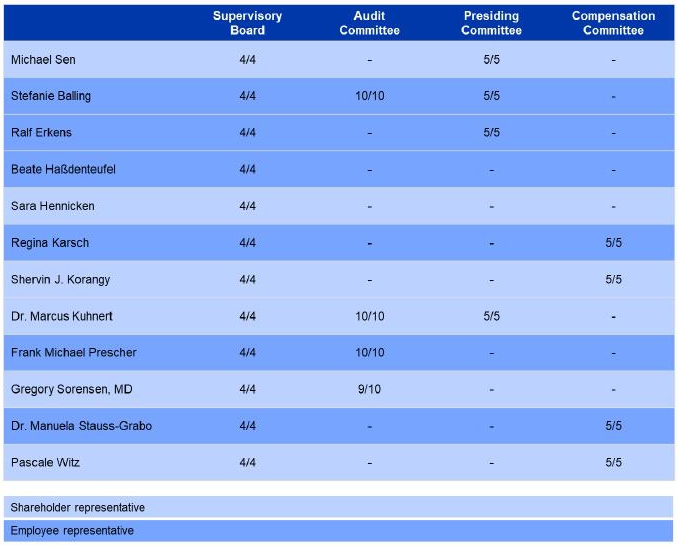
The participation rate of the members at the meetings of the Supervisory Board and its committees was 99.2%. The following table shows the participation of the individual members in the reporting year:
The Supervisory Board was in regular contact with the Management Board and was always promptly and comprehensively informed by it. Between meetings, the Management Board reported to the Supervisory Board in writing. During the meetings, the Management Board also informed the Supervisory Board verbally. In addition, the Supervisory Board was also in contact with members of the senior management level last year. The members of the Management Board were further available to the Supervisory Board for follow-up queries. The Chair of the Supervisory Board maintained continuous contact with the Management Board outside of the meetings, in particular with the Chair of the Management Board, on questions regarding the strategy, business development, risk situation, risk management, and compliance of Fresenius Medical Care. In case of important occasions or events, the Chair of the Management Board promptly informed the Chair of the Supervisory Board. The Chair of the Supervisory Board subsequently informed the other members of the Supervisory Board in the next meeting at the latest. During the entire fiscal year, the Chair of the Supervisory Board also was in close contact with the other members of the Supervisory Board.
The members of the Audit Committee of the Supervisory Board are entitled to obtain information, via the Chair of the Audit Committee, directly from the heads of certain central departments of the Company. As in previous years, it was standard practice for the heads of central departments to report directly to the Audit Committee and the Supervisory Board and to be available for questions and for discussion.
3
Convenience translation
Focus of the discussions in the Supervisory Board
In the reporting year, the Supervisory Board provided detailed support to the Management Board in developing FME Reignite, the new strategic direction of Fresenius Medical Care unveiled at a Capital Markets Day held by the Company in June 2025. FME Reignite sets the ambition for Fresenius Medical Care to lead kidney care through exceptional patient care and innovation, building on the successful execution of the prior turnaround and transformation plan. In connection with this new strategic direction, Fresenius Medical Care introduced Value-Based Care, which was previously part of the Care Delivery operating segment, as a new operating segment in the reporting year, resulting in three operating segments: Care Delivery, Value-Based Care, and Care Enablement.
The Supervisory Board dealt with the FME25+ transformation program and was involved in its implementation by the Management Board. The implementation continued its positive momentum in the reporting year, resulting in additional delivery of sustainable savings.
The Supervisory Board also dealt with investments. This included investments in Fresenius Medical Care’s IT infrastructure, the acquisition of production facilities, and the increase of ownership in Interwell Health, the Value-Based Care asset of Fresenius Medical Care.
The Supervisory Board also dealt with the business strategy, the portfolio optimization, including the divestment of non-core businesses, as well as strategically relevant environmental, social, and governance (ESG) aspects.
The Supervisory Board also discussed the Company’s share buyback program, which was introduced as an additional way of returning value to shareholders alongside dividends.
The business development, the competitive situation and conditions as well as the Management Board’s planning for the individual functions and operating segments were also focal points of the Supervisory Board’s discussions. The development of treatment volumes and of the production quantities and their expansion were also discussed. The Supervisory Board also discussed the U.S. market launch plan for the 5008X CAREsystem, which introduces high-volume hemodiafiltration therapy in the U.S. In the past fiscal year, the Supervisory Board again discussed the development of cost reimbursement in relevant health care systems, in particular in the U.S.
The Supervisory Board was regularly informed about Fresenius Medical Care’s compliance. Findings of the internal audit department were taken into account. In addition, the Supervisory Board received detailed reports on the IT security systems and measures implemented at Fresenius Medical Care.
Subject of the Supervisory Board’s discussions was also the Company’s Annual General Meeting, including the resolutions proposed by the Supervisory Board, which was held as a meeting in presence on May 22, 2025. Further details can be found in the chapter “Declaration on corporate governance” starting on page 194 of the Annual Report (Geschäftsbericht).
Committees of the Supervisory Board
The Supervisory Board has formed professionally qualified committees from among its members that support the Supervisory Board as a whole in its supervisory and advisory functions as well as in the adoption of resolutions. The respective Chairs of the committees have regularly reported to the Supervisory Board on the work of the committees. Details of the composition of the Supervisory Board’s committees can be found in the chapter “Declaration on corporate governance” starting on page 194 of the Annual Report.
Presiding Committee
The Presiding Committee is, in particular, responsible for preparing the meetings of the Supervisory Board, coordinating the work of the Supervisory Board and its committees and advising and supporting the Chair and Deputy Chair of the Supervisory Board as well as for administrative matters. The Presiding Committee resolves upon matters that cannot be delayed if the Supervisory Board cannot pass a resolution in a timely manner. The Presiding Committee is also responsible for certain matters concerning the Management Board, such as recommendations to the Supervisory Board on the appointment or dismissal of Management Board members. Furthermore, the Presiding Committee reviews and assesses Fresenius Medical Care’s corporate governance.
4
Convenience translation
The Presiding Committee convened five times in the reporting year to deal with, in particular, the preparation of meetings of the Supervisory Board with regard to corporate governance matters and their reporting, with aspects of the succession planning for the Management Board, as well as with the rules of procedures of the Management Board. Of these meetings, four were conducted as in-person meetings and one as hybrid meeting, i.e., as meeting in person of at least two members with the possibility of virtual participation.
Audit Committee
In accordance with its rules of procedure, the Audit Committee in particular performs all duties imposed on an audit committee pursuant to Section 107(3), second sentence, of the German Stock Corporation Act (Aktiengesetz – AktG) and the applicable rules of the U.S. Securities and Exchange Commission (SEC) and the New York Stock Exchange (NYSE). This includes, in particular, the monitoring of the accounting process, the effectiveness of the internal control system, the risk management system and the internal audit system, the audit of the financial statements, in particular the selection and independence of the auditor, as well as the quality of the audit.
The Audit Committee convened ten times in the reporting year. Of these meetings, four were conducted as in-person meetings and six as video conferences.
Dr. Marcus Kuhnert (Chair) and Gregory Sorensen, MD, are each financial experts in the meaning of Section 100(5) AktG as well as “audit committee financial experts” within the meaning of the applicable rules of the SEC. Based on their many years of experience, they each have expertise in both accounting and auditing and are each independent within the meaning of the applicable provisions. Further details on the qualifications and independence of the members of the Audit Committee can be found in the chapter “Declaration on corporate governance” starting on page 194 of the Annual Report.
In the reporting year, the Audit Committee dealt with, in particular, the annual and consolidated financial statements, the proposal for the allocation of profit, and the report on Form 20-F for the SEC as well as the Company’s sustainability statement integrated into the group management report. It also discussed the quarterly reports with the Management Board. Also, the engagement pertaining to the audit of the consolidated financial statements according to the International Financial Reporting Standards (IFRS) and the internal controls concerning the financial reporting, which are part of the report on Form 20-F, was issued by the committee. The Audit Committee further negotiated the fee agreement with the auditor. Audit focal points and further key audit matters of the past fiscal year were the assessment of the recoverability of goodwill, the valuation of receivables from dialysis treatments in the U.S., the valuation of uncertain tax positions, the accounting treatment of significant legal disputes, the segment reallocation, the capitalization of internally generated intangible assets, the purchase of treasury shares as part of the share buyback program, the impact of the execution of put options, the acquisition of production sites from Fresenius SE & Co. KGaA, the impact of cyber risks, the finance and IT transformation, the FME25+ program, the portfolio optimization program, and the planned introduction of IFRS 18 on financial reporting, and, regarding the Company’s annual financial statements, the valuation of investments in affiliated companies and the recognition of income from investments.
Representatives of the auditor participated in all regular meetings of the Audit Committee and informed the members of the Audit Committee of their auditing activities. In addition, they provided information on any significant results of their audit and were available for additional information. In the absence of the members of the Management Board, they reported on the cooperation with them and shared their observations with the committee. The Audit Committee also consulted with the external auditors on a regular basis without the Management Board. The Chair of the Audit Committee also had regular exchanges with representatives of the auditor outside the meetings of the Audit Committee, in particular on the progress of the audit, and subsequently reported thereon to the committee.
5
Convenience translation
The Audit Committee on several occasions dealt with the monitoring of the accounting and its process, the effectiveness of the internal control system, the risk management system and the internal audit system as well as with the audit of the financial statements – in particular the selection and independence of the auditor, the quality of the audit and the additional services provided by the auditor – as well as with the compliance management system. Further, the committee discussed with the auditor the audit risk assessment, the audit strategy and the audit planning, as well as the audit results.
In the course of its audit, the auditor audited the internal control system in relation to the accounting process, the electronic reproduction of the consolidated financial statements and the group management report pursuant to Section 328(1) of the German Commercial Code (Handelsgesetzbuch – HGB) prepared for disclosure purposes (so-called ESEF documents) as well as the early risk recognition system. The audit showed that the Management Board has appropriately implemented the measures required under Section 91(2) AktG, in particular regarding the establishment of a monitoring system, and that the monitoring system is suitable for the early identification of developments that may endanger the continued existence of the Company. The Management Board periodically reported to the Audit Committee on major individual risks. It also regularly informed the Audit Committee on the compliance situation as well as on the audit plans and results of the internal audit function.
The Audit Committee also dealt with ESG aspects of strategic relevance to the Company. In this context, the committee discussed in particular the regulatory requirements in the area of sustainability and the progress in pursuing Fresenius Medical Care’s global sustainability targets.
Certain transactions of the Company with related parties may be subject to the approval of the Supervisory Board pursuant to Section 111b(1) AktG. The Supervisory Board has made use of the option to delegate the responsibility for the approval resolution to the Audit Committee. In accordance with Section 111a(2), second sentence AktG, the Audit Committee reviewed whether transactions between the Company and related parties were conducted in the ordinary course of business and at arm’s length. No objections were raised in this respect. The Audit Committee in particular also reviewed the business relations of Group companies to Fresenius SE & Co. KGaA and the latter’s affiliated companies. It was confirmed in each case that these relationships corresponded to those between unrelated third parties.
Compensation Committee
The Compensation Committee prepares the decisions of the Supervisory Board regarding the compensation of the members of the Management Board. This includes the preparation of the determination of the compensation system and the plan terms of the short-term and long-term variable compensation of the Management Board as well as the definition of the targets for variable compensation components and the definition of target values, and the determination of the target achievement. The Compensation Committee also prepares the compensation report for the Supervisory Board.
The Compensation Committee convened five times in the reporting year to prepare the resolutions of the Supervisory Board on the compensation of the Management Board members and on the compensation report. Of these meetings, four were conducted as in-person meetings and one as a video conference.
Nomination Committee
The Nomination Committee identifies and recommends suitable candidates to the Supervisory Board for its proposals to the General Meeting for the election of shareholder representatives as Supervisory Board members. The Nomination Committee also recommends suitable candidates to the Supervisory Board in case a judicial appointment of a shareholder representative on the Supervisory Board is required. The Nomination Committee further makes recommendations to the Supervisory Board on members of the shareholder representatives to be elected to the committees of the Supervisory Board. This does not apply to the election of members of the shareholder representatives to the Mediation Committee.
6
Convenience translation
The Nomination Committee did not convene in the reporting year since no meeting was required.
Mediation Committee
The Mediation Committee (Vermittlungsausschuss) is responsible for proposals for the appointment or dismissal of members of the Management Board to the Supervisory Board if the respective measure is not passed by the Supervisory Board with the required majority during the first vote.
The Mediation Committee did not convene in the reporting year since no meeting was required.
Dialogue with investors
The Chair of the Supervisory Board was available for discussions with investors to the extent permitted by law and in close consultation with the Management Board. For ESG aspects falling within the competence of the Supervisory Board, the same applied to the Chair of the Audit Committee. Investors were given the opportunity to discuss the corporate governance of Fresenius Medical Care and ESG aspects falling within the competence of the Supervisory Board. Key topics in the reporting year were changes in the Management Board as well as the agenda of the upcoming Annual General Meeting.
Corporate Governance
The members of the Supervisory Board in principle self-responsibly undertake educational and training measures required for their tasks. They are adequately supported in this respect by the Company. In addition to the information provided to them by external experts, also experts of the Group’s departments regularly report on relevant developments. This includes, for example, relevant new legal regulations or developments in jurisprudence, developments in accounting and auditing regulations, and requirements in the area of sustainability.
New members of the Supervisory Board can meet the members of the Management Board and other managers for a discussion of fundamental and current topics and thereby gain an overview of the topics relevant for Fresenius Medical Care (onboarding).
For targeted further training, internal information events are offered as required. In the reporting year, further training was provided for the members of the Supervisory Board on current developments in corporate governance and upcoming relevant legal regulations as well as compliance. Further, the Supervisory Board was updated on sustainability-related developments and trends. In addition, the members of the Audit Committee received further training on legal and compliance developments, on regulatory requirements and developments in the area of sustainability, as well as on requirements on financial reporting from the planned introduction of IFRS 18.
The Supervisory Board reports to the General Meeting on possible conflicts of interest of its members and on the treatment of such conflicts. If specific conflicts of interest exist or cannot be ruled out with certainty, the concerned Supervisory Board member discloses this to the Supervisory Board. If a subsequent review reveals that a conflict of interest exists, suitable measures are taken to resolve the conflict of interest.
The members of the Supervisory Board Michael Sen and Sara Hennicken are members of the management board of Fresenius Management SE, the general partner of Fresenius SE & Co. KGaA, which is a major shareholder of the Company. In the reporting year, Michael Sen and Sara Hennicken decided in two cases, in which a conflict of interest could not be ruled out, not to participate in the passing of resolutions of the Supervisory Board. One case concerned the acquisition of the Group’s production sites in Schweinfurt and St. Wendel, Germany, which had previously been leased from Fresenius SE & Co. KGaA and certain of its affiliated companies, and the other concerned the delegation of approval authority to the Audit Committee with regard to the Company’s share buyback program initiated in the reporting year. Otherwise, no conflicts of interest arose in the reporting year.
7
Convenience translation
Separate preparation meetings of the employee representatives and consultations among the shareholder representatives take place on a regular basis.
Further details on corporate governance, in particular on the independence of the Supervisory Board members, the qualification matrix for the implementation status of the profile of skills and expertise for the Supervisory Board, the age limit and the regular maximum tenure for membership in the Company’s Supervisory Board, as well as the self-assessment of the work of the Supervisory Board and its committees, can be found in the chapter “Declaration on corporate governance” starting on page 194 of the Annual Report. The declaration on corporate governance was discussed by the Supervisory Board and approved at its meeting on March 10, 2026.
The declaration on corporate governance includes the declaration of compliance (Entsprechenserklärung) on the recommendations of the GCGC according to Section 161 AktG as resolved by the Management Board and Supervisory Board and published in December 2025 as well as updated in February 2026. The declaration of compliance is permanently available to the public on the Company’s website at www.freseniusmedicalcare.com in the section “Investors” and there in the sub-section “Corporate governance.”
Compensation report
The Management Board and the Supervisory Board prepared a compensation report in accordance with Section 162 AktG for the reporting year. The auditor reviewed the compensation report in accordance with Section 162(3) AktG to determine whether the legally required disclosures pursuant to Section 162(1) and (2) AktG were made. In addition to the statutory requirements, the content of the report was also reviewed by the auditor. The auditor confirmed that the compensation report, in all material respects, complies with the accounting provisions of Section 162 AktG. In accordance with Section 120a(4) AktG, the compensation report will be submitted to the General Meeting for approval.
Annual and consolidated financial statements
The annual financial statements and the management report of the Company were prepared in accordance with the regulations of the German Commercial Code (Handelsgesetzbuch – HGB). The consolidated financial statements and the group management report follow Section 315e HGB in accordance with IFRS as applicable in the European Union. Accounting, the annual financial statements, the management report as well as the consolidated financial statements and the group management report for fiscal year 2025 were audited by PricewaterhouseCoopers GmbH Wirtschaftsprüfungsgesellschaft, Frankfurt am Main (PwC). PwC has been the auditor of the Company since fiscal year 2020 and was elected as auditor for the reporting year by resolution of the Annual General Meeting on May 22, 2025, and mandated by the Supervisory Board. The auditor provided each of the aforementioned documents with an unqualified certificate. Thomas Tilgner (for the first time) and Dominik Höhler (as already for the previous years since 2023) signed the respective audit certificate as the auditors. The audit reports of the auditor were made available to the Audit Committee and the Supervisory Board. The Audit Committee reviewed the annual and consolidated financial statements as well as the management reports, and included the audit reports of, and the discussions with, the auditor in its discussions. The Audit Committee reported to the Supervisory Board on this.
The Supervisory Board also reviewed the annual financial statements, the management report, the consolidated financial statements, and the group management report. The documents were provided to it in good time. The Supervisory Board declared its agreement with the result of the audit of the annual financial statements and the consolidated financial statements by the auditor. The auditor participated in the discussions of the Supervisory Board of the annual and consolidated financial statements, reported to the Supervisory Board on the significant findings of its audit, and was available for additional information. Also according to the final results of its own review, no objections are to be raised by the Supervisory Board as regards the annual financial statements, the management report, the consolidated financial statements, and the group management report.
8
Convenience translation
By way of a written resolution on February 23, 2026, the Supervisory Board approved the draft of the report on Form 20-F. The report on Form 20-F was filed with the SEC on February 24, 2026.
The Supervisory Board approved the annual financial statements and management report of the Company as well as the consolidated financial statements, and the group management report for the past fiscal year, as presented by the Management Board, at its meeting on March 10, 2026. The annual financial statements of the Company are adopted by this approval of the Supervisory Board.
The Supervisory Board approved the Management Board’s proposal for the allocation of profit, which provides for a dividend of € 1.49 for each share entitled to dividend.
Sustainability statement
The Company’s sustainability statement fulfills the requirements of a non-financial group declaration and was prepared in accordance with Sections 315b and 315c HGB and the EU Taxonomy Regulation (Regulation (EU) 2020/852). The sustainability statement is integrated into the group management report and fully applies the European Sustainability Reporting Standards as a reporting framework. The sustainability statement describes Fresenius Medical Care’s sustainability performance in fiscal year 2025 in line with regulatory requirements.
The Supervisory Board engaged PwC to subject the sustainability statement to a limited assurance engagement review in accordance with the ISAE 3000 (Revised) assurance standard. PwC issued a corresponding independent practitioner’s report. The auditor’s report on a limited assurance engagement review for the sustainability statement was signed by the auditors Nicolette Behncke (as already for the previous years since 2020) and Richard Gudd (for the first time) and contains no findings. The report of the auditor was made available to the Audit Committee and the Supervisory Board. The Audit Committee reviewed the sustainability statement, taking into account the auditor’s report and the discussions with the auditor. The Audit Committee reported to the Supervisory Board on this.
The Supervisory Board, too, reviewed the sustainability statement. It received the documents in good time. The Supervisory Board declared its agreement with the result of the limited assurance engagement review in relation to the sustainability statement by the auditor. Also according to the final results of its own review, no objections are to be raised by the Supervisory Board as regards the sustainability statement.
Acknowledgements
The members of the Management Board, led by Helen Giza, along with all employees, have successfully advanced the development of Fresenius Medical Care. We would like to thank them for their commitment in this pivotal year. We are confident that they will continue on this successful path and shape a promising future – for patients with kidney disease and for Fresenius Medical Care.
9
Convenience translation
Bad Homburg v.d. Höhe, March 10, 2026
On behalf of the Supervisory Board
| /s/ Michael Sen | |
| Michael Sen | |
| Chair |
10