
Jaguar Mining Inc.
Consolidated Financial Statements
December 31, 2012 and 2011
MANAGEMENT’S RESPONSIBILITY FOR FINANCIAL REPORTING
The accompanying consolidated financial statements of Jaguar Mining Inc. and all the information contained in this annual report are the responsibility of management and have been approved by the Board of Directors. These financial statements and all other information have been prepared by management in accordance with International Financial Reporting Standards as issued by the International Accounting Standards Board. Some amounts included in the financial statements are based on management’s best estimates and have been derived with careful judgment. In fulfilling its responsibilities, management has developed and maintains a system of internal controls. These controls ensure that transactions are authorized, assets are safeguarded from loss or unauthorized use, and financial records are reliable for the purpose of preparing financial statements. The Board of Directors carries out its responsibilities for the financial statements through the Audit Committee. The Audit Committee periodically reviews and discusses financial reporting matters with the Company’s auditors, KPMG LLP, as well as with management. These financial statements have been audited by KPMG LLP, Chartered Accountants, on behalf of the shareholders.
| /s/ David M. Petroff | |
| David M. Petroff | |
| President and CEO | |
| /s/ T. Douglas Willock | |
| T. Douglas Willock | |
| Chief Financial Officer |
March 21, 2013
| 2 |
| KPMG LLP | Telephone | (416) 777-8500 | ||
| Chartered Accountants | Fax | (416) 777-8818 | ||
| Bay Adelaide Centre | Internet | www.kpmg.ca | ||
| 333 Bay Street Suite 4600 | ||||
| Toronto ON M5H -2S5 |
INDEPENDENT AUDITORS’ REPORT OF REGISTERED PUBLIC ACCOUNTING FIRM
To the Shareholders of Jaguar Mining Inc.,
We have audited the accompanying consolidated financial statements of Jaguar Mining Inc., which comprise the consolidated balance sheets as at December 31, 2012 and December 31, 2011, the consolidated statements of operations and comprehensive loss, shareholders’ equity and cash flows for the years then ended, and notes, comprising a summary of significant accounting policies and other explanatory information.
Management’s Responsibility for the Consolidated Financial Statements
Management is responsible for the preparation and fair presentation of these consolidated financial statements in accordance with international Financial Reporting Standards as issued by the International Accounting Standards Board, and for such internal control as management determines is necessary to enable the preparation of consolidated financial statements that are free from material misstatement, whether due to fraud or error.
Auditors’ Responsibility
Our responsibility is to express an opinion on these consolidated financial statements based on our audits. We conducted our audits in accordance with Canadian generally accepted auditing standards and the standards of the Public Company Accounting Oversight Board (United States). Those standards require that we comply with ethical requirements and plan and perform the audit to obtain reasonable assurance about whether the consolidated financial statements are free from material misstatement
An audit involves performing procedures to obtain audit evidence about the amounts and disclosures in the consolidated financial statements. The procedures selected depend on our judgment, including the assessment of the risks of material misstatement of the consolidated financial statements, whether due to fraud or error. In making those risk assessments, we consider internal control relevant to the entity’s preparation and fair presentation of the consolidated financial statements in order to design audit procedures that are appropriate in the circumstances. An audit also includes evaluating the appropriateness of accounting policies used and the reasonableness of accounting estimates made by management, as well as evaluating the overall presentation of the consolidated financial statements.
We believe that the audit evidence we have obtained in our audits is sufficient and appropriate to provide a basis for our audit opinion.
Opinion
In our opinion, the consolidated financial statements present fairly, in all material respects, the consolidated balance sheets of Jaguar Mining Inc. as at December 31, 2012 and December 31, 2011, and its consolidated financial performance and its consolidated cash flows for the years then ended in accordance with International Financial Reporting Standards as issued by the International Accounting Standards Board.
| KPMG LLP is a Canadian limited liability partnership and a member firm of the KPMG network of independent member firms affiliated with KPMG International Cooperative (“KPMG International”), a Swiss entity. | ||
| KPMG Canada provides services to KPMG LLP. |
| 3 |
| KPMG LLP | Telephone | (416) 777-8500 | ||
| Chartered Accountants | Fax | (416) 777-8818 | ||
| Bay Adelaide Centre | Internet | www.kpmg.ca | ||
| 333 Bay Street Suite 4600 | ||||
| Toronto ON M5H 2S5 |
Other Matter
We also have audited, in accordance with the standards of the Public Company Accounting Oversight Board (United States), the Company’s internal control over financial reporting as of December 31, 2012, based on the criteria established in Internal Control — Integrated Framework issued by the Committee of Sponsoring Organizations of the Treadway Commission, and our report dated March 21, 2013 expressed an unqualified (unmodified) opinion on the effectiveness of the Company’s internal control over financial reporting.
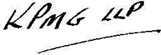
Chartered Accountants, Licensed Public Accountants
Toronto, Canada
March 21, 2013
| KPMG LLP is a Canadian limited liability partnership and a member firm of the KPMG network of independent member firms affiliated with KPMG International Cooperative (‘‘KPMG International”), a Swiss entity. | ||
| KPMG Canada provides services to KPMG LLP. |
| 4 |
| KPMG LLP | Telephone | (416) 777-8500 | ||
| Chartered Accountants | Fax | (416) 777-8818 | ||
| Bay Adelaide Centre | Internet | www.kpmg.ca | ||
| 333 Bay Street Suite 4600 | ||||
| Toronto ON M5H 2S5 |
REPORT OF INDEPENDENT REGISTERED PUBLIC ACCOUNTING FIRM
To the Board of Directors and Shareholders of Jaguar Mining Inc.,
We have audited Jaguar Mining Inc.’s internal control over financial reporting as of December 31, 2012, based on the criteria established in Internal Control — Integrated Framework issued by the Committee of Sponsoring Organizations of the Treadway Commission. Jaguar Mining Inc.’s management is responsible for maintaining effective internal control over financial reporting and for its assessment of the effectiveness of internal control over financial reporting under the heading Management’s Report on Internal Control over Financial Reporting in Management’s Discussion and Analysis for the year ended December 31, 2012. Our responsibility is to express an opinion on the Company’s internal control over financial reporting based on our audit.
We conducted our audit in accordance with the standards of the Public Company Accounting Oversight Board (United States). Those standards require that we plan and perform the audit to obtain reasonable assurance about whether effective internal control over financial reporting was maintained in all material respects. Our audit included obtaining an understanding of internal control over financial reporting, assessing the risk that a material weakness exists, and testing and evaluating the design and operating effectiveness of internal control based on the assessed risk. Our audit also included performing such other procedures as we considered necessary in the circumstances. We believe that our audit provides a reasonable basis for our opinion.
A company’s internal control over financial reporting is a process designed to provide reasonable assurance regarding the reliability of financial reporting and the preparation of financial statements for external purposes in accordance with generally accepted accounting principles. A company’s internal control over financial reporting includes those policies and procedures that (1) pertain to the maintenance of records that, in reasonable detail, accurately and fairly reflect the transactions and dispositions of the assets of the company; (2) provide reasonable assurance that transactions are recorded as necessary to permit preparation of financial statements in accordance with generally accepted accounting principles, and that receipts and expenditures of the company are being made only in accordance with authorizations of management and directors of the company; and (3) provide reasonable assurance regarding prevention or timely detection of unauthorized acquisition, use, or disposition of the company’s assets that could have a material effect on the financial statements.
Because of its inherent limitations, internal control over financial reporting may not prevent or detect misstatements. Also, projections of any evaluation of effectiveness to future periods are subject to the risk that controls may become inadequate because of changes in conditions, or that the degree of compliance with the policies or procedures may deteriorate.
| KPMG LLP is a Canadian limited liability partnership and a member firm of the KPMG network of independent member firms affiliated with KPMG International Cooperative (“KPMG International”), a Swiss entity. | ||
| KPMG Canada provides services to KPMG LLP. |
| 5 |
In our opinion, Jaguar Mining Inc. maintained, in all material respects, effective internal control over financial reporting as of December 31, 2012, based on the criteria established in Internal Control—Integrated Framework issued by the Committee of Sponsoring Organizations of the Treadway Commission.
We also have audited, in accordance with Canadian generally accepted auditing standards and the standards of the Public Company Accounting Oversight Board (United States), the consolidated balance sheets of Jaguar Mining Inc. as of December 31, 2012 and December 31, 2011, and the related consolidated statements of operations and comprehensive loss, shareholders’ equity and cash flows for the years then ended, and our report dated March 21, 2013 expressed an unqualified (unmodified) opinion on those consolidated financial statements.
Chartered Accountants, Licensed Public Accountants
Toronto, Canada
March 21, 2013
| 6 |
| JAGUAR MINING INC. |
| Consolidated Balance Sheets |
| (Expressed in thousands of U.S. dollars) |
| December 31, 2012 | December 31, 2011 | |||||||||
| Assets | ||||||||||
| Current assets: | ||||||||||
| Cash and cash equivalents | Note 18 | $ | 13,856 | $ | 74,475 | |||||
| Inventory | Note 4 | 26,342 | 34,060 | |||||||
| Prepaid expenses and sundry assets | Note 5 | 20,069 | 25,541 | |||||||
| Derivatives | Note 6(a) | 43 | - | |||||||
| 60,310 | 134,076 | |||||||||
| Prepaid expenses and sundry assets | Note 5 | 56,886 | 48,068 | |||||||
| Restricted cash | Note 7 | 609 | 909 | |||||||
| Assets available for sale | 612 | - | ||||||||
| Property, plant and equipment | Note 8 | 301,383 | 388,675 | |||||||
| Mineral exploration projects | Note 9 | 84,075 | 88,938 | |||||||
| $ | 503,875 | $ | 660,666 | |||||||
| Liabilities and Shareholders' Equity | ||||||||||
| Current liabilities: | ||||||||||
| Accounts payable and accrued liabilities | $ | 29,745 | $ | 34,922 | ||||||
| Notes payable | Note 10 | 27,388 | 22,517 | |||||||
| Income taxes payable | 15,451 | 18,953 | ||||||||
| Reclamation provisions | Note 11 | 4,124 | 2,082 | |||||||
| Other provisions | Note 12 | 4,796 | 4,347 | |||||||
| Deferred compensation liabilities | Note 15 | 105 | 2,953 | |||||||
| Other liabilities | 20 | 1,475 | ||||||||
| 81,629 | 87,249 | |||||||||
| Notes payable | Note 10 | 240,158 | 228,938 | |||||||
| Option component of convertible notes | Note 6(b) | 4,458 | 79,931 | |||||||
| Deferred income taxes | Note 13 | 6,624 | 8,635 | |||||||
| Reclamation provisions | Note 11 | 16,927 | 15,495 | |||||||
| Deferred compensation liabilities | Note 15 | 216 | 2,270 | |||||||
| Other liabilities | 60 | 339 | ||||||||
| Total liabilities | 350,072 | 422,857 | ||||||||
| Shareholders' equity: | ||||||||||
| Share capital | Note 14(a) | 370,043 | 370,043 | |||||||
| Stock options | Note 14(b) | 2,137 | 14,207 | |||||||
| Contributed surplus | 16,015 | 3,414 | ||||||||
| Deficit | (234,392 | ) | (149,855 | ) | ||||||
| Total equity attributable to equity shareholders of the Company | 153,803 | 237,809 | ||||||||
| $ | 503,875 | $ | 660,666 | |||||||
| Commitments | Notes 6 and 20 | |||||||||
| Subsequent events | Note 21 | |||||||||
On behalf of the Board:
Richard Falconer
David Petroff
The accompanying notes are an integral part of these consolidated financial statements.
| 7 |
| JAGUAR MINING INC. |
| Consolidated Statements of Operations and Comprehensive Loss |
| (Expressed in thousands of U.S. dollars, except share and per share amounts) |
| Year Ended December 31, 2012 | Year Ended December 31, 2011 | |||||||||
| Gold sales | $ | 172,430 | $ | 243,137 | ||||||
| Production costs | (127,851 | ) | (153,331 | ) | ||||||
| Stock-based compensation | Notes 14(b),15 | 457 | (347 | ) | ||||||
| Depletion and amortization | (38,893 | ) | (46,107 | ) | ||||||
| Gross profit | 6,143 | 43,352 | ||||||||
| Operating expenses: | ||||||||||
| Exploration | 700 | 1,953 | ||||||||
| Paciência shut down & care and maintenance | Note 8 | 4,350 | - | |||||||
| Stock-based compensation (recovery) | Notes 14(b),15 | (1,864 | ) | 2,970 | ||||||
| Administration | 18,886 | 25,506 | ||||||||
| Management fees | Note 17(c)(i) | 30 | 3,016 | |||||||
| Amortization | 1,168 | 1,249 | ||||||||
| Other | 3,595 | 2,596 | ||||||||
| Total operating expenses | 26,865 | 37,290 | ||||||||
| Income (loss) before the following | (20,722 | ) | 6,062 | |||||||
| Loss (gain) on derivatives | Note 6(a) | (720 | ) | 420 | ||||||
| Loss (gain) on conversion option embedded in convertible debt | Note 6(b) | (75,473 | ) | 32,250 | ||||||
| Foreign exchange loss | 5,882 | 8,480 | ||||||||
| Accretion expense | Note 11 | 3,585 | 2,454 | |||||||
| Interest expense | 28,511 | 27,001 | ||||||||
| Interest income | (3,168 | ) | (9,237 | ) | ||||||
| Loss (gain) on disposition of property | Note 10(b) | 2,805 | (2,029 | ) | ||||||
| Impairment of properties | Note 8 | 102,997 | - | |||||||
| Other non-operating expense | 1,164 | 453 | ||||||||
| Total other expenses | 65,583 | 59,792 | ||||||||
| Loss before income taxes | (86,305 | ) | (53,730 | ) | ||||||
| Income taxes | Note 13 | |||||||||
| Current income taxes (recoveries) | (466 | ) | 3,450 | |||||||
| Deferred income taxes (recoveries) | (1,302 | ) | 8,443 | |||||||
| Total income taxes | (1,768 | ) | 11,893 | |||||||
| Net loss and comprehensive loss for the year | $ | (84,537 | ) | $ | (65,623 | ) | ||||
| Basic and diluted loss per share | Note 16 | $ | (1.00 | ) | $ | (0.78 | ) | |||
| Weighted average number of common shares outstanding - basic and diluted | Note 16 | 84,409,648 | 84,386,569 | |||||||
The accompanying notes are an integral part of these consolidated financial statements.
| 8 |
| JAGUAR MINING INC. |
| Consolidated Statements of Shareholders' Equity |
| (Expressed in thousands of U.S. dollars) |
| Common Shares | Stock Options | Contributed
Surplus | Deficit | Total | ||||||||||||||||||||||||||
| # | $ | # | $ | $ | $ | $ | ||||||||||||||||||||||||
| Balance, January 1, 2011 | 84,373,648 | 369,747 | 3,777,500 | 13,054 | 1,901 | (84,232 | ) | 300,470 | ||||||||||||||||||||||
| Stock options granted | Note 14(b) | - | - | 880,000 | 2,798 | - | - | 2,798 | ||||||||||||||||||||||
| Exercise of stock options | Note 14(b) | 36,000 | 296 | (36,000 | ) | (132 | ) | - | - | 164 | ||||||||||||||||||||
| Vested options expired | Note 14(b) | - | - | (616,500 | ) | (1,513 | ) | 1,513 | - | - | ||||||||||||||||||||
| Net loss | - | - | - | - | - | (65,623 | ) | (65,623 | ) | |||||||||||||||||||||
| Balance, December 31, 2011 | 84,409,648 | 370,043 | 4,005,000 | 14,207 | 3,414 | (149,855 | ) | 237,809 | ||||||||||||||||||||||
| Balance, January 1, 2012 | 84,409,648 | 370,043 | 4,005,000 | 14,207 | 3,414 | (149,855 | ) | 237,809 | ||||||||||||||||||||||
| Stock options granted | Note 14(b) | - | - | 1,326,250 | 531 | - | - | 531 | ||||||||||||||||||||||
| Vested options expired | Note 14(b) | - | - | (3,495,000 | ) | (12,601 | ) | 12,601 | - | - | ||||||||||||||||||||
| Net loss | - | - | - | - | - | (84,537 | ) | (84,537 | ) | |||||||||||||||||||||
| Balance, December 31, 2012 | 84,409,648 | 370,043 | 1,836,250 | 2,137 | 16,015 | (234,392 | ) | 153,803 | ||||||||||||||||||||||
The accompanying notes are an integral part of these consolidated financial statements.
| 9 |
| JAGUAR MINING INC. |
| Consolidated Statements of Cash Flows |
| (Expressed in thousands of U.S. dollars) |
| Year Ended
December 31, 2012 | Year Ended
December 31, 2011 | |||||||||
| Cash provided by (used in): | ||||||||||
| Operating activities: | ||||||||||
| Net loss and comprehensive income (loss) for the year | $ | (84,537 | ) | $ | (65,623 | ) | ||||
| Adjustments to reconcile net earnings to net cash provided from (used in) operating activities: | ||||||||||
| Unrealized foreign exchange (gain) loss | (4,184 | ) | 11,618 | |||||||
| Stock-based compensation expense (recovery) | (2,321 | ) | 3,317 | |||||||
| Interest expense | 28,511 | 27,001 | ||||||||
| Accretion of interest income | - | (188 | ) | |||||||
| Accretion expense | 3,585 | 2,454 | ||||||||
| Deferred income taxes (recovery) | (1,302 | ) | 8,443 | |||||||
| Depletion and amortization | 40,061 | 47,356 | ||||||||
| Impairment of properties | 102,997 | - | ||||||||
| Write-down of Paciência inventory | 1,825 | 2,242 | ||||||||
| Unrealized (gain) loss on derivatives | (43 | ) | 168 | |||||||
| Unrealized loss (gain) on option component of convertible note | (75,473 | ) | 32,250 | |||||||
| Provision and loss on disposition of PPE | 4,460 | 1,618 | ||||||||
| Impairment mineral exploration projects | - | 528 | ||||||||
| Reclamation expenditures | (298 | ) | (556 | ) | ||||||
| Current income tax paid | - | (140 | ) | |||||||
| 13,281 | 70,488 | |||||||||
| Change in non-cash operating working capital: | ||||||||||
| Inventory | 7,146 | 286 | ||||||||
| Prepaid expenses and sundry assets | (12,183 | ) | (8,845 | ) | ||||||
| Accounts payable and accrued liabilities | (5,597 | ) | 8,419 | |||||||
| Income taxes payable | (3,502 | ) | 2,416 | |||||||
| Other provisions | 449 | 1,725 | ||||||||
| Deferred compensation liabilities | (2,383 | ) | (2,570 | ) | ||||||
| (2,789 | ) | 71,919 | ||||||||
| Financing activities: | ||||||||||
| Issuance of common shares | - | 164 | ||||||||
| Decrease in restricted cash | 300 | - | ||||||||
| Repayment of debt | (20,703 | ) | (24,163 | ) | ||||||
| Increase in debt | 23,200 | 115,313 | ||||||||
| Interest paid | (14,370 | ) | (13,276 | ) | ||||||
| Other liabilities | (1,733 | ) | 613 | |||||||
| (13,306 | ) | 78,651 | ||||||||
| Investing activities: | ||||||||||
| Mineral exploration projects | (8,554 | ) | (15,723 | ) | ||||||
| Purchase of property, plant and equipment | (44,263 | ) | (95,107 | ) | ||||||
| Proceeds from disposition of property, plant and equipment | 1,556 | 365 | ||||||||
| (51,261 | ) | (110,465 | ) | |||||||
| Effect of foreign exchange on non-U.S. dollar denominated cash and cash equivalents | 6,737 | (4,853 | ) | |||||||
| Increase (decrease) in cash and cash equivalents | (60,619 | ) | 35,252 | |||||||
| Cash and cash equivalents, beginning of year | 74,475 | 39,223 | ||||||||
| Cash and cash equivalents, end of year | $ | 13,856 | $ | 74,475 | ||||||
| Supplemental cash flow information | Note 18 | |||||||||
The accompanying notes are an integral part of these consolidated financial statements.
| 10 |
| Jaguar Mining Inc. |
| Notes to the Consolidated Financial Statements |
| (tabular dollar amounts in thousands of U.S. dollars, except per share amounts) |
| Years ended December 31, 2012 and 2011 |
| 1. | Nature of Business: |
Jaguar Mining Inc. (the “Company” or “Jaguar”) is a corporation continued under the Business Corporations Act (Ontario) engaged in the acquisition, exploration, development and operation of gold producing properties in Brazil. The address of the Company’s registered office is 155 Wellington Street West, Toronto, ON M5V 3J7 Canada.
These consolidated financial statements of the Company as at and for the years ended December 31, 2012 and December 31, 2011 include the accounts of the Company and its wholly-owned subsidiaries: Mineração Serras do Oeste Ltda. (“MSOL”), Mineração Turmalina Ltda. (“MTL”) and Mineração Chega Tudo Ltda. (“MCT”). All significant intercompany accounts and transactions have been eliminated on consolidation.
| 2. | Basis of Preparation: |
| (a) | Statement of compliance: |
These consolidated financial statements have been prepared in accordance with International Financial Reporting Standards (“IFRS”) as issued by the International Accounting Standards Board.
These consolidated financial statements were authorized for issue by the Board of Directors on March 20, 2013.
| (b) | Basis of measurement: |
These consolidated financial statements have been prepared on the historical cost basis except for certain financial instruments and liabilities associated with certain long-term incentive plans and reclamation provisions, which are stated at fair value.
| (c) | Functional and presentation currency: |
These consolidated financial statements are presented in U.S. dollars, which is the Company’s functional currency. All financial information presented in U.S. dollars has been rounded to the nearest thousand.
| (d) | Use of estimates and judgments: |
The preparation of consolidated financial statements in conformity with IFRS requires management to make estimates, judgments and assumptions that affect the application of accounting policies and the reported amounts of assets and liabilities at the date of the financial statements and the reported amounts of revenue and expenses during the period. Actual results could differ from these estimates.
Estimates and underlying assumptions are reviewed on an ongoing basis. Revisions to accounting estimates are recognized in the period in which the estimates are revised and in any future periods affected.
Certain estimates, such as those related to the valuation of mineral exploration projects, recoverability of property plant and equipment, recoverable taxes, deferred tax assets and liabilities, reclamation provision, derivatives, option component of convertible notes, liabilities associated with certain long-term incentive plans, measurement of inventory and disclosure of contingent assets and liabilities depend on subjective or complex judgments about matters that may be uncertain. Changes in those estimates could materially impact these consolidated financial statements.
| 11 |
| Jaguar Mining Inc. |
| Notes to the Consolidated Financial Statements |
| (tabular dollar amounts in thousands of U.S. dollars, except per share amounts) |
| Years ended December 31, 2012 and 2011 |
The judgments that management has applied in the application of accounting policies and related estimates that have the most significant effect on the amounts recognized in these consolidated financial statements are discussed below:
| (i) | Unit of production depletion and amortization: |
The Company’s mineral exploration projects and mining properties are depleted and amortized on a unit-of-production basis, using the expected amount of recoverable reserves. Changes to these estimates, which can be significant, could be caused by a variety of factor, including future production differing from current forecasts, expansion of mineral reserves through exploration activities, differences between estimated and actual costs of mining and other factors impacting mineral reserves or the expected life of the mining operation.
| (ii) | Inventory: |
Gold in process and ore in stockpiles are stated at the lower of average production cost and net realizable value. Production costs charged to earnings include labour, benefits, material and other product costs. The assumptions used in the impairment assessment of gold in process inventory include estimates of gold contained in the ore stacked, assumptions of the amount of gold stacked that is expected to be recovered and an assumed gold price expected to be realized when the gold is recovered. If these estimates or assumptions prove to be inaccurate, the Company could be required to write-down the recorded value of its work-in-process inventory, which could reduce the Company’s earnings and working capital.
| (iii) | Mine reserve estimates: |
A mine reserve estimate is an estimate of the amount of product that can be economically and legally extracted from the Company’s mining properties. In order to calculate reserve estimates, assumptions are required about a range of geological, technical and economic factors, including: quantities, grades, production techniques, recovery rates, production costs, transportation costs, commodity demand, commodity prices and exchange rates. The Company is required to determine and report mine reserves in accordance with the Canadian Institute of Mining, Metallurgy and Petroleum standards.
Estimates of mine reserves may change as estimates and assumptions change and as additional geological data is generated during the course of operations. Changes in mine reserve estimates may affect carrying values of the Company’s inventory, property, plant and equipment, mineral exploration projects, reclamation provisions and deferred income taxes.
| (iv) | Capitalization of mineral exploration projects: |
The Company’s accounting policy for exploration costs results in certain items being capitalized according to the expected recoverability of the projects. This policy requires management to make certain estimates and assumptions as to future events and circumstances, in particular whether an economically viable extraction operation can be established. Any such estimates and assumptions may change as new information becomes available. If, after having capitalized the costs, a judgment is made that recovery of the costs is unlikely, the relevant capitalized amount will be written off to earnings.
| 12 |
| Jaguar Mining Inc. |
| Notes to the Consolidated Financial Statements |
| (tabular dollar amounts in thousands of U.S. dollars, except per share amounts) |
| Years ended December 31, 2012 and 2011 |
| (v) | Production start date: |
The Company assesses the stage of each mineral exploration project to determine when a mine is substantially complete and ready for its intended use. Once this stage is obtained, amortization of the mine will commence. The Company considers various criteria to assess when the mine has reached the production stage, including completion of a reasonable amount of testing of the mine plant and equipment, and the ability to sustain ongoing production of gold in a saleable form. The judgment used to apply these criteria could impact the amortization commencement date.
| (vi) | Reclamation provision: |
The Company’s mining and exploration activities are subject to various laws and regulations governing the protection of the environment. In general, these laws and regulations are continually changing and, over time, becoming more restrictive which impacts the cost of retiring assets at the end of their useful lives. The Company recognizes liabilities for reclamation provisions in the period in which they are incurred. A corresponding increase to the carrying amount of the related asset, where one is identifiable, is recorded and amortized over the life of the asset. Where a related asset is not easily identifiable with a liability, the change in fair value over the course of the period is expensed. Over time, the reclamation provision will be increased each period to reflect the interest element (accretion) reflected in its initial measurement at fair value, and will also be adjusted for changes in the estimate of the amount, timing and cost of the work to be carried out. Additionally, future changes to environmental laws and regulations could increase the extent of reclamation and remediation work required to be performed by the Company.
| (vii) | Stock-based compensation: |
The Company includes an estimate of forfeitures, share price volatility, expected life and risk-free interest rates in the calculation of the liability for certain long-term incentive plans. These estimates are based on previous experience and may change throughout the life of an incentive plan. Such changes could impact the carrying value of the deferred compensation liability, mineral exploration projects, inventory and earnings.
| (viii) | Determination of functional currency: |
The functional currency of the Company has been assessed by management based on consideration of the currency and economic factors that mainly influence the Company’s gold sales, production and operating costs, financing and related transactions. Changes to these factors may have an impact on the judgment applied in the determination of the Company’s functional currency.
| (ix) | Capitalization of borrowing costs: |
Borrowing costs are identified for capitalization to property, plant and equipment construction projects until such time that the constructed asset is substantially complete and ready for its intended use. Borrowing costs related to specific borrowings are identified for capitalization to mineral exploration projects until such time that the mine is substantially complete and ready for its intended use. Amounts to be capitalized are estimated based on costs incurred to date and the interest rate of specific borrowings or the weighted average borrowing costs of general borrowings. The judgment used to identify mines or assets that require capitalization of borrowing costs could impact the carrying value of those assets, depletion and amortization and interest expense.
| 13 |
| Jaguar Mining Inc. |
| Notes to the Consolidated Financial Statements |
| (tabular dollar amounts in thousands of U.S. dollars, except per share amounts) |
| Years ended December 31, 2012 and 2011 |
| (x) | Identification of impairment: |
The Company considers, at the end of each accounting period, whether or not there has been an impairment of the capitalized mineral exploration projects, or property, plant and equipment. For producing and non-producing mining properties, this assessment is based on the expected future cash flows to be generated from the asset. If the Company determines there has been an impairment because its prior estimates of future cash flows have proven to be inaccurate, due to reductions in the price of gold, increases in the costs of production, reductions in the amount of reserves expected to be recovered or otherwise, the Company would be required to write-down the recorded value of its mineral explorations projects, or property, plant and equipment, which would reduce the Company’s earnings and net assets.
| (xi) | Recoverable taxes: |
In Brazil, the Company is due refunds of certain taxes based on consumption, of which the timing of realization is uncertain. If these recoverable taxes are not collected, it could reduce the carrying value of these assets.
| (xii) | Deferred taxes: |
The Company recognizes the deferred tax benefit related to tax assets and tax losses to the extent recovery is probable. Assessing the recoverability of deferred income tax assets requires management to make significant estimates of future taxable profit and expected timing of reversals of existing temporary differences. To the extent that future cash flows and taxable profit differ significantly from estimates, the ability of the Company to realize the deferred tax assets recorded at the balance sheet date could be impacted. In addition, future changes in tax laws could limit the ability of the Company to obtain tax deductions in future periods from tax assets and tax losses.
| 3. | Significant Accounting Policies: |
| (a) | Existing accounting policies: |
| (i) | Basis of consolidation: |
Subsidiaries are entities controlled by the Company. The financial statements of the subsidiaries are included in the consolidated financial statements from the date that control commences until the date that control ceases. The accounting policies of the subsidiaries have been changed when necessary to align them with the policies adopted by the Company.
| (ii) | Cash and cash equivalents: |
The Company considers deposits in banks, certificates of deposit and short-term investments with remaining maturities of three months or less at the time of acquisition to be cash and cash equivalents. Cash held on deposit as security is classified as restricted cash.
| (iii) | Short-term investments: |
Short-term investments include short-term money market instruments with terms to maturity at the date of the acquisition of between three and twelve months. Short-term investments are classified as fair value through profit or loss (“FVTPL”) and recorded at fair value.
| 14 |
| Jaguar Mining Inc. |
| Notes to the Consolidated Financial Statements |
| (tabular dollar amounts in thousands of U.S. dollars, except per share amounts) |
| Years ended December 31, 2012 and 2011 |
| (iv) | Inventory: |
Gold in process and ore in stockpiles are stated at the lower of the average total production cost or net realizable value. Production costs include direct labour, employee benefits, direct material and other direct product costs including depletion and amortization. Net realizable value represents estimated selling price in the ordinary course of business, less any further costs expected to be incurred to completion.
Raw materials and mine operating supplies are stated at the lower of weighted average cost, and net realizable value.
The nature of the leaching process inherently limits the ability to precisely monitor inventory levels. As a result, the metallurgical balancing process is monitored and the engineering estimates are refined based on actual results over time. The ultimate recovery of gold from a leach pad will not be known until the leaching process is concluded.
| (v) | Property, plant and equipment: |
The Company’s property, plant and equipment are recorded at cost less accumulated amortization and accumulated impairment losses. Amortization is recorded over the estimated useful lives of the assets, after taking into account residual values as follows:
| Processing plants | - over plant life, straight-line basis |
| Vehicles | - 5 years, straight line |
| Equipment | - 5 -10 years, straight line |
| Leasehold improvements | - over term of lease, straight-line basis |
| Mining properties | - unit-of-production method(1) |
When parts of an item of property, plant and equipment have different useful lives, they are accounted for as separate items (major components) of property, plant and equipment. Amortization is adjusted prospectively if there is a change in useful lives, reserve base or residual values.
(1)Depletion of mining properties and amortization of preproduction and development costs are calculated and recorded on the unit-of-production basis over the mine’s estimated and economically proven and probable reserves and the portion of mineralization resources expected to be classified as reserves.
| (vi) | Stripping costs: |
Stripping costs incurred in the production phase of a mining operation are accounted for as production costs and are included in the costs of inventory produced, unless the stripping activity can be shown to be a betterment of the mineral property, in which case the stripping costs are capitalized. Betterment occurs when the stripping activity increases future output of the mine by providing access to additional reserves. Capitalized stripping costs are amortized on a unit-of-production basis over the economically recoverable proven and probable reserve ounces of gold to which they relate.
| (vii) | Impairment: |
The carrying value of all categories of property, plant and equipment and mineral exploration projects are reviewed at each reporting date for impairment whenever events or circumstances indicate the recoverable amount may be less than the carrying amount. The recoverable amount is the greater of its value-in-use and its fair value less cost to sell.
| 15 |
Jaguar Mining Inc.
Notes to the Consolidated Financial Statements
(tabular dollar amounts in thousands of U.S. dollars, except per share amounts)
Years ended December 31, 2012 and 2011
Value-in-use is based on estimates of discounted future cash flows expected to be recovered from an asset or the smallest group of assets that largely generates independent cash inflows (cash generating units or “CGUs”) through their use. Estimated future cash flows are calculated using estimates of future recoverable reserves and resources, future commodity prices and expected future operating and capital costs. Once calculated, the estimated future cash flows are discounted to their present value using a pre-tax discount rate that reflects current market assessments of the time value of money and the risks specific to the asset.
Fair value less cost to sell is the amount obtainable from the sale of an asset or CGU in an arm’s length transaction between knowledgeable, willing parties, less the costs of disposal. Costs of disposal are incremental costs directly attributable to the disposal of an asset or CGU, excluding finance costs and income tax expense.
An impairment loss is recognized when the carrying value of an asset held for use exceeds its estimated recoverable amount. Impairment losses recognized in respect of CGUs are allocated to reduce the carrying amounts of the other assets in the unit (group of units) on a pro-rata basis. Impairment losses are recognized in other expenses. Assumptions, such as gold price, discount rate, foreign exchange rate and expenditures underlying the fair value estimates are subject to risks and uncertainties. Impairment charges are recorded in the reporting period in which determination of impairment is made by management.
Impairment losses recognized in prior periods are assessed at each reporting date for any indications that the loss has decreased or no longer exists. An impairment loss is reversed if there has been a change in the estimates used to determine the recoverable amount and only to the extent that the asset’s carrying amount does not exceed the carrying amount that would have been determined, net of depletion or amortization, if no impairment loss had been recognized.
| (viii) | Mineral exploration projects: |
The Company classifies exploration costs as green field or brown field according to the expected recoverability of the projects. Green field exploration costs are exploration costs from the first evaluation of the target area through to the completion of a scoping study. All costs related to green field are expensed and included in exploration costs in the consolidated statements of operations and comprehensive loss.
Exploration costs incurred subsequent to confirmation of an area’s potential, are classified as brown field exploration costs. The Company considers its brown field exploration costs to have the characteristics of property, plant and equipment. As such, the Company defers brown field exploration costs, including acquisition costs, field exploration and field supervisory costs relating to specific properties until those properties are brought into production.
After a mine property has been brought into development the related costs will be transferred to property, plant and equipment. When specific properties have been brought into production the deferred costs will be amortized on a unit of production basis based on their estimated economic lives or until the properties are abandoned, sold, or considered to be impaired in value, at which time an appropriate charge will be made.
The recoverability of the amounts shown for mineral exploration projects is dependent on the existence of economically recoverable reserves, the ability to obtain financing to complete the development of such reserves and meet obligations under various agreements, and the success of future operations or dispositions. If a project does not prove viable, all unrecoverable costs associated with the project net of any related existing impairment provisions are written off.
| 16 |
Jaguar Mining Inc.
Notes to the Consolidated Financial Statements
(tabular dollar amounts in thousands of U.S. dollars, except per share amounts)
Years ended December 31, 2012 and 2011
| (ix) | Income taxes: |
Income tax expense comprises current and deferred income taxes. Income tax expense is recognized in the statements of operations and comprehensive loss except to the extent that it relates to items recognized directly in equity.
Current income taxes
Current income taxes are the expected taxes payable or receivable on the taxable income or loss for the year, using tax rates enacted or substantively enacted at the reporting date, and any adjustment to taxes payable in respect of previous years.
Deferred income taxes
The Company accounts for deferred income taxes under the asset and liability method. Under this method of tax allocation, deferred income and mining tax assets and liabilities are determined based on differences between the financial statement carrying values and their respective income tax bases (temporary differences).
Deferred income taxes are measured using the tax rates that are expected to be in effect when the temporary differences are likely to reverse, based on the laws that have been enacted or substantively enacted by the reporting date. The effect on deferred income tax assets and liabilities of a change in tax rates is included in earnings in the period in which the change is substantively enacted. The amount of deferred income tax assets recognized is limited to the amount that is probable to be realized.
| (x) | Reclamation provisions: |
The Company recognizes a provision arising from legal and constructive obligations associated with the retirement of long-lived assets that result from the acquisition, construction, development and/or normal operation of a long-lived asset. A reclamation provision is a monetary item that is recorded in the period in which it is incurred and is estimated based on the present value of the expenditures expected to settle the obligation, using estimated cash flows based on current prices adjusted for inflation. These estimates are discounted at a pre-tax rate that reflects current market assessments of the time value of money and risks specific to the liability. When the reclamation provision is initially recorded, the cost is capitalized by increasing the carrying amount of the related long-lived asset. The Company amortizes the amount added to the asset using the amortization method established for the related asset. The amortization expense is included in the statements of operations and comprehensive loss and accounted for in depletion and amortization. An accretion expense in relation to the discounted provision over the remaining life of the mining properties is accounted for in the statements of operations and comprehensive loss and added to the reclamation provision. The provision is adjusted at the end of each reporting period to reflect the passage of time, changes in foreign exchange rates, specific risks, changes in discount rates and changes in the estimated future cash flows underlying the obligation. Upon settlement of the liability, a gain or loss is recorded.
| (xi) | Other provisions: |
Provisions are recorded when a legal or constructive obligation exists as a result of past events where it is probable that an outflow of resources embodying economic benefits will be required to settle the obligation, and a reliable estimate of the amount of the obligation can be made. The amount recognized as a provision is the best estimate of the consideration required to settle the present obligation estimated at the end of each reporting period, taking into account the risks and uncertainties surrounding the obligation and is measured using the present value of cash flows estimated to settle the present obligation.
| 17 |
Jaguar Mining Inc.
Notes to the Consolidated Financial Statements
(tabular dollar amounts in thousands of U.S. dollars, except per share amounts)
Years ended December 31, 2012 and 2011
| (xii) | Foreign currency translation: |
The U.S. dollar is considered to be the functional currency of the Company and of its subsidiaries. Monetary assets and liabilities of the Company's Brazilian operations are translated into U.S. dollars at the rate of exchange in effect at the balance sheet date, and non-monetary assets and liabilities are translated at the historical rate of exchange. Transactions in foreign currencies are translated at the actual rates of exchange. Foreign currency gains and losses are recognized in the statements of operations and comprehensive loss.
| (xiii) | Revenue recognition: |
The Company produces gold doré which is further refined by a third party. Revenue from gold doré is recognized when title is transferred, delivery is completed, and when the Company has reasonable assurance with respect to measurement and collectability.
| (xiv) | Stock-based compensation: |
The Company has stock-based compensation plans, which are described in Notes 14 and 15. The Company accounts for all equity-settled stock-based payments using a fair value based method incorporating the Black-Scholes model.
Under the fair value based method, compensation cost attributable to options granted is measured at fair value at the grant date and amortized on a straight-line basis over the vesting period. The amount recognized as an expense is adjusted to reflect any changes in the Company’s estimate of the shares that will eventually vest and the effect of any non-market vesting conditions.
The Company treats awards that call for settlement in cash, including share appreciation rights and performance awards, as liabilities. The value of these liabilities is re-measured at each reporting period at fair value. Any gains or losses on re-measurement are recorded in the statements of operations and comprehensive loss. For any changes in the estimated forfeiture of the awards, the accrued compensation cost will be adjusted in the period in which the change of estimate is determined.
Share-based payment arrangements in which the Company receives goods or services as consideration are measured at the fair value of the good or service received, unless that fair value cannot be estimated reliably.
| (xv) | Earnings (loss) per share: |
Basic earnings (loss) per share is computed by dividing the net income (loss) available to common shareholders by the weighted average number of common shares outstanding during the period. The dilutive effect of outstanding options and warrants and their equivalents are reflected in diluted earnings (loss) per share by the application of the treasury method. The computation of diluted earnings (loss) per share assumes conversion, exercise or contingent issuance of securities only when such conversion, exercise or issuance would have a dilutive effect on earnings per share.
| 18 |
Jaguar Mining Inc.
Notes to the Consolidated Financial Statements
(tabular dollar amounts in thousands of U.S. dollars, except per share amounts)
Years ended December 31, 2012 and 2011
| (xvi) | Financial instruments - recognition and measurement: |
The Company classifies all financial instruments as either held-to-maturity, FVTPL, loans and receivables, available-for-sale, or other financial liabilities.
| · | Held-to-maturity financial assets are initially recognized at their fair values and subsequently measured at amortized cost using the effective interest method. Impairment losses are charged to earnings in the period in which they arise. |
| · | FVTPL financial instruments are carried at fair value with changes in fair value charged or credited to earnings in the period in which they arise. |
| · | Loans and receivables are initially recognized at their fair values, with any resulting premium or discount from the face value being amortized to earnings using the effective interest method. Impairment losses are charged to earnings in the period in which they arise. |
| · | Available-for-sale financial instruments are carried at fair value with changes in the fair value charged or credited to other comprehensive income. Impairment losses are charged to earnings in the period in which they arise. |
| · | Other financial liabilities are initially measured at cost or amortized cost, net of transaction costs and any embedded derivatives that are not closely related to the financial liability, depending upon the nature of the instrument with any resulting premium or discount from the face value being amortized to earnings using the effective interest method. |
| · | The following is a summary of the financial instruments outstanding and classifications as at December 31, 2012: |
| Cash and cash equivalents | Loans and receivables | |
| Restricted cash | Loans and receivables | |
| Loan receivable | Loans and receivables | |
| Derivative assets and liabilities | FVTPL | |
| Accounts payable and accrued liabilities | Other financial liabilities | |
| Other provisions | Other financial liabilities | |
| Notes payable | Other financial liabilities | |
| Option component of convertible notes | FVTPL |
The Company has used certain derivative financial instruments, principally forward sales contracts and commodity option contracts to manage commodity price exposure on gold sales and forward foreign exchange contracts to manage exposure to changes in foreign exchange rates. Derivative financial instruments are used for risk management purposes and not for generating trading profits. Derivative financial instruments are not accounted for as hedges. Unrealized gains and losses on the derivative financial instruments are recognized in the statements of operations and comprehensive loss. Unrealized gains and losses on forward sales contracts are a result of the difference between the forward spot price of the gold and the forward sales contract price. Unrealized gains and losses on forward foreign exchange contracts are primarily a result of the difference between the forward currency contract price and the spot price of the Brazilian reais (R$).
| 19 |
Jaguar Mining Inc.
Notes to the Consolidated Financial Statements
(tabular dollar amounts in thousands of U.S. dollars, except per share amounts)
Years ended December 31, 2012 and 2011
| (xvii) | Borrowing costs: |
Borrowing costs directly related to the financing of qualifying capital projects under construction are added to the capitalized cost of those projects during the construction phase, until such time that the assets are substantially ready for their intended use or sale which in the case of mining properties is when they are capable of commercial production. Specific borrowings to finance a project are capitalized as the actual borrowing costs are incurred. Interest expense on general borrowings is capitalized to qualifying capital projects using a weighted average of the borrowing costs applicable to the Company during the period.
All other borrowing costs, including the foreign currency translation on the principal borrowed, are recognized in the statements of operations and comprehensive loss in the period in which they are incurred.
| (b) | Accounting standards and interpretations issued but not yet implemented: |
Accounting standards and interpretations issued but not yet implemented are as follows:
IFRS 7 Financial Instruments – Disclosures (“IFRS 7”) was amended by the IASB in October 2011 and provides guidance on identifying transfers of financial assets and continuing involvement in transferred assets for disclosure purposes. The amendments introduce new disclosure requirements for transfers of financial assets including disclosures for financial assets that are not derecognized in their entirety, and for financial assets that are derecognized in their entirety but for which continuing involvement is retained. The Company intends to adopt IFRS 7 in its financial statements for the annual period beginning on January 1, 2013. The Company does not expect IFRS 7 to have a material impact on its financial statements.
The IASB has issued IFRS 9 Financial Instruments (“IFRS 9”) which proposes to replace IAS 39 Financial Instruments Recognition and Measurement. The replacement standard has the following significant components: establishes two primary measurement categories for financial assets — amortized cost and fair value; establishes criteria for classification of financial assets within the measurement category based on business model and cash flow characteristics; and eliminates existing held to maturity, available-for-sale and loans and receivable categories. This standard is effective for the Company’s annual period beginning January 1, 2015. The Company will evaluate the impact of the change to its consolidated financial statements based on the characteristics of its financial instruments at the time of adoption.
IFRS 10 Consolidated Financial Statements (“IFRS 10”), which replaces parts of IAS 27, Consolidated and Separate Financial Statements (“IAS 27”) and all of SIC-12 Consolidation – Special Purpose Entities, changes the definition of control which is the determining factor in whether an entity should be consolidated. Under IFRS 10, an investor controls an investee when it is exposed, or has rights, to variable returns from its involvement with the investee and has the ability to affect those returns through its power over the investee. The Company intends to adopt IFRS 10 in its financial statements for the annual period beginning on January 1, 2013. The Company does not expect IFRS 10 to have a material impact on its financial statements.
IFRS 11 Joint Arrangements (“IFRS 11”), which replaces IAS 31 Interests in Joint Ventures and SIC-13 Jointly Controlled Entities – Non-monetary Contributions by Venturers, requires a venturer to classify its interest in a joint arrangement as either a joint operation or a joint venture. For a joint operation, the joint operator will recognize its assets, liabilities, revenue and expenses, and/or its relative share thereof. For a joint venture, the joint venturer will account for its interest in the venture’s net assets using the equity method of accounting. This is a change from the existing standards, under which the Company chose to proportionally consolidate joint ventures. The Company intends to adopt this standard effective January 1, 2013. The Company does not expect IFRS 11 to have a material impact on its financial statements.
| 20 |
Jaguar Mining Inc.
Notes to the Consolidated Financial Statements
(tabular dollar amounts in thousands of U.S. dollars, except per share amounts)
Years ended December 31, 2012 and 2011
IFRS 12 Disclosure of Interests in Other Entities (“IFRS 12”) is a new and comprehensive standard on disclosure requirements for all forms of interests in other entities, including joint arrangements, associates, special purpose vehicles and other off-balance sheet vehicles. The required disclosures aim to provide information in order to enable users to evaluate the nature of, and the risks associated with, an entity’s interest in other entities, and the effects of those interests on the entity’s financial position, financial performance and cash flows. The Company intends to adopt IFRS 12 in its financial statements for the annual period beginning on January 1, 2013. The Company does not expect IFRS 12 to have a material impact on its financial statements.
IFRS 13 Fair Value Measurement (“IFRS 13”) replaces the fair value measurement guidance contained in individual IFRSs with a single source of fair value measurement guidance. It defines fair value as the price that would be received to sell an asset or paid to transfer a liability in an orderly transaction between market participants at the measurement date, i.e. an exit price. The standard also establishes a framework for measuring fair value and sets out disclosure requirements for fair value measurements to provide information that enables financial statement users to assess the methods and inputs used to develop fair value measurements and, for recurring fair value measurements that use significant unobservable inputs (Level 3), the effect of the measurements on profit or loss or other comprehensive income. The Company intends to adopt IFRS 13 in its financial statements for the annual period beginning on January 1, 2013. The Company does not expect IFRS 13 to have a material impact on its financial statements.
IFRIC 20 Stripping Costs in the Production Phase of a Surface Mine (“IFRIC 20”) sets out the accounting for overburden waste removal (stripping) costs in the production phase of a mine. The new interpretation clarifies when production stripping should lead to the recognition of an asset and how that asset should be measured, both initially and in subsequent periods. It considers when and how to account separately for benefits arising from the stripping activity and how to measure these benefits both initially and subsequently. It prescribes that the costs of stripping activity be accounted for in accordance with the principles of IAS 2 Inventories to the extent that the benefit from the stripping activity is realized in the form of inventory produced. On the other hand, the costs of stripping activity which provides a benefit in the form of improved access to ore in future periods is recognized as a non-current 'stripping activity asset' when specified criteria are met. The Company intends to adopt IFRIC 20 in its financial statements for the annual period beginning on January 1, 2013. The impact of these changes on the Company´s financial statements is currently under review in preparation for first quarter 2013 financial reporting and have not yet been determined.
| 21 |
Jaguar Mining Inc.
Notes to the Consolidated Financial Statements
(tabular dollar amounts in thousands of U.S. dollars, except per share amounts)
Years ended December 31, 2012 and 2011
| 4. | Inventory: |
Inventory is comprised of the following:
| 2012 | 2011 | |||||||
| Raw materials | $ | 3,483 | $ | 3,409 | ||||
| Mine operating supplies | 9,221 | 11,534 | ||||||
| Ore stockpiles | 1,308 | 2,395 | ||||||
| Gold in process | 12,330 | 16,722 | ||||||
| $ | 26,342 | $ | 34,060 | |||||
| Depletion and amortization costs included in inventory | ||||||||
| Ore stockpiles | $ | 262 | $ | 960 | ||||
| Gold in process | 3,185 | 4,808 | ||||||
| $ | 3,447 | $ | 5,768 | |||||
| Stock-based compensation costs included in inventory | ||||||||
| Ore stockpiles | $ | - | $ | (12 | ) | |||
| Gold in process | (5 | ) | (28 | ) | ||||
| $ | (5 | ) | $ | (40 | ) | |||
During 2012, the Company incurred an inventory write-down of $1.8 million (2011 - $2.2 million), included within production costs.
| 5. | Prepaid Expenses and Sundry Assets: |
| 2012 | 2011 | |||||||
| Recoverable taxes | $ | 65,918 | $ | 64,731 | ||||
| Advances to suppliers | 961 | 376 | ||||||
| Sundry receivables from related parties Note 17(c) | 1,124 | 1,266 | ||||||
| Receivables from sales of tax credits | 7,983 | 6,866 | ||||||
| Prepaid financing fees Note 10(e) | 691 | - | ||||||
| Other | 278 | 370 | ||||||
| $ | 76,955 | $ | 73,609 | |||||
| Less: | ||||||||
| Long-term recoverable taxes | $ | 56,886 | $ | 47,718 | ||||
| Sundry receivables from related parties Note 17(c) | - | 350 | ||||||
| $ | 56,886 | $ | 48,068 | |||||
| Current portion of prepaid expenses and sundry assets | $ | 20,069 | $ | 25,541 | ||||
The Company is required to pay certain taxes in Brazil that are based on purchases of consumables and property, plant and equipment. These taxes are recoverable from the Brazilian tax authorities through various methods. As at December 31, 2012, total recoverable taxes denominated in Brazilian reais (R$) amounted to R$134.7 million ($65.9 million), (December 31, 2011 – R$121.4 million ($64.7 million)).
| 22 |
Jaguar Mining Inc.
Notes to the Consolidated Financial Statements
(tabular dollar amounts in thousands of U.S. dollars, except per share amounts)
Years ended December 31, 2012 and 2011
The Company has the possibility to sell part of its tax credits and use the credits to purchase certain machinery and equipment (see Note 8). The receivable from sales of tax credits relates to the sales of ICMS (VAT) to other companies.
Sundry receivables are due from Brazilian Resources Inc. (“BZI”) and IMS Engenharia Mineral Ltda. (“IMS”). See note 17(c).
| 6. | Risk Management Policies: |
| (a) | Derivative financial instruments: |
| (i) | Commodity option contracts: |
During the year ended December 31, 2011, the Company sold European style commodity gold call options. None were sold during 2012. Included in loss on derivatives for the year ended December 31, 2011 is $194,000 of realized losses on commodity option derivatives (year ended December 31, 2012 - $nil).
| (ii) | Forward sales contracts: |
During October 2012, the Company entered into gold forward contracts to sell 7,900 ounces at $1,775. These contracts settled during the fourth quarter of 2012 at a gain of $600,000. As at December 31, 2012, no gold forward contracts were outstanding (December 31, 2011 - $nil).
| (iii) | Forward foreign exchange contracts: |
As at December 31, 2012, the Company has forward foreign exchange contracts to purchase Brazilian reais (R$) as follows:
| Settlement Date | Amount in US$ | Settlement amount in R$ | ||||||
| 31-Jan-13 | $ | 1,000 | R$ | 2,048 | ||||
| 31-Jan-13 | 1,000 | 2,050 | ||||||
| 31-Jan-13 | 1,000 | 2,060 | ||||||
| 31-Jan-13 | 1,000 | 2,068 | ||||||
| 28-Feb-13 | 1,000 | 2,055 | ||||||
| 28-Feb-13 | 1,000 | 2,056 | ||||||
| 28-Feb-13 | 1,000 | 2,066 | ||||||
| 28-Feb-13 | 1,000 | 2,071 | ||||||
| 28-Mar-13 | 1,500 | 3,111 | ||||||
| 28-Mar-13 | 1,500 | 3,123 | ||||||
| 30-Apr-13 | 1,000 | 2,074 | ||||||
| 30-Apr-13 | 1,000 | 2,079 | ||||||
| 31-May-13 | 1,000 | 2,152 | ||||||
| 31-May-13 | 1,000 | 2,157 | ||||||
| US$ | 15,000 | R$ | 31,170 | |||||
As at December 31, 2011, the Company had no forward foreign exchange contracts outstanding.
As at December 31, 2012, derivative assets include $43,000 of unrealized foreign exchange gain relating to the forward foreign exchange contracts (December 31, 2011 – $nil). Included in the statement of operations and comprehensive loss are the following amounts related to foreign exchange derivatives:
| 23 |
Jaguar Mining Inc.
Notes to the Consolidated Financial Statements
(tabular dollar amounts in thousands of U.S. dollars, except per share amounts)
Years ended December 31, 2012 and 2011
| 2012 | 2011 | |||||||
| Unrealized (gain) loss | $ | (43 | ) | $ | 168 | |||
| Realized (gain) loss | (77 | ) | 58 | |||||
| $ | (120 | ) | $ | 226 | ||||
The terms of the Company´s bank agreement required funds to be held on deposit as collateral at December 31, 2012, for the above derivative financial instruments. As at December 31, 2012, $300,000 of cash was restricted for this facility (December 31, 2011 – $800,000).
| (b) | Financial instruments: |
| (i) | Credit risk: |
Credit risk arises from cash held with banks, derivative financial instruments with positive fair values and credit exposure to customers. The credit risk is limited to the carrying amount on the balance sheet.
The Company is exposed to credit-related losses in the event of non-performance by counterparties to derivative financial instruments, but does not expect any counterparties to fail to meet their obligations. The Company´s cash and cash equivalents are held through large financial institutions in Brazil, Canada and the United States. The Company manages its credit risk by entering into transactions with high-credit quality counterparties, limiting the amount of exposure to each counterparty where possible and monitoring the financial condition of the counterparties.
| (ii) | Liquidity risk: |
Liquidity risk is the risk that the Company will not be able to meet the obligations associated with its financial liabilities. The Company manages liquidity risk through the management of its capital structure as outlined in Note 19. The Company has a $21.3 million working capital deficit as at December 31, 2012 (December 31, 2011 – $46.8 million of working capital). Accounts payable and accrued liabilities, current portion of notes payable, reclamation provisions, deferred compensation liabilities, income taxes payable, other provisions and other liabilities are due within the current operating period. The Company’s financial liabilities and other commitments are listed in Note 20.
The Company has arranged a new credit facility to improve its liquidity, as described in Note 10(e) as it completes its restructuring activities.
| (iii) | Currency risk: |
The Company is exposed to the financial risk related to the fluctuation of foreign exchange rates. Financial instruments that impact the Company’s net earnings due to currency fluctuations include: Brazilian reais and Canadian dollar denominated cash and cash equivalents, recoverable taxes, accounts payable and accrued liabilities, notes payable, taxes payable, reclamation and other provisions, and deferred compensation liabilities.
The table below summarizes a sensitivity analysis for significant unsettled currency risk exposure with respect to the Company’s financial instruments as at December 31, 2012 and December 31, 2011 with all other variables held constant. It shows how income before taxes would have been affected by changes in the relevant risk variable that were reasonably possible at that date.
| 24 |
Jaguar Mining Inc.
Notes to the Consolidated Financial Statements
(tabular dollar amounts in thousands of U.S. dollars, except per share amounts)
Years ended December 31, 2012 and 2011
| Exchange Rates | Change for Sensitivity Analysis | Impact of Change to 2012 Foreign Exchange Gain/Loss | Impact of Change to 2011 Foreign Exchange Gain/Loss | |||||||
| U.S. dollar per Brazilian reais | 10% change in Brazilian reais | $ | 1,971 | $ | 5,606 | |||||
| U.S. dollar per Canadian dollar | 10% change in Canadian dollar | 56 | 81 | |||||||
| (iv) | Interest rate risk: |
The Company is exposed to interest rate risk on its outstanding borrowings and short-term investments. The Company managed its risk by entering into long-term agreements with fixed interest rates on 100% of its debt with interest rates ranging from 0% to 8.9% per annum (2011 – 0% to 6.35% per annum).
| (v) | Price risk: |
The Company is exposed to price risk with respect to gold prices on gold production. The Company placed hedge contracts for 7,900 ounces of gold during 2012 and had no gold hedges in place as of December 31, 2012 (December 31, 2011 – nil) (Note 6 (a)).
| (vi) | Stock-based compensation risk: |
The Company is exposed to the risk of increased compensation expense due to the increase in the Company’s share price.
The Company’s compensation expense is subject to volatility due to the movement of share price and its impact on the value of certain stock-based compensation programs. These programs, as described in Note 15 include Deferred Stock Units (“DSUs”), Restricted Stock Units (“RSUs”) and Share Appreciation Rights (“SARs”). Under the program, the DSUs and RSUs represent rights to receive cash settlement from the Company equivalent to the market price of the common shares on the date of exercise. The SARs represent rights to receive cash settlement from the Company equivalent to the amount by which the market price of the Company’s common shares at the time of exercise exceeds the market price of such shares at the time of grant. For the year ended December 31, 2012, a strengthening of $1.00 in the price of the Company’s common shares would have had an unfavourable impact of approximately $549,000 (2011 - $1.8 million) in income before income taxes. For the year ended December 31, 2012, a weakening of $1.00 in the price of the Company’s common shares would have had a favourable impact of approximately $321,000 (2011 - $1.6 million).
| (vii) | Fair value estimation: |
IFRS 7 Financial Instruments - Disclosures prescribes the following three-level fair value hierarchy for disclosure purposes based on the transparency of the inputs used to measure the fair values of the assets and liabilities:
| a. | Level 1 – quoted prices (unadjusted) of identical instruments in active markets that the reporting entity has the ability to access at the measurement date. |
| b. | Level 2 – inputs are quoted prices of similar instruments in active markets; quoted prices for identical or similar instruments in markets that are not active; inputs other than quoted prices used in a valuation model that are observable for that instrument; and inputs that are derived principally from or corroborated by observable market data by correlation or other means. |
| 25 |
Jaguar Mining Inc.
Notes to the Consolidated Financial Statements
(tabular dollar amounts in thousands of U.S. dollars, except per share amounts)
Years ended December 31, 2012 and 2011
| c. | Level 3 – one or more significant inputs used in a valuation technique are unobservable for the instruments. |
Determination of fair value and the resulting hierarchy requires the use of observable market data whenever available. The classification of a financial instrument in the hierarchy is based upon the lowest level of input that is significant to the measurement of fair value.
The fair values of the Company’s financial assets and financial liabilities that are measured at fair value on a recurring basis as at December 31, 2012 and December 31, 2011 are as follows:
| December 31, 2012 | ||||||||||||
| Quoted Prices in | ||||||||||||
| Active Markets for | Significant | Significant | ||||||||||
| Identical Assets | Observable Inputs | Unobservable Inputs | ||||||||||
| Financial assets | (Level 1) | (Level 2) | (Level 3) | |||||||||
| Derivatives | ||||||||||||
| Forward foreign exchange contracts | $ | - | $ | 43 | $ | - | ||||||
| December 31, 2011 | ||||||||||||
| Quoted Prices in | ||||||||||||
| Active Markets for | Significant | Significant | ||||||||||
| Identical Assets | Observable Inputs | Unobservable Inputs | ||||||||||
| Financial assets | (Level 1) | (Level 2) | (Level 3) | |||||||||
| None | - | - | - | |||||||||
| December 31, 2012 | ||||||||||||
| Quoted Prices in | ||||||||||||
| Active Markets for | Significant | Significant | ||||||||||
| Identical Assets | Observable Inputs | Unobservable Inputs | ||||||||||
| Financial liabilities | (Level 1) | (Level 2) | (Level 3) | |||||||||
| Option component of convertible notes | $ | - | $ | - | $ | 4,458 | ||||||
| December 31, 2011 | ||||||||||||
| Quoted Prices in | ||||||||||||
| Active Markets for | Significant | Significant | ||||||||||
| Identical Assets | Observable Inputs | Unobservable Inputs | ||||||||||
| Financial liabilities | (Level 1) | (Level 2) | (Level 3) | |||||||||
| Option component of convertible notes | $ | - | $ | - | $ | 79,931 | ||||||
The option components of the convertible notes (Note 10) are fair valued using the Crank-Nicolson valuation model which requires inputs, such as volatility and credit spread, which are both unobservable and significant, and therefore are categorized as Level 3 in the fair value hierarchy.
The table below summarizes a sensitivity analysis for the inputs of volatility and credit spread as at December 31, 2012 and December 31, 2011 with all other variables held constant. It shows how the option component of the convertible notes and income before taxes would have been affected by changes in these relevant risk variables that were reasonably possible at that date.
| 26 |
Jaguar Mining Inc.
Notes to the Consolidated Financial Statements
(tabular dollar amounts in thousands of U.S. dollars, except per share amounts)
Years ended December 31, 2012 and 2011
Impact to option component of convertible notes:
| Change for Sensitivity | Impact of Changes as at | Impact of Changes as at | ||||||||
| Assumption | Analysis | December 31, 2012 | December 31, 2011 | |||||||
| Volatility | 5% increase | $ | 457 | $ | 5,138 | |||||
| 5% decrease | (456 | ) | (5,274 | ) | ||||||
| Credit spread | 1% increase | 40 | 826 | |||||||
| 1% decrease | (42 | ) | (861 | ) | ||||||
The carrying amount of the option components of the convertible notes was $4.5 million at December 31, 2012 (December 31, 2011 - $79.9 million). The change in fair value of $75.5 million for the year ended December 31, 2012 is shown as a gain on conversion option embedded in convertible debt in the statements of operations and comprehensive loss (December 31, 2011 - $32.3 million loss).
| 2012 | 2011 | |||||||||||||||
| Carrying | Fair | Carrying | Fair | |||||||||||||
| Value | Value | Value | Value | |||||||||||||
| Financial Assets | ||||||||||||||||
| Cash and cash equivalents(1) | $ | 13,856 | 13,856 | $ | 74,475 | $ | 74,475 | |||||||||
| Restricted cash(1) | 609 | 609 | 909 | 909 | ||||||||||||
| Loan receivable from related party(3) | 811 | 811 | 950 | 950 | ||||||||||||
| Derivatives(2) | ||||||||||||||||
| Forward foreign exchange contracts | 43 | 43 | - | - | ||||||||||||
| Financial Liabilities | ||||||||||||||||
| Accounts payable and accrued liabilities(1) | $ | 29,745 | 29,745 | 34,922 | 34,922 | |||||||||||
| Other provisions(4) | 4,796 | 4,796 | 4,347 | 4,347 | ||||||||||||
| Notes payable(3) | 267,546 | 128,625 | 251,455 | 223,750 | ||||||||||||
| Option component of convertible notes(5) | 4,458 | 4,458 | 79,931 | 79,931 | ||||||||||||
| Deferred compensation liabilities(6) | 321 | 321 | 5,223 | 5,223 | ||||||||||||
| (1) | Cash and cash equivalents and restricted cash are recorded at their carrying values. The carrying value of accounts payable and accrued liabilities approximate their fair values due to their immediate or short term to maturity. |
| (2) | The fair value of derivative contracts is based on their listed market price, if available. If a listed market price is not available, then fair value is estimated as follows: |
| - | For forward foreign exchange contracts by discounting the difference between the contractual forward price and the current forward price for the residual maturity of the contract using a risk-free interest rate (based on government bonds). |
| - | For options using a modified Black-Scholes model. |
| (3) | The fair value of the loan receivable and notes payable is based on their market price, if available. If a market price is not available then the fair value is determined by discounting the future cash flows at the current market rate of interest available to the Company. The related parties involved with the loan receivable ceased to be related parties in January and May of 2012. |
| (4) | The carrying value of other provisions approximates fair value and is determined by discounting the future expected cash outflows where losses are probable. |
| (5) | The option component of the convertible notes (Note 10) is recorded at fair value. Fair value of the conversion option feature is measured using the Crank-Nicolson model. |
| (6) | The fair value of Stock Appreciation Rights (“SAR”) liabilities is measured using the Black-Scholes model and is recognized over the service or vesting period. The carrying values, measured using intrinsic value, of the Deferred Stock Unit (“DSU”) and Restricted Stock Unit (“RSU”) liabilities approximates their fair values. |
| 27 |
Jaguar Mining Inc.
Notes to the Consolidated Financial Statements
(tabular dollar amounts in thousands of U.S. dollars, except per share amounts)
Years ended December 31, 2012 and 2011
| 7. | Restricted Cash: |
As at December 31, 2012, $109,000 was held in a Certificate of Deposit as security for corporate credit cards (December 31, 2011 - $109,000). In addition, as at December 31, 2012, $300,000 was restricted as collateral for the foreign exchange contracts (December 31, 2011 - $800,000 (Note 6(a)(iii))). Also as at December 31, 2012, $200,000 was restricted as collateral for the Renvest Credit Facility (Note 10(e)) (December 31, 2011 - $nil).
| 8. | Property, Plant and Equipment: |
| Property, Plant and Equipment | Processing plant | Vehicles | Equipment | Leasehold improvements | Assets under construction | Mining properties | Total | |||||||||||||||||||||
| Cost | ||||||||||||||||||||||||||||
| Balance at January 1, 2011 | $ | 13,733 | $ | 12,684 | $ | 188,967 | $ | 2,208 | $ | 8,391 | $ | 229,189 | $ | 455,172 | ||||||||||||||
| Additions | 112 | 1,794 | 15,217 | 536 | 16,015 | 59,632 | 93,306 | |||||||||||||||||||||
| Disposals | - | (114 | ) | (1,538 | ) | - | (961 | ) | - | (2,613 | ) | |||||||||||||||||
| Reclassify within PPE | 20 | 78 | 17,785 | - | (11,673 | ) | (6,210 | ) | - | |||||||||||||||||||
| Reclassify from MEP | - | - | - | - | - | 1,098 | 1,098 | |||||||||||||||||||||
| Balance at December 31, 2011 | $ | 13,865 | $ | 14,442 | $ | 220,431 | $ | 2,744 | $ | 11,772 | $ | 283,709 | $ | 546,963 | ||||||||||||||
| Balance at January 1, 2012 | $ | 13,865 | $ | 14,442 | $ | 220,431 | $ | 2,744 | $ | 11,772 | $ | 283,709 | $ | 546,963 | ||||||||||||||
| Additions | 25 | 3,164 | 3,855 | 6 | 10,379 | 32,760 | 50,189 | |||||||||||||||||||||
| Interest capitalized | - | - | - | - | - | (229 | ) | (229 | ) | |||||||||||||||||||
| Disposals | - | (3,820 | ) | (7,020 | ) | (430 | ) | - | - | (11,270 | ) | |||||||||||||||||
| Transfer to assets held for sale | - | (154 | ) | (1,748 | ) | - | (998 | ) | - | (2,900 | ) | |||||||||||||||||
| Reclassify within PPE | 1,790 | 2 | 16,924 | 44 | (18,760 | ) | - | - | ||||||||||||||||||||
| Reclassify from MEP | - | - | - | - | - | 2,230 | 2,230 | |||||||||||||||||||||
| Balance at December 31, 2012 | $ | 15,680 | $ | 13,634 | $ | 232,442 | $ | 2,364 | $ | 2,393 | $ | 318,470 | $ | 584,983 | ||||||||||||||
| Accumulated amortization and impairment | ||||||||||||||||||||||||||||
| Balance at January 1, 2011 | $ | 6,786 | $ | 4,792 | $ | 36,782 | $ | 378 | $ | - | $ | 57,619 | $ | 106,357 | ||||||||||||||
| Amortization for the year | 1,003 | 2,344 | 21,022 | 585 | - | 27,581 | 52,535 | |||||||||||||||||||||
| Eliminated on disposal | - | (95 | ) | (509 | ) | - | - | - | (604 | ) | ||||||||||||||||||
| Balance at December 31, 2011 | $ | 7,789 | $ | 7,041 | $ | 57,295 | $ | 963 | $ | - | $ | 85,200 | $ | 158,288 | ||||||||||||||
| Balance at January 1, 2012 | $ | 7,789 | $ | 7,041 | $ | 57,295 | $ | 963 | $ | - | $ | 85,200 | $ | 158,288 | ||||||||||||||
| Amortization for the year | 868 | 2,226 | 18,563 | 461 | - | 19,158 | 41,276 | |||||||||||||||||||||
| Impairment loss (Note 8) | 1,115 | 1,238 | 18,384 | 189 | 922 | 69,748 | 91,596 | |||||||||||||||||||||
| Transfer to assets held for sale | - | (96 | ) | (982 | ) | - | - | - | (1,078 | ) | ||||||||||||||||||
| Eliminated on disposal | - | (2,622 | ) | (3,430 | ) | (430 | ) | - | - | (6,482 | ) | |||||||||||||||||
| Balance at December 31, 2012 | $ | 9,772 | $ | 7,787 | $ | 89,830 | $ | 1,183 | $ | 922 | $ | 174,106 | $ | 283,600 | ||||||||||||||
| Carrying amounts | ||||||||||||||||||||||||||||
| At December 31, 2011 | $ | 6,076 | $ | 7,401 | $ | 163,136 | $ | 1,781 | $ | 11,772 | $ | 198,509 | $ | 388,675 | ||||||||||||||
| At December 31, 2012 | $ | 5,908 | $ | 5,847 | $ | 142,612 | $ | 1,181 | $ | 1,471 | $ | 144,364 | $ | 301,383 | ||||||||||||||
| (a) | Mining properties: |
As at December 31, 2012, mining properties include the following properties which are in production, or are under development:
| (i) | Turmalina Project – Turmalina mine: |
The terms of the acquisition of MTL include a royalty payable by the Company to an unrelated third party. The royalty is a net revenue interest of 5% of annual net revenue up to $10 million and 3% thereafter.
| (ii) | Paciência Project - Santa Isabel, Palmital, Marzagão, Rio de Peixe Oxide, Ouro Fino, Chame and Bahu mines: |
| 28 |
Jaguar Mining Inc.
Notes to the Consolidated Financial Statements
(tabular dollar amounts in thousands of U.S. dollars, except per share amounts)
Years ended December 31, 2012 and 2011
In November 2003, the Company closed on a property acquisition agreement dated April 17, 2003 whereby the Company acquired certain mineral rights from AngloGold for $818,000. The mineral rights acquired relate to the following properties in the Paciência Project, Santa Isabel, Morro do Adão, Bahu and Marzagão and the following properties in the Caeté Expansion Project, Catita and Camará. The Company will also pay a sliding scale NSR, from 1.5% to 4.5% of gross revenue, on gold and other precious metals produced from the properties, based on precious metal prices at the time of production.
If the Company discovers, on a concession basis, in excess of 750,000 ounces of gold over the measured and indicated resources used in the agreement, AngloGold has the right to buy-in up to 70% of that concession for a predetermined price. If this were to occur, the Company would retain a 30% interest and would receive the same sliding scale NSR payment from AngloGold as the one mentioned above.
On November 21, 2007, the Company reached an agreement with AngloGold whereby it transferred Zone C to AngloGold for an agreed upon value of $8.1 million. Part of the purchase price was satisfied by the settlement of $350,000 in existing liabilities payable by MSOL to AngloGold. The remaining balance will be paid through a reduction of future royalty payments on the sliding scale NSR for the properties purchased from AngloGold in 2003. MSOL will not be required to make royalty payments on the equivalent of approximately 280,000 ounces of gold. As at December 31, 2007, the Company recorded a gain of $381,000 based on the difference between the carrying value of Zone C and the amount of the liabilities settled in the transaction. Since the future royalty payments are contingent on the production and sale of gold at the related properties, the Company is recognizing additional gains over the life of the mine as the royalty obligation is reduced. During 2012, additional gains of $400,000 (2011 - $1.9 million) were recognized relating to this property (Notes 8(a)(ii) and 18).
| (iii) | Caeté Project - Roça Grande and Pilar mines: |
The Company is required to pay royalties of 0.5% of revenue to the land owners of the Pilar mine site.
| (iv) | Impairment: |
Over the past year, the Paciência operations have faced significant and increasing challenges. A detailed review determined that a complete remediation plan would best be accomplished by placing the operations on a temporary care and maintenance program until the necessary design and structural changes have been implemented in the mines. As a result of the temporary shutdown, the Company considered this an indicator of impairment and prepared an impairment test on the Paciência operation during the second quarter of 2012. The impairment test resulted in an impairment charge of $47.7 million and is recorded as impairment of property in the statements of operations and comprehensive loss, (December 31, 2011 - $nil). During the fourth quarter of 2012 the impairment test was updated resulting in an increase of $42.4 million also recorded as impairment of property in the statement of operations and comprehensive loss.
The Turmalina operation also recorded an impairment charge of $12.9 million in the quarter ended December 31, 2012, due to high historical operating costs.
The total impairment charge for the year ended December 31, 2012 is $103.0 million (December 31, 2011 - $nil), $91.6 million allocated to property, plant and equipment and $11.4 million allocated to mineral properties.
| 29 |
Jaguar Mining Inc.
Notes to the Consolidated Financial Statements
(tabular dollar amounts in thousands of U.S. dollars, except per share amounts)
Years ended December 31, 2012 and 2011
The Paciência and Turmalina properties are cash generating units (“CGUs”) which includes property, plant and equipment, mineral rights, deferred exploration costs, and asset retirement obligations net of amortization. The CGU also includes mineral exploration project assets relating to properties not in production such as mineral rights and deferred exploration costs.
The loss of $91.6 million was taken against assets in property, plant and equipment and $11.4 million of the loss was recognized relating to assets included in mineral exploration projects. The recoverable amount of the properties were determined using a fair value less cost to sell approach (“FVLCS”). FVLCS for the property was determined by considering the net present value of future cash flows generated by the property. Net future cash flows were derived from life of mine plans for the properties. The following significant assumptions were used to value the properties:
Discount rate: 9%
| Gold price: | first eight years: | $1,458 - $1,600 | |
| after eight years: | $1,396 |
Expected future cash flows used to determine the FVLCS used in the impairment testing of the Paciência and Turmalina properties are inherently uncertain and could materially change over time. The cash flows are significantly affected by a number of factors including estimates of production levels; operating costs and capital expenditures reflected in the life of mine plans; as well as economic factors beyond management’s control, such as gold prices and discount rates. Should management’s estimate of the future not reflect actual events, further impairments may be identified or reversal of the existing impairment may occur.
| 9. | Mineral Properties: |
| Mineral Exploration Projects | Paciência | Turmalina | Caeté | Gurupi | Pedra Branca | Total | ||||||||||||||||||
| Carrying amount at January 1, 2011 | $ | 2,644 | $ | 7,374 | $ | 17,354 | $ | 47,286 | $ | - | $ | 74,658 | ||||||||||||
| Additions | 972 | 1,491 | 654 | 12,790 | - | 15,907 | ||||||||||||||||||
| Impairment loss | - | - | (529 | ) | - | - | (529 | ) | ||||||||||||||||
| Reclassify to PPE | - | - | (1,098 | ) | - | - | (1,098 | ) | ||||||||||||||||
| Carrying amount at December 31, 2011 | $ | 3,616 | $ | 8,865 | $ | 16,381 | $ | 60,076 | $ | - | $ | 88,938 | ||||||||||||
| Carrying amount at January 1, 2012 | $ | 3,616 | $ | 8,865 | $ | 16,381 | $ | 60,076 | $ | - | $ | 88,938 | ||||||||||||
| Additions | 439 | 711 | 529 | 7,050 | 39 | 8,768 | ||||||||||||||||||
| Impairment loss (Note 8) | (3,302 | ) | (8,099 | ) | - | - | - | (11,401 | ) | |||||||||||||||
| Reclassify to PPE | (753 | ) | (1,477 | ) | - | - | - | (2,230 | ) | |||||||||||||||
| Carrying amount at December 31, 2012 | $ | - | $ | - | $ | 16,910 | $ | 67,126 | $ | 39 | $ | 84,075 | ||||||||||||
| (a) | Paciência Project: |
The Paciência Project includes the following properties: Santa Isabel, Morro do Adao, Rio de Peixe Oxide and Sulphide, Palmital, Ouro Fino, Marzagão, Bahu, and Chame.
Morro de Adao and Rio de Peixe Sulphide are recorded as Mineral properties, as they are not in production. All the other properties currently are in care and maintenance and included in property, plant and equipment.
| 30 |
Jaguar Mining Inc.
Notes to the Consolidated Financial Statements
(tabular dollar amounts in thousands of U.S. dollars, except per share amounts)
Years ended December 31, 2012 and 2011
| (b) | Turmalina: |
The costs relate to the Satinoco property (Ore Body D) and Faina and Pontal, adjacent to the Turmalina plant and mine, not currently in commercial production. The property is subject to a royalty payable to a third party (Note 8 (a)(i)).
| (c) | Caeté: |
The project includes the following properties: Pilar-sulphide, Catita-sulphide, Camará, Roça Grande and Serra Paraiso–sulphide, Juca Vieira and Trindade. The Roça Grande and Pilar mines are included in property, plant and equipment.
| (d) | Gurupi: |
Jaguar has a 100% equity ownership of MCT, which holds all of the mineral licenses for the Gurupi Project, a gold project located in the state of Maranhão, Brazil. In addition, the Company has a right of first refusal on an adjacent exploration property.
| (e) | Pedra Branca: |
The Company is engaged in gold exploration at a greenfield site, Pedra Branca Project (the “Project”), in the State of Ceará in Northeastern Brazil, covering 87,000 acres. The Project used to be a joint venture with Xstrata.
On March 7, 2012, Jaguar executed a binding Memorandum of Understanding (“MOU”) with Xstrata to acquire the remaining 40% interest in the Project. In accordance with the terms of the MOU, Jaguar committed to (a) a staged cash consideration in the amount of $400,000; (b) a NSR of 1.00% (one percent) payable to Xstrata on future gold production; and (c) rights of first refusal on any Base Metal Dominant Deposit (as defined in the MOU) discovered. Upon such discovery, Xstrata may elect to form a new company owned 30% by MSOL and 70% by Xstrata, by paying 300% of MSOL’s exploration expenditures incurred exclusively on the relevant Base Metal Dominant Area of the property.
As at December 31, 2012, the Company has paid $39,000, relating to mineral rights (December 31, 2011 - $nil), capitalized to Mineral Properties.
| 31 |
| Jaguar Mining Inc. |
| Notes to the Consolidated Financial Statements |
| (tabular dollar amounts in thousands of U.S. dollars, except per share amounts) |
| Years ended December 31, 2012 and 2011 |
| 10. | Notes Payable: |
| 2012 | 2011 | |||||||
| Bank indebtedness | $ | 25,839 | $ | 23,173 | ||||
| CVRD note | 7,671 | 7,968 | ||||||
| 4.5% convertible | 145,818 | 136,327 | ||||||
| 5.5% convertible | 88,218 | 83,987 | ||||||
| Total notes payable | $ | 267,546 | $ | 251,455 | ||||
| Less: current portion | 27,388 | 22,517 | ||||||
| Long-term portion | $ | 240,158 | $ | 228,938 | ||||
| Fair value of notes | $ | 128,625 | $ | 223,750 | ||||
| Principal repayments over the next 5 years: | ||||||||
| 2013 | $ | 27,736 | ||||||
| 2014 | 171,949 | |||||||
| 2015 | 189 | |||||||
| 2016 | 103,500 | |||||||
| Total | $ | 303,374 | ||||||
| Less: unamortized discounts | 35,828 | |||||||
| $ | 267,546 | |||||||
| (a) | Bank indebtedness: |
As at December 31, 2012, bank indebtedness includes $2.6 million of notes payable secured by equipment. The notes bear interest at 4.5% to 6.4% and are repayable monthly or semi-annually over the life of the note. The notes have maturities ranging from February 2013 to August 2015 (December 31, 2011 - $7.1 million maturing from August 2012 to August 2015 at interest of 4.5% to 6.4%).
Bank indebtedness also includes $23.2 million of promissory notes secured by future gold sales payable at maturities from March 2013 to December 2013. The notes bear interest at 4.4% to 8.9% (December 31, 2011 - $16.0 million maturing from August 2012 to December 2012 at interest of 3.8% to 5.1%).
| (b) | Vale note: |
The Vale note relates to the purchase of mineral rights for the Roça Grande property for $13.3 million.
The timing of these payments is dependent upon Vale´s registration of the mineral rights transfer with the Departamento Nacional de Produção Mineral (“DNPM”). During 2010, the Company paid $3.2 million (2009 - $1.1 million) relating to these mineral rights. The Company expects to execute the final transfer agreement and pay $2.3 million of the purchase price in 2013 and the remaining balance of $6.7 million in 2014.
The note payable was recognized at its fair value and the discount is being amortized using the effective interest method.
| 32 |
| Jaguar Mining Inc. |
| Notes to the Consolidated Financial Statements |
| (tabular dollar amounts in thousands of U.S. dollars, except per share amounts) |
| Years ended December 31, 2012 and 2011 |
| (c) | 4.5% convertible notes: |
During September 2009, the Company issued $165 million of 4.5% senior unsecured convertible notes.
Jaguar received net proceeds of approximately $159.1 million. The notes bear interest at a rate of 4.5% per annum, payable semi-annually in arrears on May 1 and November 1 of each year, beginning on May 1, 2010, and mature on November 1, 2014. The notes have an initial conversion rate of 78.4314 Jaguar common shares per U.S.$1,000 principal amount of notes, representing an initial conversion price of approximately US$12.75 per common share. The conversion rate is subject to certain anti-dilution adjustments and adjustments in connection with specified corporate events. The notes are convertible at any time prior to maturity. Upon conversion, Jaguar may, in lieu of delivering its common shares, elect to pay or deliver, as the case may be, cash or a combination of cash and common shares, in respect of the converted notes. Jaguar will be required to make an offer to repurchase the notes for cash upon the occurrence of certain fundamental changes as defined within the terms of the notes.
The Company initially allocated $42.2 million of the net proceeds to the conversion option component of the convertible notes since it is treated as a derivative liability and carried at fair value with changes in fair value recorded in the statements of operations and comprehensive loss (see Note 6(b)(vii)). The remaining portion of the net proceeds of $116.9 million was allocated to the note component of the convertible notes issuance and the note component is measured at amortized cost using the effective interest method subsequent to the date of issuance.
| (d) | 5.5% convertible notes: |
During February 2011, the Company issued $103.5 million of 5.5% senior unsecured convertible notes.
The Company received net proceeds of approximately $99.3 million. The notes bear interest at 5.5% per annum, payable semi-annually in arrears on March 31 and September 30 of each year, beginning on September 30, 2011, and mature on March 31, 2016. The notes have an initial conversion rate of 132.4723 Jaguar Mining Inc. common shares per US$1,000 principal amount of notes, representing an initial conversion price of approximately US$7.55 per common share. The conversion rate is subject to certain anti-dilution adjustments and adjustments in connection with specified corporate events. The notes are convertible at any time prior to maturity. Upon conversion, the Company may, in lieu of delivering its common shares, elect to pay or deliver, as the case may be, cash or a combination of cash and common shares, in respect of the converted notes. The Company will be required to make an offer to repurchase the notes for cash upon the occurrence of certain fundamental changes as defined within the terms of the notes.
The Company initially allocated $18.9 million of the net proceeds to the conversion option component of the convertible notes since it is treated as a derivative liability and carried at fair value with changes in fair value recorded in the statements of operations and comprehensive loss (see Note 6(b)(vii)). The remaining portion of the net proceeds of $80.4 million was allocated to the note component of the convertible notes issuance and the note component is measured at amortized cost using the effective interest method subsequent to the date of issuance.
| (e) | Renvest Credit Facility: |
On October 29, 2012, the Company announced that it had arranged a $30.0 million standby credit facility (the “Facility”) with Renvest Mercantile Bancorp Inc. through its Global Resource Fund (the “Lender”).
| 33 |
| Jaguar Mining Inc. |
| Notes to the Consolidated Financial Statements |
| (tabular dollar amounts in thousands of U.S. dollars, except per share amounts) |
| Years ended December 31, 2012 and 2011 |
Interest will be applied to the outstanding balance of all amounts drawn down from the Facility at a fixed rate of eleven percent (11%) per annum, payable monthly in arrears. Additional draw down and standby fees are payable in cash and in common shares of the Company. The proceeds from any drawdown will be used for working capital related to its Turmalina, Paciência or Caeté mining projects in Brazil. The Facility includes a general security agreement over all of the Company’s and its subsidiaries’ present and future assets, delivery of the shares of the Company’s subsidiaries and loan guarantees by the Company’s subsidiaries. Loan covenants include restrictions on additional borrowing and granting of security and a requirement that the Company use commercially reasonable efforts to maintain the listing of its common shares on the TSX during the term of the loan.
Included in Prepaid Expenses and Sundry Assets are $691,000 of financing fees related to the Facility (December 31, 2011 - $nil) (see Note 5). Also, the Company has $200,000 restricted cash as collateral for the Facility (see Note 7).
On January 25, 2013, the Company made an initial drawdown of $5.0 million on the Facility and concurrently issued 570,919 common shares of the Company to the Lender pursuant to the terms of the Facility. The initial drawdown and any subsequent drawdowns under the Facility mature in July 2014.
The remaining $25.0 million will be available to be drawn down by the Company once certain of the remaining security has been registered.
11. Reclamation Provisions:
| 2012 | 2011 | |||||||||||||||
| Balance, beginning of year | $ | 17,577 | $ | 20,127 | ||||||||||||
| Increase (decrease) in reclamation obligations | ||||||||||||||||
| Sabará (a) | $ | - | $ | 194 | ||||||||||||
| Turmalina (b) | 705 | (1,476 | ) | |||||||||||||
| Paciência (c) | 1,155 | 49 | ||||||||||||||
| Caeté (d) | (97 | ) | 1,763 | (628 | ) | (1,861 | ) | |||||||||
| Reclamation expenditures | (298 | ) | (556 | ) | ||||||||||||
| Accretion expense | 3,585 | 2,454 | ||||||||||||||
| Foreign exchange | (1,576 | ) | (2,587 | ) | ||||||||||||
| Balance, end of year | 21,051 | 17,577 | ||||||||||||||
| Less: current portion | 4,124 | 2,082 | ||||||||||||||
| Long-term portion | $ | 16,927 | $ | 15,495 | ||||||||||||
The estimated future cash flows have been discounted using a rate of 7.25% to 8.75% and the inflation rate used to determine future expected cost ranges from 4.0% to 5.3% per annum.
The reclamation provisions relate to the following:
| (a) | Sabará: |
The Company expects to spend approximately $2.61 million between 2013 and 2018 to reclaim land that has been disturbed as a result of mining activity.
| 34 |
| Jaguar Mining Inc. |
| Notes to the Consolidated Financial Statements |
| (tabular dollar amounts in thousands of U.S. dollars, except per share amounts) |
| Years ended December 31, 2012 and 2011 |
| (b) | Turmalina: |
The Company expects to spend approximately $7.81 million between 2013 and 2026 to reclaim land that has been disturbed as a result of the mining activity.
| (c) | Paciência: |
The Company expects to spend approximately $7.71million between 2013 and 2026 to reclaim land that has been disturbed as a result of the mining activity.
| (d) | Caeté: |
The Company expects to spend approximately $8.71 million between 2013 and 2026 to reclaim land that has been disturbed as a result of mining activity.
1 These figures have not been discounted or adjusted for inflation.
12. Other Provisions:
| 2012 | 2011 | |||||||
| Balance, beginning of year | $ | 4,347 | $ | 2,621 | ||||
| Additions | 3,629 | 2,811 | ||||||
| Payments | (363 | ) | - | |||||
| Reductions | (2,496 | ) | (722 | ) | ||||
| Foreign exchange | (321 | ) | (363 | ) | ||||
| Balance, end of year | $ | 4,796 | $ | 4,347 | ||||
In the ordinary course of operations, lawsuits have been filed against the Company. In the opinion of management, in consultation with legal counsel, the outcome of the lawsuits now pending will involve amounts that would not have a material adverse effect on the Company. Any losses that might result from the resolution of these claims would be charged against income in the year the claim is resolved.
13. Income Taxes:
(a) Income tax expense:
The following table shows the components of current and deferred tax expense:
| 2012 | 2011 | |||||||
| Current tax expense (recovery) | ||||||||
| Current | $ | (466 | ) | $ | 3,450 | |||
| Deferred tax expense (recovery) | ||||||||
| Origination and reversal of temporary differences | (1,611 | ) | 7,850 | |||||
| Recognition of previously unrecognized temporary differences | - | (506 | ) | |||||
| Change in unrecognized deductible timing differences | 309 | 1,099 | ||||||
| (1,302 | ) | 8,443 | ||||||
| Total income tax expense (recovery) | $ | (1,768 | ) | $ | 11,893 | |||
| 35 |
| Jaguar Mining Inc. |
| Notes to the Consolidated Financial Statements |
| (tabular dollar amounts in thousands of U.S. dollars, except per share amounts) |
| Years ended December 31, 2012 and 2011 |
(b) Tax rate reconciliation:
The provision for income taxes differs from that which would be expected by applying the combined Canadian federal and provincial statutory income tax rate to income before income taxes. A reconciliation of the difference is as follows:
| 2012 | 2011 | |||||||
| Loss before income taxes | $ | (86,305 | ) | $ | (53,730 | ) | ||
| Combined federal and provincial income tax rate | 26.50 | % | 28.25 | % | ||||
| Expected income tax expense | (22,871 | ) | (15,179 | ) | ||||
| Increase (decrease) in tax expense resulting from: | ||||||||
| Foreign exchange | 8,762 | 13,065 | ||||||
| Change in benefit of non-capital losses not recognized | 28,364 | (2,575 | ) | |||||
| Change in benefit of other temporary differences not recognized | 11,980 | 2,305 | ||||||
| Difference in foreign tax rates and future enacted tax rates | (11,766 | ) | 1,898 | |||||
| Adjustment to prior year non-capital losses | - | (1,226 | ) | |||||
| Other non-deductible (taxable) expense | (17,453 | ) | 11,772 | |||||
| Withholding tax on inter-company interest | 1,216 | 1,833 | ||||||
| Income tax expense (recovery) | $ | (1,768 | ) | $ | 11,893 | |||
(c) Deferred tax assets:
Deferred tax assets have not been recognized in respect of the following temporary differences:
| 2012 | 2011 | |||||||
| Deductible temporary differences | $ | 225,350 | $ | 53,831 | ||||
| Tax losses | 178,166 | 94,044 | ||||||
(d) Tax losses:
The tax losses not recognized expire as per the amounts and years noted below. Deferred tax assets have not been recognized in respect of these items because it is not probable that future taxable profit will be available against which the Company can utilize the benefits there from.
The following table summarizes the Company's non-capital losses that can be applied against future taxable profit:
| 36 |
| Jaguar Mining Inc. |
| Notes to the Consolidated Financial Statements |
| (tabular dollar amounts in thousands of U.S. dollars, except per share amounts) |
| Years ended December 31, 2012 and 2011 |
(i) Canada:
| Canada | Expiry Date | Amount | ||||
| 2014 | $ | 3,815 | ||||
| 2015 | 5,769 | |||||
| 2026 | 1,632 | |||||
| 2027 | 6,111 | |||||
| 2028 | 1,988 | |||||
| 2029 | 20,001 | |||||
| 2030 | 8,482 | |||||
| 2031 | 20,278 | |||||
| 2032 | 15,003 | |||||
| $ | 83,079 | |||||
| (ii) | Brazil: |
The Company has non-capital losses of $105.5 million (R$215.6 million) which can be carried forward indefinitely, however only 30% of the taxable income in one year can be applied against the loss carry-forward balance.
(e) Movement in net deferred tax liabilities:
| 2012 | 2011 | |||||||
| Balance, beginning of year | $ | 8,635 | $ | 215 | ||||
| Recognized in profit and loss | (1,302 | ) | 8,443 | |||||
| Other | (709 | ) | (23 | ) | ||||
| Balance, end of year | $ | 6,624 | $ | 8,635 | ||||
| (f) | Recognized deferred tax assets and liabilities: |
The following table summarizes the types of recognized deferred tax assets and liabilities:
| 2012 | 2011 | |||||||
| Deferred tax assets | ||||||||
| Non-capital losses | $ | 3,547 | $ | 12,329 | ||||
| Amounts not deductible until paid | 1,540 | 5,040 | ||||||
| Inventory | 456 | 1,656 | ||||||
| Unrealized foreign exchange loss | 358 | 1,669 | ||||||
| Other | 432 | - | ||||||
| $ | 6,333 | $ | 20,694 | |||||
| Deferred tax liabilities | ||||||||
| Unrealized foreign exchange gain | - | 875 | ||||||
| Property, plant and equipment | 10,423 | 27,333 | ||||||
| Deferred revenue | 2,063 | 1,121 | ||||||
| Other | 471 | - | ||||||
| $ | 12,957 | $ | 29,329 | |||||
| Deferred tax liabilities - net | $ | 6,624 | $ | 8,635 | ||||
| 37 |
| Jaguar Mining Inc. |
| Notes to the Consolidated Financial Statements |
| (tabular dollar amounts in thousands of U.S. dollars, except per share amounts) |
| Years ended December 31, 2012 and 2011 |
14. Capital Stock:
| (a) | Common shares: |
The Company is authorized to issue an unlimited number of common shares. All issued shares are fully paid and have no par value.
No shares were issued during 2012.
(b) Stock options:
Under the Jaguar Stock Option Plan (the “Plan”), the Company may grant options to directors, officers, employees and consultants of the Company and its subsidiaries. The maximum number of Company shares that have been reserved under this plan is 10,500,000.
| Weighted | ||||||||
| Average Exercise | ||||||||
| Common Share Options | Number | Price Cdn | ||||||
| Balance, January 1, 2011 | 3,777,500 | $ | 7.03 | |||||
| Issued during the year | 880,000 | 6.28 | ||||||
| Options exercised | (36,000 | ) | 4.62 | |||||
| Options expired | (616,500 | ) | 5.50 | |||||
| Balance, December 31, 2011 | 4,005,000 | $ | 7.13 | |||||
| Issued during the year | 1,326,250 | 1.07 | ||||||
| Options expired | (3,495,000 | ) | 7.25 | |||||
| Balance, December 31, 2012 | 1,836,250 | $ | 2.52 | |||||
No options were exercised during 2012.The weighted average share price for the options exercised during the 2011 was Cdn$6.18.
| Outstanding | Weighted Average | Number | ||||||||||||||
| Exercise Price | December 31, 2012 | Remaining Life in Years | Exercisable | |||||||||||||
| $ | 6.28 | Cdn. | 510,000 | 3.71 | 510,000 | |||||||||||
| $ | 1.05 | Cdn. | 1,200,000 | 4.70 | 400,000 | |||||||||||
| $ | 1.26 | Cdn. | 126,250 | 4.74 | 126,250 | |||||||||||
| 1,836,250 | 4.43 | 1,036,250 | ||||||||||||||
| Outstanding | Weighted Average | Number | ||||||||||||||
| Exercise Price | December 31, 2011 | Remaining Life in Years | Exercisable | |||||||||||||
| $ | 6.40 | Cdn. | 810,000 | 0.37 | 810,000 | |||||||||||
| $ | 5.94 | Cdn. | 940,000 | 0.22 | 940,000 | |||||||||||
| $ | 6.48 | Cdn. | 285,000 | 0.69 | 285,000 | |||||||||||
| $ | 9.54 | Cdn. | 1,090,000 | 0.93 | 1,090,000 | |||||||||||
| $ | 6.28 | Cdn. | 880,000 | 4.71 | 880,000 | |||||||||||
| 4,005,000 | 1.46 | 4,005,000 | ||||||||||||||
Stock compensation expense of $531,000 is included in stock-based compensation for the year ended December 31, 2012 (2011 - $2.8 million).
| 38 |
| Jaguar Mining Inc. |
| Notes to the Consolidated Financial Statements |
| (tabular dollar amounts in thousands of U.S. dollars, except per share amounts) |
| Years ended December 31, 2012 and 2011 |
During September 2012, 1,200,000 inducement options were granted to the new CEO of the Company at a strike price of Cdn$1.05. These options are not subject to the plan maximum limitation. One third of the options vested immediately. One third will vest after one year and one third after two years. The options expire September 10, 2017.
During September 2012, 126,250 options were granted to consultants at an exercise price of Cdn$1.26. The options vested during the fourth quarter of 2012 and expire September 27, 2017. The direct method was used to value the consultant’s options (using the value of the services to be rendered). The weighted average grant date fair value of these options was Cdn$0.80.
During September 2011, the Company issued 880,000 options to directors and officers at a strike price of Cdn$6.28. The options vest immediately and expire September 15, 2016. Included in stock compensation expense for the year ended December 31, 2011 is $2.8 million related to these options.
The fair value of the remaining options granted was estimated at the date of the grant using the Black-Scholes option-pricing model with the following assumptions:
| 2012 | 2011 | |||||||
| Risk-free interest rate | 1.21% - 1.29% | 1.19% - 1.42% | ||||||
| Expected dividend yield | 0 | % | 0 | % | ||||
| Expected share price volatility | 75% - 81% | 67% - 70% | ||||||
| Expected life of the option in years | 2.5 - 3.5 | 3.75 - 4.6 | ||||||
| Weighted average grant date fair value of shares | Cdn. $ 0.71 | Cdn. $ 3.14 | ||||||
| Expected forfeiture rate | nil | nil | ||||||
15. Long-Term Incentive Plans:
The Company has three long-term incentive plans for directors, senior officers, employees and consultants of the Company.
| (a) | Deferred Share Units: |
A Deferred Share Unit (“DSU”) Plan was established which allows the Company to grant its directors performance awards. DSUs are fully vested on issuance with eventual settlement in cash on resignation.
The intrinsic value of the DSU liability is equal to its fair value and carrying value for the years ended presented below:
| 39 |
| Jaguar Mining Inc. |
| Notes to the Consolidated Financial Statements |
| (tabular dollar amounts in thousands of U.S. dollars, except per share amounts) |
| Years ended December 31, 2012 and 2011 |
| Deferred Stock Units | 2012 | 2011 | ||||||
| Units outstanding, beginning of period | 235,828 | 221,228 | ||||||
| Units granted | 90,000 | 14,600 | ||||||
| Units vested upon retirement | (52,349 | ) | - | |||||
| Balance outstanding, end of period | 273,479 | 235,828 | ||||||
| Liability included in deferred compensation liabilities in the consolidated balance sheets | ||||||||
| Current portion | 19 | - | ||||||
| Long-term portion | 184 | 1,460 | ||||||
| $ | 203 | $ | 1,460 | |||||
| Expense recorded in the consolidated statements of operations and comprehensive income (loss) | ||||||||
| Stock-based compensation expense - Cash | $ | 56 | $ | - | ||||
| Stock-based compensation expense (recovery) | (1,291 | ) | (38 | ) | ||||
| Foreign exchange loss (gain) | 34 | (20 | ) | |||||
| $ | (1,201 | ) | $ | (58 | ) | |||
| 40 |
| Jaguar Mining Inc. |
| Notes to the Consolidated Financial Statements |
| (tabular dollar amounts in thousands of U.S. dollars, except per share amounts) |
| Years ended December 31, 2012 and 2011 |
| (b) | Restricted Stock Units: |
A Restricted Stock Unit (“RSU”) Plan was established which allows the Company to grant performance awards to senior officers, employees and consultants of the Company. RSUs call for eventual settlement in cash based upon the price of the Company’s common stock at a future vesting date established generally at the time of grant. The intrinsic value of the RSU liability is equal to its carrying value and fair value for the years ended presented below:
| Restricted Stock Units | 2012 | 2011 | ||||||
| Units outstanding, beginning of period | 654,575 | 804,125 | ||||||
| Units granted | - | 194,300 | ||||||
| Units vested upon termination | (138,000 | ) | (46,550 | ) | ||||
| Units vested upon time vesting | (265,400 | ) | (263,600 | ) | ||||
| Units cancelled | (33,800 | ) | (33,700 | ) | ||||
| Balance outstanding, end of period | 217,375 | 654,575 | ||||||
| Liability included in deferred compensation liabilities in the consolidated balance sheets | ||||||||
| Current portion | $ | 84 | $ | 1,539 | ||||
| Long-term portion | 23 | 629 | ||||||
| $ | 107 | $ | 2,168 | |||||
| Expense recorded in the consolidated statements of operations and comprehensive income (loss) | ||||||||
| Production costs (recovery) | $ | (457 | ) | $ | 347 | |||
| Stock-based compensation expense - cash | 1,554 | 1,911 | ||||||
| Stock-based compensation expense (recovery) | (1,904 | ) | (950 | ) | ||||
| Foreign exchange loss (gain) | 52 | (64 | ) | |||||
| $ | (755 | ) | $ | 1,244 | ||||
| Expense deferred and included in mineral exploration projects in the consolidated balance sheets | $ | 213 | $ | 179 | ||||
| (c) | Stock Appreciation Rights: |
A Stock Appreciation Rights Plan (“SAR”) was established which allows the Company to grant performance awards to senior officers, employees or consultants of the Company. SARs call for eventual settlement in cash based upon the increase in price of the Company’s common stock from the grant date to a future vesting date.
SARs typically vest such that one-third will vest upon issuance, one third will vest one year after grant, and one-third will vest two years after grant. SAR participants are permitted to select a pre-determined price at which the SARs would be paid an amount equal to the difference between the market price at the date of grant and the pre-determined price upon both the pre-determined price being attained and the vesting of the SAR. If no pre-determined price is selected by the participant or if the pre-determined price is not attained before the three year period, the payout amount will be the increase in price of the Company’s common stock from the grant date to the expiry date. The intrinsic value of the SAR liability as at December 31, 2012 is $nil ( December 31, 2011 – $406).
| 41 |
| Jaguar Mining Inc. |
| Notes to the Consolidated Financial Statements |
| (tabular dollar amounts in thousands of U.S. dollars, except per share amounts) |
| Years ended December 31, 2012 and 2011 |
| Stock Appreciation Rights | 2012 | 2011 | ||||||
| Units outstanding, beginning of period | 1,643,434 | 1,806,769 | ||||||
| Units granted | 325,000 | 145,000 | ||||||
| Units redeemed | (1,123,383 | ) | (308,335 | ) | ||||
| Units cancelled | (425,001 | ) | - | |||||
| Balance outstanding, end of period | 420,050 | 1,643,434 | ||||||
| Liability included in deferred compensation liabilities in the consolidated balance sheets | ||||||||
| Current portion | $ | 2 | $ | 1,414 | ||||
| Long-term portion | 9 | 181 | ||||||
| $ | 11 | $ | 1,595 | |||||
| Total intrinsic value of liability | $ | - | $ | 406 | ||||
| Expense recorded in the consolidated statements of operations and comprehensive income (loss) | ||||||||
| Stock-based compensation expense - cash | $ | 773 | $ | 655 | ||||
| Stock-based compensation expense (recovery) - non-cash | (1,583 | ) | (1,406 | ) | ||||
| $ | (810 | ) | $ | (751 | ) | |||
The fair value of the SAR liability is estimated at the reporting date using the Black-Scholes option-pricing model with the following assumptions:
| 2012 | 2011 | |||||||
| Risk-free interest rate | 0.18% - 1.10% | 0.01% - 0.90% | ||||||
| Expected dividend yield | 0 | % | 0 | % | ||||
| Expected share price volatility | 98% - 103% | 66% - 77% | ||||||
| Expected life of the right in days | 76 - 516 | 65 - 882 | ||||||
| Expected forfeiture rate | nil | nil | ||||||
| Weighted average reference price | $ | 6.79 | $ | 7.41 | ||||
| Weighted average fair value of SARs | 0.03 | 1.15 | ||||||
The expected life of the SAR is estimated as the mid-point between the expiry and vesting dates of each SAR granted. In cases where the right is outstanding past the mid-point between the expiry and vesting dates, the mid-point between the measurement date and the expiry date is used unless circumstances at the measurement date indicate an alternate date is more appropriate.
| 42 |
| Jaguar Mining Inc. |
| Notes to the Consolidated Financial Statements |
| (tabular dollar amounts in thousands of U.S. dollars, except per share amounts) |
| Years ended December 31, 2012 and 2011 |
| 16. | Basic and Diluted Earnings per Share: |
Dollar amounts and share amounts in thousands, except per share amounts.
| 2012 | 2011 | |||||||
| Numerator | ||||||||
| Net income (loss) for the period | $ | (84,537 | ) | $ | (65,623 | ) | ||
| Denominator | ||||||||
| Weighted average number of common shares outstanding-basic | 84,410 | 84,387 | ||||||
| Dilutive effect of options | - | - | ||||||
| Weighted average number of common shares outstanding-diluted | 84,410 | 84,387 | ||||||
| Basic earnings (loss) per share | $ | (1.00 | ) | $ | (0.78 | ) | ||
| Diluted earnings (loss) per share | $ | (1.00 | ) | $ | (0.78 | ) | ||
The determination of the weighted average number of common shares outstanding for the calculation of diluted loss per share does not include the following effect of options and convertible notes since they are anti-dilutive.
| Options and convertible notes | ||||||||
| considered anti-dilutive | ||||||||
| (in thousands) | 2012 | 2011 | ||||||
| Options | 2,921 | 3,891 | ||||||
| Convertible notes (Note 10) | 26,650 | 25,147 | ||||||
| 29,571 | 29,038 | |||||||
17. Related Party Transactions:
(a) Transactions with subsidiaries:
The Company has transferred funds to its subsidiaries MSOL, MTL and MCT in the form of loans at a rate of three-month LIBOR plus 4% and export loans at a rate of six-month LIBOR plus 4%. Loans and interest have been eliminated upon consolidation.
During 2012 and 2011 the Company received interest and loan repayments from its subsidiary MSOL. These transactions were eliminated upon consolidation.
(b) Transactions with directors and key management:
The Company transacts with key individuals from management and with its directors who have authority and responsibility to plan, direct and control the activities of the Company. The nature of these dealings were in the form of payments for services rendered in their capacity as director (director fees, including share-based payments) and as employees of the Company (salaries, benefits and share-based payments).
| 43 |
| Jaguar Mining Inc. |
| Notes to the Consolidated Financial Statements |
| (tabular dollar amounts in thousands of U.S. dollars, except per share amounts) |
| Years ended December 31, 2012 and 2011 |
Key management personnel are defined as the executive officers of the Company including the President and Chief Executive Officer, Chief Operating Officer, Chief Financial Officer, Secretary, Vice President of Exploration and Engineering, and Vice President of Corporate Management.
During 2012 and 2011, remuneration to directors and key management personnel were as follows:
| (i) | Compensation of directors |
Compensation of the directors comprised:
| 2012 | 2011 | |||||||
| Fees earned and other compensation(1) | $ | 638 | $ | 480 | ||||
| Share-based compensation (recovery) | (1,385 | ) | 1,134 | |||||
| $ | (747 | ) | $ | 1,614 | ||||
(1)Fees earned and other compensation paid represents fees paid to the non-executive chairman and the non-executive directors during the financial year.
A portion of the directors' compensation is settled with the Company's share-based plans (the Jaguar Stock Option Plan, Deferred Stock Unit Plan and Stock Appreciation Right Plan) according to the election of the directors (Notes 14(b) and 15).
During the third quarter of 2012, 100,000 options were granted to Fred Hermann Consulting at an exercise price of Cdn$1.26. Fred Hermann is a director of Jaguar Mining Inc. The options vested during the fourth quarter of 2012 and expire September 27, 2017. The direct method was used to value the consultant’s options (using the value of the services to be rendered). The weighted average grant date fair value of these options was Cdn$0.80. Excluded from directors share-based compensation is $21,000 relating to these options.
| (ii) | Compensation of key management personnel |
Compensation of key management personnel comprised:
| 2012 | 2011 | |||||||
| Fees earned and other compensation | $ | 1,395 | $ | 2,748 | ||||
| Termination benefits | - | 3,715 | ||||||
| Post-employment benefits | 7 | 19 | ||||||
| Share-based compensation (recovery) | (324 | ) | 933 | |||||
| $ | 1,078 | $ | 7,415 | |||||
Share-based compensation includes the recognized cost (recovery) to the Company of senior management's participation in share-based payments plans, as measured by the fair value of options, RSUs and SARs granted, accounted for in accordance with IFRS 2 "Share-based Payments" (Notes 14(b), 15).
| (c) | Other related party transactions: |
| (i) | The Company incurred management fees from IMS Engenharia Mineral Ltda. ("IMS"), a company owned by two former officers of the Company, under a service agreement with IMS to render senior management services. The fees are included in management fees in the statements of operations and comprehensive loss. The agreement was terminated on December 31, 2011. On January 1, 2012 and February 1, 2012, the Company entered into new consulting agreements with the former officers with respective terms of twelve months. |
| 44 |
| Jaguar Mining Inc. |
| Notes to the Consolidated Financial Statements |
| (tabular dollar amounts in thousands of U.S. dollars, except per share amounts) |
| Years ended December 31, 2012 and 2011 |
| 2012 | 2011 | |||||||
| Management fees | $ | 30 | $ | 3,016 | ||||
| (ii) | Brazilian Resources Inc. (“BZI”) is a founding shareholder of the Company. BZI ceased to be a related party in May 2012 when the Corporate secretary, who also also the President and CEO of BZI resigned from the Company. The Company incurred and recovered the following expenditures under cost-sharing arrangements: |
| 2012 (1) | 2011 | |||||||
| Occupancy costs | $ | 15 | $ | 180 | ||||
| Rental income | (50 | ) | (123 | ) | ||||
| Consulting fees and administrative charges | - | 377 | ||||||
| Consulting revenue | (15 | ) | (39 | ) | ||||
(1)Includes the period from January to May of 2012 when BZI ceased to be a related party.
As at December 31, 2012, prepaid expenses and sundry assets included $89,000 recoverable from BZI relating to consulting fees (December 31, 2011 - $40,000 relating to leasehold improvements of administrative offices paid by the Company), and $34,000 due from BZI relating to rental income for administrative offices in Belo Horizonte (December 31, 2011 - $55,000).
| (iii) | On September 26, 2011, BZI and IMS agreed to convert obligations under the net smelter royalty agreement with Prometálica Mineração Ltda. (“PML”) into an obligation to pay a principal payment amount of $1.2 million payable in three annual installments commencing December 2011. The primary shareholders of PML are BZI and IMS. BZI and IMS are each committed to pay 50% of the obligations under this settlement agreement. Interest at a rate of 4% per annum will also be paid with each principal installment. As at December 31, 2012, BZI and IMS had not paid the second installment of $420,000 due on December 31, 2012. Subsequent to the year end, the payment was received from IMS, but not from BZI. As at December 31, 2012, prepaid and sundry assets included an $811,000 receivable relating to this agreement (December 31, 2011 net smelter royalty receivable - $950.000). |
| (iv) | The Company’s subsidiaries MSOL and MTL were required to pay an employment claim of a former employee who performed work for MSOL, then owned by BZI, and other BZI companies. BZI has guaranteed the amount owed to the Company of R$386,000 ($190,000). As at December 31, 2012, prepaid expenses and sundry assets included a $190,000 receivable from BW Mineração, a wholly-owned subsidiary of BZI (December 31, 2011 - $206,000.) |
The above related party transactions were considered to be in the normal course of operations and have been measured at the exchange amount agreed upon between the related parties.
18. Supplemental Cash Flow Information:
| Non-cash financing and investing activities | 2012 | 2011 | ||||||
| Transfer of Zone C in exchange for forgiveness of royalties payable (Note 8(a)(ii)) | $ | 400 | $ | 1,898 | ||||
| Equipment purchased using tax credits | 4,182 | - | ||||||
| 45 |
| Jaguar Mining Inc. |
| Notes to the Consolidated Financial Statements |
| (tabular dollar amounts in thousands of U.S. dollars, except per share amounts) |
| Years ended December 31, 2012 and 2011 |
Cash and cash equivalents:
Cash and cash equivalents include R$22.7 million ($11.1 million) in bank certificates of deposit (December 31, 2011 - R$98.2 million ($52.3 million)) and $nil in term deposits (December 31, 2011 – $1.0 million).
19. Capital Disclosures:
The Company manages its capital structure in order to support the acquisition, exploration and development of mineral properties, and to maximize return to stakeholders through a flexible capital structure which optimizes the costs of capital and the debt and equity balance. The Company sets the amount of capital in proportion to risk by managing the capital structure and making adjustments in light of changes in economic conditions and the risk characteristics of the underlying assets. To adjust or maintain our capital structure, the Company may adjust the amount of long-term debt, enter into new credit facilities or issue new equity.
The capital structure of the Company consists of notes payable (Note 10) and all of the components of shareholders’ equity.
The Company is not subject to externally imposed capital requirements.
| 20. | Commitments: |
In the normal course of business, the Company enters into contracts that give rise to commitments for future minimum payments. The following table summarizes the remaining undiscounted contractual maturities of the Company’s financial liabilities and other commitments.
| Less than | More than | |||||||||||||||||||
| Commitments as at December 31, 2012 | 1 year | 1 - 3 years | 3 - 5 years | 5 years | Total | |||||||||||||||
| Financial Liabilities | ||||||||||||||||||||
| Accounts payable and accrued liabilities | $ | 29,745 | $ | - | $ | - | $ | - | $ | 29,745 | ||||||||||
| Notes payable | ||||||||||||||||||||
| Principal | 27,736 | 172,138 | 103,500 | - | 303,374 | |||||||||||||||
| Interest | 14,008 | 18,836 | 2,862 | 35,706 | ||||||||||||||||
| $ | 71,489 | $ | 190,974 | $ | 106,362 | $ | - | $ | 368,825 | |||||||||||
| Other Commitments | ||||||||||||||||||||
| Income taxes payable | $ | 15,451 | $ | - | $ | - | $ | - | $ | 15,451 | ||||||||||
| Other provisions | 4,796 | - | - | - | 4,796 | |||||||||||||||
| Other liabilities | 20 | 60 | - | - | 80 | |||||||||||||||
| Operating lease agreements | 271 | 185 | 92 | - | 548 | |||||||||||||||
| Suppliers' agreements | ||||||||||||||||||||
| Mine operations (b) | 2,672 | - | - | - | 2,672 | |||||||||||||||
| Reclamation provisions (d) | 4,219 | 3,093 | 5,337 | 14,293 | 26,942 | |||||||||||||||
| $ | 27,429 | $ | 3,338 | $ | 5,429 | $ | 14,293 | $ | 50,489 | |||||||||||
| Total | $ | 98,918 | $ | 194,312 | $ | 111,791 | $ | 14,293 | $ | 419,314 | ||||||||||
| 46 |
| Jaguar Mining Inc. |
| Notes to the Consolidated Financial Statements |
| (tabular dollar amounts in thousands of U.S. dollars, except per share amounts) |
| Years ended December 31, 2012 and 2011 |
| Commitments as at December 31, 2011 | Less than | More than | ||||||||||||||||||
| 1 year | 1 - 3 years | 3 - 5 years | 5 years | Total | ||||||||||||||||
| Financial Liabilities | ||||||||||||||||||||
| Accounts payable and accrued liabilities | $ | 34,922 | $ | - | $ | - | $ | - | $ | 34,922 | ||||||||||
| Notes payable | ||||||||||||||||||||
| Principal | 22,779 | 174,233 | 103,687 | - | 300,699 | |||||||||||||||
| Interest | 13,732 | 30,033 | 8,559 | - | 52,324 | |||||||||||||||
| $ | 71,433 | $ | 204,266 | $ | 112,246 | $ | - | $ | 387,945 | |||||||||||
| Other Commitments | ||||||||||||||||||||
| Income taxes payable | $ | 18,953 | $ | - | $ | - | $ | - | $ | 18,953 | ||||||||||
| Other provisions | 4,347 | - | - | - | 4,347 | |||||||||||||||
| Other liabilities | 1,475 | 339 | - | - | 1,814 | |||||||||||||||
| Operating lease agreements | 192 | - | - | - | 192 | |||||||||||||||
| Management agreements | ||||||||||||||||||||
| Operations (a) | 30 | - | - | - | 30 | |||||||||||||||
| Suppliers' agreements | ||||||||||||||||||||
| Mine operations (b) | 2,474 | - | - | - | 2,474 | |||||||||||||||
| Drilling (c) | 1,161 | - | - | - | 1,161 | |||||||||||||||
| Reclamation provisions (d) | 2,197 | 4,481 | 5,344 | 14,899 | 26,921 | |||||||||||||||
| $ | 30,829 | $ | 4,820 | $ | 5,344 | $ | 14,899 | $ | 55,892 | |||||||||||
| Total | $ | 102,262 | $ | 209,086 | $ | 117,590 | $ | 14,899 | $ | 443,837 | ||||||||||
| (a) | The IMS management agreement was terminated on December 31, 2011. The terms of the termination agreement provided for a payment of $30,000 in January 2012 for services performed in 2012 and termination benefits of $2.2 million which were included in accounts payable and accrued liabilities as at December 31, 2011. In January 2012 the Company entered into separate consulting agreements with the principals of IMS committing the Company to payments of an additional $230,000 due in 2012 and $10,000 due in 2013. (See Note 17(c)(i)) |
| (b) | The Company has the right to cancel the mine operations contracts with 30 days advance notice. The amount included in the commitments table represents the amount due within 30 days. |
| (c) | The Company has the right to cancel the drilling contracts with 30 to 60 days advance notice. The amount included in the contractual obligations table represents the amount due within 30 to 60 days. |
| (d) | The reclamation provisions are not adjusted for inflation and are not discounted. |
| 21. | Subsequent events: |
On January 14, 2013, 100,000 inducement shares were granted to the new Chief Operating Officer of the Company.
On January 25, 2013, 570,919 shares were granted to Global Resource Fund upon the initial draw down of $5.0 million of the Renvest credit facility (see Note 10(e)).
On March 20, 2013 the Company changed its registered office to 67 Yonge Street, Suite 1203, Toronto, Ontario M5E 1J8, Canada.
| 47 |