FINAL
Technical Report on Gaocheng Silver-Lead-Zinc Project in Guangdong Province, China
Gaocheng Project, Guangdong Province, People's Republic of China Silvercorp Metals Inc.
SRK Consulting China Ltd. § SCN949_1GC § Apr. 20, 2026 § Effective Date: Dec. 31, 2025

FINAL
Technical Report on Gaocheng Silver-Lead-Zinc Project in Guangdong Province, China
Gaocheng Project, Guangdong Province, People's Republic of China
Prepared for:
| Silvercorp Metals Inc. Suite 1750 - 1066 W. Hastings Street, Vancouver, BC, Canada V6E 3X1 +1-604-669-9397 www.silvercorpmetals.com |
 |
Prepared by:
SRK Consulting China Ltd. B1301
COFCO Plaza, No. 8 Jianguomennei Dajie |
|
Reg. No. 91110101771550334A
| Lead Author: | Falong Hu | Initials: | FH |
| Author: | Yanfang Zhao, Huaixiang Li, Hui Bai, Zimeng Li, Lanliang Niu, Nan Xue, Tzuhsuan Chuang | Initials: | YZ, LN, HB, ZL, NX, TC |
| Reviewer: | Alexander Thin | Initials: | AT |
File Name:
SCN949_GC Project_ITR31DEC25.docx
Suggested Citation:
SRK Consulting China Ltd. Technical Report on Gaocheng Silver-Lead-Zinc Project in Guangdong Province, China. FINAL. Prepared for Silvercorp Metals Inc.: Vancouver, BC. Project number: SCN949_1GC. Issued Apr. 20, 2026.
Cover Image(s):
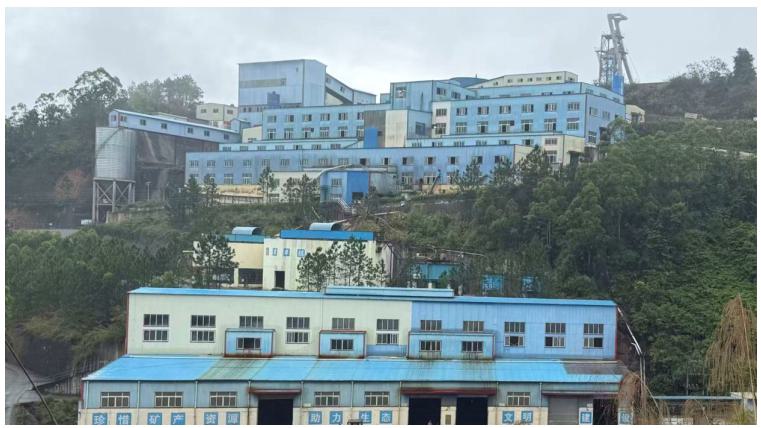
Plant Overview 2026
Copyright © 2026
SRK Consulting China Ltd. § SCN949_1GC § Apr. 20, 2026 § Effective Date: Dec. 31, 2025
Acknowledgments
SRK Consulting China Ltd. would like to acknowledge the support and collaboration provided by Gaocheng Mine and Sivercorp Metal Inc. personnel for this assignment, who are Guoliang Ma, P.Geo, (Geologist), Bingfei Lu (Geologist), Qiang Song (Processing), Yunqiang Huang (Finance), Winnie Wang (Finance), Baofu Mo (VP operation) and Yanlong Wang (General Manager). Their collaboration was greatly appreciated and instrumental to the success of this project.
SRK Consulting China Ltd. has prepared this document for Silvercorp Metals Inc., our client. Any use or decisions by which a third party makes of this document are the responsibility of such third parties. In no circumstance does SRK accept any consequential liability arising from commercial decisions or actions resulting from the use of this report by a third party.
The opinions expressed in this document have been based on the information available to SRK at the time of preparation. SRK has exercised all due care in reviewing information supplied by others for use on this project. While SRK has compared key supplied data with expected values, the accuracy of the results and conclusions from the review are entirely reliant on the accuracy and completeness of the supplied data. SRK does not accept responsibility for any errors or omissions in the supplied information, except to the extent that SRK was hired to verify the data.
Technical Report on Gaocheng Silver-Lead-Zinc Project in Guangdong Province, China
Contents § FINAL
Contents
| Useful Definitions | xiii |
| 1 | Summary | 1 |
| 1.1 | Introduction | 1 |
| 1.2 | Overview | 1 |
| 1.3 | Property Description and Ownership | 3 |
| 1.4 | Geology and Mineralization | 4 |
| 1.4.1 | History | 4 |
| 1.4.2 | Geological Setting and Mineralization | 4 |
| 1.4.3 | Deposit Types | 5 |
| 1.4.4 | Exploration and Data Management | 5 |
| 1.5 | Mineral Resource and Mineral Reserve Estimates | 6 |
| 1.6 | Development and Operations | 7 |
| 1.6.1 | Geotechnical and Hydrogeological Considerations | 7 |
| 1.6.2 | Mining Method | 7 |
| 1.6.3 | Recovery Method | 9 |
| 1.7 | Environmental Studies, Permitting and Social or Community Impact | 10 |
| 1.8 | Capital Cost and Operating Cost | 10 |
| 1.9 | Technical-Economic Analysis | 11 |
| 1.10 | Risk Assessment | 12 |
| 1.11 | Conclusions and Recommendations | 14 |
| 2 | Introduction | 16 |
| 2.1 | Purpose of the Report | 16 |
| 2.2 | Scope of Work | 16 |
| 2.3 | Work Program | 17 |
| 2.4 | Basis of Technical Report | 17 |
| 2.5 | Qualifications of SRK and SRK Team | 18 |
| 2.6 | Site Visit | 19 |
| 2.7 | Effective Date | 20 |
| 2.8 | Currency, Units and Year | 20 |
| 2.9 | Limitations, Declaration and Consent | 20 |
| 2.9.1 | Limitations | 20 |
| 2.9.2 | Legal Matters | 20 |
| 2.9.3 | Consent | 21 |
| 3 | Reliance on Other Experts | 22 |
| 4 | Property Description and Location | 23 |
| 4.1 | Ownership and Mining Permit | 23 |
| 4.2 | Permits and Authorization | 24 |
| 4.3 | Location | 24 |
| 4.4 | Environmental Considerations | 26 |
| 4.5 | Taxes and Royalties | 26 |
| 5 | Accessibility, Climate, Local Resources, Infrastructure, and Physiography | 27 |
| 6 | History | 28 |
| 6.1 | Ownership History | 28 |
| 6.2 | Exploration History | 28 |
| SRK CONSULTING CHINA LTD. § APR. 20, 2026 § FH/YZ, LN, NX, TC, HH/AT | IV |
Technical Report on Gaocheng Silver-Lead-Zinc Project in Guangdong Province, China
Contents § FINAL
| 6.3 | Production | 28 |
| 6.4 | Previous Mineral Resource Estimates | 29 |
| 7 | Geological Setting and Mineralization | 30 |
| 7.1 | Regional Geology | 30 |
| 7.2 | Property Geology | 31 |
| 7.3 | Mineralization | 32 |
| 8 | Deposit Types | 43 |
| 9 | Exploration | 44 |
| 9.1 | Surface Works | 44 |
| 9.2 | Underground Works | 45 |
| 10 | Drilling | 46 |
| 10.1 | Historical Drilling (Pre-2008) | 46 |
| 10.2 | Silvercorp Drilling (2008 – 2025) | 46 |
| 10.3 | Bulk Density | 50 |
| 11 | Sample Preparation, Analyses, and Security | 51 |
| 11.1 | Sampling | 51 |
| 11.2 | Sample Preparation and Analysis | 53 |
| 11.2.1 | ALS Guangzhou | 53 |
| 11.2.2 | GC Mine Laboratory | 54 |
| 11.2.3 | SGS Laboratory | 54 |
| 11.3 | Sample Shipment and Security | 55 |
| 11.4 | QA/QC | 56 |
| 11.4.1 | Monitoring Program | 56 |
| 11.4.2 | Certified Reference Materials | 56 |
| 11.4.3 | Blank Samples | 65 |
| 11.4.4 | Duplicate Samples | 68 |
| 11.4.5 | Check (Umpire) Samples | 73 |
| 12 | Data Verification | 78 |
| 12.1 | Site Visit | 78 |
| 12.2 | Summary | 80 |
| 13 | Mineral Processing and Metallurgical Testing | 81 |
| 13.1 | Introduction | 81 |
| 13.2 | Test Samples | 81 |
| 13.3 | Mineralogy | 81 |
| 13.3.1 | Chemical Components and Mineral Composition | 81 |
| 13.3.2 | Occurrence State | 82 |
| 13.4 | Processing Test | 86 |
| 13.4.1 | Lead-Zinc-Sulphur Sequential Flotation Test | 86 |
| 13.4.2 | Copper-Lead Separation Exploratory Test | 88 |
| 13.4.3 | Tin Recovery Test | 88 |
| 13.5 | Ore Pre-Sorting Test | 88 |
| 13.6 | Conclusions of Testing | 89 |
| 14 | Mineral Resource Estimates | 90 |
| 14.1 | Introduction | 90 |
| 14.2 | Estimation Procedures | 90 |
| SRK CONSULTING CHINA LTD. § APR. 20, 2026 § FH/YZ, LN, NX, TC, HH/AT | V |
Technical Report on Gaocheng Silver-Lead-Zinc Project in Guangdong Province, China
Contents § FINAL
| 14.3 | Database | 91 |
| 14.4 | Domain Modelling | 92 |
| 14.5 | Specific Gravity | 93 |
| 14.6 | Compositing | 93 |
| 14.7 | Evaluation of Outliers | 95 |
| 14.8 | Block Model and Grade Estimation | 101 |
| 14.9 | Model Validation | 101 |
| 14.10 | Mineral Resource Classification | 109 |
| 14.11 | Mineral Resource Statement | 111 |
| 14.12 | Grade Sensitivity Analysis | 112 |
| 14.13 | Previous Mineral Resource Estimate | 113 |
| 15 | Mineral Reserve Estimates | 114 |
| 15.1 | Introduction | 114 |
| 15.2 | Summary of Technical Study and Operation | 115 |
| 15.3 | Cut-off Grades | 115 |
| 15.4 | Modifying Factor | 117 |
| 15.4.1 | Mine Design Scope | 117 |
| 15.4.2 | Stopes Design | 118 |
| 15.4.3 | Dilution and Loss Summary | 118 |
| 15.5 | Mineral Reserve Estimates | 119 |
| 15.6 | Mineral Reserve Statement | 120 |
| 15.7 | Discussion on Potentially Impacts to Mineral Reserve Estimates | 121 |
| 16 | Mining Methods | 122 |
| 16.1 | Introduction | 122 |
| 16.2 | Operation and Product Rate | 122 |
| 16.3 | Geotechnical and Hydrogeology Considerations | 123 |
| 16.4 | Mine Design | 124 |
| 16.4.1 | Vertical Access | 125 |
| 16.4.2 | Horizontal Access | 125 |
| 16.4.3 | Expansion Plan for the third Phase | 126 |
| 16.5 | Material Movement | 126 |
| 16.6 | Stoping Method | 127 |
| 16.6.1 | Shrinkage Stoping | 127 |
| 16.6.2 | Resue Stoping | 129 |
| 16.6.3 | Overhand Cut and Fill | 130 |
| 16.6.4 | Stope Management and Grade Control | 132 |
| 16.7 | Mine Services | 133 |
| 16.7.1 | Ventilation | 133 |
| 16.7.2 | Water Supply | 135 |
| 16.7.3 | Dewatering | 135 |
| 16.7.4 | Power Supply | 136 |
| 16.7.5 | Compressed Air | 136 |
| 16.7.6 | Communications | 137 |
| 16.7.7 | Explosive Magazine | 137 |
| 16.7.8 | Maintenance Workshop | 137 |
| 16.8 | Mine Equipment and Machinery | 138 |
| 16.9 | Mine Safety | 140 |
| 16.9.1 | Fire Prevention | 140 |
| 16.9.2 | Mine Rescue | 141 |
| 16.9.3 | Emergency Egress | 141 |
| 16.9.4 | Mine Refuge Stations | 141 |
| SRK CONSULTING CHINA LTD. § APR. 20, 2026 § FH/YZ, LN, NX, TC, HH/AT | VI |
Technical Report on Gaocheng Silver-Lead-Zinc Project in Guangdong Province, China
Contents § FINAL
| 16.10 | Mine Personnel | 142 |
| 16.11 | Life of Mine Plan | 143 |
| 17 | Recovery Method | 147 |
| 17.1 | Introduction | 147 |
| 17.2 | Production Process | 147 |
| 17.3 | Processing Equipment | 150 |
| 17.4 | Production Records | 151 |
| 17.5 | Consumptions and Services | 152 |
| 17.5.1 | Reagent and Material Consumptions | 152 |
| 17.5.2 | Water Supply | 153 |
| 17.5.3 | Laboratory | 154 |
| 17.5.4 | Machine Maintenance | 155 |
| 18 | Project Infrastructure | 156 |
| 18.1 | Introduction | 156 |
| 18.2 | Tailings Storage Facility | 156 |
| 18.2.1 | Overview | 156 |
| 18.2.2 | Tailings Dam and Tailings Discharge | 157 |
| 18.2.3 | Flood Control and Drainage System and Return Water System | 158 |
| 18.3 | Waste Rock Dump | 159 |
| 18.4 | Backfill Plant | 159 |
| 18.5 | Power Supply | 161 |
| 18.6 | Access Road | 161 |
| 18.7 | Water Supply | 162 |
| 18.8 | Sewage Treatment | 162 |
| 18.9 | Water Treatment Facility | 162 |
| 18.10 | Site Communication | 162 |
| 18.11 | Dams and Tunnels | 162 |
| 18.12 | Surface Maintenance Workshop | 163 |
| 18.13 | Explosive Magazine | 163 |
| 18.14 | Fuel Farm | 163 |
| 18.15 | Camp and Building | 164 |
| 18.16 | Security and Gate House | 164 |
| 19 | Market Studies and Contracts | 165 |
| 19.1 | Commodity Prices | 165 |
| 19.2 | Concentrate Marketing | 166 |
| 19.3 | Operational Contracts | 167 |
| 20 | Environmental Studies, Permitting and Social or Community Impact | 168 |
| 20.1 | Review Objective | 168 |
| 20.2 | Review Process, Scope, and Standards | 168 |
| 20.3 | Permitting | 168 |
| 20.3.1 | Safety Production Permit | 168 |
| 20.3.2 | Water Use Permit | 169 |
| 20.3.3 | Pollutant Discharge Permit | 169 |
| 20.4 | Status of Environmental Approvals | 169 |
| 20.5 | Environmental and Social Aspects | 171 |
| 20.5.1 | Flora and Fauna | 171 |
| 20.5.2 | Water Management | 171 |
| 20.5.3 | Waste Rock and Tailings Management | 172 |
| SRK CONSULTING CHINA LTD. § APR. 20, 2026 § FH/YZ, LN, NX, TC, HH/AT | VII |
Technical Report on Gaocheng Silver-Lead-Zinc Project in Guangdong Province, China
Contents § FINAL
| 20.5.4 | Noise and Dust Emissions | 172 |
| 20.5.5 | Hazardous Substances Management | 173 |
| 20.5.6 | Occupational Health and Safety | 173 |
| 20.5.7 | Mine Closure and Rehabilitation | 174 |
| 20.5.8 | Social Considerations | 174 |
| 21 | Capital and Operating Costs | 175 |
| 21.1 | Capital Cost | 175 |
| 21.1.1 | Summary | 175 |
| 21.1.2 | Capitalization Development | 176 |
| 21.1.3 | Processing and Infrastructure Upgrades | 177 |
| 21.1.4 | Closure & Reclamation Capex | 177 |
| 21.2 | Operating Costs | 178 |
| 21.2.1 | Summary | 178 |
| 21.2.2 | Mining | 180 |
| 21.2.3 | Backfill Cost | 182 |
| 21.2.4 | Processing | 182 |
| 21.2.5 | Tailings Filtration | 183 |
| 21.2.6 | Selling, General and Administrative | 184 |
| 21.2.7 | Corporate Social Responsibility Opex | 184 |
| 22 | Economic Analysis | 185 |
| 22.1 | Principal Assumptions | 185 |
| 22.1.1 | LOM Physical | 185 |
| 22.1.2 | Pricing Assumptions | 186 |
| 22.1.3 | Tax and Royalties | 187 |
| 22.1.4 | Depreciation | 187 |
| 22.1.5 | Working Capital | 187 |
| 22.2 | DCF Projection | 187 |
| 22.3 | Sensitivity Analysis | 190 |
| 23 | Adjacent Properties | 191 |
| 24 | Other Relevant Data and Information | 192 |
| 25 | Interpretation and Conclusions | 195 |
| 25.1 | Geology | 196 |
| 25.2 | Data verification | 196 |
| 25.3 | Mineral Resource Estimation | 196 |
| 25.4 | Mining Method | 197 |
| 25.5 | Recovery Method | 197 |
| 25.6 | Environmental Studies, Permitting, and Social or Community Impact | 198 |
| 25.7 | Capital and Operating Costs | 198 |
| 25.8 | Economic Analysis | 198 |
| 26 | Recommendations | 199 |
| 27 | References | 200 |
| SRK CONSULTING CHINA LTD. § APR. 20, 2026 § FH/YZ, LN, NX, TC, HH/AT | VIII |
Technical Report on Gaocheng Silver-Lead-Zinc Project in Guangdong Province, China
Contents § FINAL
| Tables | ||
| Table 1.1: | Mineral Resource Statement for GC Mine, as of December 31, 2025 | 2 |
| Table 1.2: | Mineral Reserve Statement for GC Mine, as of December 31, 2025 | 3 |
| Table 1.3: | Key Operational Licences and Permits | 4 |
| Table 1.4: | Summary of LOM Schedule | 8 |
| Table 1.5: | Summary of Capex for GC Mine | 10 |
| Table 1.6: | Summary of Opex Historical & Forecasted for GC Mine | 11 |
| Table 1.7: | Estimated NPVs at Different Discount Rate | 12 |
| Table 1.8: | Risk Assessment | 13 |
| Table 2.1: | SRK Team Contributed to This Report | 18 |
| Table 4.1: | Mining Permit Corner Points of Property | 23 |
| Table 4.2: | Information of Mining Permit for GC Mine | 24 |
| Table 6.1: | Details of Historical Underground Workings | 28 |
| Table 6.2: | Historical Mineral Resource Estimates | 29 |
| Table 7.1: | Dimensions and Occurrences of the Mineralized Veins | 34 |
| Table 9.1: | Surface Exploration Programs Completed in 2008 | 44 |
| Table 9.2: | Record of Drilling 2001 – 2008 | 45 |
| Table 9.3: | Summary of Underground Tunnelling Works between 2012 and 2025 | 45 |
| Table 10.1: | Drilling Program Summary | 47 |
| Table 11.1: | ALS Chemex Laboratory Method and Detection Limits | 53 |
| Table 11.2: | Silvercorp GC Laboratory Detection Limits | 54 |
| Table 11.3: | SGS Laboratory Detection Limits | 55 |
| Table 11.4: | GC Mine QA/QC Samples by Year | 56 |
| Table 11.5: | Summary of CRMs(2024-2025) | 57 |
| Table 11.6: | Summary of GC Mine CRM Results (2024 - 2025) | 58 |
| Table 11.7: | GC Blank Fail Criteria | 66 |
| Table 11.8: | Summary of GC Blanks Results (2024 - 2025) | 66 |
| Table 11.9: | Summary of GC Duplicates Results (2024 - 2025) | 68 |
| Table 11.10: | Gaocheng Check (Umpire) Laboratories Used 2011 - 2025 | 73 |
| Table 11.11: | Results of Check Samples (2011-2025) | 74 |
| Table 11.12: | Summary of GC Umpire Checks Results (2024 - 2025) | 74 |
| Table 13.1: | Chemical Multi-Element Analysis Results of the Test Samples | 81 |
| Table 13.2: | Main Mineral Composition of the Test Samples | 82 |
| Table 13.3: | Phase Analysis Results of Silver | 83 |
| Table 13.4: | Phase Analysis of Tin | 84 |
| Table 13.5: | Results of the Lead-Zinc-Sulphur Flotation Closed-Circuit Process Test | 87 |
| Table 13.6: | Intelligent Pre-Sorting Test Results | 89 |
| Table 14.1: | Summary of Resource Database | 92 |
| Table 14.2: | Composites (Declustered Length Weighted) Statistics of the Selected 10 Veins | 94 |
| Table 14.3: | Statistics of Capping Data for the Selected 10 Veins | 95 |
| Table 14.4: | Block Model Summary | 101 |
| Table 14.5: | Specific Search Parameters | 101 |
| Table 14.6: | RPEEE Assumptions | 111 |
| Table 14.7: | Mineral Resource Statement for GC Mine, as of December 31, 2025 | 112 |
| Table 14.8: | Global Block Model Quantities and Grade, GC Mine at Various cut-off Grades. | 112 |
| Table 14.9: | Mineral Resources as of June 30, 2024 (at a cut-off of 120g/t AgEq) | 113 |
| Table 15.1: | Estimates for COGs | 115 |
| Table 15.2: | Estimates for Payable Factors | 116 |
| Table 15.3: | Estimates for Equivalent Factors of Pb and Zn to Ag | 117 |
| Table 15.4: | Long-Term Commodities Prices Applied to Estimates | 117 |
| SRK CONSULTING CHINA LTD. § APR. 20, 2026 § FH/YZ, LN, NX, TC, HH/AT | IX |
Technical Report on Gaocheng Silver-Lead-Zinc Project in Guangdong Province, China
Contents § FINAL
| Table 15.5: | Dilution and Loss Summary | 118 |
| Table 15.6: | Summary of Mineral Reserve Conversion Process | 119 |
| Table 15.7: | Mineral Reserve Statement for GC Mine, as of December 31, 2025 | 120 |
| Table 16.1: | Operation Results from FY2020 to FY2025 Q1 | 123 |
| Table 16.2: | Summary of General Details for Mine Access | 125 |
| Table 16.3: | ROM Percentage per Stoping Method | 127 |
| Table 16.4: | Mining Contractor Typical Key Equipment Summary | 138 |
| Table 16.5: | GC Mine’s Fixed Equipment Summary | 139 |
| Table 16.6: | Summary of LOM Schedule | 144 |
| Table 16.7: | Summary of LOM Schedule for Processing Plant | 146 |
| Table 17.1: | Main Processing Equipment of GC Processing Plant | 150 |
| Table 17.2: | Production Records of GC Processing Plant | 152 |
| Table 17.3: | Reagent and Material Consumptions in GC Processing Plant | 153 |
| Table 18.1: | Operation Record of Backfill Plant | 160 |
| Table 18.2: | Backfill Plan and Tailings Consumption | 161 |
| Table 19.1: | Commodity Price Assumptions for the Economic Analysis | 166 |
| Table 20.1: | Details of the Safety Production Permits for the GC Mine | 168 |
| Table 20.2: | Details of the Water Use Permit for the GC Mine | 169 |
| Table 20.3: | Details of the EIA Report and Approval for the GC Mine | 170 |
| Table 20.4: | Details of the WSCP Report and Approval for the GC Mine | 170 |
| Table 21.1: | Summary of LOM Capex for the GC Mine | 175 |
| Table 21.2: | Processing and Infrastructure Upgrade Capex | 177 |
| Table 21.3: | Closure & Reclamation Capex over Last Three Years | 178 |
| Table 21.4: | Summary of Opex Historical & Forecasted for GC Mine | 178 |
| Table 21.5: | Detailed Opex from Mining Contracts | 180 |
| Table 21.6: | Detailed Opex from Development Contracts | 180 |
| Table 21.7: | Breakdown of Mining Opex (in USD/t ROM) | 182 |
| Table 21.8: | Breakdown of Backfill Opex (in USD/t ROM) | 182 |
| Table 21.9: | Breakdown of Processing Opex (in USD/t feed) | 183 |
| Table 21.10: | Breakdown of Taillings Filtration Opex (in USD/t feed) | 183 |
| Table 21.11: | Breakdown of S&GA Opex (in USD/t feed) | 184 |
| Table 22.1: | LOM Physical Inputs for Economic-Analysis | 186 |
| Table 22.2: | Pricing Assumptions for Economic Analysis | 186 |
| Table 22.3: | LOM Key Economic Results | 188 |
| Table 22.4: | Cash Flow Forecast | 189 |
| Table 22.5: | Sensitivity Analysis Result (@8% Discount Rate) | 190 |
| Table 24.1: | Risk Assessment Matrix | 192 |
| Table 24.2: | Project Risk Assessment | 193 |
| Figures | ||
| Figure 4.1: | General Location Map of the Project | 25 |
| Figure 7.1: | Tectonic Geology Map of Southern China | 30 |
| Figure 7.2: | Regional Geological Map | 31 |
| Figure 7.3: | GC Property Geology Map | 32 |
| Figure 7.4: | The Distribution of Mineralized Veins and Fault Zones (Level -100 m) | 33 |
| Figure 7.5: | Ag-Zn-Pb Veins of the GC Mine (Level 0 m) | 34 |
| Figure 10.1: | Surface Drilling Location Map | 47 |
| Figure 10.2: | Location of Drillhole and Underground Samples (Level 0m) | 48 |
| Figure 10.3: | View of Drillhole and Underground Samples (Looking North) | 49 |
| Figure 10.4: | Underground Diamond Drilling Programme | 49 |
| Figure 10.5: | Measured Density vs Density Estimated by Linear Regression with Pb, Zn, Ag | 50 |
| SRK CONSULTING CHINA LTD. § APR. 20, 2026 § FH/YZ, LN, NX, TC, HH/AT | X |
Technical Report on Gaocheng Silver-Lead-Zinc Project in Guangdong Province, China
Contents § FINAL
| Figure 11.1: | Drill Core Cut in Half | 51 |
| Figure 11.2: | Underground Sampling | 52 |
| Figure 11.3: | Core Tray Storage | 55 |
| Figure 11.4: | CRMs Performances(2024-2025) | 61 |
| Figure 11.5: | Coarse Marble Blanks Performances(2024 - 2025) | 67 |
| Figure 11.6: | Pulp Blanks Performances(2024 - 2025) | 67 |
| Figure 11.7: | Scatter Plot of Field Duplicates | 68 |
| Figure 11.8: | Scatter Plot of Coarse Duplicates | 70 |
| Figure 11.9: | Scatter Plot of Pulp Duplicates | 71 |
| Figure 11.10: | Scatter Plot of Umpire Samples from 2024 to 2025 | 74 |
| Figure 11.11: | Q-Q Plot of Umpire Samples from 2024 to 2025 | 76 |
| Figure 12.1: | Tunnel Sampling and Core Store Shed of GC Mine | 78 |
| Figure 12.2: | Site Laboratory of the GC Mine | 79 |
| Figure 12.3: | Comparison between the Core Samples and the Drive Samples | 80 |
| Figure 13.1: | Disseminated Grain Size of Galena, Sphalerite and Cassiterite | 85 |
| Figure 13.2: | Lead-Zinc-Sulphur Flotation Closed-Circuit Test Flowsheet | 87 |
| Figure 14.1: | Drillholes and Underground Sampling Location | 91 |
| Figure 14.2: | Mineralized Veins Section | 92 |
| Figure 14.3: | Plan View of Mineralized Veins Display at Level 0 m (Purple: Biggest 10 Veins) | 93 |
| Figure 14.4: | Sampling Interval Histogram | 94 |
| Figure 14.5: | Histogram Plots for the Selected 10 Veins | 96 |
| Figure 14.6: | Swath Plot of Ag for the Selected 10 Veins | 102 |
| Figure 14.7: | Swath Plot of Pb for the Selected 10 Veins | 105 |
| Figure 14.8: | Swath Plot of Zn for the Selected 10 Veins | 107 |
| Figure 14.9: | Resource Classification for the Selected 10 Veins | 109 |
| Figure 14.10: | Grade-Tonnage Curve for GC, at Various Cut-off Grades | 113 |
| Figure 15.1: | Relationship Between Mineral Reserves and Mineral Resources | 114 |
| Figure 15.2: | Waterfall Chart of Mineral Reserve Conversion --Tonne | 119 |
| Figure 15.3: | Waterfall Chart of Mineral Reserve Conversion -- Contained Equivalent Silver | 120 |
| Figure 16.1: | Mine Design for GC Mine | 124 |
| Figure 16.2: | Plan View of Development and Veins - 150m RL | 126 |
| Figure 16.3: | Underground Access and Level Drive of GC Mine | 127 |
| Figure 16.4: | Typical Shrinkage Stope Layout | 128 |
| Figure 16.5: | Typical Resuing Stope Layout | 130 |
| Figure 16.6: | Typical OCAF Stope Layout | 131 |
| Figure 16.7: | Operation of OCAF Stope | 131 |
| Figure 16.8: | Stoping Management and Blasting Holes | 133 |
| Figure 16.9: | Pump and Power Stations at -300ASL | 136 |
| Figure 16.10: | Surface and Underground Workshops | 138 |
| Figure 16.11: | Permanent Refuge Station at -300ASL | 142 |
| Figure 16.12: | GC Mine Employees over Years | 143 |
| Figure 16.13: | ROM Schedule over LOM | 145 |
| Figure 16.14: | Development Schedule over LOM | 145 |
| Figure 16.15: | Processing Plant Schedule over LOM | 146 |
| Figure 17.1: | Photo of GC Processing Plant | 147 |
| Figure 17.2: | Production Process Flowsheet of GC Processing Plant | 148 |
| Figure 17.3: | Main Production Facility Photos of GC Processing Plant | 149 |
| Figure 17.4: | New Water Intake, Pumping and Purification Processing Facilities | 153 |
| Figure 17.5: | Photos of the GC Laboratory | 155 |
| Figure 18.1: | Part of Facilities of GC Mine | 156 |
| Figure 18.2: | Photos of Tailings Storage Facility | 157 |
| Figure 18.3: | Flowsheet of Backfill Plant | 159 |
| SRK CONSULTING CHINA LTD. § APR. 20, 2026 § FH/YZ, LN, NX, TC, HH/AT | XI |
Technical Report on Gaocheng Silver-Lead-Zinc Project in Guangdong Province, China
Contents § FINAL
| Figure 19.1: | Outlook for Silver, Lead and Zinc Prices by CMF | 165 |
| Figure 21.1: | Capex Investment Plan over LOM | 176 |
| Figure 21.2: | Capitalization Development over the LOM | 176 |
| Figure 21.3: | Pie Chat of Percentage for GC Mine Opex | 179 |
| Figure 21.4: | Opex for historical three year (in USD k) | 179 |
| Figure 22.1: | Cash Flow Profile | 188 |
| Figure 22.2: | GC Mine NPV versus Discount Rate | 188 |
| Figure 22.3: | Sensitivity Spider Chart (8% Discount Rate) | 190 |
| Figure 23.1: | Zonation of Mineralization in the Daganshan Mineralization Field | 191 |
Appendices
| Appendix A | Mining Permit |
| Appendix B | Business License |
| Appendix C | High-Tech Enterprise Certificate |
| Appendix D | Water Use Permit |
| Appendix E | Safety Production Permits |
| SRK CONSULTING CHINA LTD. § APR. 20, 2026 § FH/YZ, LN, NX, TC, HH/AT | XII |
Technical Report on Gaocheng Silver-Lead-Zinc Project in Guangdong Province, China
Useful Definitions § FINAL
Useful Definitions
| Abbreviation | Terminology |
| % | Percent/percentage |
| / | Per |
| ′ | Minute of arc |
| ° | Degree(s) of arc |
| °C | Degree(s) Centigrade |
| 3D | Three-dimensional |
| AAS | Atomic absorption spectroscopy |
| AER | Annual Environmental Report |
| Ag | The chemical symbol for silver |
| AgEq | Equivalent Ag grade, considered Pb and Zn grades after applying the equivalent factors. |
| ALS | ALS Chemical Assaying Laboratory in Guangzhou, China |
| AMC | AMC Mining Consultants (Canada) Ltd. |
| ARD | Acid rock drainage |
| As | The chemical symbol for arsenic |
| ASL | Above sea level |
| Au | The chemical symbol for gold |
| AusIMM | Australasian Institute of Mining and Metallurgy |
| B.Eng. | Bachelor of Engineering |
| B×H | Breadth × height |
| BD | Bulk density |
| Bi | The chemical symbol for bismuth |
| BVI | British Virgin Island |
| Canadian NI 43-101 | National Instrument 43-101, which is a national instrument for the (Canadian) Standards of Disclosure for Mineral Projects, including Companion Policy 43-101 as amended from time to time. |
| Capex | Capital expenditure and/or cost |
| CIM | Canadian Institute of Mining, Metallurgy and Petroleum |
| CIM Definition Standards | The Definition Standards on Mineral Resources and Mineral Reserves adopted by CIM |
| cm | Centimetre(s) |
| CMF | Consensus Market Forecasts |
| CMP | Composite(s) |
| COG | Cut-off grade, the grade threshold above which a mineral material is considered potentially economic and is selectively mined and processed as ore |
| Conc. | Concentrate |
| CoV | Coefficient of Variation |
| CP | Competent Person |
| SRK CONSULTING CHINA LTD. § APR. 20, 2026 § FH/YZ, LN, NX, TC, HH/AT | XIII |
Technical Report on Gaocheng Silver-Lead-Zinc Project in Guangdong Province, China
Useful Definitions § FINAL
| Abbreviation | Terminology |
| CPR | Competent Person’s Report |
| CSA | Compensations for sulfuric acid |
| CSR | Corporate social responsibility costs |
| CSV | Comma-separated values |
| Cu | The chemical symbol for copper |
| DA | Depreciation and amortization |
| DCF | Discounted cash flow |
| DNR of Guandong | Department of Natural Resources of Guangdong Province |
| Dr | Doctor of Philosophy |
| ECAP | Environmental Corrective Action Plan |
| EIA | The Environmental Impact Assessment |
| EPMP | Environmental Protection and Management Plan |
| ESHS | Environmental, Social, Health and Safety |
| etc. | et cetera (= and so on) |
| FA | Fire Assay |
| FAusIMM | Fellow of the AusIMM |
| FS | Feasibility study |
| g | Gram(s) |
| g/t | Gram(s) per tonne |
| GC | Gaocheng |
| GMADI | Guangdong Metallurgical & Architectural Design Institute |
| GPS | global positioning system |
| H1 2024 | the first half of 2024 |
| H2 2024 | the second half of 2024 |
| ha | hectare(s) |
| HQ core | core diameter of 63.5 mm |
| i.e. | id Est (= that is) |
| ICP | Inductively coupled plasma |
| ICP-OES | Inductively Coupled Plasma - Optical Emission Spectrometer |
| ID3 | inverse distance power of three |
| IDW | inverse distance squared |
| IFC | International Finance Corporation |
| Indicated Mineral Resource | An Indicated Mineral Resource is that part of a mineral resource for which tonnage, densities, shape, physical characteristics, grade and mineral content can be estimated with a reasonable level of confidence. It is based on exploration, sampling and testing information gathered through appropriate techniques from locations such as outcrops, trenches, pits, workings and drill holes. The locations are too widely or inappropriately spaced to confirm geological and/or grade continuity but are spaced closely enough for continuity to be assumed |
| SRK CONSULTING CHINA LTD. § APR. 20, 2026 § FH/YZ, LN, NX, TC, HH/AT | XIV |
Technical Report on Gaocheng Silver-Lead-Zinc Project in Guangdong Province, China
Useful Definitions § FINAL
| Abbreviation | Terminology |
| Inferred Mineral Resource | An Inferred Mineral Resource is that part of a mineral resource for which tonnage, grade and mineral content can be estimated with a low level of confidence. It is inferred from geological evidence and assumed but not verified geological and/or grade continuity. It is based on information gathered through appropriate techniques from locations such as outcrops, trenches, pits, workings, and drill holes which may be limited or of uncertain quality and reliability |
| Intertek | Intertek Laboratory in Beijing |
| IP | Induced Polarisation, which is an exploration technique whereby an electrical current is pulsed through the ground and the response from the sub surface measured in order to identify minerals of interest. Strong IP responses may be a result of sulphide which may be associated with gold mineralization |
| IPO | Initial Public Offering |
| IRR | internal rate of return |
| JORC Code | Australasian Code for Reporting of Exploration Results, Mineral Resources and Mineral Reserves, 2012 edition, as published by the Joint Mineral Reserves Committee. |
| JORC Committee | Joint Mineral Reserves Committee of The Australasian Institute of Mining and Metallurgy, Australian Institute of Geoscientists and Minerals Council of Australia |
| kg | kilogram(s), equivalent to 1,000 grams |
| kg/t | kilogram(s) per tonne |
| km | kilometre(s), equivalent to 1,000 metres |
| km2 | square kilometre(s) |
| koz | 1,000 troy ounces |
| kt | kiloton(s) |
| ktpa | kiloton(s) per annum |
| kV | kilovolt(s) |
| kW | kilowatt(s) |
| kWh/t | kilowatt(s) hour per tonne |
| L×B×H | length × breadth × height |
| LHD | load-haul-dump machine |
| LOM | life of mine |
| m | metre(s) |
| M | Million(s) |
| m ASL | metre(s) above sea level |
| M.Eng. | Master of Engineering |
| M.Sc. | Master of Science |
| m/kt | metre(s) per kiloton |
| m/s | metre(s) per second |
| m2 | square metre(s) |
| m3 | cubic metre(s) |
| m3/d | cubic metre(s) per day |
| SRK CONSULTING CHINA LTD. § APR. 20, 2026 § FH/YZ, LN, NX, TC, HH/AT | XV |
Technical Report on Gaocheng Silver-Lead-Zinc Project in Guangdong Province, China
Useful Definitions § FINAL
| Abbreviation | Terminology |
| m3/s | cubic metre(s) per second |
| m3/t | cubic metre(s) per tonne |
| m3/year | cubic metre(s) per year |
| MAusIMM | Member of the AusIMM |
| Measured Mineral Resource | A Measured Resource is that part of a mineral resource for which tonnage, densities, shape, physical characteristics, grade and mineral content can be estimated with a high level of confidence. It is based on detailed and reliable exploration, sampling and testing information gathered through appropriate techniques from locations such as outcrops, trenches, pits, workings and drill holes |
| mg/l | milligram(s) per litre |
| mg/m3 | milligram(s) per cubic metre |
| MI | Measured + Indicated Categories Mineral Resources |
| Mineral Reserve | The economically mineable part of a measured and/or indicated mineral resource. It includes diluting materials and allowances for losses which may occur when the material is mined. Appropriate assessments and studies have been carried out and include consideration of and modification by realistically assumed mining, metallurgical, economic, marketing, legal, environmental, and social and government factors, as defined in the CIM Definition Standards. These assessments demonstrate at the time of reporting that extraction could reasonably be justified. Mineral Reserves are sub-divided in order of increasing confidence into Probable Mineral Reserves and Proven Mineral Reserves. |
| Mineral Resources | A concentration or occurrence of material of intrinsic economic interest in or on the earth’s crust in such form, quality and quantity that there are reasonable prospects for eventual economic extraction, as defined in the CIM Definition Standards. The location, quantity, grade, geological characteristics and continuity of a mineral resource are known, estimated or interpreted from specific geological evidence and knowledge |
| mm | millimetre(s) |
| Mo | The chemical symbol for molybdenum |
| Moz | Million ounce(s) |
| Mr | Mister |
| mRL | Meter(s) relative level to sea level |
| MW | Megawatt(s), equivalent to 1,000,000 watts |
| NCF | net cash flow |
| NI 43-101 | Canadian National Instrument 43-101 |
| NPV | net present value |
| NQ core | core diameter of 47.6 mm |
| O.K. | Ordinary Kriging |
| OHS | occupational health and safety |
| Opex | operating cost |
| oz | ounce |
| Pb | The chemical symbol for lead |
| PEA | Preliminary Assessment Technical Report |
| pH | potential of hydrogen |
| SRK CONSULTING CHINA LTD. § APR. 20, 2026 § FH/YZ, LN, NX, TC, HH/AT | XVI |
Technical Report on Gaocheng Silver-Lead-Zinc Project in Guangdong Province, China
Useful Definitions § FINAL
| Abbreviation | Terminology |
| Ph.D. | Doctor of Philosophy |
| ppb | part(s) per billion |
| PRC | People’s Republic of China |
| Probable Mineral Reserve | A Probable Mineral Reserve is the economically mineable part of an Indicated, and in some circumstances Measured Resource. It includes diluting materials and allowances for losses which may occur when the material is mined. Appropriate assessments, which may include feasibility studies, have been carried out, and include consideration of and modification by realistically assumed mining, metallurgical, economic, marketing, legal, environmental, social and governmental factors. These assessments demonstrate at the time of reporting that extraction could reasonably be justified |
| Proven Mineral Reserves | A Proven Mineral Reserve is the economically mineable part of a Measured Resource. It includes diluting materials and allowances for losses which may occur when the material is mined. Appropriate assessments, which may include feasibility studies, have been carried out, and include consideration of and modification by realistically assumed mining, metallurgical, economic, marketing, legal, environmental, social and governmental factors. These assessments demonstrate at the time of reporting that extraction could reasonably be justified. |
| QA/QC | Quality Assurance/ Quality Control |
| QMS | Quality Management System |
| QP | Qualified Person |
| QPR | Qualified Person’s Report |
| RMB | Renminbi, which is the official currency of the People’s Republic of China. |
| ROM | run-of-mine |
| RTK | real-time kinematic |
| S | The chemical symbol for Sulfur |
| SBX | Sodium butyl xanthate |
| SD | standard deviations |
| SG | specific gravity |
| SGS Tianjin | SGS Laboratory in Tianjin, China |
| Silvercorp | Silvercorp Metals Inc. |
| Sn | The chemical symbol for Tin |
| SRK, SRK CN | SRK Consulting China Ltd. trading as SRK Consulting |
| Stock Exchange, HKEX | The Stock Exchange of Hong Kong Limited |
| t | tonne(s), equivalent to 1,000kg |
| t/hr | tonne(s) per hour |
| t/m3 | tonne(s) per cubic metre |
| tpa | tonne(s) per annum |
| tpd | tonne(s) per day |
| tph | tonne(s) per hour |
| TSF | tailings storage facility |
| SRK CONSULTING CHINA LTD. § APR. 20, 2026 § FH/YZ, LN, NX, TC, HH/AT | XVII |
Technical Report on Gaocheng Silver-Lead-Zinc Project in Guangdong Province, China
Useful Definitions § FINAL
| Abbreviation | Terminology |
| TSX | Toronto Stock Exchange |
| TSXV | TSX Venture Exchange |
| USc | United States cent |
| USD, US$ | United States Dollar |
| USGS | United States Geological Survey |
| Valmin Code | Code for Technical Assessment and Valuation of Mineral and Petroleum Assets and Securities for Independent Expert Reports |
| VAT | value-added tax |
| W | The chemical symbol for tungsten |
| WRD | waste rock dump |
| WSCP | Water and Soil Conservation Plan |
| Zn | The chemical symbol for zinc |
| μm | micron(s), 1/1,000 of a millimetre |
| SRK CONSULTING CHINA LTD. § APR. 20, 2026 § FH/YZ, LN, NX, TC, HH/AT | XVIII |
Technical Report on Gaocheng Silver-Lead-Zinc Project in Guangdong Province, China
Summary § FINAL
| 1 | Summary |
| 1.1 | Introduction |
SRK Consulting China Limited (“Ltd.”) (“SRK”) was requested by Silvercorp Metals Inc. (“SVM” or “Silvercorp”) to prepare a Qualified Person’s Report (“QPR” or Competent Person’s Report, “CPR”)) for Gaocheng (“GC”) Silver-Lead-Zinc Project (the “GC Project”), located in Yunfu City of Guangdong Province, People’s Republic of China (the “PRC” or “China”) in compliance with the requirements of Canadian National Instrument 43-101 (the “NI 43-101”) and the Rules Governing the Listing of Securities on The Stock Exchange of Hong Kong Limited (the “Listing Rules”) for the listing by Silvercorp Metals Inc., who indirectly owns 99% of GC Mine.
This QPR or CPR is an independent review of the GC Mine’s geology, exploration, Mineral Resources, Mineral Reserves, mining, mineral processing, capital investment, operating cost, and environmental and social aspects.
The scope of work includes the review the Mineral Resources estimates, modifying factors for Mineral Reserve conversion, operation records and mining operations of the GC Mine as of the effective date of the report, conducting site visit by the Qualified Persons, and preparation of the QPR in compliance with the NI 43-101 and the Listing Rules.
The Mineral Resource statement reported herein is a collaborative effort between GC Mine, SVM and SRK personnel.
The exploration database was compiled and maintained by GC Mine and was reviewed by SRK. The geological model and wireframes defining the mineralization were constructed by SVM in December 2025, In SRK’s opinion, the geological model is a reasonable representation of the distribution of the targeted mineralization at the current level of sampling.
The statistical analysis, block model(s) and grade estimate were constructed by SRK, between January and February 2026.
Based on the Mineral Resource estimates and model(s), the mine plan and operation practices, GC Mine converted the qualified Mineral Resources into Mineral Reserves and scheduled the productions of the mine under SRK’s review. SRK updated the technical-economic analysis to demonstrate the project economic viability for perspective operation.
| 1.2 | Overview |
GC Mine, 99% owned by SVM, in the vicinity of Gaocheng village, Gaocun Township, Yun’an District, Yunfu City, Guangdong Province, which is accessed from Guangzhou, the capital of Guangdong Province, is via a 178 kilometer (“km”), four-lane express highway to Yunfu, then a 48 km of paved road to the Project.
The poly-metallic mineralization of the GC deposits belongs to the mesothermal vein infill style of deposit, with silver, lead and zinc elements for commercial extraction.
The Mine is an operating underground mine (“UG”), with related facilities and infrastructure that are suitable and constructed for supporting the operation, and necessary regulation permits and licenses.
| SRK CONSULTING CHINA LTD. § APR. 20, 2026 § FH/AT | 1 |
Technical Report on Gaocheng Silver-Lead-Zinc Project in Guangdong Province, China
Summary § FINAL
The GC Mine is a producing UG Mine applying decline (ramp) and shaft hybrid access method and shrinkage, resuing and overhand cut and fill mining methods, to produce plant feed ore since Q2 2014. The GC processing plant has a nominate capacity of 330 thousand tonnes per annual (“ktpa”) feed ore to produce commercial lead concentrate and zinc concentrate.
SRK has worked on the GC Mine since November 2025, conducted data verification programs and carried out quality assurance and quality control (“QA/QC”) programs on drill hole information. SRK reviewed the active database and economic and technical parameters provided by GC Mine and SVM and opined the estimation of Mineral Resources is reasonable.
The Mineral Resource statements for GC Mine are shown in Table 1.1.
Table 1.1: Mineral Resource Statement for GC Mine, as of December 31, 2025
| Resource Classification | Tonnes | Ag (g/t) | Pb (%) | Zn (%) | Contained Metal | ||
| (Mt) | Ag (koz) | Pb(kt) | Zn(kt) | ||||
| Measured | 8.97 | 66 | 1.01 | 2.44 | 19,091 | 91 | 219 |
| Indicated | 9.30 | 64 | 0.82 | 2.04 | 19,180 | 76 | 190 |
| Measured+Indicated | 18.28 | 65 | 0.91 | 2.24 | 38,271 | 167 | 408 |
| Inferred | 7.36 | 75 | 0.84 | 1.91 | 17,729 | 62 | 140 |
Sources: GC Mine, SRK summarized
Notes:
| 1 | Mineral Resource Statement as of December 31, 2025. | |
| 2 | Source: Silvercorp Metals Inc., Verified by SRK | |
| 3 | Mineral Resource are reported at a cut-off grade of 80 gram per tonne (“g/t”) AgEq. | |
| 4 | The totals may not compute exactly due to rounding. | |
| 5 | The veins within the sub-surface/ 5m below surface are not included in the Mineral Resource estimate | |
| 6 | The price refers to the long-term prediction published by Consensus Market Forecasts in Q4 2025 | |
| 7 | AgEq = Ag+28.74*Pb+33.53*Zn. |
The mine plan prepared by GC Mine is based on the eligible Mineral Resource, that are Measure and Indicated categories (“MI”) and generates an 18 year life of mine (“LOM”) for the GC Mine at a production rate of about 370 ktpa run of mine (“ROM”), which was converted to Mineral Reserve after considering and applying the modifying factors.
GC Mine could be scheduled for more than 25 years based on eligible Measured and Indicated categories Resources (9.32 million tonnes (“Mt”)), primarily driven by: increases or upgrades in the Mineral Resources resulting from exploration investment; reductions in cut-off grade (“COG”) due to higher metal prices; and planned development of deeper Mineral Resources. After accounting for the tailings used in backfilling, total tailings generation, and the remaining tailing storage facility (“TSF”) capacity, the mine schedule has been shortened to 18 years to match the mine’s TSF remaining capacity.
SRK is of the view that the project’s Mineral Resources present an opportunity to extend the mine life; however, a TSF expansion study or the design of a second TSF will be required at an appropriate stage.
The capital costs and operating costs provided to SRK, were matched production capacity and the current economic conditions. The economic analysis results demonstrate the economic viability of GC Mine.
| SRK CONSULTING CHINA LTD. § APR. 20, 2026 § FH/AT | 2 |
Technical Report on Gaocheng Silver-Lead-Zinc Project in Guangdong Province, China
Summary § FINAL
Based on the SRK’s review, the key assumptions and projection using discount cash flow modelling, the GC Mine has a net present value (the “NPV”) of US Dollar (the “USD”) 101.4 million at a discount rate of 8%.
The economically mineable parts of the Measured and Indicated Mineral Resources within the designed stopes, including diluting materials and allowance for losses, were classified as Proven and Probable Mineral Reserves, respectively. The Mineral Reserve is estimated based on the reference point being the primary crusher or temporary stockpile at the crusher feed. The Mineral Reserve statement for GC Mine is shown in Table 1.2.
Table 1.2: Mineral Reserve Statement for GC Mine, as of December 31, 2025
| Category | Tonnes | Ag | Pb | Zn | Contained Metal | ||
| (Mt) | (g/t) | (%) | (%) | Ag (koz) | Pb (kt) | Zn (kt) | |
| Proven | 3.57 | 59 | 0.96 | 2.27 | 6,789 | 34 | 81 |
| Probable | 2.62 | 67 | 0.84 | 2.17 | 5,673 | 22 | 57 |
| Total | 6.19 | 63 | 0.91 | 2.23 | 12,462 | 56 | 138 |
Sources: GC Mine, SRK summarized
Notes:
| 1 | Any differences between totals and sum of components are due to rounding. | |
| 2 | 100 g/t AgEq and 130 g/t AgEq COG was applied to Shrinkage (including overhand cut & fill) and resuing stopes, respectively. | |
| 3 | The COG estimates are based on the forecast prices 31 USD/oz silver, 2,000 USD/t lead, and 2,800 USD/t zinc. | |
| 4 | The Mineral Reserves are reported on a metric dry tonne basis. | |
| 5 | The Mineral Reserves are reported at the reference point of ROM stockpile before crushing or directly crushing. | |
| 6 | The Mineral Reserves are effective as of December 31, 2025. |
| 1.3 | Property Description and Ownership |
The GC mine is located in the vicinity of Gaocheng Village of Gaocun Township, Yun’an District, Yunfu City, Guangdong Province, China. Altitudes in the region range from 78 to 378 meter (“m”) above sea level (“ASL”), usually 150 to 250 m ASL, with relative differences of 50 to 150 m. Vegetation is in the form of secondary forests of pine and hardwoods, bushes, and grasses. Topsoil covers most of the ground. Outcrops of bedrocks can only be observed in valleys.
The region belongs to a sub-tropical monsoon climate zone with average annual temperature of 20 – 22 degree Celsius (“°C”). Rainfall is mainly concentrated in spring and summer from March to August. Winters feature short periods of frosting. The GC Mine is able to operate year-round.
In 2008, SVM acquired 100% of the shares of Yangtze Gold Ltd. (“Yangtze Gold”), a private British Virgin Island (“BVI”) company, which in turn wholly owns Yangtze Mining Ltd. (“Yangtze Mining”).
Guangdong Found Mining Co. Ltd. (China), (“Guangdong Found”), is the designated joint venture operating company of the GC Mine. Yangtze Mining (H.K.) Ltd. (“Yangtze Mining HK”), a wholly owned subsidiary of Yangtze Mining, owns 95% of Guangdong Found.
In October 2018, Silvercorp Metals (China) Inc., a wholly owned subsidiary of SVM, acquired an additional 4% equity interest in Guangdong Found, and as a result, the SVM now beneficially owns a 99% interest in Guangdong Found, who has a 100% beneficial interest in GC Mine.
GRT Mining Investment (Beijing) Co., Ltd. is a 1% equity interest holder of Guangdong Found.
| SRK CONSULTING CHINA LTD. § APR. 20, 2026 § FH/AT | 3 |
Technical Report on Gaocheng Silver-Lead-Zinc Project in Guangdong Province, China
Summary § FINAL
Table 1.3 summarises the status of key operational licences and permits for GC Mine. SRK has reviewed the information provided and is satisfied that the extent of the properties described in the various rights are consistent with the maps and diagrams received from GC Mine.
Table 1.3: Key Operational Licences and Permits
| Holder | Business Licence |
Mining Licences |
Safety
Production Permits |
Land/Forest
Use Permit |
Water
Use Permit |
Site
Discharge Permit |
| GC Mine | Y | Y | Y | Y | Y | Y |
Notes: “Y” denotes the licence/permit is granted and has been sighted by SRK.
| 1.4 | Geology and Mineralization |
| 1.4.1 | History |
Prior to Yangtze Mining Ltd. acquiring the then project in 2005, illegal mining activity resulted in the excavation of several tunnels and small-scale mining of veins. In 2008, SVM acquired a 100% interest in the shares of Yangtze Gold which in turn wholly owned the entirety of Yangtze Mining.
The GC Mine was discovered in 1959 by traditional prospecting methods. From 1959 to 2007, Geophysical Survey Brigade of Guangdong Bureau of Geology and Mineral Resources and Guangdong Provincial Institute of Geological Survey (“GIGS”) conducted the exploration work on the GC Mine, and SVM started the exploration work from 2008, while detailed systematic drilling commenced in 2011 and has been on-going.
Prior to Yangtze Mining acquiring the Property, illegal mining activity resulted in the excavation of several tunnels and small-scale mining of veins; V2, V2-2, V3, V4, V5, V6, and V10. GIGS reported that a total of 1,398 m of excavation comprised of 10 adits and tunnels had been completed on the Property through the illegal activity.
Since 2008, six Mineral Resource estimates for the GC Mine have been documented by AMC Mining Consultants (Canada) Ltd. (“AMC”) following the Canadian Institute of Mining, Metallurgy and Petroleum (“CIM”) Definition Standards.
| 1.4.2 | Geological Setting and Mineralization |
The Project is located on the east margin of the Luoding basin, east of the Wuchuan – Sihui major fault within the north portion of the Yunkai uplift of the South China Orogenic Belt. Basement geology in the area comprises late Proterozoic Sinian sedimentary clastics and carbonate rocks; Palaeozoic (Ordovician, Silurian, Devonian, Carboniferous) sedimentary clastics and carbonate rocks; and Mesozoic (Triassic) coal-bearing clastic rocks and Cretaceous red clastic rocks. Silver (“Ag”)-lead (“Pb”)-zinc (“Zn”) polymetallic deposits occur within late Proterozoic rocks. Copper (“Cu”)-Pb-Zn, manganese (“Mn”), and gold (“Au”)-Ag deposits occur within Paleozoic rocks.
The majority of Ag-Zn-Pb mineralization is hosted by the Mesozoic granite. The granite dips south and strikes west north-west, parallel to the majority of mineralized veins on the GC property.
| SRK CONSULTING CHINA LTD. § APR. 20, 2026 § FH/AT | 4 |
Technical Report on Gaocheng Silver-Lead-Zinc Project in Guangdong Province, China
Summary § FINAL
Ag-Pb-Zn mineralization at the GC deposit can be divided into two types: primary and oxidized. The primary mineralization is mainly composed of galena-sphalerite-silver minerals, which occur sparsely, as disseminations, veinlets, and lumps. Primary mineralization accounts for 95% of the entire Mineral Resource. Oxide mineralization occurs on and near the surface. Alteration minerals associated with the GC vein systems include quartz, sericite, pyrite, and chlorite, together with clay minerals and limonite. Silicification commonly occurs near the centre of the veins. Chlorite and sericite occur near and slightly beyond the vein margins.
| 1.4.3 | Deposit Types |
The poly-metallic mineralization of the GC deposit belongs to the mesothermal vein infill style of deposit.
| 1.4.4 | Exploration and Data Management |
Various state-sponsored Chinese Geological Brigades and companies have conducted geological and exploration work in the Project area.
During 2001 and 2002, and again in 2004 and 2005, GIGS conducted general prospecting at the GC Mine area and defined some mineralized bodies and estimated Mineral Resources for the GC deposit.
From 2006 to 2007, GIGS conducted detailed prospecting at the GC Mine area, and completed a 36-hole, 11,470 m surface diamond drilling program and 1,964 cubic meter (“m3”) of trenching and surface stripping to update and upgrade the Mineral Resources of the GC deposit.
In 2008, SVM completed a surface exploration program including soil sampling, geological mapping, and trenching. After 2008, SVM continued the underground tunnelling and sampling at the Property Area.
All SVM drilling from 2008 to 2025 was conducted using NQ-sized core (47.6 mm diameter core), with all drill programs managed by SVM. Drillhole collars were surveyed using a total station, and downhole surveys were completed every 50 m using a Photographical Inclinometer manufactured by Beizheng Weiye Science and Technology Co. Ltd. (Chinese equivalent of the Sperry-Sun downhole survey tool). After the completion of drilling, surface drillhole collars were cemented closed, and the locations were marked with concrete blocks measuring 50 x 30 x 20 centimeter (“cm”). Core recoveries from SVM's drilling programs ranged from 35.66% to 100.00%, with an average recovery rate of 99.36%. A review of the relationship between grade and core recovery showed no bias.
From 2008, SVM continued the underground tunnelling and sampling at the GC Mine. Details of drill programs completed between 2008 and 2025 are presented in Section 5 of this report.
Channel sampling was conducted at 5 m intervals across mineralized vein structures in the adits, with wider spacing (15 or 25 m) in non-mineralized sections. Each channel comprised multiple chip samples taken across the mineralization and wallrocks.
All data for the GC Mine is stored within a central Microsoft Access Database, which is managed by two designated database administrators. Drillhole data is collected in Microsoft Excel software and imported into the Access database software. Underground mapping is recorded on grid paper and in Excel and then imported into Access or Micromine 3D software.
| SRK CONSULTING CHINA LTD. § APR. 20, 2026 § FH/AT | 5 |
Technical Report on Gaocheng Silver-Lead-Zinc Project in Guangdong Province, China
Summary § FINAL
SVM has established QA/QC procedures which cover sample collection and processing at the GC Mine. These QA/QC protocols have been progressively refined since 2011. Certified Reference Materials (“CRMs”) and coarse blanks have been included with drilling samples since 2011, and with underground samples since 2014. Field duplicates have been included with drilling samples since 2012 and with underground samples since 2014. Check (umpire) samples (pulp duplicates) have been sent to a separate ‘umpire’ laboratory since 2012.
In 2018, SVM further improved their QA/QC protocols to include regular and more frequent submission of CRMs, coarse blanks, and field duplicates with drilling and underground samples. Coarse reject duplicates and pulp duplicates were also incorporated into drill sampling programs. The proportion of check samples, sent to a different laboratory was also increased. In 2019, SVM initiated real-time monitoring of QA/QC protocols.
SRK has reviewed QA/QC data collected to date. Except for a small portion of data missing, all the data collected shows reasonable analytical accuracy and precision. SRK considers the GC Mine Mineral Resource database acceptable for Mineral Resource estimation.
| 1.5 | Mineral Resource and Mineral Reserve Estimates |
The database, estimation domains of GC Mine was completed by SVM Resource Geologists . Mr. Huaixiang (Hubert) Li (Member of the Australian Institute of Geoscientists, (“MAIG”)), Senior Geologist and Ms. Yanfang Zhao, Principal Geologists (MAIG), both full-time employees of SRK have reviewed the database, estimation domains and are satisfied that they comply with reasonable industry practice. SRK has generated the block models, performed the grade estimation and prepared the Mineral Resource estimate work.
The Qualified Person (“QP”) responsible for the Mineral Resources are Mr. Huaixiang Li (MAIG #8667) and Ms. Yanfang Zhao (MAIG #10796). Mr. Huaixiang Li and Ms. Yanfang Zhao, visited the GC Mine between the 28 and 29 of April 2026.
The estimates are based on drilling samples and underground samples information available up to December 2025. With respect to drilling and underground sample information available for the December 2025 Mineral Resource estimates, SRK believes the current drilling and channel sampling information is sufficiently reliable to interpret with confidence the boundaries for GC deposits and that the assay data is sufficiently reliable to support the Mineral Resource estimation.
The location, quantity, grade or quality, continuity and other geological characteristics of a Mineral Resource are known, estimated, or interpreted from specific geological evidence and knowledge, including sampling. SRK considers that the majority of the GC Mine is amenable for underground mining.
Within the current mining License area, as of December 31, 2025, the GC Mine, above a COG of 80g/ t equivalent silver grade (“AgEq”) [AgEq, considered Pb and Zn grades after applying the equivalent factors. AgEq = Ag+28.74*Pb+33.53*Zn], there are 18.28 Mt of Measured and Indicated Mineral Resources at an average grade of 65 gram per tonne (“g/t”) Ag, 0.91% Pb, 2.24% Zn; and 7.36 Mt of Inferred Mineral Resources at an average grade of 75 g/t Ag, 0.84% Pb, 1.91% Zn.
The Mineral Reserve estimation work was completed by Mr. Falong Hu, Principal Mining Engineer, Fellow of the Australasian Institute of Mining and Metallurgy (“FAusIMM”), a full-time employee of SRK, based on the review of modifying factors supplied by GC Mine and the mine plan by Mr Chengsen Lin, Mining Engineer of GC Mine,.
| SRK CONSULTING CHINA LTD. § APR. 20, 2026 § FH/AT | 6 |
Technical Report on Gaocheng Silver-Lead-Zinc Project in Guangdong Province, China
Summary § FINAL
The modifying factors relevant to metallurgical and processing are relied on the opinions from Mr. Lanliang Niu, Principal Processing Engineer, member of the AusIMM (“MAusIMM”), a full-time employee of SRK; the modifying factors relevant to environmental permitting, and social impact are relied on the opinions from Mr. Nan Xue, Principal Environmental Scientist, MAusIMM, and full-time employee of SRK; the modifying factors relevant to costings and technical-economic analysis are relied on the opinions from Ms. TzuHsuan Chuang, Senior Mining Engineer, MAusIMM, and full-time employee of SRK. Mr Falong Hu and engineers or scientists he reliance on are satisfied that they comply with reasonable industry practice.
The QP responsible for the Mineral Reserve is Mr Falong Hu, who visited the GC Mine between the 28 and 29 of April 2026.
Within the current mining License area and mine plan scope, as of December 31, 2025, the GC Mine, by applying the Modifying Factors, the economically mineable parts of the Measured and Indicated Mineral Resources within the designed stopes, including diluting materials and allowance for losses, were classified as Proven and Probable Mineral Reserves, respectively. The ROM ore is estimated based on the reference point being the primary crusher or temporary stockpile at the crusher feed.
Above a COG of 100 g/t AgEq and 130 g/t AgEq applied to Shrinkage (including overhand cut and fill (“OCAF”)) and resuing stopes, respectively, there are 6.19 Mt of Proven and Probable Mineral Reserve at an average grade of 63g/t Ag, 0.91% Pb, 2.23% Zn. The estimated Mineral Reserves are shown in Table 1.2.
Due to the restriction of the TSFs capacity, there are still 3.13 Mt categorised as Measured and Indicated Mineral Resources are not converted to Mineral Reserves. SVM should consider expanding the current TSF or building another TSF in order to mine this part of the resources. This requires detailed design studies to be carried out.
| 1.6 | Development and Operations |
| 1.6.1 | Geotechnical and Hydrogeological Considerations |
The rock mass condition is categorized as Fair to Good, and it is anticipated that the vein and host rocks in the mine area will continue to be largely competent and require minimal ground support other than in weaker ground areas. For AMC’s preliminary geotechnical assessments, minor water inflows (less than five litres per minute locally) were assumed. SRK notes that operating experience to date indicates that the assumption of minor water inflows is reasonable.
| 1.6.2 | Mining Method |
UG mining to date has been conducted in two Phases, and designing the third Phase, which are horizontally defined by mine sections and vertically by elevations:
| § | Stage 1 targeted bringing the project into production as soon as practicable using mobile, rubber-tired, diesel-powered equipment (development drilling jumbo rig (“jumbo”), loader, and truck) with surface declines access down to -50 ASL. |
| SRK CONSULTING CHINA LTD. § APR. 20, 2026 § FH/AT | 7 |
Technical Report on Gaocheng Silver-Lead-Zinc Project in Guangdong Province, China
Summary § FINAL
| § | Stage 2 development from -50 ASL down to -300 ASL employs conventional tracked equipment (battery powered locomotives, rail cars, electric rocker shovels and pneumatic hand-held drills) via a surface shaft access and surface decline extension. |
| § | Stage 3 is on design, which mines the Mineral Resources located between -300 ASL and -500 ASL. |
The mining method employed by the mine was traditionally shrinkage and resuing stoping methods, prior to 2021. Overhand cut and fill method has been introduced as the backfill plant finished construction.
The underground infrastructure, including water supply and dewatering system, hoisting system, ventilation, power supply, compressed air supply, are well constructed for the first two Phases of mining.
The mine is scheduled to operate 8 hours per shift, 3 shifts per day, 330 days per year. The nominate capacity is to be 330 ktpa ROM plant feed.
Annual ore production is forecast to increase from the current level of approximately 345 kt to about 365 kt for the period 2026–2028 and then stabilise at around 373 kt from 2029 for the remainder of the planned mine life. The key reason of production ramp up is associated with the third Phase development and more stopes employing mobile equipment. The key target of the mine plan is to achieve the planned grade, mining more efficiently and lower the cost base. The LOM schedule is summarized in Table 1.4.
Table 1.4: Summary of LOM Schedule
| Year | ROM | AgEq | Ag | Pb | Zn | Capital Dev | Exploration Dev | Stope Dev | Total Dev |
| Unit | kt | g/t | g/t | % | % | m | m | m | m |
| 2026 | 345 | 168 | 58 | 0.97 | 2.44 | 3,978 | 13,932 | 10,890 | 28,800 |
| 2027 | 350 | 176 | 62 | 1.06 | 2.50 | 7,390 | 5,913 | 6,828 | 20,131 |
| 2028 | 365 | 164 | 62 | 0.98 | 2.22 | 9,122 | 1,578 | 15,683 | 26,384 |
| 2029 | 372 | 164 | 68 | 0.93 | 2.04 | 4,216 | 1,918 | 14,826 | 20,959 |
| 2030 | 372 | 172 | 68 | 0.88 | 2.35 | 3,064 | 1,814 | 15,520 | 20,398 |
| 2031 | 373 | 171 | 68 | 0.84 | 2.35 | 1,217 | 1,934 | 15,652 | 18,803 |
| 2032 | 373 | 166 | 68 | 0.82 | 2.20 | 749 | 1,895 | 15,191 | 17,835 |
| 2033 | 372 | 169 | 62 | 0.89 | 2.44 | 795 | 3,493 | 13,401 | 17,688 |
| 2034 | 373 | 151 | 59 | 0.88 | 1.99 | 518 | 3,012 | 14,927 | 18,456 |
| 2035 | 372 | 162 | 63 | 0.86 | 2.20 | 561 | 2,328 | 13,687 | 16,576 |
| 2036 | 372 | 168 | 66 | 0.87 | 2.29 | 357 | 2,163 | 15,114 | 17,634 |
| 2037 | 373 | 160 | 65 | 0.86 | 2.10 | 388 | 2,490 | 13,784 | 16,661 |
| 2038 | 373 | 161 | 56 | 1.02 | 2.24 | 471 | 2,406 | 14,766 | 17,643 |
| 2039 | 373 | 154 | 60 | 0.95 | 2.00 | 827 | 1,963 | 14,314 | 17,104 |
| 2040 | 372 | 158 | 59 | 0.88 | 2.20 | 532 | 1,457 | 12,168 | 14,157 |
| 2041 | 372 | 156 | 58 | 0.85 | 2.18 | 744 | 2,775 | 8,694 | 12,212 |
| 2042 | 223 | 165 | 62 | 1.05 | 2.18 | 147 | 562 | 7,329 | 8,038 |
| 2043 | 62 | 161 | 60 | 0.84 | 2.27 | 0 | 0 | 1,305 | 1,305 |
| LOM total | 6,186 | 163 | 63 | 0.91 | 2.23 | 35,075 | 51,632 | 224,077 | 310,785 |
Source: GC Mine, summarized by SRK
| SRK CONSULTING CHINA LTD. § APR. 20, 2026 § FH/AT | 8 |
Technical Report on Gaocheng Silver-Lead-Zinc Project in Guangdong Province, China
Summary § FINAL
Notes:
| 1 | ROM stands for run of mine, which includes dilution and ore loss. |
| 2 | Dev stands for drive development. |
| 3 | Stope Prep stands for stope preparation development. |
| 4 | Inferred Mineral Resources are not included. |
| 5 | ROM is considered feed the processing plant directly or rehandled from the temporary stockpile. Therefore, the processing plan is the same as mine schedule. |
| 1.6.3 | Recovery Method |
The GC Mine contains silver-lead-zinc polymetallic ore, with minor quantities of copper and tin available for comprehensive recovery. The processing test work conducted by the Hunan Research Institute for Nonferrous Metals in 2009 employed a preferential flotation process, sequentially yielding lead, zinc, and sulfur concentrates with favourable results, providing technical support for the design of the GC processing plant. An exploratory test on tin recovery from tailings was undertaken, achieving a recovery rate of 34% through gravity separation using classified shaking tables. Additionally, a copper-lead separation flotation test was performed on the lead concentrate, successfully producing copper concentrate.
The GC processing plant is designed with a processing capacity of 1,600 tonnes per day (“tpd”), and the grinding and flotation system consists of two parallel circuits. The original lead-zinc-sulphur sequential preferential flotation process was modified in 2013 to a lead preferential flotation, a zinc-sulphur mixed flotation and then zinc-sulphur separation flotation process. The actual capacity of each circuit has reached between 900 and 950 tpd. Historical production indicators are positive, with the lead concentrate averaging a lead grade of 45%, a lead recovery rate of 90%, and containing 1,500 g/t of silver with a silver recovery rate of 60%, and a zinc content of 6%. The zinc concentrate has a zinc grade of 44%, a zinc recovery rate of 89%, and contains 290 g/t of silver with a silver recovery rate of 23%. The sulphur concentrate has a sulphur grade of 45% and a sulphur recovery rate of 49%.
In 2023, the newly implemented intelligent pre-sorting system replaced the manual hand-sorting methodology, allowing for the preliminary removal of waste rock and enhancing the grade of ore fed into the mill. This advancement is particularly beneficial for the processing of low-grade ores. The system is currently undergoing continuous optimization, and it is anticipated to significantly contribute to the efficient pre-discarding of tailings, thereby yielding improved economic benefits.
The GC TSF is a dry-stacking tailings dam, located in a valley on the south side of the GC processing plant, 200 m away from the GC processing plant in a straight line. Between the GC processing plant and the TSF are the tailings dewatering station and the paste filling station. The tailings from the GC processing plant is pumped to the deep cone thickener for thickening, after which it is primarily used for the underground paste filling needs, and the remaining part is pressed and filtrated in the tailings press filter workshop, and the filter cake is transported to the TSF by the belt conveyor, which will be levelled and compacted by bulldozers and excavators. The total designed dam height of the TSF is 99.5 m (elevation of 233 m ASL), and the total storage capacity is 2,989,300 m3. At present, the tailings stacking height is 71 m (elevation of 204.5 m ASL) with the tailings stacking stock of about 1,356,000 m3 (45.4% of capacity), and the remaining storage capacity is 1,633,300m3 corresponding to a tailings stacking volume of 2,858 kt according to a tailings stacking specific gravity of 1.75t/ m3.
| SRK CONSULTING CHINA LTD. § APR. 20, 2026 § FH/AT | 9 |
Technical Report on Gaocheng Silver-Lead-Zinc Project in Guangdong Province, China
Summary § FINAL
The GC TSF is a third-class dam with a number of displacement monitoring facilities and phreatic line monitoring systems installed to monitor the safety of the dam body and obtained the latest “Safety Production Permit” on August 31, 2023, valid until August 30, 2026. It is renewal every 3 year as the regulation requirement.
| 1.7 | Environmental Studies, Permitting and Social or Community Impact |
The GC Mine has obtained the main environmental protection-related permits required for operation, including the safety production permit, water use permit, and site discharge permit. An environmental impact assessment report for the project was prepared by Guangdong Heli Engineering Survey Institute in March 2020. Guangdong Province Environmental Protection Bureau issued aforementioned Environmental Impact Assessment (“EIA”) approval on 13 June 2010. The EIA report covers the main production facilities including the mine site, GC processing plant and TSF.
Some treated dewatering water is reused to supplement fresh water for underground mining operations and GC processing plant production, while the remaining portion is discharged. All processing wastewater is internally recycled and not discharged externally. The project conducts comprehensive environmental monitoring every quarter, which includes water quality monitoring, noise emission and dust emission. Additionally, surface water and groundwater monitoring are conducted annually, separately during the first and second halves of the year.
The GC Mine does not cover any nature reserves, scenic spots, or cultural relics. The general project area does not include any cultural minority groups. The project area consists mostly of secondary forest land, with a few hillsides cleared for farmland. The company actively participates in a range of social welfare and charitable initiatives, such as community development, support for vulnerable groups, educational assistance, and contributions to foundations. Moreover, it offers a variety of employment opportunities for working-age residents in the local area.
| 1.8 | Capital Cost and Operating Cost |
Forecasting of capital expenditure (“Capex”) and record of operating cost (“Opex”) for the last three fiscal years have been provided to SRK. The associated Capex for expansion development (deepening the mine) are estimated by GC Mine. The other sustainable Capex such as mine closure, facilities upgrades, and capital maintenance are also estimated. The summary of Capex is presented in Table 1.5.
Table 1.5: Summary of Capex for GC Mine
| Item | Unit | LOM Total |
| Capitalization Development | USD Million | 21.2 |
| Processing Upgrades | USD Million | 2.4 |
| Infrastructure Upgrades | USD Million | 0.2 |
| Mine Closure & Reclamation | USD Million | 2.0 |
| Total | USD Million | 26 |
Sources: GC Mine, summarized by SRK
| SRK CONSULTING CHINA LTD. § APR. 20, 2026 § FH/AT | 10 |
Technical Report on Gaocheng Silver-Lead-Zinc Project in Guangdong Province, China
Summary § FINAL
Notes: Any differences between totals and sum of components are due to rounding
GC Mine has a relative stable operation which addresses the Opex forecasting via their historic production records. The Opex is forecasted from the historical operation records of the past three years, which is USD 69.4/t. The operating costs are categorized into mining, processing, backfill, tailings and filtration, sale, general and administrative, (“S&GA”), and corporate social responsibility costs (“CSR”). Table 1.6 presented the summary of unit costs for the last three year and the weighted average parameters.
Table 1.6: Summary of Opex Historical & Forecasted for GC Mine
| Item | Unit | 2023 | 2024 | 2025 | Weighted Average as Forecasted |
| Mining | USD/t ROM | 39.8 | 44.4 | 38.5 | 40.9 |
| Plant | USD/t Feed | 15.8 | 16.5 | 16.8 | 16.4 |
| Backfill | USD/t ROM | 3.1 | 2.9 | 3.1 | 3.1 |
| Tailings filtration | USD/t Feed | 0.5 | 0.3 | 0.4 | 0.4 |
| S&GA | USD/t Feed | 8.3 | 9.0 | 8.5 | 8.6 |
| CSR | USD/t Feed | 0.1 | 0.1 | 0.0 | 0.1 |
| Total cash unit cost | USD/t | 67.6 | 73.2 | 67.3 | 69.4 |
| Mine ROM | kt | 300 | 290 | 291 | |
| Plant Feed | kt | 300 | 290 | 291 |
Sources: GC Mine, summarized by SRK
Notes: Mining and backfill costs are united by mine ROM and the others are united by plant feed.
| 1.9 | Technical-Economic Analysis |
The cash flow estimate includes only the revenue, costs, taxes, and other factors directly associated with GC Mine. The assumptions are as follows:
| § | The ROM and finial products of GC Mine, which are lead and zinc concentrates, are based on the LOM schedule. |
| § | The local currency for the Project is Chinese Renminbi (“RMB”), while US dollars are used for technical-economic analysis. The exchange rate is set statically at USD1 = RMB7.12 |
| § | Annual gross revenue is calculated by applying the forecasted metal prices and payable metal percentages from contracts to the annual recovered metal for each operating year. |
| § | SRK does not consider future inflation or currency and cost fluctuations; the cost remains constant over the LOM. |
| § | Financing is assumed to be on a 100% equity basis; no debt or related financing costs have been included in the technical-economic analysis. |
| § | Corporate obligations and financing costs are not considered. |
| SRK CONSULTING CHINA LTD. § APR. 20, 2026 § FH/AT | 11 |
Technical Report on Gaocheng Silver-Lead-Zinc Project in Guangdong Province, China
Summary § FINAL
| § | Exploration Capex, which is aimed at discovering additional Mineral Resources that are currently outside the Mineral Reserves estimates, is not considered during this analysis. |
| § | No salvage value has been included in the technical-economic analysis. |
| § | Working Capex will be fully recovered at the end of LOM. |
| § | The reference date or effective date is December 31, 2025. |
The technical-economic analysis was conducted using conventional Discounted Cash Flow (“DCF”) techniques. The projection for Project operation shows a positive economic prospect. At a discount rate of 8%, the NPV of the Project is USD 101.4 million. The NPVs at different discount rates were estimated by SRK through DCF model, presented in Table 1.7.
Table 1.7: Estimated NPVs at Different Discount Rate
| Discount Rate |
5% | 6% | 7% | 8% | 9% | 10% | 11% | 12% | 13% | 14% | 15% |
| NPV | 119.2 | 112.6 | 106.7 | 101.4 | 96.5 | 92.1 | 88.1 | 84.4 | 81.0 | 77.9 | 75.1 |
Sources: SRK
SRK conducted a single-factor sensitivity analysis for the Project. The analysis focused on metal prices, Capex, and Opex, each tested within a ±30% range. The results showed that the Project is most sensitive to changes in metal prices. The break-even prices (NPV=0, at 8% discount rate) are around a change of -30.5% simultaneously of silver, lead and zinc, from the base scenario prices used in the model. In summary, all the three metal prices drop to about 69.5% of the forecasting prices, the Project NPV will become negative.
| 1.10 | Risk Assessment |
SRK completed a risk assessment of the risks identified for the GC Mine in relation to their likelihood of occurrence within the LOM and consequence in accordance with Guidance Note 7 to the Listing Rules.
In general, project risk decreases from exploration, development, through to the production stage. GC Mine is at production stage.
SRK considered various technical aspects which may affect the feasibility and future cash flow and conducted a qualitative risk analysis which has been summarised in Table 1.8. In this risk analysis, various risk sources/ issues have been assessed for likelihood and consequence, and then an overall risk rating has been assigned.
| SRK CONSULTING CHINA LTD. § APR. 20, 2026 § FH/AT | 12 |
Technical Report on Gaocheng Silver-Lead-Zinc Project in Guangdong Province, China
Summary § FINAL
Table 1.8: Risk Assessment
| Risk | Description | Likelihood | Consequence | Rating |
| Mineral Resource and Mineral Reserve | ||||
| Biased chip sampling | Lower ore grade than estimated in the Mineral Resource model. | Possible | Minor | Low |
| Inaccurate grade estimates | Wide spaced sampling may result in incorrect grade estimates in Indicated and Inferred Mineral Resource categories | Possible | Moderate | Medium |
| Lack of Measured + Indicated Resources for Mineral Reserve conversion | Insufficient high-category Mineral Resources restricts Mineral Reserve supplement, possibly mismatching production plans, affecting stable mining, and even shortening the mine life ahead of the LOM plan. | Unlikely | Moderate | Low |
| Mining | ||||
| Production plan | Significant Production Shortfalls due to the insufficient skilled labor or professional from the contractor | Possible | Moderate | Medium |
| Production plan | The over output than the mining permit leading to financial penalties or shutdown | Possible | Minor | Low |
| Geotechnical | Significant Geological Structure leading production shutdown or safety issues | Unlikely | Moderate | Low |
| Hydrogeological | More water in-flow than expectation leading to underground flooding, making production shutdown or production shortfalls | Unlikely | Minor | Low |
| Waste rock management | Inadequate space for waste rock dumping or the unreliable on selling waste rock contracting | Possible | Moderate | Medium |
| Stockpile management | Inadequate space for ore stockpile. | Unlikely | Minor | Low |
| Equipment shortage | Insufficient quantity of production equipment as a result of unstable total material movement. | Possible | Minor | Low |
| Processing | ||||
| Unable to achieve the anticipated performance of the X-ray intelligent sorting (“XRT intelligent sorting”), resulting in an over-estimate of metals recoveries | The test of XRT intelligent sorting achieved 41.8% of waste reject rate and metal loss of 6.43% (Pb+Zn) with waste grade of 0.33% (Pb+Zn). The installed XRT intelligent sorting facility performed poorer than the test. In the first quarter of 2024, the waste reject rate is 23.1% with the waste grade of 0.81% (Pb+Zn) and metal loss of 11.42% (Pb+Zn). The high metal loss will cause the total metal recovery decrease. | Possible | Moderate | Medium |
| The metals recovery decreases due to the change of the properties of plant feed ore. | The plant feed materials come from multiple ore bodies, and the ore property changes from different ore bodies. The changes will drive the adjustment of flotation parameters to keep the metals recovery. If the adjustment is not timely, the metals recovery will fall. | Possible | Minor | Low |
| Infrastructure | ||||
| Power supply | Lack of power supply in heavy load season, leading production unstable | Unlikely | Minor | Low |
| TSF | ||||
| TSF management | TSF failure leading tailings leak out | Unlikely | Major | Medium |
| Lack of TSF volume capacity leading LOM failure | The insufficient TSF capacity will cause the generated tailings to exceed the TSF’s remaining storage limit before the scheduled LOM, forcing the mine to suspend production in advance and resulting in LOM failure. | Unlikely | Major | Medium |
| Environment and Social | ||||
| Land disturbance and river diversion may result in habitat loss and biodiversity decline | The landform and topography in the project’s area were changed by mining, waste rock and tailings dumping, haul roads, office buildings and dormitories, and other facilities. River diversion will change the original habitat environment of aquatic organisms, especially the benthic animals. | Possible | Minor | Low |
| SRK CONSULTING CHINA LTD. § APR. 20, 2026 § FH/AT | 13 |
Technical Report on Gaocheng Silver-Lead-Zinc Project in Guangdong Province, China
Summary § FINAL
| Risk | Description | Likelihood | Consequence | Rating |
| Water abstraction, surface water and groundwater pollution due to the mining and processing activities | Indiscriminate discharge of untreated production and domestic wastewater will have negative impacts on surface and groundwater. The mining activities may lead to the change of the groundwater table. | Possible | Moderate | Medium |
| Acid rock drainage (“ARD”) from waste rock and tailings | No geochemical characterization of waste rocks/ tailings or ARD assessment has been conducted. ARD has the potential to introduce acidity and dissolved metals into water, which can be harmful to surface and groundwater. | Possible | Moderate | Medium |
| Social impact and community engagement | The lack of participation of stakeholders, especially local communities, in project development can lead to a range of social impacts. | Unlikely | Moderate | Low |
| Capex and Opex | ||||
| Management plan | Poor mine management plan leading lack of cash resulting the Capex investment delay to impact production | Unlikely | Moderate | Low |
| Capex increases | Poor plan or budget leading the Capex increases significantly impact the financial performance. | Possible | Minor | Low |
| Opex under forecasted | Opex increased significantly leading the failure of operation or impact the financial performance. | Unlikely | Moderate | Low |
| 1.11 | Conclusions and Recommendations |
| § | The data verification shows reasonable analytical accuracy and precision. The QP considers the GC Mineral Resource database acceptable for Mineral Resource estimation. |
| § | SRK believes the current drilling and channel sampling information is sufficiently reliable to interpret with confidence the boundaries for GC deposits and that the assay data is sufficiently reliable to support Mineral Resource estimation. |
| § | The mine is operating at industrial good practice and with a reasonable perspective feasible extraction of the eligible Mineral Resources. |
| § | The production process and operating parameters of the GC processing plant are suitable for the ore properties of the GC Mine. The historical performance shows that the targets of producing commercial lead concentrate and zinc concentrate have been achieved, and the recovery rates of silver, lead and zinc have also reached the design value. |
| § | GC Mine has obtained the main environmental protection-related permits required for operation, including the safety production permit, water use permit, and site discharge permit. An EIA report for the project was prepared by Guangdong Heli Engineering Survey Institute in March 2020. Guangdong Province Environmental Protection Bureau issued aforementioned EIA approval on 13 June 2010. The EIA report covers the main production facilities including mine site, GC processing plant and TSF. |
| § | The associated Capex for development associated with the deepening of the mine are estimated by GC Mine. The other sustainable Capex such as mine closure, facilities upgrades and capital maintenance are also estimated. GC Mine has a relative stable operation which addresses the Opex forecasting via their practice records. |
| SRK CONSULTING CHINA LTD. § APR. 20, 2026 § FH/AT | 14 |
Technical Report on Gaocheng Silver-Lead-Zinc Project in Guangdong Province, China
Summary § FINAL
| § | The economic analysis demonstrates the project could be economic viable operated according to the principal assumptions. |
| § | As reviewed by SRK from the geology, exploration, data management and Mineral Resource estimation, the QP recommendations for the GC mine are indicated below: |
| – | Regarding the sample database and QA/QC samples, SRK recommends ensuring that all records, including drillhole and channel samples, are assigned a consistent year between the collar and assay files. This will help reduce reporting discrepancies. |
| – | Additional bulk density measurements should be conducted on representative samples with varying base metal and pyrite content. |
| – | Bulk density measurements should also be taken from samples of the surrounding waste material. |
| – | The umpire (check) samples from 2024 to 2025 show slightly bias results compared to the original samples in the higher end of the assay range for Ag and Zn. It is recommended that it be assessed whether the storage of samples leads to this situation, which may be related to swelling and caking during oxidation. |
| – | In the 2024 and 2026 site underground channel sampling observed, only the larger blocks on the plastic sheet were taken, all the fines were discarded, and the sampling was biased against the hanging wall and footwall units, with a larger proportion of the mineralization zone chipped. Although SRK recognises that channel sampling is challenging due to the variable hardness of the rock units and uneven surface for sampling, SRK recommends that the chip sampling can be improved using a diamond saw to cut a channel for the chipping, which will also reduce the volume of sample and allow the full sample of coarse and fine material to be collected. |
| § | Based on the site visit and review of available technical information, and Mineral Reserve estimates, the QP recommendations for the GC mine are indicated below: |
| – | Conducting technical studies on long-hole stoping method for the relative wider veins, and well recording the test stope data, for the improvement of mining efficiency and cost reduction. |
| – | Conducting reconciliation on not only Mineral Resources versus Processed Feed, but also on the mineral flows, from the Mineral Resource model, grade control results, mining, then processing. |
| – | Conducting reconciliation on exploration investment versus Mineral Resources updates to demonstrate the Capex efficiency. |
| – | Considering utilising commercial mine planning software for mine scheduling, more efficient for modifying. |
| – | As part of ongoing operations at the mine, geotechnical and ground support aspects should be continuously reviewed in a formal and recordable manner, bearing in mind previous recommendations, local and mine-wide operating experience in all rock types encountered, any advisable data collection, and looking to future mining development. |
| – | Conduct a TSF expansion study or the design of a second tailings storage facility for the future LOM expansion. |
| SRK CONSULTING CHINA LTD. § APR. 20, 2026 § FH/AT | 15 |
Technical Report on Gaocheng Silver-Lead-Zinc Project in Guangdong Province, China
Introduction § FINAL
| 2 | Introduction |
In November 2025, SRK was requested by Yangtze Mining (H.K.) (wholly owned subsidiary company of Silvercorp Metals Inc.) to prepare an independent technical review report on GC Mine”), located in Yunfu City of Guangdong province, China. The deliverable of this project is an independent technical review report which will enable potential equity investors and possible future shareholders to review the Project’s operations.
| 2.1 | Purpose of the Report |
The purpose of this Report is to provide an independent technical assessment for inclusion in a prospectus to be issued by Silvercorp Metal Inc, who is 99% owned GC Mine, to support the proposed listing on the Stock Exchange of Hong Kong Limited (“HKEX”).
SVM is a Canadian mining company producing silver, gold, lead, zinc, and other metals with a long history of profitability and growth potential. SVM operates several silver-lead-zinc mines at the Ying Mining District in Henan Province, China, the GC Mine. and the El Domo copper-gold-silver-lead-zinc project under construction in Ecuador; the Condor gold-silver-lead-zinc advanced exploration Project in Ecuador, and Chaarat gold advanced exploration Project in Kyrgyzstan. The Company’s common shares are traded on the Toronto Stock Exchange (“TSX”) and New York Stock Exchange (“NYSE”), under the symbol “SVM”.
SRK was advised that the report will be included in the listing and/or disclosure documents that the company plans to submit to the TSX, the report is in accordance with NI 43-101 Standards of Disclosure for Mineral Projects ("NI 43-101") format and CIM Standard Definition.
| 2.2 | Scope of Work |
The scope of work, as defined in the engagement includes the preparation of an independent technical report in compliance with NI 43-101 and Form 43-101F1 guidelines. This work typically involves the assessment of the following key aspects of this project:
| § | Mineral Resource Estimates (“MRE”) inputs, workflow, and the results which are used and or applied by GC Mine expert(s). Update the grades estimates and Mineral Resources categorization where applicable. |
| § | Mineral Reserve conversion review, including the mining modifying factors applied by GC Mine expert(s). |
| § | Review of Modifying Factors of relevant disciplines, such as processing recovery method and associated infrastructure. |
| § | Review of Modifying Factors of relevant environmental-management activities, and permitting-compliance status, EIA approval, mining license, reclamation, mine safety operation license, as well as the potential impact on the Project. |
| § | Review of Modifying Factors of relevant technical-economic parameters, such as Capex and Opex. |
| § | Review of the LOM for the GC Mine based on the reviewed input parameters. |
| § | Update technical-economic model and conduct analysis for the GC Mine. |
| SRK CONSULTING CHINA LTD. § APR. 20, 2026 § FH/AT | 16 |
Technical Report on Gaocheng Silver-Lead-Zinc Project in Guangdong Province, China
Introduction § FINAL
| § | SRK team conducted a site visit of the GC Mine. |
| § | SRK gave recommendation on data verification procedures, all assays have been gathered and examined by independent credible entities and that the results are accessible to industry best practices. |
| § | Summarized all findings and compile a QPR in accordance with NI 43-101 guidelines. |
SRK’s scope excludes any work relating to the marketing, commodity price and exchange rate assumptions, inflation rates and financial analysis (including discount rate) adopted in the technical economic model.
| 2.3 | Work Program |
The Mineral Resource statement reported herein is a collaborative effort between GC Mine and SRK personnel. The exploration database was compiled and is maintained by GC Mine and was audited by SRK.
The geological model and outlines for the silver, lead and zinc mineralization were constructed by GC Mine from a two-dimensional geological interpretation. In the opinion of SRK, the geological model is a reasonable representation of the distribution of the targeted mineralization at the current level of sampling. The geostatistical analysis, variography and grade models were completed by SRK during the two months (December 2025 and January 2026). The Mineral Resource statement was updated to the date of December 31, 2025.
The Mineral Reserve estimate was prepared by GC Mine based on the stated Mineral Resource model and validation/consideration of the modifying factors as outlined in the engineering design for the mine and during the operation practice since 2014 to date. A technical assessment and an economic analysis were performed by SRK and indicates the GC Mine is both technically feasible and economically viable. The Mineral Reserve statement was updated to the date of December 31, 2025.
The Mineral Resource and Mineral Reserve Statement reported herein was prepared in conformity with the generally accepted CIM Exploration Best Practices Guidelines and CIM Estimation of Mineral Resource and Mineral Reserves Best Practices Guidelines. This technical report was prepared following the guidelines of the Canadian Securities Administrators’ NI 43-101 and Form 43-101F1.
The technical report was compiled in the SRK during the four months of January 2026 to April 2026.
| 2.4 | Basis of Technical Report |
This report is based on information collected by SRK during a site visit performed and on additional information provided by GC Mine throughout the course of SRK’s investigations. SRK has no reason to doubt the reliability of the information provided by GC Mine. Other information was obtained from the public domain. This technical report is based on the following sources of information:
| § | Discussions with GC Mine personnel |
| § | Inspection of the GC Mine area, including outcrop, drill core and underground operating stopes |
| § | Review of exploration data collected |
| SRK CONSULTING CHINA LTD. § APR. 20, 2026 § FH/AT | 17 |
Technical Report on Gaocheng Silver-Lead-Zinc Project in Guangdong Province, China
Introduction § FINAL
| § | Information, models, reports and recorded data provided to SRK by GC Mine |
| § | Additional information from public domain sources. |
| 2.5 | Qualifications of SRK and SRK Team |
The SRK Consulting Group (“SRK Consulting”) including SRK, comprises more than 1,800 professionals, offering expertise in a wide range of resource engineering disciplines. The independence of SRK Consulting is ensured by the fact that it holds no equity in any project it investigates and that its ownership rests solely with its staff. These facts permit SRK to provide its clients with conflict-free and objective recommendations. SRK Consulting has a proven track record in undertaking independent assessments of Mineral Resources and Mineral Reserves, project evaluations and audits, technical reports and independent feasibility evaluations to bankable standards on behalf of exploration and mining companies, and financial institutions worldwide. Through its work with a large number of major international mining companies, SRK Consulting has established a reputation for providing valuable consultancy services to the global mining industry. Table 2.1 below indicates the SRK team who prepared or contributed to the independent technical review, resulting in the QPR.
Table 2.1: SRK Team Contributed to This Report
| Contributor | Position | Discipline | Professional Designation |
Role | Site Visit |
| Falong Hu | Principal Consultant | Mining | FAusIMM, PMP | Project Management, Mining and Mineral Reserve Review | Yes |
| Yanfang Zhao (Bonnie) | Principal Consultant | Geology | MAIG, MAusIMM | Geology and Mineral Resource Review | Yes |
| Huaixiang Li | Senior Consultant | Geology | MAIG | Geology and Mineral Resource Review | Yes |
| Zimeng Li | Assistant Consultant | Geology | N/A | Data Process | No |
| Hui Bai | Consultant | GIS | N/A | Map and Drawing | No |
| TzuHsuan Chuang (Shan) | Senior Consultant | Mining | MAusIMM | Costs and Technical-Economic Review | No |
| Lanliang Niu | Principal Consultant | Processing | MAusIMM | Metallurgical Test, Processing Plant, and Infrastructure Review | Yes |
| Nan Xue | Principal Consultant | Environment | MAusIMM | Environmental and Permitting Review | Yes |
| Qiong Wu | Senior BD and Project Coordinator | Project Coordinate | N/A | Project Coordinator | Yes |
| Alexander Thin (Alex) | Corporate Consultant | Project Evaluation and Mining | FAusIMM; FIMMM; FSAIMM | Internal Review | No |
Sources: SRK
The Mineral Resource and Mineral Reserve evaluation review work and the compilation of this technical report was completed by Mr. Huaixiang Li MAIG (8667), Ms. Yanfang Zhao MAIG (10796) and Mr. Falong Hu, FAusIMM (CP) (313608). By virtue of their education, membership to a recognized professional association and relevant work experience, Huaixiang, Yanfang and Falong are independent Qualified Persons as this term is defined by NI 43-101. Falong is the project manager and the chief compiler of this report who takes overall responsibility.
| SRK CONSULTING CHINA LTD. § APR. 20, 2026 § FH/AT | 18 |
Technical Report on Gaocheng Silver-Lead-Zinc Project in Guangdong Province, China
Introduction § FINAL
Mr. Alexander (Alex) Thin, FAusIMM (CP) (227503), FIMMM (C.Eng) (47860), FSAIMM (702076), RPEQ (26347), a Corporate Consultant (Project Evaluation and Mining) with SRK, reviewed drafts of this technical report prior to their delivery to GC Mine and/or SVM as per SRK internal quality management procedures. Alex did not visit the project.
Neither SRK, nor any of the authors of this Report, has any material present or contingent interest in the outcome of this Report, nor any pecuniary or other interest that could be reasonably regarded as capable of affecting their independence or that of SRK.
SRK had prior involvement with GC Mine that is the subject of the Technical Report in 2024 and 2023. In 2024, SRK conducted the independent technical review of GC Mine then deliver the QPR in accordance with NI 43-101 format. In 2023, SRK assisted the independent valuer with SRK Australian team to review the mining method recovery method as well as environment assessment, with respect to an independent technical valuation service.
SRK has no beneficial interest in the outcome of the technical assessment capable of affecting its independence.
SRK’s estimated fee for completing this QPR is based on its normal professional daily rates plus reimbursement of incidental expenses. The fees are agreed based on the complexity of the assignment, SRK’s knowledge of the assets and availability of data. The fee payable to SRK for this engagement is estimated based on the working hours and rates of the consultants assigned to complete the project. The payment of this professional fee is not contingent upon the outcome of this Report.
| 2.6 | Site Visit |
In accordance with NI 43-101 guidelines, Huaixiang Li (Geology), Yanfang Zhao (Geology), Falong Hu (Mining), Langliang Niu (Processing), and Nan Xue (Environmental) visited the GC Mine from April 28 to 29, 2026 accompanied by Guoliang Ma P.Geo of SVM.
The purpose of the site visit was to review the digitalization of the exploration database and validation procedures, review exploration procedures, define geological modelling procedures, examine drill core, interview project personnel, and collect all relevant information for the preparation of a revised Mineral Resource model and the compilation of a technical report. During the site visit, particular attention was given to the treatment and validation of historical drilling data.
The site visits also aimed at investigating the geological and structural controls on the distribution of the mineralization, also aimed at investigating the infrastructure of the mine constructed and the operation performed by the management.
SRK was given full access to relevant data and conducted interviews with GC Mine personnel to obtain information on the past exploration work, to understand procedures used to collect, record, store and analyse historical and current exploration data, as well the operation data and costing data.
| SRK CONSULTING CHINA LTD. § APR. 20, 2026 § FH/AT | 19 |
Technical Report on Gaocheng Silver-Lead-Zinc Project in Guangdong Province, China
Introduction § FINAL
| 2.7 | Effective Date |
The conclusions expressed in this report are appropriate as of December 31, 2025. The report and associated technical-economic analysis are only appropriate for this date and may change in time in response to variations in economic, market, legal or political factors, in addition to ongoing exploration results.
Based on the information provided by GC Mine, there are no events that have occurred since the Effective Date that are likely to have a material impact on the Mineral Resource and Mineral Reserve statements for GC Mine, at the date of publication of this QPR.
| 2.8 | Currency, Units and Year |
All monetary values outlined in this assessment are expressed in United States Dollars (“US$ or USD”), unless otherwise stated.
Quantities are generally stated in Système international d’unités (“SI”) metrics units, the standard Canadian and international practices, including metric tonne (“tonne”, “t”) for weight, and kilometre (“km”) or metre (“m”) for distances.
Fiscal year (“FY”) is stated in the report which start from the Q2 of last year till Q1 of this year. For example, FY2024 is from the 1 April 2023 to 31 March 2024.
| 2.9 | Limitations, Declaration and Consent |
| 2.9.1 | Limitations |
SRK’s opinion contained herein is based on information provided to SRK by GC Mine throughout the course of SRK’s investigations as described in this QPR, which in turn reflects various technical and economic conditions at the time of writing. Such information as provided by GC Mine was taken in good faith by SRK.
This report includes technical information, which requires subsequent calculations to derive subtotals, totals, averages and weighted averages. Such calculations may involve a degree of rounding. Where such rounding occurs, SRK does not consider them to be material.
| 2.9.2 | Legal Matters |
SRK has not been engaged to comment on any legal matters.
SRK notes that it is not qualified to make legal representations as to the ownership and legal standing of the mineral tenements that are the subject of this review. SRK has not attempted to confirm the legal status of the tenements with respect to joint venture agreements, local heritage or potential environmental or land access restrictions.
| SRK CONSULTING CHINA LTD. § APR. 20, 2026 § FH/AT | 20 |
Technical Report on Gaocheng Silver-Lead-Zinc Project in Guangdong Province, China
Introduction § FINAL
| 2.9.3 | Consent |
SRK consents to this Report being included, in full, in SVM’s offer document in connection with the HKEX listing and SVM’s documents in the form and context in which the technical assessment is provided, and not for any other purpose. SRK provides this consent on the basis that the technical assessment expressed in the Summary and in the individual sections of this Report is considered with, and not independently of, the information set out in the complete report.
| SRK CONSULTING CHINA LTD. § APR. 20, 2026 § FH/AT | 21 |
Technical Report on Gaocheng Silver-Lead-Zinc Project in Guangdong Province, China
Reliance on Other Experts § FINAL
| 3 | Reliance on Other Experts |
In preparing this technical report, SRK has relied upon input from GC Mine. Standard professional review procedures were also used by SRK in preparation of this report.
SRK trusts the information from GC Mine regarding mine ownership, legal and financial liability. SRK did not carry out independent verification of the information regarding licenses and permits of the Project as summarized in Section 4 of this Report. SRK did not verify the legality of any underlying agreement(s) that may exist concerning the permits or other agreement(s) between third parties but has relied on the GC Mine. A copy of the original mining license is provided in Appendix A. The reliance applies solely to the legal status of the rights disclosed in Section 4.1.
SRK was informed by GC Mine that there are no known litigations potentially affecting the GC Mine.
GC Mine provided the digital database used for geological modelling, and the geological and grade block models which was updated to date by SRK. SRK verified this database and reviewed the previous estimation. It is SRK’s opinion that the database used for the Mineral Resource estimation has been validated and was collected and built in a professional manner.
The topography used in estimating the Mineral Resource statement in this report relies on the topographic survey map from the geological report prepared by GC Mine. SRK trusts the results of this survey. SRK also relied on the geological reports approved by related governmental authorities which were compiled by various Chinese geological brigades.
| SRK CONSULTING CHINA LTD. § APR. 20, 2026 § FH/AT | 22 |
Technical Report on Gaocheng Silver-Lead-Zinc Project in Guangdong Province, China
Property Description and Location § FINAL
| 4 | Property Description and Location |
| 4.1 | Ownership and Mining Permit |
SVM is the sole shareholder of Fortune Mining Limited (“Fortune”) which was incorporated under the laws of BVI on August 23, 2002, to be the holding company of several other subsidiaries which are parties to agreements relating to mineral properties in China. Fortune owns 100% of Yangtze Mining, which was incorporated on February 11, 2002, under the laws of the BVI. It holds a 100% equity interest in Yangtze Mining HK.
Yangtze Mining HK holds a 95% equity interest in Guangdong Found Mining Co. Ltd. (“Guangdong Found”), a company incorporated on October 26, 2008, under the laws of the PRC, that holds a 100% interest in the silver-lead-zinc exploration Project in Gaocheng, in Guangdong Province.
In October 2018, Silvercorp Metals (China) Inc., a wholly owned subsidiary of the SVM, acquired an additional 4% equity interest in Guangdong Found, and as a result, the Company now beneficially owns a 99% interest in Guangdong Found.
GRT Mining Investment (Beijing) Co., Ltd. is a 1% equity interest holder of Guangdong Found.
The boundaries of the mining permit were surveyed, and the boundary markers were staked in the ground by the Bureau of Land and Resources of Guangdong Province before issuing the mining permit to Guangdong Found in 2010.
On June 14, 2010, SVM announced that it had been issued an Environmental Permit for the Project from the Department of Environmental Protection of Guangdong Province, an essential document required for a mining permit application.
A Mining Permit was issued to Anhui Yangtze by the Ministry of Land and Resources of China on November 24, 2010. The permit is valid for 30 years to November 24, 2040, covers the entire 5.5238 square kilometers (“km2”) area of the GC Mine and permits mining from 315 ASL to minus 530 ASL. The permit was issued on the terms applied for and allows for the operation of an underground mine to produce silver, lead, and zinc. In June 2012, Anhui Yangtze transferred the mining permit to Guangdong Found, and a new mining permit was issued to Guangdong Found by the Ministry of Land and Resources of China on June 6, 2012.
SRK relies on the information provided by GC Mine, and SRK did not conduct a legal due diligence review of the Project since such work is outside the scope of SRK’s technical review. Mining Permit Corner Points of the Property are as shown below in Table 4.1.
Table 4.1: Mining Permit Corner Points of Property
| Point | Gauss coordinates | |
| X | Y | |
| 1 | 2536958.82 | 37591830.45 |
| 2 | 2536977.34 | 37594822.59 |
| 3 | 2535131.42 | 37594834.19 |
| 4 | 2535112.9 | 37591841.69 |
Sources: The Copy of Mining Permit of GC Mine
| SRK CONSULTING CHINA LTD. § APR. 20, 2026 § FH/AT | 23 |
Technical Report on Gaocheng Silver-Lead-Zinc Project in Guangdong Province, China
Property Description and Location § FINAL
The grid system used for the GC Mine is the Xi’an Geodetic Coordinate System 1980. Altitude is referred to the Yellow Sea 1956 Elevation System. The project survey control points were generated from three nearby national survey control points. Details of the mining permit for the Project are presented in Table 4.2.
Table 4.2: Information of Mining Permit for GC Mine
| Owner | Guangdong Found Mining Co. Ltd. |
| Project Name | GC Lead and Zinc Mine of Guangdong Found Mining Co. Ltd. |
| License No. | No. C1000002010113210083333 |
| Business category | Sino-Foreign cooperative enterprises |
| Types of ore mined | Zinc, lead, and silver ore |
| Mining method | Underground mining |
| Mining Depth | From 315 m to -530 m |
| Production capacity | 330,000 tonne/year |
| Mine area | 5.5238 km2 |
| Valid period | 6 June 2012 to 24 November 2040 |
| Issued date* | 6 June 2012 |
Sources: The Copy of Mining Permit of GC Mine
| 4.2 | Permits and Authorization |
Apart from the mining permit, other operational permits are required for the GC Mine according to the relevant Chinese laws and regulations. These operational permits include:
| § | Business License |
| § | Safety Production Permit |
| § | Land/forest Use Permit, |
| § | Water Use Permit, and |
| § | Pollutant Discharge Permit |
| 4.3 | Location |
The Property is located in the vicinity of Gaocheng village, Gaocun Township, Yun’an District, Yunfu City, Guangdong Province, People’s Republic of China (Figure 4.1).
| SRK CONSULTING CHINA LTD. § APR. 20, 2026 § FH/AT | 24 |
Technical Report on Gaocheng Silver-Lead-Zinc Project in Guangdong Province, China
Property Description and Location § FINAL
Figure 4.1: General Location Map of the Project
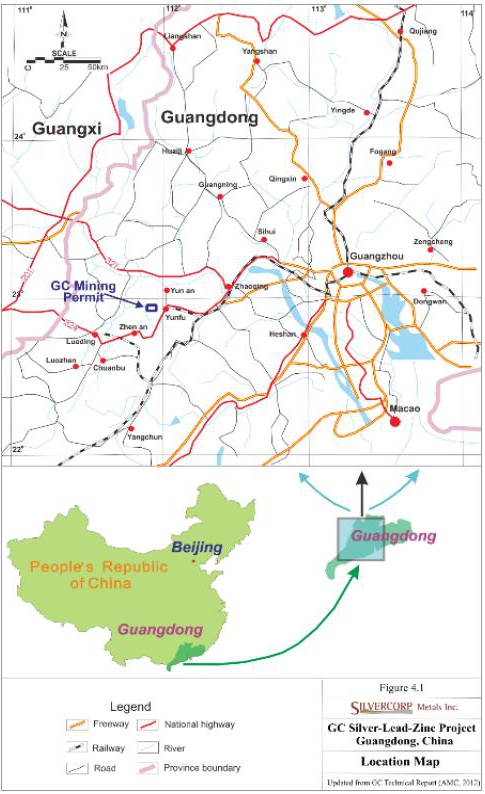
Sources: GC Mine
| SRK CONSULTING CHINA LTD. § APR. 20, 2026 § FH/AT | 25 |
Technical Report on Gaocheng Silver-Lead-Zinc Project in Guangdong Province, China
Property Description and Location § FINAL
| 4.4 | Environmental Considerations |
Environmental liabilities associated with the project operation are mainly from underground mining, waste rock dumps, processing plant, TSF and other auxiliary facilities. The significant inherent environmental risks for the project consist of environmental approvals, water management and tailings management. Additional details on environmental approvals, water management and tailings/ TSF management are provided in Sections 20 of this QPR.
| 4.5 | Taxes and Royalties |
Based on the information provided by and discussions with GC Mine, the Mine has the following tax obligations.
Corporate Income Tax: In China the normal corporate income tax (“CIT”) is 25% of the taxable income. GC Mine has advised SRK that as a Hi-New Tech. enterprise, the subsidiary entities operating the GC Mine are subject to an enterprise income tax rate of 15% of taxable income for three years term, which is renewable. The last renewed one is issued on November 19, 2024.
Resource Tax:
| § | 3% of the net amount of sales from lead and zinc mineral products |
| § | 2% of the net amount of sales from silver mineral products |
| § | No resource tax for gold and copper, since they are by-products |
Value Added Tax (“VAT”) (received):
| § | 13% of the net revenue of sales, excluding the revenue from gold. |
Surtax/Surcharge:
| § | City construction fee: 5% of VAT Payable |
| § | Education surtax: 7% of VAT Payable |
| SRK CONSULTING CHINA LTD. § APR. 20, 2026 § FH/AT | 26 |
Technical Report on Gaocheng Silver-Lead-Zinc Project in Guangdong Province, China
Accessibility, Climate, Local Resources, Infrastructure, and Physiography § FINAL
| 5 | Accessibility, Climate, Local Resources, Infrastructure, and Physiography |
The GC mine is located in the vicinity of Gaocheng Village of Gaocun Township, Yun’an District, Yunfu City, Guangdong Province, China. Altitudes in the region range from 78 to 378 m ASL, usually 150 to 250 m ASL, with relative differences of 50 to 150 m. Vegetation is in the form of secondary forests of pine and hardwoods, bushes, and grasses. Topsoil covers most of the ground. Outcrops of bedrocks can only be observed in valleys.
The mine is located west of the metropolitan city of Guangzhou, the capital of Guangdong Province. Guangzhou is located about 120 km north-west of Hong Kong and has a population of about 14 million people. It is serviced by rail and daily flights from many of China’s larger population centres. Access to the mine from Guangzhou is via 178 km of four-lane express highway to Yunfu, then 48 km of paved road to the GC Mine site. A railway connection from Guangzhou to Yunfu is also available.
The region belongs to a sub-tropical monsoon climate zone with average annual temperature of 20 – 22°C. Rainfall is mainly concentrated in spring and summer from March to August. Winters feature short periods of frosting. The GC Mine is able to operate year-round.
Streams are well developed in the district, with the Hashui Creek flowing in the Gaocheng mine area. There is a reservoir upstream of the mine. Small hydropower stations are developed in the region that are connected to the provincial electrical grid. There is a 10 kilovolts (“kV”) power line that crosses through the GC Mine area.
A power supply system consisting of a 5.8 km power line, a 110 kV substation, and a 10 kV safety backup-circuit was completed in 2013. This system has sufficient capacity to support the current production and any envisaged future production expansion.
The economy of Yun’an District mainly relies upon agriculture and some small township industrial enterprises. Labor is locally available, and technical personnel are available in Yunfu and nearby cities. The Gaocheng village is located within the Gaocheng mine area.
| SRK CONSULTING CHINA LTD. § APR. 20, 2026 § FH/AT | 27 |
Technical Report on Gaocheng Silver-Lead-Zinc Project in Guangdong Province, China
History § FINAL
| 6 | History |
| 6.1 | Ownership History |
Prior to Yangtze Mining acquiring the project area in 2005, illegal mining activity resulted in the excavation of several adits/ tunnels and small-scale mining of veins.
In 2008, SVM acquired a 100% interest in the shares of Yangtze Gold which in turn wholly owned the entirety of Yangtze Mining HK, who owns a 95% equity interest in GC Mine. In October 2018, Silvercorp Metals (China) Inc., a wholly owned subsidiary of SVM, acquired an additional 4% equity interest in Guangdong Found, and as a result, SVM now beneficially owns a 99% interest in Guangdong Found, who is the owner of GC Mine.
| 6.2 | Exploration History |
The GC Mine was discovered in 1959 by traditional prospecting methods. Follow-up exploration in the region has included soil surveying, hydrogeological survey, geological mapping, rock chip sampling and diamond drilling.
All exploration work on the GC Mine from 1959 to 2007 was completed by Geophysical Survey Brigade of Guangdong Bureau of Geology and Mineral Resources and GIGS.
SVM completed its first phase of exploration work in 2008, Based on the soil geochemical and surface mapping, SVM conducted trenching, pitting, and drilling programs on the GC Property. The program exposed additional mineralized veins. Detailed systematic drilling commenced on the GC Property in 2011 and has been ongoing.
| 6.3 | Production |
Prior to Yangtze Mining acquiring the GC Property, illegal mining activity resulted in the excavation of several adits/ tunnels and small-scale mining of veins; V2, V2-2, V3, V4, V5, V6, and V10. GIGS reported that a total of 1,398 m of excavation comprising 10 adits/ tunnels had been completed on the GC Property through the illegal activity.
In 2002, GIGS developed 66 m of tunnel to crosscut veins V5 and V5-1. GIGS sampled and mapped adits ML1 to ML5, ML6, ML7, ML9, and PD12.
Yangtze Mining, after its purchase of the GC Property in 2005, mapped and sampled the accessible tunnels ML5 and ML8. Tunnel ML5 had exposure to vein V10 and tunnel ML8 had exposure to vein V2-2. Assay results of tunnel samples were used in Mineral Resource estimation. Table 6.1 details the underground workings and work completed at this time. However, there are no detailed reconciliation data available for any of the mineralization extracted.
Table 6.1: Details of Historical Underground Workings
| Tunnel / Adit |
Length of Tunnel / Adit (m) |
Vein Intersected | No. Samples Collected |
Mapped and Sampled by |
| ML1 | 156 | V4 | 12 | GIGS |
| ML2 | 70 | V3 | 1 | GIGS |
| ML3 | 2 | V4 | 6 | GIGS |
| ML4 | 41 | V4 | 3 | GIGS |
| ML5 | 324 | V10 | 13 | Yangtze |
| ML6 | 438 | V2 | 25 | GIGS |
| ML7 | 45 | Not named, parallel to V4 | GIGS | |
| ML8 | 246 | V2-2 | 19 | Yangtze |
| ML9 | 46 | V4 | GIGS | |
| PD12 | 28 | V6 | 3 | GIGS |
| PD4401 | 66 | V5 | 5 | GIGS |
Sources: 2021 AMC report
| SRK CONSULTING CHINA LTD. § APR. 20, 2026 § FH/AT | 28 |
Technical Report on Gaocheng Silver-Lead-Zinc Project in Guangdong Province, China
History § FINAL
| 6.4 | Previous Mineral Resource Estimates |
During 2001 and 2002, and again in 2004 and 2005, GIGS conducted general prospecting and prepared a Mineral Resource estimate for the GC Mine, using the old Chinese classification standard system for mineral resources/ reserves, which differs from the CIM Definition Standards.
Since 2008, seven Mineral Resource estimates for the GC Mine have been documented, details are summarized in Table 6.2.
Table 6.2: Historical Mineral Resource Estimates
| Title | Consultant | Date |
| Technical Report on Gaocheng Ag-Zn-Pb Project and Shimentou Au-Ag-Zn-Pb Project, Guangdong Province, People’s Republic of China | SRK Consulting | April 2008 |
| NI 43-101 Technical Report Update on the GC Ag-Zn-Pb Project in Guangdong Province, People’s Republic of China | AMC | June 18, 2009 |
| NI 43-101 Technical Report on the GC Ag-Zn-Pb Project in Guangdong Province, People’s Republic of China’ | AMC | December 31, 2011 |
| NI 43-101 Technical Report Update on the Gaocheng Ag-Zn Pb Project in Guangdong Province, People’s Republic of China | AMC | June 30, 2018 |
| NI 43-101 Technical Report Update on the Gaocheng Ag-Zn-Pb Project in Guangdong Province, People’s Republic of China | AMC | June 30, 2019 |
| NI 43-101 Technical Report Update on the Gaocheng Ag-Zn-Pb Project in Guangdong Province, People’s Republic of China | AMC | March 31, 2021 |
| NI 43-101 Technical Report on Gaocheng Silver-Lead-Zinc Project in Guangdong Province, People’s Republic of China | SRK Consulting | June 30, 2024 |
| SRK CONSULTING CHINA LTD. § APR. 20, 2026 § FH/AT | 29 |
Technical Report on Gaocheng Silver-Lead-Zinc Project in Guangdong Province, China
Geological Setting and Mineralization § FINAL
| 7 | Geological Setting and Mineralization |
The contents of this section are mainly sourced from the 2008 SRK Technical Report and the technical report prepared by AMC in 2020 and 2021.
| 7.1 | Regional Geology |
The GC Property is located on the east margin of the Luoding basin, east of the Wuchuan – Sihui major fault within the north portion of the Yunkai uplift of the South China Orogenic Belt (Figure 7.1). Northeast striking structures and arc structures form the basic geological framework of the region. Deposits on the Property occur at the intersection of a north-easterly striking fault zone and a near east westerly striking fault zone.
Figure 7.1: Tectonic Geology Map of Southern China
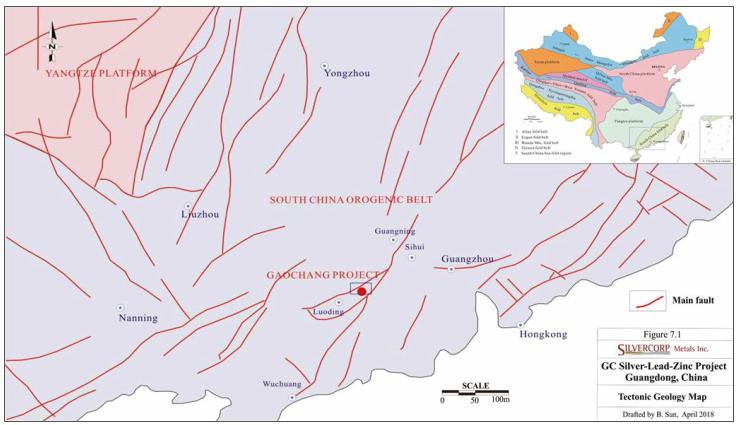
Sources: 2021 AMC report
Basement geology in the area comprises late Proterozoic Sinian sedimentary clastic and carbonate rocks; Palaeozoic (Ordovician, Silurian, Devonian, Carboniferous) sedimentary clastic and carbonate rocks; and Mesozoic (Triassic) coal-bearing clastic rocks and Cretaceous red clastic rocks. Ag-Pb-Zn poly-metallic deposits occur within late Proterozoic rocks. Cu-Pb-Zn, Mn, and Au-Ag deposits occur within Palaeozoic rocks.
Three prominent sets of structures occur within the region:
| § | North-easterly striking structures comprising a series of folds and faults that host some mineralized bodies. |
| § | Approximately east-westerly striking structures which dip steeply and contain structural breccias and quartz infill within the fault zones. Prominent alteration zones occur along both sides of these structures. |
| SRK CONSULTING CHINA LTD. § APR. 20, 2026 § FH/AT | 30 |
Technical Report on Gaocheng Silver-Lead-Zinc Project in Guangdong Province, China
Geological Setting and Mineralization § FINAL
| § | Arc or ring structures which include folds and faults surrounding the Daganshan granite body. The Pb-Zn-Ag-Sn deposits, mineralization showings, and Au-Ag-Pb-Zn geochemical anomalies occur in the arc/ ring structural zone. |
Palaeozoic granite batholiths and Mesozoic granite stocks and dykes occur commonly within the arc/ ring structure. These intrusions are closely related with Pb-Zn-Ag poly-metallic mineralization in the region. The Regional geological map is shown in Figure 7.2.
Figure 7.2: Regional Geological Map
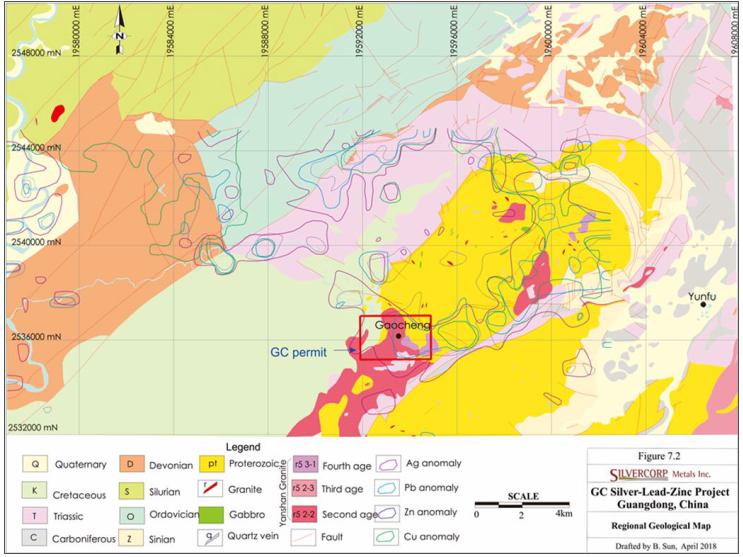
Sources: 2021 AMC report
| 7.2 | Property Geology |
The GC Mine is located at the intersection between the Wuchuan-Sihui Deep Fault zone and Daganshan Arc-ring structural zone.
Basement rocks within the Property encompass quartz sandstone, meta-carbonaceous siltstone, carbonaceous phyllite, calcareous quartzite, and argillaceous limestone of the Sinian Daganshan Formation; quartz sandstone and shale of the Triassic Xiaoyunwushan Formation, and sandy conglomerate and conglomerate of the Cretaceous Luoding Formation. These rocks are intruded by Palaeozoic medium-grained biotite granite, and Mesozoic fine- to medium-grained adamellite, brownish, fine-grained, biotite mylonite, granite porphyry, quartz porphyry, diabase, and aplite. The Mesozoic intrusive rocks intruded along the south and south-west contacts of the Palaeozoic granites. The majority of Ag-Zn-Pb mineralization is hosted by the Mesozoic granite. The granite dips south and strikes approximately west north-west, parallel to many of the mineralized veins on the Property. The Property geological map is shown in Figure 7.3.
| SRK CONSULTING CHINA LTD. § APR. 20, 2026 § FH/AT | 31 |
Technical Report on Gaocheng Silver-Lead-Zinc Project in Guangdong Province, China
Geological Setting and Mineralization § FINAL
Figure 7.3: GC Property Geology Map
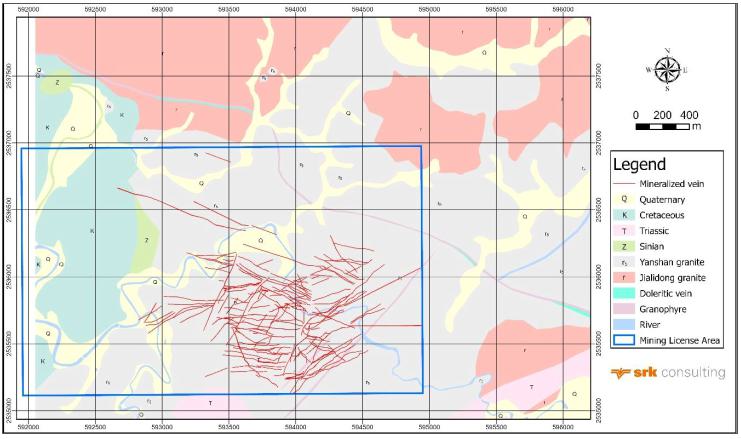
Sources: 2021 AMC report, modified by SRK in 2026
The Project area is located in the southwest part of the Daganshan uplift, characterized by several fault zones, including the west-northwest (“WNW”) and east-west (“EW”) striking Gaocheng Fault zone, the northeast (“NE”) striking Baimei Fault zone, and the Songgui Fault zone.
Mineralization at GC is primarily hosted within a WNW-east-northeast (“ENE”) trending fault zone that is 4.8 km long and 2 km wide. This zone contains numerous veins with the more common WNW veins generally striking between 90° and 150° and dipping between 55° to sub-vertical to the south (“S”) and southwest (“SW”). The average thickness of these WNW-ENE veins is 0.76 m.
EW striking veins generally strike between 50° and 130° and dip between 65° and sub-vertical to the southeast (“SE”) and south-southwest (“SSW”). The average thickness of these veins is 0.77 m.
NE-striking faults cut through the WNW-striking structures with no or minor displacement. Mineralized veins in this trend are sub-parallel to the major NE striking faults F25 and F27, generally striking between 10° and 80° and dipping between 60° and 75° to the SE. The average thickness of these veins is 0.76 m.
Figure 7.4 shows the distribution of mineralized veins and the fault zones.
| SRK CONSULTING CHINA LTD. § APR. 20, 2026 § FH/AT | 32 |
Technical Report on Gaocheng Silver-Lead-Zinc Project in Guangdong Province, China
Geological Setting and Mineralization § FINAL
Figure 7.4: The Distribution of Mineralized Veins and Fault Zones (Level -100 m)
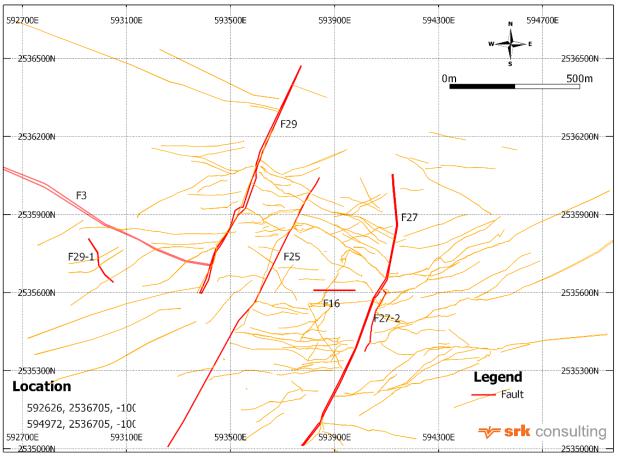
Sources: SRK,2026
| 7.3 | Mineralization |
The Ag-Zn-Pb mineralization at the GC deposit can be categorized into primary and oxidized types. Primary mineralization, which constitutes 95% of the total Mineral Resource, is mainly composed of galena, sphalerite, and silver minerals, appearing sparsely, as disseminations, veinlets, and lumps. Oxide mineralization occurs near the surface, primarily within fault-breccia zones that are oxidized down to about 40 m. These veins display open space and boxwork lattice textures due to sulphide mineral oxidation, with secondary minerals like kaolinite, hematite, and limonite present.
Pyrite is the dominant sulphide mineral, making up a few percent to 13% of the veins. Other minerals include sphalerite, galena, pyrrhotite, arsenopyrite, magnetite, and trace amounts of chalcopyrite and cassiterite. Metallic minerals, found in smaller quantities, include argentite, native silver, bornite, wolframite, scheelite, and antimonite. These occur in narrow bands, veinlets, or as disseminations within the gangue, which consists of chlorite, quartz, fluorite, feldspar, mica, hornblende, and minor or trace amounts of kaolinite, tremolite, actinolite, chalcedony, garnet, zoisite, apatite, and tourmaline.
Alteration minerals associated with the GC deposit veins (Figure 7.5) include quartz, sericite, pyrite, chlorite, clay minerals, and limonite. Silicification is common near the centre of the veins, while chlorite and sericite are found near and slightly beyond the vein margins. Quartz, pyrite, fluorite, and chlorite are closely related to the mineralization.
| SRK CONSULTING CHINA LTD. § APR. 20, 2026 § FH/AT | 33 |
Technical Report on Gaocheng Silver-Lead-Zinc Project in Guangdong Province, China
Geological Setting and Mineralization § FINAL
In addition, the GC deposit exhibits several notable mineralization features:
| § | High-grade Ag-Zn-Pb mineralization tends to occur at the intersections of NWW and east-west striking faults, leading to east plunging shoots of high-grade mineralization. |
| § | Fault breccia zones host the most intense, continuous, and wide mineralization of Ag-Zn-Pb. |
| § | Grade contours indicate that Zn mineralization is more continuous across the veins, whereas Ag and Pb are more locally concentrated. |
Figure 7.5: Ag-Zn-Pb Veins of the GC Mine (Level 0 m)
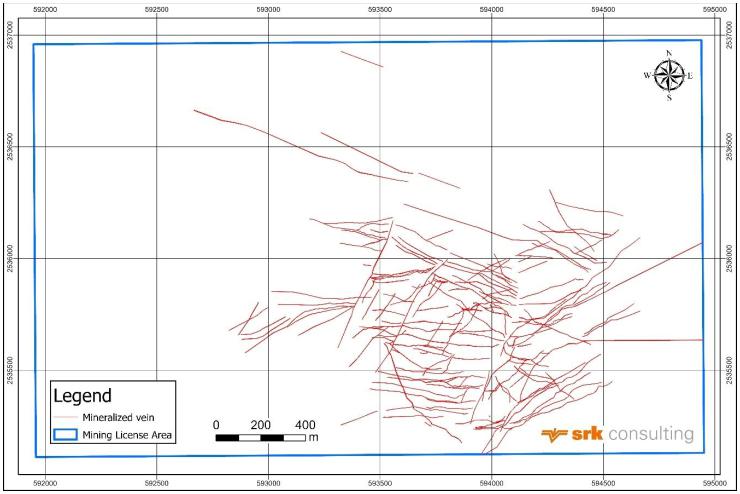
Sources: SRK
The GC deposit consists of 315 mineralized Ag-Zn-Pb veins. Lithological domains were constructed for each vein. The vein domains were modelled in Micromine software. Table 7.1 presents a summary of the characteristics of the mineralized veins on the Property.
Table 7.1: Dimensions and Occurrences of the Mineralized Veins
| Vein | Average Thickness (m) | Length (m) | Elevation(m) | Strike (°) | Dip Direction (°) |
Average Dip Angle (°) |
| NV11 | 0.46 | 89 | -76-(90) | 284 | 194 | 71 |
| NV14 | 0.86 | 407 | -111-(186) | 281 | 191 | 70 |
| NV1 | 0.60 | 297 | -81-(216) | 298 | 208 | 75 |
| NV28A | 1.91 | 52 | -169-(136) | 263 | 173 | 67 |
| NV28B | 1.00 | 131 | -65-(115) | 263 | 173 | 67 |
| NV28N | 0.71 | 186 | -170-(-24) | 251 | 161 | 80 |
| NV28_1B | 1.32 | 67 | -125-(159) | 277 | 187 | 64 |
| NV28_1 | 1.00 | 65 | -36-(185) | 235 | 145 | 55 |
| SRK CONSULTING CHINA LTD. § APR. 20, 2026 § FH/AT | 34 |
Technical Report on Gaocheng Silver-Lead-Zinc Project in Guangdong Province, China
Geological Setting and Mineralization § FINAL
| Vein | Average Thickness (m) | Length (m) | Elevation(m) | Strike (°) | Dip Direction (°) |
Average Dip Angle (°) |
| NV2 | 0.45 | 61 | -135-(26) | 259 | 169 | 59 |
| NV8 | 1.03 | 347 | -101-(180) | 276 | 186 | 70 |
| V19B | 0.83 | 256 | 9-(181) | 260 | 170 | 56.5 |
| V19_11 | 0.58 | 160 | -330-(-149) | 210 | 120 | 72 |
| V19_1 | 0.57 | 219 | -181-(210) | 275 | 185 | 68 |
| V19_2 | 0.78 | 116 | -115-(56) | 277 | 187 | 68 |
| V19_3A | 0.59 | 43 | -50-(36) | 161 | 71 | 83 |
| V19_3 | 0.46 | 31 | 102-(150) | 260 | 170 | 80 |
| V19_4 | 0.60 | 121 | -95-(-9) | 273 | 183 | 68 |
| V19_7 | 0.75 | 123 | -160-(-28) | 262 | 172 | 60 |
| V19_8 | 0.64 | 113 | -251-(-119) | 303 | 213 | 72 |
| V1C | 0.81 | 206 | -220-(36) | 116 | 26 | 37 |
| V1_3 | 0.70 | 85 | -255-(-85) | 154 | 64 | 45 |
| V1_5 | 0.82 | 73 | -335-(-265) | 130 | 40 | 75 |
| V1_6 | 1.41 | 137 | -596-(-264) | 80 | 350 | 83 |
| V1_8 | 0.88 | 162 | -180-(-74) | 121 | 31 | 29 |
| V25E | 1.15 | 40 | -260-(-204) | 208 | 118 | 69 |
| V25N | 0.51 | 71 | -81-(11) | 254 | 164 | 85 |
| V25_1 | 0.86 | 124 | 34-(176) | 246 | 156 | 73 |
| V25_2 | 1.39 | 110 | -40-(71) | 203 | 113 | 55 |
| V25_4 | 0.91 | 162 | -571-(-315) | 233 | 143 | 74 |
| V25_5 | 0.89 | 159 | -80-(80) | 237 | 147 | 63 |
| V25 | 0.73 | 593 | -491-(171) | 211 | 121 | 72 |
| V26E | 0.88 | 168 | 69-(170) | 288 | 198 | 77 |
| V26 | 0.95 | 65 | -70-(125) | 228 | 138 | 78 |
| V27A | 0.76 | 371 | -96-(211) | 206 | 116 | 86 |
| V27W_1 | 0.89 | 73 | -260-(-169) | 217 | 127 | 60 |
| V27_4 | 0.79 | 125 | -165-(-25) | 35 | 305 | 74 |
| V28_1 | 0.63 | 126 | -170-(-6) | 34 | 304 | 73 |
| V28_2 | 0.73 | 132 | -35-(111) | 211 | 121 | 62 |
| V28_3 | 0.53 | 28 | 119-(150) | 68 | 338 | 48 |
| V28_4C | 0.93 | 150 | -275-(194) | 219 | 129 | 65 |
| V28_4D | 0.79 | 95 | -261-(101) | 224 | 134 | 49 |
| V28_4E | 0.90 | 100 | -335-(131) | 225 | 135 | 49 |
| V28_4F | 0.86 | 90 | -311-(-44) | 210 | 120 | 63 |
| V28 | 0.79 | 185 | -81-(201) | 213 | 123 | 60 |
| V29_1 | 1.04 | 695 | -704-(140) | 210 | 120 | 58 |
| V29_2 | 0.91 | 77 | -285-(-206) | 209 | 119 | 60 |
| V30 | 0.77 | 84 | -55-(80) | 283 | 193 | 73 |
| V31 | 0.59 | 316 | -135-(195) | 237 | 147 | 67 |
| V32B | 0.54 | 212 | -409-(-225) | 268 | 178 | 60 |
| V33EB | 0.63 | 69 | 24-(170) | 244 | 154 | 68 |
| SRK CONSULTING CHINA LTD. § APR. 20, 2026 § FH/AT | 35 |
Technical Report on Gaocheng Silver-Lead-Zinc Project in Guangdong Province, China
Geological Setting and Mineralization § FINAL
| Vein | Average Thickness (m) | Length (m) | Elevation(m) | Strike (°) | Dip Direction (°) |
Average Dip Angle (°) |
| V33_1 | 0.59 | 151 | 50-(246) | 262 | 172 | 52 |
| V33_3 | 0.30 | 59 | -35-(25) | 266 | 176 | 54 |
| V33 | 0.74 | 565 | -555-(306) | 240 | 150 | 70 |
| V36_1 | 0.58 | 117 | -30-(146) | 277 | 187 | 67 |
| V36_2 | 0.70 | 166 | 4-(150) | 251 | 161 | 54 |
| V36 | 0.63 | 609 | -115-(261) | 248 | 158 | 52 |
| V37N | 0.51 | 37 | 35-(81) | 83 | 353 | 87 |
| V37_1 | 0.68 | 336 | -246-(116) | 263 | 173 | 76 |
| V37_2 | 0.56 | 90 | -129-(50) | 73 | 343 | 75 |
| V37_3 | 0.58 | 47 | -191-(-100) | 274 | 184 | 85 |
| V37 | 0.66 | 306 | -190-(206) | 253 | 163 | 78 |
| V39W | 1.02 | 139 | -90-(91) | 125 | 35 | 55 |
| V40S | 1.31 | 292 | -359-(100) | 241 | 151 | 58 |
| V40W | 0.69 | 202 | -306-(101) | 60 | 330 | 40 |
| V40 | 0.61 | 533 | -651-(181) | 248 | 158 | 82 |
| V41_1 | 0.61 | 128 | -275-(-190) | 59 | 329 | 69 |
| V41_2 | 0.70 | 143 | -120-(101) | 219 | 129 | 75 |
| V41_3 | 0.88 | 102 | -130-(45) | 258 | 168 | 69 |
| V41 | 0.44 | 98 | -250-(-110) | 233 | 143 | 69 |
| V42A | 0.48 | 71 | 119-(241) | 241 | 151 | 65 |
| V42B | 0.67 | 204 | -5-(205) | 241 | 151 | 65 |
| V42D | 0.52 | 75 | -111-(-39) | 241 | 151 | 65 |
| V43_1 | 1.05 | 590 | -261-(80) | 252 | 162 | 85 |
| V43_2 | 1.12 | 690 | -261-(80) | 255 | 165 | 85 |
| V43 | 0.92 | 729 | -535-(80) | 72 | 342 | 79 |
| V44 | 0.43 | 185 | -106-(86) | 133 | 43 | 55 |
| V45_1 | 0.56 | 102 | -96-(11) | 239 | 149 | 70 |
| V46 | 0.38 | 88 | 99-(186) | 135 | 45 | 52 |
| V48 | 0.54 | 98 | -136-(-45) | 300 | 210 | 83 |
| V49S | 0.78 | 99 | -541-(-245) | 70 | 340 | 83 |
| V51 | 0.95 | 245 | -100-(64) | 262 | 172 | 80 |
| V52_10 | 1.19 | 252 | -391-(-194) | 258 | 168 | 67 |
| V52_11 | 0.87 | 392 | -350-(-19) | 290 | 200 | 70 |
| V52_2_1 | 0.83 | 126 | -221-(105) | 250 | 160 | 76 |
| V52_2 | 0.97 | 151 | -345-(270) | 250 | 160 | 72 |
| V52_3 | 0.62 | 80 | -25-(250) | 284 | 194 | 81 |
| V52_4 | 0.70 | 227 | -324-(-104) | 285 | 195 | 70 |
| V52_5 | 1.20 | 127 | -365-(-189) | 246 | 156 | 79 |
| V52_6 | 0.71 | 122 | -235-(-49) | 115 | 25 | 55 |
| V52_8 | 1.48 | 311 | -261-(-66) | 273 | 183 | 69 |
| V52 | 0.70 | 106 | 9-(266) | 273 | 183 | 80 |
| V55 | 0.56 | 129 | -380-(-39) | 238 | 148 | 70 |
| SRK CONSULTING CHINA LTD. § APR. 20, 2026 § FH/AT | 36 |
Technical Report on Gaocheng Silver-Lead-Zinc Project in Guangdong Province, China
Geological Setting and Mineralization § FINAL
| Vein | Average Thickness (m) | Length (m) | Elevation(m) | Strike (°) | Dip Direction (°) |
Average Dip Angle (°) |
| V58S | 0.63 | 190 | -201-(-49) | 61 | 331 | 35 |
| V58 | 0.69 | 309 | -240-(-6) | 86 | 356 | 74 |
| V59B | 0.60 | 33 | 100-(241) | 172 | 82 | 57 |
| V59 | 0.47 | 45 | 49-(215) | 166 | 76 | 57 |
| VH1_1 | 1.09 | 67 | -49-(155) | 242 | 152 | 80 |
| VH1_2 | 0.81 | 198 | -265-(115) | 242 | 152 | 84 |
| VH1_3 | 0.56 | 147 | -56-(191) | 251 | 161 | 68 |
| VH1_4 | 0.87 | 170 | -129-(146) | 270 | 180 | 80 |
| VH1_5 | 0.57 | 128 | -174-(30) | 236 | 146 | 72 |
| VH1_7 | 0.36 | 84 | -86-(69) | 50 | 320 | 63 |
| VH1_8 | 0.60 | 66 | -70-(90) | 248 | 158 | 81 |
| VH1 | 0.80 | 218 | -90-(116) | 85 | 355 | 78 |
| X1 | 0.89 | 207 | -301-(81) | 86 | 356 | 70 |
| X2 | 0.96 | 233 | -331-(91) | 86 | 356 | 67 |
| X4 | 0.86 | 177 | -80-(60) | 213 | 123 | 35 |
| V16_1 | 0.58 | 70 | -120-(95) | 220 | 130 | 68 |
| V16_6 | 0.92 | 236 | -351-(-162) | 267 | 177 | 64 |
| V17_1 | 0.83 | 218 | -346-(138) | 273 | 183 | 70 |
| V17 | 0.92 | 435 | -165-(195) | 275 | 185 | 65 |
| V18_1 | 0.72 | 417 | -170-(190) | 280 | 190 | 70 |
| V18_3 | 0.62 | 114 | -181-(75) | 239 | 149 | 57 |
| V2E10 | 0.77 | 250 | -246-(118) | 287 | 197 | 70 |
| V2E11 | 1.10 | 159 | -706-(-195) | 295 | 205 | 65 |
| V2E12 | 0.78 | 299 | -461-(149) | 290 | 200 | 65 |
| V2E13 | 0.81 | 138 | -635-(-110) | 293 | 203 | 65 |
| V2E15 | 0.87 | 292 | -730-(141) | 296 | 206 | 65 |
| V2E17 | 0.68 | 314 | -130-(146) | 293 | 203 | 67 |
| V2E18 | 1.09 | 167 | -615-(-326) | 295 | 205 | 65 |
| V2E1A | 2.42 | 69 | -316-(146) | 272 | 182 | 67 |
| V2E1B | 1.66 | 113 | -561-(-261) | 281 | 191 | 62 |
| V2E1C | 0.79 | 155 | -631-(-315) | 300 | 210 | 63 |
| V2E21 | 0.55 | 138 | -266-(90) | 159 | 69 | 86 |
| V2E23B | 0.76 | 46 | -21-(94) | 337 | 247 | 87 |
| V2E24 | 0.67 | 169 | -175-(-100) | 133 | 43 | 48 |
| V2E26A | 1.19 | 103 | -501-(-245) | 277 | 187 | 65 |
| V2E26B | 1.25 | 54 | -315-(-249) | 275 | 185 | 68 |
| V2E2B | 1.33 | 20 | -283-(-149) | 237 | 147 | 64 |
| V2E2 | 1.94 | 42 | -271-(-90) | 265 | 175 | 66 |
| V2E3 | 1.59 | 122 | -470-(-56) | 288 | 198 | 62.6 |
| V2E4A | 1.52 | 76 | -516-(-231) | 284 | 194 | 65 |
| V2E4B | 2.49 | 90 | -325-(-225) | 277 | 187 | 70 |
| V2E5 | 0.93 | 246 | -640-(-200) | 306 | 216 | 67 |
| SRK CONSULTING CHINA LTD. § APR. 20, 2026 § FH/AT | 37 |
Technical Report on Gaocheng Silver-Lead-Zinc Project in Guangdong Province, China
Geological Setting and Mineralization § FINAL
| Vein | Average Thickness (m) | Length (m) | Elevation(m) | Strike (°) | Dip Direction (°) |
Average Dip Angle (°) |
| V2E7 | 0.66 | 48 | -284-(-224) | 277 | 187 | 85 |
| V2E8 | 0.65 | 68 | -335-(-184) | 325 | 235 | 72 |
| V2E9 | 0.79 | 94 | -36-(150) | 265 | 175 | 74 |
| V2E_4E | 0.71 | 202 | -165-(115) | 258 | 168 | 66 |
| V2E_8 | 0.97 | 111 | -36-(80) | 355 | 265 | 90 |
| V2M | 1.11 | 211 | -496-(111) | 116 | 26 | 83 |
| NV10 | 0.76 | 687 | -535-(265) | 241 | 151 | 65 |
| NV12 | 0.92 | 157 | -10-(111) | 336 | 246 | 69 |
| NV3N | 0.83 | 105 | 56-(216) | 272 | 182 | 86 |
| NV3 | 0.57 | 80 | 40-(194) | 272 | 182 | 75 |
| NV4 | 0.61 | 376 | -215-(231) | 300 | 210 | 77 |
| V10_10 | 0.64 | 67 | -85-(-25) | 235 | 145 | 74 |
| V10_14 | 0.53 | 125 | 4-(96) | 235 | 145 | 74 |
| V10_15 | 0.75 | 156 | -255-(-155) | 236 | 146 | 69 |
| V10_19 | 0.62 | 58 | -15-(141) | 214 | 124 | 75 |
| V10_1S | 0.56 | 60 | 82-(234) | 241 | 151 | 71 |
| V10_1W | 0.76 | 50 | -300-(-130) | 205 | 115 | 81 |
| V10_21 | 0.59 | 102 | -186-(-70) | 253 | 163 | 89 |
| V10_22 | 0.57 | 68 | -31-(35) | 303 | 213 | 87 |
| V10_2 | 1.02 | 52 | -252-(-151) | 205 | 115 | 84 |
| V10_3 | 0.89 | 104 | -306-(-54) | 225 | 135 | 68 |
| V10_4 | 0.76 | 292 | -311-(189) | 238 | 148 | 72 |
| V10_5 | 0.55 | 108 | -85-(195) | 174 | 84 | 81 |
| V11A | 0.76 | 129 | -450-(85) | 254 | 164 | 61 |
| V11B | 0.81 | 208 | -276-(45) | 247 | 157 | 61 |
| V13_1 | 0.77 | 119 | -25-(110) | 214 | 124 | 73 |
| V14 | 1.12 | 841 | -371-(250) | 242 | 152 | 60 |
| V15N | 0.63 | 290 | -279-(125) | 250 | 160 | 64 |
| V15 | 0.52 | 115 | -169-(146) | 259 | 169 | 69 |
| V19A | 1.19 | 945 | -521-(171) | 260 | 170 | 56.5 |
| V2E20 | 0.76 | 75 | -140-(105) | 298 | 208 | 68 |
| V2M_10 | 0.71 | 46 | -230-(-140) | 225 | 135 | 44 |
| V2M_11 | 0.60 | 155 | -495-(-179) | 228 | 138 | 67 |
| V2M_13 | 0.59 | 98 | -294-(-195) | 257 | 167 | 46 |
| V2M_14 | 0.79 | 104 | -351-(-195) | 211 | 121 | 60 |
| V2M_1 | 0.38 | 109 | -296-(-130) | 100 | 10 | 86 |
| V2M_2 | 0.86 | 63 | -135-(20) | 306 | 216 | 87 |
| V2M_3B | 0.90 | 38 | -351-(-241) | 121 | 31 | 78 |
| V2M_3 | 1.01 | 209 | -496-(105) | 295 | 205 | 84 |
| V2M_4 | 0.79 | 50 | -192-(-75) | 96 | 6 | 78 |
| V2M_5 | 0.73 | 65 | -75-(26) | 110 | 20 | 75 |
| V2M_6 | 0.51 | 201 | -531-(-160) | 269 | 179 | 85 |
| SRK CONSULTING CHINA LTD. § APR. 20, 2026 § FH/AT | 38 |
Technical Report on Gaocheng Silver-Lead-Zinc Project in Guangdong Province, China
Geological Setting and Mineralization § FINAL
| Vein | Average Thickness (m) | Length (m) | Elevation(m) | Strike (°) | Dip Direction (°) |
Average Dip Angle (°) |
| V2M_8 | 1.02 | 223 | -265-(61) | 280 | 190 | 76 |
| V2M_9 | 0.60 | 54 | -295-(-75) | 87 | 357 | 84 |
| V2N_1 | 1.45 | 129 | -355-(-201) | 274 | 184 | 70 |
| V2N_2 | 1.13 | 154 | -394-(-184) | 273 | 183 | 85 |
| V2N_3 | 0.50 | 149 | -190-(21) | 285 | 195 | 78 |
| V2N_4N | 0.55 | 315 | -371-(95) | 267 | 177 | 88 |
| V2N_4 | 0.48 | 190 | -371-(85) | 260 | 170 | 85 |
| V2N_5S | 0.93 | 195 | -189-(110) | 290 | 200 | 78 |
| V2N_5 | 0.59 | 392 | -459-(121) | 290 | 200 | 80 |
| V2N_6 | 0.86 | 105 | -156-(25) | 269 | 179 | 70 |
| V2N_7 | 0.62 | 128 | -145-(-5) | 67 | 337 | 86 |
| V2N_8 | 1.23 | 213 | -650-(-119) | 273 | 183 | 69 |
| V2N | 2.01 | 494 | -666-(35) | 250 | 160 | 72 |
| V2WA | 1.77 | 244 | -670-(-94) | 247 | 157 | 68 |
| V2WB | 2.83 | 283 | -161-(181) | 253 | 163 | 68 |
| V2W_10 | 0.68 | 151 | -635-(-274) | 242 | 152 | 84 |
| V2W_12 | 0.99 | 357 | -650-(-189) | 227 | 137 | 68 |
| V2W_13 | 1.30 | 160 | -634-(-430) | 280 | 190 | 73 |
| V2W_14 | 1.56 | 103 | -380-(-200) | 257 | 167 | 74 |
| V2W_15 | 1.00 | 51 | -311-(-130) | 266 | 176 | 71 |
| V2W_16 | 1.08 | 52 | -340-(-170) | 265 | 175 | 62 |
| V2W_1 | 0.90 | 90 | -331-(-94) | 235 | 145 | 69 |
| V2W_3 | 1.01 | 100 | -133-(11) | 270 | 180 | 60 |
| V2W_4 | 0.69 | 125 | -241-(-94) | 264 | 174 | 68 |
| V2W_5 | 0.58 | 57 | -221-(90) | 284 | 194 | 68 |
| V2W_7 | 0.67 | 125 | -174-(-5) | 260 | 170 | 50 |
| V2W_9 | 0.75 | 87 | -366-(-230) | 266 | 176 | 69 |
| V2_11S | 0.96 | 46 | -185-(-114) | 66 | 336 | 63 |
| V2_12 | 0.75 | 212 | -509-(-220) | 298 | 208 | 58 |
| V2_1B | 0.74 | 97 | -325-(-240) | 298 | 208 | 50 |
| V2_1 | 0.71 | 155 | -231-(-125) | 289 | 199 | 69 |
| V2_3 | 1.31 | 207 | -125-(125) | 294 | 204 | 69 |
| V2_9 | 0.75 | 112 | -430-(-294) | 294 | 204 | 75 |
| V4_1 | 1.02 | 371 | -601-(146) | 295 | 205 | 72 |
| V4 | 1.22 | 948 | -421-(186) | 280 | 190 | 73 |
| V5_12 | 0.47 | 80 | -121-(81) | 204 | 114 | 66 |
| V5_19 | 0.55 | 53 | -305-(-230) | 237 | 147 | 55 |
| V5_1 | 0.58 | 64 | 31-(230) | 270 | 180 | 76 |
| V5_26B | 0.80 | 114 | -270-(-104) | 33 | 303 | 76 |
| V5_3 | 0.68 | 114 | 29-(111) | 73 | 343 | 59 |
| V5_4 | 0.75 | 165 | -214-(116) | 303 | 213 | 73 |
| V5_6 | 0.98 | 167 | -341-(-145) | 206 | 116 | 58 |
| SRK CONSULTING CHINA LTD. § APR. 20, 2026 § FH/AT | 39 |
Technical Report on Gaocheng Silver-Lead-Zinc Project in Guangdong Province, China
Geological Setting and Mineralization § FINAL
| Vein | Average Thickness (m) | Length (m) | Elevation(m) | Strike (°) | Dip Direction (°) |
Average Dip Angle (°) |
| V5 | 0.94 | 225 | 10-(176) | 271 | 181 | 84 |
| V7EA | 2.16 | 27 | -495-(81) | 324 | 234 | 64 |
| V7EN | 0.85 | 59 | -40-(56) | 345 | 255 | 73 |
| V7 | 0.82 | 417 | -365-(146) | 308 | 218 | 68 |
| V9W_1 | 1.01 | 77 | -91-(205) | 274 | 184 | 69 |
| V9W_2B | 1.61 | 73 | -74-(75) | 258 | 168 | 70 |
| V9W_2E | 0.52 | 105 | -236-(156) | 315 | 225 | 85 |
| V9W_2N | 0.69 | 104 | -81-(176) | 296 | 206 | 80 |
| V9W_2 | 0.95 | 264 | -146-(225) | 276 | 186 | 70 |
| V9W_5 | 0.57 | 88 | 105-(231) | 115 | 25 | 77 |
| V9_2N | 0.55 | 246 | 69-(190) | 92 | 2 | 70 |
| V9_2 | 0.74 | 260 | -184-(90) | 270 | 180 | 65 |
| V9_3B | 0.73 | 66 | -186-(-99) | 270 | 180 | 65 |
| V9_3 | 1.15 | 37 | -70-(8) | 251 | 161 | 65 |
| V9_4 | 0.75 | 150 | -410-(-59) | 274 | 184 | 67 |
| NV6 | 0.70 | 241 | 9-(155) | 247 | 157 | 70 |
| NV9 | 0.79 | 273 | -36-(164) | 273 | 183 | 79 |
| V10W | 1.10 | 45 | -231-(-135) | 227 | 137 | 65 |
| V10_12 | 0.67 | 207 | -275-(-105) | 265 | 175 | 75 |
| V10_1 | 0.94 | 254 | -455-(196) | 227 | 137 | 65 |
| V10 | 1.18 | 1005 | -530-(191) | 240 | 150 | 62 |
| V13 | 0.71 | 664 | -375-(266) | 214 | 124 | 74 |
| V1A | 0.68 | 312 | -270-(126) | 145 | 55 | 43 |
| V1B | 0.75 | 273 | -321-(-15) | 145 | 55 | 43 |
| V27_1 | 1.10 | 213 | -500-(-229) | 240 | 150 | 62 |
| V28_4A | 1.07 | 41 | -291-(255) | 219 | 129 | 65 |
| V29 | 1.10 | 264 | -50-(186) | 203 | 113 | 85 |
| V2E16 | 0.87 | 371 | -549-(140) | 295 | 205 | 65.5 |
| V2E19 | 0.77 | 215 | -561-(31) | 294 | 204 | 67 |
| V2E23 | 1.09 | 55 | -45-(75) | 310 | 220 | 79 |
| V2E | 2.05 | 394 | -650-(136) | 300 | 210 | 65 |
| V2W_8 | 0.96 | 149 | -625-(-65) | 280 | 190 | 80 |
| V32_1 | 0.51 | 132 | -156-(-16) | 260 | 170 | 80 |
| V32 | 0.58 | 359 | -270-(300) | 245 | 155 | 66 |
| V33E | 0.76 | 232 | -361-(226) | 239 | 149 | 69 |
| V38 | 0.66 | 591 | -386-(149) | 270 | 180 | 82 |
| V39 | 1.07 | 384 | -495-(-10) | 272 | 182 | 82 |
| V3 | 0.56 | 170 | -145-(135) | 110 | 20 | 85 |
| V45 | 0.67 | 252 | -201-(185) | 225 | 135 | 60 |
| V47 | 0.99 | 267 | -351-(126) | 251 | 161 | 72 |
| V4_2 | 0.41 | 200 | -111-(105) | 110 | 20 | 70 |
| V4_4 | 0.59 | 101 | -180-(9) | 280 | 190 | 75 |
| SRK CONSULTING CHINA LTD. § APR. 20, 2026 § FH/AT | 40 |
Technical Report on Gaocheng Silver-Lead-Zinc Project in Guangdong Province, China
Geological Setting and Mineralization § FINAL
| Vein | Average Thickness (m) | Length (m) | Elevation(m) | Strike (°) | Dip Direction (°) |
Average Dip Angle (°) |
| V52_9 | 0.64 | 42 | -395-(-196) | 256 | 166 | 68 |
| V5_15 | 0.54 | 154 | 4-(136) | 230 | 140 | 73 |
| V5_17 | 0.59 | 80 | 15-(161) | 280 | 190 | 62 |
| V5_26A | 0.49 | 77 | -235-(-90) | 32 | 302 | 56 |
| V5_2 | 0.59 | 223 | -365-(-84) | 275 | 185 | 65 |
| V5_5 | 0.87 | 288 | -480-(85) | 273 | 183 | 73 |
| V5_7 | 0.68 | 107 | -11-(136) | 85 | 355 | 60 |
| V7E_1 | 1.39 | 54 | -401-(-181) | 300 | 210 | 73 |
| V7_10 | 0.84 | 82 | -9-(185) | 272 | 182 | 72 |
| V7_1S | 0.57 | 46 | 115-(200) | 274 | 184 | 68 |
| V7_1W | 0.65 | 68 | 40-(191) | 282 | 192 | 73 |
| V7_1 | 0.95 | 185 | -461-(240) | 275 | 185 | 63 |
| V7_3 | 0.56 | 229 | -350-(229) | 280 | 190 | 65 |
| V7_4 | 0.79 | 176 | -239-(137) | 270 | 180 | 72 |
| V7_5 | 0.80 | 107 | -186-(69) | 270 | 180 | 64 |
| V7_9 | 0.79 | 63 | -80-(76) | 212 | 122 | 74 |
| V8_10 | 1.56 | 160 | -100-(166) | 313 | 223 | 85 |
| V8_11B | 0.61 | 156 | -401-(-199) | 224 | 134 | 58 |
| V8_11 | 1.03 | 113 | -251-(-176) | 238 | 148 | 40 |
| V8_12 | 1.08 | 67 | -181-(-125) | 270 | 180 | 80 |
| V8_13 | 0.62 | 102 | -476-(-230) | 253 | 163 | 88 |
| V8_14 | 0.84 | 154 | -475-(-169) | 252 | 162 | 75 |
| V8_16 | 0.54 | 456 | -210-(260) | 276 | 186 | 78 |
| V8_17 | 0.64 | 78 | -310-(-189) | 237 | 147 | 69 |
| V8_1 | 0.79 | 143 | -476-(-169) | 277 | 187 | 73 |
| V8_2A | 0.99 | 396 | -500-(130) | 260 | 170 | 68 |
| V8_2B | 0.90 | 417 | -196-(245) | 279 | 189 | 67 |
| V8_2C | 0.89 | 153 | -271-(35) | 265 | 175 | 75 |
| V8_2D | 0.56 | 164 | 44-(171) | 279 | 189 | 57 |
| V8_2E | 0.99 | 144 | -201-(11) | 268 | 178 | 70 |
| V8_3 | 0.58 | 211 | -380-(-201) | 258 | 168 | 77 |
| V8_4N | 0.73 | 217 | -406-(-205) | 269 | 179 | 70 |
| V8_4 | 0.59 | 297 | -391-(-69) | 247 | 157 | 63 |
| V8_7 | 0.57 | 59 | -121-(-75) | 141 | 51 | 81 |
| V8_9 | 0.89 | 122 | -236-(-164) | 260 | 170 | 46 |
| V8 | 0.54 | 280 | -241-(245) | 265 | 175 | 81 |
| V9_11 | 0.93 | 193 | -86-(241) | 220 | 130 | 70 |
| V9_14 | 0.82 | 82 | 54-(130) | 267 | 177 | 82 |
| V9_5A | 1.22 | 236 | -190-(251) | 265 | 175 | 63 |
| V9_5B | 1.54 | 334 | -531-(-54) | 273 | 183 | 70 |
| V9_5C | 1.96 | 67 | -541-(-200) | 273 | 183 | 70 |
| V9_5D | 0.68 | 133 | -31-(151) | 275 | 185 | 65 |
| SRK CONSULTING CHINA LTD. § APR. 20, 2026 § FH/AT | 41 |
Technical Report on Gaocheng Silver-Lead-Zinc Project in Guangdong Province, China
Geological Setting and Mineralization § FINAL
| Vein | Average Thickness (m) | Length (m) | Elevation(m) | Strike (°) | Dip Direction (°) |
Average Dip Angle (°) |
| V9_6A | 1.21 | 301 | -385-(-179) | 85 | 355 | 53 |
| V9_6B | 1.45 | 95 | -261-(-194) | 83 | 353 | 41 |
| V9_6C | 0.75 | 180 | -350-(-100) | 65 | 335 | 66 |
| V9_6D | 1.78 | 105 | -349-(-220) | 246 | 156 | 83 |
| V9_7 | 1.61 | 91 | -330-(-235) | 101 | 11 | 60 |
| V9_8 | 0.91 | 70 | -4-(45) | 275 | 185 | 78 |
| V9_9 | 0.74 | 59 | 50-(235) | 227 | 137 | 66 |
| V15N_1 | 0.71 | 456 | -281-(150) | 239 | 149 | 67 |
| V16_2 | 0.57 | 60 | 105-(180) | 275 | 185 | 70 |
| V16_4 | 1.01 | 49 | 70-(200) | 288 | 198 | 62 |
| V16_5 | 0.83 | 139 | -261-(61) | 265 | 175 | 78 |
| V16 | 0.88 | 501 | -395-(241) | 273 | 183 | 70 |
| V19_12 | 1.04 | 40 | 109-(175) | 253 | 163 | 66.5 |
Sources: GC Mine,2026
| SRK CONSULTING CHINA LTD. § APR. 20, 2026 § FH/AT | 42 |
Technical Report on Gaocheng Silver-Lead-Zinc Project in Guangdong Province, China
Deposit Types § FINAL
| 8 | Deposit Types |
The poly-metallic mineralization at the GC deposit is characteristic of mesothermal vein infill deposits and exhibits the following features:
| § | Mineralization occurs as structurally controlled veins within broader alteration zones, which can extend several meters along both the hangingwall and footwall of the faults. |
| § | The veins have sharp contacts with the host rocks and steeply dip at angles between 60° and 85°. |
Ag-Zn-Pb mineralization generally follows the strike of the faults.
| SRK CONSULTING CHINA LTD. § APR. 20, 2026 § FH/AT | 43 |
Technical Report on Gaocheng Silver-Lead-Zinc Project in Guangdong Province, China
Exploration § FINAL
| 9 | Exploration |
This section is a summary of the description of exploration chapter presented in the 2021 AMC Technical Report and new data and exploration summary from 2021 to 2025 provide by GC Mine.
| 9.1 | Surface Works |
Various state-sponsored Chinese Geological Brigades and companies have conducted geological and exploration work in the Project area.
During 2001 and 2002, and again in 2004 and 2005, GIGS conducted general prospecting at the GC Mine area, and defined some mineralized bodies and estimated mineral resources (Chinese classification standard system for mineral resources/ reserves) for the GC deposit.
From 2006 to 2007, GIGS conducted detailed prospecting at the GC Mine area, and completed a 36-hole, 11,470 m surface diamond drilling program and 1,964 m3 of trenching and surface sampling to update and upgrade the mineral resources of the GC deposit.
In 2008, SVM completed a surface exploration program including soil sampling, geological mapping, and trenching (Table 9.1), and a 22-hole, 10,083 m drilling program, which resulted in the discovery of an additional 15 mineralized veins.
In 2023, SVM completed five step out surface diamond drill holes, totalling 2,807 m, to the northwest and northeast sides of the mineral resource area
The details of the soil sampling, geological mapping, and trenching programme in 2008 are as follows:
| § | In 2008, SVM conducted a 1:10,000 scale soil geochemical survey on the southern portion of the GC Property. The survey involved collecting soil samples at 20m intervals along lines spaced 200m apart, covering an area of 2.22 km² that had not been previously drilled. A total of 535 soil samples were taken from C-horizon soils. These samples were analysed using aqua regia digestion and Inductively Coupled Plasma (“ICP”) analysis to detect concentrations of Au, Ag, Cu, Pb, Zn, molybdenum (“Mo”), and arsenic (“As”). As well as three significant Ag-Zn-Pb geochemical anomalies were identified. |
| § | Contracted by Yangtze Mining, the GIGS conducted 1:10,000, 1:5,000, and 1:2,000 geological mapping programs, and a 1: 2,000 topographic survey covering the GC Mine area in 2008. The geological mapping programs established stratigraphic sequences and size and distributions of intrusions and faults, which was used as a framework for exploration targeting. |
| § | Based on the soil geochemical and surface mapping, SVM conducted trenching and pitting programs on the GC Property. The program exposed the mineralized veins on the surface and at shallow depth. A total of seven pits and one trench were dug by SVM exposing three veins. |
Table 9.1: Surface Exploration Programs Completed in 2008
| Program | Unit | Work Completed |
| Trenching (Pitting) | m3 | 740 |
| Soil Samples | Samples | 535 |
| Line km | 10 |
Sources: GC Mine
| SRK CONSULTING CHINA LTD. § APR. 20, 2026 § FH/AT | 44 |
Technical Report on Gaocheng Silver-Lead-Zinc Project in Guangdong Province, China
Exploration § FINAL
The record of drilling from 2001 to 2008 is shown in Table 9.2.
Table 9.2: Record of Drilling 2001 – 2008
| Year Drilled | PQ (m) 85.0 mm | HQ (m) 63.5 mm | NQ (m) 47.6 mm | Total (m) |
| 2001 – 2005 | 1,994 | 1,994 | ||
| 2006 – 2007 | 420 | 5,180 | 5,870 | 11,470 |
| 2008 | 10,083 | 10,083 | ||
| Total (m) | 420 | 7,174 | 15,953 | 23,547 |
Sources: GC Mine
| 9.2 | Underground Works |
From 2008, SVM continued the underground tunnelling and sampling at the GC Property Area. Details of drill programs completed between 2008 and 2025 are presented in Section 10 of this report.
Channel sampling was conducted at 5m intervals across mineralized vein structures in the adits, with wider spacing (15 or 25m) in non-mineralized sections. Each channel comprised multiple chip samples taken across the mineralization and wall rocks. Detailed procedures and parameters for underground channel sampling are discussed in Section 11.
A breakdown of all underground tunnelling from 2012 to 2025 is provided in Table 9.3.
Table 9.3: Summary of Underground Tunnelling Works between 2012 and 2025
| Underground Works |
Drift Metres | Crosscut Metres | Raise Metres | Total Metres |
| 2012 | 2,379 | 2,379 | ||
| 2013 | 5,321 | 5,321 | ||
| 2014 | 3,355 | 1,060 | 4,415 | |
| 2015 | 6,734 | 2,286 | 1,038 | 10,058 |
| 2016 | 4,328 | 1,432 | 2,461 | 8,221 |
| 2017 | 5,286 | 2,514 | 2,668 | 10,467 |
| 2018 | 5,894 | 2,855 | 2,666 | 11,415 |
| 2019 | 7,581 | 3,912 | 3,752 | 15,245 |
| 2020 | 7,359 | 3,376 | 3,199 | 13,934 |
| 2021 | 5,965 | 2,521 | 2,743 | 11,229 |
| 2022 | 5,127 | 2,416 | 2,047 | 9,590 |
| 2023 | 4,153 | 4,079 | 1,113 | 9,345 |
| 2024 | 4,529 | 5,269 | 205 | 10,003 |
| 2025 | 4,131 | 3,449 | 13 | 7,593 |
| Total | 72,142 | 35,169 | 21,905 | 129,215 |
Notes: The records between 2012 and 2020 are from the 2021 AMC report, however the summary from 2021 to 2025 was made by SRK from the database provided by GC Mine
| SRK CONSULTING CHINA LTD. § APR. 20, 2026 § FH/AT | 45 |
Technical Report on Gaocheng Silver-Lead-Zinc Project in Guangdong Province, China
Drilling § FINAL
| 10 | Drilling |
| 10.1 | Historical Drilling (Pre-2008) |
Between 2001 and 2007, prior to SVM's acquisition of the GC Property, 43 diamond drillholes were completed, totalling 13,463.74 m. The drilling began with PQ size (79 mm core) in overburden, reduced to HQ size (63 mm core) up to 100 m depth, and continued with NQ size (48 mm core) for the remainder, unless the hole exceeded 600 m in length. Core recoveries ranged from 85% to 100%, with an average recovery of 99%. Drilling statistics for this period are detailed in Table 10.1.
| 10.2 | Silvercorp Drilling (2008 – 2025) |
All SVM drilling from 2008 to 2025 was conducted using NQ-sized core, with all drill programs managed by SVM. Drillhole collars were surveyed using a total station, and downhole surveys were completed every 50 m using a Photographical Inclinometer manufactured by Beizheng Weiye Science and Technology Co. Ltd. (Chinese equivalent of the Sperry-Sun downhole survey tool). After the completion of drilling, surface drillhole collars were cemented closed, and the locations were marked with concrete blocks measuring 50 x 30 x 20 cm.
Drill core recoveries from SVM's drilling programs ranged from 35.66% to 100.00%, with an average recovery rate of 99.36%. A review of the relationship between grade and core recovery showed no bias.
SVM completed its first phase of diamond drilling on the Property in 2008, consisting of 22 surface holes, totalling 10,082.6 m. This program led to the discovery of 15 mineralized veins.
In 2023, SVM completed five surface holes within the license area. Figure 10.1 displays the locations of all surface drillholes drilled both before and after 2008.
| SRK CONSULTING CHINA LTD. § APR. 20, 2026 § FH/AT | 46 |
Technical Report on Gaocheng Silver-Lead-Zinc Project in Guangdong Province, China
Drilling § FINAL
Figure 10.1: Surface Drilling Location Map
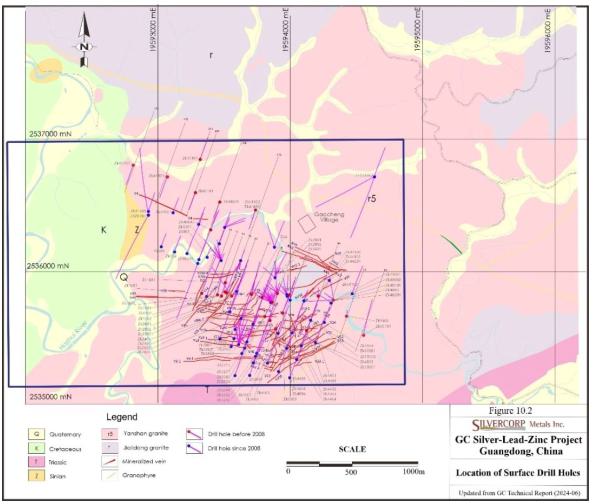
Sources: Silvercorp Metals Inc.
Detailed systematic drilling commenced on the GC Mine in 2011 and continued through to 2025. In 2011, most of the drilling was completed from the surface. As drill target depths increased, underground drilling was increasingly utilized. Since 2014, all diamond drilling has been completed using underground set-ups except five surface holes in 2023.
Table 10.1 presents drilling statistics by year for holes drilled from surface and underground set-ups.
Table 10.1: Drilling Program Summary
| Year | Metres Drilled | Holes Completed | |
| Underground | Surface | ||
| 2008-2011 | 28,413 | 0 | 123 |
| 2011 | 14,484 | 2 | 34 |
| 2012 | 27,450 | 109 | 27 |
| 2013 | 46,565 | 262 | 41 |
| 2014 | 19,332 | 121 | 0 |
| 2015 | 22,431 | 150 | 0 |
| 2016 | 11,944 | 129 | 0 |
| 2017 | 21,085 | 164 | 0 |
| 2018 | 24,993 | 189 | 0 |
| 2019 | 24,946 | 192 | 0 |
| 2020 | 34,953 | 346 | 0 |
| 2021 | 65,054 | 623 | 0 |
| 2022 | 65,871 | 560 | 0 |
| 2023 | 72,115 | 487 | 5 |
| 2024 | 59,880 | 420 | 0 |
| 2025 | 49,664 | 427 | 0 |
| Total | 589,180 | 4,181 | 230 |
Notes: The number of holes and meters drilled between 2008 and 2020 are from the 2021 AMC report, however the summary from 2021 to 2025 has been sourced by SRK from the database provided by GC Mine
| SRK CONSULTING CHINA LTD. § APR. 20, 2026 § FH/AT | 47 |
Technical Report on Gaocheng Silver-Lead-Zinc Project in Guangdong Province, China
Drilling § FINAL
Most drillholes are inclined to test multiple vein structures. Underground drilling is conducted using fan arrays, with multiple holes drilled from single setups. High-grade mineralized zones have been significantly exposed both at and below current production levels, and major mineralized zones have been extended along strike and down dip. The drillholes and underground samples are shown in Figure 10.2 and Figure 10.3.
Figure 10.2: Location of Drillhole and Underground Samples (Level 0m)
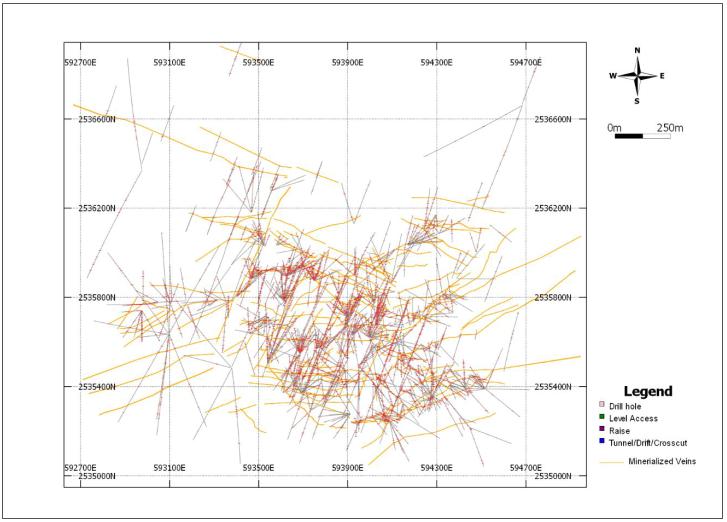
Sources: SRK
| SRK CONSULTING CHINA LTD. § APR. 20, 2026 § FH/AT | 48 |
Technical Report on Gaocheng Silver-Lead-Zinc Project in Guangdong Province, China
Drilling § FINAL
Figure 10.3: View of Drillhole and Underground Samples (Looking North)
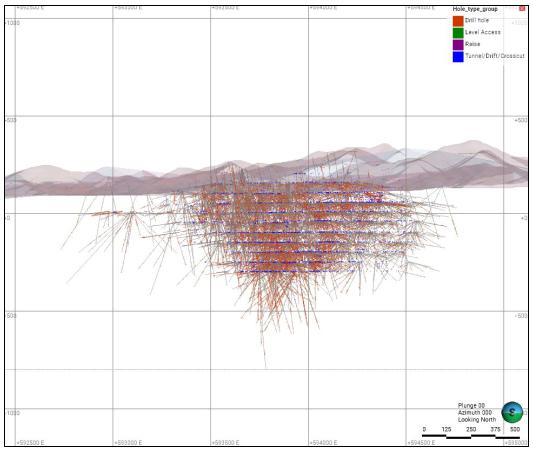
Sources: SRK
The Photographs of underground diamond drilling is shown in Figure 10.4.
Figure 10.4: Underground Diamond Drilling Programme
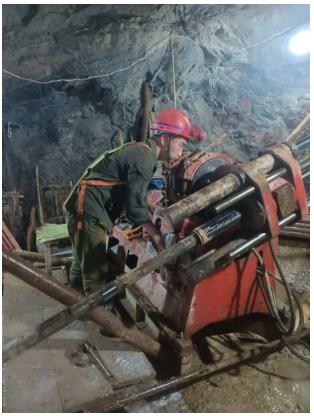 | 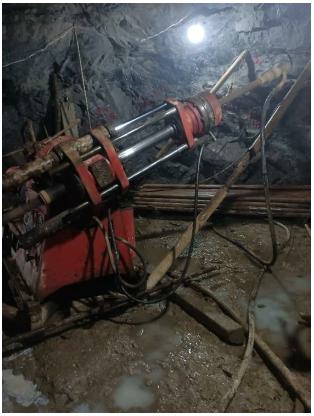 |
Sources: GC Mine 2024
| SRK CONSULTING CHINA LTD. § APR. 20, 2026 § FH/AT | 49 |
Technical Report on Gaocheng Silver-Lead-Zinc Project in Guangdong Province, China
Drilling § FINAL
| 10.3 | Bulk Density |
In 2019, SVM has collected 192 samples from veins; V9-5, V9-3, V6M, V5-7, V2W, V2E, V28-6, V28-4, V24, V19, V12, V10-1, V10, NV28-1 and NV10 which covers a range of mineralization styles.
AMC provided the density formula within mineralization wireframes of GC deposit based on the new samples and is a multiple linear regression model using lead, zinc, and silver grades, while barren rock is considered to have a density of 2.60.
DENSITY = 3.094919 + (0.040827 x Pb) + (0.034253 x Zn) + (0.000482 x Ag)
Figure 10.5 presents a scatterplot comparing the measured density with the density estimated using linear regression.
Figure 10.5: Measured Density vs Density Estimated by Linear Regression with Pb, Zn, Ag
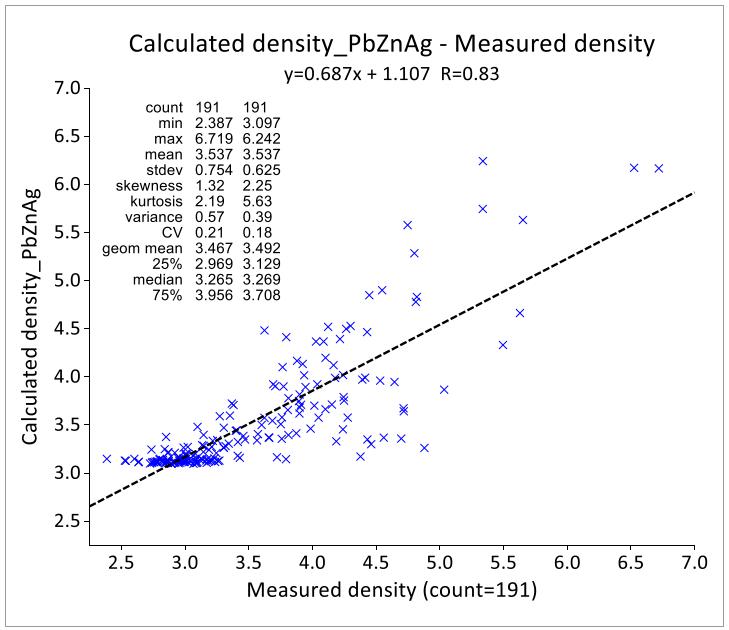
Sources: 2021 AMC report
| SRK CONSULTING CHINA LTD. § APR. 20, 2026 § FH/AT | 50 |
Technical Report on Gaocheng Silver-Lead-Zinc Project in Guangdong Province, China
Sample Preparation, Analyses, and Security § FINAL
| 11 | Sample Preparation, Analyses, and Security |
The sample preparation and assaying of primary samples from GC Mineral Resource drilling was undertaken by GC Mine, ALS and SGS laboratories.
The author considers that quality control measures adopted for assaying of the GC Mineral Resource drilling have established that the assaying is representative and free of any biases or other factors that may materially impact the reliability of the analytical results. The author considers that the sample preparation, security and analytical procedures adopted for the GC drilling provide an adequate basis for the current Mineral Resource estimates.
| 11.1 | Sampling |
Drilling at the GC Mine uses NQ-sized diamond core, conducted from both surface and underground. Drill core is collected in wooden trays by drilling personnel, with SVM geologists visiting the drill site daily to check drilling progress, core quality, and depth markings. The core is then transported to the surface core shed at the mine camp for further processing.
SVM personnel handle all logging and sampling, which includes collecting core recovery data, detailed lithological, vein, and mineralization logging, core photography, and core sampling. Sample intervals, determined by the geologist based on veining and sulphide content, range from 5 cm to 2 m, averaging 1.1 m.
After photographing, the core to be sampled is cut in half with a rock saw (Figure 11.1). One half is placed into cotton bags for analysis, while the other half is returned to the core tray for archival storage. If a duplicate sample is needed, the core is quartered. Sample numbers are marked on the cotton bags, and a tear-off tag with the sample number is inserted into the bag. The corresponding interval is also marked on the retained core. The sealed sample bags are then placed into larger suitable bags for shipment to the laboratory.
Figure 11.1: Drill Core Cut in Half
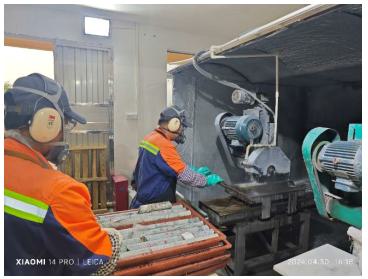 | 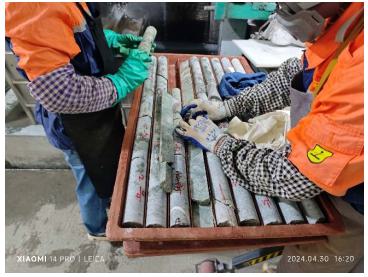 |
Sources: GC Mine 2024
Underground samples are composites of chips collected from channels cut in the underground; tunnels, crosscuts, and trench bottoms. Tunnels are typically sampled along lines perpendicular to the mineralized vein structure at 5 m intervals within mineralized zones, and at 15 to 25 m intervals in non-mineralized zones. Samples from crosscuts and trench bottoms are generally restricted to the thickness of the mineralized structure (Figure 11.2).
| SRK CONSULTING CHINA LTD. § APR. 20, 2026 § FH/AT | 51 |
Technical Report on Gaocheng Silver-Lead-Zinc Project in Guangdong Province, China
Sample Preparation, Analyses, and Security § FINAL
Figure 11.2: Underground Sampling
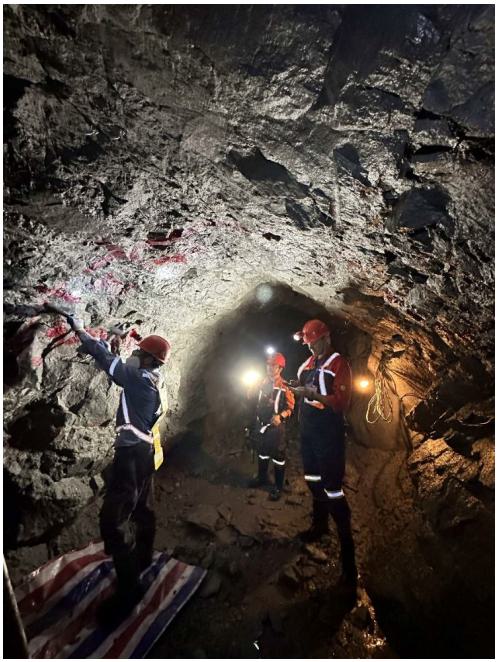
Sources: SRK Site visit, 2024
These samples include both vein material and associated wallrock. They are collected in cotton bags labelled with a unique sample number. The bags are then sealed, placed into larger suitable bags, and secured for shipment to the laboratory.
| SRK CONSULTING CHINA LTD. § APR. 20, 2026 § FH/AT | 52 |
Technical Report on Gaocheng Silver-Lead-Zinc Project in Guangdong Province, China
Sample Preparation, Analyses, and Security § FINAL
| 11.2 | Sample Preparation and Analysis |
Since 2008, SVM has used three main laboratories for sample preparation and analysis. From 2008 to 2014, ALS Chemex (Guangzhou) Co., Ltd. (ALS Guangzhou or ALS), a part of ALS Global laboratory Group located in Guangdong Province, served as the primary laboratory. Since 2014, SVM's GC Laboratory has taken over as the primary laboratory. From 2021 to 2025, SGS (Tianjin) Laboratory (“SGS”) served as the umpire laboratory for GC Mine.
ALS Guangzhou is accredited by the International Standards Organization (“ISO”) with standards 9001:2015 and 17025:2007, as well as the China National Accreditation Service (“CNAS”). These accreditations cover the general requirements for the competence of testing and calibration laboratories.
The GC Laboratory, owned and operated by SVM, is not certified by any standards association.
The SGS Laboratory is accredited by China Metrology Certification/ China Inspection Body and Laboratory Mandatory Approval (“CMA”) and CNAS.
| 11.2.1 | ALS Guangzhou |
From 2008 to 2014, SVM used ALS Guangzhou as the primary laboratory for sample preparation and analysis of GC Mine samples. After 2014, ALS Guangzhou has served as an umpire laboratory. At ALS Guangzhou, the sample preparation process involves drying the samples, followed by crushing them to ensure more than 70% pass through a <2 mm sieve. The crushed samples are then split using a riffle splitter, and up to 250 grams (“g”) are pulverized to achieve 85% passing 75 microns (“µm”).
The prepared samples are analysed using ALS assay procedure OG62. This involves a four-acid digestion process where the samples are treated with nitric, perchloric, hydrofluoric, and hydrochloric acids, then evaporated. Afterward, hydrochloric acid and de-ionized water are added, and the samples are heated for a specified time. Once cooled, the samples are diluted to volume with de-ionized water, homogenized, and analysed using Inductively Coupled Plasma – Atomic Emission Spectrometry (“ICP-AES”) or Atomic Absorption Spectroscopy (“AAS”).
Detection ranges for the OG62 method are provided in Table 11.1.
Table 11.1: ALS Chemex Laboratory Method and Detection Limits
| Element | ALS Method | Units | Lower Limit | Upper Limit |
| Ag | Ag-OG62 | ppm | 1 | 1,500 |
| Pb | Pb-OG62 | % | 0.001 | 20 |
| Zn | Zn-OG62 | % | 0.001 | 30 |
Sources: 2021 AMC report
Silver samples returning assays greater than 1,500 g/t Ag are subsequently analyzed by ALS fire assay (“FA”) (method AG GRA-21). This method has a lower detection of 5 g/t and an upper limit of 10,000 g/t.
| SRK CONSULTING CHINA LTD. § APR. 20, 2026 § FH/AT | 53 |
Technical Report on Gaocheng Silver-Lead-Zinc Project in Guangdong Province, China
Sample Preparation, Analyses, and Security § FINAL
| 11.2.2 | GC Mine Laboratory |
Since 2014, SVM's GC Laboratory has served as the primary facility for sample preparation and analysis of GC Mine samples. At the GC Laboratory, samples undergo a drying process for 12 hours at temperatures between 75 and 80°C. They are then crushed to a size of 2 to 5 mm using a jaw crusher, followed by further crushing to 0.84 to 1.0 mm with a roll crusher. The crushed sample is split using a riffle splitter to obtain a 300 g subsample, which is ground to 0.125 to 0.074 mm using a pulverizer made in Jiangxi, China. The pulverizer is regularly cleaned by grinding quartz sand and then with high-pressure air. For analysis, 0.5 g of the prepared sample are digested using a two-acid digest. Ag, Pb and Zn are analysed using AAS method. When Pb and Zn concentrations exceed the upper detection limit of 3%, they are analysed using a separate titration method, which has a detection range of 2% to 60%. High-grade silver is analysed using FA, with an upper detection limit of 5,000 ppm Ag.
From July 2023, Ag, Pb, and Zn are analysed using Inductively Coupled Plasma - Optical Emission Spectrometer (“ICP-OES”) method first. If Ag returned assays greater than 1,000 g/t, the Ag samples were subsequently analysed by AAS, and if Ag returned assays greater 2,000 g/t by AAS, the Ag samples were analysed by FA. This atomic absorption spectrometry and fire method for Ag has an upper limit of 2,000 g/t and 10,000 g/t respectively. If Pb and Zn returned assays greater than 3%, The lead and zinc samples were subsequently analysed by separate titration. This method has an upper limit of 60% for both Pb and Zn.
The Detection limits for the GC Laboratory's analytical processes are detailed in Table 11.2.
Table 11.2: Silvercorp GC Laboratory Detection Limits
| Element | Detection Range | Over Limit Notes | Over Limit Upper Detection Limit |
| Ag | 2/5 - 1,000 ppm | >1,000 g/t overlimit samples analysed by AAS, >2,000 g/t overlimit samples analysed by FA | 10,000 ppm |
| Pb | 0.001 - 3% | >3% overlimit samples analysed by separate titration | 60% |
| Zn | 0.001 - 3% | >3% overlimit samples analysed by separate titration | 60% |
Sources: GC Mine
Notes: From July 2023, the lower detection range of Ag is changed to 2 ppm
| 11.2.3 | SGS Laboratory |
The SGS laboratory has been used as the umpire laboratory for the GC Mine sample analysis since 2023.
At the SGS laboratory, samples are dried at 95°C, crushed to 3 mm with a jaw crusher, then split through a riffle splitter resulting in a subsample of 500 g and is ground with a pulveriser to 0.074 mm. Ag, Pb, and Zn are analyzed using AAS method. This process has a lower detection limit of 0.002% and an upper detection limit of 2% for Pb and lower detection limit of 0.001% and an upper detection limit of 2% for Zn. The Detection range for Ag is 5 – 500 g/t. If Ag, Pb or Zn returned assays greater than upper detection limit, The samples are subsequently analysed by FA method for Ag and separate titration for Pb and Zn.
Detection limits for the SGS laboratory analytical process are presented in Table 11.3.
| SRK CONSULTING CHINA LTD. § APR. 20, 2026 § FH/AT | 54 |
Technical Report on Gaocheng Silver-Lead-Zinc Project in Guangdong Province, China
Sample Preparation, Analyses, and Security § FINAL
Table 11.3: SGS Laboratory Detection Limits
| Element | Detection Range | Over Limit Notes | Over Limit Upper Detection Limit |
| Ag | 5 - 500 ppm | >500 g/t overlimit samples analysed by FA | >2,000 ppm |
| Pb | 0.002 - 2% | >2% overlimit samples analysed by separate titration | 80% |
| Zn | 0.001 - 2% | >2% overlimit samples analysed by separate titration | 80% |
Sources: GC Mine
| 11.3 | Sample Shipment and Security |
Drill core is stored in a clean and well-maintained core shed in the GC Mine camp complex (
Figure 11.3). This core shed is locked when unattended and monitored by two security personnel 24 hours a day.
Samples are shipped to the laboratory in sample bags inside sealed poly-woven bags. Between 2008 and 2014, samples were transported by GC Mine personnel in a pickup truck and then couriered to the ALS laboratory in Guangzhou. Between 2014 and 2025 samples were transported to the GC laboratory by GC Mine personnel.
Figure 11.3: Core Tray Storage
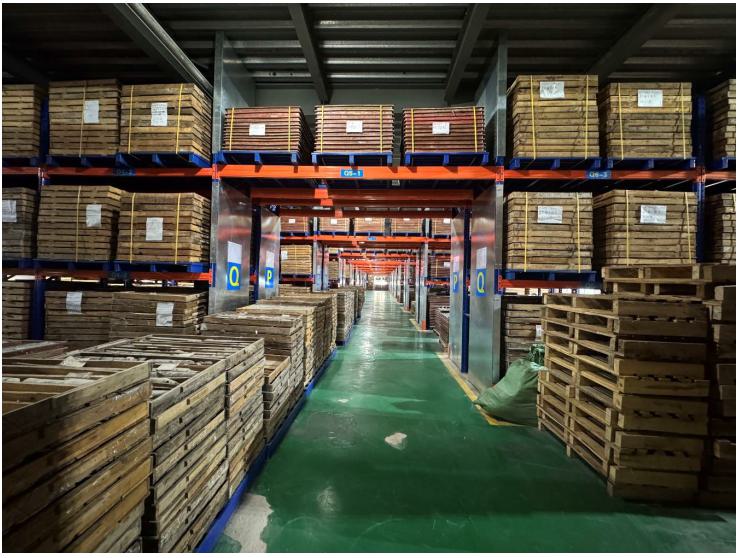
Sources: SRK Site visit, 2026
| SRK CONSULTING CHINA LTD. § APR. 20, 2026 § FH/AT | 55 |
Technical Report on Gaocheng Silver-Lead-Zinc Project in Guangdong Province, China
Sample Preparation, Analyses, and Security § FINAL
| 11.4 | QA/QC |
| 11.4.1 | Monitoring Program |
SVM has established QA/QC procedures which cover sample collection and processing at the GC Mine. These QA/QC protocols have been progressively refined since 2011. CRMs and coarse blanks have been included with drilling samples since 2011, and with underground samples since 2014. Field duplicates have been included with drilling samples since 2012 and with underground samples since 2014. Check (umpire) samples (pulp duplicates) have been sent to a separate ‘umpire’ laboratory since 2012.
In 2018, SVM further improved their QA/QC protocols to include regular and more frequent submission of CRMs, coarse blanks, and field duplicates with drilling and underground samples. Coarse reject duplicates and pulp duplicates were also incorporated into drill sampling programs. The proportion of check samples, sent to a different laboratory was also increased. In 2019, SVM initiated real-time monitoring of QA/QC protocols.
A summary of QA/QC samples included in drilling and underground sampling programs since 2011 is provided in Table 11.4.
Table 11.4: GC Mine QA/QC Samples by Year
| Year | Drilling | Underground Sampling | ||||||||||||
| Drill
Samples |
CRMs | Blanks | Duplicates | Umpire
Samples |
Channel Samples |
CRMs | Blanks | Duplicates | Umpire
Samples | |||||
| Field | Coarse | Pulp | Field | Coarse | Pulp | |||||||||
| Pre-2011.5 | 5,300 | - | - | - | - | - | - | 102 | - | - | - | - | ||
| 2011 | 1,859 | 68 | 82 | - | - | - | 60 | 34 | - | - | - | - | ||
| 2012 | 4,707 | 98 | 133 | 94 | - | - | 2,247 | 1,142 | - | - | - | 103 | ||
| 2013 | 7,235 | 105 | 132 | 106 | - | - | 3,094 | 2,145 | - | - | - | 11 | ||
| 2014 | 1,617 | 44 | 50 | 44 | - | - | 109 | 1,991 | 31 | 29 | 35 | 102 | ||
| 2015 | 1,729 | 45 | 48 | 41 | - | - | 31 | 4,139 | 64 | 67 | 68 | - | ||
| 2016 | 1,974 | 82 | 81 | 80 | - | - | 33 | 4,299 | 71 | 71 | 74 | - | ||
| 2017 | 4,150 | 150 | 153 | 155 | - | - | 46 | 5,183 | 84 | 84 | 84 | - | ||
| 2018 | 5,178 | 178 | 184 | 184 | 60 | 60 | 303 | 5,786 | 281 | 289 | 289 | 976 | ||
| 2019 | 5,085 | 164 | 176 | 163 | 163 | 163 | - | 7,629 | 122 | 124 | 118 | 482 | ||
| 2020 | 9,473 | 331 | 407 | 331 | 331 | 327 | 467 | 6,961 | 136 | 141 | 138 | 382 | ||
| 2021 | 20,410 | 701 | 797 | 338 | 686 | 678 | 650 | 6,812 | 61 | 61 | 65 | 213 | ||
| 2022 | 16,955 | 590 | 679 | 598 | 596 | 593 | 517 | 5,097 | 35 | 42 | 43 | 149 | ||
| 2023 | 13,984 | 435 | 522 | 338 | 338 | 335 | 425 | 4,247 | 113 | 142 | 81 | 61 | 60 | 43 |
| 2024 | 9,929 | 407 | 283 | 154 | 154 | 157 | 121 | 4,988 | 250 | 269 | 214 | 107 | 107 | 105 |
| 2025 | 7,312 | 367 | 364 | 182 | 182 | 181 | 295 | 3,502 | 172 | 192 | 159 | 60 | 60 | 153 |
| Total | 116,897 | 3,765 | 4,091 | 2,808 | 2,510 | 2,494 | 8,398 | 64,057 | 1,420 | 1,511 | 1,368 | 228 | 227 | 2,719 |
Notes: Consistent with the historical summary,the samples before 2021 are from the 2021 AMC report, however the summary from 2021 to 2025 has been sourced by SRK from the database provided by GC Mine
The QA/QC samples summary and performance from 2011 to 2023 have been presented in the 2024 SRK report. This report will mainly focus on the performance of the CRMs from 2024 to 2025.
| 11.4.2 | Certified Reference Materials |
The monitoring of assay reliability of GC Mine included insertion of samples of CRMS prepared by The Institute of Geophysical and Geochemical Exploration and approved by the General Administration of Quality Supervision, Inspection and Quarantine of the People’s Republic of China. CRMs with prefix “CDN” were sourced from CDN Resource Laboratories Ltd. in Langley, British Columbia, Canada.
| SRK CONSULTING CHINA LTD. § APR. 20, 2026 § FH/AT | 56 |
Technical Report on Gaocheng Silver-Lead-Zinc Project in Guangdong Province, China
Sample Preparation, Analyses, and Security § FINAL
Details and performance of the CRMs used at the GC Mine from 2024 to 2025 are presented in Table 11.5, Table 11.6 and Figure 11.4.
Table 11.5: Summary of CRMs(2024-2025)
| Reference Material | Type | Analyte | Units | Accepted Value | 2 Std Dev |
| CDN-ME-1206 | CRM | Ag | g/t | 274.00 | 28.00 |
| CDN-FCM-7 | CRM | Ag | g/t | 64.70 | 8.20 |
| CDN-ME-1604 | CRM | Ag | g/t | 309.00 | 30.00 |
| CDN-ME-1801 | CRM | Ag | g/t | 108.00 | 12.00 |
| CDN-ME-1306 | CRM | Ag | g/t | 104.00 | 14.00 |
| CDN-ME-1410 | CRM | Ag | g/t | 69.00 | 7.60 |
| CDN-ME-1807 | CRM | Ag | g/t | 327.00 | 40.00 |
| CDN-ME-1201 | CRM | Ag | g/t | 37.60 | 6.80 |
| CDN-ME-1403 | CRM | Ag | g/t | 53.90 | 10.80 |
| CDN-ME-1404 | CRM | Ag | g/t | 59.10 | 5.40 |
| CDN-ME-2001 | CRM | Ag | g/t | 582.00 | 38.00 |
| CDN-ME-1405 | CRM | Ag | g/t | 88.80 | 13.20 |
| CDN-ME-1603 | CRM | Ag | g/t | 86.00 | 6.00 |
| CDN-ME-1803 | CRM | Ag | g/t | 46.00 | 6.00 |
| CDN-ME-1808 | CRM | Ag | g/t | 39.00 | 5.20 |
| CDN-ME-1206 | CRM | Pb | % | 0.80 | 0.09 |
| CDN-FCM-7 | CRM | Pb | % | 0.63 | 0.08 |
| CDN-ME-1604 | CRM | Pb | % | 4.83 | 0.30 |
| CDN-ME-1801 | CRM | Pb | % | 3.08 | 0.20 |
| CDN-ME-1306 | CRM | Pb | % | 1.60 | 0.14 |
| CDN-ME-1410 | CRM | Pb | % | 0.25 | 0.02 |
| CDN-ME-1807 | CRM | Pb | % | 2.34 | 0.20 |
| CDN-ME-1201 | CRM | Pb | % | 0.47 | 0.06 |
| CDN-ME-1403 | CRM | Pb | % | 0.41 | 0.04 |
| CDN-ME-1404 | CRM | Pb | % | 0.38 | 0.04 |
| CDN-ME-2001 | CRM | Pb | % | 0.78 | 0.06 |
| CDN-ME-1405 | CRM | Pb | % | 0.64 | 0.10 |
| CDN-ME-1603 | CRM | Pb | % | 1.34 | 0.10 |
| CDN-ME-1803 | CRM | Pb | % | 1.21 | 0.08 |
| CDN-ME-1808 | CRM | Pb | % | 0.60 | 0.04 |
| CDN-ME-1206 | CRM | Zn | % | 2.38 | 0.30 |
| CDN-FCM-7 | CRM | Zn | % | 3.85 | 0.38 |
| CDN-ME-1604 | CRM | Zn | % | 0.72 | 0.06 |
| CDN-ME-1801 | CRM | Zn | % | 7.43 | 0.60 |
| CDN-ME-1306 | CRM | Zn | % | 3.17 | 0.30 |
| CDN-ME-1410 | CRM | Zn | % | 3.68 | 0.17 |
| CDN-ME-1807 | CRM | Zn | % | 2.43 | 0.16 |
| CDN-ME-1201 | CRM | Zn | % | 4.99 | 0.58 |
| CDN-ME-1403 | CRM | Zn | % | 1.34 | 0.12 |
| CDN-ME-1404 | CRM | Zn | % | 2.08 | 0.14 |
| CDN-ME-2001 | CRM | Zn | % | 1.50 | 0.10 |
| CDN-ME-1405 | CRM | Zn | % | 3.02 | 0.22 |
| CDN-ME-1603 | CRM | Zn | % | 0.45 | 0.06 |
| CDN-ME-1803 | CRM | Zn | % | 2.82 | 0.24 |
| CDN-ME-1808 | CRM | Zn | % | 3.85 | 0.30 |
Sources: Summarized by SRK from the database provided by GC Mine
| SRK CONSULTING CHINA LTD. § APR. 20, 2026 § FH/AT | 57 |
Technical Report on Gaocheng Silver-Lead-Zinc Project in Guangdong Province, China
Sample Preparation, Analyses, and Security § FINAL
Table 11.6: Summary of GC Mine CRM Results (2024 - 2025)
| |
|||||
| Statistics | CDN-FCM- 7(Ag) |
CDN-FCM- 7(Pb) |
CDN-FCM- 7(Zn) | ||
| Project | GC Mine | Sample Count | 95.00 | 95 | 95 |
| Data Series | 2024-2025 | Expected Value | 64.70 | 0.63 | 3.85 |
| Data Type | Underground & Core Samples | Standard Deviation | 8.20 | 0.08 | 0.38 |
| Commodity | Ag, Pb, Zn | Data Mean | 64.56 | 0.63 | 3.85 |
| Laboratory | GC Laboratory | Outside 2StdDev | 0 | 1% | 0% |
| Analytical Method | Below 2StdDev | 0 | 1 | 0 | |
| Detection Limit | Above 2StdDev | 0.00 | 0 | 0 | |
| Statistics | CDN-ME- 1201(Ag) |
CDN-ME- 1201(Pb) |
CDN-ME- 1201(Zn) | ||
| Project | GC Mine | Sample Count | 31 | 31 | 31 |
| Data Series | 2024-2025 | Expected Value | 37.60 | 0.47 | 4.99 |
| Data Type | Underground & Core Samples | Standard Deviation | 6.80 | 0.06 | 0.58 |
| Commodity | Ag, Pb, Zn | Data Mean | 37.81 | 0.47 | 4.98 |
| Laboratory | GC Laboratory | Outside 2StdDev | 0% | 0% | 0% |
| Analytical Method | Below 2StdDev | 0 | 0 | 0 | |
| Detection Limit | Above 2StdDev | 0 | 0 | 0 | |
| Statistics | CDN-ME- 1403(Ag) |
CDN-ME- 1403(Pb) |
CDN-ME- 1403(Zn) | ||
| Project | GC Mine | Sample Count | 159 | 159 | 159 |
| Data Series | 2024-2025 | Expected Value | 53.90 | 0.41 | 1.34 |
| Data Type | Underground & Core Samples | Standard Deviation | 10.80 | 0.04 | 0.12 |
| Commodity | Ag, Pb, Zn | Data Mean | 53.59 | 0.42 | 1.34 |
| Laboratory | GC Laboratory | Outside 2StdDev | 1% | 0% | 0% |
| Analytical Method | Below 2StdDev | 1 | 0 | 0 | |
| Detection Limit | Above 2StdDev | 0 | 0 | 0 | |
| Statistics | CDN-ME- 1404(Ag) |
CDN-ME- 1404(Pb) |
CDN-ME- 1404(Zn) | ||
| Project | GC Mine | Sample Count | 155 | 155 | 155 |
| Data Series | 2024-2025 | Expected Value | 59.10 | 0.38 | 2.08 |
| Data Type | Underground & Core Samples | Standard Deviation | 5.40 | 0.04 | 0.14 |
| Commodity | Ag, Pb, Zn | Data Mean | 58.85 | 0.38 | 2.08 |
| Laboratory | GC Laboratory | Outside 2StdDev | 0% | 1% | 0% |
| Analytical Method | Below 2StdDev | 0 | 1 | 0 | |
| Detection Limit | Above 2StdDev | 0 | 0 | 0 | |
| Statistics | CDN-ME- 1405(Ag) |
CDN-ME- 1405(Pb) |
CDN-ME- 1405(Zn) | ||
| Project | GC Mine | Sample Count | 124 | 124 | 124 |
| Data Series | 2024-2025 | Expected Value | 88.80 | 0.64 | 3.02 |
| Data Type | Underground & Core Samples | Standard Deviation | 13.20 | 0.10 | 0.22 |
| Commodity | Ag, Pb, Zn | Data Mean | 88.11 | 0.64 | 3.03 |
| Laboratory | GC Laboratory | Outside 2StdDev | 0% | 0% | 0% |
| Analytical Method | Below 2StdDev | 0 | 0 | 0 | |
| Detection Limit | Above 2StdDev | 0 | 0 | 0 | |
| SRK CONSULTING CHINA LTD. § APR. 20, 2026 § FH/AT | 58 |
Technical Report on Gaocheng Silver-Lead-Zinc Project in Guangdong Province, China
Sample Preparation, Analyses, and Security § FINAL
| |
|||||
| Statistics | CDN-ME- 1410(Ag) |
CDN-ME- 1410(Pb) |
CDN-ME- 1410(Zn) | ||
| Project | GC Mine | Sample Count | 67 | 67 | 67 |
| Data Series | 2024-2025 | Expected Value | 69.00 | 0.25 | 3.68 |
| Data Type | Underground & Core Samples | Standard Deviation | 7.60 | 0.02 | 0.17 |
| Commodity | Ag, Pb, Zn | Data Mean | 69.04 | 0.25 | 3.68 |
| Laboratory | GC Laboratory | Outside 2StdDev | 0% | 4% | 0% |
| Analytical Method | Below 2StdDev | 0 | 0 | 0 | |
| Detection Limit | Above 2StdDev | 0 | 3 | 0 | |
| Statistics | CDN-ME- 1603(Ag) |
CDN-ME- 1603(Pb) |
CDN-ME- 1603(Zn) | ||
| Project | GC Mine | Sample Count | 119 | 121 | 119 |
| Data Series | 2024-2025 | Expected Value | 86.00 | 1.34 | 0.45 |
| Data Type | Underground & Core Samples | Standard Deviation | 6.00 | 0.10 | 0.06 |
| Commodity | Ag, Pb, Zn | Data Mean | 85.85 | 1.35 | 0.45 |
| Laboratory | GC Laboratory | Outside 2StdDev | 1% | 0% | 1% |
| Analytical Method | Below 2StdDev | 1 | 0 | 1 | |
| Detection Limit | Above 2StdDev | 0 | 0 | 0 | |
| Statistics | CDN-ME- 1604(Ag) |
CDN-ME- 1604(Pb) |
CDN-ME- 1604(Zn) | ||
| Project | GC Mine | Sample Count | 75 | 75 | 75 |
| Data Series | 2024-2025 | Expected Value | 309.00 | 4.83 | 4.83 |
| Data Type | Underground & Core Samples | Standard Deviation | 30.00 | 0.30 | 0.30 |
| Commodity | Ag, Pb, Zn | Data Mean | 299.25 | 4.84 | 4.84 |
| Laboratory | GC Laboratory | Outside 2StdDev | 0% | 0% | 0% |
| Analytical Method | Below 2StdDev | 0 | 0 | 0 | |
| Detection Limit | Above 2StdDev | 0 | 0 | 0 | |
| Statistics | CDN-ME- 1801(Ag) |
CDN-ME- 1801(Pb) |
CDN-ME- 1801(Zn) | ||
| Project | GC Mine | Sample Count | 90 | 90 | 90 |
| Data Series | 2024-2025 | Expected Value | 108.00 | 3.08 | 7.43 |
| Data Type | Underground & Core Samples | Standard Deviation | 12.00 | 0.20 | 0.60 |
| Commodity | Ag, Pb, Zn | Data Mean | 107.56 | 3.08 | 7.43 |
| Laboratory | GC Laboratory | Outside 2StdDev | 0% | 0% | 0% |
| Analytical Method | Below 2StdDev | 0 | 0 | 0 | |
| Detection Limit | Above 2StdDev | 0 | 0 | 0 | |
| SRK CONSULTING CHINA LTD. § APR. 20, 2026 § FH/AT | 59 |
Technical Report on Gaocheng Silver-Lead-Zinc Project in Guangdong Province, China
Sample Preparation, Analyses, and Security § FINAL
| |
|||||
| Statistics | CDN-ME-1803(Ag) | CDN-ME-1803(Pb) | CDN-ME-1803(Zn) | ||
| Project | GC Mine | Sample Count | 95 | 95 | 95 |
| Data Series | 2024-2025 | Expected Value | 46.00 | 1.21 | 2.82 |
| Data Type | Underground & Core Samples | Standard Deviation | 6.00 | 0.08 | 0.24 |
| Commodity | Ag, Pb, Zn | Data Mean | 46.35 | 1.22 | 2.82 |
| Laboratory | GC Laboratory | Outside 2StdDev | 0% | 0% | 0% |
| Analytical Method | Below 2StdDev | 0 | 0 | 0 | |
| Detection Limit | Above 2StdDev | 0 | 0 | 0 | |
| Statistics | CDN-ME-1807(Ag) | CDN-ME-1807(Pb) | CDN-ME-1807(Zn) | ||
| Project | GC Mine | Sample Count | 27 | 27 | 27 |
| Data Series | 2024-2025 | Expected Value | 327.00 | 2.34 | 2.43 |
| Data Type | Underground & Core Samples | Standard Deviation | 40.00 | 0.20 | 0.16 |
| Commodity | Ag, Pb, Zn | Data Mean | 325.56 | 2.34 | 2.44 |
| Laboratory | GC Laboratory | Outside 2StdDev | 0% | 0% | 0% |
| Analytical Method | Below 2StdDev | 0 | 0 | 0 | |
| Detection Limit | Above 2StdDev | 0 | 0 | 0 | |
| Statistics | CDN-ME-1808(Ag) | CDN-ME-1808(Pb) | CDN-ME-1808(Zn) | ||
| Project | GC Mine | Sample Count | 159 | 159 | 159 |
| Data Series | 2024-2025 | Expected Value | 39.00 | 0.60 | 3.85 |
| Data Type | Underground & Core Samples | Standard Deviation | 5.20 | 0.04 | 0.30 |
| Commodity | Ag, Pb, Zn | Data Mean | 39.14 | 0.61 | 3.86 |
| Laboratory | GC Laboratory | Outside 2StdDev | 0% | 1% | 0% |
| Analytical Method | Below 2StdDev | 0 | 0 | 0 | |
| Detection Limit | Above 2StdDev | 0 | 1 | 0 | |
| SRK CONSULTING CHINA LTD. § APR. 20, 2026 § FH/AT | 60 |
Technical Report on Gaocheng Silver-Lead-Zinc Project in Guangdong Province, China
Sample Preparation, Analyses, and Security § FINAL
Figure 11.4: CRMs Performances (2024-2025)
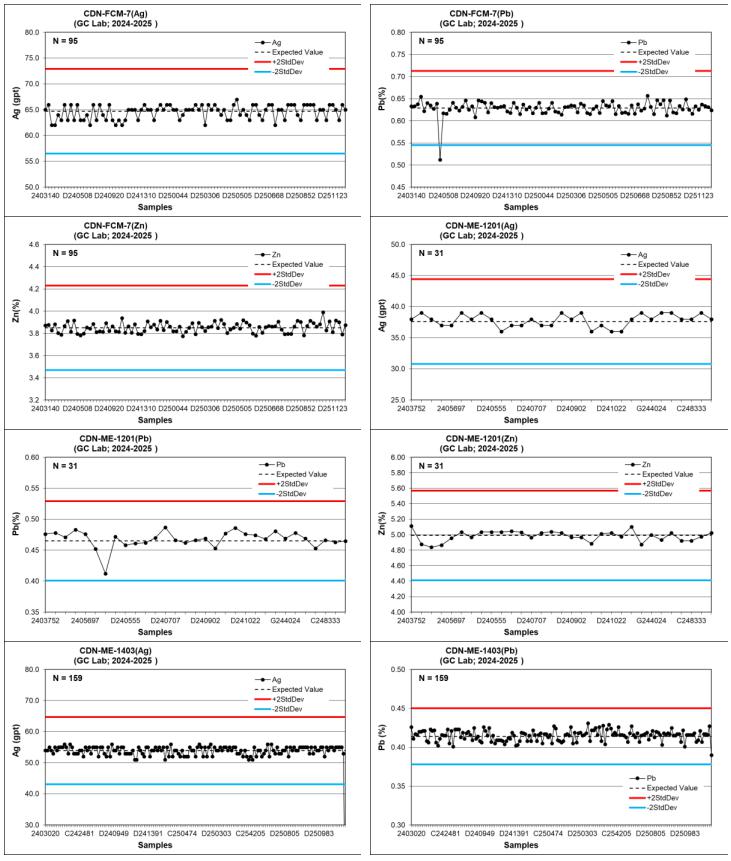
| SRK CONSULTING CHINA LTD. § APR. 20, 2026 § FH/AT | 61 |
Technical Report on Gaocheng Silver-Lead-Zinc Project in Guangdong Province, China
Sample Preparation, Analyses, and Security § FINAL
Figure 11.4: CRMs Performances (2024-2025)
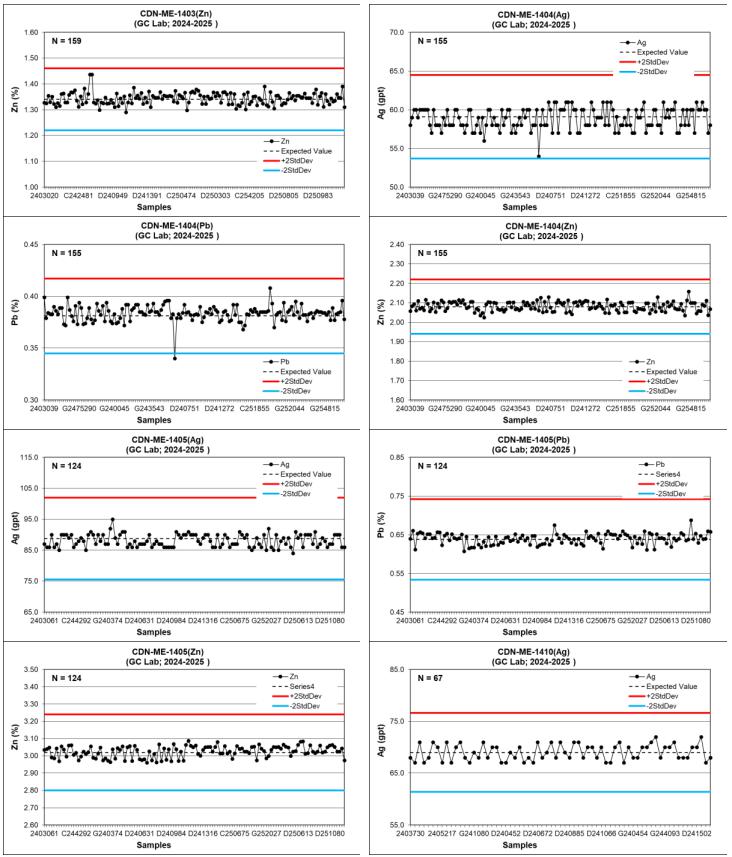
| SRK CONSULTING CHINA LTD. § APR. 20, 2026 § FH/AT | 62 |
Technical Report on Gaocheng Silver-Lead-Zinc Project in Guangdong Province, China
Sample Preparation, Analyses, and Security § FINAL
Figure 11.4: CRMs Performances (2024-2025)
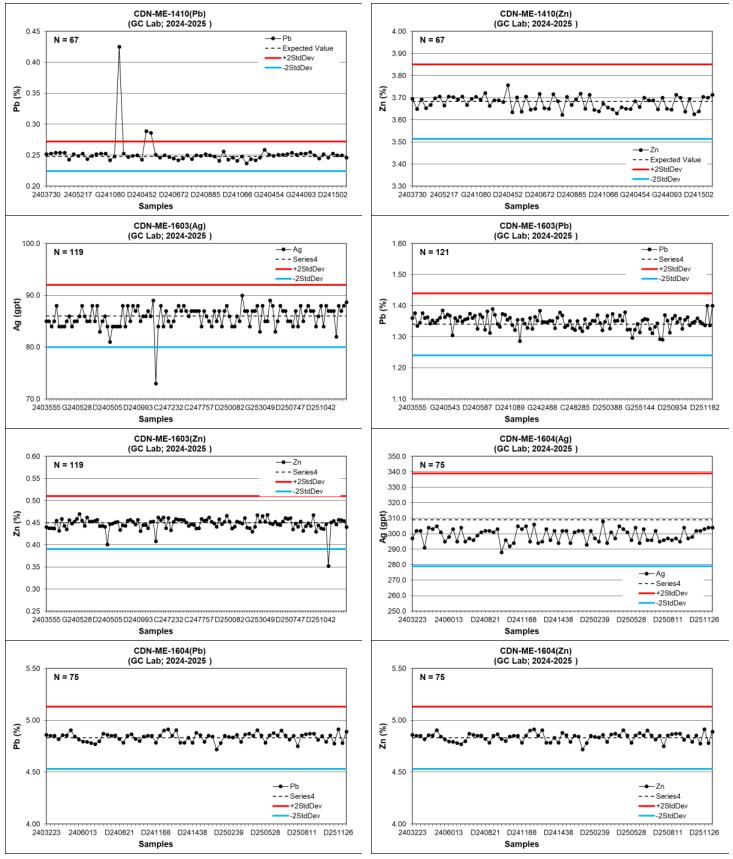
| SRK CONSULTING CHINA LTD. § APR. 20, 2026 § FH/AT | 63 |
Technical Report on Gaocheng Silver-Lead-Zinc Project in Guangdong Province, China
Sample Preparation, Analyses, and Security § FINAL
Figure 11.4: CRMs Performances (2024-2025)
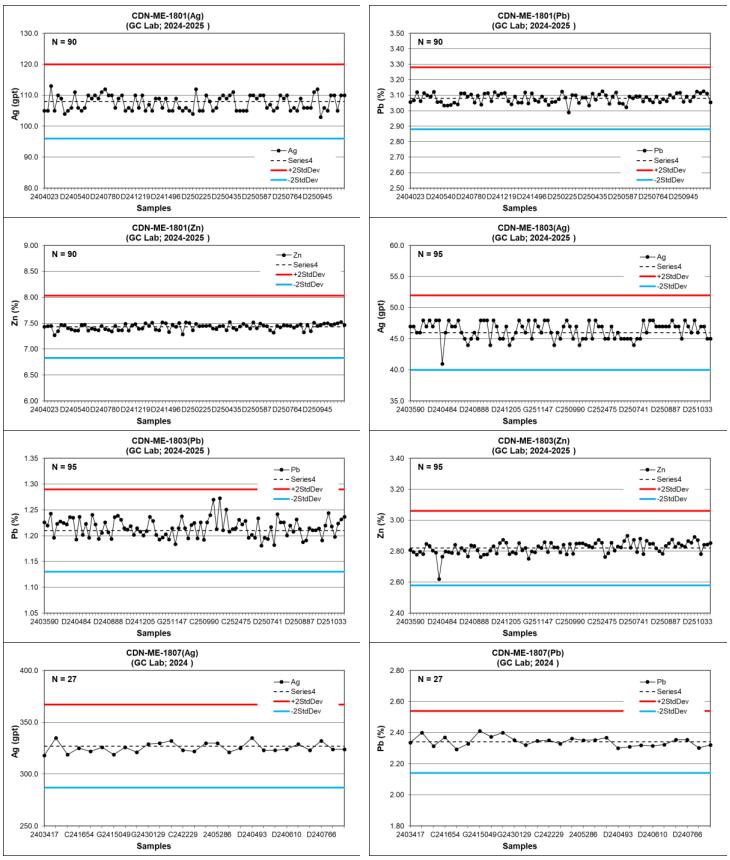
| SRK CONSULTING CHINA LTD. § APR. 20, 2026 § FH/AT | 64 |
Technical Report on Gaocheng Silver-Lead-Zinc Project in Guangdong Province, China
Sample Preparation, Analyses, and Security § FINAL
Figure 11.4: CRMs Performances (2024-2025)
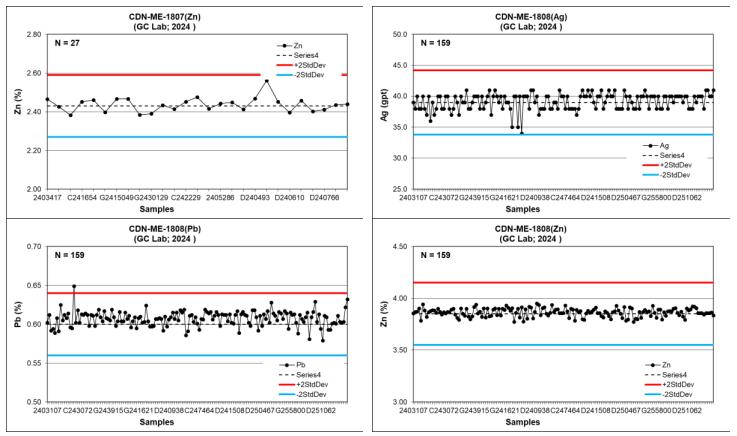
| 11.4.3 | Blank Samples |
SVM routinely included samples of un-mineralized rock collected from a quarry outside the GC area in assay batches, since 2011, for drillholes and since 2014 for underground samples. Blank assays described in this report include all results from the assay laboratories used for Mineral Resource drilling and underground samples, including data from outside the Mineral Resource area. The submission insert ratio of these samples averaged 3.7% for drillholes and 2.0% for underground samples.
Prior to 2018, SVM's protocol considered blank samples with assay results exceeding 30 g/t Ag, 0.3% Pb, or 0.3% Zn as failures. This protocol was revised in 2018, reducing the failure thresholds to 8 g/t Ag, 0.1% Pb, and 0.1% Zn.
Blank samples were monitored on a real-time basis as the results of samples batches are received. Failed blank samples were investigated and sample batches where contamination is identified would be re-assayed.
For assaying prior to 2023, the inserted blanks are coarse marble blanks. Starting in 2023, pulp blank samples have been inserted to monitor potential contamination during the grinding process. The generally accepted criterion is that 80% of coarse blanks should be less than three times the lower limit of analytical detection, and 90% of pulp blanks should be less than two times the lower limit of analytical detection. Table 11.7 summarizes SVM failure criteria and the generally accepted criteria for blank.
| SRK CONSULTING CHINA LTD. § APR. 20, 2026 § FH/AT | 65 |
Technical Report on Gaocheng Silver-Lead-Zinc Project in Guangdong Province, China
Sample Preparation, Analyses, and Security § FINAL
Table 11.7: GC Blank Fail Criteria
| Year | Lab | Detection Limits | Ag | Pb | Zn | |||
| SVM Fail | 3 x LDL Fail | SVM Fail | 3 x LDL Fail | SVM Fail | 3 x LDL Fail | |||
| Fail Limit | Fail | Fail Limit | Fail Limit | Fail Limit | Fail Limit | |||
| (g/t) | (g/t) | (g/t) | (%) | (%) | (%) | |||
| 2011 | ALS | Ag LDL=1 g/t | 30 | 3 | 0.3 | 0.003 | 0.3 | 0.003 |
| 2012 | Pb LDL=0.001% | 30 | 3 | 0.3 | 0.003 | 0.3 | 0.003 | |
| 2013 | Zn LDL=0.001% | 30 | 3 | 0.3 | 0.003 | 0.3 | 0.003 | |
| 2014 | GC | 30 | 15 | 0.3 | 0.003 | 0.3 | 0.003 | |
| 2015 | 30 | 15 | 0.3 | 0.003 | 0.3 | 0.003 | ||
| 2016 | 30 | 15 | 0.3 | 0.003 | 0.3 | 0.003 | ||
| 2017 | Ag LDL=2-5 g/t | 30 | 15 | 0.3 | 0.003 | 0.3 | 0.003 | |
| 2018 | Pb LDL=0.001% | 8 | 15 | 0.1 | 0.003 | 0.1 | 0.003 | |
| 2019 | Zn LDL=0.001% | 8 | 15 | 0.1 | 0.003 | 0.1 | 0.003 | |
| 2020 | 8 | 15 | 0.1 | 0.003 | 0.1 | 0.003 | ||
| 2021 | 8 | 15 | 0.1 | 0.003 | 0.1 | 0.003 | ||
| 2022 | 8 | 15 | 0.1 | 0.003 | 0.1 | 0.003 | ||
| 2023-2025 | 8 | 6 | 0.1 | 0.003 | 0.1 | 0.003 | ||
Notes:
| 1 | SVM - Silvercorp, ALS - ALS Guangzhou, GC - Gaocheng site laboratory | |
| 2 | The GC Laboratory Lower Detection Limit of Ag changed from 5g/t to 2g/t from July 2023 due to the update of analytical equipment |
Table 11.8 and Figure 11.5 and Figure 11.6 show the performance of the blanks following the generally accepted criteria.
Table 11.8: Summary of GC Blanks Results (2024 - 2025)
 |
Statistics | Coarse BLACK (Ag) |
Coarse BLACK (Pb) |
Coarse BLACK (Zn) | |
| Project | Sample Count | 656 | 656 | 656 | |
| Data Series | 2024-2025 Blanks | Lab Lower Detection Limit | NA | NA | NA |
| Data Type | Underground & Core Samples | Samples Above (3x Det. Lim.) | 0 | 2 | 3 |
| Commodity | Ag, Pb, Zn | Data Mean | 1.024 | 0.001 | 0.001 |
| Laboratory | GC Laboratory. | Percentage Outside (3xDL) | 0.0% | 0.3% | 0% |
| Analytical Method | ICP-AES, AAS | ||||
| Detection Limit | 2 gpt (Ag); 0.001% (Pb),0.001% (Zn) | ||||
| Statistics | Pulp Blank (Ag) |
Pulp Blank (Pb) |
Pulp Blank (Zn) | ||
| Project | Sample Count | 452 | 452 | 452 | |
| Data Series | 2024-2025 Blanks | Lab Lower Detection Limit | NA | NA | NA |
| Data Type | Underground & Core Samples | Samples Above (3x Det. Lim.) | 1 | 3 | 3 |
| Commodity | Ag, Pb, Zn | Data Mean | 1.100 | 0.005 | 0.004 |
| Laboratory | GC Laboratory. | Percentage Outside (3xDL) | 0.2% | 0.7% | 1% |
| Analytical Method | ICP-AES, AAS | ||||
| Detection Limit | 2 gpt (Ag); 0.001% (Pb),0.001% (Zn) | ||||
| SRK CONSULTING CHINA LTD. § APR. 20, 2026 § FH/AT | 66 |
Technical Report on Gaocheng Silver-Lead-Zinc Project in Guangdong Province, China
Sample Preparation, Analyses, and Security § FINAL
Figure 11.5: Coarse Marble Blanks Performances(2024 - 2025)
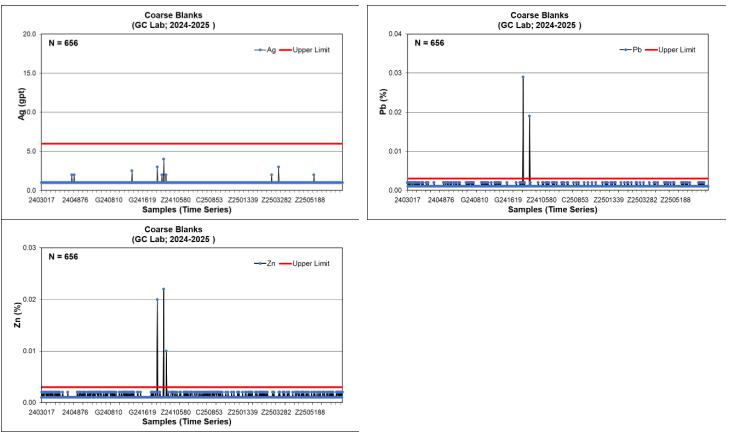
Figure 11.6: Pulp Blanks Performances(2024 - 2025)
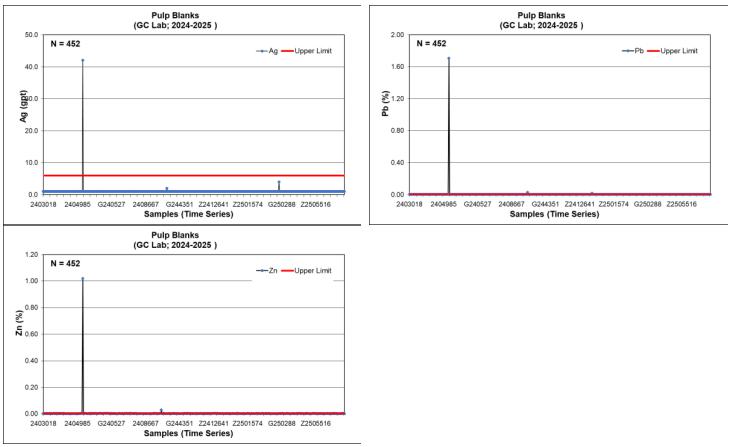
| SRK CONSULTING CHINA LTD. § APR. 20, 2026 § FH/AT | 67 |
Technical Report on Gaocheng Silver-Lead-Zinc Project in Guangdong Province, China
Sample Preparation, Analyses, and Security § FINAL
| 11.4.4 | Duplicate Samples |
SVM’s current QA/QC protocols include the insertion of field duplicates, coarse reject duplicates, and pulp duplicates. Field duplicates have been included with drilling samples since 2012 and with underground samples since 2014. Coarse duplicates and pulp duplicates have been included in drillhole sample batches since 2018, while coarse duplicates and pulp duplicates have been included in underground sample batches since 2023. The duplicates comprise the following:
| § | Total of 4,176 field duplicates, including 208 field duplicates assays by ALS Laboratory and 3,968 field duplicates assays by GC Laboratory, |
| § | 2,738 coarse duplicates assays by GC Laboratory, and |
| § | 2,721 pulp duplicates assays by GC Laboratory. |
The field duplicates, coarse reject duplicates, and pulp duplicates are collected at a rate of 3.2%, 2.8%, 2.8% for drillholes samples and 2.2%, 1.8%, 1.8% for underground samples respectively.
The Statistics and Scatter plot of field duplicates, coarse duplicates and pulp duplicates are presented in Table 11.9 and Figure 11.7 to Figure 11.9.
Table 11.9: Summary of GC Duplicates Results (2024 - 2025)
| QC type | Element | Data Pairs Count | Relative Difference | |||||
| <10% | 10% - 20% | > 20% | ||||||
| Field Duplicates | Ag | 709 | 311 | 43.9% | 178 | 25.1% | 220 | 31.0% |
| Pb | 709 | 268 | 37.8% | 202 | 28.5% | 239 | 33.7% | |
| Zn | 709 | 321 | 45.3% | 221 | 31.2% | 167 | 23.6% | |
| Coarse Duplicates | Ag | 503 | 470 | 93.4% | 24 | 4.8% | 9 | 1.8% |
| Pb | 503 | 493 | 98.0% | 5 | 1.0% | 5 | 1.0% | |
| Zn | 503 | 488 | 97.0% | 9 | 1.8% | 6 | 1.2% | |
| Pulp Duplicates | Ag | 505 | 434 | 85.9% | 31 | 6.1% | 40 | 7.9% |
| Pb | 505 | 433 | 85.7% | 25 | 5.0% | 47 | 9.3% | |
| Zn | 505 | 437 | 86.5% | 37 | 7.3% | 31 | 6.1% | |
Figure 11.7: Scatter Plot of Field Duplicates
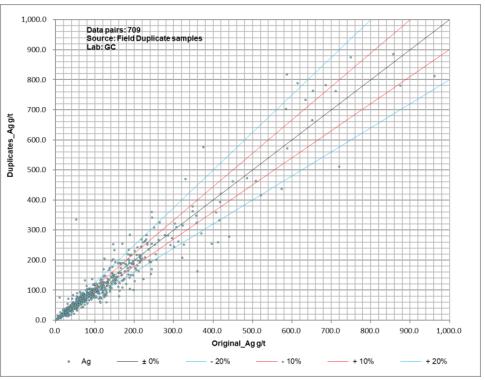
| SRK CONSULTING CHINA LTD. § APR. 20, 2026 § FH/AT | 68 |
Technical Report on Gaocheng Silver-Lead-Zinc Project in Guangdong Province, China
Sample Preparation, Analyses, and Security § FINAL
Figure 11.7: Scatter Plot of Field Duplicates
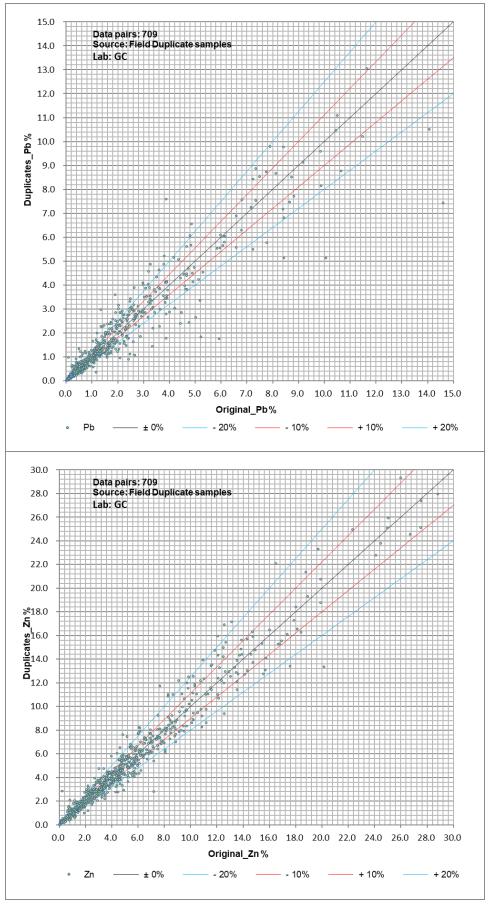
Notes: Ag: g/t, Pb: %, Zn: %
| SRK CONSULTING CHINA LTD. § APR. 20, 2026 § FH/AT | 69 |
Technical Report on Gaocheng Silver-Lead-Zinc Project in Guangdong Province, China
Sample Preparation, Analyses, and Security § FINAL
Figure 11.8: Scatter Plot of Coarse Duplicates
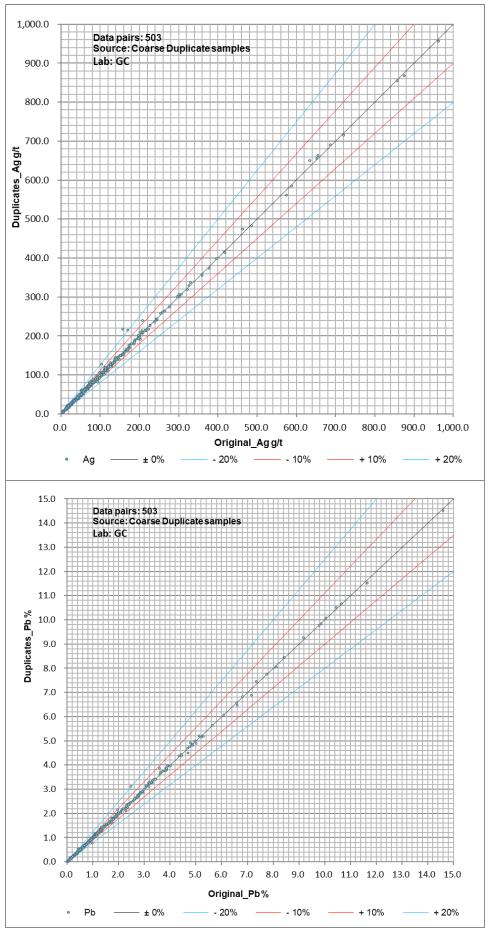
| SRK CONSULTING CHINA LTD. § APR. 20, 2026 § FH/AT | 70 |
Technical Report on Gaocheng Silver-Lead-Zinc Project in Guangdong Province, China
Sample Preparation, Analyses, and Security § FINAL
Figure 11.8: Scatter Plot of Coarse Duplicates
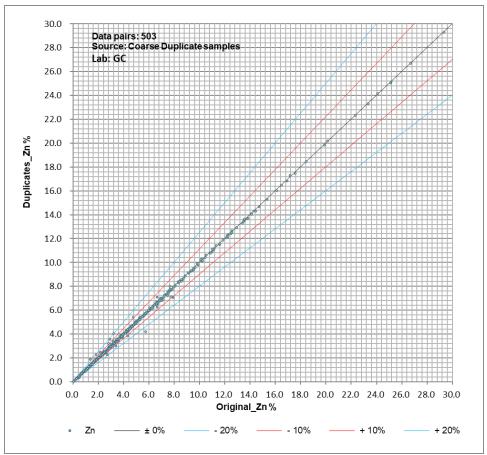
Notes: Ag: g/t, Pb: %, Zn: %
Figure 11.9: Scatter Plot of Pulp Duplicates
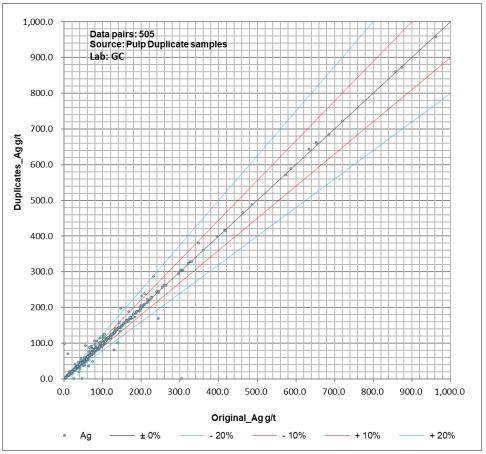
| SRK CONSULTING CHINA LTD. § APR. 20, 2026 § FH/AT | 71 |
Technical Report on Gaocheng Silver-Lead-Zinc Project in Guangdong Province, China
Sample Preparation, Analyses, and Security § FINAL
Figure 11.9: Scatter Plot of Pulp Duplicates
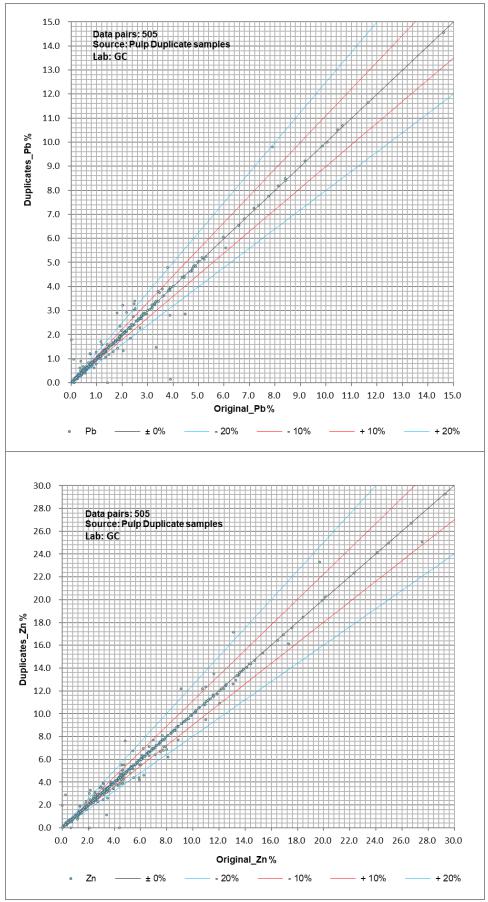
Notes: Ag: g/t, Pb: %, Zn: %
| SRK CONSULTING CHINA LTD. § APR. 20, 2026 § FH/AT | 72 |
Technical Report on Gaocheng Silver-Lead-Zinc Project in Guangdong Province, China
Sample Preparation, Analyses, and Security § FINAL
| 11.4.5 | Check (Umpire) Samples |
SVM regularly submits a portion of pulps to a third-party check (umpire) laboratory for independent analysis. Laboratories used for check analysis since 2012 have included the following:
| ◼ | GC Mine laboratory (when not used as the primary laboratory). |
| ◼ | ALS Guangzhou (when not used as the primary laboratory). |
| ◼ | Chengde Huakan (Chengde Huakan 514 Geology and Mineral Testing and Research Institute) in Chengde, Hebei Province. |
| ◼ | The Analytical Laboratory of the Inner Mongolia Geological Exploration Bureau (Inner Mongolia) in Hohhot, Inner Mongolia. |
| ◼ | The SGS Laboratory in Tianjin from 2023. |
Table 11.10 summarizes the number of drillhole and underground samples sent to the respective check laboratories between 2011 and 2025.
Table 11.10: Gaocheng Check (Umpire) Laboratories Used 2011 - 2025
| Year | Primary Laboratory |
Umpire Laboratory |
n Drillhole Check Assays |
n Underground Check Assays |
| 2011 | ALS | Chengde Huakan | 60 | |
| 2012 | ALS | GC | 2,175 | |
| Inner Mongolia | 49 | 103 | ||
| Chengde Huakan | 23 | |||
| 2013 | ALS | GC | 2,969 | |
| Inner Mongolia | 74 | 11 | ||
| Chengde Huakan | 51 | |||
| 2014 | ALS | GC | 71 | 101 |
| Inner Mongolia | 1 | |||
| GC | Chengde Huakan | 38 | ||
| 2015 | GC | Chengde Huakan | 31 | |
| 2016 | GC | Chengde Huakan | 33 | |
| 2017 | GC | Chengde Huakan | 46 | |
| 2018 | GC | ALS | 303 | 976 |
| 2019 | GC | ALS | 482 | |
| 2020 | GC | ALS | 467 | 382 |
| 2021 | GC | ALS | 650 | 213 |
| 2022 | GC | ALS | 517 | 149 |
| 2023- | GC | SGS | 425 | 43 |
| 2024 | GC | SGS | 121 | 105 |
| 2025 | GC | SGS | 295 | 153 |
| Total | 6,806 | 2,314 | ||
Notes:
| 1 | n=number of samples | |
| 2 | The samples before 2021 are from the 2021 AMC report, however the summary from 2021 to 2025 are reported by SRK from on the database provided by GC Mine. |
Table 11.11 presents the results of the major check sampling programs completed from 2011 to 2025.
| SRK CONSULTING CHINA LTD. § APR. 20, 2026 § FH/AT | 73 |
Technical Report on Gaocheng Silver-Lead-Zinc Project in Guangdong Province, China
Sample Preparation, Analyses, and Security § FINAL
Table 11.11: Results of Check Samples (2011-2025)
| YEAR | Mean of Original Sample Ag (g/t) |
Mean of Check Samples Ag (g/t) |
Mean of Original Sample Pb (%) |
Mean of Check Samples Pb (%) |
Mean of Original Sample Zn (%) |
Mean of Check Samples Zn (%) |
| 2011 | 9.78 | 8.93 | 0.16 | 0.17 | 0.42 | 0.38 |
| 2012 | 28.95 | 31.07 | 0.20 | 0.26 | 0.65 | 0.65 |
| 2013 | 42.46 | 42.18 | 0.36 | 0.36 | 1.15 | 1.13 |
| 2014 | 88.07 | 85.41 | 1.22 | 1.20 | 2.56 | 2.54 |
| 2015 | 68.39 | 64.46 | 1.04 | 0.95 | 2.35 | 2.17 |
| 2016 | 53.82 | 50.16 | 0.53 | 0.50 | 2.76 | 2.70 |
| 2017 | 34.22 | 32.71 | 0.65 | 0.62 | 2.56 | 2.60 |
| 2018 | 128.09 | 125.34 | 2.18 | 2.07 | 4.19 | 4.04 |
| 2019 | 147.96 | 148.64 | 1.83 | 1.79 | 4.46 | 4.49 |
| 2020 | 139.56 | 139.06 | 1.83 | 1.79 | 4.39 | 4.41 |
| 2021 | 77.16 | 77.63 | 1.23 | 1.28 | 3.14 | 3.15 |
| 2022 | 89.20 | 85.57 | 1.68 | 1.73 | 3.30 | 3.25 |
| 2023 | 56.26 | 55.32 | 1.09 | 1.12 | 2.51 | 2.48 |
| 2024- | 87.40 | 99.79 | 1.21 | 1.20 | 3.63 | 3.65 |
| 2025 | 69.36 | 77.67 | 1.14 | 1.17 | 3.09 | 3.15 |
| Grand Total | 74.771 | 74.93 | 1.09 | 1.08 | 2.74 | 2.72 |
The check (umpire) samples are collected at an overall rate of 7.4% for drillholes samples and 4.2% for underground samples respectively from 2011 to 2025.
The summary, Scatter and QQ plot of Ag, Pb and Zn from 2024 to 2025 for umpire samples are presented in Table 11.12 and Figure 11.10 and Figure 11.11. The ideal correlation within the Scatter plots show slight bias for Ag of the original samples and umpire samples, and an unbiased fit for Pb and Zn of the original samples and umpire samples. The QQ plot of umpire samples between GC Laboratory and SGS laboratory returned slightly higher results than the original samples in the higher end of the assay range for Ag, Pb and Zn.
Table 11.12: Summary of GC Umpire Checks Results (2024 - 2025)
| Element | Data Pairs Count | Relative Difference | |||||
| <10% | 10% - 20% | > 20% | |||||
| Ag | 674 | 267 | 40% | 276 | 41% | 126 | 19% |
| Pb | 674 | 412 | 61% | 125 | 19% | 137 | 20% |
| Zn | 674 | 584 | 87% | 71 | 11% | 19 | 3% |
Figure 11.10: Scatter Plot of Umpire Samples from 2024 to 2025
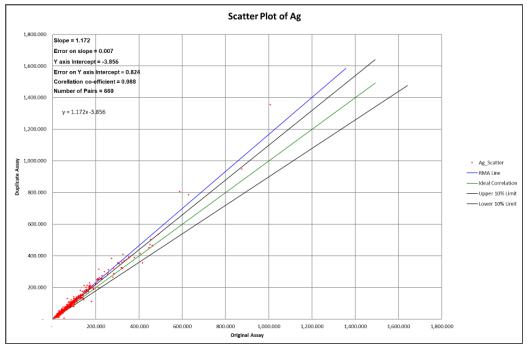
| SRK CONSULTING CHINA LTD. § APR. 20, 2026 § FH/AT | 74 |
Technical Report on Gaocheng Silver-Lead-Zinc Project in Guangdong Province, China
Sample Preparation, Analyses, and Security § FINAL
Figure 11.10: Scatter Plot of Umpire Samples from 2024 to 2025
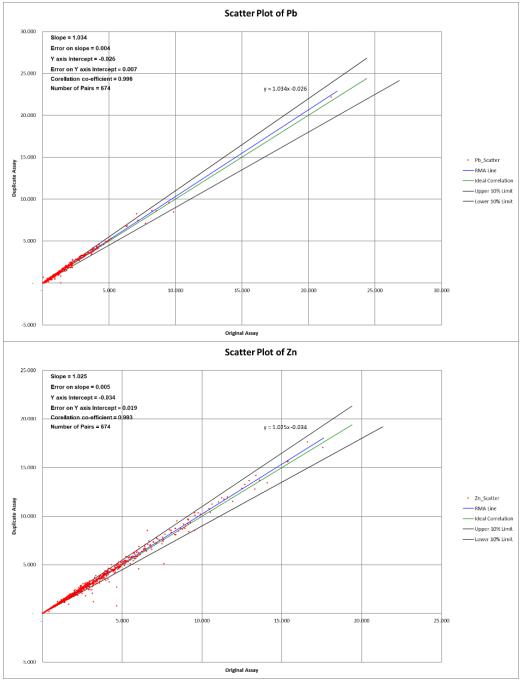
Notes: Ag: g/t, Pb: %, Zn: %
| SRK CONSULTING CHINA LTD. § APR. 20, 2026 § FH/AT | 75 |
Technical Report on Gaocheng Silver-Lead-Zinc Project in Guangdong Province, China
Sample Preparation, Analyses, and Security § FINAL
Figure 11.11: Q-Q Plot of Umpire Samples from 2024 to 2025
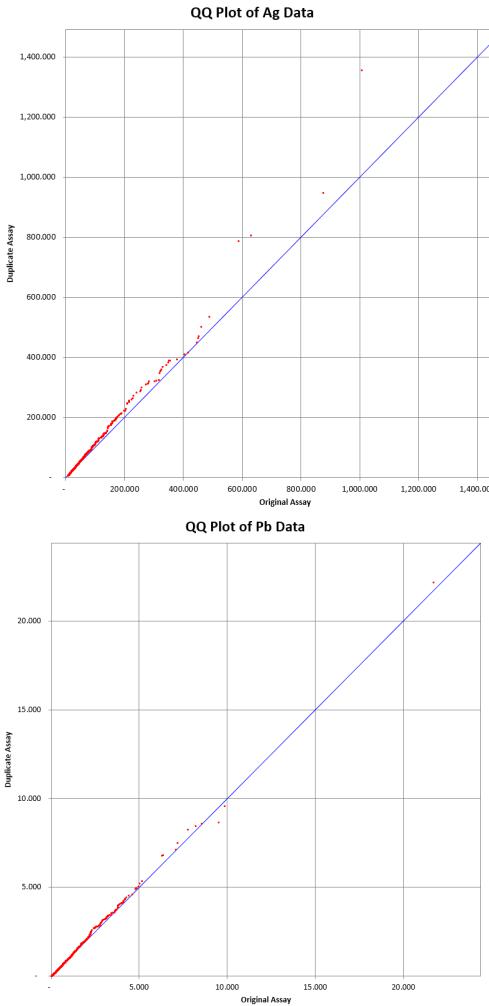
Notes: Ag: g/t, Pb: %, Zn: %
| SRK CONSULTING CHINA LTD. § APR. 20, 2026 § FH/AT | 76 |
Technical Report on Gaocheng Silver-Lead-Zinc Project in Guangdong Province, China
Sample Preparation, Analyses, and Security § FINAL
Figure 11.11: Q-Q Plot of Umpire Samples from 2024 to 2025
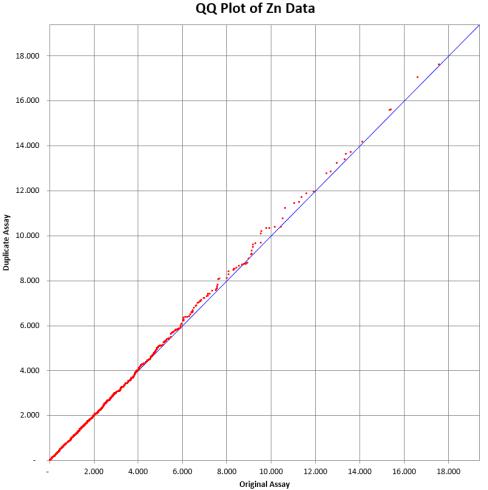
Notes: Ag: g/t, Pb: %, Zn: %
| SRK CONSULTING CHINA LTD. § APR. 20, 2026 § FH/AT | 77 |
Technical Report on Gaocheng Silver-Lead-Zinc Project in Guangdong Province, China
Data Verification § FINAL
| 12 | Data Verification |
| 12.1 | Site Visit |
SRK conducted the first site inspections to the GC Mine from 23 to 26 April in 2024 by the Principal Geologists Mark Wanless and Yanfang Zhao, and the second undertaken on 29 April 2026 by the Principal Geologist Yanfang Zhao and the Senior Geologist Huaixiang Li, who are all SRK full time employees.
The following verification steps were undertaken:
| ◼ | Site inspection of the project area. |
| ◼ | Meeting with GC Mine representatives. |
| ◼ | Discussions with geologists regarding sample collection, sample preparation, sample storage, QA/QC, geological interpretation, and underground mapping procedures. |
| ◼ | Underground visit, review of the mineralization, tunnel sampling procedure (Figure 12.1). |
| ◼ | Visit the drill core store and drill core intersections. |
| ◼ | Visit on site laboratory. |
SRK visited the core tray storage (Figure 12.1), drill core store/ core tray storage of GC Mine (Figure 11.3) and site laboratory (Figure 12.2), to understand the company’s core storage protocols and procedures.
Figure 12.1: Tunnel Sampling and Core Store Shed of GC Mine
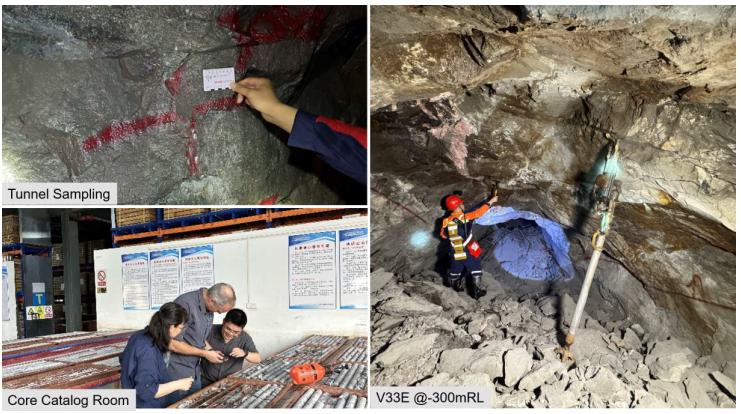
Sources: SRK site visit
| SRK CONSULTING CHINA LTD. § APR. 20, 2026 § FH/AT | 78 |
Technical Report on Gaocheng Silver-Lead-Zinc Project in Guangdong Province, China
Data Verification § FINAL
Figure 12.2: Site Laboratory of the GC Mine
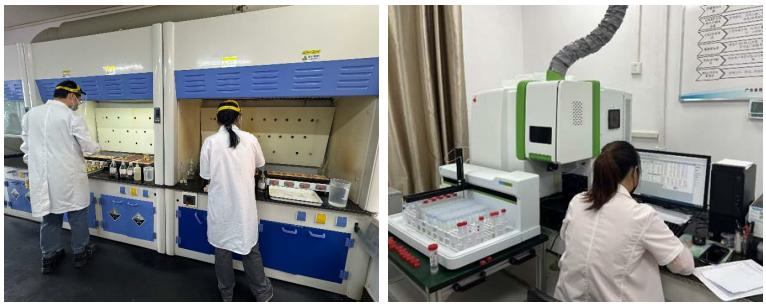
Sources: SRK site visits, 2024 and 2026
During the 2024 underground site visit, tunnel sampling was observed. Samples are collected by chipping with a hammer and chisel, and these are collected on a large plastic sheet on the floor. The sample is mixed on the sheet, and a portion of the chips are bagged. Only the larger blocks on the plastic sheet were included in the collected sample, and all the fines were discarded. While it is not certain, this may result in a low bias in the chip sample results if the mineralization tends to form a larger proportion of the fines than the unmineralized units. The chip sampling observed was also biased towards collecting material from the mineralized zone compared to the harder waste units. As the unmineralized units are harder to chip, the collection of sampled material was biased towards the mineralized units, which may result in a high bias in the chip samples.
SRK’s comparison between the de-clustered mean of Core Samples and the de-clustered mean of Drive samples, presented in Figure 12.3. Each point in the scatter plot represents the mean values for a vein. Only the drive samples were considered for comparison, and not the raise samples, as the raise samples are more likely to be where the grade is high enough for them to design a stope, which may result in a high bias. The drive samples may also have a bias, as they will usually target the high-grade portions of the vein, but less bias than the raise samples.
The comparison shows quite a lot of variability, but on average, the chip samples in the drives are higher grade than the drill holes. This may be due to the chip sampling introducing a bias into the drive sampling results, but this is not conclusively demonstrated. Introducing a diamond saw into the chip sampling process, to cut a channel from which material can more consistently and evenly be chipped and collecting the entire sample and not just the coarse fraction, will reduce the possibility of bias from the issues above.
| SRK CONSULTING CHINA LTD. § APR. 20, 2026 § FH/AT | 79 |
Technical Report on Gaocheng Silver-Lead-Zinc Project in Guangdong Province, China
Data Verification § FINAL
Figure 12.3: Comparison between the Core Samples and the Drive Samples
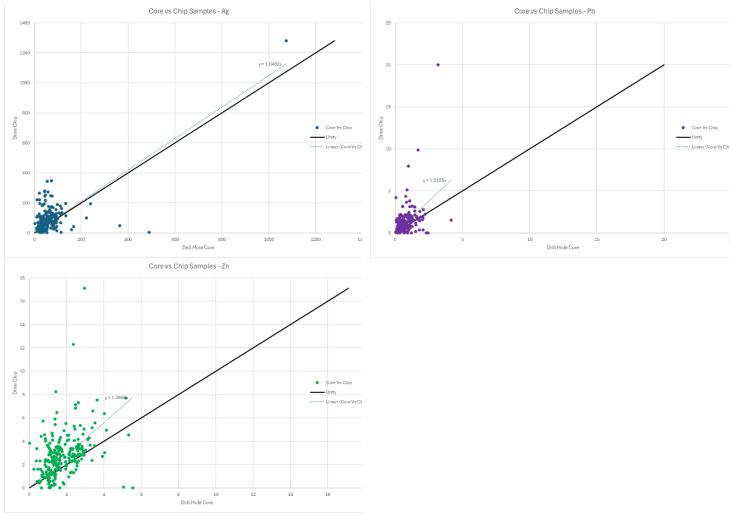
Notes: Ag: g/t, Pb: %, Zn: %
| 12.2 | Summary |
| ◼ | SRK found that the procedures of core sampling, log and storage are standardized, and the analytical methods and processes are in line with good practice. |
| ◼ | During the 2024 underground site visit, it was observed, only the larger blocks on the plastic sheet were taken, all the fines were discarded, and the sampling was biased against the hanging wall and footwall units, with a larger proportion of the mineralization zone (Figure 11.2) chipped. Although SRK recognises that channel sampling is challenging due to the variable hardness of the rock units and uneven surface for sampling, SRK recommends that the chip sampling can be improved using a diamond saw to cut a channel for the chipping, which will also reduce the volume of sample and allow the full sample of coarse and fine material to be collected. |
| ◼ | The resource database and the QC sample data supplied by SVM shows slight deviation for the total original samples and QC samples, the historical (2011-2020) sample number difference between the resource database and the table in the 2021 AMC report is about 2%, and the sample number difference of QC data is below 9%. While not a material discrepancy, SRK recommends that the database management can be improved. |
| SRK CONSULTING CHINA LTD. § APR. 20, 2026 § FH/AT | 80 |
Technical Report on Gaocheng Silver-Lead-Zinc Project in Guangdong Province, China
Mineral Processing and Metallurgical Testing § FINAL
| 13 | Mineral Processing and Metallurgical Testing |
| 13.1 | Introduction |
In May 2009, Hunan Research Institute for Nonferrous Metals completed the mineralogical study and processing test on ore samples of the GC Mine and compiled the "Processing Test Report on the Comprehensive Recovery of Lead, Zinc, Silver, Tin and Sulphur for GC Lead-Zinc Mine". Although a processing laboratory is built at the mine, no systematic processing test has been carried out since then. This processing test report is the main basis for the feasibility study and engineering design of GC processing plant. The GC processing plant was completed and put into operation in 2014 and has continued in operation since that time.
In July 2020, to improve the head grade and reduce the processing costs, Beijing Honest Technology Co., Ltd. (Beijing Honest) conducted a pre-sorting test of ore and compiled the "Test Brief Report on X104 Intelligent Sorting System of Found Lead-Zinc Mine, Guangdong Province”. The pre-sorting system was built in 2022 and is still at the stage of optimization.
This chapter is a summary of the above two tests, to show the ore beneficiation at the GC Mine, although the actual production records can better illustrate the historical performance.
| 13.2 | Test Samples |
The test samples are the basic assay samples of drilling cores of 2008. They were crushed to a grain size of less than 2 mm, and predominantly from Exploration Line 24 to Exploration Line 48. The total number of test samples is 152. The samples are mixed and used as samples for mineralogical study and processing test samples.
| 13.3 | Mineralogy |
| 13.3.1 | Chemical Components and Mineral Composition |
The chemical multi-element analysis results of the test samples are shown in Table 13.1. The mineral composition analysis results are shown in Table 13.2. The elements with high content in the ore are Si, Al, Ca, S and Fe. The elements with recovery value are Ag, Au, Zn, Pb, Cu, Sn, S and Fe. The harmful element is As. These elements exist in the ore in different minerals.
Table 13.1: Chemical Multi-Element Analysis Results of the Test Samples
| Element | Content (%) | Element | Content (%) |
| Cu | 0.16 | CaF2 | 7.52 |
| Pb | 1.45 | SiO2 | 44.2 |
| Zn | 3.25 | Al2O3 | 9.01 |
| As | 0.47 | MgO | 0.34 |
| S | 10.16 | CaO | 5.82 |
| TFe | 9.67 | Mn | 0.92 |
| Sn | 0.20 | Cd | 0.019 |
| Ag (g/t) | 128.32 | Au (g/t) | 0.20 |
| SRK CONSULTING CHINA LTD. § APR. 20, 2026 § FH/AT | 81 |
Technical Report on Gaocheng Silver-Lead-Zinc Project in Guangdong Province, China
Mineral Processing and Metallurgical Testing § FINAL
Sources: Processing Test Report on the Comprehensive Recovery of Lead, Zinc, Silver, Tin and Sulphur for GC Lead-Zinc Mine, Hunan Research Institute for Nonferrous Metals, May 2009.
The main minerals of the ore include quartz, feldspar, chlorite, fluorite, kaolinite and mica, which are gangue minerals with no recovery value. Minerals with recovery value are sphalerite, galena, pyrite, pyrrhotite, chalcopyrite, bornite and cassiterite.
Table 13.2: Main Mineral Composition of the Test Samples
| Mineral | Content (%) | Mineral | Content (%) |
| Sphalerite | 4.8 | Quartz (Contain a small amount of chalcedony) | 30 |
| Galena | 1.6 | Feldspar | 8 |
| Pyrite | 13 | Chlorite | 12 |
| Pyrrhotite | 2.2 | Kaolinite | 5.5 |
| Arsenopyrite | 1 | Sericite and Muscovite | 6 |
| Magnetite and Hematite | 2 | Hornblende | 2 |
| Chalcopyrite and Bornite | 0.5 | Silicate minerals such as tremolite, actinolite and garnet | 1 |
| Cassiterite | 0.2 | Calcite and Rhodochrosite | 2.2 |
| Fluorite | 7.5 | Others | 0.5 |
Sources: Processing Test Report on the Comprehensive Recovery of Lead, Zinc, Silver, Tin and Sulphur for GC Lead-Zinc Mine, Hunan Research Institute for Nonferrous Metals, May 2009.
| 13.3.2 | Occurrence State |
Silver
Silver is the main valuable element in the ore, and its phase analysis results are shown in Table 13.3. Silver is relatively scattered, mainly in the form of silver sulphide such as argentite and acanthite, accounting for about 40.59%. Secondly, it occurs in pyrite, galena, sphalerite and other sulfides as submicroscopic natural silver particles or isomorphism state atomic state, accounting for about 32.65%. The silver that exists in the form of independent native silver minerals is also relatively high, accounting for approximately 23.39%. Additionally, approximately 2.19% of silver is hosted in gangue minerals, and about 1.18% of silver is hosted in cerargyrite.
Under the microscope, minerals such as native silver, argentite and acanthite are rare, and the embedding particle size is small, mostly below 0.04 mm. They are mainly embedded with galena and pyrite, mostly wrapped by galena, pyrite or embedded in galena, pyrite grains. Occasionally, native silver is embedded in quartz fissures or wrapped by quartz. Analysis results of monominerals show that independent silver minerals account for about 13% of the total silver. Silver in galena accounts for about 40% of the total silver, and silver in sphalerite accounts for about 14% of the total silver. Silver in other sulfides accounts for about 30% of the total silver, and silver in gangue minerals accounts for 3% of the total silver. Silver minerals are most closely related to galena, and silver has the widest distribution in galena, suggesting that most of the silver can be enriched in lead concentrate.
| SRK CONSULTING CHINA LTD. § APR. 20, 2026 § FH/AT | 82 |
Technical Report on Gaocheng Silver-Lead-Zinc Project in Guangdong Province, China
Mineral Processing and Metallurgical Testing § FINAL
Table 13.3: Phase Analysis Results of Silver
| Silver phase | Content (g/t) | Distribution (%) | Remarks |
| Native Silver | 30.24 | 23.39 | Dissociated or exposed metallic silver |
| Silver Sulphide | 52.47 | 40.59 | Dissociated or exposed silver sulfide minerals such as argentite and acanthite |
| Silver in Sulfides | 42.21 | 32.65 | Including atomic silver in pyrite, pyrrhotite, galena, sphalerite, arsenopyrite, chalcopyrite, tetrahedrite and other sulfides, as well as native silver and silver sulfide enclosed in sulfides and not exposed. |
| Silver in Cerargyrite | 1.53 | 1.18 | The content of cerargyrite in the ore is minimal. |
| Silver in Other | 2.83 | 2.19 | Enveloped by gangue minerals, unexposed native silver, silver sulfide, silver in sulfides, etc. |
| Total | 129.28 | 100.00 |
Sources: Processing Test Report on the Comprehensive Recovery of Lead, Zinc, Silver, Tin and Sulphur for GC Lead-Zinc Mine, Hunan Research Institute for Nonferrous Metals, May 2009.
Tin
The phase analysis results for tin are presented in Table 13.4, with the disseminated grain size of cassiterite illustrated in Figure 13.1. Tin in the ore mainly occurs as the oxide mineral cassiterite, comprising 74.55% of the total tin content. This is followed by tin sulfide, which constitutes 13.64%. Tin in silicates and colloidal tin account for 6.36% and 5.45% respectively.
| § | Cassiterite: Primarily occurs as irregularly dispersed granules within the ore. It is commonly situated between particles of quartz, sericite, chlorite, and hornblende. It is also frequently observed among particles of galena and pyrite, while its association with sphalerite is comparatively less pronounced. The embedding grain size of cassiterite is fine, typically less than 0.05 mm, with a substantial proportion below 0.03 mm. Stannite, is mainly located between particles of sphalerite, galena, pyrite, and chalcopyrite, among other sulfides. It is embedded as irregularly shaped granules with a grain size that is slightly coarser than that of cassiterite, mainly under 0.05 mm |
| § | Tin sulfide: Mainly occurs as stannite. |
| § | Colloidal tin: Mainly occurs as varlamoffite, which is a fine-grained colloidal aggregate resembling earthy or ochreous textures. It is typically a mixture of fine-crystalline or cryptocrystalline tin dioxide hydrate with cryptocrystalline tin-bearing hydrous limonite and alumina, frequently adsorbed by other minerals such as limonite and clay minerals. Varlamoffite generally has such a fine particle size that its morphology is challenging to discern under a microscope. |
| § | Tin in silicates: This form of tin mainly manifests as ultrafine particles of cassiterite encapsulated within silicate minerals or quartz. Subsequently, it may occur as tin silicate or in an ionic state within the silicates. |
| SRK CONSULTING CHINA LTD. § APR. 20, 2026 § FH/AT | 83 |
Technical Report on Gaocheng Silver-Lead-Zinc Project in Guangdong Province, China
Mineral Processing and Metallurgical Testing § FINAL
Table 13.4: Phase Analysis of Tin
| Chemical Phase of Tin | Content (%) | Distribution (%) | Remarks |
| Tin in Cassiterite | 0.164 | 74.55 | The main tin phase |
| Tin in Tin Sulfide | 0.030 | 13.64 | Stannite |
| Tin in Silicate | 0.014 | 6.36 | Tin silicate and cassiterite in very fine particles encased in silicate minerals or quartz |
| Tin in Colloidal Tin | 0.012 | 5.45 | Varlamoffite etc. |
| Total Tin | 0.22 | 100.00 |
Sources: Processing Test Report on the Comprehensive Recovery of Lead, Zinc, Silver, Tin, and Sulphur for GC Lead-Zinc Mine, Hunan Research Institute for Nonferrous Metals, May 2009
Lead
Lead mainly occurs in the form of the sulfide mineral galena, comprising 92.59% of the total, followed by carbonate mineral white lead, accounting for about 4.44%. Anglesite and plumbojarosite accounted for 1.48% each.
Some coarse galena particles exhibit hypidiomorphic granular texture, though they generally appear as allotriomorphic granular texture. These are commonly found in contact with sphalerite and pyrite, filling the spaces between pyrite grains, often accompanied by sphalerite and chalcopyrite, and exhibit minor metasomatism of the pyrite. The disseminated grain size of galena is depicted in Figure 13.1.
Zinc
Zinc mainly occurs as the sulfide mineral sphalerite, comprising approximately 94.17% of the total zinc content. This is followed by carbonate minerals such as smithsonite, which constitute about 2.32%. Zinc silicate accounted for approximately 2.24%, while franklinite and other zinc-bearing minerals account for around 1.27%.
Sphalerite mostly appears as allotriomorphic granular texture, with some occurring as hypidiomorphic granular texture. It is commonly found in contact with and intergrown with galena and pyrite, filling the spaces between pyrite grains along with galena and chalcopyrite, and exhibits minor metasomatism of pyrite. Some sphalerite is fine grained and coated with pyrite, meanwhile the chalcopyrite of emulsion texture also can be observed at some sphalerite internally. The disseminated grain size of sphalerite is shown in Figure 13.1.
| SRK CONSULTING CHINA LTD. § APR. 20, 2026 § FH/AT | 84 |
Technical Report on Gaocheng Silver-Lead-Zinc Project in Guangdong Province, China
Mineral Processing and Metallurgical Testing § FINAL
Figure 13.1: Disseminated Grain Size of Galena, Sphalerite and Cassiterite
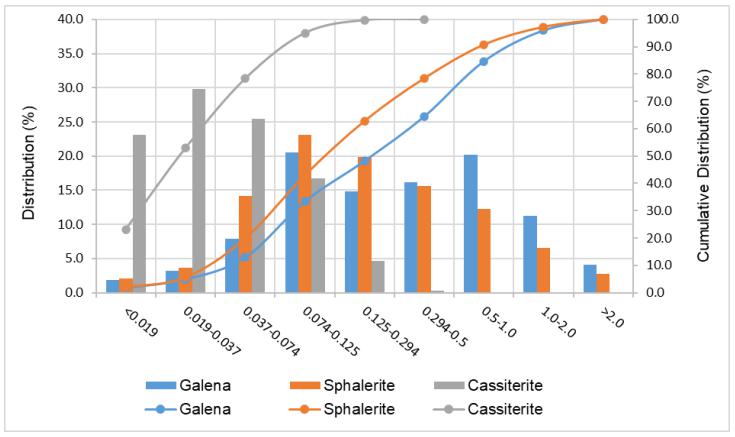
Source: SRK, based on the data from Preliminary Design
Galena and sphalerite are primarily disseminated as medium to fine grains, mainly between 0.037 and 2 mm, with the grain size of galena being marginally larger than that of sphalerite. Cassiterite is disseminated as micro-fine grains, posing a challenge to its dissociation and recovery during the grinding process.
Other Elements
Copper ores in the GC deposit are primarily chalcopyrite, with a minor presence of bornite and occasional occurrences of tetrahedrite. The distribution of these ores is uneven, and the overall content is low. Exploring the feasibility of processing and concentrating copper into copper concentrate represents a significant area of research.
Arsenic minerals are mainly represented by arsenopyrite, which is considered a deleterious mineral within the ore. The arsenic content is subject to strict limitations across all concentrates. Concentrate testing indicates the presence of arsenic, though its content does not reach the penalty threshold.
Fluorine is mainly found in the form of fluorite, with minor occurrences within silicate minerals such as tourmaline and hornblende. In the GC deposit, fluorite is unevenly distributed and has a relatively low average content, rendering it without economic recovery value, and it is typically regarded as a gangue mineral.
Cadmium is typically presented in sphalerite through isomorphism or as inclusions of greenockite. In the zinc concentrate, cadmium is co-enriched with zinc, which is a valuable element in the concentrate.
| SRK CONSULTING CHINA LTD. § APR. 20, 2026 § FH/AT | 85 |
Technical Report on Gaocheng Silver-Lead-Zinc Project in Guangdong Province, China
Mineral Processing and Metallurgical Testing § FINAL
Iron is primarily found in iron sulfide minerals such as pyrite and pyrrhotite, and to a lesser extent in magnetite and hematite, as well as in silicate minerals. These iron sulfide minerals are also the main source of sulphur, which is concentrated into sulphur concentrate during the mineral processing.
Sulphur is primarily presented in pyrite, and secondarily in minerals such as sphalerite, pyrrhotite, galena, and arsenopyrite. In the mineral processing, aside from the lead and zinc concentrates, sulphur is concentrated as pyrite and pyrrhotite into pyrite concentrate, thereby forming sulphur concentrate.
| 13.4 | Processing Test |
| 13.4.1 | Lead-Zinc-Sulphur Sequential Flotation Test |
For ore samples less than 2 mm in size, a sequential preferential flotation process for lead, zinc, and sulphur was employed. A series of condition tests were conducted, including those for grinding fineness, lead flotation reagent scheme, zinc flotation reagent scheme, and sulphur flotation reagent scheme. Based on these tests, the optimal conditions were selected for both open-circuit and closed-circuit process tests. The closed-circuit test process is depicted in Figure 13.2, with the results detailed in Table 13.5. The optimal grinding fineness was 80% passing 200 mesh (P80=75μm).
| SRK CONSULTING CHINA LTD. § APR. 20, 2026 § FH/AT | 86 |
Technical Report on Gaocheng Silver-Lead-Zinc Project in Guangdong Province, China
Mineral Processing and Metallurgical Testing § FINAL
Figure 13.2: Lead-Zinc-Sulphur Flotation Closed-Circuit Test Flowsheet
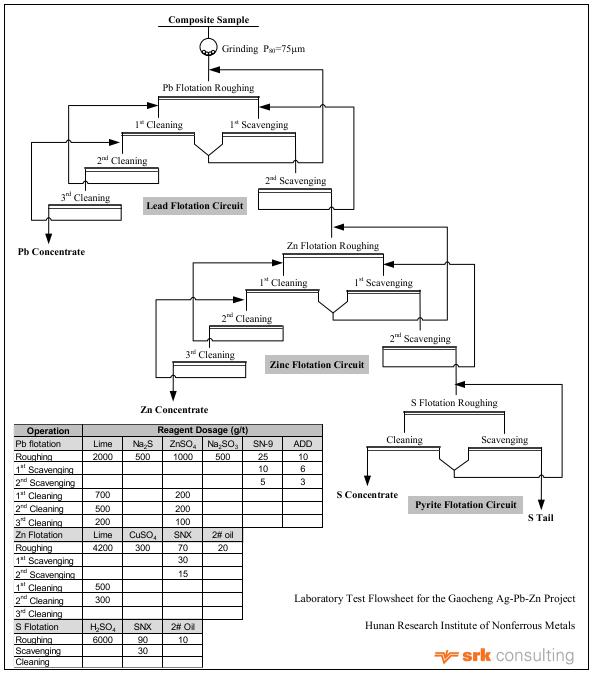
Source: SRK, based on the Mineral Processing Test Report by Hunan Research Institute for Nonferrous Metals.
Table 13.5: Results of the Lead-Zinc-Sulphur Flotation Closed-Circuit Process Test
| Product | Mass Pull (%) |
Grade | Metal Recovery (%) | ||||||
| Pb (%) | Zn (%) | S (%) | Ag (g/t) | Pb | Zn | S | Ag | ||
| Pb Conc. | 2.65 | 45.92 | 9.72 | 2,903.75 | 84.25 | 7.92 | 63.16 | ||
| Zn Conc. | 5.86 | 0.97 | 48.70 | 264.52 | 3.94 | 87.77 | 12.72 | ||
| S Conc. | 15.01 | 0.79 | 0.46 | 41.85 | 170.32 | 8.21 | 2.12 | 61.83 | 20.98 |
| S Tail | 76.48 | 0.068 | 0.093 | 5.00 | 3.60 | 2.19 | 3.14 | ||
| Feed | 100.00 | 1.44 | 3.25 | 10.16 | 121.84 | 100.00 | 100.00 | 100.00 | |
Source: Processing Test Report on the Comprehensive Recovery of Lead, Zinc, Silver, Tin, and Sulphur for GC Lead Zinc Mine, Hunan Research Institute for Nonferrous Metals, May 2009
| SRK CONSULTING CHINA LTD. § APR. 20, 2026 § FH/AT | 87 |
Technical Report on Gaocheng Silver-Lead-Zinc Project in Guangdong Province, China
Mineral Processing and Metallurgical Testing § FINAL
| 13.4.2 | Copper-Lead Separation Exploratory Test |
The lead concentrate obtained from the aforementioned closed-circuit test contained 3% copper. A copper-lead separation test was conducted using an open-circuit process with 'one roughing and one cleaning' to depress lead and float copper, producing quality-standard copper concentrate with an improved lead concentrate grade. The copper concentrate achieved a grade of 18.46% with a recovery rate of 67.56%; the lead concentrate grade was enhanced from 46.05% to 57.16%, with a recovery rate of 88.88%. The results indicate the feasibility of producing high-quality copper concentrate.
| 13.4.3 | Tin Recovery Test |
Exploratory tests were conducted on the sulphur tailings from the aforementioned closed-circuit test to recover tin, utilizing various processes and equipment for gravity separation. The results are as follows:
| § | Flotation tests with different reagent schemes yielded a maximum concentrate grade of 0.36% and a tin recovery rate of 12.68%, which were unsatisfactory. |
| § | Unclassified shaking tables separation produced tin concentrate at a grade of 27.72% with a tin recovery rate of 32.64%. |
| § | Classified shaking tables separation, where tailings were classified by fineness into two categories: greater than 200 mesh (75μm) and less than 200 mesh, resulted in a tin concentrate grade of 28.34% and a tin recovery rate of 34.07%. |
| § | The rough concentrate obtained from pre-concentration with spiral chutes was further processed with classified shaking tables for cleaning operation, resulting in a tin concentrate grade of 41.28% and a tin recovery rate of 31.57%. |
| § | The rough concentrate, pre-concentrated by centrifugal concentrators, was then cleaned with unclassified shaking tables, resulting in a tin concentrate grade of 35.82% and a tin recovery rate of 21.49%. |
The results of the tin recovery test indicate that the gravity separation is feasible, particularly the combination of spiral chutes and shaking tables, which can achieve higher concentrate grades and recovery rates.
The tin concentrate resulting from the gravity separation process contained sulphur in excess of 7%. Flotation for desulfurization was employed, and the tests showed that it was possible to reduce the sulphur content in the final tin concentrate to around 0.5%, while increasing the tin grade to over 50% and achieving an operational recovery rate of more than 84%. Particularly, the desulfurization flotation of the concentrate from the spiral chutes and shaking tables yielded a tin concentrate grade of 56.7% and a recovery rate of 93.8%.
| 13.5 | Ore Pre-Sorting Test |
Beijing Honest completed the ore pre-sorting test in July 2020. ROM with particle size of 10~60 mm was selected. X104 intelligent sorting system is used to scan the ROM to obtain its image. Through intelligent identification algorithm, different tailings discarding rates from low to high were set for pre-discarding of tailings. The test results are shown in Table 13.6.
The test results show that when the discarding rate of tailings is 41.84%, the grade of lead and zinc in the concentrate is 6.734%, and the grade of lead and zinc in tailings is 0.333%, which meets the requirements of tailings. The recovery rate of lead and zinc is more than 96%. The grade of silver in the concentrate is 114.12 g/t, and the grade of silver in the tailings is only 13.01 g/t. It shows that the pre-sorting results of X104 intelligent sorting system is satisfactory.
| SRK CONSULTING CHINA LTD. § APR. 20, 2026 § FH/AT | 88 |
Technical Report on Gaocheng Silver-Lead-Zinc Project in Guangdong Province, China
Mineral Processing and Metallurgical Testing § FINAL
Table 13.6: Intelligent Pre-Sorting Test Results
| Steps | Product | Weight (kg) | Yield (%) | Grade (%) | Recovery Rate (%) | ||||
| Ag (g/t) | Pb | Zn | Ag | Pb | Zn | ||||
| Step 1 | Concentrate | 449.6 | 81.43 | 85.53 | 1.69 | 3.25 | 96.98 | 99.26 | 99.17 |
| Tailings | 102.5 | 18.57 | 11.67 | 0.06 | 0.12 | 3.02 | 0.74 | 0.83 | |
| Step 2 | Concentrate | 363.6 | 65.86 | 102.77 | 2.07 | 3.96 | 94.24 | 98.39 | 97.71 |
| Tailings | 188.5 | 34.14 | 12.12 | 0.07 | 0.18 | 5.76 | 1.61 | 2.29 | |
| Step 3 | Concentrate | 321.1 | 58.16 | 114.12 | 2.32 | 4.41 | 92.42 | 97.50 | 96.09 |
| Tailings | 231.0 | 41.84 | 13.01 | 0.08 | 0.25 | 7.58 | 2.50 | 3.91 | |
| Step 4 | Concentrate | 288.0 | 52.16 | 123.97 | 2.56 | 4.74 | 90.05 | 96.33 | 92.61 |
| Tailings | 264.1 | 47.84 | 14.95 | 0.11 | 0.41 | 9.95 | 3.67 | 7.39 | |
| 13.6 | Conclusions of Testing |
| § | The GC deposit has silver-lead-zinc polymetallic ore and also contains a small amount of copper and tin for comprehensive recovery. Lead concentrate, zinc concentrate, and sulphur concentrate are produced sequentially by preferential flotation process. Silver and copper are mainly enriched in lead concentrate, and the test results are good. Lead preferential flotation -- zinc-sulphur mixed flotation and then zinc-sulphur separation flotation process is now adopted in the GC processing plant. It is proved to be feasible, and satisfactory recovery rates are achieved. |
| § | It is feasible to separate copper concentrate from lead concentrate, not only to obtain copper concentrate, but also to improve the grade of lead concentrate. At present, there is no in-depth technical study on copper recovery in the GC processing plant. SRK recommends that copper-lead separation flotation test be carried out on the lead concentrate produced in the GC processing plant, including lead concentrate regrinding and flotation test. It can reduce zinc content in the lead concentrate and improve the grade of lead concentrate while obtaining copper concentrate. |
| § | The results of experimental tin recovery from sulphur flotation tailings show that tin concentrate can be produced by gravity separation. Tin is recovered by classified gravity separation process, and qualified tin concentrate is produced, which is feasible. |
| § | The X-ray intelligent sorting machine is the preferred equipment for ore pre-sorting. It has been developed in recent years. Tests have shown that it is feasible to conduct pre-sorting to the ore crushed to a suitable particle size. Some partings and waste rocks can be discarded in advance. It is beneficial for processing of low-grade ore. XRT intelligent sorting system was installed in the GC processing plant in March 2023, replacing the previous hand-sorting. |
| § | There are many ore bodies in GC Mine, and the ore properties of different ore bodies vary slightly. The processing parameters and reagents should be adjusted to adapt to the changes in ore properties. SRK recommends that ore processing tests be carried out on ore from some representative ore bodies in order to guide the production of the plant. |
| SRK CONSULTING CHINA LTD. § APR. 20, 2026 § FH/AT | 89 |
Technical Report on Gaocheng Silver-Lead-Zinc Project in Guangdong Province, China
Mineral Resource Estimates § FINAL
| 14 | Mineral Resource Estimates |
| 14.1 | Introduction |
The database, estimation domains for the GC Mine were completed by the Silvercorp Resource Geologist. SRK employees; Mr Huaixiang (Hubert) Li (MAIG), Senior Geologist and Ms Yanfang Zhao, Principal Geologists (MAIG), have reviewed the database, estimation domains and were satisfied that they comply with reasonable industry practice. SRK has generated the block models, performed the grade estimation and prepared the Mineral Resource estimate.
The Qualified Persons responsible for the Mineral Resources are Mr Huaixiang Li (MAIG #8667) and Ms Yanfang Zhao (MAIG #10796), both are full-time employee of SRK. Mr Huaixiang and Ms Yanfang Zhao visited the project on 29 of April 2026.
The estimates are based on drilling samples and underground samples information available up to December 31, 2025. With respect to drilling and underground sample information available for the December 2025 Mineral Resource estimates, SRK believes the current drilling and channel sampling information is sufficiently reliable to interpret with confidence the boundaries for GC deposits and that the assay data is sufficiently reliable to support the Mineral Resource estimation.
The Mineral Resources have been estimated in accordance with generally accepted CIM Definition Standards and are reported in accordance with the Listing Rules. Mineral Resources are not Mineral Reserves and do not have demonstrated economic viability. There is no certainty that all or any part of the Mineral Resource will be converted into Mineral Reserves. Micromine™ and Leapfrog software was used for data compilation, domain wireframing and grade estimation.
This section describes the Mineral Resource estimation methodology and summarizes the key assumptions. The report author is not aware of any specific environmental liabilities on the property. GC Mine has all required permits to conduct the proposed work on the property. The report author is not aware of any other significant factors and risks that may affect access, title, or the right or ability to perform on-going work programs on the property.
| 14.2 | Estimation Procedures |
The Mineral Resource estimation methodology involved the following procedures:
| § | Database compilation and verification. |
| § | Geological interpretation for estimation domain. |
| § | Data preparation (compositing and capping) for statistical analysis. |
| § | Construction of the block model and grade interpolation. |
| § | Mining depletion. |
| § | Mineral Resource classification. |
| § | Model validation. |
| § | Assessment of “reasonable prospects for eventual economic extraction” (“RPEEE”) and selection of appropriate COG; and |
| § | Preparation of the Mineral Resource statement. |
| SRK CONSULTING CHINA LTD. § APR. 20, 2026 § FH/AT | 90 |
Technical Report on Gaocheng Silver-Lead-Zinc Project in Guangdong Province, China
Mineral Resource Estimates § FINAL
| 14.3 | Database |
The data used in the estimate consists of surface and underground diamond drillholes and channel samples. The underground channel samples are from tunnels, raises, and crosscuts.
The data SRK received from GC Mine included a database (database_gc_dec2025.mdb and Density Measurement in excel format), Wireframes (Ag-Pb-Zn veins, mined out area and write-off areas to be excluded from the Mineral Resource), QA/QC data from April 2024 to 2025, and Topography file.
As of December 2025, there were 4,376 drillholes (118,548 samples/ 583,524 m) and 64,399 underground samples in the database. Detailed information is as shown in Table 14.1, and the drillhole and underground sample locations are shown in Figure 14.1.
Figure 14.1: Drillholes and Underground Sampling Location
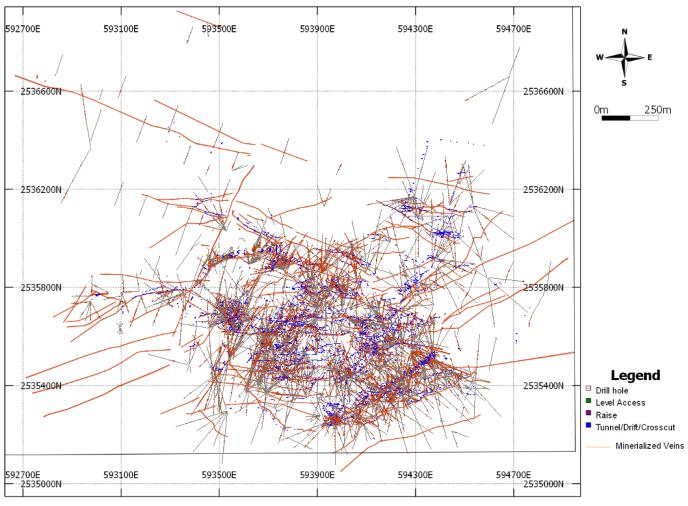
Source: Silvercorp
| SRK CONSULTING CHINA LTD. § APR. 20, 2026 § FH/AT | 91 |
Technical Report on Gaocheng Silver-Lead-Zinc Project in Guangdong Province, China
Mineral Resource Estimates § FINAL
Table 14.1: Summary of Resource Database
| Type | Drillhole/Channel Number | Length (m) | Samples |
| Tunnel/Drift/Cross-cut samples | 20,224 | 41,239 | 55,878 |
| Level access samples | 111 | 343 | 820 |
| Raise samples | 3,881 | 4,514 | 7,701 |
| Drill holes | 4,376 | 583,524 | 118,548 |
| Sub-total | 28,592 | 629,620 | 182,947 |
Note: Summarized by SRK based on the database provided by Silvercorp
| 14.4 | Domain Modelling |
The wireframe models for 315 mineralized veins have been modelled and supplied by GC Mine to SRK, and were reviwed by SRK and on the GC Mine site to ensure they were representative of the insitu mineralization as of December 2025.
The mineralized veins were modelled in Micromine software mainly based on the vein structure and lithology using a broad 70 g/t AgEq cut-off for the Mineral Resource domain boundary. A cross section of the mineralized veins is shown in Figure 14.2.
Figure 14.2: Mineralized Veins Section
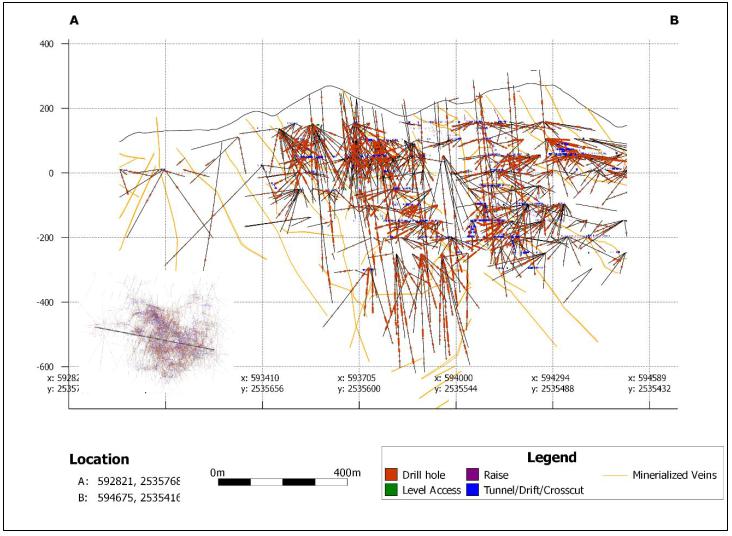
The GC deposit comprises 315 veins, including numerous small veins. The 10 biggest veins, on the basis of classified tonnes, are; V2E, V10, V2N, V19A, V14, V29-1,V33, V25, V16 and V8-2A in sequence. The location of these is illustrated in Figure 14.3 as the purple traces.
| SRK CONSULTING CHINA LTD. § APR. 20, 2026 § FH/AT | 92 |
Technical Report on Gaocheng Silver-Lead-Zinc Project in Guangdong Province, China
Mineral Resource Estimates § FINAL
| Figure 14.3: Plan View of Mineralized Veins Display at Level 0 m (Purple: Biggest 10 Veins) |
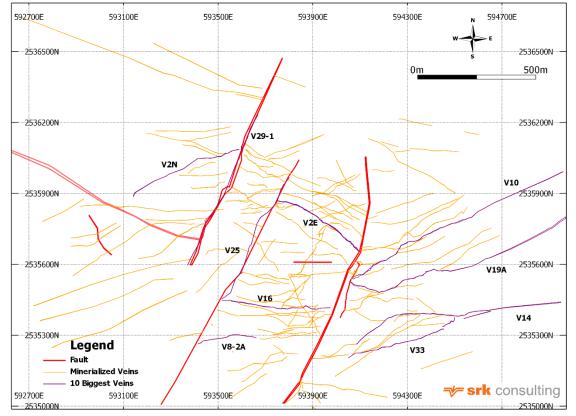
| 14.5 | Specific Gravity |
As there are no new density measurements since samples collected between 2021 and 2023, the same density formula was assigned to the block model as per AMC’s previous calculations:
| § | Within mineralization wireframes of GC deposit based on the multiple linear regression model using lead, zinc, and silver grades |
| § | DENSITY = 3.094919 + (0.040827 x Pb) + (0.034253 x Zn) + (0.000482 x Ag) |
| § | 2.60 is assigned to barren rock. |
| 14.6 | Compositing |
Assays were averaged into full-width composites across the individual veins. The shrinkage stoping and resue stoping methods are employed on the GC Mine, are non-selective across the width of the veins. Therefore, estimating variable grades across the thickness of the veins is not required for the mine planning, and a full width compositing strategy allows for the estimates to be length weighted, which is more appropriate for this style of mineralization. A full-width composite was deemed appropriate given the narrow geometry of the veins and lack of selectivity. The distribution of sample lengths is shown in Figure 14.4.
| SRK CONSULTING CHINA LTD. § APR. 20, 2026 § FH/AT | 93 |
Technical Report on Gaocheng Silver-Lead-Zinc Project in Guangdong Province, China
Mineral Resource Estimates § FINAL
Figure 14.4: Sampling Interval Histogram
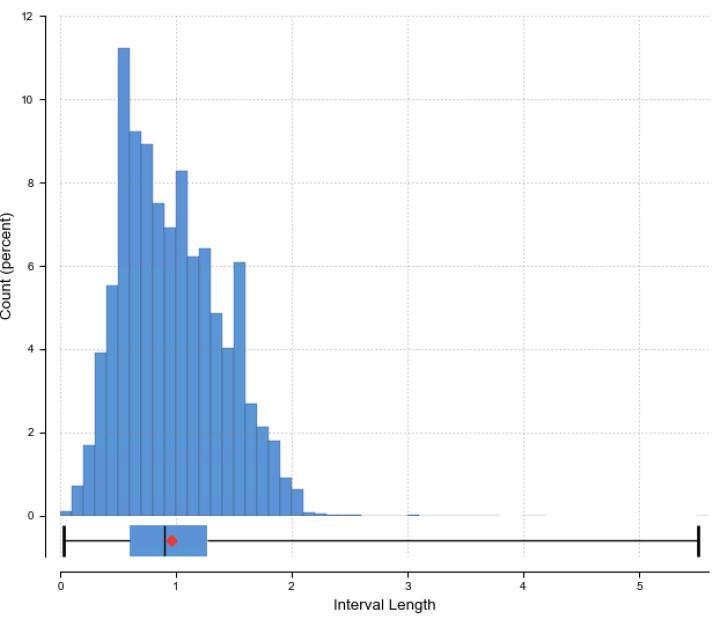
The full width composites statistics for the largest 10 veins are presented in Table 14.2.
Table 14.2: Composites (Declustered Length Weighted) Statistics of the Selected 10 Veins
| Vein | Field Name | No of Points | Maximum | Mean | Std Dev | Coeff. of Variation |
| V2E | Ag (g/t) | 1,267 | 1,030.50 | 71.23 | 89.59 | 1.26 |
| Pb (%) | 1,267 | 18 | 1.5 | 1.9 | 1.26 | |
| Zn (%) | 1,267 | 13.86 | 2.34 | 2.10 | 0.90 | |
| V10 | Ag (g/t) | 1,326 | 865.00 | 48.60 | 73.26 | 1.51 |
| Pb (%) | 1,326 | 26.61 | 1.26 | 1.91 | 1.52 | |
| Zn (%) | 1,326 | 20.10 | 2.33 | 2.08 | 0.89 | |
| V2N | Ag (g/t) | 147 | 1,495.00 | 119.34 | 205.93 | 1.73 |
| Pb (%) | 147 | 17.01 | 0.77 | 1.78 | 2.30 | |
| Zn (%) | 147 | 31.40 | 5.24 | 5.72 | 1.09 | |
| V19A | Ag (g/t) | 1,098 | 714.88 | 58.34 | 69.96 | 1.20 |
| Pb (%) | 1,098 | 31.30 | 1.26 | 2.31 | 1.83 | |
| Zn (%) | 1,098 | 32.05 | 3.27 | 3.65 | 1.12 | |
| V14 | Ag (g/t) | 584 | 2,578.00 | 85.95 | 176.97 | 2.06 |
| Pb (%) | 584 | 14.03 | 0.85 | 1.35 | 1.59 | |
| Zn (%) | 584 | 35.86 | 2.15 | 3.18 | 1.48 |
| SRK CONSULTING CHINA LTD. § APR. 20, 2026 § FH/AT | 94 |
Technical Report on Gaocheng Silver-Lead-Zinc Project in Guangdong Province, China
Mineral Resource Estimates § FINAL
| Vein | Field Name | No of Points | Maximum | Mean | Std Dev | Coeff. of Variation |
| V29-1 | Ag (g/t) | 143 | 2,190.00 | 45.24 | 190.60 | 4.21 |
| Pb (%) | 143 | 6.30 | 0.36 | 0.78 | 2.13 | |
| Zn (%) | 143 | 6.36 | 0.82 | 1.25 | 1.52 | |
| V33 | Ag (g/t) | 905 | 3,162.00 | 125.12 | 234.48 | 1.87 |
| Pb (%) | 905 | 19.72 | 1.25 | 2.33 | 1.87 | |
| Zn (%) | 905 | 25.71 | 2.08 | 3.03 | 1.46 | |
| V25 | Ag (g/t) | 499 | 1,538.00 | 65.87 | 142.79 | 2.17 |
| Pb (%) | 499 | 13.46 | 0.66 | 1.52 | 2.29 | |
| Zn (%) | 499 | 12.54 | 1.45 | 1.98 | 1.36 | |
| V16 | Ag (g/t) | 929 | 2,260.00 | 113.53 | 196.66 | 1.73 |
| Pb (%) | 929 | 14.62 | 0.78 | 1.47 | 1.89 | |
| Zn (%) | 929 | 27.43 | 2.25 | 2.94 | 1.31 | |
| V8-2A | Ag (g/t) | 444 | 1,104.06 | 50.49 | 79.16 | 1.57 |
| Pb (%) | 444 | 13.65 | 1.09 | 1.65 | 1.52 | |
| Zn (%) | 444 | 34.23 | 3.27 | 3.92 | 1.20 |
| 14.7 | Evaluation of Outliers |
Assay capping for Ag, Pb and Zn was applied after compositing for the mineralized domains. The Probability plots and Capping Values for the largest 10 veins are presented in Figure 14.5 and Table 14.3. Capping values were selected for each vein and variable based on the visual assessment of the distribution and the outliers. No standardised value (such as at a specific percentile) was applied, but each was assessed individually to assess the most appropriate capping value. These were generally above but close to the two standard deviation value, where capping was deemed necessary.
Table 14.3: Statistics of Capping Data for the Selected 10 Veins
| Veins | Items | Sample No. Capped | Capping Value | Mean Grade | |
| Before Capping | After Capping | ||||
| V2E | Ag (g/t) | 10 | 480 | 71.23 | 69.66 |
| Pb (%) | 8 | 10 | 71.23 | 1.07 | |
| Zn (%) | 4 | 12 | 2.34 | 2.33 | |
| V10 | Ag (g/t) | 8 | 450 | 48.60 | 47.32 |
| Pb (%) | 13 | 11 | 1.26 | 1.23 | |
| Zn (%) | 5 | 11 | 2.33 | 2.31 | |
| V2N | Ag (g/t) | 10 | 280 | 119.34 | 86.84 |
| Pb (%) | 1 | 7 | 0.77 | 0.70 | |
| Zn (%) | 18 | 15 | 5.24 | 4.58 | |
| V19A | Ag (g/t) | 6 | 380 | 58.34 | 57.38 |
| Pb (%) | 9 | 11 | 1.26 | 1.20 | |
| Zn (%) | 3 | 21 | 3.27 | 3.25 | |
| V14 | Ag (g/t) | 7 | 580 | 85.95 | 76.99 |
| Pb (%) | 8 | 5 | 0.85 | 0.79 | |
| Zn (%) | 10 | 12 | 2.15 | 2.03 | |
| V29-1 | Ag (g/t) | 4 | 200 | 45.24 | 28.37 |
| Pb (%) | 1 | 4 | 0.36 | 0.35 | |
| Zn (%) | No Cap | 0.82 | 0.35 | ||
| V33 | Ag (g/t) | 23 | 750 | 125.12 | 113.25 |
| Pb (%) | 19 | 9 | 1.25 | 1.16 | |
| Zn (%) | 5 | 16 | 2.08 | 2.04 | |
| V25 | Ag (g/t) | 11 | 500 | 65.87 | 58.08 |
| Pb (%) | No Cap | 0.66 | 0.66 | ||
| Zn (%) | No Cap | 1.45 | 1.45 | ||
| V16 | Ag (g/t) | 11 | 900 | 113.53 | 108.92 |
| Pb (%) | 9 | 7 | 0.78 | 0.73 | |
| Zn (%) | 15 | 12 | 2.25 | 2.17 | |
| V8-2A | Ag (g/t) | 3 | 340 | 50.49 | 47.76 |
| Pb (%) | 1 | 10 | 1.09 | 1.08 | |
| Zn (%) | 4 | 19 | 3.27 | 3.19 | |
| SRK CONSULTING CHINA LTD. § APR. 20, 2026 § FH/AT | 95 |
Technical Report on Gaocheng Silver-Lead-Zinc Project in Guangdong Province, China
Mineral Resource Estimates § FINAL
Figure 14.5: Histogram Plots for the Selected 10 Veins
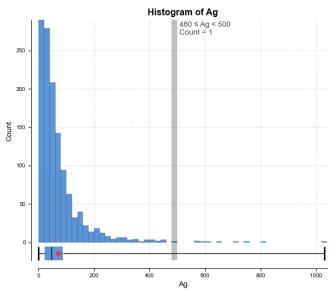 |
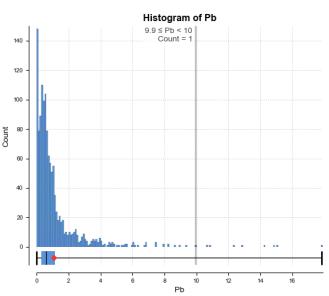 |
| V2E-Ag (g/t) | V2E-Pb (%) |
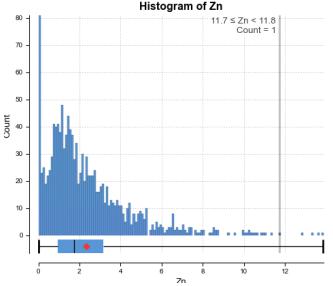 |
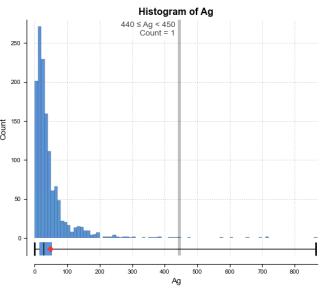 |
| V2E-Zn (%) | V10-Ag (g/t) |
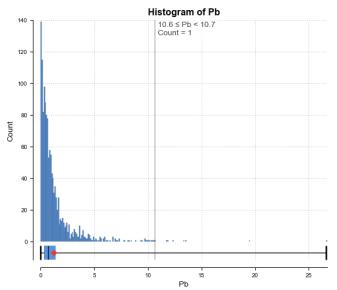 |
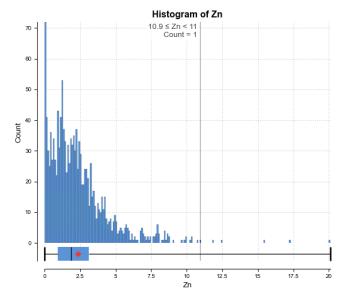 |
| V10-Pb (%) | V10-Zn (%) |
| SRK CONSULTING CHINA LTD. § APR. 20, 2026 § FH/AT | 96 |
Technical Report on Gaocheng Silver-Lead-Zinc Project in Guangdong Province, China
Mineral Resource Estimates § FINAL
Figure 14.5: Histogram Plots for the Selected 10 Veins
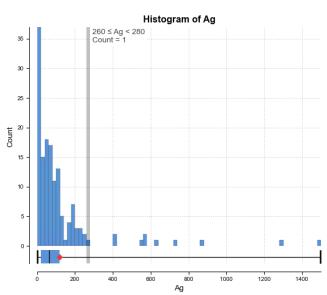 |
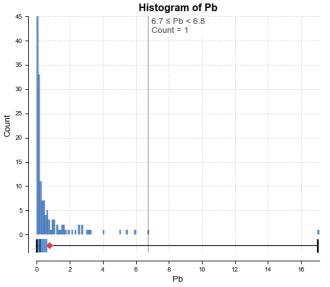 |
| V2N-Ag (g/t) | V2N-Pb (%) |
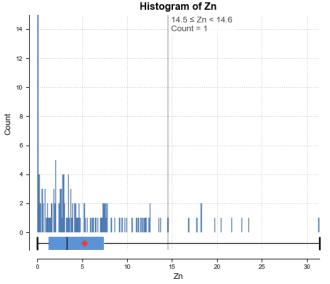 |
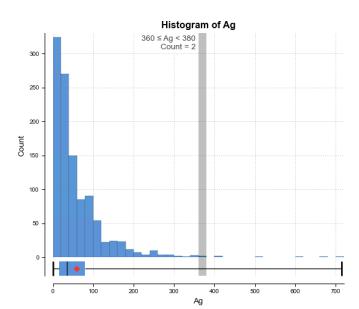 |
| V2N-Zn (%) | V19A-Ag (g/t) |
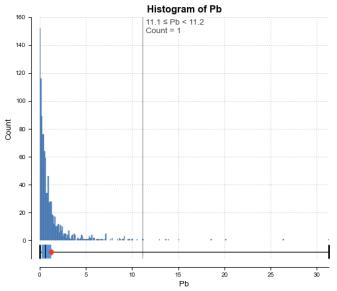 |
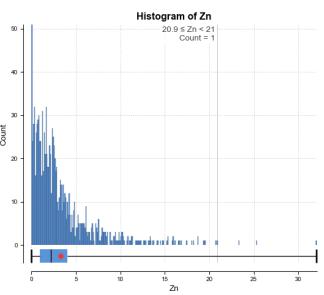 |
| V19A-Pb (%) | V19A-Zn (%) |
| SRK CONSULTING CHINA LTD. § APR. 20, 2026 § FH/AT | 97 |
Technical Report on Gaocheng Silver-Lead-Zinc Project in Guangdong Province, China
Mineral Resource Estimates § FINAL
Figure 14.5: Histogram Plots for the Selected 10 Veins
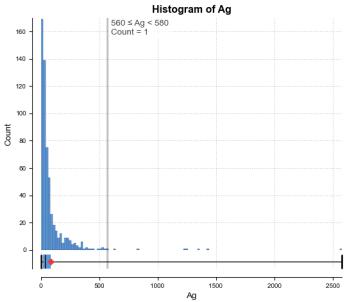 |
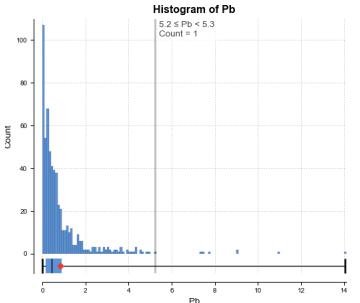 |
| V14-Ag (g/t) | V14-Pb (%) |
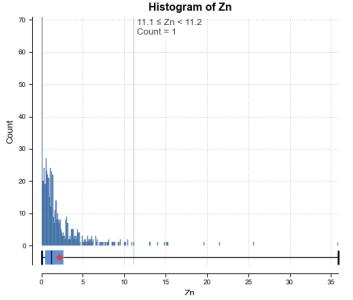 |
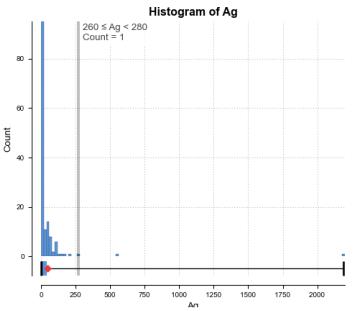 |
| V14-Zn (%) | V29-1-Ag (g/t) |
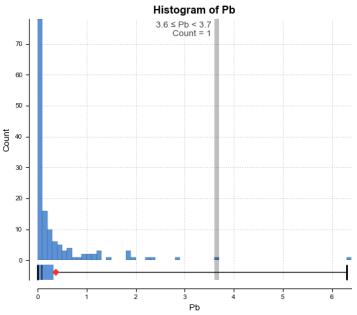 |
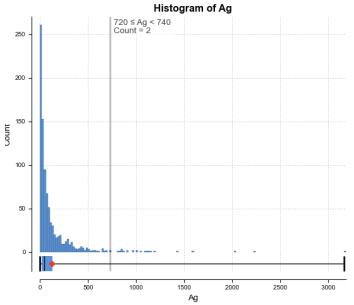 |
| V29-1-Pb (%) | V33-Ag (g/t) |
| SRK CONSULTING CHINA LTD. § APR. 20, 2026 § FH/AT | 98 |
Technical Report on Gaocheng Silver-Lead-Zinc Project in Guangdong Province, China
Mineral Resource Estimates § FINAL
Figure 14.5: Histogram Plots for the Selected 10 Veins
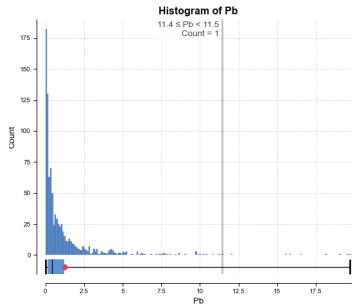 |
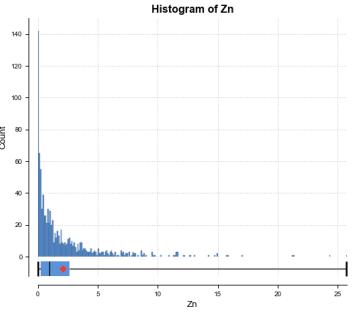 |
| V33-Pb (%) | V33-Zn (%) |
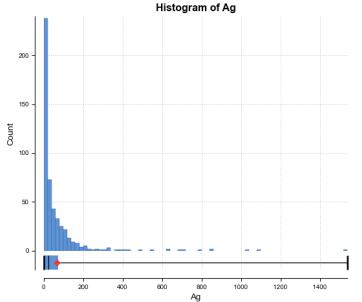 |
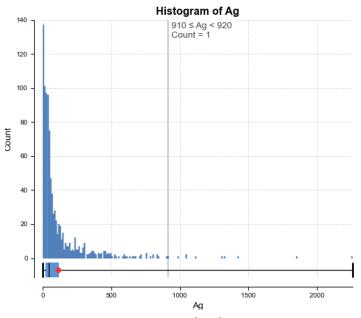 |
| V25-Ag (g/t) | V16-Ag (g/t) |
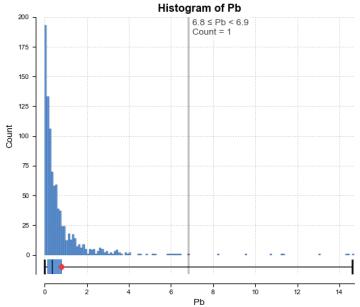 |
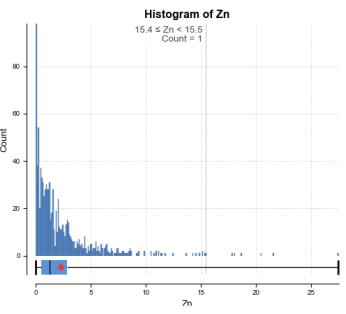 |
| V16-Pb (%) | V16-Zn (%) |
| SRK CONSULTING CHINA LTD. § APR. 20, 2026 § FH/AT | 99 |
Technical Report on Gaocheng Silver-Lead-Zinc Project in Guangdong Province, China
Mineral Resource Estimates § FINAL
Figure 14.5: Histogram Plots for the Selected 10 Veins
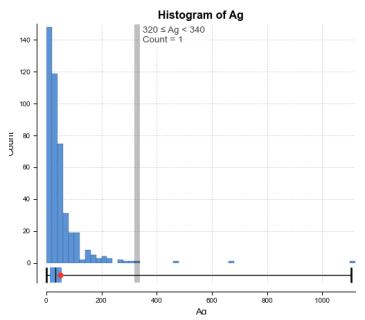 |
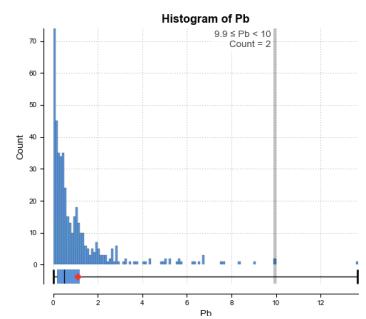 |
| V8-2A-Ag (g/t) | V8-2A-Pb (%) |
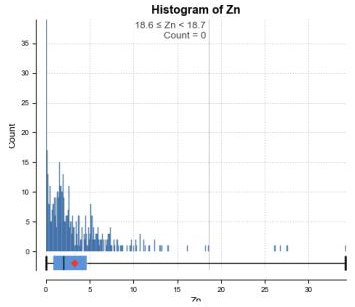 |
|
| V8-2A-Zn (%) |
Sources: SRK
| SRK CONSULTING CHINA LTD. § APR. 20, 2026 § FH/AT | 100 |
Technical Report on Gaocheng Silver-Lead-Zinc Project in Guangdong Province, China
Mineral Resource Estimates § FINAL
| 14.8 | Block Model and Grade Estimation |
The separated Micromine software models, with different block model origins, dimensions and rotations for each vein were generated by GC Mine in January 2026. The block size was set to 2 m × 2 m × 2 m (East × North × Elevation), and the sub bock size was set to 0.2 m × 0.2 m × 0.2 m (East × North × Elevation). In order to orient the model to follow the general strike of the mineralization, a rotation was performed for each vein. A block model parameter summary is presented in Table 14.4 for the ten largest veins.
Table 14.4: Block Model Summary
| Vein | XMIN | XMAX | YMIN | YMAX | ZMIN | ZMAX | DIP | AZIMUTH |
| V2E | 593725 | 2535495 | -650 | 594130 | 2535980 | 135 | -65 | 125 |
| V10 | 594045 | 2535295 | -530 | 594960 | 2536165 | 190 | -62 | 55 |
| V2N | 593120 | 2535825 | -665 | 593845 | 2536095 | 40 | -72 | 77.5 |
| V19A | 594055 | 2535260 | -520 | 594980 | 2535945 | 170 | -56.5 | 75.4 |
| V14 | 594070 | 2535145 | -370 | 594950 | 2535600 | 250 | -60 | 62.1 |
| V29-1 | 593285 | 2535565 | -705 | 593935 | 2536315 | 140 | -58 | 23.8 |
| V33 | 594010 | 2534995 | -555 | 594650 | 2535550 | 305 | -70 | 65 |
| V25 | 593435 | 2535420 | -490 | 593890 | 2536065 | 170 | -72 | 46 |
| V16 | 593485 | 2535345 | -395 | 594010 | 2535595 | 240 | -70 | 93 |
| V8-2A | 593325 | 2535105 | -500 | 593885 | 2535325 | 130 | -68 | 91.7 |
Sources: SRK
Ag, Pb and Zn grade interpolation was performed using inverse distance squared (“IDW”) weighting for different veins, and the vein true thickness of each composite is used as a weight. The three progressively more relaxed search criteria used for estimation are presented in Table 14.5. The search ellipsoids were aligned with the general mineralization orientation.
Table 14.5: Specific Search Parameters
| Pass | Search Distance (X, Y, Z) | Minimum Composites | Maximum Composites |
| 1 | 30 | 6 | 24 |
| 2 | 60 | 4 | 16 |
| 3 | 120 | 4 | 16 |
| 14.9 | Model Validation |
Model validation is a common approach for determining whether grade estimation has performed as expected. An acceptable or preferred validation result does not necessarily imply that the model is correct or derived from the right estimation approach. It suggests only that the model is a reasonable representation of the Mineral Resource data used and of the estimation method applied. Other issues such as the relationship between the model-selectivity assumptions and mining practices are equally important when determining the appropriateness of the Mineral Resource estimate.
Comparisons between the global mean for the composites and block models for each vein showed some material differences, which are a result of the heterogenous nature of the mineralization, and the clustering of information in high and low grade areas of veins. SRK investigated the estimates in these veins visually and through swath plots to determine if there are any materially biased estimates. In all instances reviewed, the local estimation matched the data well, and the observed differences in the mean values were clearly due to irregular distribution of the composites. The estimation parameters in Table 14.5 were designed to result in accurate local estimates where there is dense data, and more smoothed estimates where the data is widely spaced.
The swath plot validation approach was adopted to validate the models. Swath plots of Ag, Pb and Zn for the largest 10 veins (as well as a number of other veins which showed discrepancies between the mean of the data and the mean of the estimates) were created in three orthogonal directions and elevation in particular slice thicknesses in each direction to validate the resultant block models. The example swath plots of the 10 largest veins are shown in Figure 14.6 to Figure 14.8. The block models and composites match reasonably well in all orthogonal directions. This comparison shows close agreement between the block model and composites in terms of overall distribution and the estimates match the trends of the data along strike and in the dip direction.
| SRK CONSULTING CHINA LTD. § APR. 20, 2026 § FH/AT | 101 |
Technical Report on Gaocheng Silver-Lead-Zinc Project in Guangdong Province, China
Mineral Resource Estimates § FINAL
Figure 14.6: Swath Plot of Ag for the Selected 10 Veins
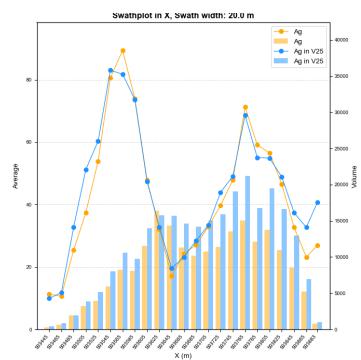 | 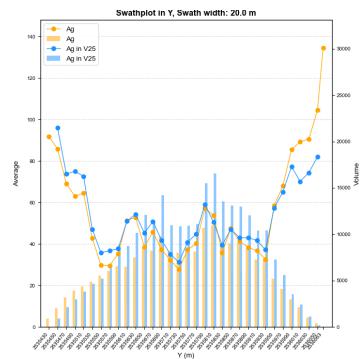 |
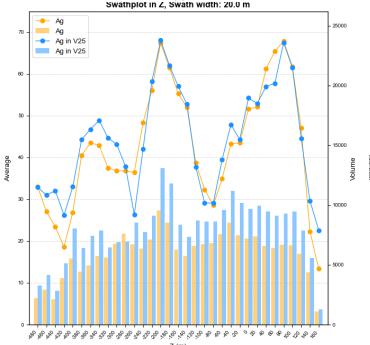 | 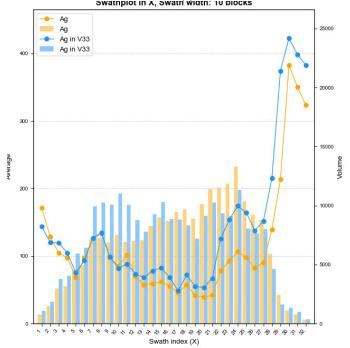 |
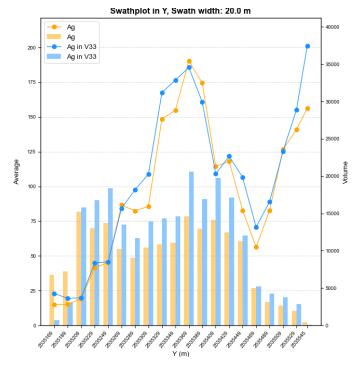 | 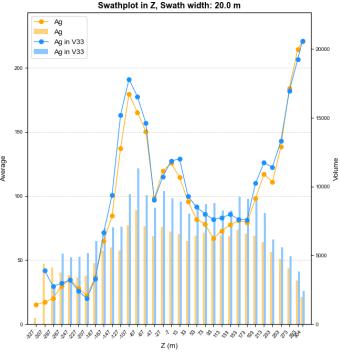 |
| SRK CONSULTING CHINA LTD. § APR. 20, 2026 § FH/AT | 102 |
Technical Report on Gaocheng Silver-Lead-Zinc Project in Guangdong Province, China
Mineral Resource Estimates § FINAL
Figure 14.6: Swath Plot of Ag for the Selected 10 Veins
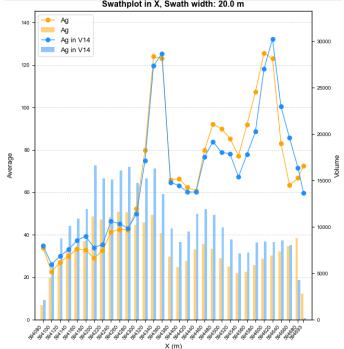 | 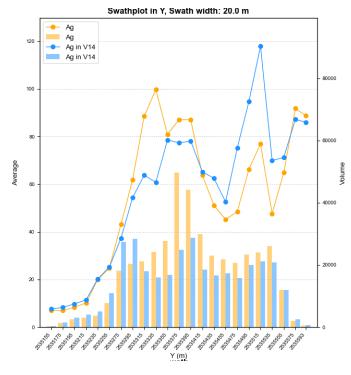 |
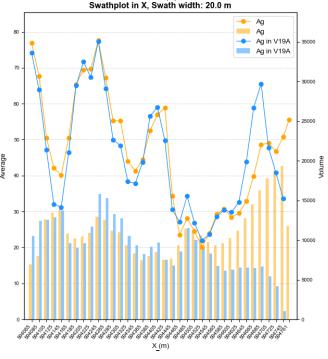 | 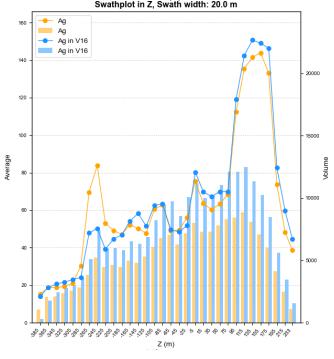 |
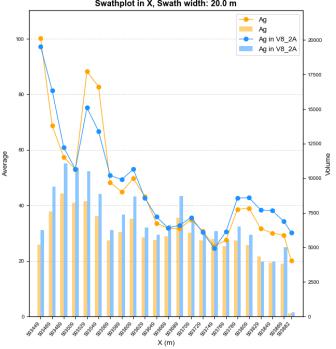 | 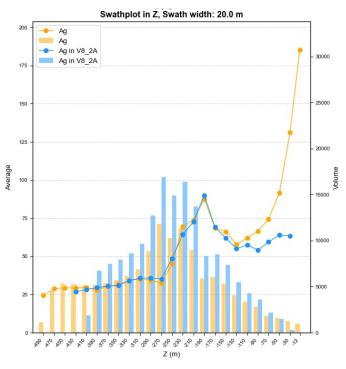 |
| SRK CONSULTING CHINA LTD. § APR. 20, 2026 § FH/AT | 103 |
Technical Report on Gaocheng Silver-Lead-Zinc Project in Guangdong Province, China
Mineral Resource Estimates § FINAL
Figure 14.6: Swath Plot of Ag for the Selected 10 Veins
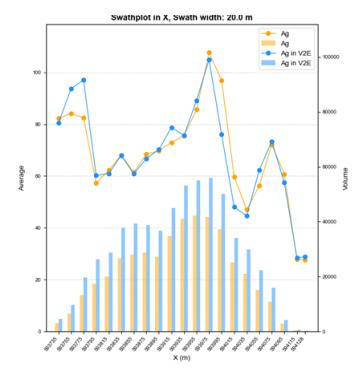 | 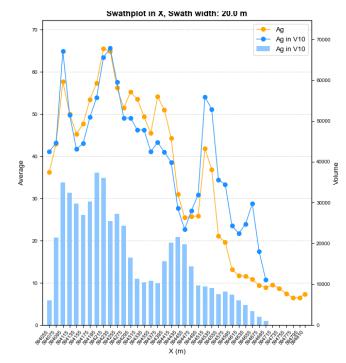 |
Figure 14.7: Swath Plot of Pb for the Selected 10 Veins
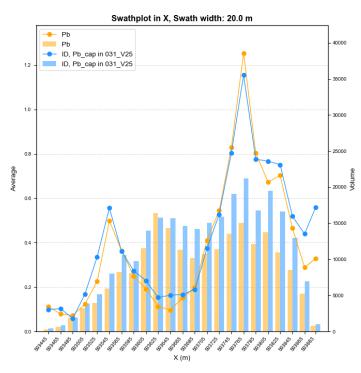 | 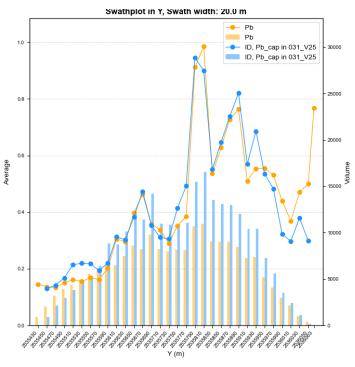 |
| SRK CONSULTING CHINA LTD. § APR. 20, 2026 § FH/AT | 104 |
Technical Report on Gaocheng Silver-Lead-Zinc Project in Guangdong Province, China
Mineral Resource Estimates § FINAL
Figure 14.7: Swath Plot of Pb for the Selected 10 Veins
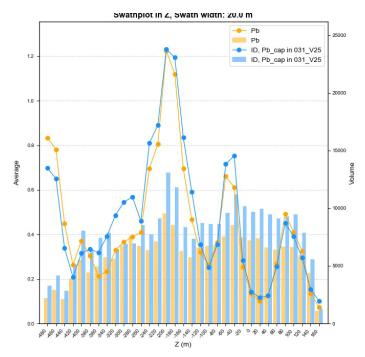 | 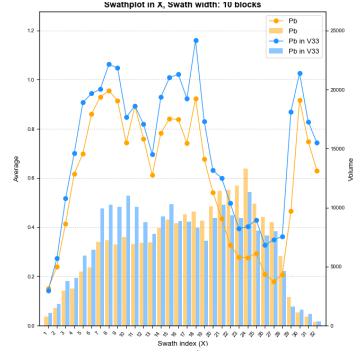 |
|
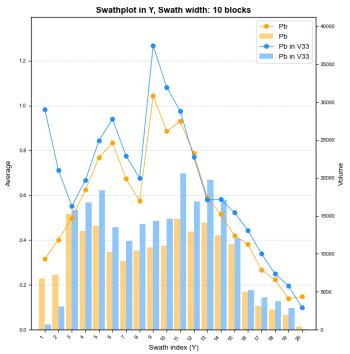 | 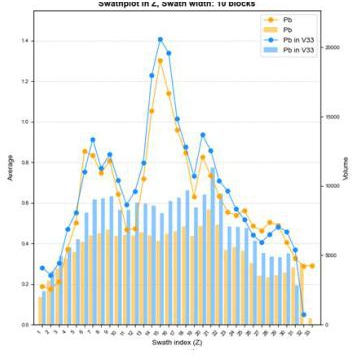 | |
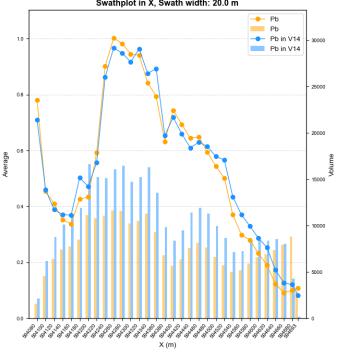 | 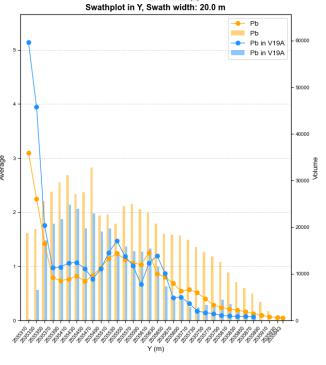 |
| SRK CONSULTING CHINA LTD. § APR. 20, 2026 § FH/AT | 105 |
Technical Report on Gaocheng Silver-Lead-Zinc Project in Guangdong Province, China
Mineral Resource Estimates § FINAL
Figure 14.7: Swath Plot of Zn for the Selected 10 Veins
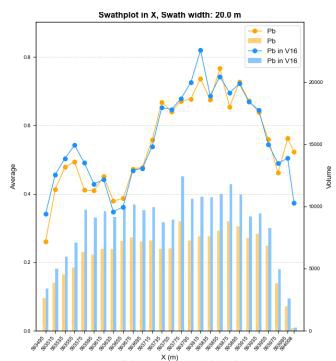 | 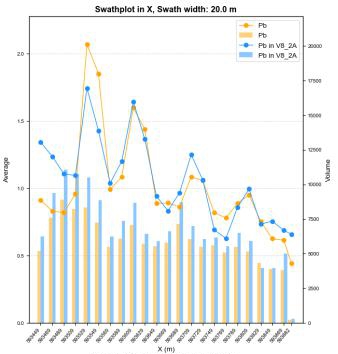 |
|
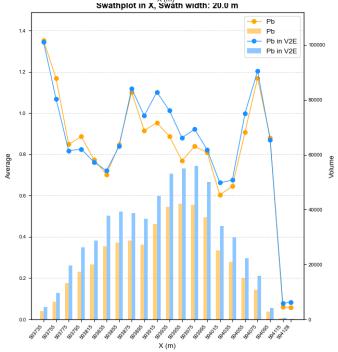 | 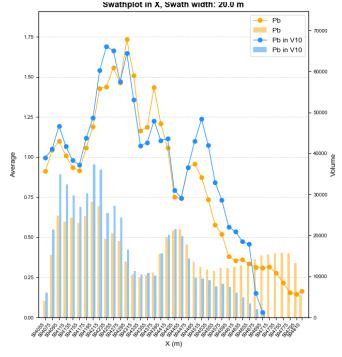 | |
| SRK CONSULTING CHINA LTD. § APR. 20, 2026 § FH/AT | 106 |
Technical Report on Gaocheng Silver-Lead-Zinc Project in Guangdong Province, China
Mineral Resource Estimates § FINAL
Figure 14.8: Swath Plot of Zn for the Selected 10 Veins
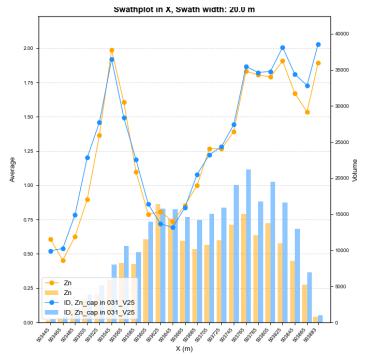 | 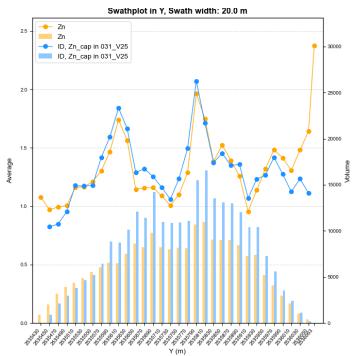 |
|
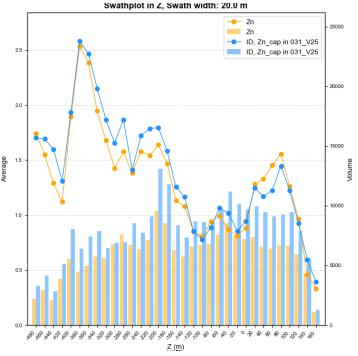 | 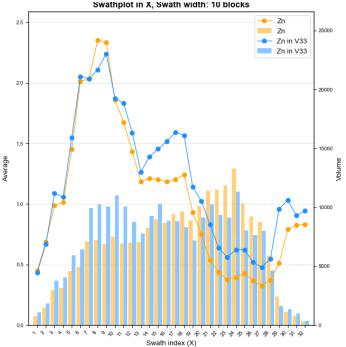 | |
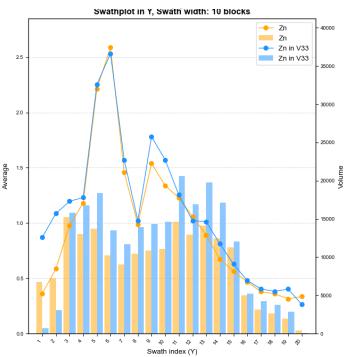 | 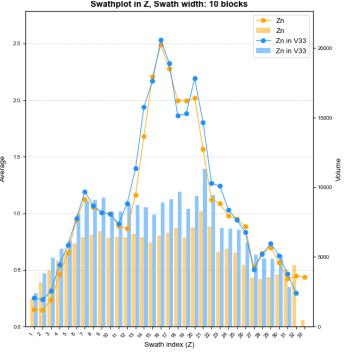 |
| SRK CONSULTING CHINA LTD. § APR. 20, 2026 § FH/AT | 107 |
Technical Report on Gaocheng Silver-Lead-Zinc Project in Guangdong Province, China
Mineral Resource Estimates § FINAL
Figure 14.8: Swath Plot of Zn for the Selected 10 Veins
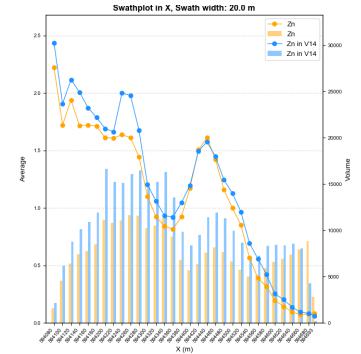 | 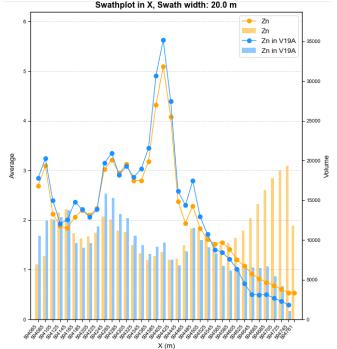 |
|
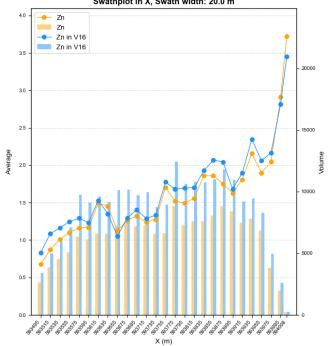 | 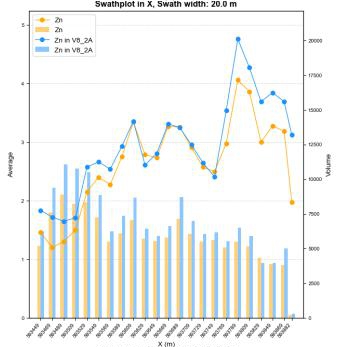 | |
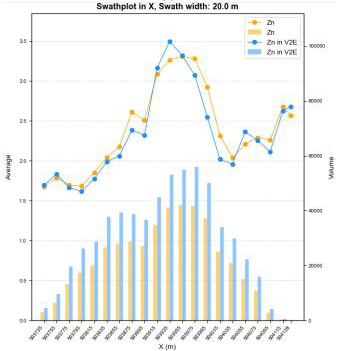 | 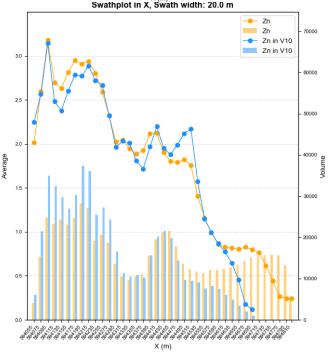 |
| SRK CONSULTING CHINA LTD. § APR. 20, 2026 § FH/AT | 108 |
Technical Report on Gaocheng Silver-Lead-Zinc Project in Guangdong Province, China
Mineral Resource Estimates § FINAL
| 14.10 | Mineral Resource Classification |
Mineral Resource classification is typically a subjective concept, industry best practices suggest that Mineral Resource classification should consider both the confidence in the geological continuity of the mineralized structures, the quality and quantity of exploration data supporting the estimates and the geostatistical confidence in the tonnage and grade estimates. Appropriate classification criteria should aim at integrating both concepts to delineate regular areas at similar resource classification.
SRK consider the quality of the drill hole data to be good, with appropriate sample collection protocols, good core recovery, adequate database management, and analytical results which generally are demonstrated to be sufficiently accurate and precise through industry standard analytical procedures and a comprehensive QA/QC management system. The chip sampling data, share the same database management protocols, and confidence in the analytical results. As discussed above, there are some concerns relating to possible bias in the sample collection methods. While this data is collected on short-spaced intervals, their confidence is not as high as the drill core data. While no bias has been conclusively demonstrated, the sample collection is sub optimal and is likely to introduce inaccuracy in the data. This is somewhat mitigated by the quantity and spacing of the data but can be improved.
The genesis of the ore bodies is well understood, and the veins can be followed over tens to hundreds of meter distances along strike and down dip. The wireframe models show few anomalous artifacts and honour the composite data well.
SRK considers the three search passes parameters (Table 14.5) as the primary discriminator for the Mineral Resource classification (Figure 14.9) under the QP’s advice, with the estimates in the first pass having confidence sufficient for Measured Mineral Resources, the second pass as Indicated Mineral Resources and the third for Inferred Mineral Resources. To avoid a spotted dog phenomenon, SRK smoothed the classification boundaries to remove isolated pockets of higher or lower classification, with due consideration of the continuity of the veins. This approach is consistent with that previously applied by AMC.
Figure 14.9: Resource Classification for the Selected 10 Veins
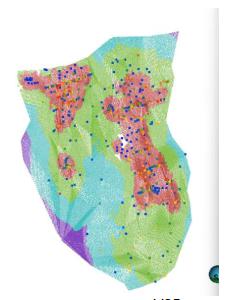 |
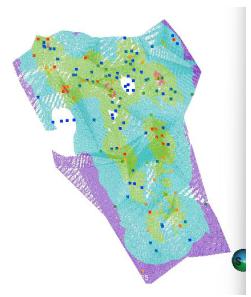 |
| V25 | V29-1 |
| SRK CONSULTING CHINA LTD. § APR. 20, 2026 § FH/AT | 109 |
Technical Report on Gaocheng Silver-Lead-Zinc Project in Guangdong Province, China
Mineral Resource Estimates § FINAL
Figure 14.9: Resource Classification for the Selected 10 Veins
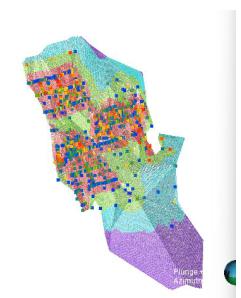 |
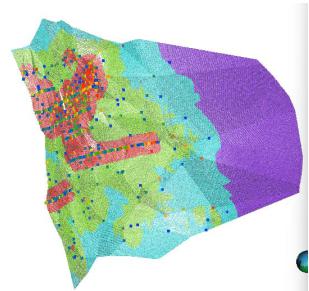 |
| V33 | V14 |
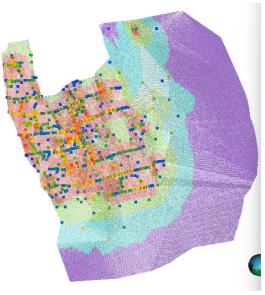 |
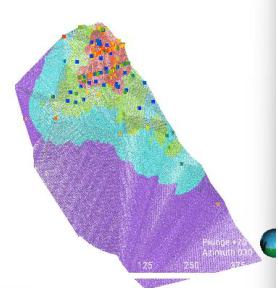 |
| V19A | V2N |
 |
 |
| V10 | V2E |
| SRK CONSULTING CHINA LTD. § APR. 20, 2026 § FH/AT | 110 |
Technical Report on Gaocheng Silver-Lead-Zinc Project in Guangdong Province, China
Mineral Resource Estimates § FINAL
Figure 14.9: Resource Classification for the Selected 10 Veins
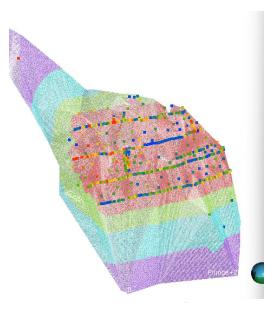 |
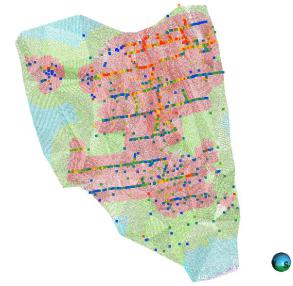 |
| V8-2A | V16 |
 | |
| 14.11 | Mineral Resource Statement |
CIM Definition Standards for Mineral Resources and Mineral Reserves (2014) defines a Mineral Resource as:
“A Mineral Resource is a concentration or occurrence of solid material of economic interest in or on the Earth’s crust in such form, grade or quality and quantity that there are reasonable prospects for eventual economic extraction.
The location, quantity, grade or quality, continuity and other geological characteristics of a Mineral Resource are known, estimated, or interpreted from specific geological evidence and knowledge, including sampling. In order to meet this requirement, SRK considers that major portions of the GC Mine are amenable for underground mining. The assumptions made to determine the cut-off grade for underground mining for the GC Mine are shown in Table 14.6.
Table 14.6: RPEEE Assumptions
| Item | Unit | Parameter |
| Long-term Silver Price | USD/oz | 40.00 |
| Ag Recovery Rate | % | 81.40 |
| Payable Factor | factor | 0.75 |
| Mining Costs | USD/t ROM | 32.07 |
| Backfill Plant | USD/t ROM | 3.10 |
| Processing Plant | USD/t ROM | 14.93 |
| Tailing | USD/t ROM | 0.44 |
| Sales, G & A | USD/t ROM | 8.17 |
| Reclamation | USD/t ROM | 0.36 |
| Corporate Social Responsibility | USD/t ROM | 0.11 |
| COG (AgEq) | g/t | 80 |
Notes:
| 1 | The price refers to the long-term prediction published by Consensus Market Forecasts in Q4 2025 |
| 2 | AgEq = Ag+28.74*Pb+33.53*Zn. |
| SRK CONSULTING CHINA LTD. § APR. 20, 2026 § FH/AT | 111 |
Technical Report on Gaocheng Silver-Lead-Zinc Project in Guangdong Province, China
Mineral Resource Estimates § FINAL
Within the current mining license area, as of December 31, 2025, the GC Mine, above a COG of 80g/t AgEq, there are 18.28 Mt of Measured and Indicated Mineral Resources at an average grade of 65 g/t Ag, 0.91% Pb, 2.24% Zn; and 7.36 Mt of Inferred Mineral Resources at an average grade of 75 g/t Ag, 0.84% Pb, 1.91% Zn. Details of the estimated Mineral Resources are shown in Table 14.7.
Table 14.7: Mineral Resource Statement for GC Mine, as of December 31, 2025
| Resource Classification | Tonnes | Ag (g/t) | Pb (%) | Zn (%) | Contained Metal | ||
| (Mt) | Ag (koz) | Pb(kt) | Zn(kt) | ||||
| Measured | 8.97 | 66 | 1.01 | 2.44 | 19,091 | 91 | 219 |
| Indicated | 9.30 | 64 | 0.82 | 2.04 | 19,180 | 76 | 190 |
| Measured+Indicated | 18.28 | 65 | 0.91 | 2.24 | 38,271 | 167 | 408 |
| Inferred | 7.36 | 75 | 0.84 | 1.91 | 17,729 | 62 | 140 |
Notes:
| 1 | Mineral Resource Statement as of December 31, 2025. |
| 2 | Source: Silvercorp Metals Inc., Verified by SRK |
| 3 | Mineral Resource are reported at a cut-off grade of 80 g/t AgEq. |
| 4 | The totals may not compute exactly due to rounding. |
| 5 | The veins within the depth less than 5 m below surface are not included in the Mineral Resource |
| 14.12 | Grade Sensitivity Analysis |
Mineral Resources are sensitive to the selection of COGs. To illustrate this sensitivity, ore quantities and grade estimates at different COGs are presented in Table 14.8. The reader is cautioned that the figures presented in this table should not be mistaken for a Mineral Resource Statement. The figures are only presented to show the sensitivity of the block model estimates to the selection of COG. Figure 14.10 represent this sensitivity as grade-tonnage curves.
Table 14.8: Global Block Model Quantities and Grade, GC Mine at Various cut-off Grades.
| Cut-off Grade | Quantity | Grade | Grade | Grade |
| AgEq (g/t) | (Mt) | Ag (g/t) | Pb (%) | Zn (%) |
| 60 | 29.77 | 62.45 | 0.82 | 1.97 |
| 70 | 27.84 | 64.92 | 0.86 | 2.05 |
| 80 | 25.85 | 68.03 | 0.90 | 2.15 |
| 90 | 23.40 | 71.26 | 0.94 | 2.24 |
| 100 | 21.17 | 75.00 | 0.98 | 2.33 |
| 110 | 18.96 | 79.19 | 1.03 | 2.43 |
| 120 | 16.89 | 84.19 | 1.08 | 2.55 |
| 130 | 14.76 | 89.02 | 1.13 | 2.65 |
Notes: The reader is cautioned that the figures in this table should not be misconstrued with a Mineral Resource Statement. The figures are only presented to show the sensitivity of the block model estimates to the selection of cut-off grade.
| SRK CONSULTING CHINA LTD. § APR. 20, 2026 § FH/AT | 112 |
Technical Report on Gaocheng Silver-Lead-Zinc Project in Guangdong Province, China
Mineral Resource Estimates § FINAL
Figure 14.10: Grade-Tonnage Curve for GC, at Various Cut-off Grades
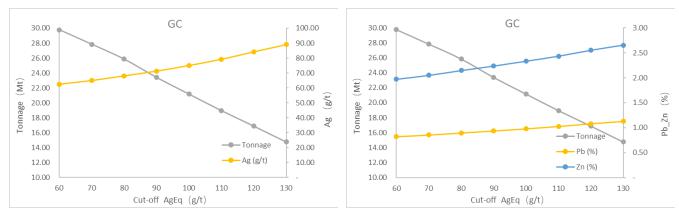
| 14.13 | Previous Mineral Resource Estimate |
SRK was requested by SVM to complete a NI43-101 compliant Mineral Resource estimation for the GC Mine in 2024.
The last Mineral Resource estimate was reported above a 120 g/t AgEq cut-off to reflect underground mining for the RPEEE criteria under the CIM Definition Standards. The results of the estimation are shown in the Table 14.9.
Table 14.9: Mineral Resources as of June 30, 2024 (at a cut-off of 120g/t AgEq)
| Resource Classification | Tonnes | Ag (g/t) | Pb (%) | Zn (%) | Contained Metal | ||
| (Mt) | Ag (koz) | Pb(kt) | Zn(kt) | ||||
| Measured | 5.87 | 88 | 1.3 | 3.11 | 16,542 | 76 | 183 |
| Indicated | 5.62 | 80 | 1.05 | 2.57 | 14,507 | 59 | 144 |
| Measured+Indicated | 11.49 | 84 | 1.18 | 2.85 | 31,049 | 136 | 327 |
| Inferred | 9.57 | 85 | 1.23 | 2.44 | 26,194 | 117 | 234 |
Sources: 2024 SRK report
Notes:
| 1 | Mineral Resource Statement as of 30 June 2024. |
| 2 | Source: Silvercorp Metals Inc., Verified by SRK. |
| 3 | Mineral Resource are reported at a cut-off grade of 120 g/t AgEq. |
| 4 | The totals may not compute exactly due to rounding. |
| 5 | The veins within the depth less than 5m below surface are not included in the Mineral Resource. |
The major changes to the Mineral Resource estimate between 2024 and 2025 include:
| § | The addition of approximately 17,274 samples from 100,876 m of drilling and 8,490 channel samples. |
| § | A decrease in the reporting cut-off due to changes in the RPEEE assumptions. |
| SRK CONSULTING CHINA LTD. § APR. 20, 2026 § FH/AT | 113 |
Technical Report on Gaocheng Silver-Lead-Zinc Project in Guangdong Province, China
Mineral Reserve Estimates § FINAL
| 15 | Mineral Reserve Estimates |
| 15.1 | Introduction |
The CIM Definition Standards provide for a direct relationship between Indicated Mineral Resources and Probable Mineral Reserves and between Measured Mineral Resources and Proven Mineral Reserves. As shown in Figure 15.1 below.
Figure 15.1: Relationship Between Mineral Reserves and Mineral Resources
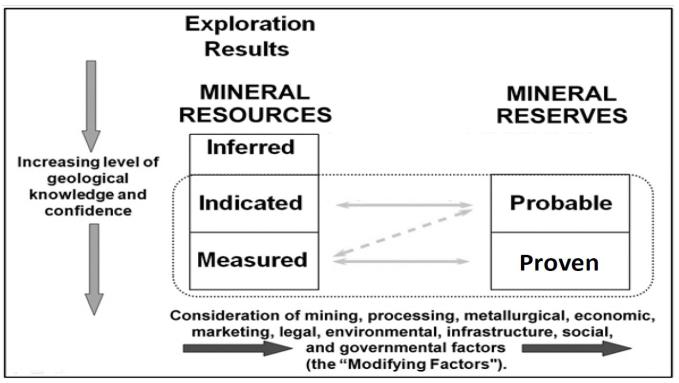
Sources: CIM Definition Standard 2014
The following statement has been extracted from the CIM Standards for reference:
“Mineral Reserves are those parts of Mineral Resources which, after the application of all mining factors, result in an estimated tonnage and grade which, in the opinion of the Qualified Person(s) making the estimates, is the basis of an economically viable project after taking account of all relevant processing, metallurgical, economic, market, legal, environment, socio-economic and government factors. Mineral Reserves and delivered to the treatment plant or equivalent facility. The term ‘Mineral Reserve’ need not necessarily signify that extraction facilities are in place or operative or that all governmental approvals have been received. It does signify that there are reasonable expectations of such approvals.”
“A Mineral Reserve is the economically mineable part of a measured and/or Indicated Mineral Resource. It includes diluting materials and allowances for losses, which may occur when the material is mined or extracted and is defined by studies at pre-feasibility or feasibility level as appropriate that include application of Modifying Factors. Such studies demonstrate that, at the time of reporting, extraction could reasonably be justified.”
“The public disclosure of a Mineral Reserve must be demonstrated by a Pre-Feasibility Study or Feasibility Study.”
| SRK CONSULTING CHINA LTD. § APR. 20, 2026 § FH/AT | 114 |
Technical Report on Gaocheng Silver-Lead-Zinc Project in Guangdong Province, China
Mineral Reserve Estimates § FINAL
| 15.2 | Summary of Technical Study and Operation |
A preliminary engineering design named Mining and Dressing Project of Gaocheng Lead-Zinc Ore in Yun’an County, Guangdong Province, was conducted by Guangdong Metallurgical & Architectural Design Institute (“GDMAI”), in January 2011.
The mine was constructed based on the design by GDMAI and operated since 2014. Though some practical modifications and upgrades to the mining system and/or processing plant have been implemented in the ten years of operating, SRK opines the production practice could be equivalent to or exceed a pre-feasibility study.
| 15.3 | Cut-off Grades |
The Mineral Resources of GC Mine contain silver, lead, and zinc elements. The AgEq grade was used for COG to define the “Ore”.
The following formula is applied to estimate the economic COG of AgEq for the feed ore from underground extraction.
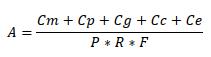
Parameters that are applied for estimates of the COG are presented in Table 15.1. The preferred COG is the estimated value which is round up to the nearest 10. SRK is of the view that material above the COG could be defined as economically extractable under those specific conditions.
Due to rising prices and a more favorable payable for silver in concentrates considering the newly sales contracts, the COG for GC Mine has decreased compared to 2024 Report.
Table 15.1: Estimates for COGs
| Item | Unit | MRE | Shrinkage/OCAF | Resuing | Description |
| Preferred AgEq | g/t | 80 | 100 | 130 | Round up to nearest 10 |
| A | g/t | 75 | 92 | 125 | Estimated COG of AgEq |
| Cm | USD/t ROM | 32.1 | 25.0 | 45.0 | Mining cash cost |
| Cp | USD/t ROM | 18.5 | 18.5 | 18.5 | Plant cash cost, including processing, backfill plants and tailing treatment |
| Cg | USD/t ROM | 8.2 | 8.2 | 8.2 | Sale, General & Administration cash cost |
| Cc | USD/t ROM | 0.5 | 0.5 | 0.5 | Corporate social responsibility and reclamation |
| Se | USD/t ROM | - | 4.6 | 4.6 | Exploration sustaining |
| R | % | 81.4 | 81.4 | 81.4 | Long-term average processing recovery rates for silver |
| P | USD/oz | 40 | 31.0 | 31.0 | Long-term forecast silver price |
| F | factor | 0.75 | 0.75 | 0.75 | Payable Factor |
Sources: GC Mine, and SRK
| SRK CONSULTING CHINA LTD. § APR. 20, 2026 § FH/AT | 115 |
Technical Report on Gaocheng Silver-Lead-Zinc Project in Guangdong Province, China
Mineral Reserve Estimates § FINAL
Notes:
| 1 | OCAF – Overhand cut and fill |
| 2 | Costs are considerred on the last three year average, detailed in Section 21.2 of this Report |
| 3 | Prices are souced from Consensus Market Forecast, released in October 2025. The long-term silver price for Reserve is 31.0 USD/oz. It is 40 USD/oz. for Resources Estimates. |
| 4 | 1 oz=31.1035 g |
| 5 | 1 USD=7.12 RMB |
| 6 | Average processing recovery rate is based on the last 3 year operation record, which is detailed in Section 17 of this report. |
The saleable products of the GC Mine are lead concentrate and zinc concentrate. The elements within these concentrates are payable based on various factors, depending on both the specific elements and their respective grades. The payable factors for Ag, Pb, and Zn elements within each concentrate are estimated based on the Contracts and operations records, as presented in Table 15.2.
Table 15.2: Estimates for Payable Factors
| Item | Unit | Ag
in Lead Conc. |
Pb
in Lead Conc. |
Ag
in Zinc Conc. |
Zn
in Lead Conc. |
| Long-term forecast price | USD/oz for Ag, USD/t for Pb and Zn | 31.0 | 2,000 | 31.0 | 2,800 |
| Average element grade in Conc. | g/t for Ag, % for Pb and Zn | 1,608 | 43.2 | 282.3 | 43.2 |
| Reference prices in RMB, incl. VAT | RMB/g for Ag, RMB/t for Pb and Zn | 8.0 | 16,091 | 2.0 | 22,527 |
| Paid considered, in RMB, incl. VAT | RMB/g for Ag, RMB/t for Pb and Zn | 7.6 | 15,571 | 2.0 | 18,482 |
| Net received in USD, excl. VAT | USD/oz for Ag, USD/t for Pb and Zn | 20.9 | 1,958 | 8 | 2,297 |
| Payable Factors, Net received against LTP | Factor | 0.94 | 0.98 | 0.25 | 0.82 |
| Ag percentage in each Conc. | % | 73% | N/A | 27% | N/A |
| Weighted payable Factor | Factor | Ag:0.75 | Pb: 0.98 | Zn 0.82 |
Sources: GC Mine, CMF and SRK
Notes:
| 1 | Prices are souced from Consensus Market Forecast released in October 2025. The long-term prices for Reserve are silver 31USD/oz.; lead 2,000 USD/t (0.91 USD/lb); zinc 2,800 USD/t (1.27 USD/lb) |
| 2 | Average element grade in concenstrates is based on the last 3 year operation record, which is detailed in Section 17 of this report. |
| 3 | Reference prices in RMB consider value added tax with the rate of 13%, and the currency exchange rate of 1 USD=7.12 RMB |
| 4 | The paid considered is depending on the grade of elements and contracts items, which is detailed in Section 19 of this report. |
| 5 | The Ag percentage in each concentrate is based on the proportion of last 3 years operation records. |
| 6 | Conc.: concentrate. |
| 7 | VAT: value added tax. |
| 8 | Incl. and excl. stand for including and excluding, respectively. |
The equivalent factor of Pb and Zn against Ag is estimated considering, prices, recovery rates, and payable factors differences. The estimates are presented in Table 15.3. It should be noted that the equivalent factors are not updated since March 31, 2024, estimation. SRK opines the prices changing for three months has minimum effect on the factors.
| SRK CONSULTING CHINA LTD. § APR. 20, 2026 § FH/AT | 116 |
Technical Report on Gaocheng Silver-Lead-Zinc Project in Guangdong Province, China
Mineral Reserve Estimates § FINAL
Table 15.3: Estimates for Equivalent Factors of Pb and Zn to Ag
| Item | Unit | Ag | Pb | Zn |
| Long-term forecast price | USD/oz for Ag, USD/t for Pb and Zn | 31 | 2,000 | 2,800 |
| Average recovery rate | % | 81.4 | 90.0 | 89.5 |
| Weighted payable Factor | Factor | 0.75 | 0.98 | 0.82 |
| Unit used in Resource model | Unit | g/t | % | % |
| Unit value | USD/Unit | 0.61 | 17.62 | 20.56 |
| Eq Factor against Ag | Factor | 1 | 28.74 | 33.53 |
Sources: GC Mine, CMF and SRK
Notes:
| 1 | Ag recovery rate conbines the rates in both lead and zinc Conc., which are 58.9% and 22.5%, respectively. |
| 2 | Eq stands for equivalent |
Table 15.4 summarizes the long-term prices quoted in October 2025 were adopted for Mineral Resources and Mineral Reserves estimation purposes, when the works were conducting. A premium of 15% was added to the LTP to reflect the RPEEE for the Mineral Resources.
Table 15.4: Long-Term Commodities Prices Applied to Estimates
| Commodity | Units | SPOT | Analysts | LTP-High | LTP-Low | Mineral Reserves |
Mineral Resources |
| Silver | USD/oz | 51.80 | 9 | 55 | 23 | 31 | 40 |
| Lead | USD/t | 1,990 | 9 | 2,250 | 1,650 | 2,000 | 2,300 |
| USc/lb | 90 | 9 | 102 | 75 | 91 | 105 | |
| Zinc | USD/t | 2,972 | 9 | 2,844 | 2,217 | 2,800 | 3,220 |
| USc/lb | 135 | 9 | 129 | 101 | 127 | 147 |
Sources: CMF, released on 20 October, 2025
| 15.4 | Modifying Factor |
| 15.4.1 | Mine Design Scope |
Mining to date has been conducted in two Phases, and design of the third Phase, which are horizontally defined by mine sections and vertically by elevations:
| § | Stage 1 access by decline down to -50 ASL |
| § | Stage 2 is -50 ASL down to -300 ASL and employs a surface shaft access, as well as the extension of the decline |
| § | Stage 3 is on engineering design, which mines the Mineral Resources occurred between -300 ASL and -500 ASL. The access method is a planned extension the decline. |
The mine is designed to cover the deposits from the +100ASL down to -500ASL within the mining permits.
| SRK CONSULTING CHINA LTD. § APR. 20, 2026 § FH/AT | 117 |
Technical Report on Gaocheng Silver-Lead-Zinc Project in Guangdong Province, China
Mineral Reserve Estimates § FINAL
| 15.4.2 | Stopes Design |
The mineable shape is designed and evaluated by the following:
| § | Designed mining stope outline manually against the Measure and Indicated Mineral Resources categories, based on the 50 m vertical intervals and about 50 m length of the shapes. 5 m crown pillar and 5-6 m rib pillars of every stope excluded in the design |
| § | Cut the mineral structures with the stope outlines into stope blocks as mineable stope |
| § | Boolean operation with the end of month survey of stope |
| § | Interrogating against grade model (block model) to get the critical parameters, such as Mineral Resource category, grades, thickness, etc. |
| § | Classify the stope into mining method base on the thickness (horizontal) then applying the modifying factors: |
| - | Minimum Mining Width(“MMW”): 0.5 m for resuing and 1.0 m for shrinkage, therefore before planned dilution, 0.4 m for resuing and 0.8 m for shrinkage mineable shape is considered; |
| - | Planned dilution: if the thickness is lower than those, planned dilution (zero grade) to the minimum mining width; |
| - | Unplanned dilution: an equivalent linear overbreak/slough (“ELOS”) with zero grade is applied to the mineable shape. Factored 0.05 m on hanging wall and footwall each for resuing stope and 0.1 each wall for shrinkage stope; |
| - | Further factored dilution of 2% (if more than 2 m wide), 3% (between 2 m and 1 m) and 4% (less 1 m wide), is also applied for shrinkage as broken ore drawing when mining is finished; |
| - | Factored ore loss as 95% and 92% for resuing and shrinkage method, respectively; |
| - | COG filter: assess the diluted mineable shape against COG to filter out sub-economic stopes; |
| - | Visual and manual filter the stopes considering the practical conditions with local engineer for mine planning; and |
| - | Summation of the eligible material in stopes as the potential Mineral Reserves then conduct mine planning and scheduling. |
In general, the Mineral Reserve estimates are well supported and provide a reasonable basis for ongoing production mining at these narrow vein deposits. The mining methods employed are highly selective, and the GC Mine has initiated activities to minimise dilution as key strategy.
It should be noted that only stopes for resuing and shrinkage methods are considered during the stope design, the overhand cut and fill method employed as the same as the parameters as shrinkage stope.
| 15.4.3 | Dilution and Loss Summary |
As a result of the previously described stope design, the mining dilution and ore loss estimated stope by stope and is summarized in Table 15.5.
Table 15.5: Dilution and Loss Summary
| Mining Method | Average Stope Width (m) | Dilution Rate | Ore Loss Rate | Reserve % |
| Resuing | 0.9 | 17% | 5% | 33% |
| Shrinkage or OCAF | 1.8 | 25% | 8% | 67% |
| Weighted Average | 1.5 | 22.3% | 7.0% | 100% |
Sources: GC Mine, SRK summarized
Notes: OCAF - overhand cut and fill mining method
| SRK CONSULTING CHINA LTD. § APR. 20, 2026 § FH/AT | 118 |
Technical Report on Gaocheng Silver-Lead-Zinc Project in Guangdong Province, China
Mineral Reserve Estimates § FINAL
| 15.5 | Mineral Reserve Estimates |
The estimated Mineral Reserve, based on the Mineral Resource estimate and the application of Modifying Factors to the tonnes and contained equivalent silver, is summarized in Table 15.6 and illustrated in waterfall charts shown in Figure 15.2 and Figure 15.3.
It should be noted that the GC Mine has a substantial volume of qualified Mineral Resources of about 9.32 Mt available for conversion to Mineral Reserves. However, due to the remaining capacity constraint of the existing TSF, the mining plan has been considered for 18 year. The Mineral Reserves are aligned with the remaining capacity of the TSF and the LOM plan. The project will need to start considering the TSF expansion plan study around the 10th year. By that time, there is a high opportunity to increase Mineral Reserves and extend the LOM.
Table 15.6: Summary of Mineral Reserve Conversion Process
| Description | Tonne (kt) | AgEq Grade (g/t) | AgEq Contained (t) |
| MI+INF Mineral Resource | 25,634 | 165 | 4,241 |
| MI Mineral Resource | -7,357 | 166 | -1,201 |
| Minable Stope Shape Mineral Resource | -9,456 | 185 | -1,408 |
| Allowance for Mining Dilution and Mining Loss | 497 | 162 | -119 |
| Diluted & Loss MI Resources in Stope Shape | 9,317 | 162 | 1,513 |
| Consider the TSF Capacity | -3,131 | 160 | -502 |
| Mineral Reserve as of December 31, 2025 | 6,186 | 163 | 1,011 |
Sources: GC Mine, SRK summarized
Figure 15.2: Waterfall Chart of Mineral Reserve Conversion --Tonne
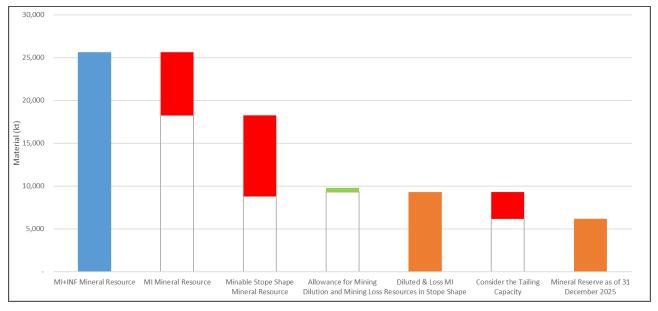
Sources: GC Mine, SRK summarized
| SRK CONSULTING CHINA LTD. § APR. 20, 2026 § FH/AT | 119 |
Technical Report on Gaocheng Silver-Lead-Zinc Project in Guangdong Province, China
Mineral Reserve Estimates § FINAL
Figure 15.3: Waterfall Chart of Mineral Reserve Conversion -- Contained Equivalent Silver
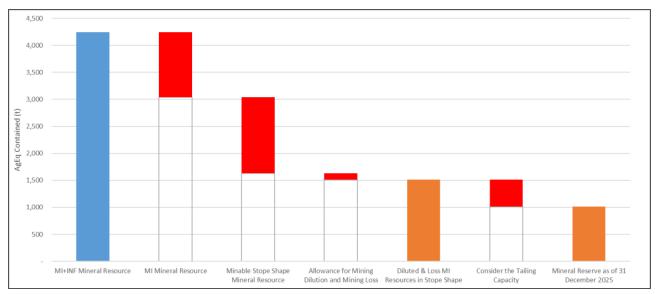
Sources: GC Mine, SRK summarized
| 15.6 | Mineral Reserve Statement |
By applying the Modifying Factors, SRK reviewed the GC Mine Mineral Reserves estimate, in accordance with the CIM Definition Standards (2014) and NI 43-101 standard (Table 15.7). The economically mineable parts of the Measured and Indicated Mineral Resources categories within the designed stopes, including diluting materials and allowance for losses, were classified as Proven and Probable Mineral Reserves, respectively. The feed ore is estimated based on the reference point being the primary crusher or temporary stockpile at the crusher feed. Totally around 34% MI Mineral Resource converted into Mineral Reserve in tonnes, and about 33% contained metal converted when considering equivalent silver.
Table 15.7: Mineral Reserve Statement for GC Mine, as of December 31, 2025
| Category | Tonnes | Ag | Pb | Zn | Contained Metal | |||
| (Mt) | (g/t) | (%) | (%) | Ag (koz) | Pb (kt) | Zn (kt) | ||
| Proven | 3.57 | 59 | 0.96 | 2.27 | 6,789 | 34 | 81 | |
| Probable | 2.62 | 67 | 0.84 | 2.17 | 5,673 | 22 | 57 | |
| Total | 6.19 | 63 | 0.91 | 2.23 | 12,462 | 56 | 138 | |
Sources: GC Mine, SRK summarized
Notes:
| 1 | Any differences between totals and sum of components are due to rounding. |
| 2 | 100 g/t AgEq and 130 g/t AgEq COG was applied to Shrinkage (including overhand cut & fill) and resuing stopes, respectively. |
| 3 | The COG estimates are based on the forecast prices 31 USD/oz silver, 2,000 USD/t lead, and 2,800 USD/t zinc. |
| 4 | The Mineral Reserves are reported on a metric dry tonne basis. |
| 5 | The Mineral Reserves are reported at the reference point of ROM stockpile before crushing or directly crushing. |
| 6 | The Mineral Reserves are effective as of December 31, 2025. |
| SRK CONSULTING CHINA LTD. § APR. 20, 2026 § FH/AT | 120 |
Technical Report on Gaocheng Silver-Lead-Zinc Project in Guangdong Province, China
Mineral Reserve Estimates § FINAL
| 15.7 | Discussion on Potentially Impacts to Mineral Reserve Estimates |
As in the case for most mining projects, the extent to which the estimate of Mineral Reserves may be affected by mining, metallurgical, infrastructure, permitting, market and other factors could vary from major gains to total losses of Mineral Reserves.
There are no known issues to the Qualified/ Competent Person of this section expected to materially affect the Mineral Reserve estimates.
There is an opportunity to increase reserves and extend the LOM in future since around 3.13 Mt eligible MI Resources were not converted due to the modifying factor of TSF remaining capacity.
| SRK CONSULTING CHINA LTD. § APR. 20, 2026 § FH/AT | 121 |
Technical Report on Gaocheng Silver-Lead-Zinc Project in Guangdong Province, China
Mining Methods § FINAL
| 16 | Mining Methods |
| 16.1 | Introduction |
Mining to date has been conducted in two Phases, and designing the third Phase, which are horizontally defined by mine sections and vertically by elevations:
| § | Stage 1 production employs conventional mobile, rubber-tired, diesel-powered equipment (development jumbo, loader, and truck) with surface declines access down to -50 ASL. |
| § | Stage 2 development from -50 ASL down to -300 ASL employs conventional tracked equipment (battery powered locomotives, rail cars, electric rocker shovels and pneumatic hand-held drills) via a surface shaft access, as well as the extension of the decline. |
| § | Stage 3 is on design, which mines the Mineral Resources occurred between -300 ASL and -500 ASL, with access via the extension of the surface decline. |
The GC Mine is currently operating the combination of Phase 1 and Phase 2 via three production and one ventilation systems. The production level interval is 50 m between each level. These systems include:
| § | The main decline production system includes one main decline from surface at 176 ASL to -300 ASL with a total length of 4,000 m. |
| § | The exploration decline production system is one exploration decline from surface at 110 ASL to -50 ASL with a total length of 1,500 m. Furthermore, the exploration decline connects to the main decline at 0 ASL and -50 ASL. |
| § | The main shaft production system is one main shaft from surface 258 ASL to -370 ASL. |
| § | The ventilation system includes two ventilation shafts, which are: |
| – | Phase 1 ventilation shaft is return air raise from 114 ASL to -50 ASL; |
| – | Phase 2 ventilation shaft is return air raise from 122 ASL to -200 ASL; |
| – | The main decline, exploration decline, and main shaft are utilized as intake fresh air. |
The mining method employed by the mine were traditional shrinkage and resuing stoping methods, previously 2021. Overhand cut and fill method has been introduced as the backfill plant finished construction and is operational.
The underground infrastructure, including water supplier and dewatering system, hoisting system, ventilation, power supply, compressed air supply, are constructed for the first two Phases mine.
| 16.2 | Operation and Product Rate |
GC Mine has been commercial operating since Q2 2014.
GC Mine operates mainly using contractors for mine development, production, ore transportation, and exploration. GC Mine provides its own management, technical services, and supervisory staff to manage the mine operations.
| SRK CONSULTING CHINA LTD. § APR. 20, 2026 § FH/AT | 122 |
Technical Report on Gaocheng Silver-Lead-Zinc Project in Guangdong Province, China
Mining Methods § FINAL
The design full product rate is approximately 330 ktpa. The mine operation is conducted 365 days of the year but mine production is currently scheduled on the basis of 330 days per year at an average of approximately 1,000 tpd. The GC Mine has commissioned a pre-sorting system on run-of-mine ore, which is currently operating in a trial/commissioning phase with an indicative waste rejection rate of approximately 17%. This rate is not considered final; GC Mine is continuing test work and optimization with the objective of reducing the waste rejection rate and increasing metal recovery through the pre-sorting circuit. The operation results for the last five years are presented in Table 16.1.
Table 16.1: Operation Results from FY2020 to FY2025 Q1
| Year | Unit | FY2022 | FY2023 | FY2024 | FY2025 | FY2026Q1-Q3 |
| Ore Mined | dry tonne | 314,882 | 299,959 | 290,006 | 291,044 | 278,171 |
| Moisture | % | 3.07 | 2.97 | 2.67 | 2.8 | 2.8 |
| Processed | dry tonne | 318,042 | 299,597 | 290,050 | 290,897 | 231,696 |
| Head Grades | ||||||
| Ag | g/t | 75 | 75 | 69 | 67 | 61 |
| Pb | % | 1.53 | 1.32 | 1.19 | 0.94 | 0.92 |
| Zn | % | 3.19 | 2.75 | 2.64 | 2.49 | 2.72 |
Sources: GC Mine processing annually report
| 16.3 | Geotechnical and Hydrogeology Considerations |
The rock mass condition is categorized as Fair to Good and the AMC assessment anticipated that the vein and host rocks in the mine area would generally be competent, but with areas where local conditions require, additional local ground support installed. This has largely been confirmed in operations, with most areas deemed to require little or no support. Where Poor ground conditions have been encountered, ground support is provided, with a range of strategies available depending on the local conditions. This may be either rock bolts with or without mesh, shotcrete only, shotcrete with rock bolts, shotcrete with rock bolts and mesh, timber, or heavier steel support.
Based on the review of the available geotechnical data and high-level assessments undertaken, the geotechnical aspects of the mine design were generally reasonable for mining study purposes. However, given the limited nature of the data, the geotechnical knowledge at the Project prior to commencement of operations was not considered to be at the level of detail normally associated with a mining operation or feasibility study in Canada. That geotechnical knowledge has at the practical level, been significantly advanced since the commencement of operations. SRK has recommended that, as part of ongoing operations at the mine, geotechnical and ground support aspects should be continuously reviewed in a formal and recordable manner, bearing in mind previous recommendations, local and mine-wide operating experience in all rock types encountered, any advisable data collection, and looking to future mining development.
Specific hydrogeological investigations were not conducted. The mine design report presents discussion of hydrogeological conditions at GC Mine and states that hydrogeological exploration in the district is relatively inadequate. For AMC’s preliminary geotechnical assessments, minor water inflows (less than five litres per minute locally) were assumed. SRK notes that operating experience to date indicates that the assumption of minor water inflows is reasonable.
| SRK CONSULTING CHINA LTD. § APR. 20, 2026 § FH/AT | 123 |
Technical Report on Gaocheng Silver-Lead-Zinc Project in Guangdong Province, China
Mining Methods § FINAL
| 16.4 | Mine Design |
The mine design is based on the engineering work completed by the local official provincial design institute GMADI (April 2016). Refinements in areas such as profile dimensions, alignments, fleet sizing, etc. have been made by GC Mine technical personnel on an as-needed basis during the Project construction and operations phases. Design aspects have been progressively advanced and refined as operations have progressed but without any major change in development requirements.
The mine is designed as an underground operation, developed a hybrid access system of declines and shafts, staged in two Phases at the beginning, targeting the Mineral Resources above -300 ASL. A third Phase is on the process of engineering design; however, the access method has been considered as decline access and the relayed air return raises. Figure 16.1 shows the mine design for GC Mine.
The mining stages are horizontally defined by mine sections and vertically by elevations:
| § | Phase 1: production employs conventional mobile, rubber-tired, diesel-powered equipment (development jumbo, loader, and truck) with surface declines access down to -50 ASL. |
| § | Phase 2: development from -50 ASL down to -300 ASL employs conventional tracked equipment (battery powered locomotives, rail cars, electric rocker shovels and pneumatic hand-held drills) via a surface shaft access, as well as the extension of the decline. |
| § | Phase 3: designing, which mines the Mineral Resources occurred between -300 ASL and -500 ASL. |
Figure 16.1: Mine Design for GC Mine
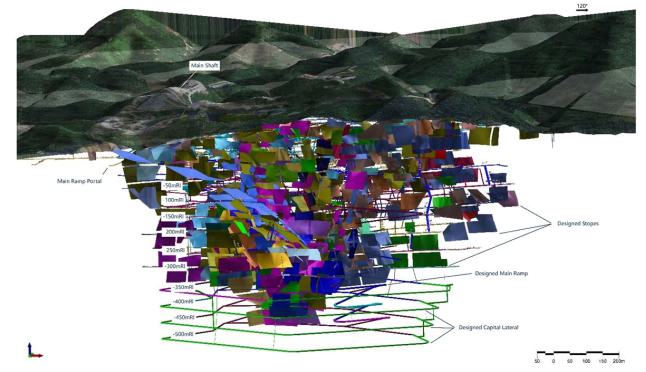
Sources: GC Mine
| SRK CONSULTING CHINA LTD. § APR. 20, 2026 § FH/AT | 124 |
Technical Report on Gaocheng Silver-Lead-Zinc Project in Guangdong Province, China
Mining Methods § FINAL
| 16.4.1 | Vertical Access |
The mine access for men and materials, as well as the transportation of ore and waste, is provided by two declines (Exploration decline, Main decline) and a vertical shaft (Main Shaft). The secondary means of emergency egress is provided by the Phase1 and Phase 2 return airway shafts (“RAR”). Table 16.2 summarizes general details for each vertical access.
Table 16.2: Summary of General Details for Mine Access
| Shaft name |
Diameter (m) | Collar elevation (ASL) |
Bottom elevation (ASL) |
Depth (m) | Profile | East
collar co-ordinate |
North
collar co- ordinate |
Collar access |
| Main decline extend | 4.2 x 3.8 | 176 | -300 | 706 | Rectangular | 37,593,581 | 2,535,330 | Surface |
| Exploration decline | 3.7 x 3.5 | 112 | 50 | 62 | Rectangular | 37,593,379 | 2,535,987 | Surface |
| Stage 1 RAR | 3.5 | 120 | -50 | 170 | Circular | 37,593,954 | 2,535,692 | Surface |
| Stage 2 RAR | 3.5 | 122 | -50 | 172 | Circular | 37,594,206 | 2,535,586 | Adit |
| Main Shaft | 6.0 | 248 | -370 | 618 | Circular | 37,593,562 | 2,535,544 | Surface |
Sources: GC Mine
The Main decline provides access to the +100 ASL, +50 ASL, 0 ASL, -50 ASL, -100 ASL, -150 ASL, -200 ASL, -250 ASL and -300 ASL levels.
The Exploration decline provides access to the +100 ASL, +50 ASL, 0 ASL, and -50 ASL. The Main decline connects to the Exploration decline at 0 ASL and -50 ASL. The average gradient is 12% (1 in 8.3) with minimum radius of 20 m. The total decline access length is 2,358 m (excluding stockpile cubbies).
The Main Shaft collar is located at +248 ASL elevation with a circular diameter is 6.0 m.
| 16.4.2 | Horizontal Access |
The level (horizontal) development/ drive is designed relative to the vein positions. The ore drive is developed primarily from the level access. Then development of the raises to the upper-level to control the vein, also the stope access. A third drive is developed, the footwall drive which is used as the transportation of ROM. The fourth part of the develop is the cross-cut from the foot wall drive to ore drive that is used for the extraction of ore from the stope. A typical level develop against mineralization veins is illustrates in Figure 16.2.
| SRK CONSULTING CHINA LTD. § APR. 20, 2026 § FH/AT | 125 |
Technical Report on Gaocheng Silver-Lead-Zinc Project in Guangdong Province, China
Mining Methods § FINAL
Figure 16.2: Plan View of Development and Veins - 150m RL
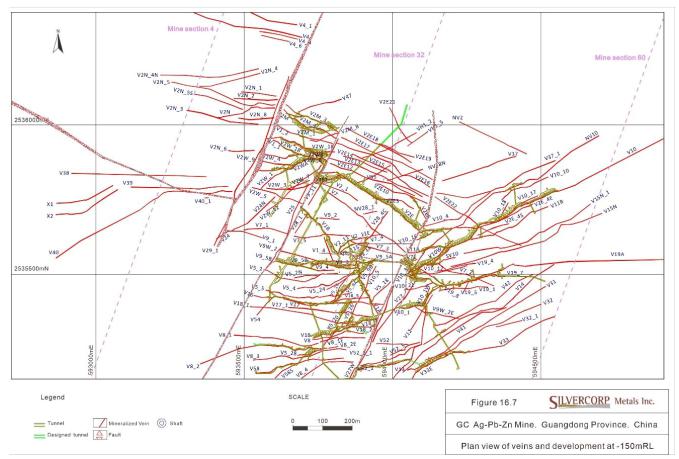
Sources: GC Mine
| 16.4.3 | Expansion Plan for the third Phase |
The third Phase is the planned extension of the decline downwards as the main access. Relayed air return raises are planned for ventilation. Materials and ROM will be transported to Level -300 ASL then hoisted to surface via main shaft. The main decline is also a standby material movement path.
| 16.5 | Material Movement |
The ROM material is mined/ drawn out of the stope or waste excavated from development headings and loaded into 0.7 m3 rail cars by small scale rubber-tired load-haul-dump mobile machines (“LHD”) from either cross-cut draw points or development headings directly. The rail cars are moved by electric locomotives along the level drive (footwall drive) to the shaft, then hoisted two at a time in the shaft cage (2 deck) to surface. The material mined near the decline system, underground trucks are loaded at the stope draw points equipped with vibration feeder at the bottom of the ore pass, which is fed from upper level by rail cars or LHD directly.
The Main Shaft has one ground mounted multi-rope friction winder (Koepe winder) (600 kW rating) and is used for hoisting men and material as well ore and waste, for areas below the -50 ASL. The shaft is also used for intake air, services access (ladder, cables, and pipes) and emergency egress.
The shaft hoisting capacity is estimated to be approximately 330 ktpa. The capacities are estimated based on 330 days per year, three shifts per day, and eight-hour shifts.
| SRK CONSULTING CHINA LTD. § APR. 20, 2026 § FH/AT | 126 |
Technical Report on Gaocheng Silver-Lead-Zinc Project in Guangdong Province, China
Mining Methods § FINAL
Waste that is cage hoisted in rail cars to surface is transferred to the rail waste dump tip head that is within 200 m of the Main Shaft. Figure 16.3 shows the Main Shaft headframe.
Figure 16.3: Underground Access and Level Drive of GC Mine
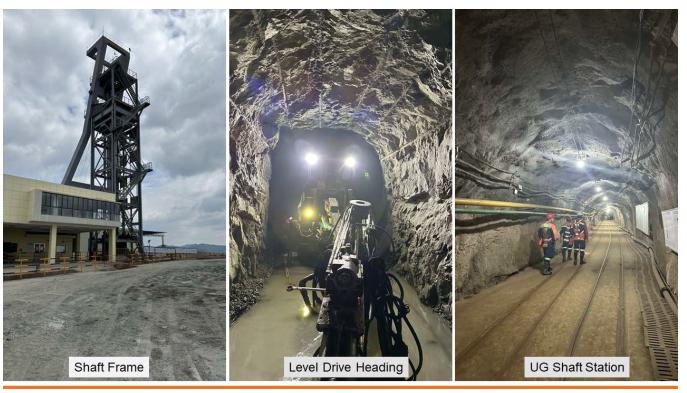
Sources: SRK site visit
| 16.6 | Stoping Method |
Shrinkage stoping, OCAF stoping, and resue stoping are the methods utilized in the GC Mine. Shrinkage stoping and resue stoping were employed at the beginning of the mine's life. OCAF stoping has been employed since 2021. The ROM per stoping method for the last three years is presented in Figure 16.3.
Table 16.3: ROM Percentage per Stoping Method
| Year | Unit | FY2021 | FY2022 | FY2024 | FY2025 | FY2026 Q1-Q3 |
| Shrinkage | % ROM | 71% | 77% | 76% | 72% | 63% |
| Resuing | % ROM | 29% | 21% | 16% | 22% | 28% |
| OCAF | % ROM | 0% | 3% | 8% | 6% | 9% |
Sources: GC Mine
Notes: The final total might include some rounding inaccuracies.
| 16.6.1 | Shrinkage Stoping |
The method begins with establishing a sill drive along the vein to expose the vein at 2.4 m height. An access drive (conventionally a footwall drive) is also developed parallel to the vein at 2.4 m wide x 2.4 m high at a minimum stand-off distance of 6 m from the vein. Cross-cuts between the access and vein drives are developed at approximately 7.5 m strike spacing (actual spacing is dependent on the loader used, loader dimensions and the rib pillar thickness required for rib stability). The cross-cuts act as draw points for the loading of the stope ore. Travel way access raises, that are also used for services are established between the levels at each end of the stope block. Waste packs are built on each void side of the raise as stoping proceeds upwards. Each stoping block is normally 50 m strike length by 50 m height.
| SRK CONSULTING CHINA LTD. § APR. 20, 2026 § FH/AT | 127 |
Technical Report on Gaocheng Silver-Lead-Zinc Project in Guangdong Province, China
Mining Methods § FINAL
Miners use hand-held pneumatic drills (“jackleg”) to drill a 1.8 – 2.0 m stope lift that is drilled and blasted as inclined up-holes with a forward inclination of 75 – 85° (“half-uppers”). The typical drill pattern uses a drill burden of 0.6 – 0.8 m and spacing of 0.8 – 1.2 m, depending on vein thickness. Holes are charged with cartridge explosives and ignited with tape fuse. The powder factor is generally 0.4 – 0.5 kg/t. Stope blasting fills the void below with ore as the mining proceeds upwards, standing on broken ore. While mining upwards, only 30 – 35% of the stope ore may be removed until the entire stope is mined. At this point, all ore is removed from the stope, leaving the stoping void effectively empty. A crown pillar is maintained for the stope to provide regional stability and to minimize dilution from up-dip stopes. Ventilation, compressed air, and water are carried up the travel way raises to the stoping level. Loading of the ore from the draw points is by LHD into trucks (Stage 1) or electric rail over-throw loaders into rail cars (Stage 2).
As the backfill plant began operating in 2021, the mined out areas of shrinkage stopes in GC Mine are being backfilled in a predetermined schedule.
Figure 16.4 depicts the Shrinkage stoping method as used at GC Mine.
Figure 16.4: Typical Shrinkage Stope Layout
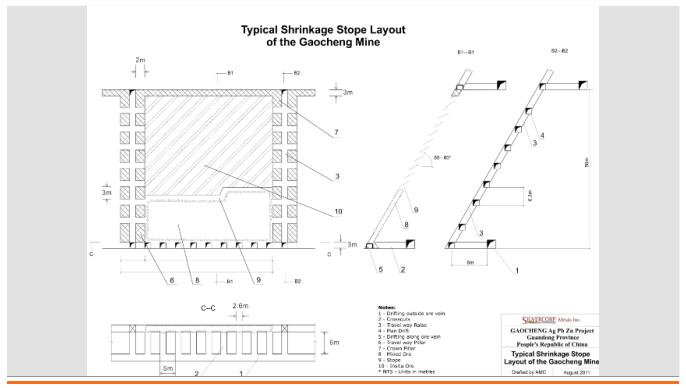
Sources: GC Mine
| SRK CONSULTING CHINA LTD. § APR. 20, 2026 § FH/AT | 128 |
Technical Report on Gaocheng Silver-Lead-Zinc Project in Guangdong Province, China
Mining Methods § FINAL
| 16.6.2 | Resue Stoping |
Vein and access development preparation is essentially the same as for shrinkage stoping except that an elevated sill drive (3 m on-dip height) is established along with draw points (generally limited to two or three) to provide access to the raise positions (raises equipped with steel liners as mill holes).
Resue stoping veins are typically higher-grade and generally between 0.20 m (minimum extraction width 0.3 m) and 0.80 m width. Resue stoping involves separately blasting and loading the high grade narrow vein and waste required to achieve a minimum stoping work width.
The mining crew consists of miners using hand-held pneumatic drills. Half-uppers lifts are drilled and blasted in essentially the same manner as for shrinkage stoping. After an ore lift is blasted and cleaned, the footwall is blasted and used to fill the void mined out. This process is repeated until the crown pillar is reached. The entire stope is left filled with waste from the cleaning of the footwall.
The blasted ore is transported by wheelbarrow and/ or hand shovelling to the steel-lined mill-hole (“steel pass”). The steel pass is constructed in lift segments as the stope is mined upwards. The base of the steel pass is held in place with a timber set. The footwall waste is then cleaned to maintain a minimum mining width (typically 0.8 m) and to provide the working platform for the next stope lift. In contrast to shrinkage stoping, the mined-out stope is left filled with waste from the cleaning of the footwall necessary to maintain a minimum mining thickness and to provide a working platform.
The order of vein extraction and footwall cleaning is generally dependent on the condition of the vein hangingwall contact. Where the vein hangingwall contact is distinct and stable, the vein is extracted first; otherwise, the footwall waste is extracted first followed by vein.
Rubber mats and/ or old conveyor belting is placed on top of the levelled waste after each waste lift to minimize ore dilution with the waste (ore losses) and also to minimize over-cleaning of the waste (dilution). Cleaning of the ore consists of hand shovelling and hand carting to the steel pass which connects to the mill hole cross-cut. The rubber mats and/ or old conveyor belt are rolled up and removed for reuse prior to blasting the footwall and forming the next platform lift.
In-stope ore transporting may potentially be improved by using scraper winches with small hoes.
Figure 16.5 depicts the resue stoping method at GC Mine.
| SRK CONSULTING CHINA LTD. § APR. 20, 2026 § FH/AT | 129 |
Technical Report on Gaocheng Silver-Lead-Zinc Project in Guangdong Province, China
Mining Methods § FINAL
Figure 16.5: Typical Resuing Stope Layout
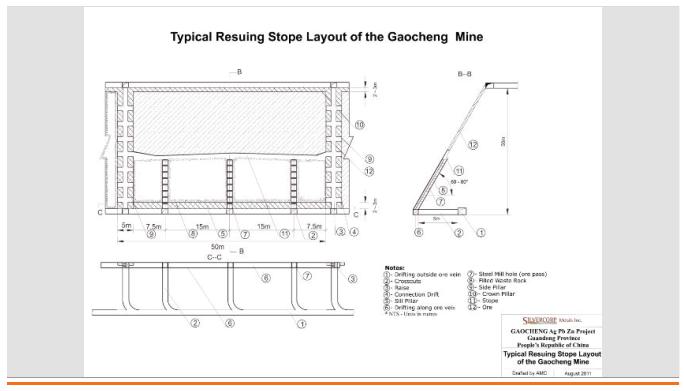
Sources: GC Mine
| 16.6.3 | Overhand Cut and Fill |
OCAF mining is suitable for ore bodies with steep dips and vein thicknesses of 2 to 7 m. Key design factors for this method similar as shrinkage method.
Stopes are arranged along the strike of the ore body, with lengths of 80 and 100 m, widths corresponding to the ore body thickness, and heights of 50 m.
Each stope is a relatively independent mining unit, divided into lifts with heights of 1.8 to 2 m.
The lift is mined and cemented backfilled to a height of 1.8 to 2 m, matching the height of the open void. The final layer is backfilled to the roof.
There are two manways, which also serve for ventilation, are positioned on either side of the stope, with the ore pass located in the footwall level.
Ore is extracted using a scraper or loader. When a loader is used, footwall ramps and sub-levels are designed for personnel, materials, and equipment access.
Crown pillars and rib pillars are left intact, but no sill pillars are retained.
Figure 16.6 depicts the OCAF method at GC Mine, and Figure 16.7 shows an operated OCAF stope.
| SRK CONSULTING CHINA LTD. § APR. 20, 2026 § FH/AT | 130 |
Technical Report on Gaocheng Silver-Lead-Zinc Project in Guangdong Province, China
Mining Methods § FINAL
Figure 16.6: Typical OCAF Stope Layout
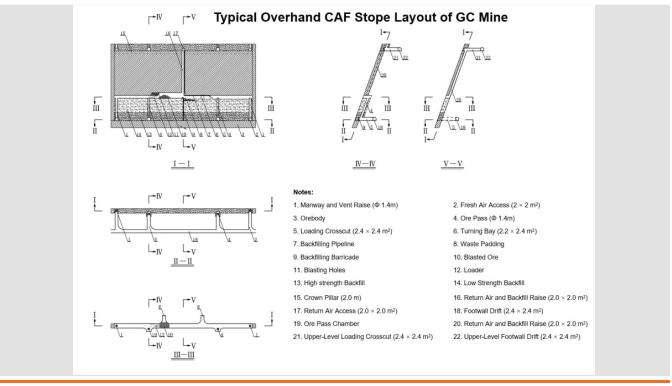
Sources: GC Mine
Figure 16.7: Operation of OCAF Stope
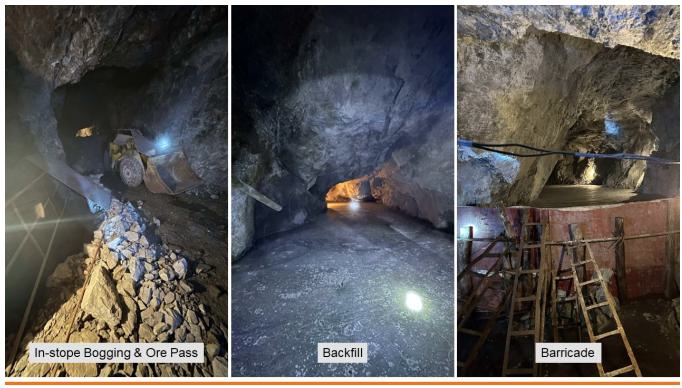
Sources: SRK site visit
| SRK CONSULTING CHINA LTD. § APR. 20, 2026 § FH/AT | 131 |
Technical Report on Gaocheng Silver-Lead-Zinc Project in Guangdong Province, China
Mining Methods § FINAL
| 16.6.4 | Stope Management and Grade Control |
The purpose of stope management is to implement stope operation procedures for dilution reduction via the Mining Quality Control Department. The department has a total of four technical staff, including management, mine engineer, geologist, and technician. The mine engineer in the group is responsible for supervising the stope operation procedure, with stope inspection occurring at least once per day to check that mining contractors are following procedure guidelines. The geologist and geological technician are responsible for stope geological mapping and sampling, which occurs every 1.5 m of stope lift. The department also measures the mined area of a stope, at the end of each month for the contract payment and reconciliation purposes.
Key aspects of the stope inspection are as follows:
| § | Ensuring that the back and floor of the stope are flat prior to drilling blasting holes |
| § | Checking to ensure the boundary of the mineralization and drillhole locations are correctly marked with red paint before drilling, as presented in Figure 16.8 |
| § | Checking to ensure the length, orientation, direction, location, slope gradient, and number of blast holes drilled |
| § | Ensuring drillholes are inclined not less than 60 degree to the horizontal, are not longer than 2 m, and are drilled optimally relative to vein and excavation width to minimize dilution |
| § | In a resuing stope, checking if the stope floor is covered with rubber mat/ belting before blasting |
| § | In a resuing stope, checking to make sure that waste is sorted first and left in the stope before loading ore to the steel pass after blasting; also ensuring that the floor and walls are cleaned with a broom to minimize ore losses before footwall slashing |
| § | After blasting, checking that the stope back is not more than 3.5 m high and the steel pass in a resue stope are properly covered with steel grid. |
Regarding contract payments, the contractor is paid based on the quantity of ore mined. As it may be seen as an incentive for the contractor to maximize material removed from the stope, contractor payments are governed by a specific formula that calculates planned ore tonnes based on extraction to design and a planned dilution factor. During mining operations, each rail car or small tricycle load of ore is weighed at a weigh station outside the mine portals. If weighed ore tonnes are greater than planned ore tonnes from a given stoping area, the contractor is paid solely based on the planned tonnes. For shrinkage stopes, an adjustment for paid tonnes is required to be made, since a stope usually takes several months to complete and, generally, only blast swell is removed until the stope nears completion.
| SRK CONSULTING CHINA LTD. § APR. 20, 2026 § FH/AT | 132 |
Technical Report on Gaocheng Silver-Lead-Zinc Project in Guangdong Province, China
Mining Methods § FINAL
Figure 16.8: Stoping Management and Blasting Holes
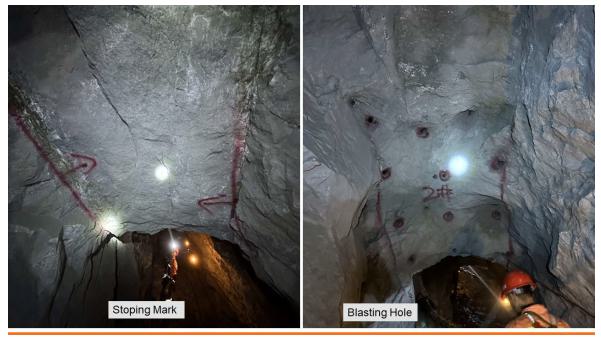
Sources: SRK site visit
| 16.7 | Mine Services |
| 16.7.1 | Ventilation |
The mine ventilation procedures are as set out by Chinese laws and regulations. Among key ventilation regulations are:
| § | minimum ventilation volume per person (4 m3/ min/ person); |
| § | minimum ventilation velocity (typically 0.25 – 0.50 m/sec dependent on location or activity); and |
| § | minimum diluting volume for diesel emissions (4 m3/min/kW). |
The primary ventilation generally flows from west to east using the main levels interconnected by dedicated level ventilation raises (plus active stope accesses). The upper level(s) where stoping has been completed are used as return airways to separate the fresh and exhaust air. A series of air/ ventilation doors and sealed walls are utilized in the ventilation control system. Inactive development headings and draw points are sealed to enhance the ventilation circuit by minimizing leakage.
Primary Ventilation
The ventilation volume is predominantly influenced by the minimum air velocity for the various development and production activities. No diesel equipment is required for Stage 2 stoping. The peak ventilation volume is estimated to be 220 cubic meter per second (“m3/ sec) inclusive of 30% air leakage. The total air quantity is 210 m3/ sec, with 100 m3/ sec from the decline and 110 m3/ sec from the shaft. The primary fan (FBCDZ-NO32) is powered by YBF-450-12P electrical motors (250 kW x 2, one for standby).
| SRK CONSULTING CHINA LTD. § APR. 20, 2026 § FH/AT | 133 |
Technical Report on Gaocheng Silver-Lead-Zinc Project in Guangdong Province, China
Mining Methods § FINAL
The fresh air intake airways are:
| § | Main Shaft (6.0 m diameter located approximately at Mine Section 22) with air flow of 110 m3/sec at the collar. The friction factor acknowledges hoisting equipment and fittings in the shaft. For hoisting intake airways, there is a regulatory requirement for air purification prior to a level receiving fresh air from the Main Shaft |
| § | Main decline (4.2 m x 3.6 m located approximately at Mine Section 26) with 50 m3/ sec at the portal |
| § | Exploration decline (3.7 m x 3.45 m located approximately at Mine Section 28) with 50 m3/ sec at the portal. |
The return air exhaust airways are:
| § | Stage 2 Ventilation Shaft (3.5 m diameter located approximately at Mine Section 52). The fan duty point is 140 m3/ sec at 2,070 pascal (“Pa”) (total pressure). The friction factor assumes the shaft is furnished with a ladderway. The exhaust fan configuration is axial (250 kW/380 V) mounted horizontally with a fan diffuser for silencing |
| § | The development on the inlet side is configured to enable emergency egress |
| § | The Stage 2 Ventilation Shaft is developed internally from within a short drift with the fan installation also established within the drift development. |
The key airway regulation requirements are:
| § | Vehicle access doors (airlock system) placed in the decline level accesses for the +100 ASL, +50 ASL, 0 ASL, -100 ASL, -150 ASL, -200 ASL and -250 ASL levels |
| § | Two regulators on the -100 ASL level and one on the -50 ASL level to force air to the lower level working areas |
| § | The Stage 1 Vent Shaft is sealed at the collar and is used as an internal exhaust |
| § | All rock passes are assumed to be filled with rock for leakage purposes |
| § | All stope and inter-level ventilation raises include ladderway resistances |
| § | Two mine air-conditioners at the connection with the decline and main shaft in -300 ASL to cool the fresh air from the upper level. |
Secondary Ventilation
The secondary ventilation consists of auxiliary fans for ventilating development faces, infrastructure chambers, loading and tipping areas and stope faces.
Development faces are ventilated using domestically manufactured fans (5.5 kW/380 V). A combination of forced and exhaust ventilation is applied for long blind-heading distances as required.
Stopes are force-ventilated using domestically manufactured fans (4 kW/380 V) via the access timber cribbed travel way. The stope air returns to the upper level via a second access travel way at 50 m strike spacing.
| SRK CONSULTING CHINA LTD. § APR. 20, 2026 § FH/AT | 134 |
Technical Report on Gaocheng Silver-Lead-Zinc Project in Guangdong Province, China
Mining Methods § FINAL
| 16.7.2 | Water Supply |
Water consumption underground is primarily for drilling and dust suppression. Water supply is via pipelines along the drives, is sourced from the nearby sump(s) of recycle uses for underground works.
Personnel carry drinking water as required to remote workplaces in water containers.
| 16.7.3 | Dewatering |
Underground water is discharged to surface using conventional centrifugal pumps via pipelines installed in the decline, and Main Shaft. Underground water is pumped to surface in two stages and is collected in ponds at the decline portal or Main Shaft for sediment settling prior to being pumped to the GC process plant water treatment facility.
At the Stage 1 pump station (-300 ASL), three pumps (Model MD155-67×5, capacity 155 cubic meters per hour (“m3/hr”)) are installed, as shown in Figure 16.9. Water from -300 ASL pump station is discharged through two steel pipelines installed in the shaft to the Stage 2 pump station. The effective water storage volume of the inner and outer sumps totals 2,000 m3 at -300ASL.
At the Stage 2 pump station (-50 ASL), three pumps (Model MD280-43×8, capacity 280 m3/hr) are installed. Water from -50 ASL pump station is discharged through two steel pipelines installed in the decline to the surface. The effective water storage volume of the inner and outer sumps totals 2,450 m3 at -50 ASL.
As indicated, three pumps are installed in each pump chamber. Under normal water inflow conditions one unit is running, one unit is under maintenance, and the other is on standby. Under maximum water inflow conditions, two pumps will be running. Underground pumps are specified for clean water discharge, so each pump station has its own twin compartment sediment settling arrangement. The capacity of these is equivalent to six to eight hours of normal water inflow condition (Safety Regulations on Metal and Nonmetal Mining Operation – National Standard GB16423-2006).
| SRK CONSULTING CHINA LTD. § APR. 20, 2026 § FH/AT | 135 |
Technical Report on Gaocheng Silver-Lead-Zinc Project in Guangdong Province, China
Mining Methods § FINAL
Figure 16.9: Pump and Power Stations at -300ASL
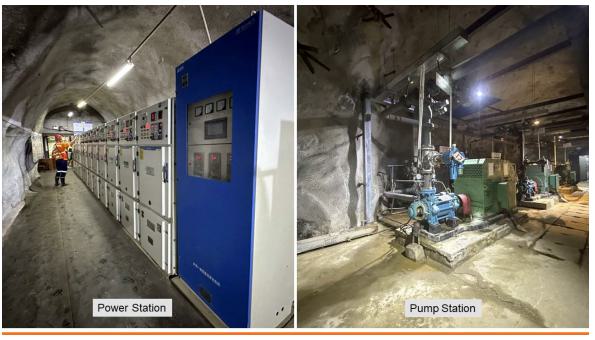
Sources: SRK site visit
| 16.7.4 | Power Supply |
Power is provided from a 110 kV substation near Gaocun town, about 6 km from the mine site, which is fed from the Guangdong Province electrical grid system.
High voltage supply is 10kV to the surface sub-stations. There are two 1,500 kW standby diesel generator power for essential mine facilities (pump stations, shaft operations, primary ventilation fans).
Underground sub-stations are located on each level. Level development utilizing electric mining equipment (jumbos) has incorporated additional sub-stations along the level to manage voltage drop from the sub-station.
Low voltage supply from the underground sub-stations is 415 V (jumbos), 380 V (pumps and fans), and 220 – 250 V (lighting and rail operation).
| 16.7.5 | Compressed Air |
Compressed air is primarily used for drilling, i.e. hand-held ‘jackleg’ drilling in the stopes and conventional development faces. There is some minor use for shotcreting, and blasthole cleaning, as necessary.
Compressed air is reticulated to all levels and to the emergency refuge stations.
Compressors (electrically powered two-stage piston compressors) are located adjacent to the decline portal (3 x 20 cubic meters per minute (“m3/min”), 0.8 Mpa, 110 kW, and one 40 m3/min, 0.8 Mpa, 250 kW) and Main Shaft brace area (7 x 40 m3/min, 0.8 Mpa, 250 kW). Compressed air is reticulated using steel and plastic piping for air distribution via the Main Shaft.
| SRK CONSULTING CHINA LTD. § APR. 20, 2026 § FH/AT | 136 |
Technical Report on Gaocheng Silver-Lead-Zinc Project in Guangdong Province, China
Mining Methods § FINAL
| 16.7.6 | Communications |
Mine surface communications are available by landline and mobile phone services.
Telephones are the base means of communicating with underground. Phones are located adjacent to the decline level accesses (Stage 1 set-up) and adjacent to the Main Shaft level accesses.
The WiFi signal covers the capital development on each level, the air doors at the connection between the shaft area and decline area, and drift which has filling pipelines of GC Mine. This is used to remote control and monitoring the hoisting, air doors, and power switching situation.
| 16.7.7 | Explosive Magazine |
Underground explosive magazines are located adjacent to each level return air shaft and are limited to one day of required bulk explosives and three days of required blasting ancillaries.
| 16.7.8 | Maintenance Workshop |
The mining contractor have their own mobile equipment workshop for repairs and servicing located adjacent to the decline portal. There are also underground drill service bays established close to the working areas in redundant stockpile areas/ cubbies to minimize tramming delays, as shown in Figure 16.10.
Mobile equipment repairs (trucks, loaders, etc.), other equipment breakdowns and equipment major services are conducted in the mining contractor’s surface workshop with minor services conducted in redundant stockpile areas underground.
Minor equipment (such as jacklegs, secondary fans, development pumps, etc.) are also serviced in the mining contractor’s surface workshop.
The electric locomotive and rail cars are serviced and repaired in a service rail siding located adjacent to the Main Shaft.
Other fixed and mobile equipment (primary pumps, surface electric locomotive, rail cars, vehicles, etc.) are serviced in surface workshop located adjacent to the Main Shaft. This is fully equipped with overhead crane, welding, electrical, hydraulic, lathe services, etc.
| SRK CONSULTING CHINA LTD. § APR. 20, 2026 § FH/AT | 137 |
Technical Report on Gaocheng Silver-Lead-Zinc Project in Guangdong Province, China
Mining Methods § FINAL
Figure 16.10: Surface and Underground Workshops
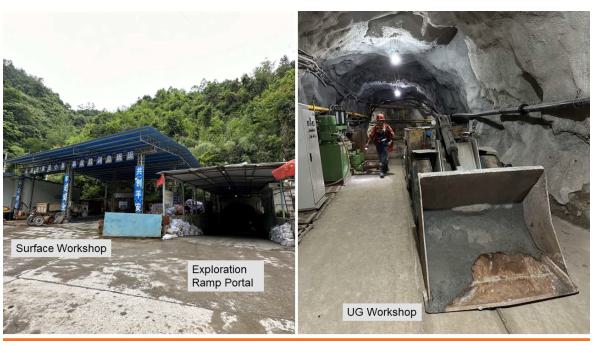
Sources: SRK site visit
| 16.8 | Mine Equipment and Machinery |
All mobile equipment and some minor fixed equipment are provided by the mining contractor.
The fixed equipment is predominantly domestically manufactured and locally sourced (Guangdong Province). The equipment manufacturers are well known, and their equipment is commonly used for Chinese mining operations. Table 16.4 summarizes the contractor’s equipment. Table 16.5 summarizes the GC Mine equipment.
Table 16.4: Mining Contractor Typical Key Equipment Summary
| Contractor Equipment | Units | Manufacturer | Model | Capacity |
| Single boom jumbo | 1 | Atlas Copco | BoomerK41 | 3,700mm rod |
| Single boom jumbo | 1 | Atlas Copco | BoomerK111 | 4,100 mm rod |
| Load haul dump truck | 20 | Shandong Derui Mining Machinery | WJ-1 | 1 m3 |
| Load haul dump truck | 2 | Guangxi Liugong Machinery | CLG833 | 3 m3 |
| Raise boring | 2 | Hunan Jinyue Machinery Equipment | JY-AT1500 | φ1,000-1,500 |
| Truck | 12 | Fujian Longyan Shifeng Construction Machinery | LHF30 | 18 t |
| Personnel carrier | 2 | Anhui Tongguan Machinery | JY-5YR-16 | 16 persons |
| Shotcreter | 2 | Hunan Changde Shotcrete Machinery Factory | HPZ-6 | 6 m3/ hr |
| Electric loader | 15 | Nanchang Hengye Mining | Z-30 | 0.3 m3 |
| Auxiliary stoping & development fan | 60 | Zib Ventilation Machine Plant | JK56-No4 | 0.1~3.4 m3/ hr |
| Truck | 15 | Suizhou Shenwei Mining Machinery | UO-5 | 3 t |
| Jackleg | 120 | Tianshui pneumatic machinery | YT-28 |
Sources: GC Mine
| SRK CONSULTING CHINA LTD. § APR. 20, 2026 § FH/AT | 138 |
Technical Report on Gaocheng Silver-Lead-Zinc Project in Guangdong Province, China
Mining Methods § FINAL
Table 16.5: GC Mine’s Fixed Equipment Summary
| Equipment | Stage | Units | Manufacturer | Model | Capacity |
| Multi-rope friction hoister | 2 | 1 | Luoyang Zhongzhong Automation Engineering | JKMD-2.8*4PI | 1,200 t/day – ore+waste |
| Primary fan | 1 | 1 | Zibo Fan Factory | DK62-12-No30/2×200KW | 3,474~8,790m³/ min |
| Primary fan | 2 | 1 | Yanjing Equipment Manufacturing | FBCDZ-12-NO32/2×250KW | 3,000~10,800m³/ min |
| Waste and service cage | 2 | 1 | Xuzou Coal Mine Safety Equipment | 4# lengthen cage | |
| Multiple stage centrifugal pump - -50 ASL | 1 | 3 | Chongqing Xiquan Pump Industry | MD280-43*8 | Q=280 m3/ hr, 344 m head |
| Multiple stage centrifugal pump - -300 ASL | 2 | 3 | Chongqing Xiquan Pump Industry | MD155-67*5 | Q=155 m3/ hr, 335 m head |
| Air compressor – decline | 1 | 1 | Shanghai Kangkeer Compressor | KG-150A | 20 m3/ min at 0.8 Mpa |
| 1 | 1 | Q-tech Air System Technology Ltd. | QGD250-8.5 | 42 m3/ min at 0.8 Mpa | |
| 1 | 1 | Engineering The Future Ltd. | BK132-8T | 22 m3/ min at 0.8 Mpa | |
| 1 | 1 | Engineering The Future Ltd. | BK110-8T | 20 m3/ min at 0.8 Mpa | |
| Air compressor – main shaft | 2 | 3 | Engineering The Future Ltd. | JN270-8-∥ | 43.12 m3/ min at 0.8 Mpa |
| 2 | 2 | Guangdong Hande Precision Machinery Co. Ltd. | HJ-350A | 42 m3/ min at 0.8 Mpa | |
| 2 | 1 | Q-tech Air System Technology Ltd. | QGD250A-8.5 | 42 m3/ min at 0.8 Mpa | |
| 2 | 1 | Q-tech Air System Technology Ltd. | QGD250AC | 43.3 m3/ min at 0.8 Mpa | |
| Voltage transformer - decline | 1&2 | 1 | Zhuhai Nanfang Hualitong Special Transformer Co., Ltd. | S11-1250KVA 0.4/10KV | |
| 1&2 | 1 | Zhuhai Nanfang Hualitong Special Transformer Co., Ltd. | S11-3150Kva | ||
| Voltage transformer – Stage 2 Ventilation shaft | 1&2 | 1 | Zhuhai Nanfang Hualitong Special Transformer Co., Ltd. | S11-800kVA | |
| Voltage transformer - -150 ASL | 1&2 | 1 | Zhejiang Fujie Electric Co., Ltd. | KSG11-500/10 | |
| Voltage transformer - -150 ASL | 1&2 | 1 | Zhejiang Fujie Electric Co., Ltd. | KSG-1000/10-0.4 | |
| 1&2 | 1 | Zhejiang Fujie Electric Co., Ltd. | KSG-500/10-0.4 | ||
| Voltage transformer - -300 ASL | 1&2 | 1 | Zhejiang Fujie Electric Co., Ltd. | KSG-1000/10-0.4 | |
| 1&2 | 1 | Zhejiang Fujie Electric Co., Ltd. | KSG-500/10-0.4 | ||
| Electric generator – Stage2 Ventilation shaft | 1&2 | 2 | Guangzhou Yinge Power Technology Co., Ltd. | MTAA11-G3 | 250 KVA |
| Electric generator - Shaft | 1&2 | 1 | Guangzhou Yinge Power Technology Co., Ltd. | QSK60-G4 | 1,500 KVA |
| Electric locomotive | 2 | 24 | Hunan Xiangtan Qiankun Mining Equipment Co., Ltd. | CKY2.5-6GB | 75m3/ hr |
| Rail car | 2 | 136 | Luanchuan County Sanli Engineering Co., Ltd. | YFC-0.81 | 0.75 m3 |
| Mine air-condition | 2 | 2 | Shenzhen Del Refrigeration Equipment Co., Ltd. | ILG320DV(20°) | 10,000-12,000m³/ hr |
| Ceramic plunger pump | 2 | 2 | Xianyang Keyu Machinery Manufacturing Co., Ltd. | YB300 | 45m³/hr |
Sources: GC Mine
| SRK CONSULTING CHINA LTD. § APR. 20, 2026 § FH/AT | 139 |
Technical Report on Gaocheng Silver-Lead-Zinc Project in Guangdong Province, China
Mining Methods § FINAL
| 16.9 | Mine Safety |
Mine safety is practiced as set out by Chinese health and safety laws and regulations.
There is an Occupational Health and Safety (“OHS”) department for the GC Mine, staffed with three mine safety trainer officers and seven technicians.
The mine and mining contractors are tasked with providing appropriate Personal Protective Equipment (“PPE”) to their own staff. The PPE available includes protective clothes, hard hats, safety steel toe capped boots, work gloves, face masks, back armour, respiratory protective apparatus (self-rescuers), headband lamp and ear plugs.
The OHS department provides safety training, enforces the OHS policies and procedures, makes recommendations on mine safety issues, and carries out daily inspections of the underground workings and explosive usages.
The safety committee is headed by the General Manager and made up of the Deputy General Manager, Mine Superintendent, Safety Department Supervisor, and representatives of the mining contractor. The committee is coordinated by the GC Mine Safety Department. The mine management and the safety officers are required to have valid mine safety training certificates issued by the Provincial Bureau of Safe Production and Inspection.
| 16.9.1 | Fire Prevention |
Water for fire protection is provided via the Main Shaft with 200 t surge capacity. Primary reticulation and secondary reticulation are by 108 mm and 89 mm nominal bore pipes respectively, which are installed and maintained in accordance with national safety standards (Safety Regulations on Metal and Non-metal Mining Operation – National standard GB16423-2006).
Fire extinguishers are provided and maintained in accordance with regulations and good practice at the electrical installations, pump stations, service workshops, and locomotive garage and wherever a fire hazard is identified to exist.
Visible fire signs and fire safety notices are posted in appropriate areas.
A suitable number of fire extinguishers are provided and maintained at each stationary diesel motor and transformer substation. In addition, the main fan air flow can be reversed within 10 minutes.
Every light duty vehicle carries at least one fire extinguisher of adequate size and proper type.
All heavy-duty mobile mine equipment; loaders, trucks, jumbos, charge-up machines, etc. are equipped with on-board fire suppression systems.
A mine-wide warning system is installed at the main mine intake airway entries to alert underground workers to the event of an emergency. This consists of audible alarms, ventilation status lights, and stench gas.
| SRK CONSULTING CHINA LTD. § APR. 20, 2026 § FH/AT | 140 |
Technical Report on Gaocheng Silver-Lead-Zinc Project in Guangdong Province, China
Mining Methods § FINAL
| 16.9.2 | Mine Rescue |
Fully trained and equipped mine rescue teams are site-based with team members provided by the mining contractor and always maintained on-site. The mine rescue teams are trained for surface and underground emergencies.
A mine rescue Emergency Response Plan has been developed and is kept up to date.
A mine rescue room is provided in the surface mine offices adjacent to the Main Shaft.
An emergency clinic is maintained on-site and manned by a physician 24 hours per day. GC Mine also has a contract established with the Yunfu General Hospital to provide emergency services and ambulance extraction to the hospital.
At the beginning of 2023, GC Mine had signed a contract with the ShaoGuan Mine Rescue Team.
| 16.9.3 | Emergency Egress |
Egress to surface is available via all ventilation shafts, Exploration decline, Main decline, and Main Shaft.
The Main Shaft and ventilation shafts are equipped with staged ladderways incorporating general mine services and partitioned from other shaft activities; they are provided with appropriate ventilation profile clearance and established in accordance with good practices.
Lateral egresses are appropriately signposted and maintained for walking access.
| 16.9.4 | Mine Refuge Stations |
A permanent refuge station is located at -300 ASL in the bottom of the Main Shaft, as shown in Figure 16.11.
Static and/or mobile refuge stations are established on each mine level with the exception of the +100 ASL, which is not a production level.
The static refuge stations or mobile refuge chambers are established in accordance with good practices with independent air supply (compressed bottled oxygen), communications, first aid, etc., and are of appropriate capacity to cater for the personnel numbers in the active mine areas.
For the +50 ASL, 0 ASL, and -50 ASL levels, mobile mine refuge chambers are located in close proximity to the active development and production stopes in redundant stockpile areas.
For the remaining levels from -100 ASL to -300 ASL, static mine refuge stations are located adjacent to the Main Shaft.
| SRK CONSULTING CHINA LTD. § APR. 20, 2026 § FH/AT | 141 |
Technical Report on Gaocheng Silver-Lead-Zinc Project in Guangdong Province, China
Mining Methods § FINAL
Figure 16.11: Permanent Refuge Station at -300ASL
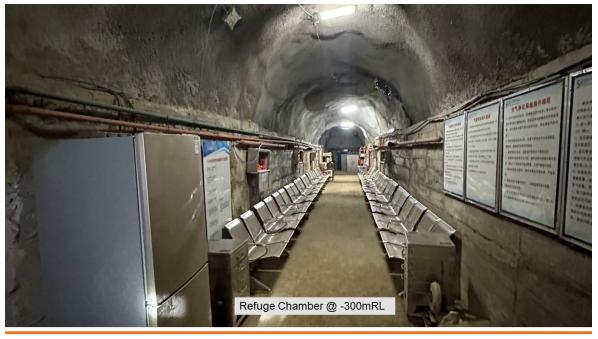
Sources: SRK site visit
| 16.10 | Mine Personnel |
GC Mine operates the mine using mining contractors for development, production, as well as the operation and maintenance of GC Mines fixed equipment. GC Mine provides their own management, technical services, and supervision staff. The mine is operated on a continuous roster for 365 days per year working three eight-hour shifts per day.
Figure 16.12 summarizes the GC Mine employee numbers from year 2011 to 2025. These numbers exclude geological drilling, external consultants, and advisor. The mining contractor average yearly employee numbers are approximately 280 for all years.
| SRK CONSULTING CHINA LTD. § APR. 20, 2026 § FH/AT | 142 |
Technical Report on Gaocheng Silver-Lead-Zinc Project in Guangdong Province, China
Mining Methods § FINAL
Figure 16.12: GC Mine Employees over Years
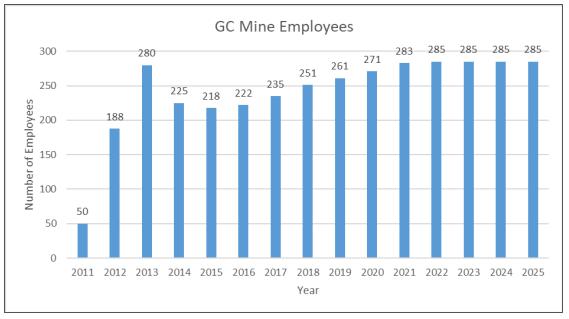
Sources: GC Mine
| 16.11 | Life of Mine Plan |
The GC Mine has operating since late 2014 and achieved peak capacity in 2021, which is approximately 313 ktpa. The mine has been designed as 1,000 tpd and operates 330 day/year for the first two Phases. The third Phase is proposed to utilise the current shaft capacity, however addition capacity is also available via decline.
Annual ore production is forecast to increase from the current level of approximately 345 kt to about 365 kt for the period 2026–2028 and then stabilise at around 373 kt from 2029 for the remainder of the planned mine life. The key reason of production ramp up is associated with the third Phase development and more stopes employing mobile equipment. The key target of the mine plan is to achieve the planned grade, mining more efficiently and lower the cost base.
Based on discussions with GC Mine, the processing plan assumes a pre-sorting waste rejection rate of 12% and a corresponding metal recovery of 96% through the pre-sorting circuit.
GC Mine could be scheduled for more than 25 years based on eligible Measured and Indicated categories Resources. After accounting for the tailings used in backfilling, total tailings generation, and the remaining TSF storage capacity, the mine schedule has been shortened to 18 years to match the mine’s TSF remaining capacity. SRK is of the view that the project’s Mineral Resources present an opportunity to extend mine life; however, a TSF expansion study or the design of a second tailings storage facility will be required at an appropriate stage.
The mine schedule is directed towards achieving the grade target as provided by mine management. The progress of mine sequencing and scheduling has been designed to facilitate this target and is as following:
| § | Stope by stope planning considering the currently mining activities and grades target; |
| SRK CONSULTING CHINA LTD. § APR. 20, 2026 § FH/AT | 143 |
Technical Report on Gaocheng Silver-Lead-Zinc Project in Guangdong Province, China
Mining Methods § FINAL
| § | Design the ore drive as grade control or production exploration development as necessary; |
| § | Factored stope preparation development, such as level drive, cross-cut, raises based on the stope geometry parameters; |
| § | Design and schedule the mine layout development, such as decline, lower level ore drive (exploration drive) for long-term consideration; and |
| § | Sum up the scheduling result and optimization. |
The productivity applied to mine schedule is summarised as followings:
| § | Resuing stope: maximum 600 t/month, the typical planned productivity is 300-500 t/month |
| § | Shrinkage stope: 1,200 t/m including the broken ore loading period, the typical planned productivity is about 1,000 t/m; |
| § | OCAF stope: using as same as shrinkage stopes’ parameters. |
| § | Decline: 100m/month with jumbo drilling |
| § | Level drive or ore drive: 50 m/month with LHD cleaning |
| § | Raises: all consider 50 m/month as jackleg drilling, though three raise boring machine are available on site. The boring time for a 50 m raise is about 15 days. |
The schedule is summarized in Table 16.6 and Figure 16.13 and Figure 16.14.
Table 16.6: Summary of LOM Schedule
| Year | ROM | AgEq | Ag | Pb | Zn | Capital Dev | Exploration Dev | Stope Dev | Total Dev |
| Unit | kt | g/t | g/t | % | % | m | m | m | m |
| 2026 | 345 | 168 | 58 | 0.97 | 2.44 | 3,978 | 13,932 | 10,890 | 28,800 |
| 2027 | 350 | 176 | 62 | 1.06 | 2.50 | 7,390 | 5,913 | 6,828 | 20,131 |
| 2028 | 365 | 164 | 62 | 0.98 | 2.22 | 9,122 | 1,578 | 15,683 | 26,384 |
| 2029 | 372 | 164 | 68 | 0.93 | 2.04 | 4,216 | 1,918 | 14,826 | 20,959 |
| 2030 | 372 | 172 | 68 | 0.88 | 2.35 | 3,064 | 1,814 | 15,520 | 20,398 |
| 2031 | 373 | 171 | 68 | 0.84 | 2.35 | 1,217 | 1,934 | 15,652 | 18,803 |
| 2032 | 373 | 166 | 68 | 0.82 | 2.20 | 749 | 1,895 | 15,191 | 17,835 |
| 2033 | 372 | 169 | 62 | 0.89 | 2.44 | 795 | 3,493 | 13,401 | 17,688 |
| 2034 | 373 | 151 | 59 | 0.88 | 1.99 | 518 | 3,012 | 14,927 | 18,456 |
| 2035 | 372 | 162 | 63 | 0.86 | 2.20 | 561 | 2,328 | 13,687 | 16,576 |
| 2036 | 372 | 168 | 66 | 0.87 | 2.29 | 357 | 2,163 | 15,114 | 17,634 |
| 2037 | 373 | 160 | 65 | 0.86 | 2.10 | 388 | 2,490 | 13,784 | 16,661 |
| 2038 | 373 | 161 | 56 | 1.02 | 2.24 | 471 | 2,406 | 14,766 | 17,643 |
| 2039 | 373 | 154 | 60 | 0.95 | 2.00 | 827 | 1,963 | 14,314 | 17,104 |
| 2040 | 372 | 158 | 59 | 0.88 | 2.20 | 532 | 1,457 | 12,168 | 14,157 |
| 2041 | 372 | 156 | 58 | 0.85 | 2.18 | 744 | 2,775 | 8,694 | 12,212 |
| 2042 | 223 | 165 | 62 | 1.05 | 2.18 | 147 | 562 | 7,329 | 8,038 |
| 2043 | 62 | 161 | 60 | 0.84 | 2.27 | 0 | 0 | 1,305 | 1,305 |
| LOM total | 6,186 | 163 | 63 | 0.91 | 2.23 | 35,075 | 51,632 | 224,077 | 310,785 |
Source: GC Mine, summarized by SRK
| SRK CONSULTING CHINA LTD. § APR. 20, 2026 § FH/AT | 144 |
Technical Report on Gaocheng Silver-Lead-Zinc Project in Guangdong Province, China
Mining Methods § FINAL
Notes:
| 1 | ROM stands for run of mine, which includes dilution and ore loss. |
| 2 | Dev stands for drive development |
| 3 | Stope Prep stands for stope preparation development |
| 4 | Inferred Mineral Resources are not included. |
| 5 | ROM is considered feed the processing plant directly or rehandled from the temporary stockpile. Therefore, the processing plan is the same as mine schedule. |
Figure 16.13: ROM Schedule over LOM
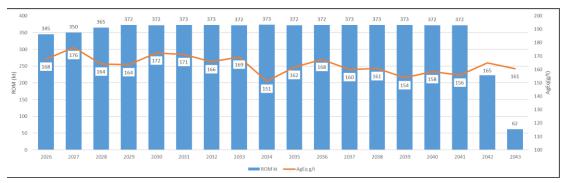
Source: GC Mine, summarized by SRK
Figure 16.14: Development Schedule over LOM
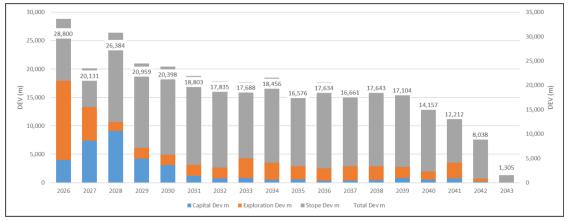
Source: GC Mine, summarized by SRK
The capacity since 2026 (about 345-373 ktpa) is over the mining permit capacity which is 330 ktpa. SRK opines that there is potentially a risk of GC Mine being fined by the Regulator for over production. However, that would not be a material risk for the mining activities as 10% plus the permitting could be managed by shutting down or ramping down during the raining season or the month of Spring Festival.
The processing plant schedule summarized in Table 16.7 and Figure 16.15.
| SRK CONSULTING CHINA LTD. § APR. 20, 2026 § FH/AT | 145 |
Technical Report on Gaocheng Silver-Lead-Zinc Project in Guangdong Province, China
Mining Methods § FINAL
Table 16.7: Summary of LOM Schedule for Processing Plant
| Year | ROM | AgEq | Ag | Pb | Zn |
| Unit | kt | g/t | g/t | % | % |
| 2026 | 304 | 183 | 63 | 1.06 | 2.66 |
| 2027 | 308 | 192 | 68 | 1.15 | 2.72 |
| 2028 | 321 | 179 | 67 | 1.07 | 2.42 |
| 2029 | 328 | 178 | 75 | 1.01 | 2.22 |
| 2030 | 328 | 188 | 74 | 0.96 | 2.57 |
| 2031 | 328 | 187 | 74 | 0.92 | 2.56 |
| 2032 | 328 | 181 | 74 | 0.90 | 2.41 |
| 2033 | 327 | 185 | 68 | 0.97 | 2.66 |
| 2034 | 329 | 165 | 64 | 0.96 | 2.17 |
| 2035 | 328 | 176 | 69 | 0.94 | 2.40 |
| 2036 | 328 | 183 | 72 | 0.95 | 2.50 |
| 2037 | 328 | 174 | 71 | 0.94 | 2.29 |
| 2038 | 328 | 175 | 61 | 1.12 | 2.45 |
| 2039 | 328 | 168 | 65 | 1.03 | 2.18 |
| 2040 | 327 | 173 | 65 | 0.96 | 2.40 |
| 2041 | 327 | 170 | 64 | 0.93 | 2.38 |
| 2042 | 196 | 180 | 67 | 1.15 | 2.38 |
| 2043 | 54 | 175 | 66 | 0.91 | 2.48 |
| LOM total | 5,444 | 179 | 68 | 0.99 | 2.43 |
Source: GC Mine, summarized by SRK
Notes:
| 1 | ROM stands for run of mine, which includes dilution and ore loss. |
| 2 | Inferred Mineral Resources are not included. |
| 3 | ROM is considered feed the processing plant directly or rehandled from the temporary stockpile. Therefore, the processing plan is the same as mine schedule. |
Figure 16.15: Processing Plant Schedule over LOM
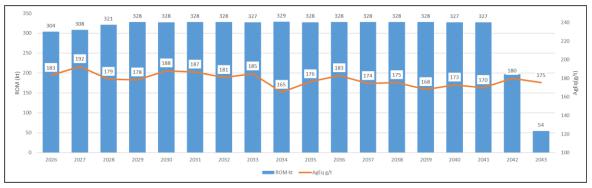
Source: GC Mine, summarized by SRK
| SRK CONSULTING CHINA LTD. § APR. 20, 2026 § FH/AT | 146 |
Technical Report on Gaocheng Silver-Lead-Zinc Project in Guangdong Province, China
Recovery Method § FINAL
| 17 | Recovery Method |
| 17.1 | Introduction |
GDMAI completed the Preliminary Design of Mining and Processing of GC Lead-Zinc Mine in Yun’an District, Guangdong Province in April 2011. The GC processing plant has a designed processing capacity of 528 ktpa (1,600 tpd) and is built on a steep hillside next to the main shaft. It makes full use of the terrain to make the slurry flow (gravity flow) by itself and saves pumping costs. The GC processing plant has one crushing production line, two identical grinding and floatation production lines, one production line for tin recovery from tailings, four concentrate dewatering lines, one tailings dewatering line, and one TSF for dry tailings. The GC processing plant was completed and put into operation in 2014. Depending on the mining supply quantity, a flexible operation system is adopted for the crushing production line. One or two grinding and floatation production lines will run. The actual annual ore processing volume is between 260 kt and 630 kt. In March 2023, an XRT intelligent sorting line was built to replace the previous hand-sorting operation. At present, the pre-sorting system is still in the process of adjustment/ optimization. Figure 17.1 is the photo of the GC processing plant.
Figure 17.1: Photo of GC Processing Plant
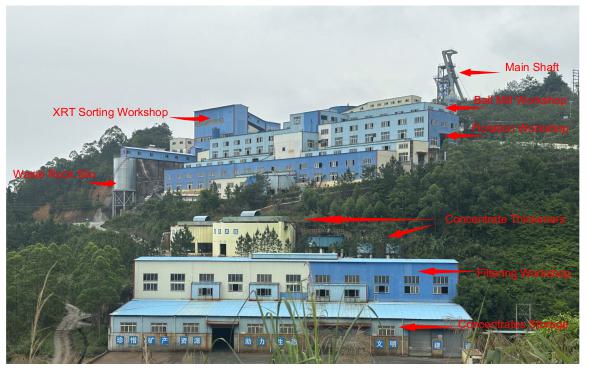
Sources: SRK site visit in April 2024
| 17.2 | Production Process |
The production process of GC processing plant is shown in Figure 17.2. It includes crushing-screening, XRT intelligent sorting, grinding-classification, lead preferential flotation, zinc-sulphur mixed flotation and zinc-sulfur separation flotation, tin recovery by gravity separation, concentrate thickening-filtering, tailings thickening-filtering, tailings piling and discharging, etc. The main facilities can be seen in Figure 17.3.
| SRK CONSULTING CHINA LTD. § APR. 20, 2026 § FH/AT | 147 |
Technical Report on Gaocheng Silver-Lead-Zinc Project in Guangdong Province, China
Recovery Method § FINAL
Figure 17.2: Production Process Flowsheet of GC Processing Plant
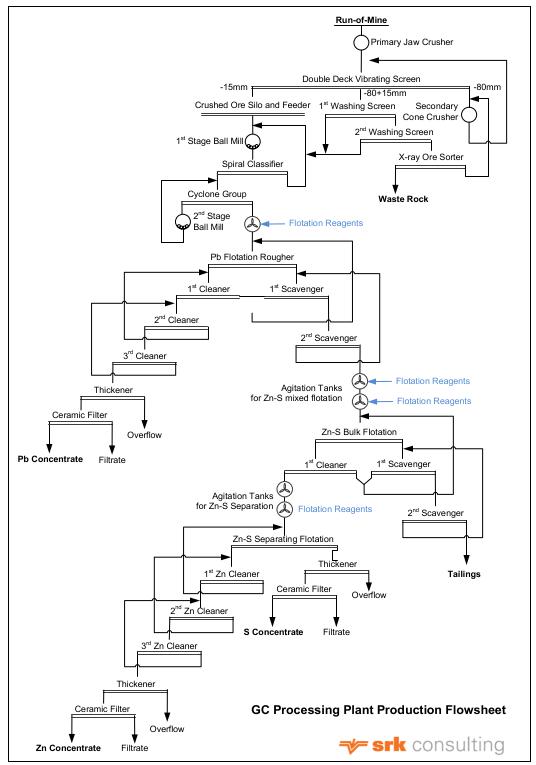
Sources: SRK site visit in April 2024
| SRK CONSULTING CHINA LTD. § APR. 20, 2026 § FH/AT | 148 |
Technical Report on Gaocheng Silver-Lead-Zinc Project in Guangdong Province, China
Recovery Method § FINAL
Figure 17.3: Main Production Facility Photos of GC Processing Plant
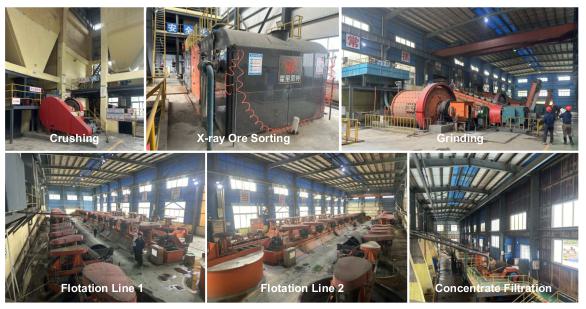
Sources: SRK site visit in April 2024
| § | Crushing and Screening: |
The plant adopts a two-stage closed-circuit crushing process, with the ROM feed size of no more than 350 mm and the product size of less than 15 mm (-15 mm).
The crushing circuit consists of a ROM bin from which the ore is drawn by a vibrating feeder into the primary jaw crusher. The jaw crusher product is screened on a double deck vibrating screen, with the -15 mm fines being conveyed forwards to the fine ore bin while the +60 mm material feeds the secondary cone crusher via a buffer storage bin to maintain choke feeding of the crusher. The 15–60 mm material is transported into the XRT intelligent sorting system by belt conveyor. Currently, the feed size class of the pre-sorting system is still in the process of optimization.
| § | Intelligent Ore Sorting: |
The XRT intelligent sorting system was built and put into trial production in March 2023, being expected to replace the previous hand-sorting operation to improve the throughput and reduce the cost of the plant.
The screening intermediate products (15–60 mm) enter into two stage vibrating screens (ZK2142) in the XRT intelligent sorting system by belt conveyor for two-stage washings. The pulp produced by washing is pumped to the grinding system through the pipeline while the oversize product (clean ore) is distributed to the XRT intelligent sorting machine for waste rock discarding. The waste rock is conveyed to a waste rock silo for sale, and the concentrate returns to the buffer ore bin of the secondary cone crusher.
| § | Grinding and Classification: |
The grinding process adopts a two-stage closed circuit, equipped with grate ball mill + spiral classifier and overflow ball mill + hydrocyclone group, with a final overflow fineness of 80% passing 75 µm (P80=75μm) and a concentration of 35% to 38%.
The grinding circuit is configured in two parallel series, each with a capacity of 800 tpd, for reasons of flexibility and easy maintenance.
| SRK CONSULTING CHINA LTD. § APR. 20, 2026 § FH/AT | 149 |
Technical Report on Gaocheng Silver-Lead-Zinc Project in Guangdong Province, China
Recovery Method § FINAL
| § | Flotation: |
Following on the grinding circuit, the flotation circuit is similarly configured in two parallel series. The overflow (“O/F”) of the hydrocyclone group flows to the lead rougher conditioning tank mixing with flotation reagents, and then to the lead rougher flotation cells. The lead flotation circuit is ‘one roughing + two scavengings+ three cleanings’, to obtain lead concentrate. The lead tailings then flow to the zinc-sulphur mixed flotation process, with the circuit of ‘one roughing + two scavengings + one cleaning’, to produce the tailings and zinc-sulphur mix concentrate. The mix concentrate then enters the zinc-sulphur separation flotation process, with the structure of ‘one roughing + two scavengings + three cleanings’, to produce the zinc concentrate and sulphur concentrate simultaneously.
| § | Concentrate Dewatering: |
The lead, zinc, and pyrite concentrate all use a two-stage dewatering process, with one stage of dewatering using a thickener and a discharge concentration of 40% to 50%, the second stage of dewatering using a ceramic filter, with a final concentrate moisture content of 10% to 12%. After dewatering, the concentrate is bagged and loaded by front-end loader into trucks for transport to the smelter customers.
| § | Tailings Handling: |
The tailings are firstly pumped to a deep cone thickener for concentration, and the underflow is switched through the valve into the press filtration system or into the backfill system. The thickener underflow concentration can reach more than 72%.
The tailings deposition method is dry stacking. The filtered tailings are conveyed to the TSF via conveyor belts and then spread by bulldozer on a bench-by-bench basis.
| 17.3 | Processing Equipment |
The GC processing plant includes; one crushing system and one newly built X-ray intelligent sorting system, two grinding and flotation production lines, dewatering lines for lead, zinc and sulphur concentrates, tailings dewatering and dry tailings piling facility, and tin recovery from flotation tailings by gravity separation. The main processing equipment is shown in Table 17.1.
Table 17.1: Main Processing Equipment of GC Processing Plant
| No. | Item | Type | Power (kW) | Quantity |
| 1 | 1# Head Tank (Return Water) | Ф15,000×6,000 | 1 | |
| 2 | 2# Head Tank (Raw Water) | Ф13,000×6,000 | 1 | |
| 3 | ROM Bin (Coarse Crushing) | 135m3 | 1 | |
| 4 | Vibrating Feeder | XZGZ-2500×1100×250 | 3 | 1 |
| 5 | Jaw Crusher | PE600×900 | 75 | 1 |
| 6 | Middling Bin (Fine Crushing) | 24.8m3 | 1 | |
| 7 | Vibrating Feeder | GZG903 | 0.75×2 | 1 |
| 8 | Cone Crusher | PYH-3Z | 220+5.5+4 | 1 |
| 9 | Double-deck Heavy-duty Type Circular Vibrating Screen | 2YKR2460H | 45 | 1 |
| 10 | Vibrating Screen (Washing) | ZKB2240 | 15×2 | 2 |
| SRK CONSULTING CHINA LTD. § APR. 20, 2026 § FH/AT | 150 |
Technical Report on Gaocheng Silver-Lead-Zinc Project in Guangdong Province, China
Recovery Method § FINAL
| No. | Item | Type | Power (kW) | Quantity |
| 11 | Electric Vibrating Feeder | GKG903 | 1.5×2 | 1 |
| 12 | X-ray Intelligent Sorting Machine | KK104-24-M | 22 | 1 |
| 13 | Screw Air Compressor | RUO-Y110-8 | 110 | 1 |
| 14 | Waste Rock Bin | Ф8,000×11,500 | 1 | |
| 15 | Fine Ore Bin (Ball Mill) | 718m3 | 2 | |
| 16 | Disk Feeder | DK-1,000 | 1.5 | 8 |
| 17 | Grate Ball Mill | MQG2,700×3,000 | 400 | 2 |
| 18 | Overflow Ball Mill | MQY2,700×3,000 | 400 | 2 |
| 19 | High Weir Single Spiral Classifier | FG-24 | 18.5 | 2 |
| 20 | Polyurethane Hydrocyclone Group | FX-250GJ×8 | 2 | |
| 21 | Slurry Pump (Cyclone Group) | 6×4E-WXR | 75 | 4 |
| 22 | Air Agitation Flotation Machine | XCF-10 | 30 | 16 |
| 23 | Air Agitation Flotation Machine | KYF-10 | 22 | 38 |
| 24 | Mechanical Agitation Flotation Machine | BF-2.8 | 5.5 | 24 |
| 25 | Lifting Agitation Tank | XBT-2500 | 22 | 4 |
| 26 | Lifting Agitation Tank | XBJ-10 | 4 | 2 |
| 27 | Agitation Tank | RJ-25 | 11 | 6 |
| 28 | Agitation Tank | RJ-20 | 7.5 | 2 |
| 29 | Centrifugal Blower | C360-1.25 | 220 | 3 |
| 30 | Polyurethane Hydrocyclone Group | FX-250GJ-15×6 | 1 | |
| 31 | Slurry Pump (Cyclone) | 80SPH | 75 | 2 |
| 32 | Reciprocated Swing Belt Sluice | 6-10500 | 1.1 | 2 |
| 33 | Suspended Swing Belt Sluice | 2,800×5,000 | 11 | |
| 34 | 6-S Type Fine Sand Shaking Table | 6-S1825*4520 | 1.1 | 12 |
| 35 | 6-S Type Fine Tailings Shaking Table | 6-S1825*4520 | 1.1 | 25 |
| 36 | Desulphurization Flotation Machine | 4A、5A | 12 | |
| 37 | Central Drive Thickener | TXZ-9 | 4 | 1 |
| 38 | Central Drive Thickener | NXZ-15 | 5.5 | 1 |
| 39 | Central Drive Thickener | NXZ-20 | 5.5 | 1 |
| 40 | Ceramic Disc Vacuum Filter | HTG-12 | 2.2 | 1 |
| 41 | Ceramic Disc Vacuum Filter | HTG-20/5 | 2.2 | 1 |
| 42 | Ceramic Disc Vacuum Filter | HTG-45/5 | 2.2 | 2 |
Sources: GC Mine Processing Equipment Summary Table
| 17.4 | Production Records |
The production records of the GC processing plant in recent years are shown in Table 17.2. The lead concentrate has a grade of about 45% Pb, and the recovery rate of lead is about 90%. It contains about 1,500 g/t silver, with a recovery rate of about 60%. It also has a zinc content of about 6%. The zinc concentrate has a zinc grade of about 44%, a zinc recovery rate of about 89%, a silver content of about 290 g/t, and a silver recovery rate of about 23%. The sulfur grade of sulfur concentrate is about 45%, and the sulfur recovery rate is about 49%.
The XRT intelligent sorting system was completed and put into trial operation in March 2023. It has been proved that it can replace hand-sorting. At present, it is still in the process of continuous optimization to increase the tailings discarding rate and reduce the grade of waste rock.
The copper content in the lead concentrate reaches 2% ~ 3%, and it is possible to produce copper concentrate by flotation from the lead concentrate. Given that the lead concentrate also contains around 6% zinc, SRK proposes that GC Mine, carry out regrinding-flotation test on lead concentrate to reduce the zinc content and obtain copper concentrate. Reducing the zinc content of lead concentrate may improve the recovery of zinc from the zinc concentrate.
| SRK CONSULTING CHINA LTD. § APR. 20, 2026 § FH/AT | 151 |
Technical Report on Gaocheng Silver-Lead-Zinc Project in Guangdong Province, China
Recovery Method § FINAL
Table 17.2: Production Records of GC Processing Plant
| Item | Unit | 2022 | 2023 | 2024 | 2025 |
| Ore Tonnes for Pre-sorting | t | 103,095 | 348,935 | 327,037 | |
| Ore Grade for Pre-sorting | Pb % | 0.91 | 0.88 | 0.78 | |
| Zn % | 2.19 | 2.24 | 2.31 | ||
| Ag g/t | 54.65 | 60.55 | 53.35 | ||
| Tonnes of Pre-sorting Waste | t | 22,368 | 43,205 | 54,495 | |
| Grade of Pre-sorting Waste | Pb % | 0.13 | 0.15 | 0.13 | |
| Zn % | 0.35 | 0.45 | 0.50 | ||
| Ag g/t | 8.21 | 11.63 | 9.39 | ||
| Discarding Rate of Pre-sorting | % | 21.70 | 12.38 | 16.66 | |
| Metal Loss of Pre-sorting Waste | Pb % | 3.16 | 2.08 | 2.81 | |
| Zn % | 3.49 | 2.51 | 3.59 | ||
| Ag % | 3.26 | 2.38 | 2.93 | ||
| Ore tonnes for Grinding and Flotation | t | 302,083 | 281,692 | 305,730 | 272,541 |
| Head Grade for Grinding | Pb % | 1.33 | 1.23 | 0.98 | 0.91 |
| Zn % | 2.78 | 2.62 | 2.49 | 2.67 | |
| Ag g/t | 70.93 | 74.83 | 67.46 | 62.14 | |
| Output of Lead Concentrate | t | 7,917 | 7,089 | 7,053 | 5,964 |
| Grade of Lead Concentrate | Pb % | 45.49 | 43.95 | 38.10 | 37.16 |
| Zn % | 6.04 | 5.23 | 5.43 | 4.92 | |
| Ag g/t | 1,603 | 1,786 | 1,781 | 1,642 | |
| Yield of Lead Concentrate (to grinding feed) | % | 2.62 | 2.52 | 2.31 | 2.19 |
| Recovery of Lead Concentrate (to grinding feed) | Pb % | 89.42 | 90.26 | 89.50 | 88.92 |
| Zn % | 5.69 | 5.02 | 5.02 | 4.03 | |
| Ag % | 59.24 | 60.06 | 60.90 | 57.84 | |
| Output of Zinc Concentrate | t | 17,092 | 15,152 | 16,195 | 15,428 |
| Grade of Zinc Concentrate | Zn % | 44.23 | 43.82 | 42.14 | 42.91 |
| Ag g/t | 292 | 291 | 268 | 279 | |
| Yield of Zinc Concentrate (to grinding feed) | % | 6.30 | 5.58 | 5.40 | 5.10 |
| Recovery of Zinc Concentrate (to grinding feed) | Zn % | 89.97 | 89.86 | 89.53 | 90.95 |
| Ag % | 23.28 | 20.91 | 21.08 | 25.42 |
Sources: GC Mine
| 17.5 | Consumptions and Services |
| 17.5.1 | Reagent and Material Consumptions |
The reagent and material consumptions for processing in the recent years are shown in Table 17.3, where the data in the table represent the consumptions under normal production conditions. SRK is informed by the GC processing plant manager, that the crushing system typically operates at night during the low electricity price period to save crushing costs, with a price difference of about double between peak and valley electricity prices.
| SRK CONSULTING CHINA LTD. § APR. 20, 2026 § FH/AT | 152 |
Technical Report on Gaocheng Silver-Lead-Zinc Project in Guangdong Province, China
Recovery Method § FINAL
Table 17.3: Reagent and Material Consumptions in GC Processing Plant
| Reagents | Unit | 2022 | 2023 | 2024 | 2025 |
| ZnSO4 | kg/t | 1.09 | 1.05 | 1.03 | 1.24 |
| W-1 | g/t | 99 | 93 | 86.35 | 92.41 |
| Na2SO3 | g/t | 117 | 122 | 114.64 | 163.23 |
| BK903 | g/t | 2.83 | 5.2 | 5.64 | 0.71 |
| ADD | g/t | 2.5 | 0.7 | 0.78 | 1.89 |
| SN-9 | g/t | 69 | 40 | 27.44 | 4.13 |
| CuSO4 | g/t | 193 | 168 | 161.4 | 124.79 |
| 8230 | g/t | 3 | 6 | 4.88 | 1.18 |
| SNX | g/t | 118 | 106 | 103.46 | 124.75 |
| Sodium Humate | g/t | 265 | 265 | 262.27 | 192.74 |
| Na2CO3 | g/t | 42 | 23 | 17.61 | 15.34 |
| 2# Oil | g/t | 24 | 25 | 26.53 | 27.03 |
| H2SO4 | g/t | 633 | 488 | 406.8 | 173.38 |
| Lime | kg/t | 2.1 | 1.57 | 1.56 | 1.42 |
| SHMP | g/t | 17.77 | 41.43 | 0 | |
| Steel Balls | kg/t | 1.29 | 1.27 | 1.24 | 1.26 |
| Electricity | kWh/t | 50.35 | 52.84 | 54.77 | 50.23 |
Sources: GC Mine.
| 17.5.2 | Water Supply |
The water consumption is about 5 cubic meter per tonne (“m3/ t”) of ore, which mainly comes from mineral processing return water and mine water. The mine water is pumped and discharged to the wastewater processing facility for coagulation and sedimentation treatment, and then pumped to the TSF reclaiming basin, where it is further precipitated and clarified together with the return water from the GC processing plant, and then pumped to the return water head tank of the GC processing plant.
New water comes from the Hashui River, and a large-diameter water intake well is built by the riverside. Water is pumped to the nearby transfer pump station, from where it is pumped to the raw water processing facility on the top of the mine, and after purification, it flows to the clean water head tank at the GC processing plant, mainly used for the preparation of mineral processing reagents, pulp pump sealing and ground flushing. (Figure 17.4)
Figure 17.4: New Water Intake, Pumping and Purification Processing Facilities
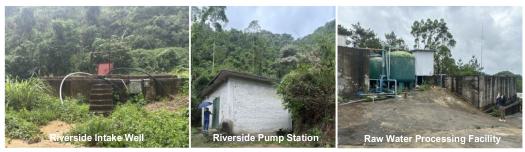
Sources: SRK site visit in April 2024
| SRK CONSULTING CHINA LTD. § APR. 20, 2026 § FH/AT | 153 |
Technical Report on Gaocheng Silver-Lead-Zinc Project in Guangdong Province, China
Recovery Method § FINAL
| 17.5.3 | Laboratory |
The GC Mine has built a high-standard laboratory, GC Laboratory, equipped with X-ray fluorescence spectrophotometer, ICP-OES Aivo550, atomic absorption spectrophotometer, infrared carbon and sulfur analyser, fire assay analysis room, volumetric analysis room (including balance room, Au-Ag-Cu analysis room, Pb-Zn-Sn analysis room), responsible for the preparation and laboratory analysis of the production samples of the GC processing plant and mining exploration/ ore definition samples. There is also a mineral processing laboratory to conduct tests when the processing index is abnormal, to timely guide the adjustment of the operation parameters for the GC processing plant. Figure 17.5 shows some photos of the GC Laboratory.
Figure 17.5: Photos of the GC Laboratory
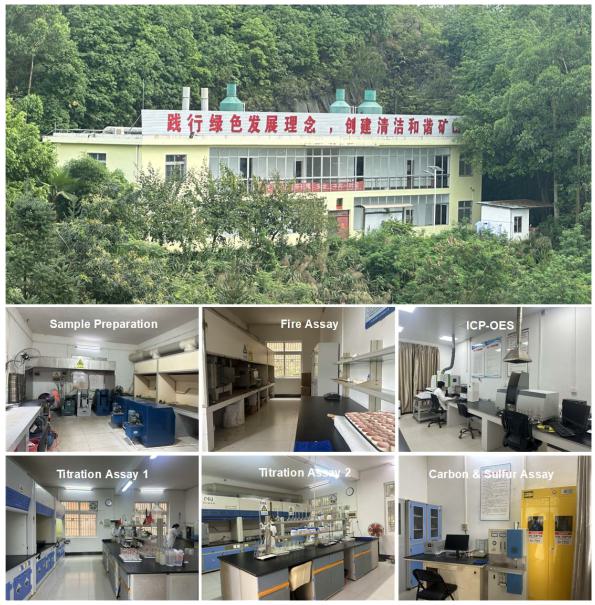
Sources: SRK site visit in April 2024
| SRK CONSULTING CHINA LTD. § APR. 20, 2026 § FH/AT | 154 |
Technical Report on Gaocheng Silver-Lead-Zinc Project in Guangdong Province, China
Recovery Method § FINAL
| 17.5.4 | Machine Maintenance |
The GC maintenance workshop is equipped with appropriate equipment to meet daily maintenance requirements. The workshop facilities are equipped with craneage, welding, and basic machine-shop capabilities.
More extensive maintenance and major overhaul needs can be outsourced, with appropriate contractors or equipment suppliers.
| SRK CONSULTING CHINA LTD. § APR. 20, 2026 § FH/AT | 155 |
Technical Report on Gaocheng Silver-Lead-Zinc Project in Guangdong Province, China
Project Infrastructure § FINAL
| 18 | Project Infrastructure |
| 18.1 | Introduction |
Both the surface and underground infrastructure has been established. Some of the infrastructures are presented in Figure 18.1.
Figure 18.1: Part of Facilities of GC Mine
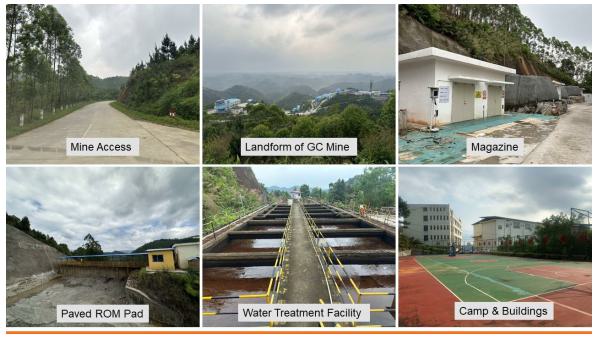
Sources: SRK site visit 2024
| 18.2 | Tailings Storage Facility |
| 18.2.1 | Overview |
The GC TSF is a dry-stacking tailings dam, located in a valley on the south side of the GC processing plant, approximately 200 m away from the GC processing plant in a straight line, as shown in Figure 18.2. Between the processing plant and the TSF are the tailings dewatering station and the underground mine paste plant. The tailings from the GC processing plant are pumped to the deep cone thickener for thickening, after which they are primarily used for the underground paste filling needs, and the remaining tailings are pressed and filtrated in the tailings press filter plant, and the filter cake is transported to the TSF by the belt conveyor, which will be levelled and compacted by bulldozers and excavators.
The total designed dam height of the TSF is 99.5 m (elevation of 233 m), and the total storage capacity is 2,989,300 m3. At present, the tailings stacking height is 71 m (elevation of 204.5 m) with the tailings stacking stock of about 1,356,000 m3 (45.4% of capacity), and the remaining storage capacity is 1,633,300 m3 corresponding to a tailings stacking volume of 2,858 kt according to a tailings stacking specific gravity of 1.75 t/ m3.
| SRK CONSULTING CHINA LTD. § APR. 20, 2026 § FH/AT | 156 |
Technical Report on Gaocheng Silver-Lead-Zinc Project in Guangdong Province, China
Project Infrastructure § FINAL
The GC TSF is a third-class dam with a number of displacement monitoring facilities and phreatic line monitoring systems installed to monitor the safety of the dam body and obtained the latest “Safety Production Permit” on August 31, 2023, valid until August 30, 2026. In accordance with regulatory requirements, this permit shall be reviewed and renewed every three years.
Figure 18.2: Photos of Tailings Storage Facility
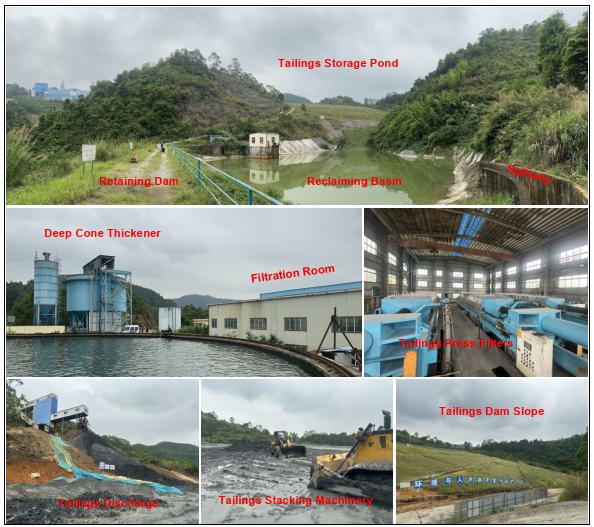
Sources: SRK site visit 2024
| 18.2.2 | Tailings Dam and Tailings Discharge |
The tailings dam is composed of the initial dam and the tailings stacking dam. The initial dam is 21.5 m high, the stacking dam is 78.0 m high, and the total dam height is 99.5 m. The initial dam is rolled rockfill dam, with the dam crest elevation of 155.0 m, the dam base elevation of 133.5 m, the dam height of 21.5 m, the dam crest width of 5.0 m and the dam crest axis length of 60.0 m.
The tailings stacking dam adopts the upstream damming method, and the final crest elevation is 233.0 m. After thickened and press filtered, tailings are transported to the TSF by the belt conveyor, levelled and compacted by bulldozers and excavators from the front of the TSF to the tail, and a gradient of 1% to 10% is formed slightly toward the tail of the TSF, so that the rainwater on the surface of the TSF is collected at the tail of the TSF and discharged outside of the TSF through the drainage system under the dam. The tailings’ stacking dam is divided into sub-dams every 5 m higher, and each sub-dam is equipped with a 2.5 m wide berm with longitudinal and transverse drainage ditches of cement laid stone masonry constructed inside the berms. The dam face drainage ditches and dam abutment ditches are constructed at all the berms and dam abutments to divert and drainage the slope water catchment. The designed total height of the stacking dam is 78.0 m. A total of 8 sub-dams has been built, and the 9th sub-dam is currently being built. The outer slope of the stacking dam is covered with soil and planted with turf for slope protection. During the site visit, SRK noticed that the slopes of all the completed sub-dams have been planted with grass and restored to green.
| SRK CONSULTING CHINA LTD. § APR. 20, 2026 § FH/AT | 157 |
Technical Report on Gaocheng Silver-Lead-Zinc Project in Guangdong Province, China
Project Infrastructure § FINAL
After tailings are stacked to the designed final stacking dam crest elevation of 233.0 m, in order to make the beach surface as a whole “high at the tail and low in front of the dam” and eliminate the possibility of beach water ponding and overtopping, a beach surface with a slope of 1.5% is formed at the tail towards the dam body. Finally, the beach surface is covered with 30 to 50 cm clay, planted with grass and restored to green, and TSF surface drainage ditches are built to divert and drainage the beach water catchment.
| 18.2.3 | Flood Control and Drainage System and Return Water System |
In addition to the above-mentioned slope and abutment drainage ditches, permanent flood interception ditches have been built on the slopes on both sides of the TSF to intercept the upstream slope rainwater from entering the TSF. The catchment area of the TSF below the flood interception ditches is 0.23 km2. The rainwater on the dam slope is diverted to the reclaiming basin through the slope drainage ditches, and the rainwater on the TSF surface collected at the tail of the TSF is discharged to the reclaiming basin through the drainage system in the TSF. The drainage system in the TSF is completely constructed in accordance with the wet discharge TSF, which is composed of the drainage chute at the tail of the TSF and the drainage culvert at the bottom. The drainage chute and culvert are all constructed of reinforced concrete structures and rectangular sections with the sectional dimensions (width × height) of 1.5×1.8m and 0.5×1.05m, respectively.
The tailings seepage water is discharged to the reclaiming basin by the drainage chute, the drainage culvert and the seepage drainage zone under the TSF. The seepage drainage zone is made of woven bagged gravel and stacked next to the drainage chute and the drainage culvert on both sides to form blind ditches with a trapezoidal section.
The reclaiming basin is located downstream of the initial dam, and there is a retaining dam 100 m away the initial dam, forming a reclaiming basin with a total capacity of about 40,000 m3, which also serves as a sedimentation and clarification sump. The retaining dam is an impermeable rolling earth-rock dam, with the dam crest elevation of 135.5 m, the dam base elevation of 113.2 m, the dam height of 22.3 m, the dam length of approximately 71 m, and the dam crest width of 5 m. A spillway is built on each side of the abutments to prevent flood water from overflowing dam during extreme weather events and ensure the safety of the retaining dam. The section size of the spillway is 2.0 × 2.9m. A return water pump house is built in the reclaiming basin, which is connected to the left bank by a trestle, and the reclaimed water in the basin is pumped to the return water head tank of the GC processing plant for the use of mineral processing production.
| SRK CONSULTING CHINA LTD. § APR. 20, 2026 § FH/AT | 158 |
Technical Report on Gaocheng Silver-Lead-Zinc Project in Guangdong Province, China
Project Infrastructure § FINAL
| 18.3 | Waste Rock Dump |
The +215 ASL waste rock dump (“WRD”) is located a short distance to the east of the mine portal. SRK were advised that the immediate capacity of the order of 275,000 m3 (~558 kt). Previous site observations and review of surface plans referenced that there appeared to be room for a downstream extension of the waste dump location and/ or ability to increase the waste dump height to approximately +300 ASL to accommodate all waste produced over the LOM.
However, waste rock produced to date has largely been used for construction purposes transported off-site by local companies, minimum of charge, again to be used for construction activities. The WRD areas on site are thus empty. The removal of waste rock from the site is anticipated to continue for the foreseeable future. The waste rock sale contracts are reviewed on annual basis. SRK has reviewed the available contract and the associate side agreement. The sale price is RMB 3/t (including 13% VAT) of development waste rock and RMB11.5/t of ore sorting waste. SRK also noted as stated by the management of GC Mine, the waste rook is free when the aggregate market is low.
| 18.4 | Backfill Plant |
The backfill plant is designed for cemented full tailings, with a system capacity of 60 – 80 m3/hr, or around 300 m3/day assuming seven hours operation. The envisaged concentration of the backfill is around 69 - 72% solids, at a density of approximately 1.9 t/m3. The capacity of the plant at the projected utilization is more than sufficient to supply underground backfill requirements at the LOM mining rates. The schematic process of the backfill plant is presented in Figure 18.3.
Figure 18.3: Flowsheet of Backfill Plant
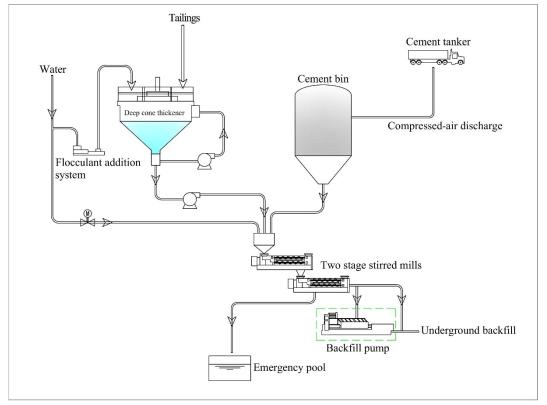
Sources: GC Mine
| SRK CONSULTING CHINA LTD. § APR. 20, 2026 § FH/AT | 159 |
Technical Report on Gaocheng Silver-Lead-Zinc Project in Guangdong Province, China
Project Infrastructure § FINAL
The backfilling system is mainly composed of the sub-systems of tailings delivery, tailings thickening, tailings mixing, water addition, backfill control, cement supply, pipeline conveying, water supply, and power supply.
The full tailings with a mass concentration of 10 - 12% produced by the process plant are pumped into the deep cone thickener in order to thicken to the range of 66 - 68% solids. The concentrated tailings are conveyed to the mixing system by gravity from the bottom of the thickener.
The bulk cement is stored in a steel silo from where it is delivered to the mixer. The concentrated tailings are mixed with water and cement in the mixer to prepare a backfilling slurry, which is then pumped underground via a backfill raise or raises and pipelines, to be delivered to various underground stope voids as required.
Tailings feed to the backfill plant can come directly from the process plant or from the dry stack tailings area.
GC Mine notes that underground tailings backfill has obvious advantages, including reduction of the surface storage footprint and thus being more environmentally friendly, facilitation of in situ ore pillar removal and thus maximizing ore production, enhancing mine support with associated safety benefits, and improvement of the ventilation circuit through elimination of potential short-circuiting.
The construction of the backfill plant was completed and tested on December 24, 2019. After surface and underground full-process backfilling tests and adjustment, the system began operating on July 15, 2020. The operation record of the backfill plant is shown in Table 18.1. The backfill plan and tailings balance is presented in Table 18.2.
Table 18.1: Operation Record of Backfill Plant
| Year | Backfill Volume | Backfill Material |
| Unit | m³ | t |
| FY2020 | 43,900 | 53,997 |
| FY2021 | 79,050 | 97,231 |
| FY2022 | 99,531 | 122,423 |
| FY2023 | 101,118 | 124,375 |
| FY2024 | 104,011 | 127,933 |
| FY2025 | 98,220 | 120,811 |
Sources: GC Mine
| SRK CONSULTING CHINA LTD. § APR. 20, 2026 § FH/AT | 160 |
Technical Report on Gaocheng Silver-Lead-Zinc Project in Guangdong Province, China
Project Infrastructure § FINAL
Table 18.2: Backfill Plan and Tailings Consumption
| Year | Volume to Fill | Backfill Material | Tailings to backfill | Tailings generated | Tailings to TSF |
| Unit | k m³ | kt | kt | kt | kt |
| LOM Total | 1,568 | 2,979 | 2,251 | 4,935 | 2,875 |
| 2026 | 114 | 217 | 169 | 147 | 169 |
| 2027 | 92 | 175 | 136 | 284 | 148 |
| 2028 | 105 | 200 | 156 | 298 | 142 |
| 2029 | 83 | 157 | 122 | 306 | 184 |
| 2030 | 79 | 151 | 117 | 304 | 187 |
| 2031 | 85 | 162 | 126 | 305 | 179 |
| 2032 | 80 | 151 | 118 | 306 | 188 |
| 2033 | 81 | 153 | 120 | 303 | 184 |
| 2034 | 84 | 160 | 124 | 308 | 183 |
| 2035 | 84 | 160 | 125 | 306 | 181 |
| 2036 | 88 | 168 | 131 | 305 | 174 |
| 2037 | 84 | 160 | 125 | 307 | 182 |
| 2038 | 88 | 167 | 130 | 305 | 174 |
| 2039 | 86 | 163 | 127 | 307 | 180 |
| 2040 | 87 | 166 | 129 | 305 | 176 |
| 2041 | 82 | 156 | 122 | 305 | 184 |
| 2042 | 82 | 157 | 122 | 183 | 60 |
| 2043 | 82 | 156 | 51 | 51 | - |
Sources: GC Mine, SRK Modified
After accounting for tailings used in backfilling mined-out areas and future open stopes (shrinkage stoping), plus a 15% tailings loss allowance, the remaining tailings will be discharged to the TSF. Tailings discharge will effectively reach the existing TSF capacity by Year 18.
| 18.5 | Power Supply |
There is a 110 kV substation near Gaocun Township, about 6 km from the mining area. This is fed from the Guangdong Province electrical grid system. The GC Mine uses this substation as the main source of power for the mine.
There are two overhead power lines for the 6 km route. Two 15.0 MW diesel generators are designated for emergency backup to the man-hoist, underground ventilation system, water pumping and essential services in the plant.
A new 10 kV substation was built in the mining area to provide power service for the operations area as a whole. The power supply and distribution in the process plant, mining area, administrative and living areas are configured based on needs.
| 18.6 | Access Road |
Access to the GC Mine from Guangzhou is via 178 km of four-lane express highway to Yunfu, then 48 km of paved road to the GC Mine site. A railway connection including high speed rail from Guangzhou to Yunfu is also available.
There are 15 road segments assigned to this Project, some are site and others general access roads. There are no issues of large equipment and/ or ore concentrates transportation.
| SRK CONSULTING CHINA LTD. § APR. 20, 2026 § FH/AT | 161 |
Technical Report on Gaocheng Silver-Lead-Zinc Project in Guangdong Province, China
Project Infrastructure § FINAL
| 18.7 | Water Supply |
The source of water for the mine is from local creeks and gullies that flow into the Hashui Creek. The flows typically vary from about 11,000 m3/day (dry season) to 69,000 m3/day (wet season), with the wet season being from April to September inclusive. The annual average rainfall varies in the range of 1,400 – 1,734 mm. The water quality and quantity from the local creeks is sufficient to meet the GC Mine requirements, which are of the order of 2,000 m3/day.
Water is drawn from the Bai Mai reservoir and pumped to an elevated hilltop water tank (at approximately 343 ASL) for water treatment filtration and surge capacity storage. The treated water is then gravity fed to the mine site and processing plant (at approximately 248 ASL).
The key specifications of the water supply system are:
| § | Bai Mai reservoir water tank with 100 m3 of settling capacity and 200 m3 clean water capacity. |
| § | Hilltop water tank with 300 m3 storage, and water filtration capability via two filtration units. |
Water consumption underground is primarily for drilling and dust suppression.
Potable water is provided underground adjacent to the Main Shaft with water quality conforming to regulatory requirements. Personnel carry drinking water as required to remote workplaces in water containers.
| 18.8 | Sewage Treatment |
A sewage treatment facility is located at the mine site for processing of mine camp sewage.
| 18.9 | Water Treatment Facility |
There is a water treatment facility at the GC Mine to treat the water that is not recycled, before the water is released to the environment, to comply with standing regulations.
| 18.10 | Site Communication |
A dispatching system is used for production dispatching at the mine. A 200-gate digital programmed control dispatching exchange is deployed at the dispatching room of the office building under production management personnel. To facilitate external communication, 10 pairs of trunk lines are used. The internet and cell phone signal are well established on site by service providers.
| 18.11 | Dams and Tunnels |
GC Mine has built an approximately 1 km long diversion tunnel with two dams on the Hashui Creek to relocate the course of this river beyond the projected subsidence zone of influence.
| SRK CONSULTING CHINA LTD. § APR. 20, 2026 § FH/AT | 162 |
Technical Report on Gaocheng Silver-Lead-Zinc Project in Guangdong Province, China
Project Infrastructure § FINAL
| 18.12 | Surface Maintenance Workshop |
The surface maintenance facilities include a workshop building area of 756.5 m2, in which the following auxiliary services are provided:
| § | Tyre processing, maintenance, and servicing |
| § | Welding |
| § | Electrical |
| § | Hydraulic |
| § | Tools, parts, and material warehouse |
The workshop is mainly responsible for maintenance of large-scale production equipment, vehicle repair, processing and repair of components, and the processing of emergency parts. One LD 10 t electric single-beam crane, one BC6063B shaping machine, one CD6240A saddle bed lathe, one Z3040 × 16/I radial drilling machine, and one bench drilling machine are located in the workshop, as well as alternating current arc welding, rectification arc welding, snag grinding machine, cut-off machine, electric drying oven, mobile air compressor, etc. Maintenance facilities such as tool rack, working platform, gas cutting device, etc. are also provided, along with a dynamic balancing machine, tire picking machine, tire mending machine, battery charger, and vehicle repair/ inspection pit.
Mechanical maintenance facilities also include equipment and spare parts store, dump oil depot, reserve electric locomotives, and tramcars maintenance workshop and stockpile yard.
The mining contractor have their own mobile equipment workshop for repairs and servicing adjacent to the decline portal. There are underground jumbo service bays established in redundant stockpile areas/ cubbies to minimize tramming delays for the slower moving jumbos.
Mobile equipment repairs (trucks, loaders, etc.), other equipment breakdowns and equipment major services are conducted in the mining contractor’s surface workshop with minor services conducted in the redundant stockpile areas. Minor equipment (such as jacklegs, secondary fans, development pumps, etc.) are also serviced in the mining contractor’s surface workshop.
Electric locomotives and rail cars are serviced and repaired in a service rail siding located adjacent to the Main Shaft.
Other fixed and mobile plant (primary pumps, surface electric locomotive, rail cars, vehicles, etc.) are serviced in GC Mine surface workshop located adjacent to the Main Shaft.
| 18.13 | Explosive Magazine |
The explosives magazine is located in the valley to the south-east of the GC Mine. It is permitted to hold two of 5t of bulk explosives magazines and 20,000 detonators, representing approximately 15 days and 30 days of supply, respectively. Security services are used, and detonators are scanned on release from the magazine for security audit purposes.
| 18.14 | Fuel Farm |
Diesel fuel is required for the mobile mine equipment, some small trucks, and surface vehicles. The surface fuel tank and pumping station set-up allows for refuelling of both light vehicles and heavy-duty mining equipment.
| SRK CONSULTING CHINA LTD. § APR. 20, 2026 § FH/AT | 163 |
Technical Report on Gaocheng Silver-Lead-Zinc Project in Guangdong Province, China
Project Infrastructure § FINAL
A properly constructed containment for storage of fuel is located in the vicinity of the diesel generators and fuel dispensing facilities. The storage facility is located down-wind from the mine air intake fans and a reasonable distance from buildings, camp, and mine portal (referencing local occupational health and safety regulations and fire-fighting requirement). The lined containment area is constructed such that spills are confined and can readily be cleaned, so that the need for extensive and costly remediation work can be avoided during site closure.
No fuel is allowed to be stored underground. Trucks and loaders are re-fuelled at the surface fuel farm and dispensing facility.
| 18.15 | Camp and Building |
The mine office complex to the east of the warehouse comprises the administration and engineering buildings, which provide working space for management, supervision, geology, engineering, and other operations support staff.
Administrative, living, and welfare facilities are composed of administrative office building, hostel, canteen, washroom, and residential building, as well as dining and entertainment facilities.
| 18.16 | Security and Gate House |
A security/ gatehouse is located on the site access road. The access road off a local village road has a manual gate with signage indicating that vehicles and persons are now entering the private property.
| SRK CONSULTING CHINA LTD. § APR. 20, 2026 § FH/AT | 164 |
Technical Report on Gaocheng Silver-Lead-Zinc Project in Guangdong Province, China
Market Studies and Contracts § FINAL
| 19 | Market Studies and Contracts |
| 19.1 | Commodity Prices |
Neither GC Mine, nor SRK has conducted a market study in relation to silver, lead and zinc concentrates which will be produced by GC Mine. Silver, lead and zinc are freely traded commodities on the world market for which there is a steady demand from numerous buyers.
Figure 19.1 below represent independent analyst, Consensus Market Forecasts (“CMF”) for the silver, lead, and zinc outlooks (in real USD), which was issued in December 2025. The commodity price forecasts are considered by SRK to reflect a reasonable outlook for the future.
Figure 19.1: Outlook for Silver, Lead and Zinc Prices by CMF
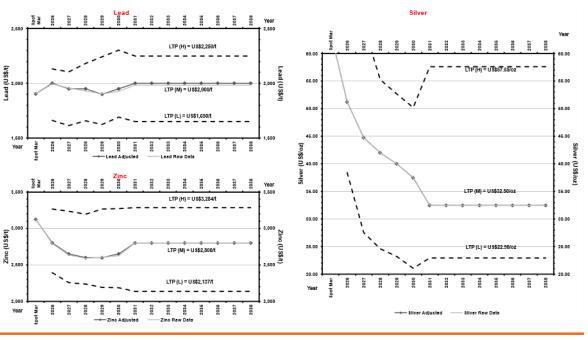
Sources: CMF, released on December 20, 2025
Table 19.1 shows the prices for Silver, Lead, and Zinc. These commodity prices are dynamic and are derived from CMF, published by Consensus Economics Inc., to which SRK subscribes annually. However, during the preparation of the technical report by SRK, the silver price increased significantly. SRK also referred to the price forecast released by CMF in March 2026, in which the silver prices for 2026 and 2027 reflect the changes in early 2026. SVM ultimately recommended that, in the techno-economic analysis, the updated price forecast be used for the silver price in the first three years. Since the long-term price shows little difference from the December forecast for Pb and Zn prices, the December forecast prices should continue to be adopted.
| SRK CONSULTING CHINA LTD. § APR. 20, 2026 § FH/AT | 165 |
Technical Report on Gaocheng Silver-Lead-Zinc Project in Guangdong Province, China
Market Studies and Contracts § FINAL
Table 19.1: Commodity Price Assumptions for the Economic Analysis
| Commodity | Units | 2026 | 2027 | 2028 | 2029 | 2030 | 2031 | LTP |
| Silver | USD/oz | 72.75 | 66.50 | 42.00 | 40.00 | 37.50 | 32.50 | 32.50 |
| Lead | USD/t | 2,000 | 1,950 | 1,950 | 1,900 | 1,950 | 2,000 | 2,000 |
| USc/lb | 91 | 88 | 88 | 86 | 88 | 91 | 91 | |
| Zinc | USD/t | 2,800 | 2,650 | 2,600 | 2,600 | 2,650 | 2,800 | 2,800 |
| USc/lb | 127 | 120 | 118 | 118 | 120 | 127 | 127 |
Source: CMF, December 20, 2025
| 19.2 | Concentrate Marketing |
It is understood that the GC Mine concentrates are marketed to existing smelter customers in China and appropriate terms have been negotiated yearly. A totally of 11 contracts with nine smelters, consist of five on zinc concentrates, four on lead concentrates and two on Sulfur concentrate are available for reviewing. All contracts have freight and related expenses to be paid by the customers.
SRK has summarized the payable metals in concentrate prices based on the discount method which is notarized in the sale contracts. The prices mentioned in the contracts are all in RMB and including (“Incl.”) 13% VAT. The discount method mentioned in the contracts is summary as below:
| § | Silver metal in lead concentrate. The payable factor is depending on the silver grade in the concentrate. |
| – | Payable 95.5%, Ag grade ≥ 3,500 g/t |
| – | Payable 95%, Ag grade ≥ 3,000 g/t |
| – | Payable 94.5%, Ag grade ≥ 2,500 g/t |
| – | Payable 94%, Ag grade ≥ 2,000 g/t |
| – | Payable 93.5%, Ag grade ≥ 1,500 g/t |
| – | Payable 93%, Ag grade ≥ 1,000 g/t |
| – | Payable 92%, Ag grade ≥ 800 g/t |
| § | Lead metal in lead concentrate. The basic grade is Pb 50%. The abatement of price is RMB 200/t metal contained in concentrate. The penalty on grade floating is as follows: |
| – | Fix abatement RMB 200 /t metal in concentrate, Pb grade ≥ 50 % |
| – | RMB 200/t + (50%-Grade) x 100x RMB 20, 40%≤Pb grade ≤ 50 % |
| – | RMB 200/t + (40%-Grade) x 100x 50 RMB, 35%≤Pb grade ≤ 40 % |
| – | RMB 250/t + (35%-Grade) x 100x 100 RMB, 30%≤Pb grade ≤ 35 % |
| – | RMB 750/t + (35%-Grade) x 100x 150 RMB, 25%≤Pb grade ≤ 30 % |
| § | Zinc metal in zinc concentrate. The penalty is based on not only Zn grade, but also the metal prices. |
| – | If the zinc metal price is no more than 15,000 RMB/t incl. VAT |
| – | Fix abatement RMB2,400/t metal in concentrate, Zn grade = 50 % |
| SRK CONSULTING CHINA LTD. § APR. 20, 2026 § FH/AT | 166 |
Technical Report on Gaocheng Silver-Lead-Zinc Project in Guangdong Province, China
Market Studies and Contracts § FINAL
| – | RMB 2,400/t - (Grade-50%) x 100x 20 RMB, Zn grade > 50% |
| – | RMB 2,400/t + (50%-Grade) x 100x 20 RMB, 40%≤Zn grade < 50 % |
| – | RMB 2,600/t + (40%-Grade) x 100x 50 RMB, 35%≤Zn grade < 40 % |
| – | RMB 2,850/t + (35%-Grade) x 100x 100 RMB, 30%≤Zn grade < 35 % |
| – | If the zinc metal price is more than RMB 15,000/t incl. VAT, additional 20% of the premium against the based price is applied together with the penalties applied as the price is lower than RMB 15,000/t. |
| § | Silver metal in zinc concentrate. The payable factor is depending on the silver grade in the concentrate. |
| – | RMB 4.0 per gram, Ag grade ≥ 500 g/t |
| – | RMB 3.0 per gram, Ag grade ≥ 400 g/t |
| – | RMB 2.5 per gram, Ag grade ≥ 300 g/t |
| – | RMB 2.0 per gram, Ag grade ≥ 200 g/t |
| – | RMB 1.2 per gram, Ag grade ≥ 100 g/t |
| – | Not pay, Ag grade < 100 g/t |
It is also understood that an acceptable arsenic level in base metal concentrates, without penalty, for Chinese smelters is of the order of 1.0% and notes that the GC Mine lead and zinc concentrates are acceptable to those smelters. Should the arsenic level ever be higher than 1.0% in zinc concentrates or lead concentrates, the payable Zn or Pb content would be discounted by 0.5% Zn or Pb for every 1% As above the 1.0% As level.
It is also understood that there are some other measures on valuable elements in concentrates other than silver, lead, and zinc, such as copper or gold. However, there is no available data from the Mineral Resource estimates and not material to the operation performance.
| 19.3 | Operational Contracts |
SRK reviewed the available mining and development contract with professional services provider dated January 1, 2026, which will expire at the end of 2028. The items and budget support the costing records and forecasting for Opex. A negotiating on terms for next three years will be conducted in 2028.
The waste rock from the development which is transported to the temporary WRD located near the shaft portal, main decline and exploration decline, are available to sell. The sale price is RMB 3.0/ t underground development waste including 13% VAT. The tail waste from XRT intelligent sorting is RMB 11.5/t, including 13% VAT. The freight and related expenses to be paid by the customer.
The domestic garbage disposal is contracted out to local provider. Totally about RMB 302,820 annually including 3% VAT.
The environmental impact monitoring service is contracted out to professional service providers, on waste, surface underground and TSF water, waste gas, soil, and noise. The contract budget about RMB 74,000 annually including 6% VAT for the service.
| SRK CONSULTING CHINA LTD. § APR. 20, 2026 § FH/AT | 167 |
Technical Report on Gaocheng Silver-Lead-Zinc Project in Guangdong Province, China
Environmental Studies, Permitting and Social or Community Impact § FINAL
| 20 | Environmental Studies, Permitting and Social or Community Impact |
| 20.1 | Review Objective |
The objective of this review is to identify and/ or verify the existing and potential Environmental, Permitting, and Social or Community liabilities and risks, and assess any associated proposed remediation measures for the GC Mine.
| 20.2 | Review Process, Scope, and Standards |
The process for verifying the environmental permitting and licensing compliance and operational conformance for the GC Mine comprised a review and inspection of the projects’ environmental management performance against:
| § | Chinese national environmental regulatory requirements; and |
| § | World Bank/International Finance Corporation (IFC) environmental standards and guidelines, and internationally recognised environmental management practices. |
The methodology applied for this environmental review of the project consisted of a combination of documentation review, site visit and interviews with company technical representatives.
| 20.3 | Permitting |
According to the requirements of relevant laws and regulations of China, a series of environmental protection related licences and permits should be obtained during the operation of mines, such as safety production permit, water use permit and site discharge permit.
| 20.3.1 | Safety Production Permit |
The safety production permits for the GC Mine are presented in Table 20.1.
Table 20.1: Details of the Safety Production Permits for the GC Mine
| Areas | GC Mine |
| Safety Production Permit No. | [2023] Wb012 II2 |
| Issued To | Guangdong Found Mining Ltd. (GC Mine) |
| Issued By | Guangdong Province Emergency Management Bureau |
| Licensed Activity | Lead-zinc-silver Mine Underground Mining |
| Issue Date | August 31, 2023 |
| Expiry Date | August 30, 2026 |
| Areas | GC Mine TSF |
| Safety Production Permit No. | [2023] Wc013 II2 |
| Issued To | Guangdong Found Mining Ltd. (GC Mine TSF) |
| Issued By | Guangdong Province Emergency Management Bureau |
| Licensed Activity | TSF Operation |
| Issue Date | August 31, 2023 |
| Expiry Date | August 30, 2026 |
SRK considers that the above safety production permits cover the entire mine site and TSF of the GC Mine.
| SRK CONSULTING CHINA LTD. § APR. 20, 2026 § FH/AT | 168 |
Technical Report on Gaocheng Silver-Lead-Zinc Project in Guangdong Province, China
Environmental Studies, Permitting and Social or Community Impact § FINAL
| 20.3.2 | Water Use Permit |
The water use permit for the GC Mine is presented in Table 20.2.
Table 20.2: Details of the Water Use Permit for the GC Mine
| Water Use Permit No. | D445303S2022-0007 |
| Issued To | Guangdong Found Mining Ltd. |
| Issued By | Yunfu City Yun’an District Agriculture, Rural and Water Resources Bureau |
| Issue Date | March 15, 2022 |
| Expiry Date | March 14, 2027 |
| Water Supply Source | Surface water |
| Water Use Allocation | 200,000m3/year |
| 20.3.3 | Pollutant Discharge Permit |
According to the Regulations on the Administration of Pollutant Discharge Permits and the Measures for the Administration of Pollutant Discharge Permits, pollutant discharge units must apply for a Pollutant Discharge Permit from the approval authority before starting production facilities or engaging in actual pollutant discharge activities. However, enterprises, institutions, and other producers and operators whose production and emissions of pollutants are small and have minimal impact on the environment are not required to apply for pollutant discharge permits, but they should fill out pollutant discharge registration forms. The GC Mine has registered the discharge of fixed pollution sources on May 19, 2023. The registration number is 91445300680642284X002Y. Registration is valid until May 18, 2028. The permissible discharge of waste includes dust and treated mine dewatering water.
| 20.4 | Status of Environmental Approvals |
The basis of environmental policy in China is contained in the 2018 Constitution of the PRC. Pursuant to Article 26 of the Constitution, the state protects and improves the environment in which people live and the ecological environment. It prevents and controls pollution and other public hazards. The state organizes and encourages afforestation and the protection of forests.
The following are other Chinese laws that provide environmental legislative support to the Minerals Resources Law of the PRC (2024) and the Environmental Protection Law of the PRC (2014):
| § | Environmental Impact Assessment Law (2018) |
| § | Law on Prevention & Control of Atmospheric Pollution (2018) |
| § | Law on Prevention & Control of Noise Pollution (2021) |
| § | Law on Prevention & Control of Water Pollution (2017) |
| SRK CONSULTING CHINA LTD. § APR. 20, 2026 § FH/AT | 169 |
Technical Report on Gaocheng Silver-Lead-Zinc Project in Guangdong Province, China
Environmental Studies, Permitting and Social or Community Impact § FINAL
| § | Law on Prevention & Control Environmental Pollution by Solid Waste (2020) |
| § | Forestry Law (2019) |
| § | Water Law (2016) |
| § | Land Administration Law (2019) |
| § | Protection of Wildlife Law (2022) |
| § | Regulations on the Administration of Construction Project Environmental Protection (2017). |
In accordance with Chinese legislation, the Project will be subjected to a comprehensive EIA to assess the environmental impacts of the proposed development on the human and natural environment prior to the commencement of construction, mining and processing operations. The company provided SRK with the EIA report and approval for the project, with specific details outlined in Table 20.3.
Table 20.3: Details of the EIA Report and Approval for the GC Mine
| Project | Produced By | Production Date | Approved By | Approval Date |
| Gaocheng Pb-Zn Mine Development Project (0.33Mtpa) | Guangdong Heli Engineering Survey Institute | March, 2010 | Guangdong Province Environmental Protection Bureau | June 13, 2010 |
Furthermore, a water and soil conservation plan (“WSCP”) is required for a project constructed in the area where is prone to water and soil erosion. The company provided SRK with the WSCP report and approval for the project, with specific details outlined in Table 20.4.
Table 20.4: Details of the WSCP Report and Approval for the GC Mine
| Project | Produced By | Production Date | Approved By | Approval Date |
| Gaocheng Pb-Zn Mine Development Project (0.33Mtpa) | China Water Resources Pearl River Planning, Surveying & Designing Co., Ltd. | February, 2009 | Guangdong Province Water Bureau | March 25, 2009 |
SRK reviewed the above EIA report and approval and concluded that the EIA basically cover the main production facilities including mine site, GC processing plant and TSF. SRK considers that the GC Mine prepared the EIA report in accordance with relevant Chinese legal requirements and obtained corresponding government approval.
| SRK CONSULTING CHINA LTD. § APR. 20, 2026 § FH/AT | 170 |
Technical Report on Gaocheng Silver-Lead-Zinc Project in Guangdong Province, China
Environmental Studies, Permitting and Social or Community Impact § FINAL
| 20.5 | Environmental and Social Aspects |
| 20.5.1 | Flora and Fauna |
According to the baseline study of EIA report, the vegetation in this area belongs to the South Asian tropical monsoon rainforest, also known as evergreen monsoon rainforest and monsoon evergreen broad-leaved forest. Due to the strong interference and destruction of human activities, only some zonal vegetation exists near the TSF in this area, such as Ficus of the mulberry family. Most of plants are secondary vegetation and artificial vegetation. No large wild mammals were seen during the survey, and small passerine birds were occasionally seen in this area. There are no endangered animals and plants in the GC Mine’s area. The landform and topography in the project area may be changed by mining, waste rock and tailings dumping, haul roads, office buildings and dormitories, and other facilities. The WSCP report anticipates that the disturbed land area due to project development will be 28.7 km2. The development of the project may also result in impacts to or loss of flora and fauna habitat. If effective measures are not taken to manage and rehabilitate the disturbed areas, the surrounding land can become polluted and the land utilization function will be changed, causing an increase in land desertification, water loss and soil erosion. The EIA concludes that the river diversion will not cause significant impacts on the habitats of terrestrial wildlife or lead to species extinction. The impacts on terrestrial wildlife are considered temporary. However, the river diversion will alter the original habitat of aquatic organisms, particularly impacting benthic organisms to a greater extent. According to the preliminary investigation of the EIA report, there are no rare or endangered plants or animals in the mining area, TSF, or surrounding areas. Additionally, there are no natural reserves or forest parks in the vicinity.
| 20.5.2 | Water Management |
The region is located in a subtropical warm and humid area with abundant rainfall, characterized by well-developed surface water systems, mainly consisting of gullies and tributaries, with the largest river being the Shenbu River. The Shenbu River flows through the northeastern periphery of the mining area. All surface water sources in the region drain into the Shenbu River. Additionally, within the mining area, the Hashui River flows into the Shenbu River from the southwestern corner of the mining area.
The drinking water source for the GC Mine is mountain spring water. Before use, the spring water undergoes filtration through sand, activated carbon, and reverse osmosis. The treated mountain spring water is also provided to nearby villagers for their use. For daily domestic water needs, water is sourced from the Hashui River and treated before use. Underground mining production water and supplementary fresh water for the GC processing plant comes from treated dewatering water. SRK suggests that GC Mine adopts a sustainable water supply management strategy aimed at minimizing its effects on natural ecosystems, preventing aquifer depletion, and mitigating impacts on water users. Simultaneously, the company should engage in consultation with essential stakeholders, such as governments and potentially affected communities, to comprehend and address any conflicts arising from water demand, community reliance on water resources, and existing local conservation regulations.
The potential negative impacts of the GC Mine to surface water and ground water are due to the indiscriminate discharge of untreated production and domestic wastewater. In addition, the mining activities may lead to the change of the groundwater table. The main wastewater pollution sources of the project include dewatering water, processing wastewater, tailings and waste rock leachate, hazardous waste leachate, wastewater from maintenance workshop, industrial site rainwater, domestic sewage, etc. The EIA report states that mine dewatering may cause groundwater table to drop and have negative impacts on agricultural and domestic water sources. The EIA approval requires all the processing wastewater for the GC Mine should be collected and reused for production.
| SRK CONSULTING CHINA LTD. § APR. 20, 2026 § FH/AT | 171 |
Technical Report on Gaocheng Silver-Lead-Zinc Project in Guangdong Province, China
Environmental Studies, Permitting and Social or Community Impact § FINAL
During the site visit, it was observed that the project development had led to the diversion of the Hashui River, which was accomplished through the use of culverts. SRK also observed that there was a dewatering water treatment plant constructed at the GC Mine to process the mine water. Lime, PAC (Polyaluminum chloride), and PAM (Polyacrylamide) are used to treat the mine water. After treatment, some of the mine water is reused to supplement fresh water for underground mining operations, road dust suppression and the GC processing plant production, while the remaining portion, meeting the Class III standard of the "Surface Water Environmental Quality Standards" (GB3838-2002), is discharged. All processing wastewater is internally recycled and not discharged externally. The processing plant and the tailings storage facility are both equipped with emergency pools to collect wastewater in emergency situations. In addition, a collection pool has been constructed for the leachate from the legacy waste rock dump; the collected water is treated at the dewatering water treatment plant and reused in production. Domestic sewage is centrally collected, undergoes biochemical treatment, and is reused for landscaping within the GC processing plant area without external discharge. The treatment methods for mine water, processing wastewater and domestic sewage for the project are generally consistent with the requirements outlined in the project's EIA approval.
According to the monitoring reports provided by GC Mine, the project conducts comprehensive environmental monitoring every quarter, which includes dewatering water quality monitoring. Additionally, surface water and groundwater monitoring are conducted once each year, separately during the first and second halves of the year. Sampling locations for surface water include the discharge point of mine water as well as upstream and downstream points of the Hashui River from the discharge outlet. Monitoring parameters include ammonia nitrogen, copper, cadmium, arsenic, iron, manganese, etc. SRK reviewed the surface water monitoring reports provided by the company for the year 2024 and 2025, which indicated that the water quality monitoring results were within the relevant standard ranges. However, the groundwater monitoring conducted in 2024 and 2025 revealed that the manganese and iron levels in monitoring wells exceeded the relevant standard limits.
SRK recommends that water quality monitoring be undertaken upstream and downstream of the GC Mine area (including the TSF), and also any site water discharges. SRK also suggests enhancing some water pollution control measures to reduce the risk, such as surface hardening, second containment facility and accident pool, are recommended to mitigate the water pollution risks.
| 20.5.3 | Waste Rock and Tailings Management |
The project does not have a permanent WRD, but there is a temporary WRD where generated waste rock is temporarily stored and subsequently sold externally. SRK sighted a waste rock sales contract valid until October 31, 2024. During the site visit, SRK observed that a previously abandoned waste rock dump had undergone reclamation and afforestation. Most of the tailings are backfilled in the mined-out area and the remaining tailings are discharged into the TSF through dry stacking. No geochemical characterization of waste rocks or ARD assessment has been sighted as part of this review. During the site visit, SRK did not observe clear evidence of ARD. The EIA report states that toxicity leaching tests has been conducted on the tailings from the GC Mine. The tailings for the GC Mine are not hazardous waste with leaching toxicity and belong to general industrial solid waste (Class I).
| 20.5.4 | Noise and Dust Emissions |
The dust emission sources for the GC Mine are mainly from loading and unloading, waste rock dumping, ore stockpile, crashing, screening and movement of vehicles and mobile equipment. Dust management measures for the mine site and GC processing plant proposed in the EIA reports mainly comprise wet drilling, water sprinkling, using dust collector, etc. During the site visit, SRK observed that the dust collector was used for ore crushing process.
| SRK CONSULTING CHINA LTD. § APR. 20, 2026 § FH/AT | 172 |
Technical Report on Gaocheng Silver-Lead-Zinc Project in Guangdong Province, China
Environmental Studies, Permitting and Social or Community Impact § FINAL
The main sources of noise emissions for the GC Mine are from the operation of the mining and GC processing plant operation (drilling, blasting, loading, haulage, crushers, ball mills, pumps and other processing equipment) and movement of vehicles/ mobile equipment. The EIA reports states that low noise equipment, foundation vibration reduction and workshop sealing are to be adopted as noise prevention measures.
No significant noise and dust emissions were observed during the site visit. SRK reviewed the quarterly noise and dust monitoring reports provided by the company for 2024 and 2025. The reports indicate that the particulate emissions from the crushing and screening workshop, the fugitive emissions at the mine boundary, and the noise levels at the mine boundary all comply with the relevant standards.
| 20.5.5 | Hazardous Substances Management |
Hazardous materials have the characteristics of corrosive, reactive, explosive, toxic, flammable and potentially biologically infectious, which pose a potential risk to human and/ or environmental health. The hazardous materials will be generated mainly by the project’s construction, mining, and processing operations and include hydrocarbons (i.e. fuels, waste oils, and lubricants) and oil containers, batteries, medical waste, etc. The leaks, spills or other types of accidental releases of hazardous materials may have negative impact on soils, surface water, and groundwater resources.
The main hazardous materials for the GC Mine operations will comprise the storage and handling of processing reagents, waste oil, waste oil drum, spent batteries and discarded chemical packaging bags, etc. Hazardous wastes are stored in a designated hazardous waste warehouse. Zoning labels are posted at the entrance. The floor has been hardened, and a collection sump is installed. There is an explosive magazine which was generally well managed. During the site visit, SRK noted that the processing reagents are stored on a cement surface. SRK recommends that anti-seepage treatment be applied to the perimeter of the hazardous waste warehouse..
| 20.5.6 | Occupational Health and Safety |
A well developed and comprehensive safety management system comprises site inductions, site policies, safe work procedures, training, risk/ hazard management (including signage), use of PPE, emergency response process, incident/ accident reporting, an onsite first aid/ medical centre, designated safety responsibilities for site personnel, regular safety meetings and a work permit/ tagging system. SRK reviewed the company's safety production management system, occupational disease prevention and control plan, safety production work plan, and emergency response plan for the GC Mine and concluded that the development of these plans complies with relevant Chinese requirements. SRK recommends GC Mine conduct safety record and develop incident analysis reports for the possible injuries in future. The proposed reports analysed the cause of injuries and identified measures to prevent a recurrence, which are in line with international recognized OHS accident monitoring practice.
| SRK CONSULTING CHINA LTD. § APR. 20, 2026 § FH/AT | 173 |
Technical Report on Gaocheng Silver-Lead-Zinc Project in Guangdong Province, China
Environmental Studies, Permitting and Social or Community Impact § FINAL
| 20.5.7 | Mine Closure and Rehabilitation |
The Chinese national requirements for mine closure are covered under the Mineral Resources Law of People’s Republic of China (2024), the Rules for Implementation of the Mineral Resources Law of the PRC, the Mine Site Geological Environment Protection Regulations (2019), and the Land Rehabilitation Regulation (2011) issued by the State Council. In summary, these legislative requirements cover the need to conduct land rehabilitation, to prepare a geological environmental protection and reclamation plan, and to submit it for assessment and approval. In addition, a mine geological environment treatment and restoration fund account should be established by GC Mine. SRK has sighted the geological environmental protection and reclamation plan for the GC Mine which was produced in July 2021.
Reclamation has been carried out in certain areas of the mining site, such as the legacy waste rock dump. The total cost of geological environmental protection and reclamation for the GC Mine is RMB7,754,300 which comprise geological environmental protection of RMB2,087,200 and land reclamation of RMB5,667,100 respectively. GC Mine informed SRK that the full amount has been deposited, and withdrawals will be made based on annual reclamation and mine closure conditions, subject to approval and acceptance by relevant departments. Balance of the Mine Geological Environment Restoration Fund account as of October 2025 is RMB 20,829,811.48.
| 20.5.8 | Social Considerations |
The GC Mine is located approximately 15 km southwest of Yun'an District, Yunfu City, Guangdong Province. Administratively, it falls under the jurisdiction of Gaocun Town, Yun'an District, Yunfu City. Villages within the mining area boundary include Gaocheng Village and You Village, among others. The project area consists mostly of secondary forest land, with a few hillsides cleared for farmland.
The GC Mine does not encompass any nature reserves, scenic spots, or cultural relics. The general project area does not include any cultural minority groups. The broader Yun’an District is predominantly made up of Han Chinese. According to the relevant Chinese environmental legislation, public participation should be involved within the environmental impact assessment. The results of public participation for the GC Mine shows that 95.4% of the respondents supported the construction of the project. Public comments mainly focused on drinking water, water security for agricultural irrigation and the impact of project drainage on agricultural production. GC Mine informed SRK that there had been no environmental complaints from nearby villagers over the past three years.
GC Mine actively engages in various social welfare and charity activities, including community development, assistance to vulnerable groups, educational support, and donations to foundations. Additionally, GC Mine provides diverse employment opportunities for local residents of working age. SRK recommends that GC Mine continuously improve its public participation and grievance mechanisms to ensure ongoing community engagement. This ensures the company receive and address specific concerns raised by affected persons or members of host communities in a timely fashion.
| SRK CONSULTING CHINA LTD. § APR. 20, 2026 § FH/AT | 174 |
Technical Report on Gaocheng Silver-Lead-Zinc Project in Guangdong Province, China
Capital and Operating Costs § FINAL
| 21 | Capital and Operating Costs |
GC Mine has been in operation since 2014 at designed nominal capacity of 330 ktpa feed ore, and all necessary infrastructure for the operation is in place. The mine is designed as an underground operation developed by a hybrid access of declines and shaft, staged in 2 Phases at the beginning, targeting the Mineral Resources above -300ASL. A third Phase is in the engineering design phase; however, the access method has been considered as decline access and the relayed air return raises. The associated Capex for the depth extension development is estimated by the GC Mine. The other sustainable Capex such as mine closure, facilities upgrades and/or capital maintenance are also estimated.
GC Mine has a relative stable operation which addresses the Opex forecasting via their historic performance records.
All the Capex and Opex are estimated in RMB original by the mine management, but present in USD during this report. A static exchange rate of USD 1.00: RMB7.12 is referenced.
| 21.1 | Capital Cost |
| 21.1.1 | Summary |
The Capex for GC Mine over LOM includes capitalization development, processing upgrades, infrastructure updates and mine closure and reclamation. The summary of LOM Capex is presented in Table 21.1.
Table 21.1: Summary of LOM Capex for the GC Mine
| Item | Unit | LOM Total |
| Capitalization Development | USD Million | 21.2 |
| Processing Upgrades | USD Million | 2.4 |
| Infrastructure Upgrades | USD Million | 0.2 |
| Mine Closure & Reclamation | USD Million | 2.0 |
| Total | USD Million | 26 |
Sources: GC Mine, summarized by SRK
Notes: Any differences between totals and sum of components are due to rounding
| SRK CONSULTING CHINA LTD. § APR. 20, 2026 § FH/AT | 175 |
Technical Report on Gaocheng Silver-Lead-Zinc Project in Guangdong Province, China
Capital and Operating Costs § FINAL
Figure 21.1: Capex Investment Plan over LOM
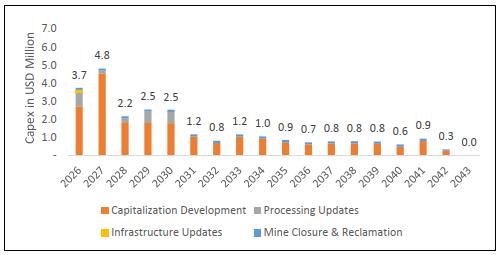
Sources: GC Mine, summarized by SRK
| 21.1.2 | Capitalization Development |
Capitalization development includes the decline expansion/ deepening that is from the currently level -300ASL down to -500ASL; and the level drive, air return raise, UG exploration drilling chamber/ cubbies, and exploration drives, which serve the mine more than one year. The stope preparation drives are classed as Opex.
The decline development is currently undergoing detail design engineering, targeting the Mineral Resources from -350 ASL to -500 ASL. The mine schedule outlines the planned development meters annually, with unit costs derived from development contracts. Figure 21.2 illustrates the projected capitalization development costs over the LOM.
Figure 21.2: Capitalization Development over the LOM
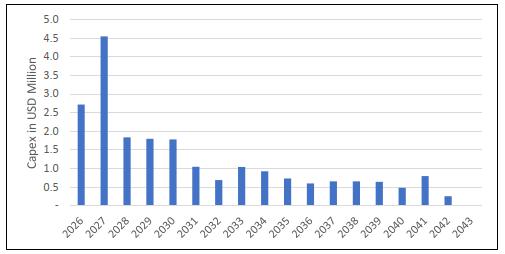
Sources: GC Mine, summarized by SRK
| SRK CONSULTING CHINA LTD. § APR. 20, 2026 § FH/AT | 176 |
Technical Report on Gaocheng Silver-Lead-Zinc Project in Guangdong Province, China
Capital and Operating Costs § FINAL
| 21.1.3 | Processing and Infrastructure Upgrades |
The processing and infrastructure upgrade Capex include the following items, and the details are presented in Table 21.3:
| § | Coarse waste rejection: The implementation of automation to improve waste management and processing efficiency, with an estimated cost of USD761,773 scheduled in 2026 |
| § | Automation: Aiming to integrate advanced automation equipment, such as various components and electrical instruments, into the processing line to enhance operational efficiency, with an estimated cost of USD110,803 in 2026 |
| § | Tin Ore Process Optimization: Optimizing the processing infrastructure and some equipment for the tin ore gravity separation circuit, with an estimated cost of USD41,551 in 2026 |
| § | Detection Automation: The installation of automatic concentration density detection equipment in the grinding and floating circuit, with an estimated cost of USD207,756 for 2027 |
| § | Dense Media Separation: The purchasing of equipment for enhancing ore separation processes. It is planned for 2028 and 2029, with an estimated cost of USD1,246,537 |
| § | Stockyard Rain Shelter: This infrastructure improvement is to protect stockpiled materials from weather-related impacts and is planned to be constructed in 2026 at a cost of USD152,355. |
Table 21.2: Processing and Infrastructure Upgrade Capex
| Item | Unit | LOM Total | 2026 | 2027 | 2028 | 2029 | 2030 |
| Processing | |||||||
| Coarse waste rejection | USD k | 761.8 | 761.8 | - | - | - | - |
| Automation | USD k | 110.8 | - | 110.8 | - | - | - |
| Tin ore process optimization | USD k | 41.6 | - | 41.6 | - | - | - |
| Detection automation | USD k | 207.8 | - | - | 207.8 | - | - |
| Dense media separation | USD k | 1,246.5 | - | - | - | 623.3 | 623.3 |
| Infrastructure | - | - | - | - | - | ||
| Stockyard rain shelter | USD k | 152.4 | 152.4 | - | - | - | - |
Sources: GC Mine, summarized by SRK
| 21.1.4 | Closure & Reclamation Capex |
The closure costs are categorized into reclamation engineering costs, general reclamation expenses, and sustainable mine construction, and detailed in Table 21.4.
| § | Reclamation Engineering Cost: Includes reclamation engineering costs associated with outsourcing and construction |
| § | Reclamation Expense: General expenses related to material, consulting, and reviewing for reclamation |
| § | Sustainable Mine Construction: Costs associated with sustainable mine construction, appearing in 2023. |
| SRK CONSULTING CHINA LTD. § APR. 20, 2026 § FH/AT | 177 |
Technical Report on Gaocheng Silver-Lead-Zinc Project in Guangdong Province, China
Capital and Operating Costs § FINAL
Table 21.3: Closure & Reclamation Capex over Last Three Years
| Item | Unit | Average | 2022 | 2023 | 2024 |
| Reclamation Engineering | USD k | 27.99 | 59.16 | 24.82 | - |
| Reclamation Expense | USD k | 61.46 | 33.39 | 83.12 | 67.88 |
| Sustainable Mine Construction | USD k | 13.50 | - | 21.01 | 19.48 |
| Mine Closure & Reclamation Total | USD k | 102.95 | 92.54 | 128.95 | 87.36 |
| Mine ROM | t | 293,515 | 299,597 | 290,050 | 290,897 |
| Closure Capex Rate | USD/t ROM | 0.35 | 0.31 | 0.44 | 0.30 |
Sources: GC Mine, summarized by SRK
| 21.2 | Operating Costs |
| 21.2.1 | Summary |
The Opex is categorized into mining, processing, backfill, tailings and filtration, S&GA, and CSR. The Opex is forecasted from the historical operation/ production records of the past three years. The unit Opex increases slightly due to the variation of ROM tonnages over the past three years. The forecasted Opex is USD 69.4/ t ROM. Table 21.5 presented the summary of unit costs per last three year and the weighted average parameters. Figure 21.3 illustrates the distribution of each cost center of the Opex. The mining cost is a major part of the Opex.
Table 21.4: Summary of Opex Historical & Forecasted for GC Mine
| Item | Unit | 2023 | 2024 | 2025 | Weighted Average as Forecasted |
| Mining | USD/t ROM | 39.8 | 44.4 | 38.5 | 40.9 |
| Plant | USD/t Feed | 15.8 | 16.5 | 16.8 | 16.4 |
| Backfill | USD/t ROM | 3.1 | 2.9 | 3.1 | 3.1 |
| Tailings filtration | USD/t Feed | 0.5 | 0.3 | 0.4 | 0.4 |
| S&GA | USD/t Feed | 8.3 | 9.0 | 8.5 | 8.6 |
| CSR | USD/t Feed | 0.1 | 0.1 | 0.0 | 0.1 |
| Total cash unit cost | USD/t | 67.6 | 73.2 | 67.3 | 69.4 |
| Mine ROM | kt | 300 | 290 | 291 | |
| Plant Feed | kt | 300 | 290 | 291 |
Sources: GC Mine, summarized by SRK
Notes: Mining and backfill costs are united by mine ROM and the others are united by plant feed.
| SRK CONSULTING CHINA LTD. § APR. 20, 2026 § FH/AT | 178 |
Technical Report on Gaocheng Silver-Lead-Zinc Project in Guangdong Province, China
Capital and Operating Costs § FINAL
Figure 21.3: Pie Chat of Percentage for GC Mine Opex
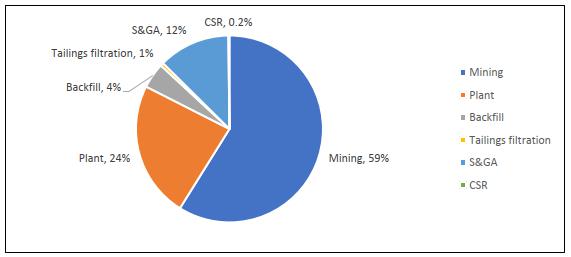
Sources: GC Mine, summarized by SRK
Figure 21.4 shows the total Opex from 2023 to 2025. In SRK’s view, following long-term operation, the Opex against ROM or plant feed has remained restable.
Figure 21.4: Opex for historical three year (in USD k)
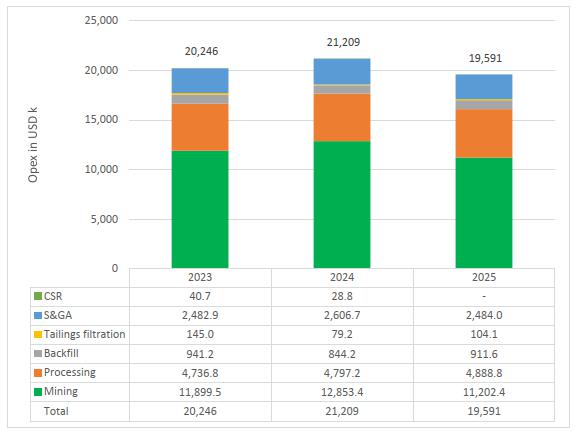
Sources: GC Mine, summarized by SRK
| SRK CONSULTING CHINA LTD. § APR. 20, 2026 § FH/AT | 179 |
Technical Report on Gaocheng Silver-Lead-Zinc Project in Guangdong Province, China
Capital and Operating Costs § FINAL
| 21.2.2 | Mining |
The mining Opex is categorized into contractors for mining and development, materials, labor, power, maintenance, and safety management. It is noted that the contractor costs are presented in RMB.
| § | Mining Contractor |
Costs for contractors of stoping operation are based on annual contracts with agreed unit mining costs. Costs vary for the mining methods; shrinkage, and resuing, depending on mining width (thickness) (Table 21.6). The contract stipulates that the GC Mine supplies the materials.
Table 21.5: Detailed Opex from Mining Contracts
| Mining method | Thickness | Unit | Cost |
| Resuing | ≤ 50cm | RMB/t | 269 |
| Resuing | 50cm<d ≤ 80cm | RMB/t | 247 |
| Resuing | 80cm<d | RMB/t | 235 |
| Cut and Filling | ≤ 50cm | RMB/t | 239 |
| Cut and Filling | 50cm<d ≤ 80cm | RMB/t | 217 |
| Cut and Filling | 80cm<d ≤ 140cm | RMB/t | 170 |
| Cut and Filling | 140cm<d ≤ 180cm | RMB/t | 155 |
| Cut and Filling | 180cm<d | RMB/t | 110 |
| Shrinkage | ≥ 3m | RMB/t | 64.7 |
| Shrinkage | 1.5<d ≤ 3m | RMB/t | 79 |
| Shrinkage | ≤ 1.5m | RMB/t | 106 |
| Short-hole Residual Mining | RMB/t | 46.9 | |
| Stockpiled Ore Handling | RMB/t | 34.7 |
Source: GC Mine
| § | Development Contractor |
The Opex for contractors involved in mine development, such as developing ore passes, raises, drifts, and cross-cuts, are also based on annual contracts with agreed unit development costs (Table 21.7). This Opex is based on the stope development budget from GC mine.
Table 21.6: Detailed Opex from Development Contracts
| Category | Profile / Specification | Dimensions (m) | Unit | Rate |
| Drift | Three-centered Arch | 2.7×2.5 | RMB/m | 1,804.3 |
| 2.5×2.5 | RMB/m | 1,719.7 | ||
| 2.8×2.8 | RMB/m | 2,021.5 | ||
| 2.6×2.6 | RMB/m | 1,803.9 | ||
| 2.4×2.4 | RMB/m | 1,644.2 | ||
| 2.2×2.4 | RMB/m | 1,539.2 | ||
| 2.0×2.2 | RMB/m | 1,458.9 | ||
| 2.0×2.0 | RMB/m | 1,394.4 | ||
| Water Sump | - | RMB/m3 | 239.8 |
| SRK CONSULTING CHINA LTD. § APR. 20, 2026 § FH/AT | 180 |
Technical Report on Gaocheng Silver-Lead-Zinc Project in Guangdong Province, China
Capital and Operating Costs § FINAL
| Category | Profile / Specification | Dimensions (m) | Unit | Rate |
| Incline | Three-centered Arch | 4.2×3.75 | RMB/m | 4,296.50 |
| Raise | Rectangular | 1.2×1.2 | RMB/m | 1,015.4 |
| Rectangular | 1.5×2.0 | RMB/m | 1,956.6 | |
| Rectangular | 1.5×1.8 | RMB/m | 1,533.3 | |
| Rectangular | 1.8×1.8 | RMB/m | 1,672.0 | |
| Rectangular | 2.0×2.0 | RMB/m | 1,923.8 | |
| Circular | 1.2×1.2 | RMB/m | 2,857.3 | |
| Circular | 1.4×1.4 | RMB/m | 3,068.9 | |
| Circular | 3.5×3.5 | RMB/m | 5,287.5 | |
| Raise Access | Three-centered Arch | 1.2×1.8 | RMB/m | 940 |
| 1.4×1.8 | RMB/m | 1,004.00 | ||
| 1.6×1.8 | RMB/m | 1,371.7 | ||
| 1.4×1.8 | RMB/m | 1,280.5 | ||
| Stripping | General Stripping | - | RMB/m3 | 239.8 |
| Decline Stripping | - | RMB/m3 | 254.2 |
Source: GC Mine
| § | Material |
This includes accessories, wire and cable, steel, wood, lubricating oil, and explosive/ blasting materials.
| § | Labor |
This category includes salaries and bonuses, insurance, welfare fees, and subsidies.
| § | Water and Power |
This includes water and electricity consumption during mining operations.
| § | Maintenance and others |
This includes general maintenance and miscellaneous costs.
| § | Safety Management |
This includes PPE, safety training, supplies and the monitoring.
| § | Production Drilling |
This includes the drilling work to increase the confidence in the resource block model.
Table 21.8 below provides the unit mining cost breakdown over past three years and the weighted average of them.
| SRK CONSULTING CHINA LTD. § APR. 20, 2026 § FH/AT | 181 |
Technical Report on Gaocheng Silver-Lead-Zinc Project in Guangdong Province, China
Capital and Operating Costs § FINAL
Table 21.7: Breakdown of Mining Opex (in USD/t ROM)
| Cost Centre | 2023 | 2024 | 2025 | Weighted Average |
| Mining contractor | 12.04 | 15.42 | 15.36 | 14.27 |
| Development contractor | 6.65 | 9.32 | 14.63 | 10.20 |
| Material | 5.91 | 4.08 | 0.83 | 3.60 |
| Labor | 2.00 | 2.68 | 2.56 | 2.41 |
| Power | 1.51 | 2.51 | 1.43 | 1.82 |
| Maintenance & others | 0.17 | 1.22 | 1.45 | 0.95 |
| Safety Management | 4.06 | 1.85 | 1.17 | 2.36 |
| Production Drilling | 7.44 | 7.34 | 1.05 | 5.28 |
| Mining Total | 39.77 | 44.42 | 38.49 | 40.90 |
Sources: GC Mine, summarized by SRK
Notes: Development contractor cost is based on the stope development budget from the GC Mine
| 21.2.3 | Backfill Cost |
The backfill Opex is categorized into materials, labor, power, maintenance, and safety management. Material is the major part which includes cement, backfilling pipes, wires and cables, accessories, lubricant oil, and tools. The breakdown of backfill cost is presented in Table 21.9.
Table 21.8: Breakdown of Backfill Opex (in USD/t ROM)
| Cost Centre | 2023 | 2024 | 2025 | Weighted Average |
| Material | 1.62 | 1.59 | 1.36 | 1.52 |
| Labor | 1.35 | 1.25 | 1.29 | 1.30 |
| Power | 0.07 | 0.07 | 0.07 | 0.07 |
| Maintenance & other | 0.07 | -0.00 | 0.41 | 0.16 |
| Safety Management | 0.01 | 0.01 | - | 0.01 |
| Backfill Total | 3.14 | 2.91 | 3.13 | 3.06 |
Sources: GC Mine, summarized by SRK
| 21.2.4 | Processing |
The processing Opex is categorized into consumables, labor, power, maintenance, safety management, and outsourced manufacturing. The consumables and the labor are the major parts of processing cost.
| § | Consumables |
This includes steel balls, reagents, steel, wires and cables, equipment accessories, lubricant oil, tools, and equipment spare parts.
| § | Labor |
This includes salaries and bonuses, insurance, welfare fees, and subsidies.
| § | Water and Power |
Costs include water and electricity consumption for processing operations.
| SRK CONSULTING CHINA LTD. § APR. 20, 2026 § FH/AT | 182 |
Technical Report on Gaocheng Silver-Lead-Zinc Project in Guangdong Province, China
Capital and Operating Costs § FINAL
| § | Maintenance & Other |
This includes general maintenance and other miscellaneous costs.
| § | Safety Management |
This includes PPE, safety training and supplies.
| § | Outsourced Manufacturing |
This cost, which starts appearing in 2023, covers outsourced processing manufacturing activities.
The breakdown of processing Opex is presented in Table 21.10.
Table 21.9: Breakdown of Processing Opex (in USD/t feed)
| Cost Centre | 2023 | 2024 | 2025 | Weighted Average |
| Consumables | 6.74 | 5.91 | 5.11 | 5.92 |
| Labor | 4.50 | 4.78 | 4.91 | 4.73 |
| Power | 3.95 | 4.64 | 4.13 | 4.24 |
| Maintenance & other | 0.54 | 0.52 | 0.52 | 0.53 |
| Safety Management | 0.07 | 0.08 | 0.11 | 0.09 |
| Outsourced Manufacturing | - | 0.60 | 2.03 | 0.88 |
| Processing Total | 15.81 | 16.54 | 16.81 | 16.39 |
Sources: GC Mine, summarized by SRK
| 21.2.5 | Tailings Filtration |
The tailings filtration Opex is divided into categories: material, labor, power, maintenance, other and safety management. The breakdown of tailings filtration activity is shown in Table 21.11, in which power and material are the largest expenditure components.
Table 21.10: Breakdown of Taillings Filtration Opex (in USD/t feed)
| Cost Center | 2023 | 2024 | 2025 | Weighted Average |
| Material | 0.07 | 0.07 | 0.12 | 0.08 |
| Labor | 0.07 | 0.08 | 0.08 | 0.08 |
| Power | 0.12 | 0.09 | 0.12 | 0.11 |
| Maintenance & other | 0.01 | 0.02 | 0.03 | 0.02 |
| Safety Management | 0.22 | 0.02 | 0.01 | 0.08 |
| Tailings Filtration Total | 0.48 | 0.27 | 0.36 | 0.37 |
Sources: GC Mine, summarized by SRK
| SRK CONSULTING CHINA LTD. § APR. 20, 2026 § FH/AT | 183 |
Technical Report on Gaocheng Silver-Lead-Zinc Project in Guangdong Province, China
Capital and Operating Costs § FINAL
| 21.2.6 | Selling, General and Administrative |
The S&GA Opex is categorized into selling, laboratory, administration, environment, reclamation, insurance, power, service charges, travel and office expenses, and others. The breakdown of S&GA activity is shown in Table 21.12, in which administration cost is the largest expenditure components.
| § | Selling: Opex includes salaries and bonuses, insurance, welfare fees, and subsidies for selling personal and office expenses. |
| § | Laboratory: Opex for laboratory activities began in 2022, including expense for crushing, grinding, flotation, and gravity-separation metallurgical testing. |
| § | Administration: Administrative Opex, including salaries, bonuses, insurance, and welfare fees for management personnel. |
| § | Environment: Opex related to environmental management and compliance. |
| § | Reclamation: Opex for reclamation management. |
| § | Insurance: Opex for disability security fund. |
| § | Power: Opex for water and electricity consumption. |
| § | Service Charge: Service charges related to consulting for consulting, review, and legal matters. |
| § | Travel and Office Expenses: Opex of travel expense, business entertainment expenses, and office-related expenses. |
| § | Others: Miscellaneous Opex. |
Table 21.11: Breakdown of S&GA Opex (in USD/t feed)
| Cost Centre | 2023 | 2024 | 2025 | Weighted Average |
| Selling | 0.03 | 0.11 | 0.11 | 0.08 |
| Laboratory | 0.23 | 0.25 | 0.21 | 0.23 |
| Administration | 5.22 | 5.00 | 5.26 | 5.16 |
| Environment | 0.20 | 0.16 | 0.14 | 0.17 |
| Reclamation | 0.15 | 0.14 | 0.12 | 0.13 |
| Insurance | 0.04 | 0.14 | -0.04 | 0.05 |
| Power | 0.25 | 0.33 | 0.28 | 0.29 |
| Service charge | 1.06 | 1.52 | 1.01 | 1.20 |
| Travel and office expenses | 0.85 | 1.16 | 0.86 | 0.96 |
| Others | 0.26 | 0.19 | 0.60 | 0.35 |
| S&GA Total | 8.29 | 8.99 | 8.54 | 8.60 |
Sources: GC Mine, summarized by SRK
| 21.2.7 | Corporate Social Responsibility Opex |
CSR Opex is associated with initiatives aimed at benefiting the local community and ensuring responsible mining practices, such as charity association, donations, and foundation. The average of past three years is USD39 thousand per year, and the unit cost is about USD0.13/t plant feed.
| SRK CONSULTING CHINA LTD. § APR. 20, 2026 § FH/AT | 184 |
Technical Report on Gaocheng Silver-Lead-Zinc Project in Guangdong Province, China
Economic Analysis § FINAL
| 22 | Economic Analysis |
The economic analysis presented in this section is based only on the results of the technical review provided above and some key assumptions. It is provided for technical evaluation and Mineral Reserve estimation purposes only.
The economic analysis was conducted using conventional DCF techniques. It is important to note that the purpose of this analysis is solely to demonstrate the economic viability of the GC Mine. The derived NPVs do not indicate the fair market values or the profitability of the Project. The estimated cash flows and NPVs were presented on an after-tax basis, and financing costs were not considered.
The NPV was determined from the project's cash flow using an 8% discount rate as the base case. Since the GC Mine is ongoing, there is no Internal Rate of Return (“IRR”) or payback period due to the absence of initial Capex. Additionally, a sensitivity analysis was performed to examine the effects of changes in Capex, Opex, and commodity prices.
| 22.1 | Principal Assumptions |
The cash flow estimate includes only the revenue, costs, taxes, and other factors directly associated with the GC Mine. The assumptions are as follows:
| § | The ROM and finial products of the GC Mine, which are lead and zinc concentrates, are based on the LOM schedule. |
| § | The local currency for GC Mine is RMB, while USD are used for technical-economic analysis. The exchange rate is set statically at USD1 = RMB7.12, based on the reference value at the effective date. |
| § | Annual gross revenue is calculated by applying the forecasted metal prices and payable metal percentages from contracts to the annual recovered metal for each operating year. |
| § | SRK does not consider future inflation nor currency and cost fluctuations; the cost remains constant over the LOM. |
| § | Financing is assumed to be on a 100% equity basis; no debt or related financing costs have been included in the technical-economic analysis. |
| § | Corporate obligations and financing costs are not considered. |
| § | Exploration Capex, which is aimed at discovering additional Mineral Resources that are outside the Mineral Reserves estimates, is not considered during this analysis. |
| § | No salvage value has been included in the technical-economic analysis. |
| § | Working capital will be fully recovered at the end of LOM. |
| § | The reference date or effective date is December 31, 2025. |
| 22.1.1 | LOM Physical |
The mine production and key technical inputs parameters are described in the previous section. The summary of the key physical assumptions is presented in Table 22.1.
| SRK CONSULTING CHINA LTD. § APR. 20, 2026 § FH/AT | 185 |
Technical Report on Gaocheng Silver-Lead-Zinc Project in Guangdong Province, China
Economic Analysis § FINAL
Table 22.1: LOM Physical Inputs for Economic-Analysis
| Item | Unit | LOM Total or Average |
| Physical | ||
| Mineral Reserve | kt | 6,186 |
| Ag Grade | g/t | 62.67 |
| Pb Grade | % | 0.91 |
| Zn Grade | % | 2.23 |
| Capacity (average over LOM) | ktpa | 369 |
| Life of Mine | a | 18 |
| Processing | ||
| Feed tonnes | kt | 5,444 |
| Ag Grade | g/t | 68.36 |
| Pb Grade | % | 0.99 |
| Zn Grade | % | 2.43 |
| Pb Concentrate | ||
| Ag Recovery Rate | % | 59.28 |
| Pb Recovery Rate | % | 89.86 |
| Pb Grade in Conc. | % | 44.85 |
| Zn Concentrate | ||
| Ag Recovery Rate | % | 23.26 |
| Zn Recovery Rate | % | 89.85 |
| Zn Grade in Conc. | % | 44.53 |
Sources: LOM Physical Inputs for Economic Analysis
| 22.1.2 | Pricing Assumptions |
Table 22.2 shows the prices for Silver, Lead, and Zinc. These commodity prices are dynamic and are derived from Consensus Market Forecasts (CMF), published by Consensus Economics Inc., to which SRK subscribes annually. The base pricing model applies data as of December 15, 2025. During the preparation of the technical report by SRK, the silver price increased significantly. SRK also referred to the price forecast released by CMF in March 2026, in which the silver prices for 2026 and 2027 reflect the near-term changes in early 2026. SVM ultimately recommended that, in the technical-economic analysis, the updated price forecast be used for the silver price in the first three years. Since the long-term price shows little difference from the December forecast for other metals price, the December forecast prices should continue to be adopted.
Table 22.2: Pricing Assumptions for Economic Analysis
| Commodity | Units | 2026 | 2027 | 2028 | 2029 | 2030 | 2031 | LTP |
| Silver | USD/oz | 72.75 | 66.50 | 42.00 | 40.00 | 37.50 | 32.50 | 32.50 |
| Lead | USD/t | 2,000 | 1,950 | 1,950 | 1,900 | 1,950 | 2,000 | 2,000 |
| USc/lb | 91 | 88 | 88 | 86 | 88 | 91 | 91 | |
| Zinc | USD/t | 2,800 | 2,650 | 2,600 | 2,600 | 2,650 | 2,800 | 2,800 |
| USc/lb | 127 | 120 | 118 | 118 | 120 | 127 | 127 |
Source: CMF, 15 December 2025; CMF, 16 March 2026
| SRK CONSULTING CHINA LTD. § APR. 20, 2026 § FH/AT | 186 |
Technical Report on Gaocheng Silver-Lead-Zinc Project in Guangdong Province, China
Economic Analysis § FINAL
| 22.1.3 | Tax and Royalties |
The tax, government charges and royalties for GC Mine are mainly CIT, resource tax, which is in term of royalties, and value added tax. The small scales tax such as stamp duty, are included in S&GA costs.
| § | Corporate Income Tax: |
The standard corporate tax rate in China is 25% of taxable income. However, SVM has informed SRK that, as a Hi-New Tech enterprise, the subsidiary entities operating the GC Mine benefit from a reduced enterprise income tax rate of 15% for a three year term, which is renewable.
| § | Resource Tax (Royalties): |
| – | 3% of the net sales from lead (Pb) and zinc (Zn) mineral products |
| – | 2% of the net sales from silver (Ag) mineral products |
| – | No resource tax for gold (Au) and copper (Cu), as they are considered by-products |
| § | Value Added Tax: |
In China, industrial minerals prices include a VAT, which is 13% of sales, excluding revenue from gold (Au) if any. GC Mine is allowed to deduct the VAT paid for the production costs. The final VAT payable will be the basis for paying other surtaxes and fees. SRK used the following simplified formulas to calculate the VAT payable:
| – | VAT received = total sales revenue/(1+13%) × 13%; |
| – | VAT paid = VAT received × 43%; and |
| – | VAT payable = VAT received – VAT paid. |
| § | Surtax/Surcharge |
| – | City construction fee: 5% of VAT Payable |
| – | Education surtax: 7% of VAT Payable |
| 22.1.4 | Depreciation |
The capital and sustaining expenditures, including development costs, have been depreciated on a unit production basis over the LOM. The assumed depreciation follows the straight-line method over a period of ten years.
| 22.1.5 | Working Capital |
Working capital is the capital needed to fund operations before revenue is received from the finished product. Working Capital requirements are estimated based on industry benchmarks. Both Debtor Days and Creditor Days are set at 30 days. Over the project's life, the working capital nets to zero.
| 22.2 | DCF Projection |
The key economic results from the technical-economic model are shown in Table 22.3.
| SRK CONSULTING CHINA LTD. § APR. 20, 2026 § FH/AT | 187 |
Technical Report on Gaocheng Silver-Lead-Zinc Project in Guangdong Province, China
Economic Analysis § FINAL
Table 22.3: LOM Key Economic Results
| Item | Unit | Value |
| Production Start date | Date | 1-Jan-26 |
| Valuation date | Date | 1-Jul-26 |
| Discount rate | USDm | 8.0% |
| Net Present Value, pre-tax @ 8% discount rate | USDm | 120.8 |
| Net Present Value, post-tax @ 8% discount rate | USDm | 101.4 |
| IRR | % | N/A |
| Payback | in year | N/A |
Sources: SRK
The projection for the GC Mine shows a positive economic prospect. At a discount rate of 8%, the NPV of the Project is USD 101.4 million. The sensitivity of NPV against discount rate is presented in Figure 22.2. The annual cash flows are presented graphically in Figure 22.1 and in tabular form in Table 22.4.
Figure 22.1: Cash Flow Profile
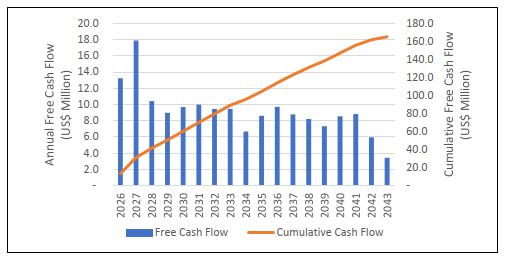
Sources: SRK
Figure 22.2: GC Mine NPV versus Discount Rate
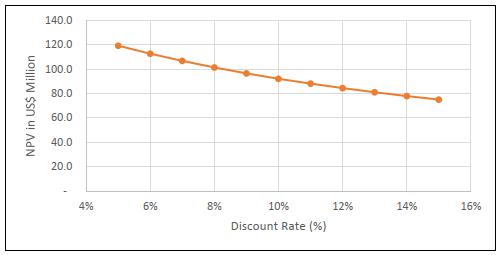
Sources: SRK
| SRK CONSULTING CHINA LTD. § APR. 20, 2026 § FH/AT | 188 |
Technical Report on Gaocheng Silver-Lead-Zinc Project in Guangdong Province, China
Economic Analysis § FINAL
Table 22.4: Cash Flow Forecast
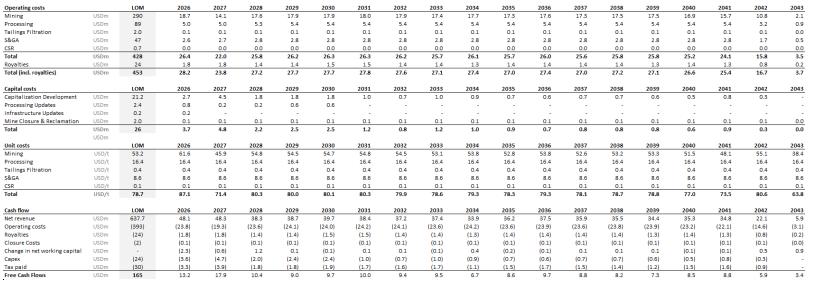
Sources: SRK
| SRK CONSULTING CHINA LTD. § APR. 20, 2026 § FH/AT | 189 |
Technical Report on Gaocheng Silver-Lead-Zinc Project in Guangdong Province, China
Economic Analysis § FINAL
| 22.3 | Sensitivity Analysis |
SRK conducted a single-factor sensitivity analysis for the GC Mine to determine which factors significantly impact its economics when considered independently. The analysis focused on metal prices, Capex, and Opex, each tested within a ±30% range. The results showed that the Project is most sensitive to changes in metal prices and least sensitive to variations in Capex. Results of the sensitivity tests are presented in Table 22.5 and Figure 22.3.
Table 22.5: Sensitivity Analysis Result (@8% Discount Rate)
| Variance | Price | Opex | Capex |
| NPV @ 8% annual discount rate (USD Million) | |||
| 30% | 200 | 38 | 96 |
| 25% | 184 | 49 | 97 |
| 20% | 167 | 59 | 98 |
| 15% | 151 | 70 | 99 |
| 10% | 134 | 80 | 100 |
| 5% | 118 | 91 | 101 |
| 0% | 101 | 101 | 101 |
| -5% | 85 | 112 | 102 |
| -10% | 68 | 122 | 103 |
| -15% | 52 | 133 | 104 |
| -20% | 36 | 143 | 105 |
| -25% | 19 | 154 | 106 |
| -30% | 2 | 164 | 106 |
Figure 22.3: Sensitivity Spider Chart (8% Discount Rate)
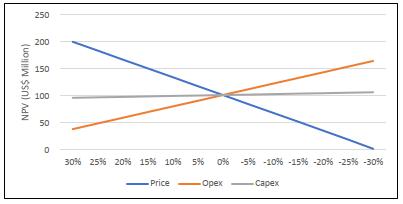
It can be seen that the changes in prices have the greatest impact on the GC Mine’s NPV, while Opex and Capex have smaller effects.
To clarify the effects of prices on the GC Mine’s NPV, SRK estimated that the break-even price (NPV=0, at 8% discount rate) is around a change of -30.5% from the base scenario prices used in the model, i.e. if the price drops to about 69.5% of the forecasting price, the GC Mine NPV will become negative.
| SRK CONSULTING CHINA LTD. § APR. 20, 2026 § FH/AT | 190 |
Technical Report on Gaocheng Silver-Lead-Zinc Project in Guangdong Province, China
Adjacent Properties § FINAL
| 23 | Adjacent Properties |
The GC Mine is located within the Daganshan mineralization field featuring tungsten (W), tin (Sn), gold (Au), silver (Ag), lead (Pb), and zinc (Zn) mineralization. The field is characterized by five “nested” zonations. From the centre outward, the mineralization zones are W (+Sn, Mo, and bismuth (“Bi”)), Sn, Sn-Pb-Zn, Ag-Pb-Zn, and Au (the gold zone is not shown in Figure 23.1). The following are a list of deposits that have been discovered and mined within the field:
| § | Dajinshan Tungsten Deposit. The deposit is located in the centre of the Daganshan field. |
| § | Jiuquling Tin Deposit. The deposit is a quartz vein type and surrounds the tungsten mineralization zone. It is reported that the Jiuquling deposit has been developed and is in production, however detailed information such as grade, deposit size, tonnage, metal recovery, etc. are not available at this time. |
| § | Jianshan Tin-Lead-Zinc-Silver Deposit. The deposit is located in the tin-lead-zinc mineralization zone. It is a sedimentary type of deposit. |
| § | Yunfu Pyrite Deposit. The Yunfu pyrite mine is an open pit mine located 4.5 km north-west of the city of Yunfu. Mine production began in 1988. |
Figure 23.1 illustrates the general geological understanding of properties adjacent to the GC Mine. SRK is not aware of any immediate adjacent properties that would directly affect the interpretation or evaluation of the mineralization and anomalies found with the GC Mine property.
Figure 23.1: Zonation of Mineralization in the Daganshan Mineralization Field
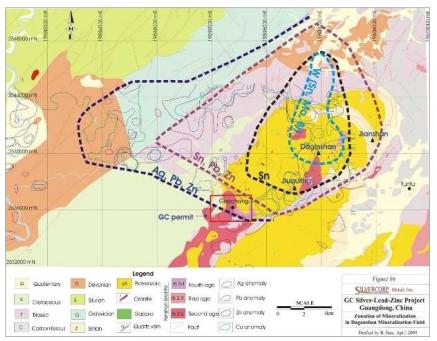
Sources: GC Mine
| SRK CONSULTING CHINA LTD. § APR. 20, 2026 § FH/AT | 191 |
Technical Report on Gaocheng Silver-Lead-Zinc Project in Guangdong Province, China
Other Relevant Data and Information § FINAL
| 24 | Other Relevant Data and Information |
Mining is a relatively high-risk industry. In general, the risk may decrease as a project moves from exploration to development and through to the production stage. The GC Mine is operational but still has risks existing in different areas. SRK considered various technical aspects which may affect the feasibility and future cash flow of the project and conducted a qualitative risk analysis, using the risk assessment mythology (Table 24.1), which has been summarised in Table 24.2. In this risk analysis, various risk sources/ issues have been assessed for Likelihood and Consequence and then a Risk Rating has been assigned. The qualitative risk analysis uses the following definitions for likelihood and consequence:
Risks have been classified from major to minor, defined as follows:
| § | Major risk: The factor poses an immediate danger of a failure which, if uncorrected, will have a material effect (>15% to 20%) on the project cashflow and performance and could potentially lead to project failure. |
| § | Moderate risk: The factor, if uncorrected, could have a significant effect (10% to 15–20%) on the project cashflow and performance unless mitigated by some corrective action. |
| § | Minor risk: The factor, if uncorrected, will have little or no effect (<10%) on project cashflow and performance. |
In addition to the risk factor, the likelihood of risk must also be considered. Likelihood of occurrence within a seven year timeframe can be considered as:
| § | likely: will probably occur. |
| § | possible: may occur. |
| § | unlikely: unlikely to occur. |
Table 24.1: Risk Assessment Matrix
| Likelihood | Consequence | ||
| Minor | Moderate | Major | |
| Likely | Medium | High | High |
| Possible | Low | Medium | High |
| Unlikely | Low | Low | Medium |
The results of the risk assessment rating are presented in Table 24.2. The rating of the risks is presented before implementation of control recommendations.
| SRK CONSULTING CHINA LTD. § APR. 20, 2026 § FH/AT | 192 |
Technical Report on Gaocheng Silver-Lead-Zinc Project in Guangdong Province, China
Other Relevant Data and Information § FINAL
Table 24.2: Project Risk Assessment
| Risk | Description | Control Recommendations | Likelihood | Consequence | Rating |
| Mineral Resource and Mineral Reserve | |||||
| Biased chip sampling | Lower ore grade than estimated in the Mineral Resource model. | Improve the chip sampling procedure, and implement diamond saw cut channels | Possible | Minor | Low |
| Inaccurate grade estimates | Wide spaced sampling may result in incorrect grade estimates in Indicated and Inferred Mineral Resource categories | Ensure adequate density of drilling ahead of planned mining | Possible | Moderate | Medium |
| Lack of Measured + Indicated Mineral Resources for Mineral Reserve conversion | Insufficient high-category Mineral Resources restricts Mineral Reserve supplement, possibly mismatching production plans, affecting stable mining, and even shortening the mine life ahead of the LOM plan. | Strengthen geological exploration to discover or upgrade Mineral Resources classification and supplement the Mineral Reserve conversion pool. | Unlikely | Moderate | Low |
| Mining | |||||
| Production plan | Significant Production Shortfalls due to the insufficient labor or equipment | Ensure that contractor can fulfil the obligations to meet the production plan and resolve issues that could cause production delays. | Possible | Moderate | Medium |
| Production plan | The over output than the mining permit leading to financial penalties or shutdown | Ensure the pre-negotiation with regulators on the issue and get the temporary permission. | Possible | Minor | Low |
| Geotechnical | Significant Geological Structure leading production shutdown or safety issues | Ensure the safety monitoring procedure executed and the technical review the supporting plan for the geotechnically unfavourite location. | Unlikely | Moderate | Low |
| Hydrogeological | More water in-flow than expectation leading to underground flooding, making production shutdown or production shortfalls | Monitoring, and maintain the dewater facilities. | Unlikely | Minor | Low |
| Waste rock management | Inadequate space for waste rock dumping or the unreliable on selling waste rock contracting | Pre-negotiation with the contractors with the long-term agreements and find more acquiring sources, a backup waste dump should be development when the on selling source is unavailable, considering the feasibility of rock fill | Possible | Moderate | Medium |
| Stockpile management | Inadequate space for ore stockpile. | Good planning of the ROM and plant feed balance or stockpiled the broken ore in stopes | Unlikely | Minor | Low |
| SRK CONSULTING CHINA LTD. § APR. 20, 2026 § FH/AT | 193 |
Technical Report on Gaocheng Silver-Lead-Zinc Project in Guangdong Province, China
Other Relevant Data and Information § FINAL
| Risk | Description | Control Recommendations | Likelihood | Consequence | Rating |
| Equipment shortage | Insufficient quantity of production equipment as a result of unstable total material movement. | Ensure that the amount of equipment that contractors provide is flexible and can meet the production plan. | Possible | Minor | Low |
| Processing | |||||
| Unable to achieve the anticipated performance of the XRT intelligent sorting, resulting in an over-estimate of metals recoveries | The test of XRT intelligent sorting achieved 41.8% of waste reject rate and metal loss of 6.43% (Pb+Zn) with waste grade of 0.33% (Pb+Zn). The installed XRT intelligent sorting facility performed poorer than the test. In the first quarter of 2024, the waste reject rate is 23.1% with the waste grade of 0.81% (Pb+Zn) and metal loss of 11.42% (Pb+Zn). The high metal loss will cause the total metal recovery decrease. | Carry out more in line tests on adjusting the operational parameters of the XRT intelligent sorter to gradually improve the waste reject rate and deduce the metals losses. | Possible | Moderate | Medium |
| The metals recovery decreases due to the change of the properties of plant feed ore. | The plant feed materials come from multiple ore bodies, and the ore property changes from different ore bodies. The changes will drive the adjustment of flotation parameters to keep the metals recovery. If the adjustment is not timely, the metals recovery will fall. | Continually conduct flotation tests on different ore bodies, directing the operation of the processing plant. | Possible | Minor | Low |
| Infrastructure | |||||
| Power supply | Lack of power supply in heavy load season, leading to production unstable. | Pre-negotiation with the supplier and get the response plan. | Unlikely | Minor | Low |
| TSF | |||||
| Dam management | Dam failure leading tailings leak out. | Ensure the monitoring procedure executed and the reviewed. | Unlikely | Major | Medium |
| Lack of TSF volume capacity leading LOM failure | The insufficient TSF capacity will cause the generated tailings to exceed the TSF’s remaining storage limit before the scheduled LOM, forcing the mine to suspend production in advance and resulting in LOM failure. | Conduct feasibility study on TSF expansion or design a second TSF timely to increase tailings storage capacity matching the planned LOM. | Unlikely | Major | Medium |
| Environment and Social | |||||
| Land disturbance and river diversion may result in habitat loss and biodiversity decline | The landform and topography in the project’s area is changed by mining, waste rock and tailings dumping, haul roads, office buildings and dormitories, and other facilities. River diversion will change the original habitat environment of aquatic organisms, especially the benthic animals. | Conduct timely reclamation and biodiversity monitoring. | Possible | Minor | Low |
| SRK CONSULTING CHINA LTD. § APR. 20, 2026 § FH/AT | 194 |
Technical Report on Gaocheng Silver-Lead-Zinc Project in Guangdong Province, China
Other Relevant Data and Information § FINAL
| Risk | Description | Control Recommendations | Likelihood | Consequence | Rating |
| Water abstraction, surface water and groundwater pollution due to the mining and processing activities | Indiscriminate discharge of untreated production and domestic wastewater will have negative impacts on surface and groundwater. The mining activities may lead to the change of the groundwater table. | Carry out water quality monitoring upstream and downstream of the project area (including the TSF), and also any site water discharges. Water discharge should follow Chinese legal requirements. | Possible | Moderate | Medium |
| ARD from waste rock and tailings | No geochemical characterization of waste rocks/ tailings or ARD assessment has been conducted. ARD has the potential to introduce acidity and dissolved metals into water, which can be harmful to surface and groundwater. | Conduct geochemical characterization of waste rocks/ tailings to assess ARD risk and implement mitigation measures if required. | Possible | Moderate | Medium |
| Social impact and community engagement | The lack of participation of stakeholders, especially local communities, in project development can lead to a range of social impacts. | Public consultation and disclosure plan is recommended to ensure ongoing community engagement and a resettle action plan is suggested to manage land acquisition related impacts if required. | Unlikely | Moderate | Low |
| Capex and Opex | |||||
| Management plan | Poor mine management plan leading lack of cash resulting in the Capex investment delay to impact production | Conduct timely budget and regularly review the budget. | Unlikely | Moderate | Low |
| Capex increases | Poor plan or budget leading the Capex increases significantly impact the operating performance. | Regularly review the plan and budget, monitoring the Capex items progress, change the plan and budget on time based on the project management plan. | Possible | Minor | Low |
| Opex under forecasted | Opex increased significantly leading the failure of operation or impact the operating performance. | Monitoring the budget on time and pre-negotiation with contractors/ supplier to a long-term agreements. | Unlikely | Moderate | Low |
Source: SRK
| SRK CONSULTING CHINA LTD. § APR. 20, 2026 § FH/AT | 195 |
Technical Report on Gaocheng Silver-Lead-Zinc Project in Guangdong Province, China
Interpretation and Conclusions § FINAL
| 25 | Interpretation and Conclusions |
| 25.1 | Geology |
The GC Mine is located at the intersection between the Wuchuan-Sihui Deep Fault zone and Daganshan Arc-ring structural zone. It is situated in the south-west part of the Daganshan uplift. Structures developed in the area are mainly the NWW-EW striking Gaocheng Fault zone, the NE striking Baimei Fault zone, and the Songgui Fault zone.
Mineralization at the GC Mine is primarily hosted within a WNW-ENE trending, 4.8 km long and 2 km wide fault zone. This zone encompasses numerous veins, with the more common WNW veins generally striking between 90° and 150° and dipping between 55° to sub-vertical. The average thickness of the WNW-ENE veins is about 0.8 m. There are also east-west striking veins that typically strike 50° to 130° and dip between 65° and sub-vertical to the SE and SSW. The average thickness is around 0.8 m.
The dominant sulfide mineral is pyrite, and other constituents are a few percent of sphalerite, galena, pyrrhotite, arsenopyrite, magnetite, and less than one percent of chalcopyrite and cassiterite. Gangue minerals include chlorite, quartz, fluorite, feldspar, mica, and hornblende, with a small or trace amount of kaolinite, tremolite, actinolite, chalcedony, garnet, zoisite, apatite, and tourmaline.
Alteration minerals associated with the GC Mine vein systems include quartz, sericite, pyrite, and chlorite, together with clay minerals and limonite. Silicification commonly occurs near the centre of the veins. Chlorite and sericite occur near and slightly beyond the vein margins.
The poly-metallic mineralization of the GC deposit belongs to the mesothermal vein infill style of deposit.
| 25.2 | Data verification |
SRK conducted the site inspections to the GC Mine from 23 to 26 April in 2024, undertook a site inspection of the project area, visited the drill core store/ core tray storage, site sample preparation laboratory and reviewed the mineralization, tunnel sampling procedure during the underground visit to understand the company’s protocols and procedures related to exploration management, and took the data entry check and assay validation.
The data verification shows reasonable analytical accuracy and precision. The QP considers the GC Mine Mineral Resource database acceptable for Mineral Resource estimation.
| 25.3 | Mineral Resource Estimation |
The database, estimation domains of GC Mine was completed by a SVM Resource Geologist. Mr Huaixiang (Hubert) Li (MAIG), Senior Geologist and Ms Yanfang Zhao, Principal Geologists (MAIG), both full-time employees of SRK have reviewed the database, estimation domains and were satisfied that they comply with reasonable industry practice. SRK has generated the block models, performed the grade estimation and prepared the Mineral Resource estimate.
The estimates are based on drilling samples and underground samples information available up to December 2025. With respect to drilling and underground sample information available for the March 2024 Mineral Resource estimates, SRK believes the current drilling and channel sampling information is sufficiently reliable to interpret with confidence the boundaries for GC deposits and that the assay data is sufficiently reliable to support Mineral Resource estimation.
| SRK CONSULTING CHINA LTD. § APR. 20, 2026 § FH/AT | 196 |
Technical Report on Gaocheng Silver-Lead-Zinc Project in Guangdong Province, China
Interpretation and Conclusions § FINAL
| 25.4 | Mining Method |
The mine is designed as an underground operation developed by a hybrid access of declines and shaft, initially in two Phases, targeting the Mineral Resources above -300ASL. A third Phase is currently being designed, with the access method being considered as decline access and the relayed air return raises.
The mining method employed by the GC Mine were traditional shrinkage and resuing stoping methods, previously to 2021. OCAF method has been introduced as the backfill plant was commissioned.
The ROM material is mined/ drawn from the stope or waste excavated from development heading and loaded into 0.7 m3 rail cars by LHD from either cross-cut draw points or development headings directly. The rail cars are moved by electric locomotives along the level drive (footwall drive) to the shaft, then hoisted two at a time in the shaft cage (2 deck) to surface. The material mined near decline system, underground trucks are loaded at the stope draw point equipped with vibration feeder at the bottom of the ore pass, which is fed from upper level by rail cars or LHD directly.
The underground infrastructure, including water supplier and dewatering system, hoisting system, ventilation, power supply, compressed air supply, and so on are well constructed for the first two Phases of mining.
The GC Mine operates mainly using contractors for mine development, production, ore transportation, and exploration. GC Mine provides its own management, technical services, and supervisory staff to manage the mine operations.
All mobile equipment and some minor fixed equipment are provided by the mining contractor.
The mine is operating at industrial good practice and with a reasonable perspective feasible extraction of the eligible Mineral Resources.
Starting in 2025, the GC Mine commenced operation of a pre-sorting system on run-of-mine ore.
The GC Mine could be scheduled for more than 25 years based on eligible Measured and Indicated categories Mineral Resources. After accounting for the tailings used in backfilling, total tailings generation, and the remaining TSF storage capacity, the mine schedule has been shortened to 18 years to match the mine’s TSF remaining capacity. SRK is of the view that the project’s Mineral Resources present an opportunity to extend mine life; however, a TSF expansion study or the design of a second TSF will be required at an appropriate stage.
| 25.5 | Recovery Method |
The production process and operating parameters of the GC processing plant are suitable for the ore properties of the GC Mine. The historical performance shows that the targets of producing commercial lead concentrate and zinc concentrate have been achieved, and the recovery rates of silver, lead and zinc have also reached the design value.
| SRK CONSULTING CHINA LTD. § APR. 20, 2026 § FH/AT | 197 |
Technical Report on Gaocheng Silver-Lead-Zinc Project in Guangdong Province, China
Interpretation and Conclusions § FINAL
The new intelligent pre-sorting system (XRT intelligent sorting) built in 2023 replaces the hand-sorting and is still in the process of continuous optimization. Intelligent pre-sorting can improve the head grade for grinding, which is conducive to the processing utilization of low-grade ore.
The crushing system operates during the low cost electricity period, which is conducive to reducing crushing costs. The grinding and floating system are two identical independent series, and the processing capacity of a single series is 900 to 950 tpd, which can fully reach the designed processing capacity of 1,600 tpd. The two grinding and floating circuits has the flexibly to adapt to changes in mining ore supply.
The GC processing plant is built on a steep hillside, which can make full use of gravity to convey ore pulp, and the ROM bin is located near the main shaft, making the material conveying/ transportation costs at a low level. The layout of the GC processing plant is reasonable with good management, and the ancillary facilities are adequate.
The lead concentrate contains 2% to 3% of copper and about 6% of zinc, it is recommended to carry out flotation test for the lead concentrate to separate copper and reduce zinc, including re-grinding flotation test, in order to produce copper concentrate, improve the grade of lead concentrate and increase the recovery rate of zinc.
| 25.6 | Environmental Studies, Permitting, and Social or Community Impact |
GC Mine has obtained the main environmental protection-related permits required for operation, including the safety production permit, water use permit, and site discharge permit. An EIA report for the GC Mine was prepared by Guangdong Heli Engineering Survey Institute in March 2020. Guangdong Province Environmental Protection Bureau issued aforementioned EIA approval on June 13, 2010. The EIA report covers the main production facilities including mine site, processing plant and TSF.
| 25.7 | Capital and Operating Costs |
Records of Capex and Opex have been provided to SRK for review.
The associated Capex for the depth extension (third Phase) development are estimated by the GC Mine. The other sustainable Capex such as mine closure, facilities upgrades and/ or capital maintenance are also estimated. The Capex is forecasted as about USD 26 million over the LOM.
The GC Mine has a relative stable operation which addresses the Opex forecasting via their historical production records. The Opex is forecasted from the historical operation records of the past three years, which is USD 69.4 per tonne.
| 25.8 | Economic Analysis |
The NPVs at a discount rate of 8% are about USD 101.4 million These positive NPVs provide an indication that it is economically viable for the GC Mine to report Mineral Reserves.
| SRK CONSULTING CHINA LTD. § APR. 20, 2026 § FH/AT | 198 |
Technical Report on Gaocheng Silver-Lead-Zinc Project in Guangdong Province, China
Recommendations § FINAL
| 26 | Recommendations |
As reviewed by SRK from the geology, exploration, data management and Mineral Resource estimation, the QP recommendations for the GC Mine are indicated below:
| § | Regarding the sample database and QA/QC samples, SRK recommends ensuring that all records, including drillhole and channel samples, are assigned a consistent year between the collar and assay files. This will help reduce reporting discrepancies |
| § | Additional bulk density measurements should be conducted on representative samples with varying base metal and pyrite content |
| § | Bulk density measurements should also be taken from samples of the surrounding waste material |
| § | During the 2024 site underground channel sampling observations, only the larger blocks on the plastic sheet were taken, all the fines were discarded, and the sampling was biased against the hanging wall and footwall units, with a larger proportion of the mineralization zone chipped. Although SRK recognises that channel sampling is challenging due to the variable hardness of the rock units and uneven surface for sampling, SRK recommends that the chip sampling can be improved using a diamond saw to cut a channel for the chipping, which will also reduce the volume of sample and allow the full sample of coarse and fine material to be collected. |
Based on the site visit and review of available technical information, and Mineral Reserve estimates, the QP recommendations for the GC mine are indicated below:
| § | Conducting technical studies on long-hole stoping method for the relative wider veins, and well recording the test stope data, for the improvement of mining efficiency and cost reduction. |
| § | Conducting reconciliation on not only Mineral Resources versus ROM processed feed, but also on the mineral flows, from the Mineral Resource model, grade control results, mining, then processing. |
| § | Conducting reconciliation on exploration investment versus Mineral Resources updates to demonstrate the Capex efficiency. |
| § | Considering utilising commercial mine planning software for mine scheduling, more efficient for modifying. |
| § | As part of ongoing operations at the mine, geotechnical and ground support aspects should be continuously reviewed in a formal and recordable manner, bearing in mind previous recommendations, local and mine-wide operating experience in all rock types encountered, any advizable data collection, and looking to future mining development. |
| § | Conduct a TSF expansion study or the design of a second TSF for the future LOM expansion. |
| SRK CONSULTING CHINA LTD. § APR. 20, 2026 § FH/AT | 199 |
Technical Report on Gaocheng Silver-Lead-Zinc Project in Guangdong Province, China
References § FINAL
| 27 | References |
| § | NI 43-101 Technical Report Update on the Gaocheng Ag-Zn-Pb Project in Guangdong Province, People’s Republic of China, AMC Mining Consultants (Canada) Ltd. October 2021 |
| § | Processing Test Report on the Comprehensive Recovery of Lead, Zinc, Silver, Tin and Sulphur for GC Lead-Zinc Mine, Hunan Research Institute for Nonferrous Metals, May 2009 |
| § | Preliminary Design of Mining and Processing of GC Lead-Zinc Mine in Yun’an District, Guangdong Province, Guangdong Metallurgical & Architectural Design Institute, April 2011 |
| § | GC LOM 43-101(2026).xlsm, GC Mine |
| § | GC LOM 43-101 Backfill plan.xlsm, GC Mine |
| § | Production records, from FY 2020 to 2025, in xlsx format, GC Mine |
| § | Costs records, from 2022 to 2025, in xlsx format, GC Mine |
| SRK CONSULTING CHINA LTD. § APR. 20, 2026 § FH/AT | 200 |
Technical Report on Gaocheng Silver-Lead-Zinc Project in Guangdong Province, China
Closure § FINAL
Closure
This report, Technical Report on Gaocheng Silver-Lead-Zinc Project in Guangdong Province, China, was prepared by
Falong Hu Principal Consultant (Mining) | |
and reviewed by
Alexander Thin Principal Consultant (Project Evaluation and Mining) | |
All data used as source material plus the text, tables, figures, and attachments of this document have been reviewed and prepared in accordance with generally accepted professional engineering and environmental practices.
| SRK CONSULTING CHINA LTD. § APR. 20, 2026 § FH/AT | 201 |
Appendix A Mining Permit
The copy of the Mining Permit
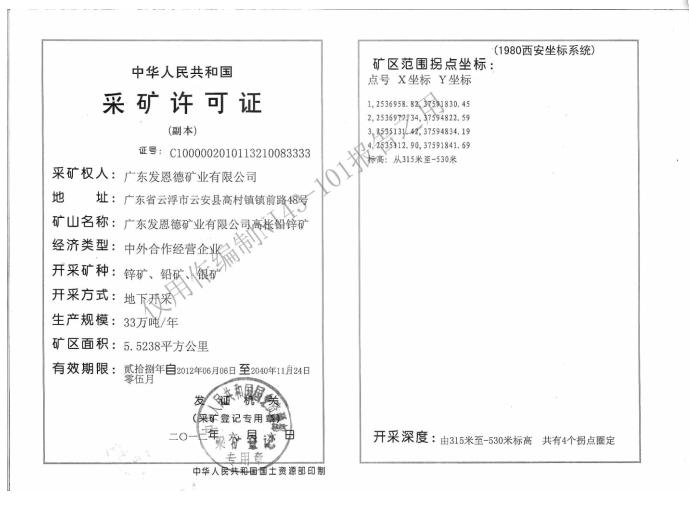
Appendix B Business License
The copy of the Business License
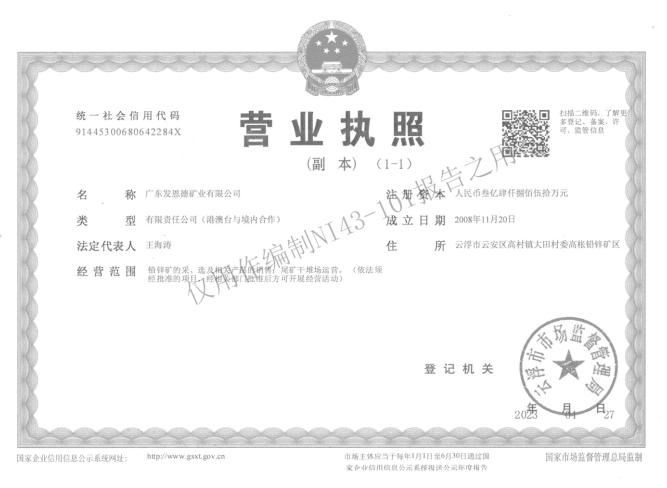
Appendix C High-Tech Enterprise Certificate
The copy of the High-Tech Enterprise Certificate
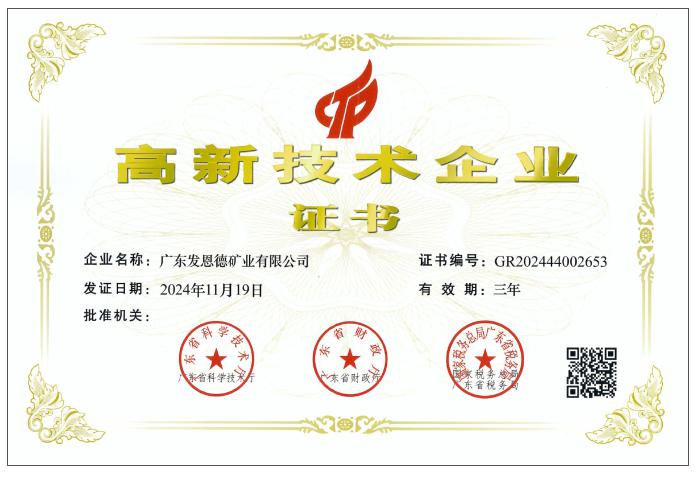
Appendix D Water Use Permit
The copy of the Water Use Permit
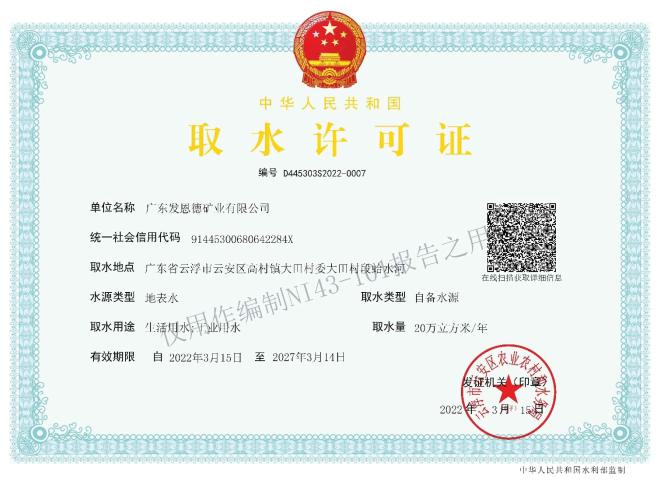
Appendix E Safety Production Permits
The copy of the Safety Production Permit – UG Mine
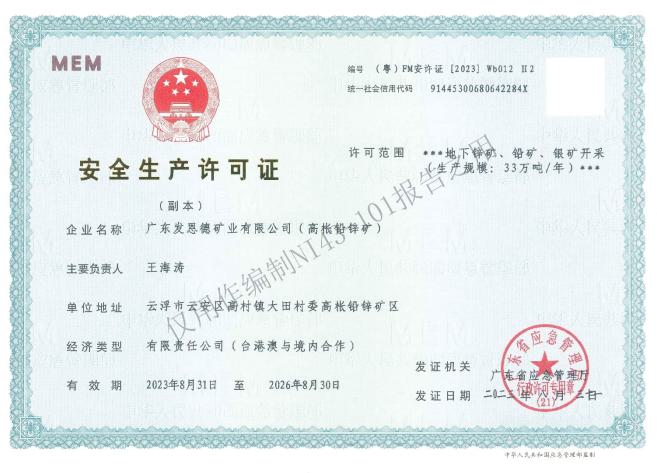
The copy of the Safety Production Permit – TSF
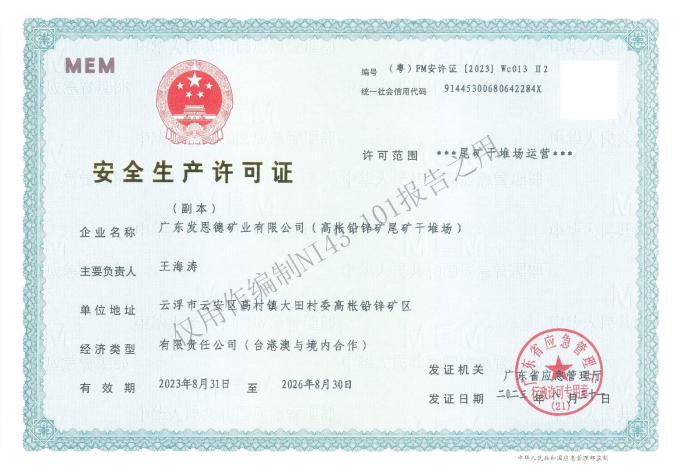
To accompany the report entitled Technical Report on Gaocheng Silver-Lead-Zinc Project in Guangdong Province, China (“GC Project”), which was effective on 31 December 2025, and prepared for Silvercorp Metals Inc.
I, Falong Hu, FAusIMM (CP), PMP, do hereby certify that:
| 1) | I am a Principal Mining Engineer, associate Practice Leader with the firm of SRK Consulting China Ltd. (“SRK CN”) with an office at: B1301 COFCO Plaza, 8 Jianguomennei Dajie, Beijing, the People’s Republic of China (“PRC” or “China”). |
| 2) | I graduated with a bachelor’s degree in mining engineering from Central South University, China (B.Eng.) in 2009, a Master of Business Administration from China University of Geoscience Beijing, China (MBA) in 2015. |
| 3) | I am a Fellow and Chartered Professional of the Australasian Institute of Mining and Metallurgy (“FAusIMM(CP)”), (#313608), and in a good standing. I am a register Project Management Professional (“PMP”). |
| 4) | I have practiced my profession as a Mining Engineer for a total 17 years since my graduation. |
| 5) | My relevant work experience includes: |
| · | Review and reporting on mining method and Mineral Reserve Estimates for operations and projects around the world for due diligence and regulatory requirements. |
| · | Technical studies (Scoping/PEA, PFS, FS) project work on both underground and open pit projects, in Africa, Asia and Australia. |
| · | Operational experience in operations as mine planer and technical service, in China. |
| · | Participation and author of several NI 43-101 Technical Report. |
| · | Authored/co-authored several technical reports for IPO listing or transactions in the Stock Exchange of Hong Kong Limited. |
| 6) | I personally did visit the subject property to the Technical Report on April 28 to 29, 2026. |
| 7) | I have read the definition of Qualified Person set out in National Instrument 43-101 and certify that by virtue of my education, affiliation to a professional association, and past relevant work experience, I fulfilled the requirements to be a Qualified Person for the purposes of National Instrument 43-101 and this technical report has been prepared in compliance with National Instrument 43-101 and Form 43-101F1. |
| 8) | I, as a Qualified Person, am independent of the issuer as defined in Section 1.5 of National Instrument 43-101. |
| 9) | I am an author and chief compiler of this technical report and have supervised the independent verification completed by SRK and the preparation of Section 2 to 5, 15, 16, 18 except for 18.2, 19, 23 and the relevant portions of Section 1, 24 to 27 of this technical report. I accept professional responsibility for those sections I co-authored. |
| 10) | I have had prior involvement with GC Project that is the subject of the Technical Report, in that I assisted the independent valuer with SRK Australia to review the mining method, with respect to an independent technical valuation service, in 2023. I have conducted technical review of the subject in 2024 and delivered a Technical Report which was effective on June 30, 2024. |
| 11) | I have read National Instrument 43-101 and confirm that this technical report has been prepared in compliance therewith. |
| 12) | That, as of the effective date of the Technical Report and the date this certificate, to the best of my knowledge, information and belief, this technical report contains all scientific and technical information that is required to be disclosed to make the technical report not misleading. |
| Effective Date: 31 December 2025 | |
| Signing Date: 20 April 2026 | |
| Original signed by | |
| Falong Hu, FAusIMM (CP), PMP | |
| Principal Consultant (Mining) | |
| SRK Consulting China Ltd. |
To accompany the report entitled Technical Report on Gaocheng Silver-Lead-Zinc Project in Guangdong Province, China (“GC Project”), which was effective on 31 December 2025, and prepared for Silvercorp Metals Inc.
I, Yanfang Zhao, MAusIMM, MAIG, do hereby certify that:
| 1) | I am a principal geological engineer with the firm of SRK Consulting China Ltd. (“SRK CN”) with an office at: B1301 COFCO Plaza, 8 Jianguomennei Dajie, Beijing, the People’s Republic of China (“PRC” or “China”). |
| 2) | I graduated with a master’s degree in mineral prospecting and exploration from China University of Geosciences (Beijing), China (M.Eng.) in 2009. |
| 3) | I am a member of the Australasian Institute of Mining and Metallurgy (“MAusIMM”), (#315027) and member of the Australian Institute of Geoscientists (“MAIG”) (#10796)) and in a good standing. |
| 4) | I have practiced my profession as a geological engineer for a total 17 years since my graduation. |
| 5) | My relevant work experience includes: |
| · | Review and reporting on geological modelling and Mineral Resource estimates for operations and projects around the world for due diligence and regulatory requirements. |
| · | Experience in mining company as a Geologist, in China. |
| · | Participation and author of several NI 43-101 Technical Report. |
| · | Authored/co-authored several technical reports for IPO listing or transactions in the Stock Exchange of Hong Kong Limited. |
| 6) | I personally did visit the subject property to the Technical Report on April 28 to 29, 2026.. |
| 7) | I have read the definition of Qualified Person set out in National Instrument 43-101 and certify that by virtue of my education, affiliation to a professional association, and past relevant work experience, I fulfilled the requirements to be a Qualified Person for the purposes of National Instrument 43-101 and this technical report has been prepared in compliance with National Instrument 43-101 and Form 43-101F1. |
| 8) | I, as a Qualified Person, am independent of the issuer as defined in Section 1.5 of National Instrument 43-101. |
| 9) | I am an author of this technical report and prepare of for Sections 7 to 12 and 14, and the relevant portions of Section 1, 24 to 27 of this technical report. I accept professional responsibility for those sections I co-authored. |
| 10) | I have had prior involvement with GC Project that is the subject of the Technical Report, in that I assisted the independent valuer with SRK Australia to review the geology and resource estimation method and procedure, with respect to an independent technical valuation service, in 2023. I have conducted technical review of the subject in 2024 and delivered a Technical Report which was effective on June 30, 2024. |
| 11) | I have read National Instrument 43-101 and confirm that this technical report has been prepared in compliance therewith. |
| 12) | That, as of the effective date of the Technical Report and the date this certificate, to the best of my knowledge, information and belief, this technical report contains all scientific and technical information that is required to be disclosed to make the technical report not misleading. |
| Effective Date: 31 December 2025 | |
| Signing Date: 20 April 2026 | |
| Original signed by | |
| Yanfang Zhao, MAusIMM, MAIG | |
| Principal Consultant (Geology) | |
| SRK Consulting China Ltd. |
To accompany the report entitled Technical Report on Gaocheng Silver-Lead-Zinc Project in Guangdong Province, China (“GC Project”), which was effective on 31 December 2025, and prepared for Silvercorp Metals Inc.
I, Huaixiang Li, MAIG, do hereby certify that:
| 1) | I am a senior geological engineer with the firm of SRK Consulting China Ltd. (“SRK CN”) with an office at: B1301 COFCO Plaza, 8 Jianguomennei Dajie, Beijing, the People’s Republic of China (“PRC” or “China”). |
| 2) | I graduated with a master’s degree in mineral prospecting and exploration from China University of Geosciences (Beijing), China (M.Eng.) in 2010, a bachelor’s degree in earth information science and technology from China University of Geosciences (Beijing), China in 2007. |
| 3) | I am a member of the Australian Institute of Geoscientists (“MAIG”) (#8667)) and in a good standing. |
| 4) | I have practiced my profession as a geological engineer for a total 10 years since my graduation. |
| 5) | My relevant work experience includes: |
| · | Review and reporting on geological modelling and Mineral Resource estimates for operations and projects around the world for due diligence and regulatory requirements. |
| · | Experience in a mineral resource exploration company as a Geologist, in China. |
| · | Participation and author of several NI 43-101 Technical Report. |
| · | Authored/co-authored several technical reports for IPO listing or transactions in the Stock Exchange of Hong Kong Limited. |
| 6) | I personally did visit the subject property to the Technical Report on April 28 to 29, 2026. |
| 7) | I have read the definition of Qualified Person set out in National Instrument 43-101 and certify that by virtue of my education, affiliation to a professional association, and past relevant work experience, I fulfilled the requirements to be a Qualified Person for the purposes of National Instrument 43-101 and this technical report has been prepared in compliance with National Instrument 43-101 and Form 43-101F1. |
| 8) | I, as a Qualified Person, am independent of the issuer as defined in Section 1.5 of National Instrument 43-101. |
| 7) | I am a co-author of this technical report and prepare of for Sections 7 to 12 and 14, and the relevant portions of Section 1, 24 to 27 of this technical report. I accept professional responsibility for those sections I co-authored. |
| 8) | I have had no prior involvement with GC Project that is the subject of the Technical Report. |
| 7) | I have read National Instrument 43-101 and confirm that this technical report has been prepared in compliance therewith. |
| 8) | That, as of the effective date of the Technical Report and the date this certificate, to the best of my knowledge, information and belief, this technical report contains all scientific and technical information that is required to be disclosed to make the technical report not misleading. |
| Effective Date: 31 December 2025 | |
| Signing Date: 20 April 2026 | |
| Original signed by | |
| Huaixiang Li, MAIG | |
| Senior Consultant (Geology) | |
| SRK Consulting China Ltd. |
To accompany the report entitled Technical Report on Gaocheng Silver-Lead-Zinc Project in Guangdong Province, China (“GC Project”), which was effective on 31 December 2025, and prepared for Silvercorp Metals Inc.
I, Lanliang Niu, MAusIMM, do hereby certify that:
| 1) | I am a Principal Mineral Processing Engineer, worked for SRK Consulting China Ltd. (“SRK CN”) with an office at: B1301 COFCO Plaza, 8 Jianguomennei Dajie, Beijing, the People’s Republic of China (“PRC” or “China”). |
| 2) | I graduated with a bachelor’s degree in mineral processing from Beijing University of Iron and Steel Technology in 1987. |
| 3) | I am a member of the Australasian Institute of Mining and Metallurgy (“MAusIMM”), (#313608), and a member of China Association of Mineral Resources Appraisers . |
| 4) | I have practiced my profession as a Mineral Processing Engineer for a total of 37 years since my graduation and have worked at SRK CN for 17 years as a Mineral Processing Consultant. |
| 5) | I worked in two mineral research institutes from 1987 to 2005, while also working in three gold mines from 1987 to 1994. I worked in a rare earth mine from 2005 to 2007. Since late 2007, I have been with SRK CN, gaining experience in over 200 mining projects. |
| 6) | I personally did visit the subject property to the Technical Report on April 28 to 29, 2026. |
| 7) | I am independent of the issuer as defined in Section 1.5 of National Instrument 43-101. |
| 8) | I am a co-author of this technical report and have supervised the independent verification completed by SRK and the preparation of Section 13, 17 and 18.2, and the relevant portions of Section 1, 24 to 27 of this technical report for QP review. I accept professional responsibility for those sections I co-authored. |
| 9) | I have had prior involvement with GC Project that is the subject of the Technical Report, in that I have conducted technical review of the subject in 2024 and delivered a Technical Report which was effective on June 30, 2024. |
| 10) | I have read National Instrument 43-101 and confirm that this technical report has been prepared in compliance therewith. |
| 11) | That, as of the effective date of the Technical Report and the date this certificate, to the best of my knowledge, information and belief, this technical report contains all scientific and technical information that is required to be disclosed to make the technical report not misleading. |
| Effective Date: 31 December 2025 | |
| Signing Date: 20 April 2026 | |
| Original signed by | |
| Lanliang Niu, MAusIMM | |
| Principal Consultant (Mineral Processing) | |
| SRK Consulting China Ltd. |
To accompany the report entitled Technical Report on Gaocheng Silver-Lead-Zinc Project in Guangdong Province, China (“GC Project”), which was effective on 31 December 2025, and prepared for Silvercorp Metals Inc.
I, Nan Xue, MAusIMM, do hereby certify that:
| 1) | I am a Principal Environmental Scientist of SRK Consulting China Ltd. (“SRK CN”) with an office at: B1301 COFCO Plaza, 8 Jianguomennei Dajie, Beijing, the People’s Republic of China (“PRC” or “China”). |
| 2) | I graduated with a master’s degree in environmental science from Nankai University, China (M.Sc) in 2007. |
| 3) | I am a member of the Australasian Institute of Mining and Metallurgy (“MAusIMM”), (#314731). |
| 4) | I have practiced my profession as an Environmental Scientist for a total 18 years since my graduation. |
| 5) | My relevant work experience includes: |
| · | Engineering analysis, pollution source calculation and impact predictions for environmental impact assessment report. |
| · | Environmental technical studies (Scoping/PEA, PFS, FS) project work on mining projects. |
| · | Conduct environmental due diligence in accordance with equator principles, International Finance Corporation environmental and social performance standards and other international standards. |
| · | Participation in a number of NI 43-101 Technical Reports for IPO listing or transactions in the Stock Exchange of Hong Kong Limited. |
| 6) | I personally did visit the subject property to the Technical Report on April 28 to 29, 2026. |
| 7) | I am independent of the issuer as defined in Section 1.5 of National Instrument 43-101. |
| 8) | I am a co-author of this technical report and have supervised the independent verification completed by SRK and the preparation of Section 20 and the relevant portions of Section 1, 24 to 27 of this technical report for QP review. I accept professional responsibility for those sections I co-authored. |
| 9) | I have had prior involvement with GC Project that is the subject of the Technical Report, in that I have conducted technical review of the subject in 2024 and delivered a Technical Report which was effective on June 30, 2024. |
| 10) | I have read National Instrument 43-101 and confirm that this technical report has been prepared in compliance therewith. |
| 11) | That, as of the effective date of the Technical Report and the date this certificate, to the best of my knowledge, information and belief, this technical report contains all scientific and technical information that is required to be disclosed to make the technical report not misleading. |
| Effective Date: 31 December 2025 | |
| Signing Date: 20 April 2026 | |
| Original signed by | |
| Nan Xue, MAusIMM | |
| Principal Consultant (Environment) | |
| SRK Consulting China Ltd. |
To accompany the report entitled Technical Report on Gaocheng Silver-Lead-Zinc Project in Guangdong Province, China (“GC Project”), which was effective on 31 December 2025, and prepared for Silvercorp Metals Inc.
I, Tzuhsuan Chuang, MAusIMM, do hereby certify that:
| 1) | I am a Senior Mining Engineer with the firm of SRK Consulting China Ltd. (“SRK CN”) with an office at: B1301 COFCO Plaza, 8 Jianguomennei Dajie, Beijing, the People’s Republic of China (“PRC” or “China”). |
| 2) | I graduated with a master’s degree in mining engineering from Colorado School of Mines, USA (M.Sc) in 2016. |
| 3) | I am a member of the Australasian Institute of Mining and Metallurgy (“MAusIMM”), (#3088857), and in a good standing. |
| 4) | I have practiced my profession as a Mining Engineer for a total 7 years since my graduation. |
| 5) | My relevant work experience includes: |
| · | Review and reporting on Capex, Opex, technical-economic evaluation for projects around the world for regulatory requirements. |
| · | Technical studies (Scoping/PEA, PFS, FS) project work on both underground and open pit projects, in Africa and Asia. |
| · | Operational experience on gold mine in Colombia as a Mine Planner. |
| · | Participation and author of several NI 43-101 Technical Report. |
| · | Authored/co-authored several technical reports for IPO listing or transactions in the Stock Exchange of Hong Kong Limited. |
| 6) | I personally did not visit the subject property to the Technical Report. |
| 7) | I am independent of the issuer as defined in Section 1.5 of National Instrument 43-101. |
| 8) | I am a co-author of this technical report and have supervised the independent verification completed by SRK and the preparation of Section 21 and 22, and the relevant portions of Section 1, 24 to 27 of this technical report for QP review. I accept professional responsibility for those sections I co-authored. |
| 9) | I have had prior involvement with GC Project that is the subject of the Technical Report, in that I have conducted technical review of the subject in 2024 and delivered a Technical Report which was effective on June 30, 2024. |
| 10) | I have read National Instrument 43-101 and confirm that this technical report has been prepared in compliance therewith. |
| 11) | That, as of the effective date of the Technical Report and the date this certificate, to the best of my knowledge, information and belief, this technical report contains all scientific and technical information that is required to be disclosed to make the technical report not misleading. |
| Effective Date: 31 December 2025 | |
| Signing Date: 20 April 2026 | |
| Original signed by | |
| Tzuhsuan Chuang, MAusIMM | |
| Senior Consultant (Mining) | |
| SRK Consulting China Ltd. |