IN THE COURT OF CHANCERY OF THE STATE OF DELAWARE
ARKANSAS TEACHER
RETIREMENT SYSTEM, on Behalf of
Itself and All Others Similarly Situated,
Plaintiff,
v.
ALON USA ENERGY, INC., DELEK
US HOLDINGS, INC., DELEK
HOLDCO, INC., DIONE MERGECO,
INC., ASTRO MERGECO, INC.,
EZRA UZI YEMIN, ILAN COHEN,
ASSAF GINZBURG, FREDEREC
GREEN, RON W. HADDOCK,
WILLIAM J. KACAL, ZALMAN
SEGAL, MARK D. SMITH, AVIGAL
SOREQ, FRANKLIN WHEELER, and
DAVID WIESSMAN,
Defendants.
C.A. No. _____-_____
VERIFIED CLASS ACTION COMPLAINT
Plaintiff Arkansas Teacher Retirement System (“Plaintiff”), by and through
its attorneys, brings this Verified Class Action Complaint (the “Complaint”) on its
own behalf and on behalf of a class of all holders of Alon USA Energy, Inc.
(“Alon” or the “Company”) common stock, other than Defendants and their
affiliates, against the Board of Directors (the “Board”) of Alon and the controlling
EFiled: Jun 15 2017 04:10PM EDT
Transaction ID 60736780
Case No. 2017-0453-
2
stockholder of Alon, Delek US Holdings, Inc. (“Delek”), for breaching their
respective fiduciary duties through Delek’s proposed acquisition of the remaining
shares of Alon common stock that Delek does not already own, announced January
3, 2017 (the “Proposed Transaction” or the “Merger”). The principal factual basis
for the allegations herein are the representations in Alon’s Schedule 14A filed with
the U.S. Securities & Exchange Commission (the “SEC”) on May 30, 2017 (the
“Proxy”), representations in certain of Alon’s and Delek’s other SEC filings, and
independent research. As detailed herein, numerous representations in the Proxy
are materially incomplete, misleading and/or inaccurate, and Plaintiff does not,
accordingly, warrant the completeness, accuracy or veracity of the Proxy’s
representations.
NATURE OF THIS ACTION
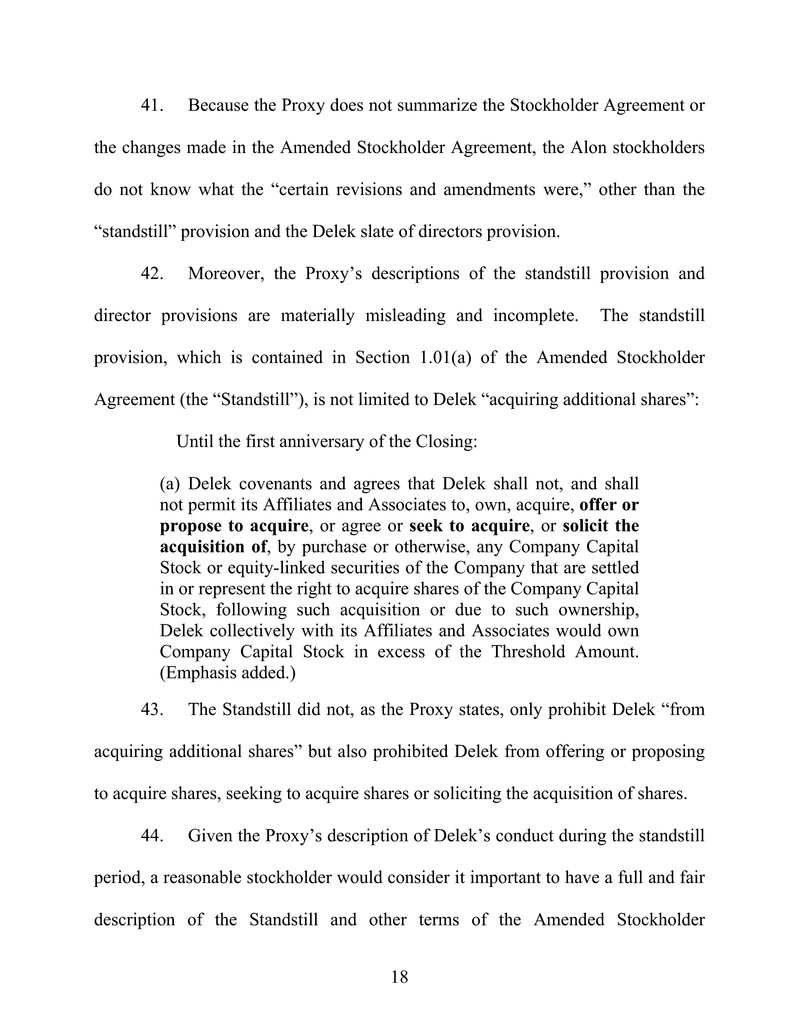
1. This action arises from the Agreement and Plan of Merger (“Merger
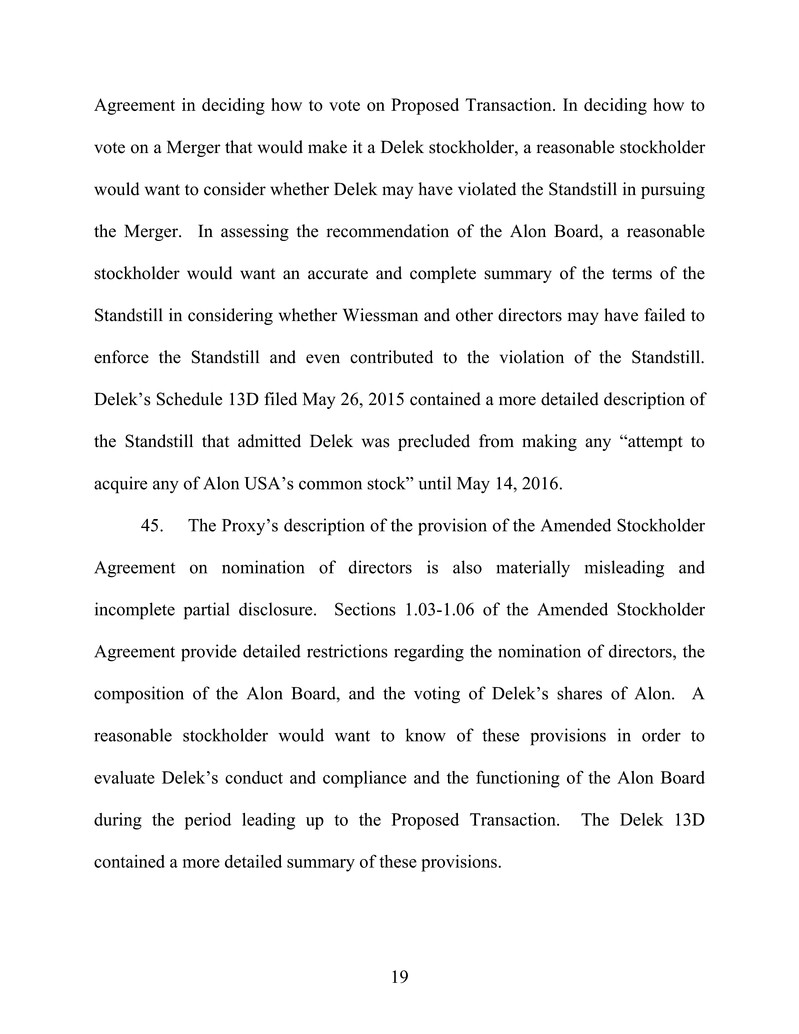
Agreement”) between Alon and Delek whereby Delek will acquire the remaining
shares of Alon common stock that it does not already own at an inadequate price of
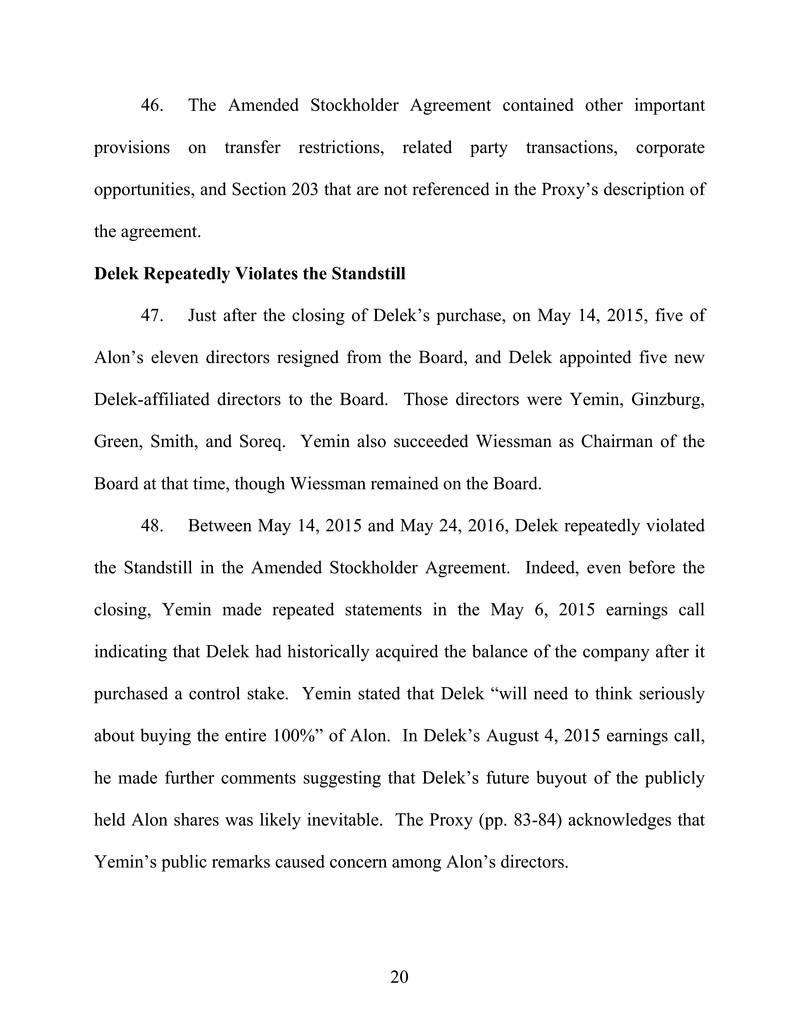
0.504 shares of Delek common stock for each share of Alon common stock.
2. Delek owns approximately 47% of Alon’s common stock and is
Alon’s controlling stockholder. Delek purchased its Alon interest approximately
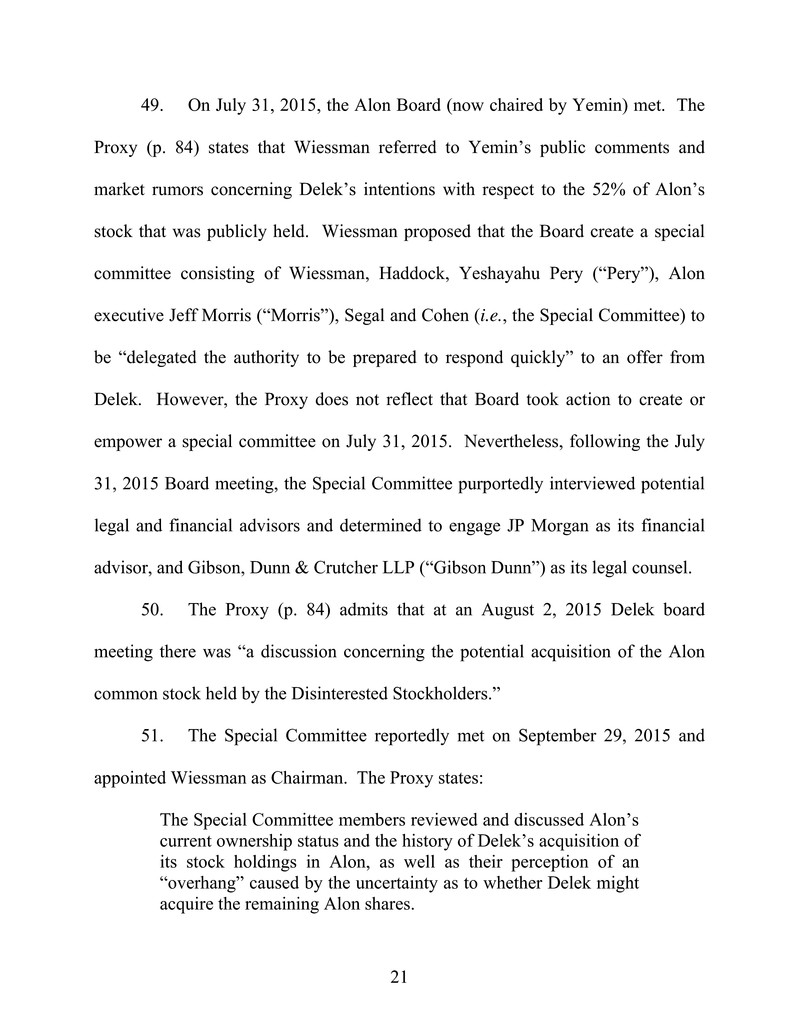
two years ago at a price of $16.99 per share, but has engineered an agreement to
acquire the remaining, publicly held Alon shares for consideration valued, on the

3
Merger’s announcement, at only $12.13 per share. This unfairly low price is the
result of a deeply flawed process through which the Alon Board, and a supposed
special committee thereof, agreed to sell Delek the remainder of Alon that Delek
does not already own for 28.6% less than what Delek originally paid for its Alon
stake.
3. The seeds for the Proposed Transaction were sown in March 2014,
when Delek and Alon Israel Oil Company, Ltd. (“Alon Israel”) began discussions
regarding the possible acquisition by Delek of Alon Israel’s shares of Company
common stock. After Delek acquired Alon Israel’s stake in Alon in May 2015,
Delek and Alon’s Chairman, defendant Ezra Uzi Yemin (“Yemin”), told Delek
investors on quarterly earnings calls that Delek, inevitably, would buy out the other
Alon stockholders. While Delek had a stockholder agreement with Alon that
provided certain limited standstill protections, Alon’s public stockholders were
otherwise exposed to Delek’s control position.
4. The Proxy says that the Board formed a special committee of
purportedly independent directors in 2015 that, while formed to respond to a
proposal from Delek, was actually delegated only the power to engage advisors
and possessed only that power until late October 2016 (the “Special Committee”).
The Special Committee, according to the Proxy, chased down Delek for more than
a year and a half and pushed for Delek’s buyout of the publicly held Alon shares.
4
As detailed below, although Delek repeatedly violated the standstill protections it
had agreed to, the Proxy states that the Special Committee did little other than
continue to negotiate with Yemin concerning the structure and price terms of a
buyout.
5. At no time before Delek actually made a buyout proposal in October
2016 did it take any steps to disarm itself of its controlling status and seek to
replicate arm’s-length bargaining with the Special Committee. Only then did
Delek state that it would not proceed with a buyout without both the Special
Committee’s approval and the favorable vote of a majority of the non-Delek-held
Alon shares. Only after Delek’s October 2016 proposal did the Alon Board,
according to the Proxy, finally determine to broadly empower the Special
Committee.
6. By then, however, the damage had already been done. Among other
things, according to the Proxy, before Delek’s proposal, (i) Yemin had had at least
twenty-six communications with the Special Committee regarding the structure
and terms of a potential buyout, (ii) the Special Committee had already made three
buyout proposals to Delek (bargaining against itself twice), (iii) Delek had made
further public statements to its investors regarding the status of negotiations with
the Special Committee and buyout terms that Delek would agree to, (iv) the
Special Committee had repeatedly told Yemin that it favored an all-stock deal
5
based on the relative market value of Alon’s shares and Delek’s shares, and (v)
Delek had waited until market conditions made a buyout based on the relative
market value of Alon and Delek’s shares a cheaper proposition for Delek. These
are the foreseeable and natural consequences of a controlling stockholder, like
Delek, wielding its control in negotiations toward a buyout of the shares it does not
already own without taking precautions to ensure genuine, arm’s-length
negotiations with a special committee of independent directors.
7. Once Delek finally made its proposal in October 2016, the Special
Committee – long-committed to a buyout by Delek – quickly proceeded toward a
signed deal. The Special Committee’s mindset, however, let the foxes into the
henhouse at a critical time. The Proxy says that several members of Delek’s senior
management, who were also Alon directors, including Yemin, were allowed to
participate in the Alon Board’s December 2016 preparation and approval of the
Company’s five-year strategic plan – a process that yielded the forward-looking
projections upon which the Special Committee and its advisors ultimately relied in
approving the Merger. The Special Committee’s controlled mindset further led it,
according to the Proxy, to commission revised Alon projections that excluded
management’s best estimates of the positive future revenue impact of planned
growth initiatives, and resulted in lower intrinsic valuations for the Company. The
Special Committee, the Proxy states, even overlooked implied per-share values for
6
Alon generated by its financial advisor’s discounted cash flow and other valuation
analyses that ranged wholly above the $12.13 value ultimately agreed-to with
Delek – a clear indication that the Merger price is unfair to the Alon public
stockholders.
8. The Special Committee and Delek ultimately agreed to an all-stock
Merger in which each Alon share will be, effectively, exchanged for 0.504 shares
of Delek, with Alon stockholders to own approximately 24% of the combined
company. Confirming that the Special Committee eschewed any reliance on
Alon’s intrinsic per-share value in agreeing to the Merger, there is no price collar
to protect Alon’s public stockholders from downward price movements in Delek’s
stock and guarantee them a firm per-share dollar-value for their Alon stock.
9. While the Merger Agreement conditions the Proposed Transaction on
the approval of a majority of Alon shares not owned by Delek, even that protection
has been diluted in the Proposed Transaction. In conjunction with the Merger, two
Alon insiders—Special Committee chairman David Wiessman (“Wiessman”) and
Company executive and former director Jeff Morris—entered into agreements with
Delek to vote their Alon shares in support of the Merger. These voting agreements
lock in approximately 11.6% of the unaffiliated publicly held shares in support of
the Merger and will count towards the “majority-of-the-unaffiliated” vote
condition.
7
10. Further, the Special Committee is not composed of solely independent
directors, despite the Proxy’s contrary representations. Wiessman, the Special
Committee chairman who the Proxy indicates led discussions with Yemin, has
material financial interests in Delek through his investments in Alon Israel, which
received millions of shares of Delek stock in exchange for its Alon shares in May
2015 and is Delek’s largest stockholder. Additionally, Delek took advantage of its
controlling stockholder position and effectively appointed two directors of its
choosing to the Special Committee in the midst of negotiations with the Special
Committee. Thus, at least three members of the six-director Special Committee
are not independent of Delek.
11. The Special Committee process was further tainted by the retention of
J.P. Morgan Securities LLC (“JP Morgan”), which has undisclosed material
conflicts of interest in serving as the committee’s financial advisor. JP Morgan’s
affiliates currently own approximately 2.33% of Delek’s common stock. Those
affiliates actually increased their holdings in Delek by almost 60% between August
8, 2016 and November 4, 2016, beneficially owning 2.5% of Delek’s total
outstanding shares when the Merger was announced. The Proxy omits these
material facts. The Special Committee’s failure to retain a financial advisor
without material financial ties to Delek is inexcusable. Indeed, the Proxy says
nothing about whether the Special Committee knew of this conflict when
8
considering financial advisors, or whether the Special Committee took any steps to
manage this conflict of interest throughout JP Morgan’s engagement.
12. The Proxy, as detailed below, is materially incomplete, incorrect and
misleading in several additional respects as well. Alon’s public stockholders,
therefore, will be unable to cast fully informed votes at the scheduled June 28,
2017 special stockholder’s meeting called by the Board to vote on the Merger and
related proposals (the “Special Meeting”).
13. The Proposed Transaction is subject to entire fairness review. It
promises an unfair price to Alon’s public stockholders. It resulted from an unfair
process that bore no resemblance to genuine arm’s-length negotiations and was
deeply influenced by Delek’s controlling stockholder status. Because the Proposed
Transaction is not entirely fair, Alon’s public stockholders are entitled to equitable
relief.
PARTIES
14. Plaintiff is and has been a stockholder of Alon at all relevant times
and has continuously held shares since the announcement of the Proposed
Transaction, and will continue to hold its shares at all times relevant to this action.
15. Defendant Alon is a Delaware corporation headquartered in Dallas,
Texas. The Company has approximately 71.6 million shares of common stock
outstanding, and the Proposed Transaction values the Company at approximately
9
$868 million. Alon is an independent retailer and marketer of petroleum products,
operating primarily in the South Central, Southwestern, and Western United States.
The Company owns several crude oil refineries in Texas, Louisiana, and
California. Alon is also a leading marketer of asphalt, which it distributes
primarily through asphalt terminals located throughout the Western and
Southwestern United States. Alon operates its wholesale marketing and certain
refining operations through Alon USA Partners, LP (the “Partnership”), a master
limited partnership. Alon owns 100% of Alon USA Partners GP, LLC, a Delaware
limited liability company and the Partnership’s general partner. Alon also owns
approximately 81.6% of the Partnership’s limited partnership interests.
Additionally, the Company is the largest 7-Eleven licensee in the United States and
operates approximately 300 7-Eleven branded convenience stores and gas stations
in Texas and New Mexico. The Company is publicly traded on the New York
Stock Exchange under the ticker symbol “ALJ.”
16. Defendant Delek is Alon’s controlling stockholder. It acquired its
roughly 47% interest in the Company on May 14, 2015, when it purchased 33.7
million shares of the Company from Alon Israel, for which it paid $572.4 million,
or approximately $16.99 per share. Delek, also a Delaware corporation, maintains
its headquarters in Brentwood, Tennessee. Delek is a diversified downstream
energy company with assets in petroleum refining, storage, transportation,
10
wholesale, and retail. When Delek acquired its interest in the Company, it
appointed five new directors to the eleven-member Board. Delek is publicly traded
on the New York Stock Exchange under the ticker symbol “DK.”
17. Defendant Yemin is a director of the Company and was elected
Chairman of the Board in May 2015, upon Delek’s investment in Alon. Yemin has
also served as the Chairman of the Board of Delek since December 2012, as
Delek’s Chief Executive Officer (“CEO”) since June 2004 and as Delek’s
president and a director since April 2001. Yemin’s duties with Delek include the
formulation of its policies and direction, oversight of its executive officers, and
overall responsibility for Delek’s operation and performance. Yemin has also
served as the chairman of the board of directors and CEO of Delek Logistics GP,
LLC1 since April 2012.
18. Defendant Assaf Ginzburg (“Ginzburg”) has been a director of the
Company since May 2015. Ginzburg has served as Delek’s Chief Financial
Officer (“CFO”) since January 2013, a Delek Executive Vice President since May
2009, and as a Delek vice president since February 2005. Ginzburg has also
1 Delek owns a 60.7% limited partner interest in Delek Logistics Partners, LP and
a 94.9% interest in Delek Logistics GP, LLC, which owns the entire 2.0% general
partner interest in Delek Logistics Partners, LP, and all of the incentive distribution
rights. A substantial majority of Delek Logistics’ assets are currently integral to
Delek’s refining and marketing operations. Both Delek Logistics GP, LLC and
Delek Logistics Partners, LP will be collectively referred to hereinafter as “Delek
Logistics.”
11
served as a member of the board of directors and an executive vice president of
Delek Logistics since April 2012, and as its CFO since January 2013.
19. Defendant Frederec Green (“Green”) has served as a director of the
Company since May 2015. Green has served as Delek’s Executive Vice President
since May 2009 and as the primary operational officer for Delek’s refining
operations since joining Delek in January 2005. Green has also served as a
member of the board of directors and an Executive Vice President of Delek
Logistics since April 2012.
20. Defendant Mark D. Smith (“Smith”) has served as a director of the
Company since May 2015. Smith has served as Delek’s Executive Vice President
since May 2014. Prior to 2014, Smith spent nine years as a vice president with
Tesoro Refining and Marketing and Tesoro Corporation, where he worked with
defendant Franklin R. Wheeler.
21. Defendant Avigal Soreq (“Soreq”) has served as a director of the
Company since May 2015. Soreq joined Delek in October 2011 and has served as
a vice president from December 2012 to August 2015, and Executive Vice
President since August 2015. Soreq is a Certified Public Accountant in Israel.
22. Defendant Wiessman was the Executive Chairman of the Company’s
Board from July 2000 until May 2015 when Delek acquired its controlling interest
in Alon from Alon Israel. He is currently a director of the Company and Chairman
12
of the board of directors of the general partner of the Partnership. Wiessman also
was a director of Alon Israel. Wiessman is the CEO and a stockholder of Bielsol
Investments (1987) Ltd. (“Bielsol”) which owns approximately 50% of Alon
Israel. Entities controlled by Wiessman own Beilsol with entities controlled by
members of the Brian family, two of whom served as Alon directors. Wiessman
also served as CEO, Executive Chairman, Chairman and/or President of various
Alon Israel subsidiaries, including Alon Blue Square-Israel, Ltd. (“Blue Square”)
and Dor-Alon Energy Israel (1998) Ltd. (“Dor-Alon”). Alon engaged in related
party transactions with Alon Israel and its subsidiaries. Wiessman is the father of
Snir Wiessman, a member of the board of directors of the general partner of the
Partnership. Wiessman was the Chairman of the Special Committee that
negotiated the Proposed Transaction with Delek. Wiessman also signed a voting
and support agreement, binding him to vote his 2,510,541 shares of Company
common stock in favor of the Proposed Transaction. Upon the consummation of
the Merger, Wiessman will be appointed to the board of directors of Delek
HoldCo, Inc., a wholly owned Delek subsidiary (“HoldCo”).
23. Defendant Ilan Cohen (“Cohen”) has served as a director of the
Company since May 2014. Cohen has served as the CEO of Ilan Cohen
Investments since 2006. Cohen currently serves on the Board’s Audit Committee
13
and the Nominating and Corporate Governance Committee. Cohen was a member
of the Special Committee that approved the Proposed Transaction with Delek.
24. Defendant Ron W. Haddock (“Haddock”) has served as a director of
the Company since December 2000. Haddock currently serves on the Board’s
Audit Committee, Nominating and Corporate Governance Committee, and the
Compensation Committee. Haddock was a member of the Special Committee that
approved the Proposed Transaction with Delek. Upon the consummation of the
Merger, Haddock will be appointed to board of directors of Delek Logistics.
25. Defendant William J. Kacal (“Kacal”) has served as a director of the
Company since May 2016. Kacal joined the Board at the recommendation of
Yemin and Delek. Upon Kacal’s election to the Board, he was immediately placed
on the Special Committee that approved the Proposed Transaction with Delek.
26. Defendant Zalman Segal (“Segal”) has served as a director of the
Company since July 2005. Segal Currently serves on the Board’s Audit
Committee, Nominating and Corporate Governance Committee, and the
Compensation Committee. Segal was a member of the Special Committee that
approved the Proposed Transaction with Delek.
27. Defendant Franklin R. Wheeler (“Wheeler”) has served as a director
of the Company since May 2016. Wheeler had most recently held the positions of
Vice President (operations) and Senior Vice President (refining) for Tesoro
14
Corporation from 2010 until his retirement in 2014. Upon information and belief,
Wheeler was Smith’s supervisor at Tesoro Corporation. Wheeler joined the Board
at the recommendation of Yemin and Delek. Upon Wheeler’s election to the
Board, he was immediately placed on the Special Committee that approved the
Proposed Transaction with Delek.
28. Defendant HoldCo is a Delaware corporation and a wholly owned
subsidiary of Delek. HoldCo was formed for the purpose of effectuating the
Proposed Transaction and will be the surviving entity upon the consummation of
the Merger, with Delek being a wholly owned subsidiary of HoldCo. Thus, after
the Merger closes, HoldCo will be the publicly traded parent company of Delek
and Alon.
29. Defendant Dione Mergeco, Inc. (“Parent Merger Sub”) is a Delaware
corporation and a wholly owned subsidiary of HoldCo. Parent Merger Sub was
formed for the purpose of effectuating the Proposed Transaction.
30. Defendant Astro Mergeco, Inc. (“Astro Merger Sub”) is a Delaware
corporation and a wholly owned subsidiary of HoldCo. Astro Merger Sub was
formed for the purpose of effectuating the Proposed Transaction.
31. All defendants listed in paragraphs 15-30 are collectively referred to
herein as “Defendants.”
15
32. HoldCo, Parent Merger Sub and Astro Merger Sub are collectively
referred to herein as the “Merger Sub Defendants.”
33. Yemin, Ginzburg, Green, Smith, Soreq, Wiessman, Cohen, Haddock,
Kacal, Segal and Wheeler are collectively referred to herein as the “Director
Defendants” or the “Individual Defendants.”
SUBSTANTIVE ALLEGATIONS
Background – Delek Acquires 48% of Alon, Signs Stockholder Agreements
34. Alon was incorporated in Delaware in 2000 and held its initial public
offering (“IPO”) in 2005 when it was controlled by Alon Israel. After the IPO,
Alon Israel maintained its majority ownership of the Company through January
2015.
35. In the spring of 2015, Alon Israel and its subsidiaries were
experiencing substantial financial difficulties. Indeed, over the course of 2015 and
into 2016, Alon Israel sold off not only its control position in Alon, but also Dor
Alon, Blue Square and other assets. The business empire of Wiessman and his
cronies was crumbling. Delek helped to rescue Wiessman and Alon Israel by
buying the control position in Alon.
36. The Proxy (p. 81) claims that on February 2, 2015, Alon Israel asked
Delek to purchase its then-55% interest in Alon. Delek was familiar with Alon
because both companies had previously associated with Israeli oil and gas
16
companies. Delek was interested in the control position with Alon, based in part
on Delek’s previous acquisition of Lion Oil Company in a staged manner that
began with an initial purchase of a minority equity interest. Ten days later, Alon
Israel reported that it had sold 3.8 million shares of Alon common stock, or
approximately 7% of the Company’s total common stock outstanding. While the
rushed sale of these shares raised some money, Alon Israel remained in financial
jeopardy. After the sale, Alon Israel retained approximately 48% of the
Company’s outstanding shares of common stock.
37. During February and March of 2014, Alon Israel and Delek began
negotiating Delek’s acquisition of Alon Israel’s shares in the Company. As
Yemin, Delek’s CEO and President, acknowledged in a May 6, 2016 Delek
earnings call, Alon Israel did not “want the full-blown merger because they wanted
that to close as quickly as possible because of their needs.” Alon Israel wanted “a
quick deal.”
38. On March 2, 2015, Delek requested that the Alon Board approve
Delek’s purchase of Alon Israel’s control position for purposes of Section 203 of
the Delaware General Corporation Law (“Section 203”). The Alon Board formed
a special committee (the “203 Committee”) to make a recommendation to the Alon
Board concerning Delek’s request. The Proxy does not disclose the members of
the 203 Committee.
17
39. Between March 9, 2015 and March 19, 2015, the 203 Committee
negotiated a stockholder agreement with Delek (the “Stockholder Agreement”).
On April 14, 2015, Delek agreed to purchase approximately 33.7 million shares of
Alon common stock from Alon Israel, accounting for approximately 48% of all
Alon outstanding shares. The purchase price was valued at $572.4 million, or
approximately $16.99 per share. The consideration consisted of $200 million in
cash, six million shares of Delek and a $145 million unsecured promissory note.
Alon Israel still owns the six million Delek shares, and is Delek’s largest
stockholder.
40. During early April 2015, the 203 Committee and Delek negotiated an
Amended and Restated Stockholder Agreement (the “Amended Stockholder
Agreement”). The Proxy (p. 83) contains the following misleading partial
disclosure concerning the Amended Stockholder Agreement:
In addition, during early April 2015, Delek negotiated with the
203 Special Committee certain revisions and amendments to
the Stockholder’s Agreement, including a “standstill” provision
prohibiting Delek from acquiring additional shares that would
result in Delek owning more than 49.99% of the outstanding
Alon common stock before the 12-month anniversary of the
closing of Delek’s purchase of the Alon shares from Alon Israel.
The Amended and Restated Stockholder Agreement, entered into
on April 14, 2015, also permitted Delek to nominate its own
slate of directors, if it chose to do so, for Alon’s 2016 annual
meeting of stockholders. (Emphasis added.)
18
41. Because the Proxy does not summarize the Stockholder Agreement or
the changes made in the Amended Stockholder Agreement, the Alon stockholders
do not know what the “certain revisions and amendments were,” other than the
“standstill” provision and the Delek slate of directors provision.
42. Moreover, the Proxy’s descriptions of the standstill provision and
director provisions are materially misleading and incomplete. The standstill
provision, which is contained in Section 1.01(a) of the Amended Stockholder
Agreement (the “Standstill”), is not limited to Delek “acquiring additional shares”:
Until the first anniversary of the Closing:
(a) Delek covenants and agrees that Delek shall not, and shall
not permit its Affiliates and Associates to, own, acquire, offer or
propose to acquire, or agree or seek to acquire, or solicit the
acquisition of, by purchase or otherwise, any Company Capital
Stock or equity-linked securities of the Company that are settled
in or represent the right to acquire shares of the Company Capital
Stock, following such acquisition or due to such ownership,
Delek collectively with its Affiliates and Associates would own
Company Capital Stock in excess of the Threshold Amount.
(Emphasis added.)
43. The Standstill did not, as the Proxy states, only prohibit Delek “from
acquiring additional shares” but also prohibited Delek from offering or proposing
to acquire shares, seeking to acquire shares or soliciting the acquisition of shares.
44. Given the Proxy’s description of Delek’s conduct during the standstill
period, a reasonable stockholder would consider it important to have a full and fair
description of the Standstill and other terms of the Amended Stockholder
19
Agreement in deciding how to vote on Proposed Transaction. In deciding how to
vote on a Merger that would make it a Delek stockholder, a reasonable stockholder
would want to consider whether Delek may have violated the Standstill in pursuing
the Merger. In assessing the recommendation of the Alon Board, a reasonable
stockholder would want an accurate and complete summary of the terms of the
Standstill in considering whether Wiessman and other directors may have failed to
enforce the Standstill and even contributed to the violation of the Standstill.
Delek’s Schedule 13D filed May 26, 2015 contained a more detailed description of
the Standstill that admitted Delek was precluded from making any “attempt to
acquire any of Alon USA’s common stock” until May 14, 2016.
45. The Proxy’s description of the provision of the Amended Stockholder
Agreement on nomination of directors is also materially misleading and
incomplete partial disclosure. Sections 1.03-1.06 of the Amended Stockholder
Agreement provide detailed restrictions regarding the nomination of directors, the
composition of the Alon Board, and the voting of Delek’s shares of Alon. A
reasonable stockholder would want to know of these provisions in order to
evaluate Delek’s conduct and compliance and the functioning of the Alon Board
during the period leading up to the Proposed Transaction. The Delek 13D
contained a more detailed summary of these provisions.
20
46. The Amended Stockholder Agreement contained other important
provisions on transfer restrictions, related party transactions, corporate
opportunities, and Section 203 that are not referenced in the Proxy’s description of
the agreement.
Delek Repeatedly Violates the Standstill
47. Just after the closing of Delek’s purchase, on May 14, 2015, five of
Alon’s eleven directors resigned from the Board, and Delek appointed five new
Delek-affiliated directors to the Board. Those directors were Yemin, Ginzburg,
Green, Smith, and Soreq. Yemin also succeeded Wiessman as Chairman of the
Board at that time, though Wiessman remained on the Board.
48. Between May 14, 2015 and May 24, 2016, Delek repeatedly violated
the Standstill in the Amended Stockholder Agreement. Indeed, even before the
closing, Yemin made repeated statements in the May 6, 2015 earnings call
indicating that Delek had historically acquired the balance of the company after it
purchased a control stake. Yemin stated that Delek “will need to think seriously
about buying the entire 100%” of Alon. In Delek’s August 4, 2015 earnings call,
he made further comments suggesting that Delek’s future buyout of the publicly
held Alon shares was likely inevitable. The Proxy (pp. 83-84) acknowledges that
Yemin’s public remarks caused concern among Alon’s directors.
21
49. On July 31, 2015, the Alon Board (now chaired by Yemin) met. The
Proxy (p. 84) states that Wiessman referred to Yemin’s public comments and
market rumors concerning Delek’s intentions with respect to the 52% of Alon’s
stock that was publicly held. Wiessman proposed that the Board create a special
committee consisting of Wiessman, Haddock, Yeshayahu Pery (“Pery”), Alon
executive Jeff Morris (“Morris”), Segal and Cohen (i.e., the Special Committee) to
be “delegated the authority to be prepared to respond quickly” to an offer from
Delek. However, the Proxy does not reflect that Board took action to create or
empower a special committee on July 31, 2015. Nevertheless, following the July
31, 2015 Board meeting, the Special Committee purportedly interviewed potential
legal and financial advisors and determined to engage JP Morgan as its financial
advisor, and Gibson, Dunn & Crutcher LLP (“Gibson Dunn”) as its legal counsel.
50. The Proxy (p. 84) admits that at an August 2, 2015 Delek board
meeting there was “a discussion concerning the potential acquisition of the Alon
common stock held by the Disinterested Stockholders.”
51. The Special Committee reportedly met on September 29, 2015 and
appointed Wiessman as Chairman. The Proxy states:
The Special Committee members reviewed and discussed Alon’s
current ownership status and the history of Delek’s acquisition of
its stock holdings in Alon, as well as their perception of an
“overhang” caused by the uncertainty as to whether Delek might
acquire the remaining Alon shares.
22
52. On October 8, 2015, Wiessman supposedly inquired of Yemin
“whether there was a transaction that Delek would contemplate in the near term of
which the Special Committee should be aware.” The Proxy does not provide
Yemin’s response.
53. On October 30, 2015, Yemin met with Wiessman and, according to
the Proxy,
Mr. Yemin told Mr. Wiessman that any deal between Delek and
Alon would need to be a stock-for-stock deal due to leverage
limitations but that, even the relative movement in the
companies’ stock prices since Delek’s purchase of its 48%
interest in Alon from Alon Israel, it might be difficult for Delek
to propose an exchange ratio that would be attractive to the
Disinterested Stockholders.
By this point Delek was proposing to acquire, seeking to acquire and soliciting the
acquisition of additional Alon stock.
54. The Proxy (p. 84) states that by October 30, 2015, questions had
arisen “among Alon Board members regarding the establishment of the Special
Committee.” The Proxy does not disclose what those questions were, but says
because of the questions “the Alon Board formally approved” the formation of the
Special Committee and its authority to engage financial and legal advisors. The
Board also purportedly “agreed that further resolutions delineating the powers and
duties of the Special Committee would subsequently be drafted and approved.”
23
55. Those “further resolutions” were not approved until nearly a year
later. Indeed, on November 20, 2015, the Alon Board considered the adoption of
such resolutions but “did not act to adopt such resolutions at that time.” (Proxy p.
85) According to the Proxy, the Special Committee and Delek communicated at
least twenty-six times between August 2015 and October 2016 concerning a
potential transaction, before the Board “adopted resolutions delineating the power
and authority of the Special Committee.”
56. On December 7, 2015, the Delek board again had a discussion of a
transaction between Delek and Alon. At a December 15, 2015 meeting, Yemin
told Wiessman that “any deal with Alon would need to be at an exchange ratio
reflecting a discount to the current Alon market price.” Wiessman raised the
potential for a one-time cash dividend to Alon’s stockholders to offset such a
discount, but Yemin responded that Delek was unlikely to favor a special dividend.
57. During its repeated discussions of a potential offer for Alon, Delek did
not condition any transaction on both the Special Committee’s approval and the
affirmative vote of a majority of Alon shares unaffiliated with Delek.
58. Additionally, though the discussion of a stock-for-stock transaction
raised a serious conflict of interest for Wiessman because he was, through Bielsol
and Alon Israel, a significant beneficial owner of Delek stock, Wiessman
continued to act as Chairman of the Special Committee and hold discussions with
24
Yemin. Of course, given that Delek had rescued Alon Israel by buying the control
position in Alon and had allowed Wiessman to remain on the Alon Board,
Wiessman was beholden to Delek and not independent.
59. The Proxy asserts that on December 16, 2015, the Special Committee
was concerned with Delek’s freedom to acquire a majority of Alon’s stock after the
Amended Stockholder Agreement and the Standstill expired in May 2016. The
Special Committee, despite its narrow scope of authority, discussed the possibility
of implementing a stockholder rights plan, or “poison pill,” to freeze Delek’s
ownership in Alon after the Amended Stockholder Agreement expired. The
Special Committee, however, recognized that it lacked the power to implement a
poison pill, which would require authorization by the full Alon Board.
60. The Proxy says that by December 16, 2015, Delek and Wiessman had
pushed the Special Committee into pursuing a transaction with Delek. Wiessman
reported on his latest meeting with Yemin, and after receiving a presentation from
JP Morgan that stressed the advantages of a transaction with Delek, the Special
Committee discussed “talking points” concerning the price and terms of a potential
deal with Delek. The Special Committee did not approve Alon entering into a
confidentiality agreement with Delek, though Section 2.02 of the Amended
Stockholder Agreement required Independent Director Approval of such an
agreement.
25
61. On December 23, 2015, Delek and Alon entered into a confidentiality
agreement to permit the exchange of non-public information. The Proxy claims
that “Delek filed an amendment to its Schedule 13D on December 23, 2015 to
report the entry into such agreement.” In fact, the 13D amendment does not report
that Delek had entered into a confidentiality agreement with Alon. Indeed, the
13D amendment failed to disclose the extensive meetings and discussions Delek
had already engaged in and instead vaguely said it “may” engage in discussions “in
anticipation of the expiration of the Stockholder Agreement in May 2016.” What
the 13D amendment does reveal is that Delek was violating the Standstill.
62. According to the Proxy, on December 31, 2016, Wiessman and
Yemin discussed the “talking points” prepared at the December 16, 2016 Special
Committee meeting.
Delek Designates Alon Board Members and Continues to Violate the
Standstill
63. The Proxy asserts that on January 27, 2016, Yemin and Wiessman
met again to discuss a potential merger between Alon and Delek. Yemin
reportedly told Wiessman during this meeting that, based on relative stock price
performance of the two companies, a stock-for-stock deal would not be attractive
to Delek unless the exchange ratio reflected a significant discount to Alon’s stock
price.
26
64. The Proxy also says that during this meeting Yemin and Wiessman
purportedly discussed the Alon Board’s composition. Yemin told Wiessman that
Delek would not nominate its own slate of directors for Alon, as Delek was
permitted under the Amended Stockholder Agreement. Instead, Yemin proposed
that the Alon Board be largely re-nominated, with two new directors replacing two
then-current directors. The purported rationale was to ensure compliance with
New York Stock Exchange (“NYSE”) listing standards requiring a majority of
independent directors.
65. According to the Proxy, Yemin and Wiessman discussed replacing
Morris (because Alon employed him) and Pery (because he purportedly lacked
“extensive public company audit experience” and had less extensive industry
experience compared with other Alon Board members). Yemin reportedly
provided Wiessman with two potential Board candidates recommended by Delek’s
directors, Wheeler and Kacal.
66. Wiessman and Yemin further reportedly agreed that, for one year after
the expiration of the Stockholder’s Agreement, Delek would agree to provide Alon
with 14 days’ notice before purchasing a sufficient number of Alon shares to
increase Delek’s ownership above 50%.
67. Wiessman apparently accepted Yemin’s suggested board nominees
without question. The stated reasons for Yemin’s desire to change the Alon
27
Board’s composition are, however, suspect. First, the Board had previously
determined that Pery was “independent” under NYSE listing standards. Second,
the Company’s proxy statement for its annual meeting later in 2016 states that ten
of the eleven nominated director candidates – i.e., everyone but former Alon
officer Wiessman – was “independent” under the NYSE rules. Accordingly, based
on the Company’s disclosures, there was no need to replace Morris and Pery in
order to ensure a majority of “independent” directors and compliance with NYSE
listing standards. Upon information and belief, the only reason Wiessman and the
rest of the Alon Board approved Wheeler and Kacal to replace Morris and Pery
was that Delek demanded the change in the Board’s composition.
68. Upon Wheeler’s and Kacal’s election to the Board at the annual
meeting on May 3, 2016, they were both named to the Special Committee.
Accordingly, Delek effectively named two Special Committee members.
69. Despite no reported intervening Board or Special Committee meeting
since Yemin and Wiessman met on January 27, the Proxy states that on January
29, 2016, Alon – purportedly with Board-passed resolutions and Board approval –
agreed to further amend the Amended Stockholder Agreement with Delek “to
provide for the nomination of the directors discussed by Mr. Yemin and Mr.
Wiessman” (the “Second Amended Stockholder Agreement”). Specifically, the
Second Amended Stockholder Agreement permitted Delek to designate five of its
28
employees as Alon directors, and designate two additional persons to the Alon
Board who meet certain independence standards. The Second Amended
Stockholder Agreement also represented that the Board had approved certain
resolutions and enacted certain bylaw amendments pursuant to the Amended
Stockholder Agreement.
70. On that date, the Proxy further claims that Delek sent a letter to
Wiessman, promising that Delek would provide at least 14 days’ notice before
purchasing a sufficient number of Alon shares to increase Delek’s ownership stake
above 50%. The promise was not reflected in the Second Amended Stockholder
Agreement or publicly disclosed, nor was there consideration paid in exchange for
it. Therefore, the promise was unenforceable.
71. On February 1, 2016, the Proxy states that three Special Committee
members – Wiessman, Haddock and Morris – had a conference call during which
Wiessman updated Haddock and Morris “regarding his January 27 meeting with
Mr. Yemin and related events.”
72. On that conference call, Wiessman, Haddock and Morris discussed
with the Special Committee’s advisors the preparation of documents to implement
a poison pill to have at the ready if Delek were to send notice of its intention to
increase its Alon stake above 50%. The Special Committee lacked the power,
however, to implement the pill.
29
73. As detailed below, only Yemin could call meetings of Alon’s Board at
this time. Accordingly, for the Special Committee to gain the power to implement
a poison pill – which would be against Delek’s interests – Yemin would have to
convene a Board meeting for the purpose of authorizing the Special Committee to
implement a poison pill – a highly unlikely scenario.
Special Committee Loses Patience with Delek, Bids Against Itself
74. According to the Proxy, in mid-February 2016, Wiessman and Yemin
had another discussion, in which Yemin expressed that Delek was exploring a
potential mostly-cash-and-partial-stock offer for Alon’s publicly held shares.
Wiessman responded that the Special Committee would expect a substantial
premium for cash-bought Alon shares, because a cash purchase would prevent the
public stockholders from participating in the synergies and future upside of a
combined company.
75. The Special Committee met on February 23, 2016 and decided to
prepare its own draft proposal letter that it would deliver to Delek, proposing a
stock-for-stock deal at an exchange ratio based on current market prices – i.e., an
at-the-market stock-for-stock proposal. Having already negotiated with Yemin, the
Special Committee knew that proposing a premium price for Alon’s shares would
be a non-starter for Delek and would not further negotiations toward a buyout. The
Special Committee, the Proxy states, authorized Wiessman to determine whether to
30
deliver the proposal letter based on a planned upcoming meeting between him and
Yemin.
76. The Delek board of directors reportedly discussed alternatives
concerning its stake in Alon at a February 24, 2016 meeting, including the impact
of market conditions on Delek’s desire to purchase the publicly held Alon shares.
On March 14, 2016, Delek hired Tudor Pickering & Holt (“TPH”) as its financial
advisor with respect to potential transactions, including a transaction with Alon.
77. The Proxy states that Yemin and Wiessman met again on March 22,
2016. Yemin told Wiessman that Delek was considering a 50/50 cash-and-stock
offer and that Delek understood that such a structure would require a premium for
Alon’s public stockholders. Abandoning the demand for a cash-based premium,
however, Wiessman responded that such a structure was not acceptable because it
would trigger significant “make whole” payments under Alon’s debt covenants and
be a taxable event for the Alon stockholders. Wiessman again proposed a special
dividend as a deal term, but Yemin again rejected a dividend as a term Delek was
not likely to favor.
78. On April 1, 2016, the Special Committee delivered its own proposal
letter (the “First SC Proposal”). The First SC Proposal outlined an all-stock deal,
based on an at-the-market exchange ratio of 0.687 Delek shares for each share of
Alon common stock. The proposal letter stated that synergies would generate at
31
least $100 million in annual cost savings between the companies. The Special
Committee’s proposal raised for the first time that any merger would be subject to
Special Committee approval and approval by the majority of non-Delek-affiliated
shares. Delek, though, had not agreed to those pre-conditions. Further, the Special
Committee was still operating without a Board-approved mandate, and at this time
had only the power to engage advisors that the Board delegated on October 30,
2015.
79. Delek purportedly determined on April 6, 2016 to defer responding to
the First SC Proposal until after Delek’s management could develop an analysis of
the proposal to present at a later Delek Board meeting.
80. On May 3, 2016, Alon held its 2016 annual stockholder meeting, at
which Wheeler and Kacal were elected to the Alon Board, replacing Morris and
Pery. Later that day, according to the Proxy, the Board met and appointed Wheeler
and Kacal to the Special Committee. The Board, however, did not enlarge or
otherwise modify the Special Committee’s limited delegation of authority.
81. Later on May 3, the Special Committee and its advisors met with
Yemin. According to the Proxy, Yemin stated that Delek would not agree to a
market-price-based exchange ratio, that annual synergistic cost savings might be
less than $100 million and that Delek might respond to the First SC Proposal in a
generic fashion at some future date.
32
82. On May 6, 2016, Delek conducted its first-quarter earnings
conference call with investors. Responding to questions, Yemin essentially
revealed the status of his discussions with Wiessman. Specifically, as set forth in
the Proxy, Yemin stated that Delek “believed with some certainty that a deal could
be done with Alon at no premium to the current ratio, but that Delek did not want
to do a deal at that ratio.” Yemin further stated his belief that “the independent
directors of Alon understood that ‘it doesn’t make sense’ for there to be a
transaction at an exchange ratio based on current market prices.” Thus, Yemin
decided to tell Delek’s investors about price terms that Delek would reject and
purported to express a view of the Special Committee’s mindset on price that could
only have been informed by his negotiations with Wiessman and the Special
Committee. In other words, Yemin exploited Delek’s controlling stake in Alon to
influence his deal negotiations with Wiessman and the Special Committee.
83. Alon’s common stock closed down 7% the day following Yemin’s
comments. In a May 13, 2016 discussion, Yemin reportedly told Wiessman that
Delek favored a deal with an exchange ratio that would represent a discount to
Alon’s stock price. Wiessman repeated that such a discount would be
unacceptable to the Special Committee.
84. On May 18, 2016, Delek formally responded to the First SC Proposal,
stating that “Delek continues to monitor market and company conditions,” and that
33
Wiessman would be contacted “once we believe conditions are more supportive of
a discussion regarding this matter.” Delek gave the impression that it was working
to create more liquidity through one or more other transactions it was considering.
85. After learning of Yemin’s statements on the May 6 Delek earnings
call, Wiessman emailed Yemin on May 22, 2016, stating that Yemin’s:
recent public comments regarding our discussions and your
views on a potential transaction are not conducive to us finding a
way toward a transaction that creates value for all of the
shareholders. In our view your comments have caused undue
volatility in the stocks and because of those public comments the
committee advisors are telling us that we should publicly
communicate directly with our shareholders as well. With all of
this, I would ask that you be much more cautious in your public
statements in the future. (Emphasis added).
In his email, Wiessman also stated that, owing to the lack of clarity around a
potential deal, Alon management had stopped sharing synergy information with
Delek’s deal team. “I’m not sure exactly where things will go from here but I’m
sure [the Special Committee will] have some form of a formal response to your
letter.”
86. That response was in the form of a letter to Delek on May 25, 2016, in
which the Special Committee signaled its weak negotiating position by bidding
against itself and proposing a 0.615x exchange ratio (the “Second SC Proposal”).
While the Second SC Proposal, like the First SC Proposal, offered an “at-the-
market” exchange ratio, the ratio in the Second SC Proposal was lower than the
34
0.687-Delek-share-per-Alon-share proposed in the First SC Proposal because
market conditions had made a stock-for-stock exchange less expensive for Delek.
The Second SC Proposal also provided that, in light of Delek’s prior public
comments, the Special Committee was considering going public with its proposal.
87. Delek responded heavy-handedly on June 9, 2016, stating that “we
ask you to continue to abide by the terms of our confidentiality agreement dated
December 23, 2015 and refrain from making any such disclosures.” That
confidentiality agreement, the Proxy had described, merely enabled Delek and
Alon to share non-public information. There is no suggestion in the Proxy, except
for Delek’s June 9, 2016 letter, that the confidentiality agreement contained other
terms, such as standstill provisions that would prevent Alon from publicizing
discussions with Delek.
Delek Strings Along the Special Committee Before Making its Proposal
88. On June 13, 2016, the Special Committee, still frustrated by Delek’s
lack of a substantive response to their two proposals, considered publicly
disclosing that the Special Committee was engaged in a process to explore
strategic alternatives. However, the Special Committee was unsure of its authority
to do so because it still – since its formation on July 31, 2015 – had been delegated
only the power to engage advisors. Nevertheless, the Special Committee
determined that it was empowered to explore strategic alternatives beyond a deal
35
with Delek, and asked JP Morgan and Gibson Dunn to work on talking points for
Wiessman to communicate to Yemin. The Special Committee also discussed
preparing a press release, and gave Wiessman authority to issue it if he thought
appropriate after a discussion with Yemin.
89. Delek, however, pushed back on the Special Committee’s
determination of its scope of authority. The next day, June 14, 2016, Wiessman
and Yemin discussed the extent of the Special Committee’s authority, and Yemin
stated his understanding that the Special Committee only had the authority to
explore a transaction with Delek, and had no authority to review potential
alternative transactions with any other party.
90. Wiessman followed up on June 20, 2016 with the talking points
prepared by the Special Committee’s advisors, and specifically noted that the time
that had elapsed since the First SC Proposal and the Second SC Proposal should
have been used to make progress in deal negotiations, and not “as an opportunity
for the exchange ratio to move in Delek US’s favor as the result of other strategic
actions Delek US may pursue.”
91. Delek responded on June 24, through Yemin, that “liquidity
considerations and the interests of Delek’s shareholders remain our priority and the
basis from which we will assess any next steps and the timing of them.”
36
92. Later that week, Wiessman sent Yemin a draft proposed press release
announcing the formation and authorization of the Special Committee to explore
strategic alternatives. Yemin responded by email on June 29, objecting to the press
release’s characterization of the Special Committee’s authority and disputing the
Special Committee’s view that it had authority to explore strategic alternatives.
Yemin also objected to the press release generally. Hamstrung by Yemin’s
objections and the actual limited extent of its Board-delegated authority, the
Special Committee determined to issue a press release that the committee felt
would “let[] other potential bidders know that the Special Committee was engaged
in a process to explore strategic alternatives,” despite the Special Committee’s lack
of authority to do so. The July 11 press release stated that Alon had formed the
Special Committee, and that the Special Committee had reviewed a number of
strategic alternatives. It did not discuss the scope of the Special Committee’s
authority.
93. Despite a litany of meetings between Yemin and Wiessman, as well as
Special Committee meetings, Delek largely strung along the Special Committee
between June and October 2016, making noises of a forthcoming proposal, but
delivering none. After Delek reached an agreement with a Chilean company for
the sale of Delek’s retail business, for cash proceeds of $535 million, hope sprung
that a proposal might come soon, but Delek did not deliver.
37
94. The impatient Special Committee, thus, determined to deliver another
proposal to Delek on October 13, 2016 (the “Third SC Proposal”). Again
negotiating against itself, the Special Committee this time proposed an all-stock
transaction at an exchange ratio of 0.527 to 0.563 Delek shares for each share of
Alon common stock, “subject to a customary control premium.” Delek had yet to
counter with an offer of its own since the First SC Proposal, and yet Delek’s
inaction had resulted in the Special Committee’s reducing its price terms from a
0.687x exchange ratio to a ratio as low as 0.527x, a reduction of more than 30%.
While the Special Committee also threatened in the Third SC Proposal that it
would seek to market Delek’s 48% stake in Alon if Delek did not make a proposal
soon, that threat had already been rendered empty by Yemin’s repeated statements
to Wiessman that Delek was not interested in selling its Alon stake.
95. This deterioration of the Special Committee’s bargaining position is a
foreseeable result of a controlling stockholder that does not disable itself at the
outset, before negotiations begin, by conditioning any deal with the controlled
company on (i) the affirmative recommendation of a broadly empowered special
committee that has the power to say no to a controller and (ii) the affirmative vote
of a majority of the shares not owned by the controller. Without those guarantees,
the Special Committee could not replicate anything resembling arm’s-length
negotiations on a level playing field.
38
Delek Finally Makes a Proposal and Belatedly Disables Itself
96. On October 14, 2016, Delek finally delivered a buyout proposal to the
Special Committee (the “Delek Proposal”). The Delek Proposal contemplated an
all-stock transaction at a fixed exchange ratio of 0.44 Delek shares for each share
of Alon common stock, or $7.62 per share based on Delek’s closing price on
October 14, 2016 of $17.32. The Delek Proposal letter also included for the first
time that Delek would not proceed with the transaction unless it was approved by
(i) “a special committee of the board of directors of Alon that [was] comprised
entirely of directors that are independent of Delek[,]” and (ii) “a non-waivable
condition requiring the approval of the transaction by the holders of a majority of
the shares of Alon not owned by Delek or its affiliates.” Delek also stated that it
suddenly – after more than a year of negotiations – wanted a deal done quickly,
within several weeks.
97. After receiving the Delek Proposal, on October 27, 2016, Wiessman
and Haddock met with Yemin and other Delek representatives to discuss the
proposal and timing of a potential deal. In response to Wiessman’s raising the
potential of conducting a market check for Alon, Yemin indicated that Delek was
not interested in selling its Alon stock. Thus, the Special Committee decided
against any such market check.
39
Alon Board Finally Empowers the Special Committee
98. It was not until a meeting on October 27, 2016 that the Board finally
adopted resolutions delineating the Special Committee’s authority, including “to
decline any proposal from Delek and to review and evaluate strategic alternatives,
including alternatives that would not involve a transaction with Delek.”
99. However, this long-overdue authorization was too little too late.
Wiessman and Yemin had, before then, communicated at least twenty-six times
concerning a potential deal, according to the Proxy, negotiating price and structure
along the way. The structure of the Merger was largely agreed-to, and Delek had
all but instructed the Special Committee not to bother considering alternative
transactions or deals that offered a premium price for the publicly held Alon
shares.
100. The Special Committee, consistent with its behavior since its
formation, was eager to do a deal with Delek. When JP Morgan’s discounted cash
flow analysis revealed that Delek’s offer understated Alon’s intrinsic value, the
Special Committee continued to rely on a relative valuation methodology in
assessing price terms. After some minimal back-and-forth with Delek in
November and December 2016, Alon and Delek ultimately finalized an exchange
ratio of 0.504 Delek shares for each share of Alon common stock.
40
The Proposed Transaction
101. On January 3, 2017, Alon and Delek jointly announced that they had
entered into the Merger Agreement. The Proposed Transaction contemplates that
Delek will acquire the remaining approximately 52% of issued and outstanding
Alon common stock that it does not already own with the public Alon stockholders
receiving 0.504 shares of newly issued Delek common stock for each share of
Alon common stock they own.
102. The per-share consideration was worth approximately $12.13, based
on the closing price of Delek common stock on December 30, 2016. This price
represented only a 6.6% premium to Alon’s closing price on December 30, 2016,
an even smaller 5.6% premium to its trailing 20-trading day volume weighted
average price, and is 28.6% less than the price that Delek originally paid for its
Alon stake in May 2015. As of June 14, 2017, with the relative movements in
Delek and Alon stock, the deal is worth $12.72 per Alon share.
103. The Proposed Transaction is structured as two separate mergers.
First, “Parent Merger Sub,” a wholly owned subsidiary of HoldCo, will merge with
and into Delek, with Delek surviving as a wholly owned subsidiary of HoldCo (the
“Parent Merger”). In the Parent Merger, each issued and outstanding share of
Delek common stock will be converted into the right to receive one validly issued
41
share of Holdco common stock (the “New Common Stock”) or such fraction
thereof equal to the fractional share of Delek common stock.
104. Second, “Astro Merger Sub,” another wholly owned subsidiary of
HoldCo, will merge with and into Alon (the “Astro Merger”), with Alon surviving.
In the Astro Merger, each issued and outstanding share of Alon common stock
(other than Alon common stock held by Delek or its subsidiaries), will be
converted into the right to receive 0.504 validly issued shares of New Common
Stock.
105. Upon closing, Alon’s stockholders unaffiliated with Delek will own
only 24% of the combined company.
106. The Merger Agreement conditions the Proposed Transaction on the
approval of a majority of Alon shares that are unaffiliated with Delek, a condition
generally designed to protect public stockholders against a controlling
stockholder’s voting power. Yet, in conjunction with the Merger Agreement,
Special Committee Chairman Wiessman and Company “special advisor” and
former Special Committee member Morris entered into support agreements,
wherein each agreed to vote their Company shares in support of the Merger. The
4,412,582 million shares collectively held by Messrs. Morris and Wiessman,
constitute approximately 6.2% of Company’s stock and 11.6% of the non-Delek
public shares. These shares will count towards the “majority-of-the-unaffiliated”
42
vote that the Merger is conditioned on, thus giving Delek a substantial head-start
toward fulfilling the unaffiliated stockholder vote requirement.
107. The combined company will be led primarily by Delek’s management
team. However, the Special Committee took care of its own members by ensuring
that Wiessman would serve as director of the combined company and Haddock
would be appointed to board of directors of the general partner of Delek Logistics.
Conflicts of Interest Further Tainted the Sales Process
108. While the Alon Board approved the Merger based on the
recommendation of a Special Committee of purportedly independent directors
chaired by Wiessman, there are several conflicts of interest that call into question
whether the Special Committee’s members were genuinely independent of Delek
and whether the Special Committee was well-functioning.
109. First, Wiessman, through his position and stake in Bielsol, has a
significant indirect stake in Delek, a plain financial conflict of interest. As noted
above, Alon Israel owns 6 million Delek shares, Bielsol owns approximately 50%
of Alon Israel, and Wiessman is a stockholder and CEO of Bielsol. The Proxy is
silent as to whether other Special Committee members knew of Wiessman’s
substantial indirect stake in Delek, though it makes clear that the Special
Committee endorsed Wiessman’s role as Special Committee Chairman regardless.
Wiessman, further, owes his fealty to Delek because Delek helped save Alon Israel
43
– and Wiessman’s indirect stake in it – by purchasing Alon Israel’s controlling
stake in Alon in May 2015.
110. Second, Wiessman was the Chairman of the Special Committee.
Wiessman served as the Company’s Executive Chairman as recently as 2015,
signed a voting agreement in support of the Merger, was CEO and Chairman of
Alon Israel when Delek began negotiations for its initial investment in Alon, and is
not “independent” pursuant to NYSE standards for independence. Further,
Wiessman and Haddock negotiated for themselves to receive board positions with
Delek entities upon the consummation of the Merger.
111. Third, two Special Committee members, Kacal and Wheeler, were not
independent of Delek. Kacal and Wheeler were appointed to the Special
Committee in the middle of the process and were each hand-selected by Delek to
serve on Alon’s Board. Delek knew that both would be named to the Special
Committee upon their appointment to the Board. Further, Wheeler has deep ties
with Delek’s Executive Vice President, defendant Smith, with whom Wheeler
worked at Tesoro Corporation for several years late in Wheeler’s career there.
Moreover, as noted above, there was no need to add Kacal and Wheeler to the
Board in order to ensure Alon’s compliance with stock exchange listing standards,
despite contrary and, on information and belief, pretextual representations in the
Proxy.
44
112. Fourth, the Special Committee was advised by a conflicted financial
advisor. JP Morgan owned approximately 2.5% of Delek’s common stock at the
time of the Merger Agreement. JP Morgan actually increased the Delek position
by almost 60% between August 8, 2016 and November 4, 2016, buying 573,154
Delek shares during that time and bringing its overall beneficial ownership to
1,542,001 Delek shares. This conflict is not disclosed in the Proxy. The Proxy,
further, says nothing about whether the Special Committee was informed of the
conflict, or whether the Special Committee took steps to manage the conflict and
prevent JP Morgan’s active trading of Delek stock during the process.
Delek Is Alon’s Controlling Stockholder
113. Delek controls Alon. Delek owns 47.5% of Alon’s outstanding
common stock. In addition, Delek controls the Company’s Board. Five of Alon’s
eleven directors are Delek executives, including Delek’s Chairman and CEO
(Yemin), CFO (Ginzburg) and three Executive Vice Presidents (Green, Smith and
Soreq). Two Alon directors (Kacal and Wheeler) were placed on the Board at
Delek’s direction in 2016 under the pretense of maintaining independence under
NYSE listing requirements, when independence was not an issue. And one
director (Wiessman) was employed by the Company and owes his position at Alon
to Delek.
45
114. In addition, Delek, through Yemin, controls the Board’s proceedings.
Under Alon’s Bylaws, only the Chairman and President can call a special meeting
of the Board. But since Alon’s President (and CEO) does not currently serve on
the Board, only the Chairman (Yemin) can call a special Board meeting. Yemin
exerted that power by failing to convene the Board to meet and delegate any
meaningful authority to the Special Committee and by thwarting any effort by the
Special Committee to obtain or exert authority, such as the power to implement a
poison pill. Delek also used its control and information obtained during
negotiations to make public statements designed to drive down Alon’s stock price
and obtain a price favorable to Delek in the Merger.
115. Delek also used its power to prevent the removal of Yemin as
Chairman of the Alon Board. According to the Company’s Bylaws – which were
amended and restated at the time Delek bought its Alon stake – Yemin may be
removed as Chairman of the Board only by a vote of 90% of the entire Board
(including Delek’s designees). Originally, that Bylaw provision was to be in place
only through Alon’s 2016 annual stockholders’ meeting. In January 2016,
however, in connection with the Second Amended Stockholder Agreement, that
Bylaw provision was extended through Alon’s 2017 annual meeting.
46
116. By exercising its actual control of the Board throughout the process,
Delek was able to dictate the timing, structure and price of the Proposed
Transaction, as well dictating the authority of its counterparty in the deal.
117. Thus, Delek is a controlling stockholder and the Proposed Transaction
is subject to review under the entire fairness standard.
The Merger Agreement Is the Result of a Defective Process
118. The process leading up to the Proposed Transaction was defective and
unfair to the Alon public stockholders from the start.
119. At the outset of negotiations with the Special Committee, Delek failed
to condition any potential deal with Alon on both approval by a properly
authorized and empowered independent special committee and approval by a
majority of the shares unaffiliated with Delek. Without establishing these pre-
requisites at the outset, Delek failed to voluntarily disengage itself from its
controlling position and replicate an arm’s-length bargaining process with the
Special Committee. Instead, Delek wielded its controlling-stockholder power
during negotiations with the Special Committee. By the time Delek finally
committed to the pre-conditions of Special Committee approval and a favorable
vote by unaffiliated stockholders on October 9, 2016—after the Special Committee
sale process had been underway for over a year—the damage had been done.
When the Alon Board several weeks later finally passed resolutions empowering
47
the Special Committee to do more than engage advisors, it was nothing more than
a box-checking exercise.
120. When the Special Committee tried to reach beyond its very limited
authority, Delek prevented the Committee from doing so. The absence of a
sufficiently empowered special committee infected the entire process to the
detriment of the Alon public stockholders.
121. The Special Committee’s impotence was also demonstrated by its
failure to enforce the Amended Stockholder Agreement’s Standstill provisions, as
described above, in the face of Delek’s repeated violations thereof.
122. Additionally, the Proxy reveals that Delek’s employee-designees on
Alon’s Board participated in the creation of the Company’s financial forecasts used
in negotiations with Delek, while those negotiations were underway. Alon’s full
Board had historically participated in a year-end planning process that generated
financial budgets and forward-looking five-year forecasts. In advance of the
Board’s year-end planning process in 2016, the Proxy states that the Special
Committee and Wiessman inquired whether the Delek-employed Alon Board
members should participate given the ongoing price negotiations and that the
Board-approved five-year forecasts “could result in changes” to JP Morgan’s
financial analysis. The Proxy further states that, on December 10, 2016, Wiessman
initially discussed the matter with the Special Committee’s advisors, and that a
48
discussion was held later that day among Delek management and outside counsel,
Alon management and outside counsel, and Gibson Dunn. Following that later
discussion involving Delek, “the parties determined that the full Alon Board”
would participate in Alon’s 2016 year-end planning process, in accordance with
historical practices. The full Board convened later that day to review and finalize
Alon’s management-prepared five-year strategic plan.
The Merger Consideration Is Unfairly Low
123. The Board ultimately agreed to a Merger price valued on
announcement at $12.13, which is a substantial discount to the price that Delek
originally paid for its Delek shares two years ago, and that price represents a
meager 6.6% premium to the Company’s stock price before the Proposed
Transaction was announced.
124. The value of the Proposed Transaction price is directly tied to the
value of Delek stock. Yet the Alon Board did nothing to protect the Alon
stockholders from a decline in Delek’s stock price, such as insisting on a “price
collar” in the Merger Agreement that would have provided a minimum dollar-per-
share to Alon’s public stockholders.
125. The Board’s focus on the relative valuation between Alon’s stock and
Delek’s stock improperly diverted the Special Committee’s attention from where it

49
should have been: ensuring that the Alon public stockholders receive fair intrinsic
value for their Alon shares in a deal with Delek.
126. To be sure, the agreed-to exchange ratio represents a price-per-share
that is at or below the low end of the value ranges for Alon’s common stock that JP
Morgan’s analyses derived.
127. Those implied values were driven, in large part, by Alon’s forward-
looking financial projections (the “Company Projections”). In a third-party
transaction, the putative buyer would have no involvement in the seller’s
preparation of those financial projections. Here, however, the Proxy reflects that
all five of the Delek-employed Alon Board members participated in the Board’s
annual budgeting review, which generated the Company’s forward-looking
projections in December 2016, in the final weeks of the negotiations when a price
had not yet been agreed-to.
128. Additionally, to enable JP Morgan to conduct financial analyses based
on the Company’s projections that yielded implied prices-per-share close to the as-
announced value of $12.13, the Special Committee authorized projections that
excluded management’s best estimates of the future impact of planned growth
projects, and consequently projected less future revenue and lower future growth
(the “Adjusted Company Projections”). Even then, however, JP Morgan’s
financial analyses, on the whole, still fail to support the agreed-to merger price.
50
129. JP Morgan’s financial analyses included a sum-of-the-parts analysis,
individually valuing each of Alon’s business segments. That analysis yielded an
implied price per share for Alon’s common stock of $15.60 to $18.90, wholly
above the per-share price implied by the 0.504x exchange ratio.
130. JP Morgan also performed two discounted cash flow (“DCF”)
analyses which resulted in implied price ranges well above the agreed-to
consideration. JP Morgan’s first DCF analysis, based on the Company Projections,
yielded an implied range of $15.40 to $20.70. The second DCF analysis
performed by JP Morgan, which used the Adjusted Company Projections, still
yielded a value range wholly above the agreed-to price: $12.70 to $16.40.
Accordingly, even using a set of projections that excluded the positive revenue
impact of management’s planned growth initiatives, JP Morgan’s DCF analysis
still yields a range of per-share values wholly above the agreed-to deal price.
131. Despite these financial analyses showing that $12.13 per share
undervalued Alon’s shares under multiple methodologies, the Special Committee
nevertheless agreed to an exchange ratio with Delek representing a discount to the
true value of Alon’s publicly held shares.
132. Moreover, JP Morgan’s DCF analyses understate Alon’s per-share
value for at least two additional reasons.
51
133. First, it is unfathomable why the Special Committee, supposedly
established to protect minority stockholders in a potential merger, would
commission projections that failed to incorporate management’s best estimates of
the future growth prospects of the Company. These adjusted projections were
included in the Proxy, and JP Morgan relied on them in conducting its financial
analysis and issuing its fairness opinion, upon both of which the Special
Committee relied in approving of the Proposed Transaction. A DCF valuation
should generally include company management’s best estimates of future growth
prospects. JP Morgan’s DCF based on the Adjusted Company Projections failed to
do so.
134. Second, JP Morgan’s DCF analyses also employed an unreasonably
low perpetual growth rate for Alon, which exerted additional downward pressure
on the resulting valuations. JP Morgan inexplicably utilized a perpetual growth
rate between 0.0 percent and 1.0 percent to apply to the terminal period. Such a
long term growth rate is – in real terms – effectively negative because it falls below
the long-term average inflation rate. A negative perpetual growth rate cannot be
justified for a mature company such as Alon, which does not face an identifiable
threat of insolvency. A DCF valuation is sensitive to the selection of the long-term
growth rate used to capitalize the terminal period, and JP Morgan’s improper use
52
of an effectively negative growth rate depressed the per-share output of its DCF
analyses.
The Vote of Alon’s Public Stockholders Will Not Be Fully Informed
135. In addition to the instances mentioned above concerning the
inadequate and materially incomplete and/or inaccurate disclosures made to Alon’s
stockholders in the Proxy, the Board and Delek have failed to make full material
information available to Alon’s stockholders in advance of the scheduled June 28,
2017 Special Meeting in several other respects.
136. First, the Proxy does not disclose that funds controlled by JP Morgan
currently hold approximately 2.5% of Delek’s stock. Nor does the Proxy disclose
that JP Morgan substantially increased its stake during the Merger negotiations. A
reasonable stockholder would consider it significant that the Special Committee’s
financial advisor owned stock in the controlling stockholder/acquirer and bought a
substantial number of additional shares during the negotiations.
137. Second, the Proxy never discloses whether the Special Committee
knew that JP Morgan controlled funds that possessed 2.5% of Delek’s shares. The
Proxy represents that the Special Committee purportedly interviewed potential
financial advisors on July 31, 2015. The Proxy’s discussion, however, never
reveals whether the Special Committee (a) knew that JP Morgan funds owned
Delek stock, or (b) knew that those funds acquired more Delek stock while the
53
Special Committee was negotiating price terms with JP Morgan’s advice. The
Special Committee had a duty to inform itself of its advisors’ conflicts of interest
and manage those conflicts. Alon’s stockholders would find it significant to know
to what extent, if any, the Special Committee was aware of JP Morgan’s conflict of
interest and what steps, if any, the Special Committee took to manage JP Morgan’s
conflicts of interest.
138. Third, the Proxy makes only partial disclosures concerning
Wiessman’s prospective seat on Delek’s board and Haddock’s prospective seat on
the board of Delek Logistics. The Proxy states that the Special Committee
specifically negotiated for both board positions and that both positons will be
newly created. A December 4, 2016 draft merger agreement prepared by Alon’s
counsel and Gibson Dunn proposed that Alon representatives be included in the
HoldCo board. But the Proxy does not disclose (a) how or when the Special
Committee determined to demand the board positions, (b) how or when the Special
Committee determined that Haddock and Wiessman – the only Special Committee
members that the Proxy mentions had direct contact with Delek personnel during
the negotiations – would get the two board seats, or (c) any discussion at any
Special Committee meeting concerning these two board seats. Additionally, while
Delek’s and Delek Logistics’ SEC filings reflect that each board seat comes with
six-figure annual compensation, that material information is withheld from Alon’s
54
stockholders. Having made partial disclosure concerning the two board seats, the
Board and Delek are obligated to make full disclosure concerning the
circumstances surrounding the negotiation for, and discussions concerning, these
two board seats.
139. Without full material information concerning the background leading
to the Merger Agreement, Alon’s public stockholders will be unable to cast fully
informed votes at the Special Meeting to vote on the Proposed Transaction.
CLASS ACTION ALLEGATIONS
140. Plaintiff brings this action on its own behalf and as a class action
pursuant to Delaware Court of Chancery Rule 23 on behalf of all holders of Alon
common stock who held Alon stock at any time from the announcement of the
Proposed Transaction through the closing of the Proposed Transaction (the
“Class”). Excluded from the Class are Defendants and any person, firm, trust,
corporation or other entity related to or affiliated with any Defendants.
141. This action is properly maintainable as a class action.
142. The Class is so numerous that joinder of all members is impracticable.
According to Alon’s most recent Form 10-Q, filed May 9, 2017, there was an
aggregate of 71,877,464 shares of common stock outstanding, with approximately
40 record holders (not including stockholders whose shares are held of record by
banks, brokers or other nominees).
55
143. There are common questions of fact and law including, inter alia, the
following:
a. Whether Delek breached its fiduciary duties as a controlling
stockholder to Alon’s public stockholders by orchestrating the
Proposed Transaction for its own benefit;
b. Whether the Director Defendants have breached and continue to
breach their fiduciary duties;
c. Whether the entire fairness standard applies to the Proposed
Transaction; and
d. Whether Plaintiff and the other members of the Class are entitled to
damages.
144. Plaintiff’s claims are typical of the claims of the other members of the
Class, and Plaintiff do not have any interests adverse to the Class.
145. Plaintiff is an adequate representative of the Class, has retained skilled
counsel with extensive experience in litigation of this nature, and will fairly and
adequately protect the interests of the Class.
146. The prosecution of separate actions by individual members of the
Class would create a risk of inconsistent or varying adjudications with respect to
individual members of the Class which would establish incompatible standards of
conduct for the party opposing the Class.
56
147. Defendants have acted on grounds generally applicable to the Class
with respect to the matters complained of herein, thereby making appropriate the
relief sought herein with respect to the Class as a whole.
COUNT I
(Breaches of Fiduciary Duty Against Delek and the Merger Sub Defendants)
148. Plaintiff repeats and re-alleges each and every allegation contained
above as if fully set forth herein.
149. As a controlling stockholder of Alon, Delek owes Plaintiff and the
Class fiduciary duties of loyalty and care.
150. By the acts alleged herein, Delek has breached its fiduciary duty to
Alon’s public stockholders. The Proposed Transaction was timed, structured,
disclosed and priced to serve Delek’s interests at the public stockholders’
detriment. Delek wielded its position as Alon’s controlling stockholder to extract
buyout terms from the Special Committee that are unfair to Plaintiff and the Class.
Delek permitted a buyout process that consistently and unfairly undermined the
Special Committee’s bargaining position, to the detriment of Plaintiff and the
Class.
151. Delek has also breached its fiduciary duties to the Alon public
stockholders as a controlling stockholder by disseminating a materially misleading
57
and deficient Proxy, thereby depriving Plaintiff and the Class of the opportunity to
cast votes informed by all material information on the Proposed Transaction.
152. Delek created the Merger Sub Defendants for the purpose of
effectuating the Merger with Alon. Delek employed the Merger Sub Defendants as
its instrumentalities and alter-egos in order to structure and consummate the
Proposed Transaction in a manner that unfairly advanced its interests, committing
through them breaches of fiduciary duties owed to Alon’s public stockholders.
153. As a result, Plaintiff and the Class have suffered and will continue to
suffer irreparable injury.
154. Plaintiff and the Class have no adequate remedy at law.
COUNT II
(Breaches of Fiduciary Duty Against the Alon Board)
155. Plaintiff repeats and re-alleges each and every allegation contained
above as if fully set forth herein.
156. The Individual Defendants owe Plaintiff and the Class the duties of
loyalty and care.
157. The Individual Defendants have breached their fiduciary duties by
engaging in conduct that was reasonably foreseeable to have resulted in a sale of
the Alon public stockholders’ shares to Delek at an unfairly discounted price. The
Board failed to ensure that the Special Committee had the full power of the Board
58
to act with respect to strategic alternatives and with respect to Delek. Rather, for
the vast majority of the time Delek and the Special Committee negotiated deal
terms, the Board ensured that the Special Committee had only the power to engage
advisors. By so crippling the Special Committee, the Individual Defendants
unfairly and unreasonably favored Delek in the buyout negotiations, all to the
detriment of Plaintiff and the Class.
158. The Special Committee unreasonably fell into a controlled mindset
that fatally infected the Special Committee’s process and made a deal with Delek
inevitable. The Special Committee utterly failed to inform itself concerning its
advisors’ conflicts of interests, and utterly failed to manage those conflicts. It
unreasonably hired and relied on the advice of a conflicted financial advisor, JP
Morgan, and consistently and unreasonably employed a “relative valuation”
methodology that diverted the Special Committee’s focus away from the intrinsic
value of Alon’s publicly held shares, all to the detriment of Plaintiff and the Class.
159. The members of the Special Committee unreasonably chased after
Delek, causing the Special Committee to repeatedly bid against itself and
undermine its bargaining position in negotiations with Delek. The Special
Committee, though purportedly broadly empowered at the time, allowed the
Delek-employed Alon Board members to participate in Alon’s December 2016
strategic planning process that generated the five-year financial projections upon
59
which the Special Committee and JP Morgan relied in price negotiations with
Delek. In agreeing to the Merger, the Special Committee unreasonably
disregarded JP Morgan’s financial analyses showing that the Merger price
substantially undervalued the intrinsic value of Alon’s publicly held shares, all to
the detriment of Plaintiff and the Class.
160. The Individual Defendants have, through their conduct, violated their
fiduciary duties of care and loyalty owed to Plaintiff and the Class, to the detriment
of Plaintiff and the Class.
161. The Individual Defendants have further breached their duty of
disclosure by making materially false and incomplete statements concerning the
Proposed Transaction. The Proxy contains materially misleading statements and
omits material information necessary to render the Proxy not misleading.
162. The Individual Defendants’ failure to comply with their duty of
disclosure deprives Plaintiff and the Class the opportunity to cast fully informed
votes on the Proposed Transaction.
163. As a result of the Individual Defendants’ conduct, Plaintiff and the
Class have suffered and will continue to suffer irreparable injury.
164. Plaintiff and the Class have no adequate remedy at law.
60
PRAYER FOR RELIEF
WHEREFORE, Plaintiff demands relief in its favor and in favor of the
Class and against all Defendants as follows:
A. Declaring that the action is properly maintainable as a class action, and
certifying Plaintiff as Class representative and Plaintiff’s counsel as class
counsel;
B. Declaring that Defendants have breached their fiduciary duties owed to
Plaintiff and the Class; or
C. Awarding rescissory or other damages to Plaintiff and the Class and
against all Defendants for all losses and damages suffered as a result of
Defendants’ wrongdoing alleged herein, in an amount to be determined at
trial, together with interest thereon;
D. Awarding to Plaintiff and the Class additional shares of Delek common
stock through an adjusted exchange ratio to reimburse for damages that
will be suffered in the event that the Proposed Transaction is
consummated;
E. Awarding Plaintiff the costs and disbursements of this action, including
reasonable attorneys’ and experts’ fees; and
61
F. Granting such other and further equitable relief as this Court may deem
just and proper.
OF COUNSEL:
KESSLER TOPAZ MELTZER
& CHECK, LLP
Lee D. Rudy
Michael C. Wagner
Grant Goodhart
280 King of Prussia Road
Radnor, Pennsylvania 19087
(610) 667-7706
PRICKETT, JONES & ELLIOTT, P.A.
/s/ Michael Hanrahan
Michael Hanrahan (#941)
Paul A. Fioravanti, Jr. (#3808)
Kevin H. Davenport (#5327)
Eric J. Juray (#5765)
1310 N. King Street
Wilmington, Delaware 19801
(302) 888-6500
Attorneys for Plaintiff
Dated: June 15, 2017