
UNITED STATES
SECURITIES AND EXCHANGE COMMISSION
Washington, D.C. 20549
SCHEDULE 14A
Proxy Statement Pursuant to Section 14(a) of the Securities Exchange Act of 1934
(Amendment No. )
Filed by the Registrant ☒
Filed by a Party other than the Registrant ☐
Check the appropriate box:
☐ Preliminary Proxy Statement
☐ Confidential, for Use of the Commission Only (as permitted by Rule 14a-6(e)(2))
☐ Definitive Proxy Statement
☒ Definitive Additional Materials
☐ Soliciting Material Pursuant to §240.14a-12
THE WESTERN UNION COMPANY
(Name of Registrant as Specified In Its Charter)
(Name of Person(s) Filing Proxy Statement, if other than the Registrant)
Payment of Filing Fee (Check all boxes that apply):
☒ No fee required.
☐ Fee paid previously with preliminary materials.
☐ Fee computed on table in exhibit required by Item 25(b) per Exchange Act Rules 14a-6(i)(1) and 0-11.
Proxy Season Update April - May 2026
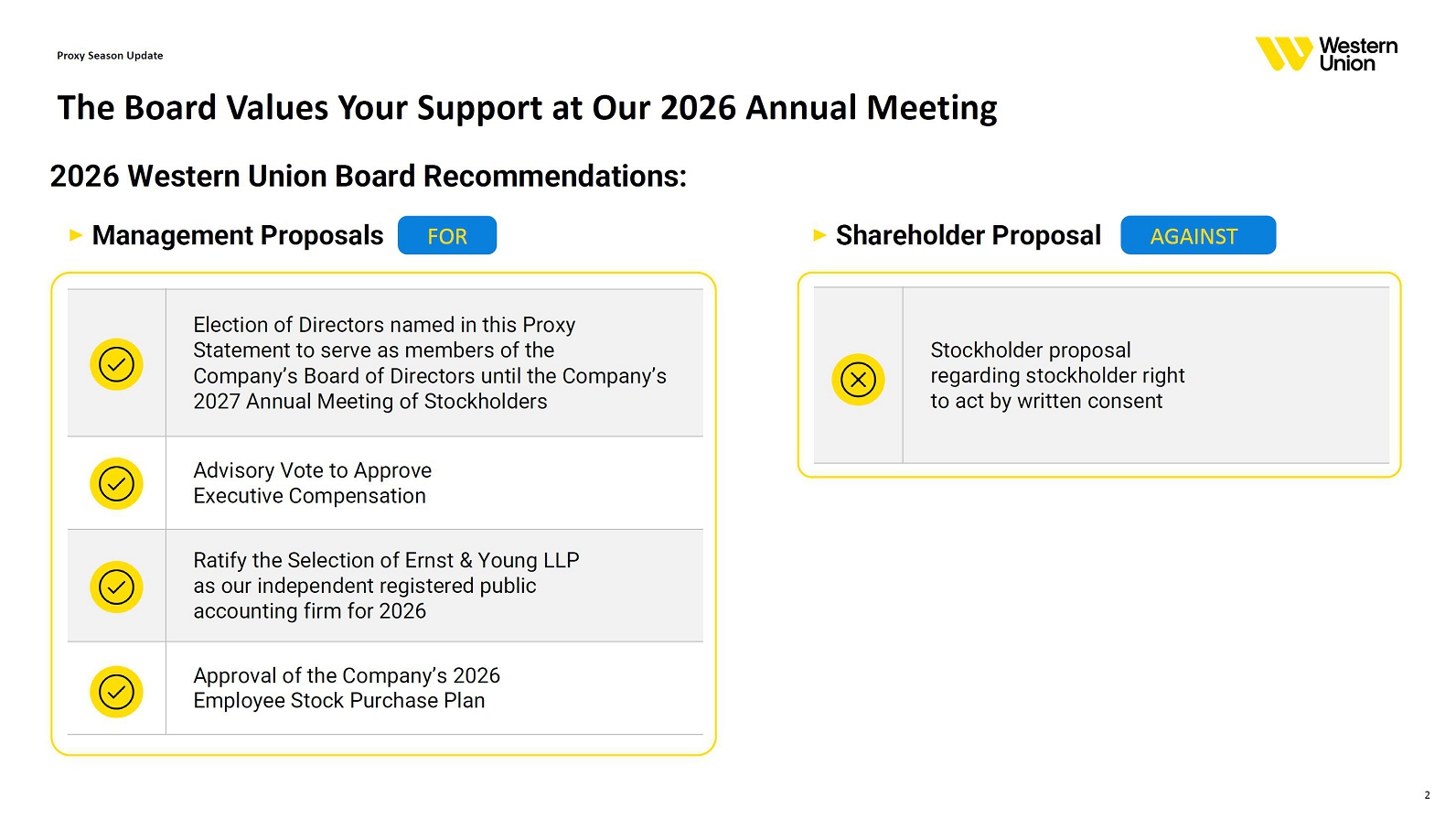
Proxy Season Update 2 Election of Directors named in this Proxy Statement to serve as members of the Company’s Board of Directors until the Company’s 2027 Annual Meeting of Stockholders Advisory Vote to Approve Executive Compensation Ratify the Selection of Ernst & Young LLP as our independent registered public accounting firm for 2026 Approval of the Company’s 2026 Employee Stock Purchase Plan The Board Values Your Support at Our 2026 Annual Meeting 2026 Western Union Board Recommendations: FOR Stockholder proposal regarding stockholder right to act by written consent AGAINST Management Proposals Shareholder Proposal
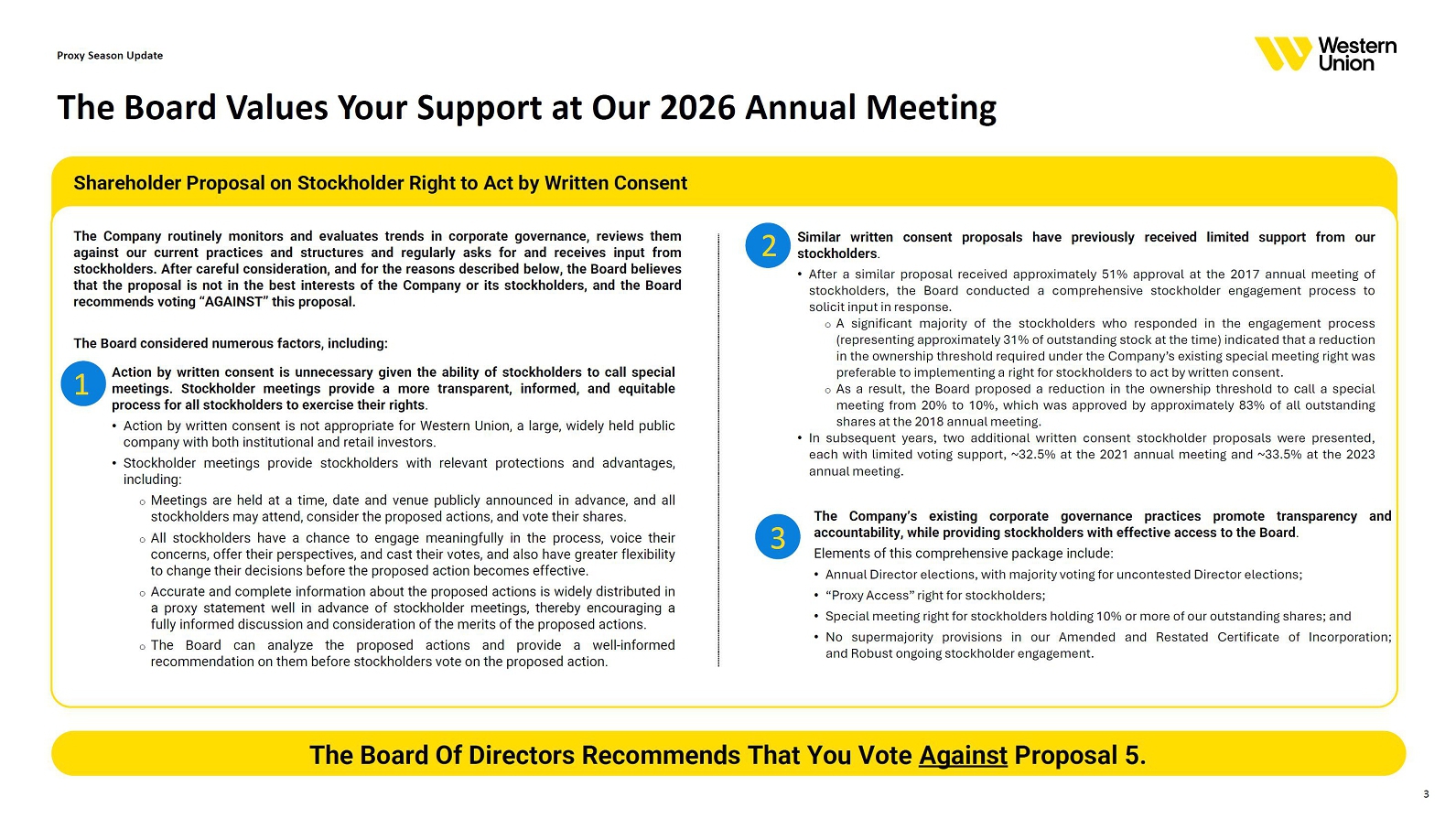
The Board Values Your Support at Our 2026 Annual Meeting Proxy Season Update 3 The Board Of Directors Recommends That You Vote Against Proposal 5. Shareholder Proposal on Stockholder Right to Act by Written Consent The Company routinely monitors and evaluates trends in corporate governance, reviews them against our current practices and structures and regularly asks for and receives input from stockholders . After careful consideration, and for the reasons described below, the Board believes that the proposal is not in the best interests of the Company or its stockholders, and the Board recommends voting “AGAINST” this proposal . The Board considered numerous factors, including : Action by written consent is unnecessary given the ability of stockholders to call special meetings . Stockholder meetings provide a more transparent, informed, and equitable process for all stockholders to exercise their rights . • A ction by written consent is not appropriate for Western Union, a large, widely held public company with both institutional and retail investors . • Stockholder meetings provide stockholders with relevant protections and advantages, including : o Meetings are held at a time, date and venue publicly announced in advance, and all stockholders may attend, consider the proposed actions, and vote their shares . o All stockholders have a chance to engage meaningfully in the process, voice their concerns, offer their perspectives, and cast their votes, and also have greater flexibility to change their decisions before the proposed action becomes effective . o Accurate and complete information about the proposed actions is widely distributed in a proxy statement well in advance of stockholder meetings, thereby encouraging a fully informed discussion and consideration of the merits of the proposed actions . o The Board can analyze the proposed actions and provide a well - informed recommendation on them before stockholders vote on the proposed action . Similar written consent proposals have previously received limited support from our stockholders . • After a similar proposal received approximately 51 % approval at the 2017 annual meeting of stockholders, the Board conducted a comprehensive stockholder engagement process to solicit input in response . o A significant majority of the stockholders who responded in the engagement process (representing approximately 31 % of outstanding stock at the time) indicated that a reduction in the ownership threshold required under the Company’s existing special meeting right was preferable to implementing a right for stockholders to act by written consent . o As a result, the Board proposed a reduction in the ownership threshold to call a special meeting from 20 % to 10 % , which was approved by approximately 83 % of all outstanding shares at the 2018 annual meeting . • In subsequent years, two additional written consent stockholder proposals were presented, each with limited voting support, ~ 32 . 5 % at the 2021 annual meeting and ~ 3 3 . 5 % at the 2023 annual meeting . The Company’s existing corporate governance practices promote transparency and accountability, while providing stockholders with effective access to the Board . Elements of this comprehensive package include : • Annual Director elections, with majority voting for uncontested Director elections ; • “Proxy Access” right for stockholders ; • Special meeting right for stockholders holding 10 % or more of our outstanding shares ; and • No supermajority provisions in our Amended and Restated Certificate of Incorporation ; and Robust ongoing stockholder engagement . 1 2 3
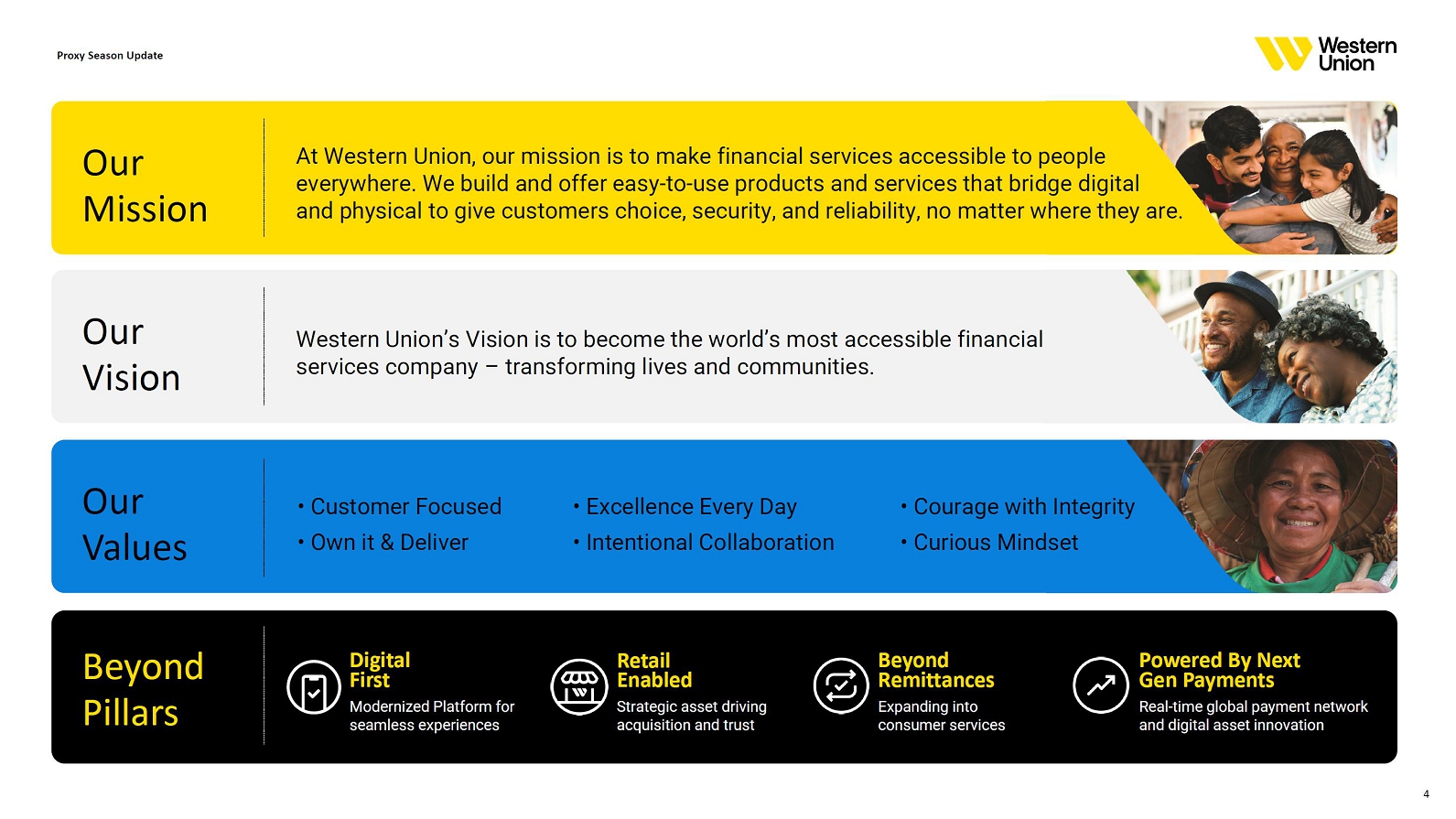
Proxy Season Update 4 Our Mission At Western Union, our mission is to make financial services accessible to people everywhere. We build and offer easy - to - use products and services that bridge digital and physical to give customers choice, security, and reliability, no matter where they are. Our Vision Western Union’s Vision is to become the world’s most accessible financial services company – transforming lives and communities. Our Values • Customer Focused • Own it & Deliver • Courage with Integrity • Curious Mindset • Excellence Every Day • Intentional Collaboration Beyond Pillars Digital First Modernized Platform for seamless experiences Beyond Remittances Expanding into consumer services Retail Enabled Strategic asset driving acquisition and trust Powered By Next Gen Payments Real - time global payment network and digital asset innovation
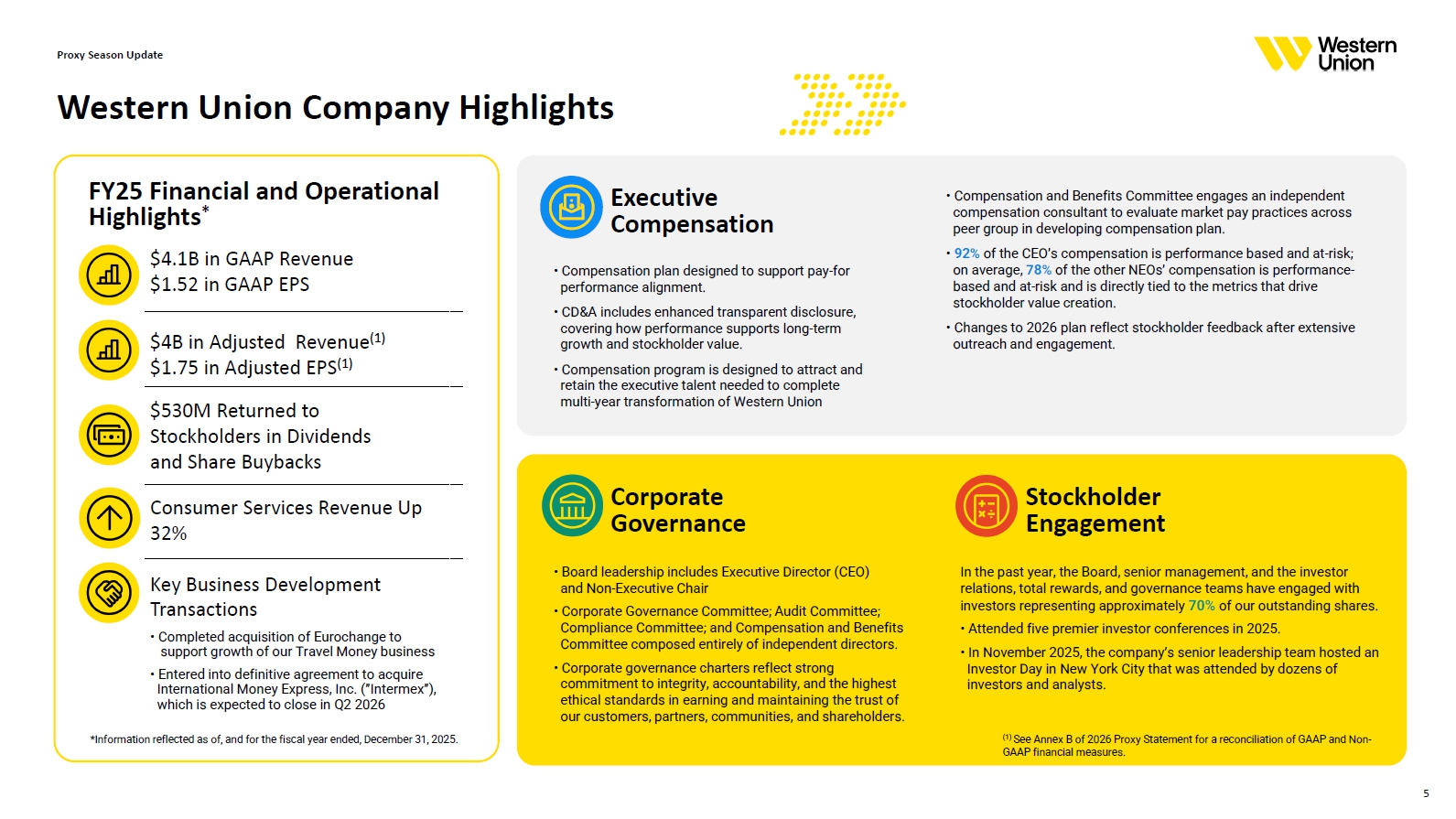
Proxy Season Update Western Union Company Highlights 5 Corporate Governance • Board leadership includes Executive Director (CEO) and Non - Executive Chair • Corporate Governance Committee; Audit Committee; Compliance Committee; and Compensation and Benefits Committee composed entirely of independent directors. • Corporate governance charters reflect strong commitment to integrity, accountability, and the highest ethical standards in earning and maintaining the trust of our customers, partners, communities, and shareholders. Stockholder Engagement In the past year, the Board, senior management, and the investor relations, total rewards, and governance teams have engaged with investors representing approximately 70% of our outstanding shares. • Attended five premier investor conferences in 2025. • In November 2025, the company’s senior leadership team hosted an Investor Day in New York City that was attended by dozens of investors and analysts. (1) See Annex B of 2026 Proxy Statement for a reconciliation of GAAP and Non - GAAP financial measures. FY25 Financial and Operational Highlights * $4.1B in GAAP Revenue $1.52 in GAAP EPS $4B in Adjusted Revenue (1) $1.75 in Adjusted EPS (1) $530M Returned to Stockholders in Dividends and Share Buybacks Consumer Services Revenue Up 32% Key Business Development Transactions • Completed acquisition of Eurochange to support growth of our Travel Money business • Entered into definitive agreement to acquire International Money Express, Inc. (”Intermex”), which is expected to close in Q2 2026 *Information reflected as of, and for the fiscal year ended, December 31, 2025. • Compensation plan designed to support pay - for performance alignment. • CD&A includes enhanced transparent disclosure, covering how performance supports long - term growth and stockholder value. • Compensation program is designed to attract and retain the executive talent needed to complete multi - year transformation of Western Union • Compensation and Benefits Committee engages an independent compensation consultant to evaluate market pay practices across peer group in developing compensation plan. • 92% of the CEO’s compensation is performance based and at - risk; on average, 78% of the other NEOs’ compensation is performance - based and at - risk and is directly tied to the metrics that drive stockholder value creation. • Changes to 2026 plan reflect stockholder feedback after extensive outreach and engagement. Executive Compensation
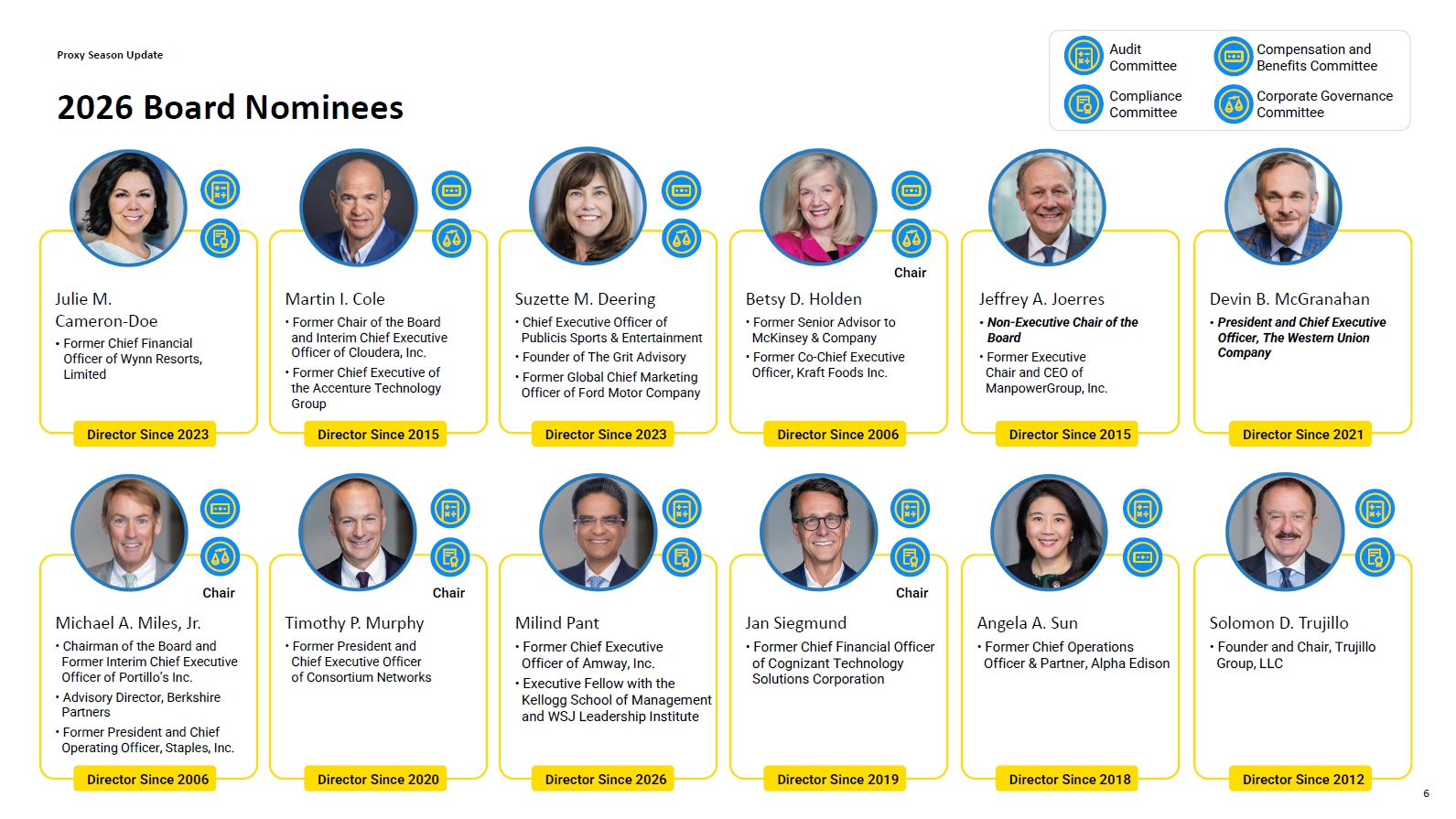
2026 Board Nominees 6 Proxy Season Update Audit Committee Compliance Committee Compensation and Benefits Committee Corporate Governance Committee Julie M. Cameron - Doe • Former Chief Financial Officer of Wynn Resorts, Limited Martin I. Cole • Former Chair of the Board and Interim Chief Executive Officer of Cloudera, Inc. • Former Chief Executive of the Accenture Technology Group Suzette M. Deering • Chief Executive Officer of Publicis Sports & Entertainment • Founder of The Grit Advisory • Former Global Chief Marketing Officer of Ford Motor Company Betsy D. Holden • Former Senior Advisor to McKinsey & Company • Former Co - Chief Executive Officer, Kraft Foods Inc. Devin B. McGranahan • President and Chief Executive Officer, The Western Union Company Director Since 2015 Director Since 2023 Director Since 2006 Director Since 2015 Director Since 2021 Jeffrey A. Joerres • Non - Executive Chair of the Board • Former Executive Chair and CEO of ManpowerGroup, Inc. Chair Director Since 2023 Michael A. Miles, Jr. • Chairman of the Board and Former Interim Chief Executive Officer of Portillo’s Inc. • Advisory Director, Berkshire Partners • Former President and Chief Operating Officer, Staples, Inc. Timothy P. Murphy • Former President and Chief Executive Officer of Consortium Networks Milind Pant • Former Chief Executive Officer of Amway, Inc. • Executive Fellow with the Kellogg School of Management and WSJ Leadership Institute Jan Siegmund • Former Chief Financial Officer of Cognizant Technology Solutions Corporation Angela A. Sun • Former Chief Operations Officer & Partner, Alpha Edison Solomon D. Trujillo • Founder and Chair, Trujillo Group, LLC Director Since 2006 Director Since 2020 Director Since 2026 Director Since 2019 Director Since 2018 Director Since 2012 Chair Chair Chair
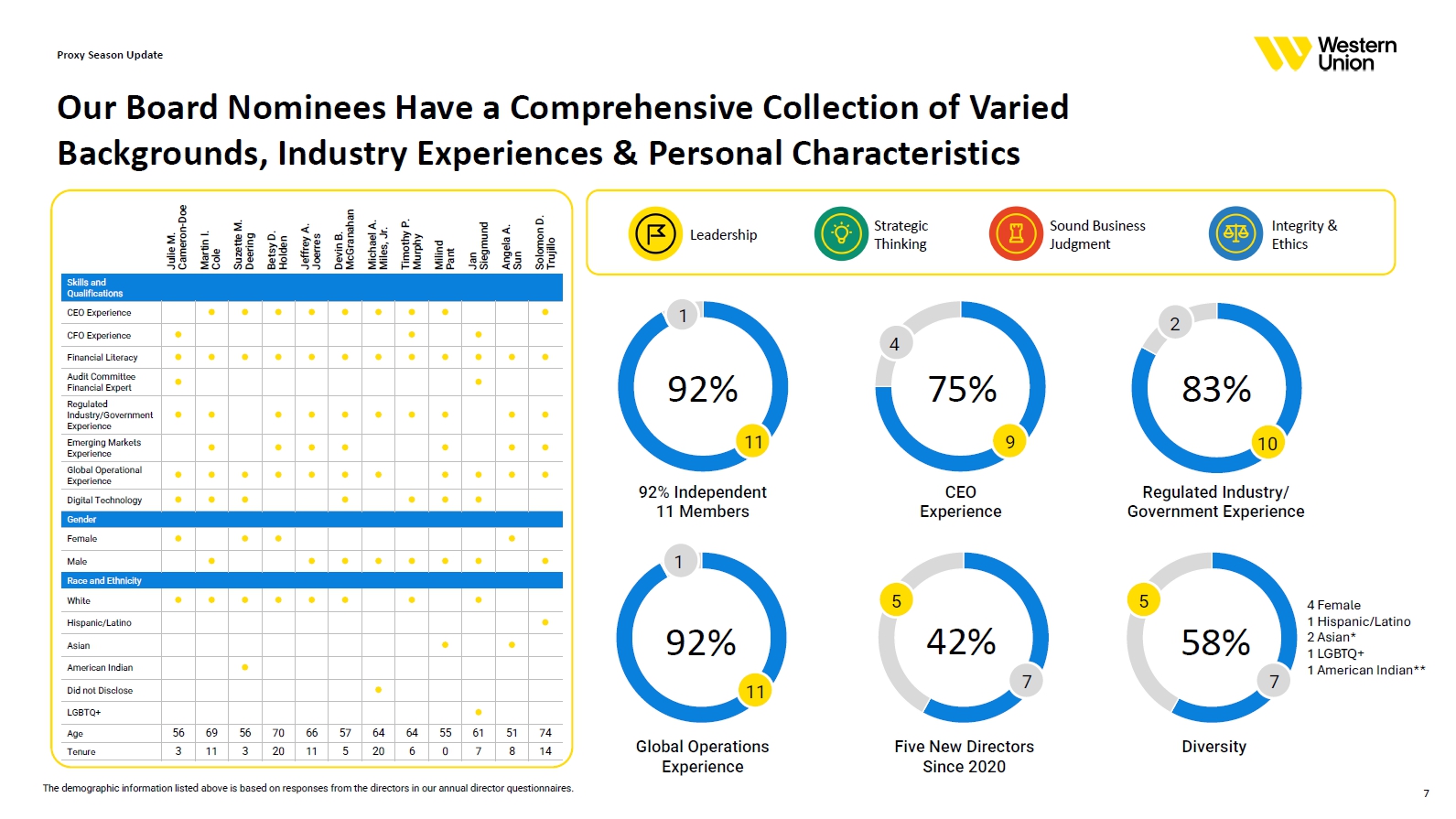
Our Board Nominees Have a Comprehensive Collection of Varied Backgrounds, Industry Experiences & Personal Characteristics Proxy Season Update Leadership Strategic Thinking Sound Business Judgment Integrity & Ethics 7 Skills and Qualifications CEO Experience CFO Experience Financial Literacy Audit Committee Financial Expert Regulated Industry/Government Experience Emerging Markets Experience Global Operational Experience Digital Technology Gender Female Male Race and Ethnicity White Hispanic/Latino Asian American Indian Did not Disclose LGBTQ+ 74 51 61 55 64 64 57 66 70 56 69 56 Age 14 8 7 0 6 20 5 11 20 3 11 3 Tenure Julie M. Cameron - Doe Martin I. Cole Suzette M. Deering Betsy D. Holden Jeffrey A. Joerres Devin B. McGranahan Michael A. Miles, Jr. Timothy P. Murphy Milind Pant Jan Siegmund Angela A. Sun Solomon D. Trujillo The demographic information listed above is based on responses from the directors in our annual director questionnaires. 83% 10 75% 92% 4 9 1 11 92% Independent 11 Members CEO Experience Regulated Industry/ Government Experience 2 10 92% Global Operations Experience 58% Diversity 42% Five New Directors Since 2020 4 Female 1 Hispanic/Latino 2 Asian* 1 LGBTQ+ 1 American Indian** 1 11 5 7 5 7
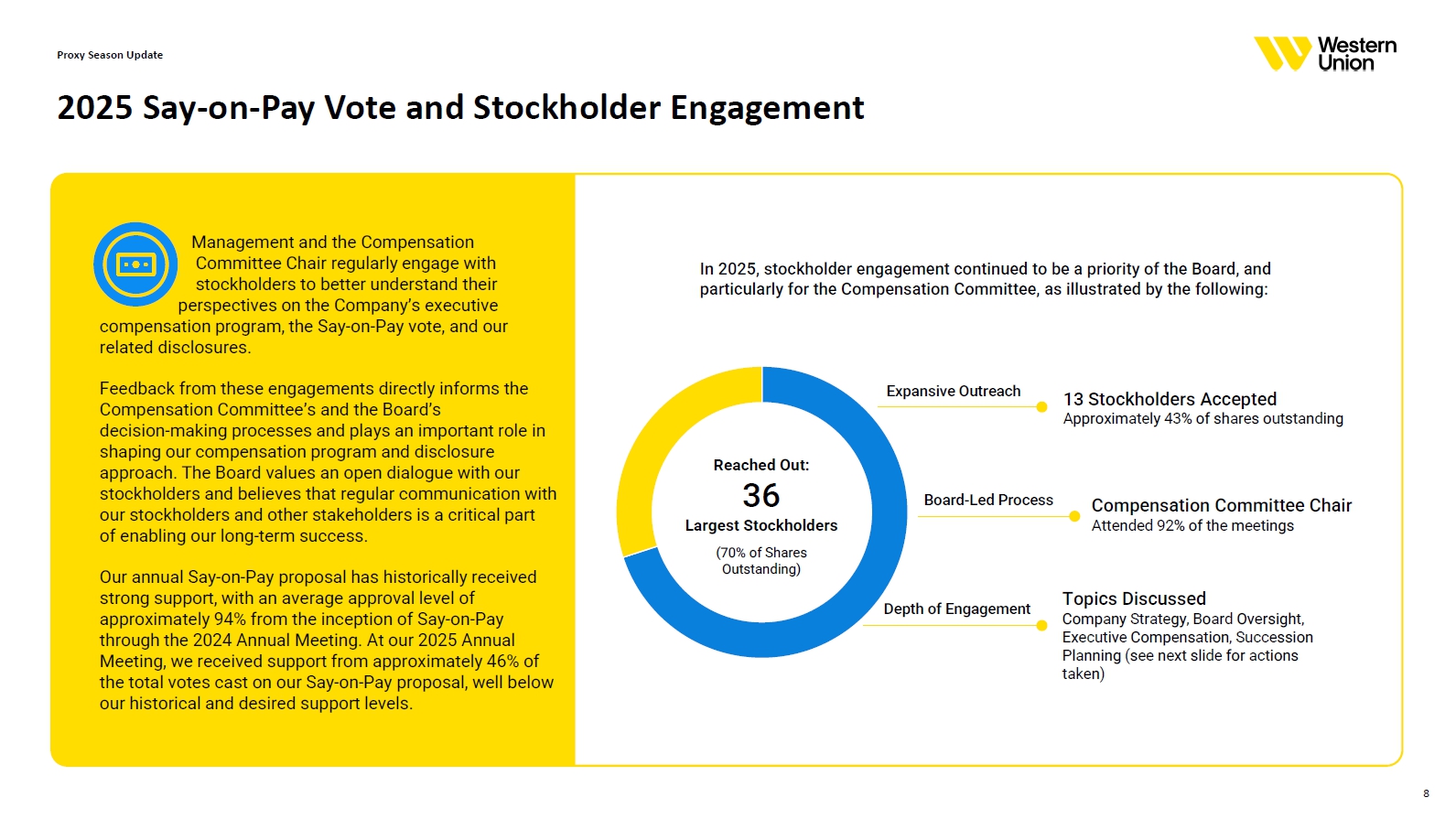
2025 Say - on - Pay Vote and Stockholder Engagement Proxy Season Update 8 In 2025, stockholder engagement continued to be a priority of the Board, and particularly for the Compensation Committee, as illustrated by the following: Board - Led Process Depth of Engagement Reached Out: 36 Largest Stockholders (70% of Shares Outstanding) Expansive Outreach 13 Stockholders Accepted Approximately 43% of shares outstanding Compensation Committee Chair Attended 92% of the meetings Topics Discussed Company Strategy, Board Oversight, Executive Compensation, Succession Planning (see next slide for actions taken) Management and the Compensation Committee Chair regularly engage with stockholders to better understand their perspectives on the Company’s executive compensation program, the Say - on - Pay vote, and our related disclosures. Feedback from these engagements directly informs the Compensation Committee’s and the Board’s decision - making processes and plays an important role in shaping our compensation program and disclosure approach. The Board values an open dialogue with our stockholders and believes that regular communication with our stockholders and other stakeholders is a critical part of enabling our long - term success. Our annual Say - on - Pay proposal has historically received strong support, with an average approval level of approximately 94% from the inception of Say - on - Pay through the 2024 Annual Meeting. At our 2025 Annual Meeting, we received support from approximately 46% of the total votes cast on our Say - on - Pay proposal, well below our historical and desired support levels.
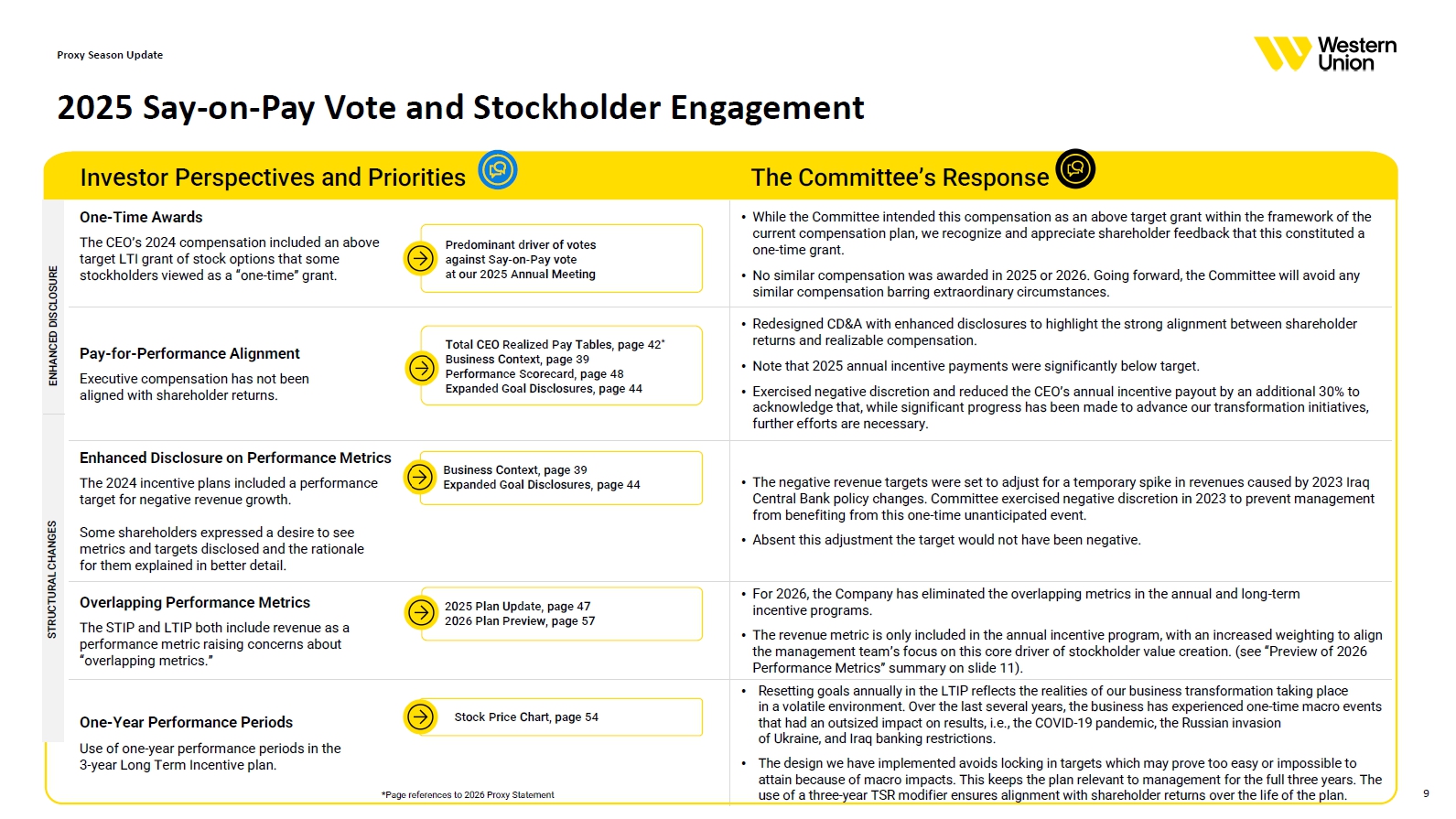
2025 Say - on - Pay Vote and Stockholder Engagement Proxy Season Update 9 • While the Committee intended this compensation as an above target grant within the framework of the current compensation plan, we recognize and appreciate shareholder feedback that this constituted a one - time grant. • No similar compensation was awarded in 2025 or 2026. Going forward, the Committee will avoid any similar compensation barring extraordinary circumstances. One - Time Awards The CEO’s 2024 compensation included an above target LTI grant of stock options that some stockholders viewed as a “one - time” grant. • Redesigned CD&A with enhanced disclosures to highlight the strong alignment between shareholder returns and realizable compensation. • Note that 2025 annual incentive payments were significantly below target. • Exercised negative discretion and reduced the CEO’s annual incentive payout by an additional 30% to acknowledge that, while significant progress has been made to advance our transformation initiatives, further efforts are necessary. Pay - for - Performance Alignment Executive compensation has not been aligned with shareholder returns. • The negative revenue targets were set to adjust for a temporary spike in revenues caused by 2023 Iraq Central Bank policy changes. Committee exercised negative discretion in 2023 to prevent management from benefiting from this one - time unanticipated event. • Absent this adjustment the target would not have been negative. Enhanced Disclosure on Performance Metrics The 2024 incentive plans included a performance target for negative revenue growth. Some shareholders expressed a desire to see metrics and targets disclosed and the rationale for them explained in better detail. • For 2026, the Company has eliminated the overlapping metrics in the annual and long - term incentive programs. • The revenue metric is only included in the annual incentive program, with an increased weighting to align the management team’s focus on this core driver of stockholder value creation. (see “Preview of 2026 Performance Metrics” summary on slide 11 ). Overlapping Performance Metrics The STIP and LTIP both include revenue as a performance metric raising concerns about “overlapping metrics.” • Resetting goals annually in the LTIP reflects the realities of our business transformation taking place in a volatile environment. Over the last several years, the business has experienced one - time macro events that had an outsized impact on results, i.e., the COVID - 19 pandemic, the Russian invasion of Ukraine, and Iraq banking restrictions. • The design we have implemented avoids locking in targets which may prove too easy or impossible to attain because of macro impacts. This keeps the plan relevant to management for the full three years. The use of a three - year TSR modifier ensures alignment with shareholder returns over the life of the plan. One - Year Performance Periods Use of one - year performance periods in the 3 - year Long Term Incentive plan . Predominant driver of votes against Say - on - Pay vote at our 2025 Annual Meeting Investor Perspectives and Priorities The Committee’s Response Total CEO Realized Pay Tables, page 42 * Business Context, page 39 Performance Scorecard, page 48 Expanded Goal Disclosures, page 44 Business Context, page 39 Expanded Goal Disclosures, page 44 Stock Price Chart, page 54 2025 Plan Update, page 47 2026 Plan Preview, page 57 ENHANCED DISCLOSURE STRUCTURAL CHANGES *Page references to 2026 Proxy Statement
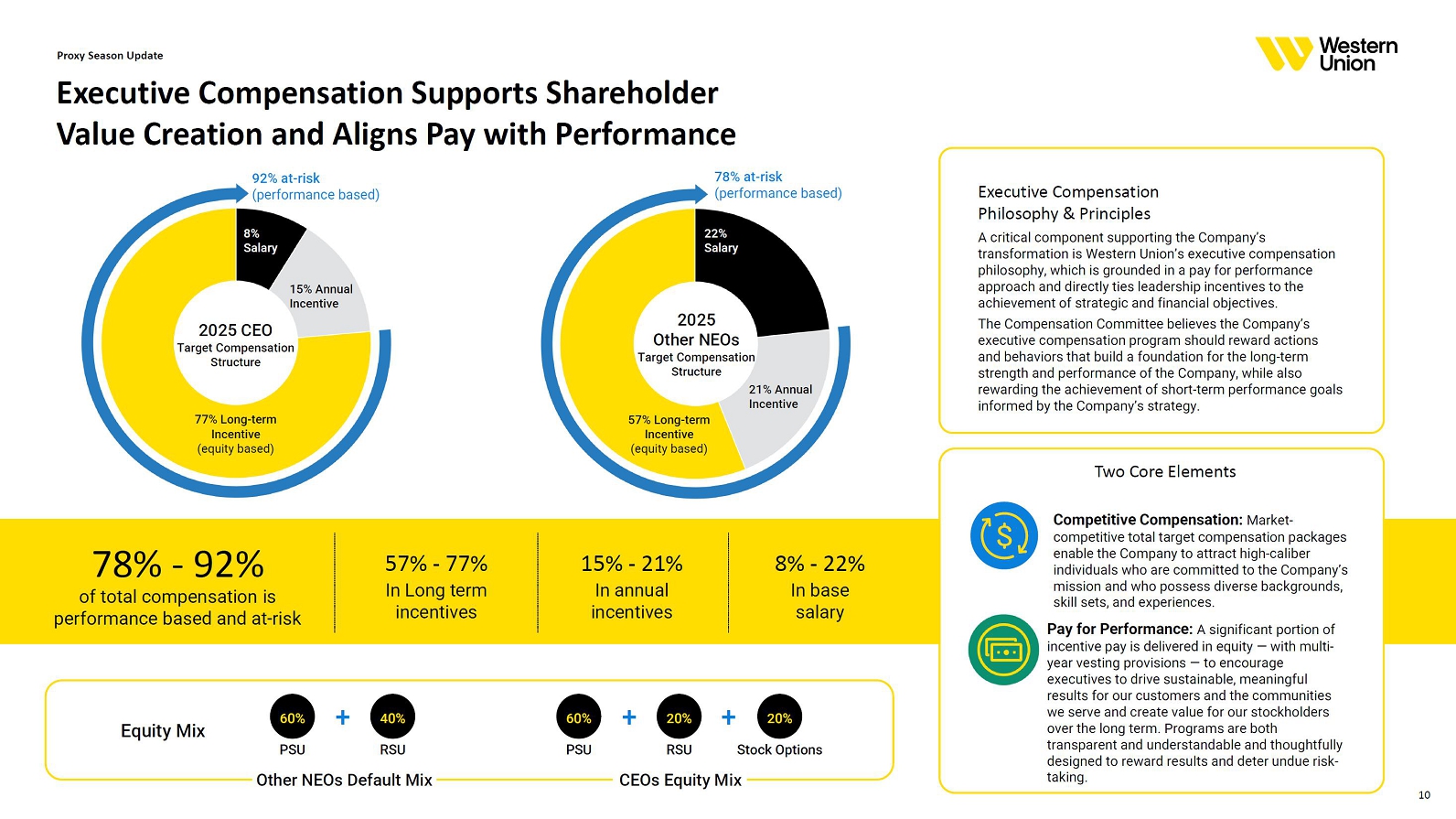
Executive Compensation Supports Shareholder Value Creation and Aligns Pay with Performance 78% - 92% of total compensation is performance based and at - risk 57% - 77% Long term incentives 15% - 21% In annual incentives 8% - 22% In base salary Equity Mix + + + 60% 40% PSU RSU 60% PSU 20% RSU 20% Stock Options Other NEOs Default Mix CEOs Equity Mix 92% at - risk (performance based) 78% at - risk (performance based) 8% Salary 15% Annual Incentive 77% Long - term Incentive (equity based) 57% Long - term Incentive (equity based) 21% Annual Incentive 22% Salary 2025 CEO Target Compensation Structure 2025 Other NEOs Target Compensation Structure Proxy Season Update 10 Executive Compensation Philosophy & Principles A critical component supporting the Company’s transformation is Western Union’s executive compensation philosophy, which is grounded in a pay for performance approach and directly ties leadership incentives to the achievement of strategic and financial objectives. The Compensation Committee believes the Company’s executive compensation program should reward actions and behaviors that build a foundation for the long - term strength and performance of the Company, while also rewarding the achievement of short - term performance goals informed by the Company’s strategy. Competitive Compensation: Market - competitive total target compensation packages enable the Company to attract high - caliber individuals who are committed to the Company’s mission and who possess diverse backgrounds, skill sets, and experiences. Pay for Performance: A significant portion of incentive pay is delivered in equity — with multi - year vesting provisions — to encourage executives to drive sustainable, meaningful results for our customers and the communities we serve and create value for our stockholders over the long term. Programs are both transparent and understandable and thoughtfully designed to reward results and deter undue risk - taking. Two Core Elements
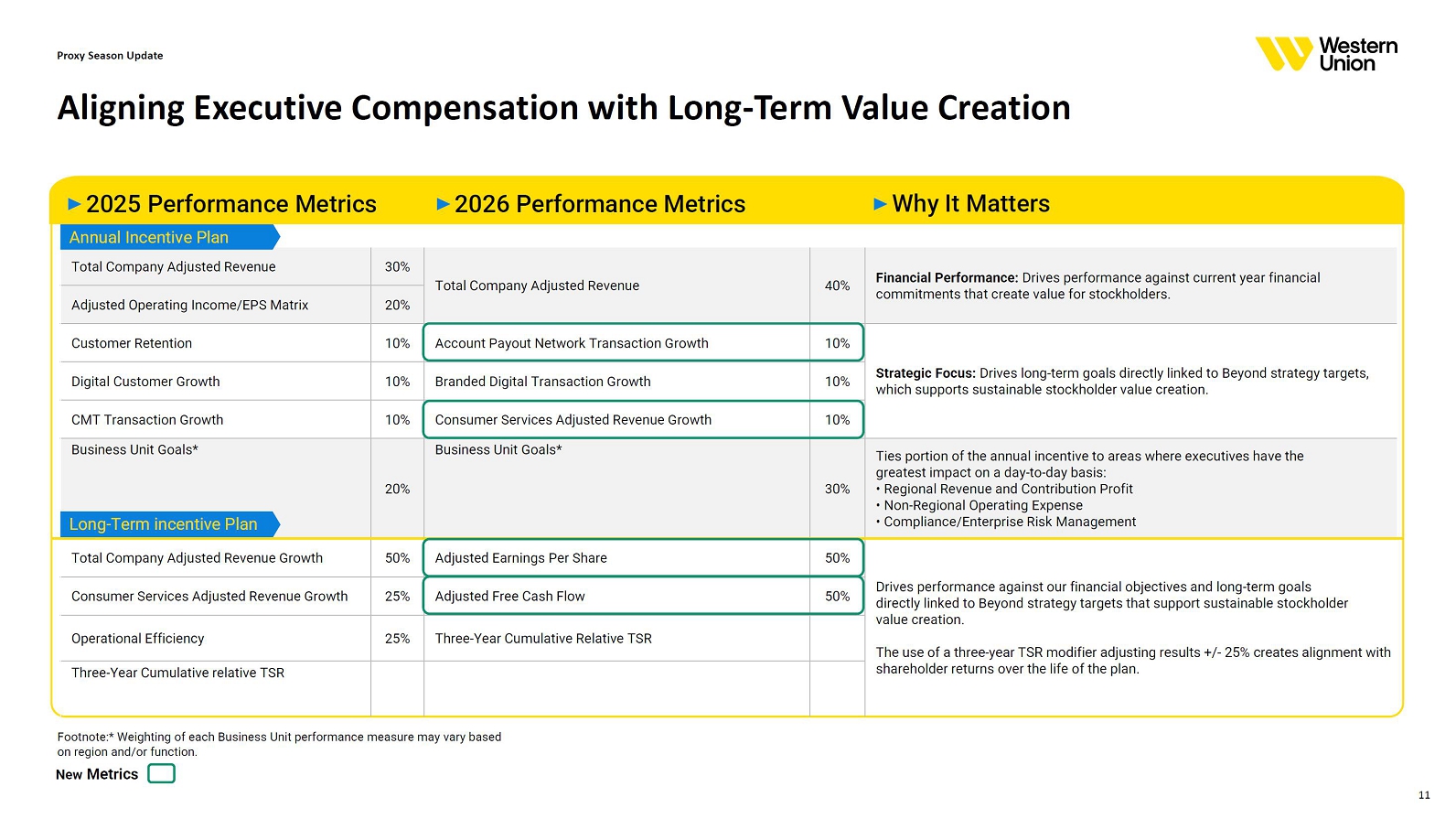
Aligning Executive Compensation with Long - Term Value Creation Proxy Season Update 11 Financial Performance: Drives performance against current year financial commitments that create value for stockholders. 40% Total Company Adjusted Revenue 30% Total Company Adjusted Revenue 20% Adjusted Operating Income/EPS Matrix Strategic Focus: Drives long - term goals directly linked to Beyond strategy targets, which supports sustainable stockholder value creation. 10% Account Payout Network Transaction Growth 10% Customer Retention 10% Branded Digital Transaction Growth 10% Digital Customer Growth 10% Consumer Services Adjusted Revenue Growth 10% CMT Transaction Growth Ties portion of the annual incentive to areas where executives have the greatest impact on a day - to - day basis: • Regional Revenue and Contribution Profit • Non - Regional Operating Expense • Compliance/Enterprise Risk Management 30% Business Unit Goals* 20% Business Unit Goals* Drives performance against our financial objectives and long - term goals directly linked to Beyond strategy targets that support sustainable stockholder value creation. The use of a three - year TSR modifier adjusting results +/ - 25% creates alignment with shareholder returns over the life of the plan. 50% Adjusted Earnings Per Share 50% Total Company Adjusted Revenue Growth 50% Adjusted Free Cash Flow 25% Consumer Services Adjusted Revenue Growth Three - Year Cumulative Relative TSR 25% Operational Efficiency Three - Year Cumulative relative TSR Annual Incentive Plan Long - Term incentive Plan 2025 Performance Metrics Why It Matters Footnote:* Weighting of each Business Unit performance measure may vary based on region and/or function. 2026 Performance Metrics New Metrics
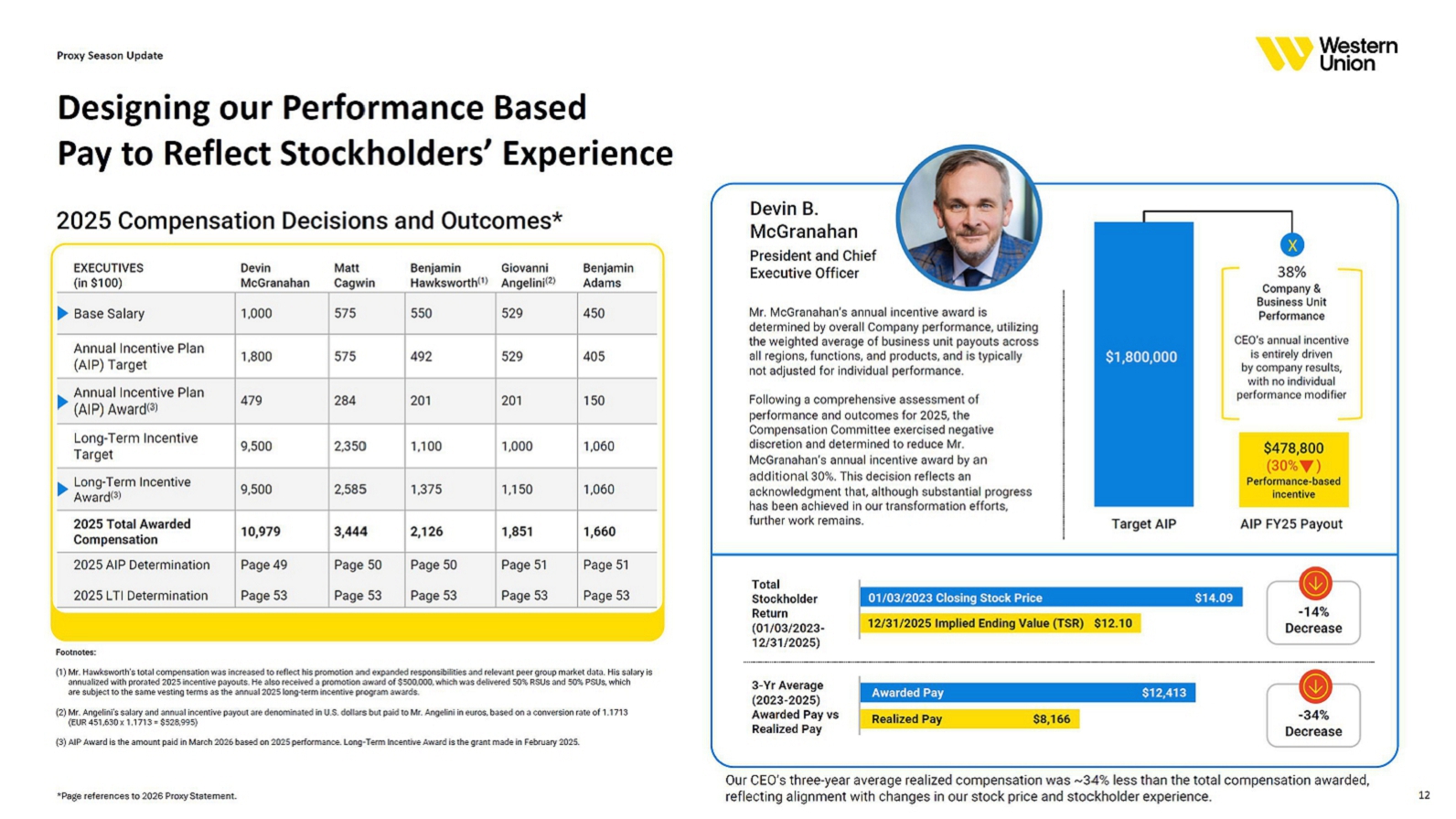
Designing our Performance Based Pay to Reflect Stockholders’ Experience Proxy Season Update 12 Benjamin Adams Giovanni Angelini (2) Benjamin Hawksworth (1) Matt Cagwin Devin McGranahan EXECUTIVES (in $100) 450 5 29 550 575 1,000 Base Salary 405 529 492 575 1,800 Annual Incentive Plan (AIP) Target 150 201 201 284 479 Annual Incentive Plan (AIP) Award (3) 1,060 1,000 1,100 2,350 9,500 Long - Term Incentive Target 1,060 1,150 1,375 2,585 9,500 Long - Term Incentive Award (3) 1,660 1,851 2,126 3,444 10,979 2025 Total Awarded Compensation Page 51 Page 53 Page 51 Page 53 Page 50 Page 53 Page 50 Page 53 Page 49 Page 53 2025 AIP Determination 2025 LTI Determination Footnotes: (1) Mr. Hawksworth’s total compensation was increased to reflect his promotion and expanded responsibilities and relevant pee r g roup market data. His salary is annualized with prorated 2025 incentive payouts. He also received a promotion award of $500,000, which was delivered 50% R SUs and 50% PSUs, which are subject to the same vesting terms as the annual 2025 long - term incentive program awards. (2) Mr. Angelini’s salary and annual incentive payout are denominated in U.S. dollars but paid to Mr. Angelini in euros, base d o n a conversion rate of 1.1713 (EUR 451,630 x 1.1713 = $528,995) (3) AIP Award is the amount paid in March 2026 based on 2025 performance. Long - Term Incentive Award is the grant made in Februar y 2025. 2025 Compensation Decisions and Outcomes * Devin B. McGranahan President and Chief Executive Officer Mr. McGranahan’s annual incentive award is determined by overall Company performance, utilizing the weighted average of business unit payouts across all regions, functions, and products, and is typically not adjusted for individual performance. Following a comprehensive assessment of performance and outcomes for 2025, the Compensation Committee exercised negative discretion and determined to reduce Mr. McGranahan’s annual incentive award by an additional 30 %. This decision reflects an acknowledgment that, although substantial progress has been achieved in our transformation efforts, further work remains. Target AIP AIP FY25 Payout 38% Company & Business Unit Performance CEO’s annual incentive is entirely driven by company results, with no individual performance modifier X $478,800 (30% ) Performance - based incentive $1,800,000 Total Stockholder Return (01/03/2023 - 12/31/2025 01/03/2023 Closing Stock Price $14.09 12/31/2025 Implied Ending Value (TSR) $ 12.1 0 3 - Yr Average (2023 - 2025) Awarded Pay vs Realized Pay Awarded Pay $12,413 Realized Pay $8,166 - 14% Decrease - 34% Decrease Our CEO’s three - year average realized compensation was ~34% less than the total compensation awarded, reflecting alignment with changes in our stock price and stockholder experience. *Page references to 2026 Proxy Statement.
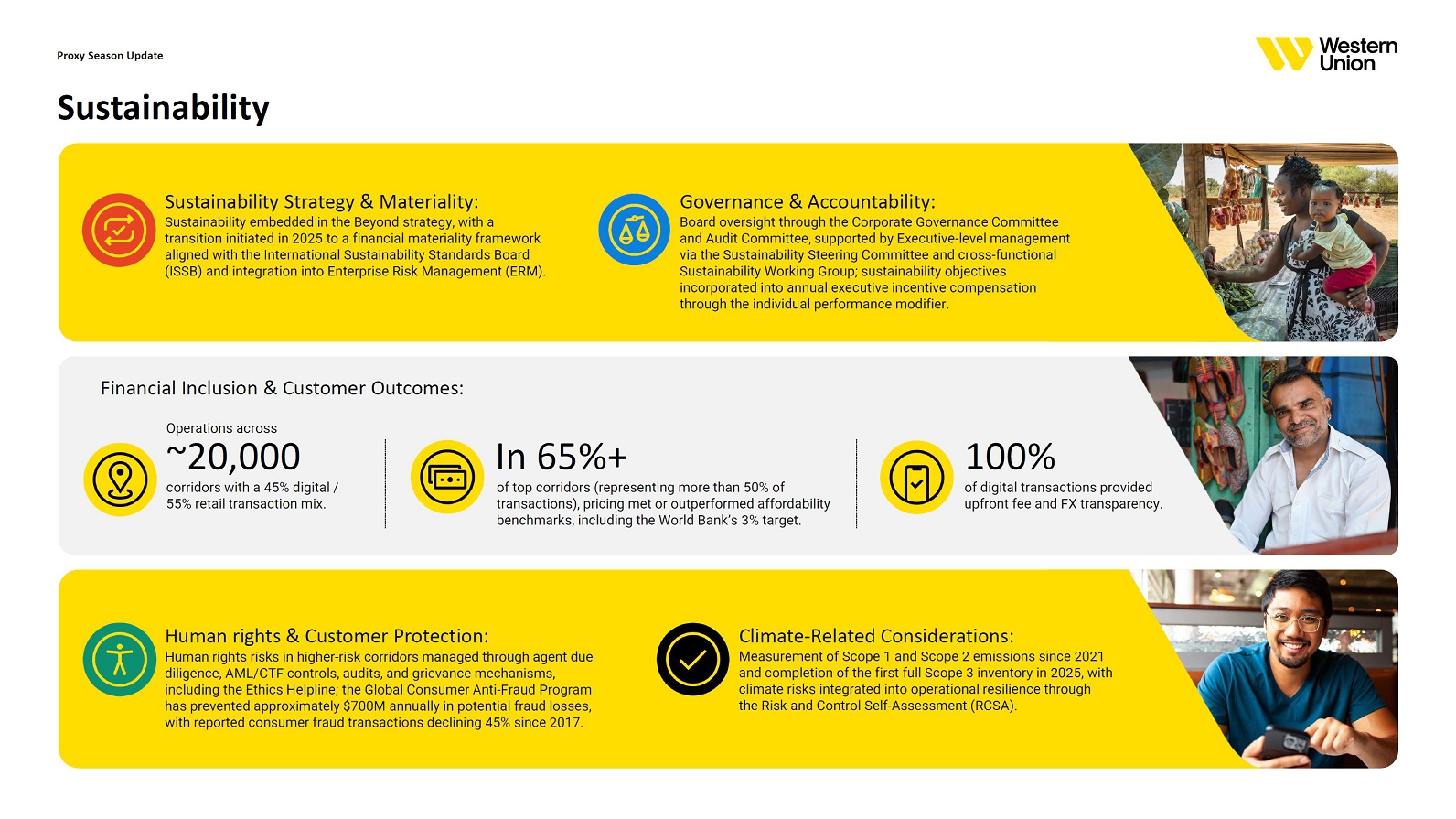
Sustainability Proxy Season Update Financial Inclusion & Customer Outcomes: ~20,000 Operations across corridors with a 45% digital / 55% retail transaction mix. of top corridors (representing more than 50% of transactions), pricing met or outperformed affordability benchmarks, including the World Bank’s 3% target. of digital transactions provided upfront fee and FX transparency. In 65%+ 100% Human rights & Customer Protection: Human rights risks in higher - risk corridors managed through agent due diligence, AML/CTF controls, audits, and grievance mechanisms, including the Ethics Helpline; the Global Consumer Anti - Fraud Program has prevented approximately $700M annually in potential fraud losses, with reported consumer fraud transactions declining 45% since 2017. Climate - Related Considerations: Measurement of Scope 1 and Scope 2 emissions since 2021 and completion of the first full Scope 3 inventory in 2025, with climate risks integrated into operational resilience through the Risk and Control Self - Assessment (RCSA). Sustainability Strategy & Materiality: Sustainability embedded in the Beyond strategy, with a transition initiated in 2025 to a financial materiality framework aligned with the International Sustainability Standards Board (ISSB) and integration into Enterprise Risk Management (ERM). Governance & Accountability: Board oversight through the Corporate Governance Committee and Audit Committee, supported by Executive - level management via the Sustainability Steering Committee and cross - functional Sustainability Working Group; sustainability objectives incorporated into annual executive incentive compensation through the individual performance modifier.
Forward - Looking Statements This presentation contains certain statements that are forward - looking within the meaning of the Private Securities Litigation R eform Act of 1995. These statements are not guarantees of future performance and involve certain risks, uncertainties, and assumptions that are difficult to predict. Act ual outcomes and results may differ materially from those expressed in, or implied by, our forward - looking statements. Words such as “expects,” “intends,” “targets,” “anticipates,” “believes,” “estimates,” “guides,” “provides guidance,” “provides outlook,” “projects,” “designed to,” and other similar expressions or future or conditional verbs such a s “ may,” “will,” “should,” “would,” “could,” and “might” are intended to identify such forward - looking statements. Readers of this presentation of The Western Union Company (the “Compan y,” “Western Union,” “we,” “our,” or “us”) should not rely solely on the forward - looking statements and should consider all uncertainties and risks discussed in the Risk F actors section of our Annual Report on Form 10 - K for the year ended December 31 , 2025, and in our subsequent filings with the Securities and Exchange Commission. The statements are only as of the date they are made, and the Company undertakes no obligation to update any forward - looking statement. Possible events or factors that could cause results or performance to differ materially from those expressed in our forward - look ing statements include the following: changes in economic conditions, trade disruptions, or significantly slower growth or declines in the money transfer, payment service, an d other markets in which we operate; interruptions in migration patterns, slowdown in travel, or other events, such as public health emergencies, any changes aris ing as a result of policy changes in the United States and/or other key markets , civil unrest, war, terrorism, natural disasters, or non - performance by our banks, lenders, insurers, or other financial servic es providers; failure to compete effectively in the money transfer and payment service industry, including among other things, with respect to digi tal , mobile and internet - based services, card associations, and card - based payment providers, and with digital currencies, including cryptocurrencies; geopolitical tensions, political conditions, armed conflicts or wars, and related actions, including trade restrictions, tariffs, and government sanctions; deterioration in customer confidence in our bu siness; failure to maintain our agent network and business relationships; our ability to adopt new technology; the development, deployment, and use of AI, machine learning, an d a utomated decision - making technologies in our operations, including risks or unintended outcomes; the failure to realize anticipated financial benefits from mergers, acqui sit ions and divestitures; decisions to change our business mix; exposure to foreign exchange rates; changes in tax laws, or their interpretation, and unfavorable resolution of ta x contingencies; cybersecurity incidents involving any of our systems or those of our vendors or other third parties; cessation of or defects in various services provided to us by third - party vendors; our ability to realize the anticipated benefits from restructuring - related initiatives; our ability to attract and retain qualified key employees; failure to manage credit and fraud risks presented by our agents, clients, and consumers; adverse rating actions by credit rating agencies; our ability to protect our intellectual pro per ty rights, and to defend ourselves against potential intellectual property infringement claims; material changes in the market value or liquidity of securities that we hold; rest ric tions imposed by our debt obligations; liabilities or loss of business resulting from a failure by us, our agents, or their subagents to comply with laws and regulations and regul ato ry or judicial interpretations thereof; increased costs or loss of business due to regulatory initiatives and changes in laws, regulations, and industry practices and standard s; developments resulting from governmental investigations and consent agreements with, or investigations or enforcement actions by, regulators and other government auth ori ties; liabilities resulting from litigation; failure to comply with regulations and evolving industry standards regarding data privacy; failure to comply with consumer protection la ws; effects of unclaimed property laws or their interpretation or the enforcement thereof; failure to comply with working capital requirements; changes in accounting standar ds, rules and interpretations; and other unanticipated events and management’s ability to identify and manage these and other risks. Important factors that could caus e W estern Union’s or Intermex’s or the combined company’s actual results to differ materially from the results referred to in the forward - looking statements Western Un ion makes in this release include: the possibility that the conditions to the consummation of the proposed acquisition of Intermex (the “Proposed Acquisition”) will no t be satisfied on the terms or timeline expected, or at all; failure to obtain, or delays in obtaining, or adverse conditions related to obtaining regulatory approvals sought in connection with the Proposed Acquisition; dependence on key agents and the potential effects of network disruption; the possibility that Western Union may be unable to ac hieve expected benefits, synergies and operating efficiencies in connection with the Proposed Acquisition; and failure to retain key management of Western Union or Int ermex. 14

Thank you. ©202 6 Western Union Holdings, Inc. All rights reserved

Appendix
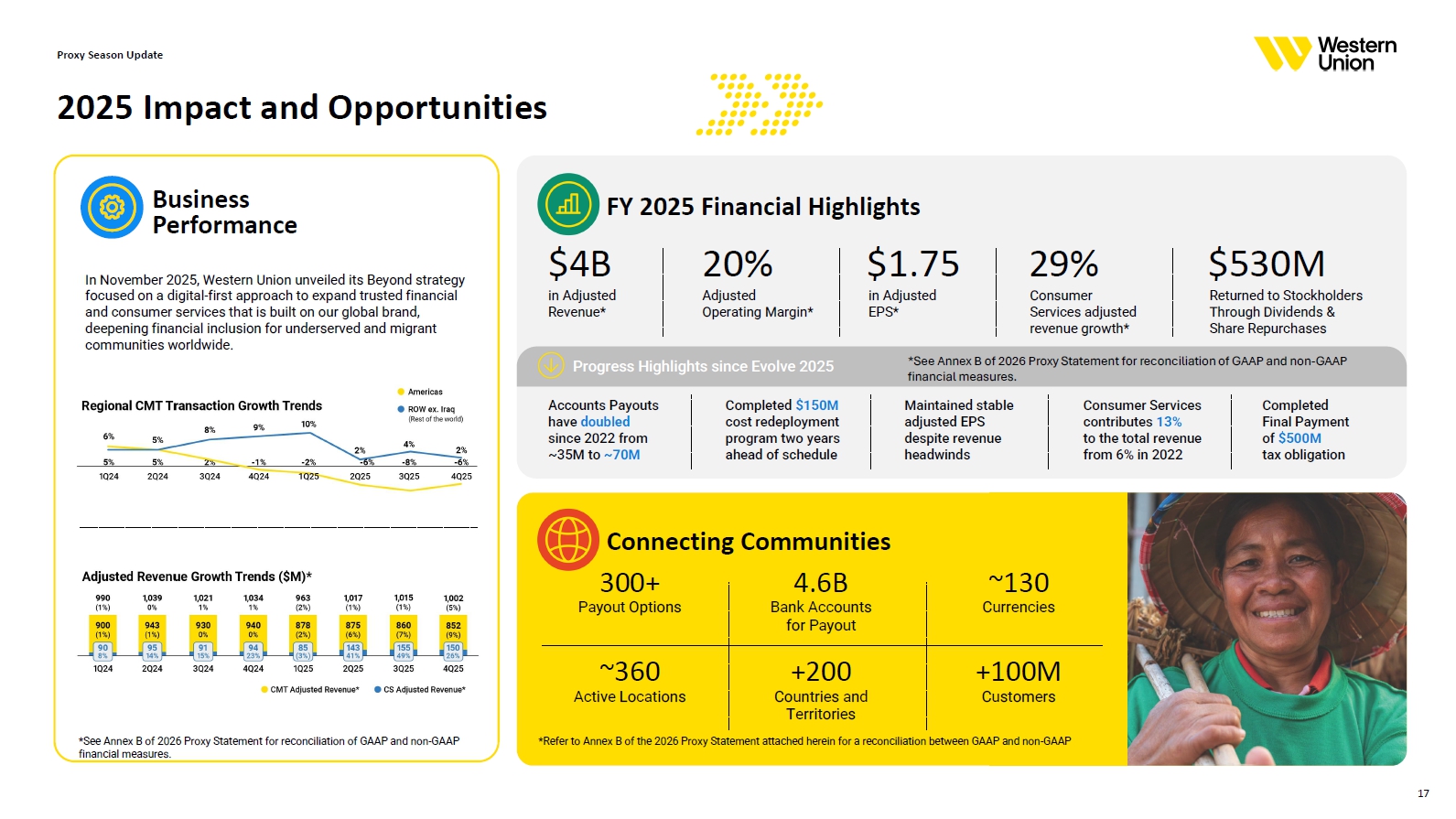
2025 Impact and Opportunities FY 2025 Financial Highlights $4B in Adjusted Revenue* 20% Adjusted Operating Margin* in Adjusted EPS* $1.75 Consumer Services adjusted revenue growth* 29% Returned to Stockholders Through Dividends & Share Repurchases $530M Accounts Payouts have doubled since 2022 from ~35M to ~70M Completed $150M cost redeployment program two years ahead of schedule Maintained stable adjusted EPS despite revenue headwinds Consumer Services contributes 13% to the total revenue from 6% in 2022 Completed Final Payment of $500M tax obligation Progress Highlights since Evolve 2025 *See Annex B of 2026 Proxy Statement for reconciliation of GAAP and non - GAAP financial measures. Connecting Communities 300+ Payout Options 4.6B Bank Accounts for Payout ~130 Currencies ~360 Active Locations +200 Countries and Territories +100M Customers *Refer to Annex B of the 2026 Proxy Statement attached herein for a reconciliation between GAAP and non - GAAP Proxy Season Update 17 Business Performance In November 2025, Western Union unveiled its Beyond strategy focused on a digital - first approach to expand trusted financial and consumer services that is built on our global brand, deepening financial inclusion for underserved and migrant communities worldwide. *See Annex B of 2026 Proxy Statement for reconciliation of GAAP and non - GAAP financial measures.
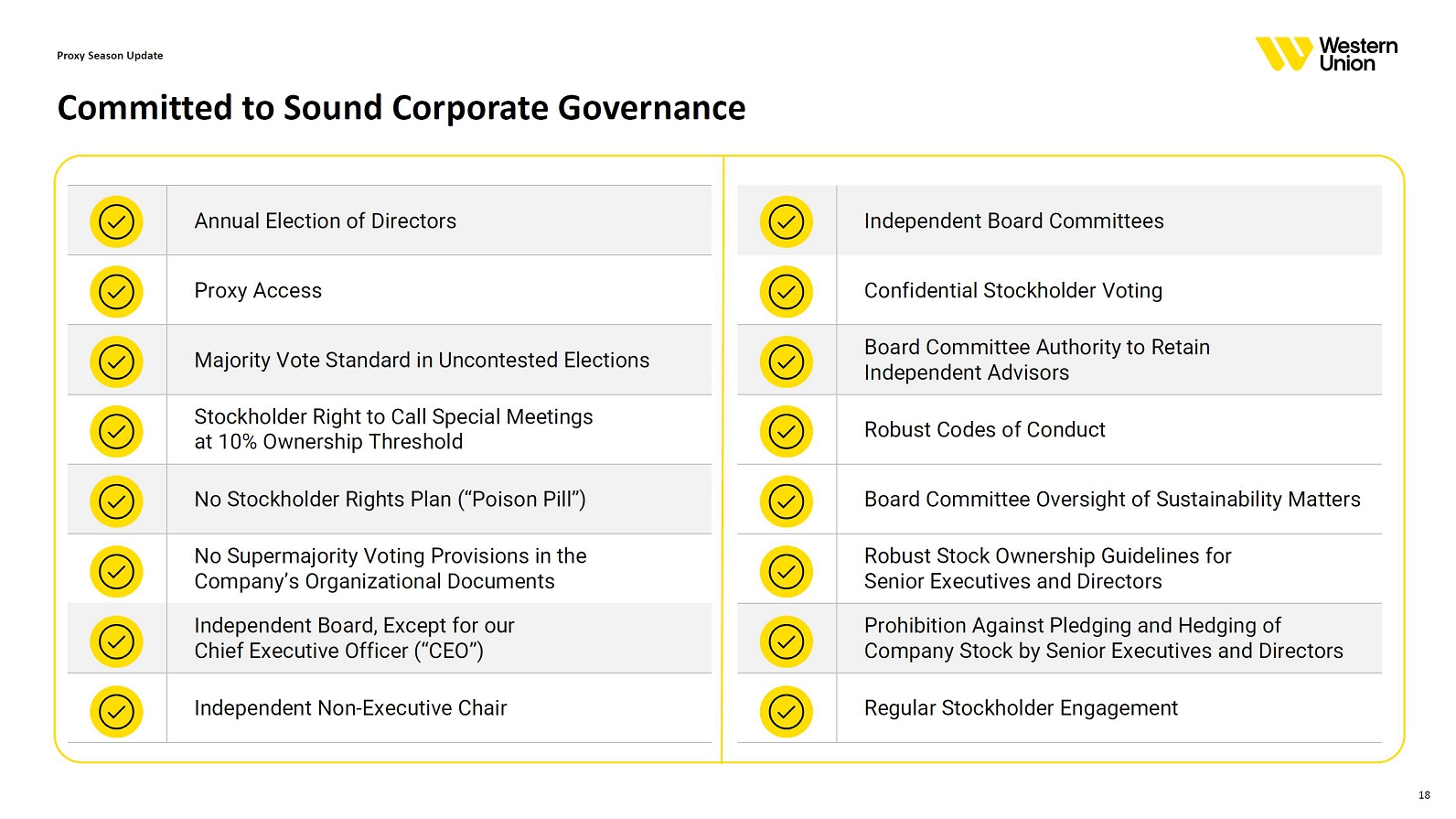
Committed to Sound Corporate Governance Annual Election of Directors Proxy Access Majority Vote Standard in Uncontested Elections Stockholder Right to Call Special Meetings at 10% Ownership Threshold No Stockholder Rights Plan (“Poison Pill”) No Supermajority Voting Provisions in the Company’s Organizational Documents Independent Board, Except for our Chief Executive Officer (“CEO”) Independent Non - Executive Chair Independent Board Committees Confidential Stockholder Voting Board Committee Authority to Retain Independent Advisors Robust Codes of Conduct Board Committee Oversight of Sustainability Matters Robust Stock Ownership Guidelines for Senior Executives and Directors Prohibition Against Pledging and Hedging of Company Stock by Senior Executives and Directors Regular Stockholder Engagement Proxy Season Update 18
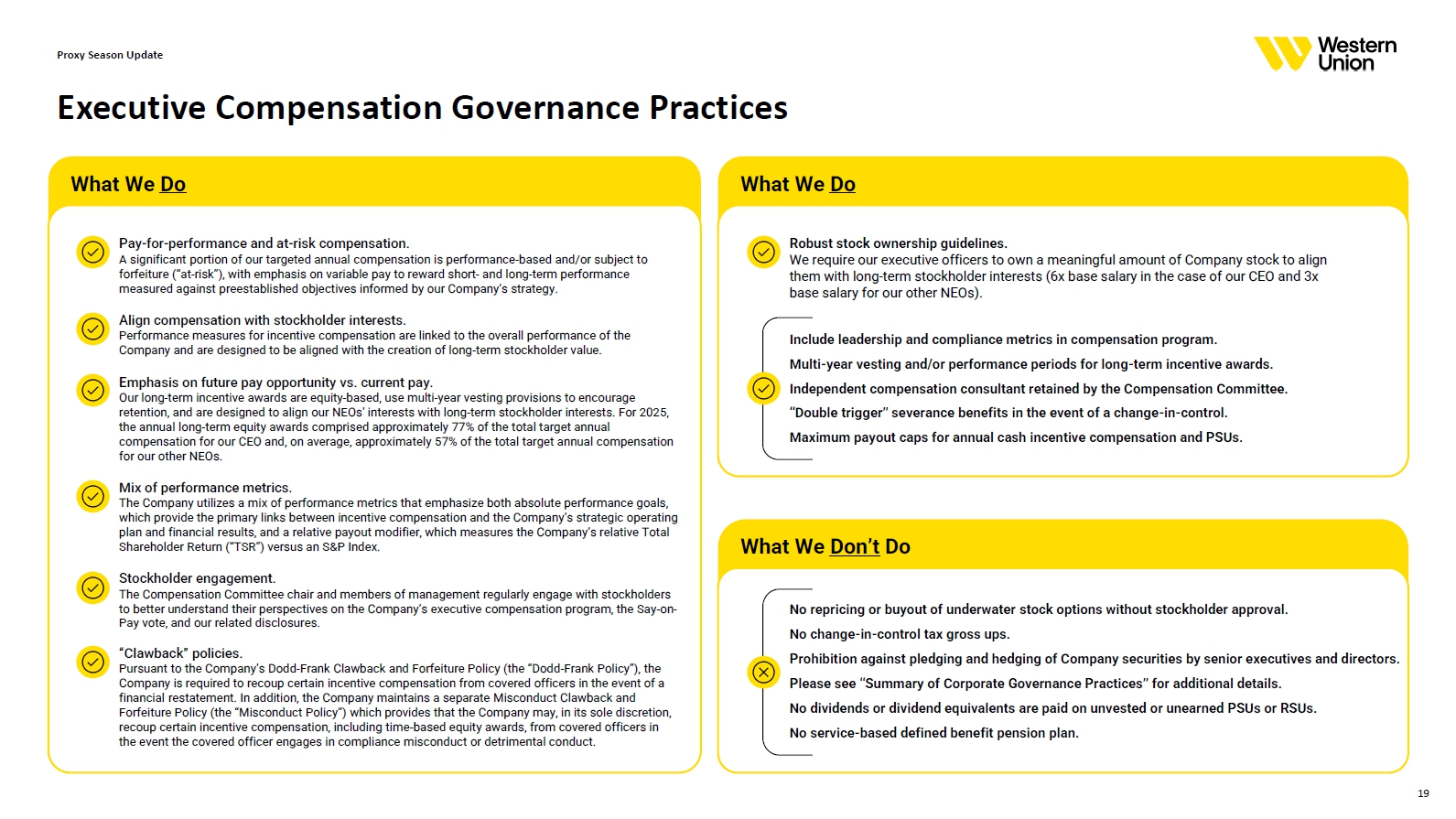
Executive Compensation Governance Practices Proxy Season Update 19 What We Do Pay - for - performance and at - risk compensation. A significant portion of our targeted annual compensation is performance - based and/or subject to forfeiture (“at - risk”), with emphasis on variable pay to reward short - and long - term performance measured against preestablished objectives informed by our Company’s strategy. Align compensation with stockholder interests. Performance measures for incentive compensation are linked to the overall performance of the Company and are designed to be aligned with the creation of long - term stockholder value. Emphasis on future pay opportunity vs. current pay. Our long - term incentive awards are equity - based, use multi - year vesting provisions to encourage retention, and are designed to align our NEOs’ interests with long - term stockholder interests. For 2025, the annual long - term equity awards comprised approximately 77% of the total target annual compensation for our CEO and, on average, approximately 57% of the total target annual compensation for our other NEOs. Mix of performance metrics. The Company utilizes a mix of performance metrics that emphasize both absolute performance goals, which provide the primary links between incentive compensation and the Company’s strategic operating plan and financial results, and a relative payout modifier, which measures the Company’s relative Total Shareholder Return (“TSR”) versus an S&P Index. Stockholder engagement. The Compensation Committee chair and members of management regularly engage with stockholders to better understand their perspectives on the Company’s executive compensation program, the Say - on - Pay vote, and our related disclosures. “ Clawback ” policies. Pursuant to the Company’s Dodd - Frank Clawback and Forfeiture Policy (the “Dodd - Frank Policy”), the Company is required to recoup certain incentive compensation from covered officers in the event of a financial restatement. In addition, the Company maintains a separate Misconduct Clawback and Forfeiture Policy (the “Misconduct Policy”) which provides that the Company may, in its sole discretion, recoup certain incentive compensation, including time - based equity awards, from covered officers in the event the covered officer engages in compliance misconduct or detrimental conduct. What We Do Robust stock ownership guidelines. We require our executive officers to own a meaningful amount of Company stock to align them with long - term stockholder interests (6x base salary in the case of our CEO and 3x base salary for our other NEOs). Include leadership and compliance metrics in compensation program. Multi - year vesting and/or performance periods for long - term incentive awards. Independent compensation consultant retained by the Compensation Committee. “Double trigger” severance benefits in the event of a change - in - control. Maximum payout caps for annual cash incentive compensation and PSUs. What We Don’t Do No repricing or buyout of underwater stock options without stockholder approval. No change - in - control tax gross ups. Prohibition against pledging and hedging of Company securities by senior executives and directors. Please see “Summary of Corporate Governance Practices” for additional details. No dividends or dividend equivalents are paid on unvested or unearned PSUs or RSUs. No service - based defined benefit pension plan.
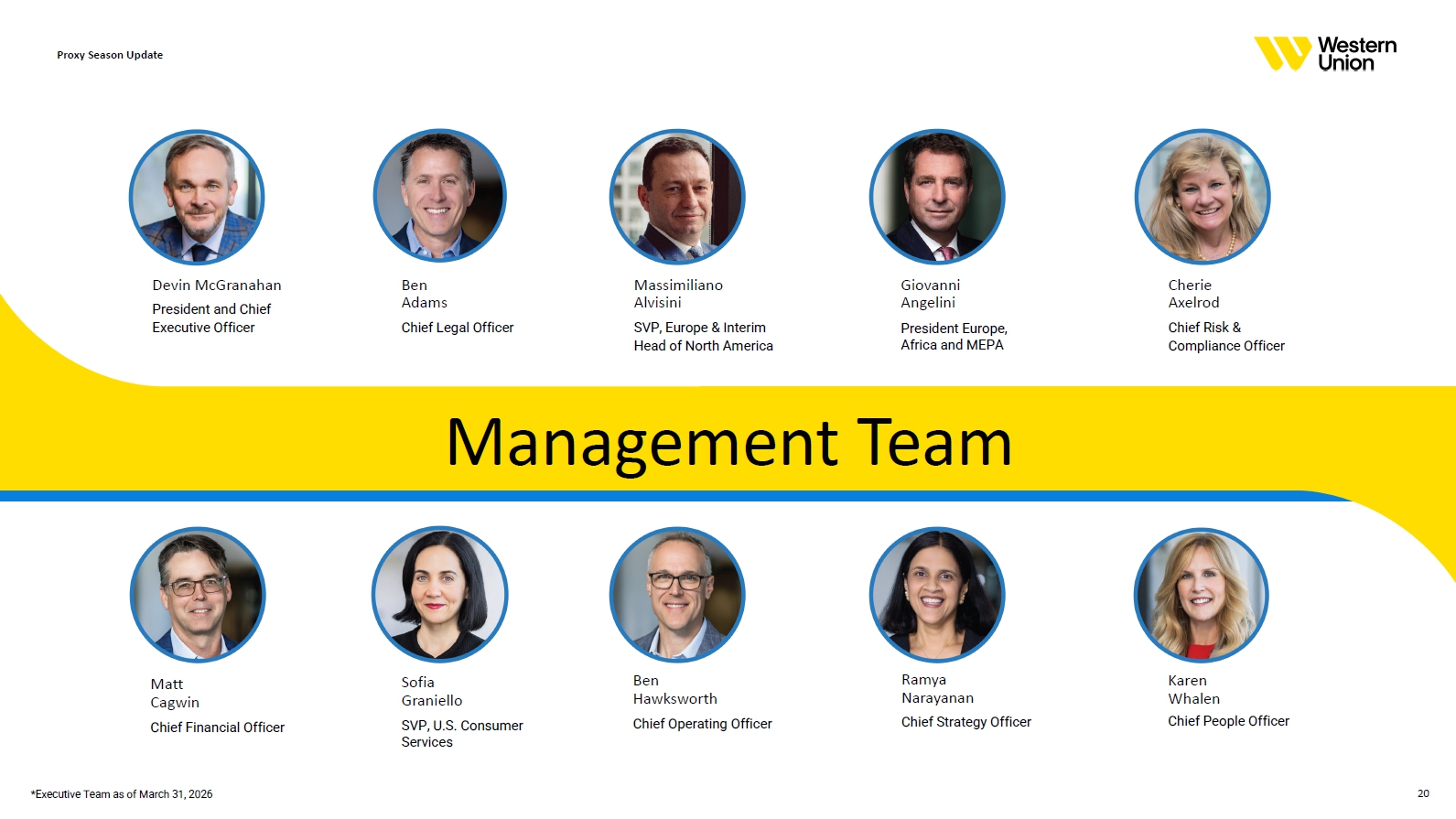
Management Team Proxy Season Update 20 *Executive Team as of March 31, 2026 Cherie Axelrod Chief Risk & Compliance Officer Giovanni Angelini President Europe, Africa and MEPA Ben Adams Chief Legal Officer Devin McGranahan President and Chief Executive Officer Massimiliano Alvisini SVP, Europe & Interim Head of North America Karen Whalen Chief People Officer Ramya Narayanan Chief Strategy Officer Sofia Graniello SVP, U.S. Consumer Services Matt Cagwin Chief Financial Officer Ben Hawksworth Chief Operating Officer