Cespira Sweden AB (previously HPDI Technology AB) Consolidated Financial Statements For the year ended December 31, 2025, and for the period from incorporation on January 22, 2024, to December 31, 2024 (Expressed in thousands of Euros)
Table of Contents Pages Independent Auditor's Report 1-2 Consolidated Statements of Financial Position 3 Consolidated Statements of Comprehensive Income (Loss) 4 Consolidated Statements of Changes in Equity 5 Consolidated Statements of Cash Flows 6 Notes to the Consolidated Financial Statements 7-22
1 Report of Independent Registered Public Accounting Firm To the Shareholders of Cespira Sweden AB Opinion on the Consolidated Financial Statements We have audited the accompanying consolidated statements of financial position of Cespira Sweden AB (the Company) as of December 31, 2025 and 2024, the related consolidated statements of comprehensive income (loss), changes in shareholders’ equity, and cash flows for the year ended December 31, 2025, and for the period from incorporation on January 22, 2024 to December 31, 2024, and the related notes (collectively, the consolidated financial statements). In our opinion, the consolidated financial statements present fairly, in all material respects, the financial position of the Company as of December 31, 2025 and 2024, and its financial performance and its cash flows the year ended December 31, 2025, and for the period from incorporation on January 22, 2024 to December 31, 2024, in conformity with International Financial Reporting Standards (IFRS) as issued by the International Accounting Standards Board. Going Concern The accompanying consolidated financial statements have been prepared assuming that the Company will continue as a going concern. As discussed in Note 2 to the consolidated financial statements, the Company has incurred net losses and expects that capital contributions will be required to fund operating losses. These factors indicate the existence of a material uncertainty that may cast significant doubt as to the Company’s ability to continue as a going concern. Management’s plans in regard to these matters are also described in Note 2. The consolidated financial statements do not include any adjustments that might result from the outcome of this uncertainty. Basis for Opinion These consolidated financial statements are the responsibility of the Company’s management. Our responsibility is to express an opinion on these consolidated financial statements based on our audits. We are a public accounting firm registered with the Public Company Accounting Oversight Board (United States) (PCAOB) and are required to be independent with respect to the Company in accordance with the U.S. federal securities laws and the applicable rules and regulations of the Securities and Exchange Commission and the PCAOB. We conducted our audits in accordance with the standards of the PCAOB. Those standards require that we plan and perform the audit to obtain reasonable assurance about whether the consolidated financial statements are free of material misstatement, whether due to error or fraud. Our audits included performing procedures to assess the risks of material misstatement of the consolidated financial statements, whether due to error or fraud, and performing procedures that respond to those risks. Such procedures included examining, on a test basis, evidence regarding the amounts and disclosures in the consolidated financial statements. Our audits also included evaluating the accounting principles used and significant estimates made by management, as well as evaluating the overall presentation of the consolidated financial statements. We believe that our audits provide a reasonable basis for our opinion. Critical Audit Matters Critical audit matters are matters arising from the current period audit of the consolidated financial statements that were communicated or required to be communicated to the audit committee and that: (1) relate to accounts
2 or disclosures that are material to the consolidated financial statements and (2) involved our especially challenging, subjective, or complex judgments. We determined that there are no critical audit matters. /s/ KPMG LLP Chartered Professional Accountants We have served as the Company’s auditor since 2024. Vancouver, Canada April 15, 2026
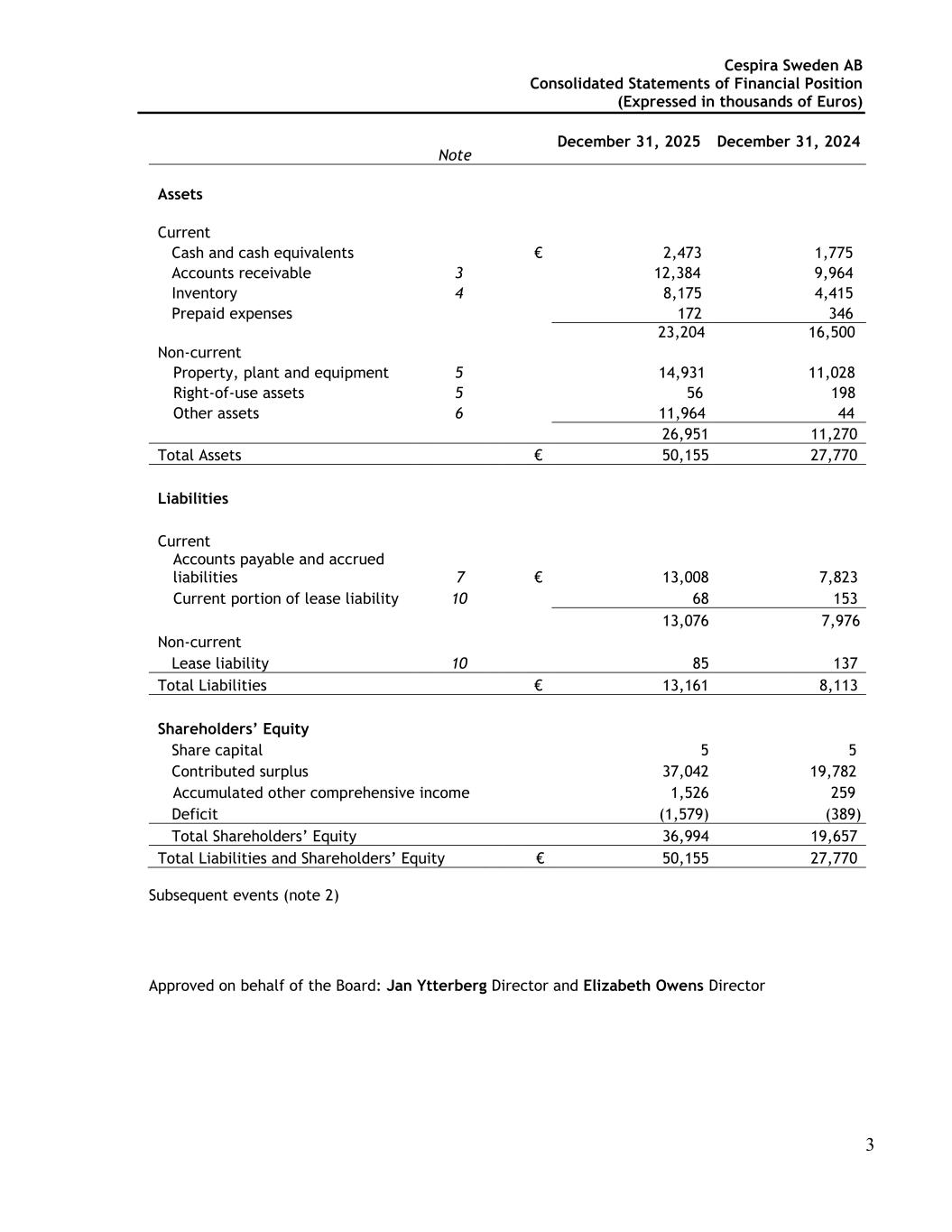
Cespira Sweden AB Consolidated Statements of Financial Position (Expressed in thousands of Euros) 3 Note December 31, 2025 December 31, 2024 Assets Current Cash and cash equivalents € 2,473 1,775 Accounts receivable 3 12,384 9,964 Inventory 4 8,175 4,415 Prepaid expenses 172 346 23,204 16,500 Non-current Property, plant and equipment 5 14,931 11,028 Right-of-use assets 5 56 198 Other assets 6 11,964 44 26,951 11,270 Total Assets € 50,155 27,770 Liabilities Current Accounts payable and accrued liabilities 7 € 13,008 7,823 Current portion of lease liability 10 68 153 13,076 7,976 Non-current Lease liability 10 85 137 Total Liabilities € 13,161 8,113 Shareholders’ Equity Share capital 5 5 Contributed surplus 37,042 19,782 Accumulated other comprehensive income 1,526 259 Deficit (1,579) (389) Total Shareholders’ Equity 36,994 19,657 Total Liabilities and Shareholders’ Equity € 50,155 27,770 Subsequent events (note 2) Approved on behalf of the Board: Jan Ytterberg Director and Elizabeth Owens Director
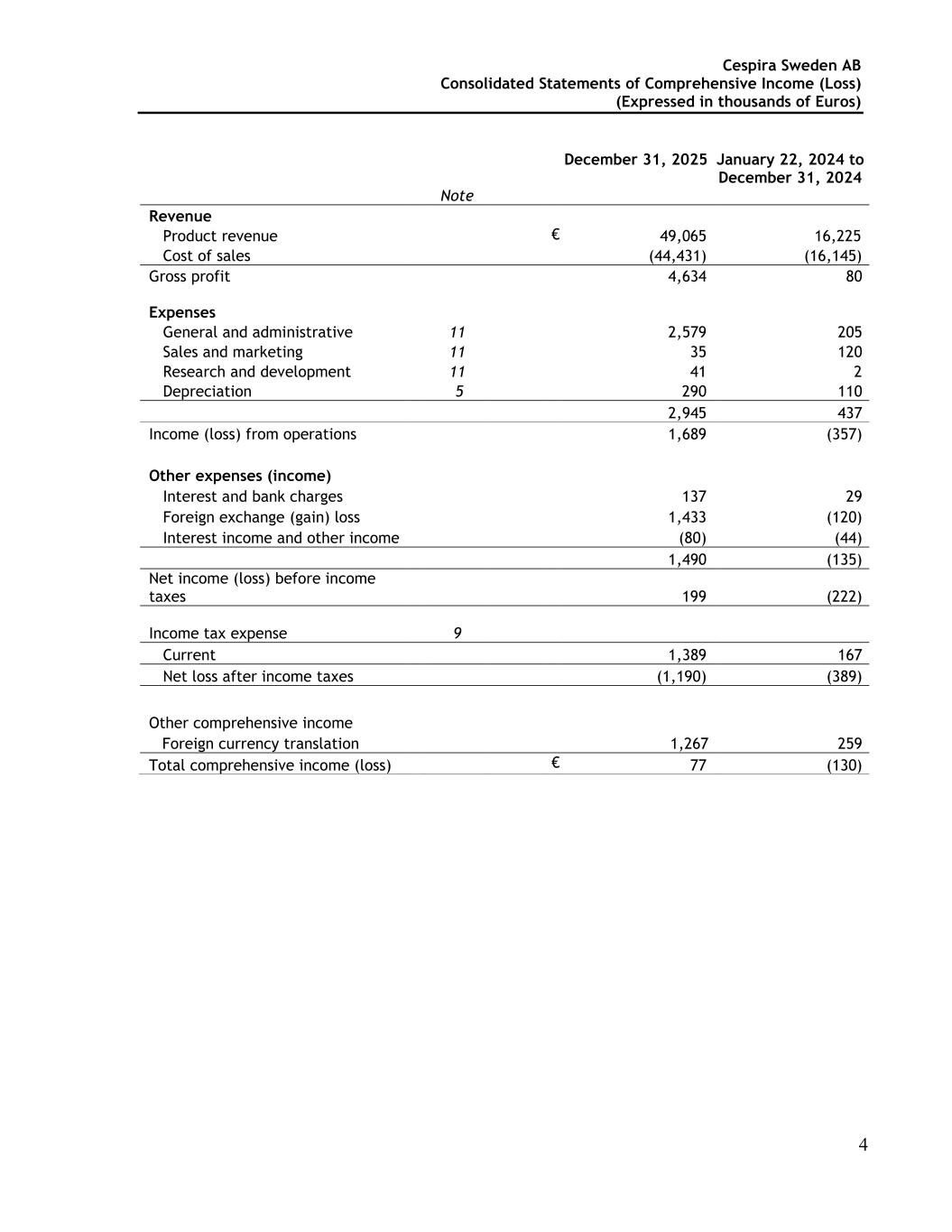
Cespira Sweden AB Consolidated Statements of Comprehensive Income (Loss) (Expressed in thousands of Euros) 4 Note December 31, 2025 January 22, 2024 to December 31, 2024 Revenue Product revenue € 49,065 16,225 Cost of sales (44,431) (16,145) Gross profit 4,634 80 Expenses General and administrative 11 2,579 205 Sales and marketing 11 35 120 Research and development 11 41 2 Depreciation 5 290 110 2,945 437 Income (loss) from operations 1,689 (357) Other expenses (income) Interest and bank charges 137 29 Foreign exchange (gain) loss 1,433 (120) Interest income and other income (80) (44) 1,490 (135) Net income (loss) before income taxes 199 (222) Income tax expense 9 Current 1,389 167 Net loss after income taxes (1,190) (389) Other comprehensive income Foreign currency translation 1,267 259 Total comprehensive income (loss) € 77 (130)
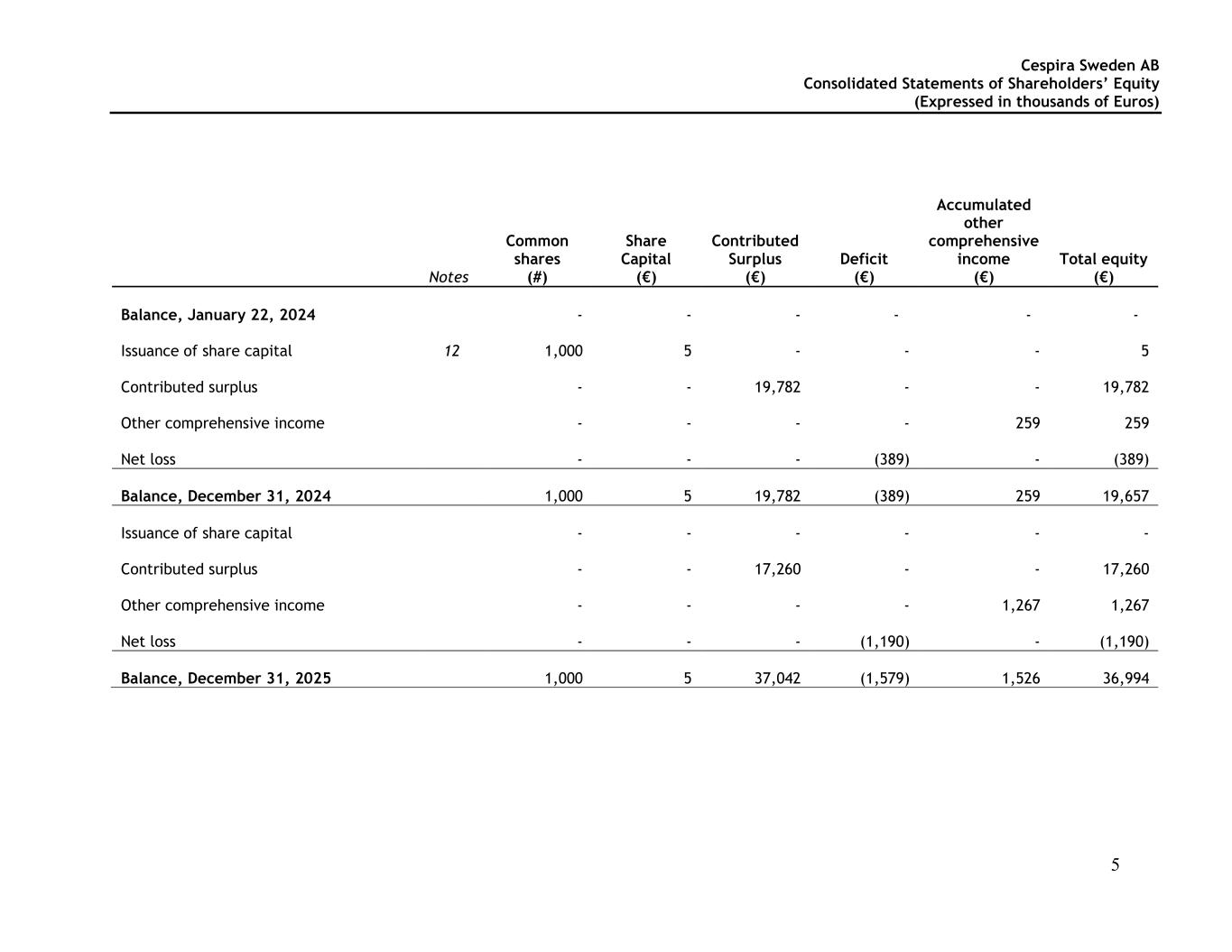
Cespira Sweden AB Consolidated Statements of Shareholders’ Equity (Expressed in thousands of Euros) 5 Notes Common shares (#) Share Capital (€) Contributed Surplus (€) Deficit (€) Accumulated other comprehensive income (€) Total equity (€) Balance, January 22, 2024 - - - - - - Issuance of share capital 12 1,000 5 - - - 5 Contributed surplus - - 19,782 - - 19,782 Other comprehensive income - - - - 259 259 Net loss - - - (389) - (389) Balance, December 31, 2024 1,000 5 19,782 (389) 259 19,657 Issuance of share capital - - - - - - Contributed surplus - - 17,260 - - 17,260 Other comprehensive income - - - - 1,267 1,267 Net loss - - - (1,190) - (1,190) Balance, December 31, 2025 1,000 5 37,042 (1,579) 1,526 36,994
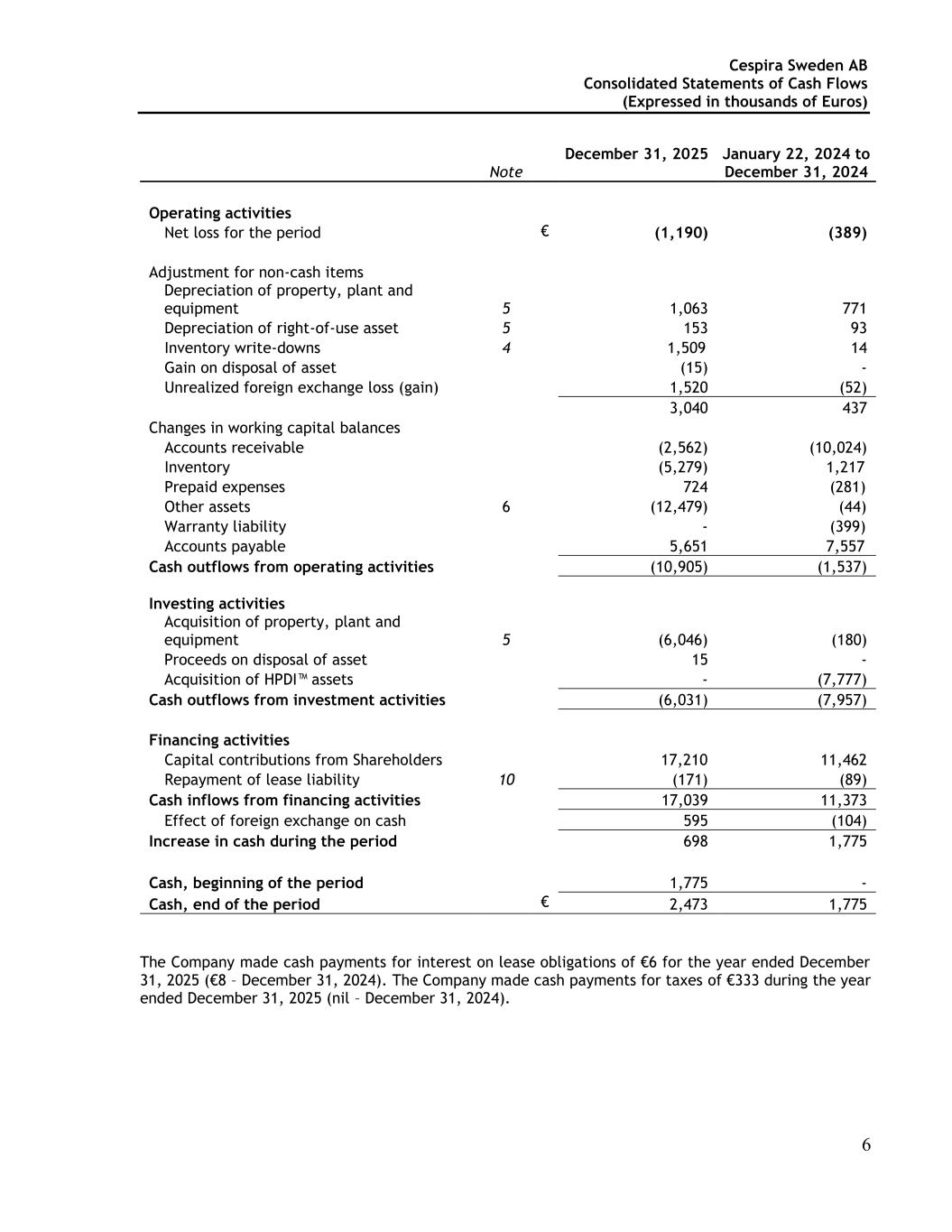
Cespira Sweden AB Consolidated Statements of Cash Flows (Expressed in thousands of Euros) 6 Note December 31, 2025 January 22, 2024 to December 31, 2024 Operating activities Net loss for the period € (1,190) (389) Adjustment for non-cash items Depreciation of property, plant and equipment 5 1,063 771 Depreciation of right-of-use asset 5 153 93 Inventory write-downs 4 1,509 14 Gain on disposal of asset (15) - Unrealized foreign exchange loss (gain) 1,520 (52) 3,040 437 Changes in working capital balances Accounts receivable (2,562) (10,024) Inventory (5,279) 1,217 Prepaid expenses 724 (281) Other assets 6 (12,479) (44) Warranty liability - (399) Accounts payable 5,651 7,557 Cash outflows from operating activities (10,905) (1,537) Investing activities Acquisition of property, plant and equipment 5 (6,046) (180) Proceeds on disposal of asset 15 - Acquisition of HPDI™ assets - (7,777) Cash outflows from investment activities (6,031) (7,957) Financing activities Capital contributions from Shareholders 17,210 11,462 Repayment of lease liability 10 (171) (89) Cash inflows from financing activities 17,039 11,373 Effect of foreign exchange on cash 595 (104) Increase in cash during the period 698 1,775 Cash, beginning of the period 1,775 - Cash, end of the period € 2,473 1,775 The Company made cash payments for interest on lease obligations of €6 for the year ended December 31, 2025 (€8 – December 31, 2024). The Company made cash payments for taxes of €333 during the year ended December 31, 2025 (nil – December 31, 2024).
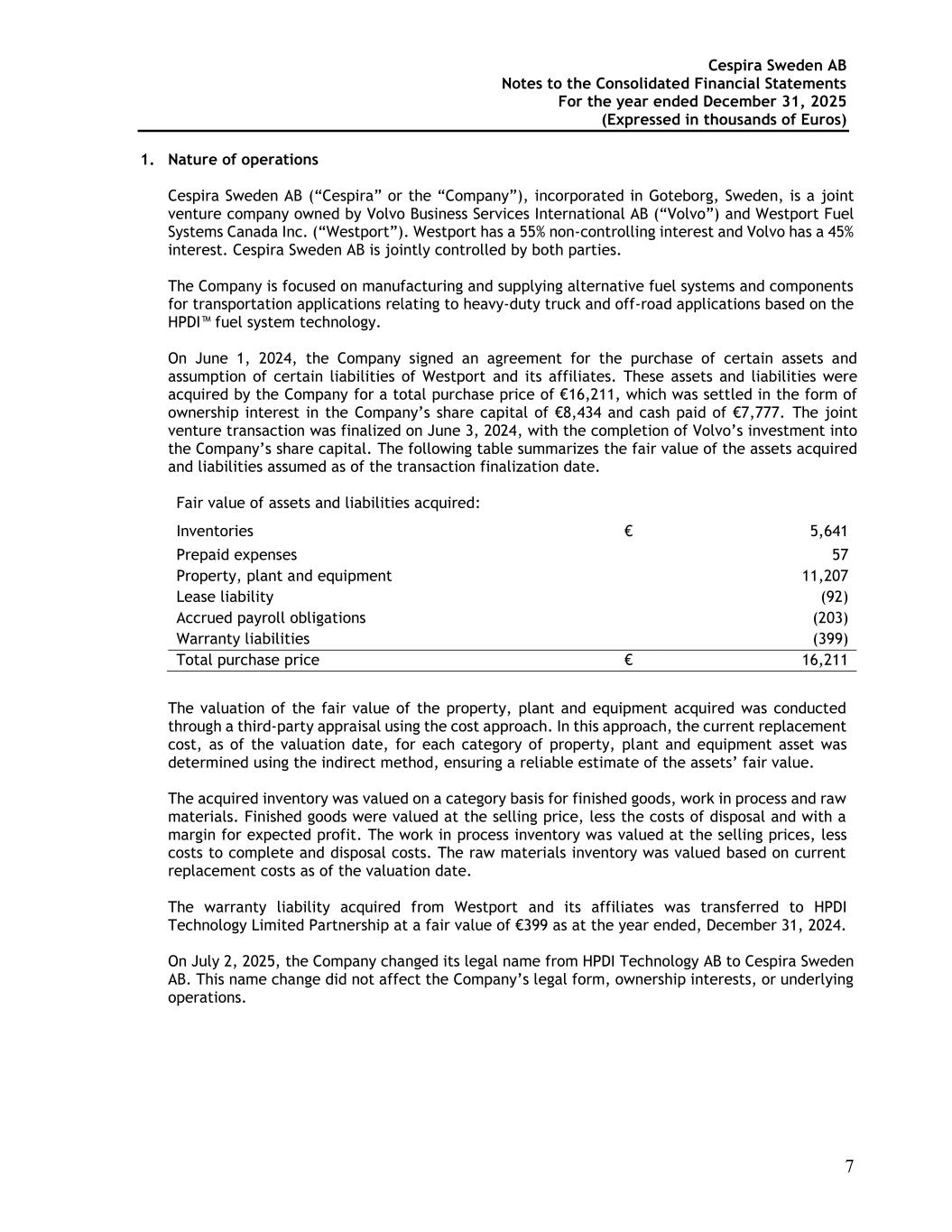
Cespira Sweden AB Notes to the Consolidated Financial Statements For the year ended December 31, 2025 (Expressed in thousands of Euros) 7 1. Nature of operations Cespira Sweden AB (“Cespira” or the “Company”), incorporated in Goteborg, Sweden, is a joint venture company owned by Volvo Business Services International AB (“Volvo”) and Westport Fuel Systems Canada Inc. (“Westport”). Westport has a 55% non-controlling interest and Volvo has a 45% interest. Cespira Sweden AB is jointly controlled by both parties. The Company is focused on manufacturing and supplying alternative fuel systems and components for transportation applications relating to heavy-duty truck and off-road applications based on the HPDI™ fuel system technology. On June 1, 2024, the Company signed an agreement for the purchase of certain assets and assumption of certain liabilities of Westport and its affiliates. These assets and liabilities were acquired by the Company for a total purchase price of €16,211, which was settled in the form of ownership interest in the Company’s share capital of €8,434 and cash paid of €7,777. The joint venture transaction was finalized on June 3, 2024, with the completion of Volvo’s investment into the Company’s share capital. The following table summarizes the fair value of the assets acquired and liabilities assumed as of the transaction finalization date. Fair value of assets and liabilities acquired: Inventories € 5,641 Prepaid expenses 57 Property, plant and equipment 11,207 Lease liability (92) Accrued payroll obligations (203) Warranty liabilities (399) Total purchase price € 16,211 The valuation of the fair value of the property, plant and equipment acquired was conducted through a third-party appraisal using the cost approach. In this approach, the current replacement cost, as of the valuation date, for each category of property, plant and equipment asset was determined using the indirect method, ensuring a reliable estimate of the assets’ fair value. The acquired inventory was valued on a category basis for finished goods, work in process and raw materials. Finished goods were valued at the selling price, less the costs of disposal and with a margin for expected profit. The work in process inventory was valued at the selling prices, less costs to complete and disposal costs. The raw materials inventory was valued based on current replacement costs as of the valuation date. The warranty liability acquired from Westport and its affiliates was transferred to HPDI Technology Limited Partnership at a fair value of €399 as at the year ended, December 31, 2024. On July 2, 2025, the Company changed its legal name from HPDI Technology AB to Cespira Sweden AB. This name change did not affect the Company’s legal form, ownership interests, or underlying operations.
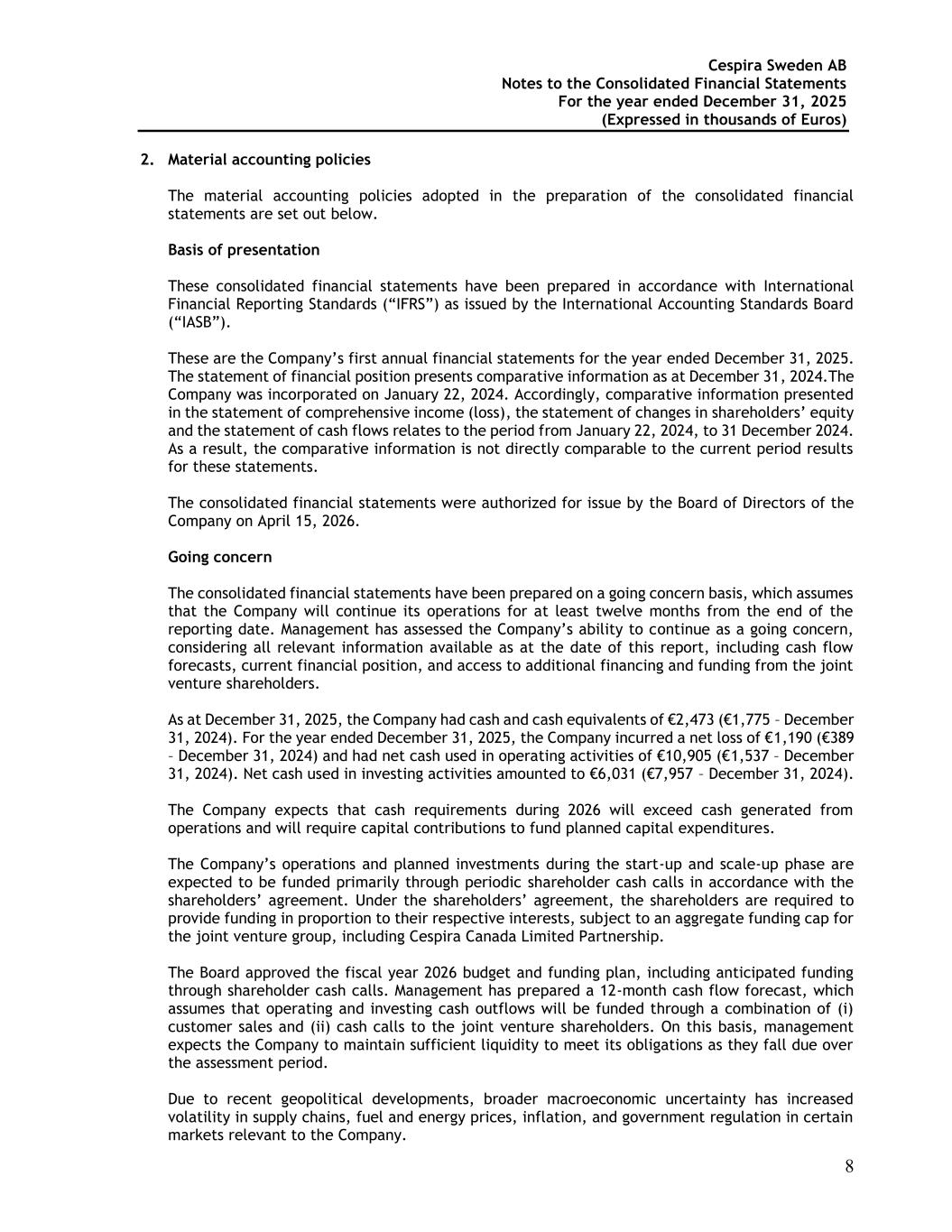
Cespira Sweden AB Notes to the Consolidated Financial Statements For the year ended December 31, 2025 (Expressed in thousands of Euros) 8 2. Material accounting policies The material accounting policies adopted in the preparation of the consolidated financial statements are set out below. Basis of presentation These consolidated financial statements have been prepared in accordance with International Financial Reporting Standards (“IFRS”) as issued by the International Accounting Standards Board (“IASB”). These are the Company’s first annual financial statements for the year ended December 31, 2025. The statement of financial position presents comparative information as at December 31, 2024.The Company was incorporated on January 22, 2024. Accordingly, comparative information presented in the statement of comprehensive income (loss), the statement of changes in shareholders’ equity and the statement of cash flows relates to the period from January 22, 2024, to 31 December 2024. As a result, the comparative information is not directly comparable to the current period results for these statements. The consolidated financial statements were authorized for issue by the Board of Directors of the Company on April 15, 2026. Going concern The consolidated financial statements have been prepared on a going concern basis, which assumes that the Company will continue its operations for at least twelve months from the end of the reporting date. Management has assessed the Company’s ability to continue as a going concern, considering all relevant information available as at the date of this report, including cash flow forecasts, current financial position, and access to additional financing and funding from the joint venture shareholders. As at December 31, 2025, the Company had cash and cash equivalents of €2,473 (€1,775 – December 31, 2024). For the year ended December 31, 2025, the Company incurred a net loss of €1,190 (€389 – December 31, 2024) and had net cash used in operating activities of €10,905 (€1,537 – December 31, 2024). Net cash used in investing activities amounted to €6,031 (€7,957 – December 31, 2024). The Company expects that cash requirements during 2026 will exceed cash generated from operations and will require capital contributions to fund planned capital expenditures. The Company’s operations and planned investments during the start-up and scale-up phase are expected to be funded primarily through periodic shareholder cash calls in accordance with the shareholders’ agreement. Under the shareholders’ agreement, the shareholders are required to provide funding in proportion to their respective interests, subject to an aggregate funding cap for the joint venture group, including Cespira Canada Limited Partnership. The Board approved the fiscal year 2026 budget and funding plan, including anticipated funding through shareholder cash calls. Management has prepared a 12-month cash flow forecast, which assumes that operating and investing cash outflows will be funded through a combination of (i) customer sales and (ii) cash calls to the joint venture shareholders. On this basis, management expects the Company to maintain sufficient liquidity to meet its obligations as they fall due over the assessment period. Due to recent geopolitical developments, broader macroeconomic uncertainty has increased volatility in supply chains, fuel and energy prices, inflation, and government regulation in certain markets relevant to the Company.
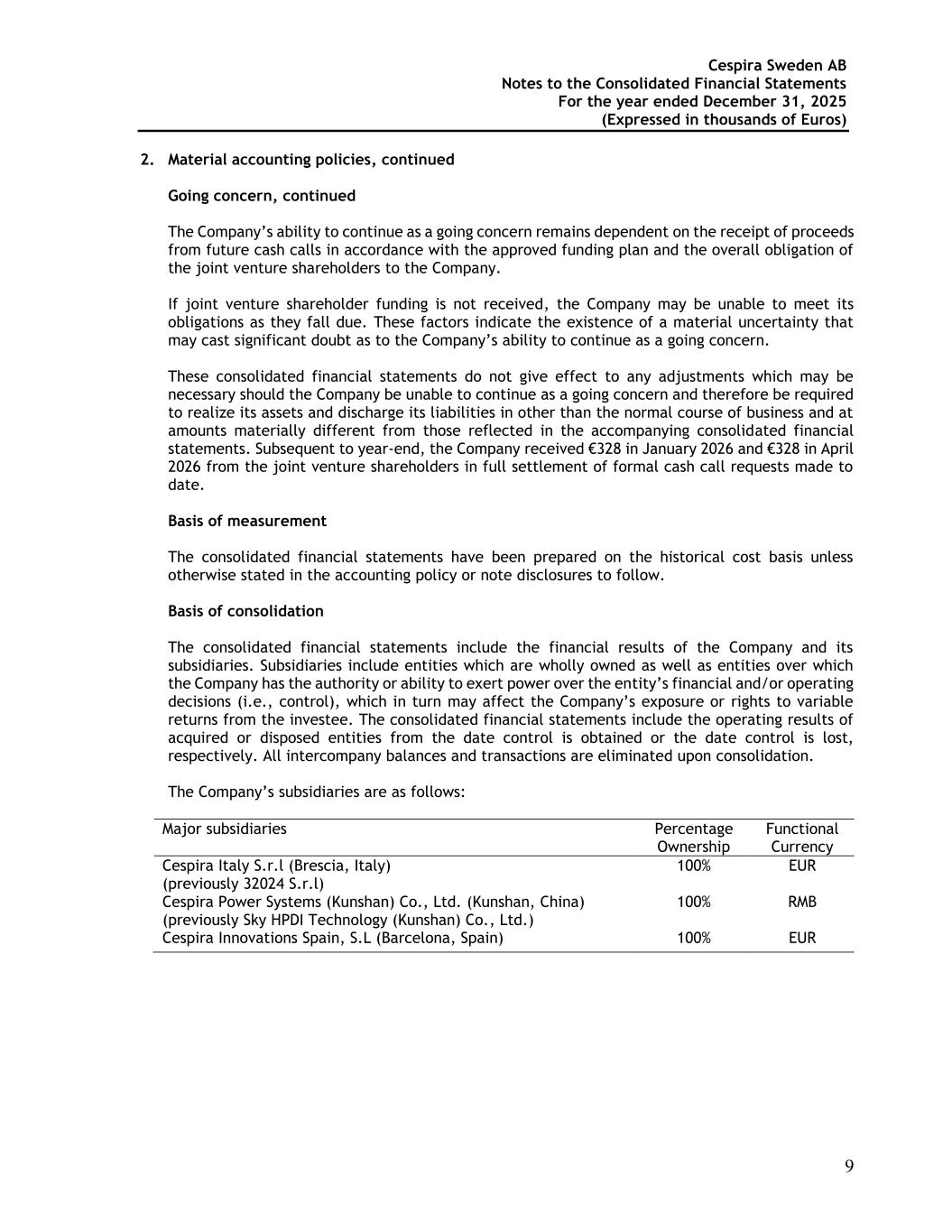
Cespira Sweden AB Notes to the Consolidated Financial Statements For the year ended December 31, 2025 (Expressed in thousands of Euros) 9 2. Material accounting policies, continued Going concern, continued The Company’s ability to continue as a going concern remains dependent on the receipt of proceeds from future cash calls in accordance with the approved funding plan and the overall obligation of the joint venture shareholders to the Company. If joint venture shareholder funding is not received, the Company may be unable to meet its obligations as they fall due. These factors indicate the existence of a material uncertainty that may cast significant doubt as to the Company’s ability to continue as a going concern. These consolidated financial statements do not give effect to any adjustments which may be necessary should the Company be unable to continue as a going concern and therefore be required to realize its assets and discharge its liabilities in other than the normal course of business and at amounts materially different from those reflected in the accompanying consolidated financial statements. Subsequent to year-end, the Company received €328 in January 2026 and €328 in April 2026 from the joint venture shareholders in full settlement of formal cash call requests made to date. Basis of measurement The consolidated financial statements have been prepared on the historical cost basis unless otherwise stated in the accounting policy or note disclosures to follow. Basis of consolidation The consolidated financial statements include the financial results of the Company and its subsidiaries. Subsidiaries include entities which are wholly owned as well as entities over which the Company has the authority or ability to exert power over the entity’s financial and/or operating decisions (i.e., control), which in turn may affect the Company’s exposure or rights to variable returns from the investee. The consolidated financial statements include the operating results of acquired or disposed entities from the date control is obtained or the date control is lost, respectively. All intercompany balances and transactions are eliminated upon consolidation. The Company’s subsidiaries are as follows: Major subsidiaries Percentage Ownership Functional Currency Cespira Italy S.r.l (Brescia, Italy) (previously 32024 S.r.l) 100% EUR Cespira Power Systems (Kunshan) Co., Ltd. (Kunshan, China) (previously Sky HPDI Technology (Kunshan) Co., Ltd.) 100% RMB Cespira Innovations Spain, S.L (Barcelona, Spain) 100% EUR
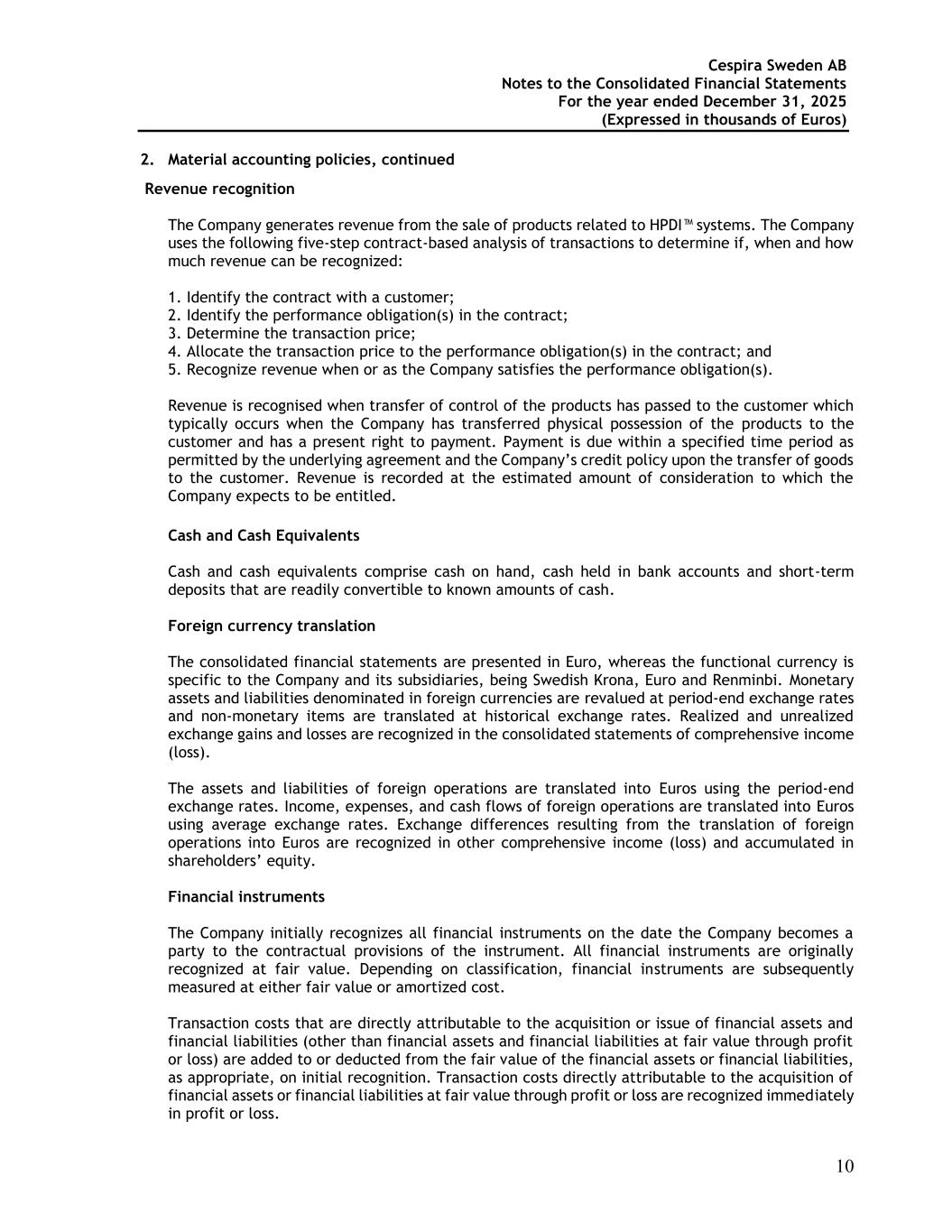
Cespira Sweden AB Notes to the Consolidated Financial Statements For the year ended December 31, 2025 (Expressed in thousands of Euros) 10 2. Material accounting policies, continued Revenue recognition The Company generates revenue from the sale of products related to HPDI™ systems. The Company uses the following five-step contract-based analysis of transactions to determine if, when and how much revenue can be recognized: 1. Identify the contract with a customer; 2. Identify the performance obligation(s) in the contract; 3. Determine the transaction price; 4. Allocate the transaction price to the performance obligation(s) in the contract; and 5. Recognize revenue when or as the Company satisfies the performance obligation(s). Revenue is recognised when transfer of control of the products has passed to the customer which typically occurs when the Company has transferred physical possession of the products to the customer and has a present right to payment. Payment is due within a specified time period as permitted by the underlying agreement and the Company’s credit policy upon the transfer of goods to the customer. Revenue is recorded at the estimated amount of consideration to which the Company expects to be entitled. Cash and Cash Equivalents Cash and cash equivalents comprise cash on hand, cash held in bank accounts and short-term deposits that are readily convertible to known amounts of cash. Foreign currency translation The consolidated financial statements are presented in Euro, whereas the functional currency is specific to the Company and its subsidiaries, being Swedish Krona, Euro and Renminbi. Monetary assets and liabilities denominated in foreign currencies are revalued at period-end exchange rates and non-monetary items are translated at historical exchange rates. Realized and unrealized exchange gains and losses are recognized in the consolidated statements of comprehensive income (loss). The assets and liabilities of foreign operations are translated into Euros using the period-end exchange rates. Income, expenses, and cash flows of foreign operations are translated into Euros using average exchange rates. Exchange differences resulting from the translation of foreign operations into Euros are recognized in other comprehensive income (loss) and accumulated in shareholders’ equity. Financial instruments The Company initially recognizes all financial instruments on the date the Company becomes a party to the contractual provisions of the instrument. All financial instruments are originally recognized at fair value. Depending on classification, financial instruments are subsequently measured at either fair value or amortized cost. Transaction costs that are directly attributable to the acquisition or issue of financial assets and financial liabilities (other than financial assets and financial liabilities at fair value through profit or loss) are added to or deducted from the fair value of the financial assets or financial liabilities, as appropriate, on initial recognition. Transaction costs directly attributable to the acquisition of financial assets or financial liabilities at fair value through profit or loss are recognized immediately in profit or loss.
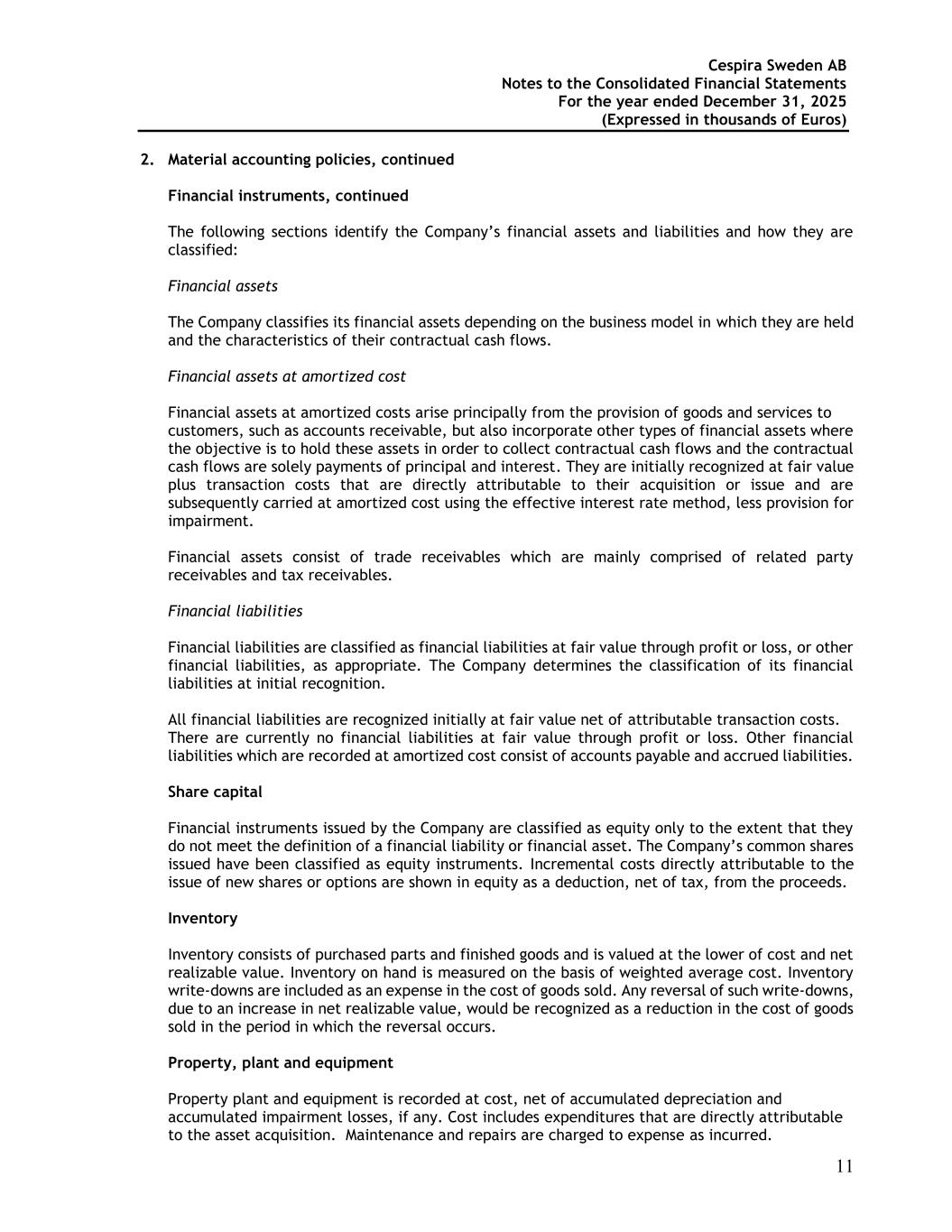
Cespira Sweden AB Notes to the Consolidated Financial Statements For the year ended December 31, 2025 (Expressed in thousands of Euros) 11 2. Material accounting policies, continued Financial instruments, continued The following sections identify the Company’s financial assets and liabilities and how they are classified: Financial assets The Company classifies its financial assets depending on the business model in which they are held and the characteristics of their contractual cash flows. Financial assets at amortized cost Financial assets at amortized costs arise principally from the provision of goods and services to customers, such as accounts receivable, but also incorporate other types of financial assets where the objective is to hold these assets in order to collect contractual cash flows and the contractual cash flows are solely payments of principal and interest. They are initially recognized at fair value plus transaction costs that are directly attributable to their acquisition or issue and are subsequently carried at amortized cost using the effective interest rate method, less provision for impairment. Financial assets consist of trade receivables which are mainly comprised of related party receivables and tax receivables. Financial liabilities Financial liabilities are classified as financial liabilities at fair value through profit or loss, or other financial liabilities, as appropriate. The Company determines the classification of its financial liabilities at initial recognition. All financial liabilities are recognized initially at fair value net of attributable transaction costs. There are currently no financial liabilities at fair value through profit or loss. Other financial liabilities which are recorded at amortized cost consist of accounts payable and accrued liabilities. Share capital Financial instruments issued by the Company are classified as equity only to the extent that they do not meet the definition of a financial liability or financial asset. The Company’s common shares issued have been classified as equity instruments. Incremental costs directly attributable to the issue of new shares or options are shown in equity as a deduction, net of tax, from the proceeds. Inventory Inventory consists of purchased parts and finished goods and is valued at the lower of cost and net realizable value. Inventory on hand is measured on the basis of weighted average cost. Inventory write-downs are included as an expense in the cost of goods sold. Any reversal of such write-downs, due to an increase in net realizable value, would be recognized as a reduction in the cost of goods sold in the period in which the reversal occurs. Property, plant and equipment Property plant and equipment is recorded at cost, net of accumulated depreciation and accumulated impairment losses, if any. Cost includes expenditures that are directly attributable to the asset acquisition. Maintenance and repairs are charged to expense as incurred.
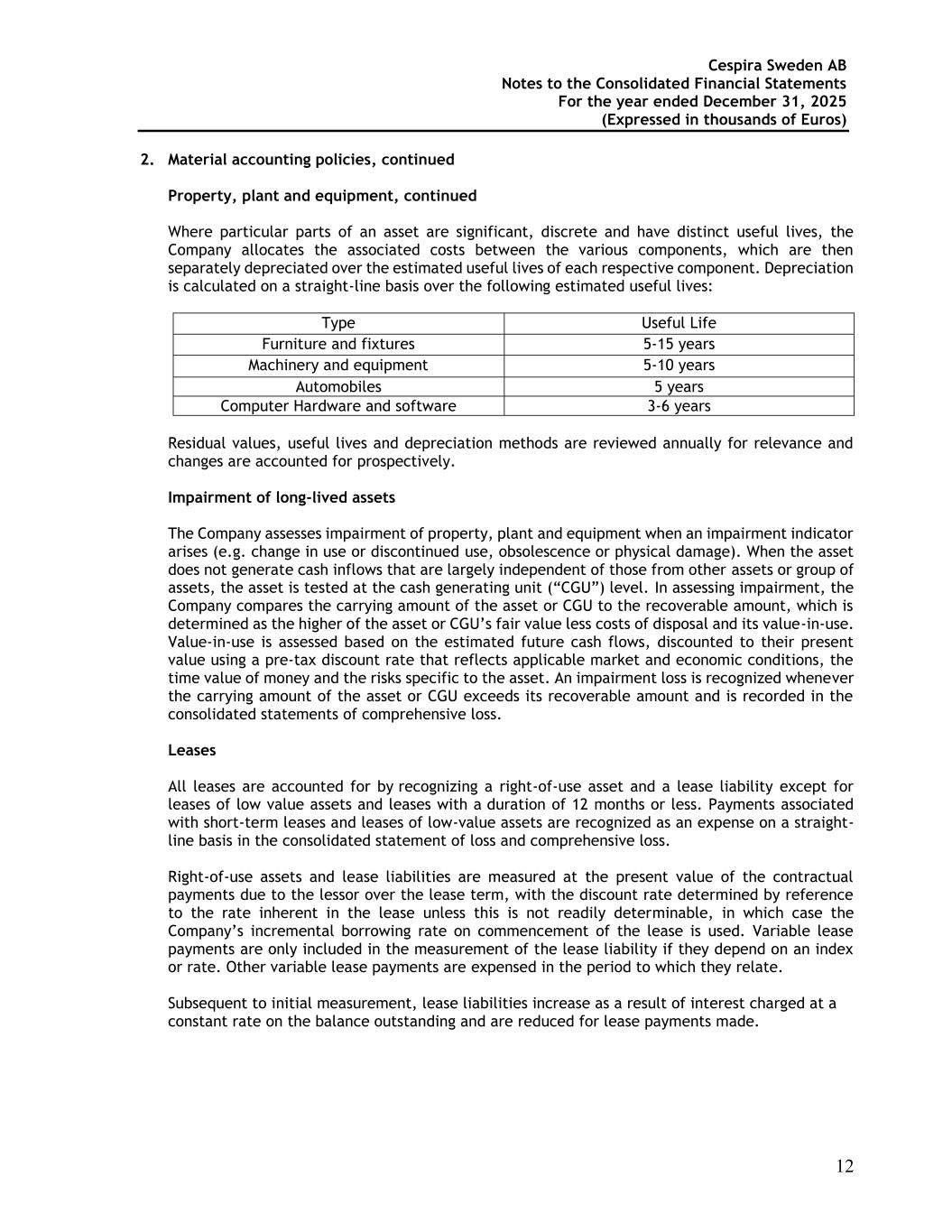
Cespira Sweden AB Notes to the Consolidated Financial Statements For the year ended December 31, 2025 (Expressed in thousands of Euros) 12 2. Material accounting policies, continued Property, plant and equipment, continued Where particular parts of an asset are significant, discrete and have distinct useful lives, the Company allocates the associated costs between the various components, which are then separately depreciated over the estimated useful lives of each respective component. Depreciation is calculated on a straight-line basis over the following estimated useful lives: Type Useful Life Furniture and fixtures 5-15 years Machinery and equipment 5-10 years Automobiles 5 years Computer Hardware and software 3-6 years Residual values, useful lives and depreciation methods are reviewed annually for relevance and changes are accounted for prospectively. Impairment of long-lived assets The Company assesses impairment of property, plant and equipment when an impairment indicator arises (e.g. change in use or discontinued use, obsolescence or physical damage). When the asset does not generate cash inflows that are largely independent of those from other assets or group of assets, the asset is tested at the cash generating unit (“CGU”) level. In assessing impairment, the Company compares the carrying amount of the asset or CGU to the recoverable amount, which is determined as the higher of the asset or CGU’s fair value less costs of disposal and its value-in-use. Value-in-use is assessed based on the estimated future cash flows, discounted to their present value using a pre-tax discount rate that reflects applicable market and economic conditions, the time value of money and the risks specific to the asset. An impairment loss is recognized whenever the carrying amount of the asset or CGU exceeds its recoverable amount and is recorded in the consolidated statements of comprehensive loss. Leases All leases are accounted for by recognizing a right-of-use asset and a lease liability except for leases of low value assets and leases with a duration of 12 months or less. Payments associated with short-term leases and leases of low-value assets are recognized as an expense on a straight- line basis in the consolidated statement of loss and comprehensive loss. Right-of-use assets and lease liabilities are measured at the present value of the contractual payments due to the lessor over the lease term, with the discount rate determined by reference to the rate inherent in the lease unless this is not readily determinable, in which case the Company’s incremental borrowing rate on commencement of the lease is used. Variable lease payments are only included in the measurement of the lease liability if they depend on an index or rate. Other variable lease payments are expensed in the period to which they relate. Subsequent to initial measurement, lease liabilities increase as a result of interest charged at a constant rate on the balance outstanding and are reduced for lease payments made.
Cespira Sweden AB Notes to the Consolidated Financial Statements For the year ended December 31, 2025 (Expressed in thousands of Euros) 13 2. Material accounting policies, continued Income taxes Current income taxes Current income tax assets and liabilities for the current and prior year are measured at the amount expected to be recovered from or paid to the taxation authorities. Current tax assets and current tax liabilities are only offset if a legally enforceable right exists to set off the amounts, and the Company intends to settle on a net basis, or to realize the asset and settle the liability simultaneously. Deferred income taxes Deferred tax assets are only recognized to the extent that it is probable that the deductible temporary differences will reverse in the foreseeable future and future taxable profit will be available against which the temporary difference can be utilized. Deferred tax assets and liabilities are measured at future anticipated tax rates, which have been enacted or substantively enacted at the reporting date. Deferred income tax assets and deferred income tax liabilities are offset, if a legally enforceable right exists to set off current tax assets against current income tax liabilities and the deferred income taxes relate to the same taxable entity and the same taxation authority. Provisions A provision is recognized if, as a result of a past event, the Company has a present liability that can be estimated reliably, and it is probable that an outflow of economic benefits will be required to settle the obligation. Provisions are determined by discounting the expected future cash flows at a pre-tax rate that reflects current market assessments of the time value of money and the risks specific to the liability. The carrying amounts of provisions regularly reviewed and adjusted for new facts or changes in markets. Management’s use of judgments, estimates and assumptions The preparation of these consolidated financial statements in conformity with IFRS accounting standards requires management to make estimates, judgments and assumptions that affect the application of accounting policies and the reported amounts of assets and liabilities at the date of the consolidated financial statements and the reported amounts of revenue and expenses during the reporting period and the disclosure of contingent assets and liabilities at the date of the consolidated financial statements. Actual results could differ from those estimates. Items that require significant judgement and estimates include estimates of inventory obsolescence provisions, assessing whether indicators of impairment of property, plant and equipment and intangible assets exist, and inventory net realizable value.
Cespira Sweden AB Notes to the Consolidated Financial Statements For the year ended December 31, 2025 (Expressed in thousands of Euros) 14 2. Material accounting policies, continued Future accounting standards and interpretations There are a number of upcoming amendments to standards, and interpretations which have been issued by the IASB. The Company is currently evaluating the impact of these standards. • IFRS 9 Financial Instruments and IFRS 7 Financial Instruments – Disclosures; amendments to the Classification and Measurement of Financial Instruments. • IFRS 18 Presentation and Disclosure in Financial Statements IFRS 18 introduces the following disclosure requirements: • New categories in the statement of profit or loss (operating, investing, financing) • Mandatory subtotals, including operating profit • Requirements to disclose management-defined performance measures (MPMs) • Enhanced guidance on aggregation and disaggregation IFRS 18 is effective for reporting periods beginning on or after January 1, 2027 and will be applied retrospectively. The Company is evaluating the impact of the new standards. Based on preliminary analysis, the standard will not impact the determination of net income (loss) but is expected to affect the presentation of the consolidated statement of comprehensive income (loss) and related disclosures.
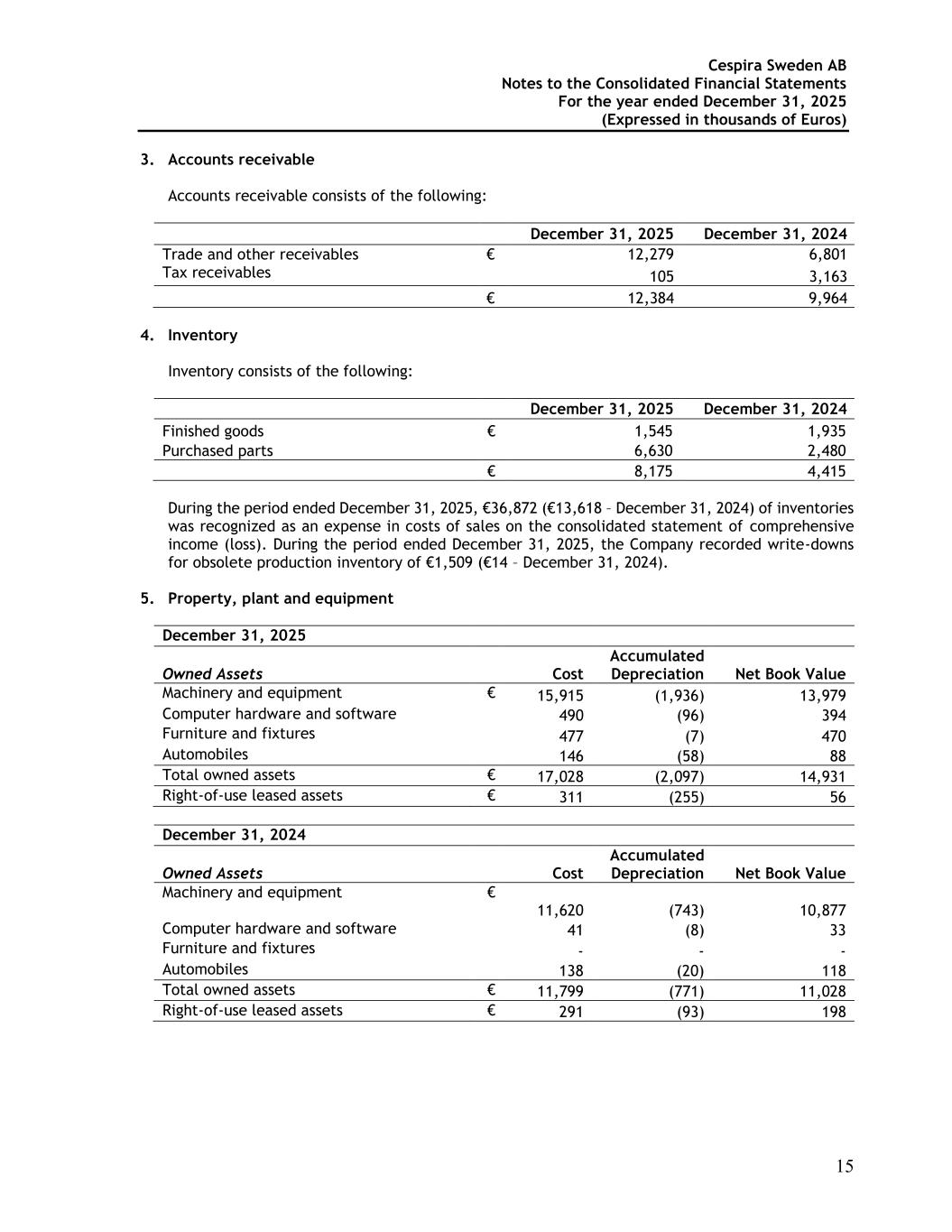
Cespira Sweden AB Notes to the Consolidated Financial Statements For the year ended December 31, 2025 (Expressed in thousands of Euros) 15 3. Accounts receivable Accounts receivable consists of the following: December 31, 2025 December 31, 2024 Trade and other receivables € 12,279 6,801 Tax receivables 105 3,163 € 12,384 9,964 4. Inventory Inventory consists of the following: December 31, 2025 December 31, 2024 Finished goods € 1,545 1,935 Purchased parts 6,630 2,480 € 8,175 4,415 During the period ended December 31, 2025, €36,872 (€13,618 – December 31, 2024) of inventories was recognized as an expense in costs of sales on the consolidated statement of comprehensive income (loss). During the period ended December 31, 2025, the Company recorded write-downs for obsolete production inventory of €1,509 (€14 – December 31, 2024). 5. Property, plant and equipment December 31, 2025 Owned Assets Cost Accumulated Depreciation Net Book Value Machinery and equipment € 15,915 (1,936) 13,979 Computer hardware and software 490 (96) 394 Furniture and fixtures 477 (7) 470 Automobiles 146 (58) 88 Total owned assets € 17,028 (2,097) 14,931 Right-of-use leased assets € 311 (255) 56 December 31, 2024 Owned Assets Cost Accumulated Depreciation Net Book Value Machinery and equipment € 11,620 (743) 10,877 Computer hardware and software 41 (8) 33 Furniture and fixtures - - - Automobiles 138 (20) 118 Total owned assets € 11,799 (771) 11,028 Right-of-use leased assets € 291 (93) 198
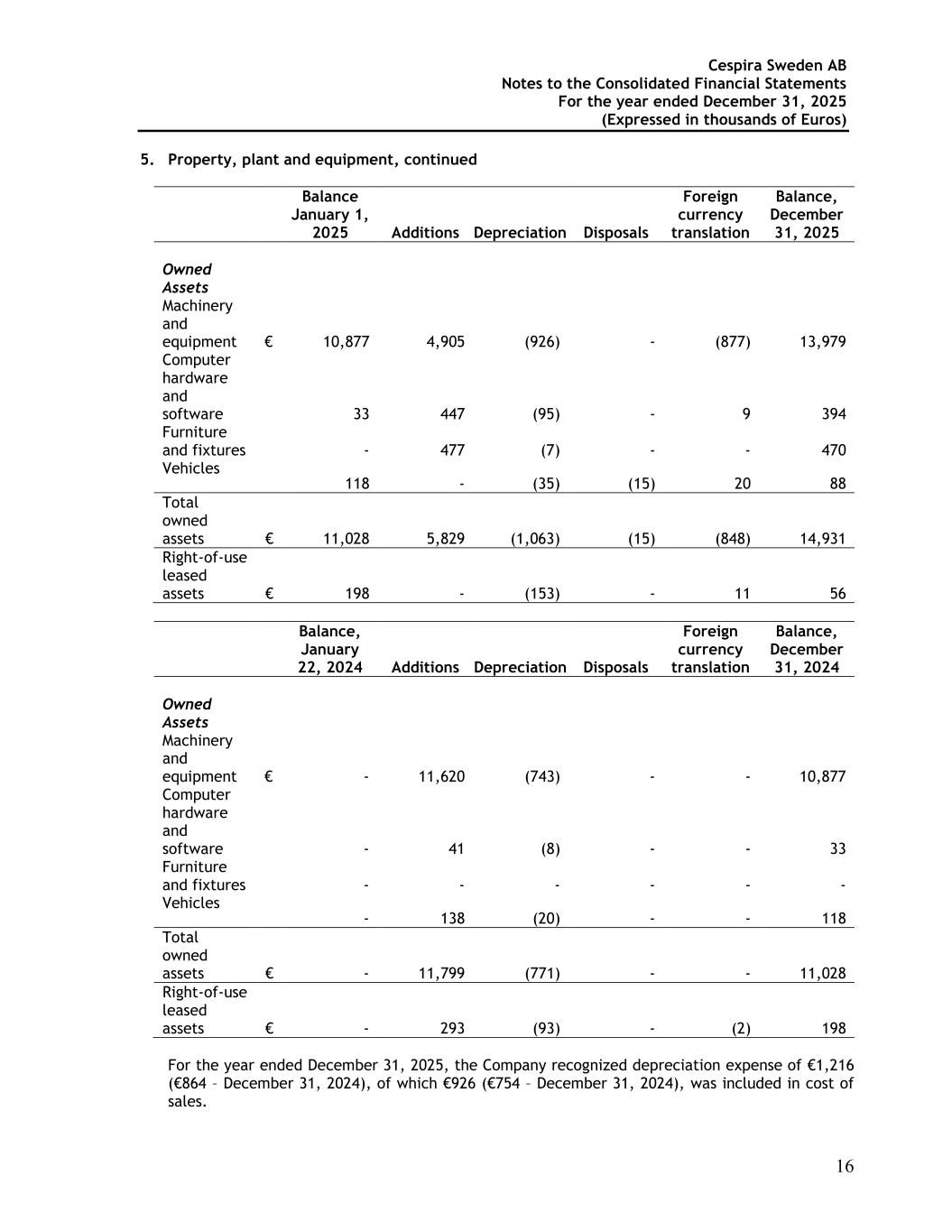
Cespira Sweden AB Notes to the Consolidated Financial Statements For the year ended December 31, 2025 (Expressed in thousands of Euros) 16 5. Property, plant and equipment, continued Balance January 1, 2025 Additions Depreciation Disposals Foreign currency translation Balance, December 31, 2025 Owned Assets Machinery and equipment € 10,877 4,905 (926) - (877) 13,979 Computer hardware and software 33 447 (95) - 9 394 Furniture and fixtures - 477 (7) - - 470 Vehicles 118 - (35) (15) 20 88 Total owned assets € 11,028 5,829 (1,063) (15) (848) 14,931 Right-of-use leased assets € 198 - (153) - 11 56 Balance, January 22, 2024 Additions Depreciation Disposals Foreign currency translation Balance, December 31, 2024 Owned Assets Machinery and equipment € - 11,620 (743) - - 10,877 Computer hardware and software - 41 (8) - - 33 Furniture and fixtures - - - - - - Vehicles - 138 (20) - - 118 Total owned assets € - 11,799 (771) - - 11,028 Right-of-use leased assets € - 293 (93) - (2) 198 For the year ended December 31, 2025, the Company recognized depreciation expense of €1,216 (€864 – December 31, 2024), of which €926 (€754 – December 31, 2024), was included in cost of sales.
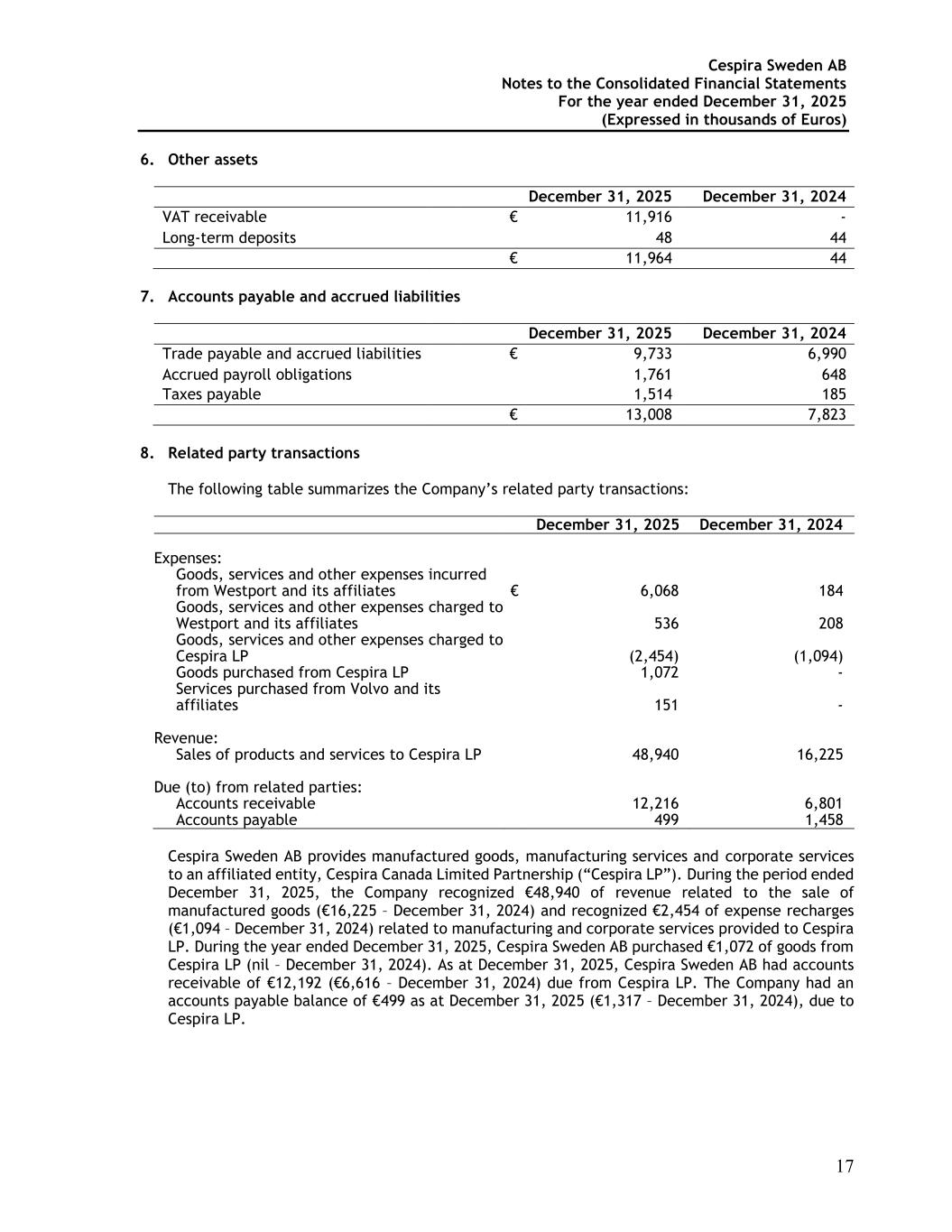
Cespira Sweden AB Notes to the Consolidated Financial Statements For the year ended December 31, 2025 (Expressed in thousands of Euros) 17 6. Other assets December 31, 2025 December 31, 2024 VAT receivable € 11,916 - Long-term deposits 48 44 € 11,964 44 7. Accounts payable and accrued liabilities December 31, 2025 December 31, 2024 Trade payable and accrued liabilities € 9,733 6,990 Accrued payroll obligations 1,761 648 Taxes payable 1,514 185 € 13,008 7,823 8. Related party transactions The following table summarizes the Company’s related party transactions: December 31, 2025 December 31, 2024 Expenses: Goods, services and other expenses incurred from Westport and its affiliates € 6,068 184 Goods, services and other expenses charged to Westport and its affiliates 536 208 Goods, services and other expenses charged to Cespira LP (2,454) (1,094) Goods purchased from Cespira LP 1,072 - Services purchased from Volvo and its affiliates 151 - Revenue: Sales of products and services to Cespira LP 48,940 16,225 Due (to) from related parties: Accounts receivable 12,216 6,801 Accounts payable 499 1,458 Cespira Sweden AB provides manufactured goods, manufacturing services and corporate services to an affiliated entity, Cespira Canada Limited Partnership (“Cespira LP”). During the period ended December 31, 2025, the Company recognized €48,940 of revenue related to the sale of manufactured goods (€16,225 – December 31, 2024) and recognized €2,454 of expense recharges (€1,094 – December 31, 2024) related to manufacturing and corporate services provided to Cespira LP. During the year ended December 31, 2025, Cespira Sweden AB purchased €1,072 of goods from Cespira LP (nil – December 31, 2024). As at December 31, 2025, Cespira Sweden AB had accounts receivable of €12,192 (€6,616 – December 31, 2024) due from Cespira LP. The Company had an accounts payable balance of €499 as at December 31, 2025 (€1,317 – December 31, 2024), due to Cespira LP.
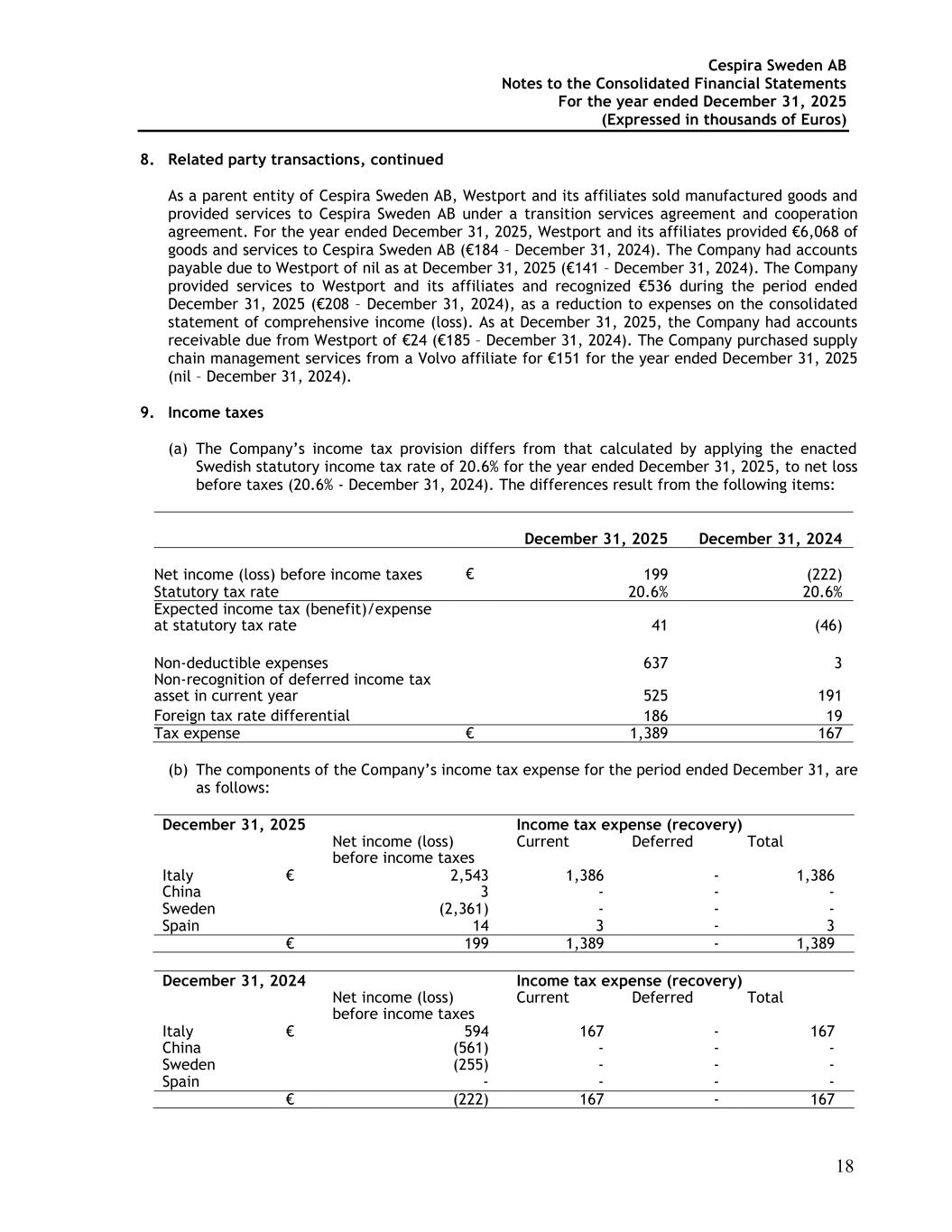
Cespira Sweden AB Notes to the Consolidated Financial Statements For the year ended December 31, 2025 (Expressed in thousands of Euros) 18 8. Related party transactions, continued As a parent entity of Cespira Sweden AB, Westport and its affiliates sold manufactured goods and provided services to Cespira Sweden AB under a transition services agreement and cooperation agreement. For the year ended December 31, 2025, Westport and its affiliates provided €6,068 of goods and services to Cespira Sweden AB (€184 – December 31, 2024). The Company had accounts payable due to Westport of nil as at December 31, 2025 (€141 – December 31, 2024). The Company provided services to Westport and its affiliates and recognized €536 during the period ended December 31, 2025 (€208 – December 31, 2024), as a reduction to expenses on the consolidated statement of comprehensive income (loss). As at December 31, 2025, the Company had accounts receivable due from Westport of €24 (€185 – December 31, 2024). The Company purchased supply chain management services from a Volvo affiliate for €151 for the year ended December 31, 2025 (nil – December 31, 2024). 9. Income taxes (a) The Company’s income tax provision differs from that calculated by applying the enacted Swedish statutory income tax rate of 20.6% for the year ended December 31, 2025, to net loss before taxes (20.6% - December 31, 2024). The differences result from the following items: December 31, 2025 December 31, 2024 Net income (loss) before income taxes € 199 (222) Statutory tax rate 20.6% 20.6% Expected income tax (benefit)/expense at statutory tax rate 41 (46) Non-deductible expenses 637 3 Non-recognition of deferred income tax asset in current year 525 191 Foreign tax rate differential 186 19 Tax expense € 1,389 167 (b) The components of the Company’s income tax expense for the period ended December 31, are as follows: December 31, 2025 Income tax expense (recovery) Net income (loss) before income taxes Current Deferred Total Italy € 2,543 1,386 - 1,386 China 3 - - - Sweden (2,361) - - - Spain 14 3 - 3 € 199 1,389 - 1,389 December 31, 2024 Income tax expense (recovery) Net income (loss) before income taxes Current Deferred Total Italy € 594 167 - 167 China (561) - - - Sweden (255) - - - Spain - - - - € (222) 167 - 167
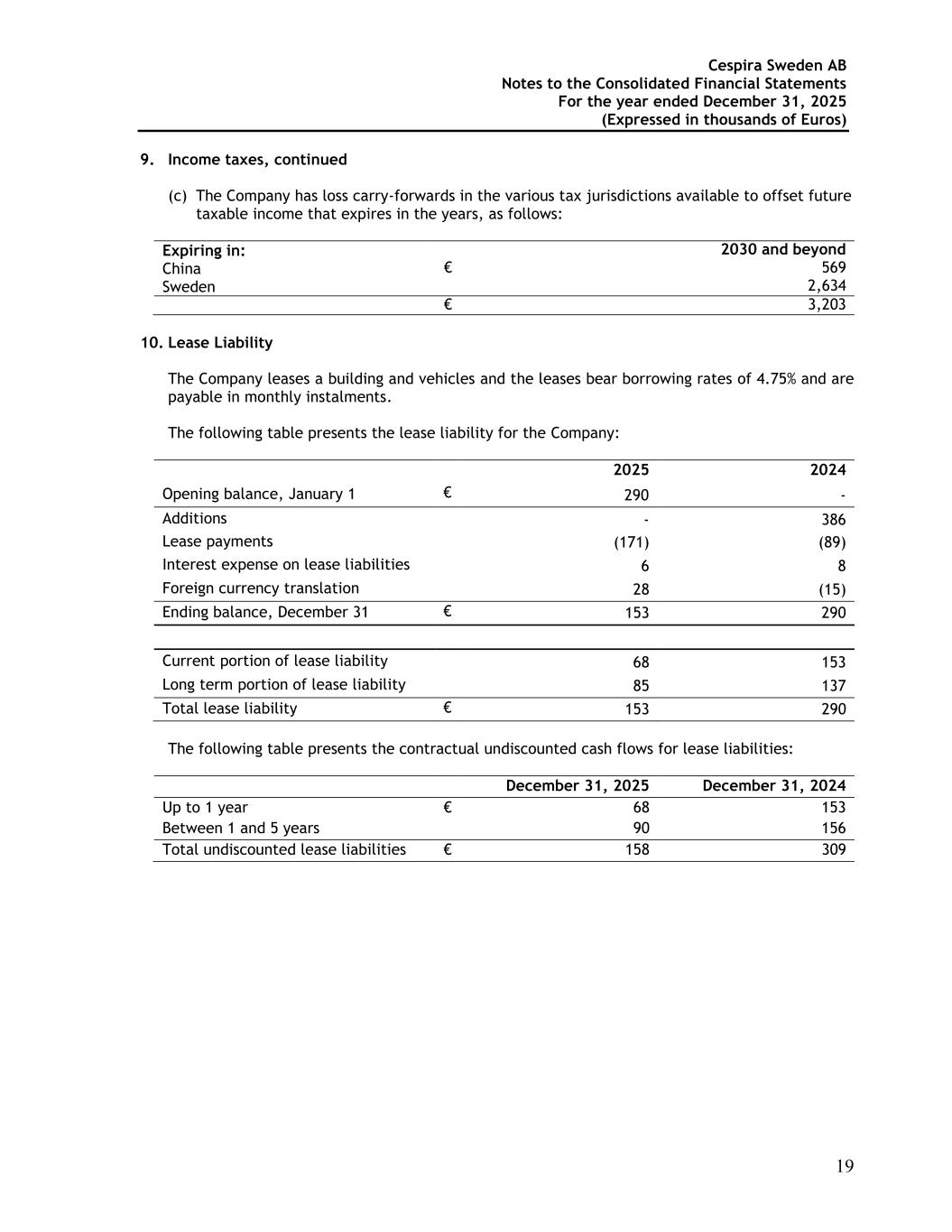
Cespira Sweden AB Notes to the Consolidated Financial Statements For the year ended December 31, 2025 (Expressed in thousands of Euros) 19 9. Income taxes, continued (c) The Company has loss carry-forwards in the various tax jurisdictions available to offset future taxable income that expires in the years, as follows: Expiring in: 2030 and beyond China € 569 Sweden 2,634 € 3,203 10. Lease Liability The Company leases a building and vehicles and the leases bear borrowing rates of 4.75% and are payable in monthly instalments. The following table presents the lease liability for the Company: 2025 2024 Opening balance, January 1 € 290 - Additions - 386 Lease payments (171) (89) Interest expense on lease liabilities 6 8 Foreign currency translation 28 (15) Ending balance, December 31 € 153 290 Current portion of lease liability 68 153 Long term portion of lease liability 85 137 Total lease liability € 153 290 The following table presents the contractual undiscounted cash flows for lease liabilities: December 31, 2025 December 31, 2024 Up to 1 year € 68 153 Between 1 and 5 years 90 156 Total undiscounted lease liabilities € 158 309
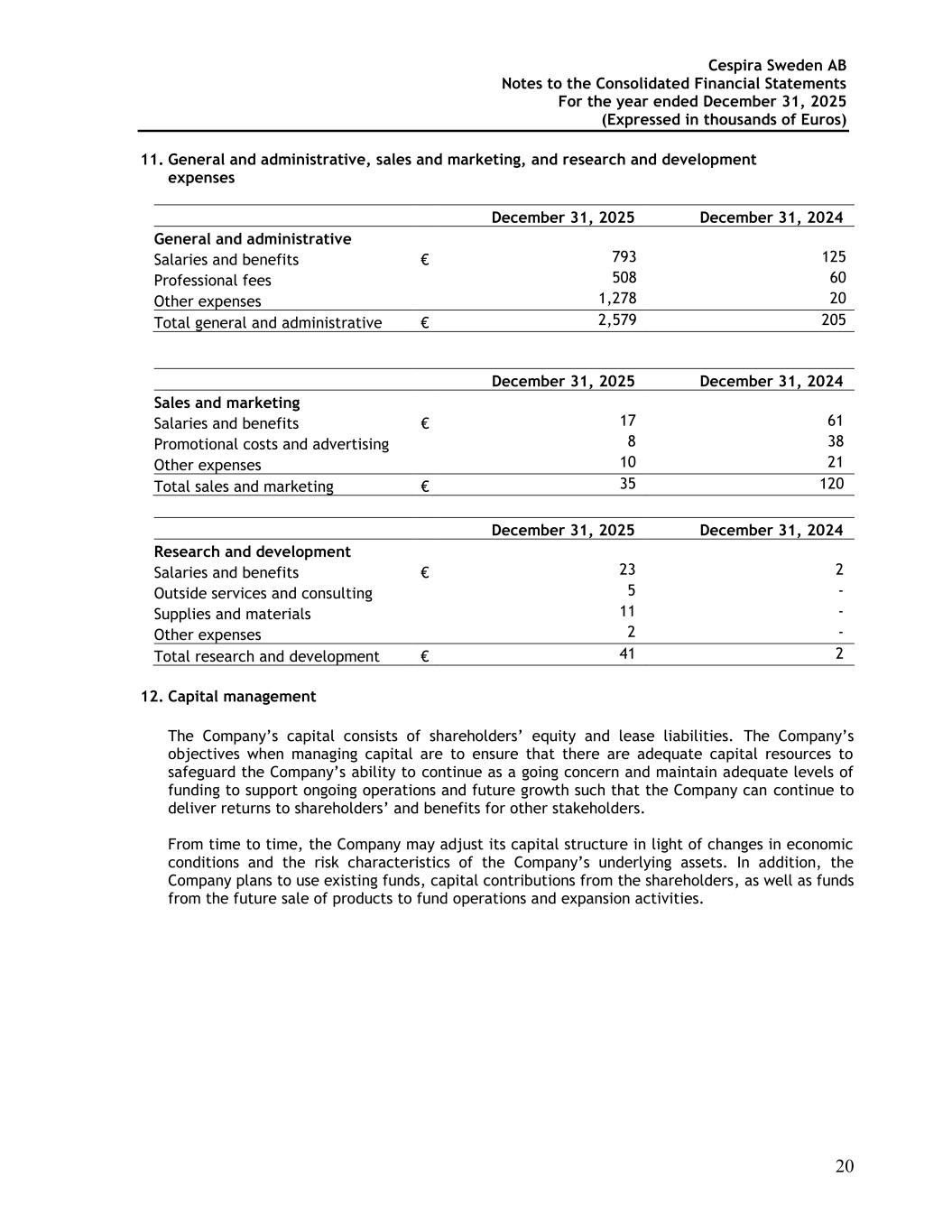
Cespira Sweden AB Notes to the Consolidated Financial Statements For the year ended December 31, 2025 (Expressed in thousands of Euros) 20 11. General and administrative, sales and marketing, and research and development expenses December 31, 2025 December 31, 2024 General and administrative Salaries and benefits € 793 125 Professional fees 508 60 Other expenses 1,278 20 Total general and administrative € 2,579 205 December 31, 2025 December 31, 2024 Sales and marketing Salaries and benefits € 17 61 Promotional costs and advertising 8 38 Other expenses 10 21 Total sales and marketing € 35 120 December 31, 2025 December 31, 2024 Research and development Salaries and benefits € 23 2 Outside services and consulting 5 - Supplies and materials 11 - Other expenses 2 - Total research and development € 41 2 12. Capital management The Company’s capital consists of shareholders’ equity and lease liabilities. The Company’s objectives when managing capital are to ensure that there are adequate capital resources to safeguard the Company’s ability to continue as a going concern and maintain adequate levels of funding to support ongoing operations and future growth such that the Company can continue to deliver returns to shareholders’ and benefits for other stakeholders. From time to time, the Company may adjust its capital structure in light of changes in economic conditions and the risk characteristics of the Company’s underlying assets. In addition, the Company plans to use existing funds, capital contributions from the shareholders, as well as funds from the future sale of products to fund operations and expansion activities.
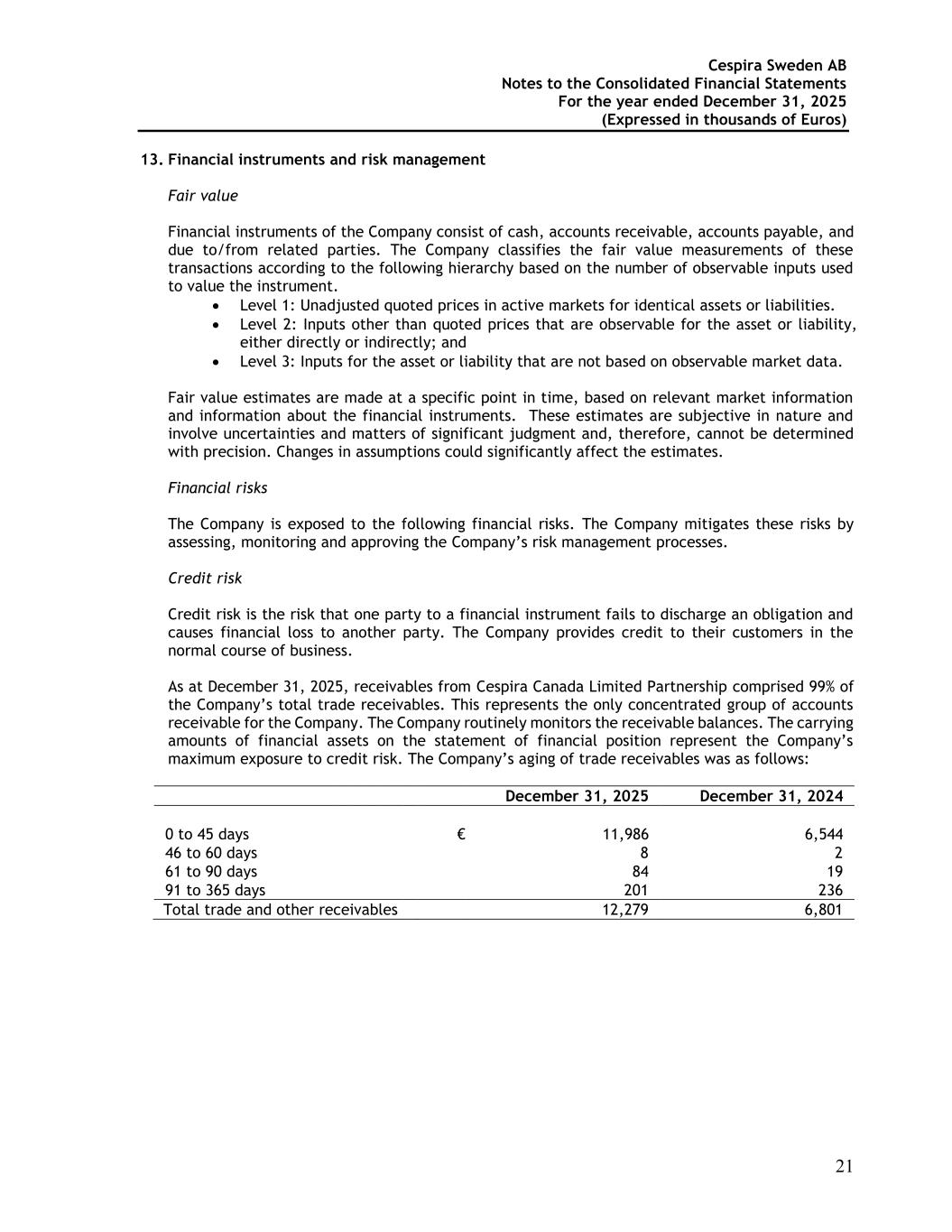
Cespira Sweden AB Notes to the Consolidated Financial Statements For the year ended December 31, 2025 (Expressed in thousands of Euros) 21 13. Financial instruments and risk management Fair value Financial instruments of the Company consist of cash, accounts receivable, accounts payable, and due to/from related parties. The Company classifies the fair value measurements of these transactions according to the following hierarchy based on the number of observable inputs used to value the instrument. • Level 1: Unadjusted quoted prices in active markets for identical assets or liabilities. • Level 2: Inputs other than quoted prices that are observable for the asset or liability, either directly or indirectly; and • Level 3: Inputs for the asset or liability that are not based on observable market data. Fair value estimates are made at a specific point in time, based on relevant market information and information about the financial instruments. These estimates are subjective in nature and involve uncertainties and matters of significant judgment and, therefore, cannot be determined with precision. Changes in assumptions could significantly affect the estimates. Financial risks The Company is exposed to the following financial risks. The Company mitigates these risks by assessing, monitoring and approving the Company’s risk management processes. Credit risk Credit risk is the risk that one party to a financial instrument fails to discharge an obligation and causes financial loss to another party. The Company provides credit to their customers in the normal course of business. As at December 31, 2025, receivables from Cespira Canada Limited Partnership comprised 99% of the Company’s total trade receivables. This represents the only concentrated group of accounts receivable for the Company. The Company routinely monitors the receivable balances. The carrying amounts of financial assets on the statement of financial position represent the Company’s maximum exposure to credit risk. The Company’s aging of trade receivables was as follows: December 31, 2025 December 31, 2024 0 to 45 days € 11,986 6,544 46 to 60 days 8 2 61 to 90 days 84 19 91 to 365 days 201 236 Total trade and other receivables 12,279 6,801
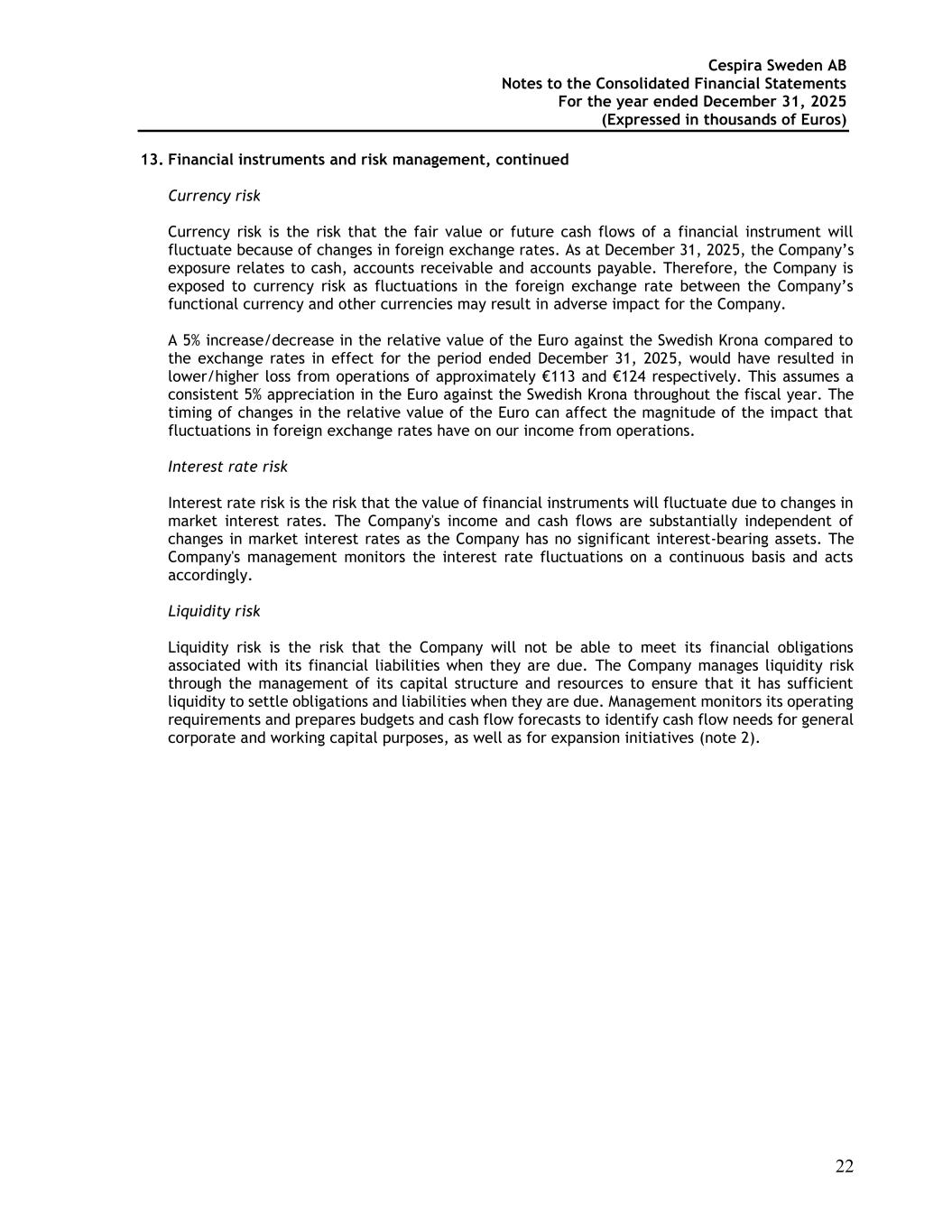
Cespira Sweden AB Notes to the Consolidated Financial Statements For the year ended December 31, 2025 (Expressed in thousands of Euros) 22 13. Financial instruments and risk management, continued Currency risk Currency risk is the risk that the fair value or future cash flows of a financial instrument will fluctuate because of changes in foreign exchange rates. As at December 31, 2025, the Company’s exposure relates to cash, accounts receivable and accounts payable. Therefore, the Company is exposed to currency risk as fluctuations in the foreign exchange rate between the Company’s functional currency and other currencies may result in adverse impact for the Company. A 5% increase/decrease in the relative value of the Euro against the Swedish Krona compared to the exchange rates in effect for the period ended December 31, 2025, would have resulted in lower/higher loss from operations of approximately €113 and €124 respectively. This assumes a consistent 5% appreciation in the Euro against the Swedish Krona throughout the fiscal year. The timing of changes in the relative value of the Euro can affect the magnitude of the impact that fluctuations in foreign exchange rates have on our income from operations. Interest rate risk Interest rate risk is the risk that the value of financial instruments will fluctuate due to changes in market interest rates. The Company's income and cash flows are substantially independent of changes in market interest rates as the Company has no significant interest-bearing assets. The Company's management monitors the interest rate fluctuations on a continuous basis and acts accordingly. Liquidity risk Liquidity risk is the risk that the Company will not be able to meet its financial obligations associated with its financial liabilities when they are due. The Company manages liquidity risk through the management of its capital structure and resources to ensure that it has sufficient liquidity to settle obligations and liabilities when they are due. Management monitors its operating requirements and prepares budgets and cash flow forecasts to identify cash flow needs for general corporate and working capital purposes, as well as for expansion initiatives (note 2).