UNITED
STATES
SECURITIES AND EXCHANGE COMMISSION
Washington, DC 20549
FORM 20-F
☐ REGISTRATION STATEMENT PURSUANT TO SECTION 12(b) OR 12(g) OF THE SECURITIES EXCHANGE ACT OF 1934
or
☒ ANNUAL REPORT PURSUANT TO SECTION 13 OR 15(d) OF THE SECURITIES EXCHANGE ACT OF 1934
For the fiscal year ended December 31, 2016
or
☐ TRANSITION REPORT PURSUANT TO SECTION 13 OR 15(d) OF THE SECURITIES EXCHANGE ACT OF 1934
or
☐ SHELL COMPANY REPORT PURSUANT TO SECTION 13 OR 15(d) OF THE SECURITIES EXCHANGE ACT OF 1934
Commission file number: 001-35378
GAZIT-GLOBE LTD.
(Exact name of registrant as specified in its charter)
Israel
(Jurisdiction of incorporation or organization)
1 Hashalom Rd.
Tel-Aviv 67892, Israel
(972)(3) 694-8000
(Address of principal executive offices)
Adi Jemini,
Chief Financial Officer
Tel: (972)(3) 694-8000
Email: ajemini@gazitgroup.com
1 Hashalom Rd. Tel-Aviv 67892, Israel
(Name, telephone, email and/or facsimile number and address of company contact person)
Securities registered or to be registered pursuant to Section 12(b) of the Act:
| Title of each class | Name of each exchange on which registered | |
| Ordinary Shares, par value NIS 1.00 per share | New York Stock Exchange |
Securities registered or to be registered pursuant to Section 12(g) of the Act: None
Securities for which there is a reporting obligation pursuant to Section 15(d) of the Act: None
Indicate the number of outstanding shares of each of the issuer’s classes of capital or common stock as of the close of the period covered by the annual report: 195,550,414 Ordinary Shares, par value NIS 1.00 per share (excluding Treasury Shares).
Indicate by check mark if the registrant is a well-known seasoned issuer, as defined in Rule 405 of the Securities Act. ☒ Yes ☐ No
If this report is an annual or transition report, indicate by check mark if the registrant is not required to file reports pursuant to Section 13 or 15(d) of the Securities Exchange Act of 1934. ☐ Yes ☒ No
Indicate by check mark whether the registrant: (1) has filed all reports required to be filed by Section 13 or 15(d) of the Securities Exchange Act of 1934 during the preceding 12 months (or for such shorter period that the registrant was required to file such reports), and (2) has been subject to such filing requirements for the past 90 days. ☒ Yes ☐ No
Indicate by check mark whether the registrant has submitted electronically and posted on its corporate Web site, if any, every Interactive Data File required to be submitted and posted pursuant to Rule 405 of Regulation S-T (§232.405 of this chapter) during the preceding 12 months (or for such shorter period that the registrant was required to submit and post such files). N/A
Indicate by check mark whether the registrant is a large accelerated filer, an accelerated filer, a non-accelerated filer or an emerging growth company. See the definitions of “large accelerated filer,” “accelerated filer,” and “emerging growth company” in Rule 12b-2 of the Exchange Act (check one).
Large Accelerated Filer ☒ Accelerated Filer ☐ Non-Accelerated Filer ☐ Emerging Growth Company ☐
If an emerging growth company that prepares its financial statements in accordance with U.S. GAAP, indicate by check mark if the registrant has elected not to use the extended transition period for complying with any new or revised financial accounting standards† provided pursuant to Section 13(a) of the Exchange Act. ☐
† The term “new or revised financial accounting standard” refers to any update issued by the Financial Accounting Standards Board to its Accounting Standards Codification after April 5, 2012.
Indicate by check mark which basis of accounting the registrant has used to prepare the financial statements included in this filing:
| U.S. GAAP ☐ | International
Financial Reporting Standards as issued by the International Accounting Standards Board ☒ |
Other ☐ |
If “Other” has been checked in response to the previous question, indicate by check mark which financial statement item the registrant has elected to follow: Item 17 ☐ Item 18 ☐
If this is an annual report, indicate by check mark whether the registrant is a shell company (as defined in Rule 12b-2 of the Exchange Act): ☐ Yes ☒ No
GAZIT-GLOBE LTD.
FORM 20-F
ANNUAL REPORT FOR THE FISCAL YEAR ENDED DECEMBER 31, 2016
TABLE OF CONTENTS
i
Introduction and Use of Certain Terms
Unless otherwise indicated, all references to (i) “we,” “us,” or “our,” are to Gazit-Globe Ltd. and, where applicable, its investees, and (ii) “Gazit-Globe” or the “Company” are to Gazit-Globe Ltd., not including any of its investees.
Except where the context otherwise requires, references in this annual report to:
| ● | “Adjusted EPRA Earnings” means EPRA Earnings, as adjusted for: |
| ○ | Consumer Price Index (or “CPI”); |
| ○ | depreciation and amortization; |
| ○ | expenses arising from the termination of engagements with senior Group officers; |
| ○ | expenses and income from extraordinary legal proceeding not related to the reporting periods (including provision for legal proceedings); |
| ○ | income and expenses from operations not related to income producing property (including the results of Luzon Group through January 2016) and the cost of debt with respect thereto; |
| ○ | non-recurring expenses with respect to reorganization; and |
| ○ | internal leasing costs (mainly salary) incurred in the leasing of properties. |
| ● | “Average annualized base rent” refers to the average minimum rent due under the terms of applicable leases on an annualized basis. |
| ● | “Community shopping center” means a center that offers general merchandise or convenience-oriented offerings with gross leasable area (or “GLA”) between 100,000 and 350,000 square feet, between 15 and 40 stores and two or more anchors, which are typically discount stores, supermarkets, drugstores, and large-specialty discount stores, based on the definition published by the International Council of Shopping Centers. |
| ● | “Consolidated” refers to the Company and entities that are consolidated in the Company’s financial statements. |
| ● | “EPRA Earnings” means the net income (loss) attributable to the equity holders of a company with certain adjustments for non-operating items, which are affected by the fair value revaluation of assets and liabilities, primarily adjustments to the fair value of investment property, investment property under development, land and other investments, various capital gains and losses, gain (loss) from early redemption of liabilities and financial derivatives, gains from bargain purchase, the impairment of goodwill, changes in the fair value recognized with respect to financial instruments (including derivatives), deferred taxes and current taxes with respect to disposal of properties, our share in investees and acquisition costs recognized in profit and loss, as well as non-controlling interests’ share with respect to the above items. |
| ● | “Equity-accounted investees” means investments presented on an equity method basis, which are not consolidated in the Company’s financial statements. |
| ● | “GLA” means gross leasable area. |
| ● | “Group” means the Company, its subsidiaries, its equity-accounted investees and jointly-controlled entities. |
| ● | “Investees” means subsidiaries, jointly-controlled entities, equity-accounted investees and, after March 1, 2017, Regency. |
| ● | “Jointly-controlled entities” means joint ventures and joint operations in which the Company or its subsidiaries are engaged, which currently include First Capital’s joint venture with Main and Main Developments LP, Citycon’s joint venture with the Canada Pension Plan Investment Board (“CPPIB”) in the Kista Galleria Shopping Center located in Stockholm, Sweden and Atrium’s joint venture with the Otto family in the Arkády Pankrác Shopping Center located in Prague, the Czech Republic. |
| ● | “Neighborhood shopping center” means a center that is designed to provide convenience shopping for the day-to-day needs of consumers in its immediate neighborhood with GLA between 30,000 and 150,000 square feet and between five and 20 stores and is typically anchored by one or more supermarkets, based on the definition published by the International Council of Shopping Centers. |
| ● | “NOI” means net operating income. |
| ● | “Norstar” means Norstar Holdings Inc. (TASE: NSTR), formerly known as Gazit Inc., which owned 50.6% of our issued ordinary shares as of April 10, 2017. |
ii
| ● | “Regency” means Regency Centers Corporation (NYSE: REG), into which Equity One was merged in March 2017. |
| ● | “Reporting date” or “balance sheet date” means December 31, 2016. |
| ● | “Same property NOI” means the change in net operating income for properties that were owned for the entirety of both the current and prior reporting periods (excluding expanded and redeveloped properties and the impact of currency exchange rates). |
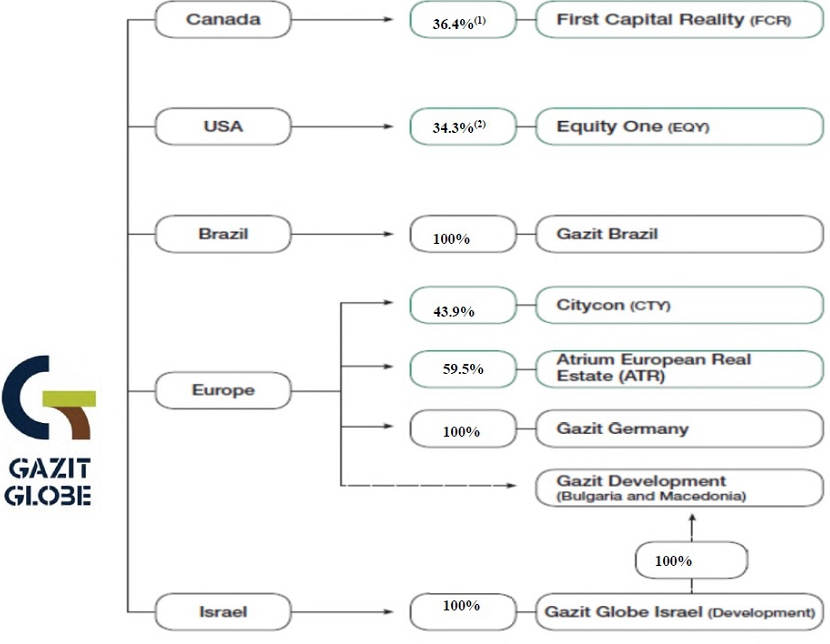
As of December 31, 2016 our principal subsidiaries were:
| ● | “Atrium” means Atrium European Real Estate Limited (VSE/EURONEXT:ATRS), consolidated as of January 2015, which owns and operates shopping centers in Central and Eastern Europe. |
| ● | “Citycon” means Citycon Oyj. (NASDAQ OMX HELSINKI:CTY1S), which owns and operates shopping centers in Northern Europe. |
| ● | “Dori Construction” means U. Dori Construction Ltd. and its subsidiaries. |
| ● | “Luzon Group” means Amos Luzon Development and Energy Group Ltd. (TASE:LUZN) (formerly U. Dori Group Ltd. (TASE: DORI)) and its subsidiaries, which controls Dori Construction and Dori Construction’s subsidiaries and related companies. Gazit Development held approximately 84.9% of Luzon Group until January 2016, when it sold its entire stake. Consequently, commencing in the first quarter of 2016, Luzon Group’s operations are no longer consolidated as an operating segment in our financial statements and are presented in our audited consolidated financial statements included elsewhere in this annual report as discontinued operations. For additional details refer to Note 9(g) to our audited consolidated financial statements included elsewhere in this annual report. |
| ● | “Equity One” means Equity One, Inc., which owns and operates shopping centers in the United States. Effective as of March 1, 2017, Equity One completed its merger with and into Regency (the “Regency Merger”), and is presented in our audited consolidated financial statements included elsewhere in this annual report as a discontinued operation. Regency will not be consolidated into our financial statements in 2017 and instead we will present the investment as an available-for-sale financial asset. |
| ● | “First Capital” means First Capital Realty Inc. (TSX:FCR) which owns and operates shopping centers in Canada. As a result of our sale of common shares of First Capital in March 2017, we deconsolidated First Capital from our financial statements and present the investment on an equity method basis as of March 2017. |
| ● | “Gazit Brasil” means Gazit Brasil Ltda. and Fundo De Investimento Multimercado Norstar Credito Privado which owns and operates shopping centers in Brazil. |
| ● | “Gazit Development” means Gazit-Globe Israel (Development) Ltd., which owns properties in Israel and Eastern Europe, which wholly-owns Gazit Development (Bulgaria) and held 84.9% of Luzon Group until January 2016. |
| ● | “Gazit Germany” means Gazit Germany Beteiligungs GmbH & Co. KG which owns and operates shopping centers in Germany. |
| ● | “ProMed” means ProMed Properties Inc., which owned and operated medical office buildings in the United States until August 2015. |
Presentation of Financial Information
Our audited consolidated financial statements included elsewhere in this annual report have been prepared in accordance with International Financial Reporting Standards (“IFRS”), as issued by the International Accounting Standards Board (“IASB”).
Unless otherwise noted, all monetary amounts are in New Israeli Shekel (or “NIS”), and for the convenience of the reader certain NIS amounts have been translated into U.S. dollars at the rate of NIS 3.845 = U.S.$ 1.00, based on the daily representative rate of exchange between the NIS and the U.S. dollar reported by the Bank of Israel on December 31, 2016. References herein to (i) “NIS” mean the legal currency of Israel, (ii) “U.S.$,” “$,” “U.S. dollar” or “dollar” mean the legal currency of the United States, (iii) “Euro,” “EUR” or “€” mean the currency of the participating member states in the third stage of the Economic and Monetary Union of the Treaty establishing the European community, (iv) “Canadian dollar” or “C$” mean the legal currency of Canada, and (v) “BRL” mean the legal currency of Brazil.
We also refer in various places within this annual report to non-IFRS measures, including NOI, Adjusted EBITDA, EPRA Earnings, Adjusted EPRA Earnings, EPRA NAV and EPRA NNNAV. For definitions and reconciliations of NOI, Adjusted EBITDA, EPRA Earnings, Adjusted EPRA Earnings, EPRA NAV and EPRA NNNAV and statements disclosing the reasons why our management believes that their presentation provides useful information to investors and, to the extent material, any additional purposes for which our management uses them, see “Item 5—Operating and Financial Review and Prospects”. The presentation of these non-IFRS measures is not meant to be considered in isolation or as a substitute for our consolidated financial results prepared in accordance with IFRS as issued by the IASB.
iii
We make forward-looking statements in this annual report that are subject to risks and uncertainties. These forward-looking statements include, but are not limited to, information about possible or assumed future results of our business, financial condition, results of operations, liquidity, plans and objectives. In some cases, you can identify forward-looking statements by terminology such as “believe,” “may,” “could,” “estimate,” “continue,” “anticipate,” “intend,” “should,” “plan,” “expect,” “predict,” “potential,” or the negative of these terms or other similar expressions. The forward-looking statements contained in this annual report reflect our views as of the date of this annual report about future events and are subject to risks, uncertainties, assumptions and changes in circumstances that may cause events or our actual activities or results to differ significantly from those expressed in any forward-looking statement. Although we believe that the expectations reflected in the forward-looking statements are reasonable, we cannot guaranty future events, results, actions, levels of activity, performance or achievements. You are cautioned not to place undue reliance on these forward-looking statements. Some of the risks, uncertainties and other important factors that could cause results to differ, or that otherwise could have an impact on us include, but are not limited to, the following:
| ● | the economic performance and value of our shopping centers depend on many factors, each of which could have an adverse impact on our cash flows and operating results; |
| ● | economic conditions may make it difficult to maintain or increase occupancy rates and rents and a deterioration in economic conditions in one or more of our key regions could adversely impact our results of operations; |
| ● | we seek to expand through acquisitions of additional real estate assets, including other businesses. Such expansion may not yield the returns expected, may result in disruptions to our business, may strain management resources and may result in dilution to our shareholders or dilution of our interests in our subsidiaries and other investees; |
| ● | we are particularly dependent upon large tenants that serve as anchors in our shopping centers and decisions made by these tenants or adverse developments in their businesses could have a negative impact on our financial condition; |
| ● | online sales can have an adverse impact on our tenants and our business; |
| ● | we have substantial debt obligations which may negatively affect our results of operations and financial position and put us at a competitive disadvantage; |
| ● | volatility in the credit markets may affect our ability to obtain or re-finance our indebtedness at a reasonable cost; |
| ● | the inability of any of our investees to satisfy their liquidity requirements may materially and adversely impact our results of operations; |
| ● | commencement of operations in new geographic markets and asset classes involves risks and may result in us investing significant resources without realizing a return and may adversely impact our future growth; |
| ● | if we are unable to obtain adequate capital, we may have to limit our operations substantially; |
| ● | future terrorist acts and shooting incidents could harm the demand for, and the value of, our properties; |
| ● | many of our real estate costs are fixed, even if income from our properties decreases; |
| ● | our results of operations may be adversely affected by fluctuations in currency exchange rates and we may not have adequately hedged against them; |
| ● | we are subject to a disproportionate impact on our properties due to concentration in certain areas; |
| ● | certain emerging markets in which we have properties are subject to greater risks than more developed markets, including significant legal, economic and political risks; and |
| ● | the other risks and uncertainties described under “Item 3—Key Information—Risk Factors” and elsewhere in this annual report. |
Readers are urged to read this annual report and carefully consider the risks, uncertainties and other factors that affect our business. The information contained in this annual report is subject to change without notice, and we are not obligated to publicly update or revise forward-looking statements. Readers should review future reports filed by us with the Securities Exchange Commission (“SEC”).
Statistical Data
This annual report also includes statistical data regarding the commercial real estate rental industry. We generated some of this data internally, and some was obtained from independent industry publications and reports what we believe to be reliable sources. We have not independently verified this data nor sought the consent of any organizations to refer to their reports in this annual report.
iv
| ITEM 1. | IDENTITY OF DIRECTORS, SENIOR MANAGEMENT AND ADVISERS |
Not applicable.
| ITEM 2. | OFFER STATISTICS AND EXPECTED TIMETABLE |
Not applicable.
| ITEM 3. | KEY INFORMATION |
| A. | Selected Financial Data |
The following tables set forth our selected consolidated financial data. You should read the following selected consolidated financial data in conjunction with “Item 5—Operating and Financial Review and Prospects” and our audited consolidated financial statements and related notes included elsewhere in this annual report. Historical results are not necessarily indicative of the results that may be expected in the future. Our financial statements have been prepared in accordance with International Financial Reporting Standards, or IFRS, as issued by the International Accounting Standards Board, or IASB.
The selected consolidated statement of income data set forth below for each of the years ended December 31, 2014, 2015, and 2016 and the selected consolidated balance sheet data set forth below as of December 31, 2015 and 2016 are derived from our audited consolidated financial statements appearing in this annual report. For these periods, Equity One and Luzon Group are presented in the consolidated statements of income data under discontinued operations, giving effect to the Regency Merger in March 2017 and Gazit Development’s sale of its entire holding in Luzon Group in January 2016. Following the Regency Merger, Equity One is presented in the consolidated statements of financial position as of December 31, 2016 under assets and liabilities classified as held for sale. See Note 9(d) to our audited consolidated financial statements included elsewhere in this annual report. The selected consolidated statement of income data for each of the years ended December 31, 2012 and 2013, and the selected consolidated balance sheet data as of December 31, 2012, 2013 and 2014, are derived from our audited consolidated financial statements that are not included in this annual report. The selected consolidated statements of income data for each of the years ended December 31, 2012 and 2013 have been reclassified to present Equity One and Luzon Group as discontinued operations, and such reclassification has not been audited.
The selected consolidated financial data set forth below should be read in conjunction with “Item 5—Operating and Financial Review and Prospects” and our audited consolidated financial statements and notes to those statements for the years ended December 31, 2014, 2015 and 2016 included elsewhere in this annual report. Historical results are not necessarily indicative of future results. The following tables also contain translations of NIS amounts into U.S. dollars for amounts presented as of and for the year ended December 31, 2016. These translations are solely for the convenience of the reader and were calculated at the rate of NIS 3.845 = U.S.$ 1.00, the daily representative rate of exchange between the NIS and the U.S. dollar reported by the Bank of Israel on December 31, 2016. You should not assume that, on that or on any other date, one could have converted these amounts of NIS into dollars at that or any other exchange rate.
| 1 |
| Year Ended December 31, | ||||||||||||||||||||||||
| 2012 | 2013 | 2014 | 2015 | 2016 | 2016 | |||||||||||||||||||
| (In millions except for per share data) | NIS | U.S.$ | ||||||||||||||||||||||
| Statement of Income Data: | ||||||||||||||||||||||||
| Rental income | 3,988 | 3,935 | 3,725 | 4,809 | 4,801 | 1,249 | ||||||||||||||||||
| Property operating expenses | 1,363 | 1,352 | 1,269 | 1,613 | 1,607 | 418 | ||||||||||||||||||
| Net operating rental income | 2,625 | 2,583 | 2,456 | 3,196 | 3,194 | 831 | ||||||||||||||||||
| Revenues from sale of buildings (1) | - | 103 | - | - | - | - | ||||||||||||||||||
| Cost of buildings sold (1) | - | 93 | - | - | - | - | ||||||||||||||||||
| Gross profit (loss) from sale of buildings, land and construction work performed | - | 10 | - | - | - | - | ||||||||||||||||||
| Total gross profit | 2,625 | 2,593 | 2,456 | 3,196 | 3,194 | 831 | ||||||||||||||||||
| Fair value gain (loss) on investment property and investment property under development, net (2) | 1,400 | 272 | 400 | (372 | ) | 885 | 230 | |||||||||||||||||
| General and administrative expenses | (456 | ) | (401 | ) | (386 | ) | (568 | ) | (542 | ) | (141 | ) | ||||||||||||
| Other income | 157 | 192 | 52 | 27 | 37 | 9 | ||||||||||||||||||
| Other expenses | (30 | ) | (33 | ) | (57 | ) | (795 | ) | (236 | ) | (61 | ) | ||||||||||||
| Company’s share in earnings of equity-accounted investees, net | 238 | 130 | 3 | 164 | 142 | 37 | ||||||||||||||||||
| Operating income | 3,934 | 2,753 | 2,468 | 1,652 | 3,480 | 905 | ||||||||||||||||||
| Finance expenses | (1,760 | ) | (1,876 | ) | (1,835 | ) | (1,586 | ) | (1,600 | ) | (416 | ) | ||||||||||||
| Finance income | 82 | 514 | 144 | 849 | 325 | 84 | ||||||||||||||||||
| Income before taxes on income | 2,256 | 1,391 | 777 | 915 | 2,205 | 573 | ||||||||||||||||||
| Taxes on income | 476 | 159 | 282 | (79 | ) | 434 | 112 | |||||||||||||||||
| Net income from continuing operations | 1,780 | 1,232 | 495 | 994 | 1,771 | 461 | ||||||||||||||||||
| Income from discontinued operations | 633 | 953 | 588 | 1,312 | 1,409 | 366 | ||||||||||||||||||
| Net income | 2,413 | 2,185 | 1,083 | 2,306 | 3,180 | 827 | ||||||||||||||||||
| Net income attributable to: | ||||||||||||||||||||||||
| Equity holders of the Company | 901 | 927 | 73 | 620 | 787 | 205 | ||||||||||||||||||
| Non-controlling interests | 1,512 | 1,258 | 1,010 | 1,686 | 2,393 | 622 | ||||||||||||||||||
| 2,413 | 2,185 | 1,083 | 2,306 | 3,180 | 827 | |||||||||||||||||||
| Basic net earnings (loss) per share from continuing operations | 4.72 | 3.23 | (0.70 | ) | 1.36 | 2.70 | 0.70 | |||||||||||||||||
| Basic net earnings per share from discontinued operations | 0.74 | 2.18 | 1.11 | 2.11 | 1.33 | 0.35 | ||||||||||||||||||
| Basic net earnings per share | 5.46 | 5.41 | 0.41 | 3.47 | 4.03 | 1.05 | ||||||||||||||||||
| Diluted net earnings (loss) per share from continuing operations | 4.51 | 3.17 | (0.72 | ) | 1.35 | 2.63 | 0.68 | |||||||||||||||||
| Diluted net earnings per share from discontinued operations | 0.74 | 2.18 | 1.11 | 2.10 | 1.33 | 0.35 | ||||||||||||||||||
| Diluted net earnings per share | 5.25 | 5.35 | 0.39 | 3.45 | 3.96 | 1.03 | ||||||||||||||||||
| Year Ended December 31, | ||||||||||||||||||||
| 2012 | 2013 | 2014 | 2015 | 2016 | ||||||||||||||||
| (In thousands) | ||||||||||||||||||||
| Weighted average number of shares used to calculate: | ||||||||||||||||||||
| Basic earnings per share | 164,912 | 171,103 | 176,459 | 178,426 | 195,493 | |||||||||||||||
| Diluted earnings per share | 165,016 | 171,413 | 176,546 | 178,601 | 195,567 | |||||||||||||||
| (1) | Revenues from sale of buildings consist of revenue from First Capital. |
| (2) | Pursuant to IAS 40 “Investment Property”, gains or losses arising from change in fair value of our investment property and our investment property under development where fair value can be reliably measured are recognized in our income statement at the end of each period. |
| 2 |
| Year Ended December 31, | ||||||||||||||||||||||||
| 2012 | 2013 | 2014 | 2015 | 2016 | 2016 | |||||||||||||||||||
| (In millions) | NIS | U.S.$ | ||||||||||||||||||||||
| Selected Balance Sheet Data: | ||||||||||||||||||||||||
| Equity-accounted investees | 4,713 | 5,907 | 6,213 | 2,996 | 2,097 | 545 | ||||||||||||||||||
| Investment property | 55,465 | 53,309 | 56,646 | 70,606 | 55,982 | 14,560 | ||||||||||||||||||
| Investment property under development | 2,806 | 2,479 | 1,642 | 2,587 | 2,113 | 550 | ||||||||||||||||||
| Total assets | 71,034 | 67,927 | 69,984 | 84,236 | 86,887 | 22,597 | ||||||||||||||||||
| Long term interest-bearing liabilities from financial institutions and others (1) | 19,433 | 12,692 | 8,552 | 11,457 | 8,183 | 2,128 | ||||||||||||||||||
| Long term debentures (2) | 18,500 | 22,231 | 24,433 | 29,480 | 27,319 | 7,105 | ||||||||||||||||||
| Total liabilities | 48,737 | 45,574 | 44,114 | 53,241 | 53,119 | 13,815 | ||||||||||||||||||
| Equity attributable to equity holders of the Company | 7,681 | 7,802 | 8,023 | 7,512 | 8,158 | 2,122 | ||||||||||||||||||
| Non-controlling interests | 14,616 | 14,551 | 17,847 | 23,483 | 25,610 | 6,660 | ||||||||||||||||||
| Total equity | 22,297 | 22,353 | 25,870 | 30,995 | 33,768 | 8,782 | ||||||||||||||||||
| (1) | As of December 31, 2016, NIS 0.7 billion (U.S.$ 0.2 billion) of our interest-bearing liabilities from financial institutions and others (including current maturities) were unsecured and the remainder were secured. |
| (2) | As of December 31, 2016, NIS 810 million (U.S.$ 211 million) aggregate principal amount of our debentures was secured and the remainder was unsecured. |
| As of December 31, | ||||||||||||||||||||
| 2012 | 2013 | 2014 | 2015 | 2016 | ||||||||||||||||
| NIS | ||||||||||||||||||||
| Other Operating Data (1): | ||||||||||||||||||||
| Number of Group operating properties | 622 | 577 | 524 | 451 | 426 | |||||||||||||||
| Total Group GLA (in thousands of sq. ft.) | 73,292 | 71,431 | 68,336 | 70,796 | 70,591 | |||||||||||||||
| Group occupancy (%) | 95.0 | 95.0 | 95.9 | 95.8 | 95.6 | |||||||||||||||
| (1) | Includes jointly-controlled entities. |
| Year Ended December 31, | ||||||||||||||||||||||||
| 2012 | 2013 | 2014 | 2015 | 2016 | 2016 | |||||||||||||||||||
| (In millions except for per share data) | NIS | U.S.$ | ||||||||||||||||||||||
| Other Financial Data: | ||||||||||||||||||||||||
| NOI (1) | 2,625 | 2,583 | 2,456 | 3,196 | 3,194 | 831 | ||||||||||||||||||
| Adjusted EBITDA (1) | 3,257 | 3,192 | 2,817 | 3,403 | 3,666 | 953 | ||||||||||||||||||
| Dividends | 264 | 298 | 318 | 328 | 295 | 77 | ||||||||||||||||||
| Dividends per share | 1.60 | 1.72 | 1.80 | 1.84 | 1.51 | 0.39 | ||||||||||||||||||
| EPRA Earnings (1)(2) | 327 | 269 | 345 | 431 | 401 | 104 | ||||||||||||||||||
| Adjusted EPRA Earnings (1)(2) | 533 | 585 | 598 | 627 | 586 | 152 | ||||||||||||||||||
| As of December 31, | ||||||||||||||||||||||||
| 2012 | 2013 | 2014 | 2015 | 2016 | 2016 | |||||||||||||||||||
| (In millions) | NIS | U.S.$ | ||||||||||||||||||||||
| EPRA NAV (1) | 10,037 | 10,200 | 10,740 | 10,341 | 11,059 | 2,876 | ||||||||||||||||||
| EPRA NNNAV (1) | 7,157 | 7,361 | 7,209 | 7,583 | 8,479 | 2,205 | ||||||||||||||||||
| (1) | NOI, Adjusted EBITDA, EPRA Earnings, Adjusted EPRA Earnings, EPRA NAV and EPRA NNNAV are non-IFRS measures, and should not be considered as indicators of our financial performance as alternatives to cash flow, as measures of liquidity or as being comparable to other similarly titled measures of other companies. Under IFRS, while there are line items that are customarily included in statements of operations prepared pursuant to IFRS, the display of such line items varies significantly by industry and company according to specific needs. Our NOI, Adjusted EBITDA, EPRA Earnings, Adjusted EPRA Earnings, EPRA NAV and EPRA NNNAV may not be comparable to similarly titled measures reported by other companies due to potential differences in the method of calculation. For definitions and reconciliations of NOI, Adjusted EBITDA, EPRA Earnings, Adjusted EPRA Earnings, EPRA NAV and EPRA NNNAV and statements disclosing the reasons why our management believes that their presentation provides useful information to investors and, to the extent material, any additional purposes for which our management uses them, see “Item 5—Operating and Financial Review and Prospects”. |
| 3 |
| (2) | In European countries using IFRS, it is customary for companies with income-producing property to publish their EPRA Earnings. EPRA Earnings is a measure for presenting the operating results of a company that are attributable to its equity holders. We believe that these measures are consistent with a position paper discussing EPRA Earnings, which states EPRA Earnings is similar to NAREIT FFO. The measures are not exactly the same, as EPRA Earnings has its basis in IFRS while funds from operations, or “FFO,” is based on generally accepted accounting principles in the United States (“U.S. GAAP”). We believe that EPRA Earnings are similar in substance to FFO with adjustments primarily for the attribution of results under IFRS. |
| Year Ended December 31, | ||||||||||||||||||||||||
| 2012 | 2013 | 2014 | 2015 | 2016 | 2016 | |||||||||||||||||||
| (In millions) | NIS | U.S.$ | ||||||||||||||||||||||
| Cash flows provided by (used in): | ||||||||||||||||||||||||
| Operating activities | 1,368 | (1,189 | ) | 1,026 | 1,514 | 1,909 | 496 | |||||||||||||||||
| Investing activities | (4,621 | ) | 2,208 | (768 | ) | (4,437 | ) | (3,306 | ) | (860 | ) | |||||||||||||
| Financing activities | 3,490 | (428 | ) | (701 | ) | 4,665 | 927 | 241 | ||||||||||||||||
Exchange Rate Information
The following table sets forth, for each period indicated, the low and high exchange rates for NIS expressed as NIS per U.S. dollar, the exchange rate at the end of such periods and the average of such exchange rates during such periods, based on the daily representative rate of exchange as published by the Bank of Israel. The exchange rates set forth below demonstrate trends in exchange rates, but the actual exchange rates used throughout this annual report may vary.
| Year Ended December 31, | ||||||||||||||||||||
| 2012 | 2013 | 2014 | 2015 | 2016 | ||||||||||||||||
| High | 4.08 | 3.79 | 3.99 | 4.05 | 3.98 | |||||||||||||||
| Low | 3.70 | 3.47 | 3.40 | 3.76 | 3.75 | |||||||||||||||
| Period end | 3.73 | 3.47 | 3.89 | 3.90 | 3.85 | |||||||||||||||
| Average Rate | 3.86 | 3.61 | 3.58 | 3.89 | 3.84 | |||||||||||||||
The following table shows, for each of the months indicated, the high and low exchange rates between the NIS and the U.S. dollar, expressed as NIS per U.S. dollar and based upon the daily representative rate of exchange as published by the Bank of Israel:
| High | Low | |||||||
| Month | (NIS) | (NIS) | ||||||
| October 2016 | 3.86 | 3.78 | ||||||
| November 2016 | 3.88 | 3.80 | ||||||
| December 2016 | 3.87 | 3.79 | ||||||
| January 2017 | 3.86 | 3.77 | ||||||
| February 2017 | 3.77 | 3.66 | ||||||
| March 2017 | 3.69 | 3.61 | ||||||
On April 10, 2017, the daily representative rate of exchange between the NIS and U.S. dollar as published by the Bank of Israel was NIS 3.649 to $1.00.
| B. | Capitalization and Indebtedness |
Not applicable.
| C. | Reasons for the Offer and Use of Proceeds |
Not applicable.
| 4 |
| D. | Risk Factors |
Our business involves a high degree of risk. Please carefully consider the risks we describe below in addition to the other information set forth elsewhere in this annual report and in our other filings with the SEC. These material risks could adversely affect our business, financial condition and results of operations.
Risks Related to Our Business and Operations
The economic performance and value of our shopping centers depend on many factors, each of which could have an adverse impact on our cash flows and operating results.
The economic performance and value of our properties can be affected by many factors, including the following:
| ● | Economic uncertainty or downturns in general, or in the areas where our properties are located; |
| ● | Local conditions, such as an oversupply of space, a reduction in demand for retail space or a change in local demographics; |
| ● | The attractiveness of our properties to tenants and competition from other available spaces; |
| ● | The adverse financial condition of some large retail companies and ongoing consolidation within the retail sector; |
| ● | The growth of super-centers and warehouse club retailers and their adverse effect on traditional grocery chains; |
| ● | Changes in the perception of retailers or shoppers regarding the safety, convenience and attractiveness of our shopping centers and changes in the overall climate of the retail industry; |
| ● | Our ability to provide adequate management services and to maintain our properties; |
| ● | Increased operating costs, if these costs cannot be passed through to tenants; |
| ● | The expense of periodically renovating, repairing and re-letting spaces; |
| ● | The impact of increased energy costs and/or extreme weather conditions on consumers and its consequential effect on the number of shopping visits to our properties; |
| ● | The consequences of any armed conflicts or terrorist attacks; |
| ● | The consequences of changing consumer shopping habits due to increased trends in online shopping; |
| ● | The impact of currency fluctuations on our income-producing assets and financing sources; and |
| ● | The impact of legal, economic and political disruptions in the emerging markets in which we have properties, including Russia and Brazil. |
To the extent that any of these conditions occurs or accelerates, it could adversely affect market rents for retail space, portfolio occupancy, our ability to sell, acquire or develop properties, and cash available for distribution to shareholders.
Economic conditions may make it difficult to maintain or increase occupancy rates and rents and a deterioration in economic conditions in one or more of our key regions could adversely impact our results of operations.
In 2016, our rental income (assuming full consolidation of jointly-controlled entities and discontinued operations) was derived as follows: 30.7% from Canada, 22.6% from the United States, 24.9% from Northern and Western Europe, 17.1% from Central and Eastern Europe, 3.3% from Israel, and 1.5% from Brazil. Our operations in the United States were conducted through Equity One, which is presented in our audited consolidated financial statements included elsewhere in this annual report as a discounted operation. During the economic downturn of 2008-2009, general market conditions deteriorated in many of our markets, particularly the United States and Central and Eastern Europe. Lack of financing and a decrease in consumer spending prevented retailers from expanding their activities. As a consequence, occupancy rates declined in some of the regions in which we operate, most significantly in the United States where the occupancy rates for our shopping centers decreased from 93.2% as of December 31, 2007 to 90.7% as of December 31, 2010. In addition, we granted rent concessions to some tenants during this period. The economic downturn adversely affected our net operating income and the value of our assets in all of the regions in which we operate. In addition, currencies in many of our markets were devalued against the NIS during that period. Although general market conditions have improved since 2010, our ability to maintain or increase our occupancy rates and rent levels depends on continued improvements in global and local economic conditions.
While the economies in many of the cities within our markets have continued to gradually improve (with certain exceptions, including Russia), macro-economic challenges, such as low consumer confidence, high unemployment and reduced consumer spending, have adversely affected many retailers and continue to adversely affect the retail sales of many regional and local tenants in some of our markets and our ability to re-lease vacated space at higher rents. Moreover, companies in some of our markets shifted to a more cautionary mode with respect to leasing as a result of the prevailing economic climate and demand for retail space has declined generally, reducing the market rental rates for our properties. As a result, in these markets we may not be able to re-lease vacated space and, if we are able to re-lease vacated space, there is no assurance that rental rates will be equal to or in excess of current rental rates. In addition, we may incur substantial costs in obtaining new tenants, including brokerage commissions paid by us in connection with new leases or lease renewals, and the cost of making leasehold improvements. These events and factors could adversely affect our rental income and overall results of operations.
| 5 |
While most of our shopping centers are anchored by supermarkets, drugstores or other necessity-oriented retailers, which are less susceptible to economic cycles, other tenants have been vulnerable to declining sales and reduced access to capital. Europe in particular remains vulnerable to volatile financial and credit markets due to economic and political uncertainties, including the United Kingdom’s decision to withdraw from the European Union, the ongoing refugee crisis, financial uncertainty in Greece and a lack of confidence in the European Union’s banking system and Finland’s credit rating was downgraded by Fitch in the first quarter of 2016. Additionally, Russia is suffering from significant economic and political turmoil. As a result, some tenants have requested rent adjustments and abatements, while other tenants have not been able to continue in business at all. Our ability to renew or replace these tenants at comparable rents could adversely impact occupancy rates and overall results of operations.
We seek to expand through acquisitions of additional real estate assets. Such expansion may not yield the returns expected, may result in disruptions to our business, may strain management resources and may result in dilution to our shareholders or dilution of our interests in our subsidiaries and other investees.
Our investing strategy and our market selection process may not ultimately be successful, may not provide positive returns on our investments and may result in losses. The acquisition of properties, groups of properties or other businesses entails risks that include the following, any of which could adversely affect our results of operations and financial condition:
| ● | we may not be able to identify suitable properties to acquire or may be unable to complete the acquisition of the properties we identify; |
| ● | there may be a lack of available suitable properties for our portfolio; |
| ● | we may not be able to integrate any acquisitions into our existing operations successfully; |
| ● | properties we acquire may fail to achieve the occupancy or rental rates we project at the time we make the decision to acquire; |
| ● | our pre-acquisition evaluation of the physical condition of each new investment may not detect certain defects or identify necessary repairs or may fail to properly evaluate the costs involved in implementing our plans with respect to such investment; |
| ● | we may experience delays or increased costs in development or redevelopment due to changes in applicable laws or regulations; |
| ● | we may not be able to obtain financing on favorable terms for acquisition, development or redevelopment; and |
| ● | our investigation of a property or building prior to our acquisition, and any representations we may receive from the seller of such building or property, may fail to reveal various liabilities (such as to tenants or vendors or with respect to environmental contamination), which could reduce the cash flow from the property or increase our acquisition cost. |
Together with our acquisition of individual properties and groups of properties, we have been an active business acquirer and, as part of our growth strategy, we expect to seek to acquire real estate-related businesses in the future. The acquisition and integration of each business involves a number of risks and may result in unforeseen operating difficulties and expenditures in assimilating or integrating the businesses, properties, personnel or operations of the acquired business. Our due diligence prior to our acquisition of a business may not uncover certain legal or regulatory issues that could affect such business. Furthermore, future acquisitions may involve difficulties in retaining the tenants or customers of the acquired business, and disrupt our ongoing business, divert our resources and require significant management attention that would otherwise be available for ongoing operation and development of our current business. Moreover, we can provide no assurances that the anticipated benefits of any acquisition, such as operating improvements or anticipated cost savings, would be realized or that we would not be exposed to unexpected liabilities in connection with any acquisition.
To complete a future acquisition, we may determine that it is necessary to use a substantial amount of our available liquidity sources or cash or engage in equity or debt financing. If we raise additional funds through further issuances of equity or convertible debt securities, our existing shareholders could suffer significant dilution, and any new equity securities we or our investees issue could have rights, preferences and privileges senior to those of holders of our ordinary shares. If our public investees raise additional funds through further issuances of equity or convertible debt securities, Gazit-Globe, as the holder of equity securities of our public investees, could suffer significant dilution, and any new equity securities our public investees issue could have rights, preferences and privileges senior to those held by Gazit-Globe. We may not be able to obtain additional financing on terms favorable to us, if at all, which could limit our ability to engage in acquisitions.
We are particularly dependent upon large tenants that serve as anchors in our shopping centers and decisions made by these tenants or adverse developments in their businesses could have a negative impact on our financial condition.
We own shopping centers that are anchored by large tenants. Because of their reputation or other factors, these large tenants are particularly important in attracting shoppers and other tenants to our centers. Our rental income depends upon the ability of the tenants of our properties and, in particular, these anchor tenants, to generate enough income to make their lease payments to us. Certain of our anchor tenants may make up a significant percentage of our rental income in certain markets. For example, Kesko accounted for 6.6% of Citycon’s rental income in 2016, AFM (and other affiliated brands) accounted for 4.0% of Atrium’s rental income in 2016, and Loblaws and Sobey’s accounted for 10.2% and 6.6% respectively, of First Capital’s total annual minimum rent as of December 31, 2016. In addition, supermarkets and other grocery stores, many of which are anchor tenants, accounted for approximately 16.2% of our total rental income in 2016.
| 6 |
Revenue from our properties depends primarily on the ability of our tenants to pay the full amount of rent and other charges due under their leases on a timely basis. Any reduction in our tenants’ abilities to pay rent or other charges on a timely basis, including tenants filing for bankruptcy protection, could adversely affect our financial condition and results of operations. In the event of default by tenants, we may experience delays and unexpected costs in enforcing our rights as landlords under the leases, which may also adversely affect our financial condition and results of operations.
We generally develop or redevelop our shopping centers based on an agreement with an anchor tenant. Changes beyond our control may adversely affect the tenants’ ability to make lease payments or could result in them terminating their leases. These changes include, among others:
| ● | downturns in national or regional economic conditions where our properties are located, which generally will negatively impact the rental rates; |
| ● | changes in the buying habits of consumers in the regions surrounding those shopping centers including a shift to preference for online shopping and e-commerce; |
| ● | changes in local market conditions such as an oversupply of properties, including space available by sublease or new construction, or a reduction in demand for our properties; |
| ● | competition from other available properties; and |
| ● | changes in federal, state or local regulations and controls affecting rents, prices of goods, interest rates, fuel and energy consumption. |
As a result, tenants may determine not to renew leases, delay lease commencement or reduce their square footage needs. In addition, anchor tenants often have more favorable lease provisions and significant negotiating power. In some instances, we may need to seek their permission to lease to other, smaller tenants. Anchor tenants, particularly retail chains, may also change their operating policies for their stores (such as the size of their stores) and the regions in which they operate. As a result, anchor tenants may determine not to renew leases or delay lease commencement. An anchor tenant may decide that a particular store is unprofitable and close its operations in our center, and, while the tenant may continue to make rental payments, such a failure to occupy its premises could have an adverse effect on the property. A lease termination by an anchor tenant or a failure by that anchor tenant to occupy the premises could result in lease terminations or reductions in rent by other tenants in the same shopping center. In addition, we are subject to the risk of defaults by tenants or the failure of any lease guarantors to fulfill their obligations, tenant bankruptcies and other early termination of leases or non-renewal of leases. Any of these developments could materially and adversely affect our financial condition and results of operations.
Online sales can have an adverse impact on our tenants and our business.
The use of the internet by consumers continues to gain in popularity and growth in online sales is likely to continue in the future. The increase in online sales could result in a downturn in the business of some of our current tenants and could affect the way other current and future tenants lease space. For example, the migration towards online sales has led many retailers to reduce the number and size of their traditional “brick and mortar” locations in order to increasingly rely on e-commerce and alternative distribution channels. Many tenants also permit merchandise purchased on their websites to be picked up at, or returned to, their physical store locations, which may have the effect of decreasing the reported amount of their in-store sales and the amount of rent we are able to collect from them (particularly with respect to those tenants who pay rent based on a percentage of their in-store sales). We cannot predict with certainty how growth in online sales will impact the demand for space at our properties or how much revenue will be generated at traditional store locations in the future. If we are unable to anticipate and respond promptly to trends in retailer and consumer behavior, our occupancy levels and financial results could be negatively impacted.
We have substantial debt obligations which may negatively affect our results of operations and financial position and put us at a competitive disadvantage.
Our organizational documents do not limit the amount of debt that we may incur and we do not have a policy that limits our debt to any particular level. As of December 31, 2016, Gazit-Globe and its private subsidiaries had outstanding interest-bearing debt in the aggregate amount of NIS 15,146 million (U.S.$ 3,939 million) and other liabilities outstanding in the aggregate amount of NIS 1,113 million (U.S.$ 289 million) of which approximately 10.3% matures during 2017. On a consolidated basis, we had debt and other liabilities outstanding as of December 31, 2016 in the aggregate amount of NIS 53,119 million (U.S.$ 13,815 million), of which 12.1% matures during 2017. We are subject to covenant compliance obligations and each of our public subsidiaries and certain other investees is subject to its own covenant compliance obligations. Furthermore, the indebtedness of each of our public investees is independent of each other investee and is not subject to any guaranty by Gazit-Globe or its wholly-owned subsidiaries.
The amount of debt outstanding from time to time could have important consequences to us and our public investees. For example, it could:
| ● | require that we dedicate a substantial portion of cash flow from operations to payments on debt, thereby reducing funds available for operations, property acquisitions, redevelopments and other business opportunities that may arise in the future; |
| 7 |
| ● | limit our public investees’ ability to make distributions on equity securities held by us, including the payment of dividends to us; |
| ● | make it difficult to satisfy debt service requirements; |
| ● | limit flexibility in planning for, or reacting to, changes in business and the factors that affect profitability, which may place us at a disadvantage compared to competitors with less debt or debt with less restrictive terms; |
| ● | adversely affect financial ratios and debt and operational coverage levels monitored by rating agencies and adversely affect the ratings assigned to our or our public investees’ debt, which could increase the cost of capital; and |
| ● | limit our or our public investees’ ability to obtain any additional debt or equity financing that may be needed in the future for working capital, debt refinancing, capital expenditures, acquisitions, redevelopment or other general corporate purposes or to obtain such financing on favorable terms. |
If our or our public investees’ internally generated cash is inadequate to repay indebtedness upon an event of default or upon maturity, then we or our public investees will be required to repay or refinance the debt. If we or our public investees are unable to refinance our or their indebtedness on acceptable terms or if the amount of refinancing proceeds is insufficient to fully repay the existing debt, we or our public investees might be forced to dispose of properties, potentially upon disadvantageous terms, which might result in losses and might adversely affect our or their cash available for distribution. If prevailing interest rates or other factors at the time of refinancing result in higher interest rates on refinancing, our interest expense would increase without a corresponding increase in our rental rates, which would adversely affect our results of operations.
In addition, our debt financing agreements and the debt financing agreements of our public investees contain representations, warranties and covenants, including financial covenants that, among other things, require the maintenance of certain financial ratios. Certain of the covenants that apply to Gazit-Globe depend upon the performance of our public investees, and we, therefore, have less control over our compliance with those covenants. For example, covenants that apply to Gazit-Globe require Citycon to maintain a minimum ratio of equity to total assets less advances received and a minimum ratio of EBITDA to net finance expenses. Another covenant requires First Capital to maintain a minimum ratio of EBITDA to finance expenses. If the performance of any of our public investees causes us to breach such covenants in our debt financing agreements or the debt financing agreements of public investees, we or they may be required to prepay amounts of indebtedness that we or they may be unable to pay at such time, which would cause us or them to default under such agreements.
Should we or our public investees breach any such representations, warranties or covenants contained in any such loan or other financing agreement, or otherwise be unable to service interest payments or principal repayments, we or our public investees may be required immediately to repay such borrowings in whole or in part, together with any related costs and a default under the terms of certain of our other indebtedness may result from such breach. For example, a decline in the property market or a wide scale tenant default may result in a failure to meet any loan to value or debt service coverage ratios, thereby causing an event of default and we or our public investees, as applicable, may be required to prepay the relevant loan. A significant portion of Gazit-Globe’s equity interests in its subsidiaries and other investees are pledged as collateral for Gazit-Globe’s revolving credit facilities and other indebtedness incurred by Gazit-Globe and its private subsidiaries. As of December 31, 2016, the principal amount of such indebtedness was NIS 2,839 million (U.S.$ 738 million), which constituted 6.3% of our consolidated indebtedness as of such date. In the event that Gazit-Globe is required to prepay its loans and is unable to do so, the lenders under such loans may determine to pursue remedies against Gazit-Globe and cause the sale of those equity interests, which could have an adverse effect on our financial condition and results of operations. In addition, since certain of our properties were mortgaged to secure payment of indebtedness with a principal amount of NIS 5,853 million (U.S.$ 1,522 million) as of December 31, 2016, which constituted 13.0% of our consolidated indebtedness as of such date, in the event we are unable to refinance or repay our borrowing, we may be unable to meet mortgage payments, or we may default under the related mortgage, deed of trust or other pledge and such property could be transferred to the mortgagee or pledgee, or the mortgagee or pledgee could foreclose upon the property, appoint a receiver and receive an assignment of rents and leases or pursue other remedies, all with a consequent loss of income and asset value. Moreover, any restrictions on cash distributions as a result of breaching financial ratios, failure to repay such borrowings or, in certain circumstances, other breaches of covenants, representations and warranties under our debt financing agreements could result in us being prevented from paying dividends to our investors and have an adverse effect on our liquidity.
Volatility in the credit markets may affect our ability to obtain or re-finance our indebtedness at a reasonable cost.
At times during the last decade, global credit markets have experienced significant price volatility, dislocations and liquidity disruptions, which at times caused the spreads on debt financings to widen considerably. Additionally, the U.S. Federal Reserve System increased short-term interest rates in December 2015, December 2016 and March 2017, and expressed intentions to further increase rates in the near future. If a downturn or dislocation in credit markets were to occur or if interest rates were to dramatically increase from their current low levels, we may experience difficulty refinancing our upcoming debt maturities at a reasonable cost or with desired financing alternatives. For example, it may be difficult to raise new unsecured financing in the form of additional bank debt or corporate bonds at interest rates that are appropriate for our long term objectives. Any change in our credit ratings could further impact our access to capital and our cost of capital. Additionally, we may be unable to further diversify our lending portfolio so as not to depend substantially on Israeli financial institutions for our financing requirements due to market conditions or other factors, which may limit our ability to efficiently access credit markets. To the extent we are unable to efficiently access the credit markets, we may need to repay maturing debt with proceeds from the issuance of equity or the sale of assets. In addition, lenders may impose upon us more restrictive covenants, events of default and other conditions.
| 8 |
The inability of any of our public investees to satisfy their liquidity requirements may materially and adversely impact our results of operations.
Even though we present the assets and liabilities of our public subsidiaries on a consolidated basis and on the equity method for certain public investees, our public investees satisfy their short-term liquidity and long-term capital requirements through cash generated from their respective operations and through debt and equity financings in their respective local markets. Our liquidity and available borrowings presented on a consolidated basis may not, therefore, be reflective of the position of our public investees since the liquidity and available borrowings of each of them are not available to support the others’ operations. Although we have from time to time purchased equity securities of our public investees, we have not generally made shareholder loans to them (with exceptions during 2014 and 2015, when we made loans to Luzon Group, see Note 9(g) to our audited consolidated financial statements included elsewhere in this annual report) and may have insufficient resources to do so even if our overall financial position on a consolidated basis is positive. Each public investee is subject to its own covenant compliance obligations and the failure of any public investee to comply with its obligations could result in the acceleration of its indebtedness which could have a material adverse effect on our financial position and results of operations.
Commencement of operations in new geographic markets and asset classes involves risks and may result in us investing significant resources without realizing a return and may adversely impact our future growth.
The commencement of operations in new geographic markets or asset classes in which we have little or no prior experience involves costs and risks. In the past, we expanded into new regions, including Central and Eastern Europe and Brazil, and into other asset classes, such as medical office buildings and senior care facilities. We may decide to enter into new markets or asset classes in the future when an opportunity presents itself. When commencing such operations, we need to learn and become familiar with the various aspects of operating in these new geographic markets or asset classes, including regulatory aspects, the business and macro-economic environment, new currency exposure, as well as the necessity of establishing new systems and administrative headquarters potentially at substantial costs. Additionally, it may take many years for an acquisition to achieve desired results as factors such as obtaining regulatory permits, construction, signing the right mix of tenants and assembling the right management team take time to implement. In some cases, we may commence such operations by means of a joint venture which often offers the advantage of a partner with superior experience, but also has the risks associated with any activity conducted jointly with a non-controlled third party. In addition, entry into new geographic markets may also lead to difficulty managing geographically separated organizations and assets, difficulty integrating personnel with diverse business backgrounds and organizational cultures and compliance with foreign regulatory requirements applicable to acquisitions. Our failure to successfully expand into new geographies and asset classes may result in our investment of significant resources without realizing a return and may adversely impact our future growth.
If we are unable to obtain adequate capital, we may have to limit our operations substantially.
Our acquisition and development of properties and our acquisition of other businesses and equity interests in real estate companies are financed in part by loans received from banks, insurance companies and other financing sources, as well as from the sale of shares, notes, debentures and convertible debentures in public and private offerings. Our public investees satisfy their capital requirements through debt and equity financings in their respective local markets. The practices in these markets vary significantly, for example, with some of the markets based partly on bank lending and others depending significantly on accessing the capital markets. Our ability to obtain economically desirable financing terms could be affected by unavailability or a shortage of external financing sources, changes in existing financing terms, changes in our financial condition and results of operations, legislative changes, changes in the public or private markets in our operating regions and deterioration of the economic situation in our operating regions. Should our ability to obtain financing be impaired, our operations could be limited significantly.
Future terrorist acts and shooting incidents could harm the demand for, and the value of, our properties.
Over the past few years, a number of terrorist acts and shootings have occurred at retail properties throughout the world, including highly publicized incidents in the U.S., Europe and Israel. In the event concerns regarding safety were to alter shopping habits or deter customers from visiting shopping centers, our tenants would be adversely affected, as would the general demand for retail space. Additionally, if such incidents were to continue, insurance for such acts may become limited or subject to substantial cost increases.
Many of our real estate costs are fixed, even if income from our properties decreases.
Our financial results depend in part on leasing space to tenants on favorable financial terms. Costs associated with real estate investment, such as real estate taxes, insurance and maintenance costs generally are not reduced even when a property is not fully occupied, or when rental rates decrease, or when other circumstances cause a reduction in income from the property. As a result, cash flow from the operations of the properties may be reduced if a tenant does not pay its rent or we are unable to fully lease the properties on favorable terms. Additionally, properties that we develop or redevelop may not produce any significant revenue immediately, and the cash flow from existing operations may be insufficient to pay the operating expenses and debt service associated with such projects until they are fully occupied.
| 9 |
Our results of operations may be adversely affected by fluctuations in currency exchange rates and we may not have adequately hedged against them.
Because we own and operate assets in many regions throughout the world, our results of operations are affected by fluctuations in currency exchange rates. For the year ended December 31, 2016, 30.7% of our rental income (assuming full consolidation of jointly-controlled entities and discontinued operation) was earned in Canadian dollars, 29.7% in Euros, 22.9% in U.S. dollars, 3.0% in Swedish Krona, 5.7% in Norwegian Krone, 3.3% in NIS and 4.7% in other currencies. In addition, our reporting currency is the NIS, and the functional currency is separately determined for each of our subsidiaries and certain of our investees. When an investee’s functional currency differs from our reporting currency, the financial statements of such investee are translated to NIS so that they can be included in our financial statements. As a result, fluctuations of the currencies in which we conduct business relative to the NIS impact our results of operations and the impact may be material. For example, the average annual rate in NIS of the U.S. Dollar, the Canadian Dollar and the Euro weakened by 1.2%, 4.9% and 1.5%, respectively, for 2016 compared to 2015, which resulted in our net operating income decreasing by 2.1% or a total amount of NIS 89 million. We continually monitor our exposure to currency risk and pursue a company-wide foreign exchange risk management policy, which includes seeking to hold our equity in the currencies of the various markets in which we operate in the same proportions as the assets in each such currency bear to our total assets. We have in the past and expect to continue in the future to at least partly hedge such risks with certain financial instruments. Future currency exchange rate fluctuations that we have not adequately hedged could adversely affect our profitability. We also face risks arising from the imposition of exchange controls and currency devaluations. Exchange controls may limit our ability to convert foreign currencies into NIS or to remit dividends and other payments by certain of our investees or businesses located in or conducted within a country imposing controls. Currency devaluations result in a diminished value of funds denominated in the currency of the country instituting the devaluation.
Furthermore, the Company engages in currency and interest rate swap transactions, some of which are governed by agreements entered into by the Company that provide for mechanisms for the current settling of accounts in connection with the fair value of the swap transactions. Consequently, the Company could be required, from time to time, to transfer material amounts to the banking institutions based on the fair value of such transactions.
Our ability to manage risks through derivatives may be negatively affected by the Dodd-Frank Act and legislation initiatives of the European Commission, which provide for a new framework of regulation of over-the-counter derivatives markets. These new regulations may require us to clear certain types of transactions currently traded in the over-the-counter derivative markets through a central clearing organization and may limit our ability to customize derivative transactions for our needs. As a result, we may experience additional collateral requirements and costs associated with derivative transactions.
We are subject to a disproportionate impact on our properties due to concentration in certain areas.
As of December 31, 2016, approximately 10.3%, 6.9% and 3.9% of our total GLA was located in the greater Toronto area (Canada), the greater Montreal area (Canada) and metropolitan Helsinki (Finland), respectively. A regional recession or other major, localized economic disruption or a natural disaster, such as an earthquake or hurricane, in any of these areas could adversely affect our ability to generate or increase operating revenues from our properties, attract new tenants to our properties or dispose of unproductive properties. Any reduction in the revenues from our properties would effectively reduce the income we generate from them, which would adversely affect our results of operations and financial condition. Conversely, strong economic conditions in a region could lead to increased building activity and increased competition for tenants.
Certain emerging markets in which we have properties are subject to greater risks than more developed markets, including significant legal, economic and political risks.
Some of our current and planned investments are located in emerging markets, primarily within Russia and Brazil, which as of December 31, 2016 comprised 16.7% and 2.1% of our total GLA, respectively, and in India, where we have an investment commitment in Hiref International LLC (“Hiref”), a real estate fund, for U.S.$ 110 million (of which we had invested U.S.$ 95 million through December 31, 2016) and, as such, are subject to greater risks than those in markets in Northern and Western Europe and North America, including greater legal, economic and political risks. Our performance could be adversely affected by events beyond our control in these markets, such as a general downturn in the economy of countries in which these markets are located, conflicts between states, changes in regulatory requirements (including Market Abuse Regulation in the European Union) and applicable laws (including in relation to taxation and planning), adverse conditions in local financial markets and interest and inflation rate fluctuations. In addition, adverse political or economic developments in these or in neighboring countries could have a significant negative impact on, among other things, individual countries’ gross domestic products, foreign trade or economies in general. Recent examples of potentially detrimental developments in emerging markets include the economic downturn and political developments in Brazil (including the impeachment of president Dilma Rousseff in 2016) and the geopolitical tension between Russia and its neighbors. While we currently have no plans to enter new emerging markets, some emerging economies in which we currently operate have historically experienced substantial rates of inflation, an unstable currency, high government debt relative to gross domestic products, a weak banking system providing limited liquidity to domestic enterprises, high levels of loss-making enterprises that continue to operate due to the lack of effective bankruptcy proceedings, significant increases in unemployment and underemployment and the impoverishment of a large portion of the population. This may have a material adverse effect on our business, financial condition or results of operations.
| 10 |
Furthermore, we are subject to the U.S. Foreign Corrupt Practices Act (“FCPA”) and other laws that prohibit improper payments or offers of payments to foreign governments and their officials and political parties for the purpose of obtaining or retaining business. We currently and may in the future conduct business in countries and regions in which we may face, directly or indirectly, corrupt demands by officials, tribal or insurgent organizations, or private entities. Thus, we face the risk of unauthorized payments or offers of payments by one of our employees or consultants, even though these parties are not always subject to our control. Our existing safeguards and any future improvements may prove to be less than effective, and our employees and consultants may engage in conduct for which we might be held responsible. Violations of the FCPA may result in severe criminal or civil sanctions, and we may be subject to other liabilities, which could have a material adverse effect on our business, financial condition or results of operations. In addition, governments may seek to hold us liable for successor liability anti-corruption violations committed by our investees.
Our reported financial condition and results of operations under IFRS are impacted by changes in value of our real estate assets, which is inherently subjective and subject to conditions outside of our control.
Our audited consolidated financial statements have been prepared in accordance with IFRS. There are significant differences between IFRS and U.S. GAAP which lead to different results under the two systems of accounting. Currently, one of the most significant differences between IFRS and U.S. GAAP is an option under IFRS to record the fair market value of our real estate assets in our financial statements on a quarterly basis, which we have adopted. Accordingly, our financial statements have been significantly impacted in the past by fluctuations due to changes in fair market value of our properties even if no actual disposition of assets took place. For example, in 2016, we increased the fair value of our properties on a consolidated basis by NIS 885 million and in 2015 we decreased the fair value of our properties on a consolidated basis by NIS 372 million.
The valuation of property is inherently subjective due to the individual nature of each property as well as exposure to macro-economic conditions. As a result, valuations are subject to uncertainty. Fair value of investment property including development and land was determined by accredited independent appraisers with respect to 68.5% of such investment properties during the year ended December 31, 2016 (53.5% of which were performed at December 31, 2016). A significant proportion of the valuations of our properties were not performed by appraisers at the balance sheet date, based on materiality thresholds and other considerations that we have applied across our properties. As a result of these factors, there is no assurance that the valuations of our interests in the properties reflected in our financial statements would reflect actual sale prices even where any such sales occur shortly after the financial statements are prepared.
Other real estate companies that are publicly traded in the United States use U.S. GAAP to report their financial statements and are therefore not currently required to record the fair market value of their real estate assets on a quarterly basis. As a result, significant declines or fluctuations in the value of their real estate could impact us disproportionately compared to these other companies.
In addition, in recent years several amendments have been made to IFRS standards, including those that affect us, and we have had to revise our accounting policies in order to comply with such amended standards. Commonly, the transition provisions of these amendments require us to implement the amendments with respect to comparative figures as well. Figures with respect to prior periods that are not required to be included in our financial statements are therefore not adjusted retrospectively. As a result, the utility of the comparative figures for certain years may be limited.
Real estate is generally an illiquid investment.
Real estate is generally an illiquid investment as compared to investments in securities. While we do not currently anticipate a need to dispose of a significant number of real estate assets in the short-term, such illiquidity may affect our ability to dispose of or liquidate real estate assets in a timely manner and at satisfactory prices in response to changes in economic, real estate market or other conditions.
We may be obliged to dispose of our interest in a property or properties at a time, for a price or on terms not of our choosing. In addition, some of our anchor tenants have rights of first refusal or rights of first offer to purchase the properties in which they lease space in the event that we seek to dispose of such properties. The presence of these rights of first refusal and rights of first offer could make it more difficult for us to sell these properties in response to market conditions. These limitations on our ability to sell our properties could have an adverse effect on our financial condition and results of operations.
Our competitive position and future prospects depend on our senior management and the senior management of our investees.
The success of our property development and investment activities depend, among other things, on the expertise of our board of directors, our executive team and other key personnel in identifying appropriate opportunities and managing such activities, as well as the executive teams of our investees. Mr. Katzman does not have an employment agreement with Gazit-Globe. Even though his employment agreement has expired, Mr. Katzman is continuing to serve as our executive chairman. As of December 31, 2016, Mr. Katzman also served as the chairman of the board of Equity One, Citycon, Atrium, and Norstar, and as a director of First Capital. With respect to some of these positions, Messrs. Katzman has written engagement and remuneration agreements with these public investees. As of December 31, 2016, Dor J. Segal served as the executive vice chairman of the board of Gazit-Globe, chairman of the board of First Capital, deputy chairman of the board of Citycon, vice chairman of the board of Equity One and vice chairman of the board and CEO of Norstar. Mr. Segal no longer serves on the board of Citycon as of the date of this annual report. In January 2017, Mr. Segal was appointed vice chairman of the board and CEO of Gazit-Globe. Mr. Segal intends to step down as CEO of Norstar and will be replaced by Mr. Katzman, subject to approval by Norstar’s shareholders in the annual general meeting. Effective as of March 1, 2017, Equity One completed the Regency Merger and is no longer a consolidated subsidiary of Gazit-Globe. In connection with such merger, Mr. Katzman was appointed to serve as the non-executive vice chairman of Regency’s board of directors, and Mr. Segal no longer serves on the board of Equity One. In addition, legislation in Israel, specifically Amendment 20 to the Israeli Companies Law, requires, in certain circumstances, that the Company’s compensation plan for officers as well as the employment agreement of its CEO be approved by a special majority shareholder vote. The loss of some or all of these individuals or an inability to attract, retain and maintain additional personnel, including due to the possible failure to attain special majority shareholder approval as aforementioned, could prevent us from implementing our business strategy and could adversely affect our business and our future financial condition or results of operations. We do not carry key man insurance with respect to any of these individuals. We cannot guarantee that we will be able to retain all of our existing senior management personnel or to attract additional qualified personnel when needed.
| 11 |
We face significant competition for the acquisition of real estate assets, which may impede our ability to make future acquisitions or may increase the cost of these acquisitions.
We compete with many other entities for acquisitions of necessity-driven retail real estate, including institutional pension funds, real estate investment trusts and other owner-operators of shopping centers. This competition may affect us in various ways, including:
| ● | reducing properties available for acquisition; |
| ● | increasing the cost of properties available for acquisition; |
| ● | reducing the rate of return on these properties; |
| ● | reducing rents payable to us; |
| ● | interfering with our ability to attract and retain tenants; |
| ● | increasing vacancy rates at our properties; and |
| ● | adversely affecting our ability to minimize expenses of operation. |
The number of entities and the amount of funds competing for suitable properties and companies may increase. Such competition may reduce the number of suitable properties and companies available for purchase and increase the bargaining position of their owners. We may lose acquisition opportunities in the future if we do not match prices, structures and terms offered by competitors and if we match our competitors, we may experience decreased rates of return and increased risks of loss. If acquisition prices increase, our profitability may be reduced.
Our competitors may enjoy significant competitive advantages that result from, among other things, a lower cost of capital and enhanced operating efficiencies. Some of these competitors may also have higher risk tolerances or different risk assessments, which could allow them to consider a wider variety of acquisitions. Furthermore, companies that are potential acquisition targets may find competitors to be more attractive because they may have greater resources, may be willing to pay more or may have a more compatible operating philosophy. These factors may create competitive disadvantages for us with respect to acquisition opportunities.
Our investments in development and redevelopment projects may not yield anticipated returns, and we are subject to general construction risks which may increase costs and delay or prevent the construction of our projects.
An important component of our growth strategy is the redevelopment of properties we own and the development of new projects. Some of our assets are at various stages of development and redevelopment (including expansions), representing 1.0% and 4.1%, respectively, of the value of our properties (including our jointly-controlled entities and discontinued operation) as of December 31, 2016. These developments and redevelopments may not be as successful as currently expected. Expansion, renovation and development projects and the related construction entail the following considerable risks:
| ● | significant time lag between commencement and completion subjects us to risks of fluctuations in the general economy; |
| ● | failure or inability to obtain construction or permanent financing on favorable terms, which may result from rising interest rates, among other factors; |
| ● | inability to achieve projected rental rates or anticipated pace of lease-up; |
| ● | delay of completion of projects, which may require payment of penalties under lease agreements and subject us to claims for breach of contract; |
| ● | incurrence of construction costs for a development project in excess of original estimates; |
| ● | expenditure of time and resources on projects that may never be completed; |
| 12 |
| ● | acts of nature, such as harsh climate conditions in the winter, earthquakes and floods, that may damage or delay construction of properties; and |
| ● | delays and costs relating to required zoning or other regulatory approvals or changes in laws. |
The inability to complete the construction of a property on schedule or at all for any of the above reasons could have a material adverse effect on our business, financial condition and results of operations.
Insurance on real estate may not cover all losses.
We currently carry insurance on all of our properties. Certain of our policies contain coverage limitations, including exclusions for certain catastrophic perils and certain aggregate loss limits. We currently do not have comprehensive insurance covering losses from these perils due to the properties being uninsurable, not justifiable and/or commercially reasonable to insure, or for which any insurance that may be available would be insufficient to repair or replace a damaged or destroyed property. Further, due to inflation, changes in codes and ordinances, environmental considerations and other factors, it may not be feasible to use insurance proceeds to replace a building after it has been damaged or destroyed.
The availability of insurance coverage may decrease and the prices for insurance may increase as a consequence of significant losses incurred by the insurance industry. In the event of future industry losses, we may be unable to renew or duplicate our current insurance coverage in adequate amounts or at reasonable prices. In addition, insurance companies may no longer offer coverage against certain types of losses, or, if offered, the expense of obtaining these types of insurance may not be justified. We therefore may cease to have insurance coverage against certain types of losses and/or there may be decreases in the limits of insurance available.
Should an uninsured loss, a loss over insured limits or a loss with respect to which insurance proceeds would be insufficient to repair or replace the property occur, we may lose capital invested in the affected property as well as anticipated income and capital appreciation from that property, while we may remain liable for any debt or other financial obligation related to that property.
A failure by Regency to be treated as a REIT could have an adverse effect on our investment in Regency.
As of December 31, 2016, Regency has been treated as a Real Estate Investment Trust (“REIT”) for U.S. federal income tax purposes. Subject to certain exceptions, a REIT generally is able to avoid entity-level tax on income it distributes to its shareholders, provided certain requirements are met, including certain income, asset, and distribution requirements. If Regency ceases to be treated as a REIT and cannot qualify for any relief provisions under the Internal Revenue Code of 1986, as amended (the “Code”), Regency would generally be subject to an entity-level tax on its income at the graduated rates applicable to corporations. Such tax would reduce Regency’s profitability and would have an adverse effect on our investment in Regency.
If we or third-party managers fail to efficiently manage our properties, tenants may not renew their leases or we may become subject to unforeseen liabilities.
If we fail to efficiently manage a property or properties, increased costs could result with respect to maintenance and improvement of properties, loss of opportunities to improve income and yield and a decline in the value of the properties. In addition, we sometimes engage third parties to provide management services for our properties. We may not be able to locate and enter into agreements with qualified management service providers. If any third parties providing us with management services do not comply with their agreements or otherwise do not provide services at the level that we expect, our tenant relationships and rental rates for such properties and, therefore, their condition and value, could be negatively affected.
We rely on third-party management companies to manage certain of our properties which represented 0.8% of our total GLA as of December 31, 2016. While we are in regular contact with our third-party managers, we do not supervise them and their personnel on a day-to-day basis and we cannot guarantee that they will manage our properties in a manner that is consistent with their obligations under our agreements, that they will not be negligent in their performance or engage in other criminal or fraudulent activity, or that they will not otherwise default on their management obligations to us. If any of the foregoing occurs, the relationships with our tenants could be damaged, which may cause the tenants not to renew their leases, and we could incur liabilities resulting from loss or injury to the properties or to persons at the properties. If we are unable to lease the properties or we become subject to significant liabilities as a result of third-party management performance, our operating results and financial condition could be substantially harmed.
Properties held by us are subject to multiple permits and administrative approvals and to compliance with existing and future laws and regulations.
Our operations and properties, including our development and redevelopment activities, are subject to regulation by various governmental entities and agencies in connection with obtaining and renewing various licenses, permits, approvals and authorizations, as well as with ongoing compliance with existing and future laws, regulations and standards. A significant change in the regime for obtaining or renewing these licenses, permits, approvals and authorizations, or a significant change in the licenses, permits, approvals and authorizations our operations and properties are subject to, could result in us incurring substantially increased costs which could adversely affect our business, financial condition and results of operations. In addition, each maintenance, development and redevelopment project we undertake must generally receive administrative approvals from various governmental agencies, including fire, health and safety and environmental protection agencies, as well as technical approvals from various utility providers, including electricity, gas and sewage services. These requirements may hinder, delay or significantly increase the costs of these projects, and failure to comply with these requirements may result in fines and penalties as well as cancellation of such projects even, in certain cases, the demolition of the building already constructed. Such consequences could have a material adverse effect on our business, financial condition and results of operations.
| 13 |
We may be subjected to liability for environmental contamination.
As an owner and operator of real estate, we may be liable for the costs of removal or remediation of hazardous or toxic substances present at, on, under, in or released from our properties, as well as for governmental fines and damages for injuries to persons and property. We may be liable without regard to whether we knew of, or were responsible for, the environmental contamination and with respect to properties we have acquired, whether the contamination occurred before or after the acquisition. The presence of such hazardous or toxic substances, or the failure to remediate such substances properly, may also adversely affect our ability to sell or lease the real estate or to borrow using the real estate as security. Laws and regulations, as these may be amended over time, may also impose liability for the release of certain materials into the air or water from a property, including asbestos, and such release can form the basis for liability to third persons for personal injury or other damages. Other laws and regulations can limit the development of, and impose liability for, the disturbance of wetlands or the habitats of threatened or endangered species.
The presence of contamination or the failure to properly remediate contamination at any of our properties may adversely affect our ability to sell or lease those properties or to borrow funds by using those properties as collateral. The costs or liabilities could exceed the value of the affected real estate. Although we have environmental insurance policies covering most of our properties, there is no assurance that these policies will cover any or all of the potential losses or damages from environmental contamination; therefore, any liability, fine or damage could directly impact our financial results.
We rely extensively on computer systems to process transactions and manage our business. Disruptions in both our primary and secondary (back-up) systems or breaches of our network security could harm our ability to run our business and expose us to liability.
In order to successfully operate our business, it is essential that we maintain uninterrupted operation of our business-critical computer systems. Our computer systems, including our back-up systems, are subject to damage or interruption from power outages, computer and telecommunications failures, computer viruses, security breaches, cyber-attacks, catastrophic events such as fires, hurricanes, earthquakes and tornadoes, and usage errors by our employees. If our computer systems cease to function properly or are damaged, we may have to make a significant investment to repair or replace them, and we may suffer interruptions in our operations in the interim. Any material interruption in our computer systems may have a material adverse effect on our business or results of operations.
Additionally, increased global IT security threats and more sophisticated and targeted computer crime pose a risk to the security of our systems and networks and the confidentiality, availability and integrity of our data. In the event a security breach or failure results in the disclosure of sensitive third party data or the transmission of harmful/malicious code to third parties, we could be subject to liability claims. Depending on their nature and scope, such threats also could potentially lead to improper use of our systems and networks, manipulation and destruction of data, loss of trade secrets, system downtimes and operational disruptions, which in turn could adversely affect our reputation, competitiveness and results of operations.
If we do not maintain the security of tenant-related information, we could incur substantial costs and become subject to litigation.
We receive certain information about our tenants that depends upon secure transmissions of confidential information over public networks, including information permitting cashless payments. A compromise of our security systems that results in information being obtained by unauthorized persons could result in litigation against us or the imposition of penalties and require us to expend significant resources related to our information security systems. Such disruptions could adversely affect our operations, results of operations, financial condition and liquidity.
We have significant investments in different countries and our worldwide after-tax income as well as our ability to repatriate it might be influenced by any change in the tax law in such countries.
Our effective tax rate reflected in our financial statements might increase or decrease over time as a result of changes in corporate income tax rates, or by other changes in the tax laws of the various countries in which we operate which could reduce our after-tax income or impose or increase taxes upon the repatriation of earnings from countries in which we operate.
We have in the past restated our historical financial statements. Restatements of our historical financial statements may have a material adverse effect on our business, financial condition or operations.
During 2014, we restated our audited consolidated financial statements as of and for the year ended December 31, 2013 (which also included corrections to the audited consolidated financial statements as of and for the year ended December 31, 2012, which were not material) and our audited consolidated financial statements as of and for the period ended March 31, 2014, to retrospectively reflect a change in the estimated revenues and costs for completion of construction projects of Dori Construction, which was sold as of January 2016. See Note 9(g) to our audited consolidated financial statements included elsewhere in this annual report.
| 14 |
We cannot be certain that measures we have taken to prevent future restatements will ensure that no additional restatements will occur in the future. A restatement may affect investor confidence in the accuracy of our financial disclosures, may raise reputational issues for our business, and frequently triggers litigation.
In addition, we may receive inquiries from the SEC, the Israeli Securities Authority, or the Canadian Securities Administrators regarding our past restated financial statements or matters relating thereto. Any future inquiries from the SEC, the Israeli Securities Authority, or the Canadian Securities Administrators as a result of the restatement of our historical financial statements will, regardless of the outcome, likely consume a significant amount of our internal resources and result in additional legal and accounting costs. The restatement of our historical financial statements may result in litigation. If litigation were to occur, we may incur additional substantial legal defense costs regardless of the outcome of such litigation. Likewise, such events might cause a diversion of our management’s time and attention. If we do not prevail in any such litigation, we could be required to pay substantial damages or settlement costs.
We have in the past identified a material weakness in our internal control over financial reporting.
Partly as a result of the restatement of our historical financial statements described above, we reassessed our disclosure controls and procedures and determined that, as of December 31, 2013, they were not effective due to a material weakness in our internal control over financial reporting. A “material weakness” is a deficiency, or combination of deficiencies, in internal control over financial reporting, such that there is a reasonable possibility that a material misstatement of our annual or interim financial statements will not be prevented, or detected on a timely basis. We subsequently remediated the material weakness. For further information, see “Item 15—Controls and Procedures.”
Our management is responsible for establishing and maintaining adequate internal control over financial reporting designed to provide reasonable assurance regarding the reliability of financial reporting and the preparation of consolidated financial statements for external purposes in accordance with IFRS.
Any failure to maintain such internal controls could adversely impact our ability to report our financial results on a timely and accurate basis. If our financial statements are not accurate, investors may not have a complete understanding of our operations. Insufficient internal controls could also cause investors to lose confidence in our reported financial information, which could have a negative effect on the trading price of our stock. It is possible that additional material weaknesses or restatements of financial results may arise in the future due to a failure to implement and maintain adequate internal control over financial reporting or circumvention of these controls. In addition, even if we are successful in strengthening our controls and procedures, in the future those controls and procedures may not be adequate to prevent or identify irregularities and errors or to facilitate the fair presentation of our audited consolidated financial statements.
Risks Related to Our Structure
We may face difficulties in obtaining or using information from our public subsidiaries and other investees, and it is possible that such information, if received, may contain inaccuracies.
We rely on information that we receive from our public subsidiaries and other investees both to provide guidance in connection with managing the business and to comply with our reporting obligations as a public company. We receive information from our public subsidiaries and other investees on a quarterly basis in connection with the preparation of our quarterly or annual results of operations. While we request that our subsidiaries and other investees provide us with all material information that we require to manage our business and comply with our reporting obligations as a public company, we do not have formal arrangements with all of them requiring them to do so. In addition, directors of our public subsidiaries and other investees who are affiliated with us receive information at their periodic board meetings and through their discussions with management. However, the ability of these directors to use or disclose that information to others at Gazit-Globe prior to its disclosure by the public subsidiary or other investee, as applicable, may be subject to limitations resulting from the corporate governance and securities laws governing such subsidiary or other investee, as applicable, and contractual and fiduciary obligations limiting the actions of its directors. In limited circumstances, we could face a conflict between our disclosure obligations and the disclosure obligations of our public subsidiaries and other investees. In addition, if we wish to engage in a capital markets or other transaction in which we are required to disclose certain information that our subsidiaries and other investees are not required or willing to disclose under their respective securities laws, we may need to change the timing or form of our capital raising plans. Our public subsidiaries and other investees are listed in different jurisdictions and operate in different geographic markets and do not present information regarding their operations on a uniform basis. Accordingly, we may not present certain data that is typically presented by other real estate companies in certain jurisdictions.
In addition, we consolidate the financial statements of our subsidiaries into our audited consolidated financial statements and we include the financial information of certain other investees, which are accounted for in our audited consolidated financial statements using the equity method. In doing so, we rely on their published financial statements. Accordingly, a material inaccuracy in the financial statements of one of our subsidiaries or other investees can result in a material error in our audited consolidated financial statements. In 2014, the Company was compelled to restate and refile its audited consolidated financial statements as of and for the year ended December 31, 2013 (which also included corrections to the audited consolidated financial statements as of and for the year ended December 31, 2012, which were not material) and its consolidated financial statements as of and for the period ended March 31, 2014, following the restatement and refiling of the financial statements for the same periods of its fully-consolidated subsidiary, Dori Construction, due to a material deviation in the estimates of anticipated revenues and costs with respect to construction projects. We do not supervise the preparation of the financial statements of our public subsidiaries and equity-accounted investees. Accordingly, we cannot guarantee that such errors will not occur again or that the Company will not be compelled to restate its consolidated financial statements in the future.
| 15 |
A significant portion of our business is conducted through our public investees and our failure to generate sufficient cash flow from these public investees, or otherwise receive cash from these public investees, could result in our inability to repay our indebtedness.
We conduct the substantial majority of our operations through our public investees that operate in key regions around the world. After satisfying their cash needs, certain of these investees have traditionally declared dividends to their shareholders, including us. In 2016, we received dividend payments of NIS 1,002 million from our public investees.
The ability of our investees in general and our public investees in particular, to pay dividends and interest or make other distributions on equity to us, is subject to limitations that could change or become more stringent in the future. Applicable laws of the respective jurisdictions governing each investee may place limitations on payments of dividends, interest or other distributions by each of our investees or may subject them to withholding taxes. The determination to pay a dividend is made by the boards of directors of each entity and our nominees or persons otherwise affiliated with us represent less than a majority of the members of the boards of directors of each of these entities. In addition, certain of our public investees incur debt on their own behalf and the instruments governing such debt may restrict their ability to pay dividends or make other distributions to us. Creditors of such investees will be entitled to payment from the assets of those investees before those assets can be distributed to us. The inability of our operating investees to make distributions to us could have a material adverse effect on our business, financial condition and results of operations.
The control that we exert over our consolidated public subsidiaries may be subject to legal and other limitations, and a decision by us to exert that control may adversely impact perceptions of investors in those subsidiaries.
Although as of December 31, 2016 we had a controlling interest in each of our public subsidiaries—Equity One, First Capital, Citycon and Atrium—they are publicly traded companies in which significant portions of the shares are held by public shareholders. These entities are subject to legal or regulatory requirements that are typical for public companies and we may be unable to take certain courses of action without the prior approval of a particular shareholder or a specified percentage of shareholders (either under shareholders’ agreements or by operation of law or the rules of a stock exchange). The existence of minority interests in certain of our public subsidiaries may limit our ability to influence the operations of these subsidiaries, to increase our equity interests in these subsidiaries, to combine similar operations, to utilize synergies that may exist between the operations of different subsidiaries or to reorganize our structure in ways that may be beneficial to us. Under certain circumstances, the boards of directors of those entities may decide to undertake actions that they believe are beneficial to the shareholders of the in subsidiary, but that are not necessarily in the best interests of Gazit-Globe. In addition, in the event that one of our subsidiaries issues additional shares either for purposes of capital raising or in an acquisition, our holdings in such subsidiary may be diluted or we may be forced to invest capital in such subsidiary to avoid dilution at a time that is not of our choosing and that adversely impacts our capital requirements.
Effective as of March 1, 2017, Equity One completed the Regency Merger, and is no longer a consolidated subsidiary of Gazit-Globe. Regency is also a publicly traded company, and we are currently its largest shareholder as a result of the merger. However, we do not have a controlling interest in Regency. Therefore, Regency will not be consolidated into our financial statements in 2017 and instead we will present the investment as an available-for-sale financial asset. Equity One is presented in our audited consolidated financial statements included elsewhere in this annual report as a discontinued operation. As of March 2, 2017, we held approximately 19.5 million shares of Regency’s common stock, which constituted approximately 11.5% of Regency’s total outstanding share capital. There can be no assurance the Regency Merger and our subsequent ownership of a non-controlling equity interest in Regency will be beneficial to us or our shareholders.
Additionally, following the sale of 9 million shares of First Capital in March 2017, we reported on March 20, 2017 that we will deconsolidate First Capital from our financial statements and present the investment on an equity method basis.
The market price of our ordinary shares may be adversely affected if the market prices of our publicly traded investees decrease.
A significant portion of our assets is comprised of equity securities of publicly traded companies, including First Capital, Citycon, Atrium and Regency. The stock prices of these publicly traded companies have been volatile, and have been subject to fluctuations due to market conditions and other factors which are often unrelated to operating results and which are beyond our control. Fluctuations in the market price and valuations of our holdings in these companies may affect the market’s valuation of the price of our ordinary shares and may also thereby impact our results of operations. If the value of our assets decreases significantly as a result of a decrease in the value of our interest in our publicly traded investees, our business, operating results and financial condition may be materially and adversely affected and the market price of our ordinary shares may also decline.
| 16 |
Changes in our ownership levels of our public investees and related determinations may impact the presentation of our financial statements and affect investor perception of us.
The determination under IFRS as to whether we consolidate the assets, liabilities and results of operations of our investees depends on whether we have legal or effective control over these investees. As of December 31, 2016, as required by IFRS, we had control over Atrium and effective control over Citycon, Equity One and First Capital even though we had less than a majority ownership interest and/or potential voting rights interest in each entity. Effective as of March 1, 2017, Equity One completed the Regency Merger, and is presented in our audited consolidated financial statements included elsewhere in this annual report as a discontinued operation. Regency will not be consolidated into our financial statements in 2017 and instead we will present the investment as an available-for-sale financial asset. Additionally, we reported on March 20, 2017 that we will deconsolidate First Capital from our financial statements and present the investment on an equity method basis. In the future, our public investees may undertake securities offerings or issue securities in connection with acquisitions which result in dilution of our ownership interest. Furthermore, we may determine that it is in our best interests and the best interests of our public investees that they undertake an acquisition that results in dilution to our equity position. In the future, if we do not exercise effective control over a particular investee, we will need to deconsolidate such investee from our financial statements. If a change in the level of control which impacts whether and how we consolidate our public investees occurs, such an event may affect investor perception of us and our business model even if there is no material economic impact on our company.
Changes in accounting standards may adversely impact our financial condition and results of operations.
New accounting standards or pronouncements that may become applicable to us from time to time, or changes in the interpretation of existing standards and pronouncements, could have a significant adverse effect on our reported results for the affected periods.
It would have an adverse effect on our results of operations and our shareholders if we become subject to regulation under the U.S. Investment Company Act of 1940.
We do not expect to be subject to regulation under the U.S. Investment Company Act of 1940, or the Investment Company Act, because we are not engaged in the business of investing or trading in securities. In the event we engage in business combinations which result in our holding passive investment interests in a number of entities, we could be subject to regulation under the Investment Company Act. In this event, we would be required to register as an investment company and become obligated to comply with a variety of substantive requirements under the Investment Company Act, including limitations on capital structure, restrictions on specified investments, and compliance with reporting, record keeping, voting, proxy disclosure and other rules and regulations that would significantly increase our operating expenses, which may make it impractical, if not impossible, for us to continue our business as currently conducted. Furthermore, as a non-U.S. entity, we would be unable to register as an investment company under the Investment Company Act, which could result in us needing to reincorporate as a U.S. entity or cease being a public company in the United States. As a result of these restrictions, any determination that we are an investment company would have material adverse consequences for our investors.
Joint venture investments could be adversely affected by our lack of sole decision-making authority, our reliance on the financial condition of co-venturers and disputes between us and our co-venturers.
We enter into joint ventures, partnerships and other co-ownership arrangements for the purpose of making investments, which currently include First Capital’s joint venture with Main and Main Developments LP, Citycon’s joint venture with the CPPIB in the Kista Galleria Shopping Center located in Stockholm, Sweden and Atrium’s joint venture with the Otto family in the Arkády Pankrác Shopping Center located in Prague, the Czech Republic. Under the agreements with respect to certain of our jointly-controlled entities, we may not be in a position to exercise sole decision-making authority regarding the jointly-controlled entity. Co-venturers may have economic or other business interests or goals which are inconsistent with our business interests or goals, and may be in a position to take actions contrary to our policies or objectives. Such investments may also have the potential risk of impasses on decisions, such as a sale, because neither we nor the co-venturer would have full control over the jointly-controlled entities. Investments in jointly-controlled entities may, under certain circumstances, involve risks not present were a third party not involved, including the possibility that partners or co-venturers might become bankrupt or fail to fund their required capital contributions. While we have not experienced any material disputes in the past, disputes between us and co-venturers may result in litigation or arbitration that would increase our expenses and prevent our officers and/or directors from focusing their time and effort on our business. Consequently, actions by or disputes with co-venturers might result in subjecting properties owned by the jointly-controlled entity to additional risk. In addition, we may in certain circumstances be liable for the actions of our co-venturers.
Proposed changes to enhance Israeli corporate governance laws may adversely affect our ability to expand our business and raise capital from certain Israeli financial institutions.
In December 2013, the Israeli Knesset enacted a law in order to promote competition and reduce concentration (the “Concentration Law”). The Concentration Law imposes restrictions on “pyramidal structures” in Israel, which are corporate structures where control in a public company is held through a chain of more than one other public company.
| 17 |
The Concentration Law imposes a two-layer limitation on the total number of public companies in any pyramidal structure. Under its provisions, the Company is considered a “second layer company” (as it is controlled by Norstar, which is itself a public company). Under the Concentration Law, the Company’s former subsidiary, Luzon Group, would have been considered a “third layer company” and Luzon Group’s subsidiary, Dori Construction, a “fourth layer company.” Therefore, we were required to make structural adjustments to comply with the Concentration Law by the end of the respective transition periods (four years for a fourth layer company and six years for a third layer company), since Gazit-Globe, as a second layer company, is no longer permitted to control another public company in Israel. The sale of the entire stake in Luzon Group by Gazit Development in January 2016, primarily in an off-market transaction, has brought the Company into compliance with the aforementioned provisions of the Concentration Law.
The Concentration Law also authorizes the Israeli Minister of Finance to establish limits with respect to the aggregate credit that may be provided by financial institutions to a specific company or a business group (defined to include an ultimate controlling shareholder and the companies under its control). Such limitations, if ultimately established, might limit our ability to refinance our debt from financial institutions.
Proper Banking Management Directive No. 313 of the Supervisor of Banks in Israel imposes restrictions on the volume of loans that may be extended by a bank to a “single borrower”, a single “group of borrowers” and to the bank’s largest “groups of borrowers”, as such terms are defined in such Directive. On June 9, 2015, the Supervisor of Banks issued a Circular for the Amendment of Proper Banking Management Directive No. 313 (the “Circular”), which increased restrictions on lending activities. The Circular narrows the definition of bank equity, resulting in stricter restrictions on extensions of credit. Since the Company obtains loans and credit from Israeli banks, such restrictions could adversely affect the volumes of credit that may be attained by the Company.
Pursuant to the recommendations of the Committee to Assess the Debt Restructuring Proceedings in Israel, the Supervisor of Banks and the Commissioner of the Capital Market, Insurance and Savings in the Ministry of Finance issued updates to the Proper Banking Management Directives and to circulars (as appropriate) in May 2015 with respect to restrictions on the financing of equity transactions, restrictions on the provision and management of leveraged loans, information requirements on controlling shareholders of entities that obtain credit and additional guidelines for banks regarding credit risk management. In addition, in July 2015, the Israeli Legislation Committee approved an amendment to the Concentration Law, which sets a credit limit for business groups. Furthermore, in December 2015, the Israeli Securities Authority approved a bill imposing disclosure requirements, including: past conduct of controlling shareholders where a controlled company had encountered financial difficulties, debt obtained by a controlling shareholder in an entity to finance the acquisition of the controlling shares in the entity or the pledging of such shares, and restrictions on credit. Since the Company and its controlling shareholder raise credit on the Israeli capital markets as well as from financial institutions in Israel, such restrictions could adversely affect their ability to raise or renew credit.
In addition, the Concentration Law imposes limitations on the holdings by non-finance companies in the financial sector and similar limitations on financial institutions with holdings in non-financial sectors. Such limitations restrict the ability of financial institutions or their controlling shareholders to invest in the Company, and restricts the ability of the Company to invest in such financial institutions.
Risks Related to Investment in Our Ordinary Shares
The price of our ordinary shares may be volatile.
The market price of our ordinary shares could be highly volatile and may fluctuate substantially as a result of many factors, including:
| ● | actual or anticipated fluctuations in our results of operations; |
| ● | variance in our financial performance from the expectations of market analysts; |
| ● | announcements by us or our competitors of significant business developments, changes in tenant relationships, acquisitions or expansion plans; |
| ● | our involvement in litigation or regulatory proceedings; |
| ● | our sale of ordinary shares or other securities in the future; |
| ● | market conditions in our industry and changes in estimates of the future size and growth rate of our markets; |
| ● | changes in political and economic conditions in the countries where our properties are located; |
| ● | changes in key personnel; |
| ● | the trading volume of our ordinary shares; |
| ● | the delisting of our ordinary shares from any securities exchange; and |
| ● | general economic and market conditions. |
Although our ordinary shares are listed on the Tel-Aviv Stock Exchange (“TASE”), the New York Stock Exchange (“NYSE”) and the Toronto Stock Exchange (“TSX”), there may not be an active trading market on the NYSE and the TSX for our ordinary shares. If an active market for our ordinary shares does not exist, it may be difficult to sell our ordinary shares in the U.S. and Canada.
In addition, stock markets have experienced price and volume fluctuations. Broad market and industry factors may materially adversely affect the market price of our ordinary shares, regardless of our operating performance. In the past, following periods of volatility in the market price of a company’s securities, securities class action litigation has often been instituted against that company. If we were involved in any similar litigation, we could incur substantial costs and our management’s attention and resources could be diverted.
| 18 |
Future sales of our ordinary shares could reduce the market price of our ordinary shares.
If our shareholders sell substantial amounts of our ordinary shares, either on the TASE, the NYSE or the TSX, or if there is a public perception that these sales may occur in the future, the market price of our ordinary shares may decline.
Raising additional capital by issuing securities may cause dilution to existing shareholders.
In the future, we may increase our capital resources by additional offerings of equity securities. Because our decision to issue equity securities in any future offering will depend on market conditions and other factors beyond our control, we cannot predict or estimate the amount, timing or nature of our future offerings. Thus, holders of our ordinary shares bear the risk of our future offerings reducing the market price of our ordinary shares and diluting their shareholdings in us.
Our ability to pay dividends is dependent on the ability of our investees to efficiently distribute cash, including dividends, to Gazit-Globe and our ability to obtain financing.
In the past, our policy has been, subject to legal requirements, to distribute a quarterly dividend, the minimum amount of which we set for each fiscal year. Any dividends will depend on our earnings, financial condition and other business and economic factors affecting us as our board of directors may consider relevant at the time. We may pay dividends in any fiscal year only out of “profits,” as defined by the Israeli Companies Law, unless otherwise authorized by an Israeli court, and provided that the distribution is not reasonably expected to impair our ability to fulfill our outstanding and expected obligations.
The Company’s ability to pay dividends is dependent on the ability of our investees to efficiently distribute cash, including dividends, to Gazit-Globe. In the event that our investees are restricted from distributing dividends due to their earnings, financial condition or results of operations or they determine not to distribute dividends, including as a result of taxes that may be payable with respect to such distribution, and in the event that our debt or equity financing is restricted or limited, we may not be able to pay dividends in the amounts otherwise anticipated or at all. If we decrease or discontinue our dividend payments, the market price of our ordinary shares may decrease.
Our controlling shareholder has the ability to take actions that may conflict with the interests of other holders of our shares.
Our controlling shareholder, Norstar, owned 50.6% of our outstanding ordinary shares as of April 10, 2017. Chaim Katzman, our chairman, and certain members of his family, own or control, including through private entities owned by them and trusts under which they are the beneficiaries, directly and indirectly, approximately 24.3% of Norstar’s outstanding shares as of April 10, 2017. Mr. Katzman also controls First U.S. Financial, LLC (“FUF”), which controls the voting rights of approximately 18.6% of Norstar’s outstanding shares as of April 10, 2017. In addition, Mr. Segal, our CEO and vice-chairman, holds 8.8% of Norstar’s outstanding shares. Additionally, Mr. Katzman has entered into a shareholders agreement with Mr. Segal and other related parties with respect to their holdings in Norstar, which, among other things, provides Mr. Katzman the right to vote such holders’ Norstar shares regarding certain issues relating to director nominations. In aggregate, Mr. Katzman has the right to vote 57.5% of Norstar’s outstanding shares. Accordingly, Mr. Katzman will be able to, subject to his duties as a controlling shareholder under the Israeli Companies Law, exercise control over the outcome of substantially all matters required to be submitted to our shareholders for approval, including decisions relating to the election of our board of directors, except for those matters which require special majorities under Israeli law. In addition, Mr. Katzman may be able to influence the outcome of any proposed merger or consolidation of the Company. The aforementioned arrangements may discourage third parties from seeking to acquire control of us which may adversely affect the market price of our shares. See “Item 7—Major Shareholders and Related Party Transactions—Major Shareholders.”
Our ordinary shares are traded on more than one market and this may result in price variations.
Our ordinary shares have been traded on the TASE since January 1983, on the NYSE since December 2011, and on the TSX since October 2013. Trading in our ordinary shares on these markets takes place in different currencies (U.S. dollars on the NYSE, NIS on the TASE, and Canadian dollars on the TSX), and at different times (resulting from different time zones, different trading days and different public holidays in the United States, Israel, and Canada). The trading prices of our ordinary shares on these three markets may differ due to these and other factors. Any decrease in the price of our ordinary shares on the TASE could cause a decrease in the trading price of our ordinary shares on the NYSE and/or the TSX and vice versa.
| 19 |
As a foreign private issuer, we follow certain home country corporate governance practices instead of applicable SEC and NYSE requirements, which may result in less protection than is accorded to shareholders under rules applicable to domestic issuers.
As a foreign private issuer, in reliance on Section 303A.11 of the NYSE Listed Company Manual, which permits a foreign private issuer to follow the corporate governance practices of its home country, we are permitted to follow certain home country corporate governance practices instead of those otherwise required under the NYSE corporate governance standards for domestic issuers. We currently follow the NYSE corporate governance standards for domestic issuers, except with respect to private placements to directors, officers or 5% shareholders, with respect to which we follow home country practice in Israel. Under home country practice in Israel, we may not be required to seek the approval of our shareholders for such private placements which would require shareholder approval under NYSE rules applicable to a U.S. company. We may in the future elect to follow home country practice in Israel with regard to formation of compensation, nominating and corporate governance committees, separate executive sessions of independent directors and non-management directors and shareholder approval for establishment and material amendments of equity compensation plans, transactions involving below market price issuances in private placements of more than 20% of outstanding shares, or issuances that result in a change in control. If we follow our home country governance practices on these matters, we may not have a compensation, nominating or corporate governance committee, we may not have mandatory executive sessions of independent directors and non-management directors, and we may not seek approval of our shareholders for material amendments of equity compensation plans and the share issuances described above. Accordingly, following our home country governance practices as opposed to the requirements that would otherwise apply to a U.S. company listed on the NYSE may provide less protection than is accorded to investors under the NYSE corporate governance standards applicable to domestic issuers. In addition, we are not currently obligated to follow additional corporate governance practices promulgated by the TSX provided that (i) no more than 25% of the trading volume in our ordinary shares over any six-month period occurs on the TSX and (ii) another stock exchange is providing review of the action in question. Should TSX regulations change or were we to exceed the aforementioned 25% threshold, we could become obligated to comply with TSX corporate governance requirements that also differ from those of the NYSE and from home country practice in Israel.
We are an “SEC foreign issuer” under Canadian securities regulations and are exempt from certain requirements of Canadian securities laws.
Although we are a reporting issuer in Canada, we are an “SEC foreign issuer” within the meaning of National Instrument 71-102 - Continuous Disclosure and Other Exemptions Relating to Foreign Issuers under Canadian securities law statutes and are therefore exempt from certain Canadian securities laws relating to continuous disclosure obligations and proxy solicitation as long as we comply with certain reporting requirements applicable in the United States, provided that the relevant documents filed with the SEC are also filed in Canada and sent to our shareholders in Canada to the extent and in the manner and within the time required by applicable U.S. requirements. Therefore, there may be less publicly available information in Canada about us than is regularly published by or about other reporting issuers in Canada. In the event that we cease to be an “SEC foreign issuer”, we may have to comply with additional Canadian securities laws and reporting requirements.
We may incur significant costs as a result of the registration of our ordinary shares under the Securities Exchange Act of 1934 and the listing of our shares on the New York Stock Exchange and the Toronto Stock Exchange and our management must devote substantial time to compliance and new compliance initiatives.
As a public company in the United States and Canada, we incur significant accounting, legal and other expenses. We are also incurring costs associated with the requirements under Section 404 and other provisions of the Sarbanes-Oxley Act of 2002, or the Sarbanes-Oxley Act. Similarly, while National Instrument 52-109 - Certification of Disclosure in Issuers’ Annual and Interim Filings under Canadian securities law statutes permits us to satisfy the Canadian equivalent of the certification obligations under the Sarbanes-Oxley Act on an annual basis by simply re-filing as soon as practicable the same certifications in Canada as were originally filed with the SEC in the United States, we are also now obligated to file separate interim certifications in Canada with our quarterly financial results. These rules and regulations may continue to increase our legal and financial compliance costs. In addition, being a public company involves various costs, such as stock exchange listing fees and shareholder reporting fees and takes up a significant amount of management’s time. Furthermore, we remain a publicly traded company on the TASE and are subject to Israeli securities laws and disclosure requirements. Accordingly, we need to comply with U.S., Canadian, and Israeli disclosure requirements and the resolution of any conflicts between those requirements may lead to additional costs and require significant management time.
In addition, changing laws, regulations and standards relating to corporate governance and public disclosure and other matters may be implemented in the future, which may increase our legal and financial compliance costs, make some activities more time consuming and divert management’s time and attention from revenue-generating activities to compliance activities. If our efforts to comply with new laws, regulations and standards differ from the activities intended by regulatory or governing bodies due to ambiguities related to practice, regulatory authorities may initiate legal proceedings against us and our business may be harmed. Being a publicly traded company in North America and being subject to these rules and regulations has made it more expensive for us to obtain director and officer liability insurance, and we may be required to accept reduced coverage or incur substantially higher costs to obtain coverage. These factors could also make it more difficult for us to attract and retain qualified members of our board of directors, particularly to serve on our audit committee, and qualified executive officers.
| 20 |
A substantial number of the shares held by our majority shareholder, Norstar, are pledged to secure its indebtedness and foreclosure on such pledges, or other negative developments with respect to Norstar, could adversely impact the market price of our ordinary shares.
Our majority shareholder, Norstar, owned 50.6% of our outstanding ordinary shares as of April 10, 2017. Norstar is a public company listed on the TASE. A substantial number of our shares held by Norstar are pledged predominantly to a number of financial institutions who are lenders to Norstar. Based on Norstar’s most recent publicly filed reports in Israel, Norstar was in compliance as of December 31, 2016, with all of the covenants governing such indebtedness, including the requirement that the value of the pledged shares exceeds a certain percentage of the amount of outstanding indebtedness (“loan to value ratios”). In addition, Norstar may otherwise breach applicable covenants or default on required payments. Under those circumstances, if the secured parties foreclose on the pledge, they may acquire and seek to sell the pledged shares. The secured parties will not be subject to any restrictions other than those that apply under applicable U.S., Canadian and Israeli securities laws, and there can be no assurance that they would do so in an orderly manner. Furthermore, the mere foreclosure on the pledge and transfer of shares to such financial institutions would likely be perceived adversely by investors. In the event that the secured parties do not transfer the shares immediately, their interests may differ from those of our public shareholders. In addition, should Norstar incur significant losses, it may choose to sell its holdings of our outstanding shares and/or may no longer be able to acquire additional shares. Any of these events could adversely impact the market price of our ordinary shares.
Our U.S. shareholders may suffer adverse tax consequences if we are characterized as a “passive foreign investment company.”
Generally, if for any taxable year 75% or more of our gross income is passive income, or at least 50% of the average value of our gross assets are held for the production of, or produce, passive income, we would be characterized as a passive foreign investment company (a “PFIC”) for U.S. federal income tax purposes. To determine whether at least 50% of the average value of our gross assets are held for the production of, or produce, passive income, we may use the market capitalization method for certain periods. Under the market capitalization method, the total asset value of a company would be considered to equal the fair market value of its outstanding shares plus outstanding indebtedness on a relevant testing date. Because the market price of our ordinary shares may fluctuate and may affect the determination of whether we will be considered a PFIC, there can be no assurance that we will not be considered a PFIC for any taxable year. If we are characterized as a PFIC, our U.S. shareholders may suffer adverse tax consequences, including having gains realized on the sale of our ordinary shares treated as ordinary income, rather than capital gain, the loss of the preferential rate applicable to dividends received on our ordinary shares by individuals who are U.S. Holders (as defined below), and having interest charges apply to distributions by us and the proceeds of share sales. See “Item 10. Additional Information—Taxation—United States Federal Income Tax Considerations.”
Our U.S. shareholders may suffer adverse tax consequences if we are characterized as a “United States-owned foreign corporation” unless such U.S. shareholders are eligible for the benefits of the U.S.-Israel income tax treaty and elect to apply the provisions of such treaty for U.S. tax purposes.
Subject to certain exceptions, a portion of our dividends will be treated as U.S. source income for U.S. foreign tax credit purposes, in proportion to our U.S. source earnings and profits, if we are treated as a United States-owned foreign corporation for U.S. federal income tax purposes. We will generally be treated as a United States-owned foreign corporation if U.S. persons own, directly or indirectly, 50% or more of the voting power or value of our shares. To the extent any portion of our dividends is treated as U.S. source income pursuant to this rule, the ability of our U.S. shareholders to claim a foreign tax credit for any Israeli withholding taxes payable in respect of our dividends may be limited. We do not expect to maintain calculations of our earnings and profits under U.S. federal income tax principles and, therefore, if we are subject to the resourcing rule described above, U.S. shareholders should expect that the entire amount of our dividends will be treated as U.S. source income for U.S. foreign tax credit purposes. Importantly, however, U.S. shareholders who qualify for benefits of the U.S.-Israel income tax treaty may elect to treat any dividend income otherwise subject to the sourcing rule described above as foreign source income, though such income will be treated as a separate class of income subject to its own foreign tax credit limitations. The rules relating to the determination of the foreign tax credit are complex, and investors should consult their tax advisor to determine whether and to what extent they will be entitled to this credit, including the impact of, and any exception available to, the special sourcing rule described in this paragraph, and the availability and impact of the U.S.-Israel income tax treaty election described above. See “Item 10. Additional Information—Taxation—United States Federal Income Tax Considerations”.
Risks Related to Our Operations in Israel
We conduct our operations in Israel and therefore our business, financial condition and results of operations may be adversely affected by political, economic and military instability in Israel.
Our headquarters are located in central Israel and many of our key employees and officers and certain of our directors are residents of Israel. Accordingly, political, economic and military conditions in Israel directly affect our business. Since the State of Israel was established in 1948, a number of armed conflicts have occurred between Israel, its neighboring countries and other organizations. Any armed conflicts, terrorist activities or political instability in the region could adversely affect business conditions and could harm our business, financial condition and results of operations.
| 21 |
For example, any major escalation in hostilities in the region could result in a portion of our employees, including executive officers, directors, and key personnel being called upon to perform military duty for an extended period of time or otherwise disrupt our normal operations. In response to increases in terrorist activity, there have been periods where significant numbers of military reservists have been summoned for duty. Our operations could be disrupted by the absence of a significant number of our employees or of one or more of our key employees. Such disruption could materially adversely affect our business, financial condition and results of operations. Our commercial insurance does not cover losses that may occur as a result of events associated with the security situation in the Middle East, such as damages resulting in disruption of our operations. Although the Israeli government currently covers the reinstatement value of direct damages that are caused by terrorist attacks or acts of war, we cannot guarantee that this government coverage will be maintained or will be adequate in the event we submit a claim.
Provisions of Israeli law may delay, prevent or otherwise impede a merger with, or an acquisition of, our company, which could prevent a change of control, even when the terms of such a transaction are favorable to us and our shareholders.
Israeli corporate law regulates mergers, requires that acquisitions of shares above specified thresholds be conducted through special tender offers, requires special approvals for transactions involving directors, officers or significant shareholders and regulates other matters that may be relevant to these types of transactions. For example, a tender offer for all of a company’s issued and outstanding shares can only be completed if the acquirer receives positive responses from the holders of at least 95% of the issued share capital. Completion of the tender offer also requires approval of a majority of the offerees that do not have a personal interest in the tender offer unless, following consummation of the tender offer, the acquirer would hold at least 98% of the company’s outstanding shares. Furthermore, the shareholders, including those who indicated their acceptance of the tender offer, may, at any time within six months following the completion of the tender offer, petition an Israeli court to alter the consideration for the acquisition, unless the acquirer stipulated in its tender offer that a shareholder that accepts the offer may not seek such appraisal rights.
Israeli tax considerations may also make potential transactions unappealing to us or to our shareholders whose country of residence does not have a tax treaty with Israel exempting such shareholders from Israeli tax or who are not exempt under the provisions of the Israeli Income Tax Ordinance from Israeli capital gains tax on the sale of our shares. For example, Israeli tax law does not recognize tax-free share exchanges to the same extent as U.S. tax law. With respect to mergers, Israeli tax law allows for tax deferral in certain circumstances but makes the deferral contingent on the fulfillment of a number of conditions, including, in some cases, a holding period of two years from the date of the transaction during which sales and dispositions of shares of the participating companies are subject to certain restrictions. Moreover, with respect to certain share swap transactions, the tax deferral is limited in time, and when such time expires, the tax becomes payable even if no disposition of the shares has occurred. These provisions of Israeli law could have the effect of delaying or preventing a change in control and may make it more difficult for a third party to acquire us, even if doing so would be beneficial to our shareholders, and may limit the price that investors may be willing to pay in the future for our ordinary shares.
It may be difficult to enforce a U.S. judgment against us, our officers and directors and our independent registered public accounting firm in Israel or the United States, or to assert U.S. securities laws claims in Israel or serve process on our officers and directors and these experts.
We are incorporated in Israel. Some of our executive officers and directors are not residents of the United States. Our independent registered public accounting firm is not a resident of the United States. The majority of our assets and the assets of these persons are located outside the United States. Therefore, it may be difficult for an investor, or any other person or entity, to enforce a U.S. court judgment based upon the civil liability provisions of the U.S. federal securities laws against us or any of these persons in a U.S. or Israeli court, or to effect service of process upon these persons in the United States. Additionally, it may be difficult for an investor, or any other person or entity, to assert U.S. securities law claims in original actions instituted in Israel. Israeli courts may refuse to hear a claim based on a violation of U.S. securities laws on the grounds that Israel is not the most appropriate forum in which to bring such a claim. Even if an Israeli court agrees to hear a claim, it may determine that Israeli law and not U.S. law is applicable to the claim. If U.S. law is found to be applicable, the content of applicable U.S. law must be proven as a fact by expert witnesses, which can be a time-consuming and costly process. Certain matters of procedure will also be governed by Israeli law. There is little binding case law in Israel that addresses the matters described above. As a result of the difficulty associated with enforcing a judgment against us in Israel, holders of our ordinary shares may not be able to collect any damages awarded by either a U.S. or foreign court.
Shareholder rights and responsibilities are governed by Israeli law, which differs in some respects from the laws governing the rights and responsibilities of shareholders of U.S. companies.
Since we are incorporated under Israeli law, the rights and responsibilities of our shareholders are governed by our articles of association and Israeli law. These rights and responsibilities differ in some material respects from the rights and responsibilities of shareholders in typical U.S.-based companies. In particular, a shareholder of an Israeli company has a duty to act in good faith and in a customary manner in exercising its rights and performing its obligations towards the company and other shareholders and to refrain from abusing its power in the company, including, among other things, in voting at the general meeting of shareholders on certain matters, such as an amendment to the company’s articles of association, an increase of the company’s authorized share capital, a merger of the company and approval of related party transactions that require shareholder approval. In addition, a shareholder who is aware that it possesses the power to determine the outcome of a shareholder vote or to appoint or prevent the appointment of a director or executive officer in the company has a duty of fairness toward the company. There is limited case law available to assist us in understanding the nature of this duty or the implications of these provisions that govern shareholders’ actions. These provisions may be interpreted to impose additional obligations and liabilities on our shareholders that are not typically imposed on shareholders of U.S. companies.
| 22 |
| ITEM 4. | INFORMATION ON THE COMPANY |
| A. | History and Development of the Company |
We believe we are one of the leading global owners, developers and operators of supermarket-anchored shopping centers in major urban markets. As of December 31 2016 our 426 properties have a gross leasable area, or GLA, of approximately 71 million square feet and are geographically diversified across 20 countries, including the United States, Canada, Sweden, Norway, Finland, Poland, the Czech Republic, Israel, Russia and Brazil. We, through our public and private subsidiaries, acquire, manage, develop and redevelop well-located, supermarket-anchored neighborhood and community shopping centers in high growth, urban markets with high barriers to entry and strong demographic trends. Our properties are typically located in countries characterized by stable GDP growth, political and economic stability and investment-grade credit ratings, with the exception of our emerging markets operations in Brazil and Russia. In addition, we work to identify and realize business opportunities by acquiring shopping centers and/or companies operating in our sector (including with partners), in the regions in which we operate and in other regions.
Gazit-Globe Ltd. was incorporated in Israel in May 1982. The Company is a limited liability corporation, and it operates under the Israeli Companies Law 5759-1999. We issued our first prospectus on the Tel Aviv Stock Exchange in January 1983. Our ordinary shares are currently listed on the Tel Aviv Stock Exchange under the symbol “GZT.” In December 2011, we completed our initial public offering on the New York Stock Exchange where our ordinary shares are also currently listed under the symbol “GZT”. In October 2013, we listed our ordinary shares on the Toronto Stock Exchange also under the symbol “GZT”. Our principal executive offices are located at 1 Hashalom Rd., Tel Aviv 67892, Israel, and our telephone number is +972 3 694-8000. Our agent for service of process in the United States is Gazit Group USA, Inc., 1696 NE Miami Gardens Drive, North Miami Beach, FL 33179, USA, whose telephone number is (305) 947-8800.
On January 14, 2016, Gazit Development divested its entire holdings (direct and indirect) of Luzon Group for a total consideration of NIS 10.7 million (U.S.$ 2.7 million). Consequently, commencing in the first quarter of 2016, Luzon Group’s operations are no longer consolidated as an operating segment in our financial statements and are presented in our audited consolidated financial statements included elsewhere in this annual report as discontinued operations. See Note 9(g) to our audited consolidated financial statements included elsewhere in this annual report.
In January 2016, the Company sold 6.5 million shares of First Capital on the TSX for consideration of approximately C$ 117 million (NIS 329 million; U.S.$ 84 million). In May and August 2016, First Capital issued and sold 13 million shares in a public offering in Canada, which further diluted the Company’s ownership interest. In March 2017, the Company sold 9 million shares of First Capital on the TSX for consideration of approximately C$ 185 million (NIS 500 million; U.S.$ 137 million). As of April 10, 2017, the Company held 32.7% of the share capital of First Capital. The Company reported on March 20, 2017 that, as a result of the aforementioned sale, the Company will deconsolidate First Capital from its financial statements and present the investment on an equity method basis. See Note 39(a) to our audited consolidated financial statements included elsewhere in this annual report.
In November 2016, Equity One, in which the Company held an approximately 34.3% interest as of December 31, 2016, entered into a definitive merger agreement with Regency, a U.S. real estate investment trust listed on the NYSE. Regency owns, manages and develops neighborhood and community supermarket-anchored shopping centers throughout the United States. Effective as of March 1, 2017, Equity One completed the Regency Merger, and is no longer a consolidated subsidiary of Gazit-Globe. Each share of Equity One common stock was converted into 0.45 shares of newly issued shares of Regency common stock, which reflects a tax deferred premium for Equity One’s shareholders of approximately 13.7% above Equity One’s market value (as of November 14, 2016, the date of entry into the merger agreement). As of the date of the Regency Merger, the merged company’s property portfolio was comprised of 429 retail properties, with a total GLA in excess of 57 million square feet, throughout the United States. The merged company had a market value of approximately U.S.$ 12 billion as of March 1, 2017 and, according to the 2017 FFO forecasts of Regency, the Company’s share in the economic FFO of the merged company is expected to increase by NIS 35 million (including a NIS 6 million saving in the Company’s head office related to general and administrative expenses). On March 2, 2017, the Company sold 2.8 million shares of Regency for consideration of approximately U.S.$192 million. Following these transactions, as of March 2, 2017, the Company held approximately 19.5 million shares of Regency’s common stock, which constituted approximately 11.5% of Regency’s total outstanding share capital. Equity One is presented in the Company’s financial statements included elsewhere in this annual report as a discontinued operation under “assets and liabilities held for sale.” Accordingly, the comparative financial information in the statement of income has been reclassified to reflect the change in presentation of Equity One’s operation. Regency will not be consolidated into the Company’s financial statements and instead the Company will present the investment as an available-for-sale financial asset. As a result of the Regency Merger, the Company is expected to recognize a gain (pre-taxes) of approximately NIS 0.6 billion and an increase in equity attributable to shareholders of NIS 0.8 billion, in the first quarter of 2017. For additional information on the accounting treatment of the Regency Merger and the presentation of the merged company in the financial statements of the Company, see Note 9(d) to our audited consolidated financial statements included elsewhere in this annual report.
| 23 |
In conjunction with the Regency Merger (to which the Company was not a party), the Company (including through certain of its wholly-owned subsidiaries) has entered into a governance agreement (the “Governance Agreement”) with Regency. Pursuant to the Governance Agreement, the number of directors on Regency’s board of directors increased by three additional directors upon the closing of the Regency Merger, from 9 to 12 directors. Of the three new directors, two are independent directors appointed on behalf of Equity One (without any commitment that such directors will be nominated for another term at Regency’s next general meeting), and one new director was appointed on behalf of the Company. The initial director to be nominated on behalf of the Company is Mr. Chaim Katzman, who currently serves as Gazit-Globe’s chairman of the board and served as Equity One’s chairman of the board. For so long as Mr. Katzman is the Company’s nominee and elected to Regency’s board of directors, he will be nominated as the non-executive vice chairman of Regency’s Board and as a member of its investment committee (which as of the date of the Regency Merger consisted of seven members). Regency has undertaken to continue to nominate one director on behalf of the Company as long as the Company holds at least 7% of Regency’s share capital, as determined based on the outstanding share capital as of the date of closing of the Regency Merger, provided that if the Company requests to nominate a director other than Mr. Katzman, such alternative nominee must be reasonably acceptable to Regency’s board of directors.
The Governance Agreement includes a standstill period, during which the Company will be prohibited from taking the following actions: (1) acquiring securities of Regency that would result in an increase of the Company’s holdings of Regency’s shares above 18% of Regency’s outstanding share capital; (2) entering into a voting or similar agreement with respect to its Regency shares, subject to certain exceptions; (3) entering into a change of control or similar transaction involving Regency, unless approved by Regency’s board of directors; (4) initiating a Regency shareholder meeting; (5) seeking additional representation on the Regency’s board of directors; and (6) proposing or seeking to change or influence Regency’s management, Regency’s board of directors, its governance structure or policies (including dividend policies). Moreover, during the term of the standstill period, the Company has undertaken to vote at Regency’s general meetings in favor of all persons nominated to serve as directors by Regency’s board of directors and against any proposal to remove any director or change the size of Regency’s board of directors. The term of the standstill period commenced upon the closing of the Regency Merger and will terminate upon the later of: (1) the date that is two years following the closing of the Regency Merger; (2) six months following the date on which the Company holds shares constituting less than 7% of Regency’s share capital (determined based on the outstanding share capital as of the date of closing of the Regency Merger); or (3) six months following the date on which there is no director nominated by the Company serving on Regency’s board of directors. In addition, the Company is entitled to certain information rights, mainly with respect to information required for its public reporting, and it is also entitled to registration rights with respect to its Regency shares.
In March 2016, Mr. Shaiy Pilpel resigned as a director of the Company and Ms. Zehavit Cohen was appointed in his place. In June 2016, Mr. Gary Epstein resigned as a director of the Company. In September 2016, Arie Mientkavich’s term as deputy chairman of the board of directors of the Company expired. In December 2016, Mr. Liad Barzilai stepped down as the Company’s Chief Investment Officer. On January 19, 2017, Ms. Rachel Lavine, the Company’s then-Chief Executive Officer and a director, concluded her service in both capacities. Mr. Dor J. Segal, then-executive vice chairman of the Company, became the Chief Executive Officer of the Company, commencing January 20, 2017, and vice chairman of the board of directors, effective as of January 23, 2017. Mr. Segal previously served as the Company’s Chief Executive Officer from 1998 to 2008 and President and Chief Executive Officer of First Capital from 2000 to 2015 and currently serves as the chairman of the board of First Capital. Mr. Segal additionally served as vice chairman of Equity One until the closing of the Regency Merger on March 1, 2017, as vice chairman of the board of directors of Citycon until March 22, 2017, and as vice chairman and Chief Executive Officer of Norstar (Mr. Segal intends to step down as Norstar’s CEO and will be replaced by Mr. Kaztman, subject to approval of Norstar’s shareholders in the annual general meeting), Gazit’s largest shareholder. Ms. Lavine has agreed to continue to serve as vice chairman of the board of Atrium and as a director of Citycon. In January 2016, Mr. Gil Kotler stepped down as the Company’s Executive Vice President and Chief Financial Officer. Mr. Adi Jemini, the Company’s then-acting Chief Financial Officer since January 2016, was appointed, effective as of January 1, 2017, Executive Vice President and Chief Financial Officer of the Company.
As part of our continued recycling of capital and in line with our strategy to increase direct holdings of our properties, during 2016, we sold all of our holdings in BR Malls Participações S.A. (“BR Malls”) for approximately BRL 532 million (NIS 611 million). We recognized a gain from the sale of BR Malls of approximately BRL 109 million (NIS 125 million), which was recycled to finance the acquisition of a 33% ownership stake in Shopping Cidade Jardim. Aside from such acquisition, Gazit Brasil acquired additional properties for approximately BRL 153 million (NIS 179 million).
On November 11, 2016, the Company announced that a wholly owned subsidiary of the Company, Gazit Brasil, entered into a binding agreement for the purchase of a 33% ownership stake in Shopping Cidade Jardim, a shopping center located in the city of Sao Paulo, from JHSF Participacoes SA (“JHSF”) for consideration of approximately NIS 470 million. Pursuant to the agreement, JHSF has also granted Gazit Brasil an option to purchase a 33% interest in the potential retail areas located on adjacent land parcels, which is designated for future development. In parallel, Gazit Brasil has granted JHSF a right of first offer to purchase 33% of Gazit Brasil’s share in an asset it partially owns in the event that Gazit Brasil decides to develop or sell it, for a period of four years. The acquisition was completed on December 29, 2016, and was funded with the proceeds from the sale of BR Malls.
| 24 |
As part of the Company’s financing strategy, the Company has determined to diversify its lending base and increase its lines of credit with international lenders. In line with this strategy, on October 26, 2016, the Company and its wholly owned subsidiaries, entered into a replacement, three-year credit facility agreement with Citibank N.A. (“Citibank”), in an amount of U.S.$ 360 million. This new credit facility agreement replaces, increases the line of credit by approximately U.S.$ 150 million, and extends the term of the Company’s pre-existing credit facility agreement with Citibank until October 2019. The loans under the facility are secured by pledges over shares of Equity One, First Capital, and Citycon. On March 1, 2017, as a result of the Regency Merger, the Company and its wholly owned subsidiaries, entered into an amendment to this credit facility agreement pursuant to which securities of Equity One which were pledged to Citibank were replaced by securities of Regency.
Our capital expenditures, consisting of the acquisition, construction and development of investment property including land for future use, amounted to NIS 4,835 million (U.S.$ 1,257 million) as of December 31, 2016. For the breakdown of these amounts by operating segments, see Note 38(b) to our audited consolidated financial statements included elsewhere in this annual report.
We financed these expenditures primarily by equity and debt offerings, and by borrowing from financial institutions. For further information regarding our methods of financing, see “Item 5—Operating and Financial Review and Prospects—Liquidity and Capital Resources—Cash Flows.” For further information on our equity and debt offerings, also see Note 9, Note 20, Note 22 and Note 27(c) to our audited consolidated financial statements included elsewhere in this annual report.
For a discussion of our principal capital expenditures and divestitures over the last three financial years, see “Item 5—Operating and Financial Review and Prospects—Liquidity and Capital Resources—Cash Flows,” as well as Note 9 (for interests in other companies) and Note 38 to our audited consolidated financial statements included elsewhere in this annual report.
As of the date of this annual report, there have been no public takeover offers by third parties with respect to our ordinary shares or by the Company with respect to other companies’ shares during the last and current financial year.
| B. | Business Overview |
We believe we are one of the leading global owners, developers and operators of supermarket-anchored shopping centers in major urban markets. As of December 31, 2016, our 426 properties have a GLA of approximately 71 million square feet across 20 countries. As of December 31, 2016, Gazit-Globe and its subsidiaries operated properties with a total value of approximately U.S.$ 22.1 billion (NIS 84.9 billion), which includes the value of properties of jointly-controlled entities and properties managed by us, approximately U.S.$ 1.6 billion (NIS 6.3 billion) of which is not recorded in our financial statements. We, through our public and private investees, acquire, develop and redevelop well-located, supermarket-anchored neighborhood and community shopping centers in high growth, urban markets with high barriers to entry and strong demographic trends. Our properties are typically located in countries characterized by stable GDP growth, political and economic stability and investment-grade credit ratings with the exception of our emerging markets operations in Brazil and Russia. As of December 31, 2016, over 95% of our occupied GLA was leased to retailers and the majority of our occupied GLA was leased to tenants that provide consumers with daily necessities and other non-discretionary products and services, such as supermarkets, drugstores, discount retailers, moderately-priced restaurants, fitness centers, hair salons, banks, dental and medical clinics and other retail spaces. Our shopping centers draw high levels of consumer traffic and have provided us with growing rental income and strong and sustainable cash flows through different economic cycles.
We own and operate our shopping centers in Brazil, Israel and Germany through private subsidiaries. Throughout 2015 and 2016, we have continued to acquire properties in Brazil. Our broad geographical footprint supports our growth strategy by giving us access to opportunities around the world, allowing us to raise capital in different markets, and reducing the risks typically inherent in operating within a narrower geographic area.
We operate by establishing a local presence in a country through the direct acquisition of either individual assets or operating businesses. We either have built or seek to build a leading position in each market through a disciplined, proactive strategy using our significant experience and local market expertise. We execute this strategy by identifying and purchasing shopping centers that are not always broadly marketed or are in need of redevelopment or repositioning, acquiring high quality, cash generating shopping centers, selectively developing supermarket-anchored shopping centers in growing areas and executing strategic and opportunistic mergers and acquisitions. As a result, our real estate businesses range from new operations with a small number of properties to large, well-established public companies, representing a range of return and risk profiles. We continue to leverage our expertise to grow and improve operations, maximize profitability, and create substantial value for all shareholders. By implementing this business model, we have grown our GLA from 3.6 million square feet as of January 1, 2000 to approximately 71 million square feet as of December 31, 2016.
| 25 |
Our Competitive Strengths
Necessity-driven asset class. The substantial majority of our rental income is generated from shopping centers with supermarkets as their anchor tenants that drive consistent traffic flow throughout various economic cycles. A critical element of our business strategy is to have market-leading supermarkets as our anchor tenants. During the global economic downturn in 2008 and 2009, our average occupancy rate was 94.5% and 93.6%, respectively, and our average same property NOI, excluding foreign exchange fluctuations, increased by 3.1% from 2008 to 2009. From 2009 to 2010 it increased by 3.6%, 4.0% from 2010 to 2011, 3.9% from 2011 to 2012, 3.4% from 2012 to 2013, and 1.7% from 2013 to 2014, and from 2014 to 2015 it decreased by 0.5%. In the year ended December 31, 2016, average same property NOI increased by 1.2% from the year ended December 31, 2015. For further information, see “Item 5—Operating and Financial Review and Prospects—Operating Results—Results of Operations—Same Property NOI.” Our supermarket-anchored shopping centers are generally well-located in densely populated high growth, urban markets with high barriers to entry and strong demographic trends in countries that have stable GDP growth, political and economic stability and investment-grade credit ratings. The high barriers to entry generally result from a scarcity of commercial land, the high cost of new development or limits on the availability of shopping center properties imposed by local planning and zoning requirements. These prime locations attract high-quality tenants seeking long-term leases, which provide us with high occupancy rates, favorable rental rates and stable cash flows.
Diversified global real estate platform across 20 countries. We focus our investments primarily on developed economies, including the United States, Canada, Sweden, Norway, Finland, Poland, the Czech Republic, and Israel. As of December 31, 2016, our asset base included 426 properties totaling approximately 71 million square feet of GLA. Approximately 89% of our net operating income, or NOI, on a proportionate consolidation basis, for the year ended December 31, 2016 was derived from properties in countries with investment grade credit ratings as assigned either by Moody’s or Standard & Poor’s, and 62% of our NOI on a proportionate consolidation basis for the year ended December 31, 2016, was derived from properties in countries with at least AA+ ratings as assigned by Standard & Poor’s. We believe that our geographic diversity provides Gazit-Globe with flexibility to allocate its capital and improves our resilience to changes in economic conditions and the cyclicality of markets, enabling us to apply successful ideas and proven market strategies in multiple countries. Our global reach, together with our local management, enables us to make accretive acquisitions to expand our asset base both in countries where we already own properties and in countries where we do not. For example, during the global economic downturn in 2008 and 2009, we used the opportunity to invest an aggregate of approximately U.S.$ 3.8 billion to acquire, develop, and redevelop new shopping centers and other properties, to initially purchase interest in Atrium, to increase our holdings in our public subsidiaries and to repurchase our debt securities at a significant discount to par value.
Proven business model implemented in multiple markets driving growth. The business model that we have developed and implemented over the last 25 years, whereby we own and operate our properties through our public and private subsidiaries and other investees, has driven substantial and consistent growth. We leverage our expertise to grow and improve the operations of our investees, maximize profitability, mitigate risk and create value for all shareholders. We enter high growth, urban markets that are densely populated, with high barriers to entry, by acquiring and developing well-located, supermarket-anchored shopping centers. We continue to expand our business and drive growth while optimizing our capital structure with respect to our assets. For example, in the United States, Equity One acquired its first property in 1992 and became a publicly-traded REIT listed on the New York Stock Exchange in 1998. We continued to expand Equity One’s platform through internal growth and acquisitions. As of December 31, 2016, Equity One owned 123 properties with a GLA of 16.4 million square feet. Effective as of March 1, 2017, Equity One completed the Regency Merger (creating one of the largest shopping centers REITs in the United States), and is presented in our audited consolidated financial statements included elsewhere in this annual report as a discontinued operation. Similarly, our business in Canada began in 1997 with the purchase of eight properties, followed by the acquisition of a controlling stake in First Capital, a Toronto Stock Exchange-listed company in 2000. We have since expanded to 160 properties (including properties under development) in Canada with a GLA of 24.7 million square feet as of December 31, 2016. We reported on March 20, 2017 that we will deconsolidate First Capital from our financial statements and present the investment on an equity method basis. Following our successes in both the United States and Canada, we identified new and attractive regions and expanded by replicating this business model. For example, we successfully applied our model in Northern Europe through Citycon and in Central and Eastern Europe through Atrium, resulting in improved performance of the shopping centers acquired in those regions.
| 26 |
Leading presence and local market knowledge. We have a leading presence in most of our markets, which helps us generate economies of scale and marketing and operational synergies that drive profitability. Leveraging our leading market positions and our local management teams’ extensive knowledge of these markets gives us access to attractive acquisition, development and redevelopment opportunities while mitigating the risks involved in these opportunities. In addition, our senior management provides our local management teams with strategic guidance to proactively manage our business, calibrated to the needs and requirements of each local management team. This approach also allows us to address the needs of our regional and national tenants and to anticipate trends on a timely basis.
Business and Growth Strategies
Our objective is to create value through long-term maximization of cash flow and capital appreciation, while improving our properties and increasing our dividends. The strategies we intend to execute to achieve this objective are set forth below:
Increase our privately held real estate portfolio and diversify our source of funding. As part of our growth strategy, we are continuing to evaluate opportunities to increase our private real estate portfolio by directly (or through our privately held subsidiaries) owning our assets rather than through our public subsidiaries. The Company’s management believes that increasing the private real estate component of our portfolio will lead to an increase in cash flows received directly by the Company through improvement of the Company’s cost structure and revenues. Moreover, we believe that by increasing the number of properties we directly own, we are likely to strengthen our financial ratios, which, in turn, would improve our financial strength, and lead to an upgrade in our debt rating and to the receipt of international investment rating. We anticipate that these improvements would lead to a reduction in costs of capital and thereby, increase profitability. The Company also intends to reduce its costs of financing by diversifying its sources of financing through international financial institutions and accessing new capital markets. The Company’s management believes that the increase in our privately held real estate portfolio and the diversification of our sources of financing will ultimately increase the return for shareholders.
Continue to focus on supermarket-anchored shopping centers. We will continue to concentrate on owning and operating high quality supermarket-anchored neighborhood and community shopping centers and other necessity-driven retail real estate assets predominantly in densely-populated areas with high barriers to entry and strong demographic trends in countries with stable GDP growth, political and economic stability and investment-grade credit ratings. By maintaining this focus, we will seek to keep the occupancy and NOI performance of our properties consistent through different economic cycles. We believe that this approach, combined with the geographic diversity of our current properties and our conservative approach to risk, will provide growing long-term returns. We intend to continue to actively manage and grow our presence in each region in which we operate by increasing the size and quality of our asset base, while continuing to ensure geographic diversity. Our properties are held directly and indirectly, and we are working to increase our direct holdings in our properties, depending on market conditions and business opportunities.
Pursue high growth opportunities to complement our stable asset base. We intend to continue to expand into new high growth urban markets and other high growth necessity-driven asset types that generate strong and sustainable cash flow using our experience developed over the past 25 years in entering new markets, to continue to assess opportunities, including the establishment of new real estate businesses, the acquisition of real estate companies and properties, primarily supermarket-anchored shopping centers and also other necessity-driven assets. In particular, while we currently have no specific plans to expand into new geographic markets, we will seek to prudently expand into politically and economically stable countries with compelling demographics through a thorough knowledge of local markets. For example, in 2007, we established an office in Brazil and began assessing local opportunities. In 2008, we acquired a 154,000 square foot shopping center in Sao Paulo for U.S.$ 31.3 million. In November 2010, we completed our first development project in Brazil. By December 2016, we had nine properties in Brazil.
We will also seek opportunities in other necessity-driven asset classes in order to drive shareholder value across a range of necessity-driven assets. We also may selectively recycle capital from time to time, including from our private subsidiaries. For example, during 2016, we sold all of our holdings in BR Malls and purchased a 33% ownership stake in Shopping Cidade Jardim using primarily the proceeds from the sale of BR Malls.
From time to time, we access capital by utilizing bank credit facilities and by issuing debt and equity. We utilize international capital markets to increase our financial flexibility and to gain greater exposure to local and international institutional investors. We are working to improve the credit rating of the Company in order to reduce our debt-related costs.
| 27 |
Enhance the performance of existing assets. We continually seek to enhance the performance of our existing assets by repositioning, expanding and redeveloping our existing properties. We believe that improving our properties makes them more desirable for both our supermarket anchor tenants and our other tenants, and drives more consumers to our properties, increasing occupancy and our rental income. We continue to actively manage our tenant mix and placement, re-leasing of space, rental rates and lease durations. We will focus on attracting more consumers to our properties by using advertising and promotions, building the branding of our shopping centers and providing a more consumer-friendly experience, for example, by improving our tenants’ locations. We believe that the repositioning of our properties and our active management will improve our occupancy rates and rental income, lower our costs and increase our cash flows.
Selectively develop new properties in strategic locations. We intend to leverage our experience in all stages of the development and ownership of real estate to continue to selectively develop new properties in our current markets and in new markets. We intend to continue our disciplined approach to development which is characterized by developing supermarket-anchored properties for specific anchor tenants in locations that we believe have high barriers to entry, thereby significantly decreasing the risk associated with development of real estate. We analyze development prospects utilizing our local market expertise and familiarity with tenants. From January 1, 2014 through December 31, 2016, we invested approximately NIS 5.8 billion (U.S.$ 1.5 billion) in development, redevelopment, and expansion projects as well as in other expenditures (including leasing expenditures, tenant inducements, tenant improvements, and other capital expenditures), including approximately NIS 3.7 billion (U.S.$ 1.0 billion) in development and redevelopment projects (excluding attributed lease expenditures).
Proactively optimize our property base and our allocation of capital. Using the expertise of our local management, we carefully monitor and optimize our property base by taking advantage of opportunities to purchase and sell properties. Proactive management of our property base allows us to use our resources prudently and recycle our capital when we determine that more accretive opportunities are available. We may determine to sell a property or group of properties for a number of reasons, including a determination that we are unable to build critical mass in a particular market, our view that additional investment in a property would not be accretive or because we acquired non-core assets as part of a larger purchase. We plan to continue to seek creative structures through which to enhance our property base or divest non-core properties and allocate our capital. We continually recycle our capital to make new core acquisitions in high-density urban markets and deleverage our balance sheet. For example, in 2014, we began selling assets of ProMed, which was completed in 2015, and Gazit Germany. Our public subsidiaries also have disposed of non-core assets. For example, commencing in January 2015 Atrium has completed the sale of 89 small retail properties across the Czech Republic, with an aggregate area of 284 thousand square meters for a total consideration of EUR 186.3 million. In addition, Atrium completed the sale of three non-core assets in Poland, with an aggregate area of 15.7 thousand square meters for a total consideration of EUR 17.5 million. We may also use jointly-controlled entities to enter into new markets where we are not established to access attractive opportunities with lower capital risk.
For a breakdown of the location and type of our properties, see “—Property, Plants and Equipment—Our Properties” below.
| 28 |
Properties Under Development
We had 24 properties under development or redevelopment as of December 31, 2016. The following table summarizes our properties under development, redevelopment and expansion as of December 31, 2016:
| Region | Number of Properties (1) | Estimated Total GLA (sq. ft. in thousands) | Total investments as of December 31, 2016 (U.S.$ in thousands) | Cost to Complete (U.S.$ in thousands) | |||||||||||||
| Development | |||||||||||||||||
| Canada | 2 | 775 | 168,270 | 50,455 | |||||||||||||
| Northern Europe | 1 | 43 | 37,711 | 4,421 | |||||||||||||
| Total Development | 3 | 818 | 205,981 | 54,876 | |||||||||||||
| Redevelopment (2) | |||||||||||||||||
| United States | 8 | 722 | 144,603 | 89,727 | |||||||||||||
| Canada | 6 | 668 | 383,355 | 67,360 | |||||||||||||
| Northern Europe | 2 | 668 | 286,346 | 60,598 | |||||||||||||
| Central and Eastern Europe | 4 | 226 | 47,334 | 175,553 | |||||||||||||
| Israel | 1 | 140 | 10,663 | 27,308 | |||||||||||||
| Total Redevelopment | 21 | 2,424 | 872,301 | 420,546 | |||||||||||||
| Total Development and Redevelopment | 24 | 3,242 | 1,078,282 | 475,422 | |||||||||||||
| (1) | Excludes land for future development. |
| (2) | Including properties under expansion. |
The following table summarizes the rental income and NOI of our shopping center and healthcare properties for the years ended December 31, 2014, December 31, 2015 and December 31, 2016.
| Year Ended December 31, | ||||||||||||||||||||||||||
| 2014 | 2015 | 2016 | 2014 | 2015 | 2016 | |||||||||||||||||||||
| Rental Income | NOI | |||||||||||||||||||||||||
| Property type | Region | (NIS in thousands) (5) | (NIS in thousands) (5) | |||||||||||||||||||||||
| Shopping Centers | ||||||||||||||||||||||||||
| Canada | 2,100 | 2,001 | 1,960 | 1,318 | 1,254 | 1,223 | ||||||||||||||||||||
| Northern Europe(1) | 1,366 | 1,453 | 1,587 | 948 | 989 | 1,083 | ||||||||||||||||||||
| Central and Eastern Europe (2) | 1,373 | 1,213 | 1,133 | 968 | 854 | 802 | ||||||||||||||||||||
| Germany | 75 | 38 | 36 | 47 | 20 | 21 | ||||||||||||||||||||
| Israel (3) | 216 | 206 | 211 | 162 | 152 | 155 | ||||||||||||||||||||
| Brazil | 40 | 70 | 93 | 30 | 56 | 77 | ||||||||||||||||||||
| Healthcare | ||||||||||||||||||||||||||
| Medical office buildings (4) | 128 | 30 | - | 93 | 21 | - | ||||||||||||||||||||
| Total | 5,298 | 5,011 | 5,020 | 3,566 | 3,346 | 3,361 | ||||||||||||||||||||
| Adjustment to Exclude Non-Consolidated Properties (6) | (1,573 | ) | (202 | ) | (219 | ) | (1,110 | ) | (150 | ) | (167 | ) | ||||||||||||||
| Total Consolidated Properties | 3,725 | 4,809 | 4,801 | 2,456 | 3,196 | 3,194 | ||||||||||||||||||||
| (1) | Includes rental income and NOI of Kista Galleria which was purchased with a 50% partner and accounted for according to the equity method. |
| (2) | We operate in Central and Eastern Europe through Atrium, which was presented in the financial statements according to the equity method until the beginning of 2015. Following the acquisition by the Company of 52 million of Atrium’s shares in January 2015, the Company became the sole controlling shareholder of Atrium and began to consolidate Atrium’s financial statements into its own financial statements. For further information, refer to Note 9(c) to our audited consolidated financial statements included elsewhere in this annual report. Beginning in 2015, includes rental income and NOI of Arkady Pankrac which was purchased with a 25% partner and accounted for according to the equity method. |
| (3) | Includes a shopping center in Bulgaria, which is owned by and operated through Gazit Development, a private subsidiary. |
| (4) | Our medical office buildings were located in the United States through ProMed. During 2015, ProMed sold four medical office buildings to third parties for total consideration of U.S.$ 193 million. Since the completion of the sale of said medical office buildings, the Company is no longer active in the medical office buildings sector in the United States. |
| (5) | Translations of December 31, 2016 figures into U.S. dollars is provided in the chart below under “—Property, Plants, and Equipment—Our Properties” below. |
| 29 |
| (6) | Numbers through 2014 are primarily with respect to properties in Central and Eastern Europe which were presented in the financial statements according to the equity method and presented above assuming 100% consolidation. The above also includes Kista Galleria which was purchased with a 50% partner and is also accounted for according to the equity method. Beginning in 2015, the above also includes Arkady Pankrac which was purchased with a 25% partner and is also accounted for according to the equity method. |
Our Tenants and Leases
We
have strong relationships with a diverse group of market-leading tenants in the regions in which we operate. For the year ended
December 31, 2016, our top three tenants (by base rent) represented 6.8% of our consolidated rental income (including rental income
from discontinued operations).
Our properties are subject to over 15,000 leases.
The following table sets forth as of December 31, 2016 the anticipated expirations of tenant leases for our properties for each year from 2017 through 2025 and thereafter(1):
| Number of Expiring Leases | GLA of Expiring Leases (thousands of sq. ft.) | Percent of Leased GLA | Percent of Total GLA | Expiring Rental Income (U.S.$ in thousands) | Percent of Total Rental Income | |||||||||||||||||||
| Month-to-Month | 335 | 429 | 0.8 | % | 0.8 | % | 7,986 | 0.6 | % | |||||||||||||||
| 2017 | 3,595 | 7,330 | 14.5 | % | 13.9 | % | 187,970 | 15.1 | % | |||||||||||||||
| 2018 | 2,209 | 6,708 | 13.3 | % | 12.7 | % | 179,573 | 14.4 | % | |||||||||||||||
| 2019 | 1,946 | 6,462 | 12.8 | % | 12.2 | % | 178,403 | 14.3 | % | |||||||||||||||
| 2020 | 1,588 | 5,661 | 11.2 | % | 10.7 | % | 147,218 | 11.8 | % | |||||||||||||||
| 2021 | 1,362 | 5,483 | 10.9 | % | 10.4 | % | 145,175 | 11.7 | % | |||||||||||||||
| 2022 | 504 | 3,783 | 7.5 | % | 7.2 | % | 87,164 | 7.0 | % | |||||||||||||||
| 2023 | 330 | 2,745 | 5.4 | % | 5.2 | % | 59,655 | 4.8 | % | |||||||||||||||
| 2024 | 290 | 1,894 | 3.8 | % | 3.6 | % | 43,345 | 3.5 | % | |||||||||||||||
| 2025 | 282 | 1,794 | 3.6 | % | 3.4 | % | 47,079 | 3.8 | % | |||||||||||||||
| Thereafter | 1,043 | 8,174 | 16.2 | % | 15.4 | % | 161,024 | 13.0 | % | |||||||||||||||
| Vacant | N/A | 2,382 | N/A | 4.5 | % | N/A | N/A | |||||||||||||||||
| Total | 13,484 | 52,845 | 100.0 | % | 100.0 | % | 1,244,592 | 100.0 | % | |||||||||||||||
| (1) | Excludes Equity One, which is presented in our audited consolidated financial statements included elsewhere in this annual report as a discontinued operation, with 16.4 million square feet, and excludes the joint ventures of Citycon and Atrium, which are accounted for according to the equity method, with 1.3 million square feet. |
As of December 31, 2016, we had 7.3 million, 6.7 million, and 6.5 million square feet of GLA in our consolidated portfolio with leases expiring in 2017, 2018, and 2019, respectively. We expect to achieve moderate increases in average rent spreads Canada as we renew or re-lease these spaces while in East and Central Europe we expect a slight decrease and in North Europe it remains relatively flat. In addition, we believe that the information provided in “Item 5—Operating and Financial Review and Prospects—Operating Results—Shopping Centers” regarding the rental rates of renewed leases compared with the prior lease rental rates, provides certain indications of the market rents across our markets.
| 30 |
The following table provides a breakdown of the largest tenants of our principal investees by geographical segment:
| Subsidiary | Geographical Region | Anchor/Major Tenants | ||
| Equity One(1) | United
States Florida, Georgia, Louisiana, North Carolina, California, Connecticut and the metropolitan areas of Boston, Massachusetts, New York City and Maryland |
Albertsons, Bed Bath & Beyond, Barneys New York, CVS Pharmacy, LA Fitness, Publix, Sports Authority, Stop & Shop, The Gap Inc. and TJ Maxx. | ||
| First Capital(2) | Canada
|
Canadian Tire, CIBC, Dollarama, GoodLife Fitness, Loblaw Companies, Metro, RBC Royal Bank, Sobey’s, TD Canada Trust and Walmart | ||
| Citycon | Northern
Europe Sweden, Norway, Finland, Denmark, and Estonia |
City of Espoo, Noredea, Kesko Corp., S-Group, Varner Group, ICA | ||
| Atrium | Central and Eastern Europe Poland, the Czech Republic, Slovakia, Russia, Hungary and Romania |
AFM, A.S. Watson, ASPIAG, Carrefour, Hennes & Mauritz, Inditex, Kingfisher, LPP, Metro Group, New Yorker, Tengelmann Group | ||
| Gazit Development | Israel | Cinema City, Homecenter, Supersol, Super-pharm, and VIM Clubs | ||
| Gazit Brasil | Brazil Sao Paulo |
Cinepolis, Cinesystem, Forever 21, Lojas Americanas, Planet Girls & Polo Wear, Renner, Runner (gym), Tok Stok and Zaffari | ||
| Gazit Germany | Germany | Aldi, dm, Inter Continental Hotels Group, and HIT |
| (1) | Effective as of March 1, 2017, Equity One completed the Regency Merger, and is presented in our audited consolidated financial statements included elsewhere in this annual report as a discontinued operation. Regency will not be consolidated into our financial statements in 2017 and instead we will present the investment as an available-for-sale financial asset. |
| (2) | We reported on March 20, 2017 that we will deconsolidate First Capital from our financial statements and present the investment on an equity method basis. |
Most of our shopping centers in the United States and Canada are located in major cities and have large supermarkets or retailers as the anchor, with outdoor parking areas and many smaller shops that depend on the traffic generated by the anchor. They attract and cater to residents of an expanded or expanding population area. On the other hand, our shopping centers in Europe, more typically in the Nordic region, and in Brazil are anchored by hypermarkets which combine the function of both grocery stores and retailers. They tend to be located in major urban cities and are comprised of one or more buildings forming a complex of retail-oriented shops with indoor parking garages and connected to metro stations.
| 31 |
Seasonality of the Company’s Main Business
Our main business operations are not materially impacted by seasonality. Citycon, however, has in the past disclosed that its operations benefited from milder weather.
Investments in India
In August 2007, we entered into an agreement to invest in Hiref, a real estate fund in India. Hiref was sponsored by HDFC Group, one of the largest financial services companies in India. Hiref invests directly and indirectly in real estate companies that operate in the development and construction field and in similar fields, including in special economic and trade zones, technological parks, combined municipal complexes, industrial parks, and buildings in the accommodation and leisure sector, such as hotels, residential buildings and commercial and recreation centers. We have a commitment to invest U.S.$ 110 million with Hiref, and we have invested U.S.$ 95 million as of December 31, 2016. For more details, refer to Note 11 to our audited consolidated financial statements included elsewhere in this annual report.
Marketing
From time to time we use various marketing channels for the purpose of leasing our properties, principally advertising at the relevant property location; ongoing contacts with realty brokers; advertising concentrated on local and industry media; participation in sector-orientated exhibitions and conventions; posting lists of available properties on our websites and the employment of staff whose principal roles are the marketing and leasing of our properties. The cost of such marketing activities has not been and is not expected to be material to us.
Intellectual Property
Gazit-Globe owns several trademarks in Israel: “Gazit-Globe” (in Hebrew and in English), “AAA”, “LOCATION LOCATION LOCATION” (text and design), “G”; registered trademarks in the United States: “Gazit-Globe”, “G” (design in black and white), and “G” (design in color); and a registered trademark in the European Union, in Russia and in Brazil: LOCATION LOCATION LOCATION (design).
As of the reporting date, intangible properties have not been recognized as an asset in the Company’s financial statements.
Government Regulations
Our operations and properties, including our development and redevelopment activities, are subject to regulation by various governmental entities and agencies of the country or state where that project is located in connection with obtaining and renewing various licenses, permits, approvals and authorizations, as well as with ongoing compliance with existing and future laws, regulations and standards. Each project must generally receive administrative approvals from various governmental agencies of the country or state where that project is located. No individual regulatory body, permit, approval or authorization is material to our business as a whole.
| 32 |
| C. | Organizational Structure |
We were incorporated in Israel in May 1982. We operate our business through public and private investees in our five principal geographic regions: the U.S., Canada, Europe, Israel and Brazil. The following chart summarizes our corporate structure as of December 31, 2016:
| (1) | Following the sale of nine million shares of First Capital in March 2017, we reported on March 20, 2017 that we will deconsolidate First Capital from our financial statements and present the investment on an equity method basis. As of April 10, 2017, the Company held 32.7% of the share capital of First Capital. |
| (2) | Effective as of March 1, 2017, Equity One completed the Regency Merger, and is presented in our audited consolidated financial statements included elsewhere in this annual report as a discontinued operation. Regency will not be consolidated into our financial statements in 2017 and instead we will present the investment as an available-for-sale financial asset. As of March 2, 2017, we held approximately 11.5% of Regency’s total outstanding share capital. |
For the country of incorporation of each subsidiary, see “Appendix A to Consolidated Financial Statements–List of Major Group Investees as of December 31, 2016.”
Our public investees are listed on stock exchanges in their local regions and are subject to oversight by their respective boards of directors. We seek to balance our role as each company’s most significant shareholder with the recognition that they are public companies in their respective countries with obligations to all of their shareholders. Chaim Katzman, the chairman of our board, serves as the chairman of the boards of our major public subsidiaries—Citycon and Atrium. Dor J. Segal, the vice chairman of our board and our CEO, serves on the board of First Capital (as chairman). In connection with the Regency Merger, Mr. Katzman serves as the non-executive vice chairman of the board of directors of Regency. Other individuals affiliated with us also serve on the boards of our public investees. As public companies, our public investees are generally required to have a number of directors who meet independence requirements under local law and stock exchange rules. As a result of this requirement and other factors, individuals affiliated with us represent less than a majority of the members of the boards of directors of each of these entities. We are also active in seeking, and assisting our public investees in engaging, experienced executive management. Beyond providing oversight and guidance through our board representation, the level of our involvement with each public investee varies based on each investee’s general business needs, with greater guidance provided to those with less well-established operations or in connection with significant transactions, such as an acquisition.
| 33 |
| D. | Property, Plants and Equipment |
Our Properties
We own interests in 426 properties in 20 countries. The following tables summarize our properties as of December 31, 2016:
| As of December 31, 2016 | Year Ended December 31, 2016 | As of December 31, 2016 | ||||||||||||||||||||||||||||||||||
| Region | Total No. of Properties | Gazit-Globe’s Ownership Interest | GLA | Occupancy | Rental Income (2) | Percent of Rental Income | Net Operating Income (2) | Same Property NOI Growth (3) | Properties Fair Value (4)(5) | |||||||||||||||||||||||||||
| (thousands of sq. ft.) | (U.S.$ in thousands) | (U.S.$ in thousands) | (U.S.$ in thousands) | |||||||||||||||||||||||||||||||||
| Shopping Centers | ||||||||||||||||||||||||||||||||||||
| United States (6)(7) | 123 | 34.3 | % | 16,427 | 95.8 | % | 360,200 | 22 | % | 269,639 | 4.5 | % | 5,145,208 | |||||||||||||||||||||||
| Canada | 158 | 36.4 | % | 24,710 | 95.0 | % | 509,680 | 30 | % | 318,103 | 1.1 | % | 6,184,568 | |||||||||||||||||||||||
| Northern Europe (1) | 58 | 43.9 | % | 14,197 | 96.2 | % | 412,688 | 25 | % | 281,758 | (1.2 | %)(8) | 5,251,742 | |||||||||||||||||||||||
| Central and astern Europe (1) | 60 | 59.5 | % | 11,886 | 96.6 | % | 294,778 | 18 | % | 208,693 | (2.3 | %)(9) | 2,819,052 | |||||||||||||||||||||||
| Germany | 3 | 100.0 | % | 523 | 82.4 | % | 9,401 | 1 | % | 5,432 | 8.9 | % | 100,154 | |||||||||||||||||||||||
| Israel (10) | 11 | 100.0 | % | 1,389 | 96.5 | % | 54,809 | 3 | % | 40,286 | (0.4 | %) | 641,400 | |||||||||||||||||||||||
| Brazil | 8 | 100.0 | % | 1,459 | 92.6 | % | 24,342 | 1 | % | 19,790 | 20.6 | % | 549,948 | |||||||||||||||||||||||
| Other Properties | ||||||||||||||||||||||||||||||||||||
| Land for future development | - | - | - | - | - | - | - | - | 449,870 | |||||||||||||||||||||||||||
| Properties under development (11) | 3 | - | - | - | - | - | - | - | 149,684 | |||||||||||||||||||||||||||
| Other | 2 | - | - | - | - | - | - | - | 8,258 | |||||||||||||||||||||||||||
| Total | 426 | - | 70,591 | 95.6 | % | 1,665,898 | (12) | 100 | % | 1,143,701 | (13) | 1.2 | %(14) | 21,299,884 | (15) | |||||||||||||||||||||
| (1) | Amounts in this table with respect to shopping centers in Central and Eastern Europe includes the 75%-held joint property, Pankrac Shopping Centre, which is accounted for using the equity method and is presented above at 100%. Likewise, in Northern Europe, the 50%-held joint venture property, Kista Galleria which is accounted for using the equity method, is presented above at 100%. |
| (2) | Represents amounts translated into U.S.$ using the exchange rate in effect on December 31, 2016 (U.S.$ 1.00 = NIS 3.845). |
| (3) | Same property amounts are calculated as the amounts attributable to properties which have been owned and operated by us, and reported in our consolidated results, for the entirety of the relevant periods excluding the impact of currency exchange rate fluctuation. Therefore, any properties either acquired after the first day of the earlier comparison period or sold, contributed or otherwise removed from our consolidated financial statements before the last day of the later comparison period are excluded from same properties. Same property NOI growth excludes 36 properties that are considered under redevelopment and expansion. |
| (4) | Investment properties and investment properties under development are measured at fair value with changes in their fair value recognized as a gain (loss) in the income statement. For a detailed description of the accounting treatment of investment properties and investment properties under development, the valuation methods used by the Group and the extent external appraisals are performed, see “Item 5—Operating and Financial Review and Prospects—Critical Accounting Policies—Investment Property and Investment Property Under Development”. |
| (5) | Includes 100% of the fair value of the properties of entities whose accounts are consolidated in Gazit-Globe’s financial statements. Includes 100% of the fair value of the properties Pankrac Shopping Centre and Kista Galleria, each of which are presented according to the equity method in Gazit-Globe’s financial statements with respect to the year ended December 31, 2016. |
| (6) | As of December 31, 2016, includes six office, industrial, residential and storage properties. |
| (7) | Occupancy data excludes the occupancy of six office, industrial, residential and storage properties. The properties are excluded because they are non-retail properties that are not considered part of Equity One’s core portfolio. If these properties were included in the occupancy data and include development and redevelopment properties, the occupancy rate as of December 31, 2016 would be 94.5%. |
| 34 |
| (8) | The change in same property NOI does not include the operations in Norway, which represent approximately one third of Citycon’s operations and were acquired in July 2015. With the operations in Norway and a jointly controlled property in Sweden, the change in same property NOI is an increase of 0.7% compared to 2015. |
| (9) | Excluding Russia, the change in same property NOI increased by 1.8%. |
| (10) | Israel includes one income-producing property in Bulgaria. |
| (11) | As of December 31, 2016, total GLA under development was 0.8 million square feet. |
| (12) | This amount includes rental income from jointly-controlled entities in the amount of U.S.$ 57 million. |
| (13) | This amount includes net operating income from jointly-controlled entities in the amount of U.S.$ 43 million. |
| (14) | Excluding Russia, the change in same property NOI increased by 2.1%. |
| (15) | This amount would be approximately NIS 84.9 billion (U.S.$ 22.1 billion) if it included 100% of the fair value of properties operated by us through joint ventures or other management arrangements, which are accounted for using the equity method of accounting. Approximately U.S.$ 1.6 billion of this amount is not recorded in our financial statements and includes mainly Pankrac Shopping Centre and Kista, which, however, are included in the table (see footnote (5) above). This amount represents the following amounts recorded in our consolidated statements of financial position as of December 31, 2016: NIS 55,982 million (U.S.$ 14,560 million) of investment property, NIS 2,113 million (U.S.$ 550 million) of investment property under development and NIS 20,555 million (U.S.$ 5,346 million) of assets classified as held for sale. |
Environmental
We seek to conduct our business in an environmentally-friendly manner. We are investing resources in environmental conservation and in the construction of environmentally-friendly shopping centers. We believe that, in the long-term, the consumers, the retailers and we will benefit from these investments. For example, we expect that the use of green energy and the recycling of various materials will benefit the community, preserve the environment, and in the long-term decrease our costs. In addition, we believe that the growing awareness of the need to preserve the environment will lead the population to prefer visiting "green" shopping centers over regular shopping centers, thus increasing the value of such properties.
Leasing Expenditures
Leasing expenditures, such as tenant improvement costs and leasing commissions, are not material to our business as a whole and therefore additional disclosure would not be meaningful to current and prospective investors. See also “—Information on the Company—Business Overview—Government Regulations”.
| ITEM 4A. | UNRESOLVED STAFF COMMENTS |
None.
| 35 |
| ITEM 5. | OPERATING AND FINANCIAL REVIEW AND PROSPECTS |
| A. | Operating Results |
We believe we are one of the leading global owners, developers and operators of supermarket-anchored shopping centers in major urban markets. As of December 31, 2016, our 426 properties have a GLA of approximately 71 million square feet across 20 countries. As of December 31, 2016, Gazit-Globe and its subsidiaries operated properties with a total value of approximately U.S.$ 22.1 billion (NIS 84.9 billion), which includes the value of properties of jointly-controlled entities and properties managed by us, approximately U.S.$ 1.6 billion (NIS 6.3 billion) of which is not recorded in our financial statements. We, through our public and private investees, acquire, develop and redevelop well-located supermarket-anchored neighborhood and community shopping centers in high-growth urban markets with high barriers to entry and strong demographic trends. Our properties are typically located in countries characterized by stable GDP growth, political and economic stability and investment-grade credit ratings, with the exception of our emerging markets operations in Brazil and Russia. As of December 31, 2016, over 95% of our occupied GLA was leased to retailers and the majority of our occupied GLA was leased to tenants that provide consumers with daily necessities and other non-discretionary products and services, such as supermarkets, drugstores, discount retailers, moderately-priced restaurants, fitness centers, hair salons, banks, dental and medical clinics and other retail spaces. Our shopping centers draw high levels of consumer traffic and have provided us with growing rental income and strong and sustainable cash flows through different economic cycles.
Our properties are owned and operated through a variety of public and private subsidiaries and other investees. In 2016, our primary public subsidiaries were Equity One in the United States, First Capital in Canada, Citycon in Northern Europe, and Atrium in Central and Eastern Europe. Additionally, our private subsidiaries own and operate our shopping centers in Brazil, Israel and Germany. Effective as of March 1, 2017, Equity One completed the Regency Merger, and is presented in our audited consolidated financial statements included elsewhere in this annual report as a discontinued operation. Regency will not be consolidated into our financial statements in 2017 and instead we will present the investment as an available-for-sale financial asset. As a result of our sale of common shares of First Capital in 2017, we will deconsolidate First Capital from our financial statements and present the investment on an equity method basis.
Our strategy includes growing our cash flow through the proactive management of our properties, acquiring properties that offer long-term growth opportunities in high-growth urban markets, and making strategic divestments of non-core properties with limited growth potential.
Our strategy also includes growing our private real estate operations in order to grow our cash flows and improve our cost structure through the creation of cost efficiencies and economies of scale. Moreover, we believe that increasing the number of properties we directly own will improve our financial ratios and, in turn, improve our financial strength, upgrade our debt rating, reduce financial costs and increase the return for shareholders.
We mainly intend to continue focusing on owning and operating high quality supermarket-anchored neighborhood and community shopping centers and other necessity-driven retail real estate assets in high-growth urban markets with high barriers to entry and strong demographic trends and in countries with stable GDP growth, political and economic stability and investment-grade credit ratings. We believe this focus stabilizes the occupancy and NOI performance of our properties through different economic cycles.
We intend to continue expanding into new high-growth markets in politically and economically stable countries with compelling demographics by investing in high-growth necessity-driven asset types that generate strong and sustainable cash flow. We will use the knowledge and expertise gained from over 25 years of experience in entering new markets to assess opportunities, such as the establishment of new necessity-driven retail real estate businesses, the acquisition of real estate companies and the acquisition of properties, primarily supermarket-anchored shopping centers, and also other necessity-driven assets
We also intend to divest non-core properties and allocate our capital. For example, during 2016, we sold all of our holdings in BR Malls and purchased a 33% ownership stake in Shopping Cidade Jardim using primarily the proceeds from the sale of BR Malls.
Factors Impacting our Results of Operations
Rental income. In 2016, our revenues were derived only from rental income. Our rental income is a product of the number of income producing properties we own, the occupancy rates at our properties and the rental rates we charge our tenants. Our rental income is a product of the number of income producing properties we own, the occupancy rates at our properties and the rental rates we charge our tenants.
Our rental income is impacted by a number of factors:
| ● | Global, regional and local economic conditions. The economic downturn of 2008 and 2009 caused many companies to take a more cautious approach to leasing activities. Potential tenants may want to consolidate, reduce overhead and preserve operating capital. The downturn also impacted the financial condition of some our tenants and their ability to fulfill their lease commitments which, in turn, impacted our ability in some of our regions to maintain or increase the occupancy level and/or rental rates of our properties. While the economy in most of our markets has improved since the downturn of 2008 and 2009, we still face macro-economic challenges in some of our markets, particularly in Europe which remains particularly vulnerable to volatility, and Russia which is suffers from significant economic and politic turmoil. |
| 36 |
| ● | Scheduled lease expirations. As of December 31, 2016, leases representing 13.9% and 12.7% of the GLA of our properties will expire during 2017 and 2018, respectively. Our results of operations will depend on whether expiring leases are renewed and, with respect to renewed leases (including jointly-controlled entities), whether the properties are re-leased at base rental rates equal to or above our current average base rental rates. We proactively manage our properties to reduce the risk that expiring leases are not renewed or that properties are not re-leased and to reduce the risk that renewals and re-leases are at base rental rates lower than our current average base rental rates. However, our ability to renew leases at base rental rates equal to or above our current average base rental rates is dependent on a number of factors, including micro- and macro-economic factors in the markets in which we operate. |
| ● | Availability of properties for acquisition. We grow our portfolio of properties through targeted acquisitions. Our results of operations depend on whether we are able to identify suitable properties to acquire and whether we can complete the acquisition of the properties we identify on commercially attractive terms. Our results of operations also depend on whether we successfully integrate acquisitions into our existing operations and achieve the occupancy or rental rates we project at the time we make the decision to acquire a property. Our results of operations for the year ended December 31, 2016 were impacted by the acquisition of 15 income-producing properties and the disposition of 36 income-producing properties across our markets which resulted in a net decrease in GLA of 1.7 million square feet. The results of operations for the year ended December 31, 2015 were impacted by the acquisition of 28 income-producing properties and the disposition of 103 income-producing properties across our markets which resulted in a net increase in GLA of 0.96 million square feet. |
| ● | Development and redevelopment. Our results of operations depend in part on our ability to develop new shopping centers and redevelop existing shopping centers in a timely and cost-efficient manner, in order to increase rental rates, as well as our ability to locate anchor tenants for these properties prior to the completion of such development or redevelopment. For the year ended December 31, 2016, we completed the development and redevelopment of properties representing 0.4 million square feet of GLA. For the year ended December 31, 2015, we completed the development and redevelopment of properties representing 0.9 million square feet of GLA. For the year ended December 31, 2014, we completed the development and redevelopment of properties representing 1.0 million square feet of GLA. |
| ● | Other factors. Factors including changes in consumer preferences and fluctuations in inflation rates can affect the ability of tenants to meet their commitments to us. In addition, those factors and changes in interest rates, oversupply of properties, competition from other properties and prices of goods, fuel and energy consumption can affect our ability to continue renting our properties at the same rent levels. |
Change in fair value of our properties. Our results of operations are subject to changes in the fair market value of our properties. After initial recognition at cost (including costs directly attributable acquisitions), investment property is measured at fair value, which reflects market conditions at the balance sheet date. Gains or losses arising from changes in fair value of investment property are recognized in profit or loss when they arise. Accordingly, such changes will impact our results of operations even though no actual disposition of assets took place and no cash or other value was received. Property valuation typically requires the use of certain judgments and assumptions with respect to a variety of factors, including supply and demand of comparable properties, the rate of local economic growth, interest rates, inflation and political and economic developments in the region in which the property is located. For the year ended December 31, 2014, valuation gains from investment property and investment property under development were NIS 0.4 billion. For the year ended December 31, 2015, valuation losses from investment property and investment property under development were NIS 0.4 billion. For the year ended December 31, 2016, valuation gains from investment property and investment property under development were NIS 0.9 billion (U.S.$ 230 million) (or NIS 2.1 billion (U.S.$ 0.5 million) including discontinued operations).
Interest expense. Our results of operations depend on expenses relating to our debt service and our liquidity. In addition, our ability to acquire new assets is highly dependent on our ability to access capital in a cost efficient manner. The securities of Gazit-Globe and of our major subsidiaries and other investees are traded on six international stock exchanges, and we benefit from the flexibility offered by raising debt or equity on many of these public markets. We believe that this global access to liquidity provides us with the ability to pursue opportunities and execute transactions quickly and efficiently. A significant portion of our debt is fixed rate and fluctuations in our interest expense in a particular period typically result from changes in outstanding debt balances.
| 37 |
Functional currency and currency fluctuations. We operate globally in multiple regions and countries within each region. Our functional currency and our reporting currency is the New Israel Shekel. Our principal public subsidiaries as of December 31, 2016 had the following functional currencies: Equity One—U.S. dollar, First Capital—Canadian dollar, Citycon—Euro and Atrium—Euro. The financial statements of these investees and our other equity-accounted investees whose functional currencies are not the NIS are translated into NIS when included in our financial statements. Our financial statements recognize the differences resulting from such translations as other comprehensive income (loss) in a separate component of shareholders’ equity under the capital reserve “foreign currency translation reserve”. Due to these differences resulting from such translations, our statement of comprehensive income (loss) reported a loss of NIS 3.8 billion for the year ended December 31, 2015 and a loss of NIS 0.6 billion (U.S.$ 151 million) for the year ended December 31, 2016. We are also exposed to risks associated with fluctuations in currency exchange rates between the NIS, the U.S. dollar, the Canadian dollar, the Euro and certain other currencies in which we conduct business. In order to reduce currency risk, our policy is to maintain a strong correlation between the currency in which we purchase our assets and the currency in which we assume liabilities relating to such purchases. As part of this policy, we enter into cross currency swap transactions and forward contracts. However, these transactions appear in the financial statements at their fair value and in some cases, these fair value changes are recognized in profit or loss which could materially impact our net income. Accordingly, during the year ended December 31, 2016 we recognized a NIS 45 million (U.S.$ 11.7 million) revaluation gain and during the year ended December 31, 2015 we recognized a NIS 699 million revaluation gain in profit or loss with respect to such derivatives. See also “Item 11—Quantitative and Qualitative Disclosures About Market Risk” for a discussion of our hedging activities.
Shopping Centers
United States. In the United States, prior to the Regency Merger in March 2017, we acquired, developed and managed shopping centers through Equity One, which was a REIT listed on the New York Stock Exchange. The following data is presented on a fully consolidated basis without reflecting non-controlling interests:
| As of December 31, | ||||||||||||
| 2014 | 2015 | 2016 | ||||||||||
| Our economic interest in Equity One | 43.3 | % | 38.4 | % | 34.3 | % | ||||||
| Shopping centers (1) | 116 | 121 | 117 | |||||||||
| Other properties (2) | 6 | 6 | 6 | |||||||||
| Properties under development | 1 | - | - | |||||||||
| GLA (millions of square feet) (1) | 16.2 | 16.7 | 16.4 | |||||||||
| Occupancy rate (3) | 95.0 | % | 96.0 | % | 95.8 | % | ||||||
| Average annualized base rent (U.S.$ per sq. ft.) | 17.34 | 19.48 | 20.59 | |||||||||
| (1) | Includes properties of jointly-controlled entities. | |
| (2) | Comprised of office, industrial and residential properties. | |
| (3) | Excludes six office, industrial and residential properties, since they are non-retail properties and therefore were not considered part of Equity One’s core portfolio. If these properties were included in the occupancy data, the occupancy rate would be 95.0% as of December 31, 2014, 94.1% as of December 31, 2015 and 94.9% as of December 31, 2016. |
| Year Ended December 31, | ||||||||||||||||
| 2014 | 2015 | 2016 | 2016 | |||||||||||||
| (NIS in millions except same property NOI growth) | (U.S.$ in millions) | |||||||||||||||
| Rental income | 1,188 | 1,341 | 1,385 | 360 | ||||||||||||
| Net operating income | 874 | 988 | 1,037 | 270 | ||||||||||||
| Increase in value of investment property and investment property under development, net | 654 | 1,083 | 1,196 | 311 | ||||||||||||
| Same property NOI growth (%) | 3.0 | 3.8 | 4.5 | N/A | ||||||||||||
The increase in Equity One’s rental income to NIS 1,385 million (U.S.$ 360 million) for the year ended December 31, 2016 was driven primarily by higher rents from new rent commencements and renewals and contractual rent increases as well as higher rents from development and redevelopment projects and from properties acquired in 2016 and 2015 partially offset by property dispositions during 2016 and 2015 and from lease termination fees received during 2015. The increase in Equity One’s rental income to NIS 1,341 million for the year ended December 31, 2015 from NIS 1,188 million for the year ended December 31, 2014 was driven primarily by higher rents from new rent commencements and renewals and contracted rent increase as well as higher rents from developments and redevelopments projects.
| 38 |
The following table summarizes Equity One’s leasing activities for the years ended December 31, 2014, 2015, and 2016:
| Year Ended December 31, | ||||||||||||
| 2014 | 2015 | 2016 | ||||||||||
| Renewals | ||||||||||||
| Number of leases | 261 | 249 | 280 | |||||||||
| GLA leased (square feet at end of period, in thousands) | 1,386 | 1,936 | 1,628 | |||||||||
| New contracted annualized rent per leased square foot (U.S.$) | 16.97 | 15.89 | 18.97 | |||||||||
| Prior contracted annualized rent per leased square foot (U.S.$) | 15.66 | 14.51 | 17.10 | |||||||||
| New Leases | ||||||||||||
| Number of leases | 187 | 179 | 152 | |||||||||
| GLA leased (square feet at end of period, in thousands) | 790 | 872 | 666 | |||||||||
| Contracted annualized rent per leased square foot (U.S.$) | 18.67 | 19.94 | 26.21 | |||||||||
| Total New Leases and Renewals | ||||||||||||
| Number of leases | 448 | 428 | 432 | |||||||||
| GLA leased (square feet at end of period, in thousands) | 2,176 | 2,808 | 2,294 | |||||||||
| Contracted annualized rent per leased square foot (U.S.$) | 17.32 | 17.15 | 21.07 | |||||||||
| Expired Leases | ||||||||||||
| Number of leases (1) | 145 | 147 | 40 | |||||||||
| GLA of expiring leases (square feet at end of period, in thousands) | 644 | 678 | 237 | |||||||||
(1) Excludes developments and non-retail properties.
Most of Equity One’s leases provided for the monthly payment, in advance, of fixed minimum rent, the tenants’ pro rata share of property taxes, insurance (including fire and extended coverage, rent insurance and liability insurance) and common area maintenance for the property. Utilities were generally paid directly by tenants except where common metering existed with respect to a property. In those cases, Equity One made the payments for the utilities which were then reimbursed by the tenants on a monthly basis. Generally, Equity One’s leases prohibited tenants from assigning their leases or subletting their spaces. Where a tenant was granted the right to assign its space, the lease agreement generally provided that the original tenant would remain liable for the payment of the lease obligations under that lease agreement. Equity One’s leases generally contained escalations that occurred at specified times during the lease term. These escalations were either fixed amounts, fixed percentage increases or increases based on changes to the CPI or similar inflation indices. A small number of Equity One’s leases also provided for the payment of additional rent based on a percentage of the tenants’ sales. The leases also required tenants to use their spaces for designated purposes and to operate their businesses on a continuous basis. Some of the lease agreements with major or national or regional tenants contained modifications of these basic provisions in view of the financial condition, stability or desirability of those tenants.
Canada. In Canada, we acquire, develop and manage income-producing properties, comprised mostly of shopping centers, through our investee First Capital, which is listed on the Toronto Stock Exchange. First Capital’s properties are located primarily in growing metropolitan areas in the provinces of Ontario, Quebec, Alberta and British Columbia.
The following data is presented on a fully consolidated basis without reflecting non-controlling interests.
| As of December 31, | ||||||||||||
| 2014 | 2015 | 2016 | ||||||||||
| Our economic interest in First Capital | 44.0 | % | 42.2 | % | 36.4 | % | ||||||
| Income-producing properties | 153 | 155 | 158 | |||||||||
| Properties under development | 5 | 3 | 2 | |||||||||
| GLA (millions of square feet) | 23.5 | 23.8 | 24.7 | |||||||||
| Occupancy rate | 96.0 | % | 94.8 | % | 95.0 | % | ||||||
| Average annualized base rent (C$ per sq. ft.) | 18.42 | 18.84 | 19.39 | |||||||||
| 39 |
| Year Ended December 31, | ||||||||||||||||
| 2014 | 2015 | 2016 | 2016 | |||||||||||||
| (NIS in millions except same property NOI growth) | (U.S.$ in millions) | |||||||||||||||
| Rental income | 2,100 | 2,001 | 1,960 | 510 | ||||||||||||
| Net operating income | 1,318 | 1,254 | 1,223 | 318 | ||||||||||||
| Increase in value of investment property and investment property under development, net | 137 | 125 | 640 | 167 | ||||||||||||
| Same property NOI growth (%) (1) | 2.8 | 4.1 | 0.8 | N/A | ||||||||||||
| (1) | In 2014, 2015 and 2016 including expansion and development, same property NOI growth was 3.2%, 3.7% and 1.1%, respectively. |
The decrease in First Capital’s rental income to NIS 1,960 million (U.S.$ 510 million) for the year ended December 31, 2016 from NIS 2,001 million for the year ended December 31, 2015 was driven primarily by a lower average C$/NIS exchange rate in 2016 compared to 2015 offset by an increase in rental rates due to step-ups and lease renewals at higher rates. The decrease in First Capital’s rental income to NIS 2,001 million for the year ended December 31, 2015 from NIS 2,100 million for the year ended December 31, 2014 was driven primarily by a lower average C$/NIS exchange rate in 2015 compared to 2014 offset by an increase in rental rates due to step-ups, lease renewals and lease surrender fees.
The following table summarizes First Capital’s leasing activities for the years ended December 31, 2014, 2015 and 2016:
| Year Ended December 31, | ||||||||||||
| 2014 | 2015 | 2016 | ||||||||||
| Renewals | ||||||||||||
| Number of leases | 600 | 521 | 416 | |||||||||
| GLA leased (square feet at end of period, in thousands) | 2,415 | 1,761 | 1,637 | |||||||||
| New contracted annualized rent per leased square foot (C$) | 18.56 | 20.62 | 18.01 | |||||||||
| Prior contracted annualized rent per leased square foot (C$) | 16.93 | 18.99 | 16.75 | |||||||||
| New Leases | ||||||||||||
| Number of leases | 348 | 301 | 316 | |||||||||
| GLA leased (square feet at end of period, in thousands) | 978 | 983 | 945 | |||||||||
| Contracted annualized rent per leased square foot (C$) | 17.07 | 20.95 | 24.54 | |||||||||
| Total New Leases and Renewals | ||||||||||||
| Number of leases | 948 | 822 | 732 | |||||||||
| GLA leased (square feet at end of period, in thousands) | 3,393 | 2,744 | 2,582 | |||||||||
| Contracted annualized rent per leased square foot (C$) | 18.13 | 20.74 | 20.40 | |||||||||
| Expired Leases | ||||||||||||
| Number of leases | 357 | 362 | 258 | |||||||||
| GLA of expiring leases (square feet at end of period, in thousands) | 896 | 1,242 | 623 | |||||||||
Each of First Capital’s properties is subject to property tax and common area maintenance costs (e.g., cleaning, repairs and insurance) among other expenses. First Capital generally passes on these costs to its tenants through clauses in their leases. However, some leases stipulate payment ceilings in connection with these expenses, and First Capital must bear the difference in these instances rather than recoup the costs from its tenants.
In addition, First Capital currently has one residential project under development (through a joint venture with a third party who engages in the residential development sector; each of the parties owns 50% of the venture), which is in an early stage of development.
For the year ended December 31, 2016, First Capital’s gross new leasing including development and redevelopment space totaled 945 thousand square feet. Renewal leasing totaled 1,637 thousand square feet with a 7.5% increase over expiring lease rates. The weighted average rate per occupied square foot increased to C$ 19.23 at December 31, 2016 before acquisitions and dispositions from C$ 18.74 at December 31, 2015 as a result of rent escalations. During 2016, First Capital acquired properties with gross leasable area totaling 834 thousand square feet with an average lease rate of C$ 20.64, bringing the total portfolio average in place rent to C$ 19.39 per square foot at year end. Compared to the year ended December 31, 2015, average lease rate per occupied square foot increased by 2.9%.
During 2016, new term leases on existing space averaged C$ 21.78 per square foot, and renewals averaged C$ 18.01 per square foot. Newly developed space was leased at an average rate of C$ 31.96 per square foot. First Capital’s management considers that these openings and renewals broadly reflect market rates for the portfolio. First Capital’s management believes that the weighted average rental rate for the portfolio if leased at market rates would be in the C$ 25.0 to C$ 27.0 per square foot range, while the expiring leases during the next three years reflect an average rent per square foot of C$ 18.5.
| 40 |
First Capital intends to continue carrying out selective acquisitions of quality urban properties in attractive locations and properties adjacent to its existing properties, selective sales of properties that are not part of its core business, as well as to continue its development activities.
Northern Europe. In Northern Europe, we acquire, develop and manage shopping centers through our subsidiary Citycon, which is listed on the NASDAQ OMX Helsinki Stock Exchange. Citycon operates primarily in Sweden, Norway and Finland as well as Denmark, and Estonia. The following data is presented on a fully consolidated basis without reflecting non-controlling interests.
| As of December 31, | ||||||||||||
| 2014 | 2015 | 2016 | ||||||||||
| Our economic interest in Citycon | 42.8 | % | 43.4 | % | 43.9 | % | ||||||
| Shopping centers (1) | 60 | 62 | 58 | |||||||||
| Properties under development | 1 | 1 | 1 | |||||||||
| GLA (millions of square feet) (1) | 11.1 | 14.4 | 14.2 | |||||||||
| Occupancy rate | 96.3 | % | 96.8 | % | 96.2 | % | ||||||
| Average annualized base rent (Euro per sq. ft.) | 24.07 | 24.85 | 25.40 | |||||||||
| Year Ended December 31, | ||||||||||||||||
| 2014 | 2015 | 2016 | 2016 | |||||||||||||
| (NIS in millions except same property NOI growth) | (U.S.$ in millions) | |||||||||||||||
| Rental income (1) | 1,366 | 1,453 | 1,587 | 413 | ||||||||||||
| Net operating income (1) | 948 | 989 | 1,083 | 282 | ||||||||||||
| Increase in value of investment property and investment property under development, net | 75 | 32 | 113 | 29 | ||||||||||||
| Same property NOI growth (%) | 2.9 | 1.1 | (1.2 | ) | N/A | |||||||||||
| (1) | Including a jointly-controlled entity acquired in 2013. |
Citycon’s rental income for the year ended December 31, 2016 compared to the year ended December 31, 2015 increased by 9.2% due mainly to the acquisition of the Norwegian operations offset by divestments.
The increase in Citycon’s rental income by 6.4% for the year ended December 31, 2015 compared to the year ended December 31, 2014 was due mainly to the acquisition of the Norwegian operations offset by divestments and weaker Swedish krona.
The following table summarizes Citycon’s leasing activities for the years ended December 31, 2014, 2015, and 2016:
| Year Ended December 31, | ||||||||||||
| 2014 | 2015 | 2016 | ||||||||||
| Renewals | ||||||||||||
| Number of leases | 95 | 261 | 295 | |||||||||
| GLA leased (square feet at end of period, in thousands) | 332 | 554 | 835 | |||||||||
| New contracted annualized rent per leased square foot (EUR) | 29.2 | 31.1 | 23.7 | |||||||||
| Prior contracted annualized rent per leased square foot (EUR) | 30.2 | 32.5 | 26.0 | |||||||||
| New Leases | ||||||||||||
| Number of leases | 500 | 634 | 809 | |||||||||
| GLA leased (square feet at end of period, in thousands) | 988 | 1,312 | 1,968 | |||||||||
| Contracted annualized rent per leased square foot (EUR) | 19.8 | 23.6 | 24.7 | |||||||||
| Total New Leases and Renewals | ||||||||||||
| Number of leases | 595 | 895 | 1,104 | |||||||||
| GLA leased (square feet at end of period, in thousands) | 1,320 | 1,866 | 2,803 | |||||||||
| Contracted annualized rent per leased square foot (EUR) | 22.2 | 25.8 | 24.4 | |||||||||
| Expired Leases | ||||||||||||
| Number of leases | 724 | 1,114 | 1,062 | |||||||||
| GLA of expiring leases (square feet at end of period, in thousands) | 1,560 | 3,005 | 3,253 | |||||||||
| 41 |
Most of the lease agreements between Citycon and its tenants require such tenants to pay, in addition to rent, management fees to cover operating costs that Citycon incurs in maintaining the property. Lease agreements with Citycon’s anchor tenants are mostly for periods of 10 to 20 years, while lease agreements with smaller tenants are mostly for periods of three to five years. Some lease agreements have undefined periods and may be terminated by giving advance notice, usually of three to 12 months.
During 2016, the macro-economic environment in Norway, Sweden, Estonia and Denmark remained strong or relatively strong, while market conditions in Finland remained challenging. In Sweden and Finland, the consumer confidence levels during 2016 have continued a positive trend. The consumer confidence in Estonia and on average in the Euro area is still negative. Consumer prices have increased in all of Citycon’s operating countries during 2016, and also in the Euro area generally.
During the reporting period, the growth rate of retail sales, an index that impacts Citycon’s activity, was particularly high in Estonia, Sweden and Norway and positive in Finland, but slightly negative in Denmark. Furthermore, during the period, consumer prices have increased in all of Citycon’s operating countries during 2016, and also in the Euro area generally. In addition, the unemployment increased slightly in Denmark and Estonia during 2016, but decreased in Finland and Sweden. In Norway the unemployment was only at 4.7%. All countries in which Citycon operates experienced a low average unemployment rate relative to the average unemployment rate in the Eurozone.
During the year ended December 31, 2016, Citycon’s occupancy rate, calculated by the economic method on a rental income basis, remains at a high level 96.2%. The economic occupancy rate for Citycon’s property portfolio decreased mainly due to a decrease of occupancy rates in Finland.
The average rent of the leases that began in 2016 was EUR 24.4 per square foot and the average annualized rent of the leases that ended in 2016 was EUR 23.2 per square foot More specifically, in Finland, the average annualized rent increased moderately during 2016 from EUR 26.9 per square foot to EUR 29.2 per square foot, and the occupancy rate decreased to 92.8% from 94.8% mainly due to temporary increase in vacancy. In Sweden, during 2016, the average annualized rent decreased from EUR 23.4 per square foot to EUR 22.9 per square foot, and the occupancy rate rose to 97.2% from 96.2%, mainly due to improved occupancy rate in specific properties. In Norway, the average annualized rent decreased moderately during 2016 from EUR 24.0 per square foot to EUR 23.8 per square foot and the occupancy rate slightly increased to 98.7% from 98.6%.
Citycon’s management believes that, as a whole, its existing rental rates correspond to the current rental market. The Swedish economy continues to grow, retail sales have increased and prime shopping center rental growth is expected to continue. In Norway the prime rent for shopping centers is expected to remain unchanged. In Finland the shopping center rents decreased compared to the previous year and are forecast to remain stable or increase slightly in 2017. In Estonia retail sales have decreased due to intensified competition resulting in a downwards pressure on rents.
Central and Eastern Europe. In Central and Eastern Europe, we own, operate and develop shopping centers through Atrium, which is listed on the Vienna Stock Exchange and on the Euronext Stock Exchange, Amsterdam. Atrium operates primarily in Poland, the Czech Republic, Slovakia, and Russia, as well as Hungary, Romania and Turkey. The following data is presented on a fully-consolidated basis without reflecting non-controlling interests.
| As of December 31, | ||||||||||||
| 2014 | 2015 | 2016 | ||||||||||
| Our economic interest in Atrium | 41.2 | % | 54.9 | % | 59.5 | % | ||||||
| Shopping centers (1) | 153 | 77 | 60 | |||||||||
| Properties under development | - | - | - | |||||||||
| GLA (millions of square feet) (1) | 14.7 | 13.2 | 11.9 | |||||||||
| Occupancy rate | 97.1 | % | 96.9 | % | 96.3 | % | ||||||
| Average annualized base rent (Euro per sq. ft.) | 13.46 | 13.83 | 14.02 | |||||||||
| Year Ended December 31, | ||||||||||||||||
| 2014 | 2015 | 2016 | 2016 | |||||||||||||
| (NIS in millions except same property NOI growth) | (U.S.$ in millions) | |||||||||||||||
| Rental income (1) | 1,373 | 1,213 | 1,133 | 295 | ||||||||||||
| Net operating income (1) | 968 | 854 | 802 | 209 | ||||||||||||
| Increase (Decrease) in value of investment property and investment property under development, net | (803 | ) | (448 | ) | 62 | 16 | ||||||||||
| Same property NOI growth (%) | (0.8 | ) | (10.6 | ) | (2.3 | ) | N/A | |||||||||
| (1) | Including equity-accounted joint-ventures. |
The decrease in Atrium’s rental income by 6.6% for the year ended December 31, 2016 compared to the year ended December 31, 2015 was a result of a decrease in Russian rental income and by a lower average EUR/NIS exchange rate in 2016 compared to 2015. Excluding operations in Russia, Atrium’s rental income decreased by 3.2%, mainly reflecting a loss of income from the disposal of fifteen non-core assets in the Czech Republic during 2016. In addition, the disposal of a small portfolio of non-core assets in Poland adversely affected Atrium’s rental income in Poland.
| 42 |
The decrease in Atrium’s rental income by 11.7% for the year ended December 31, 2015 compared to the year ended December 31, 2014 was a result of a decrease in Russian rental income and by a lower average EUR/NIS exchange rate in 2015 compared to 2014.
For 2009 through 2014, we accounted for our interest in Atrium using the equity method. For further information on our acquisition of Atrium shares during 2015 and becoming the sole controlling shareholder of Atrium in 2015, refer to Note 9(c) to our audited consolidated financial statements included elsewhere in this annual report.
The following table summarizes Atrium’s leasing activities for the years ended December 31, 2014, 2015 and 2016:
| Year Ended December 31, | ||||||||||||
| 2014 | 2015 | 2016 | ||||||||||
| Renewals | ||||||||||||
| Number of leases | 580 | 511 | 604 | |||||||||
| GLA leased (square feet at end of period, in thousands) | 1,764 | 1,665 | 1,305 | |||||||||
| New contracted annualized rent per leased square foot (EUR) | 12.92 | 14.04 | 18.05 | |||||||||
| Prior contracted annualized rent per leased square foot (EUR) | 14.03 | 16.04 | 19.39 | |||||||||
| New Leases | ||||||||||||
| Number of leases | 251 | 178 | 277 | |||||||||
| GLA leased (square feet at end of period, in thousands) | 561 | 408 | 760 | |||||||||
| Contracted annualized rent per leased square foot (EUR) | 12.70 | 14.15 | 14.48 | |||||||||
| Total New Leases and Renewals | ||||||||||||
| Number of leases | 831 | 689 | 881 | |||||||||
| GLA leased (square feet at end of period, in thousands) | 2,325 | 2,073 | 2,065 | |||||||||
| Contracted annualized rent per leased square foot (EUR) | 12.81 | 14.04 | 16.71 | |||||||||
| Expired Leases | ||||||||||||
| Number of leases | 659 | 739 | 641 | |||||||||
| GLA of expiring leases (square feet at end of period, in thousands) | 1,043 | 1,434 | 1,048 | |||||||||
A significant portion of Atrium’s lease agreements are with international retail chains. Most of the lease agreements into which Atrium enters are linked to various consumer price indices. A growing number of Atrium’s lease agreements include provisions to raise the rent as the tenant’s income increases.
During the year ended December 31, 2016, Atrium’s core markets of Poland, the Czech Republic and Slovakia experienced the continuation of trends recorded in 2015, alongside a divergence from the market in Russia. The core markets recorded steady growth in demands amidst the backdrop of improved employment rates and low inflation. In Russia, real wages have increased and the rate of inflation decreased to the lowest rate recorded since the collapse of the Soviet Union.
A focus on operational efficiency in shopping center management resulted in an increase in Atrium’s operating margin. Atrium’s operating margin increased from 95.4% for the year ended December 31, 2015 to 96.4% for the year ended December 31, 2016. Atrium’s NOI decreased 7.1% from EUR 193.3 million for the year ended December 31, 2015 to EUR 179.6 million for the year ended December, 31 2016. Occupancy rates decreased from 96.9% at the end of 2015 to 96.3% at the end of 2016, and same property NOI decreased by 2.3% to EUR 156.6 million for the year ended December 31, 2016 compared to EUR 160.3 million for the year ended December 31, 2015, mainly due to the performance of the Russian portfolio.
Real estate investors in many markets are currently challenged by low, flat, or in some cases, negative rental growth. This situation is further compounded in Central and Eastern Europe, where some markets are reaching maturity and are therefore becoming more saturated, adding additional pressure on all market participants to improve their professional and property management skills. Atrium’s management believes that the ongoing efforts and proven track record of its operational teams, particularly when combined with the various proactive asset management initiatives it continues to implement, will play a significant role in mitigating the impact of these market conditions.
| 43 |
Germany. We own and operate shopping centers in Germany through our wholly owned subsidiary, Gazit Germany. We fully consolidate the results of Gazit Germany.
| As of December 31, | ||||||||||||
| 2014 | 2015 | 2016 | ||||||||||
| Shopping centers | 3 | 3 | 3 | |||||||||
| Other properties | 1 | 1 | - | |||||||||
| GLA (millions of square feet) | 0.5 | 0.5 | 0.5 | |||||||||
| Occupancy rate | 84.7 | % | 84.5 | % | 82.4 | % | ||||||
| Average annualized base rent (Euro per sq. ft.) | 15.65 | 15.47 | 15.02 | |||||||||
| Year Ended December 31, | ||||||||||||||||
| 2014 | 2015 | 2016 | 2016 | |||||||||||||
| (NIS in millions except same property NOI growth) | (U.S.$ in millions) | |||||||||||||||
| Rental income | 75 | 38 | 36 | 9 | ||||||||||||
| Net operating income | 47 | 20 | 21 | 5 | ||||||||||||
| Increase (Decrease) in value of investment property and investment property under development, net | 26 | 9 | (18 | ) | (5 | ) | ||||||||||
| Same property NOI growth (%) | (8.7 | ) | (4.9 | ) | 8.9 | N/A | ||||||||||
Israel, Bulgaria and Macedonia. In Israel, we acquire, develop and manage shopping centers through Gazit Development. In addition to its properties in Israel, Gazit Development owns one shopping center in Bulgaria, as well as parcels of land in Bulgaria and Macedonia. The following data is presented on a fully consolidated basis without reflecting non-controlling interests. In December 2016, the Company completed its acquisition of the remaining 15.35% (25% on a fully diluted basis) of the share capital of Gazit Development from Ashkenazi Holdings, and Gazit Development became a wholly-owned subsidiary of the Company.
| As of December 31, | ||||||||||||
| 2014 | 2015 | 2016 | ||||||||||
| Our economic interest in Gazit Development | 84.7 | % | 84.7 | % | 100 | % | ||||||
| Shopping centers | 11 | 11 | 11 | |||||||||
| Properties under development | 2 | 1 | - | |||||||||
| GLA (millions of square feet) | 1.4 | 1.4 | 1.4 | |||||||||
| Occupancy rate | 97.5 | % | 96.9 | % | 96.5 | % | ||||||
| Average annualized base rent (NIS per sq. ft.) | 112.87 | 112.91 | 120.11 | |||||||||
| Year Ended December 31, | ||||||||||||||||
| 2014 | 2015 | 2016 | 2016 | |||||||||||||
| (NIS in millions except same property NOI growth) | (U.S.$ in millions) | |||||||||||||||
| Rental income | 216 | 206 | 211 | 55 | ||||||||||||
| Net operating income | 162 | 152 | 155 | 40 | ||||||||||||
| Increase in value of investment property and investment property under development, net | 120 | 21 | 22 | 6 | ||||||||||||
| Same property NOI growth (%) | 2.3 | 0.1 | (0.4 | ) | N/A | |||||||||||
Brazil. In Brazil, we acquire, develop and manage shopping centers through our wholly-owned subsidiary, Gazit Brasil. In the reporting period, we sold our entire stake in BR Malls, a company publicly traded on the Brazil Stock Exchange which is engaged in the acquisition, development and management of shopping centers in Brazil. We recognized a gain from the sale of BR Malls of approximately BRL 109 million (NIS 125 million), which was recycled to finance the acquisition of a 33% ownership stake in Shopping Cidade Jardim. Gazit Brasil also holds 4.3% stake in a corporation that holds a shopping center in Brazil. We fully consolidate the results of Gazit Brasil. At the end of 2016, we completed the development of a property in Sao Paulo.
| 44 |
| As of December 31, | ||||||||||||
| 2014 | 2015 | 2016 | ||||||||||
| Shopping centers | 5 | 6 | 8 | |||||||||
| Properties under development | 1 | 1 | - | |||||||||
| GLA (millions of square feet) | 0.51 | 0.84 | 1.5 | |||||||||
| Occupancy rate | 89.3 | % | 87.2 | % | 92.6 | % | ||||||
| Average annualized base rent (BRL per sq. ft.) | 60.95 | 81.34 | 57.94 | |||||||||
| Year Ended December 31, | ||||||||||||||||
| 2014 | 2015 | 2016 | 2016 | |||||||||||||
| (NIS in millions) | (U.S.$ in millions) | |||||||||||||||
| Rental income | 40 | 70 | 93 | 24 | ||||||||||||
| Net operating income | 30 | 56 | 77 | 20 | ||||||||||||
| Increase (Decrease) in value of investment property and investment property under development, net | (17 | ) | (110 | ) | 66 | 17 | ||||||||||
Results of Operations
The following describe line items from our audited consolidated income statements and are important to understanding our results of operations.
Rental income. Rental income consists of rents earned from tenants under lease agreements, including percentage rents based on tenants’ sales volume, property tax and operating cost recoveries and incidental income, including lease cancellation payments. Tenant inducements, including rent abatements and the costs of certain improvements and other incentives, are deducted from rental income on a straight-line basis over the term of the tenant’s lease in cases where the tenant is considered to be the primary beneficiary of such incentives.
Property operating expenses. Property operating expenses consist primarily of taxes and fees on properties, repairs and maintenance of properties, salaries and other expenses relating to management of properties, insurance, security and utilities.
Fair value gain from investment property and investment property under development, net. We apply the fair value model, as prescribed in IAS 40. Investment property consists primarily of shopping centers, other retail space and medical office buildings. Investment property under development consists of shopping centers under development. Investment property and investment property under development are also presented at fair value, which has been determined based on valuations principally conducted by accredited independent appraisers with recognized professional expertise and vast experience as to the location and category of the property being valued, and by management assessments.
General and administrative expenses. General and administrative expenses include primarily salaries and other benefits, consulting and professional fees, depreciation, sales and marketing expenses and office maintenance.
Other income. Other income primarily consists of gain from bargain purchases in connection with acquisitions of investees, which results from shares in these investees having been acquired at a price lower than the fair value of the investees’ identifiable net assets, capital gain and other income.
Other expenses. Other expenses primarily consist of impairment loss, capital loss from property dispositions (including selling costs), loss from the dilution of interest in investees and provision for legal proceedings.
Company’s share in earnings of equity-accounted investees, net. Company’s share in earnings (losses) of equity-accounted investees, net, reflects our share in certain joint ventures, primarily of Atrium, Equity One, Citycon and First Capital with third parties. In 2014, this item also comprised, among other things, the Company’s share in Atrium’s losses. As of January 2015, the Company measured its investment in Atrium in its financial statements according to the equity method due to joint control over Atrium. Following the acquisition by the Company of 52 million of Atrium’s shares in January 2015, the Company became the sole controlling shareholder of Atrium and began to consolidate Atrium’s financial statements into its own financial statements. As a result of our sale of common shares of First Capital in 2017, we will deconsolidate First Capital from our financial statements and present the investment on an equity method basis.
| 45 |
Finance expenses. Finance expenses primarily consist of interest paid on and expenses related to debentures, convertible debentures and liabilities to financial institutions and others, losses on financial derivatives, losses from early redemption of debentures, unwinding of financial derivatives, and exchange rate differences, net of finance expenses carried mainly to cost of real estate under development.
Finance income. Finance income primarily consists of gain from marketable securities, dividend income, interest income, and revaluation of financial derivatives.
Taxes on income (tax benefit). Taxes on income primarily consist of deferred tax benefit or expense, which arises mainly from changes in deferred tax liability with respect to investment property, as a result of changes in its fair value, as well as from deferred tax resulting from changes in corporate tax rates, deferred taxes resulting from changes in the fair value of financial derivatives, current tax expenses including from disposal of properties and taxes with respect to previous years.
Income from discontinued operations, net includes the results of Equity One’s operations due to the merger agreement with Regency during 2016 and of Luzon Group’s operations following the sale of Luzon Group shares by Gazit Development in January 2016. For more information regarding Equity One’s operations following the Regency Merger, see Note 9(d) to our audited consolidated financial statements included elsewhere in this annual report.
Year ended December 31, 2016 compared to year ended December 31, 2015
Year Ended December 31, |
Year Ended December 31, | |||||||||||||||||||
| 2015 | 2016 | Increase | 2016 | |||||||||||||||||
| (NIS in millions) | Change (%) | (U.S.$ in millions) | ||||||||||||||||||
| Rental income | 4,809 | 4,801 | (8 | ) | (0.2 | ) | 1,249 | |||||||||||||
| Property operating expenses | 1,613 | 1,607 | (6 | ) | (0.4 | ) | 418 | |||||||||||||
| Net operating rental income | 3,196 | 3,194 | (2 | ) | (0.1 | ) | 831 | |||||||||||||
| Fair value gain (loss) on investment property and investment property under development, net | (372 | ) | 885 | 1,257 | (337.9 | ) | 230 | |||||||||||||
| General and administrative expenses | (568 | ) | (542 | ) | 26 | (4.6 | ) | (141 | ) | |||||||||||
| Other income | 27 | 37 | 10 | 37.0 | 9 | |||||||||||||||
| Other expenses | (795 | ) | (236 | ) | 559 | (70.3 | ) | (61 | ) | |||||||||||
| Company’s share in earnings of equity-accounted investees, net | 164 | 142 | (22 | ) | (13.4 | ) | 37 | |||||||||||||
| Operating income | 1,652 | 3,480 | 1,828 | 110.7 | 905 | |||||||||||||||
| Finance expenses | (1,586 | ) | (1,600 | ) | (14 | ) | 0.9 | (416 | ) | |||||||||||
| Finance income | 849 | 325 | (524 | ) | (61.7 | ) | 84 | |||||||||||||
| Income before taxes on income | 915 | 2,205 | 1,290 | 141.0 | 573 | |||||||||||||||
| Taxes on income (tax benefit) | (79 | ) | 434 | 513 | (649.4 | ) | 112 | |||||||||||||
| Net income from continuing operations | 994 | 1,771 | 777 | 78.2 | 461 | |||||||||||||||
| Income from discontinued operations, net | 1,312 | 1,409 | 97 | 7.4 | 366 | |||||||||||||||
| Net income | 2,306 | 3,180 | 874 | 37.9 | 827 | |||||||||||||||
Rental income
The decrease of NIS 8 million (U.S.$ 2 million), or 0.2%, in rental income, or increase of NIS 142 million (U.S.$ 36 million), or 2.8%, excluding the impact of currency exchange rates, for the year ended December 31, 2016 compared to the year ended December 31, 2015, was due primarily to:
| ● | Citycon's Norwegian business acquisition, which contributed NIS 235 million to gross rental income; | |
| ● | an increase of NIS 24 million in Gazit Brasil's rental income mainly due to acquisitions, the completion of development where average rental rates and recovery terms were higher than the rates and terms of disposed properties; and | |
| ● | an increase of NIS 60 million in First Capital's rental income primarily due to rent escalations, as well as acquisitions and developments coming online that was offset by NIS 101 million due to the impact of currency exchange rates; |
| 46 |
partially offset by:
| ● | a decrease of NIS 100 million in Atrium's rental income, mainly due to dispositions of non-core properties and the challenging economic environment in Russia; | |
| ● | a decrease of NIS 64 million in Citycon’s rental income primarily from property dispositions; and | |
| ● | a decrease of NIS 30 million in ProMed’s rental income due to the completion of property sales during 2015. |
Property operating expenses
The decrease of NIS 6 million (U.S.$ 2 million), or 0.4%, in property operating expenses, or increase of NIS 45 million (U.S.$ 12 million), or 2.8%, excluding the impact of currency exchange rates, for the year ended December 31, 2016 compared to the year ended December 31, 2015, was due primarily to:
| ● | an increase in Citycon's property operating expenses mainly due the Norwegian business unit acquisition, which contributed by NIS 74 million to gross rental income; and | |
| ● | an increase of NIS 29 million in First Capital’s property operating expenses from acquisitions and the completion of development projects, which was offset by a decrease in First Capital’s property operating expenses of NIS 39 million due to the impact of changes to currency exchange rates; |
partially offset by:
| ● | a decrease of NIS 30 million in Atrium's property operating expense, primarily from property dispositions; | |
| ● | a decrease of NIS 9 million in ProMed’s property operating expenses due to the completion of property sales during 2015; and | |
| ● | a decrease of NIS 9 million in Citycon’s property operating expenses primarily from property dispositions. |
Property operating expenses, as a percentage of rental income, was 33.5% for the year ended December 31, 2016 compared to 33.5% for the year ended December 31, 2015.
Same-property NOI
Same-property NOI is primarily impacted by changes in rental rates, operating expenses and the recovery of the latter from tenants, and changes in occupancy.
Same-property NOI increased by NIS 35 million, or 1.2%, for the year ended December 31, 2016 as compared to the year ended December 31, 2015. The increase in same-property NOI was primarily driven by an increase in minimum rent throughout the portfolio from rent commencements (net of concessions and abatements), renewals and contractual rent increases, including indexation increases and lower other operating costs, partially offset by a net decrease in rental income and service charges in Russia. Excluding Russia, the same property NOI for the year ended December 31, 2016 as compared to the year ended December 31, 2015 increased by 2.1%.
Fair value gain (loss) from investment property and investment property under development, net
We apply the fair value model as prescribed in IAS 40. During the year ended December 31, 2016, the fair value gain of our properties increased by NIS 885 million (U.S.$ 230 million), compared with a loss of NIS 372 million, in 2015. The revaluation gain from investment property was mainly derived from First Capital’s and Citycon's moderate capitalization rate compression.
With respect to our investment properties in Northern Europe, in Finland the weighted average yield requirement decreased due to divested properties, progress of redevelopment projects and due to strong investor demand for prime properties. In Norway, the weighted average yield requirement increased due to increased yield requirements for secondary shopping center properties. In Sweden, the weighted average yield requirement decreased due to strong demand for and low supply of prime properties in addition to continued low interest rates and a decrease in secondary shopping center yields. In Estonia and Denmark, the weighted average yield requirement decreased due to real estate being an attractive investment class in the low interest rate environment.
With respect to our investment properties in Canada, during the year ended December 31, 2016, the weighted average stabilized capitalization rate of First Capital’s investment property portfolio decreased from 5.7% as of December 31, 2015 to 5.5% as of December 31, 2016, primarily due to capitalization rate compression and the impact of acquisitions during the year. The net increase in value of investment properties was experienced in Central and Western Canada, while a modest revaluation gain was derived from Eastern Canada.
With respect to our investment properties in Central-Eastern Europe, the primary driver behind the revaluation during 2016 across our Polish portfolio was yield compression, partially offset by capital expenditures. In the Czech Republic, the positive valuation was also mainly due to yield compression in our major assets, but offset by estimated rental value ("ERV") decreases in certain assets and capital expenditures. The positive revaluations in Slovakia and Romania were also due to yield compression. In Russia, the positive revaluation resulted from an increase in rental income compared to 2015. Hungary experienced a net devaluation due to continuing pressure on rental income levels.
| 47 |
For additional information regarding average capitalization rates and average market rent per square meter used in the Group’s property valuations, by segment, as of December 31, 2016 and December 31, 2015 as well as a sensitivity analysis, refer to Notes 12 and 13 to our audited consolidated financial statements included elsewhere in this annual report.
It is difficult to predict whether these market factors will continue into future periods. The fair value of our properties could be adversely impacted to the extent that capitalization rates increase as a result of an increase in borrowing costs or weakened demand for retail properties in the markets in which we operate.
General and administrative expenses
The decrease of NIS 26 million (U.S. $ 7 million), or 5%, in general and administrative expenses, or NIS 19 million (U.S.$ 5 million), or 4%, excluding the impact of currency exchange rates, for the year ended December 31, 2016 compared to the year ended December 31, 2015, was mainly due to:
| ● | a decrease of NIS 38 million in Citycon's general and administrative expenses, mainly driven by the transaction costs during 2015 arising from the acquisition of the Norwegian operations as well as from strengthened cost controls. | |
| ● | a decrease of NIS 13 million in First Capital's general and administrative expenses, mainly driven by lower employee compensation and other expenses as a results of the organizational restructuring plan completed in 2015; |
partially offset by an increase of NIS 27 million in Atrium's general and administrative expenses, mainly driven by increased legal costs for legacy legal matters during 2016.
Other income
The increase of NIS 10 million (U.S. $ 3 million), or 37%, in other income, for the year ended December 31, 2016 compared to the year ended December 31, 2015, was primarily due to proceeds from tenants related to store closures.
Other expenses
The decrease of NIS 559 million (U.S.$ 145 million) or 70% in other expenses for the year ended December 31, 2016 compared to the year ended December 31, 2015 was due primarily to:
| ● | a decrease due to a net loss on gaining control of Atrium in 2015, in the amount of NIS 14 million, to the reclassification to the statement of income of capital reserves (mainly from translation differences on foreign operations) that had accumulated with respect to the investment in Atrium and were previously recognized as other comprehensive loss, in the amount of NIS 452 million, against a credit to capital reserves; | |
| ● | a decrease in capital loss on the disposal of properties (including selling costs) in the amount of NIS 103 million; | |
| ● | a decrease due to restructuring expenses at First Capital in the amount of NIS 6 million in 2016 compared to NIS 39 million in 2015; and | |
| ● | a decrease due to goodwill impairment upon the acquisition of assets in Norway in the amount of NIS 18 million in 2016, as a result of a decrease in the Norwegian tax rate compared to such goodwill impairment created upon the acquisition of assets in Norway in the amount of NIS 39 million in 2015; |
partially offset by an increase due to a provision for legal proceedings at Atrium in the amount of NIS 163 million compared to NIS 109 million in 2015.
Company's share in earnings of equity-accounted investees, net
The decrease of NIS 22 million (U.S.$ 6 million) or 13% in Company's share in earnings of equity-accounted investees, net, for the year ended December 31, 2016 compared to the year ended December 31, 2015 is comprised mainly of the Group’s share in the earnings of the equity-accounted investees of Citycon from lower fair value gain.
Finance expenses
The increase of NIS 14 million (U.S.$ 4 million), or 1%, in finance expenses, for the year ended December 31, 2016 compared to the year ended December 31, 2015, was due primarily to:
| ● | a loss of NIS 25 million on the revaluation of derivatives recognized in 2016; and | |
| ● | an increase of NIS 52 million from liabilities that are linked to the Israeli CPI in the year ended December 31, 2016 compared to the year ended December 31, 2015; |
| 48 |
partially offset by:
| ● | a decrease of NIS 34 million due to the impact of the Canadian currency exchange rate for the year ended December 31, 2016 compared to the year ended December 31, 2015; and | |
| ● | a decrease of NIS 31 million in the loss from early redemption of interest bearing liabilities and financial derivatives. |
Finance income
The decrease of NIS 524 million (U.S.$ 136 million), or 62%, in finance income, for the year ended December 31, 2016 compared to the year ended December 31, 2015, was due primarily to a decrease of NIS 654 million from revaluation gain of financial derivatives, primarily with respect to currency hedging transactions; partially offset by:
| ● | an increase of NIS 105 million from the realization of securities mainly due to the selling of BR Malls in Brazil and from dividend income; and | |
| ● | an increase of NIS 24 million in interest income. |
Taxes on income
Taxes on income amounted to NIS 434 million (U.S.$ 113 million) in the year ended December 31, 2016 compared to NIS 79 million tax benefit (U.S.$ 21 million) in the year ended December 31, 2015. The increase of NIS 513 million (U.S. $ 133 million), or 649%, was due mainly to deferred tax expenses of NIS 378 million (U.S.$ 98 million) arising mainly from the net changes in the temporary differences between the tax base for the fair value of investment property and investment property under development, including due to the disposal of properties, and from the change in the tax rates in Israel and Norway (in 2015 – deferred tax income of NIS 257 million that was also due to structural changes at subsidiaries and tax losses). In 2016, the Group recorded current tax expenses in an amount of NIS 36 million (U.S. $ 9 million), compared with current tax expenses of NIS 78 million in 2015, which included current tax income of NIS 73 million that was recorded against tax expenses carried directly to capital reserves. In addition, tax expenses of NIS 20 million (U.S. $ 5 million) were recognized by the Group in 2016 with respect to prior years, compared with NIS 100 million (U.S. $ 26 million) in 2015.
Income from discontinued operations, net.
Income from discontinued operations, net includes the operating results of Equity One following the merger agreement with Regency (see Note 9(d) to our audited consolidated financial statements included elsewhere in this annual report) and of Luzon Group in the comparative periods as a result of Gazit Development selling the shares of Luzon Group in January 2016. In 2016, this line item includes a loss of NIS 230 million, which consists mainly of a net loss from impairment of capital notes and loans, from the realization of capital reserves from translation of foreign operations and from the sale of Luzon Group shares.
| 49 |
Year ended December 31, 2015 compared to year ended December 31, 2014
Year Ended December 31, | Increase | |||||||||||||||
| 2014 | 2015 | (decrease) | ||||||||||||||
| (NIS in millions) | Change %) | |||||||||||||||
| Rental income | 3,725 | 4,809 | 1,084 | 29.1 | ||||||||||||
| Property operating expenses | 1,269 | 1,613 | 344 | 27.1 | ||||||||||||
| Net operating rental income | 2,456 | 3,196 | 740 | 30.1 | ||||||||||||
| Fair value gain (loss) on investment property and investment property under development, net | 400 | (372 | ) | (772 | ) | (193.0 | ) | |||||||||
| General and administrative expenses | (386 | ) | (568 | ) | (182 | ) | 47.2 | |||||||||
| Other income | 52 | 27 | (25 | ) | (48.1 | ) | ||||||||||
| Other expenses | (57 | ) | (795 | ) | (738 | ) | 1,294.7 | |||||||||
| Company’s share in earnings of equity-accounted investees, net | 3 | 164 | 161 | 5,366.7 | ||||||||||||
| Operating income | 2,468 | 1,652 | (816 | ) | (33.1 | ) | ||||||||||
| Finance expenses | (1,835 | ) | (1,586 | ) | 249 | (13.6 | ) | |||||||||
| Finance income | 144 | 849 | 705 | 489.6 | ||||||||||||
| Income before taxes on income | 777 | 915 | 138 | 17.8 | ||||||||||||
| Taxes on income (tax benefit) | 282 | (79 | ) | (361 | ) | (128.0 | ) | |||||||||
| Net income from continuing operations | 495 | 994 | 499 | 100.8 | ||||||||||||
| Income from discontinued operations, net | 588 | 1,312 | 724 | 123.1 | ||||||||||||
| Net income | 1,083 | 2,306 | 1,223 | 112.9 | ||||||||||||
Rental income
The increase of NIS 1,084 million, or 29%, in rental income, or increase of NIS 1,484 million, or 39%, excluding the impact of currency exchange rates, for the year ended December 31, 2015 compared to the year ended December 31, 2014, was due primarily to:
| ● | an increase due to the initial consolidation of Atrium, which contributed by NIS 1,312 assuming 2014 currency exchange rates or actual increase of NIS 1,192 million to gross rental income; | |
| ● | an increase due to the Sektor acquisition, which contributed by NIS 284 assuming 2014 currency exchange rates or actual increase of NIS 258 million to gross rental income; | |
| ● | an increase of NIS 52 million from Gazit Brasil mainly due to acquisitions, the completion of development where average rental rates and recovery terms were higher than the rates and terms of disposed properties; and | |
| ● | an increase of NIS 27 million from First Capital due primarily to rent escalations, lease surrender fees, as well as acquisitions and developments coming online; |
partially offset by:
| ● | a decrease of NIS 102 million in ProMed primarily from disposition of properties; | |
| ● | a decrease of NIS 36 million in Citycon primarily from disposition of properties; and | |
| ● | a decrease of NIS 33 million in Germany primarily from disposition of properties during 2014. |
Property operating expenses
The increase of NIS 344 million, or 27%, in property operating expenses, or increase of NIS 468 million, or 37%, excluding the impact of currency exchange rates, for the year ended December 31, 2015 compared to the year ended December 31, 2014, was due primarily to:
| ● | an increase of NIS 394 million assuming 2014 currency exchange rates or actual increase of NIS 358 due to the initial consolidation of Atrium; and | |
| ● | an increase due to the Sektor acquisition, which contributed by NIS 111 million assuming 2014 currency exchange rates or actual increase of NIS 101 million to gross rental income; |
| 50 |
partially offset by:
| ● | a decrease of NIS 27 million in ProMed primarily from disposition of properties; | |
| ● | a decrease of NIS 18 million in Citycon primarily from disposition of properties; and | |
| ● | a decrease of NIS 8 million in Germany primarily from disposition of properties during 2014. |
Property operating expenses, as a percentage of rental income, was 33.5% for the year ended December 31, 2015 compared to 34.1% for the year ended December 31, 2014.
Same-property NOI
Same-property NOI is primarily impacted by changes in rental rates, operating expenses and the recovery of the latter from tenants, and changes in occupancy.
Same-property NOI decreased by NIS 43 million, or 1.8%, for the year ended December 31, 2015 as compared to the year ended December 31, 2014 (not including results of our operations in Norway). The decrease in same-property NOI was primarily driven by a net decrease in rental income and service charges in Russia. Excluding Russia, the same property NOI for the year ended December 31, 2015 as compared to the year ended December 31, 2014 increased by 2.0%, and was primarily impacted by renewals, contractual rent increases including indexation increases, as well as from an increase in the operating expenses recovery ratio from tenants.
Fair value gain from investment property and investment property under development, net
We apply the fair value model as prescribed in IAS 40. During the year ended December 31, 2015, the fair value gain of our properties decreased to a loss of NIS 372 million, compared with a gain of NIS 400 million, in 2014. The devaluation loss from investment property was mainly derived from devaluation of Atrium’s properties and land in Russia, offset by revaluation gain from its properties in Poland and the Czech Republic.
With respect to our investment properties in Northern Europe, in Sweden, we have experienced a yield compression and improved rents. Prime shopping center yields have moved during 2015 followed by strong demand and low supply as well as continued low interest rates. Also yields for secondary shopping center have decreased due to investors’ willingness for increased risk and the lack of prime property investments. Moreover, the contract and market rents increased due to positive economic development and increased retail sales. In Finland, we have recorded a fair value loss resulting from a challenging economic climate which resulted in decreased contract and market rents. In the Baltics and Denmark, we have recorded a fair value gain resulting from decreased yield requirement and shopping center extension activity. The positive impact from lower yield was slightly offset by a decrease in contract and market rental levels due to increased competition in Estonia. In Norway, the fair value change was virtually flat.
With respect to our investment properties in Canada, during the year ended December 31, 2015, the weighted average stabilized capitalization rate of the First Capital’s investment property portfolio decreased from 5.8% as of December 31, 2014 to 5.7%, including the impact of dispositions, acquisitions, and development activities. First Capital experienced a decrease in the weighted average stabilized capitalization rate due to capitalization rate compression throughout the portfolio, primarily in the Greater Vancouver Area. The net increase in value of investment properties was experienced in Central Canada, while a modest revaluation gain was derived from Western Canada, offset by a revaluation loss from Eastern Canada.
With respect to our investment properties in Central-Eastern Europe, the primary driver behind the devaluation during 2015 across our portfolio was the current economic situation and uncertainty in Russia which was reflected in a EUR 98.3 million devaluation of our Russian portfolio mainly due to lower rent and lower ERV used in valuations, offset by positive revaluations in our core markets of Poland, Czech Republic and Slovakia, mainly due to yield compression. In the Czech Republic, the positive valuation was partially offset due to ERV decreases in certain assets and capital expenditures.
For additional information regarding average capitalization rates and average market rent per square meter used in the Group’s property valuations, by segment, as of December 31, 2015 and December 31, 2014 as well as sensitivity analysis, refer to Notes 12 and 13 to our audited consolidated financial statements included elsewhere in this annual report.
It is difficult to predict whether these market factors will continue into future periods, and the fair value of our properties could be adversely impacted to the extent that capitalization rates increase as a result of an increase in borrowing costs or weakened demand for retail properties in the markets in which we operate.
General and administrative expenses
The increase of NIS 182 million, or 47%, in general and administrative expenses, or NIS 216 million, or 56%, excluding the impact of currency exchange rates, for the year ended December 31, 2015 compared to the year ended December 31, 2014, was mainly due to the initial consolidation of Atrium and Sektor that accounted for NIS 129 million, and NIS 31 million respectively and due to the acquisition costs of Sektor that were not capitalized in the amount of NIS 32 million, offset by a decrease from compromise settlement with the Israeli VAT Authorities in the amount of NIS 13 million.
| 51 |
Other income
The decrease of NIS 25 million, or 48%, in other income, for the year ended December 31, 2015 compared to the year ended December 31, 2014, was due primarily to an amount of NIS 47 million resulting from a gain from bargain purchase on the acquisition of Atrium’s shares on the stock exchange recognized in 2014, offset by an increase of NIS 25 million in 2015 mainly due to management fees from joint ventures and managed centers in Citycon.
Other expenses
The increase of NIS 738 million, or 1,295%, in other expenses for the year ended December 31, 2015 compared to the year ended December 31, 2014 was due primarily to:
| ● | an increase due to a net loss on gaining control of Atrium in the amount of NIS 14 million, to the reclassification to the statement of income of capital reserves (mainly from translation differences on foreign operations) that had accumulated with respect to the investment in Atrium and were previously recognized as other comprehensive loss, in the amount of NIS 452 million, against a credit to capital reserves; | |
| ● | an increase due to capital loss on the disposal of properties (including selling costs) in the amount of NIS 111 million compared to NIS 46 in 2014; | |
| ● | an increase due to a provision for legal proceedings and legal expenses at Atrium in the amount of NIS 109 million; | |
| ● | an increase due to goodwill impairment which created on the acquisition of Sektor in the amount of NIS 39 million; and | |
| ● | an increase due to restructuring expenses at First Capital in the amount of NIS 39 million. |
Company’s share in earnings of equity-accounted investees, net
The increase of NIS 161 million, or 5,367%, in the Company’s share in earnings of equity-accounted investees, net, for the year ended December 31, 2015 compared to the year ended December 31, 2014 is comprised mainly due to:
| ● | an increase due to the Group’s share in the earnings of the equity-accounted investees of Citycon, First Capital and Atrium. In 2014, this item also comprised, among other things, the Company’s share in Atrium’s losses, in the amount of NIS 98 million; | |
| ● | a recorded gain of NIS 43 million from Atrium’s acquisition of a 75% interest in the Arkády Pankrác shopping center in Prague; | |
| ● | an increase of NIS 26 million due to earnings from Luzon Group’s equity-accounted investees; and | |
| ● | an increase of NIS 13 million due to earnings from Citycon’s equity-accounted investees, including in connection with the acquisition of Sektor during 2015. |
Finance expenses
The decrease of NIS 249 million, or 14%, in finance expenses, for the year ended December 31, 2015 compared to the year ended December 31, 2014, was due primarily to:
| ● | a loss of NIS 190 million on the revaluation of derivatives (primarily with respect to currency swap hedging transactions) recognized in 2014; | |
| ● | a decrease of NIS 70 million from liabilities that are linked to the Israeli consumer price index in the year ended December 31, 2015 compared to the year ended December 31, 2014; | |
| ● | a decrease of NIS 94 million in the loss from early redemption of interest bearing liabilities and financial derivatives; and | |
| ● | a decrease due to decrease in the average nominal annual interest on the interest-bearing debt of the Company and its subsidiaries, 4.3% in 2015 compared with 4.8% in 2014; |
partially offset by an increase due to NIS 181 million of interest expenses on the interest-bearing debt resulting from the initial consolidation of Atrium.
Finance income
The increase of NIS 705 million, or 490%, in finance income, for the year ended December 31, 2015 compared to the year ended December 31, 2014, was due primarily to:
| ● | an increase of NIS 696 million gain from the revaluation of financial derivatives, primarily with respect to currency hedging transactions; and | |
| ● | an increase of NIS 15 million in interest income; |
| 52 |
partially offset by a decrease of NIS 7 million from the realization of securities and from dividend income.
Taxes on income
Tax benefit amounted to NIS 79 million in the year ended December 31, 2015 compared to a tax on income expenses of NIS 282 million in the year ended December 31, 2014. The decrease of NIS 361 million, or 128%, was due mainly to deferred tax income of NIS 257 million in 2015 arising primarily from the net changes in the temporary differences between the tax base for the fair value of investment property and investment property under development, including due to the disposal of properties, structural changes at subsidiaries and tax losses and the estimate of the tax asset created with respect thereto compared with deferred tax expenses of NIS 98 million in 2014. In 2015, the Group’s current tax expenses totaled NIS 78 million, which included current tax income of NIS 73 million that was recorded against tax expenses carried directly to capital reserves, compared with current tax expenses of NIS 175 million (of which NIS 155 million was with respect to disposal of properties) in 2014. In addition, tax expenses of NIS 100 million were recognized by the Group in 2015 with respect to prior years compared with NIS 9 million in 2014.
| B. | Liquidity and Capital Resources |
We conduct the substantial majority of our income producing property operations in the United States, Canada, Northern Europe and Central and Eastern Europe through our public subsidiaries and other investees. We also conduct our real estate development. We conduct the remainder of our operations, including our shopping center business in Israel, Brazil and Germany, through privately owned subsidiaries.
Our public investees have traditionally satisfied their own short-term liquidity and long-term capital requirements in their local markets. We or our wholly-owned investees have from time to time purchased their equity when they have issued equity in their local public markets. In addition, while Gazit-Globe has not generally made shareholder loans to our principal public investees, Gazit-Globe has in the past invested in convertible debentures issued by First Capital, Citycon and Atrium.
The short-term liquidity requirements of our public investees and of Gazit-Globe and its wholly-owned subsidiaries consist primarily of normal recurring operating expenses, regular debt service requirements (including debt service relating to additional or replacement debt, as well as scheduled debt maturities), recurring company expenditures, such as general and administrative expenses, non-recurring company expenditures (such as tenant improvements and tenant-specific redevelopment) and dividends payable by our public investees to their shareholders and by Gazit-Globe to our shareholders. Historically, these requirements have been satisfied principally through cash generated from operations and, where necessary, short-term borrowings under credit facilities. Due to the nature of our business, we and our investees typically generate significant amounts of cash from operations.
The long-term capital requirements of Gazit-Globe, its public subsidiaries and certain of its other investees consist primarily of maturities under long-term debt, development and redevelopment costs and the costs related to growing our business, including acquisitions. Historically, these requirements have been funded through a combination of sources, including additional and replacement secured and unsecured credit facilities, mortgages, proceeds from the issuance of additional debt, equity and convertible securities and proceeds from the recycling of capital.
Gazit-Globe and its wholly-owned subsidiaries also finance their operations from, among other things, dividends received from Equity One, First Capital, Citycon, and Atrium. In the year ended December 31, 2016, we received dividend payments of NIS 1,002 million (U.S.$ 260 million) from these investees, compared to NIS 832 million (U.S.$ 197 million) in 2015 and NIS 764 million (U.S.$ 213 million) in 2014.
Because we conduct a significant portion of our operations through public investees, we believe that the most meaningful way to present our sources of liquidity and our capital resources is by referring on a separate basis to Gazit-Globe and its private subsidiaries, and to each of our principal public investees.
As of December 31, 2016, our available liquid assets on a consolidated basis, including short term investments, totaled NIS 1.8 billion (U.S.$ 475 million). As of December 31, 2016, we had revolving credit lines on a consolidated basis in the total amount of NIS 14.1 billion (U.S.$ 3.7 billion), of which we had drawn a total of NIS 3.9 billion (U.S.$ 1.0 billion) and had NIS 10.2 billion (U.S.$ 2.7 billion) available for immediate drawdown. In total, our liquid assets and approved unutilized credit facilities as of December 31, 2016 amounted to NIS 12.1 billion (U.S.$ 3.1 billion) on a consolidated basis. As of December 31, 2016, we held on a consolidated basis unencumbered investment property with a total fair value of NIS 65.1 billion (U.S.$ 16.9 billion) on a consolidated basis. Our interest-bearing debt on a consolidated basis was NIS 44.5 billion (U.S.$ 11.6 billion) (excluding NIS 0.6 billion (U.S.$ 154 million) of convertible debentures) as of December 31, 2016.
As of December 31, 2016, we had a working capital balance of NIS 10,411 million (U.S.$ 2.7 billion) on a consolidated basis. After excluding assets and liabilities of discontinued operations, we had a negative working capital balance of NIS 3.0 billion (U.S.$ 0.8 billion). We believe that the above-mentioned sources, including our revolving, approved credit lines (under which NIS 10.2 billion (U.S.$ 2.7 billion) was available for immediate drawdown as of December 31, 2016) on which we may draw to pay down our current liabilities if we do not refinance them, together with the positive cash flow generated from operating activities, will allow us to repay current liabilities when due.
| 53 |
As of December 31, 2016, the available liquid assets of Gazit-Globe and its private subsidiaries on a consolidated basis, including short term investments, totaled NIS 722 million (U.S.$ 188 million). As of December 31, 2016, Gazit-Globe and its private subsidiaries had revolving credit lines on a consolidated basis in the total amount of NIS 4.8 billion (U.S.$ 1.2 billion), of which they had drawn a total of NIS 2.6 billion (U.S.$ 0.7 billion) and had NIS 2.2 billion (U.S.$ 0.6 billion) available for immediate drawdown. In total, the liquid assets and approved unutilized credit facilities of Gazit-Globe and its private subsidiaries as of December 31, 2016, amounted to NIS 3.2 billion (U.S.$ 0.8 billion) on a consolidated basis. As of December 31, 2016, Gazit-Globe and its private subsidiaries also had on a consolidated basis unencumbered investment property with a fair value of NIS 3.0 billion (U.S.$ 0.8 billion). The interest-bearing debt of Gazit-Globe and its private subsidiaries on a consolidated basis was NIS 15.1 billion (U.S.$ 3.9 billion) as of December 31, 2016.
Credit Facilities and Indebtedness of Gazit-Globe and its Private Subsidiaries
We have set forth below information regarding the credit facilities and other indebtedness of Gazit-Globe and its private subsidiaries. As of December 31, 2016, Gazit-Globe and its private subsidiaries had outstanding debentures in the aggregate amount of NIS 10.9 billion (U.S.$ 2.8 billion) and indebtedness to financial institutions in the aggregate amount of NIS 4.3 billion (U.S.$ 1.1 billion).
The following table sets forth information regarding the credit facilities and other indebtedness to which Gazit-Globe and its private subsidiaries are party as of December 31, 2016:
| Facilities | Denomination | Carrying Amount of Liability (NIS in millions) | Maturity (Years) | Aggregate Availability (NIS in millions) | Amount Outstanding (NIS in millions) | Weighted Average Interest Rate | ||||||||||||||||
| Revolving Credit | Various(1) | 2,554 | 2.6 | 2,199 | 4,753 | 3.0 | % | |||||||||||||||
| Term Loan | EUR | 404 | 2.1 | N/A | N/A | 2.2 | % | |||||||||||||||
| Term Loan | U.S.$ | 679 | 7.6 | N/A | N/A | 5.8 | % | |||||||||||||||
| Floating-Rate Mortgages | NIS | 94 | 4.7 | N/A | N/A | 3.1 | % | |||||||||||||||
| Fixed-Rate Mortgages | NIS+Israeli CPI | 531 | 3.1 | N/A | N/A | 2.5 | % | |||||||||||||||
| Total | 4,262 | |||||||||||||||||||||
| (1) | NIS 175 million is denominated in EUR, NIS 70 million is denominated in C$ and NIS 2,012 million is denominated in U.S.$ and the remainder is denominated in NIS, net of NIS 28 million of deferred expenses. |
The following table sets forth information regarding Gazit-Globe’s outstanding debentures as of December 31, 2016:
| Series | Par Value Outstanding | Balance in the Financial Statements | Type of Interest and Annual Rate | Effective Interest Rate | Final Maturity | Linkage Basis Terms/ Denominations | ||||||||||||||||
| (NIS in millions) | (NIS in millions) | |||||||||||||||||||||
| Series A | 44 | 35 | 6.50 | % | 6.18 | % | 2017 | U.S. dollar | ||||||||||||||
| Series C | 501 | 616 | 4.95 | % | 4.88 | % | 2018 | Increase in the Israeli CPI | ||||||||||||||
| Series D | 2,069 | 2,431 | 5.10 | % | 5.02 | % | 2021 | Increase in the Israeli CPI | ||||||||||||||
| Series E | 556 | 553 | 0.80 | % | 1.32 | % | 2017 | None/NIS | ||||||||||||||
| TELBOR+0.7% | ||||||||||||||||||||||
| Series I | 479 | 557 | 5.30 | % | 5.58 | % | 2018 | Increase in the Israeli CPI | ||||||||||||||
| Series J (Secured) | 698 | 794 | 6.50 | % | 5.76 | % | 2019 | Increase in the Israeli CPI | ||||||||||||||
| Series K | 2,654 | 2,860 | 5.35 | % | 4.35 | % | 2024 | Increase in the Israeli CPI | ||||||||||||||
| Series L | 2,958 | 3,038 | 4.00 | % | 3.67 | % | 2027 | Increase in the Israeli CPI | ||||||||||||||
| Total | 10,884 | |||||||||||||||||||||
| 54 |
Gazit-Globe’s revolving credit facilities and its term loans are secured by pledges of its shares of its public investees. Gazit-Globe’s series J notes are secured by interests in properties owned by Gazit Development. For further information on the debentures’ terms and maturity table, see Note 20 to our audited consolidated financial statements included elsewhere in this annual report.
As of December 31, 2016, the Company has pledged in favor of its revolving credit facilities 24.2 million shares of Equity One (representing 16.7% of its share capital), 87.3 million shares of First Capital (representing 35.8% of its share capital), 320 million shares of Citycon (representing 36.0% of its share capital) and 111.8 million shares of Atrium (representing 29.7% of its share capital). After March 2017, due to the Regency Merger, the Company’s credit facilities are no longer secured by a pledge of Equity One shares, and is instead secured by a pledge of Regency shares.
The revolving credit facility agreements include cross-default and acceleration provisions (including with respect to the debt of certain investees), such as: change in control in such investees, certain material legal proceedings (including, but not limited to, liquidation, receivership and asset sale), discontinuation/suspension of trading in the pledged shares and a sharp drop in their quoted price.
The terms of certain of the debt instruments set forth in the tables above also contain covenants, including requirements for Gazit-Globe and certain investees to maintain certain financial ratios. As of December 31, 2016, Gazit-Globe was in compliance with all of such covenants that were in effect at such time. See Note 22 to our audited consolidated financial statements included elsewhere in this annual report.
In October 2016, the Company and certain wholly owned subsidiaries of the Company signed an amendment to a credit facility agreement with Citibank, which provides the Company a credit facility in the amount of US$ 360 million and extends the term of the facility until October 2019. The credit facility bears a floating interest rate with the addition of a fixed margin and is secured by a pledge of shares of the Company and of First Capital, Citycon and Equity One. After March 2017, due to the Regency Merger, the credit facility is no longer secured by a pledge of Equity One shares, and is instead secured by a pledge of Regency shares.
The Company’s debentures also include certain covenants, including requirements for Gazit-Globe to maintain certain financial ratios and credit ratings. As of the reporting date, the Company is in compliance with the such covenants.
During 2016, the Company repurchased debentures with a par value of NIS 77 million (series A, B, C, F and I) through market trades for consideration of NIS 88 million. The repurchase had no material impact on the Company’s financial statements. The repurchased debentures were cancelled and delisted.
We believe, based on currently proposed plans and assumptions relating to Gazit-Globe’s operations, that its existing financial arrangements will be sufficient to satisfy its cash requirements for at least the next twelve months.
Credit Facilities and Other Indebtedness of Other Group Entities
We have set forth below information regarding the indebtedness of other group entities.
Equity One
The following table sets forth information regarding Equity One’s indebtedness as of December 31, 2016:
| Debt Instrument | Denomination | Average Interest Rate (%) | Average Effective Interest Rate (%) | Carrying Amount of Liability (U.S.$ in thousands) | Maturity (years) | |||||||||||||||
| Unsecured debentures | U.S.$ | 3.79 | 4.79 | 496,653 | 7.3 | |||||||||||||||
| Mortgages | U.S.$ | 4.92 | 5.29 | 254,145 | 5.9 | |||||||||||||||
| Unsecured term loans (U.S.$ 550 million) (1) | U.S.$ | 2.12 | 2.12 | 548,167 | 3.1 | |||||||||||||||
| Unsecured credit facilities: Bank Syndicate (U.S.$ 850 million) (2) | U.S.$ | 1.77 | 1.77 | 114,015 | 4.1 | |||||||||||||||
| Total | 1,412,980 | |||||||||||||||||||
| (1) | Includes two unsecured term loans pursuant to which Equity One may borrow up to the principal amount of U.S.$250 million and U.S.$300 million respectively. The interest rate of the U.S.$250 million term loan as described above represents the effective fixed interest rate according to interest rate swap transactions entered into by Equity One. |
| (2) | As of December 31, 2016, had a maximum availability of approximately U.S.$ 850 million, of which U.S.$ 118 million had been drawn. |
Effective as of March 1, 2017, Equity One completed the Regency Merger, and Equity One is presented in our audited consolidated financial statements included elsewhere in this annual report as a discontinued operation. We will not consolidate Regency into our financial statements and instead we will present the investment as an available-for-sale financial asset.
| 55 |
First Capital
The following table sets forth information regarding First Capital’s indebtedness as of December 31, 2016:
| Debt Instrument | Denomination | Average Interest Rate (%) | Average Effective Interest Rate (%) | Carrying Amount of Liability (C$ in thousands) | Maturity (years) | |||||||||||||||
| Unsecured debentures | C$ | 4.57 | 4.63 | 2,546,442 | 5.6 | |||||||||||||||
| Unsecured convertible debentures (1) | C$ | 4.96 | 6.12 | 207,633 | 2.5 | |||||||||||||||
| Mortgages | C$ | 4.50 | 4.40 | 997,165 | 4.4 | |||||||||||||||
| Unsecured credit facilities (C$ 950 million)(2) | C$ | 2.01 | 2.01 | 183,451 | 3.9 | |||||||||||||||
| Secured credit facilities (C$ 142 million)(2) | C$ | 2.11 | 2.11 | 68,030 | 1.4 | |||||||||||||||
| 4,002,721 | ||||||||||||||||||||
| (1) | After the reporting date, First Capital redeemed C$ 106.3 million (NIS 306 million) convertible debentures (series E and F) at their par value plus accrued interest. |
| (2) | As of December 31, 2016, the total availability for immediate drawdown amounted to C$ 796.2 million, net of letter of credits provided. |
The terms of certain of the debt instruments set forth in the table above contain covenants, including requirements for First Capital to maintain certain financial ratios. As of December 31, 2016, First Capital was in compliance with all of such covenants that were in effect at such time. See Note 22 to our audited consolidated financial statements included elsewhere in this annual report.
In light of the resources that are available to First Capital as of December 31, 2016, mainly unused and committed credit facilities available for immediate drawdown in the amount of C$ 796.2 million (NIS 2,270 million), and cash and cash equivalents in the amount of C$ 12.2 million (NIS 34.8 million), in addition to the positive cash flows from operating activities, we believe that First Capital has sufficient cash and resources to cover its contractual obligations for the next year.
Citycon
The following table sets forth information regarding Citycon’s indebtedness as of December 31, 2016:
| Debt Instrument(1) | Denomination | Average Interest Rate (%) | Average Effective Interest Rate (%) | Carrying Amount of Liability (EUR in thousands) | Maturity (years) | |||||||||||||||
| Unsecured debentures | EUR | 2.74 | 2.81 | 1,625,850 | 5.9 | |||||||||||||||
| Unsecured debentures - variable interest(2) | NOK | 2.70 | 2.72 | 136,900 | 4.2 | |||||||||||||||
| Unsecured debentures - fixed interest | NOK | 3.90 | 3.90 | 153,200 | 8.5 | |||||||||||||||
| Term loan | NOK | 2.47 | 2.47 | 110,106 | 5.5 | |||||||||||||||
| Total | 2,026,056 | |||||||||||||||||||
| (1) | Excluding commercial papers amounting to EUR 142.2 million. |
| (2) | Citycon has entered into interest rate swap transactions to pay fixed interest rates with respect of a notional amount of EUR 247.6 million of these variable interest loans. |
The terms of certain of the debt instruments set forth in the table above contain covenants, including requirements for Citycon to maintain certain financial ratios. As of December 31, 2016, Citycon was in compliance with all of such covenants that were in effect at such time. See Note 22 to our audited consolidated financial statements included elsewhere in this annual report.
Since Citycon’s strategy is based on expansion, Citycon will need both equity capital and borrowings. Its goal is to arrange financing on a long term basis and to avoid any large concentration of maturity dates for its indebtedness. Citycon aims to guaranty the availability and flexibility of financing through unused lines of credit and by using several banks and financing methods.
As of December 31, 2016, the resources available to Citycon mainly consist of unused and committed credit facilities in the amount of EUR 533.0 million (NIS 2,155 million), unutilized cash pools in the amount of EUR 17.9 million (NIS 73 million), and cash and cash equivalents in the amount of EUR 9.3 million (NIS 37.8 million), together with the addition of the positive cash flows from operating activities. In light of these resources, we believe that Citycon has sufficient cash and resources to cover its contractual obligations for the next year. In the long-term, Citycon may consider debt refinancing, new bond issues, or disposals of investment properties.
| 56 |
Atrium
The following table sets forth information regarding Atrium’s indebtedness as of December 31, 2016:
| Debt Instrument | Denomination | Average Interest Rate (%) | Average Effective Interest Rate (%) | Carrying Amount of Liability (EUR in thousands) | Maturity (years) | |||||||||||||||
| Floating rate secured debentures | EUR | 4.00 | 4.35 | 3,838 | 0.6 | |||||||||||||||
| Fixed rate unsecured debentures | EUR | 3.77 | 3.78 | 834,246 | 4.9 | |||||||||||||||
| Secured loan at floating rate | EUR | 4.1 | 4.30 | 109,320 | 4.8 | |||||||||||||||
| 947,404 | ||||||||||||||||||||
The terms of certain of the debt instruments set forth in the table above contain covenants, including requirements for Atrium to maintain certain financial ratios. As of December 31, 2016, Atrium was in compliance with all of such covenants that were in effect at such time. See Note 22 to our audited consolidated financial statements included elsewhere in this annual report.
As of December 31, 2016, the financing sources available to Atrium mainly consist of unused and committed credit facilities in the amount of EUR 175 million (NIS 708 million) and cash and cash equivalents of EUR 103.6 million (NIS 419 million). Atrium management plans to meet its contractual obligations to repay its debt through a combination of sources, including replacement secured and unsecured credit facilities, proceeds from the issuance of equity, convertible securities, proceeds from property dispositions and available cash.
Cash Flows
The following summary discussion of our cash flows is based on the consolidated statements of cash flows.
| Year Ended December 31, | Increase (Decrease) | |||||||||||||||||||
| 2014 | 2015 | 2016 | 2014 Vs 2015 | 2015 Vs 2016 | ||||||||||||||||
| (NIS in millions) | (%) | |||||||||||||||||||
| Net cash provided by operating activities | 1,026 | 1,514 | 1,909 | 48 | 26 | |||||||||||||||
| Net cash used in investing activities | (768 | ) | (4,437 | ) | (3,306 | ) | 478 | (25 | ) | |||||||||||
| Net cash provided by (used in) financing activities | (701 | ) | 4,665 | 927 | (765 | ) | (80 | ) | ||||||||||||
| Cash and cash equivalents, end of period | 650 | 2,125 | 1,520 | 227 | (28 | ) | ||||||||||||||
Net Cash Provided by Operating Activities
Net cash provided by operating activities consists primarily of net operating income from our income producing properties (rental and other revenues less property operating expenses) and dividends from jointly-controlled entities less cash flows used in general and administrative expenses and net interest expense.
Net cash provided by operating activities totaled NIS 1,909 million (U.S.$ 496 million) for the year ended December 31, 2016 compared to NIS 1,514 million for the year ended December 31, 2015. The increase of NIS 395 million, or 26%, was due primarily to negative operating activities from Luzon Group recognized in 2015 and due to timing differences especially in interest payments.
Net cash provided by operating activities totaled NIS 1,514 million for the year ended December 31, 2015 compared to NIS 1,026 million for the year ended December 31, 2014. The increase of NIS 488 million, or 48%, was due to the initial consolidation of Atrium and the acquisition of a Norwegian operation and to a reduction of the negative cash flows from construction works activity in the 2015, compared with 2014.
Net Cash Used in Investing Activities
Net cash used in investing activities consists primarily of property acquisitions and dispositions, costs incurred with respect to developments, investment in shares of investees and investments in (disposals of) available-for-sale and other financial assets.
Net cash used in investing activities totaled NIS 3,306 million (U.S.$ 860 million) for the year ended December 31, 2016 compared with NIS 4,437 million used in investing activities for the year ended December 31, 2015. The decrease of NIS 1,131 million in cash used for investing activities, or 25%, was due primarily to the initial consolidation of Atrium and the acquisition of a Norwegian operation for NIS 1,088 million recognized in 2015, a decrease of NIS 1,107 million in investments and loans to investees for 2016 compared with 2015, offset by an increase of NIS 955 million with respect to the acquisition of investment properties, net of cash flows from disposition, for 2016 compared with 2015.
| 57 |
Net cash used in investing activities totaled NIS 4,437 million for the year ended December 31, 2015 compared with NIS 768 million used in investing activities for the year ended December 31, 2014. The increase of NIS 3,669 million, or 478%, was due primarily to the initial consolidation of Atrium and the acquisition of a Norwegian operation in the amount of NIS 1,088 million, increase of NIS 1,552 million with respect to the acquisition of investment properties, net of cash flows from disposition, for 2015 compared with 2014 and an increase of NIS 880 million in investments and loans to investees for 2015 compared with 2014.
Net Cash Provided by (Used for) Financing Activities
Net cash provided by (used for) financing activities consists primarily of capital issuance by Gazit-Globe and its subsidiaries, proceeds from obtaining loans, proceeds from credit facilities and the issuance of debentures and convertible debentures, less repayment and redemption of debt, acquisition of non-controlling interests and dividends paid to shareholders.
Net cash provided by financing activities totaled NIS 927 million (U.S.$ 241 million) for the year ended December 31, 2016 compared with NIS 4,665 million net cash provided by financing activities for the year ended December 31, 2015. The decrease of NIS 3,738 million, or 80%, is due primarily to a decrease of NIS 2,493 million in net debenture issuance compared to the year ended December 31, 2015 and a decrease of NIS 1,067 million due to proceeds from obtaining long-term and short-term credit from banks and others, net of repayments to the year ended December 31, 2016 compared to the year ended December 31, 2015 and NIS 586 million in capital issuance recognized in 2015 and a decrease of NIS 1,092 million due to capital issuance to non-controlling interests and sale of shares to non-controlling interests to the year ended December 31, 2016 compared to the year ended December 31, 2015 and an increase of dividend payments of NIS 140 million to the equity holders of the company and to non-controlling interests, offset by an increase of NIS 727 million in repayment and early redemption of debentures and convertible debentures and an increase of NIS 1,062 million due to proceed from obtaining loans, net of loans repayment to the year ended December 31, 2016 compared to the year ended December 31, 2015.
Net cash provided by financing activities totaled NIS 4,665 million for the year ended December 31, 2015 compared with NIS 701 million net cash used in financing activities for the year ended December 31, 2014. The increase of NIS 5,366 million, or 765%, is due primarily to an increase of NIS 1,856 million in net debenture issuance compared to the year ended December 31, 2014 and an increase of NIS 3,618 million due to proceeds from obtaining loans, net of loans repayment to the year ended December 31, 2015 compared to the year ended December 31, 2014, increase of NIS 743 million due to proceeds from a long term credit facility in the year ended December 31, 2015 compared to the year ended December 31, 2014, increase of NIS 482 million from the sale of Equity One’s shares and increase of NIS 468 million in capital issuance, offset by a decrease of NIS 1,298 million in repayment and early redemption of debentures and convertible debentures and a decrease of NIS 348 million due to dividend paid to non-controlling interests.
2016. During the year ended December 31, 2016, we financed our activities primarily by:
| ● | the issuance of equity amounting to NIS 1,348 million, comprised of the issuance of C$ 291 million of equity securities by First Capital and U.S.$ 120 million of equity securities by Equity One; | |
| ● | the issuance of debentures, net of repayments, amounting to NIS 1,276 million, comprised of the net issuance of C$ 237 million of debentures by First Capital, net issuance of EUR 347 million by Citycon, net repayment of debentures of EUR 18 million by Atrium, and net repayment of debentures by Equity One in the amount of U.S.$ 30 million and net repayment of debentures by Gazit-Globe in the amount of NIS 691 million; and | |
| ● | the sale of First Capital’s shares amounting to C$ 117 million; |
partially offset by:
| ● | acquisition of non-controlling interests amounting to NIS 349 million; | |
| ● | repayments of long-term loans and credit facilities, net of loans and proceeds from credit facilities, amounting to NIS 122 million, comprised of NIS 761 million received by Gazit-Globe and its private subsidiaries, U.S.$ 61 million received by Equity One, C$ 12 million repaid by First Capital, EUR 201 million repaid by Citycon, EUR 50 million repaid by Atrium; and | |
| ● | dividend distributions to holders other than Gazit-Globe amounting to NIS 1,555 million mainly comprised of NIS 295 million paid by Gazit-Globe, U.S.$ 82 million paid by Equity One, C$ 127 million paid by First Capital, EUR 75 million paid by Citycon and EUR 66 million paid by Atrium. |
| 58 |
2015. During the year ended December 31, 2015, we financed our activities primarily by:
| ● | the issuance of equity amounting to NIS 2,870 million, comprised of the issuance of equity amounting to NIS 586 million in Gazit-Globe, C$ 105 million of equity securities by First Capital, U.S.$ 109 million of equity securities by Equity One, EUR 345 million of equity securities by Citycon and EUR 3 million of equity securities by Atrium; | |
| ● | the issuance of debentures, net of repayments, amounting to NIS 3,042 million, comprised of the net issuance of C$ 81 million of debentures and convertible debentures by First Capital, net issuance of debentures by Gazit-Globe and its private subsidiaries in the amount of NIS 1,194 million, net issuance of EUR 578 million by Citycon, net issuance of EUR 37 million by Atrium, and net repayment of debentures by Equity One in the amount of U.S.$ 220 million, net repayment of debentures by Luzon Group and its subsidiary in the amount of NIS 193 million; and | |
| ● | the sale of Equity One’s shares amounting to NIS 482 million; |
partially offset by:
| ● | acquisition of non-controlling interests amounting to NIS 197 million; | |
| ● | repayments of long-term loans and credit facilities, net of loans and proceeds from credit facilities, amounting to NIS 117 million, comprised of NIS 1,705 million received by Gazit-Globe and its private subsidiaries, U.S.$ 229 million received by Equity One, C$ 99 million received by First Capital, NIS 55 million received by Luzon Group, EUR 584 million repaid by Citycon, EUR 109 million repaid by Atrium and NIS 77 million repaid by Gazit Development; and | |
| ● | dividend distributions to holders other than Gazit-Globe amounting to NIS 1,415 million mainly comprised of NIS 328 million paid by Gazit-Globe, U.S.$ 77 million paid by Equity One, C$ 110 million paid by First Capital and EUR 51 million paid by Citycon and EUR 46 million paid by Atrium. |
2014. During the year ended December 31, 2014, we financed our activities primarily by:
| ● | the issuance of equity amounting to NIS 2,483 million, comprised of the issuance of equity amounting to NIS 118 million in Gazit- Globe, C$ 120 million of equity securities by First Capital, U.S.$ 145 million of equity securities by Equity One, EUR 313 million of equity securities by Citycon and NIS 4 million of equity securities by Gazit Development; and | |
| ● | the issuance of debentures, net of repayments, amounting to NIS 2,484 million, comprised of the net issuance of C$ 277 million of debentures and convertible debentures by First Capital, net issuance of debentures by Gazit-Globe and its private subsidiaries in the amount of NIS 167 million, net issuance of EUR 327 million by Citycon, and net repayment of debentures by Luzon Group and its subsidiary in the amount of NIS 96 million; |
partially offset by:
| ● | acquisition of non-controlling interests amounting to NIS 325 million; | |
| ● | repayments of long-term loans and credit facilities, net of loans and proceeds from credit facilities, amounting to NIS 4,529 million, comprised of NIS 585 million repaid by Gazit-Globe and its private subsidiaries, U.S.$ 187 million repaid by Equity One, C$ 177 million repaid by First Capital, and EUR 572 million repaid by Citycon; and | |
| ● | dividend distributions to holders other than Gazit-Globe amounting to NIS 1,057 million mainly comprised of NIS 318 million paid by Gazit-Globe, U.S.$ 67 million paid by Equity One, C$ 95 million paid by First Capital and EUR 34 million paid by Citycon. |
Distributions
In November 1998, Gazit-Globe’s board of directors adopted a policy of distributing a quarterly cash dividend, pursuant to which each year it announces the amount of the minimum dividend it will pay in the four quarters of the coming year. Our distribution policy is subject to the existence of adequate amounts of distributable profits at the relevant dates, and is subject to our discretion, including concerning the appropriation of our profits for other purposes and/or the revision of this dividend distribution policy. On April 20, 2016, Gazit-Globe paid a quarterly cash dividend of NIS 0.46 (U.S.$ 0.12) per share. On June 16, 2016, Gazit-Globe paid a quarterly cash dividend of NIS 0.35 (U.S.$ 0.09) per share. On September 12, 2016, Gazit-Globe paid a quarterly cash dividend of NIS 0.35 (U.S.$ 0.09) per share. On December 13, 2016, Gazit-Globe paid a quarterly cash dividend of NIS 0.35 (U.S.$ 0.09) per share.
In March 2017, we announced that our dividend to be declared in 2017 will be NIS 0.35 (U.S.$ 0.09) per share per quarter (NIS 1.40 (U.S.$ 0.36) per annum).
Our ability to pay dividends is dependent on dividends distributed to us by our investees and funds distributed by our private subsidiaries. In the event that our investees are restricted from distributing dividends due to their earnings, financial condition or results of operations or they determine not to distribute dividends, including as a result of taxes that may be payable with respect to such distribution, and in the event that our debt or equity financing is restricted or limited, we may not be able to pay dividends in the amounts otherwise anticipated or at all. If we decrease or discontinue our dividend payments, the market price of our ordinary shares may decrease.
| 59 |
For our discussion of the use of financial instruments for hedging purposes, see “Item 11—Quantitative and Qualitative Disclosures About Market Risk.”
For our discussion of our material commitments for capital expenditures, see “—Cash Flows” above in this section and Note 26(c) to our audited consolidated financial statements included elsewhere in this annual report.
Additional Supplemental Investor Information Concerning Our Assets and Liabilities
The following table presents additional information summarizing our assets as of December 31, 2016. The table presents information on the assets of Gazit-Globe and its private subsidiaries, with each of our public subsidiaries being presented according to the equity method under IFRS. This table presents the book value attributable to our private subsidiaries on a gross asset basis.
A significant proportion of our consolidated assets are held through our public subsidiaries, the results of each of which are either fully consolidated or accounted for using the equity method in accordance with IFRS in our consolidated financial statements. The securities in our public subsidiaries presented in the table below are publicly traded. We believe this additional disclosure together with the net liabilities presented in the following table is valuable to investors in analyzing and understanding our net asset value, or NAV, also referred to as equity attributable to equity holders of the Company, in addition to our EPRA NAV and EPRA NNNAV presented below. In particular, we believe the tables provide investors with information that can be used to compute our NAV (for example, by calculating NAV based on the market price of the securities of our public subsidiaries).
We present our investment in public subsidiaries net of liabilities in the following table because our public subsidiaries have traditionally satisfied their own short-term liquidity and long-term capital requirements through cash generated from their respective operations and through debt and equity financings in their respective local markets. The liquidity and available borrowings of each of our public subsidiaries are not available to support the others’ operations. We present the book value attributable to our private subsidiaries on a gross asset basis in the following table because traditionally the short-term liquidity and long-term capital requirements of our private subsidiaries have been funded through a combination of sources, primarily from Gazit-Globe. The liquidity and available borrowings of Gazit-Globe and its private subsidiaries are generally available to support of all of our private subsidiaries’ operations (as well as investments in our public subsidiaries).
Assets Summary Table
| Name of Company/Region | Type of Security/Property | Holding (Number of Shares) | Book Value(1)(2) | Market Value(3) | ||||||||||||||||||
| NIS | U.S.$ | NIS | U.S.$ | |||||||||||||||||||
| In millions | ||||||||||||||||||||||
| Equity One (4) | Shares (NYSE) | 49.6 | 3,814 | 992 | 5,857 | 1,523 | ||||||||||||||||
| First Capital (5) | Shares (TSX) | 88.6 | 4,356 | 1,133 | 5,224 | 1,359 | ||||||||||||||||
| Citycon | Shares (OMX) | 390.6 | 4,094 | 1,065 | 3,693 | 960 | ||||||||||||||||
| Atrium | Shares (Euronext,VSX) | 224.3 | 4,510 | 1,173 | 3,564 | 927 | ||||||||||||||||
| Property in Europe | Income-producing property | - | 414 | 108 | - | - | ||||||||||||||||
| Land in Europe | Property under development and land | - | 182 | 47 | - | - | ||||||||||||||||
| Brazil | Income-producing property and land | - | 2,156 | 561 | - | - | ||||||||||||||||
| Israel | Income-producing property | - | 2,467 | 642 | - | - | ||||||||||||||||
| Land in Israel | Property under development and land | - | 244 | 63 | - | - | ||||||||||||||||
| Total book value | 22,237 | 5,784 | ||||||||||||||||||||
| (1) | With respect to the book value of securities, this represents the investment in such securities as of December 31, 2016 according to the equity method under IFRS. The presentation of our investment in securities of our public subsidiaries and equity-accounted investees is according to the equity method under IFRS. The table presents the book value of such investment with each public subsidiary and equity-accounted investee on an unconsolidated basis. As a consequence, the value of assets in this table less net liabilities presented in the following table results in a net asset value equal to the equity attributable to equity holders of the Company in our audited consolidated financial statements. |
| (2) | With respect to the book value of properties, this represents the fair value of such properties as of December 31, 2016 as determined in accordance with IAS 40 and as such investments are presented in our audited consolidated financial statements. |
| (3) | Represents the market value of the applicable securities based on the closing price of such securities on the applicable securities exchange on December 31, 2016. |
| (4) | Effective as of March 1, 2017, Equity One completed the Regency Merger, and Equity One is presented in our audited consolidated financial statements included elsewhere in this annual report as a discontinued operation. We will not consolidate Regency into our financial statements and instead we will present the investment as an available-for-sale financial asset. | |
| (5) | In March 2017, the Company sold 9 million shares of First Capital on the TSX for consideration of approximately C$ 185 million (NIS 500 million; U.S.$ 137 million). As a result of the aforementioned sale, the Company will deconsolidate First Capital from its financial statements and present the investment on an equity method basis. |
| 60 |
The following table presents information on the assets of Gazit-Globe and its investees as of December 31, 2016, with each of our operating investees presented according to the equity method under IFRS.
| Name of Company/Region | Type of Security | Holding (Number of Shares) | Book Value(1) | Market Value(2) | ||||||||||||||||||||
| NIS | U.S.$ | NIS | U.S.$ | |||||||||||||||||||||
| In millions | ||||||||||||||||||||||||
| Equity One | Shares (NYSE) | 49.6 | 3,814 | 992 | 5,857 | 1,523 | ||||||||||||||||||
| First Capital | Shares (TSX) | 88.6 | 4,356 | 1,133 | 5,224 | 1,359 | ||||||||||||||||||
| Citycon | Shares (OMX) | 390.6 | 4,094 | 1,065 | 3,693 | 960 | ||||||||||||||||||
| Atrium | Shares (Euronext,VSX) | 224.3 | 4,510 | 1,173 | 3,564 | 927 | ||||||||||||||||||
| Gazit Germany | Shares | - | 141 | 37 | - | - | ||||||||||||||||||
| Gazit Development | Shares | - | 111 | 29 | - | - | ||||||||||||||||||
| Brazil | Shares | - | 2,276 | 592 | - | - | ||||||||||||||||||
| Total book value | 19,302 | 5,021 | ||||||||||||||||||||||
| (1) | Represents the book value of the investments as of December 31, 2016 according to the equity method under IFRS. The table presents the book value of such investments on an unconsolidated basis. |
| (2) | Represents the market value of the applicable securities based on the closing price of such securities on the applicable securities exchange on December 31, 2016. |
The following table presents the liabilities of Gazit-Globe and its wholly-owned, non-operating private subsidiaries, Gazit-Globe and its private subsidiaries and our consolidated liabilities as of December 31, 2016. This table does not present the liabilities of our public investees as the table above presents the investment in public investees according to the equity method (i.e., net of liabilities). We believe that this presentation of liabilities of Gazit-Globe and its private subsidiaries is consistent with the presentation of our assets in the Assets Summary Table above.
Liabilities Summary Table
| Gazit-Globe(1) | Gazit-Globe and its Private Subsidiaries | Consolidated | ||||||||||||||||||||||
| In millions | NIS | U.S.$ | NIS | U.S.$ | NIS | U.S.$ | ||||||||||||||||||
| Debentures | 11,564 | (2) | 3,008 | 11,564 | (2) | 3,008 | 29,366 | (3) | 7,637 | |||||||||||||||
| Debts to financial institutions | 2,838 | (4) | 738 | 3,582 | (5) | 932 | 9,337 | (6) | 2,428 | |||||||||||||||
| Other liabilities | 316 | (7) | 82 | 1,113 | (8) | 289 | 32,074 | (9) | 8,342 | |||||||||||||||
| Total liabilities and non-controlling interests | 14,718 | 3,828 | 16,259 | 4,229 | 70,777 | 18,407 | ||||||||||||||||||
| Less—monetary assets and other investments (10) | 3,574 | (11) | 929 | 2,180 | (12) | 567 | 4,567 | (13) | 1,187 | |||||||||||||||
| Liabilities, net | 11,144 | 2,899 | 14,079 | 3,662 | 66,210 | 17,220 | ||||||||||||||||||
| (1) | Includes Gazit-Globe’s wholly-owned, non-operating private subsidiaries. |
| (2) | Represents NIS 27,319 million of debentures recorded as non-current liabilities and NIS 2,047 million of debentures recorded as current liabilities, in each case on our consolidated statements of financial position as of December 31, 2016, minus NIS 18,481 million of debentures issued by our public subsidiaries, plus NIS 679 million of Gazit-Globe’s loan from a financial institution. No debentures of our wholly-owned, operating private subsidiaries are recorded on our audited consolidated financial statements as of December 31, 2016. |
| (3) | Represents NIS 27,319 million of debentures recorded as non-current liabilities and NIS 2,047 million of debentures recorded as current liabilities, in each case on our consolidated statements of financial position as of December 31, 2016. |
| (4) | Represents NIS 8,183 million of debt to financial institutions recorded as non-current liabilities and NIS 1,154 million of debt to financial institutions recorded as current liabilities, in each case on our consolidated statements of financial position as of December 31, 2016, minus NIS 5,076 million of public subsidiary debt to financial institutions, minus NIS 744 million of our operating private subsidiaries debt to financial institutions, and minus NIS 679 million of Gazit-Globe’s loan from a financial institution. |
| 61 |
| (5) | Represents NIS 8,183 million of debt to financial institutions recorded as non-current liabilities and NIS 1,154 million of debt to financial institutions recorded as current liabilities, in each case on our consolidated statements of financial position as of December 31, 2016, minus NIS 5,076 million of public subsidiary debt to financial institutions, and minus NIS 679 million of Gazit-Globe’s loan from a financial institution. |
| (6) | Represents NIS 8,183 million of debt to financial institutions recorded as non-current liabilities and NIS 1,154 million of debt to financial institutions recorded as current liabilities, in each case on our consolidated statements of financial position as of December 31, 2016. |
| (7) | Represents NIS 2,337 million of financial derivatives, trade payables, other accounts payable and current tax payable recorded as current liabilities, NIS 4,127 million of financial derivatives, other financial liabilities, employee benefit liability, net, and deferred taxes recorded as non-current liabilities net of deferred taxes recorded as non-current assets and NIS 25,610 million of non-controlling interests, in each case on our consolidated statements of financial position as of December 31, 2016, minus NIS 5,942 million of such liabilities of our public subsidiaries and our operating private subsidiaries, minus NIS 25,807 million of non-controlling interests of our public subsidiaries and our operating private subsidiaries and minus NIS 9 million of other adjustments attributable to our public subsidiaries. |
| (8) | Represents NIS 2,337 million of financial derivatives, trade payables, other accounts payable and current tax payable recorded as current liabilities, NIS 4,127 million of financial derivatives, other financial liabilities, employee benefit liability, net, and deferred taxes recorded as non-current liabilities net of deferred taxes recorded as non-current assets and NIS 25,610 million of non-controlling interests, in each case on our consolidated statements of financial position as of December 31, 2016, minus NIS 5,142 million of such liabilities of public subsidiaries, minus NIS 25,807 million of non-controlling interests of our public subsidiaries, and minus NIS 12 million of other adjustments attributable to our public subsidiaries. |
| (9) | Represents NIS 2,337 million of financial derivatives, trade payables, other accounts payable and current tax payable recorded as current liabilities, NIS 4,127 million of financial derivatives, other financial liabilities, employee benefit liability, net, and deferred taxes recorded as non-current liabilities net of deferred taxes recorded as non-current assets and NIS 25,610 million of non-controlling interests, in each case on our consolidated statements of financial position as of December 31, 2016. |
| (10) | Monetary assets and other investments consists of cash and cash equivalents, marketable securities, bank and other deposits, accounts receivable, financial derivatives, and other long term investments and loans. |
| (11) | Represents NIS 2,444 million of monetary assets recorded as current assets and NIS 2,123 million of monetary assets recorded as non-current assets, in each case on our consolidated statements of financial position as of December 31, 2016, minus NIS 2,921 million of such assets of our public subsidiaries and our operating private subsidiaries, plus NIS 2,249 million of loans to our operating private subsidiaries and minus NIS 321 million current maturities of fully redeemed debentures. See Note 17 to our audited consolidated financial statements included elsewhere in this annual report. |
| (12) | Represents NIS 2,444 million of monetary assets recorded as current assets and NIS 2,123 million of monetary assets recorded as non-current assets, in each case on our consolidated statements of financial position as of December 31, 2016, minus NIS 2,066 million of assets of our public subsidiaries and minus NIS 321 million current maturities of fully redeemed debentures. See Note 17 to our audited consolidated financial statements included elsewhere in this annual report. |
| (13) | Represents NIS 2,444 million of monetary assets recorded as current assets and NIS 2,123 million of monetary assets recorded as non-current assets, in each case on our consolidated statements of financial position as of December 31, 2016. |
The following table presents the aggregate book value of investments according to the equity method under IFRS in the Assets Summary Table above, the Liabilities, net of Gazit-Globe (and wholly-owned, non-operating private subsidiaries) in the Liabilities Summary Table above and equity attributable to equity holders of the Company in our audited consolidated financial statements as of December 31, 2016:
NIS in millions | U.S.$ in millions | |||||||
| Book value according to the equity method under IFRS in the table above: | 19,302 | 5,021 | ||||||
| Liabilities, net | (11,144 | ) | (2,899 | ) | ||||
| Net Asset Value (NAV) | 8,158 | 2,122 | ||||||
| Equity attributable to equity holders of the Company in our consolidated financial statements | 8,158 | 2,122 | ||||||
| 62 |
The following table presents the aggregate book value of investments in public subsidiaries (according to the equity method under IFRS) and fair value of properties of private subsidiaries in the Assets Summary Table above, the Liabilities, net of Gazit-Globe and its private subsidiaries in the Liabilities Summary Table above and equity attributable to equity holders of the Company in our audited consolidated financial statements as of December 31, 2016:
NIS in millions | U.S.$ in millions | |||||||
| Book value according to the equity method under IFRS in the table above: | 22,237 | 5,784 | ||||||
| Liabilities, net | (14,079 | ) | (3,662 | ) | ||||
| Net Asset Value (NAV) | 8,158 | 2,122 | ||||||
| Equity attributable to equity holders of the Company in our consolidated financial statements | 8,158 | 2,122 | ||||||
Additional information is presented below regarding our share in the income-producing properties owned by us as of December 31, 2016, based on capitalized NOI (rental income, net of property operating expenses, other than depreciation expenses) methodology. NOI based on our proportionate share in the NOI of our subsidiaries and other investees is a non-IFRS financial measure that is intended to provide additional information, based on methodology that is generally accepted in the regions in which we operate, and might serve as an additional method in analyzing the value of our properties on the basis of our financial results for the reporting period. We emphasized that this information in no way represents our estimate of the present or future value of our assets. It should only be used as an alternative measure of our financial performance.
In calculating the NOI, we took the following assumptions into account:
| ● | the NOI for the period for each of our subsidiaries and other investees; and | |
| ● | our proportionate share in the NOI of our subsidiaries and other investees. |
Year Ended December 31, | Three Months Ended December 31, | |||||||||||||||||||||||
| 2015 | 2016 | 2015 | 2016 | |||||||||||||||||||||
| NIS in millions | U.S.$ in millions | NIS in millions | U.S.$ in millions | |||||||||||||||||||||
| Rental income | 4,809 | 4,801 | 1,249 | 1,225 | 1,208 | 314 | ||||||||||||||||||
| Property operating expenses | (1,613 | ) | (1,607 | ) | (418 | ) | (421 | ) | (419 | ) | (109 | ) | ||||||||||||
| NOI for the period | 3,196 | 3,194 | 831 | 804 | 789 | 205 | ||||||||||||||||||
| Less—minority’s share in NOI | (1,592 | ) | (1,634 | ) | (425 | ) | (409 | ) | (399 | ) | (104 | ) | ||||||||||||
| Add—Company’s share in NOI of jointly-controlled companies and discontinued operations | 446 | 414 | 108 | 103 | 101 | 26 | ||||||||||||||||||
| NOI for the period—our proportionate share | 2,050 | 1,974 | 514 | 498 | 491 | 127 | ||||||||||||||||||
| NOI based on our proportionate share in the NOI of our subsidiaries and affiliates for the period(1) | 2,050 | 1,974 | 514 | 1,992 | 1,964 | 508 | ||||||||||||||||||
| (1) | NOI for the fourth quarter of 2016 or 2015, as applicable, multiplied by four. Results for interim periods are not necessarily indicative of results that may be expected for the entire year and this number does not equal our actual NOI based on our proportionate share in the NOI of our subsidiaries and affiliates for the year ended December 31, 2016 and 2015, as applicable. |
The sensitivity analyses shown in the table below describe the implied value of our income-producing properties using the aforesaid methodology according to the range of different capitalization rates, or cap rates, generally accepted in the regions in which we operate, as of December 31, 2016. This presentation does not take into account income from premises that have not been leased and additional building rights that exist with respect to our income-producing properties.
The following table presents the value of proportionately consolidated income-producing property based on NOI for the three months ended December 31, 2016:
| Capitalization Rate: | 5.50 | % | 5.75 | % | 6.00 | % | 6.25 | % | 6.50 | % | ||||||||||
| Value of income-producing property (NIS in millions) (1) | 35,705 | 34,152 | 32,729 | 31,420 | 30,212 | |||||||||||||||
| (U.S.$ in millions) | 9,286 | 8,882 | 8,512 | 8,172 | 7,857 |
| (1) | NOI divided by the capitalization rate. |
| 63 |
Properties under development, not yet operating or whose development has not yet been completed, which includes land for future development and which we present at their fair values in our books (according to the proportionate consolidation method) as of December 31, 2016, amounted to NIS 1,657 million (U.S.$ 431 million). The following table presents a reconciliation to the amount of investment property under development presented in our statement of financial position as of December 31, 2016:
NIS in millions | U.S.$ in millions | ||||||
| Investment property under development and land (1) | 2,212 | 575 | |||||
| Adjustments to properties under development(2) | 95 | 25 | |||||
| Non-controlling interests’ portion of such properties | (650 | ) | (169) | ||||
| Investment property under development (according to the proportionate consolidation method) | 1,657 | 431 | |||||
| (1) | Including land held for sale in amount of NIS 99 million. |
| (2) | Adjustments to exclude the operating portion of properties under development and to include properties which began to operate at the end of 2016 and thus have not yet produced income. |
Our liabilities, net of monetary assets (according to the proportionate consolidation method) as of December 31, 2016, amounted to NIS 25,343 million (U.S.$ 6,591 million). The following table presents our liabilities, net of monetary assets (according to the proportionate consolidation method) and our consolidated liabilities as of December 31, 2016:
| Proportionate Consolidation | Consolidated | |||||||||||||||
| In millions | NIS | U.S.$ | NIS | U.S.$ | ||||||||||||
| Debentures | 20,465 | (1) | 5,322 | 29,366 | (2) | 7,637 | ||||||||||
| Debts to financial institutions | 7,152 | (3) | 1,860 | 9,337 | (4) | 2,428 | ||||||||||
| Other liabilities | 167 | (5) | 44 | 32,074 | (6) | 8,342 | ||||||||||
| Total liabilities and non-controlling interest | 27,784 | 7,226 | 70,777 | 18,407 | ||||||||||||
| Less—monetary assets and other investments (7) | 2,441 | (8) | 635 | 4,567 | (9) | 1,187 | ||||||||||
| Liabilities, net | 25,343 | 6,591 | 66,210 | 17,220 | ||||||||||||
| (1) | Represents NIS 27,319 million of debentures recorded as non-current liabilities and NIS 2,047 million of debentures recorded as current liabilities, in each case on our consolidated statements of financial position as of December 31, 2016, minus NIS 10,232 million of debentures which we do not proportionately consolidate, plus NIS 679 million Gazit-Globe’s loan from a financial institution and plus NIS 652 million of debentures, which are presented as discontinued operations. |
| (2) | Represents NIS 27,319 million of debentures recorded as non-current liabilities and NIS 2,047 million of debentures recorded as current liabilities, in each case on our consolidated statements of financial position as of December 31, 2016. |
| (3) | Represents NIS 8,183 million of debt to financial institutions recorded as non-current liabilities and NIS 1,154 million of debt to financial institutions recorded as current liabilities, in each case on our consolidated statements of financial position as of December 31, 2016, minus NIS 2,705 million of debt to financial institutions which we do not proportionately consolidate, minus NIS 679 million Globe’s loan from a financial institution and plus NIS 1,199 million of debts to a financial institution, which are presented as discontinued operations. |
| (4) | Represents NIS 8,183 million of debt to financial institutions recorded as non-current liabilities and NIS 1,154 million of debt to financial institutions recorded as current liabilities, in each case on our consolidated statements of financial position as of December 31, 2016. |
| (5) | Represents NIS 2,337 million of financial derivatives, trade payables, other accounts payable and current tax payable recorded as current liabilities, NIS 4,127 million of financial derivatives, other financial liabilities, employee benefit liability, net, and deferred taxes recorded as non-current liabilities net of deferred taxes recorded as non-current assets and NIS 25,610 million of non-controlling interests, in each case on our consolidated statements of financial position as of December 31, 2016, minus NIS 25,679 million of non-controlling interests plus our proportionately consolidated portion of convertible debentures in the amount of NIS 217 million, plus our proportionately consolidated portion of liabilities attributed to assets held for sale in the amount of NIS 19 million and excluding NIS 2,337 million of financial derivatives, trade payables, other accounts payable, current tax payable and dividends payable recorded as current liabilities and NIS 4,127 million of financial derivatives, other financial liabilities, employee benefit liability, net, and deferred taxes recorded as non-current liabilities net of deferred taxes recorded as non-current assets. |
| (6) | Represents NIS 2,337 million of financial derivatives, trade payables, other accounts payable and current tax payable recorded as current liabilities, NIS 4,127 million of financial derivatives, other financial liabilities, employee benefit liability, net, and deferred taxes recorded as non-current liabilities net of deferred taxes recorded as non-current assets and NIS 25,610 million of non-controlling interests, in each case on our consolidated statements of financial position as of December 31, 2016. |
| 64 |
| (7) | Monetary assets and other investments consists of cash and cash equivalents, marketable securities, bank and other deposits, accounts receivable, financial derivatives, and other long term investments and loans. |
| (8) | Represents NIS 2,444 million of monetary assets recorded as current assets and NIS 2,123 million of monetary assets recorded as non-current assets, in each case on our consolidated statements of financial position as of December 31, 2016, minus NIS 1,321 million consisting of cash and cash equivalents, marketable securities, bank and other deposits, financial derivatives, and other long term investments and loans which we do not proportionately consolidate, minus NIS 518 million of trade and accounts receivables, and minus NIS 321 million current maturities of fully redeemed debentures (see Note 17 to our audited consolidated financial statements included elsewhere in this annual report) and plus NIS 34 million of other investments. |
| (9) | Represents NIS 2,444 million of monetary assets recorded as current assets and NIS 2,123 million of monetary assets recorded as non-current assets, in each case on our consolidated statements of financial position as of December 31, 2016. |
Capitalization Rates
The following table presents the average cap rates implied in the valuations of our operating investment properties in our principal areas of operations:
| USA (*) | Canada | Northern and Western Europe | Central- Eastern Europe (*) | Israel | |||||||||||||||||
| (%) | |||||||||||||||||||||
| December 31, 2016 | 5.5 | 5.5 | 5.5 | (**)7.0 | 7.0 | ||||||||||||||||
| December 31, 2015 | 5.8 | 5.7 | 5.7 | (**)7.3 | 7.2 | ||||||||||||||||
| (*) | Market rent, as customary in these markets, excludes management fees. |
| (**) | Excluding property under joint venture and assets held for sale – 7.2% (2015 – 7.4%). |
Non-IFRS Financial Measures
Net Operating Income
This annual report includes a discussion of property net operating income, or NOI. NOI is a non-IFRS financial measure that we define as rental income less property operating expenses, net of depreciation expense. This measure provides an operating perspective not immediately apparent from IFRS operating income or loss. NOI is most comparable to gross profit. We use NOI to evaluate our performance on a property-by-property basis because NOI allows us to evaluate the impact that factors such as lease structure, lease rates and tenant base, which vary by property, have on our operating results. However, NOI should only be used as an alternative measure of our financial performance.
The following table presents the calculation of NOI for the periods presented:
| Year Ended December 31, | ||||||||||||||||||||||||
| 2012 | 2013 | 2014 | 2015 | 2016 | 2016 | |||||||||||||||||||
| (NIS in millions) | (U.S.$ in millions) | |||||||||||||||||||||||
| Rental income | 3,988 | 3,935 | 3,725 | 4,809 | 4,801 | 1,249 | ||||||||||||||||||
| Property operating expenses | (1,363 | ) | (1,352 | ) | (1,269 | ) | (1,613 | ) | (1,607 | ) | (418 | ) | ||||||||||||
| Net operating income | 2,625 | 2,583 | 2,456 | 3,196 | 3,194 | 831 | ||||||||||||||||||
| 65 |
The following table shows the reconciliation between gross profit and NOI for the periods presented:
| Year Ended December 31, | ||||||||||||||||||||||||
| 2012 | 2013 | 2014 | 2015 | 2016 | 2016 | |||||||||||||||||||
| (NIS in millions) | (U.S.$ in millions) | |||||||||||||||||||||||
| Reconciliation of gross profit to NOI: | ||||||||||||||||||||||||
| Gross Profit | 2,625 | 2,593 | 2,456 | 3,196 | 3,194 | 831 | ||||||||||||||||||
| Revenues from sale of buildings, land and construction works performed (1) | - | (103 | ) | - | - | - | - | |||||||||||||||||
| Cost of buildings sold, land and construction works performed (1) | - | 93 | - | - | - | - | ||||||||||||||||||
| NOI | 2,625 | 2,583 | 2,456 | 3,196 | 3,194 | 831 | ||||||||||||||||||
| (1) | Revenues from sale of buildings, comprises revenue from First Capital. Cost of buildings sold comprises related costs incurred by First Capital. |
Adjusted EBITDA
Adjusted EBITDA represents net income (loss) before depreciation and amortization, income taxes and net finance expense or income, excluding valuation gains or losses from investment property, gain from bargain purchase, our share in earnings or losses of equity-accounted investees, net, and increase or decrease in value of financial investments, adjusted to include our share in the adjusted EBITDA of equity-accounted investees, as further adjusted to eliminate the impact of certain items that we do not consider indicative of our ongoing performance. Our management believes that adjusted EBITDA is useful to investors because it allows investors to evaluate and compare our performance from period to period in a meaningful and consistent manner in addition to the standard financial measurements under IFRS. Adjusted EBITDA is not a measurement of financial performance under IFRS and should not be considered as an alternative to net income, as an indicator of operating performance or as a measure of performance derived in accordance with IFRS.
The following table shows the reconciliation between net income and adjusted EBITDA for the periods presented:
| Year Ended December 31, | ||||||||||||||||||||||||
| 2012 | 2013 | 2014 | 2015 | 2016 | 2016 | |||||||||||||||||||
| (NIS in millions) | (U.S.$ in millions) | |||||||||||||||||||||||
| Reconciliation of net income to adjusted EBITDA: | ||||||||||||||||||||||||
| Net income | 2,413 | 2,185 | 1,083 | 2,306 | 3,180 | 827 | ||||||||||||||||||
| Depreciation | 34 | 34 | 26 | 49 | 52 | 14 | ||||||||||||||||||
| Non-recurring items (1) | 36 | 40 | 31 | 47 | 73 | 19 | ||||||||||||||||||
| Valuation gains from investment property | (1,400 | ) | (272 | ) | (400 | ) | 372 | (885 | ) | (230 | ) | |||||||||||||
| Other income | (157 | ) | (192 | ) | (52 | ) | (27 | ) | (37 | ) | (9 | ) | ||||||||||||
| Other expenses | 30 | 33 | 57 | 795 | 236 | 61 | ||||||||||||||||||
| share in earnings of equity-accounted investees, net | (238 | ) | (130 | ) | (3 | ) | (164 | ) | (142 | ) | (37 | ) | ||||||||||||
| Company’s share in adjusted EBITDA of equity-accounted investees | 276 | 287 | 333 | - | - | - | ||||||||||||||||||
| Finance expenses | 1,760 | 1,876 | 1,835 | 1,586 | 1,600 | 416 | ||||||||||||||||||
| Finance income | (82 | ) | (514 | ) | (144 | ) | (849 | ) | (325 | ) | (84 | ) | ||||||||||||
| Taxes on income | 476 | 159 | 282 | (79 | ) | 434 | 112 | |||||||||||||||||
| Amount attributed to discontinued operations | 109 | (314 | ) | (231 | ) | (633 | ) | (520 | ) | (136 | ) | |||||||||||||
| Adjusted EBITDA | 3,257 | 3,192 | 2,817 | 3,403 | 3,666 | 953 | ||||||||||||||||||
| (1) | Includes adjustments related to incremental leasing costs not capitalized to properties, adjustments related to transaction costs in relation to acquisitions and investments executed or evaluated, adjustments of expenses arising from the termination of the engagement of senior officers, and extraordinary legal proceedings not related to the reporting periods. |
| 66 |
EPRA Earnings and Adjusted EPRA Earnings
In countries in which companies prepare their financial statements under IFRS, it is customary for companies with income-producing property to publish their EPRA Earnings. EPRA Earnings is a measure for presenting the operating results of a company that are attributable to its equity holders. We believe that these measures are consistent with the position paper of the European Public Real Estate Association (“EPRA”) which states as its objective the promotion of greater transparency, uniformity and comparability of the financial information reported by property companies. EPRA Earnings is calculated as the net income attributable to equity holders with certain adjustments for non-operating items, which are affected by the fair value revaluation of assets and liabilities, as well as adjustments to the fair value of investment property, investment property under development and other investments, various capital gains and losses, gains (losses) from early redemption of debentures and unwinding of financial derivatives, gains from bargain purchase, goodwill impairment, changes in the fair value through profit or loss with respect to financial instruments including derivatives, deferred taxes and our share in equity-accounted investees, as well as non-controlling interests’ share with respect to the above items.
In the United States, where financial statements are prepared in conformity with United States generally accepted accounting principles, it is customary for companies with income-producing property to publish their funds from operations, or FFO, results (which is the net income attributable to its equity holders, reported after neutralizing income and expenses of a capital nature and with the addition of the company’s share in property depreciation and other amortization), in accordance with the position paper issued by the U.S.-based National Association of Real Estate Investment Trusts (“NAREIT”).
We believe that EPRA Earnings is similar in substance to FFO, with adjustments primarily for the results reported under IFRS. We believe that publication of EPRA Earnings, which is computed according to the directives of EPRA, and Adjusted EPRA Earnings are more useful to investors than FFO because our financial statements are prepared in conformity with IFRS. In addition, publication of Adjusted EPRA Earnings provides a better basis for the comparison of our operating results in a particular period to those of previous periods and strengthens the uniformity and the comparability of this financial measure to that published by other European property companies.
As clarified in the EPRA and NAREIT position papers, the EPRA Earnings and FFO measures do not represent cash flows from current operations according to accepted accounting principles, they do not reflect the cash held by a company or its ability to distribute such cash, they are not a substitute for the reported net income and they are unaudited.
| 67 |
The tables below present the calculation of our Adjusted EPRA Earnings which is what management uses to evaluate the performance of our company, as well as EPRA Earnings computed according to the directives of EPRA, for the stated periods:
| Year Ended December 31, | ||||||||||||||||
| 2014 | 2015 | 2016 | 2016 | |||||||||||||
| In millions (except for per share data) | (NIS ) | (U.S.$ ) | ||||||||||||||
| Net income attributable to equity holders of the Company | 73 | 620 | 787 | 205 | ||||||||||||
| Adjustments: | ||||||||||||||||
| Fair value gain on investment property and investment property under development, net (including discontinued operation) | (1,053 | ) | (711 | ) | (2,081 | ) | (541 | ) | ||||||||
| Capital loss (gain) on sale of investment property | 65 | 106 | (6 | ) | (2 | ) | ||||||||||
| Changes in the fair value of financial instruments, including derivatives, measured at fair value through profit and loss | 156 | (693 | ) | 120 | 31 | |||||||||||
| Adjustments with respect to equity-accounted investees | 324 | (50 | ) | (15 | ) | (4 | ) | |||||||||
| Loss on disposal of investees | 1 | 1,533 | - | - | ||||||||||||
| Deferred taxes and current taxes with respect to disposal of properties | 399 | 138 | 576 | 150 | ||||||||||||
| Acquisition costs recognized in profit or loss | 6 | 41 | 4 | 1 | ||||||||||||
| Gain from bargain purchase, net of goodwill impairment | (47 | ) | (1,026 | ) | 23 | 6 | ||||||||||
| Loss from early redemption of interest-bearing liabilities and financial derivatives | 154 | 78 | 76 | 20 | ||||||||||||
| Non-controlling interests’ share in the above adjustments | 267 | 395 | 917 | 238 | ||||||||||||
| Total adjustments | 272 | (189 | ) | (386 | ) | (101 | ) | |||||||||
| EPRA Earnings | 345 | 431 | 401 | 104 | ||||||||||||
| Additional adjustments (1): | ||||||||||||||||
| CPI linkage differences | (5 | ) | (77 | ) | (24 | ) | (6 | ) | ||||||||
| Depreciation and amortization | 13 | 21 | 16 | 4 | ||||||||||||
| Adjustments with respect to equity-accounted investees | (3 | ) | - | - | - | |||||||||||
| Other adjustments (2) | 248 | 252 | 193 | 50 | ||||||||||||
| Total additional adjustments | 253 | 196 | 185 | 48 | ||||||||||||
| Adjusted EPRA Earnings | 598 | 627 | 586 | 152 | ||||||||||||
| Basic net income per share | 0.41 | 3.47 | 4.03 | 1.05 | ||||||||||||
| Diluted net income per share | 0.39 | 3.45 | 3.96 | 1.03 | ||||||||||||
| EPRA Earnings per share (basic and diluted) | 1.96 | 2.42 | 2.05 | 0.53 | ||||||||||||
| Adjusted EPRA Earnings per share (basic and diluted) | 3.39 | 3.51 | 3.00 | 0.78 | ||||||||||||
| Weighted average number of shares used to calculate: | ||||||||||||||||
| Basic net income per share, EPRA Earnings per share and adjusted EPRA Earnings per share (in thousands of shares) (3) | 176,459 | 178,426 | 195,493 | 195,493 | ||||||||||||
| Diluted Net Income per share, EPRA Earnings per share and adjusted EPRA Earnings per share (in thousands of shares) (3) | 176,546 | 178,601 | 195,567 | 195,567 | ||||||||||||
| (1) | Additional adjustments are presented net of non-controlling interest share. |
| (2) | Income and expenses adjustments including expenses arising from non-recurring expenses related to the termination of the engagements with senior Group officers; extraordinary legal proceedings not related to the reporting periods (including a provision for legal proceedings); income and expenses from operations not related to income producing property (including the results of Luzon Group in the years ended December 31, 2014 and 2015) and the cost of debt with respect thereto; non-recurring restructuring expenses; and internal costs (mainly salary) incurred in the leasing of properties. |
| (3) | Weighted average for each applicable period. |
| 68 |
| Year Ended December 31, | ||||||||||||||||
| 2014 | 2015 | 2016 | 2016 | |||||||||||||
| Per share | NIS | U.S.$ | ||||||||||||||
| Net income attributable to equity holders of the Company | 0.41 | 3.47 | 4.03 | 1.05 | ||||||||||||
| Adjustments: | ||||||||||||||||
| Fair value gain on investment property and investment property under development, net (including discontinued operation) | (5.97 | ) | (3.98 | ) | (10.64 | ) | (2.77 | ) | ||||||||
| Capital loss (gain) on sale of investment property | 0.37 | 0.59 | (0.03 | ) | (0.01 | ) | ||||||||||
| Changes in the fair value of financial instruments, including derivatives, measured at fair value through profit and loss | 0.88 | (3.88 | ) | 0.61 | 0.16 | |||||||||||
| Adjustments with respect to equity-accounted investees | 1.84 | (0.28 | ) | (0.08 | ) | (0.02 | ) | |||||||||
| Loss on disposal of investees | 0.01 | 8.59 | - | - | ||||||||||||
| Deferred taxes and current taxes with respect to disposal of properties | 2.27 | 0.77 | 2.95 | 0.76 | ||||||||||||
| Acquisition costs recognized in profit or loss | 0.03 | 0.23 | 0.02 | 0.01 | ||||||||||||
| Gain from bargain purchase, net of goodwill impairment | (0.27 | ) | (5.75 | ) | 0.12 | 0.03 | ||||||||||
| Loss from early redemption of interest-bearing liabilities and financial derivatives | 0.87 | 0.44 | 0.38 | 0.10 | ||||||||||||
| Non-controlling interests’ share in the above adjustments | 1.52 | 2.22 | 4.69 | 1.22 | ||||||||||||
| Total adjustments | 1.55 | (1.05 | ) | (1.98 | ) | (0.52 | ) | |||||||||
| EPRA Earnings | 1.96 | 2.42 | 2.05 | 0.53 | ||||||||||||
| Additional adjustments (1): | ||||||||||||||||
| CPI linkage differences | (0.03 | ) | (0.43 | ) | (0.12 | ) | (0.03 | ) | ||||||||
| Depreciation and amortization | 0.07 | 0.11 | 0.08 | 0.02 | ||||||||||||
| Adjustments with respect to equity-accounted investees | (0.02 | ) | - | - | - | |||||||||||
| Other adjustments (2) | 1.41 | 1.41 | 0.99 | 0.26 | ||||||||||||
| Total additional adjustments | 1.43 | 1.09 | 0.95 | 0.25 | ||||||||||||
| Adjusted EPRA Earnings | 3.39 | 3.51 | 3.00 | 0.78 | ||||||||||||
| (1) | Additional adjustments are presented net of non-controlling interest share. |
| (2) | Income and expenses adjustments including expenses arising from non-recurring expenses related to the termination of the employment of senior Group officers, extraordinary legal proceedings not related to the reporting periods (including a provision for legal proceedings); income and expenses from operations not related to income producing property (including the results of Luzon Group in the years ended December 31, 2014 and 2015) and the cost of debt with respect thereto; non-recurring restructuring expenses; and internal costs (mainly salary) incurred in the leasing of properties. |
EPRA NAV and EPRA NNNAV
As is customary in the European countries in which we operate and consistent with EPRA’s position paper, we disclose net asset value data (“EPRA NAV”). EPRA NAV is a non-IFRS financial measure that reflects our net asset value adjusted to remove the impact of (1) revaluation adjustments with respect to the fair value of financial derivatives (except financial derivatives used for currency hedging), which are treated as hedging instruments from an economic perspective, but which do not qualify for hedge accounting and (2) deferred tax adjustments with respect to the revaluation of properties to their fair value. We also disclose EPRA triple net asset value data (“EPRA NNNAV”), which is also a non-IFRS financial measure based on EPRA NAV (1) readjusted for revaluation adjustments with respect to the fair value of financial instruments of the kind referred to above and (2) adjusted to reflect the impact of changes in the fair value of financial liabilities and certain adjustments to the provision for deferred taxes.
According to EPRA, shareholders’ equity, also referred to as net asset value, or NAV, reported in the financial statements under IFRS does not provide investors with the most relevant information on the fair value of the assets and liabilities within an ongoing real estate investment company with a long-term investment strategy. The purpose of EPRA NAV is to highlight the fair value of net assets on an ongoing, long-term basis. Assets and liabilities that are not expected to crystallize in normal circumstances, such as the fair value of financial derivatives and deferred taxes on property valuation surpluses are therefore excluded. Similarly, properties acquired exclusively with a view to subsequent disposal in the near future or for development and resale are adjusted to their fair value under EPRA NAV.
| 69 |
While EPRA NAV is designed to provide a consistent measure of the fair value of a company’s net assets on a going concern basis, some investors like to use a “spot” measure of NAV which shows all assets and liabilities at their fair value. The objective of EPRA NNNAV is to report net asset value including fair value adjustments in respect of all material balance sheet items which are not reported at their fair value as part of EPRA NAV.
These data do not constitute a valuation of our assets and do not replace the data presented in our financial statements. Rather they provide an additional way of viewing our results in accordance with the recommendations of EPRA. In addition, these measures enable our results to be compared with those of other European property companies. We calculate EPRA NAV and EPRA NNNAV in accordance with EPRA’s Best Practices Recommendations.
The following tables present a calculation of EPRA NAV and EPRA NNNAV for the periods presented:
| As of December 31, | ||||||||||||||||
| 2014 | 2015 | 2016 | 2016 | |||||||||||||
| In millions | NIS | U.S.$ | ||||||||||||||
| EPRA NAV | ||||||||||||||||
| Equity attributable to the equity holders of the Company, per the financial statements | 8,023 | 7,512 | 8,158 | 2,122 | ||||||||||||
| Adjustments for neutralization of fair value of derivatives (1) | (9 | ) | 34 | (32 | ) | (8 | ) | |||||||||
| Provision for tax on revaluation of investment property to fair value (net of minority’s share) (2) (3) | 2,363 | 2,795 | 2,933 | 762 | ||||||||||||
| Adjustments with respect to affiliates | 363 | - | - | - | ||||||||||||
| Net asset value—EPRA NAV | 10,740 | 10,341 | 11,059 | 2,876 | ||||||||||||
| EPRA NAV per share (in NIS) | 60.2 | 52.9 | 56.5 | 14.7 | ||||||||||||
| Number of shares used to calculate EPRA NAV per share (in thousands of shares) (4) | 178,485 | 195,611 | 195,560 | 195,560 | ||||||||||||
| (1) | Represents the fair value less the intrinsic value of financial derivatives that are not accounted for as hedges from an accounting perspective. We determine the fair value of investments traded in active markets is by referencing to quoted market prices at each reporting date. For investments for which there is no active market, we determine fair value using appropriate valuation techniques. For more details regarding valuation techniques used to determine the fair value of derivatives see Notes 2(n) and 36(b) to our audited consolidated financial statements included elsewhere in this annual report, EPRA recommends this adjustment because, under normal circumstances, these derivatives are held until maturity and therefore the theoretical gain or loss at the balance sheet date may not materialize. We reinstate the fair value of these derivatives in calculating EPRA NNNAV. |
| (2) | EPRA recommends this adjustment because taxes with respect to the difference between fair value and book value of investment property, development property held for investment or other non-current investments would only become payable if the assets were sold. Therefore, in accordance with EPRA’s Best Practices Recommendations, we add back the provision of these taxes to shareholders’ equity, or NAV, reported in the financial statements under IFRS in order to calculate EPRA NAV. |
| (3) | Net of goodwill generated in business combinations against deferred tax liability. |
| (4) | Represents the number of issued shares (in thousands), excluding treasury shares held by the Company, on a fully diluted basis. |
| As of December 31, | ||||||||||||||||
| 2014 | 2015 | 2016 | 2016 | |||||||||||||
| NIS | U.S.$ | |||||||||||||||
| EPRA NAV—Per Share | ||||||||||||||||
| Equity attributable to the equity holders of the Company, per the financial statements | 45.0 | 38.4 | 41.7 | 10.8 | ||||||||||||
| Adjustments for neutralization of fair value of derivatives (1) | (0.1 | ) | 0.2 | (0.2 | ) | - | ||||||||||
| Provision for tax on revaluation of investment property to fair value (net of minority’s share) (2) (3) | 13.3 | 14.3 | 15.0 | 3.9 | ||||||||||||
| Adjustments with respect to affiliates | 2.0 | - | - | - | ||||||||||||
Net asset value—EPRA NAV | 60.2 | 52.9 | 56.5 | 14.7 | ||||||||||||
| (1) | Represents the fair value less the intrinsic value of financial derivatives that are not accounted for as hedges from an accounting perspective. We determine the fair value of investments traded in active markets by referencing quoted market prices at each reporting date. For investments for which there is no active market, we determine fair value using appropriate valuation techniques. For more details regarding valuation techniques used to determine the fair value of derivatives, see Notes 2(n) and 36(b) to our audited consolidated financial statements included elsewhere in this annual report. EPRA recommends this adjustment because, under normal circumstances, these derivatives are held until maturity and therefore the theoretical gain or loss at the balance sheet date may not materialize. We reinstate the fair value of these derivatives in calculating EPRA NNNAV. |
| 70 |
| (2) | EPRA recommends this adjustment because taxes with respect to the difference between fair value and book value of investment property, development property held for investment or other non-current investments would only become payable if the assets were sold. Therefore, in accordance with EPRA’s Best Practices Recommendations, we add back the provision of these taxes to shareholders’ equity, or NAV, reported in the financial statements under IFRS in order to calculate EPRA NAV. |
| (3) | Net of goodwill generated in business combinations against deferred tax liability. |
| As of December 31, | ||||||||||||||||
| 2014 | 2015 | 2016 | 2016 | |||||||||||||
| In millions | NIS | U.S.$ | ||||||||||||||
| EPRA NNNAV | ||||||||||||||||
| EPRA NAV | 10,740 | 10,341 | 11,059 | 2,876 | ||||||||||||
| Adjustment for addition of fair value of derivatives (1) | 9 | (34 | ) | 32 | 8 | |||||||||||
| Adjustments of financial liabilities to fair value (2) | (1,833 | ) | (1,035 | ) | (860 | ) | (223 | ) | ||||||||
| Other adjustments to provision for deferred taxes (3) | (1,266 | ) | (1,689 | ) | (1,752 | ) | (456 | ) | ||||||||
| Adjustments with respect to affiliates | (441 | ) | - | - | - | |||||||||||
| “Adjusted” net asset value—EPRA NNNAV | 7,209 | 7,583 | 8,479 | 2,205 | ||||||||||||
| EPRA NNNAV per share (in NIS) | 40.4 | 38.8 | 43.4 | 11.3 | ||||||||||||
| Number of shares used to calculate EPRA NNNAV per share (in thousands of shares) (4) | 178,485 | 195,611 | 195,560 |
| 195,560 | |||||||||||
| (1) | Represents the fair value less the intrinsic value of financial derivatives that are not accounted for as hedges from an accounting perspective. We determine the fair value of investments traded in active markets by referencing quoted market prices at each reporting date. For investments for which there is no active market, we determine fair value using appropriate valuation techniques. For more details regarding valuation techniques used to determine the fair value of such derivatives, see Notes 2(n) and 36(b) to our audited consolidated financial statements included elsewhere in this annual report. |
| (2) | Represents the difference between interest-bearing financial liabilities included in the balance sheet at amortized costs, and the fair value of interest-bearing financial liabilities. We determine the fair value of financial instruments quoted in an active market (such as marketable securities and debentures) by referencing quoted market prices at the close of business on the balance sheet date. We estimate the fair value of financial instruments that are not quoted in an active market using standard pricing valuation models. For more details regarding valuation techniques used to determine the fair value of financial liabilities, see Notes 2(n) and 36(b) to our audited consolidated financial statements included elsewhere in this annual report. |
| (3) | Represents the add back of provisions for deferred tax with respect to revaluation of investment property, excluding such deferred tax in regions where it is customary to defer the payment of capital gains tax. The fair value of the deferred tax is based on the expected method of realization of the underlying assets and liabilities and is calculated based on gross liabilities without discounting. |
| (4) | Represents the number of issued shares (in thousands), excluding treasury shares held by the Company, on a fully diluted basis. |
| As of December 31, | ||||||||||||||||
| EPRA NNNAV—Per Share | 2014 | 2015 | 2016 | 2016 | ||||||||||||
| NIS | U.S.$ | |||||||||||||||
| EPRA NAV | 60.2 | 52.9 | 56.5 | 14.7 | ||||||||||||
| Adjustment for addition of fair value of derivatives (1) | 0.1 | (0.2 | ) | 0.2 | - | |||||||||||
| Adjustments of financial liabilities to fair value (2) | (10.3 | ) | (5.3 | ) | (4.4 | ) | (1.2 | ) | ||||||||
| Other adjustments to provision for deferred taxes (3) | (7.1 | ) | (8.6 | ) | (8.9 | ) | (2.3 | ) | ||||||||
| Adjustments with respect to affiliates | (2.5 | ) | - | - | - | |||||||||||
| “Adjusted” net asset value—EPRA NNNAV | 40.4 | 38.8 | 43.4 | 11.3 | ||||||||||||
| (1) | Represents the fair value less the intrinsic value of financial derivatives that are not accounted for as hedges from an accounting perspective. We determine the fair value of investments traded in active markets by referencing quoted market prices at each reporting date. For investments for which there is no active market, we determine fair value using appropriate valuation techniques. For more details regarding valuation techniques used to determine the fair value of such derivatives, see Notes 2(n) and 36(b) to our audited consolidated financial statements included elsewhere in this annual report. | |
| (2) | Represents the difference between interest-bearing financial liabilities included in the balance sheet at amortized costs and the fair value of interest-bearing financial liabilities. We determine the fair value of financial instruments quoted in an active market (such as marketable securities and debentures) by referencing quoted market prices at the close of business on the balance sheet date. We estimate the fair value of financial instruments that are not quoted in an active market using standard pricing valuation models. For more details regarding valuation techniques used to determine the fair value of financial liabilities, see Notes 2(n) and 36(b) to our audited consolidated financial statements included elsewhere in this annual report. | |
| (3) | Represents the add back of provisions for deferred tax with respect to revaluation of investment property excluding such deferred tax in regions where it is customary to defer the payment of capital gains tax. The fair value of the deferred tax is based on the expected method of realization of the underlying assets and liabilities and is calculated based on gross liabilities without discounting. |
| 71 |
Critical Accounting Policies
Our accounting policies and their effect on our financial condition and results of operations are more fully described in our audited consolidated financial statements included elsewhere in this annual report. The preparation of financial statements in conformity with International Financial Reporting Standards, or IFRS, as issued by the International Accounting Standards Board, or IASB, requires management to make estimates and assumptions that in certain circumstances affect the reported amounts of assets and liabilities, revenues and expenses and disclosure of contingent assets and liabilities. We prepare these estimates using our best judgment, after considering past and current events and economic conditions. While management believes the factors evaluated provide a meaningful basis for establishing and applying sound accounting policies, management cannot guarantee that the estimates will always be consistent with actual results. In addition, certain information relied upon by us in preparing such estimates includes internally generated financial and operating information, external market information, when available, and when necessary, information obtained from consultations with third party experts. Actual results could differ from these estimates and could have a material adverse effect on our reported results. See “Item 3—Key Information—Risk Factors” for a discussion of the possible risks which may affect these estimates.
We believe that the accounting policies discussed below are critical to our financial results and to the understanding of our past and future performance, as these policies relate to the more significant areas involving management’s estimates and assumptions. We consider an accounting estimate to be critical if: (1) it requires us to make assumptions because information was not available at the time or it included matters that were highly uncertain at the time we were making our estimate; and (2) changes in the estimate could have a material impact on our financial condition or results of operations.
Principles of Consolidation
Our financial statements reflect the consolidation of the financial statements of companies that we control based on legal control or effective control. Legal control exists when we are exposed to, or have the rights to, variable returns from our involvement with the entity and the ability to affect those returns through our power over the entity. When assessing legal control, we consider our potential voting rights as well as potential voting rights held by other parties, to determine whether we have the requisite power over the entity. We only consider potential voting rights if the rights are substantive and we have a practical ability to exercise such rights.
In the absence of legal control, as required by accounting standards, we consolidate on the basis of effective control. The determination of whether effective control exists involves significant judgment. We consider the following factors in determining whether we have effective control of an investee:
| ● | whether we hold a significant voting interest (even if less than half of the voting rights); | |
| ● | whether we have the majority of the participating voting power (quorum) according to historical records of the general meetings of shareholders and voting agreements with other shareholders, granting it in fact the right to appoint the majority of the board members; | |
| ● | wide diversity of public holdings of the remaining shares conferring voting rights and the absence of another single entity besides us that holds a significant portion of the investee's shares; and | |
| ● | whether the non-controlling interests have participation rights or other preferential rights, excluding traditional shareholder protective rights. |
We fully consolidate entities we control in our financial statements. All significant intercompany balances and transactions are eliminated in consolidation. Non-controlling interests of subsidiaries represent the non-controlling shareholders’ proportionate interest in the comprehensive income (loss) of the subsidiaries and fair value of the net assets or the net identifiable assets upon the acquisition of the subsidiaries.
For the year ended December 31, 2016, Equity One, First Capital and Citycon were consolidated based on our determination of effective control and Atrium was consolidated based on legal control. See Note 2(c) to our audited consolidated financial statements included elsewhere in this annual report for a discussion of the determinations regarding consolidation of our other subsidiaries and investees.
| 72 |
Transactions with Non-Controlling Interests
Non-controlling interests represent the equity in subsidiaries that are not attributable, directly or indirectly, to us. Profit or loss and each component of other comprehensive income are attributed both to us and to non-controlling interests. Losses are attributed to non-controlling interests even if the non-controlling interests balance reported in the consolidated statement of financial position is negative.
In cases where we provide loans and/or guarantees for a subsidiary’s debts in excess of our holding interest therein, we recognize our equity in the comprehensive income/loss of the subsidiary in accordance with the holding interest in the subsidiary. This notwithstanding, in the Statement of Changes in Equity, we make a “reattribution” of the losses generated, so that the non-controlling interests are not presented at an amount that is less than the amount of financing to which they have committed.
When we acquire non-controlling interests, we record the difference between the consideration and the carrying amount of the acquired interest as a reduction or increase in equity under transactions with non-controlling interests. Upon disposal of rights in a subsidiary that does not result in a loss of control, we recognize an increase or decrease in equity as the difference between the consideration we received and the carrying amount of the non-controlling interests in the subsidiary, adjusted for the disposal of goodwill in the subsidiary, if any, and for amounts recognized in other comprehensive income, if any. We also record transaction costs with respect to transactions with non-controlling interests in equity.
Functional and Foreign Currencies
The presentation currency of our financial statements and our functional currency is the NIS. When the functional currency of an entity in which we own an equity interest (other than securities held for sale), which we refer to as an investee, differs from our functional currency, that investee represents a foreign operation whose financial statements we translate as follows: (1) assets and liabilities we translate at the closing rate at the date of that balance sheet, (2) income and expenses we translate at average exchange rates for the presented periods and (3) share capital and capital reserves we translate at the exchange rate prevailing at the date of incurrence. We recognize all resulting translation differences in a separate component in equity - “adjustments from translation of financial statements”, as other comprehensive income (loss).
Investment Property and Investment Property Under Development
Under IAS 40 “Investment Property,” investment property is initially valued at cost, including costs directly attributable to the acquisition. Thereafter, IAS 40 allows us to measure the value of our investment property (i) at cost less depreciation and impairment or (ii) at fair value. We measure the value of investment property at fair value. Gains or losses arising from changes in fair value of our investment property are recognized in profit or loss when they arise. Accordingly, such changes can have a significant impact on our profit or loss. For example, in the year ended December 31, 2016, we wrote up the value of our properties on a consolidated basis by NIS 885 million (of which Gazit-Globe’s share was NIS 392 million), as compared to a write down in 2015 of NIS 372 million (of which Gazit-Globe’s share was NIS 263 million) and a write up in 2014 of NIS 400 million (of which Gazit-Globe’s share was NIS 266 million). Investment properties are not systematically depreciated.
Investment property under development, designated for future use as investment property, is also measured at fair value, provided that fair value can be reliably determined. However, when fair value is not reliably determinable, such property is measured at cost, less any impairment losses, if any, until either development is completed, or its fair value becomes reliably determinable, whichever is earlier. The cost of investment property under development includes the cost of land, construction costs, as well as borrowing costs and used to finance the land and the construction, direct incremental planning and development costs, brokerage fees relating to agreements to lease the property and other incremental lease-up costs. As of December 31, 2016, we measured 98.0% of our investment property under development and land held for future development were measured at fair value.
Fair value of investment property was determined by accredited independent appraisers with respect to 68.6% of such investment properties for the year ended December 31, 2016 in fair value terms (of which 53.1% were performed at December 31, 2016). Fair values of investment property under development and land were determined by accredited independent appraisers with respect to 67.6% of such investment properties as of December 31, 2016. The remainder of the valuations were performed by the management of our subsidiaries and internal professional appraisers. based on market conditions using either (1) the Comparative Method (i.e. based on comparison data for similar properties in the vicinity with similar uses, including required adjustments for location, size or quality), (2) the Discounted Cash Flow Method (less cost to complete and developer profit in the case of investment property under development, also referred to as the Residual Method) or (3) the Income Capitalization Method. When using the Comparative Method we and the accredited independent appraisers rely on market prices, applying necessary adjustments, to the extent that such information is available (during 2016, 65.4% of land valuations in fair value terms). However, when such information is not available, we use valuation techniques (Discounted Cash Flow including Residual Method, or Income Capitalization) based on current market yields to which necessary adjustments are applied. In order to estimate future cash flows and the appropriate discount rate, the Discounted Cash Flow Method requires assumptions regarding the required yield rates on our properties, future rental prices, occupancy levels, renewal of leases, probability of lease of vacant space, property operating expenses, the financial strength of tenants and future capital expenditure projections. Changes in these assumptions may lead to a change in the fair value estimates of the investment property. See Note 12(c) to our audited consolidated financial statements included elsewhere in this annual report for the capitalization rates implied in the valuations and the market rent of the investment property. See Notes 12(c) and 13(d) to our audited consolidated financial statements included elsewhere in this annual report for a sensitivity analysis regarding changes in the most significant assumptions used in our fair value estimates.
| 73 |
Financial Derivatives
We utilize financial derivatives, principally cross-currency swaps, interest rate swaps and currency forward contracts to manage our exposure to fluctuations in interest rates, changes in the Israeli consumer price index and changes in foreign exchange rates. We have established policies and procedures for risk assessment, and the approval, reporting and monitoring of financial derivatives activities. We have not entered into, and do not plan to enter into, financial derivative transactions for trading or speculative purposes. Additionally, we have a policy of entering into derivative contracts only with major financial institutions.
Such financial derivatives are initially recognized at fair value and attributed transaction costs are reflected in our income statement when incurred. Any gains or losses arising from changes in fair value of derivatives that do not qualify for hedge accounting are recognized in profit or loss. At the inception of a hedge relationship, we formally designate and document the hedge relationship to which we wish to apply hedge accounting and the risk management objective and strategy for undertaking the hedge. We regularly assess the hedge effectiveness at each reporting period. The fair value of the derivatives is determined based on the estimation of the applicable yield curves, expected exchange rates, inter-currency liquidity gaps, inflation expectations and the credit risk of the parties. Changes in these valuation assumptions could result in a significant change in the value of the derivatives. Any gains or losses arising from changes in the fair value of derivatives that qualify for hedge accounting are recognized in the statement of other comprehensive income.
On unwinding hedging transactions, whether or not they are designated as an accounting hedge, when the transaction includes a cash flows hedge with respect to principal and interest, the cash flows received or paid are classified in the statement of cash flows under financing activity, with respect to the cash flows representing the hedge of the principal component, and under operating activity, with respect to the cash flows representing the hedge of the interest component.
Fair Value Measurements
Fair value is the price that would be received to sell an asset or paid to transfer a liability in an orderly transaction between market participants at the measurement date. The fair value of financial instruments that are traded in active markets is determined by reference to quoted market prices at each reporting date. For investments where there is no active market, fair value is determined using appropriate valuation techniques. Such techniques include using recent arm's length market transactions; reference to the current market value of another instrument that is substantially the same; and a discounted cash flow analysis or other valuation models. See Note 36(b) to our audited consolidated financial statements included elsewhere in this annual report.
We categorize all assets and liabilities that are measured at fair value or whose fair value is disclosed into the following categories within a fair value hierarchy, based on the lowest level input that is significant to the entire fair value measurement:
| ● | Level 1: Prices quoted (un-adjusted) on active markets of similar assets and liabilities. | |
| ● | Level 2: Data other than quoted prices included in level 1, which may be directly or indirectly observed. | |
| ● | Level 3: Data not based on observable market information (valuation techniques not involving use of observable market data). Such techniques include using recent arm’s length market transactions; reference to the current market value of another instrument that is substantially the same; a discounted cash flow analysis or other valuation models. |
Changes in the underlying assumptions could result in significant changes in the values of our assets and liabilities and our results of operations.
Business Combinations and Goodwill
We account for business combinations by applying the acquisition method. Under this method, we identify the assets and liabilities of the acquired business at fair value on the acquisition date. The cost of the acquisition is the aggregate fair value of the identified assets granted, identified liabilities assumed and equity rights issued by the acquirer on the date of acquisition. With respect to all business combinations, we measure non-controlling interests either at fair value on the acquisition date or at the relative share of the non-controlling interests in the acquired entity’s net identifiable assets. We recognize the direct costs relating to the acquisition immediately as an expense in profit or loss and are not part of the acquisition cost.
On the acquisition date, we reclassify and redesignate the existing assets and liabilities are reclassified and redesignated in accordance with the contractual terms, economic circumstances and other pertinent conditions that exist at the acquisition date, including a separation of embedded derivatives from the host contract by the acquiree.
| 74 |
In a business combination achieved in stages, we measure equity rights in the acquired entity that had been previously held by the acquirer prior to obtaining control at the acquisition date at fair value and we include such equity rights in the acquisition consideration by recognizing in the income statement the gain or loss resulting from the fair value measurement. In addition, we reclassify amounts previously recorded in other comprehensive income to profit or loss.
We initially measured goodwill at cost which represents the excess acquisition consideration and non-controlling interests over the net identifiable assets acquired and liabilities assumed as measured on the acquisition date. If the excess is negative, we recognize the difference as a gain from bargain purchase in profit or loss upon acquisition. After initial recognition, we measure goodwill at cost less, if appropriate, any accumulated impairment losses.
Acquisitions of Subsidiaries and Properties that are not Business Combinations
Upon the acquisition of subsidiaries and properties that do not constitute a business, we only allocate the acquisition consideration between the acquired identifiable assets and liabilities based on their relative fair values on the acquisition date without attributing any amount to goodwill or to deferred taxes, whereby the non-controlling interests, if any, participate at their relative share of the fair value of the net identifiable assets on the acquisition date. We recognize directly attributed costs as part of the acquisition cost. For details regarding an amendment to IAS 40 - Investment Property, see “—Recently Issued Accounting Pronouncements” below.
Investments in Associates and Joint Ventures
Associates are companies in which we have significant influence over the financial and operating policies without having control, according to IAS 28. Joint ventures are entities owned by us and other parties, in which we have a contractual arrangement for joint control with such other parties, according to IFRS 11.
An investment in associates or joint ventures is accounted for using the equity method. Under the equity method, the investment in associates or joint ventures is accounted for in the financial statements at cost plus changes in our share in the net assets, including other comprehensive income (loss), of the associates or joint ventures. We apply the equity method until we lose significant influence or joint control or when we classify the investment as non-current asset held-for-sale.
Goodwill relating to the acquisition of associates or joint ventures and to the increase in holding rate is initially measured as the difference between the acquisition cost and our share in the net fair value of the associates’ or joint ventures’ net identifiable assets. After initial recognition, goodwill is measured at cost less, if applicable, any accumulated impairment loss and is not systematically amortized. Goodwill is examined for impairment as part of the investment in the associate or joint venture as a whole. In the event the acquisition cost is lower than the net fair value of the associated net identified assets the difference is recognized as a gain from bargain purchase in profit or loss.
We examine whether it is necessary to recognize any additional impairment loss with respect to investments in the associates or joint ventures. The recoverable amount is the higher of fair value and value in use which is determined based on the estimated net cash flows to be generated by the associate or joint venture. Impairment loss, as above, is not attributed specifically to goodwill. Therefore, it may be reversed in full in subsequent periods, up to the recognized impairment loss, if the recoverable amount of the investment increases. For additional information, refer to Note 9(a) to our audited consolidated financial statements included elsewhere in this annual report.
Profits and losses resulting from transactions between the Group and associates or joint ventures are eliminated to the extent of the interest in the investees. The financial statements of the Company and of the associates or joint ventures are prepared as of the same dates and periods. The accounting policy in the financial statements of the associates and joint ventures has been applied consistently and uniformly with the policy applied in the financial statements of the Group.
Rental Income
Our management determined that all of the leases with our various tenants are operating leases since we retain substantially all risks and rewards incidental to ownership of such properties. Rental income with scheduled rent increases is recognized using the straight-line method over the respective terms of the leases commencing when the tenant takes possession of the premises. Similarly, lease incentives granted to tenants, in cases where the tenants are the primary beneficiary of such incentives, are deducted and considered as an integral part of total rental income and recognized on a straight-line average basis over the lease term. Leases also generally contain provisions under which the tenants reimburse us for a portion of property operating expenses and real estate taxes incurred; such income is recognized in the periods earned. Management considers whether we are acting as a principal or as an agent in the transaction. In cases where we operate as a broker or agent without retaining the risks and rewards associated with the transaction, revenues are presented on a net basis. However, in cases where we operate as a main supplier and retain the risks and rewards associated with the transaction, revenues are presented on a gross basis. In addition, certain operating leases contain contingent rent provisions under which tenants are required to pay, as additional rent, a percentage of their sales in excess of a specified amount. We recognize contingent rental income only when those specified sales targets are met and notification is received from the tenant.
| 75 |
Income Taxes
We recognize the tax results with respect to current or deferred taxes in the statement of income except to the extent that the tax arises from items which we recognize in other comprehensive income or directly in equity.
We measure current tax liability using the tax rates and tax laws that have been enacted or substantively enacted by the reporting date as well as adjustments required in connection with the tax liability with respect to previous years . Significant estimates are required to determine the amount of deferred tax assets that can be recognized based upon the availability of offsetting deferred tax liability, likely timing and level of future taxable profits together with future tax planning strategies.
We measure deferred tax assets and liabilities at the tax rates that we expect to apply in the year when the asset is realized or the liability is settled, based on tax rates and tax laws that have been enacted or substantively enacted at the reporting date. We present all deferred tax assets and deferred tax liabilities on the balance sheet as non-current assets and non-current liabilities, respectively. Deferred tax assets are reviewed at each reporting date and reduced to the extent that it is not probable that the related tax benefit will be realized. Similarly, temporary differences (such as carry-forward tax losses) for which deferred tax assets have not been recognized are reviewed, and deferred tax assets are recognized to the extent that their utilization has become probable. We recognize any resulting reduction or reversal is recognized in the statement of income, unless related to an item recognized in equity. As of December 31, 2016, we had NIS 15 million (U.S.$ 4 million) of deferred tax assets and NIS 3,809 million (U.S.$ 991 million) of deferred tax liabilities as compared to NIS 105 million of deferred tax assets and NIS 4,661 million of deferred tax liabilities as of December 31, 2015.
In situations where we hold single asset entities and where we expect to realize the investment by selling the shares of the single asset entity rather than by disposing of the asset itself, we recognize deferred taxes both in relation to the temporary inside differences arising from the gap between the tax basis of the asset and its book value and, if relevant, also in relation to the temporary outside differences arising from the gap between the tax basis of the shares of the single asset entity and the shares of the company that holds the net assets of the single asset entity in the consolidated financial statements.
Taxes that would apply in the event of the sale of investments in subsidiaries have not been taken into account in recognizing deferred taxes, as long as the realization of the investments in investees is not expected in the foreseeable future. Also, deferred tax liabilities that may arise with respect to distribution of earnings by investee companies as dividends have not been taken into account in recognizing deferred taxes, since it is our policy not to initiate dividend distributions that trigger additional tax liability. For further information and the impact of the Concentration Law on deferred taxes, refer to Note 25(a) to our audited consolidated financial statements included elsewhere in this annual report.
We recognize deferred taxes for the undistributed earnings of a subsidiary that qualifies as a REIT for tax purposes, such as Equity One, due to the REIT’s policy to distribute most of its taxable income to its shareholders. We recognize these deferred taxes based on our interests in the REIT. For additional information refer to Note 25(b) to our audited consolidated financial statements included elsewhere in this annual report.
Recently Issued Accounting Pronouncements
IFRS 15, Revenue from Contracts with Customers
The Standard introduces the following five-step model that applies to revenue from contracts with customers:
| ● | Step 1: Identify the contract with a customer, including reference to contract consolidation and accounting for contract modifications. | |
| ● | Step 2: Identify the distinct performance obligations in the contract. | |
| ● | Step 3: Determine the transaction price, including reference to variable consideration, financing components that are significant to the contract, non-cash consideration and any consideration payable to the customer. | |
| ● | Step 4: Allocate the transaction price to the separate performance obligations on a relative stand-alone selling price basis using observable information, if it is available, or by making estimates and assessments. | |
| ● | Step 5: Recognize revenue when (or as) the entity satisfies a performance obligation over time or at a point in time. |
The Amendment will be adopted retrospectively from the financial statements for annual periods beginning on January 1, 2018 or thereafter. Earlier application is permitted. The Company is evaluating the effect of the adoption of IFRS 15. The Company does not expect the adoption to have a material effect on the consolidated financial statements.
IFRS 9, Financial Instruments
In July 2014, the IASB published the full and final text of IFRS 9 Financial Instruments, which replaces IAS 39 Financial Instruments: Recognition and Measurement. IFRS 9 (the “Standard”) focuses primarily on the classification and measurement of financial assets and applies to all the financial assets in the scope of IAS 39.
| 76 |
The Standard prescribes that, at initial recognition, all the financial assets are to be measured at fair value. In subsequent periods, investments in debt instruments are to be measured at amortized cost only if both of the following conditions are met:
| ● | the asset is held within a business model whose objective is to hold assets in order to collect the contractual cash flows arising therefrom; and |
| ● | in accordance with the contractual terms of the financial asset, the company is entitled, on specified dates, to receive cash flows that are solely payments of principal and interest on the principal amount outstanding. |
The subsequent measurement of all other debt instruments and other financial assets will be at fair value. The Standard distinguishes between debt instruments to be measured at fair value through profit or loss and debt instruments to be measured at fair value through other comprehensive income.
Financial assets that are equity instruments are to be measured in subsequent periods at fair value.
With regard to derecognition and financial liabilities, the Standard prescribes the same provisions as are required under IAS 39 with regard to derecognition and financial liabilities for which the fair value option has not been elected.
The Standard is effective for periods beginning on or after January 1, 2018, with early adoption permitted. The Company is studying the effects of the Standard, The Company believes does not expect the adoption to have a material effect on the consolidated financial statements.
IFRS 16, Leases
In January 2016, the IASB issued IFRS 16, “Leases”, (“the new Standard”). According to the new Standard, a lease is a contract, or part of a contract, that conveys the right to use an asset (the underlying asset) for a period of time in exchange for consideration.
According to the new Standard:
| ● | With respect to all leases, lessees are required to recognize an asset against a liability in the statement of financial position (except in certain cases) similarly to the accounting treatment of finance leases according to the existing IAS 17, “Leases”. |
| ● | Lessees are required to initially recognize a lease liability for the obligation to make lease payments and a right-of-use asset for the right to use the underlying asset for the lease term. Interest expenses and depreciation expenses will be recognized separately. |
| ● | Variable lease payments that are not CPI or interest dependent based on performance or use (such as percentage of turnover) will be recognized as expenditure by the lessees or as income by the lessors as incurred. |
| ● | In the event of change in variable lease payments that are CPI-linked, lessees will reevaluate the lease liability and the effect of the change will be carried to the right-of-use asset. |
| ● | The new Standard prescribes two exceptions according to which lessees are permitted to make an election, on a lease-by-lease basis, to apply a method similar to current operating lease accounting to leases for which the underlying asset is of low value or leases with a lease term of 12 months or less. |
| ● | Lessors’ accounting treatment remains substantially unchanged, namely classification of the lease as finance lease or operating lease. |
The new Standard is effective for annual periods beginning on or after January 1, 2019. Earlier application is permitted provided that IFRS 15, “Revenue from Contracts with Customers”, is simultaneously applied.
The new Standard permits lessees to use either a full retrospective or a modified retrospective approach on transition for leases existing at the date of transition, with options to use certain transition reliefs whereby no restatement of comparative figures is required.
The Company is studying the possible effect of the new Standard. At this stage, the Company is unable to quantify the impact of adoption on the consolidated financial statements.
| C. | Research and Development, Patents and Licenses, Etc. |
Not applicable.
| D. | Trend Information |
See “Item 5—Operating and Financial Review and Prospects—Operating Results—Shopping Centers.”
| E. | Off-Balance Sheet Arrangements |
We do not have any material off-balance sheet arrangements.
| 77 |
| F. | Tabular Disclosure of Contractual Obligations |
The following table summarizes the contractual obligations of Gazit-Globe and its private subsidiaries as of December 31, 2016:
| Payments Due by Period | ||||||||||||||||||||
| Contractual Obligations | Total | Less than 1 year | 2-3 years | 4-5 years | More than 5 years | |||||||||||||||
| (NIS in thousands) | ||||||||||||||||||||
| Credit facilities/loans | 3,550,775 | 29,601 | 2,337,001 | 623,026 | 561,147 | |||||||||||||||
| Mortgages | 738,616 | 126,967 | 366,311 | 8,194 | 237,144 | |||||||||||||||
| Unsecured debentures (1) | 10,964,498 | 1,082,416 | 2,781,390 | 2,106,498 | 4,994,194 | |||||||||||||||
| Leases | 1,760 | 1,271 | 489 | - | - | |||||||||||||||
| Interest obligations | 2,844,775 | 716,132 | 992,811 | 623,233 | 512,599 | |||||||||||||||
| Financial guarantees | 32,175 | 30,298 | 1,877 | - | - | |||||||||||||||
| Total | 18,132,599 | 1,986,685 | 6,479,879 | 3,360,951 | 6,305,084 | |||||||||||||||
| (1) | Includes a secured series amounting to NIS 794 million |
The following table summarizes First Capital’s contractual obligations as of December 31, 2016:
| Payments Due by Period | ||||||||||||||||||||
| Contractual Obligations | Total | Less than 1 year | 2-3 years | 4-5 years | More than 5 years | |||||||||||||||
| (NIS in thousands) | ||||||||||||||||||||
| Credit facilities/loans | 762,371 | 22,196 | 171,765 | 568,410 | - | |||||||||||||||
| Mortgages | 2,839,482 | 338,885 | 784,643 | 419,220 | 1,296,734 | |||||||||||||||
| Unsecured debentures | 7,270,305 | 712,775 | 855,330 | 997,885 | 4,704,315 | |||||||||||||||
| Convertible debentures(1) | 606,243 | 302,929 | 146,005 | 157,309 | - | |||||||||||||||
| Leases | 57,332 | 2,748 | 5,582 | 5,611 | 43,391 | |||||||||||||||
| Construction commitments | 239,724 | 175,514 | 64,210 | - | - | |||||||||||||||
| Interest obligations | 2,384,877 | 467,771 | 792,219 | 566,021 | 558,866 | |||||||||||||||
| Financial guarantees | 137,423 | - | - | - | 137,423 | |||||||||||||||
| Total | 14,297,757 | 2,022,818 | 2,819,754 | 2,714,456 | 6,740,729 | |||||||||||||||
| (1) | Consistent with existing practice, it is First Capital’s intention to continue to satisfy its obligations of principal and interest payments with respect to all of its outstanding convertible debentures by the issuance of common shares. |
The following table summarizes Citycon’s contractual obligations as of December 31, 2016:
| Payments Due by Period | ||||||||||||||||||||
| Contractual Obligations | Total | Less than 1 year | 2-3 years | 4-5 years | More than 5 years | |||||||||||||||
| (NIS in thousands) | ||||||||||||||||||||
| Credit facilities/loans | 612,152 | 612,152 | - | - | - | |||||||||||||||
| Mortgages | 445,044 | - | - | -- | f445,044 | |||||||||||||||
| Unsecured debentures | 7,804,728 | 559,662 | - | 2,578,205 | 4,666,861 | |||||||||||||||
| Leases | 164,147 | 35,084 | 87,046 | - | 42,017 | |||||||||||||||
| Construction commitments | 1,030,414 | 658,923 | 371,491 | - | - | |||||||||||||||
| Interest obligations | 1,395,414 | 249,283 | 449,979 | 362,694 | 333,458 | |||||||||||||||
| Financial guarantees | 625,244 | 159,544 | 14,448 | 39,480 | 411,772 | |||||||||||||||
| Total | 12,077,143 | 2,274,648 | 922,964 | 2,980,379 | 5,899,152 | |||||||||||||||
| 78 |
The following table summarizes Atrium’s contractual obligations as of December 31, 2016:
| Payments Due by Period | ||||||||||||||||||||
| Contractual Obligations | Total | Less than 1 year | 2-3 years | 4-5 years | More than 5 years | |||||||||||||||
| (NIS in thousands) | ||||||||||||||||||||
| Mortgages | 444,692 | 6,976 | 16,858 | 420,858 | - | |||||||||||||||
| Unsecured debentures(1) | 3,386,230 | 15,569 | - | 1,354,471 | 2,016,190 | |||||||||||||||
| Leases | 706,409 | 24,267 | 24,050 | 21,458 | 636,634 | |||||||||||||||
| Interest obligations | 739,560 | 146,130 | 290,091 | 230,252 | 73,087 | |||||||||||||||
| Total | 5,276,891 | 192,942 | 330,999 | 2,027,039 | 2,725,911 | |||||||||||||||
| (1) | Includes a secured series amounting to NIS 16 million |
The following table summarizes our contractual obligations on a consolidated basis as of December 31, 2016:
| Payments Due by Period | ||||||||||||||||||||
| Contractual Obligations | Total | Less than 1 year | 2-3 years | 4-5 years | More than 5 years | |||||||||||||||
| (NIS in thousands) | ||||||||||||||||||||
| Credit facilities/loans | 4,925,298 | 663,949 | 2,508,766 | 1,191,436 | 561,147 | |||||||||||||||
| Mortgages | 4,467,835 | 472,828 | 1,167,812 | 848,272 | 1,978,922 | |||||||||||||||
| Unsecured debentures(*) | 29,425,761 | 2,370,422 | 3,636,720 | 7,037,059 | 16,381,560 | |||||||||||||||
| Convertible debentures(**) | 606,243 | 302,929 | 146,005 | 157,309 | - | |||||||||||||||
| Leases | 929,647 | 63,370 | 117,167 | 27,069 | 722,042 | |||||||||||||||
| Construction commitments | 1,270,138 | 834,437 | 435,701 | - | - | |||||||||||||||
| Interest obligations | 7,364,625 | 1,579,316 | 2,525,100 | 1,782,200 | 1,478,010 | |||||||||||||||
| Financial guarantees | 794,842 | 189,842 | 16,325 | 39,480 | 549,195 | |||||||||||||||
| Total | 49,784,390 | 6,477,092 | 10,553,596 | 11,082,825 | 21,670,876 | |||||||||||||||
| (*) | Refer to footnote (1) in Gazit-Globe and its private subsidiaries table of this section. |
| (**) | Refer to footnote (1) in First Capital’s contractual obligations table above. |
| 79 |
| ITEM 6 | DIRECTORS, SENIOR MANAGEMENT AND EMPLOYEES |
| A. | Directors and Senior Management |
The following table sets forth information for our directors and senior management.
| Name | Age | Position | Current Term Ends | |||
| Chaim Katzman (2) | 67 | Chairman of the Board | 2017 | |||
| Dor J. Segal (2) | 55 | Chief Executive Officer and Vice Chairman of the Board | 2017 | |||
| Adi Jemini | 39 | Executive Vice President and Chief Financial Officer | 2018 | |||
| Rami Vaisenberger | 44 | Vice President and Controller | 2018 | |||
| Yair Orgler (1)(2)(3)(4)(5)(6) | 77 | Director, Chairman of the Audit Committee | November 2019 | |||
| Haim Ben-Dor (1)(3)(4)(6) | 78 | Director | 2017 | |||
| Zehavit Cohen(1)(3) | 53 | Director | 2017 | |||
| Noga Knaz (1)(3)(4)(5)(6) | 50 | Director | September 2017 | |||
| Douglas Sesler | 55 | Director | 2017 | |||
| Ronnie Bar-On (1)(3)(4)(5) | 68 | Director, Chairman of the Compensation Committee | May 2019 |
| (1) | Member of our audit committee. |
| (2) | Member of our investment committee. |
| (3) | Member of our compensation committee. |
| (4) | Member of our nominating and corporate governance committee. |
| (5) | External directors under Israeli law are subject to different rules than other directors as discussed below under “External Directors.” |
| (6) | Member of our corporate responsibility committee. |
Chaim Katzman has served as the chairman of our board of directors since May 1995, and currently also serves as the chairman of the board of directors of Citycon and Atrium, non-executive vice chairman of the board of directors of Regency (which merged with Equity One on March 1, 2017, with Regency as the surviving entity), and as a director of First Capital. Additionally, Mr. Katzman currently serves as the chairman of the board of directors of Norstar, our controlling shareholder, and he also serves as director of various private subsidiaries of the Company and Norstar. Mr. Katzman has been involved in the acquisition, development, and management of commercial and residential real estate in the United States since 1980. Mr. Katzman holds an LL.B. from Tel Aviv University.
Dor J. Segal has served as our Chief Executive Officer since January 2017 and vice chairman of our board of directors since February 2008 and as a director since December 1993. Mr. Segal previously served as our Chief Executive Officer from 1998 to 2008. From August 2000 until February 2015, Mr. Segal served as Chief Executive Officer, President and vice chairman of the board of First Capital. Mr. Segal currently serves as chairman of the board of First Capital, CEO of Norstar Israel Ltd., vice chairman of Norstar Holdings Inc., and as a director of various private subsidiaries owned by Norstar and the Company.
Adi Jemini served as Chief Financial Officer from January 2016 to January 2017, when Mr. Jemini became our Executive Vice President and Chief Financial Officer. Mr. Jemini joined Gazit-Globe in 2013 and previously served as Chief of Staff to the Company’s chairman, Mr. Chaim Katzman. Prior to serving as Chief of Staff, Mr. Jemini served for almost three years as Regional Controller of Equity One. Before joining Equity One, Mr. Jemini worked for seven years at a US affiliate of the global accounting firm Deloitte, where his last position was as an Audit Manager for international companies active mainly in the real estate sector. Mr. Jemini holds a Bachelor of Science degree in Accounting and Information Systems from Virginia Polytechnic Institute and State University (Virginia Tech), graduating summa cum laude in 2003. He has been a certified public accountant in the U.S.
Rami Vaisenberger joined Gazit-Globe in July 2004 as Controller and since such time, Mr. Vaisenberger has served as the head of our controlling and reporting departments and related projects and processes. From 2000 through 2004, Mr. Vaisenberger served as an auditor at Ernst & Young. Mr. Vaisenberger holds a Bachelor’s Degree in Business Management from the College of Management in Tel-Aviv and is a certified public accountant.
| 80 |
Dr. Yair Orgler has served as a director since November 2007, and is the chairman of our audit committee. Dr. Orgler is Professor Emeritus at the Leon Recanati Graduate School of Business Administration, Tel Aviv University. Dr. Orgler serves as a board member of Ceragon Networks, Ltd., a company developing high capacity wireless backhaul solutions, and until September 2015 he served as a director at Israel Chemicals Ltd. Dr. Orgler’s shares in Ceragon Networks, Ltd. and Israel Chemicals Ltd. are listed on the Tel Aviv Stock Exchange. Israel Chemicals Ltd. is also listed on the New York Stock Exchange and Ceragon is also listed on the Nasdaq Global Market. He also serves as a director in Atidim Ltd. Other public positions previously held by Dr. Orgler include his service as the chairman of the Tel-Aviv Stock Exchange from 1996 to 2006, and as a director at Discount Investment Corporation Ltd., Bank Hapoalim, B.M. and founder and chairman of “Maalot,” Israel’s first securities rating company. Previous academic positions held by Dr. Orgler include vice rector of Tel-Aviv University and before that dean of the Recanati Graduate School of Business Administration. For over 20 years he was the incumbent Goldreich Chair in International Banking at Tel-Aviv University and served frequently as a Visiting Professor of Finance at the Kellogg Graduate School of Management at Northwestern University. Dr. Orgler holds a Ph.D. in Industrial Administration (finance) from Carnegie Mellon University, an M.Sc. in industrial engineering from University of Southern California and a B.Sc. in Management and Industrial Engineering from the Technion, Israel Institute of Technology.
Haim Ben Dor has served as a director since January 1999. Mr. Ben-Dor is a business advisor to public and private companies in the areas of capital markets and investments (including pension funds and mutual funds). Mr. Ben-Dor is also a lecturer at various academic institutions and a corporate consultant in the field of finance and investments. He also currently serves as a member of the Dan Investments Committee and the Teachers Association. Mr. Ben-Dor holds a degree in accounting from the College of Management, Jerusalem and an Auditor’s Certificate from the Ministry of Justice.
Zehavit Cohen has served as a director since March 2016. Ms. Cohen is a managing partner and the Office Head of Apax Partners Israel Ltd. She also serves as a board member on a number of Apax portfolio companies and previously chaired both the Tnuva and Psagot boards of directors. In addition, Ms. Cohen serves as a director for several corporations, including Israel Corporation Ltd, Golden Pages Group Ltd. and Zap Group Ltd. Prior to joining Apax Partners, Ms. Cohen was Deputy Director General of IDB Holdings and Chief Financial Officer of the IDB Group. In the past, she has served as a vice president at Chase Manhattan Bank and was a part of the International Department of Mergers and Acquisitions at the international accounting firm Coopers & Lybrand. Ms. Cohen has lectured in Finance and Accounting at the Wharton School, University of Pennsylvania since 1988 and holds a BA in Accounting from Duquesne University, an MBA from the University of Pittsburgh, and an MA from the Wharton School, University of Pennsylvania.
Noga Knaz has served as a director since August 2008. Ms. Knaz is currently the vice-chairman of Rosario Capital Ltd., an investment banking firm, where she previously served as Chief Executive Efficer from September 2007 until May 2013. From July 2006 until August 2007, Ms. Knaz served as the Chief Executive Officer of Dash Underwriting Ltd. and Chief Investment Officer of Dash Securities and Investments Ltd. Previously, she served in various positions with Migdal Capital Markets and as co-Chief Executive Officer of Madanes Financial Services Ltd. She also serves as a director of Pointer Telocation Ltd., a company that provides mobile resource management products and services for the automotive and insurance industries and whose shares are listed on the Nasdaq Capital Market. Ms. Knaz holds a B.A. in Economics and Business Administration from Haifa University, and has an investment portfolio management license.
Douglas Sesler has served as a director since January 2012. Mr. Sesler currently serves as Executive Vice President of Real Estate at Macy’s, Inc. and as a director of Baypoint Navigation, Inc. From March 2011 until 2016, Mr. Sesler was a business consultant. From January 2009 through February 2011, Mr. Sesler served as head of global real estate principal investments of Bank of America, Merrill Lynch. From 2007 until December 2008, Mr. Sesler served as co-head of real estate investment banking at Merrill Lynch. Prior to that, Mr. Sesler was a managing partner in the real estate investment banking group of Merrill Lynch since April 2005. Mr. Sesler received a B.A. in Government from Cornell University.
Ronnie Bar-On has served as a director since May 2013, and is the chairman of our compensation committee. In addition, since August 2015, Mr. Bar-On has served as a member of the Advisory Board of Gazit Brasil. From 2003 to 2013, Mr. Bar-On served in a variety of governmental positions in Israel, including as Minister of Finance, Minister of the Interior, Minister of National Infrastructure, Minister of Science and Technology, Chairman of the State Control Committee, Chairman of the Foreign Affairs and Defense Committee, and as a member of the Knesset. Mr. Bar-On has also served as a board member of Alrov Properties and Lodging since 2013, and since 2015 he has served as a board member of Delek Drilling Limited Partnership; both corporations are publicly listed on the TASE. Prior to entering public service, Mr. Bar-On practiced law for 27 years in a private law firm where he was also the founding partner. Mr. Bar-On has a law degree from the Hebrew University of Jerusalem.
| 81 |
| B. | Compensation |
The following table presents information for the year ended December 31, 2016 regarding compensation accrued in our financial statements for our chairman, vice chairman, former deputy chairman, CEO, CFO and former executive officers, as well as certain officers of two of our investees as of December 31, 2016.
| Name and Position | Salary | Bonus | Share-Based Payment | Consultancy fees | Other Compensation | Total | Total | |||||||||||||||||||||
| (NIS in thousands) | (U.S.$ in thousands) | |||||||||||||||||||||||||||
| Rachel Lavine | 1,541 | 2,700 | 6,760 | (1) | 2,018 | 2,060 | (2) | 15,079 | 3,922 | |||||||||||||||||||
| Former CEO and Director of the Company, Vice Chairperson of the Board of Atrium, Director of Citycon | ||||||||||||||||||||||||||||
| David Lukes - executive of public investee | 3,519 | 3,265 | 7,482 | — | — | 14,266 | 3,710 | |||||||||||||||||||||
| CEO of Equity One | ||||||||||||||||||||||||||||
| Chaim Katzman | 982 | — | 6,937 | 2,337 | — | 10,256 | (3) | 2,667 | ||||||||||||||||||||
| Chairman of the Board, Equity One, Citycon and Atrium, and Director at First Capital | ||||||||||||||||||||||||||||
| Thomas Caputo - executive of public investee | 3,578 | 3,265 | 1,940 | — | — | 8,783 | 2,284 | |||||||||||||||||||||
| President of Equity One | ||||||||||||||||||||||||||||
| Adi Jemini | 1,382 | 882 | 1,052 | - | - | 3,316 | 862 | |||||||||||||||||||||
| Executive Vice President and CFO of the Company | ||||||||||||||||||||||||||||
| Adam Paul(4) – executive of public investee | 2,300-2,460 | 2,170-2,320 | Approx. 2,900 | - | - | 7,370-7,680 | 1,917-1,997 | |||||||||||||||||||||
| CEO of First Capital | ||||||||||||||||||||||||||||
| Dor J. Segal | 3,078 | (5) | - | 767 | - | - | 3,845 | 1,000 | ||||||||||||||||||||
CEO and Vice Chairman of the Board, Chairman of the Board of First Capital, former Vice Chairman of the Board of Equity One and Citycon | ||||||||||||||||||||||||||||
| Liad Barziali | 1,205 | 627 | 345 | - | - | 2,177 | 566 | |||||||||||||||||||||
| Former Vice President of Investments | ||||||||||||||||||||||||||||
| Arie Mientkavich | 1,569 | 235 | 314 | - | - | 2,118 | 551 | |||||||||||||||||||||
| Former Deputy Chairman of the Board | ||||||||||||||||||||||||||||
| (1) | The share-based payment to Rachel Lavine includes NIS 2,979 thousand relating to the acceleration of the vesting periods of Ms. Lavine’s long-term equity compensation component following the termination of her employment. NIS 1,146 thousand of such amount relates to restricted share units that are conditioned on the performance of the share. These are conditional upon the Company’s share achieving, during the vesting period, a target yield of at least 20% in relation to the share price on the date of grant, which was NIS 40.3 per share. Ms. Lavine’s PSU’s that were conditioned on share performance expired on March 31, 2017. |
| (2) | Amounts granted to Ms. Lavine in connection with the termination of her employment. |
| (3) | Mr. Katzman did not receive compensation from the Company in 2016. |
| (4) | Since, to the date of issue of the report, the Company is not the controlling shareholder in First Capital, the data presented in the table is based on the public reports of First Capital concerning the compensation to which Mr. Paul was entitled in 2015, as published in April 2016. |
| (5) | The amounts include the directors’ fees paid to Mr. Segal in his capacity as a director of each of the Company, Citycon and Equity One. |
There are no other amounts for pension, retirement or similar benefits set aside by Gazit-Globe or its subsidiaries for members of management beyond what is included in their gross compensation as disclosed above. Directors are not entitled to such benefits and are entitled only to what is disclosed in “Directors Compensation” below.
| 82 |
Employment and Consultant Agreements
Chaim Katzman
Mr. Katzman does not currently have an employment agreement with and does not receive any compensation from Gazit-Globe. However, Mr. Katzman serves as chairman of the Gazit-Globe’s board of directors and is entitled to use the Company’s resources in order to fulfill his duties.
Compensation from Equity One
For Mr. Katzman’s service as the chairman of the board of directors of Equity One, Mr. Katzman was entitled to an annual equity grant, which was determined at the discretion of Equity One’s compensation committee, as well as annual fee of U.S.$ 15,000 and reimbursement of expenses incurred in connection with his position. Mr. Katzman received U.S.$ 35,877 in compensation from Equity One in 2016.
Effective as of March 1, 2017, Equity One completed the Regency Merger. In connection with such merger, Mr. Katzman was appointed by the Company to serve as non-executive vice chairman and a director on Regency’s board of directors.
Mr. Katzman’s employment agreement with Equity One provided for termination of employment, including the amounts to which Mr. Katzman was entitled upon termination of the agreement and acceleration of all vesting periods of restricted equity compensation that was due to vest within a year from the date of termination, which was approximately 85 thousand restricted shares, as well as in reimbursement of health insurance expenses.
Compensation from First Capital
For Mr. Katzman’s service as a director of First Capital, he received annual compensation of C$ 30,000, a quarterly allotment of 600 deferred share units and fees of C$ 1,500 per board meeting. The total consideration paid to Mr. Kaztsman for his services as a director of First Capital in 2016 was C$ 49,450 (including the value of deferred restricted units).
Atrium Consultant Agreement
Mr. Katzman and a wholly-owned subsidiary of Atrium are party to an agreement pursuant to which Mr. Katzman provides Atrium and its subsidiaries with consulting services. The consulting agreement automatically renews for successive one-year periods, unless either party gives the other written notice of termination. Mr. Katzman was entitled to annual fees in the amount of EUR 550,000 in 2016 and to the payment of his expenses in relation to the provision of the consultancy services under the agreement. Commencing January 2017, the annual fees payable to Mr. Katzman pursuant to the consulting agreement increased to EUR 750,000. Mr. Katzman is not entitled to directors’ fees from Atrium.
Compensation from Citycon
For Mr. Katzman’s service as chairman of the board of directors of Citycon, he received annual compensation of EUR 165,000 in 2016.
Dor J. Segal
As of December 31, 2016, Mr. Segal did not have an employment agreement with Gazit-Globe. In January 2016, the board of Gazit-Globe approved the grant of director’s fees to Mr. Segal.
In January 2017, Mr. Segal was appointed as the Company’s CEO. The terms of Mr. Segal’s employment with respect to his service as CEO of the Company were approved in a special general meeting of the Company’s shareholders on March 23, 2017, effective as of January 2017. The term of Mr. Segal’s employment is three years, commencing from January 19, 2017, subject to the right of each of the parties to terminate it with 180 days advance notice. Mr. Segal’s monthly salary is NIS 166,667 (gross) per month, which reflects an annual cost (comprising his base salary, a vehicle and customary social benefits) of NIS 2 million, net of any compensation paid to Mr. Segal by the Company’s investees (other than First Capital). The salary will be adjusted once every calendar year, for the rate of increase in the Israeli CPI compared with the index for January 2017. In addition to his fixed salary, Mr. Segal is entitled to customary ancillary benefits as set forth in the compensation policy for the Company’s officers (the “Compensation Policy”). Mr. Segal is also entitled to indemnification, exemption and insurance under terms identical to those that apply to the other officers of the Company.
Mr. Segal will not be entitled to an annual cash bonus. During the term of his employment, Mr. Segal will be entitled up to an aggregate of 2,965,505 performance-based options for the purchase of the Company’s ordinary shares, in an amount that reflects a total cost to the Company, as of March 23, 2017, of NIS 12.9 thousand for the duration of Mr. Segal's employment agreement. The options will vest over a period of three years from January 19, 2017 in equal annual portions and will have fully vested at the end of Mr. Segal’s three year employment term.
In the event the agreement terminates without a new agreement being signed, Mr. Segal will be entitled to an additional payment in a total amount equivalent to his full salary and ancillary social benefits for an additional six months. In the event the agreement is terminated by the Company without cause before three years have elapsed (except under circumstances that entitle the employer to terminate the agreement without an obligation to pay severance compensation), or in the event of resignation under circumstances in which the resignation would be viewed by law as dismissal, or in the case of death or loss of work capacity, Mr. Segal (or his estate) would be entitled to the following: (a) 180 days’ advance notice; (b) fixed salary and all ancillary social benefits for an additional six months; and (c) an acceleration of the vesting period for the full equity compensation components granted to him that had not yet vested.
| 83 |
Furthermore, in the event of termination of Mr. Segal’s employment (except under circumstances of termination with cause that entitle the employer to terminate the agreement without the obligation to pay severance compensation), by either party, during the 12 months after a change of control in the Company (as such term is defined in the agreement), Mr. Segal will be entitled, immediately upon termination of his employment, and in place of the terms stipulated above, to the following: (a) an acceleration of the vesting period for the full equity compensation components granted to him that had not yet vested and (b) a grant in an amount equal to 200% of a reduced aggregate monthly salary of NIS 125,000 in the year in which the change of control was completed, provided that such grant would not exceed an amount reflecting a reduced aggregate monthly salary of NIS 125,000 for the remaining period until the end of the term of his employment agreement, plus an additional six months.
Commencing January 2016, Mr. Segal was entitled to receive fees as a director of the Company and, in 2016, received NIS 265,778 of such fees. However, in connection with Mr. Segal’s appointment as CEO of the Company in January 2017, he is no longer entitled to directors’ fees.
First Capital Employment Agreement
In December 2014, Mr. Segal was appointed as executive vice chairman of the board of directors of First Capital. Under the terms of his employment agreement with First Capital, Mr. Segal was entitled to annual compensation of C$ 700 thousand, as well as an annual grant of restricted share units in the amount of C$ 300 thousand, the number of which is calculated every year at their grant date according to First Capital’s RSUs plan and which First Capital has the right to redeem in shares or in cash, at its discretion. Mr. Segal is also entitled to participation in First Capital’s benefit plan.
On May 4, 2015, Mr. Segal was appointed as chairman of the board of directors of First Capital, under the same terms as his employment agreement described above.
In February 2017, the parties signed an amended agreement that extends the period of Mr. Segal’s employment agreement with First Capital for an additional three years, commencing in February 2017, subject to the right of First Capital to terminate the agreement on an earlier date (without cause) and the provision of an advance notice (or payment in lieu of an advance notice) for the shorter of one year and the period remaining to the end-date of the agreement. Additionally, First Capital may terminate the agreement without further compensation in the event of dismissal for cause or change of control.
According to the amended agreement, commencing in February 2017, Mr. Segal is entitled to an annual compensation of C$ 500,000 and to an annual allotment of RSUs with a value of C$ 500,000. The number of RSUs that Mr. Segal would be allotted will be calculated annually on the date of their allotment, based on First Capital’s RSU plan.
Compensation from Equity One
For Mr. Segal’s service as the vice chairman of the board of directors of Equity One, Mr. Segal received 3,500 restricted shares and directors’ fees in cash of U.S.$ 71,500 in 2016.
Effective as of March 1, 2017, Equity One completed the Regency Merger. In connection with the merger, Mr. Segal’s employment agreement with Equity One was terminated.
Compensation from Citycon
For Mr. Segal’s service as vice chairman of the board of directors of Citycon, he received annual compensation of EUR 75,000 in 2016 as well as a per-meeting fee of EUR 600. In March 2017, Mr. Segal terminated his position as a director of Citycon.
Rachel Lavine
Compensation from the Company
In September 2015, Ms. Lavine and the Company entered into in an employment agreement with respect to her service as CEO of the Company. The term of the engagement between the Company and Ms. Lavine was three years, commencing from September 1, 2015, subject to the right of each of the parties to terminate it with 180 days’ advance notice. Ms. Lavine’s salary was NIS 225,000 (gross) per month, which reflects an annual cost (comprising her base salary, a vehicle and customary social benefits) of NIS 3.5 million, net of any compensation paid to Ms. Lavine by the Company’s public subsidiaries (as further described below). The salary was adjusted once every calendar year, at the rate of increase in the Israeli CPI compared with the index for August 2015. In addition to the fixed salary, Ms. Lavine was entitled to customary ancillary benefits as set forth in the Compensation Policy. Ms. Lavine was also entitled to indemnification, exemption and insurance under terms identical to those that apply to the other officers of the Company. In 2016, Ms. Lavine’s compensation (less the compensation paid to her by the aforementioned subsidiaries) was NIS 1,277 thousand.
| 84 |
Ms. Lavine was entitled to an annual cash bonus in a total amount not exceeding 100% of the base annual salary to which Ms. Lavine was entitled for any year. The annual bonus was prescribed in the Compensation Policy and calculated based on the extent to which the Company met measurable goals set in advance for the year and based on an evaluation of Ms. Lavine’s performance conducted by the compensation committee and the board of directors, at their discretion, provided that such discretion did not account for more than 20% of the total annual bonus. The mechanism according to which the annual bonus was paid was identical to the mechanism that was in place in relation to the other officers of the Company, which was approved at the Company’s general meeting. For her service in the Company in 2016, Ms. Lavine was granted a bonus of NIS 2.7 million.
On January 19, 2017, Ms. Lavine stepped down as CEO of the Company, and her termination became effective on March 31, 2017. On such date, Ms. Lavine received the following compensation from the Company: (a) NIS 1,445,000, representing the difference between the total payments by the Company to Ms. Lavine from March 31, 2017 pursuant to the terms of her employment agreement and future amounts payable to Ms. Lavine by Atrium and Citycon, if any, during the 17-month period from March 31, 2017 to August 30, 2018 (the original end-date of the employment agreement between Ms. Lavine and the Company) (subject to adjustments to the extent that the services that Ms. Lavine provides to Citycon and Atrium are discontinued prior to August 30, 2018); (b) an annual grant for 2016 (as described above); and (c) acceleration of all components of equity compensation granted to Ms. Lavine under her employment agreement.
Compensation from Atrium
For Ms. Lavine’s service as vice chairman of the board of directors of Atrium, she received consulting fees of EUR 475 thousand in 2016 (which, as previously mentioned, was offset from the compensation she was entitled to receive from the Company).
Ms. Lavine has agreed to continue serving as vice chairman of the board of directors of Atrium.
Compensation from Citycon
For Ms. Lavine’s service as a director on the board of Citycon, she received compensation of EUR 62.5 thousand in 2016 (which was offset from the compensation she was entitled to receive from the Company).
Ms. Lavine has agreed to continue serving on the board of directors of Citycon.
David Lukes
On April 2, 2014, Equity One and Mr. David Lukes entered into an employment agreement (in effect commencing on May 12, 2014), according to which Mr. Lukes served as Equity One’s CEO and director. The employment agreement terminated in March 2017 following the completion of the Regency Merger. Mr. Lukes’s base annual salary was U.S.$ 850 thousand, in addition to customary benefits. In 2016, the cost of his salary, including related costs, was U.S.$ 916 thousand. In addition, Mr. Lukes was entitled to an annual bonus. For 2016, Mr. Lukes was granted an annual bonus in the amount of U.S.$ 1,700 thousand.
Upon his termination, Mr. Lukes was entitled to an aggregate amount of approximately U.S.$16 million, which was to be paid in full by Regency, and included U.S.$ 800 thousand for the acceleration of all of the equity components of Mr. Luke’s compensation.
Thomas Caputo
In June 2014, Mr. Caputo and Equity One entered into an employment agreement, which terminated on December 31, 2016. Pursuant to such agreement, Mr. Caputo was entitled to an annual base salary of U.S.$ 750 thousand, as well as to the customary ancillary benefits. In addition, Mr. Caputo was entitled to a cash annual bonus. For 2016, the salary cost of Mr. Caputo amounted to U.S.$ 932 thousand and he was granted an annual bonus of U.S.$ 850 thousand.
Adi Jemini
Mr. Adi Jemini has served Chief Financial Officer of the Company since September 2015 and, in January 2017, he was also appointed as Executive Vice President of the Company. Mr. Jemini’s employment agreement has a term of three years commencing in September 2015, and is subject to his and the Company’s right to terminate with 180 days advance notice. Until December 31, 2016, Mr. Jemini was entitled to a gross monthly salary of NIS 85 thousand (linked to the annual increase in the CPI). Mr. Jemini is also entitled to customary social and related benefits as well as to indemnification, exemption and insurance, as is the practice in the Company. The Company paid NIS 1,382 thousand in 2016 for costs related to Mr. Jemini’s employment.
Mr. Jemini’s employment agreement entitles him to an annual bonus in an amount that is not to exceed 75% of his annual salary. The bonus is determined on the basis of measurable targets and based on the discretion of the Company’s compensation committee and board of directors, which discretionary component may not exceed 50% of such bonus, in accordance with the Compensation Policy. Mr. Jemini was granted an annual bonus of NIS 882 thousand for 2016. In January 2017, Mr. Jemini’s employment agreement was amended, and subsequently his gross monthly salary was increased to NIS 115 thousand.
| 85 |
Under the amended employment agreement, Mr. Jemini may be entitled to a retention bonus, provided that he remains in the employ of the Company for the duration of 20 months from January 2017. This bonus will be payable to Mr. Jemini in three equal intervals over such period, the amount of each interval equaling 1.11 of Mr. Jemini’s monthly salary. Should Mr. Jemini decide to terminate his employment prior to the end of the agreement period, he will be required to refund to the Company in full the amounts paid to him on account of the retention bonus until such date. The employment agreement amendment also entitles Mr. Jemini to the reimbursement of special expenses with respect to his relocation to Israel and residence in Israel in the (grossed up) amount of NIS 325 thousand a year. Mr. Jemini is also entitled to equity compensation as set forth in the table above.
In the event that the employment agreement with Mr. Jemini is not renewed, he shall be entitled to payment in the amount of his salary with the addition of the ancillary benefits for an additional three months. Additionally, should the Company seek to terminate the employment of Mr. Jemini (other than termination for cause), Mr. Jemini shall be entitled to the following: (a) advance-notice period of 180 days, during which he shall be entitled to receive his full salary and all accompanying benefits, with the addition of an amount equal to four monthly salaries including ancillary benefits; (b) if on the date of termination of his employment, Mr. Jemini has completed five years of service in the Company, he shall be entitled to an additional payment in an amount that is the lower of: his monthly salary (excluding ancillary benefits) for 12 additional months or his monthly salary (excluding ancillary benefits) for the period remaining to the end of the agreement period, with the addition of three months; (c) the proportionate share of the annual bonus to which he is entitled under the Compensation Policy; and (d) acceleration of the vesting period of all equity compensation components allotted to him that have not yet vested.
In the event of the termination of Mr. Jemini’s employment with the Company during a 12-month period following an event of change of control in the Company (as defined in the employment agreement), Mr. Jemini shall be entitled to the following compensation (in lieu of the compensation described above): acceleration of the vesting period of all components of equity compensation granted to him that have not yet vested, as well as a grant in a total amount that is equal to 200% of his base annual salary in the year of completion of the change of control, provided that such grant does not exceed his base salary for the period remaining under the term the employment agreement, increased three months.
Liad Barzilai
Mr. Barzilai served as the Company’s Vice President of Investments until December 2016. Pursuant to his employment agreement, Mr. Barzilai received a monthly salary of NIS 70 thousand and other customary benefits, reflecting an annual cost to the Company of NIS 1,155 thousand. Mr. Barzilai was also entitled to indemnification, exemption and insurance, under terms that are identical to those of the other officers in the Company.
Mr. Barzilai’s employment agreement also included an annual cash bonus in a total amount not to exceed 75% of his base annual salary. Mr. Barzilai was granted an annual bonus of NIS 627 thousand for 2016. Mr. Barzilai was also entitled to equity compensation. Upon termination of Mr. Barzilai’s employment, his unvested options and RSUs were forfeited, his PSUs expired. In addition, his vested options expired in March 2017.
Arie Mientkavich
Mr. Arie Mientkavich served as the deputy chairman of the board of directors of the Company from April 19, 2015 to September 6, 2016, at which time his term as a director of the Company expired.
Under the terms of Mr. Mientkavich’s compensation agreement with the Company, Mr. Mientkavich was entitled to a monthly salary of NIS 80,000, which was adjusted annually in accordance with the percentage increase in the Israeli CPI. Mr. Mientkavich received a salary of NIS 80,000 for his service up until September 2016. Mr. Mientkavich was also entitled to an annual bonus not to exceed NIS 500,000 calculated based on weighted measurable targets set forth for the Company’s performance. Up to 20% of Mr. Mientkavich’s total annual bonus was at the discretion of the compensation committee and board of directors. For 2016, Mr. Mientkavich was granted a bonus of NIS 235,000. In addition, under the compensation agreement, Mr. Mientkavich was entitled to customary social and related benefits, including managerial insurance (including for loss of working capacity) and contributions to a further studies fund. Mr. Mientkavich received refunds of the amounts needed to gross up certain related benefits for tax purposes (with respect to provisions that exceed the income tax ceilings).
Mr. Mientkavich was entitled to 60 days' advance notice of termination, during the course of which he was entitled to receive the full terms provided under the employment agreement as well as an adaptation grant in an amount equivalent to six months' salary.
Mr. Mientkavich also received options, restricted stock units (“RSUs”) and performance stock units (“PSUs”) pursuant to the terms of the compensation agreement.
Adam Paul
On November 3, 2014, First Capital and Mr. Adam Paul entered into an employment agreement, under which, effective from February 2015, Mr. Paul has been serving as the CEO of First Capital and as a director. Mr. Paul is entitled to an annual base salary, customary ancillary benefits, an annual bonus and the right to participate in First Capital’s target- and performance-based compensation plan for senior officers in First Capital. Additionally, he may be entitled to the allotment of option warrants or restricted share units of First Capital. According to the assessments of the Company, the base salary of Mr. Paul is in the range of C$ 750 thousand (his salary in 2015) to C$ 800 thousand, and the cost of his salary with the addition of related costs is in the range of C$ 802.5 (the cost of his salary in 2015 to C$ 850 thousand). In 2015, Mr. Paul received an annual bonus of C$ 750 thousand. The Company assesses that Mr. Paul will receive an annual bonus of up to C$ 800 thousand for 2016. Additionally, Mr. Paul was allotted First Capital securities and is entitled to equity compensation.
| 86 |
The agreement also includes termination provisions, pursuant to which (depending on the circumstances of termination of the agreement) Mr. Paul’s compensation upon the end of his employment may amount to: (a) an amount equal to two times his annual salary; (b) an amount equal to two times the average annual bonus granted in the two years that preceded the date of termination of the agreement; (c) an amount equal to two times the premium costs with respect to employee benefit plans; and (d) vehicle expenses and costs and pension contributions over a period of 24 months from the date of termination of vesting periods of option warrants (that are in-the-money on the date of termination of employment) and restricted shares of First Capital that he holds.
Director Compensation
For the year ended December 31, 2016, other than our chairman, deputy chairman, vice chairman and CEO, our external and non-external directors who did not meet the expertise criteria of expert external directors received annual compensation of U.S.$42,000, and such directors who did meet such criteria received annual compensation of U.S.$56,000. Each of our external and non-external directors, other than our chairman, deputy chairman, vice chairman and CEO, also received during the year ended December 31, 2016, and continue to receive, U.S.$1,100 (in case of external and non-external directors who did not meet the expertise criteria of expert external directors) or U.S.$1,480 (in case of external and non-external directors who did meet the expertise criteria of expert external directors), as applicable, per board meeting and per committee meeting, 60% of such amount in the case of telephonic participation, or 50% of such amount in the case of written resolution. For further information regarding our director fees, see “–Compensation of Directors and Officers” below.
| C. | Board Practices |
As an Israeli corporation we are subject to various corporate governance requirements under Israeli law relating to such matters as external directors, independent directors, the audit committee and an internal auditor. These requirements are in addition to the corporate governance requirements imposed by the NYSE Listed Company Manual and other applicable provisions of U.S. securities laws to which we are subject. Under the NYSE Listed Company Manual, a foreign private issuer may generally follow its home country rules of corporate governance in lieu of the comparable requirements of the NYSE Listed Company Manual, except for the composition and responsibilities of the audit committee and the independence of its members within the meaning of the rules and regulations of the SEC. In addition, we are not currently obligated to follow additional corporate governance practices promulgated by the TSX provided that no more than 25% of the trading volume of our ordinary shares over any six-month period occurs on the TSX and provided that another stock exchange will review the action in question. We may follow home country practice in Israel with regard to the other corporate governance standards otherwise imposed by the NYSE Listed Company Manual for U.S. domestic issuers.
Following our home country governance practices as opposed to the requirements that would otherwise apply to a U.S. company listed on the NYSE may provide less protection than is accorded to investors under the NYSE corporate governance standards applicable to domestic issuers. For further information, see “Item 3—Key Information—Risk Factors”.
Under the Israeli Companies Law and our articles of association, the supervision of the management of our business is vested in our board of directors. Our board of directors may exercise all powers and may take all actions that are not specifically granted to our shareholders or to executive management. Our CEO (referred to as a “general manager” under the Israeli Companies Law) is responsible for our day-to-day management. Our CEO is appointed by, and serves at the discretion of, our board of directors, subject to the employment agreement that we have entered into with him. All other executive officers are appointed by our CEO, and are subject to the terms of any applicable employment agreements that we may enter into with them.
On April 20, 2016, an extraordinary general meeting of shareholders approved an amendment to our articles of association such that terms of service of all directors, other than the external directors, shall be for approximate one-year periods, until the end of the first annual general meeting following their nomination. All non-external directors will be eligible for election and re-election annually.
In addition, our articles of association allow our board of directors to appoint directors to fill vacancies on our board of directors or to appoint additional directors, so long as the total number of directors does not exceed 11. Removal of any director at a general meeting shall be upon the vote of 75% of the shares of shareholders who are present and voting (in person or by proxy), except as provided by applicable law with respect to external directors, as described below.
Our articles of association furthermore require that at least one-third of the members of our board of directors shall be independent directors (including the external directors who are considered independent under the Israeli Companies Law).
External directors are elected for an initial term of three years and may be elected for additional three-year terms under the circumstances described below. External directors may be removed from office only under very narrow circumstances set forth in the Israeli Companies Law. See “—External Directors” below. There are no family relationships among any of our directors or executive officers.
| 87 |
Chairman of the Board
Our articles of association provide that the chairman of the board is appointed by the members of the board of directors and serves as chairman of the board throughout his term as a director. Under the Israeli Companies Law, the general manager or a relative of the general manager may not serve as the chairman of the board of directors, and the chairman or a relative of the chairman may not be vested with authorities of the general manager without shareholder approval (including a special majority requirement). In addition, a person subordinated, directly or indirectly, to the general manager may not serve as the chairman of the board of directors; the chairman of the board may not be vested with authorities that are granted to those subordinated to the general manager; and the chairman of the board may not serve in any other position in the company or a controlled company, but he may serve as a director or chairman of a subsidiary.
External Directors
Under the Israeli Companies Law, the boards of directors of companies whose shares are publicly traded are required to include at least two members who qualify as external directors. Each of Yair Orgler, who was elected on November 27, 2007 and re-elected in 2010, 2013 and 2016, Noga Knaz, who was elected August 12, 2008, re-elected in 2011 and again in 2014, and Ronnie Bar-On who was elected on May 1, 2013 and re-elected in April 2016, qualifies and was elected to serve as an external director, with terms ending on November 26, 2019, September 13, 2017, and May 1, 2019, respectively. The principal requirements with respect to external directors are set forth below.
The Israeli Companies Law provides for special approval requirements for the election of external directors. External directors must be elected by a majority vote of the shares present and voting at a shareholders’ meeting, provided that either:
| ● | such majority includes at least a majority of the shares held by all shareholders who are not controlling shareholders and do not have a personal interest in such election (other than a personal interest which is not derived from a relationship with a controlling shareholder), present and voting at such meeting; or | |
| ● | the total number of shares of non-controlling shareholders and shareholders that do not have a personal interest in such election (other than a personal interest which is not derived from a relationship with a controlling shareholder) voting against the election of an external director does not exceed two percent of the aggregate voting rights in the company. |
After an initial term of three years, external directors may be reelected to serve in that capacity for two additional terms of three years under one of three alternatives. Under the first alternative, the external director may be proposed to be re-elected for another term by a shareholder(s) holding 1% or more of the voting power and at the general meeting of shareholders such reelection is approved by a majority of those shares present and voting that are held by shareholders that are non-controlling shareholders and do not have a personal interest in the reelection, provided that such shares represent at least 2% of the total voting power in the company. Under the second alternative, the external director may be proposed to be re-elected for another term by the board of directors, and such external director’s reelection is approved by the same majority of shareholders that was required to elect such external director, in such director’s initial election. Under the third alternative, the external director may propose him- or herself for nomination, and such external director’s reelection is approved by the same majority of shareholders required under the first alternative. The term of office for external directors for Israeli companies traded on certain foreign stock exchanges, including the NYSE, may be extended indefinitely in increments of additional three-year terms, in each case provided that the audit committee and the board of directors of the company confirm that, in light of the external director’s expertise and special contribution to the work of the board of directors and its committees, the reelection for such additional period(s) is beneficial to the company (and provided that the external director is reelected subject to the same approval method as if elected for the first time). External directors may be removed from office by a special general meeting of shareholders called by the board of directors, which approves such dismissal by the same shareholder vote percentage required for their election or by a court, in each case, only under limited circumstances, including ceasing to meet the statutory qualification for appointment, or violating their duty of loyalty to the company. If an external directorship becomes vacant and there are less than two external directors on the board of directors at the time, then the board of directors is required under the Israeli Companies Law to call a shareholders’ meeting as soon as practicable to appoint a replacement external director. Each committee of the board of directors that exercises the powers of the board of directors must include at least one external director, except that the audit committee must include all external directors then serving on the board of directors. Under the Israeli Companies Law, external directors of a company are prohibited from receiving, directly or indirectly, any compensation from the company other than for their services as external directors pursuant to the provisions and limitations set forth in regulations promulgated under the Israeli Companies Law, which compensation is determined prior to their appointment and may not be changed throughout the term of their service as external directors (except for certain exemptions as set forth in the regulations).
The Israeli Companies Law provides that a person is not qualified to serve as an external director if, as of the appointment date or at any time during the two years preceding his or her appointment, that person or a relative, partner or employer of that person, any person to which that person is subordinate (whether directly or indirectly), or any entity under that person’s control, had any affiliation or business relationship with the company, any controlling shareholder or relative of a controlling shareholder or an entity that, as of the appointment date is, or at any time during the two years preceding that date was, controlled by the company or by any entity controlling the company.
| 88 |
The term affiliation for that purpose includes (subject to certain exemptions):
| ● | an employment relationship; |
| ● | a business or professional relationship maintained on a regular basis; |
| ● | control; and |
| ● | service as an office holder, excluding service as a director in a private company prior to the first offering of its shares to the public if such director was appointed as a director of the private company in order to serve as an external director following the public offering. |
The Israeli Companies Law defines the term “office holder” of a company to include a director, general manager (i.e., chief executive officer) chief business manager, deputy general manager, vice general manager, other manager directly subordinate to the general manager or any other person assuming the responsibilities of any of these positions other than the position of director, regardless of such person’s title.
The following additional qualifications apply to an external director:
| ● | a person may not be elected as an external director if he or she is a relative of a controlling shareholder; |
| ● | if a company does not have a controlling shareholder or a holder of 25% or more of the voting power, then a person may not be elected as an external director if he or she or his or her relative, partner, employer or any entity under his or her control has, as of the date of the person’s election to serve as an external director, any affiliation with the then chairman of the board of directors, Chief Executive Officer, a holder of 5% or more of the issued share capital or voting power, or the most senior financial officer in the company; |
| ● | a person may not serve as an external director if he or she or his or her relative, partner, employer, a person to whom he or she is subordinated or any entity under his or her control has business or professional relations with those whom affiliation is prohibited as described above, and even if these relations are not on a regular basis (other than de minimis relations); and |
| ● | a person may not continue to serve as an external director if he or she accepts, during his or her tenure as an external director, direct or indirect compensation from the company for his or her role as a director, other than amounts prescribed under the regulations promulgated under the Israeli Companies Law, indemnification, the company’s undertaking to indemnify such person and insurance coverage. |
Furthermore, no person may serve as an external director if that person’s professional or other activities create, or may create, a conflict of interest with that person’s responsibilities as a director or otherwise interfere with that person’s ability to serve as an external director. Following the termination of an external director’s membership on a board of directors, such former external director and his or her spouse and children may not be provided a direct or indirect benefit by the company, its controlling shareholder or any entity under its controlling shareholder’s control, including being engaged to serve as an executive officer or director of the company or a company controlled by its controlling shareholder and cannot be employed by or provide professional services to the company for pay, either directly or indirectly, including through a corporation controlled by that former external director, for a period of two years (which prohibition also applies to other relatives of the former external director (who are not his or her spouse or children) for a period of one year).
If at the time at which an external director is appointed all members of the board of directors that are not controlling shareholders or their relatives are of the same gender, the external director must be of the other gender. A director of one company may not be appointed as an external director of another company if a director of the other company is acting as an external director of the first company at such time.
Pursuant to the regulations promulgated under the Israeli Companies Law, a person may be appointed as an external director only if he or she has professional qualifications or if he or she has accounting and financial expertise as defined in those regulations. In addition, at least one of the external directors must be determined by our board of directors to have accounting and financial expertise and the board is required to determine the minimum number of board members that are required to possess accounting and financial expertise. In determining the number of directors required to have such expertise, the members of our board of directors must consider, among other things, the type and size of the company and the scope and complexity of its operations. Our board of directors has determined that Yair Orgler, Ronnie Bar-On and Noga Knaz, as well as all other current board members, possess “accounting and financial” expertise and the requisite professional qualifications as such term is defined under the Israeli Companies Law.
Alternate Directors
Our articles of association provide that any director may appoint, by written notice to us, an alternate director for himself or herself, provided that such person meets the qualifications of a director under the Israeli Companies Law and is approved by our board of directors. A person may not act as an alternate director for more than one director, and a person serving as a director may not serve as an alternate director. Notwithstanding the foregoing, a member of the board of directors may be appointed as an alternate member of any committee of our board of directors, provided that such alternate member is not already a member of such committee. Any alternate director shall have all of the rights and obligations of the director appointing him or her.
| 89 |
Audit Committee
Under the Israeli Companies Law, the board of directors of a public company must appoint an audit committee. The audit committee must be comprised of at least three directors, including all of the external directors, and a majority of its members must be independent directors. An independent director is an external director or a director that is appointed or classified as such, and that meets the qualifications of an external director (other than the professional qualifications/accounting and financial expertise requirement) and the audit committee so approved and does not serve as a director of the company for more than nine (9) consecutive years (with any period of up to two years during which such person does not serve as a director not being viewed as interrupting a nine-year period). For Israeli companies traded on certain foreign stock exchanges, including the NYSE, a director who qualifies as an independent director for the purposes of such director’s membership on the audit committee in accordance with the rules of such stock exchange on which it is traded, including the NYSE, is also deemed to be an independent director under the Israeli Companies Law. Such person must meet the non-affiliation requirements as to relationships with the controlling shareholder (and any entity controlled by the controlling shareholder, other than the company and other entities controlled by the company) and must meet the nine-year requirement described above. Following the nine-year period, a director of an Israeli company traded on such foreign stock exchanges may continue to be considered an unaffiliated director for unlimited additional periods of three-years each, provided the audit committee and the board of directors of the company confirm that, in light of the director’s expertise and special contribution to the work of the board of directors and its committees, the reelection for such additional period(s) is beneficial to the company.
The audit committee may not include the chairman of the board, any director employed by the company or that regularly provides services to the company (other than as a board member), a controlling shareholder or any relative of the controlling shareholder, as each term is defined in the Israeli Companies Law. In addition, the audit committee may not include any director employed by the company’s controlling shareholder or by a company controlled by such controlling shareholder, or who provides services to the company’s controlling shareholder or a company controlled by such controlling shareholder, on a regular basis, or a director whose main livelihood is based on the controlling shareholder. The chairman of the audit committee is required to be an external director.
The members of our audit committee are Yair Orgler, Haim Ben-Dor, Noga Knaz, Zehavit Cohen, and Ronnie Bar-On. Our board of directors has determined that each member of our audit committee meets the independence requirements set forth in the NYSE Listed Company Manual. In addition, each of Dr. Orgler, Mr. Ben-Dor, Ms. Knaz, Ms. Cohen and Mr. Bar-On is independent as such term is defined in Rule 10A-3(b)(1) under the Securities Exchange Act of 1934, as amended (the “Exchange Act”) (which contains the SEC’s independence requirements for audit committee members). All members of the audit committee meet the requirements for financial literacy under the applicable rules and regulations of the SEC and the NYSE. The rules of the SEC also require that we disclose in our annual reports whether at least one member of the audit committee is an “audit committee financial expert.” On March 28, 2016, our board of directors determined that Ms. Zehavit Cohen qualifies as an audit committee financial expert, as defined by the rules of the SEC and has the requisite accounting or related financial management expertise referenced by the NYSE Listed Company Manual.
Our board of directors has adopted an audit committee charter that is consistent with the rules of the SEC and the NYSE Listed Company Manual.
Our audit committee provides assistance to our board of directors in fulfilling its legal and fiduciary obligations in matters involving our accounting, auditing, financial reporting and internal control functions by reviewing the services of our independent accountants and reviewing their reports regarding our accounting practices and systems of internal control over financial reporting. Our audit committee also oversees the audit efforts of our independent accountants. Under the Israeli Companies Law, an audit committee is also required, among other things, to identify deficiencies in the administration of the company, including by consulting with the internal auditor, and recommending remedial actions with respect to such deficiencies, for reviewing and approving certain related party transactions and is required to adopt procedures with respect to processing of employee complaints in connection with deficiencies in the administration of the company, and the appropriate means of redress. Under the Israeli Companies Law, the approval of the audit committee is required for specified actions and transactions with office holders and controlling shareholders. The audit committee must determine standards and policies for determining whether a transaction with a controlling shareholder or a transaction in which a controlling shareholder has a personal interest is deemed negligible or not and the approval requirements (including, potentially, the approval of the audit committee) for transactions that are not negligible, including the types of transactions that are not negligible However, the audit committee may not approve an action or a transaction with an office holder or a controlling shareholder unless at the time of approval the majority of the members of the audit committee are present, of whom a majority must be unaffiliated directors and at least one of whom must be an external director.
According to the Israeli Companies Regulation (Provisions and Conditions in the Matter of the Approval Process of Financial Statements), 2010, the board of directors of an Israeli public company must approve the financial statements of the company after a financial statements review committee has submitted its recommendations to the board of directors in respect to certain matters relating to the preparation of the financial statements as detailed in the regulation, and submit such recommendations to the board a reasonable period prior to its meeting on the matter. The company’s auditors are to be invited to all meetings of the financial statements review committee, and the internal auditor is to receive notices of such meetings and be entitled to participate. The financial statements review committee must consist of at least three directors and a majority of its members are required to be unaffiliated directors. The restrictions on who may not be a member of the audit committee, as described above, apply to membership on the financial statements review committee as well. All of the financial statements review committee members are required to have the ability to read and understand financial statements, and at least one of the unaffiliated directors should have “accounting and financial expertise” (within the meaning of the Israeli Companies Law). In addition, the chairman of the financial statements review committee is required to be an external director. An audit committee that meets these requirements may serve as a financial statements review committee. Our audit committee also serves as our financial statements review committee.
| 90 |
Investment Committee
Our board of directors has established an investment committee. The investment committee reviews for approval investments of a magnitude that the board of directors has determined is in excess of management’s prerogative but do not require approval of the full board of directors. The current members of the investment committee are Chaim Katzman, Dor J. Segal and Yair Orgler.
Compensation Committee
Under the Israeli Companies Law, the board of directors of a public company must appoint a compensation committee. The compensation committee must be comprised of at least three directors, including all of the external directors (as described under “—Audit Committee” above). In addition, a director who is a member of the compensation committee (and is not an external director) may not accept benefits from the company beyond his or her prescribed compensation. If a company’s audit committee meets these requirements, it may serve as the company’s compensation committee as well.
Our compensation committee consists of Mr. Bar-On, Mr. Ben-Dor, Ms. Knaz, Dr. Orgler and Ms. Cohen. Our board of directors has determined that each member of our compensation committee meets the independence requirements set forth in the NYSE Listed Company Manual. In addition, each of Mr. Bar-On, Mr. Ben-Dor, Ms. Knaz, Dr. Orgler and Ms. Cohen is independent, as such term is defined in Rule 10C-1(b)(1) under the Exchange Act (which contains the SEC’s independence requirements for compensation committee members).
Under the Israeli Companies Law, the responsibilities of the compensation committee include:
| ● | approval of either a new compensation policy or the continuation of an existing compensation policy at least every three years; |
| ● | recommending to the board periodic updates to the compensation policy and assessing implementation of the compensation policy; |
| ● | approving compensation arrangements with office holders of the company (as defined under the Israeli Companies Law and described in “—External Directors” above). Each person listed in the table under “—Directors and Senior Management” above is an office holder under the Israeli Companies Law; and |
| ● | determining whether the compensation terms of the Chief Executive Officer require shareholder approval. |
Compensation Policy
In November 2016, the Company’s shareholders approved the Compensation Policy. The Compensation Policy applies to the Company’s President, its Executive Vice President, its vice-presidents and directors, including directors who serve in another position at the Company (with the exception of the Company’s controlling shareholders). Under the Compensation Policy, the compensation package for the Company’s officers will include three principal components, in varying proportion, as follows:
| ● | Salary and related benefits: fixed compensation will be set according to market terms for officers in similar positions in comparable companies (for officers reporting directly to the CEO, adjustable by up to 5% a year), and will include social benefits and the customary related benefits. The Company may also refund the amount needed to gross up car and phone use benefits for tax purposes and may cover academic tuition fees. |
| ● | Performance-based annual bonus: the annual bonus will be calculated based on the attainment of measureable targets for the Company, which are determined annually, including: FFO per share, NAV per share, leverage ratio (stand-alone and/or adjusted stand-alone and consolidated), performance of the Company’s ordinary shares, capital markets activity, general and administrative expenses target, NAV per share under EPRA principles, and FFO return on equity and debt. At least three of the aforementioned parameters will be selected at the compensation committee’s and the board of director’s discretion each year, and the compensation committee and board of directors may add other measureable operating or financial parameters. The compensation committee and the board of directors will annually determine the weight of each parameter, which shall not exceed 25% (subject to exceptions). For the CEO and executive directors, the discretionary component of such officer’s annual bonus will not exceed a sum equal to three monthly salaries. With respect to officers other than the CEO and/or a director of the Company, at least 25% of the bonus will be calculated based on measureable and qualitative targets set for the Company, at least 25% of the bonus will be calculated on the basis of the achievement of personal targets for such officer (distinguished from the targets for the Company itself) and up to 50% of the annual bonus may be based on the discretion of the compensation committee and the board of directors. The annual bonus amounts are limited to a ceiling ranging between seven and 12 times an officer’s monthly salary, according to the officer’s corporate rank. A performance range will be set for each of the parameters, against which a weighted calculation of actual achievement will be compared as part of the annual bonus determination. The bonus amount which is based on the Company targets being met will be set linearly, based on the performance range determined for each parameter, all subject to the precondition that the Company has attained a weighted rating of at least 80% in achieving targets for that year. |
| 91 |
| ● | Long-term equity-based compensation: the equity-based compensation will include the allocation of securities or phantom securities to officers, at an annual economic value at the grant date that shall not exceed the ceiling set forth in the Compensation Policy according to the corporate rank of each officer, provided that restricted share units that are not contingent on performance will not account for more than half of the equity-based compensation. The vesting period of the securities will be no less than three years (subject to exceptions). |
| ● | Sign-on and retention bonuses: the policy permits the granting of a sign-on bonus and a retention bonus each in an amount not to exceed six monthly salary payments. |
In addition, the Compensation Policy sets forth the term of the agreements with the officers and provisions for the officers’ rights on retirement, which include an advance notice period, an adaptation period, acceleration of the vesting of the equity-based compensation components, and the option of granting a retirement grant in an amount that will not exceed twelve times such officer’s monthly salary.
Directors who do not hold another position in the Company will be entitled to the remuneration provided for the external directors of the Company. In addition, officers will receive customary insurance, indemnification and exemption.
Nominating and Corporate Governance Committee
Our nominating and corporate governance committee consists of Mr. Ben-Dor, Ms. Knaz, Dr. Orgler and Mr. Bar-On.
The nominating and corporate governance committee identifies and recommends to the Board individuals qualified to serve as directors of the Company and on committees of the Board; advises the Board with respect to the Board composition, procedures and committees; develops and recommends to the Board a set of corporate governance principles applicable to the Company; and oversees the evaluation of the Board and the Company’s management.
Each of the members of our nominating and corporate governance committee is independent under the requirements of the NYSE Listed Company Manual.
Compensation of Directors and Officers
According to the Israeli Companies Law, the compensation of our directors and our Chief Executive Officer has to be consistent with our then-effective compensation policy and requires the approval of our compensation committee, the subsequent approval of the board of directors and, unless exempted under the regulations promulgated under the Israeli Companies Law, the approval of the shareholders at a general meeting (in the case of a director, if the compensation deviates from our then-effective compensation policy, or in the case of our Chief Executive Officer, based on receipt of a special majority, as described below). Unless exempted under the regulations promulgated under the Israeli Companies Law, where the director or Chief Executive Officer is also a controlling shareholder, the requirements for approval of transactions with controlling shareholders apply, as described below under “Item 10—Additional Information—Approval of Related Party Transactions Under Israeli Law—Disclosure of Personal Interests of Controlling Shareholders and Approval of Certain Transactions.”
The compensation of any other office holder (who is neither a director nor our Chief Executive Officer), if consistent with our then-effective compensation policy, requires the approval of our compensation committee, followed by our board of directors. Compensation of any such office holder that deviates from our then-effective compensation policy will additionally require shareholder approval by a majority vote of the shares present and voting at a shareholders’ meeting, provided that either: (i) such majority includes at least a majority of the shares held by all shareholders who are not controlling shareholders and do not have a personal interest in such compensation; or (ii) the total number of shares of non-controlling shareholders and shareholders that do not have a personal interest in such compensation voting against the election of an external director does not exceed 2% of the aggregate voting rights in the company. The directors are entitled to be paid out of the funds of the company their reasonable traveling, hotel and other expenses expended by them in attending board meetings and upholding their functions as directors of the company, all of which is to be determined by the board of directors.
| 92 |
As of the date of this annual report, external directors are entitled to remuneration subject to the provisions and limitations set forth in the regulations promulgated under the Israeli Companies Law. We also apply the same provisions and limitations applied to our external directors to the compensation of our non-external directors other than with respect to our chairman, deputy chairman and vice chairman. Pursuant to a resolution of the Company, compensation for our external directors (as well as the for the other directors in the Company who do not hold additional positions and are not controlling shareholders therein) will be updated (upon the end of Mr. Bar On’s term as an external director, which is expected to occur in May 2019) to the effect that the current “proportionate compensation” will be replaced with: (1) fixed monetary compensation, which is provided for in the regulations promulgated under the Israeli Companies Law, based on the Company’s performance; and (2) equity compensation in the amount of 1,500 RSUs per year, in accordance with the Company’s equity compensation plan, as shall be in effect on the relevant dates. Such RSUs will vest over a period of two years from their grant date. A director whose office ends prior to the vesting of RSUs shall be entitled to the vesting of the proportionate share of such RSUs (subject to the payment of the par value of the exercise shares). In addition, the directors shall be entitled to various adjustments under the Company’s equity compensation plan. For example, in the event the Company pays a cash dividend to the holders of its ordinary shares during the vesting period, no adjustment will be made with respect to the dividend; however, each of the directors shall be entitled to a cash grant in a (gross) amount that is equal to the amount to such dividend that would have been paid to the director for the holding of the unvested RSUs on the date of the dividend distribution.
For our discussion of the date of expiration of the terms of our directors, see “—Directors and Senior Management” above.
For our discussion of the details of our directors’ service contracts, see “—Compensation—Employment and Consultant Agreements” above.
| D. | Employees |
As of December 31, 2016, we employed, through our significant investees, a total of 1,289 individuals. Of this number, 42 individuals were employed directly by Gazit-Globe and its wholly-owned subsidiaries.
The following table provides an overview of the number of employees at Gazit-Globe and each of our subsidiaries and jointly controlled companies as of December 31, 2016, 2015 and 2014:
| As of December 31, | ||||||||||||
| Entity | 2014 | 2015 | 2016 | |||||||||
| Gazit-Globe (including ProMed) | 47 | 45 | 42 | |||||||||
| Equity One (1) | 155 | 149 | 143 | |||||||||
| First Capital (2) | 422 | 351 | 360 | |||||||||
| Citycon | 151 | 318 | 272 | |||||||||
| Atrium | 348 | 351 | 366 | |||||||||
| Gazit Germany | 7 | 8 | 8 | |||||||||
| Gazit Development | 69 | 71 | 74 | |||||||||
| Luzon Group (formerly Dori Group)(3) | 617 | 578 | N/A | |||||||||
| Gazit Brazil | 17 | 17 | 24 | |||||||||
| Total | 1,833 | 1,888 | 1,289 | |||||||||
| (1) | Effective as of March 1, 2017, Equity One completed the Regency Merger, and is presented in our audited consolidated financial statements included elsewhere in this annual report as a discontinued operation. Regency will not be consolidated into our financial statements in 2017 and instead we will present the investment as an available-for-sale financial asset. |
| (2) | We reported on March 20, 2017 that we will deconsolidate First Capital from our financial statements and present the investment on an equity method basis. |
| (3) | On January 14, 2016, Gazit Development divested its entire holdings (direct and indirect) of Luzon Group for a total consideration of NIS 10.7 million (U.S.$ 2.7 million). Consequently, commencing in the first quarter of 2016, Luzon Group’s operations are no longer consolidated as an operating segment in our financial statements. |
| E. | Share Ownership |
The following table sets forth information regarding the beneficial ownership of our outstanding ordinary shares as of April 12, 2017 by each of our directors and executive officers, individually, and all of our directors and executive officers as a group.
The beneficial ownership of ordinary shares is determined in accordance with the rules of the SEC and generally includes any ordinary shares over which a person exercises sole or shared voting or investment power, or the right to receive the economic benefits of ownership. For purposes of the table below, we deem shares subject to options or warrants that are currently exercisable or exercisable within 60 days of April 12, 2017, to be outstanding and to be beneficially owned by the person holding the options or warrants for the purposes of computing the percentage ownership of that person but we do not treat them as outstanding for the purpose of computing the percentage ownership of any other person. The percentage of shares beneficially owned is based on the 195,550,414 ordinary shares outstanding (excluding treasury shares) as of April 12, 2017.
| 93 |
| Shares Beneficially Owned | ||||||||
| Number | Percentage | |||||||
| Directors and executive officers: | ||||||||
| Chaim Katzman | 99,048,000 | (1) | 50.7 | % | ||||
| Dor J. Segal | 770,000 | * | ||||||
| Adi Jemini | 73,797 | (2) | * | |||||
| Rami Vaisenberger | 8,029 | * | ||||||
| Yair Orgler | — | * | ||||||
| Haim Ben-Dor | 74,933 | * | ||||||
| Zehavit Cohen | — | * | ||||||
| Noga Knaz | — | * | ||||||
| Douglas Sesler | — | * | ||||||
| Ronnie Bar-On | — | — | ||||||
| All directors and executive officers as a group | 99,974,759 | (3) | 51 | % | ||||
| * | Represents less than 1% of the issued and outstanding ordinary shares. |
| (1) | Consists of Mr. Katzman’s direct shareholdings alone (60,000 ordinary shares) and consists of ordinary shares held by Norstar, of which Mr. Katzman is the controlling shareholder (98,988,000 ordinary shares). |
| (2) | Includes options to purchase 66,556 ordinary shares, which are currently exercisable. Does not include options to purchase 193,961 ordinary shares, 32,418 RSUs, and 18,162 performance-based RSUs not exercisable within 60 days of April 12, 2017. |
| (3) | Consists of 99,908,193 ordinary shares and options to purchase 66,566 ordinary shares exercisable within 60 days of April 12, 2017. Does not include options to purchase 193,961 ordinary shares, 32,418 RSUs, and 18,162 PSUs not exercisable within 60 days of April 12, 2017. |
Share Option Plans
In December 2011, our board of directors approved our 2011 Share Incentive Plan, pursuant to which we may grant share options and other share based awards to our employees and officers and the employees and officers of our subsidiaries. Our board of directors reserved 4,500,000 shares for awards to be issued under the new share incentive plan. The terms of the individual share based awards are subject to the discretion of our compensation committee, which administers the new share incentive plan.
The following tables provide details of grants made in the last three years under the 2011 Share Incentive Plan:
| Issuance Date | Number of Share Options | Exercise
Price | Fair Value at Issuance | |||||||||
| September 1, 2015 | 917,439 | (2) | 43.836 | 5.747 | ||||||||
| January 1, 2017 | 60,848 | (3) | 33.714 | 6.656 | ||||||||
| (1) | Calculated based on the binomial method. |
| (2) | The share options that were granted to Mr. Jemini (199,669 options) will vest over a period of three years in three equal installments, starting one year from the grant date. The share options that were granted to Ms. Lavine (717,770 options) accelerated upon the termination of her employment, and as such are exercisable within 90 days commencing on March 31, 2017. |
| 94 |
| (3) | In January 2017, Mr. Jemini was allotted 60,848 non-tradable share options, which are exercisable into 60,848 shares of the Company. The terms of exercise and vesting of the options are identical to those of the options that are described in footnote (2) above. |
| Issuance Date | Number of Restricted Share Units | Fair Value at Issuance (NIS) | ||||||
| September 1, 2015 | 65,351 | (1) | 40.3 | |||||
| November 21, 2016 | 11,463 | (2) | 35.3 | |||||
| January 1, 2017 | 11,473 | (2) | 35.3 | |||||
| (1) | The RSUs that were granted to Mr. Jemini (14,223 RSUs) will vest over a period of three years in three equal installments, starting one year from the grant date. The RSUs that were granted to Ms. Lavine (51,128 RSUs) accelerated upon the termination of her employment, and as such vested into company shares on March 31, 2017. |
| (2) | In January 2017, Mr. Jemini was allotted 22,936 RSUs (the allotment of 11,463 RSUs was in lieu of 36,326 PSUs, which were cancelled, effective from the date of adoption of the Company’s new compensation policy in November 2016 that requires officers of the Company to hold shares in the Company). |
| Issuance Date | Number of Performance-Based Restricted Share Units | Fair Value at Issuance | ||||||
| September 1, 2015 | 250,358 | (2) | 10.53 | |||||
| (1) | Calculated based on the binomial method. |
| (2) | The PSUs will vest in one installment at the end of three years following the grant date provided that the Company’s share price has appreciated by at least 20%. 36,326 of the PSUs were cancelled in January 2017 (effective from the date of adoption of the Company’s new compensation policy in November 2016) and replaced with RSUs that were allocated to Mr. Jemini. 195,870 PSUs that were granted to Ms. Lavine accelerated upon the termination of her employment, and as such expired on March 31, 2017. |
As of April 12, 2017, the total number of share options granted by Gazit-Globe to employees, directors and officers of Gazit-Globe (and that had not yet been exercised or had not expired) are 1,121,965 share options, with an average adjusted exercise price of NIS 43.68. As of April 12, 2017, there are 32,418 RSUs and 18,162 PSUs outstanding, all of which are held by Mr. Jemini.
In addition to the above, we entered into phantom share agreements between the years 2006 and 2016 with several employees of wholly-owned subsidiaries of ours which were intended to have the economic effect of the grant of 137,500 RSUs (outstanding as of December 31, 2016).
| 95 |
| ITEM 7. | MAJOR SHAREHOLDERS AND RELATED PARTY TRANSACTIONS |
| A. | Major Shareholders |
The following table sets forth, as of April 12, 2017, certain information with respect to the beneficial ownership of our ordinary shares by each person known by us to own beneficially more than 5% of the outstanding ordinary shares, based on information provided to us by the holders or disclosed in public filings of the shareholders. The beneficial ownership of ordinary shares is determined in accordance with the rules of the SEC and generally includes any ordinary shares over which a person exercises sole or shared voting or investment power, or the right to receive the economic benefits of ownership.
| Shares Beneficially Owned | ||||||||
| Number | Percentage(1) | |||||||
| Principal shareholders: | ||||||||
| Norstar Holdings Inc. (2) | 98,988,000 | 50.6 | % | |||||
| Mawer Investment Management Ltd. (3) | 9,903,999 | 5.1 | % | |||||
| (1) | The percentages shown are based on 195,550,414 ordinary shares outstanding (excluding treasury shares) as of April 12, 2017. |
| (2) | Chaim Katzman, our chairman, and certain members of his family, own or control, including through private entities owned by them and trusts under which they are the beneficiaries, directly and indirectly, approximately 24.3% of Norstar’s outstanding shares as of April 12, 2017. Mr. Katzman also controls FUF, which controls the voting rights of approximately 18.6% of Norstar’s outstanding shares as of April 12, 2017. In addition, Mr. Segal, our CEO and vice-chairman, holds 8.8% of Norstar’s outstanding shares. Additionally, Mr. Katzman has entered into a shareholders agreement with Mr. Segal and other related parties with respect to their holdings in Norstar, which, among other things, provides Mr. Katzman the right to vote such holders’ Norstar shares regarding certain issues relating to director nominations. In aggregate, Mr. Katzman has the right to vote 57.5% of Norstar’s outstanding shares. During the past three years, Norstar’s holdings in our ordinary shares ranged from approximately 50.2% to 50.6% of our outstanding share capital. A substantial number of the shares held by Norstar are pledged to financial institutions in Israel to secure revolving credit facilities and/or to secure indebtedness of Norstar. See also “Item 3—Key Information—Risk Factors—Risks Related to Investment in our Ordinary Shares— Our controlling shareholder has the ability to take actions that may conflict with the interests of other holders of our shares.” |
| (3) | Based on information provided by Mawer Investment Management Ltd. to the Company on March 31, 2017 pursuant to Israeli securities regulations. The address of Mawer Investment Management Ltd. is 900, 603 — 7th Ave SW, Calgary, Alberta, Canada T2P 2T5. |
Voting Rights of Major Shareholders
Our major shareholders do not have voting rights that are different from our other shareholders. For additional information regarding the voting of our ordinary shares, refer to “Item 10—Additional Information—Memorandum and Articles of Association.”
As of April 12, 2017, we had one holder of record of our ordinary shares in the United States (the Depositary Trust Company, as nominee for underlying beneficial holders). Such holder of record held as of that date 31,203,469 ordinary shares, constituting approximately 16.0% of our outstanding ordinary shares. These numbers are not representative of the number of beneficial holders of our shares, nor are they representative of where such beneficial holders reside. Of the aforementioned 16.0% held by the U.S. record holder, more than two-thirds (or approximately 10.7% of our total outstanding ordinary shares) are held by Norstar Israel Ltd. (an Israeli company owned by Norstar) through the Depositary Trust Company. In addition, both the foregoing 10.7% of our outstanding ordinary shares held by Norstar Israel Ltd. through a U.S. record holder, and the remaining 40.0% of our outstanding ordinary shares held by Norstar Israel Ltd. through non-U.S. record holders, are deemed beneficially held by our chairman, Chaim Katzman, who is a resident of the United States.
| B. | Related Party Transactions |
Equity One
Effective as of March 1, 2017, Equity One completed the Regency Merger, and is presented in our audited consolidated financial statements included elsewhere in this annual report as discontinued operation. Regency will not be consolidated into our financial statements in 2017 and instead we will present the investment as an available-for-sale financial asset.
| 96 |
Gazit Development/Luzon Group/Dori Construction
Gazit Development had previously invested in Luzon Group, including by participation in its capital issuance and through the extension of credit facilities and loans, as set out in Note 9(g) to our audited consolidated financial statements included elsewhere in this annual report.
On January 14, 2016, Gazit Development divested its entire holdings (direct and indirect) of Luzon Group, for a total consideration of NIS 10.7 million (U.S.$ 2.7 million). Consequently, commencing in the first quarter of 2016, Luzon Group’s operations are no longer consolidated as an operating segment in our financial statements and are presented in our audited consolidated financial statements included elsewhere in this annual report as discontinued operations. See Note 9(g) to our audited consolidated financial statements included elsewhere in this annual report.
In December 2016, Gazit Development entered into a transaction with Luzon Group and its controlling shareholder for the liquidation of Gazit Development’s remaining investment in Luzon Group. In connection with this transaction: (1) Gazit Development will be issued marketable debentures in the amount of NIS 120 million (U.S.$ 31 million, in lieu of the credit facility previously extended by Gazit Development to Luzon Group; (2) Luzon Group will issue shares (representing 1.5% of the share capital of Luzon Group) to Gazit Development in lieu of interest accrued and expected to be accrued on the such credit facility; (3) a portion of the convertible capital notes previously issued to Gazit Development by Luzon Group will convert into shares of Luzon Group, to the effect that, following the conversion, Gazit Development will hold 15% of the share capital in Luzon Group (Gazit Development has undertaken not to exceed a holding of 17% in the share capital of Luzon Group); (4) the balance of the outstanding capital note will be reduced to NIS 108 million (U.S.$ 28 million), entitling Gazit Development to conversion at the original conversion rate of NIS 1.313 per share); (5) the non-convertible capital notes previously issued to Gazit Development by Luzon Group will be sold to the controlling shareholder in Luzon Group in consideration of NIS 1; and (6) Gazit Development will receive a put option from the controlling shareholder in Luzon Group to purchase 10 million shares of Luzon Group for NIS 0.45 per share, exercisable for a period of one year from the date of completion of the transaction. The transaction is subject to closing conditions that have not yet been met as of the date of this annual report. See Note 10(a)(5) to our audited consolidated financial statements included elsewhere in this annual report.
In December 2016, the Company completed its acquisition of the remaining 15.35% of the share capital of Gazit Development from Ashkenazi Holdings, and Gazit Development became a wholly-owned subsidiary of the Company. In connection with such acquisition, Mr. Ronen Ashkenazi’s service as CEO of Gazit Development was terminated and certain non-core assets were sold by Gazit Development to Mr. Ashkenazi.
Application of D&O Insurance Policy to Mr. Zvi Gordon
At the Company’s annual and extraordinary general meeting of shareholders held on November 21, 2016, the Company’s shareholders voted to approve the application of the Company’s directors and officers liability insurance policy to Mr. Zvi Gordon, the son-in-law of Mr. Chaim Katzman and the Vice President of Mergers & Acquisitions at Gazit USA, for a three year period commencing from the date of approval. Mr. Gordon is subject to the same terms under the policy as the other officers and managers of the Company and its subsidiaries.
| C. | Interests of Experts and Counsel |
Not applicable.
| 97 |
| ITEM 8. | FINANCIAL INFORMATION |
| A. | Consolidated Statements and Other Financial Information |
See Item 18.
Legal Proceedings
Atrium
Atrium is involved in legal proceedings in Austria that have been filed by investors alleging losses due to the volatility of its securities during 2006-2007 and other related claims. As of March 21, 2017, a total of 1,377 proceedings are pending against Atrium, with an aggregate potential liability to Atrium of EUR 68 million.
In addition, in January 2016, Atrium announced that a declaratory ruling was issued in a claim that had been filed in the Netherlands for claims similar to the ones asserted in the Austrian proceedings, including an arrangement for the establishment of a compensation fund in connection with the proceedings in Austria and the joining of criminal proceedings by individuals. The total amount approved for payment under the arrangement (which expired in October 2016) in relation to the proceedings involving 1,325 individuals was EUR 8.6 million (50% of which was payable by Atrium). Additionally, there are 325 proceedings pending for which the total amount payable was EUR 2.8 million (50% of which was payable by Atrium).
Furthermore, in March 2017, Atrium’s board of directors approved an agreement between Atrium and two entities, pursuant to which investors that are customers of these entities and that have filed petitions for the initiation of criminal proceedings relating to Atrium securities may reach an arrangement in connection with their claims. To the extent that all of these investors choose to participate in the arrangement, Atrium would pay an aggregate amount of EUR 44 million under this arrangement. The rate of participation of such investors in the arrangement and the actual amounts payable will be determined at a later date. In the event that some investors choose to continue with the criminal proceedings, Atrium has reported that it intends to continue to defend itself against such proceedings and to reject all claims raised against it. The total amount reserved on Atrium’s balance sheet for payments under these proceedings was EUR 53.5 million as of March 31, 2017.
Additionally, to date, the criminal proceedings against Julius Meinl and others in connection with the aforementioned events are still in progress. In connection with these proceedings, a law firm representing various investors, who had invested in Atrium at the time of these events, has alleged that Atrium is liable for various instances of fraud, breach of trust and infringements of the Austrian Stock Corporation Act and Austrian Capital Market Act. The public prosecutor has directed Atrium to reply to the allegations and has started criminal investigation proceedings against Atrium based on the Austrian Corporate Criminal Liability Act. It is uncertain whether this legislation, which came into effect in 2006, is applicable to Atrium. Atrium has reported that it believes that a finding of liability on its part would be inappropriate and, accordingly, is actively defending itself.
Amos Luzon Entrepreneurship and Energy Ltd. (formerly U. Dori Group Ltd.)
In July and August 2014, a number of lawsuits were filed with the Economic Affairs Division of the Tel Aviv District Court requesting class action certification against Dori Construction, Luzon Group, their directors and officers and their auditors, as well as against Gazit Development and Gazit-Globe. The motions deal with damage allegedly caused to the shareholders of Dori Construction and/or Luzon Group, respectively, as a result of the publication of allegedly erroneous information by Dori Construction, including in its financial statements, and as a result of its alleged failure to report, at the required time, material adverse information concerning the financial results and financial position of Dori Construction and Luzon Group. The claims alleged include claims under the Securities Law, 1968, for inclusion of erroneous information in financial statements and deficient and erroneous reporting, a negligent tort claim under the Torts Laws and a breach of statutory duty claim under the Securities Law and the Regulations promulgated thereunder, as well as the Companies Law.
The aggregate amount of such claims is approximately NIS 75 million, which is not material for the Company. The motions have been consolidated into a single proceeding (apart from three motions that have been dismissed). The Company and the other respondents have submitted their responses to the amended motion, subsequent to which the petitioners filed their replies and also added and lodged a motion for disclosure of documents which do not belong to the Company or Gazit Development. In December 2015, a preliminary hearing was held on the amended motion, as a result of which the parties agreed to transfer the proceeding to mediation. The parties further agreed that, at this stage, the hearing on the motion for disclosure of documents would be deferred. In August 2016, the petitioners notified the Court of the failure of the mediation proceeding. The petitioners requested to resume the hearing of the motion for the disclosure of documents and to provide for further deliberation in the proceeding. On February 12, 2017, a hearing was held on the motion for the disclosure of documents, in which the Court ordered the parties to reach understandings with respect to the requested documents. The petitioners updated the court about the pending matters and an additional hearing was scheduled for May 25, 2017, regarding the motion for the disclosure of documents. At this preliminary stage of the proceeding, the outcome of the lawsuit cannot be assessed.
| 98 |
Additionally, two derivative actions were filed in 2014 against Dori Construction and Luzon Group and their directors and officers in connection with a dividend distribution made by Dori Construction to its shareholders. The court has decided that a ruling with regard to the procedural rules in these motions will be granted at a later date, following the filing of the unified motion to certify the lawsuit as a class action. Since the sale of the Company’s interests in Luzon Group, the Company is no longer receiving updates regarding the status of these proceedings.
Derivative Claim Against Gazit-Globe in connection with Amos Luzon Entrepreneurship and Energy Ltd. (formerly U. Dori Group Ltd.).
On January 26, 2016, a request for discovery and review of documents was filed with the Department of Economic Affairs at the Tel-Aviv District Court by a shareholder of Gazit-Globe against Gazit-Globe and Gazit Israel. Such request is a prerequisite for a potential application for a shareholder derivative lawsuit with respect to alleged failures regarding investments made in U. Dori Group Ltd. The plaintiffs alleged that directors and officers of Gazit-Globe acted with bad faith, negligence and recklessness with respect to investments in 2007, and that such wrongful acts caused damages to shareholders.
On August 11, 2016, the Department of Economic Affairs at the Tel-Aviv District Court rejected the request for discovery and review of documents. The appellants then appealed the decision to the Supreme Court of Israel, and on December 7, 2016, that the Supreme Court rejected the applicants’ Application for Leave to appeal the ruling of the Department of Economic Affairs at the Tel-Aviv District Court.
Other Legal Proceedings
Except for the actions described above, there is no litigation threatened against us or any of our properties, other than routine litigation and administrative proceedings, which individually and in the aggregate are not expected to have a material adverse effect on our business, financial condition, and results of operations or cash flows.
Dividend Policy
Through 2016, our board of directors has determined, and we have announced, the amount of the minimum dividend we intend to pay in the four quarters of the coming year. Payments of quarterly dividends are subject to the availability of adequate distributable income at the relevant dates. Our board of directors may appropriate funds that would otherwise be used to pay dividends for other purposes or change the dividend policy at any time. The terms of our credit facilities and other indebtedness currently do not restrict our ability to distribute dividends. In the years ended December 31, 2014, 2015 and 2016, we paid our shareholders cash dividends in the amount of NIS 1.80 (U.S.$ 0.46), NIS 1.84 (U.S.$ 0.47) and NIS 1.51 (U.S.$ 0.39) per ordinary share, respectively, representing 53.1%, 52.4% and 50.3%, respectively, of our adjusted EPRA Earnings for the applicable period, and have retained the remainder of our income to fund our business. In the first quarter of 2017, we announced that our quarterly dividend for 2017 will be NIS 0.35 (U.S.$ 0.09) per ordinary share.
| B. | Significant Changes |
None.
| 99 |
| ITEM 9. | THE OFFER AND LISTING. |
| A. | Offer and Listing Details |
Our ordinary shares have been trading on the TASE since January 1983 under the symbol “GZT” (since 2013), on the New York Stock Exchange under the symbol “GZT” since December 2011, and on the Toronto Stock Exchange under the symbol “GZT” since October 2013.
The following table sets forth, for the periods indicated, the reported high and low closing sale prices of our ordinary shares on the TASE in NIS and U.S. dollars. The following table below contains translations of NIS amounts into U.S. dollars for amounts presented as of and for the year ended December 31, 2016. Translations were calculated based on the representative exchange rate reported by the Bank of Israel.
| NIS | U.S.$ | |||||||||||||||
| Price Per Ordinary Share | Price Per Ordinary Share | |||||||||||||||
| High | Low | High | Low | |||||||||||||
| Annual: | ||||||||||||||||
| 2016 | 40.44 | 28.07 | 10.52 | 7.30 | ||||||||||||
| 2015 | 52.53 | 34.42 | 13.66 | 8.95 | ||||||||||||
| 2014 | 48.10 | 43.60 | 12.51 | 11.34 | ||||||||||||
| 2013 | 51.58 | 43.87 | 13.41 | 11.41 | ||||||||||||
| 2012 | 48.50 | 35.60 | 12.61 | 9.26 | ||||||||||||
| Quarterly: | ||||||||||||||||
| First Quarter 2017 | 38.25 | 34.00 | 9.95 | 8.84 | ||||||||||||
| Fourth Quarter 2016 | 37.80 | 32.10 | 9.83 | 8.35 | ||||||||||||
| Third Quarter 2016 | 40.44 | 34.77 | 10.52 | 9.04 | ||||||||||||
| Second Quarter 2016 | 36.00 | 32.13 | 9.36 | 8.36 | ||||||||||||
| First Quarter 2016 | 35.89 | 28.07 | 9.33 | 7.30 | ||||||||||||
| Fourth Quarter 2015 | 43.39 | 34.42 | 11.28 | 8.95 | ||||||||||||
| Third Quarter 2015 | 45.47 | 39.30 | 11.83 | 10.22 | ||||||||||||
| Second Quarter 2015 | 52.30 | 44.20 | 13.60 | 11.50 | ||||||||||||
| First Quarter 2015 | 52.53 | 45.83 | 13.66 | 11.92 | ||||||||||||
| Most Recent Six Months(1): | ||||||||||||||||
| March 2017 | 38.25 | 36.45 | 9.95 | 9.48 | ||||||||||||
| February 2017 | 37.90 | 35.54 | 9.86 | 9.24 | ||||||||||||
| January 2017 | 36.66 | 34.00 | 9.53 | 8.84 | ||||||||||||
| December 2016 | 34.90 | 32.67 | 9.08 | 8.50 | ||||||||||||
| November 2016 | 35.70 | 32.10 | 9.28 | 8.35 | ||||||||||||
| October 2016 | 39.32 | 35.36 | 10.23 | 9.20 | ||||||||||||
| (1) | For the period from April 1, 2017 through April 10, 2017, the high was NIS 38.16 (U.S.$ 9.92) and the low was NIS 37.34 (U.S.$ 9.71). |
| 100 |
The following table sets forth, for the periods indicated, the reported high and low closing sale prices of our ordinary shares on the New York Stock Exchange in U.S. dollars.
| U.S.$ | ||||||||
Price Per Ordinary Share | ||||||||
| High | Low | |||||||
| Annual: | ||||||||
| 2016 | 10.89 | 7.20 | ||||||
| 2015 | 13.36 | 8.95 | ||||||
| 2014 | 13.81 | 11.29 | ||||||
| 2013 | 14.24 | 12.05 | ||||||
| 2012 | 13.18 | 9.00 | ||||||
| Quarterly: | ||||||||
| First Quarter 2017 | 10.54 | 9.12 | ||||||
| Fourth Quarter 2016 | 10.56 | 8.47 | ||||||
| Third Quarter 2016 | 10.89 | 9.00 | ||||||
| Second Quarter 2016 | 9.60 | 8.39 | ||||||
| First Quarter 2016 | 9.25 | 7.20 | ||||||
| Fourth Quarter 2015 | 11.18 | 8.95 | ||||||
| Third Quarter 2015 | 12.04 | 9.95 | ||||||
| Second Quarter 2015 | 13.36 | 11.67 | ||||||
| First Quarter 2015 | 13.31 | 11.48 | ||||||
| Most Recent Six Months(1): | ||||||||
| March 2017 | 10.54 | 9.86 | ||||||
| February 2017 | 10.32 | 9.46 | ||||||
| January 2017 | 9.64 | 9.12 | ||||||
| December 2016 | 9.22 | 8.50 | ||||||
| November 2016 | 9.60 | 8.47 | ||||||
| October 2016 | 10.56 | 9.10 | ||||||
| (1) | For the period from April 1, 2017 through April 10, 2017, the high was U.S.$ 10.52 and the low was U.S.$ 10.15. |
| 101 |
The following table sets forth, for the periods indicated, the reported high and low closing sale prices of our ordinary shares on the Toronto Stock Exchange in Canadian dollars and U.S. dollars. The following table below contains translations of Canadian dollar amounts into U.S. dollars for amounts presented as of and for the year ended December 31, 2016. Translations were calculated based on the representative exchange rate reported by the Bank of Israel.
| C$ | U.S.$ | |||||||||||||||
Price Per Ordinary Share | Price Per Ordinary Share | |||||||||||||||
| High | Low | High | Low | |||||||||||||
| Annual: | ||||||||||||||||
| 2016 | 13.86 | 9.79 | 10.28 | 7.26 | ||||||||||||
| 2015 | 16.53 | 12.35 | 12.26 | 9.29 | ||||||||||||
| 2014 | 14.98 | 12.86 | 11.11 | 9.54 | ||||||||||||
| 2013 (since October 16th) | 14.55 | 13.50 | 10.79 | 10.01 | ||||||||||||
| Quarterly: | ||||||||||||||||
| First Quarter 2017 | 14.38 | 11.92 | 10.66 | 8.84 | ||||||||||||
| Fourth Quarter 2016 | 13.52 | 11.20 | 10.03 | 8.30 | ||||||||||||
| Third Quarter 2016 | 13.86 | 11.50 | 10.28 | 8.53 | ||||||||||||
| Second Quarter 2016 | 11.64 | 10.90 | 8.63 | 8.08 | ||||||||||||
| First Quarter 2016 | 12.93 | 9.79 | 9.59 | 7.26 | ||||||||||||
| Fourth Quarter 2015 | 14.76 | 12.35 | 10.94 | 9.16 | ||||||||||||
| Third Quarter 2015 | 15.56 | 12.72 | 11.54 | 9.43 | ||||||||||||
| Second Quarter 2015 | 16.52 | 14.56 | 12.25 | 10.80 | ||||||||||||
| First Quarter 2015 | 16.53 | 13.40 | 12.26 | 9.94 | ||||||||||||
| Most Recent Six Months(1): | ||||||||||||||||
| March 2017 | 14.38 | 13.07 | 10.66 | 9.69 | ||||||||||||
| February 2017 | 13.85 | 12.26 | 10.27 | 9.09 | ||||||||||||
| January 2017 | 12.52 | 11.92 | 9.28 | 8.84 | ||||||||||||
| December 2016 | 12.25 | 11.60 | 9.08 | 8.60 | ||||||||||||
| November 2016 | 13.42 | 11.20 | 9.95 | 8.30 | ||||||||||||
| October 2016 | 13.52 | 12.00 | 10.03 | 8.90 | ||||||||||||
| (1) | For the period from April 1, 2017 through April 10, 2017, the high was C$ 13.67 (U.S.$ 10.14) and the low was C$ 13.55 (U.S.$ 10.05). |
| B. | Plan of Distribution |
Not applicable.
| C. | Markets |
See “—Offer and Listing details” above.
| D. | Selling Shareholders |
Not applicable.
| E. | Dilution |
Not applicable.
| F. | Expenses of the Issue |
Not applicable.
| 102 |
| ITEM 10. | ADDITIONAL INFORMATION. |
| A. | Share Capital |
Not applicable.
| B. | Memorandum and Articles of Association. |
Registrar and Purpose
Our Israeli Registrar of Companies number is 520033234. Section 2 of our memorandum of association provides that our purpose includes any lawful purpose.
Board of Directors
See “Item 6—Directors, Senior Management and Employees—Board Practices.”
Borrowing Powers, Guarantees and Debentures
Our board of directors may from time to time, in its sole discretion, borrow or secure any amount or amounts of money for our purposes. Our board of directors may procure or guarantee the settlement of any such amount or amounts in such manner and on such dates and under such terms as it shall deem fit and in particular by issuing secured bonds, debentures, bonds or any mortgage, encumbrance or other security on all or any portion of our existing or future plant or property.
Approval of Related Party Transactions Under Israeli Law
Fiduciary Duties of Directors and Executive Officers
The Israeli Companies Law codifies the fiduciary duties that office holders owe to a company. An office holder’s fiduciary duties consist of a duty of care and a duty of loyalty. The duty of care requires an office holder to act with the level of care with which a reasonable office holder in the same position would have acted under the same circumstances. The duty of loyalty requires that an office holder act in good faith and in the best interests of the company.
The duty of care includes a duty to use reasonable means to obtain:
| ● | information on the appropriateness of a given action brought for his or her approval or performed by virtue of his or her position; and |
| ● | all other important information pertaining to these actions. |
The duty of loyalty of an office holder includes a duty to:
| ● | refrain from any conflict of interest between the performance of his or her duties to the company and his or her personal affairs; |
| ● | refrain from any activity that is competitive with the company; |
| ● | refrain from exploiting any business opportunity of the company to receive a personal gain for himself or herself or others; and |
| ● | disclose to the company any information or documents relating to the company’s affairs which the office holder received as a result of his or her position as an office holder. |
Disclosure of Personal Interests of an Office Holder and Approval of Certain Transactions
The Israeli Companies Law requires that an office holder promptly disclose to the board of directors any personal interest that he or she may have and all related material information known to him or her concerning any existing or proposed transaction with the company. A personal interest includes an interest of any person in an act or transaction of a company, including a personal interest of one’s relative or of a corporate body in which such person or a relative of such person is a 5% or greater shareholder, director or chief executive officer (referred to under the Israeli Companies Law as the general manager) or in which he or she has the right to appoint at least one director or the general manager, and including the personal interest of a person voting by a proxy granted to him/her by another person, even if the person so granting the proxy does not have a personal interest in the transaction, but excludes a personal interest stemming solely from one’s ownership of shares in the company. The disclosure requirement does not apply to the extent that the office holder’s only personal interest stems from the personal interest of a relative in a non-extraordinary transaction of the company. If it is determined that an office holder has a personal interest in a transaction, approval by the board of directors is required for the transaction. Our articles of association do not provide for a different method of approval. No transaction that is not in favor of the company’s interest may be approved by the board of directors. Approval first by the company’s audit committee and subsequently by the board of directors is required for an extraordinary transaction, meaning any transaction that is not in the ordinary course of business, not on market terms or that is likely to have a material impact on the company’s profitability, assets or liabilities. A director and any other office holder who has a personal interest in a transaction which is considered at a meeting of the board of directors or the audit committee may generally (unless it is with respect to a transaction which is not an extraordinary transaction) not be present at such a meeting or vote on that matter unless a majority of the directors or members of the audit committee, as applicable, have a personal interest in the matter. If a majority of the members of the audit committee or the board of directors has a personal interest in the approval of such a transaction then all of the directors may participate in deliberations of the audit committee or board of directors, as applicable, with respect to such transaction and vote on the approval thereof and, in such case, shareholder approval is also required.
| 103 |
Pursuant to the Israeli Companies Law, all compensation arrangements, including insurance, indemnification or exculpation of, executive officers or office holders who are not directors or our Chief Executive Officer require compensation committee approval and subsequent approval by the board of directors and, if deviating from our then-effective compensation policy, approval by our shareholders, by special majority. Compensation arrangements with directors, including compensation arrangements with directors in their capacities as executive officers, or with our Chief Executive Officer, as well as insurance (unless exempted under the applicable regulations), indemnification or exculpation of directors or our Chief Executive Officer, require the approval of the compensation committee, the board of directors and the company’s shareholders, in that order. If the compensation arrangement of the office holder brought for approval is an amendment of an existing arrangement, then only the approval of the compensation committee is required if the compensation committee determines that the amendment is not material in relation to the existing arrangement.
Disclosure of Personal Interests of Controlling Shareholders and Approval of Certain Transactions
Pursuant to the Israeli Companies Law, the disclosure requirements regarding personal interests that apply to an office holder also apply to a controlling shareholder of a public company. A controlling shareholder is a shareholder who has the ability to direct the activities of a company, including (for purposes of related party transaction approval) a shareholder who owns 25% or more of the voting rights if no other shareholder owns more than 50% of the voting rights. Two or more shareholders with a personal interest in the approval of the same transaction are deemed to be one shareholder.
An extraordinary transaction between a public company and a controlling shareholder, or in which a controlling shareholder has a personal interest, and the terms of any compensation of a controlling shareholder who is an office holder, require the approval of a company’s audit committee or the compensation committee, as the case may be, the board of directors and shareholders’ meeting in that order. In addition, the shareholder approval must fulfill one of the following requirements:
| ● | at least a majority of the voting rights in the company held by shareholders who have no personal interest in the transaction and who are present and voting at the general meeting, must be voted in favor of approving the transaction (for this purpose, abstentions are disregarded); or |
| ● | the voting rights held by shareholders who have no personal interest in the transaction and who are present and voting at the general meeting, and who vote against the transaction, do not exceed 2% of the voting rights in the company. |
To the extent that any such transaction with a controlling shareholder is for a period extending beyond three years, approval is required once every three years, unless the audit committee determines that the duration of the transaction is reasonable given the circumstances related thereto. In certain cases provided in regulations promulgated under the Israeli Companies Law, shareholder approval is not required.
Shareholder Duties
Pursuant to the Israeli Companies Law, a shareholder has a duty to act in good faith and in a customary manner toward the company and other shareholders and to refrain from abusing his or her power with respect to the company, including, among other things, in voting at a general meeting and at class shareholder meetings with respect to the following matters:
| ● | an amendment to the company’s articles of association; |
| ● | an increase of the company’s authorized share capital; |
| ● | a merger; or |
| ● | interested party transactions that require shareholder approval. |
| 104 |
Pursuant to regulations adopted under the Israeli Companies Law, a transaction with a controlling shareholder that would otherwise require approval of the shareholders is exempt from shareholder approval if the audit committee and the board of directors determine that the transaction is on market terms and in the ordinary course of business and does not otherwise harm the company. Under these regulations, a shareholder holding at least 1% of the issued share capital of the company may require, within two weeks of the publication of such determination, that despite such determination by the audit committee and the board of directors, such transaction will require shareholder approval under the same majority requirements that otherwise apply to such transactions.
A shareholder also has a general duty to refrain from discriminating against other shareholders (which duty has not been interpreted to date by the Israeli courts).
In addition, certain shareholders have a duty of fairness toward the company. These shareholders include any controlling shareholder, any shareholder who knows that it has the power to determine the outcome of a shareholder vote and any shareholder who has the power to appoint or to prevent the appointment of an office holder of the company or exercise any other rights available to it under the company’s articles of association with respect to the company. The Israeli Companies Law does not define the substance of this duty of fairness, except to state that the remedies generally available upon a breach of contract will also apply in the event of a breach of the duty to act with fairness. Any voting agreement is also subject to observance of these duties.
Approval of Private Placements
Under the Israeli Companies Law, a significant private placement of securities requires approval by the board of directors and at a general meeting by holders of a majority of the voting power held by the shareholders present at the meeting, in person or by proxy. A private placement is considered a significant private placement if it will cause a person to become a controlling shareholder or if:
| ● | the securities issued amount to 20% or more of the company’s outstanding voting rights before the issuance; |
| ● | some or all of the consideration is other than cash or listed securities or the transaction is not on market terms; and |
| ● | the transaction will increase the relative holdings of a shareholder that holds 5% or more of the company’s outstanding share capital or voting rights or that will cause any person to become, as a result of the issuance, a holder of more than 5% of the company’s outstanding share capital or voting rights. |
Transfer of Shares
Our ordinary shares that are fully paid for are issued in registered form and may be freely transferred under our articles of association unless the transfer is restricted or prohibited by applicable law or the rules of a stock exchange on which the shares are traded. The ownership or voting of our ordinary shares by non-residents of Israel is not restricted in any way by our articles of association or the laws of the State of Israel, except for ownership by nationals of some countries that are, or have been, enemies of the state of Israel.
Shareholder Meetings
Under the Israeli Companies Law, we are required to convene an annual general meeting of our shareholders at least once every calendar year and not more than 15 months following the preceding annual general meeting on such date and at such place as may be designated by our board of directors. All meetings other than the annual general meeting of shareholders are referred to as special general meetings of shareholders. Our board of directors may convene a special general meeting as it deems fit and, in addition, our board is required to convene a special general meeting upon demand of any two directors or one quarter of the members of our board of directors or upon the demand of one or more holders, in the aggregate, of either (a) 5% or more of our outstanding share capital and 1% of our voting power or (b) 5% or more of our voting power.
Pursuant to our articles of association and the Israeli Companies Law and the regulations promulgated thereunder, a notice of any annual or special general meeting is required to be provided at least 14 days prior to the meeting provided that if voting at a particular general meeting may be by voting deed (under the circumstances described in “—Voting” below), notice must be provided at least 35 days prior to the meeting. Our articles of association provide that notice of a general meeting may be provided by publication rather than by delivery to shareholders of record. Our practice has nevertheless been to distribute a notice of general meeting by delivery to our shareholders of record. Shareholders entitled to participate and vote at general meetings are the shareholders of record on a date determined by our board of directors, which may be between four and 40 days prior to the date of the meeting.
| 105 |
The agenda of a general meeting is to be determined by our board of directors and the general meeting may only pass resolutions with respect to issues specified in such agenda. The agenda of a general meeting is determined by our board of directors and the general meeting may only pass resolutions with respect to issues specified in such agenda. Pursuant to the Israeli Companies Law, one or more shareholders with at least 1% of the voting rights at the general meeting may request that the board of directors include a matter in the agenda of a general meeting, provided that it is appropriate to discuss such a matter in the general meeting. Under recently adopted regulations, such a shareholder request must be submitted within three or, for certain requested agenda items, seven days following our publication of notice of the meeting. If the requested agenda item includes the appointment of director(s), the requesting shareholder must comply with particular procedural and documentary requirements. If our board of directors determines that the requested agenda item is appropriate for consideration by our shareholders, we must publish an updated notice that includes such item within seven days following the deadline for submission of agenda items by our shareholders. The publication of the updated notice of the shareholders meeting does not impact the record date for the meeting. In lieu of this process, we may choose to provide pre-notice of our shareholders meeting at least 21 days prior to publishing official notice of the meeting. In that case, our 1% shareholders are given a 14-day period in which to submit proposed agenda items, after which we must publish notice of the meeting that includes any accepted shareholder proposals.
Under the Companies Law and under our articles of association, shareholders are not permitted to take action by way of written consent in lieu of a meeting.
Quorum
The quorum required for a general meeting shall consist of at least two shareholders present in person or represented by proxy, who hold or represent in the aggregate at least 35% of the voting power in our company. A meeting adjourned for lack of a quorum shall be adjourned to the same day in the following week at the same time and place or at any time and place as our board of directors shall designate in a notice to the shareholders.
If at the adjourned meeting a quorum is not present within half an hour of the time designated, then the quorum shall be deemed present if at least two shareholders are present in person or represented by proxy, who hold or represent in the aggregate at least 30% of the voting power in our company.
The chairman of the general meeting may, by resolution of the meeting in which a quorum is present, adjourn such meeting or postpone the adoption of a resolution with respect to any issue on the agenda of such meeting, from time to time and from place to place, and he shall be required to do so if the meeting has instructed him to do so. If such meeting has been adjourned by more than 21 days, a notice of such adjourned meeting shall be given in accordance with the notice procedure required by the Israeli Companies Law and our articles of association. If the meeting has been adjourned by more than 21 days, but without changing its agenda, then a notice of the new date shall be given as soon as possible, but no later than 72 hours prior to the adjourned meeting.
Resolutions
An ordinary resolution of a general meeting is deemed adopted if it is approved by the holders of more than 50% of the voting rights represented at the meeting, in person or by proxy and voting on the resolution. A special resolution of a general meeting (which is required for approval of the matters described below under “—Provisions in Our Articles of Association Requiring a Supermajority Shareholder Vote”) is deemed adopted if it is approved by the holders of at least 75% of the voting rights represented at the meeting, in person or by proxy and voting on the resolution.
Provisions in Our Articles of Association Requiring a Supermajority Shareholder Vote
Approval of any of the following matters (among other matters) requires approval by a special resolution (i.e., 75% of the voting rights represented at our shareholder meeting):
| ● | consolidation and re-division of our share capital; |
| ● | sub-division of all or any of our existing shares; |
| ● | cancellation of any shares; |
| ● | reduction of our share capital; and |
| ● | dismissal of a director or the chairman of the board from his or her role as such prior to the end of his or her term in such office. |
In addition, amendments to any provision of our articles of association (other than to increase the authorized share capital) require the approval of 60% of the ordinary shares represented at the general meeting, by person or by proxy, and voting on the resolution.
Approval of a merger of Gazit-Globe requires the approval of a supermajority vote of 60% of the voting rights present and voting at the general meeting (in person or by proxy).
To the extent our company has different classes of shares in the future (there is currently only one class of equity securities and the company is prohibited from having more than one class so long as the shares are listed on the TASE) changes to the determination of the rights of a class of securities would require the approval of a supermajority vote of 75% of the voting rights of such class present and voting at the general meeting (in person or by proxy). The quorum required for such a meeting would be two or more shareholders holding 75% or more of the issued shares of that class.
| 106 |
Voting
Our articles of association provide that every shareholder present in person or by proxy shall have one vote per ordinary share held by such shareholder eligible to vote.
In addition, Israeli law provides that a shareholder of a public company may vote in a general meeting or in a meeting of a class of shares by means of a voting deed (proxy) in which the shareholder indicates how such shareholder votes on resolutions relating to the following matters:
| ● | an appointment or removal of directors; |
| ● | an approval of transactions with office holders or interested or related parties; |
| ● | an approval of a merger; |
| ● | any other matter with respect to which there is a provision in the articles of association providing that decisions of the general meeting may also be passed by voting deed; |
| ● | the authorization of the chairman of the board of directors or his relative to fulfill the role of the general manager or to exercise his powers, and the authorization of the general manager or his relative to fulfill the role of the chairman of the board of directors or to exercise his powers; |
| ● | scheme of arrangement (with court approval); and |
| ● | other matters which may be prescribed by Israel’s Minister of Justice. |
A voting deed is a card made available to shareholders prior to a general meeting together with instructions regarding how to fill in and deliver the completed voting deed to us prior to the vote. The provision allowing the vote by voting deed does not apply where the voting power of the controlling shareholder is sufficient to determine the vote. With respect to our company, since we have a controlling shareholder, in any of the matters listed above in which a separate vote of non-interested shareholders is not required and a special majority of more than 50% is also not required, we are not required to provide for the use of voting deeds.
Election of Directors
Under our articles of association, the directors are appointed by the holders of a simple majority of our shares at a general meeting, subject to the special majority requirements for external directors described below. Removal of any director at a general meeting shall be upon the vote of 75% of the shares of shareholders who are present and voting (in person or by proxy), except as provided by applicable law with respect to external directors. See also “Item 6—Directors, Senior Management and Employees—Board Practices”.
Other than a person who has served as a director up to the date of the annual general meeting and/or whose appointment as a director has been recommended to the general meeting by our board of directors, no director shall be appointed at the annual general meeting unless a shareholder or group of shareholders holding 1% or more of the voting rights of our company wishing to propose him as a candidate submits to our office, at least ten days prior to the date of the notice of annual general meeting, a written document, signed by the shareholder, indicating that such shareholder is seeking to nominate such candidate, together with a written consent of the proposed candidate to hold office as a director and his curriculum vitae and all other documents required under the Israeli Companies Law and related regulations with respect to directors and their election that are applicable to our company at such time, including the rules of any exchange on which our shares are listed.
Dividend and Liquidation Rights
We may declare a dividend to be paid to the holders of our ordinary shares in proportion to their respective shareholdings. Under the Israeli Companies Law, dividend distributions are determined by the board of directors and do not require the approval of the shareholders of a company unless the company’s articles of association provide otherwise. Our articles of association do not require shareholder approval of a dividend distribution and provide that dividend distributions may be determined by our board of directors.
Pursuant to the Israeli Companies Law, the distribution amount is limited to the greater of retained earnings or earnings generated over the previous two years, according to our then last reviewed or audited financial reports, provided that the date of the financial reports is not more than six months prior to the date of distribution. Even if the foregoing condition is not met, we may distribute dividends with court approval. In each case, we are only permitted to pay a dividend if there is no reasonable concern that payment of the dividend will prevent us from satisfying our existing and foreseeable obligations as they become due.
In the event of our liquidation, after satisfaction of liabilities to creditors, our assets will be distributed to the holders of our ordinary shares in proportion to their shareholdings. This right, as well as the right to receive dividends, may be effected by the grant of preferential dividend or distribution rights to the holders of a class of shares with preferential rights that may be authorized in the future.
| 107 |
Access to Corporate Records
Under the Israeli Companies Law, all of our shareholders generally have the right to review minutes of our general meetings, our shareholder register, our articles of association and any document we are required by law to publicly file. Any shareholder who specifies the purpose of his or her request may request to review any document in our possession that relates to any action or transaction with a related party which requires shareholder approval under the Israeli Companies Law. We may deny a request to review a document if we determine that the request was not made in good faith, that the document contains a trade secret or a patent or that the disclosure of the document may otherwise harm or prejudice our interests.
Changes in Capital
Our articles of association enable us to increase or reduce our authorized share capital. Any increase in our authorized share capital must be approved by a majority of the voting rights represented at a general meeting and voting on such change in the capital, in person or by proxy. Unless otherwise resolved in such resolution approving the increase of our authorized share capital, the new shares shall be subject to the same provisions as applicable to our ordinary shares. As noted above under “—Provisions in Our Articles of Association Requiring a Supermajority Shareholder Vote,” a reduction in our authorized share capital requires approval by a special resolution (i.e., 75% of the voting rights represented at a general meeting and voting on such change in the capital, in person or by proxy).
Acquisitions Under Israeli Law
Full Tender Offer
A person wishing to acquire shares of a public Israeli company and who could as a result hold over 90% of the target company’s voting rights or of the target company’s issued and outstanding share capital (or of a class thereof), is required by the Israeli Companies Law to make a tender offer to all of the company’s shareholders for the purchase of all of the issued and outstanding shares of the company (or the applicable class). If (a) the shareholders who do not accept the offer hold less than 5% of the issued and outstanding share capital of the company (or the applicable class) and the shareholders who accept the offer constitute a majority of the offerees that do not have a personal interest in the acceptance of the tender offer or (b) the shareholders who did not accept the tender offer hold less than 2% of the issued and outstanding share capital of the company (or of the applicable class), all of the shares that the acquirer offered to purchase will be transferred to the acquirer by operation of law. A shareholder that had its shares so transferred may petition the court within six months from the date of acceptance of the full tender offer, whether or not such shareholder agreed to the tender, to determine whether the tender offer was for less than fair value and whether the fair value should be paid as determined by the court. However, an offeror may provide in the offer that a shareholder who accepted the offer will not be entitled to appraisal rights as described in the preceding sentence, as long as the offeror and the company disclosed the information required by law in connection with the tender offer. If (a) the shareholders who did not accept the tender offer hold 5% or more of the issued and outstanding share capital of the company (or of the applicable class) or the shareholders who accept the offer constitute less than a majority of the offerees that do not have a personal interest in the acceptance of the tender offer, or (b) the shareholders who did not accept the tender offer hold 2% or more of the issued and outstanding share capital of the company (or of the applicable class) the acquirer may not acquire shares of the company that will increase its holdings to more than 90% of the company’s issued and outstanding share capital (or of the applicable class) from shareholders who accepted the tender offer.
Special Tender Offer
The Israeli Companies Law provides that an acquisition of shares of a public Israeli company must be made by means of a special tender offer if as a result of the acquisition the purchaser could become a holder of 25% or more of the voting rights in the company, unless one of the exemptions in the Israeli Companies Law is met. This rule does not apply if there is already another holder of at least 25% of the voting rights in the company. Similarly, the Israeli Companies Law provides that an acquisition of shares in a public company must be made by means of a tender offer if as a result of the acquisition the purchaser could become a holder of more than 45% of the voting rights in the company, if there is no other shareholder of the company who holds more than 45% of the voting rights in the company, unless one of the exemptions in the Israeli Companies Law is met.
A special tender offer must be extended to all shareholders of a company but the offeror is not required to purchase shares representing more than 5% of the voting power attached to the company’s outstanding shares, regardless of how many shares are tendered by shareholders. A special tender offer may be consummated only if (i) at least 5% of the voting power attached to the company’s outstanding shares will be acquired by the offeror and (ii) the number of shares tendered in the offer exceeds the number of shares whose holders objected to the offer (excluding, controlling shareholders and any person having a personal interest in the acceptance of the tender offer).
| 108 |
If a special tender offer is accepted, then the purchaser or any person or entity controlling it or under common control with the purchaser or such controlling person or entity may not make a subsequent tender offer for the purchase of shares of the target company and may not enter into a merger with the target company for a period of one year from the date of the offer, unless the purchaser or such person or entity undertook to effect such an offer or merger in the initial special tender offer.
Merger
The Israeli Companies Law permits merger transactions if approved by each party’s board of directors and, unless certain requirements described under the Israeli Companies Law are met, a majority of each party’s shares voted on the proposed merger at a general meeting called with at least 35 days’ prior notice. Notwithstanding the above, our articles of association provide that the approvals of board members constituting 75% of the members of the board eligible to vote and holders of 60% of our ordinary shares present and eligible to vote at a general meeting are required to approve a merger.
For purposes of the shareholder vote, unless a court rules otherwise, the merger will not be deemed approved if a unless a majority of the shares represented at the shareholders’ meeting that are held by parties other than the other party to the merger, or by any person (or group of persons acting in concert) who holds (or hold, as the case may be) 25% or more of the outstanding shares or the right to appoint 25% or more of the directors of the other party, vote for the merger. If the transaction would have been approved but for the separate approval of each class of shares or the exclusion of the votes of certain shareholders as provided above, a court may still approve the merger upon the request of holders of at least 25% of the voting rights of a company, if the court holds that the merger is fair and reasonable, taking into account the financial valuation of the entities being merged and the consideration offered to the shareholders.
Upon the request of a creditor of either party to the proposed merger, the court may delay or prevent the merger if it concludes that there exists a reasonable concern that, as a result of the merger, the surviving company will be unable to satisfy the obligations of any of the parties to the merger, and may further give instructions to secure the rights of creditors.
In addition, a merger may not be completed unless at least 50 days have passed from the date on which a proposal for approval of the merger was filed by each party with the Israeli Registrar of Companies and 30 days have passed from the date on which the merger was approved by the shareholders of each party.
Tax Consequences of Merger
Israeli tax law may treat stock-for-stock acquisitions between an Israeli company and a foreign company less favorably than does United States tax law. For example, unless the stock-for-stock transaction is considered a tax-deferred merger which relates to a transfer of at least 80% of the shares in the transferred company, Israeli tax law subjects a shareholder who exchanges his or her ordinary shares for shares in another corporation (which is listed for trading on a stock exchange) to taxation on half of the shareholder’s shares two years following the exchange and on the balance four years thereafter even if the shareholder has not yet sold the new shares.
Disclosure of Shareholder Ownership
Our articles of association do not mandate a threshold at which shareholder ownership must be publicly disclosed. Such thresholds are determined by applicable securities laws.
| C. | Material Contracts |
See “Item 6—Directors, Senior Management and Employees—Compensation—Employment and Consultant Agreements”, “Item 7—Major Shareholders and Related Party Transactions—Related Party Transactions”, and “Item 5—Operating and Financial Review and Prospects—Liquidity and Capital Resources—Credit Facilities and Indebtedness of Gazit-Globe and its Private Subsidiaries and —Credit Facilities and Other Indebtedness of Other Group Entities.”
| D. | Exchange Controls |
There are currently no Israeli currency control restrictions on payments of dividends or other distributions with respect to our ordinary shares or the proceeds from the sale of the shares, except for the obligation of Israeli residents to file reports with the Bank of Israel regarding certain transactions. However, legislation remains in effect pursuant to which currency controls can be imposed by administrative action at any time.
| 109 |
| E. | Taxation |
The following is a summary of the current tax law applicable to companies in Israel, with special reference to its effect on us and our subsidiaries. The following also contains a discussion of material Israeli tax consequences that may be applicable to our shareholders that are initial purchasers of ordinary shares pursuant to an offering and that will hold such ordinary shares as capital assets.
The discussion is not intended, and should not be construed, as legal or professional tax advice and is not exhaustive of all possible tax considerations. Holders of our ordinary shares should consult their own tax advisors as to the United States, Israeli or other tax consequences of the purchase, ownership and disposition of ordinary shares, including, in particular, the effect of any foreign, state or local taxes.
General Corporate Tax Structure
Generally, Israeli companies are subject to corporate income tax (CIT) on their taxable income. The Israeli CIT rate was 25% in 2016 compared to a tax rate of 26.5% in 2015 and 2014 (in 2017 the Israeli CIT rate is 24% and as of 2018 the Israeli CIT rate will be 23%). In addition, Israeli companies are currently subject to regular Israeli CIT rate on their capital gains.
Taxation of Non-Israeli Subsidiaries Held by an Israeli Parent Company
Non-Israeli subsidiaries of an Israeli parent company are generally subject to tax in their countries of residence under tax laws applicable to them in such country. Such subsidiaries could also be subject to Israeli corporate income tax on their income if they are viewed as Israeli resident corporations. The Income Tax Ordinance defines an Israeli resident corporation as one that was incorporated in Israel or is managed and controlled from Israel, such that if a non-Israeli corporation is managed and controlled from Israel, it would be subject to tax in Israel. In such case, double taxation could ensue, although the Income Tax Ordinance and the relevant tax treaty provide rules for provision of foreign tax credits in such situation. In addition, if the non-Israeli subsidiary were to be a resident of a country which has a double tax treaty in force with Israel, the provisions of such tax treaty would normally provide rules for defining residency for purposes of applying the provisions of the tax treaty and provide further relief from double taxation.
In addition, under the Israeli CFC rules, undistributed passive profits of a controlled foreign corporation may be subject to Israeli taxation under certain conditions.
Israeli Tax Considerations for Our Shareholders
Israeli law generally imposes a capital gains tax on the sale of any capital assets by residents of Israel, as defined for Israeli tax purposes, and on the sale of assets located in Israel, including shares of Israeli companies, by both residents and non-residents of Israel, unless a specific exemption is available or unless a tax treaty between Israel and the shareholder’s country of residence provides otherwise. The Income Tax Ordinance distinguishes between “Real Capital Gain” and “Inflationary Surplus”. The Inflationary Surplus is a portion of the total capital gain which is equivalent to the increase of the relevant asset’s purchase price which is attributable to the increase in the Israeli consumer price index or, in certain circumstances, a foreign currency exchange rate, between the date of purchase and the date of sale. The Real Capital Gain is the excess of the total capital gain over the Inflationary Surplus. In general, the sale of Gazit-Globe’s shares by a foreign investor may be tax exempt in Israel subject to the fulfillment of some conditions in the Israeli domestic tax law.
Israeli Resident Individuals
Capital Gains
Israeli law imposes capital gains tax on capital gains derived from the sale of securities and other capital assets, including ordinary shares. Up until the Change in Tax Burden Law (Legislative Amendments), 2011 (the “Tax Burden Law”) was introduced, gains from sale of ordinary shares acquired by an individual prior to January 1, 2003 were subject to the individual’s marginal income tax rate in the period until January 1, 2003 and to 20% capital gains tax rate for the period onwards. The tax rate is increased to 25% for sale of shares by an individual shareholder holding, directly or indirectly, alone or together with a Relative or with another person who collaborates with such person on a permanent basis, 10% or more of at least one of the “means of control” (including, among other things, the right to receive profits of the company, voting rights, the right to receive the company’s liquidation proceeds and the right to appoint a director) of the company at the time of sale or at any time during the preceding 12 month period (a “Substantial Shareholder”).
Following enactment of the Tax Burden Law, which entered into force on January 1, 2012, the capital gains tax rate applicable to individuals upon the sale of shares is divided to one more layer, so that capital gains tax for the period from January 1, 2012 onward is subject to 25% tax rate (or 30% with respect to a Substantial Shareholder. The 30% is also applicable to individuals who claim deductions for interest and linkage differences expenses in connection with the purchase and holding of such shares).
| 110 |
Individual shareholders dealing in securities in Israel are taxed at their marginal tax rates applicable to business income (up to 48% in 2016 and up to 47% in 2017 onwards).
Dividend Income
Following the enactment of the Tax Burden Law, starting January 1, 2012, the distribution of dividend income generated by other sources, other than bonus shares (stock dividends), to Israeli residents who purchased our ordinary shares will generally be subject to income tax at a rate of 25% for individuals (30% for a Substantial Shareholder).
Israeli Resident Corporations
Capital Gains
Under present Israeli tax legislation, the tax rate applicable to Real Capital Gain derived by Israeli resident corporations from the sale of shares of an Israeli company is the general CIT rate. As described above, the CIT rate was 25% in 2016, in 2017 the CIT rate is 24% and as of 2018 onwards the CIT rate will be 23%.
Dividend Income
Israeli resident corporations are generally exempt from Israeli corporate tax with respect to dividends received from Israeli resident corporations where the income distributed by such corporations were subject to Israeli CIT and such income was not subject to a special tax rate.
Non-Israeli Residents
Non-Israeli residents are subject to tax on income accrued or derived from Israeli sources. These include, inter alia, dividends, royalties and interest, as well as other types of income (e.g., from provision of services in Israel). We are required to withhold income tax on such payments to non-residents. Israel presently has no estate or gift tax.
Capital Gains
Israeli capital gains tax is imposed on the disposal of capital assets by a non-Israeli resident seller if such assets are either (i) located in Israel; (ii) the asset is located abroad and is mainly a right, directly or indirectly, to an asset or to inventory, or it is an indirect right for a right in real estate or to an asset in a “real estate organization”, that is located in Israel, for the part of the consideration that is derived from the asset that is located in Israel; (iii) the asset is a share or right for a share in a body of person, which is an Israeli resident; (vi) the asset is a right for a body of persons resident abroad that mainly entails a right, directly or indirectly, for an asset located in Israel – for the part of the consideration that is derived from the asset which is located in Israel unless a tax treaty between Israel and the seller’s country of residence provides otherwise. As mentioned above, Real Capital Gain derived by a company is generally subject to tax at the CIT rate (25% for 2016, 24% in 2017 and 23% in 2018 and onwards) or, if derived by an individual, at the rate of 20%-25% or 25%-30% for Substantial Shareholder, for assets purchased on or after January 1, 2003. Individual and corporate shareholders dealing in securities in Israel are taxed at the tax rates applicable to business income (a CIT rate of 25% for a corporation in 2016 and a marginal tax rate of up to 48% for an individual in 2016). Notwithstanding the foregoing, shareholders who are not Israeli residents (individuals and corporations) are generally exempt from Israeli capital gains tax on any gains derived from the sale, exchange or disposition of shares publicly traded on the Tel Aviv Stock Exchange or on a recognized stock exchange outside of Israel, provided, among other things, that (i) such gains are not generated through a permanent establishment that the non-Israeli resident maintains in Israel, (ii) the shares were purchased after being listed on a recognized stock exchange, and (iii) with respect to shares listed on a recognized stock exchange outside of Israel, such shareholders are not subject to the Inflationary Adjustment Law. However, non-Israeli corporations will not be entitled to the foregoing exemptions if Israeli residents (a) have a controlling interest of more than 25% in such non-Israeli corporation, or (b) are the beneficiaries of or are entitled to 25% or more of the revenues or profits of such non-Israeli corporation, whether directly or indirectly. Such exemption is not applicable to a person whose gains from selling or otherwise disposing of the shares are deemed to be business income.
In addition, a sale of securities may be exempt from Israeli capital gains tax under the provisions of an applicable tax treaty. For example, under the Convention Between the Government of the United States of America and the Government of the State of Israel With Regard to Taxes on Income (the “U.S.-Israel Treaty”), the sale, exchange or disposition of shares of an Israeli company by a shareholder who is a U.S. resident (for purposes of the U.S.-Israel Treaty) holding the shares as a capital asset is exempt from Israeli capital gains tax unless either (i) the shareholder holds, directly or indirectly, shares representing 10% or more of the voting rights during any part of the 12-month period preceding such sale, exchange or disposition, (ii) the shareholder, being an individual, has been present in Israel for a period or periods of 183 days or more in the aggregate during the applicable taxable year; or (iii) the capital gain arising from such sale is attributable to a permanent establishment of the shareholder which is maintained in Israel. In either case, the sale, exchange or disposition of such shares would be subject to Israeli tax, to the extent applicable; however, under the U.S.-Israel Treaty, a U.S. resident would be permitted to claim a credit for the Israeli tax against the U.S. federal income tax imposed with respect to the sale, exchange or disposition, subject to the limitations in U.S. laws applicable to foreign tax credits. The U.S-Israel Treaty does not provide such credit against any U.S. state or local taxes.
| 111 |
Payers of consideration for shares, including a purchaser, an Israeli stockbroker effectuating the transaction, or a financial institution through which the sold securities are held, are required, subject to any of the foregoing exemptions and the demonstration of a shareholder regarding his, her or its foreign residency, to withhold tax upon the sale of publicly traded securities from the consideration or from the Real Capital Gain derived from such sale, as applicable.
Dividend Income
Non-Israeli residents (whether individuals or corporations) are generally subject to Israeli income tax on the receipt of dividends paid for shares, like our ordinary shares, at the rate of 25% or 30% (if the dividend recipient is a Substantial Shareholder at the time of distribution or at any time during the preceding 12-month period). Such dividends are generally subject to Israeli withholding tax at a rate of 25%, so long as the ordinary shares are publicly traded and registered with a nominee company (whether the recipient is a Substantial Shareholder or not), unless a reduced rate is provided under an applicable tax treaty (subject to certain conditions).
For example, under the U.S.-Israel Treaty, the maximum rate of Israeli withholding tax on dividends paid to a U.S. resident (for purposes of the U.S.-Israel Treaty) holder of our ordinary shares is 25%. However, generally, the maximum withholding tax rate on dividends that are paid to a U.S. corporation holding at least 10% or more of our outstanding voting capital from the start of the tax year preceding the distribution of the dividend through (and including) the distribution of the dividend, is 12.5%, provided that no more than 25% of our gross income for such preceding year consists of certain types of dividends and interest. U.S. residents who are subject to Israeli withholding tax on a dividend may be entitled to a credit for U.S. federal income tax purposes in the amount of the taxes withheld, subject to detailed rules contained in United States tax legislation.
A non-Israeli resident who receives dividends from which Israeli tax was withheld is generally exempt from the obligation to file tax returns in Israel with respect to such income, provided that (i) such income was not generated from business conducted in Israel by the taxpayer for a period that exceeds 180 days in the tax year, and (ii) the taxpayer has no other taxable sources of income in Israel with respect to which a tax return is required to be filed. Shareholders should consult with their tax advisor regarding their obligation to file tax return in Israel.
Payers of dividends on our ordinary shares, including an Israeli stockbroker effectuating the transaction, or a financial institution through which the securities are held, are required, subject to any of the foregoing exemptions and the demonstration of a shareholder regarding his, her or its foreign residency, to withhold tax upon the distribution of dividend at the rate of 25%, so long as the ordinary shares are registered with a Nominee Company (for corporations and individuals).
Excess Tax
Beginning on January 1, 2013, an additional tax liability at the rate of 2% was added to the applicable tax rate of individuals on their annual taxable income from any source (whether such individual is an Israeli resident or non-Israeli resident) exceeding NIS 803,520 in 2016 (and as of 2017, the additional tax will be at a rate of 3% on annual income exceeding NIS 640,000), which amount is linked to the annual change in the Israeli consumer price index, including, but not limited to, dividends, interest and capital gain.
United States Federal Income Tax Considerations
The following discussion is a summary of material U.S. federal income tax considerations relating to the ownership and disposition of our ordinary shares. This discussion addresses only the U.S. federal income tax considerations relating to U.S. Holders (as defined below) that are initial purchasers of our ordinary shares and that hold such ordinary shares as capital assets. This discussion does not address tax considerations that may be relevant to particular holders in light of their individual circumstances, including, without limitation:
| ● | banks, financial institutions or insurance companies; |
| ● | real estate investment trusts, regulated investment companies or grantor trusts; |
| ● | dealers or traders in securities, commodities or currencies; |
| ● | tax-exempt entities; |
| ● | certain former citizens or long-term residents of the United States; |
| ● | persons that received our shares as compensation for the performance of services; |
| ● | persons that will hold our shares as part of a “hedging,” “integrated” or “conversion” transaction or as a position in a “straddle” for United States federal income tax purposes; |
| ● | partnerships (including entities classified as partnerships for United States federal income tax purposes) or other pass-through entities, or holders that will hold our shares through such an entity; |
| ● | S-corporations; |
| ● | holders that acquire ordinary shares as a result of holding or owning our preferred shares; |
| ● | U.S. Holders whose “functional currency” is not the U.S. Dollar; or |
| ● | holders that own directly, indirectly or through attribution 10.0% or more of the voting power or value of our shares. |
| 112 |
Moreover, this discussion does not address the U.S. federal estate, gift or alternative minimum tax considerations, the 3.8% Medicare tax on net investment income, or any state, local or foreign tax considerations, relating to the acquisition, ownership and disposition of our ordinary shares.
This discussion is based on the Code, existing, proposed and temporary U.S. Treasury Regulations and judicial and administrative interpretations thereof, in each case as in effect and available on the date hereof. All of the foregoing are subject to change, which change could apply retroactively and could affect the tax consequences discussed below. There can be no assurances that the U.S. Internal Revenue Service (the “Service”) will not take a different position concerning the tax consequences of the ownership and disposition of our ordinary shares or that such a position could not be sustained.
For purposes of this discussion, a “U.S. Holder” is a beneficial owner of our ordinary shares that, for U.S. federal income tax purposes, is:
| ● | a citizen or resident of the United States; |
| ● | a corporation (or other entity treated as a corporation for U.S. federal income tax purposes) created or organized in or under the laws of the United States, any state thereof, or the District of Columbia; |
| ● | an estate the income of which is subject to U.S. federal income taxation regardless of its source; or |
| ● | a trust if such trust has validly elected to be treated as a U.S. person for U.S. federal income tax purposes or if (1) a court within the United States is able to exercise primary supervision over its administration and (2) one or more U.S. persons have the authority to control all of the substantial decisions of such trust. |
A “Non-U.S. Holder” is a beneficial owner of our ordinary shares that is neither a U.S. Holder nor a partnership (or other entity treated as a partnership for United States federal income tax purposes).
If a partnership (or any other entity treated as a partnership for U.S. federal income tax purposes) holds our ordinary shares, the tax treatment of a partner in such partnership will generally depend on the status of the partner and the activities of the partnership. Such a partner or partnership should consult its tax advisor as to its tax consequences.
You should consult your tax advisor with respect to the U.S. federal, state, local and foreign tax consequences of owning and disposing of our ordinary shares.
Distributions
Subject to the discussion below under “—Passive Foreign Investment Company Considerations,” if you are a U.S. Holder, the gross amount of any cash distribution made to you with respect to your ordinary shares, before reduction for any Israeli taxes withheld therefrom, will generally be includible in your income as dividend income to the extent such distribution is paid out of our current or accumulated earnings and profits as determined under U.S. federal income tax principles. Subject to the discussion below under “—Passive Foreign Investment Company Considerations,” non-corporate U.S. Holders may qualify for the lower rates of taxation with respect to dividends on ordinary shares applicable to long-term capital gains (i.e., gains from the sale of capital assets held for more than one year), provided that (a) you have held the ordinary shares for at least 61 days during the 121-day period beginning on the date which is 60 days before the ex-dividend date with respect to such dividends, (b) you are not under an obligation, pursuant to a short sale or otherwise, to make payments related to such dividends with respect to positions in substantially similar or related property, and (c) such dividends are received from a “qualified foreign corporation” for U.S. federal income tax purposes. A non-U.S. corporation (other than a corporation that is classified as a PFIC for the taxable year in which the dividend is paid or the preceding taxable year) will generally be considered to be a qualified foreign corporation (a) if it is eligible for the benefits of a comprehensive tax treaty with the United States which the Secretary of the U.S. Treasury determines is satisfactory for purposes of this provision and which includes an exchange of information program, or (b) with respect to any dividend it pays on stock which is readily tradable on an established securities market in the United States. Our ordinary shares are listed on the New York Stock Exchange, which is an established securities market in the United States, and therefore we believe that we will constitute a “qualified foreign corporation” for U.S. federal income tax purposes with respect to dividends on our ordinary shares. Dividends on our ordinary shares will not be eligible for the dividends received deduction generally allowed to corporate U.S. Holders. Subject to the discussion below under “—Passive Foreign Investment Company Considerations,” to the extent that the amount of any distribution by us exceeds our current and accumulated earnings and profits as determined under U.S. federal income tax principles, it will be treated first as a tax free return of your adjusted tax basis (as defined below) in your ordinary shares and thereafter as capital gain. We do not expect to maintain calculations of our earnings and profits under U.S. federal income tax principles and, therefore, if you are a U.S. Holder you should expect that the entire amount of any distribution will generally be reported as dividend income to you.
| 113 |
If you are a U.S. Holder, Israeli tax withheld on dividends paid to you with respect to your ordinary shares may be deducted from your taxable income or credited against your U.S. federal income tax liability. The rules relating to eligibility for such deductions or credits, however, are complex, and you should consult your tax advisor to determine whether and to what extent you will be entitled to such credits or deductions. Subject to the discussion below, our dividends will generally be treated as foreign source income, which may be relevant in calculating your foreign tax credit limitation. Subject to certain exceptions, a portion of our dividends will be treated as U.S. source income for U.S. foreign tax credit purposes, in proportion to our U.S. source earnings and profits, if U.S. persons own, directly or indirectly, 50% or more of the voting power or value of our shares. To the extent any portion of our dividends is treated as U.S. source income pursuant to this rule, the ability of a U.S. Holder to claim a foreign tax credit for any Israeli withholding taxes payable with respect to our dividends may be limited depending on your individual circumstances. We do not expect to maintain calculations of our earnings and profits under U.S. federal income tax principles and, therefore, if we are subject to the sourcing rule described above, U.S. Holders should expect that the entire amount of our dividends will be treated as U.S. source income for U.S. foreign tax credit purposes. U.S. Holders, however, who qualify for benefits of the U.S.-Israel Treaty may elect to treat any dividend income otherwise subject to the sourcing rule described above as foreign source income pursuant to Articles 4(1) and 26(1) of the U.S.-Israel Treaty, though such income will be treated as a separate class of income subject to its own foreign tax credit limitations. You should consult your tax advisor to determine the impact of, and any exception available to, the special sourcing rule described in this paragraph, and the availability and impact of the U.S.-Israel Treaty election described above. The limitation on foreign taxes eligible for credit is calculated separately with respect to specific classes of income. For this purpose, dividends that we distribute should generally constitute “passive category income,” or, in the case of certain U.S. Holders, “general category income,” and in the case of the election described above, its own separate class of income. A foreign tax credit for foreign taxes imposed on distributions may be denied if you have not held your ordinary shares for at least 16 days during the 31 day period beginning on the date which is 15 days before the ex-dividend date with respect to such dividends or if you are under an obligation, pursuant to a short sale or otherwise, to make payments related to such dividends with respect to positions in substantially similar or related property.
The amount of a distribution will equal the U.S. dollar value of the NIS received, calculated by reference to the exchange rate in effect on the date that distribution is received, whether or not a U.S. Holder in fact converts any NIS received into U.S. dollars at that time. If the NIS are converted into U.S. dollars on the date of receipt, a U.S. Holder will generally not be required to recognize foreign currency gain or loss with respect to the distribution. A U.S. Holder may have foreign currency gain or loss if the NIS are converted into U.S. dollars after the date of receipt, depending on the exchange rate at the time of translation. Any gains or losses resulting from the translation of NIS into U.S. dollars will generally be treated as ordinary income or loss, as the case may be, and will generally be treated as U.S. source.
Subject to the discussion below under “—Backup Withholding Tax and Information Reporting Requirements,” if you are a Non-U.S. Holder, you will generally not be subject to U.S. federal income (or withholding) tax on dividends received by you on your ordinary shares, unless you conduct a trade or business in the United States and such income is effectively connected with that trade or business (or, if required by an applicable income tax treaty, the dividends are attributable to a permanent establishment or fixed base that such holder maintains in the United States).
Sale, Exchange or Other Disposition of Ordinary Shares
Subject to the discussion below under “—Passive Foreign Investment Company Considerations,” if you are a U.S. Holder, you will generally recognize gain or loss on the sale, exchange or other disposition of your ordinary shares equal to the difference between the amount realized on such sale (or its U.S. dollar equivalent, determined by reference to the spot rate of exchange on the date of disposition, if the amount realized is denominated in a foreign currency), exchange or other disposition and your adjusted tax basis in your ordinary shares, and such gain or loss will be capital gain or loss. The adjusted tax basis in an ordinary share will generally be equal to the cost of such ordinary share. If you are a non-corporate U.S. Holder, capital gain from the sale, exchange or other disposition of ordinary shares is eligible for a preferential rate of taxation applicable to capital gains, if your holding period for such ordinary shares exceeds one year (i.e., such gain is long-term capital gain) on the date of such sale, exchange or other disposition. The deductibility of capital losses for U.S. federal income tax purposes is subject to limitations under the Code. Any such gain or loss that a U.S. Holder recognizes will generally be treated as U.S. source income or loss for foreign tax credit limitation purposes.
Subject to the discussion below under “—Backup Withholding Tax and Information Reporting Requirements,” if you are a Non-U.S. Holder, you will generally not be subject to U.S. federal income or withholding tax on any gain realized on the sale or exchange of such ordinary shares unless:
| ● | such gain is effectively connected with your conduct of a trade or business in the United States (or, if required by an applicable income tax treaty, the gain is attributable to a permanent establishment or fixed base that such holder maintains in the United States); or |
| ● | you are an individual and have been present in the United States for 183 days or more in the taxable year of such sale or exchange and certain other conditions are met. |
| 114 |
Passive Foreign Investment Company Considerations
If we were to be classified as a PFIC, in any taxable year, a U.S. Holder would be subject to special rules generally intended to reduce or eliminate any benefits from the deferral of U.S. federal income tax that a U.S. Holder could derive from investing in a non-U.S. company that does not distribute all of its earnings on a current basis.
A non-U.S. corporation will be classified as a PFIC, for U.S. federal income tax purposes in any taxable year in which, after applying certain look-through rules, either:
| ● | at least 75% of its gross income is passive income; or |
| ● | at least 50% of the average value of its gross assets is attributable to assets that produce passive income or are held for the production of passive income. |
“Passive income” for this purpose generally includes dividends, interest, royalties, rents, gains from commodities and securities transactions, the excess of gains over losses from the disposition of assets which produce passive income, and includes amounts derived by reason of the temporary investment of funds raised in offerings of our ordinary shares. If a non-U.S. corporation owns at least 25% by value of the stock of another corporation, the non-U.S. corporation is treated for purposes of the PFIC tests as owning its proportionate share of the assets of the other corporation and as receiving directly its proportionate share of the other corporation’s income. If we are classified as a PFIC in any year with respect to which a U.S. Holder owns our ordinary shares, we will continue to be treated as a PFIC with respect to such U.S. Holder in all succeeding years during which the U.S. Holder owns our ordinary shares, regardless of whether we continue to meet the tests described above, unless such U.S. Holder elects to apply a qualified electing fund (a “QEF”) or a mark-to-market election (described below) and certain other conditions are met.
We engaged a nationally recognized tax advisor (a member of an international accounting organization) to assist in our analysis of our PFIC status for 2016. Based on the advisor’s advice and assessment, and our analysis regarding the composition of our gross assets (including valuing tangible and intangible assets based on the market value of our shares), the source and amounts of our gross income, and the nature of our business, we believe we were not a PFIC for the taxable year ended December 31, 2016. However, we must determine our PFIC status annually based on tests which are factual in nature, and our status in future years will depend on our income, assets and activities in those years. While we intend to manage our business so as to avoid PFIC status, to the extent consistent with our other business goals, we cannot predict whether our business plans will allow us to avoid PFIC status. In addition, because the market price of our ordinary shares is likely to fluctuate and because that market price may affect the determination of whether we will be considered a PFIC, there can be no assurance that we will not be considered a PFIC for any taxable year.
If we were a PFIC, and you are a U.S. Holder, then unless you make one of the elections described below, a special tax regime will apply to both (a) any “excess distribution” by us to you (generally, your ratable portion of distributions in any year which are greater than 125% of the average annual distribution received by you in the shorter of the three preceding years or your holding period for our ordinary shares) and (b) any gain realized on the sale or other disposition of the ordinary shares. Under this regime, any excess distribution and realized gain will be treated as ordinary income and will be subject to tax as if (a) the excess distribution or gain had been realized ratably over your holding period, (b) the amount deemed realized in each year had been subject to tax in each year of that holding period at the highest marginal rate for such year (other than income allocated to the current period or any taxable period before we became a PFIC, which would be subject to tax at the U.S. Holder’s regular ordinary income rate for the current year and would not be subject to the interest charge discussed below), and (c) the interest charge generally applicable to underpayments of tax had been imposed on the taxes deemed to have been payable in those years. In addition, dividend distributions made to you will not qualify for the lower rates of taxation applicable to long-term capital gains discussed above under “—Distributions.”
Certain elections may be available to U.S. Holders of shares that may serve to alleviate some of the adverse tax consequences of PFIC status described above. For example, if we agreed to provide the necessary information, you could avoid the interest charge imposed by the PFIC rules by making a QEF election, in which case you would generally be required to include in income on a current basis your pro rata share of our ordinary earnings as ordinary income and your pro rata share of our net capital gains as capital gain. However, we do not expect to provide to U.S. Holders the information needed to report income and gain pursuant to a QEF election, and we make no undertaking to provide such information in the event that we are a PFIC.
Under an alternative tax regime, you may also avoid certain adverse tax consequences relating to PFIC status discussed above by making a mark-to-market election with respect to your ordinary shares annually, provided that the shares are “marketable.” Shares will be marketable if they are regularly traded on certain U.S. stock exchanges (including the NYSE) or on certain non-U.S. stock exchanges. For these purposes, the shares will generally be considered regularly traded during any calendar year during which they are traded, other than in negligible quantities, on at least 15 days during each calendar quarter.
If you choose to make a mark-to-market election, you would recognize as ordinary income or loss each year in which we are a PFIC an amount equal to the difference as of the close of the taxable year between the fair market value of your ordinary shares and your adjusted tax basis in your ordinary shares. Such recognition of gain or loss will cause an increase or decrease, respectively, in the adjusted tax basis in your ordinary shares. Such losses would be allowed only to the extent of net mark-to-market gain previously included by you under the election for prior taxable years. If the mark-to-market election were made, then the PFIC rules described above relating to excess distributions and realized gains would not apply for periods covered by the election. If you do not make a mark-to-market election for the first taxable year in which we are a PFIC during your holding period of our ordinary shares, you would be subject to interest charges with respect to the inclusion of ordinary income attributable to each taxable year in which we were a PFIC during your holding period before the effective date of such election.
| 115 |
If we are a PFIC for any year, a U.S. Holder will generally be required to file the Service Form 8621 with respect to us, generally with such U.S. Holder’s federal income tax return for that year.
You should consult your tax adviser concerning the U.S. federal income tax consequences of holding and disposing of our ordinary shares if we are or become classified as a PFIC, including the unavailability of the QEF election, the possibility of making a mark-to-market election, and your annual PFIC filing requirements, if any.
Backup Withholding Tax and Information Reporting Requirements
U.S. backup withholding tax and information reporting requirements may apply to certain payments to certain holders of stock. Information reporting will generally apply to payments of dividends on, and to proceeds from the sale or redemption of, our ordinary shares made within the United States, or by a U.S. payer or U.S. middleman, to a holder of our ordinary shares, other than an exempt recipient (including a payee that is not a U.S. person that provides an appropriate certification and certain other persons). A payer will be required to withhold backup withholding tax from any payments of dividends on, or the proceeds from the sale or redemption of, ordinary shares within the United States, or by a U.S. payer or U.S. middleman, to a holder, other than an exempt recipient, if such holder fails to furnish its correct taxpayer identification number or otherwise fails to comply with, or establish an exemption from, such backup withholding tax requirements. Any amounts withheld under the backup withholding rules will be allowed as a credit against the beneficial owner’s U.S. federal income tax liability, if any, and any excess amounts withheld under the backup withholding rules may be refunded, provided that the required information is timely furnished to the Service.
Certain U.S. Holders who are individuals are required to report information relating to an interest in “specified foreign financial assets,” including shares issued by a non-U.S. corporation, for any year in which the aggregate value of all specified foreign financial assets exceeds $ 50,000, subject to certain exceptions (including an exception for ordinary shares held in custodial accounts maintained with a U.S. financial institution) penalties may be imposed for a failure to disclose such information. U.S. Holders are urged to consult their tax advisers regarding the effect, if any, of the recent U.S. federal income tax legislation on their ownership and disposition of ordinary shares.
THE PRECEDING DISCUSSION OF U.S. FEDERAL INCOME TAX CONSIDERATIONS IS INTENDED FOR GENERAL INFORMATION ONLY AND DOES NOT CONSTITUTE TAX ADVICE. U.S. HOLDERS ARE URGED TO CONSULT THEIR OWN TAX ADVISORS AS TO THE U.S. FEDERAL, STATE, LOCAL AND NON-U.S. TAX CONSEQUENCES TO THEM OF THE OWNERSHIP AND DISPOSITION OF ORDINARY SHARES IN THEIR PARTICULAR CIRCUMSTANCES.
| F. | Dividends and Paying Agents |
Not applicable.
| G. | Statements by Experts |
Not applicable.
| H. | Documents on Display |
We file annual and special reports and other information with the SEC. You may inspect and copy such material at the public reference facilities maintained by the SEC, 100 F Street, N.E., Washington, D.C. 20549. You may also obtain copies of such material from the SEC at prescribed rates by writing to the Public Reference Section of the SEC, 100 F Street, N.E., Washington, D.C. 20549. Please call the SEC at 1-800-SEC-0330 for further information on the public reference room.
The SEC maintains an Internet website at http://www.sec.gov that contains reports, proxy statements, information statements and other material that are filed through the SEC’s Electronic Data Gathering, Analysis and Retrieval (“EDGAR”) system. All of the Company’s EDGAR filings as well as additional special filings can be found on the System for Electronic Document Analysis and Retrieval (“SEDAR”) operated by the Canadian Securities Administrators.
In addition, we file annual and special reports and other information with the Israeli Securities Authority through its fair disclosure electronic system called MAGNA. You may review these filings on the website of the MAGNA system operated by the Israeli Securities Authority at www.magna.isa.gov.il or on the website of the TASE at www.tase.co.il.
Our ordinary shares are listed on the TASE, the NYSE, and the TSX. Information about us is also available on our website at http://www.gazit-globe.com. Such information on our website is not part of this annual report.
| I. | Subsidiary Information |
Not applicable.
| 116 |
| ITEM 11. | QUANTITATIVE AND QUALITATIVE DISCLOSURES ABOUT MARKET RISK. |
Market risk is the adverse effect on the value of assets and liabilities that results from a change in the applicable market resulting from a variety of factors such as perceived risk, interest rate changes, inflation and overall general economic changes. We are exposed to various financial market risks, primarily from changes in foreign exchange rates, interest rates, changes to the Israeli CPI and inflation and market prices with respect to securities we hold, mortgages, debentures and swaps. Our comprehensive risk management policy focuses on activities that seek to reduce the possible adverse effects of market risk on our financial performance. We have used, and we expect to continue to use, derivative financial instruments to manage these risks in some cases. The following is additional information about the market risks we are exposed to and how we manage these risks:
Foreign Currency Risk
We conduct business in a large number of countries and, as a result, we are exposed to foreign currency fluctuations. A significant majority of our rental income (assuming full consolidation of jointly-controlled entities and discontinued operations) is generated in U.S. dollars, Canadian dollars and Euros. For the year ended December 31, 2016, 30.7% of our rental income was earned in Canadian dollars, 29.7% in Euros, 22.9% in U.S. dollars, 3.0% in Swedish Krona, 5.7% in Norwegian Krone, 3.3% in NIS and 4.7% in other currencies. Effective as of March 1, 2017, Equity One completed the Regency Merger, and is presented in our audited consolidated financial statements included elsewhere in this annual report as a discontinued operation. Regency will not be consolidated into our financial statements in 2017 and instead we will present the investment as an available-for-sale financial asset. Additionally, we reported on March 20, 2017 that we will deconsolidate First Capital from our financial statements and present the investment on an equity method basis. In addition, Gazit-Globe’s reporting and functional currency is the New Israeli Shekel and the reporting and functional currency is separately determined for each of our subsidiaries. When a subsidiary’s functional currency differs from our reporting currency, the financial statements of such subsidiary are translated to NIS so that they can be included in our financial statements. As a result, fluctuations of the currencies in which we conduct business relative to the NIS impact our results of operations and the impact may be material. Changes in the exchange rates will also affect the fair value of derivative financial instruments (primarily cross-currency swaps) that provide economic hedging but do not meet the criteria for hedge accounting. The resulting change in the fair value of these instruments is carried to the statement of income under the finance income or expenses line item, as applicable. In addition, our equity has a currency exposure to the US dollar, Canadian dollar and Euro. An increase in the exchange rate of other foreign currencies would increase our equity in an investment, while a decrease in their exchange rates would decrease our equity in such investment. Our goal is to maintain as close an economic correlation as possible between the currency in which our assets are acquired and the currency in which we incur liabilities to finance the acquisition of those assets in order to maintain our equity in the currencies of the various markets we operate in, and in proportion to the various currencies of our total assets. The following table presents information about the changes in the exchange rates of the principal currencies that impact our results of operations:
| Average Exchange Rates During Period | ||||||||||||
| U.S.$ Against NIS (%) | C$ Against NIS (%) | EUR Against NIS (%) | ||||||||||
| 2016 vs. 2015 | (1.2 | ) | (4.9 | ) | (1.5 | ) | ||||||
| 2015 vs. 2014 | 8.6 | (5.9 | ) | (9.1 | ) | |||||||
| 2014 vs. 2013 | (0.9 | ) | (7.7 | ) | (1.0 | ) | ||||||
Assuming a 10% decrease in the U.S. dollar relative to the NIS and assuming no other change, our net operating income would have decreased by NIS 110 million in 2016. Assuming a 10% decrease in the Canadian dollar relative to the NIS and assuming no other change, our net operating income would have decreased by NIS 122 million in 2016. Assuming a 10% decrease in the Euro relative to the NIS and assuming no other change, our net operating income would have decreased by NIS 105 million in 2016.
| 117 |
From time to time we enter into hedging transactions to reduce exposure to fluctuations in the exchange rates of foreign currencies. As of December 31, 2016, we had the following foreign currency hedge portfolio:
| Transaction Type | Currency | Notional Amounts (NIS in millions) | Average Duration in Years | Fair Value (NIS in millions) | ||||||||||
| Cross-currency swap | EUR-NIS | 4,641 | 7 | 598 | ||||||||||
| Cross-currency swap | U.S.$-NIS | 631 | 4 | 10 | ||||||||||
| Cross-currency swap | C$-NIS | 1,626 | 7 | 188 | ||||||||||
| Cross-currency swap | BRL-NIS | 92 | 1 | 16 | ||||||||||
| Cross-currency swap | U.S.$-C$ | 428 | - | 10 | ||||||||||
| Cross-currency swap | Swedish Krona-Euro | 1,415 | 5 | 2 | ||||||||||
| Cross-currency swap | Norwegian Krone-Euro | 436 | 6 | (1 | ) | |||||||||
| Forward contracts | Various currencies | 3,595 | Less than 1 | (23 | ) | |||||||||
| Call option | NIS-C$ | 328 | - | 18 | ||||||||||
| Total | 13,192 | 818 | ||||||||||||
These foreign currency hedge transactions may also include interest exchange features. For further information refer to Note 36(c) to our audited consolidated financial statements included elsewhere in this annual report and for the impact of changes in interest yields, foreign currency exchanges and the Israeli CPI on the fair value of our hedging transactions, refer to the sensitivity analysis in Note 36(f) to our audited consolidated financial statements included elsewhere in this annual report.
Consumer Price Index/Inflation Risk
Our foreign currency hedge transactions may include interest exchange features. For further information, refer to Note 36(c) to our audited consolidated financial statements included elsewhere in this annual report, and for the impact of changes in interest yields, foreign currency exchanges and the Israeli CPI on the fair value of our hedging transactions, refer to the sensitivity analysis in Note 36(f) to our audited consolidated financial statements included elsewhere in this annual report.
Assuming an increase of 1% in the Israeli CPI, our pre-tax equity would have decreased and, assuming a decrease of 1% in the CPI, our pre-tax equity would have increased, by NIS 110 and NIS 116 million as of December 31, 2016 and December 31, 2015, respectively. Including the partial offset impact of our cross currency swaps, our pre-tax income would decrease/increase as of the same dates by NIS 53 and NIS 55 million, respectively.
Most of our leases contain provisions designed to partially mitigate any adverse impact of inflation. Although inflation has been low in recent periods and has had a minimal impact on our performance, recent data suggests that inflation may be a greater concern in the future given economic conditions and governmental fiscal policy. Most of our leases require the tenant to pay its share of operating expenses, including common area maintenance, real estate taxes and insurance, thereby reducing our exposure to increases in costs and operating expenses resulting from inflation. Some of our leases also include clauses enabling us to receive percentage rents based on a tenant’s gross sales above predetermined levels, which sales generally increase as prices rise, or escalation clauses which are typically related to increases during 2016 and 2015 in the CPI or similar inflation indices.
Credit Risk
The financial strength of our tenants affects our results. We are not exposed to significant concentration of credit risks. We regularly evaluate the quality of our tenants and the scope of credit extended to our tenants. Accordingly, we provide an allowance for doubtful accounts based on the credit risk with respect to certain tenants. Cash and deposits are maintained with major financial institutions. Our management estimates that the risk that these parties will fail to meet their obligations is remote, since they are financially sound.
| 118 |
Interest Rate Risk
Our interest rate risk arises primarily from long-term liabilities under our credit facilities. Liabilities with variable interest rates expose us to interest rate risk with respect to cash flow and liabilities bearing fixed interest rates expose us to interest rate risk with respect to fair value. From time to time and according to market conditions, we enter into interest rate swaps in which we exchange variable interest with fixed interest and, vice-versa, to hedge our liabilities against changes in interest rate. As of December 31, 2016, we had the following interest rate hedge portfolio:
| Transaction Type | Denomination | Notional Amount (NIS in millions) | Interest Receivable | Interest Payable | Average Effective Duration | Fair Value (NIS in millions) | ||||||||||||
| Interest rate swaps fixed/variable | C$ | 1,038 | variable | fixed | 7.37 | (12 | ) | |||||||||||
| Interest rate swaps fixed/variable | € | 464 | variable | fixed | 1.7 | (19 | ) | |||||||||||
| Interest rate swaps fixed/variable | Norwegian Krone | 1,001 | variable | fixed | 4.3 | 5 | ||||||||||||
As of December 31, 2016 and 2015, 85.9% and 86.4% of our interest bearing liabilities, respectively (83.7% and 80.4% excluding interest rate swaps, respectively), were at fixed interest rates.
The following table presents information showing the impact that a 1% absolute increase in interest rates would have on pre-tax income (loss) for the year:
| Sensitivity Analysis for Liabilities in Variable Interest | ||||||||||||||||
Impact on Pre-Tax Income (Loss) for the Year of a 1% Increase in Interest Rate | U.S.$ Interest | C$ Interest | € Interest | NIS Interest | ||||||||||||
| NIS in millions | ||||||||||||||||
| December 31, 2016 | (22 | ) | (8 | ) | (17 | ) | (6 | ) | ||||||||
| December 31, 2015 | (56 | ) | (10 | ) | (24 | ) | (6 | ) | ||||||||
Sensitivity Analysis for Fair Value of Derivatives — Absolute changes in Consumer Price Index | ||||||||||||||||
| Effect on Pre-Tax Income (Loss) | 2% | 1% | -1% | -2% | ||||||||||||
| NIS in millions | ||||||||||||||||
| December 31, 2016 | 114 | 57 | (57 | ) | (115 | ) | ||||||||||
| December 31, 2015 | 122 | 61 | (62 | ) | (124 | ) | ||||||||||
The following tables present information showing the impact that a 2% to 1% absolute increase/decrease in interest rates would have on our pre-tax income and pre-tax equity:
Sensitivity Analysis for Fair Value of Derivatives— Absolute changes in Interest Rates | ||||||||||||||||
| Effect on Pre-Tax Income (Loss) | 2% | 1% | -1% | -2% | ||||||||||||
| NIS in millions | ||||||||||||||||
| December 31, 2016 | ||||||||||||||||
| Change in interest on € | 422 | 221 | (248 | ) | (540 | ) | ||||||||||
| Change in interest on U.S.$ | 30 | 16 | (17 | ) | (35 | ) | ||||||||||
| Change in interest on C$ | 199 | 103 | (114 | ) | (238 | ) | ||||||||||
| Change in interest on Brazilian Real | 1 | 1 | (1 | ) | (1 | ) | ||||||||||
| Change in nominal interest on NIS | (238 | ) | (124 | ) | 134 | 279 | ||||||||||
| Change in real interest on NIS | (683 | ) | (350 | ) | 378 | 793 | ||||||||||
Sensitivity Analysis for Fair Value of Derivatives— Absolute changes in Interest Rates | ||||||||||||||||
| Effect on Pre-Tax Equity (Accounting Hedge) | 2% | 1% | -1% | -2% | ||||||||||||
| NIS in millions | ||||||||||||||||
| December 31, 2016 | ||||||||||||||||
| Change in interest on € | (51 | ) | (26 | ) | 28 | 58 | ||||||||||
| Change in interest on C$ | 195 | 102 | (112 | ) | (235 | ) | ||||||||||
| Change in interest on Norwegian Krone | 123 | 63 | (67 | ) | (138 | ) | ||||||||||
The above sensitivity analyses refer to a potential increase in the relevant variables at rates that the Company deems appropriate. The same is true for a decrease in the same percentage which would impact profit or loss by the same amounts in the opposite direction, unless otherwise indicated. The sensitivity analyses for changes in interest rates were performed on the balance as of the reporting date of long-term liabilities with variable interest. Cash and cash equivalents, including financial assets that are deposited or maintained for less than one year, were not included in the analyses of exposure to changes in interest.
| 119 |
Price Risk
We have investments in marketable financial instruments traded on securities exchanges, such as shares, participation certificates in mutual funds and debentures, which are classified as available-for-sale financial assets or as financial assets measured at fair value through profit or loss, with respect to which we are exposed to risks associated with fluctuations in market prices on stock exchanges. The carrying amount of these investments as of December 31, 2016 and December 31, 2015 was NIS 212 and 354 NIS million, respectively. This exposure is not hedged.
Effective as of March 1, 2017, Equity One completed the Regency Merger. Regency will not be consolidated into our financial statements in 2017 and instead we will present the investment as an available-for-sale financial asset.
| ITEM 12. | DESCRIPTION OF SECURITIES OTHER THAN EQUITY SECURITIES |
Not applicable.
| ITEM 13. | DEFAULTS, DIVIDEND ARREARAGES AND DELINQUENCIES |
None.
| ITEM 14. | MATERIAL MODIFICATIONS TO THE RIGHTS OF SECURITY HOLDERS AND USE OF PROCEEDS |
On April 20, 2016, we amended our articles of association to eliminate our staggered board of directors. All non-external directors will now be eligible for election or re-election annually, for a period that concludes at the next annual general meeting of shareholders. No other amendments to the articles of association were adopted.
| ITEM 15. | CONTROLS AND PROCEDURES |
Disclosure Controls and Procedures
Our Chief Executive Officer and Chief Financial Officer, after evaluating the effectiveness of our disclosure controls and procedures (as defined in Exchange Act Rule 13a-15(e)) as of the end of the period covered by this annual report, have concluded that, as of such date, our disclosure controls and procedures were effective to ensure that the information required in the reports that we file or submit under the Exchange Act is recorded, processed, summarized and reported, within the time periods specified in the SEC’s rules and forms, and such information is accumulated and communicated to our management, including our Chief Executive Officer and Chief Financial Officer, as appropriate to allow timely decisions regarding required disclosure.
Management’s Annual Report on Internal Control over Financial Reporting
The Company’s management is responsible for establishing and maintaining adequate internal control over financial reporting. Our internal control system was designed to provide reasonable assurance to the Company’s management regarding the reliability of financial reporting and the preparation and fair presentation of our published consolidated financial statements.
Because of its inherent limitations, internal control over financial reporting may not prevent or detect misstatements. Also, projections of any evaluation of effectiveness to future periods are subject to the risk that controls may become inadequate because of changes in conditions, or that the degree of compliance with the policies or procedures may deteriorate.
The Company’s management assessed the effectiveness of the Company’s internal control over financial reporting as of December 31, 2016. In making this assessment, it used the criteria established in Internal Control—Integrated Framework issued by the Committee of Sponsoring Organizations of the Treadway Commission (2013 framework) (COSO). Based on such assessment, management has concluded that, as of December 31, 2016, our internal control over financial reporting is effective based on those criteria.
Attestation Report of the Registered Public Accounting Firm
The effectiveness of the Company’s internal control over financial reporting as of December 31, 2016 has been audited by the Company’s independent registered public accounting firm, Kost Forer Gabbay & Kasierer, a member of Ernst & Young Global, and their report dated as of March 26, 2017 herein expresses an unqualified opinion on the Company’s internal control over financial reporting.
Changes in Internal Control over Financial Reporting
There were no changes to the Company’s internal control over financial reporting that occurred during the period covered by this annual report that have materially affected, or are reasonably likely to materially affect, the Company’s internal control over financial reporting.
| 120 |
| ITEM 16. | [RESERVED] |
| ITEM 16A. | AUDIT COMMITTEE FINANCIAL EXPERT |
Our board of directors has determined that Ms. Zehavit Cohen qualifies as an audit committee financial expert, as defined by the rules of the SEC and has the requisite accounting or related financial management expertise referenced by the NYSE Listed Company Manual. In addition, Ms. Cohen is independent as such term is defined in Rule 10A-3(b)(1) under the Securities Exchange Act of 1934, as amended, and is an independent director under Section 303A.02 of the New York Stock Exchange Listed Company Manual.
| ITEM 16B. | CODE OF ETHICS |
We have adopted a code of business conduct applicable to our executive officers (including our principal executive officer, principal financial officer and principal accounting officer or controller), directors and all other employees. A copy of the code is delivered to every employee of Gazit-Globe Ltd. and every employee of its private subsidiaries, and is available to investors and others on the Company’s website at http://www.gazit-globe.com or by contacting the Company’s investor relations department. Any waivers of this code for executive officers or directors will be disclosed through the filing of a Form 6-K or on the Company’s website. The Company has also implemented a training program for new and existing employees concerning the code of business conduct.
| ITEM 16C. | PRINCIPAL ACCOUNTANT FEES AND SERVICES |
Policy on Pre-approval of Audit and Non-Audit Services of Independent Registered Public Accounting Firm
Our audit committee is responsible for the oversight of our independent registered public accounting firm’s work. The audit committee’s policy is to pre-approve all audit and non-audit services provided by Ernst & Young, an independent registered public accounting firm. These services may include audit services, audit-related services, tax services and other services, as further described below. The audit committee sets forth the basis for its pre-approval in detail, listing the particular services or categories of services which are pre-approved. Additional services may be pre-approved by the audit committee on an individual basis. Once services have been pre-approved, management must notify the audit committee prior to Ernst & Young commencing a new service. Ernst & Young and management then report to the audit committee on a periodic basis regarding the extent of services actually provided in accordance with the applicable pre-approval, and regarding the fees for the services performed. Such fees for 2016 and 2015 were pre-approved by the audit committee in accordance with these procedures.
Principal Accountant Fees and Services
The Company paid the following fees for professional services rendered by Ernst & Young, an independent registered public accounting firm, for the years ended December 31, 2016 and 2015:
| 2016 | 2015 | |||||||
| (U.S.$ in thousands) | ||||||||
| Audit Fees | 3,956 | 3,845 | ||||||
| Audit-Related Fees | 1,033 | 1,254 | ||||||
| Tax Fees | 775 | 895 | ||||||
| Total | 5,764 | 5,994 | ||||||
The audit fees for the years ended December 31, 2016 and 2015 were for professional services rendered for the audit of the Company’s annual consolidated financial statements, the audit of the effectiveness of internal controls over financial reporting as required by the U.S. SEC as of December 31, 2016, and the Israeli Securities Regulations as of December 31, 2016 and 2015, the review of consolidated quarterly financial statements, statutory audits of its subsidiaries, issuance of consents and assistance with the review of documents filed with the Israeli Securities Authority and the SEC.
The audit-related fees for the years ended December 31, 2016 and 2015 were for services with respect to accounting consultations, attest services that are not required by statute or regulation, consultations concerning financial accounting and reporting standards.
Tax fees for the years ended December 31, 2016 and 2015 were for services related to tax compliance, including the preparation of tax returns and claims for a refund, tax planning and tax advice, including assistance with tax audits and appeals, and assistance with respect to requests for rulings from tax authorities.
| 121 |
| ITEM 16D. | EXEMPTIONS FROM THE LISTING STANDARDS FOR AUDIT COMMITTEES |
Not applicable.
| ITEM 16E. | PURCHASES OF EQUITY SECURITIES BY THE ISSUER AND AFFILIATED PURCHASERS |
None.
| ITEM 16F. | CHANGE IN REGISTRANT’S CERTIFYING ACCOUNTANT |
None.
| ITEM 16G. | CORPORATE GOVERNANCE |
Except as otherwise indicated, we comply with corporate governance standards as currently applicable to us under Israeli, U.S., SEC and NYSE laws and regulations. Under the NYSE rules, as a foreign private issuer, we may elect to follow certain corporate governance practices permitted under the Israeli Companies Law in lieu of compliance with corresponding corporate governance requirements otherwise imposed by the NYSE rules for U.S. domestic issuers. We currently follow the provisions of the Israeli Companies Law, rather than the NYSE Listed Company Manual, solely with respect to the below-described matter:
Approval of share issuances to officers, directors and 5% securityholders
Under the NYSE Listed Company Manual, shareholder approval is generally required prior to the issuance of more than one percent of the outstanding number of shares or voting power of the company to a director, officer or 5% securityholder of the company, or a related party, or certain companies, entities or persons with relationships with the related party. The NYSE Listed Company Manual also provides that if the related party involved in the transaction is classified as such solely because such person is a 5% securityholder, and if the issuance relates to a sale of stock for cash at a price at least as great as each of the book and market value of the issuer's common stock, then shareholder approval will not be required unless the number of shares exceeds five percent of either the outstanding number of shares or voting power of the company.
We have elected instead to be governed by Israeli law, under which an issuance of shares to a controlling shareholder or an issuance of shares pursuant to a transaction in which a controlling shareholder has a personal interest requires approval by the audit committee (or, in the case of a compensatory issuance, the compensation committee) and the board of directors and then approval at the general meeting of shareholders that meets the special majority requirements described above for extraordinary transactions with controlling shareholders under “Additional Information—Memorandum and Articles of Association—Disclosure of Personal Interests of Controlling Shareholders and Approval of Certain Transactions”; provided, that if the audit committee and board of directors determine that the transaction is not an extraordinary transaction—i.e., it is on market terms, is in the ordinary course of business and is not likely to have a material impact on the Company’s assets, liabilities or profitability— shareholder approval will not be required.
In the case of a security issuance to a director or executive officer, approval of the board of directors is sufficient, unless the issuance is an extraordinary transaction, in which case it would also require approval of the audit committee, or if it is part of compensation for the officer or director, in which case it would require approval of the compensation committee and board of directors, and, with respect to a director and Chief Executive Officer, approval of a general meeting of shareholders. As indicated above, a significant private placement would require approval of the board of directors and then approval at a general meeting of shareholders.
In addition to the foregoing departure from U.S. corporate governance rules, we are also not currently obligated to follow additional corporate governance practices promulgated by the TSX provided that no more than 25% of the trading volume in our ordinary shares over any six-month period occurs on the TSX and another stock exchange is providing review of the action in question.
| ITEM 16H. | MINE SAFETY DISCLOSURE |
Not applicable.
| 122 |
| ITEM 17. | Not applicable |
We have responded to Item 18 in lieu of this item.
| ITEM 18. | FINANCIAL STATEMENTS |
The financial statements required by this item are found at the end of this annual report, beginning on page F-1.
| 123 |
| ITEM 19. | EXHIBITS |
| ∞ | English translation of original Hebrew document. |
| + | Portions of these exhibits have been omitted pursuant to a request for confidential treatment. The omitted portions have been filed with the SEC. |
| 124 |
The registrant hereby certifies that it meets all of the requirements for filing on Form 20-F and that it has duly caused and authorized the undersigned to sign this annual report on its behalf.
| GAZIT-GLOBE LTD. | ||
| By: | /s/ Dor J. Segal | |
Name: Dor J. Segal Title: Chief Executive Officer | ||
Date: April 27, 2017
| 125 |
GAZIT-GLOBE LTD.
CONSOLIDATED FINANCIAL STATEMENTS
AS OF DECEMBER 31, 2016
INDEX
| F-1 |
 |
Kost Forer Gabbay & Kasierer 3 Aminadav St. Tel-Aviv 6706703, Israel |
Tel: +972-3-6232525 Fax: +972-3-5622555 ey.com |
REPORT OF INDEPENDENT REGISTERED PUBLIC ACCOUNTING FIRM
To the Shareholders and Board of Directors of Gazit Globe LTD.
We have audited Gazit Globe, Ltd. (the "Company") and subsidiaries’ internal control over financial reporting as of December 31, 2016, based on criteria established in Internal Control-Integrated Framework issued by the Committee of Sponsoring Organizations of the Treadway Commission (2013 framework) (the "COSO criteria"). The Company's management is responsible for maintaining effective internal control over financial reporting and for its assessment of the effectiveness of internal control over financial reporting included in the accompanying management's report on internal control over financial reporting. Our responsibility is to express an opinion on the Company's internal control over financial reporting based on our audit.
We conducted our audit in accordance with the standards of the Public Company Accounting Oversight Board (United States). Those standards require that we plan and perform the audit to obtain reasonable assurance about whether effective internal control over financial reporting was maintained in all material respects. Our audit included obtaining an understanding of internal control over financial reporting, assessing the risk that a material weakness exists, testing and evaluating the design and operating effectiveness of internal control based on the assessed risk, and performing such other procedures as we considered necessary in the circumstances. We believe that our audit provides a reasonable basis for our opinion.
A company's internal control over financial reporting is a process designed to provide reasonable assurance regarding the reliability of financial reporting and the preparation of financial statements for external purposes in accordance with generally accepted accounting principles. A company's internal control over financial reporting includes those policies and procedures that (1) pertain to the maintenance of records that, in reasonable detail, accurately and fairly reflect the transactions and dispositions of the assets of the company; (2) provide reasonable assurance that transactions are recorded as necessary to permit preparation of financial statements in accordance with generally accepted accounting principles, and that receipts and expenditures of the company are being made only in accordance with authorizations of management and directors of the company; and (3) provide reasonable assurance regarding prevention or timely detection of unauthorized acquisition, use, or disposition of the company's assets that could have a material effect on the financial statements.
Because of its inherent limitations, internal control over financial reporting may not prevent or detect misstatements. Also, projections of any evaluation of effectiveness to future periods are subject to the risk that controls may become inadequate because of changes in conditions, or that the degree of compliance with the policies or procedures may deteriorate.
In our opinion, the Company and subsidiaries maintained in all material respects, effective internal control over financial reporting as of December 31, 2016, based on the COSO criteria.
We also have audited, in accordance with the standards of the Public Company Accounting Oversight Board (United States), the consolidated statements of financial position of the Company and subsidiaries as of December 31, 2016 and 2015, the related consolidated statements of income, comprehensive income, changes in equity and cash flows for each of the three years in the period ended December 31, 2016 and the financial statement schedule of investment property information and our report dated March 26, 2017 expressed an unqualified opinion thereon based on our audits and the reports of the other auditors.
| Tel-Aviv, Israel | KOST FORER GABBAY & KASIERER |
| March 26, 2017 | A Member of Ernst & Young Global |
| F-2 |
| |
Kost Forer Gabbay & Kasierer 3 Aminadav St. Tel-Aviv 6706703, Israel |
Tel: +972-3-6232525 Fax: +972-3-5622555 ey.com |
REPORT OF INDEPENDENT REGISTERED PUBLIC ACCOUNTING FIRM
To the Shareholders and Board of Directors of Gazit Globe LTD.
We have audited the accompanying consolidated statements of financial position of Gazit Globe, Ltd. (the "Company") and subsidiaries as of December 31, 2016 and 2015 and the related consolidated statements of income, comprehensive income, changes in equity and cash flows for each of the three years in the period ended December 31, 2016. Our audits also included the financial statement schedule of investment property information (the "schedule"). These financial statements and schedule are the responsibility of the Company's management. Our responsibility is to express an opinion on these financial statements and schedule based on our audits.
We did not audit the financial statements of a certain subsidiary, previously an associate accounted for using the equity method and was initially consolidated in 2015, whose assets constituted approximately 15% and 16% of total consolidated assets as of December 31, 2016 and 2015, respectively and whose revenues constituted approximately 23% and 16% of respective total consolidated revenues for the years then ended. Furthermore, the Company's share in its losses amounted to NIS 111 million for the year ended December 31, 2014. The financial statements of this entity were audited by other auditors, whose reports have been furnished to us, and our opinion, insofar as it relates to amounts included for this entity is based on the reports of the other auditors.
We conducted our audits in accordance with the standards of the Public Company Accounting Oversight Board (United States). Those standards require that we plan and perform the audit to obtain reasonable assurance about whether the financial statements are free of material misstatement. An audit includes examining, on a test basis, evidence supporting the amounts and disclosures in the financial statements. An audit also includes assessing the accounting principles used and significant estimates made by management, as well as evaluating the overall financial statement presentation. We believe that our audits and the reports of the other auditors provide a reasonable basis for our opinion.
In our opinion, based on our audits and the reports of the other auditors, the consolidated financial statements referred to above present fairly, in all material respects, the consolidated financial position of the Company and subsidiaries as of December 31, 2016 and 2015 and the related consolidated results of their operations and their cash flows for each of the three years in the period ended December 31, 2016, in conformity with International Financial Reporting Standards as issued by the International Accounting Standards Board. Also, in our opinion, based on our audits, the schedule, when considered in relation to the basic financial statements taken as a whole, presents fairly in all material respects the information set forth therein.
We also have audited, in accordance with the standards of the Public Company Accounting Oversight Board (United States), the Company and subsidiaries' internal control over financial reporting as of December 31, 2016, based on criteria established in Internal Control-Integrated Framework issued by the Committee of Sponsoring Organizations of the Treadway Commission (2013 framework) and our report dated March 26, 2017 expressed an unqualified opinion thereon.
| Tel-Aviv, Israel | KOST FORER GABBAY & KASIERER |
| March 26, 2017 | A Member of Ernst & Young Global |
| F-3 |
GAZIT-GLOBE LTD.
CONSOLIDATED STATEMENTS OF FINANCIAL POSITION
| Convenience | ||||||||||||||
| translation | ||||||||||||||
| (Note 2d(1)) | ||||||||||||||
| December 31, | December 31, | |||||||||||||
| 2016 | 2016 | 2015 | ||||||||||||
| Note | U.S. dollars | NIS | ||||||||||||
| In millions | ||||||||||||||
| ASSETS | ||||||||||||||
| CURRENT ASSETS | ||||||||||||||
| Cash and cash equivalents | 3 | 395 | 1,520 | 2,125 | ||||||||||
| Short-term investments and loans | 4a | 25 | 96 | 203 | ||||||||||
| Marketable securities | 4b | 55 | 212 | 38 | ||||||||||
| Financial derivatives | 36c | 25 | 98 | 77 | ||||||||||
| Trade receivables | 5 | 42 | 163 | 467 | ||||||||||
| Other accounts receivable | 6 | 86 | 329 | 363 | ||||||||||
| Inventory of buildings and apartments for sale | 7 | 4 | 14 | 522 | ||||||||||
| Income taxes receivable | 7 | 26 | 24 | |||||||||||
| 639 | 2,458 | 3,819 | ||||||||||||
| Assets classified as held for sale | 8 | 5,496 | 21,132 | 826 | ||||||||||
| 6,135 | 23,590 | 4,645 | ||||||||||||
| NON-CURRENT ASSETS | ||||||||||||||
| Equity-accounted investees | 9 | 545 | 2,097 | 2,996 | ||||||||||
| Other investments, loans and receivables | 10 | 318 | 1,223 | 754 | ||||||||||
| Available-for-sale financial assets | 11 | 100 | 384 | 771 | ||||||||||
| Financial derivatives | 36c | 134 | 516 | 702 | ||||||||||
| Investment property | 12 | 14,560 | 55,982 | 70,606 | ||||||||||
| Investment property under development | 13 | 550 | 2,113 | 2,587 | ||||||||||
| Fixed assets, net | 14 | 39 | 152 | 170 | ||||||||||
| Intangible assets, net | 15 | 212 | 815 | 900 | ||||||||||
| Deferred taxes | 25p | 4 | 15 | 105 | ||||||||||
| 16,462 | 63,297 | 79,591 | ||||||||||||
| 22,597 | 86,887 | 84,236 | ||||||||||||
The accompanying notes are an integral part of these consolidated financial statements.
| F-4 |
GAZIT-GLOBE LTD.
CONSOLIDATED STATEMENTS OF FINANCIAL POSITION
| Convenience | ||||||||||||||
| translation | ||||||||||||||
| (Note 2d(1)) | ||||||||||||||
| December 31, | December 31, | |||||||||||||
| 2016 | 2016 | 2015 | ||||||||||||
| Note | U.S. dollars | NIS | ||||||||||||
| In millions | ||||||||||||||
| LIABILITIES AND EQUITY | ||||||||||||||
| CURRENT LIABILITIES | ||||||||||||||
| Credit from banks and others | 16 | 202 | 775 | 1,062 | ||||||||||
| Current maturities of non-current liabilities | 17 | 791 | 3,043 | 2,279 | ||||||||||
| Financial derivatives | 36c | 12 | 47 | 45 | ||||||||||
| Trade payables | 18 | 98 | 377 | 833 | ||||||||||
| Other accounts payable | 19 | 473 | 1,820 | 1,521 | ||||||||||
| Advances from customers and buyers of apartments | 7 | - | - | 326 | ||||||||||
| Income taxes payable | 24 | 93 | 111 | |||||||||||
| 1,600 | 6,155 | 6,177 | ||||||||||||
| Liabilities attributed to assets held for sale | 8 | 1,827 | 7,024 | 50 | ||||||||||
| 3,427 | 13,179 | 6,227 | ||||||||||||
| NON-CURRENT LIABILITIES | ||||||||||||||
| Debentures | 20 | 7,105 | 27,319 | 29,480 | ||||||||||
| Convertible debentures | 21 | 77 | 296 | 921 | ||||||||||
| Interest-bearing loans from banks and others | 22 | 2,128 | 8,183 | 11,457 | ||||||||||
| Financial derivatives | 36c | 13 | 50 | 93 | ||||||||||
| Other liabilities | 23 | 74 | 283 | 402 | ||||||||||
| Deferred taxes | 25p | 991 | 3,809 | 4,661 | ||||||||||
| 10,388 | 39,940 | 47,014 | ||||||||||||
| EQUITY ATTRIBUTABLE TO EQUITY HOLDERS OF THE COMPANY | 27 | |||||||||||||
| Share capital | 65 | 249 | 249 | |||||||||||
| Share premium | 1,298 | 4,992 | 4,983 | |||||||||||
| Retained earnings | 1,482 | 5,699 | 5,207 | |||||||||||
| Foreign currency translation reserve | (847 | ) | (3,257 | ) | (3,103 | ) | ||||||||
| Other reserves | 129 | 496 | 197 | |||||||||||
| Treasury shares | (5 | ) | (21 | ) | (21 | ) | ||||||||
| 2,122 | 8,158 | 7,512 | ||||||||||||
| Non-controlling interests | 27g | 6,660 | 25,610 | 23,483 | ||||||||||
| Total equity | 8,782 | 33,768 | 30,995 | |||||||||||
| 22,597 | 86,887 | 84,236 | ||||||||||||
| F-5 |
GAZIT-GLOBE LTD.
CONSOLIDATED STATEMENTS OF INCOME
| Convenience | ||||||||||||||||||
| translation | ||||||||||||||||||
| (Note 2d(1)) | ||||||||||||||||||
| Year ended | Year ended | |||||||||||||||||
| December 31, | December 31, | |||||||||||||||||
| 2016 | 2016 | (* 2015 | (* 2014 | |||||||||||||||
| Note | U.S. dollars | NIS | ||||||||||||||||
| (In millions, except for per share data) | ||||||||||||||||||
| Rental income | 30 | 1,249 | 4,801 | 4,809 | 3,725 | |||||||||||||
| Property operating expenses | 31 | 418 | 1,607 | 1,613 | 1,269 | |||||||||||||
| Net operating rental income | 831 | 3,194 | 3,196 | 2,456 | ||||||||||||||
| Fair
value gain (loss) from investment property and investment property under development, net | 230 | 885 | (372 | ) | 400 | |||||||||||||
| General and administrative expenses | 32 | (141 | ) | (542 | ) | (568 | ) | (386 | ) | |||||||||
| Other income | 33a | 9 | 37 | 27 | 52 | |||||||||||||
| Other expenses | 33b | (61 | ) | (236 | ) | (795 | ) | (57 | ) | |||||||||
| Company's share in earnings of equity-accounted investees, net | 9b | 37 | 142 | 164 | 3 | |||||||||||||
| Operating income | 905 | 3,480 | 1,652 | 2,468 | ||||||||||||||
| Finance expenses | 34a | (416 | ) | (1,600 | ) | (1,586 | ) | (1,835 | ) | |||||||||
| Finance income | 34b | 84 | 325 | 849 | 144 | |||||||||||||
| Income before taxes on income | 573 | 2,205 | 915 | 777 | ||||||||||||||
| Taxes on income (tax benefit) | 25q | 112 | 434 | (79 | ) | 282 | ||||||||||||
| Net income from continuing operations | 461 | 1,771 | 994 | 495 | ||||||||||||||
| Net income from discontinued operations, net | 9d,9g | 366 | 1,409 | 1,312 | 588 | |||||||||||||
| Net income | 827 | 3,180 | 2,306 | 1,083 | ||||||||||||||
| Attributable to: | ||||||||||||||||||
| Equity holders of the Company | 205 | 787 | 620 | 73 | ||||||||||||||
| Non-controlling interests | 622 | 2,393 | 1,686 | 1,010 | ||||||||||||||
| 827 | 3,180 | 2,306 | 1,083 | |||||||||||||||
| Net
earnings (loss) per share attributable to equity holders of the Company: | 35 | |||||||||||||||||
| Basic earnings (loss) from continuing operations | 0.70 | 2.70 | 1.36 | (0.70 | ) | |||||||||||||
| Basic net earnings from discontinued operations | 0.35 | 1.33 | 2.11 | 1.11 | ||||||||||||||
| Total basic net earnings | 1.05 | 4.03 | 3.47 | 0.41 | ||||||||||||||
| Diluted earnings (loss) from continuing operations | 0.68 | 2.63 | 1.35 | (0.72 | ) | |||||||||||||
| Diluted net earnings from discontinued operations | 0.35 | 1.33 | 2.10 | 1.11 | ||||||||||||||
| Total diluted net earnings | 1.03 | 3.96 | 3.45 | 0.39 | ||||||||||||||
*) Reclassified, refer to note 2ff.
| F-6 |
GAZIT-GLOBE LTD.
CONSOLIDATED STATEMENTS OF COMPREHENSIVE INCOME
| Convenience | ||||||||||||||||
| translation | ||||||||||||||||
| (Note 2d(1)) | ||||||||||||||||
| Year ended | Year ended | |||||||||||||||
| December 31, | December 31, | |||||||||||||||
| 2016 | 2016 | (*2015 | (*2014 | |||||||||||||
| U.S. dollars | NIS | |||||||||||||||
| In millions | ||||||||||||||||
| Net income | 827 | 3,180 | 2,306 | 1,083 | ||||||||||||
| Other comprehensive income (loss) (net of tax effect **): | ||||||||||||||||
| Items that are or will be reclassified to profit or loss: | ||||||||||||||||
| Exchange differences on translation of foreign operations (1) | (151 | ) | (582 | ) | (3,789 | ) | 754 | |||||||||
| Net gains (losses) on cash flow hedges (1) | 11 | 43 | (25 | ) | 51 | |||||||||||
| Net gains (losses) on available-for-sale financial assets | 21 | 80 | (66 | ) | 36 | |||||||||||
| Realization of capital reserves on sale of previously consolidated subsidiary | 13 | 51 | - | - | ||||||||||||
| Realization of capital reserves of company previously accounted for using the equity method | - | - | 452 | - | ||||||||||||
| Other comprehensive income (loss) from the continuing operations | (106 | ) | 408 | (3,428 | ) | 841 | ||||||||||
| Other comprehensive income (loss) from discontinued operations, net | (10 | ) | (39 | ) | (45 | ) | 389 | |||||||||
| Total other comprehensive income (loss) | (116 | ) | (447 | ) | (3,473 | ) | 1,230 | |||||||||
| Comprehensive income (loss) | 711 | 2,733 | (1,167 | ) | 2,313 | |||||||||||
| Attributable to: | ||||||||||||||||
| Equity holders of the Company (2) | 192 | 736 | (901 | ) | 445 | |||||||||||
| Non-controlling interests | 519 | 1,997 | (266 | ) | 1,868 | |||||||||||
| 711 | 2,733 | (1,167 | ) | 2,313 | ||||||||||||
| (1) | Includes Company's share in other comprehensive income (loss) of investees according to the equity method | - | 1 | 21 | (36 | ) | ||||||||||||
| (2) | Breakdown of total comprehensive income (loss) attributable to equity holders of the Company: | |||||||||||||||||
| Net income | 205 | 787 | 620 | 73 | ||||||||||||||
| Exchange differences on translation of foreign operations | (51 | ) | (197 | ) | (1,900 | ) | 307 | |||||||||||
| Net gains (losses) on cash flow hedges | 5 | 20 | (7 | ) | 29 | |||||||||||||
| Net gains (losses) on available-for-sale financial assets | 22 | 83 | (66 | ) | 36 | |||||||||||||
| Realization of capital reserves on sale of previously consolidated subsidiary | 11 | 43 | - | |||||||||||||||
| Realization of capital reserves of company previously accounted for using the equity method | - | - | 452 | - | ||||||||||||||
| 192 | 736 | (901 | ) | 445 |
*) Reclassified, refer to Note 2ff.
**) For further details regarding other comprehensive income (loss) and related tax impact, see Note 27e.
The accompanying notes are an integral part of these consolidated financial statements.
| F-7 |
GAZIT-GLOBE LTD.
CONSOLIDATED STATEMENTS OF CHANGES IN EQUITY
| Equity attributable to equity holders of the Company | ||||||||||||||||||||||||||||||||||||
| Share capital | Share premium | Retained earnings | Foreign currency translation reserve | Other reserves **) | Treasury shares | Total | Non-controlling interests | Total equity | ||||||||||||||||||||||||||||
| Convenience translation into U.S. dollars (Note 2d(1)) | ||||||||||||||||||||||||||||||||||||
| In millions | ||||||||||||||||||||||||||||||||||||
| Balance as of January 1, 2016 | 65 | 1,296 | 1,354 | (807 | ) | 51 | (5 | ) | 1,954 | 6,107 | 8,061 | |||||||||||||||||||||||||
| Net income | - | - | 205 | - | - | - | 205 | 622 | 827 | |||||||||||||||||||||||||||
| Other comprehensive income (loss) | - | - | - | (40 | ) | 27 | - | (13 | ) | (103 | ) | (116 | ) | |||||||||||||||||||||||
| Total comprehensive income (loss) | - | - | 205 | (40 | ) | 27 | - | 192 | 519 | 711 | ||||||||||||||||||||||||||
| Exercise and forfeiture of share options into Company's shares | *)- | 2 | - | - | (2 | ) | - | *)- | - | *)- | ||||||||||||||||||||||||||
| Cost of share-based payment | - | - | - | - | 2 | - | 2 | 11 | 13 | |||||||||||||||||||||||||||
| Dividend paid (Note 27g) | - | - | (77 | ) | - | - | - | (77 | ) | - | (77 | ) | ||||||||||||||||||||||||
| Non-controlling interest in sold subsidiary | - | - | - | - | - | - | - | (5 | ) | (5 | ) | |||||||||||||||||||||||||
| Charging the non-controlling interests' share in equity deficit of subsidiary to equity holders of the Company | - | - | - | - | (1 | ) | - | (1 | ) | 1 | - | |||||||||||||||||||||||||
| Capital issuance to non-controlling interests | - | - | - | - | 16 | - | 16 | 404 | 420 | |||||||||||||||||||||||||||
| Sale of shares to non-controlling interests | - | - | - | - | 8 | - | 8 | 77 | 85 | |||||||||||||||||||||||||||
| Acquisition of non-controlling interests | - | - | - | - | 27 | - | 27 | (118 | ) | (91 | ) | |||||||||||||||||||||||||
| Re-purchase of convertible debentures in subsidiary | - | - | - | - | 1 | - | 1 | (2 | ) | (1 | ) | |||||||||||||||||||||||||
| Dividend to non-controlling interests | - | - | - | - | - | - | - | (334 | ) | (334 | ) | |||||||||||||||||||||||||
| Balance as of December 31, 2016 | 65 | 1,298 | 1,482 | (847 | ) | 129 | (5 | ) | 2,122 | 6,660 | 8,782 | |||||||||||||||||||||||||
*) Represents an amount of less than U.S.$ 1 million.
**) For additional details regarding other reserves, see Note 27d.
The accompanying notes are an integral part of these consolidated financial statements
| F-8 |
GAZIT-GLOBE LTD.
CONSOLIDATED STATEMENTS OF CHANGES IN EQUITY
| Equity attributable to equity holders of the Company | ||||||||||||||||||||||||||||||||||||
Share capital | Share premium | Retained earnings | Foreign currency translation reserve | Other reserves **) | Treasury shares | Total | Non-controlling interests | Total equity | ||||||||||||||||||||||||||||
| NIS in millions | ||||||||||||||||||||||||||||||||||||
| Balance as of January 1, 2016 | 249 | 4,983 | 5,207 | (3,103 | ) | 197 | (21 | ) | 7,512 | 23,483 | 30,995 | |||||||||||||||||||||||||
| Net income | - | - | 787 | - | - | - | 787 | 2,393 | 3,180 | |||||||||||||||||||||||||||
| Other comprehensive income (loss) | - | - | - | (154 | ) | 103 | - | (51 | ) | (396 | ) | (447 | ) | |||||||||||||||||||||||
| Total comprehensive income (loss) | - | - | 787 | (154 | ) | 103 | - | 736 | 1,997 | 2,733 | ||||||||||||||||||||||||||
| Exercise and forfeiture of share options into company's shares | *)- | 9 | - | - | (9 | ) | - | *)- | - | *)- | ||||||||||||||||||||||||||
| Cost of share-based payment | - | - | - | 8 | - | 8 | 43 | 51 | ||||||||||||||||||||||||||||
| Dividend paid (Note 27g) | - | - | (295 | ) | - | - | - | (295 | ) | - | (295 | ) | ||||||||||||||||||||||||
| Non-controlling interest in sold subsidiary | - | - | - | - | - | - | - | (18 | ) | (18 | ) | |||||||||||||||||||||||||
| Charging the non-controlling interests' share in equity deficit of subsidiary to equity holders of the Company | - | - | - | - | (2 | ) | - | (2 | ) | 2 | - | |||||||||||||||||||||||||
| Capital issuance to non-controlling interests | - | - | - | - | 61 | - | 61 | 1,553 | 1,614 | |||||||||||||||||||||||||||
| Sale of shares to non-controlling interests | - | - | - | - | 31 | - | 31 | 295 | 326 | |||||||||||||||||||||||||||
| Acquisition of non-controlling interests | - | - | - | - | 104 | - | 104 | (453 | ) | (349 | ) | |||||||||||||||||||||||||
| Re-purchase of convertible debentures in subsidiary | - | - | - | - | 3 | - | 3 | (7 | ) | (4 | ) | |||||||||||||||||||||||||
| Dividend to non-controlling interests | - | - | - | - | - | - | - | (1,285 | ) | (1,285 | ) | |||||||||||||||||||||||||
| Balance as of December 31, 2016 | 249 | 4,992 | 5,699 | (3,257 | ) | 496 | (21 | ) | 8,158 | 25,610 | 33,768 | |||||||||||||||||||||||||
*) Represents an amount of less than NIS 1 million.
**) For additional details regarding other reserves, see Note 27d.
The accompanying notes are an integral part of these consolidated financial statements
| F-9 |
GAZIT-GLOBE LTD.
CONSOLIDATED STATEMENTS OF CHANGES IN EQUITY
| Equity attributable to equity holders of the Company | ||||||||||||||||||||||||||||||||||||||||
Share capital | Share premium | Retained earnings | Foreign currency translation reserve | Other reserves **) | Loans granted to purchase shares | Treasury shares | Total | Non-controlling interests | Total equity | |||||||||||||||||||||||||||||||
| NIS in millions | ||||||||||||||||||||||||||||||||||||||||
| Balance as of January 1, 2015 | 232 | 4,411 | 4,915 | (1,641 | ) | 127 | *)- | (21 | ) | 8,023 | 17,847 | 25,870 | ||||||||||||||||||||||||||||
| Net income | - | - | 620 | - | - | - | - | 620 | 1,686 | 2,306 | ||||||||||||||||||||||||||||||
| Other comprehensive loss | - | - | - | (1,462 | ) | (59 | ) | - | - | (1,521 | ) | (1,952 | ) | (3,473 | ) | |||||||||||||||||||||||||
| Total comprehensive income (loss) | - | - | 620 | (1,462 | ) | (59 | ) | - | - | (901 | ) | (266 | ) | (1,167 | ) | |||||||||||||||||||||||||
| Issue of shares net of issuance expenses | 17 | 569 | - | - | - | - | - | 586 | - | 586 | ||||||||||||||||||||||||||||||
| Exercise and forfeiture of Company's share options into Company shares | *)- | 3 | - | - | (3 | ) | - | - | *)- | - | *)- | |||||||||||||||||||||||||||||
| Repayment of loans to purchase shares | - | - | - | - | - | *)- | - | *)- | - | *)- | ||||||||||||||||||||||||||||||
| Cost of share-based payment | - | - | - | - | 3 | - | - | 3 | 46 | 49 | ||||||||||||||||||||||||||||||
| Dividend paid | - | - | (328 | ) | - | - | - | - | (328 | ) | - | (328 | ) | |||||||||||||||||||||||||||
| Non-controlling
interest in initially consolidated subsidiaries | - | - | - | - | - | - | - | - | 4,250 | 4,250 | ||||||||||||||||||||||||||||||
| Charging the non-controlling interests share in equity deficit of subsidiary to equity holders of the Company | - | - | - | - | (76 | ) | - | - | (76 | ) | 76 | - | ||||||||||||||||||||||||||||
| Capital issuance to non-controlling interests | - | - | - | - | 85 | - | - | 85 | 2,366 | 2,451 | ||||||||||||||||||||||||||||||
| Sale of shares to non-controlling interests | - | - | - | - | 108 | - | - | 108 | 453 | 561 | ||||||||||||||||||||||||||||||
| Acquisition of non-controlling interests | - | - | - | - | 12 | - | - | 12 | (209 | ) | (197 | ) | ||||||||||||||||||||||||||||
| Early
redemption, conversion and re-purchase of convertible debentures in subsidiary | - | - | - | - | - | - | - | - | (2 | ) | (2 | ) | ||||||||||||||||||||||||||||
| Dividend to non-controlling interests | - | - | - | - | - | - | - | - | (1,078 | ) | (1,078 | ) | ||||||||||||||||||||||||||||
| Balance as of December 31, 2015 | 249 | 4,983 | 5,207 | (3,103 | ) | 197 | *)- | (21 | ) | 7,512 | 23,483 | 30,995 | ||||||||||||||||||||||||||||
*) Represents an amount of less than NIS 1 million.
**) For additional details regarding other reserves, see Note 27d.
The accompanying notes are an integral part of these consolidated financial statements
| F-10 |
GAZIT-GLOBE LTD.
CONSOLIDATED STATEMENTS OF CHANGES IN EQUITY
| Equity attributable to equity holders of the Company | ||||||||||||||||||||||||||||||||||||||||
Share capital | Share premium | Retained earnings | Foreign currency translation reserve | Other reserves **) | Loans granted to purchase shares | Treasury shares | Total | Non-controlling interests | Total equity | |||||||||||||||||||||||||||||||
| NIS in millions | ||||||||||||||||||||||||||||||||||||||||
| Balance as of January 1, 2014 | 229 | 4,288 | 5,160 | (2,000 | ) | 146 | *)- | (21 | ) | 7,802 | 14,551 | 22,353 | ||||||||||||||||||||||||||||
| Net income | - | - | 73 | - | - | - | - | 73 | 1,010 | 1,083 | ||||||||||||||||||||||||||||||
| Other comprehensive income | - | - | - | 307 | 65 | - | - | 372 | 858 | 1,230 | ||||||||||||||||||||||||||||||
| Total comprehensive income | - | - | 73 | 307 | 65 | - | - | 445 | 1,868 | 2,313 | ||||||||||||||||||||||||||||||
| Issue of shares net of issuance expenses | 3 | 113 | - | - | - | - | - | 116 | - | 116 | ||||||||||||||||||||||||||||||
| Exercise of share options into Company's shares | *)- | 10 | - | - | (10 | ) | - | - | *)- | - | *)- | |||||||||||||||||||||||||||||
| Revaluation of loans to purchase shares | - | - | *)- | - | - | *)- | - | - | - | - | ||||||||||||||||||||||||||||||
| Cost of share-based payment | - | - | - | - | 9 | - | - | 9 | 40 | 49 | ||||||||||||||||||||||||||||||
| Dividend paid | - | - | (318 | ) | - | - | - | - | (318 | ) | - | (318 | ) | |||||||||||||||||||||||||||
| Charging the non-controlling interests share in equity deficit of subsidiary to equity holders of the Company | - | - | - | - | (79 | ) | - | - | (79 | ) | 79 | - | ||||||||||||||||||||||||||||
| Capital issuance to non-controlling interests | - | - | - | 58 | (7 | ) | - | - | 51 | 2,378 | 2,429 | |||||||||||||||||||||||||||||
| Acquisition of non-controlling interests | - | - | - | (6 | ) | 3 | - | - | (3 | ) | (322 | ) | (325 | ) | ||||||||||||||||||||||||||
| Dividend to non-controlling interests | - | - | - | - | - | - | - | - | (747 | ) | (747 | ) | ||||||||||||||||||||||||||||
| Balance as of December 31, 2014 | 232 | 4,411 | 4,915 | (1,641 | ) | 127 | *)- | (21 | ) | 8,023 | 17,847 | 25,870 | ||||||||||||||||||||||||||||
*) Represents an amount of less than NIS 1 million.
**) For additional details regarding other reserves, see Note 27d.
The accompanying notes are an integral part of these consolidated financial statements
| F-11 |
GAZIT-GLOBE LTD.
CONSOLIDATED STATEMENTS OF CASH FLOW
| Convenience | ||||||||||||||||
| translation | ||||||||||||||||
| (Note 2d(1)) | ||||||||||||||||
| Year ended | Year ended | |||||||||||||||
| December 31, | December 31, | |||||||||||||||
| 2016 | 2016 | 2015 | 2014 | |||||||||||||
| U.S. dollars | NIS | |||||||||||||||
| (In millions) | ||||||||||||||||
| Cash flows from operating activities: | ||||||||||||||||
| Net income | 827 | 3,180 | 2,306 | 1,083 | ||||||||||||
| Adjustments required to present net cash provided by operating activities: | ||||||||||||||||
| Adjustments to the profit or loss items: | ||||||||||||||||
| Finance expenses, net | 395 | 1,520 | 991 | 1,958 | ||||||||||||
| Company’s share in earnings of equity-accounted investees, net | (39 | ) | (151 | ) | (242 | ) | (12 | ) | ||||||||
| Fair
value gain from investment property and investment property under development, net | (541 | ) | (2,081 | ) | (711 | ) | (1,053 | ) | ||||||||
| Depreciation and amortization (including goodwill impairment) | 14 | 53 | 89 | 32 | ||||||||||||
| Taxes on income | 163 | 629 | 183 | 405 | ||||||||||||
| Impairment loss of other assets | 2 | 6 | 20 | 15 | ||||||||||||
| Capital (gain) loss, net | (2 | ) | (6 | ) | 106 | 65 | ||||||||||
| Change in employee benefit liability | - | - | 1 | - | ||||||||||||
| Change in provision for legal claims, net | 41 | 158 | 88 | - | ||||||||||||
| Loss from revaluation of investees, net | - | - | 1,531 | 1 | ||||||||||||
| Net loss from sale of subsidiary (Note 9g) | 60 | 230 | - | - | ||||||||||||
| Gain from bargain purchase | - | - | (1,065 | ) | (47 | ) | ||||||||||
| Cost of share-based payments | 12 | 47 | 45 | 45 | ||||||||||||
| 105 | 405 | 1,036 | 1,409 | |||||||||||||
| Changes in assets and liabilities items: | ||||||||||||||||
| Decrease (Increase) in trade receivables and other accounts receivable | (9 | ) | (38 | ) | 57 | 151 | ||||||||||
| Decrease
inventories of buildings and land less advances from customers and buyers of apartments, net | - | - | 29 | 37 | ||||||||||||
| Decrease (Increase) in trade and other accounts payable | 4 | 17 | (143 | ) | (148 | ) | ||||||||||
| Increase in tenants’ security deposits, net | - | - | 1 | 14 | ||||||||||||
| (5 | ) | (21 | ) | (56 | ) | 54 | ||||||||||
| Net
cash provided by operating activities before interest, dividend and taxes | 927 | 3,564 | 3,286 | 2,546 | ||||||||||||
| Cash received and paid during the year for: | ||||||||||||||||
| Interest paid | (434 | ) | (1,668 | ) | (1,830 | ) | (1,892 | ) | ||||||||
| Interest received | 16 | 62 | 43 | 193 | ||||||||||||
| Dividend received | 9 | 36 | 70 | 233 | ||||||||||||
| Taxes paid | (23 | ) | (90 | ) | (55 | ) | (56 | ) | ||||||||
| Tax refund received | 1 | 5 | - | 2 | ||||||||||||
| (431 | ) | (1,655 | ) | (1,772 | ) | (1,520 | ) | |||||||||
| Net cash provided by operating activities | 496 | 1,909 | 1,514 | 1,026 | ||||||||||||
The accompanying notes are an integral part of these consolidated financial statements.
| F-12 |
GAZIT-GLOBE LTD.
CONSOLIDATED STATEMENTS OF CASH FLOW
| Convenience | ||||||||||||||||
| translation | ||||||||||||||||
| (Note 2d(1)) | ||||||||||||||||
| Year ended | Year ended | |||||||||||||||
| December 31, | December 31, | |||||||||||||||
| 2016 | 2016 | 2015 | 2014 | |||||||||||||
| U.S. dollars | NIS | |||||||||||||||
| (In millions) | ||||||||||||||||
| Cash flows from investing activities: | ||||||||||||||||
| Initial consolidation of investment previously accounted for using equity method (a) | - | - | 1,145 | - | ||||||||||||
| Acquisition of initially consolidated subsidiary (b) | - | - | (2,233 | ) | - | |||||||||||
| Deconsolidation of previously consolidated subsidiary (c) | (27 | ) | (105 | ) | - | - | ||||||||||
| Investment return and proceeds from sale of investees | 38 | 148 | 185 | 33 | ||||||||||||
| Investment in and loans to investees | (22 | ) | (86 | ) | (1,193 | ) | (313 | ) | ||||||||
| Acquisition, construction and development of investment property | (1,195 | ) | (4,594 | ) | (3,338 | ) | (3,273 | ) | ||||||||
| Investments in fixed assets | (7 | ) | (26 | ) | (15 | ) | (23 | ) | ||||||||
| Proceeds from sale of investment property net of tax paid | 381 | 1,465 | 1,164 | 2,651 | ||||||||||||
| Proceeds from sale of fixed assets | 3 | 11 | *) - | 3 | ||||||||||||
| Grant of long-term loans | (31 | ) | (119 | ) | (61 | ) | (56 | ) | ||||||||
| Collection of long-term loans | 32 | 122 | 97 | 226 | ||||||||||||
| Short-term investments, net | (190 | ) | (729 | ) | (19 | ) | (9 | ) | ||||||||
| Investment in financial assets | (34 | ) | (130 | ) | (529 | ) | (274 | ) | ||||||||
| Proceeds from sale of financial assets and deposits withdrawal | 192 | 737 | 360 | 267 | ||||||||||||
| Net cash used in investing activities | (860 | ) | (3,306 | ) | (4,437 | ) | (768 | ) | ||||||||
| Cash flows from financing activities: | ||||||||||||||||
| Issue of shares net of issue expenses | - | - | 586 | 118 | ||||||||||||
| Repayment of loans granted for purchase of Company’s shares | - | *) - | - | *) - | ||||||||||||
| Exercise of share options into Company’s shares | - | *) - | *) - | *) - | ||||||||||||
| Capital issuance to non-controlling interests, net | 351 | 1,348 | 2,284 | 2,365 | ||||||||||||
| Acquisition of non-controlling interests | (91 | ) | (349 | ) | (197 | ) | (325 | ) | ||||||||
| Sale of shares to non-controlling interests net of tax paid | 85 | 326 | 482 | - | ||||||||||||
| Dividend paid to equity holders of the Company | (77 | ) | (295 | ) | (328 | ) | (318 | ) | ||||||||
| Dividend paid to non-controlling interests | (328 | ) | (1,260 | ) | (1,087 | ) | (739 | ) | ||||||||
| Receipt of long-term loans | 737 | 2,835 | 3,224 | 1,608 | ||||||||||||
| Repayment of long-term loans | (728 | ) | (2,800 | ) | (4,251 | ) | (6,253 | ) | ||||||||
| Receipt (Repayment) of long-term credit facilities from banks, net | (20 | ) | (77 | ) | 482 | (261 | ) | |||||||||
| Receipt (repayment) of short-term credit from banks and others, net | (21 | ) | (80 | ) | 428 | 377 | ||||||||||
| Repayment and early redemption of debentures and convertible debentures | (482 | ) | (1,855 | ) | (2,582 | ) | (1,284 | ) | ||||||||
| Issue of debentures and convertible debentures | 814 | 3,131 | 5,624 | 3,768 | ||||||||||||
| Unwinding of hedging transactions | 1 | 3 | - | 243 | ||||||||||||
| Net cash provided by (used in) financing activities | 241 | 927 | 4,665 | (701 | ) | |||||||||||
| Exchange differences on balances of cash and cash equivalents | (18 | ) | (70 | ) | (267 | ) | 75 | |||||||||
| Increase (decrease) in cash and cash equivalents | (141 | ) | (540 | ) | 1,475 | (368 | ) | |||||||||
| Cash and cash equivalents at the beginning of the year | 553 | 2,125 | 650 | 1,018 | ||||||||||||
| Cash and cash equivalents attributed to discontinued operations | (17 | ) | (65 | ) | - | - | ||||||||||
| Cash and cash equivalents at the end of the year | 395 | 1,520 | 2,125 | 650 | ||||||||||||
*) Represents an amount of less than NIS 1 million.
The accompanying notes are an integral part of these consolidated financial statements.
| F-13 |
GAZIT-GLOBE LTD.
CONSOLIDATED STATEMENTS OF CASH FLOW
| Convenience | |||||||||||||||||
| translation | |||||||||||||||||
| (Note 2d(1)) | |||||||||||||||||
| Year ended | Year ended | ||||||||||||||||
| December 31, | December 31, | ||||||||||||||||
| 2016 | 2016 | 2015 | 2014 | ||||||||||||||
| U.S. dollars | NIS | ||||||||||||||||
| (In millions) | |||||||||||||||||
| (a) | Initial consolidation of investment previously accounted for using the equity method (Note 9f6) | ||||||||||||||||
| Working capital (excluding cash and cash equivalents): | |||||||||||||||||
| Current assets | - | - | (245 | ) | - | ||||||||||||
| Current liabilities | - | - | 360 | - | |||||||||||||
| - | - | 115 | - | ||||||||||||||
| Non-current assets | - | - | (13,375 | ) | - | ||||||||||||
| Non-current liabilities | - | - | 6,345 | - | |||||||||||||
| Non-controlling interests | - | - | 4,111 | - | |||||||||||||
| Realization of capital reserves | - | - | 452 | - | |||||||||||||
| Realization of investment accounted for using the equity method | - | - | 3,963 | - | |||||||||||||
| Loss on revaluation of previous investment | - | - | (1,531 | ) | - | ||||||||||||
| Gain from bargain purchase | - | - | 1,065 | - | |||||||||||||
| Increase in cash and cash equivalents | - | - | 1,145 | - | |||||||||||||
| (b) | Acquisition of initially consolidated subsidiaries (Note 9c2) | ||||||||||||||||
| Working capital (excluding cash and cash equivalents): | |||||||||||||||||
| Current assets, net | - | - | (34 | ) | - | ||||||||||||
| Non-current assets | - | - | (6,294 | ) | - | ||||||||||||
| Non-current liabilities | - | - | 4,758 | - | |||||||||||||
| Non-controlling interests in initially consolidated subsidiary | - | - | 139 | - | |||||||||||||
| Goodwill generated in the acquisition | - | - | (802 | ) | - | ||||||||||||
| Increase in cash and cash equivalents | - | - | (2,233 | ) | - | ||||||||||||
| (c) | Deconsolidated of previously consolidated subsidiary (Note 9g) | ||||||||||||||||
| Assets and liabilities of consolidated subsidiaries at date of sale: | |||||||||||||||||
| Working capital (excluding cash and cash equivalents): | (20 | ) | (79 | ) | |||||||||||||
| Non-current assets | 21 | 82 | |||||||||||||||
| Non-controlling liabilities | (79 | ) | (305 | ) | |||||||||||||
| Non-controlling interests | (5 | ) | (18 | ) | |||||||||||||
| Gain from sale of previously consolidated subsidiaries | 43 | 164 | |||||||||||||||
| Capital reserves | 13 | 51 | |||||||||||||||
| Decrease in cash and cash equivalents: | (27 | ) | (105 | ) | |||||||||||||
| (d) | Significant non-cash transactions: | ||||||||||||||||
| Acquisition of investment property net of loans assigned, for consideration of shares of equity accounted investee | - | - | 167 | - | |||||||||||||
| Conversion,
early redemption and interest payment of convertible debentures for subsidiary’s shares | 53 | 202 | 175 | 66 | |||||||||||||
| Acquisition of investment property against trade payables | 87 | 334 | - | - | |||||||||||||
| Sale of Investment property against providing a loan to the buyer | 26 | 101 | - | - | |||||||||||||
| Dividend payable to non-controlling interests | 26 | 101 | 76 | 85 | |||||||||||||
| (e) | Additional information: | ||||||||||||||||
| Tax paid included under investing and financing activities | 10 | 38 | 142 | 96 | |||||||||||||
| (f) | For details regarding cash flows attributed to discontinued operations, refer to Notes 9d and 9g. |
The accompanying notes are an integral part of these consolidated financial statements.
| F-14 |
GAZIT-GLOBE LTD.
NOTES TO CONSOLIDATED FINANCIAL STATEMENTS
| NOTE 1:- | GENERAL |
| a. | The Company and its business activities |
Gazit Globe, Ltd. (“the Company”), through its public and private investees ("the Group"), is engaged in the acquisition, development and management of supermarket-anchored shopping centers in over 20 countries throughout the world, focusing in growth urban markets. Furthermore, the group operates to explore and realize business opportunities by acquiring shopping centers and/or companies within its core business (including with partners) both in regions where it currently operates and also in new regions. Until January 2016, the Group operated in the development and construction sector primarily of residential projects in Israel and in Central-Eastern Europe (refer to Note 9g).
For details regarding the merger agreement between Equity One Inc. and Regency Central Corporation ("REG") in November 2016, for which Equity One Inc. is classified as a discontinued operation in these consolidated financial statements, see Notes 2ff, 8 and 9d .
The Company's securities are listed for trading on the Tel-Aviv Stock Exchange (TASE), the New York Stock Exchange (NYSE) and the Toronto Stock Exchange (TSX) all under the ticker "GZT".
| b. | Definitions in these financial statements |
| The parent company | - | Norstar Holdings Inc. ("Norstar") through its wholly-owned subsidiary (collectively, "Norstar Group"). | |
| Subsidiaries | - | Companies that are controlled (including de facto control) by the Company (as defined in IFRS 10) and whose accounts are consolidated with those of the Company. | |
| Joint ventures | - | Companies owned by a number of entities that have a contractual arrangement for joint control, and whose accounts are accounted for using the equity method. | |
| Joint operations | - | Companies owned by a number of entities that have a contractual arrangement for the rights to the assets and obligations for the liabilities relating to the arrangement and are presented in the Company's financial reports according its share in the arrangement's assets and liabilities, income and expenses. | |
| Jointly controlled entities | - | Joint ventures and joint operation. | |
| Associates | - | Companies over which the Company has significant influence (as defined in IAS 28) and that are not subsidiaries or joint ventures or joint operations in which the Company's account for the investment in the financial statements using the equity method. | |
| Investees | - | Subsidiaries, jointly controlled entities and associates | |
| The Group | - | The Company, its subsidiaries and jointly-controlled entities listed in the appendix to the financial statements | |
| Related parties | - | As defined in IAS 24 (Revised). |
| F-15 |
GAZIT-GLOBE LTD.
NOTES TO CONSOLIDATED FINANCIAL STATEMENTS
| NOTE 1: - | GENERAL (Cont.) |
| EQY | - | Equity One Inc., consolidated entity. (Note 9d) | |
| FCR | - | First Capital Reality Inc., consolidated entity. (Note 9e) | |
| CTY | - | Citycon Oyj, consolidated entity. (Note 9f) | |
| ATR | - | Atrium European Real Estate Limited, consolidated entity. (Note 9c) | |
The reporting date |
- | December 31, 2016. |
| c. | The Company’s financial statements as of and for the year ended December 31, 2016 were approved by the Company’s board of directors on March 26, 2017. |
| NOTE 2: - | SIGNIFICANT ACCOUNTING POLICIES |
| a. | Basis of presentation of the financial statements |
The consolidated financial statements of the Group have been prepared on a cost basis, except for investment property, investment property under development, and certain financial instruments including derivative instruments that are measured at fair value.
The Company presents profit or loss items using the "function of expense" method.
The basis of preparation of the financial statements
These consolidated financial statements have been prepared in accordance with International Financial Reporting Standards ("IFRS") as issued by the International Accounting Standards Board ("IASB").
Consistent accounting policy
The accounting policy in the financial statements is consistent in all periods presented, unless otherwise stated.
| F-16 |
GAZIT-GLOBE LTD.
NOTES TO CONSOLIDATED FINANCIAL STATEMENTS
| NOTE 2:- | SIGNIFICANT ACCOUNTING POLICIES (Cont) |
| b. | Significant accounting judgments, estimates and assumptions used in the preparation of the financial statements |
The preparation of the Group's consolidated financial statements requires management to exercise judgments and make estimates and assumptions that affect the reported amounts of revenues, expenses, assets and liabilities, and the disclosure of contingent liabilities, in the reporting period. However, uncertainty about these assumptions and estimates could result in outcomes that require a material adjustment to the carrying amount of the assets or liabilities affected in future periods.
Judgments
In the process of applying the significant accounting policies, the Group has applied its judgment and has considered the following issues which have the most significant effect on the amounts recognized in the financial statements:
| Topic | Main Considerations | Reference/Possible Effect | ||
| Existence of effective control | ● Materiality of percentage of voting rights relative to the holdings of the other holders of voting rights ● Degree to which the other holdings are diversified ● Voting patterns at prior meetings of shareholders |
Consolidation of financial statements or application of the equity method and relevant measurement impact– refer to Note 2c and Note 9d, e and f | ||
| Classification of Leasing of investment property | Classification as a finance lease or as an operating lease in accordance with the transfer of risks and rewards criteria with respect to the leased property | Recording the investment as property and the income as rental income or recording it as a financial investment and interest income – refer to Note 2t | ||
| Acquisitions of subsidiaries that are not business combinations | Analysis of the transaction in light of the definition of a “business” in IFRS 3, in order to decide whether the transaction constitutes a business combination or asset acquisition | Recording the acquisition consideration as an investment in an asset, or recording an investment in net identifiable assets, including goodwill and deferred taxes – refer to Note 2o | ||
Reliable measurement of the fair value of investment property under development
|
● Location of the property under development in a developed and liquid market ● Existence of a reliable estimate of the construction costs ● Availability of relevant regulatory consent for the utilization of the land rights, and applicable zoning, city plan and building permits exist ● The lease up of a major percentage of the leasable areas |
Measurement of investment property under construction at cost or at fair value – refer to Note 13 | ||
| Reporting income on a net basis or on a gross basis | Who primarily bears the risks and rewards arising from the transaction? | Reporting rental income on a gross or net basis – refer to Note 2z |
| F-17 |
GAZIT-GLOBE LTD.
NOTES TO CONSOLIDATED FINANCIAL STATEMENTS
| NOTE 2:- | SIGNIFICANT ACCOUNTING POLICIES (Cont) |
Key estimates and assumptions
The key assumptions made in the financial statements concerning uncertainties at the balance sheet date and the critical estimates calculated by the Group that may cause a material adjustment to the carrying amounts of assets and liabilities in the next financial year are discussed below:
Topic |
Estimates and Main Assumptions | Reference/Possible Effect | ||
Valuation of investment property and investment property under development
|
The required yields on the Group’s properties, future rental rates, occupancy rates, lease renewal rates, the probability of leasing out vacant plots and the date thereof, property operating expenses, the financial strength of the tenants and required capital expenditure | Determination of the fair value of investment property vis-à-vis the fair value gains (losses) in the statement of income - refer to Note 12 and Note 13 | ||
Impairment of goodwill
|
The anticipated cash flows and the appropriate capitalization rate for measuring the recoverable amount with the addition of certain adjustments of group of cash-generation units to which the goodwill is allocated | Determination whether to record an impairment - refer to Note 2w and Note 15 | ||
| Bargain purchase gain | Identifying the assets and liabilities, net that were acquired in the transaction and their reliable measurement in order to reflect the figures of the acquired company | Determination of the goodwill or the bargain purchase gain arising from the acquisition - refer to Note 9c and Note 33a | ||
Recording of deferred tax assets and provision for income taxes.
|
Expectation of current and future taxable income considering the timing, the amount of the expected taxable income and the tax planning strategy | Note 2y and Note 25p | ||
| Determination of fair value of nonmarketable financial derivatives (swap contract) | Discounting the future cash flows by interbank yield curve, with adjustments for the inter-currency liquidity spreads, inflation expectations and the credit risk of the parties | Revaluation of financial derivatives in profit or loss or in other comprehensive income – refer to Note 36b | ||
| Determination of the fair value of share-based compensation transactions | Use of a standard options pricing model based on the share price and the exercise price data and on assumptions regarding expected volatility, expected duration and expected dividend | Recording of salary expenses against capital reserve – refer to Note 2x and Note 28 | ||
| Revenue recognition from construction contracts | Estimation of percentage of completion including estimations regarding collection ability, project costs and total revenues | Timing and amounts of revenue recognition and costs recognized, refer to Note 2z | ||
| Provision for legal claims | In estimating the likelihood of outcome of legal claims filed against the Company and its investees, the companies rely on the opinion of their legal counsel. These estimates are based on the legal counsel's best professional judgment, taking into account the stage of proceedings and legal precedents in respect of the different issues. Since the outcome of the claims will be determined in courts, the results could differ from these estimates. |
Recognition of provision for legal claims based on the estimation of chances to be accepted, refer to note 26d |
| F-18 |
GAZIT-GLOBE LTD.
NOTES TO CONSOLIDATED FINANCIAL STATEMENTS
| NOTE 2:- | SIGNIFICANT ACCOUNTING POLICIES (Cont) |
| c. | Consolidated financial statements |
The consolidated financial statements include the financial statements of the Company as well as the entities that are controlled by the Company (subsidiaries). Control exists when the Company has power over the investee, exposure, or rights, to variable returns from its involvement with the investee and the ability to use its power over the investee to affect the amount of the investor's returns. In assessing control, potential voting right are only considered if they are substantive. Financial statements are consolidated from the date control is obtained until the date that control ceases.
Consolidation due to effective control
The Group consolidates certain subsidiaries on the basis of effective control in accordance with IFRS 10.
Below is part of the aspects considered by the Group which, when evaluating the overall circumstances, may evidence the existence of effective control:
| 1. | Holding a significant voting interest (even if less than half of the voting rights). | |
| 2. | Wide diversity of public holdings of the remaining shares conferring voting rights and the absence of other single entity beside the Group that holds a significant portion of the investee's shares. | |
| 3. | The non-controlling interests have no participating rights or other preferential rights, excluding standard protective rights. |
The Company carries out ongoing evaluation to the existence of effective control over the investee according to the three components of control as defined on section 7 to IFRS10.
Based on the above criteria and the following circumstances:
| 1. | The Group has consolidated in its financial statements due to effective control the accounts of CTY, inter alia, due to its holding of a significant voting interest of 43.9% in CTY at the reporting date (43.3% on fully diluted basis), the wide diversity of the public holdings of the remaining shares, restriction on other shareholders to hold above 30% of CTY's shares without issuing tender offer, the Group has ownership of a majority of the voting power that participates in the general meetings, enabling inter alia its ability to appoint the majority of the directors and indirectly, the senior management of CTY. In addition the Group has a voting agreement with other shareholders refer to Note 26a3. |
| 2. | The Group has consolidated in its financial statements due to effective control the accounts of FCR, inter alia, due to a significant holding interest and voting rights of 36.4% in FCR at the reporting date (34.5% on a fully diluted basis), wide diversity of public holdings of the remaining shares, the Group has ownership of a high voting power in the general meetings enabling inter alia its ability to appoint the majority of directors and indirectly, the senior management of FCR. In accordance with securities laws in Canada any shareholder holding more than 20% of the Company's share capital may acquire in the stock exchange during a calendar year up to additional 5%, as for excess purchase a submission of general tender offer is required. It is clarified that this restriction does not apply in cases of share offerings by FCR and in off-market acquisitions. In April 2016, the shareholders’ agreement between the Company and Alony-Hetz, with respect to their holdings in FCR, was cancelled. The Company determined that the cancellation of the agreement had no effect on its ability to control FCR and thus no implication on the Consolidated Financial Statements. Subsequent to the reporting period, the Company entered in to an agreement with a syndication of underwriters for the sale of 9 million shares of FCR and also granted the underwriters an option to purchase up to an additional 1.35 million shares of FCR. After the completion of the sale, the Company holds 32.7% of the shares capital and voting rights in FCR (without exercising the option granted to the underwriters). Following the sale, the Company will deconsolidate FCR in its consolidated financial statements and will recognize its investment in FCR according to the Equity method. For details regarding the aforesaid sale, subsequent the reporting period, refer to Note 39a. |
| F-19 |
GAZIT-GLOBE LTD.
NOTES TO CONSOLIDATED FINANCIAL STATEMENTS
| NOTE 2:- | SIGNIFICANT ACCOUNTING POLICIES (Cont) |
| 3. | The Group has consolidated in its financial statements due to effective control the accounts of EQY, inter alia, due to a significant holding interest and voting rights of 34.3% in EQY at the reporting date (34.2% on a fully diluted basis), wide diversity of public holdings of the remaining shares, restriction under EQY's charter on any other shareholder from holding above 10% interest in EQY, the Group has ownership of a high voting power of the participating voting power in the general meetings enabling inter alia its ability to appoint the majority of directors and the senior management of EQY. Furthermore, according to EQY’s charter, a majority of at least 2/3 of the shareholders is required in order to assemble an extraordinary general meeting of the shareholders for the appointment of directors. As of December 31, 2016 the company held more than 1/3 of the voting rights, without the Company’s consent the possibility of replacing the existing directors is limited to the annual general meeting. On November 2016, EQY entered into a merger agreement with REG. Due to the agreement, EQY is classified as a discontinued operation in these consolidated financial statements and following the closing of the merger transaction, on March 1, 2017 the Company will deconsolidate EQY in its consolidated financial statements. The REG shares which will be held by the company will account as financial assets according to IAS39, Financial instruments: Recognition and Measurement. |
Non-controlling interests represent the equity in subsidiaries that are not attributable, directly or indirectly, to the parent company. Profit or loss and each component of other comprehensive income are attributed to the Company and non-controlling interests. Losses are attributed to non-controlling interests even if the non-controlling interests balance reported in the consolidated statement of financial position is negative.
In cases where the Company provides loans and/or guarantees for a subsidiary’s debts in excess of its percentage interest therein, the Company recognizes its equity in the comprehensive income/loss of the subsidiary in accordance with the percentage interest in the subsidiary. This notwithstanding, in the Statement of Changes in Equity, the Company makes a “reattribution” of the losses generated, so that the non-controlling interests are not presented at an amount that is less than the amount of financing to which they have committed.
When the Group acquires non-controlling interests the difference between the consideration and the carrying amount of the acquired interest is recorded as a reduction or increase in equity under transactions with non-controlling interests. Upon disposal of rights in a subsidiary that does not result in a loss of control, an increase or decrease in equity is recognized as the difference between the consideration received by the Group and the carrying amount of the non controlling interests in the subsidiary adjusted for the disposal of goodwill in the subsidiary, if any, and amounts recognized in other comprehensive income, if any. Transaction costs in respect of transactions with non-controlling interests are also recorded in equity.
Significant intragroup balances and transactions and gains or losses resulting from intragroup transactions are eliminated in full in the consolidated financial statements.
The financial statements of the Company and of the consolidated investees are prepared as of the same dates and periods. The accounting policies in the financial statements of those investees are applied consistently and uniformly with the policy applied in the financial statements of the Company.
If the Company loses control of a subsidiary, it shall:
| - | Derecognize the assets (including any goodwill) and liabilities of the subsidiary. | |
| - | Derecognize the carrying amount of any non-controlling interest. | |
| - | Derecognize adjustment resulting from exchange differences on translation recognized in equity. | |
| - | Recognize the fair value of the consideration received. | |
| - | Recognize any investment retained in the former subsidiary at its fair value. | |
| - | Recognize amounts previously recognized in other comprehensive income on relation to that subsidiary on the same basis as would be required if the Company had directly disposed of the related assets or liabilities. | |
| - | Recognize any requesting difference (gain or loss) in profit or loss attributable to the Company. |
| F-20 |
GAZIT-GLOBE LTD.
NOTES TO CONSOLIDATED FINANCIAL STATEMENTS
| NOTE 2:- | SIGNIFICANT ACCOUNTING POLICIES (Cont) |
| d. | Functional and foreign currencies |
| 1. | Functional and presentation currency |
The presentation currency of the financial statements is the NIS.
For the convenience of the reader, the reported NIS amounts as of December 31, 2016 have been translated into U.S. dollars, at the representative rate of exchange on December 31, 2016 (U.S.$ 1 = NIS 3.845). The U.S. dollar amounts presented in these financial statements should not be construed as representing amounts that are receivable or payable in dollars or convertible into U.S. dollars, unless otherwise indicated.
The U.S. dollar amounts were rounded to whole numbers of convenience.
The functional currency, which is the currency that best reflects the economic environment in which the Company operates and conducts its transactions, is determined separately for each Group entity, including entities accounted for using the equity method, and is used to measure its financial position and operating results. The functional currency of the Company is the NIS.
When an Investee's functional currency differs from the functional currency of the Company, that Investee represents a foreign operation whose financial statements are translated so that they can be included in the consolidated financial statements as follows:
| a) | Assets and liabilities for each balance sheet item presented (including goodwill and purchase adjustments) are translated at the closing rate as of the reporting date. |
| b) | Income and expenses for each period presented in the income statement are translated at average exchange rates for the presented periods; however, if exchange rates fluctuate significantly, income and expenses are translated at the exchange rates at the date of the transactions. |
| c) | Share capital and capital reserves are translated at the exchange rate prevailing at the date of incurrence. |
| d) | Retained earnings are translated based on the opening balance translated at the exchange rate at that date and other relevant transactions during the period are translated as described in b) and c) above. |
| e) | Exchange differences are recognized in other comprehensive income (loss). |
Intra-group loans for which settlement is neither planned nor likely to occur in the foreseeable future are, in substance, a part of the investment in that foreign operation and are accounted for as part of the investment and the exchange differences arising from these loans are recognized in other comprehensive income (loss).
Upon disposal of a foreign operation that leads to loss of control of a subsidiary, or in disposal of foreign operation accounted for equity method, the cumulative amount of the exchange differences relating to that foreign operation, recognized in other comprehensive income, is transferred to the income statement. In addition, on partial disposal of a subsidiary that includes a foreign operation that does not leads to loss of control the Group re-attributes the proportionate share of the cumulative amount of the exchange differences recognized in other comprehensive income to the non-controlling interests.
| 2. | Transactions in foreign currency |
Transactions denominated in foreign currency are recorded on initial recognition at the exchange rate at the date of the transaction. After initial recognition, monetary assets and liabilities denominated in foreign currency are translated at each reporting date into the functional currency at the exchange rate at that date. Exchange differences, other than those capitalized to qualifying assets or recorded in other comprehensive income, are recognized in the income statement. Non-monetary assets and liabilities measured at cost are translated at the exchange rate at the date of the transaction. Non-monetary assets and liabilities denominated in foreign currency and measured at fair value are translated into the functional currency using the exchange rate prevailing at the date when the fair value was determined.
| F-21 |
GAZIT-GLOBE LTD.
NOTES TO CONSOLIDATED FINANCIAL STATEMENTS
| NOTE 2:- | SIGNIFICANT ACCOUNTING POLICIES (Cont) |
| 3. | Index-linked monetary items |
Monetary assets and liabilities linked to the changes in the Israeli Consumer Price Index ("Israeli CPI") are adjusted at the relevant index at each reporting date according to the terms of the agreement. Linkage differences arising from the adjustment, as above, other than those capitalized to qualifying assets, are recognized in profit or loss.
| e. | The operating cycle |
The Group has two operating cycles. The average operating cycle of construction and sale of buildings and apartments’ activity is three years. The operating cycle of the investment property and of the construction works activities is one year. Accordingly, the assets and liabilities directly attributable to these activities are classified in the statement of financial position as current assets and liabilities based on the operating cycle.
| f. | Cash equivalents |
Cash equivalents are highly liquid investments, including short-term bank deposits which are not restricted by liens, whose original term to maturity is up to three months from the investment date.
| g. | Short-term deposits |
Short-term bank deposits are deposits with maturities of more than three months from investment and do not meet the definition of cash equivalents. Deposits are presented in accordance with their terms of deposit.
| h. | Allowance for doubtful accounts |
The allowance for doubtful accounts is determined in respect of specific debts whose collection, in the opinion of Group Companies' managements, is doubtful. Furthermore, with respect to trade receivables for which no specific allowance was recognized, subject to materiality, an additional impairment is recognized estimated on a group base according to credit risks characteristics. Impaired trade receivables are derecognized when they are assessed as uncollectible.
| i. | Inventory of buildings and apartments for sale |
Cost of inventory of buildings and apartments for sale includes direct identifiable costs with respect to acquisition cost of land, such as purchase tax, fees and levies as well as construction costs. The Company also capitalizes to the cost of inventory of buildings and apartments for sale borrowing costs incurred from the period when the Company commences development activities.
Inventory of buildings and apartments for sale is measured at the lower of cost and net realizable value. Net realizable value is the estimated selling price in the ordinary course of business less estimated costs of completion and the estimated selling costs.
Inventory under construction is measure on cost basis. The cost includes borrowing costs that apply to financing the project until its completion, planning and designing costs, indirect construction cost that were allocated and other related costs.
Inventories of land include acquisitions by the Group in an exchange transaction in which in consideration for the land, the vendor is provided units in the completed project. Such land is measured at fair value and a corresponding liability is recognized for construction services.
Inventories of land include acquisitions by the Group in a transaction where the Group undertakes to pay cash based on the selling price of the units in the completed project. Such land is measured upon initial recognition by reference to the fair value of the property and the financial liability in respect of the expected future payments. In subsequent periods, the financial liability is adjusted based on the revised expected cash outflows. The changes in the fair value of the liability are recorded as project costs.
| F-22 |
GAZIT-GLOBE LTD.
NOTES TO CONSOLIDATED FINANCIAL STATEMENTS
| NOTE 2:- | SIGNIFICANT ACCOUNTING POLICIES (Cont) |
| j. | Receivables from construction contracts |
Income receivable from construction contracts is separately calculated for each construction contract and presented in the statement of financial position at the aggregate amount of total costs incurred and total recognized profits less total recognized losses and progress billings. Progress billings are amounts billed for work performed up to the reporting date, whether settled or not settled. The financial asset, receivables for construction contracts, is reviewed for impairment and derecognition as discussed below regarding impairment of financial assets presented at amortized cost and the derecognition of financial assets, respectively.
Costs of projects based on construction contracts are recognized at cost that includes identifiable direct costs and shared indirect costs. Shared indirect costs are allocated between the projects using a relevant basis.
When the amounts received for a particular project exceed total costs incurred with the addition of the total profits recognized and net or the total losses recognized, the net amounts received will be presented as a liability for customer advances.
| k. | Financial instruments |
All financial assets are recognized initially at fair value plus, in the case of investments not at fair value through profit or loss, directly attributable transaction costs.
| 1. | Financial assets at fair value through profit or loss |
Financial assets that are measured at fair value through profit or loss comprise of financial assets held for trading and financial assets designated upon initial recognition at fair value through profit or loss.
Financial assets held for trading include derivatives that are not designated as hedging instruments. These derivatives are measured at fair value with changes in fair value recognized in the income statement.
| 2. | Loans and receivables and investments held to maturity |
The Group has loans and receivables that are financial assets (non-derivative) with fixed or determinable payments that are not quoted in an active market. Investments held to maturity are financial assets (non-derivative) with fixed or determinable payments in which the Group has the intention and ability to hold to maturity. After initial recognition, loans and receivables and investments held to maturity ("the investments") are measured based on their terms at amortized cost using the effective interest method taking into account directly attributable transaction costs. Short-term receivables recognized based on their terms, normally at face value. As for recognition of interest income, see y below.
| 3. | Available-for-sale financial assets |
Available-for-sale financial assets are non-derivative financial assets that are designated as available-for-sale or are not classified in any of the preceding categories. After initial recognition, available-for-sale financial assets are measured at fair value. Gains or losses from fair value adjustments, except for exchange differences and interest that relate to monetary debt instruments and dividend that relates to equity instrument that are carried to profit or loss, are recognized in other comprehensive income (loss). When the investment is disposed of or in case of impairment, the equity reserve in other comprehensive income (loss) is reclassified to profit or loss, presented under "Decrease in value of financial investments", or under "loss from sale of marketable securities", as applicable. As for recognition of interest income on debt instruments and dividends earned on equity instruments, see z below.
| 4. | Offsetting financial instruments |
Financial assets and financial liabilities are offset, and the net amount is presented in the statement of financial position, provided there is a legally enforceable right to offset the recognized amounts, and there is an intention either to settle on a net basis or to realize the asset and settle the liability simultaneously. The right to offset needs to be legally enforceable not just during the normal course of business but also in the event of bankruptcy or insolvency of one the parties. In order for the right to offset to be currently available, it cannot be contingent on a future event, nor can there be periods during which it will not apply or events that will cause its expiration.
| F-23 |
GAZIT-GLOBE LTD.
NOTES TO CONSOLIDATED FINANCIAL STATEMENTS
| NOTE 2:- | SIGNIFICANT ACCOUNTING POLICIES (Cont) |
| 5. | Financial liabilities measured at amortized cost |
Interest-bearing loans and borrowings are initially recognized at fair value less directly attributable transaction costs (such as loan raising costs). After initial recognition, loans, including debentures, are measured based on their terms at amortized cost using the effective interest method taking into account directly attributed transaction costs. Short-term credit is disclosed according to it terms, usually in its nominal value.
| 6. | Compound financial instruments |
Convertible debentures that were issued in the issuing company's functional currency which are unlinked to certain index and not stated in foreign currency and which contain both an equity component in respect of conversion options and a liability component, are separated into an equity component (net of the tax effect) and a liability component. Each component is presented separately net of the respective transaction costs. This separation is calculated by determining the liability component first based on the fair value of an equivalent non-convertible liability. The value of the equity component is determined as the residual value. For convertible debentures that were issued by subsidiaries, the equity component is included within non-controlling interests.
The liability component is accounted for after initial recognition as described above in respect of financial liabilities measured at amortized cost and presented in the statement of financial position as a current or non-current liability based on the settlement date in cash.
| 7. | Embedded derivatives |
The Group assesses whether embedded derivatives are required to be separated from host contracts when the Group first becomes party to the contract. Reassessment is only required if there is a change in the terms of the contract that significantly modifies the cash flows from the contract.
| 8. | Issue of a bundle of securities |
The issue of a bundle of securities involves the allocation of the proceeds received (before issue expenses) to the components of the securities issued in the bundle based on the following hierarchy: fair value is initially determined for derivatives and the financial instruments measured at fair value at each reporting period, then the fair value is determined for financial liabilities that are measured at each reporting period at amortized cost, while the proceeds allocated in respect of equity instruments are determined as a residual value. Direct issue costs are allocated to each component pro rata to the amounts determined for each component. Allocation of proceeds between components in the same level of hierarchy is based on relative fair value of those components.
| 9. | Treasury shares |
Company shares held by the Company are recognized at cost and deducted from equity. Any purchase, sale, issue or cancellation of treasury shares is recognized directly in equity.
| 10. | Derecognition of financial assets |
A financial asset is derecognized when the contractual rights to the cash flows from the financial asset expire or the company has transferred its contractual rights to receive cash flows from the financial asset or assumes an obligation to pay the cash flows in full without material delay to a third party and has transferred substantially all the risks and rewards of the asset, or has neither transferred nor retained substantially all the risks and rewards of the asset, but has transferred control of the asset.
| F-24 |
GAZIT-GLOBE LTD.
NOTES TO CONSOLIDATED FINANCIAL STATEMENTS
| NOTE 2:- | SIGNIFICANT ACCOUNTING POLICIES (Cont) |
| 11. | Derecognition of financial liabilities |
A financial liability is derecognized when it is extinguished, meaning, when the obligation is discharged, cancelled or expires. A financial liability is extinguished when the debtor (the Group):
| ● | discharges the liability by paying in cash, other financial assets, goods or services; or | |
| ● | is legally released from the liability. |
Where an existing financial liability is exchanged with another liability from the same lender on substantially different terms, or the terms of an existing liability are substantially modified, such an exchange or modification is accounted for as an extinguishment of the original liability and the recognition of a new liability. The difference between the carrying amount of the above liabilities is recognized in the profit or loss. If the exchange or modification is immaterial, it is accounted for as a change in the terms of the original liability and no gain or loss is recognized from the exchange. When determining whether an exchange transaction of a debt instrument constitutes material change, the Group takes into consideration quantitative as well as qualitative criteria.
| l. | Impairment of financial assets |
The Group assesses at each reporting date whether there is any objective evidence that the following financial asset or group of financial assets is impaired:
| 1. | Financial assets carried at amortized cost |
There is objective evidence of impairment of debt instruments, loans and receivables measured at amortized cost as a result of one or more events that has occurred after the initial recognition of the asset and that loss event has a negative impact on the estimated future cash flows. The amount of the loss carried to profit or loss is measured as the difference between the asset's carrying amount and the present value of estimated future cash flows (excluding future credit losses that have not yet been incurred) discounted at the original effective interest rate. If the financial asset bears a variable interest rate, the discount rate is the current effective interest rate. In subsequent periods, the amount of the impairment loss is reversed if the recovery of the asset can be related objectively to an event occurring after the impairment was recognized.
The amount of the reversal, as abovementioned, is recognized as profit or loss up to the amount of any previous impairment.
| 2. | Available-for-sale financial assets |
For equity instruments classified as available-for-sale financial assets, the objective evidence includes, inter alia, a significant or prolonged decline in the fair value of the asset below its cost. The examination of a significant or prolonged impairment depends on the circumstances at each balance sheet date. The examination considers historical volatility in fair value and the existence of a continuous decline in fair value. Where there is evidence of impairment, the cumulative loss is reclassified from other comprehensive income to profit or loss. In subsequent periods, reversal of impairment loss is recognized as other comprehensive income.
| m. | Financial derivatives and hedge accounting |
In line with its risk management policy, the Group occasionally enters into derivative contracts such as cross-currency swaps of principle and interest ("swap"), currency forward contracts and Interest Rate Swaps ("IRS") to hedge its risks associated with changes in interest rates and currency exchange fluctuations. Such financial derivatives are presented as current or non-current based on their maturity dates.
| F-25 |
GAZIT-GLOBE LTD.
NOTES TO CONSOLIDATED FINANCIAL STATEMENTS
| NOTE 2:- | SIGNIFICANT ACCOUNTING POLICIES (Cont) |
After initial recognition, derivatives are measured at fair value. Any gains or losses arising from changes in fair value on derivatives that do not qualify for hedge accounting are carried to profit or loss.
Subsequent to initial recognition, the financial derivatives are measured at fair value when losses or gains in respect of derivatives in respect of which the Company does not apply hedge accounting are charged as losses or gains in the statement of income.
Hedges qualify for hedge accounting, among others, when at inception of the hedging relationship there is a formal designation and documentation of the hedging relationship and of the Group's risk management objective and strategy for undertaking the hedge. Hedges are assessed on an ongoing basis to determine whether they are highly effective during the reporting period for which the hedge is designated. Hedges are accounted for as follows:
Cash flow hedges
The effective portion of the gain or loss on the hedging instrument is recognized in other comprehensive income, while any ineffective portion is recognized immediately in profit or loss. Amounts recognized as other comprehensive income are reclassified to profit or loss when the hedged transaction affects profit or loss, or when a forecasted transaction or firm commitment is no longer expected to occur.
If the hedging instrument expires or is sold, terminated or exercised, or if its designation as a hedge is revoked, amounts previously recognized as other comprehensive income remain in other comprehensive income until the forecasted transaction or the firm commitment occurs.
On unwinding hedging transactions, whether or not they are designated as an accounting hedge, when the transaction includes a hedge of cash flows with respect to principal and interest, the cash flows received or paid are classified in the statement of cash flow under financing activity, in respect of the cash flows representing the hedge of the principal component, and under operating activity, in respect of the cash flows representing the hedge of the interest component. With regard to unwinding of interest rate swap (IRS) the cash flows received or paid are classified in the statement of cash flow under operating activity.
Hedges of a net investment in a foreign operation
Hedges of a net investment in a foreign operation, including a hedge of a monetary item that is accounted for as part of the net investment, are accounted for similar to cash flow hedges. Upon disposal of foreign operation, the cumulative translation difference in comprehensive income is reclassified to profit or loss.
Fair value hedges
The fair value of a derivative (the hedged item) and the hedging item are recognized through profit or loss. When the derivative derogated the adjustment to fair value that has not yet amortized is recognized at that date to profit or loss.
| n. | Fair value measurement |
Fair value is the price that would be received to sell an asset or paid to transfer a liability in an orderly transaction between market participants at the measurement date. Fair measurement is based on the assumption that the transaction takes place in the principal market of the asset or the liability, or, in the absence of a principal market, in the most advantageous market. The fair value of an asset or a liability is measured using the assumption that market participants will assume, at the time of pricing the asset or the liability that market participants act in their economic best interest.
The fair value of financial instruments that are traded in active markets is determined by reference to quoted market prices at each reporting date. For investments where there is no active market, fair value is determined using appropriate valuation techniques. Such techniques include using recent arm's length market transactions; reference to the current market value of another instrument that is substantially the same; a discounted cash flow analysis or other valuation models. Further details are provided in Note 36b.
| F-26 |
GAZIT-GLOBE LTD.
NOTES TO CONSOLIDATED FINANCIAL STATEMENTS
| NOTE 2:- | SIGNIFICANT ACCOUNTING POLICIES (Cont) |
Fair value measurement of a non-financial asset takes into account the ability of a market participant to generate economic benefits through making the highest and best use of the asset or by selling it to another market participant who will make the highest and best use of it.
The Group uses valuation techniques appropriate in the circumstances and for which sufficient data is available to measure fair value, maximizing the use of relevant observable inputs and minimizing the use of unobservable inputs.
All assets and liabilities that are measured at fair value or whose fair value is disclosed are divided into categories within a fair value hierarchy, based on the lowest level input that is significant to the entire fair value measurement:
| Level 1: | Prices quoted (un-adjusted) on active markets of similar assets and liabilities. | |
| Level 2: | Data other than quoted prices included in level 1, which may be directly or indirectly observed. | |
| Level 3: | Data not based on observable market information (valuation techniques not involving use of observable market data). |
For additional information regarding the fair value of assets and liabilities measured at fair value or that their fair value is disclosed, refer to Note 36b and c.
| o. | Business combinations and goodwill |
Business combinations are accounted for by applying the acquisition method. Under this method, the assets and liabilities of the acquired business are identified at fair value on the acquisition date. The cost of the acquisition is the aggregate fair value of the assets acquired, liabilities assumed and equity rights issued by the acquirer on the date of acquisition. In respect of each business combinations, non-controlling interests are measured either at fair value on the acquisition date or at the relative share of the non-controlling interests in the acquiree's net identifiable assets. The Direct acquisition costs are recognized immediately as an expense in profit or loss.
In a business combination achieved in stages, equity rights in the acquiree that had been previously held by the acquirer prior to obtaining control are measured at the acquisition date at fair value and are included in the acquisition consideration by recognizing the gain or loss resulting from the fair value measurement. In addition, amounts previously recorded in other comprehensive income are reclassified to profit and loss.
Goodwill is initially measured at cost which represents the excess acquisition consideration and non-controlling interests over the net identifiable assets acquired and liabilities assumed as measured on the acquisition date. If the excess is negative, the difference is recorded as a gain from bargain purchase in profit and loss upon acquisition.
Acquisitions of subsidiaries that are not business combinations
Upon the acquisition of operations that do not constitute a business, the acquisition consideration is only allocated between the acquired identifiable assets and liabilities based on their relative fair values on the acquisition date without attributing any amount to goodwill or to deferred taxes, whereby the non-controlling interests, if any, participate at their relative share of the fair value of the net identifiable assets on the acquisition date. Directly attributed costs are recognized as part of the acquisition cost.
| p. | Investments in associates and joint ventures |
The investment in associates or joint ventures is accounted for using the equity method. Under the equity method, the investment in associates or joint ventures is accounted for in the financial statements at cost plus changes in the Group's share of net assets, including other comprehensive income (loss), of the associates or joint ventures. The equity method is applied until the loss of significant influence or joint control or classification of the investment as non-current asset held-for-sale.
| F-27 |
GAZIT-GLOBE LTD.
NOTES TO CONSOLIDATED FINANCIAL STATEMENTS
| NOTE 2:- | SIGNIFICANT ACCOUNTING POLICIES (Cont) |
The Group continues to apply the equity method in cases which the associate become a joint venture and vice versa. The Company applies the provision of IFRS 5 with regards to the investment or part of the investment in associate or Joint venture that is classified as held for sale. The remaining of the investment not classified as held for sale is still measured according to the equity method.
Goodwill relating to the acquisition of associates or joint ventures and to the increase in holding interest is initially measured as the difference between the acquisition cost and the Group's share in the net fair value of the associates or joint ventures' net identifiable assets. After initial recognition, goodwill is measured at cost less, if applicable, any accumulated impairment loss and is not systematically amortized. Goodwill is examined for impairment as part of the investment in the associate or joint ventures as a whole. In case the acquisition cost is lower than the net fair value of the associated net identified assets the difference is recognized as a gain from bargain purchase in profit or loss.
Profits and losses resulting from transactions between the Group and associates or joint ventures are eliminated to the extent of the interest in the investees.
The financial statements of the Company and of the associates or joint ventures are prepared as of the same dates and periods. The accounting policy in the financial statements of the associates and joint ventures has been applied consistently and uniformly with the policy applied in the financial statements of the Group.
| q. | Investment property |
An investment property is property (land or a building or both) held by the owner or by the lessee under a finance lease to earn rentals or for capital appreciation or both rather than for use in the production or supply of goods or services, for administrative purposes or sale in the ordinary course of business.
Investment property is measured initially at cost, including costs directly attributable to the acquisition. After initial recognition, investment property is measured at fair value which reflects market conditions at the balance sheet date. Gains or losses arising from changes in fair value of investment property are recognized in profit or loss when they arise. Investment property is not systematically depreciated.
Investment property under development, designated for future use as investment property, is also measured at fair value, provided that fair value can be reliably measured. However, when fair value is not reliably determinable, such property is measured at cost, less any impairment losses, if any, until either development is completed, or its fair value becomes reliably determinable, whichever is earlier. The cost of investment property under development includes the cost of land, construction costs, borrowing costs used to finance construction, direct incremental planning and development costs and leasing costs.
In order to determine the fair value of investment property, the Group uses valuations performed mainly by accredited independent appraisers who hold a recognized and relevant professional qualification and by the Group's managements that have extensive professional knowledge and deeply familiar with the type of assets and markets in which the Group operates. For further details refer to Notes 12 and 13.
Investment properties are derecognized on disposal or when the investment property is permanently withdrawn from use and no future economic benefits are expected from its disposal. The difference between the net disposal proceeds and the carrying amount of the asset is recognized in profit or loss in the period of the disposal.
| F-28 |
GAZIT-GLOBE LTD.
NOTES TO CONSOLIDATED FINANCIAL STATEMENTS
| NOTE 2:- | SIGNIFICANT ACCOUNTING POLICIES (Cont) |
| r. | Fixed assets |
Items of fixed assets are measured at cost with the addition of direct acquisition costs, less accumulated depreciation and accumulated impairment losses, if any, and excluding day-to-day servicing expenses.
Depreciation is calculated for every significant item separately on a straight-line basis over the useful life of the assets at annual rates as follows:
| % | ||||||||
| Buildings | 2 | |||||||
| Motor vehicles | 15 | |||||||
| Equipment | 2.5-5 | (mainly 5%) | ||||||
| Computers, software, office furniture, office equipment and other | 6-33 | |||||||
Leasehold improvements are depreciated on a straight-line basis over the shorter of the lease term (including the extension option held by the Group and intended to be exercised) and the expected useful life of the improvement.
The useful life and the residual value of an asset are reviewed at least once at each year-end and the changes, if any, are accounted for prospectively as a change in accounting estimate. Depreciation of an asset ceases at the earlier of the date that the asset is classified as held for sale and the date that the asset is derecognized.
| s. | Intangible assets |
Intangible assets acquired in a business combination are recognized at fair value at the acquisition date. Intangible assets, that according to management's assessment, have a finite useful life are amortized over their useful life using the straight-line method (refer to Note 15) and reviewed for impairment whenever there is an indication that the intangible assets may be impaired. The useful life and residual value are reviewed at least once a year.
| t. | Leases |
The tests for classifying leases as finance or operating leases depend on the substance of the agreements and are made at the inception of the lease in accordance with the principles set out in IAS 17.
| F-29 |
GAZIT-GLOBE LTD.
NOTES TO CONSOLIDATED FINANCIAL STATEMENTS
| NOTE 2:- | SIGNIFICANT ACCOUNTING POLICIES (Cont) |
Operating leases - the Group as lessee
Lease agreements are classified as an operating lease if they do not transfer substantially all the risks and rewards incidental to ownership of the leased asset. Lease payments are recognized as an expense in profit or loss on a straight-line basis over the lease term.
Finance leases - the Group as lessee
Finance leases transfer to the Group substantially all the risks and benefits incidental to ownership of the leased asset. At the commencement of the lease term, the leased assets are measured at the fair value of the leased asset or, if lower, at the present value of the minimum lease payments. The liability for lease payments is presented at its present value and the lease payments are apportioned between finance charges and a reduction of the lease liability using the effective interest method. The leased asset is amortized over the shorter of its useful life or the lease period.
Operating leases - the Group as lessor
Lease agreements where the Group does not transfer substantially all the risks and rewards incidental to ownership of the leased asset are classified as operating leases. Initial direct costs incurred in respect of the lease agreement are added to the carrying amount of the leased asset and recognized as an expense in parallel with the lease income (regarding investment property - as part of the fair value adjustments).
Finance leases - the Group as lessor
A lease is classified as a finance lease where all the risks and rewards incident to ownership of the asset are transferred to the lessee. The leased asset is derecognized and replaced with a financial asset, "Receivables with respect to finance lease", at an amount equal to the present value of the lease payments. Subsequent to the initial recognition, lease payments are allocated between finance income and settlement of the receivables with respect to the lease.
| u. | Impairment of non-financial assets |
The Company examines the need to recognize an impairment of non-financial assets whenever events or changes in circumstances indicate that their carrying amount is not recoverable. If the carrying amount of non-financial assets exceeds their recoverable amount, the carrying amounts is reduced to their recoverable amount. The recoverable amount is the higher of fair value less costs to sell and value in use. In measuring value in use, the estimated net operating future cash flows are discounted using a pre-tax discount rate that reflects the risks specific to the asset. Impairment loss is recognized in profit or loss.
An impairment loss of an asset, other than goodwill, is reversed only if there have been changes in the estimates used to determine the asset's recoverable amount since the last impairment loss was recognized. Reversal of an impairment loss, as above, shall not be increased above the lower of the carrying amount that would have been determined (less depreciation) had no impairment loss been recognized for the asset in prior periods and its recoverable amount. A reversal of an impairment loss of an asset measured at cost is recognized as income in profit or loss.
The following criteria are applied in assessing impairment for the following specific assets:
| 1. | Goodwill in respect of subsidiaries |
For the purpose of impairment testing, goodwill acquired in a business combination is allocated, at acquisition date, to each of the cash generating units that are expected to benefit from the synergies of the combination.
The Group reviews goodwill for impairment once a year on December 31, or more frequently, if events or changes in circumstances indicate that impairment has occurred.
| F-30 |
GAZIT-GLOBE LTD.
NOTES TO CONSOLIDATED FINANCIAL STATEMENTS
| NOTE 2:- | SIGNIFICANT ACCOUNTING POLICIES (Cont) |
Impairment test for goodwill is carried out by determining the recoverable amount of the cash-generating unit (or group of cash-generating units) to which the goodwill belongs. In certain circumstances for impairment test of goodwill, the recoverable amount is adjusted for the difference between the carrying amount of recognized deferred tax liability and its fair value. If the recoverable amount of the cash-generating unit (or group of cash generating units), to which goodwill has been allocated, is lower than its carrying amount, an impairment loss is recognized and attributed first to reduce the carrying amount of goodwill. Impairment losses recognized for goodwill cannot be reversed in subsequent periods. For additional information, refer to Note 15.
| 2. | Investments in associates and joint ventures |
After application of the equity method of accounting, the Group examines whether it is necessary to recognize any additional impairment loss with respect to investments in the associates or joint ventures. The recoverable amount is the higher of fair value and value in use which is determined based on the estimated net cash flows to be generated by the associate or joint venture. Impairment loss, as above, is not attributed specifically to goodwill. Therefore, it may be reversed in full in subsequent periods, up to the recognized impairment loss, if the recoverable amount of the investment increases.
| v. | Non-current assets classified as held for sale |
A non-current asset or a group of assets (disposal group) are classified as held for sale if their carrying amount will be recovered principally through a sale transaction rather than through continuing use. For this to be the case, the assets must be available for immediate sale in their present condition, the Group must be committed to sell, there is a plan to locate a buyer and it is highly probable that a sale will be completed within one year from the date of classification. The depreciation of the assets ceases upon initial classification date, and they are presented separately in the statement of financial position as current assets, and measured at the lower of their carrying amount and fair value less costs to sell.
Investment property measured at fair value and classified as held for sale, as above, continues to be measured at fair value and presented separately in the statement of financial position as assets classified as held for sale.
When the parent company decides to realize part of its holdings in a subsidiary so that after the disposal the company is left with non-controlling interest, assets and liabilities attributed to the subsidiary are classified as held for sale by applying the provisions of IFRS 5, including classification as for discontinued operations.
A discontinued operation is an activity disposed or classified as held for sale as mentioned above, and it represents a business sector or geographical location of operations which is considered separate and major.
| w. | Taxes on income |
The tax results in respect of current or deferred taxes are recognized as profit or loss except to the extent that the tax arises from items which are recognized in other comprehensive income or directly in equity.
| 1. | Current taxes |
The current tax liability is measured using the tax rates and tax laws that have been enacted or substantively enacted by the reporting date as well as adjustments required in connection with the tax liability in respect of previous years.
| F-31 |
GAZIT-GLOBE LTD.
NOTES TO CONSOLIDATED FINANCIAL STATEMENTS
| NOTE 2:- | SIGNIFICANT ACCOUNTING POLICIES (Cont) |
| 2. | Deferred taxes |
Deferred tax assets and liabilities are measured at the tax rates that are expected to apply in the year when the asset is realized or the liability is settled, based on tax rates and tax laws that have been enacted or substantively enacted at the reporting date.
Deferred tax assets are reviewed at each reporting date and reduced to the extent that it is not probable that the related tax benefit will be utilized. Deductible carryforward losses and temporary differences for which deferred tax assets had not been recognized are reviewed at each reporting date and a respective deferred tax asset is recognized to the extent that their utilization is probable. Any resulting reduction or reversal is recognized in profit or loss.
Nevertheless, deferred taxes are recognized for distribution of earnings by a subsidiary which qualifies as a REIT for tax purposes, due to the REIT’s policy to distribute most of its taxable income to its shareholders. The abovementioned deferred taxes are recognized based on the Group’s interests in the REIT (further details are provided in Note 25b).
In situations where the Group holds single asset entities and where the manner in which the Group expects to realize the investment is by selling the shares of the single asset entity rather than by disposing of the asset itself, the Group recognizes deferred taxes both in relation to the temporary inside differences arising from the gap between the tax basis of the asset and its book value and, if relevant, also in relation to the outside temporary differences arising from the gap between the tax basis of the shares of the single asset entity and the share of the Group that holds the net assets of the single asset entity in the consolidated financial statements.
Taxes that would apply in the event of the sale of investments in subsidiaries have not been taken into account in recognizing deferred taxes, as long as the realization of the investments is not expected in the foreseeable future. Also, deferred taxes with respect to distribution of earnings by investee companies as dividend are not been taken into account in recognizing deferred taxes, since dividend distribution does not involve additional tax liability and, since it is the Group’s policy not to initiate dividend distributions that trigger additional tax liability.
Deferred taxes are offset if there is a legally enforceable right to set off a current tax asset against a current tax liability and the deferred taxes relate to the same taxpayer and the same taxation authority.
| x. | Share-based payment transactions |
The Group’s employees and officers are entitled to remuneration in the form of share-based payment transactions as consideration for equity instruments (“equity-settled transactions”) and certain employees and officers are entitled to cash-settled benefits based on the increase in the Group companies’ share price (“cash-settled transactions”).
Equity-settled transactions
The cost of equity-settled transactions with employees and officers is measured at the fair value of the equity instruments granted at grant date. The fair value is determined using a standard pricing model.
The cost of equity-settled transactions (refer to Note 28) is recognized in profit or loss, together with a corresponding increase in equity, during the period in which the service conditions are satisfied (the “vesting period”), ending on the date on which the relevant employees become fully entitled to the award. In cases where the vesting period was not completed, due to reasons other than market conditions, the cumulative expense recognized is recorded as income.
In cases where the Company performs modification of equity instruments granted (“modification”), which increases the aggregate fair value of the granted compensation or benefits the grantee, an additional expense in recognized incremental to the original expense, according to the fair value measured immediately before and after the modification (“incremental expense”). If the modification occurs during the vesting period, the incremental expense is recognized over the remainder of the vesting period, whereas if the modification occurs after the vesting date, the incremental expense is recognized immediately, or over the additional vesting period if applicable.
| F-32 |
GAZIT-GLOBE LTD.
NOTES TO CONSOLIDATED FINANCIAL STATEMENTS
| NOTE 2:- | SIGNIFICANT ACCOUNTING POLICIES (Cont) |
Cancellation of a grant is accounted for as if it had vested on the date of cancellation, and any expense not yet recognized for the grant is immediately recognized. However, if the cancelled grant is replaced by a new grant and is intended to be a replacement grant, the cancelled and new grants are accounted for together as a modification of the original grant, as described above.
Cash-settled transactions
The cost of cash-settled transactions is measured at fair value based on the expected cash amount the Group is required to pay on settlement. The fair value is recognized as an expense over the vesting period and a corresponding liability is recognized. The liability is remeasured at fair value at each reporting date until settled with any changes in fair value recognized in profit and loss.
| y. | Employee benefit liabilities |
The Group has several employee benefit plans:
| 1. | Short-term employee benefits |
Short-term employee benefits are benefits that are expected to be settled in full within 12 month after the reporting date in which the employees provide the relevant services. Those benefits include salaries, paid annual leave, paid sick leave, recreation and social security contributions and are recognized as expenses as the services are rendered. A liability in respect of a cash bonus or a profit-sharing plan is recognized when the Group has a legal or constructive obligation to make such payment as a result of past service rendered by an employee and a reliable estimate of the amount can be made.
| 2. | Post-employment benefits |
The plans are normally financed by contributions to insurance companies and classified as defined contribution plans or as defined benefit plans.
The Group companies have defined contribution plans under which the Group pays fixed contributions and will have no legal or constructive obligation to pay further contributions if the fund does not have sufficient amounts to pay all employee benefits relating to employee service in the current and prior periods. Contributions in the defined contribution plan in respect of severance pay or compensation are recognized as an expense when due to be contributed to the plan simultaneously with receiving the employee’s services and no additional provision is required in the financial statements.
The Group also operates a defined benefit plan in respect of severance pay pursuant to the severance pay laws in the relevant countries of operation. According to these laws, employees are entitled in certain circumstances to severance pay upon dismissal or retirement. If applicable and subject to materiality, the liability in the financial statements is estimated based on an actuarial assumption, refer to Note 24.
| z. | Revenue recognition |
Revenues are recognized in the income statement when the revenues can be measured reliably, it is probable that the economic benefits associated with the transaction will flow to the Group and the costs incurred or to be incurred in respect of the transaction can be measured reliably.
Rental income
Rental income under an operating lease is recognized on a straight-line basis over the lease term. Rental income, where there is a fixed and known increase in rental fees over the term of the contract, is recognized as revenues on a straight-line basis as an integral part of total rental income over the lease period. Similarly, lease incentives granted to tenants, in cases where the tenants are the primary beneficiary of such incentives, are considered as an integral part of total rental income and recognized on a straight-line basis over the lease term as a reduction of revenues.
| F-33 |
GAZIT-GLOBE LTD.
NOTES TO CONSOLIDATED FINANCIAL STATEMENTS
| NOTE 2:- | SIGNIFICANT ACCOUNTING POLICIES (Cont) |
Revenues from sale of real estate and residential apartments
Revenues from sale of real estate and residential apartments are recognized when the principal risks and rewards of ownership have been passed to the buyer. Revenues are recognized when significant uncertainties regarding the collection of the consideration no longer exist, the related costs are known and there is no continuing managerial involvement with the real estate or residential apartment delivered. These criteria are usually met once a significant portion of construction has been completed, the residential apartment has been delivered to the buyer and the buyer has fully paid the consideration for the apartment. As for the land, the criteria are usually met once the possession in the land is transferred.
Revenues from construction contracts
Revenues from construction contracts are recognized by the percentage of completion method when all the following conditions are satisfied: the revenues are known or can be estimated reliably, collection is probable, costs related to performing the work are determinable or can be reasonably determined, there is no substantial uncertainty regarding the Group’s ability (as the contractor) to complete the contract and meet the contractual terms and the percentage of completion can be estimated reliably. The percentage of completion is determined based on the proportion of costs incurred to date to the estimated total costs. If not all the criteria for recognition of revenue from construction contracts are met, then revenue is recognized only to the extent of costs whose recoverability is probable (“zero profit margin” presentation). An expected loss on a contract is recognized immediately irrespective of the stage of completion and classified within cost of revenues.
| aa. | Earnings per share |
Earnings per share are calculated by dividing the net income attributable to equity holders of the Company by the weighted average number of ordinary shares outstanding during the period. Basic earnings per share only include shares that were actually outstanding during the period. Potential ordinary shares are only included in the computation of diluted earnings per share when their conversion decreases earnings per share, or increases loss per share, from continuing operations. Furthermore, potential ordinary shares that are converted during the period are included in diluted earnings per share only until the conversion date and from that date in basic earnings per share. The Company’s share of earnings of investees is included based on the basic and diluted earnings per share of the investees multiplied by the number of shares held by the Company, as applicable.
| bb. | Provisions |
A provision in accordance with IAS 37 is recognized when the Group has a present legal or constructive obligation as a result of a past event and it is probable that an outflow of resources embodying economic benefits will be required to settle the obligation and a reliable estimate can be made of the amount of the obligation.
Levies imposed on the Company by government entities through legislation, are accounted for pursuant to IFRIC 21 according to which the liability for the levy is recognized only when the activity that triggers payment occurs.
| cc. | Borrowing costs in respect of qualifying assets |
A qualifying asset is an asset that necessarily takes a substantial period of time to be prepared for its intended use or sale, including investment property under development or redevelopment and inventories of buildings and apartments for sale that require a substantial period of time to bring them to a saleable condition. The Group capitalizes borrowing costs that are attributable to the acquisition and development of qualifying assets.
| F-34 |
GAZIT-GLOBE LTD.
NOTES TO CONSOLIDATED FINANCIAL STATEMENTS
| NOTE 2:- | SIGNIFICANT ACCOUNTING POLICIES (Cont) |
As for investment property under development, measurement of these assets at fair value does not include the amount of borrowing costs incurred during their development period. The Group presents financing costs in profit or loss net of borrowing costs that had been capitalized on such assets before measuring them at fair value.
The capitalization of borrowing costs commences when expenditures in respect of the asset are being incurred, borrowing costs are being incurred and the activities to prepare the asset are in progress and ceases when substantially all the activities to prepare the qualifying asset for its intended use or sale are complete. The amount of borrowing costs capitalized in the reporting period includes specific borrowing costs and general borrowing costs based on a weighted capitalization rate.
| dd. | Operating segments |
An operating segment is a component of the Group that meets the following three criteria:
| 1. | It is engaged in business activities from which it may earn revenues and incur expenses, including revenues and expenses relating to intragroup transactions; |
| 2. | Its operating results are regularly reviewed by the Group’s chief operating decision maker to make decisions about resources to be allocated to the segment and assess its performance; and |
| 3. | Separate financial information of the segment is available. |
| ee. | Disclosure of new IFRS’s in the period prior to their adoption |
IFRS 15, Revenue from Contracts with Customers
The Standard introduces the following five-step model that applies to revenue from contracts with customers:
Step 1: Identify the contract with a customer, including reference to contract consolidation and accounting for contract modifications.
Step 2: Identify the distinct performance obligations in the contract.
Step 3: Determine the transaction price, including reference to variable consideration, financing components that are significant to the contract, non-cash consideration and any consideration payable to the customer.
Step 4: Allocate the transaction price to the separate performance obligations on a relative stand-alone selling price basis using observable information, if it is available, or by making estimates and assessments.
Step 5: Recognize revenue when (or as) the entity satisfies a performance obligation over time or at a point in time.
The Amendment will be adopted retrospectively from the financial statements for annual periods beginning on January 1, 2018 or thereafter. Earlier application is permitted.
The Company is evaluating the effect of the adoption of IFRS 15 The Company believes that the adoption is not expected to have a material effect on the consolidated financial statements.
IFRS 9, Financial Instruments
In July 2014, the IASB published the full and final text of IFRS 9 Financial Instruments (herein after-“The Standard”), which replaces IAS 39 Financial Instruments: Recognition and Measurement.
| F-35 |
GAZIT-GLOBE LTD.
NOTES TO CONSOLIDATED FINANCIAL STATEMENTS
| NOTE 2:- | SIGNIFICANT ACCOUNTING POLICIES (Cont) |
The Standard prescribes that, at initial recognition, all the financial assets are to be measured at fair value. In subsequent periods, debt instruments are to be measured at amortized cost only if the two following cumulative conditions are met:
| ● | The asset is held within a business model whose objective is to hold assets in order to collect the contractual cash flows arising therefrom. |
| ● | In accordance with the contractual terms of the financial asset, the company is entitled, on specified dates, to receive cash flows that are solely payments of principal and interest on the principal amount outstanding. |
The subsequent measurement of all other debt instruments and other financial assets will be at fair value. The Standard makes a distinction between debt instruments to be measured at fair value through profit or loss and debt instruments to be measured at fair value through other comprehensive income.
Financial assets that are equity instruments are to be measured in subsequent periods at fair value.
With regard to derecognition and financial liabilities, the Standard prescribes the same provisions as are required under the provisions of IAS 39 with regard to derecognition and financial liabilities for which the fair value option has not been elected.
The Standard is effective for periods beginning on or after January 1, 2018, with early adoption permitted. The Company is studying the effects of the Standard, The Company believes that the adoption is not expected to have a material effect on the consolidated financial statements.
IFRS 16, Leases:
In January 2016, the IASB issued IFRS 16, “Leases”, (“the new Standard”). According to the new Standard, a lease is a contract, or part of a contract, that conveys the right to use an asset (the underlying asset) for a period of time in exchange for consideration.
According to the new Standard:
| a. | In respect of all leases, lessees are required to recognize an asset against a liability, representing the right to use an underlying asset during the lease term in the statement of financial position (except in certain cases) similarly to the accounting treatment of finance leases according to the existing IAS 17, “Leases”. |
| b. | Lessees are required to initially recognize a lease liability for the obligation to make lease payments against right-of-use asset. Interest expenses and depreciation expenses will be recognized separately. |
| c. | Variable lease payments that are not CPI or interest dependent on performance or use (such as percentage of turnover) will be recognized as expenses by the lessees or as income by the lessors as incurred. |
| d. | In the event of change in variable lease payments that are CPI-linked, lessees will reevaluate the lease liability and the effect of the change will be carried to the right-of-use asset. |
| e. | The new Standard prescribes two exceptions according to which lessees are permitted to make an election, on a lease-by-lease basis, to apply a method similar to current operating lease accounting to leases for which the underlying asset is of low value or leases with a lease term of 12 months or less. |
| f. | Lessors’ accounting treatment remains substantially unchanged, namely classification of the lease as finance lease or operating lease. |
| F-36 |
GAZIT-GLOBE LTD.
NOTES TO CONSOLIDATED FINANCIAL STATEMENTS
| NOTE 2:- | SIGNIFICANT ACCOUNTING POLICIES (Cont) |
The new Standard is effective for annual periods beginning on or after January 1, 2019. Earlier application is permitted provided that IFRS 15, “Revenue from Contracts with Customers”, is simultaneously applied.
The new Standard permits lessees to use either a full retrospective or a modified retrospective approach on transition for leases existing at the date of transition, with options to use certain transition reliefs whereby no restatement of comparative figures is required.
The Company is studying the possible effect of the new Standard. At this stage, the Company is unable to quantify the impact of adoption on the consolidated financial statements.
| ff. | Reclassified |
On January 14, 2016, Gazit’s Development’s entire interest (held directly and indirectly) in the shares of Luzon Development and Energy Group Ltd. (“Luzon Group” formerly – U. Dori Group Ltd.) was sold. As a result of the sale, with effect from the first quarter of 2016, the Company ceased to consolidate Luzon Group’s activities in its financial statements. The comparative data with respect to Luzon Group’s results are presented separately as a discontinued operation.
On November 15, 2016, EQY, entered into a merger agreement with REG, a Real Estate Investment Trust (REIT), whose its securities are listed for trading on the NYSE. EQY will be merged with and into REG, resulting in REG being the surviving company. The merger transaction was completed on March 1, 2017. Following the merger agreement EQY is presented in these consolidated statements of financial position under section assets and liabilities classified as held for sale and in the consolidated statements of profit or loss under discontinued operations. The comparative data with respect to EQY results are presented separately as a discontinued operation. REG securities which are held by the Company, after the reporting period, will be recognized in the consolidate financial statements as financial instrument.
Regarding the impact of the reclassification on the consolidated financial statements, see Notes 9d and 9g below.
| NOTE 2A: - | LEGISLATION IMPACT ON THE FINANCIAL STATEMENTS |
The Law to Promote Competition and Reduce Concentration
In December 2013, the Law to Promote Competition and Reduce Concentration, 2013 (the “Concentration Law”) was published in the official records of the State of Israel. The Concentration Law aims to reduce the concentration level in the Israeli economy through three major actions: (a) imposing structural limitations and corporate governance rules on interests held in the form of a pyramid structure; (b) separation between interests in a significant real activity and a significant financial activity; (c) imposing limitations on the allocation of state assets. In the Company’s opinion the impact of the Concentration Law on the financial statements as of December 31, 2016 is not material.
In addition, due to the sale of the shares of Luzon Group in January 2016, the Group meets of the Concentration Law requirements with respect to interest held in the form of a pyramid structure.
| F-37 |
GAZIT-GLOBE LTD.
NOTES TO CONSOLIDATED FINANCIAL STATEMENTS
| NOTE 3: - | CASH AND CASH EQUIVALENTS |
| a. | Composition |
| December 31 | ||||||||||
| 2016 | 2015 | |||||||||
| NIS in millions | ||||||||||
| Cash in banks and on hand | 924 | 837 | ||||||||
| Cash equivalents - short-term deposits | 596 | 1,288 | ||||||||
| 1,520 | 2,125 | |||||||||
| b. | Part of the cash in banks bears floating interest based on daily bank deposits rates (as of the reporting date – up to 2%). |
| c. | Deposits in the amount of NIS 383 million earn annual interest at the rate of up to 13.9%, the rest of the deposits earn annual interest at the rate of up to 0.05%, based on their respective term. |
| d. | As for the linkage basis of cash and cash equivalents, refer to Note 36. |
| NOTE 4a: - | SHORT-TERM INVESTMENTS AND LOANS |
| a. | Composition |
| December 31 | ||||||||||
| 2016 | 2015 | |||||||||
| NIS in millions | ||||||||||
| Loans: | ||||||||||
| Current maturities of long-term loans (1) | 48 | 1 | ||||||||
| Loans | 2 | 61 | ||||||||
| 50 | 62 | |||||||||
| Deposits: | ||||||||||
| Restricted cash in banks | - | 88 | ||||||||
| Bank deposits (2) | 3 | 30 | ||||||||
| Purchase contract deposits and others (3) | 43 | 23 | ||||||||
| 46 | 141 | |||||||||
| 96 | 203 | |||||||||
| (1) | Loans granted by FCR, secured by properties, for further details refer to Note 10(a)(1). | |
| (2) | Includes bank deposits that bear a negligible annual interest rate based on the respective term of the deposits. | |
| (3) | Includes NIS 11 million purchase contract deposits which bear no interest and NIS 26 million restricted cash which bear no interest. |
| b. | As for the linkage basis of short-term investments and loans, refer to Note 36. |
| NOTE 4b:- | MARKETABLE SECURITIES |
| December 31 | ||||||||||
| 2016 | 2015 | |||||||||
| Fair value through profit or loss securities | NIS in millions | |||||||||
| Shares | 10 | 26 | ||||||||
| Debentures | 27 | 8 | ||||||||
| 37 | 34 | |||||||||
| Securities available for sale (Note 11) | 175 | 4 | ||||||||
| 212 | 38 | |||||||||
| F-38 |
GAZIT-GLOBE LTD.
NOTES TO CONSOLIDATED FINANCIAL STATEMENTS
| NOTE 5: - | TRADE RECEIVABLES |
| a. | Composition |
| December 31 | |||||||||
| 2016 | 2015 | ||||||||
| NIS in millions | |||||||||
| Open accounts, net (see d and e below) | 163 | 224 | |||||||
| Checks receivable | - | 11 | |||||||
| Receivables for construction contracts | - | 232 | |||||||
| Total | 163 | 467 | |||||||
| b. | Trade receivables do not bear interest. As for the linkage basis of trade receivables, refer to Note 36. |
| c. | In 2016 and 2015, the Group had no major tenant which contributed more than 10% to the total rental income. |
| d. | There are no significant past due and impaired receivables except those that have been included in the allowance for doubtful accounts. |
| e. | Movement in allowance for doubtful accounts: |
| December 31 | |||||||||
| 2016 | 2015 | ||||||||
| NIS in millions | |||||||||
| At the beginning of the year | 111 | 48 | |||||||
| Provision during the year | 18 | 31 | |||||||
| Repayment during the year | (3 | ) | (4 | ) | |||||
| Write-down of accounts | (15 | ) | (22 | ) | |||||
| Initially consolidated company | - | 64 | |||||||
| Transfer to assets held for sale due to discontinued operations | (15 | ) | - | ||||||
| Translation differences | (3 | ) | (6 | ) | |||||
| At the end of the year | 93 | 111 | |||||||
| F-39 |
GAZIT-GLOBE LTD.
NOTES TO CONSOLIDATED FINANCIAL STATEMENTS
| NOTE 6:- | OTHER ACCOUNTS RECEIVABLE |
| a. | Composition |
| December 31 | |||||||||
| 2016 | 2015 | ||||||||
| NIS in millions | |||||||||
| Government institutions | 49 | 50 | |||||||
| Prepaid expenses | 90 | 124 | |||||||
| Receivables from sale of real estate | 2 | 80 | |||||||
| Finance lease receivable | - | 5 | |||||||
| Interest receivable from joint ventures | 11 | 32 | |||||||
| Advances to suppliers | - | 6 | |||||||
| Co-owners in investees | 3 | 23 | |||||||
| Others (1) | 174 | 43 | |||||||
| 329 | 363 | ||||||||
| (1) | Includes restricted cash in ATR in total amount of NIS 109 million as security for the compensation arrangement, refer to Note 26d2. |
| b. | As for the linkage basis of other accounts receivable, refer to Note 36. |
| NOTE 7: - | INVENTORY OF BUILDINGS AND APARTMENTS FOR SALE |
| a. | Inventory comprises land and buildings under construction which, in part, are constructed with partners. |
Balances of inventory of buildings and advances by primary countries are as follows:
| Inventory of lands and buildings | Advances from customers and apartment buyers | ||||||||||||||||
| December 31 | |||||||||||||||||
| 2016 | 2015 | 2016 | 2015 | ||||||||||||||
| NIS in millions | |||||||||||||||||
| Apartments under construction in Israel and Slovakia | - | (*522 | - | (*326 | |||||||||||||
| Lands reserves in Canada | 14 | - | - | - | |||||||||||||
| Total | 14 | 522 | - | 326 | |||||||||||||
*) In January 2016, all Luzon Group shares were sold. For further details see Note 9g.
| F-40 |
GAZIT-GLOBE LTD.
NOTES TO CONSOLIDATED FINANCIAL STATEMENTS
| NOTE 8: - | ASSETS AND LIABILITIES CLASSIFIED AS HELD FOR SALE |
| a. | On November, 2016, EQY had entered into a merger agreement with REG. Following to the merger transaction EQY is presented as assets and liabilities classified as held for sale. The merger transaction was completed on March 1, 2017. For further details and for financial information of EQY attributed to discontinued operation, see Note 9d. |
| b. | Composition of assets held for sale: |
| December 31 | |||||||||
| 2016 | 2015 | ||||||||
| NIS in millions | |||||||||
| Assets classified as held for sale- EQY (see Note 9d) | 20,454 | - | |||||||
| Investment property *) | 568 | 798 | |||||||
| Land | 99 | 25 | |||||||
| Others | 11 | 3 | |||||||
| 21,132 | 826 | ||||||||
| *) | Balance of assets held for sale is mainly comprised of non-core income producing properties in CTY and FCR. |
| c. | Liabilities attributed to assets classified as held for sale as of December 31,2016 primarily consist of liabilities arising from holdings in EQY (refer to Note 9d) and deferred taxes. |
| NOTE 9: - | INVESTMENTS IN INVESTEES |
| a. | Composition of the investment in entities accounted for by the equity method (including purchase accounting adjustments): |
| December 31 | |||||||||
| 2016 | 2015 | ||||||||
| NIS in millions | |||||||||
| Joint ventures (1) | 1,580 | 2,000 | |||||||
| Associates | 116 | 116 | |||||||
| 1,696 | 2,116 | ||||||||
| Loans (2) | 401 | 880 | |||||||
| 2,097 | 2,996 | ||||||||
| (1) | Includes, inter alia, joint ventures that manage, operate and develop income producing properties, and as of the reporting date includes NIS 700 in Czech Republic (2015- NIS 719 million), NIS 279 million in Sweden (2015- NIS 255 million), NIS 417 million in Canada (2015- NIS 451 million). Comparative data, includes Luzon Group investment in Ronson Europe N.V of NIS 182 million, investment in U. Dori Energy infrastructure Ltd. of NIS 71 million and investment in the United States of NIS 237 million, which is classified as assets held for sale. |
| (2) | Includes a loan of € 82 million (NIS 331 million) which bears a fixed annual interest rate of 6% and mature on January 2023. |
| b. | Group’s share in the results of equity-accounted investees including amortization of fair value adjustment (based on the interest therein during the period): |
| F-41 |
GAZIT-GLOBE LTD.
NOTES TO CONSOLIDATED FINANCIAL STATEMENTS
| NOTE 9: - | INVESTMENTS IN INVESTEES (Cont.) |
Joint ventures
| Year ended December 31 | |||||||||||||
| 2016 | (*2015 | (*2014 | |||||||||||
| NIS in millions | |||||||||||||
| Loss - ATR (see section c)**) | - | (8 | ) | (98 | ) | ||||||||
| Net income of other Joint Ventures | 141 | 156 | 103 | ||||||||||
| Other comprehensive income (loss) | 1 | 21 | (36 | ) | |||||||||
| Comprehensive income (loss) | 142 | 169 | (31 | ) | |||||||||
*) Reclassified, refer to Note 2ff.
**) The above includes ATR data until its initial consolidation, as in section c2 below.
| Associates |
| Year ended December 31 | |||||||||||||
| 2016 | (*2015 | (*2014 | |||||||||||
| NIS in millions | |||||||||||||
| Net income (loss) | 1 | 16 | (2 | ) | |||||||||
*) Reclassified, refer to Note 2ff.
Additional information regarding investees:
| c. | Investment in ATR (a subsidiary) |
| 1. | As of December 31, 2016, the Company owns 59.5% interest in ATR’s share capital and voting rights (59.0% on a fully diluted basis). ATR’s shares are listed for trading on the Vienna Stock Exchange and on the Euronext Stock Exchange in Amsterdam. As of December 31, 2016, the market price of ATR share was € 3.93 and ATR has approximately 376.7 million shares outstanding. |
| 2. | On January 22, 2015 (“acquisition date”) the Company acquired approximately 52.1 million shares of ATR representing approximately 13.87% of ATR’s issued share capital and voting rights. The shares were acquired from an entity that is part of the founders’ group of the consortium managed by CPI at a price of € 4.4 per share, for a total consideration of approximately € 229.1 million (NIS 1.05 billion) in an off-market transaction (“the acquisition”) and the agreement for joint control was terminated. As a result at the acquisition the Company’s interest in ATR increased to 55% and the Company became the sole controlling shareholder in ATR, and commencing with its financial statements for the first quarter of 2015, the Company consolidates ATR’s financial statements. |
As a result of the acquisition the Company recognized in 2015 a net loss from gaining control of approximately NIS 14 million, comprise of revaluation of previous investment in ATR at an amount of NIS 1,079 million (according to ATR share price at the acquisition date) net of gain from bargain purchase of ATR’s shares at an amount of NIS 1,065 million, that was reported in other expense line item, at net amount.
In addition, the Company reclassified capital reserves (mainly translation reserve of foreign operation) accumulated from the investment in ATR and were recognized in the past as other comprehensive loss before tax, at an amount of NIS 452 million to profit or loss. The net non cash impact on profit or loss was a loss of NIS 466 million.
| F-42 |
GAZIT-GLOBE LTD.
NOTES TO CONSOLIDATED FINANCIAL STATEMENTS
| NOTE 9: - | INVESTMENTS IN INVESTEES (Cont.) |
| 3. | Summarized IFRS financial information of ATR - |
Summarized statement of financial position -
| December 31 | |||||||||
| 2016 | 2015 | ||||||||
| NIS in millions | |||||||||
| Current assets | 843 | 1,564 | |||||||
| Non-current assets | 11,915 | 12,363 | |||||||
| Current liabilities | (583 | ) | (507 | ) | |||||
| Non-current liabilities *) | (4,477 | ) | (4,971 | ) | |||||
| Net assets | 7,698 | 8,449 | |||||||
| Allocted to: | |||||||||
| Equity holders of the Company | 4,510 | 4,555 | |||||||
| Non- controlling interests | 3,188 | 3,894 | |||||||
| 7,698 | 8,449 | ||||||||
| *) Including acquisition-adjustments, net | 155 | 177 | |||||||
Summarized statements of the comprehensive income -
| Year ended December 31 | |||||||||||||
| 2016 | 2015 | 2014 | |||||||||||
| NIS in millions | |||||||||||||
| Revenues | 1,092 | 1,192 | 1,372 | ||||||||||
| Net income (loss) *) | 312 | 314 | (256 | ) | |||||||||
| Other comprehensive income (loss) | 15 | 43 | (57 | ) | |||||||||
| Total comprehensive income (loss) | 327 | 357 | (313 | ) | |||||||||
| Allocted to: | |||||||||||||
| Equity holders of the Company | 178 | 178 | |||||||||||
| Non- controlling interests | 149 | 179 | |||||||||||
| 327 | 357 | ||||||||||||
| Dividends to Non- controlling interests | 280 | 196 | |||||||||||
| *) Includes acquisition- adjustments amortization | |||||||||||||
| F-43 |
GAZIT-GLOBE LTD.
NOTES TO CONSOLIDATED FINANCIAL STATEMENTS
| NOTE 9: - | INVESTMENTS IN INVESTEES (Cont.) |
Summarized statements of cash flows -
| Year Ended December 31 | |||||||||
| 2016 | 2015 | ||||||||
| NIS in millions | |||||||||
| Net cash provided by operating activities | 398 | 472 | |||||||
| Net cash provided by (used in) investing activities | 43 | (583 | ) | ||||||
| Net cash used in financing activities | (941 | ) | (729 | ) | |||||
| Exchange differences on balances of cash and cash equivalent | (12 | ) | (5 | ) | |||||
| Decrease in cash and cash equivalents | (512 | ) | (845 | ) | |||||
| 4. | The outstanding share options of ATR as of December 31, 2016 |
| Series | Average exercise price per share | Expiration date | Number of options (in thousands*) | ||||||||
| Options to employees and officers in ATR (2009 and 2013 plans) | € | 3.85 | 2017-2023 | 3,354 | |||||||
*) As of December 31, 2016, 3,036 thousand share options are fully vested; These options includes share options granted to the Company’s Chairman of the Board who also serves as ATR’s Chairman of the Board.
| 5. | ATR operates a compensation plan for Group Executive Team, and other key senior executives, of whom rights are granted for allotment of ATR shares, upon fulfillment of certain terms ("share allocation rights"). As of the reporting date 400 thousand units were allotted in the plan framework. In addition, ATR operates a plan for deferred shares units (DSU) to directors in lieu of salary, which can be converted into ATR ordinary shares. As of the reporting date, approximately 103 thousand deferred units (DSU) were allocated. |
| 6. | During 2016, a wholly-owned subsidiary of the Company acquired, through exchange trades and off-exchange trades, 17.6 million ATR shares for a consideration of EUR 67 million (NIS 285 million). As a result of these acquisitions, the Company’s interest in ATR increased to 59.5% and the Company recognized an increase in equity in the amount of NIS 99 million, which was carried to capital reserves. |
| 7. | As for lawsuits filed against ATR, refer to Note 26d. |
| F-44 |
GAZIT-GLOBE LTD.
NOTES TO CONSOLIDATED FINANCIAL STATEMENTS
| NOTE 9: - | INVESTMENTS IN INVESTEES (Cont.) |
| d. | Investment in EQY (a subsidiary) |
| 1. | As of December 31, 2016, the Company owns a 34.3% interest in EQY's share capital and voting rights (34.2% on a fully diluted basis). EQY's shares are listed for trading on the New York Stock Exchange. As of December 31, 2016 the market price of EQY's share was U.S.$ 30.69 and EQY has approximately 144.9 million shares outstanding. |
In November, 2016, EQY, entered into a merger agreement with REG, a Real Estate Investment Trust (REIT) pursuant to which EQY will be merged with and into REG, resulting in REG being the surviving company. Upon closing of the merger, EQY’s shareholders (including the Company) will receive, in lieu of their EQY shares, REG shares at an exchange ratio of 0.45 REG share for each EQY share, which reflects a premium of 13.7% for EQY’s shareholders above EQY’s market value as of the date of signing the mergers agreement. The merger transaction was completed on March 1, 2017 and the Company received 13.2% of the merged company and is REG’s largest shareholder. For details regarding the subsequent sale of 2.8 million shares of REG by the Company, refer to Note 39b. In addition, on the date of closing, three additional directors were appointed to REG’s board of directors: two independent directors on behalf of EQY and one director on behalf of the Company Mr. Chaim Katzman serves as the initial director and the non-executive Vice Chairman of the Board of REG.
Following the closing of the merger transaction, the Company will deconsolidate EQY and is expected to recognize a gain (net of taxes) of NIS 0.6 billion. The expected gain includes a loss which will be reclassified to profit or loss due to realization of reserves, The REG shares that will be held by the Company will be presented in its financial statements as a financial instrument available for sale, in accordance with International Accounting Standard No. 39, Financial Instruments.
As of December 31, 2016 EQY’s assets and liabilities are presented in the consolidated statements of financial positions as assets and liabilities of a disposal group, held for sale. EQY profit or loss is presented in the consolidated statement of income under income after tax from discontinued operations. Comparative information was reclassified in accordance with International Accounting Standard No. 5, "Non-current Assets Held for Sale and Discontinued Operations".
| F-45 |
GAZIT-GLOBE LTD.
NOTES TO CONSOLIDATED FINANCIAL STATEMENTS
| NOTE 9: - | INVESTMENTS IN INVESTEES (Cont.) |
| 2. | IFRS Financial information of EQY attributed to discontinued operation: |
Statements of financial position attributed to discontinued operation –
| December 31 | |||||||||
| 2016 | 2015 | ||||||||
| NIS in millions | |||||||||
| Current Assets | |||||||||
| Cash and cash equivalents | 65 | 85 | |||||||
| Short-term investments and loans | 6 | 14 | |||||||
| Trade receivables | 47 | 47 | |||||||
| Other accounts receivable | 99 | 23 | |||||||
| Income taxes receivable | 1 | - | |||||||
| 218 | 169 | ||||||||
| Assets classified as held for sale | 90 | 22 | |||||||
| 308 | 191 | ||||||||
| Non-Current Assets | |||||||||
| Equity-accounted investees | 252 | 260 | |||||||
| Other investments, loans and receivables | 36 | 130 | |||||||
| Financial derivatives | 1 | 3 | |||||||
| Investment property | 19,693 | 17,957 | |||||||
| Investment property under development | 94 | 88 | |||||||
| Fixed assets, net | 9 | 13 | |||||||
| Intangible assets, net *) | 51 | 30 | |||||||
| Deferred taxes | 10 | 16 | |||||||
| 20,146 | 18,497 | ||||||||
| 20,454 | 18,688 | |||||||
| F-46 |
GAZIT-GLOBE LTD.
NOTES TO CONSOLIDATED FINANCIAL STATEMENTS
| NOTE 9: - | INVESTMENTS IN INVESTEES (Cont.) |
| December 31 | |||||||||
| 2016 | 2015 | ||||||||
| NIS in millions | |||||||||
| Current liabilities | |||||||||
| Credit from banks and others | 15 | 586 | |||||||
| Trade payables | 142 | 106 | |||||||
| Other accounts payable | 91 | 104 | |||||||
| Income taxes payable | 1 | - | |||||||
| 249 | 796 | ||||||||
| Non-current liabilities | |||||||||
| Debentures | 1,910 | 1,618 | |||||||
| Interest-bearing loans from banks and others | 3,498 | 3,115 | |||||||
| Financial derivatives | 4 | 8 | |||||||
| Other liabilities | 75 | 82 | |||||||
| Deferred taxes *) | 104 | 145 | |||||||
| 5,591 | 4,968 | ||||||||
| Net assets | 14,614 | 12,924 | |||||||
| Allocated to: | |||||||||
| Equity holders of the company | 4,995 | 4,617 | |||||||
| Non-controlling interests | 9,619 | 8,307 | |||||||
| 14,614 | 12,924 | ||||||||
*) Includes goodwill and adjustment for deferred tax liability (refer to Note 15).
| F-47 |
GAZIT-GLOBE LTD.
NOTES TO CONSOLIDATED FINANCIAL STATEMENTS
| NOTE 9: - | INVESTMENTS IN INVESTEES (Cont.) |
Attributed to discontinued operation-
Statements of comprehensive income attributed to discontinued operation –
| Year ended December 31 | |||||||||||||
| 2016 | 2015 | 2014 | |||||||||||
| NIS in millions | |||||||||||||
| Rental income | 1,385 | 1,341 | 1,188 | ||||||||||
| Property operating expenses | 348 | 353 | 315 | ||||||||||
| Net operating rental income | 1,037 | 988 | 873 | ||||||||||
| Fair value gain from investment property and investment property under development, net | 1,196 | 1,083 | 654 | ||||||||||
| General and administrative expenses | (148 | ) | (158 | ) | (157 | ) | |||||||
| Other income | 9 | 4 | 2 | ||||||||||
| Other expenses | (24 | ) | - | (19 | ) | ||||||||
| Company’s share in earnings of equity-accounted investees, net | 9 | 70 | 21 | ||||||||||
| Operating income | 2,079 | 1,987 | 1,374 | ||||||||||
| Finance expenses | (246 | ) | (245 | ) | (250 | ) | |||||||
| Finance income *) | 1 | 3 | 3 | ||||||||||
| Income before taxes on income | 1,834 | 1,745 | 1,127 | ||||||||||
| Taxes on income *) | 195 | 245 | 110 | ||||||||||
| Net income from discontinued operation, net | 1,639 | 1,500 | 1,017 | ||||||||||
| Other comprehensive income from discontinued operations | (9 | ) | (4 | ) | (13 | ) | |||||||
| Total comprehensive income from discontinued operation | 1,630 | 1,496 | 1,004 | ||||||||||
| Allocated to: | |||||||||||||
| Equity holders of the Company | 452 | 478 | 588 | ||||||||||
| Non-controlling interest | 1,178 | 1,018 | 416 | ||||||||||
| 1,630 | 1,496 | 1,004 | |||||||||||
| Dividends to non-controlling interests | 319 | 292 | 254 | ||||||||||
*) Includes adjustments for deferred tax expenses, see Note 25b.
Cash flows statements attributed to discontinued operation and provided by (used in) activities–
| Year ended December 31 | |||||||||||||
| 2016 | 2015 | 2014 | |||||||||||
| NIS in millions | |||||||||||||
| Net Cash provided by operating activities | 732 | 668 | 539 | ||||||||||
| Net Cash provided by (used in) investing activities | (842 | ) | (724 | ) | 72 | ||||||||
| Net Cash provided by (used in) financing activities | 92 | 33 | (604 | ) | |||||||||
| Increase (decrease) in cash and cash equivalents | (18 | ) | (23 | ) | 7 | ||||||||
| 3. | In January 2016, Liberty International Holdings Limited ("LIH") converted its convertible units into 11.4 million EQY shares and sold EQY shares to the public through a public offering published by EQY in the United States. As a result of the conversion, the Group's interest in EQY decreased from 38.4% to 35.3% and the Group recognized an equity decrease during the first quarter of 2016 in the amount of NIS 51 million, which was carried to capital reserves. |
| F-48 |
GAZIT-GLOBE LTD.
NOTES TO CONSOLIDATED FINANCIAL STATEMENTS
| NOTE 9: - | INVESTMENTS IN INVESTEES (Cont.) |
4.
| In February 2016, EQY early redeemed debentures in the amount of U.S.$ 101 million (NIS 394 million) that bear interest of 6.25% and whose original maturity date fell in January 2017. As a result of the early redemption EQY recognized a loss in the amount of U.S.$ 5.2 million (NIS 20 million) during the first quarter of 2016. |
In addition, in July 2016, EQY early redeemed debentures in the amount of U.S.$ 117 million (NIS 450 million) that bear interest of 6.00% and whose original maturity date fell in September 2017. As a result of the early redemption, EQY recognized a loss from early redemption in the amount of U.S.$ 7.3 million (NIS 28 million) during the third quarter of 2016.
| 5. | In August 2016, EQY announced that it had adopted an ongoing equity issuance plan, within the framework of which a public offering would be made of up to 8.5 million ordinary share (which will constitute, after the offering, 5.6% of EQY’s share capital). The plan replaces the previous plan from November, 2015. In addition, on the same date, a wholly-owned subsidiary of the Company entered into an agreement with EQY granting the Company an option to acquire, in a private offering, up to 20% of the quantity of shares to be sold by EQY within the framework of the plan in any calendar quarter and, in any event, up to a quantity of 1,400 thousand EQY shares (constituting 16.47% of the total scope of the plan). |
During the third quarter of 2016, EQY issued, within the framework of the aforesaid plan, 1.9 million shares for a total net consideration of U.S.$ 59 million (NIS 222 million). As a result of the issuance, the Group's interest in EQY decreased from 34.7% to 34.3% and the Group recognized an increase in equity of NIS 24 million, which was carried to capital reserves.
| e. | Investment in FCR (a subsidiary) |
| 1. | As of December 31, 2016, the Company owns 36.4% interest in FCR's share capital and voting rights (34.5% on a fully diluted basis). FCR's shares are listed for trading on the Toronto Stock Exchange (TSX). As of December 31, 2016 the market price of FCR's share was C$ 20.67 and FCR has approximately 243.5 million shares outstanding. |
The Company consolidates FCR in its financial statements, although its interest in FCR's potential voting rights is less than 50%, due to effective control over FCR, as stated in Note 2c.
On March 2, 2017, 9 million FCR shares were sold by the Company, for further details regarding the sale, refer to Note 39a.
| 2. | Summarized financial information of FCR |
Summarized statements of financial position -
| December 31 | |||||||||
| 2016 | 2015 | ||||||||
| NIS in millions | |||||||||
| Current assets | 495 | 474 | |||||||
| Non-current assets *) | 25,496 | 22,856 | |||||||
| Current liabilities | (2,079 | ) | (1,260 | ) | |||||
| Non-current liabilities | (11,810 | ) | (11,714 | ) | |||||
| Net assets | 12,102 | 10,356 | |||||||
| Allocated to: | |||||||||
| Equity holders of the company | 4,356 | 4,320 | |||||||
| Non-controlling interests | 7,746 | 6,036 | |||||||
| 12,102 | 10,356 | ||||||||
*) Includes goodwill, refer to Note 15
| F-49 |
GAZIT-GLOBE LTD.
NOTES TO CONSOLIDATED FINANCIAL STATEMENTS
| NOTE 9: - | INVESTMENTS IN INVESTEES (Cont.) |
Summarized statements of comprehensive income -
| Year ended December 31 | |||||||||||||
| 2016 | 2015 | 2014 | |||||||||||
| NIS in millions | |||||||||||||
| Revenues | 1,960 | 2,001 | 2,103 | ||||||||||
| Net income | 1,125 | 629 | 642 | ||||||||||
| Other comprehensive income (loss) | 16 | (24 | ) | (28 | ) | ||||||||
| Total comprehensive income | 1,141 | 605 | 614 | ||||||||||
| Allocated to: | |||||||||||||
| Equity holders of the Company | 424 | 258 | 272 | ||||||||||
| Non-controlling interests | 717 | 347 | 342 | ||||||||||
| 1,141 | 605 | 614 | |||||||||||
| Dividends to non-controlling interests | 369 | 328 | 325 | ||||||||||
Summarized statements of cash flows -
| Year ended December 31 | |||||||||||||
| 2016 | 2015 | 2014 | |||||||||||
| NIS in millions | |||||||||||||
| Net cash provided by operating activities | 744 | 745 | 865 | ||||||||||
| Net cash used in investing activities | (1,652 | ) | (1,043 | ) | (1,037 | ) | |||||||
| Net cash provided by financing activities | 948 | 194 | 213 | ||||||||||
| Increase (decrease) in cash and cash equivalents | 40 | (104 | ) | 41 | |||||||||
| 3. | FCR's share options outstanding as of December 31, 2016 |
| Series | Average exercise price per share | Expiration date | Number of exercisable shares in thousands | ||||||||
| Share options to employees and officers in FCR *) | C$18.15 | 2017-2026 | 4,206 | ||||||||
| *) | Includes all of the share options granted to employees and officers of FCR, and the Executive Vice Chairman of the Board of the Company as part of his service on the board of FCR (see Notes 37(2)b). Including unvested options that are exercisable to 2,336 thousand shares. |
| 4. | FCR operates plans for granting restricted share units (RSU), deferred share units (DSU) and performance share units (PSU) to officers and directors ("units"), which are convertible for no consideration into ordinary shares of FCR. As of the reporting date 376 thousand units are available to be granted (regarding units that were granted to the Company’s Chairman of the Board and the Executive Vice Chairman of the Board as part of their service on the Board of FCR, see Notes 37(2)b). As of the reporting date, 746 thousand share units that were granted are unvested. |
| 5. | During January 2016, the company sold 6.5 million FCR shares to the public in Canada for a consideration of C$ 117 million (NIS 326 million). As a result of the sale, the Group's interest in FCR decreased from 42.2% to 39.3% and the Group recognized an equity increase during the first quarter of 2016 in the amount of NIS 31 million, which was carried to capital reserves. |
| F-50 |
GAZIT-GLOBE LTD.
NOTES TO CONSOLIDATED FINANCIAL STATEMENTS
| NOTE 9: - | INVESTMENTS IN INVESTEES (Cont.) |
| 6. | In May 2016, FCR entered into an agreement with a consortium of underwriters to raise equity by means of the sale of 4.7 million shares at a price of C$ 21.10 per share and in the total amount of C$ 100 million (NIS 291 million). As part of the agreement, FCR granted the underwriters an option to acquire up to 711 thousand additional shares at the offer price. This option was exercised in full, resulting in the total offering consideration amounting to C$ 115 million (NIS 342 million). Following the offering, the Company’s holding interest in FCR decreased to 37.7% and the Group recognized an increase in equity of NIS 29 million, which was carried to capital reserves. |
In addition, in August 2016, FCR entered into an agreement with a consortium of underwriters to raise equity by means of the sale of 6.64 million shares at a price of C$ 22.6 per share and in the total amount of C$ 150 million (NIS 445 million). As part of the agreement, FCR has granted the underwriters an option to acquire up to 996 thousand additional shares at the offer price. This option was exercised in full, resulting in the total offering consideration amounting to C$ 173 million (NIS 509 million). Following the offering, the Company’s holding interest in FCR decreased to 36.5% and the Group recognized an increase in equity of NIS 46 million, which was carried to capital reserves.
| f. | Investment in CTY (a subsidiary) |
| 1. | As of December 31, 2016, the Company owns 43.9% interest in CTY's share capital and voting rights (43.3% on a fully diluted basis). CTY's shares are listed for trading on the Helsinki Stock Exchange, Finland (OMX). As of December 31, 2016 the market price of CTY share was € 2.34 and CTY has 890 million shares outstanding. |
The Company consolidates CTY in its financial statements, although its potential ownership interest in CTY is less than 50%, due to effective control over CTY, as stated in Note 2c.
| 2. | Summarized IFRS financial information of CTY |
Summarized statements of financial position -
| December 31 | |||||||||
| 2016 | 2015 | ||||||||
| NIS in millions | |||||||||
| Current assets | 558 | 385 | |||||||
| Non-current assets *) | 19,260 | 19,428 | |||||||
| Current liabilities | (1,559 | ) | (1,116 | ) | |||||
| Non-current liabilities | (8,909 | ) | (9,156 | ) | |||||
| Net assets | 9,350 | 9,541 | |||||||
| Allocated to: | |||||||||
| Equity holders of the company | 4,094 | 4,133 | |||||||
| Non-controlling interests | 5,256 | 5,408 | |||||||
| 9,350 | 9,541 | ||||||||
*) Includes goodwill, refer to Note 15.
| F-51 |
GAZIT-GLOBE LTD.
NOTES TO CONSOLIDATED FINANCIAL STATEMENTS
| NOTE 9: - | INVESTMENTS IN INVESTEES (Cont.) |
Summarized statements of comprehensive income -
| Year ended December 31 | |||||||||||||
| 2016 | 2015 | 2014 | |||||||||||
| NIS in millions | |||||||||||||
| Revenues | 1,410 | 1,272 | 1,165 | ||||||||||
| Net income *) | 682 | 476 | 426 | ||||||||||
| Other comprehensive income (loss) | 164 | (125 | ) | 28 | |||||||||
| Total comprehensive income *) | 846 | 351 | 454 | ||||||||||
| Allocated to: | |||||||||||||
| Equity holders of the Company | 363 | 148 | 196 | ||||||||||
| Non-controlling interests | 483 | 203 | 258 | ||||||||||
| 846 | 351 | 454 | |||||||||||
| Dividends to non-controlling interests | 317 | 217 | 162 | ||||||||||
*) Includes goodwill impairment, refer to Note 15.
Summarized cash flow statements -
| Year ended December 31 | |||||||||||||
| 2016 | 2015 | 2014 | |||||||||||
| NIS in millions | |||||||||||||
| Net cash provided by operating activities | 580 | 479 | 313 | ||||||||||
| Net cash used in investing activities | (692 | ) | (2,588 | ) | (482 | ) | |||||||
| Net cash provided by financing activities | 64 | 2,043 | 157 | ||||||||||
| Exchange
differences on balances of cash and cash equivalents | (2 | ) | 19 | (4 | ) | ||||||||
| Decrease in cash and cash equivalents | (50 | ) | (47 | ) | (16 | ) | |||||||
| 3. | The share options of CTY outstanding as of December 31, 2016 |
| Series | Average exercise price per share*) | Expiration date | Number of exercisable shares in thousands*) | ||||||||||
| Options to plan employees and officers (2011 plan) | € | 2.47 | 2018 | 12,475 | |||||||||
| *) | The exercise price and exchange ratio are adjusted for right issue, dividend distribution and return of equity. As of the reporting date, all of the share options are exercisable. |
| 4. | In February 2015, CTY’s board of directors approved a performance share compensation plan, for the years 2015-2017, 2016-2018 and 2017-2019 pursuant to which up to 4,300 thousand shares would be allotted to officers and employees. Through the reporting date, units had been allotted under the plan for 2015-2017 and 2016-2018 that are exercisable into up to 1,271 thousand shares and up to 1,521 thousand shares, respectively, and their exercise is contingent on the allottee’s employment continuing until at least the end of 2017 and 2018, respectively and on the attainment of a minimum return per share. The compensation will be paid to the allottees primarily in shares, but also partly in cash. In addition, on the same date, CTY’s board of directors approved a compensation plan based on restricted share units (RSUs), in a scope of up to 500 thousand RSUs, to officers and employees, over a vesting period of two or three years, and which will be paid primarily in shares, but also partly in cash. Through the reporting date, 261 thousand shares had been allotted under the plan. |
| F-52 |
GAZIT-GLOBE LTD.
NOTES TO CONSOLIDATED FINANCIAL STATEMENTS
| NOTE 9: - | INVESTMENTS IN INVESTEES (Cont.) |
| 5. | During 2016, the Company acquired 4.6 million CTY shares for a consideration of EUR 9.6 million (NIS 40 million). As a result of the acquisitions, the Company’s holdings in CTY increased from 43.4% to 43.9% and the Group recognized in 2016 an increase in equity of NIS 10 million, which was carried to its capital reserves. |
| 6. | Sektor’s acquisition by CTY and its initial consolidation |
On July 14, 2015 ("acquisition date") CTY completed the acquisition of 100% of Sektor Gruppen (“Sektor”) share capital for a consideration amounting to € 1.5 billion (NIS 6.5 billion), comprising € 571 million (NIS 2.4 billion) in cash and the balance through the assumption and redemption of debt (the “acquisition”).
Sektor was a private company that focuses on the ownership, operation and development of supermarket-anchored shopping centers in Norway, where it was ranked the second largest operator in the sector. Sektor had a property portfolio comprising, as of the acquisition date, 20 properties (which are either wholly or mainly owned by Sektor), having a GLA of 400 thousand square meters, 4 properties in which Sektor holds a minority interest, 2 properties under leasehold and 8 properties under its management. Most of the properties (approximately 95%) are located in Norway’s three major economic centers (Oslo, Bergen and Stavanger). The total GLA of all the properties managed by Sektor amounts to 600 thousand square meters.
CTY financed the acquisition by means of a rights offering as well as by means of a bridge loan in an amount of € 222 million (NIS 0.9 billion) through a bank syndicate. Furthermore, the banks that have extended finance to Sektor have consented to continue extending finance totaling € 671 million (NIS 2.8 billion) even after the transaction was closed. CTY issued debentures in order to replace Sektor’s existing indebtedness. In December 2015, CTY closed the funding of the transaction by means of obtaining a secured loan in an amount of EUR 140 million, which replaced Sektor’s existing loans. CTY has entered into a currency-forward transaction, to hedge its currency exposure regarding its commitment for the acquisition’s closing payments, whose settlement was recognized as part of the acquisition cost.
| g. | Discontinued operation-Investment in Luzon Group |
On January 14, 2016, Gazit’s Development’s entire interest in the shares of Luzon Group was sold, mainly within the framework of an off-exchange trade, for a total consideration of NIS 10.7 million.
As a result of the sale, with effect from the first quarter of 2016, the Company ceased to consolidate Luzon Group’s activities in its financial statements.
As a result of the sale of Luzon Group’s shares as referred to above, the Company, in its financial statements as of March 31, 2016, presented its investment in the aforesaid capital notes and loans of Luzon Group at their fair value in the amount of NIS 135 million. Accordingly, in the first quarter of 2016, the Group recognized a net loss from selling the shares, due to impairment of the capital notes and loans, including the realization of capital reserves on translation of foreign operations at the amount of NIS 230 million (the Company's share – NIS 195 million). In the financial statements as of December 31, 2016, the investment in the capital notes and the loans granted to Luzon Group are presented at fair value and at amortized cost, respectively, in a total amount of NIS 137 million. For further details refer to Note 10(5). The net loss from the sale of Luzon Group as stated is presented separately as a discontinued operation in the financial statements. The comparative data with respect to Luzon Group’s results are presented separately as a discontinued operation.
| F-53 |
GAZIT-GLOBE LTD.
NOTES TO CONSOLIDATED FINANCIAL STATEMENTS
| NOTE 9: - | INVESTMENTS IN INVESTEES (Cont.) |
Below are the results of operations relating to discontinued operation*:
| Year ended December 31 | |||||||||
| 2015 | 2014 | ||||||||
| Audited | |||||||||
| NIS in millions | |||||||||
| Revenues
from sale of buildings, land and construction works performed | 1,153 | 1,354 | |||||||
| Cost of
buildings sold, land and construction works performed | 1,249 | 1,657 | |||||||
| Gross loss | (96 | ) | (303 | ) | |||||
| General and administrative expenses | (68 | ) | (75 | ) | |||||
| Other expenses | (3 | ) | (5 | ) | |||||
| Company’s share in earnings of equity-accounted investees, net | 8 | (12 | ) | ||||||
| Operating loss | (159 | ) | (395 | ) | |||||
| Finance expenses | (21 | ) | (31 | ) | |||||
| Finance income | 9 | 10 | |||||||
| Taxes on income | (17 | ) | (13 | ) | |||||
| Loss from discontinued operation, net | (188 | ) | (429 | ) | |||||
| Attribute to: | (98 | ) | (180 | ) | |||||
| Equity holders of the Company | (90 | ) | (249 | ) | |||||
| Non-controlling interest | (188 | ) | (429 | ) | |||||
Below is the net cash flows relating to discontinued operation and that provided by (used in) activities:
| Year ended December 31 | |||||||||
| 2015 | 2014 | ||||||||
| Audited | |||||||||
| NIS in millions | |||||||||
| Net cash used in operating activities | (132 | ) | (371 | ) | |||||
| Net cash provided by investing activities | 46 | 3 | |||||||
| Net cash provided by (used in) financing activities | (146 | ) | 63 | ||||||
| Decrease in cash and cash equivalents | (232 | ) | (305 | ) | |||||
| *) | Results of discontinued operation for the year ended December 31, 2016, was immaterial since the operation was sold on January 14, 2016. |
| F-54 |
GAZIT-GLOBE LTD.
NOTES TO CONSOLIDATED FINANCIAL STATEMENTS
| NOTE 9: - | INVESTMENTS IN INVESTEES (Cont.) |
| h. | Supplementary information for other operating subsidiaries owned by the Company: |
| December 31, 2016 | Country of incorporation | Holding stake in equity and in voting rights | Investment carrying amount | Loans and Capital bills | |||||||||||||
| % | NIS in millions | ||||||||||||||||
| Gazit Germany Beteilingungs GmbH & Co. KG | Germany | 100 | 141 | 216 | |||||||||||||
| Gazit Globe Israel (Development) Ltd. *) | Israel | 100 | 111 | 2,009 | |||||||||||||
| Gazit Brazil Ltd. | Brazil | 100 | 2,276 | 24 | |||||||||||||
| December 31, 2015 | Country of incorporation | Holding stake in equity and in voting rights | Investment carrying amount | Loans | |||||||||||||
| % | NIS in millions | ||||||||||||||||
| Gazit Germany Beteilingungs GmbH & Co. KG | Germany | 100 | 170 | 221 | |||||||||||||
| Gazit Globe Israel (Development) Ltd.*) | Israel | 84.65 | 221 | 1,900 | |||||||||||||
| Gazit Brazil Ltd. | Brazil | 100 | 1,403 | 20 | |||||||||||||
| *) | In March 2016, the Company, a company controlled by Mr. Ronen Ashkenazi, who owns 15.3% of the shares of Gazit Development (“Ashkenazi's Company”) and Gazit Development entered into an agreement pursuant to which Gazit Development has granted the Company an interest bearing perpetual capital note in an amount of NIS 375 million that bears interest at the rate of Prime plus 2.5% (which is payable only on the date of a dividend distribution or upon liquidation). The capital note is convertible into shares of Gazit Development any time after the elapse of 24 months from the date of its issuance. In parallel, Gazit Development has repaid the balance of its debt to the Company in an amount of NIS 375 million, whose due date for repayment was due by December 31, 2016. | |
| In October 2016, the Company, Gazit Development and Ashkenazi's Company entered into an agreement (based on accords that the parties reached in May 2016), whereby, inter alia, it has been agreed that the holdings of Ashkenazi's Company in Gazit Development will be acquired by the Company. In addition, it has been agreed that Gazit Development, directly and indirectly, will sell to Ashkenazi's Company its rights in two plots of land, an office building in Israel (for which Ashkenazi's Company will be entitled to receive partial funding from Gazit Development) and some of the shares of a subsidiary that owns real estate in Bulgaria (with the balance of the shares continuing to be indirectly owned by Gazit Development), these properties are not part of the Company’s core operations. In December 2016 the parties closed the transaction and as of this date the Company owns all the shares of Gazit Development. Moreover, in accordance with the accords between the parties, Mr. Ashkenazi has terminated his service as CEO of Gazit Development. As a result of the aforementioned acquisition agreement, the company recognized a decrease in equity in the amount of NIS 15 million, which was carried to capital reserves. |
| i. | The applicable laws in some of the investee's jurisdictions contain customary terms regarding payments of dividends, interest and other distributions to equity holders by such investee. These conditions include, inter alia, a requirement that the investee have sufficient accumulated earnings or that certain solvency requirements are met before a distribution can be made. As of December 31, 2016 the Group does not consider any of these customary conditions to be a significant restriction. |
| j. | For pledging of part of the shares of investees to secure Group liabilities, refer to Note 29. |
| F-55 |
GAZIT-GLOBE LTD.
NOTES TO CONSOLIDATED FINANCIAL STATEMENTS
| NOTE 10:- | OTHER INVESTMENTS, LOANS AND RECEIVABLES |
| a. | Composition |
| December 31 | |||||||||
| 2016 | 2015 | ||||||||
| NIS in millions | |||||||||
| Loans to co-owners in development projects (1) (2) (3) (5) | 671 | 400 | |||||||
| Finance lease receivable | - | 81 | |||||||
| Receivables for construction contracts | - | 105 | |||||||
| Other non-current deposits (4) | 551 | 21 | |||||||
| Governmental institutions | 19 | 84 | |||||||
| Tenants and Others | 30 | 64 | |||||||
| 1,271 | 755 | ||||||||
| Less - current maturities | 48 | 1 | |||||||
| 1,223 | 754 | ||||||||
| (1) | Includes loans and mortgages amounted to C$ 147 million (NIS 420 million) granted by FCR that are secured by interests in investment properties or shares of entities owning investment properties. The loans bear an average annual effective interest rate of 6.9% which mature in the years 2017-2023. | |
| (2) | Includes unsecured loans to third parties, loan amounted to € 3 million (NIS 12 million) that bears interest rate of Euribor + 1.5% in addition, includes a secured loan amounted to € 6 million (NIS 23 million) that bears annual interest rate of 6%. | |
| (3) | Includes an amount of NIS 69 million that bears annual interest of 3.75% for Ashkenazi's Company which is entitled to receive partial funding from Gazit Development in the sale of its rights in two plots of land, an office building in Israel as part of agreement to purchase the interests of the Ashkenazi company in Gazit Development by the Company and includes credit facility to Gazit Development in the amount of NIS 15 million that bears an average annual interest rate of 4.74%. As of December 31, 2016 NIS 10 million was utilized out of the credit facility and as of the date of approval of the financial statement the whole amount was utilized. | |
| (4) | Includes a non-interest bearing deposit of approximately C$ 189 million (approximately NIS 539 million), deposited under an agreement for the acquisition of an investment property in FCR, the deposit bears interest rate of 4.5% until the purchase closing date. | |
| (5) | Including the investment in the capital notes, which is presented at fair value, and loans to Luzon Group presented at depreciated cost, aggregating NIS 137 million. |
In December 2016, Gazit Development entered into a transaction with Luzon Group and the controlling shareholder therein for the liquidation of its remaining investment in Luzon Group. Pursuant to the principals of the transaction, upon completion of the transaction: (a) Luzon Group will issue NIS 120 million par value of unsecured marketable debentures to Gazit Development in lieu of the credit facility in the same amount previously extended by Gazit Development to Luzon Group. Without prejudice to the blocking provisions of the Securities Law and related regulations, the aforesaid debentures will be blocked for sale on the Stock Exchange until June 30, 2018 (subject to breach or insolvency events in Luzon Group); (b) Gazit Development will convert part of the convertible component of the capital notes that it holds into shares in Luzon Group at the original conversion rate (NIS 1.3130 per share), to the effect that, following the conversion, Gazit Development will hold 15% of the share capital in Luzon Group (taking into account shares that would be held by Gazit Development as a result of the conversion of the interest component of the aforesaid credit facility), subject to an undertaking by Gazit Development not to exceed a holding of 17% in the share capital of Luzon Group); (c) the balance of the convertible note will be reduced to approximately NIS 108 million (instead of NIS 125 million), convertible into 26% of the share capital in Luzon Group, and will be entitle Gazit Development solely to conversion (at the original conversion rate) as well as the right to receive the balance of the capital note upon liquidation, in preference to the equity holders, The amount deducted from the capital note (approximately NIS 17 million) will be added to the non-convertible portion of the capital note; (d) the non-convertible capital notes (aggregating approximately NIS 387 million) will be sold to the controlling shareholder in Luzon Group in consideration of NIS 1 and will not confer upon him any rights in relation to the Company, other than the receipt of the balance of the capital notes upon liquidation, solely as an equity holder and in subordination to the share-holding public of Luzon Group; (e) the controlling shareholder in Luzon Group will grant Gazit Development a non-transferable put option, for a period of one year from the date of completion of the transaction, in relation to 10 million shares that it holds, this at a price of NIS 0.45 per share; (f) Luzon Group will undertake not to carry out a distribution until December 31, 2018; (g) Luzon Group and subsidiaries that are under its control will issue waivers to Gazit Development and related entities (including the Company) in respect of and claims pertaining to Luzon Group, the cause of which arose and/or originated in the period prior to the signing of the agreement (subject to exceptions), and the Company and Gazit Development will issue a corresponding waiver to Luzon Group and its subsidiaries.
| F-56 |
GAZIT-GLOBE LTD.
NOTES TO CONSOLIDATED FINANCIAL STATEMENTS
| NOTE 10:- | OTHER INVESTMENTS, LOANS AND RECEIVABLES (Cont.) |
The completion of the transaction is subject to the fulfillment of suspending conditions, including obtaining the approval of the boards of directors of the Company and Luzon Group, and the obtaining of regulatory approvals for the issue of the debentures under a prospectus, as well as the approval of the Tax Authority, this by May 31, 2017 (or a later date, as shall be determined by the parties).
Additionally, shortly after the signing of the agreement, Luzon Group issued approximately to 3.6 million shares to Gazit Development, representing 1.5% of the share capital of Luzon Group, this in respect of interest accrued and unpaid on the credit facility until December 31, 2016, at a price per share of NIS 0.9. Additional shares will be issued to Gazit Development, at the same price, for any additional interest accrued as above until the date of completion.
| b. | Maturity dates |
| December 31 | |||||||||
| 2016 | 2015 | ||||||||
| NIS in millions | |||||||||
| Year 1 - current maturities | 48 | 1 | |||||||
| Year 1 – acquisition of investment property | 539 | - | |||||||
| Year 2 | 39 | 299 | |||||||
| Year 3 | 309 | 11 | |||||||
| Year 4 | 45 | 239 | |||||||
| Year 5 | 79 | 36 | |||||||
| Year 6 and thereafter | 212 | 169 | |||||||
| 1,271 | 755 | ||||||||
| c. | As for the linkage basis of other investments, loans and receivable, refer to Note 36. |
| F-57 |
GAZIT-GLOBE LTD.
NOTES TO CONSOLIDATED FINANCIAL STATEMENTS
| NOTE 11:- | AVAILABLE-FOR-SALE FINANCIAL ASSETS |
| Composition |
| December 31 | |||||||||
| 2016 | 2015 | ||||||||
| NIS in millions | |||||||||
| Securities traded in Brazil(1) | - | 316 | |||||||
| Securities traded in Europe (2) | 170 | - | |||||||
| Shares traded in Canada | 5 | 4 | |||||||
| Participating units in private equity funds (3)(4) | 384 | 455 | |||||||
| 559 | 775 | ||||||||
| Classified within current assets (2) | 175 | 4 | |||||||
| Classified within non-current assets | 384 | 771 | |||||||
| 559 | 775 | ||||||||
| (1) | During 2016 the Company sold its holding in BR Malls Participacoes S.A., a public company for investments in shopping centers, which is one of the largest in this sector in Brazil, in consideration of BRL 532 million (NIS 611 million) and recognized profit of BRL 109 million (NIS 125 million). |
| (2) | The financial assets available for sale of ATR include a diversified portfolio of traded shares with less than 1% holding interest in each of the investments. Financial assets available for sale are presented at fair value of EUR 42 million (NIS 170 million), based on quoted prices in active markets (level 1 in the fair value hierarchy). |
| (3) | Includes an amount of NIS 73 million in an investment at an effective interest rate of 4.3% of participation certificates in a corporate which holds a shopping center in Brazil. |
| (4) | In August 2007, the Company entered into an investment agreement with HIREF International LLC, an Indian real estate investment fund registered in Mauritius (the "Fund"). The Fund was established at the initiative and under the management of the Housing Development Finance Corporation Limited ("HDFC") group, one of the largest financial institutions in India in which the subsidiary is one of four anchor investors in the Fund. According to the Fund's articles of incorporation and investment agreements, the Fund will invest, directly and indirectly, in real estate companies that operate in the development and construction sectors, as well as in other synergistic fields. The Fund investment commitments amounts to of U.S.$ 750 million and the Company portion is approximately U.S.$ 110 million. The Fund has a term of nine years, with two one-year optional term extensions. As of December 31, 2016, the Company's outstanding investment commitment amounted to approximately U.S.$ 15 million (approximately NIS 57 million). As of December 31, 2016 approximately U.S.$ 51 million (NIS 195 million) were paid cumulatively to the Company resulting from projects realization by the Fund). |
As of December 31, 2016, the Fund has investment agreements for 10 projects with a total investment of U.S.$ 442 million, which as of the reporting date it was fully invested.
The fair value of the investments is derived from the Fund's Net Asset Value as presented in the Fund's financial statements prepared according to IFRS, and amounts to NIS 288 million and NIS 373 million as of December 31, 2016 and 2015, respectively.
The exposure of the investment's fair value to market inputs mainly results from the currency exchange of Indian Rupee and U.S. dollar. A decrease of 5% in the exchange rate will decrease the investment fair value in NIS 14 million, and an increase of 5% in the exchange rate will increase the investment fair value in NIS 15 million.
| F-58 |
GAZIT-GLOBE LTD.
NOTES TO CONSOLIDATED FINANCIAL STATEMENTS
| NOTE 12:- | INVESTMENT PROPERTY |
| a. | Movement |
| December 31 | |||||||||
| 2016 | 2015 | ||||||||
| NIS in millions | |||||||||
| Balance as of January 1 | 71,404 | 57,594 | |||||||
| Acquisitions and capital expenditures | 4,348 | 2,612 | |||||||
| Initially consolidated subsidiaries | - | 17,597 | |||||||
| Transfer from investment property under development, net | 775 | 639 | |||||||
| Dispositions | (1,440 | ) | (1,877 | ) | |||||
| Transfer to assets held for sale due to discontinued operation | (19,754 | ) | - | ||||||
| Valuation gains, net *) | 2,189 | 1,111 | |||||||
| Foreign exchange differences | (972 | ) | (6,272 | ) | |||||
| Balance as of December 31 | 56,550 | 71,404 | |||||||
| Composition: | |||||||||
| Investment property | 55,982 | 70,606 | |||||||
| Assets classified as held for sale (Note 8) | 568 | 798 | |||||||
| 56,550 | 71,404 | ||||||||
| *) | In 2016, includes a revaluation from discontinued operation , includes a net revaluation gain of NIS 1,196 million, which was recognized in profit or loss as part of net income from discontinued operations, net. In 2015-NIS 62 million, which was recognized in profit or loss as part of net capital loss from selling a disposal group. |
| b. | Investment properties primarily consist of shopping centers and other retail sites, including properties under redevelopment and extension. Investment properties are stated at fair value, which has been determined based on valuations performed by external independent appraisers with recognized professional expertise and vast experience as to the location and category of the property being valued (53.1% as of December 31, 2016 and 68.6% during 2016 - in fair value terms) as well as by the Group companies managements. As of the reporting date fair value has been determined based on market conditions, with reference to recent observable real estate transactions involving properties in similar condition and location, as well as using valuations techniques such as the Direct Income Capitalization Method and the Discounted Cash Flow Method ("DCF"), in accordance with International Valuation Standards (IVS), as set out by the International Valuation Standards Committee (IVSC) or in accordance with the Royal Institution of Charted Surveyors (the "Red Book"), in addition to the local rules of valuation in the territories in which the Group operates. |
The valuations of properties that were appraised by income method or discounted cash flows are based on the estimated future cash flows generated by the property from current lease contracts, taking into account the inherent risk of the cash flow as well as by using estimations for potential rent contracts and renewal for rent contracts. In determining the property's fair values the appraisers used discount rates based on the nature and designation of the property, its location and the quality of the occupying tenants.
The investment properties are measured at level 3 according to the fair value hierarchy. In 2016, there were no transfers of investment property from level 3 and to level 3.
| F-59 |
GAZIT-GLOBE LTD.
NOTES TO CONSOLIDATED FINANCIAL STATEMENTS
| NOTE 12:- | INVESTMENT PROPERTY (Cont.) |
| c. | Following are the average capitalization rates (Cap Rates) and the average monthly market rent per square meter implied in the valuations of the Group's properties in its principal areas of operations: |
| Canada | Northern Europe | Central and Eastern Europe *) | Israel | |||||||||||||
| Average cap rates | % | |||||||||||||||
| December 31, 2016 | 5.5 | 5.5 | **)7.0 | 7.0 | ||||||||||||
| December 31, 2015 | 5.7 | 5.7 | **)7.3 | 7.2 | ||||||||||||
| Monthly average market rent per square meters | C$ | EUR | EUR | NIS | ||||||||||||
| December 31, 2016 | - | 26.1 | 13 | 133 | ||||||||||||
| December 31, 2015 | - | 25.1 | 13 | 132 | ||||||||||||
| *) | Market rent, as customary in these markets, excludes management fees. |
| **) | Excluding property under joint venture and assets held for sale- 7.2% (2015– 7.4%). |
The valuation of the Group's investment properties in Canada is mainly through the Income Method, therefore the impact of the change in monthly average market rent per square meter is minor and not disclosed above. For sensitivity analysis of net operating income, refer to the table below.
Following is the sensitivity analysis of the fair value of investment properties (effect on pre-tax income (loss)) for the main parameters that were used in the investment properties valuations in its principal areas of operations:
| Canada | Northern Europe | Central and Eastern Europe | Israel | ||||||||||||||
| December 31, 2016 | NIS in millions | ||||||||||||||||
| Increase
of 25 basis points in capitalization rate | (964 | ) | (768 | ) | (349 | ) | (83 | ) | |||||||||
| Decrease
of 25 basis point in capitalization rate | 1,083 | 841 | 377 | 90 | |||||||||||||
| Increase
of 5% in net operating rental income (NOI) | 1,181 | 883 | 491 | 122 | |||||||||||||
| Increase of 5% in average market rent | - | 1,196 | 549 | 140 | |||||||||||||
| d. | Investment properties under leasehold |
As of December 31, 2016 the Group has 9 properties with aggregate fair value of NIS 2.0 billion held under an operating ground lease (2015 - 17 properties valued at NIS 2.8 billion) and 21 properties with aggregate fair value of NIS 5.2 billion held under a finance ground lease (2015 - 23 properties valued at NIS 5.4 billion).
As for liabilities relating to lease agreements of investment property, refer to Note 23.
| e. | As for charges, refer to Note 29. |
| F-60 |
GAZIT-GLOBE LTD.
NOTES TO CONSOLIDATED FINANCIAL STATEMENTS
| NOTE 13:- | INVESTMENT PROPERTY UNDER DEVELOPMENT |
| a. | Movement and composition |
| December 31 | |||||||||
| 2016 | 2015 | ||||||||
| NIS in millions | |||||||||
| Balance as of January 1 | 2,612 | 1,740 | |||||||
| Acquisitions and development costs | 454 | 567 | |||||||
| Initially consolidated subsidiary | - | 1,671 | |||||||
| Transfers to investment property | (470 | ) | (639 | ) | |||||
| Transfer to assets held for sale due to discontinued operation | (94 | ) | - | ||||||
| Transfer from inventory (to inventory) | (15 | ) | 12 | ||||||
| Dispositions | (121 | ) | (40 | ) | |||||
| Valuation losses, net | (122 | ) | (338 | ) | |||||
| Foreign exchange differences | (32 | ) | (361 | ) | |||||
| Balance as of December 31 | 2,212 | 2,612 | |||||||
| Composition: | |||||||||
| Lands held for sale (note 8) | 99 | 25 | |||||||
| Land for future development | 1,538 | 1,791 | |||||||
| Investment property under development | 575 | 796 | |||||||
| 2,212 | 2,612 | ||||||||
| b. | The fair value of investment property under development that includes shopping centers and other retail sites is determined based on market conditions, using the Residual Method based upon DCF. The fair value is determined by the Group companies’ managements and the external independent appraisers with recognized professional expertise and vast experience as to the location and category of the property being valued. The estimated fair value is based on the expected future cash flows from the completed project using yields adjusted to reflect the relevant development risks, including construction risk and lease up risk, that are higher than the current yields of similar completed property. The remaining estimated costs for completion are deducted from the estimated value of the completed project, as above. |
Lands for future development are measured at fair value, using among other the Comparative Method (65.4% in fair value terms). In the implementation of the Comparison Method, the external appraisers and Group companies’ managements rely on market prices of similar properties, applying necessary adjustments (for location, size, etc.), and in cases where comparison transactions are not available, using the Residual Method as above, based on market yields adjusted as applicable.
The investment property under development and lands are measured at level 3 according to the fair value hierarchy. In 2016 there were no transfers of investment property under development and lands from level 3 and to level 3.
As of December 31, 2016, the fair value of approximately 67.6% of the investment property under development and lands has been assessed by external appraisers (approximately 67.6% during 2016), and the remainder was performed internally using standard valuation techniques, inter alia, based on market inputs received from the external appraisers.
| F-61 |
GAZIT-GLOBE LTD.
NOTES TO CONSOLIDATED FINANCIAL STATEMENTS
| NOTE 13:- | INVESTMENT PROPERTY UNDER DEVELOPMENT (Cont.) |
| c. | During 2016, the Group capitalized to property under development borrowing costs amounting to NIS 89 million (in 2015 - NIS 135 million) and direct incremental costs, including payroll expenses, amounting to NIS 20 million (in 2015 - NIS 25 million). |
| d. | Below is a sensitivity analysis of the fair value of investment property under development, excluding projects and land that are immaterial to the financial statements (impact on pre-tax income (loss)): |
| Canada | Northern Europe | Central and Eastern Europe | Israel | ||||||||||||||
| December 31, 2016 | |||||||||||||||||
| Increase of 5% in expected project cost | (10 | ) | (1 | ) | (55 | ) | (3 | ) | |||||||||
| Increase of 5% in expected NOI | - | 11 | 56 | - | |||||||||||||
| Increase
of 25 basis points in capitalization rate | - | (11 | ) | (32 | ) | - | |||||||||||
| Decrease
of 25 basis points in capitalization rate | - | 12 | 38 | - | |||||||||||||
| Increase of 5% in the selling price per sq.m | - | - | 19 | 15 | |||||||||||||
| e. | As of December 31, 2016, the group owns 9 land plots under leasehold (2015-10 land plots) with a total value of NIS 620 million (2015 - NIS 717 million). |
| f. | As for charges, refer to Note 29. |
| NOTE 14:- | FIXED ASSETS, NET |
| a. | Composition |
| December 31 | |||||||||
| 2016 | 2015 | ||||||||
| NIS in millions | |||||||||
| Buildings | 28 | 27 | |||||||
| Construction equipment | - | 31 | |||||||
| Software, computers and office equipment | 66 | 58 | |||||||
| Other (mainly leasehold improvements) | 58 | 54 | |||||||
| 152 | 170 | ||||||||
| b. | Regarding depreciation expenses recognized in profit or loss, refer to Note 32. |
| c. | As for charges, refer to Note 29. |
| F-62 |
GAZIT-GLOBE LTD.
NOTES TO CONSOLIDATED FINANCIAL STATEMENTS
| NOTE 15:- | INTANGIBLE ASSETS, NET |
| Composition |
| December 31 | |||||||||
| 2016 | 2015 | ||||||||
| NIS in millions | |||||||||
| Goodwill (1) (2) | 735 | 819 | |||||||
| Value attributed to assets managed and leased (3) | 72 | 75 | |||||||
| Other | 8 | 6 | |||||||
| 815 | 900 | ||||||||
| (1) | The carrying amount of goodwill by cash-generating units: |
| EQY | CTY | FCR | Total | ||||||||||||||
| NIS in millions | |||||||||||||||||
| December 31, 2016 | - | 702 | 33 | 735 | |||||||||||||
| December 31, 2015 | 53 | 733 | 33 | 819 | |||||||||||||
| Movement in goodwill for the year ended December 31, 2016: | |||||||||||||||||
| NIS in millions | |||||||||||||||||
| Balance as of January 1 | 819 | ||||||||||||||||
| Reclassification to held for sale due to discontinued operation (Note 9d1) | (52 | ) | |||||||||||||||
| Impairment of goodwill | (23 | ) | |||||||||||||||
| Foreign exchange differences | (9 | ) | |||||||||||||||
| Balance as of December 31 | 735 | ||||||||||||||||
| (2) | Goodwill has been predominantly recognized due to the acquisition of Sektor by CTY in 2015 and from acquisition of non-controlling interests and through the Group's participation in share offerings in FCR. The goodwill was allocated to the cash generating units and for each, the recoverable amount was determined as of the reporting date. In respect of FCR the recoverable amount is determined based on the market price of the shares. |
In 2016, CTY recognized goodwill impairment in an amount of NIS 18 million, due to a reduction in a similar amount in the balance of deferred tax provision which is due to the decrease of tax rate in Norway, which explains part of the goodwill as referred to above. Furthermore, the Company recognized goodwill impairment in the amount of NIS 5 million in CTY.
| (3) | Attributed to assets recognized as part of the business combination with Sektor in their fair value in respect of investment properties owned by third party that are managed by the Group as well as properties leased under finance lease by the Group. |
| F-63 |
GAZIT-GLOBE LTD.
NOTES TO CONSOLIDATED FINANCIAL STATEMENTS
| NOTE 16:- | CREDIT FROM BANKS AND OTHERS |
| a. | Composition |
| Weighted average interest rate | |||||||||||||||
| December 31 | December 31 | ||||||||||||||
| 2016 | 2016 | 2015 | |||||||||||||
| Denomination | % | NIS in millions | |||||||||||||
| Credit from banks: | CPI Linked NIS *) | - | - | 113 | |||||||||||
| Unlinked NIS *) | 3.0 | 114 | 162 | ||||||||||||
| C$ *) | 1.4 | 45 | 74 | ||||||||||||
| € *) | 1.1 | 27 | 6 | ||||||||||||
| Norwegian Krone *) | 2.3 | 14 | - | ||||||||||||
| Credit from other financial institutions: | € *) | 0.3 | 152 | 602 | |||||||||||
| Swedish Krona *) | 0.1 | 423 | 109 | ||||||||||||
| 775 | 1,066 | ||||||||||||||
| Less - deferred costs | - | (4 | ) | ||||||||||||
| Total short-term credit | 775 | 1,062 | |||||||||||||
*) Variable interest.
| b. | As for charges, see Note 29. |
| NOTE 17:- | CURRENT MATURITIES OF NON-CURRENT LIABILITIES |
| Composition |
| December 31 | |||||||||||||
| Refer to | 2016 | 2015 | |||||||||||
| Note | NIS in millions | ||||||||||||
| Current maturities of debentures | 20 | 2,047 | 1,415 | ||||||||||
| Current maturities of debentures fully redeemed *) | 20 | 321 | - | ||||||||||
| Current maturities of convertible debentures | 21 | 296 | - | ||||||||||
| Current maturities of interest bearing non-current liabilities | 22 | 379 | 864 | ||||||||||
| 3,043 | 2,279 | ||||||||||||
*) On December 31, 2016 there was the date of final redemption of debentures (series B and F) of the Company. The debentures were fully redeemed in January 2017 since the redemption date falls on a non-business day, therefore the actual payment accrued on the first business date afterward.
| NOTE 18:- | TRADE PAYABLES |
| a. | Composition |
| December 31 | |||||||||
| 2016 | 2015 | ||||||||
| NIS in millions | |||||||||
| Open accounts and accrued expenses | 375 | 765 | |||||||
| Checks payable | 2 | 68 | |||||||
| 377 | 833 | ||||||||
| b. | Trade payables do not bear interest. As for linkage basis of trade payables, see Note 36. |
| F-64 |
GAZIT-GLOBE LTD.
NOTES TO CONSOLIDATED FINANCIAL STATEMENTS
| NOTE 19:- | OTHER ACCOUNTS PAYABLE |
| a. | Composition |
| December 31 | |||||||||
| 2016 | 2015 | ||||||||
| NIS in millions | |||||||||
| Interest payable | 519 | 450 | |||||||
| Government institutions | 72 | 77 | |||||||
| Deferred income and deposits from tenants | 229 | 242 | |||||||
| Employees | 99 | 127 | |||||||
| Dividend payable to non-controlling interests | 101 | 76 | |||||||
| Payables for real estate transactions | 334 | 102 | |||||||
| Warranty and loss provision | - | 52 | |||||||
| Other provisions (including for legal proceedings) | 235 | 109 | |||||||
| Accrued expenses | 205 | 222 | |||||||
| Other payables | 26 | 64 | |||||||
| 1,820 | 1,521 | ||||||||
| b. | As for linkage basis of other accounts payable, see Note 36. |
| F-65 |
GAZIT-GLOBE LTD.
NOTES TO CONSOLIDATED FINANCIAL STATEMENTS
| NOTE 20:- | DEBENTURES |
| Outstanding par | Nominal | Effective | Carrying amount | |||||||||||||||||||||
| value | Interest | interest | December 31 | |||||||||||||||||||||
| amount | rate | rate | 2016 | 2015 | ||||||||||||||||||||
| NIS | NIS | |||||||||||||||||||||||
| item | Denomination | in millions | % | % | in millions | |||||||||||||||||||
| The Company: | ||||||||||||||||||||||||
| Debentures (series A) | U.S.$ | 44 | 6.50 | 6.18 | 35 | 88 | ||||||||||||||||||
| Debentures (series B) | € | - | 1.98 | 2.07 | - | 44 | ||||||||||||||||||
| Debentures (series C) *) | Israeli CPI | 501 | 4.95 | 4.88 | 616 | 788 | ||||||||||||||||||
| Debentures (series D) *) | Israeli CPI | 2,069 | 5.10 | 5.02 | 2,431 | 2,440 | ||||||||||||||||||
| Debentures (series E) *) | NIS **) | 556 | 0.80 | 1.32 | 553 | 551 | ||||||||||||||||||
| Debentures (series F) *) | NIS | - | 6.40 | 6.73 | - | 284 | ||||||||||||||||||
| Debentures (series I) *) | Israeli CPI | 479 | 5.30 | 5.58 | 557 | 1,006 | ||||||||||||||||||
| Debentures (series J) *) | b4 | Israeli CPI | 698 | 6.50 | 5.76 | 794 | 818 | |||||||||||||||||
| Debentures (series K)*) | b2 | Israeli CPI | 2,654 | 5.35 | 4.35 | 2,860 | 2,890 | |||||||||||||||||
| Debentures (Series L) *) | b1 | Israeli CPI | 2,958 | 4.00 | 3.67 | 3,038 | 3,046 | |||||||||||||||||
| Total of the Company ***) | 10,884 | 11,955 | ||||||||||||||||||||||
| Consolidated companies: | ||||||||||||||||||||||||
| EQY debentures | U.S.$ | - | 4.75 | 4.79 | - | 2,012 | ||||||||||||||||||
| FCR debentures | c | C$ | 7,270 | 4.57 | 4.63 | 7,260 | 6,316 | |||||||||||||||||
| CTY debentures | d | € | 6,625 | 2.74 | 2.81 | 6,575 | 5,422 | |||||||||||||||||
| CTY debentures | d | Norwegian Krone | 623 | 3.90 | 3.90 | 620 | 615 | |||||||||||||||||
| CTY debentures | d | Norwegian Krone **) | 556 | 2.70 | 2.72 | 554 | 549 | |||||||||||||||||
| ATR debentures | e | € | 3,386 | 3.78 | 3.79 | 3,473 | 3,738 | |||||||||||||||||
| Luzon Group debentures | Israeli CPI | - | 5.32 | 5.04 | - | 288 | ||||||||||||||||||
| 29,366 | 30,895 | |||||||||||||||||||||||
| Less - current maturities of debentures | 2,047 | 1,415 | ||||||||||||||||||||||
| 27,319 | 29,480 | |||||||||||||||||||||||
| a. | Composition |
| *) | As for cross-currency swap transactions entered in respect of part of the debentures, see Note 37c. | |
| **) | Variable interest. | |
| ***) | Less – amount of NIS 3 million discount recognized in a wholly-owned subsidiary. |
Maturity dates
| December 31, 2016 | ||||||||||||||||||||||||||||
| Year 6 | ||||||||||||||||||||||||||||
| and | ||||||||||||||||||||||||||||
| Year 1 | Year 2 | Year 3 | Year 4 | Year 5 | thereafter | Total | ||||||||||||||||||||||
| Denomination | NIS in millions | |||||||||||||||||||||||||||
| NIS | 553 | - | - | - | - | - | 553 | |||||||||||||||||||||
| NIS linked to Israeli CPI | 172 | 1,322 | 1,489 | 1,158 | 973 | 5,182 | 10,296 | |||||||||||||||||||||
| U.S.$ | 35 | - | - | - | - | - | 35 | |||||||||||||||||||||
| C$ | 712 | 426 | 426 | 499 | 497 | 4,700 | 7,260 | |||||||||||||||||||||
| € | 575 | - | - | 3,356 | - | 6,117 | 10,048 | |||||||||||||||||||||
| Norwegian Krone | - | - | - | - | 554 | 620 | 1,174 | |||||||||||||||||||||
| 2,047 | 1,748 | 1,915 | 5,013 | 2,024 | 16,619 | 29,366 | ||||||||||||||||||||||
| F-66 |
GAZIT-GLOBE LTD.
NOTES TO CONSOLIDATED FINANCIAL STATEMENTS
| NOTE 20:- | DEBENTURES (Cont.) |
| b. | Additional information on the Company's debentures |
| 1. | The Company has outstanding debentures (series L), in which the Company has agreed to comply with the following primary covenants: maintain minimum shareholders’ equity (excluding non-controlling interests) of U.S.$ 650 million during every four consecutive quarters; Ratio of net financial debt to total assets of less than 80% during every four consecutive quarters; credit rating (Israeli scale) in the last of the said four quarters shall be not less than BBB- by S&P Maalot and Baa3 by Midroog: Absence of change of control; In addition, any event in which the Company will be required to immediately redeem its listed debenture in an amount no less of the greater of (i) NIS 200 million, and (ii) 10.0% of its shareholders' equity (excluding non-controlling interests), would trigger immediate redemption. In addition, it was determined that a downgrade will cause a rise in interest rate by up to 1% by the steps agreed. As of the reporting date, the Company is in compliance with the above covenants. |
| 2. | The Company has outstanding debentures (series K), in which the Company has agreed to comply with the following primary covenants: maintain minimum shareholders’ equity (net of non-controlling interests) of U.S.$ 500 million during four consecutive quarters; ratio of net interest-bearing debt to total assets not to exceed 80% during four consecutive quarters; credit rating of its debentures in the last of the four abovementioned quarters higher than S&P Maalot’s BBB- rating and Midroog’s Baa3 rating; and the absence of change in control. In addition, any event in which the Company will be required to immediately redeem its listed debentures in an amount of at least the greater of: (i) NIS 300 million and (ii) 12.5% of shareholder's equity (net of non-controlling interests) would trigger immediate redemption. In addition it was determined that a downgrade will cause a rise in interest rate by up to 1% by the steps agreed. As of the reporting date, the Company is in compliance with the above covenants. |
| 3. | During 2016, the Company repurchased debentures with a par value of NIS 77 million (Series A,B,C,F and I) through market trades for a consideration of NIS 88 million. The purchase had no material impact on the Company's financial statements. The repurchased debentures were cancelled and delisted. |
| 4. | On August 3, 2016 reaffirmed S&P Maalot the credit rating of all of the outstanding debentures of the Company at 'ilAA-', with a stable outlook. |
On November 22, 2016 reaffirmed Midrug the credit rating of all of the outstanding debentures of the Company at Aa3, with stable outlook.
| 5. | For a charge recorded to secure repayment of debentures (series J), see Note 29(1). |
| c. | FCR debentures |
In 2016 FCR issued to the public in Canada C$ 300 million par value (NIS 882 million) unsecured debentures (series T) which bear a fixed annual interest rate of 3.56% and payable in one installment on May 6, 2026.
FCR committed to maintain a ratio of total debt to total assets that will not exceed 65% and a ratio of unsecured assets (not included properties under development) to unsecured debt that should not be less than-1.3. In addition, a change of control in FCR as defined in the agreement would trigger an immediate redemption. As of the reporting date, FCR is in compliance with the above covenants.
| F-67 |
GAZIT-GLOBE LTD.
NOTES TO CONSOLIDATED FINANCIAL STATEMENTS
| NOTE 20:- | DEBENTURES (Cont.) |
| d. | CTY debentures |
| 1. | In August 2016, CTY issued to the public EUR 350 million par value (NIS 1.5 billion) of unsecured debentures, which bear annual interest at a rate of 1.25% and are due for repayment on September 8, 2026. |
| 2. | Within the framework of the debenture offering, CTY committed to maintain a ratio of total debt to total value of assets and a ratio of secured debt to total value of assets that will not exceed 65% and 25%, respectively. In addition, change of control as defined in the debentures agreement will entitle the holders the right of early redemption of the debentures. As of the reporting date, CTY is in compliance with these covenants. |
| e. | ATR debentures |
| 1. | Within the framework of the debenture offering, ATR committed to maintain a ratio of total debt to total value of assets and a ratio of secured debt to total value of assets that will not exceed 60% and 40%, respectively. In addition, Minimum consolidated debt coverage ratio (adjusted EBITDA to interest expenses) of no less than 1.5 and a ratio of consolidated unencumbered assets to consolidated unsecured debt of no less than 150%. As of the reporting date, ATR is in compliance with these covenants. |
| 2. | For a charge recorded to secure repayment of debentures (series 2005), see Note 29(2). |
| F-68 |
GAZIT-GLOBE LTD.
NOTES TO CONSOLIDATED FINANCIAL STATEMENTS
| NOTE 21:- | CONVERTIBLE DEBENTURES |
| a. | Composition |
| Outstanding | ||||||||||||||||||||||||||
| par | Nominal | Effective | Carrying amount | |||||||||||||||||||||||
| value | Interest | interest | December 31 | |||||||||||||||||||||||
| amount | rate | rate | 2016 | 2015 | ||||||||||||||||||||||
| NIS | NIS | |||||||||||||||||||||||||
| Denomination | in millions | % | % | in millions | ||||||||||||||||||||||
| FCR (series E,F,I,J) | C$ | 606 | *) | 4.96 | *)6.12 | 592 | 921 | |||||||||||||||||||
| Less – current maturities | 296 | - | ||||||||||||||||||||||||
| 296 | 921 | |||||||||||||||||||||||||
*) Weighted average interest rate.
| b. | Additional information |
Below is information about the outstanding series of FCR unsecured convertible debentures, as of December 31, 2016:
| Nominal | Effective | Conversion | Outstanding | Year of | |||||||||||||||||||||
| Interest | interest | price per | par value | final | |||||||||||||||||||||
| Issue date | rate | rate | share | amount | maturity | ||||||||||||||||||||
| series | % | % | C$ | C$ millions | |||||||||||||||||||||
| 2011 | E | 5.40 | 6.90 | 22.62 | 54.7 | 2019 | |||||||||||||||||||
| 2011 | F | 5.25 | 6.07 | 23.77 | 51.6 | 2019 | |||||||||||||||||||
| 2012 | I | 4.75 | 6.19 | 26.75-27.75 | 51.2 | 2019 | |||||||||||||||||||
| 2013 | J | 4.45 | 5.34 | 26.75-27.75 | 55.2 | 2020 | |||||||||||||||||||
| 212.7 | |||||||||||||||||||||||||
| Less - current maturities | 106.3 | ||||||||||||||||||||||||
| 106.4 | |||||||||||||||||||||||||
According to the terms of the convertible debentures, FCR is entitled to repay the debentures principal and interest in shares at its sole discretion, at 97% of a weighted average price of FCR's Ordinary shares during the 20 trade days before repayments. In addition, FCR is entitled to repay the debentures prior to the maturity date under certain circumstances, either in cash or in Ordinary shares.
During 2016, FCR paid all of its convertible debentures interest in total amount of C$ 13.6 million payments through issuance of 0.7 million shares of FCR (in 2015, FCR issued 1.0 million shares as an interest payment), according to its aforementioned policy.
In 2016, FCR redeemed convertible debentures (series G and H) in the amount of C$ 121 million (NIS 352 million) at their par value plus accrued interest and were settled in cash (50%) and shares (50%).
For details regarding FCR early redemption of convertible debentures (series E and F), after the reporting date, see Note 39d.
| F-69 |
GAZIT-GLOBE LTD.
NOTES TO CONSOLIDATED FINANCIAL STATEMENTS
| NOTE 22:- | INTEREST-BEARING LOANS FROM BANKS AND OTHERS |
| a. | Composition |
| In NIS | In NIS | ||||||||||||||||||||||||||||||||
| linked | non | Swedish | Norwegian | ||||||||||||||||||||||||||||||
| to CPI | linked | In C$ | In US$ | In € | Krona | Krone | Total | ||||||||||||||||||||||||||
| NIS in millions | |||||||||||||||||||||||||||||||||
| December 31, 2016 | |||||||||||||||||||||||||||||||||
| Banks | 363 | 299 | 3,162 | 2,427 | 1,019 | 2 | 443 | 7,715 | |||||||||||||||||||||||||
| Other financial institutions | 168 | - | - | 679 | - | - | - | 847 | |||||||||||||||||||||||||
| Total | 531 | 299 | 3,162 | 3,106 | 1,019 | 2 | 443 | 8,562 | |||||||||||||||||||||||||
| Current maturities | 11 | 2 | 334 | 24 | 6 | 2 | - | 379 | |||||||||||||||||||||||||
| Net of current maturities | 520 | 297 | 2,828 | 3,082 | 1,013 | - | 443 | 8,183 | |||||||||||||||||||||||||
| December
31, 2015 | |||||||||||||||||||||||||||||||||
| Total | 526 | 232 | 3,949 | 4,949 | 1,371 | 390 | 904 | 12,321 | |||||||||||||||||||||||||
| Net of current maturities | 515 | 135 | 3,409 | 4,741 | 1,365 | 388 | 904 | 11,457 | |||||||||||||||||||||||||
The composition of classification of loans by fixed or variable interest rate:
| In NIS | In NIS | ||||||||||||||||||||||||||||||||
| linked | non | Swedish | Norwegian | ||||||||||||||||||||||||||||||
| to CPI | linked | In C$ | In US$ | In € | Krona | Krone | Total | ||||||||||||||||||||||||||
| NIS in millions | |||||||||||||||||||||||||||||||||
| December 31, 2016 | |||||||||||||||||||||||||||||||||
| Fixed interest rate | 531 | - | 2,815 | 679 | - | 2 | - | 4,027 | |||||||||||||||||||||||||
| Weighted average effective interest rate (%) | 2.5 | - | 4.4 | 5.8 | - | 9.3 | - | ||||||||||||||||||||||||||
| Variable interest rate | - | 299 | 347 | 2,427 | 1,019 | - | 443 | 4,535 | |||||||||||||||||||||||||
| Weighted average effective interest rate (%) | - | 3.3 | 2.5 | 2.8 | 3.3 | - | 2.5 | ||||||||||||||||||||||||||
| F-70 |
GAZIT-GLOBE LTD.
NOTES TO CONSOLIDATED FINANCIAL STATEMENTS
| NOTE 22:- | INTEREST-BEARING LOANS FROM BANKS AND OTHERS (Cont.) |
| b. | Maturity dates |
| In NIS | In NIS | ||||||||||||||||||||||||||||||||
| linked | non | Swedish | Norwegian | ||||||||||||||||||||||||||||||
| to CPI | linked | In C$ | In US$ | In € | Krona | Krone | Total | ||||||||||||||||||||||||||
| NIS in millions | |||||||||||||||||||||||||||||||||
| December 31, 2016 | |||||||||||||||||||||||||||||||||
| Year 1 - current maturities | 11 | 2 | 334 | 24 | 6 | 2 | - | 379 | |||||||||||||||||||||||||
| Year 2 | 11 | 2 | 627 | 205 | 111 | - | - | 956 | |||||||||||||||||||||||||
| Year 3 | 351 | 2 | 398 | 1,533 | 414 | - | - | 2,698 | |||||||||||||||||||||||||
| Year 4 | 4 | 207 | 186 | 759 | 79 | - | - | 1,235 | |||||||||||||||||||||||||
| Year 5 | 1 | 86 | 320 | 24 | 409 | - | 443 | 1,283 | |||||||||||||||||||||||||
| Year 6 and thereafter | 153 | - | 1,297 | 561 | - | - | - | 2,011 | |||||||||||||||||||||||||
| 520 | 297 | 2,828 | 3,082 | 1,013 | - | 443 | 8,183 | ||||||||||||||||||||||||||
| 531 | 299 | 3,162 | 3,106 | 1,019 | 2 | 443 | 8,562 | ||||||||||||||||||||||||||
| c. | As for charges, refer to Note 29. |
| d. | Contracted restricted and financial covenants |
Certain loans and credit facilities which the Company and its subsidiaries obtained in the ordinary course of business, include customary financial and other covenants that a breach in the covenant will cause immediate redemption, among which are the following:
| F-71 |
GAZIT-GLOBE LTD.
NOTES TO CONSOLIDATED FINANCIAL STATEMENTS
| NOTE 22:- | INTEREST-BEARING LOANS FROM BANKS AND OTHERS (Cont.) |
| 1. | The Company |
| a) | Ratio of actual drawn credit to market value of securities (marketable securities of public subsidiaries of the Company) in the maximum range of 52.5% to 85% as was determined in the credit agreements. |
| b) | Minimum shareholders' equity (excluding non-controlling interests) of NIS 3.75 billion for the Company. |
| c) | Ratio of net interest bearing liabilities to value of total assets, based on consolidated financial statements, shall not exceed 75%. |
| d) | Ratio of net interest bearing liabilities to value of total assets, based on expanded solo financial statements (the Company and other owned private entities) of the Company, shall not exceed 77.5%, based on the equity method accounting. |
| e) | Equity attributable to equity holders of ATR shall not be less than € 1.5 billion. |
| f) | Liabilities bearing net interest of ATR to total consolidated balance sheet of ATR shall not be higher than 45%. |
| g) | Ratio of actual debt to value of securities (pledged CTY shares which fair value is the average of its market value and net asset value) shall not exceed 70%. |
| h) | The Company's average quarterly EPRA Earnings, calculated according to the European Public Real Estate Association, over any two consecutive quarters, shall not be less than NIS 60 million. |
| i) | The ratio of total equity (including equity loans, but excluding minority interests, derivatives at fair value and the tax effect with respect thereto) to the total assets of CTY shall not be less than 30%. |
| j) | The ratio of shares pledged to the bank shall not be less than 20% of the issued and paid up share capital of CTY and also that, in the event of a financial institution (which is not a financial manager of others or for others) holding CTY shares for itself at a rate in excess of 15%, the Company shall pledge additional CTY shares to the bank so that the pledged shares as a percentage of the total issued and paid up capital of CTY shall be at least 5% higher than the percentage held by the aforementioned financial institution in the issued and paid up capital of CTY, but not more than 30.1% of the issued and paid up capital of CTY. |
| k) | The ratio of CTY shares held directly and indirectly by the Company shall not be less than 30% of the share capital of CTY. |
| l) | Ratio of CTY's EBITDA (with certain adjustments) to CTY’s net financial expenses shall not be less than 1.6. |
| m) | The percentage of FCR's shares pledged due to relevant credit terms will be no less than 26% of FCR's share capital (20% on diluted basis) and, if there is another holder of FCR's shares who owns over 19.9% of the shares, the Company will pledge to the bank shares such that their proportion will exceed the interests of the other holder by 10%, moreover, the Company's interests in FCR will be no less than 34% of FCR's share capital. |
| F-72 |
GAZIT-GLOBE LTD.
NOTES TO CONSOLIDATED FINANCIAL STATEMENTS
| NOTE 22:- | INTEREST-BEARING LOANS FROM BANKS AND OTHERS (Cont.) |
| n) | Ratio of FCR's net financial debt according to the portion of FCR shares pledged to the bank, with the addition of the leverage that is reflected by the amount of utilized bank credit out of the total credit facility, to FCR's EBITDA shall not exceed 14.2 and shall not exceed 13.5 over any three consecutive quarters. |
| o) | Ratio of quarterly dividend from FCR shares secured to a credit facility, to the actual quarterly interest payments on the credit facility over any three consecutive quarters shall not be less than 1.5 (or 1.75, if shareholders equity lower than NIS 5.5 billion or the ratio of the consolidated net financial debt exceeds 62.5%). |
| p) | Ratio of FCR's EBITDA to FCR's finance expenses shall not be less than 1.55 or 1.75 over three consecutive quarters. |
| q) | Ratio of FCR's proportional of net financial debt, with the addition of the utilized credit out of the total credit facility, to the proportion of calculated FCR's real estate value (by the ratio of FCR's shares that are pledged) shall not exceed 82% and shall not exceed 80% over any three consecutive quarters. |
| 2. | FCR |
| a) | Ratio of EBITDA to interest expense shall not be less than 1.65. |
| b) | Ratio of debt service (EBITDA to principal and interest payments) shall not be less than 1.5. |
| c) | Average equity in last four quarters shall not be less than C$ 1.6 billion. |
| d) | Ratio of secured debt to total assets shall not exceed 35%. |
| e) | Ratio of unpledged assets to unsecured debt shall not be less than 1.3. |
| 3. | CTY |
| a) | Ratio of shareholders' equity (plus debt components with equity characteristics) to total assets shall not be less than 32.5%. |
| b) | Minimum debt coverage ratio (EBITDA to net interest expense) of 1.8. |
| 4. | ATR |
| a) | Maximum ratio of debt to value of total assets will be less than 60%. |
| b) | Minimum ratio of debt service (adjusted EBITDA to interest payment) of 1.2. |
| 5. | Gazit Development |
Shareholders' equity shall not be less than NIS 425 million and the shareholders' equity including owners loans shall not be less than 25% of total assets; debt coverage ratios and debt to value of collateral; financial debt to NOI; negative pledge on some properties.
| F-73 |
GAZIT-GLOBE LTD.
NOTES TO CONSOLIDATED FINANCIAL STATEMENTS
| NOTE 22:- | INTEREST-BEARING LOANS FROM BANKS AND OTHERS (Cont.) |
| 6. | The Company's investees have other customary financial covenants, such as debt coverage ratios for principal and/or interest, leverage ratios and ratio of NOI to debt among others. |
Furthermore, in certain loan documents of the Company and its investees, there are customary provisions for immediate loan repayment, including: change of control in a company or in companies whose securities are pledged to secure credit, restructuring, certain material legal proceedings (including dissolution and liquidation of assets, as well as court judgments), discontinued operations, suspension of trading of securities pledged to secure credit or of securities of the Company cross default under certain conditions, holding minimum interest in investees by the Company, service of certain officers etc.
As of December 31, 2016, the Company and its subsidiaries are in compliance with all the aforementioned covenants.
| NOTE 23:- | OTHER LIABILITIES |
| a. | Composition |
| December 31 | |||||||||
| 2016 | 2015 | ||||||||
| NIS in millions | |||||||||
| Tenants' security deposits (1) | 61 | 105 | |||||||
| Leasing liabilities for investment properties | 185 | 252 | |||||||
| Deferred purchase price of investment property | 5 | 5 | |||||||
| Employee benefit liabilities, net (Note 24) | - | 7 | |||||||
| Other liabilities | 32 | 33 | |||||||
| 283 | 402 | ||||||||
| (1) | Tenants' security deposits are received to secure the fulfillment of the terms of the lease agreements. Deposits are refunded to the tenants at the end of the rental period, primarily linked to the Euro. |
| b. | As for the linkage basis of other financial liabilities, refer to Note 36. |
| NOTE 24:- | EMPLOYEE BENEFIT LIABILITIES AND ASSETS |
The Group provides post-employment benefit plans. The plans are generally financed by contributions to insurance companies, pension funds and provident funds and are classified both as defined contribution plans and as defined benefit plans, as follows:
| a. | Under labor laws and severance pay laws in Israel and Brazil, the Group is required to pay benefits to employees upon dismissal or retirement in certain circumstances. The calculation of the Company’s employee benefit liability is made based on valid employment contracts and based on the employees’ salary which establishes the entitlement to receive post-employment benefits. |
Section 14 of the Severance Pay Law in Israel (1963) applies to the compensation payments, pursuant to which current contributions paid by the Group in pension funds and/or in form of insurance policies release the Group from any additional liability to employees for whom such contributions were made (defined contribution plan).
| b. | The liabilities of the Group in other countries in which its operates are normally financed by contributions to pension funds, social security, medical insurance and others and by payments which the employee bears (such as for disability insurance) as required by domestic law and therefore essentially defined as contribution plans. Additional payments for sick leave, severance termination benefits and others are at Group companies’ discretion, unless otherwise provided for in a specific employment contract. |
| c. | Provision for severance benefits recognized in the financial statements on the date the decision was made concerning the dismissal, in countries where the Group has a legal or constructive obligation for their payment. |
| d. | The amounts accrued in pension funds, officers’ insurance policies, other insurance policies and in provident funds are on behalf of the employees and the related liabilities are not reflected in the statement of financial position as the funds are not controlled and managed by the Company or its subsidiaries. |
All of the Group’s post-employment benefit plans do not have a material effect on the financial statements.
| F-74 |
GAZIT-GLOBE LTD.
NOTES TO CONSOLIDATED FINANCIAL STATEMENTS
| NOTE 25:- | TAXES ON INCOME |
| a. | Tax laws applicable to the Group in Israel |
| 1. | Capital gains/losses |
The capital gain tax rate applicable to Israeli resident companies is the corporate tax rate, see section 4 below.
| 2. | Taxation of dividend income |
Pursuant to paragraph 126(b) to the Income Tax Ordinance (the "Ordinance"), income from distribution of profits or from dividends originating from income accrued or derived in Israel which was received, directly or indirectly, from another entity subject to the corporate tax in Israel is not included in the computation of the Company's taxable income.
Dividends that the Company receives from a foreign entity are taxed in Israel at the rate of 25% and credit is given for the tax withheld on the dividends overseas (direct credit). Excess direct credit may be carried forward to future years over a period of not more than five years.
Nonetheless, at the Company's request and subject to certain conditions, the Company may elect to implement an alternative under which the corporate tax rate will be imposed (25% in 2016) on the gross income from which the dividend was distributed (the dividend distributed plus the tax withheld and the corporate tax paid on the income in the foreign countries) and a credit will be given for the foreign tax paid on the income from which the dividend was distributed in the foreign company (indirect credit) and the tax withheld in the foreign country. It should be noted that indirect credit is eligible down to two tiers only and is subject to certain conditions. Excess indirect credit cannot be carried forward to future years.
| 3. | Capital gain/loss from sale of shares in subsidiaries |
A real capital gain by the Company on the sale of its direct holdings in one or more of the Group's foreign companies is taxed in Israel and credit is given for the foreign tax paid overseas on the capital gain from that sale, subject to the provisions of the relevant treaty for avoidance of double taxation.
| 4. | Tax rates applicable to the Group companies in Israel |
The Israeli corporate tax rate was 26.5% for 2014 and 2015.
In January, 2016, the Income Tax Ordinance (Amendment No. 216) (Corporate Tax Rate) Law, 2016 took effect, whereby the corporate tax rate starting from January 1, 2016 will be reduce from 26.5% to 25%.
In December 2016, the Economic Efficiency Law (Legislation Amendments for the Implementation of the Economic Policy for Budget Years 2017 and 2018), 2016 was approved. The law provides, inter alia, for the reduction of the corporate tax rate from 25% to 24%, with effect from January 1, 2017 and to 23% commencing on January 1, 2018.
| F-75 |
GAZIT-GLOBE LTD.
NOTES TO CONSOLIDATED FINANCIAL STATEMENTS
| NOTE 25:- | TAXES ON INCOME (Cont.) |
| b. | Taxation in the U.S. |
Since January 1, 1995, due to the change in EQY's tax status in the U.S. to that of a REIT, EQY has not recorded tax expenses on income in its financial statements effective from that date, other than tax expenses recorded with respect to subsidiaries of EQY that do not have REIT status for tax purposes. The implication of this status is that income distributed to shareholders is exempted from tax. In order to maintain its status as a REIT, EQY is obligated, inter alia, to distribute at least 90% of its taxable income and apply the tax on the recipients.
To the best of the Company's management's knowledge, EQY operates as a REIT as of the date of these financial statements. As stated above, since EQY is required, among other things, to distribute its income to its shareholders in order to maintain its status as a REIT, the Company records a deferred tax liability in respect of the temporary differences attributable to the investment in EQY based on the Group's percentage interest in EQY (as of the reporting date - 34.3%). If EQY is not considered a REIT, it will be subject to corporate tax at the normal rates in the U.S. and similarly, in this case, it may be that the recipient will be subject to additional tax in the U.S. upon the distribution of dividends (inter alia, by way of withholding tax) at the rate that is conditional on the place of residence for tax purposes, classification of the taxpayer as an individual or a company, and the taxpayer's percentage shareholding in EQY.
The remaining U.S. resident Group companies are subject to corporate tax at the normal rates in the U.S. (Federal tax at a rate of up to 35% and State and City taxes). Upon distribution of dividends from the U.S. to the company, 12.5% reduced withholding tax rate applies in accordance with the tax treaty between Israel and the U.S., provided that the company holds at least 10% of the distributing company.
| c. | Taxation in Canada |
The taxable income of the Group companies is subject to the effective corporate tax (Federal and Provincial) which ranges between 25% and 31%. A Canadian resident company that realizes a capital gain is taxed in Canada only on half of the capital gain. Subject to certain conditions, a Canadian resident company that receives dividends may not be taxable in Canada or the dividends may have no effect on the taxable income of a Canadian resident company that receives the dividend. According to FAPI (Foreign Accrual Property Income) rules, a Canadian resident company may be liable to tax in Canada on undistributed passive income of a foreign company and receive a relief for foreign tax imposed on this income. Generally, distribution of dividends from a Canadian resident company to a foreign resident is subject to withholding tax of 25%. Reduced tax rates may be valid based on the relevant tax treaty (if applicable). According to the tax treaty between Israel and Canada, payments of dividends and interest are subject to a reduced withholding tax rate of 15%. On January 1, 2017, a new treaty came into effect that reduces the aforesaid rates of withholding of tax at source (hereafter - “the New Treaty”). Consequently, pursuant to the New Treaty, the rate of tax to be withheld at source on dividend distribution was reduced to 5% for recipient companies with holdings in excess of 25%, and the rate of tax to be withheld at source on interest was reduced to 10% (or 5% for interest payable to financial institutions).
| d. | Taxation in Finland |
The corporate tax rate in Finland in 2016 is 20%. The dividend withholding tax rate upon distribution from Finland to Israel is 5% pursuant to the tax treaty between Israel and Finland (only if the share of holding is higher than 10%, otherwise the withholding tax rate is 15%). Due to the change of legislation in Finland, starting from January 1, 2014 the withholding tax will apply also on return of capital. The Company received a pre-ruling from the Tax Authority in Finland that entitles the Company to a refund from the aforesaid Tax Authority for tax deducted in Finland that cannot be claimed in Israel.
| F-76 |
GAZIT-GLOBE LTD.
NOTES TO CONSOLIDATED FINANCIAL STATEMENTS
| NOTE 25:- | TAXES ON INCOME (Cont.) |
| e. | Taxation in Norway |
Operations in Norway are carried out through a Norwegian company that is owned by CTY. The corporate tax rate in Norway in 2016 is 25% starting 2017 the corporate tax will reduce to 24%. Usually, under domestic law, the tax rate on a dividend distribution from Norway is 25%. A lower tax rate might be possible under various tax treaties. In the case of a dividend distribution to member states of the EEA, the rate is 0% (except in specific instances).
| f. | Taxation in Sweden |
The operations in Sweden are carried out by Swedish resident companies that are held by CTY. Generally, the corporate tax rate in Sweden is 22%. Tax rate for dividends distribution by a Swedish resident company under the domestic law is 30%. Reduced tax rate may be possible under various tax treaties. In the case of a dividend distribution to member states of the EEA, the rate is 0% (except in specific instances).
| g. | Taxation in Netherlands |
A Dutch company is subject to a 25% corporate tax in the Netherlands (20% corporate tax applies on income up to the amount of EUR 200 thousands). Under certain conditions, income of the Dutch company from its holdings in Germany would be tax exempt in the Netherlands. According to the tax treaty between Israel and Netherlands, distribution of dividends to an Israeli resident company by a Dutch resident company will be subject to withholding tax of 5% in the Netherlands (only if the share of holding is higher than 25%, otherwise the withholding tax rate is 15%).
| h. | Taxation in Germany |
Generally, the corporate tax rate (including the solidarity tax) in Germany is 15.825% (assuming that the company is not subject to trade tax). Distribution of profits from a German resident partnership to the Dutch resident company partners is not liable to tax in Germany according to domestic law except certain circumstances. Payment of interest to a foreign resident from Germany is exempt from withholding tax in Germany according to the domestic law. Capital gains on disposition of holdings in Germany may be liable to tax in Germany, however, 95% of the gain may be tax exempt in Germany if the conditions of the German participation exemption apply.
| i. | Taxation in Jersey Island |
The corporate tax rate on the Island of Jersey is 0% (except in relation to specific fields of activity which are subject to tax at a rate of 10% or 20%). The tax rate on a dividend distribution from Jersey to Israel is usually 0% and capital gains are not taxed in Jersey.
Operations in Jersey are carried out through Jersey companies that are owned by ATR. The corporate tax rate in ATR’s principal regions of operation is 19% in Poland and the Czech Republic and 22% in Slovakia, while in Russia (federal and regional) the effective corporate tax rate ranges from 15.5% to 20%.
| F-77 |
GAZIT-GLOBE LTD.
NOTES TO CONSOLIDATED FINANCIAL STATEMENTS
| NOTE 25:- | TAXES ON INCOME (Cont.) |
| j. | Taxation in Poland |
The corporate tax rate in Poland is 19% and, under domestic law, the tax rate on a dividend distribution from Poland is also 19%. A lower tax rate might be possible under various tax treaties. Operations in Poland are carried out through Polish companies owned by ATR. During 2015, the Group finalized the implementation of a new holding structure of several of the Polish properties under as a Polish investment fund. Under the new structure, profits from these properties will be taxed at the fund level. The Polish investment fund is exempt from corporate tax in Poland, including on capital gains. A distribution of earnings from the fund is not subject to tax withholdings.
| k. | Taxation in Brazil |
The effective tax rate on companies in Brazil (having a turnover in excess of BRL 240 thousand) is 34%. The tax rate on a dividend distribution from a Brazil-resident company, under domestic law, is 0%, except in specific instances. Operations in Brazil are carried out through the real estate funds are exempt from tax on their income, if certain conditions are fulfilled. A distribution of earnings from the funds to foreigners and locals is subject to tax withholdings at the rate of 15% and 20%, respectively.
| l. | Finalized tax assessments |
The Company has finalized its tax assessments through 2014 and its wholly owned subsidiaries in Israel (except Gazit Development) have finalized their tax assessments through 2012.
| m. | Subsidiaries disputed tax assessments |
In June 2012, two indirectly-owned Israeli subsidiaries were issued with tax orders according section 152 (b) to the Ordinance in relation to the tax years 2007-2010 and 2008-2010, respectively, since their claim to be House Property Companies as defined in Section 64 of the Ordinance was not accepted. Accordingly, the tax orders did not allow the gain that arose from the sale of a real estate asset by one of the companies in question to be offset against accumulated losses in the subsidiary. Should the position of the ITA prevail in full, a nominal tax liability will be created in the indirectly-owned subsidiaries for the subsidiary of approximately NIS 49.1 million. The indirect subsidiaries have lodged appeals against these assessments with the District Court. In the opinion of the subsidiaries and its professional advisors, the position of the ITA, as reflected in the aforesaid demands, should not be accepted. On June 26, 2014, the aforementioned subsidiaries were issued with assessments under Section 145(A)(2)(b) of the Ordinance in relation to the 2011 and 2012 tax years regarding the same argument. The nominal tax according to the assessments amounts to a total of NIS 4.9 million. Those subsidiaries have filed an objection to these assessments, claiming that they are House Property Companies, but the object was rejected. On June 28, 2015, tax orders were issued in relation to the 2011-2012 tax years; no appeal has yet been lodged against these orders. On July 19, 2015, the indirectly-owned subsidiaries were issued with a best judgment assessments in relation to the 2013 tax year. The nominal tax being demanded by the aforesaid assessments is NIS 5.6 million. The companies have filed an objection against these assessments claiming that they are House Property Companies.
During December 2015, an indirectly-owned subsidiary was issued with a best judgment assessment in regard to various issues, including in relation to the allow ability of finance expenses and additional issues, this being in relation to the 2011 tax year. The nominal tax being demanded by this assessment is NIS 4.8 million. The indirectly-owned subsidiary has lodged an objection against this assessment. On February 22, 2017 a final tax assessment for the years 2011-2014 was signed regulating all the disputes expects the claim regarding House Property Companies.
In the opinion of the Company's management and its advisors, the provision in the financial statements covers the exposure pertaining to the disputed tax assessments.
As published by ATR in its financial statements as of December 31, 2016, several subsidiaries of ATR in Russia have tax assessments that are in dispute with respect to the disallowing of certain deductions in the subsidiaries. These assessments create uncertainty as to the policy of the tax authorities and the interpretation of allowed deductions in Russia. Such interpretation could entail significant implications for ATR, which at this stage cannot be quantified.
| F-78 |
GAZIT-GLOBE LTD.
NOTES TO CONSOLIDATED FINANCIAL STATEMENTS
| NOTE 25:- | TAXES ON INCOME (Cont.) |
| n. | Disputed VAT assessments |
On July 19, 2015, the Company entered into a compromise settlement with the VAT Authorities, in which the rate at which the inputs would be allowable was agreed and which resolved all the disputes for past years in connection with the aforesaid deduction of inputs in relation to the period from June 2005 through May 2015.
| o. | Carry-forward losses for tax purposes as of December 31, 2016 |
The Company and its wholly-owned Israeli resident subsidiaries have carry-forward losses for tax purposes. With respect to the tax benefit associated with such losses, the Group has recognized deferred tax assets amounting to NIS 175 million as of the reporting date (2015 - NIS 121 million), which have been offset against the deferred tax liability of the Company.
The Company's Canadian resident subsidiaries have carry-forward losses for tax purposes amounting to NIS 417 million, of which a recognized deferred tax asset represents approximately NIS 90 million (2015 - NIS 107 million) primarily offsetting the deferred tax liability. The carry-forward losses may be utilized over a 20-year period, which expires between 2027-2035.
The Company's wholly-owned U.S. resident subsidiary has carry-forward non deductible interest amounting to NIS 293 million that can be offset under certain restrictions against future tax gains, of which deferred tax assets were recognized in the amount of NIS 113 million (2015 - NIS 110 million), offsetting the deferred tax liability. The non-deductible interest may be utilized with no time limit.
The Company's partially-owned Finnish resident subsidiary and its subsidiaries have carry-forward losses for tax purposes amounting to NIS 645 million (2015 - NIS 637 million), for which deferred tax assets have been recognized at an amount of NIS 119 million.
The Company’s partially-owned Jersey Island resident subsidiary and its subsidiaries have carry-forward losses for tax purposes amounting to NIS 1.9 billion (2015-NIS 1.9 billion), for which deferred tax assets have been recognized at an amount of NIS 27 million.
| F-79 |
GAZIT-GLOBE LTD.
NOTES TO CONSOLIDATED FINANCIAL STATEMENTS
| NOTE 25:- | TAXES ON INCOME (Cont.) |
| p. | Deferred taxes, net: |
The composition and movement in deferred taxes are as follows:
| Investment | |||||||||||||||||
| properties | |||||||||||||||||
| and | |||||||||||||||||
| depreciable | Carry- | ||||||||||||||||
| fixed | forward | ||||||||||||||||
| assets | losses | Others | Total | ||||||||||||||
| NIS in millions | |||||||||||||||||
| Balance as of January 1, 2014 | (3,414 | ) | 215 | 29 | (3,170 | ) | |||||||||||
| Amounts
carried to foreign currency translation reserve | (166 | ) | 14 | - | (152 | ) | |||||||||||
| Amounts carried to other comprehensive loss | - | - | (31 | ) | (31 | ) | |||||||||||
| Amounts carried to other capital reserves | 39 | 3 | - | 42 | |||||||||||||
| Amounts carried to income statement | (299 | ) | 54 | 16 | (229 | ) | |||||||||||
| Balance as of December 31, 2014 | (3,840 | ) | 286 | 14 | (3,540 | ) | |||||||||||
| Initially consolidated subsidiaries | (1,866 | ) | 165 | 117 | (1,584 | ) | |||||||||||
| Amounts carried to foreign currency translation reserve | 448 | (24 | ) | 20 | 444 | ||||||||||||
| Amounts carried to other comprehensive income | - | - | 11 | 11 | |||||||||||||
| Amounts carried to other capital reserves | 128 | (3 | ) | - | 125 | ||||||||||||
| Amounts carried to income statement | 193 | (35 | ) | (215 | ) | (57 | ) | ||||||||||
| Reclassification due to assets held for sale | 45 | - | - | 45 | |||||||||||||
| Balance as of December 31, 2015 | (4,892 | ) | 389 | (53 | ) | (4,556 | ) | ||||||||||
| Discontinued operation | - | (39 | ) | 6 | (33 | ) | |||||||||||
| Amounts
carried to foreign currency translation reserve | 55 | (3 | ) | (1 | ) | 51 | |||||||||||
| Amounts carried to other comprehensive income | - | - | (2 | ) | (2 | ) | |||||||||||
| Amounts carried to other capital reserves | 65 | (1 | ) | - | 64 | ||||||||||||
| Amounts carried to income statement *) | (580 | ) | 178 | (125 | ) | (527 | ) | ||||||||||
| Reclassification due to assets held for sale | 1,209 | - | - | 1,209 | |||||||||||||
| Balance as of December 31, 2016 | (4,143 | ) | 524 | (175 | ) | (3,794 | ) | ||||||||||
*) An expense in the amount of NIS 149 million was recognized in discontinued operation.
The deferred taxes are calculated at tax rates ranging between 13.2% and 37.4% (the tax rates applicable include federal and state tax).
The utilization of deferred tax assets is dependent on the existence of sufficient taxable income at the losses amount in the following years.
Deferred taxes are presented as follows
| December 31 | |||||||||
| 2016 | 2015 | ||||||||
| NIS in millions | |||||||||
| Within non-current assets | 15 | 105 | |||||||
| Within non-current liabilities | (3,809 | ) | (4,661 | ) | |||||
| (3,794 | ) | (4,556 | ) | ||||||
| F-80 |
GAZIT-GLOBE LTD.
NOTES TO CONSOLIDATED FINANCIAL STATEMENTS
| NOTE 25:- | TAXES ON INCOME (Cont.) |
| q. | Taxes on income (tax benefit) included in the income statements |
| Year ended December 31 | |||||||||||||
| 2016 | 2015 | 2014 | |||||||||||
| NIS in millions | |||||||||||||
| Current taxes **) | 36 | 78 | 175 | ||||||||||
| Taxes in respect of prior years ***) | 20 | 100 | 9 | ||||||||||
| Deferred taxes ****) | 378 | (257 | ) | 98 | |||||||||
| 434 | (79 | ) | 282 | ||||||||||
| *) | Reclassified, refer to Note 2ff. |
| **) | Current income taxes include capital gain tax, withholding tax from interest and dividends paid by foreign subsidiaries to the Company, current tax expenses of subsidiaries of the Group companies operation, as well as current tax income recorded against current tax recognized in other comprehensive income, see Note 27e. |
| ***) | In 2015 includes deferred taxes in respect of prior years in amount of NIS 75 million. |
| ****) | As a result of the reduced tax rate, subsidiaries of the Company recognized tax income of NIS 47 million. |
| r. | Taxes on income relates to other comprehensive income and to other equity items |
With respect to income tax relates to other comprehensive income and other equity line items, see Notes 25p and 27e.
| s. | Below is the reconciliation between the statutory tax rate and the effective tax rate: |
| Year ended December 31 | |||||||||||||
| 2016 | 2015 | 2014 | |||||||||||
| NIS in millions | |||||||||||||
| Income before taxes on income | 2,205 | 915 | 777 | ||||||||||
| Statutory tax rate | 25.0 | % | 26.5 | % | 26.5 | % | |||||||
| Tax calculated using statutory tax rate | 551 | 242 | 206 | ||||||||||
| Increase (decrease) in taxes resulting from permanent differences - the tax effect: | |||||||||||||
| Tax exempt income, income subject to special tax rates and nondeductible expenses *) | (194 | ) | 10 | (40 | ) | ||||||||
| Change in taxes resulting from carry-forward tax losses and other temporary differences for which no deferred taxes were provided, net | 169 | 77 | 148 | ||||||||||
| Tax effect in respect of new holding structure in Poland (Note 25j above) | - | (428 | ) | - | |||||||||
| Taxes with respect to prior years | 20 | 105 | 11 | ||||||||||
| Deferred taxes due to changes in tax rates | (47 | ) | (31 | ) | - | ||||||||
| Taxes with respect to Company's share in earnings of equity- accounted investees, net | (35 | ) | (41 | ) | (2 | ) | |||||||
| Difference in tax rate applicable to income of foreign companies and other differences | (30 | ) | (13 | ) | (41 | ) | |||||||
| Taxes on income | 434 | (79 | ) | 282 | |||||||||
| Effective tax rate | 19.7 | % | - | 36.3 | % | ||||||||
| *) | Primarily with respect to income which is not taxable income, and for tax rates of 0%-13.2% expected to apply upon disposal of some of the Group's properties, primarily in Canada. |
| F-81 |
GAZIT-GLOBE LTD.
NOTES TO CONSOLIDATED FINANCIAL STATEMENTS
| NOTE 26:- | CONTINGENT LIABILITIES AND COMMITMENTS |
| a. | Engagements |
| 1. | Shareholders' agreement in connection with FCR |
In January 2011, the Company and Alony-Hetz entered into a shareholders' agreement that replaced the shareholders' agreement from October 2000. The agreement includes provisions, among others, as to appointment of directors on FCR's Board and the composition of the Board of Directors and regarding restrictions on transfer of FCR’s shares.
In April 3 2016, the Company and Alony-Het’z terminated the shareholders’ agreement.
| 2. | ATRs' agreement |
Further to what discussed in Note 9c, in 2008 the Company and CPI (the “Investors”) with ATR that govern their rights in ATR and which include, inter alia, the right to appoint four members of ATR’s Board of Directors on behalf of the Investors, the right to determine the identity of the Chairman of ATR’s Board of Directors, the right to appoint the majority of the members of the Nominations Committee of ATR’s Board of Directors, and granted the Investors rights of consent in connection with the taking of very material decisions at ATR, including the appointment of ATR’s CEO. Subject to the purchase of all of ATR's shares from CPI by the Company in January, 2015 (refer to Note 9c2) the agreement with ATR was amended such that the aforementioned Investors rights remained exclusively of the Company.
| 3. | Shareholder’s agreement in connection with CTY |
In 2014, the Company has entered into an agreement with CPP Investment Board European Holdings s.ar.l (“CPPIBEH”), accordingly the Company undertook to support the appointment of up to two directors for the board of directors of CTY that will be recommended by CPPIBEH and CPPIBEH undertook to support the appointment of up to three directors for the board of directors of CTY that will be recommended by the Company. In addition, the Company shall grant CPPIBEH a tag-along right for a sale of CTY shares to the extent higher than 5% of CTY’s shares during 12 months period under certain conditions. The agreement will terminate at the sooner of: (1) 10 years from the signature date, (2) if CPPIBEH will hold less than 10% of CTY’s shares, or (3) the Company will hold less than 20% of CTY’s shares.
| 4. | Governance agreement with REG |
Alongside EQY's engagement in the merger agreement with REG, the Company (including through its wholly owned subsidiaries) entered into a governance agreement, as described below.
Pursuant to the governance agreement, the number of directors in REG will be increased by three, from nine to twelve: two independent directors on behalf of EQY (the reappointment of whom at the following general meeting of REG is not certain or assured) and one director on behalf of the Company, as described below. The first director to be appointed on behalf of the Company is Chairman of the Company's Board of Directors and Chairman of the EQY's Board of Directors, Mr. Chaim Katzman. For the duration of his service as director on behalf of the Company, Mr. Katzman will be appointed as Non-Executive Vice Chairman of and member of the Investments Committee of REG (that comprises seven directors). REG has undertaken to pursue the appointment of a director on behalf of the Company as long as the Company holds at least 7% of the share capital in REG as recorded on the date of the merger transaction, provided that the identity of a director that the Company may request to appoint in place of Mr. Katzman is reasonably approved by the Board of Directors of REG.
The governance agreement also provides for a standstill period, during which the Company may not carry out the main following actions: (1) acquisition of shares in REG resulting in the holding by the Company of more than 18% of the share capital in REG; (2) engagement in a voting agreement relating to the shares, a merger agreement or a change of control in REG, unless such transaction has been approved by the Board of Directors of REG; (3) convening a meeting of the equity holders in REG; (4) appointing additional representatives on its behalf to the Board of
| F-82 |
GAZIT-GLOBE LTD.
NOTES TO CONSOLIDATED FINANCIAL STATEMENTS
| NOTE 26:- | CONTINGENT LIABILITIES AND COMMITMENTS (Cont.) |
Directors of REG; and (5) altering or influencing the management, Board of Directors, organizational structure and policy of REG (including the dividend distribution policy). Additionally, for the duration of the standstill period, the Company undertakes to vote at the general meetings of REG in favor of the appointment of all directors nominated by the Board of Directors of REG and against any proposal to dismiss a director or to change the size of the Board of Directors. The standstill period will commence on the date of completion of the merger transaction and end on the later of: (1) two years from the date of completion of the merger transaction; (2) six months from the date on which the Company's holding in REG falls below 7% of the share capital as recorded upon completion of the transaction; (3) six months from the date on which the Board of Directors of REG no longer includes a director appointed on behalf of the Company.
The Company was also granted certain information privileges, primarily as required for its reports and for registration rights in relation to its holding in REG shares.
| 5. | Until October 2016 the Group was a party to a lease agreement for an aircraft for business use by the Group's executives which ended following the acquisition of the aircraft by the Company. The lease was classified as an operating lease according to IAS 17. The annual lease payment was approximately U.S. $ 2.5 million. In addition, the Group entered into an agreement with a third party which will provide operating services and maintenance for the aircraft in consideration for fixed annual service fees of approximately one million U.S. dollar plus variable expenses based on the extent of use of the aircraft. |
In 2016, following its approval by the Audit Committee, the Company’s Board of Directors approved a procedure dealing with the mixed use of the Company aircraft, pursuant to which passengers who are not involved in the Group’s business, including relatives of the Company’s controlling shareholder, are permitted to travel on flights made for the Company’s business purposes. The procedure also prescribes a mechanism for paying the Company for such usage.
| 6. | The Group's companies have entered into operating lease agreements with tenants occupying their properties. The following details the minimum lease fee receivable in respect to the lease agreements: |
| December 31 | |||||
| 2016 | |||||
| NIS in millions | |||||
| Year 1 | 2,312 | ||||
| Year 2 to 5 | 6,416 | ||||
| Year 6 and thereafter | 2,953 | ||||
| Total | 11,681 | ||||
| 7. | As for engagements with related parties, refer to Note 37. |
| b. | Guarantees |
| 1. | As of December 31, 2016, the Company's subsidiaries are guarantors for loans from various entities in respect of investment properties under development, which they own together with partners and for bank guarantees, which were provided in the ordinary course of business, in the aggregate amount of approximately NIS 1,056 million (December 31, 2015 - approximately NIS 877 million). |
| F-83 |
GAZIT-GLOBE LTD.
NOTES TO CONSOLIDATED FINANCIAL STATEMENTS
| NOTE 26:- | CONTINGENT LIABILITIES AND COMMITMENTS (Cont.) |
| 2. | The Company guarantees an unlimited amount to banks to secure credit received by wholly-owned subsidiaries of the Company. Total guarantees as of December 31, 2016 and 2015 (principal) amounted to NIS 1,417 million and NIS 1,664 million, respectively. Total utilized credit facilities as of December 31, 2016 and 2015 amounted to NIS 865 million and NIS 1,171 million, respectively. Wholly-owned subsidiaries of the Company guarantee loans and credit facilities obtained by the Company from banks and others, in an unlimited amount. In addition the company had pledged subsidiary's shares to secure credit facilities of wholly-owned subsidiaries. |
| 3. | As for collaterals granted to secure guarantees, refer to Note 29. |
| c. | Contingent liabilities for the completion of the construction and redevelopment of properties and others |
| 1. | The Company's subsidiaries have off-balance sheet commitments for the completion of the construction and redevelopment of investment properties which, as of December 31, 2016, totaled approximately NIS 1,388 million (December 31, 2015 - NIS 2,349 million). |
| 2. | As of the reporting date, CTY has a contingent liability to refund input VAT received of approximately NIS 534 million (December 31, 2015 - NIS 469 million), should the property, subject to the input VAT, be sold to a VAT-exempt entity within 10 years, or within five years for properties acquired in Finland prior to 2008. |
| d. | Legal claims |
| 1. | Several legal proceedings are pending against the Company's subsidiaries in the ordinary course of their business including in respect of personal injury and property damage that occurred in their shopping centers and in other properties. The Company estimates that the claimed amounts are immaterial (on a stand-alone basis or on a cumulative basis) to the Company's results. | |
| 2. | ATR is involved in several proceedings and regulatory investigations in Austria, this in connection with transactions in securities and related matters during the years 2006-2007. It should be noted that, in 2012, at the conclusion of an investigation, the authorities in Jersey found no violation of the Austrian Companies Law and no findings, and consequently determined that no tort arose from the aforesaid events. |
In addition, ATR is involved in several proceedings that have been filed by a number of investors that had invested in the aforesaid securities in the relevant years, alleging losses due to the volatility of the securities and other related contentions. As of March 21, 2017, a total of 1,377 proceedings are pending against Atrium, in an aggregate volume of EUR 68 million.
In January 2016, ATR announced that a declaratory ruling was issued in a claim that had been filed in the Netherlands by a Dutch fund for causes similar to those of the circumstances in Austria, as mentioned above, including an arrangement for the establishment of a compensation fund in connection with the proceedings in Austria and the joining of the criminal proceedings (as described below) by individuals. This arrangement was extended from time to time and finally expired in October 2016. The total amount approved for payment under the arrangement in relation to the proceedings that had been issued by 1,325 individuals was EUR 8.6 million (ATR’s share - 50%). Additionally, 325 proceedings for which the total amounts payable aggregate EUR 2.8 million (ATR’s share in said amount is 50%) are in various stages of arrangement.
For the purpose of resolving all of the proceedings relating to the aforementioned circumstances, ATR continued to consider additional potential alternative solutions.
| F-84 |
GAZIT-GLOBE LTD.
NOTES TO CONSOLIDATED FINANCIAL STATEMENTS
| NOTE 26:- | CONTINGENT LIABILITIES AND COMMITMENTS (Cont.) |
In March 2017, the Board of Directors approved the entering by ATR into an agreement with two entities, pursuant to which investors that are customers of said entities and that have filed petitions for the initiation of criminal proceedings (as described above) relating to the aforesaid securities may reach an arrangement in connection with their claims. To the extent that all of the aforesaid investors opt to participate in the arrangement, ATR would pay an aggregate amount of EUR 44 million under this arrangement. The rate of participation of such investors in the arrangement and the actual amounts payable will be determined at a later date. In the event that some investors choose to continue with the criminal proceedings, ATR will continue to defend itself against such proceedings and will reject all claims raised against it. The total provision in the financial statements of ATR in respect of amounts that it has undertaken to pay as above is EUR 53.5 million.
Additionally, to date, the criminal proceedings against Julius Meinl and others in connection with events that took place in 2007 and earlier are still in progress. In connection with this, a law firm representing various investors in ATR, who had invested at the time of these events, has alleged that ATR is liable for various instances of fraud, breach of trust and infringements of the Austrian Stock Corporation Act and Austrian Capital Market Act arising from the same events. The public prosecutor has directed ATR to reply to the allegations and has started criminal investigation proceedings against ATR based on the Austrian Corporate Criminal Liability Act. It is uncertain whether this legislation, which came into effect in 2006, applies to ATR. In any event, ATR believes that it should not be held accountable for the aforesaid events and therefore intends to actively defend itself against these proceedings.
| 3. | In July and August 2014, a number of lawsuits were filed with the Economic Affairs Division of the Tel Aviv District Court to certify lawsuits as class actions, against U.Dori Construction Ltd. (“Dori Construction”), U.Dori Ltd. (“Dori Group”), their directors and officers and their auditors, as well as against Gazit Development and the Company. The motions deal with damage allegedly caused to the public that have invested in Dori Construction and/or Dori Group, as the case may be, as a result of the publication of allegedly erroneous information in the reporting of Dori Construction, including in its financial statements, and as a result of failing to report, at the appointed time, material adverse information concerning the financial results and the financial position of Dori Construction, and consequently, concerning the financial results of Dori Group |
The grounds for the claims in the aforementioned motions include grounds under the Securities Law, 1968, among which are the inclusion of erroneous details in the financial statements and deficient and erroneous reporting, a tort of negligence under the Torts Laws, breach of statutory duty (in relation to the Securities Law and the Regulations promulgated thereunder, as well as the Companies Law), all being with regard to the reporting of Dori Construction. The amounts of the aforesaid claims range from NIS 13 million to NIS 75 million (subject to quantifying the exact damage in the course of the hearings on the lawsuits), which are not material for the Company (including cumulatively).
The aforesaid motions have been unified into a single proceeding (apart from three motions that have been dismissed). The Company and the other respondents have submitted their responses to the amended motion, subsequent to which the petitioners filed their replies and also added and lodged a motion for disclosure of documents in which the disclosure was sought of documents not belonging to the Company or Gazit Development. In December 2015, a preliminary hearing was held on the amended motion, within the framework of which the parties agreed to transfer the proceeding to mediation. The parties further agreed that, at this stage, the hearing on the motion for disclosure of documents would be deferred. In August 2016, the petitioners notified the Court of the failure of the mediation proceeding. Within this framework, the petitioners requested to resume the hearing of the motion for the disclosure of documents and to provide for further deliberation in the proceeding. On February 12, 2017, a hearing was held of the motion for the disclosure of documents, in which the Court ordered the parties to reach understandings with respect to the requested documents and determined that the petitioners are to provide an update as to pending matters by within seven days from the day Dori Construction will transfer certain requested documents.
At this preliminary stage of the proceeding, the chances of the lawsuit cannot be assessed. Moreover, two derivative actions were filed in 2014 against Dori Construction and Dori Group and their directors and officers in connection with a dividend distribution made by Dori Construction to its shareholders.
With regard to the two motions to certify derivative actions, the court has decided that a ruling with regard to the procedural rules in these motions will be granted by it at a later date, following the filing of the unified motion to certify the lawsuit as a class action.
| F-85 |
GAZIT-GLOBE LTD.
NOTES TO CONSOLIDATED FINANCIAL STATEMENTS
| NOTE 26:- | CONTINGENT LIABILITIES AND COMMITMENTS (Cont.) |
| 4. | In January 2016, the Company’s shareholders filed a motion against the Company and against Gazit Development with the Economic Affairs Department of the Tel Aviv District Court for the disclosure and inspection of documents, as a preliminary proceeding prior to filing a derivative motion against their officers in connection to their investments in Dori Group. The petitioner is claiming that the circumstances described in the motion give rise to a “suspicion”, as it were, of “negligent” and even “reckless” conduct by the officers of the Company and of Gazit Development with regard to the investment in Dori Group. In August 2016, the Court rejected the aforesaid motion. The petitioner appealed the ruling of the District Court with the Supreme Court, which has also rejected the motion. |
| 5. | Gazit Germany is involved in a litigation with the landlord of a property under leasehold in Germany with fair value as of the reporting date of EUR 55 million (the "Property"). In August 2015, the landlord of the property demanded to exercise a contractual reversion right which would allow him to acquire the Property at 2/3 of the average of two external appraisals conducted by the parties. Gazit Germany has filed to have the reversion right dismissed by a court and the landlord has counter-filed to have a court enforce the reversion right. At this early stage it is not possible to assess the chances of the aforementioned litigation to succeed. |
| F-86 |
GAZIT-GLOBE LTD.
NOTES TO CONSOLIDATED FINANCIAL STATEMENTS
| NOTE 27:- | EQUITY |
| a. | Composition |
| December 31, 2016 | December 31, 2015 | January 1, 2015 | ||||||||||||||||||||||||||||
| Authorized | Issued and outstanding | Authorized | Issued and outstanding | Authorized | Issued and outstanding | |||||||||||||||||||||||||
| Number of shares | ||||||||||||||||||||||||||||||
| Ordinary shares of NIS 1 par value each | 500,000,000 | (* | 196,563,321 | (* | 500,000,000 | (* | 196,509,883 | (* | 500,000,000 | (* | 179,444,463 | |||||||||||||||||||
| b. | Movement in issued and outstanding share capital |
| 2016 | 2015 | 2014 | |||||||||||
| Number of Shares | |||||||||||||
| Balance as of January 1 *) | 196,509,883 | 179,444,463 | 176,837,508 | ||||||||||
| Exercise of share options (employees and officers) | - | 3,441 | 147,670 | ||||||||||
| Vesting of RSUs (employees and officers) | 53,438 | 43,709 | 59,285 | ||||||||||
| Issue of shares | - | 17,018,270 | 2,400,000 | ||||||||||
| Balance as of December 31 *) | 196,563,321 | 196,509,883 | 179,444,463 | ||||||||||
| *) | of which NIS 1,046,993 par value shares are held in treasury by the Company. |
| c. | On December 30, 2015, the Company issued to the public through a shelf prospectus, approximately 17 million ordinary shares, at a price of NIS 35.5 per share, for a total gross consideration of NIS 604 million (approximately NIS 586 million, net of issuance expenses). |
| d. | Composition of other capital reserves: |
| Year ended December 31 | |||||||||||||
| 2016 | 2015 | 2014 | |||||||||||
| NIS in millions | |||||||||||||
| Available-for-sale financial assets | 67 | (16 | ) | 51 | |||||||||
| Transactions with controlling shareholder | 147 | 147 | 147 | ||||||||||
| Transactions with non-controlling interests | 283 | 86 | (43 | ) | |||||||||
| Share-based payment | 15 | 16 | 15 | ||||||||||
| Revaluation reserve of cash flow hedges | (16 | ) | (36 | ) | (43 | ) | |||||||
| 496 | 197 | 127 | |||||||||||
| F-87 |
GAZIT-GLOBE LTD.
NOTES TO CONSOLIDATED FINANCIAL STATEMENTS
| NOTE 27:- | EQUITY (Cont.) |
| e. | Supplementary information with regard to other comprehensive income (loss) |
| Year ended December 31 | |||||||||||||
| 2016 | 2015 | 2014 | |||||||||||
| NIS in millions | |||||||||||||
| Exchange differences on translation of foreign operations from continuing operations | (582 | ) | (3,736 | ) | 821 | ||||||||
| Exchange differences on translation of foreign operations from discontinued operations | (39 | ) | (45 | ) | 394 | ||||||||
| Tax effect (Current tax) | - | (73 | ) | (45 | ) | ||||||||
| Company's share in other comprehensive income (loss) of equity-accounted investees | - | 20 | (22 | ) | |||||||||
| Realization of capital reserves on sale of previously consolidated subsidiary | 51 | - | - | ||||||||||
| Exercise of translation reserve of company previously accounted for using the equity method | - | 438 | - | ||||||||||
| (570 | ) | (3,396 | ) | 1,148 | |||||||||
| Gain (loss) with respect to cash flow hedges from continuing operations | 68 | (48 | ) | (4 | ) | ||||||||
| Gain (loss) with respect to cash flow hedges from discontinued operations | - | - | (5 | ) | |||||||||
| Transfer to income statement with respect to cash flow hedges | (15 | ) | 10 | 74 | |||||||||
| Tax effect | (11 | ) | 11 | (7 | ) | ||||||||
| Company's share in other comprehensive income (loss) of equity-accounted investees | 1 | 2 | (12 | ) | |||||||||
| Exercise of cash flow hedge reserve of company previously accounted for using the equity method | - | 14 | - | ||||||||||
| 43 | (11 | ) | 46 | ||||||||||
| Gain (loss) with respect to available-for-sale financial assets | 207 | (66 | ) | 87 | |||||||||
| Transfer to income statement with respect to available-for-sale financial assets | (130 | ) | (**- | (34 | ) | ||||||||
| Tax effect | 3 | (**- | (17 | ) | |||||||||
| 80 | (66 | ) | 36 | ||||||||||
| Total other comprehensive income (loss) | (447 | ) | (3,473 | ) | 1,230 | ||||||||
| *) | Reclassified, refer to Note 2ff. |
| **) | Represent an amount of less than NIS 1 million. |
| f. | Composition of non-controlling interests |
| Year ended December 31 | |||||||||||||
| 2016 | 2015 | 2014 | |||||||||||
| NIS in millions | |||||||||||||
| Share in equity of subsidiaries *) | 25,482 | 23,343 | 17,713 | ||||||||||
| Share options, warrants and capital reserve from share-based payment in subsidiaries | 116 | 121 | 107 | ||||||||||
| Conversion option proceeds in subsidiaries | 12 | 19 | 27 | ||||||||||
| 25,610 | 23,483 | 17,847 | |||||||||||
| *) | Including capital reserves and acquisition-adjustments. |
| F-88 |
GAZIT-GLOBE LTD.
NOTES TO CONSOLIDATED FINANCIAL STATEMENTS
| NOTE 27:- | EQUITY (Cont.) |
| g. | Dividends |
| 1. | Pursuant to the Company's policy, the Company announces every year the anticipated annual dividend. In March 2017, the Company announced that the quarterly dividend for 2017 would be NIS 0.35 per share (total amount of dividend to be declared in 2017 would be NIS 1.40 per share). |
The above is subject to the existence of sufficient distributable income at the relevant dates and is subject to the provisions of any law relating to dividend distributions and to decisions that the Company is permitted to take. This includes the appropriation of its income for other purposes and revision of this policy.
| 2. | During 2016, the Company declared and paid dividends in the total amount of approximately NIS 295 million (NIS 1.51 per share) (2015 - NIS 328 million (NIS 1.84 per share), 2014 - NIS 318 million (NIS 1.80 per share)). |
| 3. | On March 26, 2017, the Company declared a dividend in the amount of NIS 0.35 per share (a total of approximately NIS 68.4 million), payable on April 24, 2017 to the shareholders of the Company on April 12, 2017. |
| h. | Capital management of the Company |
The Company evaluates and analyzes its capital in terms of economic capital, that is, the excess of fair value of its assets over its liabilities. The Company manages its capital in the operating currencies of its investees in which it operates and at similar levels to the ratio of assets in a particular currency to total assets according to proportionate consolidation.
The Company manages its capital in order to ensure broad economic flexibility for investing in its areas of operations as well as in synergistic areas, while maintaining strong credit rating, high level of liquidity and seeking to maintain most of its assets as unencumbered.
The Company's Board of directors determined the optimal capital ratios that will provide adequate return for the shareholders at a risk which it defines as low. From time to time the Company's Board authorized a deviation from the capital ratio that the Board deems appropriate when the Company's management makes significant investments, while simultaneously setting targets for the restoration of appropriate ratios within a reasonable time.
Over the years, the Company and its subsidiaries have raised equity capital in the markets in which they operate. In 2016, the Group raised a total of approximately NIS 1,348 million, in 2015 - NIS 2,870 million and in 2014 - NIS 2,483 million.
The Company evaluates its capital ratios on a consolidated basis (including non-controlling interests), on the basis of extended "stand alone" basis with reference to the capital of its listed subsidiaries presented at equity method, and also based on cash flow ratios.
| F-89 |
GAZIT-GLOBE LTD.
NOTES TO CONSOLIDATED FINANCIAL STATEMENTS
| NOTE 28:- | SHARE-BASED COMPENSATION |
| a. | Starting December 2011 the Company activates its Share Incentive Plan (the "Plan"). Pursuant to the Plan, the Company may grant directors, employees, officers and services providers, options, ordinary shares, restricted shares and other share based awards as set out in the Plan, convertible into up to 4.5 million of the Company's shares, subject to various tax consequences and regimes. |
| b. | In 2015, the Company granted, as part of the plan in section a above share options, Restricted Share Units ("RSUs") and Performance Share Units ("PSUs") to the Company's officers. |
| c. | The following table presents the change in number of the Company's share options and their original weighted average exercise price: |
| 2016 | 2015 | ||||||||||||||||
| Number of options | Weighted average exercise price | Number of options | Weighted average exercise price | ||||||||||||||
| NIS | NIS | ||||||||||||||||
| Share options at beginning of year | 1,797,010 | 45.15 | 899,854 | 47.72 | |||||||||||||
| Share options granted | - | - | 1,076,993 | 43.41 | |||||||||||||
| Share options forfeited | (106,369 | ) | 40.97 | (146,427 | ) | 47.31 | |||||||||||
| Share options exercised | - | - | (33,410 | ) | 48.65 | ||||||||||||
| Share options expired | (436,668 | ) | 47.75 | - | - | ||||||||||||
| Share options at end of year | 1,253,973 | 44.60 | 1,797,010 | 45.15 | |||||||||||||
| Share options exercisable at end of year | 642,347 | 45.33 | 564,968 | 47.66 | |||||||||||||
Each abovementioned share option is exercisable into one ordinary share of NIS 1 par value of the Company at an exercise price that is linked to the Israeli CPI and subject to adjustments (for share distributions, rights issues and dividend distributions). The exercise price is determined as the average share price in the 30 days preceding the grant date. The grantees are also provided the choice of a cashless exercise. The options vest over three years in three equal instalments, starting one year from the grant date of the options, and the options expire four years after the grant date.
| d. | The following table presents the movement in units of the Company RSUs and PSUs: |
| 2016 | 2015 | ||||||||||||||||
| RSUs | PSUs | RSUs | PSUs | ||||||||||||||
| Units at beginning of the year | 104,909 | 383,920 | 87,398 | 203,502 | |||||||||||||
| Units granted | - | - | 77,205 | 289,194 | |||||||||||||
| Units forfeited | (7,903 | ) | (38,836 | ) | (15,985 | ) | (108,776 | ) | |||||||||
| Units Vested | (53,438 | ) | - | (43,709 | ) | - | |||||||||||
| Units Expired | - | (94,726 | ) | - | - | ||||||||||||
| Units at end of year | 43,568 | 250,358 | 104,909 | 383,920 | |||||||||||||
Each RSU and PSU is exercisable into one ordinary share of the Company. The RSUs vest over three years in three equal instalments, starting one year from the grant date of the RSU.
| F-90 |
GAZIT-GLOBE LTD.
NOTES TO CONSOLIDATED FINANCIAL STATEMENTS
| NOTE 28:- | SHARE-BASED COMPENSATION (Cont.) |
The PSUs (which were granted to officers only) vest over three years in one instalment from the grant date and are subject to a general yield (including dividend distributions) of the Company average share price during the vesting period of at least 20% with respect to the Company average share price in the 30 days preceding the grant date. In the event of a dividend distribution, the grantees shall be entitled to remuneration that reflects the benefit relating to the dividend in respect of the RSUs and PSUs that had not vested on the dividend distribution date.
| e. | The expenses recognized in the income statement for share options, RSU's and PSU's in 2016, 2015 and 2014 amounted to NIS 8.6 million, NIS 3.1 million and NIS 9.1 million, respectively. |
| f. | For details regarding options granted to the Company CEO after the reporting period, refer to Note 37(2)a. |
| g. | Cash-settled transactions |
As of the reporting date there are 138 thousand RSU units that are vesting over three or four years period and are settled in cash (as of December 31, 2015 - 124 thousand RSU units).
The carrying amount of the liability relating to the aforementioned cash settled compensation plans as of December 31, 2016 is NIS 3 million (2015 - NIS 2 million).
| F-91 |
GAZIT-GLOBE LTD.
NOTES TO CONSOLIDATED FINANCIAL STATEMENTS
| NOTE 29:- | CHARGES (ASSETS PLEDGED) |
| a. | As collateral for part of the Group's liabilities, including guarantees provided by banks in favor of other parties, the Group's rights to various real estate properties which it owns have been mortgaged and other assets, including the right to receive payments from tenants and from apartment buyers under sale agreements, rights under contracts with customers, funds and securities in certain bank accounts, have been pledged. In addition, charges have been placed on part of the shares of investees and of other companies which are held by the companies in the Group. |
The balances of the secured liabilities are as follows:
| December 31 | |||||||||
| 2016 | 2015 | ||||||||
| NIS in millions | |||||||||
| Short-term loans and credit | 120 | 162 | |||||||
| Non-current liabilities (including current maturities) | 7,882 | 8,145 | |||||||
| Debentures (including current maturities) (1)(2) | 810 | 834 | |||||||
| 8,812 | 9,141 | ||||||||
| (1) | To secure the debentures (series J), issued by the Company in February 2009, a fixed pledge has been placed on 3 real estate properties which are owned by Gazit Development and whose total value as of the reporting date is approximately NIS 1,109 million. | |
| (2) | The debentures (series 2005) issued by ATR, a fixed pledge has been placed on properties with total value as of the reporting date of € 25 million (NIS 100 million). |
| NOTE 30:- | RENTAL INCOME |
During the years 2014-2016, the Group had no single tenant which contributed more than 10% to total rental income. As for information about rental income by operating segments and geographical regions, see Note 38.
| NOTE 31:- | PROPERTY OPERATING EXPENSES |
| Year ended December 31 | |||||||||||||
| 2016 | (*2015 | (*2014 | |||||||||||
| NIS in millions | |||||||||||||
| Salaries and related expenses | 163 | 149 | 95 | ||||||||||
| Property tax and other fees | 492 | 503 | 476 | ||||||||||
| Maintenance and repairs | 344 | 364 | 310 | ||||||||||
| Utilities | 298 | 306 | 217 | ||||||||||
| Insurance and security | 107 | 101 | 76 | ||||||||||
| Others | 203 | 190 | 95 | ||||||||||
| 1,607 | 1,613 | 1,269 | |||||||||||
| *) | Reclassified, refer to Note 2ff. |
| F-92 |
GAZIT-GLOBE LTD.
NOTES TO CONSOLIDATED FINANCIAL STATEMENTS
| NOTE 32:- | GENERAL AND ADMINISTRATIVE EXPENSES |
| Year ended December 31 | |||||||||||||
| 2016 | (*2015 | (*2014 | |||||||||||
| NIS in millions | |||||||||||||
| Salaries and management fees (1) | 301 | 288 | 218 | ||||||||||
| Professional fees | 118 | 101 | 55 | ||||||||||
| Depreciation | 26 | 36 | 19 | ||||||||||
| Sales and marketing (including salary) | 6 | 20 | 25 | ||||||||||
| Other (including office maintenance) (2) | 91 | 123 | 69 | ||||||||||
| 542 | 568 | 386 | |||||||||||
| *) | Reclassified, refer to Note 2ff. |
| (1) | As for salaries and management fees to related parties, refer to Note 37b. |
| (2) | Net of income management fees from related party, refer to Note 37a. |
| NOTE 33:- | OTHER INCOME AND EXPENSES |
| a. | Other income |
| Year ended December 31 | |||||||||||||
| 2016 | (*2015 | (*2014 | |||||||||||
| NIS in millions | |||||||||||||
| Capital gain on assets disposal | 14 | 4 | - | ||||||||||
| Gain from bargain purchase | - | - | 47 | ||||||||||
| Others | 23 | 23 | 5 | ||||||||||
| 37 | 27 | 52 | |||||||||||
| *) | Reclassified, refer to Note 2ff. |
| b. | Other expenses |
| Year ended December 31 | |||||||||||||
| 2016 | (*2015 | (*2014 | |||||||||||
| NIS in millions | |||||||||||||
| Loss from decrease in holding interest, revaluation and realization of associate, net | - | (**466 | 1 | ||||||||||
| Capital loss on assets disposal (including
transaction expenses) | 8 | 111 | 42 | ||||||||||
| Impairment of goodwill | 23 | 39 | - | ||||||||||
| Impairment of other assets | 6 | 20 | 14 | ||||||||||
| Other ***) | 199 | 159 | - | ||||||||||
| 236 | 795 | 57 | |||||||||||
| *) | Reclassified, refer to Note 2ff. |
| **) | For the year ended December 31, 2015, includes a net loss in total amount of NIS 466 million due to further purchase of ATR's shares and its initial consolidation. |
| ***) | In 2016 includes amount of NIS 163 million due (2015-NIS 109 million) to provision for legal proceedings recognized by ATR, for further details refer to Note 26d2. |
| F-93 |
GAZIT-GLOBE LTD.
NOTES TO CONSOLIDATED FINANCIAL STATEMENTS
| NOTE 34:- | FINANCE EXPENSES AND INCOME |
| a. | Finance expenses |
| Year ended December 31 | |||||||||||||
| 2016 | (*2015 | (*2014 | |||||||||||
| NIS in millions | |||||||||||||
| Finance expenses on debentures | 1,182 | 1,099 | 997 | ||||||||||
| Finance expenses on convertible debentures | 42 | 68 | 77 | ||||||||||
| Finance expenses on loans from financial institutions and others | 364 | 406 | 500 | ||||||||||
| Revaluation of derivatives | 25 | - | 190 | ||||||||||
| Loss from early redemption of borrowings and derivatives | 19 | 50 | 144 | ||||||||||
| Impairment of financial assets | 15 | 19 | - | ||||||||||
| Exchange rate differences and others | 71 | 59 | 38 | ||||||||||
| Finance expenses capitalized to real estate under development | (118 | ) | (115 | ) | (111 | ) | |||||||
| 1,600 | 1,586 | 1,835 | |||||||||||
| *) | Reclassified, refer to Note 2ff. |
| b. | Finance income: |
| Year ended December 31 | |||||||||||||
| 2016 | (*2015 | (*2014 | |||||||||||
| NIS in millions | |||||||||||||
| Gain from investments in securities | 139 | 33 | 35 | ||||||||||
| Dividend income | 18 | 19 | 24 | ||||||||||
| Interest income from investees | 29 | 34 | 33 | ||||||||||
| Interest income | 89 | 60 | 45 | ||||||||||
| Revaluation of derivatives **) | 45 | 699 | 3 | ||||||||||
| Exchange rate differences and others | 5 | 4 | 4 | ||||||||||
| 325 | 849 | 144 | |||||||||||
| *) | Reclassified, refer to Note 2ff. | |
| **) | Mainly from hedging swap transactions. |
| NOTE 35:- | NET EARNINGS PER SHARE |
Details about the number of shares and net income used in calculation of net earnings per share:
| Year ended December 31, | |||||||||||||||||||||||||
| 2016 | 2015 | 2014 | |||||||||||||||||||||||
| Weighted number of shares | Net income attributable to equity holders of the Company | Weighted number of shares | Net income attributable to equity holders of the Company | Weighted number of shares | Net income attributable to equity holders of the Company | ||||||||||||||||||||
| In thousands | NIS in millions | In thousands | NIS in millions | In thousands | NIS in millions | ||||||||||||||||||||
| For the calculation
of basic net earnings per share | 195,493 | 787 | 178,426 | 620 | 176,459 | 73 | |||||||||||||||||||
| Effect of dilutive
potential ordinary shares | 74 | (12 | ) | 175 | (3 | ) | 87 | (4 | ) | ||||||||||||||||
| For the calculation
of diluted net earnings per share | 195,567 | 775 | 178,601 | 617 | 176,546 | 69 | |||||||||||||||||||
For details in respect of the outstanding warrants and stock options of the Company's investees, refer to Notes 9e(3) and 9f(3) and for convertible debentures issued by subsidiary, refer to Note 21.
| F-94 |
| NOTES TO CONSOLIDATED FINANCIAL STATEMENTS | GAZIT-GLOBE LTD.
|
| NOTE 36:- | FINANCIAL INSTRUMENTS |
| a. | Financial risk factors |
Group’s global operations expose it to various financial risk factors such as market risk (including foreign exchange risk, CPI risk, interest risk and price risk), credit risk and liquidity risk. The Group’s comprehensive risk management strategy focuses on activities that reduce to a minimum any possible adverse effects on the Group’s financial performance.
The following is additional information about market risks and their management:
| 1. | Foreign currency risk |
The Group operates in a large number of countries, therefore it is exposed to currency risks resulting from the exposure to the fluctuations of exchange rates in different currencies, mainly to the U.S. dollar, the Canadian dollar, Euro and Brazilian Real. Some of the Group companies’ transactions are performed in currency other than their functional currency. The Group’s policy is to maintain a high correlation between the currency in which its assets are purchased and its activity is executed and the currency in which the liabilities relating to the purchase of these assets are assumed in order to minimize currency risk. As part of this policy, the Group enters into cross-currency swap transactions with respect to the liabilities, for details refer to c. below.
| 2. | CPI risk |
The Group has loans from banks and issued debentures linked to changes in the Consumer Price Index (“CPI”) in Israel. For the sum of financial instruments linked to the CPI and for cross currency swap transactions, with respect to which the Group is exposed to changes in the CPI, refer to sections c and e below.
| 3. | Interest rate risk |
Liabilities that bear floating interest rate expose the Group to cash flow risk and liabilities that bear fix interest rate expose the Group to interest rate risk in respect of fair value. As part of the risk management strategy, the Group maintains certain composition of exposure to fix interest to exposure to floating interest. From time to time and according to market conditions, the Group enters into interest rate swaps in which they exchange variable interest with fixed interest and, vice-versa, to hedge their liabilities against changes in market interest rate (refer to section c below). As of the reporting date, 85.9% of the Group’s liabilities (83.7% excluding interest rate swaps) bear fixed interest (as of December 31, 2015 - 86.4%, 80.4% excluding interest rate swaps). For additional details regarding interest rates and the maturity dates, refer also to Notes 20 to 22.
| 4. | Price risk |
The Group has investments in marketable financial instruments traded on stock exchanges, including shares, participation certificates in mutual funds and debentures, which are classified either as available-for-sale financial assets or financial assets measured at fair value through profit or loss, with respect to which the Group is exposed to risk resulting from fluctuations in security prices which are determined by market prices on stock exchanges. The carrying amount of such investments as of December 31, 2016 is NIS 212 million (December 31, 2015 - NIS 354 million). This exposure is not hedged.
| F-95 |
| NOTES TO CONSOLIDATED FINANCIAL STATEMENTS | GAZIT-GLOBE LTD.
|
| NOTE 36:- | FINANCIAL INSTRUMENTS (Cont.) |
| 5. | Credit risk |
The financial strength of the Group’s customers has an effect on its results. The Group is not exposed to significant concentration of credit risks. The Group regularly evaluates the quality of the customers and the scope of credit extended to its customers. Accordingly, the Group provides for an allowance of doubtful debts based on the credit risk in respect of certain customers.
Cash and deposits are deposited with major financial institutions. Company management estimates that the risk that such parties will fail to meet their obligations is remote as they are financially sound.
| 6. | Liquidity risk |
The Group’s policy is to maintain a certain balance between long-term financing, among others mortgages, bank loans and debentures to more flexible financing through the use of revolving lines of credit for periods 3 to 5 years, in which the Group can utilize credit for different periods.
As of December 31, 2016, the Group has a positive working capital of NIS 10.4 billion and, after excluding assets and liabilities of discontinued operations, a negative working capital of NIS 3.0 billion. The Group has unused approved credit facilities in the amount of NIS 10.2 billion that can be used over the coming year. The Company’s management believes that these sources, as well as the positive cash flow generated from operating activities, will allow each of the Group’s companies to repay their current liabilities when due.
In connection with cross-currency swap transactions of liabilities (see section c below), with respect to part of the swaps, the Company entered into credit support annexes agreements (“CSA”) of current settlement mechanisms with respect to the fair value of the transactions. Accordingly, the Company may be required to transfer the bank significant amounts from time to time depends on the fair value of these transactions.
For additional details regarding the maturity dates of the Group’s financial liabilities, see d. below.
| b. | Fair value |
The following table presents the carrying amount and fair value of groups of financial instruments that are measured in the financial statements not at fair value:
| December 31, 2016 | December 31, 2015 | ||||||||||||||||||
| Fair value hierarchy level | Carrying amount | Fair value | Carrying amount | Fair value | |||||||||||||||
| NIS in millions | |||||||||||||||||||
| Financial assets | |||||||||||||||||||
| Non-current deposits and loans | 2/3 | 1,223 | 1,215 | 754 | 747 | ||||||||||||||
| Financial liabilities | |||||||||||||||||||
| Debentures | 1/2 | 29,366 | 30,546 | 30,895 | 32,231 | ||||||||||||||
| Convertible debentures | 1 | *) 592 | 611 | *) 921 | 962 | ||||||||||||||
| Interest-bearing loans from banks and others | 2 | 9,337 | 9,353 | 12,321 | 12,492 | ||||||||||||||
| 39,295 | 40,510 | 44,137 | 45,685 | ||||||||||||||||
| Total financial liabilities, net | (38,072 | ) | (39,295 | ) | (43,383 | ) | (44,938 | ) | |||||||||||
| *) | Excluding the equity component which is presented in non-controlling interests, for a total of NIS 12 million (2015 - NIS 19 million). |
| F-96 |
| NOTES TO CONSOLIDATED FINANCIAL STATEMENTS | GAZIT-GLOBE LTD.
|
| NOTE 36:- | FINANCIAL INSTRUMENTS (Cont.) |
Fair value determination of financial instruments:
The carrying amount of the financial instruments that are classified as current assets and current liabilities approximate their fair value.
The fair value of financial instruments that are quoted in an active market (such as marketable securities, debentures, convertible debentures) were calculated based on quoted market closing prices on the reporting date (level 1 on the fair values hierarchy). As of December 31, 2016, the Fair value of debentures in total amount of NIS 10.7 billion, that are not quoted in an active market or that are traded in an illiquid market, was evaluated in valuation method (level 2 on the fair value hierarchy) as described below (as of December 31, 2015: approximately NIS 18.7 billion).
The fair value of loans bearing variable interest approximates their nominal value.
The fair value of debt instruments that are not quoted in an active market or that are traded in an illiquid market is determined using standard pricing valuation models primarily DCF which considers the present value of future cash flows discounted at the interest rate, which according to Company’s management and external valuators estimates reflects market conditions including the parties’ credit risk on the reporting date.
As of December 31, 2016 the interest rate range for unquoted debt instruments (mortgages receivable) that were classified at level 3 in the fair value hierarchy is 4%-15%.
The fair value of forward contracts with respect to foreign currency is calculated taking into account the future rates quoted for contracts having the same settlement dates and in addition the amounts are discounted with relevant interest and the value is adjusted to the credit risk of the counter party (level 2 on the Fair Value hierarchy).
The fair value of interest rate swap contracts and cross-currency swap contracts that include a principle and interest are determined by discounting the anticipated cash flows from the transaction by the applicable yield curve, with adjustments for inter-currency liquidity gaps (CBS), inflation expectations and the credit risk of the parties (level 2 on the Fair Value hierarchy).
| *) | Following is the reconciliation between the opening to the closing balance of Financial assets measured at level 3 on the fair value hierarchy: |
| December 31 | |||||||||
| 2016 | 2015 | ||||||||
| NIS in millions | |||||||||
| Balance at beginning of the year | 455 | 383 | |||||||
| Additions | - | 75 | |||||||
| Capital return | (100 | ) | (13 | ) | |||||
| Impairment through profit or loss | (15 | ) | (1 | ) | |||||
| Revaluation through capital reserve | 37 | 13 | |||||||
| Translation adjustments from foreign operations | 7 | (2 | ) | ||||||
| Balance at end of the year | 384 | 455 | |||||||
The balance represent the participation certificates in private equity funds, for additional information refer to note 11.
During 2016, there were no transfers with respect to fair value measurement of any financial instrument between Level 1 and Level 2, and there were no transfers to or from Level 3 with respect to fair value measurement of any financial instrument.
| F-97 |
| NOTES TO CONSOLIDATED FINANCIAL STATEMENTS | GAZIT-GLOBE LTD.
|
| NOTE 36:- | FINANCIAL INSTRUMENTS (Cont.) |
| c. | Financial derivatives |
The following table present information about cross-currency swaps, interest rate swaps, forward contracts and purchase options:
| Transaction type | Denomination | Outstanding
notional amount NIS in million as of |
Linkage basis/Interest receivable *) | Linkage basis /Interest payable *) | Remaining average effective duration | Fair value - NIS in millions as of | |||||||||||
| 31.12.16 | 31.12.15 | 31.12.16 | 31.12.15 | ||||||||||||||
| Cross currency swaps | |||||||||||||||||
| Euro-NIS | 3,984 | 4,133 | CPI linked, 1.10%-5.35% | Fixed, 2.15%-6.36% | 7.5 | 440 | 278 | ||||||||||
| 40 | 50 | CPI linked, 4.95% | Variable L+1.35% | 1.2 | 21 | 26 | |||||||||||
| 86 | 196 | nominal, 1.30% | Fixed,0.71% | 3.3 | 13 | 39 | |||||||||||
| 531 | 531 | nominal, 2.63%-2.64% | L | 3.3 | 124 | 105 | |||||||||||
| U.S.$-NIS | 238 | 238 | CPI linked, 3.56%- 4.57% | Fixed 5.38% | 5.8 | (**- | (20 | ) | |||||||||
| - | 80 | - | - | - | 4 | ||||||||||||
| 150 | 150 | Telbor + 0.7% | Fixed 3.53% | 0.7 | 12 | 8 | |||||||||||
| 243 | 243 | nominal, 2.67% | L | 3.3 | (2 | ) | (3 | ) | |||||||||
| C$-NIS | 387 | 398 | CPI linked, 3.45%-4.95% | Fixed, 5.43%-6.07% | 5.3 | 94 | 90 | ||||||||||
| - | 40 | - | - | - | - | 11 | |||||||||||
| 1,139 | 288 | nominal, 1.80%-4.00% | Fixed, 2.85%-3.15% | 8.3 | 68 | 42 | |||||||||||
| 100 | 100 | Telbor + 0.7% | Fixed 3.37% | 0.7 | 28 | 27 | |||||||||||
| BRL-NIS | 92 | 273 | CPI Linked 2.60% | Brazil CPI linked 3.45% | 1.0 | 16 | 111 | ||||||||||
| BRL-USD | - | 814 | - | - | - | - | 144 | ||||||||||
| USD-C$ | 428 | - | L | Variable 0.68%-CADBA | - | 10 | - | ||||||||||
| Norwegian Krone-Euro | 436 | 458 | Fixed, 2.38% | Fixed, 4.00% | 5.7 | (1 | ) | 12 | |||||||||
| Swedish Krona-Euro | 1,415 | 637 | Fixed, 1.25% | Fixed, 1.84%-1.93% | 4.7 | 2 | (10 | ) | |||||||||
| Interest rate swaps fixed/variable | |||||||||||||||||
| U.S.$ | - | 1,171 | - | - | - | (5 | ) | ||||||||||
| C$ | 1,038 | 352 | Variable | Fixed | 7.37 | (12 | ) | (3 | ) | ||||||||
| € | 464 | 488 | Variable | Fixed | 1.7 | (19 | ) | (29 | ) | ||||||||
| Norwegian Krone | 1,001 | 993 | Variable | Fixed | 4.3 | 5 | 1 | ||||||||||
| Swedish Krona | - | 254 | Variable | Fixed | - | - | (17 | ) | |||||||||
| Forward contracts | |||||||||||||||||
| Different currencies | 3,595 | 3,035 | short term | (23 | ) | 5 | |||||||||||
| Call options | |||||||||||||||||
| Canadian government bonds | 328 | 396 | 0.1 | 18 | (23 | ) | |||||||||||
| 794 | 793 | ||||||||||||||||
| CSA cash collateral, net | (277 | ) | (152 | ) | |||||||||||||
| 517 | 641 | ||||||||||||||||
| *) | Interbank base-rate in relation to the currency transaction. |
| **) | Represent an amount of less than NIS 1 million. |
| F-98 |
| NOTES TO CONSOLIDATED FINANCIAL STATEMENTS | GAZIT-GLOBE LTD.
|
| NOTE 36:- | FINANCIAL INSTRUMENTS (Cont.) |
Fair value of financial derivatives is presented in the statement of financial position within the following categories:
| December 31 | |||||||||
| 2016 | 2015 | ||||||||
| NIS in millions | |||||||||
| Current assets | 98 | 77 | |||||||
| Non-current assets | 516 | 702 | |||||||
| Current liabilities | (47 | ) | (45 | ) | |||||
| Non-current liabilities | (50 | ) | (93 | ) | |||||
| 517 | 641 | ||||||||
Below is the fair value of derivatives designated for hedge accounting included in the above table:
| December 31 | |||||||||
| 2016 | 2015 | ||||||||
| NIS in millions | |||||||||
| Assets | 36 | 16 | |||||||
| Liabilities | (41 | ) | (84 | ) | |||||
| (5 | ) | (68 | ) | ||||||
| d. | Liquidity risk |
The table below presents the maturity schedule of the Group’s financial liabilities based on contractual undiscounted payments (including interest payments):
December 31, 2016
| Less than one year | 2 to 3 years | 4 to 5 years | Over 5 years | Total | |||||||||||||||||
| NIS in millions | |||||||||||||||||||||
| Credit
from banks and others (excluding current maturities) | 779 | - | - | - | 779 | ||||||||||||||||
| Trade payables | 377 | - | - | - | 377 | ||||||||||||||||
| Other accounts payable | 1,454 | - | - | - | 1,454 | ||||||||||||||||
| Debentures | 3,640 | 5,717 | 8,584 | 17,936 | 35,877 | ||||||||||||||||
| Convertible debentures | 320 | 171 | 158 | - | 649 | ||||||||||||||||
| Interest-bearing loans from financial institutions and others | 684 | 4,169 | 2,414 | 2,648 | 9,915 | ||||||||||||||||
| Hedging financial derivatives, net | (22 | ) | (67 | ) | (65 | ) | (320 | ) | (474 | ) | |||||||||||
| Other financial liabilities | 160 | 117 | 27 | 783 | 1,087 | ||||||||||||||||
| 7,392 | 10,107 | 11,118 | 21,047 | 49,664 | |||||||||||||||||
| F-99 |
| NOTES TO CONSOLIDATED FINANCIAL STATEMENTS | GAZIT-GLOBE LTD.
|
| NOTE 36:- | FINANCIAL INSTRUMENTS (Cont.) |
December 31, 2015
| Less than one year | 2 to 3 years | 4 to 5 years | Over 5 years | Total | |||||||||||||||||
| NIS in millions | |||||||||||||||||||||
| Credit
from banks and others (excluding current maturities) | 1,069 | - | - | - | 1,069 | ||||||||||||||||
| Trade payables | 833 | - | - | - | 833 | ||||||||||||||||
| Other accounts payable | 1,127 | - | - | - | 1,127 | ||||||||||||||||
| Debentures | 2,718 | 6,737 | 9,150 | 19,568 | 38,173 | ||||||||||||||||
| Convertible debentures | 47 | 411 | 623 | - | 1,081 | ||||||||||||||||
| Interest-bearing loans from financial institutions and others | 1,261 | 4,240 | 5,324 | 3,457 | 14,282 | ||||||||||||||||
| Hedging financial derivatives, net | 19 | (254 | ) | (40 | ) | (202 | ) | (477 | ) | ||||||||||||
| Other financial liabilities | 145 | 62 | 57 | 307 | 571 | ||||||||||||||||
| 7,219 | 11,196 | 15,114 | 23,130 | 56,659 | |||||||||||||||||
| F-100 |
| NOTES TO CONSOLIDATED FINANCIAL STATEMENTS | GAZIT-GLOBE LTD.
|
| NOTE 36:- | FINANCIAL INSTRUMENTS (Cont.) |
| e. | Linkage terms of monetary balances |
| December 31, 2016 | ||||||||||||||||||||||||||||||||
| NIS - Linked to the Israeli CPI | In or linked to U.S.$ | In or linked to C$ | In or linked to Euro | In NIS - non-linked | Other | Unlinked | Total | |||||||||||||||||||||||||
| NIS in millions | ||||||||||||||||||||||||||||||||
| Assets | ||||||||||||||||||||||||||||||||
| Cash and cash equivalents | - | 134 | 44 | 335 | 462 | 545 | - | 1,520 | ||||||||||||||||||||||||
| Short-term investments and loans | 5 | - | 58 | - | 5 | 28 | - | 96 | ||||||||||||||||||||||||
| Trade and other accounts receivable | 4 | 23 | 60 | 107 | 12 | 221 | 91 | 518 | ||||||||||||||||||||||||
| Long-term investments and loans | 80 | - | 936 | 33 | 195 | 380 | - | 1,624 | ||||||||||||||||||||||||
| Total monetary assets | 89 | 157 | 1,098 | 475 | 674 | 1,174 | 91 | 3,758 | ||||||||||||||||||||||||
| Other financial assets (1) | - | - | - | - | - | - | 1,210 | 1,210 | ||||||||||||||||||||||||
| Other assets (2) | - | 20,419 | 24,753 | 21,169 | 2,732 | 11,946 | 900 | 81,919 | ||||||||||||||||||||||||
| Total assets | 89 | 20,576 | 25,851 | 21,644 | 3,406 | 13,120 | 2,201 | 86,887 | ||||||||||||||||||||||||
| Liabilities: | ||||||||||||||||||||||||||||||||
| Short-term credit from banks and others | - | - | 45 | 179 | 114 | 437 | - | 775 | ||||||||||||||||||||||||
| Trade payables and other accounts payable | 237 | 39 | 609 | 559 | 130 | 606 | 110 | 2,290 | ||||||||||||||||||||||||
| Liabilities attributable to assets held for sale | - | 5,678 | 28 | 11 | - | 4 | 1,303 | 7,024 | ||||||||||||||||||||||||
| Debentures (3) | 10,296 | 35 | 7,260 | 10,088 | 834 | 1,174 | - | 29,687 | ||||||||||||||||||||||||
| Convertible debentures | - | - | 592 | - | - | - | - | 592 | ||||||||||||||||||||||||
| Interest-bearing loans from financial institutions and others (3) | 531 | 3,106 | 3,162 | 1,019 | 299 | 445 | - | 8,562 | ||||||||||||||||||||||||
| Other financial liabilities | 2 | - | 54 | 79 | - | 140 | 8 | 283 | ||||||||||||||||||||||||
| Total financial liabilities | 11,066 | 8,858 | 11,750 | 11,935 | 1,377 | 2,806 | 1,421 | 49,213 | ||||||||||||||||||||||||
| Other liabilities (4) | - | - | - | - | - | - | 3,906 | 3,906 | ||||||||||||||||||||||||
| Total liabilities | 11,066 | 8,858 | 11,750 | 11,935 | 1,377 | 2,806 | 5,327 | 53,119 | ||||||||||||||||||||||||
| Assets, net of liabilities | (10,977 | ) | 11,718 | 14,101 | 9,709 | 2,029 | 10,314 | (3,126 | ) | 33,768 | ||||||||||||||||||||||
| (1) | Mainly financial instruments at fair value. |
| (2) | Mainly investment property, investment property under development, goodwill, fixed assets and deferred taxes. |
| (3) | As for cross currency swap transactions for the exchange of the linkage basis on part of the debentures, see d. above. As of the reporting date, the Company has NIS 4,758 million of cross-currency swaps from NIS linked to Israeli CPI to foreign currency and NIS 2,249 million from non-linked NIS to foreign currency. |
| (4) | Mainly
deferred faxes, derivatives and advances from customers. |
| F-101 |
| NOTES TO CONSOLIDATED FINANCIAL STATEMENTS | GAZIT-GLOBE LTD.
|
| NOTE 36:- | FINANCIAL INSTRUMENTS (Cont.) |
| December 31, 2015 | ||||||||||||||||||||||||||||||||
| NIS - Linked to the Israeli CPI | In or linked to U.S.$ | In or linked to C$ | In or linked to Euro | In NIS - non-linked | Other | Unlinked | Total | |||||||||||||||||||||||||
| NIS in millions | ||||||||||||||||||||||||||||||||
| Assets | ||||||||||||||||||||||||||||||||
| Cash and cash equivalents | - | 171 | 37 | 958 | 755 | 204 | - | 2,125 | ||||||||||||||||||||||||
| Short-term investments and loans | - | 18 | 75 | 1 | 84 | 25 | - | 203 | ||||||||||||||||||||||||
| Trade and other accounts receivable | 261 | 78 | 50 | 134 | 60 | 146 | 125 | 854 | ||||||||||||||||||||||||
| Long-term investments and loans | 135 | 153 | 369 | 294 | 133 | 550 | - | 1,634 | ||||||||||||||||||||||||
| Total monetary assets | 396 | 420 | 531 | 1,387 | 1,032 | 925 | 125 | 4,816 | ||||||||||||||||||||||||
| Other financial assets (1) | - | - | - | - | - | - | 1,588 | 1,588 | ||||||||||||||||||||||||
| Other assets (2) | 66 | 18,342 | 22,711 | 20,870 | 3,406 | 11,423 | 1,014 | 77,832 | ||||||||||||||||||||||||
| Total assets | 462 | 18,762 | 23,242 | 22,257 | 4,438 | 12,348 | 2,727 | 84,236 | ||||||||||||||||||||||||
| Liabilities: | ||||||||||||||||||||||||||||||||
| Short-term credit from banks and others | - | - | 74 | 713 | 275 | - | - | 1,062 | ||||||||||||||||||||||||
| Trade payables and other accounts payable | 373 | 227 | 586 | 417 | 204 | 375 | 283 | 2,465 | ||||||||||||||||||||||||
| Liabilities attributable to assets held for sale | - | - | - | - | - | 50 | - | 50 | ||||||||||||||||||||||||
| Debentures (3) | 11,276 | 2,100 | 6,316 | 9,204 | 835 | 1,164 | - | 30,895 | ||||||||||||||||||||||||
| Convertible debentures | - | - | 921 | - | - | - | - | 921 | ||||||||||||||||||||||||
| Interest-bearing loans from financial institutions and others | 526 | 4,949 | 3,949 | 1,371 | 232 | 1,294 | - | 12,321 | ||||||||||||||||||||||||
| Other liabilities | 1 | 82 | 61 | 247 | 7 | 2 | 2 | 402 | ||||||||||||||||||||||||
| Total financial liabilities | 12,176 | 7,358 | 11,907 | 11,952 | 1,553 | 2,885 | 285 | 48,116 | ||||||||||||||||||||||||
| Other liabilities (4) | - | - | - | - | - | - | 5,125 | 5,125 | ||||||||||||||||||||||||
| Total liabilities | 12,176 | 7,358 | 11,907 | 11,952 | 1,553 | 2,885 | 5,410 | 53,241 | ||||||||||||||||||||||||
| Assets, net of liabilities | (11,714 | ) | 11,404 | 11,335 | 10,305 | 2,885 | 9,463 | (2,683 | ) | 30,995 | ||||||||||||||||||||||
| (1) | Mainly financial instruments at fair value. |
| (2) | Mainly investment property, investment property under development, goodwill, fixed assets and deferred taxes. |
| (3) | As for cross currency swap transactions for the exchange of the linkage basis on part of the debentures, see d. above. As of December 31, 2015, the Company has NIS 5,131 million of cross- currency swaps from NIS linked to Israeli CPI to foreign currency and has NIS 1,628 million from non-linked NIS to foreign currency and NIS 814 million from U.S. to Brazilian Rial. |
| (4) | Mainly deferred taxes, derivatives and advances from customers. |
| F-102 |
| NOTES TO CONSOLIDATED FINANCIAL STATEMENTS | GAZIT-GLOBE LTD.
|
| NOTE 36:- | FINANCIAL INSTRUMENTS (Cont.) |
| f. | Sensitivity analysis of market risks |
| Sensitivity analysis of financial balances to absolute changes in interest rates | |||||||||||||||||
| Impact on pre-tax income (loss) for the year of | U.S.$ interest | C$ interest | € interest | NIS interest | |||||||||||||
| a 1% increase in interest rates | NIS in millions | ||||||||||||||||
| 31.12.2016 | (22 | ) | (8 | ) | (17 | ) | (6 | ) | |||||||||
| 31.12.2015 | (56 | ) | (10 | ) | (24 | ) | (6 | ) | |||||||||
| Sensitivity analysis of financial balances of absolute changes in Consumer Price Index | |||||||||||||||||
| +2% | +1% | -1% | -2% | ||||||||||||||
| Effect on pre-tax equity | NIS in millions | ||||||||||||||||
| 31.12.2016 | (220 | ) | (110 | ) | 110 | 220 | |||||||||||
| 31.12.2015 | (231 | ) | (116 | ) | 116 | 231 | |||||||||||
Sensitivity analysis for financial derivative absolute changes in Consumer Price Index | |||||||||||||||||
| +2% | +1% | -1% | -2% | ||||||||||||||
| Effect on pre-tax income (loss) | NIS in millions | ||||||||||||||||
| 31.12.2016 | 114 | 57 | (57 | ) | (115 | ) | |||||||||||
| 31.12.2015 | 122 | 61 | (62 | ) | (124 | ) | |||||||||||
Sensitivity analysis for financial derivatives- relative changes in exchange rates | |||||||||||||||||
| Effect on pre-tax income (loss) | +10% | +5% | -5% | -10% | |||||||||||||
| NIS in millions | |||||||||||||||||
| 31.12.2016 | |||||||||||||||||
| Change in exchange rate of € | (494 | ) | (245 | ) | 245 | 489 | |||||||||||
| Change in exchange rate of U.S.$ | (70 | ) | (35 | ) | 35 | 69 | |||||||||||
| Change in exchange rate of C$ | (172 | ) | (86 | ) | 86 | 172 | |||||||||||
| Change in exchange rate of Brazilian Real | (8 | ) | (4 | ) | 4 | 8 | |||||||||||
| 31.12.2015 | |||||||||||||||||
| Change in exchange rate of € | (544 | ) | (269 | ) | 267 | 533 | |||||||||||
| Change in exchange rate of U.S.$ | (1 | ) | (1 | ) | - | - | |||||||||||
| Change in exchange rate of C$ | (74 | ) | (37 | ) | 37 | 74 | |||||||||||
| Change in exchange rate of Brazilian Real | (83 | ) | (42 | ) | 42 | 83 | |||||||||||
Sensitivity analysis for financial derivatives- relative changes in exchange rates | |||||||||||||||||
| +10% | +5% | -5% | -10% | ||||||||||||||
| NIS in millions | |||||||||||||||||
| 31.12.2016 | |||||||||||||||||
| Change in exchange rate of € | (57 | ) | (28 | ) | 28 | 57 | |||||||||||
| Change in exchange rate of U.S.$ | 17 | 8 | (8 | ) | (17 | ) | |||||||||||
| Change in exchange rate of C$ | (85 | ) | (43 | ) | 43 | 85 | |||||||||||
| Change in exchange rate of Norwegian Krone | 1 | - | - | (1 | ) | ||||||||||||
| F-103 |
| NOTES TO CONSOLIDATED FINANCIAL STATEMENTS | GAZIT-GLOBE LTD.
|
| NOTE 36:- | FINANCIAL INSTRUMENTS (Cont.) |
Sensitivity analysis for financial derivatives- absolute changes in interest rates | |||||||||||||||||
| Effect on pre-tax income (loss) | +2% | +1% | -1% | -2% | |||||||||||||
| NIS in millions | |||||||||||||||||
| 31.12.2016 | |||||||||||||||||
| Change in interest on € | 422 | 221 | (248 | ) | (540 | ) | |||||||||||
| Change in interest on U.S.$ | 30 | 16 | (17 | ) | (35 | ) | |||||||||||
| Change in interest on C$ | 199 | 103 | (114 | ) | (238 | ) | |||||||||||
| Change in interest on Brazilian Real | 1 | 1 | (1 | ) | (1 | ) | |||||||||||
| Change in nominal interest on NIS | (238 | ) | (124 | ) | 134 | 279 | |||||||||||
| Change in real interest on NIS | (683 | ) | (350 | ) | 378 | 793 | |||||||||||
| Change in interest on Swedish Krona | 129 | 66 | (70 | ) | (144 | ) | |||||||||||
| 31.12.2015 | |||||||||||||||||
| Change in interest on € | 564 | 296 | (339 | ) | (732 | ) | |||||||||||
| Change in interest on U.S.$ | 19 | 10 | (11 | ) | (24 | ) | |||||||||||
| Change in interest on C$ | 67 | 35 | (37 | ) | (77 | ) | |||||||||||
| Change in interest on Brazilian Real | 24 | 13 | (11 | ) | (23 | ) | |||||||||||
| Change in nominal interest on NIS | (107 | ) | (55 | ) | 58 | 119 | |||||||||||
| Change in real interest on NIS | (783 | ) | (403 | ) | 433 | 909 | |||||||||||
Sensitivity analysis for financial derivatives- absolute changes in interest rates | |||||||||||||||||
| Effect on pre-tax equity (accounting hedge) | +2% | +1% | -1% | -2% | |||||||||||||
| NIS in millions | |||||||||||||||||
| 31.12.2016 | |||||||||||||||||
| Change in interest on € | (51 | ) | (26 | ) | 28 | 58 | |||||||||||
| Change in interest on C$ | 195 | 102 | (112 | ) | (235 | ) | |||||||||||
| Change in interest on Norwegian Krone | 123 | 63 | (67 | ) | (138 | ) | |||||||||||
| 31.12.2015 | |||||||||||||||||
| Change in interest on € | (37 | ) | (19 | ) | 21 | 45 | |||||||||||
| Change in interest on U.S.$ | 83 | 43 | (46 | ) | (94 | ) | |||||||||||
| Change in interest on C$ | 78 | 41 | (44 | ) | (92 | ) | |||||||||||
| Change in interest on Swedish Krona | 9 | 5 | (5 | ) | (10 | ) | |||||||||||
| Change in interest on Norwegian Krone | 91 | 47 | (50 | ) | (104 | ) | |||||||||||
Sensitivity analysis and main assumptions
The Company has performed sensitivity tests of principal market risk factors that are liable to affect its reported operating results or financial position. The sensitivity analysis presents the gain or loss or change in equity (before tax) in respect of each financial instrument for the relevant risk variable chosen for that instrument as of each reporting date. The examination of risk factors and the financial assets and liabilities were determined based on the materiality of the exposure in relation to each risk assuming that all the other variables remain constant. The sensitivity analysis refers to a potential increase in the relevant variables at rates that the Company deemed appropriate, as the case may be. The same is true for a decrease in same percentage which would impact profit or loss by the same amounts in the opposite direction, unless otherwise indicated.
In addition:
| 1. | The sensitivity analysis for changes in interest rates of monetary balances was performed on long-term liabilities with variable interest as of the reporting date. |
| F-104 |
| NOTES TO CONSOLIDATED FINANCIAL STATEMENTS | GAZIT-GLOBE LTD.
|
| NOTE 36:- | FINANCIAL INSTRUMENTS (Cont.) |
| 2. | According to the Company’s policy, as discussed in a. above, the Company generally hedges its main exposures to foreign currency, among others, through maintaining a high correlation between the currency in which its assets are purchased and the currency in which the liabilities are assumed. Accordingly, economic exposure of assets net of financial balances to changes in foreign currency exchange rates is fairly limited in scope. Nonetheless, there is accounting exposure to changes in foreign currency and interest rates with respect to cross currency swap transactions which were not designated for hedge accounting, as presented in the above table. |
| 3. | The main accounting exposure in respect of derivative financial instruments is in respect of changes in fair value due to changes in interest, CPI and currency which may have an effect on the profit or loss or directly on equity due to transactions that do not qualify for accounting hedge and transactions that do qualify for accounting hedge, respectively. |
| 4. | Cash and cash equivalents, including financial assets that are deposited or maintained for less than one year, were not included in the analysis of exposure to changes in interest. |
| NOTE 37:- | TRANSACTIONS AND BALANCES WITH RELATED PARTIES |
| a. | Income |
| Year ended December 31 | |||||||||||||
| 2016 | 2015 | 2014 | |||||||||||
| NIS in millions | |||||||||||||
| Management fees from the parent company (section d) | 1.4 | 1.5 | 1.3 | ||||||||||
| Interest income from investees | 29 | 43 | 44 | ||||||||||
| b. | Other expenses and payments |
| Year ended December 31 | |||||||||||||||||||||||||
| 2016 | 2015 | 2014 | |||||||||||||||||||||||
Number of people | NIS in millions | Number of people | NIS in millions | Number of people | NIS in millions | ||||||||||||||||||||
| Directors’ fees | 8 | 2.7 | 8 | 3.3 | 9 | 2.5 | |||||||||||||||||||
| Salaries and related
expenses, see (1) below | 4 | 31.3 | 5 | 28.1 | 5 | *) 60.5 | |||||||||||||||||||
| *) | Includes compensation of NIS 14.6 million for 2014 from equity-accounted jointly controlled company. |
| (1) | As for the employment terms (including share based compensation) of the Chairman of the Board, the Executive Vice Chairman of the Board and CEO, the Deputy Chairman of the Board and the former CEO, see details in section c below. |
| F-105 |
| NOTES TO CONSOLIDATED FINANCIAL STATEMENTS | GAZIT-GLOBE LTD.
|
| NOTE 37:- | TRANSACTIONS AND BALANCES WITH RELATED PARTIES (Cont.) |
| c. | Employment agreements |
| 1. | Chairman of the Board of Directors and a Controlling Shareholder, Mr. Chaim Katzman |
| a) | Mr. Katzman serves as the chairman of the Board of Directors of the Company but his employment agreement with a wholly owned subsidiary of the Company terminated in November 2011. |
It is hereby clarified that, despite the expiration of the agreement, Mr. Katzman is continuing to fulfill his duties as Chairman of the Company’s Board of Directors without compensation from the Company, although in the course of fulfilling his duties Mr. Katzman is entitled to continue using the Company’s resources in order to fulfill his duties.
| b) | In June 2014, EQY and Mr. Katzman entered into an agreement for the period commencing on January 1, 2015, according to which Mr. Katzman will continue serving as EQY’s Chairman of the Board of Directors. The agreement ended following the completion of the merger transaction between EQY and REG on March 1, 2017. According to the agreement, Mr. Katzman was entitled to an annual grant which was determined at the discretion of EQY’s compensation committee as well as annual amount of U.S.$ 15 thousand as well as to a reimbursement of expenses with respect to his position. The agreement also sets forth provisions relating to its termination by either EQY or Mr. Katzman and the compensation to which Mr. Katzman will be entitled to upon termination as well as acceleration of vesting periods of 255,000 restricted shares that were granted to Mr. Katzman, in January 2015 which are vested every month over 36 months commencing starting January, 2015 and ending on December 31, 2017. EQY has the right to redeem the restricted shares which were vested as a result of termination of the aforesaid agreement for consideration of U.S. $ 2.5 million.. |
| c) | Due to his service as a director in FCR Mr. Katzman was entitled to the same directors’ fees that are payable to the other members of the Board of Directors of FCR, which as of said date is an annual amount of C$ 30 thousand as well as a quarterly allotment of 600 deferred share units and C$ 1,500 for participation remuneration per meeting (this in lieu of the compensation to which he would have been entitled under the agreement between Mr. Katzman and FCR from January 2015, as described above). Furthermore it has been agreed that 1995, deferred restricted share units granted to Mr. Katzman in January, 2015 that are convertibles into 1995 FCR’s shares. will continue to vest pursuant to their terms upon the termination of his office as a director in FCR) |
| d) | According to the advisory agreement since 2009 with ATR (which was amended in August 2010), Mr. Katzman, ATR’s Chairman of the Board is entitled to a yearly remuneration of € 550 thousand due to advisory services and recovery of expenses from ATR, starting January 2017, the yearly remuneration was updated to € 750 thousand. |
| e) | For 2016, Mr. Katzman is entitled for director’s remuneration in the amount of € 165 thousand for his services as CTY’s chairman of the Board (with respect to 2015 amount of € 165 thousand). |
| F-106 |
| NOTES TO CONSOLIDATED FINANCIAL STATEMENTS | GAZIT-GLOBE LTD.
|
| NOTE 37:- | TRANSACTIONS AND BALANCES WITH RELATED PARTIES (Cont.) |
| 2. | Vice Chairman of the Company’s Board of Directors, CEO of the Company and a Controlling Shareholder, Mr. Dor J. Segal |
| a) | In the reporting period served Mr. Segal as the Active vice Chairman of the Company’s Board of Directors, but his employment agreement with a wholly owned subsidiary of the Company terminated in November 2011. Since January 2017, Mr. Segal has been serving as Vice Chairman of the Board of Directors and CEO of the Company. |
In March 2017, the General meeting (subsequent to the Compensation Committee and Board of Directors of the Company) approved the engagement in an employment agreement with Mr. Segal, the principals of which are as follows:
The employment agreement is for a period of three years, commencing on January 19, 2017, subject to the right of either of the parties to terminate it with an advance notice of 180 days. Additionally, the Company may terminate the agreement, without advance notice, under circumstances that warrant the termination of employment of Mr. Segal without severance pay.
Pursuant to the agreement, Mr. Segal monthly salary represents a monthly cost of NIS 166,667 (comprising a base salary and social and related benefits, as customary in the Company, and linked to the CPI (“the Fixed Salary”)). This reflects an annual cost of NIS 2 million (that comprises any compensation payable to Mr. Segal by public subsidiaries of the Company (excluding FCR), as described below).
In view of the entitlement of Mr. Segal to compensation for his office in subsidiaries of the Company (excluding FCR), the Company will only pay Mr. Segal the difference between the annual cost of his salary and the overall actual amounts that Mr. Segal receives from each subsidiary of the Company (excluding FCR).
Mr. Segal will not be entitled to an annual bonus.
Additionally, Mr. Segal will be entitled to 2,965,505 performance-based option warrants (non-negotiable) for the purchase of ordinary shares of the Company of NIS 1 par value each (representing 1.49% of the issued and paid share capital), in a quantity that, as of the date of approval by the Board of Directors, reflects a total cost to the Company of NIS 12,929 thousand for the duration of the agreement. (The number of option warrants was determined on the basis of the average price of the Company’s share on the Stock Exchange in the 30 trading day that preceded the date of approval by the Board of Directors – February 9, 2017).
The exercise price of each option warrant will be NIS 42. In addition to the above exercise price, the exercise of the option warrants is conditional upon an average target price for the Company’s share that is higher than the exercise price and a prerequisite for their exercise is an average quoted share price of at least NIS 45 over 90 consecutive days during the 12-month period that precedes the date of exercise. The option warrants will vest over a period of three years from their grant date: one third of the option warrants that are granted to Mr. Segal will vest in each of the three years, to the effect that at the end of the employment period all option warrants will have vested. The final expiration date of all option warrants is the end of five years from grant date, this also being the case in the event of the termination of employment (other than the termination of employment under circumstances that warrant the dismissal of Mr. Segal without severance pay, as described in the employment agreement, in which case the vested options shall be exercisable for the duration of 90 days from the date of termination of employment).
In the event that the period of the agreement elapses without a new employment agreement being signed with Mr. Segal for his office as CEO of the Company, Mr. Segal shall be entitled to an additional payment in a total amount that is equal to the Fixed Salary for an additional six months (during such period, Mr. Segal shall not be entitled to any payment for advance notice period).
| F-107 |
| NOTES TO CONSOLIDATED FINANCIAL STATEMENTS | GAZIT-GLOBE LTD.
|
| NOTE 37:- | TRANSACTIONS AND BALANCES WITH RELATED PARTIES (Cont.) |
Should the Company seek to terminate the agreement before the end of three years (other than under circumstances that give the Company cause to terminate the agreement without entitlement to severance pay), as well as in the event of resignation that is deemed by law as dismissal, or in the event of death or loss of working capacity, Mr. Segal (or his estate) shall be entitled to the following: (a) advance-notice period of 180 days, during which Mr. Segal shall be entitled to receive the Fixed Salary; (b) Fixed Salary for an additional six months; (c) acceleration of the vesting period of all equity compensation components allotted to him that have not yet vested.
In the event of the termination of Mr. Segal’s employment (other than under circumstances that entitle the Company to terminate the agreement without severance pay) during a 12-month period following an event of change of control in the Company (as defined in the agreement), whether initiated by the Company or by Mr. Segal, immediately upon such termination of employment (in lieu of the terms of termination mentioned above), Mr. Segal shall be entitled to the following terms: (a) acceleration of the vesting period of all components of equity compensation granted to him that have not yet vested; (b) a grant in a total amount that is equal to 200% of the Reduced Fixed Salary in the amount of NIS 125,000, CPI linked (“Reduced fixed Salary”) in the year of completion of the change of control, provided that such grant does not exceed an amount that reflects his Reduced Fixed Salary for the period remaining to the end of the employment agreement, with the addition of 6 months.
Mr. Segal will also be entitled to indemnification and insurance under terms that are identical to those of the other officers in the Company.
| b) | Pursuant to an agreement signed between FCR and Mr. Segal in December 2014 (effective from January 2015 to January 2017), for his office as Chairman of the Board of Directors of FCR, Mr. Segal is entitled to annual compensation of C$ 700 thousand and to an annual allotment of restricted units with a value of C$ 300 thousand. |
In February 2017, the agreement was extended for an additional three years and the compensation of Mr. Segal was updated to the effect that, commencing in February 2017, Mr. Segal shall be entitled to annual compensation in the amount of C$ 500 thousand and to an annual allotment of restricted share units with a value of C$ 500 thousand. The agreement provides for the terms of termination of the employment by FCR and of the advance notice.
| c) | The restricted units bears interest (in a way of receiving additional restricted units), but they do not have voting rights. |
| d) | For his service in the Board of Directors of EQY, Mr. Segal is allotted restricted shares annually. Mr. Segal was allotted 3,500 shares with respect to each of the years 2015 and 2016. The restricted shares are allotted at the beginning of every calendar year and vest in two equal batches, half on December 31 of the year in which they are allotted and the second half on December 31 of the subsequent year. Additionally, Mr. Segal received directors’ remuneration in the amount of U.S.$ 71.5 thousand for 2016 (U.S.$ 73 thousand for 2015). Upon completion of the merger with EQY, Mr. Segal ended his office as director in EQY. |
| e) | For his office as Vice Chairman of the Board of Directors of CTY, Mr. Segal is entitled to annual remuneration in the amount of EUR 75 thousand and to a per-meeting remuneration of EUR 600. For his said service in 2016, Mr. Segal is entitled to total remuneration of EUR 83.6 thousand. In March, 2017 Mr. Segal ended his service in CTY. |
| F-108 |
| NOTES TO CONSOLIDATED FINANCIAL STATEMENTS | GAZIT-GLOBE LTD.
|
| NOTE 37:- | TRANSACTIONS AND BALANCES WITH RELATED PARTIES (Cont.) |
| f) | Commencing in January 2016, Mr. Segal is entitled to directors’ remuneration in respect of his office in the Company in an amount that is the lower of: (a) the maximum annual compensation and the maximum participation remuneration to an expert director, as set out in the Companies Regulations (Rules for Remuneration and Expenses to an External Director), 2000 (“the Remuneration Regulations”), or (b) the lowest amount that is payable to another director in the Company. As of the reporting date the fees of the other directors in the Company exceeds the maximum remuneration that is provided for in the Remuneration Regulations, the remuneration to which Mr. Segal is entitled the remuneration that is set out in the Remuneration Regulations. Upon his taking office as CEO of the Company, Mr. Segal will no longer be entitled to directors’ fees as above. |
| 3. | Former active deputy Chairman of the Board, Mr. Arie Mientkavich |
In accordance with his employment agreement from June 2005, which ended in September, 2016, Mr. Mientkavich was employed as Active Deputy Chairman of the Company’s Board of Directors in a 50% capacity, at a gross monthly salary of NIS 80 thousand linked to the CPI, plus associated benefits. Mr. Mientkavich was also entitled to an annual cash bonus that will not exceed NIS 500 thousand, which was calculated in accordance with the attainment of measurable goals set for the Company and at the discretion of the Compensation Committee and the Board of Directors of the Company, in a ratio of up to 20% of the annual bonus. With respect to his partial service in 2016, Mr. Mientkavich received a grant in the amount of NIS 235 thousands.
According to the employment agreement, Mr. Mientkavich was entitled to 60 days’ advance notice during the course of which he was entitled to receive the full terms provided under the employment agreement as well as an adaptation grant in an amount equivalent to six months’ salary.
| 4. | Company’s former CEO, Ms. Rachel Lavine |
Starting in September 2015 to January 2017, Ms. Rachel Lavine served as the Company’s CEO. Ms. Lavine also served by the aforementioned date as a board member of the Company, as the Chairman of the Board of Gazit Development and serves as the Vice Chairman of the board of ATR and as a board member of CTY.
According to the employment agreement with Ms. Lavine the monthly salary of Ms. Lavine was amount to NIS 225,000 (gross) per month, which reflects an annual cost (comprising the base salary, a vehicle and the Company’s customary social benefit conditions) of NIS 3.5 million, net of any compensation paid to Ms. Lavine by the Company’s public subsidiaries. In addition to the fixed salary, Ms. Lavine was entitled to ancillary benefits, as customary at the Company and as set forth in the Company’s compensation policy. Ms. Lavine was also entitled to indemnification, exemption and insurance under terms identical to those that apply to the other office holders of the Company. In 2016, the cost of employment of Ms. Lavine in the Company (less the compensation paid to her by the aforesaid subsidiaries) amounted to NIS 1,277 thousand (excluding grants).
In addition, Ms. Lavine was entitled to an annual cash bonus, in a total amount that will not exceed 100% of the base annual salary to which Ms. Lavine is entitled for any year, in accordance to the Company’s compensation policy, in which with respect to 2016, in the amount of NIS 2,700 thousands.
| F-109 |
| NOTES TO CONSOLIDATED FINANCIAL STATEMENTS | GAZIT-GLOBE LTD.
|
| NOTE 37:- | TRANSACTIONS AND BALANCES WITH RELATED PARTIES (Cont.) |
In the approval of the terms of employment of Ms. Lavine, in September 2015, the Company granted Ms. Lavine approximately 718 thousand non-listed share options, 51 thousand restricted share units (RSUs) and 196 thousand performance shares units (PSUs) at a total value of NIS 8.25 million (spread over three years), according to capital gain alternative with a trustee, pursuant to section 102 of the Israeli Income Tax Ordinance (as described in Note 28). Upon the termination of her employment in the Company, these securities will vest, as described below. The agreement includes various provisions relating to the compensation to which Ms. Lavine will be entitled in the event of the termination of her employment with the Company. On January 19, 2017, Ms. Lavine ended her office as CEO of the Company. The date of termination of her employment was set for March 31, 2017 (“End-Date of Employer-Employee Relationship”). On the End-Date of Employer-Employee Relationship, Ms. Lavine shall be entitled to the following compensation from the Company: (a) NIS 1,445,000 - representing the difference between the total payments of the Company to Ms. Lavine from the End-Date of Employer-Employee Relationship and future amounts payable to Ms. Lavine by ATR and CTY, if any, in the period of 17 months from the End-Date of Employer-Employee Relationship to August 30, 2018 (the original end-date of the employment agreement between Ms. Lavine and the Company) (subject to adjustments to the extent that the services that Ms. Lavine provides to CTY and ATR are discontinued prior to August 30, 2018); (b) an annual grant for 2016 (as described above); and (c) acceleration of all components of equity compensation granted to Ms. Lavine under her employment agreement.
Starting November 2014, Ms. Lavine has been serving as Vice Chairperson of the Board of Directors of ATR, and as from August 1, 2015, she provides consultancy services to ATR, for which she is entitled to annual consultancy fees in the amount of EUR 475 thousand. Since the commencement of her employment in the Company, these fees have been deducted from the compensation to which Ms. Lavine was entitled from the Company as described above.
For her office as director in CTY, Ms. Lavine is entitled to annual directors’ remuneration in the amount of EUR 50 thousand and to per-meeting remuneration of EUR 600, which were deducted from the compensation to which Ms. Lavine was entitled from the Company as described above. For her said service in 2016, Ms. Lavine is entitled to total remuneration of EUR 62.5 thousand (which has been deducted from the remuneration that is payable to her by the Company).
| F-110 |
| NOTES TO CONSOLIDATED FINANCIAL STATEMENTS | GAZIT-GLOBE LTD.
|
| NOTE 37:- | TRANSACTIONS AND BALANCES WITH RELATED PARTIES (Cont.) |
| 5. | In September 2015, the Company’s general shareholders’ meeting approved the appointment of Mr. Zvi Gordon as Vice President of Mergers & Acquisitions at Gazit USA, a wholly-owned subsidiary of the Company. Mr. Zvi Gordon is the son-in-law of the Chairman of the Company’s Board of Directors, Mr. Chaim Katzman, who is one of the controlling shareholders of the Company. The compensation to which Mr. Gordon is entitled for his employment at Gazit USA will be an annual salary in the amount of U.S.$ 130,000, a discretionary annual bonus that will not exceed 40% of the annual salary and social benefits as are customary at Gazit USA. Additionally, in November 2016, the aforesaid organs approved Mr. Gordon the granting of officers’ insurance, as customary in the Company. |
| d. | Entering into an agreement with Norstar |
On January 26 2012, the Company’s shareholders meeting approved entering into an agreement with Norstar (the “Gazit-Norstar Agreement”), as amended in September 2014, with respect to the following matters:
| 1. | Norstar will pay the Company monthly management fees of NIS 122 thousands (as updated in September 2014) linked to the Israeli CPI including VAT for various management services. The Agreement is for a three-year period and renews automatically for further periods, each for three years, with each party being entitled to give notice of non-renewal subject to the applications of the Companies Law. Management services will include secretarial services, book keeping services, treasury services, computer services, communications, legal services, and dealing with bank financing, the capital markets and investments. |
| 2. | Amending the existing non-competition provisions between the Company and Norstar Group in the following manner: Norstar has undertaken that, so long as Norstar Group continues to be the Company’s controlling shareholder and so long as the Company is engaged, as its principal business, in the field of shopping centers and medical office buildings, Norstar Group will not engage in such fields and will not own shares in companies that are engaged in such fields as its principal activity and proposals it receives to engage in and/or to hold the aforementioned will be passed on by it to the Company, except for holding up to 5% of the share capital of such companies listed on a stock exchange in Israel or abroad. With regard to business in the real estate field other than shopping centers and medical office buildings, Norstar has undertaken to grant the Company the right of first offer. |
| 3. | In light of the Company’s shares offering on the NYSE, registration rights have been granted to Norstar in connection with the securities of the Company that are held by Norstar Group, subject to the terms set forth in the Gazit-Norstar Agreement. |
| e. | Balances with related parties |
| December 31 | |||||||||
| 2016 | 2015 | ||||||||
| NIS in millions | |||||||||
| Interest receivable from joint ventures and equity-accounted investees (Note 6) | 11 | 32 | |||||||
| Loans to equity-accounted investees (Note 9a) | 401 | 880 | |||||||
| f. | Consolidated Companies: |
For details regarding transactions and balances with consolidated companies, see note 9.
| F-111 |
| NOTES TO CONSOLIDATED FINANCIAL STATEMENTS | GAZIT-GLOBE LTD.
|
| NOTE 38:- | SEGMENT INFORMATION |
| a. | General |
According to the “management approach”, as defined in IFRS 8, the Group operates in several operating segments, three of which meet the definition of “reportable segment” (as presented in the table below). The segments are identified on the basis of geographical location of the income producing properties Company’s management evaluates the segment results separately in order to allocate the resources and asses the segment performance which, in certain cases, differ from the measurements used in the consolidated financial statements, as described below. Financial expenses, financial income and taxes on income are managed on a group basis and, therefore, were not allocated to the different segment activities.
Other segments include, among others, activities that meet the qualitative criteria of an “operating segment” in accordance with IFRS 8 as they constitute the entity’s business component from which it generates revenues and incurs expenses and for which financial information is available and separately reviewed by the Company’s management. Such segments however, do not meet the quantitative threshold that requires their presentation as a reportable segment and comprise mainly the following activities: shopping centers and lands in Israel, Germany, Brazil and Bulgaria.
In light of the reclassification of EQY’s and Luzon Group’s results of operation under the item “Loss from discontinued operations”, EQY and Luzon Group ceased to be presented as reportable segments. The comparative data have been adjusted retrospectively.
| b. | Financial information by operating segments |
As of and for the year ended December 31, 2016
| Shopping centers in Canada | Shopping
centers in North Europe (1) | Shopping centers in Central-Eastern Europe (1) | Other segments | Adjustments for consolidated (2)-(7) | Consolidated | |||||||||||||||||||
| NIS in millions | ||||||||||||||||||||||||
| Segment revenues | ||||||||||||||||||||||||
| External revenues (2) | 1,960 | 1,555 | 1,092 | 340 | (146 | ) | 4,801 | |||||||||||||||||
| Segment results: | ||||||||||||||||||||||||
| Gross profit (loss) (3) | 1,223 | 1,084 | 764 | 252 | (129 | ) | 3,194 | |||||||||||||||||
| Depreciation and amortization (3) | 4 | 26 | 12 | 2 | 5 | 49 | ||||||||||||||||||
| Share in earnings (losses) of investees | 36 | 24 | 53 | (19 | ) | 48 | 142 | |||||||||||||||||
| Operating income (4) | 1,152 | 996 | 464 | 187 | 681 | 3,480 | ||||||||||||||||||
| Revaluation gain (loss) (4) | 639 | 161 | 62 | 70 | (932 | ) | - | |||||||||||||||||
| Segment assets: | ||||||||||||||||||||||||
| Operating assets (5) | 24,798 | 21,388 | 11,432 | 5,514 | 21,658 | 84,790 | ||||||||||||||||||
| Investments in investees | 417 | 275 | 700 | 34 | 671 | 2,097 | ||||||||||||||||||
| Total assets | 25,215 | 21,663 | 12,132 | 5,548 | 22,329 | 86,887 | ||||||||||||||||||
| Investments in non-current assets (6) | 1,565 | 1,186 | 246 | 892 | 946 | 4,835 | ||||||||||||||||||
| Segment liabilities (7) | 431 | 2,311 | 650 | 405 | 49,322 | 53,119 | ||||||||||||||||||
| F-112 |
| NOTES TO CONSOLIDATED FINANCIAL STATEMENTS | GAZIT-GLOBE LTD.
|
| NOTE 38:- | SEGMENT INFORMATION (Cont.) |
| b. | Financial information by operating segments (Cont.) |
As of and for the Year ended December 31, 2015 *)
| Shopping centers in Canada | Shopping
centers in North Europe (1) | Shopping centers in Central-Eastern Europe (1) | Other segments | Adjustments for consolidated (2)-(7) | Consolidated | |||||||||||||||||||
| NIS in millions | ||||||||||||||||||||||||
| Segment revenues | ||||||||||||||||||||||||
| External revenues (2) | 2,001 | 1,421 | 1,192 | 344 | (149 | ) | 4,809 | |||||||||||||||||
| Segment results: | ||||||||||||||||||||||||
| Gross profit (loss) (3) | 1,254 | 989 | 834 | 250 | (131 | ) | 3,196 | |||||||||||||||||
| Depreciation and amortization (3) | 7 | 50 | 13 | 2 | 1 | 73 | ||||||||||||||||||
| Share in earnings (losses) of investees | 38 | 14 | 43 | (1 | ) | 70 | 164 | |||||||||||||||||
| Operating income (loss) (4) | 1,134 | 754 | 632 | 163 | (1,031 | ) | 1,652 | |||||||||||||||||
| Revaluation gain (loss) (4) | 125 | 199 | (448 | ) | (81 | ) | 205 | - | ||||||||||||||||
| Segment assets: | ||||||||||||||||||||||||
| Operating assets (5) | 22,728 | 21,271 | 12,173 | 4,407 | 20,661 | 81,240 | ||||||||||||||||||
| Investments in investees | 451 | 408 | 719 | 47 | 1,371 | 2,996 | ||||||||||||||||||
| Total assets | 23,179 | 21,679 | 12,892 | 4,454 | 22,032 | 84,236 | ||||||||||||||||||
| Investments in non-current assets (6) | 1,154 | 7,676 | 242 | 697 | 1,033 | 10,802 | ||||||||||||||||||
| Segment liabilities (7) | 399 | 436 | 570 | 74 | 51,762 | 53,241 | ||||||||||||||||||
*) Reclassified, refer to Note 2ff.
As of and for the Year ended December 31, 2014 *)
| Shopping centers in Canada | Shopping
centers in North Europe (1) | Shopping centers in Central-Eastern Europe (1) | Other segments | Adjustments for consolidated (2)-(4) | Consolidated | |||||||||||||||||||
| NIS in millions | ||||||||||||||||||||||||
| Segment revenues | ||||||||||||||||||||||||
| External revenues (2) | 2,100 | 1,366 | 1,372 | 459 | (1,572 | ) | 3,725 | |||||||||||||||||
| Segment results: | ||||||||||||||||||||||||
| Gross profit (loss) (3) | 1,318 | 948 | 969 | 332 | (1,111 | ) | 2,456 | |||||||||||||||||
| Depreciation and amortization (3) | 9 | 4 | 13 | 3 | (10 | ) | 19 | |||||||||||||||||
| Share in earnings of investees | 30 | - | - | (2 | ) | (25 | ) | 3 | ||||||||||||||||
| Operating income (loss) (4) | 1,193 | 853 | 756 | 260 | (594 | ) | 2,468 | |||||||||||||||||
| Revaluation gain (loss) (4) | 137 | 251 | (803 | ) | 187 | 228 | - | |||||||||||||||||
*) Reclassified, refer to Note 2ff.
| F-113 |
| NOTES TO CONSOLIDATED FINANCIAL STATEMENTS | GAZIT-GLOBE LTD.
|
| NOTE 38:- | SEGMENT INFORMATION (Cont.) |
| c. | Geographical information |
External revenues
| Year ended December 31 | |||||||||||||
| 2016 | (*2015 | (*2014 | |||||||||||
| NIS in millions | |||||||||||||
| Canada | 1,960 | 2,001 | 2,100 | ||||||||||
| Northern and Western Europe | 1,592 | 1,459 | 1,441 | ||||||||||
| Central-Eastern Europe | 1,094 | 1,195 | 1,374 | ||||||||||
| Other | 303 | 265 | 253 | ||||||||||
| Reconciliations (2) | (148 | ) | (111 | ) | (1,443 | ) | |||||||
| Total | 4,801 | 4,809 | 3,725 | ||||||||||
*) Reclassified, refer to Note 2ff.
Location of non-current operating assets (6)
| December 31 | |||||||||
| 2016 | (*2015 | ||||||||
| NIS in millions | |||||||||
| Canada | 24,461 | 22,329 | |||||||
| Northern and Western Europe | 21,225 | 20,015 | |||||||
| Central-Eastern Europe | 11,394 | 11,822 | |||||||
| Other | 4,953 | 3,700 | |||||||
| Reconciliations (5) | 1,264 | 21,725 | |||||||
| Total non- current assets | 63,297 | 79,591 | |||||||
*) Reclassified, refer to Note 2ff.
| d. | Notes to segment information |
| 1. | Jointly controlled entities are accounted for according to the equity method. Information of the segment “shopping centers in central-eastern Europe” that represent reportable segment was included in 2014 in segments information at its full value and offset against the consolidation adjustments column, and in 2015 was consolidated in the financial statement. |
Therefore, the initial consolidation of ATR in the financial statement had no effect on manner of presentation of the segments.
Similarly, the information of the segment “shopping centers in North Europe” reflects 100% of the value of the joint venture Kista Galleria, and is offset against the consolidation adjustments column.
| 2. | The Group has no intersegment revenues. Adjustments with respect to segment revenues primarily include elimination of ATR’s (in 2014), and Kista Galleria results as referred to above. |
| F-114 |
| NOTES TO CONSOLIDATED FINANCIAL STATEMENTS | GAZIT-GLOBE LTD.
|
| NOTE 38:- | SEGMENT INFORMATION (Cont.) |
| 3. | The reconciliations to the consolidated information in the gross profit item include the effect of the reconciliations to revenues, as mentioned above. |
| 4. | Segments’ operating income excludes revaluation gains which are included in consolidation adjustments. Adjustments for Operating Income include the stated in section 3 above, as well as goodwill impairment, adjustment due to ATR results (in 2014) as mentioned above, revaluation gains which are presented separately below operating profit. Likewise, these reconciliations include unallocated general and administrative expenses of approximately NIS 112 million, NIS 340 million and NIS 350 million and unallocated net other income (expense) of approximately NIS (9) million, NIS ( 518) million and NIS 2 million, for 2016, 2015 and 2014, respectively. |
| 5. | Segment assets include current operating assets, investment property, property under development, goodwill, fixed assets and non-current inventory. The reconciliations for consolidation include mainly available-for-sale securities, deferred taxes, derivatives, goodwill (at group level) and cancellation of ATR’s assets in 2014 and Kista Galleria assets as mentioned above. Furthermore, consolidation adjustments as of December 31, 2016 and December 31, 2015 include assets of the discontinued operations. |
| 6. | Investments in non-current assets include mainly fixed assets, investment property, investment property under development and goodwill, as well as business combination. |
| 7. | Segment liabilities include operating liabilities such as trade payables, land lease liabilities, other payables and tenants’ security deposits. The reconciliations for consolidation include mainly deferred taxes, financial derivatives and interest-bearing liabilities. |
| F-115 |
| NOTES TO CONSOLIDATED FINANCIAL STATEMENTS | GAZIT-GLOBE LTD.
|
| NOTE 39:- | EVENTS AFTER THE REPORTING DATE |
| a. | On March 2, 2017, a wholly owned subsidiary of the Company entered into an agreement with a syndication of underwriters for the sale of 9 million shares of FCR, representing 3.7% of the share capital of FCR, in a transaction on the Toronto Stock Exchange (in the format of a “bought deal”), at a price per share of C$ 20.6 and for a (gross) total consideration of C$ 185 million (approximately NIS 500 million). |
The aforesaid subsidiary also granted the underwriters an option to purchase up to an additional 1.35 million shares of FCR from the Company, with effect for 30 days from the date of completion of the sale. If fully exercised, the option will increase the sale consideration to C$ 213 (approximately NIS 575 million).
The sale was completed on March 22, 2017 and the Company (including through wholly owned subsidiaries) holds 79.6 million shares of FCR, representing 32.7% of the share capital and voting rights in FCR. As of the date of the sale, the Company cease to consolidate FCR in its financial consolidated statements and it is expected to recognize an increase in capital of NIS 800 million and a loss in the statement of income in the amount of NIS 400 million, including a loss that was reclassified to profit or loss in respect of the realization of reserves. (mainly due to exchange differences of foreign operations).
As of the date of loss of control, the Company will account its investment in FCR according to the equity method in accordance with the provisions of International Standard No. 28, “Investment in Associates and Joint Ventures”.
| b. | Following the completion of the merger between EQY and REG (for details, refer to Note 9d), on March 2, 2017, wholly owned subsidiaries of the Company sold 2.8 million ordinary shares of REG, representing 1.6% of the share capital in REG, for a total consideration of US$ 192 million (approximately NIS 708 million). |
Consequently, the Company holds 19.5 million shares of REG, representing 11.5% of the share capital and voting rights therein.
| c. | On January 12, 2017 Gazit Development and Luzon Group and its controlling shareholders signed an agreement for liquefaction of Gazit Development investment in Luzon Group. For details regarding the agreement, refer to note 10(5). |
| d. | In January 2017, FCR redeemed C$ 106.3 million (NIS 306 million) convertible debentures (series E and F) in consideration to their par value plus accrued interest. |
| e. | For details regarding options granted to the Company CEO, after the reporting period, refer to Note 37(2)a. |
| F-116 |
| NOTES TO CONSOLIDATED FINANCIAL STATEMENTS | GAZIT-GLOBE LTD.
|
| NOTE 40:- | CONDENSED FINANCIAL INFORMATION OF THE PARENT COMPANY |
Condensed statements of financial position
| December 31 | |||||||||
| 2016 | 2015 | ||||||||
| NIS in millions | |||||||||
| ASSETS | |||||||||
| CURRENT ASSETS | |||||||||
| Cash and cash equivalents | 510 | 661 | |||||||
| Short-term loans and current maturities of long-term loans to subsidiaries | 29 | 187 | |||||||
| Financial derivatives | 67 | 45 | |||||||
| Other accounts receivable | 2 | 3 | |||||||
| Preferred shares of subsidiary | - | 329 | |||||||
| Total current assets | 608 | 1,225 | |||||||
| NON-CURRENT ASSETS | |||||||||
| Financial derivatives | 490 | 680 | |||||||
| Loans to subsidiaries | 5,723 | 5,610 | |||||||
| Investments in subsidiaries | 9,042 | 8,607 | |||||||
| Fixed assets, net | 3 | 3 | |||||||
| Total non-current assets | 15,258 | 14,900 | |||||||
| Total assets | 15,866 | 16,125 | |||||||
| F-117 |
| NOTES TO CONSOLIDATED FINANCIAL STATEMENTS | GAZIT-GLOBE LTD.
|
| NOTE 40:- | CONDENSED FINANCIAL INFORMATION OF THE PARENT COMPANY (Cont.) |
Condensed statements of financial position (Cont.)
| December 31 | |||||||||
| 2016 | 2015 | ||||||||
| NIS in millions | |||||||||
| LIABILITIES AND EQUITY | |||||||||
| CURRENT LIABILITIES | |||||||||
| Current maturities of non-current liabilities | 1,104 | 977 | |||||||
| Financial derivatives | 36 | 20 | |||||||
| Trade payables | 5 | 3 | |||||||
| Other accounts payable | 275 | 165 | |||||||
| Current tax payable | 43 | 43 | |||||||
| Total current liabilities | 1,463 | 1,208 | |||||||
| NON-CURRENT LIABILITIES | |||||||||
| Loans from banks and others | 2,634 | 1,396 | |||||||
| Debentures | 10,128 | 10,994 | |||||||
| Deferred taxes | 1 | 1 | |||||||
| Total non-current liabilities | 12,763 | 12,391 | |||||||
| EQUITY ATTRIBUTABLE TO EQUITY HOLDERS OF THE COMPANY | |||||||||
| Share capital | 249 | 249 | |||||||
| Share premium | 4,992 | 4,983 | |||||||
| Reserves | (3 | ) | (3 | ) | |||||
| Accumulated losses | (3,598 | ) | (2,703 | ) | |||||
| Total equity | 1,640 | 2,526 | |||||||
| Total liabilities and equity | 15,866 | 16,125 | |||||||
| F-118 |
| NOTES TO CONSOLIDATED FINANCIAL STATEMENTS | GAZIT-GLOBE LTD.
|
| NOTE 40:- | CONDENSED FINANCIAL INFORMATION OF THE PARENT COMPANY (Cont.) |
Condensed profit or loss statements
| Year ended December 31 | |||||||||||||
| 2016 | 2015 | 2014 | |||||||||||
| NIS in millions | |||||||||||||
| Dividend income | 244 | 167 | 184 | ||||||||||
| Management fees from related companies | 3 | 2 | 2 | ||||||||||
| Finance income from subsidiaries | 210 | 242 | 456 | ||||||||||
| Other finance income | 4 | 1,133 | 127 | ||||||||||
| Total income | 461 | 1,544 | 769 | ||||||||||
| General and administrative expenses | 68 | 53 | 64 | ||||||||||
| Finance expenses | 815 | 492 | 817 | ||||||||||
| Exchange differences on loans to investees | 159 | 391 | - | ||||||||||
| Other expenses | 7 | - | - | ||||||||||
| Total expenses | 1,049 | 936 | 881 | ||||||||||
| Income (loss) before taxes on income | (588 | ) | 608 | (112 | ) | ||||||||
| Taxes on income | 12 | 55 | 7 | ||||||||||
| Net income (loss) attributed to the Company | (600 | ) | 553 | (119 | ) | ||||||||
| F-119 |
| NOTES TO CONSOLIDATED FINANCIAL STATEMENTS | GAZIT-GLOBE LTD.
|
| NOTE 40:- | CONDENSED FINANCIAL INFORMATION OF THE PARENT COMPANY (Cont.) |
Condensed statements of cash flows
| Year ended December 31 | |||||||||||||
| 2016 | 2015 | 2014 | |||||||||||
| NIS in millions | |||||||||||||
| Cash flows from operating activities of the Company: | |||||||||||||
| Net income (loss) attributed to the Company | (600 | ) | 553 | (119 | ) | ||||||||
| Adjustments required to present net cash provided by (used in) operating activities of the Company: | |||||||||||||
| Adjustments to profit and loss items of the Company: | |||||||||||||
| Depreciation | 6 | 2 | 2 | ||||||||||
| Dividend income | (244 | ) | (167 | ) | (184 | ) | |||||||
| Finance expenses (income), net | 760 | (492 | ) | 234 | |||||||||
| Cost of share-based payment | 9 | 3 | 9 | ||||||||||
| Taxes on income (tax benefit) | 12 | 55 | 7 | ||||||||||
| 543 | (599 | ) | 68 | ||||||||||
| Changes in assets and liabilities of the Company: | |||||||||||||
| Increase in other accounts receivable | 1 | - | (3 | ) | |||||||||
| Decrease in trade payables and other accounts payable | (11 | ) | (26 | ) | (1 | ) | |||||||
| (10 | ) | (26 | ) | (4 | ) | ||||||||
| Cash paid and received during the year by the Company for: | |||||||||||||
| Interest paid | (522 | ) | (649 | ) | (599 | ) | |||||||
| Interest received (Note 37.d) | - | - | 90 | ||||||||||
| Interest received from subsidiaries | 152 | 217 | 237 | ||||||||||
| Taxes paid | (16 | ) | (11 | ) | (39 | ) | |||||||
| Dividends received | - | 3 | 14 | ||||||||||
| Dividends received from subsidiaries | 244 | 164 | 170 | ||||||||||
| (142 | ) | (276 | ) | (127 | ) | ||||||||
| Net cash used in operating activities of the Company | (209 | ) | (348 | ) | (182 | ) | |||||||
| F-120 |
| NOTES TO CONSOLIDATED FINANCIAL STATEMENTS | GAZIT-GLOBE LTD.
|
| NOTE 40:- | CONDENSED FINANCIAL INFORMATION OF THE PARENT COMPANY (Cont.) |
Condensed statements of cash flows (Cont.)
| Year ended December 31 | |||||||||||||
| 2016 | 2015 | 2014 | |||||||||||
| NIS in millions | |||||||||||||
| Cash flows from investing activities of the Company: | |||||||||||||
| Acquisition of fixed assets | (1 | ) | - | *) | (1 | ) | |||||||
| Proceeds from sale of fixed assets | - | - | *) | - | *) | ||||||||
| Investments in subsidiaries | (268 | ) | (2,215 | ) | (942 | ) | |||||||
| Redemption of preferred shares of subsidiary | 404 | 271 | 168 | ||||||||||
| Loans repaid by subsidiaries, net | (438 | ) | 154 | 414 | |||||||||
| Investment in marketable securities | (18 | ) | - | (154 | ) | ||||||||
| Proceeds from sale of marketable securities | 20 | 182 | 141 | ||||||||||
| Net cash used in investing activities of the Company | (301 | ) | (1,608 | ) | (374 | ) | |||||||
| Cash flows from financing activities of the Company: | |||||||||||||
| Issue of shares (less issue expenses) | - | 586 | 118 | ||||||||||
| Exercise of stock options into shares | - | *) | - | *) | - | *) | |||||||
| Repayment of loans for purchase of company shares | - | *) | - | *) | - | ||||||||
| Dividends paid to equity holders of the Company | (295 | ) | (328 | ) | (318 | ) | |||||||
| Issue of debentures (less issue expenses) | - | 2,183 | 445 | ||||||||||
| Repayment and early redemption of debentures | (691 | ) | (969 | ) | (255 | ) | |||||||
| Receipt (repayment) of long-term credit facilities from banks, net | 1,371 | 1,102 | (110 | ) | |||||||||
| Unwinding of hedging transactions | 3 | - | 243 | ||||||||||
| Net cash provided by financing activities of the Company | 388 | 2,574 | 123 | ||||||||||
| Exchange differences on balance of cash and cash equivalents | (29 | ) | (2 | ) | 4 | ||||||||
| Increase (decrease) in cash and cash equivalents | (151 | ) | 616 | (429 | ) | ||||||||
| Cash and cash equivalents at the beginning of year | 661 | 45 | 474 | ||||||||||
| Cash and cash equivalents at the end of year | 510 | 661 | 45 | ||||||||||
| Significant non-cash activities of the Company: | |||||||||||||
| Exchange of loan granted to subsidiaries for capital issuance | 375 | - | 72 | ||||||||||
*) Represents an amount lower than NIS 1 million.
| F-121 |
| NOTES TO CONSOLIDATED FINANCIAL STATEMENTS | GAZIT-GLOBE LTD.
|
| NOTE 40:- | CONDENSED FINANCIAL INFORMATION OF THE PARENT COMPANY (Cont.) |
Note A – Basis of presentation -
The condensed financial information of the parent company (the “Solo report”) is prepared in accordance with International Financial Reporting Standards (“IFRS”) as issued by the International Accounting Standards Board (“IASB”). In the Solo report the investment in subsidiaries is stated at its deemed cost according to IAS 27. Accordingly, the Company does not record equity income from its subsidiaries in the Solo report. Dividends from subsidiaries are recorded as income in the condensed profit or loss statements.
Note B – Non-current liabilities -
Non-current debt attributed to the Company
Composition
| December 31 | |||||||||
| 2016 | 2015 | ||||||||
| NIS in millions | |||||||||
| Loans from banks and others (1) (3) | 2,634 | 1,396 | |||||||
| Debentures (2) (3) | 10,128 | 10,994 | |||||||
| 12,762 | 12,390 | ||||||||
| (1) | Composition of banks credit |
| Effective | December 31 | ||||||||||||
| interest | 2016 | 2015 | |||||||||||
| Denomination | % | NIS in millions | |||||||||||
| In NIS – unlinked*) | 3.48 | % | 205 | 132 | |||||||||
| In U.S.$*) | 3.09 | % | 1,531 | - | |||||||||
| In U.S.$ | 5.52 | % | 294 | 299 | |||||||||
| In C$*) | 3.18 | % | 70 | 291 | |||||||||
| In €*) | 2.52 | % | 579 | 703 | |||||||||
| 2,679 | 1,425 | ||||||||||||
| Less - deferred finance costs | (21 | ) | (17 | ) | |||||||||
| 2,658 | 1,408 | ||||||||||||
| Less - current maturities | (24 | ) | (12 | ) | |||||||||
| 2,634 | 1,396 | ||||||||||||
*) Variable interest
To secure credit obtained from banks, the Company and its wholly-owned subsidiaries have pledged shares of investees. Furthermore, the Company’s wholly-owned subsidiaries guarantee the credit obtained by the Company from banks.
As for financial covenants, refer to Note 22.d.
| F-122 |
| NOTES TO CONSOLIDATED FINANCIAL STATEMENTS | GAZIT-GLOBE LTD.
|
| NOTE 40:- | CONDENSED FINANCIAL INFORMATION OF THE PARENT COMPANY (Cont.) |
| (2) | As for the composition of the debentures, refer to Note 20.a. |
Debentures (Series J) are secured by a lien recorded on properties owned by a subsidiary of the Company, with aggregate fair value as of the reporting date amounted of NIS 1,109 million.
| (3) | Maturities |
Loans from banks and others | Debentures | ||||||||
| NIS in millions | |||||||||
| Year 1 - current maturities | 24 | *) 1,080 | |||||||
| Year 2 | 185 | 1,323 | |||||||
| Year 3 | 1,653 | 1,492 | |||||||
| Year 4 | 596 | 1,158 | |||||||
| Year 5 | 23 | 973 | |||||||
| Year 6 and thereafter | 177 | 5,182 | |||||||
| 2,634 | 10,128 | ||||||||
| 2,658 | 11,208 | ||||||||
| *) | On December 31, 2016 there was the date of final redemption of debentures (series B and F) of the Company. The debentures were fully redeemed on January 2017 since the redemption date falls on a non-business day, therefore the actual payment accrued on the first business date afterward. |
Note C - Contingent liabilities -
As for guarantees, refer to Note 26b3 above.
As for legal claims, refer to Note 26.d above.
Note D - Dividends from subsidiaries -
Dividends declared and received from subsidiaries:
| Year ended December 31 | |||||||||||||
| 2016 | 2015 | 2014 | |||||||||||
| NIS in millions | |||||||||||||
| Citycon OYJ | 244 | 164 | 157 | ||||||||||
| Other | - | - | 13 | ||||||||||
| 244 | 164 | 170 | |||||||||||
| F-123 |
| APPENDIX A TO CONSOLIDATED FINANCIAL STATEMENTS | GAZIT-GLOBE LTD.
|
LIST OF MAJOR GROUP INVESTEES AS OF DECEMBER 31, 2016 (1)
| Holding
interest as of December 31, | Additional information | |||||||||||||
| 2016 | 2015 | Note | Incorporated in | in Note | ||||||||||
| % | ||||||||||||||
| Equity One Inc. | 34.3 | 38.4 | (3) | USA | 9d | |||||||||
| First Capital Realty Inc. | 36.4 | 42.2 | (3) | Canada | 9e | |||||||||
| M.G.N USA Inc. | 100 | 100 | (2) | USA | ||||||||||
| Gazit (1995) Inc. | 100 | 100 | (3) | USA | ||||||||||
| Gazit Group USA Inc. | 100 | 100 | (3) | USA | ||||||||||
| M.G.N America LLC. | 100 | 100 | (3) | USA | ||||||||||
| Gazit First Generation LLC. | 100 | 100 | (3) | USA | ||||||||||
| Gazit S.A. Inc. | 100 | 100 | (3) | USA | ||||||||||
| Gazit Canada Inc. | 100 | 100 | (2) | Canada | ||||||||||
| Gazit America Inc. | 100 | 100 | (3) | Canada | ||||||||||
| Ficus Inc. | 100 | 100 | (3) | USA | ||||||||||
| Silver Maple (2001) Inc. | 100 | 100 | (3) | USA | ||||||||||
| Golden Oak Inc. | 100 | 100 | (2) | Cayman Islands | ||||||||||
| Hollywood Properties Ltd. | 100 | 100 | (2) | Cayman Islands | ||||||||||
| Citycon Oyj | 43.9 | 43.4 | (2) | Finland | 9f | |||||||||
| Gazit Europe (Netherlands) BV | 100 | 100 | (2) | Netherlands | ||||||||||
| Gazit Europe (Asia) BV | 100 | 100 | (2) | Netherlands | ||||||||||
| Gazit Germany Beteilingungs GmbH & Co. KG | 100 | 100 | (3) | Germany | 9h | |||||||||
| Gazit South America L.P. | 94 | 94 | (4) | USA | ||||||||||
| Gazit Brazil Ltda. | 100 | 100 | (3) | Brazil | 9h | |||||||||
| Gazit Gaia Limited | 100 | 100 | (2) | Jersey | ||||||||||
| Gazit Midas Limited | 100 | 100 | (2) | Jersey | ||||||||||
| Atrium European Real Estate Limited | 59.5 | 54.9 | (3) | Jersey | 9c | |||||||||
| Gazit Globe Israel (Development) Ltd. | 100 | 84.65 | (2) | Israel | 9h | |||||||||
| Hashalom Boulevard House Ltd (in voluntary liquidation). | 100 | 100 | (3) | Israel | ||||||||||
| Gazit Globe Holdings (1992) Ltd. | 100 | 100 | (2) | Israel | ||||||||||
| G.Globe Development Ltd. | 100 | 100 | (2) | Israel | ||||||||||
| (1) | The list does not include inactive companies and companies held by EQY, FCR, CTY, ATR, Gazit Development, Gazit Germany, Gazit Brazil and Gazit South America L.P. | |
| (2) | Held directly by the Company. | |
| (3) | Held through subsidiaries. | |
| (4) | Held directly and through subsidiaries. |
| F-124 |
| APPENDIX B TO CONSOLIDATED FINANCIAL STATEMENTS | GAZIT-GLOBE LTD.
|
SCHEDULE III
OF RULE 5-04 OF REGULATION S-X
AS OF DECEMBER 31, 2016
Investment property
| Company/Region of operation | Number of properties | Fair value (NIS in millions) | Encumbrances (e.g. Mortgages) - NIS in millions | Weighted average (1) year of construction | Weighted average (2) year of acquisition | |||||||||||||||
| Equity One (3) | ||||||||||||||||||||
| South Florida | 43 | 5,222 | 405 | 1979 | 2002 | |||||||||||||||
| North Florida | 18 | 1,674 | - | 1987 | 2001 | |||||||||||||||
| Southeast U.S. (excluding Florida) | 14 | 1,215 | 23 | 1987 | 2005 | |||||||||||||||
| Northeast U.S. | 28 | 6,543 | 475 | 1982 | 2010 | |||||||||||||||
| West Coast | 14 | 5,129 | 74 | 1976 | 2012 | |||||||||||||||
| Subtotal Equity One | 117 | 19,783 | 977 | |||||||||||||||||
| First Capital | ||||||||||||||||||||
| Central (Ontario) | 60 | 10,180 | 1,423 | 2008 | 2009 | |||||||||||||||
| East (mainly Quebec) | 50 | 5,185 | 301 | 2009 | 2008 | |||||||||||||||
| West (mainly British Columbia and Alberta) | 48 | 8,414 | 1,035 | 2007 | 2008 | |||||||||||||||
| Subtotal First Capital | 158 | 23,779 | 2,759 | |||||||||||||||||
| Citycon | ||||||||||||||||||||
| Finland | 23 | 7,210 | - | 1991 | 2004 | |||||||||||||||
| Sweden | 9 | 3,135 | - | 1969 | 2006 | |||||||||||||||
| Norway | 22 | 5,944 | 579 | 1986 | 2015 | |||||||||||||||
| Other (Baltic countries/Denmark) | 3 | 1,375 | - | 1995 | 2008 | |||||||||||||||
| Subtotal Citycon | 57 | 17,664 | 579 | |||||||||||||||||
| Atrium | ||||||||||||||||||||
| Poland | 21 | 6,384 | 16 | 2003 | 2008 | |||||||||||||||
| Czech Republic | 5 | 1,377 | 442 | 2004 | 2011 | |||||||||||||||
| Russia | 7 | 1,150 | - | 2006 | 2005 | |||||||||||||||
| Others (Hungary, Romania, Slovakia and Latvia) | 26 | 1,231 | - | 2002 | 2005 | |||||||||||||||
| Subtotal Atrium | 59 | 10,142 | 458 | |||||||||||||||||
| Gazit Israel | 11 | 2,511 | 1,384 | 2004 | 2006 | |||||||||||||||
| Gazit Germany | 3 | 385 | - | 1983 | 2007 | |||||||||||||||
| Gazit Brazil | 8 | 2,115 | - | 2010 | 2013 | |||||||||||||||
| Subtotal - operating investment property (4) | 413 | 76,379 | 6,298 | |||||||||||||||||
| Investment property under development | 3 | 529 | 8 | n/a | n/a | |||||||||||||||
| Land for future development (5) | n/a | 1,637 | 35 | n/a | n/a | |||||||||||||||
| Grand total | 416 | 78,545 | 6,341 | |||||||||||||||||
| F-125 |
| APPENDIX B TO CONSOLIDATED FINANCIAL STATEMENTS | GAZIT-GLOBE LTD.
|
Presentation in the consolidated financial statements-
| NIS in millions | ||||
| Properties classified as held for sale (including NIS 99 million of land) | 667 | |||
| Properties classified as discontinued operation - EQY | 19,783 | |||
| Investment property | 55,982 | |||
| Investment property under development and Land | 2,113 | |||
| 78,545 | ||||
| 1 | The weighted average year of construction is calculated based on the average year of construction for the properties within the applicable region of operation, weighted to reflect each property’s relative portion of the aggregate fair value of all properties in the region of operation. With respect to First Capital’s properties that were redeveloped, renovated or expanded, the construction date used is the year in which the applicable construction, renovation or expansion was completed. |
| 2 | The weighted average year of acquisition is calculated based on the average year of acquisition for the properties within the applicable region of operation, weighted to reflect each property’s relative portion of the aggregate fair value of all properties in the region of operation. With respect to First Capital’s properties that were purchased in assemblies, the acquisition date used is the most recent year of acquisition. |
| 3 | Excludes properties owned by equity-accounted joint ventures. |
| 4 | Operating properties include properties under redevelopment and expansion. |
| 5 | Includes NIS 99 million of land presented under assets held for sale. |
| F-126 |
Report of Independent Registered Public Accounting Firm
The Board of Directors and Stockholders
Atrium European Real Estate Limited:
We have audited the consolidated statements of financial position of Atrium European Real Estate Limited and subsidiaries as of December 31, 2016 and 2015, and the related consolidated statements of profit or loss, statements of other comprehensive income, cash flow statements, and statements of changes in equity for the years then ended. These consolidated financial statements are the responsibility of the Company’s management. Our responsibility is to express an opinion on these consolidated financial statements based on our audits.
We conducted our audits in accordance with the standards of the Public Company Accounting Oversight Board (United States). Those standards require that we plan and perform the audit to obtain reasonable assurance about whether the financial statements are free of material misstatement. An audit includes examining, on a test basis, evidence supporting the amounts and disclosures in the financial statements. An audit also includes assessing the accounting principles used and significant estimates made by management, as well as evaluating the overall financial statement presentation. We believe that our audits provide a reasonable basis for our opinion.
In our opinion, the consolidated financial statements referred to above present fairly, in all material respects, the financial position of Atrium European Real Estate Limited and subsidiaries as of December 31, 2016 and 2015, and the results of their operations and their cash flows for each of the years in the two-year period ended December 31, 2016, in conformity with International Financial Reporting Standards as issued by the International Accounting Standards Board.
KPMG Channel Islands Limited
Jersey, Channel Islands
March 21, 2017
| F-127 |
Independent Registered Public Accounting Firm
The Board of Directors and Stockholders
Atrium European Real Estate Limited:
We have audited the consolidated statements of financial position of Atrium European Real Estate Limited and subsidiaries as of December 31, 2015 and 2014, and the related consolidated income statements, statements of comprehensive income/(loss), cash flow statements, and statements of changes in equity for each of the years in the two-year period ended December 31, 2015. These consolidated financial statements are the responsibility of the Company’s management. Our responsibility is to express an opinion on these consolidated financial statements based on our audits.
We conducted our audits in accordance with the standards of the Public Company Accounting Oversight Board (United States). Those standards require that we plan and perform the audit to obtain reasonable assurance about whether the financial statements are free of material misstatement. An audit includes examining, on a test basis, evidence supporting the amounts and disclosures in the financial statements. An audit also includes assessing the accounting principles used and significant estimates made by management, as well as evaluating the overall financial statement presentation. We believe that our audits provide a reasonable basis for our opinion.
In our opinion, the consolidated financial statements referred to above present fairly, in all material respects, the financial position of Atrium European Real Estate Limited and subsidiaries as of December 31, 2015 and 2014, and the results of their operations and their cash flows for each of the years in the two-year period ended December 31, 2015, in conformity with International Financial Reporting Standards as issued by the International Accounting Standards Board.
KPMG Channel Islands Limited
Jersey, Channel Islands
March 9, 2016
F-128