
UNITED STATES
SECURITIES AND EXCHANGE COMMISSION
Washington, D.C. 20549
SCHEDULE 14A INFORMATION
PROXY STATEMENT PURSUANT TO SECTION 14(a) OF THE SECURITIES
EXCHANGE ACT OF 1934
| Filed by the Registrant x | Filed by a Party other than the Registrant ¨ |
| Check | the appropriate box: |
| ¨ | Preliminary Proxy Statement |
| ¨ | Confidential, for Use of the Commission Only (as permitted by Rule 14a-6(e)(2)) |
| x | Definitive Proxy Statement |
| ¨ | Definitive Additional Materials |
| ¨ | Soliciting Material Pursuant to §240.14a-11(c) or §240.14a-2 |
FUSION-IO, INC.
(Name of Registrant as Specified In Its Charter)
(Name of Person(s) Filing Proxy Statement, if other than the Registrant)
Payment of Filing Fee (Check the appropriate box):
| x | No fee required. | |
| ¨ | Fee computed on table below per Exchange Act Rules 14a-6(i)(4) and 0-11. | |
| (1) | Title of each class of securities to which transaction applies:
| |
| (2) | Aggregate number of securities to which transaction applies:
| |
| (3) | Per unit price or other underlying value of transaction computed pursuant to Exchange Act Rule 0-11 (Set forth the amount on which the filing fee is calculated and state how it was determined):
| |
| (4) | Proposed maximum aggregate value of transaction: | |
| (5) | Total fee paid: | |
| ¨ | Fee paid previously with preliminary materials. | |
| ¨ | Check box if any part of the fee is offset as provided by Exchange Act Rule 0-11(a)(2) and identify the filing for which the offsetting fee was paid previously. Identify the previous filing by registration statement number, or the Form or Schedule and the date of its filing. | |
| (1) | Amount Previously Paid: |
| (2) | Form, Schedule or Registration Statement No.: |
| (3) | Filing Party: |
| (4) | Date Filed: |
2855 East Cottonwood Parkway, Suite 100
Salt Lake City, Utah 84121
(801) 424-5500
September 24, 2012
Dear Stockholder:
We are pleased to invite you to attend our 2012 annual meeting of stockholders to be held on Tuesday, November 6, 2012, at 10:30 a.m., Mountain Time, at our corporate headquarters in Salt Lake City, Utah. A map with directions to the meeting is found on the last page of the accompanying proxy statement. The formal meeting notice and proxy statement are attached.
At this year’s annual meeting, our stockholders will be asked to:
| • | elect the two nominees for Class II director named in the proxy statement to the board of directors; |
| • | ratify the selection by the audit committee of our board of directors of Ernst & Young LLP as Fusion-io’s independent registered public accounting firm for the current fiscal year ending June 30, 2013; and |
| • | consider an advisory vote on the compensation of the named executive officers of Fusion-io for the fiscal year ended June 30, 2012. |
Your board of directors recommends that you vote “FOR” each of the proposals listed above. You should carefully read the attached proxy statement, which contains detailed information concerning each of these proposals.
Your vote is important. Whether or not you plan to attend the annual meeting, it is important that your shares be represented, and we hope you will vote as soon as possible. You may vote over the Internet, as well as by telephone, or, if you requested to receive printed proxy materials, by mailing a proxy or voting instruction card. Please review the instructions on each of your voting options described in this proxy statement, as well as in the Notice of Internet Availability of Proxy Materials that you received in the mail. If you hold shares of our common stock through a broker, bank, or other nominee holder, please follow the voting instructions provided on the proxy card or the information forwarded by your bank, broker or other holder of record regarding your voting options.
Thank you for your ongoing support of Fusion-io. We look forward to seeing you at our annual meeting.
Very truly yours,
DAVID A. FLYNN
Chief Executive Officer, President and Chairman
YOUR VOTE IS IMPORTANT
Whether or not you plan to attend the meeting, please vote as soon as possible. Under New York Stock Exchange rules, your broker will NOT be able to vote your shares on proposals 1 or 3 unless they receive specific instructions from you. We strongly encourage you to vote.
We encourage you to vote by Internet. It is convenient for you and saves us postage and processing costs. For specific instructions on how to vote your shares, please refer to the section entitled “Questions and Answers about the Proxy Materials and Annual Meeting” beginning on page 1 of the accompanying proxy statement.
FUSION-IO, INC.
NOTICE OF 2012 ANNUAL MEETING OF STOCKHOLDERS
TO STOCKHOLDERS OF FUSION-IO, INC.:
NOTICE IS HEREBY GIVEN that the 2012 annual meeting of stockholders of Fusion-io, Inc., a Delaware corporation, will be held on Tuesday, November 6, 2012, at 10:30 a.m., Mountain Time, at our corporate headquarters located at 2855 E. Cottonwood Parkway, Suite 100, Salt Lake City, Utah, for the following purposes:
| 1. | elect the two nominees for Class II director named in the proxy statement to the board of directors, each to serve a term of three years, until our 2015 annual meeting of stockholders, or until their respective successors are duly elected and qualified; |
| 2. | to ratify the selection by the audit committee of our board of directors of Ernst & Young LLP as Fusion-io’s independent registered public accounting firm for the current fiscal year ending June 30, 2013, as described in the proxy statement; |
| 3. | to provide an advisory vote on the compensation of the named executive officers of Fusion-io for the fiscal year ended June 30, 2012, as described in the proxy statement; and |
| 4. | to transact any and all other business that may properly come before the meeting or at any and all adjournments or postponements of the meeting. |
The foregoing items of business are more fully described in the proxy statement accompanying this notice. We are not aware of any other business to come before the meeting at this time.
The meeting will begin promptly at 10:30 a.m., Mountain Time, and check-in will begin at 10:00 a.m., Mountain Time. Only stockholders of record at the close of business on September 13, 2012, or their valid proxies, are entitled to vote at the meeting and any and all adjournments or postponements of the meeting. If you are not a stockholder of record but hold shares through a broker, bank, trustee or nominee (that is, in “street name”), you will need to provide positive proof of beneficial ownership as of the record date, such as your most recent account statement prior to September 13, 2012, a copy of the voting instruction card provided by your broker, bank, trustee or nominee, or similar evidence of ownership.
A complete list of the stockholders entitled to vote at the meeting will be available and open to the examination of any stockholder for any purpose germane to the meeting for a period of at least 10 days prior to the meeting during normal business hours at our corporate headquarters.
Your vote is important. Whether or not you plan to attend the annual meeting, we encourage you to read the proxy statement and submit your proxy or voting instructions as soon as possible. For specific instructions on how to vote your shares, please refer to the instructions in the section entitled “Questions and Answers about the Proxy Materials and Annual Meeting” beginning on page 1 of the accompanying proxy statement.
| By order of the Board of Directors | ||

| ||
| SHAWN J. LINDQUIST | ||
| Chief Legal Officer, Executive Vice President and Secretary | ||
Salt Lake City, Utah
September 24, 2012
IMPORTANT NOTICE REGARDING THE AVAILABILITY OF PROXY MATERIALS FOR THE ANNUAL MEETING OF STOCKHOLDERS TO BE HELD ON NOVEMBER 6, 2012: The notice of annual meeting, proxy statement and 2012 annual report are available by visiting http://www.amstock.com/ProxyServices/ViewMaterial.asp?CoNumber=17123.
PROXY STATEMENT
FOR 2012 ANNUAL MEETING OF STOCKHOLDERS
| Page | ||||
| QUESTIONS AND ANSWERS ABOUT THE PROXY MATERIALS AND ANNUAL MEETING |
1 | |||
| 9 | ||||
| 9 | ||||
| 9 | ||||
| 9 | ||||
| 10 | ||||
| 11 | ||||
| 12 | ||||
| 12 | ||||
| 12 | ||||
| 13 | ||||
| 14 | ||||
| 14 | ||||
| 14 | ||||
| Process for Recommending Candidates to the Board of Directors |
15 | |||
| 15 | ||||
| 15 | ||||
| 16 | ||||
| 16 | ||||
| 17 | ||||
| 17 | ||||
| 18 | ||||
| 18 | ||||
| 18 | ||||
| 19 | ||||
| 19 | ||||
| Class III Directors Continuing in Office until the 2013 Annual Meeting |
19 | |||
| Class I Directors Continuing in Office until the 2014 Annual Meeting |
20 | |||
| PROPOSAL 2—RATIFICATION OF SELECTION OF INDEPENDENT REGISTERED PUBLIC ACCOUNTING FIRM |
21 | |||
| 21 | ||||
| 21 | ||||
| 21 | ||||
| 22 | ||||
| 22 | ||||
| 24 | ||||
| 24 | ||||
| 24 | ||||
-i-
| Page | ||||
| 25 | ||||
| 28 | ||||
| 28 | ||||
| 44 | ||||
| 45 | ||||
| Grants of Plan-Based Awards For Fiscal Year Ended June 30, 2012 |
46 | |||
| 47 | ||||
| Option Exercises and Stock Vested in Fiscal Year Ended June 30, 2012 |
48 | |||
| 48 | ||||
| 49 | ||||
| 49 | ||||
| 50 | ||||
| 50 | ||||
| Agreements Providing for Severance or Change of Control Benefits |
52 | |||
| 55 | ||||
| RELATED PERSON TRANSACTIONS AND SECTION 16(A) BENEFICIAL OWNERSHIP REPORTING COMPLIANCE |
57 | |||
| 57 | ||||
| 57 | ||||
| 57 | ||||
| 57 | ||||
| 58 | ||||
| 60 | ||||
| 62 | ||||
-ii-
FUSION-IO, INC.
2855 East Cottonwood Parkway, Suite 100
Salt Lake City, Utah 84121
PROXY STATEMENT
The Board of Directors of Fusion-io, Inc., a Delaware corporation (“we,” “us,” “our” or the “Company”), is soliciting proxies in the accompanying form to be used at our Annual Meeting of Stockholders to be held at our corporate headquarters, located at 2855 E. Cottonwood Parkway, Suite 100, Salt Lake City, Utah on Friday, November 6, 2012 at 10:30 a.m. Mountain Time and for any postponement, adjournment or continuation thereof (the “Annual Meeting”).
ABOUT THE PROXY MATERIALS AND ANNUAL MEETING
-1-
-2-
-3-
-4-
-5-
-6-
-7-
-8-
CORPORATE GOVERNANCE AND BOARD OF DIRECTORS
Fusion-io Policies on Business Conduct
We are committed to the highest standards of integrity and ethics in the way we conduct our business. In 2011, we adopted a code of business conduct and ethics, which applies to all of our employees, officers and directors, including our chief executive officer, chief financial officer and other executive and senior financial officers. Our code of conduct establishes our policies and expectations with respect to a wide range of business conduct, including preparation and maintenance of financial and accounting information, compliance with laws, and conflicts of interest.
Under our code of conduct, each of our directors and employees is required to report suspected or actual violations to the extent permitted by law. In addition, we have adopted separate procedures concerning the receipt and investigation of complaints relating to accounting or audit matters. These procedures have been adopted and are administered by our audit committee.
Our code of conduct is available at our website by visiting www.fusionio.com and clicking through “Company,” “Investor Relations,” and “Corporate Governance.” When required by the rules of NYSE or the SEC, we will disclose any future amendment to, or waiver of, any provision of the code of conduct for our chief executive officer, principal financial officer, or principal accounting officer or any member or members of our board of directors on our website within four business days following the date of such amendment or waiver.
Corporate Governance Guidelines
In 2011, our board of directors adopted a set of guidelines that establish the corporate governance policies pursuant to which our board of directors intends to conduct its oversight of the business of Fusion-io in accordance with its fiduciary responsibilities. Among other things, these corporate governance guidelines address the establishment and operation of board committees, the role of our chairman, and matters relating to director independence and performance assessments. Our corporate governance guidelines are available at our website by visiting www.fusionio.com and clicking through “Company,” “Investor Relations,” and “Corporate Governance.”
Role and Composition of the Board
As identified in our corporate governance guidelines, the role of our board of directors is to oversee the performance of our chief executive officer and other senior management. Our board of directors is responsible for hiring, overseeing, and evaluating management while management is responsible for running our day-to-day operations.
Our board of directors is currently comprised of seven members and is divided into three staggered classes of directors. At each annual meeting of stockholders, a class of directors will be elected for a three year term to succeed the class of directors whose terms are then expiring. The terms of the directors will expire upon the election and qualification of successor directors at the annual meeting of stockholders to be held during the years 2013 for the Class III directors, 2014 for the Class I directors, and 2015 for Class II directors.
Board Leadership Structure
The board of directors currently believes that our company is best served by combining the roles of chairman of the board and chief executive officer, coupled with a lead independent director. As a founder of the company, David Flynn, our chief executive officer, is the director most familiar with our
-9-
business and industry, and most capable of effectively identifying strategic priorities and leading the discussion and execution of strategy. Independent directors and management have different perspectives and roles in the development of our strategy. Our independent directors bring experience, oversight and expertise from outside the company, while our chief executive officer brings company-specific experience and expertise. Our board of directors believes that the combined role of chairman and chief executive officer is the best leadership structure for us at the current time as it promotes the efficient and effective development and execution of our strategy and facilitates information flow between management and our board of directors. The board of directors recognizes, however, that no single leadership model is right for all companies at all times. Our corporate governance guidelines provide that the board of directors should be free to choose a chairman of the board based upon the board’s view of what is in the best interests of the company. Accordingly, the board of directors periodically reviews its leadership structure.
Lead Independent Director
In May 2011, our board of directors first appointed Scott D. Sandell as lead independent director, and in September 2012, our board reconfirmed Mr. Sandell’s appointment as lead independent director for our fiscal year ending June 30, 2013, or fiscal 2013. As the lead independent director, Mr. Sandell is responsible for coordinating the activities of the independent directors. The lead independent director has the following specific responsibilities:
| — | call special meetings of the independent directors and chair meetings of independent directors; |
| — | act as the principal liaison between the non-employee directors and the chairman of the board on sensitive issues; |
| — | work with the chairman of the board to develop a schedule of meetings for the board and provide input with respect to meeting agendas for the board of directors and its committees; |
| — | advise the chairman of the board with respect to the quality, quantity and timeliness of the flow of information from company management; |
| — | coordinate and moderate executive sessions of the independent directors; and |
| — | perform such other duties as the board of directors may from time to time delegate to the lead independent director. |
Board’s Role in Risk Oversight
Our board of directors oversees an enterprise-wide approach to risk management, designed to support the achievement of organizational objectives, including strategic objectives, to improve long-term organizational performance, and to enhance stockholder value. A fundamental part of risk management is not only understanding the most significant risks a company faces and what steps management is taking to manage those risks but also understanding what level of risk is appropriate for a given company. The involvement of our full board of directors in reviewing our business is an integral aspect of its assessment of management’s tolerance for risk and also its determination of what constitutes an appropriate level of risk.
While our board of directors has the ultimate oversight responsibility for the risk management process, various committees of the board also have responsibility for risk management. The charter of our audit committee provides that the committee’s responsibilities include oversight of our major
-10-
financial risks and certain compliance matters. In addition, in setting compensation, our compensation committee strives to create incentives that encourage a level of risk-taking consistent with our business strategy and to encourage a focus on building long term value that does not encourage excessive risk-taking.
In connection with its oversight of compensation-related risks, our compensation committee has reviewed our compensation programs and practices for employees, including executive and non-executive programs and practices. In its review, our compensation committee evaluated whether our policies and programs encourage unnecessary or excessive risk taking and controls, and how such policies and programs are structured with respect to risks and rewards, as well as controls designed to mitigate any risks. As a result of this review, our compensation committee determined that any risks that may result from our compensation policies and practices for its employees are not reasonably likely to have a material adverse effect on Fusion-io.
At periodic meetings of the board and its committees and in other meetings and discussions, management reports to and seeks guidance from the board and its committees with respect to the most significant risks that could affect our business, such as legal risks and financial, tax and audit related risks. In addition, among other matters, management provides our audit committee periodic reports on our compliance programs and efforts and investment policy and practices.
Our board of directors has three standing committees: an audit committee, a compensation committee, and a nominating and corporate governance committee. The membership and the function of each of the committees are described below. Our board of directors may from time to time establish a new committee or dissolve an existing committee depending on the circumstances.
| Director’s Name |
Audit Committee |
Compensation Committee |
Nominating and Corporate Governance Committee | |||
| Non-Employee Directors: |
||||||
| Forest Baskett, Ph.D. |

| |||||
| H. Raymond (Ray) Bingham |

|
|
||||
| Dana L. Evan
|
|
|
||||
| Shane V. Robison |
|
| ||||
| Scott D. Sandell |
|
| ||||
| Employee Directors: |
||||||
| David A. Flynn |
||||||
| Rick C. White |
||||||
|
Chairperson |
Member |
 Financial Expert
 | ||||
During our fiscal year ended June 30, 2012, or fiscal 2012, our board of directors held 10 meetings. Each of our directors attended or participated in 75% or more of the meetings of the board of directors and 75% or more of the meetings held by all committees of the board of directors on which he or she served during the past fiscal year.
-11-
As a company listed on NYSE, we are required under NYSE listing requirements to maintain a board comprised of a majority of “independent” directors, as determined affirmatively by our board. In addition, NYSE rules require that, subject to specified exceptions, each member of our audit, compensation and nominating and corporate governance committees be independent. In September 2012, our nominating and corporate governance committee and board of directors undertook a review of the independence of our directors and considered whether any director has a material relationship with us that could compromise his or her ability to exercise independent judgment in carrying out his or her responsibilities. As a result of this review, our nominating and corporate governance committee and board of directors determined that Ms. Evan, Dr. Baskett and Messrs. Bingham, Robison and Sandell, representing five of our seven directors, were “independent directors” as defined under applicable NYSE rules. Messrs. Flynn and White are not considered independent directors because of their positions as our chief executive officer and chief marketing officer, respectively.
Executive Sessions of Independent Directors
In order to promote open discussion among independent directors, our board of directors has a policy of conducting executive sessions of independent directors during each regularly scheduled board meeting and at such other times as requested by an independent director. These executive sessions are chaired by our lead independent director, Mr. Sandell. Neither Mr. Flynn nor Mr. White participates in such sessions.
Ms. Evan and Messrs. Bingham and Robison, each of whom is a non-employee member of our board of directors, comprise our audit committee. Ms. Evan is the chair of our audit committee. Our board of directors has determined that each of the members of our audit committee satisfies the requirements for independence and financial literacy under the rules and regulations of the NYSE and the SEC. Our board of directors has also determined that Ms. Evan qualifies as an “audit committee financial expert” as defined in the SEC rules and satisfies the financial sophistication requirements of the NYSE.
The audit committee of our board of directors is responsible for, among other things:
| — | selecting and hiring our independent registered public accounting firm, approving the audit and pre-approving any non-audit services to be performed by our independent registered public accounting firm; |
| — | supervising and evaluating the performance and independence of our independent registered public accounting firm; |
| — | reviewing and discussing our financial statements and audits with management, our internal auditors and our independent registered public accounting firm, and monitoring the integrity of our financial statements and our compliance with legal and regulatory requirements as they relate to financial statements or accounting matters; |
| — | reviewing the adequacy and effectiveness of our internal control policies and procedures and our disclosure controls and procedures; |
| — | overseeing procedures for the treatment of complaints on accounting, internal accounting controls or audit matters; |
-12-
| — | overseeing our internal auditors; |
| — | discussing the scope and results of our annual audit with the independent registered public accounting firm and reviewing with management and the independent registered public accounting firm our interim and year-end operating results; |
| — | reviewing and discussing our quarterly earnings releases and quarterly reports from our registered independent public accounting firm concerning our accounting policies and practices; |
| — | reviewing and discussing with management, our internal auditors and our independent registered public accounting firm our major financial risk exposures and steps management has taken to control those exposures; |
| — | reviewing our related party transaction policy; and |
| — | preparing the audit committee report that the SEC will require in our annual proxy statement. |
Our audit committee held seven meetings during fiscal 2012. Our audit committee operates under a written charter approved by our board of directors. The charter is available on our website by visiting www.fusionio.com and clicking through “Company,” “Investor Relations,” and “Corporate Governance.”
Ms. Evan and Messrs. Bingham and Sandell, each of whom is a non-employee member of our board of directors, comprise our compensation committee. Mr. Bingham is the chair of our compensation committee. Our board of directors has determined that each member of our compensation committee meets the requirements for independence under the rules of the NYSE and is an “outside director” for purposes of Section 162(m) of the Internal Revenue Code. The compensation committee is responsible for, among other things:
| — | reviewing and approving our Chief Executive Officer’s and other executive officers’ annual base salaries, equity compensation, annual incentive bonuses and severance, change in control and other compensation arrangements; |
| — | overseeing our overall compensation philosophy and establishing, administering and reviewing our compensation plans and benefits programs, including our equity award programs; and |
| — | preparing the compensation committee report that the SEC will require in our annual proxy statement. |
See “Compensation of Non-Employee Directors” and “Executive Compensation” for a description of our processes and procedures for the consideration and determination of executive and director compensation.
Our compensation committee held seven meetings during fiscal 2012. Our compensation committee operates under a written charter approved by the board of directors, which is available on our website by visiting www.fusionio.com and clicking through “Company,” “Investor Relations,” and “Corporate Governance.”
-13-
Compensation Committee Interlocks and Insider Participation
None of the members of our compensation committee is an officer or employee of our company. None of our executive officers currently serves, or in the past year has served, as a member of the compensation committee (or other board committee performing equivalent functions or, in the absence of any such committee, the entire board of directors) of any entity that has one or more executive officers serving on our compensation committee.
Nominating and Corporate Governance Committee
Messrs. Robison, Sandell and Dr. Baskett, each of whom is a non-employee member of our board of directors, comprise our nominating and corporate governance committee. Dr. Baskett is the chair of our nominating and corporate governance committee. Our board of directors has determined that each member of our nominating and corporate governance committee meets the requirements for independence under the rules of the NYSE. The nominating and corporate governance committee is responsible for, among other things:
| — | assisting our board of directors in identifying and evaluating prospective director nominees and recommending nominees for each annual meeting of stockholders to the board of directors; |
| — | reviewing the composition of each committee of our board of directors and making recommendations for the creation of additional committees; |
| — | developing and recommending governance principles applicable to our board of directors; |
| — | overseeing the evaluation of our board of directors and management; |
| — | reviewing and monitoring compliance with our code of business conduct and ethics; and |
| — | recommending potential members for each board committee to our board of directors. |
Our nominating and corporate governance committee will consider recommendations of candidates for the board of directors submitted by stockholders of Fusion-io; see “Process for Recommending Candidates to the Board of Directors” below.
Our nominating and corporate governance committee held four meetings during fiscal 2012. Our nominating and corporate governance committee operates under a written charter approved by the board of directors, which is available on our website by visiting www.fusionio.com and clicking through “Company,” “Investor Relations,” and “Corporate Governance.”
Considerations in Evaluating Director Nominees
Our board of directors has established a policy for evaluating director nominees.
In its evaluation of director candidates, including the members of the board of directors eligible for re-election, our nominating and corporate governance committee will consider the following:
| — | the current size and composition of our board of directors and the needs of the board and its respective committees; |
| — | factors such as character, judgment, diversity, age, independence, expertise, corporate experience, length of service, understanding of our business, other commitments and the like; and |
| — | other factors that our committee may consider appropriate. |
-14-
Our nominating and corporate governance committee evaluates the factors listed above individually and does not assign any particular weighting or priority to any of these factors. The committee has not established any minimum qualifications for director nominees, and instead takes a holistic approach when evaluating the above factors. While not maintaining a specific policy on board diversity requirements, the board and the nominating and corporate governance committee believe that diversity is an important factor in determining the composition of the board and, therefore, seek a variety of occupational and personal backgrounds on the board in order to obtain a range of viewpoints and perspectives and to enhance the diversity of the board.
Process for Recommending Candidates to the Board of Directors
Our nominating and corporate governance committee is responsible for, among other things, recommending candidates for election to the board of directors. It is the policy of our nominating and corporate governance committee to consider recommendations for candidates to the board of directors from stockholders so long as such recommendations comply with our certificate of incorporation and bylaws and applicable law. Stockholder recommendations for candidates to the board of directors must be directed in writing to Fusion-io, Inc., Attention: Corporate Secretary, 2855 E. Cottonwood Parkway, Suite 100, Salt Lake City, Utah 84121, and should include the candidate’s name, home and business contact information, detailed biographical data, relevant qualifications, a signed letter from the candidate acknowledging that as a director of Fusion-io, the nominee will owe a fiduciary duty under Delaware law with respect to Fusion-io and its stockholders, information regarding any relationships between the candidate and Fusion-io, and evidence of the recommending stockholder’s ownership of our stock. Such recommendations should also include a statement from the recommending stockholder in support of the candidate, particularly within the context of the criteria for board membership, including issues of character, integrity, judgment, diversity of experience, independence, area of expertise, corporate experience, length of service, potential conflicts of interest, other commitments and the like. For details regarding the process to nominate a director directly for election to the board at an annual meeting of the stockholders, under the section entitled “Questions and Answers About the Proxy Materials and Annual Meeting,” please see “What is the deadline to propose actions for consideration at next year’s annual meeting of stockholders or to nominate individuals to serve as directors?”
Director Attendance at Annual Meetings
Although we do not have a formal policy regarding attendance by members of our board of directors at annual meetings of stockholders, we encourage, but do not require, directors to attend. We have scheduled our 2012 annual stockholder meeting on the same day as a regularly scheduled board meeting in order to facilitate attendance by our board members.
Communications with the Board of Directors
Stockholders who wish to communicate with our directors are welcome to do so in writing, at the following address:
Fusion-io, Inc.
Attention: Board of Directors
c/o Corporate Secretary
2855 E. Cottonwood Parkway, Suite 100
Salt Lake City, Utah 84121
Communications are distributed to our board or to the appropriate individual director.
-15-
COMPENSATION OF NON-EMPLOYEE DIRECTORS
Non-employee Director Compensation Program
In May 2011, our board of directors adopted a non-employee director compensation policy regarding cash compensation and grants of equity compensation to non-employee directors. The policy was amended and restated in September 2011 and in September 2012.
Cash Compensation
Non-employee directors are entitled to receive the following cash compensation for their services as follows:
| Annual Cash Retainer ($)* |
||||
| Annual retainer |
50,000 | |||
| Additional retainer for lead independent director(1) |
20,000 | |||
| Additional retainer for audit committee chair(2) |
26,000 | |||
| Additional retainer for audit committee member(3) |
14,500 | |||
| Additional retainer for compensation committee chair(4) |
19,000 | |||
| Additional retainer for compensation committee member(5) |
10,000 | |||
| Additional retainer for nominating and governance committee chair(6) |
11,500 | |||
| Additional retainer for nominating and governance committee member(7) |
5,750 | |||
|
|
||||
| * | Paid quarterly in arrears. |
| (1) | In September 2012, our board of directors approved a retainer for our lead director of $20,000 |
| (2) | In September 2012, our board of directors approved an increase of $5,500 to the annual retainer amount, from $20,500 to $26,000. |
| (3) | In September 2012, our board of directors approved an increase of $4,500 to the annual retainer amount, from $10,000 to $14,500. |
| (4) | In September 2012, our board of directors approved an increase of $3,500 to the annual retainer amount, from $15,500 to $19,000. |
| (5) | In September 2012, our board of directors approved an increase of $1,500 to the annual retainer amount, from $8,500 to $10,000. |
| (6) | In September 2012, our board of directors approved an increase of $2,250 to the annual retainer amount, from $9,250 to $11,500. |
| (7) | In September 2012, our board of directors approved an increase of $1,375 to the annual retainer amount, from $4,375 to $5,750. |
Equity Compensation
Each non-employee director who first joins our board of directors will be granted a restricted stock unit, or RSU, award covering 30,000 shares of common stock and each non-employee director will be granted an annual RSU award covering 15,000 shares of common stock on the date of each of our annual stockholder meetings.
An initial RSU award will vest as to 25% of the shares on the first annual anniversary of the date the non-employee director joins our board of directors, and as to the remaining 75% of the shares in 12 substantially equal quarterly installments thereafter, subject to continued service as a board member through each such vesting date. Annual RSU awards will vest on the earlier of: the annual anniversary of the grant date or the day prior to the annual meeting of stockholders immediately following the annual meeting at which the award is granted, subject to continued service as a board member through the vesting date. In the event of a change in control, the director’s award will immediately vest in full and become fully exercisable.
-16-
2012 Non-employee Director Compensation
The following table sets forth information concerning compensation paid or accrued for services rendered to us by members of our board of directors for fiscal 2012. The table excludes Messrs. Flynn and White, who are named executive officers and did not receive any compensation from us in their role as a director in fiscal 2012.
| Name |
Fees Earned or Paid in Cash ($) |
Option Awards ($)(1) |
Total ($) | |||||||||
| Forest Baskett, Ph.D. |
59,250 | 1,057,339 | 1,116,589 | |||||||||
| H. Raymond Bingham |
75,500 | 1,057,339 | 1,132,839 | |||||||||
| Dana L. Evan |
79,000 | 1,057,339 | 1,136,339 | |||||||||
| Shane V. Robison |
32,188 | 1,278,217 | 1,310,405 | |||||||||
| Scott D. Sandell |
62,875 | 1,057,339 | 1,120,214 | |||||||||
| Christopher J. Schaepe(2) |
32,188 | 1,256,339 | 1,288,527 | |||||||||
|
|
||||||||||||
| (1) | Amounts represent the aggregate grant date fair value of the stock or option award calculated in accordance with Financial Accounting Standards Board Accounting Standards Codification Topic 718, Compensation—Stock Compensation, as amended (“ASC 718”), without regard to estimated forfeitures, or, with respect to repriced options, the incremental fair value as computed in accordance with ASC 718. See Note 8 of the notes to our audited consolidated financial statements included in our annual report on Form 10-K for the fiscal year ended June 30, 2012 for a discussion of valuation assumptions made in determining the grant date fair value and compensation expense of our stock options. |
| (2) | Mr. Schaepe served as a member of the board of directors until December 2011. The option award described in the table above was unvested at the time of his resignation from the board and, in accordance with the terms of the award, was terminated. Mr. Schaepe had also been granted an option to purchase 50,000 shares in February 2011, during fiscal 2011, which was also unvested at the time of his resignation. At the time of Mr. Schaepe’s resignation, the board approved a modification to this award to accelerate the vesting of 25% of the award, with the remaining 75% of the award terminating on his resignation date. There was a $199,000 increase in the grant date fair value as a result of the vesting acceleration of the award. |
Non-employee Director Equity Awards
The aggregate number of shares subject to stock options outstanding at June 30, 2012, for each non-employee director was as follows:
| Name |
Aggregate Number of Stock Options Outstanding as of June 30, 2012 |
|||
| Forest Baskett, Ph.D. |
100,000 | (1) | ||
| H. Raymond Bingham |
150,000 | (2) | ||
| Dana L. Evan |
144,000 | (3) | ||
| Shane V. Robison |
100,000 | (4) | ||
| Scott D. Sandell |
100,000 | (5) | ||
|
|
||||
| (1) | The outstanding options for Dr. Baskett consist of 50,000 from the grant awarded on February 19, 2011, which has an exercise price per share of $5.12 and 50,000 from the grant awarded November 18, 2011, which has an exercise price per share of $39.60. |
| (2) | The outstanding options for Mr. Bingham consist of 100,000 from the grant awarded February 19, 2011, which has an exercise price per share of $5.12 and 50,000 from the grant awarded November 18, 2011, which has an exercise price per share of $39.60. |
| (3) | The outstanding options for Ms. Evan consist of 94,000 from the grant awarded February 19, 2011, which has an exercise price per share of $5.12 and 50,000 from the grant awarded November 18, 2011, which has an exercise price per share of $39.60. |
| (4) | The outstanding options for Mr. Robison consist of 100,000 from the grant awarded December 16, 2011, which has an exercise price per share of $23.07. |
| (5) | The outstanding options for Mr. Sandell consist of 50,000 from the grant awarded February 19, 2011, which has an exercise price per share of $5.12 and 50,000 from the grant awarded November 18, 2011, which has an exercise price per share of $39.60. |
-17-
ELECTION OF CLASS II DIRECTORS
-18-
-19-
-20-
RATIFICATION OF SELECTION OF INDEPENDENT
REGISTERED PUBLIC ACCOUNTING FIRM
-21-
-22-
-23-
ADVISORY VOTE ON EXECUTIVE COMPENSATION
24
The names of our executive officers and a key employee, their ages, their positions with Fusion-io, and other biographical information as of September 13, 2012, are set forth below. There are no family relationships among any of our directors or executive officers.
| Name |
Age | Position | ||
| Executive Officers: |
||||
| David A. Flynn* |
43 | Chief Executive Officer, President and Chairman | ||
| Dennis P. Wolf |
59 | Chief Financial Officer and Executive Vice President | ||
| Richard W. Boberg |
64 | Executive Vice President, Strategic Business Development and General Manager of Caching Solutions | ||
| Neil A. Carson |
36 | Chief Technology Officer and Executive Vice President | ||
| James L. Dawson |
50 | Executive Vice President, Worldwide Sales | ||
| Shawn J. Lindquist |
42 | Chief Legal Officer, Executive Vice President and Secretary | ||
| Lance L. Smith |
48 | Chief Operating Officer and Executive Vice President | ||
| Rick C. White† |
42 | Chief Marketing Officer, Executive Vice President and Director | ||
| Key Employee: |
||||
| Stephen G. Wozniak |
62 | Chief Scientist |
| * | Biographical information for this individual is found above in the section titled “Class III Directors Continuing in Office until the 2013 Annual Meeting.” |
| † | Biographical information for this individual is found above in the section titled “Class I Directors Continuing in Office until the 2014 Annual Meeting.” |
Dennis P. Wolf has served as our Chief Financial Officer and Executive Vice President since October 2010, as our Chief Financial Officer and Senior Vice President from March 2010 to October 2010, and as our Chief Financial Officer from November 2009 to March 2010. From January 2009 to April 2009, Mr. Wolf served as interim chief executive officer and chief financial officer of Finjan Software, Inc., a provider of web security solutions. From March 2005 to June 2008, Mr. Wolf served as executive vice president and chief financial officer of MySQL AB, an open source database software company. Prior to MySQL, Mr. Wolf held financial management positions for public high technology companies, including Apple Inc., Centigram Communications, Inc., Credence Systems Corporation, Omnicell, Inc., Redback Networks Inc. and Sun Microsystems, Inc. Mr. Wolf currently serves as a director of Codexis Inc. and Exponential Interactive, Inc., and is the chair of the audit committees of these companies, and has been a director and chair of the audit committee for other publicly and privately held companies including Quantum Corporation, BigBand Networks, Inc., Registry Magic, Inc., Avanex Corporation, Komag, Inc. and Vitria Technology, Inc. He holds a B.A. from the University of Colorado and an M.B.A. from the University of Denver.
Richard W. Boberg has served as our Executive Vice President, Strategic Business Development and General Manager of Caching Solutions since August 2012, and prior to that, Mr. Boberg served as our Executive Vice President, Corporate Business Development since April 2012 and our Executive Vice President and General Manager of Virtualization Solutions since joining the company following the completion of our acquisition of IO Turbine, Inc. in August 2011. Mr. Boberg was one of the co-founders of IO Turbine. From IO Turbine’s inception in December 2009 until August 2011, Mr. Boberg served as the president and chief executive officer and a director of IO Turbine. From 2005 to 2009, Mr. Boberg served as vice president of InnovationQ, a nonprofit organization that he co-founded, which focused on working with California Polytechnic University, San Luis Obispo to promote innovation and entrepreneurship. Mr. Boberg was the sixth employee at NetApp, Inc., a leading provider of storage and data management solutions, and during his 12 years with NetApp from 1993 to 2005, he held executive positions in marketing, corporate development, and engineering, directed product management, strategic marketing, mergers and acquisitions, several software engineering groups, and strategic alliances and business development. Mr. Boberg has also held
-25-
engineering and engineering management positions at several other technology companies, including Intel Corporation. Mr. Boberg holds a B.S. in Electrical/Electronic Engineering from California Polytechnic State University, San Luis Obispo, and a M.S. in Electrical Engineering from Massachusetts Institute of Technology.
Neil A. Carson has served as our Chief Technology Officer and Executive Vice President since October 2010, and as our Chief Technology Officer from March 2010 to October 2010. From December 2007 to January 2010, Mr. Carson served as chief application architect for Dell services, Dell Inc., a computer hardware, software and peripherals company. From June 2005 to December 2007, Mr. Carson served as chief architect of Everdream Corporation, a software-as-a-service systems management company. From 2003 to June 2005, Mr. Carson served as principal engineer of Remedy software products at BMC Software, Inc., an IT service management company. From 1997 to 2003, Mr. Carson served as principal architect of Liberate Technologies, Inc. From 1995 to 1997, Mr. Carson served as director of Causality Limited, an embedded systems software company. Mr. Carson holds a B.Eng. degree from the Royal Military College of Science at Cranfield University.
James L. Dawson has served as our Executive Vice President, Worldwide Sales since October 2010, and as our Senior Vice President of Sales from April 2009 to October 2010. From 2004 to April 2009, Mr. Dawson served as vice president of worldwide sales of 3PAR Inc., a storage solutions company. From 2002 to 2004, Mr. Dawson served as vice president, strategic sales and business development of Neoscale Systems, Inc., an enterprise storage security company. From 2000 to 2002, Mr. Dawson served as vice president of worldwide sales for Scale Eight, Inc., a storage solutions company. From 1987 to 2000, Mr. Dawson served in various positions with Data General Corporation, a supplier of storage and enterprise computing solutions, most recently as vice president of EMEA and Asia Pacific for its CLARiiON Storage Division. Mr. Dawson holds a B.A. in Economics from Weber State University.
Shawn J. Lindquist has served as our Chief Legal Officer, Executive Vice President and Secretary since October 2010, and as our Chief Legal Officer, Senior Vice President and Secretary from February 2010 to October 2010. From 2005 to January 2010, Mr. Lindquist served as chief legal officer, senior vice president and secretary of Omniture, Inc., an online marketing and web analytics company, through the completion and integration of the merger of Omniture with Adobe Systems Incorporated. Mr. Lindquist was a corporate and securities attorney at Wilson Sonsini Goodrich & Rosati, P.C. from 2001 to 2005 and from 1997 to 1999. Mr. Lindquist has also served as in-house corporate and mergers and acquisitions counsel for Novell, Inc., and as vice president and general counsel of a privately held, venture-backed company. Mr. Lindquist is also an adjunct professor of law at the J. Reuben Clark Law School at Brigham Young University. Mr. Lindquist holds a B.S. in Business Management-Finance and a J.D. from Brigham Young University.
Lance L. Smith has served as our Chief Operating Officer since April 2010, as our Executive Vice President since October 2010, as our Senior Vice President of Engineering from September 2009 to October 2010, and as our Senior Vice President of Product Management and Marketing from May 2008 to September 2009. From January 2003 to May 2008, Mr. Smith served as vice president and general manager of RMI Corporation, a semiconductor company. From 2000 to 2002, Mr. Smith served as senior vice president, business development of Raza Foundries, Inc., a broadband networking and communications investment company, and served in various interim executive roles at Pacific Broadband Communications, Inc., Acirro, Inc. and Omnishift Technologies Inc. He also served as the director of commercial segment marketing and director of technical marketing for the computational products group of Advanced Micro Devices, Inc., the x86 microprocessor and video card maker, and had management roles at technology companies NexGen, Inc. and Chips and Technologies, Inc. Mr. Smith holds a B.S. in Electrical Engineering from Santa Clara University.
-26-
Stephen G. Wozniak has served as our Chief Scientist since December 2008. From 1971 to 1976, Mr. Wozniak held engineering positions within HP. In 1976, Mr. Wozniak co-founded Apple Computer, Inc., now Apple Inc. In 1985, Mr. Wozniak was awarded the National Medal of Technology, for his role in the development and introduction of the personal computer. After leaving Apple in 1985, Mr. Wozniak was involved in various business and philanthropic ventures, focusing primarily on computer capabilities in schools, stressing hands-on learning and encouraging creativity for students. In 2000, Mr. Wozniak was inducted into the National Inventors Hall of Fame, and he was awarded the Heinz Award in Technology, the Economy and Employment. He also co-founded the Electronic Frontier Foundation, and was a founding sponsor of the Tech Museum, Silicon Valley Ballet and Children’s Discovery Museum of San Jose. Mr. Wozniak holds a B.S. in Electrical Engineering and Computer Sciences from the University of California, Berkeley.
-27-
Compensation Discussion and Analysis
This Compensation Discussion and Analysis provides an overview of the material components of our executive compensation program and discusses the amounts shown in the executive compensation tables that follow for our named executive officers, or NEOs. Our NEOs are the following executive officers:
| — | David A. Flynn, our Chief Executive Officer, or CEO, and President; |
| — | Dennis P. Wolf, our Chief Financial Officer, or CFO, and Executive Vice President; |
| — | Lance L. Smith, our Chief Operating Officer and Executive Vice President; |
| — | James L. Dawson, our Executive Vice President, Worldwide Sales; and |
| — | Richard W. Boberg, our Executive Vice President, Strategic Business Development and General Manager of Caching Solutions. |
Specifically, this Compensation Discussion and Analysis provides an overview of our executive compensation philosophy, the overall objectives of our executive compensation program and each component of compensation that we provide. In addition, we explain how and why the compensation committee of our board of directors arrived at the specific compensation policies and decisions involving our executive officers during fiscal 2012.
Executive Summary
Overview
We seek to pay for performance, and we believe our record for fiscal 2012 indicates that we have accomplished this objective.
-28-
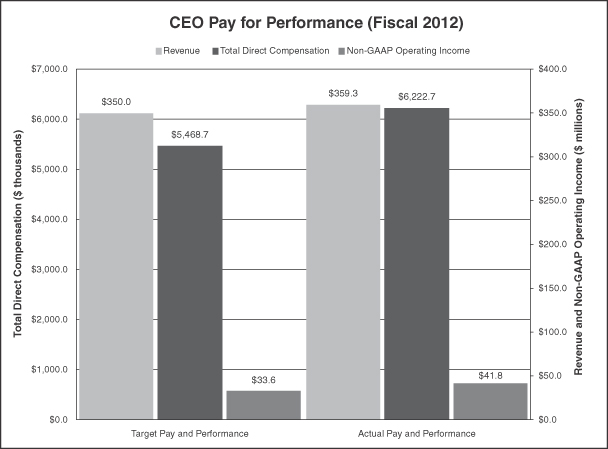
The following graph shows the strong correlation between our pay and performance by comparing (1) our CEO’s target total direct compensation (that is, the sum of the base salary, target short-term incentive award, and equity awards granted in fiscal 2012) against fiscal 2012 revenue and non-GAAP operating income* targets and (2) our CEO’s actual total direct compensation (that is, the sum of the base salary, actual short-term incentive payments, and equity awards granted in fiscal 2012) against our achievements in revenue and non-GAAP operating income in fiscal 2012.
We provide equity compensation as the primary component of our executive compensation program because we believe it links the interests of our executive officers with our stockholders and provides financial incentives for our executive officers to remain with the company and expand our business. With the equity awards subject to time-based vesting, the compensation an executive officer realizes in connection with the equity awards is spread over several years, which we believe assists in motivating him to drive the growth of our business. The following graph further illustrates our CEO’s fiscal 2012 realizable pay as compared to his fiscal 2012 target pay.
| * | Non-GAAP operating income is defined as GAAP income from operations excluding the effects of stock-based compensation expense, amortization of intangible assets and acquisition related costs. A reconciliation of this non-GAAP measure can be found in exhibit 99.1 to the current report on Form 8-K furnished to the Securities and Exchange Commission on August 9, 2012. GAAP is defined as U.S. generally accepted accounting principles. |
-29-
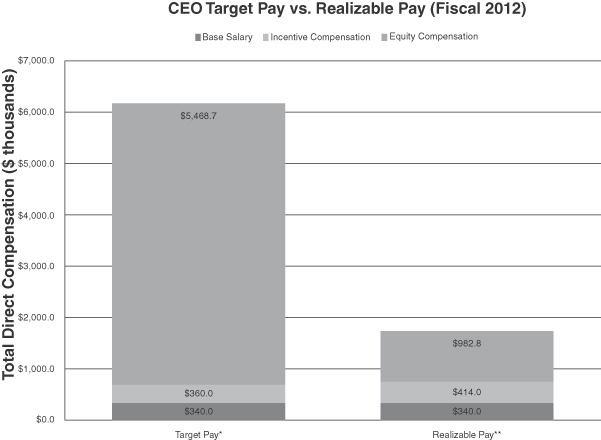
| * | Target Pay—includes annualized base salary, target short-term incentive compensation award, and the “fair value” at grant of equity awards (that is, Black Scholes for stock options). |
| ** | Realizable Pay—includes annualized base salary, actual incentive compensation paid, and the “in-the-money” value of all equity awards issued during fiscal 2012 using the closing price of our common stock on June 29, 2012 of $20.89. Realizable Pay assumes equity awards are 100% vested upon grant, even though such awards vest over a period of four years. |
Fiscal 2012 Business Highlights
We provide next generation datacenter solutions that accelerate databases, virtualization, cloud computing, big data, and the applications that help drive business from the smallest e-tailers to some of the world’s largest data centers, social media leaders, and Fortune Global 500 businesses. Our integrated hardware and software platform enables the decentralization of data from legacy architectures and specialized hardware. Our core technology leverages flash memory to significantly increase datacenter efficiency, with enterprise grade performance, reliability, availability, and manageability. We sell our solutions through a global direct sales force, original equipment manufacturers, or OEMs, including Cisco, Dell, HP, and IBM, and other channel partners.
In fiscal 2012, we achieved several significant financial results:
| — | Recorded fiscal year revenues of approximately $359.3 million, an 82% increase over our fiscal 2011 revenues; |
-30-
| — | Recorded fiscal year gross margin of 55.7%; and |
| — | Generated $34.8 million in operating cash flow in fiscal 2012, compared to use of $9.9 million in fiscal 2011. |
In addition, we experienced a number of significant business milestones:
| — | In August 2011, we completed the acquisition of IO Turbine, Inc., which was a key part of our strategy in enabling enterprise customers to increase the utilization, performance and efficiency of their datacenter resources and extract greater value from their information assets. |
| — | In August 2011, we announced ioCache solution featuring ioTurbine software and customized ioMemory accelerator to deliver affordable performance for virtualizing data-intensive enterprise applications. |
| — | In October 2011, we announced our next generation ioMemory platform, the ioDrive 2. |
| — | In November 2011, we completed a follow-on public offering in which we issued and sold three million shares of our common stock, resulting in net proceeds of approximately $94.0 million. |
| — | In April 2012, we announced ioFX, a new product for the single user workstation market, which accelerates key content creation software, including Adobe Creative Suite 6. |
| — | In April 2012, we announced our software development kit (SDK) to enable customers and software developers to optimize enterprise, web, and big data applications through direct programmatic access to Fusion-io’s ioMemory subsystem. |
Fiscal 2012 Corporate Governance Highlights
We endeavor to maintain good governance standards in our executive compensation policies and practices. The following policies and practices were either adopted or in effect during fiscal 2012:
| — | The compensation committee is comprised solely of independent directors. |
| — | The compensation committee’s compensation consultant, Compensia, Inc., is retained directly by the committee and performs no other consulting or other services for us. |
| — | The compensation committee has conducted an annual review of our compensation strategy, including a review of our compensation-related risk profile to ensure that our compensation-related risks are not reasonably likely to have a material adverse effect on the company. The compensation committee intends to conduct such a review annually. |
| — | Our compensation philosophy and related corporate governance features are complemented by several specific elements that are designed to align our executive compensation with long-term stockholder interests, including: |
| ¡ | Our change-in-control payments and benefits are reasonable and are based on a “double trigger” (that is, our executive officers are eligible to receive payments and benefits only in connection with a change in control of the company and the termination of the executive without cause or for good reasons within a specified period before or after the change in control). |
-31-
| ¡ | As a general policy, we do not favor non-cash benefits or perquisites (such as guaranteed retirement arrangements or pension plan benefits) for our executive officers that are not available to our employees generally. |
| — | Revised equity grant guidelines to establish a pre-set schedule for granting equity awards and avoid the appearance that grants are made to take advantage of material nonpublic information. |
Compensation Philosophy, Objectives and Design
Compensation Environment and Philosophy
We operate in a new and rapidly evolving market. To succeed in this environment, we must continually refine our business strategy, grow our customer base, increase the attractiveness and capabilities of our products and expand and enhance our product development and sales operations. To achieve these objectives, we need to attract and retain a highly talented and experienced team of design, engineering, sales, marketing, business development, and finance professionals. We expect these individuals to possess and demonstrate strong leadership and management capabilities.
Given our reputation for innovation and our recent success in developing and marketing our data decentralization platform, our executive officers are highly sought after by our competitors and other large organizations. Accordingly, we have had to develop an executive compensation program that not only rewards these individuals for their achievements but also provides sufficient incentives to ensure their continued employment with us.
Compensation Objectives
We strive to provide a total compensation package to our executive officers through a combination of base salary, short-term and long-term incentive opportunities and severance and change-of-control benefits. Our executive compensation program is designed to achieve the following objectives:
| — | attract, motivate, reward, and retain highly-qualified executive officers, whose knowledge, skills and performance are critical to our success; |
| — | motivate these executive officers to pursue our business objectives while encouraging the creation of long-term value for our stockholders; |
| — | provide market-competitive compensation that is designed to provide a foundation of fixed compensation (base salary) and a significant portion of performance-based compensation (short-term and long-term incentive opportunities); and |
| — | align the interests of our executive officers and stockholders. |
Impact of November 2011 Stockholder Advisory Vote on Named Executive Officer Compensation
At our annual meeting of stockholders on November 18, 2011, or our 2011 annual meeting, our first stockholder advisory vote was conducted on the compensation of our executive officers for whom compensation information was disclosed in the proxy statement relating to the 2011 annual meeting, who we refer to as the 2011 named executive officers. This advisory vote is commonly referred to as a “say-on-pay” vote. At our 2011 annual meeting, our stockholders approved the compensation of the 2011 named executive officers, with over 99% of shareholder votes cast in favor of the 2011 named executive officer compensation program. By the time this vote was conducted, most of the decisions
-32-
relating to the compensation of our named executive officers for fiscal 2012 had already been made. For example, base salaries and the cash incentive compensation structure for fiscal 2012 had been established in September 2011. As a result, although carefully reviewed and considered by the compensation committee of our board of directors, the 2011 say-on-pay vote did not have a significant impact on the 2012 compensation of our NEOs. However, in determining 2013 compensation programs for our executive officers, the compensation committee has considered, and will continue to consider in future years, the results of the annual say-on-pay vote. Moreover, in determining how often to hold a stockholder advisory vote on executive compensation, our board of directors took into account our stockholders’ preference (over 98% of votes cast) for an annual vote at the 2011 annual meeting. Specifically, our board of directors determined that we will hold an annual advisory stockholder vote on our named executive officer compensation until our next say-on-pay frequency vote.
Compensation Design
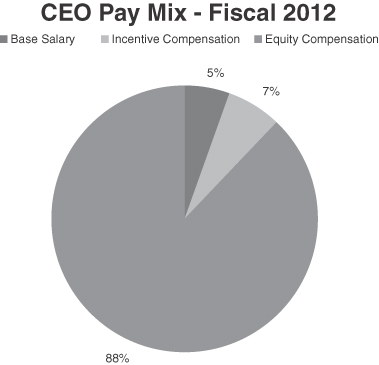
As a new publicly held company, our executive compensation program has been heavily weighted towards equity, primarily in the form of stock options, with cash compensation that generally fell below the median of comparable publicly held companies. We believe that relying primarily on equity compensation has focused our executive officers on driving achievement of our financial and strategic goals while conserving cash during our early years. We continue to believe that making equity awards a key component of executive compensation aligns the executive team with the long-term interests of our stockholders. We also have offered cash compensation in the form of base salaries to reward individual contributions and compensate our executive officers for their day-to-day responsibilities, and short-term (annual) incentive awards to drive excellence and leadership and reward our executives for the achievement of our short-term financial objectives. The following graph shows for our CEO the percentage of each element of his compensation based on the total direct compensation paid to him in fiscal 2012.
-33-
At the beginning of fiscal 2012, with the assistance of Compensia, Inc., a national compensation consulting firm, we evaluated the compensation of each executive officer against our compensation peer group, noting that the total target cash opportunity (that is, base salary and target short-term incentive compensation award) for each of our executive officers in fiscal 2011 was below the 25th percentile of our compensation peer group. As we continue our transition as a publicly held company, we believe it is important to begin aligning our executive compensation against our compensation peer group in order to further our goals of attracting, rewarding, and retaining highly talented individuals, and providing our current and future executives with compensation that is market-competitive. In addition to its review of market competitive compensation levels, the compensation committee of our board of directors also considers executive officer’s job performance, skill set, prior experience, and time in his position, as well as internal equity, pressures to attract and retain talent, and business conditions when determining our executive officers’ pay levels. The actual compensation each executive officer receives also may vary depending on the extent to which we achieve our performance goals each fiscal year.
Compensation-Setting Process
Role of the Compensation Committee
Pursuant to its charter, the compensation committee is responsible for reviewing, evaluating and approving the compensation arrangements for our executive officers and for establishing and maintaining our executive compensation policies and practices. For additional information on the compensation committee, including the scope of its authority, see “Corporate Governance and Board of Directors—Compensation Committee” elsewhere in this proxy statement.
At the beginning of each fiscal year, the compensation committee, after consulting with our CEO, establishes the company’s corporate performance objectives, and, after consulting with our CEO and Compensia, makes decisions with respect to any base salary adjustments, individual performance objectives and individual target short-term incentive award opportunities for our executive officers for the upcoming year, and new equity awards. The compensation committee conducts a bi-annual assessment of the company’s performance and the performance of our executive officers to determine the payouts, if any, for the short-term cash incentive award opportunities.
The compensation committee reviews on an annual basis our executive compensation program, including any incentive compensation plans, to determine whether they are appropriate, properly coordinated and likely to achieve their intended purposes and to make any necessary modifications or adopt any new plans or arrangements.
Role of Management
In carrying out its responsibilities, the compensation committee works with members of our management, including our CEO. Typically, our management assists the compensation committee by providing information on corporate and individual performance, market data and management’s perspective and recommendations on compensation matters.
Historically, the initial compensation arrangements with our executive officers have been determined in negotiations with each individual executive. Typically, our CEO has been responsible for negotiating these arrangements, with the oversight and final approval of our board of directors or, since July 2010, the compensation committee.
Typically, our CEO will make recommendations to the compensation committee regarding compensation matters, including the compensation of our executive officers (except with respect to his own compensation). He also typically attends compensation committee meetings, except with respect to discussions involving his own compensation.
-34-
While the compensation committee solicits and reviews our CEO’s recommendations and proposals with respect to compensation-related matters, the compensation committee only uses these recommendations and proposals as one factor in making compensation decisions.
Role of Compensation Consultant
We engaged Compensia to review our executive compensation policies and practices and to conduct an executive compensation market analysis.
The compensation committee is authorized to retain the services of one or more executive compensation advisors from time to time, as it sees fit, in connection with carrying out its duties and the oversight of our executive compensation program. Compensia serves at the discretion of the compensation committee. In fiscal 2012, Compensia was engaged by the compensation committee to assist in summarizing our executive compensation program, providing its observations regarding our current executive compensation levels versus executive compensation practices of our compensation peer group, highlighting “gaps” to market and offering a framework for potential compensation adjustments, and developing a framework for go-forward equity awards.
Competitive Positioning
The compensation committee compares and analyzes our executive officers’ compensation with those of a peer group of companies. In 2011, the compensation committee, assisted by our management and Compensia, selected a peer group of comparable companies, taking into consideration size and growth potential. This compensation peer group generally consisted of technology companies that had conducted an initial public offering of their equity securities within the last four years and other technology companies of similar size with which we compete in attracting talent. In fiscal 2012, the compensation committee, in consultation with Compensia, made adjustments to the compensation peer group, adding other technology companies that recently conducted initial public offerings and removing companies that had been acquired during the previous 12 months. The median market capitalization of the fiscal 2012 peer group was $2,364.2 million as of August 11, 2011. At the end of fiscal 2011, our market capitalization was approximately $2,441.8 million. We intend to review the compensation peer group at least annually.
The following companies comprised the compensation peer group for fiscal 2012:
| A123 Systems |
Fortinet | |
| Acme Packet |
Infinera | |
| Ancestry.com |
Netsuite | |
| ArcSight |
Qlik Technologies | |
| Aruba Networks |
QuinStreet | |
| Blue Coat Systems |
Rackspace Hosting | |
| CommVault Systems |
Red Hat | |
| Constant Contact |
SuccessFactors | |
| F5 Networks |
-35-
For fiscal 2012, the compensation committee also analyzed the executive compensation programs of certain other larger technology companies with whom the company competes for talent. The compensation committee used this data as a reference point for recruiting and retaining executives but did not factor the executive compensation of these companies into its analysis of the competitiveness of our executive officers’ compensation levels. These companies include the following for fiscal 2012:
| EMC |
salesforce.com | |
| NetApp |
Symantec | |
| Oracle |
VMware |
Compensia used the compensation information reported in the public filings of compensation peer group companies to make its comparisons. Compensia compiled the compensation data from the compensation peer group and prepared assessments to use for benchmarking our executive officer compensation. To remain competitive, we sought to develop a transition plan for our executive compensation program such that by fiscal 2013 the total cash compensation of each executive officer was increased to approximately the 50th percentile of similarly situated executives at our peer group, and equity compensation of each executive officer was decreased to approximately the 75th percentile of similarly situated executives at our peer group. The compensation committee believed these levels were appropriate because they allowed a greater portion of each executive’s compensation to be in the form of equity awards, which link the executive’s financial interests with the long-term interests of our stockholders, while moving toward more market competitive levels of cash compensation. The compensation committee analyzed the data provided by Compensia and used it to set compensation for fiscal 2012 for executive officers (other than Mr. Boberg, whose compensation was determined in negotiations in connection with the purchase of IO Turbine, Inc. in August 2011). The compensation committee also took into consideration its assessment of each executive officer’s job performance and the company’s overall business objectives for fiscal 2012. In particular, the compensation committee set each executive officer’s fiscal 2012 total target cash compensation below the 50th percentile of our peer group and fiscal 2012 equity compensation above the 75th percentile in order to conserve cash resources, while at the same time incentivizing our executive officers through equity compensation that provides them with a financial interest to grow our company.
Executive Compensation Program Components
The following describes each component of our executive compensation program, the rationale for each, and how compensation amounts and awards are determined.
Base Salary
Base salary is the primary fixed component of our executive compensation program. We use base salary to compensate our executive officers for services rendered during the year and to recognize the experience, skills, knowledge and responsibilities required of each executive officer. Historically, we have not applied a specific formula to determine adjustments to base salary. Rather, the base salaries of our executive officers were reviewed on a periodic basis and adjustments made to reflect our economic condition and future expected performance, as well as what our executive officers could be expected to receive if employed at companies similarly situated to ours and our overall subjective assessment of appropriate base salary levels, while being mindful of the need to conserve cash resources.
In September 2011, the compensation committee reviewed the base salaries of our executive officers, taking into consideration Compensia’s compensation analysis and the recommendations of our CEO (except with respect to his own base salary and Mr. Boberg’s base salary), as well as the other factors described above. Compensia’s analysis showed that the fiscal 2011 annual base salaries
-36-
of our executive officers were below the 25th percentile of our compensation peer group. After taking into account the factors described above, the compensation committee increased the base salaries of our executive officers (other than Mr. Boberg) to a level that was market-competitive with our peers and would place each executive officer’s target total cash compensation (cash and short-term incentive compensation opportunity) closer to the 50th percentile of similarly situated executives in our compensation peer group. Each executive officer’s total target cash compensation remained below the 50th percentile of similarly situated executives at our peer group, as we sought to conserve cash resources and fully transition total target cash compensation to the 50th percentile of our peer group by fiscal 2013. We did not benchmark any executive officer’s base salary to a specific percentile.
The base salaries paid to the NEOs during fiscal 2012 are set forth in the table below:
| Named Executive Officer |
Fiscal 2012 Base Salary(1) |
|||
|
Mr. Flynn(1) |
$ | 360,000 | ||
|
Mr. Wolf(2) |
$ | 270,000 | ||
|
Mr. Smith(3) |
$ | 300,000 | ||
|
Mr. Dawson(4) |
$ | 255,000 | ||
|
Mr. Boberg(5) |
$ | 210,000 | ||
| (1) | Mr. Flynn’s base salary was $240,000 for the first two months of fiscal 2012 and increased by $120,000 to $360,000 effective September 1, 2011. |
| (2) | Mr. Wolf’s base salary was $220,000 for the first two months of fiscal 2012 and increased by $50,000 to $270,000 effective September 1, 2011. |
| (3) | Mr. Smith’s base salary was $220,000 for the first two months of fiscal 2012 and increased by $80,000 to $300,000 effective September 1, 2011. |
| (4) | Mr. Dawson’s base salary was $225,000 for the first two months of fiscal 2012 and increased by $30,000 to $255,000 effective September 1, 2011. |
| (5) | Mr. Boberg’s base salary was negotiated in connection with his hiring in August 2011 and was not adjusted in September 2011. |
Short-Term Incentive Compensation
Consistent with our objective of linking a significant portion of each of our executive officer’s total compensation to performance, we provide performance-based short-term incentive opportunities to our executive officers that are based on corporate and individual performance, to achieve our annual financial and operational objectives, while making progress towards our longer-term growth and other goals. Historically, the compensation committee has made short-term incentive awards to our executive officers in its discretion after the end of the fiscal year based on its evaluation of the achievement of one or more corporate objectives as established in our annual operating plan and the individual performance of each executive officer.
Target Short-Term Incentive Award Opportunities
In fiscal 2012, the short-term incentive awards were designed to reward our executive officers based on our overall performance in achieving our financial and business objectives.
Each executive officer (other than Mr. Dawson) participated in the Executive Incentive Compensation Plan. As a participant in this plan, each executive officer’s short-term incentive award was payable bi-annually, based on our achievement against revenue and non-GAAP operating income goals, which were selected by our compensation committee, with input from our CEO and management at the beginning of fiscal 2012. For fiscal 2012, our target annual revenue goal was $350 million and target annual non-GAAP operating income goal was $33.6 million, which were equally weighted metrics under the plan. These performance metrics were selected to motivate our
-37-
management team and encourage growth in our business, and the targets were intentionally challenging and expected to be achieved only with significant effort and leadership from our management team. There was no minimum or maximum threshold for payment.
Mr. Dawson’s fiscal 2012 short-term incentive award initially was structured similarly to the other executive officers and based on our achievement of annual revenue and non-GAAP operating income goals. The compensation committee, in consultation with our CEO, later redesigned Mr. Dawson’s fiscal 2012 short-term incentive award to become a commission-based opportunity, similar to the incentive compensation arrangement Mr. Dawson had in prior years. Mr. Dawson was eligible to receive incentive compensation payments, based on achievement of bookings quotas and gross margin targets, weighted 80% and 20%, respectively. The compensation committee, with input from our CEO, determined that a sales-based commission-program would serve as a more effective motivational tool for Mr. Dawson, our top sales executive, in driving the growth of our business through sales. The bookings quotas and gross margin targets were set by our compensation committee, in consultation with our CEO, were based on our historical operating results and growth rates, and believed to be achievable only with significant effort and dedication from Mr. Dawson and our team. These targets were viewed as difficult to achieve because they represented significant increases over the results for fiscal 2011, and attaining those goals further required Mr. Dawson and our sales team to engage with a substantially higher number of potential customers and book a higher aggregate number of purchase commitments. There was no minimum or maximum threshold for payment. We do not publicly disclose this information and, if disclosed, we believe the information would provide competitors and others with insights into our operations and sales compensation programs that would be harmful to us.
With respect to each executive officer (other than Mr. Boberg), the amount of his target short-term incentive award opportunity was established by the compensation committee taking into consideration Compensia’s compensation analysis and the recommendation of our CEO (except with respect to his own target short-term incentive award opportunity) and several other factors, including the scope of his performance, contributions, responsibilities, experience, prior years’ target short-term incentive award opportunities, position (in the case of a promotion) and market conditions. Compensia’s analysis showed that the total target cash compensation of our executive officers was below the 25th percentile of our compensation peer group. After taking into account this and the other factors described above, the compensation committee increased the target short-term incentive awards for each executive officer to a level that would place his target total cash compensation closer to the 50th percentile of similarly situated executives of our compensation peer group. Each executive officer’s total target cash compensation remained below the 50th percentile of similarly situated executives at our peer group, as we sought to conserve cash resources and transition his total target cash compensation to the 50th percentile of our peer group by fiscal 2013. We did not benchmark any executive officer’s target short-term incentive award to a specific percentile. Mr. Boberg’s short-term incentive award was determined in connection with his hiring in August 2011 in connection with the company’s acquisition of IO Turbine, Inc.
-38-
As in prior years, the compensation committee determined that the target short-term incentive award for each executive officer should be determined as a percentage of such executive officer’s base salary. The target short-term incentive awards for the NEOs, expressed as a percentage of base salary, were as follows:
| Named Executive Officer |
Fiscal 2012 Base Salary |
Fiscal 2012 Target Short-Term Incentive Award (% of Base Salary) |
||||||
| Mr. Flynn |
$ | 360,000 | 100 | % | ||||
| Mr. Wolf |
$ | 270,000 | 70 | % | ||||
| Mr. Smith |
$ | 300,000 | 70 | % | ||||
|
Mr. Dawson(1) |
$ | 255,000 | 100 | % | ||||
| Mr. Boberg |
$ | 210,000 | 50 | % | ||||
| (1) | Mr. Dawson’s target short-term incentive award was adjusted upwards from 70% of his base salary to 100% of his base salary when our compensation committee restructured his incentive compensation arrangement to a sales-based commission program because of the comparatively aggressive bookings and gross margin targets that the company would have to achieve for Mr. Dawson to achieve the targets under his incentive compensation arrangement. |
Award Decisions and Analysis
In February 2012, the compensation committee, in consultation with our CEO and management, evaluated our achievements in revenue and non-GAAP operating income and determined that we were on track to at least achieve our annual targets in revenue and non-GAAP operating income based on our performance for the first six months of fiscal 2012. The compensation committee approved short-term incentive compensation payments to our executive officers (other than Mr. Dawson) equal to 50% of their target short-term incentive awards. The fiscal 2012 target short-term incentive awards for our executive officers (other than Mr. Dawson) were based on annual achievements against our fiscal 2012 targets, and, to the extent we did not achieve our targets in revenue and non-GAAP operating income due to our performance in the second-half of fiscal 2012, our executive officers potentially would be required to return to the Company a portion of the short-term incentive awards previously paid to them. In July 2012, the compensation committee, in consultation with our CEO and management, evaluated our annual achievements in revenue and non-GAAP operating income and determined that we had exceeded our annual targets, achieving annual revenues of $359.3 million (103% of our fiscal 2012 revenue target) and non-GAAP operating income of $41.8 million (124% of our fiscal 2012 non-GAAP operating income target). The compensation committee approved short-term incentive compensation payouts to our executive officers (other than Mr. Dawson) equal to 65% of their target short-term incentive awards based on our revenue and operating achievement in fiscal 2012, resulting in total short-term incentive compensation payouts to our executive officers (other than Mr. Dawson) for fiscal 2012 equal to 115% of their target short-term incentive awards.
For Mr. Dawson, our CEO and management evaluated our achievement against annual bookings and quarterly gross margin goals and determined that we had exceeded our bookings quota and achieved 75% of the gross margin targets for fiscal 2012. We have not disclosed the specific formulae or performance targets contained in Mr. Dawson’s commission plan for several reasons, including our belief that disclosure would result in competitive harm. Mr. Dawson’s eligible aggregate commissions relating to bookings were equal to 128% of his target short-term incentive award for fiscal 2012, based on achievements and consistent with the accelerator rates under Mr. Dawson’s commission plan. Commissions relating to Mr. Dawson’s booking achievements were earned and paid monthly based on actual shipment of product relating to those bookings. Any commissions paid with respect to shipments that are later returned or otherwise cancelled are reversed and generally offset future commissions. Incentive payments relating to gross margin achievement were 75% of his target short-term incentive award for fiscal year 2012 and were earned and paid quarterly based on gross margin achievement against targets in the immediately preceding quarter.
-39-
The aggregate amounts of short-term incentive awards earned by our NEOs are set forth in the “Non-Equity Incentive Compensation” column in our Summary Compensation Table below.
Long-Term Incentive Compensation
We believe that strong long-term corporate performance is achieved with a corporate culture that encourages a long-term focus by our executive officers through the use of equity-based awards, the value of which depends on the performance of our common stock. To date, our long-term incentive compensation has been provided largely in the form of equity awards. We have used stock options to provide our executive officers with incentives to help align their interests with the interests of our stockholders and to enable them to participate in the long-term appreciation of the value of our common stock. As we continued our transition following our initial public offering, we began granting restricted stock units to employees in fiscal 2012 in order to stay market-competitive and attract and retain key personnel. We also granted restricted stock units to Mr. Boberg in connection with our acquisition of IO Turbine, Inc. Stock options and restricted stock units provide an important tool for us to retain our executive officers, as they are subject to vesting over a multi-year period subject to continued service with the company.
Historically, we have not had an established set of criteria for granting equity awards to our executive officers. Instead, our board of directors and compensation committee have exercised their judgment and discretion, in consultation with our CEO, and considered, among other factors, the role and responsibility of each executive officer, competitive factors, the amount of stock-based equity compensation already held by the executive officer and the cash compensation to be received by the executive officer, to determine the size of equity awards. In fiscal 2012, as we continued our transition to a publicly held company, we began reviewing the equity compensation levels of our compensation peer group to gain an understanding of the market. After taking into consideration all of the factors above, including that the total target cash compensation for our executive officers was set at levels below the 50th percentile of our compensation peer group, the compensation committee approved equity awards to our executive officers in fiscal 2012 above the 75th percentile of our compensation peer group in order to conserve cash resources and provide the greatest portion of each executive officer’s compensation package in the form of equity compensation, which links the executive officer’s financial interests with those of our stockholders. In future years, we will continue to evaluate the equity compensation we provide to our executive officers.
In August 2011, in connection with Mr. Boberg joining the company following the company’s acquisition of IO Turbine, Inc., the board of directors granted Mr. Boberg a restricted stock unit award under the 2011 Equity Incentive Plan covering 88,905 shares, subject to a four-year vesting schedule.
In September 2011, the compensation committee approved stock options to purchase shares of our common stock to our NEOs (other than Mr. Boberg). Each of these stock options was granted with an exercise price equal to $19.00 per share, the fair market value of our common stock on September 30, 2011, the last day on which the New York Stock Exchange was open for trading in the month of September, in accordance with our equity guidelines in effect at the time, and subject to a four-year vesting schedule and a 10-year maximum term. The stock option grants made to the NEOs were as follows:
| Named Executive Officer |
Number of Shares Underlying Stock Option Grant |
|||
| Mr. Flynn |
520,000 | |||
| Mr. Wolf |
270,000 | |||
| Mr. Smith |
270,000 | |||
| Mr. Dawson |
200,000 | |||
-40-
In determining the amount of each NEOs stock option grant, the compensation committee took into consideration a compensation analysis performed by Compensia and the equity award recommendations of Compensia and our CEO, as well as each executive officer’s performance, contributions, responsibilities, experience, existing equity holdings (including the current economic value of his unvested equity and the ability of these unvested holdings to satisfy our retention objectives), market conditions and internal equity.
The stock options granted to the NEOs and restricted stock units granted to Mr. Boberg during fiscal 2012 are set forth in the Summary Compensation Table and the Grants of Plan-Based Awards Table below.
Welfare and Other Benefits
We have established a tax-qualified Section 401(k) retirement plan for all employees who satisfy certain eligibility requirements, including requirements relating to age and length of service. We currently do not match any contributions made to the plan by our employees, including our executive officers. We intend for the plan to qualify under Section 401(a) of the Internal Revenue Code so that contributions by employees to the plan, and income earned on plan contributions, are not taxable to employees until withdrawn from the plan.
In addition, we provide other benefits to our executive officers on the same basis as all of our full-time salaried employees in the country in which they reside.
Perquisites and Other Personal Benefits
Currently, we do not view perquisites or other personal benefits as a significant component of our executive compensation program. Accordingly, we do not provide perquisites to our executive officers, except in limited situations where we believe it is appropriate to assist an individual in the performance of his duties, to make our executive officers more efficient and effective and for recruitment, motivation or retention purposes.
All future practices with respect to perquisites or other personal benefits are subject to approval and periodic review by the compensation committee.
Employment Agreements
We have entered into an employment agreement with our CEO and employment offer letter agreements with our other NEOs. Each of these arrangements was approved on our behalf by our board of directors and sets forth the initial terms and conditions of employment of each of the NEOs. We believe that these arrangements were critical to induce these individuals to accept their position with us or to forego other employment opportunities or leave their then-employer for the uncertainty of a demanding position in a new and unfamiliar organization.
In filling these positions, our board of directors was aware that it would be necessary to recruit candidates with the requisite experience and skills to manage a growing business in a unique market niche. Accordingly, it recognized that it would need to develop competitive compensation packages to attract qualified candidates in a dynamic labor market. At the same time, our board of directors was sensitive to the need to integrate new executives into the executive compensation structure that it was seeking to develop, balancing both competitive and internal equity considerations.
Each of these arrangements provided for an initial base salary, an annual short-term incentive opportunity payable in cash and/or an equity award in the form of a stock option to purchase shares of our common stock.
-41-
For a summary of the material terms and conditions of employment for the NEOs, see “Employment Agreements and Offer Letters” below.
Post-Employment Compensation
Our board of directors considers maintaining a stable and effective management team to be essential in protecting and enhancing the best interests of the company and our stockholders. We have established severance and/or change of control arrangements with the NEOs to provide assurances of specified severance payments and benefits if their employment is subject to involuntary termination or voluntary termination for good reason other than for death, disability or cause, including following a change of control of the company.
We believe that it is imperative to provide these individuals with severance payments and benefits upon certain types of terminations of employment, which we recognize can be triggered at any time, to secure their continued dedication to their work, notwithstanding the possibility of a termination of employment by us, and provide these individuals with an incentive to continue their employment with us. We further believe that the severance payments and benefits are competitive relative to the severance protection provided to similarly situated individuals at companies with which we compete for talent and appropriate because the payments and benefits are subject to the executive officer’s entry into a release of claims in favor of the company.
We also recognize that the possibility of a change of control of the company may exist from time to time, and that this possibility, and the uncertainty and questions it may raise among management, may result in the departure or distraction of management to the company’s and our stockholders’ detriment. Accordingly, our board of directors decided to take steps to encourage the continued attention, dedication and continuity of members of our management team to their assigned duties without the distraction that may arise from the possibility or occurrence of a change of control of the company. As a result, we have agreements with each of the NEOs that provide for specific payments and benefits in the event of a change of control of the company. The terms of these agreements were determined after review by our board of directors of our retention objectives for each NEO and an analysis of relevant market data.
For a summary of the material terms and conditions of these severance and change-of-control arrangements, see “Potential Payments Upon Termination or Change of Control” below.
Other Compensation Policies
Stock Ownership Guidelines
We have not adopted stock ownership guidelines for our executive officers and our stock plans have provided the principal method for our executive officers to acquire equity in the company. We currently expect to continue to provide a substantial portion of total compensation to our executives in the form of equity awards.
Compensation Recovery Policy
In September 2012, we adopted a compensation recovery policy under which the board of directors may require reimbursement of any cash-based incentive compensation paid to any current or former employee who is subject to Section 16 of the Securities Exchange Act of 1934 in the event (1) such employee’s fraud or intentional misconduct results in the restatement of the company’s financial results (other than a restatement due to a change in financial accounting rules) and (2) the board of directors (or a committee of the board of directors) determines that such employee would
-42-
have received a lower amount of cash-based incentive compensation as a result of the corrected restatement. The compensation recovery policy applies to any cash-based incentive compensation paid to any current or former Section 16 reporting person during the three-year period preceding the date on which the company is required to prepare an accounting restatement.
We believe that by providing the company with the ability to recover cash-based incentive compensation paid to any Section 16 reporting person in this situation, the company demonstrates its commitment to strong corporate governance.
Derivatives Trading and Hedging Policy
Our insider trading compliance policy prohibits, among other things, short sales, hedging of stock ownership positions and transactions involving derivative securities relating to shares of our common stock.
Tax and Accounting Considerations
Deductibility of Executive Compensation
Generally, Section 162(m) of the Internal Revenue Code, or the Code, disallows a tax deduction to any publicly held corporation for any remuneration in excess of $1 million paid in any taxable year to its chief executive officer and each of the three other most highly compensated executive officers (other than the chief financial officer). Remuneration in excess of $1 million may be deducted only if, among other things, it qualifies as “performance-based compensation” within the meaning of the Code. In this regard, the compensation income realized upon the exercise of stock options granted under a stockholder-approved employee stock plan generally will be deductible so long as the options are granted by a committee whose members are non-employee directors and certain other conditions are satisfied.
As a new publicly held corporation, under a specific exception contained in Section 162(m), any compensation paid pursuant to a compensation arrangement in existence before the effective date of our public offering of equity securities will not be subject to the $1 million deduction limit. In addition, any equity awards that we grant under our 2011 Equity Incentive Plan will not be subject to the deduction limit, provided such awards are made prior to the earliest of:
| — | the expiration of the plan; |
| — | a material modification of the plan (as determined under Section 162(m)); |
| — | the issuance of all the shares of our common stock and other compensation allocated under the plan; or |
| — | the first meeting of stockholders at which directors are elected after the close of the third calendar year following the year in which our public offering of equity securities occurred. |
We may, where reasonably practicable, seek to qualify the variable compensation paid to our executive officers for the “performance-based compensation” exemption from the deduction limit. As such, in approving the amount and form of compensation for our executive officers in the future, we will consider all elements of the cost to us of providing such compensation, including the potential impact of Section 162(m). The compensation committee may, in its judgment, authorize compensation payments that do not comply with an exemption from the deductibility limit when it believes that such payments are appropriate to attract, retain or motivate executive talent.
-43-
Taxation of “Parachute” Payments and Deferred Compensation
Sections 280G and 4999 of the Code provide that executive officers and directors who hold significant equity interests and certain other service providers may be subject to significant additional taxes if they receive payments or benefits in connection with a change in control of the company that exceeds certain prescribed limits, and that the company (or a successor) may forfeit a deduction on the amounts subject to this additional tax.
Section 409A of the Code also imposes significant additional taxes on the individual in the event that an executive officer, director or other service provider receives “deferred compensation” that does not meet the requirements of Section 409A.
We have not provided any executive officer with a “gross-up” or other reimbursement payment for any tax liability that he or she might owe as a result of the application of Sections 280G or 4999 during fiscal 2012 and we have not agreed and are not otherwise obligated to provide any executive officer, including any NEO, with such a “gross-up” or other similar reimbursement.
Accounting for Stock-Based Compensation
We follow Financial Accounting Standard Board Accounting Standards Codification Topic 718, or ASC 718, for our stock-based compensation awards. ASC 718 requires companies to measure the compensation expense for all share-based payment awards made to employees and directors, including stock options and restricted stock awards, based on the grant date “fair value” of these awards. This calculation is performed for accounting purposes and reported in the compensation tables below, even though our executive officers may never realize any value from their awards. ASC 718 also requires companies to recognize the compensation cost of their share-based payment awards in their income statements over the period that an executive officer is required to render service in exchange for the option or other award.
The compensation committee oversees Fusion-io’s compensation policies, plans, and benefit programs. The compensation committee has reviewed and discussed the Compensation Discussion and Analysis required by Item 402(b) of Regulation S-K with management. Based on such review and discussions, the compensation committee has recommended to the board of directors that the Compensation Discussion and Analysis be included in this proxy statement.
The Compensation Committee
H. Raymond Bingham (Chair)
Dana L. Evan
Scott D. Sandell
The Report of the Compensation Committee does not constitute soliciting material, and shall not be deemed to be filed or incorporated by reference into any other filing by Fusion-io under the Securities Act of 1933, as amended, or the Securities Exchange Act of 1934, as amended, except to the extent Fusion-io specifically incorporates the Report of the Compensation Committee by reference therein.
-44-
The following table provides information regarding the compensation of our chief executive officer, chief financial officer and each of the next three most highly compensated executive officers, together referred to as our named executive officers, or NEOs, for the fiscal years ended June 30, 2012, 2011 and 2010.
| Name and Principal Position |
Year | Salary ($) |
Bonus ($) |
Option Awards ($)(1) |
Stock Awards ($)(2) |
Non-Equity Incentive Plan Compensation ($) |
Total ($) |
|||||||||||||||||||||
| David A. Flynn Chief Executive Officer and President |
|
2012 2011 2010 |
|
|
340,000 240,000 224,849 |
|
|
— — |
|
|
5,468,691 1,335,934 2,395,458 |
(4) |
|
— — — |
|
|
414,000
168,000 — |
(3)
(3)
|
|
6,222,691 1,743,934 2,812,307 |
| |||||||
| Dennis P. Wolf Chief Financial Officer and Executive Vice President |
|
2012 2011 2010 |
|
|
261,667 220,000 140,039 |
|
|
— — |
|
|
2,839,513 807,394 235,875 |
|
|
— — — |
|
|
217,350
115,500 — |
(3)
(3)
|
|
3,318,530 1,142,894 459,454 |
| |||||||
| Lance L. Smith Chief Operating Officer and Executive Vice President |
|
2012 2011 2010 |
|
|
286,667 220,000 220,000 |
|
|
— — |
|
|
2,839,513 1,620,594 |
|
|
— — — |
|
|
241,500
126,500 — |
(3)
(3)
|
|
3,367,680 1,967,094 |
| |||||||
| James L. Dawson Executive Vice President, World-wide Sales |
|
2012 2011 2010 |
|
|
250,000 225,000 225,000 |
|
|
— — — |
|
|
2,103,343 267,187 — |
|
|
— — — |
|
|
258,700
299,350 277,973 |
(5)
(5) (5) |
|
2,612,043 791,537 502,973 |
| |||||||
| Richard W. Boberg Executive Vice President, Corporate Business Development |
2012 | 185,368 | — | — | 2,524,902 | 117,875 | (3) | 2,828,145 | ||||||||||||||||||||
| (1) | The amounts included in the “Option Awards” column represent the aggregate grant date fair value of option awards calculated in accordance with ASC 718. The valuation assumptions used in determining such amounts are described in the notes to our consolidated financial statements included in our annual report on Form 10-K for the fiscal year ended June 30, 2012. |
| (2) | The amounts included in the “Stock Awards” column represent the aggregate grant date fair value of restricted stock units granted to Mr. Boberg, calculated in accordance with ASC 718. |
| (3) | These amounts represent amounts earned pursuant to our Executive Incentive Compensation Plan. For further information regarding the bonus amounts, please see the “Target Short-Term Incentive Award Opportunities” subsection of the Compensation Discussion and Analysis section of this proxy statement. |
| (4) | Includes $96,410 of grant date fair value for a portion of an option that was canceled following the end of fiscal 2010. |
| (5) | Represents amounts paid to Mr. Dawson pursuant to his sales commission plan. |
-45-
Grants of Plan-Based Awards For Fiscal Year Ended June 30, 2012
The following table presents information concerning each grant of an award made to an NEO in fiscal 2012 under any plan.
| Name |
Grant Date | Estimated Payouts Under Non-Equity Incentive Plan Awards Target ($) |
Number of Shares of Stock or Units(#)(3) |
Number of Securities Underlying Options (#)(4) |
Exercise or Base Price of Option Awards ($/Sh) |
Grant Date Fair Value of Stock and Option Awards ($)(5) |
||||||||||||||||||||||
| Threshold | Target (1) |
Maximum | ||||||||||||||||||||||||||
| David A. Flynn |
|
09/13/2011 09/30/2011 |
|
360,000 | (1) | — | 520,000 | 19.00 | 5,468,691 | |||||||||||||||||||
| Dennis P. Wolf |
|
09/13/2011 09/30/2011 |
|
189,000 | (1) | — | 270,000 | 19.00 | 2,839,513 | |||||||||||||||||||
| Lance L. Smith |
|
09/13/2011 09/30/2011 |
|
210,000 | (1) | — | 270,000 | 19.00 | 2,839,513 | |||||||||||||||||||
| James L. Dawson |
09/13/2011 | 255,000 | (2) | |||||||||||||||||||||||||
| 09/30/2011 | — | 200,000 | 19.00 | 2,103,343 | ||||||||||||||||||||||||
| Richard W. Boberg |
08/11/2011 | 88,905 | — | — | 2,524,902 | |||||||||||||||||||||||
| |
09/13/2011 |
|
102,500 | (1) | ||||||||||||||||||||||||
| (1) | The target bonus amounts for fiscal 2012 were set pursuant to pre-determined objectives established by the compensation committee. For further information regarding the fiscal 2012 target short-term incentive awards, please see the “Target Short-Term Incentive Award Opportunities” subsection of the Compensation Discussion and Analysis section of this proxy statement. |
| (2) | This amount relates to the commission amount payable to Mr. Dawson under his sales commission plan, assuming achievement of the bookings and gross margin targets. Payments under this sales commission plan are not subject to a minimum or maximum payment limitation. The actual amount paid to Mr. Dawson is set forth in the table above titled “Summary Compensation Table.” |
| (3) | The restricted stock units granted to Mr. Boberg on August 11, 2011 vest as to 1/24th of the units each month after August 11, 2014, subject to Mr. Boberg’s continued service through each vesting date. |
| (4) | The stock options granted to the NEOs on September 30, 2011 vest as to 1/48th of the shares subject to the stock option each month after the grant date, subject to the continued service of the NEO on each vesting date. These stock options have a 10-year-term. For further information regarding the impact of certain events upon the vesting schedules of these options, please see the “Employment Agreements and Offer Letters” and “Agreements Providing for Severance or Change of Control Benefits” sections of this proxy statement. |
| (5) | Represents the grant date fair value of stock options granted during our fiscal year ended June 30, 2012 in accordance with ASC 718. The grant date fair value is the amount of stock-based compensation expense we expect to realize over the option’s service period. Assumptions used in the calculation of these amounts are included in Note 8 to our consolidated financial statements for the fiscal year ended June 30, 2012 in our annual report on Form 10-K for fiscal 2012. |
-46-
Outstanding Equity Awards at June 30, 2012
The following table presents information concerning outstanding equity awards for each NEO as of the end of fiscal 2012.
| Option Awards | Stock Awards | |||||||||||||||||||||||
| Name |
Number of Securities Underlying Unexercised Options (#) Exercisable |
Number of Securities Underlying Unexercised Options (#) Unexercisable |
Option Exercise Price ($) |
Option Expiration Date |
Number of Shares or Units of Stock That Have Not Vested (#) |
Market Value of Shares or Units of Stock That Have Not Vested ($) |
||||||||||||||||||
| David A. Flynn |
527,025 | (1) | 359,701 | 0.65 | 06/01/2019 | — | — | |||||||||||||||||
| 1,265,366 | (1) | 1,092,963 | 1.96 | 05/27/2020 | — | — | ||||||||||||||||||
| — | 500,000 | (2) | 5.12 | 01/24/2021 | — | — | ||||||||||||||||||
| 97,500 | (3) | 422,500 | 19.00 | 09/29/2021 | — | — | ||||||||||||||||||
| Dennis P. Wolf |
4,208 | (4) | 258,542 | 0.65 | 11/17/2019 | — | — | |||||||||||||||||
| 13,750 | (1) | 56,250 | 1.96 | 09/11/2020 | — | — | ||||||||||||||||||
| — | 200,000 | (2) | 5.12 | 01/24/2021 | — | — | ||||||||||||||||||
| 50,625 | (3) | 219,375 | 19.00 | 09/29/2021 | — | — | ||||||||||||||||||
| Lance L. Smith |
— | 135,000 | (1) | 0.65 | 06/01/2019 | — | — | |||||||||||||||||
| 2,084 | (1) | 31,250 | 0.65 | 09/21/2019 | — | — | ||||||||||||||||||
| 4,167 | (1) | 168,750 | 1.96 | 09/11/2020 | — | — | ||||||||||||||||||
| — | 300,000 | (2) | 5.12 | 01/24/2021 | — | — | ||||||||||||||||||
| 50,625 | (3) | 219,375 | 19.00 | 09/29/2021 | — | — | ||||||||||||||||||
| James L. Dawson |
450,708 | (4) | 218,750 | 0.65 | 06/01/2019 | — | — | |||||||||||||||||
| — | 100,000 | (2) | 5.12 | 01/24/2021 | — | — | ||||||||||||||||||
| 37,500 | (3) | 162,500 | 19.00 | 09/29/2021 | — | — | ||||||||||||||||||
| Richard W. Boberg |
— | — | — | — | 88,905 | (5) | 1,857,225 | |||||||||||||||||
| (1) | The option vests monthly as to 1/48th of the total number of shares on the first monthly anniversary of the vesting commencement date, subject to the NEO’s continued service through each vesting date. The options held by Mr. Flynn have vesting commencement dates of April 3, 2009 and April 7, 2010, respectively. The options held by Mr. Wolf have a vesting commencement date of September 12, 2010. The options held by Mr. Smith have vesting commencement dates of June 2, 2009, September 22, 2009, and September 12, 2010, respectively. |
| (2) | The option vests monthly as to 1/24th of the total number of shares on the 25th day of each month beginning on February 25, 2014, subject to the NEO’s continued service through each vesting date. |
| (3) | The option vests monthly as to 1/48th of the total number of shares beginning on the 13th day of each month after September, 2011, subject to the NEO’s continued service through each vesting date. |
| (4) | The option vests as to 1/4th of the total number of shares on the first anniversary of the vesting commencement date and an additional 1/48th of the total shares vests each month thereafter, subject to the NEO’s continued service through each vesting date. The options held by Messrs. Wolf and Dawson have vesting commencement dates of November 11, 2009 and April 30, 2009, respectively. |
| (5) | The restricted stock units granted to Mr. Boberg vest as to 1/24 of the units subject to the award on the 11th day of each month after August 11, 2014. |
-47-
Option Exercises and Stock Vested in Fiscal Year Ended June 30, 2012
The following table shows information regarding options that were exercised by our NEOs during fiscal 2012. None of our NEOs hold any stock awards that had a vesting event occurring during fiscal 2012.
| Option Awards | ||||||||
| Name |
Number of Shares Acquired on Exercise (#) |
Value Realized on Exercise ($) |
||||||
| David A. Flynn |
100,000 | 2,815,049 | ||||||
| Dennis P. Wolf |
412,250 | 10,756,645 | ||||||
| Lance L. Smith |
798,749 | 22,559,355 | ||||||
| James L. Dawson |
263,042 | 7,233,190 | ||||||
| Richard W. Boberg |
— | — | ||||||
Equity Compensation Plan Information
The following table summarizes the number of outstanding options, warrants and rights granted to our employees, consultants, and directors, as well as the number of shares of common stock remaining available for future issuance, under our equity compensation plans as of June 30, 2012.
| Plan Category |
Number of Securities to be Issued Upon Exercise of Outstanding Options, Warrants and Rights (A) |
Weighted- Average Exercise Price of Outstanding Options, Warrants and Rights (B)($/share) |
Number of Securities Remaining Available for Future Issuance Under Equity Compensation Plans (Excluding Securities Reflected in Column(A)) (C) |
|||||||||
| Equity compensation plans approved by security holders(1) |
21,416,533 | 4.83 | 8,125,215 | |||||||||
| Equity compensation plans not approved by security holders(2) |
218,724 | 1.07 | — | |||||||||
| Total |
21,635,257 | 4.79 | 8,125,215 | |||||||||
| (1) | Includes the following plans: 2011 Equity Incentive Plan, 2011 Employee Stock Purchase Plan, 2010 Executive Stock Incentive Plan, 2008 Stock Incentive Plan, and 2006 Stock Option Plan. Our 2011 Equity Incentive Plan provides for annual increases in the number of shares available for issuance thereunder on the first day of each fiscal year equal to the least of (i) 10,000,000 shares of our common stock, (ii) five percent (5%) of the outstanding shares of our common stock on the last day of the immediately preceding fiscal year, or (iii) such lesser amount as our board of directors may determine. Our board of directors determined that the number of shares available for issuance under our 2011 Equity Incentive Plan would be increased by 4,681,423 shares for the 2013 fiscal year. Our 2011 Employee Stock Purchase Plan provides for annual increases in the number of shares available for issuance thereunder on the first day of each fiscal year, beginning with the 2011 fiscal year, equal to the least of (i) 1,000,000 shares of our common stock, (ii) two percent (2%) of the outstanding shares of our common stock on the first day of the fiscal year, or (iii) such lesser amount as our board of directors or a designated committee acting as administrator of the plan may determine. Our board of directors determined that the number of shares available for issuance under our 2011 Employee Stock Purchase Plan would be increased by 936,284 for the 2013 fiscal year. |
| (2) | Consists of common shares to be issued upon exercise of outstanding options under the IO Turbine, Inc. 2009 Equity Incentive Plan, which was assumed by us in connection with our acquisition of IO Turbine, Inc. in August 2011. |
-48-
Equity Awards Committee Authority and Limitations
In April 2011, our board of directors formed the equity awards committee and granted to the committee authority to grant equity awards to employees from our 2011 Equity Incentive Plan, or 2011 Plan, in accordance with certain specific grant guidelines determined by our board of directors and the compensation committee.
The equity awards committee is composed of three of our executive officers: David A. Flynn, Dennis P. Wolf and Shawn J. Lindquist, our chief executive officer, our chief financial officer, and our chief legal officer, respectively. The equity awards committee typically meets on the last trading day of each month. The equity awards committee has authority to grant equity awards under the 2011 Plan subject to the following guidelines and limitations established by our board of directors and the compensation committee:
| — | The equity awards committee may grant equity awards only to employees who are not: (1) Section 16 reporting persons; (2) executive vice presidents, senior vice presidents or vice presidents of the company; (3) employees who hold 5% or more of the outstanding capital stock of the company; or (4) members of the equity awards committee. |
| — | All equity awards granted by the equity awards committee become effective in accordance with our Equity Granting Guidelines and Practices discussed below. |
| — | All stock options granted by the equity awards committee shall have an exercise price equal to the closing sales price of our common stock on the effective date of grant. |
| — | The vesting commencement date for stock options or stock appreciation rights and full value awards (i.e., restricted stock, restricted stock units, and performance shares/units) are determined in accordance with our Equity Granting Guidelines and Practices discussed below. |
| — | The equity awards committee may grant equity awards subject to the following limitations for each calendar year: (1) a maximum of 50,000 shares subject to options to purchase common stock to any employee; (2) a maximum of 50,000 shares subject to stock appreciation rights to any employee; (3) a maximum of 25,000 restricted stock units to any employee, and (4) a maximum of 2,000,000 shares in total for all grants made pursuant to this delegation of authority. |
In addition, the equity awards committee is required to report at each meeting of the compensation committee concerning equity awards granted by the committee.
Equity Granting Guidelines and Practices
Our board of directors has determined that equity awards may be granted under the 2011 Plan by the board, the compensation committee and the equity awards committee. Our board of directors has adopted the equity award guidelines described below. These guidelines are designed to comply with: (1) the administrative provisions of the 2011 Plan; (2) the requirements of the Delaware General Corporation Law; (3) the corporate governance requirements of the New York Stock Exchange; (4) applicable rules and regulations of the SEC, including those relating to Section 16 of the Exchange Act, or Section 16; and (5) relevant sections of the Code, including Section 422 (incentive stock options), Section 409A (deferred compensation) and Section 162(m) (performance based compensation). In September 2011, the compensation committee, after consulting with Compensia,
-49-
adopted equity award guidelines described below. In September 2012, the compensation committee amended the equity granting guidelines, which are noted in the descriptions below. The following guidelines apply with respect to equity awards made under the 2011 Plan:
| — | Only the board of directors and the compensation committee may grant equity awards to employees who are (1) Section 16 reporting persons; (2) executive vice presidents, senior vice presidents, or vice presidents of the company; (3) members of the equity awards committee; or (4) employees who hold 5% or more of the outstanding common stock of the company. |
| — | Following amendments made by the compensation committee in September 2012, equity awards become effective as follows: |
| ¡ | Awards granted to non-executives in connection with their initial hiring become effective on the last trading day of the month in which the grant is approved; |
| ¡ | Awards granted to executives in connection with their initial hiring that are approved during a trading blackout period is in effect under our Insider Trading Policy become effective on the last trading day of the month in which the grant is approved; |
| ¡ | For all other awards, if an award is approved when there is no trading blackout period in effect pursuant to the our Insider Trading Policy, it will granted and become effective on the date it is approved and if an award is approved during a trading blackout period under our Insider Trading Policy, the award will become effective on the first trading day of the next open trading window under our Insider Trading Policy. |
| — | The vesting commencement date for stock options or stock appreciation rights shall generally be either: (1) the date on which the employee’s bona fide employment commences (for newly hired employees); or (2) the date on which the grant is approved. |
| — | The vesting commencement date for full value awards shall generally be either the first quarterly vesting date to occur following: (1) the date on which the employee’s bona fide employment commences (for newly hired employees); or (2) the date on which the grant is approved. |
In addition, our board of directors has retained the authority to make discretionary equity award grants to non-employee directors, subject to the guidelines above. Discretionary grants are subject to the guidelines described above, except that the vesting commencement date for any such discretionary award will be the date on which the grant is approved by our board of directors. The compensation committee may at any time, and without the approval of the board of directors, modify the guidelines described above, including to the extent necessary to maintain compliance with state, federal or foreign laws or regulations.
Pension Benefits & Nonqualified Deferred Compensation
We do not provide a pension plan for our employees and no NEOs participated in a nonqualified deferred compensation plan during the fiscal year ended June 30, 2012.
Employment Agreements and Offer Letters
David A. Flynn
We entered into a second amended and restated employment agreement with David A. Flynn, dated April 7, 2010, in connection with his appointment as our Chief Executive Officer and President.
-50-
This agreement has no specific term and constitutes at-will employment. Mr. Flynn’s current annual base salary is $500,000, and he is eligible to earn short-term cash incentive compensation with a target of 100 percent of his base salary. The second amended and restated employment agreement provides for severance and change of control benefits to Mr. Flynn, as described below under the “Agreements Providing for Severance or Change of Control Benefits” section.
Dennis P. Wolf
We entered into an offer letter agreement with Dennis P. Wolf, our Chief Financial Officer and Executive Vice President, dated November 4, 2009. The offer letter agreement has no specific term and constitutes at-will employment. Mr. Wolf’s current annual base salary is $340,000, and he is eligible to earn short-term incentive compensation with a target of 70 percent of his base salary. In August 2010, Mr. Wolf entered into an involuntary termination severance agreement providing for severance and change of control benefits to Mr. Wolf, as described below under the “Agreements Providing for Severance or Change of Control Benefits” section.
Lance L. Smith
We entered into an offer letter agreement with Lance L. Smith, our Chief Operations Officer and Executive Vice President, dated April 29, 2008. The offer letter agreement has no specific term and constitutes at-will employment. Mr. Smith’s current annual base salary is $360,000, and he is eligible to earn short-term cash incentive compensation with a target of 70 percent of his base salary. In August 2010, Mr. Smith entered into an involuntary termination severance agreement providing for severance and change of control benefits to Mr. Smith, as described below under the “Agreements Providing for Severance or Change of Control Benefits” section.
James L. Dawson
We entered into an offer letter agreement with James L. Dawson, our Executive Vice President of Worldwide Sales, dated April 1, 2008. The offer letter agreement has no specific term and constitutes at-will employment. Mr. Dawson’s current annual base salary is $310,000, and he is eligible to earn short-term cash incentive compensation with a target of $310,000. In August 2010, Mr. Dawson entered into an involuntary termination severance agreement providing severance and change of control benefits to Mr. Dawson, as described below under the “Agreements Providing for Severance or Change of Control Benefits” section.
Richard W. Boberg
We entered into an offer letter agreement with Richard W. Boberg, our Executive Vice President, Corporate Business Development, dated August 4, 2011, in connection with the company’s acquisition of IO Turbine, Inc. The offer letter agreement has no specific term and constitutes at-will employment. Mr. Boberg’s current annual base salary is $280,000, and he is eligible to earn short-term cash incentive compensation with a target of 50 percent of his base salary. The offer letter agreement provides for certain change of control severance benefits to Mr. Boberg, as described below under the “Agreements Providing for Severance or Change of Control Benefits” section. In connection with the acquisition of IO Turbine, Inc. and the same of his substantial equity interests in connection therewith, Mr. Boberg also entered into a Non-Competition Agreement, dated August 4, 2011, in which he agreed not to directly or indirectly compete with the company or IO Turbine in a territory in which either conducts business, or solicit any customers or employees of IO Turbine, in each case, through August 11, 2015.
-51-
Agreements Providing for Severance or Change of Control Benefits
We have entered into agreements with each of our NEOs that may provide for benefits under the circumstances described below, if the NEO’s employment is terminated under certain conditions, and enhanced benefits, if the termination occurs in connection with a change of control.
David A. Flynn
Under the terms of Mr. Flynn’s April 2010 second amended and restated employment agreement, if Mr. Flynn’s employment is terminated without cause or he resigns for good reason, he will be eligible to receive the following benefits if he timely signs a release of claims:
| — | continued payment of base salary for a period of 12 months (18 months, if his termination occurs on or following a change of control); |
| — | an amount equal to 150% of his target annual bonus and payable over a period of 18 months following his termination, but only if his termination occurs on or following a change of control; |
| — | accelerated vesting of outstanding equity awards equal to the lesser of (x) the remaining vesting schedule or (y) 12 months (100% accelerated vesting, if his termination occurs on or following a change of control); and |
| — | payment by us for up to 18 months of COBRA premiums to continue health insurance coverage for him and his eligible dependents. |
In addition, if Mr. Flynn’s employment terminates as a result of death or disability, he will be eligible to receive 100% accelerated vesting of his outstanding equity awards.
Dennis P. Wolf, Lance L. Smith, James L. Dawson
Messrs. Wolf, Smith and Dawson each entered into involuntary termination severance agreements in August 2010, which provide for the severance and change of control benefits described below.
If, prior to the three-month period before a change of control, his employment is terminated without cause or he resigns for good reason, he will be eligible to receive the following benefits if he timely signs a release of claims:
| — | continued payment of base salary for a period of 12 months (except that if a change of control occurs while he is receiving this benefit, he will be entitled to receive a lump sum payment equal to the remaining unpaid amount on the date of the change of control in lieu of the continuing payments); and |
| — | payment by us for up to 12 months of COBRA premiums to continue health insurance coverage for him and his eligible dependents. |
If, within the period commencing three months before change of control and ending 12 months after a change of control, his employment is terminated without cause or he resigns for good reason, he will be entitled to the following benefits if he timely signs a release of claims:
| — | a lump sum payment equal to (x) one times his annual base salary (for the year of the change of control or his termination, whichever is greater), plus (y) one times his target annual bonus (for the year of the change of control or his termination, whichever is greater); |
-52-
| — | 100% accelerated vesting of all outstanding equity awards; and |
| — | payment by us for up to 12 months of COBRA premiums to continue health insurance coverage for him and his eligible dependents. |
In addition, in the event any of the amounts provide for under these agreements or otherwise payable to Messrs. Wolf, Smith or Dawson would constitute “parachute payments” within the meaning of Section 280G of the Internal Revenue Code and could be subject to the related excise tax, the NEO would be entitled to receive either full payment of benefits under this agreement or such lesser amount which would result in no portion of the benefits being subject to the excise tax, whichever results in the greater amount of after-tax benefits to the NEO. The agreements do not require us to provide any tax gross-up payments.
For purposes of the agreements above, the terms shall have the following meanings:
| — | “Cause” means any of the following occurring during the named executive officer’s employment by or service to us (except with respect to clause (v) below): (i) personal dishonesty by the named executive officer involving company business or participation in a fraud against us, or breach of the named executive officer’s fiduciary duty to the company; (ii) indictment or conviction of a felony or other crime involving moral turpitude or dishonesty; (iii) the named executive officer’s willful refusal to comply with the lawful requests made of the named executive officer by our board of directors reasonably related to his employment by us and the performance of his employment duties (but which shall not include a request to waive or amend any portion of his agreement or terminate his agreement or to consent to an action that would result in the named executive officer’s loss of a right under his agreement); (iv) material violation of our policies, after written notice to the named executive officer and an opportunity to be heard by our board of directors and his failure to fully cure such violations within a reasonable period of time of not less than 30 days after such hearing; (v) threats or acts of violence in the workplace; (vi) unlawful harassment in the course of any business activity of any of our employees, independent contractors, vendors or suppliers; (vii) theft or unauthorized conversion by or transfer of any company asset or business opportunity to the named executive officer or any third party; and (viii) a material breach by the named executive officer of any material provision of his agreement or any other agreement with us after written notice to the named executive officer and an opportunity to be heard by our board of directors and his failure to fully cure such breach within a reasonable period of time of not less than 30 days after such hearing. |
| — | “Change of Control” means the occurrence of any of the following events (i) any person or group of persons acquiring ownership of more than 50% of the total voting power of our stock; (ii) certain changes in the majority of our board of directors; (iii) the sale of all or substantially all of our assets. |
| — | “Disability” means that the named executive officer has been unable to perform his employment duties as the result of named executive officer’s incapacity due to physical or mental illness, and such inability, at least 26 weeks after its commencement, is determined to be total and permanent by a physician selected by us or our insurers and acceptable to the named executive officer or the named executive officer’s legal representative (such agreement as to acceptability not to be unreasonably withheld). |
| — | “Good Reason” (applies to all named executive officers, except Mr. Wolf) means the named executive officer’s resignation within 90 days following the expiration of any company cure period (discussed below) following the occurrence of one or more of the following, without the |
-53-
| named executive officer’s express written consent: (i) prior to a change of control a material reduction of the named executive officer’s duties, authority, or responsibilities, relative to the named executive officer’s title, duties, authority, or responsibilities as in effect immediately prior to such reduction; or following a change of control, (A) the removal of the named executive officer from the position held by the named executive officer immediately prior to the change of control, provided that continued employment following the change of control with substantially the same responsibility with respect to our business and operations shall not constitute “Good Reason” (for example, the named executive officer shall not have been removed from his position if he is employed by us, the acquiring company or one of our affiliates and the named executive officer has substantially the same responsibilities with respect to our business as he had immediately prior to the change of control whether the named executive officer’s title is revised to reflect his placement within the overall corporate hierarchy and whether the named executive officer provides services to a subsidiary, affiliate, business unit or otherwise), or (B) a material reduction in the named executive officer’s responsibilities, authority or status as such (which for this purpose shall include a material reduction in the resources (financial, personnel and other) allocated to our business and under the named executive officer’s direction, including reallocation of key personnel engaged in our business to other businesses of the acquiring company); (ii) a material reduction of the named executive officer’s base compensation (base salary or bonus or benefits) in effect immediately prior to such reduction, other than reductions implemented as part of an overall company-wide reduction program that is applied similarly to all executive officers and is no more than 20%; (iii) a material change in the geographic location at which the named executive officer must perform services (in other words, the named executive officer’s relocation to a facility or an office location more than a 50-mile radius from the named executive officer’s then current location); or (iv) a material breach by us of a material provision of his agreement. Notwithstanding the foregoing, the named executive officer agrees not to resign for Good Reason without first providing us with written notice of the acts or omissions constituting the grounds for Good Reason within 90 days of the initial existence of the grounds for Good Reason and a reasonable cure period of 30 days following the date of such notice. |
| — | “Good Reason” (Mr. Wolf only) means Mr. Wolf’s resignation within 90 days following the expiration of any company cure period (discussed below) following the occurrence of one or more of the following, without Mr. Wolf’s express written consent: (i) prior to a change of control, a material reduction of Mr. Wolf’s duties, authority, or responsibilities, relative to Mr. Wolf’s title, duties, authority, or responsibilities as in effect immediately prior to such reduction; or (ii) following a change of control, a change in Mr. Wolf’s reporting position such that Mr. Wolf no longer reports directly to the chief executive officer of the parent corporation in a group of controlled corporations; provided, however, that in the event of change of control, Mr. Wolf agrees to continue his employment with the company or its successor to help ensure a smooth transition of his responsibilities on mutually agreeable terms for a period of up to six months following the change of control. If the company or its successor, or any parent corporation in a control group of corporations that includes the company or its successor, is a company whose securities are listed, admitted to trade, or quoted on a national securities exchange, then Mr. Wolf not serving as the Chief Financial Officer of the publicly traded company (other than as the result of his voluntary resignation not at the request of the company or its successor or its parent) shall be deemed to constitute a material change or reduction in Mr. Wolf’s authority and responsibilities constituting grounds for a Good Reason termination; or (iii) a material reduction of Mr. Wolf’s base compensation (in other words, a material reduction in Mr. Wolf’s base salary or bonus or benefits) as in effect immediately prior to such reduction, other than reductions implemented as part of an overall company-wide reduction program that is applied similarly to all executive officers and is no |
-54-
| more than 20%; or (iv) a material change in the geographic location at which Mr. Wolf must perform services (in other words, Mr. Wolf’s relocation to a facility or an office location more than a 50 mile radius from Mr. Wolf’s then current location); or (v) a material breach by the company of a material provision of this agreement. Notwithstanding the foregoing, Mr. Wolf agrees not to resign for Good Reason without first providing the company with the written notice of the acts or omissions constituting the grounds for Good Reason within 90 days of the initial existence of the grounds for Good Reason and a reasonable cure period of 30 days following the date of such notice. |
Richard W. Boberg
Under the terms of Mr. Boberg’s offer letter agreement dated August 4, 2011, if, within the 12 months after a change of control, his employment is terminated other than for Cause (as described above for Messrs. Smith and Dawson), death, or disability or he resigns for Good Reason (as described above for Messrs. Smith and Dawson), he will be entitled to the following benefits if he timely signs a release of claims:
| — | lump sum payment of base salary for a period of 12 months; |
| — | lump sum payment equal to 100% of his target annual bonus; |
| — | accelerated vesting of 100% of outstanding equity awards; and |
| — | payment by us for up to 12 months of COBRA premiums to continue health insurance coverage for him, provided that such payments do not result in excise tax penalties for the company under applicable laws. |
Potential Payments Upon Termination or Change of Control
The tables below provide an estimate of the value of the compensation and benefits due to each of our NEOs in the events described below, assuming that the termination of employment and/or change of control was effective on June 30, 2012, under the agreements described above. The actual amounts to be paid can only be determined at the time of the termination of employment or change of control, as applicable.
Termination without Cause or Resignation for Good Reason
| Salary Continuation ($) |
Value of Accelerated Equity Awards ($)(1) |
Continuation of Healthcare Coverage Premiums ($) |
Total ($) | |||||||||||||
| David A. Flynn |
360,000 | 18,811,376 | (2) | 26,029 | 19,197,405 | |||||||||||
| Dennis P. Wolf |
270,000 | — | 11,232 | 281,232 | ||||||||||||
| Lance L. Smith |
300,000 | — | 11,232 | 311,232 | ||||||||||||
| James L. Dawson |
255,000 | — | 17,353 | 272,353 | ||||||||||||
| Richard W. Boberg |
— | — | — | — | ||||||||||||
| (1) | Amounts indicated in the table are calculated as the difference between the closing price of our common stock on the New York Stock Exchange as of June 29, 2012 ($20.89) and the exercise price of these options, multiplied by the number of accelerated shares. |
| (2) | As of June 30, 2012, 1,085,862 shares of common stock subject to Mr. Flynn’s options would have accelerated if he had been terminated without cause or resigned for good reason, which is 12 months of additional vesting based on the shares subject to the options granted to Mr. Flynn that were unvested as of June 30, 2012. |
-55-
Termination without Cause or Resignation for Good Reason
in connection with a Change of Control
| Salary Continuation ($) |
Short-Term Incentive Compensation ($) |
Value of Accelerated Equity Awards ($)(1) |
Continuation of Healthcare Coverage Premiums ($) |
Total ($) | ||||||||||||||||
| David A. Flynn |
540,000 | 540,000 | 36,653,663 | (2) | 26,029 | 37,759,692 | ||||||||||||||
| Dennis P. Wolf |
270,000 | 189,000 | 9,866,321 | (3) | 11,232 | 10,336,553 | ||||||||||||||
| Lance L. Smith |
300,000 | 210,000 | 11,704,956 | (4) | 11,232 | 12,226,188 | ||||||||||||||
| James L. Dawson |
255,000 | 255,000 | 6,311,625 | (5) | 17,353 | 6,838,978 | ||||||||||||||
| Richard W. Boberg |
210,000 | 105,000 | 1,857,225 | (6) | 17,353 | 2,189,578 | ||||||||||||||
| (1) | Amounts indicated in the table are calculated as the difference between the closing price of our common stock on the New York Stock Exchange as of June 29, 2012 ($20.89) and the exercise price of these options, multiplied by the number of accelerated shares. |
| (2) | As of June 30, 2012, 2,375,164 shares of common stock subject to Mr. Flynn’s options would have accelerated if he had been terminated without cause or resigned for good reason on or following a change of control, which is 100% of the shares subject to the options granted to Mr. Flynn that were unvested as of June 30, 2012. |
| (3) | As of June 30, 2012, 734,167 shares of common stock subject to Mr. Wolf’s options would have accelerated if he had been terminated without cause or resigned for good reason within the period commencing three months before and ending twelve months after a change of control, which is 100% of the shares subject to the options granted to Mr. Wolf that were unvested as of June 30, 2012. |
| (4) | As of June 30, 2012, 854,375 shares of common stock subject to Mr. Smith’s options would have accelerated if he had been terminated without cause or resigned for good reason within the period commencing three months before and ending twelve months after a change of control, which is 100% of the shares subject to the options granted to Mr. Smith that were unvested as of June 30, 2012. |
| (5) | As of June 30, 2012, 481,250 shares of common stock subject to Mr. Dawson’s options would have accelerated if he had been terminated without cause or resigned for good reason within the period commencing three months before and ending twelve months after a change of control, which is 100% of the shares subject to the options granted to Mr. Dawson that were unvested as of June 30, 2012. |
| (6) | As of June 30, 2012, 88,905 restricted stock units granted to Mr. Boberg would have accelerated if he had been terminated without cause or resigned for good reason within the 12 months following a change of control, which is 100% of the restricted stock units granted to Mr. Boberg that were unvested as of June 30, 2012. |
-56-
RELATED PERSON TRANSACTIONS AND
SECTION 16(A) BENEFICIAL OWNERSHIP REPORTING COMPLIANCE
Other than compensation arrangements, we describe below transactions and series of similar transactions, since the beginning of our last fiscal year, to which we were a party or will be a party, in which:
| — | the amounts involved exceeded or will exceed $120,000; and |
| — | any of our directors, executive officers or beneficial holders of more than 5% of any class of our capital stock had or will have a direct or indirect material interest. |
Compensation arrangements for our directors and NEOs are described elsewhere in this proxy statement.
Acquisition of IO Turbine, Inc.
On August 11, 2011, we acquired 100% of the stock of IO Turbine, Inc., a provider of caching solutions for virtual environments, based in San Jose, California. Immediately prior to the acquisition of IO Turbine, Lightspeed Venture Partners, a venture capital firm, through certain of its related funds (including Lightspeed Venture Partners VIII L.P. and Lightspeed Venture Partners VII, L.P.) owned over 10% of our outstanding capital stock and over 25% of IO Turbine’s capital stock. Christopher J. Schaepe, a former member of our board of directors, is a founding managing director of Lightspeed. In connection with the acquisition, Lightspeed received 744,866 shares of our common stock, prior to adjusting for escrowed shares. Pursuant to the definitive agreement related to the acquisition, such shares of common stock were valued at $30.02 per share individually and approximately $22.3 million in the aggregate.
We are party to an investors’ rights agreement which provides, among other things, that holders of our preferred stock have the right to demand that we file a registration statement or request that their shares be covered by a registration statement that we are otherwise filing.
Employment Arrangements and Indemnification Agreements
We have entered into employment and consulting arrangements with certain of our current and former executive officers. See “Executive Compensation — Employment Agreements and Offer Letters”.
We have also entered into indemnification agreements with each of our directors and officers, as well as certain stockholders affiliated with our directors. The indemnification agreements and our certificate of incorporation and bylaws currently in effect require us to indemnify our directors and officers to the fullest extent permitted by Delaware law.
Policies and Procedures for Related Party Transactions
In accordance with the charter for the audit committee of the board of directors, our audit committee reviews and approves in advance in writing any proposed related person transactions.
For purposes of these procedures, “related person” and “transaction” have the meanings contained in Item 404 of Regulation S-K.
-57-
The individuals and entities that are considered “related persons” include:
| — | Directors, nominees for director and executive officers of Fusion-io; |
| — | Any person known to be the beneficial owner of five percent or more of Fusion-io’s common stock (a “5% Stockholder”); |
| — | Any immediate family member, as defined in Item 404(a) of Regulation S-K, of a director, nominee for director, executive officer and 5% Stockholder; and |
| — | Any firm, corporation or other entity in which any of the foregoing persons is employed or in which such person has a 5% or greater beneficial ownership interest. |
In accordance with our Related Person Transactions Policy and Procedures, the audit committee must review and approve all transactions in which (i) Fusion-io or one of its subsidiaries is a participant, (ii) the amount involved exceeds $120,000 and (iii) a related person has a direct or indirect material interest, other than transactions available to all our employees generally.
In assessing a related party transaction brought before it for approval the audit committee considers, among other factors it deems appropriate, whether the related party transaction is on terms no less favorable than terms generally available to an unaffiliated third-party under the same or similar circumstances and the extent of the related person’s interest in the transaction. The audit committee may then approve or disapprove the transaction in its discretion. Additionally the following transactions do not require audit committee approval: (1) compensation arrangements for named executive officers and directors do not need to be approved by the audit committee if such arrangements are required to be publicly disclosed in the company’s SEC filings; (2) compensation arrangements of executive officers who are not named executive officers if approved by the compensation committee; (3) any transaction with another company at which a related person’s only relationship is as an employee (excluding as an executive officer or a director) or beneficial owner of less than 5% of that company’s shares; and (4) any transaction where the related person’s interest arises solely from the ownership of the company’s common stock and all holders of the company’s common stock received the same benefit on a pro rata basis.
Any material related person transaction will be disclosed in the applicable SEC filing as required by the rules of the SEC.
Section 16(a) Beneficial Ownership Reporting Compliance
Pursuant to Section 16(a) of the Exchange Act, Fusion-io officers and directors and persons who beneficially own more than 10% of a registered class of Fusion-io’s equity securities are required to file initial statements of beneficial ownership (Form 3) and statements of changes in beneficial ownership (Forms 4 and 5) with the SEC. Such persons are required by the rules of the SEC to furnish Fusion-io with copies of all such forms they file. Based solely on a review of the copies of such forms furnished to Fusion-io and/or written representations that no additional forms were required, Fusion-io is not aware that any of its directors, officers or persons who beneficially owned more than 10% of a registered class of Fusion-io’s equity securities failed to comply with the reporting requirements applicable to them pursuant to Section 16(a) with respect to transactions during the fiscal year ended June 30, 2012, except with respect one late Form 4 filing by Richard W. Boberg on August 18, 2011 reporting three transactions that occurred on August 11, 2011, one late filing by H. Raymond Bingham on February 23, 2012 reporting one late transaction that occurred on February 17, 2012, and one late filing by Lance L. Smith on March 20, 2012, reporting five late transactions that occurred on March 15, 2012.
-58-
Our Insider Trading Policy permits directors, officers and other employees covered under the policy to establish, subject to certain conditions and limitations set forth in the policy, written trading plans that are intended to comply with Rule 10b5-1 under the Exchange Act, which permit automatic trading of common stock of Fusion-io, Inc. or trading of common stock by an independent person (such as a stockbroker) who is not aware of material nonpublic information at the time of the trade. We are aware that certain of our directors and officers have entered into written trading plans, and we believe our directors and officers may establish such plans in the future.
-59-
The following table sets forth information, as of September 13, 2012, concerning:
| — | Each person who we know beneficially owns more than five percent of our common stock; |
| — | Each of our directors and nominees for the board of directors; |
| — | Each of our NEOs; and |
| — | All of our directors and executive officers as a group. |
Unless otherwise noted below, the address of each person listed on the table is c/o Fusion-io, Inc., 2855 E. Cottonwood Parkway, Suite 100, Salt Lake City, Utah 84121.
We have determined beneficial ownership in accordance with the rules of the SEC. Except as indicated by the footnotes below, we believe, based on the information furnished to us, that the persons and entities named in the table below have sole voting and investment power with respect to all shares of common stock that they beneficially own, subject to applicable community property laws.
Applicable percentage ownership is based on 95,033,241 shares of common stock outstanding at September 13, 2012. In computing the number of shares of common stock beneficially owned by a person and the percentage ownership of that person, we deemed outstanding shares of common stock subject to options held by that person that are currently exercisable or exercisable within 60 days of September 13, 2012. We did not deem these shares outstanding, however, for the purpose of computing the percentage ownership of any other person. Beneficial ownership representing less than one percent is denoted with an asterisk (“*”).
The information provided in the table is based on our records, information filed with the SEC, and information provided to Fusion-io, except where otherwise noted.
| Name of Beneficial Owner |
Amount and Nature of Beneficial Ownership (#) |
Percent
of Shares Beneficially Owned (%) |
||||||
| 5% Stockholders: |
||||||||
| New Enterprise Associates 12, Limited Partnership(1) |
9,038,379 | 9.51 | ||||||
| Fidelity Management & Research Company(2) |
13,992,363 | 14.72 | ||||||
| Directors and Named Executive Officers: |
||||||||
| David A. Flynn(3) |
6,628,368 | 6.81 | ||||||
| Dennis P. Wolf(4) |
109,881 | * | ||||||
| James L. Dawson(5) |
537,374 | * | ||||||
| Lance L. Smith(6) |
131,875 | * | ||||||
| Rick C. White(7) |
4,589,892 | 4.75 | ||||||
| Richard W. Boberg(8) |
258,132 | * | ||||||
| Forest Baskett(9) |
9,059,212 | 9.53 | ||||||
| H. Raymond Bingham(10) |
36,666 | * | ||||||
| Dana L. Evan(11) |
60,166 | * | ||||||
| Shane V. Robison |
— | * | ||||||
| Scott D. Sandell(12) |
9,059,212 | 9.53 | ||||||
| All directors and executive officers as a group (13 persons) |
21,508,038 | 21.52 | ||||||
| * | Less than one percent. |
-60-
| (1) | Consists of 9,038,379 shares held of record by New Enterprise Associates 12, Limited Partnership (“NEA 12”). The shares directly held by NEA 12 are indirectly owned by NEA Partners 12, Limited Partnership (“NEA Partners 12”), the sole general partner of NEA 12, NEA 12 GP, LLC (“NEA 12 LLC”), the sole general partner of NEA Partners 12 and each of the individual Managers of NEA 12 LLC. The individual Managers (collectively, the “Managers”) of NEA 12 LLC are M. James Barrett, Peter J. Barris, Forest Baskett (a member of our board of directors), Ryan D. Drant, Patrick J. Kerins, Krishna “Kittu” Kolluri, C. Richard Kramlich, Charles W. Newhall III, Mark W. Perry and Scott D. Sandell (a member of our board of directors). NEA 12, NEA Partners 12, NEA 12 LLC and the Managers share voting and dispositive power with regard to the shares directly held by NEA 12. The principal business address of New Enterprise Associates, Inc. is 1954 Greenspring Drive, Suite 600, Timonium, MD 21093. |
| (2) | Consists of (i) 13,598,370 shares held by Fidelity Management & Research Company, (ii) 391,780 shares held by Pyramis Global Advisors Trust Company, (iii) 2,200 shares held by Pyramis Global Advisors LLC and (iv) 13 shares held by Strategic Advisers Incorporated. Our information for these holdings is taken solely from the Form 13F filed with the SEC by Fidelity Management & Research Company on August 28, 2012. The principal business address of Fidelity Management & Research Company is 82 Devonshire Street, Boston, Massachusetts 02109. |
| (3) | Mr. Flynn is the Chief Executive Officer, President and a Director of Fusion-io. Consists of (i) 3,939,697 shares held of record by Sandusky Investments, Ltd., which is controlled by Mr. Flynn and co-owned by Mr. Flynn and other affiliated persons, (ii) 407,647 shares held of record by Mr. Flynn, and (iii) 2,281,024 shares issuable pursuant to stock options exercisable within 60 days of September 13, 2012. |
| (4) | Mr. Wolf is the Chief Financial Officer and an Executive Vice President of Fusion-io. Consists of (i) 2,340 shares held directly by Mr. Wolf and (ii) 107,541 shares issuable pursuant to stock options exercisable within 60 days of September 13, 2012. |
| (5) | Mr. Dawson is the Executive Vice President, Worldwide Sales, of Fusion-io. Consists of (i) 20,000 held by the Dawson Family Trust and (ii) 517,374 shares issuable pursuant to stock options exercisable within 60 days of September 13, 2012. |
| (6) | Mr. Smith is the Chief Operating Officer and an Executive Vice President of Fusion-io. Consists of 131,875 shares issuable pursuant to stock options exercisable within 60 days of September 13, 2012. |
| (7) | Mr. White is the Chief Marketing Officer, an Executive Vice President and a Director of Fusion-io. Consists of (i) 2,896,472 shares held of record by West Coast VC, LLC, which is indirectly owned by Mr. White and his spouse, and (ii) 1,693,420 shares issuable pursuant to stock options exercisable within 60 days of September 13, 2012. |
| (8) | Mr. Boberg is the Executive Vice President, Strategic Business Development and General Manager of Caching Solutions, of Fusion-io. Consists of (i) 156,957 shares held by the Boberg Family Trust and (ii) 101,175 shares held in trust for Mr. Boberg’s son, Mr. Boberg does not act as trustee of these trusts nor does he have any voting or dispositive control of these shares. |
| (9) | See footnote (1) above regarding Dr. Baskett’s relationship with New Enterprise Associates, Inc. and its affiliated entities. In addition to the NEA shares, Dr. Baskett has 20,833 shares issuable pursuant to stock options exercisable within 60 days of September 13, 2012. |
| (10) | Consists of (i) 5,000 shares held by Mr. Bingham and (ii) 31,666 shares issuable pursuant to stock options exercisable within 60 days of September 13, 2012. |
| (11) | Consists of (i) 23,500 shares held by Ms. Evan, (ii) 1,000 held by her son, and (iii) 35,666 shares issuable pursuant to stock options exercisable within 60 days of September 13, 2012. |
| (12) | See footnote (1) above regarding Mr. Sandell’s relationship with New Enterprise Associates, Inc. and its affiliated entities. In addition to the NEA shares, Mr. Sandell has 20,833 shares issuable pursuant to stock options exercisable within 60 days of September 13, 2012. |
-61-
We know of no other matters to be submitted at the 2012 annual meeting. If any other matters properly come before the 2012 annual meeting, it is the intention of the persons named in the proxy to vote the shares they represent as the board of directors may recommend. Discretionary authority with respect to such other matters is granted by a properly submitted proxy.
It is important that your shares be represented at the 2012 annual meeting, regardless of the number of shares that you hold. You are, therefore, urged to vote as promptly as possible to ensure your vote is recorded.
THE BOARD OF DIRECTORS
Salt Lake City, Utah
September 24, 2012
-62-
IMPORTANT INFORMATION CONCERNING
THE 2012 ANNUAL MEETING OF STOCKHOLDERS OF FUSION-IO, INC.
| Check-in begins: 10:00 a.m. Mountain Time | Meeting begins: 10:30 a.m. Mountain Time |
| — | Fusion-io stockholders as of the close of business on September 13, 2012 are entitled to attend the 2012 annual meeting of Stockholders of Fusion-io, Inc. on November 6, 2012 |
| — | All Fusion-io stockholders and their proxies should be prepared to present photo identification for admission to the meeting |
| — | If you are a street name holder (that is, you hold your shares through a broker, trustee or nominee), you will be asked to present proof of beneficial ownership of shares of Fusion-io common stock as of the record date – for example, a copy of your most recent brokerage statement prior to September 13, 2012, a copy of your voting instruction card, or other evidence of ownership |
| — | Persons acting as proxies must bring a valid proxy from a record holder who owns shares of Fusion-io common stock as of the close of business on September 13, 2012 |
THANK YOU FOR YOUR INTEREST AND SUPPORT — YOUR VOTE IS IMPORTANT!
Directions to:
Fusion-io Corporate Headquarters
2855 E. Cottonwood Parkway, Suite 100
Salt Lake City, Utah 84121 U.S.A.
Telephone: 801.424.5500
www.fusionio.com
From Salt Lake International Airport (approximately 20 miles):
Exit the airport by taking I-80 East towards City Center, Ogden, Provo. Take I-215 towards Provo. Continue on I-215 for about 10 miles.
Take exit 6 for UT-190 East towards 3000 East. Turn right onto UT-190 East/South Cottonwood Canyon Road.
Take the first right onto South 3000 East. Turn right onto East Cottonwood Parkway.
Fusion-io’s corporate headquarters are located in the first of four buildings in the Cottonwood Corporate Center.

ANNUAL MEETING OF STOCKHOLDERS OF
FUSION-IO, INC.
November 6, 2012
PROXY VOTING INSTRUCTIONS
VOTE BY INTERNET - Access “www.voteproxy.com” and follow the on-screen instructions. Have your proxy card available when you access the web page.
VOTE BY PHONE - Call toll-free 1-800-PROXIES (1-800-776- 9437) in the United States or 1-718-921-8500 from foreign countries from any touch-tone telephone and follow the instructions. Have your proxy card available when you call.
Vote online/phone until 11:59 PM EST the day before the meeting.
MAIL - Sign, date and mail your proxy card in the envelope provided as soon as possible.
IN PERSON - You may vote your shares in person by attending the Annual Meeting.
COMPANY NUMBER
ACCOUNT NUMBER
NOTICE OF INTERNET AVAILABILITY OF PROXY MATERIAL: The Notice of Meeting, Proxy Statement, Proxy Card and Annual Report are available at http://www.amstock.com/ProxyServices/ViewMaterial.asp?CoNumber=17123
Please detach along perforated line and mail in the envelope provided IF you are not voting via telephone or the Internet.
20230300000000001000 3 110612
THE BOARD OF DIRECTORS RECOMMENDS A VOTE “FOR” THE ELECTION OF DIRECTORS AND “FOR” PROPOSALS 2 AND 3.
PLEASE SIGN, DATE AND RETURN PROMPTLY IN THE ENCLOSED ENVELOPE. PLEASE MARK YOUR VOTE IN BLUE OR BLACK INK AS SHOWN HERE: x
1. ELECTION OF DIRECTORS
FOR ALL NOMINEES
WITHHOLD AUTHORITY
FOR ALL NOMINEES
FOR ALL EXCEPT
(See instructions below)
NOMINEES:
Forest Baskett, Ph.D Class II director
Dana L. Evan Class II director
INSTRUCTIONS: To withhold authority to vote for any individual nominee(s), mark “FOR ALL EXCEPT” and fill in the circle next to each nominee you wish to withhold, as shown here:
To change the address on your account, please check the box at right and indicate your new address in the address space above. Please note that changes to the registered name(s) on the account may not be submitted via this method.
FOR
AGAINST
ABSTAIN
2. The ratification of Ernst & Young LLP as the independent registered public accounting firm for the fiscal year ending June 30, 2013.
FOR
AGAINST
ABSTAIN
3. The approval of the compensation of the named executive officers.
In their discretion, the proxies are authorized to vote upon such other business as may properly come before the Annual Meeting. This proxy when properly executed will be voted as directed herein by the under-signed stockholder. If no direction is made, this proxy will be voted “FOR ALL NOMINEES” in Proposal 1 and “FOR” Proposals 2 and 3, and as the appointed proxies deem advisable on such other matters as may come before the meeting.
MARK “X” HERE IF YOU PLAN TO ATTEND THE MEETING.
Signature of Stockholder Date: Signature of Stockholder Date:
Note: Please sign exactly as your name or names appear hereon. When shares are held jointly, each holder should sign. When signing as executor, administrator, attorney, trustee or guardian, please give full title as such. If the signer is a corporation, please sign full corporate name by duly authorized officer, giving full title as such. If signer is a partnership, please sign in partnership name by authorized person.

0
FUSION-IO, INC.
ANNUAL MEETING OF STOCKHOLDERS
NOVEMBER 6, 2012 10:30 AM
THIS PROXY IS SOLICITED ON BEHALF OF THE BOARD OF DIRECTORS
The undersigned hereby appoints David A. Flynn, Dennis P. Wolf and Shawn J. Lindquist, or any of them, as proxies, each with full power of substitution, to represent and to vote all shares of common stock of Fusion-io, Inc. which the undersigned would be entitled to vote if then and there personally present, on matters set forth on the reverse side, at the Annual Meeting of Stockholders to be held at Fusion-io’s headquarters located at 2855 E. Cottonwood Parkway, Suite 100, Salt Lake City, UT 84121, on November 6, 2012, at 10:30 am, or any adjournment or postponement thereof.
This proxy, when properly executed, will be voted in the manner directed herein. If no such direction is made, this proxy will be voted in accordance with the Board of Directors’ recommendations.
(Continued and to be signed on the reverse side)
14475