Green Dot Corporation - Confidential Q4 2025 Results March 16, 2026
Green Dot Corporation Safe Harbor Statement This presentation contains statements that constitute “forward-looking statements” within the meaning of, and subject to the protections of, Section 27A of the Securities Act of 1933, as amended, and Section 21E of the Securities Exchange Act of 1934, as amended. All statements other than statements of historical fact are statements that could be deemed to be forward-looking statements. These forward-looking statements include, but are not limited to, certain plans, expectations, goals, projections, and statements about the benefits or costs of the proposed transactions, the plans, objectives, expectations and intentions of Green Dot Corporation (“Green Dot”), CommerceOne, and affiliates of Smith Ventures, including future financial and operating results (including the anticipated impact of the proposed transactions), statements related to the expected timing of the completion of the proposed transactions, the plans, objectives, expectations and intentions of Compass Sub North, Inc., a newly formed Delaware corporation and a direct, wholly-owned subsidiary of CommerceOne (to be renamed “CommerceOne Financial Corporation” as part of the proposed transactions), following the consummation of the proposed transactions (the “combined company” or “New CommerceOne”) described herein, and other statements that are not historical facts. You can identify these forward-looking statements through the use of words such as “expects,” “anticipates,” “targets,” “goals,” “projects,” “predicts,” “forecasts,” “intends,” “plans,” “believes,” “seeks,” “estimates,” “continues,” “endeavors,” “strives,” “may” and “assumes,” variations of such words and similar expressions of the future or otherwise regarding the outlook for Green Dot’s, CommerceOne’s or the combined company’s future businesses and financial performance and/or the performance of the banking industry and economy in general. Prospective investors are cautioned that any such forward-looking statements are not guarantees of future performance and involve known and unknown risks and uncertainties which may cause the actual results, performance or achievements of Green Dot, CommerceOne or the combined company to be materially different from the future results, performance or achievements expressed or implied by such forward-looking statements. Forward-looking statements are based on the information known to, and current beliefs and expectations of, Green Dot or CommerceOne and are subject to significant risks and uncertainties. Actual results may differ materially from those contemplated by such forward-looking statements. A number of factors could cause actual results to differ materially from those contemplated by the forward-looking statements in this communication. Many of these factors are beyond Green Dot’s, CommerceOne’s or the combined company’s ability to control or predict, and there is no assurance that any list of risks and uncertainties or risk factors is complete. These factors include, among others, (1) the risk that the cost savings and synergies from the proposed transaction may not be fully realized or may take longer than anticipated to be realized, (2) disruption to Green Dot’s business and to CommerceOne’s business as a result of the announcement and pendency of the proposed transaction, (3) the risk that the integration of Green Dot’s and CommerceOne’s respective businesses and operations, or the separation of Green Dot’s non-bank fintech businesses from Green Dot Bank, will be materially delayed or will be more costly or difficult than expected, including as a result of unexpected factors or events, (4) the failure to satisfy the conditions to the closing of the transactions among Green Dot, CommerceOne and Smith Ventures, including the failure to obtain the necessary approvals by the stockholders of Green Dot or CommerceOne, (5) the amount of the costs, fees, expenses and charges related to the transactions, (6) the ability by each of Green Dot, CommerceOne and Smith Ventures to obtain required governmental approvals of the proposed transactions on the timeline expected, or at all, and the risk that such approvals may result in the imposition of conditions that could adversely affect the combined company after the closing of the proposed transaction or adversely affect the expected benefits of the proposed transactions, (7) reputational risk and the reaction of Green Dot’s or CommerceOne’s customers, suppliers, employees or other business partners to the proposed transactions, (8) challenges retaining or hiring key personnel following the proposed transactions, (9) any unexpected delay in closing the proposed transactions or the occurrence of any event, change or other circumstances that could give rise to the termination of the Merger Agreement or Separation Agreement, (10) the dilution caused by the issuance of shares of the combined company’s common stock in the transaction, (11) the possibility that the proposed transactions may be more expensive to complete than anticipated, including as a result of unexpected factors or events, (12) risks related to management and oversight of the business and operations of the combined company and the separation of Green Dot’s non-bank fintech business from Green Dot Bank and the combined company, (13) the possibility the combined company is subject to additional regulatory requirements or consent orders as a result of the proposed transactions, (14) the outcome of any legal or regulatory proceedings or governmental inquiries or investigations that may be currently pending or later instituted against Green Dot, CommerceOne or the combined company, and (15) general competitive, economic, political, regulatory and market conditions and other factors that may affect future results of Green Dot, CommerceOne and the combined company, including changes in asset quality and credit risk; the inability to sustain or achieve revenue and earnings growth; changes in interest rates and capital markets; inflation; customer borrowing, repayment, investment and deposit practices; the ability to raise or maintain liquidity, funding, and capital; the impact, extent and timing of technological changes; capital management activities; fraudulent or other illegal activity involving the products and services of Green Dot, CommerceOne or the combined company; cybersecurity risks, including cyber-attacks or security breaches; fluctuations in operating results; changes in legislation, regulation, policies or administrative practices and the ability to comply with such changes in a timely manner; and changes in the monetary and fiscal policies of the U.S. Government.
Green Dot Corporation Safe Harbor Statement (Continued) Additional factors which could affect future results of Green Dot can be found in Green Dot’s filings with the Securities and Exchange Commission (the “SEC”), including in Green Dot’s Annual Report on Form 10-K for the year ended December 31, 2024, under the captions “Forward-Looking Statements” and “Risk Factors,” and Green Dot’s Quarterly Reports on Form 10-Q and Current Reports on Form 8-K. Undue reliance should not be placed on any forward-looking statements, which are based on current expectations and speak only as of the date that they are made. Green Dot, CommerceOne and Smith Ventures do not assume any obligation to update any forward-looking statements as a result of new information, future developments or otherwise, except as otherwise may be required by law.
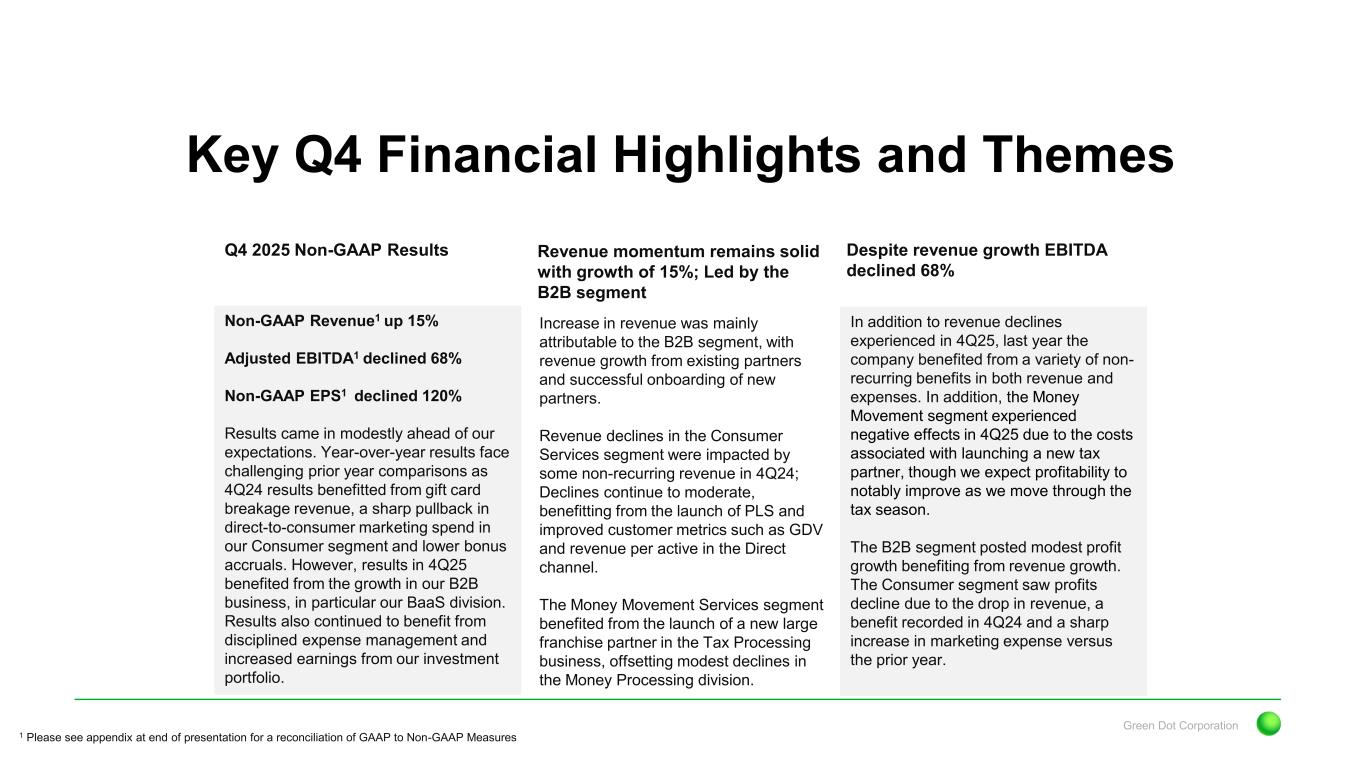
Green Dot Corporation Revenue momentum remains solid with growth of 15%; Led by the B2B segment Key Q4 Financial Highlights and Themes Q4 2025 Non-GAAP Results Non-GAAP Revenue1 up 15% Adjusted EBITDA1 declined 68% Non-GAAP EPS1 declined 120% Results came in modestly ahead of our expectations. Year-over-year results face challenging prior year comparisons as 4Q24 results benefitted from gift card breakage revenue, a sharp pullback in direct-to-consumer marketing spend in our Consumer segment and lower bonus accruals. However, results in 4Q25 benefited from the growth in our B2B business, in particular our BaaS division. Results also continued to benefit from disciplined expense management and increased earnings from our investment portfolio. Despite revenue growth EBITDA declined 68% In addition to revenue declines experienced in 4Q25, last year the company benefited from a variety of non- recurring benefits in both revenue and expenses. In addition, the Money Movement segment experienced negative effects in 4Q25 due to the costs associated with launching a new tax partner, though we expect profitability to notably improve as we move through the tax season. The B2B segment posted modest profit growth benefiting from revenue growth. The Consumer segment saw profits decline due to the drop in revenue, a benefit recorded in 4Q24 and a sharp increase in marketing expense versus the prior year. 1 Please see appendix at end of presentation for a reconciliation of GAAP to Non-GAAP Measures Increase in revenue was mainly attributable to the B2B segment, with revenue growth from existing partners and successful onboarding of new partners. Revenue declines in the Consumer Services segment were impacted by some non-recurring revenue in 4Q24; Declines continue to moderate, benefitting from the launch of PLS and improved customer metrics such as GDV and revenue per active in the Direct channel. The Money Movement Services segment benefited from the launch of a new large franchise partner in the Tax Processing business, offsetting modest declines in the Money Processing division.
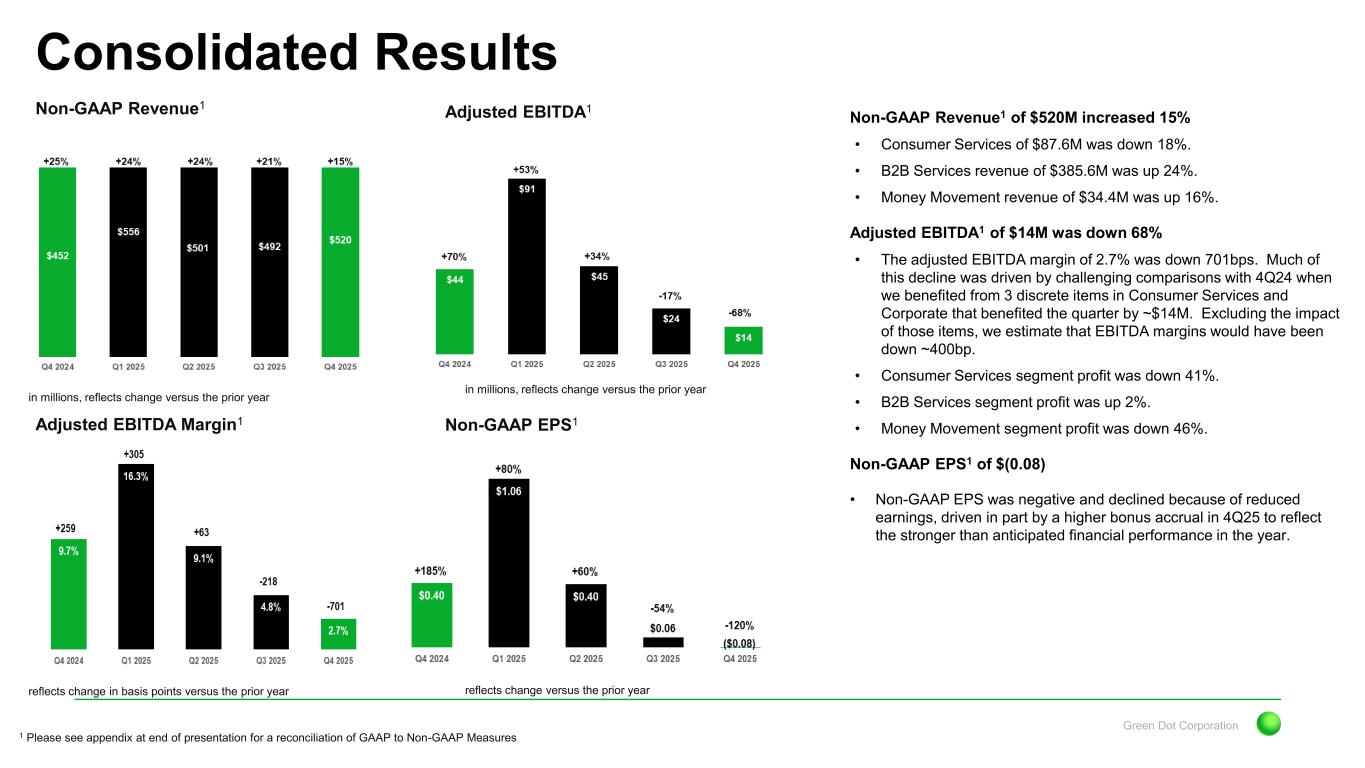
Green Dot Corporation Non-GAAP Revenue1 of $520M increased 15% • Consumer Services of $87.6M was down 18%. • B2B Services revenue of $385.6M was up 24%. • Money Movement revenue of $34.4M was up 16%. Adjusted EBITDA1 of $14M was down 68% • The adjusted EBITDA margin of 2.7% was down 701bps. Much of this decline was driven by challenging comparisons with 4Q24 when we benefited from 3 discrete items in Consumer Services and Corporate that benefited the quarter by ~$14M. Excluding the impact of those items, we estimate that EBITDA margins would have been down ~400bp. • Consumer Services segment profit was down 41%. • B2B Services segment profit was up 2%. • Money Movement segment profit was down 46%. Non-GAAP EPS1 of $(0.08) • Non-GAAP EPS was negative and declined because of reduced earnings, driven in part by a higher bonus accrual in 4Q25 to reflect the stronger than anticipated financial performance in the year. Non-GAAP Revenue1 Consolidated Results Adjusted EBITDA1 Adjusted EBITDA Margin1 Non-GAAP EPS1 in millions, reflects change versus the prior year in millions, reflects change versus the prior year reflects change in basis points versus the prior year reflects change versus the prior year 1 Please see appendix at end of presentation for a reconciliation of GAAP to Non-GAAP Measures
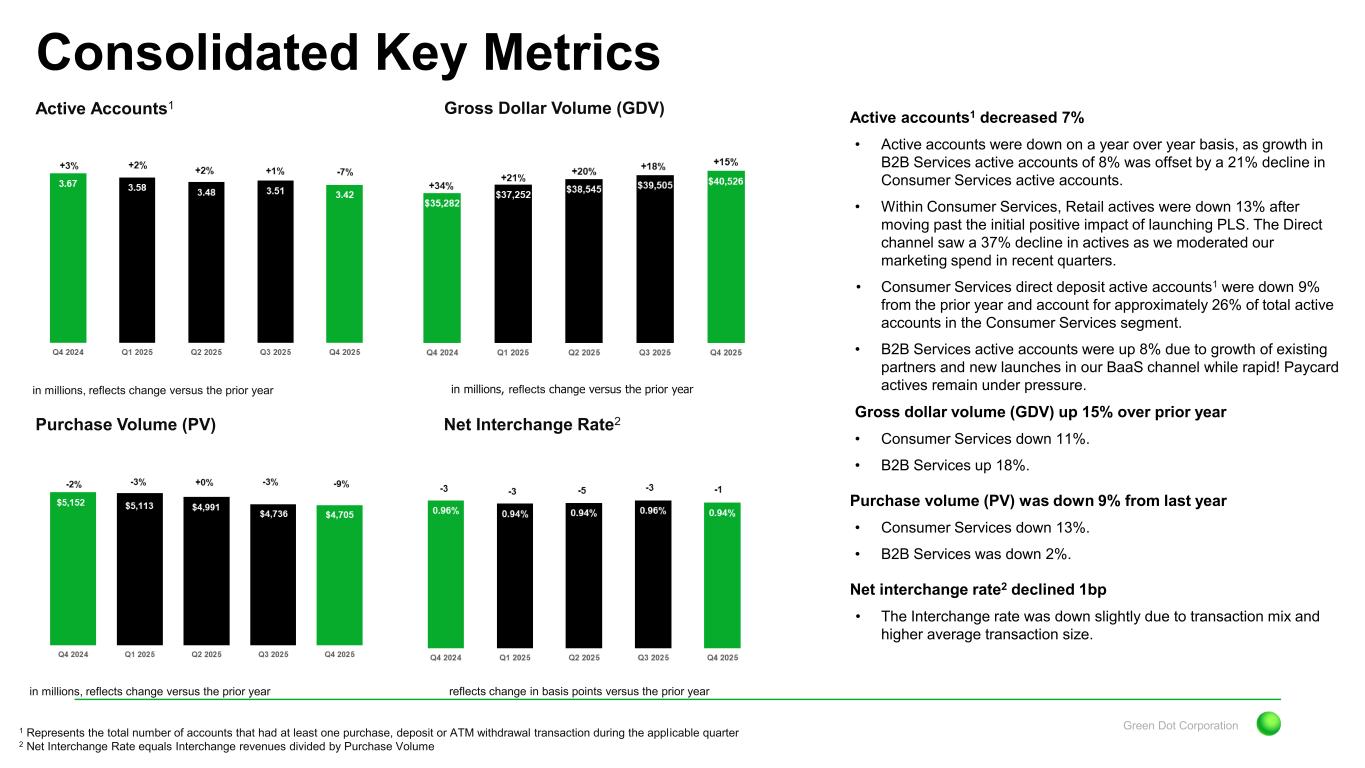
Green Dot Corporation Active accounts1 decreased 7% • Active accounts were down on a year over year basis, as growth in B2B Services active accounts of 8% was offset by a 21% decline in Consumer Services active accounts. • Within Consumer Services, Retail actives were down 13% after moving past the initial positive impact of launching PLS. The Direct channel saw a 37% decline in actives as we moderated our marketing spend in recent quarters. • Consumer Services direct deposit active accounts1 were down 9% from the prior year and account for approximately 26% of total active accounts in the Consumer Services segment. • B2B Services active accounts were up 8% due to growth of existing partners and new launches in our BaaS channel while rapid! Paycard actives remain under pressure. Gross dollar volume (GDV) up 15% over prior year • Consumer Services down 11%. • B2B Services up 18%. Purchase volume (PV) was down 9% from last year • Consumer Services down 13%. • B2B Services was down 2%. Net interchange rate2 declined 1bp • The Interchange rate was down slightly due to transaction mix and higher average transaction size. Active Accounts1 Consolidated Key Metrics Gross Dollar Volume (GDV) Purchase Volume (PV) Net Interchange Rate2 in millions, reflects change versus the prior year in millions, reflects change versus the prior year in millions, reflects change versus the prior year reflects change in basis points versus the prior year 1 Represents the total number of accounts that had at least one purchase, deposit or ATM withdrawal transaction during the applicable quarter 2 Net Interchange Rate equals Interchange revenues divided by Purchase Volume
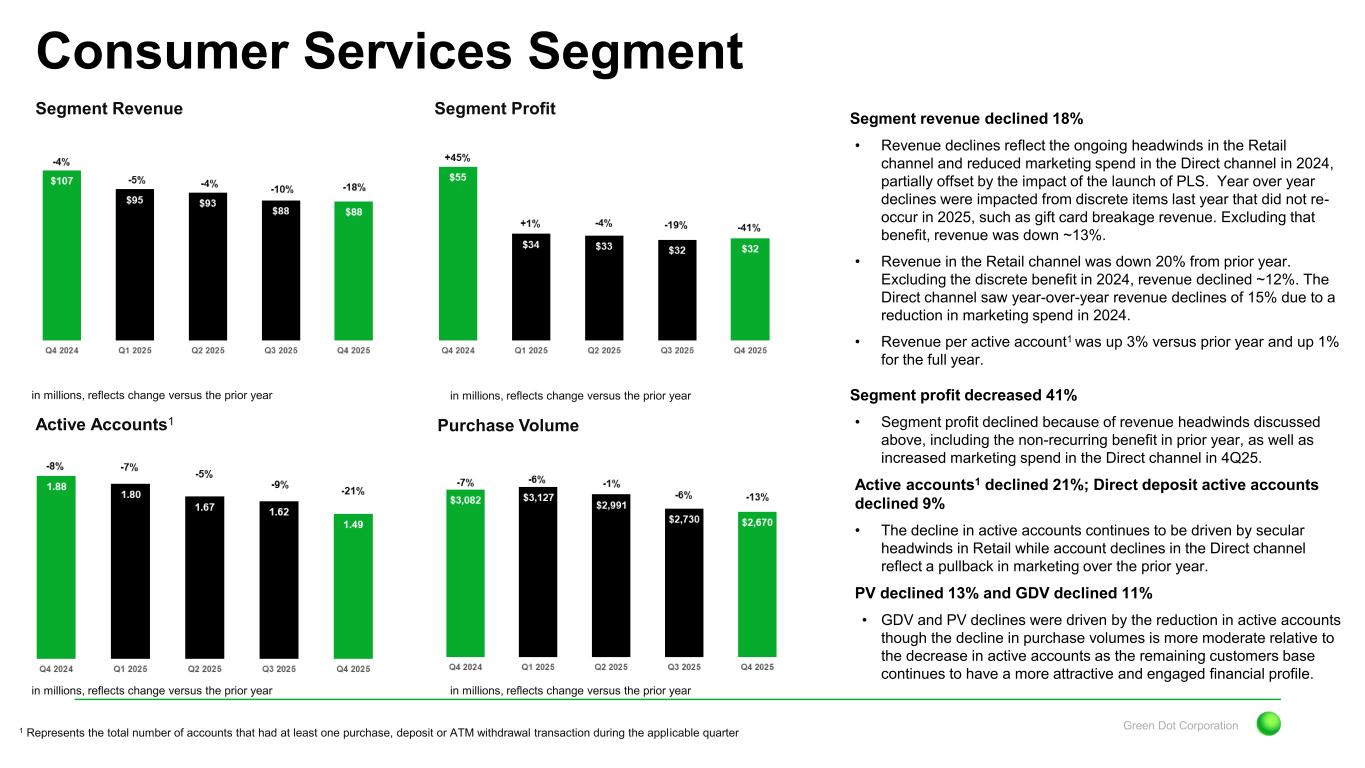
Green Dot Corporation Segment Revenue Consumer Services Segment Segment Profit Active Accounts1 Purchase Volume in millions, reflects change versus the prior year in millions, reflects change versus the prior year in millions, reflects change versus the prior year in millions, reflects change versus the prior year Segment revenue declined 18% • Revenue declines reflect the ongoing headwinds in the Retail channel and reduced marketing spend in the Direct channel in 2024, partially offset by the impact of the launch of PLS. Year over year declines were impacted from discrete items last year that did not re- occur in 2025, such as gift card breakage revenue. Excluding that benefit, revenue was down ~13%. • Revenue in the Retail channel was down 20% from prior year. Excluding the discrete benefit in 2024, revenue declined ~12%. The Direct channel saw year-over-year revenue declines of 15% due to a reduction in marketing spend in 2024. • Revenue per active account1 was up 3% versus prior year and up 1% for the full year. Segment profit decreased 41% • Segment profit declined because of revenue headwinds discussed above, including the non-recurring benefit in prior year, as well as increased marketing spend in the Direct channel in 4Q25. Active accounts1 declined 21%; Direct deposit active accounts declined 9% • The decline in active accounts continues to be driven by secular headwinds in Retail while account declines in the Direct channel reflect a pullback in marketing over the prior year. PV declined 13% and GDV declined 11% • GDV and PV declines were driven by the reduction in active accounts though the decline in purchase volumes is more moderate relative to the decrease in active accounts as the remaining customers base continues to have a more attractive and engaged financial profile. 1 Represents the total number of accounts that had at least one purchase, deposit or ATM withdrawal transaction during the applicable quarter
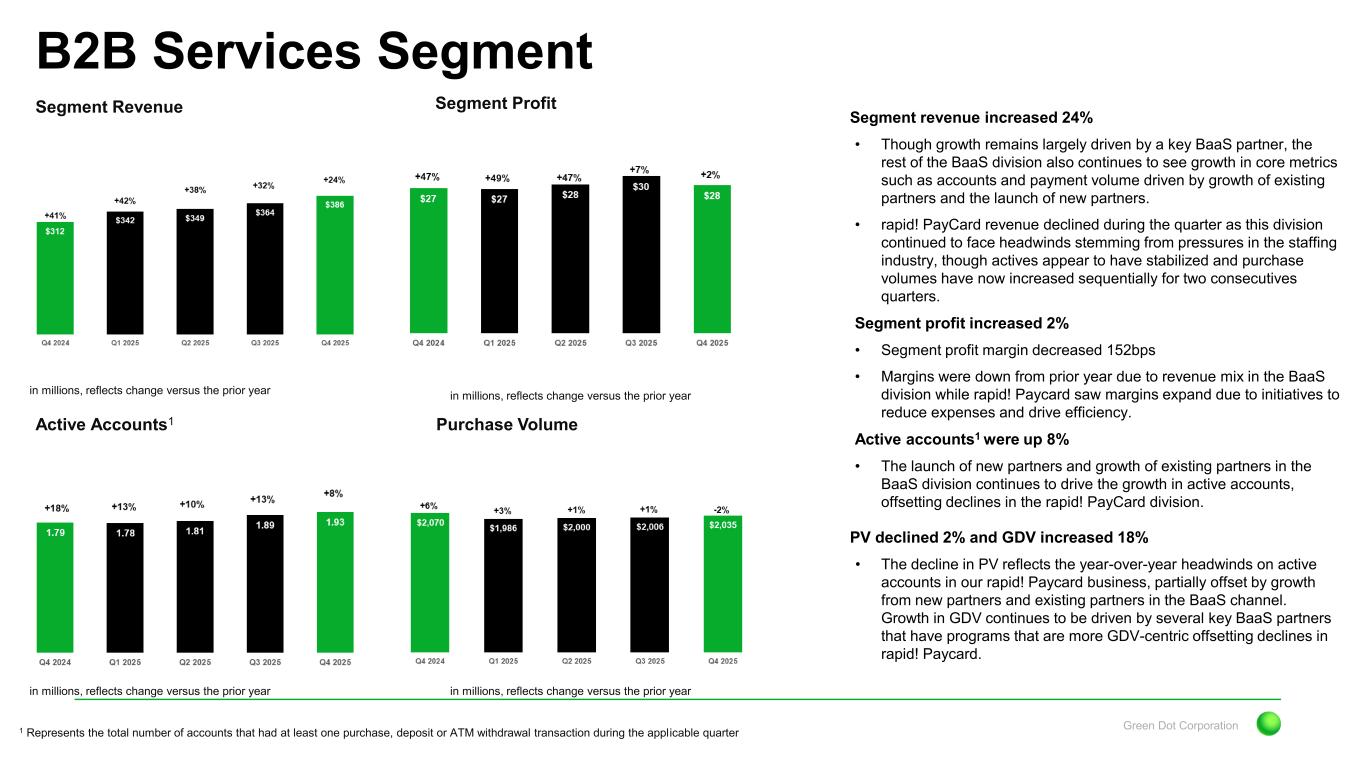
Green Dot Corporation Segment Revenue B2B Services Segment Segment Profit Active Accounts1 Purchase Volume in millions, reflects change versus the prior year in millions, reflects change versus the prior year in millions, reflects change versus the prior year in millions, reflects change versus the prior year Segment revenue increased 24% • Though growth remains largely driven by a key BaaS partner, the rest of the BaaS division also continues to see growth in core metrics such as accounts and payment volume driven by growth of existing partners and the launch of new partners. • rapid! PayCard revenue declined during the quarter as this division continued to face headwinds stemming from pressures in the staffing industry, though actives appear to have stabilized and purchase volumes have now increased sequentially for two consecutives quarters. Segment profit increased 2% • Segment profit margin decreased 152bps • Margins were down from prior year due to revenue mix in the BaaS division while rapid! Paycard saw margins expand due to initiatives to reduce expenses and drive efficiency. Active accounts1 were up 8% • The launch of new partners and growth of existing partners in the BaaS division continues to drive the growth in active accounts, offsetting declines in the rapid! PayCard division. PV declined 2% and GDV increased 18% • The decline in PV reflects the year-over-year headwinds on active accounts in our rapid! Paycard business, partially offset by growth from new partners and existing partners in the BaaS channel. Growth in GDV continues to be driven by several key BaaS partners that have programs that are more GDV-centric offsetting declines in rapid! Paycard. 1 Represents the total number of accounts that had at least one purchase, deposit or ATM withdrawal transaction during the applicable quarter
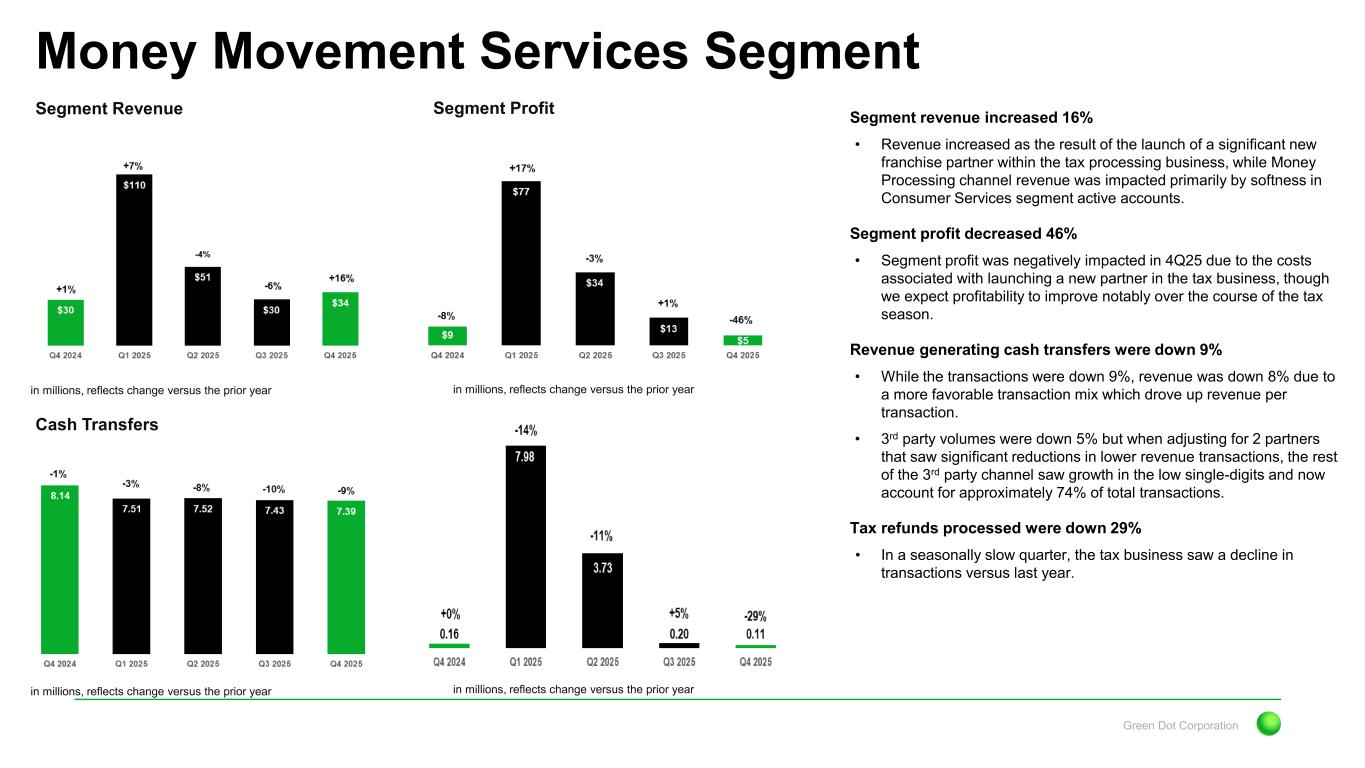
Green Dot Corporation Segment Revenue Money Movement Services Segment Segment Profit Cash Transfers Tax Refunds Processed in millions, reflects change versus the prior year in millions, reflects change versus the prior year in millions, reflects change versus the prior year in millions, reflects change versus the prior year Segment revenue increased 16% • Revenue increased as the result of the launch of a significant new franchise partner within the tax processing business, while Money Processing channel revenue was impacted primarily by softness in Consumer Services segment active accounts. Segment profit decreased 46% • Segment profit was negatively impacted in 4Q25 due to the costs associated with launching a new partner in the tax business, though we expect profitability to improve notably over the course of the tax season. Revenue generating cash transfers were down 9% • While the transactions were down 9%, revenue was down 8% due to a more favorable transaction mix which drove up revenue per transaction. • 3rd party volumes were down 5% but when adjusting for 2 partners that saw significant reductions in lower revenue transactions, the rest of the 3rd party channel saw growth in the low single-digits and now account for approximately 74% of total transactions. Tax refunds processed were down 29% • In a seasonally slow quarter, the tax business saw a decline in transactions versus last year.
Appendix Green Dot Corporation10 Segment Information
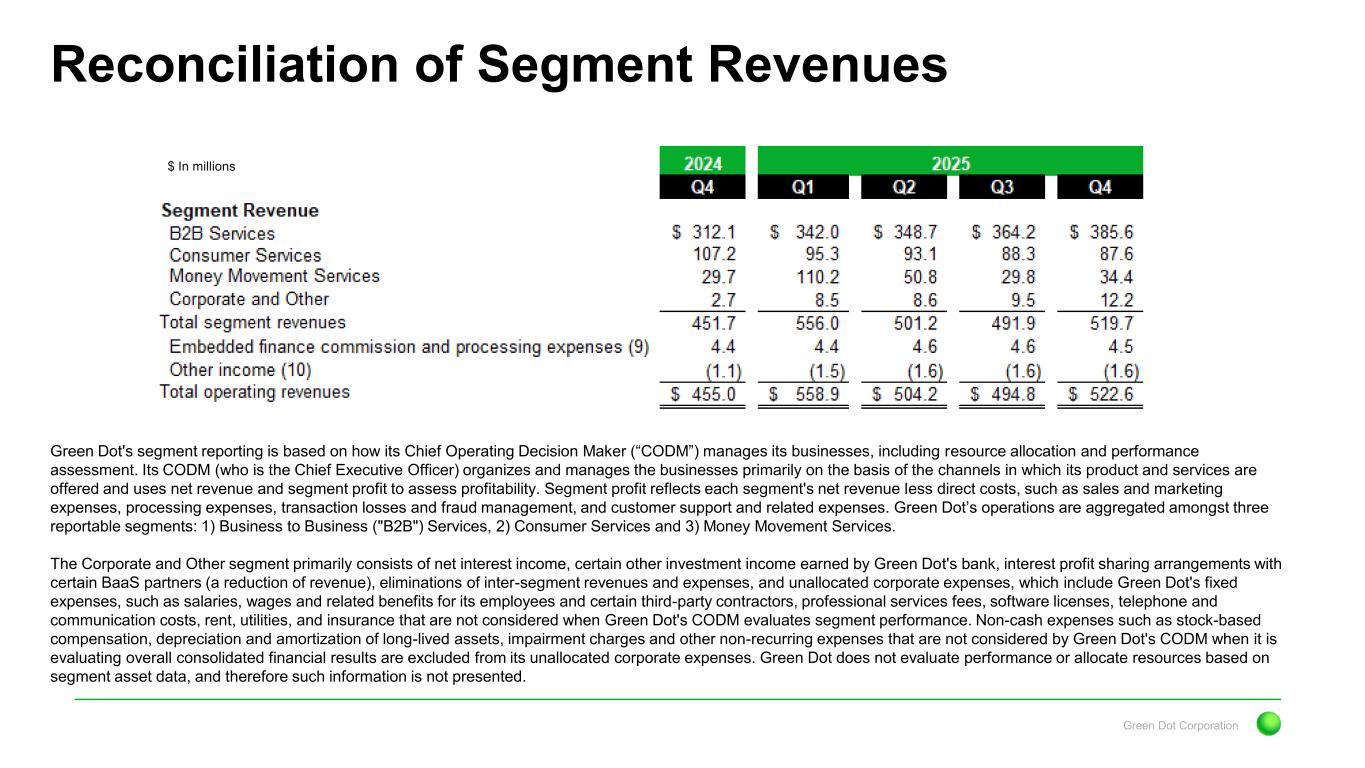
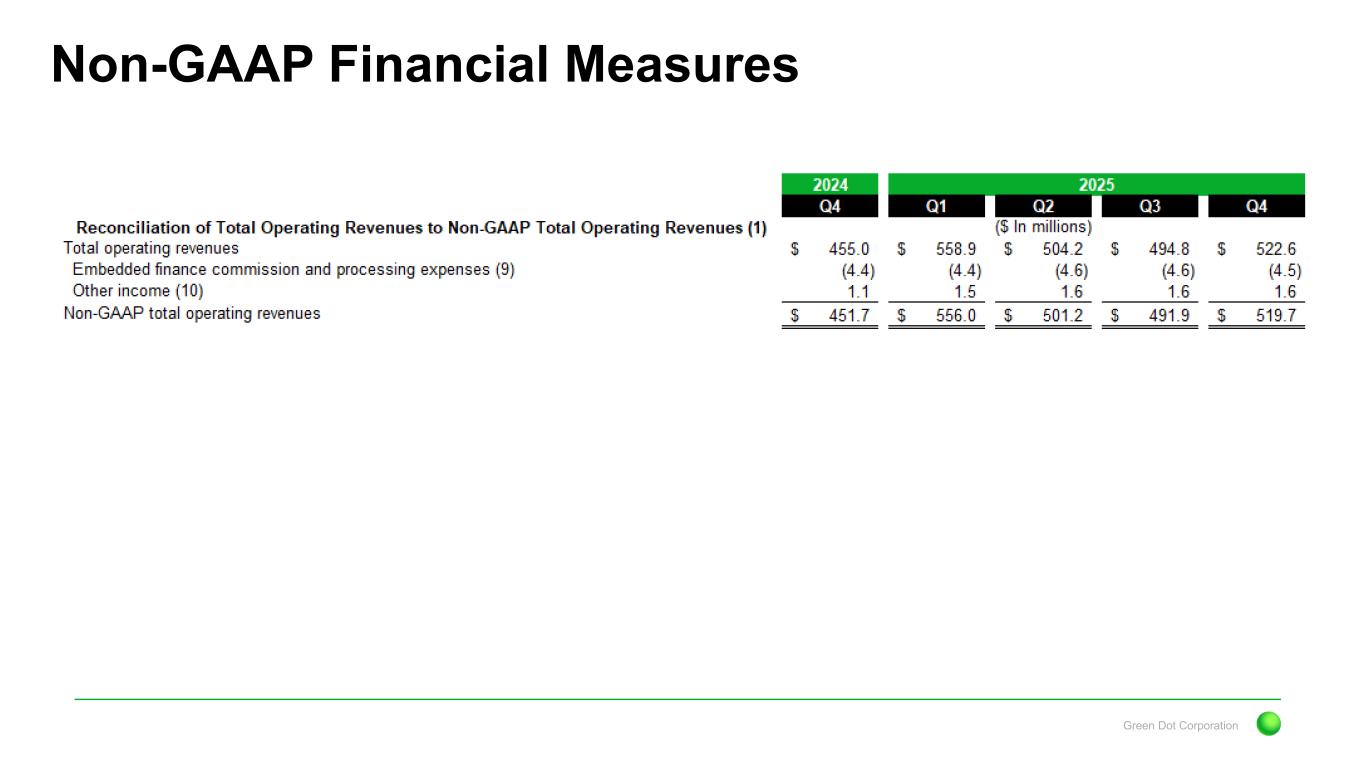
Green Dot Corporation Reconciliation of Segment Revenues Green Dot's segment reporting is based on how its Chief Operating Decision Maker (“CODM”) manages its businesses, including resource allocation and performance assessment. Its CODM (who is the Chief Executive Officer) organizes and manages the businesses primarily on the basis of the channels in which its product and services are offered and uses net revenue and segment profit to assess profitability. Segment profit reflects each segment's net revenue less direct costs, such as sales and marketing expenses, processing expenses, transaction losses and fraud management, and customer support and related expenses. Green Dot’s operations are aggregated amongst three reportable segments: 1) Business to Business ("B2B") Services, 2) Consumer Services and 3) Money Movement Services. The Corporate and Other segment primarily consists of net interest income, certain other investment income earned by Green Dot's bank, interest profit sharing arrangements with certain BaaS partners (a reduction of revenue), eliminations of inter-segment revenues and expenses, and unallocated corporate expenses, which include Green Dot's fixed expenses, such as salaries, wages and related benefits for its employees and certain third-party contractors, professional services fees, software licenses, telephone and communication costs, rent, utilities, and insurance that are not considered when Green Dot's CODM evaluates segment performance. Non-cash expenses such as stock-based compensation, depreciation and amortization of long-lived assets, impairment charges and other non-recurring expenses that are not considered by Green Dot's CODM when it is evaluating overall consolidated financial results are excluded from its unallocated corporate expenses. Green Dot does not evaluate performance or allocate resources based on segment asset data, and therefore such information is not presented. $ In millions
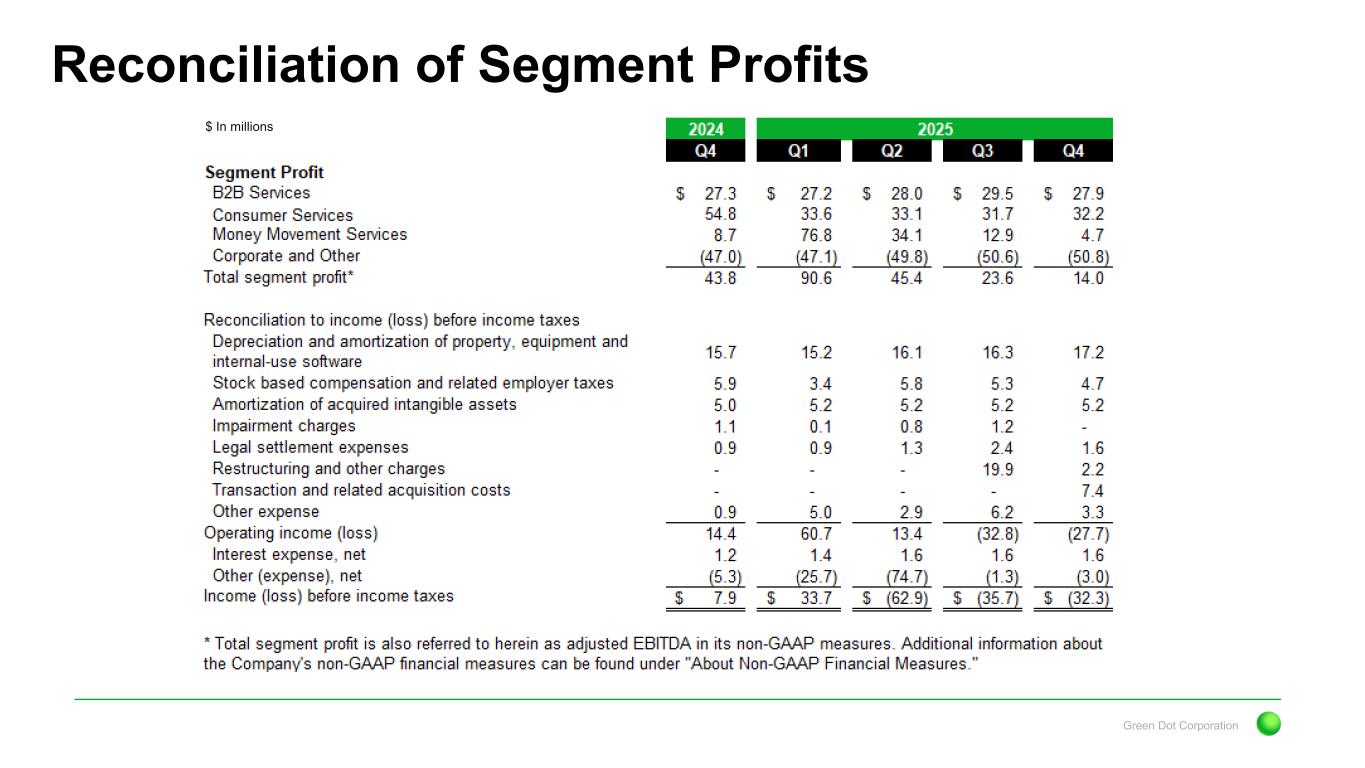
Green Dot Corporation Reconciliation of Segment Profits $ In millions
Appendix Green Dot Corporation13 Division Information
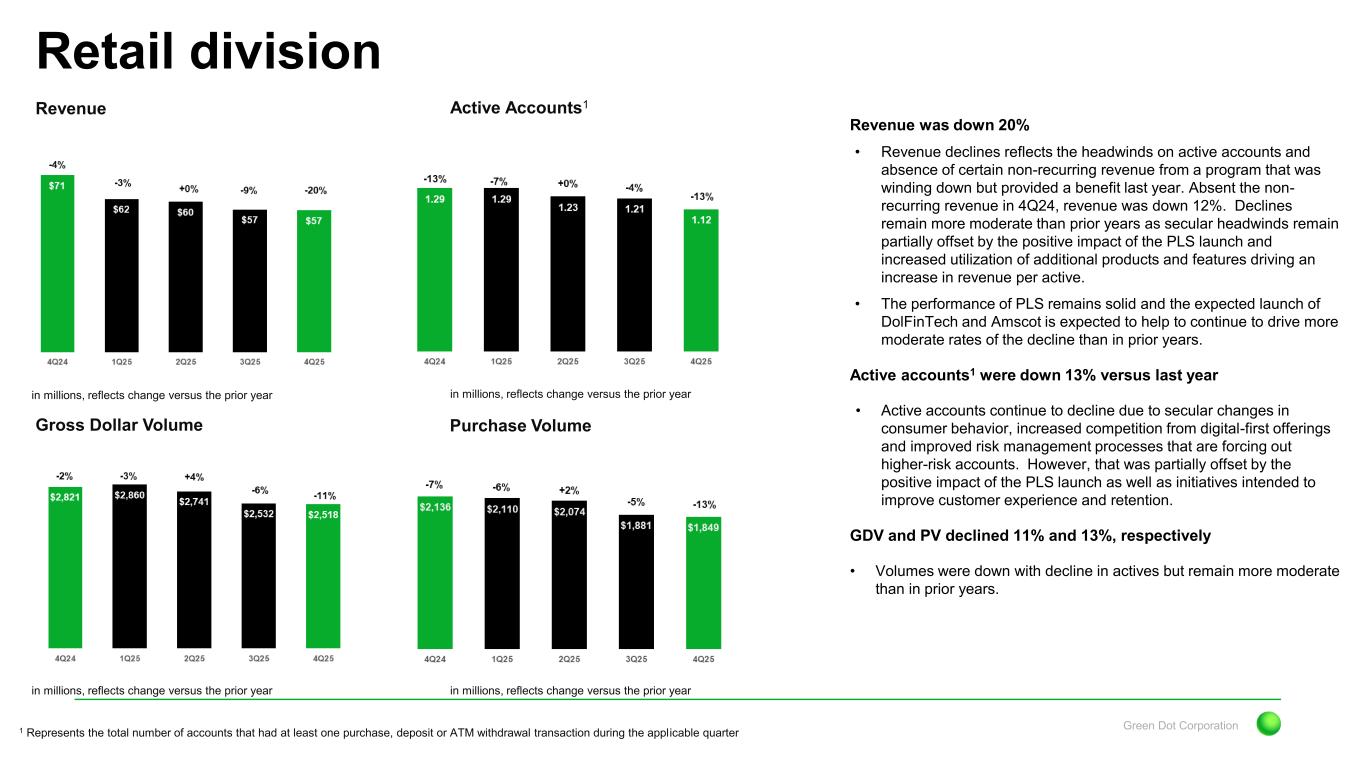
Green Dot Corporation Revenue Retail division Gross Dollar Volume Active Accounts1 Purchase Volume in millions, reflects change versus the prior year in millions, reflects change versus the prior year in millions, reflects change versus the prior year in millions, reflects change versus the prior year Revenue was down 20% • Revenue declines reflects the headwinds on active accounts and absence of certain non-recurring revenue from a program that was winding down but provided a benefit last year. Absent the non- recurring revenue in 4Q24, revenue was down 12%. Declines remain more moderate than prior years as secular headwinds remain partially offset by the positive impact of the PLS launch and increased utilization of additional products and features driving an increase in revenue per active. • The performance of PLS remains solid and the expected launch of DolFinTech and Amscot is expected to help to continue to drive more moderate rates of the decline than in prior years. Active accounts1 were down 13% versus last year • Active accounts continue to decline due to secular changes in consumer behavior, increased competition from digital-first offerings and improved risk management processes that are forcing out higher-risk accounts. However, that was partially offset by the positive impact of the PLS launch as well as initiatives intended to improve customer experience and retention. GDV and PV declined 11% and 13%, respectively • Volumes were down with decline in actives but remain more moderate than in prior years. 1 Represents the total number of accounts that had at least one purchase, deposit or ATM withdrawal transaction during the applicable quarter
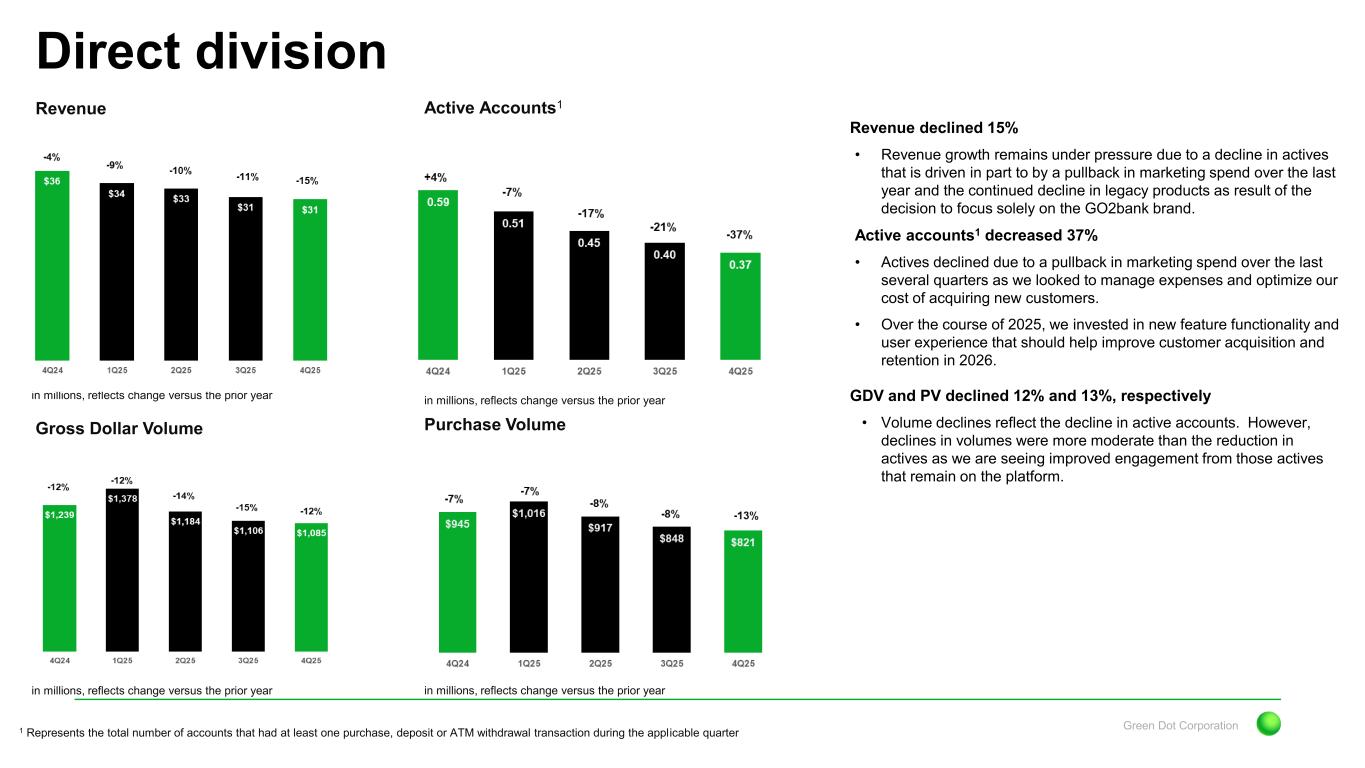
Green Dot Corporation Revenue Direct division Gross Dollar Volume Active Accounts1 Purchase Volume in millions, reflects change versus the prior year in millions, reflects change versus the prior year in millions, reflects change versus the prior year in millions, reflects change versus the prior year Revenue declined 15% • Revenue growth remains under pressure due to a decline in actives that is driven in part to by a pullback in marketing spend over the last year and the continued decline in legacy products as result of the decision to focus solely on the GO2bank brand. Active accounts1 decreased 37% • Actives declined due to a pullback in marketing spend over the last several quarters as we looked to manage expenses and optimize our cost of acquiring new customers. • Over the course of 2025, we invested in new feature functionality and user experience that should help improve customer acquisition and retention in 2026. GDV and PV declined 12% and 13%, respectively • Volume declines reflect the decline in active accounts. However, declines in volumes were more moderate than the reduction in actives as we are seeing improved engagement from those actives that remain on the platform. 1 Represents the total number of accounts that had at least one purchase, deposit or ATM withdrawal transaction during the applicable quarter
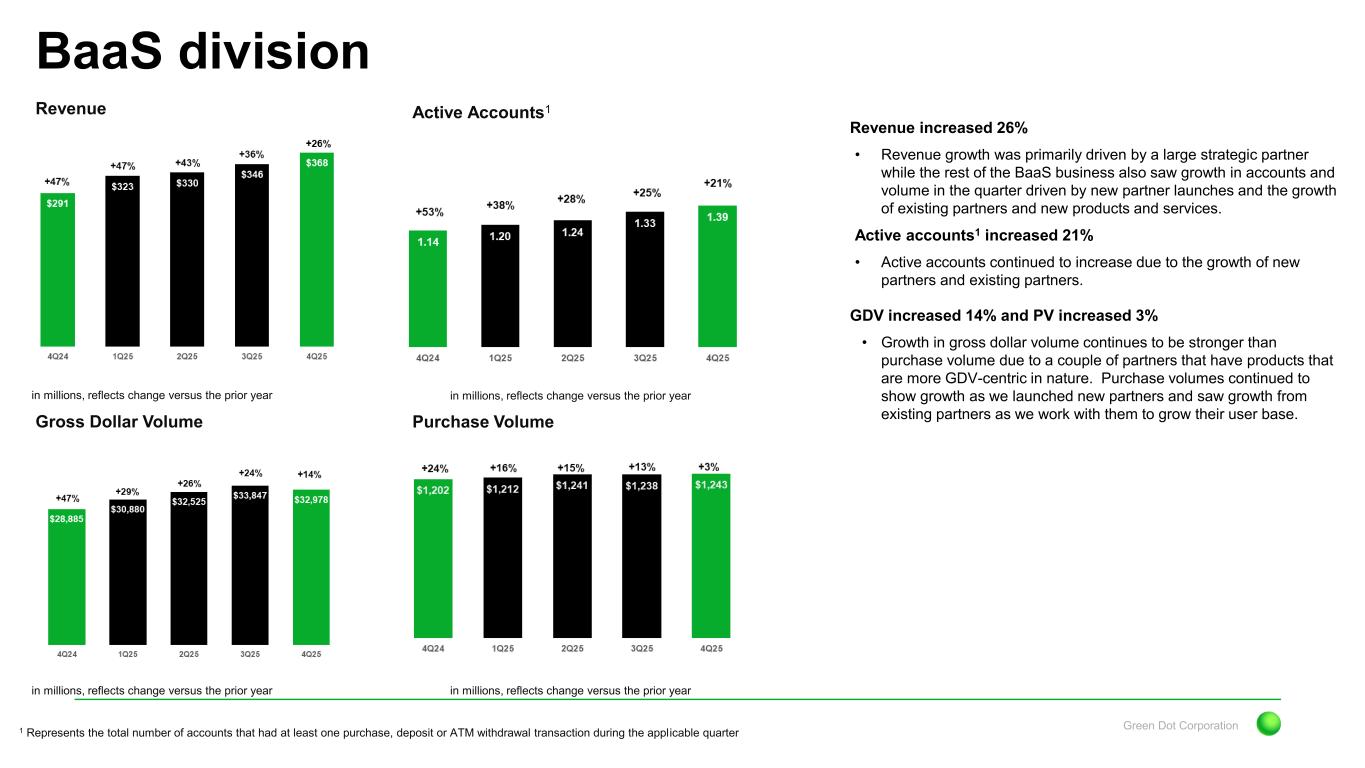
Green Dot Corporation Revenue BaaS division Gross Dollar Volume Active Accounts1 Purchase Volume in millions, reflects change versus the prior year in millions, reflects change versus the prior year in millions, reflects change versus the prior year in millions, reflects change versus the prior year Revenue increased 26% • Revenue growth was primarily driven by a large strategic partner while the rest of the BaaS business also saw growth in accounts and volume in the quarter driven by new partner launches and the growth of existing partners and new products and services. Active accounts1 increased 21% • Active accounts continued to increase due to the growth of new partners and existing partners. GDV increased 14% and PV increased 3% • Growth in gross dollar volume continues to be stronger than purchase volume due to a couple of partners that have products that are more GDV-centric in nature. Purchase volumes continued to show growth as we launched new partners and saw growth from existing partners as we work with them to grow their user base. 1 Represents the total number of accounts that had at least one purchase, deposit or ATM withdrawal transaction during the applicable quarter
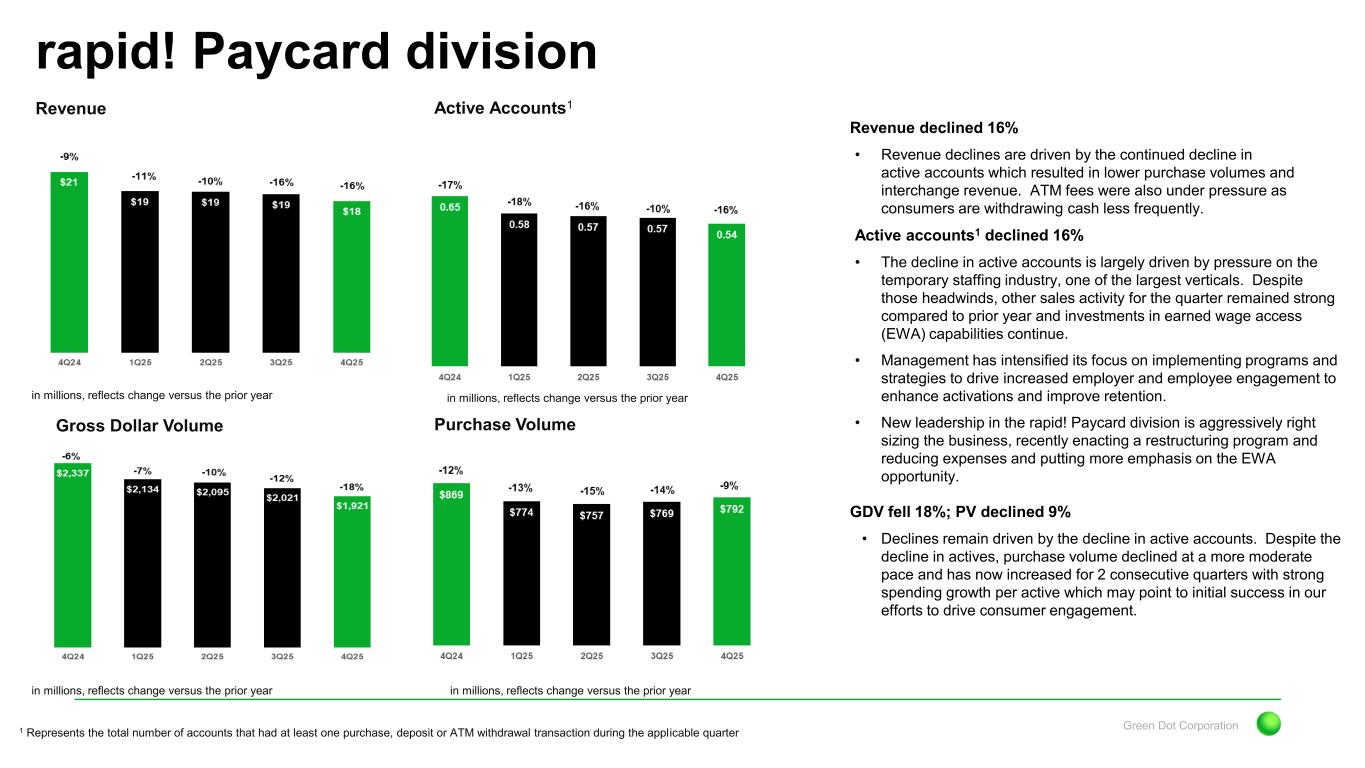
Green Dot Corporation Revenue rapid! Paycard division Gross Dollar Volume Active Accounts1 Purchase Volume in millions, reflects change versus the prior year in millions, reflects change versus the prior year in millions, reflects change versus the prior year in millions, reflects change versus the prior year Revenue declined 16% • Revenue declines are driven by the continued decline in active accounts which resulted in lower purchase volumes and interchange revenue. ATM fees were also under pressure as consumers are withdrawing cash less frequently. Active accounts1 declined 16% • The decline in active accounts is largely driven by pressure on the temporary staffing industry, one of the largest verticals. Despite those headwinds, other sales activity for the quarter remained strong compared to prior year and investments in earned wage access (EWA) capabilities continue. • Management has intensified its focus on implementing programs and strategies to drive increased employer and employee engagement to enhance activations and improve retention. • New leadership in the rapid! Paycard division is aggressively right sizing the business, recently enacting a restructuring program and reducing expenses and putting more emphasis on the EWA opportunity. GDV fell 18%; PV declined 9% • Declines remain driven by the decline in active accounts. Despite the decline in actives, purchase volume declined at a more moderate pace and has now increased for 2 consecutive quarters with strong spending growth per active which may point to initial success in our efforts to drive consumer engagement. 1 Represents the total number of accounts that had at least one purchase, deposit or ATM withdrawal transaction during the applicable quarter
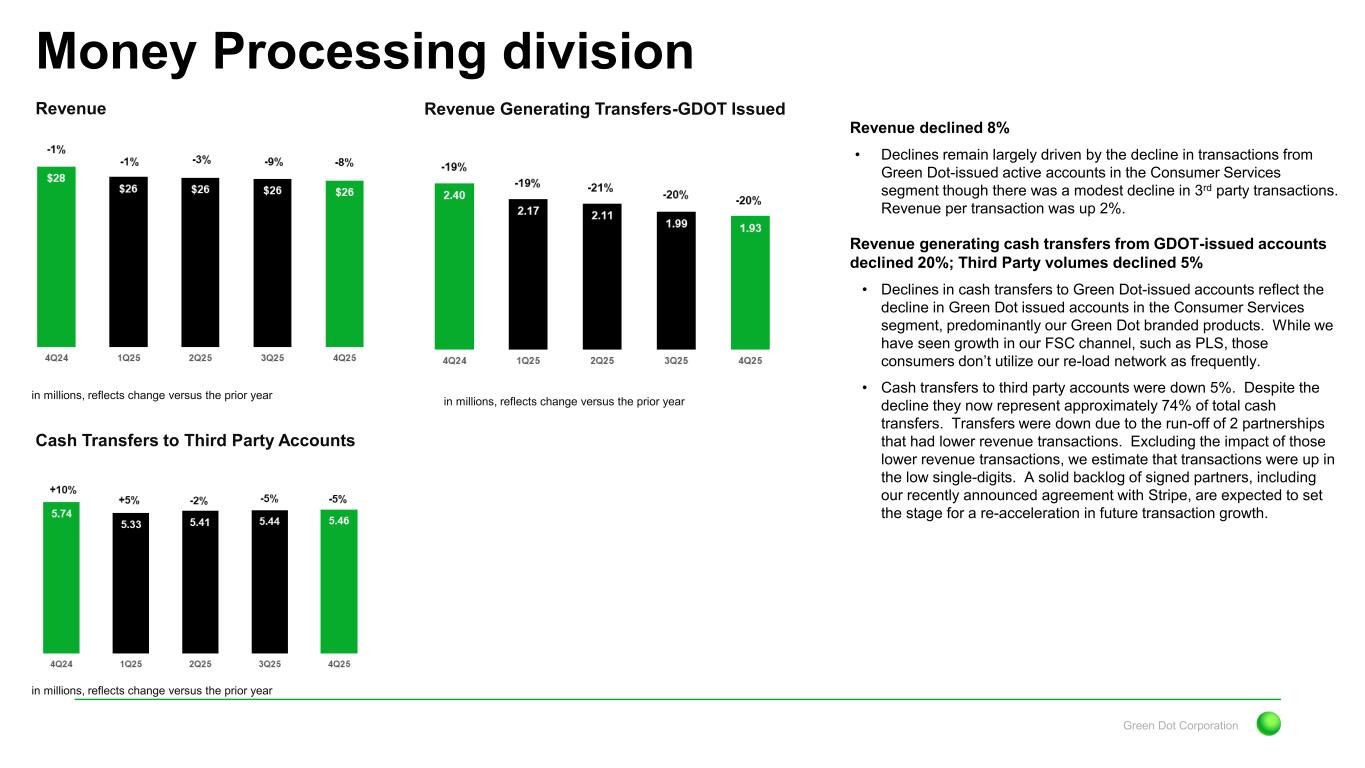
Green Dot Corporation Revenue Money Processing division Revenue Generating Transfers-GDOT Issued Cash Transfers to Third Party Accounts in millions, reflects change versus the prior year in millions, reflects change versus the prior year in millions, reflects change versus the prior year Revenue declined 8% • Declines remain largely driven by the decline in transactions from Green Dot-issued active accounts in the Consumer Services segment though there was a modest decline in 3rd party transactions. Revenue per transaction was up 2%. Revenue generating cash transfers from GDOT-issued accounts declined 20%; Third Party volumes declined 5% • Declines in cash transfers to Green Dot-issued accounts reflect the decline in Green Dot issued accounts in the Consumer Services segment, predominantly our Green Dot branded products. While we have seen growth in our FSC channel, such as PLS, those consumers don’t utilize our re-load network as frequently. • Cash transfers to third party accounts were down 5%. Despite the decline they now represent approximately 74% of total cash transfers. Transfers were down due to the run-off of 2 partnerships that had lower revenue transactions. Excluding the impact of those lower revenue transactions, we estimate that transactions were up in the low single-digits. A solid backlog of signed partners, including our recently announced agreement with Stripe, are expected to set the stage for a re-acceleration in future transaction growth.
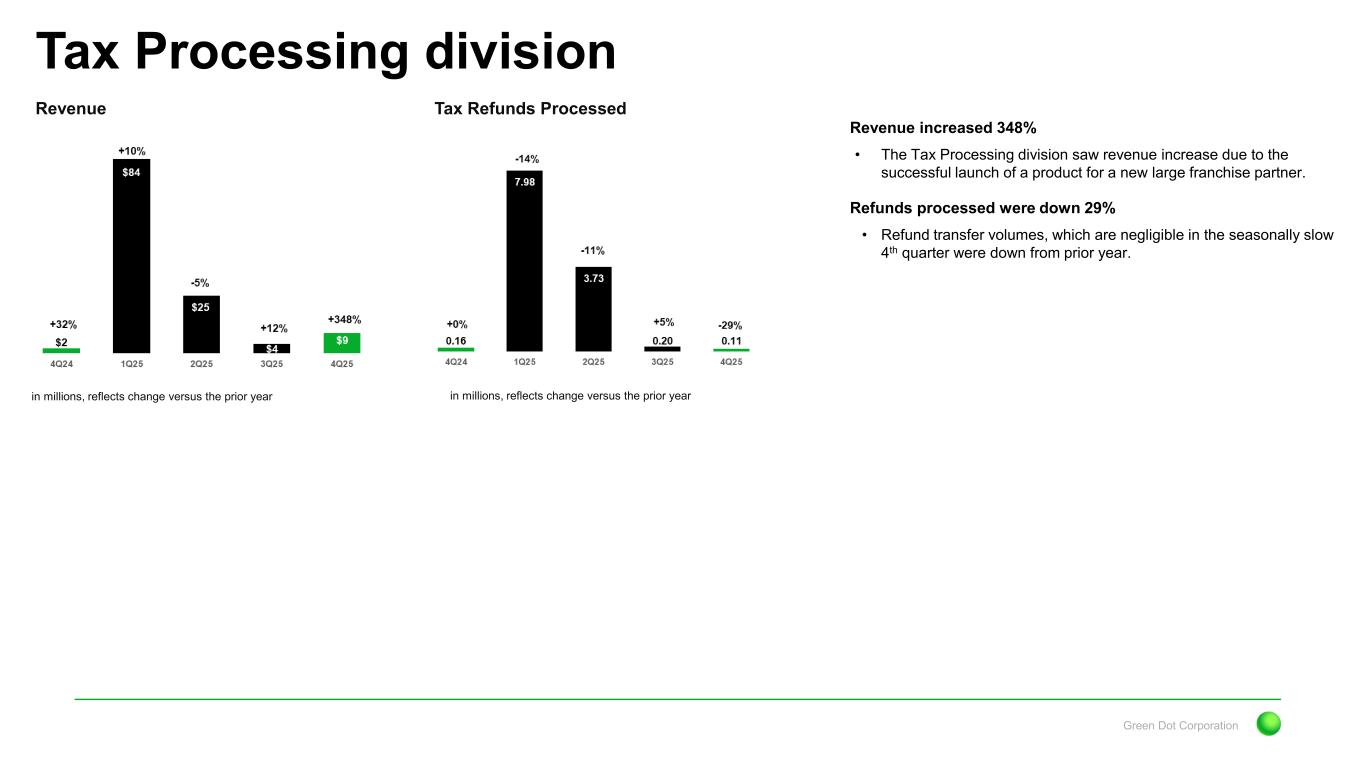
Green Dot Corporation Revenue Tax Processing division Tax Refunds Processed in millions, reflects change versus the prior year in millions, reflects change versus the prior year Revenue increased 348% • The Tax Processing division saw revenue increase due to the successful launch of a product for a new large franchise partner. Refunds processed were down 29% • Refund transfer volumes, which are negligible in the seasonally slow 4th quarter were down from prior year.
Appendix Green Dot Corporation20 Non-GAAP Financial Measures
Green Dot Corporation About Non-GAAP Financial Measures To supplement Green Dot's consolidated financial statements presented in accordance with accounting principles generally accepted in the United States of America ("GAAP"), Green Dot uses measures of operating results that are adjusted for, among other things, non-operating net interest income and expense; other non-interest investment income earned by its bank; income tax benefit and expense; depreciation and amortization, including amortization of acquired intangibles; certain legal settlement gains and charges; stock-based compensation and related employer payroll taxes; changes in the fair value of contingent consideration; transaction costs from acquisitions or divestitures; amortization attributable to deferred financing costs, impairment charges; extraordinary severance expenses; restructuring and other charges; earnings or losses from equity method investments; changes in the fair value of loans held for sale; commissions and certain processing-related costs associated with embedded finance products and services where Green Dot does not control customer acquisition; realized gains and losses on available-for-sale investment securities; other charges and income not reflective of ongoing operating results; and income tax effects. This earnings release includes non-GAAP total operating revenues, adjusted EBITDA, non-GAAP net income and loss, and non-GAAP diluted earnings and loss per share. These non-GAAP financial measures are not calculated or presented in accordance with, and are not alternatives or substitutes for, financial measures prepared in accordance with GAAP, and should be read only in conjunction with Green Dot's financial measures prepared in accordance with GAAP. Green Dot's non-GAAP financial measures may be different from similarly-titled non-GAAP financial measures used by other companies. Green Dot believes that the presentation of non- GAAP financial measures provides useful information to management and investors regarding underlying trends in its consolidated financial condition and results of operations. Green Dot's management regularly uses these supplemental non-GAAP financial measures internally to understand, manage and evaluate Green Dot's business and make operating decisions. For additional information regarding Green Dot's use of non-GAAP financial measures and the items excluded by Green Dot from one or more of its historic non-GAAP financial measures, investors are encouraged to review the reconciliations of Green Dot's historic non-GAAP financial measures to the comparable GAAP financial measures, which are included herein, or can be found by clicking on “Financial Information” in the Investor Relations section of Green Dot's website at http://ir.greendot.com/.
Green Dot Corporation Non-GAAP Financial Measures
Green Dot Corporation Non-GAAP Financial Measures
Green Dot Corporation Non-GAAP Financial Measures
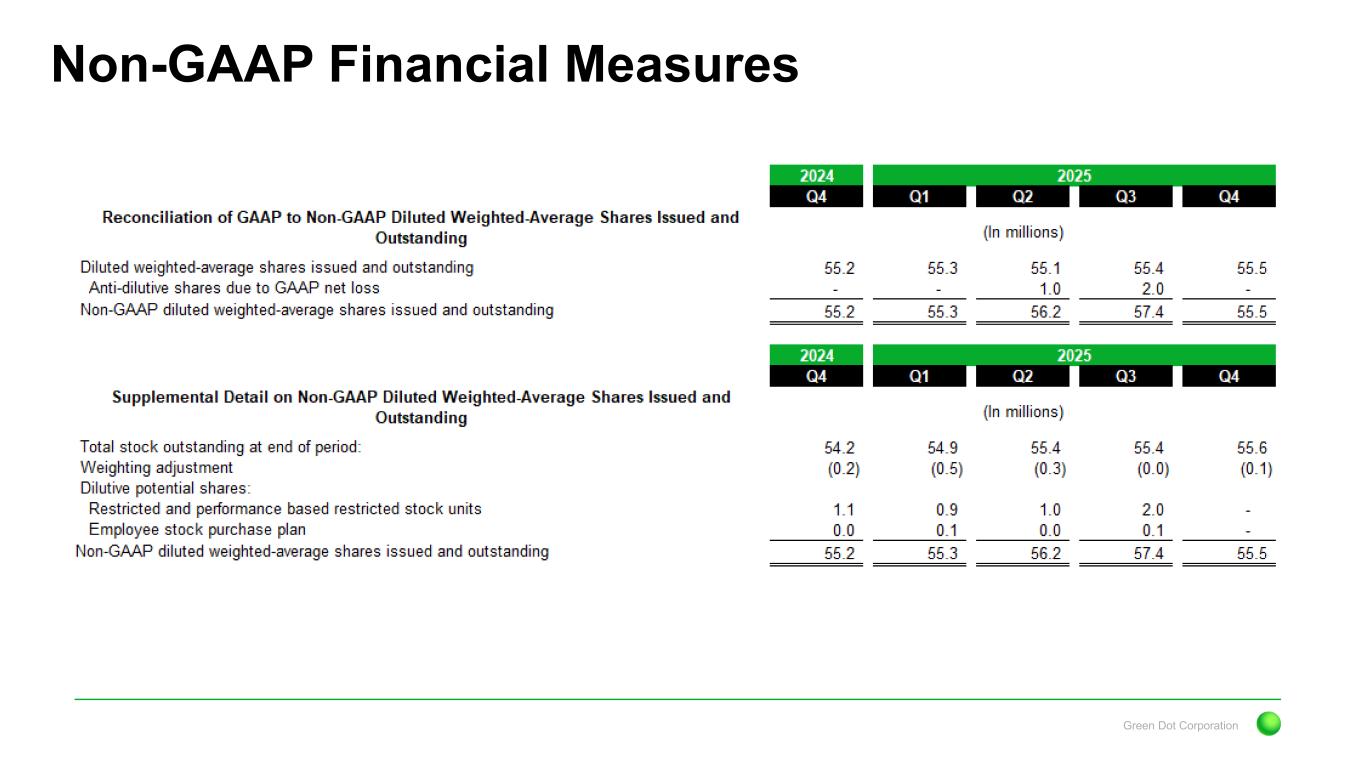
Green Dot Corporation Non-GAAP Financial Measures
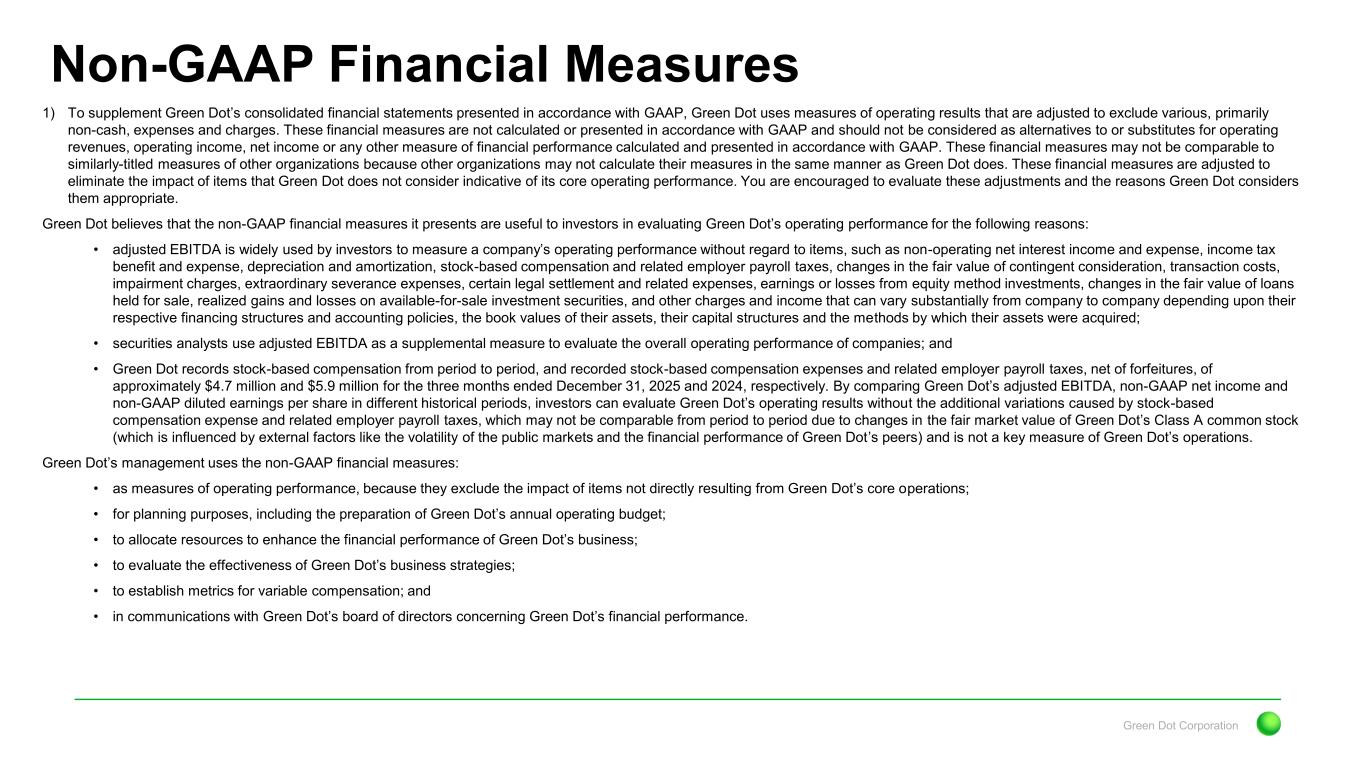
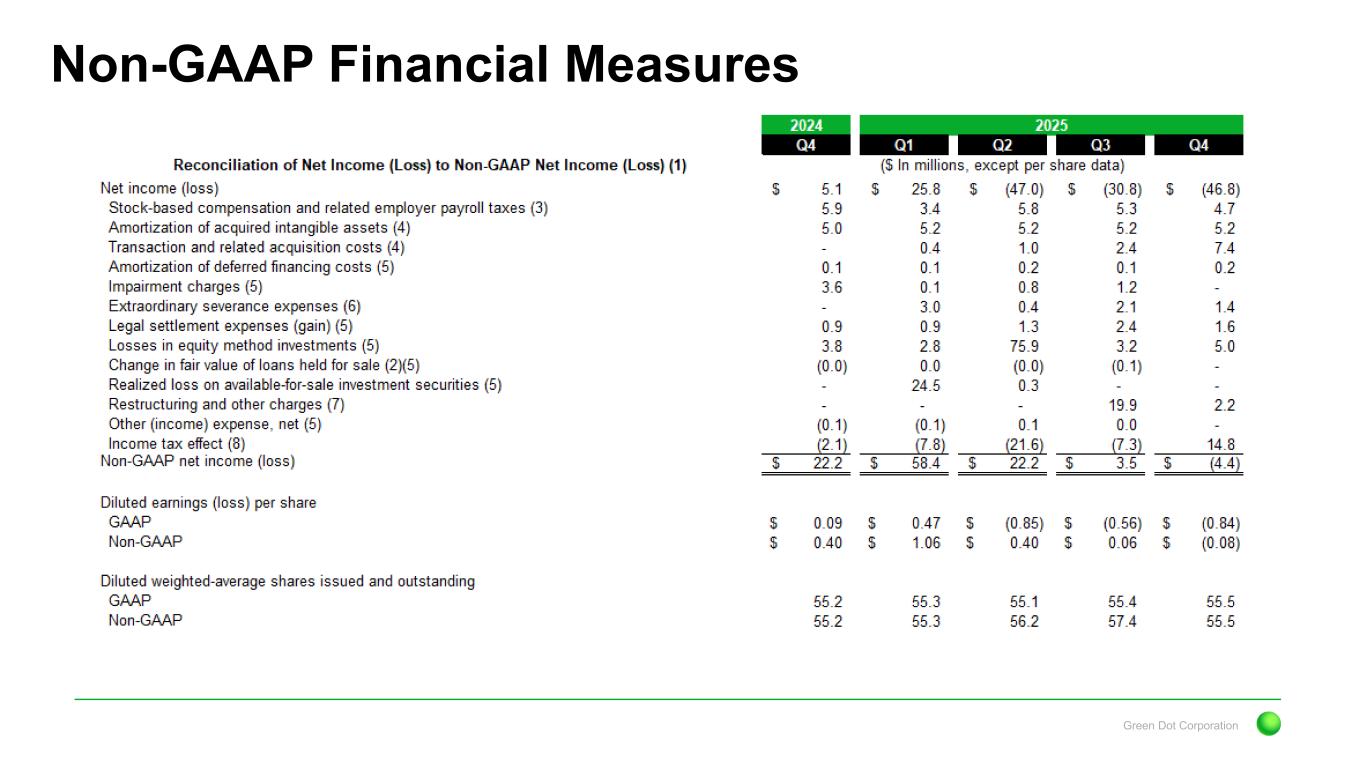
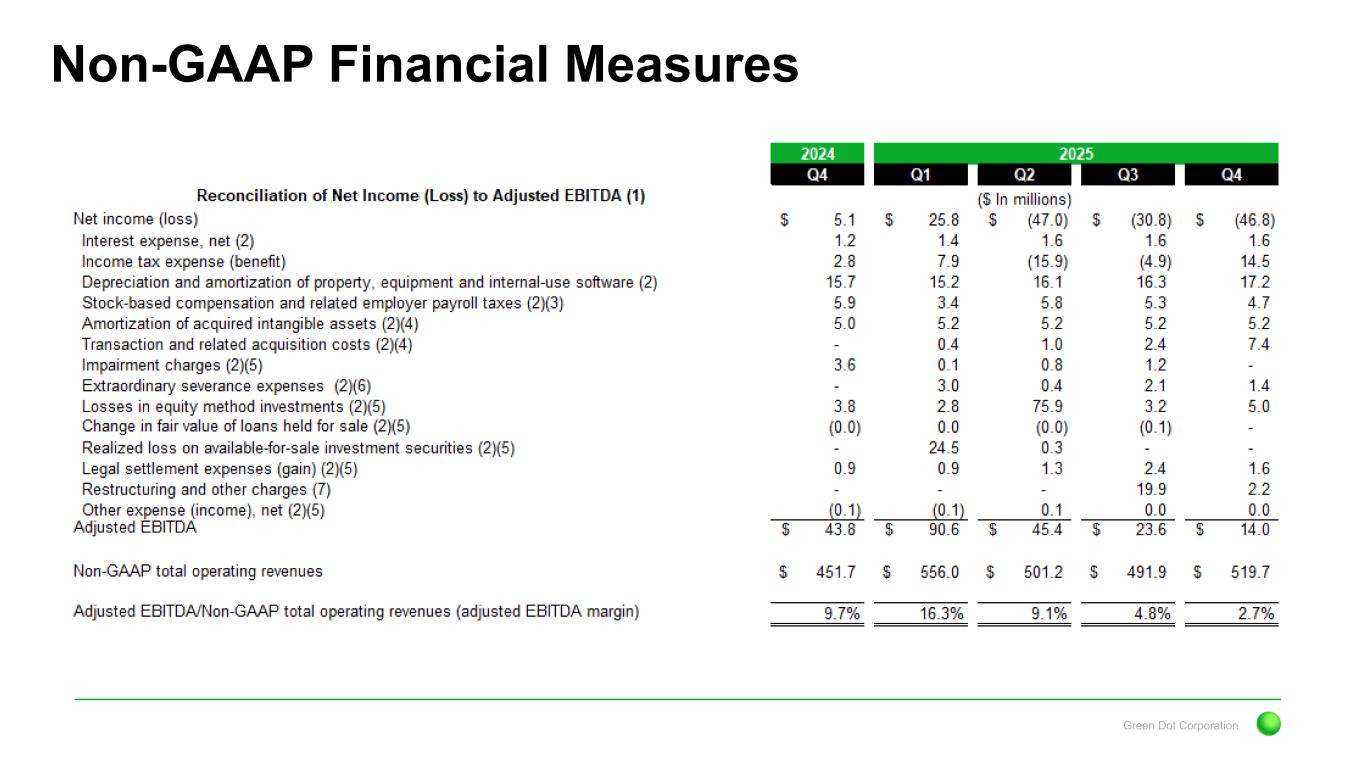
Green Dot Corporation Non-GAAP Financial Measures 1) To supplement Green Dot’s consolidated financial statements presented in accordance with GAAP, Green Dot uses measures of operating results that are adjusted to exclude various, primarily non-cash, expenses and charges. These financial measures are not calculated or presented in accordance with GAAP and should not be considered as alternatives to or substitutes for operating revenues, operating income, net income or any other measure of financial performance calculated and presented in accordance with GAAP. These financial measures may not be comparable to similarly-titled measures of other organizations because other organizations may not calculate their measures in the same manner as Green Dot does. These financial measures are adjusted to eliminate the impact of items that Green Dot does not consider indicative of its core operating performance. You are encouraged to evaluate these adjustments and the reasons Green Dot considers them appropriate. Green Dot believes that the non-GAAP financial measures it presents are useful to investors in evaluating Green Dot’s operating performance for the following reasons: • adjusted EBITDA is widely used by investors to measure a company’s operating performance without regard to items, such as non-operating net interest income and expense, income tax benefit and expense, depreciation and amortization, stock-based compensation and related employer payroll taxes, changes in the fair value of contingent consideration, transaction costs, impairment charges, extraordinary severance expenses, certain legal settlement and related expenses, earnings or losses from equity method investments, changes in the fair value of loans held for sale, realized gains and losses on available-for-sale investment securities, and other charges and income that can vary substantially from company to company depending upon their respective financing structures and accounting policies, the book values of their assets, their capital structures and the methods by which their assets were acquired; • securities analysts use adjusted EBITDA as a supplemental measure to evaluate the overall operating performance of companies; and • Green Dot records stock-based compensation from period to period, and recorded stock-based compensation expenses and related employer payroll taxes, net of forfeitures, of approximately $4.7 million and $5.9 million for the three months ended December 31, 2025 and 2024, respectively. By comparing Green Dot’s adjusted EBITDA, non-GAAP net income and non-GAAP diluted earnings per share in different historical periods, investors can evaluate Green Dot’s operating results without the additional variations caused by stock-based compensation expense and related employer payroll taxes, which may not be comparable from period to period due to changes in the fair market value of Green Dot’s Class A common stock (which is influenced by external factors like the volatility of the public markets and the financial performance of Green Dot’s peers) and is not a key measure of Green Dot’s operations. Green Dot’s management uses the non-GAAP financial measures: • as measures of operating performance, because they exclude the impact of items not directly resulting from Green Dot’s core operations; • for planning purposes, including the preparation of Green Dot’s annual operating budget; • to allocate resources to enhance the financial performance of Green Dot’s business; • to evaluate the effectiveness of Green Dot’s business strategies; • to establish metrics for variable compensation; and • in communications with Green Dot’s board of directors concerning Green Dot’s financial performance.
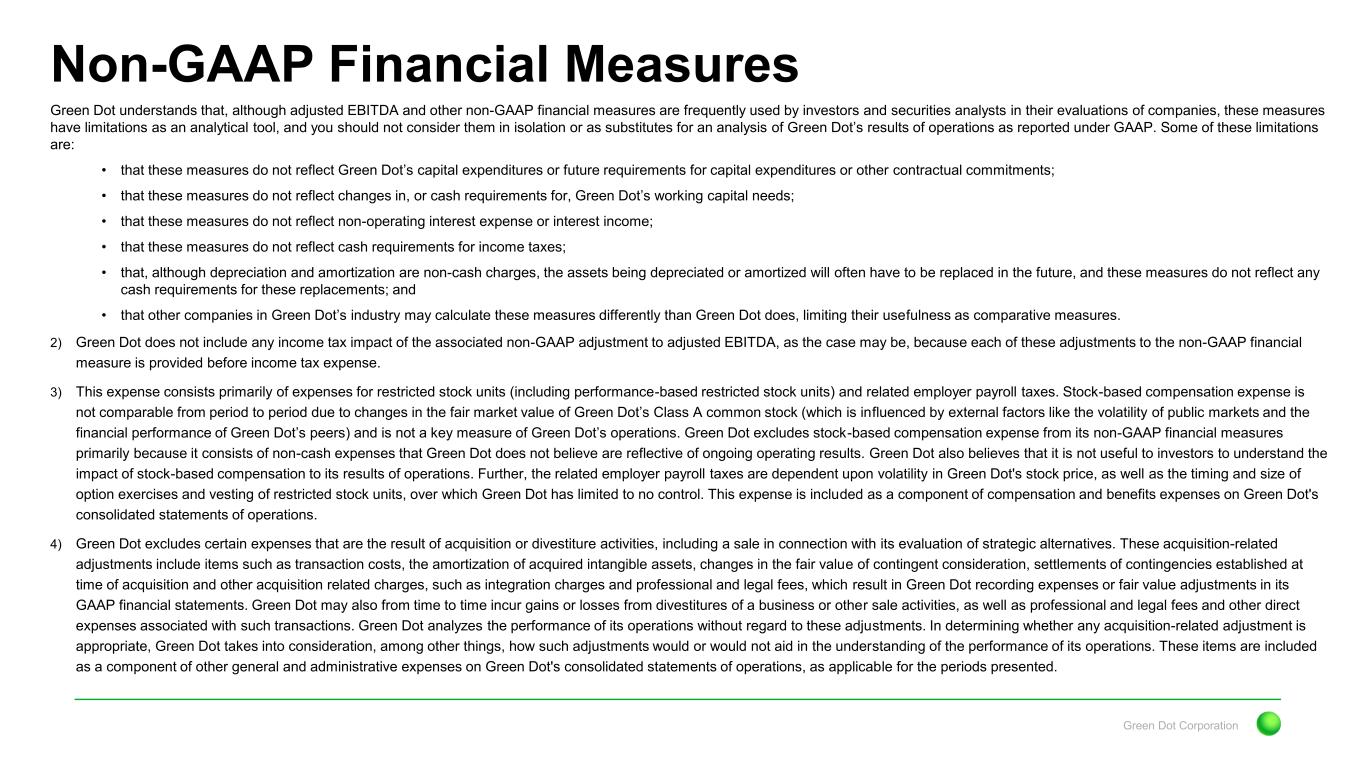
Green Dot Corporation Non-GAAP Financial Measures Green Dot understands that, although adjusted EBITDA and other non-GAAP financial measures are frequently used by investors and securities analysts in their evaluations of companies, these measures have limitations as an analytical tool, and you should not consider them in isolation or as substitutes for an analysis of Green Dot’s results of operations as reported under GAAP. Some of these limitations are: • that these measures do not reflect Green Dot’s capital expenditures or future requirements for capital expenditures or other contractual commitments; • that these measures do not reflect changes in, or cash requirements for, Green Dot’s working capital needs; • that these measures do not reflect non-operating interest expense or interest income; • that these measures do not reflect cash requirements for income taxes; • that, although depreciation and amortization are non-cash charges, the assets being depreciated or amortized will often have to be replaced in the future, and these measures do not reflect any cash requirements for these replacements; and • that other companies in Green Dot’s industry may calculate these measures differently than Green Dot does, limiting their usefulness as comparative measures. 2) Green Dot does not include any income tax impact of the associated non-GAAP adjustment to adjusted EBITDA, as the case may be, because each of these adjustments to the non-GAAP financial measure is provided before income tax expense. 3) This expense consists primarily of expenses for restricted stock units (including performance-based restricted stock units) and related employer payroll taxes. Stock-based compensation expense is not comparable from period to period due to changes in the fair market value of Green Dot’s Class A common stock (which is influenced by external factors like the volatility of public markets and the financial performance of Green Dot’s peers) and is not a key measure of Green Dot’s operations. Green Dot excludes stock-based compensation expense from its non-GAAP financial measures primarily because it consists of non-cash expenses that Green Dot does not believe are reflective of ongoing operating results. Green Dot also believes that it is not useful to investors to understand the impact of stock-based compensation to its results of operations. Further, the related employer payroll taxes are dependent upon volatility in Green Dot's stock price, as well as the timing and size of option exercises and vesting of restricted stock units, over which Green Dot has limited to no control. This expense is included as a component of compensation and benefits expenses on Green Dot's consolidated statements of operations. 4) Green Dot excludes certain expenses that are the result of acquisition or divestiture activities, including a sale in connection with its evaluation of strategic alternatives. These acquisition-related adjustments include items such as transaction costs, the amortization of acquired intangible assets, changes in the fair value of contingent consideration, settlements of contingencies established at time of acquisition and other acquisition related charges, such as integration charges and professional and legal fees, which result in Green Dot recording expenses or fair value adjustments in its GAAP financial statements. Green Dot may also from time to time incur gains or losses from divestitures of a business or other sale activities, as well as professional and legal fees and other direct expenses associated with such transactions. Green Dot analyzes the performance of its operations without regard to these adjustments. In determining whether any acquisition-related adjustment is appropriate, Green Dot takes into consideration, among other things, how such adjustments would or would not aid in the understanding of the performance of its operations. These items are included as a component of other general and administrative expenses on Green Dot's consolidated statements of operations, as applicable for the periods presented.
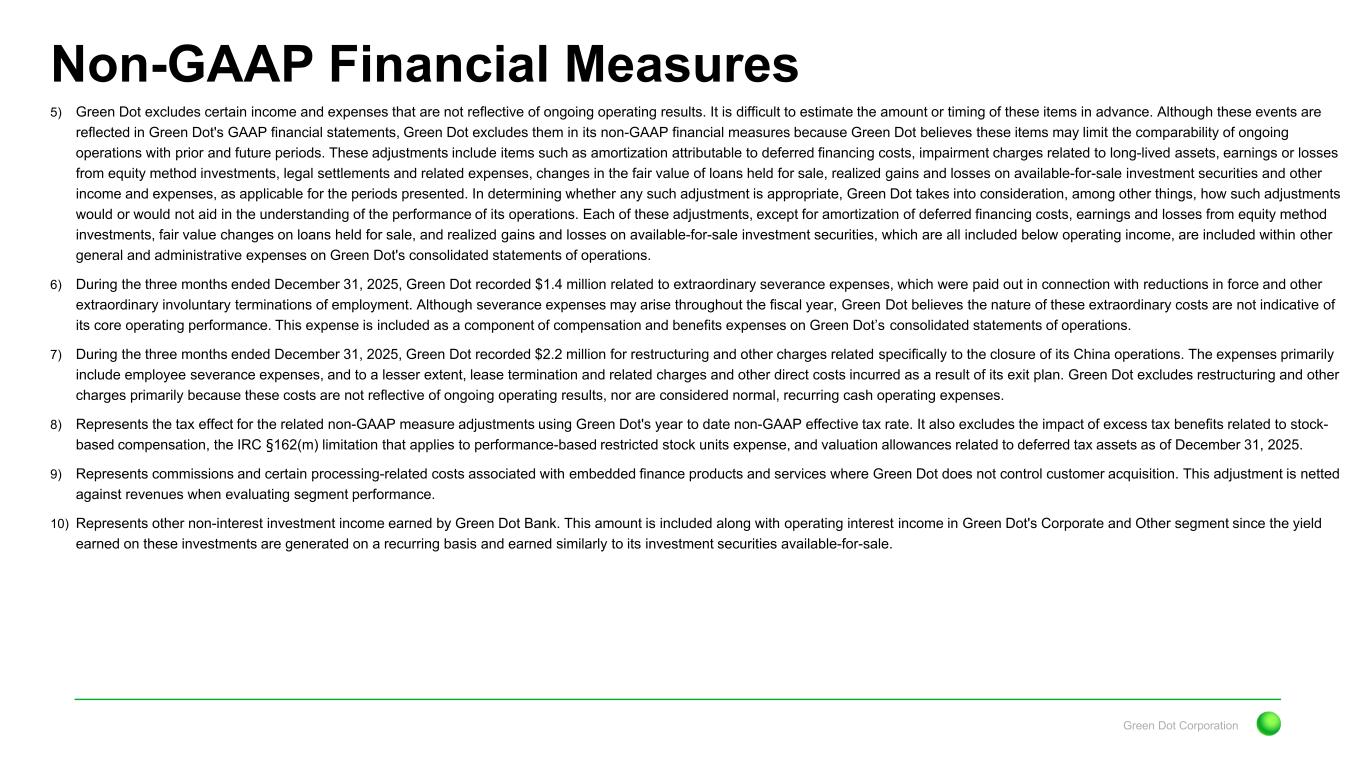
Green Dot Corporation Non-GAAP Financial Measures 5) Green Dot excludes certain income and expenses that are not reflective of ongoing operating results. It is difficult to estimate the amount or timing of these items in advance. Although these events are reflected in Green Dot's GAAP financial statements, Green Dot excludes them in its non-GAAP financial measures because Green Dot believes these items may limit the comparability of ongoing operations with prior and future periods. These adjustments include items such as amortization attributable to deferred financing costs, impairment charges related to long-lived assets, earnings or losses from equity method investments, legal settlements and related expenses, changes in the fair value of loans held for sale, realized gains and losses on available-for-sale investment securities and other income and expenses, as applicable for the periods presented. In determining whether any such adjustment is appropriate, Green Dot takes into consideration, among other things, how such adjustments would or would not aid in the understanding of the performance of its operations. Each of these adjustments, except for amortization of deferred financing costs, earnings and losses from equity method investments, fair value changes on loans held for sale, and realized gains and losses on available-for-sale investment securities, which are all included below operating income, are included within other general and administrative expenses on Green Dot's consolidated statements of operations. 6) During the three months ended December 31, 2025, Green Dot recorded $1.4 million related to extraordinary severance expenses, which were paid out in connection with reductions in force and other extraordinary involuntary terminations of employment. Although severance expenses may arise throughout the fiscal year, Green Dot believes the nature of these extraordinary costs are not indicative of its core operating performance. This expense is included as a component of compensation and benefits expenses on Green Dot’s consolidated statements of operations. 7) During the three months ended December 31, 2025, Green Dot recorded $2.2 million for restructuring and other charges related specifically to the closure of its China operations. The expenses primarily include employee severance expenses, and to a lesser extent, lease termination and related charges and other direct costs incurred as a result of its exit plan. Green Dot excludes restructuring and other charges primarily because these costs are not reflective of ongoing operating results, nor are considered normal, recurring cash operating expenses. 8) Represents the tax effect for the related non-GAAP measure adjustments using Green Dot's year to date non-GAAP effective tax rate. It also excludes the impact of excess tax benefits related to stock- based compensation, the IRC §162(m) limitation that applies to performance-based restricted stock units expense, and valuation allowances related to deferred tax assets as of December 31, 2025. 9) Represents commissions and certain processing-related costs associated with embedded finance products and services where Green Dot does not control customer acquisition. This adjustment is netted against revenues when evaluating segment performance. 10) Represents other non-interest investment income earned by Green Dot Bank. This amount is included along with operating interest income in Green Dot's Corporate and Other segment since the yield earned on these investments are generated on a recurring basis and earned similarly to its investment securities available-for-sale.